Volume 60, Issue 10, 1982
NEBRASKAland
JUNE 1982 $1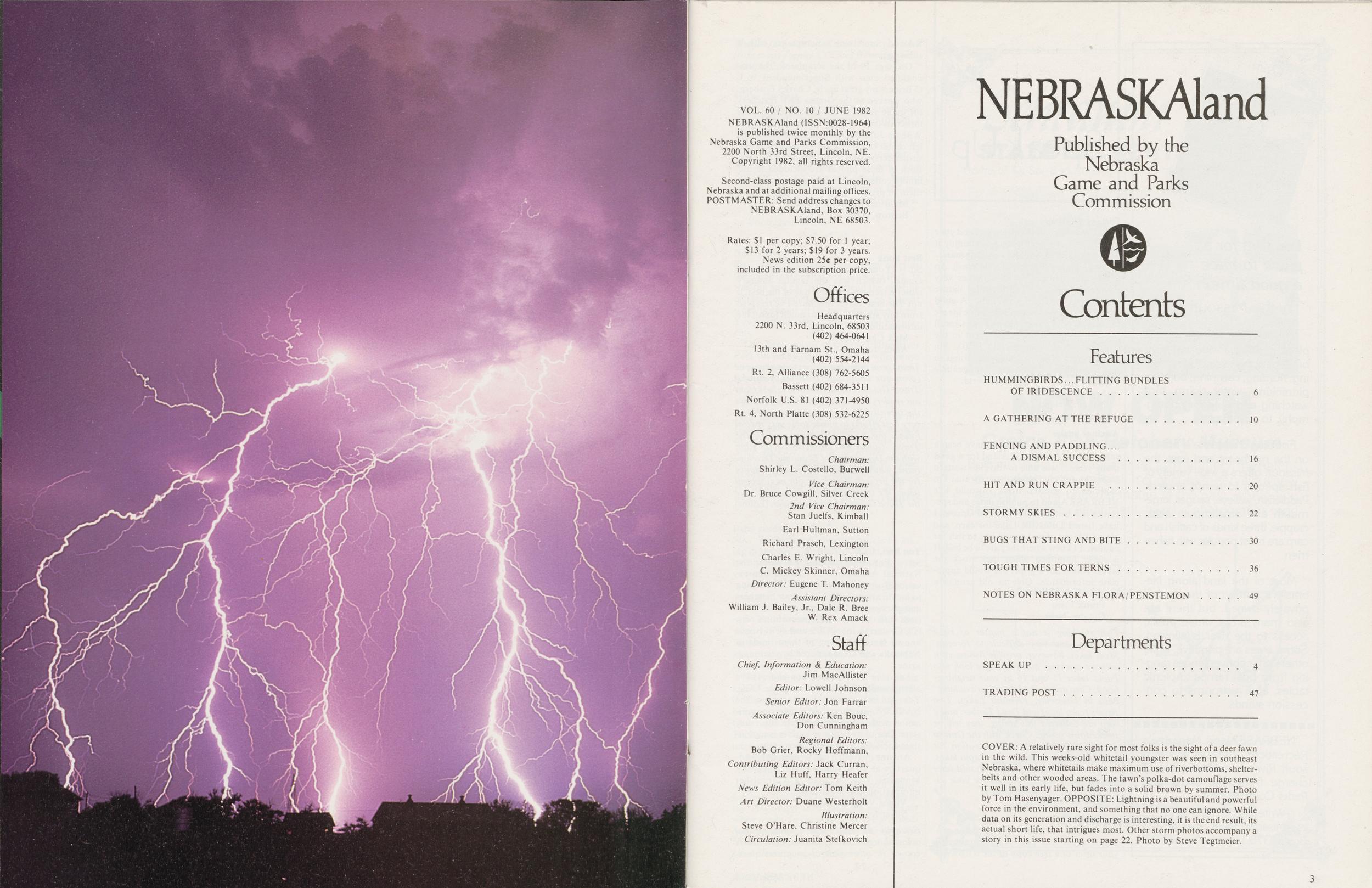
NEBRASKAland
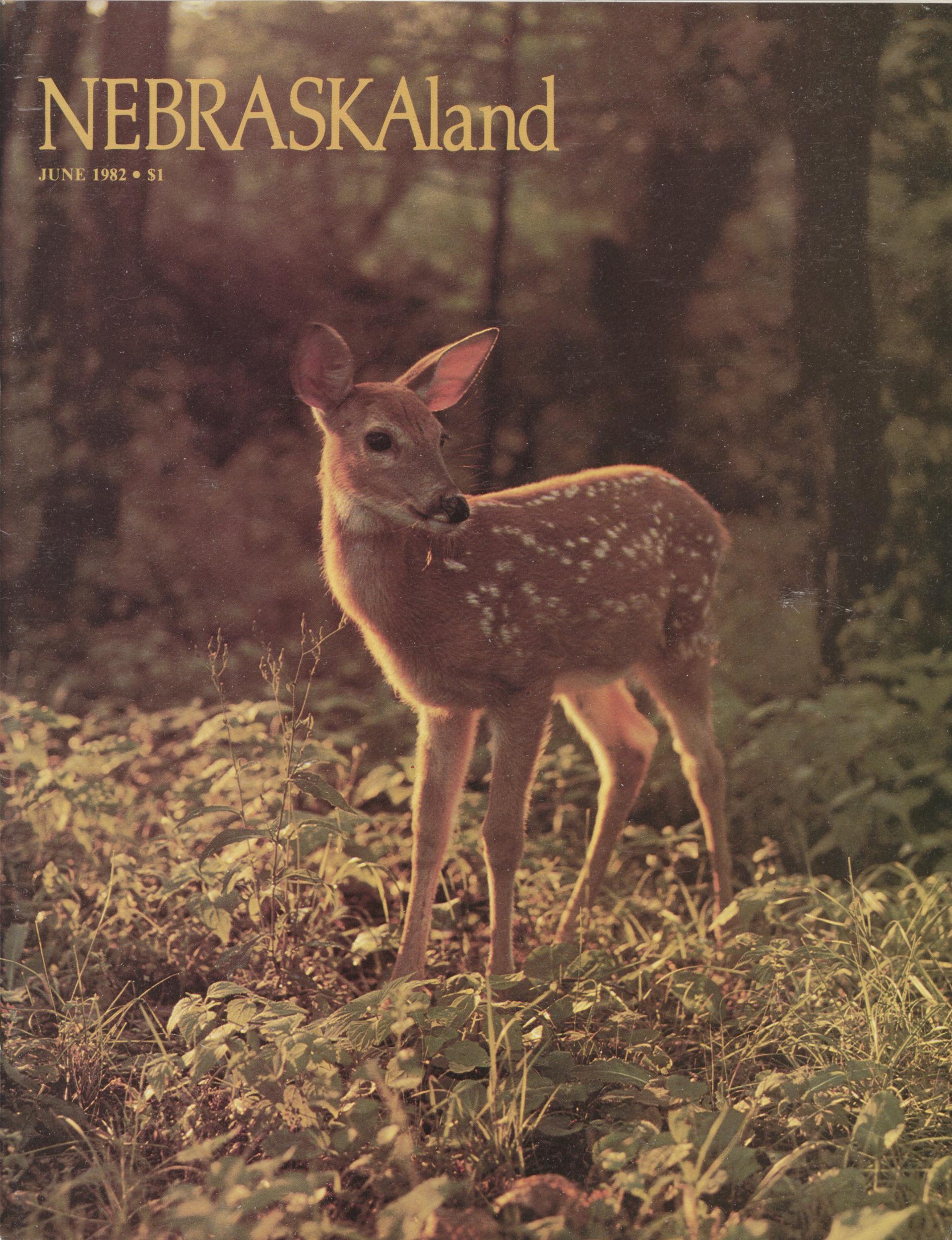
Published by the Nebraska Game and Parks Commission VOL. 60 / NO. 10 / JUNE 1982 NEBRASKAland (ISSN:0028-1964) is published twice monthly by the Nebraska Game and Parks Commission, 2200 North 33rd Street, Lincoln, NE. Copyright 1982, all rights reserved. Second-class postage paid at Lincoln, Nebraska and at additional mailing offices. POSTMASTER: Send address changes to NEBRASKAland, Box 30370, Lincoln, NE 68503. Rates: $1 per copy; $7.50 for 1 year; $13 for 2 years; $19 for 3 years. News edition 25c per copy, included in the subscription price. Offices Headquarters 2200 N. 33rd, Lincoln, 68503 (402) 464-0641 13th and Farnam St., Omaha (402) 554-2144 Rt. 2, Alliance (308) 762-5605 Bassett (402) 684-3511 Norfolk U.S. 81 (402) 371-4950 Rt. 4, North Platte (308) 532-6225 Commissioners Chairman: Shirley L. Costello, Burwell Vice Chairman: Dr. Bruce Cowgill, Silver Creek 2nd Vice Chairman: Stan Juelfs, Kimball Earl Hultman, Sutton Richard Prasch, Lexington Charles E. Wright, Lincoln C. Mickey Skinner, Omaha Director: Eugene T. Mahoney Assistant Directors: William J. Bailey, Jr., Dale R. Bree W. Rex Amack Staff Chief, Information & Education: Jim MacAllister Editor: Lowell Johnson Senior Editor: Jon Farrar Associate Editors: Ken Bouc, Don Cunningham Regional Editors: Bob Grier, Rocky Hoffmann, Contributing Editors: Jack Curran, Liz Huff, Harry Heafer News Edition Editor: Tom Keith Art Director: Duane Westerholt Illustration: Steve O'Hare, Christine Mercer Circulation: Juanita Stefkovich Contents Features HUMMINGBIRDS...FLITTING BUNDLES OF IRIDESCENCE 6 A GATHERING AT THE REFUGE 10 FENCING AND PADDLING... A DISMAL SUCCESS 16 HIT AND RUN CRAPPIE 20 STORMY SKIES 22 BUGS THAT STING AND BITE 30 TOUGH TIMES FOR TERNS 36 NOTES ON NEBRASKA FLORA/PENSTEMON 49 Departments SPEAK UP 4 TRADING POST 47 COVER: A relatively rare sight for most folks is the sight of a deer fawn in the wild. This weeks-old whitetail youngster was seen in southeast Nebraska, where whitetails make maximum use of riverbottoms, shelterbelts and other wooded areas. The fawn's polka-dot camouflage serves it well in its early life, but fades into a solid brown by summer. Photo by Tom Hasenyager. OPPOSITE: Lightning is a beautiful and powerful force in the environment, and something that no one can ignore. While data on its generation and discharge is interesting, it is the end result, its actual short life, that intrigues most. Other storm photos accompany a story in this issue starting on page 22. Photo by Steve Tegtmeier.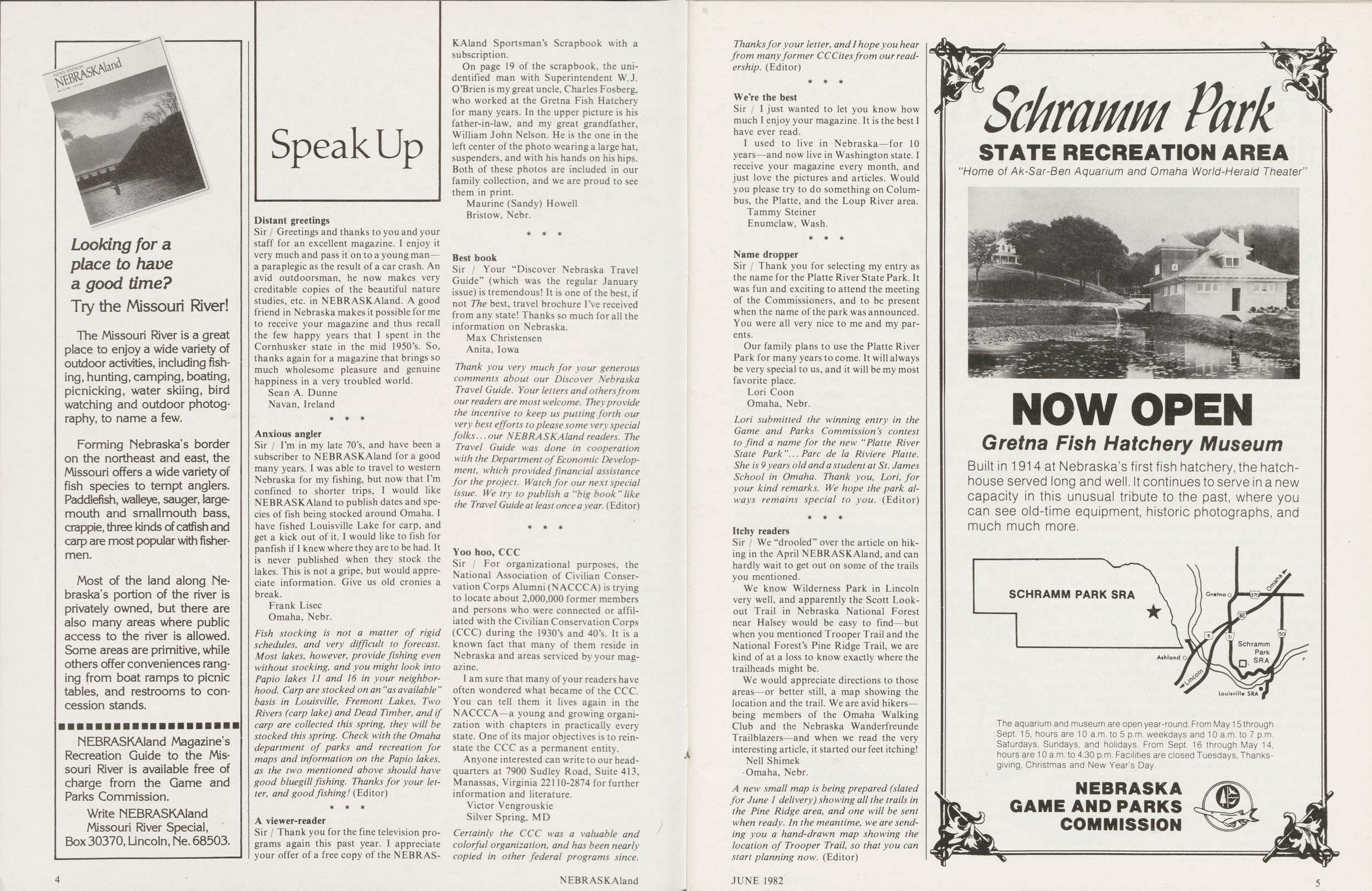 Looking for a
place to have
a good time?
Try the Missouri River!
The Missouri River is a great
place to enjoy a wide variety of
outdoor activities, including fishing, hunting, camping, boating,
picnicking, water skiing, bird
watching and outdoor photography, to name a few.
Forming Nebraska's border
on the northeast and east, the
Missouri offers a wide variety of
fish species to tempt anglers.
Paddlefish, walleye, sauger, largemouth and smallmouth bass,
crappie, three kinds of catfish and
carp are most popular with fishermen.
Most of the land along Nebraska's portion of the river is
privately owned, but there are
also many areas where public
access to the river is allowed.
Some areas are primitive, while
others offer conveniences ranging from boat ramps to picnic
tables, and restrooms to concession stands.
NEBRASKAland Magazine's
Recreation Guide to the Missouri River is available free of
charge from the Game and
Parks Commission.
Write NEBRASKAland
Missouri River Special,
Box 30370, Lincoln, Ne. 68503.
Looking for a
place to have
a good time?
Try the Missouri River!
The Missouri River is a great
place to enjoy a wide variety of
outdoor activities, including fishing, hunting, camping, boating,
picnicking, water skiing, bird
watching and outdoor photography, to name a few.
Forming Nebraska's border
on the northeast and east, the
Missouri offers a wide variety of
fish species to tempt anglers.
Paddlefish, walleye, sauger, largemouth and smallmouth bass,
crappie, three kinds of catfish and
carp are most popular with fishermen.
Most of the land along Nebraska's portion of the river is
privately owned, but there are
also many areas where public
access to the river is allowed.
Some areas are primitive, while
others offer conveniences ranging from boat ramps to picnic
tables, and restrooms to concession stands.
NEBRASKAland Magazine's
Recreation Guide to the Missouri River is available free of
charge from the Game and
Parks Commission.
Write NEBRASKAland
Missouri River Special,
Box 30370, Lincoln, Ne. 68503.
Speak Up
Distant greetingsSir / Greetings and thanks to you and your staff for an excellent magazine. I enjoy it very much and pass it on to a young mana paraplegic as the result of a car crash. An avid outdoorsman, he now makes very creditable copies of the beautiful nature studies, etc. in NEBRASKAland. A good friend in Nebraska makes it possible for me to receive your magazine and thus recall the few happy years that I spent in the Cornhusker state in the mid 1950's. So, thanks again for a magazine that brings so much wholesome pleasure and genuine happiness in a very troubled world.
Sean A. Dunne Navan, Ireland Anxious anglerSir / I'm in my late 70's, and have been a subscriber to NEBRASKAland for a good many years. I was able to travel to western Nebraska for my fishing, but now that I'm confined to shorter trips, I would like NEBRASKAland to publish dates and species of fish being stocked around Omaha. I have fished Louisville Lake for carp, and get a kick out of it. I would like to fish for panfish if I knew where they are to be had. It is never published when they stock the lakes. This is not a gripe, but would appreciate information. Give us old cronies a break.
Frank Lisec Omaha, Nebr.Fish stocking is not a matter of rigid schedules, and very difficult to forecast. Most lakes, however, provide fishing even without stocking, and you might look into Papio lakes 11 and 16 in your neighborhood. Carp are stocked on an "as available" basis in Louisville, Fremont Lakes, Two Rivers (carp lake) and Dead Timber, and if carp are collected this spring, they will be stocked this spring. Check with the Omaha department of parks and recreation for maps and information on the Papio lakes, as the two mentioned above should have good bluegill fishing. Thanks for your letter, and good fishing! (Editor)
A viewer-readerSir / Thank you for the fine television programs again this past year. I appreciate your offer of a free copy of the NEBRASKAland Sportsman's Scrapbook with a subscription.
On page 19 of the scrapbook, the unidentified man with Superintendent W.J. O'Brien is my great uncle, Charles Fosberg, who worked at the Gretna Fish Hatchery for many years. In the upper picture is his father-in-law, and my great grandfather, William John Nelson. He is the one in the left center of the photo wearing a large hat, suspenders, and with his hands on his hips. Both of these photos are included in our family collection, and we are proud to see them in print.
Maurine (Sandy) Howell Bristow, Nebr. Best bookSir / Your "Discover Nebraska Travel Guide" (which was the regular January issue) is tremendous! It is one of the best, if not The best, travel brochure I've received from any state! Thanks so much for all the information on Nebraska.
Max Christensen Anita, IowaThank you very much for your generous comments about our Discover Nebraska Travel Guide. Your letters and others from our readers are most welcome. They provide the incentive to keep us putting forth our very best efforts to please some very special folks... our NEBRASKAland readers. The Travel Guide was done in cooperation with the Department of Economic Development, which provided financial assistance for the project. Watch for our next special issue. We try to publish a "big book"like the Travel Guide at least once a year. (Editor)
Yoo hoo, CCCSir / For organizational purposes, the National Association of Civilian Conservation Corps Alumni (NACCCA) is trying to locate about 2,000,000 former members and persons who were connected or affiliated with the Civilian Conservation Corps (CCC) during the 1930's and 40's. It is a known fact that many of them reside in Nebraska and areas serviced by your magazine.
I am sure that many of your readers have often wondered what became of the CCC. You can tell them it lives again in the NACCCA—a young and growing organization with chapters in practically every state. One of its major objectives is to reinstate the CCC as a permanent entity.
Anyone interested can write to our headquarters at 7900 Sudley Road, Suite 413, Manassas, Virginia 22110-2874 for further information and literature.
Victor Vengrouskie Silver Spring, MDCertainly the CCC was a valuable and colorful organization, and has been nearly copied in other federal programs since. 4 NEBRASKAland Thanks for your letter, and I hope you hear from many former CCCitesfrom our readership. (Editor)
We're the bestSir / I just wanted to let you know how much I enjoy your magazine It is the best I have ever read.
I used to live in Nebraska—for 10 years—and now live in Washington state. I receive your magazine every month, and just love the pictures and articles. Would you please try to do something on Columbus, the Platte, and the Loup River area.
Tammy Steiner Enumclaw, Wash. Name dropperSir / Thank you for selecting my entry as the name for the Platte River State Park. It was fun and exciting to attend the meeting of the Commissioners, and to be present when the name of the park was announced. You were all very nice to me and my parents.
Our family plans to use the Platte River Park for many years to come. It will always be very special to us, and it will be my most favorite place.
Lori Coon Omaha, Nebr.Lori submitted the winning entry in the Game and Parks Commission's contest to find a name for the new "Platte River State Park"... Pare de la Riviere Platte. She is 9 years old and a student at St. James School in Omaha. Thank you, Lori, for your kind remarks. We hope the park always remains special to you. (Editor)
Itchy readersSir / We "drooled" over the article on hiking in the April NEBRASKAland, and can hardly wait to get out on some of the trails you mentioned.
We know Wilderness Park in Lincoln very well, and apparently the Scott Lookout Trail in Nebraska National Forest near Halsey would be easy to find—but when you mentioned Trooper Trail and the National Forest's Pine Ridge Trail, we are kind of at a loss to know exactly where the trailheads might be.
We would appreciate directions to those areas—or better still, a map showing the location and the trail. We are avid hikers—being members of the Omaha Walking Club and the Nebraska Wanderfreunde Trailblazers—and when we read the very interesting article, it started our feet itching!
Nell Shimek Omaha, Nebr.A new small map is being prepared (slated for June 1 delivery) showing all the trails in the Pine Ridge area, and one will be sent when ready. In the meantime, we are sending you a hand-drawn map showing the location of Trooper Trail, so that you can start planning now. (Editor)
Schramm Park STATE RECREATION AREA "Home of Ak-Sar-Ben Aquarium and Omaha World-Herald Theater" NOW OPEN Gretna Fish Hatchery Museum Built in 1914 at Nebraska's first fish hatchery, the hatch-house served long and well. It continues to serve in a new capacity in this unusual tribute to the past, where you can see old-time equipment, historic photographs, and much much more. SCHRAMM PARK SRA The aquarium and museum are open year-round. From May 15 through Sept. 15, hours are 10 a.m. to 5 p.m. weekdays and 10 a.m. to 7 p.m. Saturdays, Sundays, and holidays. From Sept. 16 through May 14, hours are 10 a.m. to 4:30 p.m. Facilities are closed Tuesdays, Thanksgiving, Christmas and New Year's Day. NEBRASKA GAME AND PARKS COMMISSION JUNE 1982 5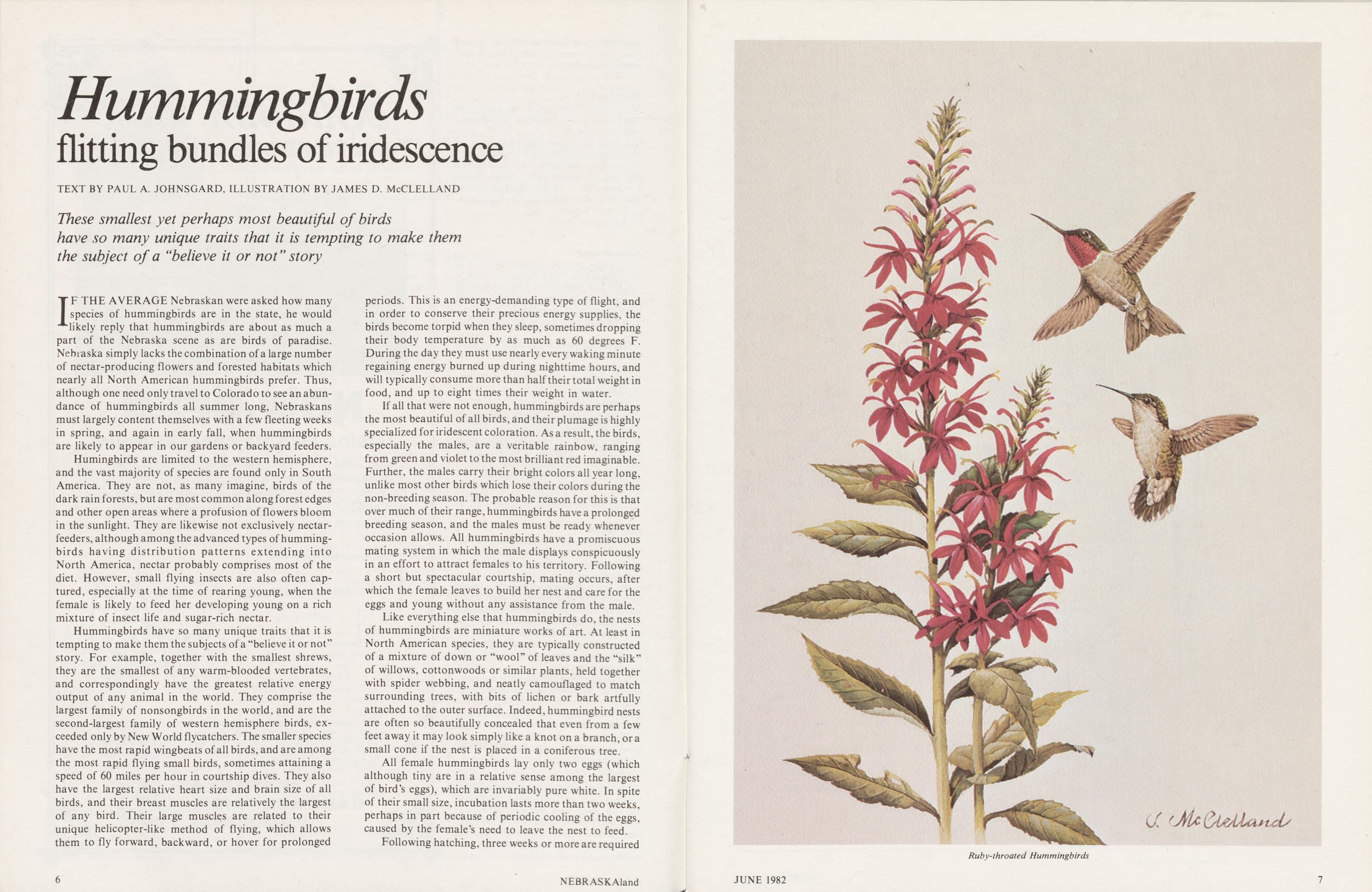
Hummingbirds flitting bundles of iridescence
TEXT BY PAUL A. JOHNSGARD, ILLUSTRATION BY JAMES D. McCLELLAND These smallest yet perhaps most beautiful of birds have so many unique traits that it is tempting to make them the subject of a "believe it or not" storyIF THE AVERAGE Nebraskan were asked how many species of hummingbirds are in the state, he would likely reply that hummingbirds are about as much a part of the Nebraska scene as are birds of paradise. Nebraska simply lacks the combination of a large number of nectar-producing flowers and forested habitats which nearly all North American hummingbirds prefer. Thus, although one need only travel to Colorado to see an abundance of hummingbirds all summer long, Nebraskans must largely content themselves with a few fleeting weeks in spring, and again in early fall, when hummingbirds are likely to appear in our gardens or backyard feeders.
Humingbirds are limited to the western hemisphere, and the vast majority of species are found only in South America. They are not, as many imagine, birds of the dark rain forests, but are most common along forest edges and other open areas where a profusion of flowers bloom in the sunlight. They are likewise not exclusively nectar-feeders, although among the advanced types of hummingbirds having distribution patterns extending into North America, nectar probably comprises most of the diet. However, small flying insects are also often captured, especially at the time of rearing young, when the female is likely to feed her developing young on a rich mixture of insect life and sugar-rich nectar.
Hummingbirds have so many unique traits that it is tempting to make them the subjects of a "believe it or not" story. For example, together with the smallest shrews, they are the smallest of any warm-blooded vertebrates, and correspondingly have the greatest relative energy output of any animal in the world. They comprise the largest family of nonsongbirds in the world, and are the second-largest family of western hemisphere birds, exceeded only by New World flycatchers. The smaller species have the most rapid wingbeats of all birds, and are among the most rapid flying small birds, sometimes attaining a speed of 60 miles per hour in courtship dives. They also have the largest relative heart size and brain size of all birds, and their breast muscles are relatively the largest of any bird. Their large muscles are related to their unique helicopter-like method of flying, which allows them to fly forward, backward, or hover for prolonged periods. This is an energy-demanding type of flight, and in order to conserve their precious energy supplies, the birds become torpid when they sleep, sometimes dropping their body temperature by as much as 60 degrees F. During the day they must use nearly every waking minute regaining energy burned up during nighttime hours, and will typically consume more than half their total weight in food, and up to eight times their weight in water.
If all that were not enough, hummingbirds are perhaps the most beautiful of all birds, and their plumage is highly specialized for iridescent coloration. As a result, the birds, especially the males, are a veritable rainbow, ranging from green and violet to the most brilliant red imaginable. Further, the males carry their bright colors all year long, unlike most other birds which lose their colors during the non-breeding season. The probable reason for this is that over much of their range, hummingbirds have a prolonged breeding season, and the males must be ready whenever occasion allows. All hummingbirds have a promiscuous mating system in which the male displays conspicuously in an effort to attract females to his territory. Following a short but spectacular courtship, mating occurs, after which the female leaves to build her nest and care for the eggs and young without any assistance from the male.
Like everything else that hummingbirds do, the nests of hummingbirds are miniature works of art. At least in North American species, they are typically constructed of a mixture of down or "wool" of leaves and the "silk" of willows, cottonwoods or similar plants, held together with spider webbing, and neatly camouflaged to match surrounding trees, with bits of lichen or bark artfully attached to the outer surface. Indeed, hummingbird nests are often so beautifully concealed that even from a few feet away it may look simply like a knot on a branch, or a small cone if the nest is placed in a coniferous tree.
All female hummingbirds lay only two eggs (which although tiny are in a relative sense among the largest of bird's eggs), which are invariably pure white. In spite of their small size, incubation lasts more than two weeks, perhaps in part because of periodic cooling of the eggs, caused by the female's need to leave the nest to feed.
Following hatching, three weeks or more are required 6 NEBRASKAland
In Nebraska, the species of hummingbird most likely to be seen, and indeed the only one likely to be seen in the eastern half of the state, is the ruby-throated hummingbird. This is the most widely distributed of all North American hummingbirds, and its breeding range covers virtually all of eastern North America north nearly to Hudson Bay. The nesting range includes most of eastern Nebraska, but only along the Missouri River is nesting at all regular. Nests have been reported as far west as North Platte. Ruby-throats typically arrive in Nebraska in early April, with about half of the total available spring arrival records occurring between May 5 and 17. By June most of these birds will have continued northward, to return again in August during the fall migration. Typically the birds leave the state in mid September. In mild falls, stragglers may persist until early October.
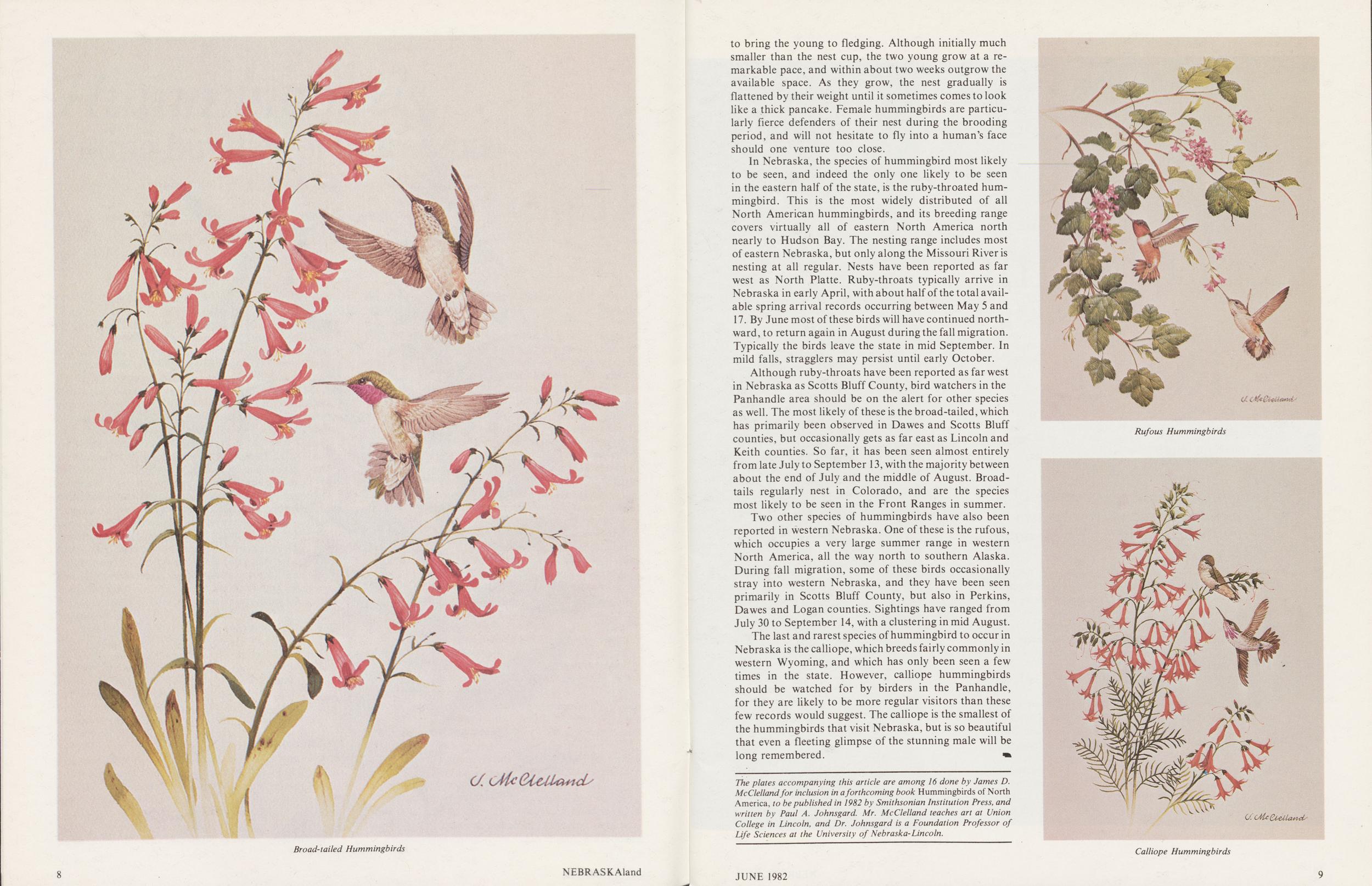
Although ruby-throats have been reported as far west in Nebraska as Scotts Bluff County, bird watchers in the Panhandle area should be on the alert for other species as well. The most likely of these is the broad-tailed, which has primarily been observed in Dawes and Scotts Bluff counties, but occasionally gets as far east as Lincoln and Keith counties. So far, it has been seen almost entirely from late July to September 13, with the majority between about the end of July and the middle of August. Broadtails regularly nest in Colorado, and are the species most likely to be seen in the Front Ranges in summer.
Two other species of hummingbirds have also been reported in western Nebraska. One of these is the rufous, which occupies a very large summer range in western North America, all the way north to southern Alaska. During fall migration, some of these birds occasionally stray into western Nebraska, and they have been seen primarily in Scotts Bluff County, but also in Perkins, Dawes and Logan counties. Sightings have ranged from July 30 to September 14, with a clustering in mid August.
The last and rarest species of hummingbird to occur in Nebraska is the calliope, which breeds fairly commonly in western Wyoming, and which has only been seen a few times in the state. However, calliope hummingbirds should be watched for by birders in the Panhandle, for they are likely to be more regular visitors than these few records would suggest. The calliope is the smallest of the hummingbirds that visit Nebraska, but is so beautiful that even a fleeting glimpse of the stunning male will be long remembered.
The plates accompanying this article are among 16 done by James D. McClelland for inclusion in a forthcoming book Hummingbirds of North America, to be published in 1982 by Smithsonian Institution Press, and written by Paul A. Johnsgard. Mr. McClelland teaches art at Union College in Lincoln, and Dr. Johnsgard is a Foundation Professor of Life Sciences at the University of Nebraska-Lincoln.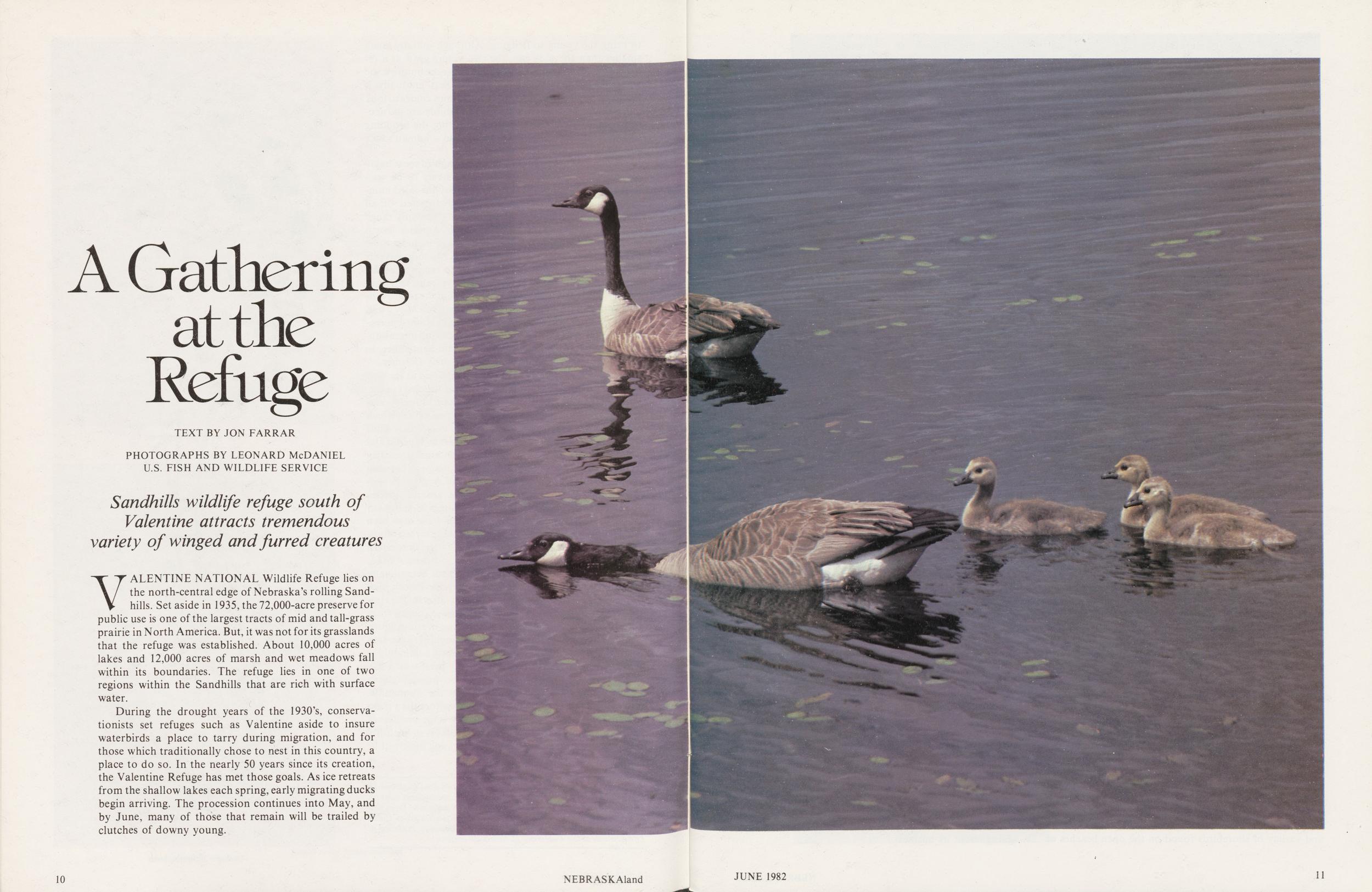
A Gathering at the Refuge
TEXT BY JON FARRAR PHOTOGRAPHS BY LEONARD McDANIEL U.S. FISH AND WILDLIFE SERVICE Sandhills wildlife refuge south of Valentine attracts tremendous variety of winged and furred creaturesVALENTINE NATIONAL Wildlife Refuge lies on the north-central edge of Nebraska's rolling Sandhills. Set aside in 1935, the 72,000-acre preserve for public use is one of the largest tracts of mid and tall-grass prairie in North America. But, it was not for its grasslands that the refuge was established. About 10,000 acres of lakes and 12,000 acres of marsh and wet meadows fall within its boundaries. The refuge lies in one of two regions within the Sandhills that are rich with surface water.
During the drought years of the 1930's, conservationists set refuges such as Valentine aside to insure waterbirds a place to tarry during migration, and for those which traditionally chose to nest in this country, a place to do so. In the nearly 50 years since its creation, the Valentine Refuge has met those goals. As ice retreats from the shallow lakes each spring, early migrating ducks begin arriving. The procession continues into May, and by June, many of those that remain will be trailed by clutches of downy young.
10 NEBRASKAland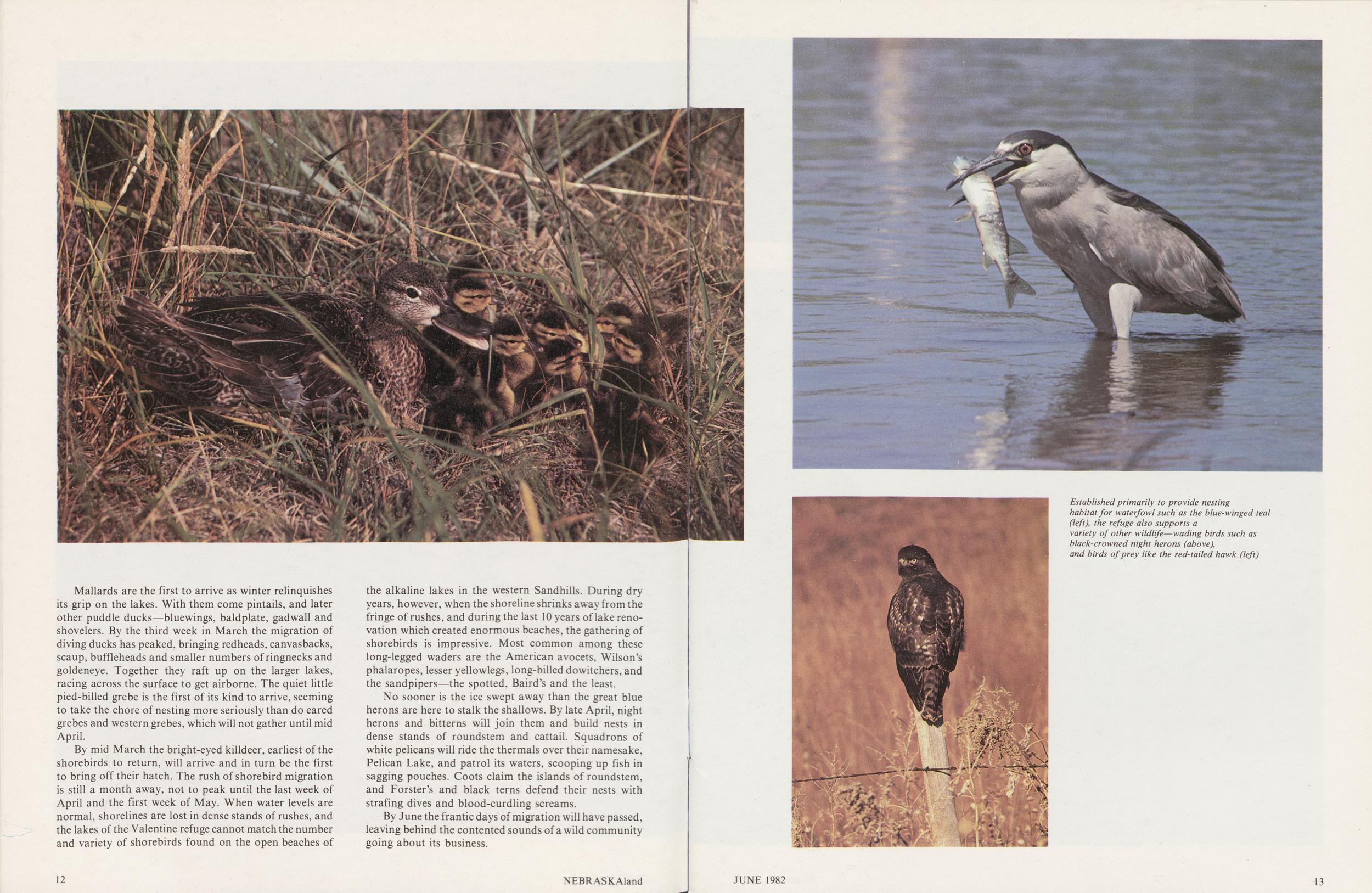
Mallards are the first to arrive as winter relinquishes its grip on the lakes. With them come pintails, and later other puddle ducks—bluewings, baldplate, gadwall and shovelers. By the third week in March the migration of diving ducks has peaked, bringing redheads, canvasbacks, scaup, buffleheads and smaller numbers of ringnecks and goldeneye. Together they raft up on the larger lakes, racing across the surface to get airborne. The quiet little pied-billed grebe is the first of its kind to arrive, seeming to take the chore of nesting more seriously than do eared grebes and western grebes, which will not gather until mid April.
By mid March the bright-eyed killdeer, earliest of the shorebirds to return, will arrive and in turn be the first to bring off their hatch. The rush of shorebird migration is still a month away, not to peak until the last week of April and the first week of May. When water levels are normal, shorelines are lost in dense stands of rushes, and the lakes of the Valentine refuge cannot match the number and variety of shorebirds found on the open beaches of the alkaline lakes in the western Sandhills. During dry years, however, when the shoreline shrinks away from the fringe of rushes, and during the last 10 years of lake renovation which created enormous beaches, the gathering of shorebirds is impressive. Most common among these long-legged waders are the American avocets, Wilson's phalaropes, lesser yellowlegs, long-billed dowitchers, and the sandpipers—the spotted, Baird's and the least.
No sooner is the ice swept away than the great blue herons are here to stalk the shallows. By late April, night herons and bitterns will join them and build nests in dense stands of roundstem and cattail. Squadrons of white pelicans will ride the thermals over their namesake, Pelican Lake, and patrol its waters, scooping up fish in sagging pouches. Coots claim the islands of roundstem, and Forster's and black terns defend their nests with strafing dives and blood-curdling screams.
By June the frantic days of migration will have passed, leaving behind the contented sounds of a wild community going about its business.
12 NEBRASKAland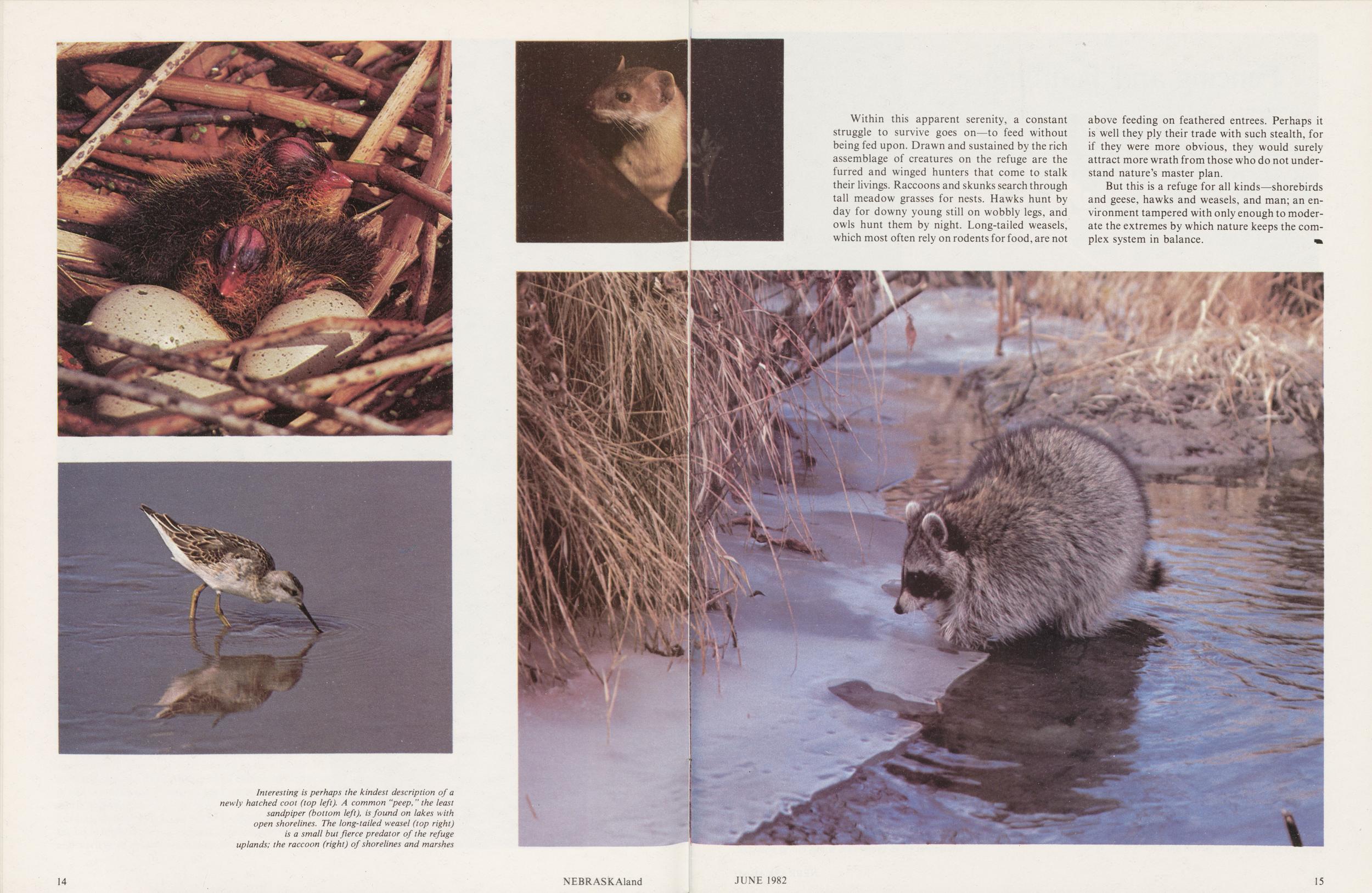
Within this apparent serenity, a constant struggle to survive goes on—to feed without being fed upon. Drawn and sustained by the rich assemblage of creatures on the refuge are the furred and winged hunters that come to stalk their livings. Raccoons and skunks search through tall meadow grasses for nests. Hawks hunt by day for downy young still on wobbly legs, and owls hunt them by night. Long-tailed weasels, which most often rely on rodents for food, are not above feeding on feathered entrees. Perhaps it is well they ply their trade with such stealth, for if they were more obvious, they would surely attract more wrath from those who do not understand nature's master plan.
But this is a refuge for all kinds—shorebirds and geese, hawks and weasels, and man; an environment tampered with only enough to moderate the extremes by which nature keeps the complex system in balance.
Fencing and Paddling A DISMAL SUCCESS
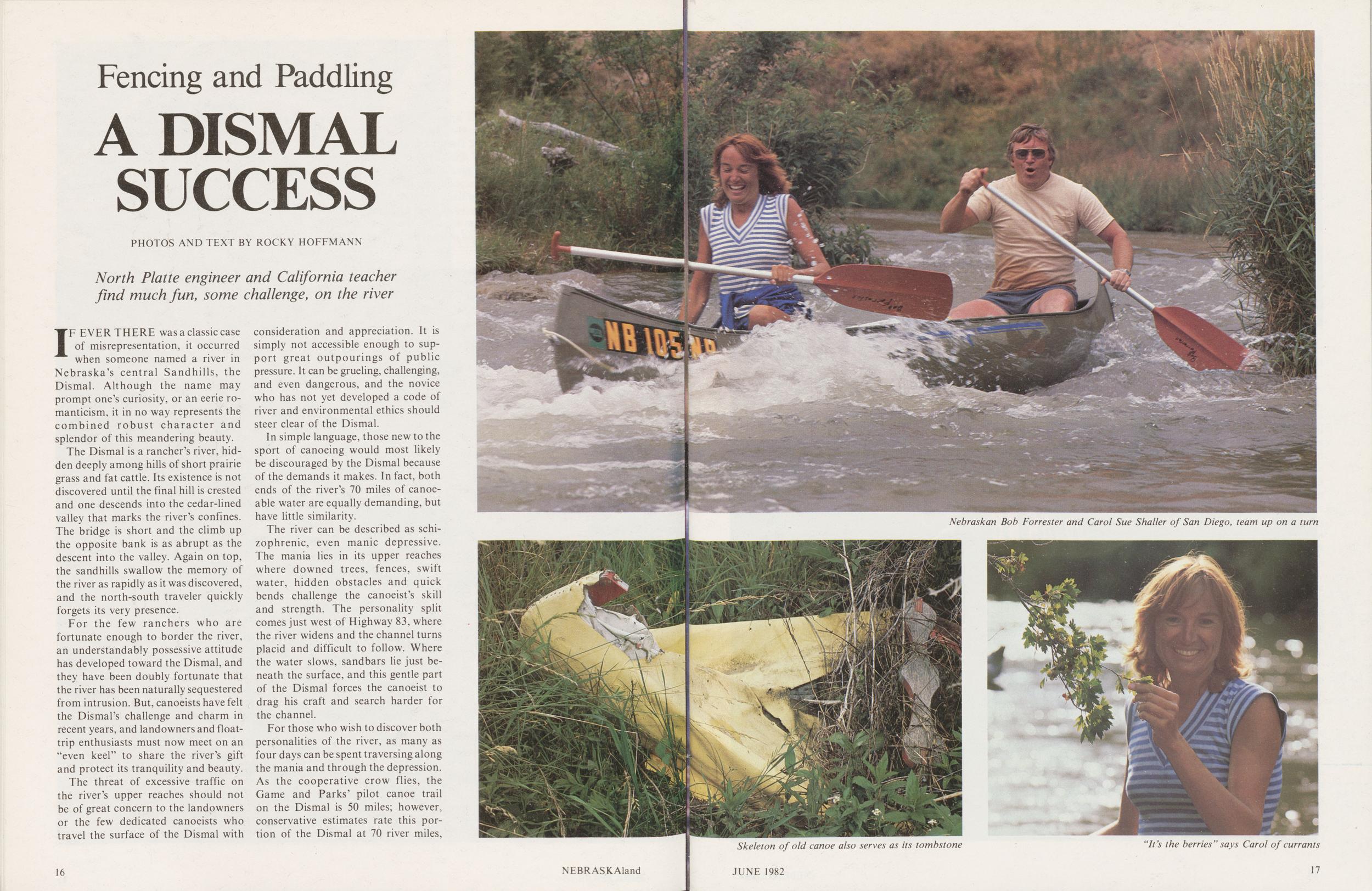
PHOTOS AND TEXT BY ROCKY HOFFMANN North Platte engineer and California teacher find much fun, some challenge, on the riverIF EVER THERE was a classic case of misrepresentation, it occurred when someone named a river in Nebraska's central Sandhills, the Dismal. Although the name may prompt one's curiosity, or an eerie romanticism, it in no way represents the combined robust character and splendor of this meandering beauty.
The Dismal is a rancher's river, hidden deeply among hills of short prairie grass and fat cattle. Its existence is not discovered until the final hill is crested and one descends into the cedar-lined valley that marks the river's confines. The bridge is short and the climb up the opposite bank is as abrupt as the descent into the valley. Again on top, the sandhills swallow the memory of the river as rapidly as it was discovered, and the north-south traveler quickly forgets its very presence.
For the few ranchers who are fortunate enough to border the river, an understandably possessive attitude has developed toward the Dismal, and they have been doubly fortunate that the river has been naturally sequestered from intrusion. But, canoeists have felt the Dismal's challenge and charm in recent years, and landowners and float-trip enthusiasts must now meet on an "even keel" to share the river's gift and protect its tranquility and beauty.
The threat of excessive traffic on the river's upper reaches should not be of great concern to the landowners or the few dedicated canoeists who travel the surface of the Dismal with consideration and appreciation. It is simply not accessible enough to support great outpourings of public pressure. It can be grueling, challenging, and even dangerous, and the novice who has not yet developed a code of river and environmental ethics should steer clear of the Dismal.
In simple language, those new to the sport of canoeing would most likely be discouraged by the Dismal because of the demands it makes. In fact, both ends of the river's 70 miles of canoeable water are equally demanding, but have little similarity.
The river can be described as schizophrenic, even manic depressive. The mania lies in its upper reaches where downed trees, fences, swift water, hidden obstacles and quick bends challenge the canoeist's skill and strength. The personality split comes just west of Highway 83, where the river widens and the channel turns placid and difficult to follow. Where the water slows, sandbars lie just beneath the surface, and this gentle part of the Dismal forces the canoeist to drag his craft and search harder for the channel.
For those who wish to discover both personalities of the river, as many as four days can be spent traversing along the mania and through the depression. As the cooperative crow flies, the Game and Parks' pilot canoe trail on the Dismal is 50 miles; however, conservative estimates rate this portion of the Dismal at 70 river miles, 16 NEBRASKAland
One of the greatest mistakes in planning a canoe trip is failure to correctly estimate the time it will take to get from point A to point B. If the trip is begun early enough in the day, a simple miscalculation means little more than a few anxious hours for the canoeists or whoever may be waiting at the other end.
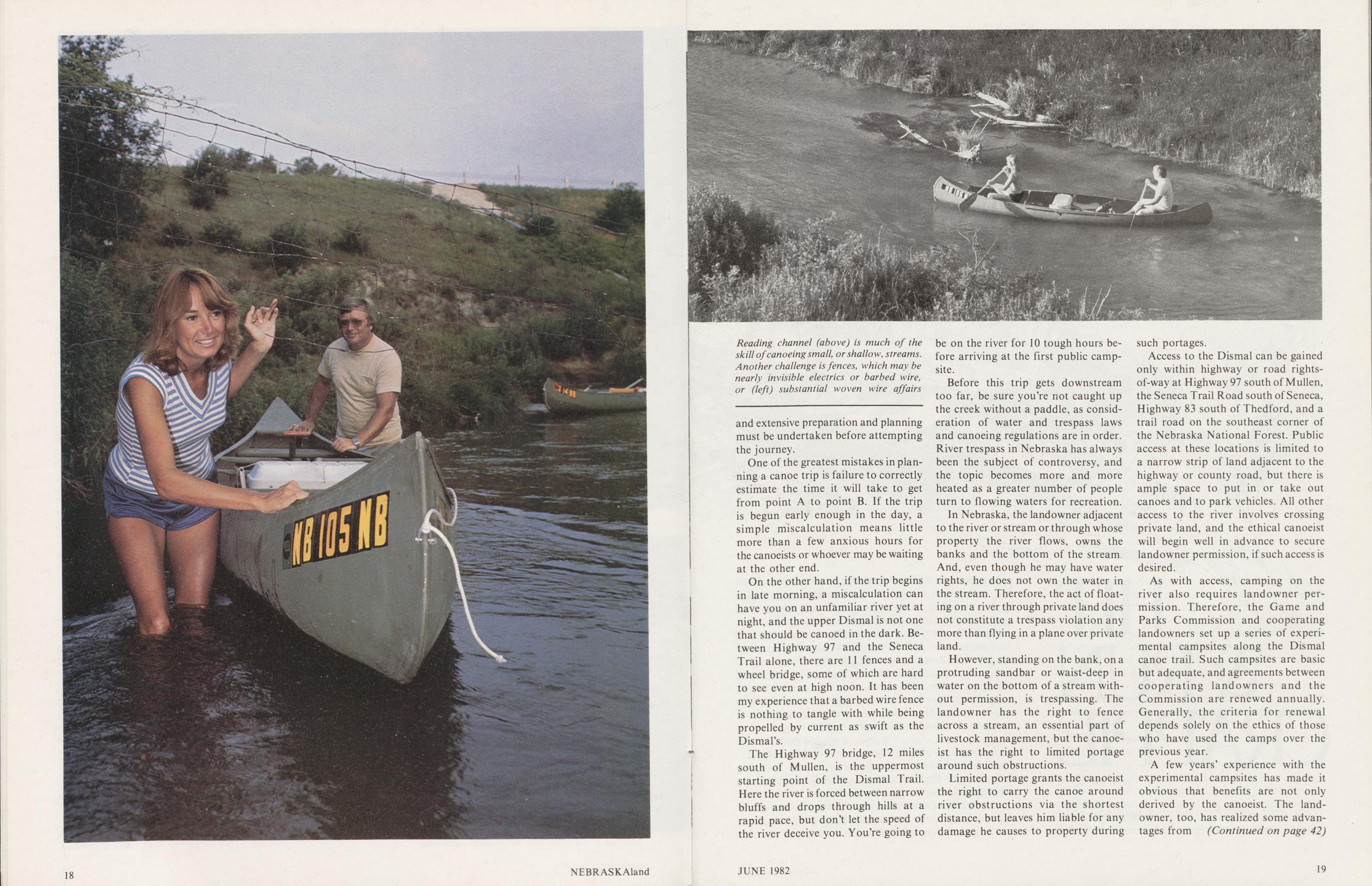
On the other hand, if the trip begins in late morning, a miscalculation can have you on an unfamiliar river yet at night, and the upper Dismal is not one that should be canoed in the dark. Between Highway 97 and the Seneca Trail alone, there are 11 fences and a wheel bridge, some of which are hard to see even at high noon. It has been my experience that a barbed wire fence is nothing to tangle with while being propelled by current as swift as the Dismal's.
The Highway 97 bridge, 12 miles south of Mullen, is the uppermost starting point of the Dismal Trail. Here the river is forced between narrow bluffs and drops through hills at a rapid pace, but don't let the speed of the river deceive you. You're going to be on the river for 10 tough hours before arriving at the first public campsite.
Before this trip gets downstream too far, be sure you're not caught up the creek without a paddle, as consideration of water and trespass laws and canoeing regulations are in order. River trespass in Nebraska has always been the subject of controversy, and the topic becomes more and more heated as a greater number of people turn to flowing waters for recreation.
In Nebraska, the landowner adjacent to the river or stream or through whose property the river flows, owns the banks and the bottom of the stream. And, even though he may have water rights, he does not own the water in the stream. Therefore, the act of floating on a river through private land does not constitute a trespass violation any more than flying in a plane over private land.
However, standing on the bank, on a protruding sandbar or waist-deep in water on the bottom of a stream without permission, is trespassing. The landowner has the right to fence across a stream, an essential part of livestock management, but the canoeist has the right to limited portage around such obstructions.
Limited portage grants the canoeist the right to carry the canoe around river obstructions via the shortest distance, but leaves him liable for any damage he causes to property during such portages.
Access to the Dismal can be gained only within highway or road rights-of-way at Highway 97 south of Mullen, the Seneca Trail Road south of Seneca, Highway 83 south of Thedford, and a trail road on the southeast corner of the Nebraska National Forest. Public access at these locations is limited to a narrow strip of land adjacent to the highway or county road, but there is ample space to put in or take out canoes and to park vehicles. All other access to the river involves crossing private land, and the ethical canoeist will begin well in advance to secure landowner permission, if such access is desired.
As with access, camping on the river also requires landowner permission. Therefore, the Game and Parks Commission and cooperating landowners set up a series of experimental campsites along the Dismal canoe trail. Such campsites are basic but adequate, and agreements between cooperating landowners and the Commission are renewed annually. Generally, the criteria for renewal depends solely on the ethics of those who have used the camps over the previous year.
A few years' experience with the experimental campsites has made it obvious that benefits are not only derived by the canoeist. The landowner, too, has realized some advantages from (Continued on page 42)
JUNE 1982 19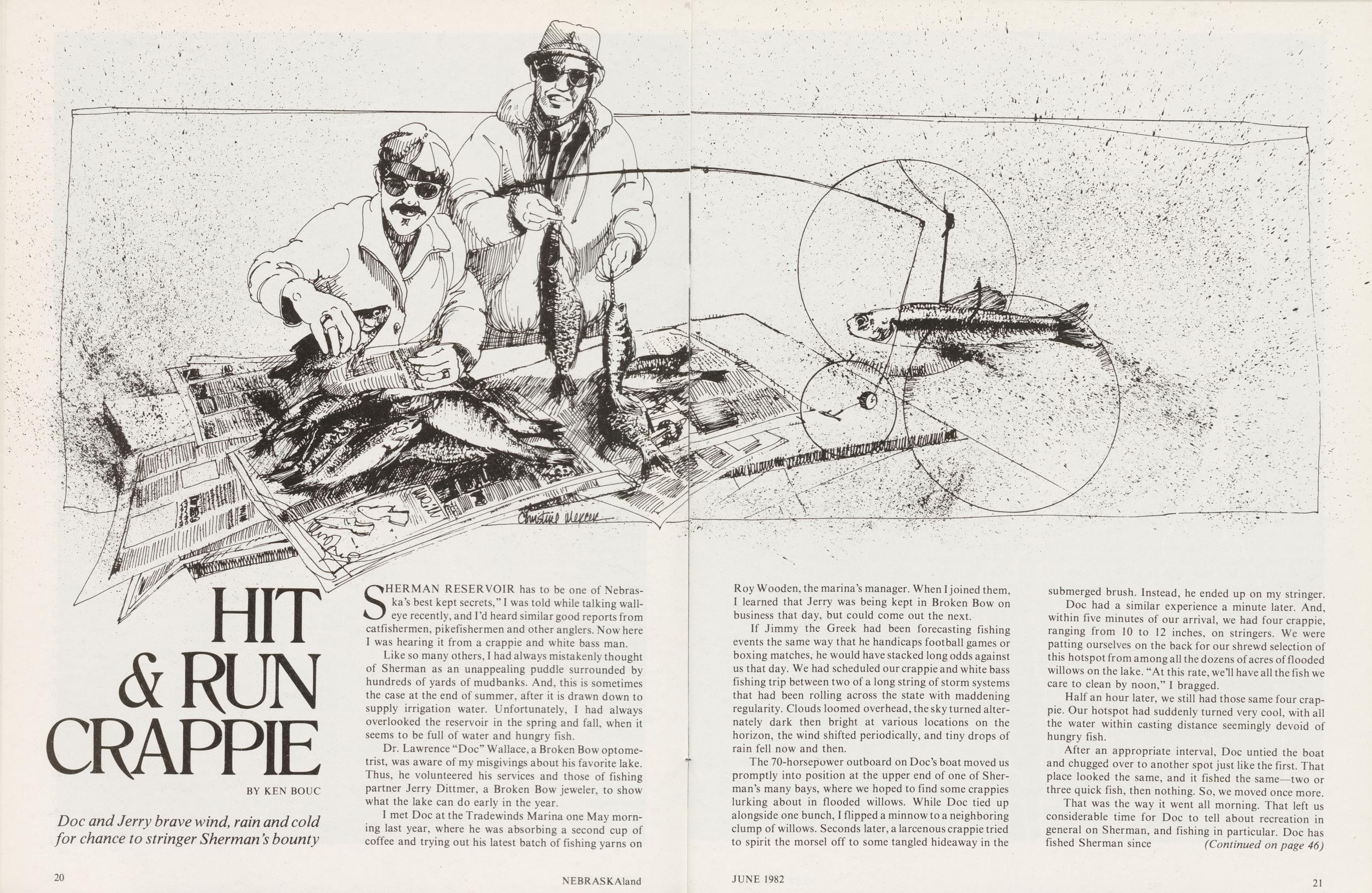
HIT & RUN CRAPPIE
BY KEN BOUC Doc and Jerry brave wind, rain and cold for chance to stringer Sherman 9s bountySHERMAN RESERVOIR has to be one of Nebraska's best kept secrets," I was told while talking walleye recently, and I'd heard similar good reports from catfishermen, pikefishermen and other anglers. Nowhere I was hearing it from a crappie and white bass man.
Like so many others, I had always mistakenly thought of Sherman as an unappealing puddle surrounded by hundreds of yards of mudbanks. And, this is sometimes the case at the end of summer, after it is drawn down to supply irrigation water. Unfortunately, I had always overlooked the reservoir in the spring and fall, when it seems to be full of water and hungry fish.
Dr. Lawrence "Doc" Wallace, a Broken Bow optometrist, was aware of my misgivings about his favorite lake. Thus, he volunteered his services and those of fishing partner Jerry Dittmer, a Broken Bow jeweler, to show what the lake can do early in the year.
I met Doc at the Tradewinds Marina one May morning last year, where he was absorbing a second cup of coffee and trying out his latest batch of fishing yarns on 20 NEBRASKAland Roy Wooden, the marina's manager. When I joined them, I learned that Jerry was being kept in Broken Bow on business that day, but could come out the next.
If Jimmy the Greek had been forecasting fishing events the same way that he handicaps football games or boxing matches, he would have stacked long odds against us that day. We had scheduled our crappie and white bass fishing trip between two of a long string of storm systems that had been rolling across the state with maddening regularity. Clouds loomed overhead, the sky turned alternately dark then bright at various locations on the horizon, the wind shifted periodically, and tiny drops of rain fell now and then.
The 70-horsepower outboard on Doc's boat moved us promptly into position at the upper end of one of Sherman's many bays, where we hoped to find some crappies lurking about in flooded willows. While Doc tied up alongside one bunch, I flipped a minnow to a neighboring clump of willows. Seconds later, a larcenous crappie tried to spirit the morsel off to some tangled hideaway in the submerged brush. Instead, he ended up on my stringer.
Doc had a similar experience a minute later. And, within five minutes of our arrival, we had four crappie, ranging from 10 to 12 inches, on stringers. We were patting ourselves on the back for our shrewd selection of this hotspot from among all the dozens of acres of flooded willows on the lake. "At this rate, we'll have all the fish we care to clean by noon," I bragged.
Half an hour later, we still had those same four crappie. Our hotspot had suddenly turned very cool, with all the water within casting distance seemingly devoid of hungry fish.
After an appropriate interval, Doc untied the boat and chugged over to another spot just like the first. That place looked the same, and it fished the same—two or three quick fish, then nothing. So, we moved once more.
That was the way it went all morning. That left us considerable time for Doc to tell about recreation in general on Sherman, and fishing in particular. Doc has fished Sherman since (Continued on page 46)
JUNE 1982 21
Stormy Skies
PHOTOS AND TEXT BY STEVE TEGTMEIERALL TOO FREQUENTLY, Nebraskans pay little or no attention to severe weather warnings, or to storm clouds approaching from the southwest, while other people are terrified of weather when no danger really exists.
In this article, we are going to investigate the characteristics of severe thunderstorms to help you become more skilled in identifying them, especially those with tornado potential.
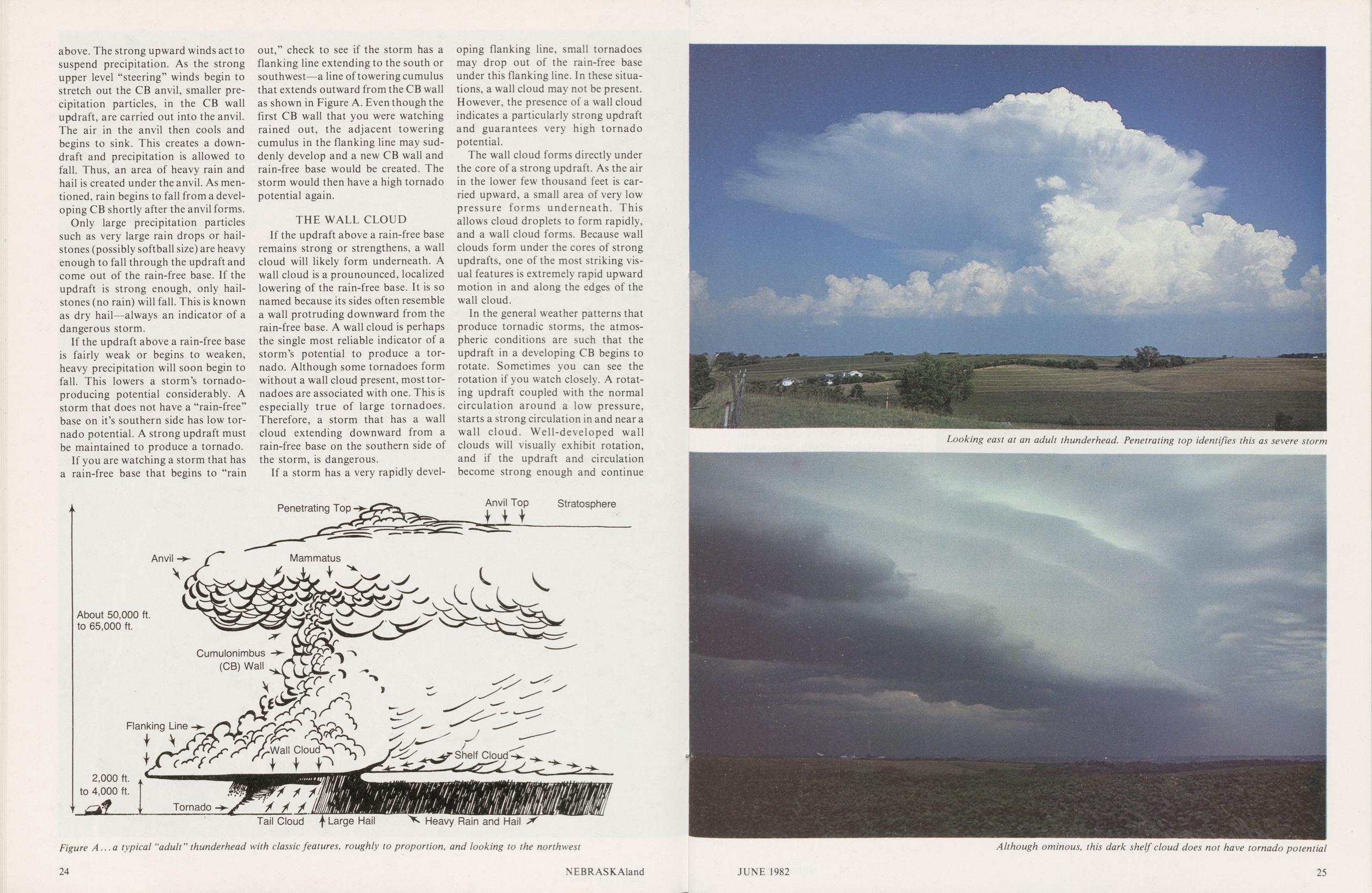
TYPICAL TORNADIC STORM FEATURESThe drawing on page 24 shows the structure of a typical, mature, tornadic thunderstorm, which is one with a high potential to produce a tornado. This figure shows all of the most common features of a tornadic storm, although not every tornadic storm will exhibit all of these features. Nevertheless, every tornadic storm will have some of these features.
Sometimes, a storm is partially obscured by other clouds and some features will be hidden, but usually you will be able to see some of them. Recognizing and understanding what they mean will help you to know whether or not a storm is likely to produce a tornado. That could save your life! In the remainder of this article, we will investigate each of these features individually and point out their significance or importance.
Knowing what to look for in a storm is important—recognizing the harmless and the dangerous is gratifying, and could be a lifesaver for you and othersCUMULONIMBUS CLOUDThe cumulonimbus cloud, meaning puffy rain cloud" and abbreviated CB," is the main thunderstorm cloud, commonly known as a"thunderhead.v With the sun shining directly upon them, clouds are white. Sunlight behind makes them appear dark. Because of this, CB's sometimes appear as beautiful, harmless, white mountains of fluff, while at other times they appear very menacing. No matter what the color, it's a thunderstorm, and all tornadoes form under CB's.
CB's are formed by updrafts that develop when a pocket of warm air in the lower atmosphere underlies a pocket of cold air. In this situation, the warm air rises up through the cold air, and its moisture condenses to form the CB cloud. Depending upon volumn and temperature differences between surface and upper air, updrafts of varying speeds and dimension develop. The warmer the surface, the stronger the updrafts, which is why the most severe storms develop on hot, muggy afternoons.
The part of the atmosphere in which most all weather occurs is called the troposphere. As a developing CB hits the top of the troposphere, it begins to flatten out in all directions into an "anvil."
Steve Tegtmeier is a native of Lewiston, Nebraska, but received his B.S. and M.S. degrees from the University of Oklahoma. After serving as a meteorologist specializing in severe weather researching and forecasting in the Air Force, he became a preacher, but still chases and photographs storms as a hobby. He now resides in Lincoln.If the updraft within a CB is strong enough, it will even break through the top of the troposphere and enter the stratosphere, forming a "penetrating top." Such storms are stronger than usual, and if seen from a distance, gives a method of picking out the stronger ones.
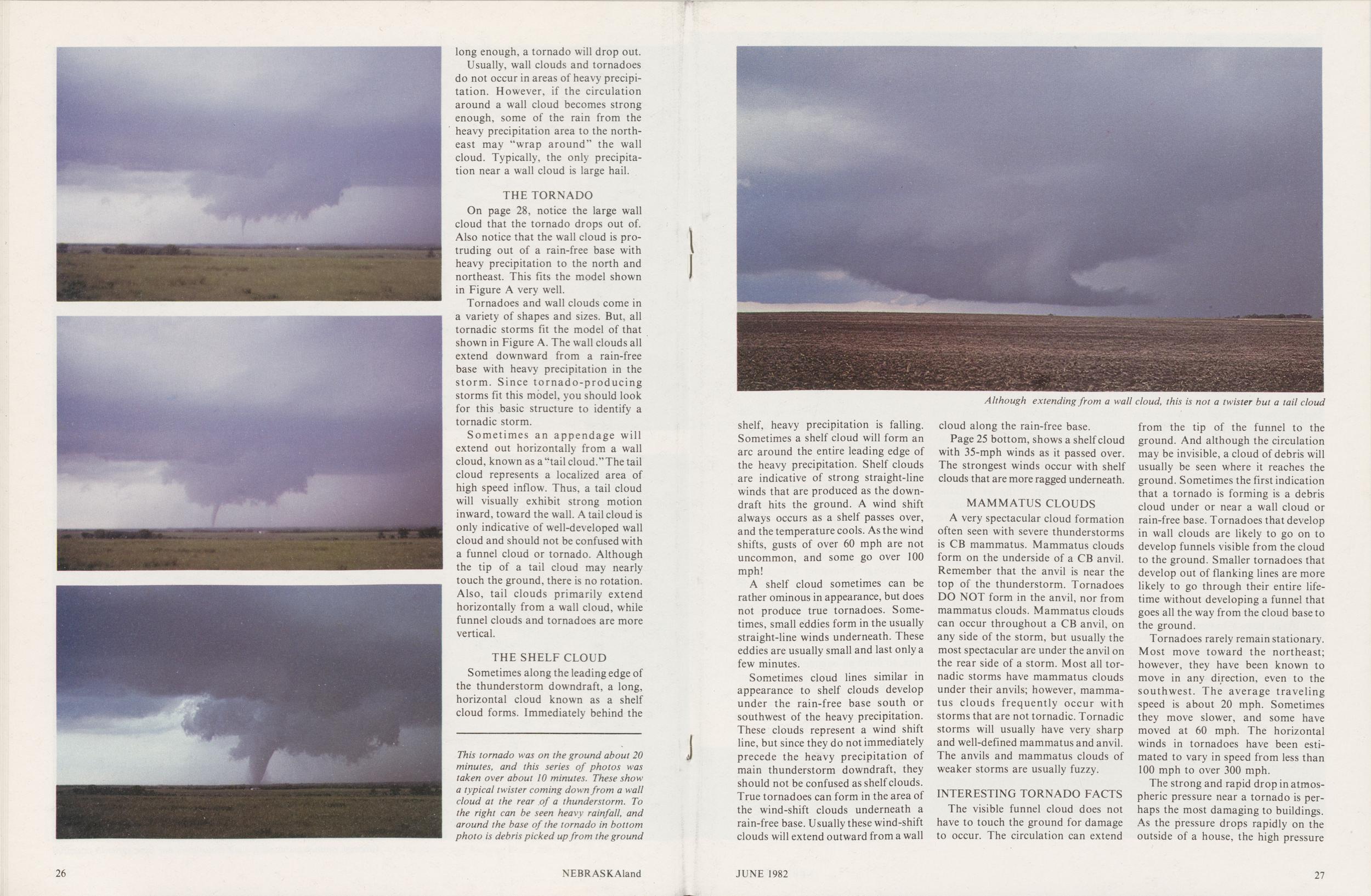
Page 25 top, shows a CB after about an hour of development. It starts with what is called a "towering cumulus" cloud, commonly known as a small thunderhead. No rain falls at that stage. A CB begins to develop shortly, and the anvil begins to form. Rain will begin to fall shortly after the anvil forms, and the cloud will officially be a CB. The long point on the anvil is the stretching out of the cloud by strong winds in the upper atmosphere.
Figure A shows a tornadic storm with a well-defined, sharp-edged cumulonimbus wall. This type of CB wall is the product of a strong updraft within the CB. Storms that are weak or that are dissipating have "fuzzy" CB walls or none at all.
In tornadic storms, the base of the large CB "tower" that makes up the wall, will be relatively "rain-free" compared to the rest of the storm. This "rain-free" base (usually on the southern side of a tornadic storm) is the result of the strong updraft in the wall 22 NEBRASKAland
 above. The strong upward winds act to
suspend precipitation. As the strong
upper level "steering" winds begin to
stretch out the CB anvil, smaller precipitation particles, in the CB wall
updraft, are carried out into the anvil.
The air in the anvil then cools and
begins to sink. This creates a downdraft and precipitation is allowed to
fall. Thus, an area of heavy rain and
hail is created under the anvil. As mentioned, rain begins to fall from a developing
CB shortly after the anvil forms.
above. The strong upward winds act to
suspend precipitation. As the strong
upper level "steering" winds begin to
stretch out the CB anvil, smaller precipitation particles, in the CB wall
updraft, are carried out into the anvil.
The air in the anvil then cools and
begins to sink. This creates a downdraft and precipitation is allowed to
fall. Thus, an area of heavy rain and
hail is created under the anvil. As mentioned, rain begins to fall from a developing
CB shortly after the anvil forms.
Only large precipitation particles such as very large rain drops or hailstones (possibly softball size) are heavy enough to fall through the updraft and come out of the rain-free base. If the updraft is strong enough, only hailstones (no rain) will fall. This is known as dry hail—always an indicator of a dangerous storm.
If the updraft above a rain-free base is fairly weak or begins to weaken, heavy precipitation will soon begin to fall. This lowers a storm's tornado-producing potential considerably. A storm that does not have a "rain-free" base on it's southern side has low tornado potential. A strong updraft must be maintained to produce a tornado.
If you are watching a storm that has a rain-free base that begins to "rain out," check to see if the storm has a flanking line extending to the south or southwest—a line of towering cumulus that extends outward from the CB wall as shown in Figure A. Even though the first CB wall that you were watching rained out, the adjacent towering cumulus in the flanking line may suddenly develop and a new CB wall and rain-free base would be created. The storm would then have a high tornado potential again.
THE WALL CLOUDIf the updraft above a rain-free base remains strong or strengthens, a wall cloud will likely form underneath. A wall cloud is a prounounced, localized lowering of the rain-free base. It is so named because its sides often resemble a wall protruding downward from the rain-free base. A wall cloud is perhaps the single most reliable indicator of a storm's potential to produce a tornado. Although some tornadoes form without a wall cloud present, most tornadoes are associated with one. This is especially true of large tornadoes. Therefore, a storm that has a wall cloud extending downward from a rain-free base on the southern side of the storm, is dangerous.
If a storm has a very rapidly developing flanking line, small tornadoes may drop out of the rain-free base under this flanking line. In these situations, a wall cloud may not be present. However, the presence of a wall cloud indicates a particularly strong updraft and guarantees very high tornado potential.
The wall cloud forms directly under the core of a strong updraft. As the air in the lower few thousand feet is carried upward, a small area of very low pressure forms underneath. This allows cloud droplets to form rapidly, and a wall cloud forms. Because wall clouds form under the cores of strong updrafts, one of the most striking visual features is extremely rapid upward motion in and along the edges of the wall cloud.
In the general weather patterns that produce tornadic storms, the atmospheric conditions are such that the updraft in a developing CB begins to rotate. Sometimes you can see the rotation if you watch closely. A rotating updraft coupled with the normal circulation around a low pressure, starts a strong circulation in and near a wall cloud. Well-developed wall clouds will visually exhibit rotation, and if the updraft and circulation become strong enough and continue
Usually, wall clouds and tornadoes do not occur in areas of heavy precipitation. However, if the circulation around a wall cloud becomes strong enough, some of the rain from the heavy precipitation area to the northeast may "wrap around" the wall cloud. Typically, the only precipitation near a wall cloud is large hail.
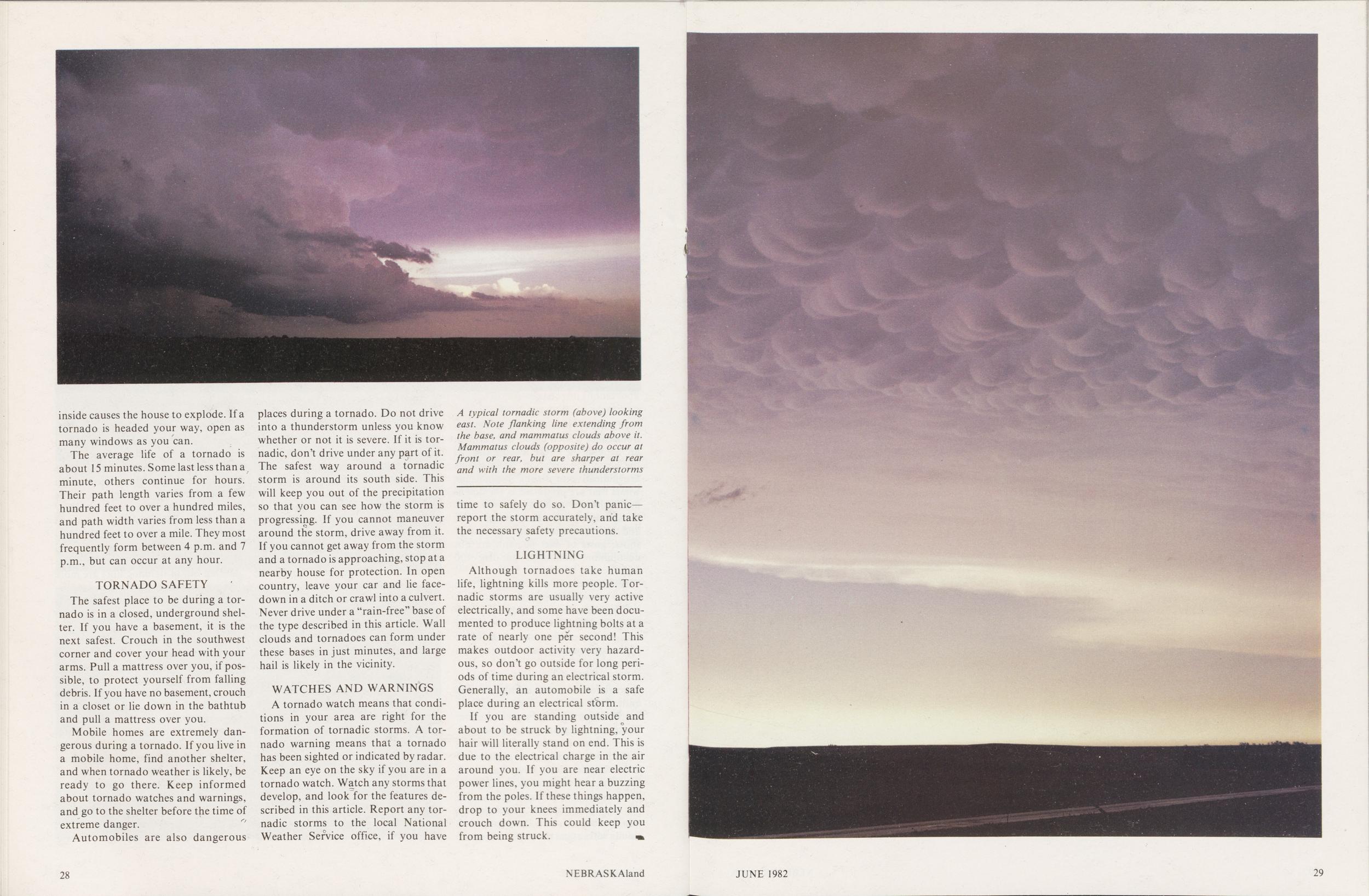
THE TORNADOOn page 28, notice the large wall cloud that the tornado drops out of. Also notice that the wall cloud is protruding out of a rain-free base with heavy precipitation to the north and northeast. This fits the model shown in Figure A very well.
Tornadoes and wall clouds come in a variety of shapes and sizes. But, all tornadic storms fit the model of that shown in Figure A. The wall clouds all extend downward from a rain-free base with heavy precipitation in the storm. Since tornado-producing storms fit this model, you should look for this basic structure to identify a tornadic storm.
Sometimes an appendage will extend out horizontally from a wall cloud, known as a "tail cloud."The tail cloud represents a localized area of high speed inflow. Thus, a tail cloud will visually exhibit strong motion inward, toward the wall. A tail cloud is only indicative of well-developed wall cloud and should not be confused with a funnel cloud or tornado. Although the tip of a tail cloud may nearly touch the ground, there is no rotation. Also, tail clouds primarily extend horizontally from a wall cloud, while funnel clouds and tornadoes are more vertical.
THE SHELF CLOUDSometimes along the leading edge of the thunderstorm downdraft, a long, horizontal cloud known as a shelf cloud forms. Immediately behind the shelf, heavy precipitation is falling. Sometimes a shelf cloud will form an arc around the entire leading edge of the heavy precipitation. Shelf clouds are indicative of strong straight-line winds that are produced as the downdraft hits the ground. A wind shift always occurs as a shelf passes over, and the temperature cools. As the wind shifts, gusts of over 60 mph are not uncommon, and some go over 100 mph!
This tornado was on the ground about 20 minutes, and this series of photos was taken over about 10 minutes. These show a typical twister coming down from a wall cloud at the rear of a thunderstorm. To the right can be seen heavy rainfall, and around the base of the tornado in bottom photo is debris picked up from the ground 26 NEBRASKAlandA shelf cloud sometimes can be rather ominous in appearance, but does not produce true tornadoes. Sometimes, small eddies form in the usually straight-line winds underneath. These eddies are usually small and last only a few minutes.
Sometimes cloud lines similar in appearance to shelf clouds develop under the rain-free base south or southwest of the heavy precipitation. These clouds represent a wind shift line, but since they do not immediately precede the heavy precipitation of main thunderstorm downdraft, they should not be confused as shelf clouds. True tornadoes can form in the area of the wind-shift clouds underneath a rain-free base. Usually these wind-shift clouds will extend outward from a wall cloud along the rain-free base.
Page 25 bottom, shows a shelf cloud with 35-mph winds as it passed over. The strongest winds occur with shelf clouds that are more ragged underneath.
MAMMATUS CLOUDSA very spectacular cloud formation often seen with severe thunderstorms is CB mammatus. Mammatus clouds form on the underside of a CB anvil. Remember that the anvil is near the top of the thunderstorm. Tornadoes DO NOT form in the anvil, nor from mammatus clouds. Mammatus clouds can occur throughout a CB anvil, on any side of the storm, but usually the most spectacular are under the anvil on the rear side of a storm. Most all tornadic storms have mammatus clouds under their anvils; however, mammatus clouds frequently occur with storms that are not tornadic. Tornadic storms will usually have very sharp and well-defined mammatus and anvil. The anvils and mammatus clouds of weaker storms are usually fuzzy.
INTERESTING TORNADO FACTSThe visible funnel cloud does not have to touch the ground for damage to occur. The circulation can extend from the tip of the funnel to the ground. And although the circulation may be invisible, a cloud of debris will usually be seen where it reaches the ground. Sometimes the first indication that a tornado is forming is a debris cloud under or near a wall cloud or rain-free base. Tornadoes that develop in wall clouds are likely to go on to develop funnels visible from the cloud to the ground. Smaller tornadoes that develop out of flanking lines are more likely to go through their entire lifetime without developing a funnel that goes all the way from the cloud base to the ground.
Tornadoes rarely remain stationary. Most move toward the northeast; however, they have been known to move in any direction, even to the southwest. The average traveling speed is about 20 mph. Sometimes they move slower, and some have moved at 60 mph. The horizontal winds in tornadoes have been estimated to vary in speed from less than 100 mph to over 300 mph.
The strong and rapid drop in atmospheric pressure near a tornado is perhaps the most
damaging to buildings.
As the pressure drops rapidly on the
outside of a house, the high pressure
JUNE 1982
27
The average life of a tornado is about 15 minutes. Some last less than a minute, others continue for hours. Their path length varies from a few hundred feet to over a hundred miles, and path width varies from less than a hundred feet to over a mile. They most frequently form between 4 p.m. and 7 p.m., but can occur at any hour.
TORNADO SAFETYThe safest place to be during a tornado is in a closed, underground shelter. If you have a basement, it is the next safest. Crouch in the southwest corner and cover your head with your arms. Pull a mattress over you, if possible, to protect yourself from falling debris. If you have no basement, crouch in a closet or lie down in the bathtub and pull a mattress over you.
Mobile homes are extremely dangerous during a tornado. If you live in a mobile home, find another shelter, and when tornado weather is likelv, be ready to go there. Keep informed about tornado watches and warnings, and go to the shelter before the time of extreme danger.
Automobiles are also dangerous places during a tornado. Do not drive into a thunderstorm unless you know whether or not it is severe. If it is tornadic, don't drive under any part of it. The safest way around a tornadic storm is around its south side. This will keep you out of the precipitation so that you can see how the storm is progressing. If you cannot maneuver around the storm, drive away from it. If you cannot get away from the storm and a tornado is approaching, stop at a nearby house for protection. In open country, leave your car and lie facedown in a ditch or crawl into a culvert. Never drive under a "rain-free" base of the type described in this article. Wall clouds and tornadoes can form under these bases in just minutes, and large hail is likely in the vicinity.
WATCHES AND WARNINGSA tornado watch means that conditions in your area are right for the formation of tornadic storms. A tornado warning means that a tornado has been sighted or indicated by radar. Keep an eye on the sky if you are in a tornado watch. Watch any storms that develop, and look for the features described in this article. Report any tornadic storms to the local National Weather Service office, if you have time to safely do so. Don't panic—report the storm accurately, and take the necessary safety precautions.
LIGHTNINGAlthough tornadoes take human life, lightning kills more people. Tornadic storms are usually very active electrically, and some have been documented to produce lightning bolts at a rate of nearly one per second! This makes outdoor activity very hazardous, so don't go outside for long periods of time during an electrical storm. Generally, an automobile is a safe place during an electrical storm.
If you are standing outside and about to be struck by lightning, your hair will literally stand on end. This is due to the electrical charge in the air around you. If you are near electric power lines, you might hear a buzzing from the poles. If these things happen, drop to your knees immediately and crouch down. This could keep you from being struck.
29 NEBRASKAland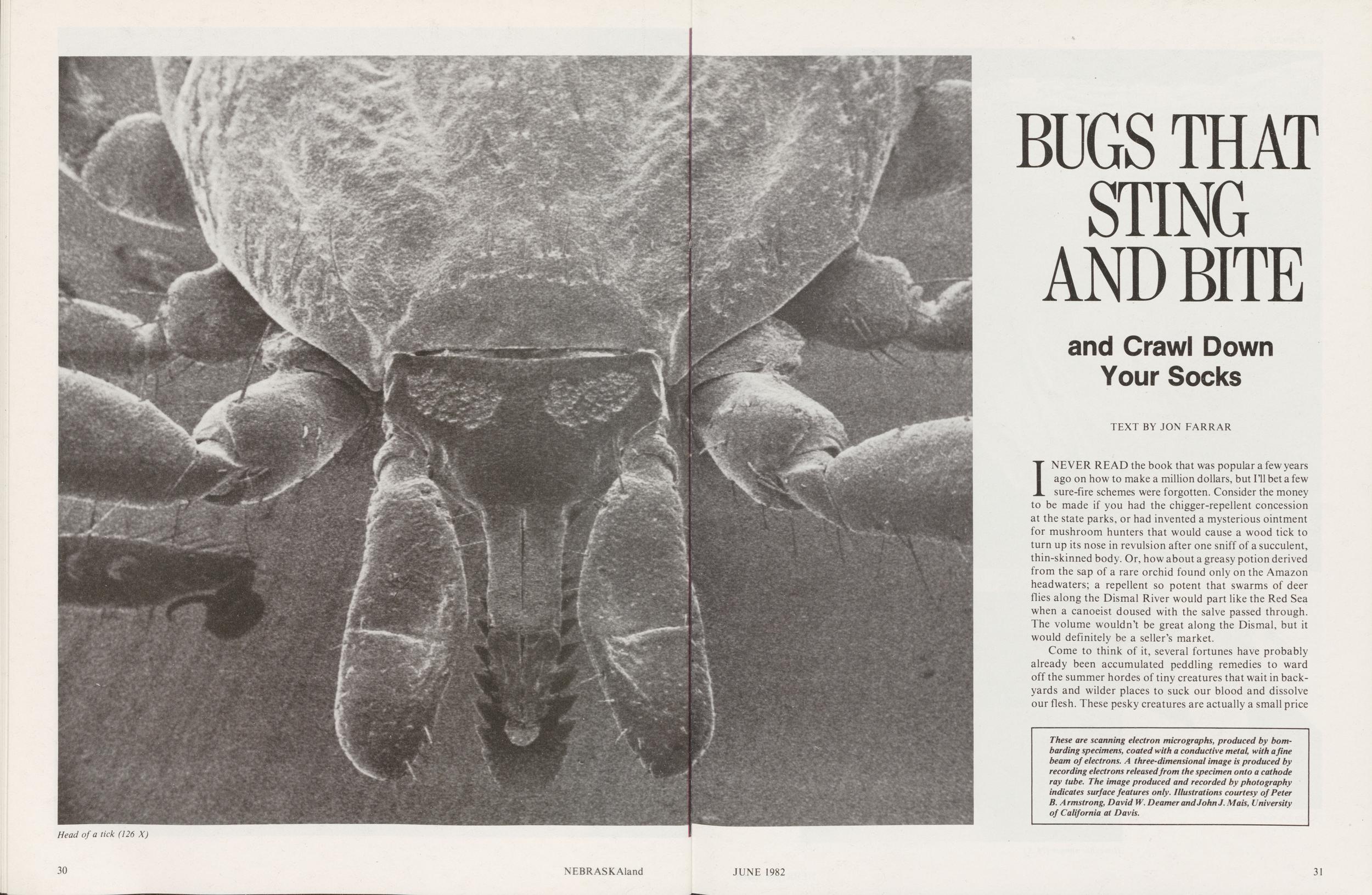
BUGS THAT STING AND BITE
and Crawl Down Your Socks TEXT BY JON FARRARI NEVER READ the book that was popular a few years ago on how to make a million dollars, but I'll bet a few sure-fire schemes were forgotten. Consider the money to be made if you had the chigger-repellent concession at the state parks, or had invented a mysterious ointment for mushroom hunters that would cause a wood tick to turn up its nose in revulsion after one sniff of a succulent, thin-skinned body. Or, how about a greasy potion derived from the sap of a rare orchid found only on the Amazon headwaters; a repellent so potent that swarms of deer flies along the Dismal River would part like the Red Sea when a canoeist doused with the salve passed through. The volume wouldn't be great along the Dismal, but it would definitely be a seller's market.
Come to think of it, several fortunes have probably already been accumulated peddling remedies to ward off the summer hordes of tiny creatures that wait in backyards and wilder places to suck our blood and dissolve our flesh. These pesky creatures are actually a small price to pay for a platter heaped with morels browned in a coating of egg and cracker crumbs, or stringers of two-pound channel catfish, or the solitude found on some isolated stretch of river, but sometimes they are enough to make a grown man cry.
These are scanning electron micrographs, produced by bombarding specimens, coated with a conductive metal, with a fine beam of electrons. A three-dimensional image is produced by recording electrons released from the specimen onto a cathode ray tube. The image produced and recorded by photography indicates surf ace features only. Illustrations courtesy of Peter B. Armstrong, David W. D earner and John J. Mais, University of California at Davis. JUNE 1982 31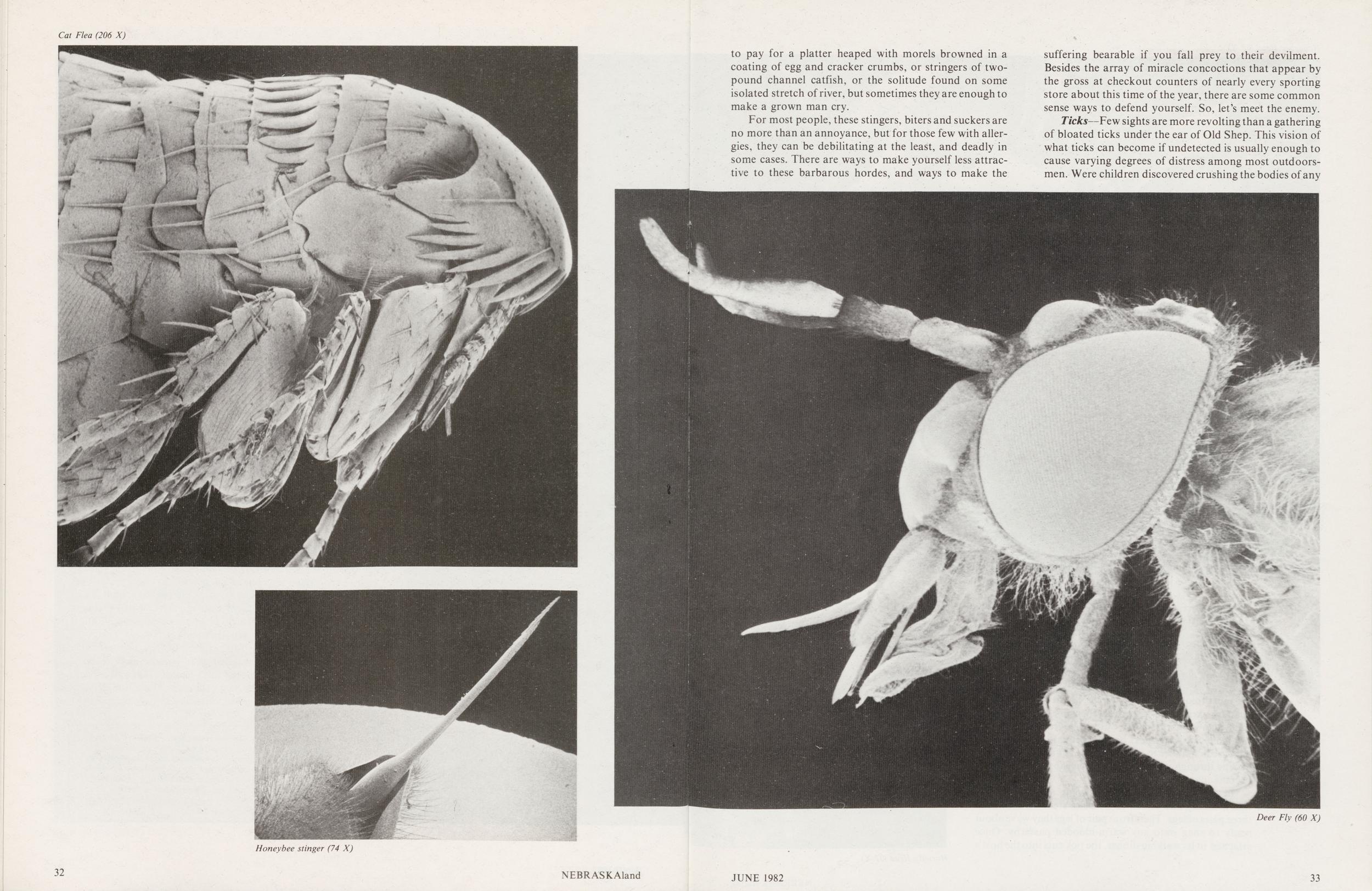
For most people, these stingers, biters and suckers are no more than an annoyance, but for those few with allergies, they can be debilitating at the least, and deadly in some cases. There are ways to make yourself less attractive to these barbarous hordes, and ways to make the suffering bearable if you fall prey to their devilment. Besides the array of miracle concoctions that appear by the gross at checkout counters of nearly every sporting store about this time of the year, there are some common sense ways to defend yourself. So, let's meet the enemy.
Ticks—Few sights are more revolting than a gathering of bloated ticks under the ear of Old Shep. This vision of what ticks can become if undetected is usually enough to cause varying degrees of distress among most outdoorsmen. Were children discovered crushing the bodies of any
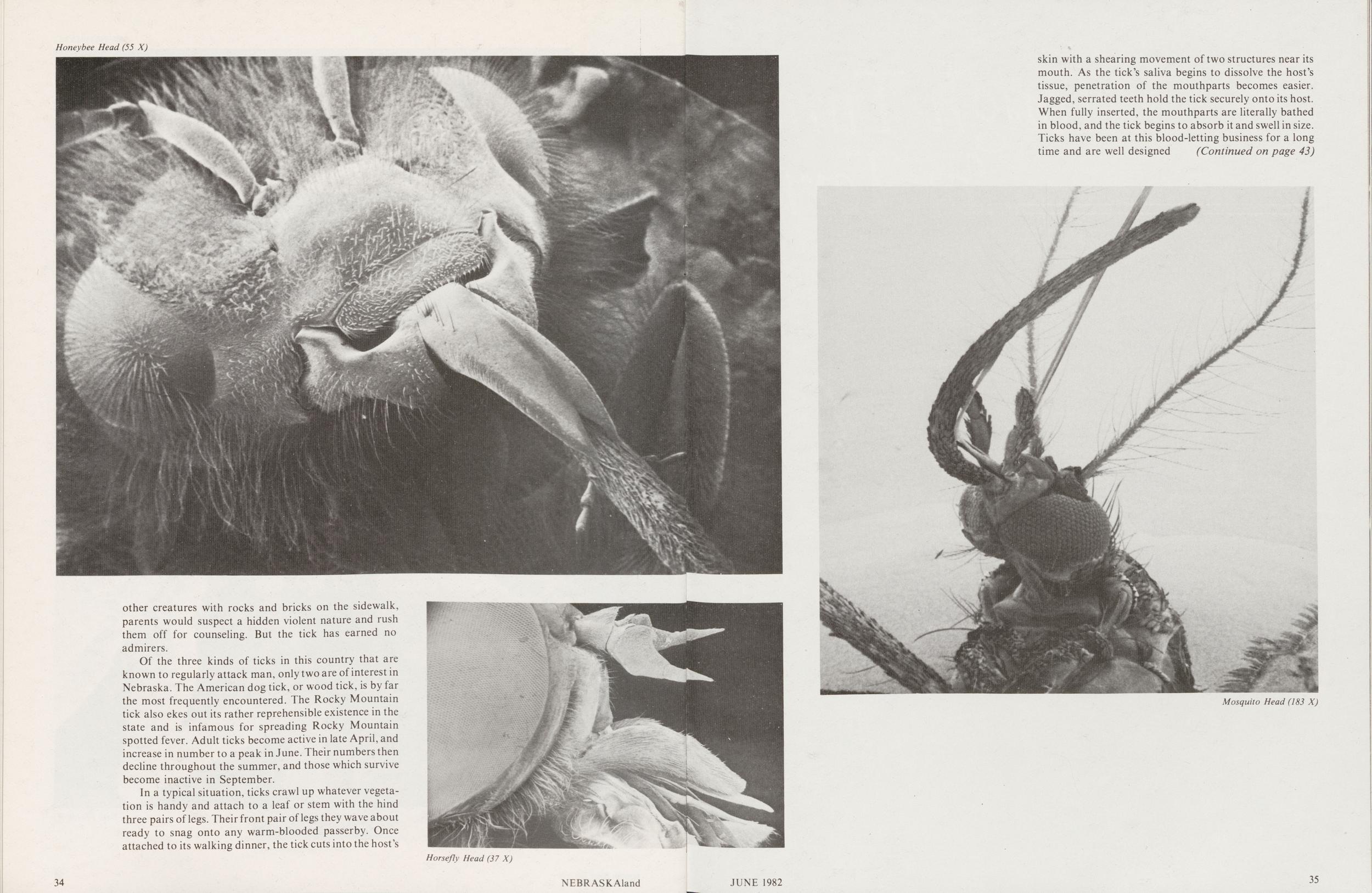
Of the three kinds of ticks in this country that are known to regularly attack man, only two are of interest in Nebraska. The American dog tick, or wood tick, is by far the most frequently encountered. The Rocky Mountain tick also ekes out its rather reprehensible existence in the state and is infamous for spreading Rocky Mountain spotted fever. Adult ticks become active in late April, and increase in number to a peak in June. Their numbers then decline throughout the summer, and those which survive become inactive in September.
In a typical situation, ticks crawl up whatever vegetation is handy and attach to a leaf or stem with the hind three pairs of legs. Their front pair of legs they wave about ready to snag onto any warm-blooded passerby. Once attached to its walking dinner, the tick cuts into the host's 34 NEBRASKAland skin with a shearing movement of two structures near its mouth. As the tick's saliva begins to dissolve the host's tissue, penetration of the mouthparts becomes easier. Jagged, serrated teeth hold the tick securely onto its host. When fully inserted, the mouthparts are literally bathed in blood, and the tick begins to absorb it and swell in size. Ticks have been at this blood-letting business for a long time and are well designed (Continued on page 43)
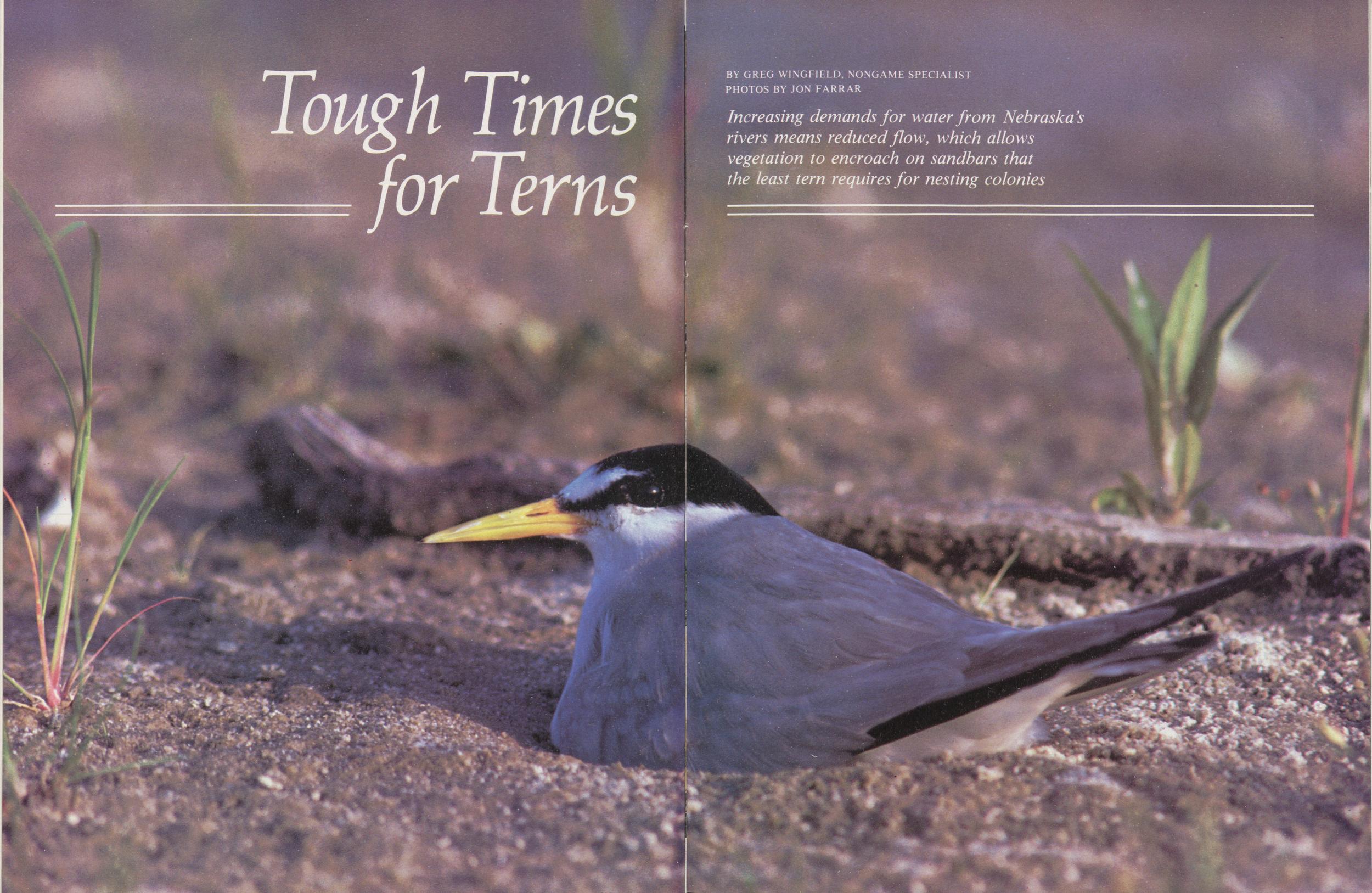
Tough Times for Terns
By GREG WINGFIELD. NONGAME SPECIALIST PHOTOS BY JON FARRAR Increasing demands for water from Nebraska's rivers means reduced flow, which allows vegetation to encroach on sandbars that the least tern requires for nesting colonies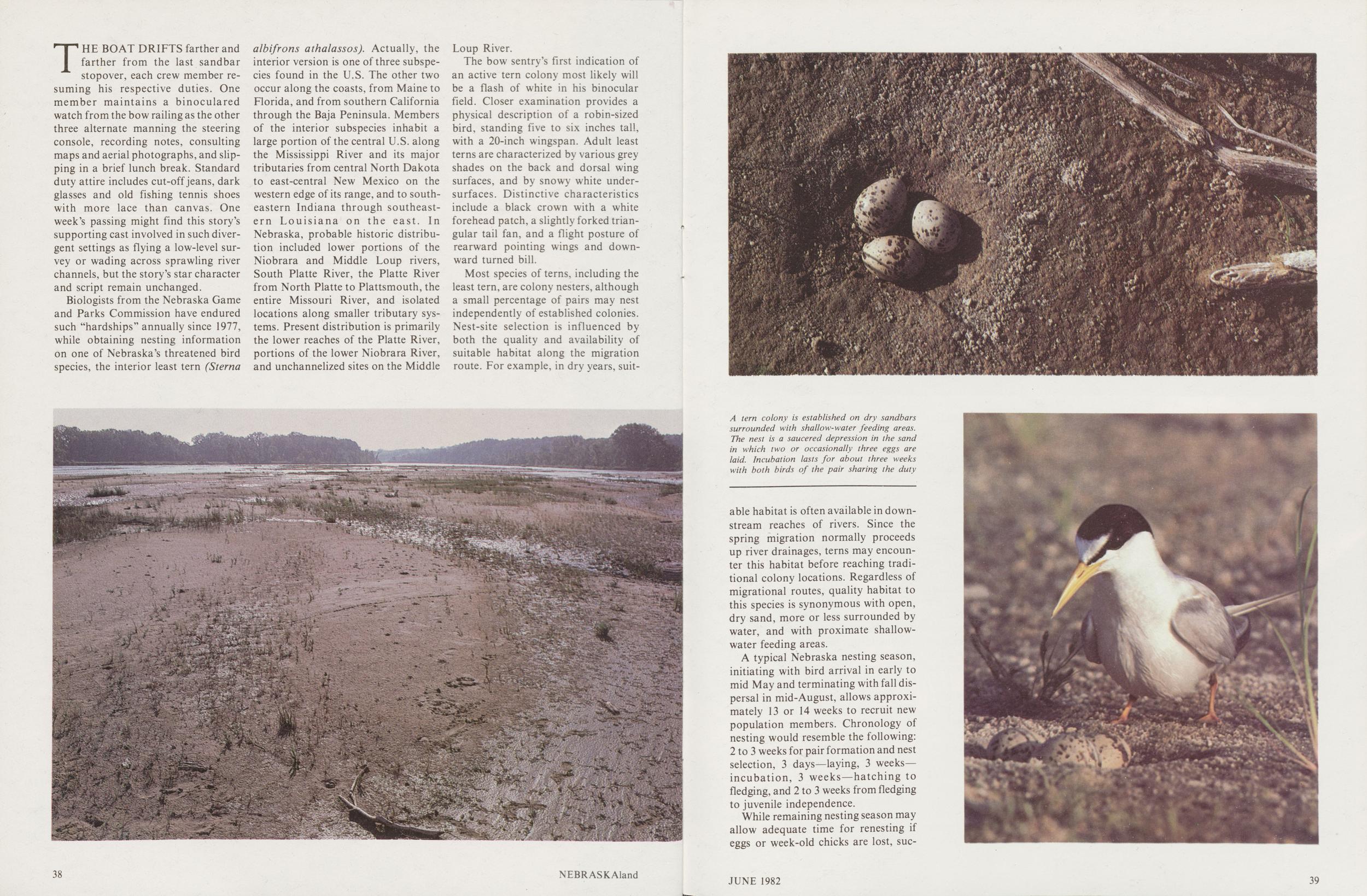
THE BOAT DRIFTS farther and farther from the last sandbar stopover, each crew member resuming his respective duties. One member maintains a binoculared watch from the bow railing as the other three alternate manning the steering console, recording notes, consulting maps and aerial photographs, and slipping in a brief lunch break. Standard duty attire includes cut-off jeans, dark glasses and old fishing tennis shoes with more lace than canvas. One week's passing might find this story's supporting cast involved in such divergent settings as flying a low-level survey or wading across sprawling river channels, but the story's star character and script remain unchanged.
Biologists from the Nebraska Game and Parks Commission have endured such "hardships" annually since 1977, while obtaining nesting information on one of Nebraska's threatened bird species, the interior least tern (Sterna albifrons athalassos). Actually, the interior version is one of three subspecies found in the U.S. The other two occur along the coasts, from Maine to Florida, and from southern California through the Baja Peninsula. Members of the interior subspecies inhabit a large portion of the central U.S. along the Mississippi River and its major tributaries from central North Dakota to east-central New Mexico on the western edge of its range, and to southeastern Indiana through southeastern Louisiana on the east. In Nebraska, probable historic distribution included lower portions of the Niobrara and Middle Loup rivers, South Platte River, the Platte River from North Platte to Plattsmouth, the entire Missouri River, and isolated locations along smaller tributary systems. Present distribution is primarily the lower reaches of the Platte River, portions of the lower Niobrara River, and unchannelized sites on the Middle Loup River.
The bow sentry's first indication of an active tern colony most likely will be a flash of white in his binocular field. Closer examination provides a physical description of a robin-sized bird, standing five to six inches tall, with a 20-inch wingspan. Adult least terns are characterized by various grey shades on the back and dorsal wing surfaces, and by snowy white undersurfaces. Distinctive characteristics include a black crown with a white forehead patch, a slightly forked triangular tail fan, and a flight posture of rearward pointing wings and downward turned bill.
Most species of terns, including the least tern, are colony nesters, although a small percentage of pairs may nest independently of established colonies. Nest-site selection is influenced by both the quality and availability of suitable habitat along the migration route. For example, in dry years, suitable
A typical Nebraska nesting season, initiating with bird arrival in early to mid May and terminating with fall dispersal in mid-August, allows approximately 13 or 14 weeks to recruit new population members. Chronology of nesting would resemble the following: 2 to 3 weeks for pair formation and nest selection, 3 days—laying, 3 weeks-incubation, 3 weeks—hatching to fledging, and 2 to 3 weeks from fledging to juvenile independence.
While remaining nesting season may
allow adequate time for renesting if
eggs or week-old chicks are lost, successful
JUNE 1982
39
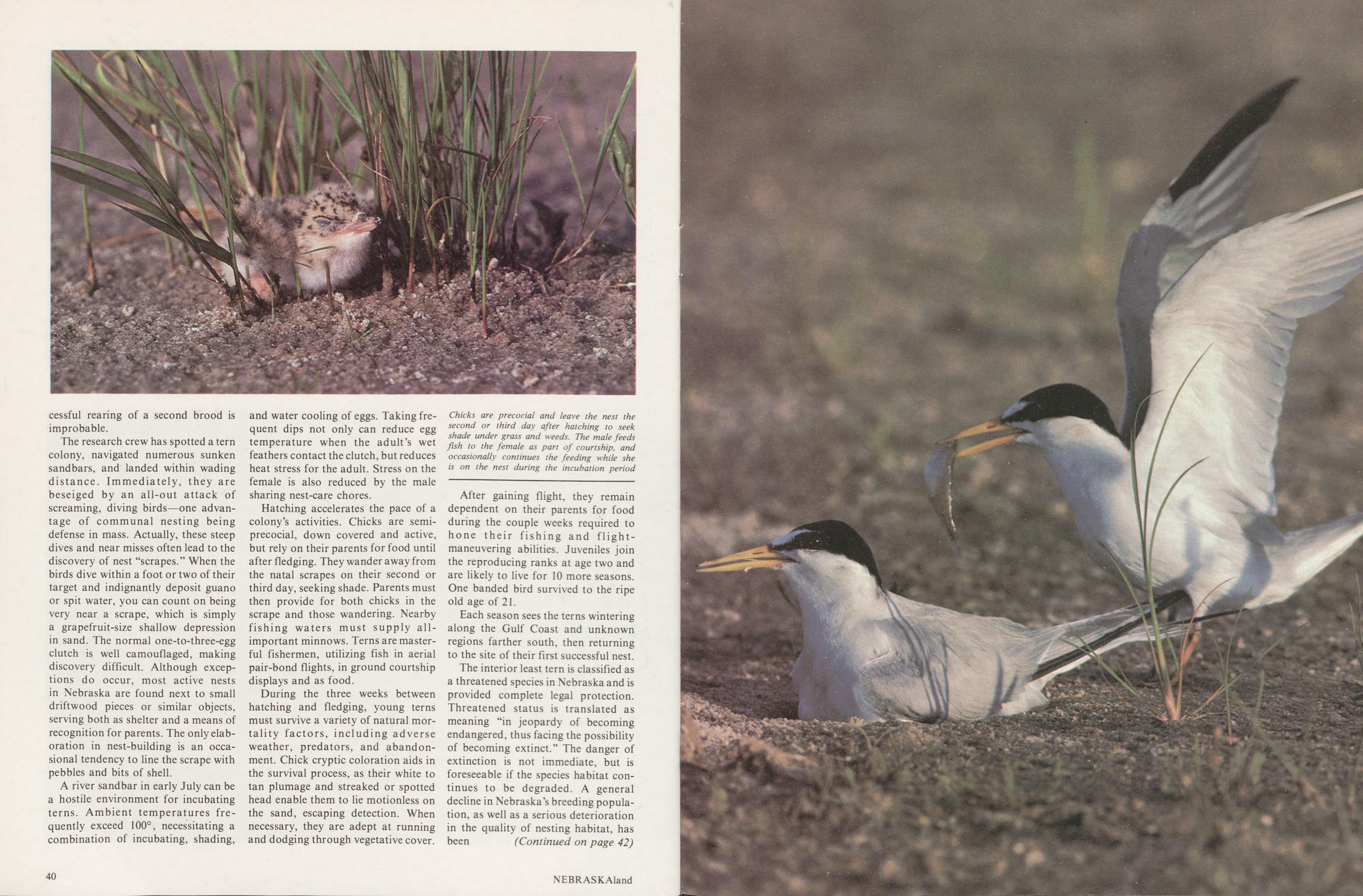
The research crew has spotted a tern colony, navigated numerous sunken sandbars, and landed within wading distance. Immediately, they are beseiged by an all-out attack of screaming, diving birds—one advantage of communal nesting being defense in mass. Actually, these steep dives and near misses often lead to the discovery of nest "scrapes." When the birds dive within a foot or two of their target and indignantly deposit guano or spit water, you can count on being very near a scrape, which is simply a grapefruit-size shallow depression in sand. The normal one-to-three-egg clutch is well camouflaged, making discovery difficult. Although exceptions do occur, most active nests in Nebraska are found next to small driftwood pieces or similar objects, serving both as shelter and a means of recognition for parents. The only elaboration in nest-building is an occasional tendency to line the scrape with pebbles and bits of shell.
A river sandbar in early July can be a hostile environment for incubating terns. Ambient temperatures frequently exceed 100°, necessitating a combination of incubating, shading, and water cooling of eggs. Taking frequent dips not only can reduce egg temperature when the adult's wet feathers contact the clutch, but reduces heat stress for the adult. Stress on the female is also reduced by the male sharing nest-care chores.
Hatching accelerates the pace of a colony's activities. Chicks are semiprecocial, down covered and active, but rely on their parents for food until after fledging. They wander away from the natal scrapes on their second or third day, seeking shade. Parents must then provide for both chicks in the scrape and those wandering. Nearby fishing waters must supply all-important minnows. Terns are masterful fishermen, utilizing fish in aerial pair-bond flights, in ground courtship displays and as food.
During the three weeks between hatching and fledging, young terns must survive a variety of natural mortality factors, including adverse weather, predators, and abandonment. Chick cryptic coloration aids in the survival process, as their white to tan plumage and streaked or spotted head enable them to lie motionless on the sand, escaping detection. When necessary, they are adept at running and dodging through vegetative cover.
After gaining flight, they remain dependent on their parents for food during the couple weeks required to hone their fishing and flight-maneuvering abilities. Juveniles join the reproducing ranks at age two and are likely to live for 10 more seasons. One banded bird survived to the ripe old age of 21.
Each season sees the terns wintering along the Gulf Coast and unknown regions farther south, then returning to the site of their first successful nest.
The interior least tern is classified as a threatened species in Nebraska and is provided complete legal protection. Threatened status is translated as meaning "in jeopardy of becoming endangered, thus facing the possibility of becoming extinct." The danger of extinction is not immediate, but is foreseeable if the species habitat continues to be degraded. A general decline in Nebraska's breeding population, as well as a serious deterioration in the quality of nesting habitat, has been (Continued on page 42)
40 NEBRASKAland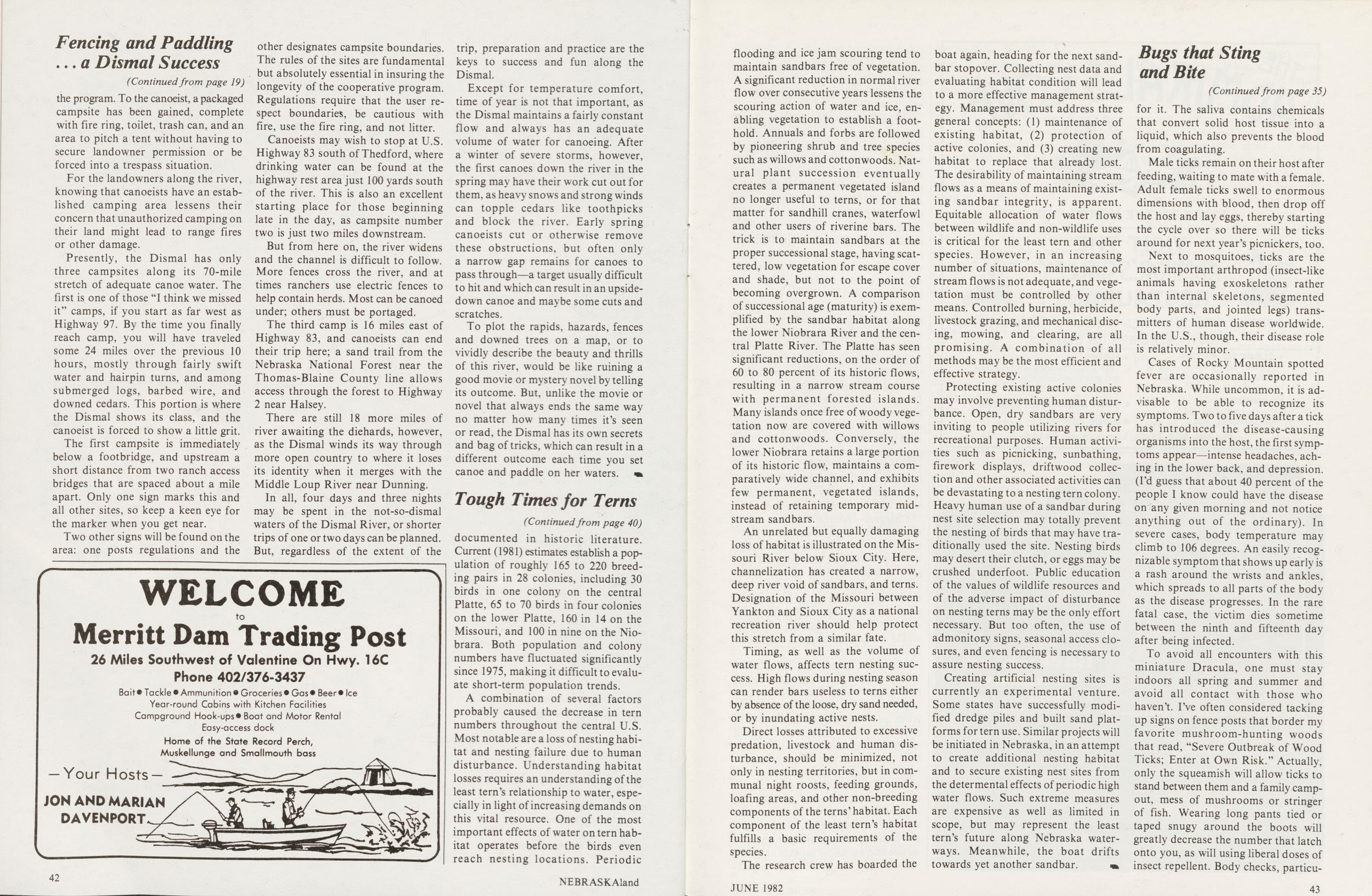
Fencing and Paddling ...a Dismal Success
(Continued from page 19)the program. To the canoeist, a packaged campsite has been gained, complete with fire ring, toilet, trash can, and an area to pitch a tent without having to secure landowner permission or be forced into a trespass situation.
For the landowners along the river, knowing that canoeists have an established camping area lessens their concern that unauthorized camping on their land might lead to range fires or other damage.
Presently, the Dismal has only three campsites along its 70-mile stretch of adequate canoe water. The first is one of those "I think we missed it" camps, if you start as far west as Highway 97. By the time you finally reach camp, you will have traveled some 24 miles over the previous 10 hours, mostly through fairly swift water and hairpin turns, and among submerged logs, barbed wire, and downed cedars. This portion is where the Dismal shows its class, and the canoeist is forced to show a little grit.
The first campsite is immediately below a footbridge, and upstream a short distance from two ranch access bridges that are spaced about a mile apart. Only one sign marks this and all other sites, so keep a keen eye for the marker when you get near.
Two other signs will be found on the area: one posts regulations and the other designates campsite boundaries. The rules of the sites are fundamental but absolutely essential in insuring the longevity of the cooperative program. Regulations require that the user respect boundaries, be cautious with fire, use the fire ring, and not litter.
Canoeists may wish to stop at U.S. Highway 83 south of Thedford, where drinking water can be found at the highway rest area just 100 yards south of the river. This is also an excellent starting place for those beginning late in the day, as campsite number two is just two miles downstream.
But from here on, the river widens and the channel is difficult to follow. More fences cross the river, and at times ranchers use electric fences to help contain herds. Most can be canoed under; others must be portaged.
The third camp is 16 miles east of Highway 83, and canoeists can end their trip here; a sand trail from the Nebraska National Forest near the Thomas-Blaine County line allows access through the forest to Highway 2 near Halsey.
There are still 18 more miles of river awaiting the diehards, however, as the Dismal winds its way through more open country to where it loses its identity when it merges with the Middle Loup River near Dunning.
In all, four days and three nights may be spent in the not-so-dismal waters of the Dismal River, or shorter trips of one or two days can be planned. But, regardless of the extent of the trip, preparation and practice are the keys to success and fun along the Dismal.
Except for temperature comfort, time of year is not that important, as the Dismal maintains a fairly constant flow and always has an adequate volume of water for canoeing. After a winter of severe storms, however, the first canoes down the river in the spring may have their work cut out for them, as heavy snows and strong winds can topple cedars like toothpicks and block the river. Early spring canoeists cut or otherwise remove these obstructions, but often only a narrow gap remains for canoes to pass through—a target usually difficult to hit and which can result in an upside-down canoe and maybe some cuts and scratches.
To plot the rapids, hazards, fences and downed trees on a map, or to vividly describe the beauty and thrills of this river, would be like ruining a good movie or mystery novel by telling its outcome. But, unlike the movie or novel that always ends the same way no matter how many times it's seen or read, the Dismal has its own secrets and bag of tricks, which can result in a different outcome each time you set canoe and paddle on her waters.
WELCOME to Merritt Dam Trading Post 26 Miles Southwest of Valentine On Hwy. 16C Phone 402/376-3437 Bait* Tackle* Ammunition •Groceries •Gas* Beer* Ice Year-round Cabins with Kitchen Facilities Campground Hook-ups* Boat and Motor Rental Easy-access dock Home of the State Record Perch, Muskellunge and Smallmouth bass — Your Hosts — JON AND MARIAN DAVENPORTTough Times for Terns
(Continued from page 40)documented in historic literature. Current (1981) estimates establish a population of roughly 165 to 220 breeding pairs in 28 colonies, including 30 birds in one colony on the central Platte, 65 to 70 birds in four colonies on the lower Platte, 160 in 14 on the Missouri, and 100 in nine on the Niobrara. Both population and colony numbers have fluctuated significantly since 1975, making it difficult to evaluate short-term population trends.
A combination of several factors probably caused the decrease in tern numbers throughout the central U.S. Most notable are a loss of nesting habitat and nesting failure due to human disturbance. Understanding habitat losses requires an understanding of the least tern's relationship to water, especially in light of increasing demands on this vital resource. One of the most important effects of water on tern habitat operates before the birds even reach nesting locations. Periodic 42 MEBRASKAland flooding and ice jam scouring tend to maintain sandbars free of vegetation. A significant reduction in normal river flow over consecutive years lessens the scouring action of water and ice, enabling vegetation to establish a foothold. Annuals and forbs are followed by pioneering shrub and tree species such as willows and cottonwoods. Natural plant succession eventually creates a permanent vegetated island no longer useful to terns, or for that matter for sandhill cranes, waterfowl and other users of riverine bars. The trick is to maintain sandbars at the proper successional stage, having scattered, low vegetation for escape cover and shade, but not to the point of becoming overgrown. A comparison of successional age (maturity) is exemplified by the sandbar habitat along the lower Niobrara River and the central Platte River. The Platte has seen significant reductions, on the order of 60 to 80 percent of its historic flows, resulting in a narrow stream course with permanent forested islands. Many islands once free of woody vegetation now are covered with willows and cottonwoods. Conversely, the lower Niobrara retains a large portion of its historic flow, maintains a comparatively wide channel, and exhibits few permanent, vegetated islands, instead of retaining temporary midstream sandbars.
An unrelated but equally damaging loss of habitat is illustrated on the Missouri River below Sioux City. Here, channelization has created a narrow, deep river void of sandbars, and terns. Designation of the Missouri between Yankton and Sioux City as a national recreation river should help protect this stretch from a similar fate.
Timing, as well as the volume of water flows, affects tern nesting success. High flows during nesting season can render bars useless to terns either by absence of the loose, dry sand needed, or by inundating active nests.
Direct losses attributed to excessive predation, livestock and human disturbance, should be minimized, not only in nesting territories, but in communal night roosts, feeding grounds, loafing areas, and other non-breeding components of the terns' habitat. Each component of the least tern's habitat fulfills a basic requirements of the species.
The research crew has boarded the boat again, heading for the next sandbar stopover. Collecting nest data and evaluating habitat condition will lead to a more effective management strategy. Management must address three general concepts: (1) maintenance of existing habitat, (2) protection of active colonies, and (3) creating new habitat to replace that already lost. The desirability of maintaining stream flows as a means of maintaining existing sandbar integrity, is apparent. Equitable allocation of water flows between wildlife and non-wildlife uses is critical for the least tern and other species. However, in an increasing number of situations, maintenance of stream flows is not adequate, and vegetation must be controlled by other means. Controlled burning, herbicide, livestock grazing, and mechanical discing, mowing, and clearing, are all promising. A combination of all methods may be the most efficient and effective strategy.
Protecting existing active colonies may involve preventing human disturbance. Open, dry sandbars are very inviting to people utilizing rivers for recreational purposes. Human activities such as picnicking, sunbathing, firework displays, driftwood collection and other associated activities can be devastating to a nesting tern colony. Heavy human use of a sandbar during nest site selection may totally prevent the nesting of birds that may have traditionally used the site. Nesting birds may desert their clutch, or eggs may be crushed underfoot. Public education of the values of wildlife resources and of the adverse impact of disturbance on nesting terns may be the only effort necessary. But too often, the use of admonitory signs, seasonal access closures, and even fencing is necessary to assure nesting success.
Creating artificial nesting sites is currently an experimental venture. Some states have successfully modified dredge piles and built sand platforms for tern use. Similar projects will be initiated in Nebraska, in an attempt to create additional nesting habitat and to secure existing nest sites from the determental effects of periodic high water flows. Such extreme measures are expensive as well as limited in scope, but may represent the least tern's future along Nebraska waterways. Meanwhile, the boat drifts towards yet another sandbar.
Bugs that Sting and Bite
(Continued from page 35)for it. The saliva contains chemicals that convert solid host tissue into a liquid, which also prevents the blood from coagulating.
Male ticks remain on their host after feeding, waiting to mate with a female. Adult female ticks swell to enormous dimensions with blood, then drop off the host and lay eggs, thereby starting the cycle over so there will be ticks around for next year's picnickers, too.
Next to mosquitoes, ticks are the most important arthropod (insect-like animals having exoskeletons rather than internal skeletons, segmented body parts, and jointed legs) transmitters of human disease worldwide. In the U.S., though, their disease role is relatively minor.
Cases of Rocky Mountain spotted fever are occasionally reported in Nebraska. While uncommon, it is advisable to be able to recognize its symptoms. Two to five days after a tick has introduced the disease-causing organisms into the host, the first symptoms appear—intense headaches, aching in the lower back, and depression. (I'd guess that about 40 percent of the people I know could have the disease on any given morning and not notice anything out of the ordinary). In severe cases, body temperature may climb to 106 degrees. An easily recognizable symptom that shows up early is a rash around the wrists and ankles, which spreads to all parts of the body as the disease progresses. In the rare fatal case, the victim dies sometime between the ninth and fifteenth day after being infected.
To avoid all encounters with this miniature Dracula, one must stay indoors all spring and summer and avoid all contact with those who haven't. I've often considered tacking up signs on fence posts that border my favorite mushroom-hunting woods that read, "Severe Outbreak of Wood Ticks; Enter at Own Risk." Actually, only the squeamish will allow ticks to stand between them and a family campout, mess of mushrooms or stringer of fish. Wearing long pants tied or taped snugy around the boots will greatly decrease the number that latch onto you, as will using liberal doses of insect repellent. Body checks, particularly of youngsters, during an outing and after returning home from tick country, will usually catch any roaming creatures before they have time to "dig in."
JUNE 1982 43 EXIT 6 ON THE NORTH SIDE
VISIT THE
RESTAURANT
YOUR FAVORITE COCKTAILS • FANCY LARGE SALAD BAR
TROPHY STRIPERS ON DISPLAY
• CLOSE TO WATER
Located on the north shore of
Lake McConaughy, 7 miles
west of dam
• SERVICES
Tackle, Bait, Gas, Oil,
Ice, Beer, Pop, etc.
• MOTEL
Lake McConaughy's largest motel
and apartment complex—includes new units
• BOAT AND MOTOR RENTAL
• GUIDE SERVICE
Ph: 308-355-2102 Lemoyne, He 69146
1981
NATIONAL
WILDLIFE
ART SHOW
JUDGES ORDER
OF MERIT
This beautiful full color print
of a family of Canada Geese is a
limited edition of 500, signed &
numbered by the artist. It is printed
on neutral ph cotton fiber paper.
The size of the print is 15" x 19"
with ample margins for matting &
Backwater
Canadas
A new limited edition print
by Neal R. Anderson
framing. Price is $40.00 per print.
Please include $2.00 per order to
help cover postage & handling. All
prints shipped flat, well protected.
Satisfaction or your money
refunded.
Send order to: Neal Anderson Studio
819 W.Godfrey
Lincoln, NE 68521
Brochure available upon request
EXIT 6 ON THE NORTH SIDE
VISIT THE
RESTAURANT
YOUR FAVORITE COCKTAILS • FANCY LARGE SALAD BAR
TROPHY STRIPERS ON DISPLAY
• CLOSE TO WATER
Located on the north shore of
Lake McConaughy, 7 miles
west of dam
• SERVICES
Tackle, Bait, Gas, Oil,
Ice, Beer, Pop, etc.
• MOTEL
Lake McConaughy's largest motel
and apartment complex—includes new units
• BOAT AND MOTOR RENTAL
• GUIDE SERVICE
Ph: 308-355-2102 Lemoyne, He 69146
1981
NATIONAL
WILDLIFE
ART SHOW
JUDGES ORDER
OF MERIT
This beautiful full color print
of a family of Canada Geese is a
limited edition of 500, signed &
numbered by the artist. It is printed
on neutral ph cotton fiber paper.
The size of the print is 15" x 19"
with ample margins for matting &
Backwater
Canadas
A new limited edition print
by Neal R. Anderson
framing. Price is $40.00 per print.
Please include $2.00 per order to
help cover postage & handling. All
prints shipped flat, well protected.
Satisfaction or your money
refunded.
Send order to: Neal Anderson Studio
819 W.Godfrey
Lincoln, NE 68521
Brochure available upon request
How to remove ticks once they have dug into your skin has always been a lively topic among farm boys and old men in small-town bars and barber shops. The main difficulty with removing ticks is that their mouthparts are so well designed to keep them in place that pulling on the body just as often pulls off the head as pulls out the whole tick. When I was growing up, the accepted means for extracting ticks was to touch their rump with a lighted cigarette or the tip of a match just blown out. (As a boy I never carried such anti-tick paraphernalia with me, but fortunately some of my friends occasionally did). Whether or not this is an effective method of removing ticks is open to question. Others swear that a drop of gasoline or alcohol on the tick will make it loosen its hold. Doctors and tick experts recommend that to remove the tick intact, tug on the body with a pair of tweezers until it withdraws its mouthparts. This may require several minutes. Whatever the technique used, once the tick is removed, the bite area should be thoroughly washed with soap and water and an antiseptic applied.
Chiggers—About the time wood tick numbers begin to decline in June, these nearly microscopic red devils begin increasing in abundance. Chiggers, or more correctly chigger mites, are close relatives of both spiders and ticks. Chiggers are about the size of a pinpoint, but can be seen with the naked eye under close inspection. Still, it would require 125 chiggers end to end to reach one inch.
A chigger's haunt is a blade of grass, brush, or any plant against which a host might brush. They can live two weeks or more without feeding, but from personal experience I doubt that many wait that long. Once a chigger has hitched a ride on a human host, usually by way of an open pant leg, they climb about until they find a patch of moist, succulent skin, usually under the elastic band of socks or underwear, and settle down to their small but irritating meal. Unlike ticks, and contrary to popular belief, chiggers do not burrow under the skin and suck blood. They do insert their mouth-parts 44 NEBRASKAland into the skin and become firmly attached. A digestive fluid is pumped into the host's skin, destroying surrounding cells. The skin around the bite hardens, and the fluid penetrates deeper to form a hollow tube through which the chigger "drinks" its dinner of liquified tissue. The itch that invariably comes with chigger bites, is a justified reaction to the digestive fluid. The skin around the bite swells for a day or two or perhaps even a week, and the itching continues. Most often the chigger is rubbed off long before the host realizes he has been bitten.
Most insect repellents provide adequate protection from chiggers, especially if sprayed on clothing, where it remains effective longer than on the skin. If you have been sitting or lying in grass where chiggers lurk (which is just about everywhere) and not using repellent, a quick bath with several scrubbings of soap on a wash cloth will remove most chiggers before they make a home on your body.
Unfortunately, most of us are not perceptive or sensitive enough to realize we have been invaded until too late. For bites already swelling and itching, the recommended treatment is phenolated calamine lotion, Caligesic ointment, or starch baths. Scratching, especially with little fingernails harboring a good supply of dirt and bacteria, often results in a secondary infection. Any antiseptic will usually kill the chigger and prevent infection.
Mosquitoes—Few insects that cause so little actual damage are a greater nuisance than these long-beaked, miniature vampires. Everything in nature is supposed to play an important role in the operations of the system, but as far as I can determine, the mosquito has only three redeeming values (each of which could be fulfilled in some other way): (1) their abundant larvae feed a host of larger aquatic animals, which in turn might fatten up a bluegill to eating size; (2) they provide a degree of satisfaction when you crush their fragile little bodies with a well placed slap while they are too occupied with inserting their sucking tube to notice it coming; and (3) they have won the admiration of many a fifth-grade girl when a sixth-grade boy allowed one to fill with blood from his forearm. Other than that, mosquitoes are simply one of the burdens we must bear for the pleasure of warm summer nights.
Most repellents are effective in keeping mosquitoes from landing on your skin, or at least from staying long enough to bite. The more active you are and the more you perspire, the more likely that mosquitoes will be attracted to you. Repellents containing the chemical "deet," (diethyl-to-luamide) have been recommended as being most effective.
Next to using repellents, the wisest technique to avoid mosquitoes is to avoid areas where mosquitoes are abundant. This may mean pitching your tent on a hilltop where a gentle breeze will whisk the frail insects away, or at least avoiding camps close to standing water and humid underbrush. Mosquitoes are most active at night, so tents with insect-net flaps are a big help. Sitting by a smoky campfire is a tremendously effective way to avoid mosquitoes but is not without its own price. Long-sleeved shirts and long pants are helpful but warm. Staying in sunny places and going home when the sun goes down will keep you away from the densest swarms. If the mosquitoes are particularly thick and you absolutely must be where they are (say you are addicted to archery hunting of deer from a river tree stand in September), a head net and gloves may be in order.
Other bothersome pests—The list of insects and insect relatives whose sole purpose seems to be tormenting man, sometimes seems endless. There are deer flies so meddlesome that fishermen wading rivers miss setting their hooks and canoeists crash into fences obscured by their swarms. Now, I admit that deer flies are not one of life's pleasures, but they do provide a certain delight that ticks and chiggers do not. Deer flies are quite dull-witted creatures that inflict painful punctures in the human skin from which they drink tasty meals of blood. It would seem, though, they evolved to take advantage of warm-blooded animals that can only swish at them with bushy tails, and so they are easy targets for the open hand. I admit to a certain amount of primitive joy in seeing their leg-flailing bodies being carried downstream.
Other bothersome pests—The list of insects and insect relatives whose sole purpose seems to be tormenting man, sometimes seems endless. There are deer flies so meddlesome that fishermen wading rivers miss setting their hooks and canoeists crash into fences obscured by their swarms. Now, I admit that deer flies are not one of life's pleasures, but they do provide a certain delight that ticks and chiggers do not. Deer flies are quite dull-witted creatures that inflict painful punctures in the human skin from which they drink tasty meals of blood. It would seem, though, they evolved to take advantage of warm-blooded animals that can only swish at them with bushy tails, and so they are easy targets for the open hand. I admit to a certain amount of primitive joy in seeing their leg-flailing bodies being carried downstream.
On the other end of the insect spectrum are the bees, those industrious little insects that hang around flowers and produce honey to pour over warm English muffins. When a bee attacks man, it is always with the most honorable motive: to guard the swarm, the hive, the honey, the queen and the unhatched, and at extreme cost to that individual. The bee literally gives up its life for the good of its kind. But, regardless of how admirable the intentions, the bee's serrated stinger and sacs of venom that supply it, generally inflict painful wounds on human intruders who blunder too close.
When a bee lays down its life, it most often leaves its stinger, with venom sacs attached, in its victim. Pulling the stinger out with the fingers usually squeezes the sacs and pumps more of the toxin into your body. The recommended treatment for bee sting is to scrape the stinger out with a pocket knife or fingernail, wash the wound with soap and water, and apply ice or a paste of baking soda.
Fortunately, bees and wasps do not grow to the proportions of rattlesnakes, for their venom is just as potent. Bites usually mean only a few hours of discomfort, but for the few who are highly allergic to the toxin, one or two bites can be fatal. Each year, stinging insects cause more deaths in this country than do snake bites. An allergic reaction usually starts with swelling, itching on the face, a tightening in the throat and chest, occasionally nausea or dizziness and purplish skin. If you are allergic, a physician can recommend precautions and procedures to take.
To avoid the attention of stinging and biting insects, light-colored, loose-fitting clothing that covers most of your body is the best precaution. Don't go barefoot, and if confronted by bees or wasps, remain motionless or retreat slowly to avoid hostilities. Perfumes and aftershaves reportedly (and logically) attract the attention of nectar feeders.
The number of potential biting or stinging creatures is legion, and man will always be with them. Outside of hanging up the fishing pole and selling the family tent, the best way to deal with these pestering creatures is to take precautions to avoid or repel them, know how to treat their bites and stings, and then get on with the business of filling the stringer and stoking up the smudge fire under the hamburgers.
JUNE 1982 45
Hit and run crappie
(Continued from page 21)it was first built, and has had a cabin there for 14 years. He sees patients each Thursday at an office in Loup City, and during spring and summer, he fishes after work on those days. Then, he returns to his cabin after closing his Broken Bow office on Friday, and stays at the lake until Sunday evening.
"I love to fish, and I spend a lot of time on the lake in the spring and summer. But, even on days when I can't fish, I enjoy being at the lake, away from the phone, the lawn mower and the traffic," Doc said.
In all his years of fishing Sherman, Doc has seen some fairly lean years, but also some pretty good ones. Among the best have been the last five seasons or so. "Fishing really picked up after the Game and Parks Commission put gizzard shad in the lake. It seemed that the white bass in particular, but also the walleye and crappie, really started to grow after the shad gave them a new food supply," he recalled.
According to the Commission's fish management records, Sherman's shot in the arm was provided by the stocking of just 85 adult gizzard shad in May of 1975. By fall of that year, there were young shad all over the lake.
The effect of this new food supply is apparent in the growth rates of fish. Before the shad were stocked, an average year-old walleye in Sherman measured just 10 inches. The year after, yearling walleye averaged 13 inches. Though not documented by similar studies, the increase was undoubtedly similar for white bass, crappie, pike and other species.
Monte Madsen of North Platte, the biologist who supervises fishery management at Sherman, said that most anglers tend to underestimate the lake's potential. "Its crappie and northern pike fishing are very good, and the walleye, white bass and catfish populations are in fine shape. The crappie surprised me by remaining good over a number of years. Crappie populations usually fluctuate from pretty good to rather poor over the course of two or three years. But at Sherman the crappie population has held steady since it improved after the shad were introduced," he said.
Another factor that bolsters the welfare of Sherman's fishery is the very thing that has contributed to some of the negative publicity it has received over the years—its summer drawdown. The lake benefits in two ways, according to Madsen.
First, the drawdown allows growth of vegetation, mostly cockleburs, on the exposed mudbank. This later creates habitat for spawning and growth of young fish. Pike, in particular, benefit from this growth. Sherman is one of few reservoirs that has a naturally reproducing pike population, thanks to the habitat in the flooded cockleburs. As a result, Sherman has to its credit many trophy northerns each year, including the state record of 29 pounds, three ounces.
The second benefit of drawdown is that it crowds all the fish, predators and forage alike, into a small volume of water. Thus, the predators like crappie, pike, white bass and walleye, can feed heavily and with minimum effort for several weeks. This feeding binge also serves to thin the forage fish ranks, preventing their overpopulation. "We used to think that drawdown was universally bad for a fishery, but we've found that not true. There are many fisheries in Nebraska that would benefit from the right kind of drawdown," Madsen concluded.
In the course of our morning's efforts, Doc tried all his favorite spots, even one he called "the beaver house," which was his ace-in-the-hole when things got really tough. But, we managed only a few fish from the base of the old submerged lodge. It had been the same story at every spot we'd tried all morning.
The one exception was "fisherman's bridge" at the extreme upper end of the lake, the last place we fished before our appetites overtook us early in the afternoon. We had a beautiful boat ride on narrow channels in flooded woods. We saw wood ducks, mallards, herons and other wildlife, and watched for half an hour or more while a tiny eared grebe boldly herded schools of minnows nearby, sometimes close enough to touch with a rod tip. We caught no fish at all there.
Back at the marina, we ordered a couple of burgers apiece, and while he fixed them for us, Roy tossed a couple of Polaroid pictures onto the counter for us to study. They showed a party we had seen earlier fishing out of a blue 14-footer. The photo showed the four of them holding their morning's catch of 40 to 50 crappie and bass.
Roy informed us that they had already cleaned and iced those fish, eaten lunch, and headed back for more. He took his time mentioning the only things we really wanted to hear—how and where. Roy tormented us with silence while he carefully arranged the burgers on plates. Then, he spilled the beans. "Try drift fishing in the bays with minnows, kind of deep."
We stuffed down our lunches and followed his advice as soon as we could get back on the lake, and it seemed to pay off. We tried bigger sinkers on our lines, discarded bobbers, and let the breeze move us slowly across the bays. The dozen or so crappie we had taken that morning were soon joined by perhaps 20 more crappie and white bass. One particularly nice crappie, a 14-incher that crowded a pound and a half, hit Doc's minnow just as the sun broke through the clouds for the first time that day, about 6 p.m. Perhaps it was a good omen for the next day's weather and the fishing it might offer, we thought.
The 20 fish we took that afternoon were really a pretty fair yield, since we only fished seriously for about 90 minutes after lunch. The rest of the time was occupied by a guided tour of the cabin area and Doc's retreat, a look at parts of the lake we hadn't fished, and another stop at the beaver house.
We found a pontoon boat tied up there, with Earl and Vi Christensen of Grand Island aboard, trying for crappie. Doc knew them as fellow cabin owners, and we stopped to chat a bit. We were about to leave when Vi's rod slammed against the rail, then danced about with a healthy bend in its middle. Earl scrambled for the landing net while Vi held on, but the lunker, probably a nice pike, surged under their boat and broke the line without anyone getting a look at it. We left the bay with Vi's cries of dismay still rising occasionally above the purr of Doc's throttled-down outboard.
We returned to the marina about dusk, and found several fishermen ahead of us waiting to use the fish-cleaning table. Among them were the anglers in the blue boat, whose pictures Roy had shown us at lunch. They introduced themselves as Bill and Mary Tillwick and Charlie and Gladys Feichtinger, all of Omaha. They had more stringers heavy with their afternoon's catch.
46 NEBRASKAlandTrading Post
DOGSWELL-BRED Hunting dogs for sale—Brittanies, English setters and pointers—ranging in age from puppies to young dogs. Darrell Yentes, 1118 McMillan, Holdrege, NE 68949. Phone (308) 995-8570 or (308) 995-4797.
GERMAN SHORTHAIRS—English Pointers. Pups and started dogs. Stud service. These dogs are my personal meat dogs and they produce quality bird dogs. Wayne Clark, #5 Ash Court, Union, Nebr. Phone (402) 263-3495 or (402) 263-3155.
PHEASANT AND QUAIL dogs, English pointers, English setter pups and trained dogs year round. (402) 873-6288.
MISCELLANEOUSGUNS—Browning, Winchester, Remington, others, Hi-powers, shotguns, new, used, antiques. Want Pre-1964 Winchesters. Buy-Sell-Trade. Ph. (402) 729-6112. Bedlan's Sporting Goods, Fairbury, NE 68352.
WINE AND BEER: Make your own. Send for free recipes and instructions. Omaha Supply, 13616 Polk, Omaha, Nebr. 68137.
PLASTIC DECOYS: We're originator of famous do-it-yourself system. Catalog $1.00. Decoys Unlimited, Box 69, Clinton, IA 52732.
N.E. NEBRASKA Trout Fishing. For rent Mon.-Thurs. or Fri.-Sun. 2 modern cottages completely furnished. 3 ponds with trout up to 5 lbs. 2 ponds with bass and bluegill. Diamond E. Trout Resort, Orchard, NE 68764 (402) 893-4745.
RETIREMENT—near Fort Robinson State Park; hunting, fishing, woods. 3-bedroom, energy-efficient home, 2 acres. Outbuildings, fruit trees, in town, $30,000. Also wooded land on stream, minimum 10 acres. POB 112, Crawford, NE 69339. (308) 665-2225, (303) 433-4166.
GAME BIRDS for sale. Wild turkeys, wood ducks, manderins, mallards, teal, Canada geese. Pheasants—5 breeds—Chukkars, quail. Many others not listed. Frontier Birds, Wauneta, Nebr. 69045. Phone: day (308) 394-5577/evening (308) 394-5715.
FOR SALE: Custom made walnut gun cabinets made to order. Harry Scott, Beatrice, Nebr. (402) 228-1943.
PERFECT SOLITUDE: 100-year-old stone cottage, by week or month; housekeeping; full modern. Grayson or Dorothy Meade, Rt. 1, Box 8, Harrison, Nebr. 69346.
MISSOURI RIVER cabin near Ponca. Very luxurious. For sale or annual lease. 712-277-8074 or 916-275-3051.
FISH FOR SALE. Channel catfish, bass, bluegill, crappie, trout, perch, white bass, minnows, hybrid grass carp, bullheads. We can ship fish, you can pick them up, or we deliver. Contact the Pleasant Valley Fish Farm, Rt. 1, McCook, Nebr. 69001. Phone (308) 345-6599.
HISTORIC HOTEL BUILDING near Fort Robinson State Park. Excellent for restoration—antique store, business, storage units. Solid, but needs work. Brick, rewired. 8,000 square feet, 40 rooms. Under $20,000. POB 112, Crawford, NE 69339. (303) 665-2225, (303) 433-4166.
TAXIDERMYBIG BEAR TAXIDERMY, Rt. 2, Mitchell, Nebraska 69357. We specialize in all big game from Alaska to Nebraska, also birds and fish. Hair on and hair off tanning, 4'/2 miles west of Scottsbluff on Highway 26. Phone (308) 635-3013.
KARL SCHWARZ Master Taxidermist. Mounting of game heads—birds—fish—animals—fur rugs—robes—tanning buckskin. Since 1910. 424 South 13th Street, Dept. A, Omaha, Nebraska 68102.
FREEZE-DRY TAXIDERMY Wally Allison's State Record Taxidermy, 2709 Birchwood, North Platte, NE 69101. Phone: (308) 534-2324. Specializing in Fish and Small Game, Snake and Lizard and Novelties. (Nothing too small) Newest of all taxidermy methods employed.
AWARD-WINNING TAXIDERMIST. Eight time national award winners. Trust your trophies to a proven winner. Our complete taxidermy service also arranges hunts. Dinges Taxidermy Studio, 2763 South 12th Omaha, NE 68108. Ph. 402-342-3718.
CREATIVE TAXIDERMY in all its branches since 1935, now includes Northstar Freeze-Dry processing of approved small specimens. Also tanning and deerskin processing. Naturecraft Studio. Nebraska City, Nebraska 68510. Joe Voges-Owner. Phone (402) 873-5491.
NABITY'S TAXIDERMY. 31 years experience. Specializing in natural grass backgrounds for mammals, birds and fish. 13901 "0"St., Lincoln, NE 68505 (4 miles east of 84th and "O". (402) 489-6351.
JOHNSON TAXIDERMY—servicing southwest Nebraska, specializing in big-game mounts, lifesized mounts, rug work, fish, birds, tanning hair-on leather. Brochure and price list on request. Johnson Taxidermy, Rt. 1, Box 78, Lamar, NE 69035. Telephone (308) 882-5555.
PEISTER TAXIDERMY—a name you can trust. We give you professional life-like work at prices most sportsmen can afford. Member National Taxidermist Association. #5 Regency Place, Kearney, Nebr. Phone (308) 237-7575.
BADE TAXIDERMY—Quality a must—Fast service. Fish, birds, rugs, tanning, full mounts and game heads. 1924 North Lincoln, Fremont, Nebraska. 727-5463.
bring joy to your little corner of the world.., Plant o tree for tomorrow! For details, write: The Notional Arbor Day Foundation Box 100 Arbor Lodge Nebraska City, Nebraska 68410 BIG CENTENNIAL CELEBRATION Springfield, Nebraska July 3 & July 4 Saturday Sunday 7:00 am—Race am-Pancake feed 2:00 pm—Parade 12:00 pm- Beard/ 8:00 pm—Dance bonnet contest 2:00 pm-Memorial 2:30 pm-Baseball 00 pm-Fireworks Also Visit Our Area Attractions: LIVE-CATCH ALL-PURPOSE TRAPS Write for FREE CATALOG Traps without injury squirrels, chipmunks, rabbits, mink, fox, raccoons, stray animals, pests, etc. Sizes for every need. Also traps for snakes, sparrows, pigeons, crabs, turtles, quail, etc. Save on our low factory prices. Send no money. Free catalog and trapping secret*. MUSTANG MFG. CO., Dept. N-34, Box 10880, Houston, Tex. 77011 Please send me a subscription to NEBRASKAland, which now also features 12 issues of the news edition (24 issues in all). One-year $7.50 NAME Two-year $13 Three-year $19 STATE ADDRESS CITY ZIP Mail to: NEBRASKAland, Box 30370, Lincoln, NE 68503 TROUT For stocking your lake or pond now. 2 to 12 inch rainbow trout. TROUT SPRINGS Hidden Timber Route PHONE Valentine, NE. 69201 (402) 376-2369 Harlan County Dam Vacation Apartments - fully furnished Color TV • Kitchen Facilities • Full Baths Game cleaning room with freezer One block from shopping center Weekend or week of pleasant living Security Deposit Required Sorry —No Pets Dean and Esther Stone Box 145 Ph. (308) 799-3422 Republican City, NE 68971 JUNE 1982 47 THE WESTERN ART OF
Mel Gerhold Skip Glomb Doug Marcy
Whitney, Nebraska Cody, Wyoming Hay Springs, Nebraska
Original Paintings, Sculpture and Lithographs
Introducing New Lithographs by Mel Gerhold and
Doug Marcy at Fort Robinson (Crawford) Nebraska
Western Art Show, July 2-4, 1982.
LEMMON and COMPANY
Cal and Marilyn Lemmon
2906 Maple Ave., Suite 301 • Dallas, Texas 75201
Business phone: (214) 749-0775
Residence phone: (214) 234-8488
Texas Ranch, Ranch, Farm, Commercial & Residential Real Estate
BERGMAN'S RESORT
On Johnson Lake
Modern Lakefront Cabins •
Groceries • Bait • Tackle •
Full RV Hookups
Boats for Rent
Swim — Fish — Golf
Write or Call:
RR 2, Elwood, NE 68937
(308) 785-2298
STOCK YOUR LAKE
OR POND
with
CHANNEL CAT
LARGEM0UTH BASS
BLUEGILL
ORDER NOW
WILLOW LAKE FISH HATCHERY
Rt. 3, Box 46, Hastings, Nebr. 68901
Gaylord L. Crawford
Phone: (402) 463-8022
Day or Night
For April to October 15 stocking
Pond Mill-Aquazine for algae-free water
"The Good Fishermen Always Start & Finish Here
Air-conditioned units, cooking facilities,
Up to six adults. Campground on the
beach—50 hookups, showers, playground shade. Write for a free
brochure.
• AIR STRIP 2,600 Feet Sod
• GUIDE SERVICE
South Shore Big Mac
at Gate 18
Rural
Brule,
• MARINA
Boat Gas & Oil on the Water
• LAUNCHING STORE Groceries,
Beer, Pop, Tackle, Live Bait
• HIGHWATER RAMP
• BOAT & PONTOON RENTALS
Motors from 10-40 HP, boats 14
to 20 feet
Route Ogallala, Ne.
Ne. 69127 (308)284-4965
THE WESTERN ART OF
Mel Gerhold Skip Glomb Doug Marcy
Whitney, Nebraska Cody, Wyoming Hay Springs, Nebraska
Original Paintings, Sculpture and Lithographs
Introducing New Lithographs by Mel Gerhold and
Doug Marcy at Fort Robinson (Crawford) Nebraska
Western Art Show, July 2-4, 1982.
LEMMON and COMPANY
Cal and Marilyn Lemmon
2906 Maple Ave., Suite 301 • Dallas, Texas 75201
Business phone: (214) 749-0775
Residence phone: (214) 234-8488
Texas Ranch, Ranch, Farm, Commercial & Residential Real Estate
BERGMAN'S RESORT
On Johnson Lake
Modern Lakefront Cabins •
Groceries • Bait • Tackle •
Full RV Hookups
Boats for Rent
Swim — Fish — Golf
Write or Call:
RR 2, Elwood, NE 68937
(308) 785-2298
STOCK YOUR LAKE
OR POND
with
CHANNEL CAT
LARGEM0UTH BASS
BLUEGILL
ORDER NOW
WILLOW LAKE FISH HATCHERY
Rt. 3, Box 46, Hastings, Nebr. 68901
Gaylord L. Crawford
Phone: (402) 463-8022
Day or Night
For April to October 15 stocking
Pond Mill-Aquazine for algae-free water
"The Good Fishermen Always Start & Finish Here
Air-conditioned units, cooking facilities,
Up to six adults. Campground on the
beach—50 hookups, showers, playground shade. Write for a free
brochure.
• AIR STRIP 2,600 Feet Sod
• GUIDE SERVICE
South Shore Big Mac
at Gate 18
Rural
Brule,
• MARINA
Boat Gas & Oil on the Water
• LAUNCHING STORE Groceries,
Beer, Pop, Tackle, Live Bait
• HIGHWATER RAMP
• BOAT & PONTOON RENTALS
Motors from 10-40 HP, boats 14
to 20 feet
Route Ogallala, Ne.
Ne. 69127 (308)284-4965
Doc decided that our fish would stay alive on the stringers overnight, since the water was cool. We headed to Loup City for supper and a meeting with Jerry, where we would plan the next day's strategy. Doc said he could only fish until noon, but Jerry would be good for all day.
Our plans, however, did not allow for weather. The lake was shrouded in low, dark clouds, rolled along by a strong, cold wind. Little showers came and went, adding a little misery to our discontent just for the sake of variety.
We left Doc's boat behind and piled into Jerry's big inboard/outboard Mark Twain because its cabin offered more protection from the weather. After catching four or five crappie in about two hours, Doc announced he'd had all of the fun he could stand.
We took Doc ashore and saw him off to his cozy office, while we faced the bleak prospect of more fishing. While we ate lunch at the Tradewinds, the Omaha party pulled up to the dock with another huge haul of fish. They said they'd gone deep into a cove, stumbled onto a school of crappie, and anchored over them all morning. They'd had enough by then, and were heading home with another 125 crappie in the cooler; not bad considering the weather conditions.
Our afternoon's activities were blessed by a change in the weather. It went from unpleasant to down-right hostile, more or less taking the decision to quit or continue out of our hands. We docked the boat and headed for Jerry's cabin, grabbing the stringer of yesterday's fish on the way.
I then realized how cagey a character Doc must be, catching most of the fish and then ducking out in time to avoid cleaning them. But Jerry just smiled as he sawed away at a white bass. "We'll fix Doc," he said.
I figured out his plan for good-natured revenge when we went into the kitchen and turned the filets over to Jerry's wife, Dorothy. The skillet was hot and the table was set. Doc might have enjoyed catching those fish, but I'll bet Dorothy, Jerry and I enjoyed them even more.
48 NEBRASKAlandNOTES ON NEBRASKA FLORA BLOWOUT PENSTEMON
BY RONALD WEEDON*, JAMES STUBBENDIECK** AND MARIANNE BEEL***IT APPEARS THAT the rarest flowering plant species endemic to Nebraska is Penstemon haydeni. Endemism itself is rare in Plains states, but this species is truly unique, for it is confined to active blowout areas in the Nebraska Sandhills. After the last few years of careful searching by a number of botanists, ranchers and "friends" of the Sandhills, as few as five populations of Blowout Penstemon have been observed. Only about 600 living plants have been counted in these populations, which are located in southern Hooker County, in Garden County, as well as on and near the Valentine Migratory Waterfowl Refuge in eastern Cherry County. It is amazing that in the Nebraska Sandhills, one of the greatest of the world's sand areas, extending over millions of acres, so few living plants of Penstemon haydeni are known.
Even though "Blowout Bluebells," as the species is locally known, is taxonomically in a genus of plants widely appreciated for its appearance, Penstemon haydeni is distinguished by a striking and very special beauty all its own. The flowers are closely and densely set on compact cylindric clusters, each cluster subtended by prominent spoon-shaped and sharp-tipped bracts, modified leaves which give the plant a distinctive appearance. These flowers are relatively large with fused petals, giving each a two-lobed appearance, and are colored a milky blue fading to lavender or pale lavender with time, lined internally with magenta highlights. The color of the flowers is indeed unique, but their strong and persistent fragrance is so special that it defies description. This fragrance lures several kinds of bees and other pollinators.
Blowout Penstemon, when found in its healthy state, has the habit of forming large, multi-stemmed clumps averaging some 16 inches or more in height. These clumps are easily seen during flowering, from late May to mid June, but when not in flower or in fruit, are difficult to locate. The regular leaves are waxy, very long, and narrow. The plants are thus sometimes well camouflaged in the grassy vegetation of blowout edges. Plants in fruit are also often difficult to see until one is close, even though the bracts are of impressive width and shape. The net result is that one can walk miles and miles through steep, choppy sandhills without seeing any plants, yet have the feeling that if the plants weren't approached within 50 feet or less, they would be missed. It is best to search for them when they are in flower, although even flower color tends to blend into the general scene.
Blowouts themselves are interesting phenomena. These peculiar conical or irregular craters are scooped out of the coarse, deep and loose sands, especially in choppy uplands, by the swirling action of prevailing westerly and northwesterly winds. Our species is especially well adapted here, for its stems are able to root adventitiously, maintaining the plant in the shifting sands of these blowouts. Its nearly horizontal rootstock produces roots which appear to be fibrous in nature, providing ample anchorage in this often unstable environment. It may be that blowouts were much more general and more extreme on a number of occasions in the geologic past. Certainly the relatively recent techniques of range management tend to control their numbers. It still appears to be a mystery, though, why Blowout Penstemon isn't found more often in the blowouts that do remain.
There are a number of factors of
interest regarding these blowout habitats and the presence of Blowout Penstemon in
and near them. The plants
must be able to withstand the fury of
the drying winds of late summer and
the accompanying withering sandblasts. The plants are known to be
visited by several kinds of insects
which feed on both seed and foliage.
Cattle seem to ignore them, although
rabbits and other wildlife may not. It is
possible that Penstemon haydeni is
rare not only because it is an endemic
confined to the particular habitats of
blowouts and adjacent environs of the
Nebraska Sandhills, which are distinct
boundaries in space, but also because
it is successional in nature, which gives
it distinct and perhaps limited boundaries in time. Raymond J. Pool indicated in his
study of the vegetation of
the Nebraska Sandhills that Blowout
Penstemon comes in soon after the
blowout has become stabilized with the
presence of the earliest invaders, such
as Blowout Grass and Lemon Scurf-pea, apparently with a second wave of
several pioneer species. As the blowout
regains vegetative cover, Blowout Penstemon appears to fade. It appears,
however, that if the blowout reaches a
state of intermediate equilibrium
between the extremes of severe sandblasting on the one hand, which stops
or impedes the invasion of any species,
and the extreme of stability on the
other, which leads to a relatively high
grass cover, Blowout Penstemon may
persist for a while. In at least one of the
locations, Blowout Penstemon may
have persisted for as long as 50 years.
In addition, Opal and Wayne Keller of
Oshkosh were most kind to call to our
attention the population in Garden
County, noting that the species had
been seen 50 years ago, then 30 years
ago. Opal Keller also has a beautiful
photograph of a pure white color
JUNE 1982
49
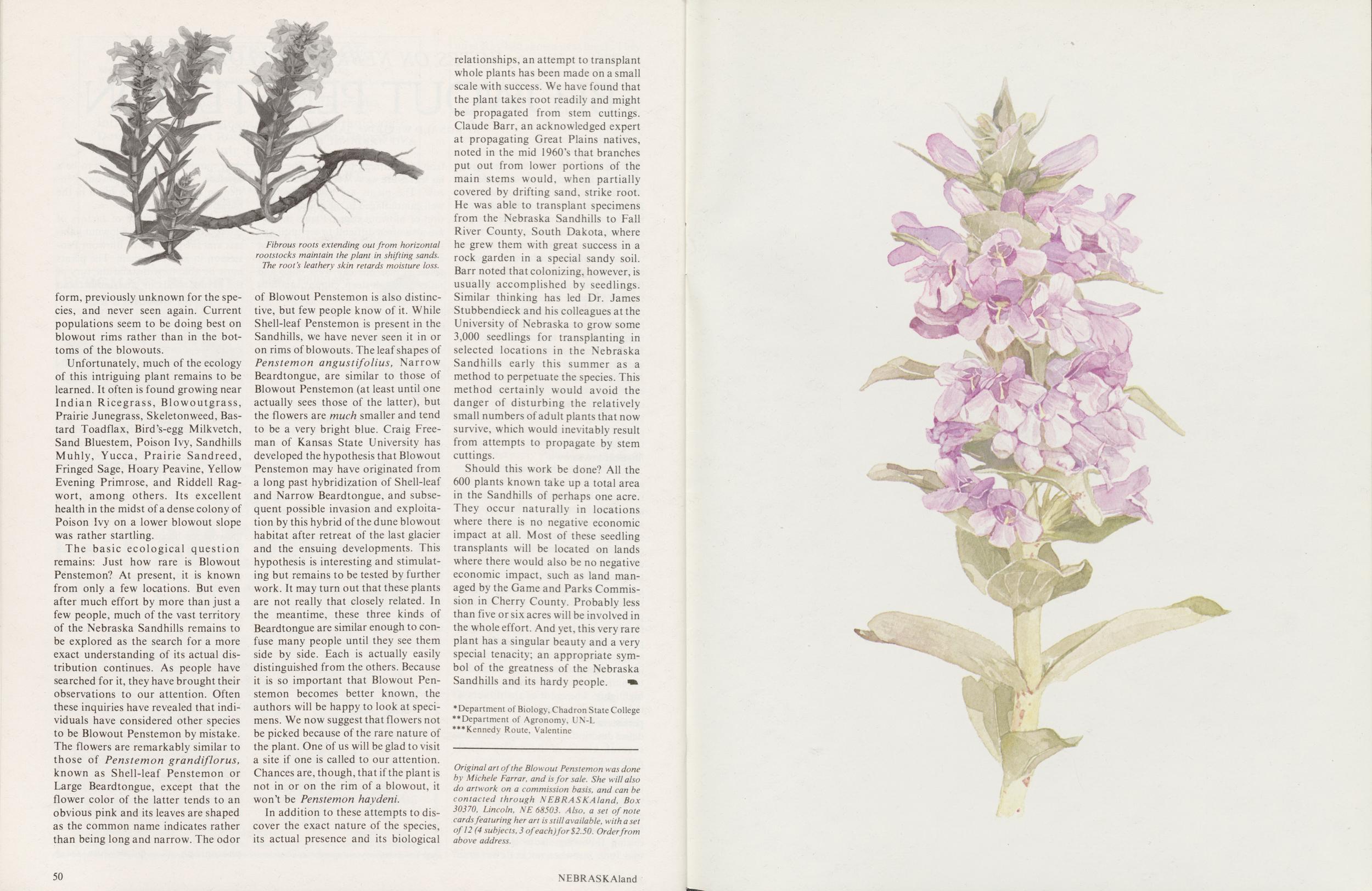
Unfortunately, much of the ecology of this intriguing plant remains to be learned. It often is found growing near Indian Ricegrass, Blowoutgrass, Prairie Junegrass, Skeletonweed, Bastard Toadflax, Bird's-egg Milkvetch, Sand Bluestem, Poison Ivy, Sandhills Muhly, Yucca, Prairie Sandreed, Fringed Sage, Hoary Peavine, Yellow Evening Primrose, and Riddell Ragwort, among others. Its excellent health in the midst of a dense colony of Poison Ivy on a lower blowout slope was rather startling.
The basic ecological question remains: Just how rare is Blowout Penstemon? At present, it is known from only a few locations. But even after much effort by more than just a few people, much of the vast territory of the Nebraska Sandhills remains to be explored as the search for a more exact understanding of its actual distribution continues. As people have searched for it, they have brought their observations to our attention. Often these inquiries have revealed that individuals have considered other species to be Blowout Penstemon by mistake. The flowers are remarkably similar to those of Penstemon grandiflorus, known as Shell-leaf Penstemon or Large Beardtongue, except that the flower color of the latter tends to an obvious pink and its leaves are shaped as the common name indicates rather than being long and narrow. The odor of Blowout Penstemon is also distinctive, but few people know of it. While Shell-leaf Penstemon is present in the Sandhills, we have never seen it in or on rims of blowouts. The leaf shapes of Penstemon angustifolius, Narrow Beardtongue, are similar to those of Blowout Penstemon (at least until one actually sees those of the latter), but the flowers are much smaller and tend to be a very bright blue. Craig Freeman of Kansas State University has developed the hypothesis that Blowout Penstemon may have originated from a long past hybridization of Shell-leaf and Narrow Beardtongue, and subsequent possible invasion and exploitation by this hybrid of the dune blowout habitat after retreat of the last glacier and the ensuing developments. This hypothesis is interesting and stimulating but remains to be tested by further work. It may turn out that these plants are not really that closely related. In the meantime, these three kinds of Beardtongue are similar enough to confuse many people until they see them side by side. Each is actually easily distinguished from the others. Because it is so important that Blowout Penstemon becomes better known, the authors will be happy to look at specimens. We now suggest that flowers not be picked because of the rare nature of the plant. One of us will be glad to visit a site if one is called to our attention. Chances are, though, that if the plant is not in or on the rim of a blowout, it won't be Penstemon haydeni.
In addition to these attempts to discover the exact nature of the species, its actual presence and its biological relationships, an attempt to transplant whole plants has been made on a small scale with success. We have found that the plant takes root readily and might be propagated from stem cuttings. Claude Barr, an acknowledged expert at propagating Great Plains natives, noted in the mid 1960's that branches put out from lower portions of the main stems would, when partially covered by drifting sand, strike root. He was able to transplant specimens from the Nebraska Sandhills to Fall River County, South Dakota, where he grew them with great success in a rock garden in a special sandy soil. Barr noted that colonizing, however, is usually accomplished by seedlings. Similar thinking has led Dr. James Stubbendieck and his colleagues at the University of Nebraska to grow some 3,000 seedlings for transplanting in selected locations in the Nebraska Sandhills early this summer as a method to perpetuate the species. This method certainly would avoid the danger of disturbing the relatively small numbers of adult plants that now survive, which would inevitably result from attempts to propagate by stem cuttings.
Should this work be done? All the 600 plants known take up a total area in the Sandhills of perhaps one acre. They occur naturally in locations where there is no negative economic impact at all. Most of these seedling transplants will be located on lands where there would also be no negative economic impact, such as land managed by the Game and Parks Commission in Cherry County. Probably less than five or six acres will be involved in the whole effort. And yet, this very rare plant has a singular beauty and a very special tenacity; an appropriate symbol of the greatness of the Nebraska Sandhills and its hardy people.
*Department of Biology, Chadron State College **Department of Agronomy, UN-L ***Kennedy Route, Valentine Original art of the Blowout Penstemon was done by Michele Farrar, and is for sale. She will also do artwork on a commission basis, and can be contacted through NEBRASKAland, Box 30370, Lincoln, NE 68503. Also, a set of note cards featuring her art is still available, with a set of 12 (4 subjects, 3 of each)for $2.50. Order from above address. 50 NEBRASKAland
Take Dad Fishing!
Hey, Kids! Take dad fishing. Get your poles ready, and your tackleboxes, and if he doesn't have one already, get your dad a fishing license. You can call it a Father's Day present, even though Father's Day might be weeks away on the calendar. After all, every day is Father's Day when you take your dad fishing, and you'll have a good time, too. NEBRASKA GAME AND PARKS COMMISSIONPosition: 341 (27 views)