Volume 60, Issue 9, 1982
Speak Up
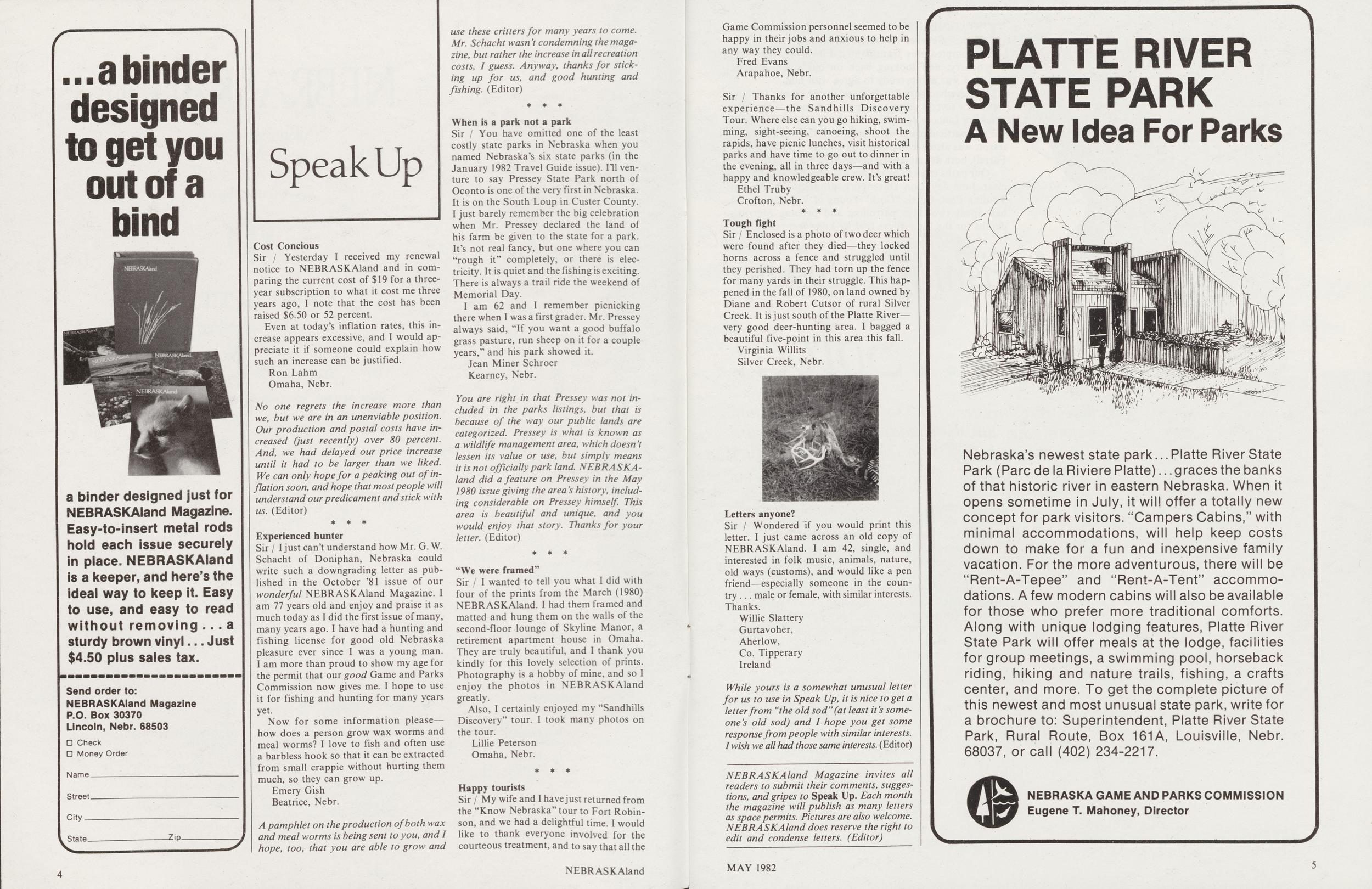
Cost Concious Sir / Yesterday I received my renewal notice to NEBRASKAland and in comparing the current cost of $19 for a three-year subscription to what it cost me three years ago, I note that the cost has been raised $6.50 or 52 percent. Even at today's inflation rates, this increase appears excessive, and I would appreciate it if someone could explain how such an increase can be justified. Ron Lahm Omaha, Nebr. No one regrets the increase more than we, but we are in an unenviable position. Our production and postal costs have increased (just recently) over 80 percent. And, we had delayed our price increase until it had to be larger than we liked. We can only hope for a peaking out of inflation soon, and hope that most people will understand our predicament and stick with us. (Editor) Experienced hunter Sir / I just can't understand how Mr. G. W. Schacht of Doniphan, Nebraska could write such a downgrading letter as published in the October '81 issue of our wonderful NEBRASKAland Magazine. I am 77 years old and enjoy and praise it as much today as I did the first issue of many, many years ago. I have had a hunting and fishing license for good old Nebraska pleasure ever since I was a young man. I am more than proud to show my age for the permit that our good Game and Parks Commission now gives me. I hope to use it for fishing and hunting for many years yet. Now for some information please—how does a person grow wax worms and meal worms? I love to fish and often use a barbless hook so that it can be extracted from small crappie without hurting them much, so they can grow up. Emery Gish Beatrice, Nebr. A pamphlet on the production of both wax and meal worms is being sent to you, and I hope, too, that you are able to grow and use these critters for many years to come. Mr. Schacht wasn't condemning the magazine, but rather the increase in all recreation costs, I guess. Anyway, thanks for sticking up for us, and good hunting and fishing. (Editor) When is a park not a park Sir / You have omitted one of the least costly state parks in Nebraska when you named Nebraska's six state parks (in the January 1982 Travel Guide issue). Ill venture to say Pressey State Park north of Oconto is one of the very first in Nebraska. It is on the South Loup in Custer County. I just barely remember the big celebration when Mr. Pressey declared the land of his farm be given to the state for a park. It's not real fancy, but one where you can "rough it" completely, or there is electricity. It is quiet and the fishing is exciting. There is always a trail ride the weekend of Memorial Day. I am 62 and I remember picnicking there when I was a first grader. Mr. Pressey always said, "If you want a good buffalo grass pasture, run sheep on it for a couple years," and his park showed it. Jean Miner Schroer Kearney, Nebr. You are right in that Pressey was not included in the parks listings, but that is because of the way our public lands are categorized. Pressey is what is known as a wildlife management area, which doesn't lessen its value or use, but simply means it is not officially park land. NEBRASKAland did a feature on Pressey in the May 1980 issue giving the area's history, including considerable on Pressey himself. This area is beautiful and unique, and you would enjoy that story. Thanks for your letter. (Editor) "We were framed" Sir / I wanted to tell you what I did with four of the prints from the March (1980) NEBRASKAIand. I had them framed and matted and hung them on the walls of the second-floor lounge of Skyline Manor, a retirement apartment house in Omaha. They are truly beautiful, and I thank you kindly for this lovely selection of prints. Photography is a hobby of mine, and so I enjoy the photos in NEBRASKAIand greatly. Also, I certainly enjoyed my "Sandhills Discovery" tour. I took many photos on the tour. Lillie Peterson Omaha, Nebr. Happy tourists Sir / My wife and I have just returned from the "Know Nebraska" tour to Fort Robinson, and we had a delightful time. I would like to thank everyone involved for the courteous treatment, and to say that all the 4 NERBASKAland Game Commission personnel seemed to be happy in their jobs and anxious to help in any way they could. Fred Evans Arapahoe, Nebr. Sir / Thanks for another unforgettable experience—the Sandhills Discovery Tour. Where else can you go hiking, swimming, sight-seeing, canoeing, shoot the rapids, have picnic lunches, visit historical parks and have time to go out to dinner in the evening, all in three days—and with a happy and knowledgeable crew. It's great! Ethel Truby Crofton, Nebr. Tough fight Sir / Enclosed is a photo of two deer which were found after they died—they locked horns across a fence and struggled until they perished. They had torn up the fence for many yards in their struggle. This happened in the fall of 1980, on land owned by Diane and Robert Cutsor of rural Silver Creek. It is just south of the Platte Riververy good deer-hunting area. I bagged a beautiful five-point in this area this fall. Virginia Willits Silver Creek, Nebr.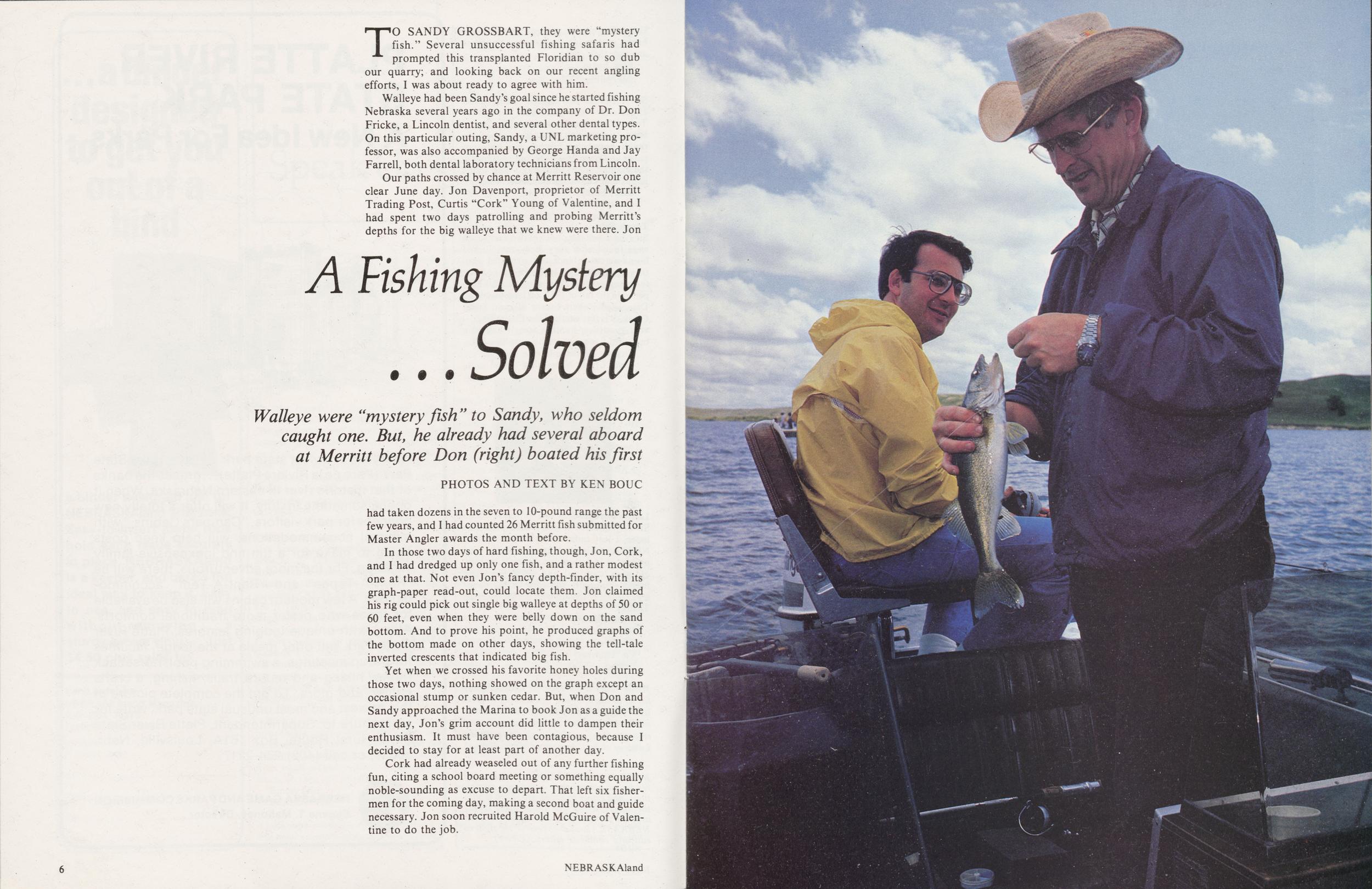
A Fishing Mystery ... Solved
Walleye were "mystery fish" to Sandy, who seldom caught one. But, he already had several aboard at Merritt before Don (right) boated his first
TO SANDY GROSSBART, they were "mystery fish." Several unsuccessful fishing safaris had prompted this transplanted Floridian to so dub our quarry; and looking back on our recent angling efforts, I was about ready to agree with him.
Walleye had been Sandy's goal since he started fishing Nebraska several years ago in the company of Dr. Don Fricke, a Lincoln dentist, and several other dental types. On this particular outing, Sandy, a UNL marketing professor, was also accompanied by George Handa and Jay Farrell, both dental laboratory technicians from Lincoln.
Our paths crossed by chance at Merritt Reservoir one clear June day. Jon Davenport, proprietor of Merritt Trading Post, Curtis "Cork" Young of Valentine, and I had spent two days patrolling and probing Merritt's depths for the big walleye that we knew were there. Jon had taken dozens in the seven to 10-pound range the past few years, and I had counted 26 Merritt fish submitted for Master Angler awards the month before.
In those two days of hard fishing, though, Jon, Cork, and I had dredged up only one fish, and a rather modest one at that. Not even Jon's fancy depth-finder, with its graph-paper read-out, could locate them. Jon claimed his rig could pick out single big walleye at depths of 50 or 60 feet, even when they were belly down on the sand bottom. And to prove his point, he produced graphs of the bottom made on other days, showing the tell-tale inverted crescents that indicated big fish.
Yet when we crossed his favorite honey holes during those two days, nothing showed on the graph except an occasional stump or sunken cedar. But, when Don and Sandy approached the Marina to book Jon as a guide the next day, Jon's grim account did little to dampen their enthusiasm. It must have been contagious, because I decided to stay for at least part of another day.
Cork had already weaseled out of any further fishing fun, citing a school board meeting or something equally noble-sounding as excuse to depart. That left six fishermen for the coming day, making a second boat and guide necessary. Jon soon recruited Harold McGuire of Valentine to do the job.
6 NEBRASKAland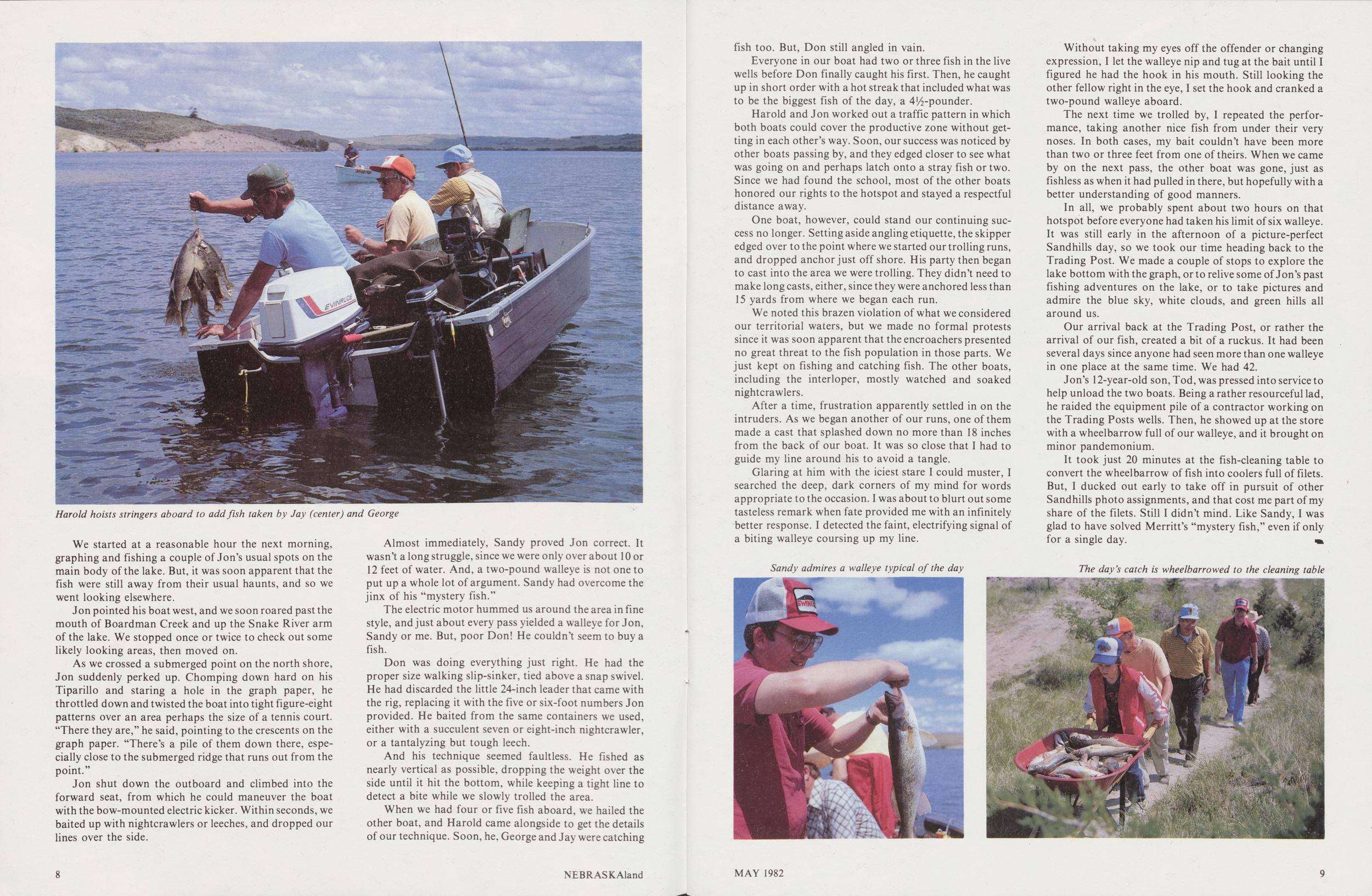
Harold hoists stringers aboard to add fish taken by Jay (center) and George
We started at a reasonable hour the next morning, graphing and fishing a couple of Jon's usual spots on the main body of the lake. But, it was soon apparent that the fish were still away from their usual haunts, and so we went looking elsewhere.
Jon pointed his boat west, and we soon roared past the mouth of Boardman Creek and up the Snake River arm of the lake. We stopped once or twice to check out some likely looking areas, then moved on.
As we crossed a submerged point on the north shore, Jon suddenly perked up. Chomping down hard on his Tiparillo and staring a hole in the graph paper, he throttled down and twisted the boat into tight figure-eight patterns over an area perhaps the size of a tennis court. "There they are," he said, pointing to the crescents on the graph paper. "There's a pile of them down there, especially close to the submerged ridge that runs out from the point."
Jon shut down the outboard and climbed into the forward seat, from which he could maneuver the boat with the bow-mounted electric kicker. Within seconds, we baited up with nightcrawlers or leeches, and dropped our lines over the side.
Almost immediately, Sandy proved Jon correct. It wasn't a long struggle, since we were only over about 10 or 12 feet of water. And, a two-pound walleye is not one to put up a whole lot of argument. Sandy had overcome the jinx of his "mystery fish."
The electric motor hummed us around the area in fine style, and just about every pass yielded a walleye for Jon, Sandy or me. But, poor Don! He couldn't seem to buy a fish.
Don was doing everything just right. He had the proper size walking slip-sinker, tied above a snap swivel. He had discarded the little 24-inch leader that came with the rig, replacing it with the five or six-foot numbers Jon provided. He baited from the same containers we used, either with a succulent seven or eight-inch nightcrawler, or a tantalyzing but tough leech.
And his technique seemed faultless. He fished as nearly vertical as possible, dropping the weight over the side until it hit the bottom, while keeping a tight line to detect a bite while we slowly trolled the area.
When we had four or five fish aboard, we hailed the other boat, and Harold came alongside to get the details of our technique. Soon, he, George and Jay were catchingfish too. But, Don still angled in vain.
8 NEBRASKAlandEveryone in our boat had two or three fish in the live wells before Don finally caught his first. Then, he caught up in short order with a hot streak that included what was to be the biggest fish of the day, a 4½-pounder.
Harold and Jon worked out a traffic pattern in which both boats could cover the productive zone without getting in each other's way. Soon, our success was noticed by other boats passing by, and they edged closer to see what was going on and perhaps latch onto a stray fish or two. Since we had found the school, most of the other boats honored our rights to the hotspot and stayed a respectful distance away.
One boat, however, could stand our continuing success no longer. Setting aside angling etiquette, the skipper edged over to the point where we started our trolling runs, and dropped anchor just off shore. His party then began to cast into the area we were trolling. They didn't need to make long casts, either, since they were anchored less than 15 yards from where we began each run.
We noted this brazen violation of what we considered our territorial waters, but we made no formal protests since it was soon apparent that the encroachers presented no great threat to the fish population in those parts. We just kept on fishing and catching fish. The other boats, including the interloper, mostly watched and soaked nightcrawlers.
After a time, frustration apparently settled in on the intruders. As we began another of our runs, one of them made a cast that splashed down no more than 18 inches from the back of our boat. It was so close that I had to guide my line around his to avoid a tangle.
Glaring at him with the iciest stare I could muster, I searched the deep, dark corners of my mind for words appropriate to the occasion. I was about to blurt out some tasteless remark when fate provided me with an infinitely better response. I detected the faint, electrifying signal of a biting walleye coursing up my line.
Without taking my eyes off the offender or changing expression, I let the walleye nip and tug at the bait until I figured he had the hook in his mouth. Still looking the other fellow right in the eye, I set the hook and cranked a two-pound walleye aboard.
The next time we trolled by, I repeated the performance, taking another nice fish from under their very noses. In both cases, my bait couldn't have been more than two or three feet from one of theirs. When we came by on the next pass, the other boat was gone, just as fishless as when it had pulled in there, but hopefully with a better understanding of good manners.
In all, we probably spent about two hours on that hotspot before everyone had taken his limit of six walleye. It was still early in the afternoon of a picture-perfect Sandhills day, so we took our time heading back to the Trading Post. We made a couple of stops to explore the lake bottom with the graph, or to relive some of Jon's past fishing adventures on the lake, or to take pictures and admire the blue sky, white clouds, and green hills all around us.
Our arrival back at the Trading Post, or rather the arrival of our fish, created a bit of a ruckus. It had been several days since anyone had seen more than one walleye in one place at the same time. We had 42.
Jon's 12-year-old son, Tod, was pressed into service to help unload the two boats. Being a rather resourceful lad, he raided the equipment pile of a contractor working on the Trading Posts wells. Then, he showed up at the store with a wheelbarrow full of our walleye, and it brought on minor pandemonium.
It took just 20 minutes at the fish-cleaning table to convert the wheelbarrow offish into coolers full of filets. But, I ducked out early to take off in pursuit of other Sandhills photo assignments, and that cost me part of my share of the filets. Still I didn't mind. Like Sandy, I was glad to have solved Merritt's "mystery fish," even if only for a single day.
Sandy admires a walleye typical of the day
The day's catch is wheelbarrowed to the cleaning table
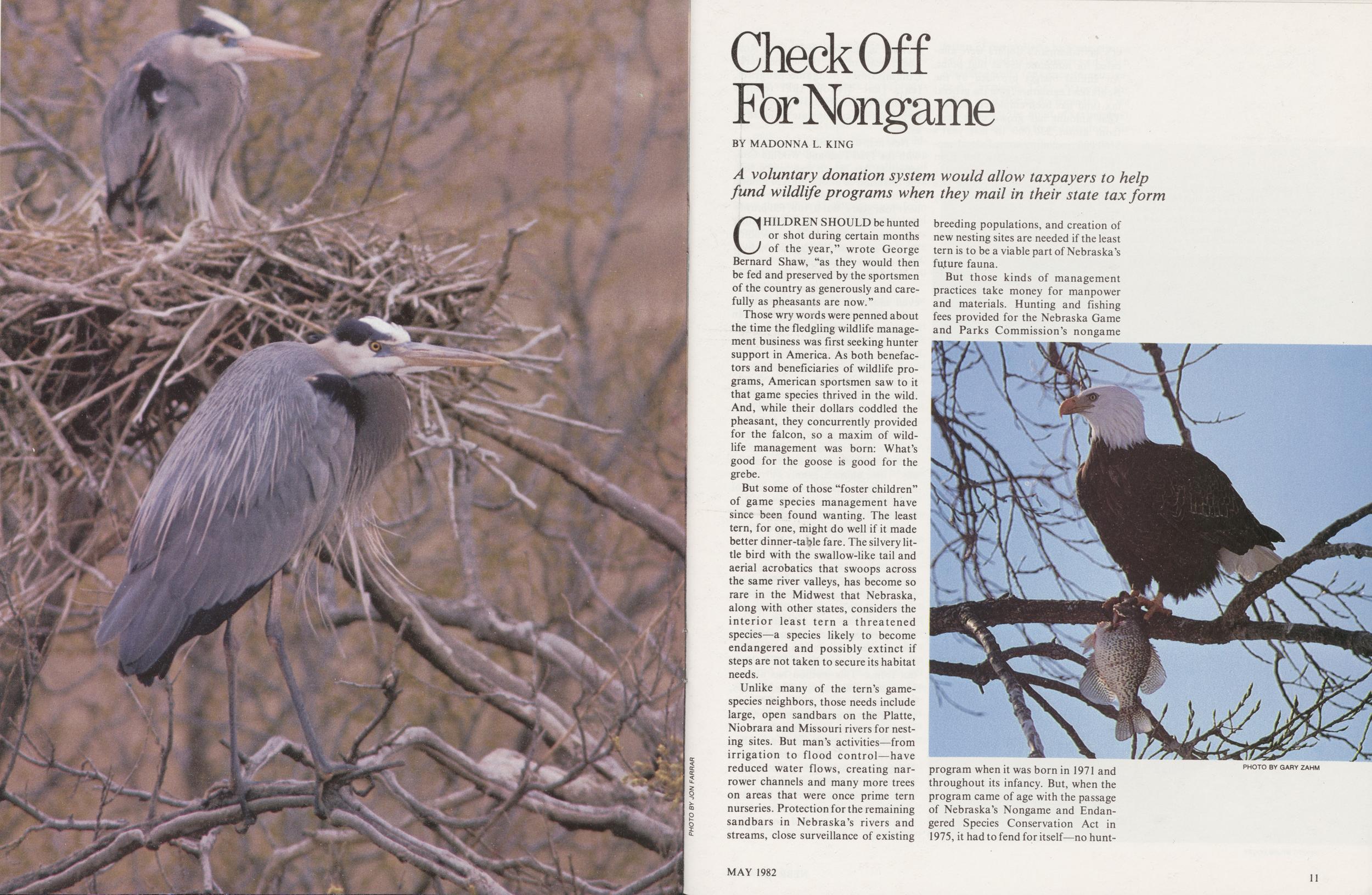
Checkoff For Nongame
A voluntary donation system would allow taxpayers to help fund wildlife programs when they mail in their state tax form
CHILDREN SHOULD be hunted or shot during certain months of the year," wrote George Bernard Shaw, "as they would then be fed and preserved by the sportsmen of the country as generously and carefully as pheasants are now."
Those wry words were penned about the time the fledgling wildlife management business was first seeking hunter support in America. As both benefactors and beneficiaries of wildlife programs, American sportsmen saw to it that game species thrived in the wild. And, while their dollars coddled the pheasant, they concurrently provided for the falcon, so a maxim of wildlife management was born: What's good for the goose is good for the grebe.
But some of those "foster children" of game species management have since been found wanting. The least tern, for one, might do well if it made better dinner-table fare. The silvery little bird with the swallow-like tail and aerial acrobatics that swoops across the same river valleys, has become so rare in the Midwest that Nebraska, along with other states, considers the interior least tern a threatened species—a species likely to become endangered and possibly extinct if steps are not taken to secure its habitat needs.
Unlike many of the tern's game-species neighbors, those needs include large, open sandbars on the Platte, Niobrara and Missouri rivers for nesting sites. But man's activities—from irrigation to flood control—have reduced water flows, creating narrower channels and many more trees on areas that were once prime tern nurseries. Protection for the remaining sandbars in Nebraska's rivers and streams, close surveillance of existing breeding populations, and creation of new nesting sites are needed if the least tern is to be a viable part of Nebraska's fitfure fauna.
But those kinds of management practices take money for manpower and materials. Hunting and fishing fees provided for the Nebraska Game and Parks Commission's nongameprogram when it was born in 1971 and throughout its infancy. But, when the program came of age with the passage of Nebraska's Nongame and Endangered Species Conservation Act in 1975, it had to fend for itself—no hunter's
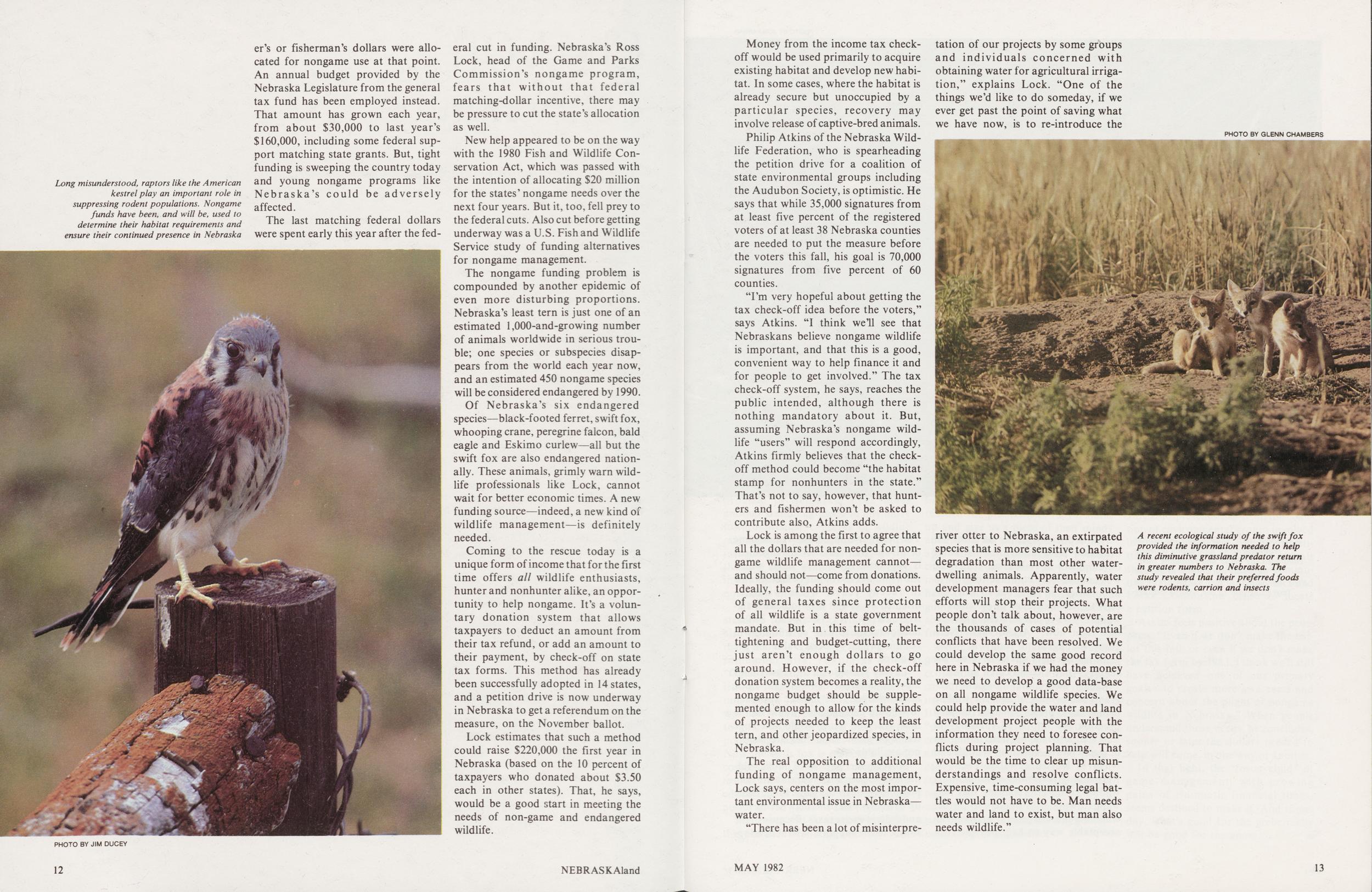
Long misunderstood, raptors like the American kestrel play an important role in suppressing rodent populations. Nongame funds have been, and will be, used to determine their habitat requirements and ensure their continued presence in Nebraska
PHOTO BY JIM DUCEYor fisherman's dollars were allocated for nongame use at that point. An annual budget provided by the Nebraska Legislature from the general tax fund has been employed instead. That amount has grown each year, from about $30,000 to last year's $160,000, including some federal support matching state grants. But, tight funding is sweeping the country today and young nongame programs like Nebraska's could be adversely affected.
The last matching federal dollars were spent early this year after the federal cut in funding. Nebraska's Ross Lock, head of the Game and Parks Commission's nongame program, fears that without that federal matching-dollar incentive, there may be pressure to cut the state's allocation as well.
New help appeared to be on the way with the 1980 Fish and Wildlife Conservation Act, which was passed with the intention of allocating $20 million for the states' nongame needs over the next four years. But it, too, fell prey to the federal cuts. Also cut before getting underway was a U.S. Fish and Wildlife Service study of funding alternatives for nongame management.
The nongame funding problem is compounded by another epidemic of even more disturbing proportions. Nebraska's least tern is just one of an estimated 1,000-and-growing number of animals worldwide in serious trouble; one species or subspecies disappears from the world each year now, and an estimated 450 nongame species will be considered endangered by 1990.
Of Nebraska's six endangered species—black-footed ferret, swift fox, whooping crane, peregrine falcon, bald eagle and Eskimo curlew—all but the swift fox are also endangered nationally. These animals, grimly warn wildlife professionals like Lock, cannot wait for better economic times. A new funding source—indeed, a new kind of wildlife management—is definitely needed.
Coming to the rescue today is a unique form of income that for the first time offers all wildlife enthusiasts, hunter and nonhunter alike, an opportunity to help nongame. It's a voluntary donation system that allows taxpayers to deduct an amount from their tax refund, or add an amount to their payment, by check-off on state tax forms. This method has already been successfully adopted in 14 states, and a petition drive is now underway in Nebraska to get a referendum on the measure, on the November ballot.
Lock estimates that such a method could raise $220,000 the first year in Nebraska (based on the 10 percent of taxpayers who donated about $3.50 each in other states). That, he says, would be a good start in meeting the needs of non-game and endangered wildlife.
12 NEBRASKAlandMoney from the income tax check-off would be used primarily to acquire existing habitat and develop new habitat. In some cases, where the habitat is already secure but unoccupied by a particular species, recovery may involve release of captive-bred animals.
Philip Atkins of the Nebraska Wildlife Federation, who is spearheading the petition drive for a coalition of state environmental groups including the Audubon Society, is optimistic. He says that while 35,000 signatures from at least five percent of the registered voters of at least 38 Nebraska counties are needed to put the measure before the voters this fall, his goal is 70,000 signatures from five percent of 60 counties.
"I'm very hopeful about getting the tax check-off idea before the voters," says Atkins. "I think well see that Nebraskans believe nongame wildlife is important, and that this is a good, convenient way to help finance it and for people to get involved." The tax check-off system, he says, reaches the public intended, although there is nothing mandatory about it. But, assuming Nebraska's nongame wildlife "users" will respond accordingly, Atkins firmly believes that the check-off method could become "the habitat stamp for nonhunters in the state." That's not to say, however, that hunters and fishermen won't be asked to contribute also, Atkins adds.
Lock is among the first to agree that all the dollars that are needed for nongame wildlife management cannot—and should not—come from donations. Ideally, the funding should come out of general taxes since protection of all wildlife is a state government mandate. But in this time of belt-tightening and budget-cutting, there just aren't enough dollars to go around. However, if the check-off donation system becomes a reality, the nongame budget should be supplemented enough to allow for the kinds of projects needed to keep the least tern, and other jeopardized species, in Nebraska.
The real opposition to additional funding of nongame management, Lock says, centers on the most important environmental issue in Nebraska—water.
"There has been a lot of misinterpretation of our projects by some groups and individuals concerned with obtaining water for agricultural irrigation," explains Lock. "One of the things we'd like to do someday, if we ever get past the point of saving what we have now, is to re-introduce the
A recent ecological study of the swift fox provided the information needed to help this diminutive grassland predator return in greater numbers to Nebraska. The study revealed that their preferred foods were rodents, carrion and insects
PHOTO BY GLENN CHAMBERSriver otter to Nebraska, an extirpated species that is more sensitive to habitat degradation than most other water-dwelling animals. Apparently, water development managers fear that such efforts will stop their projects. What people don't talk about, however, are the thousands of cases of potential conflicts that have been resolved. We could develop the same good record here in Nebraska if we had the money we need to develop a good data-base on all nongame wildlife species. We could help provide the water and land development project people with the information they need to foresee conflicts during project planning. That would be the time to clear up misunderstandings and resolve conflicts. Expensive, time-consuming legal battles would not have to be. Man needs water and land to exist, but man also needs wildlife."
MAY 1982 13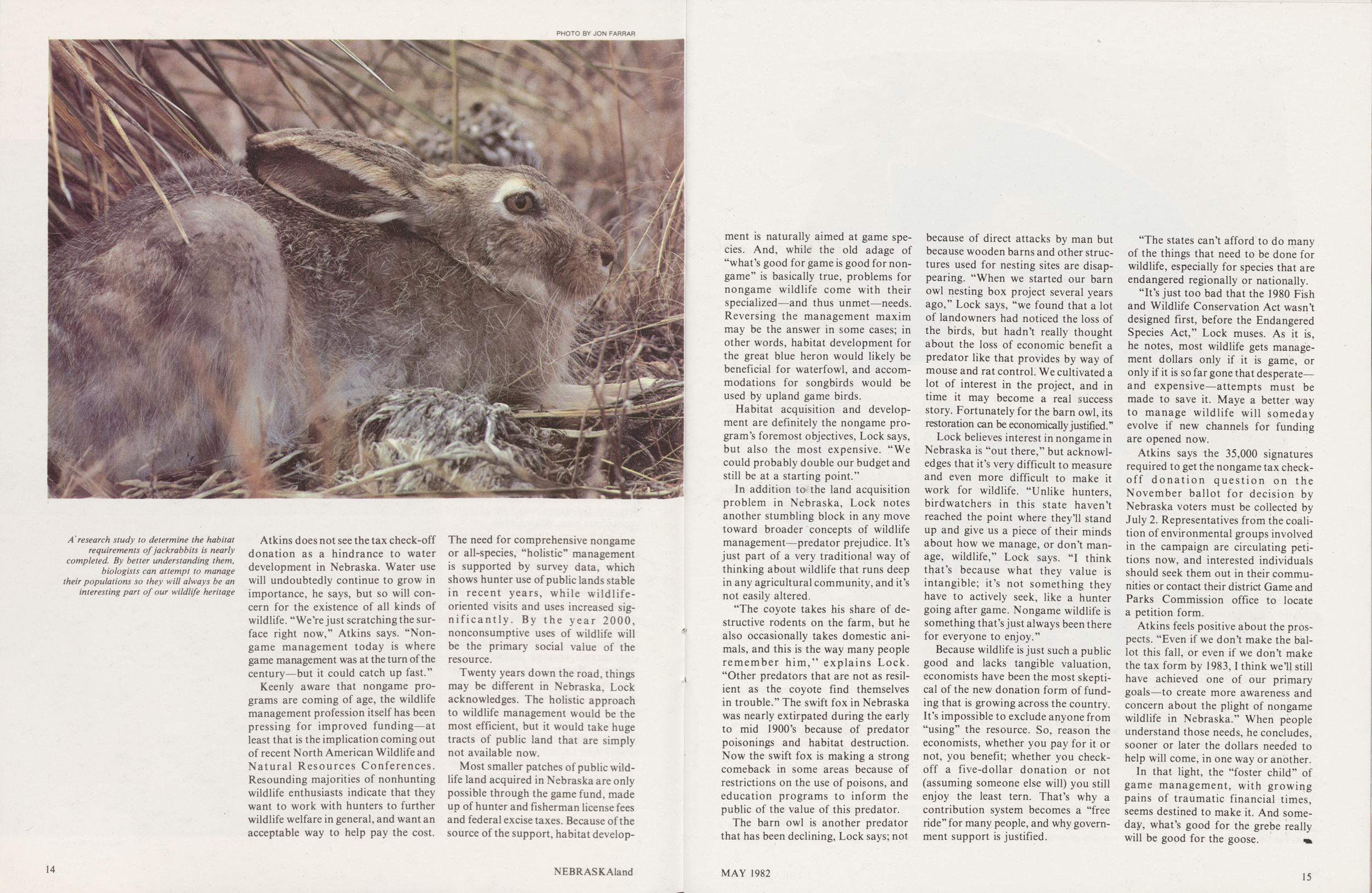
A research study to determine the habitat requirements of jackrabbits is nearly completed. By better understanding them, biologists can attempt to manage their populations so they will always be an interesting part of our wildlife heritage
Atkins does not see the tax check-off donation as a hindrance to water development in Nebraska. Water use will undoubtedly continue to grow in importance, he says, but so will concern for the existence of all kinds of wildlife. "We're just scratching the surface right now," Atkins says. "Nongame management today is wherE game management was at the turn of the century—but it could catch up fast."
Keenly aware that nongame programs are coming of age, the wildlife management profession itself has been pressing for improved funding—at least that is the implication coming out of recent North American Wildlife and Natural Resources Conferences. Resounding majorities of nonhunting wildlife enthusiasts indicate that they want to work with hunters to further wildlife welfare in general, and want an acceptable way to help pay the cost. The need for comprehensive nongame or all-species, "holistic" management is supported by survey data, which shows hunter use of public lands stable in recent years, while wildlife-oriented visits and uses increased significantly. By the year 2000, nonconsumptive uses of wildlife will be the primary social value of the resource.
Twenty years down the road, things may be different in Nebraska, Lock acknowledges. The holistic approach to wildlife management would be the most efficient, but it would take huge tracts of public land that are simply not available now.
Most smaller patches of public wildlife land acquired in Nebraska are only possible through the game fund, made up of hunter and fisherman license fees and federal excise taxes. Because of the source of the support, habitat development
14 NEBRASKAlandis naturally aimed at game species. And, while the old adage of "what's good for game is good for nongame" is basically true, problems for nongame wildlife come with their specialized—and thus unmet—needs. Reversing the management maxim may be the answer in some cases; in other words, habitat development for the great blue heron would likely be beneficial for waterfowl, and accommodations for songbirds would be used by upland game birds.
Habitat acquisition and development are definitely the nongame program's foremost objectives, Lock says, but also the most expensive. "We could probably double our budget and still be at a starting point."
In addition to the land acquisition problem in Nebraska, Lock notes another stumbling block in any move toward broader concepts of wildlife management—predator prejudice. It's just part of a very traditional way of thinking about wildlife that runs deep in any agricultural community, and it's not easily altered.
"The coyote takes his share of destructive rodents on the farm, but he also occasionally takes domestic animals, and this is the way many people remember him," explains Lock. "Other predators that are not as resilient as the coyote find themselves in trouble." The swift fox in Nebraska was nearly extirpated during the early to mid 1900's because of predator poisonings and habitat destruction. Now the swift fox is making a strong comeback in some areas because of restrictions on the use of poisons, and education programs to inform the public of the value of this predator.
The barn owl is another predator that has been declining, Lock says; not because of direct attacks by man but because wooden barns and other structures used for nesting sites are disappearing. "When we started our barn owl nesting box project several years ago," Lock says, "we found that a lot of landowners had noticed the loss of the birds, but hadn't really thought about the loss of economic benefit a predator like that provides by way of mouse and rat control. We cultivated a lot of interest in the project, and in time it may become a real success story. Fortunately for the barn owl, its restoration can be economically justified."
Lock believes interest in nongame in Nebraska is "out there," but acknowledges that it's very difficult to measure and even more difficult to make it work for wildlife. "Unlike hunters, birdwatchers in this state haven't reached the point where they'll stand up and give us a piece of their minds about how we manage, or don't manage, wildlife," Lock says. "I think that's because what they value is intangible; it's not something they have to actively seek, like a hunter going after game. Nongame wildlife is something that's just always been there for everyone to enjoy."
Because wildlife is just such a public good and lacks tangible valuation, economists have been the most skeptical of the new donation form of funding that is growing across the country. It's impossible to exclude anyone from "using" the resource. So, reason the economists, whether you pay for it or not, you benefit; whether you check-off a five-dollar donation or not (assuming someone else will) you still enjoy the least tern. That's why a contribution system becomes a "free ride" for many people, and why government support is justified.
"The states can't afford to do many of the things that need to be done for wildlife, especially for species that are endangered regionally or nationally.
"It's just too bad that the 1980 Fish and Wildlife Conservation Act wasn't designed first, before the Endangered Species Act," Lock muses. As it is, he notes, most wildlife gets management dollars only if it is game, or only if it is so far gone that desperate—and expensive—attempts must be made to save it. Maye a better way to manage wildlife will someday evolve if new channels for funding are opened now.
Atkins says the 35,000 signatures required to get the nongame tax check-off donation question on the November ballot for decision by Nebraska voters must be collected by July 2. Representatives from the coalition of environmental groups involved in the campaign are circulating petitions now, and interested individuals should seek them out in their communities or contact their district Game and Parks Commission office to locate a petition form.
Atkins feels positive about the prospects. "Even if we don't make the ballot this fall, or even if we don't make the tax form by 1983,1 think we'll still have achieved one of our primary goals—to create more awareness and concern about the plight of nongame wildlife in Nebraska." When people understand those needs, he concludes, sooner or later the dollars needed to help will come, in one way or another.
In that light, the "foster child" of game management, with growing pains of traumatic financial times, seems destined to make it. And someday, what's good for the grebe really will be good for the goose.
MAY 1982 15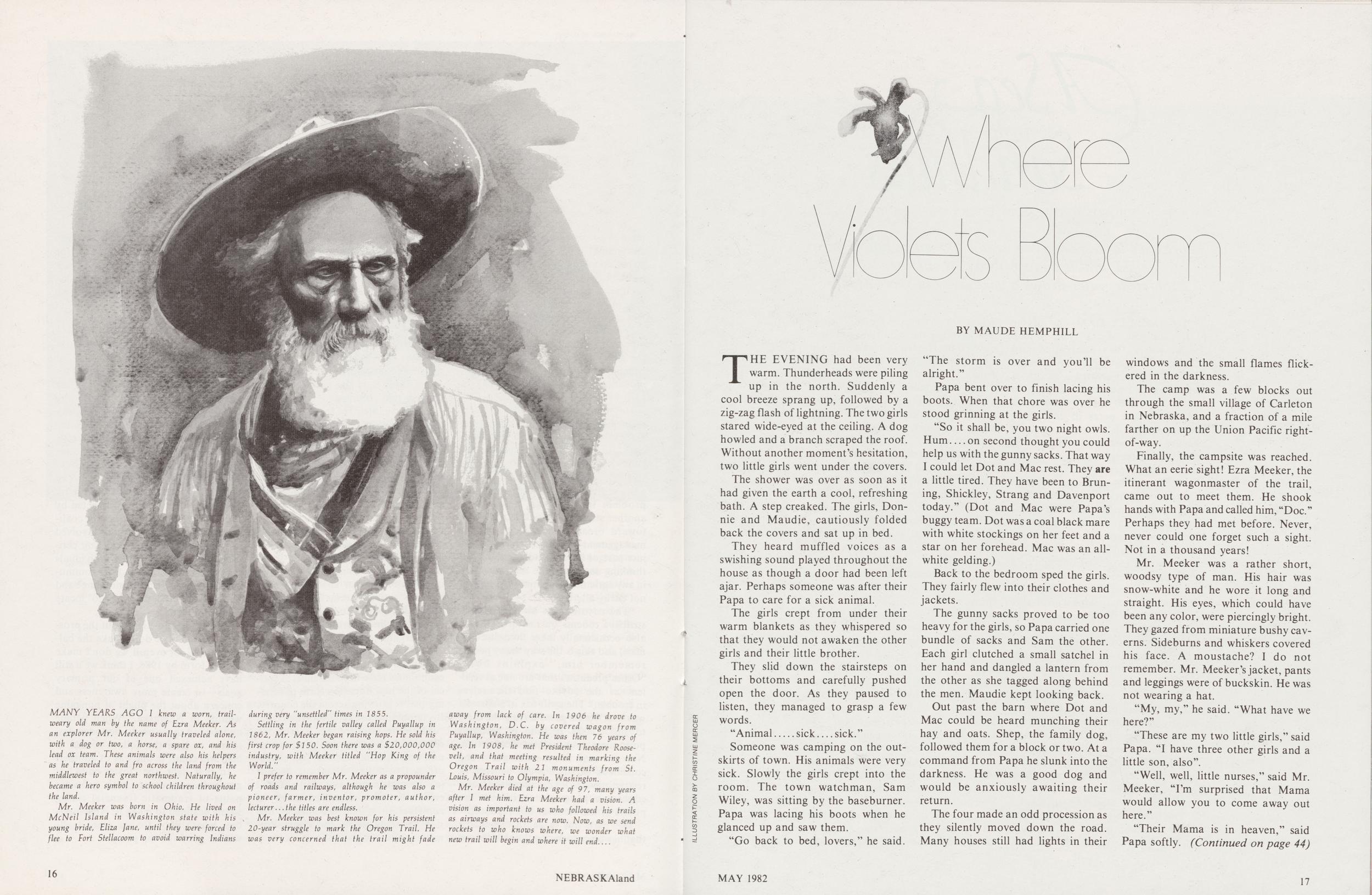
Where Violets Bloom
MANY YEARS AGO I knew a worn, trail-weary old man by the name of Ezra Meeker. As an explorer Mr. Meeker usually traveled alone, with a dog or two, a horse, a spare ox, and his lead ox team. These animals were also his helpers as he traveled to and fro across the land from the middlewest to the great northwest. Naturally, he became a hero symbol to school children throughout the land.
Mr. Meeker was born in Ohio. He lived on McNeil Island in Washington state with his young bride, Eliza Jane, until they were forced to flee to Fort Stellacoom to avoid warring Indians during very "unsettled" times in 1855. Settling in the fertile valley called Puyallup in 1862, Mr. Meeker began raising hops. He sold his first crop for $150. Soon there was a $20,000,000 industry, with Meeker titled "Hop King of the World."
I prefer to remember Mr. Meeker as a propounder of roads and railways, although he was also a pioneer, farmer, inventor, promoter, author, lecturer...the titles are endless.
Mr. Meeker was best known for his persistent 20-year struggle to mark the Oregon Trail. He was very concerned that the trail might fade away from lack of care. In 1906 he drove to Washington, D.C. by covered wagon from Puyallup, Washington. He was then 76 years of age. In 1908, he met President Theodore Roosevelt, and that meeting resulted in marking the Oregon Trail with 21 monuments from St. Louis, Missouri to Olympia, Washington.
Mr. Meeker died at the age of 97, many years after I met him. Ezra Meeker had a vision. A vision as important to us who followed his trails as airways and rockets are now. Now, as we send rockets to who knows where, we wonder what new trail will begin and where it will end....
16 NEBRASKAlandTHE EVENING had been very warm. Thunderheads were piling up in the north. Suddenly a cool breeze sprang up, followed by a zig-zag flash of lightning. The two girls stared wide-eyed at the ceiling. A dog howled and a branch scraped the roof. Without another moment's hesitation, two little girls went under the covers.
The shower was over as soon as it had given the earth a cool, refreshing bath. A step creaked. The girls, Donnie and Maudie, cautiously folded back the covers and sat up in bed.
They heard muffled voices as a swishing sound played throughout the house as though a door had been left ajar. Perhaps someone was after their Papa to care for a sick animal.
The girls crept from under their warm blankets as they whispered so that they would not awaken the other girls and their little brother.
They slid down the stairsteps on their bottoms and carefully pushed open the door. As they paused to listen, they managed to grasp a few words.
"Animal.....sick....sick."
Someone was camping on the outskirts of town. His animals were very sick. Slowly the girls crept into the room. The town watchman, Sam Wiley, was sitting by the baseburner. Papa was lacing his boots when he glanced up and saw them.
"Go back to bed, lovers," he said.
"The storm is over and you'll be alright."
Papa bent over to finish lacing his boots. When that chore was over he stood grinning at the girls.
"So it shall be, you two night owls. Hum — on second thought you could help us with the gunny sacks. That way I could let Dot and Mac rest. They are a little tired. They have been to Bruning, Shickley, Strang and Davenport today." (Dot and Mac were Papa's buggy team. Dot was a coal black mare with white stockings on her feet and a star on her forehead. Mac was an all-white gelding.)
Back to the bedroom sped the girls. They fairly flew into their clothes and jackets.
The gunny sacks proved to be too heavy for the girls, so Papa carried one bundle of sacks and Sam the other. Each girl clutched a small satchel in her hand and dangled a lantern from the other as she tagged along behind the men. Maudie kept looking back.
Out past the barn where Dot and Mac could be heard munching their hay and oats. Shep, the family dog, followed them for a block or two. At a command from Papa he slunk into the darkness. He was a good dog and would be anxiously awaiting their return.
The four made an odd procession as they silently moved down the road. Many houses still had lights in their windows and the small flames flickered in the darkness.
The camp was a few blocks out through the small village of Carleton in Nebraska, and a fraction of a mile farther on up the Union Pacific right-of-way.
Finally, the campsite was reached. What an eerie sight! Ezra Meeker, the itinerant wagonmaster of the trail, came out to meet them. He shook hands with Papa and called him, "Doc." Perhaps they had met before. Never, never could one forget such a sight. Not in a thousand years!
Mr. Meeker was a rather short, woodsy type of man. His hair was snow-white and he wore it long and straight. His eyes, which could have been any color, were piercingly bright. They gazed from miniature bushy caverns. Sideburns and whiskers covered his face. A moustache? I do not remember. Mr. Meeker's jacket, pants and leggings were of buckskin. He was not wearing a hat.
"My, my," he said. "What have we here?"
"These are my two little girls," said Papa. "I have three other girls and a little son, also".
"Well, well, little nurses," said Mr. Meeker, "I'm surprised that Mama would allow you to come away out here."
"Their Mama is in heaven," said Papa softly. (Continued on page 44)
MAY 1982 17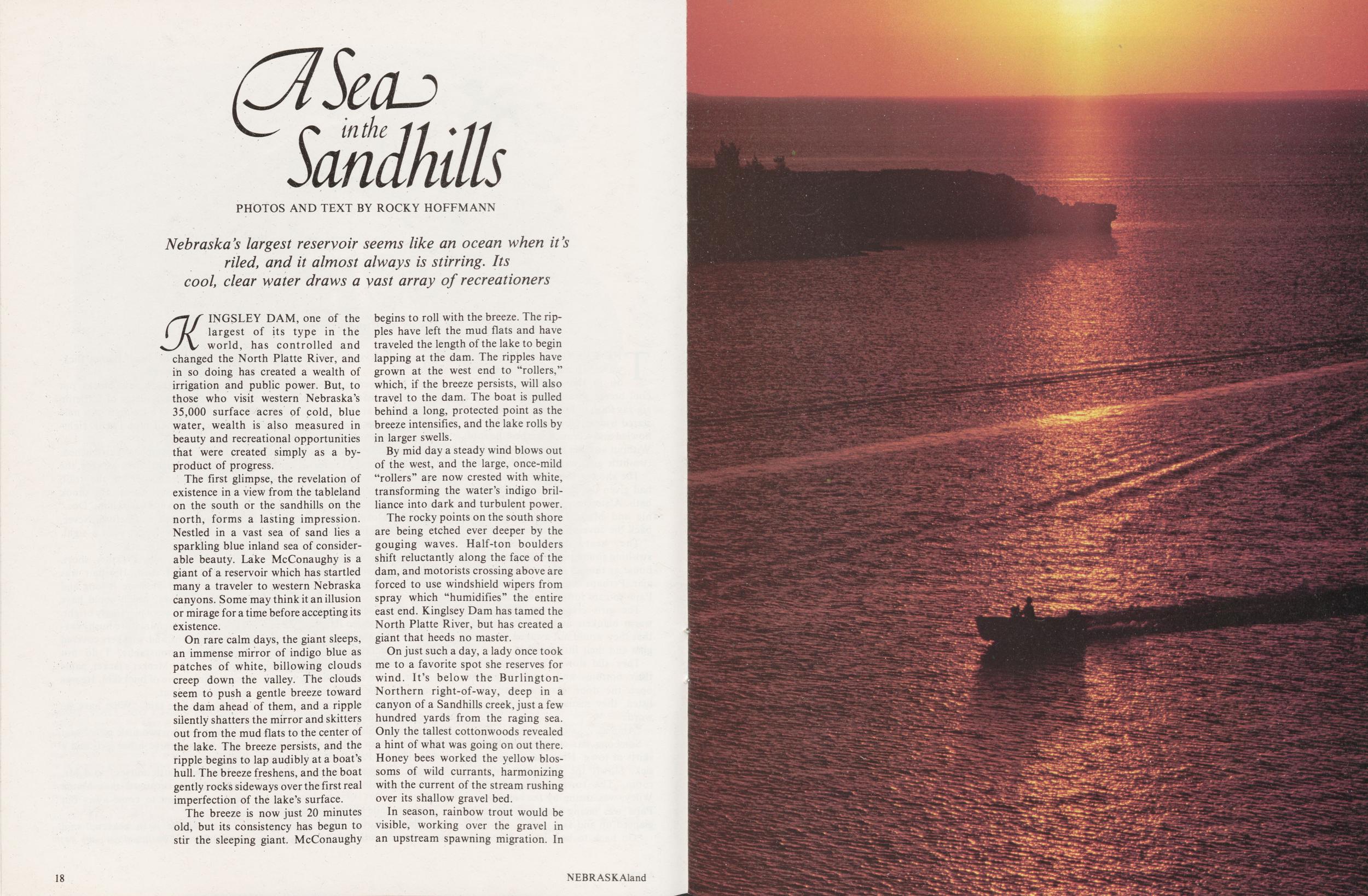
A Sea In the Sandhills
Nebraska's largest reservoir seems like an ocean when it's riled, and it almost always is stirring. Its cool, clear water draws a vast array of recreationers
KINGSLEY DAM, one of the I Ls largest of its type in the world, has controlled and changed the North Platte River, and in so doing has created a wealth of irrigation and public power. But, to those who visit western Nebraska's 35,000 surface acres of cold, blue water, wealth is also measured in beauty and recreational opportunities that were created simply as a by-product of progress.
The first glimpse, the revelation of existence in a view from the tableland on the south or the sandhills on the north, forms a lasting impression. Nestled in a vast sea of sand lies a sparkling blue inland sea of considerable beauty. Lake McConaughy is a giant of a reservoir which has startled many a traveler to western Nebraska canyons. Some may think it an illusion or mirage for a time before accepting its existence.
On rare calm days, the giant sleeps, an immense mirror of indigo blue as patches of white, billowing clouds creep down the valley. The clouds seem to push a gentle breeze toward the dam ahead of them, and a ripple silently shatters the mirror and skitters out from the mud flats to the center of the lake. The breeze persists, and the ripple begins to lap audibly at a boat's hull. The breeze freshens, and the boat gently rocks sideways over the first real imperfection of the lake's surface.
The breeze is now just 20 minutes old, but its consistency has begun to stir the sleeping giant. McConaughy begins to roll with the breeze. The ripples have left the mud flats and have traveled the length of the lake to begin lapping at the dam. The ripples have grown at the west end to "rollers," which, if the breeze persists, will also travel to the dam. The boat is pulled behind a long, protected point as the breeze intensifies, and the lake rolls by in larger swells.
By mid day a steady wind blows out of the west, and the large, once-mild "rollers" are now crested with white, transforming the water's indigo brilliance into dark and turbulent power.
The rocky points on the south shore are being etched ever deeper by the gouging waves. Half-ton boulders shift reluctantly along the face of the dam, and motorists crossing above are forced to use windshield wipers from spray which "humidifies" the entire east end. Kinglsey Dam has tamed the North Platte River, but has created a giant that heeds no master.
On just such a day, a lady once took me to a favorite spot she reserves for wind. It's below the Burlington-Northern right-of-way, deep in a canyon of a Sandhills creek, just a few hundred yards from the raging sea. Only the tallest cottonwoods revealed a hint of what was going on out there. Honey bees worked the yellow blossoms of wild currants, harmonizing with the current of the stream rushing over its shallow gravel bed.
In season, rainbow trout would be visible, working over the gravel in an upstream spawning migration. In
18 NEBRASKAland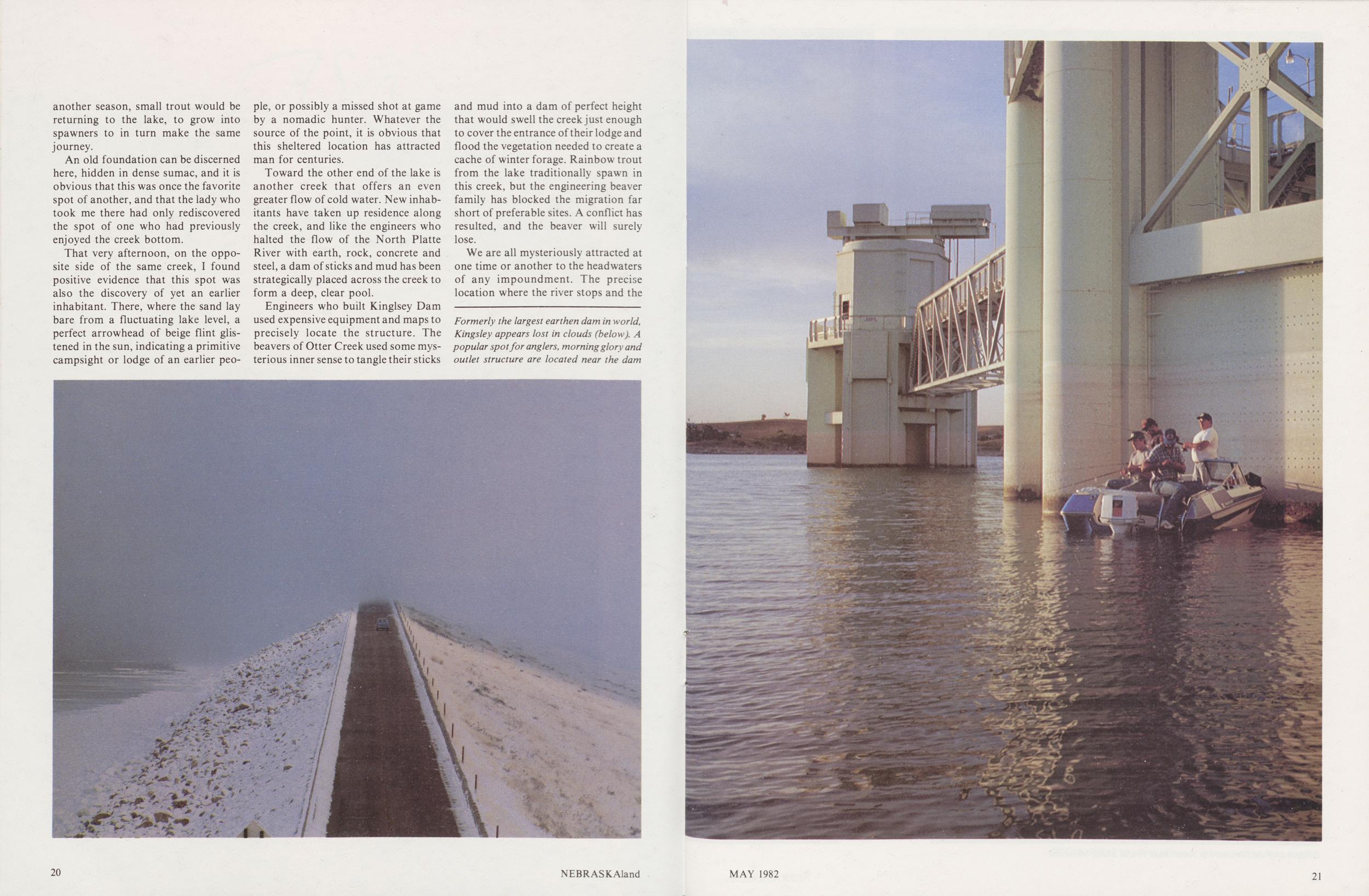
another season, small trout would be returning to the lake, to grow into spawners to in turn make the same journey.
An old foundation can be discerned here, hidden in dense sumac, and it is obvious that this was once the favorite spot of another, and that the lady who took me there had only rediscovered the spot of one who had previously enjoyed the creek bottom.
That very afternoon, on the opposite side of the same creek, I found positive evidence that this spot was also the discovery of yet an earlier inhabitant. There, where the sand lay bare from a fluctuating lake level, a perfect arrowhead of beige flint glistened in the sun, indicating a primitive campsight or lodge of an earlier people, or possibly a missed shot at game by a nomadic hunter. Whatever the source of the point, it is obvious that this sheltered location has attracted man for centuries.
Toward the other end of the lake is another creek that offers an even greater flow of cold water. New inhabitants have taken up residence along the creek, and like the engineers who halted the flow of the North Platte River with earth, rock, concrete and steel, a dam of sticks and mud has been strategically placed across the creek to form a deep, clear pool.
Engineers who built Kinglsey Dam used expensive equipment and maps to precisely locate the structure. The beavers of Otter Creek used some mysterious inner sense to tangle their sticks and mud into a dam of perfect height that would swell the creek just enough to cover the entrance of their lodge and flood the vegetation needed to create a cache of winter forage. Rainbow trout from the lake traditionally spawn in this creek, but the engineering beaver family has blocked the migration far short of preferable sites. A conflict has resulted, and the beaver will surely lose.
Formerly the largest earthen dam in world, Kingsley appears lost in clouds (below). A popular spot for anglers, morning glory and outlet structure are located near the dam
 lake begins is difficult to pinpoint, but
the general vicinity of this transformation is obvious.
lake begins is difficult to pinpoint, but
the general vicinity of this transformation is obvious.Siltation has created an expansive mud flat, which, if left dry from low water for a year or two, will produce an upsurge of young willows and rushes. A network of small channels converges on the lake in ever-changing fingers. Here the lake's lush vegetation attracts migrating waterfowl in both spring and fall.
In spring and summer, small fishes seek protection in the shallows of the flats, and large flocks of white pelicans form up in net-like fashion to drive fish into even shallower water where a feeding frenzy ensues. Once gorged with fish of all sizes, the regal pelicans may stand motionless for hours on sandbars, often with outstretched wings.
It is also in the shallows of the flats where man starts fishing soon after ice out; a condition that annually produces excellent catfishing. As channel catfish slowly slip upriver in the spring, fishermen follow with smelly concoctions of bait, and weights large enough to hold in the current. Here, the willows are tall and the rushes thick. Even cottonwoods have established a toe-hold, as back-up water from the lake no longer threatens the western territory it once occupied.
White-tailed deer find this cover to their liking, and the challenge of the hunt demands savvy and perseverance from the archer, and not much less from the rifleman. Trophy bucks are available here. Some are outsmarted; most live to shed their antlers, to be found only one side at a time by catfishermen in the spring.
It's not just the bucks that are big at Lake McConaughy. Everything about it is big. Nearly 2,000,000 acre-feet of water is stored at full pool. Most of its 22 miles are four miles wide, and one depression near the dam is 142 feet deep. If elbow room is a prerequisite for recreation, there are 105 miles of shoreline to spread a beach blanket on, or 35,000 surface acres of water to ski or troll.
Annual walleye fishing begins at the dam, with early April spawning activity creating a rush of enthusiasm among a congregation of cabin-fevered bait throwers who have watched with impatience the slow retreat of ice from the shoreline. With the conclusion of spawning activity, the action quickly resumes at the lake's far west end, and gradually works east again. A 16-pound, two-ounce walleye was pulled
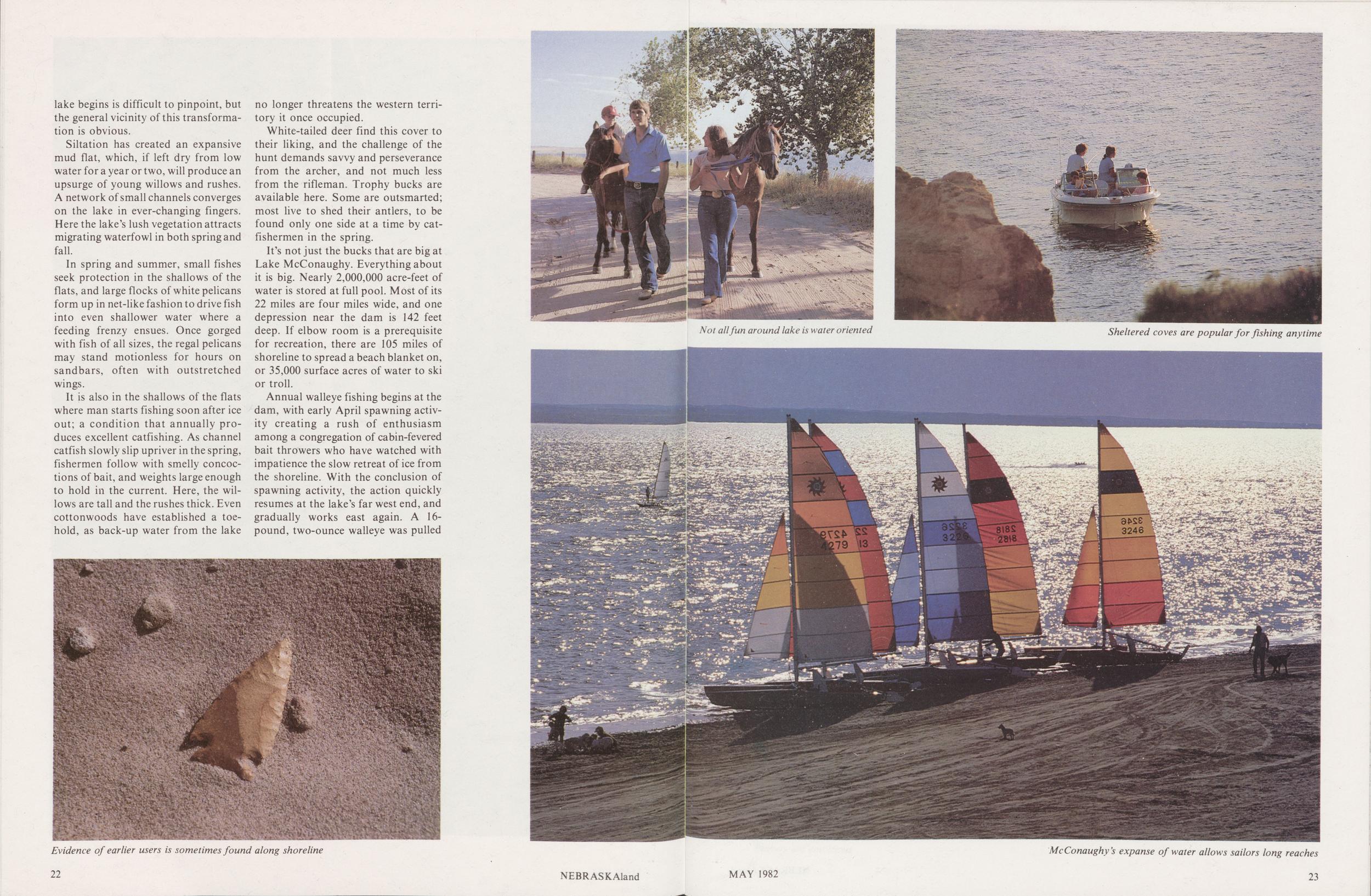
Evidence of earlier users is sometimes found along shoreline
Not all fun around lake is water oriented
Sheltered coves are popular for fishing anytime
McConaughy s expanse of water allows sailors long reaches
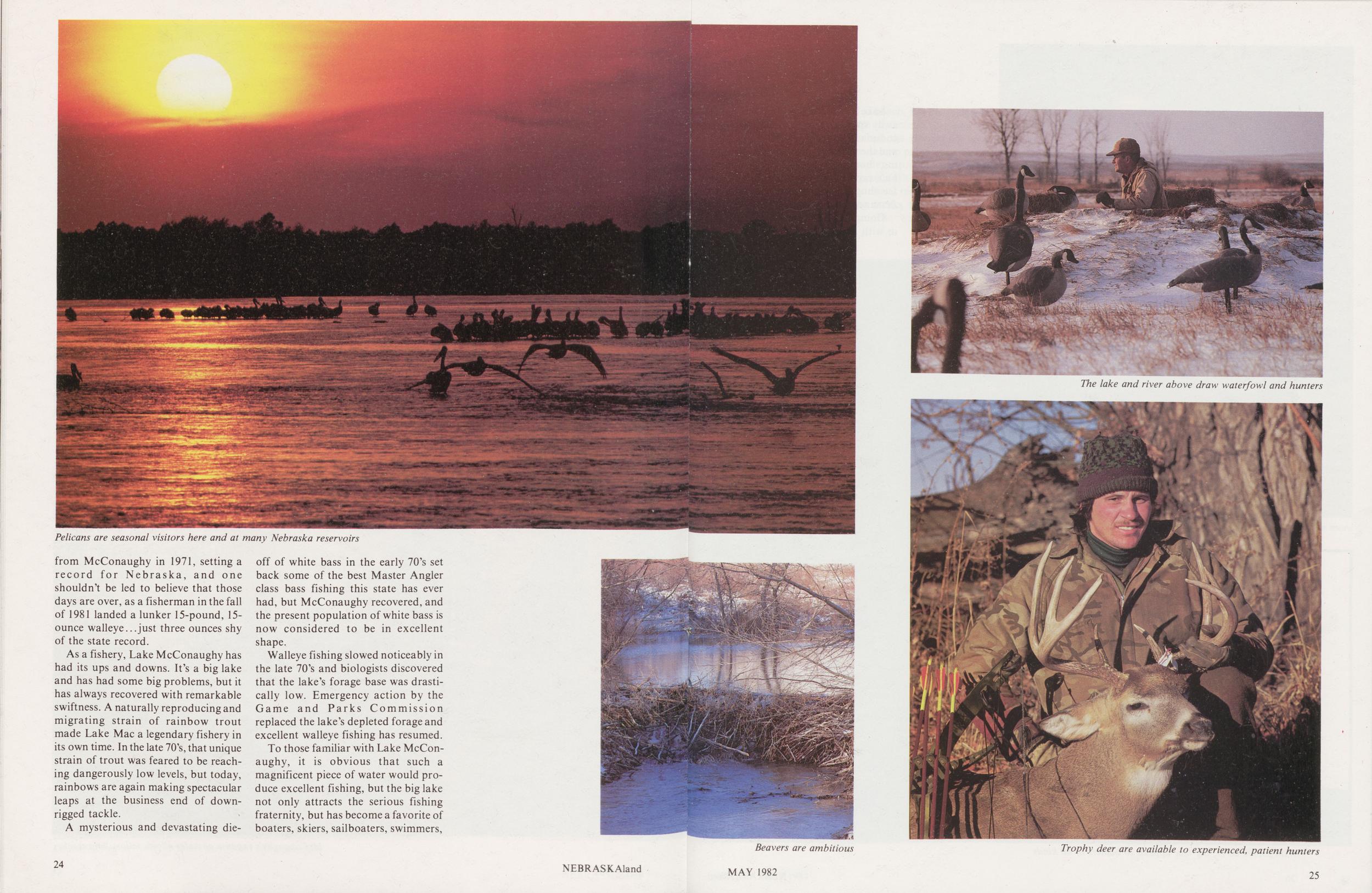
Pelicans are seasonal visitors here and at many Nebraska reservoirs
from McConaughy in 1971, setting a record for Nebraska, and one shouldn't be led to believe that those days are over, as a fisherman in the fall of 1981 landed a lunker 15-pound, 15-ounce walleye...just three ounces shy of the state record.
As a fishery, Lake McConaughy has had its ups and downs. It's a big lake and has had some big problems, but it has always recovered with remarkable swiftness. A naturally reproducing and migrating strain of rainbow trout made Lake Mac a legendary fishery in its own time. In the late 70's, that unique strain of trout was feared to be reaching dangerously low levels, but today, rainbows are again making spectacular leaps at the business end of down-rigged tackle.
A mysterious and devastating die-off of white bass in the early 70's set back some of the best Master Angler class bass fishing this state has ever had, but McConaughy recovered, and the present population of white bass is now considered to be in excellent shape.
Walleye fishing slowed noticeably in the late 70's and biologists discovered that the lake's forage base was drastically low. Emergency action by the Game and Parks Commission replaced the lake's depleted forage and excellent walleye fishing has resumed.
To those familiar with Lake McConaughy, it is obvious that such a magnificent piece of water would produce excellent fishing, but the big lake not only attracts the serious fishing fraternity, but has become a favorite of boaters, skiers, sailboaters, swimmers,scuba divers and also campers and picknickers.
24 NEBRASKAlandBeavers are ambitious
The lake and river above draw waterfowl and hunters
Trophy deer are available to experienced, patient hunters
The Game and Parks Commission has provided one of the finest lay-outs of camping facilities in the country at Big Mac, scattered from one end of the lake to the other and back again on the opposite side. From primitive to ultra-modern, the only dilemma is deciding exactly where to set up camp.
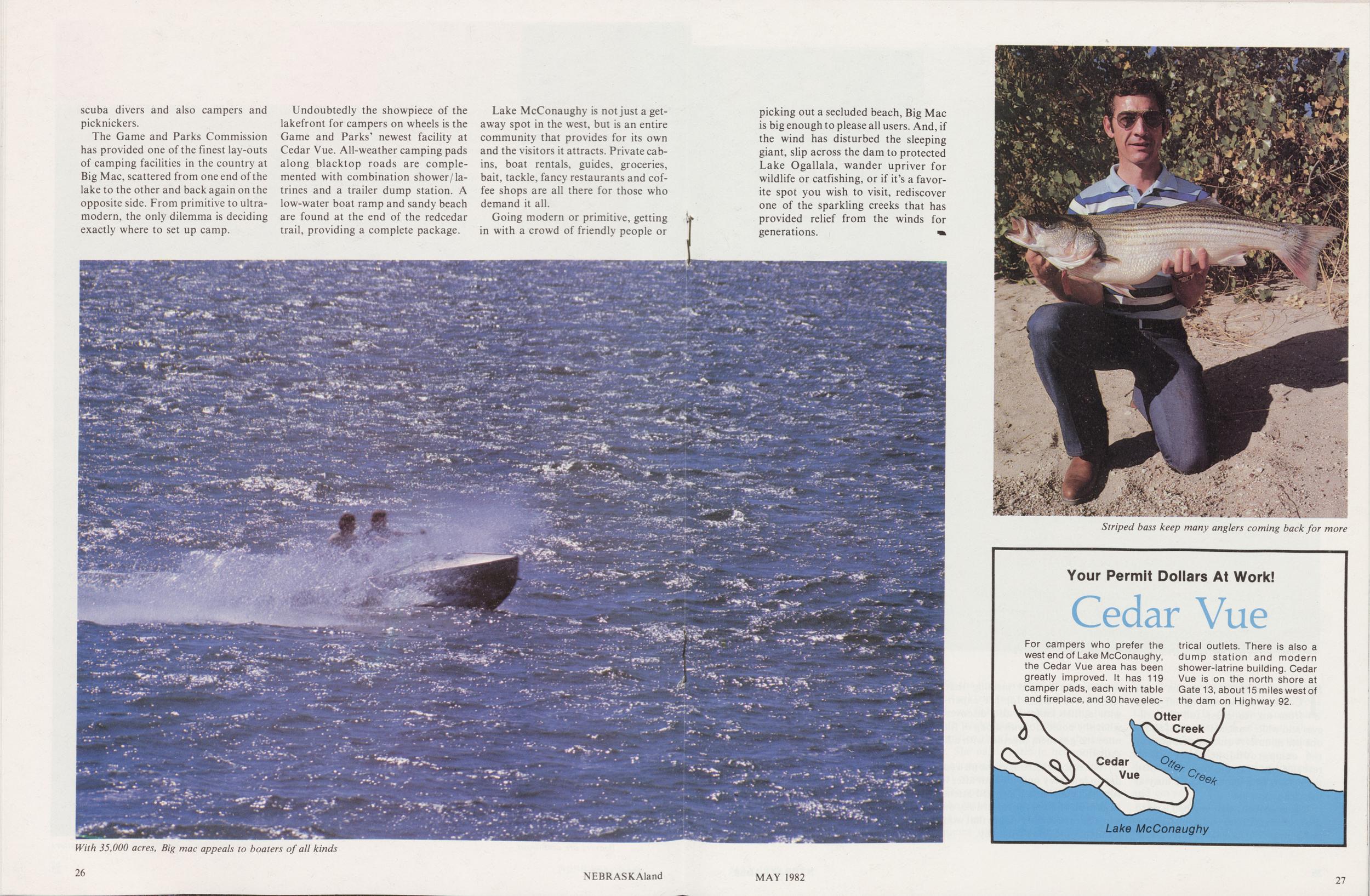
Undoubtedly the showpiece of the lakefront for campers on wheels is the Game and Parks' newest facility at Cedar Vue. All-weather camping pads along blacktop roads are complemented with combination shower/latrines and a trailer dump station. A low-water boat ramp and sandy beach are found at the end of the redcedar trail, providing a complete package.
Lake McConaughy is not just a getaway spot in the west, but is an entire community that provides for its own and the visitors it attracts. Private cabins, boat rentals, guides, groceries, bait, tackle, fancy restaurants and coffee shops are all there for those who demand it all.
Going modern or primitive, getting in with a crowd of friendly people or picking out a secluded beach, Big Mac is big enough to please all users. And, if the wind has disturbed the sleeping giant, slip across the dam to protected Lake Ogallala, wander upriver for wildlife or catfishing, or if it's a favorite spot you wish to visit, rediscover one of the sparkling creeks that has provided relief from the winds for generations.
With 35,000 acres, Big mac appeals to boaters of all kinds
Striped bass keep many anglers coming back for more
The Woman In Waders
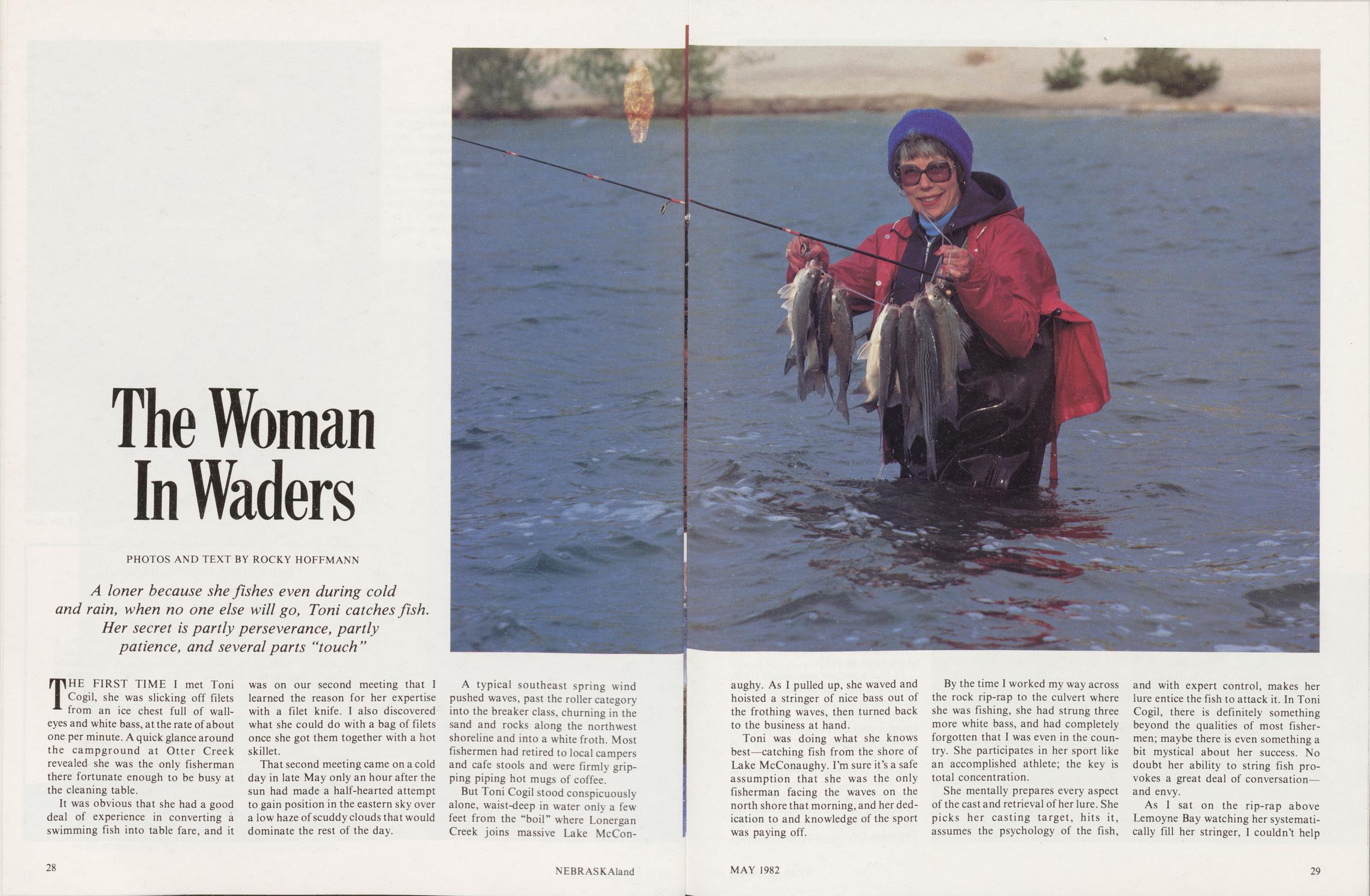
A loner because she fishes even during cold and rain, when no one else will go, Toni catches fish, Her secret is partly perseverance, partly patience, and several parts "touch"
THE FIRST TIME I met Toni Cogil, she was slicking off filets from an ice chest full of walleyes and white bass, at the rate of about one per minute. A quick glance around the campground at Otter Creek revealed she was the only fisherman there fortunate enough to be busy at the cleaning table.
It was obvious that she had a good deal of experience in converting a swimming fish into table fare, and it was on our second meeting that I learned the reason for her expertise with a filet knife. I also discovered what she could do with a bag of filets once she got them together with a hot skillet.
That second meeting came on a cold day in late May only an hour after the sun had made a half-hearted attempt to gain position in the eastern sky over a low haze of scuddy clouds that would dominate the rest of the day.
A typical southeast spring wind pushed waves, past the roller category into the breaker class, churning in the sand and rocks along the northwest shoreline and into a white froth. Most fishermen had retired to local campers and cafe stools and were firmly gripping piping hot mugs of coffee.
But Toni Cogil stood conspicuously alone, waist-deep in water only a few feet from the "boil" where Lonergan Creek joins massive Lake McConaughy.
28 NEBRASKAlandAs I pulled up, she waved and hoisted a stringer of nice bass out of the frothing waves, then turned back to the business at hand.
Toni was doing what she knows best—catching fish from the shore of Lake McConaughy. I'm sure it's a safe assumption that she was the only fisherman facing the waves on the north shore that morning, and her dedication to and knowledge of the sport was paying off.
By the time I worked my way across the rock rip-rap to the culvert where she was fishing, she had strung three more white bass, and had completely forgotten that I was even in the country. She participates in her sport like an accomplished athlete; the key is total concentration.
She mentally prepares every aspect of the cast and retrieval of her lure. She picks her casting target, hits it, assumes the psychology of the fish, and with expert control, makes her lure entice the fish to attack it. In Toni Cogil, there is definitely something beyond the qualities of most fishermen; maybe there is even something a bit mystical about her success. No doubt her ability to string fish provokes a great deal of conversation—and envy.
As I sat on the rip-rap above Lemoyne Bay watching her systematically fill her stringer, I couldn't help but think of the millions of dollars worth of big boats, heavy poles, large reels, downriggers, boxes of tackle, and guides that some people say are necessary to fish this impoundment, and the irony of the situation was that on this particular morning only the most sea-worthy boats would even be able to stay afloat, let alone employ all that tackle to catch fish.
MAY 1982 29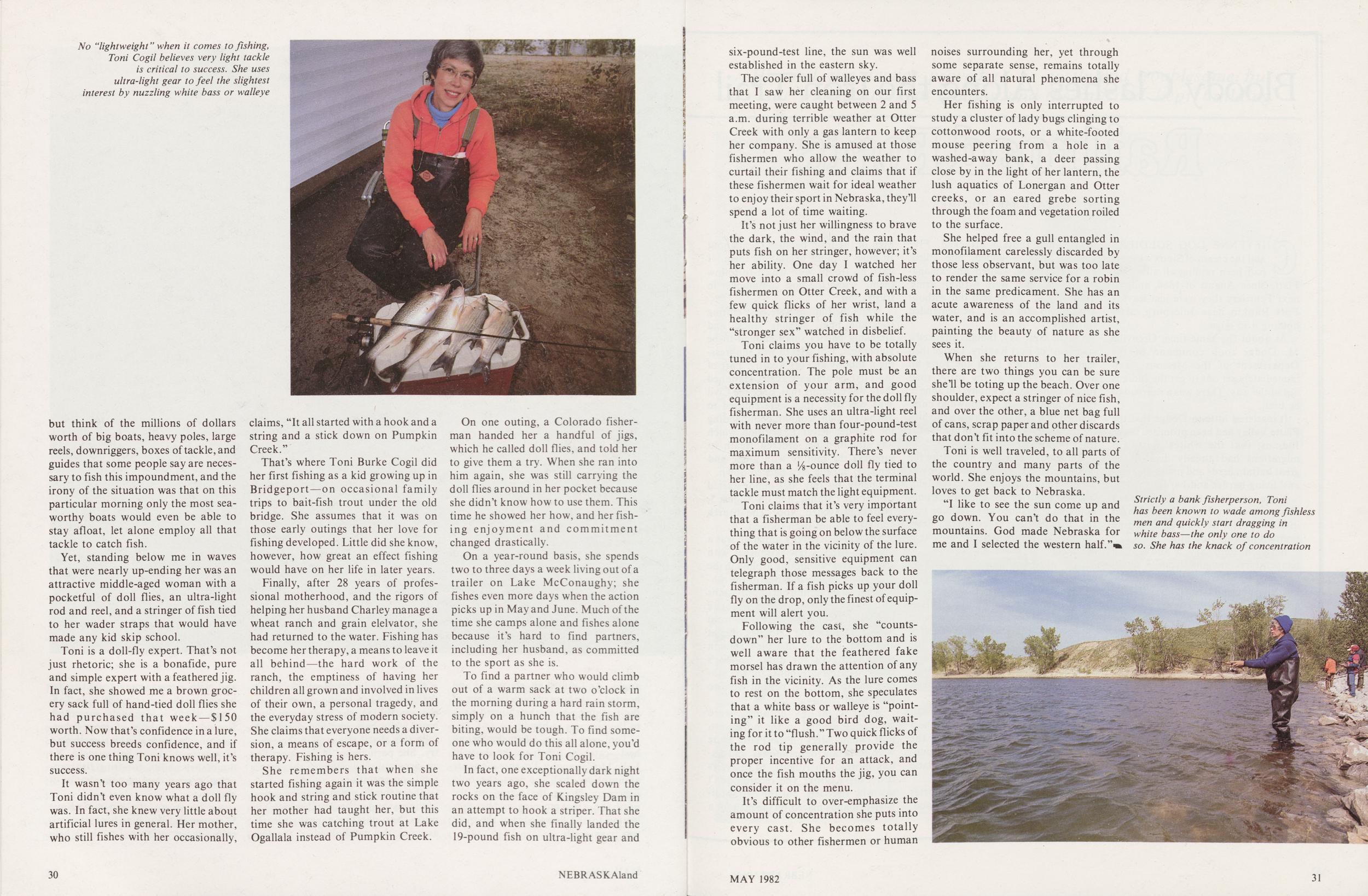
No "lightweight" when it comes to fishing, Toni Cogil believes very light tackle is critical to success. She uses ultra-light gear to feel the slightest interest by nuzzling white bass or walleye
Yet, standing below me in waves that were nearly up-ending her was an attractive middle-aged woman with a pocketful of doll flies, an ultra-light rod and reel, and a stringer offish tied to her wader straps that would have made any kid skip school.
Toni is a doll-fly expert. That's not just rhetoric; she is a bonafide, pure and simple expert with a feathered jig. In fact, she showed me a brown grocery sack full of hand-tied doll flies she had purchased that week — $150 worth. Now that's confidence in a lure, but success breeds confidence, and if there is one thing Toni knows well, it's success.
It wasn't too many years ago that Toni didn't even know what a doll flv was. In fact, she knew very little about artificial lures in general. Her mother, who still fishes with her occasionally, claims, "It all started with a hook and a string and a stick down on Pumpkin Creek."
That's where Toni Burke Cogil did her first fishing as a kid growing up in Bridgeport—on occasional family trips to bait-fish trout under the old bridge. She assumes that it was on those early outings that her love for fishing developed. Little did she know, however, how great an effect fishing would have on her life in later years.
Finally, after 28 years of professional motherhood, and the rigors of helping her husband Charley manage a wheat ranch and grain elelvator, she had returned to the water. Fishing has become her therapy, a means to leave it all behind—the hard work of the ranch, the emptiness of having her children all grown and involved in lives of their own, a personal tragedy, and the everyday stress of modern society. She claims that everyone needs a diversion, a means of escape, or a form of therapy. Fishing is hers.
She remembers that when she started fishing again it was the simple hook and string and stick routine that her mother had taught her, but this time she was catching trout at Lake Ogallala instead of Pumpkin Creek.
On one outing, a Colorado fisherman handed her a handful of jigs, which he called doll flies, and told her to give them a try. When she ran into him again, she was still carrying the doll flies around in her pocket because she didn't know how to use them. This time he showed her how, and her fishing enjoyment and commitment changed drastically.
On a year-round basis, she spends two to three days a week living out of a trailer on Lake McConaughy; she fishes even more days when the action picks up in May and June. Much of the time she camps alone and fishes alone because it's hard to find partners, including her husband, as committed to the sport as she is.
To find a partner who would climb out of a warm sack at two o'clock in the morning during a hard rain storm, simply on a hunch that the fish are biting, would be tough. To find someone who would do this all alone, you'd have to look for Toni Cogil.
In fact, one exceptionally dark night two years ago, she scaled down the rocks on the face of Kingsley Dam in an attempt to hook a striper. That she did, and when she finally landed the 19-pound fish on ultra-light gear and six-pound-test line, the sun was well established in the eastern sky.
30 NEBRASKAlandThe cooler full of walleyes and bass that I saw her cleaning on our first meeting, were caught between 2 and 5 a.m. during terrible weather at Otter Creek with only a gas lantern to keep her company. She is amused at those fishermen who allow the weather to curtail their fishing and claims that if these fishermen wait for ideal weather to enjoy their sport in Nebraska, they'll spend a lot of time waiting.
It's not just her willingness to brave the dark, the wind, and the rain that puts fish on her stringer, however; it's her ability. One day I watched her move into a small crowd of fish-less fishermen on Otter Creek, and with a few quick flicks of her wrist, land a healthy stringer of fish while the "stronger sex" watched in disbelief.
Toni claims you have to be totally tuned in to your fishing, with absolute concentration. The pole must be an extension of your arm, and good equipment is a necessity for the doll fly fisherman. She uses an ultra-light reel with never more than four-pound-test monofilament on a graphite rod for maximum sensitivity. There's never more than a ⅛-ounce doll fly tied to her line, as she feels that the terminal tackle must match the light equipment.
Toni claims that it's very important that a fisherman be able to feel everything that is going on below the surface of the water in the vicinity of the lure. Only good, sensitive equipment can telegraph those messages back to the fisherman. If a fish picks up your doll fly on the drop, only the finest of equipment will alert you.
Following the cast, she "counts-down" her lure to the bottom and is well aware that the feathered fake morsel has drawn the attention of any fish in the vicinity. As the lure comes to rest on the bottom, she speculates that a white bass or walleye is "pointing" it like a good bird dog, waiting for it to "flush." Two quick flicks of the rod tip generally provide the proper incentive for an attack, and once the fish mouths the jig, you can consider it on the menu.
It's difficult to over-emphasize the amount of concentration she puts into every cast. She becomes totally obvious to other fishermen or human noises surrounding her, yet through some separate sense, remains totally aware of all natural phenomena she encounters.
Her fishing is only interrupted to study a cluster of lady bugs clinging to cottonwood roots, or a white-footed mouse peering from a hole in a washed-away bank, a deer passing close by in the light of her lantern, the lush aquatics of Lonergan and Otter creeks, or an eared grebe sorting through the foam and vegetation roiled to the surface.
She helped free a gull entangled in monofilament carelessly discarded by those less observant, but was too late to render the same service for a robin in the same predicament. She has an acute awareness of the land and its water, and is an accomplished artist, painting the beauty of nature as she sees it.
When she returns to her trailer, there are two things you can be sure shell be toting up the beach. Over one shoulder, expect a stringer of nice fish, and over the other, a blue net bag full of cans, scrap paper and other discards that don't fit into the scheme of nature.
Toni is well traveled, to all parts of the country and many parts of the world. She enjoys the mountains, but loves to get back to Nebraska.
"I like to see the sun come up and go down. You can't do that in the mountains. God made Nebraska for me and I selected the western half."
Strictly a bank fisherperson, Toni has been known to wade among fishless men and quickly start dragging in white bass—the only one to do so. She has the knack of concentration
Bloody Clashes Along the Iron Trail
Railroad Forts
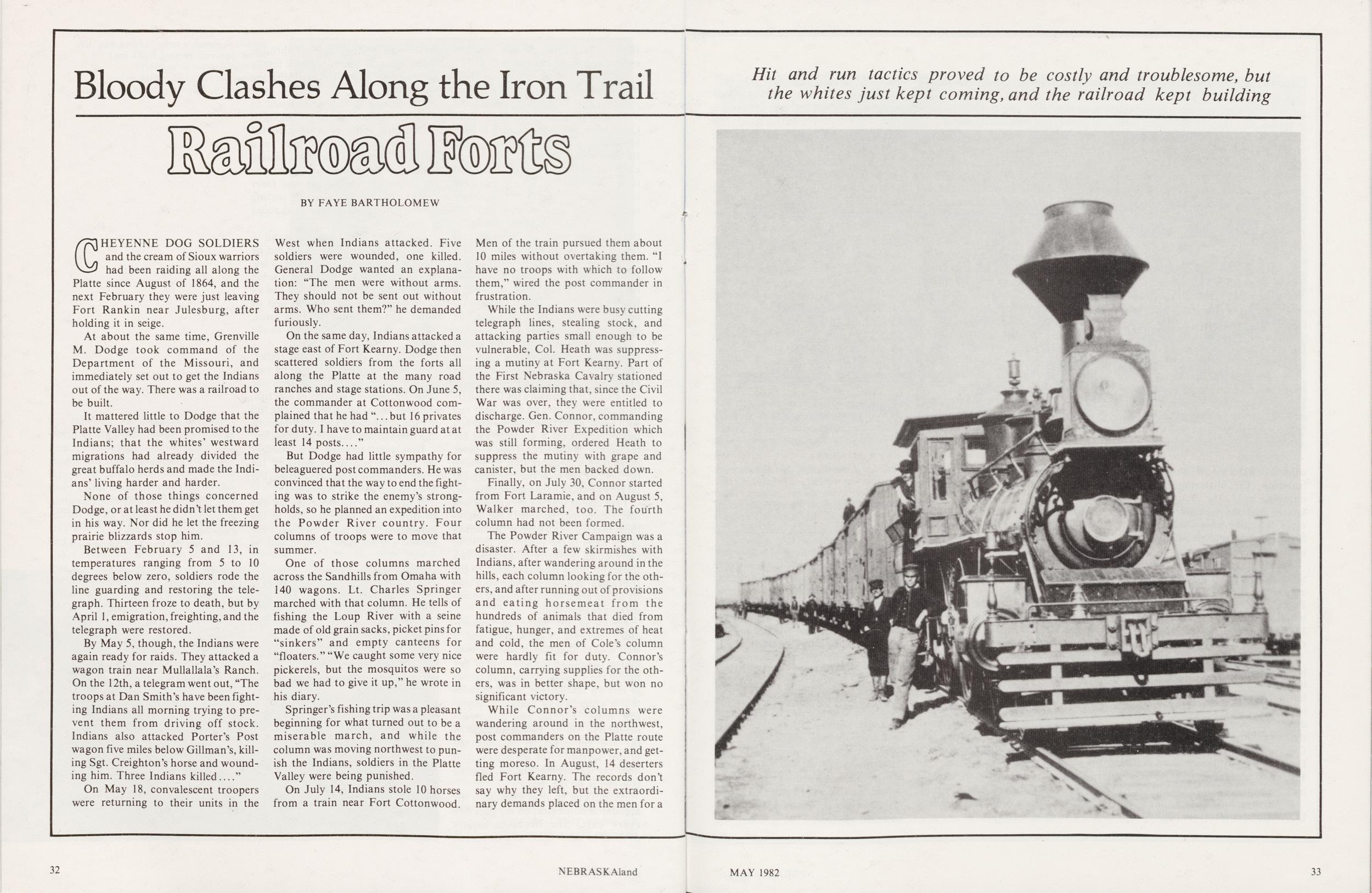
Hit and run tactics proved to be costly and troublesome, but the whites just kept coming, and the railroad kept building
CHEYENNE DOG SOLDIERS and the cream of Sioux warriors had been raiding all along the Platte since August of 1864, and the next February they were just leaving Fort Rankin near Julesburg, after holding it in seige.
At about the same time, Grenville M. Dodge took command of the Department of the Missouri, and immediately set out to get the Indians out of the way. There was a railroad to be built.
It mattered little to Dodge that the Platte Valley had been promised to the Indians; that the whites' westward migrations had already divided the great buffalo herds and made the Indians' living harder and harder.
None of those things concerned Dodge, or at least he didn't let them get in his way. Nor did he let the freezing prairie blizzards stop him.
Between February 5 and 13, in temperatures ranging from 5 to 10 degrees below zero, soldiers rode the line guarding and restoring the telegraph. Thirteen froze to death, but by April 1, emigration, freighting, and the telegraph were restored.
By May 5, though, the Indians were again ready for raids. They attacked a wagon train near Mullallala's Ranch. On the 12th, a telegram went out, "The troops at Dan Smith's have been fighting Indians all morning trying to prevent them from driving off stock. Indians also attacked Porter's Post wagon five miles below Gillman's, killing Sgt. Creighton's horse and wounding him. Three Indians killed...." On May 18, convalescent troopers were returning to their units in the West when Indians attacked. Five soldiers were wounded, one killed.
General Dodge wanted an explanation: "The men were without arms. They should not be sent out without arms. Who sent them?" he demanded furiously.
On the same day, Indians attacked a stage east of Fort Kearny. Dodge then scattered soldiers from the forts all along the Platte at the many road ranches and stage stations. On June 5, the commander at Cottonwood complained that he had "... but 16 privates for duty. I have to maintain guard at at least 14 posts...."
But Dodge had little sympathy for beleaguered post commanders. He was convinced that the way to end the fighting was to strike the enemy's strongholds, so he planned an expedition into the Powder River country. Four columns of troops were to move that summer.
One of those columns marched across the Sandhills from Omaha with 140 wagons. Lt. Charles Springer marched with that column. He tells of fishing the Loup River with a seine made of old grain sacks, picket pins for "sinkers" and empty canteens for "floaters." "We caught some very nice pickerels, but the mosquitos were so bad we had to give it up," he wrote in his diary.
Springer's fishing trip was a pleasant beginning for what turned out to be a miserable march, and while the column was moving northwest to punish the Indians, soldiers in the Platte Valley were being punished.
On July 14, Indians stole 10 horses from a train near Fort Cottonwood. Men of the train pursued them about 10 miles without overtaking them. "I have no troops with which to follow them," wired the post commander in frustration.
While the Indians were busy cutting telegraph lines, stealing stock, and attacking parties small enough to be vulnerable, Col. Heath was suppressing a mutiny at Fort Kearny. Part of the First Nebraska Cavalry stationed there was claiming that, since the Civil War was over, they were entitled to discharge. Gen. Connor, commanding the Powder River Expedition which was still forming, ordered Heath to suppress the mutiny with grape and canister, but the men backed down.
Finally, on July 30, Connor started from Fort Laramie, and on August 5, Walker marched, too. The fourth column had not been formed.
The Powder River Campaign was a disaster. After a few skirmishes with Indians, after wandering around in the hills, each column looking for the others, and after running out of provisions and eating horsemeat from the hundreds of animals that died from fatigue, hunger, and extremes of heat and cold, the men of Cole's column were hardly fit for duty. Connor's column, carrying supplies for the others, was in better shape, but won no significant victory.
While Connor's columns were wandering around in the northwest, post commanders on the Platte route were desperate for manpower, and getting moreso. In August, 14 deserters fled Fort Kearny. The records don't say why they left, but the extraordinary demands placed on the men for a
32 NEBRASKAland
stipend of $13 a month, along with the isolation, the blistering heat, and numbing cold, the frequent sneak attacks and the violence of the previous fall, may have contributed. In September, 58 soldiers at Fort Kearny's small garrison ran. And so it went. Indians and desertions. But even after all the harassment along the line and the disastrous Powder River campaign, railroad building began. On November 5, the Union Pacific broke ground at Omaha.
Skirmishes along the Bozeman Trail to Montana goldfields made it clear that the Army would have to open a trail there, too. Another Indian homeland was to be "opened;" the Indians driven out. A string of forts along the trail would do the job, and Col. Henry Carrington was sent to build them. In December, Carrington arrived at Fort Kearny to take command and to prepare an expedition In January, 50 Pawnee Scouts under Lt. Murie left the fort for the Republican. They set up base camp on Frenchman's Fork and went out looking for Indians.
Meanwhile, the corral at Cottonwood was raided—with guards on duty—and 36 mules and horses stolen. Next day, about 300 horses disappeared right under the guards' noses. Horses also disappeared from Gillman's.
All winter, Carrington had been gathering supplies and building materials at Fort Kearny for the Bozeman Trail expedition. Finally, on May 19, he moved, with churns and washing machines, canned fruit and livestock, along with piles of building materials, arms and ammunition.
Crossing the South Platte at Julesburg, the command moved through intense heat in western Nebraska. The temperature reached 101 degrees and the buffalo gnats swarmed over men and horses. Dust hung in choking clouds over the column, 2,000 strong, then wind would whip dust and sand into a stinging blizzard.
Railroad construction went quickly once a system was worked out (above) but that put greater strain on the military. Then, matters worsened as more people settled on land given to the railroads (opposite) As Carrington marched through western Nebraska, railroad workers were sweating their way from the east. There were ex-Confederate and Union soldiers, mule skinners, Mexicans, New York Irish, bushwackers and ex-convicts. By that time, too, Dodge had quit the Army and entered the chief engineer's office at U.P. headquarters in Omaha.
In each crew were 100 men dropping timbers into place; 100 men dragging rails from flatcars; 12 men tugging rails into place; bolters bolting them there; and others driving spikes. By August, the Union Pacific had built tracks beyond Plum Creek and the Indians staged their first raid. A powerful band swept down on a freight crew and captured a train. One of the cars was burned.
34 NEBRASKAlandDuring that same month, Sherman visited Fort McPherson. Among other remarks he said that the men's quarters were unfit for use. "They are low, hot, and close, have dirt roofs and are full of vermin and too small to accommodate the troops," he said. Soldiers' quarters anywhere on the plains were in sharp contrast to those occupied by excursionists entertained by the Union Pacific in October when the road passed the 100th Meridian. Railroad bigwigs organized the trip and sent invitations to President Andrew Johnson and his cabinet, as well as Congressmen, ambassadors, and most important, investors. Although Johnson declined the invitation, more than 200 of the nation's richest and most powerful didn't. At Omaha, the railroad held a number of receptions and balls. For the journey, the excursionists lounged in luxury aboard four brand spanking new passenger coaches. They could use a saloon car and a dining car. The Pawnees staged a battle and performed war dances. There were fireworks—and a chance to watch those hordes of men at work. Millions of dollars in railroad bonds sold after the excursion, but while financiers forked out their cash back east, the blizzard season was closing in on the plains. Late in November, the railroad men went into winter quarters between the forks of the Platte, and named the place North Platte. When the 2,000 railroad workers set up their tents for winter, the only permanent building was the railroad station, but within mere weeks, a hundred buildings had sprung up. That fall, Carrington and his soldiers had been confined at Fort Phil Kearny by overwhelming numbers of hostile Cheyenne and Sioux. Then, in December, a detachment of 81 men under Capt. William J. Fetterman went to the relief of a wood detail and was massacred. News of the disaster reached Fort Laramie during the Christmas festivities there, when a frozen and bedraggled John "Portugee" Phillips staggered into the ballroom with a message from Carrington. The post was in danger of falling at any moment, he said. Philip St. George Cooke, then commanding the Department of the Platte, relieved Carrington of command and sent reinforcements he'd refused to send before. On January 23, during a raging blizzard, Carrington's command departed from the fort. With them was Frances Grummond, newly widowed and six months pregnant, traveling with the body of her young husband. The mercury congealed in the thermometer at -40°. As men were shuffled all over the plains to allow relief for the Bozeman Trail forts, forced marches resulted in more men being frostbitten. At Lawrence Ford on January 18, a large band of Cheyenne attacked a camp of herders wintering there, 15 miles north of present-day Potter. Indians swept down on the herders, ran off over 200 head of stock, and wounded several men. A messenger slipped out of camp and raced for Fort Sedgewick, where 42 men saddled up to relieve the herders and recover stock. The weather was severe and by the time they had recovered 58 of the stolen animals, they had marched 256 miles, lost one man in a skirmish with the Indians in the Lodgepole Valley, and 27 men were frostbitten, several requiring amputations.
SHOWING THE UNION PACIFIC RAILROAD MAY 1982 35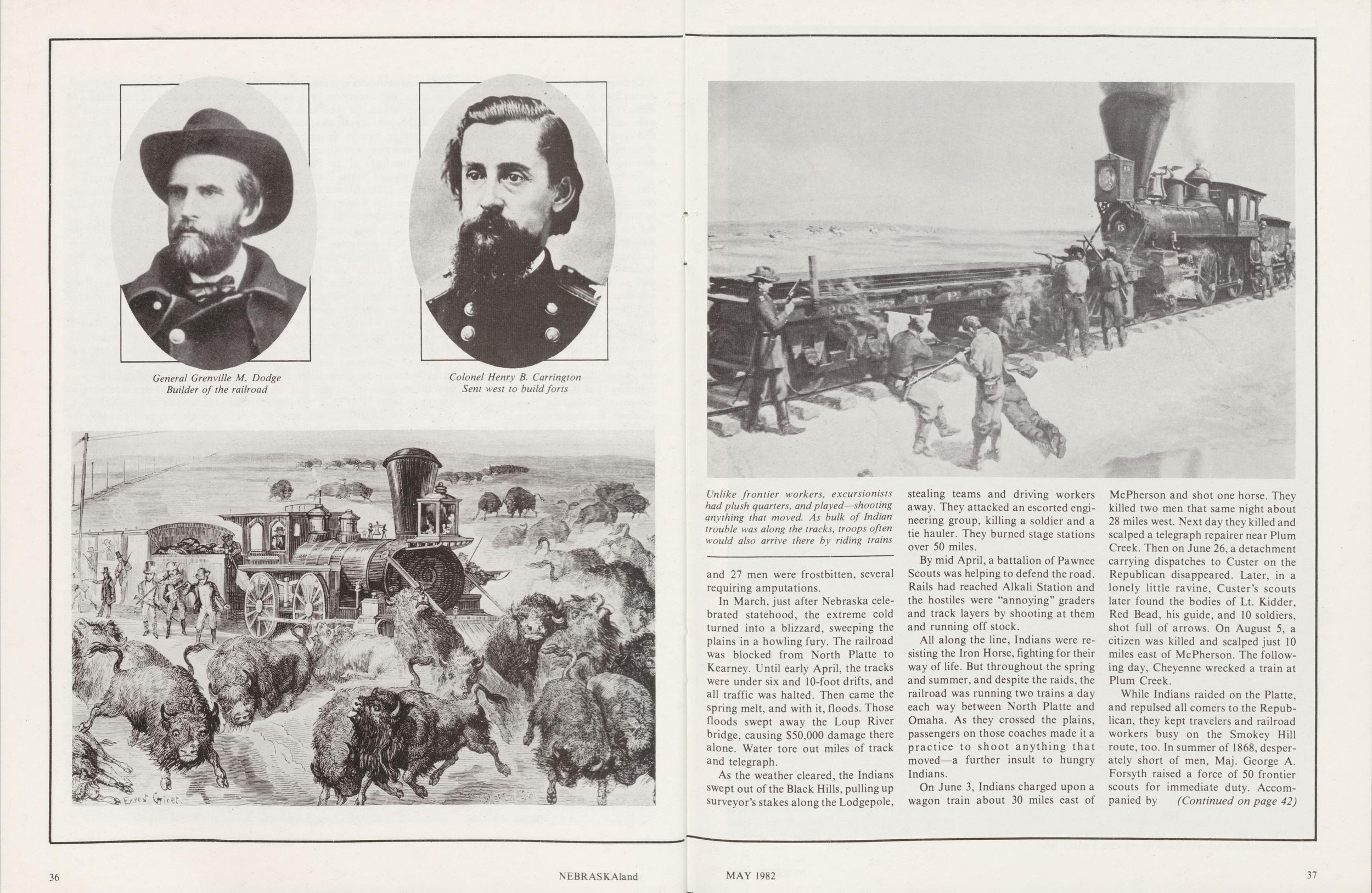
Unlike frontier workers, excursionists had plush quarters, and played—shooting anything that moved. As bulk of Indian trouble was along the tracks, troops often would also arrive there by riding trains
In March, just after Nebraska celebrated statehood, the extreme cold turned into a blizzard, sweeping the plains in a howling fury. The railroad was blocked from North Platte to Kearney. Until early April, the tracks were under six and 10-foot drifts, and all traffic was halted. Then came the spring melt, and with it, floods. Those floods swept away the Loup River bridge, causing $50,000 damage there alone. Water tore out miles of track and telegraph.
As the weather cleared, the Indians swept out of the Black Hills, pulling up surveyor's stakes along the Lodgepole, stealing teams and driving workers away. They attacked an escorted engineering group, killing a soldier and a tie hauler. They burned stage stations over 50 miles.
By mid April, a battalion of Pawnee Scouts was helping to defend the road. Rails had reached Alkali Station and the hostiles were "annoying" graders and track layers by shooting at them and running off stock.
All along the line, Indians were resisting the Iron Horse, fighting for their way of life. But throughout the spring and summer, and despite the raids, the railroad was running two trains a day each way between North Platte and Omaha. As they crossed the plains, passengers on those coaches made it a practice to shoot anything that moved—a further insult to hungry Indians.
On June 3, Indians charged upon a wagon train about 30 miles east of McPherson and shot one horse. They killed two men that same night about 28 miles west. Next day they killed and scalped a telegraph repairer near Plum Creek. Then on June 26, a detachment carrying dispatches to Custer on the Republican disappeared. Later, in a lonely little ravine, Custer's scouts later found the bodies of Lt. Kidder, Red Bead, his guide, and 10 soldiers, shot full of arrows. On August 5, a citizen was killed and scalped just 10 miles east of McPherson. The following day, Cheyenne wrecked a train at Plum Creek.
While Indians raided on the Platte, and repulsed all comers to the Republican, they kept travelers and railroad workers busy on the Smokey Hill route, too. In summer of 1868, desperately short of men, Maj. George A. Forsyth raised a force of 50 frontier scouts for immediate duty. Accompanied by (Continued on page 42)
MAY 1982 37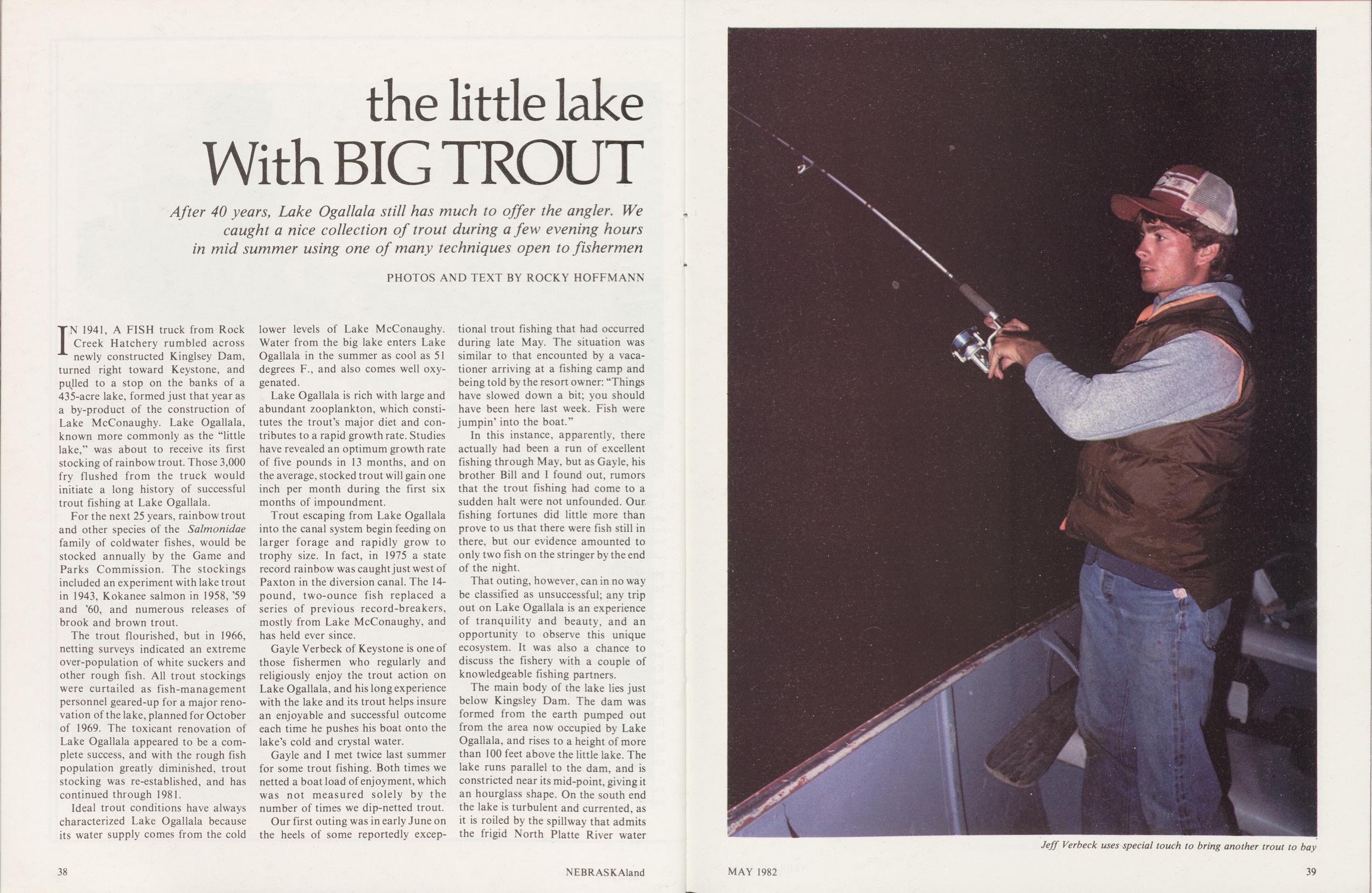
the little lake With BIG TROUT
After 40 years, Lake Ogallala still has much to offer the angler. We caught a nice collection of trout during a few evening hours in mid summer using one of many techniques open to fishermen
IN 1941, A FISH truck from Rock Creek Hatchery rumbled across newly constructed Kinglsey Dam, turned right toward Keystone, and pulled to a stop on the banks of a 435-acre lake, formed just that year as a by-product of the construction of Lake McConaughy. Lake Ogallala, known more commonly as the "little lake," was about to receive its first stocking of rainbow trout. Those 3,000 frv flushed from the truck would initiate a long history of successful trout fishing at Lake Ogallala.
For the next 25 years, rainbow trout and other species of the Salmonidae family of coldwater fishes, would be stocked annually by the Game and Parks Commission. The stockings included an experiment with lake trout in 1943, Kokanee salmon in 1958, '59 and '60, and numerous releases of brook and brown trout.
The trout flourished, but in 1966, netting surveys indicated an extreme over-population of white suckers and other rough fish. All trout stockings were curtailed as fish-management personnel geared-up for a major renovation of the lake, planned for October of 1969. The toxicant renovation of Lake Ogallala appeared to be a complete success, and with the rough fish population greatly diminished, trout stocking was re-established, and has continued through 1981.
Ideal trout conditions have always characterized Lake Ogallala because its water supply comes from the cold lower levels of Lake McConaughy. Water from the big lake enters Lake Ogallala in the summer as cool as 51 degrees F., and also comes well oxygenated.
Lake Ogallala is rich with large and abundant zooplankton, which constitutes the trout's major diet and contributes to a rapid growth rate. Studies have revealed an optimum growth rate of five pounds in 13 months, and on the average, stocked trout will gain one inch per month during the first six months of impoundment.
Trout escaping from Lake Ogallala into the canal system begin feeding on larger forage and rapidly grow to trophy size. In fact, in 1975 a state record rainbow was caught just west of Paxton in the diversion canal. The 14-pound, two-ounce fish replaced a series of previous record-breakers, mostly from Lake McConaughy, and has held ever since.
Gayle Verbeck of Keystone is one of those fishermen who regularly and religiously enjoy the trout action on Lake Ogallala, and his long experience with the lake and its trout helps insure an enjoyable and successful outcome each time he pushes his boat onto the lake's cold and crystal water.
Gayle and I met twice last summer for some trout fishing. Both times we netted a boat load of enjoyment, which was not measured solely by the number of times we dip-netted trout.
Our first outing was in early June on the heels of some reportedly exceptional trout fishing that had occurred during late May. The situation was similar to that encounted by a vacationer arriving at a fishing camp and being told by the resort owner: "Things have slowed down a bit; you should have been here last week. Fish were jumpin' into the boat."
In this instance, apparently, there actually had been a run of excellent fishing through May, but as Gayle, his brother Bill and I found out, rumors that the trout fishing had come to a sudden halt were not unfounded. Our fishing fortunes did little more than prove to us that there were fish still in there, but our evidence amounted to only two fish on the stringer by the end of the night.
That outing, however, can in no way be classified as unsuccessful; any trip out on Lake Ogallala is an experience of tranquility and beauty, and an opportunity to observe this unique ecosystem. It was also a chance to discuss the fishery with a couple of knowledgeable fishing partners.
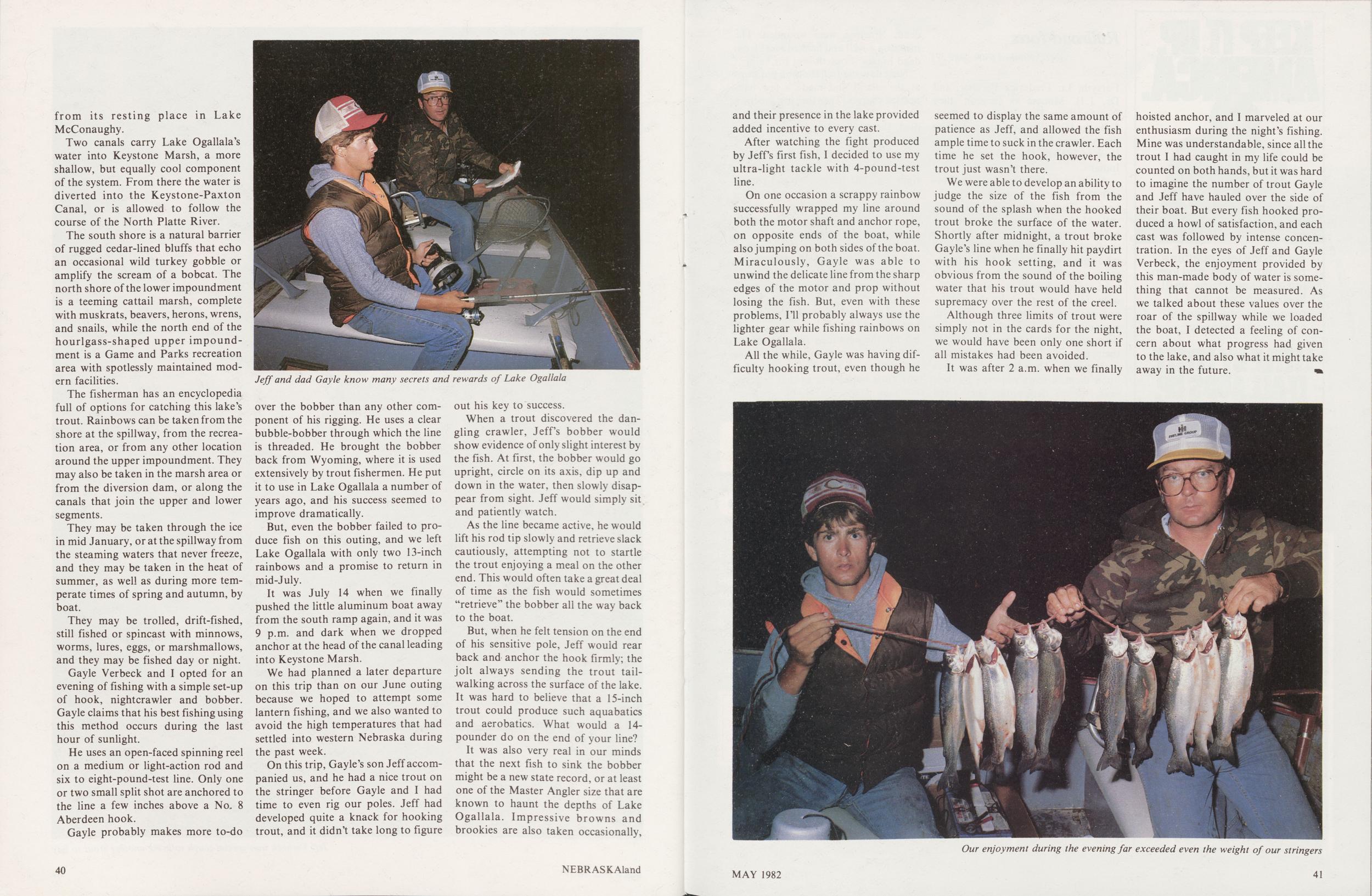
Jeff Verbeck uses special touch to bring another trout to bay
 from its resting place in Lake
McConaughy.
from its resting place in Lake
McConaughy.Two canals carry Lake Ogallala's water into Keystone Marsh, a more shallow, but equally cool component of the system. From there the water is diverted into the Keystone-Paxton Canal, or is allowed to follow the course of the North Platte River.
The south shore is a natural barrier of rugged cedar-lined bluffs that echo an occasional wild turkey gobble or amplify the scream of a bobcat. The north shore of the lower impoundment is a teeming cattail marsh, complete with muskrats, beavers, herons, wrens, and snails, while the north end of the hourlgass-shaped upper impoundment is a Game and Parks recreation area with spotlessly maintained modern facilities.
The fisherman has an encyclopedia full of options for catching this lake's trout. Rainbows can be taken from the shore at the spillway, from the recreation area, or from any other location around the upper impoundment. They may also be taken in the marsh area or from the diversion dam, or along the canals that join the upper and lower segments.
They may be taken through the ice in mid January, or at the spillway from the steaming waters that never freeze, and they may be taken in the heat of summer, as well as during more temperate times of spring and autumn, by boat.
They may be trolled, drift-fished, still fished or spincast with minnows, worms, lures, eggs, or marshmallows, and they may be fished day or night.
Gayle Verbeck and I opted for an evening of fishing with a simple set-up of hook, nightcrawler and bobber. Gayle claims that his best fishing using this method occurs during the last hour of sunlight.
He uses an open-faced spinning reel on a medium or light-action rod and six to eight-pound-test line. Only one or two small split shot are anchored to the line a few inches above a No. 8 Aberdeen hook.
Gayle probably makes more to-do Jeff and dad Gayle know many secrets and rewards of Lake Ogallala over the bobber than any other component of his rigging. He uses a clear bubble-bobber through which the line is threaded. He brought the bobber back from Wyoming, where it is used extensively by trout fishermen. He put it to use in Lake Ogallala a number of years ago, and his success seemed to improve dramatically.
But, even the bobber failed to produce fish on this outing, and we left Lake Ogallala with only two 13-inch rainbows and a promise to return in mid-July.
It was July 14 when we finally pushed the little aluminum boat away from the south ramp again, and it was 9 p.m. and dark when we dropped anchor at the head of the canal leading into Keystone Marsh.
We had planned a later departure on this trip than on our June outing because we hoped to attempt some lantern fishing, and we also wanted to avoid the high temperatures that had settled into western Nebraska during the past week.
On this trip, Gayle's son Jeff accompanied us, and he had a nice trout on the stringer before Gayle and I had time to even rig our poles. Jeff had developed quite a knack for hooking trout, and it didn't take long to figure out his key to success.
When a trout discovered the dangling crawler, Jeff's bobber would show evidence of only slight interest by the fish. At first, the bobber would go upright, circle on its axis, dip up and down in the water, then slowly disappear from sight. Jeff would simply sit and patiently watch.
As the line became active, he would lift his rod tip slowly and retrieve slack cautiously, attempting not to startle the trout enjoying a meal on the other end. This would often take a great deal of time as the fish would sometimes "retrieve" the bobber all the way back to the boat.
But, when he felt tension on the end of his sensitive pole, Jeff would rear back and anchor the hook firmly; the jolt always sending the trout tail-walking across the surface of the lake. It was hard to believe that a 15-inch trout could produce such aquabatics and aerobatics. What would a 14-pounder do on the end of your line?
It was also very real in our minds that the next fish to sink the bobber might be a new state record, or at least one of the Master Angler size that are known to haunt the depths of Lake Ogallala. Impressive browns and brookies are also taken occasionally, and their presence in the lake provided added incentive to every cast.
40 NEBRASKAlandAfter watching the fight produced by Jeff's first fish, I decided to use my ultra-light tackle with 4-pound-test line.
On one occasion a scrappy rainbow successfully wrapped my line around both the motor shaft and anchor rope, on opposite ends of the boat, while also jumping on both sides of the boat. Miraculously, Gayle was able to unwind the delicate line from the sharp edges of the motor and prop without losing the fish. But, even with these problems, I'll probably always use the lighter gear while fishing rainbows on Lake Ogallala.
All the while, Gayle was having difficulty hooking trout, even though he seemed to display the same amount of patience as Jeff, and allowed the fish ample time to suck in the crawler. Each time he set the hook, however, the trout just wasn't there.
We were able to develop an ability to judge the size of the fish from the sound of the splash when the hooked trout broke the surface of the water. Shortly after midnight, a trout broke Gayle's line when he finally hit paydirt with his hook setting, and it was obvious from the sound of the boiling water that his trout would have held supremacy over the rest of the creel.
Although three limits of trout were simply not in the cards for the night, we would have been only one short if all mistakes had been avoided.
It was after 2 a.m. when we finally hoisted anchor, and I marveled at our enthusiasm during the night's fishing. Mine was understandable, since all the trout I had caught in my life could be counted on both hands, but it was hard to imagine the number of trout Gayle and Jeff have hauled over the side of their boat. But every fish hooked produced a howl of satisfaction, and each cast was followed by intense concentration. In the eyes of Jeff and Gayle Verbeck, the enjoyment provided by this man-made body of water is something that cannot be measured. As we talked about these values over the roar of the spillway while we loaded the boat, I detected a feeling of concern about what progress had given to the lake, and also what it might take away in the future.
Our enjoyment during the evening far exceeded even the weight of our stringers
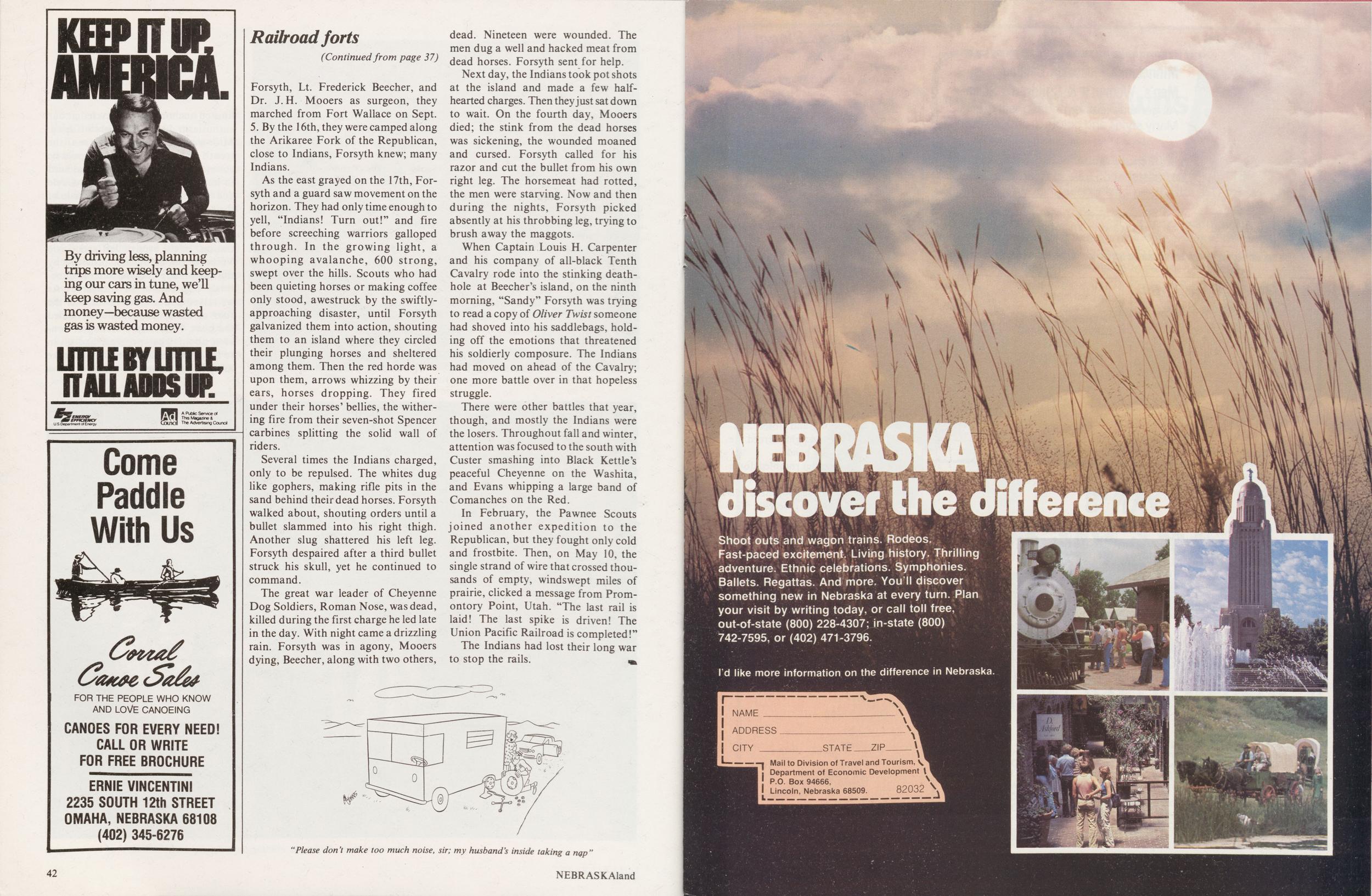
Railroad forts
(Continued from page 37)As the east grayed on the 17th, Forsyth and a guard saw movement on the horizon. They had only time enough to yell, "Indians! Turn out!" and fire before screeching warriors galloped through. In the growing light, a whooping avalanche, 600 strong, swept over the hills. Scouts who had been quieting horses or making coffee only stood, awestruck by the swiftly-approaching disaster, until Forsyth galvanized them into action, shouting them to an island where they circled their plunging horses and sheltered among them. Then the red horde was upon them, arrows whizzing by their ears, horses dropping. They fired under their horses' bellies, the withering fire from their seven-shot Spencer carbines splitting the solid wall of riders.
Several times the Indians charged, only to be repulsed. The whites dug like gophers, making rifle pits in the sand behind their dead horses. Forsyth walked about, shouting orders until a bullet slammed into his right thigh. Another slug shattered his left leg. Forsyth despaired after a third bullet struck his skull, yet he continued to command.
The great war leader of Cheyenne Dog Soldiers, Roman Nose, was dead, killed during the first charge he led late in the day. With night came a drizzling rain. Forsyth was in agony, Mooers dying, Beecher, along with two others, dead. Nineteen were wounded. The men dug a well and hacked meat from dead horses. Forsyth sent for help.
Next day, the Indians took pot shots at the island and made a few half-hearted charges. Then they just sat down to wait. On the fourth day, Mooers died; the stink from the dead horses was sickening, the wounded moaned and cursed. Forsyth called for his razor and cut the bullet from his own right leg. The horsemeat had rotted, the men were starving. Now and then during the nights, Forsyth picked absently at his throbbing leg, trying to brush away the maggots.
When Captain Louis H. Carpenter and his company of all-black Tenth Cavalry rode into the stinking death-hole at Beecher's island, on the ninth morning, "Sandy" Forsyth was trying to read a copy of Oliver Twist someone had shoved into his saddlebags, holding off the emotions that threatened his soldierly composure. The Indians had moved on ahead of the Cavalry; one more battle over in that hopeless struggle.
There were other battles that year, though, and mostly the Indians were the losers. Throughout fall and winter, attention was focused to the south with Custer smashing into Black Kettle's peaceful Cheyenne on the Washita, and Evans whipping a large band of Comanches on the Red.
In February, the Pawnee Scouts joined another expedition to the Republican, but they fought only cold and frostbite. Then, on May 10, the single strand of wire that crossed thousands of empty, windswept miles of prairie, clicked a message from Promontory Point, Utah. "The last rail is laid! The last spike is driven! The Union Pacific Railroad is completed!"
The Indians had lost their long war to stop the rails.
Where Violets Bloom
(Continued from page 17)Papa took the lanterns and the satchels from Donnie and Maudie. That gave the girls a chance to scrutinize the camp more closely. There were three dogs, two mongrels and a shepherd. The shepherd whined as the girls patted him. The mongrels slunk under the wagon. There were four oxen. Two of them were very sick. Queenie, a white cow, lay bloated and gasping. Buck, a red, lay quietly staring into the darkness. They moved their heads as Mr. Meeker spoke to them, but were too sick to respond to his voice.
The men hurried to the creek, which lay parallel to the railroad tracks, and soaked the sacks.
Papa covered the animals' heads and shoulders with the wet sacks. He forced some liquid down their throats. They seemed to breathe easier after that.
The raincrows had begun to settle down. The stars, although scattered, were twinkling overhead. A train whistled at a far-away crossing. Its rumbling came closer and closer. Suddenly, a gleaming red light pierced the darkness around the bend.
The horrible intruder rumbled down the swath of light, belching cinders and smoke. Two weird faces appeared at a side window in the engine cab. The group sitting beside the campfire waved to them in passing. The coach light cast an eerie glow as it slithered past. The caboose was dark and lumbering. There was a man swinging a lantern in greeting on the porch of the caboose.
The girls had buried their faces in their hands as the train came into view, but had been brave enough to peek through their fingers so they did not
44 NEBRASKAland
miss the excitement of its passing. They heard the train slow and slide into the station in Carleton, then huff on its way again.
Mr. Meeker and Sam gathered firewood and carried it into the wagon. The topsy stove was soon glowing red. Coffee was boiling in an old blue pot, sending out delicious odors. Maudie stirred up some 'jonny cakes,' and Donnie served each man a huge stack of them glistening with molasses and bacon drippings.
Rising from the table, Mr. Meeker reached for a harmonica on a shelf. Softly he played, 'Rock of Ages' and 'Jesus, Lover of My Soul.' Maudie accompanied him on an ancient accordion. She listened for the notes and played one at a time with one finger. Mr. Meeker waited patiently for her to choose the correct key.
When the men went outside to check the animals, the girls looked through an album which lay on a table. There were many pictures of far-away places where Mr. Meeker had visited. There were several of his covered wagon and animals.
The girls could hear shovels hitting rocks, dogs whining, and men muffling their voices as they conversed. Mr. Meeker came to the wagon and asked about the girls' welfare. He laid his head against the side of the wagon. The girls tried to comfort him as he sobbed in his grief.
Before the girls left the camp, they crept around the wagon. There were two mounds near the right-of-way. Queenie and Buck were gone. Papa did not speak as he put his arm around Mr. Meeker's shoulders. Mr. Meeker gave the girls several of the pictures.
Months later The sun grew higher and higher in the sky. The pupils were growing restless. Everyone sang "Glory, Glory Hallelujah."
The mayor and the school superintendent were going to say some kind things about Mr. Meeker. But where was Mr. Meeker?
The music teacher took a pitch pipe from his pocket. We all sang and sang, rounds and hymns and patriotic songs. We were a happy group. Mr. Parker, the blacksmith, danced and stood on his head. We all became slightly unmanageable.
A student on a saddle horse came riding up in a cloud of dust. Bending down from his saddle, he talked with the mayor in a low voice. Then he rode away again in another direction.
Everyone was peering into the distance. The covered wagon caravan had been seen over an hour ago between Carleton and Davenport, which was the next town to the west. Men on horseback had gone to escort the group into town. They had been gone for some time.
Mr. Meeker had given them the slip. He had taken a cut-off between the two towns. He was coming down the right-of-way from the west, past the graves of his oxen. Finally, here they came. A cheer went up from the students. On past the livery stable. On past the blacksmith shop and the big brick building on the corner. At last the caravan pulled up and stopped by the pump in the middle of the street.
There were two oxen, one cow, a horse and two men.
Donnie and Maudie exchanged glances. They had a secret. No one knew it but Papa and Sam Wiley, and neither of them was here today. Everyone stopped singing. The mayor had raised his hand. There was something wrong! The mayor signaled for quietness. There would be no program, as Mr. Meeker was very ill. He must hurry on to Hebron and enter a hospital. He had hired a man to drive and to care for his animals. A sweet, sad stillness fell upon the crowd. Several pupils called, "Good-bye, Mr. Meeker."
But not Donnie and Maudie. Jumping off the high perch where they had been sitting, the girls ran through the crowd calling, "Wait! Mr. Meeker. Wait!"
Someone helped Maudie up where she could show Mr. Meeker her new red shoes. Leaning down, Mr. Meeker kissed her, and reaching down, patted Donnie on her head.
"The flowers... out there...," he stammered. "You put them there?" "Yes... Yes... we always do," cried the girls together. "You know how much I loved them... my oxen...," he said in a quivering voice. "I can play, 'Rock of Ages,' 'Jesus Lover of My Soul'," said Maudie. "Bless you, little nurses," he whispered, "Bless you."
As the wagon lumbered down the road toward Hebron, several playmates questioned Donnie and Maudie as to what Mr. Meeker had said, but the girls would not tell.
The little girls, Donnie and Maudie, often placed bunches of flowers, mostly violets, which grew in profusion along the railroad tracks, upon the oxen's graves. Often they scattered the blossoms among the weeds which in time covered the raw earth. Once they gathered as many as they could find and made a complete blanket. Another time they gathered oyster shells from the tracks and spelled out the oxen's names. Years later they were told that railroad men had gathered up the shells and flowers and dumped them onto the railroad tracks. But the graves are still there, as a sort of memorial to one of our trailblazers, a pioneer. We salute you, Ezra Meeker, a great pioneer.
NEBRASKAland proudly presents the stories of its readers. Here is the opportunity so many have requested-a chance to tell their own outdoor tales. Hunting trips, the "big fish that got away", unforgettable characters, outdoor impressions-all have a place here. If you have a story to tell, jot it down and send it to Editor, NEBRASKAland, Box 30370, Lincoln, Nebr. 68503. Send photographs, black and white or color, too, if any are available.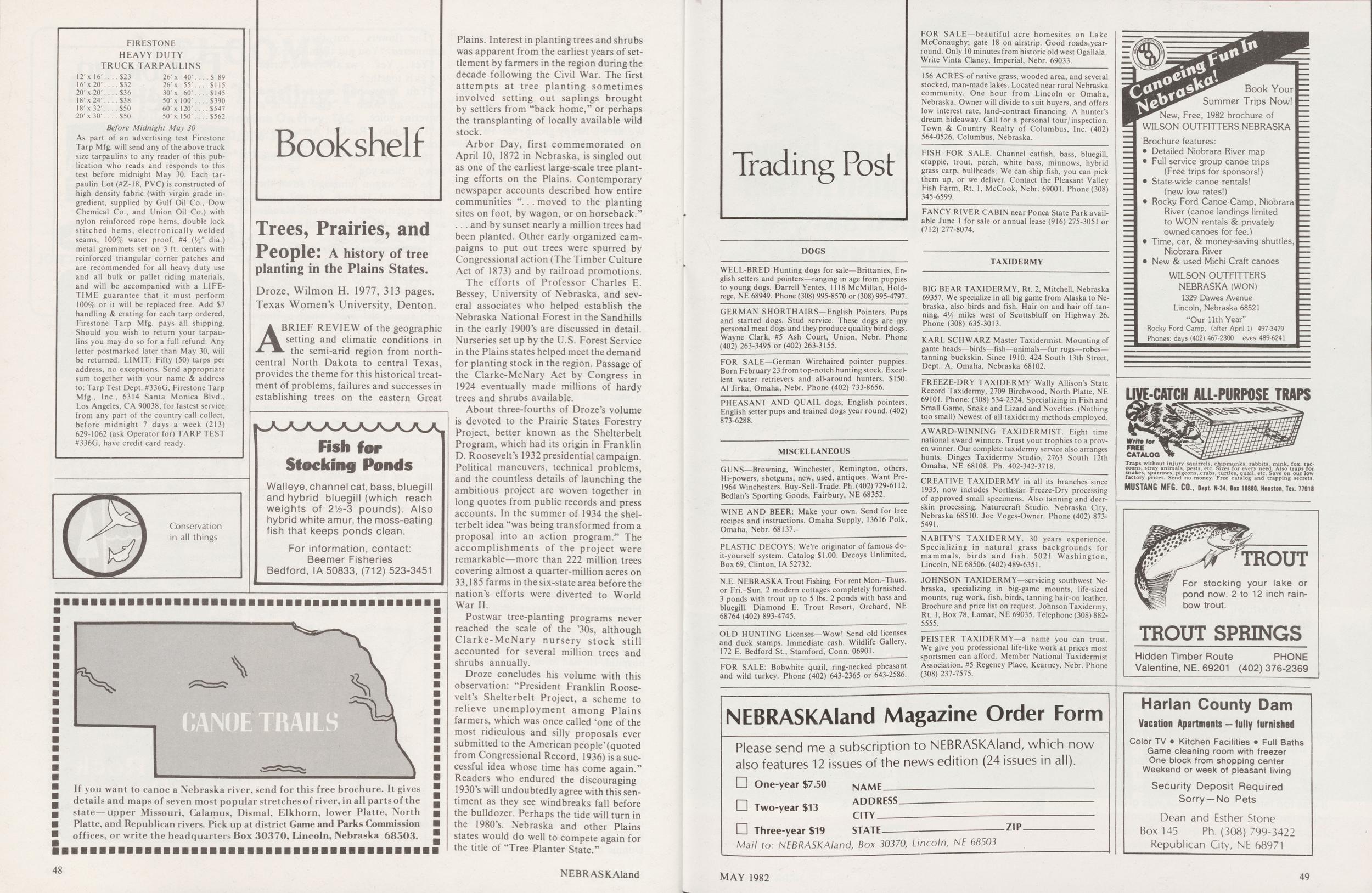
Bookshelf
Trees, Prairies, and People: A history of tree planting in the Plains States. Droze, Wilmon H. 1977, 313 pages. Texas Women's University, Denton.A BRIEF REVIEW of the geographic setting and climatic conditions in the semi-arid region from north-central North Dakota to central Texas, provides the theme for this historical treatment of problems, failures and successes in establishing trees on the eastern Great Plains. Interest in planting trees and shrubs was apparent from the earliest years of settlement by farmers in the region during the decade following the Civil War. The first attempts at tree planting sometimes involved setting out saplings brought by settlers from "back home," or perhaps the transplanting of locally available wild stock.
Arbor Day, first commemorated on April 10, 1872 in Nebraska, is singled out as one of the earliest large-scale tree planting efforts on the Plains. Contemporary newspaper accounts described how entire communities ". . . moved to the planting sites on foot, by wagon, or on horseback." . . . and by sunset nearly a million trees had been planted. Other early organized campaigns to put out trees were spurred by Congressional action (The Timber Culture Act of 1873) and by railroad promotions.
The efforts of Professor Charles E. Bessey, University of Nebraska, and several associates who helped establish the Nebraska National Forest in the Sandhills in the early 1900's are discussed in detail. Nurseries set up by the U.S. Forest Service in the Plains states helped meet the demand for planting stock in the region. Passage of the Clarke-McNary Act by Congress in 1924 eventually made millions of hardy trees and shrubs available.
About three-fourths of Droze's volume is devoted to the Prairie States Forestry Project, better known as the Shelterbelt Program, which had its origin in Franklin D. Roosevelt's 1932 presidential campaign. Political maneuvers, technical problems, and the countless details of launching the ambitious project are woven together in long quotes from public records and press accounts. In the summer of 1934 the shelterbelt idea "was being transformed from a proposal into an action program." The accomplishments of the project were remarkable—more than 222 million trees covering almost a quarter-million acres on 33,185 farms in the six-state area before the nation's efforts were diverted to World War II.
Postwar tree-planting programs never reached the scale of the '30s, although Clarke-McNary nursery stock still accounted for several million trees and shrubs annually.
Droze concludes his volume with this observation: "President Franklin Roosevelt's Shelterbelt Project, a scheme to relieve unemployment among Plains farmers, which was once called 'one of the most ridiculous and silly proposals ever submitted to the American people'(quoted from Congressional Record, 1936) is a successful idea whose time has come again." Readers who endured the discouraging 1930's will undoubtedly agree with this sentiment as they see windbreaks fall before the bulldozer. Perhaps the tide will turn in the 1980's. Nebraska and other Plains states would do well to compete again for the title of "Tree Planter State."
48 NEBRASKAlandTrading Post
DOGS WELL-BRED Hunting dogs for sale—Brittanies, English setters and pointers—ranging in age from puppies to young dogs. Darrell Yentes, 1118 McMillan, Holdrege, NE 68949. Phone (308) 995-8570 or (308) 995-4797. GERMAN SHORTHAIRS—English Pointers. Pups and started dogs. Stud service. These dogs are my personal meat dogs and they produce quality bird dogs. Wayne Clark, #5 Ash Court, Union, Nebr. Phone (402) 263-3495 or (402) 263-3155. FOR SALE—German Wirehaired pointer puppies. Born February 23 from top-notch hunting stock. Excellent water retrievers and all-around hunters. $150. Al Jirka, Omaha, Nebr. Phone (402) 733-8656. PHEASANT AND QUAIL dogs, English pointers, English setter pups and trained dogs year round. (402) 873-6288. MISCELLANEOUS GUNS—Browning, Winchester, Remington, others, Hi-powers, shotguns, new, used, antiques. Want Pre-1964 Winchesters. Buy-Sell-Trade. Ph. (402) 729-6112. Bedlan's Sporting Goods, Fairbury, NE 68352. WINE AND BEER: Make your own. Send for free recipes and instructions. Omaha Supply, 13616 Polk, Omaha, Nebr. 68137. PLASTIC DECOYS: We're originator of famous do-it-yourself system. Catalog $1.00. Decoys Unlimited, Box 69, Clinton, IA 52732. N.E. NEBRASKA Trout Fishing. For rent Mon.-Thurs. or Fri.-Sun. 2 modern cottages completely furnished. 3 ponds with trout up to 5 lbs. 2 ponds with bass and bluegill. Diamond E. Trout Resort, Orchard, NE 68764 (402) 893-4745. OLD HUNTING Licenses—Wow! Send old licenses and duck stamps. Immediate cash. Wildlife Gallery, 172 E. Bedford St., Stamford, Conn. 06901. FOR SALE: Bobwhite quail, ring-necked pheasant and wild turkey. Phone (402) 643-2365 or 643-2586. FOR SALE—beautiful acre homesites on Lake McConaughy; gate 18 on airstrip. Good roads year-round. Only 10 minutes from historic old west Ogallala. Write Vinta Claney, Imperial, Nebr. 69033. 156 ACRES of native grass, wooded area, and several stocked, man-made lakes. Located near rural Nebraska community. One hour from Lincoln or Omaha, Nebraska. Owner will divide to suit buyers, and offers low interest rate, land-contract financing. A hunter's dream hideaway. Call for a personal tour/inspection. Town & Country Realty of Columbus, Inc. (402) 564-0526, Columbus, Nebraska. FISH FOR SALE. Channel catfish, bass, bluegill, crappie, trout, perch, white bass, minnows, hybrid grass carp, bullheads. We can ship fish, you can pick them up, or we deliver. Contact the Pleasant Valley Fish Farm, Rt. 1, McCook, Nebr. 69001. Phone (308) 345-6599. FANCY RIVER CABIN near Ponca State Park available June 1 for sale or annual lease (916) 275-3051 or (712) 277-8074. TAXIDERMY BIG BEAR TAXIDERMY, Rt. 2, Mitchell, Nebraska 69357. We specialize in all big game from Alaska to Nebraska, also birds and fish. Hair on and hair off tan- ning, Ax/i miles west of Scottsbluff on Highway 26. Phone (308) 635-3013. KARL SCHWARZ Master Taxidermist. Mounting of game heads—birds—fish—animals—fur rugs—robes—tanning buckskin. Since 1910. 424 South 13th Street, Dept. A, Omaha, Nebraska 68102. FREEZE-DRY TAXIDERMY Wally Allison's State Record Taxidermy, 2709 Birchwood, North Platte, NE 69101. Phone: (308) 534-2324. Specializing in Fish and Small Game, Snake and Lizard and Novelties. (Nothing too small) Newest of all taxidermy methods employed. AWARD-WINNING TAXIDERMIST. Eight time national award winners. Trust your trophies to a proven winner. Our complete taxidermy service also arranges hunts. Dinges Taxidermy Studio, 2763 South 12th Omaha, NE 68108. Ph. 402-342-3718. CREATIVE TAXIDERMY in all its branches since 1935, now includes Northstar Freeze-Dry processing of approved small specimens. Also tanning and deerskin processing. Naturecraft Studio. Nebraska City, Nebraska 68510. Joe Voges-Owner. Phone (402) 873-5491. NABITY'S TAXIDERMY. 30 years experience. Specializing in natural grass backgrounds for mammals, birds and fish 5021 Washington, Lincoln, NE 68506. (402) 489-6351. JOHNSON TAXIDERMY—servicing southwest Nebraska, specializing in big-game mounts, life-sized mounts, rug work, fish, birds, tanning hair-on leather. Brochure and price list on request. Johnson Taxidermy, Rt. 1, Box 78, Lamar, NE 69035. Telephone (308) 882-5555. PEISTER TAXIDERMY—a name you can trust. We give you professional life-like work at prices most sportsmen can afford. Member National Taxidermist Association. #5 Regency Place, Kearney, Nebr. Phone (308) 237-7575. NEBRASKAland Magazine Order Form Please send me a subscription to NEBRASKAland, which now also features 12 issues of the news edition (24 issues in all). One-year $7.50 NAME ADDRESS Two-year $13 CITY Three-year $19 STATE ZIP Mail to: NEBRASKAland, Box 30370, Lincoln, NE 68503 Book Your Summer Trips Now! New, Free, 1982 brochure of WILSON OUTFITTERS NEBRASKA Brochure features: • Detailed Niobrara River map • Full service group canoe trips (Free trips for sponsors!) • State-wide canoe rentals! (new low rates!) • Rocky Ford Canoe-Camp, Niobrara River (canoe landings limited to WON rentals & privately owned canoes for fee.) • Time, car, & money-saving shuttles, Niobrara River • New & used Michi-Craft canoes WILSON OUTFITTERS NEBRASKA (WON) 1329 Dawes Avenue Lincoln, Nebraska 68521 "Our 11th Year" Rocky Ford Camp, (after April 1) 497-3479 Phones: days (402) 467-2300 eves 489-6241 LIVE-CATCH ALL-PURPOSE TRAPS Write for FREE CATALOG Traps without injury squirrels, chipmunks, rabbits, mink, fox, raccoons, stray animals, pests, etc. Sizes for every need. Also traps for snakes, sparrows, pigeons, crabs, turtles, quail, etc. Save on our low factory prices. Send no money. Free catalog and trapping secrets. MUSTANG MFG. CO., Dept. N-34, Box 10880, Houston, Tex. 77018 TROUT For stocking your lake or pond now. 2 to 12 inch rainbow trout. TROUT SPRINGS Hidden Timber Route PHONE Valentine, NE. 69201 (402) 376-2369 Harlan County Dam Vacation Apartments - fully furnished Color TV • Kitchen Facilities • Full Baths Game cleaning room with freezer One block from shopping center Weekend or week of pleasant living Security Deposit Required Sorry —No Pets Dean and Esther Stone Box 145 Ph. (308) 799-3422 Republican City, NE 68971 MAY 1982 49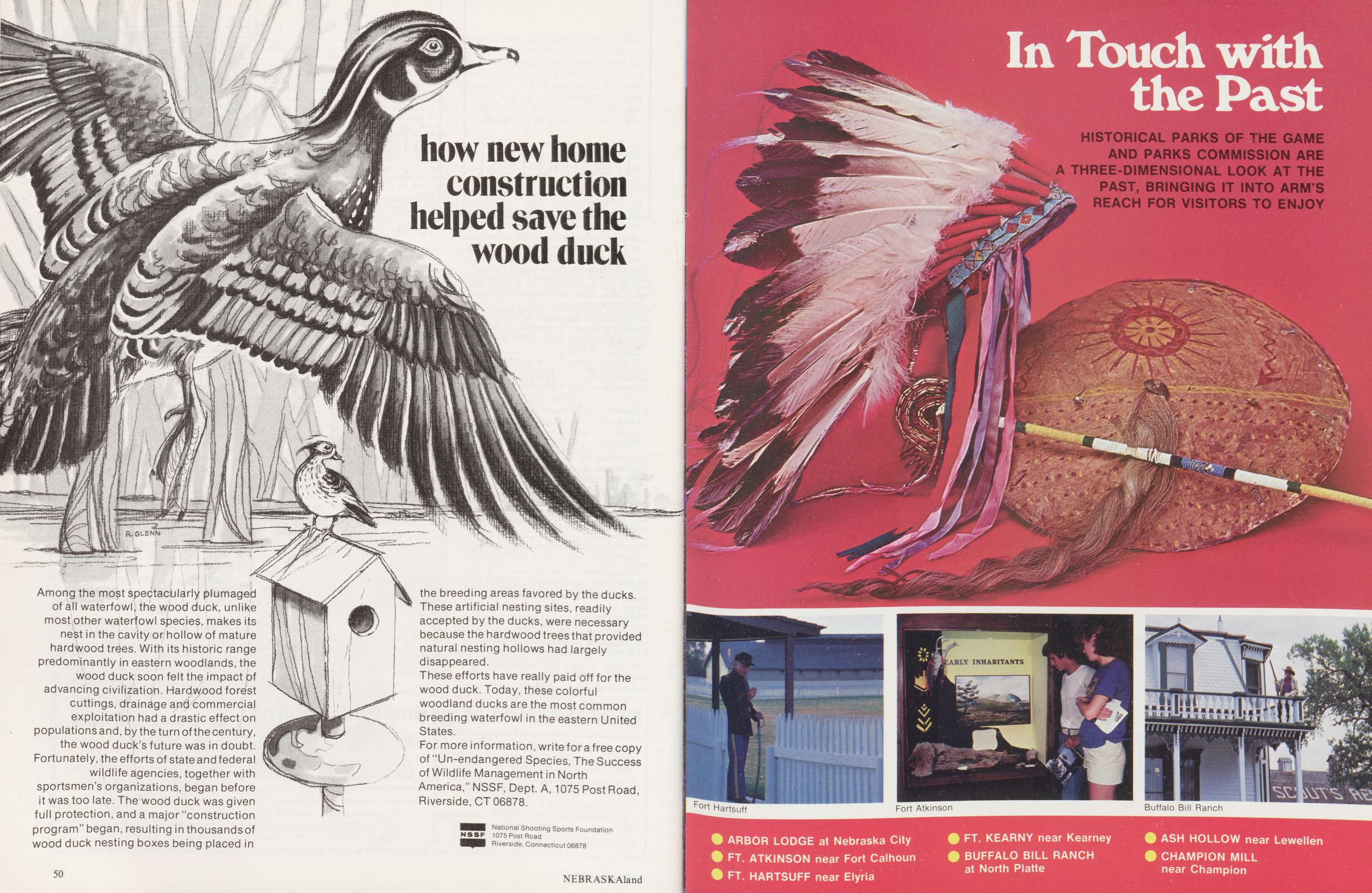
how new home construction helped save the wood duck
Among the most spectacularly plumaged of all waterfowl, the wood duck, unlike most other waterfowl species, makes its nest in the cavity or hollow of mature hardwood trees. With its historic range predominantly in eastern woodlands, the wood duck soon felt the impact of advancing civilization. Hardwood forest cuttings, drainage and commercial exploitation had a drastic effect on populations and, by the turn of the century, the wood duck's future was in doubt. Fortunately, the efforts of state and federal wildlife agencies, together with sportsmen's organizations, began before it was too late. The wood duck was given full protection, and a major "construction program" began, resulting in thousands of wood duck nesting boxes being placed in the breeding areas favored by the ducks. These artificial nesting sites, readily accepted by the ducks, were necessary because the hardwood trees that provided natural nesting hollows had largely disappeared.
These efforts have really paid off for the wood duck. Today, these colorful woodland ducks are the most common breeding waterfowl in the eastern United States.
For more information, write for a free copy of "Un-endangered Species, The Success of Wildlife Management in North America," NSSF, Dept. A, 1075 Post Road, Riverside, CT 06878.
National Shooting Sports Foundation NSSF 1075 Post Read Riverside, Connecticut 06878 50 NEBRASKAland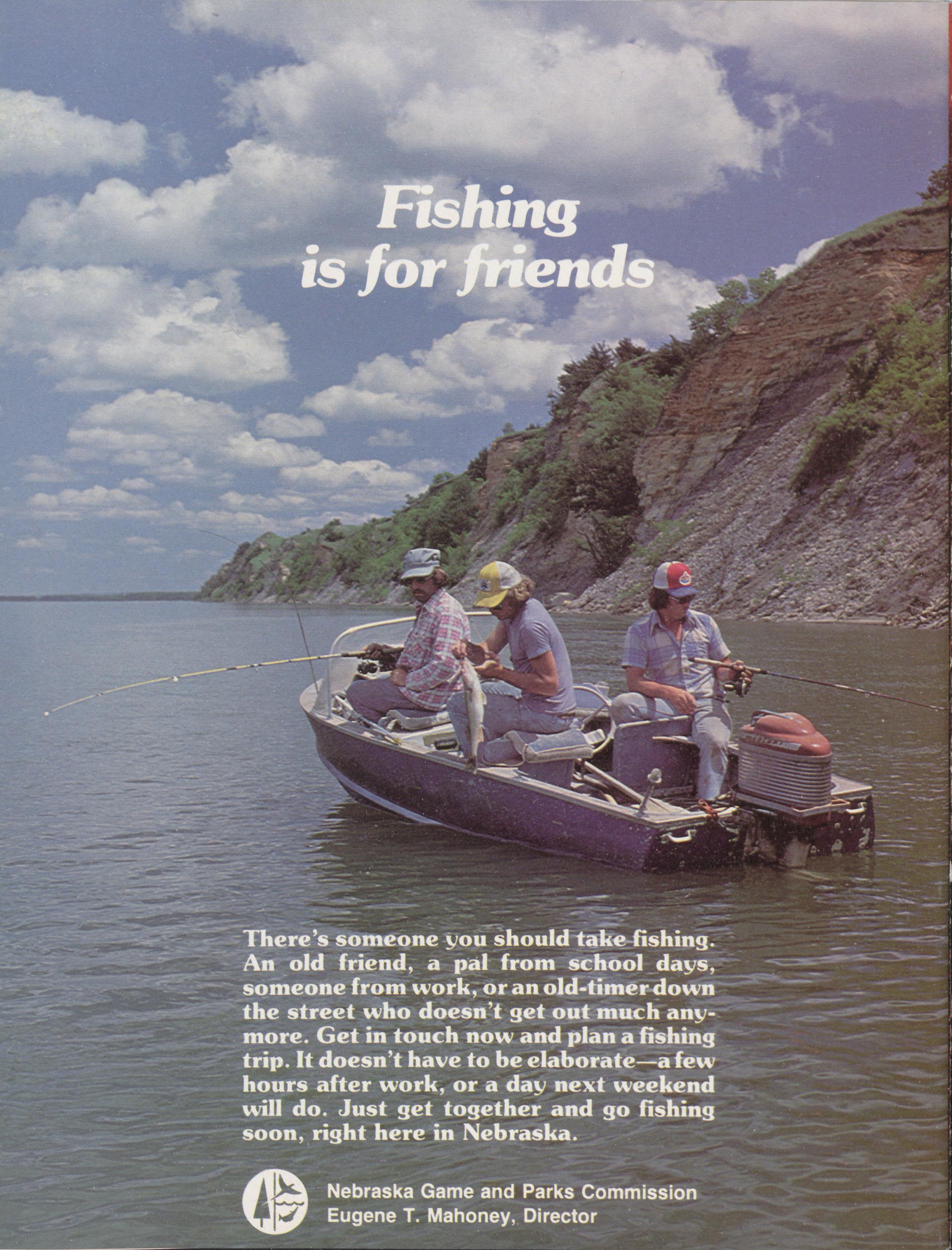
An old friend, a pal from school days, someone from work, or an old-timer down the street who doesn't get out much anymore. Get in touch now and plan a fishing trip. It doesn't have to be elaborate—a few hours after work, or a day next weekend will do. Just get together and go fishing soon, right here in Nebraska. Nebraska Game and Parks Commission Eugene T. Mahoney, Director
Position: 704 (16 views)