Volume 60, Issue 7, 1982
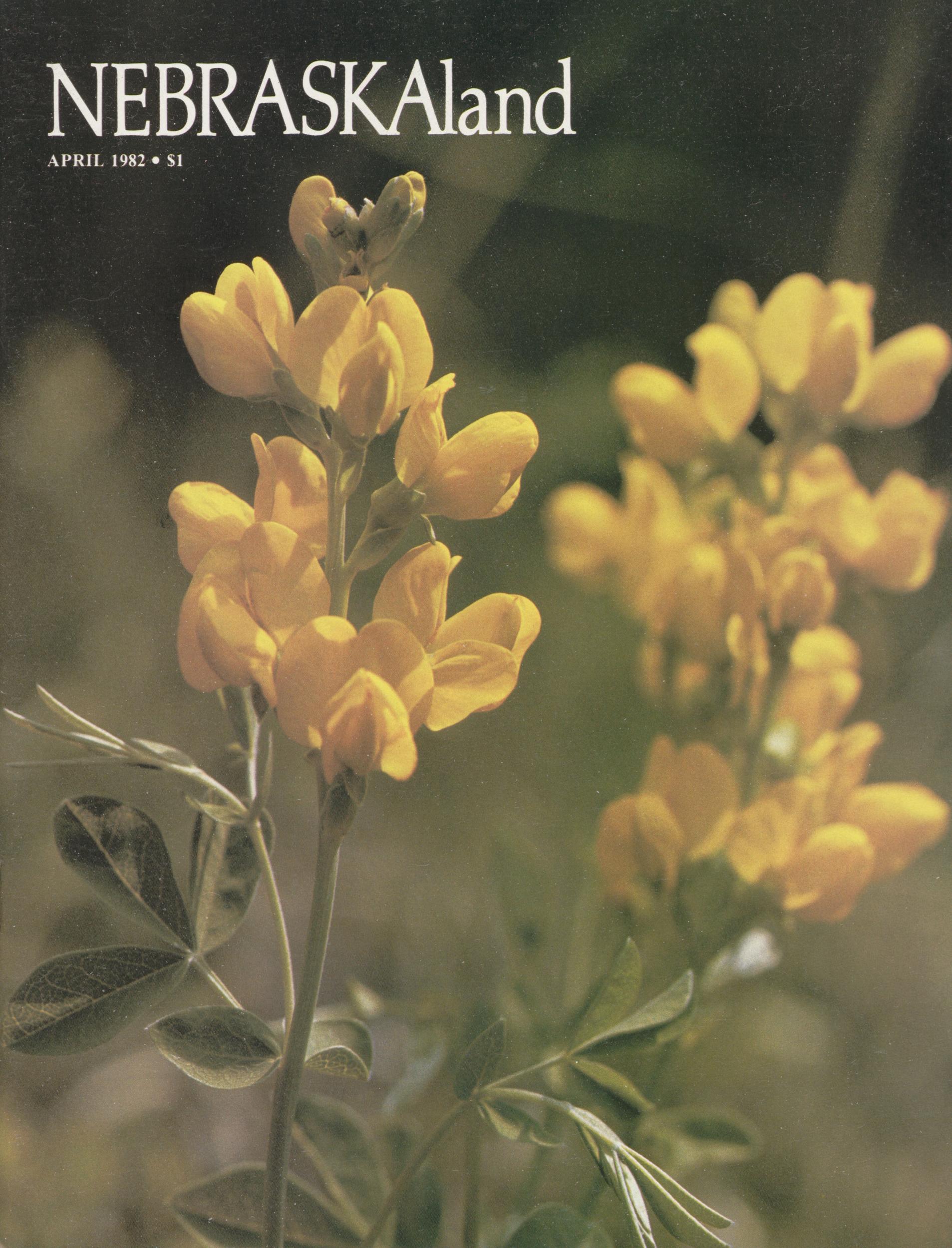
NEBRASKAland
APRIL 1982 $1
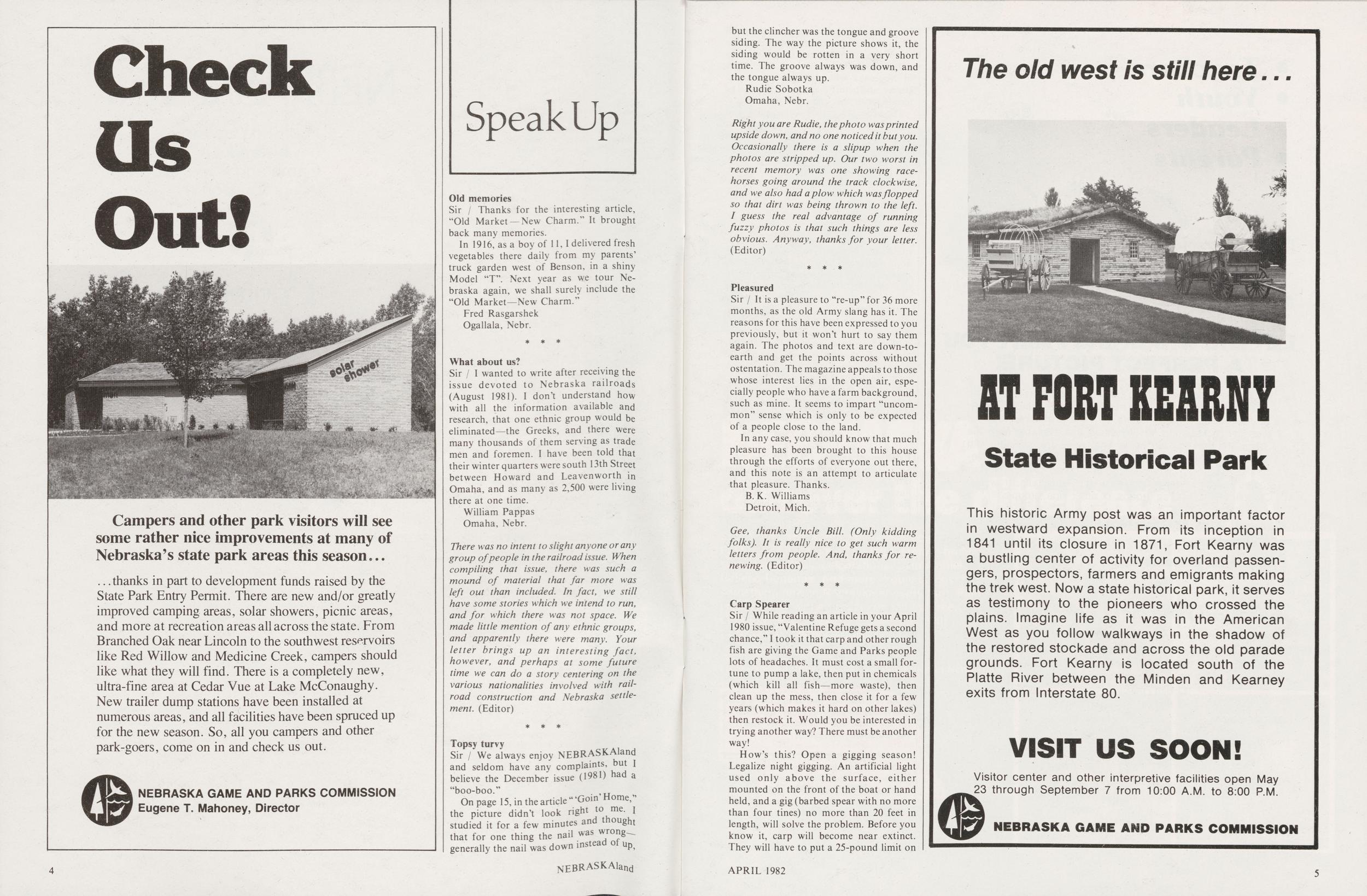
Speak Up
Old memories Sir / Thanks for the interesting article, "Old Market —New Charm." It brought back many memories. In 1916, as a boy of 11, I delivered fresh vegetables there daily from my parents' truck garden west of Benson, in a shiny Model "T". Next year as we tour Nebraska again, we shall surely include the "Old Market—New Charm." Fred Rasgarshek Ogallala, Nebr. What about us? Sir / I wanted to write after receiving the issue devoted to Nebraska railroads (August 1981). I don't understand how with all the information available and research, that one ethnic group would be eliminated—the Greeks, and there were many thousands of them serving as trade men and foremen. I have been told that their winter quarters were south 13th Street between Howard and Leavenworth in Omaha, and as many as 2,500 were living there at one time. William Pappas Omaha, Nebr. There was no intent to slight anyone or any group of people in the railroad issue. When compiling that issue, there was such a mound of material that far more was left out than included. In fact, we still have some stories which we intend to run, and for which there was not space. We made little mention of any ethnic groups, and apparently there were many. Your letter brings up an interesting fact, however, and perhaps at some future time we can do a story centering on the various nationalities involved with railroad construction and Nebraska settlement. (Editor) Topsy turvy Sir / We always enjoy NEBRASKAland and seldom have any complaints, but I believe the December issue (1981) had a "boo-boo." On page 15, in the article "'Goin Home," the picture didn't look right to me. I studied it for a few minutes and thought that for one thing the nail was wrong —generally the nail was down instead of up,but the clincher was the tongue and groove siding. The way the picture shows it, the siding would be rotten in a very short time. The groove always was down, and the tongue always up. Rudie Sobotka Omaha, Nebr. 4 NEBRASKAland Right you are Rudie, the photo was printed upside down, and no one noticed it but you. Occasionally there is a slipup when the photos are stripped up. Our two worst in recent memory was one showing racehorses going around the track clockwise, and we also had a plow which was flopped so that dirt was being thrown to the left. I guess the real advantage of running fuzzy photos is that such things are less obvious. Anyway, thanks for your letter. (Editor) Pleasured Sir / It is a pleasure to "re-up" for 36 more months, as the old Army slang has it. The reasons for this have been expressed to you previously, but it won't hurt to say them again. The photos and text are down-to-earth and get the points across without ostentation. The magazine appeals to those whose interest lies in the open air, especially people who have a farm background, such as mine. It seems to impart "uncommon" sense which is only to be expected of a people close to the land. In any case, you should know that much pleasure has been brought to this house through the efforts of everyone out there, and this note is an attempt to articulate that pleasure. Thanks. B. K. Williams Detroit, Mich. Gee, thanks Uncle Bill. (Only kidding folks). It is really nice to get such warm letters from people. And, thanks for renewing. (Editor) Carp Spearer Sir / While reading an article in your April 1980 issue, "Valentine Refuge gets a second chance," I took it that carp and other rough fish are giving the Game and Parks people lots of headaches. It must cost a small fortune to pump a lake, then put in chemicals (which kill all fish—more waste), then clean up the mess, then close it for a few years (which makes it hard on other lakes) then restock it. Would you be interested in trying another way? There must be another way! How's this? Open a gigging season! Legalize night gigging. An artificial light used only above the surface, either mounted on the front of the boat or hand held, and a gig (barbed spear with no more than four tines) no more than 20 feet in length, will solve the problem. Before you know it, carp will become near extinct. They will have to put a 25-pound limit on
Nebraska discover the difference
Shoot outs and wagon trains. Rodeos. Fast-paced excitement. Living history. Thrilling adventure. Ethnic celebrations. Symphonies. Ballets. Regattas. And more. You'll discover something new in Nebraska at every turn. Plan your visit by writing today, or call toll free, out-of-state (800) 228-4307; in-state (800) 742-7595, or (402) 471-3796. I'd like more information on the difference in Nebraska. NAME ADDRESS CITY STATE ZIP Mail to Division of Travel and Tourism, Department of Economic Development P.O. Box 94666, Lincoln, Nebraska 68509. 82014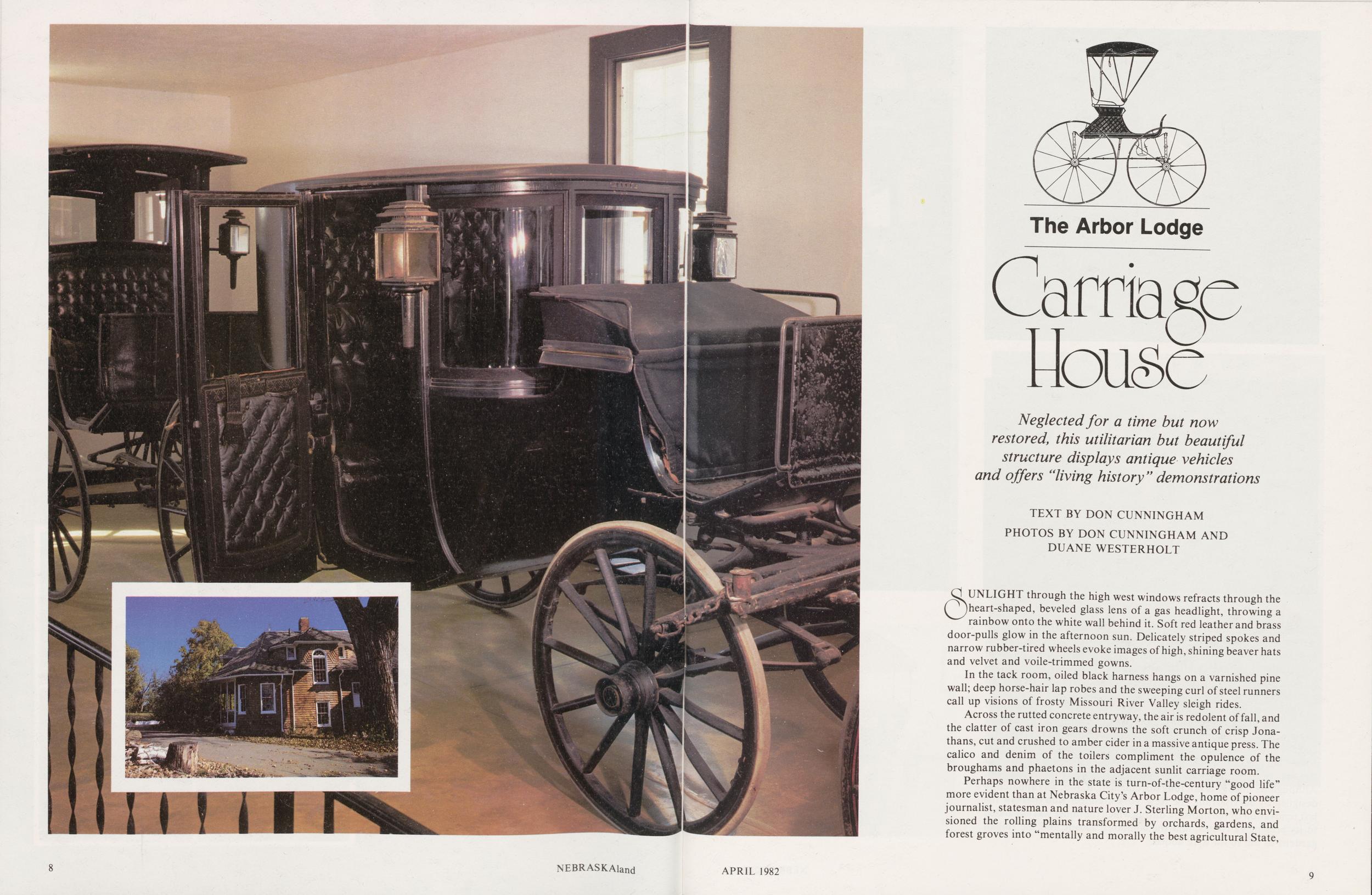
The Arbor Lodge
Carriage House
Neglected for a time but now restored, this utilitarian but beautiful structure displays antique vehicles and offers "living history" demonstrations
TEXT BY DON CUNNINGHAM PHOTOS BY DON CUNNINGHAM AND DUANE WESTERHOLTSUNLIGHT through the high west windows refracts through the heart-shaped, beveled glass lens of a gas headlight, throwing a rainbow onto the white wall behind it. Soft red leather and brass door-pulls glow in the afternoon sun. Delicately striped spokes and narrow rubber-tired wheels evoke images of high, shining beaver hats and velvet and voile-trimmed gowns.
In the tack room, oiled black harness hangs on a varnished pine wall; deep horse-hair lap robes and the sweeping curl of steel runners call up visions of frosty Missouri River Valley sleigh rides.
Across the rutted concrete entryway, the air is redolent of fall, and the clatter of cast iron gears drowns the soft crunch of crisp Jonathans, cut and crushed to amber cider in a massive antique press. The calico and denim of the toilers compliment the opulence of the broughams and phaetons in the adjacent sunlit carriage room.
Perhaps nowhere in the state is turn-of-the-century "good life" more evident than at Nebraska City's Arbor Lodge, home of pioneer journalist, statesman and nature lover J. Sterling Morton, who envisioned the rolling plains transformed by orchards, gardens, and forest groves into "mentally and morally the best agricultural State,
APRIL 1982 9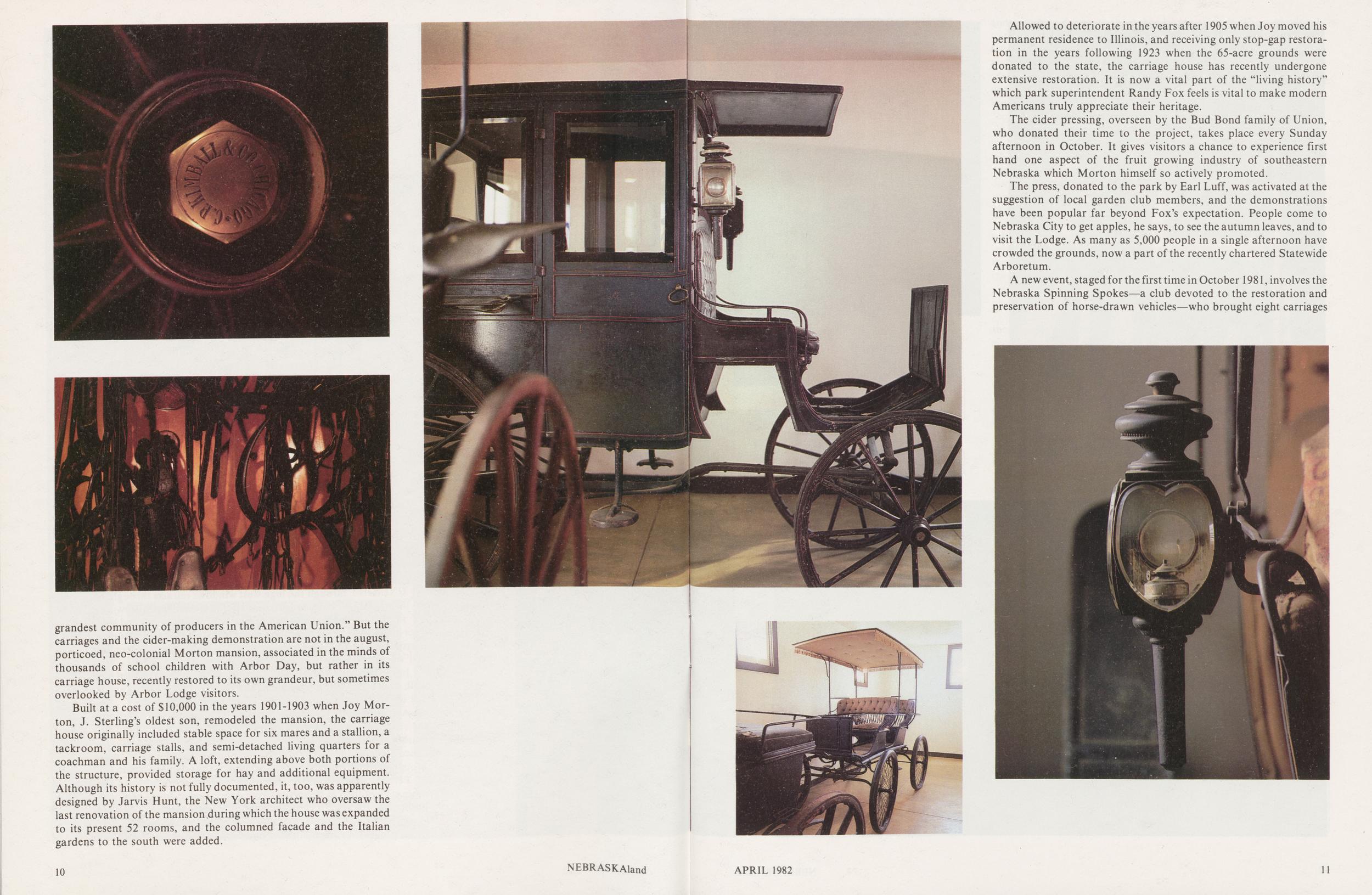
grandest community of producers in the American Union." But the carriages and the cider-making demonstration are not in the august, porticoed, neo-colonial Morton mansion, associated in the minds of thousands of school children with Arbor Day, but rather in its carriage house, recently restored to its own grandeur, but sometimes overlooked by Arbor Lodge visitors.
Built at a cost of $10,000 in the years 1901-1903 when Joy Morton, J. Sterling's oldest son, remodeled the mansion, the carriage house originally included stable space for six mares and a stallion, a tackroom, carriage stalls, and semi-detached living quarters for a coachman and his family. A loft, extending above both portions of the structure, provided storage for hay and additional equipment. Although its history is not fully documented, it, too, was apparently designed by Jarvis Hunt, the New York architect who oversaw the last renovation of the mansion during which the house was expanded to its present 52 rooms, and the columned facade and the Italian gardens to the south were added.
Allowed to deteriorate in the years after 1905 when Joy moved his permanent residence to Illinois, and receiving only stop-gap restoration in the years following 1923 when the 65-acre grounds were donated to the state, the carriage house has recently undergone extensive restoration. It is now a vital part of the "living history" which park superintendent Randy Fox feels is vital to make modern Americans truly appreciate their heritage.
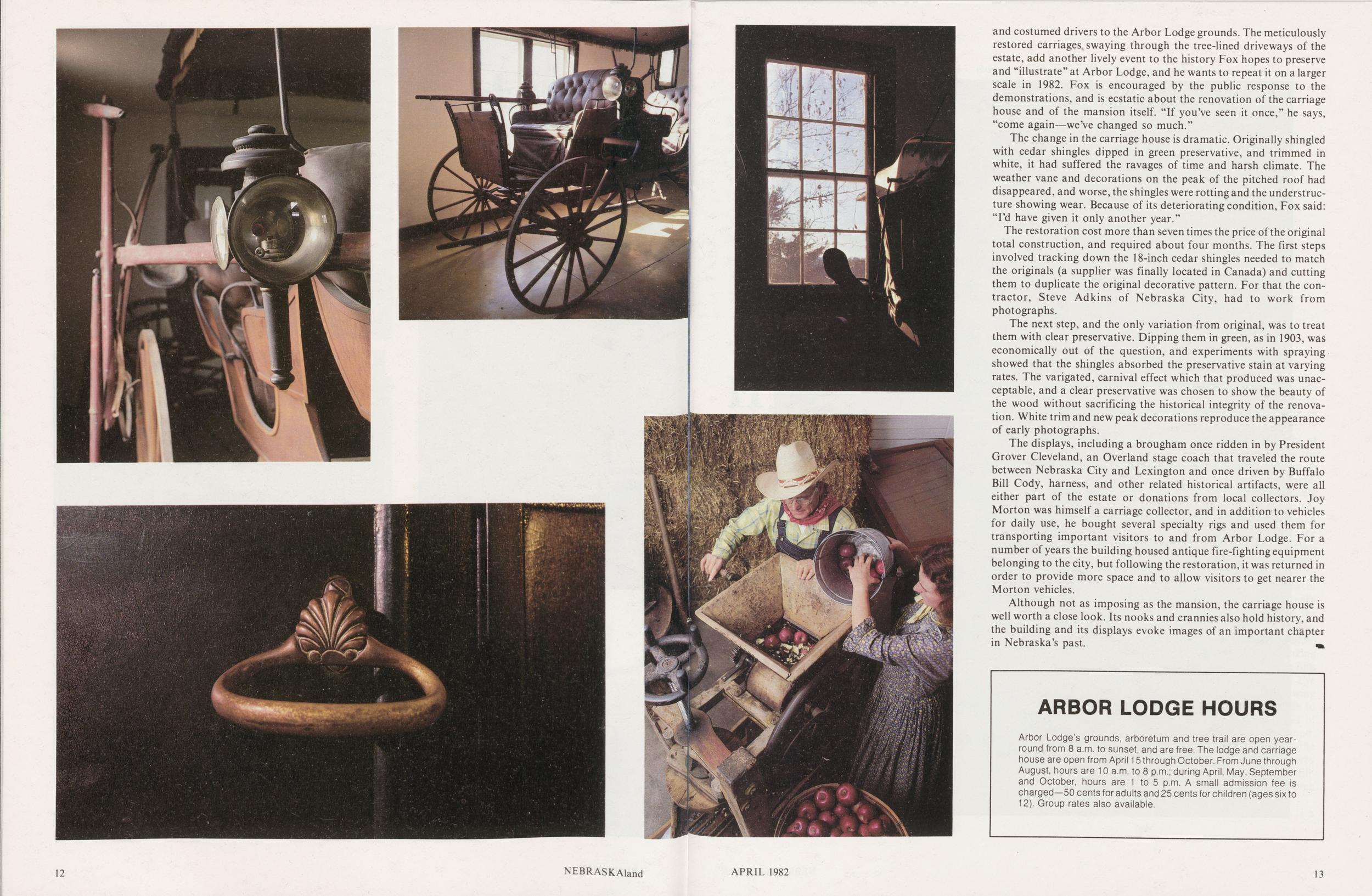
The cider pressing, overseen by the Bud Bond family of Union, who donated their time to the project, takes place every Sunday afternoon in October. It gives visitors a chance to experience first hand one aspect of the fruit growing industry of southeastern Nebraska which Morton himself so actively promoted.
The press, donated to the park by Earl Luff, was activated at the suggestion of local garden club members, and the demonstrations have been popular far beyond Fox's expectation. People come to Nebraska City to get apples, he says, to see the autumn leaves, and to visit the Lodge. As many as 5,000 people in a single afternoon have crowded the grounds, now a part of the recently chartered Statewide Arboretum.
A new event, staged for the first time in October 1981, involves the Nebraska Spinning Spokes—a club devoted to the restoration and preservation of horse-drawn vehicles—who brought eight carriages
and costumed drivers to the Arbor Lodge grounds. The meticulously restored carriages swaying through the tree-lined driveways of the estate, add another lively event to the history Fox hopes to preserve and "illustrate" at Arbor Lodge, and he wants to repeat it on a larger scale in 1982. Fox is encouraged by the public response to the demonstrations, and is ecstatic about the renovation of the carriage house and of the mansion itself. "If you've seen it once," he says, "come again—we've changed so much."
The change in the carriage house is dramatic. Originally shingled with cedar shingles dipped in green preservative, and trimmed in white, it had suffered the ravages of time and harsh climate. The weather vane and decorations on the peak of the pitched roof had disappeared, and worse, the shingles were rotting and the understructure showing wear. Because of its deteriorating condition, Fox said: "I'd have given it only another year."
The restoration cost more than seven times the price of the original total construction, and required about four months. The first steps involved tracking down the 18-inch cedar shingles needed to match the originals (a supplier was finally located in Canada) and cutting them to duplicate the original decorative pattern. For that the contractor, Steve Adkins of Nebraska City, had to work from photographs.
The next step, and the only variation from original, was to treat them with clear preservative. Dipping them in green, as in 1903, was economically out of the question, and experiments with spraying showed that the shingles absorbed the preservative stain at varying rates. The varigated, carnival effect which that produced was unacceptable, and a clear preservative was chosen to show the beauty of the wood without sacrificing the historical integrity of the renovation. White trim and new peak decorations reproduce the appearance of early photographs.
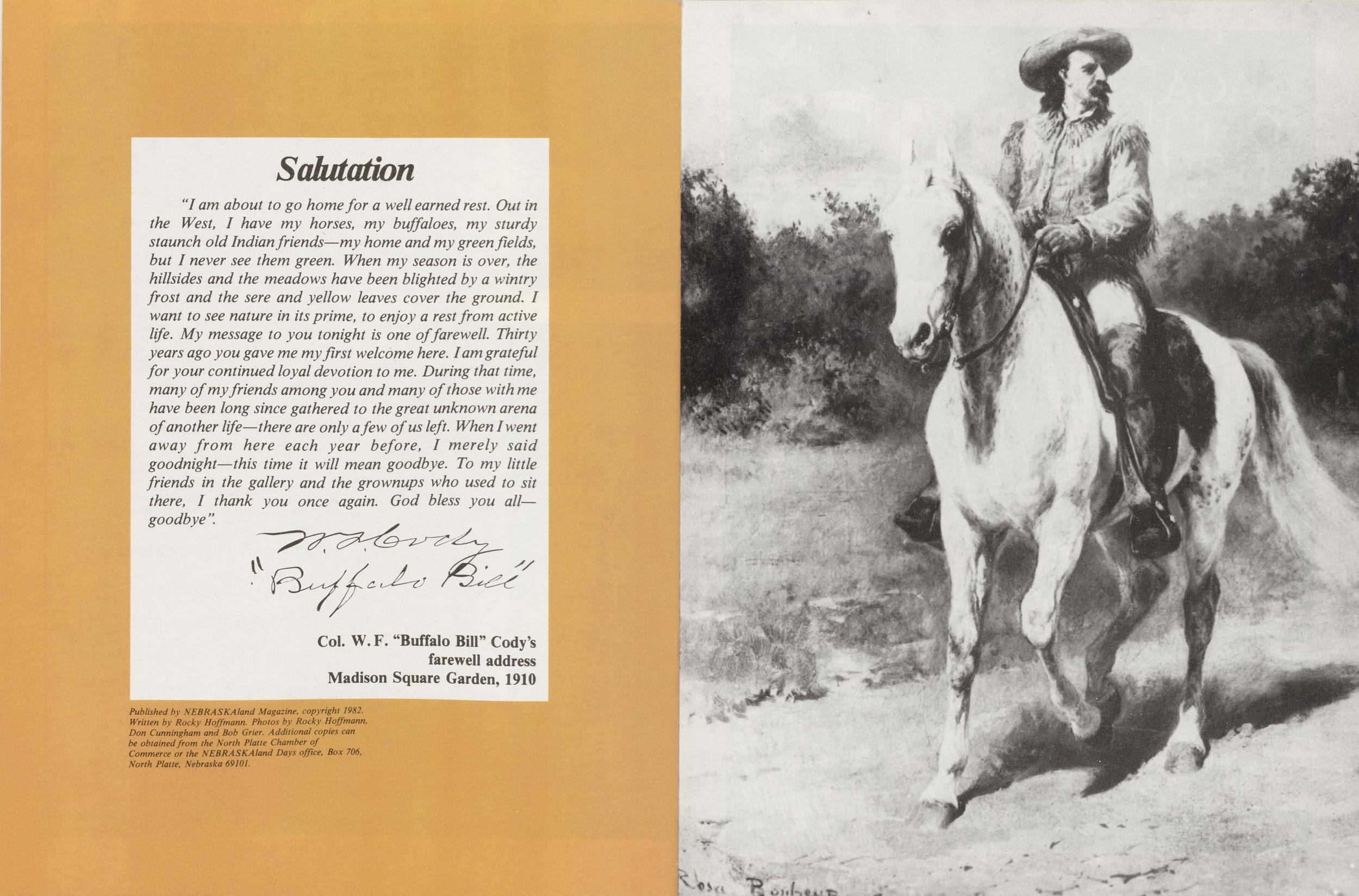
The displays, including a brougham once ridden in by President Grover Cleveland, an Overland stage coach that traveled the route between Nebraska City and Lexington and once driven by Buffalo Bill Cody, harness, and other related historical artifacts, were all either part of the estate or donations from local collectors. Joy Morton was himself a carriage collector, and in addition to vehicles for daily use, he bought several specialty rigs and used them for transporting important visitors to and from Arbor Lodge. For a number of years the building housed antique fire-fighting equipment belonging to the city, but following the restoration, it was returned in order to provide more space and to allow visitors to get nearer the Morton vehicles.
Although not as imposing as the mansion, the carriage house is well worth a close look. Its nooks and crannies also hold history, and the building and its displays evoke images of an important chapter in Nebraska's past.
ARBOR LODGE HOURS Arbor Lodge's grounds, arboretum and tree trail are open year-round from 8 a.m. to sunset, and are free. The lodge and carriage house are open from April 15 through October. From June through August, hours are 10 a.m. to 8 p.m.; during April, May, September and October, hours are 1 to 5 p.m. A small admission fee is charged—50 cents for adults and 25 cents for children (ages six to 12). Group rates also available. APRIL 1982 13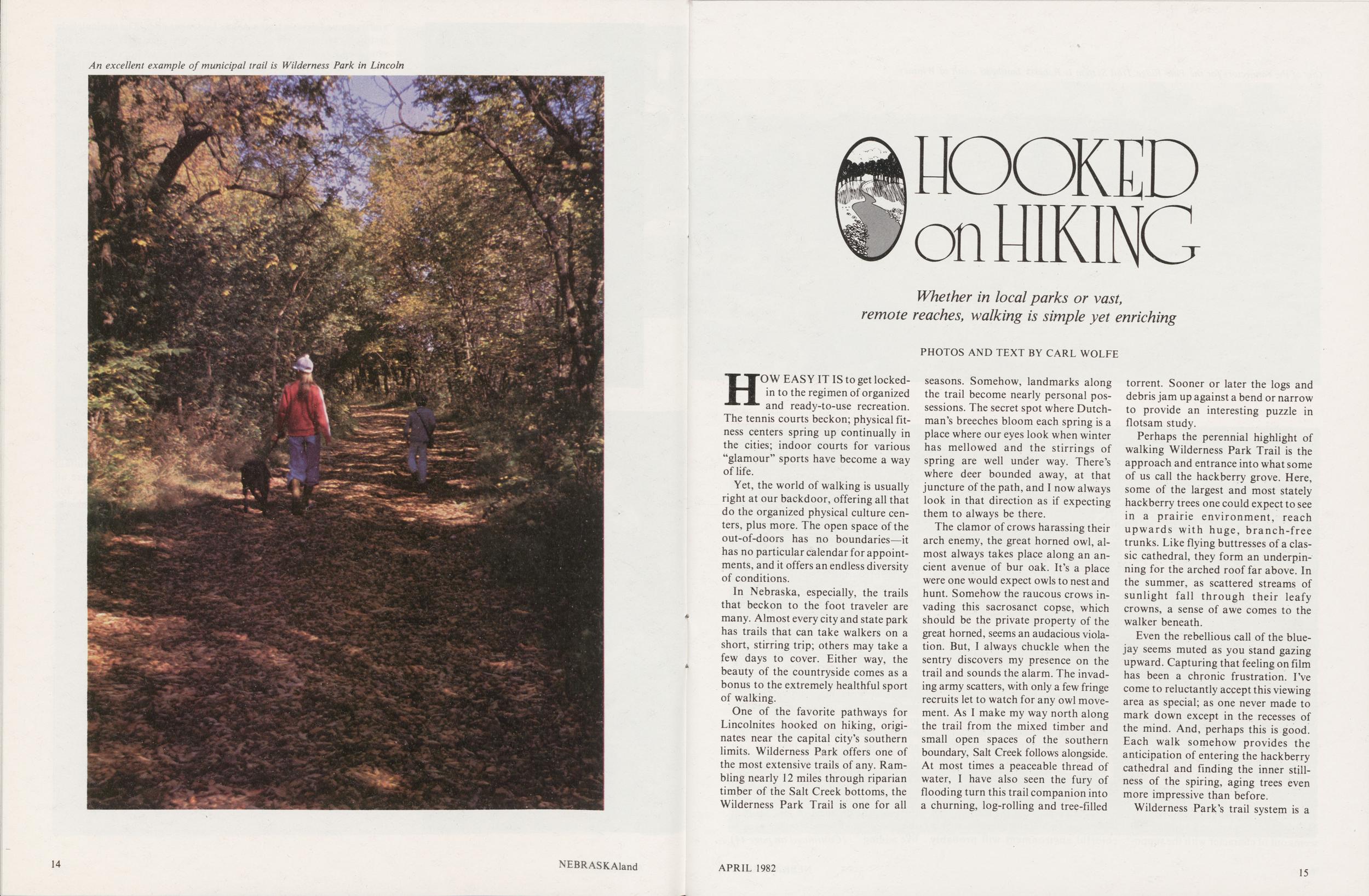
An excellent example of municipal trail is Wilderness Park in Lincoln
HOOKED on HIKING
Whether in local parks or vast, remote reaches, walking is simple yet enriching
HOW EASY IT IS to get locked-in to the regimen of organized and ready-to-use recreation. The tennis courts beckon; physical fitness centers spring up continually in the cities; indoor courts for various "glamour" sports have become a way of life.
Yet, the world of walking is usually right at our backdoor, offering all that do the organized physical culture centers, plus more. The open space of the out-of-doors has no boundaries—it has no particular calendar for appointments, and it offers an endless diversity of conditions.
In Nebraska, especially, the trails that beckon to the foot traveler are many. Almost every city and state park has trails that can take walkers on a short, stirring trip; others may take a few days to cover. Either way, the beauty of the countryside comes as a bonus to the extremely healthful sport of walking.
One of the favorite pathways for Lincolnites hooked on hiking, originates near the capital city's southern limits. Wilderness Park offers one of the most extensive trails of any. Rambling nearly 12 miles through riparian timber of the Salt Creek bottoms, the Wilderness Park Trail is one for all seasons. Somehow, landmarks along the trail become nearly personal possessions. The secret spot where Dutchman's breeches bloom each spring is a place where our eyes look when winter has mellowed and the stirrings of spring are well under way. There's where deer bounded away, at that juncture of the path, and I now always look in that direction as if expecting them to always be there.
The clamor of crows harassing their arch enemy, the great horned owl, almost always takes place along an ancient avenue of bur oak. It's a place were one would expect owls to nest and hunt. Somehow the raucous crows invading this sacrosanct copse, which should be the private property of the great horned, seems an audacious violation. But, I always chuckle when the sentry discovers my presence on the trail and sounds the alarm. The invading army scatters, with only a few fringe recruits let to watch for any owl movement. As I make my way north along the trail from the mixed timber and small open spaces of the southern boundary, Salt Creek follows alongside. At most times a peaceable thread of water, I have also seen the fury of flooding turn this trail companion into a churning, log-rolling and tree-filled torrent. Sooner or later the logs and debris jam up against a bend or narrow to provide an interesting puzzle in flotsam study.
Perhaps the perennial highlight of walking Wilderness Park Trail is the approach and entrance into what some of us call the hackberry grove. Here, some of the largest and most stately hackberry trees one could expect to see in a prairie environment, reach upwards with huge, branch-free trunks. Like flying buttresses of a classic cathedral, they form an underpinning for the arched roof far above. In the summer, as scattered streams of sunlight fall through their leafy crowns, a sense of awe comes to the walker beneath.
Even the rebellious call of the bluejay seems muted as you stand gazing upward. Capturing that feeling on film has been a chronic frustration. I've come to reluctantly accept this viewing area as special; as one never made to mark down except in the recesses of the mind. And, perhaps this is good. Each walk somehow provides the anticipation of entering the hackberry cathedral and finding the inner stillness of the spiring, aging trees even more impressive than before.
APRIL 1982 15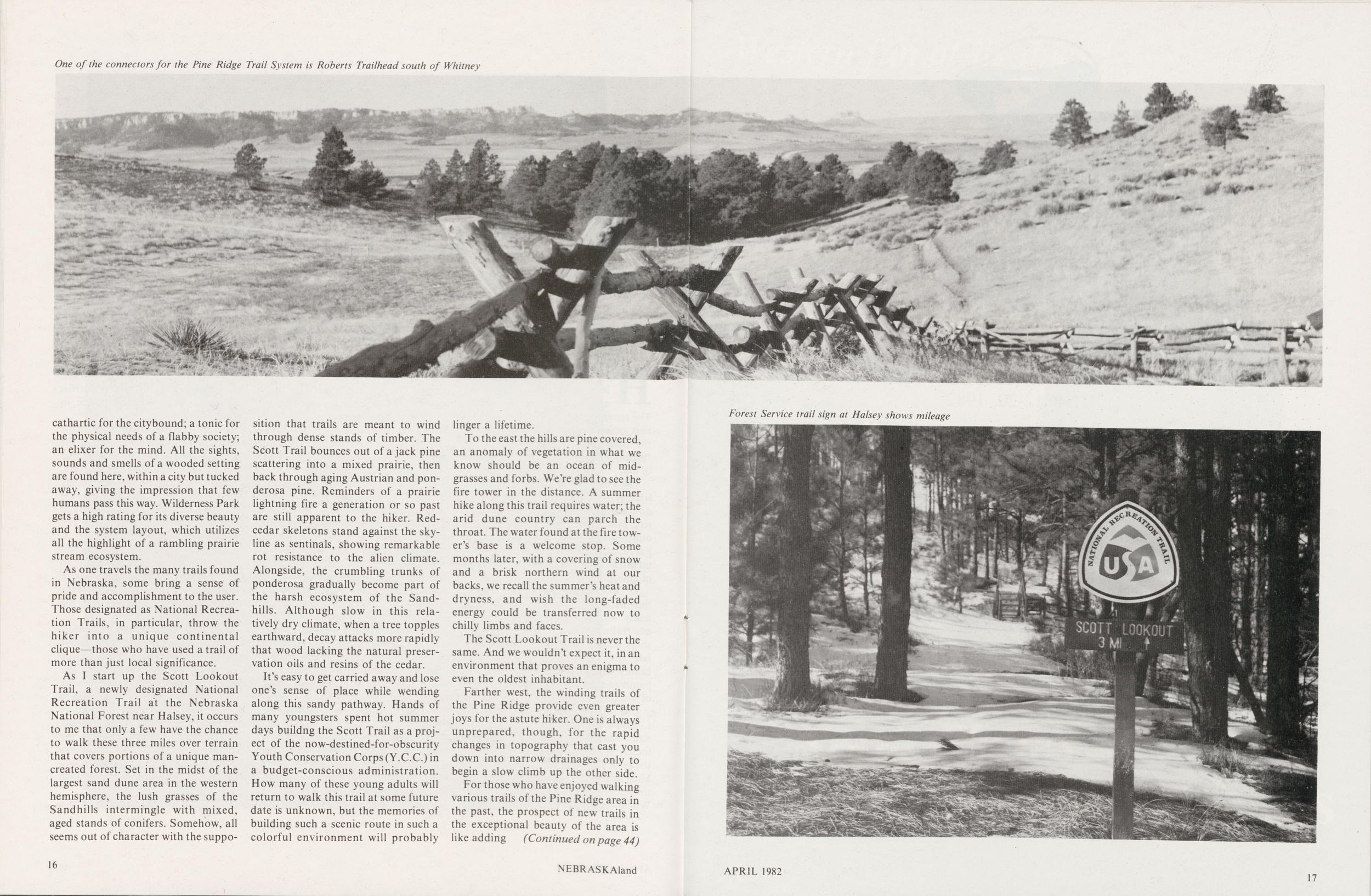
One of the connectors for the Pine Ridge Trail System is Roberts Trailhead south of Whitney
Wilderness Park's trail system is a cathartic for the citybound; a tonic for the physical needs of a flabby society; an elixer for the mind. All the sights, sounds and smells of a wooded setting are found here, within a city but tucked away, giving the impression that few humans pass this way. Wilderness Park gets a high rating for its diverse beauty and the system layout, which utilizes all the highlight of a rambling prairie stream ecosystem.
As one travels the many trails found in Nebraska, some bring a sense of pride and accomplishment to the user. Those designated as National Recreation Trails, in particular, throw the hiker into a unique continental clique—those who have used a trail of more than just local significance.
As I start up the Scott Lookout Trail, a newly designated National Recreation Trail at the Nebraska National Forest near Halsey, it occurs to me that only a few have the chance to walk these three miles over terrain that covers portions of a unique man-created forest. Set in the midst of the largest sand dune area in the western hemisphere, the lush grasses of the Sandhills intermingle with mixed, aged stands of conifers. Somehow, all seems out of character with the supposition that trails are meant to wind through dense stands of timber. The Scott Trail bounces out of a jack pine scattering into a mixed prairie, then back through aging Austrian and ponderosa pine. Reminders of a prairie lightning fire a generation or so past are still apparent to the hiker. Red-cedar skeletons stand against the skyline as sentinals, showing remarkable rot resistance to the alien climate. Alongside, the crumbling trunks of ponderosa gradually become part of the harsh ecosystem of the Sandhills. Although slow in this relatively dry climate, when a tree topples earthward, decay attacks more rapidly that wood lacking the natural preservation oils and resins of the cedar.
It's easy to get carried away and lose one's sense of place while wending along this sandy pathway. Hands of many youngsters spent hot summer days buildng the Scott Trail as a project of the now-destined-for-obscurity Youth Conservation Corps (Y.C.C.) in a budget-conscious administration. How many of these young adults will return to walk this trail at some future date is unknown, but the memories of building such a scenic route in such a colorful environment will probably linger a lifetime.
To the east the hills are pine covered, an anomaly of vegetation in what we know should be an ocean of mid-grasses and forbs. We're glad to see the fire tower in the distance. A summer hike along this trail requires water; the arid dune country can parch the throat. The water found at the fire tower's base is a welcome stop. Some months later, with a covering of snow and a brisk northern wind at our backs, we recall the summer's heat and dryness, and wish the long-faded energy could be transferred now to chilly limbs and faces.
The Scott Lookout Trail is never the same. And we wouldn't expect it, in an environment that proves an enigma to even the oldest inhabitant.
Farther west, the winding trails of the Pine Ridge provide even greater joys for the astute hiker. One is always unprepared, though, for the rapid changes in topography that cast you down into narrow drainages only to begin a slow climb up the other side.
For those who have enjoyed walking various trails of the Pine Ridge area in the past, the prospect of new trails in the exceptional beauty of the area is like adding (Continued on page 44)
16 NEBRASKAlandForest Service trail sign at Halsey shows mileage
DURING THE THIRD week in June since 1968, North Platte, Nebraska has been rolling out the red carpet in the tradition of western hospitality which was implanted in that community by its most renowned citizen, William F. "Buffalo Bill" Cody.
Cody, the host of hosts, loved a crowd and a gala celebration, and would have felt right at home in the midst of the activities, festivities, feasts, shows, rodeos, parades, and carryings on that earmark this state's largest community celebration... NEBRASKAland Days.
North Platte, Nebraska, to coin a phrase, "center of the state, center of the nation, the place where everything that's good happens," is the appropriate home for the eight-day gathering of celebrants, many of whom return here annually from all parts of the nation and the world. So also did showman Cody return to North Platte, as that is where he called home.
In fact, Cody was caught up in crowds as a flamboyant showman when he built his North Platte mansion during the heyday of his famous Wild West Show. Colonel Cody owned some 4,000 acres here, appropriately named "Scout's Rest Ranch."
He raised cattle and horses and introduced blooded stock to this part of the country. He bought thoroughbred horses and high-grade Herefords, shorthorns and polled Angus cattle. His Hereford bull, Earl Horace, was a noted sire of the time. In 1886, a contractor under the supervision of Cody's sister Julia, and with Bill's stipulation that the house contain a parlor and a bedroom with a bath, constructed the mansion for $3,900.
During that period, the Wild West Show was a profitable venture, and money for the development of the ranch was plentiful. No expense was spared in building and furnishing the estate. Neither was cost considered in entertaining the many guests, who included wealthy and famous figures of the time. There were actors, businessmen, royalty, Army officers, and friends from Cody's frontier days.
Colonel Cody is gone now from Scout's Rest Ranch, but his hospitality lingers on to greet NEBRASKAland
Days visitors. The Nebraska Game and Parks Commission dedicated the ranch a state historical park in 1965, restoring the house and barn and tracking down a wealth of Cody memorabilia to be enjoyed by all who visit.
Cody's colorful working career, which began at the tender age of 11, would eventually play a major roll in America's "Number One" sport and in the entire line-up of annual NEBRASKAland Days gatherings culminating in "Rodeo 100," theme of the 1982 North Platte celebration.
Shortly after his eleventh birthday, Cody signed on as an ox-team driver for 50 cents a day, and just two years later hired on as an "extra" with a west-bound bull train, where he obtained enough experience to become assistant wagon master on another bull train headed for Fort Laramie.
After trapping the Chugwater the next year, Cody decided a formal education was important, and attended school for nearly a month. But, the classroom proved too boring for a young man who had already met head-on with frontier adventure.
The Colorado gold rush lured Cody west once again in 1859, but he failed to find fortune and was back on the trail in search of more adventure. He became the youngest Pony Express rider on the line at age 14, once riding 322 miles in 21 hours and 40 minutes, exhausting 20 horses.
Cody had developed an unusually strong patriotic philosophy and was crushed at being too young to enlist in the Army during the early years of the Civil War, but he was able to serve the Union forces as dispatch bearer and scout. In 1864, he enlisted in the Kansas Volunteer Army and served the Union until the end of the war.
He married Louisa Frederici of St. Louis in 1866, and that same year went to work as a government scout at Fort Elsworth, Fort Fletcher and Fort Hays, Kansas.
Even with the birth of his daughter Arta, adventure lured Bill onto the plains, where he contracted to kill buffalo to feed workers on the Kansas Pacific Railroad. He was paid $500 a month and is said to have killed 4,280 buffalo in eight months. But, the nickname "Buffalo Bill" came as the result of a hunting contest with the west's then most famous buffalo hunter, Bill Comstock. The score ended 69 to 46.
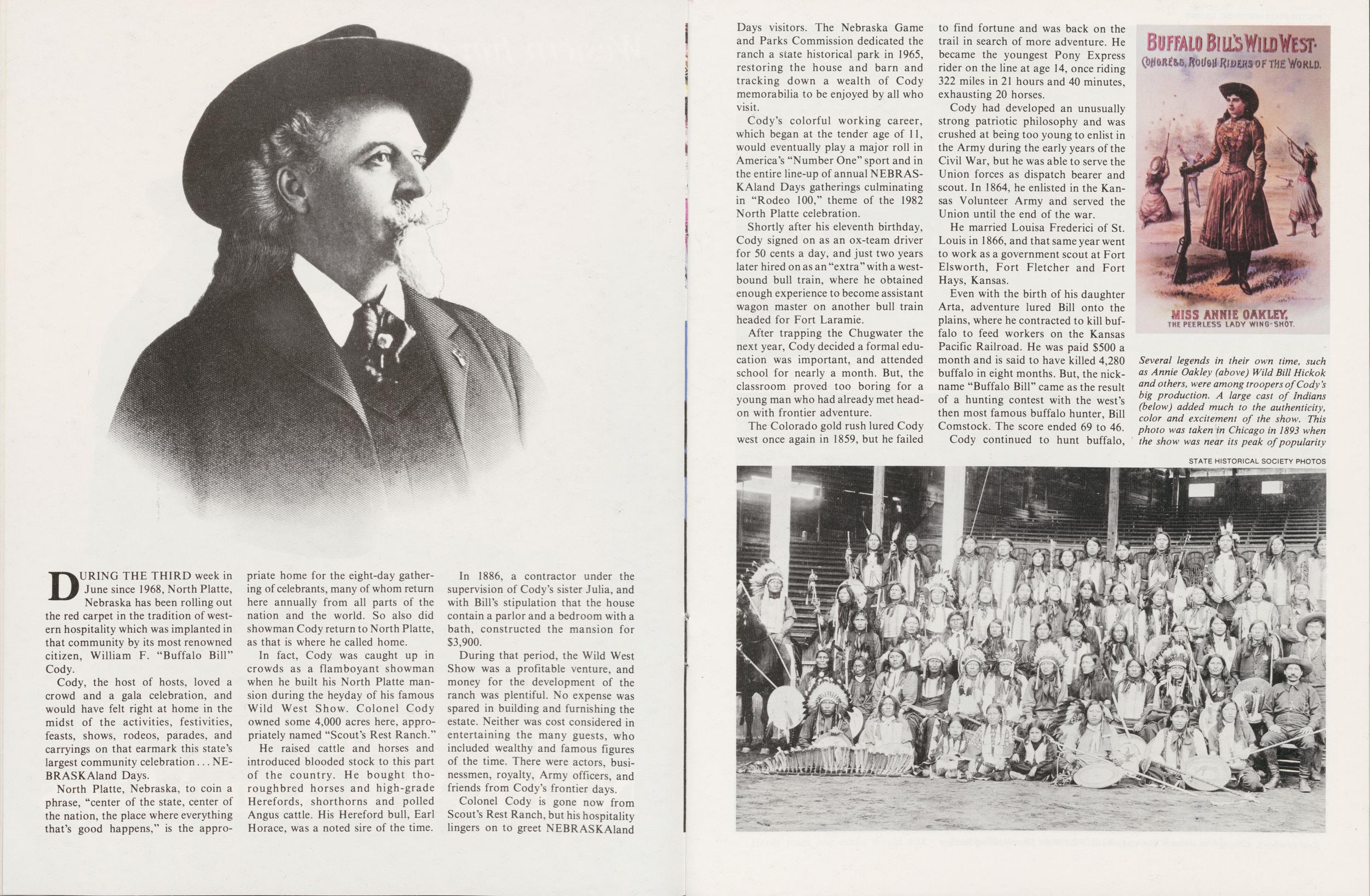
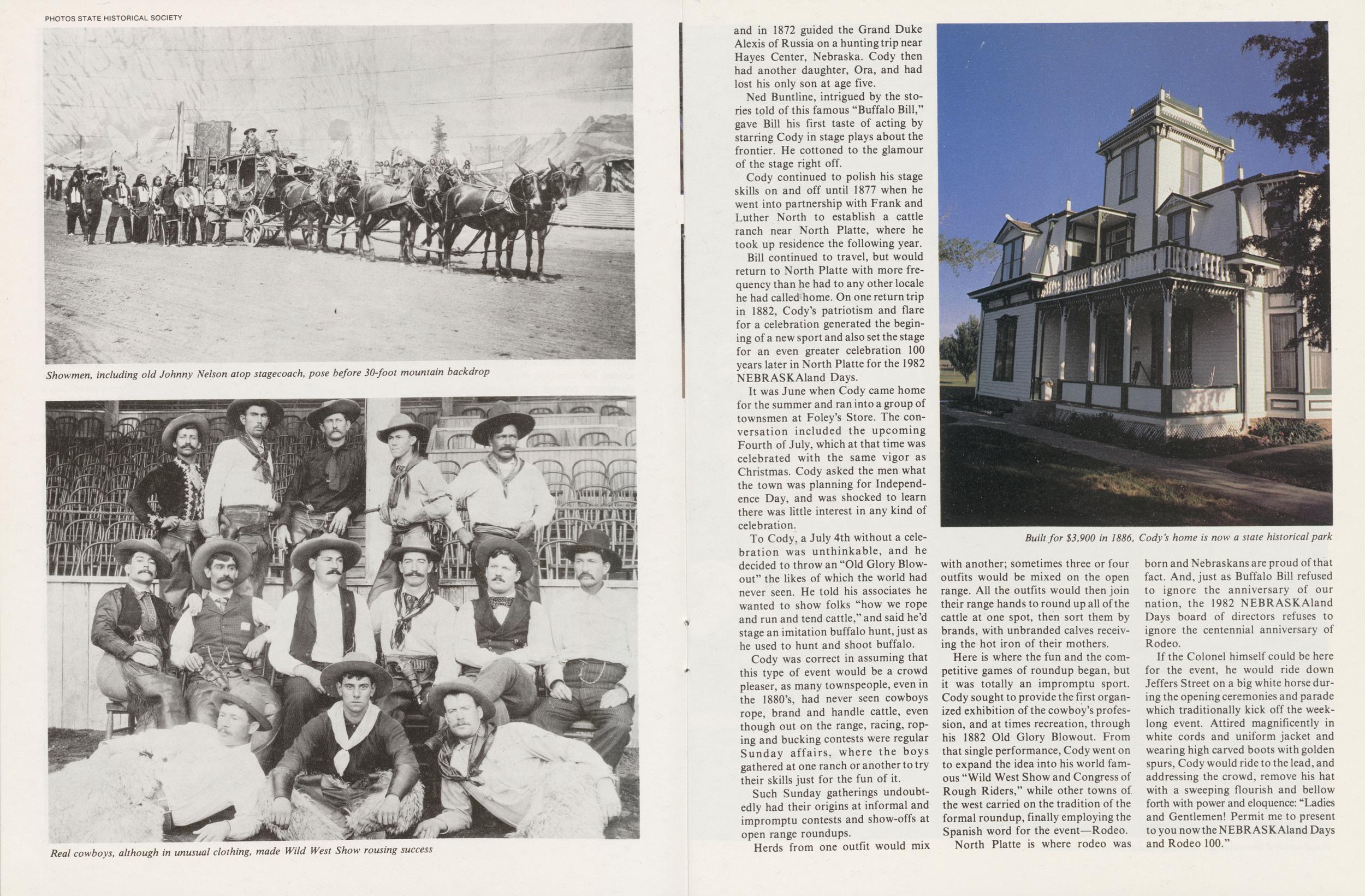
Several legends in their own time, such as Annie Oakley (above) Wild Bill Hickok and others, were among troopers of Cody's big production. A large cast of Indians (below) added much to the authenticity, color and excitement of the show. This photo was taken in Chicago in 1893 when the show was near its peak of popularity
STATE HISTORICAL SOCIETY PHOTOS
 PHOTOS STATE HISTORICAL SOCIETY
Showmen, including old Johnny Nelson atop stagecoach, pose before 30-foot mountain backdrop
Real cowboys, although in unusual clothing, made Wild West Show rousing success
Cody continued to hunt buffalo, and in 1872 guided the Grand Duke Alexis of Russia on a hunting trip near Hayes Center, Nebraska. Cody then had another daughter, Ora, and had lost his only son at age five.
Ned Buntline, intrigued by the stories told of this famous "Buffalo Bill," gave Bill his first taste of acting by starring Cody in stage plays about the frontier. He cottoned to the glamour of the stage right off.
Cody continued to polish his stage skills on and off until 1877 when he went into partnership with Frank and Luther North to establish a cattle ranch near North Platte, where he took up residence the following year.
Bill continued to travel, but would return to North Platte with more frequency than he had to any other locale he had called home. On one return trip in 1882, Cody's patriotism and flare for a celebration generated the beginning of a new sport and also set the stage for an even greater celebration 100 years later in North Platte for the 1982 NEBRASKAland Days.
It was June when Cody came home for the summer and ran into a group of townsmen at Foley's Store. The conversation included the upcoming Fourth of July, which at that time was celebrated with the same vigor as Christmas. Cody asked the men what the town was planning for Independence Day, and was shocked to learn there was little interest in any kind of celebration.
To Cody, a July 4th without a celebration was unthinkable, and he decided to throw an "Old Glory Blowout" the likes of which the world had never seen. He told his associates he wanted to show folks "how we rope and run and tend cattle," and said he'd stage an imitation buffalo hunt, just as he used to hunt and shoot buffalo.
Cody was correct in assuming that this type of event would be a crowd pleaser, as many townspeople, even in the 1880's, had never seen cowboys rope, brand and handle cattle, even though out on the range, racing, roping and bucking contests were regular Sunday affairs, where the boys gathered at one ranch or another to try their skills just for the fun of it.
Such Sunday gatherings undoubtedly had their origins at informal and impromptu contests and show-offs at open range roundups.
Built for $3,900 in 1886, Cody's home is now a state historical park
Herds from one outfit would mix with another; sometimes three or four outfits would be mixed on the open range. All the outfits would then join their range hands to round up all of the cattle at one spot, then sort them by brands, with unbranded calves receiving the hot iron of their mothers.
Here is where the fun and the competitive games of roundup began, but it was totally an impromptu sport. Cody sought to provide the first organized exhibition of the cowboy's profession, and at times recreation, through his 1882 Old Glory Blowout. From that single performance, Cody went on to expand the idea into his world famous "Wild West Show and Congress of Rough Riders," while other towns of the west carried on the tradition of the formal roundup, finally employing the Spanish word for the event—Rodeo.
North Platte is where rodeo was born and Nebraskans are proud of that fact. And, just as Buffalo Bill refused to ignore the anniversary of our nation, the 1982 NEBRASKAland Days board of directors refuses to ignore the centennial anniversary of Rodeo.
If the Colonel himself could be here for the event, he would ride down Jeffers Street on a big white horse during the opening ceremonies and parade which traditionally kick off the week-long event. Attired magnificently in white cords and uniform jacket and wearing high carved boots with golden spurs, Cody would ride to the lead, and addressing the crowd, remove his hat with a sweeping flourish and bellow forth with power and eloquence: "Ladies and Gentlemen! Permit me to present to you now the NEBRASKAland Days and Rodeo 100."
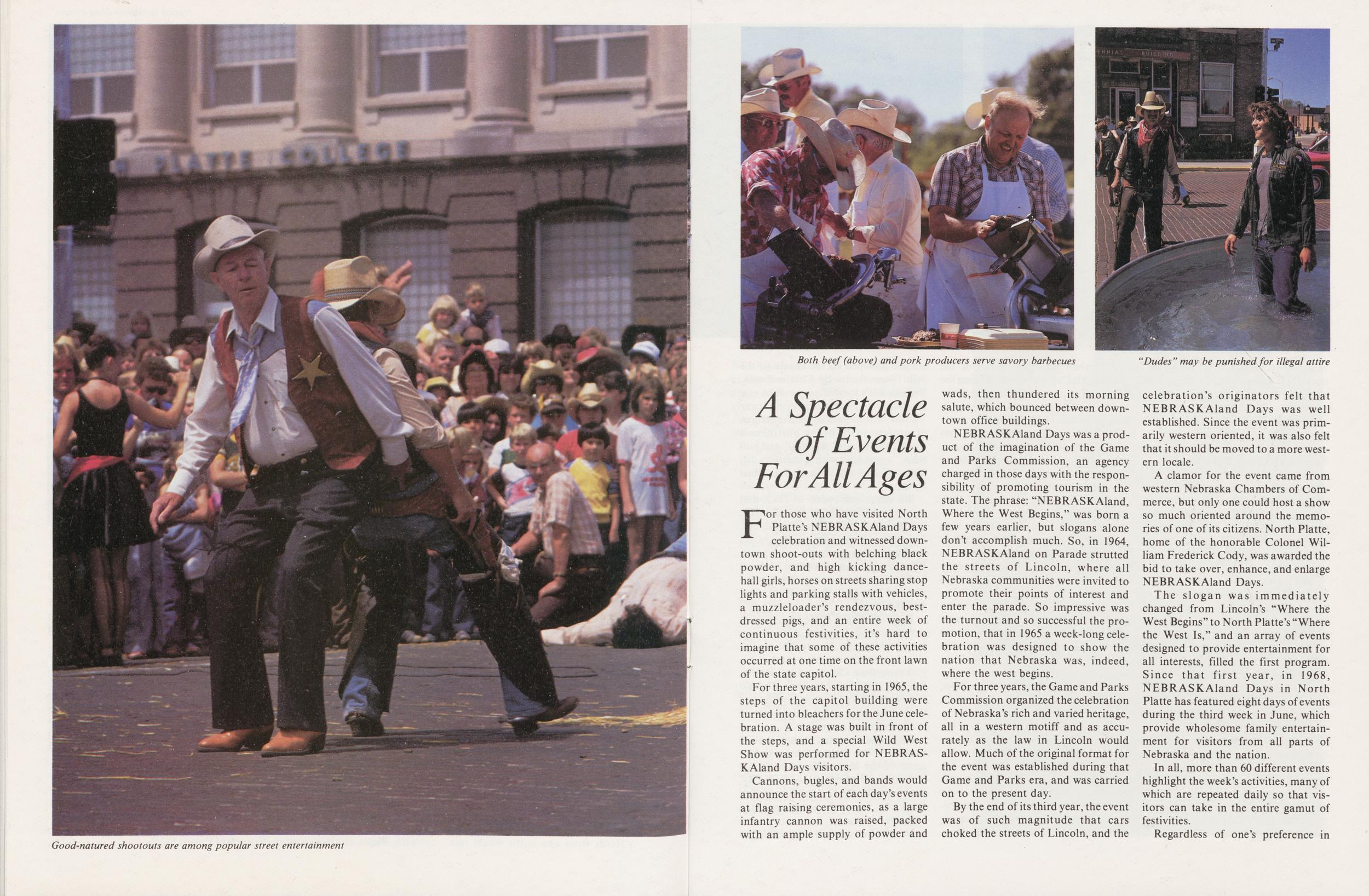
Good-natured shootouts are among popular street entertainment
Both beef (above) and pork producers serve savory barbecues
A Spectacle of Events For All Ages
For those who have visited North Platte's NEBRASKAland Days celebration and witnessed downtown shoot-outs with belching black powder, and high kicking dancehall girls, horses on streets sharing stop lights and parking stalls with vehicles, a muzzleloader's rendezvous, best-dressed pigs, and an entire week of continuous festivities, it's hard to imagine that some of these activities occurred at one time on the front lawn of the state capitol.
For three years, starting in 1965, the steps of the capitol building were turned into bleachers for the June celebration. A stage was built in front of the steps, and a special Wild West Show was performed for NEBRASKAland Days visitors.
Cannons, bugles, and bands would announce the start of each day's events at flag raising ceremonies, as a large infantry cannon was raised, packed with an ample supply of powder and wads, then thundered its morning salute, which bounced between downtown office buildings.
NEBRASKAland Days was a product of the imagination of the Game and Parks Commission, an agency charged in those days with the responsibility of promoting tourism in the state. The phrase: "NEBRASKAland, Where the West Begins," was born a few years earlier, but slogans alone don't accomplish much. So, in 1964, NEBRASKAland on Parade strutted the streets of Lincoln, where all Nebraska communities were invited to promote their points of interest and enter the parade. So impressive was the turnout and so successful the promotion, that in 1965 a week-long celebration was designed to show the nation that Nebraska was, indeed, where the west begins.
For three years, the Game and Parks Commission organized the celebration of Nebraska's rich and varied heritage, all in a western motiff and as accurately as the law in Lincoln would allow. Much of the original format for the event was established during that Game and Parks era, and was carried on to the present day.
By the end of its third year, the event was of such magnitude that cars choked the streets of Lincoln, and the celebration's originators felt that NEBRASKAland Days was well established. Since the event was primarily western oriented, it was also felt that it should be moved to a more western locale.
"Dudes" may be punished for illegal attire
A clamor for the event came from western Nebraska Chambers of Commerce, but only one could host a show so much oriented around the memories of one of its citizens. North Platte, home of the honorable Colonel William Frederick Cody, was awarded the bid to take over, enhance, and enlarge NEBRASKAland Days.
The slogan was immediately changed from Lincoln's "Where the West Begins" to North Platte's "Where the West Is," and an array of events designed to provide entertainment for all interests, filled the first program. Since that first year, in 1968, NEBRASKAland Days in North Platte has featured eight days of events during the third week in June, which provide wholesome family entertainment for visitors from all parts of Nebraska and the nation.
In all, more than 60 different events highlight the week's activities, many of which are repeated daily so that visitors can take in the entire gamut of festivities.
Regardless of one's preference in western entertainment, NEBRASKAland Days has it all. For those with competitive spirits like the cowhands of yesteryear's roundup, there are a number of activities in which you can participate.
Probably the most popular is the NEBRASKAland Days Road Run, where young and old alike lace up running shoes and hit the trail in an organized long distance run. There are three full days of tennis tournaments and two days of women's softball, and everyone enjoys the cowboy/ businessman golf tournament and senior citizens' Olympics.
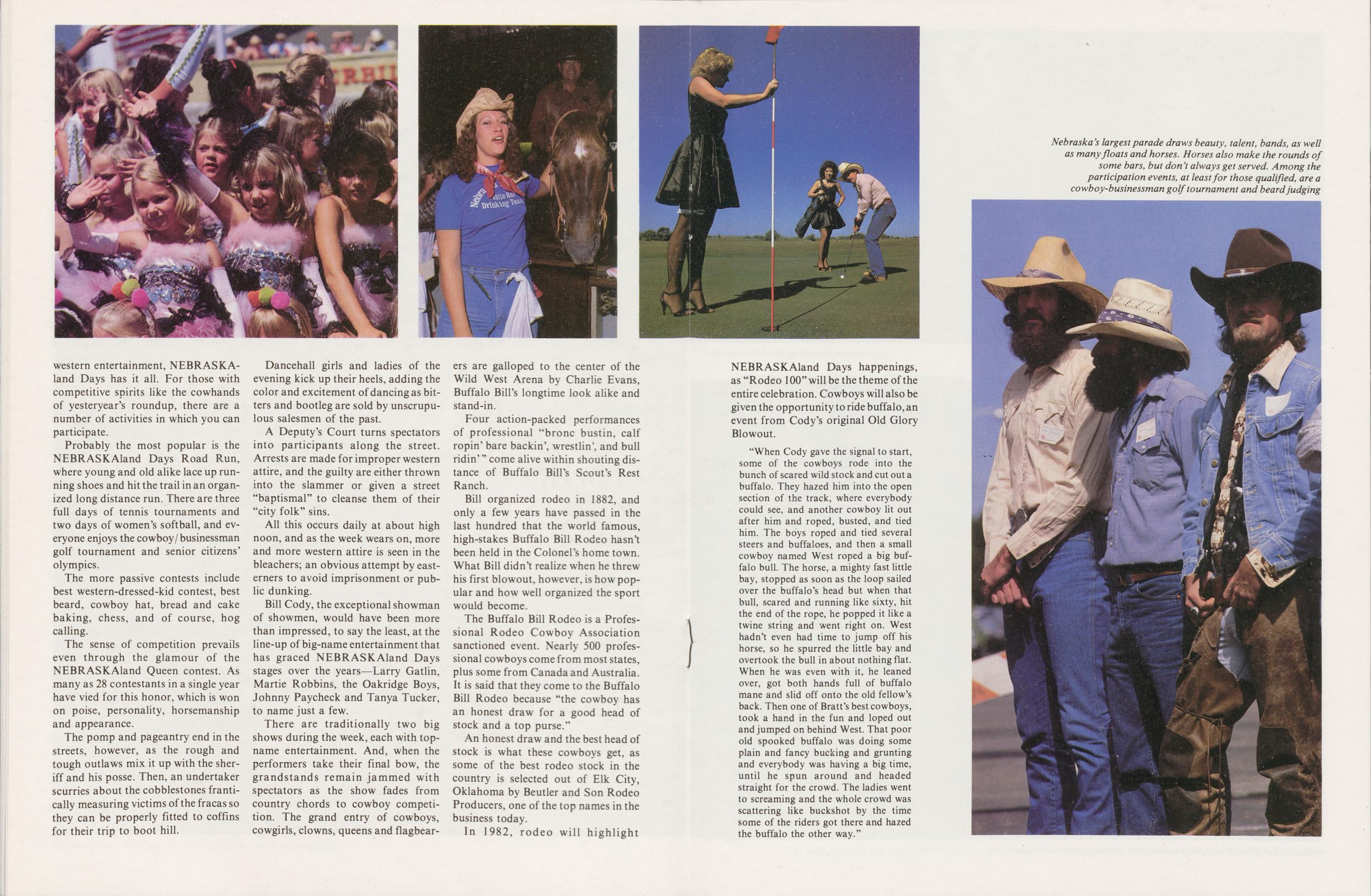
The more passive contests include best western-dressed-kid contest, best beard, cowboy hat, bread and cake baking, chess, and of course, hog calling.
The sense of competition prevails even through the glamour of the NEBRASKAland Queen contest. As many as 28 contestants in a single year have vied for this honor, which is won on poise, personality, horsemanship and appearance.
The pomp and pageantry end in the streets, however, as the rough and tough outlaws mix it up with the sheriff and his posse. Then, an undertaker scurries about the cobblestones frantically measuring victims of the fracas so they can be properly fitted to coffins for their trip to boot hill.
Dancehall girls and ladies of the evening kick up their heels, adding the color and excitement of dancing as bitters and bootleg are sold by unscrupulous salesmen of the past.
A Deputy's Court turns spectators into participants along the street. Arrests are made for improper western attire, and the guilty are either thrown into the slammer or given a street baptismal" to cleanse them of their city folk" sins.
All this occurs daily at about high noon, and as the week wears on, more and more western attire is seen in the bleachers; an obvious attempt by easterners to avoid imprisonment or public dunking.
Bill Cody, the exceptional showman of showmen, would have been more than impressed, to say the least, at the line-up of big-name entertainment that has graced NEBRASKAland Days stages over the years—Larry Gatlin, Martie Robbins, the Oakridge Boys, Johnny Paycheck and Tanya Tucker, to name just a few.
There are traditionally two big shows during the week, each with top-name entertainment. And, when the performers take their final bow, the grandstands remain jammed with spectators as the show fades from country chords to cowboy competition. The grand entry of cowboys, cowgirls, clowns, queens and flagbearers are galloped to the center of the Wild West Arena by Charlie Evans, Buffalo Bill's longtime look alike and stand-in.
Four action-packed performances of professional "bronc bustin, calf ropin' bare backin', wrestling and bull ridin'" come alive within shouting distance of Buffalo Bill's Scout's Rest Ranch.
Bill organized rodeo in 1882, and only a few years have passed in the last hundred that the world famous, high-stakes Buffalo Bill Rodeo hasn't been held in the Colonel's home town. What Bill didn't realize when he threw his first blowout, however, is how popular and how well organized the sport would become.
The Buffalo Bill Rodeo is a Professional Rodeo Cowboy Association sanctioned event. Nearly 500 professional cowboys come from most states, plus some from Canada and Australia. It is said that they come to the Buffalo Bill Rodeo because "the cowboy has an honest draw for a good head of stock and a top purse."
An honest draw and the best head of stock is what these cowboys get, as some of the best rodeo stock in the country is selected out of Elk City, Oklahoma by Beutler and Son Rodeo Producers, one of the top names in the business today.
In 1982, rodeo will highlight NEBRASKAland Days happenings, as "Rodeo 100" will be the theme of the entire celebration. Cowboys will also be given the opportunity to ride buffalo, an event from Cody's original Old Glory Blowout.
"When Cody gave the signal to start, some of the cowboys rode into the bunch of scared wild stock and cut out a buffalo. They hazed him into the open section of the track, where everybody could see, and another cowboy lit out after him and roped, busted, and tied him. The boys roped and tied several steers and buffaloes, and then a small cowboy named West roped a big buffalo bull. The horse, a mighty fast little bay, stopped as soon as the loop sailed over the buffalo's head but when that bull, scared and running like sixty, hit the end of the rope, he popped it like a twine string and went right on. West hadn't even had time to jump off his horse, so he spurred the little bay and overtook the bull in about nothing flat. When he was even with it, he leaned over, got both hands full of buffalo mane and slid off onto the old fellow's back. Then one of Bratt's best cowboys, took a hand in the fun and loped out and jumped on behind West. That poor old spooked buffalo was doing some plain and fancy bucking and grunting and everybody was having a big time, until he spun around and headed straight for the crowd. The ladies went to screaming and the whole crowd was scattering like buckshot by the time some of the riders got there and hazed the buffalo the other way."
Nebraska's largest parade draws beauty, talent, bands, as well as many floats and horses. Horses also make the rounds of some bars, but don't always get served. Among the participation events, at least for those qualified, are a cowboy-businessman golf tournament and beard judging
Spectators in the the new Wild West Arena won't have to scatter like buckshot, as all seats under the covered grandstand provide a high yet close-up view of the action.
The spectacle of "Rodeo 100" continues with the North Platte Nightly Rodeo which runs from July 1 through the end of August. "Cody" Bill Smith, world champion saddle bronc rider, produces the sanctioned rodeo.
In 1965, the Game and Parks initiated a tradition that has stayed with the show throughout the years. That was the presentation of the coveted Buffalo Bill Award. This award is presented each year to a western celebrity for "Outstanding contributions to quality family entertainment in the Cody tradition." Past winners include Henry Fonda, Charleton Heston, Amanda Blake, Chuck Connors, Slim Pickins, Leif Erickson and Andy Devine.
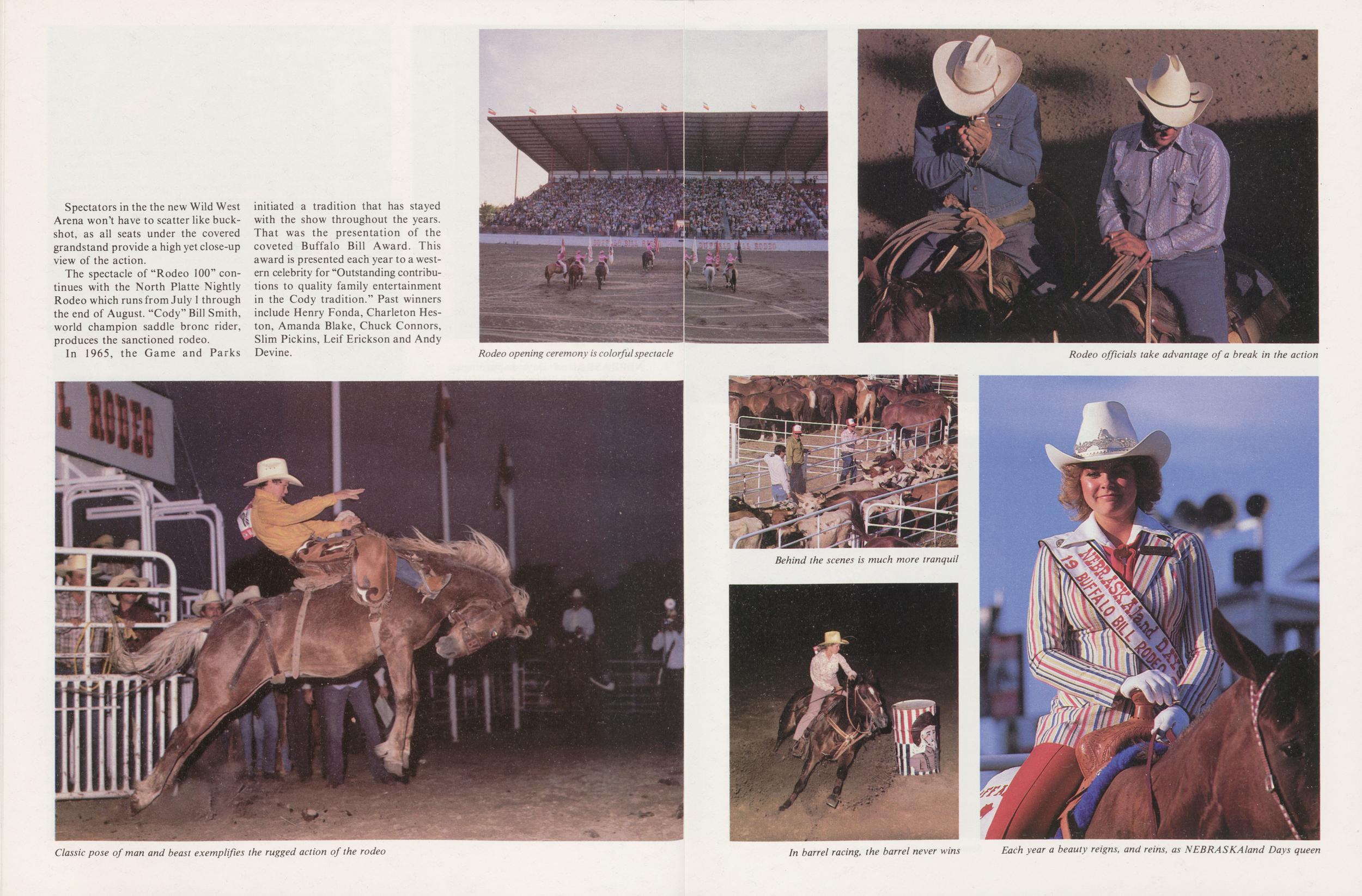
Rodeo opening ceremony is colorful spectacle
Classic pose of man and beast exemplifies the rugged action of the rodeo
Rodeo officials take advantage of a break in the action
Behind the scenes is much more tranquil
In barrel racing, the barrel never wins
Each year a beauty reigns, and reins, as NEBRASKAland Days queen
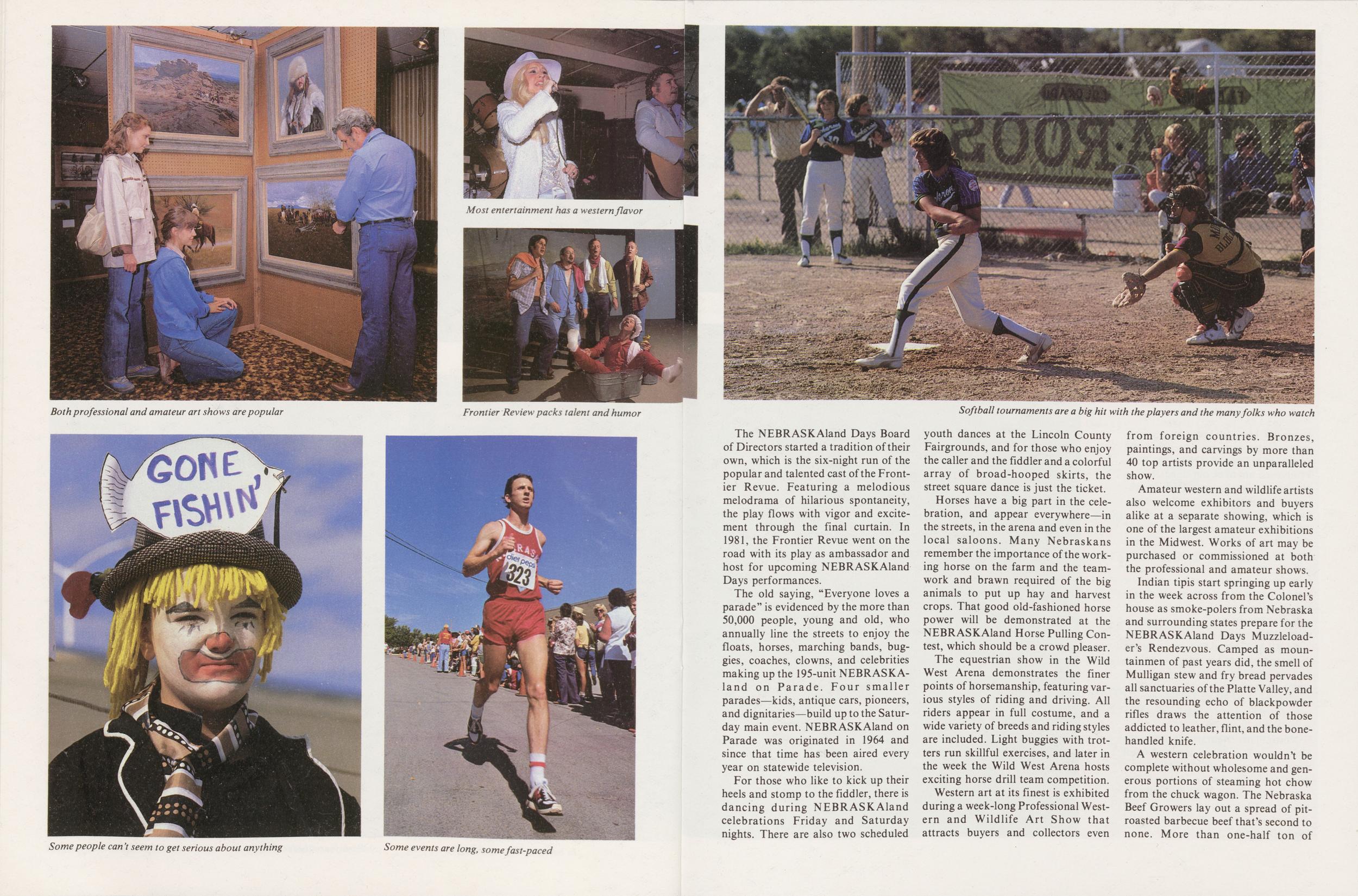
Most entertainment has a western flavor
Both professional and amateur art shows are popular
Frontier Review packs talent and humor
Some people can't seem to get serious about anything
Some events are long, some fast-paced
Softball tournaments are a big hit with the players and the many folks who watch
The NEBRASKAland Days Board of Directors started a tradition of their own, which is the six-night run of the popular and talented cast of the Frontier Revue. Featuring a melodious melodrama of hilarious spontaneity, the play flows with vigor and excitement through the final curtain. In 1981, the Frontier Revue went on the road with its play as ambassador and host for upcoming NEBRASKAland Days performances.
The old saying, "Everyone loves a parade" is evidenced by the more than 50,000 people, young and old, who annually line the streets to enjoy the floats, horses, marching bands, buggies, coaches, clowns, and celebrities making up the 195-unit NEBRASKAland on Parade. Four smaller parades—kids, antique cars, pioneers, and dignitaries—build up to the Saturday main event. NEBRASKAland on Parade was originated in 1964 and since that time has been aired every year on statewide television.
For those who like to kick up their heels and stomp to the fiddler, there is dancing during NEBRASKAland celebrations Friday and Saturday nights. There are also two scheduled youth dances at the Lincoln County Fairgrounds, and for those who enjoy the caller and the fiddler and a colorful array of broad-hooped skirts, the street square dance is just the ticket.
Horses have a big part in the celebration, and appear everywhere—in the streets, in the arena and even in the local saloons. Many Nebraskans remember the importance of the working horse on the farm and the teamwork and brawn required of the big animals to put up hay and harvest crops. That good old-fashioned horse power will be demonstrated at the NEBRASKAland Horse Pulling Contest, which should be a crowd pleaser.
The equestrian show in the Wild West Arena demonstrates the finer points of horsemanship, featuring various styles of riding and driving. All riders appear in full costume, and a wide variety of breeds and riding styles are included. Light buggies with trotters run skillful exercises, and later in the week the Wild West Arena hosts exciting horse drill team competition.
Western art at its finest is exhibited during a week-long Professional Western and Wildlife Art Show that attracts buyers and collectors even from foreign countries. Bronzes, paintings, and carvings by more than 40 top artists provide an unparalleled show.
Amateur western and wildlife artists also welcome exhibitors and buyers alike at a separate showing, which is one of the largest amateur exhibitions in the Midwest. Works of art may be purchased or commissioned at both the professional and amateur shows.
Indian tipis start springing up early in the week across from the Colonel's house as smoke-polers from Nebraska and surrounding states prepare for the NEBRASKAland Days Muzzleloader's Rendezvous. Camped as mountainmen of past years did, the smell of Mulligan stew and fry bread pervades all sanctuaries of the Platte Valley, and the resounding echo of blackpowder rifles draws the attention of those addicted to leather, flint, and the bone-handled knife.
A western celebration wouldn't be complete without wholesome and generous portions of steaming hot chow from the chuck wagon. The Nebraska Beef Growers lay out a spread of pit-roasted barbecue beef that's second to none. More than one-half ton of
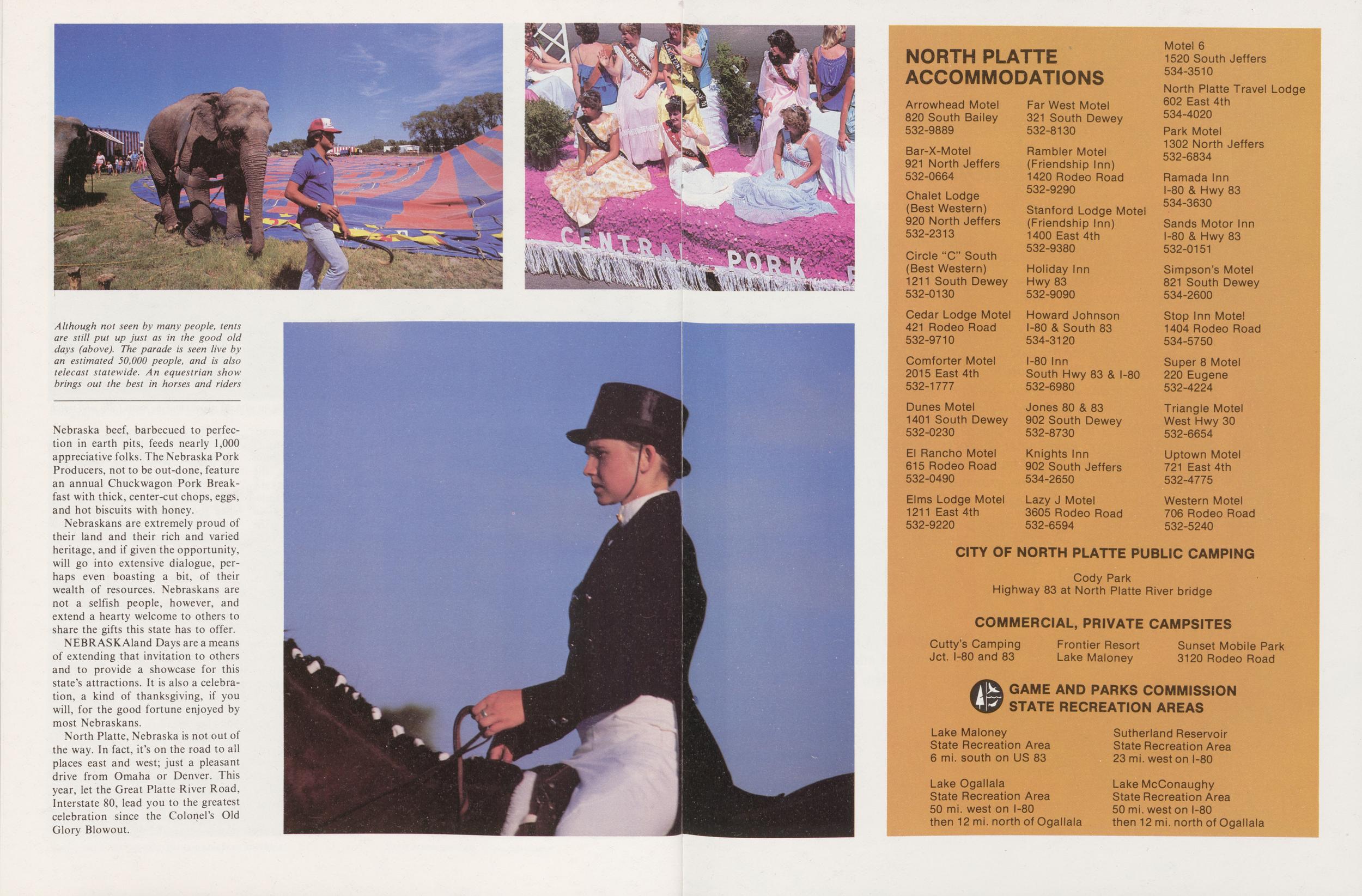
Although not seen by many people, tents are still put up just as in the good old days (above). The parade is seen live by an estimated 50,000 people, and is also telecast statewide. An equestrian show brings out the best in horses and riders
Nebraska beef, barbecued to perfection in earth pits, feeds nearly 1,000 appreciative folks. The Nebraska Pork Producers, not to be out-done, feature an annual Chuckwagon Pork Breakfast with thick, center-cut chops, eggs, and hot biscuits with honey.
Nebraskans are extremely proud of their land and their rich and varied heritage, and if given the opportunity, will go into extensive dialogue, perhaps even boasting a bit, of their wealth of resources. Nebraskans are not a selfish people, however, and extend a hearty welcome to others to share the gifts this state has to offer.
NEBRASKAland Days are a means of extending that invitation to others and to provide a showcase for this state's attractions. It is also a celebration, a kind of thanksgiving, if you will, for the good fortune enjoyed by most Nebraskans.
North Platte, Nebraska is not out of the way. In fact, it's on the road to all places east and west; just a pleasant drive from Omaha or Denver. This year, let the Great Platte River Road, Interstate 80, lead you to the greatest celebration since the Colonel's Old Glory Blowout.
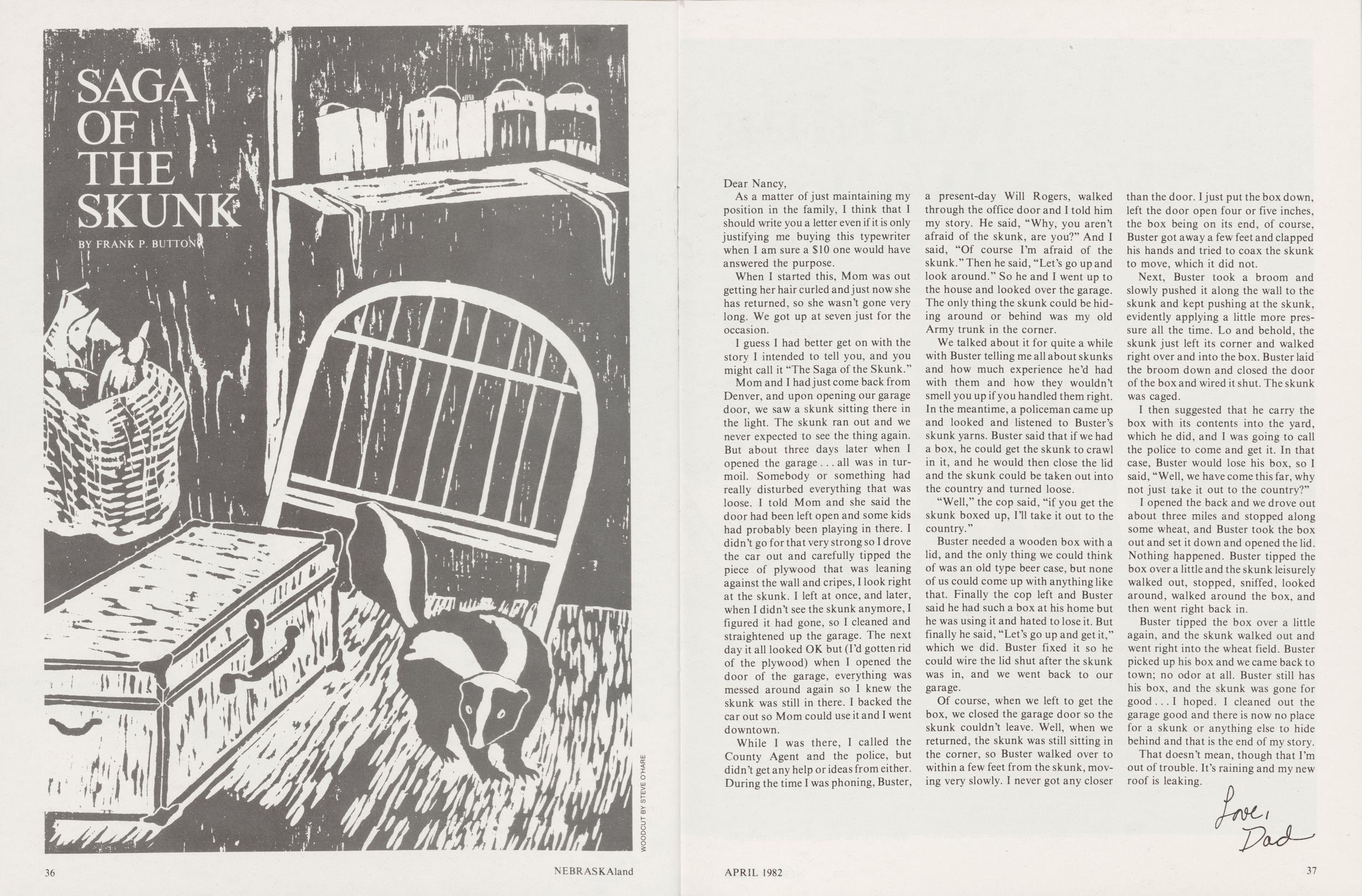
SAGA OF THE SKUNK
Dear Nancy, As a matter of just maintaining my position in the family, I think that I should write you a letter even if it is only justifying me buying this typewriter when I am sure a $10 one would have answered the purpose.
When I started this, Mom was out getting her hair curled and just now she has returned, so she wasn't gone very long. We got up at seven just for the occasion.
I guess I had better get on with the story I intended to tell you, and you might call it "The Saga of the Skunk."
Mom and I had just come back from Denver, and upon opening our garage door, we saw a skunk sitting there in the light. The skunk ran out and we never expected to see the thing again. But about three days later when I opened the garage ... all was in turmoil. Somebody or something had really disturbed everything that was loose. I told Mom and she said the door had been left open and some kids had probably been playing in there. I didn't go for that very strong so I drove the car out and carefully tipped the piece of plywood that was leaning against the wall and cripes, I look right at the skunk. I left at once, and later, when I didn't see the skunk anymore, I figured it had gone, so I cleaned and straightened up the garage. The next day it all looked OK but (I'd gotten rid of the plywood) when I opened the door of the garage, everything was messed around again so I knew the skunk was still in there. I backed the car out so Mom could use it and I went downtown.
While I was there, I called the County Agent and the police, but didn't get any help or ideas from either. During the time I was phoning, Buster, a present-day Will Rogers, walked through the office door and I told him my story. He said, "Why, you aren't afraid of the skunk, are you?" And I said, "Of course I'm afraid of the skunk." Then he said, "Let's go up and look around." So he and I went up to the house and looked over the garage. The only thing the skunk could be hiding around or behind was my old Army trunk in the corner.
We talked about it for quite a while with Buster telling me all about skunks and how much experience he'd had with them and how they wouldn't smell you up if you handled them right. In the meantime, a policeman came up and looked and listened to Buster's skunk yarns. Buster said that if we had a box, he could get the skunk to crawl in it, and he would then close the lid and the skunk could be taken out into the country and turned loose.
"Well," the cop said, "if you get the skunk boxed up, I'll take it out to the country."
Buster needed a wooden box with a lid, and the only thing we could think of was an old type beer case, but none of us could come up with anything like that. Finally the cop left and Buster said he had such a box at his home but he was using it and hated to lose it. But finally he said, "Let's go up and get it," which we did. Buster fixed it so he could wire the lid shut after the skunk was in, and we went back to our garage.
Of course, when we left to get the box, we closed the garage door so the skunk couldn't leave. Well, when we returned, the skunk was still sitting in the corner, so Buster walked over to within a few feet from the skunk, moving very slowly. I never got any closer than the door. I just put the box down, left the door open four or five inches, the box being on its end, of course, Buster got away a few feet and clapped his hands and tried to coax the skunk to move, which it did not.
Next, Buster took a broom and slowly pushed it along the wall to the skunk and kept pushing at the skunk, evidently applying a little more pressure all the time. Lo and behold, the skunk just left its corner and walked right over and into the box. Buster laid the broom down and closed the door of the box and wired it shut. The skunk was caged.
I then suggested that he carry the box with its contents into the yard, which he did, and I was going to call the police to come and get it. In that case, Buster would lose his box, so I said, "Well, we have come this far, why not just take it out to the country?"
I opened the back and we drove out about three miles and stopped along some wheat, and Buster took the box out and set it down and opened the lid. Nothing happened. Buster tipped the box over a little and the skunk leisurely walked out, stopped, sniffed, looked around, walked around the box, and then went right back in.
Buster tipped the box over a little again, and the skunk walked out and went right into the wheat field. Buster picked up his box and we came back to town; no odor at all. Buster still has his box, and the skunk was gone for good ... I hoped. I cleaned out the garage good and there is now no place for a skunk or anything else to hide behind and that is the end of my story.
That doesn't mean, though that I'm out of trouble. It's raining and my new roof is leaking.
APRIL 1982 37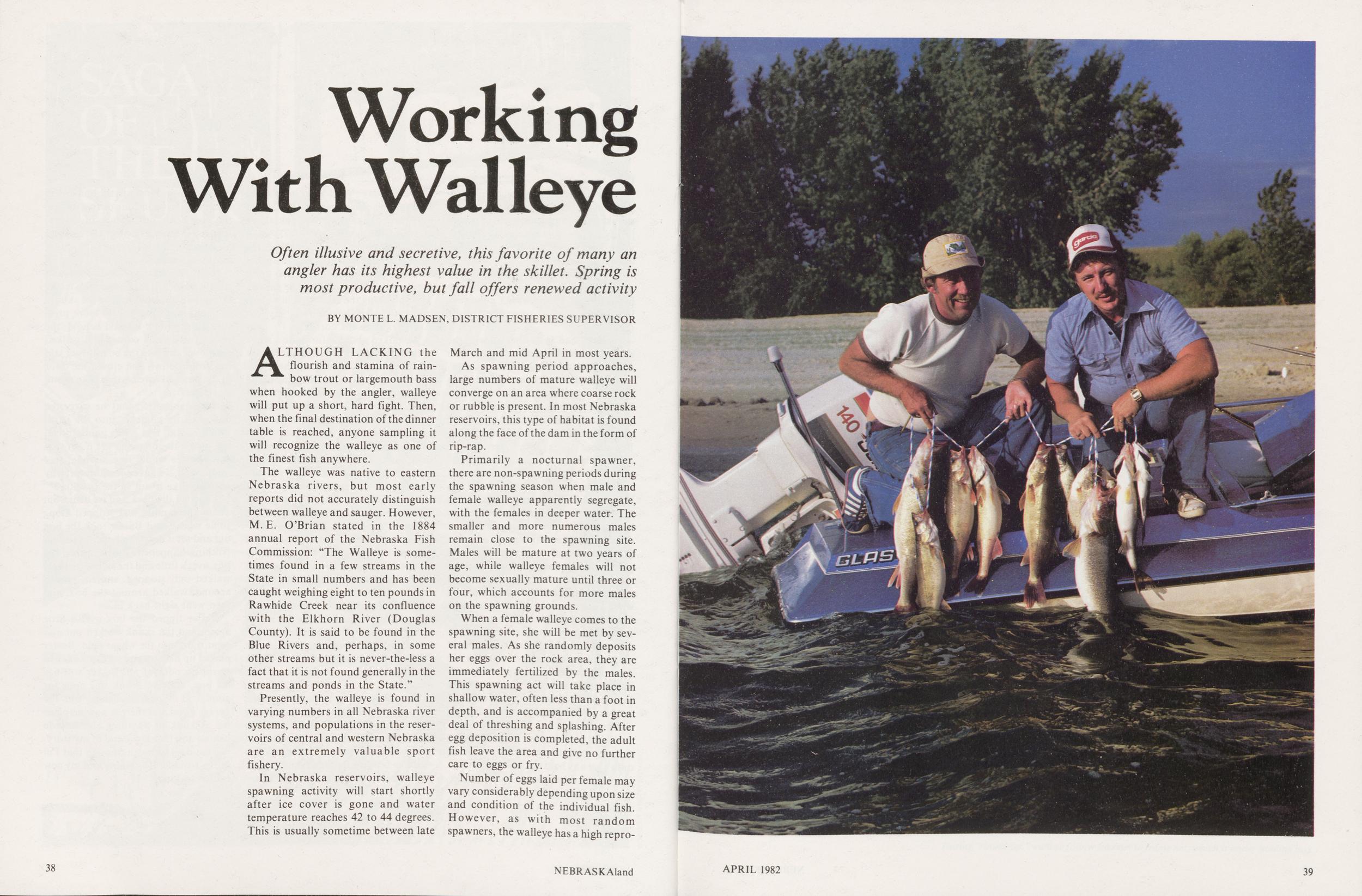
Working With Walleye
Often illusive and secretive, this favorite of many an angler has its highest value in the skillet. Spring is most productive, but fall offers renewed activity
ALTHOUGH LACKING the flourish and stamina of rainbow trout or largemouth bass when hooked by the angler, walleye will put up a short, hard fight. Then, when the final destination of the dinner table is reached, anyone sampling it will recognize the walleye as one of the finest fish anywhere.
The walleye was native to eastern Nebraska rivers, but most early reports did not accurately distinguish between walleye and sauger. However, M.E. O'Brian stated in the 1884 annual report of the Nebraska Fish Commission: "The Walleye is sometimes found in a few streams in the State in small numbers and has been caught weighing eight to ten pounds in Rawhide Creek near its confluence with the Elkhorn River (Douglas County). It is said to be found in the Blue Rivers and, perhaps, in some other streams but it is never-the-less a fact that it is not found generally in the streams and ponds in the State."
Presently, the walleye is found in varying numbers in all Nebraska river systems, and populations in the reservoirs of central and western Nebraska are an extremely valuable sport fishery.
In Nebraska reservoirs, walleye spawning activity will start shortly after ice cover is gone and water temperature reaches 42 to 44 degrees. This is usually sometime between late March and mid April in most years.
As spawning period approaches, large numbers of mature walleye will converge on an area where coarse rock or rubble is present. In most Nebraska reservoirs, this type of habitat is found along the face of the dam in the form of rip-rap.
Primarily a nocturnal spawner, there are non-spawning periods during the spawning season when male and female walleye apparently segregate, with the females in deeper water. The smaller and more numerous males remain close to the spawning site. Males will be mature at two years of age, while walleye females will not become sexually mature until three or four, which accounts for more males on the spawning grounds.
When a female walleye comes to the spawning site, she will be met by several males. As she randomly deposits her eggs over the rock area, they are immediately fertilized by the males. This spawning act will take place in shallow water, often less than a foot in depth, and is accompanied by a great deal of threshing and splashing. After egg deposition is completed, the adult fish leave the area and give no further care to eggs or fry.
Number of eggs laid per female may vary considerably depending upon size and condition of the individual fish. However, as with most random spawners, the walleye has a high
38 NEBRASKAland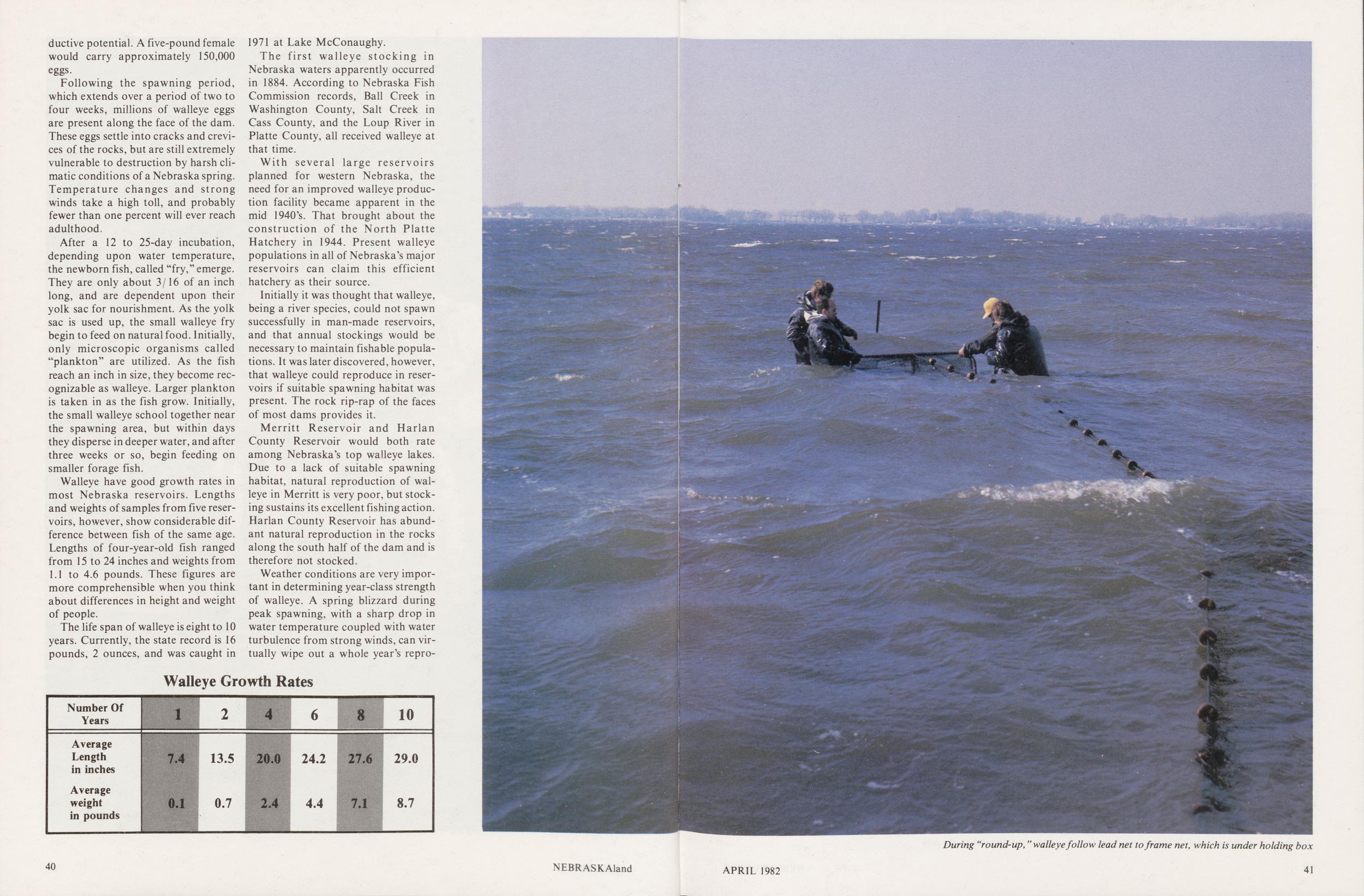
reproductive potential. A five-pound female would carry approximately 150,000 eggs.
Following the spawning period, which extends over a period of two to four weeks, millions of walleye eggs are present along the face of the dam. These eggs settle into cracks and crevices of the rocks, but are still extremely vulnerable to destruction by harsh climatic conditions of a Nebraska spring. Temperature changes and strong winds take a high toll, and probably fewer than one percent will ever reach adulthood.
After a 12 to 25-day incubation, depending upon water temperature, the newborn fish, called "fry," emerge. They are only about 3/16 of an inch long, and are dependent upon their yolk sac for nourishment. As the yolk sac is used up, the small walleye fry begin to feed on natural food. Initially, only microscopic organisms called "plankton" are utilized. As the fish reach an inch in size, they become recognizable as walleye. Larger plankton is taken in as the fish grow. Initially, the small walleye school together near the spawning area, but within days they disperse in deeper water, and after three weeks or so, begin feeding on smaller forage fish.
Walleye have good growth rates in most Nebraska reservoirs. Lengths and weights of samples from five reservoirs, however, show considerable difference between fish of the same age. Lengths of four-year-old fish ranged from 15 to 24 inches and weights from 1.1 to 4.6 pounds. These figures are more comprehensible when you think about differences in height and weight of people.
The life span of walleye is eight to 10 years. Currently, the state record is 16 pounds, 2 ounces, and was caught in 1971 at Lake McConaughy.
The first walleye stocking in Nebraska waters apparently occurred in 1884. According to Nebraska Fish Commission records, Ball Creek in Washington County, Salt Creek in Cass County, and the Loup River in Platte County, all received walleye at that time.
With several large reservoirs planned for western Nebraska, the need for an improved walleye production facility became apparent in the mid 1940's. That brought about the construction of the North Platte Hatchery in 1944. Present walleye populations in all of Nebraska's major reservoirs can claim this efficient hatchery as their source.
Initially it was thought that walleye, being a river species, could not spawn successfully in man-made reservoirs, and that annual stockings would be necessary to maintain fishable populations. It was later discovered, however, that walleye could reproduce in reservoirs if suitable spawning habitat was present. The rock rip-rap of the faces of most dams provides it.
Merritt Reservoir and Harlan County Reservoir would both rate among Nebraska's top walleye lakes. Due to a lack of suitable spawning habitat, natural reproduction of walleye in Merritt is very poor, but stocking sustains its excellent fishing action. Harlan County Reservoir has abundant natural reproduction in the rocks along the south half of the dam and is therefore not stocked.
Weather conditions are very important in determining year-class strength of walleye. A spring blizzard during peak spawning, with a sharp drop in water temperature coupled with water turbulence from strong winds, can virtually wipe out a whole year's reproduction
Walleye Growth Rates Number Of Years 1 2 4 6 8 10 Average Length in inches 7.4 13.5 20.0 24.2 27.6 29.0 Average weight in pounds 0.1 0.7 2.4 4.4 7.1 8.7 40 NERBASKAlandDuring "round-up, "walleye follow lead net to frame net, which is under holding box
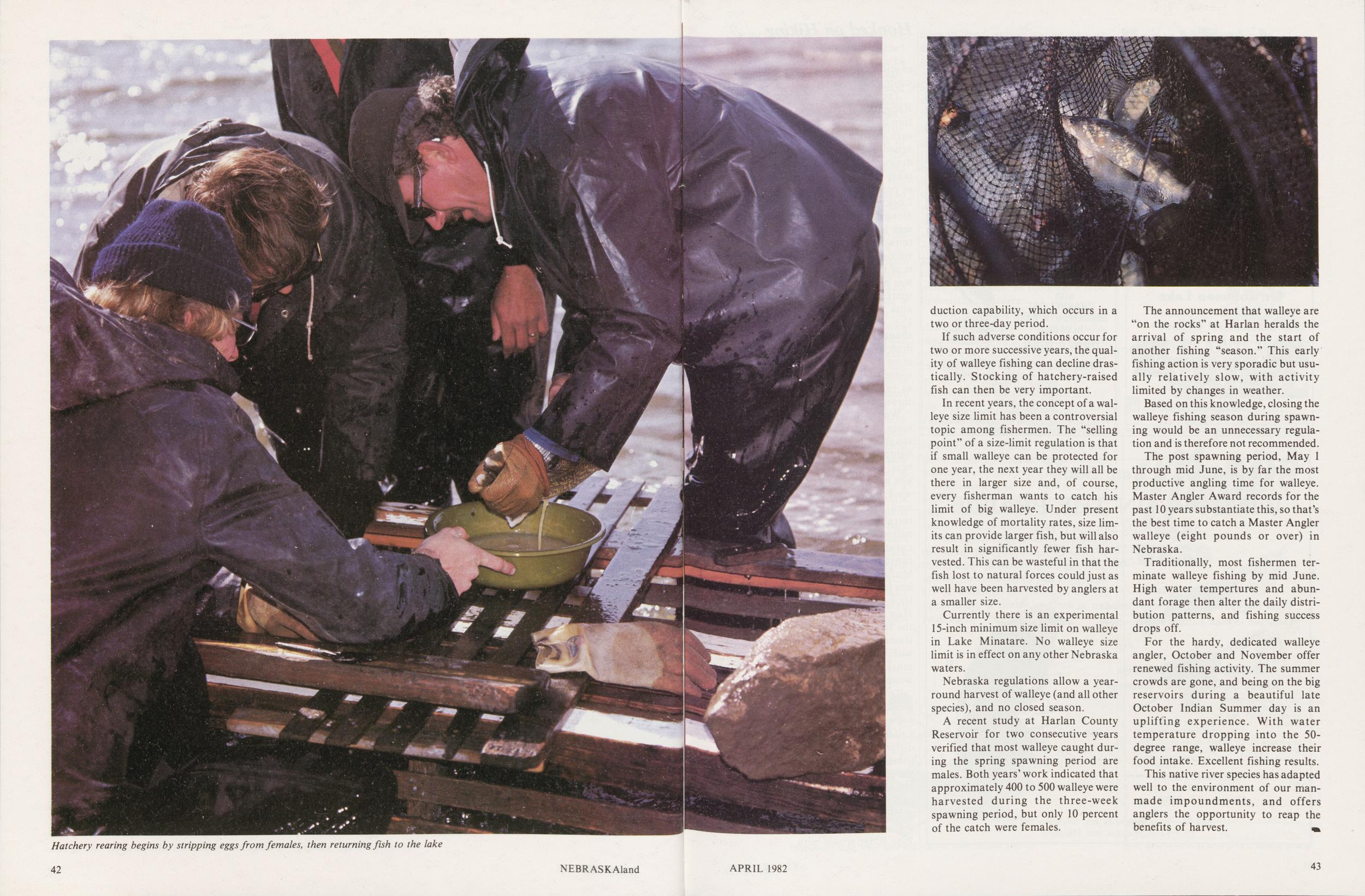
Hatchery rearing begins by stripping eggs from females, then returning fish to the lake
capability, which occurs in a two or three-day period.
If such adverse conditions occur for two or more successive years, the quality of walleye fishing can decline drastically. Stocking of hatchery-raised fish can then be very important.
In recent years, the concept of a walleye size limit has been a controversial topic among fishermen. The "selling point" of a size-limit regulation is that if small walleye can be protected for one year, the next year they will all be there in larger size and, of course, every fisherman wants to catch his limit of big walleye. Under present knowledge of mortality rates, size limits can provide larger fish, but will also result in significantly fewer fish harvested. This can be wasteful in that the fish lost to natural forces could just as well have been harvested by anglers at a smaller size.
Currently there is an experimental 15-inch minimum size limit on walleye in Lake Minatare. No walleye size limit is in effect on any other Nebraska waters.
Nebraska regulations allow a year-round harvest of walleye (and all other species), and no closed season.
A recent study at Harlan County Reservoir for two consecutive years verified that most walleye caught during the spring spawning period are males. Both years' work indicated that approximately 400 to 500 walleye were harvested during the three-week spawning period, but only 10 percent of the catch were females.
The announcement that walleve are "on the rocks" at Harlan heralds the arrival of spring and the start of another fishing "season." This early fishing action is very sporadic but usually relatively slow, with activity limited by changes in weather.
Based on this knowledge, closing the walleye fishing season during spawning would be an unnecessary regulation and is therefore not recommended.
The post spawning period, May 1 through mid June, is by far the most productive angling time for walleye. Master Angler Award records for the past 10 years substantiate this, so that's the best time to catch a Master Angler walleye (eight pounds or over) in Nebraska.
Traditionally, most fishermen terminate walleye fishing by mid June. High water temperatures and abundant forage then alter the daily distribution patterns, and fishing success drops off.
For the hardy, dedicated walleye angler, October and November offer renewed fishing activity. The summer crowds are gone, and being on the big reservoirs during a beautiful late October Indian Summer day is an uplifting experience. With water temperature dropping into the 50-degree range, walleye increase their food intake. Excellent fishing results.
This native river species has adapted well to the environment of our man-made impoundments, and offers anglers the opportunity to reap the benefits of harvest.
APRIL 1982 43
Hooked on Hiking
(Continued from page 16)exotic desserts to already toothsome main courses.
Trooper Trail, another National Recreation Trail, bisects a good portion of the Wood Reserve, and is one such recent addition. Winding along a broad spine between Soldier Creek drainages, this well-blazed pathway takes the hiker through a splendid mix of ponderosa and western hardwoods. Looking to the south while sauntering along during a bright October day, one sees leaves of the rapidly baring cottonwoods flutter and flying miniature whirls to the stream below. The effect is as if a giant spray can of gold paint was pressed along the landscape. The sparkle and glitter create an ethereal aura to those who look from above. I've observed the almost magical change from the brilliance of fall to the drab of winter several times from this same vantage point. The sight and sound of this transformation are never as exciting as along this special trail through the pines.
Winter brings a special treat for users of the Trooper. Ancient pines, snagged off by repeated winds or lightning, look out over a snowy stillness. Soldier Creek's south fork gurgles beneath a cover of fragile ice. The wind plays a lonesome song through a land that has seen centuries of creatures come and go. It takes little imagination to conjure up visions of bison crowded into one of the cul-de-sac canyons to break the bite of a plains blizzard. Less than a century ago, soldiers from Fort Robinson made regular trips here for firewood and timber. How they must have cursed the wind, the steepness of grade, and the balky teams as they rolled back to the fort with wagons laden with fuel for what must have seemed a never-ending winter.
To the winter stroller of today, the elements are the same. The bite of snow is just as deep, the wind just as knife-edged. But now we walk with a different purpose—we drink in the lonely beauty of the land, oblivious to the elements. Walking is a respite and restorative to office-bound nerves, a palliative to jaundiced thoughts and musings. We ramble down the trail, loathe to leave the enchantment of a Pine Ridge winter path.
44 NEBRASKAlandFarther east, one of the most exciting trails to be officially designated but still not completed is the Nebraska National Forest's Pine Ridge Trail. Following the Pine Ridge escarpment from Chadron to Crawford, this trail, upon completion, will be Nebraska's longest pathway. Even now the dedicated segments whet the appetite of those who have succumbed to the charm of these pine-studded canyons and rolling hills. Having ridden this route some years ago, portions came to mind when the first night's campsite was recently revisited.
East Ash Creek provided the idyllic setting for the most picturesque of camps, but the tranquility of the spot lasted only through the night. Whether a picket pulled loose or a hobble came undone, the clatter of hooves and a cloud of dust around sunup broke the calm. Some serious horse chasing began, and a good slice of morning was used before riders and horses were joined and on their way again. It was rewarding to rediscover this almost forgotten spot, and find permanent trail markers now in place. Thus far some 12!/2-miles of trail have been carved out and marked over a five-year span by Y.C.C. and Young Adult Conservation Corps workers. It was hard to resist the new trailhead north, just to see where it might lead, and soon I began the trek. Realizing that the late fall afternoon would soon mean poor light, I began east up the same trail our horses had raced away some years back. As I climbed up from the creek through darkening patches of Oregon grape, the ridgetops to the east were still bathed in the glow of the rapidly setting sun. Similar scenes had been recounted by mountaineering expeditions in Nepal as they wound through darkened valleys only to catch periodic glimpses of the high forbidden peaks of the Lhotse. Pausing to catch my breath, I looked to the now fading sunlight on the ridges of Indian Creek. How like being in another world. With the chill of the wind now numbing fingers, I hurried along in the light snow cover, anxious to get on top in time for one good view of the open meadows. In my haste, I neglected to notice the single-spaced footprints on the same path. Near the top, a momentary flash of color made me stop, probing the shadows for a better look. Too late, I realized. A bobcat, climbing to the meadow for early evening hunting, had bounced away; I had missed a good look at one of the ridge's most interesting creatures.
With little light remaining, the cold shutter grudgingly clicked off what remained of a roll of film and I started back down through the deepening twilight. Darkness would come quickly. Re-entering the timber was like dropping into a mine shaft. If not for the snow, my eyes would have had difficulty picking out the pathway.
An owl called far off in the darkness as I crunched through the now crusty snow. While anxious to regain the car's warmth, I realized that a trail through a fascinating area of Nebraska had once again provided memories to tuck away with many others, to be cherished and recalled at a later time.
Other trails exist in many corners of the state, and you, too, can share in this bounty of nature and find extraordinary awareness by just the simple art of walking. For most of us, the opportunity is nearly as close as our back door.
"For Pete's sake, what time did you tell them to pick you up?"
Bookshelf
Uses of Plants by the Indians of the Missouri River Region Melvin R. Gilmore Edition of 1919 reprinted 1977 University of Nebraska Press, Lincoln Paperback, 109 pages, $3.50
GILMORE WAS ONE of the pioneer students of Plains Indian ethnobotany, the science dealing with how plant products were used for food, drugs, tools and other purposes. Gilmore's work first appeared as his doctoral thesis in botany at the University of Nebraska, and was later published in the Bureau of American Ethnology annual report, 1919.
The principal tribes discussed are Pawnee, Omaha, Ponca, Winnebago and Dakota. Occasional references to Cree, Cheyenne, Chippewa and Ojibwa uses of plant material are also included. Although all of these native American cultures depended heavily upon hunting and fishing for food, both wild and cultivated plants were also used.
The reader will follow with interest Gilmore's accounts of how native wild plants provided both necessities and ceremonial articles. Much of the information contained was derived from interviews with older tribal members. A few questions for which answers are provided include: Which trees or shrubs were preferred for bows and arrow shafts? How many types of berries were gathered for food and how were they used? Were any plant fibers used for thread or cord? Which seeds and dried roots were ground into flour? Which plants provided drugs or medicine?
The text is supplemented with a table of scientific names, English common names, and tribal names; an index; and more than 50 photographs. An introduction includes a short biography of Gilmore and an update of plant technical names which have been changed since the original edition appeared.
46 NEBRASKAland
NOTES ON NEBRASKA FAUNA
BIGHORN SHEEP
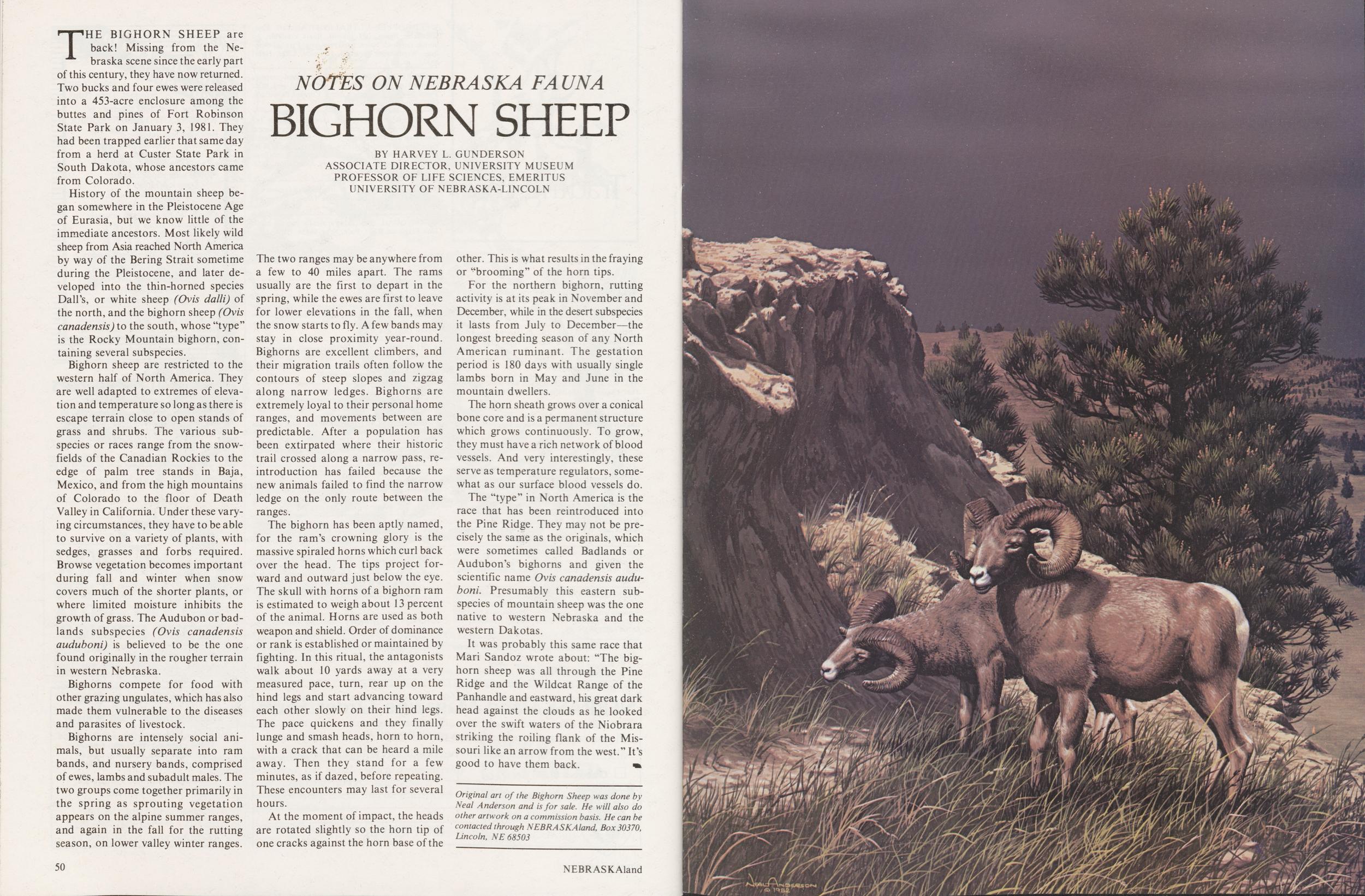
THE BIGHORN SHEEP are back! Missing from the Nebraska scene since the early part of this century, they have now returned. Two bucks and four ewes were released into a 453-acre enclosure among the buttes and pines of Fort Robinson State Park on January 3, 1981. They had been trapped earlier that same day from a herd at Custer State Park in South Dakota, whose ancestors came from Colorado.
History of the mountain sheep began somewhere in the Pleistocene Age of Eurasia, but we know little of the immediate ancestors. Most likely wild sheep from Asia reached North America by way of the Bering Strait sometime during the Pleistocene, and later developed into the thin-horned species Dall's, or white sheep (Ovis dalli) of the north, and the bighorn sheep (Ovis canadensis) to the south, whose "type" is the Rocky Mountain bighorn, containing several subspecies.
Bighorn sheep are restricted to the western half of North America. They are well adapted to extremes of elevation and temperature so long as there is escape terrain close to open stands of grass and shrubs. The various subspecies or races range from the snowfields of the Canadian Rockies to the edge of palm tree stands in Baja, Mexico, and from the high mountains of Colorado to the floor of Death Valley in California. Under these varying circumstances, they have to be able to survive on a variety of plants, with sedges, grasses and forbs required. Browse vegetation becomes important during fall and winter when snow covers much of the shorter plants, or where limited moisture inhibits the growth of grass. The Audubon or badlands subspecies (Ovis canadensis auduboni) is believed to be the one found originally in the rougher terrain in western Nebraska.
Bighorns compete for food with other grazing ungulates, which has also made them vulnerable to the diseases and parasites of livestock.
Bighorns are intensely social animals, but usually separate into ram bands, and nursery bands, comprised of ewes, lambs and subadult males. The two groups come together primarily in the spring as sprouting vegetation appears on the alpine summer ranges, and again in the fall for the rutting season, on lower valley winter ranges.
The two ranges may be anywhere from a few to 40 miles apart. The rams usually are the first to depart in the spring, while the ewes are first to leave for lower elevations in the fall, when the snow starts to fly. A few bands may stay in close proximity year-round. Bighorns are excellent climbers, and their migration trails often follow the contours of steep slopes and zigzag along narrow ledges. Bighorns are extremely loyal to their personal home ranges, and movements between are predictable. After a population has been extirpated where their historic trail crossed along a narrow pass, re-introduction has failed because the new animals failed to find the narrow ledge on the only route between the ranges.
The bighorn has been aptly named, for the ram's crowning glory is the massive spiraled horns which curl back over the head. The tips project forward and outward just below the eye. The skull with horns of a bighorn ram is estimated to weigh about 13 percent of the animal. Horns are used as both weapon and shield. Order of dominance or rank is established or maintained by fighting. In this ritual, the antagonists walk about 10 yards away at a very measured pace, turn, rear up on the hind legs and start advancing toward each other slowly on their hind legs. The pace quickens and they finally lunge and smash heads, horn to horn, with a crack that can be heard a mile away. Then they stand for a few minutes, as if dazed, before repeating. These encounters may last for several hours.
At the moment of impact, the heads are rotated slightly so the horn tip of one cracks against the horn base of the other. This is what results in the fraying or "brooming" of the horn tips.
For the northern bighorn, rutting activity is at its peak in November and December, while in the desert subspecies it lasts from July to December—the longest breeding season of any North American ruminant. The gestation period is 180 days with usually single lambs born in May and June in the mountain dwellers.
The horn sheath grows over a conical bone core and is a permanent structure which grows continuously. To grow, they must have a rich network of blood vessels. And very interestingly, these serve as temperature regulators, somewhat as our surface blood vessels do.
The "type" in North America is the race that has been reintroduced into the Pine Ridge. They may not be precisely the same as the originals, which were sometimes called Badlands or Audubon's bighorns and given the scientific name Ovis canadensis auduboni. Presumably this eastern subspecies of mountain sheep was the one native to western Nebraska and the western Dakotas.
It was probably this same race that Mari Sandoz wrote about: "The bighorn sheep was all through the Pine Ridge and the Wildcat Range of the Panhandle and eastward, his great dark head against the clouds as he looked over the swift waters of the Niobrara striking the roiling flank of the Missouri like an arrow from the west." It's good to have them back.
Original art of the Bighorn Sheep was done by Neal Anderson and is for sale. He will also do other artwork on a commission basis. He can be contacted through NEBRASKAland, Box 30370, Lincoln, NE 68503 50 NEBRASKAland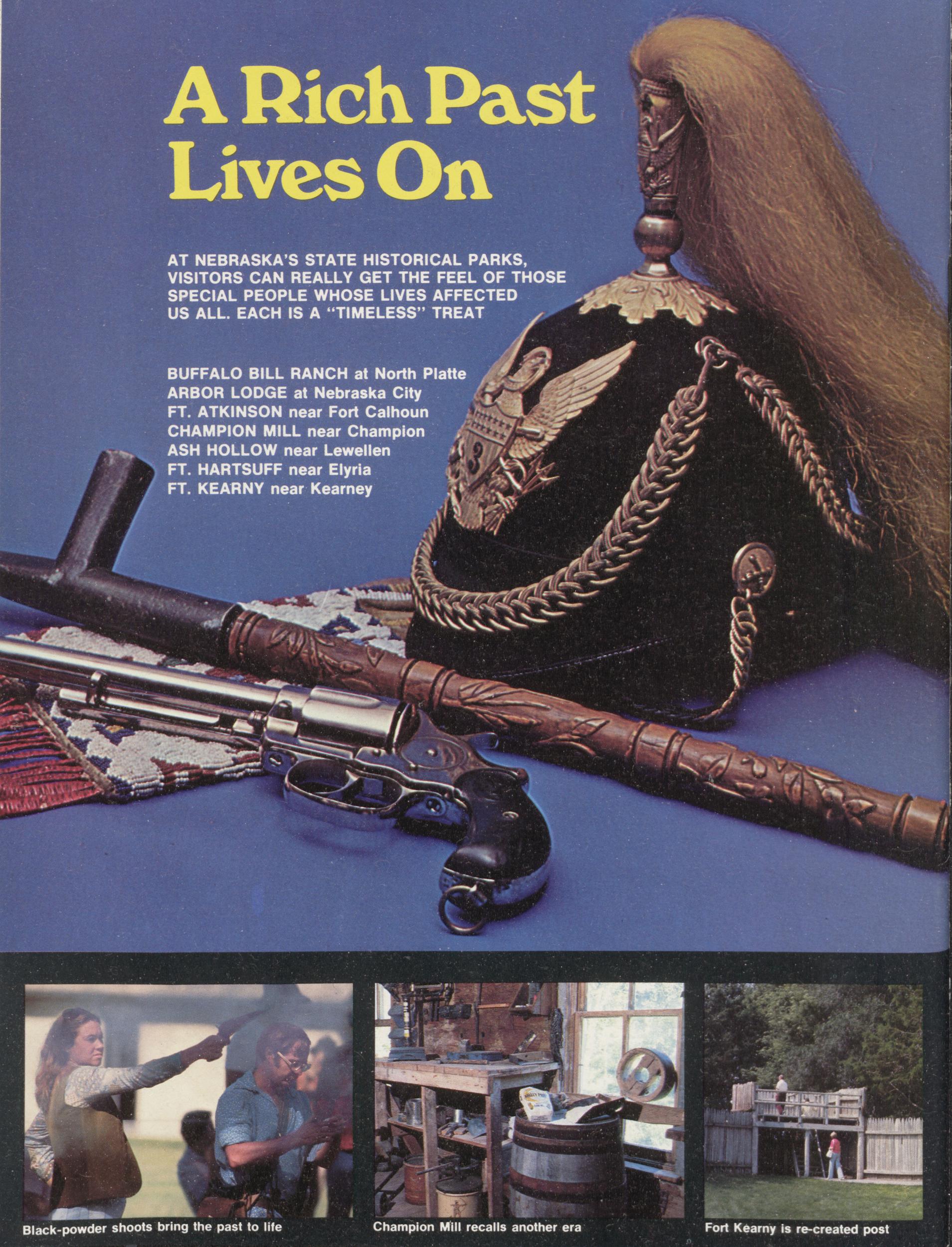
Black-powder shoots bring the past to life
Champion Mill recalls another era
Fort Kearny is re-created post
Position: 467 (22 views)