Volume 60, Issue 5, 1982
Speak Up
Deserved honor Sir / Congratulations on your selection as Midlands Man of the Year. This was an excellent write-up and a much deserved honor. Recognition does not always come to those who deserve it. This article says that you may go down as one of the greats. I expect you to be the greatest. You are making the dreams of many of us come true. Thanks for doing what you are doing for the state I love. Frank B. Morrison, Sr. Omaha, Nebraska Former Governor Morrison's letter, dear readers, came after announcement in the Omaha World Herald that Game and Parks Commission director Gene Mahoney (our boss) had been selected Midlands Man of the Year. This was but one of many calls and letters. (Editor) Outdoor poet Sir / We are avid NEBRASKAland readers, and enjoy it a great deal. I have sent some poems which have been inspired by hikes and hunting trips. Glen Braddy Papillion, Nebr. River Dawning Leaves awaken Sunlight bathes them soft And green with light The sun runs its blood along the day's smokey rim A river shines dimly, gray as steel and colder Laughing at the stones. Wind and light increase as one, eye and lung awakening, Dark cold still turns colder, brittle sound and breeze As every fur-clad brother comes Edging into daylight With coat of dusk and soul of shadow Blizzards A howling white monster Prowls through crystal halls It screams and beats upon the walls. Young eyes shine solemn Wide as windows shake Icy trees pop in frozen marshes Where hunters tramp on stinging feet And search for life to take. No life steams breath In the sugar sparkling world No wing unwrapped No tail unfurled. Each heart raps slow, Wrapped in its snow-bound form All the children are gone to ground And warm. The trails are silent Frosty white and glistening The sky stands empty Sad and listening. The earth spreads frozen Hard and sleeping With deep, hard womb Its life is keeping. Keeping up Sir / Just wanted you to know how much I appreciate your magazine. It is so nicely printed with good paper and black ink that I can still keep up with it even though my vision is failing. Thank you so much. My husband was a hunter so I keep up with ducks and birds still. Mrs. Lyle Eilers Omaha, Nebr. Art seeker Sir / First off, as always, the February issue was tremendous. "A Panhandle Portfolio," my country, is really something. Catherland is a real extra. But, you neglected to inform your readers where they could obtain the first five of the series. I called and was told that an order form would be sent to me. For those who wish an order form, write: Willa Cather Pioneer Memorial, 326 N. Webster, Red Cloud, Nebr. 68970, and request an order form for Bergers art. R. G. Sandstrom Chadron, Nebr. The February issue was supposed to have carried an ad for the artwork so that interested persons could order. Somehow it didn't get finished and wasn't included, but is in this issue, (see page 43). (Editor) Female Mail Sir / After receiving NEBRASKAland for over a year now, and seeing beautiful Nebraska in person, we appreciate the magazine even more, as in September of 1981 we visited your state and some friends. We toured the state capitol, the University of Nebraska museum, Boys Town U.S.A. (seeing it was a dream come true) and many other attractions. We also went airboating and canoed the Platte River. We brought home with us many happy memories of an unforgettable holiday. Thank you, Nebraska, for making us welcome, 4 NEBRASKAland and making our stay a most enjoyable one. From our province of Prince Edward Island, eastern Canada, we send our best to all the staff of NEBR ASK Aland for a most happy and prosperous 1982. Keep up the good work in printing such enjoyable reading. Frances McAlduff and Cecelia Gaudet P.E.I., Canada "Fine" tourists Sir / I would like to "speak up" regarding the policy of park permits for state areas for our tourists. I would ask that all who agree that we need a separate policy (for those areas which are unmanned) for our tourists, to also speak up to make our visitors have pleasant memories of our beautiful state. Many out-of-state people pull in to stop for the night and would gladly pay the permit price, but where do they go at that late hour? We feel it is unfair to fine them. They are not expecting a free ride, and are mostly families vacationing. How about an honor system? Laurence and Rachel Greenfield Newport, Nebr. This is a topic which probably has no fair solution, as some people will use areas and not buy entry permits out of stubborness, while others will gladly pay even though they may only use a public area once. Please keep in mind that these areas were acquired and developed by Nebraskans, and are used primarily by only a few—mostly campers. Maintenance, law enforcement, vandalism repair, garbage and trash pickup and such should probably be paid for by those who use these areas. No revenue is realized from campers unless a use fee is charged. When an area is marked as requiring an entry permit, it becomes the obligation of the user to get a permit—not to use the area in hopes he won't be caught. Non-residents are normally given every opportunity to get a permit before they are ticketed. Residents, it seems, should know better than to be without one. Surely we should treat everyone fairly, but they must expect just treatment in return. As for your honor system; doubtless vandals would make that a very short-term solution. It should also be remembered that Nebraska's fees are less than neighboring states—only half that of Kansas, for example. (Editor) NEBRASKAland Magazine invites all readers to submit their comments, suggestions, and gripes to Speak Up. Each month the magazine will publish as many letters as space permits. Pictures are welcome. NEBRASKALand reserves the right to edit and condense letters.—Editor.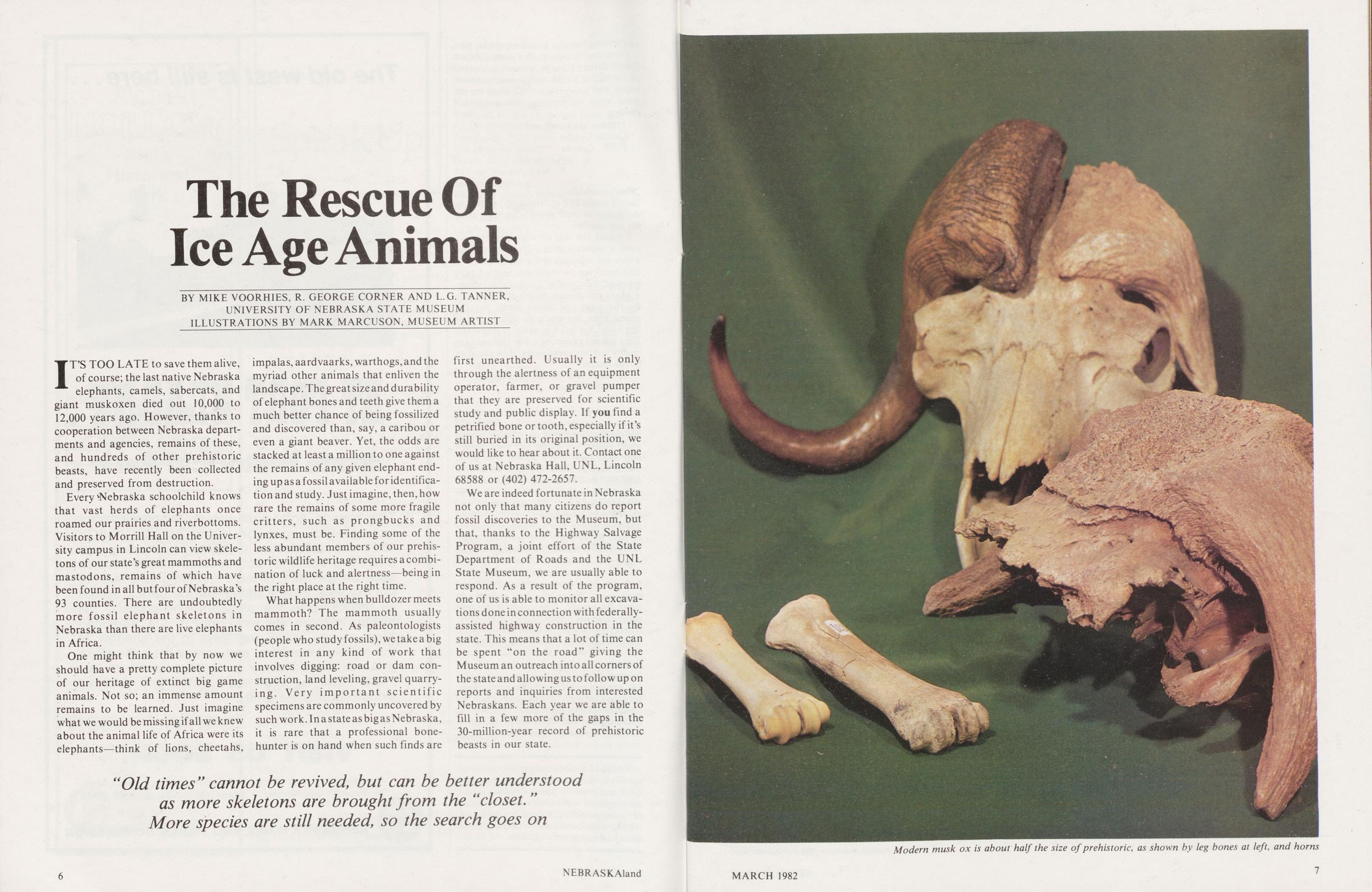
The Rescue Of Ice Age Animals
IT'S TOO LATE to save them alive, of course; the last native Nebraska elephants, camels, sabercats, and giant muskoxen died out 10,000 to 12,000 years ago. However, thanks to cooperation between Nebraska departments and agencies, remains of these, and hundreds of other prehistoric beasts, have recently been collected and preserved from destruction.
Every 'Nebraska schoolchild knows that vast herds of elephants once roamed our prairies and riverbottoms. Visitors to Morrill Hall on the University campus in Lincoln can view skeletons of our state's great mammoths and mastodons, remains of which have been found in all but four of Nebraska's 93 counties. There are undoubtedly more fossil elephant skeletons in Nebraska than there are live elephants in Africa.
One might think that by now we should have a pretty complete picture of our heritage of extinct big game animals. Not so; an immense amount remains to be learned. Just imagine what we would be missing if all we knew about the animal life of Africa were its elephants—think of lions, cheetahs, impalas, aardvaarks, warthogs, and the myriad other animals that enliven the landscape. The great size and durability of elephant bones and teeth give them a much better chance of being fossilized and discovered than, say, a caribou or even a giant beaver. Yet, the odds are stacked at least a million to one against the remains of any given elephant ending up as a fossil available for identification and study. Just imagine, then, how rare the remains of some more fragile critters, such as prongbucks and lynxes, must be. Finding some of the less abundant members of our prehistoric wildlife heritage requires a combination of luck and alertness—being in the right place at the right time.
What happens when bulldozer meets mammoth? The mammoth usually comes in second. As paleontologists (people who study fossils), we take a big interest in any kind of work that involves digging: road or dam construction, land leveling, gravel quarrying. Very important scientific specimens are commonly uncovered by such work. In a state as big as Nebraska, it is rare that a professional bone-hunter is on hand when such finds are first unearthed. Usually it is only through the alertness of an equipment operator, farmer, or gravel pumper that they are preserved for scientific study and public display. If you find a petrified bone or tooth, especially if it's still buried in its original position, we would like to hear about it. Contact one of us at Nebraska Hall, UNL, Lincoln 68588 or (402) 472-2657.
We are indeed fortunate in Nebraska not only that many citizens do report fossil discoveries to the Museum, but that, thanks to the Highway Salvage Program, a joint effort of the State Department of Roads and the UNL State Museum, we are usually able to respond. As a result of the program, one of us is able to monitor all excavations done in connection with federally-assisted highway construction in the state. This means that a lot of time can be spent "on the road" giving the Museum an outreach into all corners of the state and allowing us to follow up on reports and inquiries from interested Nebraskans. Each year we are able to fill in a few more of the gaps in the 30-million-year record of prehistoric beasts in our state.
"Old times" cannot be revived, but can be better understood as more skeletons are brought from the "closet." More species are still needed, so the search goes on
6 NEBRASKAlandModern musk ox is about half the size of prehistoric, as shown by leg bones at left, and horns
An aspect of Nebraska's past life that especially interests us is the mammal fauna of the great Ice Age (technically known as the Pleistocene Period) which lasted from approximately two million until about 12,000 years ago. Much of the surface sediment in Nebraska was formed at this time, and some layers, especially the sands and gravels of rivers and the thick blankets glacial dust called loess, have preserved an incredible variety of skeletal remains of long-vanished creatures.
About 150 years ago you could list Nebraska's big game animals by singing a verse from Home on the Range: ". . . where the buffalo roam and the deer and the antelope play. At any given time during the Ice Age, on the other hand, there were at least 30 kinds of mammals weighing more than 100 pounds living in our state. Some of the most impressive animals ever to walk Nebraska's plains lived during the Pleistocene. Ice Age mammals are intriguing not only because many of them were huge, but because somehow they don't seem quite asaliento usasdo some others, for example dinosaurs. Extinct mammals, no matter how bizarre, were at least warm-blooded and hairy like us. Perhaps that our ancestors hunted (or were hunted by) many of these very species gives the study of Pleistocene mammals a special flavor.
Discoveries have been made recently in all parts of the state, but two have been especially productive of new information about Ice Age animals: the Republican and Niobrara River valleys. Gravel pits along the Republican near McCook have yielded a large number of well-preserved skulls and bones of large mammals including a large camel called Camelops, caribou, three kinds of muskoxen, at least two kinds of horses, giant bison, wolves, coyotes, bears, lions, lynxes, ground sloths, mammoths, mastodons and numerous others. A number of creatures not previously known from Nebraska have turned up in this area, largely due to the efforts of gravel pit operators and other people. A new species of muskox, and the first fossil pine marten and black-footed ferret in Nebraska have been found. One of the more abundant grazing animals from the Red Willow County pits were bighorn sheep of a species both larger and longer-limbed than modern bighorns. The newly discovered Nebraska fossils of this species are the first to include a series of rams, ewes, and lambs. These prairie-adapted sheep (technically called Ovis catclawensis after an Arizona cave) apparently grazed alongside bison, mammoth, and native horses on the windswept glacial plains of Ice Age Nebraska.
Fossils of carnivorous animals tend to be rare—usually only one bone in every hundred or so found will be from a predator. So, we were delighted to add a partial skull of the largest species of cat that ever lived to the Museum collection: Panthera atrox, the great American lion, which on the average must have outweighed living lions by at least 30 percent.
In gravel beds perched high above the Niobrara River near Norden, we found the first evidence of a "full glacial" mammal community in Nebraska, complete with such boreal animals as collared lemmings, spruce voles, and chickarees. Hundreds of jaws from this deposit show that even prairie dogs were big during the Ice Age—about 20 percent bigger than the familiar black-tailed prairie dog of today.
New fossil discoveries are also showing us that it wasn't continuously cold during the Pleistocene. There were at least nine advances of glacial ice into the heartland of North America, but between glacial advances it became as warm or warmer than today. We now know that at least once it became mild enough for armadillos, jaguars, and tapirs to live in northern Nebraska. Our state lies in a particularly critical geographical area where eastern, western, northern, and southern life forms meet and interact.
Within the state, too, there were areas of differing ecologies, which supported different kinds of large mammals.
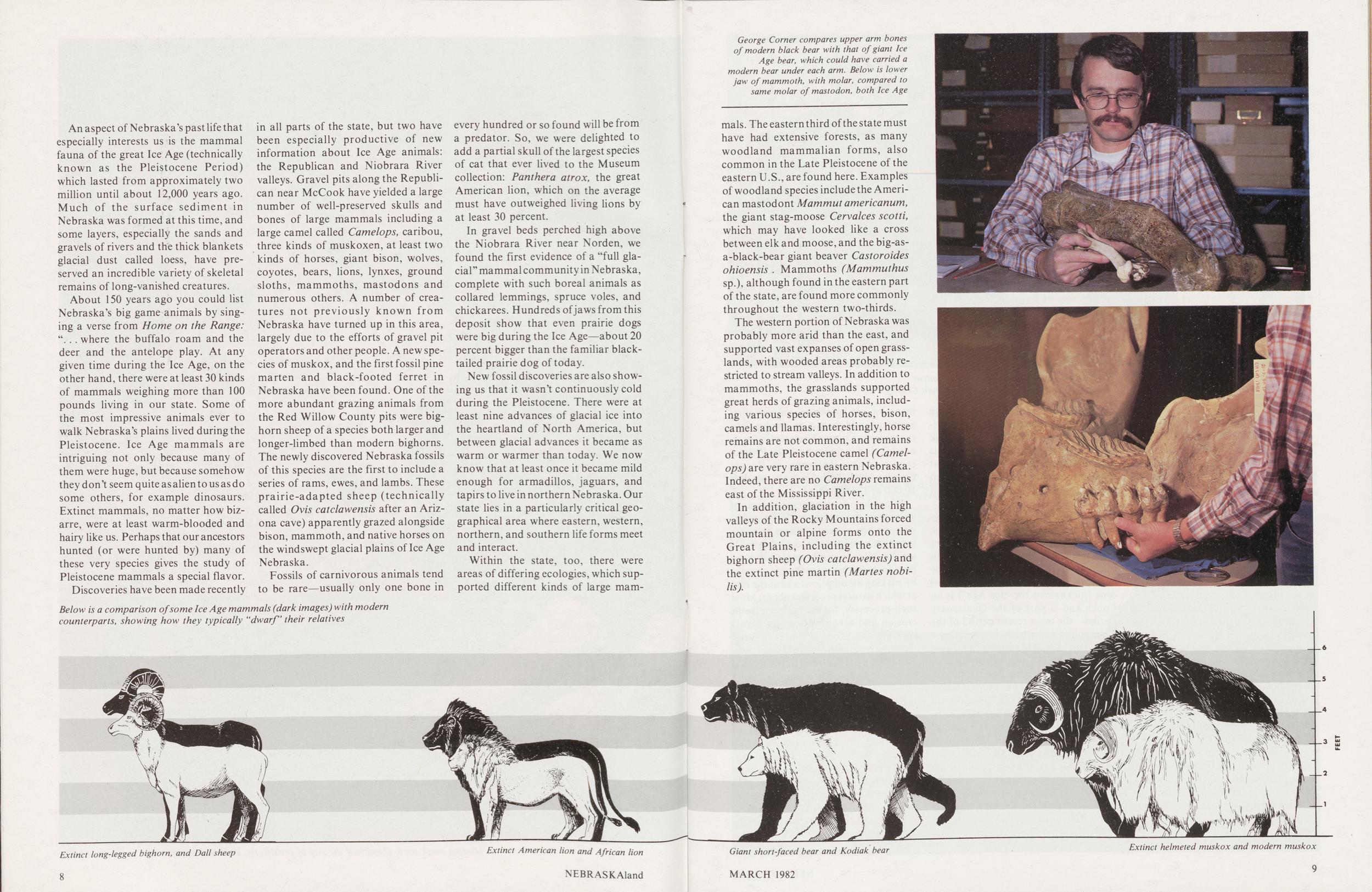
8 NEBRASKAlandGeorge Corner compares upper arm bones of modem black bear with that of giant Ice Age bear, which could have carried a modern bear under each arm. Below is lower jaw of mammoth, with molar, compared to same molar of mastodon, both Ice Age
The eastern third of the state must have had extensive forests, as many woodland mammalian forms, also common in the Late Pleistocene of the eastern U.S., are found here. Examples of woodland species include the American mastodont Mammut americanum, the giant stag-moose Cervalces scotti, which may have looked like a cross between elk and moose, and the big-as-a-black-bear giant beaver Castoroides ohioensis . Mammoths (Mammuthus sp.), although found in the eastern part of the state, are found more commonly throughout the western two-thirds.
The western portion of Nebraska was probably more arid than the east, and supported vast expanses of open grasslands, with wooded areas probably restricted to stream valleys. In addition to mammoths, the grasslands supported great herds of grazing animals, including various species of horses, bison, camels and llamas. Interestingly, horse remains are not common, and remains of the Late Pleistocene camel (Camelops) are very rare in eastern Nebraska. Indeed, there are no Camelops remains east of the Mississippi River.
In addition, glaciation in the high valleys of the Rocky Mountains forced mountain or alpine forms onto the Great Plains, including the extinct bighorn sheep (Ovis catclawensis) and the extinct pine martin (Martes nobilis).
Below is a comparison of some Ice Age mammals (dark images) with modern counterparts, showing how they typically "dwarf' their relatives
Extinct long-legged bighorn, and Dall sheep Extinct American lion and African lion Giant short-faced bear and Kodiak bear Extinct helmeted muskox and modern muskox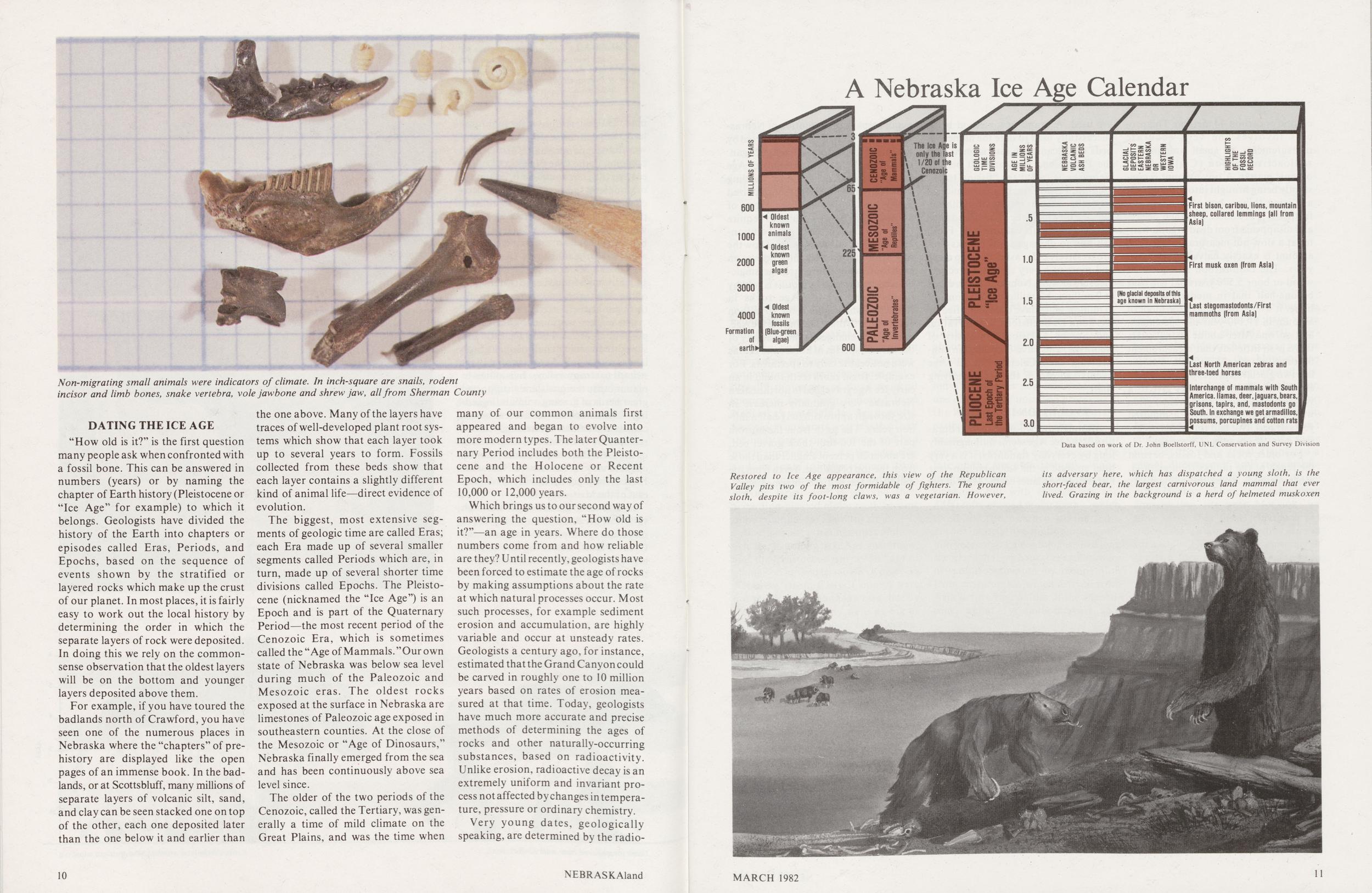
Non-migrating small animals were indicators of climate. In inch-square are snails, rodent incisor and limb bones, snake vertebra, vole jawbone and shrew jaw, all from Sherman County
DATING THE ICE AGE
"How old is it?" is the first question many people ask when confronted with a fossil bone. This can be answered in numbers (years) or by naming the chapter of Earth history (Pleistocene or "Ice Age" for example) to which it belongs. Geologists have divided the history of the Earth into chapters or episodes called Eras, Periods, and Epochs, based on the sequence of events shown by the stratified or layered rocks which make up the crust of our planet. In most places, it is fairly easy to work out the local history by determining the order in which the separate layers of rock were deposited. In doing this we rely on the commonsense observation that the oldest layers will be on the bottom and younger layers deposited above them.
For example, if you have toured the badlands north of Crawford, you have seen one of the numerous places in Nebraska where the "chapters" of prehistory are displayed like the open pages of an immense book. In the badlands, or at Scottsbluff, many millions of separate layers of volcanic silt, sand, and clay can be seen stacked one on top of the other, each one deposited later than the one below it and earlier than the one above. Many of the layers have traces of well-developed plant root systems which show that each layer took up to several years to form. Fossils collected from these beds show that each layer contains a slightly different kind of animal life—direct evidence of evolution.
The biggest, most extensive segments of geologic time are called Eras; each Era made up of several smaller segments called Periods which are, in turn, made up of several shorter time divisions called Epochs. The Pleistocene (nicknamed the "Ice Age") is an Epoch and is part of the Quaternary Period—the most recent period of the Cenozoic Era, which is sometimes called the "Age of Mammals. "Our own state of Nebraska was below sea level during much of the Paleozoic and Mesozoic eras. The oldest rocks exposed at the surface in Nebraska are limestones of Paleozoic age exposed in southeastern counties. At the close of the Mesozoic or "Age of Dinosaurs," Nebraska finally emerged from the sea and has been continuously above sea level since.
The older of the two periods of the Cenozoic, called the Tertiary, was generally a time of mild climate on the Great Plains, and was the time when many of our common animals first appeared and began to evolve into more modern types. The later Quaternary Period includes both the Pleistocene and the Holocene or Recent Epoch, which includes only the last 10,000 or 12,000 years.
Which brings us to our second way of answering the question, "How old is it?"—an age in years. Where do those numbers come from and how reliable are they? Until recently, geologists have been forced to estimate the age of rocks by making assumptions about the rate at which natural processes occur. Most such processes, for example sediment erosion and accumulation, are highly variable and occur at unsteady rates. Geologists a century ago, for instance, estimated that the Grand Canyon could be carved in roughly one to 10 million years based on rates of erosion measured at that time. Today, geologists have much more accurate and precise methods of determining the ages of rocks and other naturally-occurring substances, based on radioactivity. Unlike erosion, radioactive decay is an extremely uniform and invariant process not affected by changes in temperature, pressure or ordinary chemistry.
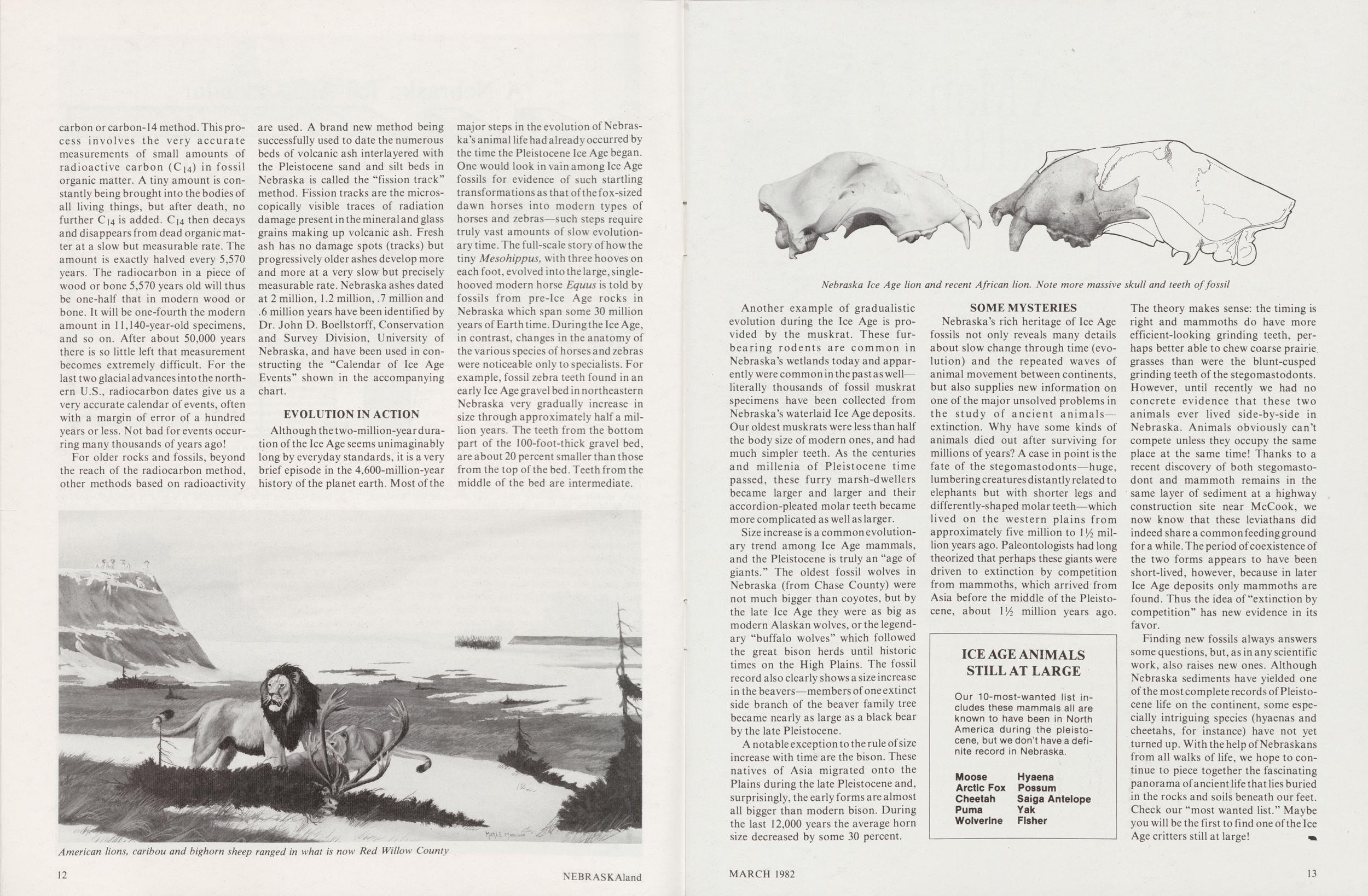
Restored to Ice Age appearance, this view of the Republican Valley pits two of the most formidable of fighters. The ground sloth, despite its foot-long claws, was a vegetarian. However, Data based on work of Dr. John Boellstorff, UNL Conservation and Survey Division its adversary here, which has dispatched a young sloth, is the short-faced bear, the largest carnivorous land mammal that ever lived. Grazing in the background is a herd of helmeted muskoxen
 or carbon-14 method. This process involves the very accurate
measurements of small amounts of
radioactive carbon (C14) in fossil
organic matter. A tiny amount is constantly being brought into the bodies of
all living things, but after death, no
further C14 is added. C14 then decays
and disappears from dead organic matter at a slow but measurable rate. The
amount is exactly halved every 5,570
years. The radiocarbon in a piece of
wood or bone 5,570 years old will thus
be one-half that in modern wood or
bone. It will be one-fourth the modern
amount in 11,140-year-old specimens,
and so on. After about 50,000 years
there is so little left that measurement
becomes extremely difficult. For the
last two glacial advances into the northern U.S., radiocarbon dates give us a
very accurate calendar of events, often
with a margin of error of a hundred
years or less. Not bad for events occurring many thousands of years ago!
or carbon-14 method. This process involves the very accurate
measurements of small amounts of
radioactive carbon (C14) in fossil
organic matter. A tiny amount is constantly being brought into the bodies of
all living things, but after death, no
further C14 is added. C14 then decays
and disappears from dead organic matter at a slow but measurable rate. The
amount is exactly halved every 5,570
years. The radiocarbon in a piece of
wood or bone 5,570 years old will thus
be one-half that in modern wood or
bone. It will be one-fourth the modern
amount in 11,140-year-old specimens,
and so on. After about 50,000 years
there is so little left that measurement
becomes extremely difficult. For the
last two glacial advances into the northern U.S., radiocarbon dates give us a
very accurate calendar of events, often
with a margin of error of a hundred
years or less. Not bad for events occurring many thousands of years ago!For older rocks and fossils, beyond the reach of the radiocarbon method, other methods based on radioactivity are used. A brand new method being successfully used to date the numerous beds of volcanic ash interlayered with the Pleistocene sand and silt beds in Nebraska is called the "fission track" method. Fission tracks are the microscopically visible traces of radiation damage present in the mineral and glass grains making up volcanic ash. Fresh ash has no damage spots (tracks) but progressively older ashes develop more and more at a very slow but precisely measurable rate. Nebraska ashes dated at 2 million, 1.2 million, .7 million and .6 million years have been identified by Dr. John D. Boellstorff, Conservation and Survey Division, University of Nebraska, and have been used in constructing the "Calendar of Ice Age Events" shown in the accompanying chart.
EVOLUTION IN ACTION Although the two-million-year duration of the Ice Age seems unimaginably long by everyday standards, it is a very brief episode in the 4,600-million-year history of the planet earth. Most of the major steps in the evolution of Nebraska's animal life had already occurred by the time the Pleistocene Ice Age began. One would look in vain among Ice Age fossils for evidence of such startling transformations as that of the fox-sized dawn horses into modern types of horses and zebras—such steps require truly vast amounts of slow evolutionary time. The full-scale story of how the tiny Mesohippus, with three hooves on each foot, evolved into the large, single-hooved modern horse Equus is told by fossils from pre-Ice Age rocks in Nebraska which span some 30 million years of Earth time. During the Ice Age, in contrast, changes in the anatomy of the various species of horses and zebras were noticeable only to specialists. For example, fossil zebra teeth found in an early Ice Age gravel bed in northeastern Nebraska very gradually increase in size through approximately half a million years. The teeth from the bottom part of the 100-foot-thick gravel bed, are about 20 percent smaller than those from the top of the bed. Teeth from the middle of the bed are intermediate.American lions, caribou and bighorn sheep ranged in what is now Red Willow County
Nebraska Ice Age lion and recent African lion. Note more massive skull and teeth of fossil
Another example of gradualistic evolution during the Ice Age is provided by the muskrat. These furbearing rodents are common in Nebraska's wetlands today and apparently were common in the past as well—literally thousands of fossil muskrat specimens have been collected from Nebraska's waterlaid Ice Age deposits. Our oldest muskrats were less than half the body size of modern ones, and had much simpler teeth. As the centuries and millenia of Pleistocene time passed, these furry marsh-dwellers became larger and larger and their accordion-pleated molar teeth became more complicated as well as larger.
Size increase is a common evolutionary trend among Ice Age mammals, and the Pleistocene is truly an "age of giants." The oldest fossil wolves in Nebraska (from Chase County) were not much bigger than coyotes, but by the late Ice Age they were as big as modern Alaskan wolves, or the legendary "buffalo wolves" which followed the great bison herds until historic times on the High Plains. The fossil record also clearly shows a size increase in the beavers—members of one extinct side branch of the beaver family tree became nearly as large as a black bear by the late Pleistocene.
A notable exception to the rule of size increase with time are the bison. These natives of Asia migrated onto the Plains during the late Pleistocene and, surprisingly, the early forms are almost all bigger than modern bison. During the last 12,000 years the average horn size decreased by some 30 percent.
SOME MYSTERIESNebraska's rich heritage of Ice Age fossils not only reveals many details about slow change through time (evolution) and the repeated waves of animal movement between continents, but also supplies new information on one of the major unsolved problems in the study of ancient animals — extinction. Why have some kinds of animals died out after surviving for millions of years? A case in point is the fate of the stegomastodonts—huge, lumbering creatures distantly related to elephants but with shorter legs and differently-shaped molar teeth—which lived on the western plains from approximately five million to 1½ million years ago. Paleontologists had long theorized that perhaps these giants were driven to extinction by competition from mammoths, which arrived from Asia before the middle of the Pleistocene, about 1½ million years ago.
ICE AGE ANIMALS STILL AT LARGEOur 10-most-wanted list includes these mammals all are known to have been in North America during the pleistocene, but we don't have a definite record in Nebraska.
Moose Arctic Fox Cheetah Puma Wolverine Hyaena Possum Saiga Antelope Yak Fisher
The theory makes sense: the timing is right and mammoths do have more efficient-looking grinding teeth, perhaps better able to chew coarse prairie grasses than were the blunt-cusped grinding teeth of the stegomastodonts. However, until recently we had no concrete evidence that these two animals ever lived side-by-side in Nebraska. Animals obviously can't compete unless they occupy the same place at the same time! Thanks to a recent discovery of both stegomastodont and mammoth remains in the same layer of sediment at a highway construction site near McCook, we now know that these leviathans did indeed share a common feeding ground for a while. The period of coexistence of the two forms appears to have been short-lived, however, because in later Ice Age deposits only mammoths are found. Thus the idea of "extinction by competition" has new evidence in its favor.
Finding new fossils always answers some questions, but, as in any scientific work, also raises new ones. Although Nebraska sediments have yielded one of the most complete records of Pleistocene life on the continent, some especially intriguing species (hyaenas and cheetahs, for instance) have not yet turned up. With the help of Nebraskans from all walks of life, we hope to continue to piece together the fascinating panorama of ancient life that lies buried in the rocks and soils beneath our feet. Check our "most wanted list." Maybe you will be the first to find one of the Ice Age critters still at large!
MARCH 1982 13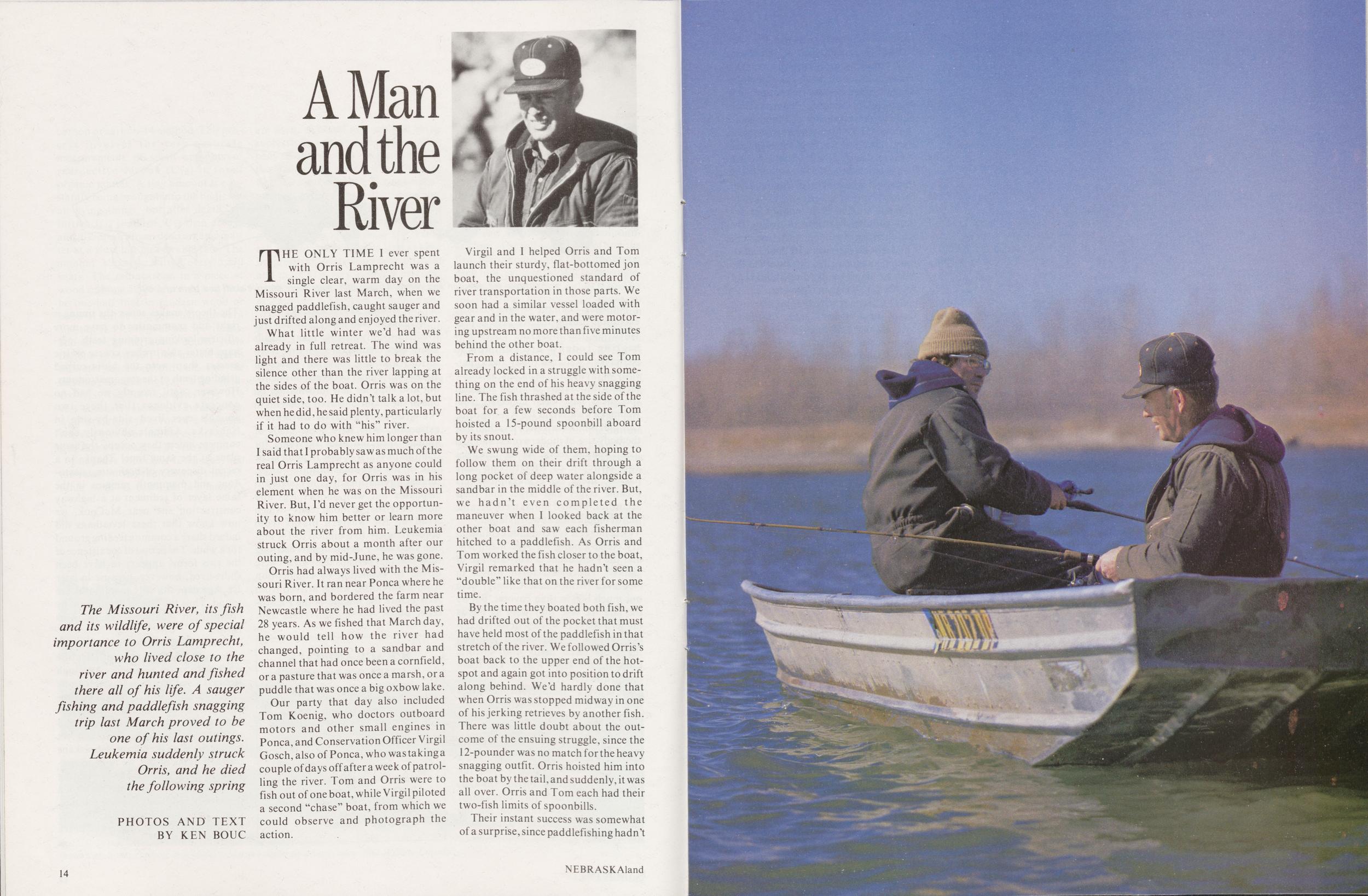
A Man and the River
The Missouri River, its fish and its wildlife, were of special importance to Orris Lamprecht, who lived close to the river and hunted and fished there all of his life. A sauger fishing and paddlefish snagging trip last March proved to be one of his last outings. Leukemia suddenly struck Orris, and he died the following spring
PHOTOS AND TEXT BY KEN BOUCTHE ONLY TIME I ever spent with Orris Lamprecht was a single clear, warm day on the Missouri River last March, when we snagged paddlefish, caught sauger and just drifted along and enjoyed the river.
What little winter we'd had was already in full retreat. The wind was light and there was little to break the silence other than the river lapping at the sides of the boat. Orris was on the quiet side, too. He didn't talk a lot, but when he did, he said plenty, particularly if it had to do with "his" river.
Someone who knew him longer than I said that I probably saw as much of the real Orris Lamprecht as anyone could in just one day, for Orris was in his element when he was on the Missouri River. But, I'd never get the opportunity to know him better or learn more about the river from him. Leukemia struck Orris about a month after our outing, and by mid-June, he was gone.
Orris had always lived with the Missouri River. It ran near Ponca where he was born, and bordered the farm near Newcastle where he had lived the past 28 years. As we fished that March day, he would tell how the river had changed, pointing to a sandbar and channel that had once been a cornfield, or a pasture that was once a marsh, or a puddle that was once a big oxbow lake.
Our party that day also included Tom Koenig, who doctors outboard motors and other small engines in Ponca, and Conservation Officer Virgil Gosch, also of Ponca, who wastakinga couple of days off after a week of patrolling the river. Tom and Orris were to fish out of one boat, while Virgil piloted a second "chase" boat, from which we could observe and photograph the action.
Virgil and I helped Orris and Tom launch their sturdy, flat-bottomed jon boat, the unquestioned standard of river transportation in those parts. We soon had a similar vessel loaded with gear and in the water, and were motoring upstream no more than five minutes behind the other boat.
From a distance, I could see Tom already locked in a struggle with something on the end of his heavy snagging line. The fish thrashed at the side of the boat for a few seconds before Tom hoisted a 15-pound spoonbill aboard by its snout.
We swung wide of them, hoping to follow them on their drift through a long pocket of deep water alongside a sandbar in the middle of the river. But, we hadn't even completed the maneuver when I looked back at the other boat and saw each fisherman hitched to a paddlefish. As Orris and Tom worked the fish closer to the boat, Virgil remarked that he hadn't seen a "double" like that on the river for some time.
By the time they boated both fish, we had drifted out of the pocket that must have held most of the paddlefish in that stretch of the river. We followed Orris's boat back to the upper end of the hotspot and again got into position to drift along behind. We'd hardly done that when Orris was stopped midway in one of his jerking retrieves by another fish. There was little doubt about the outcome of the ensuing struggle, since the 12-pounder was no match for the heavy snagging outfit. Orris hoisted him into the boat by the tail, and suddenly, it was all over. Orris and Tom each had their two-fish limits of spoonbills.
Their instant success was somewhat of a surprise, since paddlefishing hadn't 14 NEBRASKAland
 been particularly good on that part of
the river for some weeks. We had come
prepared to spend all day, and part of
the next if necessary, in order to get a
paddlefish or two and spend enough
time on the river to conjure up a decent
fishing yarn. But, after only 10 or 15
minutes, Orris and Tom were "fished
out", and they had done it too quickly
and routinely for my tastes.
been particularly good on that part of
the river for some weeks. We had come
prepared to spend all day, and part of
the next if necessary, in order to get a
paddlefish or two and spend enough
time on the river to conjure up a decent
fishing yarn. But, after only 10 or 15
minutes, Orris and Tom were "fished
out", and they had done it too quickly
and routinely for my tastes.
We were stumped, but only for a minute. After a bit of negotiating with the other boat, Tom and I swapped places. He would run one boat while Virgil tried for a pair of paddlefish, and I would snag out of Orris' boat.
It was my first experience with snagging, so I asked Orris for a little coaching on its basics. He showed me how to engage and release the spool on an oversized sea-going-type reel, and how to swing the snagging rod, which had about the same heft and action as a fireplace poker.
The heavy braided line had several ounces of lead tied at the end, a large treble hook about 18 inches above that, and another hook a like distance above the first. I had watched Orris and Tom go through the motions long enough that I had that part figured out. Just lob the lead and hooks a reasonable distance from the boat, and jerk them back with long pumps of the rod.
By the time I got a good start, Virgil had boated a spoonbill. Toward the end of our second drift, we saw them head upstream toward one of Tom's favorite sauger holes, so we assumed that Virgil also had his second paddlefish.
After about 15 minutes of jerking that chunk of lead around with that big rod, I understood how paddlefishing could turn into work. The equipment is not so tough to handle, but the series of violent jerks on each retrieve takes a toll on the arms, shoulders, back and stomach of fishermen not used to the sport. I had heard snaggers talk about "jerking our guts out" on an unproductive day, and thought that they must have been exaggerating just a bit. But after trying it for a short time, I could see how they might have given an accurate description of a day of snagging.
Fortunately, I didn't have to expend that kind of effort. Toward the end of the second pass, the rod suddenly stopped short in mid jerk, then hit me back with a jerk in the other direction. The pool-cue sized pole even developed a bit of a bend, telling me that I was fastened to a pretty good fish.
Playing a paddlefish is something like engaging in a tug-of-war. The spoonbill is not flashy or fast, and the snagging rod is not a very sporting piece of gear. A bit of muscle, some patience, and a certain amount of time was all that was needed to bring my fish to the boat. Orris broke into a broad grin when he dragged the spoonbill aboard. It was twice the size of any other taken that day—an estimated 25 pounds or better.
While we had been looking for my first paddlefish, and also during the search for my second one, I quizzed Orris about the river. He had fished, hunted and farmed in proximity to the Missouri most of his 55 years, and had watched it change in character.
"The river started changing when the Corps of Engineers built the dams upriver. We're 45 miles below Gavins Point, but it still affects our river a lot," he said through the smoke of his ever-present, roll-your-own cigarette.
Orris cited the river's increased appetite, both for farm land and for its own bed and banks, since the dams went in. "Before the dams, the river would take some land, just like it does now.
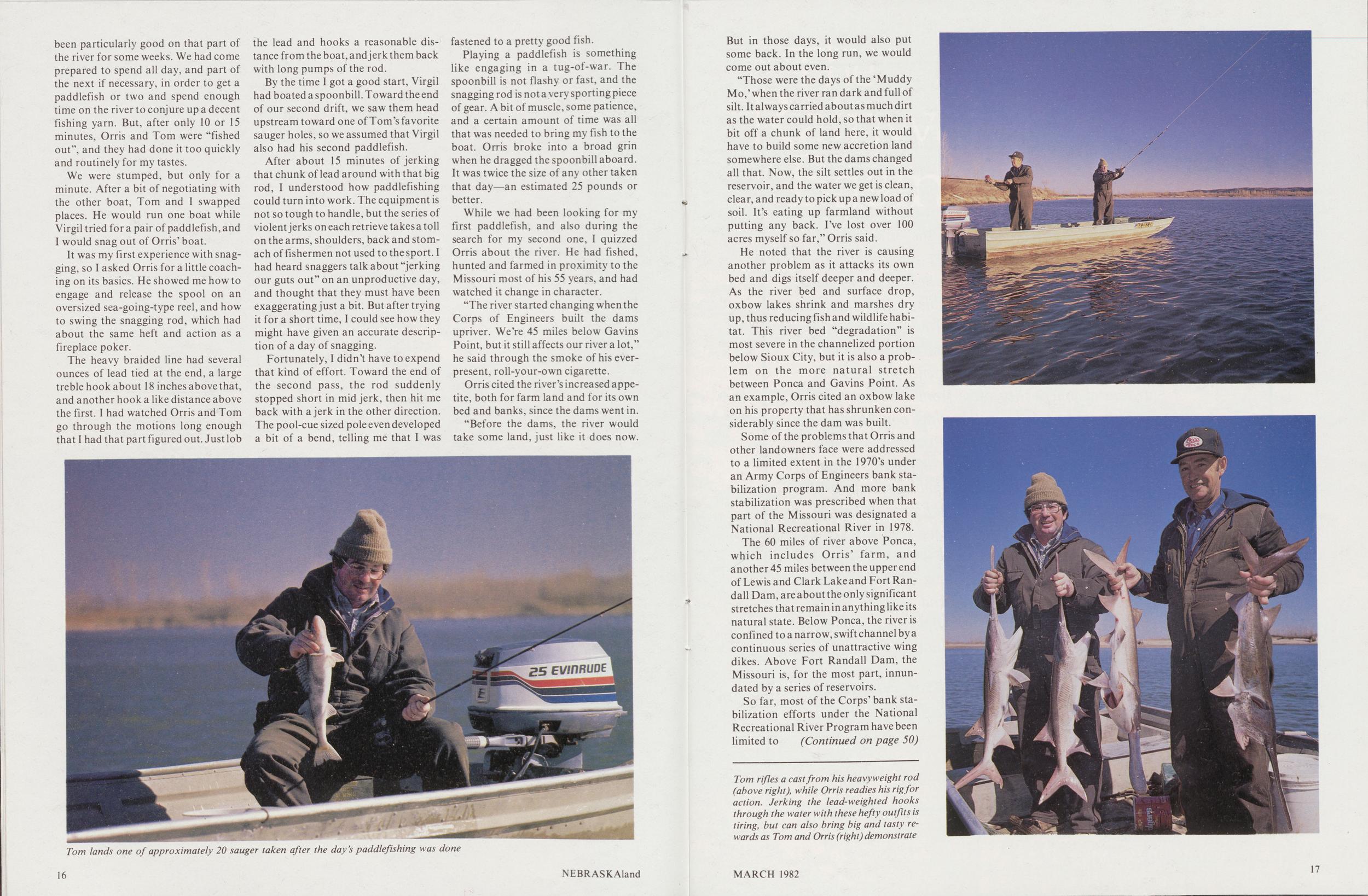
Tom lands one of approximately 20 sauger taken after the day's paddlefishing was done
But in those days, it would also put some back. In the long run, we would come out about even.
"Those were the days of the 'Muddy Mo,' when the river ran dark and full of silt. It always carried about as much dirt as the water could hold, so that when it bit off a chunk of land here, it would have to build some new accretion land somewhere else. But the dams changed all that. Now, the silt settles out in the reservoir, and the water we get is clean, clear, and ready to pick up a new load of soil. It's eating up farmland without putting any back. I've lost over 100 acres myself so far," Orris said.
He noted that the river is causing another problem as it attacks its own bed and digs itself deeper and deeper. As the river bed and surface drop, oxbow lakes shrink and marshes dry up, thus reducing fish and wildlife habitat. This river bed "degradation" is most severe in the channelized portion below Sioux City, but it is also a problem on the more natural stretch between Ponca and Gavins Point. As an example, Orris cited an oxbow lake on his property that has shrunken considerably since the dam was built.
Some of the problems that Orris and other landowners face were addressed to a limited extent in the 1970's under an Army Corps of Engineers bank stabilization program. And more bank stabilization was prescribed when that part of the Missouri was designated a National Recreational River in 1978.
The 60 miles of river above Ponca, which includes Orris' farm, and another 45 miles between the upper end of Lewis and Clark Lake and Fort Randall Dam, are about the only significant stretches that remain in anything like its natural state. Below Ponca, the river is confined to a narrow, swift channel by a continuous series of unattractive wing dikes. Above Fort Randall Dam, the Missouri is, for the most part, innundated by a series of reservoirs.
So far, most of the Corps' bank stabilization efforts under the National Recreational River Program have been limited to (Continued on page 50)
Tom rifles a cast from his heavyweight rod (above right), while Orris readies his rig for action. Jerking the lead-weighted hooks through the water with these hefty outfits is tiring, but can also bring big and tasty rewards as Tom and Orris (right) demonstrate
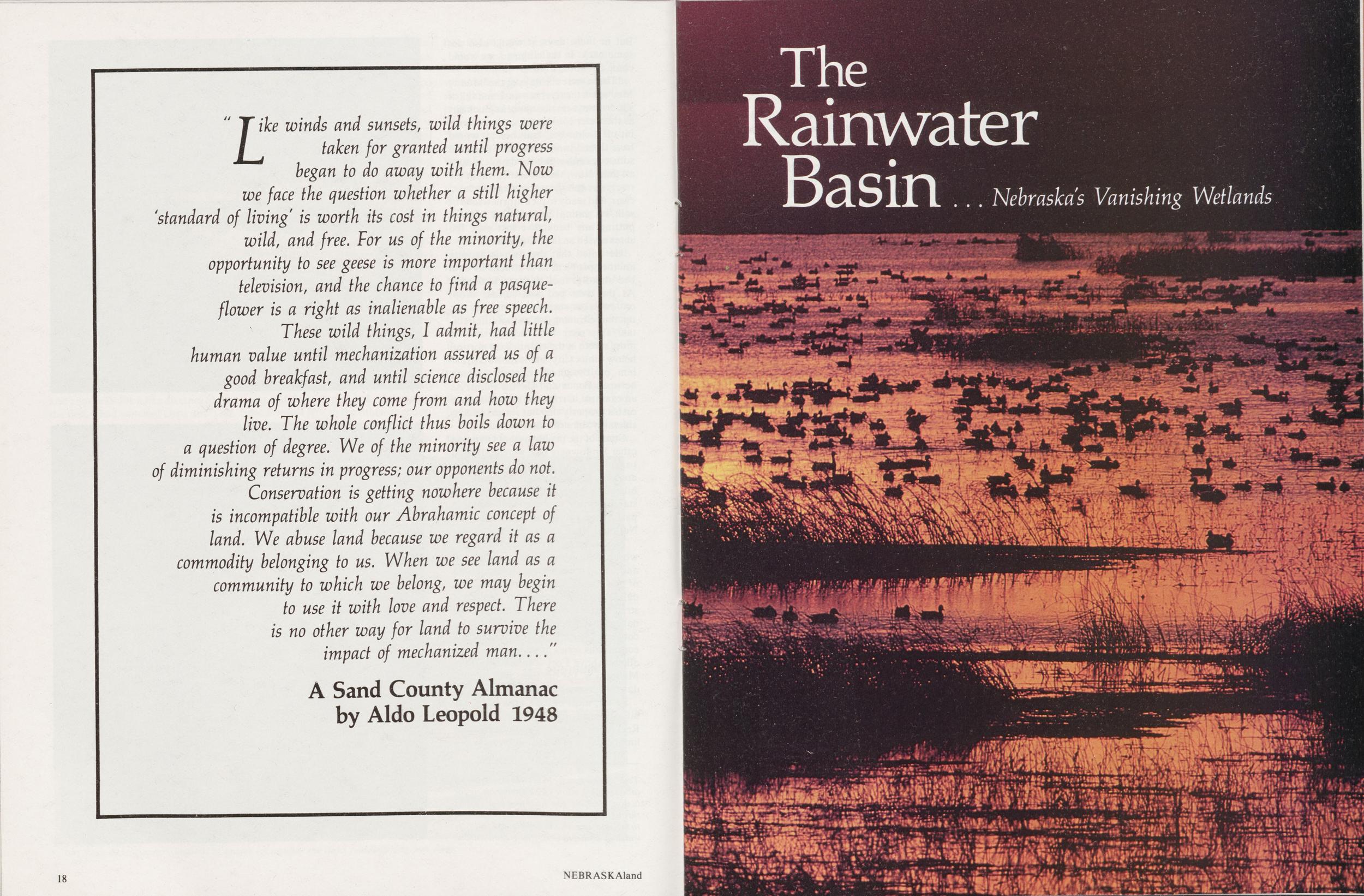
The Rainwater Basin . . . Nebraska's Vanishing Wetlands
"Like winds and sunsets, wild things were taken for granted until progress began to do away with them. Now we face the question whether a still higher 'standard of living' is worth its cost in things natural, wild, and free. For us of the minority, the opportunity to see geese is more important than television, and the chance to find a pasque-flower is a right as inalienable as free speech. These wild things, I admit, had little human value until mechanization assured us of a good breakfast, and until science disclosed the drama of where they come from and how they live. The whole conflict thus boils down to a question of degree. We of the minority see a law of diminishing returns in progress; our opponents do not. Conservation is getting nowhere because it is incompatible with our Abrahamic concept of land. We abuse land because we regard it as a commodity belonging to us. When we see land as a community to which we belong, we may begin to use it with love and respect. There is no other way for land to survive the impact of mechanized man..."
A Sand County Almanac by Aldo Leopold 1948 18 NEBRASKAland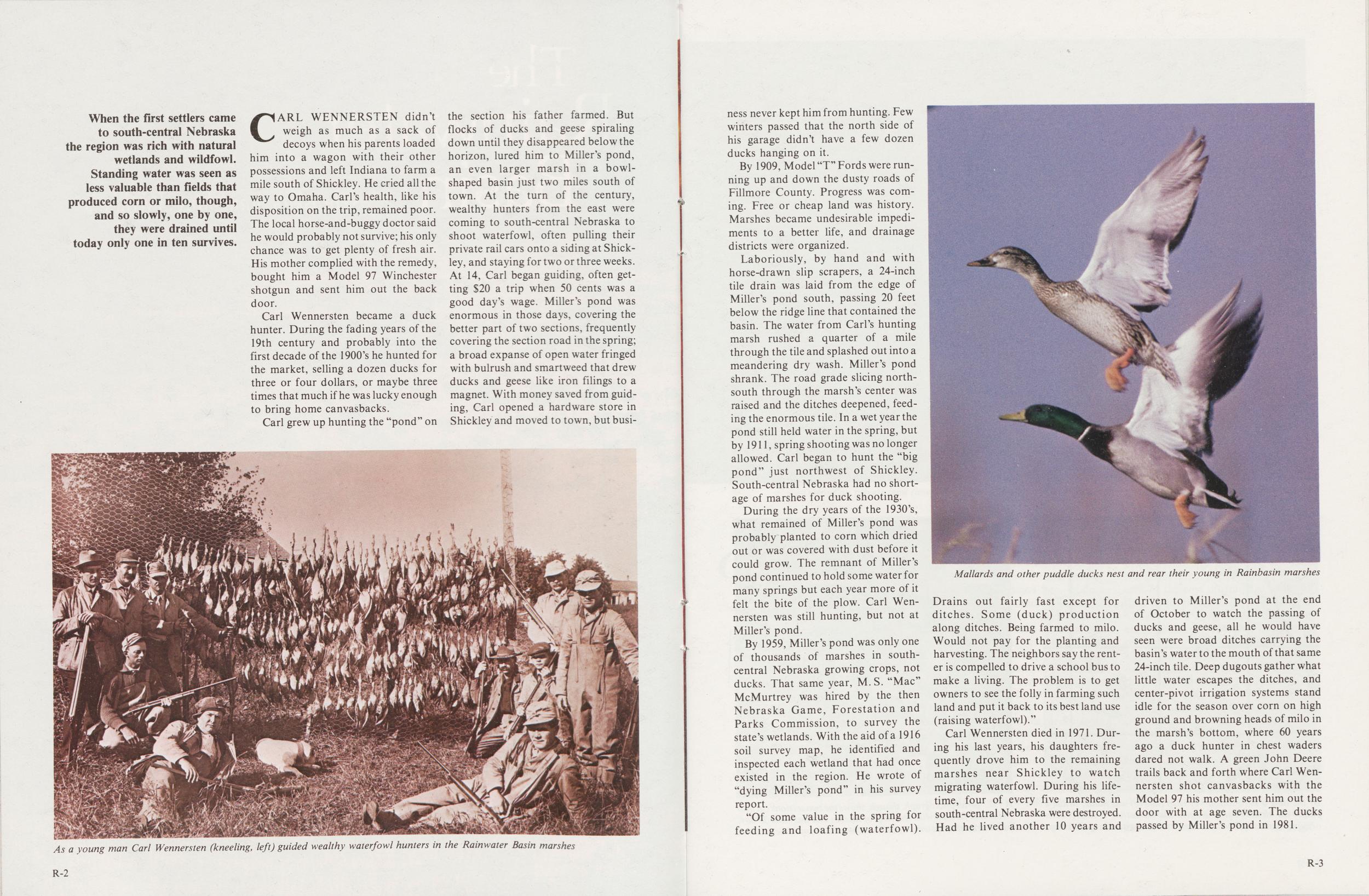
When the first settlers came to south-central Nebraska the region was rich with natural wetlands and wildfowl. Standing water was seen as less valuable than fields that produced corn or milo, though, and so slowly, one by one, they were drained until today only one in ten survives.
CARL WENNERSTEN didn't weigh as much as a sack of decoys when his parents loaded him into a wagon with their other possessions and left Indiana to farm a mile south of Shickley. He cried all the way to Omaha. Carl's health, like his disposition on the trip, remained poor. The local horse-and-buggy doctor said he would probably not survive; his only chance was to get plenty of fresh air. His mother complied with the remedy, bought him a Model 97 Winchester shotgun and sent him out the back door.
Carl Wennersten became a duck hunter. During the fading years of the 19th century and probably into the first decade of the 1900's he hunted for the market, selling a dozen ducks for three or four dollars, or maybe three times that much if he was lucky enough to bring home canvasbacks.
As a young man Carl Wennersten (kneeling, left) guided wealthy waterfowl hunters in the Rainwater Basin marshes
By 1909, Model "T" Fords were running up and down the dusty roads of Fillmore County. Progress was coming. Free or cheap land was history. Marshes became undesirable impediments to a better life, and drainage districts were organized.
Laboriously, by hand and with horse-drawn slip scrapers, a 24-inch tile drain was laid from the edge of Miller's pond south, passing 20 feet below the ridge line that contained the basin. The water from Carl's hunting marsh rushed a quarter of a mile through the tile and splashed out into a meandering dry wash. Miller's pond shrank. The road grade slicing north-south through the marsh's center was raised and the ditches deepened, feeding the enormous tile. In a wet year the pond still held water in the spring, but by 1911, spring shooting was no longer allowed. Carl began to hunt the "big pond" just northwest of Shickley. South-central Nebraska had no shortage of marshes for duck shooting.
During the dry years of the 1930's, what remained of Miller's pond was probably planted to corn which dried out or was covered with dust before it could grow. The remnant of Miller's pond continued to hold some water for many springs but each year more of it felt the bite of the plow. Carl Wennersten was still hunting, but not at Miller's pond.
By 1959, Miller's pond was only one of thousands of marshes in south-central Nebraska growing crops, not ducks. That same year, M.S. "Mac" McMurtrey was hired by the then Nebraska Game, Forestation and Parks Commission, to survey the state's wetlands. With the aid of a 1916 soil survey map, he identified and inspected each wetland that had once existed in the region. He wrote of "dying Miller's pond" in his survey report.
Mallards and other puddle ducks nest and rear their young in Rainbasin marshes
"Of some value in the spring for feeding and loafing (waterfowl). Drains out fairly fast except for ditches. Some (duck) production along ditches. Being farmed to milo. Would not pay for the planting and harvesting. The neighbors say the renter is compelled to drive a school bus to make a living. The problem is to get owners to see the folly in farming such land and put it back to its best land use (raising waterfowl)."
Carl Wennersten died in 1971. During his last years, his daughters frequently drove him to the remaining marshes near Shickley to watch migrating waterfowl. During his lifetime, four of every five marshes in south-central Nebraska were destroyed. Had he lived another 10 years and driven to Miller's pond at the end of October to watch the passing of ducks and geese, all he would have seen were broad ditches carrying the basin's water to the mouth of that same 24-inch tile. Deep dugouts gather what little water escapes the ditches, and center-pivot irrigation systems stand idle for the season over corn on high ground and browning heads of milo in the marsh's bottom, where 60 years ago a duck hunter in chest waders dared not walk. A green John Deere trails back and forth where Carl Wennersten shot canvasbacks with the Model 97 his mother sent him out the door with at age seven. The ducks passed by Miller's pond in 1981.
R-3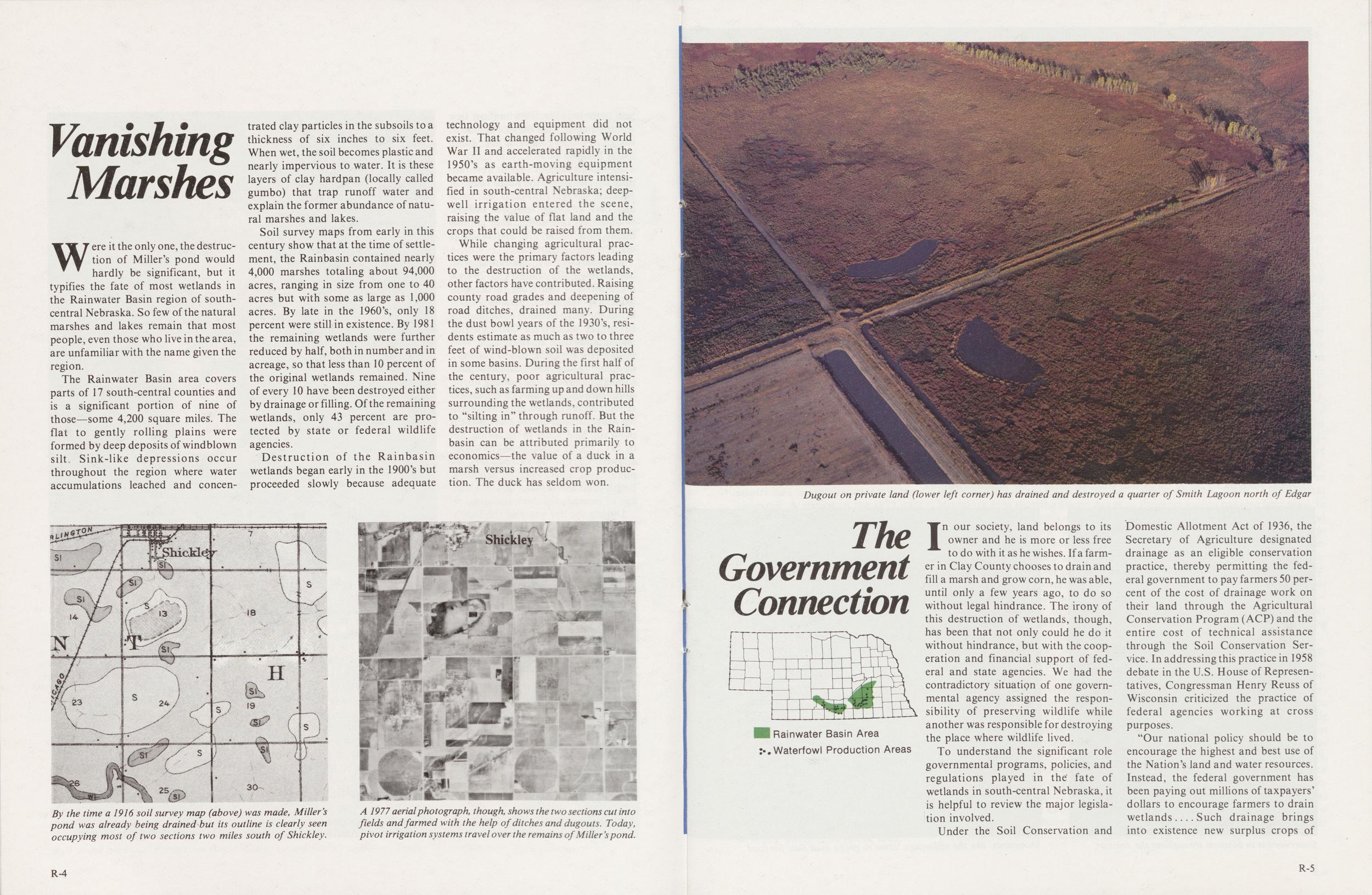
Vanishing Marshes
Were it the only one, the destruction of Miller's pond would hardly be significant, but it typifies the fate of most wetlands in the Rainwater Basin region of south-central Nebraska. So few of the natural marshes and lakes remain that most people, even those who live in the area, are unfamiliar with the name given the region.
The Rainwater Basin area covers parts of 17 south-central counties and is a significant portion of nine of those—some 4,200 square miles. The flat to gently rolling plains were formed by deep deposits of windblown silt. Sink-like depressions occur throughout the region where water accumulations leached and concentrated clay particles in the subsoils to a thickness of six inches to six feet. When wet, the soil becomes plastic and nearly impervious to water. It is these layers of clay hardpan (locally called gumbo) that trap runoff water and explain the former abundance of natural marshes and lakes.
Soil survey maps from early in this century show that at the time of settlement, the Rainbasin contained nearly 4,000 marshes totaling about 94,000 acres, ranging in size from one to 40 acres but with some as large as 1,000 acres. By late in the 1960's, only 18 percent were still in existence. By 1981 the remaining wetlands were further reduced by half, both in number and in acreage, so that less than 10 percent of the original wetlands remained. Nine of every 10 have been destroyed either by drainage or filling. Of the remaining wetlands, only 43 percent are protected by state or federal wildlife agencies.
Destruction of the Rainbasin wetlands began early in the 1900's but proceeded slowly because adequate technology and equipment did not exist. That changed following World War II and accelerated rapidly in the 1950's as earth-moving equipment became available. Agriculture intensified in south-central Nebraska; deep-well irrigation entered the scene, raising the value of flat land and the crops that could be raised from them.
While changing agricultural practices were the primary factors leading to the destruction of the wetlands, other factors have contributed. Raising county road grades and deepening of road ditches, drained many. During the dust bowl years of the 1930's, residents estimate as much as two to three feet of wind-blown soil was deposited in some basins. During the first half of the century, poor agricultural practices, such as farming up and down hills surrounding the wetlands, contributed to "silting in" through runoff. But the destruction of wetlands in the Rainbasin can be attributed primarily to economics—the value of a duck in a marsh versus increased crop production. The duck has seldom won.
By the time a 1916 soil survey map (above) was made, Millers pond was already being drained but its outline is clearly seen occupying most of two sections two miles south of Shickley.
A 1977 aerial photograph, though, shows the two sections cut into fields and farmed with the help of ditches and dugouts. Today, pivot irrigation systems travel over the remains of Miller's pond.
Dugout on private land (lower left corner) has drained and destroyed a quarter of Smith Lagoon north of Edgar
The Government Connection
Rainwater Basin Area Waterfowl Production Areas
In our society, land belongs to its owner and he is more or less free to do with it as he wishes. If a farmer in Clay County chooses to drain and fill a marsh and grow corn, he was able, until only a few years ago, to do so without legal hindrance. The irony of this destruction of wetlands, though, has been that not only could he do it without hindrance, but with the cooperation and financial support of federal and state agencies. We had the contradictory situation of one governmental agency assigned the responsibility of preserving wildlife while another was responsible for destroying the place where wildlife lived.
To understand the significant role governmental programs, policies, and regulations played in the' fate of wetlands in south-central Nebraska, it is helpful to review the major legislation involved.
Under the Soil Conservation and Domestic Allotment Act of 1936, the Secretary of Agriculture designated drainage as an eligible conservation practice, thereby permitting the federal government to pay farmers 50 percent of the cost of drainage work on their land through the Agricultural Conservation Program (ACP) and the entire cost of technical assistance through the Soil Conservation Service. In addressing this practice in 1958 debate in the U.S. House of Representatives, Congressman Henry Reuss of Wisconsin criticized the practice of federal agencies working at cross purposes.
"Our national policy should be to encourage the highest and best use of the Nation's land and water resources. Instead, the federal government has been paying out millions of taxpayers' dollars to encourage farmers to drain wetlands.... Such drainage brings into existence new surplus crops of corn, wheat, and other grains. Additional millions of tax dollars are then spent for government purchases of surplus corn and wheat, and for the soil-bank program to take corn and wheat land out of production. Further illustrating the inconsistencies, conservation reserve payments are now being made in some instances to restore marshlands previously drained with ACP assistance."
R-5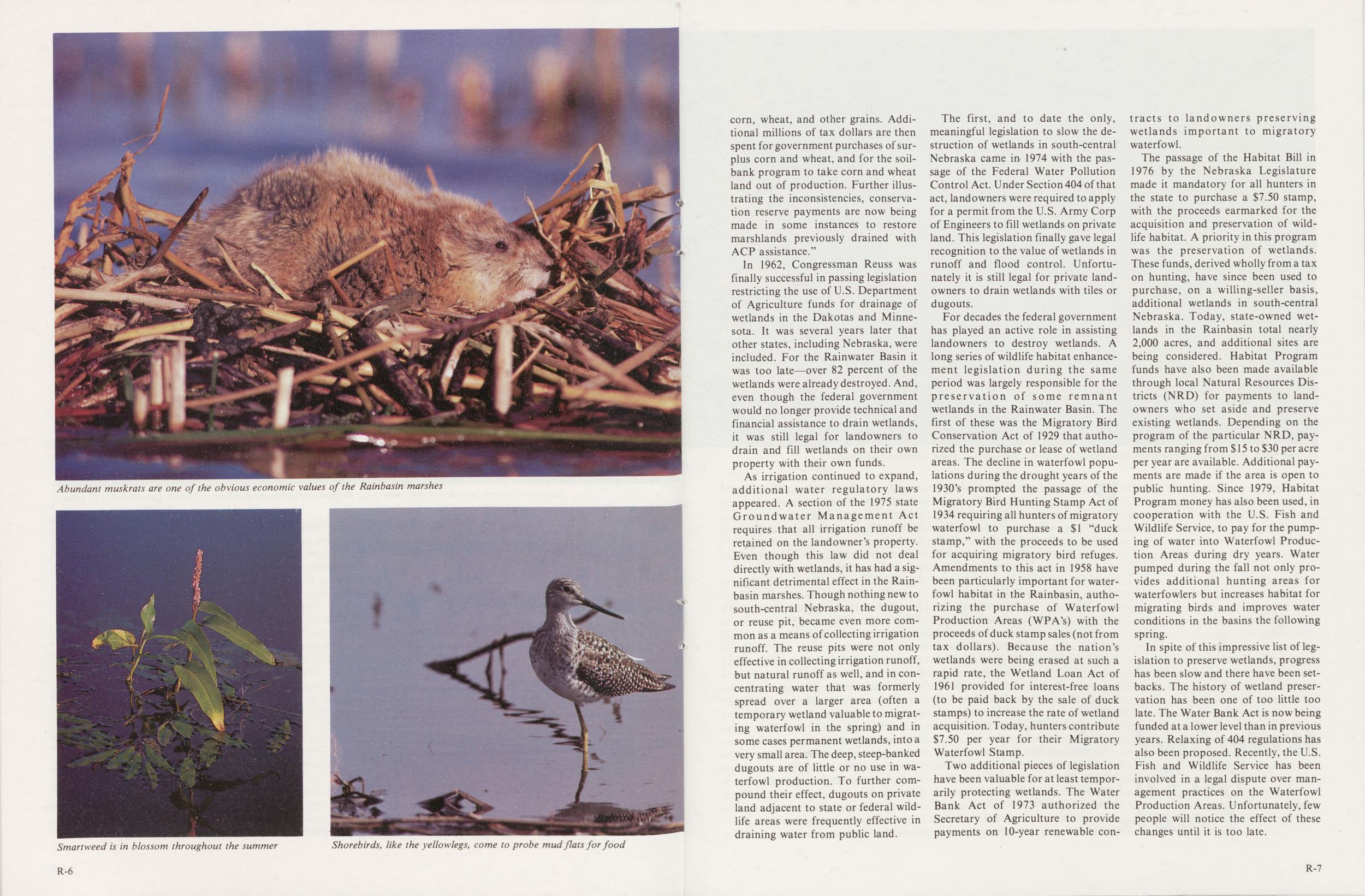
Abundant muskrats are one of the obvious economic values of the Rainbasin marshes
Smartweed is in blossom throughout the summer
Shorebirds, like the yellowlegs, come to probe mud flats for food
In 1962, Congressman Reuss was finally successful in passing legislation restricting the use of U.S. Department of Agriculture funds for drainage of wetlands in the Dakotas and Minnesota. It was several years later that other states, including Nebraska, were included. For the Rainwater Basin it was too late—over 82 percent of the wetlands were already destroyed. And, even though the federal government would no longer provide technical and financial assistance to drain wetlands, it was still legal for landowners to drain and fill wetlands on their own property with their own funds.
As irrigation continued to expand, additional water regulatory laws appeared. A section of the 1975 state Groundwater Management Act requires that all irrigation runoff be retained on the landowner's property. Even though this law did not deal directly with wetlands, it has had a significant detrimental effect in the Rainbasin marshes. Though nothing new to south-central Nebraska, the dugout, or reuse pit, became even more common as a means of collecting irrigation runoff. The reuse pits were not only effective in collecting irrigation runoff, but natural runoff as well, and in concentrating water that was formerly spread over a larger area (often a temporary wetland valuable to migrating waterfowl in the spring) and in some cases permanent wetlands, into a very small area. The deep, steep-banked dugouts are of little or no use in waterfowl production. To further compound their effect, dugouts on private land adjacent to state or federal wildlife areas were frequently effective in draining water from public land.
The first, and to date the only, meaningful legislation to slow the destruction of wetlands in south-central Nebraska came in 1974 with the passage of the Federal Water Pollution Control Act. Under Section 404 of that act, landowners were required to apply for a permit from the U.S. Army Corp of Engineers to fill wetlands on private land. This legislation finally gave legal recognition to the value of wetlands in runoff and flood control. Unfortunately it is still legal for private landowners to drain wetlands with tiles or dugouts.
For decades the federal government has played an active role in assisting landowners to destroy wetlands. A long series of wildlife habitat enhancement legislation during the same period was largely responsible for the preservation of some remnant wetlands in the Rainwater Basin. The first of these was the Migratory Bird Conservation Act of 1929 that authorized the purchase or lease of wetland areas. The decline in waterfowl populations during the drought years of the 1930's prompted the passage of the Migratory Bird Hunting Stamp Act of 1934 requiring all hunters of migratory waterfowl to purchase a $1 "duck stamp," with the proceeds to be used for acquiring migratory bird refuges. Amendments to this act in 1958 have been particularly important for waterfowl habitat in the Rainbasin, authorizing the purchase of Waterfowl Production Areas (WPA's) with the proceeds of duck stamp sales (not from tax dollars). Because the nation's wetlands were being erased at such a rapid rate, the Wetland Loan Act of 1961 provided for interest-free loans (to be paid back by the sale of duck stamps) to increase the rate of wetland acquisition. Today, hunters contribute $7.50 per year for their Migratory Waterfowl Stamp.
Two additional pieces of legislation have been valuable for at least temporarily protecting wetlands. The Water Bank Act of 1973 authorized the Secretary of Agriculture to provide payments on 10-year renewable contracts to landowners preserving wetlands important to migratory waterfowl.
The passage of the Habitat Bill in 1976 by the Nebraska Legislature made it mandatory for all hunters in the state to purchase a $7.50 stamp, with the proceeds earmarked for the acquisition and preservation of wildlife habitat. A priority in this program was the preservation of wetlands. These funds, derived wholly from a tax on hunting, have since been used to purchase, on a willing-seller basis, additional wetlands in south-central Nebraska. Today, state-owned wetlands in the Rainbasin total nearly 2,000 acres, and additional sites are being considered. Habitat Program funds have also been made available through local Natural Resources Districts (NRD) for payments to landowners who set aside and preserve existing wetlands. Depending on the program of the particular NRD, payments ranging from $ 15 to $30 per acre per year are available. Additional payments are made if the area is open to public hunting. Since 1979, Habitat Program money has also been used, in cooperation with the U.S. Fish and Wildlife Service, to pay for the pumping of water into Waterfowl Production Areas during dry years. Water pumped during the fall not only provides additional hunting areas for waterfowlers but increases habitat for migrating birds and improves water conditions in the basins the following spring.
In spite of this impressive list of legislation to preserve wetlands, progress has been slow and there have been setbacks. The history of wetland preservation has been one of too little too late. The Water Bank Act is now being funded at a lower level than in previous years. Relaxing of 404 regulations has also been proposed. Recently, the U.S. Fish and Wildlife Service has been involved in a legal dispute over management practices on the Waterfowl Production Areas. Unfortunately, few people will notice the effect of these changes until it is too late.
R-7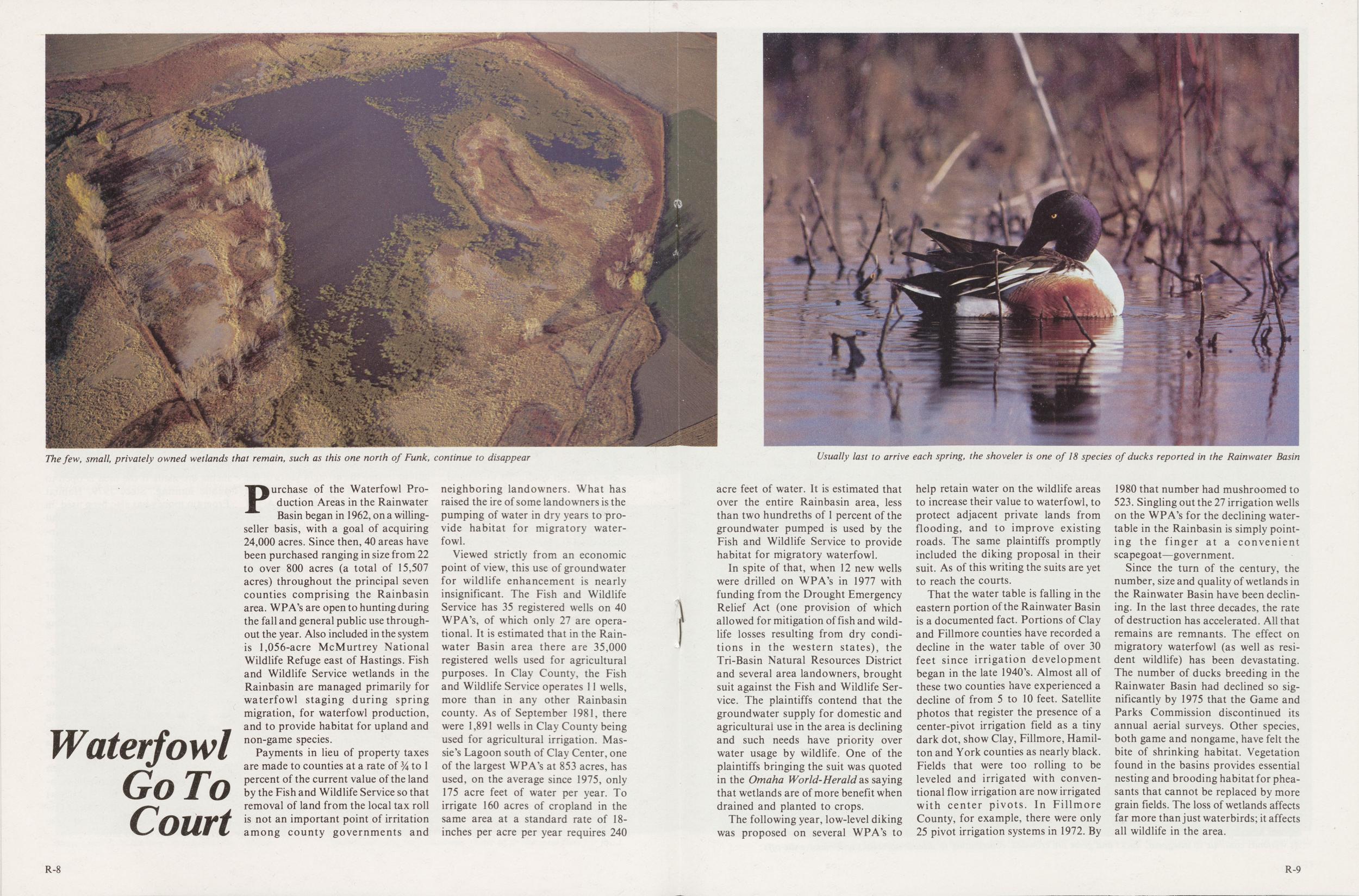
The few, small, privately owned wetlands that remain, such as this one north of Funk, continue to disappear
Waterfowl Go To Court
Purchase of the Waterfowl Production Areas in the Rainwater Basin began in 1962, on a willing-seller basis, with a goal of acquiring 24,000 acres. Since then, 40 areas have been purchased ranging in size from 22 to over 800 acres (a total of 15,507 acres) throughout the principal seven counties comprising the Rainbasin area. WPA's are open to hunting during the fall and general public use throughout the year. Also included in the system is 1,056-acre McMurtrey National Wildlife Refuge east of Hastings. Fish and Wildlife Service wetlands in the Rainbasin are managed primarily for waterfowl staging during spring migration, for waterfowl production, and to provide habitat for upland and non-game species.
Payments in lieu of property taxes are made to counties at a rate of ¾ to 1 percent of the current value of the land by the Fish and Wildlife Service so that removal of land from the local tax roll is not an important point of irritation among county governments and neighboring landowners. What has raised the ire of some landowners is the pumping of water in dry years to provide habitat for migratory waterfowl.
Viewed strictly from an economic point of view, this use of groundwater for wildlife enhancement is nearly insignificant. The Fish and Wildlife Service has 35 registered wells on 40 WPA's, of which only 27 are operational. It is estimated that in the Rainwater Basin area there are 35,000 registered wells used for agricultural purposes. In Clay County, the Fish and Wildlife Service operates 11 wells, more than in any other Rainbasin county. As of September 1981, there were 1,891 wells in Clay County being used for agricultural irrigation. Massie's Lagoon south of Clay Center, one of the largest WPA's at 853 acres, has used, on the average since 1975, only 175 acre feet of water per year. To irrigate 160 acres of cropland in the same area at a standard rate of 18-inches per acre per year requires 240 acre feet of water. It is estimated that over the entire Rainbasin area, less than two hundreths of 1 percent of the groundwater pumped is used by the Fish and Wildlife Service to provide habitat for migratory waterfowl.
R-8Usually last to arrive each spring, the shoveler is one of 18 species of ducks reported in the Rainwater Basin
In spite of that, when 12 new wells were drilled on WPA's in 1977 with funding from the Drought Emergency Relief Act (one provision of which allowed for mitigation offish and wildlife losses resulting from dry conditions in the western states), the Tri-Basin Natural Resources District and several area landowners, brought suit against the Fish and Wildlife Service. The plaintiffs contend that the groundwater supply for domestic and agricultural use in the area is declining and such needs have priority over water usage by wildlife. One of the plaintiffs bringing the suit was quoted in the Omaha World-Herald as saying that wetlands are of more benefit when drained and planted to crops.
The following year, low-level diking was proposed on several WPA's to help retain water on the wildlife areas to increase their value to waterfowl, to protect adjacent private lands from flooding, and to improve existing roads. The same plaintiffs promptly included the diking proposal in their suit. As of this writing the suits are yet to reach the courts.
That the water table is falling in the eastern portion of the Rainwater Basin is a documented fact. Portions of Clay and Fillmore counties have recorded a decline in the water table of over 30 feet since irrigation development began in the late 1940's. Almost all of these two counties have experienced a decline of from 5 to 10 feet. Satellite photos that register the presence of a center-pivot irrigation field as a tiny dark dot, show Clay, Fillmore, Hamilton and York counties as nearly black. Fields that were too rolling to be leveled and irrigated with conventional flow irrigation are now irrigated with center pivots. In Fillmore County, for example, there were only 25 pivot irrigation systems in 1972. By 1980 that number had mushroomed to 523. Singling out the 27 irrigation wells on the WPA's for the declining watertable in the Rainbasin is simply pointing the finger at a convenient scapegoat—government.
Since the turn of the century, the number, size and quality of wetlands in the Rainwater Basin have been declining. In the last three decades, the rate of destruction has accelerated. All that remains are remnants. The effect on migratory waterfowl (as well as resident wildlife) has been devastating. The number of ducks breeding in the Rainwater Basin had declined so significantly by 1975 that the Game and Parks Commission discontinued its annual aerial surveys. Other species, both game and nongame, have felt the bite of shrinking habitat. Vegetation found in the basins provides essential nesting and brooding habitat for pheasants that cannot be replaced by more grain fields. The loss of wetlands affects far more than just waterbirds; it affects all wildlife in the area.
R-9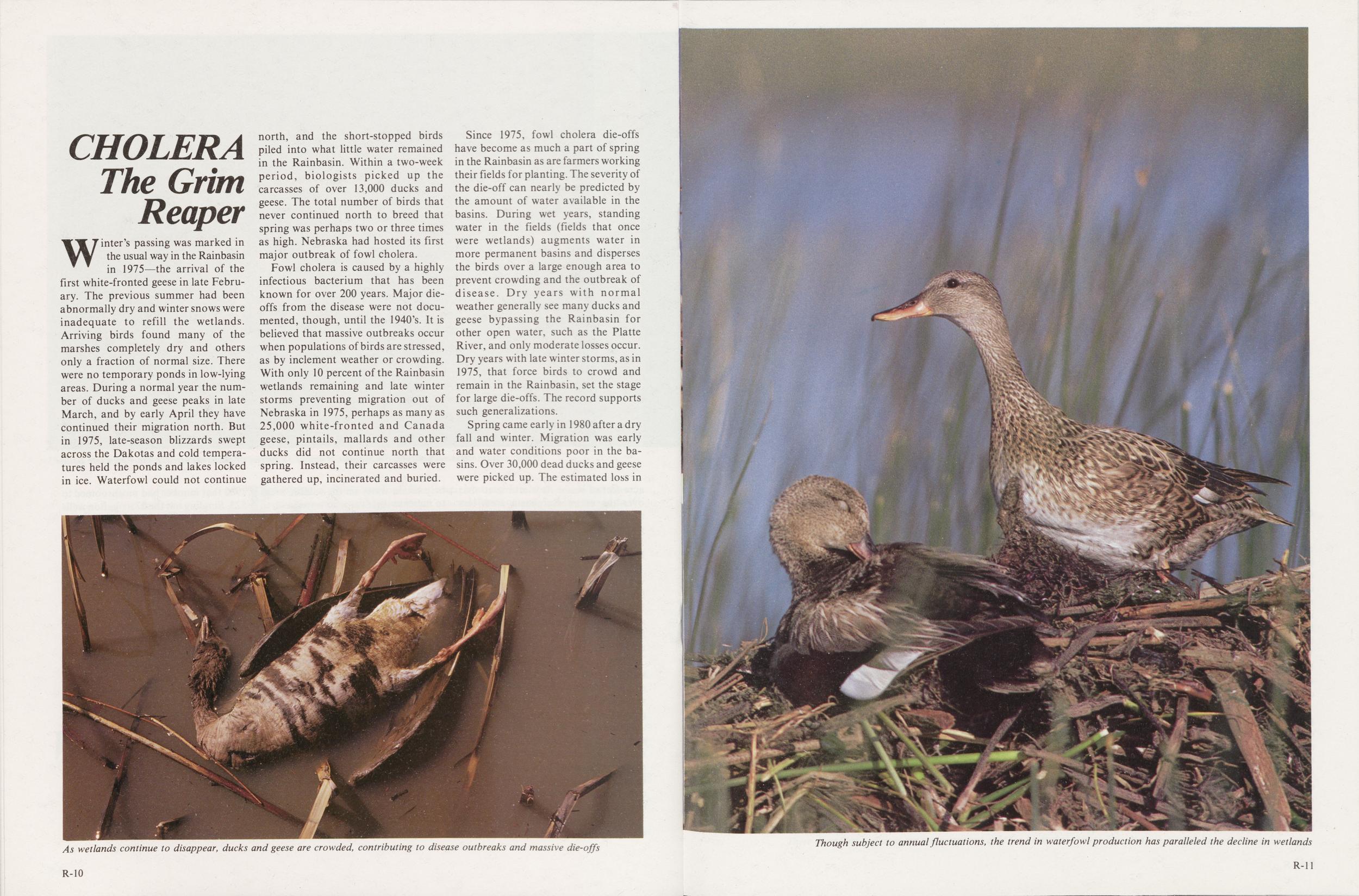
CHOLERA The Grim Reaper
Winter's passing was marked in the usual way in the Rainbasin in 1975—the arrival of the first white-fronted geese in late February. The previous summer had been abnormally dry and winter snows were inadequate to refill the wetlands. Arriving birds found many of the marshes completely dry and others only a fraction of normal size. There were no temporary ponds in low-lying areas. During a normal year the number of ducks and geese peaks in late March, and by early April they have continued their migration north. But in 1975, late-season blizzards swept across the Dakotas and cold temperatures held the ponds and lakes locked in ice. Waterfowl could not continue north, and the short-stopped birds piled into what little water remained in the Rainbasin. Within a two-week period, biologists picked up the carcasses of over 13,000 ducks and geese. The total number of birds that never continued north to breed that spring was perhaps two or three times as high. Nebraska had hosted its first major outbreak of fowl cholera.
Fowl cholera is caused by a highly infectious bacterium that has been known for over 200 years. Major die-offs from the disease were not documented, though, until the 1940's. It is believed that massive outbreaks occur when populations of birds are stressed, as by inclement weather or crowding. With only 10 percent of the Rainbasin wetlands remaining and late winter storms preventing migration out of Nebraska in 1975, perhaps as many as 25,000 white-fronted and Canada geese, pintails, mallards and other ducks did not continue north that spring. Instead, their carcasses were gathered up, incinerated and buried. Since 1975, fowl cholera die-offs have become as much a part of spring in the Rainbasin as are farmers working their fields for planting. The severity of the die-off can nearly be predicted by the amount of water available in the basins. During wet years, standing water in the fields (fields that once were wetlands) augments water in more permanent basins and disperses the birds over a large enough area to prevent crowding and the outbreak of disease. Dry years with normal weather generally see many ducks and geese bypassing the Rainbasin for other open water, such as the Platte River, and only moderate losses occur. Dry years with late winter storms, as in 1975, that force birds to crowd and remain in the Rainbasin, set the stage for large die-offs. The record supports such generalizations.
As wetlands continue to disappear, ducks and geese are crowded, contributing to disease outbreaks and massive die-offs
Though subject to annual fluctuations, the trend in waterfowl production has paralleled the decline in wetlands
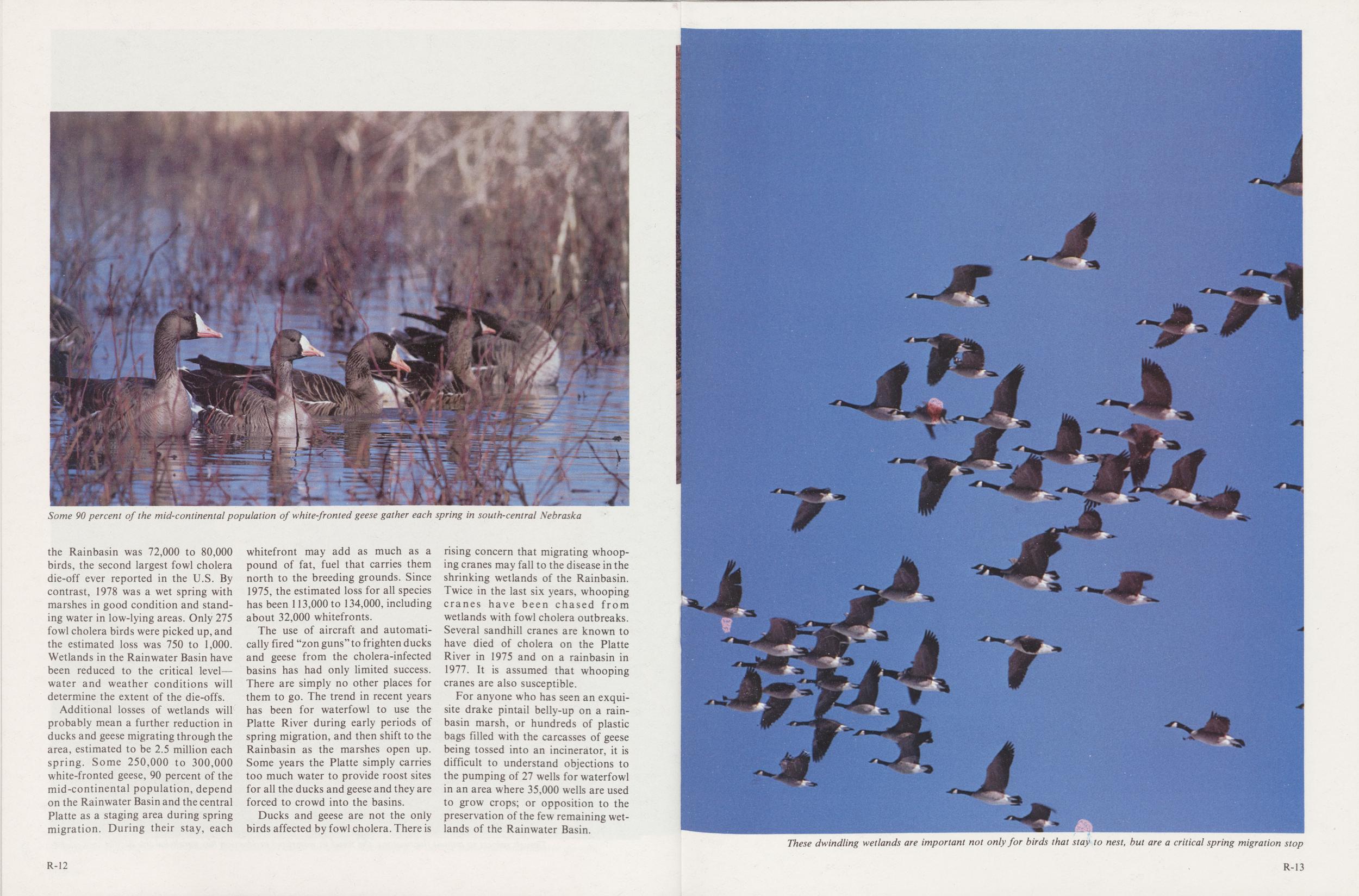
Some 90 percent of the mid-continental population of white-fronted geese gather each spring in south-central Nebraska
Additional losses of wetlands will probably mean a further reduction in ducks and geese migrating through the area, estimated to be 2.5 million each spring. Some 250,000 to 300,000 white-fronted geese, 90 percent of the mid-continental population, depend on the Rainwater Basin and the central Platte as a staging area during spring migration. During their stay, each whitefront may add as much as a pound of fat, fuel that carries them north to the breeding grounds. Since 1975, the estimated loss for all species has been 113,000 to 134,000, including about 32,000 whitefronts.
The use of aircraft and automatically fired "zon guns" to frighten ducks and geese from the cholera-infected basins has had only limited success. There are simply no other places for them to go. The trend in recent years has been for waterfowl to use the Platte River during early periods of spring migration, and then shift to the Rainbasin as the marshes open up. Some years the Platte simply carries too much water to provide roost sites for all the ducks and geese and they are forced to crowd into the basins.
Ducks and geese are not the only birds affected by fowl cholera. There is rising concern that migrating whooping cranes may fall to the disease in the shrinking wetlands of the Rainbasin. Twice in the last six years, whooping cranes have been chased from wetlands with fowl cholera outbreaks. Several sandhill cranes are known to have died of cholera on the Platte River in 1975 and on a rainbasin in 1977. It is assumed that whooping cranes are also susceptible.
For anyone who has seen an exquisite drake pintail belly-up on a rainbasin marsh, or hundreds of plastic bags filled with the carcasses of geese being tossed into an incinerator, it is difficult to understand objections to the pumping of 27 wells for waterfowl in an area where 35,000 wells are used to grow crops; or opposition to the preservation of the few remaining wetlands of the Rainwater Basin.
R-12These dwindling wetlands are important not only for birds that stay to nest, but are a critical spring migration stop
What is a Wetland Worth?
In the late 1940's, Wisconsin naturalist Aldo Leopold wrote of the danger of placing a dollar value on wild things.
"Like winds and sunsets, wild things were taken for granted until progress began to do away with them. Now we face the question whether a still higher 'standard of living' is worth its cost in things natural, wild and free. For us of the minority, the opportunity to see geese is more important than television, and the chance to find a pasque-flower is a right as inalienable as free speech."
The continued existence of wild things and wild places must be decided by values other than economic, Leopold was saying. A fine ideal, but a difficult principle for a Rainbasin landowner with a bank note due, to appreciate. In recent years, water specialists and ag economists have been making strides toward quantifying the real values derived from wetlands. Wetlands possess a value every bit as real as bushels of corn but infinitely more difficult to measure because so many people receive benefits, and in indirect forms. Certain values are documented, if not assigned a precise dollar value, though—groundwater recharge, flood control, nutrient recycling and income generated from recreation.
Part of the justification for nearly every new reservoir proposed is recharge of groundwater and flood control. Natural wetlands function in much the same way; they are holding reservoirs for excess water, collecting runoff during periods of high precipitation and storing it through periods of scant moisture.
The obvious value of any wetland to man, though, is from the wildlife they produce; whether we go there with a shotgun to bring home a mallard or pheasant, a camera to bring home photographs, or a canoe to listen to goose music on a March evening. And, when we go there to hunt or photograph or just watch, we've pumped money into the economy for wool shirts, hip boots, binoculars, cameras and even lunch, shotgun shells or gas in the nearest small town. Hunters have not only paid for these areas with their duck stamp or habitat stamp money, they have paid for the water to be pumped into the marshes and even a form of property tax to the county. And, they have paid not only to raise pheasants and mallards, but black-crowned night herons, yellow-headed blackbirds, marsh wrens and swallow-tailed butterflies. Of 257 species of birds occurring on the federal WPA's in the Rainwater Basin, only 28 are game birds.
The remaining wetlands of the Rainwater Basin are relics—the last of their kind—like the whooping cranes that, perilously, insist on returning to them. They are civilized marshes today, encroached upon by cornfields and severed by county roads, their life blood siphoned away; ironically, by the same technology that sustains their remnants. Each March, lines of geese still pass overhead, flying low, forced earthward by heavy gray clouds that muffle the sound of their talk and rush of wings. Are they ghosts of the marsh, perhaps portending the passing of their kind from places such as these? Their passing is indistinct against the soft rain. Do they carry with them, passed on from generations before, the memory of times when marshes joined over this land, when their kind did not overwinter on salt marshes shared by oil drilling rigs, of migration over grasslands rich with sloughs and potholes, and of nesting grounds unscarred by pipelines? It is unspeakably sad that we should deny them what little remains.
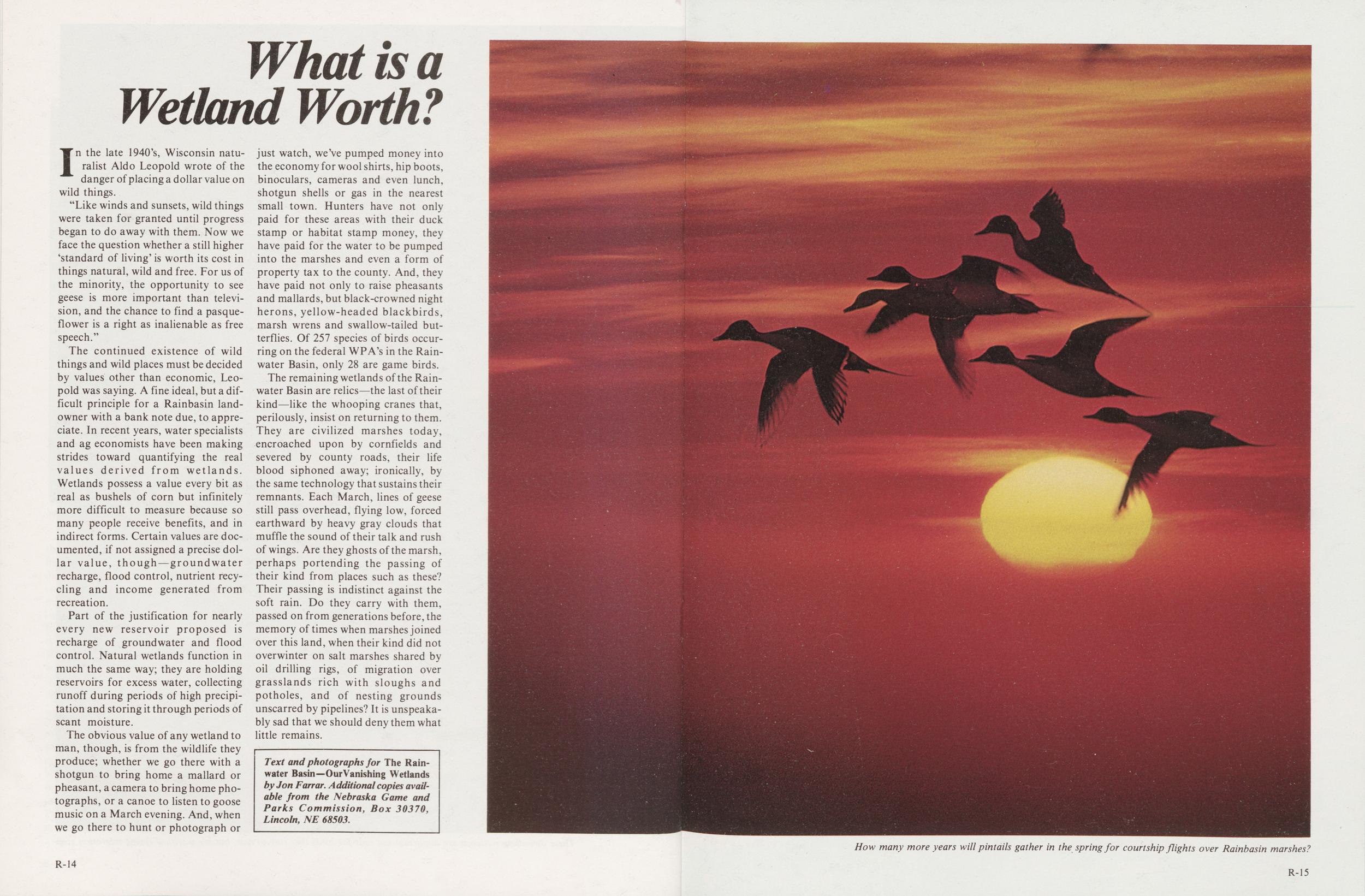
Text and photographs for The Rainwater Basin—OurVanishing Wetlands by Jon Farrar. Additional copies available from the Nebraska Game and Parks Commission, Box 30370, Lincoln, NE 68503. R-14How many more years will pintails gather in the spring for courtship flights over Rainbasin marshes?
Spring's Passage in a civilized marsh
We live in a time when worth is most often measured in dollars, and intangible values are disregarded
WE PREFER to think of ourselves as rational animals, basing decisions on facts rather than emotions. We cloak environmental issues, such as the loss of wetlands in the Rainwater Basin, in economic jargon, measuring the value of a marsh in terms of its "cost effectiveness." The destruction of nine of every 10 marshes once in the Rainwater Basin can probably be attributed to men of narrow vision who believed they were making rational decisions. But, emotions make man more than just a rational animal (computers are rational); they make him a compassionate beast. The preservation of those Rainwater Basin marshes that do remain is the work of compassionate men.
Much of last spring I spent in a Rainwater Basin marsh gathering information for the preceding feature. A marsh is not a place conducive to rational research. Ultimately, the fate of remaining wetlands will be decided, not in a marsh, but in a far more antiseptic environment. Appropriately, most of the text was derived from historical records, interviews, government files, memorandums and assorted publications that could be conveniently organized under crisp fluorescent lights in an office free of mosquitoes. But, those days in the marsh did convince me that economic justifications for preserving wetlands are far less significant than some very basic, intangible values---for a marsh's worth cannot be gathered up and weighed on economic scales. For compassionate men, selected passages from my field notes during those days, follow.
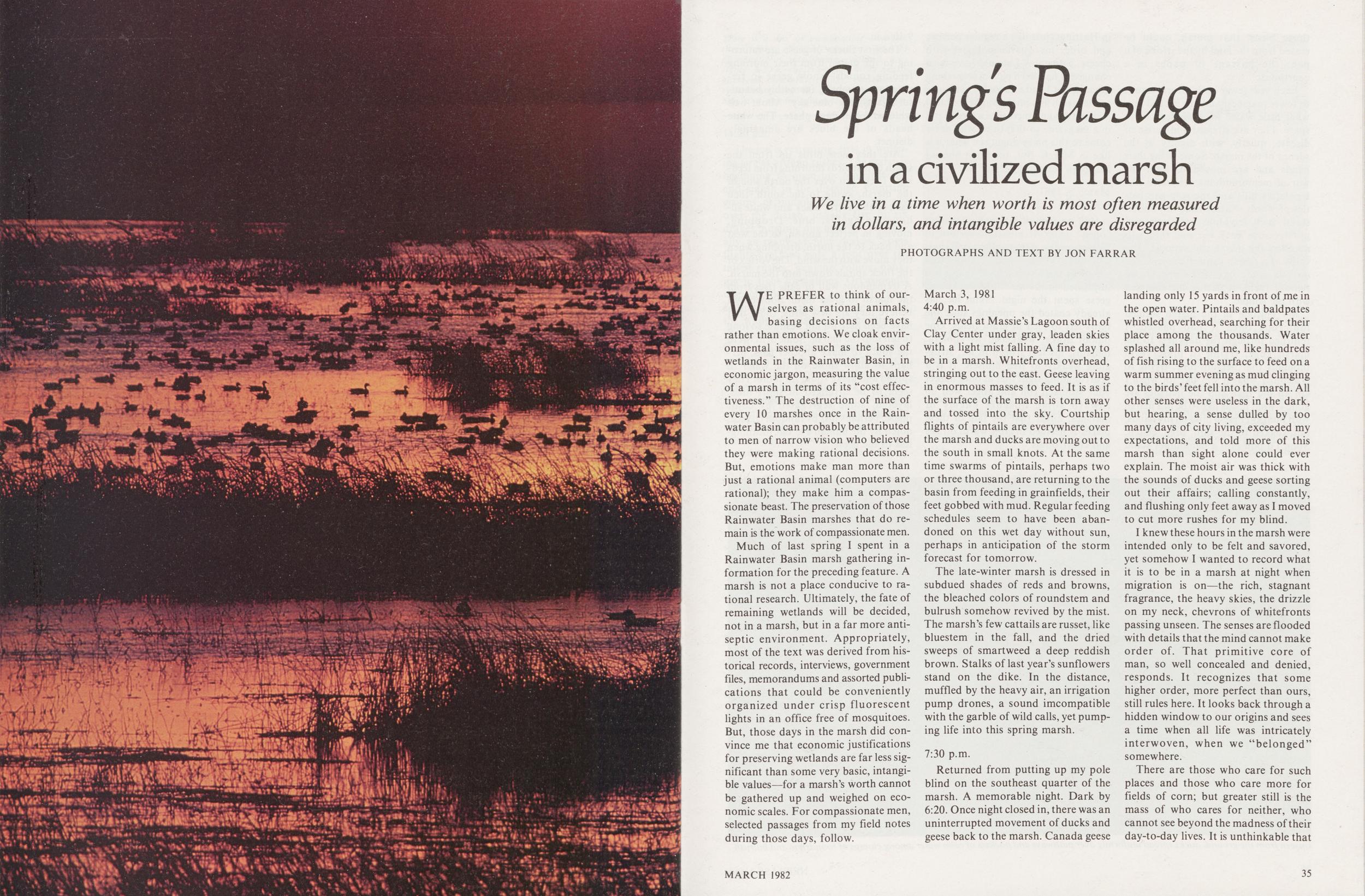
March 3, 1981 4:40 p.m.Arrived at Massie's Lagoon south of Clay Center under gray, leaden skies with a light mist falling. A fine day to be in a marsh. Whitefronts overhead, stringing out to the east. Geese leaving in enormous masses to feed. It is as if the surface of the marsh is torn away and tossed into the sky. Courtship flights of pintails are everywhere over the marsh and ducks are moving out to the south in small knots. At the same time swarms of pintails, perhaps two or three thousand, are returning to the basin from feeding in grainfields, their feet gobbed with mud. Regular feeding schedules seem to have been abandoned on this wet day without sun, perhaps in anticipation of the storm forecast for tomorrow.
The late-winter marsh is dressed in subdued shades of reds and browns, the bleached colors of roundstem and bulrush somehow revived by the mist. The marsh's few cattails are russet, like bluestem in the fall, and the dried sweeps of smartweed a deep reddish brown. Stalks of last year's sunflowers stand on the dike. In the distance, muffled by the heavy air, an irrigation pump drones, a sound imcompatible with the garble of wild calls, yet pumping life into this spring marsh.
7:30 p.mReturned from putting up my pole blind on the southeast quarter of the marsh. A memorable night. Dark by 6:20. Once night closed in, there was an uninterrupted movement of ducks and geese back to the marsh. Canada geese landing only 15 yards in front of me in the open water. Pintails and baldpates whistled overhead, searching for their place among the thousands. Water splashed all around me, like hundreds of fish rising to the surface to feed on a warm summer evening as mud clinging to the birds' feet fell into the marsh. All other senses were useless in the dark, but hearing, a sense dulled by too many days of city living, exceeded my expectations, and told more of this marsh than sight alone could ever explain. The moist air was thick with the sounds of ducks and geese sorting out their affairs; calling constantly, and flushing only feet away as I moved to cut more rushes for my blind.
I knew these hours in the marsh were intended only to be felt and savored, yet somehow I wanted to record what it is to be in a marsh at night when migration is on—the rich, stagnant fragrance, the heavy skies, the drizzle on my neck, chevrons of whitefronts passing unseen. The senses are flooded with details that the mind cannot make order of. That primitive core of man, so well concealed and denied, responds. It recognizes that some higher order, more perfect than ours, still rules here. It looks back through a hidden window to our origins and sees a time when all life was intricately interwoven, when we "belonged" somewhere.
There are those who care for such
places and those who care more for
fields of corn; but greater still is the
mass of who cares for neither, who
cannot see beyond the madness of their
day-to-day lives. It is unthinkable that
MARCH 1982 35
 those birds, that marsh, could be
erased from the land by the stroke of a
pen, the passage of paper in a
courthouse.
those birds, that marsh, could be
erased from the land by the stroke of a
pen, the passage of paper in a
courthouse.
Each year fewer birds return, return to fewer marshes, and are packed into what little water we have seen fit to spare. They are stressed and perish of disease, quietly, with dignity in the silence of the marsh. Some wring their hands and are moved to fight the war of memorandums, letters to file, legislative bills and the stop-gap battles of words. Nature does not understand such frivolous solutions and grimly crops back the wild things to numbers the marsh can support. The value of a marsh cannot be measured on our crude yardsticks and so we remove them, replacing the complex with the simple.
My episode in the marsh seemed ludicrous once it had passed. I returned through the darkness to the marsh edge, trying to preserve in thoughts that fleeting time; trying to remember what it was like for when I am an old man and the marshes are gone—what it was like to be in a marsh with pungent marsh mud on my hands, rain-soaked to the skin, tired, elated. Soon I'd pull into a hamburger stand in Hastings, just like a regular person, and order my quarter-pounder with cheese. Somehow I should have been changed. I had been part of something organic; but I had returned. I had come to the marsh as a photographer to build a blind to take a picture of a bird to put in a magazine so that those who never come to this place might see what it is like in March. But, for three hours I had been something else.
March 5, 1981 6:50 a.m.Half an inch of ice covers Massie's "open" water. It breaks underfoot in the concentric pattern of an orb spider's web—evenly spaced rings dissected by radial lines. Oval shapes are imprinted in the ice where ducks and geese spent the night. Skim ice has already coated the openings since the birds left to feed in grain fields. One pintail drake, weakened by cholera, remains, his feet frozen in ice, struggling weakly to free himself. It is a heart-rending sight that at once makes your stomach roll and anger well up toward some obscure enemy of marshes; anger that the fate of these places is decided in cozy warm offices and courtrooms.
9:10 a.m.The first flocks of geese are returning to the marsh from their morning feeding rounds—snow geese in tremendous numbers, incredibly beautiful against the blue sky. About half white and half dark phase. The white heads of the blues are amazingly distinct.
Are they new birds up from the south or just birds returning from feeding? They turn over the north side of the marsh, swing to the south, then back to the north, black and white silhouetted against blue. Dropping, moving in perfect unison, to the west and back to the north, dropping when they move with the wind. The vortex of the flock spirals down into the marsh. A tremendous wall of calls rises from the marsh to greet them. Somehow I believe they are new birds; those that have been here do not hesitate so long to fall into the marsh. Some drift off to the south to make another pass, perhaps to allow those on the water to spread and make room for more. They seem to be arranged in short lines, layered, some segregated by color phase, perhaps just by random chance, noted by the human eye but meaningless to the geese.
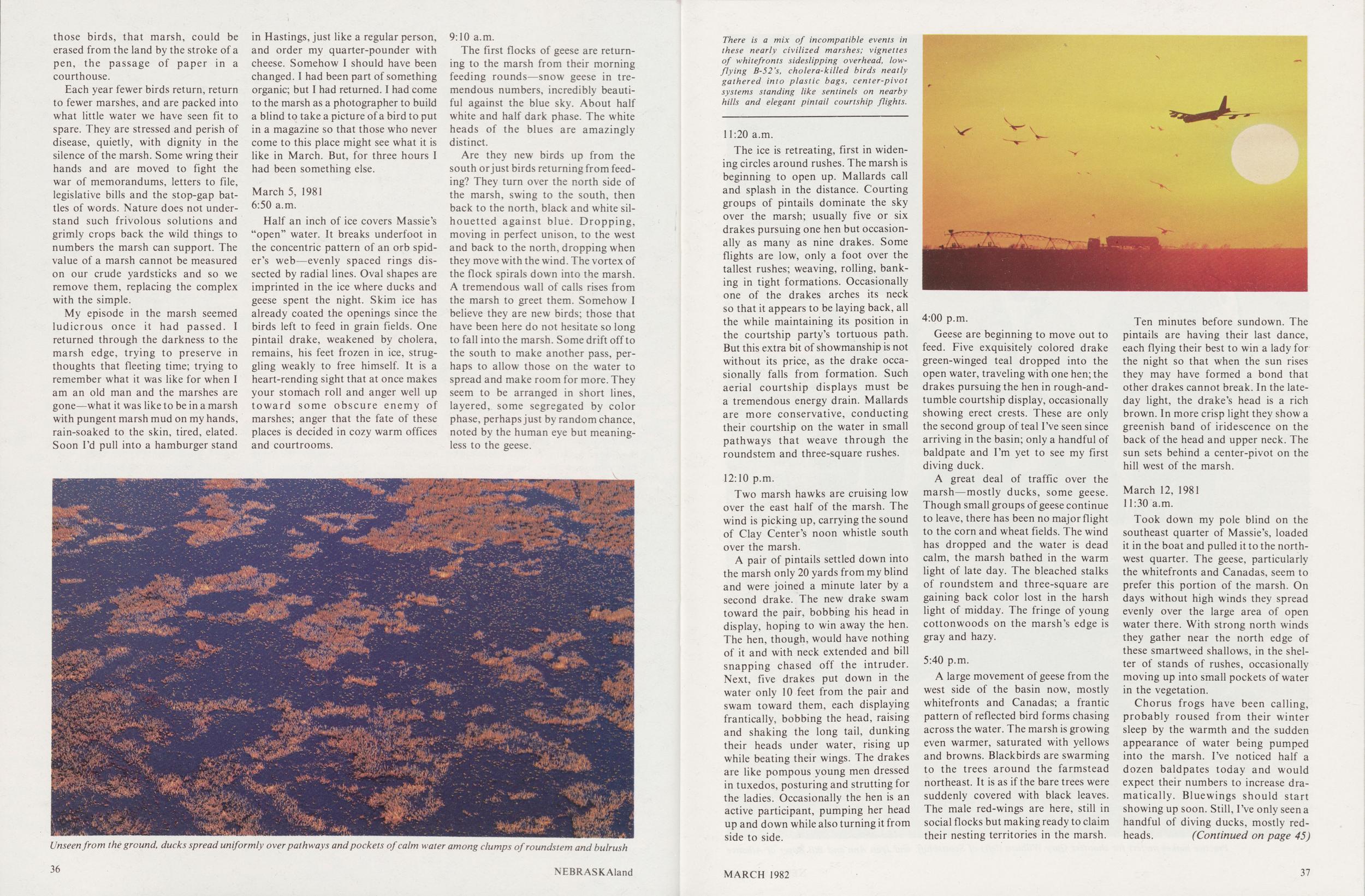
Unseen from the ground, ducks spread uniformly over pathways and pockets of calm water among clumps of roundstem and bulrush
There is a mix of incompatible events in these nearly civilized marshes; vignettes of whitefronts sideslipping overhead, low-flying B-52's, cholera-killed birds neatly gathered into plastic bags, center-pivot systems standing like sentinels on nearby hills and elegant pintail courtship flights.
11:20 a.m.The ice is retreating, first in widening circles around rushes. The marsh is beginning to open up. Mallards call and splash in the distance. Courting groups of pintails dominate the sky over the marsh; usually five or six drakes pursuing one hen but occasionally as many as nine drakes. Some flights are low, only a foot over the tallest rushes; weaving, rolling, banking in tight formations. Occasionally one of the drakes arches its neck so that it appears to be laying back, all the while maintaining its position in the courtship party's tortuous path. But this extra bit of showmanship is not without its price, as the drake occasionally falls from formation. Such aerial courtship displays must be a tremendous energy drain. Mallards are more conservative, conducting their courtship on the water in small pathways that weave through the roundstem and three-square rushes.
12:10 p.m.Two marsh hawks are cruising low over the east half of the marsh. The wind is picking up, carrying the sound of Clay Center's noon whistle south over the marsh.
A pair of pintails settled down into the marsh only 20 yards from my blind and were joined a minute later by a second drake. The new drake swam toward the pair, bobbing his head in display, hoping to win away the hen. The hen, though, would have nothing of it and with neck extended and bill snapping chased off the intruder. Next, five drakes put down in the water only 10 feet from the pair and swam toward them, each displaying frantically, bobbing the head, raising and shaking the long tail, dunking their heads under water, rising up while beating their wings. The drakes are like pompous young men dressed in tuxedos, posturing and strutting for the ladies. Occasionally the hen is an active participant, pumping her head up and down while also turning it from side to side.
Geese are beginning to move out to feed. Five exquisitely colored drake green-winged teal dropped into the open water, traveling with one hen; the drakes pursuing the hen in rough-and-tumble courtship display, occasionally showing erect crests. These are only the second group of teal I've seen since arriving in the basin; only a handful of baldpate and I'm yet to see my first diving duck.
A great deal of traffic over the marsh—mostly ducks, some geese. Though small groups of geese continue to leave, there has been no major flight to the corn and wheat fields. The wind has dropped and the water is dead calm, the marsh bathed in the warm light of late day. The bleached stalks of roundstem and three-square are gaining back color lost in the harsh light of midday. The fringe of young cottonwoods on the marsh's edge is gray and hazy.
5:40 p.m.A large movement of geese from the west side of the basin now, mostly whitefronts and Canadas; a frantic pattern of reflected bird forms chasing across the water. The marsh is growing even warmer, saturated with yellows and browns. Blackbirds are swarming to the trees around the farmstead northeast. It is as if the bare trees were suddenly covered with black leaves. The male red-wings are here, still in social flocks but making ready to claim their nesting territories in the marsh.
Ten minutes before sundown. The pintails are having their last dance, each flying their best to win a lady for the night so that when the sun rises they may have formed a bond that other drakes cannot break. In the late-day light, the drake's head is a rich brown. In more crisp light they show a greenish band of iridescence on the back of the head and upper neck. The sun sets behind a center-pivot on the hill west of the marsh.
March 12, 1981 11:30 a.m.Took down my pole blind on the southeast quarter of Massie's, loaded it in the boat and pulled it to the northwest quarter. The geese, particularly the whitefronts and Canadas, seem to prefer this portion of the marsh. On days without high winds they spread evenly over the large area of open water there. With strong north winds they gather near the north edge of these smartweed shallows, in the shelter of stands of rushes, occasionally moving up into small pockets of water in the vegetation.
Chorus frogs have been calling, probably roused from their winter sleep by the warmth and the sudden appearance of water being pumped into the marsh. I've noticed half a dozen baldpates today and would expect their numbers to increase dramatically. Bluewings should start showing up soon. Still, I've only seen a handful of diving ducks, mostly redheads. (Continued on page 45)
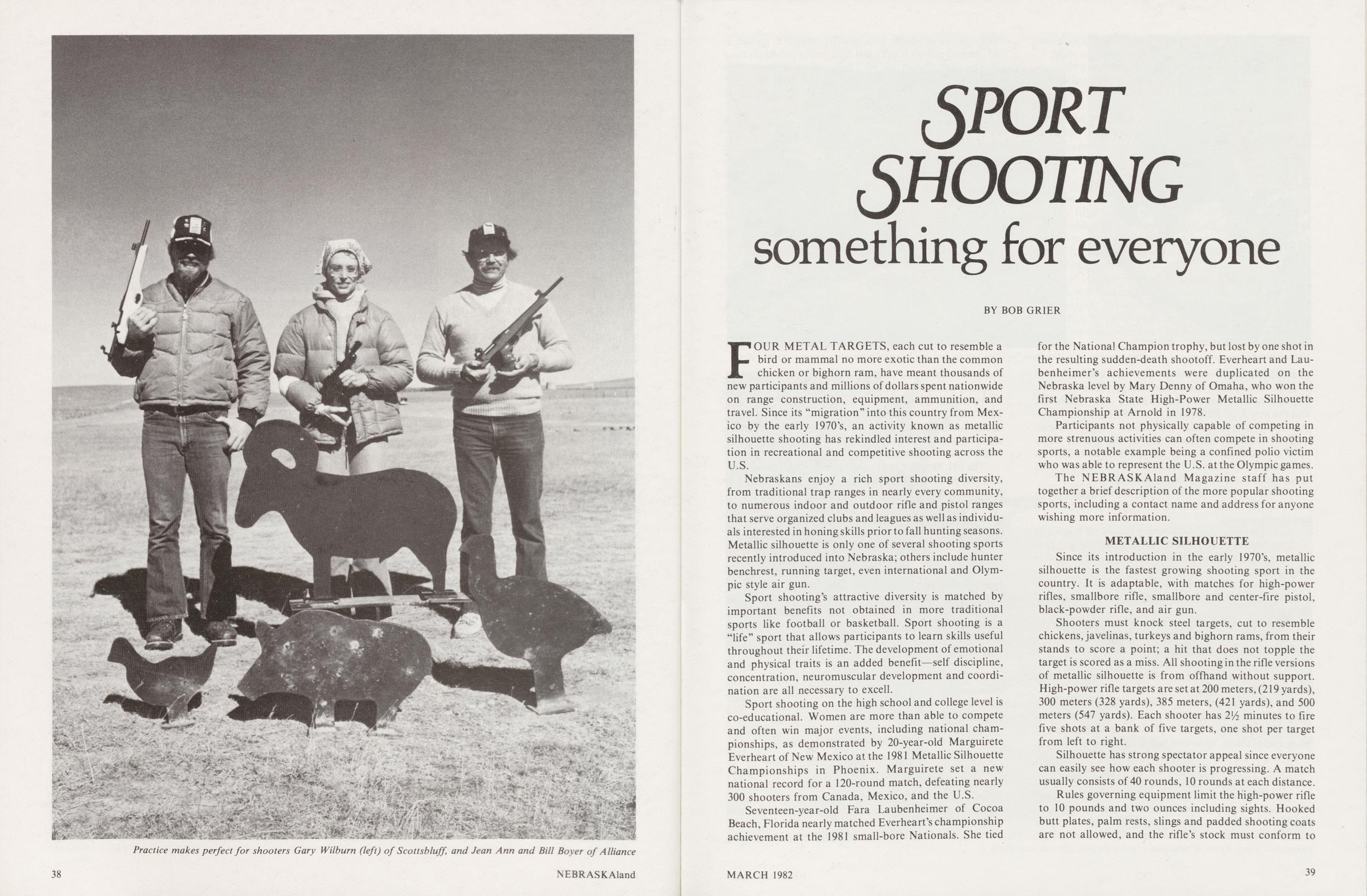
Practice makes perfect for shooters Gary Wilburn (left) of Scottsbluff, and Jean Ann and Bill Boyer of Alliance
SPORT SHOOTING something for everyone
FOUR METAL TARGETS, each cut to resemble a bird or mammal no more exotic than the common chicken or bighorn ram, have meant thousands of new participants and millions of dollars spent nationwide on range construction, equipment, ammunition, and travel. Since its "migration" into this country from Mexico by the early 1970's, an activity known as metallic silhouette shooting has rekindled interest and participation in recreational and competitive shooting across the U.S.
Nebraskans enjoy a rich sport shooting diversity, from traditional trap ranges in nearly every community, to numerous indoor and outdoor rifle and pistol ranges that serve organized clubs and leagues as well as individuals interested in honing skills prior to fall hunting seasons. Metallic silhouette is only one of several shooting sports recently introduced into Nebraska; others include hunter benchrest, running target, even international and Olympic style air gun.
Sport shooting's attractive diversity is matched by important benefits not obtained in more traditional sports like football or basketball. Sport shooting is a "life" sport that allows participants to learn skills useful throughout their lifetime. The development of emotional and physical traits is an added benefit—self discipline, concentration, neuromuscular development and coordination are all necessary to excell.
Sport shooting on the high school and college level is co-educational. Women are more than able to compete and often win major events, including national championships, as demonstrated by 20-year-old Marguirete Everheart of New Mexico at the 1981 Metallic Silhouette Championships in Phoenix. Marguirete set a new national record for a 120-round match, defeating nearly 300 shooters from Canada, Mexico, and the U.S.
Seventeen-year-old Fara Laubenheimer of Cocoa Beach, Florida nearly matched Everheart's championship achievement at the 1981 small-bore Nationals. She tied for the National Champion trophy, but lost by one shot in the resulting sudden-death shootoff. Everheart and Laubenheimer's achievements were duplicated on the Nebraska level by Mary Denny of Omaha, who won the first Nebraska State High-Power Metallic Silhouette Championship at Arnold in 1978.
Participants not physically capable of competing in more strenuous activities can often compete in shooting sports, a notable example being a confined polio victim who was able to represent the U.S. at the Olympic games.
The NEBRASKAland Magazine staff has put together a brief description of the more popular shooting sports, including a contact name and address for anyone wishing more information.
METALLIC SILHOUETTESince its introduction in the early 1970's, metallic silhouette is the fastest growing shooting sport in the country. It is adaptable, with matches for high-power rifles, smallbore rifle, smallbore and center-fire pistol, black-powder rifle, and air gun.
Shooters must knock steel targets, cut to resemble chickens, javelinas, turkeys and bighorn rams, from their stands to score a point; a hit that does not topple the target is scored as a miss. All shooting in the rifle versions of metallic silhouette is from offhand without support. High-power rifle targets are set at 200 meters, (219 yards), 300 meters (328 yards), 385 meters, (421 yards), and 500 meters (547 yards). Each shooter has 2l/2 minutes to fire five shots at a bank of five targets, one shot per target from left to right.
Silhouette has strong spectator appeal since everyone can easily see how each shooter is progressing. A match usually consists of 40 rounds, 10 rounds at each distance.
Rules governing equipment limit the high-power rifle to 10 pounds and two ounces including sights. Hooked butt plates, palm rests, slings and padded shooting coats are not allowed, and the rifle's stock must conform to established dimensions with no more than seven inches of drop at the toe, and a cheekpiece no higher than bore line. Popular calibers include the standard .308 Winchester and the new 7/08 Remington. The 1981 National Championship winner fired a factory varment-weight rifle with original stock. Silhouette scopes on the market today have accurate adjustments, and shooters normally set their scopes for distances fired, thus preventing the need to use hold-over, or "Kentucky windage."
MARCH 1982 39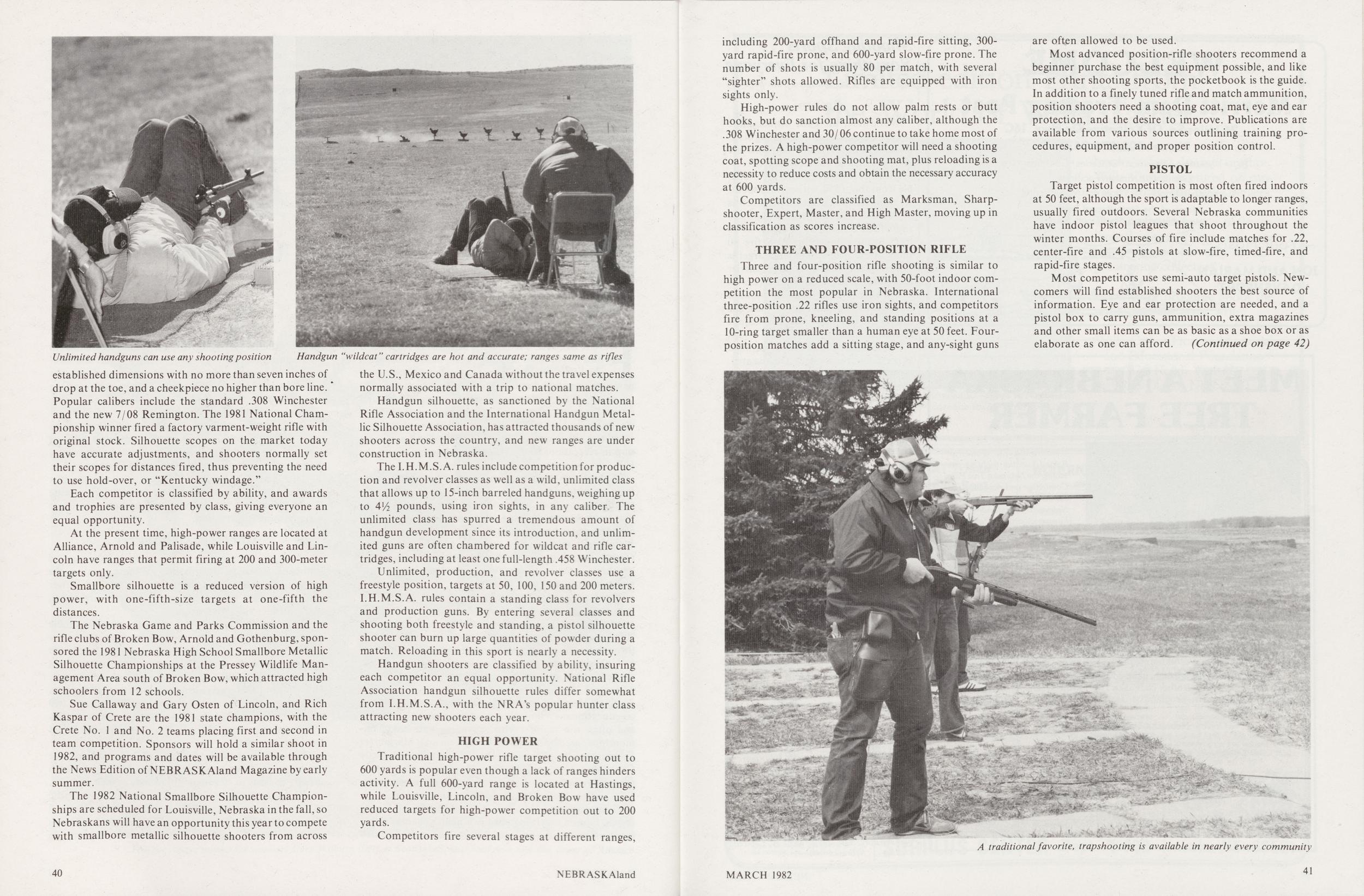
Unlimited handguns can use any shooting position
Handgun "wildcat" cartridges are hot and accurate; ranges same as rifles
Each competitor is classified by ability, and awards and trophies are presented by class, giving everyone an equal opportunity.
At the present time, high-power ranges are located at Alliance, Arnold and Palisade, while Louisville and Lincoln have ranges that permit firing at 200 and 300-meter targets only.
Smallbore silhouette is a reduced version of high power, with one-fifth-size targets at one-fifth the distances.
The Nebraska Game and Parks Commission and the rifle clubs of Broken Bow, Arnold and Gothenburg, sponsored the 1981 Nebraska High School Smallbore Metallic Silhouette Championships at the Pressey Wildlife Management Area south of Broken Bow, which attracted high schoolers from 12 schools.
Sue Callaway and Gary Osten of Lincoln, and Rich Kaspar of Crete are the 1981 state champions, with the Crete No. 1 and No. 2 teams placing first and second in team competition. Sponsors will hold a similar shoot in 1982, and programs and dates will be available through the News Edition of NEBRASKAland Magazine by early summer.
The 1982 National Smallbore Silhouette Championships are scheduled for Louisville, Nebraska in the fall, so Nebraskans will have an opportunity this year to compete with smallbore metallic silhouette shooters from across the U.S., Mexico and Canada without the travel expenses normally associated with a trip to national matches. Handgun silhouette, as sanctioned by the National Rifle Association and the International Handgun Metallic Silhouette Association, has attracted thousands of new shooters across the country, and new ranges are under construction in Nebraska.
The I.H.M.S.A. rules include competition for production and revolver classes as well as a wild, unlimited class that allows up to 15-inch barreled handguns, weighing up to 4½ pounds, using iron sights, in any caliber The unlimited class has spurred a tremendous amount of handgun development since its introduction, and unlimited guns are often chambered for wildcat and rifle cartridges, including at least one full-length .458 Winchester.
Unlimited, production, and revolver classes use a freestyle position, targets at 50, 100, 150 and 200 meters. I.H.M.S.A. rules contain a standing class for revolvers and production guns. By entering several classes and shooting both freestyle and standing, a pistol silhouette shooter can burn up large quantities of powder during a match. Reloading in this sport is nearly a necessity.
Handgun shooters are classified by ability, insuring each competitor an equal opportunity. National Rifle Association handgun silhouette rules differ somewhat from I.H.M.S.A., with the NRA's popular hunter class attracting new shooters each year.
HIGH POWER
Traditional high-power rifle target shooting out to 600 yards is popular even though a lack of ranges hinders activity. A full 600-yard range is located at Hastings, while Louisville, Lincoln, and Broken Bow have used reduced targets for high-power competition out to 200 yards.
Competitors fire several stages at different ranges, including 200-yard offhand and rapid-fire sitting, 300-yard rapid-fire prone, and 600-yard slow-fire prone. The number of shots is usually 80 per match, with several "sighter" shots allowed. Rifles are equipped with iron sights only.
40 NEBRASKAlandHigh-power rules do not allow palm rests or butt hooks, but do sanction almost any caliber, although the .308 Winchester and 30/ 06 continue to take home most of the prizes. A high-power competitor will need a shooting coat, spotting scope and shooting mat, plus reloading is a necessity to reduce costs and obtain the necessary accuracy at 600 yards.
Competitors are classified as Marksman, Sharp-shooter, Expert, Master, and High Master, moving up in classification as scores increase.
THREE AND FOUR-POSITION RIFLE
Three and four-position rifle shooting is similar to high power on a reduced scale, with 50-foot indoor competition the most popular in Nebraska. International three-position .22 rifles use iron sights, and competitors fire from prone, kneeling, and standing positions at a 10-ring target smaller than a human eye at 50 feet. Four-position matches add a sitting stage, and any-sight guns are often allowed to be used.
Most advanced position-rifle shooters recommend a beginner purchase the best equipment possible, and like most other shooting sports, the pocketbook is the guide. In addition to a finely tuned rifle and match ammunition, position shooters need a shooting coat, mat, eye and ear protection, and the desire to improve. Publications are available from various sources outlining training procedures, equipment, and proper position control.
PISTOL Target pistol competition is most often fired indoors at 50 feet, although the sport is adaptable to longer ranges, usually fired outdoors. Several Nebraska communities have indoor pistol leagues that shoot throughout the winter months. Courses of fire include matches for .22, center-fire and .45 pistols at slow-fire, timed-fire, and rapid-fire stages.
Most competitors use semi-auto target pistols. Newcomers will find established shooters the best source of information. Eye and ear protection are needed, and a pistol box to carry guns, ammunition, extra magazines and other small items can be as basic as a shoe box or as elaborate as one can afford. (Continued on page 42)
A traditional favorite, trapshooting is available in nearly every community
Shooting Sports... Something for Everyone
(Continued from page 43) AIR GUNWorldwide, air guns attract more shooters than any other shooting discipline. The three major divisions are rifle, pistol, and running target.
Air rifles for the beginner are available from about $50, with serious shooters using equipment costing as much as $1,000. Air rifle competition allows 40 shots fired offhand at 10 meters or 33 feet. Pistol competitors also fire 40 shots at 10 meters. Running target is fired at a specially built target carrier that moves a paper target printed with a wild boar. The target travels across a three-meter opening at 2!/2 seconds during the fast stage and five seconds at slow.
Nebraska air gun activity is confined at present to the Lincoln/ Omaha area. Nebraska youngsters, including Jack Clatsaddle and Allen Mersick of Papillion, have traveled to the Olympic Training Center at Colorado Springs and placed well in national competition.
The Army National Guard through Operation Match Up, is involved with advancing air gun training nationwide, starting shooters on a basic level. Youngsters considering an air gun can contact Jim Morrison for additional information. Morrison helps youngsters from Nebraska, Iowa, Minnesota, North and South Dakota, and Wis- (Continued on page 45)
"I used to be the fastest gun in the territory, then we annexed Texas, California, Oregon territory, Utah territory, New Mexico territory, Colorado territory. . . Nebraska territory. ..."
consin attend the training center at Colorado Springs.
MUZZLELOADING
Definitely a sport for history buffs, muzzleloaders, through organized clubs and the U.S. Muzzleloaders Association, attend matches throughout the year, including the Nebraska State Championship held on Memorial Day weekend.
Competition is informal compared to most shooting sports. Courses of fire exist for pistol, rifle, flintlock and trade gun—a smoothbore firing a lead ball. Most firing is at 25 to 100 yards. Silhouettes, Seneca runs, gong and cork shoots, as well as candle matches after dark, are a part of the fun normally found at a black-powder rendezvous.
Black-powder shooters will find that much of the required equipment can be acquired by trade or barter. Tipi's, knives, powder horns and related equipment can also be homemade, helping to keep costs down.
Primitive matches where rifles and all related equipment must match a specified era in American history, are held each summer, and muzzleloading shotgun matches, including 20 16-yard targets, 20 handicap targets and 10 pairs of doubles, are becoming popular.
TRAP
Registered trap shooting remains popular despite rising costs. Most registered trap shoots offer 100 16-yard targets and 100 handicap targets, with 25 pairs of doubles often added. Trap competitors will need a good shotgun, preferably a 12-gauge, and ear protection, a good vest and shell pouch, and shooting glasses—used to improve the sight picture and safety.
The 13th annual Nationwide Championship Cornhusker Trap Shoot sponsored by the Nebraska Game and Parks Commission will be held April 30 and May 1 and 2 at the Central Nebraska Gun Club at Doniphan. It attracts junior and senior high school and college shooters from across the U.S. High school competitors will shoot 100 16-yard targets on Friday and handicap targets on Saturday, with the handicap figured from Friday's score. College and junior high shooters repeat the same program on Sunday, although junior high shooters will fire 100 16-yard targets only. Over 90 individual and team awards worth more than $4,000 will be won during the 1982 Cornhusker, and shoot director Dave Wells of Norfolk expects about 500 youngsters to attend. For additional information on the Nationwide Championship Cornhusker Trap Shoot contact Dave Wells, 1210 Nebraska Ave., Norfolk, NE 68701 or Rocky Hoffmann, Nebraska Game and Parks Commission District Office, North Platte, NE 69101.
SPORT SHOOTING CONTACTS Nebraska Rifle and Pistol Association Directors Silhouette Director Mary Denny (402) 331-1098 Omaha, NE Muzzleloading Director J. W. Carlson (402) 388-4868 Crofton, NE High Power Director Gary Berggren (308) 743-2292 Axtell, NE Smallbore Director Glen Fiebig (308) 762-3006 Alliance, NE Pistol Director Fred Chrastil (402) 464-6064 Lincoln, NE Air Gun Director Jim Morrison (402) 339-3692 Papillion, NE I.H.M.S.A. Contact Bill Boyer (308) 762-7658 Alliance, NE Nebraska State Sportsmen's Association (Registered Trap Shooting) President Larry Lacina (402)333-3118 Omaha, NESpring's Passage in a Civilized Marsh
(Continued from page 37)Shovelers will be the last of the ducks to arrive, signaling the end of spring migration through the Rainwater Basin.
5:05 p.m. Like enormous clouds of black smoke, strings of blackbirds are curling in from the north, spilling into the young cottonwoods around the marsh. They weave across the sky like a writhing serpent. Evidently the birds spend the day feeding in grain fields, stage at sundown in the cottonwoods, then spill out into the marsh to roost at night on any stiff stalk of vegetation. For the most part they appear to be redwings, mostly males. The females are yet to arrive. There is a hum over the marsh, like being near a beehive. It is impossible to tell if this is coming from the blackbirds, from the duck and goose calls, or from all combined.
March 13, 1981 9:35 a.m. An enormous wave of whitefronts and Canadas coming east over the marsh, passing only 50 feet overhead, swinging west and then back into the wind, dropping to the water, hovering for the last few yards as if carefully selecting their place among the mass of birds that arrived before them. It took nearly five minutes for all of them to land, dropping into the marsh through a layer of pintail courtship flights. The core of early birds is expanding in concentric rings as more birds arrive. Over the buzzing hum of thousands of contented geese back from their morning feeding, eagerly ladling up the chocolate water, is the frequent strong voice of a Canada goose.
Several hundred whitefronts return in a remarkable approach. First I could hear a sound that was somehow foreign, like a pack of dogs, perhaps horses, running through shallow water. Then came the whitefronts, only 20 feet over the marsh from the north, rocking, butterflying not to lose altitude as they frequently do, just frolicking in straightaway flight. The noise from their side-slipping wings is like the snap when a piece of cloth or canvas is suddenly pulled tight. Rocking,
MARCH 1982 45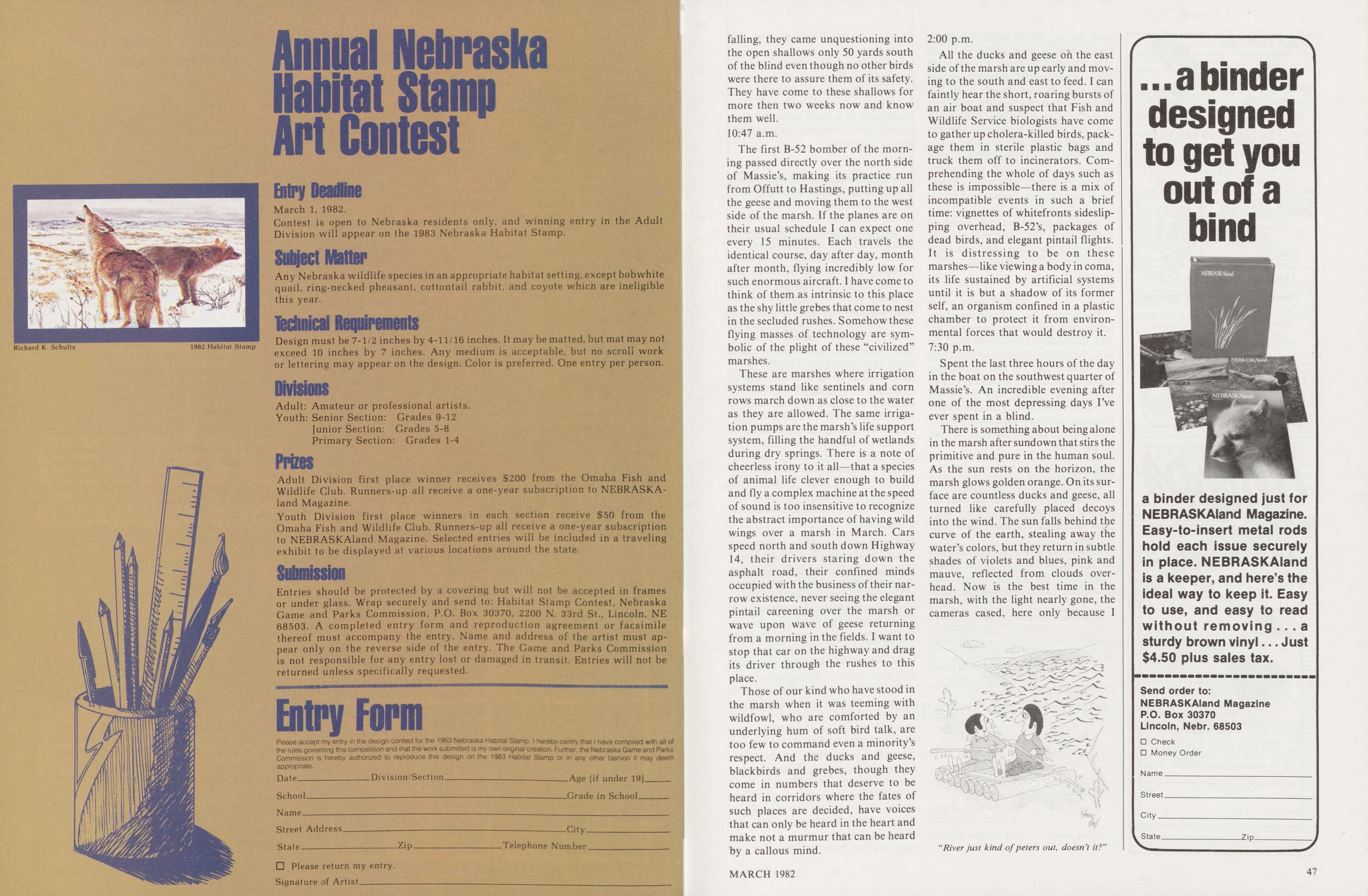
falling, they came unquestioning into the open shallows only 50 yards south of the blind even though no other birds were there to assure them of its safety. They have come to these shallows for more then two weeks now and know them well. 10:47 a.m.
The first B-52 bomber of the morning passed directly over the north side of Massie's, making its practice run from Offutt to Hastings, putting up all the geese and moving them to the west side of the marsh. If the planes are on their usual schedule I can expect one every 15 minutes. Each travels the identical course, day after day, month after month, flying incredibly low for such enormous aircraft. I have come to think of them as intrinsic to this place as the shy little grebes that come to nest in the secluded rushes. Somehow these flying masses of technology are symbolic of the plight of these "civilized" marshes.
These are marshes where irrigation systems stand like sentinels and corn rows march down as close to the water as they are allowed. The same irrigation pumps are the marsh's life support system, filling the handful of wetlands during dry springs. There is a note of cheerless irony to it all—that a species of animal life clever enough to build and fly a complex machine at the speed of sound is too insensitive to recognize the abstract importance of having wild wings over a marsh in March. Cars speed north and south down Highway 14, their drivers staring down the asphalt road, their confined minds occupied with the business of their narrow existence, never seeing the elegant pintail careening over the marsh or wave upon wave of geese returning from a morning in the fields. I want to stop that car on the highway and drag its driver through the rushes to this place.
Those of our kind who have stood in the marsh when it was teeming with wildfowl, who are comforted by an underlying hum of soft bird talk, are too few to command even a minority's respect. And the ducks and geese, blackbirds and grebes, though they come in numbers that deserve to be heard in corridors where the fates of such places are decided, have voices that can only be heard in the heart and make not a murmur that can be heard by a callous mind.
MARCH 1982 2:00 p.m. All the ducks and geese on the east side of the marsh are up early and moving to the south and east to feed. I can faintly hear the short, roaring bursts of an air boat and suspect that Fish and Wildlife Service biologists have come to gather up cholera-killed birds, package them in sterile plastic bags and truck them off to incinerators. Comprehending the whole of days such as these is impossible—there is a mix of incompatible events in such a brief time: vignettes of whitefronts sideslipping overhead, B-52's, packages of dead birds, and elegant pintail flights. It is distressing to be on these marshes—like viewing a body in coma, its life sustained by artificial systems until it is but a shadow of its former self, an organism confined in a plastic chamber to protect it from environmental forces that would destroy it. 7:30 p.m.
Spent the last three hours of the day in the boat on the southwest quarter of Massie's. An incredible evening after one of the most depressing days I've ever spent in a blind.
There is something about being alone in the marsh after sundown that stirs the primitive and pure in the human soul. As the sun rests on the horizon, the marsh glows golden orange. On its surface are countless ducks and geese, all turned like carefully placed decoys into the wind. The sun falls behind the curve of the earth, stealing away the water's colors, but they return in subtle shades of violets and blues, pink and mauve, reflected from clouds overhead. Now is the best time in the marsh, with the light nearly gone, the cameras cased, here only because I
"River just kind of peters out, doesn't it?"
need to be. Birds wheel overhead, swing into the wind and drop to the marsh around my boat. It is a fleeting sliver of time when all that is corrupt with this civilized marsh is erased. Those two words, "marsh" and "civilized," are incompatible, and yet descriptive of these Rainbasin wetlands which are fought over, pumped artificially, reaped of dead birds, criss-crossed by planes, and violated by insensitive people who drive to their edges and honk car horns. And yet the wild birds come; they have no choice. If everyone could see this marsh at times such as this, then perhaps they too would say, "Yes, wild creatures have some claim to this land."
April 9, 1981 6 a.m. The weather forecast calls for strong south winds today, ideal for migration. As I approached Clay Center from the east, long strings of geese were moving off Massie's Lagoon and butterflying down into a disked cornfield. For 15 minutes the rolling lines and loose arrow formations were uninterrupted. It seems inevitable that most will not return to the marsh; the time to push on has come.
7:10 a.m. My pole blind has not gone unused in my absence. A muskrat has piled the plywood floor a foot high with assorted marsh vegetation and tuber leavings.
".. . Hang on dear,... I think I must have hooked a lunker. . ."
7:55 a.m. Several hundred whitefronts return to the marsh. It seems extremely early to be done feeding. Perhaps they have already added the fat reserves needed to carry them north to the breeding grounds and they are only waiting for that stirring that tells them it is time. Bluewings are abundant. Most are already paired. Greenwings are still in courtship groups. Frequent baldpate courtship flights. The flight of these stocky birds is not so classy as the pintail's but otherwise similar. Often they land on the water and chase about to settle their disputes. The shovelers have arrived, along with some ruddy ducks and pied-billed grebes. An occasional yellowleg probes in the shallows or on the mud flats. One group of long-billed dowitchers. The constituency of the marsh has changed remarkably since early March. Only the red-winged blackbirds that the marsh can support remain, and yellow-headed blackbirds have come to stake out their territories with song and threatening posture.
11:45 a.m. No more geese return to Massie's. Perhaps only 15 percent of those that drifted north to feed this morning turned into the south wind to fly the three miles back to water. Migration is nearly past on the Rainwater Basin.
Again and again I am confronted with the irony of these marshes: that these whitefronts and Canadas, pintails and mallards, perhaps even now nearing Nebraska's northern border, are fueled with layers of fat from the very cornfields that have replaced some 90 percent of the marshes that once were here. Somehow, it saddened me each day when they left the marsh to feed in these fields. It seemed that somehow they should have been offended, but I suppose they have no choice. These are not the same Rainbasin marshes of 100 years ago, and these are different geese. They have only what we have left them.
48 NEBRASKAlandTrading Post
DOGS WELL-BRED Hunting dogs for sale—Brittanies, English setters and pointers—ranging in age from puppies to young dogs. Darrell Yentes, 1118 McMillan, Holdrege, NE 68949. Phone (308) 995-8570 or (308) 995-4797. AKC CHESAPEAKE BAY Retrievers. Galen Tuttle, Papillion, NE. 339-3189. ROMEO ALPHA Kennels has National Stock Dog Registry Australian Shepherd puppies for sale. Black, grey, blue merle in color. Stud service also available. Call Randy Amundson, Columbus, Nebr. at (402) 589-2539 or (402) 589-0082. PHEASANT AND QUAIL dogs, English pointers, English setter pups and trained dogs year round. (402) 873-6288. MISCELLANEOUS GUNS—Browning, Winchester, Remington, others, Hi-powers, shotguns, new, used, antiques. Want Pre-1964 Winchesters. Buy-Sell-Trade. Ph.(402)729-6112. Bedlan's Sporting Goods, Fairbury, NE 68352. PLASTIC DECOYS: We're originator of famous do it yourself system. Catalog system. Catalog $1.00. Decoys Unlimited, Clinton, IA 52732. GAME BIRDS—most kinds available. Quail suitable for release. Pick up or will deliver. Waunita, Nebr. Call (308) 394-5577 nine to five (Mountain Standard Time) or (308) 394-5715 after five (MST).MICHICRAFT CANOES. ... New and Used! Canoe Rentals ... 12 statewide locations! 8 and 10-place canoe trailers, New and Used! Rocky Ford Canoe Camp, Niobrara River, camping, shuttles, rentals! Organized canoe-camping trips; and combination canoe-camping-rainbow trout fishing trips for groups . . . Free trips for Promoter-Sponsors! Plan early and visit our shop in Lincoln near 14th and Cornhusker when attending football and basketball games; state tournaments; concerts; racing; state fair, etc. Wilson Outfitters Nebraska (WON) 1329 Dawes Avenue, Lincoln, Nebraska 68521, Phone (402) 476-2300. WEEDHOPPER ULTRALIGHT Aircraft. Fun, affordable flying. 100' takeoff, floats available, no license required. Sales, parts, training. Free information. Weedhopper Aviation, Lakeside, Crete, Nebr. 68333. HISTORICAL WINCHESTER rifles and carbines formerly used by Nebraska State Patrol and State Penal System. Collector's items. Contact Paul Pack, (402) 476-6720 or 665-3267. N.E. NEBRASKA Trout Fishing. For rent Mon.-Thurs. or Fri.-Sun. 2 modern cottages completely furnished. 3 ponds with trout up to 5 lbs. 2 ponds with bass and bluegill. Diamond E. Trout Resort, Orchard, NE 68764 (402) 893-4745. OLD HUNTING Licenses—Wow! Send old licenses and duck stamps. Immediate cash. Wildlife Gallery, 172 E. Bedford St., Stamford, Conn. 06901. FOR SALE: Tuller's Medicine Creek Lodge located in Southwest Nebraska at Harry Strunk Lake near Cambridge, Nebraska. Includes the restaurant, 2 mobile homes, trailer hookups, cabins, boats and barges, and complete hunting and fishing supplies. Write Sullivan Realty, Box 313, McCook, Nebr. 69001 or phone (308) 345-1828. WAX WORMS 500—$8.25; 1000—$14.50. Add 3 percent sales tax. Postpaid first class. No C.O.D. Harold Malicky, Burwell, NE 68823. FRUITS AND BERRIES: Make wine when frozen? Now legal. Send for free recipes and instructions. Omaha Supply. 13616 Polk, Omaha, NE 68137. JUMBO QUAIL. Now taking orders for summer birds. Don Ferguson, RR 1, Polk, Nebr. 68654. Phone (402) 765-3886. NEW YEAR'S SPECIAL. Resort property. Beautiful building-lot home sites. Waterfront, Lake McConaughy. Gate 18 on airstrip. Write Vinta Claney, Imperial, Nebr. 69033. TAXIDERMY BIG BEAR TAXIDERMY, Rt. 2, Mitchell, Nebraska 69357. We specialize in all big game from Alaska to Nebraska, also birds and fish. Hair on and hair off tanning, 4|/2 miles west of Scottsbluff on Highway 26. Phone (308) 635-3013. KARL SCHWARZ Master Taxidermist. Mounting of game heads—birds—fish—animals—fur rugs—robes—tanning buckskin. Since 1910. 424 South 13th Street, Dept. A, Omaha, Nebraska 68102. BADE TAXIDERMY- Quality a must—Fast service. Fish, birds, rugs, tanning, full mounts and game heads. 1924 North Lincoln, Fremont, Nebraska. 727-5463. FREEZE-DRY TAXIDERMY Wally Allison's State Record Taxidermy, 2709 Birchwood, North Platte, NE 69101. Phone: (308) 534-2324. Specializing in Fish and Small Game, Snake and Lizard and Novelties. (Nothing too small) Newest of all taxidermy methods employed. AWARD-WINNING TAXIDERMIST. Eight time national award winners. Trust your trophies to a proven winner. Our complete taxidermy service also arranges hunts. Dinges Taxidermy Studio, 2763 South 12th Omaha, NE 68108. Ph. 402-342-3718.CREATIVE TAXIDERMY in all its branches since 1935, now includes Northstar Freeze-Dry processing of approved small specimens. Also tanning and deerskin processing. Naturecraft Studio. Nebraska City, Nebraska 68510. Joe Voges-Owner. Phone (402) 873-5491. NABITY'S TAXIDERMY. 29 years experience. All taxidermy services available. Specializing in natural grass backgrounds. 5021 Washington, Lincoln, NE 68506. (402) 489-6351. JOHNSON TAXIDERMY—servicing southwest Nebraska, specializing in big-game mounts, life-sized mounts, rug work, fish, birds, tanning hair-on leather. Brochure and price list on request. Johnson Taxidermy, Rt. I, Box 78, Lamar, NE 69035. Telephone (308) 882-5555. NEBRASKAland Magazine Order Form Please send me a subscription to NEBRASKAland, which now also features 12 issues of the news edition (24 issues in al One-year $7.50 Two-year $13 Three-year $19 NAME ADDRESS CITY STATE ZIP Mail to: NEBRASKAland, Box 30370, Lincoln, NE 68503 LIVE-CATCH ALL-PURPOSE TRAPS Write for FREE CATALOG Traps without injury squirrels, chipmunks, rabbits, mink, fox, raccoons, stray animals, pests, etc. Sizes for every need. Also traps for snakes, sparrows, pigeons, crabs, turtles, quail, etc. Save on our low factory prices. Send no money. Free catalog and trapping secrets. MUSTANG MFG. CO., Dept. N-34, Box 10880, Houston, Tex. 77018 TROUT For stocking your lake or pond now. 2 to 12 inch rainbow trout. TROUT SPRINGS Hidden Timber Route PHONE Valentine, NE. 69201 (402) 376-2369 Book Your Summer Trips Now! New, Free, 1982 brochure of WILSON OUTFITTERS NEBRASKA Brochure features: Detailed Niobrara River map Full service group canoe trips (Free trips for sponsors!) State-wide canoe rentals! (new low rates!) Rocky Ford Canoe-Camp, Niobrara River (canoe landings limited to WON rentals and privately owned canoes for fee.) Time, car, and money-saving shuttles, Niobrara River New and used Michi-Craft canoes WILSON OUTFITTERS NEBRASKA (WON) 1329 Dawes Avenue Lincoln, Nebraska 68521 "Our 11th Year" Rocky Ford Camp, (after April 1) 497-3479 Phones: days (402) 467-2300 eves 489-6241 MARCH 1982 49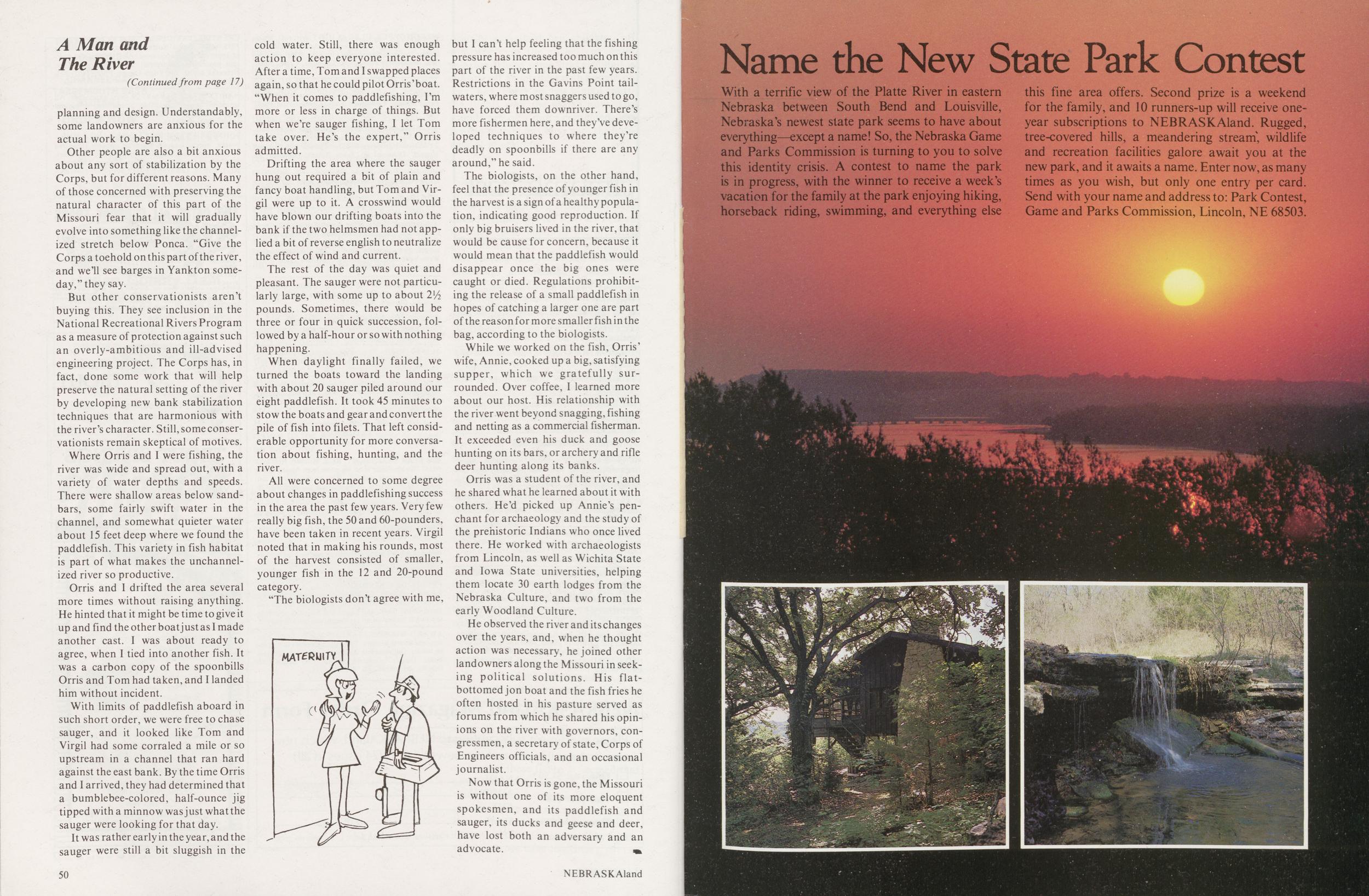
A Man and The River
(Continued from page 17)planning and design. Understandably, some landowners are anxious for the actual work to begin.
Other people are also a bit anxious about any sort of stabilization by the Corps, but for different reasons. Many of those concerned with preserving the natural character of this part of the Missouri fear that it will gradually evolve into something like the channelized stretch below Ponca. "Give the Corps a toehold on this part of the river, and we'll see barges in Yankton someday," they say.
But other conservationists aren't buying this. They see inclusion in the National Recreational Rivers Program as a measure of protection against such an overly-ambitious and ill-advised engineering project. The Corps has, in fact, done some work that will help preserve the natural setting of the river by developing new bank stabilization techniques that are harmonious with the river's character. Still, some conservationists remain skeptical of motives.
Where Orris and I were fishing, the river was wide and spread out, with a variety of water depths and speeds. There were shallow areas below sandbars, some fairly swift water in the channel, and somewhat quieter water about 15 feet deep where we found the paddlefish. This variety in fish habitat is part of what makes the unchannelized river so productive.
Orris and 1 drifted the area several more times without raising anything. He hinted that it might be time to give it up and find the other boat just as I made another cast. I was about ready to agree, when I tied into another fish. It was a carbon copy of the spoonbills Orris and Tom had taken, and I landed him without incident.
With limits of paddlefish aboard in such short order, we were free to chase sauger, and it looked like Tom and Virgil had some corraled a mile or so upstream in a channel that ran hard against the east bank. By the time Orris and I arrived, they had determined that a bumblebee-colored, half-ounce jig tipped with a minnow was just what the sauger were looking for that day.
It was rather early in the year, and the sauger were still a bit sluggish in the cold water. Still, there was enough action to keep everyone interested. After a time, Tom and I swapped places again, so that he could pilot Orris' boat. "When it comes to paddlefishing, I'm more or less in charge of things. But when we're sauger fishing, I let Tom take over. He's the expert," Orris admitted.
Drifting the area where the sauger hung out required a bit of plain and fancy boat handling, but Tom and Virgil were up to it. A crosswind would have blown our drifting boats into the bank if the two helmsmen had not applied a bit of reverse english to neutralize the effect of wind and current.
The rest of the day was quiet and pleasant. The sauger were not particularly large, with some up to about 2 pounds. Sometimes, there would be three or four in quick succession, followed by a half-hour or so with nothing happening.
When daylight finally failed, we turned the boats toward the landing with about 20 sauger piled around our eight paddlefish. It took 45 minutes to stow the boats and gear and convert the pile of fish into filets. That left considerable opportunity for more conversation about fishing, hunting, and the river.
All were concerned to some degree about changes in paddlefishing success in the area the past few years. Very few really big fish, the 50 and 60-pounders, have been taken in recent years. Virgil noted that in making his rounds, most of the harvest consisted of smaller, younger fish in the 12 and 20-pound category.
"The biologists don't agree with me, but I can't help feeling that the fishing pressure has increased too much on this part of the river in the past few years. Restrictions in the Gavins Point tail-waters, where most snaggers used to go, have forced them downriver. There's more fishermen here, and they've developed techniques to where they're deadly on spoonbills if there are any around," he said.
The biologists, on the other hand, feel that the presence of younger fish in the harvest is a sign of a healthy population, indicating good reproduction. If only big bruisers lived in the river, that would be cause for concern, because it would mean that the paddlefish would disappear once the big ones were caught or died. Regulations prohibiting the release of a small paddlefish in hopes of catching a larger one are part of the reason for more smaller fish in the bag, according to the biologists.
While we worked on the fish, Orris' wife, Annie, cooked up a big, satisfying supper, which we gratefully surrounded. Over coffee, I learned more about our host. His relationship with the river went beyond snagging, fishing and netting as a commercial fisherman. It exceeded even his duck and goose hunting on its bars, or archery and rifle deer hunting along its banks.
Orris was a student of the river, and he shared what he learned about it with others. He'd picked up Annie's penchant for archaeology and the study of the prehistoric Indians who once lived there. He worked with archaeologists from Lincoln, as well as Wichita State and Iowa State universities, helping them locate 30 earth lodges from the Nebraska Culture, and two from the early Woodland Culture.
He observed the river and its changes over the years, and, when he thought action was necessary, he joined other landowners along the Missouri in seeking political solutions. His flat-bottomed jon boat and the fish fries he often hosted in his pasture served as forums from which he shared his opinions on the river with governors, congressmen, a secretary of state, Corps of Engineers officials, and an occasional journalist.
Now that Orris is gone, the Missouri is without one of its more eloquent spokesmen, and its paddlefish and sauger, its ducks and geese and deer, have lost both an adversary and an advocate.
Name the New State Park Contest
With a terrific view of the Platte River in eastern Nebraska between South Bend and Louisville, Nebraska's newest state park seems to have about everything—except a name! So, the Nebraska Game and Parks Commission is turning to you to solve this identity crisis. A contest to name the park is in progress, with the winner to receive a week's vacation for the family at the park enjoying hiking, horseback riding, swimming, and everything else this fine area offers. Second prize is a weekend for the family, and 10 runners-up will receive one- year subscriptions to NEBRASKAland. Rugged, tree-covered hills, a meandering stream', wildlife and recreation facilities galore await you at the new park, and it awaits a name. Enter now, as many times as you wish, but only one entry per card. Send with your name and address to: Park Contest, Game and Parks Commission, Lincoln, NE 68503.
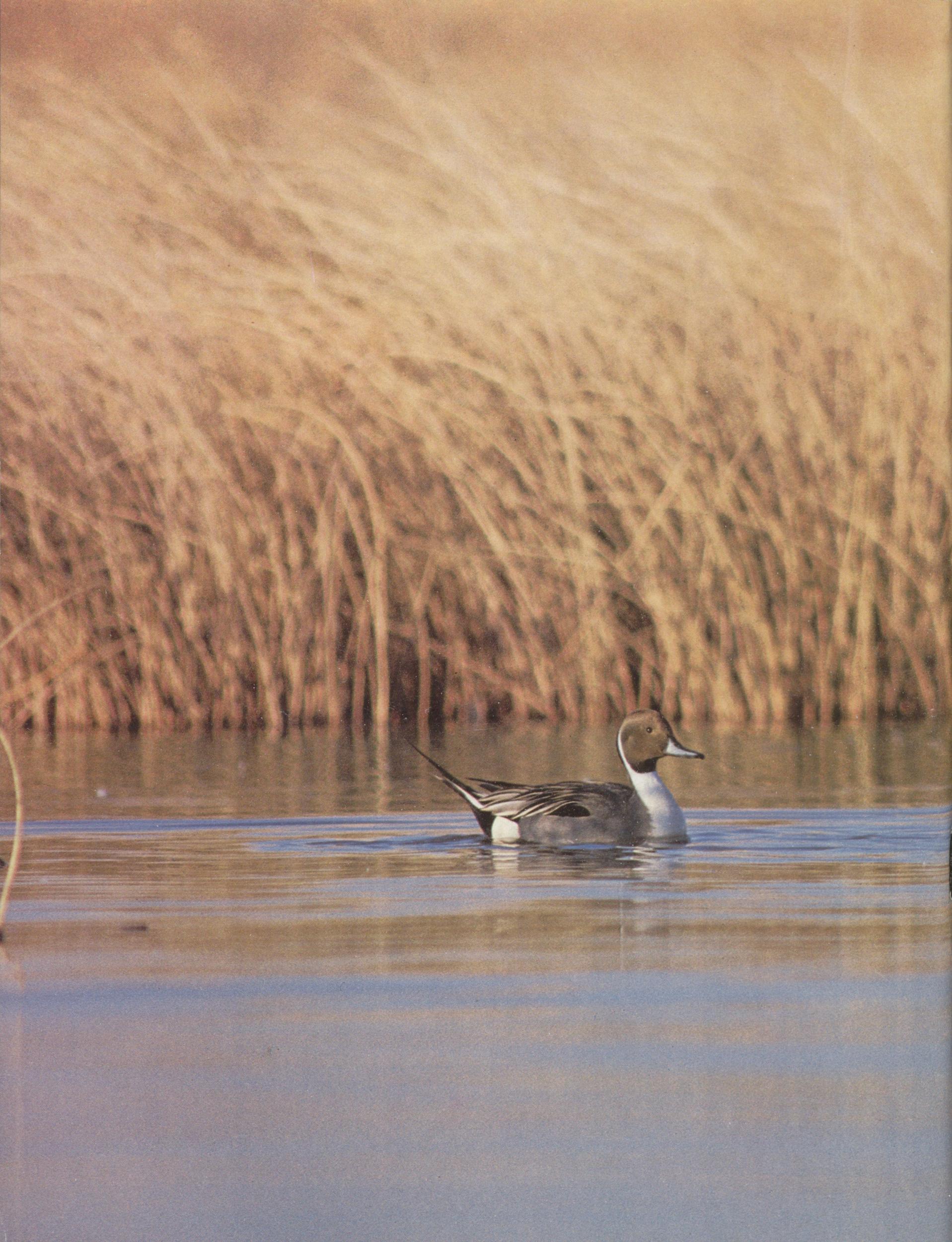
Position: 467 (22 views)