Volume 60, Issue 3, 1982
NEBRASKAland
Sir / I have hunted prairie chickens in the Sandhills a number of times and have always found it a unique and awe-inspiring place. Following is a poem I wrote about the area.
Sandhills Grasses wave upon the rolling hills Where nature cast the finest sand And sowed a bit of varied seeds To grow and hold the blowing land. Then hurried off to form the mountains bold, The streams that from the peaks dash down, The churning ocean vast and wild and free, The valleys where men strain and build their town. Returning then, to lands she formed in haste She found a charming, somewhat melancholy place. Then left the hills with crowns of waving grass, Inviting man to stop a while and slow his pace. Doug Uehling Gothenburg, Nebr. A Foxy guySir / A tip of the old fedora and a low, sweeping bow to the gentleman who shot the great photos of the swift fox in preparing the article in the June issue of your fine magazine regarding that little animal (The Swiftest Fox, June 1981 NEBRASKAland).
As a rank amateur who has recently gone through the experience of shooting at some red fox youngsters with a 500 ELM Hasselblad, a 500 mm Teletessar with a 2x extender and having the negs come back from the processor with three little dots in the center (the three cubs), I am open in my admiration of Glenn Chambers.
Mr. Chambers is not only loaded with expertise in the difficult business of shooting animals the only way it's really any fun (with film), but he's also a master craftsman in the accurate judging of changing light intensity, and besides that he's just got to be one of the sneakiest guys around! He most certainly out-foxed those foxes.
John Clothier, M.D. Lincoln, Nebr.
Cloud Nine?Sir / I am enclosing a picture taken the evening of June 3, 1980 looking toward Grand Island from our home south of Ord in Valley County. Since the tornado clouds formed northwest of that city, I assume we were about 40-50 miles from there in a direct line. At the time the photo was taken, we had no idea what was about to happen, but thought the clouds very unusual. The time taken is correct. I thought you might be interested in the photo. We enjoy NEBRASKAland.
Mrs. George Clement Ord, Nebr.
Sir / We live in Ericson, and are retired. Both my wife and I are avid fisher people. Sixty years ago Lake Ericson was the most beautiful lake in the state of Nebraska, but today, where once was a beautiful lake, there is a sandbar and a slough. If something is not done soon, Lake Ericson will be a thing of the past.
When the electricity people wanted to get rid of the lake, they offered it to the Game Commission for free. The Game Commission would have nothing to do with it, but they could spend millions of dollars on lakes along Highway 1-80.
The people who have property around Lake Ericson had to band together and take over the lake to try and save what is left of it. As far as the Game Commission 4 NEBRASKAland is concerned, we are forgotten people. Sure, we have Pibel Lake, but try to fish on a weekend—it is so crowded it is hard to get a line in. It was so heavily mossed over that you couldn't get a line wet. I understand the Commission did try to get rid of the moss.
We fished in Lake Ericson when the limit on bluegills was 25 and a person could go any day and get his limit, but today you can sit there all day and maybe not get a decent bite.
It makes us sad in our declining years that we have no place to go for a little recreation unless we drive 50 miles to Sherman Lake. I've had a fishing and hunting license since 1916, so you see I'm no kid. I hope you don't think I'm just an old crab. I have been wanting to write for quite some time and finally got it off my chest. We think NEBRASKAland is a fine magazine and enjoy it very much, so keep up the goodwork.
Paul Wietzki Ericson, Nebr.
Duck huntersSir / While sorting through my late husband's keepsakes, I came across this poem which I send to you to share. It's so true. I'm living in the Sandhills of Cherry County now. It's a beautiful place and the people are great. Keep up the good work on the magazine. I always look forward to getting it.
Mrs. Floyd Grandstaff Cody, Nebr.
The Duck Hunter The hunters of ducks are a crazy breed, A hole in the swamps is all they need. A place to hide from a Hying duck, In 80 miles of smelly muck! Tho he slips in mud and wets his 'butt', He won't complain cause he's a nut. The hike from the truck to the beat-up blind, Would make an elephant sore behind. They wait for dawn, all cramped and grim, Hoping to hell the ducks come in. They hunt for cripples with galloping tread, And get back to the blind almost dead. Would I spend money and waste my time? And listen to lies in the winter time? Would I do these things no sane man would? Brother, you're doggone right I would! NEBRASKAland Magazine invites all readers to submit their comments, suggestions, and gripes to Speak Up. Each month the magazine will publish as many letters as space permits. Pictures are welcome. NEBRASKALand reserves the right to edit and condense letters.—Editor.
AK-SAR-BEN
Knights of Fun and Philanthropy
NEBRASKANS like to think of themselves as always moving forward, so it's somewhat ironic that Nebraska's number one tourist attraction got its name by "going backwards."
"Ak-Sar-Ben," Nebraska spelled backwards, is the non-profit civic organization and agricultural society that provides its more than 64,000 members and the general public with more live entertainment than any other institution in the state. Everything from horse racing to stage shows is offered at Ak-Sar-Ben's 370-acre home in central Omaha, where nearly two million people visit every year.
Adhering to its more than 80-year-old motto, "Founded for public service ... not for profit," Ak-Sar-Ben is dedicated to the betterment of Omaha, of Nebraska, and of the Midwest as a whole, fostering many community programs in agriculture, education, health care and outdoor recreation.
"It's not just the race, it's the fun of the place," is Ak-Sar-Ben's advertising slogan for its top money maker to support its charitable endeavors. But, Ak-Sar-Ben means much more than horse racing.
It's the largest organization of its kind in the world, and got its start during the Midwest's depression and drought years of the 1890's, shortly after Omaha hosted a flop of a Nebraska State Fair in 1894. The State Fair Board challenged Omaha businessmen to "provide entertainment other than saloons, gambling houses and honkytonks for the 1895 fair, or lose it to a competitively alert Lincoln." That ultimatum initiated the formation of a booster club which adopted the name "Ak-Sar-Ben" when someone asked, "Why not reverse the name of our beloved state, since everything seems to be going backwards these days?" Since those founding fathers in the Omaha business community saved the fair for the city of Omaha, it was suggested that they be called the "Knights of Ak-Sar-Ben," a title which members still hold today.
The name Ak-Sar-Ben took on added significance when it was learned that "Ak" in Syrian means "head of household," "Sar" in Arabic means "household," and "Ben" in Hebrew means "brother in the household." The whole name, therefore, symbolized the king, his domain and his retainers. Ak-Sar-Ben also came to be known as the Kingdom of Quivira, since Omaha was close to where historians, and 16th century Spanish explorer Coronado, believed the mythical kingdom once existed. These adaptations were the beginnings of the royal coronation and ball held each fall to this day as a symbolic harvest celebration, full of color and pageantry, for the selection of new honorary heads of the organization.
The Nebraska State Fair, of course, has long since moved to permanent quarters in Lincoln, but after that early successful undertaking, Ak-Sar-Ben grew quickly. The birth of the Ak-Sar-Ben Exposition Company in 1919 saw the development of Ak-Sar-Ben's fundamental purpose of promotion of agriculture—the economic backbone of the Midwest. Livestock shows, rodeos and 4-H exhibitions became the main attractions of their coliseum, which was built in 1928 on Ak-Sar-Ben field, at 60th and Pacific streets in Omaha, shortly after the original "den" downtown was destroyed by fire. Remodeled in 1966, the 9,000-seat coliseum, along with a separate
Formed in 1895 to promote the state fair, a group of Omaha businessmen grew to be the largest organization of its kind in the world
6 NEBRASKAland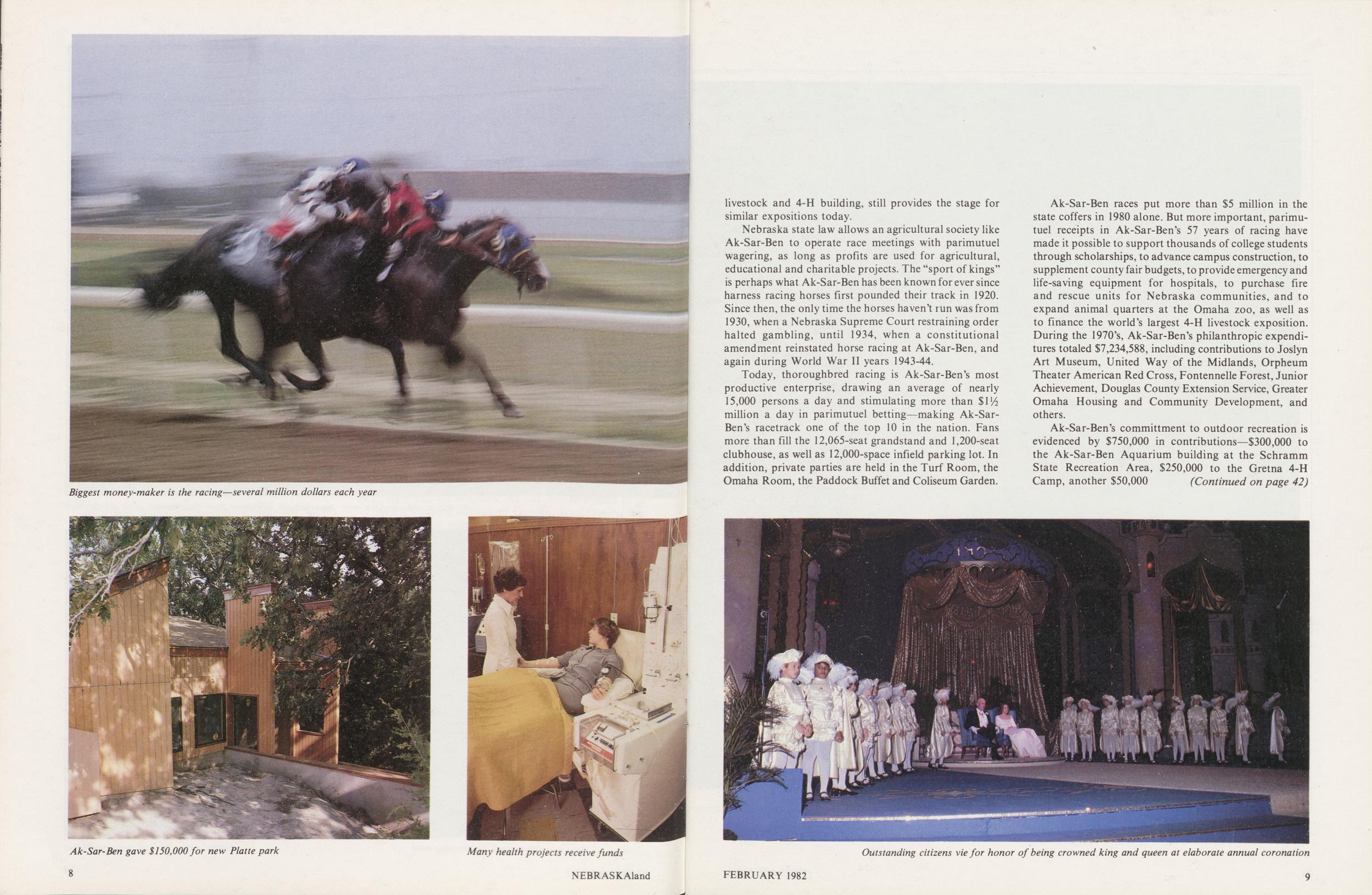
livestock and 4-H building, still provides the stage for similar expositions today.
Nebraska state law allows an agricultural society like Ak-Sar-Ben to operate race meetings with parimutuel wagering, as long as profits are used for agricultural, educational and charitable projects. The "sport of kings" is perhaps what Ak-Sar-Ben has been known for ever since harness racing horses first pounded their track in 1920. Since then, the only time the horses haven't run was from 1930, when a Nebraska Supreme Court restraining order halted gambling, until 1934, when a constitutional amendment reinstated horse racing at Ak-Sar-Ben, and again during World War II years 1943-44.
Today, thoroughbred racing is Ak-Sar-Ben's most productive enterprise, drawing an average of nearly 15,000 persons a day and stimulating more than $1 1/2 million a day in parimutuel betting—making Ak-Sar-Ben's racetrack one of the top 10 in the nation. Fans more than fill the 12,065-seat grandstand and 1,200-seat clubhouse, as well as 12,000-space infield parking lot. In addition, private parties are held in the Turf Room, the Omaha Room, the Paddock Buffet and Coliseum Garden.
Ak-Sar-Ben races put more than $5 million in the state coffers in 1980 alone. But more important, parimutuel receipts in Ak-Sar-Ben's 57 years of racing have made it possible to support thousands of college students through scholarships, to advance campus construction, to supplement county fair budgets, to provide emergency and life-saving equipment for hospitals, to purchase fire and rescue units for Nebraska communities, and to expand animal quarters at the Omaha zoo, as well as to finance the world's largest 4-H livestock exposition. During the 1970's, Ak-Sar-Ben's philanthropic expenditures totaled $7,234,588, including contributions to Joslyn Art Museum, United Way of the Midlands, Orpheum Theater American Red Cross, Fontennelle Forest, Junior Achievement, Douglas County Extension Service, Greater Omaha Housing and Community Development, and others.
Ak-Sar-Ben's committment to outdoor recreation is evidenced by $750,000 in contributions—$300,000 to the Ak-Sar-Ben Aquarium building at the Schramm State Recreation Area, $250,000 to the Gretna 4-H Camp, another $50,000 (Continued on page 42)
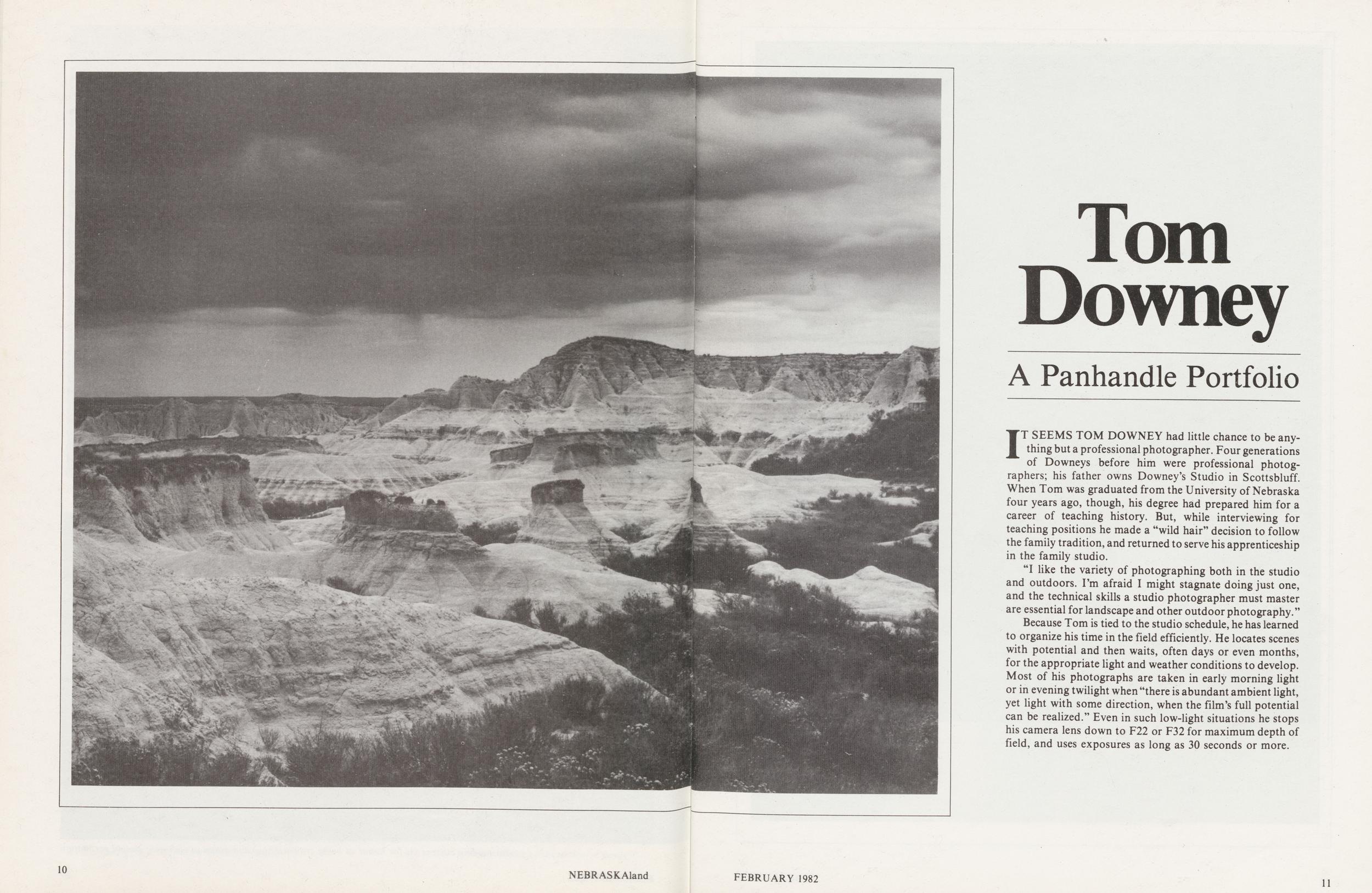
Tom Downey
A Panhandle Portfolio
IT SEEMS TOM DOWNEY had little chance to be anything but a professional photographer. Four generations of Downeys before him were professional photographers; his father owns Downey's Studio in Scottsbluff. When Tom was graduated from the University of Nebraska four years ago, though, his degree had prepared him for a career of teaching history. But, while interviewing for teaching positions he made a "wild hair" decision to follow the family tradition, and returned to serve his apprenticeship in the family studio.
"I like the variety of photographing both in the studio and outdoors. I'm afraid I might stagnate doing just one, and the technical skills a studio photographer must master are essential for landscape and other outdoor photography."
Because Tom is tied to the studio schedule, he has learned to organize his time in the field efficiently. He locates scenes with potential and then waits, often days or even months, for the appropriate light and weather conditions to develop. Most of his photographs are taken in early morning light or in evening twilight when "there is abundant ambient light, yet light with some direction, when the film's full potential can be realized." Even in such low-light situations he stops his camera lens down to F22 or F32 for maximum depth of field, and uses exposures as long as 30 seconds or more.
FEBRUARY 1982 11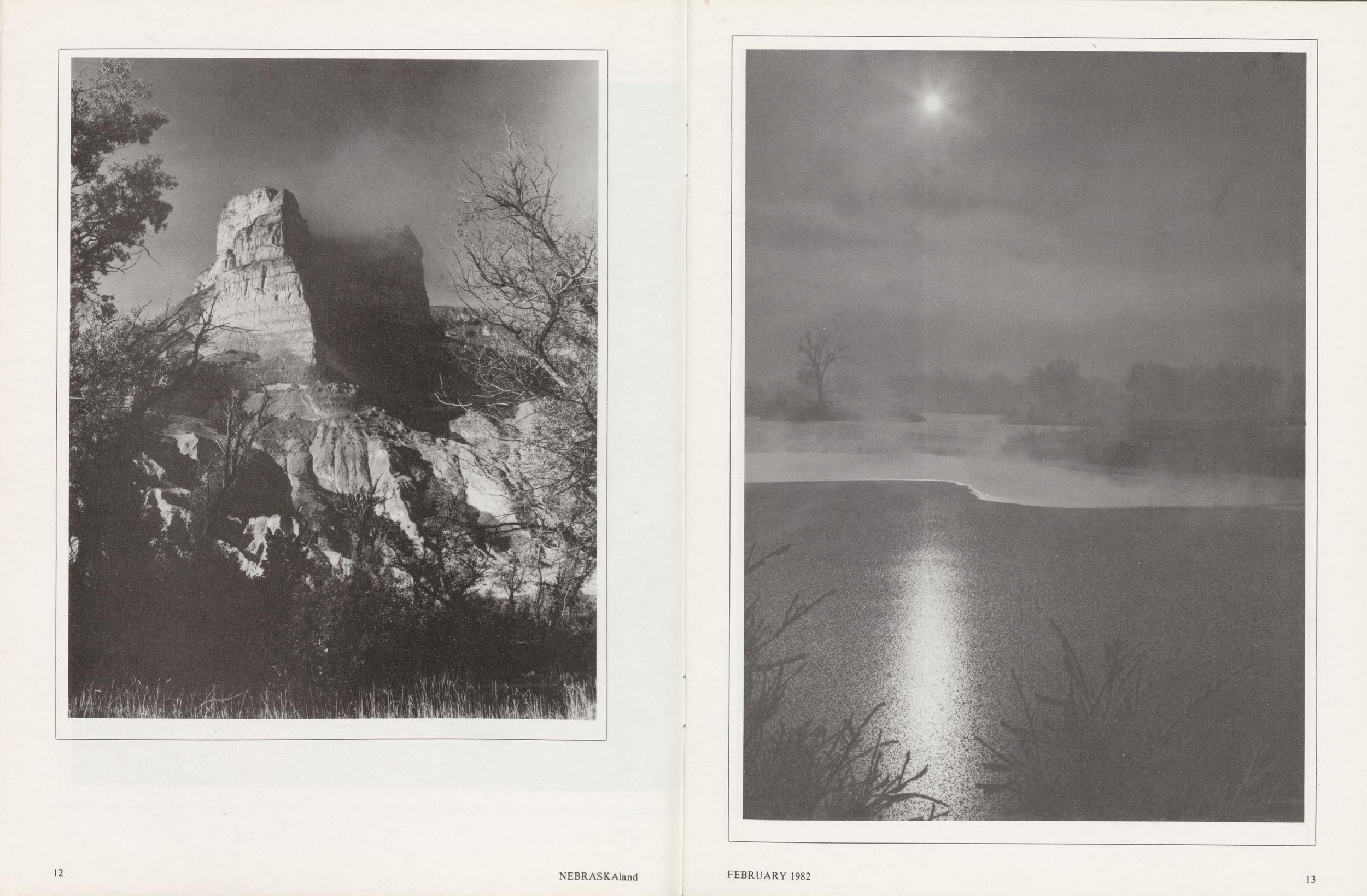
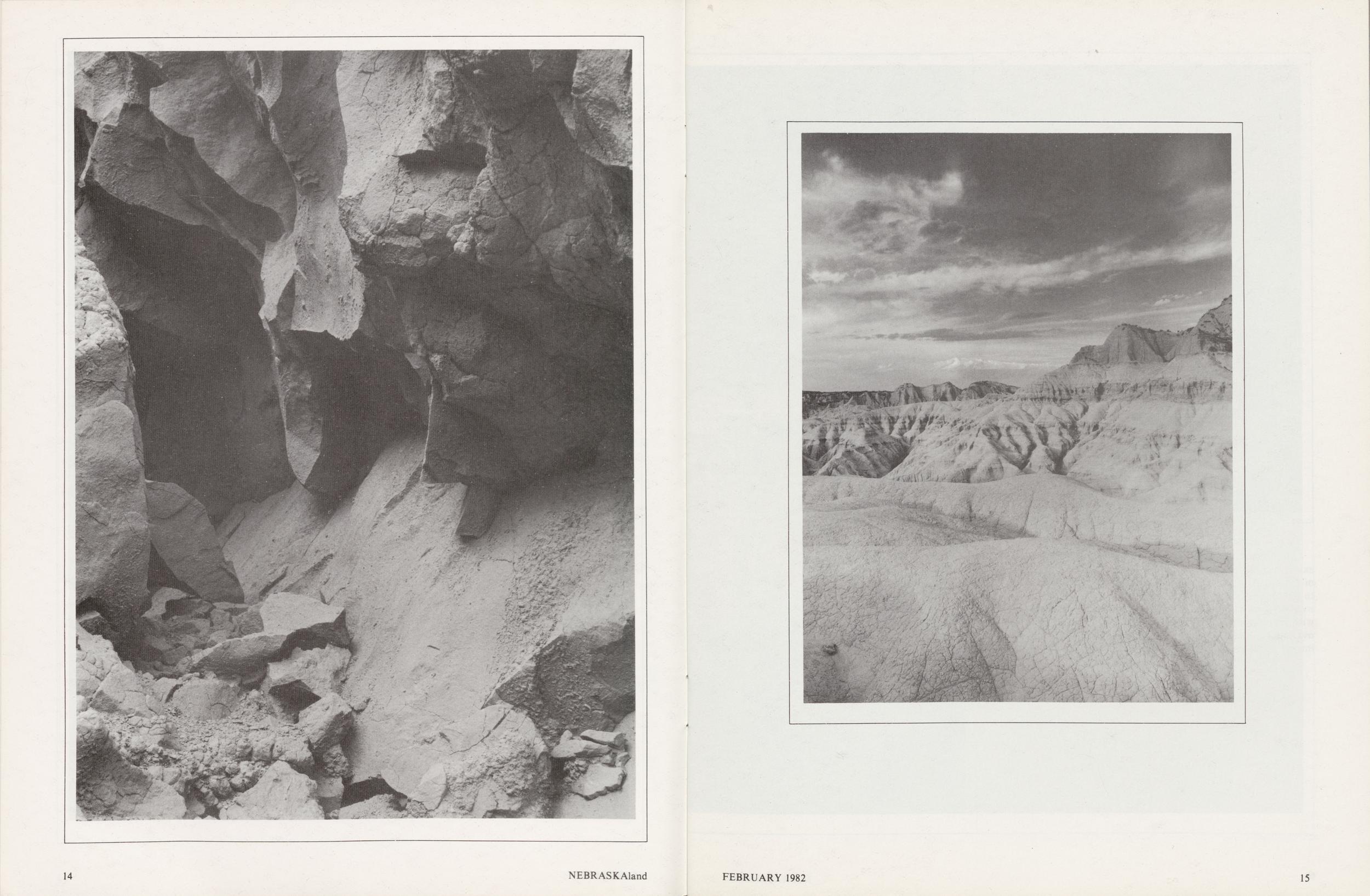
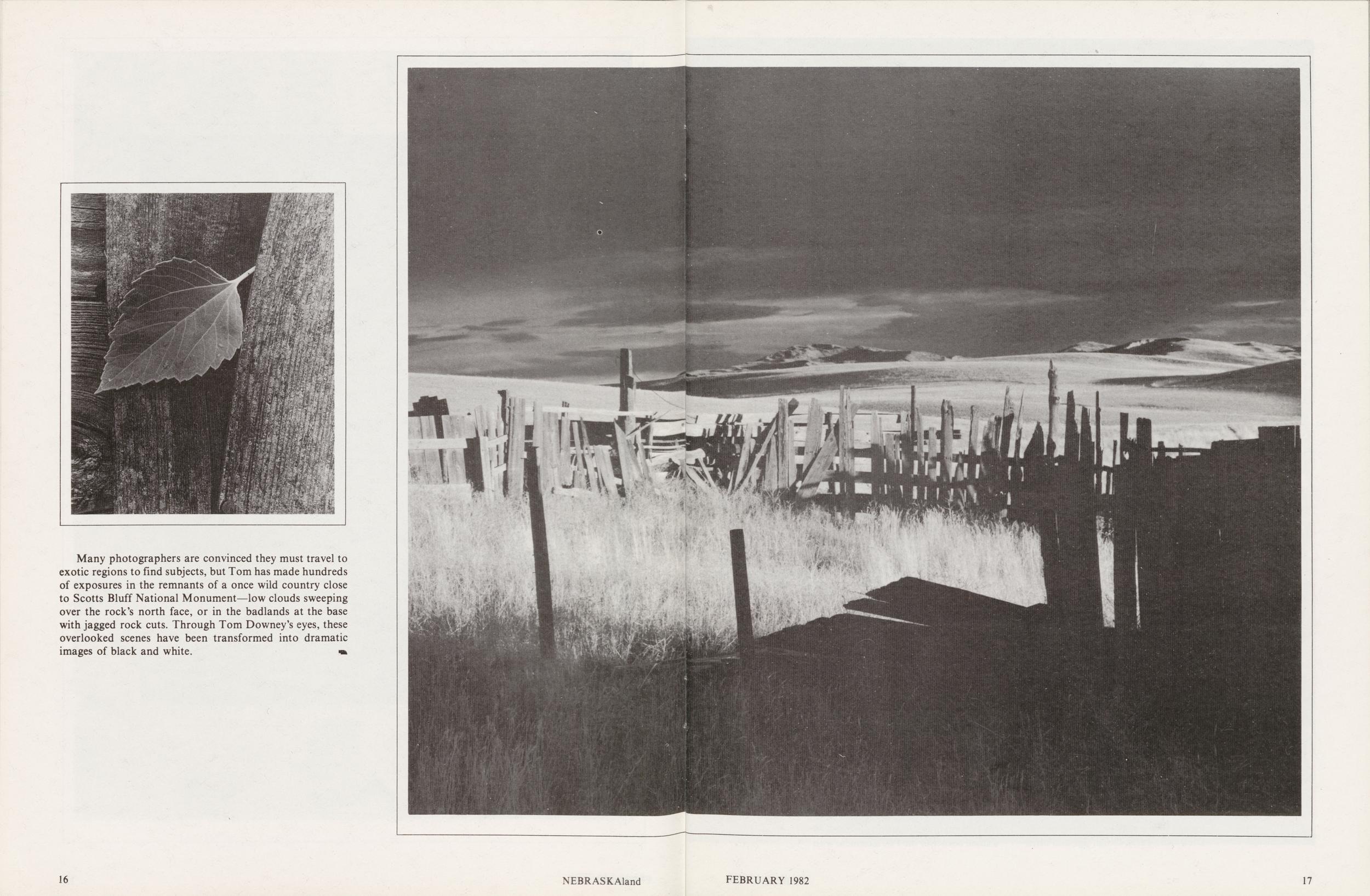
Many photographers are convinced they must travel to exotic regions to find subjects, but Tom has made hundreds of exposures in the remnants of a once wild country close to Scotts Bluff National Monument—low clouds sweeping over the rock's north face, or in the badlands at the base with jagged rock cuts. Through Tom Downey's eyes, these overlooked scenes have been transformed into dramatic images of black and white.
16 NEBRASKAland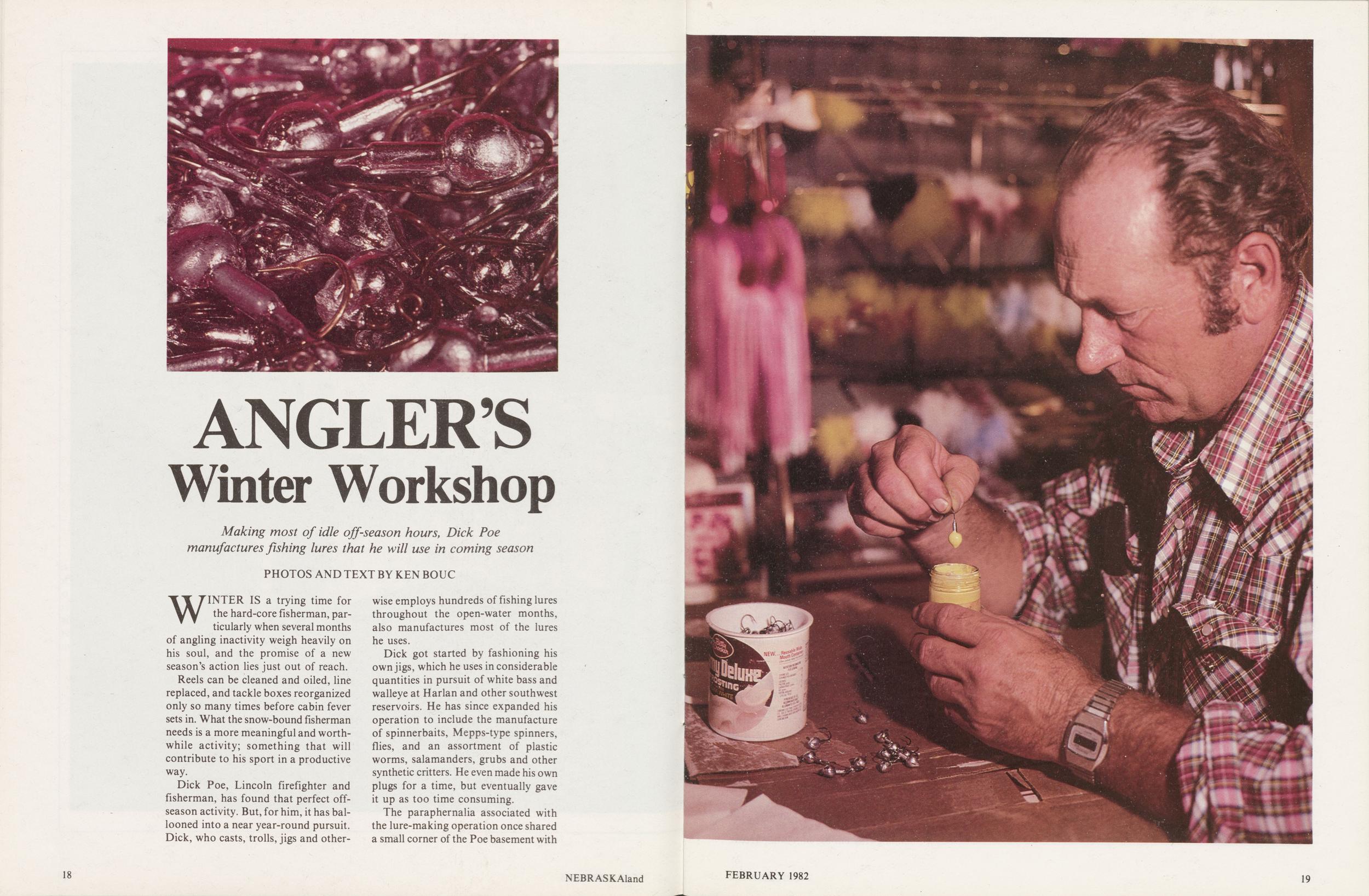
ANGLER'S Winter Workshop
Making most of idle off-season hours, Dick Poe manufactures fishing lures that he will use in coming season PHOTOS AND TEXT BY KEN BOUCWINTER IS a trying time for the hard-core fisherman, particularly when several months of angling inactivity weigh heavily on his soul, and the promise of a new season's action lies just out of reach.
Reels can be cleaned and oiled, line replaced, and tackle boxes reorganized only so many times before cabin fever sets in. What the snow-bound fisherman needs is a more meaningful and worthwhile activity; something that will contribute to his sport in a productive way.
Dick Poe, Lincoln firefighter and fisherman, has found that perfect off-season activity. But, for him, it has ballooned into a near year-round pursuit. Dick, who casts, trolls, jigs and otherwise employs hundreds of fishing lures throughout the open-water months, also manufactures most of the lures he uses.
Dick got started by fashioning his own jigs, which he uses inconsiderable quantities in pursuit of white bass and walleye at Harlan and other southwest reservoirs. He has since expanded his operation to include the manufacture of spinnerbaits, Mepps-type spinners, flies, and an assortment of plastic worms, salamanders, grubs and other synthetic critters. He even made his own plugs for a time, but eventually gave it up as too time consuming.
The paraphernalia associated with the lure-making operation once shared a small corner of the Poe basement with
18 NEBRASKAland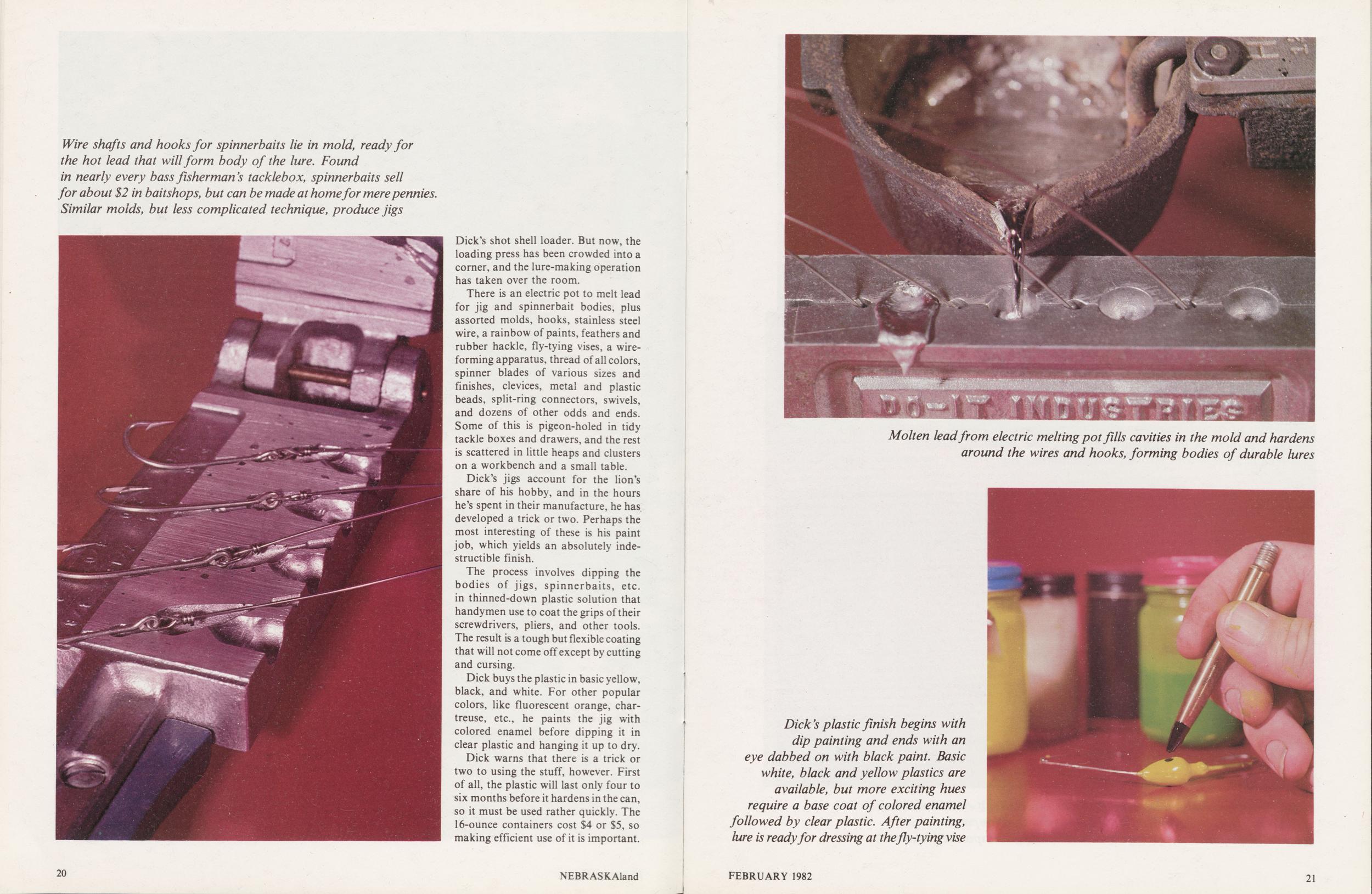
Wire shafts and hooks for spinnerbaits lie in mold, ready for the hot lead that will form body of the lure. Found in nearly every bass fisherman's tacklebox, spinnerbaits sell for about $2 in baitshops, but can be made at home for mere pennies. Similar molds, but less complicated technique, produce jigs
Dick's shot shell loader. But now, the loading press has been crowded into a corner, and the lure-making operation has taken over the room.
There is an electric pot to melt lead for jig and spinnerbait bodies, plus assorted molds, hooks, stainless steel wire, a rainbow of paints, feathers and rubber hackle, fly-tying vises, a wire-forming apparatus, thread of all colors, spinner blades of various sizes and finishes, devices, metal and plastic beads, split-ring connectors, swivels, and dozens of other odds and ends. Some of this is pigeon-holed in tidy tackle boxes and drawers, and the rest is scattered in little heaps and clusters on a workbench and a small table.
Dick's jigs account for the lion's share of his hobby, and in the hours he's spent in their manufacture, he has developed a trick or two. Perhaps the most interesting of these is his paint job, which yields an absolutely indestructible finish.
The process involves dipping the bodies of jigs, spinnerbaits, etc. in thinned-down plastic solution that handymen use to coat the grips of their screwdrivers, pliers, and other tools. The result is a tough but flexible coating that will not come off except by cutting and cursing.
Dick buys the plastic in basic yellow, black, and white. For other popular colors, like fluorescent orange, chartreuse, etc., he paints the jig with colored enamel before dipping it in clear plastic and hanging it up to dry.
Dick warns that there is a trick or two to using the stuff, however. First of all, the plastic will last only four to six months before it hardens in the can, so it must be used rather quickly. The 16-ounce containers cost $4 or $5, so making efficient use of it is important.
20 NEBRASKAlandMolten lead from electric melting pot fills cavities in the mold and hardens around the wires and hooks, forming bodies of durable lures
Dick's plastic finish begins with dip painting and ends with an eye dabbed on with black paint. Basic white, black and yellow plastics are available, but more exciting hues require a base coat of colored enamel followed by clear plastic. After painting, lure is ready for dressing at the fly-tying vise
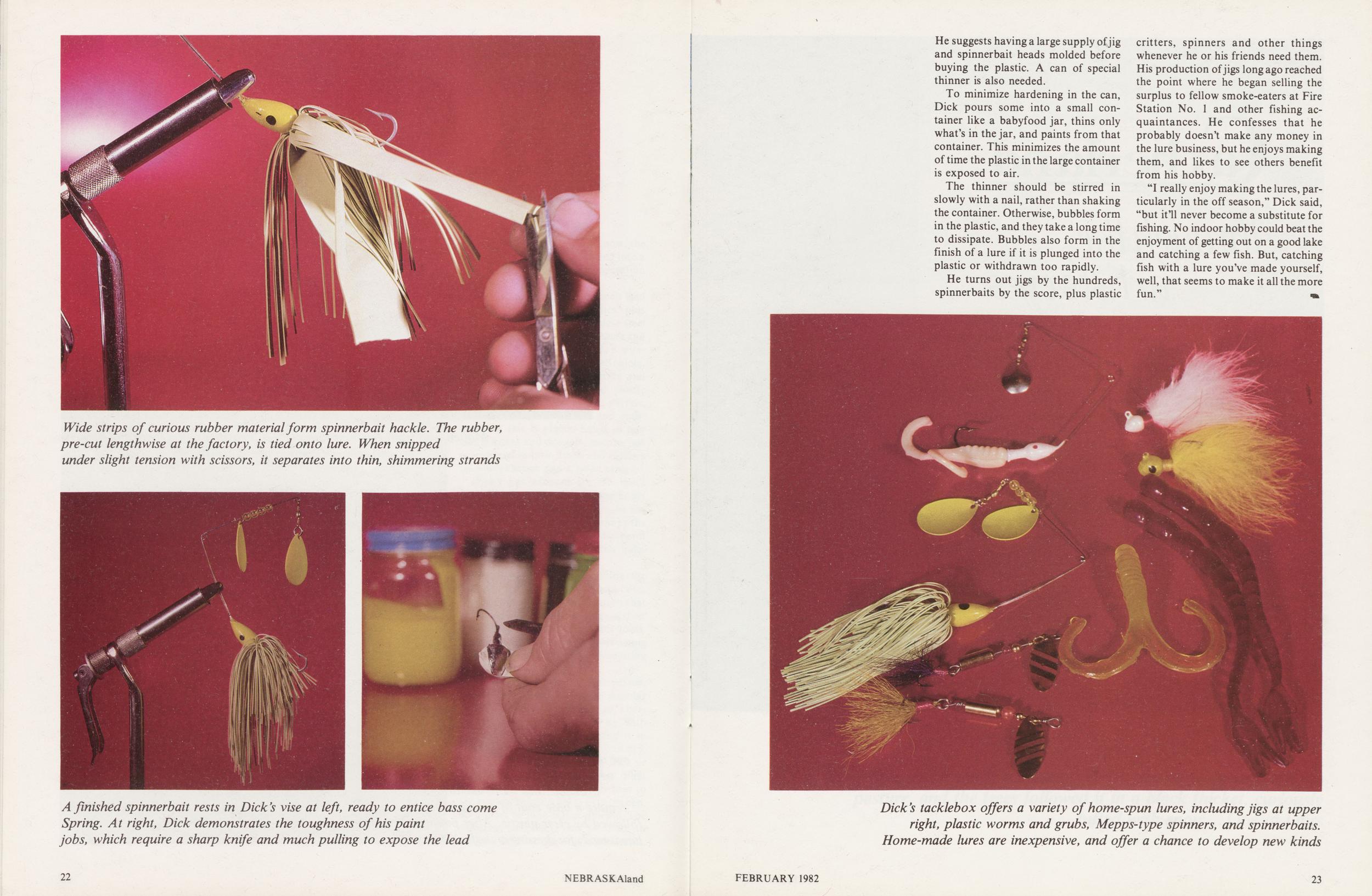
Wide strips of curious rubber material form spinnerbait hackle. The rubber, pre-cut lengthwise at the factory, is tied onto lure. When snipped under slight tension with scissors, it separates into thin, shimmering strands
A finished spinnerbait rests in Dick's vise at left, ready to entice bass come Spring. At right, Dick demonstrates the toughness of his paint jobs, which require a sharp knife and much pulling to expose the lead
He suggests having a large supply of jig and spinnerbait heads molded before buying the plastic. A can of special thinner is also needed.
To minimize hardening in the can, Dick pours some into a small container like a babyfood jar, thins only what's in the jar, and paints from that container. This minimizes the amount of time the plastic in the large container is exposed to air.
The thinner should be stirred in slowly with a nail, rather than shaking the container. Otherwise, bubbles form in the plastic, and they take a long time to dissipate. Bubbles also form in the finish of a lure if it is plunged into the plastic or withdrawn too rapidly.
He turns out jigs by the hundreds, spinnerbaits by the score, plus plastic critters, spinners and other things whenever he or his friends need them. His production of jigs long ago reached the point where he began selling the surplus to fellow smoke-eaters at Fire Station No. 1 and other fishing acquaintances. He confesses that he probably doesn't make any money in the lure business, but he enjoys making them, and likes to see others benefit from his hobby.
"I really enjoy making the lures, particularly in the off season," Dick said, "but it'll never become a substitute for fishing. No indoor hobby could beat the enjoyment of getting out on a good lake and catching a few fish. But, catching fish with a lure you've made yourself, well, that seems to make it all the more fun."
Dick's tacklebox offers a variety of home-spun lures, including jigs at upper right, plastic worms and grubs, Mepps-type spinners, and spinnerbaits. Home-made lures are inexpensive, and offer a chance to develop new kinds
Catherland
through the artist's eyes
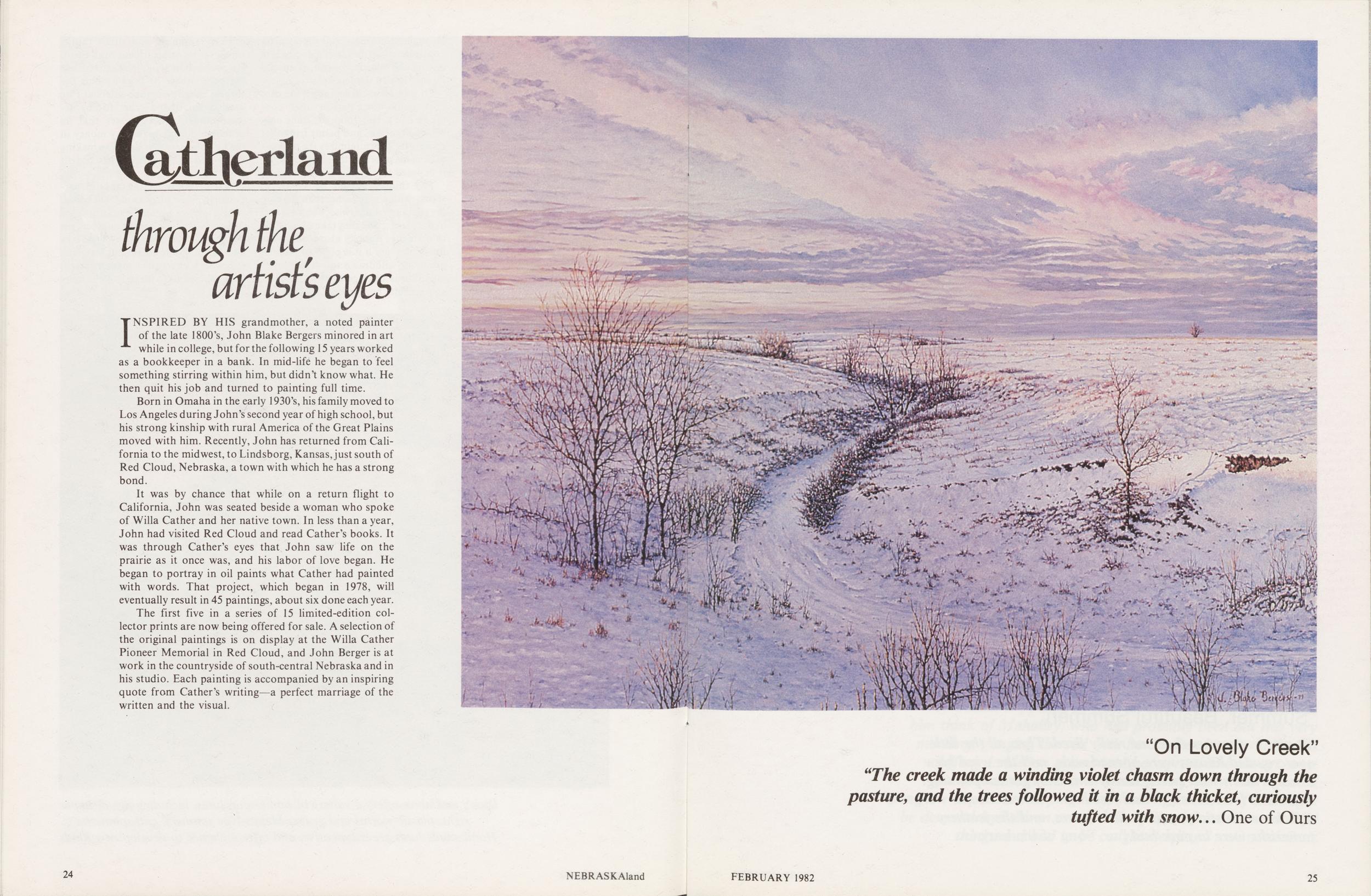
INSPIRED BY HIS grandmother, a noted painter of the late 1800's, John Blake Bergers minored in art while in college, but for the following 15 years worked as a bookkeeper in a bank. In mid-life he began to feel something stirring within him, but didn't know what. He then quit his job and turned to painting full time.
Born in Omaha in the early 1930's, his family moved to Los Angeles during John's second year of high school, but his strong kinship with rural America of the Great Plains moved with him. Recently, John has returned from California to the midwest, to Lindsborg, Kansas, just south of Red Cloud, Nebraska, a town with which he has a strong bond.
It was by chance that while on a return flight to California, John was seated beside a woman who spoke of Willa Cather and her native town. In less than a year, John had visited Red Cloud and read Cather's books. It was through Cather's eyes that John saw life on the prairie as it once was, and his labor of love began. He began to portray in oil paints what Cather had painted with words. That project, which began in 1978, will eventually result in 45 paintings, about six done each year.
The first five in a series of 15 limited-edition collector prints are now being offered for sale. A selection of the original paintings is on display at the Willa Cather Pioneer Memorial in Red Cloud, and John Berger is at work in the countryside of south-central Nebraska and in his studio. Each painting is accompanied by an inspiring quote from Cather's writing—a perfect marriage of the written and the visual.
24 NEBRASKAland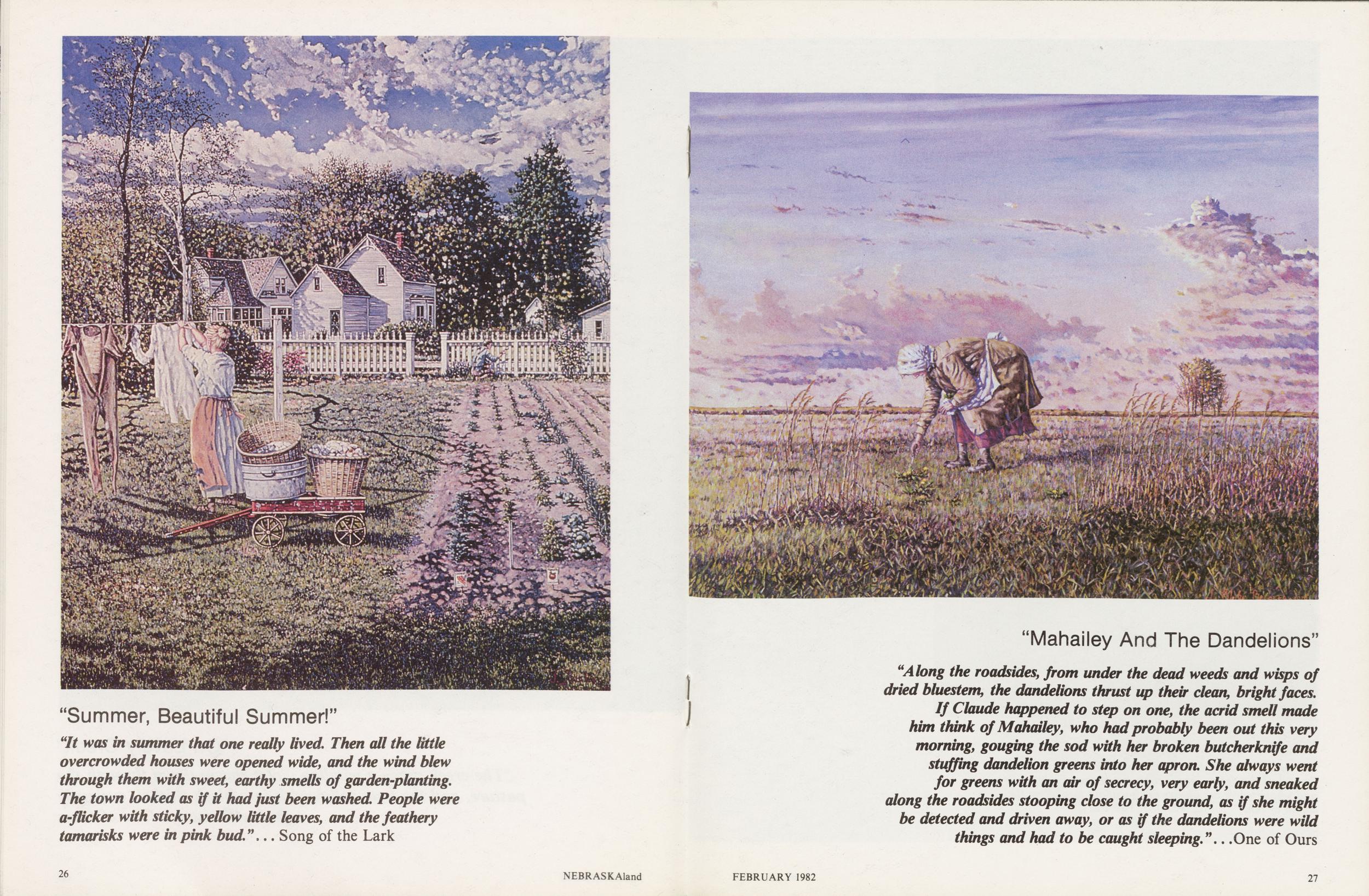
"It was in summer that one really lived. Then all the little overcrowded houses were opened wide, and the wind blew through them with sweet, earthy smells of garden-planting. The town looked as if it had just been washed People were a-flicker with sticky, yellow little leaves, and the feathery tamarisks were in pink bud."... Song of the Lark
"Along the roadsides, from under the dead weeds and wisps of dried bluestem, the dandelions thrust up their clean, bright faces. If Claude happened to step on one, the acrid smell made him think of Mahailey, who had probably been out this very morning, gouging the sod with her broken butcher knife and stuffing dandelion greens into her apron. She always went for greens with an air of secrecy, very early, and sneaked along the roadsides stooping close to the ground, as if she might be detected and driven away, or as if the dandelions were wild things and had to be caught sleeping". . .One of Ours
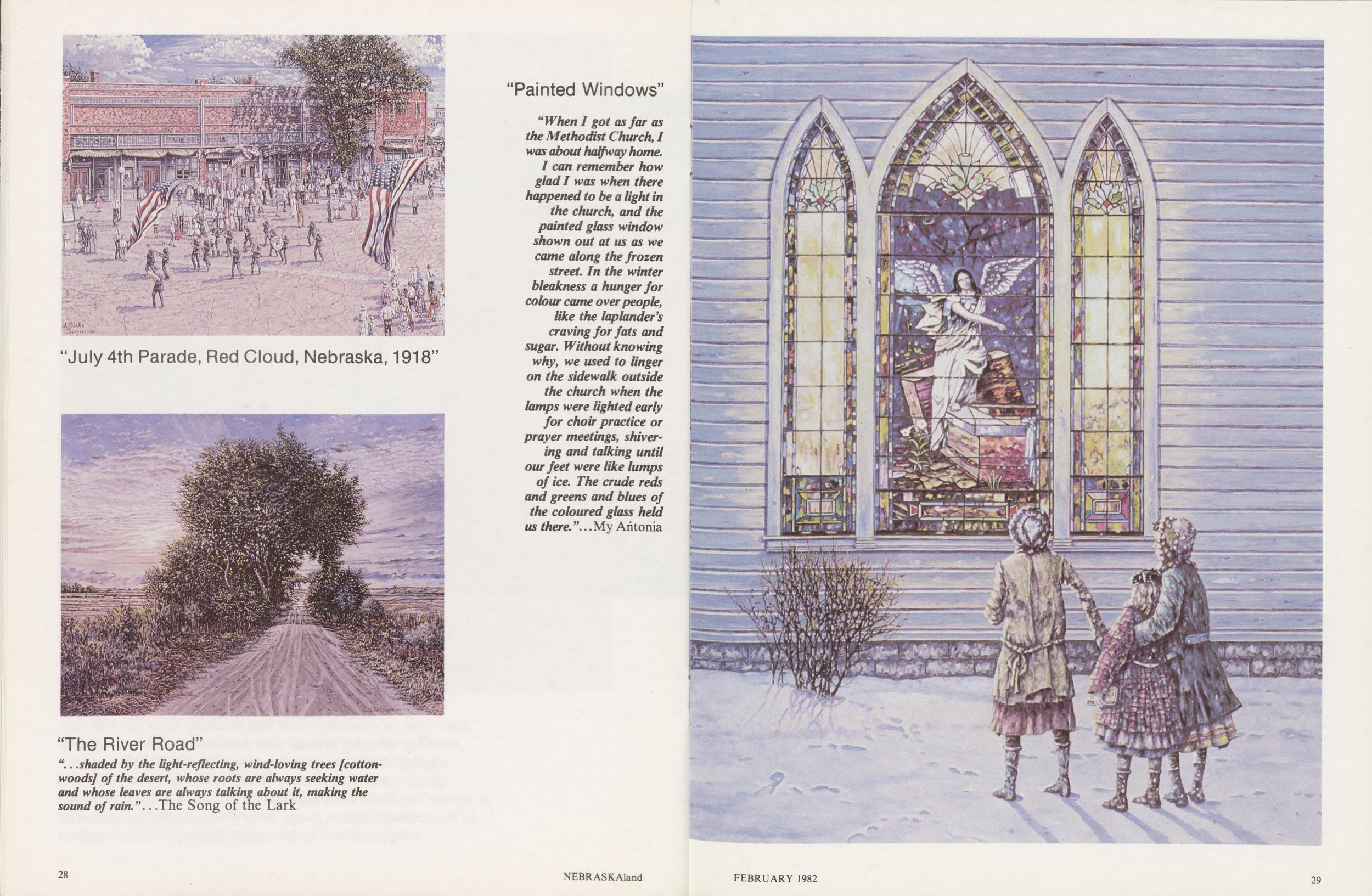
". . .shaded by the light-reflecting, wind-loving trees [cottonwoods] of the desert, whose roots are always seeking water and whose leaves are always talking about it, making the sound of rain." . . . The Song of the Lark
"When I got as far as the Methodist Church, I was about halfway home. I can remember how glad I was when there happened to be a light in the church, and the painted glass window shown out at us as we came along the frozen street. In the winter bleakness a hunger for colour came over people, like the laplander's craving for fats and sugar. Without knowing why, we used to linger on the sidewalk outside the church when the lamps were lighted early for choir practice or prayer meetings, shivering and talking until our feet were like lumps of ice. The crude reds and greens and blues of the coloured glass held us there.". . . My Antonia
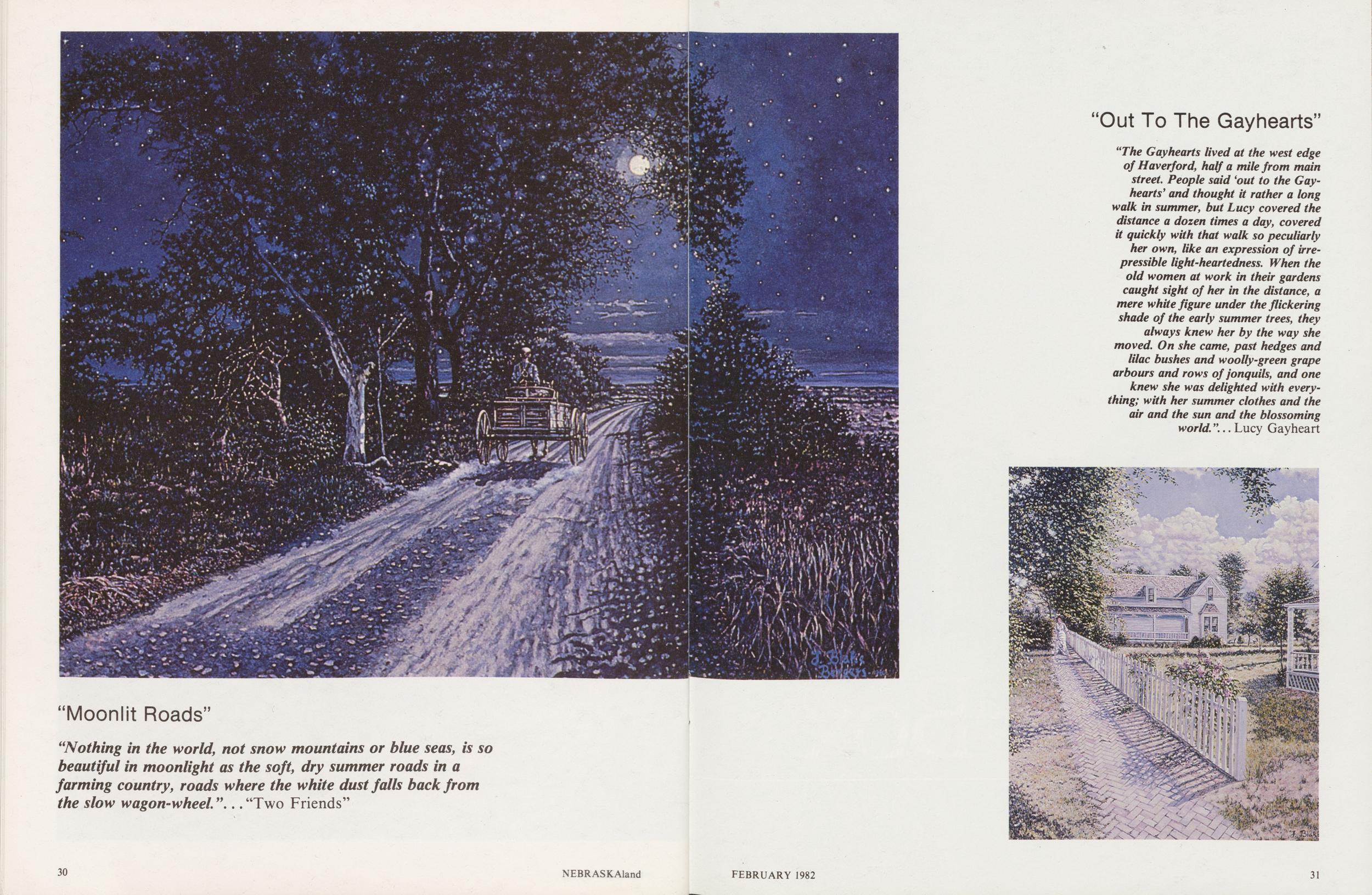
"Nothing in the world, not snow mountains or blue seas, is so beautiful in moonlight as the soft, dry summer roads in a farming country, roads where the white dust falls back from the slow wagon-wheel.". . . "Two Friends"
"The Gayhearts lived at the west edge of Haverford, half a mile from main street. People said 'out to the Gayhearts' and thought it rather a long walk in summer, but Lucy covered the distance a dozen times a day, covered it quickly with that walk so peculiarly her own, like an expression of irrepressible light-heartedness. When the old women at work in their gardens caught sight of her in the distance, a mere white figure under the flickering shade of the early summer trees, they always knew her by the way she moved. On she came, past hedges and lilac bushes and woolly-green grape arbours and rows of jonquils, and one knew she was delighted with everything; with her summer clothes and the air and the sun and the blossoming world.". . . Lucy Gayheart
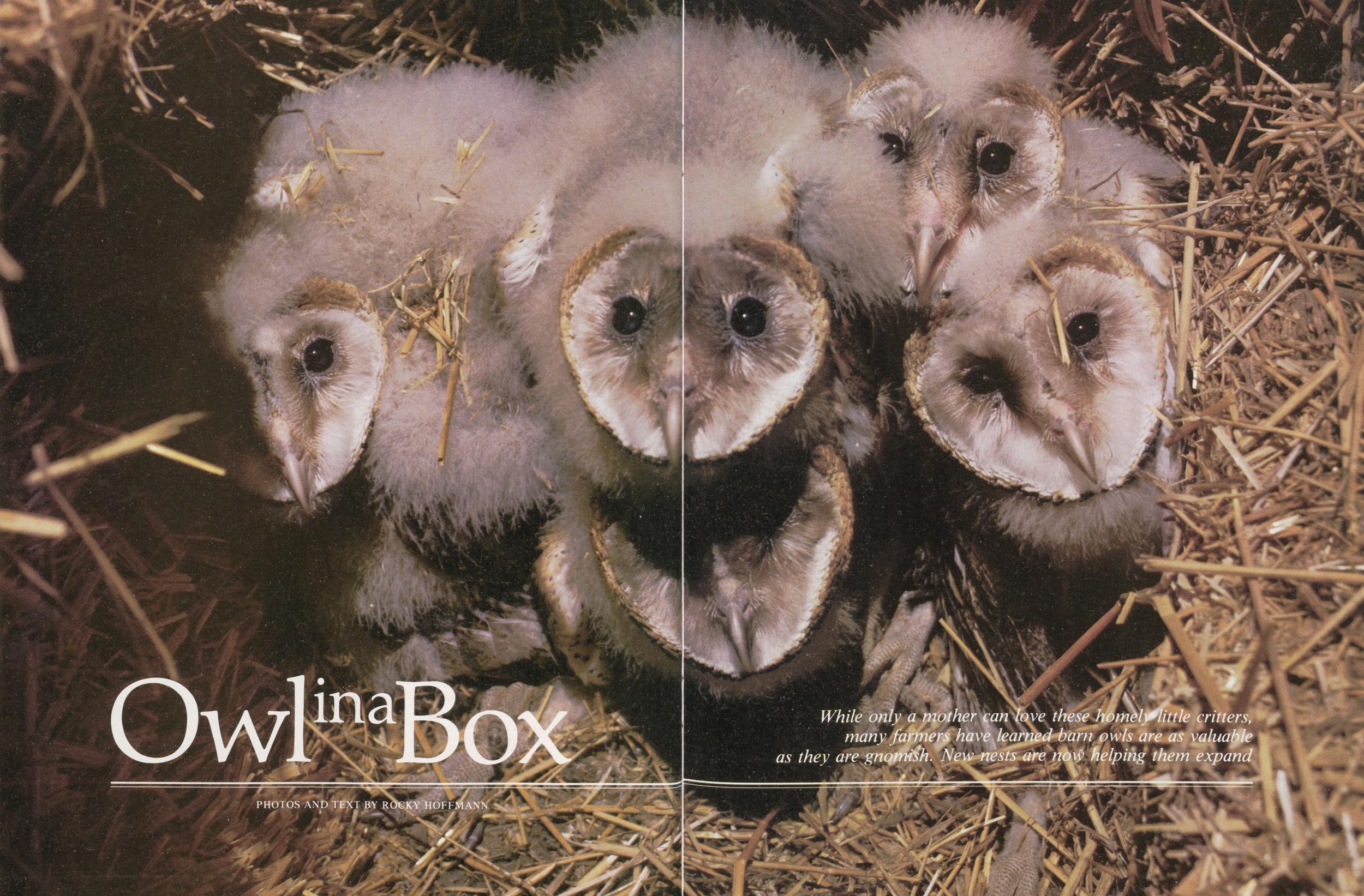
Owl in a Box
While only a mother can love these homely little critters, while many farmers have learned barn owls are as valueable as they are gnomish. New nests are now helping them expand
IT WAS APPROPRIATE that he received the nickname "Barny," as it was more convenient to lay an obvious handle on an orphaned barn owl than to spend hours finding some hidden passage of Greek mythology that would fit this unsightly ball of fuzz. Besides, I was too busy finding his breakfast, lunch and supper, with snacks in between, to be selecting names that would amuse people.
Barny came to the North Platte office of the Game and Parks Commission, following the destruction of his nest, as a small, unfeathered, fuzzy, bedraggled orphan with a very uncertain future. There was also one more quality about him that would eventually prove to be equally unflattering, and that was his appetite.
Although excited over the prospects of getting a few good photos of a barn owl through his transition from skin to feathers, I had no idea as to the work involved in supplying the nourishment that would insure that transition.
At first, it seemed that my problems were solved when the University of Nebraska's North Platte Agricultural Station personnel informed me that they had realized an overpopulation of laboratory mice that they would be more than happy to donate. Subsequently I received three cages full of white mice that appeared to be more than an adequate supply of rodents to take an owl to maturity.
But, in less than two weeks, I was out hunting for more, as Barny had tossed down the mice like popcorn. By that time his appetite had grown with his size, and he was consuming his own body weight in rodents daily. I had mouse traps set in every corner of every building I could get into, and never passed up a road-killed ground squirrel, bird or snake as I traveled southwest Nebraska. By the time he was nearly grown, he was able to swallow a whole rat, and on one occassion he choked down a long-tailed weasel, only to run around for the next half hour, blinking his eyes with a tail protruding from his beak.
But Barny and I both survived the summer, and he turned out to be a she.
34 NEBRASKAlandShe fledged flight feathers and finally learned to hunt for her own food. I took a few photos, learned a lot about mice and owls, and considered the experience rewarding but demanding.
My curiosity about the species in the wild was stimulated from this encounter, as I realized that I knew very-little about barn owls prior to raising this one, and in fact this was the only living specimen I had ever seen. As common as they appear to be in stories, folklore, photos and sketches, they seem to be relatively scarce in Nebraska and their range has been diminished by progress as rapidly as progress once expanded it.
Even where their population can be classified as abundant, the nature of their lifestyle leaves them undetected by man, leading to undue alarm in some that the species is becoming less common. The barn own spends its life in close proximity to man, probably more so than any other North American owl, but is seen less. Being the most nocturnal of all owls, even barn owls that live in busy cities, church belfries and open farm buildings, are rarely seen.
They have a strong aversion to daylight and even dislike cloudy days, choosing to sit out these periods of daytime in complete retirement, hunting exclusively at night. Sunlight may be unpleasant to their eyes, but in no way diminishes this owl's keen sight. When spooked from it's roost, even on the brightest days, barn owls are able to maneuver gracefully and safely through heavy, tangled timber.
It is the barn owl's sense of hearing, however, that is most acute, and experts believe that it may be superior to all owl species in hearing ability. The barn owl's ear cavities are symmetrical, unlike all other species, which would seem to be a detriment to the accurate location of prey on extremely dark nights.
However, small, feathered skin membranes in front of the ear cavities are arranged asymmetrically and are highly and independently controlled by muscles. This muscular ability can allow the owl to receive sound waves from the same source at slightly delayed intervals by pitching the membranes in opposite directions, providing a built-in process of triangulation.
In a highly controlled experiment, it was discovered that barn owls could capture prey in absolute darkness, pinpointing their targets precisely through sound alone. It was also discovered that barn owls listen intently for the sound of motion produced by the prey, remain aloft until the animal pauses, and strike the area where sounds were last heard. In the experiment, the owl demonstrated a remarkable 100 percent accuracy rate, but when one of the owl's ears was plugged, it missed the prey on the first attempt by nearly one foot, then adjusted its triangulation and never missed again.
From an agricultural economics
standpoint, it would be difficult if not
impossible to name a more beneficial
bird. Its diet is composed almost exclusively
of rodents, but when a bird is
FEBRUARY 1982 35
 rarely taken as prey, it is usually a sparrow
or starling. There has been no documentation
whatever that barn owls
attack barnyard poultry. Of the
small mammals consumed, rats, mice,
gophers and ground squirrels are primary,
and one author claims that the
barn owl is so expert a hunter that a
single owl will catch as many rodents
in one night as a dozen or more ambitious
farm cats. In fact, during one
year, one barn owl will consume approximately
2,500 animals, of which
almost 95 percent are small rodents
highly damaging to man and his crops.
rarely taken as prey, it is usually a sparrow
or starling. There has been no documentation
whatever that barn owls
attack barnyard poultry. Of the
small mammals consumed, rats, mice,
gophers and ground squirrels are primary,
and one author claims that the
barn owl is so expert a hunter that a
single owl will catch as many rodents
in one night as a dozen or more ambitious
farm cats. In fact, during one
year, one barn owl will consume approximately
2,500 animals, of which
almost 95 percent are small rodents
highly damaging to man and his crops.
Although world-wide in range and present in nearly every state, except for possibly the extreme northeast, Nebraska can be considered along the barn owl's northern nesting range. Desirable habitat exists in Nebraska-open woodlands, crops, and intermixed grassland—with an abundance of rodent life supported by grain crops.
Two limiting factors exist, however, which have had a noticeable affect on barn owl populations in this state. The first is the severity of Nebraska winters, forcing what might be described as a drift migration to more tolerable climates during winter months, and all but eliminating the possibilities for a second brood, common in barn owl reproduction.
The second limiting factor is nesting habitat. It is conceivable that prior to the appearance of buildings in parts of Nebraska once devoid of trees, a breeding population of barn owls was virtually nonexistent. As agriculture and population centers developed, barn owls began to occupy farm buildings and city structures as well, which triggered a limited breeding population. But, as old open graineries and barns began to fall to progress, and with the competition for natural cavities in stream banks and trees, the breeding population started to decline. Realizing that barn owls will utilize artificial nesting structures when other habitat and food requirements are available, the non-game unit of the Nebraska Game and Parks Commission initiated a barn owl restoration program with the placement of nesting facilities in two areas.
In an attempt to locate a nucleus breeding population that would be targeted for expansion by providing additional nesting sites, the public was asked to report the occurrence of roosting or nesting barn owls. From responses to this inquiry, non-game biologists Ross Lock and Greg Wingfield were able to confirm two distinct areas of moderate concentrations.
A breeding population occurred in an area between North Platte and Hershey in farm structures and in natural cavities along canal banks. A second concentration was found in southwestern Nebraska in natural cavities along roadways, streams and canal banks and in high clay banks of reservoirs.
Wingfield and Lock discovered that a problem existed with nests established in natural bank holes as well as with those in farm buildings. Natural cavities, occupied by owls one year, may have vanished due to erosion by the time the owls returned for the second year of breeding.
Those nests reported on farmsteads were often established in areas where it was necessary for the farmer to destroy the nest in order to carry on normal farming operations. Owls had begun utilizing steel grain bins, either hatching their brood on the cement floors of empty bins which might be filled prior to fledging, or laying eggs on top of grain in filled bins which would surely be emptied before the young could mature.
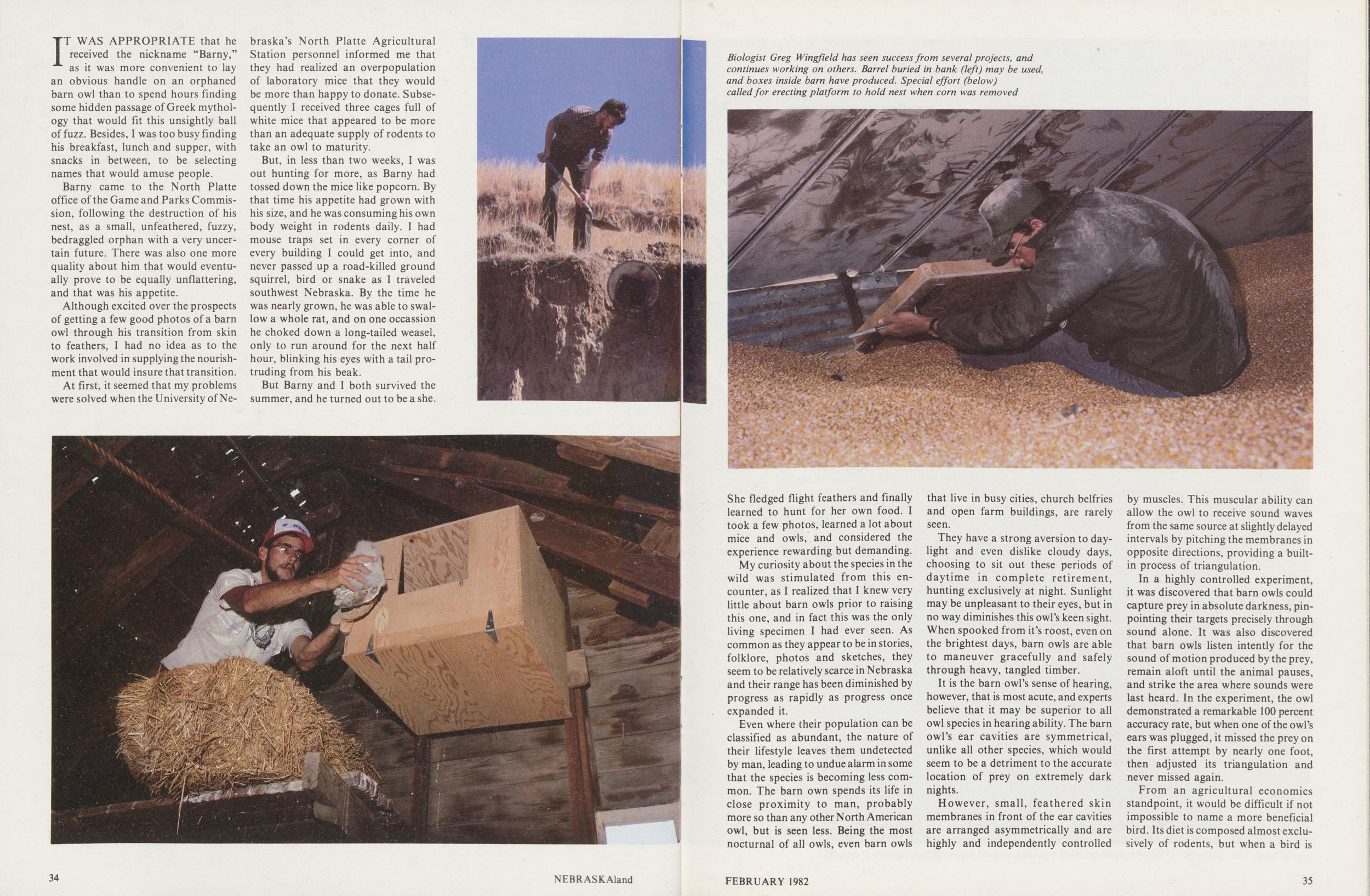
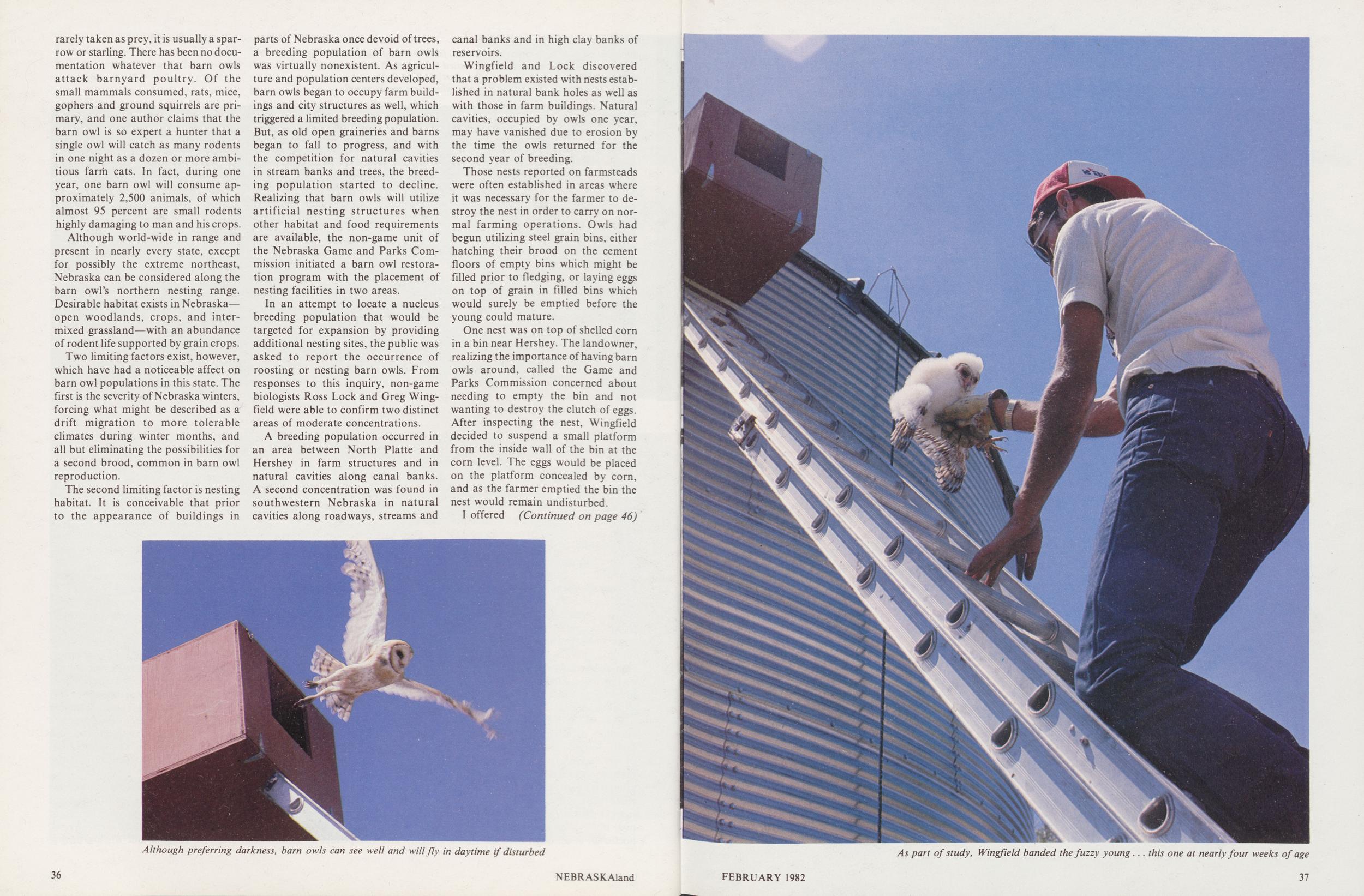
One nest was on top of shelled corn in a bin near Hershey. The landowner, realizing the importance of having barn owls around, called the Game and Parks Commission concerned about needing to empty the bin and not wanting to destroy the clutch of eggs. After inspecting the nest, Wingfield decided to suspend a small platform from the inside wall of the bin at the corn level. The eggs would be placed on the platform concealed by corn, and as the farmer emptied the bin the nest would remain undisturbed.
I offered (Continued on page 46)
Although preferring darkness, barn owls can see well and will fly in daytime if disturbed
As part of study, Wingfield banded the fuzzy young... this one at nearly four weeks of age
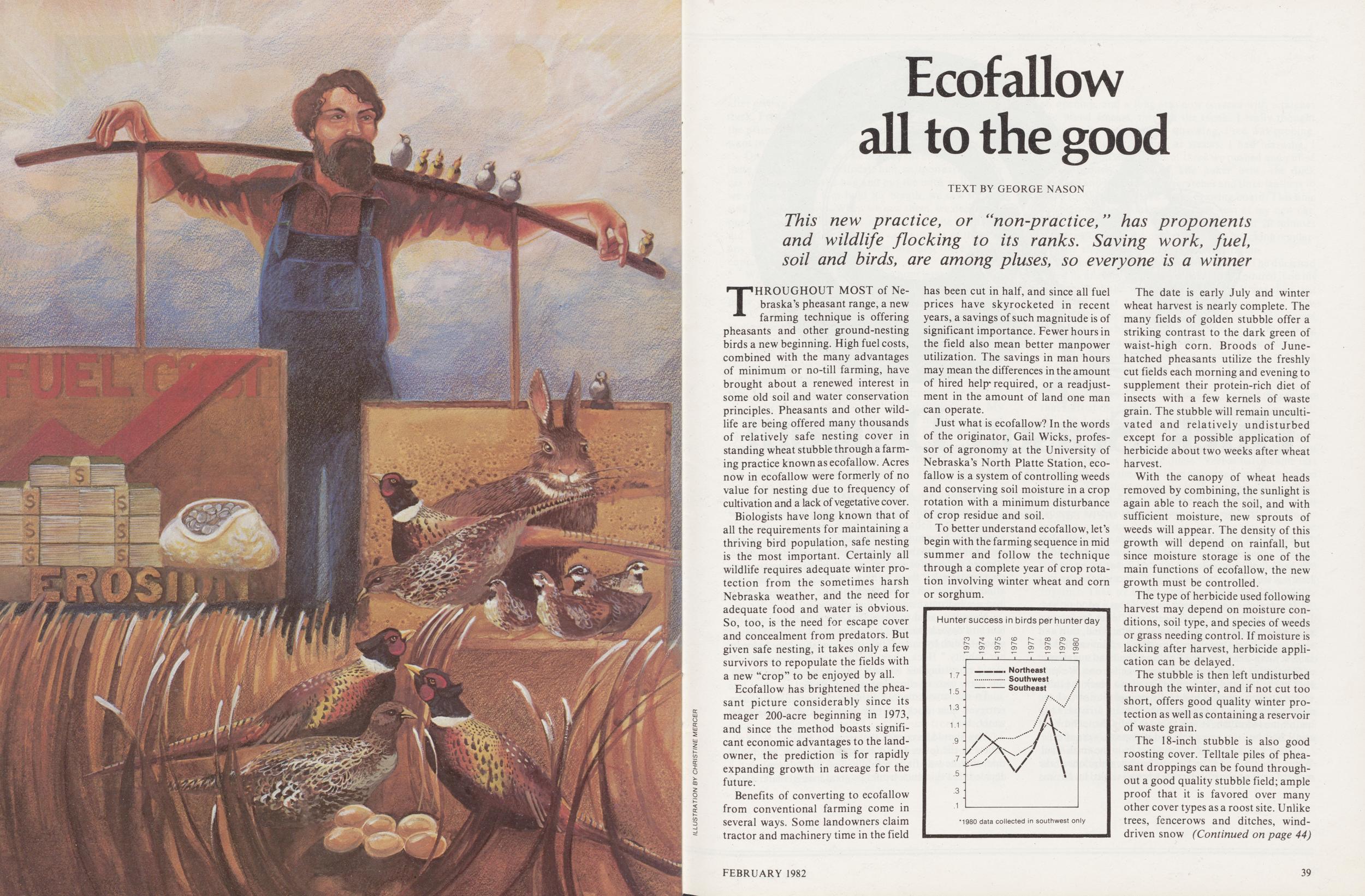
Ecofallow all to the good
This new practice, or "non-practice," has proponents and wildlife flocking to its ranks. Saving work, fuel, soil and birds, are among pluses, so everyone is a winner
THROUGHOUT MOST of Nebraska's pheasant range, a new farming technique is offering pheasants and other ground-nesting birds a new beginning. High fuel costs, combined with the many advantages of minimum or no-till farming, have brought about a renewed interest in some old soil and water conservation principles. Pheasants and other wildlife are being offered many thousands of relatively safe nesting cover in standing wheat stubble through a farming practice known as ecofallow. Acres now in ecofallow were formerly of no value for nesting due to frequency of cultivation and a lack of vegetative cover.
Biologists have long known that of all the requirements for maintaining a thriving bird population, safe nesting is the most important. Certainly all wildlife requires adequate winter protection from the sometimes harsh Nebraska weather, and the need for adequate food and water is obvious. So, too, is the need for escape cover and concealment from predators. But given safe nesting, it takes only a few survivors to repopulate the fields with a new "crop" to be enjoyed by all.
Ecofallow has brightened the pheasant picture considerably since its meager 200-acre beginning in 1973, and since the method boasts significant economic advantages to the landowner, the prediction is for rapidly expanding growth in acreage for the future.
Benefits of converting to ecofallow from conventional farming come in several ways. Some landowners claim tractor and machinery time in the field has been cut in half, and since all fuel prices have skyrocketed in recent years, a savings of such magnitude is of significant importance. Fewer hours in the field also mean better manpower utilization. The savings in man hours may mean the differences in the amount of hired help* required, or a readjustment in the amount of land one man can operate.
Just what is ecofallow? In the words of the originator, Gail Wicks, professor of agronomy at the University of Nebraska's North Platte Station, ecofallow is a system of controlling weeds and conserving soil moisture in a crop rotation with a minimum disturbance of crop residue and soil.
To better understand ecofallow, let's begin with the farming sequence in mid summer and follow the technique through a complete year of crop rotation involving winter wheat and corn or sorghum.
The date is early July and winter wheat harvest is nearly complete. The many fields of golden stubble offer a striking contrast to the dark green of waist-high corn. Broods of June-hatched pheasants utilize the freshly cut fields each morning and evening to supplement their protein-rich diet of insects with a few kernels of waste grain. The stubble will remain uncultivated and relatively undisturbed except for a possible application of herbicide about two weeks after wheat harvest.
With the canopy of wheat heads removed by combining, the sunlight is again able to reach the soil, and with sufficient moisture, new sprouts of weeds will appear. The density of this growth will depend on rainfall, but since moisture storage is one of the main functions of ecofallow, the new growth must be controlled.
The type of herbicide used following harvest may depend on moisture conditions, soil type, and species of weeds or grass needing control. If moisture is lacking after harvest, herbicide application can be delayed.
The stubble is then left undisturbed through the winter, and if not cut too short, offers good quality winter protection as well as containing a reservoir of waste grain.
The 18-inch stubble is also good roosting cover. Telltale piles of pheasant droppings can be found throughout a good quality stubble field; ample proof that it is favored over many other cover types as a roost site. Unlike trees, fencerows and ditches, wind-driven snow (Continued on page 44)
FEBRUARY 1982 39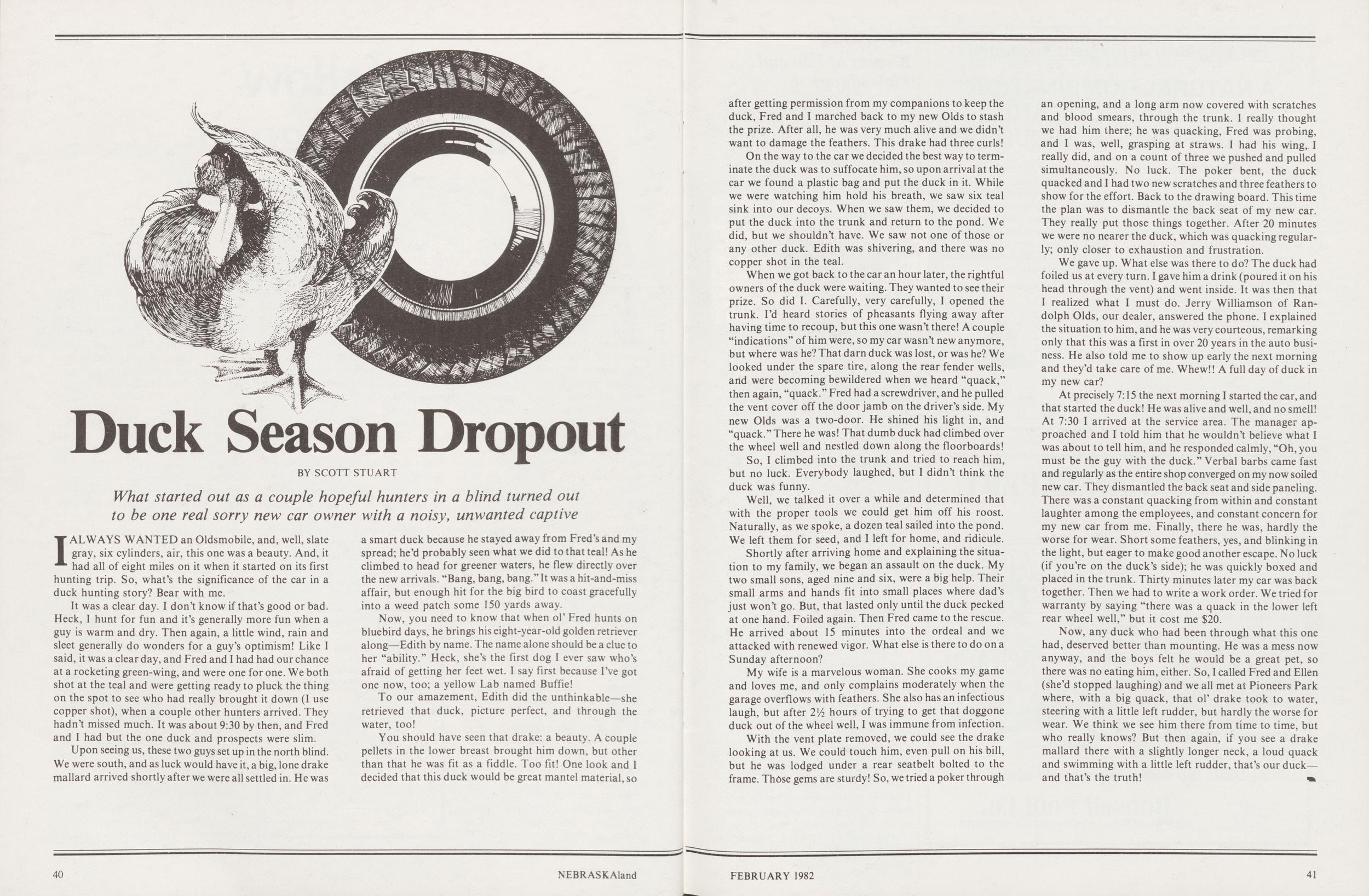
Duck Season Dropout
What started out as a couple hopeful hunters in a blind turned out to be one real sorry new car owner with a noisy, unwanted captive
I ALWAYS WANTED an Oldsmobile, and, well, slate gray, six cylinders, air, this one was a beauty. And, it had all of eight miles on it when it started on its first hunting trip. So, what's the significance of the car in a duck hunting story? Bear with me.
It was a clear day. I don't know if that's good or bad. Heck, I hunt for fun and it's generally more fun when a guy is warm and dry. Then again, a little wind, rain and sleet generally do wonders for a guy's optimism! Like I said, it was a clear day, and Fred and I had had our chance at a rocketing green-wing, and were one for one. We both shot at the teal and were getting ready to pluck the thing on the spot to see who had really brought it down (I use copper shot), when a couple other hunters arrived. They hadn't missed much. It was about 9:30 by then, and Fred and I had but the one duck and prospects were slim.
Upon seeing us, these two guys set up in the north blind. We were south, and as luck would have it, a big, lone drake mallard arrived shortly after we were all settled in. He was a smart duck because he stayed away from Fred's and my spread; he'd probably seen what we did to that teal! As he climbed to head for greener waters, he flew directly over the new arrivals. "Bang, bang, bang." It was a hit-and-miss affair, but enough hit for the big bird to coast gracefully into a weed patch some 150 yards away.
Now, you need to know that when ol' Fred hunts on bluebird days, he brings his eight-year-old golden retriever along—Edith by name. The name alone should be a clue to her "ability." Heck, she's the first dog I ever saw who's afraid of getting her feet wet. I say first because I've got one now, too; a yellow Lab named Buffie!
To our amazement, Edith did the unthinkable—she retrieved that duck, picture perfect, and through the water, too!
You should have seen that drake: a beauty. A couple pellets in the lower breast brought him down, but other than that he was fit as a fiddle. Too fit! One look and I decided that this duck would be great mantel material, so 40 NEBRASKAland after getting permission from my companions to keep the duck, Fred and I marched back to my new Olds to stash the prize. After all, he was very much alive and we didn't want to damage the feathers. This drake had three curls!
On the way to the car we decided the best way to terminate the duck was to suffocate him, so upon arrival at the car we found a plastic bag and put the duck in it. While we were watching him hold his breath, we saw six teal sink into our decoys. When we saw them, we decided to put the duck into the trunk and return to the pond. We did, but we shouldn't have. We saw not one of those or any other duck. Edith was shivering, and there was no copper shot in the teal.
When we got back to the car an hour later, the rightful owners of the duck were waiting. They wanted to see their prize. So did I. Carefully, very carefully, I opened the trunk. I'd heard stories of pheasants flying away after having time to recoup, but this one wasn't there! A couple "indications" of him were, so my car wasn't new anymore, but where was he? That darn duck was lost, or was he? We looked under the spare tire, along the rear fender wells, and were becoming bewildered when we heard "quack," then again, "quack." Fred had a screwdriver, and he pulled the vent cover off the door jamb on the driver's side. My new Olds was a two-door. He shined his light in, and "quack." There he was! That dumb duck had climbed over the wheel well and nestled down along the floorboards!
So, I climbed into the trunk and tried to reach him, but no luck. Everybody laughed, but I didn't think the duck was funny.
Well, we talked it over a while and determined that with the proper tools we could get him off his roost. Naturally, as we spoke, a dozen teal sailed into the pond. We left them for seed, and I left for home, and ridicule.
Shortly after arriving home and explaining the situation to my family, we began an assault on the duck. My two small sons, aged nine and six, were a big help. Their small arms and hands fit into small places where dad's just won't go. But, that lasted only until the duck pecked at one hand. Foiled again. Then Fred came to the rescue. He arrived about 15 minutes into the ordeal and we attacked with renewed vigor. What else is there to do on a Sunday afternoon?
My wife is a marvelous woman. She cooks my game and loves me, and only complains moderately when the garage overflows with feathers. She also has an infectious laugh, but after VA hours of trying to get that doggone duck out of the wheel well, I was immune from infection.
With the vent plate removed, we could see the drake looking at us. We could touch him, even pull on his bill, but he was lodged under a rear seatbelt bolted to the frame. Those gems are sturdy! So, we tried a poker through an opening, and a long arm now covered with scratches and blood smears, through the trunk. I really thought we had him there; he was quacking, Fred was probing, and I was, well, grasping at straws. I had his wing,. I really did, and on a count of three we pushed and pulled simultaneously. No luck. The poker bent, the duck quacked and I had two new scratches and three feathers to show for the effort. Back to the drawing board. This time the plan was to dismantle the back seat of my new car. They really put those things together. After 20 minutes we were no nearer the duck, which was quacking regularly; only closer to exhaustion and frustration.
We gave up. What else was there to do? The duck had foiled us at every turn. I gave him a drink (poured it on his head through the vent) and went inside. It was then that I realized what I must do. Jerry Williamson of Randolph Olds, our dealer, answered the phone. I explained the situation to him, and he was very courteous, remarking only that this was a first in over 20 years in the auto business. He also told me to show up early the next morning and they'd take care of me. Whew!! A full day of duck in my new car?
At precisely 7:15 the next morning I started the car, and that started the duck! He was alive and well, and no smell! At 7:30 I arrived at the service area. The manager approached and I told him that he wouldn't believe what I was about to tell him, and he responded calmly, "Oh, you must be the guy with the duck." Verbal barbs came fast and regularly as the entire shop converged on my now soiled new car. They dismantled the back seat and side paneling. There was a constant quacking from within and constant laughter among the employees, and constant concern for my new car from me. Finally, there he was, hardly the worse for wear. Short some feathers, yes, and blinking in the light, but eager to make good another escape. No luck (if you're on the duck's side); he was quickly boxed and placed in the trunk. Thirty minutes later my car was back together. Then we had to write a work order. We tried for warranty by saying "there was a quack in the lower left rear wheel well," but it cost me $20.
Now, any duck who had been through what this one had, deserved better than mounting. He was a mess now anyway, and the boys felt he would be a great pet, so there was no eating him, either. So, I called Fred and Ellen (she'd stopped laughing) and we all met at Pioneers Park where, with a big quack, that ol' drake took to water, steering with a little left rudder, but hardly the worse for wear. We think we see him there from time to time, but who really knows? But then again, if you see a drake mallard there with a slightly longer neck, a loud quack and swimming with a little left rudder, that's our duck—and that's the truth!
FEBRUARY 1982 41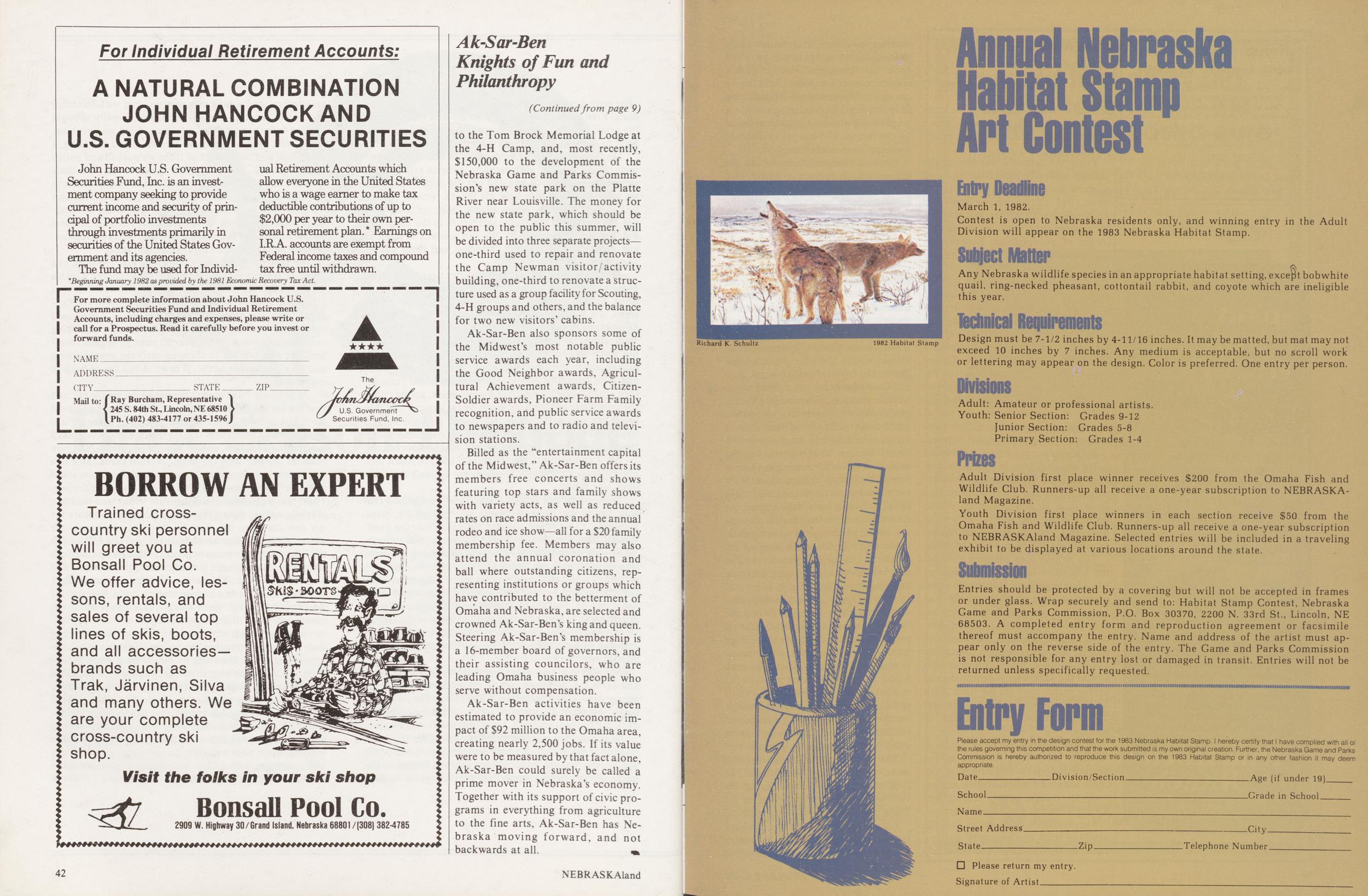
John Hancock U.S. Government Securities Fund, Inc. is an investment company seeking to provide current income and security of principal of portfolio investments through investments primarily in securities of the United States Government and its agencies.
The fund may be used for Individual Retirement Accounts which allow everyone in the United States who is a wage earner to make tax deductible contributions of up to $2,000 per year to their own personal retirement plan. * Earnings on I.R.A. accounts are exempt from Federal income taxes and compound tax free until withdrawn.
"Beginning January 1982 as provided by the 1981 Economic Recovery Tax Act.For more complete information about John Hancock U.S. Government Securities Fund and Individual Retirement Accounts, including charges and expenses, please write or call for a Prospectus. Read it carefully before you invest or forward funds.
NAME ADDRESS CITY STATE ZIP Mail to: Ray Burcham, Representative 245 S. 84th St., Lincoln, NE 68510 Ph. (402) 483-4177 or 435-1596 The John Hancock U.S. Government Securities Fund, Inc. BORROW AN EXPERTTrained cross- country ski personnel will greet you at Bonsall Pool Co. We offer advice, lessons, rentals, and sales of several top lines of skis, boots, and all accessories-brands such as Trak, Jarvinen, Silva and many others. We are your complete cross-country ski shop.
Visit the folks in your ski shop Bonsall Pool Co. 2909 W. Highway 30/Grand Island. Nebraska 68801 /(308) 3824785to the Tom Brock Memorial Lodge at the 4-H Camp, and, most recently, $150,000 to the development of the Nebraska Game and Parks Commission's new state park on the Platte River near Louisville. The money for the new state park, which should be open to the public this summer, will be divided into three separate projects—one-third used to repair and renovate the Camp Newman visitor/activity building, one-third to renovate a structure used as a group facility for Scouting, 4-H groups and others, and the balance for two new visitors' cabins.
Ak-Sar-Ben also sponsors some of the Midwest's most notable public service awards each year, including the Good Neighbor awards, Agricultural Achievement awards, Citizen-Soldier awards, Pioneer Farm Family recognition, and public service awards to newspapers and to radio and television stations.
Billed as the "entertainment capital of the Midwest," Ak-Sar-Ben offers its members free concerts and shows featuring top stars and family shows with variety acts, as well as reduced rates on race admissions and the annual rodeo and ice show—all for a $20 family membership fee. Members may also attend the annual coronation and ball where outstanding citizens, representing institutions or groups which have contributed to the betterment of Omaha and Nebraska, are selected and crowned Ak-Sar-Ben's king and queen. Steering Ak-Sar-Ben's membership is a 16-member board of governors, and their assisting councilors, who are leading Omaha business people who serve without compensation.
Ak-Sar-Ben activities have been estimated to provide an economic impact of $92 million to the Omaha area, creating nearly 2,500 jobs. If its value were to be measured by that fact alone, Ak-Sar-Ben could surely be called a prime mover in Nebraska's economy. Together with its support of civic programs in everything from agriculture to the fine arts, Ak-Sar-Ben has Nebraska moving forward, and not backwards at all.
Annual Nebraska Habitat Stamp Art Contest
Entry Deadline March 1, 1982. Contest is open to Nebraska residents only, and winning entry in the Adult Division will appear on the 1983 Nebraska Habitat Stamp. Subject Matter Any Nebraska wildlife species in an appropriate habitat setting, except bobwhite quail, ring-necked pheasant, cottontail rabbit, and coyote which are ineligible this year. Technical Requirements Design must be 7-1/2 inches by 4-11/16 inches. It may be matted, but mat may not exceed 10 inches by 7 inches. Any medium is acceptable, but no scroll work or lettering may appear on the design. Color is preferred. One entry per person. Divisions Adult: Amateur or professional artists. Youth: Senior Section: Grades 9-12 Junior Section: Grades 5-8 Primary Section: Grades 1-4 Prizes Adult Division first place winner receives $200 from the Omaha Fish and Wildlife Club. Runners-up all receive a one-year subscription to NEBRASKAland Magazine. Youth Division first place winners in each section receive $50 from the Omaha Fish and Wildlife Club. Runners-up all receive a one-year subscription to NEBRASKAland Magazine. Selected entries will be included in a traveling exhibit to be displayed at various locations around the state. Submission Entries should be protected by a covering but will not be accepted in frames or under glass. Wrap securely and send to: Habitat Stamp Contest, Nebraska Game and Parks Commission, P.O. Box 30370, 2200 N. 33rd St., Lincoln, NE 68503. A completed entry form and reproduction agreement or facsimile thereof must accompany the entry. Name and address of the artist must appear only on the reverse side of the entry. The Game and Parks Commission is not responsible for any entry lost or damaged in transit. Entries will not be returned unless specifically requested. Entry FormPlease accept my entry in the design contest for the 1983 Nebraska Habitat Stamp. I hereby certify that I have complied with ail of the rules governing this competition and that the work submitted is my own original creation. Further, the Nebraska Game and Parks Commission is hereby authorized to reproduce this design on the 1983 Habitat Stamp or in any other fashion it may deem appropriate.
Date Division/Section School Name Age (if under 19). Grade in School Street Address State City Please return my entry. Signature of Artist Zip Telephone Number
LETS POOL TOGETHER AMERICA
Get away from it all to Nebraska's scenic Pine Ridge for a vacation you'll remember a lifetime.
Stay in modern nicely-furnished log cabins. Take a quiet walk on scenic hiking trails, try some great fishing then have a campfire cookout. See a 16-foot waterwheel, unbelievable sunsets you'll never find in the city and more stars than you ever thought existed.
For brochure Write: Rt. 3, Box 30, Crawford, NE, 69339Ecofallow ...All to the Good (Continued from page 39)
collects only to the depth of the stubble, and the possibility of being smothered under deep drifts is nearly non-existent.
From the farmer's standpoint, the stubble serves to shade the soil and capture snow. Blowing snow over a bare field can mean no moisture accumulation all winter, but trapped by stubble, can amount to several inches of precipitation. Evaporation loss is also reduced by the protection of stubble.
In addition to providing quality cover for pheasants and collecting moisture, the standing stubble also serves as a protection blanket against wind and water erosion. We have all witnessed the saddening loss of quality topsoil from lands left devoid of cover during dry periods, and observed the results of a heavy downpour of rain on naked soil. The moisture-collecting ability of stubble during periods of excessive rainfall compared to terraces or contours void of residue is striking.
By May, the once golden stubble has faded to a dull grey, but its usefulness to the resident wildlife and as a conservation aid, continues. Ground-nesting birds such as meadow larks, doves, horned larks and others, as well as pheasants, may choose the old residue as a nesting site because of the color.
This is also corn planting time for the ecofallow farmer. Corn requires considerable subsoil moisture to reach maturity, but if the stubble has accomplished its intended purpose, even the few light skiffs of winter snow have helped replenish the moisture supply. Acting as a sponge, the stubble also slows down heavy rainwater flow so that the water can move into the soil profile rather than off the field. With only a few timely rains in June and July, another good corn crop is in the making.
Another application of herbicides in April or early May followed by the seeding of corn or sorghum by a specially adapted planter, and the nesting residents remain totally undisturbed for the duration of the summer.
The herbicide application and the planting may mechanically destroy some nests, but since it is still early summer, and since the hens are likely uninjured, renesting can take place soon. The "cornfield" also serves as a renesting site for those hens lucky enough to have escaped from nearby-first cuttings of alfalfa, or from a neighboring stubble field being disced by the farmer who has yet to discover the benefits of ecofallow.
Contrast the ecofallow way to the conventionally farmed cornfield. Not only is the land laid bare prior to planting, but one or more trips through the field are necessary for cultivation. It is just not possible for pheasant production to occur in conventionally produced corn.
When the nesting season is over, and the ecofallow corn slowly turns from the deep green of summer to the golden hues of fall, the old wheat stubble, though still present among the tall corn stalks, has all but disappeared.
Now is the time for harvest. As the farmer awaits the time when he can gather the fruits of his labor, so, too, do those who enjoy the pursuit of the wildlife excesses. Surrounding fields, grassy draws, fencerows and weed patches very likely will contain a noticeable increase in the wildlife "crop" because hens which chose the ecofallow fields for nesting may have made a better than average choice. With corn harvested and the landscape again settled in for a winter's rest, we find that only the hardiest of hunters are willing to give up the warmth of the living room to brave the sting of icy winds in .pursuit of pheasants. The duty of snow catching now becomes the responsibility of the bent and broken stalks of corn. Shucks, cobs, stalks and other debris will become important in protecting the valuable topsoil from the inevitable winter winds. Among the litter will be some random and shattered kernels of corn highly favored by pheasants.
The ecofallow corn stubble will remain untouched through the winter months, and with a spring application of herbicide, will not be cultivated until- late spring or early summer.
This is the farmer's no-income summer for the ecofallow field. The field must remain fallow during the summer months in preparation for the September planting of winter wheat.
Economic benefits to the dryland farmer living in the 16 to 20-inch rainfall belt can be easily documented; but 44 NEBRASKAland can we quote definite improvements in hunting success from the nearly 300,000 acres now in ecofallow? Much of wildlife management comes from the "feeling" one gets from experience, and to obtain mathematical proof of changes in wildlife numbers is difficult at best.
Thousands of hunter-survey cards are mailed out to licensed hunters each year asking for a report of their personal success, and until recently, roadside check stations were manned throughout the state on opening weekend of the pheasant season.
From information gained at these volunteer check stations, it would appear that the pheasant population is on the mend throughout ecofallow country.
Areas of Nebraska lying outside the major crop-rotation and ecofallow region do not follow the same pattern of increase that is characteristic of the southwest.
A basic biological fact has slowly been borne out once again. Given ample safe nesting, pheasants can repopulate a region to numbers reminiscent of the soil bank days. When the undisturbed acres disappeared in the 1960's and were converted to intensive cultivation, the bird population dipped. Quick-cure remedies such as killing the predators, restocking, and shortening or closing the season, were heard from all corners. These cures may seem to be the answer during lean times, but there is no real evidence in the biological world that would suggest that the answer lies there. To suggest that the landowner set aside land for the purpose of wildlife production without compensation is not realistic, and to compensate landowners for the thousands of acres necessary to replenish the nesting acreage, would be prohibitively expensive.
The real answer lies in a program which provides mutual benefit to both landowner and wildlife. We know what is needed for more wildlife, but now we have a land management idea which may be of equal or greater benefit to the landowner, as well.
Persons wishing additional information will find the best source to be a volume titled Ecofallow Conference. Copies are available for $3.50 plus $1 postage from Bob Cline, County Agent, Box 409, McCook, NE 69001.If winter9 s doldrums have you climbing walls or staring at floors, here s something that will perk up your spirits and give you a new outlook. Outdoor Nebraska gives you something to shout about.
No one is as active on the outdoor recreation scene as the Nebraska Game and Parks Commission, and no one brings you so much of that scene as does the Outdoor Nebraska television show. Make it a date to watch the show each week. You'll be taken on tours, on hunts, on visits with some mighty interesting and colorful people. The show comes to you twice each week, so you can still catch it if you miss the first time. It all comes to you on the Nebraska Educational Television Network, and is aired at 7:30 p.m. Thursday and again at 6:30 p.m. Saturday. Check the schedule below and get ready for some fun viewing!
Fishing Nebraska Febr. 4, 6 — Outdoor Nebraska previews the coming fishing season — where, what and how they're biting — and also looks at Nebraska's most popular game fish species.
Nebraska Febr. 11, 13 — A grand, colorful, adventurous look at Nebraska's many sights and attractions. Join us as we travel Nebraska from the Missouri River to the Panhandle.
Spring Turkey Hunting Febr. 18, 20 — Nebraska's only spring hunting season is highlighted in a filmed trip to the Pine Ridge, along with some tips from experienced pros.
Nebraska's Frontier Forts Febr. 25, 27 — Fort Hartsuff in the Sandhills, Fort Atkinson on the Missouri, Fort Kearny along the Oregon Trail. A special visit to three of Nebraska's historical parks.
Nebraska Game and Parks Commission Eugene T. Mahoney, Director FEBRUARY 1982 45
Leaving the car home once in a while. When you can, share a ride or use public transportation. Or try walking, biking... or even skating! And many errands can be handled effectively by mail or phone. Following steps like these can really help reduce your gasoline bills. So keep up the good work!
A Public Service of This Magazine and The Advertising Council POLLUTION IS A DIRTY WORD! PULMONARY ASSOCIATES NEW! PERSONAL COLD-WEATHER BREATHING AID TURNS FRIGID WINTER AIR INTO SPRINGTIME!Now there's an easy way to make winter more enjoyable for heart patients, emphysema victims, asthmatics, chronic sinusitis sufferers...and all outdoor sportspeople. In fact, it's perfect for mailmen, hunters, crossing guards, linemen, farm workers, ranchers, and others in outdoor winter occupations. Naturally, for medical relief we recommend you consult your physician before use.
New Personal Cold-Weather Breathing Aid • warms frigid -5° F air to a comfortable +50° using body heat • fits all sizes, easy to wear, safe • does not interfere with vision or normal body activities • can be washed in any film-free household detergent • 10 Day Trial; full refund if not satisfied Send $35.00 to: Joseph J. Langenfeld R.R.T., Registered Respiratory Therapist 1423 Countryside Lane Alliance NE 69301 (308) 762-2557Owl in a box
(Continued from page 36)to assist in the placement of the platform and as we cautiously entered the bin through the only opening in the roof, we discovered that the female was nowhere in sight. We set to work shoveling corn to make room for the platform. Needing to clear more corn away, Wingfield crawled on top of the corn and discovered the female owl lying face down with her wings tucked in and her eyes closed. Upon examination, we saw that the owl was healthy but simply hiding in a position awkward and uncommon in bird behavior. We left her undisturbed and finished our work, which took about 30 minutes, while she remained totally motionless and on her stomach less than 10 feet from us.
An attempt to provide permanent bank cavities involved the placement of 35-gallon steel drums with entrance holes in the end. In one instance, a barrel was dug into a bank directly next to a natural but deteriorating hole, prior to the spring arrival of a pair of owls that had been nesting there for three years.
Since the area was across from a public roadway and there had been some problems in the area with vandals destroying nesting owls, there was concern that our artificial nest might draw some adverse attention. Therefore, it was decided to give this nest site as much publicity as possible and utilize it as an educational tool for the project. A large sign was erected directly across from the barrel describing the Game and Parks barn owl project and outlining the benefits of owls to man.
The nest site drew television, radio, and newspaper coverage, and school groups visited the area on field trips.
In late March, a pair of adult barn owls moved into the barrel, but on April a severe blizzard completely filled the structure with snow and the owls abandoned the artificial cavity to raise a brood in the natural cavity. Although the barrel failed as a nesting site, the educational value gained from this particular site was immeasureable in gaining public acceptance of these predators.
Five other barrels were placed in high canal banks between North Platte and Brady, but have not yet been 46 NEBRASKAland "adopted" as nesting sites, Biologists are studying the possibility that a large concentration of nesting great horned owls in this area might be responsible for the reluctance of barn owls to nest.
However, a program incorporating the use of wooden nesting boxes in and around farm buildings and grain bins frequented by owls was very successful. In the Hershey area, Wingfield placed six boxes where previous owl nests had been precariously established.
Four of the six boxes were placed on the outside of steel bins to encourage owls that had nested inside the bins in previous years, to begin nesting in the safety of the artificial boxes. Three of the four boxes were used by owls the first year, resulting in 17 young.
In the Cambridge area in southwest Nebraska, five boxes were placed by area falconer Bob Linderholm in areas where nesting had occurred in the past. Three of the boxes were utilized by barn owls in 1981. The three successful boxes contained 13 young, and it is hoped they will return to nest in this area.
One box producing three owlets this year was suspended over a high bank at Medicine Creek Reservoir. Linderholm selected this site because owls had been observed using natural cavities the year before.
The most interesting acceptance of a box by barn owls occurred in this area, when Linderholm suspended a box 20 feet down in a pit silo. It was immediately utilized by a pair of owls in 1981, which resulted in the fledging of five young.
A second phase of the barn owl restoration project is the captive breeding program conducted in the Lincoln area.
In cooperation with the Wachiska Audobon Society's Raptor Rehabilitation Center in Lincoln, the Game and Parks Commission has established three breeding pairs of barn owls. The Center produces juvenile owls for the Game and Parks Commission which are placed in nest boxes in the wild.
Society volunteers "hack out" the young in these boxes, attempting to imprint them to particular areas. In 1980, four captive-bred owlets were hacked in boxes on farms northeast of Lincoln, and four orphaned wild owls were "hacked" successfully southeast of Lincoln.
Last year eight captive offspring were hacked successfully from boxes in two different sites southeast of Lincoln.
PUBLIC SUPPORT WELCOME Biologists are asking landowners to report sightings of barn owls frequently roosting or nesting around farmsteads. Farmers with suitable habitat and an abundance of prey may wish to attract barn owls by placing artificial nest boxes in or around outbuildings. Since this owl is tolerant of limited human disturbance, it can be attracted to areas other birds of prey will ignore.
The Game and Parks Commission will supply barn owl nest box plans and information on managing barn owls as a means of rodent control. If new material is used, it costs under $ 15 for one box, and if successful in attracting barn owls to the property, it has been estimated that a single adult bird can prevent $30 in damages through gopher control alone, and far more than that from mice and rats.
Mepps Aglia, the world's fish catchingest spinner, now comes with a life-like Golden Shiner Mino. It's deadly! Don't go fishing without a super-soft Aglia Mino or your favorite plain or dressed Mepps. Stories and tips in Mepps colorful 40 page fishin' magazine can help you catch more fish. Only 50C. Send now.
Sheldons, Inc., CS 508, Dept. Antigo,WI 54409. FREE NEW 1982 SPRING CATALOG Reels... Rods.., Lures ... Tackle... Self-made gear... Camping items... Footwear.. Outdoor clothing ... Boating supplies and much more Yes, send your FREE CATALOG 812 13th Ave. Dept. 863-202 Sidney, NE 69162 NAME ADDRESS CITY STATE ZIP FEBRUARY 1982 47
Bookshelf
Out Home by John Madson. 1979. Winchester Press; New York. 206 pages. $10. TWENTY-TWO entries from the pen of John Madson are set into a relaxed format with something to please any reader. The selections range from a one-page tribute to an unconventional hunting dog ("The Passing of Little Sam") to a pair of long essays. Two selections should be of particular interest to Nebraskans. "Day of the Crane" was originally published in Audubon (March 1974), and tells of the appearance every March of sandhill cranes along the Platte River. This spectacular bird show is attracting more and more appreciative observers. "The Running Country" first appeared in Audubon (July 1972) accompanied by a number of superb color photos. It is about prairie and takes its title from a passage by Willa Cather: "... there was so much motion to it; the whole country seemed, somehow, to be running." Anyone privileged to see a large sweep of tallgrass prairie billowing in the late summer wind will appreciate that description. Madson's piece captures the setting, history and moods of the prairie—landform, plants, animals, the awesome grass fires vividly described by explorers and settlers, the unmatchable sunsets and more. Hunters will certainly agree with the observations contained in "An Outdoor Ledger"—"A hunting partner usually oversleeps .... Hip boots leak only in cold water.... The last hills are the highest." The entire volume comes across as the testament of one who could not bear to live without the wild and free parts of our world. Chapter-head drawings by Dycie Madson, the author's wife, enhance the book. Any reader who will not return for subsequent visits to its pages would be a rare bird indeed. NEBRASKAlandTrading Post
DOGS WELL-BRED Hunting dogs for sale—Brittanies, English setters and pointers—ranging in age from puppies to young dogs. Darrell Yentes, 1118 McMillan, Holdrege, NE 68949. Phone (308) 995-8570 or (308) 995-4797. WEIMARANER (Grey Ghost) AKC pups for sale.Good hunting background. Also weimaraner stud service. Stepaneks, Lincoln, Nebr. Phone (402) 467-2848. ROMEO ALPHA Kennels has National Stock Dog Registry Australian Shepherd puppies for sale. Black, grey, blue merle in color. Stud service also available. Call Randy Amundson, Columbus, Nebr. at (402) 589-2539 or (402) 589-0082. PHEASANT AND QUAIL dogs, English pointers, English setter pups and trained dogs year round. (402) 873-6288. IRISH SETTER pups whelped 09/21/81. Ideal pets and companion hunting dogs. AKC, FDSB enrolled. Phone (402) 423-4074. MISCELLANEOUS GUNS—Browning, Winchester, Remington, others, Hi-powers, shotguns, new, used, antiques. Want Pre1964 Winchesters. Buy-Sell-Trade. Ph. (402) 729-6112. Bedlan's Sporting Goods, Fairbury, NE 68352. PLASTIC DECOYS: We're originator of famous do it yourself system. Catalog system. Catalog $1.00. Decoys Unlimited. Clinton. IA 52732. GAME BIRDS—most kinds available. Quail suitable for release. Pick up or will deliver. Waunita, Nebr. Call (308) 394-5577 nine to five (Mountain Standard Time) or (308) 394-5715 after five (MST). MICHICRAFT CANOES. ... New and Used! Canoe Rentals ... 12 statewide locations! 8 and 10-place canoe trailers, New and Used! Rocky Ford Canoe Camp, Niobrara River, camping, shuttles, rentals! Organized canoe-camping trips; and combination canoe-camping-rainbow trout fishing trips for groups . . . Free trips for Promoter-Sponsors! Plan early and visit our shop in Lincoln near 14th and Cornhusker when attending football and basketball games; state tournaments; concerts; racing; state fair, etc. Wilson Outfitters Nebraska (WON) 1329 Dawes Avenue, Lincoln, Nebraska 68521, Phone (402) 476-2300. FISHERMEN! Plan to attend Nebraska's best wintertime events—the Valentine Jaycee Ice Fishing Tournament, Febr. 6, 1982, Merritt Reservoir. Cash and prizes in over 30 categories. Free Coors beer, food, entertainment and prizes night before at happy hour show. Entry blanks available at local bait dealers. For information write Valentine Jaycees, P.O. Box 4, Valentine, Nebr. 69201 or call John Bush (402) 376-3487 or Larry Miller 376-2370. WEATHERBYS—10 percent above cost. Handfinishing—hot blue—repair—antique restoration. Wanted, old guns for repair parts. Fritz Gunsmithing and Supply Co., Wilber, NE (402) 821-2260. N.E. NEBRASKA Trout Fishing. For rent Mon.-Thurs. or Fri.-Sun. 2 modern cottages completely furnished. 3 ponds with trout up to 5 lbs. 2 ponds with bass and bluegill. Diamond E. Trout Resort, Orchard, NE 68764 (402) 893-4745. OLD HUNTING Licenses—Wow! Send old licenses and duck stamps. Immediate cash. Wildlife Gallery, 172 E. Bedford St., Stamford, Conn. 06901. FOR SALE: Tuller's Medicine Creek Lodge located in Southwest Nebraska at Harry Strunk Lake near Cambridge, Nebraska. Includes the restaurant, 2 mobile homes, trailer hookups, cabins, boats and barges, and complete hunting and fishing supplies. Write Sullivan Realty, Box 313, McCook, Nebr 69001 or phone (308) 345-1828. WAX WORMS 500-58.25; 1000—$14.50. Add 3 percent sales tax. Postpaid first class. No C.O.D Harold Malicky, Burwell, NE 68823. FRUITS AND BERRIES: Make wine when frozen? Now legal. Send for free recipes and instructions. Omaha Supply. 13616 Polk, Omaha, NE 68137. TAXIDERMY BIG BEAR TAXIDERMY, Rt. 2, Mitchell, Nebraska 69357. We specialize in all big game from Alaska to Nebraska, also birds and fish. Hair on and hair off tanning, 4'/2 miles west of Scottsbluff on Highway 26 Phone (308) 635-3013. KARL SCHWARZ Master Taxidermist. Mounting of game heads—birds—fish—animals—fur rugs—robes-tanning buckskin. Since 1910. 424 South 13th Street, Dept. A, Omaha, Nebraska 68102. BADE TAXIDERMY—Quality a must—Fast service. Fish, birds, rugs, tanning, full mounts and game heads. 1924 North Lincoln, Fremont, Nebraska. 727-5463. FREEZE-DRY TAXIDERMY Wally Allison's State Record Taxidermy, 2709 Birchwood, North Platte, NE 69101. Phone: (308) 534-2324. Specializing in Fish and Small Game, Snake and Lizard and Novelties. (Nothing too small) Newest of all taxidermy methods employed. AWARD-WINNING TAXIDERMIST. Eight time national award winners. Trust your trophies to a proven winner. Our complete taxidermy service also arranges hunts. Dinges Taxidermy Studio, 2763 South 12th Omaha, NE 68108. Ph. 402-342-3718. JOHNSON TAXIDERMY—servicing southwest Nebraska, specializing in big-game mounts, lifesized mounts, rug work, fish, birds, tanning hair-on leather. Brochure and price list on request. Johnson Taxidermy, Rt. 1, Box 78, Lamar, NE 69035. Telephone (308) 882-5555. Pollutants become part of the ignition rather than the consequence • BURNS WITH A DOWN DRAFT • STARTS WITHOUT KINDLING Dealers Needed • AMERICAN MADE • UL APPROVED DODWORTH and SONS ARM STORE • RECYCLES ITS GASES Solid Fuel Burners 6132 HAVELOCK AVE., LINCOLN, NEBRASKA 68507. (402) 466-8439 SUPER PATRIOT It's realty quite revolutionary CREATIVE TAXIDERMY in all its branches since 1935, now includes Northstar Freeze-Dry processing of approved small specimens. Also tanning and deerskin processing. Naturecraft Studio. Nebraska City, Nebraska 68510. Joe Voges-Owner. Phone (402) 873-5491. NABITY'S TAXIDERMY. 29 years experience. All-taxidermy services available. Specializing in natural grass backgrounds. 5021 Washington, Lincoln, NE 68506. (402) 489-6351. WHITETAIL TAXIDERMY. Deer heads are specialty. Excellent work—Low prices—10 years'experience. Phone (402) 564-6885. Columbus, Nebr. HASTINGS TAXIDERMY: Professional life-like mounting of game heads, birds, fish, rugs, and animals. We specialize in big-game head mounts. Also hair-on and hair-off tanning. Competitive prices. R Rt. 3, Box 162, Ord, NE 68862. Phone (308) 728-5322. LIVE-CATCH ALL-PURPOSE TRAPS Write for FREE CATALOG Traps without injury squirrels, chipmunks, rabbits, mink, fox, raccoons, stray animals, pests, etc. Sizes for every need. Also traps for snakes, sparrows, pigeons, crabs, turtles, quail, etc. Save on our low factory prices. Send no money. Free catalog and trapping secrets. WHITETAIL TAXIDERMY. Deer heads are specialty. Excellent work—Low prices—10 years'experience. Phone (402) 564-6885. Columbus, Nebr. MUSTANG MFG. CO., Dept. N-34, Box 10880, Houston, Tex. 77011 FIRESTONE HEAVY DUTY TRUCK TARPAULINS I6'x20' $32 18'x24' $38 20'x30' $48 26'x40' $89 Before Midnight Feb. 28 As part of an advertising test Firestone Tarp Mfg. will send any of the above truck size tarpaulins to any reader of this publication who reads and responds to this test before midnight Feb. 28. Each tarpaulin Lot (#Z-18, PVC) is constructed of high density fabric (with virgin grade ingredient, supplied by Gulf Oil Co., Dow Chemical Co., and Union Oil Co.) with nylon reinforced rope hems, double lock stitched hems, electronically welded seams, 100% water proof, #4 (!/2" dia.) metal grommets set on 3 ft. centers with reinforced triangular corner patches and are recommended for all heavy duty use and all bulk or pallet riding materials, and will be accompanied with a LIFETIME guarantee that it must perform 100% or it will be replaced free. Add $7 handling and crating for each tarp ordered, Firestone Tarp Mfg. pays all shipping. Should you wish to return your tarpaulins you may do so for a full refund. Any letter postmarked later than Feb. 28, will be returned. LIMIT: Fifty (50) tarps per address, no exceptions. Send appropriate sum together with your name and address to: Tarp Test Dept. #103G, Firestone Tarp Mfg., Inc., 6314 Santa Monica Blvd., Los Angeles, CA 90038, for fastest service from any part of the country call collect, before midnight 7 days a week (213) 629-1062 (ask Operator for) TARP TEST #103G, have credit card ready. FEBRUARY 1982 49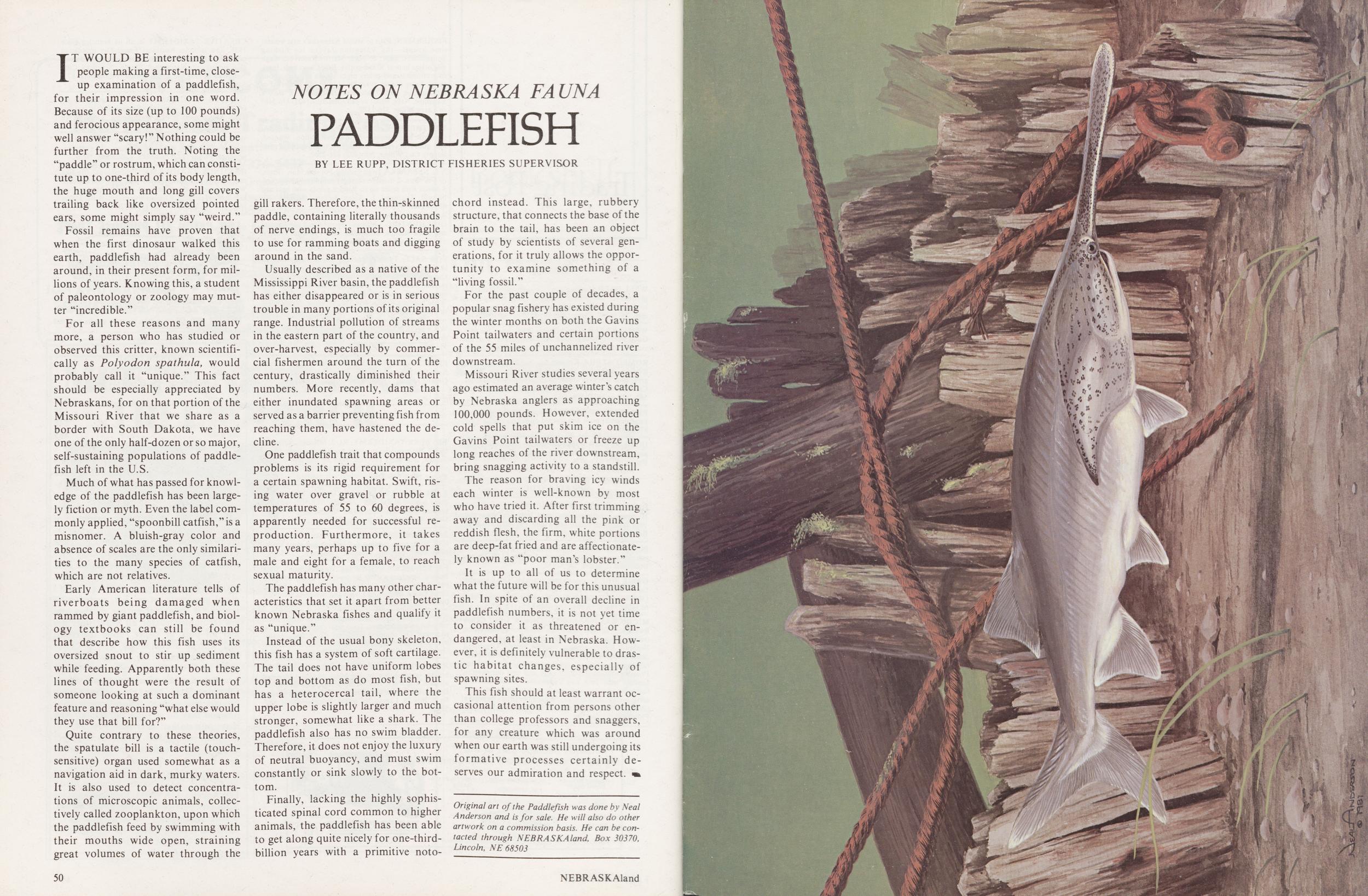
NOTES ON NEBRASKA FAUNA
PADDLEFISH
IT WOULD BE interesting to ask people making a first-time, closeup examination of a paddlefish, for their impression in one word. Because of its size (up to 100 pounds) and ferocious appearance, some might well answer "scary!" Nothing could be further from the truth. Noting the "paddle" or rostrum, which can constitute up to one-third of its body length, the huge mouth and long gill covers trailing back like oversized pointed ears, some might simply say "weird." Fossil remains have proven that when the first dinosaur walked this earth, paddlefish had already been around, in their present form, for millions of years. Knowing this, a student of paleontology or zoology may mutter "incredible."
For all these reasons and many more, a person who has studied or observed this critter, known scientifically as Polyodon spathula, would probably call it "unique." This fact should be especially appreciated by Nebraskans, for on that portion of the Missouri River that we share as a border with South Dakota, we have one of the only half-dozen or so major, self-sustaining populations of paddlefish left in the U.S.
Much of what has passed for knowledge of the paddlefish has been largely fiction or myth. Even the label commonly applied, "spoonbill catfish," is a misnomer. A bluish-gray color and absence of scales are the only similarities to the many species of catfish, which are not relatives.
Early American literature tells of riverboats being damaged when rammed by giant paddlefish, and biology textbooks can still be found that describe how this fish uses its oversized snout to stir up sediment while feeding. Apparently both these lines of thought were the result of someone looking at such a dominant feature and reasoning "what else would they use that bill for?"
Quite contrary to these theories, the spatulate bill is a tactile (touch-sensitive) organ used somewhat as a navigation aid in dark, murky waters. It is also used to detect concentrations of microscopic animals, collectively called zooplankton, upon which the paddlefish feed by swimming with their mouths wide open, straining great volumes of water through the gill rakers. Therefore, the thin-skinned paddle, containing literally thousands of nerve endings, is much too fragile to use for ramming boats and digging around in the sand.
Usually described as a native of the Mississippi River basin, the paddlefish has either disappeared or is in serious trouble in many portions of its original range. Industrial pollution of streams in the eastern part of the country, and over-harvest, especially by commercial fishermen around the turn of the century, drastically diminished their numbers. More recently, dams that either inundated spawning areas or served as a barrier preventing fish from reaching them, have hastened the decline.
One paddlefish trait that compounds problems is its rigid requirement for a certain spawning habitat. Swift, rising water over gravel or rubble at temperatures of 55 to 60 degrees, is apparently needed for successful reproduction. Furthermore, it takes many years, perhaps up to five for a male and eight for a female, to reach sexual maturity.
The paddlefish has many other characteristics that set it apart from better known Nebraska fishes and qualify it as "unique."
Instead of the usual bony skeleton, this fish has a system of soft cartilage. The tail does not have uniform lobes top and bottom as do most fish, but has a heterocercal tail, where the upper lobe is slightly larger and much stronger, somewhat like a shark. The paddlefish also has no swim bladder. Therefore, it does not enjoy the luxury of neutral buoyancy, and must swim constantly or sink slowly to the bottom.
Finally, lacking the highly sophisticated spinal cord common to higher animals, the paddlefish has been able to get along quite nicely for one-third- billion years with a primitive notochord instead. This large, rubbery structure, that connects the base of the brain to the tail, has been an object of study by scientists of several generations, for it truly allows the opportunity to examine something of a "living fossil."
For the past couple of decades, a popular snag fishery has existed during the winter months on both the Gavins Point tailwaters and certain portions of the 55 miles of unchannelized river downstream.
Missouri River studies several years ago estimated an average winter's catch by Nebraska anglers as approaching 100,000 pounds. However, extended cold spells that put skim ice on the Gavins Point tailwaters or freeze up long reaches of the river downstream, bring snagging activity to a standstill.
The reason for braving icy winds each winter is well-known by most who have tried it. After first trimming away and discarding all the pink or reddish flesh, the firm, white portions are deep-fat fried and are affectionately known as "poor man's lobster."
It is up to all of us to determine what the future will be for this unusual fish. In spite of an overall decline in paddlefish numbers, it is not yet time to consider it as threatened or endangered, at least in Nebraska. However, it is definitely vulnerable to drastic habitat changes, especially of spawning sites.
This fish should at least warrant occasional attention from persons other than college professors and snaggers, for any creature which was around when our earth was still undergoing its formative processes certainly deserves our admiration and respect.
Original art of the Paddlefish was done by Neal Anderson and is for sale. He will also do other artwork on a commission basis. He can be contacted through NEBRASKAland, Box 30370, Lincoln, NE 68503
50 NEBRASKAland
THE NEBRASKAland FOUNDATION
Established in 1962, the Nebraskaland Foundation is a private, apolitical organization created to subsidize the State's own promotional efforts. Since its inception, the Foundation has been actively involved in the celebration of Nebraska as history, as geography, as a spirit and a life style.
The Nebraskaland Foundation is a non-profit, non-governmental champion of the image and well being of the State.
Help Share the Pride... be a NEBRASKAIand contributor: Individual $15.00 Donor $25.00 Booster $50.00 Patron $100.00 Sustaining $250.00 Sponsor $500.00 or moreYour contribution toward promoting Nebraska is tax deductible and you will receive an appropriate plaque or emblem displaying your support of the 'Good Life.'
The NEBRASKAIand Foundation, Inc. 1335 L Street • Lincoln, NE 68508Past activities of the Foundation include the development and promotion of the Nebraskaland Days celebration, assistance in developing official agencies attendant to State promotion, the placement of various historical markers, the Blue Agate
State Gemstone, Statehood Day and the Capitol gift store. In addition, its Nebraskaland Foundation tours have been quite effective, as have hundreds of other support activities, gifts and awards.
The success of the Foundation is dependent upon the personal and financial generosity of every private citizen, every civic group and business interested in the promotion of Our Great State.
Without the direct, tax-exempt support of fellow Nebraskans, our State would be without many of the support activities and grants that are so important to the promotion of the "Good Life."
Be a proud Nebraskan.
Promoting the Good LifePosition: 9 (582 views)