Volume 59, Issue 20, 1981
NEBRASKAland
December 1981 $2.50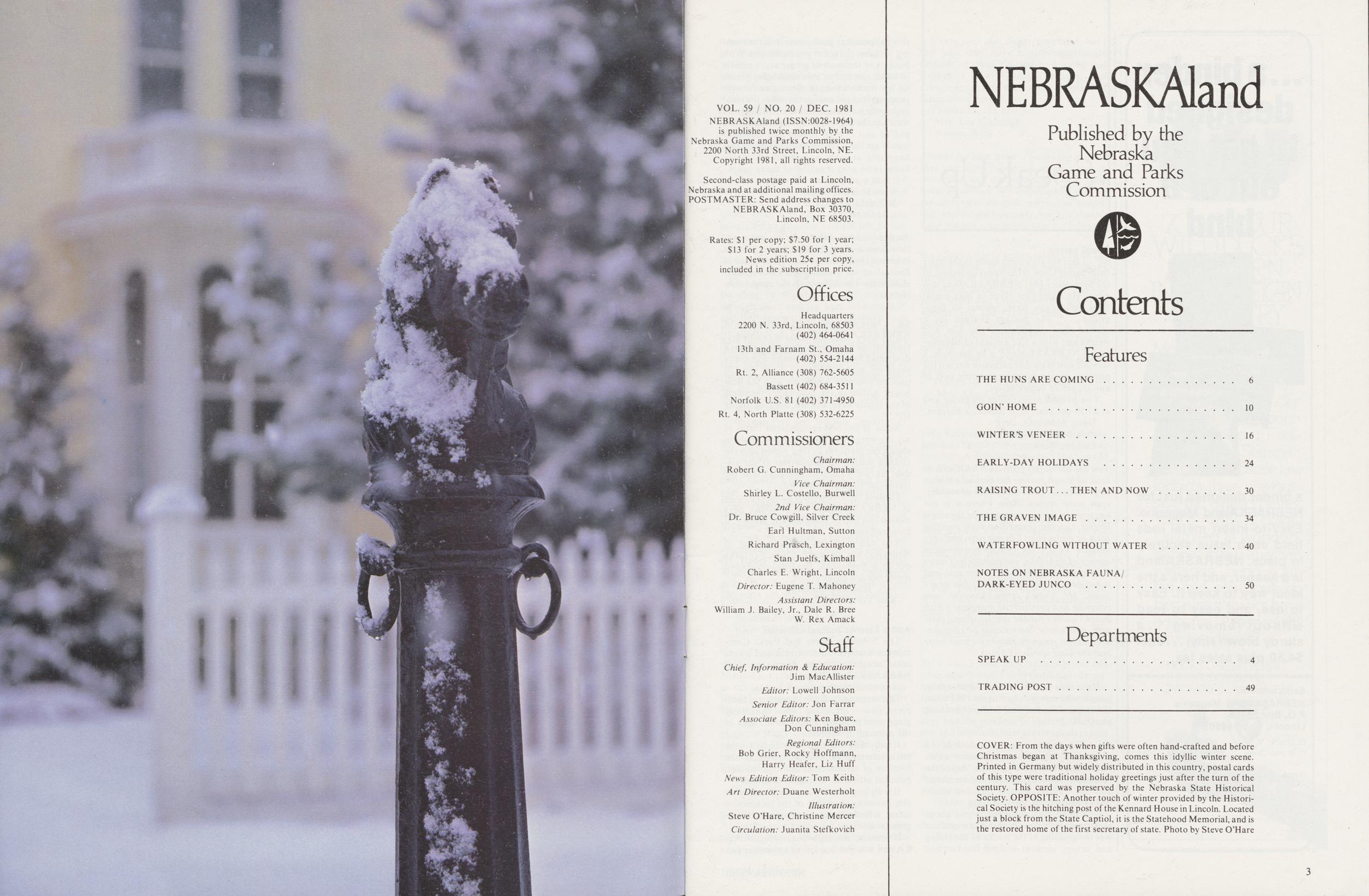
NEBRASKAland
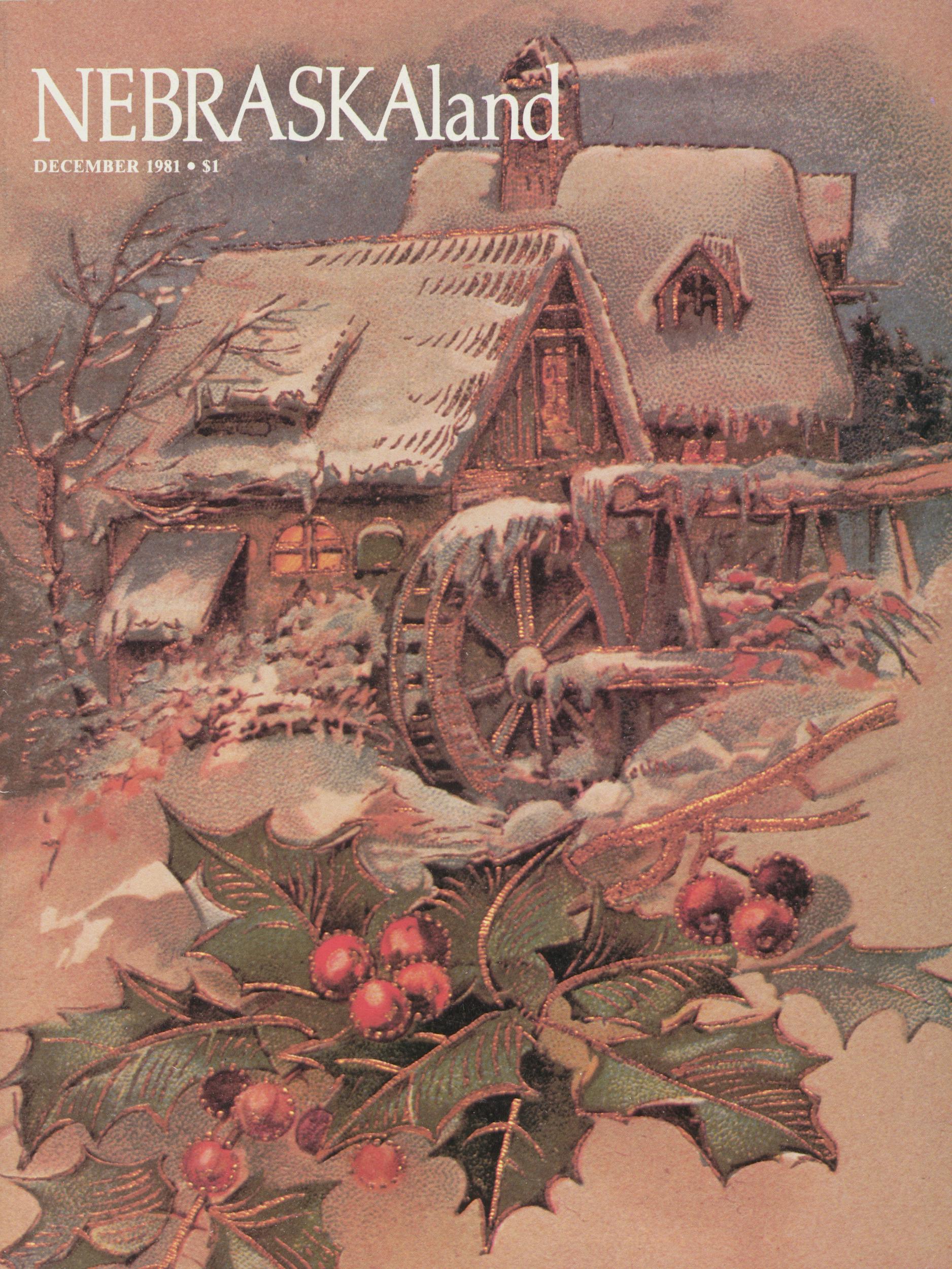
Published by the Nebraska Game and Parks Commission VOL. 59 / NO. 20 / DEC. 1981 NEBRASKAland (ISSN.0028-1964) is published twice monthly by the Nebraska Game and Parks Commission, 2200 North 33rd Street, Lincoln, NE. Copyright 1981, all rights reserved. Second-class postage paid at Lincoln, Nebraska and at additional mailing offices. POSTMASTER: Send address changes to NEBRASKAland, Box 30370, Lincoln, NE 68503. Rates: $1 per copy; $7.50 for 1 year; $13 for 2 years; $19 for 3 years. News edition 25c per copy, included in the subscription price. Offices Headquarters 2200 N. 33rd, Lincoln, 68503 (402) 464-0641 13th and Farnam St., Omaha (402) 554-2144 Rt. 2, Alliance (308) 762-5605 Bassett (402) 684-3511 Norfolk U.S. 81 (402) 371-4950 Rt. 4, North Platte (308) 532-6225 Commissioners Chairman: Robert G. Cunningham, Omaha Vice Chairman: Shirley L. Costello, Burwell 2nd Vice Chairman: Dr. Bruce Cowgill, Silver Creek Earl Hultman, Sutton Richard Prasch, Lexington Stan Juelfs, Kimball Charles E. Wright, Lincoln Director: Eugene T. Mahoney Assistant Directors: William J. Bailey, Jr., Dale R. Bree W. Rex Amack Staff Chief, Information & Education: Jim MacAllister Editor: Lowell Johnson Senior Editor: Jon Farrar Associate Editors: Ken Bouc, Don Cunningham Regional Editors: Bob Grier, Rocky Hoffmann, Harry Heater, Liz Huff News Edition Editor: Tom Keith Art Director: Duane Westerholt Illustration: Steve O’Hare, Christine Mercer Circulation: Juanita Stefkovich Contents Features THE HUNS ARE COMING................ 6 GOIN’ HOME ....................... 10 WINTER’S VENEER................... 16 EARLY-DAY HOLIDAYS ................24 RAISING TROUT. . .THEN AND NOW.....30 THE GRAVEN IMAGE...................34 WATERFOWLING WITHOUT WATER ........40 NOTES ON NEBRASKA FAUNA/ DARK-EYED JUNCO ................. 50 Departments SPEAK UP ........................ 4 TRADING POST.....................49 COVER: From the days when gifts were often hand-crafted and before Christmas began at Thanksgiving, comes this idyllic winter scene. Printed in Germany but widely distributed in this country, postal cards of this type were traditional holiday greetings just after the turn of the century. This card was preserved by the Nebraska State Historical Society. OPPOSITE: Another touch of winter provided by the Historical Society is the hitching post of the Kennard House in Lincoln. Located just a block from the State Captiol, it is the Statehood Memorial, and is the restored home of the first secretary of state. Photo by Steve O’Hare 3
Speak Up
Postal patronSir / I feel the statement made in the letter from James Cope in the Speakup section of the September 1981 NEBRASKAIand is in error. He states that “Due to high postal rates, magazines have become so high-priced. . .." The postage charged for a second-class publication the size and weight and with a like amount of advertising as NEBRASKAIand is 6¢ per issue. I feel this cost is neither excessive nor is it the primary reason for the escalating cost of any magazine subscription.
You publish an excellent magazine and at $7.50 per year, it is, indeed, a bargain.
Doug Aiderman, clerk Bulk Mail Unit, Main P.O. Lincoln, Nebr.You are absolutely right on NEBRASKAIand, although postage has become a mighty large factor in other categories of mailing, even some second class, where it is not uncommon for the postage to be the single largest expense (exceeding even printing costs or paper costs). In our case, and only because we are the official conservation agency of Nebraska, our postage is of lesser consequence. Paper is our major cost, and it has nearly trebled in the last five or six years. Mr. Cope's letter, however, was referring to a commercial magazine which doesn 7 qualify for the special second class rate, and whose costs would be considerably higher. Anyway, thanks for your letter and the kind words. (Editor)
Here, dear readers, are a few letters from people who enjoyed the August 1981 issue, the “Saga of the Railroad. ”All are obviously nice folks.
Sir / The August issue was excellent. To me, and I know to many, many other Nebraskans who grew up in the “day of the railroads,” it brought back fond memories and the various articles included many facts I learned for the first time.
One thing that happened in just about every town in Nebraska that had a railroad was the greasing of the tracks by the young and ornery element around town... and this happened at dusk or early in the evening with less chance of getting caught. With buckets of throwaway grease and a paddle in hand, some of us kids would slap grease on the tracks ahead of the engine (always passenger) as the trains stopped at the local depot, then hide around the building and watch as the big wheels spun and the steam puffed out... and finally the engineer would get the train moving. I suppose this happened at least once a month in my home town over a period of many years.
It was a great issue.
Vern Scofield, editor Nebraska Trucker Lincoln, Nebr.Probably some of those old engineers will now come looking for some trucks in order to grease their wheels—is there a statute of limitations on greasing tracks? Anyway, thanks for the letter and the confession. (Editor)
Sir / I have just enjoyed the August issue of NEBRASKAIand telling of the railroad. It really struck home because my father was a draftsman for the UP in Omaha. For many years my step-father worked for the UP until he accepted a position with the Seaboard Airline in the east. Other members of the family have, and are, working for the UP.
Some of the best remembered thrills of my life were when those huge locomotives shook the platform as they pulled into the Omaha station on 10th Street at the viaduct as we waited to climb aboard the train—off to parts unknown.
I missed the lovely color pictures usually in NEBRASKAIand, but wouldn’t have missed this trip of nostalgia and history. It balanced out.
You can take the Nebraskan out of Nebraska, but you cannot take Nebraska out of a Nebraskan. Beautiful childhood memories are never erased.
Mrs. Jeannette Cameron New York, N.Y. And a Lincoln Journal editorial:The Nebraska Game and Parks Commission deserted field, stream and picnic table altogether for its August issue of NEBRASKAland Magazine.
A fascinating departure it is, too.
The magazine editors devote the complete issue—including space normally given over to advertising— to the saga of the railroad in Nebraska.
Hardly any story is more basic to the settlement and growth of Nebraska—the location of certain cities and their names, political attitudes, economic destinies.
Hardly any memory can be more personally haunting than that of the locomotive steam whistle keening across the shortgrass prairies.
Normally, the high-quality NEBRASKAland is a publication of attraction and 4 NEBRASKAland interest. The one about railroads is a genuine keeper.
Sir / Congratulations on your splendid issue concerning the saga of the railroad. It is a very interesting issue and presents a reasonably accurate history of the railroads in Nebraska. It is a splendid issue and extremely well done.
Robert D. Marcotte Omaha, Nebr.Sir / A kind soul in our shop here gave me the current issue of NEBRASKAIand and all I can say is WOW! As a bonafideTrainaholic from age 12. I can say that you people did an absolute SUPER job. So far, I have not read the stories, but I have been drooling over the photography and art and layout for the past 30 minutes (just like when I read Playboy!).
One question. Is the Union Station still standing in Omaha? I used to travel through there and lay over between U P. and Burlington trains when traveling from Portland to Iowa. I thought they might have turned it into a museum. I just wish I would have had the camera equipment then to take some photos of the interior of the place, with its high, high ceilings, marble and whatnot.
Again, thanks for the super issue.
Bob Kuhn Oregon Fish and Wildlife DepartmentSir / Just wanted you to know how much I enjoyed the August issue of NEBRASKAland, “Saga of the Railroad. ” Being past 70 years of age, I have lived through a good part of the steam age. I was raised on a Pennsylvania farm and was exposed to the steam traction engine. I have visited Stuhr Museum, and also Pioneer Village.
It may interest you to know that there is an immense steam locomotive on display at the Henry Ford Museum at Dearborn, Michigan. They also operate a train there pulled by a steam locomotive which is over 100 years old, which was built in Paterson, N.J.
Rolland Miller River Edge, N.J.Sir / I want to commend you on your excellent issue on the railroads in Nebraska. I read it all through, from cover to cover, and enjoyed it all. I especially liked the picture of the Burlington depot at Hastings at train time.
I have boarded the Zephyrs from that platform many times during the past 30 years, and I hope Amtrak will be picking up and letting off passengers there for at least that much longer.
Thomas Brewer Valley, Nebr.Sir / I write few fan letters, but your August issue on trains was the best! I’m not surprised that you have sold out all issues at the newsstands—it is a collector’s item.
I have sons that disagree with me, but I feel you may have a disproportionate amount of space devoted to hunting and fishing. I love Nebraska history, and always appreciate even small coverage of historical events.
Thanks for the best yet.
Mrs. Lee Clabaugh Nelson, Nebr.Thanks for your letter. Please keep in mind that our agency plays a specific role in Nebraska, and our magazine has to have some guidelines. We are thankful that we are allowed to do such material as historical, and we are especially thankful that we have readers who appreciate it. (Editor)
Sir / Just a line to congratulate you on the August issue. It brought back so many memories of long ago days when the little old steam locomotives came through our town. How well I remember the lonesome whistle and the “chug-a-chug” as they pulled up the grade out of town. I often rode with them to the next town to visit my cousins. The fare was two cents a mile. My father at one time worked on the section gang.
Thanks for a mighty fine magazine.
Mrs. Alfred Anderson, Blair, Nebr.Sir / Received my magazine this afternoon and didn’t put it down until I’d read it cover to cover. A delightful issue—“The Saga of the Railroad.” Thank you.
Mrs. J. D. Haws Lincoln, Nebr.Sir / After carefully reading the August issue I have to compliment you on the wonderful way you describe the passing of steam engine into diesel power. I think every railroad man in the country should get a copy of this edition.
PS. Forty years with Union Pacific R.R.... also NEBRASKAIand subscriber since it began.
Joseph Salem Omaha, Nebr.Sir / Just a note congratulating you and your superb staff. I have just finished reading the August issue, cover to cover, word for word, and to me it is one of the outstanding single subject magazines I have ever had the pleasure of reading. The stories and historical facts are things all people should read.
I have been a subscriber for at least 12 years and also have sent relatives and friends out of the state subscriptions for presents.
Thanks again to Gene Mahoney and all the staff for doing such a magnificent job for the people of the State of Nebraska.
Robert Moore Omaha, Nebr. ZWCFCUR WILD DUCKS ARE BORN INA FOREIGN COUNTRY Most of this continent's wild ducks are bom in the wetlands of Canada, which are under threat of extinction. Revenues from Federal Duck Stamps can't help because law forbids their use outside the United States. That's why Ducks Unlimited is working to preserve Canadian wetlands. Send your tax-free contribution. Because if ducks have no home, America will have no ducks. DUCKS UNLIMITED INC., P.O. BOX 66300, CHICAGO, ILLINOIS 60666 DECEMBER 1981 5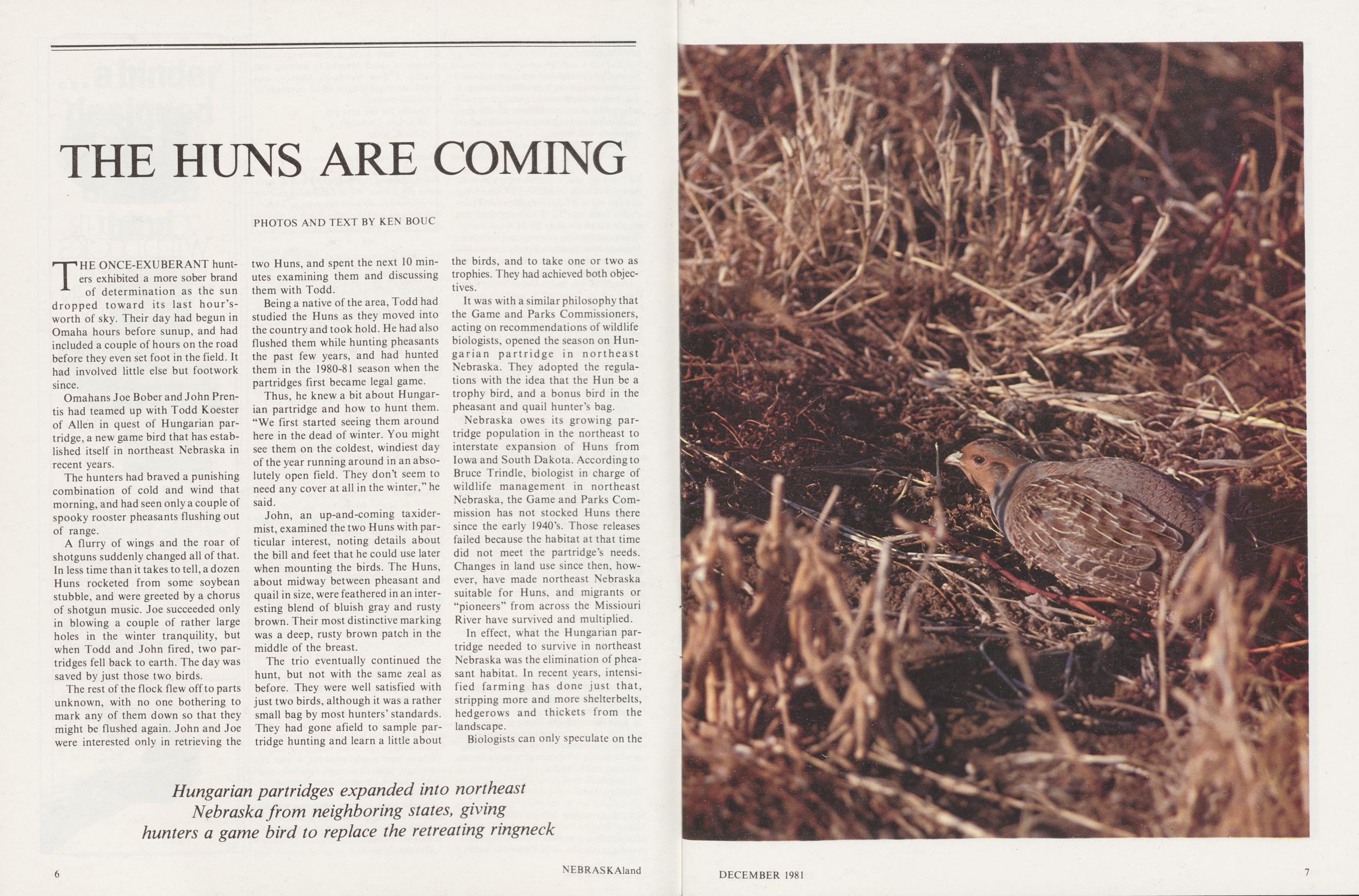
THE HUNS ARE COMING
PHOTOS AND TEXT BY KEN BOUCTHE ONCE-EXUBERANT hunters exhibited a more sober brand of determination as the sun dropped toward its last hour’s-worth of sky. Their day had begun in Omaha hours before sunup, and had included a couple of hours on the road before they even set foot in the field. It had involved little else but footwork since.
Omahans Joe Bober and John Trends had teamed up with Todd Koester of Allen in quest of Hungarian partridge, a new game bird that has established itself in northeast Nebraska in recent years.
The hunters had braved a punishing combination of cold and wind that morning, and had seen only a couple of spooky rooster pheasants flushing out of range.
A flurry of wings and the roar of shotguns suddenly changed all of that. In less time than it takes to tell, a dozen Huns rocketed from some soybean stubble, and were greeted by a chorus of shotgun music. Joe succeeded only in blowing a couple of rather large holes in the winter tranquility, but when Todd and John fired, two partridges fell back to earth. The day was saved by just those two birds.
The rest of the flock flew off to parts unknown, with no one bothering to mark any of them down so that they might be flushed again. John and Joe were interested only in retrieving the two Huns, and spent the next 10 minutes examining them and discussing them with Todd.
Being a native of the area, Todd had studied the Huns as they moved into the country and took hold. He had also flushed them while hunting pheasants the past few years, and had hunted them in the 1980-81 season when the partridges first became legal game.
Thus, he knew a bit about Hungarian partridge and how to hunt them. “We first started seeing them around here in the dead of winter. You might see them on the coldest, windiest day of the year running around in an absolutely open field. They don’t seem to need any cover at all in the winter,” he said.
John, an up-and-coming taxidermist, examined the two Huns with particular interest, noting details about the bill and feet that he could use later when mounting the birds. The Huns, about midway between pheasant and quail in size, were feathered in an interesting blend of bluish gray and rusty brown. Their most distinctive marking was a deep, rusty brown patch in the middle of the breast.
The trio eventually continued the hunt, but not with the same zeal as before. They were well satisfied with just two birds, although it was a rather small bag by most hunters’ standards. They had gone afield to sample partridge hunting and learn a little about the birds, and to take one or two as trophies. They had achieved both objectives.
It was with a similar philosophy that the Game and Parks Commissioners, acting on recommendations of wildlife biologists, opened the season on Hungarian partridge in northeast Nebraska. They adopted the regulations with the idea that the Hun be a trophy bird, and a bonus bird in the pheasant and quail hunter’s bag.
Nebraska owes its growing partridge population in the northeast to interstate expansion of Huns from Iowa and South Dakota. According to Bruce Trindle, biologist in charge of wildlife management in northeast Nebraska, the Game and Parks Commission has not stocked Huns there since the early 1940’s. Those releases failed because the habitat at that time did not meet the partridge’s needs. Changes in land use since then, however, have made northeast Nebraska suitable for Huns, and migrants or “pioneers” from across the Missiouri River have survived and multiplied.
In effect, what the Hungarian partridge needed to survive in northeast Nebraska was the elimination of pheasant habitat. In recent years, intensified farming has done just that, stripping more and more shelterbelts, hedgerows and thickets from the landscape.
Hungarian partridges expanded into northeast Nebraska from neighboring states, giving hunters a game bird to replace the retreating ringneckBiologists can only speculate on the 6 NEBRASKAland
A more generally-accepted theory regarding the Hun’s expansion involves habitat changes and the bird’s requirements. The Hun (known as the gray partridge or Perdix perdix to biologists) is a resident of grasslands and open country. He relies on his eyesight to warn him of predators, particularly the birds of prey which are such deadly enemies of his kind.
Shelterbelts and other tall cover not only restrict the partridge’s vision, but they also provide perches for his airborne enemies. And, if you subscribe to the “blackhead” theory, such cover also perpetuates the pheasant population and thus the disease.
The Hungarian partridge seems immune to cold and wind, and apparently does not need shelterbelts and other permanent cover when a blizzard strikes. About all Huns need is a stand of tall grass, alfalfa, oats, or something of that sort as a nest site.
Huns lay an average of 16 eggs, but chick mortality is high and only about half survive until fall.
There is very little data on partridge numbers or population densities in Nebraska. In Iowa, however, research has shown that a covey’s home range is usually about 160 acres.
Nebraska biologists will begin surveys in the northeast next year to gather data. About all that is known now is that they are on the increase, and are extending their range gradually to the south and west.
Trindle speculates that climate may prevent expansion much farther south, and farming operations will probably be the factor that will eventually limit partridge numbers within their range.
It should be apparent that hunters will not be much of an influence on the generaly scarcity or abundance of these birds. Hunting Huns requires a good deal of walking, so much so that hunters will probably be willing to call it a day by the time they bag one or two.
Of course, there’s a lot more to proper Hun hunting than merely strolling across the countryside at random. Knowing where to look for them is a big help, so it’s important to do a little pre-season scouting to locate the home ranges of several coveys and obtain permission to hunt them.
If hunters are not able to pinpoint coveys in advance, they should walk corn or soybean fields, whether standing crops early in the fall or stubble after harvest.
Dogs are of very limited value in hunting Huns, since the birds seldom hold for a pointer. In fact, a dog working ahead of hunters might flush birds out of range. Perhaps the best use of a dog would be in retrieving and finding cripples.
Hungarian partridge are notorious for flushing at the very fringe of scattergun 8 NEBRASKAland range, as Joe and John found out on their first hunt last January. Todd, who has collected more than his share of little gold statues at trap ranges, was well prepared with his full-choke trap gun and an eye used to speedy targets. John’s shooting was up to the challenge, also. Joe didn’t do as well, but his loosely choked side-by-side provided a convenient alibi.
The next time Joe and John go hunting in northeast Nebraska, they’ll know the challenge that awaits them, and they’ll have a better idea of what it takes to bag Hungarian partridge. As pheasant habitat disappears and pheasant numbers decline, they, and others who hunt in northeast Nebraska, will be looking for a game bird to at least partially fill the void. It appears that, in the Hun, they have a worthy candidate.
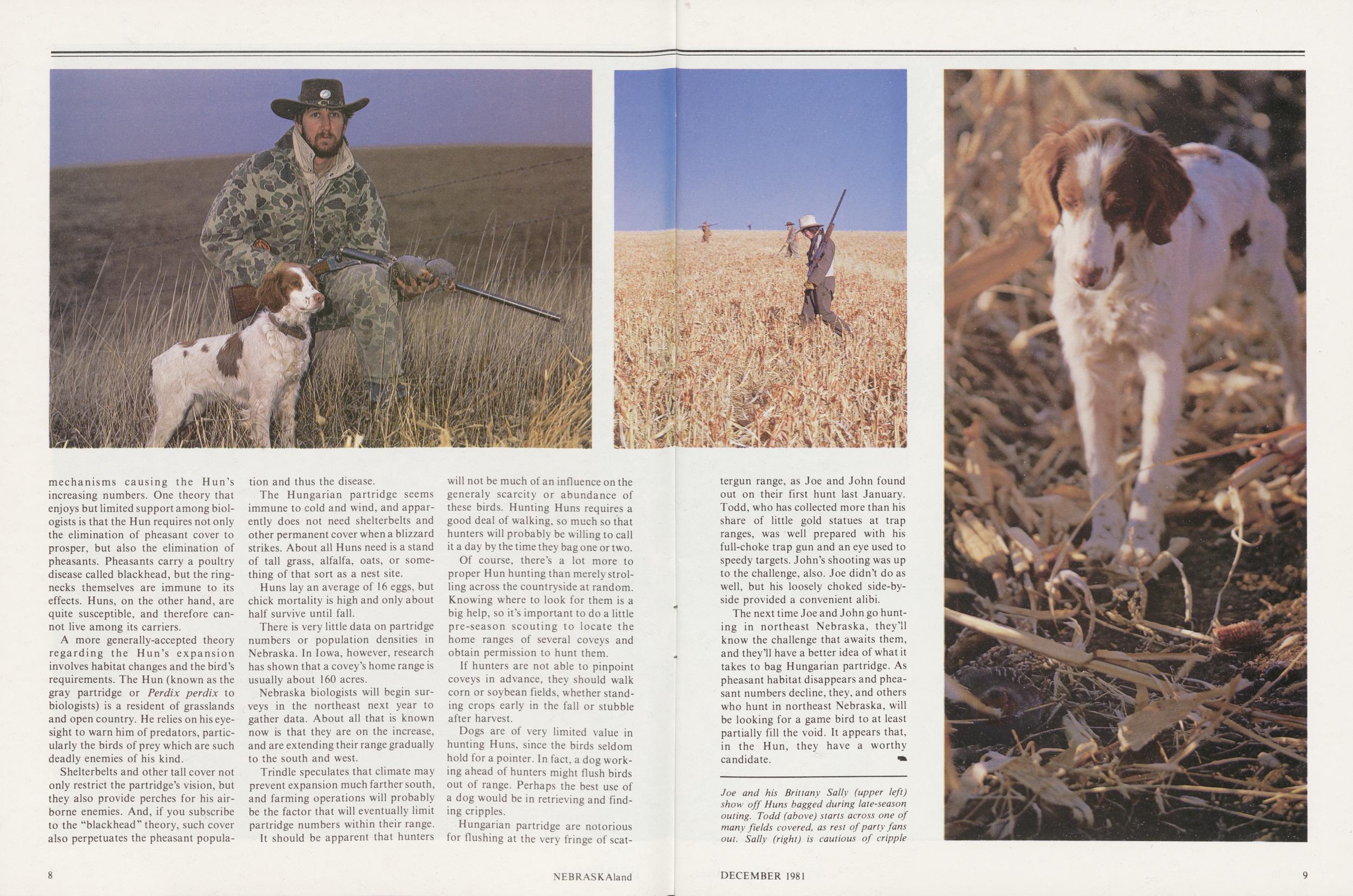
Joe and his Brittany Sally (upper left) show off Huns bagged during late-season outing. Todd (above) starts across one of many fields covered, as rest of party fans out. Sally (right) is cautious of cripple
Goin' Home
Returning to find the place of your childhood changed is painful, but sometimes an insignificant sign opens a neglected door and reveals a forgotten memory PHOTOGRAPHS BY DOROTHY BROADY TEXT BY JON FARRARLIKE MIGRATORY BIRDS that imprint on the place of their maiden flight, we always come home. Because so many f Nebraskans have left the farm and small towns, we do it by the thousands. We do it from Omaha and Lincoln, Los Angeles and Chicago, from overseas, from wherever the forces that pulled us away, finally deposit us. Nebraska-born author Wright Morris wrote of this very animal instinct: “Home is where you hang your childhood.”
The first dozen years or so of going home are without pain; people and familiar surroundings change slowly, almost imperceptibly. Change is so gradual that those who never leave seldom notice it at all. Elm trees that once joined like cathedral chambers over dusty streets fall one by one, baring box-like frame houses to the summer sun. New trees come to fill the void, some planted by man, others without help. Each year they stretch and spread, little noted by those who see them daily, until one spring their new growth shades the kitchen window.
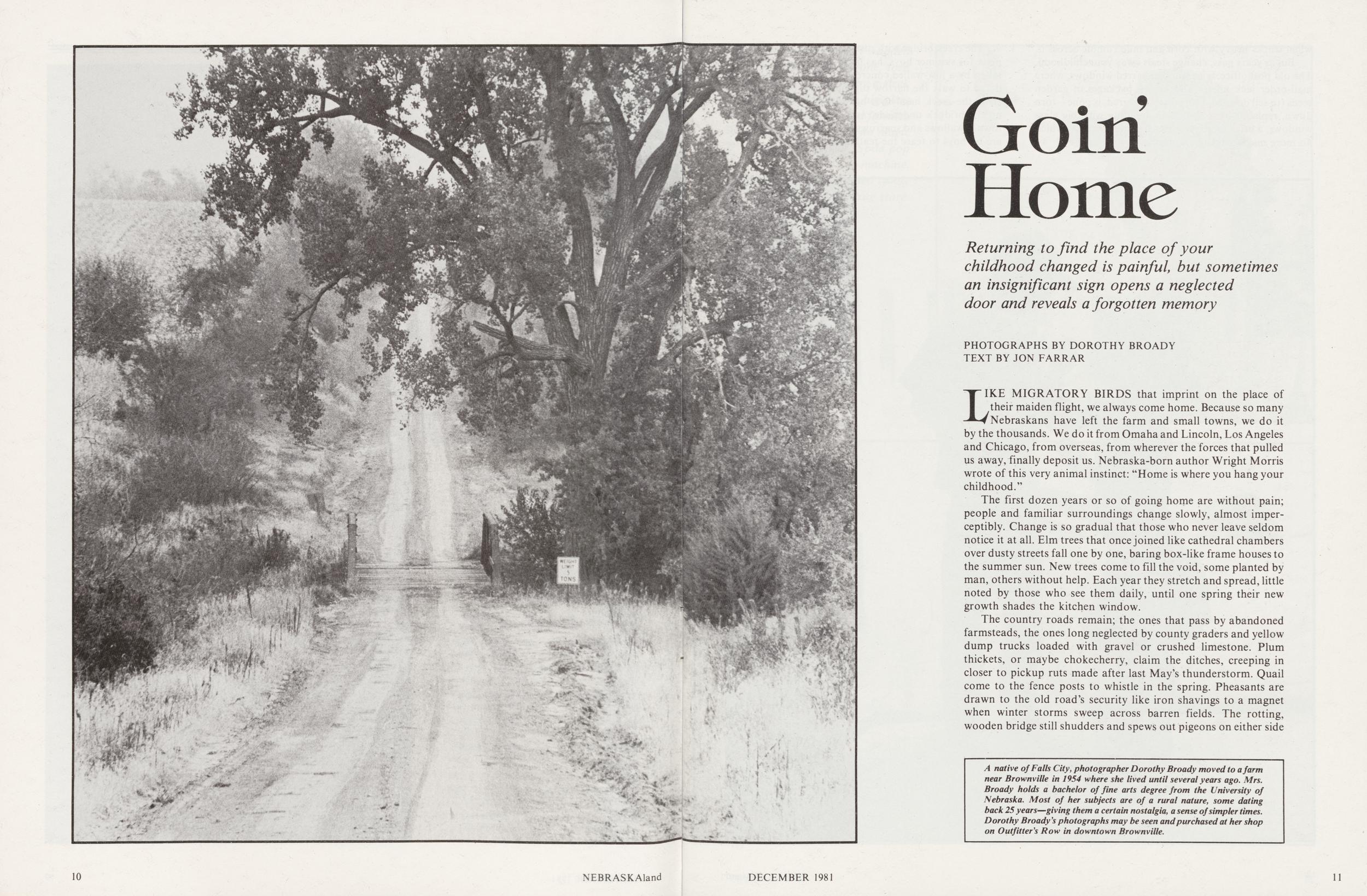
The country roads remain; the ones that pass by abandoned farmsteads, the ones long neglected by county graders and yellow dump trucks loaded with gravel or crushed limestone. Plum thickets, or maybe chokecherry, claim the ditches, creeping in closer to pickup ruts made after last May’s thunderstorm. Quail come to the fence posts to whistle in the spring. Pheasants are drawn to the old road’s security like iron shavings to a magnet when winter storms sweep across barren fields. The rotting, wooden bridge still shudders and spews out pigeons on either side when trucks heavy with corn and milo rumble across it.
A native of Falls City, photographer Dorothy Broody moved to a farm near Brownville in 1954 where she lived until several years ago. Mrs. Broody holds a bachelor of fine arts degree from the University of Nebraska. Most of her subjects are of a rural nature, some dating back 25 years—giving them a certain nostalgia, a sense of simpler times. Dorothy Broody's photographs may be seen and purchased at her shop on Outfitter's Row in downtown Brownville. DECEMBER 1981 11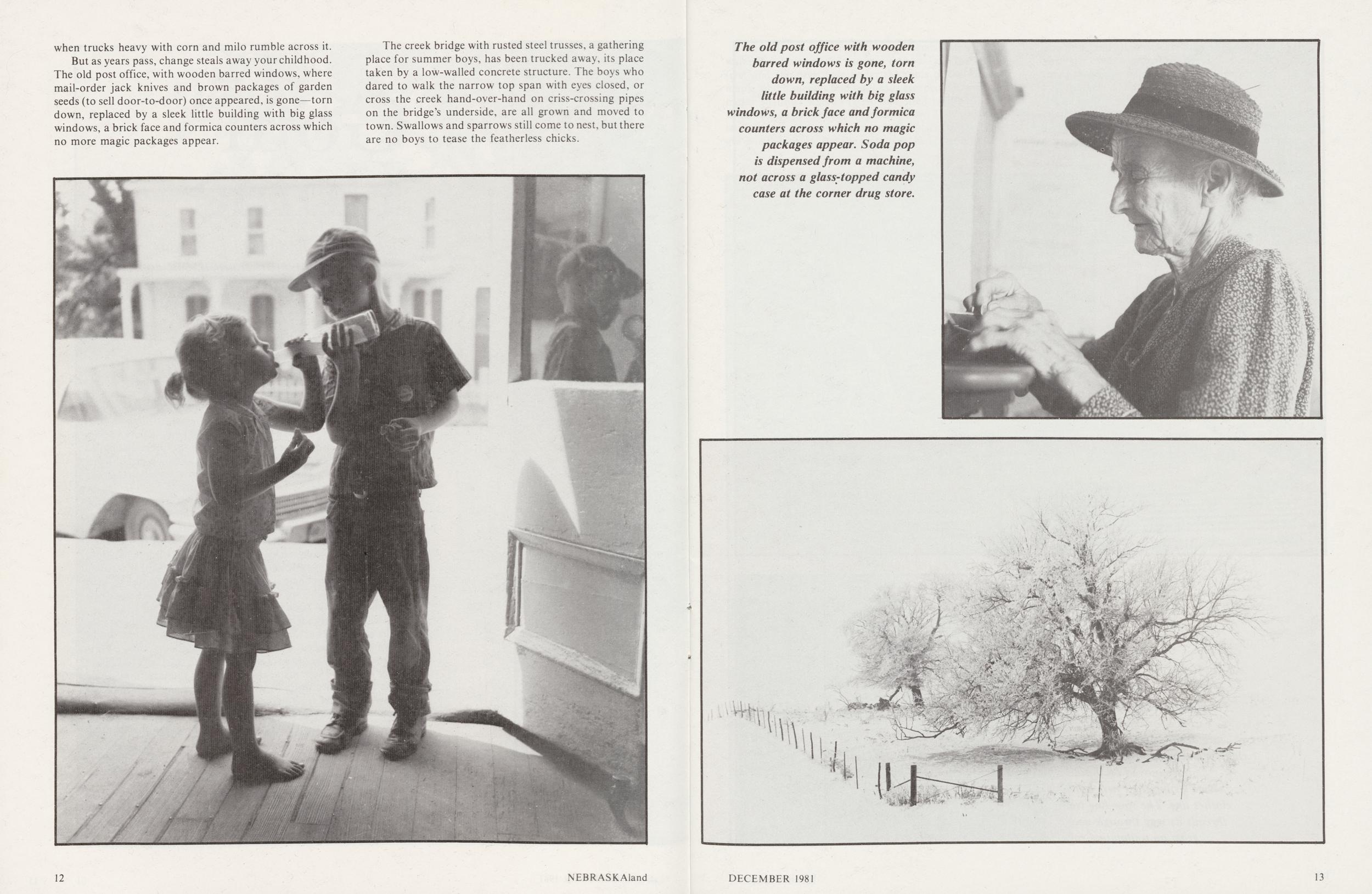
But as years pass, change steals away your childhood. The old post office, with wooden barred windows, where mail-order jack knives and brown packages of garden seeds (to sell door-to-door) once appeared, is gone—torn down, replaced by a sleek little building with big glass windows, a brick face and formica counters across which no more magic packages appear.
The creek bridge with rusted steel trusses, a gathering place for summer boys, has been trucked away, its place taken by a low-walled concrete structure. The boys who dared to walk the narrow top span with eyes closed, or cross the creek hand-over-hand on criss-crossing pipes on the bridge’s underside, are all grown and moved to town. Swallows and sparrows still come to nest, but there are no boys to tease the featherless chicks.
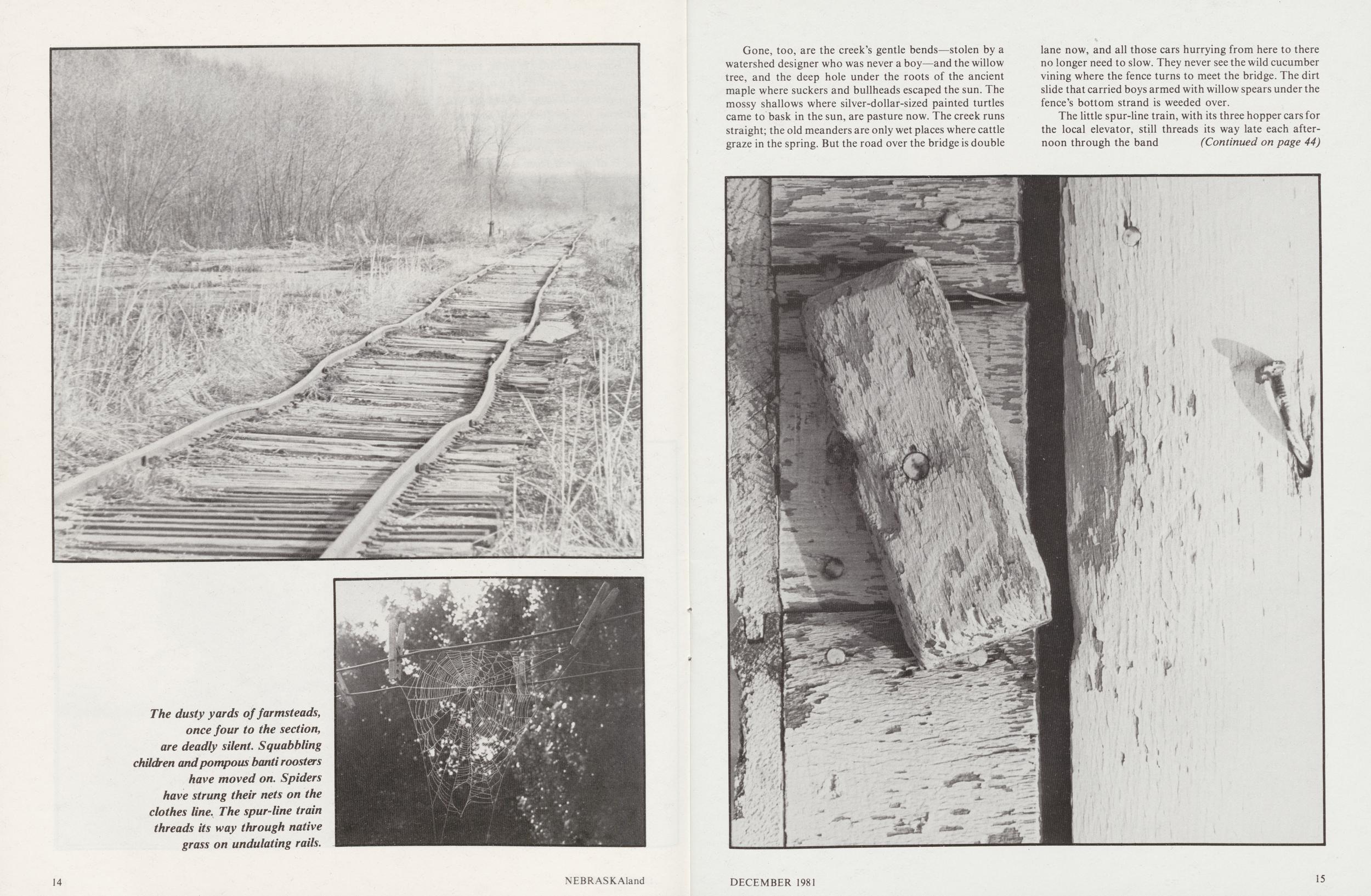
Gone, too, are the creek’s gentle bends—stolen by a watershed designer who was never a boy—and the willow tree, and the deep hole under the roots of the ancient maple where suckers and bullheads escaped the sun. The mossy shallows where silver-dollar-sized painted turtles came to bask in the sun, are pasture now. The creek runs straight; the old meanders are only wet places where cattle graze in the spring. But the road over the bridge is double lane now, and all those cars hurrying from here to there no longer need to slow. They never see the wild cucumber vining where the fence turns to meet the bridge. The dirt slide that carried boys armed with willow spears under the fence’s bottom strand is weeded over.
The little spurline train, with its three hopper cars for the local elevator, still threads its way late each afternoon through the band (Continued on page 44)
Winter's Veneer
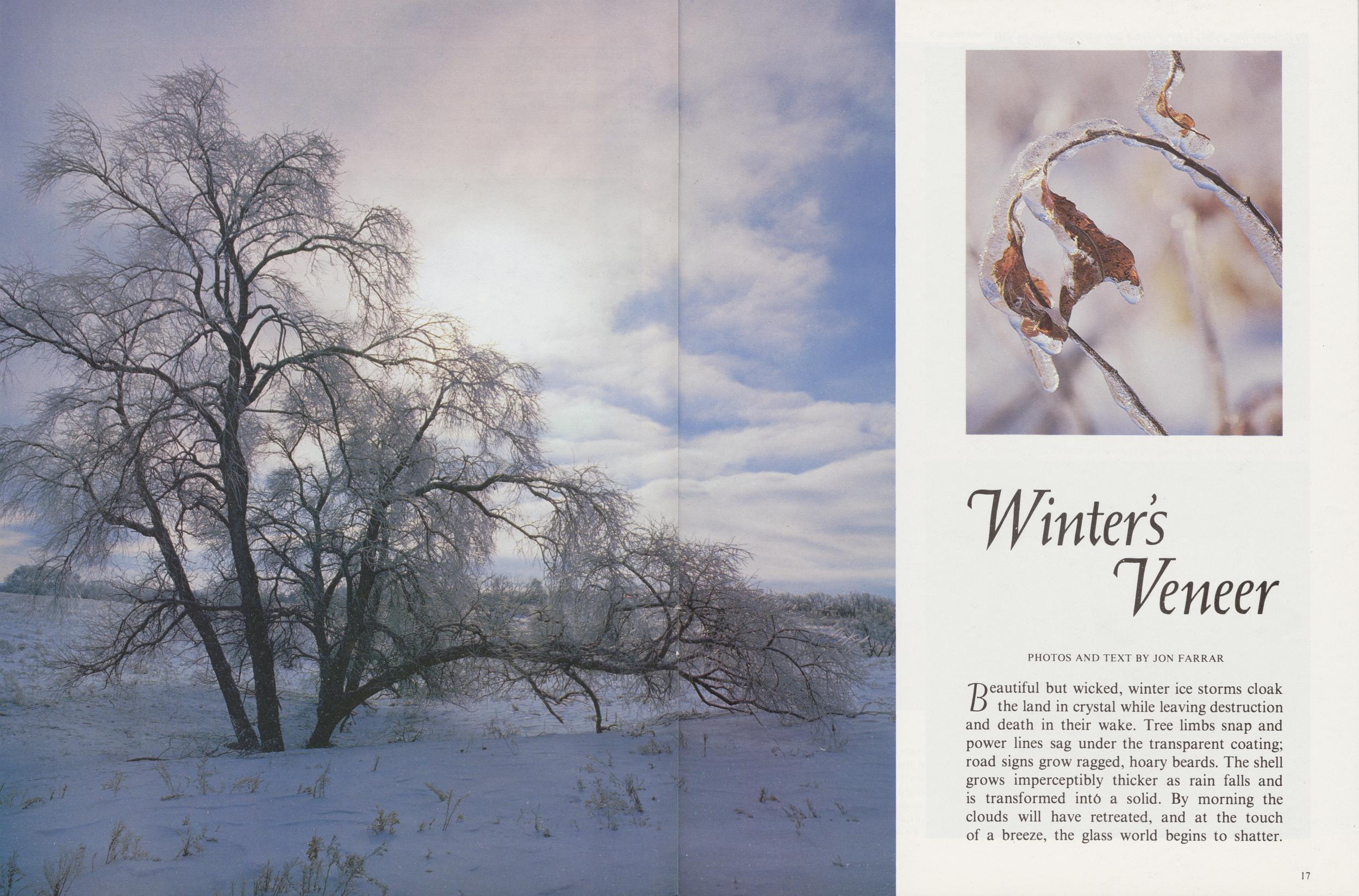
PHOTOS AND TEXT BY JON FARRARBeautiful but wicked, winter ice storms cloak the land in crystal while leaving destruction and death in their wake. Tree limbs snap and power lines sag under the transparent coating; road signs grow ragged, hoary beards. The shell grows imperceptibly thicker as rain falls and is transformed intd a solid. By morning the clouds will have retreated, and at the touch of a breeze, the glass world begins to shatter.
17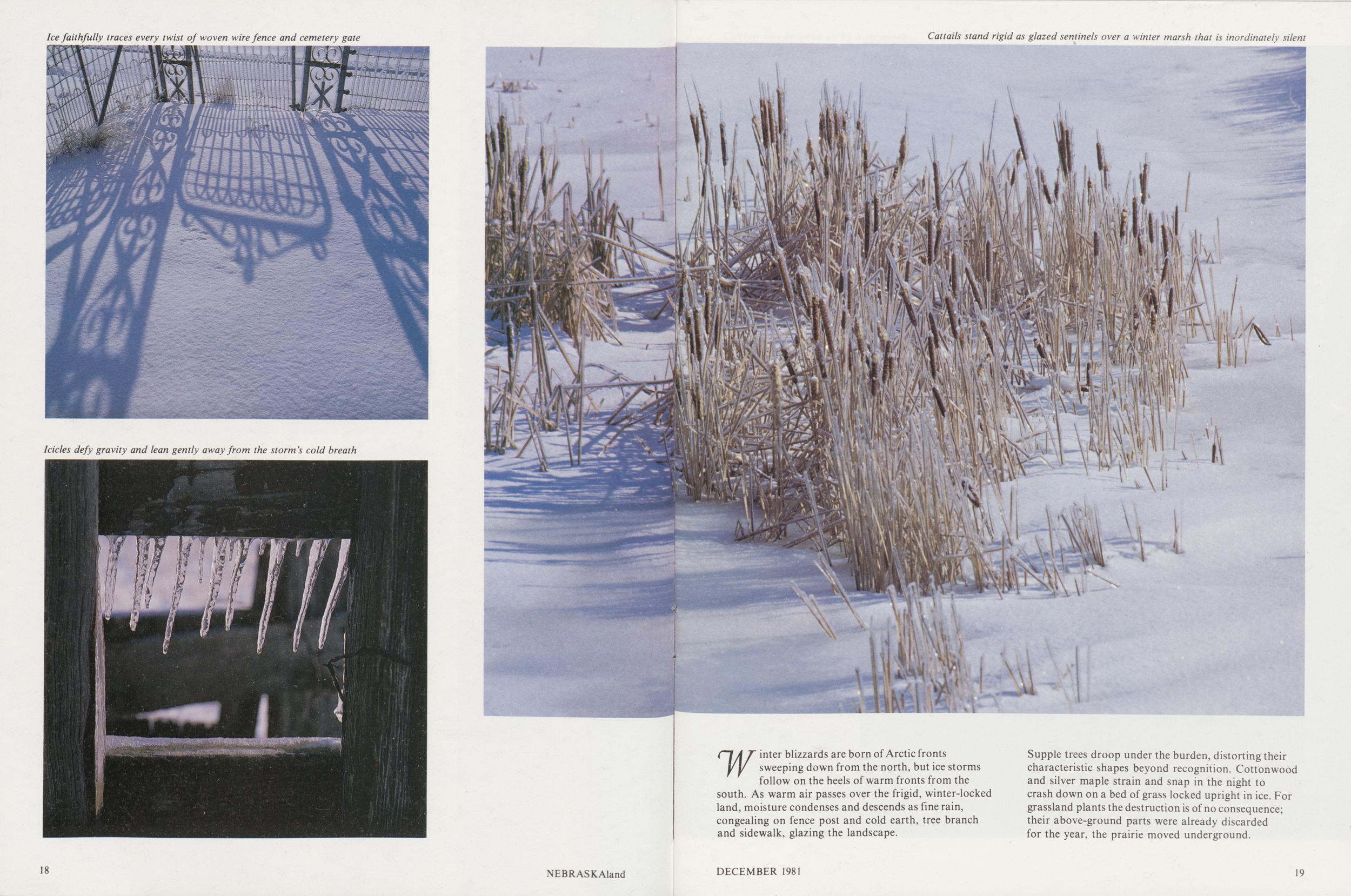
Winter blizzards are born of Arctic fronts \sweeping down from the north, but ice storms follow on the heels of warm fronts from the south. As warm air passes over the frigid, winter-locked land, moisture condenses and descends as fine rain, congealing on fence post and cold earth, tree branch and sidewalk, glazing the landscape. Supple trees droop under the burden, distorting their characteristic shapes beyond recognition. Cottonwood and silver maple strain and snap in the night to crash down on a bed of grass locked upright in ice. For grassland plants the destruction is of no consequence; their above-ground parts were already discarded for the year, the prairie moved underground.
DECEMBER 1981 19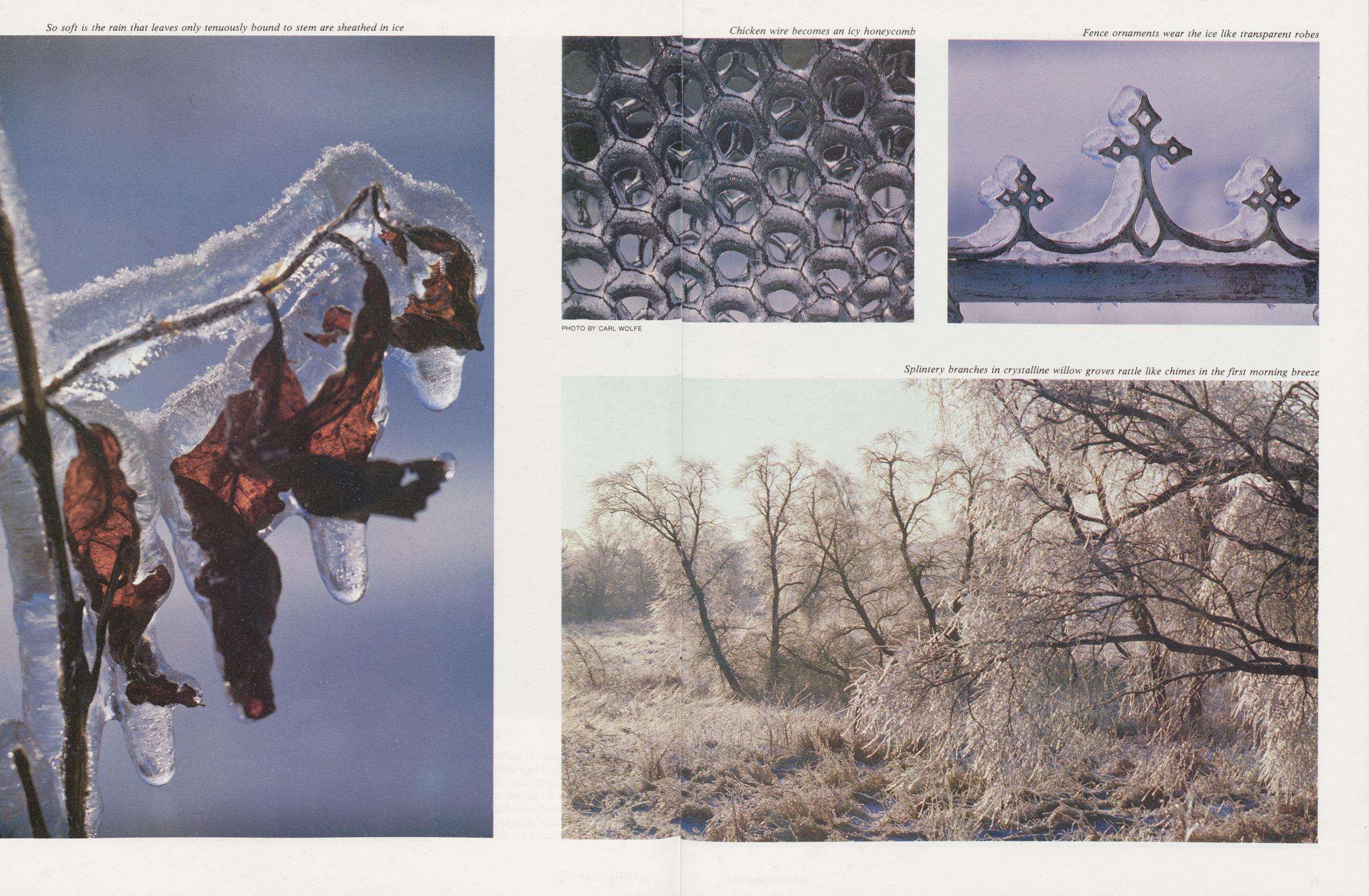
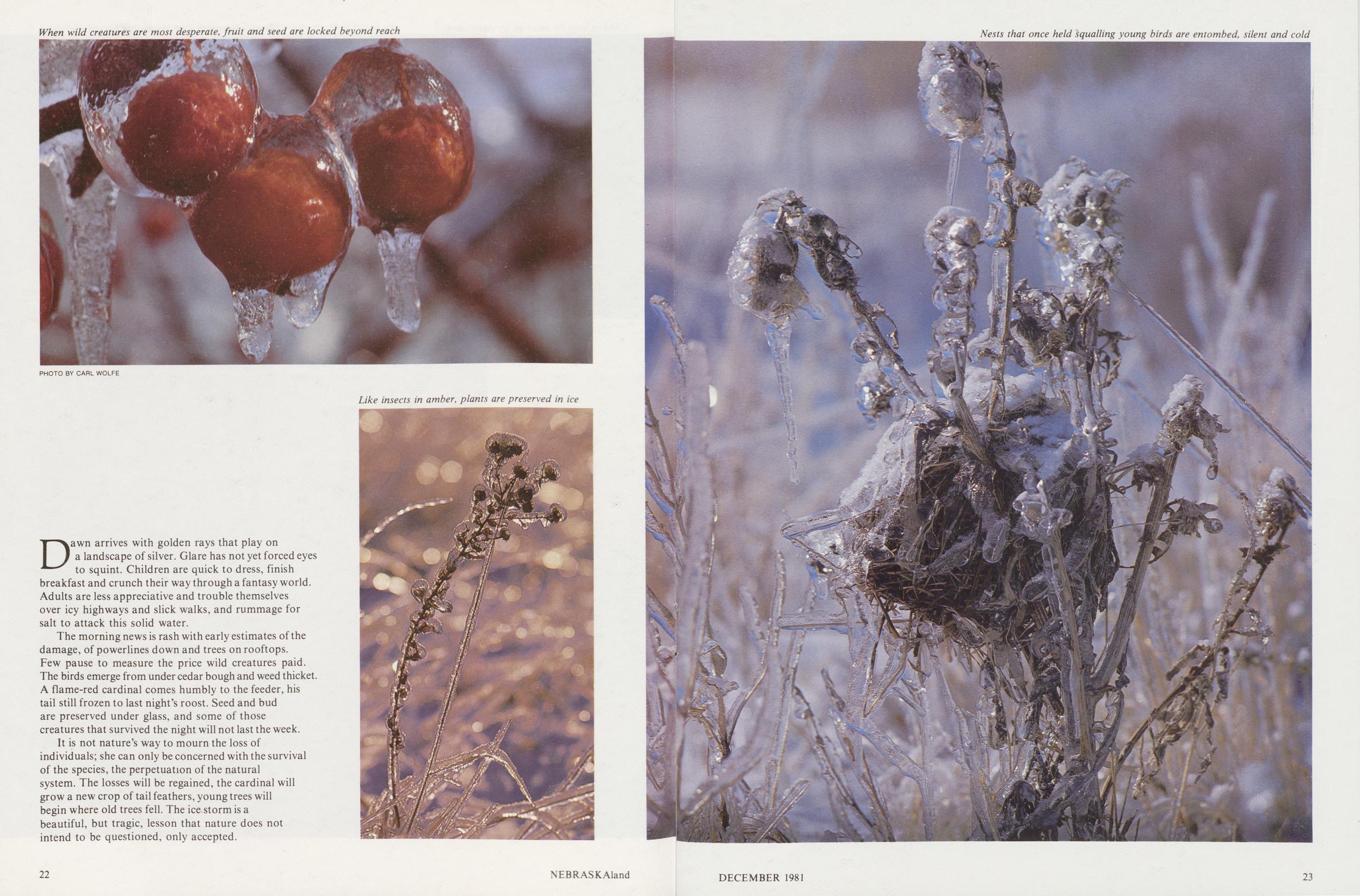
Dawn arrives with golden rays that play on a landscape of silver. Glare has not yet forced eyes to squint. Children are quick to dress, finish breakfast and crunch their way through a fantasy world. Adults are less appreciative and trouble themselves over icy highways and slick walks, and rummage for salt to attack this solid water.
The morning news is rash with early estimates of the damage, of powerlines down and trees on rooftops. Few pause to measure the price wild creatures paid. The birds emerge from under cedar bough and weed thicket. A flame-red cardinal comes humbly to the feeder, his tail still frozen to last night’s roost. Seed and bud are preserved under glass, and some of those creatures that survived the night will not last the week.
It is not nature’s way to mourn the loss of individuals; she can only be concerned with the survival of the species, the perpetuation of the natural system. The losses will be regained, the cardinal will grow a new crop of tail feathers, young trees will begin where old trees fell. The ice storm is a beautiful, but tragic, lesson that nature does not intend to be questioned, only accepted.
22 NEBRASKAland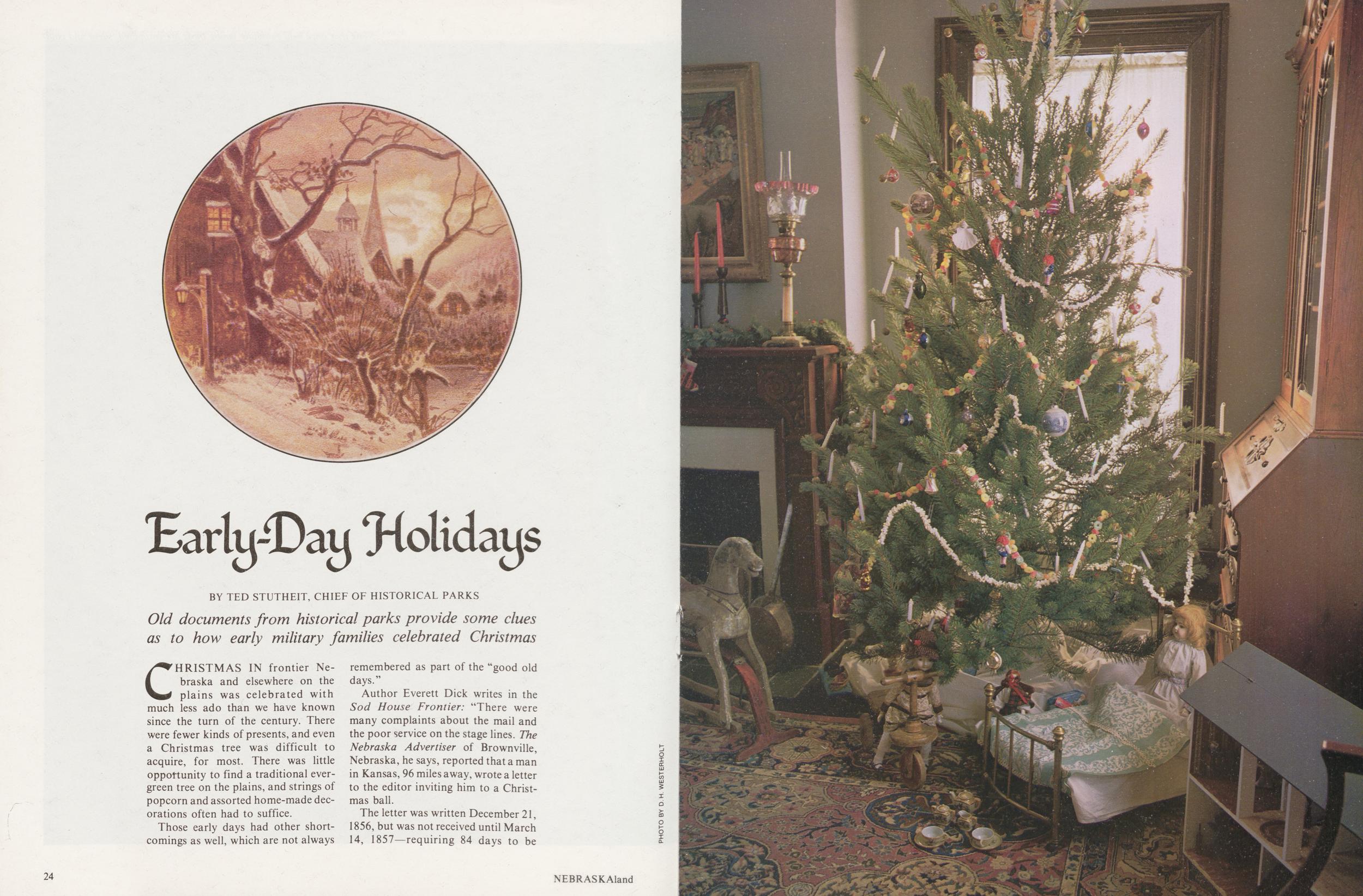
Early-Day ‘Holidays
BY TED STUTHEIT, CHIEF OF HISTORICAL PARKS Old documents from historical parks provide some clues as to how early military families celebrated ChristmasCHRISTMAS IN frontier Nebraska and elsewhere on the plains was celebrated with much less ado than we have known since the turn of the century. There were fewer kinds of presents, and even a Christmas tree was difficult to acquire, for most. There was little opportunity to find a traditional evergreen tree on the plains, and strings of popcorn and assorted home-made decorations often had to suffice.
Those early days had other shortcomings as well, which are not always remembered as part of the “good old days.”
Author Everett Dick writes in the Sod House Frontier: “There were many complaints about the mail and the poor service on the stage lines. The Nebraska Advertiser of Brownville, Nebraska, he says, reported that a man in Kansas, 96 miles away, wrote a letter to the editor inviting him to a Christmas ball.
The letter was written December 21, 1856, but was not received until March 14, 1857—requiring 84 days to be 24 NEBRASKAland
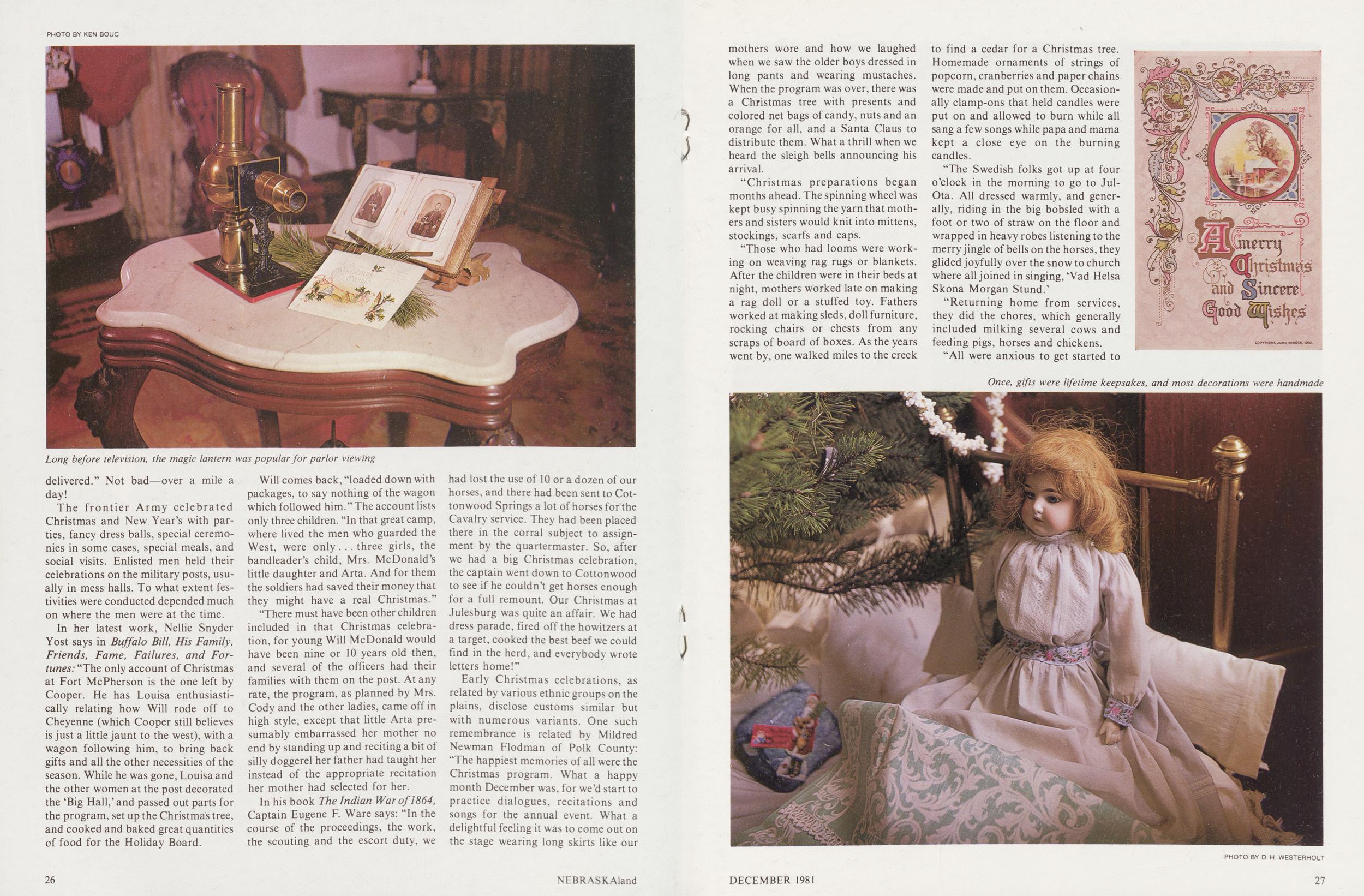
The frontier Army celebrated Christmas and New Year’s with parties, fancy dress balls, special ceremonies in some cases, special meals, and social visits. Enlisted men held their celebrations on the military posts, usually in mess halls. To what extent festivities were conducted depended much on where the men were at the time.
In her latest work, Nellie Snyder Yost says in Buffalo Bill, His Family, Friends, Fame, Failures, and Fortunes: “The only account of Christmas at Fort McPherson is the one left by Cooper. He has Louisa enthusiastically relating how Will rode off to Cheyenne (which Cooper still believes is just a little jaunt to the west), with a wagon following him, to bring back gifts and all the other necessities of the season. While he was gone, Louisa and the other women at the post decorated the ‘Big Hall,’ and passed out parts for the program, set up the Christmas tree, and cooked and baked great quantities of food for the Holiday Board.
Will comes back, “loaded down with packages, to say nothing of the wagon which followed him.” The account lists only three children. “In that great camp, where lived the men who guarded the West, were only . . . three girls, the bandleader’s child, Mrs.. McDonald’s little daughter and Arta. And for them the soldiers had saved their money that they might have a real Christmas.”
“There must have been other children included in that Christmas celebration, for young Will McDonald would have been nine or 10 years old then, and several of the officers had their families with them on the post. At any rate, the program, as planned by Mrs. Cody and the other ladies, came off in high style, except that little Arta presumably embarrassed her mother no end by standing up and reciting a bit of silly doggerel her father had taught her instead of the appropriate recitation her mother had selected for her.
In his book The Indian War of1864, Captain Eugene F. Ware says: “In the course of the proceedings, the work, the scouting and the escort duty, we had lost the use of 10 or a dozen of our horses, and there had been sent to Cottonwood Springs a lot of horses for the Cavalry service. They had been placed there in the corral subject to assignment by the quartermaster. So, after we had a big Christmas celebration, the captain went down to Cottonwood to see if he couldn’t get horses enough for a full remount. Our Christmas at Julesburg was quite an affair. We had dress parade, fired off the howitzers at a target, cooked the best beef we could find in the herd, and everybody wrote letters home!”
Early Christmas celebrations, as related by various ethnic groups on the plains, disclose customs similar but with numerous variants. One such remembrance is related by Mildred Newman Flodman of Polk County: “The happiest memories of all were the Christmas program. What a happy month December was, for we’d start to practice dialogues, recitations and songs for the annual event. What a delightful feeling it was to come out on the stage wearing long skirts like our 26 NEBRASKAland mothers wore and how we laughed when we saw the older boys dressed in long pants and wearing mustaches. When the program was over, there was a Christmas tree with presents and colored net bags of candy, nuts and an orange for all, and a Santa Claus to distribute them. What a thrill when we heard the sleigh bells announcing his arrival.
“Christmas preparations began months ahead. The spinning wheel was kept busy spinning the yarn that mothers and sisters would knit into mittens, stockings, scarfs and caps.
“Those who had looms were working on weaving rag rugs or blankets. After the children were in their beds at night, mothers worked late on making a rag doll or a stuffed toy. Fathers worked at making sleds, doll furniture, rocking chairs or chests from any scraps of board of boxes. As the years went by, one walked miles to the creek to find a cedar for a Christmas tree. Homemade ornaments of strings of popcorn, cranberries and paper chains were made and put on them. Occasionally clamp-ons that held candles were put on and allowed to burn while all sang a few songs while papa and mama kept a close eye on the burning candles.
“The Swedish folks got up at four o’clock in the morning to go to JulOta. All dressed warmly, and generally, riding in the big bobsled with a foot or two of straw on the floor and wrapped in heavy robes listening to the merry jingle of bells on the horses, they glided joyfully over the snow to church where all joined in singing, ‘Vad Helsa Skona Morgan Stund.’
“Returning home from services, they did the chores, which generally included milking several cows and feeding pigs, horses and chickens.
“All were anxious to get started to
“Christmas was the only time we ever had oranges and nuts. After dinner, gifts were exchanged. Grandma always gave us warm knitted mittens and scarves. She always gave papa and the boys knitted socks. After the gifts were unwrapped the boys liked to take off for hunting or skating. We started home early as there were the evening chores to do and then we were off to church for our Sunday School program that evening.”
Christmas holiday time, like Easter, 4th of July and Thanksgiving, was a special time and a good reason to visit and socialize. Regardless of economic conditions, drought, or other hardships, parents took great pride in providing the best they could for their families. Writing in the Berwyn (Custer County), Nebraska Heritage Book Muddy Creek Meanderings, Kathryn McCaslin and Gwen Olson tell of their parents’ devotion: “Our new dress material usually came from Braggs Store in Comstock, Pirnie’s Store at Weissert or Westerville. Mrs. O. W. Riddle (Comstock) worked at Braggs and she tells us Mom would call in and say ‘pick out some print for the girls’ dresses and send it out on the mail.’ A kerosene lamp isn’t very good light to sew by, but we remember Mom treadling the machine into the wee hours of the morning. We didn’t have many clothes, but we always had a new (to us, at least) Christmas dress.”
Occasionally a jewel of a written document will surface. Such is a letter written by the wife of Lieutenant Thadeus H. Capron of Wisconsin who started his military service in the Civil War in 1861 with the 55th Illinois Infantry as a private, attaining the rank of major before being discharged at war’s end. Re-enlisting, he served as a lieutenant at Fort Hartsuff in 1874, 1875, 1879, 1880 and 1881, and lived in the officers’ quarters with his family. The lieutenant’s wife’s letter tells about Christmas (1874):
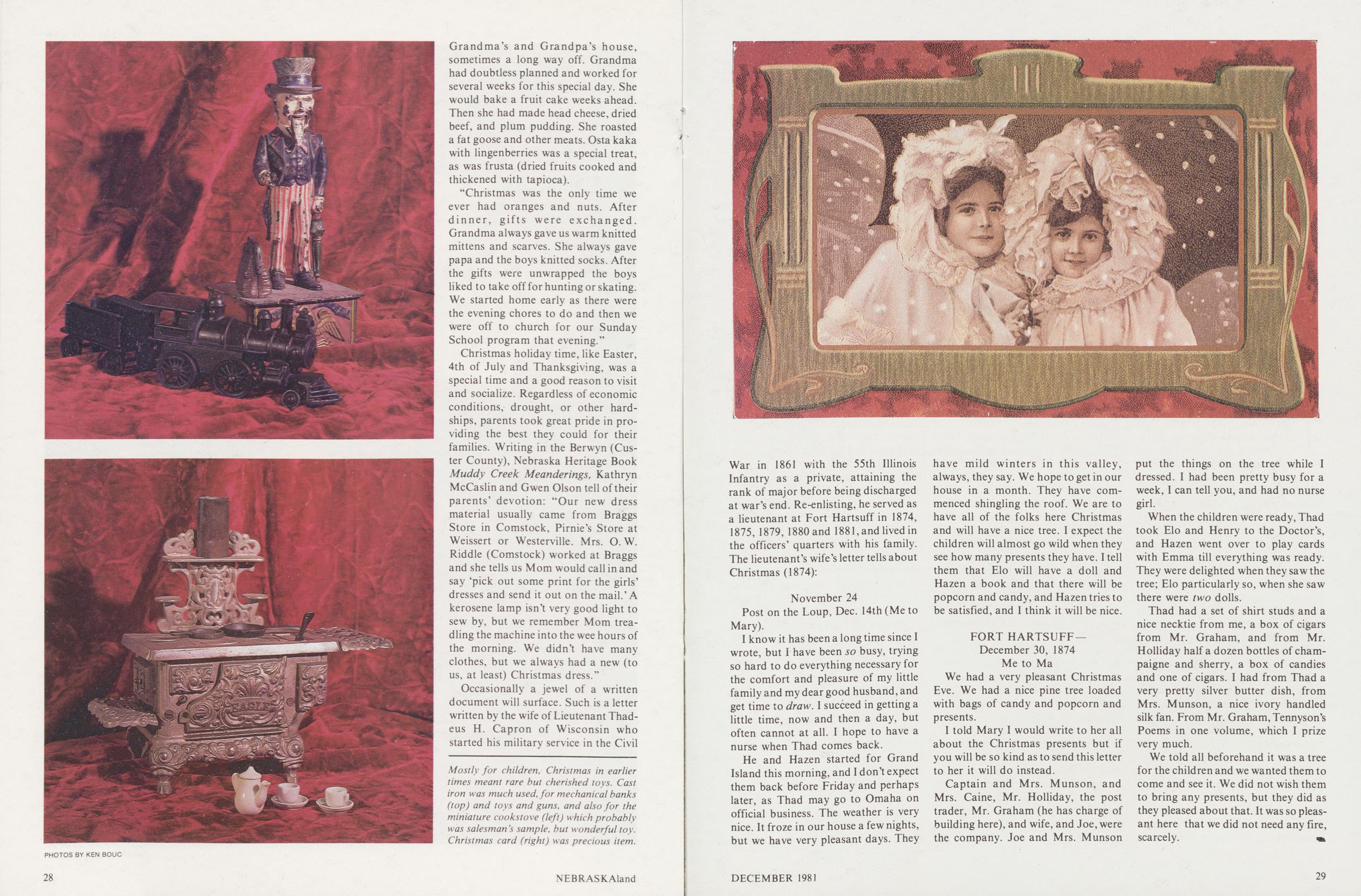
Mostly for children, Christmas in earlier times meant rare but cherished toys. Cast iron was much used, for mechanical banks (top) and toys and guns, and also for the miniature cookstove (left) which probably was salesman’s sample, but wonderful toy. Christmas card (right) was precious item. 28 NEBRASKAlandPost on the Loup, Dec. 14th (Me to Mary).
I know it has been a long time since I wrote, but I have been so busy, trying so hard to do everything necessary for the comfort and pleasure of my little family and my dear good husband, and get time to draw. I succeed in getting a little time, now and then a day, but often cannot at all. I hope to have a nurse when Thad comes back.
He and Hazen started for Grand Island this morning, and I don’t expect them back before Friday and perhaps later, as Thad may go to Omaha on official business. The weather is very nice. It froze in our house a few nights, but we have very pleasant days. They have mild winters in this valley, always, they say. We hope to get in our house in a month. They have com- menced shingling the roof. We are to have all of the folks here Christmas and will have a nice tree. I expect the children will almost go wild when they see how many presents they have. I tell them that Elo will have a doll and Hazen a book and that there will be popcorn and candy, and Hazen tries to be satisfied, and I think it will be nice.
FORT HARTSUFF— December 30, 1874 Me to MaWe had a very pleasant Christmas Eve. We had a nice pine tree loaded with bags of candy and popcorn and presents.
I told Mary I would write to her all about the Christmas presents but if you will be so kind as to send this letter to her it will do instead.
Captain and Mrs. Munson, and Mrs. Caine, Mr. Holliday, the post trader, Mr. Graham (he has charge of building here), and wife, and Joe, were the company. Joe and Mrs. Munson put the things on the tree while I dressed. I had been pretty busy for a week, I can tell you, and had no nurse girl.
When the children were ready, Thad took Elo and Henry to the Doctor’s, and Hazen went over to play cards with Emma till everything was ready. They were delighted when they saw the tree; Elo particularly so, when she saw there were two dolls.
Thad had a set of shirt studs and a nice necktie from me, a box of cigars from Mr. Graham, and from Mr. Holliday half a dozen bottles of champaigne and sherry, a box of candies and one of cigars. I had from Thad a very pretty silver butter dish, from Mrs. Munson, a nice ivory handled silk fan. From Mr. Graham, Tennyson’s Poems in one volume, which I prize very much.
We told all beforehand it was a tree for the children and we wanted them to come and see it. We did not wish them to bring any presents, but they did as they pleased about that. It was so pleasant here that we did not need any fire, scarcely.
DECEMBER 1981 29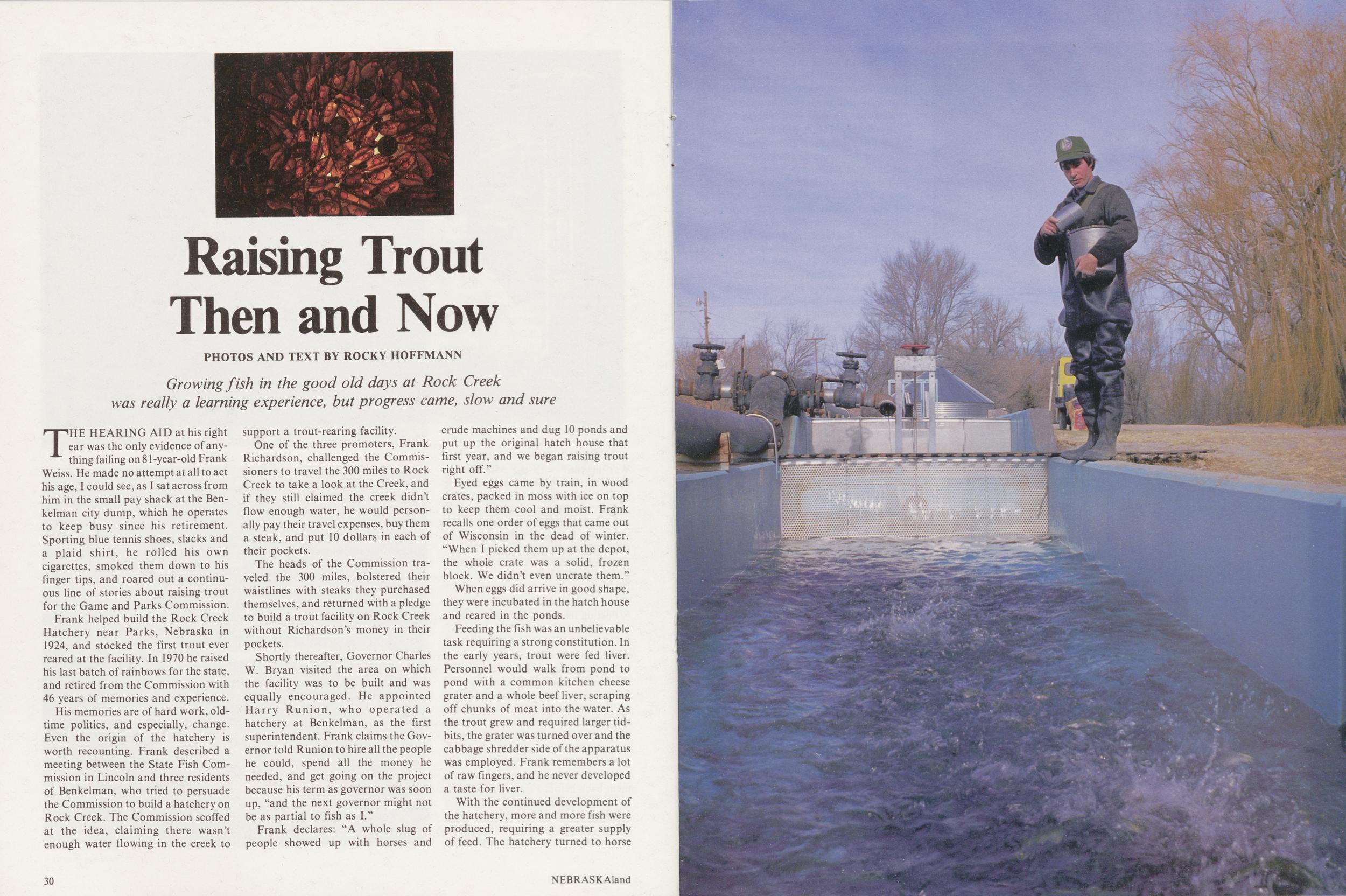
Raising Trout Then and Now
PHOTOS AND TEXT BY ROCKY HOFFMANN Growing fish in the good old days at Rock Creek was really a learning experience, but progress came, slow and sureTHE HEARING AID at his right ear was the only evidence of anything failing on 81-year-old Frank Weiss. He made no attempt at all to act his age, I could see, as I sat across from him in the small pay shack at the Benkelman city dump, which he operates to keep busy since his retirement. Sporting blue tennis shoes, slacks and a plaid shirt, he rolled his own cigarettes, smoked them down to his finger tips, and roared out a continuous line of stories about raising trout for the Game and Parks Commission.
Frank helped build the Rock Creek Hatchery near Parks, Nebraska in 1924, and stocked the first trout ever reared at the facility. In 1970 he raised his last batch of rainbows for the state, and retired from the Commission with 46 years of memories and experience.
His memories are of hard work, old-time politics, and especially, change. Even the origin of the hatchery is worth recounting. Frank described a meeting between the State Fish Commission in Lincoln and three residents of Benkelman, who tried to persuade the Commission to build a hatchery on Rock Creek. The Commission scoffed at the idea, claiming there wasn’t enough water flowing in the creek to support a trout-rearing facility.
One of the three promoters, Frank Richardson, challenged the Commissioners to travel the 300 miles to Rock Creek to take a look at the Creek, and if they still claimed the creek didn’t flow enough water, he would personally pay their travel expenses, buy them a steak, and put 10 dollars in each of their pockets.
The heads of the Commission traveled the 300 miles, bolstered their waistlines with steaks they purchased themselves, and returned with a pledge to build a trout facility on Rock Creek without Richardson’s money in their pockets.
Shortly thereafter, Governor Charles W. Bryan visited the area on which the facility was to be built and was equally encouraged. He appointed Harry Runion, who operated a hatchery at Benkelman, as the first superintendent. Frank claims the Governor told Runion to hire all the people he could, spend all the money he needed, and get going on the project because his term as governor was soon up, “and the next governor might not be as partial to fish as I.”
Frank declares: “A whole slug of people showed up with horses and crude machines and dug 10 ponds and put up the original hatch house that first year, and we began raising trout right off.”
Eyed eggs came by train, in wood crates, packed in moss with ice on top to keep them cool and moist. Frank recalls one order of eggs that came out of Wisconsin in the dead of winter. “When I picked them up at the depot, the whole crate was a solid, frozen block. We didn’t even uncrate them.”
When eggs did arrive in good shape, they were incubated in the hatch house and reared in the ponds.
Feeding the fish was an unbelievable task requiring a strong constitution. In the early years, trout were fed liver. Personnel would walk from pond to pond with a common kitchen cheese grater and a whole beef liver, scraping off chunks of meat into the water. As the trout grew and required larger tidbits, the grater was turned over and the cabbage shredder side of the apparatus was employed. Frank remembers a lot of raw fingers, and he never developed a taste for liver.
With the continued development of the hatchery, more and more fish were produced, requiring a greater supply of feed. The hatchery turned to horse 30 NEBRASKAland
 meat, butchered in Benkelman, and
the meat was ground up at the
hatchery in a small building with a dirt
floor. There was no refrigeration at
that time, and often the meat arrived
spoiled and infested with maggots.
meat, butchered in Benkelman, and
the meat was ground up at the
hatchery in a small building with a dirt
floor. There was no refrigeration at
that time, and often the meat arrived
spoiled and infested with maggots.
It was then Frank discovered that trout loved maggots and seemed to thrive on them, and he quickly put this natural food concept to work.
“I designed a wooden box with hail screen on the top and bottom, which I suspended over the ponds. We’d shoot a few jackrabbits and put them in the boxes and leave the rest to the flies.”
As the maggots developed, they’d drop from the box and the trout fed on them. This was probably the first automatic trout feeder ever designed, but Frank wasn’t finished pioneering ideas in the field of trout nourishment.
In 1948, after 24 years of grating liver, grinding spoiled horse meat and propagating maggots, Frank decided there must be a more appealing method of raising trout. Following a few meetings with the mill operator in Benkelman, Frank began experimenting with a dehydrated pellet feed made from tankage and vegetable matter, which he had formulated.
“The federal trout hatchery superintendent then at Crawford ridiculed me,” Frank remembers. “He said that my fish would die from dehydration if not given raw meat.” But Frank’s fish didn’t dehydrate and they didn’t die. In fact, they thrived, and pelleted feed is now used in every fish hatchery in the country, including the federal hatchery at Crawford.
When the trout were ready for stocking, the size of the fish would determine the method of transportation. Fingerling fish were hauled in cream cans with holes drilled in the lids. Ice was placed on the top of the cans and the sloshing action helped aerate the water.
Larger fish were hauled in tanks on big trucks, and the water was oxygenated by pumping air with small engines. Many fish were lost due to equipment failure and overcrowding, though.
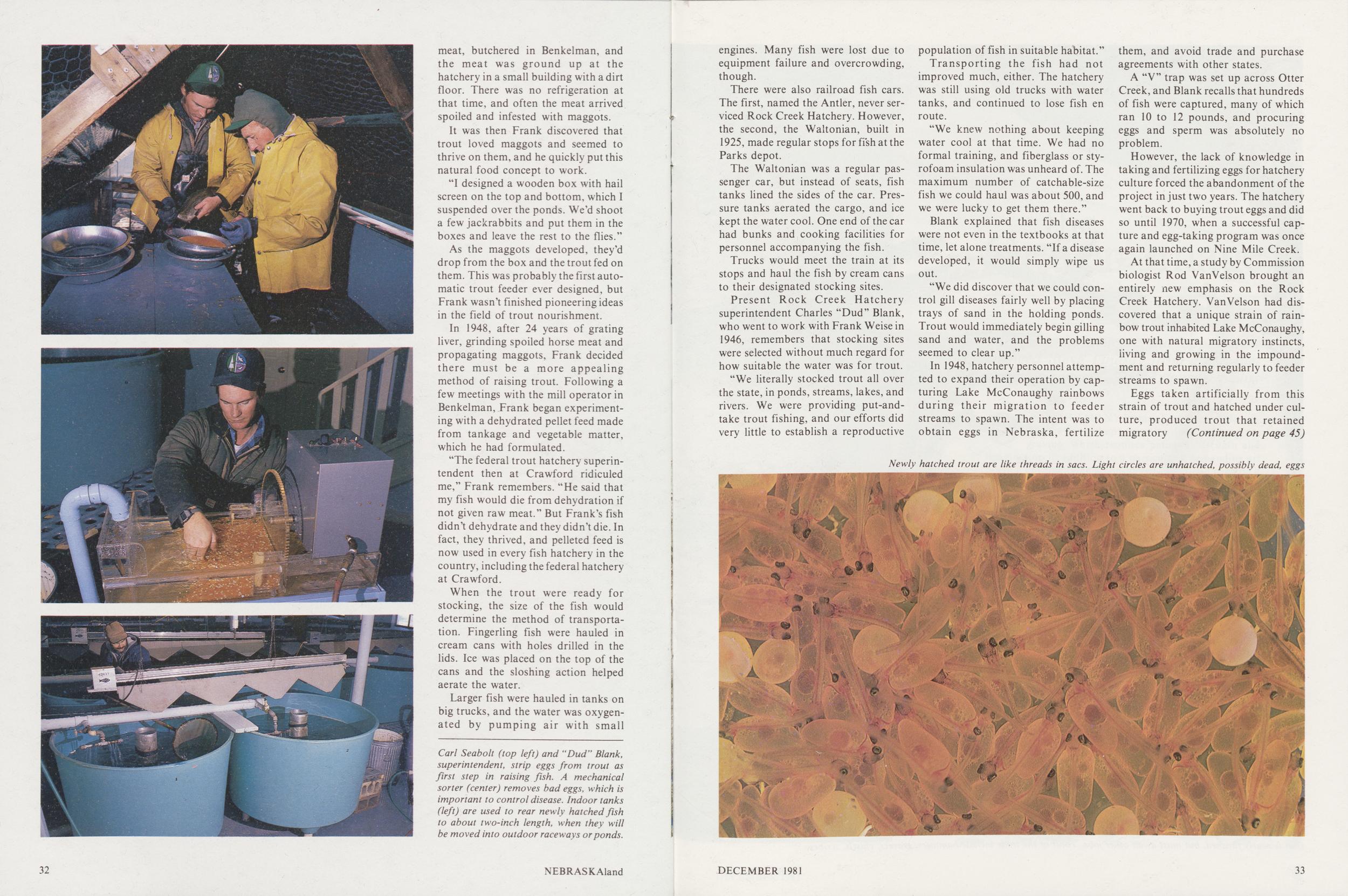
Carl Seabolt (top left) and “Dud” Blank, superintendent, strip eggs from trout as first step in raising fish. A mechanical sorter (center) removes bad eggs, which is important to control disease. Indoor tanks (left) are used to rear newly hatched fish to about two-inch length, when they will be moved into outdoor raceways or ponds. 32 NEBRASKAlandThere were also railroad fish cars. The first, named the Antler, never serviced Rock Creek Hatchery. However, the second, the Waltonian, built in 1925, made regular stops for fish at the Parks depot.
The Waltonian was a regular passenger car, but instead of seats, fish tanks lined the sides of the car. Pressure tanks aerated the cargo, and ice kept the water cool. One end of the car had bunks and cooking facilities for personnel accompanying the fish.
Trucks would meet the train at its stops and haul the fish by cream cans to their designated stocking sites.
Present Rock Creek Hatchery superintendent Charles “Dud” Blank, who went to work with Frank Weise in 1946, remembers that stocking sites were selected without much regard for how suitable the water was for trout.
“We literally stocked trout all over the state, in ponds, streams, lakes, and rivers. We were providing put-and- take trout fishing, and our efforts did very little to establish a reproductive population of fish in suitable habitat.”
Transporting the fish had not improved much, either. The hatchery was still using old trucks with water tanks, and continued to lose fish en route.
“We knew nothing about keeping water cool at that time. We had no formal training, and fiberglass or styrofoam insulation was unheard of. The maximum number of catchable-size fish we could haul was about 500, and we were lucky to get them there.”
Blank explained that fish diseases were not even in the textbooks at that time, let alone treatments. “If a disease developed, it would simply wipe us out.
“We did discover that we could control gill diseases fairly well by placing trays of sand in the holding ponds. Trout would immediately begin gilling sand and water, and the problems seemed to clear up.”
In 1948, hatchery personnel attempted to expand their operation by capturing Lake McConaughy rainbows during their migration to feeder streams to spawn. The intent was to obtain eggs in Nebraska, fertilize them, and avoid trade and purchase agreements with other states.
A “V” trap was set up across Otter Creek, and Blank recalls that hundreds of fish were captured, many of which ran 10 to 12 pounds, and procuring eggs and sperm was absolutely no problem.
However, the lack of knowledge in taking and fertilizing eggs for hatchery culture forced the abandonment of the project in just two years. The hatchery went back to buying trout eggs and did so until 1970, when a successful capture and egg-taking program was once again launched on Nine Mile Creek.
At that time, a study by Commission biologist Rod VanVelson brought an entirely new emphasis on the Rock Creek Hatchery. VanVelson had discovered that a unique strain of rainbow trout inhabited Lake McConaughy, one with natural migratory instincts, living and growing in the impoundment and returning regularly to feeder streams to spawn.
Eggs taken artificially from this strain of trout and hatched under culture, produced trout that retained migratory (Continued on page 45)
the Graven Image
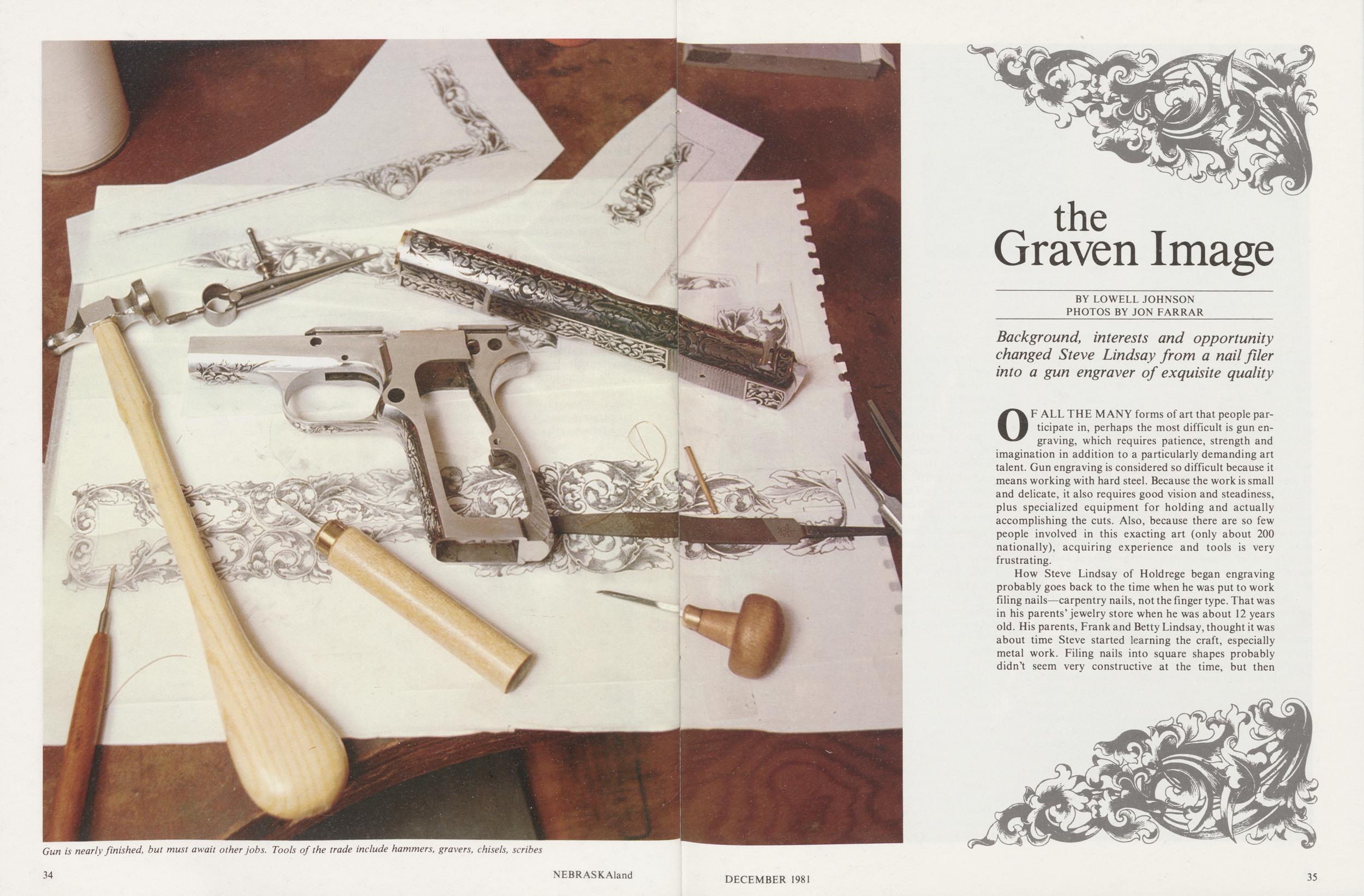
BY LOWELL JOHNSON PHOTOS BY JON FARRAR Background, interests and opportunity changed Steve Lindsay from a nail filer into a gun engraver of exquisite qualityOF ALL THE MANY forms of art that people participate in, perhaps the most difficult is gun engraving, which requires patience, strength and imagination in addition to a particularly demanding art talent. Gun engraving is considered so difficult because it means working with hard steel. Because the work is small and delicate, it also requires good vision and steadiness, plus specialized equipment for holding and actually accomplishing the cuts. Also, because there are so few people involved in this exacting art (only about 200 nationally), acquiring experience and tools is very frustrating.
How Steve Lindsay of Holdrege began engraving
probably goes back to the time when he was put to work
filing nails—carpentry nails, not the finger type. That was
in his parents’ jewelry store when he was about 12 years
old. His parents, Frank and Betty Lindsay, thought it was
about time Steve started learning the craft, especially
metal work. Filing nails into square shapes probably
didn’t seem very constructive at the time, but then
DECEMBER 1981
35
About that same time, Steve did some work on an engraving machine, one of those things with the motor and router bit which carves names on trophy plates, charms and bracelets. While these machines are fun to run, they do not allow much creativity because they are guided by templates.
Some families tend to be more artistic than others, and Steve was fortunate in this regard. His great grandfather, A. R. “Doc” Weaver of Harvard, was a watchmaker, jeweler and engraver. Steve’s grandfather, Frank Lindsay of Hastings, was a fine artist who taught classes and did designing. And, his father is a quiet, multi-talented man—a master goldsmith and diamond setter who has designed and created many beautiful pieces of jewelry. He is also a fine watchmaker and trained gemologist, and has some inate mechanical knack which enables him to design and machine equipment.
Thus, when Steve was about 12, he spent much of his spare time drawing animals, comic characters and people. It was also at the age of 12 that Steve began hunting, and from the beginning he loved the sport and guns. When he showed an interest in and aptitude for art, his father was delighted.
With an apt pupil in the shop, Frank doubtless devoted much time to developing these abilities in Steve, but it was several years before Steve first took up a hand graver. Such equipment was always in the shop, and one day he “whittled” some initials on a brass plate. While hardly a masterpiece, the task intrigued and attracted him, and from that time on he was a serious student.
In 1975 he telephoned an expert engraver, John Rohner, who invited him to visit his shop in Boulder, Colo., and contributed much to his interest by giving him advice and training. Meeting such a notable in the trade was a memorable experience for him, Steve says, but there was still much more to come.
To learn more, he read and reread The Art of Engraving by Bruce Meeks, and eventually phoned him to ask questions. This was later followed by a visit to him in the summer of 1975, and more knowledge was garnered— along with some advice to get as much background in steel working as possible.
Not wasting the advice, Steve enrolled at the Milford campus of Southeast Community College in the tool and die section. He graduated in 1979 totally commited to being an engraver, that decision finalized following two other meetings. These were with two of the finest engravers in the U.S., Winston Churchill and Lynton McKenzie, both of whom he met at a National Rifle Association convention in Cincinnati in 1978. Both men were supportive and helpful, and certainly Steve has been no disappointment to them. His work now, after only a couple of years of serious practice, appears to need no more improvement.
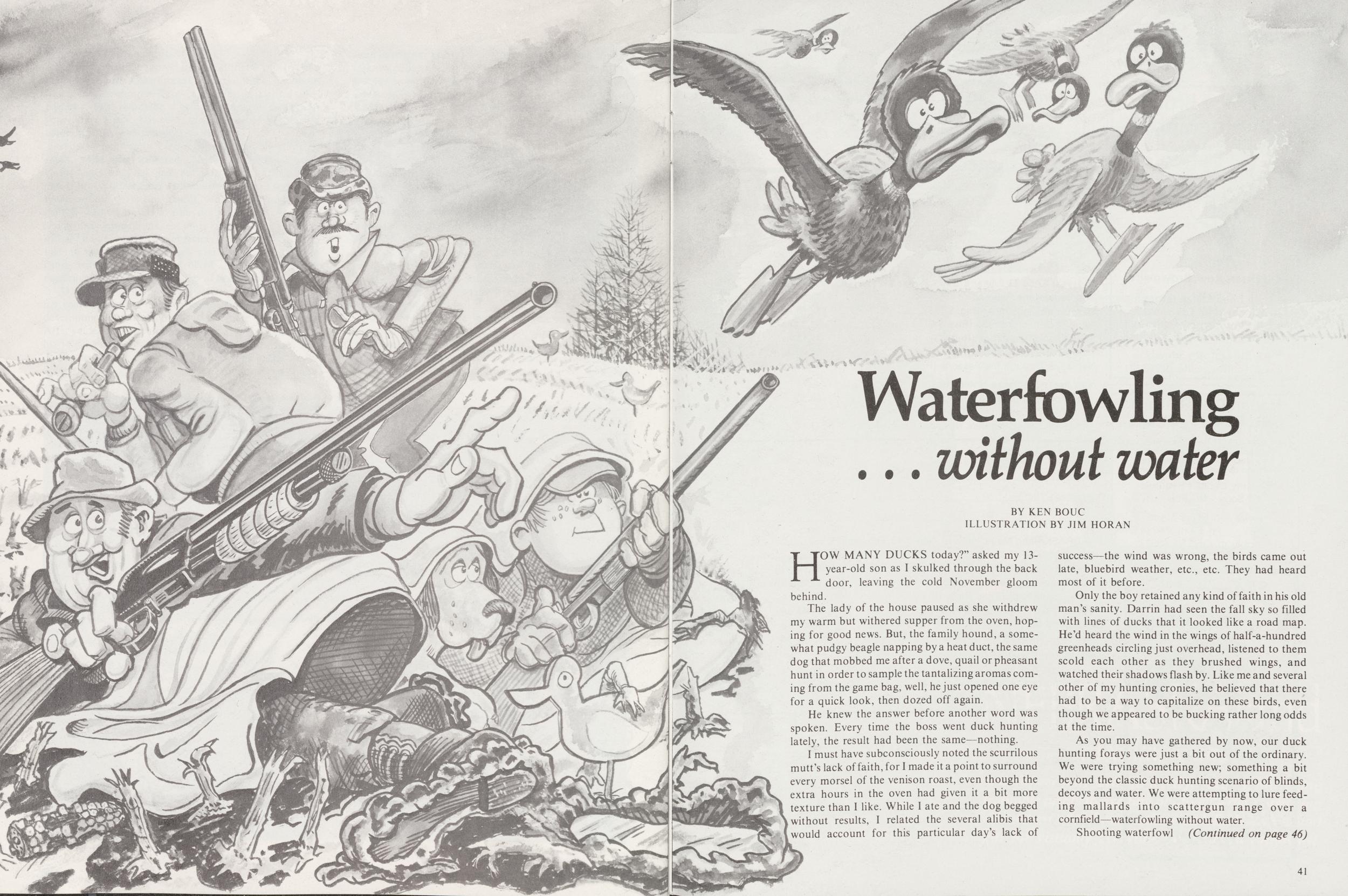
Much more effort goes into the design than a casual viewer would imagine, as it must be tediously drawn and reworked and integrated into the shape of the object to be engraved. In fact, the basic design to be carved is unbelievably detailed and difficult, but is so critical to the end product that the effort is justified.
The size and shape of the area to be decorated are major considerations. The engraving must be appropriate in size, character and position. Then, the design must be transferred into the metal via a painstaking means—by hand. At this point some very practical considerations come into play. A firm yet undamaging means of grasping the work piece is critical. The work must be able to rotate to expose all surfaces, be well illuminated, and rigid.
It is not possible to go to the corner hardware store and pick up such equipment. Even professional gear is of limited value or extremely expensive, but that didn’t deter the Lindsays. Discussing what was needed, the vise and most other equipment was designed, then home built—a 26 NEBRASKAland
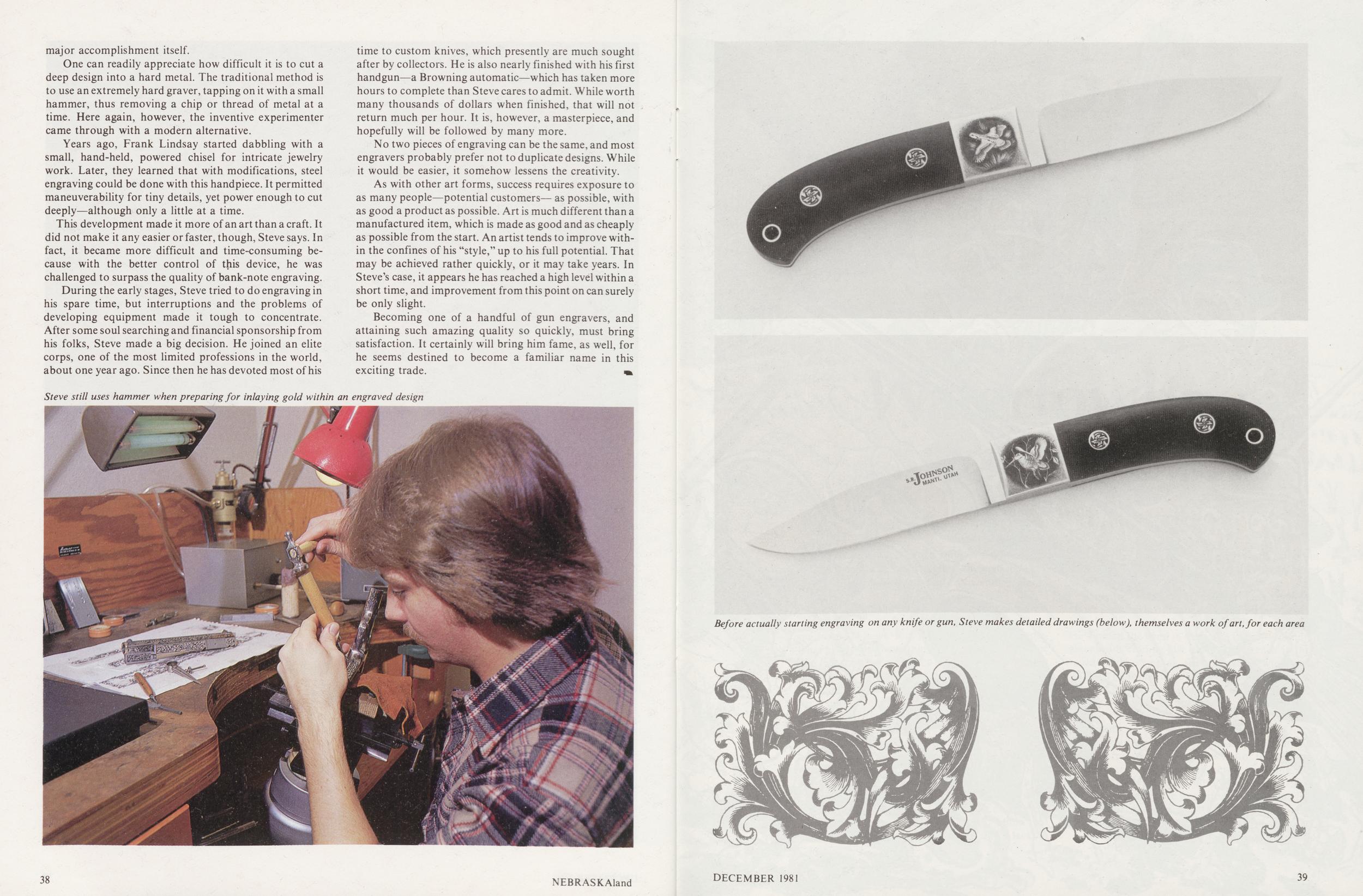 major accomplishment itself.
One can readily appreciate how difficult it is to cut a deep design into a hard metal. The traditional method is to use an extremely hard graver, tapping on it with a small hammer, thus removing a chip or thread of metal at a time. Here again, however, the inventive experimenter came through with a modern alternative.
Years ago, Frank Lindsay started dabbling with a small, hand-held, powered chisel for intricate jewelry work. Later, they learned that with modifications, steel engraving could be done with this handpiece. It permitted maneuverability for tiny details, yet power enough to cut deeply—although only a little at a time.
This development made it more of an art than a craft. It did not make it any easier or faster, though, Steve says. In fact, it became more difficult and time-consuming because with the better control of this device, he was challenged to surpass the quality of bank-note engraving.
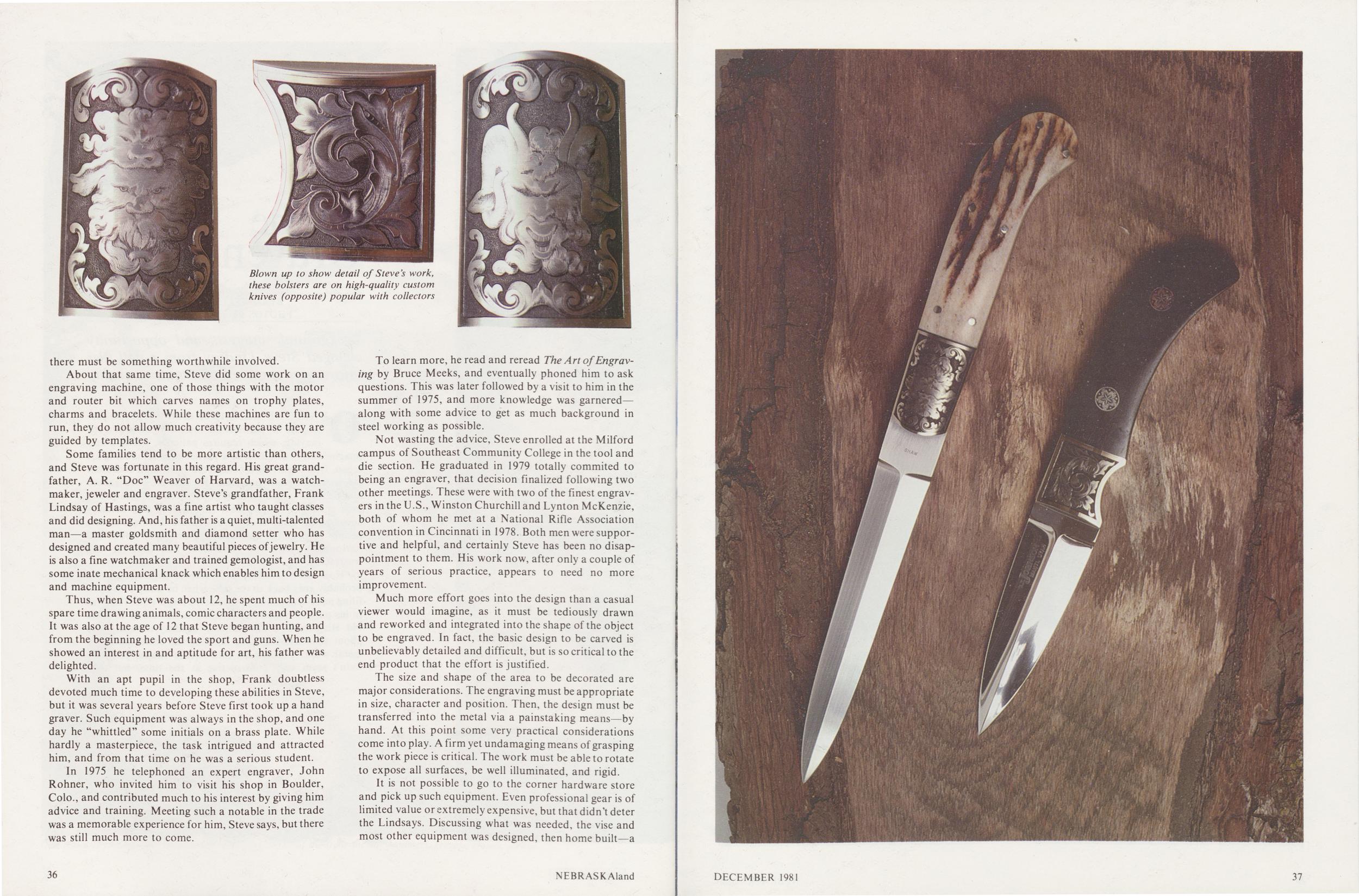
During the early stages, Steve tried to do engraving in his spare time, but interruptions and the problems of developing equipment made it tough to concentrate. After some soul searching and financial sponsorship from his folks, Steve made a big decision. He joined an elite corps, one of the most limited professions in the world, about one year ago. Since then he has devoted most of his time to custom knives, which presently are much sought after by collectors. He is also nearly finished with his first handgun—a Browning automatic—which has taken more hours to complete than Steve cares to admit. While worth many thousands of dollars when finished, that will not return much per hour. It is, however, a masterpiece, and hopefully will be followed by many more.
No two pieces of engraving can be the same, and most engravers probably prefer not to duplicate designs. While it would be easier, it somehow lessens the creativity.
As with other art forms, success requires exposure to as many people—potential customers— as possible, with as good a product as possible. Art is much different than a manufactured item, which is made as good and as cheaply as possible from the start. An artist tends to improve within the confines of his “style,” up to his full potential. That may be achieved rather quickly, or it may take years. In Steve’s case, it appears he has reached a high level within a short time, and improvement from this point on can surely be only slight.
Becoming one of a handful of gun engravers, and attaining such amazing quality so quickly, must bring satisfaction. It certainly will bring him fame, as well, for he seems destined to become a familiar name in this exciting trade.
Waterfowling ... without water
BY KEN BOUC ILLUSTRATION BY JIM HORANHOW MANY DUCKS today?” asked my 13-year-old son as I skulked through the back door, leaving the cold November gloom behind.
The lady of the house paused as she withdrew my warm but withered supper from the oven, hoping for good news. But, the family hound, a somewhat pudgy beagle napping by a heat duct, the same dog that mobbed me after a dove, quail or pheasant hunt in order to sample the tantalizing aromas coming from the game bag, well, he just opened one eye for a quick look, then dozed off again.
He knew the answer before another word was spoken. Every time the boss went duck hunting lately, the result had been the same—nothing.
I must have subconsciously noted the scurrilous mutt’s lack of faith, for 1 made it a point to surround every morsel of the venison roast, even though the extra hours in the oven had given it a bit more texture than I like. While I ate and the dog begged without results, I related the several alibis that would account for this particular day’s lack of success—the wind was wrong, the birds came out late, bluebird weather, etc., etc. They had heard most of it before.
Only the boy retained any kind of faith in his old man’s sanity. Darrin had seen the fall sky so filled with lines of ducks that it looked like a road map. He’d heard the wind in the wings of half-a-hundred greenheads circling just overhead, listened to them scold each other as they brushed wings, and watched their shadows flash by. Like me and several other of my hunting cronies, he believed that there had to be a way to capitalize on these birds, even though we appeared to be bucking rather long odds at the time.
As you may have gathered by now, our duck hunting forays were just a bit out of the ordinary. We were trying something new; something a bit beyond the classic duck hunting scenario of blinds, decoys and water. We were attempting to lure feeding mallards into scattergun range over a cornfield—waterfowling without water.
Shooting waterfowl (Continued on page 46)
41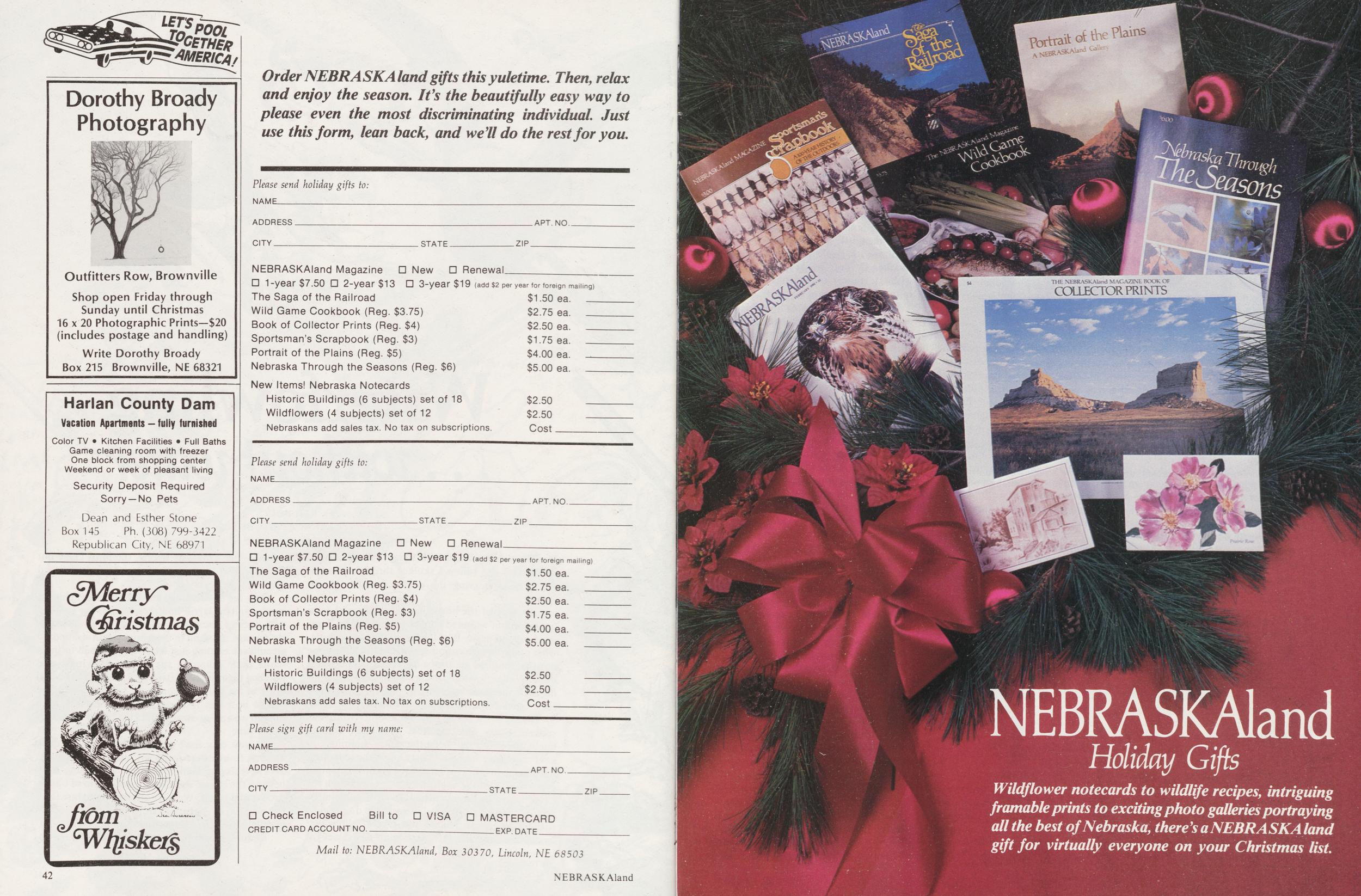 Dorothy Broady
Photography
Order NEBRASKA land gifts this yuletime. Then, relax
and enjoy the season. It’s the beautifully easy way to
please even the most discriminating individual. Just
use this form, lean back, and we’ll do the rest for you.
Please send holiday gifts to:
NAME________
ADDRESS APT. NO____________
CITY______STATE__ZIP _____
Outfitters Row, Brownville
Shop open Friday through
Sunday until Christmas
16 x 20 Photographic Prints—$20
(includes postage and handling)
Write Dorothy Broady
Box 215 Brownville, NE 68321
Harlan County Dam
Vacation Apartments - fully furnished
Color TV • Kitchen Facilities • Full Baths
Game cleaning room with freezer
One block from shopping center
Weekend or week of pleasant living
Security Deposit Required
Sorry —No Pets
Dean and Esther Stone
Box 145 Ph. (308) 799-3422
Republican City, NE 68971
NEBRASKAIand Magazine New Renewal ____________________
1-year $7.50 2-year $13 3-year $19 (add $2 per year for foreign mailing)
The Saga of the Railroad $1.50 ea.
Wild Game Cookbook (Reg. $3.75) $2.75 ea.
Book of Collector Prints (Reg. $4) $2.50 ea.
Sportsman’s Scrapbook (Reg. $3) $1.75 ea.
Portrait of the Plains (Reg. $5) $4.00 ea.
Nebraska Through the Seasons (Reg. $6) $5.00 ea.
New Items! Nebraska Notecards
Historic Buildings (6 subjects) set of 18
Wildflowers (4 subjects) set of 12
Nebraskans add sales tax. No tax on subscriptions.
$2.50 _________
$2.50 _________
Cost________
Please send holiday gifts to:
NAME_____________
ADDRESS APT. NO_______
CITY STATE____________ZIP
NEBRASKAIand Magazine New Renewal
1-year $7.50 2-year $13 EO 3-year $19 (add $2 per year for foreign mailing)
The Saga of the Railroad
Wild Game Cookbook (Reg. $3.75)
Book of Collector Prints (Reg. $4)
Sportsman’s Scrapbook (Reg. $3)
Portrait of the Plains (Reg. $5)
Nebraska Through the Seasons (Reg. $6)
New Items! Nebraska Notecards
Historic Buildings (6 subjects) set of 18
Wildflowers (4 subjects) set of 12
Nebraskans add sales tax. No tax on subscriptions.
$1.50 ea.
$2.75 ea.
$2.50 ea.
$1.75 ea.
$4.00 ea.
$5.00 ea.
$2.50
$2.50
Cost
Please sign gift card with my name:
NAME________
ADDRESS________APT. NO__________
CITY_________STATE___________ZIP
Check Enclosed Bill to VISA MASTERCARD
CREDIT CARD ACCOUNT NO_____________________EXP. DATE_____
Mail to: NEBRASKAIand, Box 30370, Lincoln, NE 68503
Dorothy Broady
Photography
Order NEBRASKA land gifts this yuletime. Then, relax
and enjoy the season. It’s the beautifully easy way to
please even the most discriminating individual. Just
use this form, lean back, and we’ll do the rest for you.
Please send holiday gifts to:
NAME________
ADDRESS APT. NO____________
CITY______STATE__ZIP _____
Outfitters Row, Brownville
Shop open Friday through
Sunday until Christmas
16 x 20 Photographic Prints—$20
(includes postage and handling)
Write Dorothy Broady
Box 215 Brownville, NE 68321
Harlan County Dam
Vacation Apartments - fully furnished
Color TV • Kitchen Facilities • Full Baths
Game cleaning room with freezer
One block from shopping center
Weekend or week of pleasant living
Security Deposit Required
Sorry —No Pets
Dean and Esther Stone
Box 145 Ph. (308) 799-3422
Republican City, NE 68971
NEBRASKAIand Magazine New Renewal ____________________
1-year $7.50 2-year $13 3-year $19 (add $2 per year for foreign mailing)
The Saga of the Railroad $1.50 ea.
Wild Game Cookbook (Reg. $3.75) $2.75 ea.
Book of Collector Prints (Reg. $4) $2.50 ea.
Sportsman’s Scrapbook (Reg. $3) $1.75 ea.
Portrait of the Plains (Reg. $5) $4.00 ea.
Nebraska Through the Seasons (Reg. $6) $5.00 ea.
New Items! Nebraska Notecards
Historic Buildings (6 subjects) set of 18
Wildflowers (4 subjects) set of 12
Nebraskans add sales tax. No tax on subscriptions.
$2.50 _________
$2.50 _________
Cost________
Please send holiday gifts to:
NAME_____________
ADDRESS APT. NO_______
CITY STATE____________ZIP
NEBRASKAIand Magazine New Renewal
1-year $7.50 2-year $13 EO 3-year $19 (add $2 per year for foreign mailing)
The Saga of the Railroad
Wild Game Cookbook (Reg. $3.75)
Book of Collector Prints (Reg. $4)
Sportsman’s Scrapbook (Reg. $3)
Portrait of the Plains (Reg. $5)
Nebraska Through the Seasons (Reg. $6)
New Items! Nebraska Notecards
Historic Buildings (6 subjects) set of 18
Wildflowers (4 subjects) set of 12
Nebraskans add sales tax. No tax on subscriptions.
$1.50 ea.
$2.75 ea.
$2.50 ea.
$1.75 ea.
$4.00 ea.
$5.00 ea.
$2.50
$2.50
Cost
Please sign gift card with my name:
NAME________
ADDRESS________APT. NO__________
CITY_________STATE___________ZIP
Check Enclosed Bill to VISA MASTERCARD
CREDIT CARD ACCOUNT NO_____________________EXP. DATE_____
Mail to: NEBRASKAIand, Box 30370, Lincoln, NE 68503
Goin’ Home
(Continued from page 15)of native grass and wildflowers. The tracks undulate and weave. Shortcropped weeds grow out of rotting ties. Is the abundance of crushed red granite, hauled in from some exotic state with mountains, to be piled around the trestle, still an attraction? Throwing rocks were always in short supply out here on the prairie. On sleepy summer days, do boys still come to toss them at snapping turtles, or to flatten pennies on the tracks, or sit under the trestle while the Union Pacific engine with peeling paint rumbles overhead? You never see bicycles without fenders tucked hastily away in the roadside grass by the tracks.
Sometimes, if you come home often, or to a place that is enough like home, you may catch a glimpse of times long past: a pair of boys on bikes, a writhing bull snake in hand, riding a mainstreet sidewalk as conspicuously as possible; or loosely bundled friends with ice skates slung over their shoulders, heading for some backwater pond; or baseball games without grownups around to interfere, played in the late-day shadows of towering grain elevators.
The dusty yards of farmsteads, once four to the section, are deadly silent. The squabbling children and pompous banti roosters have moved on. Where calico cats once dozed in chicken yards littered with table scraps, there are only corn rows. Windmills spin, but pump no water into their rusted tanks. Corn cribs hold only ’coons or skunks; barns, only swallows. Barn-door hinges held in place by bent-over nails no longer creak at morning milking time. Spiders have strung their nets on backyard clothes lines. The screen on the back door of the house still bulges where small hands pushed it open.
But, surprisingly, returning to your own home place to find it abandoned, crumbling in the wind, rain and sun, is not distressing. Your traces are still there—the loose board in front of the kitchen sink, finger prints on the wallpaper by the light switch, the cracked corner of window pane in your bedroom.
But when you return home to find the old house torn down, you realize a part of your childhood has been carried away with it. Coming home is 44 NEBRASKAland never quite the same. You’ve lost a reference point. Someone else’s home is there now, it may as well be in some other town, in some other time.
You walk the sidewalk that passed your home place. The square raised by the maple’s roots, the square your brother tripped on playing kick-the-can and fell and cut his lip, is smooth and flat. The cottonwood behind the house that never knew a summer without a tree house, is cut down. The new people probably couldn’t tolerate the blizzard of fluffy white seeds that gathered ankle deep on the doorstep each spring.
The alley where Monday morning wash water was poured and lint gathered in white ridges, still leads downtown. You follow it, searching for an insignificant sign that will open a neglected door, reveal forgotten memories, bring your childhood back for safe keeping where it can never be changed or taken away.
You pass through the vacant lot that separated the old post office from a row of other stores; a lot once claimed by head-high pigweed and rusting machinery. There is a flicker of something familiar that makes you stop and turn. Your initials are still visible where they were carved into a red brick on the side of the hardware store.
Raising Trout... Then and Now
(Continued from page 33)instincts. The hatchery at Rock Creek would soon be given the task of insuring the propagation of this strain of trout, possibly saving the unique McConaughy migratory rainbows, whose numbers were beginning to drop dramatically because of changes taking place there.
VanVelson’s study was not the only reason for change during the 70’s, however, as the area around Rock Creek Hatchery was soon developed into corn fields and pivot irrigation. As more and more pivots began pumping from the aquifer, Rock Creek began flowing less and less. The concerns of the 1924 Fish Commission had returned to haunt the facility 50 years later.
Improvements on the area were curtailed, as it was feared that the hatchery might soon lose its water supply. New sites for a cold-water hatchery were sought, but such a unique aquasystem is difficult to find; and when located, the price is often beyond justification.
As suddenly as Rock Creek began to lose its flow, the situation stabilized. But scars had already been made, which would once again change the trout operation. Fewer adult fish would be raised for put-and-take fishing.
Only Lake Ogallala was scheduled for catchable-size trout, while the remainder of the year’s production were grown only to fingerling size, reducing the hatchery’s total poundage but increasing the number of fish raised annually.
In 1946, Blank remembers that Rock Creek was able to produce 50,000 trout for stocking. Currently, with modern technology and experience, the same hatchery, suffering greatly diminished water resources, is turning out over 400,000 rainbows for Nebraska anglers.
More than 150,000 of the annual production are Lake McConaughy strain rainbows for release into nursery streams along the North Platte Drainage. Such stockings are the result of a total culture effort with brood fish being stripped of eggs near Lewellen or from wild brood stock held over at the hatchery.
The 1980 spring and fall migrations of rainbow trout up to the North Platte River were virtually non-existent, and the hatchery’s foresight in retaining brood fish from this strain of wild trout acted as an insurance policy to salvage a year class of stockers for Lake McConaughy.
New strains of trout in recent years have increased demands on Rock Creek Hatchery personnel. The Alliance Drainage trout were discovered in 1978 and were experimented with for stocking in marginal-temperature streams in Nebraska. A self-sustaining population, Alliance Drainage trout can tolerate water temperatures in excess of 70° F., and if subsequent research indicates stockings were successful, a culture program for this strain will be considered for the hatchery.
Boulder trout, a semi-wild strain developed in Wyoming through selective breeding, were hatched at Rock Creek in 1980 to meet stocking requests. Wigwam trout, also from Wyoming, were hatched and reared at Rock Creek in 1980 and 1981. Wigwam have been under development for 10 years. They are fast growing, increasing one inch per month in the hatchery, which allows the stocking of catchable trout in one year—and at reduced costs.
Rock Creek has the distinction of being Nebraska’s only state trout hatchery, yet it has the capability of producing warm-water fish species as well. Seven ponds on the area become too warm during summer months for adequate trout production.
In April, largemouth bass, bluegill, and rock bass are placed in these ponds for natural spawning. In October, the ponds are drained and the fish stocked throughout the state.
During the hatchery’s early years, Frank Weise recalls, they didn’t have the capability to drain ponds, but they discovered that when the bass hatched, they would swim in schools around the perimeter of the ponds, close to the shoreline. Hatchery personnel would cut a narrow canal in the rim of the pond and place a trap on the outside. As the fingerlings circled the pond, they would exit through the canal and be caught in the trap.
Improvements and technical advances at the facility have blossomed since 1976, and although the physical layout still closely resembles its 1924 beginning, a more modern hatch house with incubators, 33 rearing troughs, 11 raceways and 22 ponds greatly expanded the hatchery.
Photo-electric egg pickers now sort bad eggs from good ... a job that was once accomplished by hand-wielded wooden tweezers. Two high volume wells are also on standby in the event of a sudden water shortage.
A modern aeration chamber removes inert gases like nitrogen from the water, which could find its way into the fish’s system and lodge as bubbles behind the eyes.
Fingerling nutrition has also advanced dramatically since the days of horsemeat, cheese graters and maggots, and so has knowledge of fish culture. Hatchery culturists at Rock Creek can now produce some of the finest and healthiest fish available for Nebraska trout fishermen.
DECEMBER 1981 45
Waterfowling Without Water
(Continued from page 41)in a field is not a new idea in itself. It’s a tried-and-true technique for geese, and I’m sure ducks are hunted over dry land with some degree of success in other parts of the country. But in the plains states, very little has been done in the way of harvesting ducks from cornfields except for some rather hit-and-miss situations where hunters hide out in a field that ducks have used lately on the long-shot chance that they will return.
On dozens of occasions, I had watched huge flocks of mallards leave various refuges and sanctuaries to overrun a picked cornfield for its waste grain. “There’s got to be a way,” I remember thinking to myself. “If some well-heeled huter with a $2,000 river lease and a hundred decoys can draw in a limit of ducks when they’re thirsty or lonesome, why can’t a fellow of more modest means attract a few once in a while when they’re hungry?”
I had recently infected a handful of otherwise rational individuals with the same notion. Ken Drinkwine, an officer at the Lincoln Correctional Center, and Jerry Mittelstadt, a correctional captain, were my earliest converts. Later, I would also corrupt Bob Oglevie, an inspector for Burlington Northern, and my boy, Darrin.
Over the span of three duck seasons, we would log dozens of days in the field. Most of the time we’d be flat on our backs on frozen ground between corn rows, trying for all we were worth to look like an ear of corn or a lump (notice, I didn’t say “clod”) of dirt. The mallards we bagged were welcome. But, even more important was the little bit of knowledge that we gained from each outing.
Perhaps the most important piece of data was the first one, which was provided by Ken and Jerry. One cold, snowy afternoon after a good number of new ducks had arrived from the north, they tossed a couple dozen common floating decoys onto the snow between the rows, hunkered in some low plum bushes at the edge of the field, and killed two limits of mallards. They had given us lesson number one: “It can be done.”
I joined them the next day, hoping for my share of success. We watched a nice three-point whitetail visit one of his scrapes at the edge of a stubble field some 150 yards below us.
We were also buzzed a couple of times by a rather hungry-looking hawk. But otherwise, nothing much happened. Ducks were in the neighborhood by the thousands, but they all followed a route south of our position, from which we doubted that they could even see our decoys. Thus, if the first trip revealed lesson number one, “It can be done,” then this trip and several more immediately afterward taught us lesson number two: “... but not every day.”
The same series of outings also emphasized an important point that we had been vaguely aware of from the very beginning. Ducks seem to have their minds made up when they leave their sanctuary as to which route they will fly and which general locality they will drop into to feed. The best field decoy spread in the world will not draw mallards on their way to supper if it’s a half-mile out of their line of flight. Decoys a quarter-mile 46 NEBRASKAland out of the way sometimes do alright, but it’s best to be right on the route that most of the birds will be taking that day.
We would set up according to what the birds had done the day before. If we guessed wrong, we found it best to make a rapid move to a better spot or else give it up for the day. If we were on the right route but the birds had their hearts set on an area farther down the line, it would be tough, though not impossible, to stop them short of their destination. We all agreed that lesson number three was: “Set up as close to the line of flight and as close to the ducks’chosen feeding area as possible. They can’t be decoyed very far once they’ve made up their minds.”
We also determined very early that the game we were playing required attention to safe gun handling over and above what’s prudent for upland hunting or other forms of waterfowling. Carrying bags of decoys in addition to a gun over rough ground, setting the gun aside to put out dekes, lying with it in a ravine or corn row, and shooting from awkward positions, all increase the chances of an accidental discharge or a barrel obstruction if someone gets careless.
We hunted much of that year with a fairly thick mantle of snow on the ground. We tried various ruses: Dressing in white or camouflage to blend in better; a small portable blind; and hiding in nearby shelterbelts, ravines or other natural blinds. After a few failures, I became convinced that ducks avoid even natural cover that might hide an enemy, and they easily spot any kind of blind. Mallards seemed the most at ease when we laid flat on the ground just downwind and a bit to one side of the decoys, which were set on open ground well away from any kind of cover.
If snow covered the ground, white painter’s coveralls or a white bedsheet provided adequate concealment. Without snow, a dirty-brown piece of burlap draped over our prone carcasses seemed to make us look harmless enough to the birds. Ken and Jerry like the comfort of sitting upright in a bunch of trees, so they might protest lesson number four: “Ducks are wary of trees, brush, or any kind of obvious cover. Don’t set up there.” I became more convinced of this with each hunting trip.
Between the first and second season, I decided to improve the appeal of our spreads by substituting field decoys for the floaters we had been using. The field dekes were in the upright posture of a duck standing on dry land, and looked a lot more at home in a cornfield than the floaters, with their hunkered-down, flattened-out look. It took a couple of days to fashion two dozen birds with a process involving plastic foam beads, a mold and boiling water, and a couple more days to paint them.
Pollutants become part of the ignition rather than the consequence • Burns with a down draft • Starts without kindling • American made • UL approved • Recycles its gases DEALERS NEEDED DODWORTH & SONS ARM STORE Solid Fuel Burners 6132 HAVELOCK AVE., LINCOLN, NEBRASKA 68507, (402) 466-8439 NEBRASKAland Magazine Order Form Please send me a subscription to NEBRASKAland, which now also features 12 issues of the news edition (24 issues in all). G One-year $7.50 D Two-year $13 Q Three-year $19 Mail to: NEBRASKAland, Box 30370, Lincoln, NE 68503 NAME__________________________________ ADDRESS________________________________ CITY________________________________-___ STATE Zl P ________________________________ Take part in Nebraska’s best wintertime event The 6th Annual Valentine Jaycees Ice Fishing Tournament Saturday, February 6,1982 at Merritt Reservoir • Entry Deadline is January 30, 1982 • Entry fee: $40 per team Checks payable to Valentine Jaycees Verification and information will be mailed to each entrant ...................................................................... Name _____ Address_________ City__________ State____Zip_____________ _____________________________________________ Fishing Partner________ Address________________________________________________ City_________ State______________________________________Zip___________ DECEMBER 1981 47
They got their first test with Bob Oglevie. His usual duck hunting spot on a Rain Basin marsh had dried up that year, so he decided to give the cornfields a try. We set up on a hillside facing the direction from which the ducks would come to a cornfield near where they had been feeding the past few days. When we’d gotten permission from the landowner, he told us that we might also see his uncle out there. He liked to come out and just sit in the field under a burlap poncho on the off chance that some birds might drop in. When we finished putting out our decoys, we noticed that indeed he had slipped in behind us and was waving to us from the next hillside about 250 yards away.
It wasn’t long before the sky was filled with mallards on their way to supper, and things started looking good for us. Several early bunches broke off from the main flight and dropped down to give the new decoys a good look. But, they circled wider than we would have liked, and after a couple of swings, drifted into the next section to another field. Then, the hunter on the next hill startled us with a roar from his scattergun.
Some birds had flown his way. We figured they would pass too far away to give him much of a chance, but that was apparently not the case. We looked back in time to see a mallard plummet to earth, stone dead. We both remarked that it was a pretty long shot, and that he was lucky to get the bird. But, when he repeated the feat again a few minutes later, we took a closer look.
His second shot looked longer than the first, but when we counted the 36-inch corn rows between him and where the bird was hit, it figured out to only about 35 yards. We’d had birds that close many times, but had judged the range to be 55 yards or better. Bob, who had shot ducks hundreds of times over water and fancied himself a good judge of distance under those circumstances, and I, were both completely fooled.
We stepped off distances to prominent features around us—35 yards to the forward decoy, 37 or 38 to the terrace on the right, about 30 yards to the clump of weeds behind us. When these landmarks told us that the next bunch of birds was within range, we shot, even though our instincts were screaming “too far.” Fortunately, the measurements were right and our instincts wrong, for ducks fell out of that bunch. And more fell out of the next three or four flocks until we each had limits on the ground.
By that time, our friend on the next hill had left with his two or three birds— short of a limit but enough to fill his needs. Without knowing it, he had opened our eyes to an important point of cornfield mallard gunnery.
We knew from the start that we’d never get ducks in as close over corn as we could over water. A marsh or pond hunter tries for 20-yard shots, and might use a fairly open choke and smallish shot. In corn, 30 or 35 yards is about the best anyone can expect because the hunters are in the open and the birds are neither blind nor dumb. Thus, tighter chokes and heavier shot might be in order.
As a result of that day, we were blessed with lesson number five: “Figure shooting range by measurement, not judgement.”
I didn’t get a chance to hunt for a couple of weeks, and by then the birds were feeding in a new area. Ken, Jerry and I tried a spot in one field that the greenheads had been using, but we had little success. I thought it was because we were too close to the timber, though I’m not sure the others agreed with me. The next day we set up on an open hillside, and did have better luck.
At first we didn’t do well. We were still passing up shots because they looked too long. We were doing what hunters on marshes and ponds do if the birds don’t decoy right where they want them: We waited for a better chance on the next swing. But, most of the time we were not getting that next swing.
Since I had unveiled the field mallard on the outing with Bob, birds had begun decoying to us very strongly at times. They would break off from high-flying flocks and come right down on the deck to look us over. But, they never stayed around long. About half of the time they’d come by just once, and we’d often get two swings out of a bunch. But, we could only remember one or two bunches that looked a third time, and none had stayed around longer than that.
We figured it was because ducks can afford to be a lot more finicky about cornfields than about water. We decided to take the first reasonable opportunity we were offered, and that made the difference. Hence, lesson number six: “If they come into range, you’d better take the shot. Chances are there won’t be a second opportunity.”
We learned other things about cornfield hunting on other days, and they didn’t always involve the killing of ducks. The days when mallards refused to fly where we were shooting, and the many times we didn’t even get to shoulder a gun, outnumbered our successful hunts. Those days taught us that we had to endure such disappointments, along with petty inconveniences like deep snow, near-zero temperatures, hard work, and boredom, as a necessary price for a few successful outings.
We found great comfort in that worn-out old saw: “There’s more to duck hunting than just shooting ducks.” We had done more than our share of straining, waiting, soaking, shivering and all sorts of other foolishness.
With several seasons of that out of the way, we now figure that we are about due for that part of duck hunting that puts mallards in the bag with some regularity. We’ll be testing some new ideas this year, and who knows, maybe one of them will be the secret.
We were prepared for setbacks when we decided to try something a little different. Even if we bagged birds only occasionally, however, we still savored the challenge of learning. Each day might teach us something new about the land, the weather, the ducks, even ourselves.
Consider, for example, the day that Ken and I trudged out into a muddy field loaded with decoys, guns and tarp with 10-pound blobs of mud bulging around each boot. We sat there motionless, except for our shivering, while freezing rain tried to turn us into ice statues. We saw nothing, for the ducks were too smart to venture out in weather like that. Our lesson that day: “There’s a fine line between being dedicated and being plain loco.” Hunters do sometimes have trouble making the distinction.
48 NEBRASKAlandTrading Post
DOGSWELL-BRED Hunting dogs for sale- Brittanies, English setters and pointers—ranging in age from puppies to young dogs. Darrell Yentes, 1118 McMillan, Holdrege, NE 68949. Phone (308) 995-8570 or (308) 995^797.
ENGLISH POINTERS, German Shorthairs and treeing Walker Hounds; puppies and started dogs. Wayne Clark, Box 54, Union, NE 68455. Phone (402) 263-3495. Also Diamond Dog Food.
JOHNSTON KENNELS offers you AKC Golden Retriever pups year-round. Champion bloodline, field, trial and show quality. Gentle temperament. Karen Johnston, Cortland, NE 68331. Phone (402) 798-7440.
AKC REGISTERED Brittany Spaniel pups. Champion bloodline in sire. Both parents excellent hunters. Also stud service. Call after 4 p.m. (402) 873-5047.
FOR SALE—AKC Registered Vizsla pups. Top bloodlines. 6 weeks old. Green View Kennels. 402-228-0430.
MISCELLANEOUSGUNS—Browning, Winchester, Remington, others, Hi-powers, shotguns, new, used, antiques. Want Pre-1964 Winchesters. Buy-Sell-Trade. Ph. (402) 729-6112. Bed Ian's Sporting Goods, Fairbury, NE 68352.
PLASTIC DECOYS: We’re originator of famous do it yourself system. Catalog system. Catalog $1.00. Decoys Unlimited, Clinton, 1A 52732.
GAME BIRDS—most kinds available. Quail suitable for release. Pick up or will deliver. Waunita, Nebr. Call (308) 394-5577 nine to five (Mountain Standard Time) or (308) 394-5715 after five (MST).
MICHICRAFT CANOES. ... New & Used! Canoe Rentals ... 12 statewide locations! 8 & 10-place canoe trailers, New and Used! Rocky Ford Canoe Camp. Niobrara River, camping, shuttles, rentals! Organized canoe-camping trips; and combination canoe-camping-rainbow trout fishing trips for groups . . . Free trips for Promoter-Sponsors! Plan early and visit our shop in Lincoln near 14th and Cornhusker when attending football and basketball games; state tournaments; concerts; racing; state fair, etc. Wilson Outfitters Nebraska (WON) 1329 Dawes Avenue, Lincoln, Nebraska 68521, Phone (402) 476-2300.
FISHERMEN! Plan to attend Nebraska’s best wintertime events—the Valentine Jaycee Ice Fishing Tournament, Febr. 6, 1982, Merritt Reservoir. Cash and prizes in over 30 categories. Free Coors beer, food, entertainment and prizes night before at happy hour show. Entry blanks available at local bait dealers in December (also see ad this publication) For information write Valentine Jaycees, P.O. Box 4, Valentine, Nebr. 69201 or call John Bush (402) 376-3487 or Larry Miller 376-2370.
WEATHERBYS 10 percent above cost. Handfinishing—hot blue—repair—antique restoration. Wanted, old guns for repair parts. Fritz Gunsmithing and Supply Co., Wilber, NE (402) 821-2260.
WAX WORMS : 500-58.25, 1.000-$ 14.50, add 3% sales tax. Postpaid first class. No. C O D. Harold Malicky, Burwell, Nebr. 68823.
BRASS PHEASANTS—Perfect gift for the hunter: a pair of 15" solid brass pheasants. Send $44.50 to K and H Specialties, 2103 Cochiti, Farmington, N.M. 87401.
FRUITS AND BERRIES: Make wine when frozen? Now legal. Send for free recipes and instructions. Omaha Supply. 13616 Polk, Omaha, NE 68137.
TAXIDERMYBIG BEAR TAXIDERMY, Rt« 2, Mitchell, Nebraska 69357. We specialize in all big game from Alaska to Nebraska, also birds and fish. Hair on and hair off tanning, 4>/2 miles west of Scottsbluff on Highway 26. Phone (308) 635-3013.
KARL SCHWARZ Master Taxidermist. Mounting of game heads—birds—fish—animals—fur rugs—robes— tanning buckskin. Since 1910. 424 South 13th Street, Dept. A, Omaha, Nebraska 68102.
BADE TAXIDERMY—Quality a must—Fast service. Fish, birds, rugs, tanning, full mounts and game heads. 1924 North Lincoln, Fremont, Nebraska. 727-5463.
FREEZE-DRY TAXIDERMY Wally Allison’s State Record Taxidermy, 2709 Birchwood, North Platte, NE 69101. Phone: (308) 534-2324. Specializing in Fish and Small Game, Snake and Lizard and Novelties. (Nothing too small) Newest of all taxidermy methods employed.
AWARD-WINNING TAXIDERMIST. Eight time national award winners. Trust your trophies to a prov- en winner. Our complete taxidermy service also arranges hunts. Dinges Taxidermy Studio, 2763 South 12th Omaha, NE 68108. Ph. 402-342-3718.
JOHNSON TAXIDERMY—servicing southwest Nebraska, specializing in big-game mounts, life-sized mounts, rug work, fish, birds, tanning hair-on leather. Brochure and price list on request. Johnson Taxidermy, Rt. 1, Box 78, Lamar, NE 69035. Telephone (308) 882-5555.
CREATIVE TAXIDERMY in all its branches since 1935, now includes Northstar Freeze-Dry processing of approved small specimens. Also tanning and deer- skin processing. Naturecraft Studio. Nebraska City, Nebraska 68510. Joe Voges-Owner. Phone (402) 873- 5491.
NABIFY’S TAXIDERMY. 29 years experience. All taxidermy services available. Specializing in natural grass backgrounds. 5021 Washington, Lincoln, NE 68506. (402) 489-6351.
The World s Champions. #7 in Power & Performance. In 1980 and 1981 Jiffy powered the World Champions To Victory. Thousands in use. Feldmann quality respected, recognized for reliability since 1945. Feldmann ENGINEERING L MANUFACTURING CO, INC P O BOX 153 SHEBOYGAN FALLS Wl 53085 Telephone 414 467-6167 ICE DRILL Call or write for details today.WHITETAIL TAXIDERMY. Deer heads are my specialty. Excellent work—Low prices—10 years’experience. Phone (402) 564-6885. Columbus, Nebr.
HASTINGS TAXIDERMY. Professional life-like mounting of game heads, birds, fish, rugs, and animals. We specialize in big-game head mounts. Also hair-on and hair-off tanning. Competitive prices. R Rt. 3, Box 162, Ord, NE 68862. Phone (308) 728-5322.
ING’g ' GOOSE LORE 3 miles east V? mile south on north side Platte River Lewellen. Nebr. in Garden County GOOSE BLINDS George O. Rishling, Manager Write or Call Borders Clear Creek Refuge Lewellen, Nebr. 69140 Phone (308) 778-5622 Ihm Gun Works Muzzle-loading Supplies & Trade Goods Outfitter to the primitive hunter, shooter and builder Open evenings and weekends Davey, Nebraska 68336 (402) 785-5335 Statement of ownership, management, and monthly circulation of NEBRASKAland Magazine OWNER AND PUBLISHER: Nebraska Game and Parks Commission EDITOR AND MANAGING EDITOR; Lowell A. Johnson HEADQUARTERS OF PUBLISHER AND PUBLICATION 2200 N. 33rd Street, Lincoln, NE 68503 STOCKHOLDERS: BONDHOLDERS: MORTGAGE: OTHER SECURITY HOLDERS: None Avenge Na of copies Single Issue each Issue during nearest to preceding 12 months filing date A. TOTAL COPIES PRINTED (net press run) Oct. '80 Sept. '81 64,750 Sept. '81 65,000 B. PAID CIRCULATION 1. Single-copy sales 2,480 3,310 2. Mail subscription 55,178 54,850 C TOTAL PA1D C1RCULATION 61,658 58,160 D. FREE DISTRIBUTION (incl. samples) BY MAIL, or OTHER MEANS, (no news agents) 4,000 3,500 E. TOTAL DISTRIBUTION (sum of C and D) 61,658 61,660 F. OFFICE USE, LEFTOVERS, ETC. 1,907 2,265 RETURNS FROM NEWS AGENTS 1,185 1,075 G TOTAL (sum of E and F) 64,750 65,000 DECEMBER 1981 49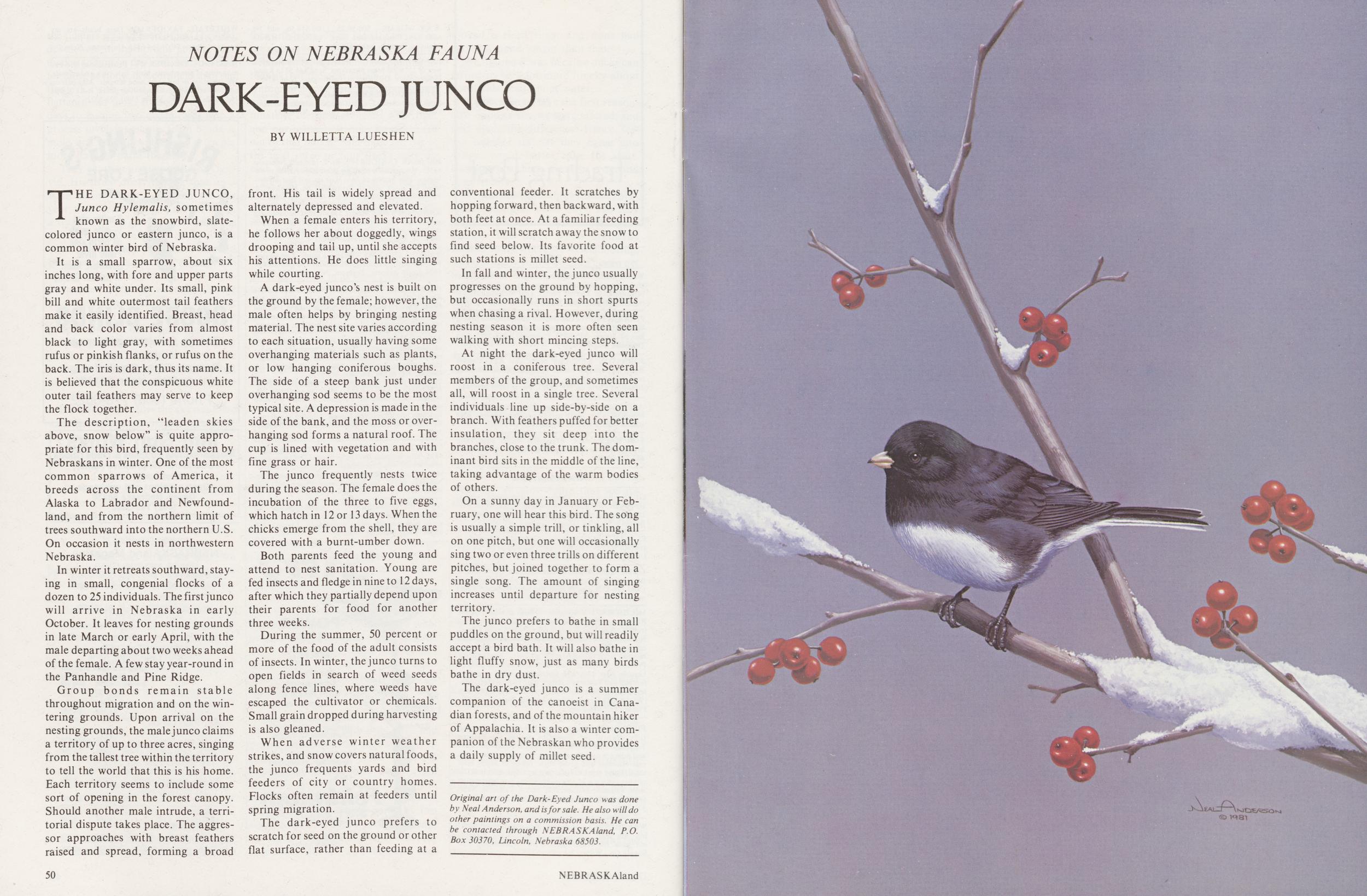
NOTES ON NEBRASKA FAUNA DARK-EYED JUNCO
BY WILLETTA LUESHENThe dark-eyed junco, Junco Hylemalis, sometimes known as the snowbird, slate-colored junco or eastern junco, is a common winter bird of Nebraska.
It is a small sparrow, about six inches long, with fore and upper parts gray and white under. Its small, pink bill and white outermost tail feathers make it easily identified. Breast, head and back color varies from almost black to light gray, with sometimes rufus or pinkish flanks, or rufus on the back. The iris is dark, thus its name. It is believed that the conspicuous white outer tail feathers may serve to keep the flock together.
The description, “leaden skies above, snow below” is quite appropriate for this bird, frequently seen by Nebraskans in winter. One of the most common sparrows of America, it breeds across the continent from Alaska to Labrador and Newfoundland, and from the northern limit of trees southward into the northern U.S. On occasion it nests in northwestern Nebraska.
In winter it retreats southward, staying in small, congenial flocks of a dozen to 25 individuals. The first junco will arrive in Nebraska in early October. It leaves for nesting grounds in late March or early April, with the male departing about two weeks ahead of the female. A few stay year-round in the Panhandle and Pine Ridge.
Group bonds remain stable throughout migration and on the wintering grounds. Upon arrival on the nesting grounds, the male junco claims a territory of up to three acres, singing from the tallest tree within the territory to tell the world that this is his home. Each territory seems to include some sort of opening in the forest canopy. Should another male intrude, a territorial dispute takes place. The aggressor approaches with breast feathers raised and spread, forming a broad front. His tail is widely spread and alternately depressed and elevated.
When a female enters his territory, he follows her about doggedly, wings drooping and tail up, until she accepts his attentions. He does little singing while courting.
A dark-eyed junco's nest is built on the ground by the female; however, the male often helps by bringing nesting material. The nest site varies according to each situation, usually having some overhanging materials such as plants, or low hanging coniferous boughs. The side of a steep bank just under overhanging sod seems to be the most typical site. A depression is made in the side of the bank, and the moss or overhanging sod forms a natural roof. The cup is lined with vegetation and with fine grass or hair.
The junco frequently nests twice during the season. The female does the incubation of the three to five eggs, which hatch in 12 or 13 days. When the chicks emerge from the shell, they are covered with a burnt-umber down.
Both parents feed the young and attend to nest sanitation. Young are fed insects and fledge in nine to 12 days, after which they partially depend upon their parents for food for another three weeks.
During the summer, 50 percent or more of the food of the adult consists of insects. In winter, the junco turns to open fields in search of weed seeds along fence lines, where weeds have escaped the cultivator or chemicals. Small grain dropped during harvesting is also gleaned.
When adverse winter weather strikes, and snow covers natural foods, the junco frequents yards and bird feeders of city or country homes. Flocks often remain at feeders until spring migration.
The dark-eyed junco prefers to scratch for seed on the ground or other flat surface, rather than feeding at a conventional feeder. It scratches by hopping forward, then backward, with both feet at once. At a familiar feeding station, it will scratch away the snow to find seed below. Its favorite food at such stations is millet seed.
In fall and winter, the junco usually progresses on the ground by hopping, but occasionally runs in short spurts when chasing a rival. However, during nesting season it is more often seen walking with short mincing steps.
At night the dark-eyed junco will roost in a coniferous tree. Several members of the group, and sometimes all, will roost in a single tree. Several individuals line up side-by-side on a branch. With feathers puffed for better insulation, they sit deep into the branches, close to the trunk. The dominant bird sits in the middle of the line, taking advantage of the warm bodies of others.
On a sunny day in January or February, one will hear this bird. The song is usually a simple trill, or tinkling, all on one pitch, but one will occasionally sing two or even three trills on different pitches, but joined together to form a single song. The amount of singing increases until departure for nesting territory.
The junco prefers to bathe in small puddles on the ground, but will readily accept a bird bath. It will also bathe in light fluffy snow, just as many birds bathe in dry dust.
The dark-eyed junco is a summer companion of the canoeist in Canadian forests, and of the mountain hiker of Appalachia. It is also a winter companion of the Nebraskan who provides a daily supply of millet seed.
Original art of the Dark-Eyed Junco was done by Neal Anderson, and is for sale. He also will do other paintings on a commission basis. He can be contacted through NEBRA S KA land, P.O. Box 30370, Lincoln, Nebraska 68503. 50 NEBRASKAland
Position: 305 (29 views)