Volume 59, Issue 18, 1981
NEBRASKAland
NOVEMBER 1981 $1
NEBRASKAland
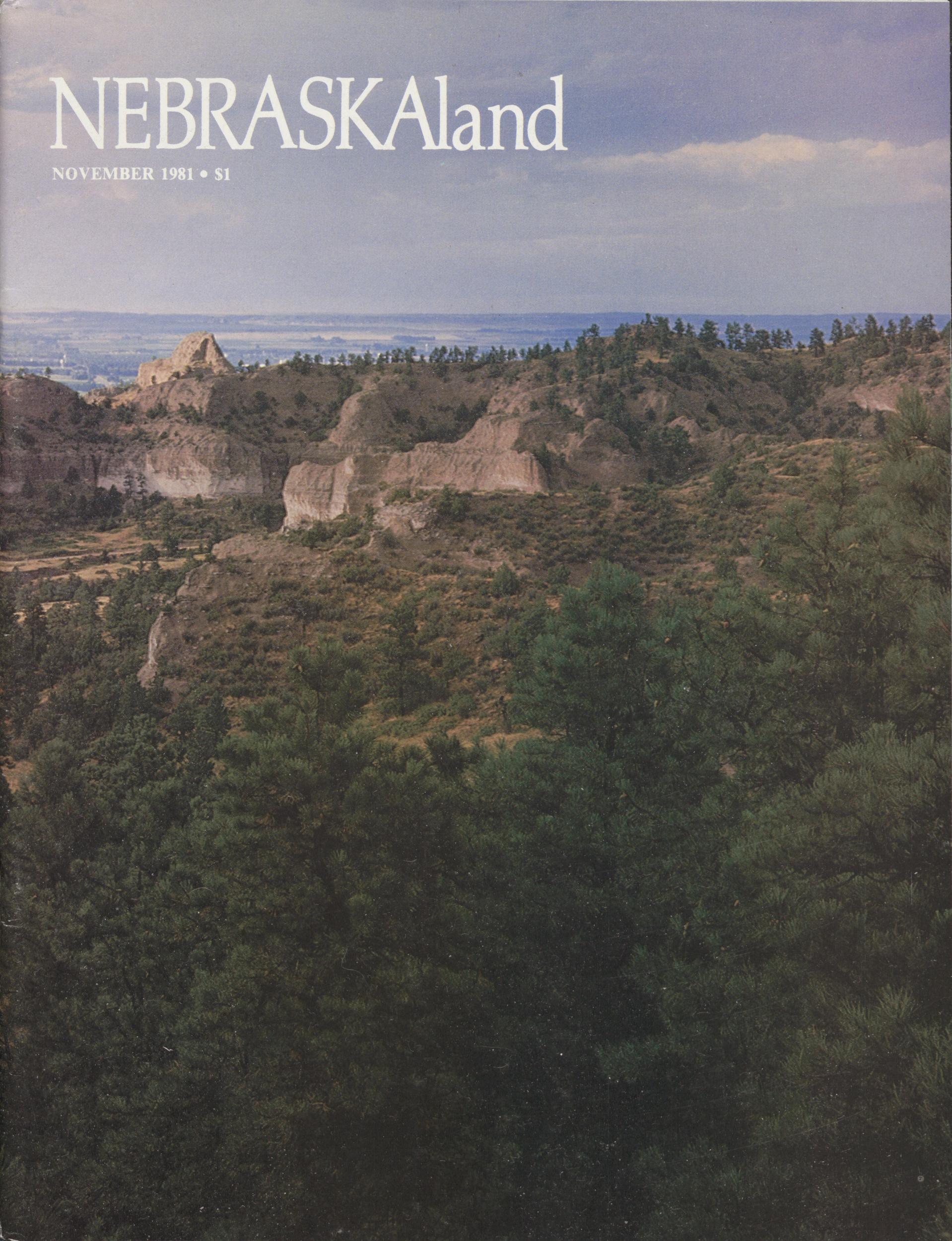
VOL. 59 NO. 18 NOV. 1981 NEBRASKAland (ISSN.0028-1964) is published twice monthly by the Nebraska Game and Parks Commission, 2200 North 33rd Street, Lincoln, NE. Copyright 1981, all rights reserved. Second-class postage paid at Lincoln, Nebraska and at additional mailing offices. POSTMASTER: Send address changes to NEBRASKAland, Box 30370, Lincoln, NE 68503. Rates: $1 per copy; $7.50 for 1 year; $13 for 2 years; $19 for 3 years. News edition 25c per copy, included in the subscription price. Offices Headquarters 2200 N. 33rd, Lincoln, 68503 (402) 464-0641 13th and Farnam St., Omaha (402) 554-2144 Rt. 2, Alliance (308) 762-5605 Bassett (402) 684-3511 Norfolk U.S. 81 (402) 371-4950 Rt. 4, North Platte (308) 532-6225 Commissioners Chairman: Robert G. Cunningham, Omaha Vice Chairman: Shirley L. Costello, Burwell 2nd Vice Chairman: Dr. Bruce Cowgill, Silver Creek Earl Hultman, Sutton Richard Prasch, Lexington Stan Juelfs, Kimball Charles E. Wright, Lincoln Director: Eugene T. Mahoney Assistant Directors: William J. Bailey, Jr., Dale R. Bree W. Rex Amack Staff Chief, Information & Education: Jim MacAllister Editor: Lowell Johnson Senior Editor: Jon Farrar Associate Editors: Ken Bouc, Don Cunningham Regional Editors: Bob Grier, Rocky Hoffmann, Harry Heafer, Liz Huff News Edition Editor: Tom Keith Art Director: Duane Westerholt Illustration: Steve O'Hare, Chris Mercer Circulation: Juanita Stefkovich Published by the Nebraska Game and Parks Commission Contents Features CROW BAIT RING OF THE ANVIL WILDCAT HILLS GENTLEMAN'S HUNT MONUMENTS ON THE MISSOURI GONE TO THE DOGS NO FUEL LIKE AN OLD FUEL NOTES ON NEBRASKA FAUNA SHARP-TAILED GROUSE 10 14 22 28 32 38 40 50 Departments SPEAK UP TRADING POST 49 COVER: Wildcat Hills is a scenic and wondrous place, and also a platform from which to view other places, as it offers grand overviews of terrain that has pleased people for many generations. Other views of Wildcat Hills are in this issue, starting on page 22. Photo by Bob Grier. OPPOSITE: Talk about being frozen in time!! Like giant porcupine quills, or some slim creatures which played on the beach too long and got stuck for the winter, this shoreline vegetation will now have to wait until spring's warmth to be free. Photo by Carl Wolfe.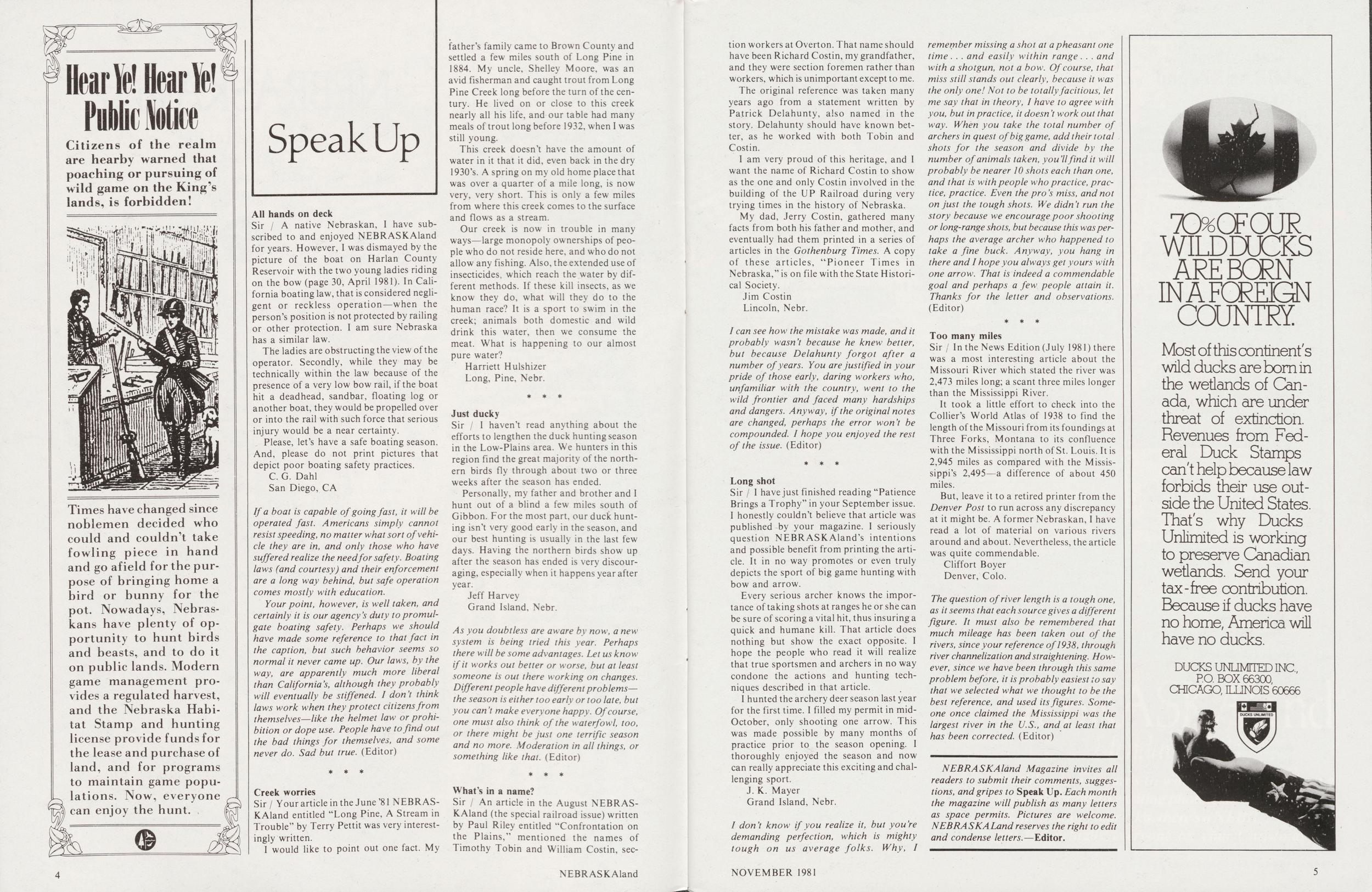
Speak Up
Hear Ye! Hear Ye! Public Notice Citizens of the realm are hearby warned that poaching or pursuing of wild game on the King's lands, is forbidden! Times have changed since noblemen decided who could and couldn't take fowling piece in hand and go afield for the purpose of bringing home a bird or bunny for the pot. Nowadays, Nebraskans have plenty of opportunity to hunt birds and beasts, and to do it on public lands. Modern game management provides a regulated harvest, and the Nebraska Habitat Stamp and hunting license provide funds for the lease and purchase of land, and for programs to maintain game populations. Now, everyone can enjoy the hunt. All hands on deckSir / A native Nebraskan, I have subscribed to and enjoyed NEBRASKAland for years. However, I was dismayed by the picture of the boat on Harlan County Reservoir with the two young ladies riding on the bow (page 30, April 1981). In California boating law, that is considered negligent or reckless operation—when the person's position is not protected by railing or other protection. I am sure Nebraska has a similar law.
The ladies are obstructing the view of the operator. Secondly, while they may be technically within the law because of the presence of a very low bow rail, if the boat hit a deadhead, sandbar, floating log or another boat, they would be propelled over or into the rail with such force that serious injury would be a near certainty.
Please, let's have a safe boating season. And, please do not print pictures that depict poor boating safety practices.
C. G. Dahl San Diego, CAIf a boat is capable of going fast, it will be operated fast. Americans simply cannot resist speeding, no matter what sort of vehicle they are in, and only those who have suffered realize the need for safety. Boating laws (and courtesy) and their enforcement are a long way behind, but safe operation comes mostly with education.
Your point, however, is well taken, and certainly it is our agency's duty to promulgate boating safety. Perhaps we should have made some reference to that fact in the caption, but such behavior seems so normal it never came up. Our laws, by the way, are apparently much more liberal than California's, although they probably will eventually be stiffened. I don't think laws work when they protect citizens from themselves—like the helmet law or prohibition or dope use. People have to find out the bad things for themselves, and some never do. Sad but true. (Editor)
Creek worriesSir / Your article in the June '81 NEBRASKAland entitled "Long Pine, A Stream in Trouble" by Terry Pettit was very interestingly written.
I would like to point out one fact. My father's family came to Brown County and settled a few miles south of Long Pine in 1884. My uncle, Shelley Moore, was an avid fisherman and caught trout from Long Pine Creek long before the turn of the century. He lived on or close to this creek nearly all his life, and our table had many meals of trout long before 1932, when I was still young.
This creek doesn't have the amount of water in it that it did, even back in the dry 1930's, A spring on my old home place that was over a quarter of a mile long, is now very, very short. This is only a few miles from where this creek comes to the surface and flows as a stream.
Our creek is now in trouble in many ways—large monopoly ownerships of people who do not reside here, and who do not allow any fishing. Also, the extended use of insecticides, which reach the water by different methods. If these kill insects, as we know they do, what will they do to the human race? It is a sport to swim in the creek; animals both domestic and wild drink this water, then we consume the meat. What is happening to our almost pure water?
Harriett Hulshizer Long, Pine, Nebr. Just duckySir / I haven't read anything about the efforts to lengthen the duck hunting season in the Low-Plains area. We hunters in this region find the great majority of the northern birds fly through about two or three weeks after the season has ended.
Personally, my father and brother and I hunt out of a blind a few miles south of Gibbon. For the most part, our duck hunting isn't very good early in the season, and our best hunting is usually in the last few days. Having the northern birds show up after the season has ended is very discouraging, especially when it happens year after year.
Jeff Harvey Grand Island, Nebr.As you doubtless are aware by now, a new system is being tried this year. Perhaps there will be some advantages. Let us know if it works out better or worse, but at least someone is out there working on changes. Different people have different problems—the season is either too early or too late, but you can't make everyone happy. Of course, one must also think of the waterfowl, too, or there might be just one terrific season and no more. Moderation in all things, or something like that. (Editor)
What's in a name?Sir / An article in the August NEBRASKAland (the special railroad issue) written by Paul Riley entitled "Confrontation on the Plains," mentioned the names of Timothy Tobin and William Costin, section 4 NEBRASKAland workers at Overton. That name should have been Richard Costin, my grandfather, and they were section foremen rather than workers, which is unimportant except to me.
The original reference was taken many years ago from a statement written by Patrick Delahunty, also named in the story. Delahunty should have known better, as he worked with both Tobin and Costin.
I am very proud of this heritage, and I want the name of Richard Costin to show as the one and only Costin involved in the building of the UP Railroad during very trying times in the history of Nebraska.
My dad, Jerry Costin, gathered many facts from both his father and mother, and eventually had them printed in a series of articles in the Gothenburg Times. A copy of these articles, "Pioneer Times in Nebraska," is on file with the State Historical Society.
Jim Costin Lincoln, Nebr.I can see how the mistake was made, and it probably wasn't because he knew better, but because Delahunty forgot after a number of years. You are justified in your pride of those early, daring workers who, unfamiliar with the country, went to the wild frontier and faced many hardships and dangers. Anyway, if the original notes are changed, perhaps the error won't be compounded. I hope you enjoyed the rest of the issue. (Editor)
Long shotSir / I have just finished reading "Patience Brings a Trophy" in your September issue. I honestly couldn't believe that article was published by your magazine. I seriously question NEBRASKAland's intentions and possible benefit from printing the article. It in no way promotes or even truly depicts the sport of big game hunting with bow and arrow.
Every serious archer knows the importance of taking shots at ranges he or she can be sure of scoring a vital hit, thus insuring a quick and humane kill. That article does nothing but show the exact opposite. I hope the people who read it will realize that true sportsmen and archers in no way condone the actions and hunting techniques described in that article.
I hunted the archery deer season last year for the first time. I filled my permit in mid-October, only shooting one arrow. This was made possible by many months of practice prior to the season opening. I thoroughly enjoyed the season and now can really appreciate this exciting and challenging sport.
J. K. Mayer Grand Island, Nebr.I don't know if you realize it, but you're demanding perfection, which is mighty tough on us average folks. Why, I remember missing a shot at a pheasant one time and easily within range and with a shotgun, not a bow. Of course, that miss still stands out clearly, because it was the only one! Not to be totally facitious, let me say that in theory, I have to agree with you, but in practice, it doesn 't work out that way. When you take the total number of archers in quest of big game, add their total shots for the season and divide by the number of animals taken, you'll find it will probably be nearer 10 shots each than one, and that is with people who practice, practice, practice. Even the pro's miss, and not on just the tough shots. We didn 't run the story because we encourage poor shooting or long-range shots, but because this was perhaps the average archer who happened to take a fine buck. Anyway, you hang in there and I hope you always get yours with one arrow. That is indeed a commendable goal and perhaps a few people attain it. Thanks for the letter and observations. (Editor)
Too many milesSir / In the News Edition (July 1981) there was a most interesting article about the Missouri River which stated the river was 2,473 miles long; a scant three miles longer than the Mississippi River.
It took a little effort to check into the Collier's World Atlas of 1938 to find the length of the Missouri from its foundings at Three Forks, Montana to its confluence with the Mississippi north of St. Louis. It is 2,945 miles as compared with the Mississippi's 2,495—a difference of about 450 miles.
But, leave it to a retired printer from the Denver Post to run across any discrepancy at it might be. A former Nebraskan, I have read a lot of material on various rivers around and about. Nevertheless, the article was quite commendable.
Cliffort Boyer Denver, Colo.The question of river length is a tough one, as it seems that each source gives a different figure. It must also be remembered that much mileage has been taken out of the rivers, since your reference of 1938, through river channelization and straightening. However, since we have been through this same problem before, it is probably easiest to say that we selected what we thought to be the best reference, and used its figures. Someone once claimed the Mississippi was the largest river in the U.S., and at least that has been corrected. (Editor)
NEBRASKAland Magazine invites all readers to submit their comments, suggestions, and gripes to Speak Up. Each month the magazine will publish as many letters as space permits. Pictures are welcome. NEBRASKALand reserves the right to edit and condense letters.—Editor. 70% OF OUR WILD DUCKS ARE BORN IN A FOREIGN COUNTRY Most of this continent's wild ducks are born in the wetlands of Canada, which are under threat of extinction. Revenues from Federal Duck Stamps can't help because law forbids their use outside the United States. That's why Ducks Unlimited is working to preserve Canadian wetlands. Send your tax-free contribution. Because if ducks have no home, America will have no ducks. DUCKS UNLIMITED INC., P.O. BOX 66300, CHICAGO, ILLINOIS 60666 NOVEMBER 1981 5
From the Bookshelf
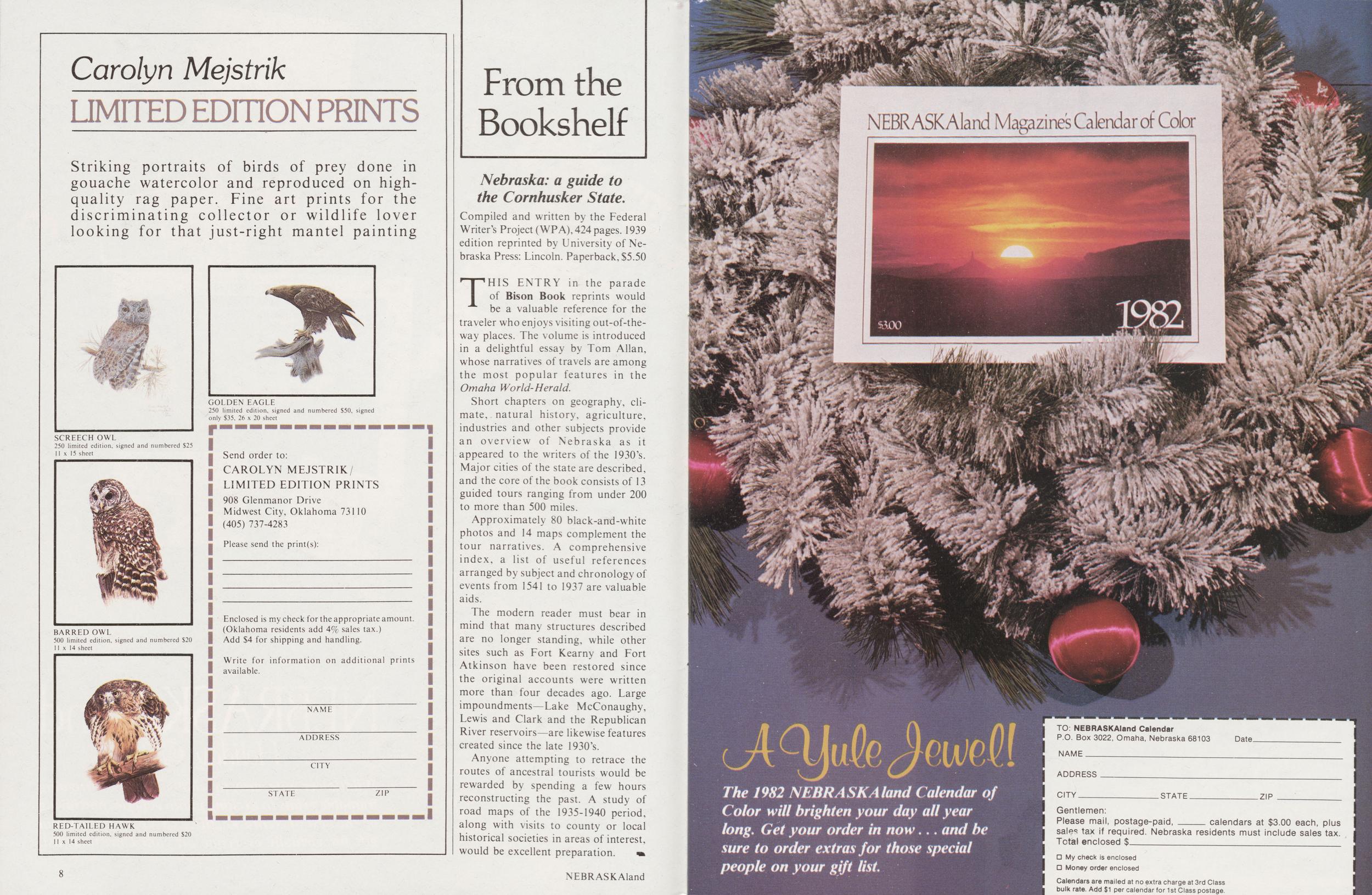
Carolyn Mejstrik LIMITED EDITION PRINTS Striking portraits of birds of prey done in gouache watercolor and reproduced on high-quality rag paper. Fine art prints for the discriminating collector or wildlife lover looking for that just-right mantel painting SCREECH OWL 250 limited edition, signed and numbered $25 11x15 sheet BARRED OWL 500 limited edition, signed and numbered $20 11 x 14 sheet RED-TAILED HAWK 500 limited edition, signed and numbered $20 11x14 sheet GOLDEN EAGLE 250 limited edition, signed and numbered $50, signed only $35, 26 x 20 sheet Send order to: CAROLYN MEJSTRIK LIMITED EDITION PRINTS 908 Glenmanor Drive Midwest City, Oklahoma 73110 (405) 737-4283 Please send the print(s): Enclosed is my check for the appropriate amount. (Oklahoma residents add 4% sales tax.) Add $4 for shipping and handling. Write for information on additional prints available. NAME ADDRESS CITY STATE ZIP 8 Nebraska: a guide to the Cornhusker State. Compiled and written by the Federal Writer's Project (WPA), 424 pages. 1939 edition reprinted by University of Nebraska Press: Lincoln. Paperback, $5.50THIS ENTRY in the parade of Bison Book reprints would be a valuable reference for the traveler who enjoys visiting out-of-the-way places. The volume is introduced in a delightful essay by Tom Allan, whose narratives of travels are among the most popular features in the Omaha World-Herald.
Short chapters on geography, climate, natural history, agriculture, industries and other subjects provide an overview of Nebraska as it appeared to the writers of the 1930's. Major cities of the state are described, and the core of the book consists of 13 guided tours ranging from under 200 to more than 500 miles.
Approximately 80 black-and-white photos and 14 maps complement the tour narratives. A comprehensive index, a list of useful references arranged by subject and chronology of events from 1541 to 1937 are valuable aids.
The modern reader must bear in mind that many structures described are no longer standing, while other sites such as Fort Kearny and Fort Atkinson have been restored since the original accounts were written more than four decades ago. Large impoundments—Lake McConaughy, Lewis and Clark and the Republican River reservoirs—are likewise features created since the late 1930's.
Anyone attempting to retrace the routes of ancestral tourists would be rewarded by spending a few hours reconstructing the past. A study of road maps of the 1935-1940 period, along with visits to county or local historical societies in areas of interest, would be excellent preparation.
8 NEBRASKAland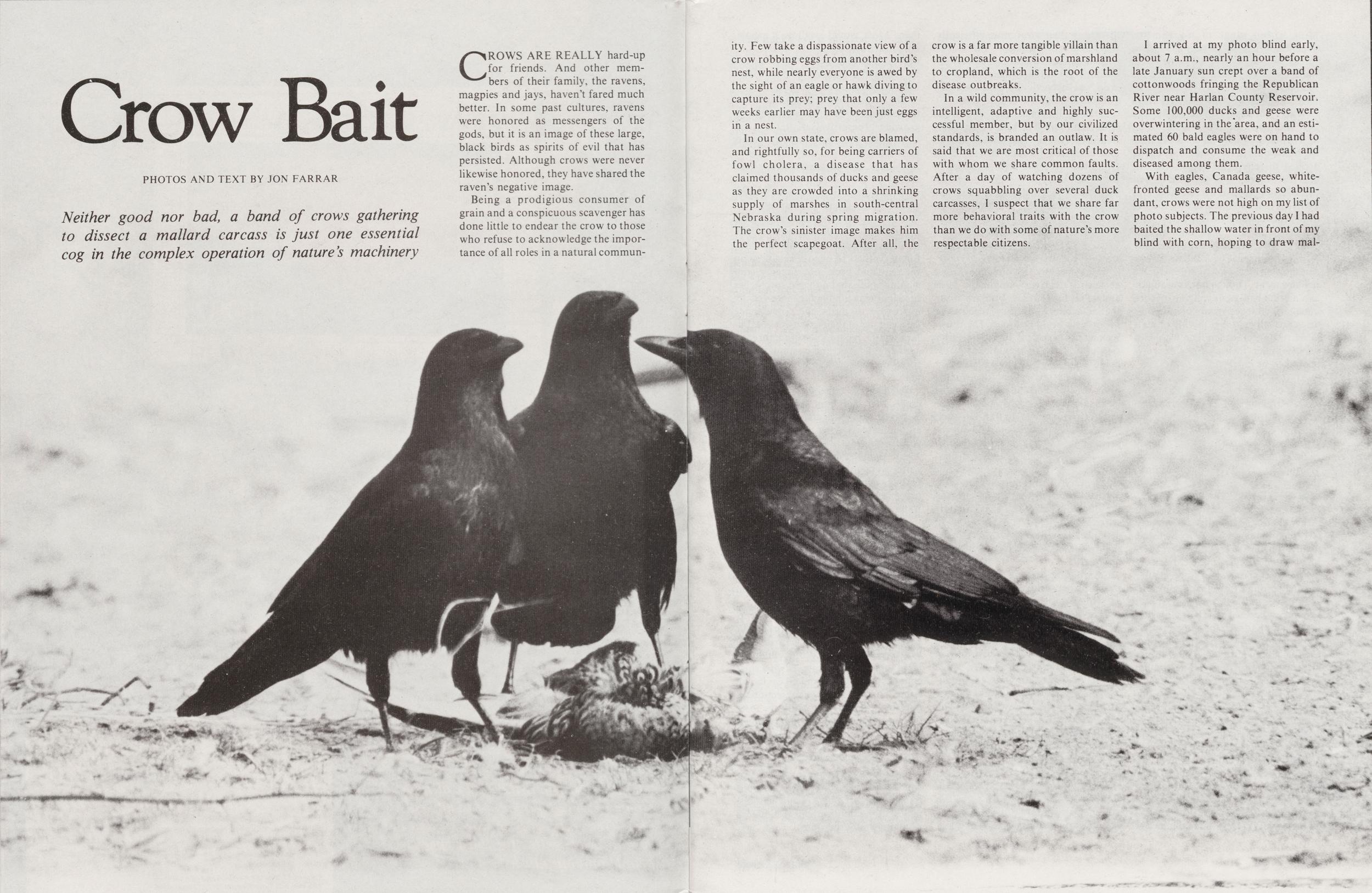
Crow Bait
PHOTOS AND TEXT BY JON FARRAR Neither good nor bad, a band of crows gathering to dissect a mallard carcass is just one essential cog in the complex operation of nature's machineryCROWS ARE REALLY hard-up for friends. And other members of their family, the ravens, magpies and jays, haven't fared much better. In some past cultures, ravens were honored as messengers of the gods, but it is an image of these large, black birds as spirits of evil that has persisted. Although crows were never likewise honored, they have shared the raven's negative image.
Being a prodigious consumer of grain and a conspicuous scavenger has done little to endear the crow to those who refuse to acknowledge the importance of all roles in a natural community.
In our own state, crows are blamed, and rightfully so, for being carriers of fowl cholera, a disease that has claimed thousands of ducks and geese as they are crowded into a shrinking supply of marshes in south-central Nebraska during spring migration. The crow's sinister image makes him the perfect scapegoat. After all, the crow is a far more tangible villain than the wholesale conversion of marshland to cropland, which is the root of the disease outbreaks.
In a wild community, the crow is an intelligent, adaptive and highly successful member, but by our civilized standards, is branded an outlaw. It is said that we are most critical of those with whom we share common faults. After a day of watching dozens of crows squabbling over several duck carcasses, I suspect that we share far more behavioral traits with the crow than we do with some of nature's more respectable citizens.
I arrived at my photo blind early, about 7 a.m., nearly an hour before a late January sun crept over a band of cottonwoods fringing the Republican River near Harlan County Reservoir. Some 100,000 ducks and geese were overwintering in the area, and an estimated 60 bald eagles were on hand to dispatch and consume the weak and diseased among them.
With eagles, Canada geese, white-fronted geese and mallards so abundant, crows were
not high on my list of
photo subjects. The previous day I had
baited the shallow water in front of my
blind with corn, hoping to draw mallards within
 range of my camera.
When I arrived this morning, I spread
three dead mallards I'd saved from the
hunting season, on the sandbars in the
faint hope of bringing an eagle down to
feed.
range of my camera.
When I arrived this morning, I spread
three dead mallards I'd saved from the
hunting season, on the sandbars in the
faint hope of bringing an eagle down to
feed.
When photographing wildlife, the best laid plans succeed about as often as when no plans are made at all. During nine hours in the blind, only crows arrived to relieve the monotony. An aberrant run of warm days had chased the ice from much of the reservoir, and mallards that should have been loafing away the midday on the river were rafted up in mid lake and off the points. The eagles were apparently well fed, dispersed with the waterfowl and showing no interest in my offering of mallard meat. Though not as dramatic as a mature bald eagle winging off with a mallard clutched firmly in its talons, or as attractive as a gathering of mallards resting on a sandbar with bills tucked under their wings, the crows proved to be entertaining subjects.
At first light, quarrelsome squadrons of crows began leaving their roost trees, stringing out to glean a grain field or patrol the river for ducks which had not survived the night. The first seven crows to come by passed over my eagle bait, swung, and glided down. Within minutes another 16 to 20 joined them, bickering and fighting with a variety of caws and bleat-like calls.
The appearance of crows at the bait rather than an eagle did not particularly disturb me. In fact, it seemed sure to attract eagles to the site. Other years I had watched eagles chase crows from a duck carcass or a shad stunned after passing through the dam's spillway.
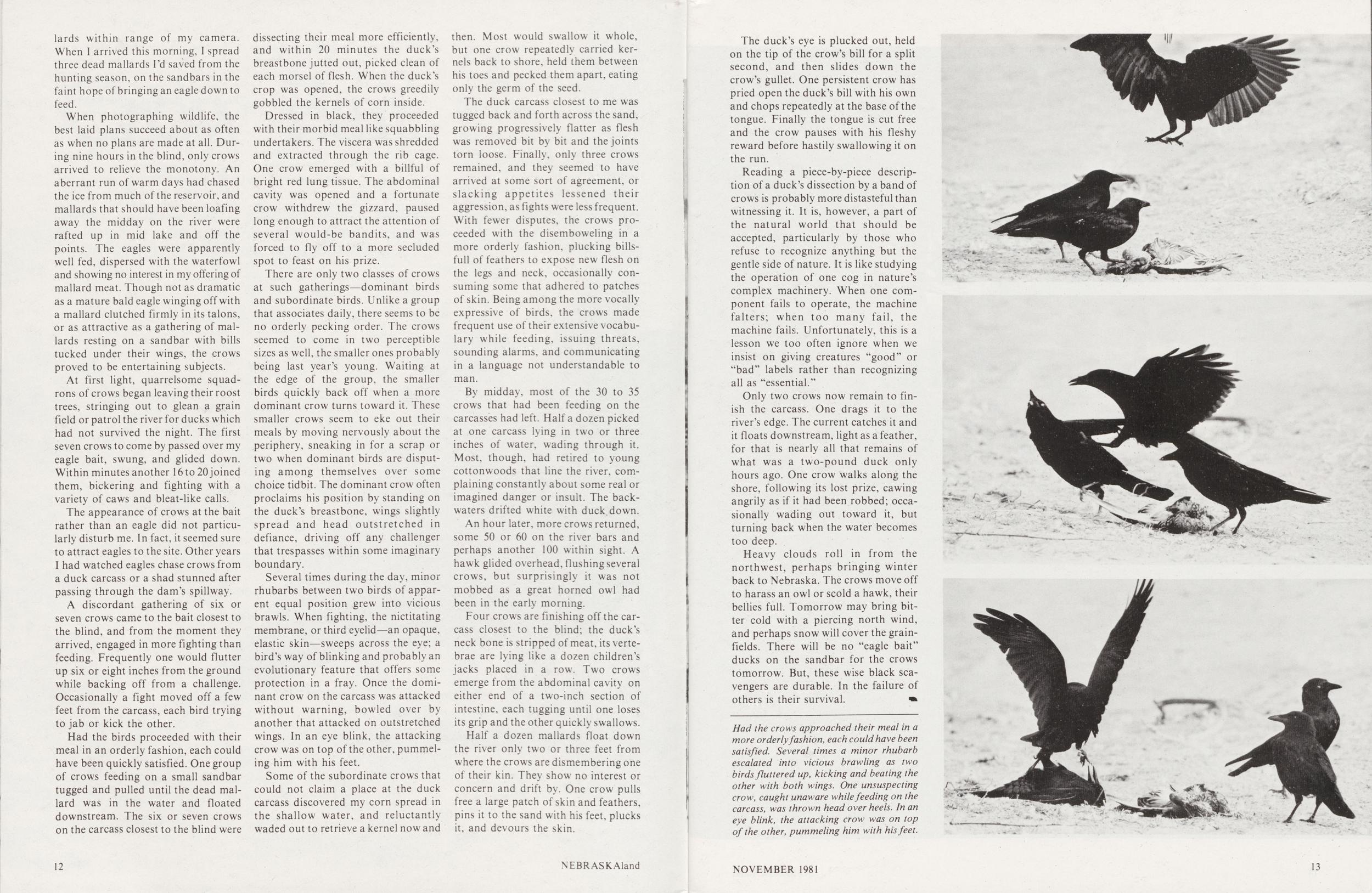
A discordant gathering of six or seven crows came to the bait closest to the blind, and from the moment they arrived, engaged in more fighting than feeding. Frequently one would flutter up six or eight inches from the ground while backing off from a challenge. Occasionally a fight moved off a few feet from the carcass, each bird trying to jab or kick the other.
Had the birds proceeded with their meal in an orderly fashion, each could have been quickly satisfied. One group of crows feeding on a small sandbar tugged and pulled until the dead mallard was in the water and floated downstream. The six or seven crows on the carcass closest to the blind were dissecting their meal more efficiently, and within 20 minutes the duck's breastbone jutted out, picked clean of each morsel of flesh. When the duck's crop was opened, the crows greedily gobbled the kernels of corn inside.
Dressed in black, they proceeded with their morbid meal like squabbling undertakers. The viscera was shredded and extracted through the rib cage. One crow emerged with a billful of bright red lung tissue. The abdominal cavity was opened and a fortunate crow withdrew the gizzard, paused long enough to attract the attention of several would-be bandits, and was forced to fly off to a more secluded spot to feast on his prize.
There are only two classes of crows at such gatherings—dominant birds and subordinate birds. Unlike a group that associates daily, there seems to be no orderly pecking order. The crows seemed to come in two perceptible sizes as well, the smaller ones probably being last year's young. Waiting at the edge of the group, the smaller birds quickly back off when a more dominant crow turns toward it. These smaller crows seem to eke out their meals by moving nervously about the periphery, sneaking in for a scrap or two when dominant birds are disputing among themselves over some choice tidbit. The dominant crow often proclaims his position by standing on the duck's breastbone, wings slightly spread and head outstretched in defiance, driving off any challenger that trespasses within some imaginary boundary.
Several times during the day, minor rhubarbs between two birds of apparent equal position grew into vicious brawls. When fighting, the nictitating membrane, or third eyelid—an opaque, elastic skin—sweeps across the eye; a bird's way of blinking and probably an evolutionary feature that offers some protection in a fray. Once the dominant crow on the carcass was attacked without warning, bowled over by another that attacked on outstretched wings. In an eye blink, the attacking crow was on top of the other, pummeling him with his feet.
Some of the subordinate crows that could not claim a place at the duck carcass discovered my corn spread in the shallow water, and reluctantly waded out to retrieve a kernel now and then. Most would swallow it whole, but one crow repeatedly carried kernels back to shore, held them between his toes and pecked them apart, eating only the germ of the seed.
The duck carcass closest to me was tugged back and forth across the sand, growing progressively flatter as flesh was removed bit by bit and the joints torn loose. Finally, only three crows remained, and they seemed to have arrived at some sort of agreement, or slacking appetites lessened their aggression, as fights were less frequent. With fewer disputes, the crows proceeded with the disemboweling in a more orderly fashion, plucking billsfull of feathers to expose new flesh on the legs and neck, occasionally consuming some that adhered to patches of skin. Being among the more vocally expressive of birds, the crows made frequent use of their extensive vocabulary while feeding, issuing threats, sounding alarms, and communicating in a language not understandable to man.
By midday, most of the 30 to 35 crows that had been feeding on the carcasses had left. Haifa dozen picked at one carcass lying in two or three inches of water, wading through it. Most, though, had retired to young cottonwoods that line the river, complaining constantly about some real or imagined danger or insult. The back-waters drifted white with duck down.
An hour later, more crows returned, some 50 or 60 on the river bars and perhaps another 100 within sight. A hawk glided overhead, flushing several crows, but surprisingly it was not mobbed as a great horned owl had been in the early morning.
Four crows are finishing off the carcass closest to the blind; the duck's neck bone is stripped of meat, its vertebrae are lying like a dozen children's jacks placed in a row. Two crows emerge from the abdominal cavity on either end of a two-inch section of intestine, each tugging until one loses its grip and the other quickly swallows.
Half a dozen mallards float down the river only two or three feet from where the crows are dismembering one of their kin. They show no interest or concern and drift by. One crow pulls free a large patch of skin and feathers, pins it to the sand with his feet, plucks it, and devours the skin.
12 NEBRASKAlandThe duck's eye is plucked out, held on the tip of the crow's bill for a split second, and then slides down the crow's gullet. One persistent crow has pried open the duck's bill with his own and chops repeatedly at the base of the tongue. Finally the tongue is cut free and the crow pauses with his fleshy reward before hastily swallowing it on the run.
Reading a piece-by-piece description of a duck's dissection by a band of crows is probably more distasteful than witnessing it. It is, however, a part of the natural world that should be accepted, particularly by those who refuse to recognize anything but the gentle side of nature. It is like studying the operation of one cog in nature's complex machinery. When one component fails to operate, the machine falters; when too many fail, the machine fails. Unfortunately, this is a lesson we too often ignore when we insist on giving creatures "good" or "bad" labels rather than recognizing all as "essential."
Only two crows now remain to finish the carcass. One drags it to the river's edge. The current catches it and it floats downstream, light as a feather, for that is nearly all that remains of what was a two-pound duck only hours ago. One crow walks along the shore, following its lost prize, cawing angrily as if it had been robbed; occasionally wading out toward it, but turning back when the water becomes too deep.
Heavy clouds roll in from the northwest, perhaps bringing winter back to Nebraska. The crows move off to harass an owl or scold a hawk, their bellies full. Tomorrow may bring bitter cold with a piercing north wind, and perhaps snow will cover the grain-fields. There will be no "eagle bait" ducks on the sandbar for the crows tomorrow. But, these wise black scavengers are durable. In the failure of others is their survival.
Ring of the Anvil
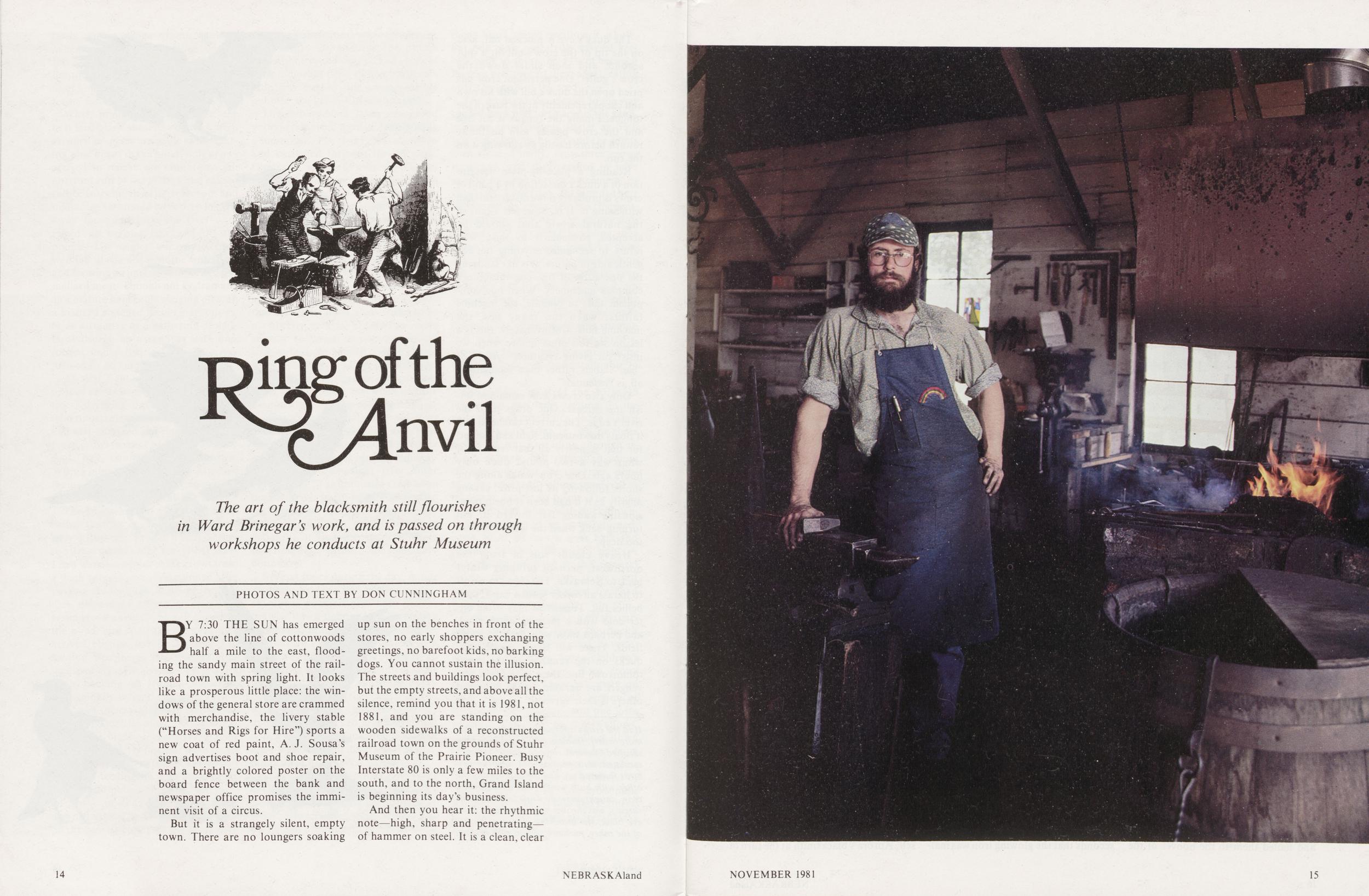
The art of the blacksmith still flourishes in Ward Brinegars work, and is passed on through workshops he conducts at Stuhr Museum PHOTOS AND TEXT BY DON CUNNINGHAMBY 7:30 THE SUN has emerged above the line of cottonwoods half a mile to the east, flooding the sandy main street of the railroad town with spring light. It looks like a prosperous little place: the windows of the general store are crammed with merchandise, the livery stable ("Horses and Rigs for Hire") sports a new coat of red paint, A, J. Sousa's sign advertises boot and shoe repair, and a brightly colored poster on the board fence between the bank and newspaper office promises the imminent visit of a circus.
But it is a strangely silent, empty town. There are no loungers soaking up sun on the benches in front of the stores, no early shoppers exchanging greetings, no barefoot kids, no barking dogs. You cannot sustain the illusion. The streets and buildings look perfect, but the empty streets, and above all the silence, remind you that it is 1981, not 1881, and you are standing on the wooden sidewalks of a reconstructed railroad town on the grounds of Stuhr Museum of the Prairie Pioneer. Busy Interstate 80 is only a few miles to the south, and to the north, Grand Island is beginning its day's business.
And then you hear it: the rhythmic note—high, sharp and penetrating—of hammer on steel. It is a clean, clear 14 NEBRASKAland
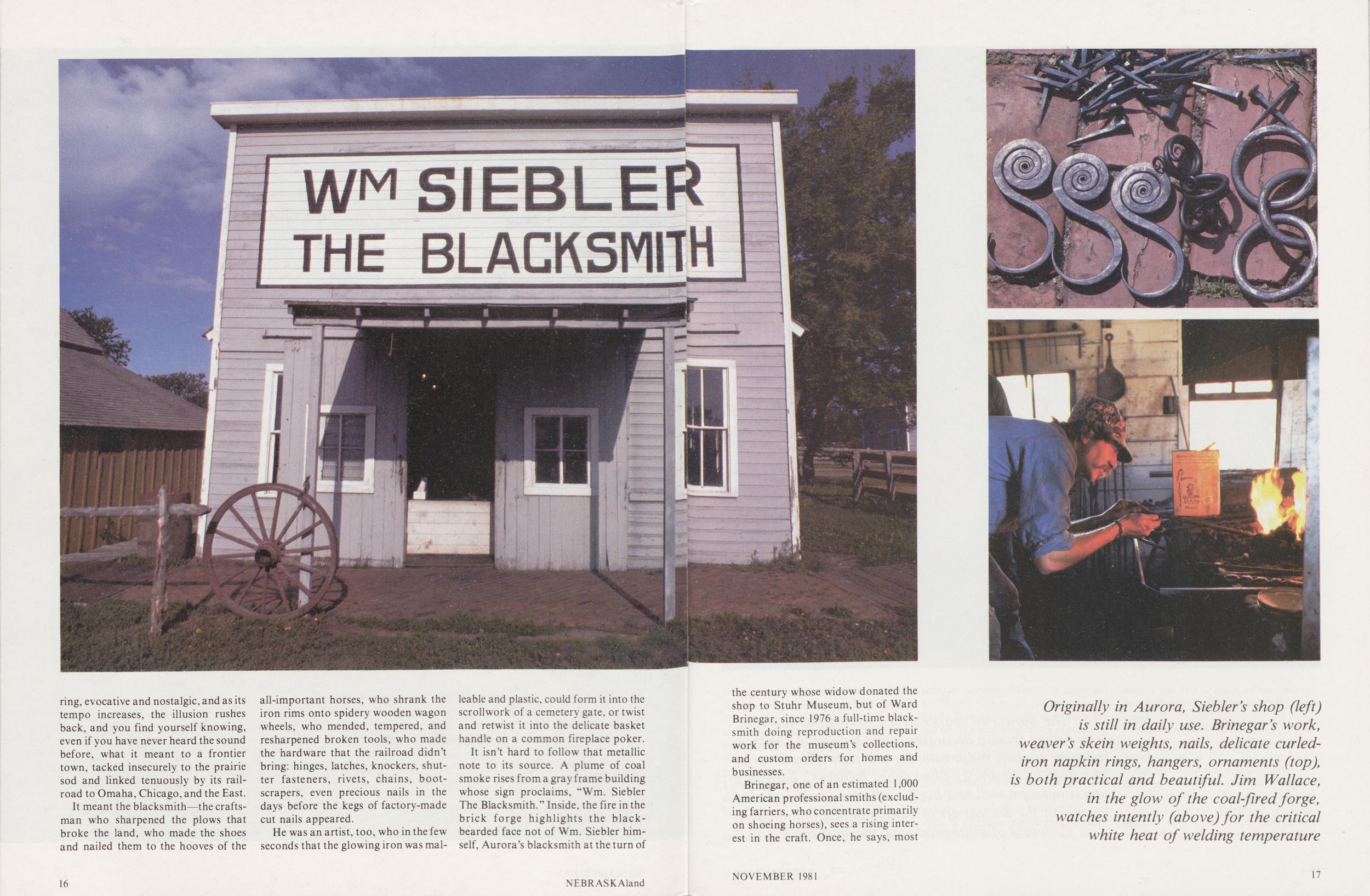
It meant the blacksmith—the craftsman who sharpened the plows that broke the land, who made the shoes and nailed them to the hooves of the all-important horses, who shrank the iron rims onto spidery wooden wagon wheels, who mended, tempered, and resharpened broken tools, who made the hardware that the railroad didn't bring: hinges, latches, knockers, shutter fasteners, rivets, chains, boot-scrapers, even precious nails in the days before the kegs of factory-made cut nails appeared.
He was an artist, too, who in the few seconds that the glowing iron was malleable and plastic, could form it into the scrollwork of a cemetery gate, or twist and retwist it into the delicate basket handle on a common fireplace poker.
It isn't hard to follow that metallic note to its source. A plume of coal smoke rises from a gray frame building whose sign proclaims, "Wm. Siebler The Blacksmith." Inside, the fire in the brick forge highlights the black-bearded face not of Wm. Siebler himself, Aurora's blacksmith at the turn of 16 NEBRASKAland the century whose widow donated the shop to Stuhr Museum, but of Ward Brinegar, since 1976 a full-time blacksmith doing reproduction and repair work for the museum's collections, and custom orders for homes and businesses.
Brinegar, one of an estimated 1,000 American professional smiths (excluding farriers, who concentrate primarily on shoeing horses), sees a rising interest in the craft. Once, he says, most
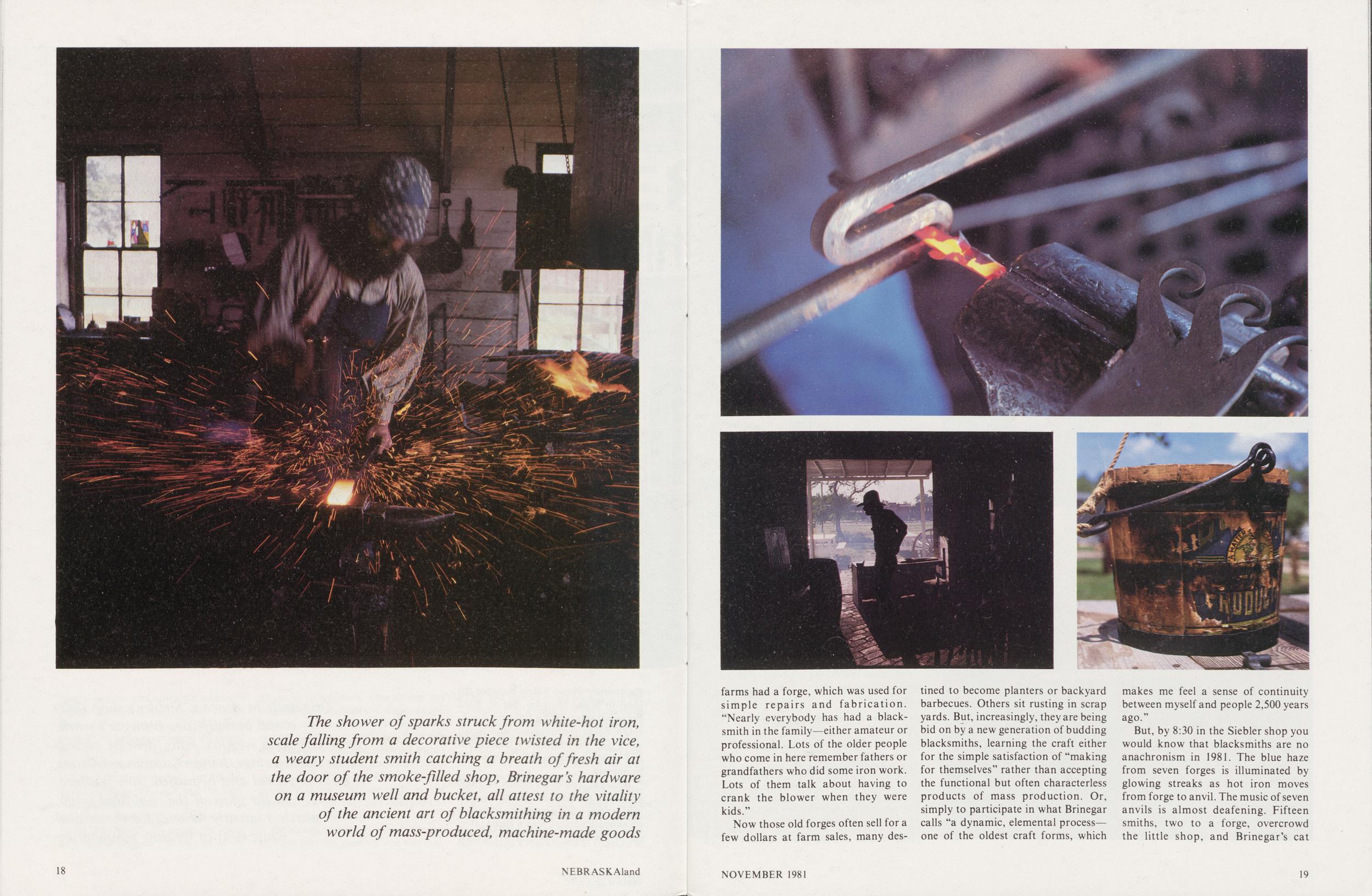
Now those old forges often sell for a few dollars at farm sales, many destined to become planters or backyard barbecues. Others sit rusting in scrap yards. But, increasingly, they are being bid on by a new generation of budding blacksmiths, learning the craft either for the simple satisfaction of "making for themselves" rather than accepting the functional but often characterless products of mass production. Or, simply to participate in what Brinegar calls "a dynamic, elemental process—one of the oldest craft forms, which makes me feel a sense of continuity between myself and people 2,500 years ago.
But, by 8:30 in the Siebler shop you
would know that blacksmiths are no
anachronism in 1981. The blue haze
from seven forges is illuminated by
glowing streaks as hot iron moves
from forge to anvil. The music of seven
anvils is almost deafening. Fifteen
smiths, two to a forge, overcrowd
the little shop, and Brinegar's cat
NOVEMBER 1981
19
 deserts her usual post on the window
sill above the workbench for a quieter,
cleaner spot somewhere else in the
village.
deserts her usual post on the window
sill above the workbench for a quieter,
cleaner spot somewhere else in the
village.
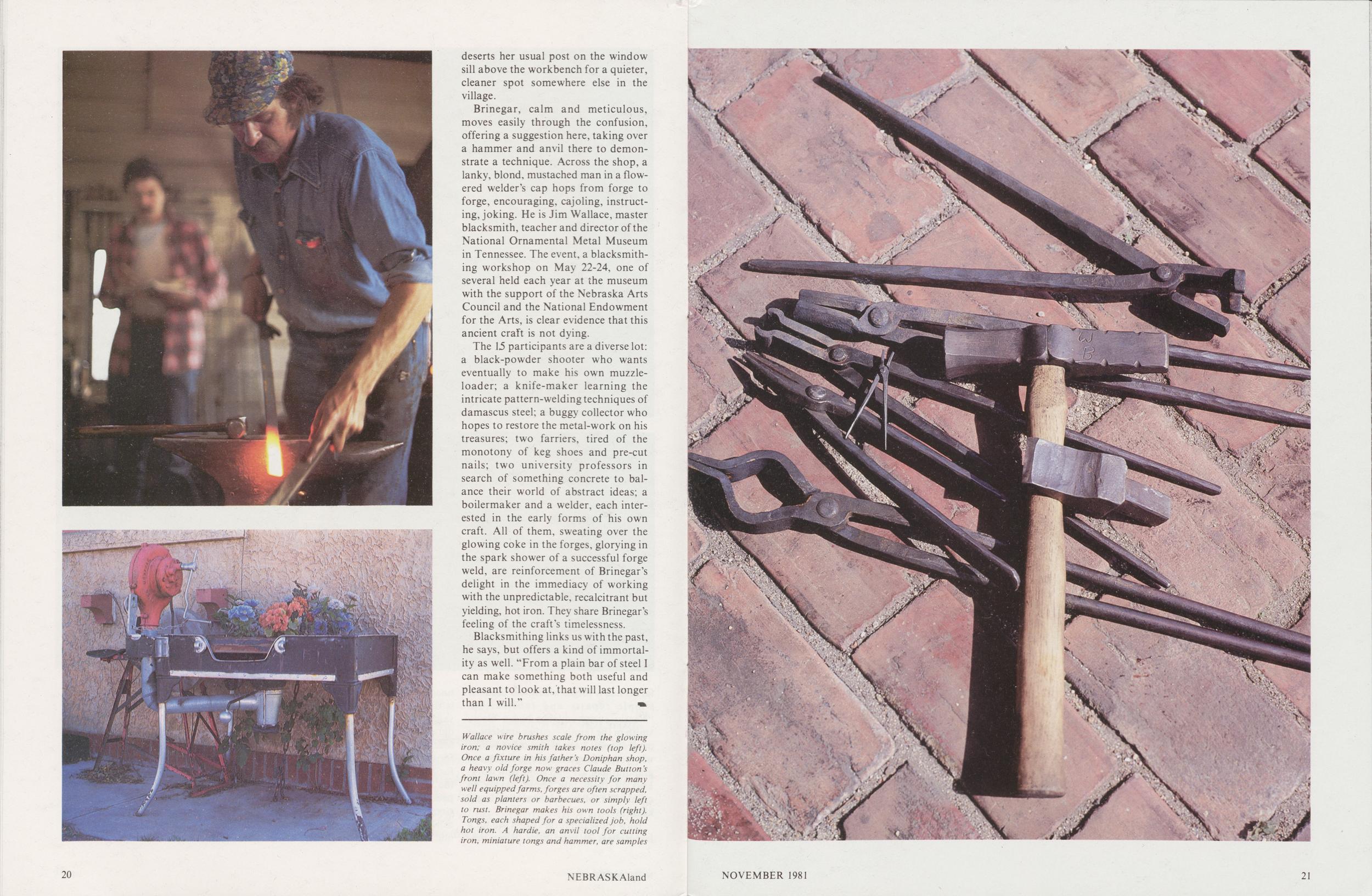
Brinegar, calm and meticulous, moves easily through the confusion, offering a suggestion here, taking over a hammer and anvil there to demonstrate a technique. Across the shop, a lanky, blond, mustached man in a flowered welder's cap hops from forge to forge, encouraging, cajoling, instructing, joking. He is Jim Wallace, master blacksmith, teacher and director of the National Ornamental Metal Museum in Tennessee. The event, a blacksmithing workshop on May 22-24, one of several held each year at the museum with the support of the Nebraska Arts Council and the National Endowment for the Arts, is clear evidence that this ancient craft is not dying.
The 15 participants are a diverse lot: a black-powder shooter who wants eventually to make his own muzzle-loader; a knife-maker learning the intricate pattern-welding techniques of damascus steel; a buggy collector who hopes to restore the metal-work on his treasures; two farriers, tired of the monotony of keg shoes and pre-cut nails; two university professors in search of something concrete to balance their world of abstract ideas; a boilermaker and a welder, each interested in the early forms of his own craft. All of them, sweating over the glowing coke in the forges, glorying in the spark shower of a successful forge weld, are reinforcement of Brinegar's delight in the immediacy of working with the unpredictable, recalcitrant but yielding, hot iron. They share Brinegar's feeling of the craft's timelessness.
Blacksmithing links us with the past, he says, but offers a kind of immortality as well. "From a plain bar of steel I can make something both useful and pleasant to look at, that will last longer than I will."
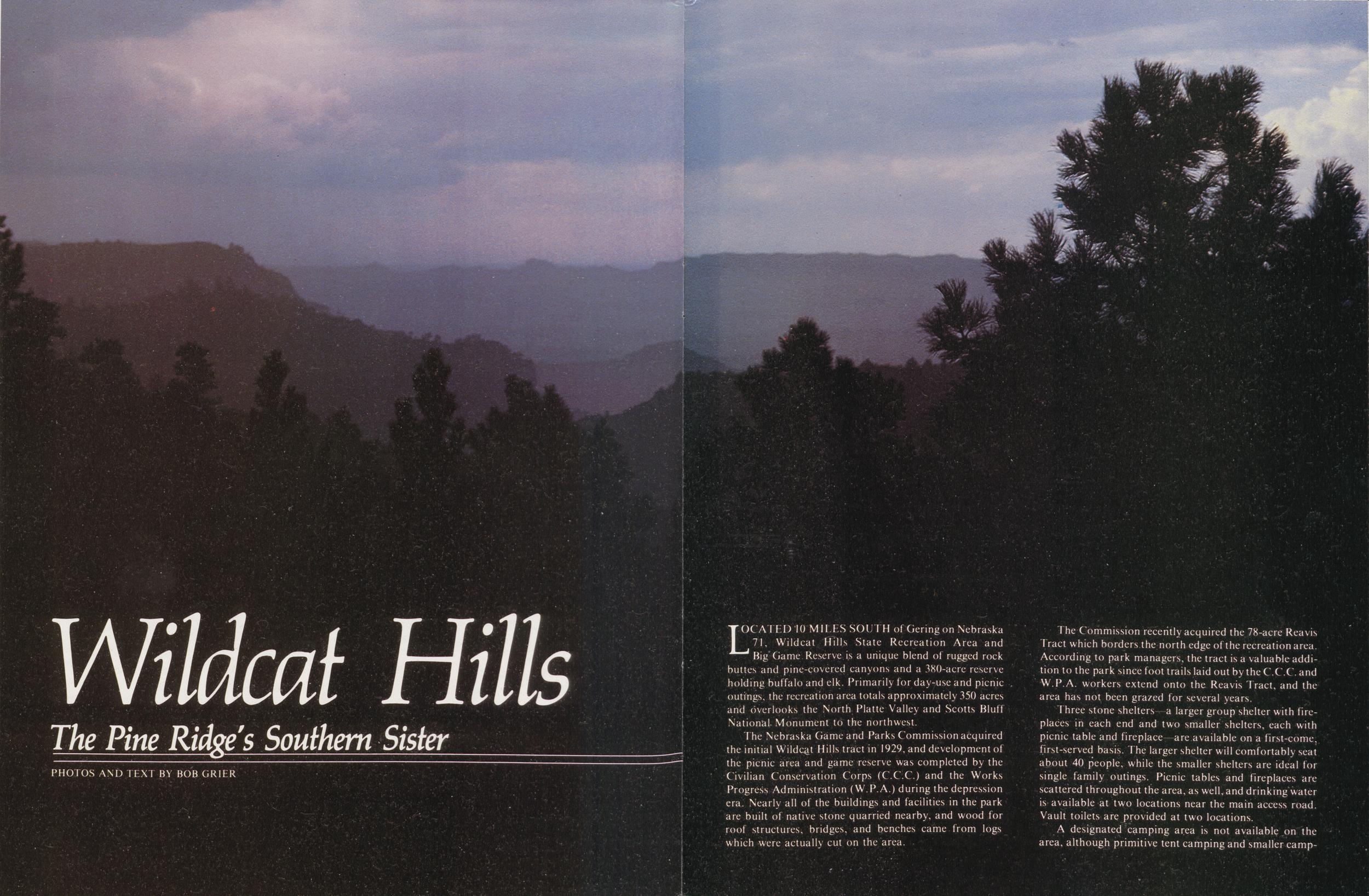
Wildcat Hills
The Pine Ridge's Southern Sister PHOTOS AND TEXT BY BOB GRlEROCATED 10 MILES SOUTH of Geringon Nebraska 71, Wildcat Hills State Recreation Area and Big Game Reserve is a unique blend of rugged rock buttes and pine-covered canyons and a 380-acre reserve holding buffalo and elk. Primarily for day-use and picnic outings, the recreation area totals approximately 350 acres and overlooks the North Platte Valley and Scotts Bluff National. Monument to the northwest.
The Nebraska Game and Parks Commission acquired the initial Wildcat Hills tract in 1929, and development of the picnic area and game reserve was completed by the Civilian Conservation Corps (C.C.C.) and the Works Progress Administration (W.P.A.) during the depression era. Nearly all of the buildings and facilities in the park are built of native stone quarried nearby, and wood for roof structures, bridges, and benches came from logs which were actuallv cut on the area
Iract which borders the north edge of the recreation area. According to park managers, the tract is a valuable addition to the park since foot trails laid out by the C.C.C and W.P.A. workers extend onto the Reavis Tract, and the area has not been grazed for several years.
Three stone shelters a larger group shelter with fire-places in each end and two smaller shelters, each with picnic table and fireplace are available on a first-come, first-served basis. The larger shelter will comfortably seat about 40 people, while the smaller shelters are ideal for single family outings. Picnic tables and fireplaces are scattered throughout the area, as well, and drinking water is available at two locations near the main access road. Vault toilets are provided at two locations.
A designated camping area is not available on the
area, although primitive tent camping and smaller camping
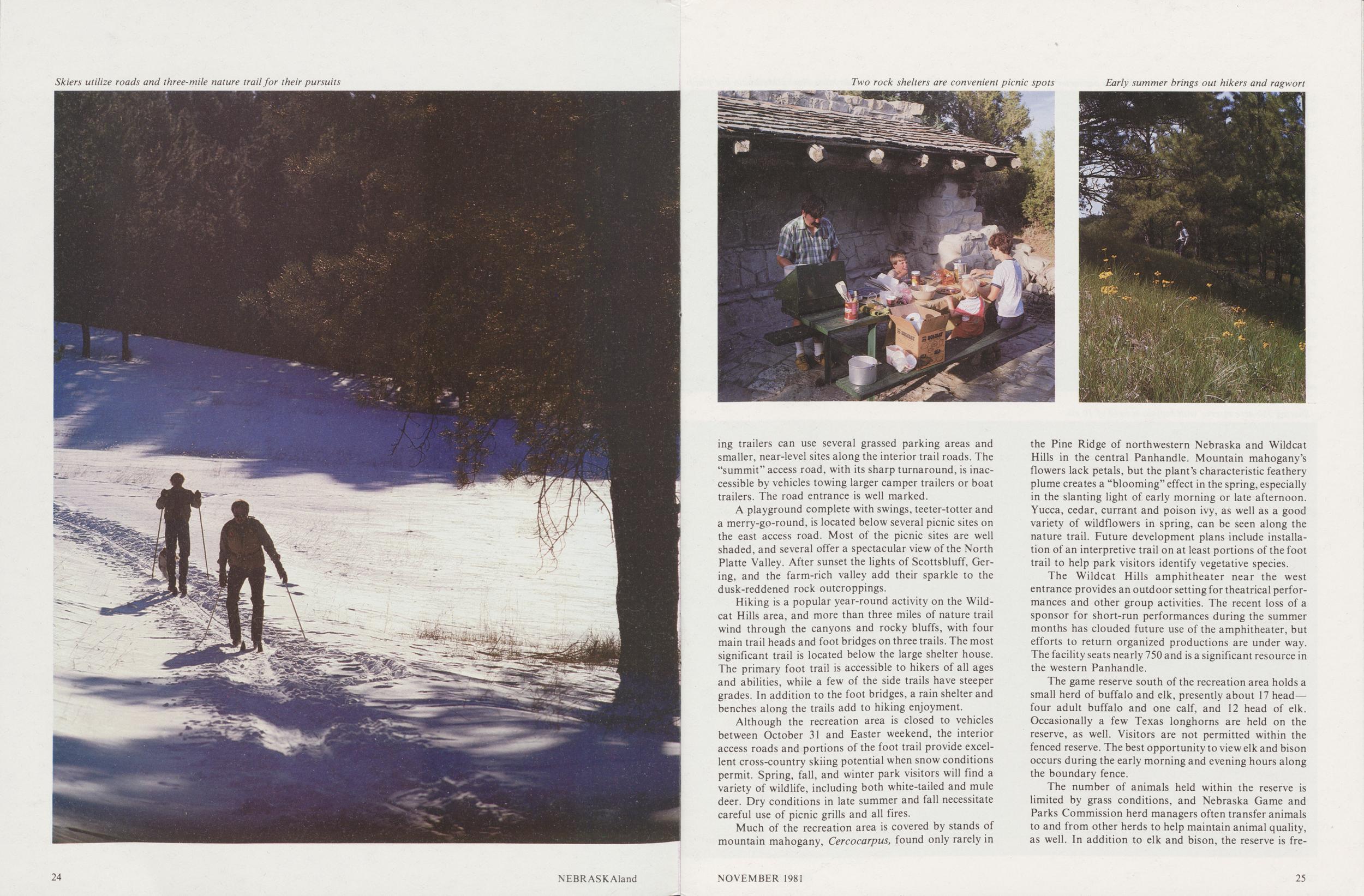
A playground complete with swings, teeter-totter and a merry-go-round, is located below several picnic sites on the east access road. Most of the picnic sites are well shaded, and several offer a spectacular view of the North Platte Valley. After sunset the lights of Scottsbluff, Gering, and the farm-rich valley add their sparkle to the dusk-reddened rock outcroppings.
Hiking is a popular year-round activity on the Wildcat Hills area, and more than three miles of nature trail wind through the canyons and rocky bluffs, with four main trail heads and foot bridges on three trails. The most significant trail is located below the large shelter house. The primary foot trail is accessible to hikers of all ages and abilities, while a few of the side trails have steeper grades. In addition to the foot bridges, a rain shelter and benches along the trails add to hiking enjoyment.
Although the recreation area is closed to vehicles between October 31 and Easter weekend, the interior access roads and portions of the foot trail provide excellent cross-country skiing potential when snow conditions permit. Spring, fall, and winter park visitors will find a variety of wildlife, including both white-tailed and mule deer. Dry conditions in late summer and fall necessitate careful use of picnic grills and all fires.
Much of the recreation area is covered by stands of mountain mahogany, Cercocarpus, found only rarely in the Pine Ridge of northwestern Nebraska and Wildcat Hills in the central Panhandle. Mountain mahogany's flowers lack petals, but the plant's characteristic feathery plume creates a "blooming" effect in the spring, especially in the slanting light of early morning or late afternoon. Yucca, cedar, currant and poison ivy, as well as a good variety of wildflowers in spring, can be seen along the nature trail. Future development plans include installation of an interpretive trail on at least portions of the foot trail to help park visitors identify vegetative species.
The Wildcat Hills amphitheater near the west entrance provides an outdoor setting for theatrical performances and other group activities. The recent loss of a sponsor for short-run performances during the summer months has clouded future use of the amphitheater, but efforts to return organized productions are under way. The facility seats nearly 750 and is a significant resource in the western Panhandle.
The game reserve south of the recreation area holds a small herd of buffalo and elk, presently about 17 head—four adult buffalo and one calf, and 12 head of elk. Occasionally a few Texas longhorns are held on the reserve, as well. Visitors are not permitted within the fenced reserve. The best opportunity to view elk and bison occurs during the early morning and evening hours along the boundary fence.
The number of animals held within the reserve is limited by grass conditions, and Nebraska Game and Parks Commission herd managers often transfer animals to and from other herds to help maintain animal quality, as well. In addition to elk and bison, the reserve is fre- NOVEMBER 1981 25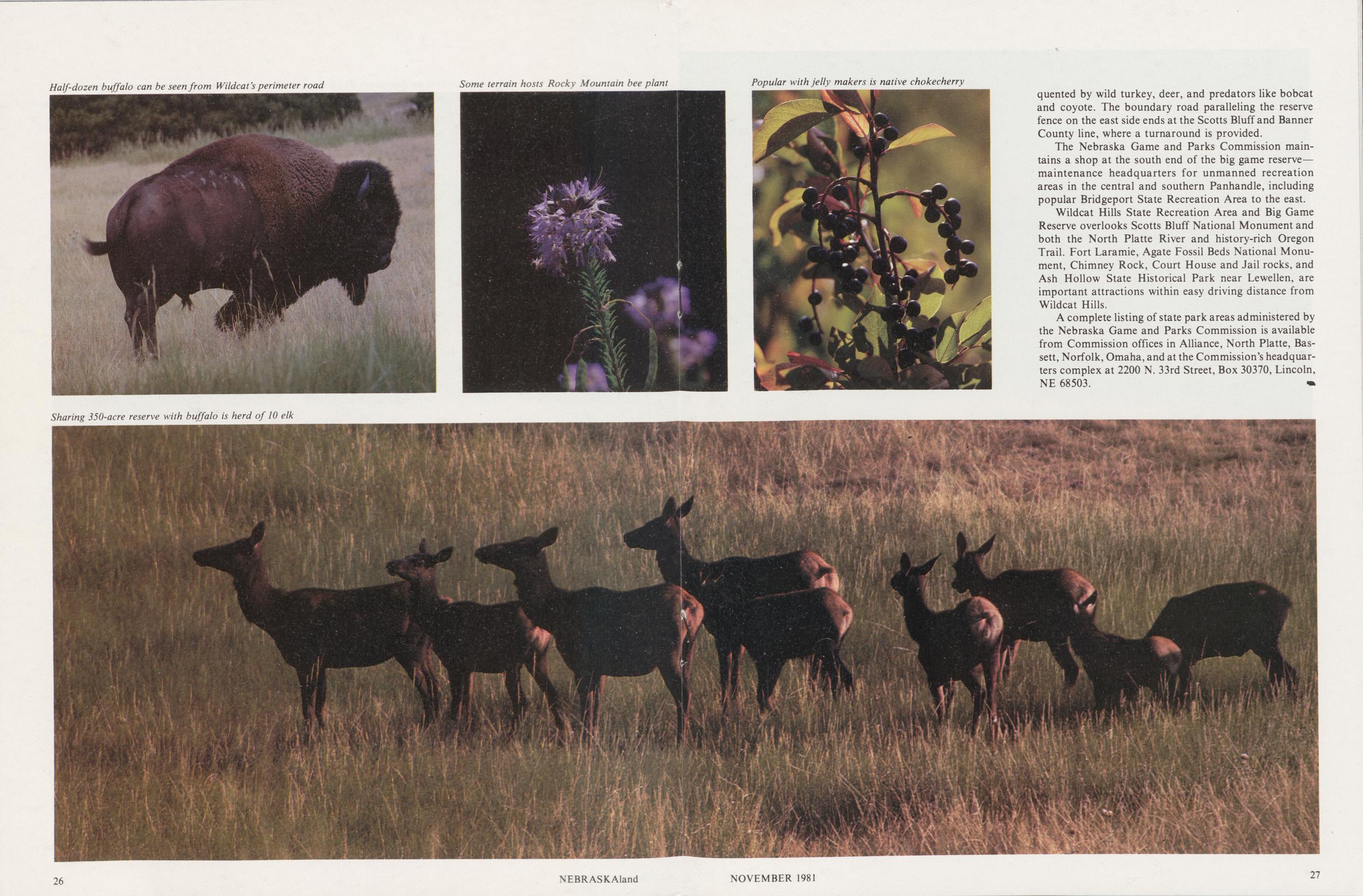
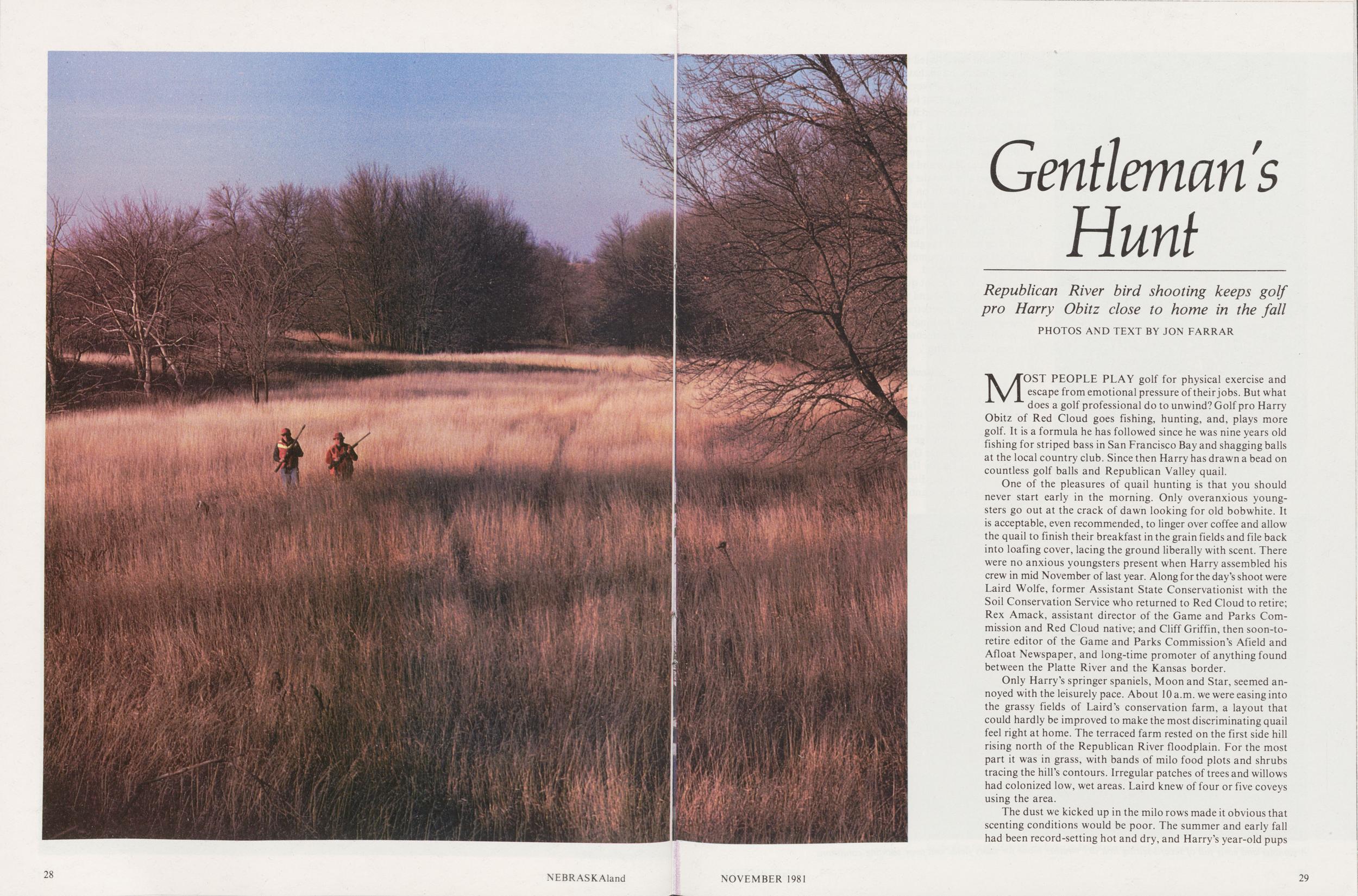
Gentleman's Hunt
Republican River bird shooting keeps golf pro Harry Obitz close to home in the fall PHOTOS AND TEXT BY JON FARRARMOST PEOPLE PLAY golf for physical exercise and escape from emotional pressure of their jobs. But what does a golf professional do to unwind? Golf pro Harry Obitz of Red Cloud goes fishing, hunting, and, plays more golf. It is a formula he has followed since he was nine years old fishing for striped bass in San Francisco Bay and shagging balls at the local country club. Since then Harry has drawn a bead on countless golf balls and Republican Valley quail.
One of the pleasures of quail hunting is that you should never start early in the morning. Only overanxious youngsters go out at the crack of dawn looking for old bobwhite. It is acceptable, even recommended, to linger over coffee and allow the quail to finish their breakfast in the grain fields and file back into loafing cover, lacing the ground liberally with scent. There were no anxious youngsters present when Harry assembled his crew in mid November of last year. Along for the day's shoot were Laird Wolfe, former Assistant State Conservationist with the Soil Conservation Service who returned to Red Cloud to retire; Rex Amack, assistant director of the Game and Parks Commission and Red Cloud native; and Cliff Griffin, then soon-to-retire editor of the Game and Parks Commission's Afield and Afloat Newspaper, and long-time promoter of anything found between the Platte River and the Kansas border.
Only Harry's springer spaniels, Moon and Star, seemed annoyed with the leisurely pace. About 10 a.m. we were easing into the grassy fields of Laird's conservation farm, a layout that could hardly be improved to make the most discriminating quail feel right at home. The terraced farm rested on the first side hill rising north of the Republican River floodplain. For the most part it was in grass, with bands of milo food plots and shrubs tracing the hill's contours. Irregular patches of trees and willows had colonized low, wet areas. Laird knew of four or five coveys using the area.
The dust we kicked up in the milo rows made it obvious that
scenting conditions would be poor. The summer and early fall
had been record-setting hot and dry, and Harry's year-old pups
NOVEMBER 1981
29
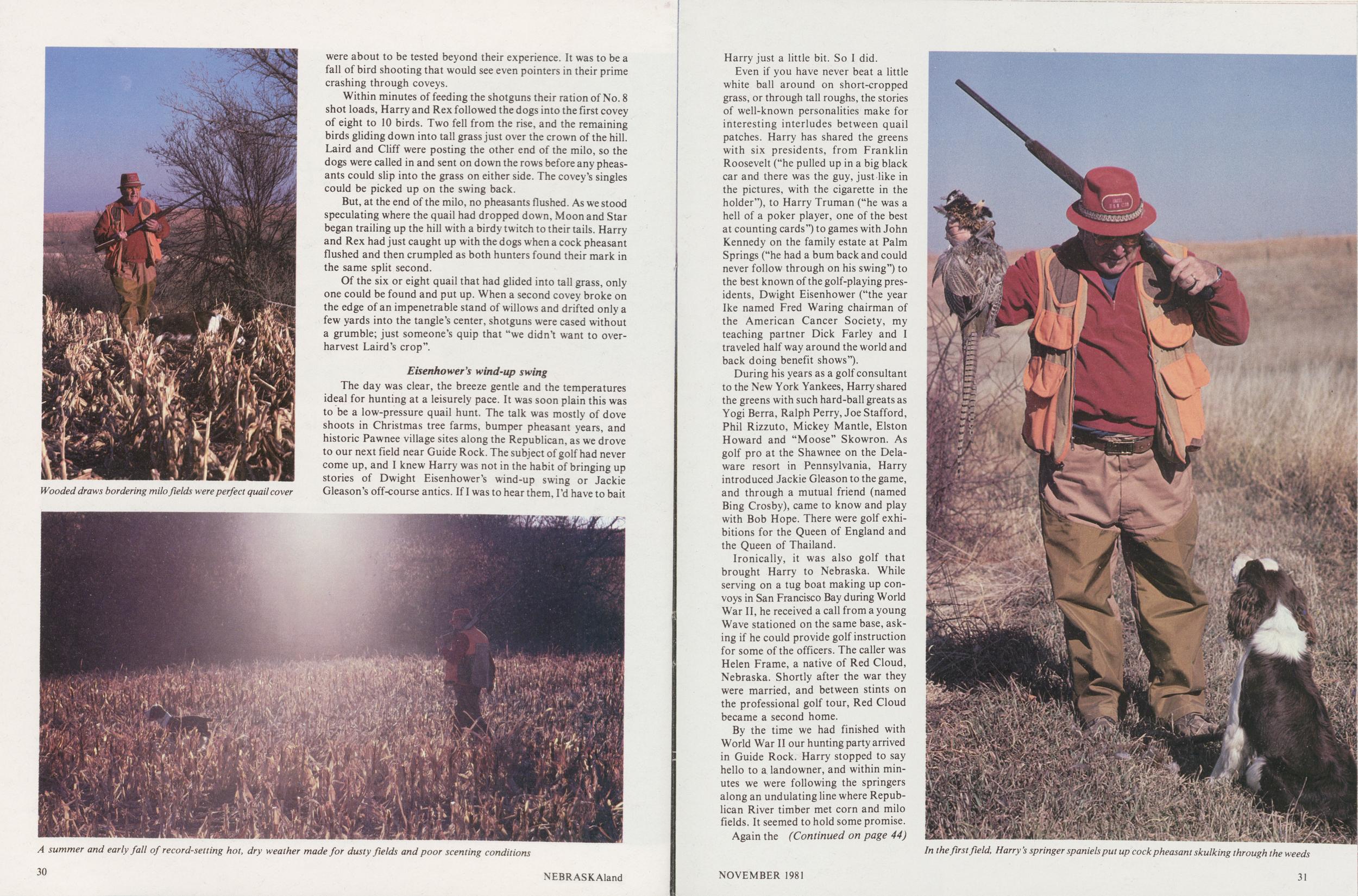
Within minutes of feeding the shotguns their ration of No. 8 shot loads, Harry and Rex followed the dogs into the first covey of eight to 10 birds. Two fell from the rise, and the remaining birds gliding down into tall grass just over the crown of the hill. Laird and Cliff were posting the other end of the milo, so the dogs were called in and sent on down the rows before any pheasants could slip into the grass on either side. The covey's singles could be picked up on the swing back.
But, at the end of the milo, no pheasants flushed. As we stood speculating where the quail had dropped down, Moon and Star began trailing up the hill with a birdy twitch to their tails. Harry and Rex had just caught up with the dogs when a cock pheasant flushed and then crumpled as both hunters found their mark in the same split second.
Of the six or eight quail that had glided into tall grass, only one could be found and put up. When a second covey broke on the edge of an impenetrable stand of willows and drifted only a few yards into the tangle's center, shotguns were cased without a grumble; just someone's quip that "we didn't want to over-harvest Laird's crop".
Eisenhower's wind-up swingThe day was clear, the breeze gentle and the temperatures ideal for hunting at a leisurely pace. It was soon plain this was to be a low-pressure quail hunt. The talk was mostly of dove shoots in Christmas tree farms, bumper pheasant years, and historic Pawnee village sites along the Republican, as we drove to our next field near Guide Rock. The subject of golf had never come up, and I knew Harry was not in the habit of bringing up stories of Dwight Eisenhower's wind-up swing or Jackie Gleason's off-course antics. If I was to hear them, I'd have to bait
Even if you have never beat a little white ball around on short-cropped grass, or through tall roughs, the stories of well-known personalities make for interesting interludes between quail patches. Harry has shared the greens with six presidents, from Franklin Roosevelt ("he pulled up in a big black car and there was the guy, just like in the pictures, with the cigarette in the holder"), to Harry Truman ("he was a hell of a poker player, one of the best at counting cards") to games with John Kennedy on the family estate at Palm Springs ("he had a bum back and could never follow through on his swing") to the best known of the golf-playing presidents, Dwight Eisenhower ("the year Ike named Fred Waring chairman of the American Cancer Society, my teaching partner Dick Farley and I traveled half way around the world and back doing benefit shows").
During his years as a golf consultant to the New York Yankees, Harry shared the greens with such hard-ball greats as Yogi Berra, Ralph Perry, Joe Stafford, Phil Rizzuto, Mickey Mantle, Elston Howard and "Moose" Skowron. As golf pro at the Shawnee on the Delaware resort in Pennsylvania, Harry introduced Jackie Gleason to the game, and through a mutual friend (named Bing Crosby), came to know and play with Bob Hope. There were golf exhibitions for the Queen of England and the Queen of Thailand.
Ironically, it was also golf that brought Harry to Nebraska. While serving on a tug boat making up convoys in San Francisco Bay during World War II, he received a call from a young Wave stationed on the same base, asking if he could provide golf instruction for some of the officers. The caller was Helen Frame, a native of Red Cloud, Nebraska. Shortly after the war they were married, and between stints on the professional golf tour, Red Cloud became a second home.
By the time we had finished with World War II our hunting party arrived in Guide Rock. Harry stopped to say hello to a landowner, and within minutes we were following the springers along an undulating line where Republican River timber met corn and milo fields. It seemed to hold some promise. Again the (Continued on page 44)
Monuments on the Missouri
TOM PALMERTON is an artist of considerable ambition, and although he has achieved no small amount of success, he continues to improve, and to expand his area of interest, and to try new projects. People with ambition seem to need to keep improving or expanding. And, if a person is creative as well as ambitious, he can always think of ways to improve.
If Tom were still working for the railroad, or some other more physical profession, he might use up enough energy during the day that he would be content to relax when at home. But, the artist in his soul long ago won out, and he took up the brush seriously and professionally. Many other lesser decisions had to be made since then, and stints in commercial art and teaching were eventually abandoned in favor of self-employment.
Not everyone is capable of being his own boss. The urge to wander off to nap, or fish, or just fool around, is strong. But, not so for Tom. He is a slave driver most of the year, requiring longer hours and harder work of himself than most bosses would.
An early riser, Tom is usually on the job by 7 a.m. or shortly thereafter, and steadily paints or sculpts until lunch. Then, after soup and/ or sandwich, it's back to the bench until late afternoon. And, if readying material for a show, he'll be back at work that night, spending two-thirds of his day hard at work.
32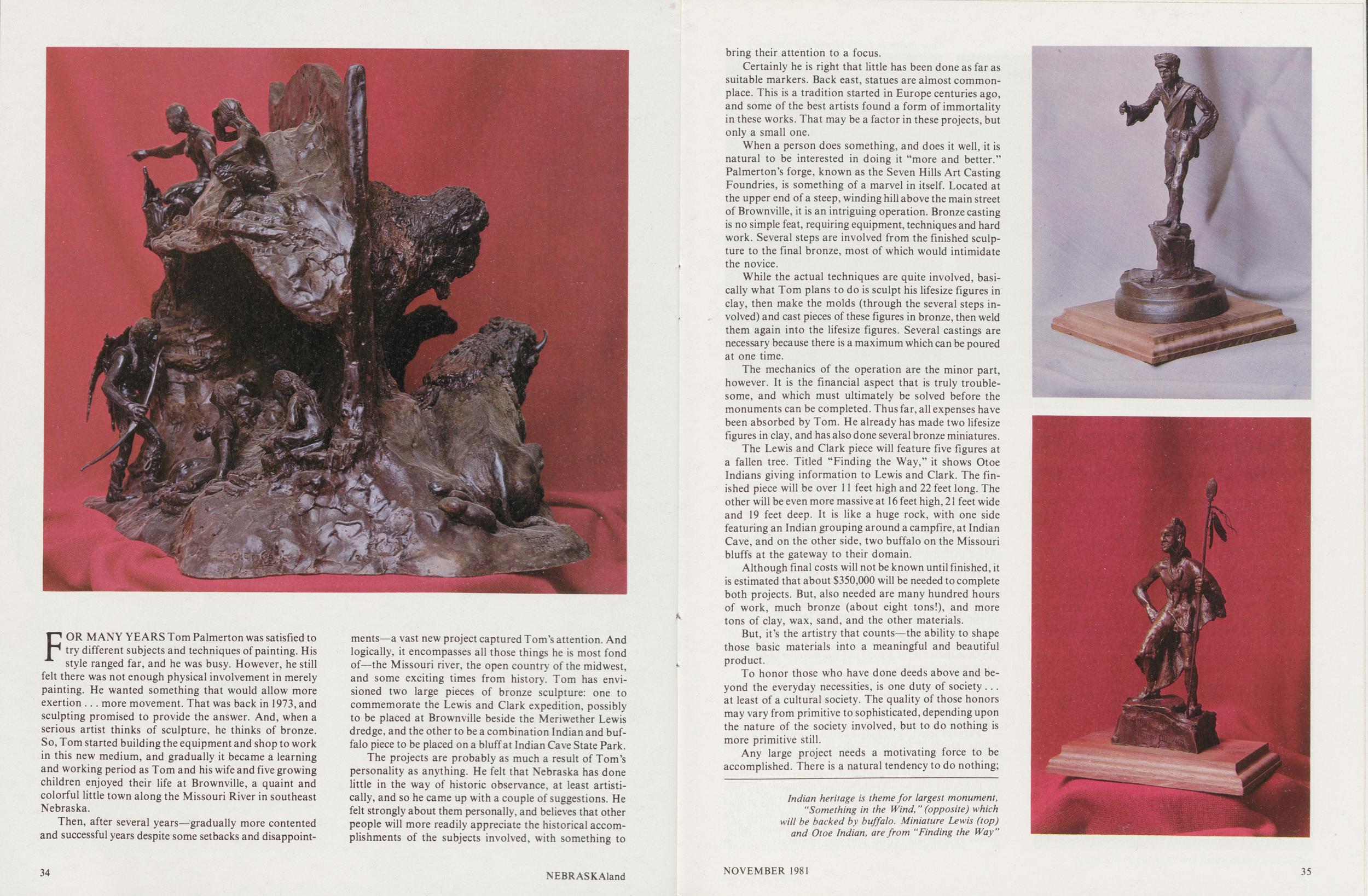
FOR MANY YEARS Tom Palmerton was satisfied to try different subjects and techniques of painting. His style ranged far, and he was busy. However, he still felt there was not enough physical involvement in merely painting. He wanted something that would allow more exertion more movement. That was back in 1973, and sculpting promised to provide the answer. And, when a serious artist thinks of sculpture, he thinks of bronze. So, Tom started building the equipment and shop to work in this new medium, and gradually it became a learning and working period as Tom and his wife and five growing children enjoyed their life at Brownville, a quaint and colorful little town along the Missouri River in southeast Nebraska.
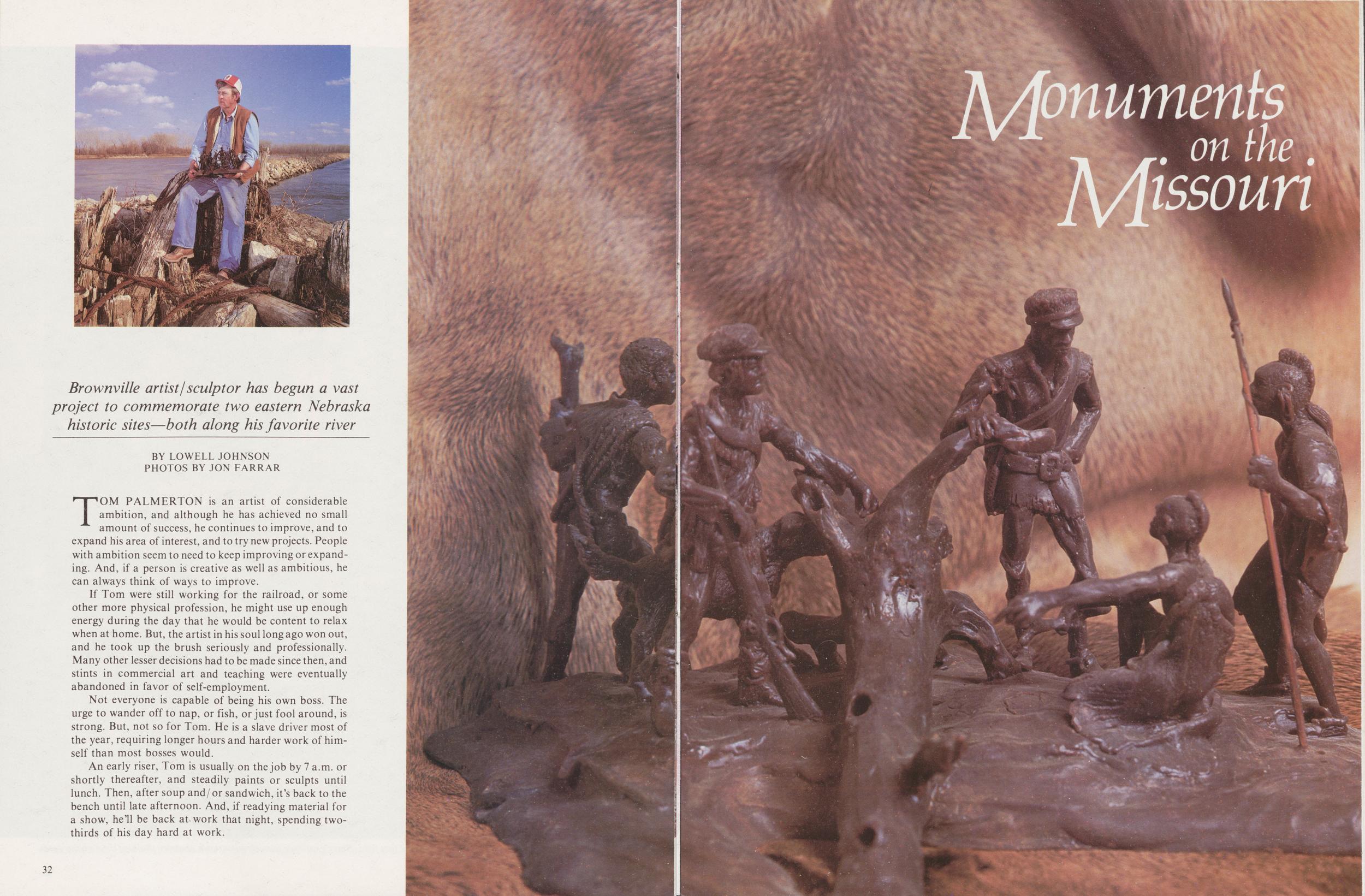
Then, after several years—gradually more contented and successful years despite some setbacks and disappointments—a vast new project captured Tom's attention. And logically, it encompasses all those things he is most fond of—the Missouri river, the open country of the midwest, and some exciting times from history. Tom has envisioned two large pieces of bronze sculpture: one to commemorate the Lewis and Clark expedition, possibly to be placed at Brownville beside the Meriwether Lewis dredge, and the other to be a combination Indian and buffalo piece to be placed on a bluff at Indian Cave State Park.
The projects are probably as much a result of Tom's personality as anything. He felt that Nebraska has done little in the way of historic observance, at least artistically, and so he came up with a couple of suggestions. He felt strongly about them personally, and believes that other people will more readily appreciate the historical accomplishments of the subjects involved, with something to 34 NEBRASKAland bring their attention to a focus.
Certainly he is right that little has been done as far as suitable markers. Back east, statues are almost common-place. This is a tradition started in Europe centuries ago, and some of the best artists found a form of immortality in these works. That may be a factor in these projects, but only a small one.
When a person does something, and does it well, it is natural to be interested in doing it "more and better." Palmerton's forge, known as the Seven Hills Art Casting Foundries, is something of a marvel in itself. Located at the upper end of a steep, winding hill above the main street of Brownville, it is an intriguing operation. Bronze casting is no simple feat, requiring equipment, techniques and hard work. Several steps are involved from the finished sculpture to the final bronze, most of which would intimidate the novice.
While the actual techniques are quite involved, basically what Tom plans to do is sculpt his lifesize figures in clay, then make the molds (through the several steps involved) and cast pieces of these figures in bronze, then weld them again into the lifesize figures. Several castings are necessary because there is a maximum which can be poured at one time.
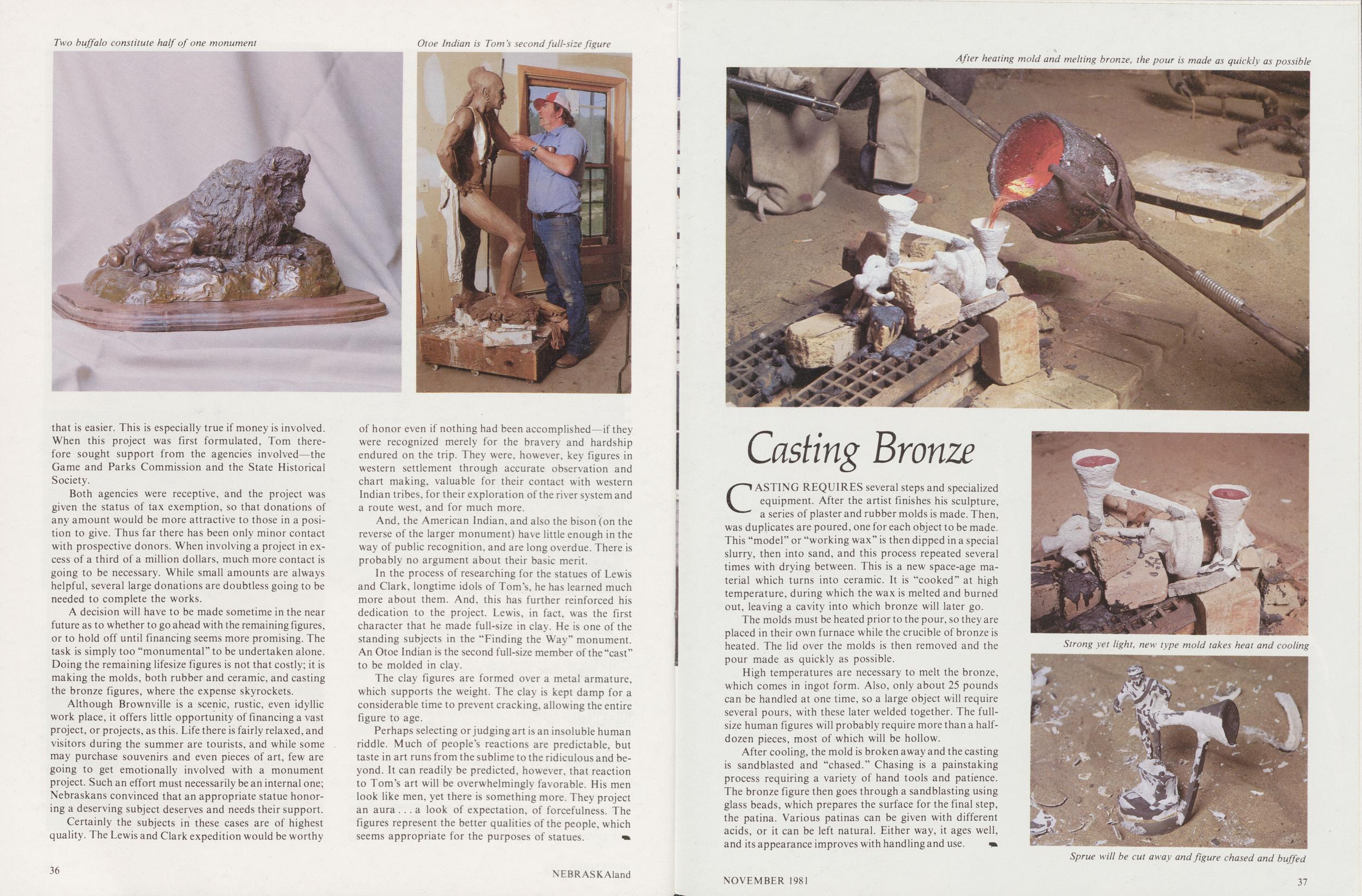
The mechanics of the operation are the minor part, however. It is the financial aspect that is truly troublesome, and which must ultimately be solved before the monuments can be completed. Thus far, all expenses have been absorbed by Tom. He already has made two lifesize figures in clay, and has also done several bronze miniatures.
The Lewis and Clark piece will feature five figures at a fallen tree. Titled "Finding the Way," it shows Otoe Indians giving information to Lewis and Clark. The finished piece will be over 11 feet high and 22 feet long. The other will be even more massive at 16 feet high, 21 feet wide and 19 feet deep. It is like a huge rock, with one side featuring an Indian grouping around a campfire, at Indian Cave, and on the other side, two buffalo on the Missouri bluffs at the gateway to their domain.
Although final costs will not be known until finished, it is estimated that about $350,000 will be needed to complete both projects. But, also needed are many hundred hours of work, much bronze (about eight tons!), and more tons of clay, wax, sand, and the other materials.
But, it's the artistry that counts—the ability to shape those basic materials into a meaningful and beautiful product.
To honor those who have done deeds above and beyond the everyday necessities, is one duty of society at least of a cultural society. The quality of those honors may vary from primitive to sophisticated, depending upon the nature of the society involved, but to do nothing is more primitive still.
Any large project needs a motivating force to be accomplished. There is a natural tendency to do nothing;
Both agencies were receptive, and the project was given the status of tax exemption, so that donations of any amount would be more attractive to those in a position to give. Thus far there has been only minor contact with prospective donors. When involving a project in excess of a third of a million dollars, much more contact is going to be necessary. While small amounts are always helpful, several large donations are doubtless going to be needed to complete the works.
A decision will have to be made sometime in the near future as to whether to go ahead with the remaining figures, or to hold off until financing seems more promising. The task is simply too "monumental" to be undertaken alone. Doing the remaining lifesize figures is not that costly; it is making the molds, both rubber and ceramic, and casting the bronze figures, where the expense skyrockets.
Although Brownville is a scenic, rustic, even idyllic work place, it offers little opportunity of financing a vast project, or projects, as this. Life there is fairly relaxed, and visitors during the summer are tourists, and while some may purchase souvenirs and even pieces of art, few are going to get emotionally involved with a monument project. Such an effort must necessarily be an internal one; Nebraskans convinced that an appropriate statue honoring a deserving subject deserves and needs their support.
Certainly the subjects in these cases are of highest quality. The Lewis and Clark expedition would be worthy of honor even if nothing had been accomplished—if they were recognized merely for the bravery and hardship endured on the trip. They were, however, key figures in western settlement through accurate observation and chart making, valuable for their contact with western Indian tribes, for their exploration of the river system and a route west, and for much more.
And, the American Indian, and also the bison (on the reverse of the larger monument) have little enough in the way of public recognition, and are long overdue. There is probably no argument about their basic merit.
In the process of researching for the statues of Lewis and Clark, longtime idols of Tom's, he has learned much more about them. And, this has further reinforced his dedication to the project. Lewis, in fact, was the first character that he made full-size in clay. He is one of the standing subjects in the "Finding the Way" monument. An Otoe Indian is the second full-size member of the "cast to be molded in clay.
The clay figures are formed over a metal armature, which supports the weight. The clay is kept damp for a considerable time to prevent cracking, allowing the entire figure to age.
Perhaps selecting or judging art is an insoluble human riddle. Much of people's reactions are predictable, but taste in art runs from the sublime to the ridiculous and beyond. It can readily be predicted, however, that reaction to Tom's art will be overwhelmingly favorable. His men look like men, yet there is something more. They project an aura ... a look of expectation, of forcefulness. The figures represent the better qualities of the people, which seems appropriate for the purposes of statues.
36 NEBRASKAlandCasting Bronze
CASTING REQUIRES several steps and specialized equipment. After the artist finishes his sculpture, a series of plaster and rubber molds is made. Then, was duplicates are poured, one for each object to be made. This "model" or "working wax" is then dipped in a special slurry, then into sand, and this process repeated several times with drying between. This is a new space-age material which turns into ceramic. It is "cooked" at high temperature, during which the wax is melted and burned out, leaving a cavity into which bronze will later go.
The molds must be heated prior to the pour, so they are placed in their own furnace while the crucible of bronze is heated. The lid over the molds is then removed and the pour made as quickly as possible.
High temperatures are necessary to melt the bronze, which comes in ingot form. Also, only about 25 pounds can be handled at one time, so a large object will require several pours, with these later welded together. The fullsize human figures will probably require more than a half-dozen pieces, most of which will be hollow.
After cooling, the mold is broken away and the casting is sandblasted and "chased." Chasing is a painstaking process requiring a variety of hand tools and patience. The bronze figure then goes through a sandblasting using glass beads, which prepares the surface for the final step, the patina. Various patinas can be given with different acids, or it can be left natural. Either way, it ages well, and its appearance improves with handling and use.
Gone to the Dogs
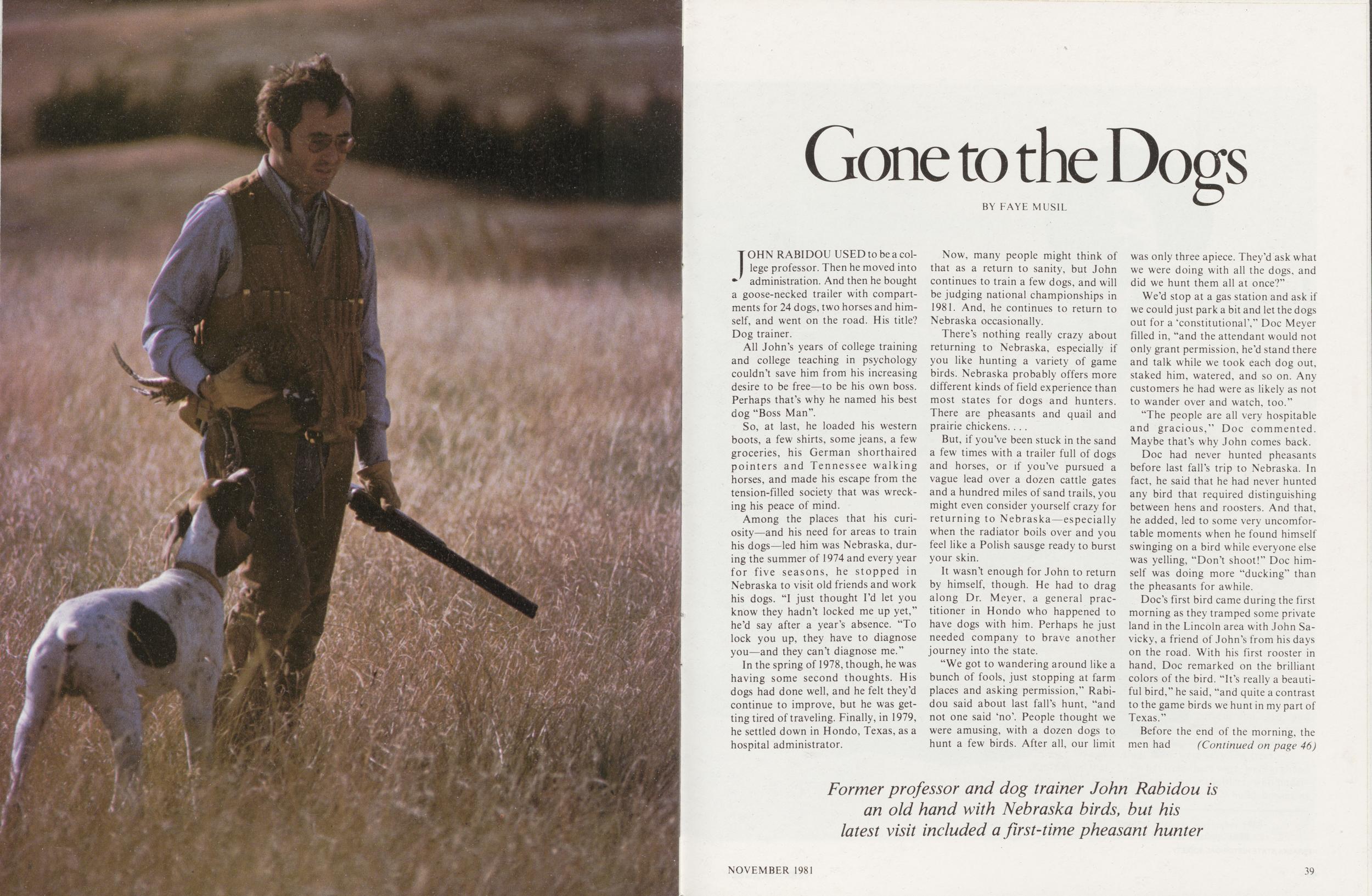
BY FAYE MUS1LTOHN RABIDOU USED to be a college professor. Then he moved into administration. And then he bought a goose-necked trailer with compartments for 24 dogs, two horses and himself, and went on the road. His title? Dog trainer.
All John's years of college training and college teaching in psychology couldn't save him from his increasing desire to be free—to be his own boss. Perhaps that's why he named his best dog "Boss Man".
So, at last, he loaded his western boots, a few shirts, some jeans, a few groceries, his German shorthaired pointers and Tennessee walking horses, and made his escape from the tension-filled society that was wrecking his peace of mind.
Among the places that his curiosity—and his need for areas to train his dogs—led him was Nebraska, during the summer of 1974 and every year for five seasons, he stopped in Nebraska to visit old friends and work his dogs. "I just thought I'd let you know they hadn't locked me up yet," he'd say after a year's absence. "To lock you up, they have to diagnose you—and they can't diagnose me."
In the spring of 1978, though, he was having some second thoughts. His dogs had done well, and he felt they'd continue to improve, but he was getting tired of traveling. Finally, in 1979, he settled down in Hondo, Texas, as a hospital administrator.
Now, many people might think of that as a return to sanity, but John continues to train a few dogs, and will be judging national championships in 1981. And, he continues to return to Nebraska occasionally.
There's nothing really crazy about returning to Nebraska, especially if you like hunting a variety of game birds. Nebraska probably offers more different kinds of field experience than most states for dogs and hunters. There are pheasants and quail and prairie chickens.
But, if you've been stuck in the sand a few times with a trailer full of dogs and horses, or if you've pursued a vague lead over a dozen cattle gates and a hundred miles of sand trails, you might even consider yourself crazy for returning to Nebraska—especially when the radiator boils over and you feel like a Polish sausge ready to burst your skin.
It wasn't enough for John to return by himself, though. He had to drag along Dr. Meyer, a general practitioner in Hondo who happened to have dogs with him. Perhaps he just needed company to brave another journey into the state.
"We got to wandering around like a bunch of fools, just stopping at farm places and asking permission," Rabidou said about last fall's hunt, "and not one said mo'. People thought we were amusing, with a dozen dogs to hunt a few birds. After all, our limit was only three apiece. They'd ask what we were doing with all the dogs, and did we hunt them all at once?"
We'd stop at a gas station and ask if we could just park a bit and let the dogs out for a 'constitutional'," Doc Meyer filled in, "and the attendant would not only grant permission, he'd stand there and talk while we took each dog out, staked him, watered, and so on. Any customers he had were as likely as not to wander over and watch, too."
"The people are all very hospitable and gracious," Doc commented. Maybe that's why John comes back.
Doc had never hunted pheasants before last fall's trip to Nebraska. In fact, he said that he had never hunted any bird that required distinguishing between hens and roosters. And that, he added, led to some very uncomfortable moments when he found himself swinging on a bird while everyone else was yelling, "Don't shoot!" Doc himself was doing more "ducking" than the pheasants for awhile.
Doc's first bird came during the first morning as they tramped some private land in the Lincoln area with John Savicky, a friend of John's from his days on the road. With his first rooster in hand, Doc remarked on the brilliant colors of the bird. "It's really a beautiful bird," he said, "and quite a contrast to the game birds we hunt in my part of Texas."
Before the end of the morning, the men had (Continued on page 46)
Former professor and dog trainer John Rabidou is an old hand with Nebraska birds, but his latest visit included a first-time pheasant hunter NOVEMBER 1981 39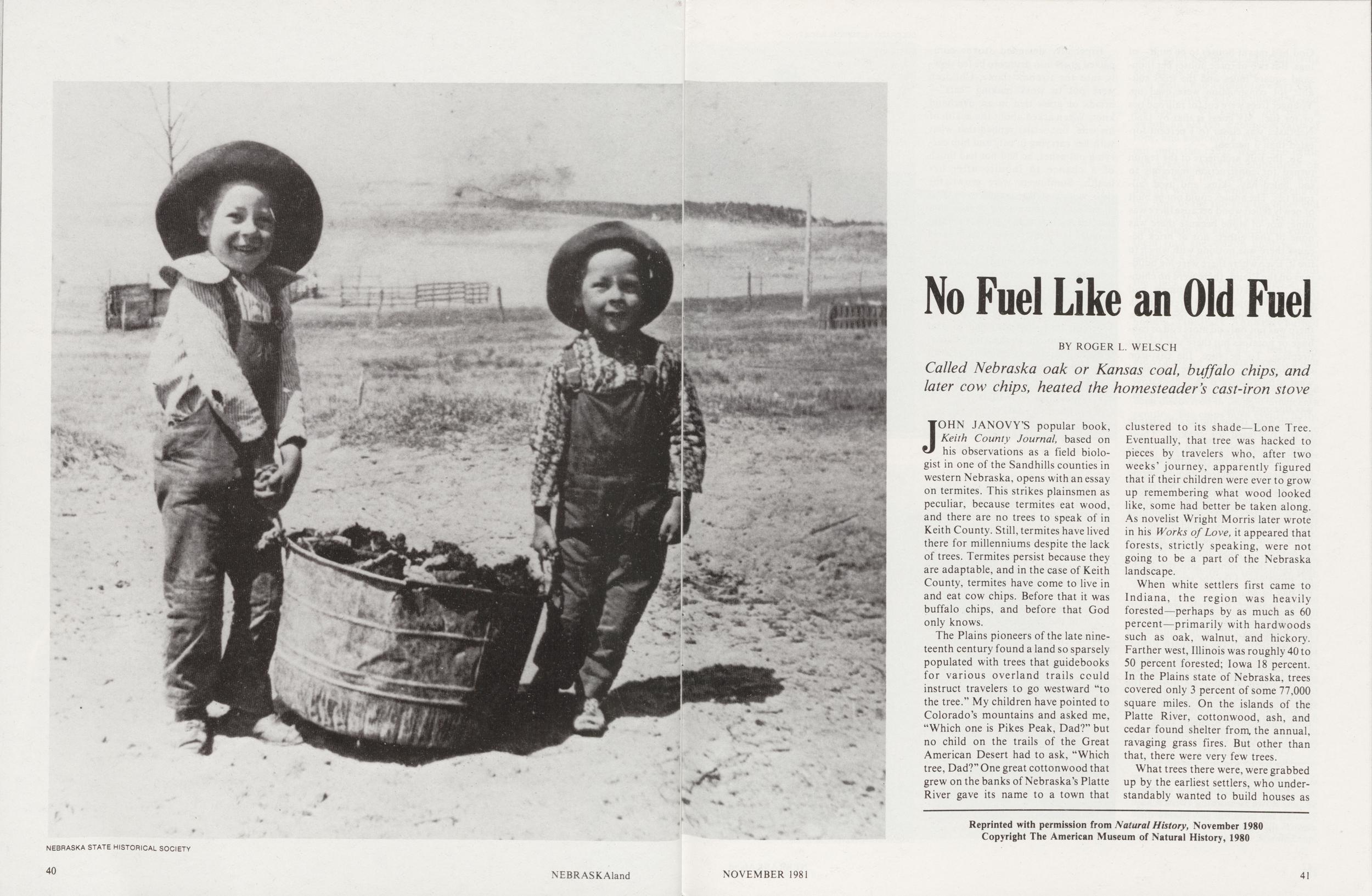
No Fuel Like an Old Fuel
BY ROGER L. WELSCH Called Nebraska oak or Kansas coal, buffalo chips, and later cow chips, heated the homesteader's cast-iron stoveJOHN JANOVY'S popular book, Keith County Journal, based on his observations as a field biologist in one of the Sandhills counties in western Nebraska, opens with an essay on termites. This strikes plainsmen as peculiar, because termites eat wood, and there are no trees to speak of in Keith County. Still, termites have lived there for millenniums despite the lack of trees. Termites persist because they are adaptable, and in the case of Keith County, termites have come to live in and eat cow chips. Before that it was buffalo chips, and before that God only knows.
The Plains pioneers of the late nineteenth century found a land so sparsely populated with trees that guidebooks for various overland trails could instruct travelers to go westward "to the tree." My children have pointed to Colorado's mountains and asked me, "Which one is Pikes Peak, Dad?" but no child on the trails of the Great American Desert had to ask, "Which tree, Dad?" One great cottonwood that grew on the banks of Nebraska's Platte River gave its name to a town that clustered to its shade—Lone Tree. Eventually, that tree was hacked to pieces by travelers who, after two weeks' journey, apparently figured that if their children were ever to grow up remembering what wood looked like, some had better be taken along. As novelist Wright Morris later wrote in his Works of Love, it appeared that forests, strictly speaking, were not going to be a part of the Nebraska landscape.
When white settlers first came to Indiana, the region was heavily forested—perhaps by as much as 60 percent—primarily with hardwoods such as oak, walnut, and hickory. Farther west, Illinois was roughly 40 to 50 percent forested; Iowa 18 percent. In the Plains state of Nebraska, trees covered only 3 percent of some 77,000 square miles. On the islands of the Platte River, cottonwood, ash, and cedar found shelter from, the annual, ravaging grass fires. But other than that, there were very few trees.
What trees there were, were grabbed
up by the earliest settlers, who understandably wanted to build houses as
NOVEMBER 1981
41
So, the folk architects of the region turned for construction materials to sod, baled hay, skins, and used railroad ties. The houses could not be built of newlv felled wood because there was none; nor of stone because there was none of that either; nor of brick because there was nothing with which to fire it. Even where there were log buildings on the Plains, there were no chimneys. Generations of women had cooked over open wood fires in brick and stone fireplaces and ovens. Now there was not only no more cod or cabbage or potatoes but there was also no fireplace. To be sure, the cast-iron cookstove was to the open fireplace what a microwave is to a cookstove, but the change, even if for the better, was disconcerting.
Even more traumatic was the change in the fuel used for cooking. Those same German, Norwegian, and Czech women who had for centuries scolded their men and children about wearing field shoes into the house, thus tracking bits of manure into the sanctified living quarters, were now reminding those husbands and children not to bother coming in unless they brought with them a good load of manure. Brought that manure into the kitchen, mind you! Like the termites, people had to adapt.
All manner of fuels were used throughout the last quarter of the nineteenth century and the first quarter of the twentieth on the northern Plains. I have collected recipes, for example, that specify the number of corn cobs to be added at intervals during the cooking process in a cast-iron stove. In "Little Old Sod Shanty on the Claim," the homesteading bachelor sings:
When I left my Eastern home, abachelor so gay,
To try to win my way to wealth
and fame,
I little thought that Ed come
down to burning twisted hay
In my little old sod shanty on
the claim.
Especially designed stoves compacted grass into drums to be fed slowly into the firebox flame. Children were put to work making "cats"—braids of grass tied in an overhand knot. When asked about the health of his wife, one settler replied that what with her carrying in cats and him carrying out ashes, he had not had much of a chance to inquire after her health. Sunflowers were grown for their woody stalks; people even tried to use sod as an uncured peat since it was, after all, primarily grass roots and humus. The remarkable effectiveness of sod, baled hay, log, and railroad-tie houses fortunately mitigated any extreme requirements for heating fuels, but the problem remained critical when it came to cooking fuels.
Earlier travelers on the Oregon and Mormon trails had also had to deal with the problem. In the song "Crossing the Plains," an obvious veteran laments:
There's not a log to make a seatalong the river Platte,
So when you eat, you've got to
stand or sit down square
and flat;
It's fun to cook with buffalo
wood, take some that's
newly born,
If I knew once what I know now,
I'd a gone around the Horn!
The ladies have the hardest time,
that emigrate by land,
For when they cook with buffalo
wood, they often burn a hand
And then they jaw their husbands
round, get mad and spill the tea,
Wish to the Lord they'd be
taken down with a turn
of the di-a-ree.
And the Mormons sang, in "Whoa, Ha, Buck and Jerry Boy!:"
There's a pretty little girl in theoutfit ahead,
Whoa, Ha, Buck and Jerry Boy!
I wish she was by my side instead,
Whoa, Ha, Buck and Jerry Boy!
Look at her now with a pout
on her lips
As daintily with her finger tips
She picks for the fire some
buffalo chips,
Whoa, Ha, Buck and Jerry Boy!
The process was simple enough. Bess Jacobsen wrote to me in a personal 42 NEBRASKAland letter her memories of gathering cow chips on the Plains:
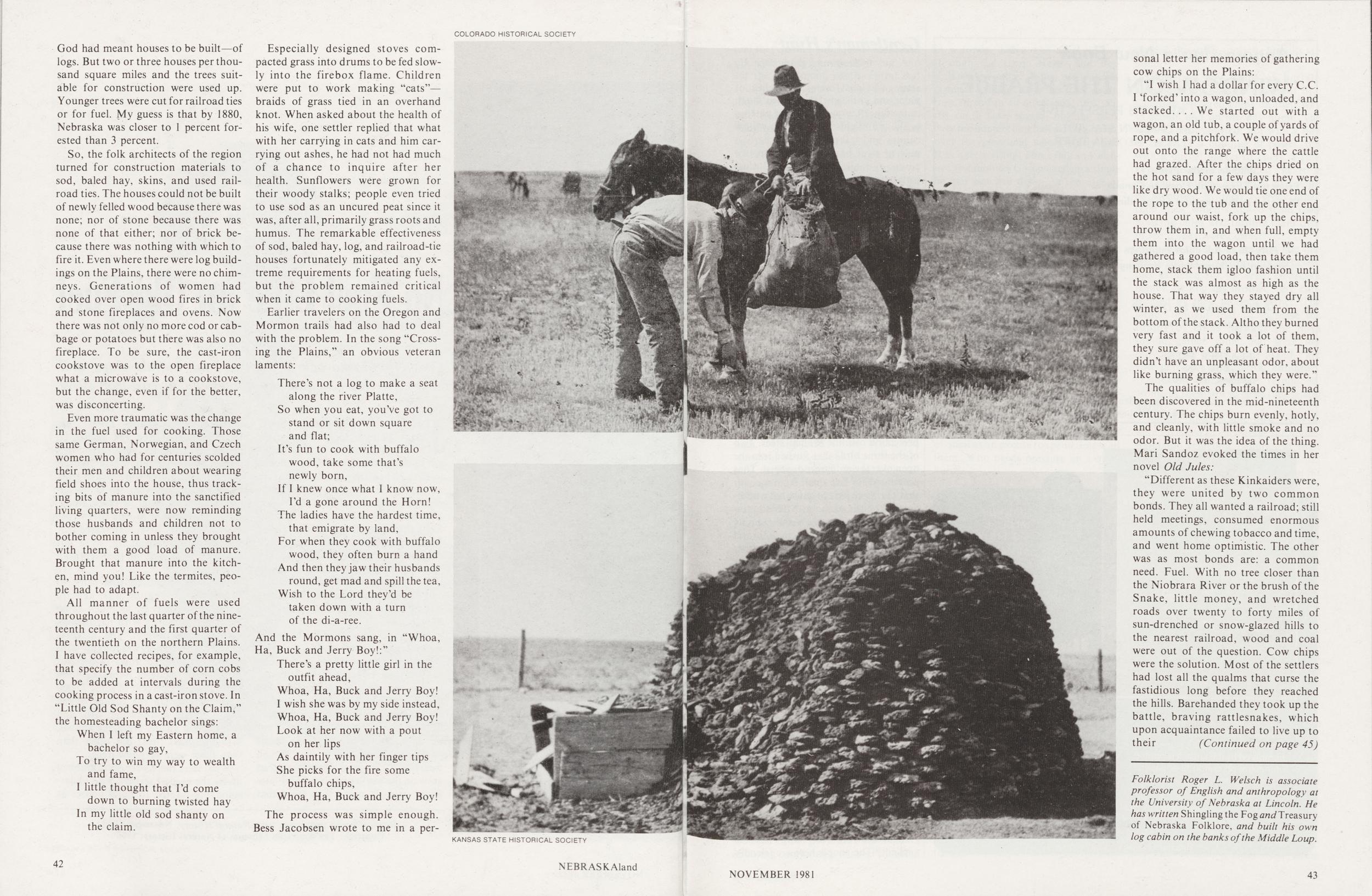
"I wish I had a dollar for every C.C. I 'forked' into a wagon, unloaded, and stacked. We started out with a wagon, an old tub, a couple of yards of rope, and a pitchfork. We would drive out onto the range where the cattle had grazed. After the chips dried on the hot sand for a few days they were like dry wood. We would tie one end of the rope to the tub and the other end around our waist, fork up the chips, throw them in, and when full, empty them into the wagon until we had gathered a good load, then take them home, stack them igloo fashion until the stack was almost as high as the house. That way they stayed dry all winter, as we used them from the bottom of the stack. Altho they burned very fast and it took a lot of them, they sure gave off a lot of heat. They didn't have an unpleasant odor, about like burning grass, which they were."
The qualities of buffalo chips had been discovered in the mid-nineteenth century. The chips burn evenly, hotly, and cleanly, with little smoke and no odor. But it was the idea of the thing. Mari Sandoz evoked the times in her novel Old Jules:
"Different as these Kinkaiders were, they were united by two common bonds. They all wanted a railroad; still held meetings, consumed enormous amounts of chewing tobacco and time, and went home optimistic. The other was as most bonds are: a common need. Fuel. With no tree closer than the Niobrara River or the brush of the Snake, little money, and wretched roads over twenty to forty miles of sun-drenched or snow-glazed hills to the nearest railroad, wood and coal were out of the question. Cow chips were the solution. Most of the settlers had lost all the qualms that curse the fastidious long before they reached the hills. Barehanded they took up the battle, braving rattlesnakes, which upon acquaintance failed to live up to their (Continued on page 45)
setting was ideal for quail. Patches of plum and chokecherry claimed much of the fenceline, and low-lying patches in the grainfields were held in willow clumps and tall grass. After nearly a mile of river bottom we put up two coveys of quail. The first bobs flushed from a fenceline and spread back into the trees where tangled understory of dogwood and buckbrush made any hope of working singles impossible.
Meanwhile, Cliff had driven ahead and was posting the end of a grainfield for pheasants. As he ambled in, the second covey flushed from a weedy fenceline and glided toward the river where a grassy ditch broadened into a line of small trees before joining the mature timber. Three or four of the birds flared from the ditch and settled down in a grassy peninsula that jutted out into a corn field. It seemed like a model situation for single shooting, but the bobwhites had other ideas.
The first two birds flushed between two hunters so that no one could safely shoot until the birds had reached the protection of a line of small trees. Two of the three birds that flushed into the open over the milo were dropped. That accounted for five quail from a covey that everyone agreed must have numbered 20 birds or more. After 10 minutes of kicking the grass and running the spaniels through the area again and again, we still had not put up another bird. We knew within a few feet were several quail had dropped into the grass, but they were determined to sit tight.
I've known hunters who would have been down on their hands and knees pulling out every blade of grass until the quail flushed. Shooting quail was only a minor part of this group's outing, though, and it was becoming increasingly apparent that there were going to be more rounds of jokes, stories and kibitzing than rounds of shooting. It was also becoming more evident what a golf pro who has spent a good share of his life in luxury resorts of Acapulco, Tucson, Pompano Beach, and Palm Springs and the like, was doing in Red Cloud, Nebraska—population 1,300.
I tossed a new bit of bait in Harry's direction and wasn't surprised at the response,
"Nebraska has everything I like," he replied. "The people here are friendly, 44 NEBRASKAland and they answer your questions square out. Everybody knows everything. And for the sportsman, south-central and southwest Nebraska is aces. The most important things that I've ever felt were worth doing were playing golf, hunting, and fishing. That's why years ago I chose to be involved in resort golf. It leaves part of the year open to hunt and fish, or for Helen and me to travel around and buy antiques for the shops. Running golf schools and doing exhibitions is hard work; not like going out on Sunday afternoon to shoot 18 holes. Living in Red Cloud lets me back off from the pressure."
Backing off, I found out, means not just hunting and fishing, but running a pair of antique shops in Red Cloud, promoting the cultural, historical and recreational assets of south-central Nebraska, and writing. Since 1958 Harry has been on the instruction staff of Golf Magazine, writing several articles each year. He has authored a golf instructional book, Six Days to Better Golf which is in its 22nd printing, and is working on a new book.
After watering the dogs, we left the Republican River floodplain for the high, rolling hills south. What had started as a relaxed quail hunt was rapidly turning into a leisurely stroll through milo fields and grassy swales.
Our first stop in the high country was a milo field dissected by a large wooded valley with a brome grass bottom, and fingers of small trees and plum thickets extending out to either side into the grain. Half a dozen wise old pheasants were loafing away the mid-afternoon hours in the wooded bottom and flushed like a flock of geese leaving a refuge surrounded by hunters—straight up. Several others stayed in the protection of the trees until they were beyond gun range, then broke into the open. A small covey of quail flushed ahead of the hunters, spread out along a weedy fenceline and interrupted the story telling long enough to lose several members.
The day's final field was a mix of unpastured native grass and woodland wrapped around an abandoned farmstead. The last covey we put up was as wise as the river-bottom bobs that sat tight earlier in the day. They flushed from under a single tree on a sidehill fenceline and spread into a heavily-wooded draw, promising the hunters shooting comparable to skeet shooting in a forest. Laird and Cliff pushed through the trees, Harry and Rex walked the edge. When the loosely grouped quail finally broke from cover, they spread in all directions, most out the south side, several buzzing back over the hunters and half a dozen north, over the grassland where Harry and Rex were waiting. Three fell, and within a few minutes Cliff picked up a single he had watched down on the edge of the trees.
Our unhurried hunt wound down. There had been no talk of filling out limits during the day, and there was no counting of birds at the end. Quail were just an excuse for being there; the shoot was secondary. The prize of the day was a bleached buck deer skull Helen found in the wooded backyard of the abandoned farmstead.
Everything came into focus. Where else would someone who had sat at the same poker table with Harry Truman, entertained the Queen of England, and played in the PGA and Open Championships with top golfers, want to spend the off-season than in the relaxed atmosphere of a small town, surrounded by good friends—and plenty of quail as an excuse to spend time with them. Who needs pressure on a quail hunt?
No Fuel Like an Old Fuel (Continued from page 43)reputation for aggressiveness. City women encased their still-white hands in huge gloves and, with a repugnance no extremity could completely erase, endured the first few weeks somehow. The music teacher wore gloves to the last."
It was also Sandoz who later noted that before long it was only the most fastidious woman who bothered to dust off her hands between stoking the stove and mixing the biscuit dough. Little wonder. Charlie O'Kieffe, in his Western Story, wrote as follows, for the edification of housewives who may never have cooked with buffalo chips:
"Stoke the stove, get out the flour sack, stoke the stove, wash your hands, mix the biscuit dough, stoke the stove, wash your hands, cut out the biscuits with the top of a baking powder can, stoke the stove, wash your hands, put the can of biscuits in the oven, keep on stoking the stove, until the biscuits are done."
Gathering cow chips or buffalo chips quickly became a way of life. Children gathered chips on their way to school and on the way home. The ardent suitor courted, not with a box of candy or a bouquet of posies, but with a bushel basket of chips, a sure key to the practical maiden's heart. It was reported that Nebraska girls could be identified by their overdeveloped right toes, which resulted from their hooking chips and turning them over to see if they were "done."
An old-timer told me that late one fall, when there was still not sufficient fuel gathered for the cruel Nebraska winter, he and his brother were confronted by their anxious father. The father thought that to increase the supply of chips perhaps the boys should gather some that were not fully "cured." "Boys," he asked, "are you getting them 'close' enough?" "Dad," the elder brother responded, "some of them are so close they're still warm."
Family and community contests were invented to encourage the understandably reluctant children at their task. In Enders, Nebraska, I was told by one homesteader's child that in his family, the child who brought in the biggest cow chip during the annual fall cow-chip harvest would get a silver dollar. After a dismal sequence of failures, he determined to win the contest by thinking well ahead. During the summer he gathered a formidable quantity of very fresh cow pies and fashioned a single gargantuan cow flop that would have put Paul Bunyan's Babe to shame. He rolled the seasoned cartwheel proudly home that fall, fully expecting to take the prize, only to find that the unappreciative family not only disqualified him from that year's contest but never trusted his entries from that point on and to this day will not buy life insurance from him.
As was the case with the multitude of miserable burdens inflicted on settlers of the northern Plains, chips, too, became the nucleus for a storm of esoteric jokes. I am not at all sure whether the survivors managed to laugh or the laughers managed to survive, but the close association is undeniable.
The Nebraska Federal Writers Project files contain a story from Grant NOVEMBER 1981 45 Tibbies, who homesteaded south of
North Platte, Nebraska, in 1888:
"Once I'd been three days in the
canyons after fuel and my grub was
gettin' low. I built a fire by moonlight
out of cowchips and was sittin' there
eatin' my supper when I dropped a
piece of biscuit. I didn't want to waste
it so I carefully picked it up and
popped it into my mouth. Lordy, how
I sputtered and spit. In the moonlight
old cowchips is about the same color
as biscuit."
A canon of esthetics developed, as
in this account by James J. Lynch of
Cherry County, in the archives of the
Nebraska State Historical Society:
"The heavier the grass was where the
load was dropped, the better the chip
was for burning, and especially the
seasons had much to do toward their
value for burning: those in the fall
where the cattle had access to eat the
abundance of plums that grew along
the creeks in those days, had much to
do with their value. When you found
a chip that was about half plum pits
you had a very much desired burning
article. Those chips burnt just like coal
and generated a very hot fire and lasted
far longer than the ordinary chip."
Just as the song "Little Old Log
Cabin in the Lane" could be adapted
to Plains conditions by being changed
to "Little Old Sod Shanty on the
Claim," where there was no water the
song "The Old Oaken Bucket" could
be made appropriate to the new geography with heartfelt—if marginally
literary—revisions:
A Ballad on Nebraska Fuel
How dear to the eyes in the
land of Nebraska,
Where the coal can't be bought
and wood isn't found,
Where ozone is fresh as it is
in Alaska,
Are the big piles of cowchips that
lie on the ground—
The fire-kindling cowchips, the
hash-cooking cowchips,
The corn-saving cowchips
that's scattered around.
How ardent we seize it, with
eyes that are glowing,
And say to ourselves that
it cooks very well
And then when we're waiting and
punching and blowing,
How rich are the fumes that arise
to the smell!
The needful old cowchips,
the odorous cowchips,
The hash-cooking cowchips so
rich to the smell.
When we think of old woodland
hills that are "yaller,"
Where folks must be taught to
toddle around,
We turn with disgust from its
"aguery" pallor right back
Where both climate and cowchips
are found—
The soggy old cowchips, the
rich-scented cowchips,
The hash-cooking cowchips
that out here are found.
When crops are a failure and
stock is a-dyin',
And corn for our fuel cannot
then be found;
When hauling our water, we're
freezing and crying,
How welcome the cowchips that
out here are found—
The genuine cowchips, the
bonafide cowchips,
The pure-blooded cowchips
that out here are found.
In this glorious country with
water below us:
Where ozone in short takes the
top off the ground;
Where hail storms benumb us
and blizzards o'ercome us,
Are the soul-cheering cowchips
that lie on the ground—
The time-honored cowchips,
the homesteader's cowchips,
The fume-giving cowchips that
lie on the ground.
Tibbies, who homesteaded south of
North Platte, Nebraska, in 1888:
"Once I'd been three days in the
canyons after fuel and my grub was
gettin' low. I built a fire by moonlight
out of cowchips and was sittin' there
eatin' my supper when I dropped a
piece of biscuit. I didn't want to waste
it so I carefully picked it up and
popped it into my mouth. Lordy, how
I sputtered and spit. In the moonlight
old cowchips is about the same color
as biscuit."
A canon of esthetics developed, as
in this account by James J. Lynch of
Cherry County, in the archives of the
Nebraska State Historical Society:
"The heavier the grass was where the
load was dropped, the better the chip
was for burning, and especially the
seasons had much to do toward their
value for burning: those in the fall
where the cattle had access to eat the
abundance of plums that grew along
the creeks in those days, had much to
do with their value. When you found
a chip that was about half plum pits
you had a very much desired burning
article. Those chips burnt just like coal
and generated a very hot fire and lasted
far longer than the ordinary chip."
Just as the song "Little Old Log
Cabin in the Lane" could be adapted
to Plains conditions by being changed
to "Little Old Sod Shanty on the
Claim," where there was no water the
song "The Old Oaken Bucket" could
be made appropriate to the new geography with heartfelt—if marginally
literary—revisions:
A Ballad on Nebraska Fuel
How dear to the eyes in the
land of Nebraska,
Where the coal can't be bought
and wood isn't found,
Where ozone is fresh as it is
in Alaska,
Are the big piles of cowchips that
lie on the ground—
The fire-kindling cowchips, the
hash-cooking cowchips,
The corn-saving cowchips
that's scattered around.
How ardent we seize it, with
eyes that are glowing,
And say to ourselves that
it cooks very well
And then when we're waiting and
punching and blowing,
How rich are the fumes that arise
to the smell!
The needful old cowchips,
the odorous cowchips,
The hash-cooking cowchips so
rich to the smell.
When we think of old woodland
hills that are "yaller,"
Where folks must be taught to
toddle around,
We turn with disgust from its
"aguery" pallor right back
Where both climate and cowchips
are found—
The soggy old cowchips, the
rich-scented cowchips,
The hash-cooking cowchips
that out here are found.
When crops are a failure and
stock is a-dyin',
And corn for our fuel cannot
then be found;
When hauling our water, we're
freezing and crying,
How welcome the cowchips that
out here are found—
The genuine cowchips, the
bonafide cowchips,
The pure-blooded cowchips
that out here are found.
In this glorious country with
water below us:
Where ozone in short takes the
top off the ground;
Where hail storms benumb us
and blizzards o'ercome us,
Are the soul-cheering cowchips
that lie on the ground—
The time-honored cowchips,
the homesteader's cowchips,
The fume-giving cowchips that
lie on the ground.
(From the files of the Nebraska State Historical Society. Originally published in the September 13, 1934, Hooker County Tribune with the notation that this "melodious blank verse was found recently in the family Bible of the Hugh Elliot home northeast of Thedford and then thought to be a half century old. It bore the initials R. W. L.")
Prescott Webb devotes not a single line of his classic The Great Plains to cow chips. James Olson's History of Nebraska gives them a scant short paragraph. Frederick Jackson turner writes of barbed wire and windmills but ignores the cow chip. It is, to be sure, a sensitive subject for a serious scholar, and yet without an appropriate consideration of the humble cow chip, one can understand neither the history nor the folklore of the Plains frontier.
Gone to the Dogs (Continued from page 39)limits, so they moved on for the next day's hunting, John becoming convinced that his Nebraska jinx was a think of the past.
Swinging northeast to Norfolk, they met a friend of a friend, an amateur handler named "Yogi" Bartholomew, on Saturday night and made arrangements to meet the following morning for some hunting. Next day, Doc managed to bag a bird at Maskenthine Lake near Stanton in the morning, but their afternoon hunt at Oak Valley near Battle Creek was unproductive. Whether that was because of poor scenting conditions, lack of birds, or Yogi's "free spirit" English setter, was a mystery. Pepper, the setter, had been raised hunting prairie chickens in the Sandhills, and as a young dog with lots of enthusiasm, she found it difficult to range any closer than a half-mile.
Next day at Grove Lake, Yogi attempted to slow her down with a rope tied to her collar and a set of rubber balls on each end. But she was off like a shot.
"She'll slow down," said Yogi confidently as he followed her off down the creek bottom, and John began to get that feeling that he gets sometimes in Nebraska.
Despite Pepper, though, he bagged one pheasant that morning. While Yogi hunted his hunting dog, he and Doc, with the shorthairs, headed up a sidehill toward a cedar shelterbelt. A rooster burst from the end of the trees just as John started to pass, and with a minimum of effort, the bird was soon in his game pouch.
About 45 minutes later, when Yogi and Pepper reappeared, the rope and balls were gone, apparently removed by some well-meaning soul who thought the dog was being hampered by the apparatus, Yogi speculated.
The remainder of the day, though, produced nothing but lots of walking, and lots of waiting for Pepper to return from more of her wide swings.
The following day dawned bright and blue with puffy clouds chasing each other across the sky. After a big breakfast, a hint of some fine quail hunting and a promise that Pepper would stay with the vehicle at least part of the day, the three hunters started south toward the Loup Canal and the wildlife lands along it.
46 NEBRASKAland World Famous LOWRANCE Fishing Sonar ( Model 2260 ) Great gifts for someone special! Quality Gifts That You'll Find On Most Outdoorsman Want Lists—At Discount Prices! "CANUCK" Insulated Sportsman Coat bob alien TASCO® "Asteroid" 25 to 50 Power Refractor Telescope Reg. Sole $27.88 $21.88 TOP QUALITY OPTICS (5 lbs. STEARNS Ladies Goose Down Alaskimo Coat ACD-501 4-1/2 lbs. Reg. $185.00 $169.95 LOWRANCE System 2000 fishing sonar units boast a new, more compact design and the first and only 3-year FULL warranty for units of this type. Smallest, quietest, most dependable units ever. The Model 2260 reads from 12" to 120' on a dual scale ( 0-60' and 0-120' ). 200-watts output power, electronic motor speed control, adjustable suppression, accurate signals at speeds over 70 MPH. ( Mail Order Item #N-111-LFS ) LOWRANCE® Graph Recorder ( Model 1510-C ) ( 12 lbs ) ( Mail Order Item #N-111-CIC ) $99.50 A triple use coat. Use it for shooting, hunting or general sports wear. Tan, water repellent Poplin shell. 9 oz. HOLLOFIL" insulation, slash type hand warmer pockets, bellows type lower pockets, shooting pads on shoulders, leather bound cuffs, knit inner cuffs, bi-swing back for comfort and ease of movement. Heavy duty 2-way zipper with storm flap. Fur-like DYNEL collar. Chest sizes 38 to 48. ( 5 lbs. ) Deluxe Chamois Shirt bob alien ( #N-111-TRT ) Tripod mounted telescope adjusts from 25 to 50-time magnification. High quality optics with excellent resolving power. Rock and pinion focus, focal length 520 mm, objective 40 mm. Alt-azimuth mount. SCHRADE Folding Knife SCHRADE $24.99 ( #N-1U-SFK ) SCHRADE Uncle HenryL Bear Paw folding knife with 3-117" blade of rust resistant Schrade - Plus steel. Locks when open. Size closed 5". Handle of Wonda Wood" . Furnished with top grain leather sheath. ( 1 lb. ). STEARNS "Minnehaha" Ladies Vest Reg. Sale $642.95 $599.99 Gives an accurate graph of the structure below that you can keep as permanent record. Gives immediate picture of fish, etc. separating targets as little as 6" apart; you can even determine size of fish. 900-watts power, four depth ranges (0-30', 0-60', 0-120', 0-360' ). Comes with two 50 ft. rolls of graph paper and extra stylus. ( Mailorder Item #N-111-LRG ) MAIL ORDER CUSTOMERS, PLEASE READ NEBRASKA CUSTOMERS MUST INCLUDE SALES TAX 30 DEPOSIT REQUIRED ON COD. ORDERS INCLUDE ENOUGH MONEY TO COVER SHIPPING COSTS and INSURANCE ( We Refund All Excess Remittances Promptly ) VISA and MASTERCHARGE CREDIT CARD ORDERS ACCEPTED ( When Accompanied With Signature and Required Information ) RETAIL STORE ADDRESS: 1000 West "0" St. OUR TELEPHONE: ( 402 ) 474 4366 ( #N-111-CSR Red Color Reg. $23.95 ( #N-111-CST ) Tan Color Reg. $23.95 GOOSE DOWN INSULATED ACRYLIC "FOX FUR" Hand Warmer Pockets Zipper Closure $19.99 $19.99 Made of luxury 100 % cotton chamois cloth. Features gun pad shoulder and epaulets, extra large breast pocket with button flap, extra long tails, center pleat in back. Warm, soft, comfortable and good looking. Sizes: S, M, L, XL, XXL.( 2 lbs. ) ( ADV-701) $79.50 $119.95 ( #N-111-GDA ) Synthetic fox fur. Stylish, warm and comfortable. Prime goose down insulation. 2 slash type pockets, shirt style collar, concealed storm cuffs in sleeves, full length Vision zipper closure. Suede trim along zipper and pocket entries. Sizes S, M, L. Color: Fox Brown. ROBBINS® Bulky Knit Pullover Sweater The 'SMOKEY' FOR MEN and WOMEN ( 4lbs. ) $24.25 ( #N-111-SFV ) Brown fox synthetic fur, goose down insulation, nylon inner lining, elastic knit waist, corduroy collar, zipper closure. Sizes: petite to large. ( 3 lbs. ) ( #N-111-RPS ) 85%, wool, 15% nylon, ribbed bulky knit. Big collar protects face when turned up, or can be worn as buttoned T-neck. Heather color. Sizes S, M, L and XL. MAIL ORDER SHOPPERS Use your VISA or MASTERCARD to shop by mail or by telephone. We can handle your orders promptly and efficiently. Order early while stocks are complete. SURPLUS CENTER Dept. N-111 Lincoln, NE 68501 NOVEMBER 1981 47 Subscribe to
Natural History
Now
Natural History is a
beautiful and thought-provoking monthly
magazine that will
inform you, educate
you, fascinate you and
amaze you. It is
published by the
American Museum of
Natural History, and you
can save $9 off the
newsstand price if you
subsribe now. Just fill-in
the coupon detach and
mail today.
Natural History Order Form
YES, I want a one-year subscription
to Natural History for $15, saving
me $9 off the newsstand price.
Name
Address
City
State
Zip
Payment enclosed Bill me
Moneyback guarantee if not satisfied
Send to Natural History PO Box 4200,
Bergenfield. N J 07621
or call 1-800-247-5470 .1-800-532-1272 (in Iowa)
Please allow 7 weeks for shipment of first copy.
Outside U.S.A., please add $3 for postage.
Harlan County Dam
Vacation Apartments fully furnished
Color TV Kitchen Facilities Full Baths
Game cleaning room with freezer
One block from shopping center
Weekend or week of pleasant living
Security Deposit Required
Sorry No Pets
Dean and Esther Stone
Box 145 Ph. (308) 799-3422
Republican City, NE 68971
Delivered to your home
or even
your deserted island
WILD GAME
PROCESSING!
JERKY POLISH &
SUMMER SAUSAGE
SMOKED BACON
Let Don Shuster turn your antelope, deer, elk or moose into a
gourmet's delight. Meat cut and
wrapped for the freezer. Bring in
boned meat or let Don do the
skinning.
DON & GERRY'S MARKET
1216 No. 10th .Lincoln, NE (402) 432-8931
Subscribe to
Natural History
Now
Natural History is a
beautiful and thought-provoking monthly
magazine that will
inform you, educate
you, fascinate you and
amaze you. It is
published by the
American Museum of
Natural History, and you
can save $9 off the
newsstand price if you
subsribe now. Just fill-in
the coupon detach and
mail today.
Natural History Order Form
YES, I want a one-year subscription
to Natural History for $15, saving
me $9 off the newsstand price.
Name
Address
City
State
Zip
Payment enclosed Bill me
Moneyback guarantee if not satisfied
Send to Natural History PO Box 4200,
Bergenfield. N J 07621
or call 1-800-247-5470 .1-800-532-1272 (in Iowa)
Please allow 7 weeks for shipment of first copy.
Outside U.S.A., please add $3 for postage.
Harlan County Dam
Vacation Apartments fully furnished
Color TV Kitchen Facilities Full Baths
Game cleaning room with freezer
One block from shopping center
Weekend or week of pleasant living
Security Deposit Required
Sorry No Pets
Dean and Esther Stone
Box 145 Ph. (308) 799-3422
Republican City, NE 68971
Delivered to your home
or even
your deserted island
WILD GAME
PROCESSING!
JERKY POLISH &
SUMMER SAUSAGE
SMOKED BACON
Let Don Shuster turn your antelope, deer, elk or moose into a
gourmet's delight. Meat cut and
wrapped for the freezer. Bring in
boned meat or let Don do the
skinning.
DON & GERRY'S MARKET
1216 No. 10th .Lincoln, NE (402) 432-8931
After staking the dogs, John selected two young ones and started walking a brushy draw beside a long dike. The dogs were finding birds, and after slipping several into his game pouch, he was beginning to smile again. Tramping up the dike, he and Doc met Yogi, who had brought the Scout around, and the three started off again with Pepper.
After an abortive hunt and a search for two of the dogs, they decided to try another area. That's when the day's disaster came. Inching the Scout along the dike, back toward his staked dogs, John began to feel the vehicle slip.
Sand seemed deeper as he moved forward, and it was already too late to back off the narrow dike. Finally, all forward movement stopped as the vehicle rested precariously over a marshy pond on the right.
Four hours later, the company was back on the road, as the sun sank slowly in the west. They had tried pushing and shoveling. One farmer had brought his tractor, but soon left, afraid the dike would catch him, too. A wrecker had been stuck twice and dug out. And, finally, a tractor with dual wheels had saved the Scout from rusting on the sandy dike.
Next day, John packed up dogs and Doc and vehicles and started south. That's when he started hunting without a guide. They drove around the country looking for places to hunt—and found them. Those last days they saw more birds than they had in the Norfolk area, and they had the best hunting of the trip.
"That's because those old boys were letting us in on their secrets," John said. "We'd ask permission and tell them about the dogs, and they'd tell us about this old draw over there, or send us to Joe's place. A couple of the farmers went along and hunted with us.
According to John, that's a little different than in Texas. Down there, everything is leased, he said.
"Hunting is a business," added Meyer. "People sell hunting leases for pretty big prices. I can't get over the fact that you can walk into someone's yard and ask him permission to hunt. And, not only do they let you go, but they help you. That must be northern hospitality," he concluded.
48 NEBRASKAlandTrading Post
DOGSWELL-BRED Hunting dogs for sale—Brittanies, English setters and pointers—ranging in age from puppies to young dogs. Darrell Yentes, 1118 McMillan. Holdrege. NE 68949. Phone (308) 995-8570 or (308) 995-4797.
ENGLISH POINTERS, German Shorthairs and treeing Walker Hounds; puppies and started dogs. Wayne Clark, Box 54, Union, NE 68455. Phone (402) 263-3495. Also Diamond Dog Food.
JOHNSTON KENNELS offers you AKC Golden Retriever pups year-round. Champion bloodline, field, trial and show quality. Gentle temperament. Karen Johnston, Cortland, NE 68331. Phone (402) 798-7440.
MISCELLANEOUSGUNS—Browning, Winchester, Remington, others, Hi-powers, shotguns, new, used, antiques. Want Pre-1964 Winchesters. Buy-Sell-Trade. Ph. (402) 729-6112. Bedlan's Sporting Goods, Fairbury, NE 68352.
PLASTIC DECOYS: We're originator of famous do it vourself system. Catalog system. Catalog $1.00. Decoys Unlimited, Clinton, IA 52732.
GAME BIRDS—most kinds available. Quail suitable for release. Pick up or will deliver. Waunita, Nebr. Call (308) 394-5577 nine to five (Mountain Standard Time) or (308) 394-5715 after five (MST).
MICHICRAFT CANOES. New & Used! Canoe Rentals 12 statewide locations! 8 & 10-place canoe trailers. New and Used! Rocky Ford Canoe Camp, Niobrara River, camping, shuttles, rentals! Organized canoe-camping trips; and combination canoe-camping-rainbow trout fishing trips for groups Free trips for Promoter-Sponsors! Plan early and visit our shop in Lincoln near 14th and Cornhusker when attending football and basketball games; state tournaments; concerts; racing; state fair, etc. Wilson Outfitters Nebraska (WON) 1329 Dawes Avenue, Lincoln, Nebraska 68521, Phone (402) 476-2300.
HAND-REARED WILD DUCKS: Wood ducks, Mandarins, European Wigeons, few other breeds. Mrs. R. W. Hansen, 3315 Avenue L, Kearney, NE 68847. N.E. NEBR. TROUT FISHING. For rent Mon.—Thurs. or Fri.—Sun. 2 cottages 4 ponds and stream. Privacy, with trout up to 5 lb. Diamond E. Trout Resort, Orchard, NE 68764. (402) 893-4745.
WEATHERBYS—10 percent above cost. Handfinish-ing—hot blue—repair—antique restoration. Wanted, old guns for repair parts. Fritz. Gunsmithing and Supplv Co., Wilber, NE (402) 821-2260.
RAILROAD FANS-we think you will like Prairie Staionmaster by Barbara B. Clayburn, the true story of one Nebraskan's railroading career, 1917-1963. Great Christmas gift or just for pleasure reading. Harlo Press publication, hardbound, 179 pages, illustrated, $7.50. Order direct from: B. B. Clayburn, 7023 Bridgeport Circle, Stockton. California 95207.
DUCK HUNTERS! Guided hunts on the Platte River near Schuyler. Hunt over the finest decoy spread in eastern Nebraska. Individuals or small groups. Make your reservations early. Call (402) 464-8417. Frank or Carolyn Hoppe, Lincoln.
FRUITS AND BERRIES: Make wine when ripe? Now legal. Send for free recipes and instructions. Omaha Supply, 13616 Polk St., Omaha, Nebr. 68137.
TAXIDERMYBIG BEAR TAXIDERMY, Rt. 2, Mitchell, Nebraska 69357. We specialize in all big game from Alaska to Nebraska, also birds and fish. Hair on and hair off tanning, 4'/2 miles west of Scottsbluff on Highway 26. Phone (308) 635-3013.
KARL SCHWARZ Master Taxidermist. Mounting of game heads—birds—fish—animals—fur rugs—robes—tanning buckskin. Since 1910. 424 South 13th Street, Dept. A, Omaha, Nebraska 68102.
BADE TAXIDERMY—Quality a must—Fast service. Fish, birds, rugs, tanning, full mounts and game heads. 1924 North Lincoln, Fremont, Nebraska. 727-5463.
FREEZE-DRY TAXIDERMY Wally Allison's State Record Taxidermy, 2709 Birchwood, North Platte, NE 69101. Phone: (308) 534-2324. Specializing in Fish and Small Game, Snake and Lizard and Novelties. (Nothing too small) Newest of all taxidermy methods employed.
AWARD-WINNING TAXIDERMIST. Eight time national award winners. Trust your trophies to a proven winner. Our complete taxidermy service also arranges hunts. Dinges Taxidermy Studio, 2763 South 12th Omaha, NE 68108. Ph. 402-342-3718.
JOHNSON TAXIDERMY—servicing southwest Nebraska, specializing in big-game mounts, lifesized mounts, rug work, fish, birds, tanning hair-on leather. Brochure and price list on request. Johnson Taxidermy, Rt. 1, Box 78, Lamar, NE 69035. Telephone (308) 882-5555.
CREATIVE TAXIDERMY in all its branches since 1935, now includes Northstar Freeze-Dry processing of approved small specimens. Also tanning and deer-skin processing. Naturecraft Studio. Nebraska City, Nebraska 68510. Joe Voges-Owner. Phone (402) 873-5491.
NABITY'S TAXIDERMY. 29 years experience. All taxidermy services available. Specializing in natural grass backgrounds. 5C21 Washington, Lincoln, NE 68506. (402) 489-6351.
WHITETAIL TAXIDERMY. Deer heads are my specialty. Excellent work—Low prices—10 years'experience. Phone (402) 564-6885. Columbus, Nebr.
HASTINGS TAXIDERMY: Professional life-like mounting of game heads, birds, fish, rugs, and animals. We specialize in big-game head mounts. Also hair-on and hair-off tanning. Competitive prices. R Rt. 3, Box 162, Ord, NE 68862. Phone (308) 728-5322.
LORE 3 miles east % mile south on north side Platte River Lewellen, Nebr. in Garden County GOOSE BLINDS George O. Rishling, Manager Write or Call Borders Clear Creek Refuge Lewellen, Nebr. 69140 Phone (308) 778-5622 SAVE Make 'em yourself! NEW MODELS from the originator of the famous do-it-yourself decoy making system. Improved design for more economy and easier to make. More realism in a hunting decoy than ever before! SOLID PLASTIC DECOYS made with our famous cast aluminum molds. Tried and tested since 1958. No special tools needed. Just boil 'em to make 'em! ECONOMICAL, fun to make, outfits for most popular hunted species ducks and geese. Write today for catalog. Please send $1.00 (applicable to first order) to cover handling. DECOYS UNLIMITED, INC. CLINTON, IOWA 52732 Custom Cedar Homes No other house you can build will match the beauty, quality and custom detail of a Justus Custom Home of precious Western Red Cedar And, the patented Justus Energy-Lock construction system keeps outside air out, in any climate, even in designs as large as 3,500 sq ft Est. 1955. Dealers nationwide. Justus homes Medallion Const. Co. Authorized Dealer Box 1482 Norfolk, NE 68701 Ph. 402/371-7710 Enclosed is $5. Send me your full-color 64-page Justus Home Portfolio. Name Address County State .City Phone own a lot Location: Please also send information on Justus Solar King Solar Energy Systems NOVEMBER 1981 49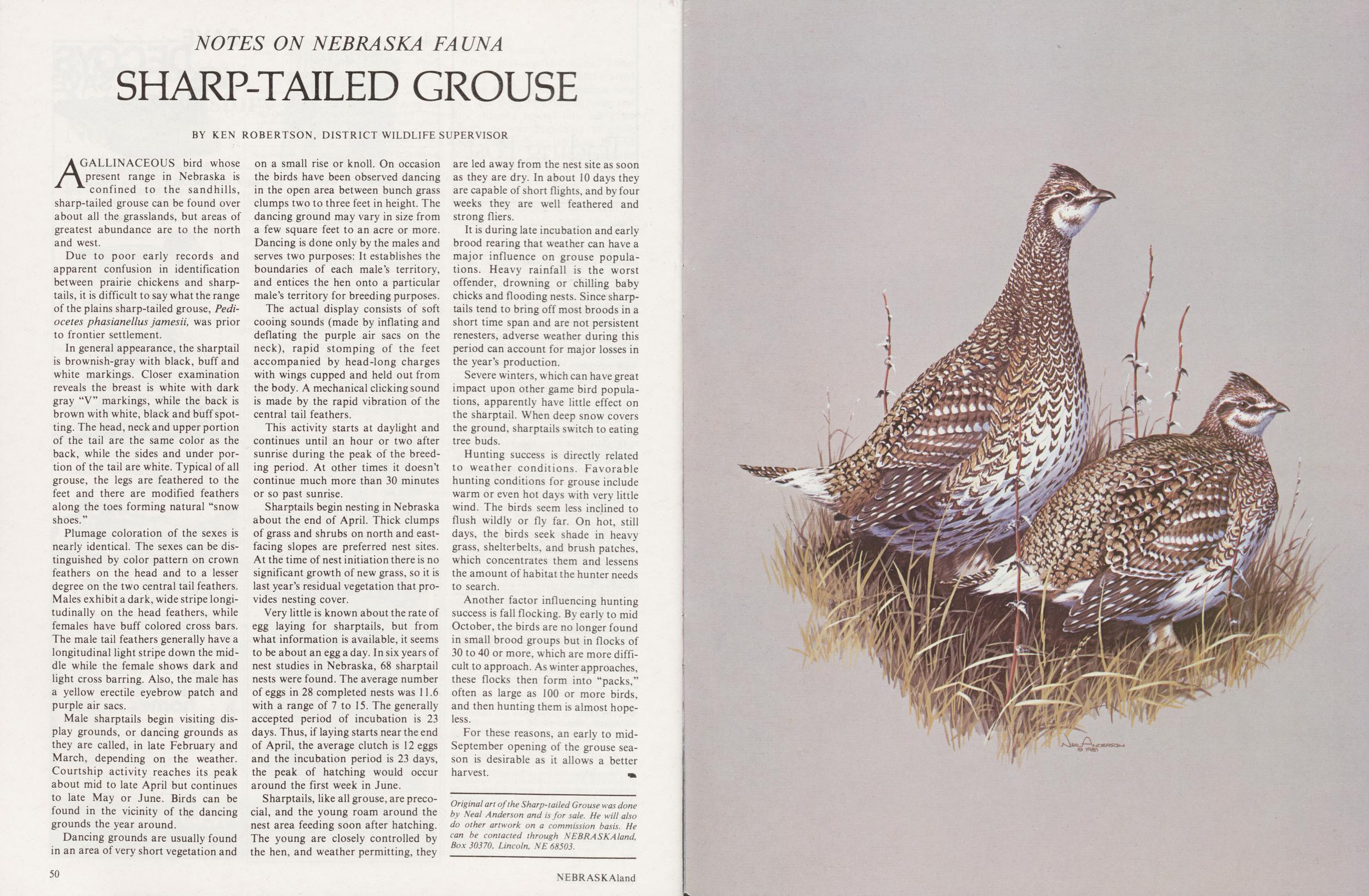
NOTES ON NEBRASKA FAUNA
SHARP-TAILED GROUSE
BY KEN ROBERTSON, DISTRICT WILDLIFE SUPERVISORA GALLINACEOUS bird whose present range in Nebraska is confined to the sandhills, sharp-tailed grouse can be found over about all the grasslands, but areas of greatest abundance are to the north and west.
Due to poor early records and apparent confusion in identification between prairie chickens and sharp-tails, it is difficult to say what the range of the plains sharp-tailed grouse, Pediocetes phasianellus jamesii, was prior to frontier settlement.
In general appearance, the sharptail is brownish-gray with black, buff and white markings. Closer examination reveals the breast is white with dark gray "V" markings, while the back is brown with white, black and buff spotting. The head, neck and upper portion of the tail are the same color as the back, while the sides and under portion of the tail are white. Typical of all grouse, the legs are feathered to the feet and there are modified feathers along the toes forming natural "snow shoes."
Plumage coloration of the sexes is nearly identical. The sexes can be distinguished by color pattern on crown feathers on the head and to a lesser degree on the two central tail feathers. Males exhibit a dark, wide stripe longitudinally on the head feathers, while females have buff colored cross bars. The male tail feathers generally have a longitudinal light stripe down the middle while the female shows dark and light cross barring. Also, the male has a yellow erectile eyebrow patch and purple air sacs.
Male sharptails begin visiting display grounds, or dancing grounds as they are called, in late February and March, depending on the weather. Courtship activity reaches its peak about mid to late April but continues to late May or June. Birds can be found in the vicinity of the dancing grounds the year around.
Dancing grounds are usually found in an area of very short vegetation and on a small rise or knoll. On occasion the birds have been observed dancing in the open area between bunch grass clumps two to three feet in height. The dancing ground may vary in size from a few square feet to an acre or more. Dancing is done only by the males and serves two purposes: It establishes the boundaries of each male's territory, and entices the hen onto a particular male's territory for breeding purposes.
The actual display consists of soft cooing sounds (made by inflating and deflating the purple air sacs on the neck), rapid stomping of the feet accompanied by head-long charges with wings cupped and held out from the body. A mechanical clicking sound is made by the rapid vibration of the central tail feathers.
This activity starts at daylight and continues until an hour or two after sunrise during the peak of the breeding period. At other times it doesn't continue much more than 30 minutes or so past sunrise.
Sharptails begin nesting in Nebraska about the end of April. Thick clumps of grass and shrubs on north and east-facing slopes are preferred nest sites. At the time of nest initiation there is no significant growth of new grass, so it is last year's residual vegetation that provides nesting cover.
Very little is known about the rate of egg laying for sharptails, but from what information is available, it seems to be about an egg a day. In six years of nest studies in Nebraska, 68 sharptail nests were found. The average number of eggs in 28 completed nests was 11.6 with a range of 7 to 15. The generally accepted period of incubation is 23 days. Thus, if laying starts near the end of April, the average clutch is 12 eggs and the incubation period is 23 days, the peak of hatching would occur around the first week in June.
Sharptails, like all grouse, are precocial, and the young roam around the nest area feeding soon after hatching. The young are closely controlled by the hen, and weather permitting, they are led away from the nest site as soon as they are dry. In about 10 days they are capable of short flights, and by four weeks they are well feathered and strong fliers.
It is during late incubation and early brood rearing that weather can have a major influence on grouse populations. Heavy rainfall is the worst offender, drowning or chilling baby chicks and flooding nests. Since sharp-tails tend to bring off most broods in a short time span and are not persistent renesters, adverse weather during this period can account for major losses in the year's production.
Severe winters, which can have great impact upon other game bird populations, apparently have little effect on the sharptail. When deep snow covers the ground, sharptails switch to eating tree buds.
Hunting success is directly related to weather conditions. Favorable hunting conditions for grouse include warm or even hot days with very little wind. The birds seem less inclined to flush wildly or fly far. On hot, still days, the birds seek shade in heavy grass, shelterbelts, and brush patches, which concentrates them and lessens the amount of habitat the hunter needs to search.
Another factor influencing hunting success is fall flocking. By early to mid October, the birds are no longer found in small brood groups but in flocks of 30 to 40 or more, which are more difficult to approach. As winter approaches, these flocks then form into "packs," often as large as 100 or more birds, and then hunting them is almost hopeless.
For these reasons, an early to mid-September opening of the grouse season is desirable as it allows a better harvest.
50 NEBRASKAland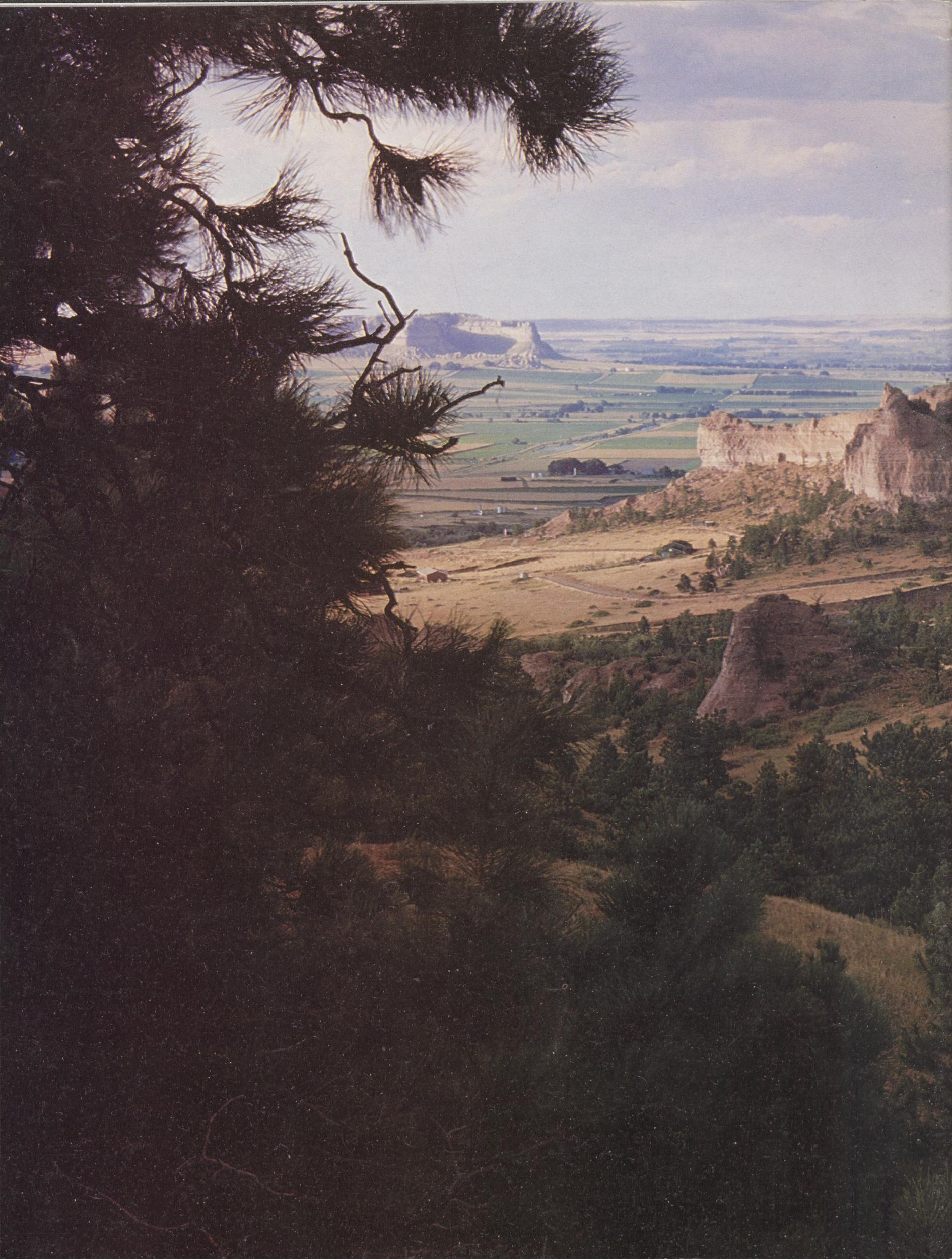
Position: 293 (29 views)