Volume 59, Issue 15, 1981
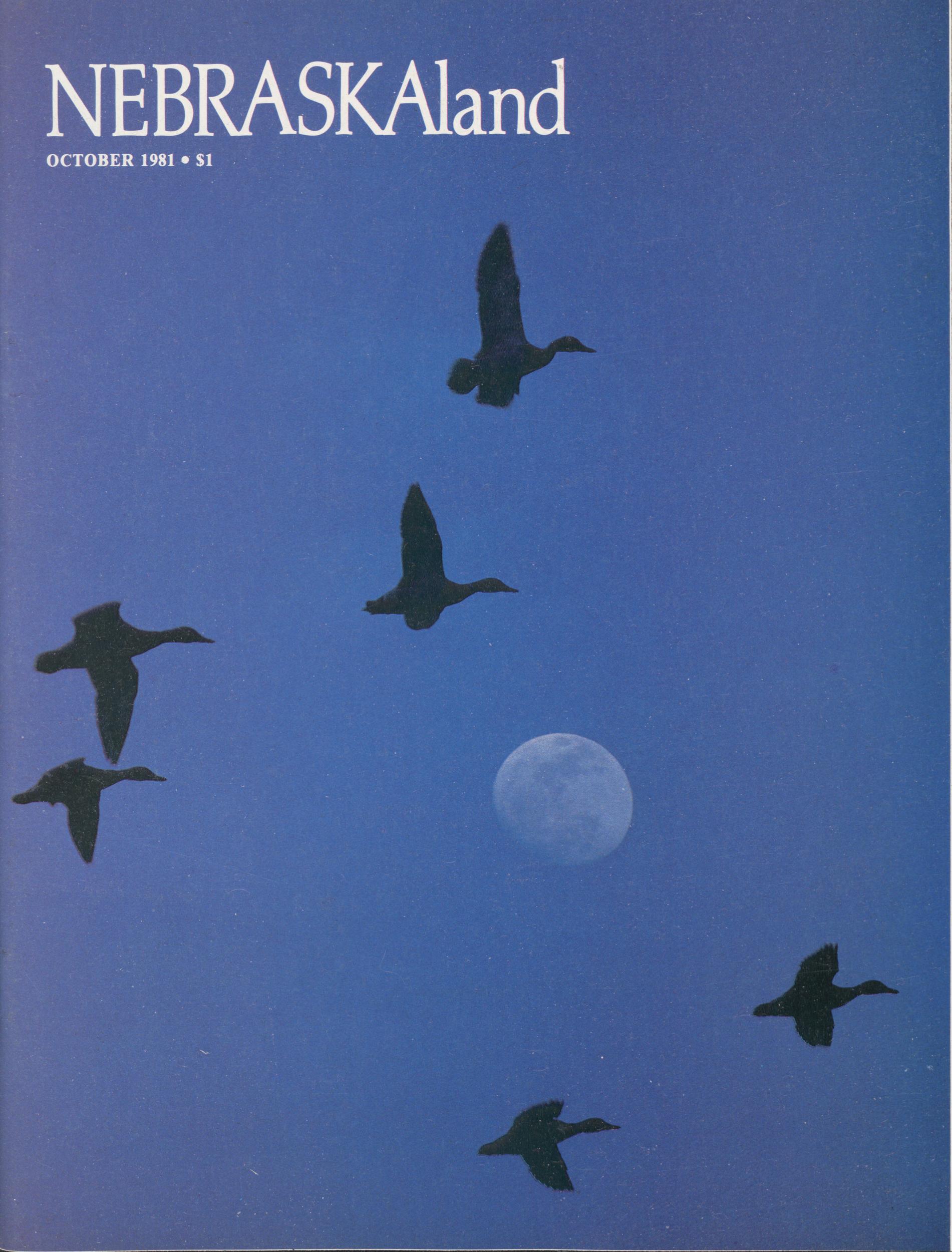
NEBRASKAland
OCTOBER 1981 $1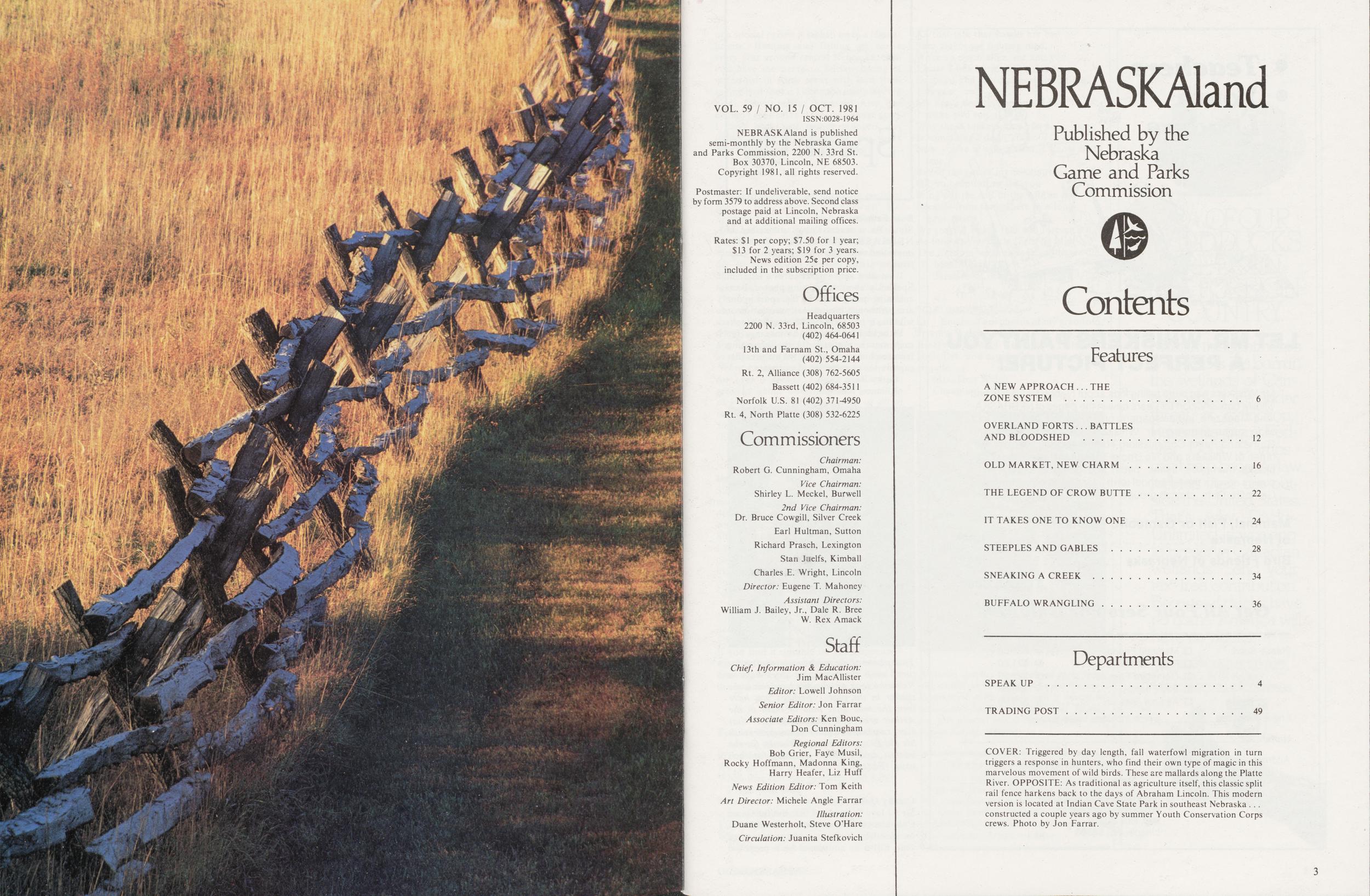
NEBRASKAland
VOL. 59 NO. 15 OCT. 1981 ISSN:0028-1964 NEBRASKAland is published semi-monthly by the Nebraska Game and Parks Commission, 2200 N. 33rd St. Box 30370, Lincoln, NE 68503. Copyright 1981, all rights reserved. Postmaster: If undeliverable, send notice by form 3579 to address above. Second class postage paid at Lincoln, Nebraska and at additional mailing offices. Rates: $1 per copy; $7.50 for 1 year; $13 for 2 years; $19 for 3 years. News edition 25c per copy, included in the subscription price. Offices Headquarters 2200 N. 33rd, Lincoln, 68503 (402) 464-0641 13th and Farnam St., Omaha (402) 554-2144 Rt. 2, Alliance (308) 762-5605 Bassett (402) 684-3511 Norfolk U.S. 81 (402) 371-4950 Rt. 4, North Platte (308) 532-6225 Commissioners Chairman: Robert G. Cunningham, Omaha Vice Chairman: Shirley L. Meckel, Bufwell 2nd Vice Chairman: Dr. Bruce Cowgill, Silver Creek Earl Hultman, Sutton Richard Prasch, Lexington Stan Juelfs, Kimball Charles E. Wright, Lincoln Director: Eugene T. Mahoney Assistant Directors: William J. Bailey, Jr., Dale R. Bree W. Rex Amack Staff Chief, Information & Education: Jim MacAllister Editor: Lowell Johnson Senior Editor: Jon Farrar Associate Editors: Ken Bouc, Don Cunningham Regional Editors: Bob Grier, Faye Musil, Rocky Hoffmann, Madonna King, Harry Heafer, Liz Huff News Edition Editor: Tom Keith Art Director: Michele Angle Farrar Illustration: Duane Westerholt, Steve O'Hare Circulation: Juanita Stefkovich Published by the Nebraska Game and Parks Commission Contents Features A NEW APPROACH THE ZONE SYSTEM 6 OVERLAND FORTS BATTLES AND BLOODSHED 12 OLD MARKET, NEW CHARM 16 THE LEGEND OF CROW BUTTE 22 IT TAKES ONE TO KNOW ONE 24 STEEPLES AND GABLES 28 SNEAKING A CREEK 34 BUFFALO WRANGLING 36 Departments SPEAK UP TRADING POST 49 COVER: Triggered by day length, fail waterfowl migration in turn triggers a response in hunters, who find their own type of magic in this marvelous movement of wild birds. These are mallards along the Platte River. OPPOSITE: As traditional as agriculture itself, this classic split rail fence harkens back to the days of Abraham Lincoln. This modern version is located at Indian Cave State Park in southeast Nebraska constructed a couple years ago by summer Youth Conservation Corps crews. Photo by Jon Farrar. 3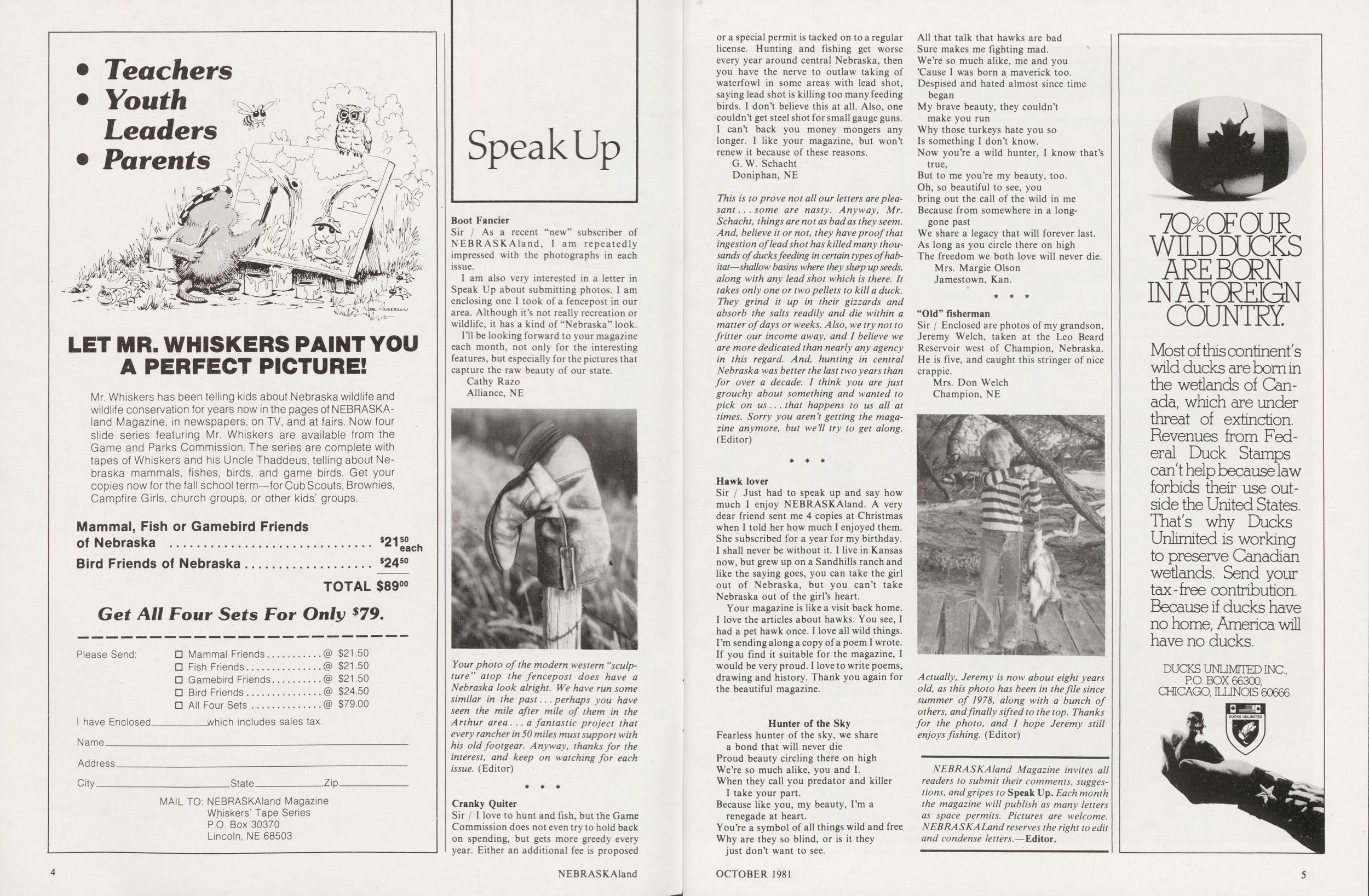
Speak Up
TeachersYouth Leaders
Parents
LET MR. WHISKERS PAINT YOU A PERFECT PICTURE! Mr. Whiskers has been telling kids about Nebraska wildlife and wildlife conservation for years now in the pages of NEBRASKAland Magazine, in newspapers, on TV, and at fairs. Now four slide series featuring Mr. Whiskers are available from the Game and Parks Commission. The series are complete with tapes of Whiskers and his Uncle Thaddeus, telling about Nebraska mammals, fishes, birds, and game birds. Get your copies now for the fall school term—for Cub Scouts, Brownies, Campfire Girls, church groups, or other kids' groups. Mammal, Fish or Gamebird Friends of Nebraska $21.50 each Bird Friends of Nebraska $24.50 TOTAL $89.00 Get All Four Sets For Only $19. Please Send: Mammal Friends $21.50 Fish Friends $21.50 Gamebird Friends $21.50 Bird Friends $24.50 All Four Sets $79.00 I have Enclosed which includes sales tax. Name Address City State Zip MAIL TO: NEBRASKAland Magazine Whiskers' Tape Series P.O. Box 30370 Lincoln, NE 68503 Boot Fancier
Sir / As a recent "new" subscriber of NEBRASKAland, I am repeatedly impressed with the photographs in each issue.
I am also very interested in a letter in Speak Up about submitting photos. I am enclosing one I took of a fencepost in our area. Although it's not really recreation or wildlife, it has a kind of "Nebraska" look.
I'll be looking forward to your magazine each month, not only for the interesting features, but especially for the pictures that capture the raw beauty of our state.
Cathy Razo Alliance, NESir / I love to hunt and fish, but the Game Commission does not even try to hold back on spending, but gets more greedy every year. Either an additional fee is proposed NEBRASKAland or a special permit is tacked on to a regular license. Hunting and fishing get worse every year around central Nebraska, then you have the nerve to outlaw taking of waterfowl in some areas with lead shot, saying lead shot is killing too many feeding birds. I don't believe this at all. Also, one couldn't get steel shot for small gauge guns. I can't back you money mongers any longer. I like your magazine, but won't renew it because of these reasons.
G. W. Schacht Doniphan, NE This is to prove not all our letters are pleasant . . . some are nasty. Anyway, Mr. Schacht, things are not as bad as they seem. And, believe it or not, they have proof that ingestion of lead shot has killed many thousands of ducks feeding in certain types of habitat—shallow basins where they slurp up seeds, along with any lead shot which is there. It takes only one or two pellets to kill a duck. They grind it up in their gizzards and absorb the salts readily and die within a matter of days or weeks. Also, we try not to fritter our income away, and I believe we are more dedicated than nearly any agency in this regard. And, hunting in central Nebraska was better the last two years than for over a decade. I think you are just grouchy about something and wanted to pick on us that happens to us all at times. Sorry you aren 't getting the magazine anymore, but we'll try to get along. (Editor) Hawk loverSir / Just had to speak up and say how much I enjoy NEBRASKAland. A very dear friend sent me 4 copies at Christmas when I told her how much I enjoyed them. She subscribed for a year for my birthday. 1 shall never be without it. I live in Kansas now, but grew up on a Sandhills ranch and like the saying goes, you can take the girl out of Nebraska, but you can't take Nebraska out of the girl's heart.
Your magazine is like a visit back home. I love the articles about hawks. You see, I had a pet hawk once. I love all wild things. I'm sending along a copy of a poem I wrote. If you find it suitable for the magazine, I would be very proud. I love to write poems, drawing and history. Thank you again for the beautiful magazine.
Hunter of the Sky Fearless hunter of the sky, we sharea bond that will never die
Proud beauty circling there on high
We're so much alike, you and I.
When they call you predator and killer
I take your part.
Because like you, my beauty, I'm a
renegade at heart.
You're a symbol of all things wild and free
Why are they so blind, or is it they
just don't want to see.
All that talk that hawks are bad
Sure makes me fighting mad.
We're so much alike, me and you
'Cause I was born a maverick too.
Despised and hated almost since time
began
My brave beauty, they couldn't
make you run
Why those turkeys hate you so
Is something I don't know.
Now you're a wild hunter, I know that's
true,
But to me you're my beauty, too.
Oh, so beautiful to see, you
bring out the call of the wild in me
Because from somewhere in a longgone past
We share a legacy that will forever last.
As long as you circle there on high
The freedom we both love will never die. Mrs. Margie Olson Jamestown, Kan. "Old" fisherman
Sir / Enclosed are photos of my grandson, Jeremy Welch, taken at the Leo Beard Reservoir west of Champion, Nebraska. He is five, and caught this stringer of nice crappie.
Mrs. Don Welch Champion, NE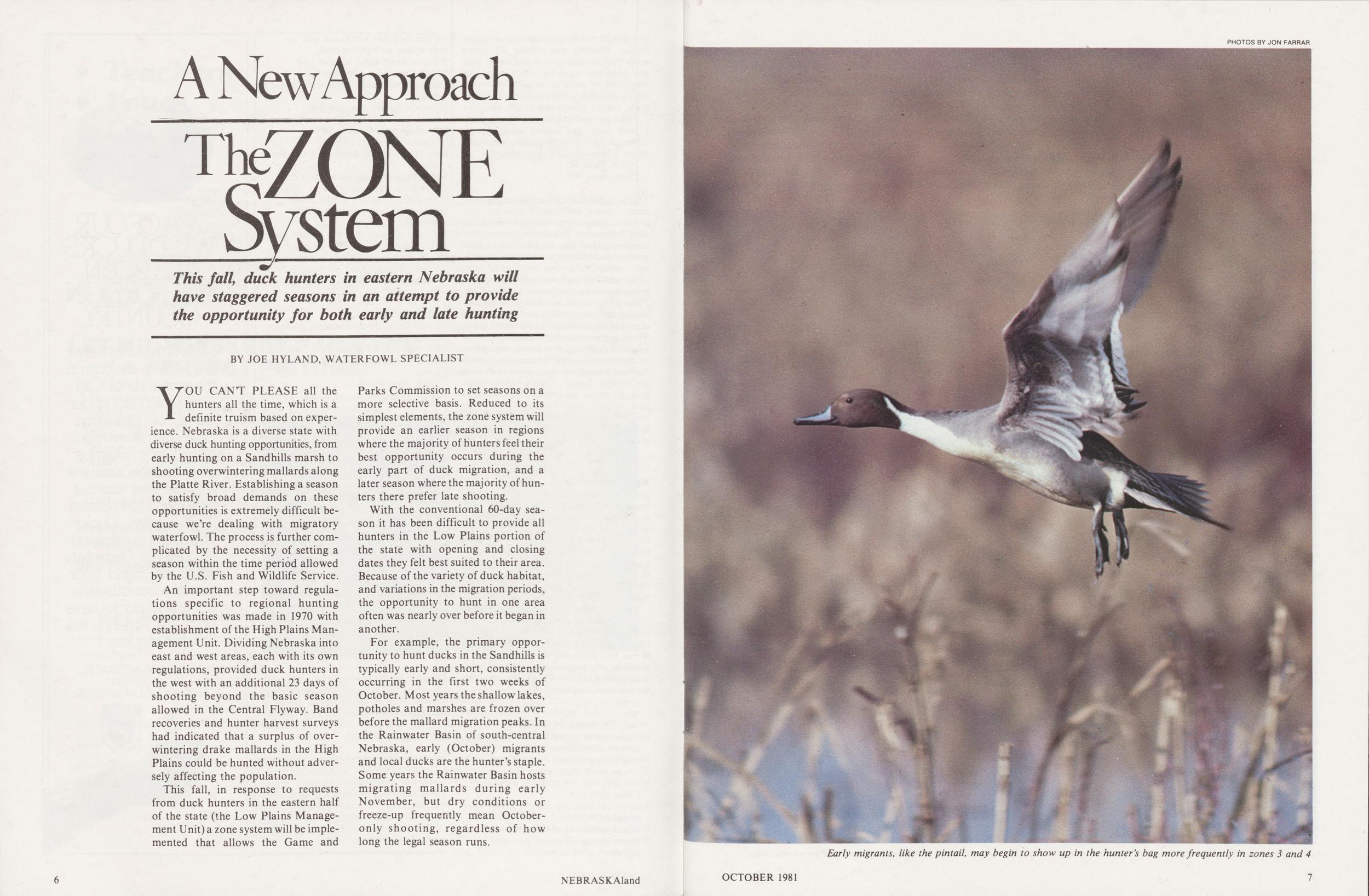
A New Approach
The ZONE System
This fall, duck hunters in eastern Nebraska will have staggered seasons in an attempt to provide the opportunity for both early and late hunting BY JOE HYLAND, WATERFOWL SPECIALISTYOU CANT PLEASE all the hunters all the time, which is a definite truism based on experience. Nebraska is a diverse state with diverse duck hunting opportunities, from early hunting on a Sandhills marsh to shooting overwintering mallards along the Platte River. Establishing a season to satisfy broad demands on these opportunities is extremely difficult because we're dealing with migratory waterfowl. The process is further complicated by the necessity of setting a season within the time period allowed by the U.S. Fish and Wildlife Service.
An important step toward regulations specific to regional hunting opportunities was made in 1970 with establishment of the High Plains Management Unit. Dividing Nebraska into east and west areas, each with its own regulations, provided duck hunters in the west with an additional 23 days of shooting beyond the basic season allowed in the Central Flyway. Band recoveries and hunter harvest surveys had indicated that a surplus of overwintering drake mallards in the High Plains could be hunted without adversely affecting the population.
This fall, in response to requests from duck hunters in the eastern half of the state (the Low Plains Management Unit) a zone system will be implemented that allows the Game and Parks Commission to set seasons on a more selective basis. Reduced to its simplest elements, the zone system will provide an earlier season in regions where the majority of hunters feel their best opportunity occurs during the early part of duck migration, and a later season where the majority of hunters there prefer late shooting.
With the conventional 60-day season it has been difficult to provide all hunters in the Low Plains portion of the state with opening and closing dates they felt best suited to their area. Because of the variety of duck habitat, and variations in the migration periods, the opportunity to hunt in one area often was nearly over before it began in another.
For example, the primary opportunity to hunt ducks in the Sandhills is typically early and short, consistently occurring in the first two weeks of October. Most years the shallow lakes, potholes and marshes are frozen over before the mallard migration peaks. In the Rainwater Basin of south-central Nebraska, early (October) migrants and local ducks are the hunter's staple. Some years the Rainwater Basin hosts migrating mallards during early November, but dry conditions or freeze-up frequently mean October-only shooting, regardless of how long the legal season runs.
NEBRASKAland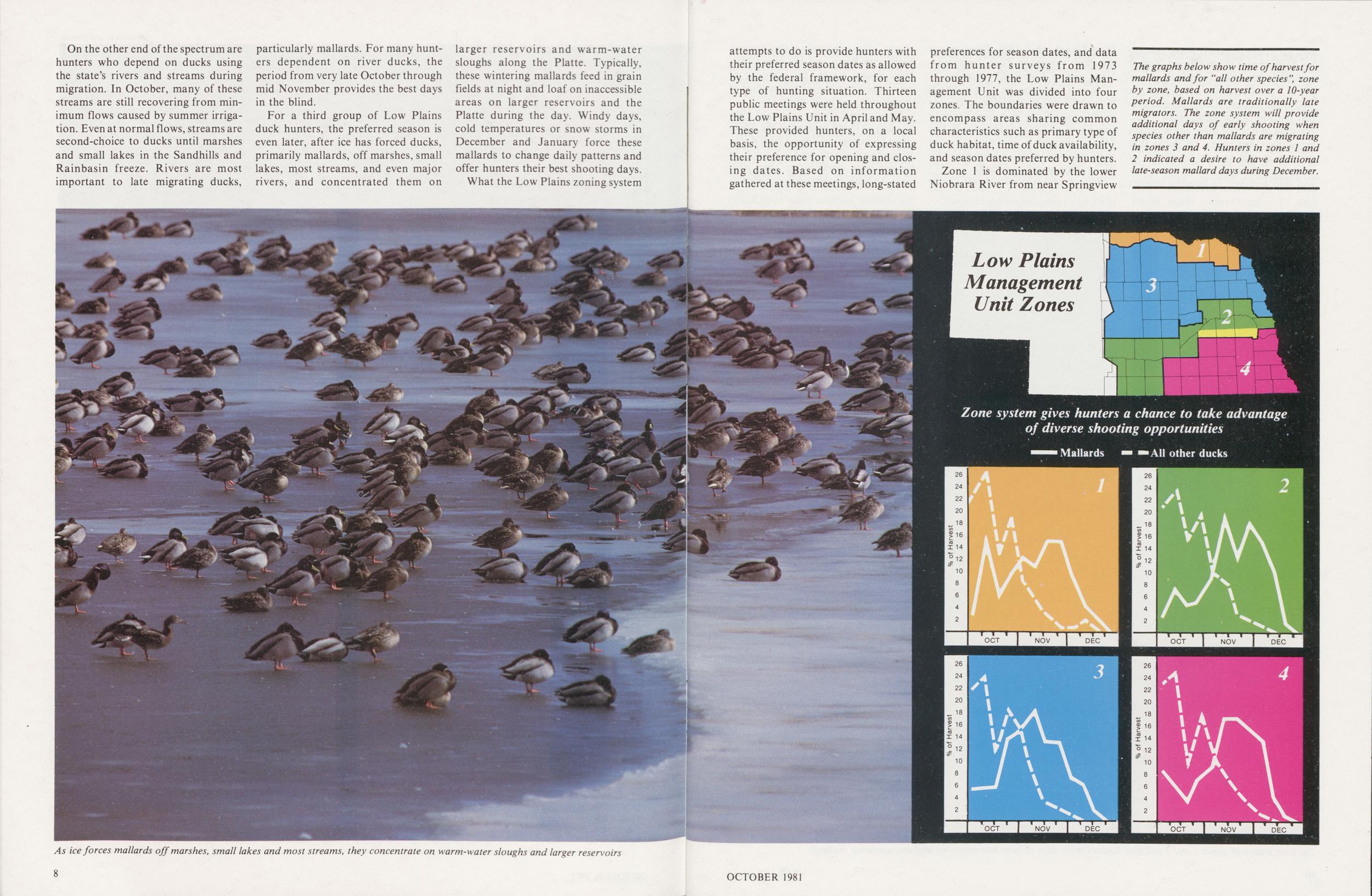
On the other end of the spectrum are hunters who depend on ducks using the state's rivers and streams during migration. In October, many of these streams are still recovering from minimum flows caused by summer irrigation. Even at normal flows, streams are second-choice to ducks until marshes and small lakes in the Sandhills and Rainbasin freeze. Rivers are most important to late migrating ducks, particularly mallards. For many hunters dependent on river ducks, the period from very late October through mid November provides the best days in the blind.
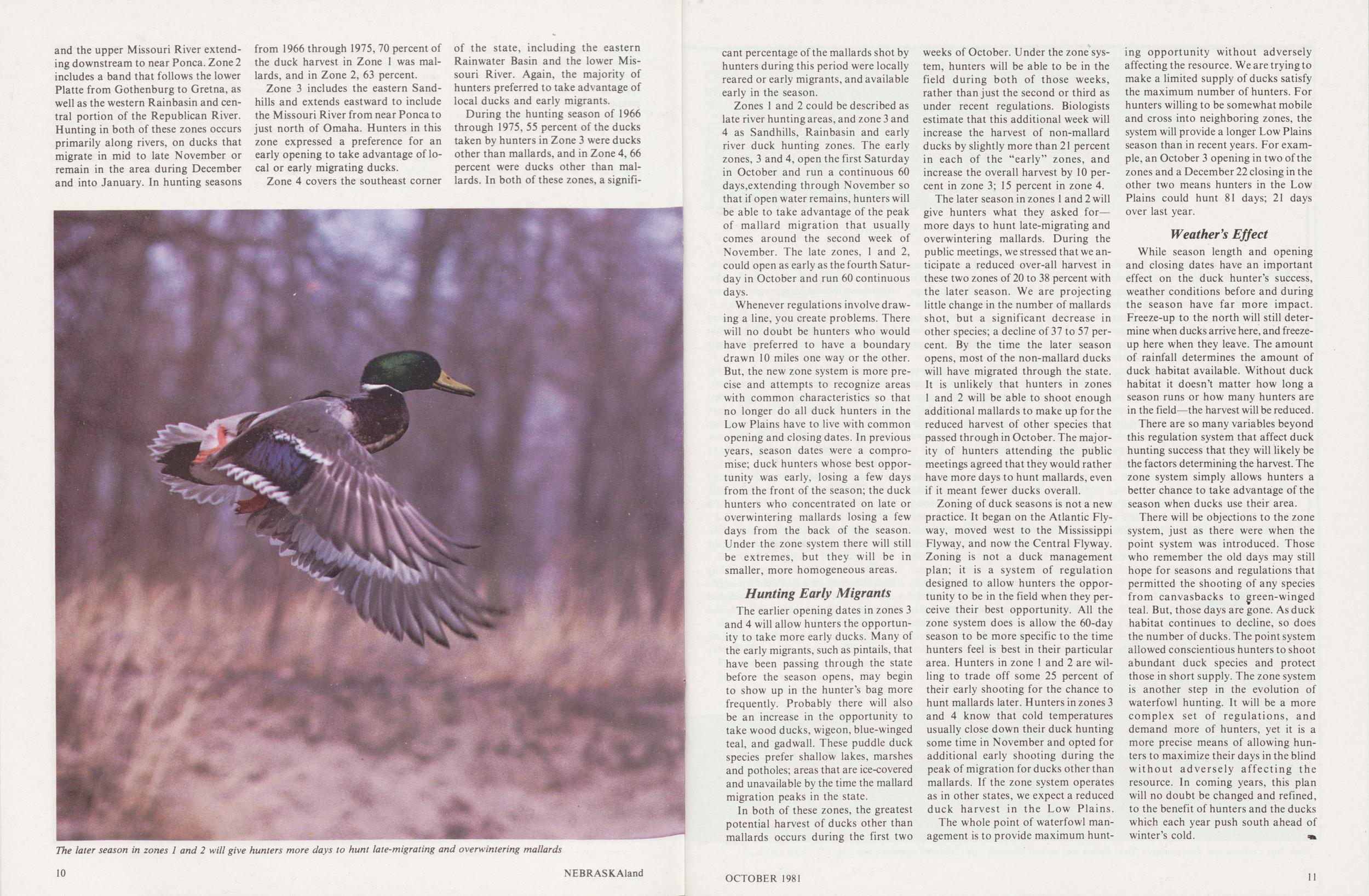
For a third group of Low Plains duck hunters, the preferred season is even later, after ice has forced ducks, primarily mallards, off marshes, small lakes, most streams, and even major rivers, and concentrated them on larger reservoirs and warm-water sloughs along the Platte. Typically, these wintering mallards feed in grain fields at night and loaf on inaccessible areas on larger reservoirs and the Platte during the day. Windy days, cold temperatures or snow storms in December and January force these mallards to change daily patterns and offer hunters their best shooting days.
What the Low Plains zoning system
Zone 1 is dominated by the lower Niobrara River from near Springview
 and the upper Missouri River extending downstream to near Ponca. Zone 2
includes a band that follows the lower
Platte from Gothenburg to Gretna, as
well as the western Rainbasin and central portion of the Republican River.
Hunting in both of these zones occurs
primarily along rivers, on ducks that
migrate in mid to late November or
remain in the area during December
and into January. In hunting seasons
from 1966 through 1975, 70 percent of
the duck harvest in Zone 1 was mallards, and in Zone 2, 63 percent.
and the upper Missouri River extending downstream to near Ponca. Zone 2
includes a band that follows the lower
Platte from Gothenburg to Gretna, as
well as the western Rainbasin and central portion of the Republican River.
Hunting in both of these zones occurs
primarily along rivers, on ducks that
migrate in mid to late November or
remain in the area during December
and into January. In hunting seasons
from 1966 through 1975, 70 percent of
the duck harvest in Zone 1 was mallards, and in Zone 2, 63 percent.
Zone 3 includes the eastern Sandhills and extends eastward to include the Missouri River from near Ponca to just north of Omaha. Hunters in this zone expressed a preference for an early opening to take advantage of local or early migrating ducks.
Zone 4 covers the southeast corner of the state, including the eastern Rainwater Basin and the lower Missouri River. Again, the majority of hunters preferred to take advantage of local ducks and early migrants.
During the hunting season of 1966 through 1975, 55 percent of the ducks taken by hunters in Zone 3 were ducks other than mallards, and in Zone 4, 66 percent were ducks other than mallards. In both of these zones, a significant
Zones 1 and 2 could be described as late river hunting areas, and zone 3 and 4 as Sandhills, Rainbasin and early river duck hunting zones. The early zones, 3 and 4, open the first Saturday in October and run a continuous 60 days,extending through November so that if open water remains, hunters will be able to take advantage of the peak of mallard migration that usually comes around the second week of November. The late zones, 1 and 2, could open as early as the fourth Saturday in October and run 60 continuous days.
Whenever regulations involve drawing a line, you create problems. There will no doubt be hunters who would have preferred to have a boundary drawn 10 miles one way or the other. But, the new zone system is more precise and attempts to recognize areas with common characteristics so that no longer do all duck hunters in the Low Plains have to live with common opening and closing dates. In previous years, season dates were a compromise; duck hunters whose best opportunity was early, losing a few days from the front of the season; the duck hunters who concentrated on late or overwintering mallards losing a few days from the back of the season. Under the zone system there will still be extremes, but they will be in smaller, more homogeneous areas.
Hunting Early MigrantsThe earlier opening dates in zones 3 and 4 will allow hunters the opportunity to take more early ducks. Many of the early migrants, such as pintails, that have been passing through the state before the season opens, may begin to show up in the hunter's bag more frequently. Probably there will also be an increase in the opportunity to take wood ducks, wigeon, blue-winged teal, and gadwall. These puddle duck species prefer shallow lakes, marshes and potholes; areas that are ice-covered and unavailable by the time the mallard migration peaks in the state.
In both of these zones, the greatest potential harvest of ducks other than mallards occurs during the first two weeks of October. Under the zone system, hunters will be able to be in the field during both of those weeks, rather than just the second or third as under recent regulations. Biologists estimate that this additional week will increase the harvest of non-mallard ducks by slightly more than 21 percent in each of the "early" zones, and increase the overall harvest by 10 percent in zone 3; 15 percent in zone 4.
The later season in zones 1 and 2 will give hunters what they asked for—more days to hunt late-migrating and overwintering mallards. During the public meetings, we stressed that we anticipate a reduced over-all harvest in these two zones of 20 to 38 percent with the later season. We are projecting little change in the number of mallards shot, but a significant decrease in other species; a decline of 37 to 57 percent. By the time the later season opens, most of the non-mallard ducks will have migrated through the state. It is unlikely that hunters in zones 1 and 2 will be able to shoot enough additional mallards to make up for the reduced harvest of other species that passed through in October. The majority of hunters attending the public meetings agreed that they would rather have more days to hunt mallards, even if it meant fewer ducks overall.
Zoning of duck seasons is not a new practice. It began on the Atlantic Flyway, moved west to the Mississippi Flyway, and now the Central Flyway. Zoning is not a duck management plan; it is a system of regulation designed to allow hunters the opportunity to be in the field when they perceive their best opportunity. All the zone system does is allow the 60-day season to be more specific to the time hunters feel is best in their particular area. Hunters in zone 1 and 2 are willing to trade off some 25 percent of their early shooting for the chance to hunt mallards later. Hunters in zones 3 and 4 know that cold temperatures usually close down their duck hunting some time in November and opted for additional early shooting during the peak of migration for ducks other than mallards. If the zone system operates as in other states, we expect a reduced duck harvest in the Low Plains.
The whole point of waterfowl management is to provide maximum hunting opportunity without adversely affecting the resource. We are trying to make a limited supply of ducks satisfy the maximum number of hunters. For hunters willing to be somewhat mobile and cross into neighboring zones, the system will provide a longer Low Plains season than in recent years. For example, an October 3 opening in two of the zones and a December 22 closing in the other two means hunters in the Low Plains could hunt 81 days; 21 days over last year.
Weather's EffectWhile season length and opening and closing dates have an important effect on the duck hunter's success, weather conditions before and during the season have far more impact. Freeze-up to the north will still determine when ducks arrive here, and freeze-up here when they leave. The amount of rainfall determines the amount of duck habitat available. Without duck habitat it doesn't matter how long a season runs or how many hunters are in the field—the harvest will be reduced.
There are so many variables beyond this regulation system that affect duck hunting success that they will likely be the factors determining the harvest. The zone system simply allows hunters a better chance to take advantage of the season when ducks use their area.
There will be objections to the zone system, just as there were when the point system was introduced. Those who remember the old days may still hope for seasons and regulations that permitted the shooting of any species from canvasbacks to green-winged teal. But, those days are gone. As duck habitat continues to decline, so does the number of ducks. The point system allowed conscientious hunters to shoot abundant duck species and protect those in short supply. The zone system is another step in the evolution of waterfowl hunting. It will be a more complex set of regulations, and demand more of hunters, yet it is a more precise means of allowing hunters to maximize their days in the blind without adversely affecting the resource. In coming years, this plan will no doubt be changed and refined, to the benefit of hunters and the ducks which each year push south ahead of winter's cold.
OCTOBER 1981 11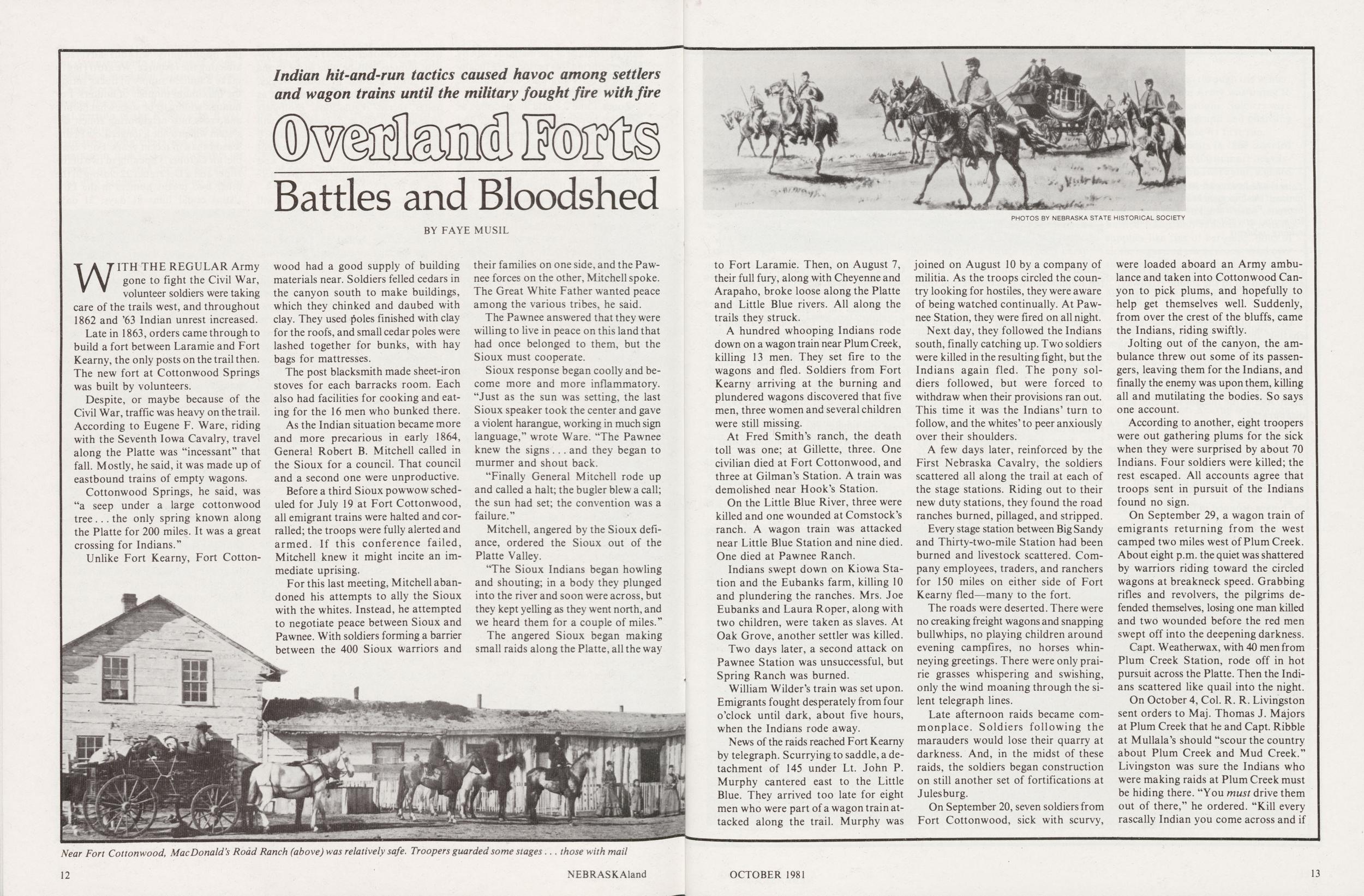
Overland Forts
Battles and Bloodshed
BY FAYE MUSIL Indian hit-and-run tactics caused havoc among settlers and wagon trains until the military fought fire with fireWITH THE REGULAR Army gone to fight the Civil War, volunteer soldiers were taking care of the trails west, and throughout 1862 and '63 Indian unrest increased.
Late in 1863, orders came through to build a fort between Laramie and Fort Kearny, the only posts on the trail then. The new fort at Cottonwood Springs was built by volunteers.
Despite, or maybe because of the Civil War, traffic was heavy on the trail. According to Eugene F. Ware, riding with the Seventh Iowa Cavalry, travel along the Platte was "incessant" that fall. Mostly, he said, it was made up of eastbound trains of empty wagons.
Cottonwood Springs, he said, was "a seep under a large cottonwood tree... the only spring known along the Platte for 200 miles. It was a great crossing for Indians."
Unlike Fort Kearny, Fort Cottonwood had a good supply of building materials near. Soldiers felled cedars in the canyon south to make buildings, which thev chinked and daubed with clay. They used poles finished with clay for the roofs, and small cedar poles were lashed together for bunks, with hay bags for mattresses.
The post blacksmith made sheet-iron stoves for each barracks room. Each also had facilities for cooking and eating for the 16 men who bunked there.
As the Indian situation became more and more precarious in early 1864, General Robert B. Mitchell called in the Sioux for a council. That council and a second one were unproductive.
Before a third Sioux powwow scheduled for July 19 at Fort Cottonwood, all emigrant trains were halted and corralled; the troops were fully alerted and armed. If this conference failed, Mitchell knew it might incite an immediate uprising.
For this last meeting, Mitchell abandoned his attempts to ally the Sioux with the whites. Instead, he attempted to negotiate peace between Sioux and Pawnee. With soldiers forming a barrier between the 400 Sioux warriors and their families on one side, and the Pawnee forces on the other, Mitchell spoke. The Great White Father wanted peace among the various tribes, he said.
The Pawnee answered that they were willing to live in peace on this land that had once belonged to them, but the Sioux must cooperate.
Sioux response began coolly and become more and more inflammatory. "Just as the sun was setting, the last Sioux speaker took the center and gave a violent harangue, working in much sign language," wrote Ware. "The Pawnee knew the signs and they began to murmer and shout back.
"Finally General Mitchell rode up and called a halt; the bugler blew a call; the sun had set; the convention was a failure."
Mitchell, angered by the Sioux defiance, ordered the Sioux out of the Platte Valley.
"The Sioux Indians began howling and shouting; in a body they plunged into the river and soon were across, but they kept yelling as they went north, and we heard them for a couple of miles."
The angered Sioux began making small raids along the Platte, all the way
A hundred whooping Indians rode down on a wagon train near Plum Creek, killing 13 men. They set fire to the wagons and fled. Soldiers from Fort Kearny arriving at the burning and plundered wagons discovered that five men, three women and several children were still missing.
At Fred Smith's ranch, the death toll was one; at Gillette, three. One civilian died at Fort Cottonwood, and three at Gilman's Station. A train was demolished near Hook's Station.
On the Little Blue River, three were killed and one wounded at Comstock's ranch. A wagon train was attacked near Little Blue Station and nine died. One died at Pawnee Ranch.
Indians swept down on Kiowa Station and the Eubanks farm, killing 10 and plundering the ranches. Mrs. Joe Eubanks and Laura Roper, along with two children, were taken as slaves. At Oak Grove, another settler was killed.
Two days later, a second attack on Pawnee Station was unsuccessful, but Spring Ranch was burned.
William Wilder's train was set upon. Emigrants fought desperately from four o'clock until dark, about five hours, when the Indians rode away.
News of the raids reached Fort Kearny by telegraph. Scurrying to saddle, a detachment of 145 under Lt. John P. Murphy cantered east to the Little Blue. They arrived too late for eight men who were part of a wagon train attacked along the trail. Murphy was joined on August 10 by a company of militia. As the troops circled the country looking for hostiles, they were aware of being watched continually. At Pawnee Station, they were fired on all night.
Next day, they followed the Indians south, finally catching up. Two soldiers were killed in the resulting fight, but the Indians again fled. The pony soldiers followed, but were forced to withdraw when their provisions ran out. This time it was the Indians' turn to follow, and the whites' to peer anxiously over their shoulders.
A few days later, reinforced by the First Nebraska Cavalry, the soldiers scattered all along the trail at each of the stage stations. Riding out to their new duty stations, they found the road ranches burned, pillaged, and stripped.
Every stage station between Big Sandy and Thirty-two-mile Station had been burned and livestock scattered. Company employees, traders, and ranchers for 150 miles on either side of Fort Kearny fled—many to the fort.
The roads were deserted. There were no creaking freight wagons and snapping bullwhips, no playing children around evening campfires, no horses whinneying greetings. There were only prairie grasses whispering and swishing, only the wind moaning through the silent telegraph lines.
Late afternoon raids became commonplace. Soldiers following the marauders would lose their quarry at darkness. And, in the midst of these raids, the soldiers began construction on still another set of fortifications at Julesburg.
On September 20, seven soldiers from Fort Cottonwood, sick with scurvy, were loaded aboard an Army ambulance and taken into Cottonwood Canyon to pick plums, and hopefully to help get themselves well. Suddenly, from over the crest of the bluffs, came the Indians, riding swiftly.
Jolting out of the canyon, the ambulance threw out some of its passengers, leaving them for the Indians, and finally the enemy was upon them, killing all and mutilating the bodies. So says one account.
According to another, eight troopers were out gathering plums for the sick when they were surprised by about 70 Indians. Four soldiers were killed; the rest escaped. All accounts agree that troops sent in pursuit of the Indians found no sign.
On September 29, a wagon train of emigrants returning from the west camped two miles west of Plum Creek. About eight p.m. the quiet was shattered by warriors riding toward the circled wagons at breakneck speed. Grabbing rifles and revolvers, the pilgrims defended themselves, losing one man killed and two wounded before the red men swept off into the deepening darkness.
Capt. Weatherwax, with 40 men from Plum Creek Station, rode off in hot pursuit across the Platte. Then the Indians scattered like quail into the night.
On October 4, Col. R. R. Livingston
sent orders to Maj. Thomas J. Majors
at Plum Creek that he and Capt. Ribble
at Mullala's should "scour the country
about Plum Creek and Mud Creek."
Livingston was sure the Indians who
were making raids at Plum Creek must
be hiding there. "You must drive them
out of there," he ordered. "Kill every
rascally Indian you come across and if
OCTOBER 1981
13
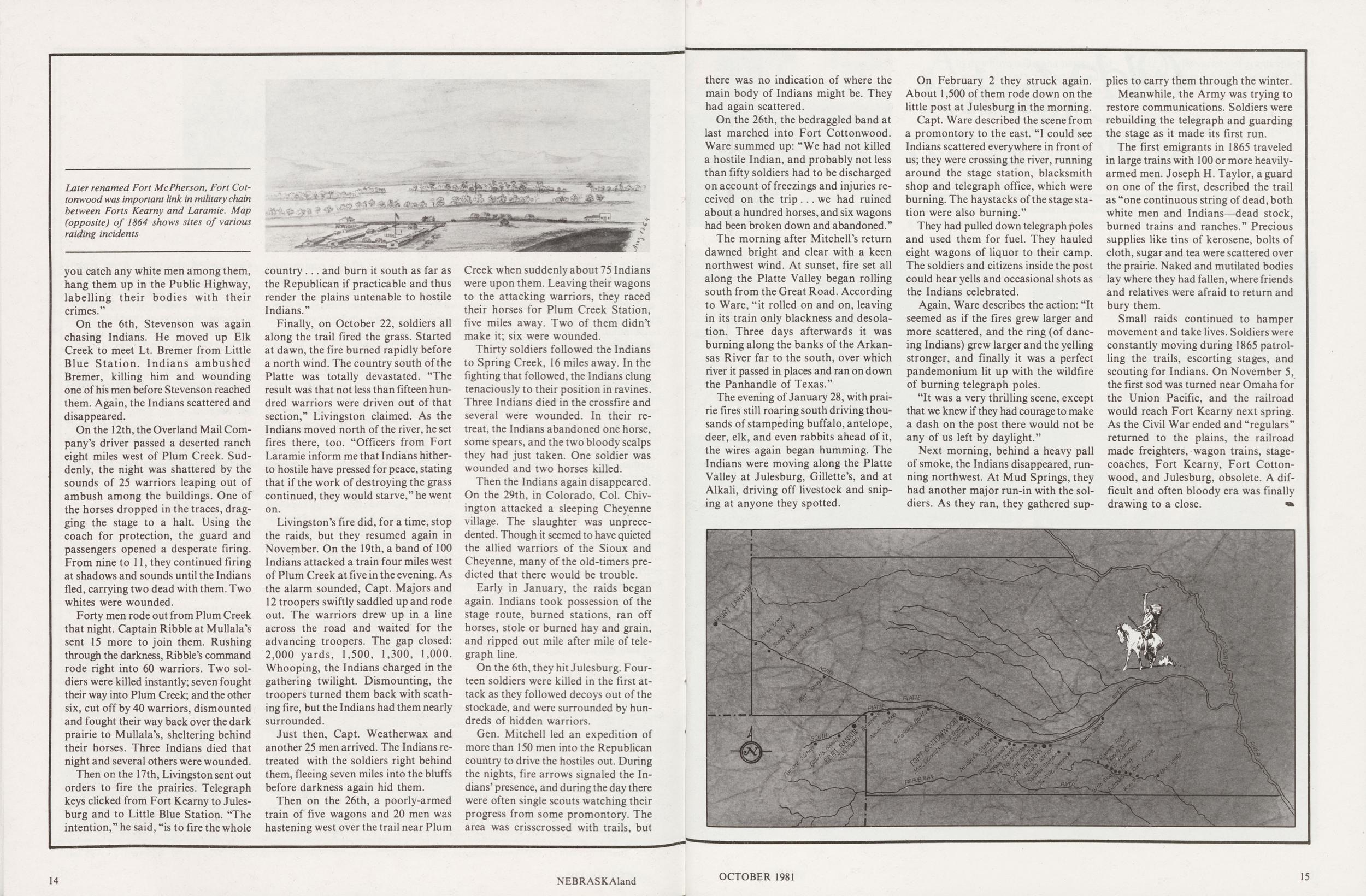
On the 6th, Stevenson was again chasing Indians. He moved up Elk Creek to meet Lt. Bremer from Little Blue Station. Indians ambushed Bremer, killing him and wounding one of his men before Stevenson reached them. Again, the Indians scattered and disappeared.
On the 12th, the Overland Mail Company's driver passed a deserted ranch eight miles west of Plum Creek. Suddenly, the night was shattered by the sounds of 25 warriors leaping out of ambush among the buildings. One of the horses dropped in the traces, dragging the stage to a halt. Using the coach for protection, the guard and passengers opened a desperate firing. From nine to 11, they continued firing at shadows and sounds until the Indians fled, carrying two dead with them. Two whites were wounded.
Forty men rode out from Plum Creek that night. Captain Ribble at Mullala's sent 15 more to join them. Rushing through the darkness, Ribble's command rode right into 60 warriors. Two soldiers were killed instantly; seven fought their way into Plum Creek; and the other six, cut off by 40 warriors, dismounted and fought their way back over the dark prairie to Mullala's, sheltering behind their horses. Three Indians died that night and several others were wounded.
Then on the 17th, Livingston sent out orders to fire the prairies. Telegraph keys clicked from Fort Kearny to Jules-burg and to Little Blue Station. "The intention," he said, "is to fire the whole country and burn it south as far as the Republican if practicable and thus render the plains untenable to hostile Indians."
Finally, on October 22, soldiers all along the trail fired the grass. Started at dawn, the fire burned rapidly before a north wind. The country south of the Platte was totally devastated. "The result was that not less than fifteen hundred warriors were driven out of that section," Livingston claimed. As the Indians moved north of the river, he set fires there, too. "Officers from Fort Laramie inform me that Indians hitherto hostile have pressed for peace, stating that if the work of destroying the grass continued, they would starve," he went on.
Livingston's fire did, for a time, stop the raids, but they resumed again in November. On the 19th, a band of 100 Indians attacked a train four miles west of Plum Creek at five in the evening. As the alarm sounded, Capt. Majors and 12 troopers swiftly saddled up and rode out. The warriors drew up in a line across the road and waited for the advancing troopers. The gap closed: 2,000 yards, 1,500, 1,300, 1,000. Whooping, the Indians charged in the gathering twilight. Dismounting, the troopers turned them back with scathing fire, but the Indians had them nearly surrounded.
Just then, Capt. Weatherwax and another 25 men arrived. The Indians retreated with the soldiers right behind them, fleeing seven miles into the bluffs before darkness again hid them.
Then on the 26th, a poorly-armed train of five wagons and 20 men was hastening west over the trail near Plum Creek when suddenly about 75 Indians were upon them. Leaving their wagons to the attacking warriors, they raced their horses for Plum Creek Station, five miles away. Two of them didn't make it; six were wounded.
Thirty soldiers followed the Indians to Spring Creek, 16 miles away. In the fighting that followed, the Indians clung tenaciously to their position in ravines. Three Indians died in the crossfire and several were wounded. In their retreat, the Indians abandoned one horse, some spears, and the two bloody scalps they had just taken. One soldier was wounded and two horses killed.
Then the Indians again disappeared. On the 29th, in Colorado, Col. Chivington attacked a sleeping Cheyenne village. The slaughter was unprecedented. Though it seemed to have quieted the allied warriors of the Sioux and Cheyenne, many of the old-timers predicted that there would be trouble.
Early in January, the raids began again. Indians took possession of the stage route, burned stations, ran off horses, stole or burned hay and grain, and ripped out mile after mile of telegraph line.
On the 6th, they hit Julesburg. Fourteen soldiers were killed in the first attack as they followed decoys out of the stockade, and were surrounded by hundreds of hidden warriors.
Gen. Mitchell led an expedition of more than 150 men into the Republican country to drive the hostiles out. During the nights, fire arrows signaled the Indians' presence, and during the day there were often single scouts watching their progress from some promontory. The area was crisscrossed with trails, but 14 NEBRASKAland there was no indication of where the main body of Indians might be. They had again scattered.
On the 26th, the bedraggled band at last marched into Fort Cottonwood. Ware summed up: "We had not killed a hostile Indian, and probably not less than fifty soldiers had to be discharged on account of freezings and injuries received on the trip we had ruined about a hundred horses, and six wagons had been broken down and abandoned."
The morning after Mitchell's return dawned bright and clear with a keen northwest wind. At sunset, fire set all along the Platte Valley began rolling south from the Great Road. According to Ware, "it rolled on and on, leaving in its train only blackness and desolation. Three days afterwards it was burning along the banks of the Arkansas River far to the south, over which river it passed in places and ran on down the Panhandle of Texas."
The evening of January 28, with prairie fires still roaring south driving thousands of stampeding buffalo, antelope, deer, elk, and even rabbits ahead of it, the wires again began humming. The Indians were moving along the Platte Valley at Julesburg, Gillette's, and at Alkali, driving off livestock and sniping at anyone they spotted.
On February 2 they struck again. About 1,500 of them rode down on the little post at Julesburg in the morning.
Capt. Ware described the scene from a promontory to the east. "I could see Indians scattered everywhere in front of us; they were crossing the river, running around the stage station, blacksmith shop and telegraph office, which were burning. The haystacks of the stage station were also burning."
They had pulled down telegraph poles and used them for fuel. They hauled eight wagons of liquor to their camp. The soldiers and citizens inside the post could hear yells and occasional shots as the Indians celebrated.
Again, Ware describes the action: "It seemed as if the fires grew larger and more scattered, and the ring (of dancing Indians) grew larger and the yelling stronger, and finally it was a perfect pandemonium lit up with the wildfire of burning telegraph poles.
"It was a very thrilling scene, except that we knew if they had courage to make a dash on the post there would not be any of us left by daylight."
Next morning, behind a heavy pall of smoke, the Indians disappeared, running northwest. At Mud Springs, they had another major run-in with the soldiers. As they ran, they gathered supplies to carry them through the winter.
Meanwhile, the Army was trying to restore communications. Soldiers were rebuilding the telegraph and guarding the stage as it made its first run.
The first emigrants in 1865 traveled in large trains with 100 or more heavily-armed men. Joseph H. Taylor, a guard on one of the first, described the trail as "one continuous string of dead, both white men and Indians—dead stock, burned trains and ranches." Precious supplies like tins of kerosene, bolts of cloth, sugar and tea were scattered over the prairie. Naked and mutilated bodies lay where they had fallen, where friends and relatives were afraid to return and bury them.
Small raids continued to hamper movement and take lives. Soldiers were constantly moving during 1865 patrolling the trails, escorting stages, and scouting for Indians. On November 5, the first sod was turned near Omaha for the Union Pacific, and the railroad would reach Fort Kearny next spring. As the Civil War ended and "regulars" returned to the plains, the railroad made freighters, wagon trains, stage-coaches, Fort Kearny, Fort Cottonwood, and Julesburg, obsolete. A difficult and often bloody era was finally drawing to a close.
OCTOBER 1981 15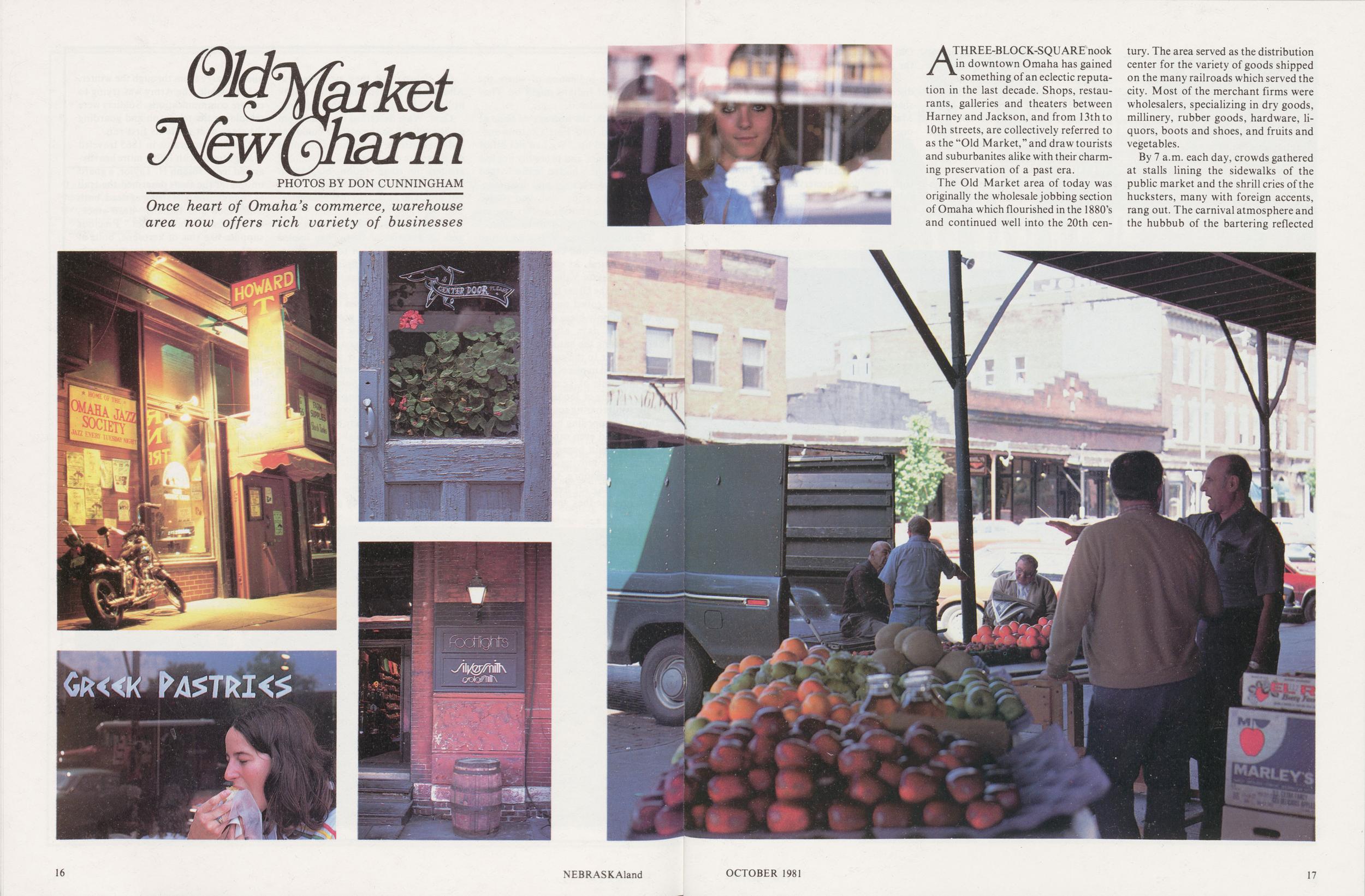
Old Market New Charm
PHOTOS BY DON CUNNINGHAM Once heart of Omaha's commerce, warehouse area now offers rich variety of businessesA THREE-BLOCK-SQUARE nook in downtown Omaha has gained something of an eclectic reputation in the last decade. Shops, restaurants, galleries and theaters between Harney and Jackson, and from 13th to 10th streets, are collectively referred to as the "Old Market," and draw tourists and suburbanites alike with their charming preservation of a past era.
The Old Market area of today was originally the wholesale jobbing section of Omaha which flourished in the 1880's and continued well into the 20th century. The area served as the distribution center for the variety of goods shipped on the many railroads which served the city. Most of the merchant firms were wholesalers, specializing in dry goods, millinery, rubber goods, hardware, liquors, boots and shoes, and fruits and vegetables.
By 7 a.m. each day, crowds gathered
at stalls lining the sidewalks of the
public market and the shrill cries of the
hucksters, many with foreign accents,
rang out. The carnival atmosphere and
the hubbub of the bartering reflected
OCTOBER 1981
17
 the vitality of thriving businesses, and
went on long after the sun had set.
the vitality of thriving businesses, and
went on long after the sun had set.
With the advent of the supermarket, the wholesale produce firms were forced to close. One by one, businesses were shuttered and the public market area began to empty. For 10 years the sturdy warehouses stood empty.
In the late 1960's a resurgence of interest in renovation of old buildings in urban areas began. The Cannery and Ghiradelli Square sprang up in San Francisco, Faneiul Hall in Boston, Larimer Square in Denver.
In 1968, the market area of downtown Omaha was rediscovered by Samuel D. Mercer, a Paris attorney with strong family ties in Omaha. Many of the buildings had been erected by his grandfather, Samuel D. Mercer, M.D., a prominent Omaha physician and former chief surgeon for the Union Pacific Railroad. Much of the property was still owned by the Mercer family.
Mercer, his son Mark, nephew Nicholas Bonham-Carter, and several imaginative friends, set about transforming the former marketplace into the "new" Old Market, taking pains to preserve the natural atmosphere of the district.
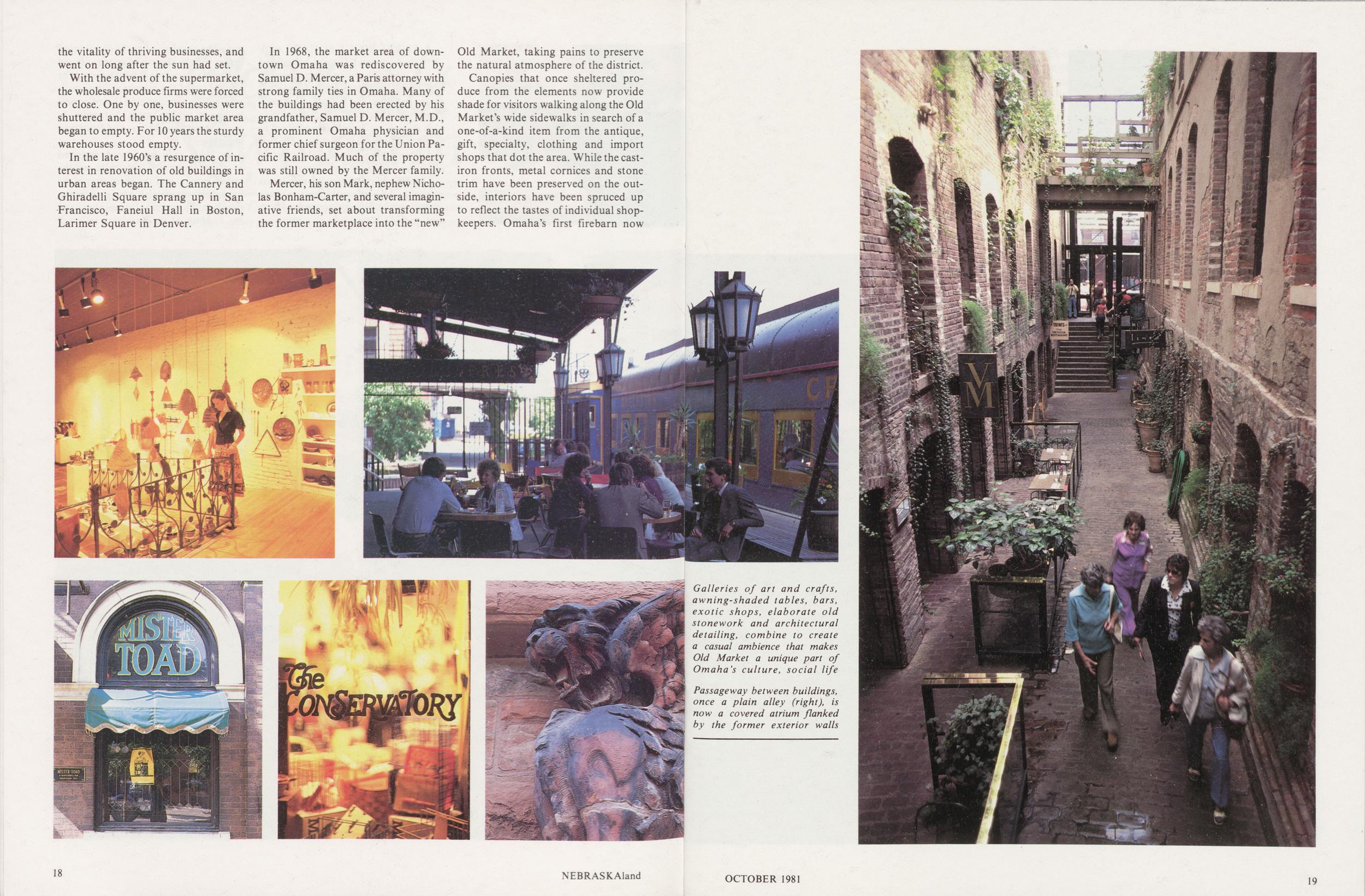
Canopies that once sheltered produce from the elements now provide shade for visitors walking along the Old Market's wide sidewalks in search of a one-of-a-kind item from the antique, gift, specialty, clothing and import shops that dot the area. While the cast-iron fronts, metal cornices and stone trim have been preserved on the outside, interiors have been spruced up to reflect the tastes of individual shop-keepers. Omaha's first firebarn now
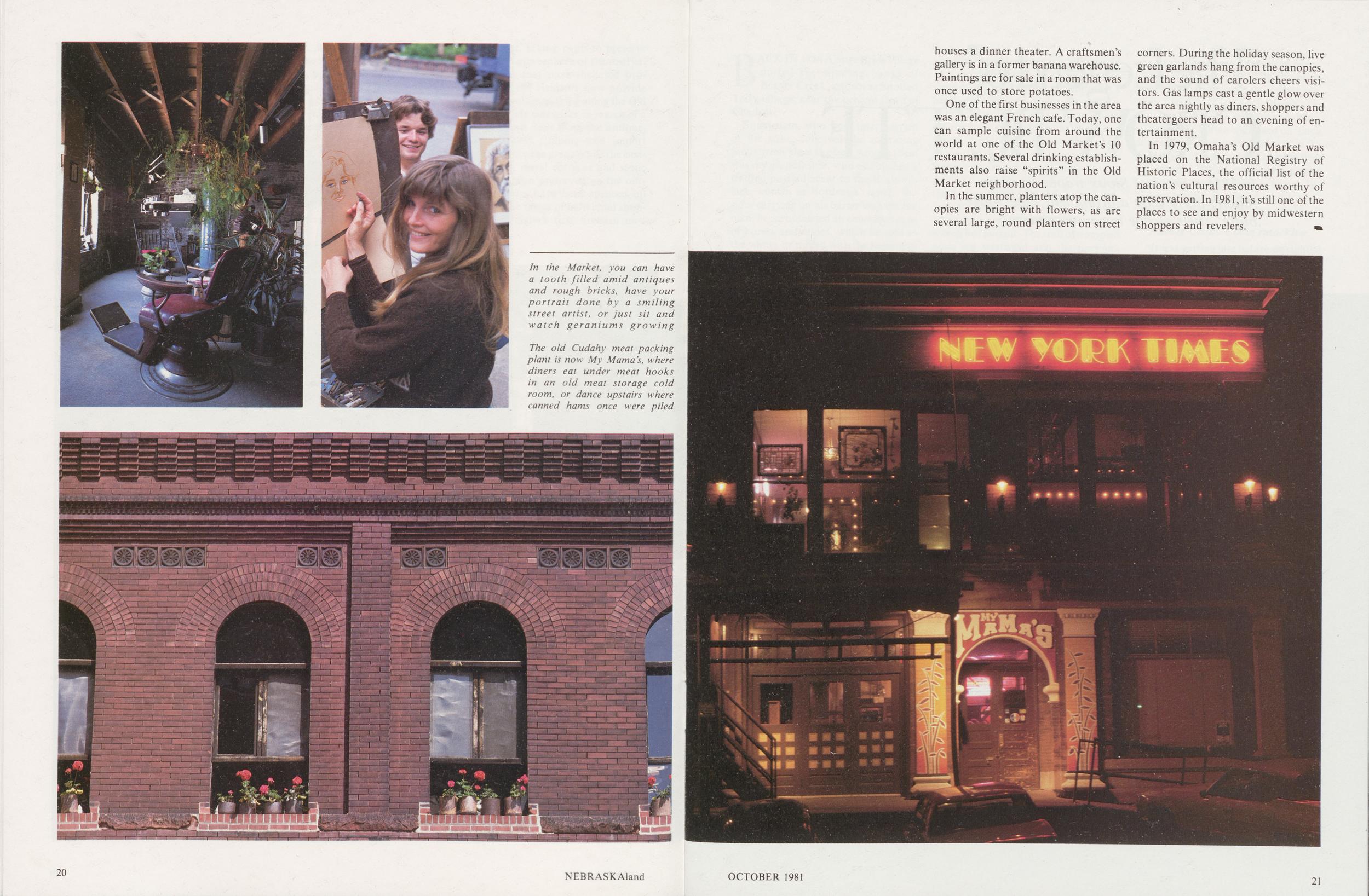
One of the first businesses in the area was an elegant French cafe. Today, one can sample cuisine from around the world at one of the Old Market's 10 restaurants. Several drinking establishments also raise "spirits" in the Old Market neighborhood.
In the summer, planters atop the canopies are bright with flowers, as are several large, round planters on street corners. During the holiday season, live green garlands hang from the canopies, and the sound of carolers cheers visitors. Gas lamps cast a gentle glow over the area nightly as diners, shoppers and theatergoers head to an evening of entertainment.
In 1979, Omaha's Old Market was placed on the National Registry of Historic Places, the official list of the nation's cultural resources worthy of preservation. In 1981, it's still one of the places to see and enjoy by midwestern shoppers and revelers.
OCTOBER 1981 21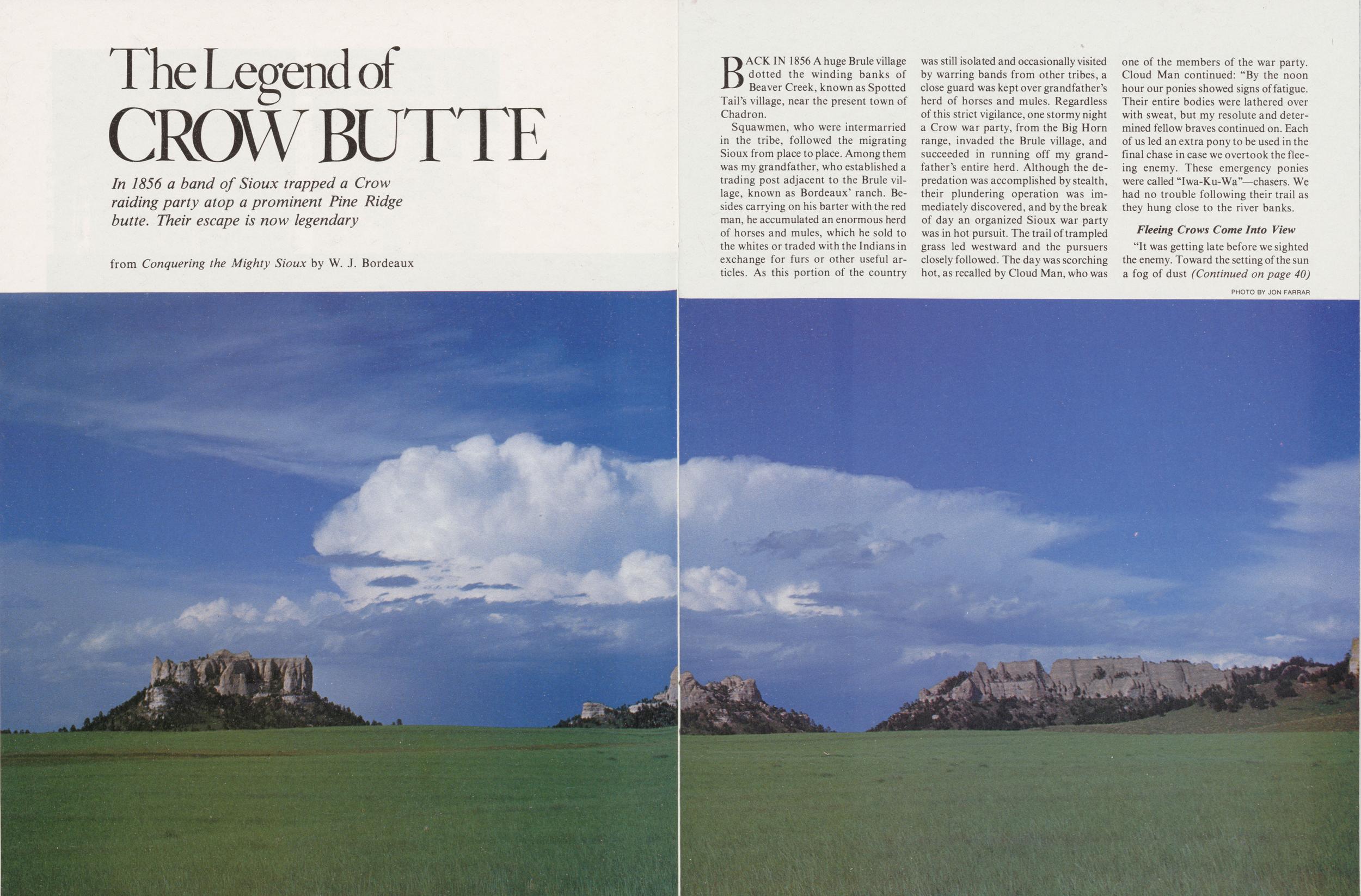
The Legend of CROW BUTTE
In 1856 a band of Sioux trapped a Crow raiding party atop a prominent Pine Ridge butte. Their escape is now legendary from Conquering the Mighty Sioux by W. J. BordeauxBACK IN 1856 A huge Brule village dotted the winding banks of Beaver Creek, known as Spotted Tail's village, near the present town of Chadron.
Squawmen, who were intermarried in the tribe, followed the migrating Sioux from place to place. Among them was my grandfather, who established a trading post adjacent to the Brule village, known as Bordeaux' ranch. Besides carrying on his barter with the red man, he accumulated an enormous herd of horses and mules, which he sold to the whites or traded with the Indians in exchange for furs or other useful articles. As this portion of the country was still isolated and occasionally visited by warring bands from other tribes, a close guard was kept over grandfather's herd of horses and mules. Regardless of this strict vigilance, one stormy night a Crow war party, from the Big Horn range, invaded the Brule village, and succeeded in running off my grandfather's entire herd. Although the depredation was accomplished by stealth, their plundering operation was immediately discovered, and by the break of day an organized Sioux war party was in hot pursuit. The trail of trampled grass led westward and the pursuers closely followed. The day was scorching hot, as recalled by Cloud Man, who was one of the members of the war party. Cloud Man continued: "By the noon hour our ponies showed signs of fatigue. Their entire bodies were lathered over with sweat, but my resolute and determined fellow braves continued on. Each of us led an extra pony to be used in the final chase in case we overtook the fleeing enemy. These emergency ponies were called "Iwa-Ku-Wa"—chasers. We had no trouble following their trail as they hung close to the river banks.
Fleeing Crows Come Into View"It was getting late before we sighted the enemy. Toward the setting of the sun a fog of dust (Continued on page 40)
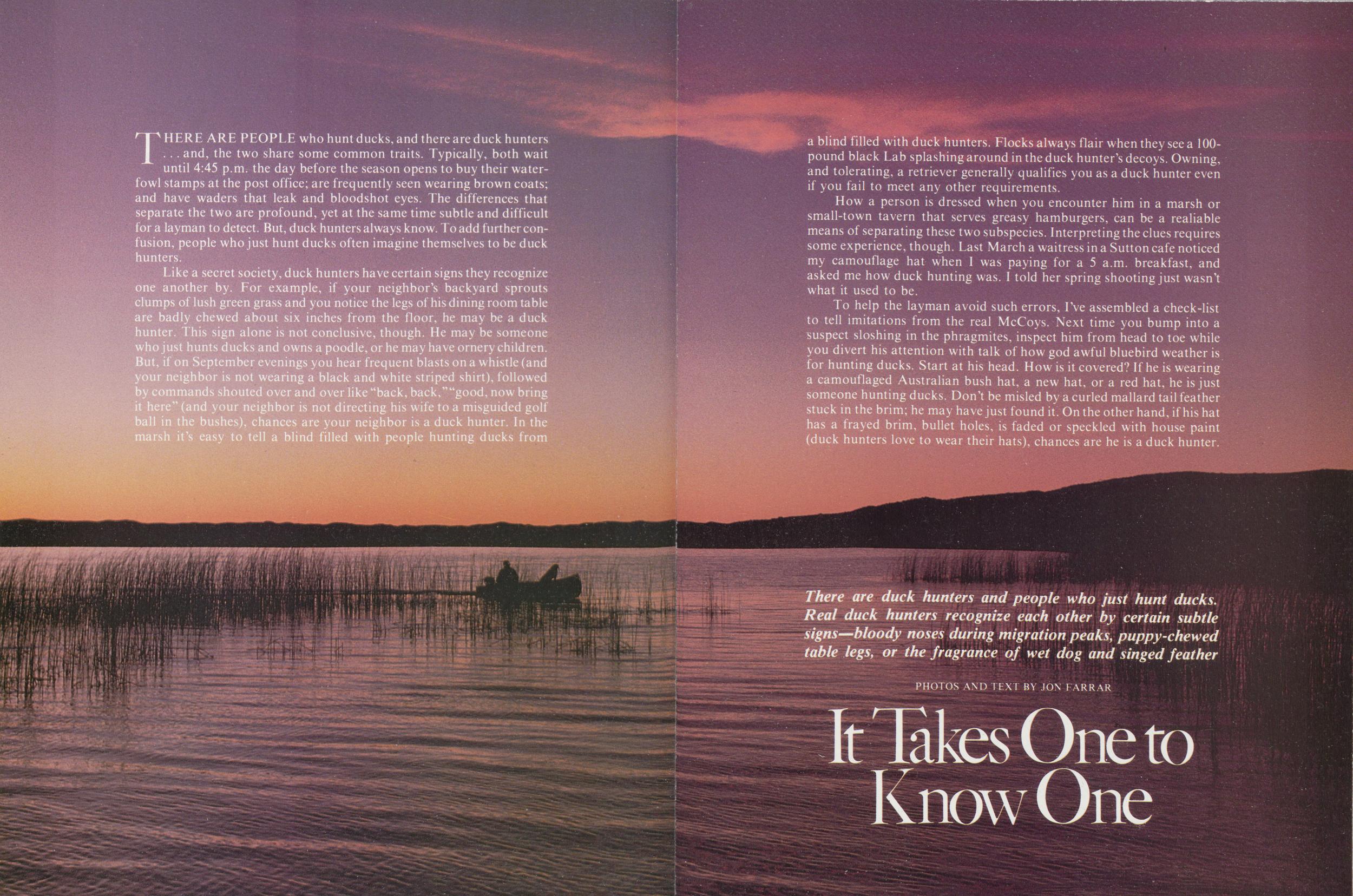
It Takes One to Know One
There are duck hunters and people who just hunt ducks. Real duck hunters recognize each other by certain subtle signs—bloody noses during migration peaks, puppy-chewed table legs, or the fragrance of wet dog and singed feather PHOTOS AND TEXT BY JON FARRARHERE ARE PEOPLE who hunt ducks, and there are duck hunters and, the two share some common traits. Typically, both wait until 4:45 p.m. the day before the season opens to buy their waterfowl stamps at the post office; are frequently seen wearing brown coats; and have waders that leak and bloodshot eyes. The differences that separate the two are profound, yet at the same time subtle and difficult for a layman to detect. But, duck hunters always know. To add further confusion, people who just hunt ducks often imagine themselves to be duck hunters.
Like a secret society, duck hunters have certain signs they recognize one another by. For example, if your neighbor's backyard sprouts clumps of lush green grass and you notice the legs of his dining room table are badly chewed about six inches from the floor, he may be a duck hunter. This sign alone is not conclusive, though. He may be someone who just hunts ducks and owns a poodle, or he may have ornery children. But, if on September evenings you hear frequent blasts on a whistle (and your neighbor is not wearing a black and white striped shirt), followed by commands shouted over and over like "back, back,""good, now bring it here" (and your neighbor is not directing his wife to a misguided golf ball in the bushes), chances are your neighbor is a duck hunter. In the marsh it's easy to tell a blind filled with people hunting ducks from
How a person is dressed when you encounter him in a marsh or small-town tavern that serves greasy hamburgers, can be a realiable means of separating these two subspecies. Interpreting the clues requires some experience, though. Last March a waitress in a Sutton cafe noticed my camouflage hat when I was paying for a 5 a.m. breakfast, and asked me how duck hunting was. I told her spring shooting just wasn't what it used to be.
To help the layman avoid such errors, I've assembled a check-list
to tell imitations from the real McCoys. Next time you bump into a
suspect sloshing in the phragmites, inspect him from head to toe while
you divert his attention with talk of how god awful bluebird weather is
for hunting ducks. Start at his head. How is it covered? If he is wearing
a camouflaged Australian bush hat, a new hat, or a red hat, he is just
someone hunting ducks. Don't be misled by a curled mallard tail feather
stuck in the brim; he may have just found it. On the other hand, if his hat
has a frayed brim, bullet holes, is faded or speckled with house paint
(duck hunters love to wear their hats), chances are he is a duck hunter.
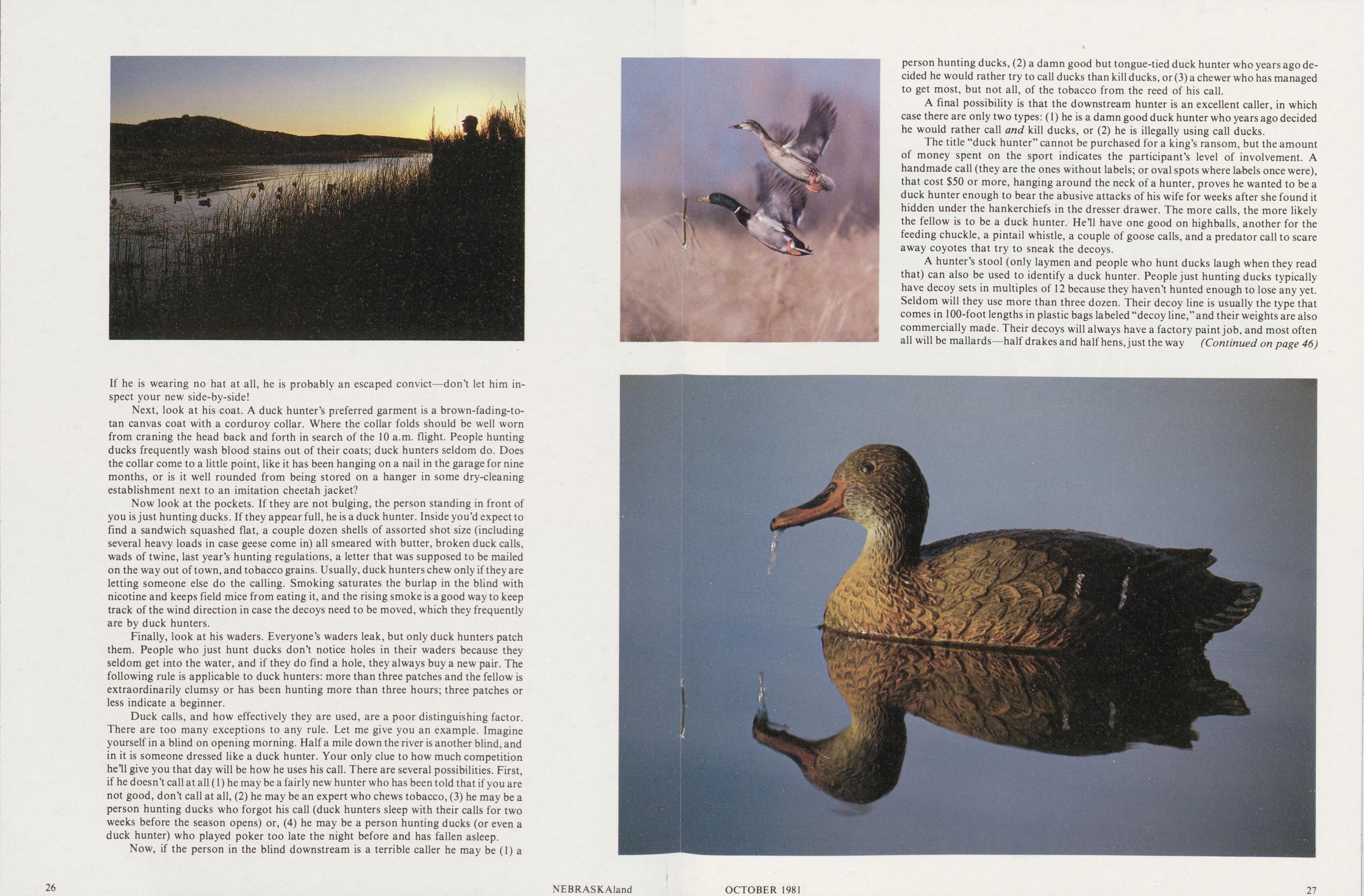
Next, look at his coat. A duck hunter's preferred garment is a brown-fading-to-tan canvas coat with a corduroy collar. Where the collar folds should be well worn from craning the head back and forth in search of the 10 a.m. flight. People hunting ducks frequently wash blood stains out of their coats; duck hunters seldom do. Does the collar come to a little point, like it has been hanging on a nail in the garage for nine months, or is it well rounded from being stored on a hanger in some dry-cleaning establishment next to an imitation cheetah jacket?
Now look at the pockets. If they are not bulging, the person standing in front of you is just hunting ducks. If they appear full, he is a duck hunter. Inside you'd expect to find a sandwich squashed flat, a couple dozen shells of assorted shot size (including several heavy loads in case geese come in) all smeared with butter, broken duck calls, wads of twine, last year's hunting regulations, a letter that was supposed to be mailed on the way out of town, and tobacco grains. Usually, duck hunters chew only if they are letting someone else do the calling. Smoking saturates the burlap in the blind with nicotine and keeps field mice from eating it, and the rising smoke is a good way to keep track of the wind direction in case the decoys need to be moved, which they frequently are by duck hunters.
Finally, look at his waders. Everyone's waders leak, but only duck hunters patch them. People who just hunt ducks don't notice holes in their waders because they seldom get into the water, and if they do find a hole, they always buy a new pair. The following rule is applicable to duck hunters: more than three patches and the fellow is extraordinarily clumsy or has been hunting more than three hours; three patches or less indicate a beginner.
Duck calls, and how effectively they are used, are a poor distinguishing factor. There are too many exceptions to any rule. Let me give you an example. Imagine yourself in a blind on opening morning. Haifa mile down the river is another blind, and in it is someone dressed like a duck hunter. Your only clue to how much competition hell give you that day will be how he uses his call. There are several possibilities. First, if he doesn't call at all (1) he may be a fairly new hunter who has been told that if you are not good, don't call at all, (2) he may be an expert who chews tobacco, (3) he may be a person hunting ducks who forgot his call (duck hunters sleep with their calls for two weeks before the season opens) or, (4) he may be a person hunting ducks (or even a duck hunter) who played poker too late the night before and has fallen asleep.
Now, if the person in the blind downstream is a terrible caller he may be (1) a 26 NEBRASKAland
A final possibility is that the downstream hunter is an excellent caller, in which case there are only two types: (1) he is a damn good duck hunter who years ago decided he would rather call and kill ducks, or (2) he is illegally using call ducks.
The title "duck hunter" cannot be purchased for a king's ransom, but the amount of money spent on the sport indicates the participant's level of involvement. A handmade call (they are the ones without labels; or oval spots where labels once were), that cost $50 or more, hanging around the neck of a hunter, proves he wanted to be a duck hunter enough to bear the abusive attacks of his wife for weeks after she found it hidden under the hankerchiefs in the dresser drawer. The more calls, the more likely the fellow is to be a duck hunter. Hell have one good on highballs, another for the feeding chuckle, a pintail whistle, a couple of goose calls, and a predator call to scare away coyotes that try to sneak the decoys.
A hunter's stool (only laymen and people who hunt ducks laugh when they read that) can also be used to identify a duck hunter. People just hunting ducks typically have decoy sets in multiples of 12 because they haven't hunted enough to lose any yet. Seldom will they use more than three dozen. Their decoy line is usually the type that comes in 100-foot lengths in plastic bags labeled "decoy line," and their weights are also commercially made. Their decoys will always have a factory paint job, and most often all will be mallards—half drakes and half hens, just the way (Continued on page 46)
OCTOBER 1981 27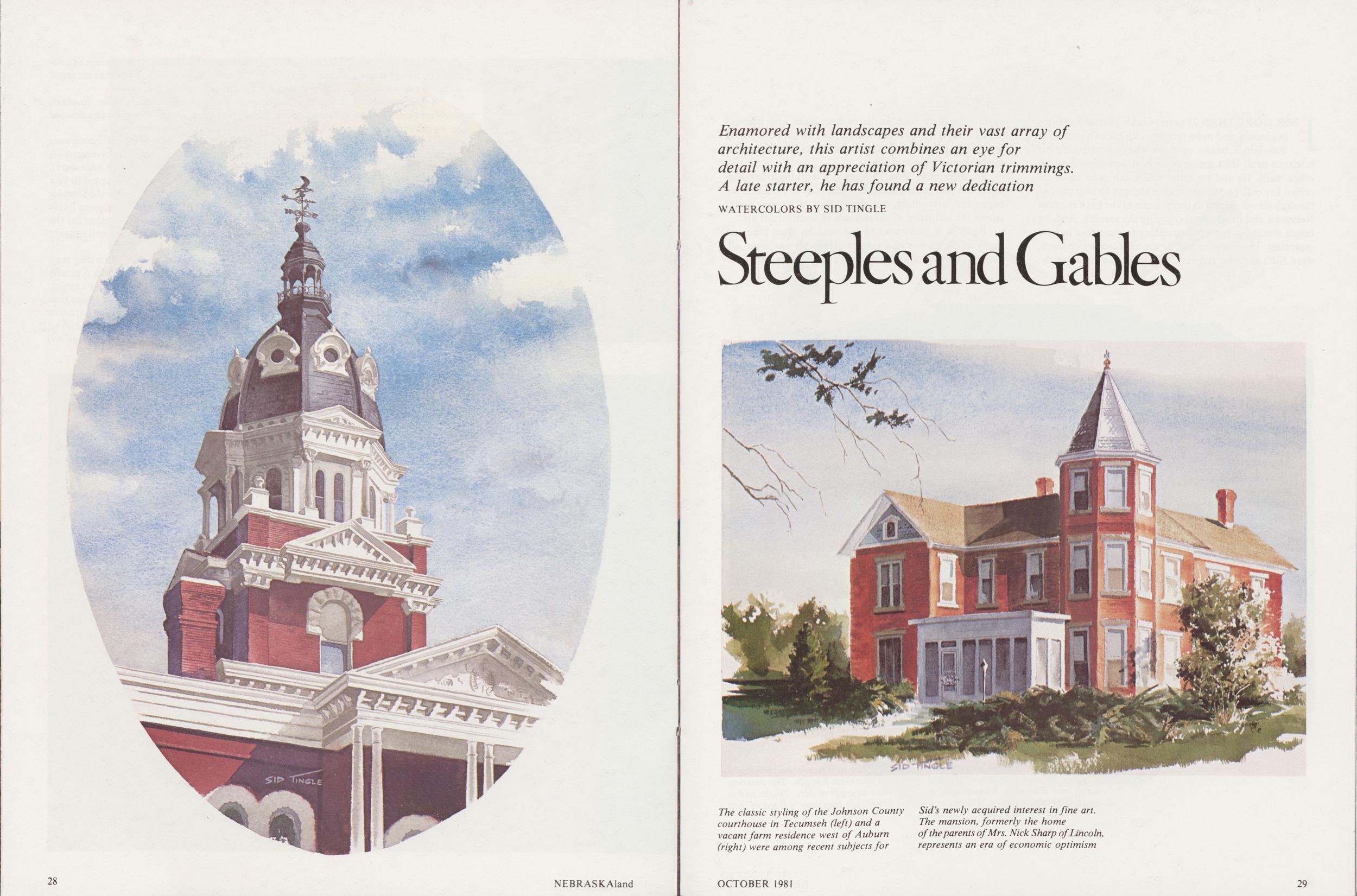
Steeples and Gables
Enamored with landscapes and their vast array of architecture, this artist combines an eye for detail with an appreciation of Victorian trimmings. A late starter, he has found a new dedication WATERCOLORS BY SID TINGLE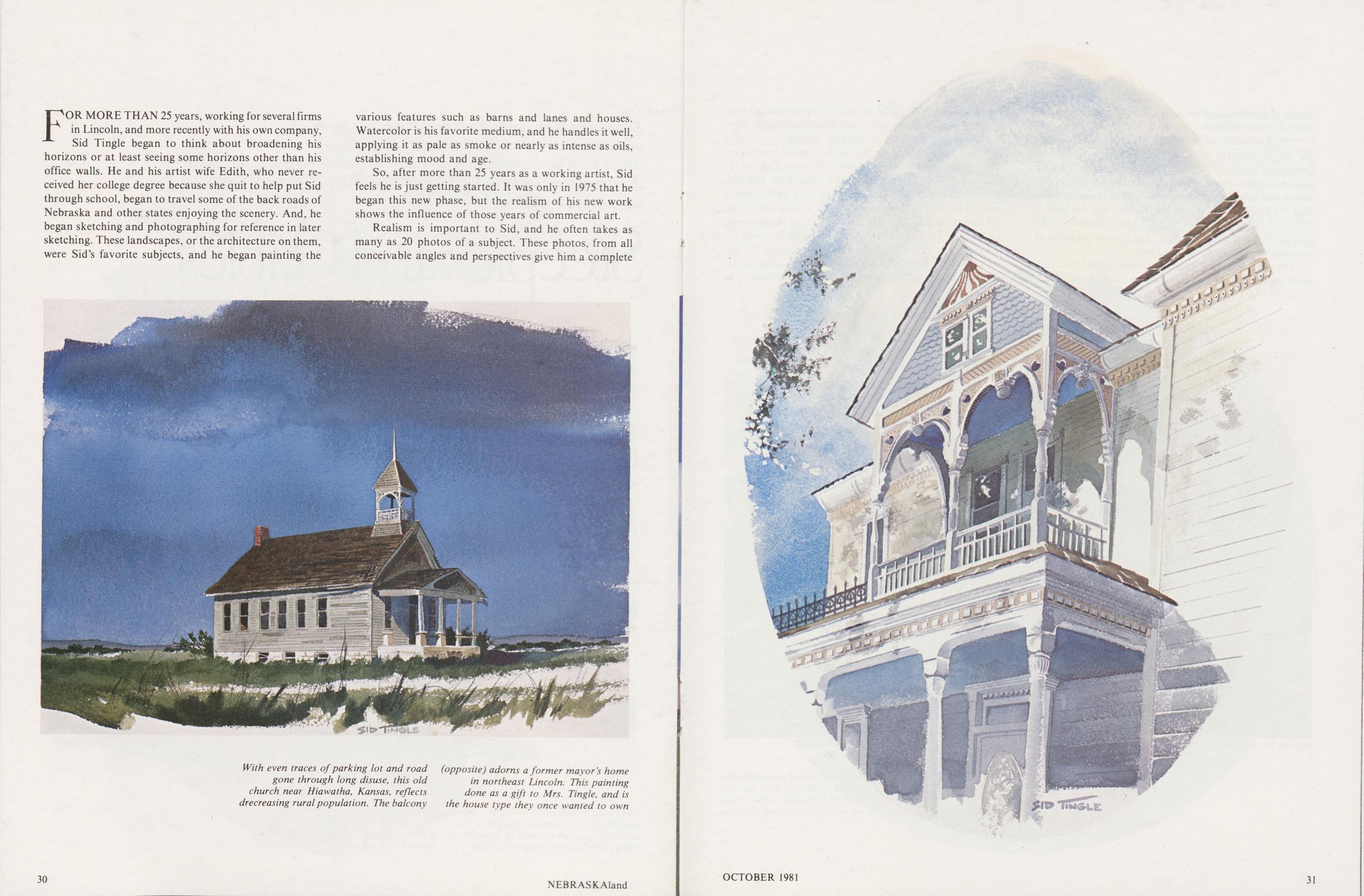
FOR MORE THAN 25 years, working for several firms in Lincoln, and more recently with his own company, Sid Tingle began to think about broadening his horizons or at least seeing some horizons other than his office walls. He and his artist wife Edith, who never received her college degree because she quit to help put Sid through school, began to travel some of the back roads of Nebraska and other states enjoying the scenery. And, he began sketching and photographing for reference in later sketching. These landscapes, or the architecture on them, were Sid's favorite subjects, and he began painting the various features such as barns and lanes and houses. Watercolor is his favorite medium, and he handles it well, applying it as pale as smoke or nearly as intense as oils, establishing mood and age.
So, after more than 25 years as a working artist, Sid feels he is just getting started. It was only in 1975 that he began this new phase, but the realism of his new work shows the influence of those years of commercial art.
Realism is important to Sid, and he often takes as many as 20 photos of a subject. These photos, from all conceivable angles and perspectives give him a complete
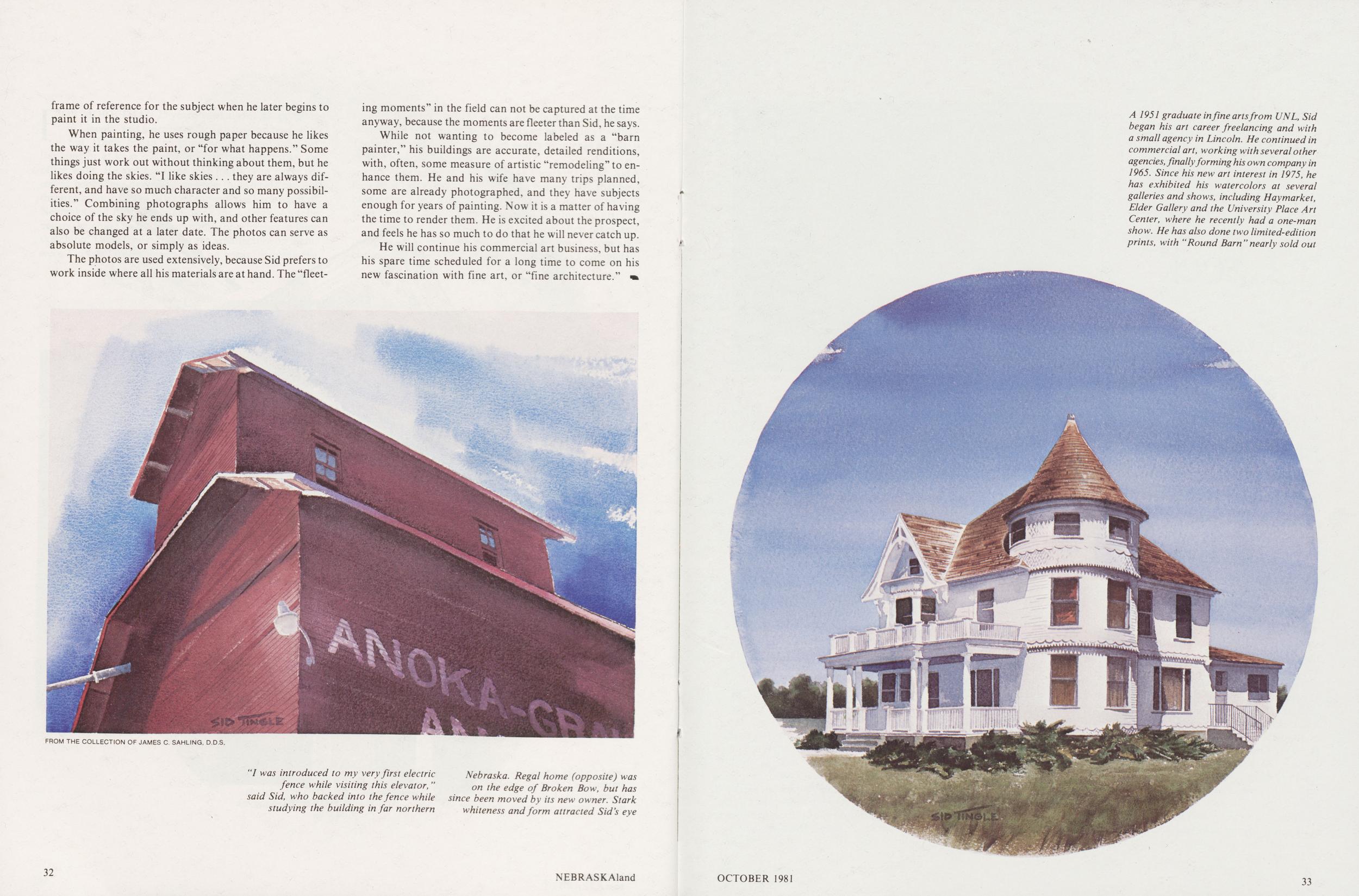 frame of reference for the subject when he later begins to
paint it in the studio.
frame of reference for the subject when he later begins to
paint it in the studio.
When painting, he uses rough paper because he likes the way it takes the paint, or "for what happens." Some things just work out without thinking about them, but he likes doing the skies. "I like skies they are always different, and have so much character and so many possibilities." Combining photographs allows him to have a choice of the sky he ends up with, and other features can also be changed at a later date. The photos can serve as absolute models, or simply as ideas.
The photos are used extensively, because Sid prefers to work inside where all his materials are at hand. The "fleeting moments" in the field can not be captured at the time anyway, because the moments are fleeter than Sid, he says.
While not wanting to become labeled as a "barn painter," his buildings are accurate, detailed renditions, with, often, some measure of artistic "remodeling" to enhance them. He and his wife have many trips planned, some are already photographed, and they have subjects enough for years of painting. Now it is a matter of having the time to render them. He is excited about the prospect, and feels he has so much to do that he will never catch up.
He will continue his commercial art business, but has his spare time scheduled for a long time to come on his new fascination with fine art, or "fine architecture."
Sneaking a Creek
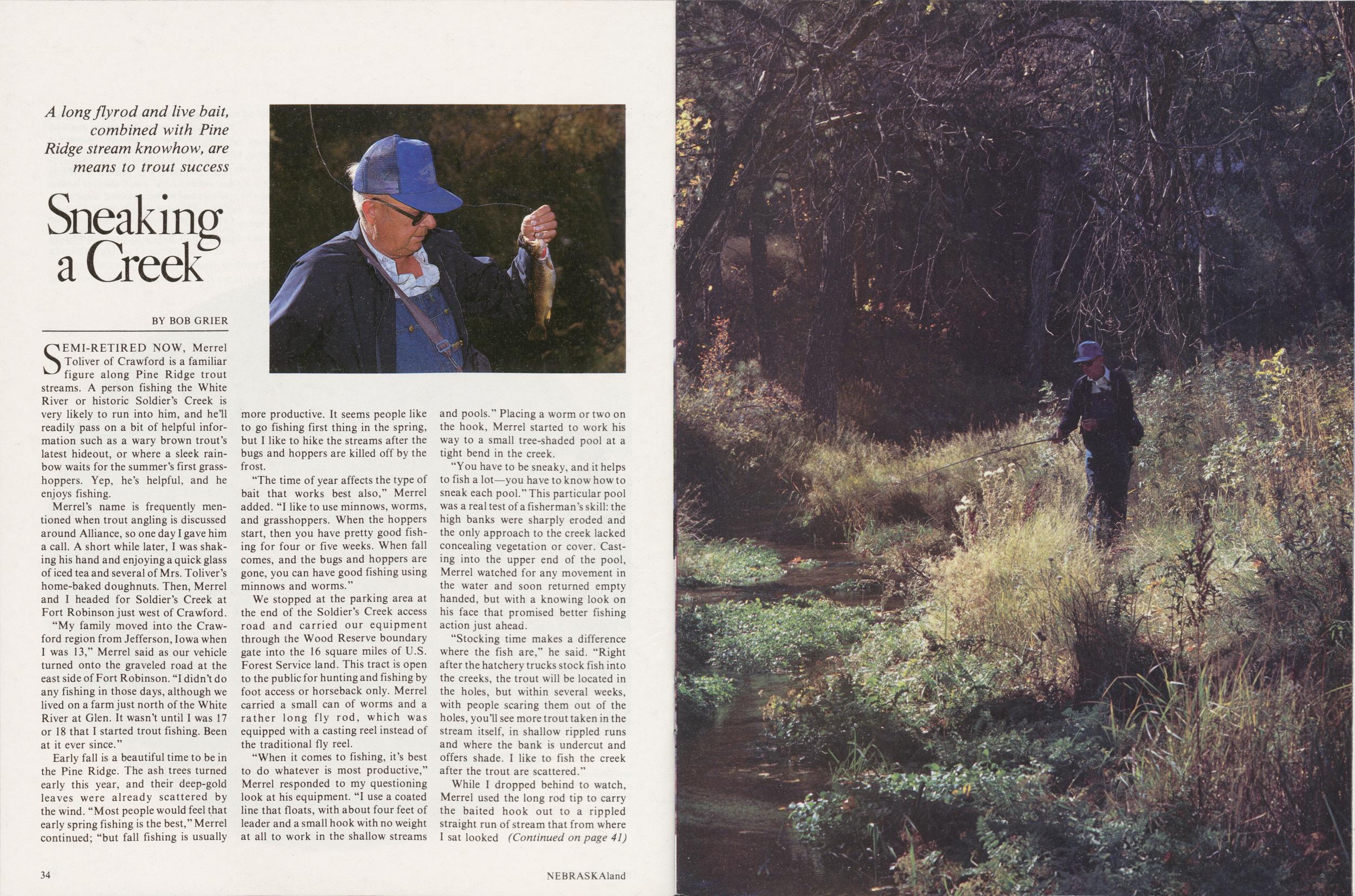
A long fly rod and live bait, combined with Pine Ridge stream knowhow, are means to trout success BY BOB GRIERSEMI-RETIRED NOW, Merrel Toliver of Crawford is a familiar figure along Pine Ridge trout streams. A person fishing the White River or historic Soldier's Creek is very likely to run into him, and he'll readily pass on a bit of helpful information such as a wary brown trout's latest hideout, or where a sleek rainbow waits for the summer's first grass-hoppers. Yep, he's helpful, and he enjoys fishing.
Merrel's name is frequently mentioned when trout angling is discussed around Alliance, so one day I gave him a call. A short while later, I was shaking his hand and enjoying a quick glass of iced tea and several of Mrs. Toliver's home-baked doughnuts. Then, Merrel and I headed for Soldier's Creek at Fort Robinson just west of Crawford.
"My family moved into the Craw-ford region from Jefferson, Iowa when I was 13," Merrel said as our vehicle turned onto the graveled road at the east side of Fort Robinson. "I didn't do any fishing in those days, although we lived on a farm just north of the White River at Glen. It wasn't until I was 17 or 18 that I started trout fishing. Been at it ever since."
Early fall is a beautiful time to be in the Pine Ridge. The ash trees turned early this year, and their deep-gold leaves were already scattered by the wind. "Most people would feel that early spring fishing is the best," Merrel continued; "but fall fishing is usually more productive. It seems people like to go fishing first thing in the spring, but I like to hike the streams after the bugs and hoppers are killed off by the frost.
"The time of year affects the type of bait that works best also," Merrel added. "I like to use minnows, worms, and grasshoppers. When the hoppers start, then you have pretty good fishing for four or five weeks. When fall comes, and the bugs and hoppers are gone, you can have good fishing using minnows and worms."
We stopped at the parking area at the end of the Soldier's Creek access road and carried our equipment through the Wood Reserve boundary gate into the 16 square miles of U.S. Forest Service land. This tract is open to the public for hunting and fishing by foot access or horseback only. Merrel carried a small can of worms and a rather long fly rod, which was equipped with a casting reel instead of the traditional fly reel.
"When it comes to fishing, it's best to do whatever is most productive," Merrel responded to my questioning look at his equipment. "I use a coated line that floats, with about four feet of leader and a small hook with no weight at all to work in the shallow streams and pools." Placing a worm or two on the hook, Merrel started to work his way to a small tree-shaded pool at a tight bend in the creek.
"You have to be sneaky, and it helps to fish a lot—you have to know how to sneak each pool." This particular pool was a real test of a fisherman's skill: the high banks were sharply eroded and the only approach to the creek lacked concealing vegetation or cover. Casting into the upper end of the pool, Merrel watched for any movement in the water and soon returned empty handed, but with a knowing look on his face that promised better fishing action just ahead.
"Stocking time makes a difference where the fish are," he said. "Right after the hatchery trucks stock fish into the creeks, the trout will be located in the holes, but within several weeks, with people scaring them out of the holes, you'll see more trout taken in the stream itself, in shallow rippled runs and where the bank is undercut and offers shade. I like to fish the creek after the trout are scattered."
While I dropped behind to watch, Merrel used the long rod tip to carry the baited hook out to a rippled straight run of stream that from where I sat looked (Continued on page 41)
34 NEBRASKAland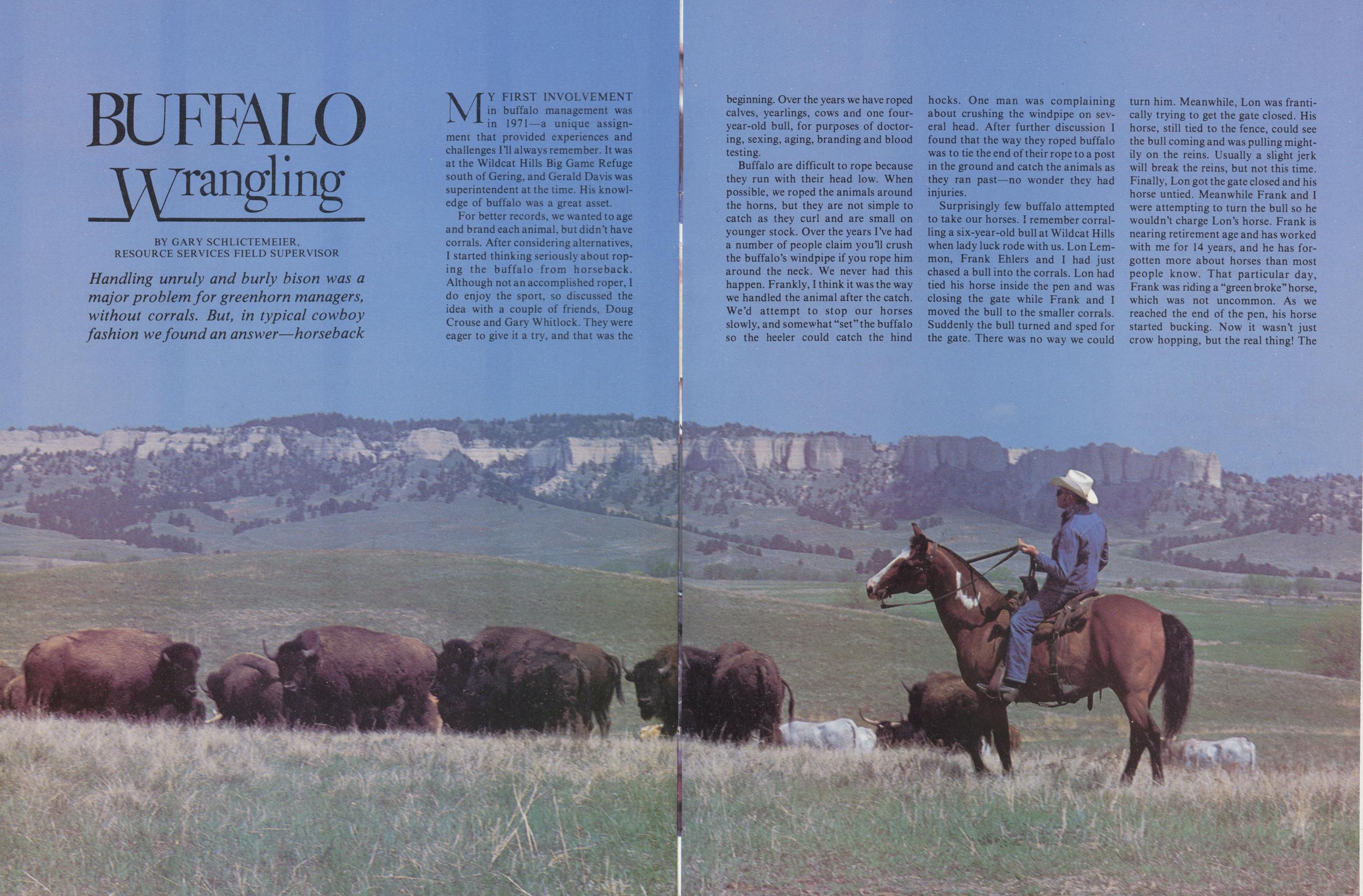
BUFFALO Wrangling
BY GARY SCHLICTEMEIER, RESOURCE SERVICES FIELD SUPERVISOR Handling unruly and burly bison was a major problem for greenhorn managers, without corrals. But, in typical cowboy fashion we found an answer—horsebackMY FIRST INVOLVEMENT in buffalo management was in 1971—a unique assignment that provided experiences and challenges I'll always remember. It was at the Wildcat Hills Big Game Refuge south of Gering, and Gerald Davis was superintendent at the time. His knowledge of buffalo was a great asset.
For better records, we wanted to age and brand each animal, but didn't have corrals. After considering alternatives, I started thinking seriously about roping the buffalo from horseback. Although not an accomplished roper, I do enjoy the sport, so discussed the idea with a couple of friends, Doug Crouse and Gary Whitlock. They were eager to give it a try, and that was the
Buffalo are difficult to rope because they run with their head low. When possible, we roped the animals around the horns, but they are not simple to catch as they curl and are small on younger stock. Over the years I've had a number of people claim you'll crush the buffalo's windpipe if you rope him around the neck. We never had this happen. Frankly, I think it was the way we handled the animal after the catch. We'd attempt to stop our horses slowly, and somewhat "set" the buffalo so the heeler could catch the hind hocks. One man was complaining about crushing the windpipe on several head. After further discussion I found that the way they roped buffalo was to tie the end of their rope to a post in the ground and catch the animals as they ran past—no wonder they had injuries.
Surprisingly few buffalo attempted
to take our horses. I remember corralling a six-year-old bull at Wildcat Hills
when lady luck rode with us. Lon Lemmon, Frank Ehlers and I had just
chased a bull into the corrals. Lon had
tied his horse inside the pen and was
closing the gate while Frank and I
moved the bull to the smaller corrals.
Suddenly the bull turned and sped for
the gate. There was no way we could
turn him. Meanwhile, Lon was frantically trying to get the gate closed. His
horse, still tied to the fence, could see
the bull coming and was pulling mightily on the reins. Usually a slight jerk
will break the reins, but not this time.
Finally, Lon got the gate closed and his
horse untied. Meanwhile Frank and I
were attempting to turn the bull so he
wouldn't charge Lon's horse. Frank is
nearing retirement age and has worked
with me for 14 years, and he has forgotten more about horses than most
people know. That particular day,
Frank was riding a "green broke" horse,
which was not uncommon. As we
reached the end of the pen, his horse
started bucking. Now it wasn't just
crow hopping, but the real thing! The
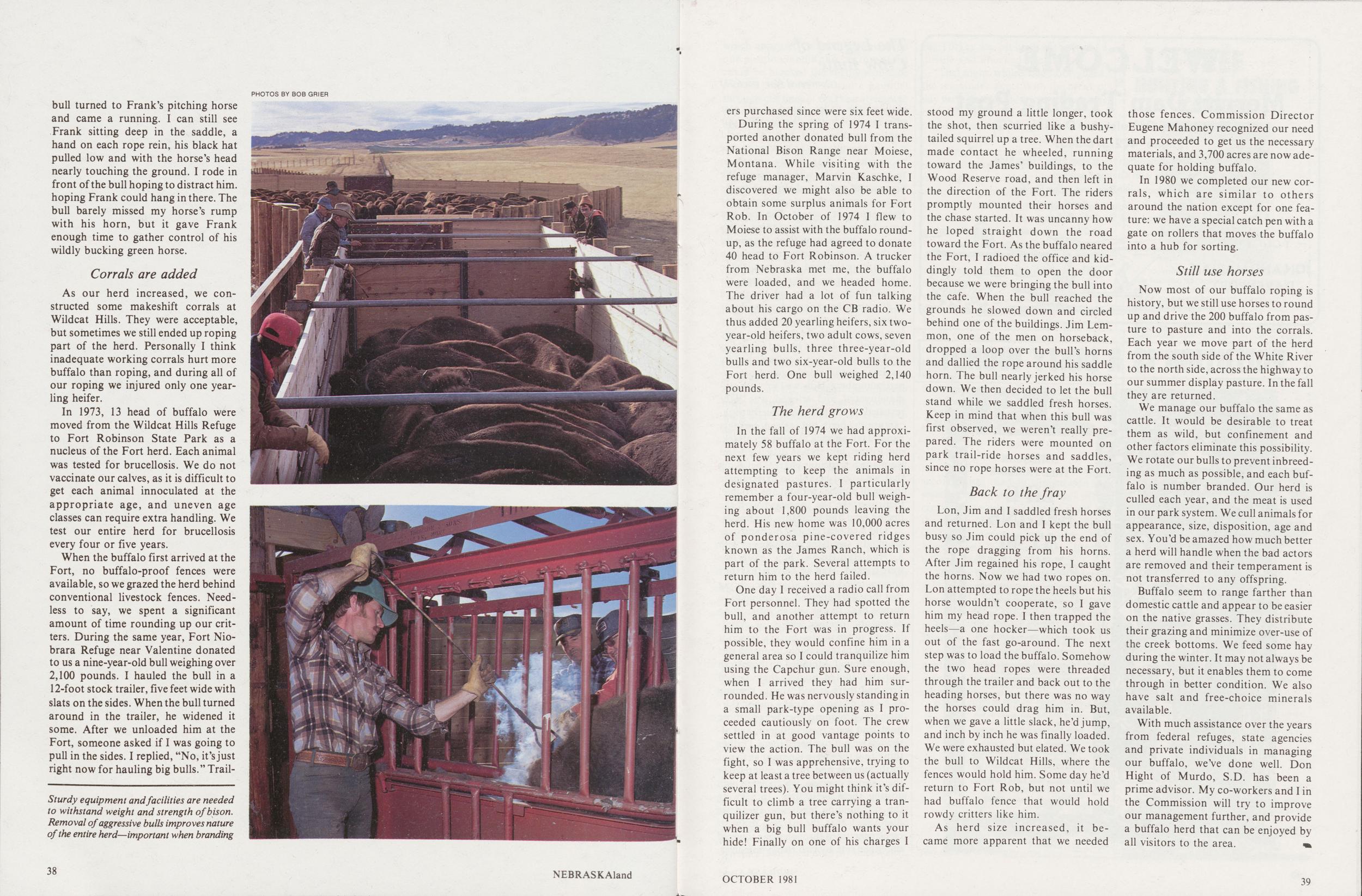
As our herd increased, we constructed some makeshift corrals at Wildcat Hills. They were acceptable, but sometimes we still ended up roping part of the herd. Personally I think inadequate working corrals hurt more buffalo than roping, and during all of our roping we injured only one yearling heifer.
In 1973, 13 head of buffalo were moved from the Wildcat Hills Refuge to Fort Robinson State Park as a nucleus of the Fort herd. Each animal was tested for brucellosis. We do not vaccinate our calves, as it is difficult to get each animal innoculated at the appropriate age, and uneven age classes can require extra handling. We test our entire herd for brucellosis every four or five years.
When the buffalo first arrived at the Fort, no buffalo-proof fences were available, so we grazed the herd behind conventional livestock fences. Needless to say, we spent a significant amount of time rounding up our critters. During the same year, Fort Niobrara Refuge near Valentine donated to us a nine-year-old bull weighing over 2,100 pounds. I hauled the bull in a 12-foot stock trailer, five feet wide with slats on the sides. When the bull turned around in the trailer, he widened it some. After we unloaded him at the Fort, someone asked if I was going to pull in the sides. I replied, "No, it's just right now for hauling big bulls." Trailers
During the spring of 1974 I transported another donated bull from the National Bison Range near Moiese, Montana. While visiting with the refuge manager, Marvin Kaschke, I discovered we might also be able to obtain some surplus animals for Fort Rob. In October of 1974 I flew to Moiese to assist with the buffalo round-up, as the refuge had agreed to donate 40 head to Fort Robinson. A trucker from Nebraska met me, the buffalo were loaded, and we headed home. The driver had a lot of fun talking about his cargo on the CB radio. We thus added 20 yearling heifers, six two-year-old heifers, two adult cows, seven yearling bulls, three three-year-old bulls and two six-year-old bulls to the Fort herd. One bull weighed 2,140 pounds.
The herd growsIn the fall of 1974 we had approximately 58 buffalo at the Fort. For the next few years we kept riding herd attempting to keep the animals in designated pastures. I particularly remember a four-year-old bull weighing about 1,800 pounds leaving the herd. His new home was 10,000 acres of ponderosa pine-covered ridges known as the James Ranch, which is part of the park. Several attempts to return him to the herd failed.
One day I received a radio call from Fort personnel. They had spotted the bull, and another attempt to return him to the Fort was in progress. If possible, they would confine him in a general area so I could tranquilize him using the Capchur gun. Sure enough, when I arrived they had him surrounded. He was nervously standing in a small park-type opening as I proceeded cautiously on foot. The crew settled in at good vantage points to view the action. The bull was on the fight, so I was apprehensive, trying to keep at least a tree between us (actually several trees). You might think it's difficult to climb a tree carrying a tranquilizer gun, but there's nothing to it when a big bull buffalo wants your hide! Finally on one of his charges I stood my ground a little longer, took the shot, then scurried like a bushy-tailed squirrel up a tree. When the dart made contact he wheeled, running toward the James' buildings, to the Wood Reserve road, and then left in the direction of the Fort. The riders promptly mounted their horses and the chase started. It was uncanny how he loped straight down the road toward the Fort. As the buffalo neared the Fort, I radioed the office and kiddingly told them to open the door because we were bringing the bull into the cafe. When the bull reached the grounds he slowed down and circled behind one of the buildings. Jim Lemmon, one of the men on horseback, dropped a loop over the bull's horns and dallied the rope around his saddle horn. The bull nearly jerked his horse down. We then decided to let the bull stand while we saddled fresh horses. Keep in mind that when this bull was first observed, we weren't really prepared. The riders were mounted on park trail-ride horses and saddles, since no rope horses were at the Fort.
38 NEBRASKAland Back to the frayLon, Jim and I saddled fresh horses and returned. Lon and I kept the bull busy so Jim could pick up the end of the rope dragging from his horns. After Jim regained his rope, I caught the horns. Now we had two ropes on. Lon attempted to rope the heels but his horse wouldn't cooperate, so I gave him my head rope. I then trapped the heels—a one hocker—which took us out of the fast go-around. The next step was to load the buffalo. Somehow the two head ropes were threaded through the trailer and back out to the heading horses, but there was no way the horses could drag him in. But, when we gave a little slack, he'd jump, and inch by inch he was finally loaded. We were exhausted but elated. We took the bull to Wildcat Hills, where the fences would hold him. Some day he'd return to Fort Rob, but not until we had buffalo fence that would hold rowdy critters like him.
As herd size increased, it became more apparent that we needed those fences. Commission Director Eugene Mahoney recognized our need and proceeded to get us the necessary materials, and 3,700 acres are now adequate for holding buffalo.
In 1980 we completed our new corrals, which are similar to others around the nation except for one feature: we have a special catch pen with a gate on rollers that moves the buffalo into a hub for sorting.
Still use horsesNow most of our buffalo roping is history, but we still use horses to round up and drive the 200 buffalo from pasture to pasture and into the corrals. Each year we move part of the herd from the south side of the White River to the north side, across the highway to our summer display pasture. In the fall they are returned.
We manage our buffalo the same as cattle. It would be desirable to treat them as wild, but confinement and other factors eliminate this possibility. We rotate our bulls to prevent inbreed- ing as much as possible, and each buffalo is number branded. Our herd is culled each year, and the meat is used in our park system. We cull animals for appearance, size, disposition, age and sex. You'd be amazed how much better a herd will handle when the bad actors are removed and their temperament is not transferred to any offspring.
Buffalo seem to range farther than domestic cattle and appear to be easier on the native grasses. They distribute their grazing and minimize over-use of the creek bottoms. We feed some hay during the winter. It may not always be necessary, but it enables them to come through in better condition. We also have salt and free-choice minerals available.
With much assistance over the years from federal refuges, state agencies and private individuals in managing our buffalo, we've done well. Don Hight of Murdo, S.D. has been a prime advisor. My co-workers and I in the Commission will try to improve our management further, and provide a buffalo herd that can be enjoyed by all visitors to the area.
OCTOBER 1981 39
clouded the valley ahead of us, east of a range of buttes. We brought our panting ponies to a halt, and held a hasty consultation as to what course to pursue. It was finally agreed to resume the chase without delay. We dismounted and turned our tired ponies loose to graze while we mounted our fresh emergency steeds. The trail was again taken up, and the winding valley was an exciting scene as we thundered up the draw with a firm determination to recapture the herd and vanquish the foe. No doubt we were discovered, for I could distinguish through the screen of dust that the vanguard method was adopted. Three of their horsemen were sent on ahead with the stolen herd while the remainder lagged behind to hold us in check, which they accomplished by staging a heroic stand against our superior numbers. How well we were outmaneuvered and tricked was later revealed. Our object was chiefly to recapture the herd, but instead, seeing a handful falling back to resist our attack, our former notion was dismissed and we made a ferocious charge, believing that we would be able to exterminate the small number without any trouble, then overtake the vanguard with the fleeing herd and recapture our horses.
"Old Red Leaf clasped his hand over his mouth, signifying astonishment with a 'Hun-Hun-He-e-e, how easily we were tricked.' Had we known that they also switched horses after discovering that they were pursued, we would have turned back to our village with a song of victory together with your grand-father's stolen ponies, but as it was, our only proof of overtaking the enemy was a desert hound. Mounted on those fresh and fleet-footed ponies, they dashed here and there at will, always keeping at a safe distance. As the minor skirmish was prolonged, they became more bold, and were overconfident, and although we outnumbered them, I rather think that they were ignorant as to our fresh mounts and this accounted for their added courage, which came nigh costing them their lives. In viewing the surrounding landscape ahead we discovered that the narrow draw or creek penetrated through a gap towered on either side by two rising pinnacles, 40 NEBRASKAland which appeared to be unscalable from our position, and if this narrow outlet could be blocked the enemy would be trapped and forced to run a gauntlet through our lines or make an attempt to scale the steep incline, which seemed out of reason.
"Our foremost warriors were signaled to rush for the opening which they accomplished, to the surprise of our enemies. This was followed up by the rear guard with fear-inspiring war whoops. Upon discovering their perilous situation the enemy galloped here and there in a vain attempt to escape, but realizing that this was impossible and their only hope was an attempt to scale the inclining pinnacle, the Crows dismounted, deserted their ponies and scrambled up the graveled slope accompanied by their pack dogs. I could see that they reached the summit. A selected group of our warriors rode through the gap and skirted the four sides for the purpose of ascertaining any possible means of escape on the opposite side. They returned with the news that the opposite butte consisted of a range of towering walls and any attempt by the enemy to descend would spell suicide. We held a short consultation and agreed to wait. We would starve them out. We would be able to obtain food while they would not. As the sun vanished over the western hills, some of our members intimated that they be allowed to scale the pinnacle by taking another route. Their request was objected to by other members. Ignoring our protests, a group of foolhardy braves proceeded to scale the sloping bluff. About midway up they halted for rest. From the base to the top of this unscalable slope the distance was so great that it was impossible to make oneself heard. All of a sudden some of the enemy came into view, and looking down the steep incline, they discovered our fellow braves. We yelled at the top of our voices in an attempt to attract their attention. Unaware of our warning, they arose and proceeded to resume their climb, but they did not get far. They were forced to race down in an attempt to out-distance huge rocks which the enemy rolled down on them. This was no time to laugh, for we were all in a serious mood. But the spectacle of a group of scared Indians in a wild flight for their lives, to escape those huge rocks thundering down after them, was enough to make us forget our troubles. I laughed until my sides ached. Big Turkey was hit back of the ear by a missile and knocked unconscious.
That night, while some stood guard, the remainder slept. With the break of day we mounted and surveyed the entire base that encircled the pinnacle. One could still observe many objects on the top. For three days we guarded the surrounding base, preventing our trapped enemies from descending. On the fourth morning, upon riding through the gap and reaching the opposite side, we were struck with awe at what greeted our eyes. Several rawhide ropes tied together dangled from the top to the base. Upon reaching the lower end we discovered footprints that tracked west-ward. Our enemy had skillfully outwitted us again by sliding down the ropes which were fastened to a tree stump on the summit of this pinnacle. I and Stranger Horse rode back around and scaled the bluff. On reaching the summit we discovered how the enemy escaped and all that remained was a lone pack dog and three dead Indians. We took the dog back to our village."
Sneaking A Creek (Continued from page 34)hardly deep enough for trout. Several seconds after the bait slipped into the water along the shaded west bank of the creek, a nice pan-size brown trout hit the worm. Fighting a trout in such shallow water was impossible, and Merrel used the stout rod to lift the brown onto the grassy bank.
"Take a look at this fellow," Merrel said as he picked the brown up from the grass to remove the hook. "Brown trout are more difficult to catch than rainbows. The Crawford National Fish Hatchery stocks both brown and rainbow trout, which provides good angling for both experienced fishermen and for the beginner just out for an afternoon."
Removing the hook, Merrel used a small knife to gut and gill the fish before dropping it into a small canvas creel. Sitting on a large rock along the stream bank, he broke out his pipe and answered my questions about Pine Ridge trout fishing.
"I fish the White River from Fort Rob all the way west, and even just west of Crawford. The city park is stocked with fish for youngsters only, but there is good fishing just above town to the Fort when the water runs clean. It helps to get away from the road if you can, and streams nearer the park are more heavily fished."
I knew from an earlier visit with Jack Peterson, district fisheries supervisor for the Game and Parks Commission at Alliance, that the Pine Ridge trout streams are stocked with catchable rainbow and brown trout. The browns come from the Crawford National Fish Hatchery, while the rainbow are brought in from the federal fish hatchery at Spearfish, S.D. The Crawford Hatchery switched from rainbow to brook trout several years ago, and many of the Pine Ridge streams receive brookies also.
According to Peterson, trout stocking in the Pine Ridge has changed somewhat in recent years. Fish were once stocked on a fish-per-acre basis, but creel studies on several of the streams indicated a great difference in fishing pressure, with some of the very small streams receiving much higher use. Since the creel studies in the early 1970's, streams with higher angler use receive more fish, and Peterson believes the angler now enjoys a higher harvest, with better utilization of hatchery production.
"I've seen some browns in the 21 to 22-inch class," Merrel continued, "but normally the rainbow taken are somewhat smaller. We had a very open winter in the Pine Ridge last year and everyone was able to fish through January and February. I didn't see the carry-over of browns that makes late winter and early early spring fishing good. When I worked the railroad from Chadron to VanTassel, Wyoming, I watched the spring floods. We don't see as many big floods now on the White River, and this helps hold trout over better. A good flood from Kyle Creek into the White River would wash out every trout in the stream."
Putting his pipe back in the bib pocket of his overalls, Merrel rebaited the hook and began moving back down along Soldier's Creek, stopping regularly to tell me something about trout fishing and trout streams in the ridge.
"I like to fish with minnows, also; just carry a few in a small jar. You'd be surprised. In the winter you can carry them all day if you screw the lid down tight. I heard of a fellow who carried his in a whiskey bottle—he opened it to remove one and he had to fight them off! I just hook the minnow in the tail; that way he'll live longer, and I've had good enough luck that way."
Results of the earlier creel survey conducted by fisheries biologists during the summer months indicate Soldier's Creek is the most heavily fished stream in the Ridge. The stream divides into several forks near the Wood Reserve boundary, and catchable trout are stocked in the middle and south branches. "The middle fork is fished the most," Merrel said, "but there is good trout fishing on the south fork, also. It seems like there is not a time when you can't catch fish if you'll work. This past January was like July and everybody was able to fish more. Perhaps that's why we didn't see as many fish in the stream this spring. After a normal Crawford winter, fishing is usually somewhat better."
Stockings of catchable trout are on a regular basis throughout the summer months. Soldier's Creek received trout every 28 days from May through September, totaling 10,000 catchable trout annually. The White River receives almost 8,000 trout annually, but since the White River has a history of early spring flooding, it is stocked somewhat later. Natural reproduction occurs, but the number of fish carried over from year to year is so small that they add very little to the fisherman's catch.
In addition to the White River and
It was early afternoon before we reached the vehicle. Merrel had taken several nice brown trout and a rainbow from Soldier's Creek in a little over three hours of leisurely fishing. Several smaller trout were released unharmed, "to grow a while for the next fisherman." As we returned our gear to the truck, Merrel again went over the basics of a successful trout stream trip to the Pine Ridge.
"Pine Ridge trout streams are normally fished with natural bait. Worms and minnows are usually available locally, and during the early summer, nothing beats grasshoppers. You can use a longer spinning rod or fly rod, but normally you'll only use four to eight feet of line. There is just too much overhang and brush to cast effectively.
"It's important also to be sneaky, just like a whitetail deer hunter. Even your shadow can scare a trout into hiding. Normally, I work a stream just once during the day, but I've had luck returning along the same portions of the stream if I am able to move without too much noise. Look for those areas where the stream is undercut, and if the pools have been heavily worked, you'll be able to catch trout in the riffles and in the shallow portions of the stream.
"In the summer, the shady areas produce trout, and bridges and train trestles over the White River are good. After the grasshoppers and those mosquitoes are gone, use worms and minnows. I've always had better luck fishing in the fall, and there is plenty to see even if the trout aren't hitting," Merrel concluded.
For more information on Pine Ridge trout streams, stop at Fort Robinson State Park during the park season, or send for fishing brochures available from the Nebraska Game and Parks Commission's district offices in Alliance, North Platte, Bassett, Norfolk, Lincoln and Omaha.
42 NEBRASKAland Christmas Cards FREE GIFT! An assortment of Leanin' Tree's finest everyday greeting cards (a $5.50 value) will be yours FREE when your order totals $15 or more. 2072 Christmas Dinner in Cow Camp (Description inside card.) "Merry Christmas and a Happy New Year" LEANIN'TREE Box 9500-R-BK26. Boulder. CO 80301 2077 A COWBOY'S PRAYER (32-line poem inside.) "May the Peace and Joy of Christmas be with you all Year" 3207 "The wonder of Christmas" "Wishing you a Blessed Christmas and Happiness throughout the New Year" 2065 "To all good friends and those with whom we're out of touch Merry Christmas and Happy New Year" 2049 "We packed up and moved" "Our address may be a new one, But Merry Christmas and Happy New Year" 2082 "Merry Christmas and Happy New Year" 2036 "Let us keep Christmas the warmth and joy of Friends" "Merry Christmas and a Happy New Year" 1812 "The grass is short The cows ain't fat. this verse ain't clever. But 'Merry Christmas' same as ever!" 1656 Silent Night AII is Calm, All is Bright "May Peace be your Gift at Christmas and through all the Year" 3206 TAKE TIME TO SEE (24 line nature poem inside.) "May Peace be your Gift at Christmas and all Year" 3143 FOREST CATHEDRAL May the Peace and Joy of Christmas be with you through all the Year" 1986 Back Country Christmas May Christmas bring Friends Peace And Good Health throughout the New Year" "Greetings from our outfit to yours. 2040 "Greetings from our outfit to yours" "With every good wish for Christmas and the New Year" 2080 "Wishing you the many blessings of a Joyous Christmas Season" 2011 "To those we love and see each day. And other loved ones far away Merry Christmas and Happy New Year" 2044 "May Christmas bring Friends to your Fireside Peace And Good Health throughout the New Year" 1304 "may God hold you in the hollow of His hand." "Merry Christmas and Best Wishes for a Happy Year" 2102 "Joy is the Spirit of Christmas-Peace is the hope of the world" May OCTOBER 1981 43 Largest selection of 5" x 7" Western Christmas Cards
from our house to yours.
2022 "GREETINGS from our house"
"May you have the Spirit of Christmas
which is Peace Hope Love"
From the two of us
at Chris:
2037 "From the two of us" "To those
we love whose friendship means so
much Merry Christmas Happy Year"
2060 "The bells ring out so joyously,
etc." "May the Peace and Happiness of
the Christmas Season abide all Year"
2038 "Never an old year ends But
someone thinks of old friends."
"Merry Christmas Happy New Year"
1498 "May the small wonders cause
joyful happenings in your heart."
"Merry Christmas Happy New Year"
4192 "on earth peace, good will
towards men." St. Luke 2:14 "May the
peace joy of Christmas be with you"
1246 "Christmas fills the world"
"the glory of Christmas remains
May its light bless you with joy, etc.'
1140 "The wonder of Christmas fills
the night" "May Christmas bring
Friends Peace and Good Health"
2047 "WANTED Santa Claus, etc."
"REWARD 10,000 good wishes for a
Merry Christmas and Happy New Year"
3220 NEW FRIENDS "Merry Christmas
and Happy New Year"
1674 "Merry Christmas" "and best
wishes for a Happy New Year from Our
Outfit to Yours"
2096 SAFE CROSSING May the
Great Spirit watch over you and bring
Peace and Contentment at Christmas"
and a
1496 "and a Merry Christmas to you,
too!" "May yours be a joyful Christmas
and your New Year happy!"
2081 RUDOLPH, THE RED-NOSED
MULE DEER "Merry Christmas and
Happy New Year"
2052 "Christmas a-comin'. Purt near
broke hope you're doin' as good—or
better!" "Merry Christmas New Year"
2063 Christmas in the West May the
Spirit of Christmas Abide with you
throughout the Coming Year"
2075 "and a Merry Christmas to you,
too!" "May yours be a joyful Christmas
and your New Year happy!"
3221 CHRISTMAS EVE CALLERS
"May the warmth of Christmas be
with you through the Coming Year"
1455 "May Christmas bring Friends to
your Fireside, Peace to your Pathway
And Good Health through the Year"
1602 CHRISTMAS WISHES COME
TRUE "Merry Christmas and best
wishes for a Happy New Year"
1435 A Cowboy's Christmas Prayer
(Poem by S. Omar Barker inside) "May
the Joy of Christmas be with you"
2046 "The joy that you give to others
Is the joy that comes back to you."
"Merry Christmas Happy New Year"
3152 "A Season of Rejoicing" "for
the sheer delights of life and love.
Merry Christmas Happy New Year"
2095 CHANGING SPOTS Merry
Christmas and Happy New Year"
NEBRASKAland
44
NEW
Giftwrap Calendar
Christmas Notes
GP01—No fair shaking! Horses
highlight new Christmas gift wrap.
Two sheets (approx. 20" x 30")
with two matching gift tags. $1.50.
Send-Along
Notes—For writing your own messages inside your
Christmas cards.
25 notes per packet. $1.85.
FREE GIFT!
Check here if your order is $15
or more and you'll receive a
FREE assortment of 10 fine
art greeting cards for all
occasions (VALUE $5.50).
HOW TO ORDER: Order cards of all one design or assort in any
combination totaling 12, 25, 37, 50, etc. For example, order 10 each of
five different designs and pay the 50-card price of $15.75. Indicate
number of cards to right of order code. Remember to include postage
and handling fee in total payment. Enclose payment with order form.
Mastercard and VISA accepted. No C.O.D.'s. (Canadian orders will be
charged a customs duty at the border.)
Choose one envelope
color.
1140 1602 2036 2049 2077 3143
1246 1656 2037 2052 2080 3152
1304 1674 2038 2060 2081 3206
1435 1812 2040 2063 2082 3207
1455 1986 2044 2065 2095 3220
1496 2011 2046 2072 2096 3221
1498 2022 2047 2075 2102 4192
Rush FREE sample card and catalog showing 100's of Christmas cards, new
giftwrap, tree ornaments and more.
Number of cards
Cost of cards
Name printing
Address printing
CL05 Calendar ($4.50)
GP01 giftwrap ($1.50)
GP05 giftwrap ($1.50)
Send-Along notes ($1.85)
CO res. add 3% sales tax CA res. add 6% use tax $
Postage & handling fee (Orders only.) $1.75
Total (U.S. Funds) $
CHRISTMAS CARD
PRICE LIST
Cards Cost
Your Name
Printed on Cards
Names to be printed
on Christmas cards
12
25
37
50
75
100
125
150
175
200
$4.75
$7.95
$11.95
$15.75
$23.65
$31.35
$37.95
$44.55
$51.15
$57.75
Cards
50 & under
51-100
101-200
Over 200
Cost
$3.50
$4.50
$5.50
$6.00
Your Address
Printed on Envelopes
Send cards
and/or catalog to:
Rte.,St., BoxNo.
City
R-BK26
State.
Zip.
Over 200—28rj per card
Cards
50 & under
51-100
101-200
Over 200
Cost
$3.50
$4.50
$5.50
$6.00
Mastercard BankAmericard
VISA
Inter Bank No. (4 digit
no. above name, MC only)
Account#(all digits)
Signature
Expiration Date.
Satisfaction guaranteed or your money back.
(Required 'f using credit card)
Send to Leanin Tree, Box 9500-R-BK26, Boulder, CO 80301
81
Largest selection of 5" x 7" Western Christmas Cards
from our house to yours.
2022 "GREETINGS from our house"
"May you have the Spirit of Christmas
which is Peace Hope Love"
From the two of us
at Chris:
2037 "From the two of us" "To those
we love whose friendship means so
much Merry Christmas Happy Year"
2060 "The bells ring out so joyously,
etc." "May the Peace and Happiness of
the Christmas Season abide all Year"
2038 "Never an old year ends But
someone thinks of old friends."
"Merry Christmas Happy New Year"
1498 "May the small wonders cause
joyful happenings in your heart."
"Merry Christmas Happy New Year"
4192 "on earth peace, good will
towards men." St. Luke 2:14 "May the
peace joy of Christmas be with you"
1246 "Christmas fills the world"
"the glory of Christmas remains
May its light bless you with joy, etc.'
1140 "The wonder of Christmas fills
the night" "May Christmas bring
Friends Peace and Good Health"
2047 "WANTED Santa Claus, etc."
"REWARD 10,000 good wishes for a
Merry Christmas and Happy New Year"
3220 NEW FRIENDS "Merry Christmas
and Happy New Year"
1674 "Merry Christmas" "and best
wishes for a Happy New Year from Our
Outfit to Yours"
2096 SAFE CROSSING May the
Great Spirit watch over you and bring
Peace and Contentment at Christmas"
and a
1496 "and a Merry Christmas to you,
too!" "May yours be a joyful Christmas
and your New Year happy!"
2081 RUDOLPH, THE RED-NOSED
MULE DEER "Merry Christmas and
Happy New Year"
2052 "Christmas a-comin'. Purt near
broke hope you're doin' as good—or
better!" "Merry Christmas New Year"
2063 Christmas in the West May the
Spirit of Christmas Abide with you
throughout the Coming Year"
2075 "and a Merry Christmas to you,
too!" "May yours be a joyful Christmas
and your New Year happy!"
3221 CHRISTMAS EVE CALLERS
"May the warmth of Christmas be
with you through the Coming Year"
1455 "May Christmas bring Friends to
your Fireside, Peace to your Pathway
And Good Health through the Year"
1602 CHRISTMAS WISHES COME
TRUE "Merry Christmas and best
wishes for a Happy New Year"
1435 A Cowboy's Christmas Prayer
(Poem by S. Omar Barker inside) "May
the Joy of Christmas be with you"
2046 "The joy that you give to others
Is the joy that comes back to you."
"Merry Christmas Happy New Year"
3152 "A Season of Rejoicing" "for
the sheer delights of life and love.
Merry Christmas Happy New Year"
2095 CHANGING SPOTS Merry
Christmas and Happy New Year"
NEBRASKAland
44
NEW
Giftwrap Calendar
Christmas Notes
GP01—No fair shaking! Horses
highlight new Christmas gift wrap.
Two sheets (approx. 20" x 30")
with two matching gift tags. $1.50.
Send-Along
Notes—For writing your own messages inside your
Christmas cards.
25 notes per packet. $1.85.
FREE GIFT!
Check here if your order is $15
or more and you'll receive a
FREE assortment of 10 fine
art greeting cards for all
occasions (VALUE $5.50).
HOW TO ORDER: Order cards of all one design or assort in any
combination totaling 12, 25, 37, 50, etc. For example, order 10 each of
five different designs and pay the 50-card price of $15.75. Indicate
number of cards to right of order code. Remember to include postage
and handling fee in total payment. Enclose payment with order form.
Mastercard and VISA accepted. No C.O.D.'s. (Canadian orders will be
charged a customs duty at the border.)
Choose one envelope
color.
1140 1602 2036 2049 2077 3143
1246 1656 2037 2052 2080 3152
1304 1674 2038 2060 2081 3206
1435 1812 2040 2063 2082 3207
1455 1986 2044 2065 2095 3220
1496 2011 2046 2072 2096 3221
1498 2022 2047 2075 2102 4192
Rush FREE sample card and catalog showing 100's of Christmas cards, new
giftwrap, tree ornaments and more.
Number of cards
Cost of cards
Name printing
Address printing
CL05 Calendar ($4.50)
GP01 giftwrap ($1.50)
GP05 giftwrap ($1.50)
Send-Along notes ($1.85)
CO res. add 3% sales tax CA res. add 6% use tax $
Postage & handling fee (Orders only.) $1.75
Total (U.S. Funds) $
CHRISTMAS CARD
PRICE LIST
Cards Cost
Your Name
Printed on Cards
Names to be printed
on Christmas cards
12
25
37
50
75
100
125
150
175
200
$4.75
$7.95
$11.95
$15.75
$23.65
$31.35
$37.95
$44.55
$51.15
$57.75
Cards
50 & under
51-100
101-200
Over 200
Cost
$3.50
$4.50
$5.50
$6.00
Your Address
Printed on Envelopes
Send cards
and/or catalog to:
Rte.,St., BoxNo.
City
R-BK26
State.
Zip.
Over 200—28rj per card
Cards
50 & under
51-100
101-200
Over 200
Cost
$3.50
$4.50
$5.50
$6.00
Mastercard BankAmericard
VISA
Inter Bank No. (4 digit
no. above name, MC only)
Account#(all digits)
Signature
Expiration Date.
Satisfaction guaranteed or your money back.
(Required 'f using credit card)
Send to Leanin Tree, Box 9500-R-BK26, Boulder, CO 80301
81
 Frame is not
included.
Nebraskaprint II second in a full-color series
of registered limited edition prints.
64
COUNTRY LANE
by SID TINGLE
Have you ever strolled a country lane on one of those rare, soft November
days?
Cool enough for a light jacket, yet warmed by a persistent sun filtering
through a gentle haze of cloud cover, the world stands still, and one little
portion of it in all its glory seems made for you alone.
You can feel the air; you can listen to the silence. You can share it with a
friend or loved one, or you can keep it to yourself. And you can find peace,
contentment, and the joy of being alive.
Hopefully this inviting print will evoke such memories for you, in addition
to becoming a favorite piece of art in your collection.
The inspirational site is the Lewis Ranch on the rim of the sandhills not far from
the
"Round Barn". This 14x18" full-color reproduction of an original watercolor is
LIMITED TO ONLY 275 prints signed and numbered by the artist. It is printed on
heavy, neutral Ph paper which is exceptionally light-fast and resists fading, yellowing
and growing brittle. According to the manufacturer, "Laboratory analysis shows its
permanence for gallery and museum prints to be in excess of 100 years".
NOTE: "Round Barn on the Niobrara", Nebraskaprint I, is almost completely sold. If
you still order
it ($25. + tax + $3.50 shpg.) I will attempt to obtain it for you from a gallery consignment.
Otherwise, I will return your check.
ORDER FORM / PLEASE PRINT
Name
Address
City.
Artist's Proofs @ $60.
quantity
COUNTRY LANE'
State.
Zip
Send this form with
check or money order
payable to:
Sid Tingle
140 South 48th
Lincoln, NE 68510
Limited Edition Prints @ $30. Total purchase price $.
quantity
Nebraskans add state and your city sales tax. Sales tax $.
Prints shipped flat; well-protected and insured.
Add $3.50 wrap/ship charge for each address. Wrap/ship $.
The original 23"x30" watercolor is available @ $395.
Total enclosed $
It Takes One
to Know One
(Continued from page 27)
Frame is not
included.
Nebraskaprint II second in a full-color series
of registered limited edition prints.
64
COUNTRY LANE
by SID TINGLE
Have you ever strolled a country lane on one of those rare, soft November
days?
Cool enough for a light jacket, yet warmed by a persistent sun filtering
through a gentle haze of cloud cover, the world stands still, and one little
portion of it in all its glory seems made for you alone.
You can feel the air; you can listen to the silence. You can share it with a
friend or loved one, or you can keep it to yourself. And you can find peace,
contentment, and the joy of being alive.
Hopefully this inviting print will evoke such memories for you, in addition
to becoming a favorite piece of art in your collection.
The inspirational site is the Lewis Ranch on the rim of the sandhills not far from
the
"Round Barn". This 14x18" full-color reproduction of an original watercolor is
LIMITED TO ONLY 275 prints signed and numbered by the artist. It is printed on
heavy, neutral Ph paper which is exceptionally light-fast and resists fading, yellowing
and growing brittle. According to the manufacturer, "Laboratory analysis shows its
permanence for gallery and museum prints to be in excess of 100 years".
NOTE: "Round Barn on the Niobrara", Nebraskaprint I, is almost completely sold. If
you still order
it ($25. + tax + $3.50 shpg.) I will attempt to obtain it for you from a gallery consignment.
Otherwise, I will return your check.
ORDER FORM / PLEASE PRINT
Name
Address
City.
Artist's Proofs @ $60.
quantity
COUNTRY LANE'
State.
Zip
Send this form with
check or money order
payable to:
Sid Tingle
140 South 48th
Lincoln, NE 68510
Limited Edition Prints @ $30. Total purchase price $.
quantity
Nebraskans add state and your city sales tax. Sales tax $.
Prints shipped flat; well-protected and insured.
Add $3.50 wrap/ship charge for each address. Wrap/ship $.
The original 23"x30" watercolor is available @ $395.
Total enclosed $
It Takes One
to Know One
(Continued from page 27)
they came out of the box. On the other hand, duck hunters love their decoys. It is accumulating and caring for decoys that makes hunting ducks a year-round sport.
A spread of 50 or more decoys in front of a blind usually means a duck hunter resides inside. It's not that large numbers of decoys are needed in all situations; it's more that the duck hunter is convinced he needs them, that it takes more time to put them out and take them in, so he can spend more time "duck hunting;" and most importantly, if he concedes he has enough decoys, he can't buy more. Often, and always in severe cases of the affliction, some of the decoys will be hand-painted. A duck hunter knows that most decoys are painted by a factory worker more concerned with speed and profit than with looks. He also knows, but seldom admits, that in most cases it makes very little difference to live ducks. Though Nebraska duck hunters use mostly mallard decoys, they often have a few dozen bluebills or maybe a half dozen teal bobbing off to the side of the set.
Duck hunters like large spools of braided decoy line in some muddy or sandy color. Occasionally you come across a duck hunter with commercial decoy weights, but usually they were a gift. Typically, their weights are an odd assortment of nuts, bolts, spark plugs, pipe fittings, or railroad spikes. Often, though, a duck hunter will have "home-poured" lead weights. Like painting decoys, pouring weights helps relieve pre-season tension. This particular variety of duck hunter has a Coleman stove in the corner of the garage, a bag of wheel weights or other scrap lead, wooden forms for bending head wires, sand boxes for molds, and an overabundance of shiny weights that would hold a decoy in most hurricanes.
In the final years of this terminal affliction, boats usually enter a duck hunter's life; not the brightly colored rigs found in a water skier's backyard, or the live-box-infested boats exhibited by bass fishermen, but non-descript, olive-drab appliances that hold lots of decoys and are enhanced by the scratchings of wet dogs. In their ultimate form, these boats accommodate date assorted home-designed covers that, when thatched with rushes or cattails, conceal a shivering duck hunter. Unfortunately, the perfect boat blind has not been developed, and so they must be occasionally sold or scrapped and refinements incorporated on new ones. People just hunting ducks will never be found shivering in boat blinds.
46 NEBRASKAland TASCO Scope Sights 4- POWER SMALL BORE SCOPE $9.88 ( 1 lb. ) ( #N-101-SBS ) Model 601-E. For .22 caliber rifles with grooved receiver. Crosshair reticle, fully coated 5-lens optical system, 1/2-min. clicks. 3 to 9X ZOOM SCOPE SIGHT $49.95 ( #N-101-ZSS ) Model 629-A. Zooms from 3 to 9-power. 32mm objective. 30/30 rangefinder reticle, coated 10-lens optical system. 11A min. click stops. (1-1/2 lbs. ) 3 to 9X ZOOM WIDE ANGLE SCOPE ,2,bs., $79.95 ( #N-101-TOZ ) Model 628-V. 40mm OMNIVIEW ( wide angle ) scope zooms from 3 to 9-power. 30/30 rangefinder reticle. Fully coated 11 lens optical system. 1/4 min. clicks. TASCO Monocular $21.88 ( 8 oz. ) ( #N-101-BHM ) Excellent sighting aid for bow hunters. 8-power, 20mm objective, fully prismatic, coated optics. Complete with zipper case, neck cord. MAIL ORDER CUSTOMERS, PLEASE READ NEBRASKA CUSTOMERS MUST INCLUDE SALES TAX 30c DEPOSIT REQUIRED ON C.O.D. ORDERS INCLUDE ENOUGH MONEY TO COVER SHIPPING COSTS and INSURANCE ( We Refund All Excess Remittances Promptly ) VISA and MASTERCHARGE CREDIT CARD ORDERS ACCEPTED ( When Accompanied With Signature and Required Information ) RETAIL STORE ADDRESS: 1000 West "0" St. OUR TELEPHONE: ( 402 ) 435-4366 The distinctive BOB ALLEN emblem on hunting clothes assures you of fine quality and workmanship and designs that are both good looking and practical. The designs have been worked out by experts that actually use the clothing and test it in everyday hunting situations and under all conditions. S bob alien "Wing-N-Shot" Hunting Coats ( #N-101-HCT English Tan ( #N-101-HCO Blaze Orange $53.95 $63.95 Made of deluxe Hunter Twill in either English Tan color or Blaze Orange with corduroy collar. Leather gun pads on both shoulders. Bellows type game bag with front or back entry, can be turned inside out for easy cleaning. Elastic all-gauge shell loop in the lower pockets. Sizes S, M, L, XL, XXL. ( 3 lbs. ) bob alien "Wing-N-Shot" Hunting Vest ( #N-101-HVT English Tan ( 2-1/2 lbs. ) ( IN-101-HVO ) Blaze Orange $41.50 $49.50 Made of Hunter Twill in either English Tan or Blaze Orange color. Rubber lined game pocket, leather gun pads, elastic shell loops in lower pockets. Zipper closure. Sizes S, M, L, XL, XXL. "Wing-N-Shot" Hunting Pants $44.50 Full cut pant made of Hunter Twill in English Tan color. Legs are faced with heavy duty nylon for wading through brush and provide extra wear. Deep pockets, zipper fly, zippers at outside leg bottoms for ease in pulling over boots. Waist sizes 32 to 44. Inseams 32 . ( 3 lbs. ) Deluxe Chamois Shirt ( #N-101-CSR ) Red Color ( #N-101-CSC Camouflage $23.95 $26.50 Made of 100 % luxury cotton chamois cloth. Features include gun pad shoulder, epaulets, extra large breast pocket with button flap, extra long tails, center pleat in back. They are soft, warm, very comfortable. Repeated washing make them even softer, more comfortable. In camouflage or red. Sizes S, M, L, XL, XXL. ( 2 lbs. ) Bucheimer Gun Cases ( 4 lbs. ( #N-101-CF1 ) ( #N-101-CF2 ) $16.88 $17.88 Canvas and expanded vinyl with Orion fleece lining. Full length coil zipper. CF1 for shotguns or rifles ( 50" or 52" ). CF2 rifles with scope ( 44", 46",48" ). 'Trigger Grip" Gloves ft bob alien $10.25 ( #N-101-TGG ) Stretch knit for comfortable fit, leather faced palms for best grip, special facing on trigger finger to keep "feel" of trigger. Elastic knit wristlets. One size fits all. ( 8 oz. ) Capeskin Gloves bob allen ( #N-101-GNI ) Non-Insulated ( #N-101-CGI ) Insulated $26.50 $26.50 Deluxe capeskin leather shooting gloves that retain "trigger feel" for good shooting. Soft, comfortable, with elasticized wrist. Available in non-insulated model or foam insulated. Sizes S, M, L, XL, XXL. ( 1 lb. ) Remington .22 Cal. Nylon 66 AUTOLOADING RIMFIRE RIFLE $99.95 ( #N-101-RNR ) REMINGTON "Nylon 66" autoloader holds 14 L.R. cartridges. Blade/ramp front sight, adjustable rear sight, 19-3/8" barrel, "ZYTEL" " stock has lifetime warranty. Choice of black or brown. WINCHEST£R 12-Ga. Pump Shotgun Reg. Sale $285.00 $249.95 ( #N-101-WSG ) Model 1300-XTR. Equipped with ventilated rib and Winchoke" . Chambered for 3" shells. Handles 2-3/4" and 3" shells interchangeably. Fast, twin slide bar action. SPECIAL NOTE We do not sell guns by mail. Come to our store where you can personally handle and get the "feel" of the gun before you buy! YES, WE TRADE! SURPLUS CENTER Dept. N-101 Lincoln, NE 68501 OCTOBER 1981 47 HUNTERS
See us when in Southwest Nebraska
this fall. We can make your hunting,
and your spare time, more enjoyable!
Food and Spirits! Area Hunting Information.
MUDDY CREEK SALOON
417 Nebraska Avenue, Box 357
Arapahoe, NE 68922 (308) 962-7419
Minnetonka Moccasin Catalog
Men's, Women's & Children's Sizes
Send $1 for Catalog and Postage
Name
Address
City
State
Zip
IN STOCK
CATALOG
Mail To: H &M Bootery, 275 N. Main, Valentine, Neb.69201
For Full Color Catalog and Price List.
EXIT 6 ON THE NORTH SIDE
VISIT THE
ADMIRAL'S GALLEY
RESTAURANT
YOUR FAVORITE COCKTAILS FANCY LARGE SALAD BAR
TROPHY STRIPERS ON DISPLAY
CLOSE TO WATER
Located on the north shore of
Lake McConaughy, 7 miles
west of dam
SERVICES
Tackle, Bait, Gas, Oil,
Ice, Beer, Pop, etc.
Ph: 308-355-2102
MOTEL
Lake McConaughy's largest motel
and apartment complex—includes new units
BOAT AND MOTOR RENTAL
GUIDE SERVICE
Lomoyne, Ne 69146
HUNTERS
See us when in Southwest Nebraska
this fall. We can make your hunting,
and your spare time, more enjoyable!
Food and Spirits! Area Hunting Information.
MUDDY CREEK SALOON
417 Nebraska Avenue, Box 357
Arapahoe, NE 68922 (308) 962-7419
Minnetonka Moccasin Catalog
Men's, Women's & Children's Sizes
Send $1 for Catalog and Postage
Name
Address
City
State
Zip
IN STOCK
CATALOG
Mail To: H &M Bootery, 275 N. Main, Valentine, Neb.69201
For Full Color Catalog and Price List.
EXIT 6 ON THE NORTH SIDE
VISIT THE
ADMIRAL'S GALLEY
RESTAURANT
YOUR FAVORITE COCKTAILS FANCY LARGE SALAD BAR
TROPHY STRIPERS ON DISPLAY
CLOSE TO WATER
Located on the north shore of
Lake McConaughy, 7 miles
west of dam
SERVICES
Tackle, Bait, Gas, Oil,
Ice, Beer, Pop, etc.
Ph: 308-355-2102
MOTEL
Lake McConaughy's largest motel
and apartment complex—includes new units
BOAT AND MOTOR RENTAL
GUIDE SERVICE
Lomoyne, Ne 69146
Of all identifying characters that distinguish people who hunt ducks from duck hunters, the type of shotgun used is the least reliable. Guns are usually one of the least essential elements of duck hunting, and so a great deal of variation occurs. Traditionally, duck hunters prefer a reliable pump shotgun because much of their business is conducted in mud and sand, which tends to jam complicated mechanisms, and because ducks often arrive in flocks. First shots are almost always missed, so a second or third chance is desireable. Only two types of duck hunters use single-shot guns: boys, and old men who like to spend their mornings in the blind but would rather spend their afternoons napping or playing pinochle than picking ducks.
There are certain behavioral quirks by which a duck hunter can be identified. For example, during the week preceding the duck opener, real duck hunters become model husbands and parents, putting up storm windows and playing with their children. This ploy builds a surplus of good will that quickly erodes when birthdays are missed, muddy dog tracks crisscross the carpet and stray bits of duck down show up in jello desserts like flies caught in amber.
During migration (both spring and fall, as a duck hunter's hormonal system is stimulated by day-length, not legal hunting seasons) duck hunters experience frequent bloody noses from bumping into lamp posts and buildings while trying to walk while at the same time scanning the skies for the ragged lines of migrating ducks.
The emotional strain of losing a flock of mallards after several passes over the decoys also takes its toll. Duck hunters, who most of the year are diligent workers, begin to use more sick leave, and in extreme cases may even require short vacations to recover. Because their senses are so attuned to natural phenomena, weather changes may also affect a duck hunter's emotional state. Though
48 NEBRASKAlandTrading Post
DOGSWELL-BRED Hunting dogs for sale—Brittanies, English setters and pointers—ranging in age from puppies to young dogs. Darrell Yentes, 1118 McMillan, Holdrege, NE 68949. Phone (308) 995-8570 or (308) 995-4797.
K-HAWK KENNELS- Professional training. German Shorthaired Pointer pups and trained dogs. Terry Krommenhoek—Trainer. (712) 255-7878.
AKC CHESAPEAKE BAY retrievers. Proven hunters. Champion bloodlines. All shots, wormed; stud service available. Galen Tuttle, 10515 Whitney Rd., Papillion, NE. 339-3189.
ENGLISH POINTERS, German Shorthairs and treeing Walker Hounds; puppies and started dogs. Wayne Clark, Box 54, Union, NE 68455. Phone (402) 263-3495. Also Diamond Dog Food.
JOHNSTON KENNELS offers you AKC Golden Retriever pups year-round. Champion bloodline, field, trial and show quality. Gentle temperament. Karen Johnston, Cortland, NE 68331. Phone (402) 798-7440.
WEIMARANER AKC pups for sale. Also, proven Weimaraner stud service. Lincoln, Nebraska. Phone (402) 467-2848.
FOR SALE: Two male German Wire-haired pointers (Drahthaars). Call Don Sundell at (402) 426-3300 between 8 and 6. After 6 P.M. call (402) 426-5318.
MISCELLANEOUSGUNS—Browning, Winchester, Remington, others, Hi-powers, shotguns, new, used, antiques. Want Pre-1964 Winchesters. Buy-Sell-Trade. Ph. (402) 729-6112. Bedlan's Sporting Goods, Fairbury, NE 68352.
PLASTIC DECOYS: We're originator of famous do it yourself system. Catalog system. Catalog $1.00. Decoys Unlimited, Clinton, IA 52732
FISH FOR SALE: For pond and lake stocking. Catfish, bass, bluegill, crappie, perch, bullhead, trout, minnows and hybrid grass carp (eats moss). We deliver. Also available, enzymes for pond sealing. Pleasant Valley Fish Farm, Route 1, McCook, NE 69001. Phone (308) 345-6599.
GAME BIRDS- most kinds available. Quail suitable for release. Pick up or will deliver. Waunita, Nebr. Call (308) 394-5577 nine to five (Mountain Standard Time) or (308) 394-5715 after five (MST).
MICHICRAFT CANOES New & Used! Canoe Rentals 12 statewide locations! 8 & 10-place canoe trailers, New and Used! Rocky Ford Canoe Camp, Niobrara River, camping, shuttles, rentals! Organized canoe-camping trips; and combination canoe-camping-rainbow trout fishing trips for groups Free trips for Promoter-Sponsors! Plan early and visit our shop in Lincoln near 14th and Cornhusker when attending football and basketball games; state tournaments; concerts; racing; state fair, etc. Wilson Outfitters Nebraska (WON) 1329 Dawes Avenue, Lincoln, Nebraska 68521, Phone (402) 476-2300
FOR SALE: Tuller's Medicine Creek Lodge located in southwest Nebraska at Harry Strunk Lake near Cambridge, Nebraska. Includes restaurant, 2 mobile homes, trailer hookups, cabins, boats and barges, and complete hunting and fishing supplies. Write Sullivan Realty, Box 313, McCook, Nebraska 69001, or Phone (308) 345-1828.
FRUITS AND BERRIES: Make wine when ripe? Now legal. Send for free recipes and instructions. Omaha Supply, 13616 Polk St., Omaha, Nebr. 68137.
HAND-REARED WILD DUCKS: Wood ducks, Mandarins, European Wigeons, few other breeds. Mrs. R. W. Hansen, 3315 Avenue L, Kearney, NE 68847.
N.E. NEBR. TROUT FISHING. For rent Mon.—Thurs. or Fri.—Sun. 2 cottages 4 ponds and stream. Privacy, with trout up to 5 lb. Diamond E. Trout Resort, Orchard, NE 68764. (402) 893-4745.
WEATHERBYS—10 percent above cost. Handfinish-ing—hot blue—repair—antique restoration. Wanted, old guns for repair parts. Fritz Gunsmithing and Supply Co., Wilber, NE (402) 821-2260.
RAILROAD FANS—we think you will like Prairie Staionmaster by Barbara B. Clayburn, the true story of one Nebraskan's railroading career, 1917-1963. Great Christmas gift or just for pleasure reading. Harlo Press publication, hardbound, 179 pages, illustrated, $7.50. Order direct from: B. B. Clayburn, 7023 Bridgeport Circle, Stockton, California 95207.
DUCK HUNTERS! Guided hunts on the Platte River near Schuyler. Hunt over the finest decoy spread in eastern Nebraska. Individuals or small groups. Make your reservations early Call (402) 464-8417. Frank or Carolyn Hoppe, Lincoln.
BACHELOR'S RECIPE BONANZA-20 Easy, Delicious, Hearty Recipes Humorous Booklet-Great Gift Money-back Guarantee $3.25 to GOOD FOOD NEWS, Box 72N, Central City, NE 68826.
TAXIDERMYBIG BEAR TAXIDERMY, Rt. 2, Mitchell, Nebraska 69357, We specialize in all big game from Alaska to Nebraska, also birds and fish. Hair on and hair off tanning, 4 1/2 miles west of Scottsbluff on Highway 26. Phone (308) 635-3013.
KARL SCHWARZ Master Taxidermist. Mounting of game heads—birds—fish—animals—fur rugs—robes-tanning buckskin. Since 1910. 424 South 13th Street, Dept. A, Omaha, Nebraska 68102.
BADE TAXIDERMY—Quality a must—Fast service. Fish, birds, rugs, tanning, full mounts and game heads. 1924 North Lincoln, Fremont, Nebraska. 727-5463.
Harlan County Dam Vacation Apartments fully furnished Color TV Kitchen Facilities Full Baths Game cleaning room with freezer One block from shopping center Weekend or week of pleasant living Security Deposit Required Sorry No Pets Dean and Esther Stone Box 145 Ph. (308) 799-3422 Republican City, NE 68971FREEZE-DRY TAXIDERMY Wally Allison's State Record Taxidermy, 2709 Birchwood, North Platte, NE 69I0L Phone: (308) 534-2324. Specializing in Fish and Small Game, Snake and Lizard and Novelties. (Nothing too small) Newest of all taxidermy methods employed.
AWARD-WINNING TAXIDERMIST. Eight time national award winners. Trust your trophies to a proven winner. Our complete taxidermy service also arranges hunts. Dinges Taxidermy Studio, 2763 South 12th Omaha, NE 68108. Ph. 402-342-3718.
JOHNSON TAXIDERMY—servicing southwest Nebraska, specializing in big-game mounts, life-sized mounts, rug work, fish, birds, tanning hair-on leather. Brochure and price list on request. Johnson Taxidermy, Rt. 1, Box 78, Lamar, NE 69035. Telephone (308) 882-5555.
CREATIVE TAXIDERMY in all its branches since 1935, now includes Northstar Freeze-Dry processing of approved small specimens. Also tanning and deer-skin processing. Naturecraft Studio. Nebraska City, Nebraska 68510. Joe Voges-Owner. Phone (402) 873-5491.
NABITY'S TAXIDERMY. 29 years experience. All taxidermy services available. Specializing in natural grass backgrounds. 5021 Washington, Lincoln, NE 68506. (402) 489-6351.
Ihm Gun Works Muzzle-loading Supplies & Trade Goods Outfitter to the primitive hunter, shooter and builder Open evenings and weekends Davey, Nebraska 68336 (402) 785-5335 GOOSE LORE 3 miles east 1/2 mile south on north side Platte River Lewellen, Nebr. in Garden County GOOSE BLINDS George O. Rishling, Manager Write or Call Borders Clear Creek Refuge Lewellen, Nebr. 69140 Phone (308) 778-5622 PERFECT FOR ANY PURPOSE ANY PICKUP Newest idea in pickup accessories. Perfect for hunters—for kids—for everyone. Converts to a sleeper. Extra durable construction. Interiors colorful and plush. Units available in 4 widths starting at about $400. MAR-JO FUN ENTERPRISES Joe B. Vacek 3016 So. 48th Omaha, NE 68106 1-(800) 652-9290 (402) 551-8205 OCTOBER 1981 49
scientific research is yet to confirm a direct correlation, it has been suggested that rapid moving arctic cold fronts in early November contribute to uncontrollable nervous fidgeting among duck hunters. People who only hunt ducks are also reported to be affected but their symptoms are characterized by sneezing and bringing snow blowers out of storage.
Some environmental groups have suggested that duck hunting is harmful. After observing the deterioration of several close friends, I admit this charge has some basis in truth. Identifying affected individuals so that they may be helped in the early stages of the disease is difficult. Unlike fishermen, duck hunters are far too modest to identify themselves by boasting, and rarely does a duck hunter recognize the disease in himself. Those who just hunt ducks are probably in no immediate danger; however, there are cases where they have developed a dependency on marshes, retrievers and blinds and upped the dosage.
It is critical that all duck hunters be located and treated. All should be labeled with a necklace or bracelet that identifies their particular affliction so they will receive proper treatment if they collapse on some downtown side-walk in November. Each tag should bear the following words. "Duck hunter. Do not call a doctor. Quickly find a shotgun and dog and take me to the nearest marsh."
Group therapy is of no use. For years these people have gathered into informal groups (usually in leaky shacks, garages and small-town bars) and discussed their ailment. A hotline, or "dial a feeding chuckle" phone number, may be useful to temporarily soothe a duck hunter suffering withdrawal symptoms.
The surgeon general is yet to label dogs, decoys and duck boats as harmful to one's health, and techniques for treating the hard-core duck hunter are just beginning to be studied at several major medical centers. Kindness and understanding are perhaps the best elixir we can offer these miserably afflicted individuals. So, if some Monday while standing around the office coffee pot you notice the faint fragrance of gun oil, wet dog and singed feathers, turn to the fellow wearing a dog whistle around his neck and ask about his weekend.
Portrait of the Plains Order NEBRA SKA land gifts this yuletime. Then, relax and enjoy the season. It's the beautifully easy way to please even the most discriminating individual. Just use this form, lean back, and we'll do the rest for you. Please send holiday gifts to: NAME ADDRESS CITY APT. NO. STATE ZIP NEBRASKAland Magazine New Renewal 1-year $7.50 2-year $13 3-year $19 (add $2 per year for foreign mailing) The Saga of the Railroad Wild Game Cookbook (Reg. $3.75) Book of Collector Prints (Reg. $4) Sportsman's Scrapbook (Reg. $3) Portrait of the Plains (Reg. $5) Nebraska Through the Seasons (Reg. $6) New Items! Nebraska Notecards Historic Buildings (6 subjects) set of 18 Wildflowers (4 subjects) set of 12 Nebraskans add sales tax. No tax on subscriptions. $1.50 ea. $2.75 ea. $2.50 ea. $1.75 ea. $4.00 ea. $5.00 ea. $2.50 $2.50 Cost Please send holiday gifts to: NAME ADDRESS APT. NO. CITY STATE ZIP NEBRASKAland Magazine New Renewal 1-year $7.50 2-year $13 3-year $19 (add $2 per year for foreign mailing) The Saga of the Railroad Wild Game Cookbook (Reg. $3.75) Book of Collector Prints (Reg. $4) Sportsman's Scrapbook (Reg. $3) Portrait of the Plains (Reg. $5) Nebraska Through the Seasons (Reg. $6) New Items! Nebraska Notecards Historic Buildings (6 subjects) set of 18 Wildflowers (4 subjects) set of 12 Nebraskans add sales tax. No tax on subscriptions. $1.50 ea. $2.75 ea. $2.50 ea. $1.75 ea. $4.00 ea. $5.00 ea. $2.50 $2.50 Cost THE NEBRASKAland MAGAZINE BOOK OF COLLECTOR PRINTS Please sign gift card with my name: NAME ADDRESS CITY APT. NO. Holiday Gifts STATE ZIP Check Enclosed Bill to VISA MASTERCARD CREDIT CARD ACCOUNT NO EXP. DATE Mail to: NEBRASKAland, Box 30370, Lincoln, NE 68503 Wildflower notecards to wildlife recipes, intriguing framable prints to exciting photo galleries portraying all the best of Nebraska, there's a NEBRASKA land gift for virtually everyone on your Christmas list. 50
Position: 335 (27 views)