Volume 59, Issue 13, 1981
NEBRASKAland
September 1981 $1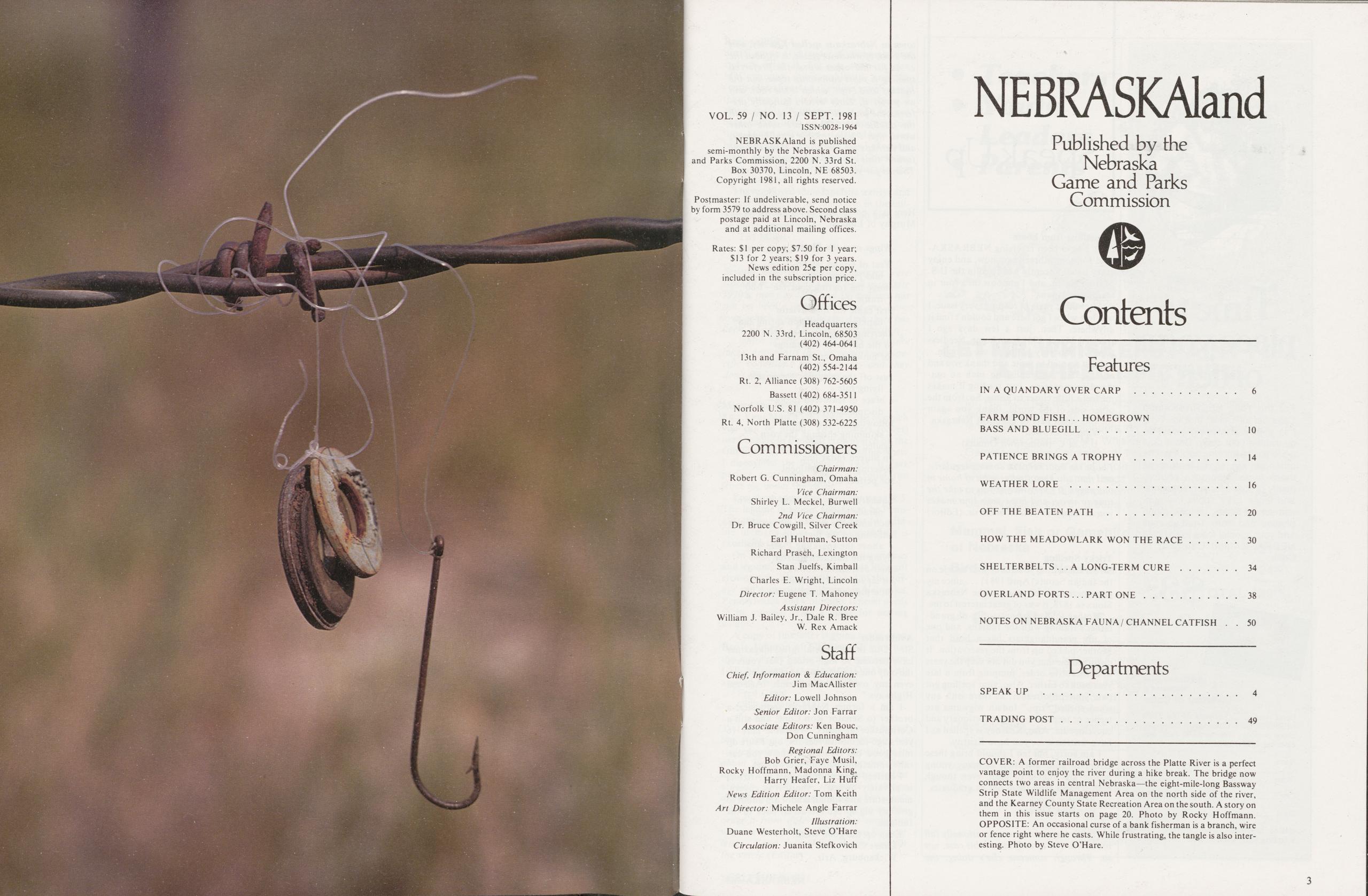
NEBRASKAland
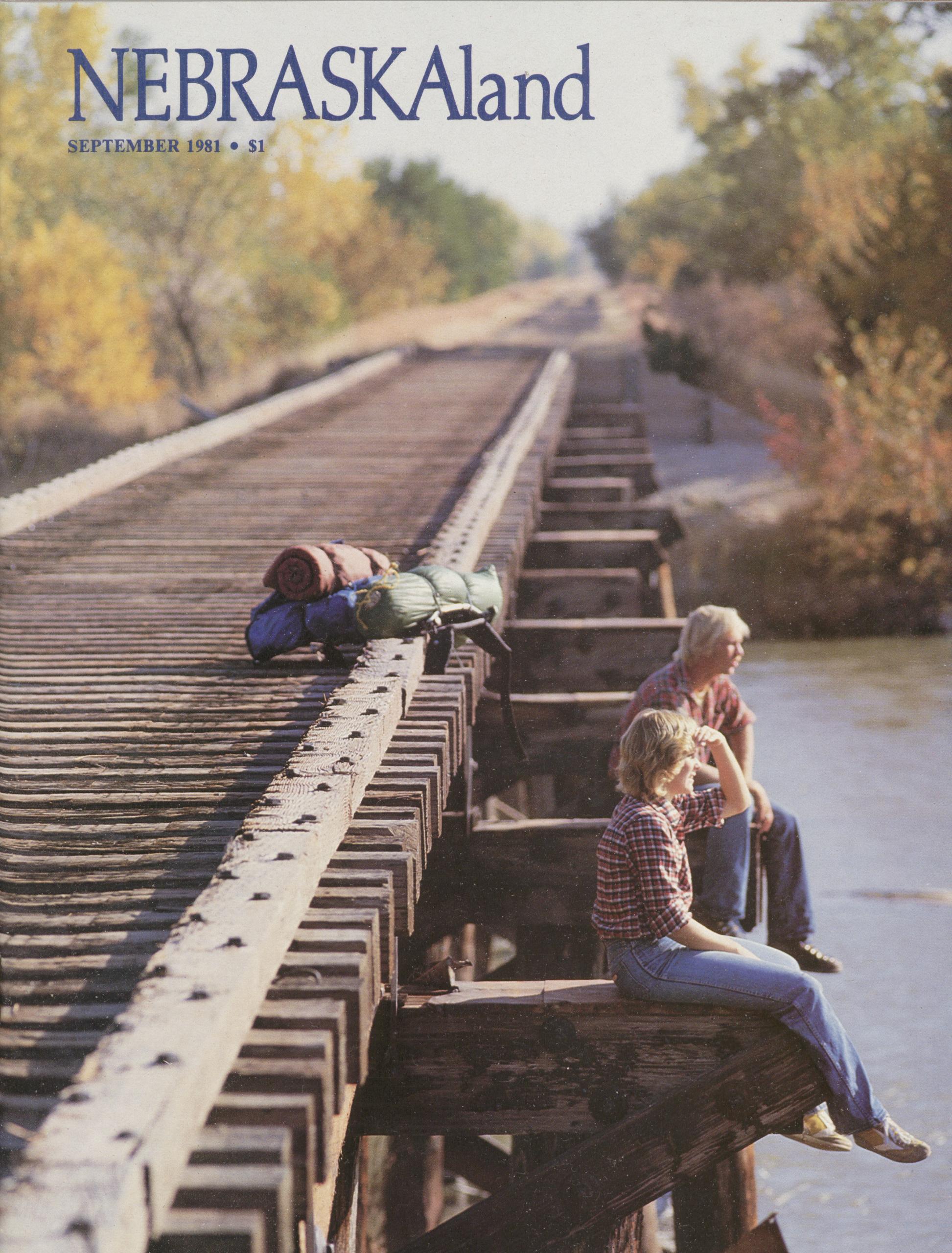
Published by the Nebraska Game and Parks Commission VOL. 59 / NO. 13 / SEPT. 1981 ISSN:0028-1964 NEBRASKAland is published semi-monthly by the Nebraska Game and Parks Commission, 2200 N. 33rd St. Box 30370, Lincoln, NE 68503. Copyright 1981, all rights reserved. Postmaster: If undeliverable, send notice by form 3579 to address above. Second class postage paid at Lincoln, Nebraska and at additional mailing offices. Rates: $1 per copy; $7.50 for 1 year; $13 for 2 years; $19 for 3 years. News edition 25c per copy, included in the subscription price. ices Headquarters 2200 N. 33rd, Lincoln, 68503 (402)464-0641 13th and Farnam St., Omaha (402) 554-2144 Rt. 2, Alliance (308) 762-5605 Bassett (402) 684-3511 Norfolk U.S. 81 (402) 37M950 Rt. 4, North Platte (308) 532-6225 Commissioners Chairman: Robert G. Cunningham, Omaha Vice Chairman: Shirley L. Meckel, Burwell 2nd Vice Chairman: Dr. Bruce Cowgill, Silver Creek Earl Hultman, Sutton Richard Prasch, Lexington Stan Juelfs, Kimball Charles E. Wright, Lincoln Director: Eugene T. Mahoney Assistant Directors: William J. Bailey, Jr., Dale R. Bree W. Rex Amack Staff Chief, Information & Education: Jim MacAllister Editor: Lowell Johnson Senior Editor: Jon Farrar Associate Editors: Ken Bouc, Don Cunningham Regional Editors: Bob Grier, Faye Musil, Rocky Hoffmann, Madonna King, Harry Heafer, Liz Huff News Edition Editor: Tom Keith Art Director: Michele Angle Farrar Illustration: Duane Westerholt, Steve O'Hare Circulation: Juanita Stefkovich Contents Features IN A QUANDARY OVER CARP 6 FARM POND FISH HOMEGROWN BASS AND BLUEGILL 10 PATIENCE BRINGS A TROPHY 14 WEATHER LORE 16 OFF THE BEATEN PATH 20 HOW THE MEADOWLARK WON THE RACE 30 SHELTERBELTS A LONG-TERM CURE 34 OVERLAND FORTS PART ONE 38 NOTES ON NEBRASKA FAUNA/ CHANNEL CATFISH 50 Departments SPEAK UP TRADING POST 49 COVER: A former railroad bridge across the Platte River is a perfect vantage point to enjoy the river during a hike break. The bridge now connects two areas in central Nebraska—the eight-mile-long Bassway Strip State Wildlife Management Area on the north side of the river, and the Kearney County State Recreation Area on the south. A story on them in this issue starts on page 20. Photo by Rocky Hoffmann. OPPOSITE: An occasional curse of a bank fisherman is a branch, wire or fence right where he casts. While frustrating, the tangle is also interesting. Photo by Steve O'Hare. 3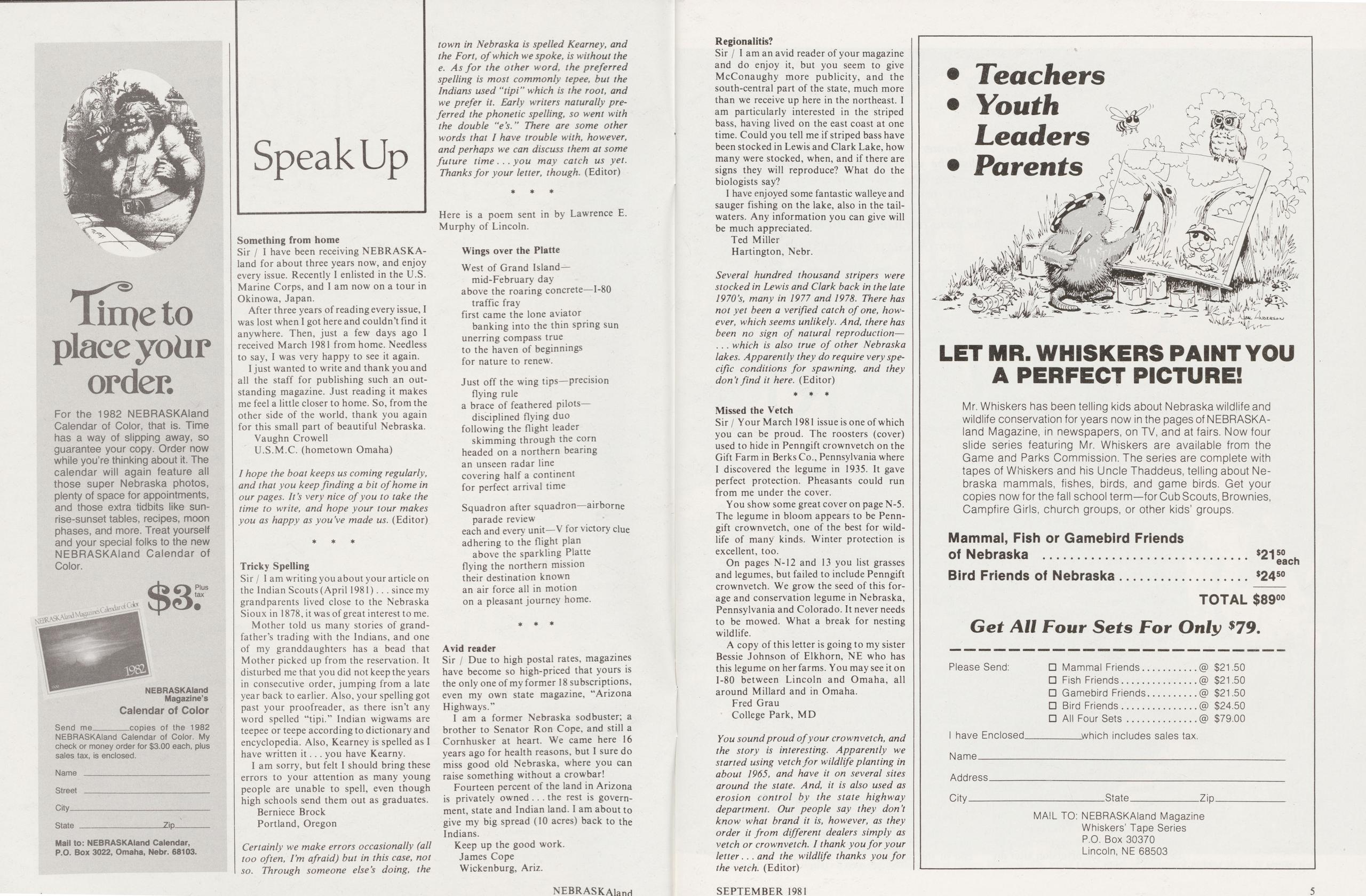 Time to
place your
order.
For the 1982 NEBRASKAland
Calendar of Color, that is. Time
has a way of slipping away, so
guarantee your copy. Order now
while you're thinking about it. The
calendar will again feature all
those super Nebraska photos,
plenty of space for appointments,
and those extra tidbits like sunrise-sunset tables, recipes, moon
phases, and more. Treat yourself
and your special folks to the new
NEBRASKAland Calendar of
Color.
NEBRASKAland
Magazine's
Calendar of Color
Send me copies of the 1982
NEBRASKAland Calendar of Color. My
check or money order for $3.00 each, plus
sales tax, is enclosed.
Name
Street
City.
State
Zip
Mail to: NEBRASKAland Calendar,
P.O. Box 3022, Omaha, Nebr. 68103.
Time to
place your
order.
For the 1982 NEBRASKAland
Calendar of Color, that is. Time
has a way of slipping away, so
guarantee your copy. Order now
while you're thinking about it. The
calendar will again feature all
those super Nebraska photos,
plenty of space for appointments,
and those extra tidbits like sunrise-sunset tables, recipes, moon
phases, and more. Treat yourself
and your special folks to the new
NEBRASKAland Calendar of
Color.
NEBRASKAland
Magazine's
Calendar of Color
Send me copies of the 1982
NEBRASKAland Calendar of Color. My
check or money order for $3.00 each, plus
sales tax, is enclosed.
Name
Street
City.
State
Zip
Mail to: NEBRASKAland Calendar,
P.O. Box 3022, Omaha, Nebr. 68103.
Speak Up
Something from homeSir / 1 have been receiving NEBRASKAland for about three years now, and enjoy every issue. Recently I enlisted in the U.S. Marine Corps, and I am now on a tour in Okinowa, Japan.
After three years of reading every issue, I was lost when I got here and couldn't find it anywhere. Then, just a few days ago I received March 1981 from home. Needless to say, I was very happy to see it again.
I just wanted to write and thank you and all the staff for publishing such an outstanding magazine. Just reading it makes me feel a little closer to home. So, from the other side of the world, thank you again for this small part of beautiful Nebraska.
Vaughn Crowell U.S.M.C. (hometown Omaha)I hope the boat keeps us coming regularly, and that you keep finding a bit of home in our pages. It's very nice of you to take the time to write, and hope your tour makes you as happy as you've made us. (Editor)
Tricky SpellingSir / I am writing you about your article on the Indian Scouts (April 1981) since my grandparents lived close to the Nebraska Sioux in 1878, it was of great interest to me.
Mother told us many stories of grandfather's trading with the Indians, and one of my granddaughters has a bead that Mother picked up from the reservation. It disturbed me that you did not keep the years in consecutive order, jumping from a late year back to earlier. Also, your spelling got past your proofreader, as there isn't any word spelled "tipi." Indian wigwams are teepee or teepe according to dictionary and encyclopedia. Also, Kearney is spelled as I have written it you have Kearny.
I am sorry, but felt I should bring these errors to your attention as many young people are unable to spell, even though high schools send them out as graduates.
Berniece Brock Portland, OregonCertainly we make errors occasionally (all too often, I'm afraid) but in this case, not so. Through someone else's doing, the town in Nebraska is spelled Kearney, and the Fort, of which we spoke, is without the e. As for the other word, the preferred spelling is most commonly tepee, but the Indians used "tipi" which is the root, and we prefer it. Early writers naturally preferred the phonetic spelling, so went with the double "e's.' There are some other words that I have trouble with, however, and perhaps we can discuss them at some future time you may catch us yet. Thanks for your letter, though. (Editor)
Here is a poem sent in by Lawrence E. Murphy of Lincoln.
Wings over the Platte West of Grand Island—mid-February day above the roaring concrete—1-80 traffic fray first came the lone aviator banking into the thin spring sun unerring compass true to the haven of beginnings for nature to renew. Just off the wing tips—precision flying rule a brace of feathered pilots-disciplined flying duo following the flight leader skimming through the corn headed on a northern bearing an unseen radar line covering half a continent for perfect arrival time Squadron after squadron—airborne parade review each and every unit—V for victory clue adhering to the flight plan above the sparkling Platte flying the northern mission their destination known an air force all in motion on a pleasant journey home. Avid readerSir / Due to high postal rates, magazines have become so high-priced that yours is the only one of my former 18 subscriptions, even my own state magazine, "Arizona Highways."
I am a former Nebraska sodbuster; a brother to Senator Ron Cope, and still a Cornhusker at heart. We came here 16 years ago for health reasons, but I sure do miss good old Nebraska, where you can raise something without a crowbar!
Fourteen percent of the land in Arizona is privately owned the rest is government, state and Indian land. I am about to give my big spread (10 acres) back to the Indians.
Keep up the good work.
James Cope Wickenburg, Ariz. NEBRASKAland Regionalitis?Sir / I am an avid reader of your magazine and do enjoy it, but you seem to give McConaughy more publicity, and the south-central part of the state, much more than we receive up here in the northeast. I am particularly interested in the striped bass, having lived on the east coast at one time. Could you tell me if striped bass have been stocked in Lewis and Clark Lake, how many were stocked, when, and if there are signs they will reproduce? What do the biologists say?
I have enjoyed some fantastic walleye and sauger fishing on the lake, also in the tailwaters. Any information you can give will be much appreciated.
Ted Miller Hartington, Nebr.Several hundred thousand stripers were stocked in Lewis and Clark back in the late 1970's, many in 1977 and 1978. There has not yet been a verified catch of one, however, which seems unlikely. And, there has been no sign of natural reproduction— which is also true of other Nebraska lakes. Apparently they do require very specif c conditions for spawning, and they don't find it here. (Editor)
Missed the VetchSir / Your March 1981 issue is one of which you can be proud. The roosters (cover) used to hide in Penngift crownvetch on the Gift Farm in Berks Co., Pennsylvania where I discovered the legume in 1935. It gave perfect protection. Pheasants could run from me under the cover.
You show some great cover on page N-5. The legume in bloom appears to be Penn-gift crownvetch, one of the best for wildlife of many kinds. Winter protection is excellent, too.
On pages N-12 and 13 you list grasses and legumes, but failed to include Penngift crownvetch. We grow the seed of this forage and conservation legume in Nebraska, Pennsylvania and Colorado. It never needs to be mowed. What a break for nesting wildlife.
A copy of this letter is going to my sister Bessie Johnson of Elkhorn, NE who has this legume on her farms. You may see it on 1-80 between Lincoln and Omaha, all around Millard and in Omaha.
Fred Grau College Park, MDYou sound proud of your crownvetch, and the story is interesting. Apparently we started using vetch for wildlife planting in about 1965, and have it on several sites around the state. And, it is also used as erosion control by the state highway department. Our people say they don't know what brand it is, however, as they order it from different dealers simply as vetch or crownvetch. I thank you for your letter and the wildlife thanks you for the vetch. (Editor)
Youth LET MR. WHISKERS PAINT YOU A PERFECT PICTURE! Mr. Whiskers has been telling kids about Nebraska wildlife and wildlife conservation for years now in the pages of NEBRASKAland Magazine, in newspapers, on TV, and at fairs. Now four slide series featuring Mr. Whiskers are available from the Game and Parks Commission. The series are complete with tapes of Whiskers and his Uncle Thaddeus, telling about Nebraska mammals, fishes, birds, and game birds. Get your copies now for the fall school term—for Cub Scouts, Brownies, Campfire Girls, church groups, or other kids' groups. Mammal, Fish or Gamebird Friends of Nebraska $21 Friends of Nebraska $24 50 TOTAL $89 Get All Four Sets For Only $19.00 Please Send: I have Enclosed. Mammal Friends $21.50 Fish Friends $21.50 Gamebird Friends $21.50 Bird Friends $24.50 All Four Sets $79.00 which includes sales tax. Name. Address. City .State. .Zip. MAIL TO: NEBRASKAland Magazine Whiskers' Tape Series P.O. Box 30370 Lincoln, NE 68503 SEPTEMBER 1981 5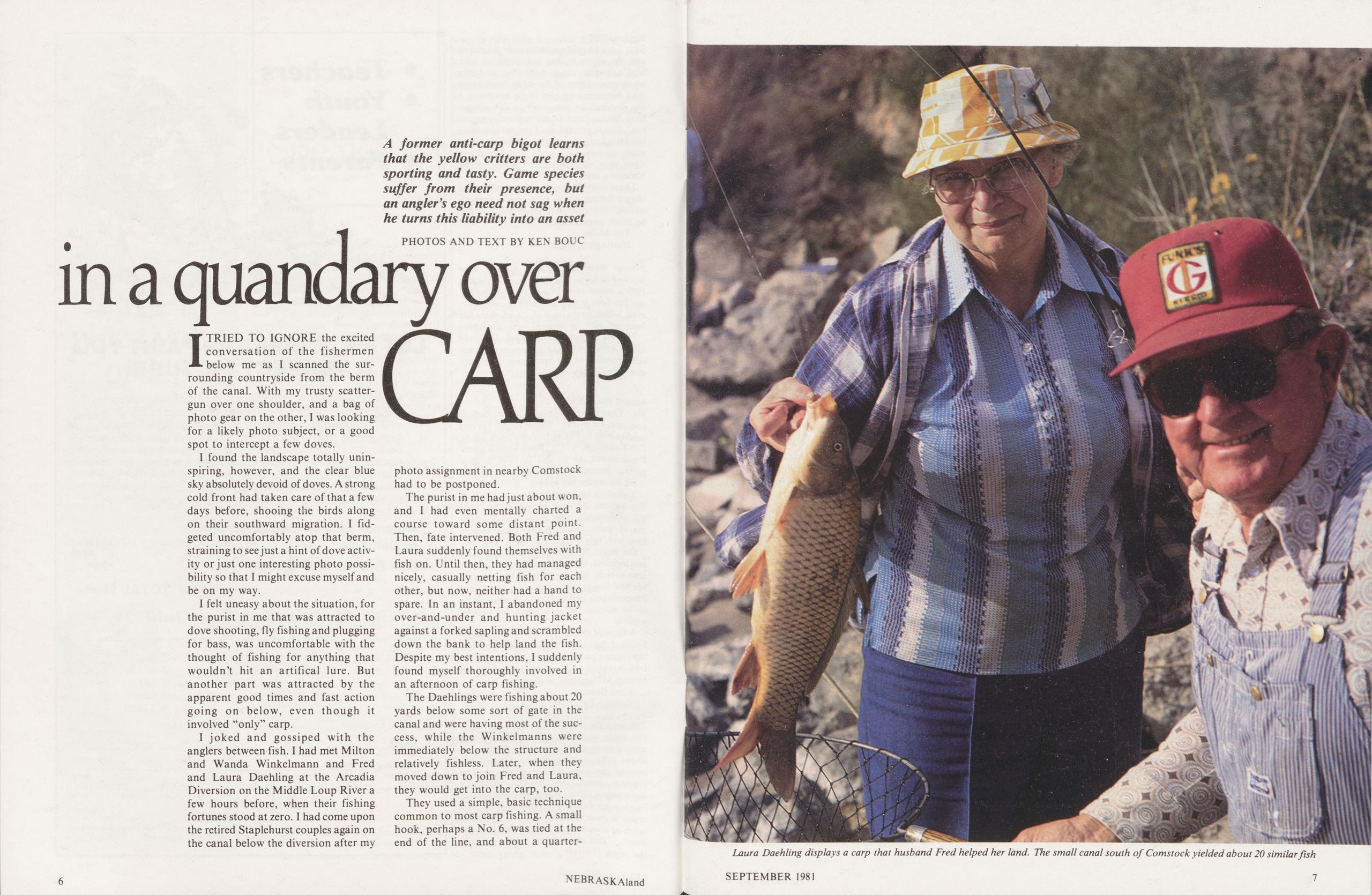
in a quandary over CARP
A former anti-carp bigot learns that the yellow critters are both sporting and tasty. Game species suffer from their presence, but an angler's ego need not sag when he turns this liability into an asset PHOTOS AND TEXT BY KEN BOUCI TRIED TO IGNORE the excited conversation of the fishermen below me as I scanned the surrounding countryside from the berm of the canal. With my trusty scatter-gun over one shoulder, and a bag of photo gear on the other, I was looking for a likely photo subject, or a good spot to intercept a few doves.
I found the landscape totally uninspiring, however, and the clear blue sky absolutely devoid of doves. A strong cold front had taken care of that a few days before, shooing the birds along on their southward migration. I fidgeted uncomfortably atop that berm, straining to see just a hint of dove activity or just one interesting photo possibility so that I might excuse myself and be on my way.
I felt uneasy about the situation, for the purist in me that was attracted to dove shooting, fly fishing and plugging for bass, was uncomfortable with the thought of fishing for anything that wouldn't hit an artifical lure. But another part was attracted by the apparent good times and fast action going on below, even though it involved "only" carp.
I joked and gossiped with the anglers between fish. I had met Milton and Wanda Winkelmann and Fred and Laura Daehling at the Arcadia Diversion on the Middle Loup River a few hours before, when their fishing fortunes stood at zero. I had come upon the retired Staplehurst couples again on the canal below the diversion after my photo assignment in nearby Comstock had to be postponed.
The purist in me had just about won, and I had even mentally charted a course toward some distant point. Then, fate intervened. Both Fred and Laura suddenly found themselves with fish on. Until then, they had managed nicely, casually netting fish for each other, but now, neither had a hand to spare. In an instant, I abandoned my over-and-under and hunting jacket against a forked sapling and scrambled down the bank to help land the fish. Despite my best intentions, I suddenly found myself thoroughly involved in an afternoon of carp fishing.
The Daehlings were fishing about 20 yards below some sort of gate in the canal and were having most of the success, while the Winkelmanns were immediately below the structure and relatively fishless. Later, when they moved down to join Fred and Laura, they would get into the carp, too.
They used a simple, basic technique common to most carp fishing. A small hook, perhaps a No. 6, was tied at the end of the line, and about a quarter- 6 NEBRASKAland
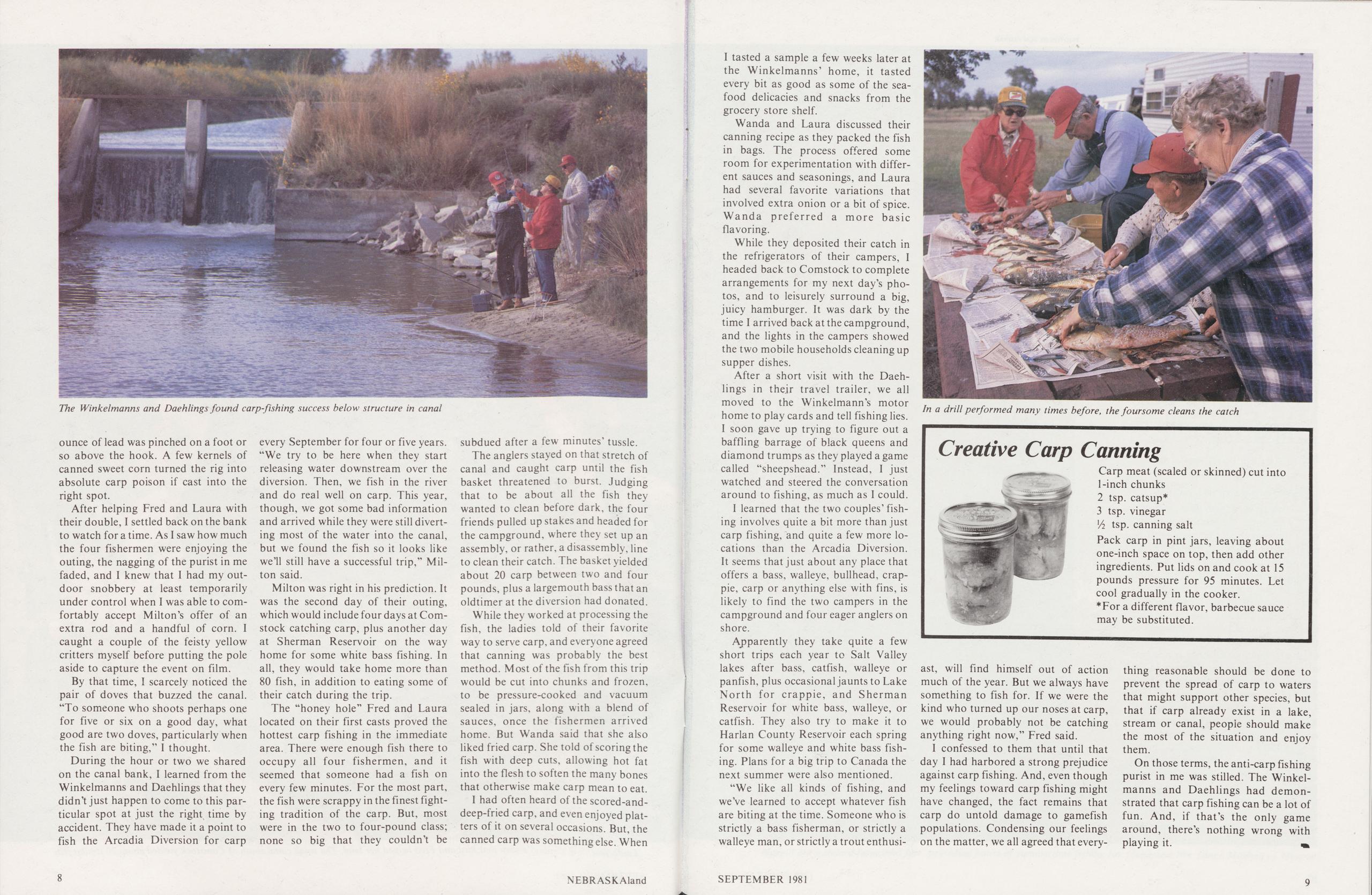
After helping Fred and Laura with their double, I settled back on the bank to watch for a time. As I saw how much the four fishermen were enjoying the outing, the nagging of the purist in me faded, and I knew that I had my outdoor snobbery at least temporarily under control when I was able to comfortably accept Milton's offer of an extra rod and a handful of corn. I caught a couple of the feisty yellow critters myself before putting the pole aside to capture the event on film.
By that time, I scarcely noticed the pair of doves that buzzed the canal. "To someone who shoots perhaps one for five or six on a good day, what good are two doves, particularly when the fish are biting," I thought.
During the hour or two we shared on the canal bank, I learned from the Winkelmanns and Daehlings that they didn't just happen to come to this particular spot at just the right time by accident. They have made it a point to fish the Arcadia Diversion for carp every September for four or five years. "We try to be here when they start releasing water downstream over the diversion. Then, we fish in the river and do real well on carp. This year, though, we got some bad information and arrived while they were still diverting most of the water into the canal, but we found the fish so it looks like we'll still have a successful trip," Milton said.
Milton was right in his prediction. It was the second day of their outing, which would include four days at Cornstock catching carp, plus another day at Sherman Reservoir on the way home for some white bass fishing. In all, they would take home more than 80 fish, in addition to eating some of their catch during the trip.
The "honey hole" Fred and Laura located on their first casts proved the hottest carp fishing in the immediate area. There were enough fish there to occupy all four fishermen, and it seemed that someone had a fish on every few minutes. For the most part, the fish were scrappy in the finest fighting tradition of the carp. But, most were in the two to four-pound class; none so big that they couldn't be subdued after a few minutes' tussle.
The anglers stayed on that stretch of canal and caught carp until the fish basket threatened to burst. Judging that to be about all the fish they wanted to clean before dark, the four friends pulled up stakes and headed for the campground, where they set up an assembly, or rather, a disassembly, line to clean their catch. The basket yielded about 20 carp between two and four pounds, plus a largemouth bass that an oldtimer at the diversion had donated.
While they worked at processing the fish, the ladies told of their favorite way to serve carp, and everyone agreed that canning was probably the best method. Most of the fish from this trip would be cut into chunks and frozen, to be pressure-cooked and vacuum sealed in jars, along with a blend of sauces, once the fishermen arrived home. But Wanda said that she also liked fried carp. She told of scoring the fish with deep cuts, allowing hot fat into the flesh to soften the many bones that otherwise make carp mean to eat.
I had often heard of the scored-and-deep-fried carp, and even enjoyed platters of it on several occasions. But, the canned carp was something else. When 8 NEBRASKAland I tasted a sample a few weeks later at the Winkelmanns' home, it tasted every bit as good as some of the seafood delicacies and snacks from the grocery store shelf.
Wanda and Laura discussed their canning recipe as they packed the fish in bags. The process offered some room for experimentation with different sauces and seasonings, and Laura had several favorite variations that involved extra onion or a bit of spice. Wanda preferred a more basic flavoring.
While they deposited their catch in the refrigerators of their campers, I headed back to Comstock to complete arrangements for my next day's photos, and to leisurely surround a big juicy hamburger. It was dark by the time I arrived back at the campground, and the lights in the campers showed the two mobile households cleaning up supper dishes.
After a short visit with the Daehlings in their travel trailer, we all moved to the Winkelmann's motor home to play cards and tell fishing lies. I soon gave up trying to figure out a baffling barrage of black queens and diamond trumps as they played a game called "sheepshead." Instead, I just watched and steered the conversation around to fishing, as much as I could.
I learned that the two couples'fishing involves quite a bit more than just carp fishing, and quite a few more locations than the Arcadia Diversion. It seems that just about any place that offers a bass, walleye, bullhead, crappie, carp or anything else with fins, is likely to find the two campers in the campground and four eager anglers on shore.
Apparently they take quite a few short trips each year to Salt Valley lakes after bass, catfish, walleye or panfish, plus occasional jaunts to Lake North for crappie, and Sherman Reservoir for white bass, walleye, or catfish. They also try to make it to Harlan County Reservoir each spring for some walleye and white bass fishing. Plans for a big trip to Canada the next summer were also mentioned.
"We like all kinds of fishing, and we've learned to accept whatever fish are biting at the time. Someone who is strictly a bass fisherman, or strictly a walleye man, or strictly a trout enthusiast, will find himself out of action much of the year. But we always have something to fish for. If we were the kind who turned up our noses at carp, we would probably not be catching anything right now," Fred said.
I confessed to them that until that day I had harbored a strong prejudice against carp fishing. And, even though my feelings toward carp fishing might have changed, the fact remains that carp do untold damage to gamefish populations. Condensing our feelings on the matter, we all agreed that everything reasonable should be done to prevent the spread of carp to waters that might support other species, but that if carp already exist in a lake, stream or canal, people should make the most of the situation and enjoy them.
On those terms, the anti-carp fishing purist in me was stilled. The Winkelmanns and Daehlings had demonstrated that carp fishing can be a lot of fun. And, if that's the only game around, there's nothing wrong with playing it.
SEPTEMBER 1981 9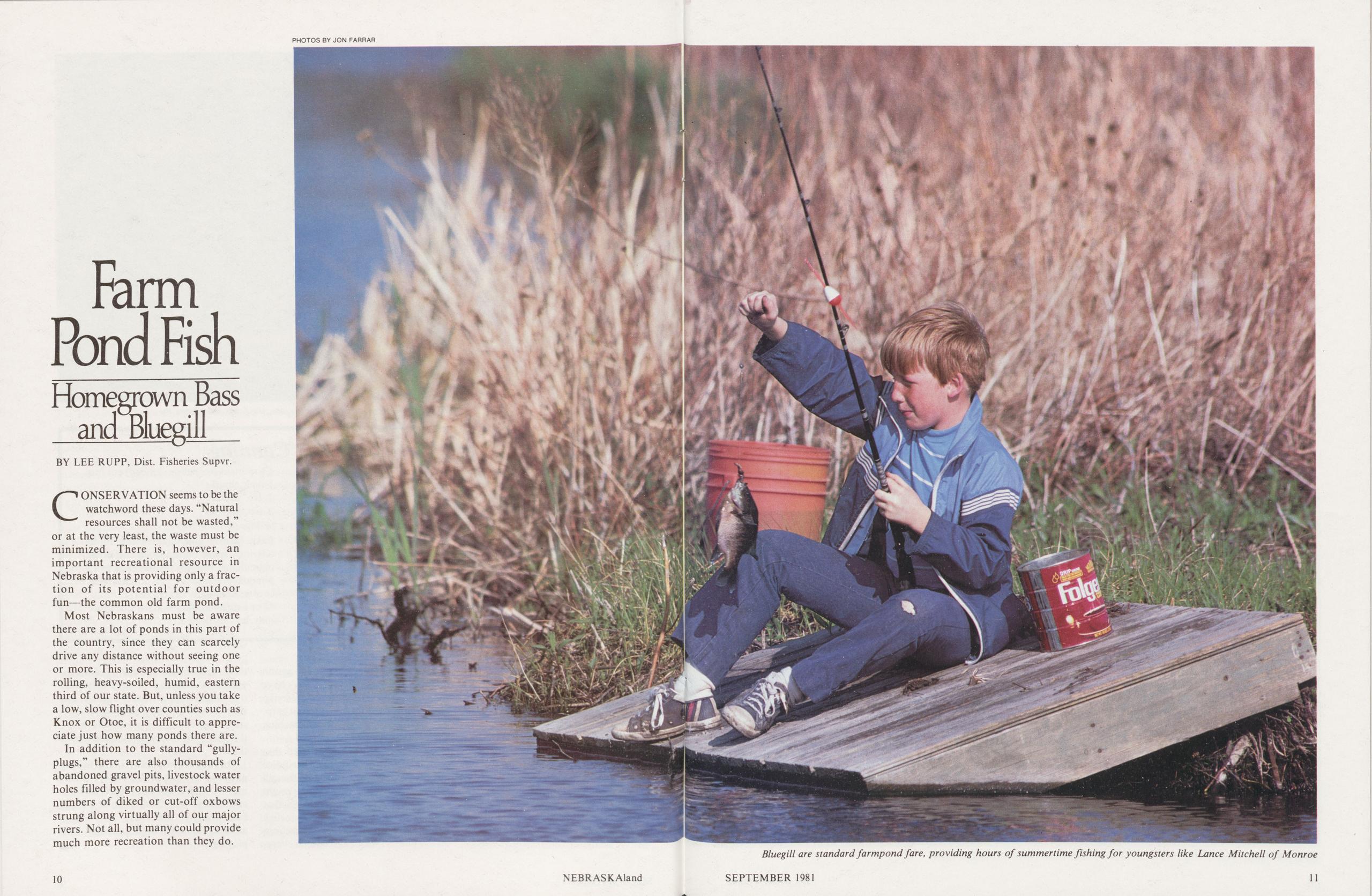
Farm Pond Fish
Homegrown Bass and Bluegill BY LEE RUPP, Dist. Fisheries Supvr.CONSERVATION seems to be the watchword these days. "Natural resources shall not be wasted," or at the very least, the waste must be minimized. There is, however, an important recreational resource in Nebraska that is providing only a fraction of its potential for outdoor fun—the common old farm pond.
Most Nebraskans must be aware there are a lot of ponds in this part of the country, since they can scarcely drive any distance without seeing one or more. This is especially true in the rolling, heavy-soiled, humid, eastern third of our state. But, unless you take a low, slow flight over counties such as Knox or Otoe, it is difficult to appreciate just how many ponds there are.
In addition to the standard "gully-plugs," there are also thousands of abandoned gravel pits, livestock water holes filled by groundwater, and lesser numbers of diked or cut-off oxbows strung along virtually all of our major rivers. Not all, but many could provide much more recreation than they do.
10 NEBRASKAland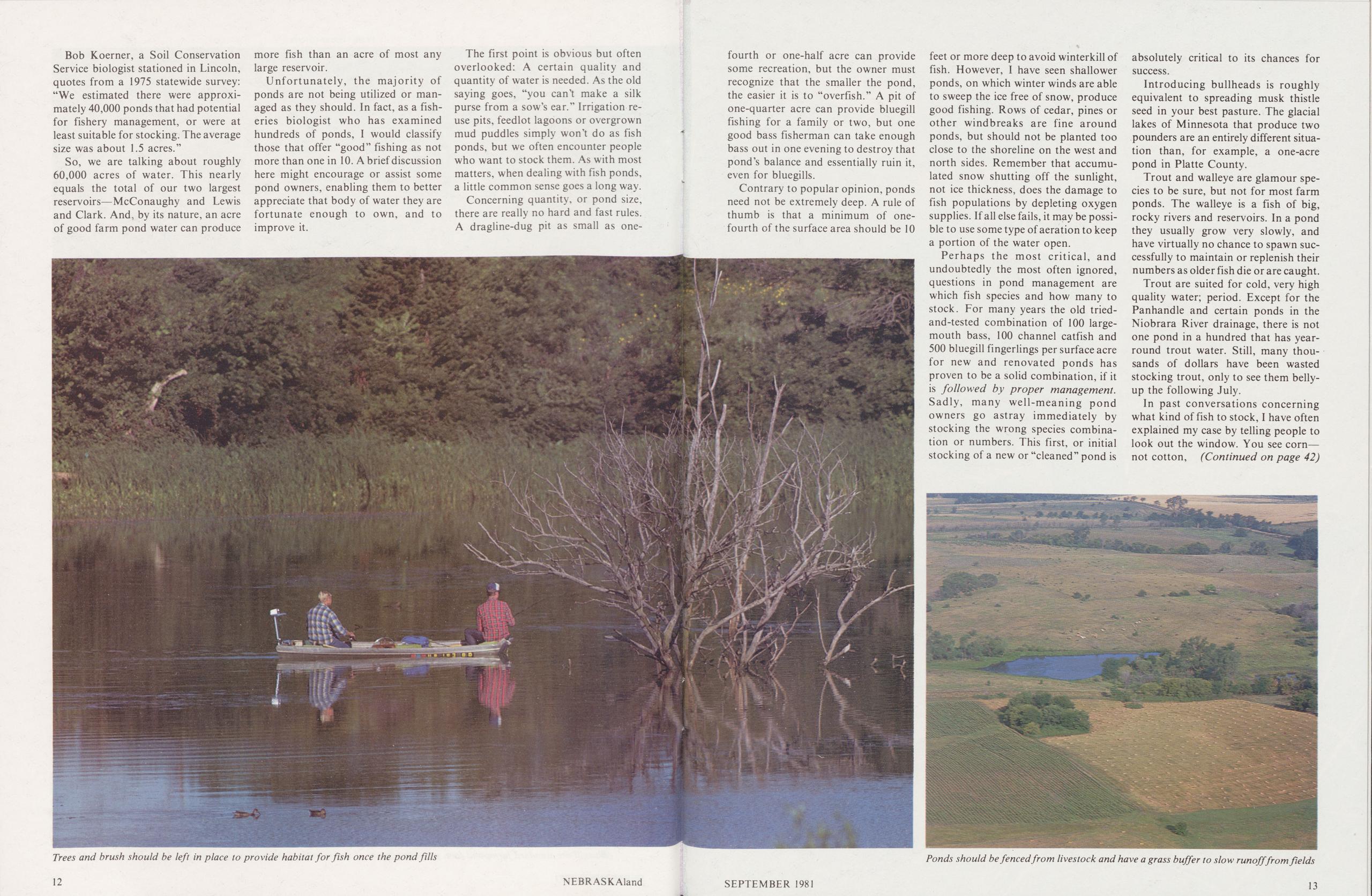
Bob Koerner, a Soil Conservation Service biologist stationed in Lincoln, quotes from a 1975 statewide survey: "We estimated there were approximately 40,000 ponds that had potential for fishery management, or were at least suitable for stocking. The average size was about 1.5 acres."
So, we are talking about roughly 60,000 acres of water. This nearly equals the total of our two largest reservoirs—McConaughy and Lewis and Clark. And, by its nature, an acre of good farm pond water can produce more fish than an acre of most any large reservoir.
Unfortunately, the majority of ponds are not being utilized or managed as they should. In fact, as a fisheries biologist who has examined hundreds of ponds, I would classify those that offer "good" fishing as not more than one in 10. A brief discussion here might encourage or assist some pond owners, enabling them to better appreciate that body of water they are fortunate enough to own, and to improve it.
The first point is obvious but often overlooked: A certain quality and quantity of water is needed. As the old saying goes, "you can't make a silk purse from a sow's ear." Irrigation reuse pits, feedlot lagoons or overgrown mud puddles simply won't do as fish ponds, but we often encounter people who want to stock them. As with most matters, when dealing with fish ponds, a little common sense goes a long way. Concerning quantity, or pond size, there are really no hard and fast rules. A dragline-dug pit as small as one-fourth
Contrary to popular opinion, ponds need not be extremely deep. A rule of thumb is that a minimum of one-fourth of the surface area should be 10 feet or more deep to avoid winterkill of fish. However, I have seen shallower ponds, on which winter winds are able to sweep the ice free of snow, produce good fishing. Rows of cedar, pines or other windbreaks are fine around ponds, but should not be planted too close to the shoreline on the west and north sides. Remember that accumulated snow shutting off the sunlight, not ice thickness, does the damage to fish populations by depleting oxygen supplies. If all else fails, it may be possible to use some type of aeration to keep a portion of the water open.
Perhaps the most critical, and undoubtedly the most often ignored, questions in pond management are which fish species and how many to stock. For many years the old tried-and-tested combination of 100 large-mouth bass, 100 channel catfish and 500 bluegill fingerlings per surface acre for new and renovated ponds has proven to be a solid combination, if it is followed by proper management. Sadly, many well-meaning pond owners go astray immediately by stocking the wrong species combination or numbers. This first, or initial stocking of a new or "cleaned" pond is absolutely critical to its chances for success.
Introducing bullheads is roughly equivalent to spreading musk thistle seed in your best pasture. The glacial lakes of Minnesota that produce two pounders are an entirely different situation than, for example, a one-acre pond in Platte County.
Trout and walleye are glamour species to be sure, but not for most farm ponds. The walleye is a fish of big, rocky rivers and reservoirs. In a pond they usually grow very slowly, and have virtually no chance to spawn successfully to maintain or replenish their numbers as older fish die or are caught.
Trout are suited for cold, very high quality water; period. Except for the Panhandle and certain ponds in the Niobrara River drainage, there is not one pond in a hundred that has year-round trout water. Still, many thousands of dollars have been wasted stocking trout, only to see them bellyup the following July.
In past conversations concerning what kind offish to stock, I have often explained my case by telling people to look out the window. You see cornnot cotton, (Continued on page 42)
Patience Brings A Trophy
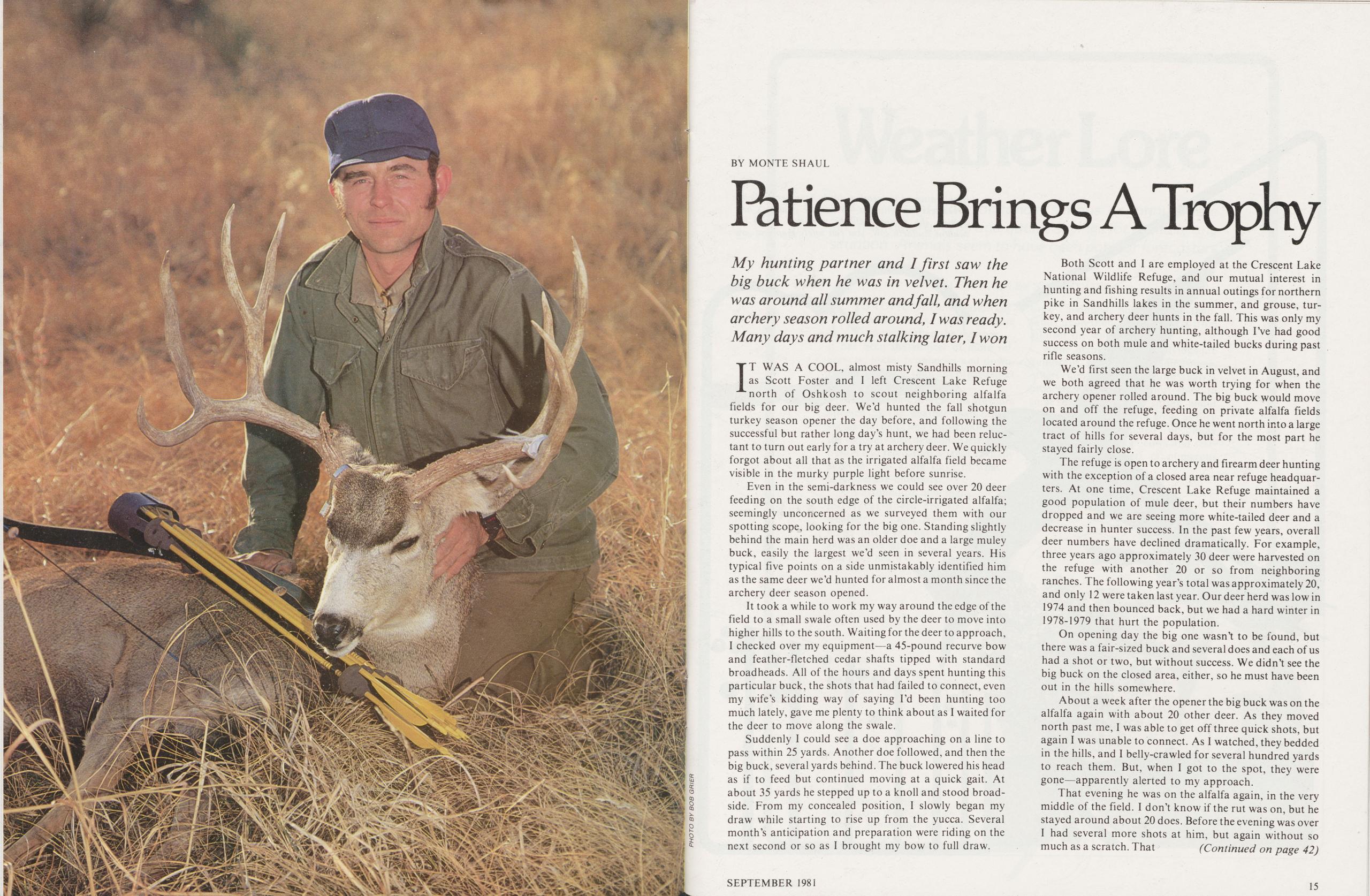
BY MONTE SHAUL My hunting partner and I first saw the big buck when he was in velvet. Then he was around all summer and fall, and when archery season rolled around, I was ready. Many days and much stalking later, I wonIT WAS A COOL, almost misty Sandhills morning as Scott Foster and I left Crescent Lake Refuge north of Oshkosh to scout neighboring alfalfa fields for our big deer. We'd hunted the fall shotgun turkey season opener the day before, and following the successful but rather long day's hunt, we had been reluctant to turn out early for a try at archery deer. We quickly forgot about all that as the irrigated alfalfa field became visible in the murky purple light before sunrise.
Even in the semi-darkness we could see over 20 deer feeding on the south edge of the circle-irrigated alfalfa; seemingly unconcerned as we surveyed them with our spotting scope, looking for the big one. Standing slightly behind the main herd was an older doe and a large muley buck, easily the largest we'd seen in several years. His typical five points on a side unmistakably identified him as the same deer we'd hunted for almost a month since the archery deer season opened.
It took a while to work my way around the edge of the field to a small swale often used by the deer to move into higher hills to the south. Waiting for the deer to approach, I checked over my equipment—a 45-pound recurve bow and feather-fletched cedar shafts tipped with standard broadheads. All of the hours and days spent hunting this particular buck, the shots that had failed to connect, even my wife's kidding way of saying I'd been hunting too much lately, gave me plenty to think about as I waited for the deer to move along the swale.
Suddenly I could see a doe approaching on a line to pass within 25 yards. Another doe followed, and then the big buck, several yards behind. The buck lowered his head as if to feed but continued moving at a quick gait. At about 35 yards he stepped up to a knoll and stood broad-side. From my concealed position, I slowly began my draw while starting to rise up from the yucca. Several month's anticipation and preparation were riding on the next second or so as I brought my bow to full draw.
Both Scott and I are employed at the Crescent Lake National Wildlife Refuge, and our mutual interest in hunting and fishing results in annual outings for northern pike in Sandhills lakes in the summer, and grouse, turkey, and archery deer hunts in the fall. This was only my second year of archery hunting, although I've had good success on both mule and white-tailed bucks during past rifle seasons.
We'd first seen the large buck in velvet in August, and we both agreed that he was worth trying for when the archery opener rolled around. The big buck would move on and off the refuge, feeding on private alfalfa fields located around the refuge. Once he went north into a large tract of hills for several days, but for the most part he stayed fairly close.
The refuge is open to archery and firearm deer hunting with the exception of a closed area near refuge headquarters. At one time, Crescent Lake Refuge maintained a good population of mule deer, but their numbers have dropped and we are seeing more white-tailed deer and a decrease in hunter success. In the past few years, overall deer numbers have declined dramatically. For example, three years ago approximately 30 deer were harvested on the refuge with another 20 or so from neighboring ranches. The following year's total was approximately 20, and only 12 were taken last year. Our deer herd was low in 1974 and then bounced back, but we had a hard winter in 1978-1979 that hurt the population.
On opening day the big one wasn't to be found, but there was a fair-sized buck and several does and each of us had a shot or two, but without success. We didn't see the big buck on the closed area, either, so he must have been out in the hills somewhere.
About a week after the opener the big buck was on the alfalfa again with about 20 other deer. As they moved north past me, I was able to get off three quick shots, but again I was unable to connect. As I watched, they bedded in the hills, and I belly-crawled for several hundred yards to reach them. But, when I got to the spot, they were gone—apparently alerted to my approach.
That evening he was on the alfalfa again, in the very middle of the field. I don't know if the rut was on, but he stayed around about 20 does. Before the evening was over I had several more shots at him, but again without so much as a scratch. That (Continued on page 42)
SEPTEMBER 1981 15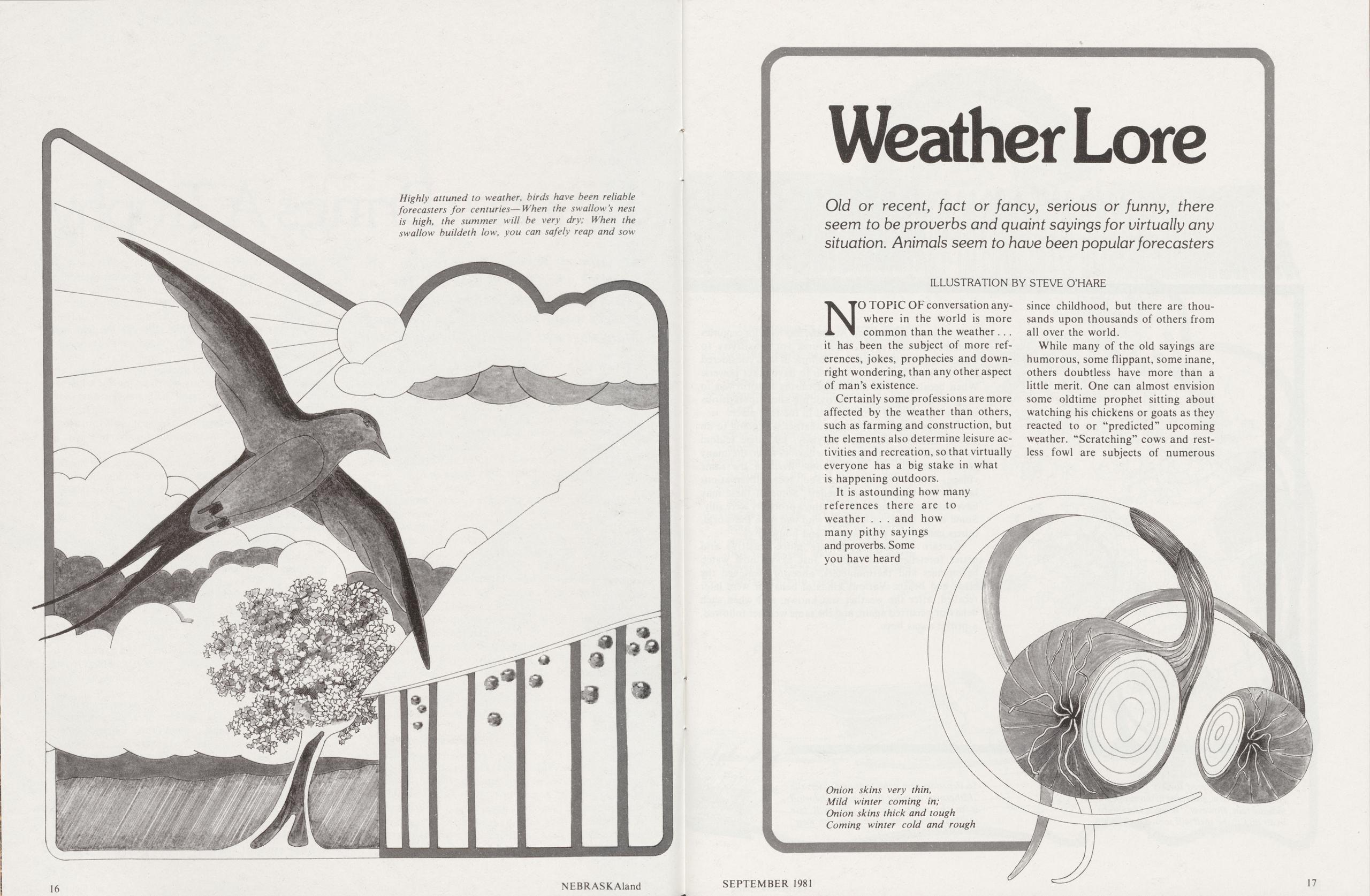
Weather Lore
Old or recent, fact or fancy, serious or funny, there seem to be proverbs and quaint sayings for virtually any situation. Animals seem to have been popular forecasters ILLUSTRATION BY STEVE O'HARENO TOPIC OF conversation anywhere in the world is more common than the weather it has been the subject of more references, jokes, prophecies and downright wondering, than any other aspect of man's existence.
Certainly some professions are more affected by the weather than others, such as farming and construction, but the elements also determine leisure activities and recreation, so that virtually everyone has a big stake in what is happening outdoors.
It is astounding how many references there are to weather and how many pithy sayings and proverbs. Some you have heard since childhood, but there are thousands upon thousands of others from all over the world.
While many of the old sayings are humorous, some flippant, some inane, others doubtless have more than a little merit. One can almost envision some oldtime prophet sitting about watching his chickens or goats as they reacted to or "predicted" upcoming weather. "Scratching" cows and restless fowl are subjects of numerous
Perhaps knowing what the weather was going to do would make no difference anyway, but logic seldom has any influence on human behavior. Over the many generations that the same people lived in the same village, 100 years and more ago, local observations became the basis for local beliefs. Some of these may have been sound and valid .. . others probably were silly. Some came home with sailors who had seen the world, others came from area farmers and housewives.
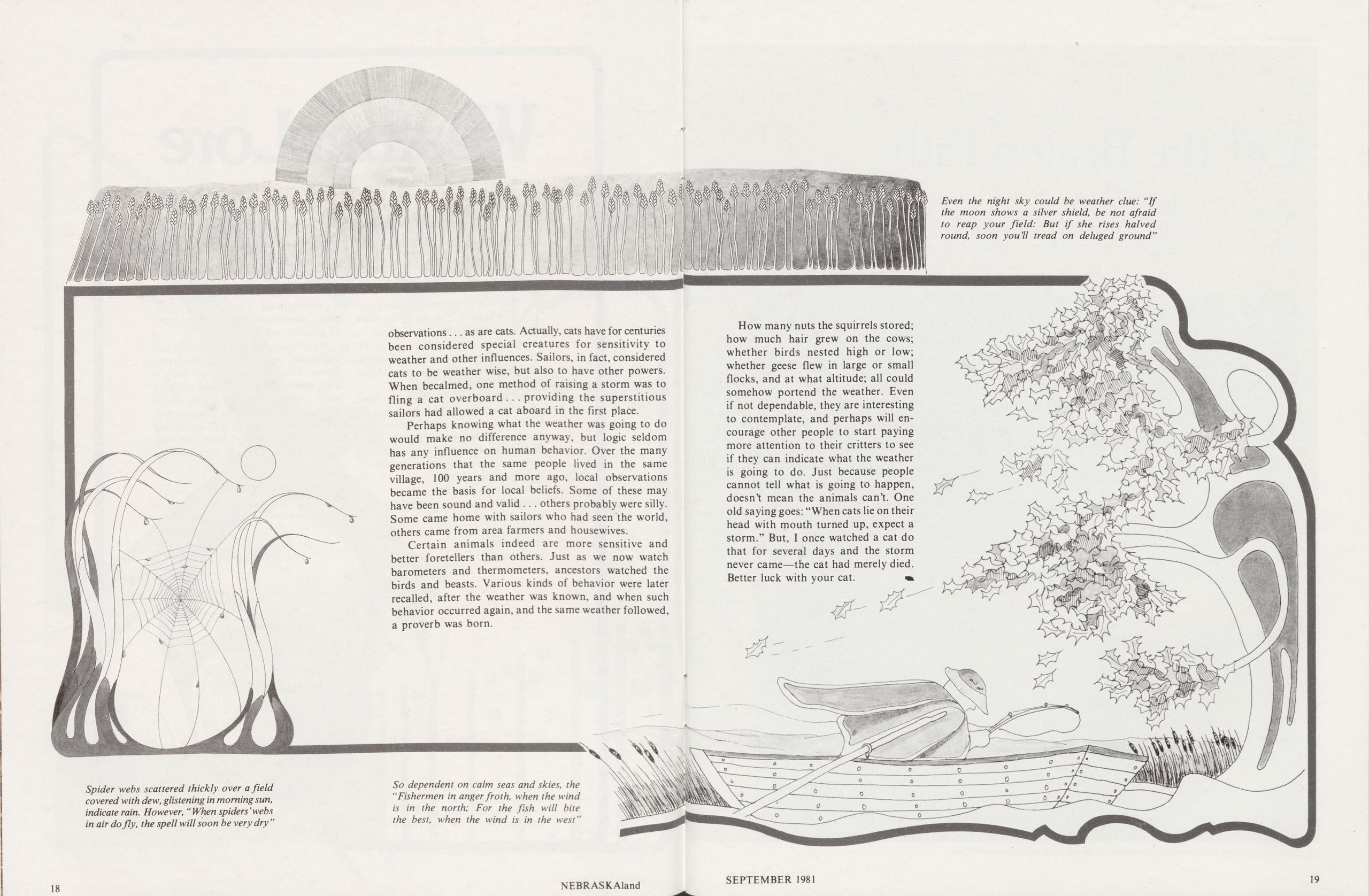
Certain animals indeed are more sensitive and better foretellers than others. Just as we now watch barometers and thermometers, ancestors watched the birds and beasts. Various kinds of behavior were later recalled, after the weather was known, and when such behavior occurred again, and the same weather followed, a proverb was born.
How many nuts the squirrels stored; how much hair grew on the cows; whether birds nested high or low; whether geese flew in large or small flocks, and at what altitude; all could somehow portend the w;eather. Even if not dependable, they are interesting to contemplate, and perhaps will encourage other people to start paying more attention to their critters to see if they can indicate what the weather is going to do. Just because people cannot tell what is going to happen, doesn't mean the animals can't. One old saying goes: "When cats lie on their head with mouth turned up, expect a storm." But, I once watched a cat do that for several days and the storm never came—the cat had merely died. Better luck with your cat.
SEPTEMBER 1981 19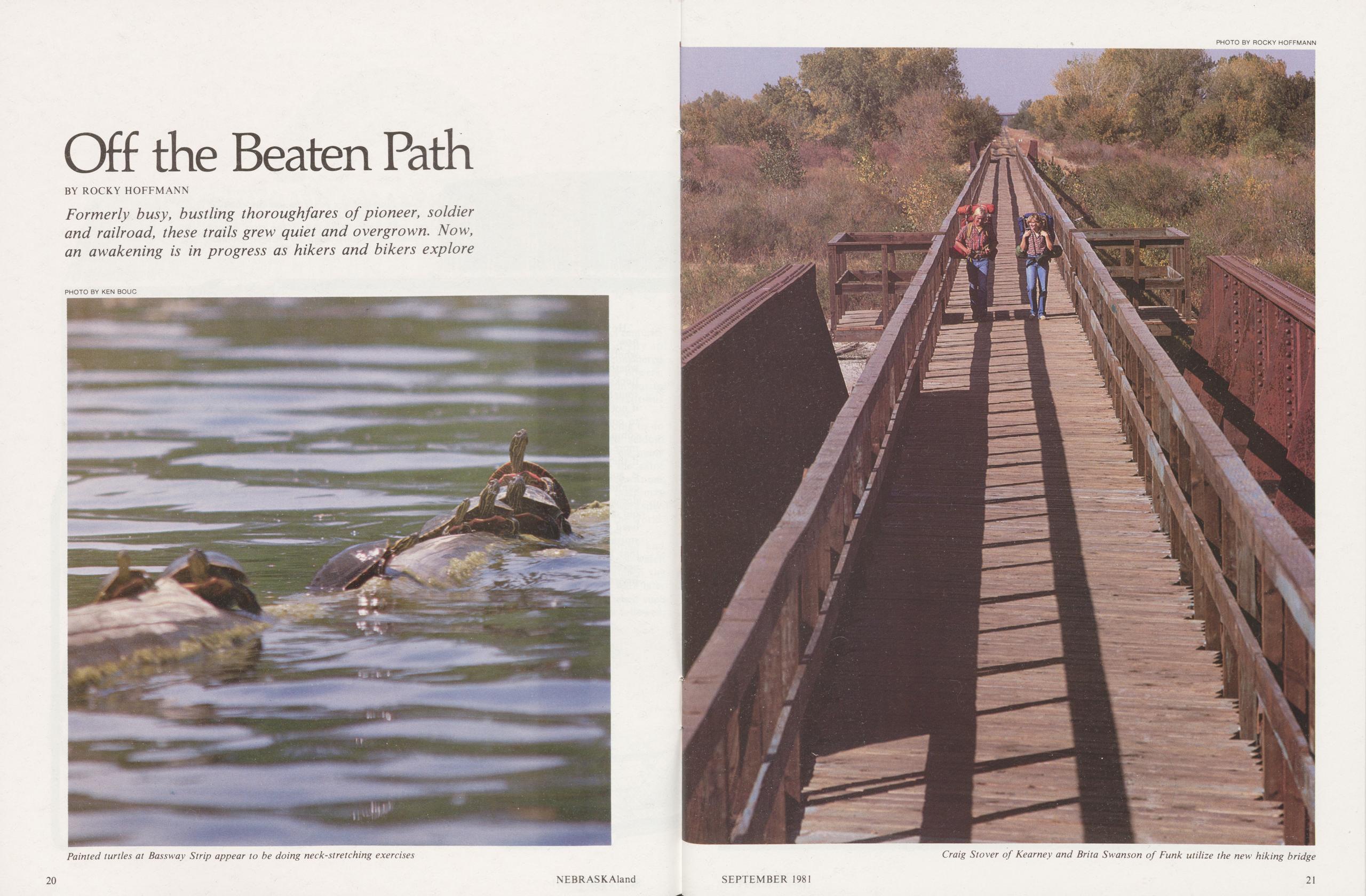
Off the Beaten Path
BY ROCKY HOFFMANN Formerly busy, bustling thoroughfares of pioneer, soldier and railroad, these trails grew quiet and overgrown. Now, an awakening is in progress as hikers and bikers explore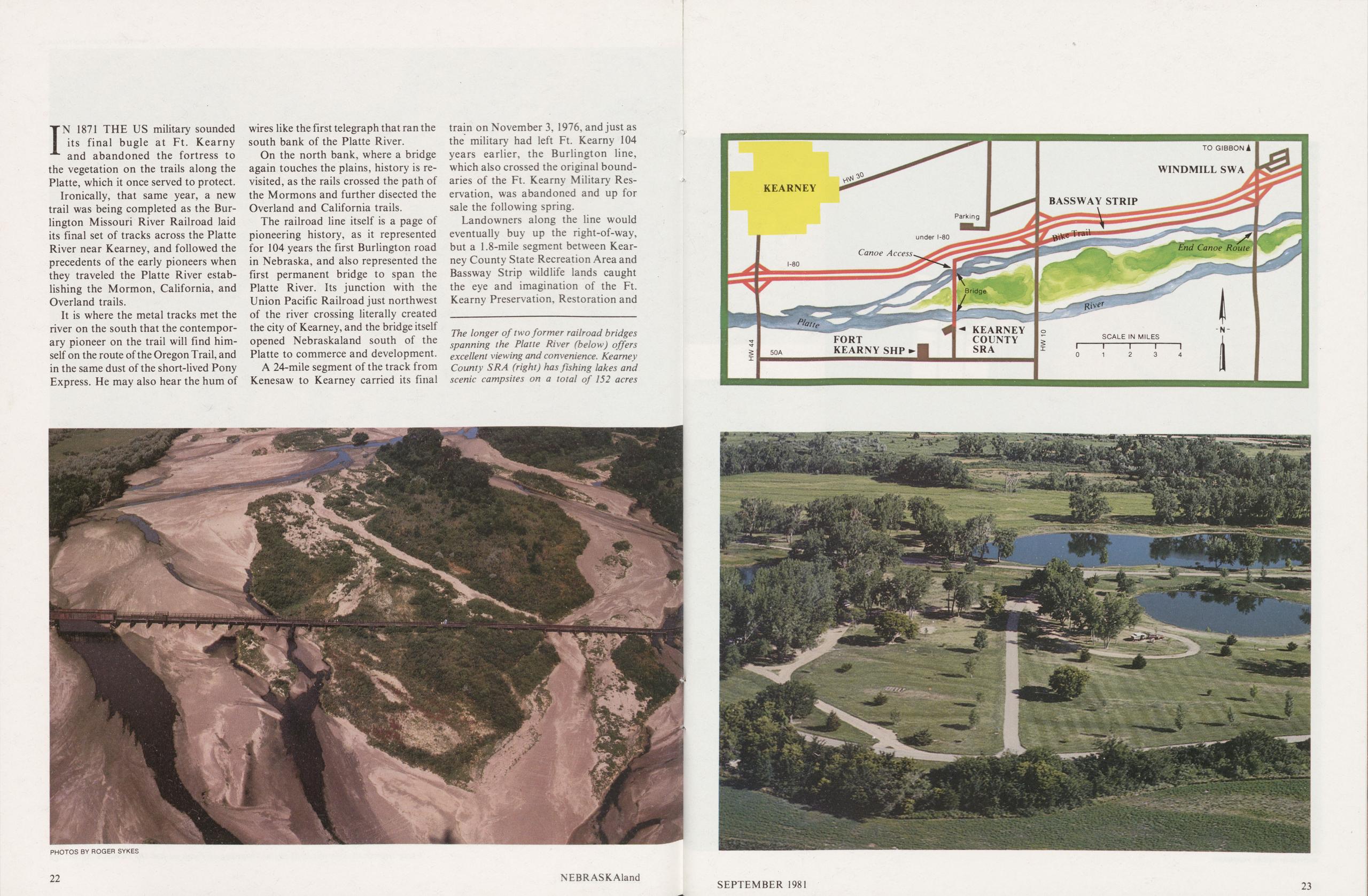
IN 1871 THE US military sounded its final bugle at Ft. Kearny and abandoned the fortress to the vegetation on the trails along the Platte, which it once served to protect.
Ironically, that same year, a new trail was being completed as the Burlington Missouri River Railroad laid its final set of tracks across the Platte River near Kearney, and followed the precedents of the early pioneers when they traveled the Platte River establishing the Mormon, California, and Overland trails.
It is where the metal tracks met the river on the south that the contemporary pioneer on the trail will find himself on the route of the Oregon Trail, and in the same dust of the short-lived Pony Express. He may also hear the hum of wires like the first telegraph that ran the south bank of the Platte River.
On the north bank, where a bridge again touches the plains, history is revisited, as the rails crossed the path of the Mormons and further disected the Overland and California trails.
The railroad line itself is a page of pioneering history, as it represented for 104 years the first Burlington road in Nebraska, and also represented the first permanent bridge to span the Platte River. Its junction with the Union Pacific Railroad just northwest of the river crossing literally created the city of Kearney, and the bridge itself opened Nebraskaland south of the Platte to commerce and development.
A 24-mile segment of the track from Kenesaw to Kearney carried its final train on November 3, 1976, and just as the military had left Ft. Kearny 104 years earlier, the Burlington line, which also crossed the original boundaries of the Ft. Kearny Military Reservation, was abandoned and up for sale the following spring.
Landowners along the line would eventually buy up the right-of-way, but a 1.8-mile segment between Kearney County State Recreation Area and Bassway Strip wildlife lands caught the eye and imagination of the Ft. Kearny Preservation, Restoration and
The longer of two former railroad bridges spanning the Platte River (below) offers excellent viewing and convenience. Kearney County SRA (right) has fishing lakes and scenic campsites on a total of 152 acres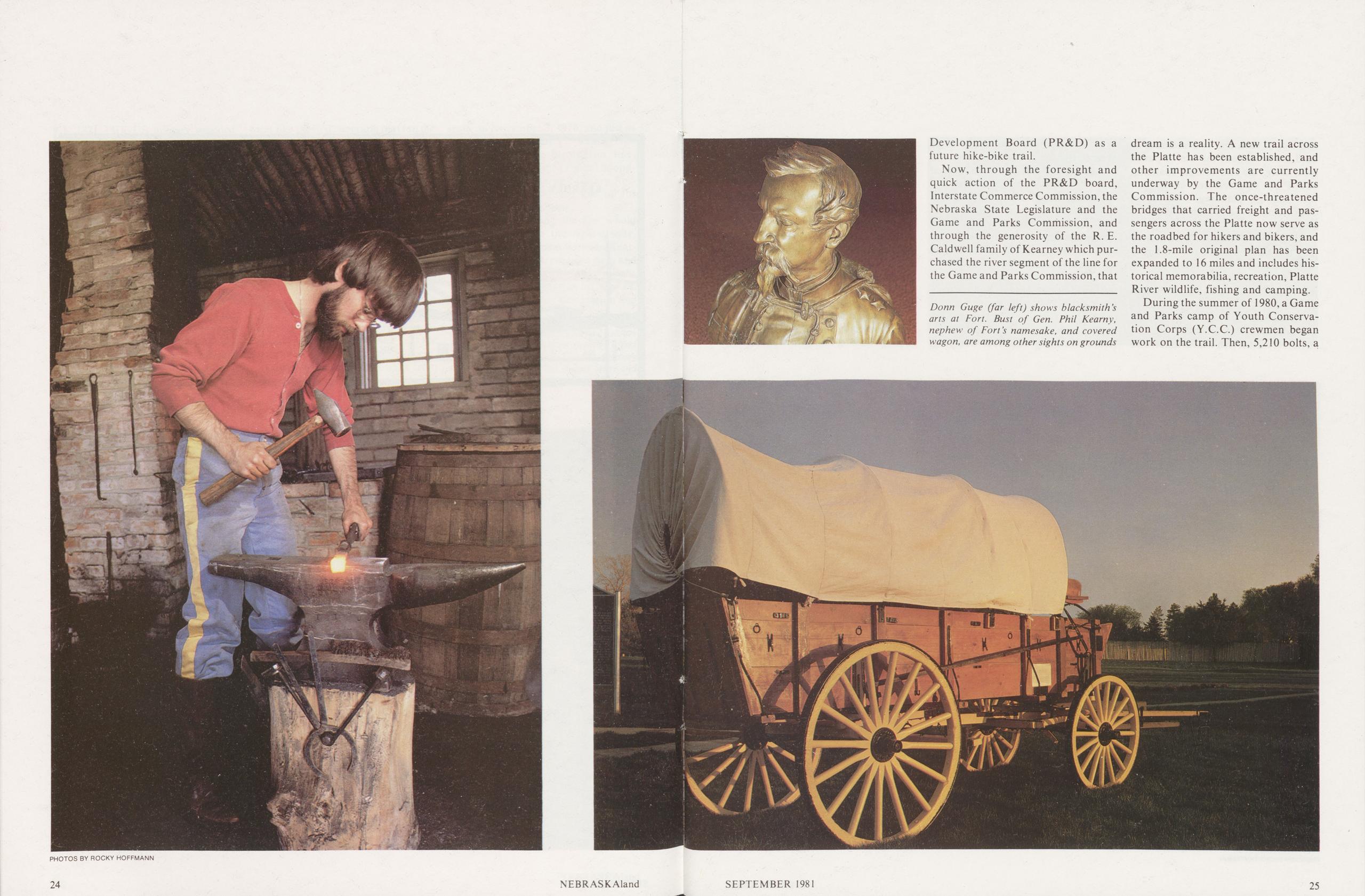
Development Board (PR&D) as a future hike-bike trail.
Now, through the foresight and quick action of the PR&D board, Interstate Commerce Commission, the Nebraska State Legislature and the Game and Parks Commission, and through the generosity of the R. E. Caldwell family of Kearney which purchased the river segment of the line for the Game and Parks Commission, that dream is a reality. A new trail across the Platte has been established, and other improvements are currently underway by the Game and Parks Commission. The once-threatened bridges that carried freight and passengers across the Platte now serve as the roadbed for hikers and bikers, and the 1.8-mile original plan has been expanded to 16 miles and includes historical memorabilia, recreation, Platte River wildlife, fishing and camping.
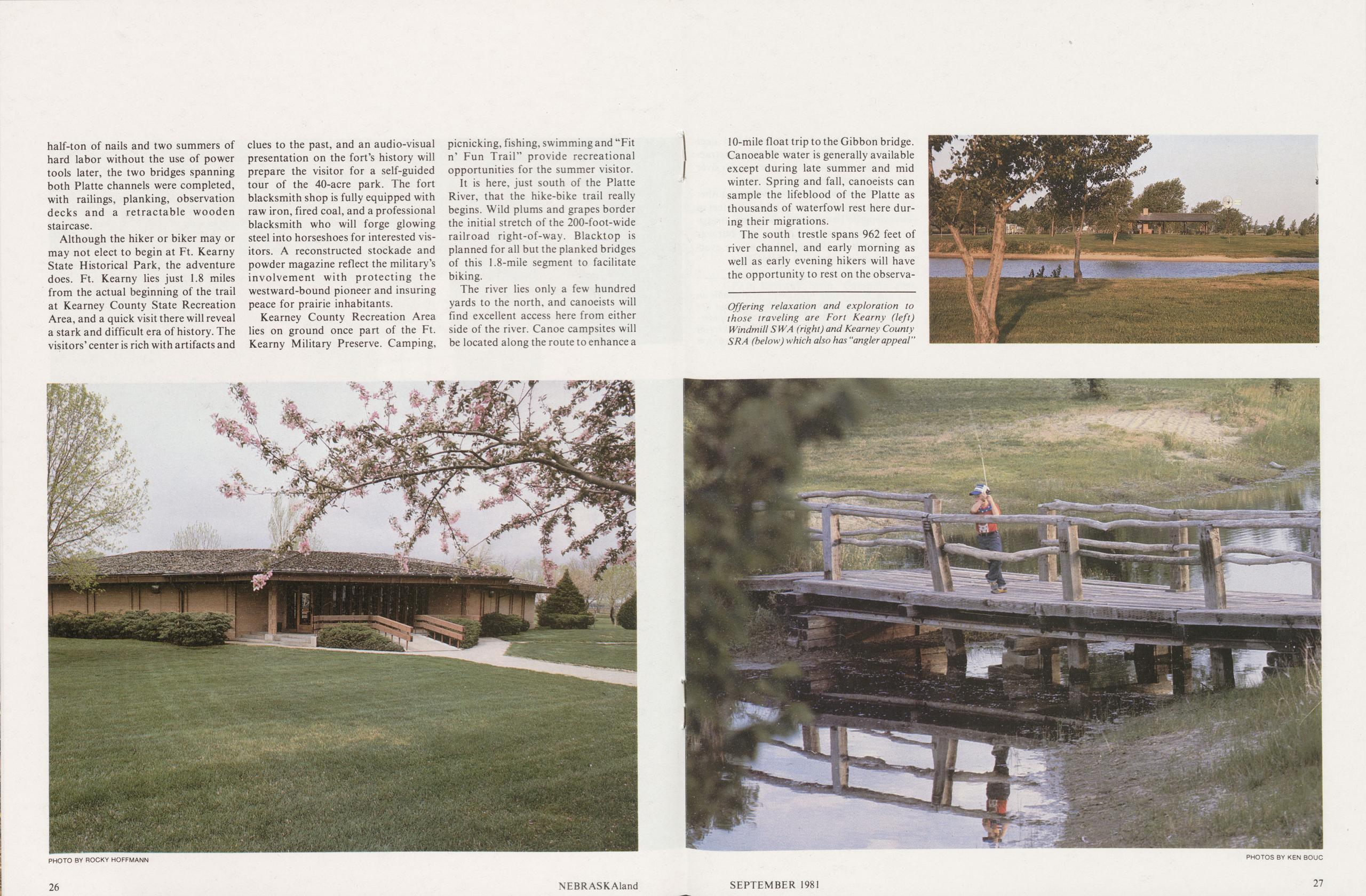
Donn Guge (far left) shows blacksmith's arts at Fort. Bust of Gen. Phil Kearny, nephew of Fort's namesake, and covered wagon, are among other sights on groundsDuring the summer of 1980, a Game
and Parks camp of Youth Conservation Corps (Y.C.C.) crewmen began
work on the trail. Then, 5,210 bolts, a
SEPTEMBER 1981
25
 half-ton of nails and two summers of
hard labor without the use of power
tools later, the two bridges spanning
both Platte channels were completed,
with railings, planking, observation
decks and a retractable wooden
staircase.
half-ton of nails and two summers of
hard labor without the use of power
tools later, the two bridges spanning
both Platte channels were completed,
with railings, planking, observation
decks and a retractable wooden
staircase.
Although the hiker or biker may or may not elect to begin at Ft. Kearny State Historical Park, the adventure does. Ft. Kearny lies just 1.8 miles from the actual beginning of the trail at Kearney County State Recreation Area, and a quick visit there will reveal a stark and difficult era of history. The visitors' center is rich with artifacts and clues to the past, and an audio-visual presentation on the fort's history will prepare the visitor for a self-guided tour of the 40-acre park. The fort blacksmith shop is fully equipped with raw iron, fired coal, and a professional blacksmith who will forge glowing steel into horseshoes for interested visitors. A reconstructed stockade and powder magazine reflect the military's involvement with protecting the westward-bound pioneer and insuring peace for prairie inhabitants.
Kearney County Recreation Area lies on ground once part of the Ft. Kearny Military Preserve. Camping, picnicking, fishing, swimming and "Fit n' Fun Trail" provide recreational opportunities for the summer visitor.
It is here, just south of the Platte River, that the hike-bike trail really begins. Wild plums and grapes border the initial stretch of the 200-foot-wide railroad right-of-way. Blacktop is planned for all but the planked bridges of this 1.8-mile segment to facilitate biking.
The river lies only a few hundred yards to the north, and canoeists will find excellent access here from either side of the river. Canoe campsites will be located along the route to enhance a
The south trestle spans 962 feet of river channel, and early morning as well as early evening hikers will have the opportunity to rest on the observation deck and see white-tailed deer browsing on riparian forage. A retractable staircase may be lowered for river access during low water.
The north trestle traverses another channel of the Platte and is 300 feet in length. In contrast, the north bridge was originally 1,820 feet long but was rebuilt in 1915 to adapt to the everchanging channels of the river.
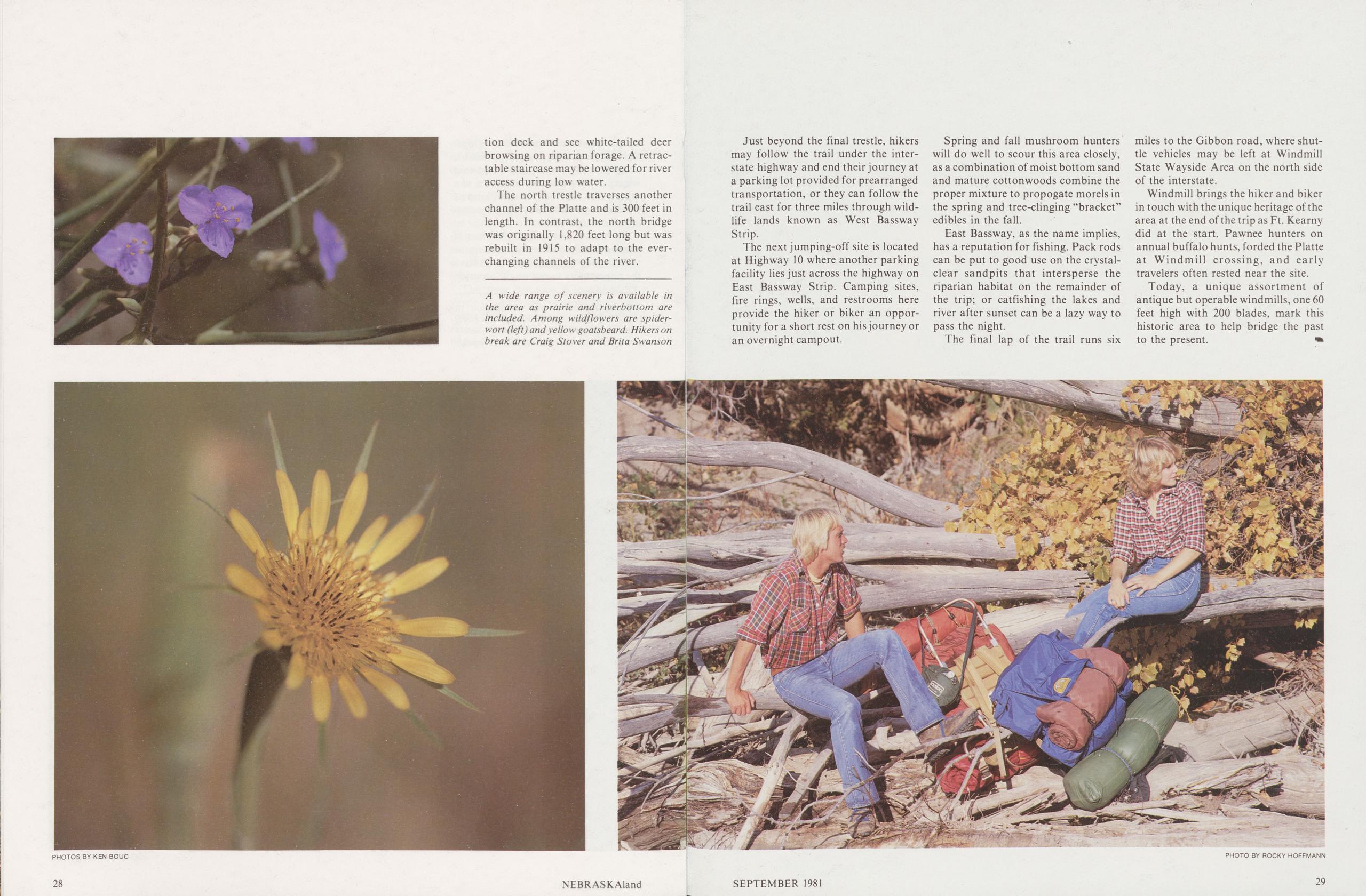
A wide range of scenery is available in the area as prairie and riverbottom are included. Among wild/lowers are spiderwort (left) and yellow goatsbeard. Hikers on break are Craig Stover and Brit a SwansonJust beyond the final trestle, hikers may follow the trail under the interstate highway and end their journey at a parking lot provided for prearranged transportation, or they can follow the trail east for three miles through wildlife lands known as West Bassway Strip.
The next jumping-off site is located at Highway 10 where another parking facility lies just across the highway on East Bassway Strip. Camping sites, fire rings, wells, and restrooms here provide the hiker or biker an opportunity for a short rest on his journey or an overnight campout.
Spring and fall mushroom hunters will do well to scour this area closely, as a combination of moist bottom sand and mature cottonwoods combine the proper mixture to propogate morels in the spring and tree-clinging "bracket" edibles in the fall.
East Bassway, as the name implies, has a reputation for fishing. Pack rods can be put to good use on the crystal-clear sandpits that intersperse the riparian habitat on the remainder of the trip; or catfishing the lakes and river after sunset can be a lazy way to pass the night.
The final lap of the trail runs six miles to the Gibbon road, where shuttle vehicles may be left at Windmill State Wayside Area on the north side of the interstate.
Windmill brings the hiker and biker in touch with the unique heritage of the area at the end of the trip as Ft. Kearny did at the start. Pawnee hunters on annual buffalo hunts, forded the Platte at Windmill crossing, and early travelers often rested near the site.
Today, a unique assortment of antique but operable windmills, one 60 feet high with 200 blades, mark this historic area to help bridge the past to the present.
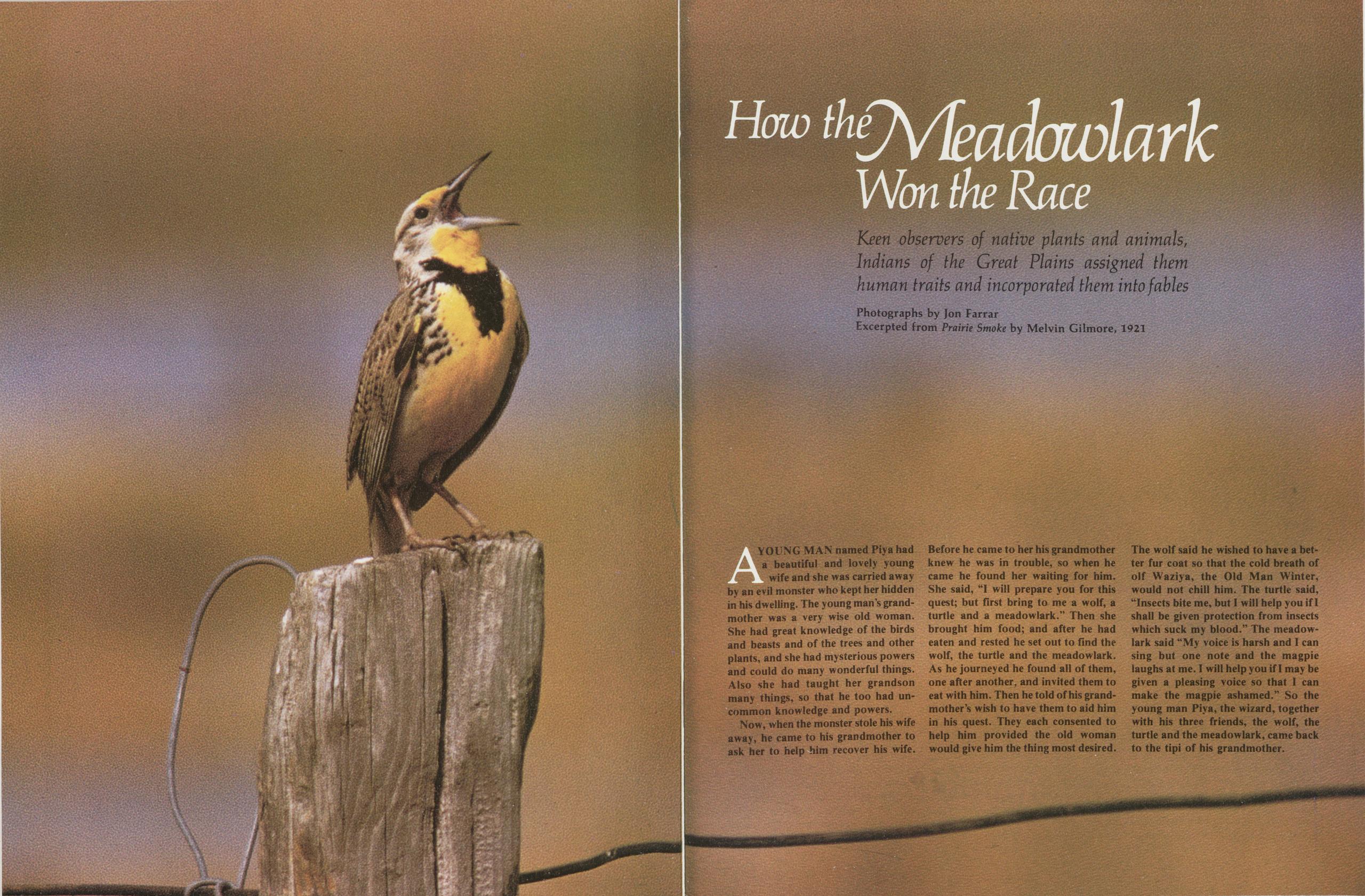
How the Meadowlark Won the Race
Keen observers of native plants and animals, Indians of the Great Plains assigned them human traits and incorporated them into fables Photographs by Jon Farrar Excerpted from Prairie Smoke by Melvin Gilmore, 1921A YOUNG MAN named Piya had TA a beautiful and lovely young wife and she was carried away an evil monster who kept her hidden in his dwelling. The young man's grandmother was a very wise old woman. She had great knowledge of the birds and beasts and of the trees and other plants, and she had mysterious powers and could do many wonderful things. Also she had taught her grandson many things, so that he too had uncommon knowledge and powers.
Now, when the monster stole his wife away, he came to his grandmother to ask her to help him recover his wife. Before he came to her his grandmother knew he was in trouble, so when he came he found her waiting for him. She said, "I will prepare you for this quest; but first bring to me a wolf, a turtle and a meadowlark." Then she brought him food; and after he had eaten and rested he set out to find the wolf, the turtle and the meadowlark. As he journeyed he found all of them, one after another, and invited them to eat with him. Then he told of his grandmother's wish to have them to aid him in his quest. They each consented to help him provided the old woman would give him the thing most desired. The wolf said he wished to have a better fur coat so that the cold breath of olf Waziya, the Old Man Winter, would not chill him. The turtle said, "Insects bite me, but I will help you if I shall be given protection from insects which suck my blood." The meadowlark said "My voice is harsh and I can sing but one note and the magpie laughs at me. I will help you if I may be given a pleasing voice so that I can make the magpie ashamed." So the young man Piya, the wizard, together with his three friends, the wolf, the turtle and the meadowlark, came back to the tipi of his grandmother.
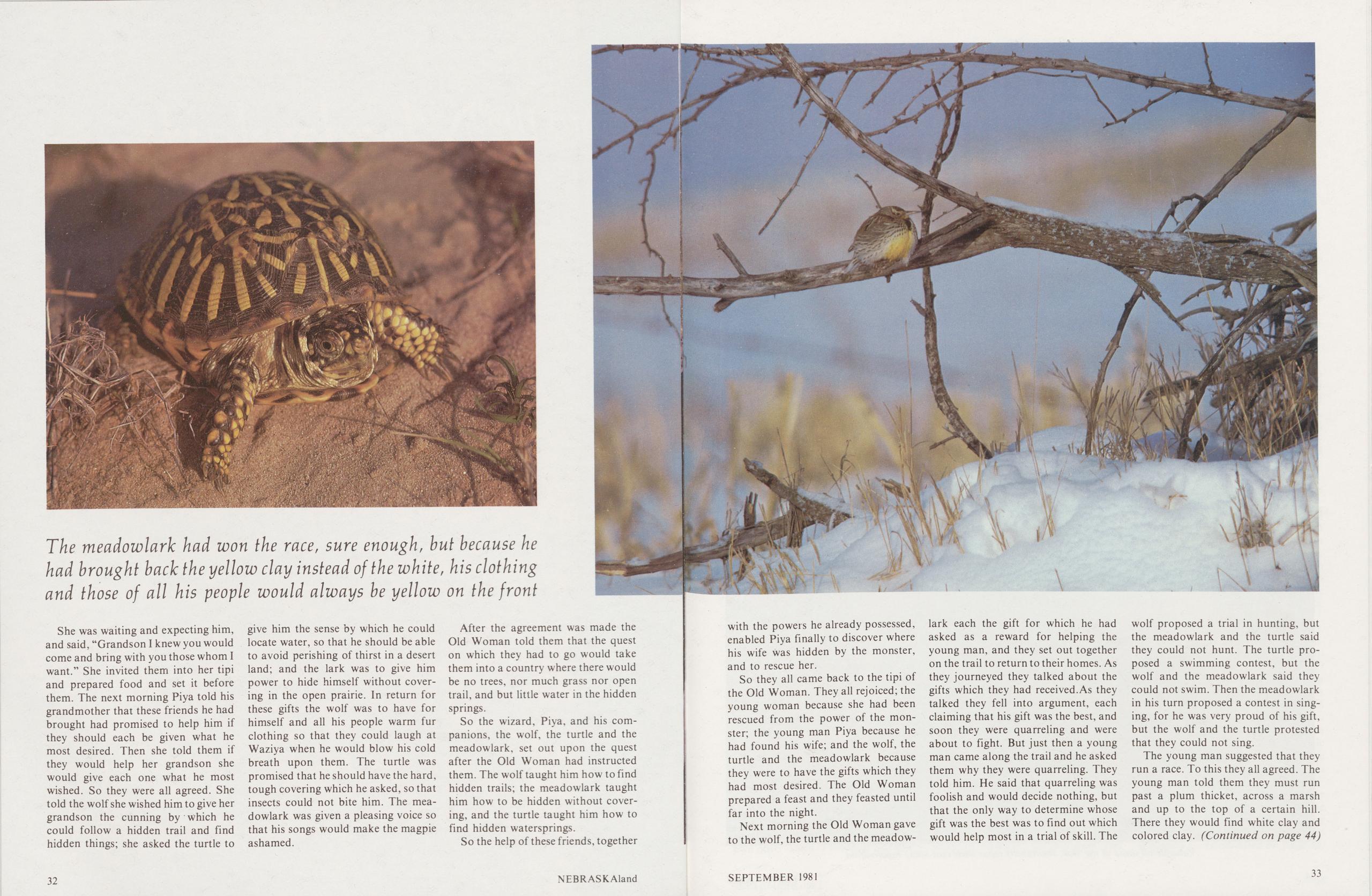
She was waiting and expecting him, and said, "Grandson I knew you would come and bring with you those whom I want." She invited them into her tipi and prepared food and set it before them. The next morning Piya told his grandmother that these friends he had brought had promised to help him if they should each be given what he most desired. Then she told them if they would help her grandson she would give each one what he most wished. So they were all agreed. She told the wolf she wished him to give her grandson the cunning by which he could follow a hidden trail and find hidden things; she asked the turtle to give him the sense by which he could locate water, so that he should be able to avoid perishing of thirst in a desert land; and the lark was to give him power to hide himself without covering in the open prairie. In return for these gifts the wolf was to have for himself and all his people warm fur clothing so that they could laugh at Waziya when he would blow his cold breath upon them. The turtle was promised that he should have the hard, tough covering which he asked, so that insects could not bite him. The meadowlark was given a pleasing voice so that his songs would make the magpie ashamed.
After the agreement was made the Old Woman told them that the quest on which they had to go would take them into a country where there would be no trees, nor much grass nor open trail, and but little water in the hidden springs.
So the wizard, Piya, and his companions, the wolf, the turtle and the meadowlark, set out upon the quest after the Old Woman had instructed them. The wolf taught him how to find hidden trails; the meadowlark taught him how to be hidden without covering, and the turtle taught him how to find hidden watersprings.
So the help of these friends, together 32 NEBRASKAland with the powers he already possessed, enabled Piya finally to discover where his wife was hidden by the monster, and to rescue her.
So they all came back to the tipi of the Old Woman. They all rejoiced; the young woman because she had been rescued from the power of the monster; the young man Piya because he had found his wife; and the wolf, the turtle and the meadowlark because they were to have the gifts which they had most desired. The Old Woman prepared a feast and they feasted until far into the night.
Next morning the Old Woman gave to the wolf, the turtle and the meadowlark each the gift for which he had asked as a reward for helping the young man, and they set out together on the trail to return to their homes. As they journeyed they talked about the gifts which they had received.As they talked they fell into argument, each claiming that his gift was the best, and soon they were quarreling and were about to fight. But just then a young man came along the trail and he asked them why they were quarreling. They told him. He said that quarreling was foolish and would decide nothing, but that the only way to determine whose gift was the best was to find out which would help most in a trial of skill. The wolf proposed a trial in hunting, but the meadowlark and the turtle said they could not hunt. The turtle proposed a swimming contest, but the wolf and the meadowlark said they could not swim. Then the meadowlark in his turn proposed a contest in singing, for he was very proud of his gift, but the wolf and the turtle protested that they could not sing.
The young man suggested that they run a race. To this they all agreed. The young man told them they must run past a plum thicket, across a marsh and up to the top of a certain hill. There they would find white clay and colored clay. (Continued on page 44)
SEPTEMBER 1981 33
Shelterbelts a long-term cure
BY FAYE MUSILDUST WAS BLOWING from Texas to Canada. Red clay from the plains of Oklahoma filtered high into seering, cloudless skies and wafted over the whole mid-continent to sift through fissures around windows and doors and into unnoticed crevasses in eaves and corners, and settling on mantle and floor in Nebraska.
Sand blew into naked dunes. Topsoil drifted over fences and outbuildings. Precious topsoil, sucked up into relentless skies, drifted wherever the never-ending winds chose, stripping some fields lifeless, burying others.
Farmers were abandoning their land, fleeing to who-knows-where to join the lines of jobless in the despairing cities.
To stop the blowing dust, and to provide jobs for the unemployed, the federal government launched a massive tree-planting program which came to be known as the Shelterbelt Project. In a Master's Thesis, written for Texas A & M University, Virginia Hilkemann of Pierce, Nebraska, discussed the projects and its effects on the Plains and the farmers. "The absence of trees on the Great Plains had always been a problem," she wrote. "For this reason, from the first settlements, people entering and living in the region have been preoccupied with planting trees."
It took the drought of the 1930's, though, to get the federal government involved in actual tree planting.
"During its lifetime, the project suffered from financial difficulties and public misunderstanding of its aims and purposes," Hilkemann continued. "Although it never resolved its financial woes, the program gradually gained the wholehearted support of the inhabitants of the Great Plains.
"Investigations of the shelterbelts' benefits followed the program's conclusion," she wrote. "Study after study sang their praises."
Spurred by the recent years of drought and increased soil erosion, and by her own observation of shelterbelt destruction, Hilkemann gathered the results of studies involving New Deal shelter-belts, comments of those who planted the trees, and those who supported the project, plus information on the political and social atmosphere. "The experiences of the New Deal Shelterbelt Project may serve as a useful guide in the formulation and planning of future federal and state environmental policies," she explained.
Emphasizing the critical need for shelterbelts, Hilkemann recounts the impact of cultivation coming to the Plains. "When farmers settled on the Great Plains, their plowing disrupted nature's carefully designed system. As compensation for the lack of trees in this region, erosion-resistant sods had evolved. But with the coming of the farmer, the sod, broken up by the plow, disintegrated and gradually the wind sifted the soil, blew away the lighter, more fertile humus, and left behind less fertile material.
"This story of the Plains is not new. Droughts during the early 1870's and 1890's had driven many people back East. In 1910 and 1911, sparse rainfall was again recorded. Drought, a cyclical event on the Great Plains, desscended there again in the early 1930's, and national attention became focused there when the 'black blizzards' once again desolated the area."
According to Hilkemann, the Shelterbelt Project was proposed as a possible solution, but it started a furor of information and misinformation as skeptics ridiculed the program and proponents made far-reaching claims. Hilkemann quoted Jonathan Mitchell of the New Republic as saying that farmers could only avoid dust storms by making wiser use of the land, not by planting trees. Wilson Compton, another critic writing for Forum, suggested that the Great Plains region was better suited for cattle than crops. Compton believed that insead of planting trees to prevent soil erosion, the government should plant grass.
Perhaps Raphael Zon, technical director of the project, summed it up best. "The Shelterbelt Project, stripped of the exaggeration of its friends and the misinterpretations of its opponents, resolves itself simply into concentrated forest planting within a comparatively narrow belt some 100 miles wide and 1,200 miles long."
But it was—and is—more than that. It was an attempt to modify the effects of the weather.
Provisions of the program included a belt of trees 100 miles wide, as Zon said, extending for 1,000 miles from the Canadian line to northern Texas. Those windbreaks would run north and south; each would be seven rods wide and one mile apart. Land for the trees was to be purchased or leased for 99 years.
Over the eight years of the project, those provisions underwent some important changes. Perhaps the land policy was the most changed. From long-term lease or purchase, the government went to agreements allowing farmers to establish shelterbelts on their own land. That change was essential to getting landowner cooperation, and the revised policy enjoyed the enthusiastic support of the farmers because the government was no longer involved in land ownership.
Another important change in the concept was the abandonment of the zone idea. Rather than concentrating on only the rigid area, the foresters expanded (Continued on page 46)
SEPTEMBER 1981 35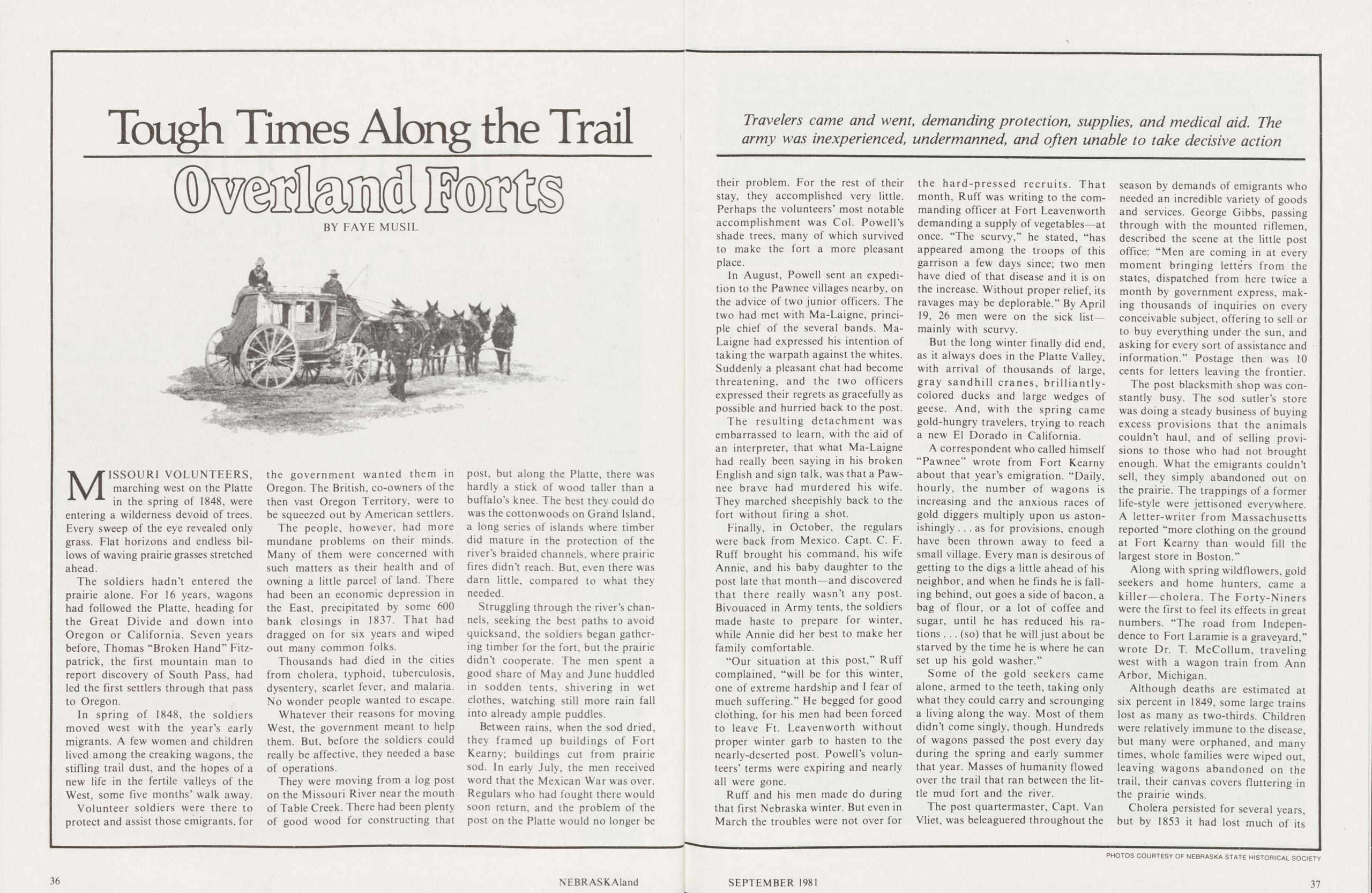
Tough Times Along the Trail Overland Forts
BY FAYE MUSILMISSOURI VOLUNTEERS, marching west on the Platte in the spring of 1848, were entering a wilderness devoid of trees. Every sweep of the eye revealed only grass. Flat horizons and endless billows of waving prairie grasses stretched ahead.
The soldiers hadn't entered the prairie alone. For 16 years, wagons had followed the Platte, heading for the Great Divide and down into Oregon or California. Seven years before, Thomas "Broken Hand" Fitz-patrick, the first mountain man to report discovery of South Pass, had led the first settlers through that pass to Oregon.
In spring of 1848, the soldiers moved west with the year's early migrants. A few women and children lived among the creaking wagons, the stifling trail dust, and the hopes of a new life in the fertile valleys of the West, some five months' walk away.
Volunteer soldiers were there to protect and assist those emigrants, for the government wanted them in Oregon. The British, co-owners of the then vast Oregon Territory, were to be squeezed out by American settlers.
The people, however, had more mundane problems on their minds. Many of them were concerned with such matters as their health and of owning a little parcel of land. There had been an economic depression in the East, precipitated by some 600 bank closings in 1837. That had dragged on for six years and wiped out many common folks.
Thousands had died in the cities from cholera, typhoid, tuberculosis, dysentery, scarlet fever, and malaria. No wonder people wanted to escape.
Whatever their reasons for moving West, the government meant to help them. But, before the soldiers could really be affective, they needed a base of operations.
They were moving from a log post on the Missouri River near the mouth of Table Creek. There had been plenty of good wood for constructing that post, but along the Platte, there was hardly a stick of wood taller than a buffalo's knee. The best they could do was the cottonwoods on Grand Island, a long series of islands where timber did mature in the protection of the river's braided channels, where prairie fires didn't reach. But, even there was darn little, compared to what they needed.
Struggling through the river's channels, seeking the best paths to avoid quicksand, the soldiers began gathering timber for the fort, but the prairie didn't cooperate. The men spent a good share of May and June huddled in sodden tents, shivering in wet clothes, watching still more rain fall into already ample puddles.
Between rains, when the sod dried, they framed up buildings of Fort Kearny; buildings cut from prairie sod. In early July, the men received word that the Mexican War was over. Regulars who had fought there would soon return, and the problem of the post on the Platte would no longer be 36 NEBRASKAland their problem. For the rest of their stay, they accomplished very little. Perhaps the volunteers' most notable accomplishment was Col. Powell's shade trees, many of which survived to make the fort a more pleasant place.
Travelers came and went, demanding protection, supplies, and medical aid. The army was inexperienced, undermanned, and often unable to take decisive actionIn August, Powell sent an expedition to the Pawnee villages nearby, on the advice of two junior officers. The two had met with Ma-Laigne, principle chief of the several bands. MaLaigne had expressed his intention of taking the warpath against the whites. Suddenly a pleasant chat had become threatening, and the two officers expressed their regrets as gracefully as possible and hurried back to the post.
The resulting detachment was embarrassed to learn, with the aid of an interpreter, that what Ma-Laigne had really been saying in his broken English and sign talk, was that a Pawnee brave had murdered his wife. They marched sheepishly back to the fort without firing a shot.
Finally, in October, the regulars were back from Mexico. Capt. C. F. Ruff brought his command, his wife Annie, and his baby daughter to the post late that month—and discovered that there really wasn't any post. Bivouaced in Army tents, the soldiers made haste to prepare for winter, while Annie did her best to make her family comfortable.
"Our situation at this post," Ruff complained, "will be for this winter, one of extreme hardship and I fear of much suffering." He begged for good clothing, for his men had been forced to leave Ft. Leavenworth without proper winter garb to hasten to the nearly-deserted post. Powell's volunteers' terms were expiring and nearly all were gone.
Ruff and his men made do during that first Nebraska winter. But even in March the troubles were not over for the hard-pressed recruits. That month, Ruff was writing to the commanding officer at Fort Leavenworth demanding a supply of vegetables—at once. "The scurvy," he stated, "has appeared among the troops of this garrison a few days since; two men have died of that disease and it is on the increase. Without proper relief, its ravages may be deplorable." By April 19, 26 men were on the sick list—mainly with scurvy.
But the long winter finally did end, as it always does in the Platte Valley, with arrival of thousands of large, gray sandhill cranes, brilliantly-colored ducks and large wedges of geese. And, with the spring came gold-hungry travelers, trying to reach a new El Dorado in California.
A correspondent who called himself "Pawnee" wrote from Fort Kearny about that year's emigration. "Daily, hourly, the number of wagons is increasing and the anxious races of gold diggers multiply upon us astonishingly as for provisions, enough have been thrown away to feed a small village. Every man is desirous of getting to the digs a little ahead of his neighbor, and when he finds he is falling behind, out goes a side of bacon, a bag of flour, or a lot of coffee and sugar, until he has reduced his rations (so) that he will just about be starved by the time he is where he can set up his gold washer."
Some of the gold seekers came alone, armed to the teeth, taking only what they could carry and scrounging a living along the way. Most of them didn't come singly, though. Hundreds of wagons passed the post every day during the spring and early summer that year. Masses of humanity flowed over the trail that ran between the little mud fort and the river.
The post quartermaster, Capt. Van Vliet, was beleaguered throughout the season by demands of emigrants who needed an incredible variety of goods and services. George Gibbs, passing through with the mounted riflemen, described the scene at the little post office: "Men are coming in at every moment bringing letters from the states, dispatched from here twice a month by government express, making thousands of inquiries on every conceivable subject, offering to sell or to buy everything under the sun, and asking for every sort of assistance and information." Postage then was 10 cents for letters leaving the frontier.
The post blacksmith shop was constantly busy. The sod sutler's store was doing a steady business of buying excess provisions that the animals couldn't haul, and of selling provisions to those who had not brought enough. What the emigrants couldn't sell, they simply abandoned out on the prairie. The trappings of a former life-style were jettisoned everywhere. A letter-writer from Massachusetts reported "more clothing on the ground at Fort Kearny than would fill the largest store in Boston."
Along with spring wildflowers, gold seekers and home hunters, came a killer—cholera. The Forty-Niners were the first to feel its effects in great numbers. "The road from Independence to Fort Laramie is a graveyard," wrote Dr. T. McCollum, traveling west with a wagon train from Ann Arbor, Michigan.
Although deaths are estimated at six percent in 1849, some large trains lost as many as two-thirds. Children were relatively immune to the disease, but many were orphaned, and many times, whole families were wiped out, leaving wagons abandoned on the trail, their canvas covers fluttering in the prairie winds.
Cholera persisted for several years, but by 1853 it had lost much of its venom. Accidents, too, took a toll. There were gunshot wounds, drownings, and mistakes involving livestock. Many were injured or killed under wagon wheels. The post surgeon must surely have treated many of these desperate pilgrims as they rolled and strolled into Fort Kearny, but there is little record of it.
PHOTOS COURTESY OF NEBRASKA STATE HISTORICAL SOCIETY SEPTEMBER 1981 37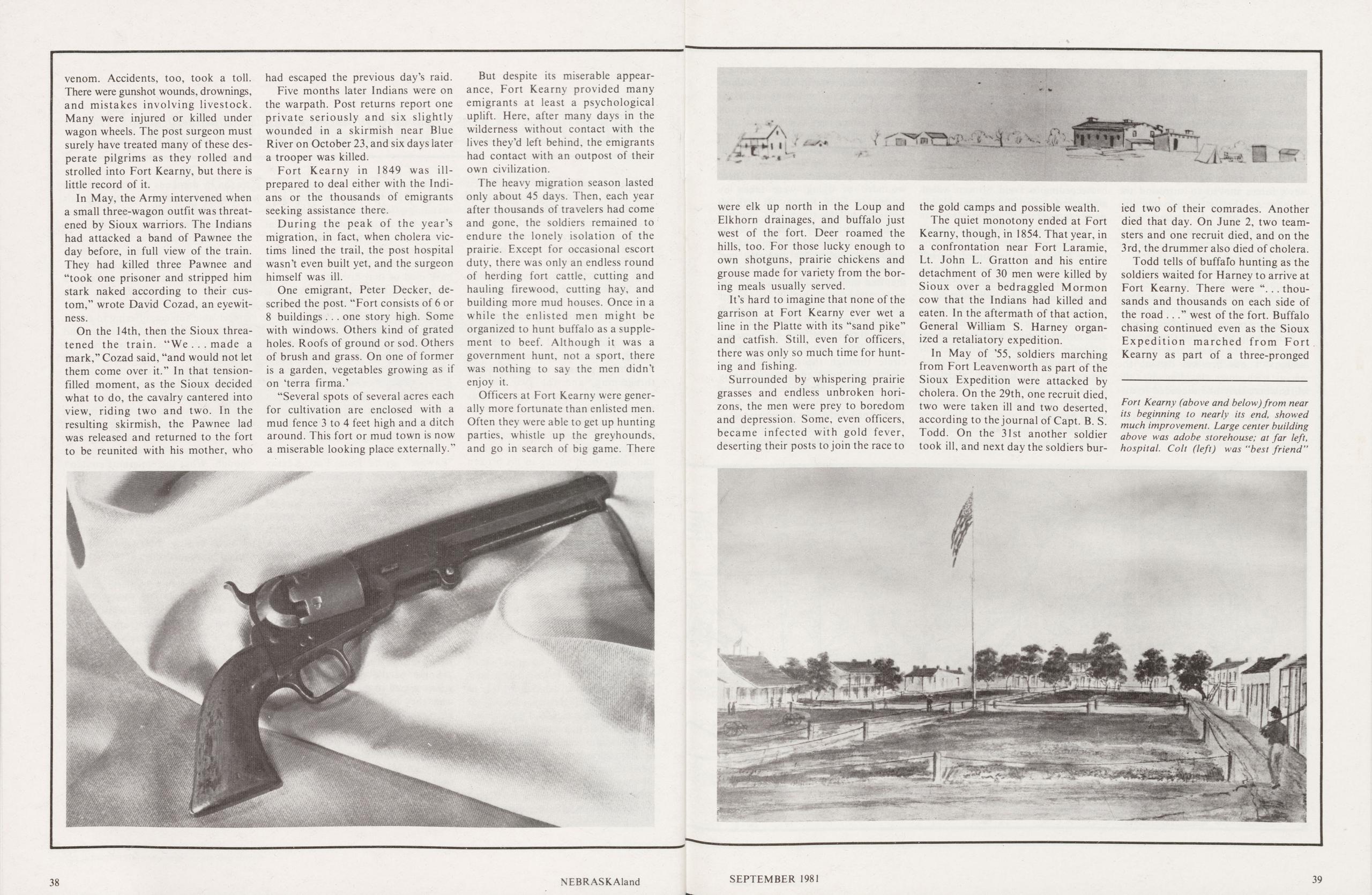
In May, the Army intervened when a small three-wagon outfit was threatened by Sioux warriors. The Indians had attacked a band of Pawnee the day before, in full view of the train. They had killed three Pawnee and "took one prisoner and stripped him stark naked according to their custom," wrote David Cozad, an eyewitness.
On the 14th, then the Sioux threatened the train. "We made a mark," Cozad said, "and would not let them come over it." In that tension-filled moment, as the Sioux decided what to do, the cavalry cantered into view, riding two and two. In the resulting skirmish, the Pawnee lad was released and returned to the fort to be reunited with his mother, who had escaped the previous day's raid.
Five months later Indians were on the warpath. Post returns report one private seriously and six slightly wounded in a skirmish near Blue River on October 23, and six days later a trooper was killed.
Fort Kearny in 1849 was illprepared to deal either with the Indians or the thousands of emigrants seeking assistance there.
During the peak of the year's migration, in fact, when cholera victims lined the trail, the post hospital wasn't even built yet, and the surgeon himself was ill.
One emigrant, Peter Decker, described the post. "Fort consists of 6 or 8 buildings one story high. Some with windows. Others kind of grated holes. Roofs of ground or sod. Others of brush and grass. On one of former is a garden, vegetables growing as if on 'terra firma.'
"Several spots of several acres each for cultivation are enclosed with a mud fence 3 to 4 feet high and a ditch around. This fort or mud town is now a miserable looking place externally."
But despite its miserable appearance, Fort Kearny provided many emigrants at least a psychological uplift. Here, after many days in the wilderness without contact with the lives they'd left behind, the emigrants had contact with an outpost of their own civilization.
The heavy migration season lasted only about 45 days. Then, each year after thousands of travelers had come and gone, the soldiers remained to endure the lonely isolation of the prairie. Except for occasional escort duty, there was only an endless round of herding fort cattle, cutting and hauling firewood, cutting hay, and building more mud houses. Once in a while the enlisted men might be organized to hunt buffalo as a supplement to beef. Although it was a government hunt, not a sport, there was nothing to say the men didn't enjoy it.
Officers at Fort Kearny were generally more fortunate than enlisted men. Often they were able to get up hunting parties, whistle up the greyhounds, and go in search of big game. There 38 NEBRASKAland
It's hard to imagine that none of the garrison at Fort Kearny ever wet a line in the Platte with its "sand pike" and catfish. Still, even for officers, there was only so much time for hunting and fishing.
Surrounded by whispering prairie grasses and endless unbroken horizons, the men were prey to boredom and depression. Some, even officers, became infected with gold fever, deserting their posts to join the race to the gold camps and possible wealth.
The quiet monotony ended at Fort Kearny, though, in 1854. That year, in a confrontation near Fort Laramie, Lt. John L. Gratton and his entire detachment of 30 men were killed by Sioux over a bedraggled Mormon cow that the Indians had killed and eaten. In the aftermath of that action, General William S. Harney organized a retaliatory expedition.
In May of '55, soldiers marching from Fort Leavenworth as part of the Sioux Expedition were attacked by cholera. On the 29th, one recruit died, two were taken ill and two deserted, according to the journal of Capt. B. S. Todd. On the 31st another soldier took ill, and next day the soldiers buried two of their comrades. Another died that day. On June 2, two teamsters and one recruit died, and on the 3rd, the drummer also died of cholera.
Todd tells of buffalo hunting as the soldiers waited for Harney to arrive at Fort Kearny. There were " thousands and thousands on each side of the road " west of the fort. Buffalo chasing continued even as the Sioux Expedition marched from Fort Kearny as part of a three-pronged force gathered at Fort Laramie, Fort Pierre, and Fort Kearny.
Fort Kearny (above and below) from near its beginning to nearly its end, showed much improvement. Large center building above was adobe storehouse; at far left, hospital. Colt (left) was "best friend"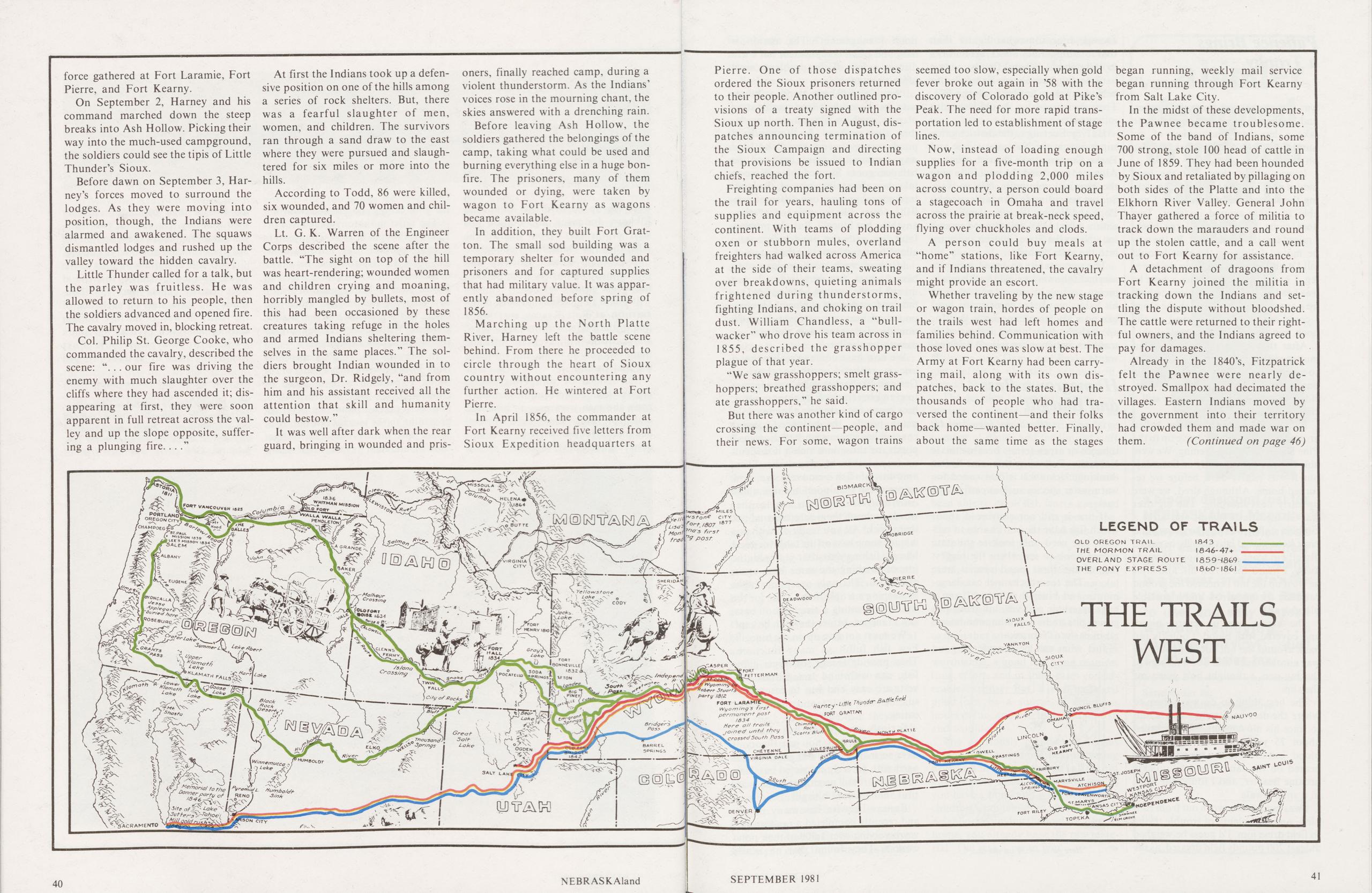
On September 2, Harney and his command marched down the steep breaks into Ash Hollow. Picking their way into the much-used campground, the soldiers could see the tipis of Little Thunder's Sioux.
Before dawn on September 3, Harney's forces moved to surround the lodges. As they were moving into position, though, the Indians were alarmed and awakened. The squaws dismantled lodges and rushed up the valley toward the hidden cavalry.
Little Thunder called for a talk, but the parley was fruitless. He was allowed to return to his people, then the soldiers advanced and opened fire. The cavalry moved in, blocking retreat.
Col. Philip St. George Cooke, who commanded the cavalry, described the scene: ". . . our fire was driving the enemy with much slaughter over the cliffs where they had ascended it; disappearing at first, they were soon apparent in full retreat across the valley and up the slope opposite, suffering a plunging fire."
At first the Indians took up a defensive position on one of the hills among a series of rock shelters. But, there was a fearful slaughter of men, women, and children. The survivors ran through a sand draw to the east where they were pursued and slaughtered for six miles or more into the hills.
According to Todd, 86 were killed, six wounded, and 70 women and children captured.
Lt. G. K. Warren of the Engineer Corps described the scene after the battle. "The sight on top of the hill was heart-rendering; wounded women and children crying and moaning, horribly mangled by bullets, most of this had been occasioned by these creatures taking refuge in the holes and armed Indians sheltering themselves in the same places." The soldiers brought Indian wounded in to the surgeon, Dr. Ridgely, "and from him and his assistant received all the attention that skill and humanity could bestow."
It was well after dark when the rear guard, bringing in wounded and prisoners, finally reached camp, during a violent thunderstorm. As the Indians' voices rose in the mourning chant, the skies answered with a drenching rain.
Before leaving Ash Hollow, the soldiers gathered the belongings of the camp, taking what could be used and burning everything else in a huge bonfire. The prisoners, many of them wounded or dying, were taken by wagon to Fort Kearny as wagons became available.
In addition, they built Fort Gratton. The small sod building was a temporary shelter for wounded and prisoners and for captured supplies that had military value. It was apparently abandoned before spring of 1856.
Marching up the North Platte River, Harney left the battle scene behind. From there he proceeded to circle through the heart of Sioux country without encountering any further action. He wintered at Fort Pierre.
In April 1856, the commander at Fort Kearny received five letters from Sioux Expedition headquarters at 40 NEBRASKAland Pierre. One of those dispatches ordered the Sioux prisoners returned to their people. Another outlined provisions of a treaty signed with the Sioux up north. Then in August, dispatches announcing termination of the Sioux Campaign and directing that provisions be issued to Indian chiefs, reached the fort.
Freighting companies had been on the trail for years, hauling tons of supplies and equipment across the continent. With teams of plodding oxen or stubborn mules, overland freighters had walked across America at the side of their teams, sweating over breakdowns, quieting animals frightened during thunderstorms, fighting Indians, and choking on trail dust. William Chandless, a "bullwacker" who drove his team across in 1855, described the grasshopper plague of that year.
"We saw grasshoppers; smelt grasshoppers; breathed grasshoppers; and ate grasshoppers," he said.
But there was another kind of cargo crossing the continent—people, and their news. For some, wagon trains seemed too slow, especially when gold fever broke out again in '58 with the discovery of Colorado gold at Pike's Peak. The need for more rapid transportation led to establishment of stage lines.
Now, instead of loading enough supplies for a five-month trip on a wagon and plodding 2,000 miles across country, a person could board a stagecoach in Omaha and travel across the prairie at break-neck speed, flying over chuckholes and clods.
A person could buy meals at "home" stations, like Fort Kearny, and if Indians threatened, the cavalry might provide an escort.
Whether traveling by the new stage or wagon train, hordes of people on the trails west had left homes and families behind. Communication with those loved ones was slow at best. The Army at Fort Kearny had been carrying mail, along with its own dispatches, back to the states. But, the thousands of people who had traversed the continent—and their folks back home—wanted better. Finally, about the same time as the stages began running, weekly mail service began running through Fort Kearny from Salt Lake City.
In the midst of these developments, the Pawnee became troublesome. Some of the band of Indians, some 700 strong, stole 100 head of cattle in June of 1859. They had been hounded by Sioux and retaliated by pillaging on both sides of the Platte and into the Elkhorn River Valley. General John Thayer gathered a force of militia to track down the marauders and round up the stolen cattle, and a call went out to Fort Kearny for assistance.
A detachment of dragoons from Fort Kearny joined the militia in tracking down the Indians and settling the dispute without bloodshed. The cattle were returned to their rightful owners, and the Indians agreed to pay for damages.
Already in the 1840's, Fitzpatrick felt the Pawnee were nearly destroyed. Smallpox had decimated the villages. Eastern Indians moved by the government into their territory had crowded them and made war on them. (Continued on page 46)
SEPTEMBER 1981 41
Patience Brings a Trophy
(Continued from page 15)was about the first part of October, and by then my wife was beginning to take a less-than-kindly view of my hunting before and after work and also on weekends.
It was about then that the herd moved west into the hills, and by watching their direction of movement I was able to circle around in front. Two does came by, then the large buck. I raised up slowly and shot. By the way he moved following the shot I could tell I'd hit him, most likely in the lower leg. I had a pretty good idea where he was headed, so I returned home to pick up a spotting scope. Through the scope I could see he'd been knicked on the hock, but the wound was very slight.
After that I saw a nice three-point muley while grouse hunting, but after so much effort already spent on the big one with nothing to show for it, I decided to wait—I felt there was still a chance for him.
Fall turkey season opener rolled around and Scott and I drove up to the Pine Ridge on Friday evening. We were able to bag our birds early on Saturday, but it was nearly dark before we returned home. Although tired, we were up early next morning. The big deer was in the alfalfa again, and after a circular stalk I was able to get around him. As he moved into the hills, he passed directly in front of me, about 35 yards away. I heard the arrow hit, and after he went up the hill I checked the ground carefully for my arrow and a possible blood trail.
The arrow was in several pieces and covered with blood. I quickly ran back around the hill but all I could see was another buck and doe—no sign of the big one. I thought he'd given me the slip.
The best thing to do was return to where the deer had stood and attempt to trace his movements. His tracks led about 75 yards without any sign of blood, but after that a blood trail appeared on the sand. The trail quickly became heavier, and I found the buck in a small swale.
I was completely worn out from running, and had plenty of trouble trying to field dress him. I'd guess he weighed at least 200 pounds field dressed, as the average runs somewhat lighter than that for adult muley bucks, around 175 to 180 pounds. When I finally made it back to the house my wife refused to believe my story until she saw the deer. Then she agreed we should have him mounted.
Harvey Suetsugu, the district game supervisor at the Nebraska Game and Parks Commission's district office in Alliance, measured the rack following the required minimum 60-day wait. Scored according to standards used by Pope and Young, the typical mule deer antlers tallied 143% points; good enough for a Nebraska State Citation and entry into the state records.
The opportunity to spend an entire summer following a single buck's movements, tracing his routes and learning his habits may never come again, but I can now say from experience that for an archery deer hunter interested in trophies, patience can indeed bring rewards.
Homegrown Bass and Bluegill
(Continued from page 13)tobacco or aspen trees—because this is Nebraska. Following this same line of thinking, Nebraska is best suited for warmwater species such as catfish and bass.
If one is still not convinced about which fish have the best chance to succeed, one need only look to the state record book to see where the biggest fish of the three pond species were taken. The record channel cat, large-mouth and bluegill came not from a huge reservoir or river, but from two gravel pits and a small impoundment, all in eastern Nebraska.
Just what can be considered good
Any good fishery, pond or otherwise, has a well-balanced combination of prey, such as bluegill, and predators, such as bass. As thousands of pond owners have learned the hard way, remove too many bass and the balance goes. Stunted bluegill soon take over. Next time around, the landlord goes shopping for a different panfish species like crappie or perch—anything but bluegill. But, the primary fault lies with the pond owner who allows bass overharvest in the first place.
Much research has been devoted to bass harvest, but how many is too many? In the past we have advised removing four pounds of bluegill for every pound of bass; or not over 20 to 30 pounds of bass per acre per year, or something similar.
We now have come to realize that if one is realistic, nothing short of Gestapo-like tactics will allow a farmer to even keep track of, let along control, how many bass are being removed. In many ponds, the balanced-harvest concept has just not worked. For small ponds, or those in which it is difficult or impossible to closely regulate amount of fish removed, we now recommend that pond owners allow catch and release only on bass. In other words, unhook them carefully and put them back! All you really do with this is trade some bass on the table for good bluegill fishing year after year, plus the fun of catching the same bass again and again. The only exception might be keeping a trophy fish—"one for the wall,"—or setting a size limit on bass, say 15 inches, before they can be kept.
We must not give up on the bluegill. Few fish fulfill so many functions. They provide forage for larger game fish, can withstand tremendous harvest, are easy and fun to catch both summer and winter, and are excellent eating.
Strictly controlled bass harvest really works; it is not just theory. I have seen some very old ponds, managed with severely restricted bass harvest, that are still producing those beautiful "hand-sized" bluegill.
Kansas likewise has many ponds, and recently completed a random survey involving over 1,000 of their pond owners. They found that on nearly 42 NEBRASKAland two-thirds of the ponds, cattle had access to the entire shoreline. This leads to another problem for discussion.
We see many ponds that could be great fish producers. But, with cattle wallowing in them much of the summer, turning the water to something resembling chocolate milk and with the shorelines beaten to barren mud or dust, they will never amount to much. If the pond is needed for livestock watering, there are a dozen schemes such as fencing in "water gaps," that can easily solve this problem.
Most people fail to realize that fish, like any creatures, need habitat. When a new dam is built, trees, brush and dropoffs should be left in the creek bed. If you already have a barren pit, work to improve it by adding partially submerged logs, stumps, cedar trees or tire "reefs." Seed the banks with grasses to reduce shoreline erosion and increase numbers of insects and other invertebrates that eventually may be converted to more pounds of fish.
Some "moss," either floating algae or rooted to the bottom, is natural and beneficial. However, many ponds these days become completely choked.
Aquatic plants thrive in clear, shallow, fertile waters. In many instances, the simplest solution is simply to prevent these conditions in the first place by proper pond design. If possible, steeper bank slopes or check dams to keep out fertilizer runoff from adjacent crop land or feed lots, may avoid problems. If the problem is already there, other more expensive methods such as applying aquatic herbicides or buying moss-eating fish may be necessary. In this case, a Game and Parks Commission fisheries biologist should be contacted for some technical advice.
When a pond is totally dominated by stunted fish or an undesirable species, as many now are, what can be done? First, it does little good to buy and stock small game fish; they can't compete. Second, the old fairy tale about tossing in "a northern or two" and sitting back while they clean up the whole mess just won't work. Pike are good predators, but not that good. Finally, seining or otherwise removing all the unwanted fish is simply impossible.
Say there is a grain field that gets so weedy you can't find what was planted there. In such a case, it may be best to plow it up and start over. A lot of ponds today are similarly "weedy" with fish and should be "plowed."
The only chemical approved as a fish toxicant, or poison, is expensive and is used in direct proportion to the volume of water to be treated. Therefore, a first step is to attempt to drain or pump down. There are many ponds that could be drained by having a backhoe dig a ditch or cut a notch in dam or dike. With a gravel pit or groundwater pond, you can do little but wait until the driest part of the summer, then be prepared to pay for the chemical needed. If the pond is subject to flooding and reintroduction of unwanted fish, and many gravel pits are, chemical renovation is a calculated risk at best.
If an action as drastic as a totally new start is in order, some advice from the Soil Conservation Service before drainage, or a Game and Parks biologist before a chemical renovation, should be requested.
The decision as to whether total renovation is needed must ultimately be made by the pond owner. The large number of ponds and the limited staff of fisheries technicians in Nebraska makes test netting of every doubtful pond, impossible. If, during many outings in the past year or two, no one has been able to catch fish worth keeping, you'll know the pond is in poor shape. The hook and line is still a good fish sampling technique.
Quality, and hence the value of a pond, depends upon the person or persons who own or control it—no one else. There are trained public employees to offer free advice, but the burden always falls on the pond owner to heed that advice, and to see that it is put into practice. Like most things worthwhile, a good fish pond requires time, effort, and in some cases considerable expense. But, a well-managed pond can be a source of countless hours of fun, and a virtual oasis for fish and wildlife.
The previously mentioned Kansas survey turned up one other interesting point. Three-fourths of all pond anglers were under 16 years of age. If you have a pond and want to see your children, grandchildren, or friends and neighbors enjoying themselves close to home, you already have the raw material. The rest is up to you.
a binder designed to get you outofa bind a binder designed just for NEBRASKAland Magazine. Easy-to-insert metal rods hold each issue securely in place. NEBRASKAland is a keeper, and here's the ideal way to keep it. Easy to use, and easy to read without removing a sturdy brown vinyl Just $4.50 plus sales tax. Send order to: NEBRASKAland Magazine P.O. Box 30370 Lincoln, Nebr. 68503 Check Money Order Name Street. City State. .Zip. SEPTEMBER 1981 43 WELCOME
to
Merritt Dam Trading Post
26 Miles So. Of Valentine On Hwy. 16C
Phone 402/376-3437
Bait Tackle Ammunition Groceries Gas Beer Ice
Cabins with Kitchen Facilities
Campground Hook-ups Boat and Motor Rental
Home of the State Record Perch,
Muskellunge and Smallmouth bass
Your Hosts
JON AND MARIAN
DAVENPORT
Take Dad Fishing!
EXIT 6 ON THE NORTH SIDE
VISIT THE
RESTAURANT
YOUR FAVORITE COCKTAILS FANCY LARGE SALAD BAR
TROPHY STRIPERS ON DISPLAY
CLOSE TO WATER
Located on the north shore of
Lake McConaughy, 7 miles
west of dam
SERVICES
Tackle, Bait, Gas, Oil,
Ice, Beer, Pop, etc.
Ph: 308-355-2102
MOTEL
Lake McConaughy's largest motel
and apartment complex-includes new units
BOAT AND MOTOR RENTAL
GUIDE SERVICE
Lemoyne, Ne 69146
WELCOME
to
Merritt Dam Trading Post
26 Miles So. Of Valentine On Hwy. 16C
Phone 402/376-3437
Bait Tackle Ammunition Groceries Gas Beer Ice
Cabins with Kitchen Facilities
Campground Hook-ups Boat and Motor Rental
Home of the State Record Perch,
Muskellunge and Smallmouth bass
Your Hosts
JON AND MARIAN
DAVENPORT
Take Dad Fishing!
EXIT 6 ON THE NORTH SIDE
VISIT THE
RESTAURANT
YOUR FAVORITE COCKTAILS FANCY LARGE SALAD BAR
TROPHY STRIPERS ON DISPLAY
CLOSE TO WATER
Located on the north shore of
Lake McConaughy, 7 miles
west of dam
SERVICES
Tackle, Bait, Gas, Oil,
Ice, Beer, Pop, etc.
Ph: 308-355-2102
MOTEL
Lake McConaughy's largest motel
and apartment complex-includes new units
BOAT AND MOTOR RENTAL
GUIDE SERVICE
Lemoyne, Ne 69146
How the Meadowlark Won the Race
(Continued from page 33)The winner of the race would be the one that first brought back to him some of the white clay. They set out upon the race. The wolf and turtle were running side by side; but the meadowlark fell far behind.
When he came near the plum thicket the wolf saw a bundle in the forks of a plum bush. He paused and sniffed toward it and the scent of it was strange to him, and he became curious about it, and wanted to find out what was in the bundle. He asked the turtle to wait. The turtle said he would wait for him at the marsh. The wolf walked all round the bush and looked carefully at the bundle. Then he rose up against the bush and sniffed at the bundle, but still he could not make out what was in it. He could not quite reach the bundle, so he leaped to try to pull it down. But as he did so the thorns pricked him. He jumped again and missed the bundle, but was pricked again by the thorns. Now he became angry and determined he would get the bundle. After jumping many times and being always pricked by the thorns so that he had many wounds on his sides and back he finally pulled down the bundle. He was so angry that in his vexation he energetically shook it about so that it was shaken open and its contents smeared his wounds. This made his wounds itch so severely that he had to scratch himself, but this made him itch the more. He was in such torment that he scratched madly and tore his fur coat and was bleeding, so he forgot the race.
The turtle ran on to the marsh and waited there as he had promised. After he had waited a long time he concluded the wolf had deceived him and had gone on to the hill. Then he saw a small white puffball. It looked like a lump of white clay, so the thought came to him that he could deceive the young man with it and get even with the wolf for the trick he supposed the wolf had played upon him. So he took the puffball back and showed it to the young man. Neither the meadowlark nor the wolf had returned yet, so the young man told the turtle he was the first to return bringing something to show that he had been to the top of the hill.
44 NEBRASKAlandNow when the meadowlark ran by the plum thicket he saw the wolf jumping about one of the bushes trying to reach something which was there, so the meadowlark was encouraged to think he might still have some chance in the race. He ran on to the marsh, and there he saw the turtle waiting, so he was still more encouraged. He then ran on all the way to the top of the hill. He was so anxious and flustered when he reached there that instead of the white clay which the young man had specified as the token of having been to the goal, he made a mistake and picked up a lump of the yellow clay and turned to carry it back to the young man. As he was crossing back over the marsh again he stumbled and dropped the lump of clay into the black mud. He picked it up and hurried on, not stopping to clean off the black mud. When he came near the young man he saw the turtle sitting there and smiling and looking very satisfied. The meadowlark then thought he had lost the race. He was so disappointed and discouraged that he wept. His tears washed the black mud off the lump of clay and made a black stripe, while the yellow clay was washed down over the whole front of his clothes.
At last the wolf came back scratching and howling in his misery. Great patches of fur were torn from his clothes and his skin was raw and sore. The turtle taunted the wolf for his crying. He swaggered about and boasted that nothing could make him whimper and cry. The young man said that the turtle was the first to return, but that he must make good his boast that nothing could make him whimper if he should lose. The turtle declared that he would prove all he said in any way the young many should require. The young man then placed the puffball upon the turtle's back. The puffball very quickly increased in size and weight so that it was all the turtle could bear. It continued to increase in size until the turtle was borne down by it to the ground and his legs were bent. Still the puffball continued to grow until the turtle's body was pressed flat by it, and his breath was pressed out of his body and he lay as if he were dead. Then the puffball became as light as a feather and turned black. The turtle recovered his breath a little, but he was unable to straighten his legs or to regain the form of his body, so he was ashamed and drew in his head under his thick skin.
Then the young man laughed loud and long at the plight of the wolf, the turtle and the meadowlark, and told them now who he really was. He told them that he was Iktomi, the Trickster. He told them that because they had foolishly quarreled about the good gifts which the Old Woman had given to them, instead of making good use of them, they had given him the opportunity to play this trick upon them, the marks of which would be upon them, and upon their people, forever. He said that because the wolf had meddled with something which was none of his affair he had brought upon himself the torments of the mange, and so it would always be with his people. He said that because the turtle had attempted to win by cheating, his legs and the legs of all his people should always be short and bent and their bodies should be flattened, so they could never run in a race. And because he had lied in saying the puffball was white clay, therefore he and his people should never again be able to speak, and they should always hide their heads for shame. As for the meadowlark, the young man said he had won the race, but because he had brought back the yellow clay instead of the white, therefore his clothes and the clothes of his people should alway be yellow in front and there should be a black stripe over the yellow.
easy on net' nebraska energy conservation committee Friends: I still have about 47 prints, individually numbered and signed, of this limited edition of 375 from an original watercolor: "Round' Barn on the Niobrara by The barn, 90'w x 60'h, was built in 1914 in Boyd Co., NE. The prints, on 18x14 museum-quality paper, should last long after the barn itself is gone. I'm eager to sell this entire issue to "clear the decks" for my next limited edition see OCT. '81 NEBRASKAland! Send $25 for barn print. (Nebraskans add state and your city sales tax), plus $3.50 for insured priority mail. Send check or money order to: SI0 TINGLE 140 South 48th / Lincoln. NE 68510 Make 'em yourself! NEW MODELS from the originator of the famous do-it-yourself decoy making system. Improved design for more economy and easier to make. More realism in a hunting decoy than ever before! SOLID PLASTIC DECOYS made with our famous cast aluminum molds. Tried and tested since 1958. No special tools needed. Just boil 'em to make 'em! ECONOMICAL, fun to make, outfits for most popular hunted species ducks and geese. Write today for catalog. Please send $1.00 (applicable to first order) to cover handling. DECOYS UNLIMITED, INC. CLINTON, IOWA 52732 SEPTEMBER 1981 45
Overland Forts Tough Times along Trail
(Continued from page 41)Fitzpatrick felt that their depredations on the whites were a result of these pressures. Another few years would see the Pawnee, crowded further onto a small reservation on the Loup Forks, enlisting in the U.S. Army as scouts against the Sioux.
But, in the meantime, whites were still clamoring for more speed. In April, when deliverers of the "lightning mail" raced into Fort Kearny for the first time, they got it. The Pony Express began daily runs as the daring young couriers rushed their saddle-bags of letters across the continent through hundreds of miles of Indian country—alone.
The Pony Express was obsolete almost as soon as it was organized, though, for the telegraph reached Fort Kearny in November.
When the South fired on Fort Sumter, the "talking wires" told the story, and again, the Pony Express relayed it to the West.
In the turmoil of beginning Civil War, allegiance to the Union flag couldn't be assumed. In May of '61, all officers of the Army were ordered to take a new oath of allegiance to the Union.
That same month, Capt. Charles H. Tyler, then post commander at Fort Kearny, was relieved of duty for attempting to sabotage the cannon.
Besides fighting Indians and looking out for traitors among themselves, the soldiers were expected to keep the so-called "border ruffians" in check. Border ruffians were civilians who carried on guerilla warfare. These gangs of southern sympathizers plundered, burned, and murdered throughout the territory. Although the brunt of the problem fell on the soldiers at Fort Leavenworth, Fort Kearny was also influenced.
By December 1861, fighting had become so intense in the East that the regular Army was pulled from the frontier entirely to fight in the Civil War. The volunteers who took their places would have more than enough trouble on their hands.
Next month, part II of Overland Forts will discuss some of the battles taking place on the plains.Shelterbelts A long term Cure
(Continued from page 35)their efforts to any suitable lands that were available on the Great Plains.
Planting began finally in 1934. The little 10-row shelterbelts scattered over the Great Plains made a small showing at first, swallowed by the immensity of the wind-wafted land and beset by rodents, insects, heat, dry winds, and livestock. From the project's beginning in 1934 through its end in 1942, workers planted 222,825,220 trees on 30,000 farms. Their hip-roof design was planned to break the wind and to direct it upwards.
Tall, fast-growing trees like cottonwood and Siberian elm were to provide maximum height in a relatively short time. Green ash, hackberry, and honey locust were expected to grow into tall trees, but at a slower rate.
Short, fast-growing decidious trees like Russian olive and boxelder were planted in place of shrubs, and to rapidly fill in between tall, fast-growers and slow-growers. The function of deciduous shrubs like plum was to form a dense barrier close to the ground.
"Deciduous trees and shrubs provided adequate snow control," Hilkemann continued, "but during the winter and spring when not in leaf, made poor barriers for reducing wind. Conifers were planted to remedy this problem."
Everyone has heard about the benefits to be derived from shelterbelts, but Hilkemann checked on those claims by gathering the results of numerous studies made on New Deal trees.
She cited studies done at the Montana Agriculture Experiment Station on a windbreak-protected herd of cattle. Those studies showed that during a mild winter, a protected herd gained 35 pounds more per head than an unprotected herd. During a severe winter, a protected herd lost 10 1/2 pounds less per animal.
According to a Forest Service report in Nebraska's Sandhills, ranchers found their winter cattle losses from freezing, blizzards, snow and inaccessible feed were reduced when livestock had access to a shelterbelt's protection.
South Dakota livestock feeders estimated as early as 1936 that tree protection saved them an average of $802 in feed and earned $839 in additional weight gain for each 100 head of cattle. "Other benefits," Hilkemann noted, "included increased calf crops and less trouble calving and lambing. Dairy farmers found that cattle produced more milk when protected."
Hilkemann noted studies of shelter-belts' effects on crop yields made by the Lake States Forest Experiment Station. Research conducted from 1935 through 1941 showed an increase of 36 bushels of wheat, rye, barley, and oats per one-half mile of windbreak over unprotected fields—and this on previously high-yielding fields.
On low-producing land, the protected fields gave 74 bushels more than unprotected fields. In Nebraska, Hilkemann wrote, farms protected by windbreaks yielded 19 percent more corn than did unprotected fields. And Oklahoma studies from 1938 through 1940 showed a 23 to 46-percent increase in cotton.
Hilkemann further quoted interviews conducted among South Dakota farmers in 1952 through '54. Some 83 percent of those farmers estimated that windbreaks increased their crop yields. On the average, they said they got bushels per acre more for corn, oats, and barley; 31/2 bushels per acre increase for wheat and flax; and 5 bushels more for rye and soybeans.
Furthermore, a study done in 1935 in North Dakota showed that alfalfa protected by a windbreak yielded 60 to 70 percent more forage. Windbreaks also increased fruit and vegetable yields. Workers at the Northern Great Plains Field Station at Mandan, North Dakota, even said that they considered it useless to try growing fruit in the Great Plains region without windbreak protection.
"Shelterbelts were valuable in protecting farmsteads," Hilkemann wrote, citing a Holdrege, Nebraska, study as evidence. Using identical homes, one protected by a windbreak and the other not, researchers discovered a reduction of 22.9 percent in fuel needed to maintain 70° a savings of time, muscle, and money then, and an even more substantial savings now.
As to wildlife cover, Hilkemann cited studies of Texas biologists who located 25 active bird nests and a covey of quail in one half-mile windbreak. The biologists estimated birds ate 260 pounds of insects during the year.
Men who helped plant the trees had the opportunity to see them grow and provide some of the benefits claimed. Hilkemann interviewed a few of those men in the course of her study.
They were men who lived through the times of the shelterbelt program. They saw the dust blow and the corn stop growing. Carl Hoffart married in 1920 and moved to a South Dakota farm. He and his wife stuck it out for 10 years on hardpan soil, then returned to Plainview, Nebraska, to the "thirties" and the depression.
46 NEBRASKAland WILD GAME PROCESSING! JERKY POLISH & SUMMER SAUSAGE SMOKED BACON Let Don Shuster turn your antelope, deer, elk or moose into a gourmet's delight. Meat cut and wrapped for the freezer. Bring in boned meat or let Don do the skinning. DON & GERRY'S MARKET 1216 No. 10th Lincoln, NE (402) 432-8931 DEFENSIVE DRIVING COURSE National Hunting & Fishing Day Bird Hunters Hunt central Nebraska with Mid-River Guiding Service. Pheasants, sharptails, prairie chickens, ducks & geese. Some early dove hunts. Hunt l day or 10 over experienced dogs on private land. Mid-River Guiding Service Mike Gleason 716 Broadway Holdrege, NE 68999 (308) 995-6939 National Hunting and Fishing Day gives sportsmen their best opportunity to reach non-sportsmen with the word on the role hunters and fishermen play in conservation. Anniversary Sept. 26,1981 The Midwest's most complete BARGAIN CENTER for Camper, Hunter, Fisherman, Backpacker, etc. Over 30,000 square feet of shopping area. FREE PARKING BRAND NAMES listed below are only a partial listing covering sporting merchandise only. Browse in our clothing, hardware and equipment departments also. REMINGTON WINCHEST DAISY SHERIDAN BEE MORRIS GLOVE JON-E ROYAL LA CROSSE GARCIA DAIWA LAKE KING TASCO , FRONTIER ATLANTA FLAMBEAU OLD PAL PL VICTORINOX WENGER CEDAR CREST IGLOO OSAGIAN MINN-KOTA MERCURY HERMANNS NORMARK THERMOS ALADDIN SHIMANO SEl BOB ALLEN SCHRADE OLYMPIC BUDDY-L WESSSON M0SSBERG STOEGER FRANCHI WHITE STAG COLEMAN DIAMOND JANSPORT H0PPES LAREDO SOREL REDHEAD PENN STEARNS QUICK ANCE 0PTIMUS BUCK BERKI TRIMi CAMF BILL I ANO G0TT PRIMUS LOWE BASS HUNTER JOHNSON EAGLE CLAW rJASS B0S5 LAZY IKF. AER GREFRIGI WEAR CUT 'N JUMP CUTTER OUR REGULAR STORE HOURS 8:00 AM to 5:30 PM Daily 8:00 AM to 9:00 PM Thurs. WE ARE NOT OPEN SUNDAYS PERRINE SHOP HERE Compare! "KABiLL REBEL KNIGHT BLUE FOX HILLEBRANDT SMITHWICK UNCLE JOSH SAKO SURPLUS"CENTER 1000 West "6" St. Box 82209 Lincoln, NE 68501 47
According to Hoffart, shelterbelts were the only thing that would save the soil from blowing away, at least the lighter soils. He is quoted as saying, "The trees did good considering the poor ground in which they were planted and the care they got. Now they are taking a lot of the trees out and it's a shame."
L. D. Martelle was one of five South Dakota nurserymen to work on the shelterbelt project, starting in 1935. He collected seed, supervised six crews of men, and inspected the belts to be sure the farmers cultivated them as they were supposed to. After the Soil Conservation Service took over the project, Martelle spent a total of 30 years in the Service. Martelle also laments about the loss of those old shelterbelts"
"A lot of them (small windbreaks) are being taken out because of your center-pivot irrigation, but some of the big ones are being taken, too. It's tragic. People are breaking up sandy land that should never be broken up; someone is going to be sorry someday, because a center-pivot system by itself, with no rains and hot winds, will not keep that land from blowing. It makes me want to cry seeing all these big shelterbelts being grubbed out."
Clyde Licking was with the Fish and Wildlife Service during the 1930's and was temporarily assigned to the Forest Service office in Kearney. There he assisted with the Shelterbelts Project. It was Licking's responsibility to protect heel-in beds and newly planted trees from rodent damage.
Licking described the roundup hunts for jackrabbits that were held during the winter. On many days, from one hundred to two hundred rabbits were killed. The day's kill was then unloaded on the lawn of the Kearney city hall.
"Those people for the most part were ashamed to be seen taking them home to eat," he said. "Rarely, one of the crew would take a rabbit home from work to eat, but oftentimes would be seen carrying them home after dark. The rabbits were never sold to my knowledge, and seldom was there a rabbit on the lawn after the first night."
But times are not that tough now. Shelterbelts are falling everywhere on the Great Plains. Since writing her thesis in 1978, Hilkemann has kept in touch with the shelterbelt picture. In recent comments, she quotes a Nebraska Farmer article saying that recent data shows that the total acreage of forest land in Nebraska has decreased more than 27 percent between 1955 and 1977. The major reason has been land conversion from woodland to cropland, pasture, or urban uses.
"This is critical," Hilkemann notes. "Too much marginal land also has been broken up the erosion rate is excessive and unacceptable. Will we never learn from the lessons of the past?"
The lessons of the past. Nebraska Senator George Norris gave warning as the rains began to fall again on the plains. " aside from the food question, this is a national problem which already has burdened other communities from coast to coast. When the drought drove thousands of farmers from the Great Plains, where did they go? They went to other farm communities seeking jobs; they went to the cities; thousands of them went to California. They added to the relief rolls everywhere. I understand some of the people who were driven out have begun migrating back. But let me ask you this: When they are back and the next dry years fall upon the plains, are they to be driven forth again, these hard-working, sound people, to become homeless wanderers in our streets?"
The warnings are clear. So is the evidence that shelterbelts do provide dollar benefits for the farmers who live with them. Carlos G. Bates of the Lake States Forest Experiment Station suggested in a 1911 study: " it must be concluded that the right kind of windbreak in the right place is a source of profit and of comfort; on the treeless plains of the Middle West it has no
For anyone who still doubts the benefits to be derived from trees, the University of Nebraska Department of Forestry, Fish, and Wildlife conducted some studies on grain yields in protected fields in the late 1970's. One study showed a $93 per-acre profit on a 40-acre plot of corn protected by a shelterbelt. On a like plot of land without protection, the landowner lost $7.15 per acre. Profit on the protected field was averaged over the full 40 acres, including four acres planted to trees and two acres of zero production, next to the shelterbelt.
Studies of wheat production showed that the severity of the winter determined effectiveness of a shelterbelt. During the mild year of 1976, profit on the protected 40-acre plot was $ 125 per acre including the shelterbelt land. The unprotected plot yielded $137 per acre. That year, wheat production on protected land couldn't make up for the loss of land to trees.
Following the severe winter of 1977, however, the protected land yielded an average of $36 per acre while the unprotected land paid only $27. Those figures apply to grain yield only, though.
According to Jim Brandle, assistant professor in the department of Forestry, Fish, and Wildlife, UNL, shelterbelts provide a tremendous advantage in vegetative production. In 1979, for example, a protected field yielded $125 worth of wheat per acre, along with $35 (2.2 tons) of straw for a total value of $160 per acre. A similar, exposed field yielded $84 of wheat and $24 (1.5 tons) of straw per acre, for a total of $108 per acre.
But, the shelterbelt program no longer exists as it did in the thirties. Nevertheless, there is still help for farmers and ranchers wishing to plant new shelterbelts or renovate old ones.
Information is available on the cost-share program by contacting the local ASCS or SCS office. From the federal office which provides cost-share funding, landowners are referred to the district forester who makes recommendations on tree planting or removal. It's not too late to take advantage of the many benefits of trees—benefits that accrue with the years, and which go beyond the resident landowner.
48 NEBRASKAlandTrading Post
DOGSWELL-BRED Hunting dogs for sale—Brittanies, English setters and pointers—ranging in age from puppies to young dogs. Darrell Yentes, 1118 McMillan, Holdrege, NE 68949. Phone (308) 995-8570 or (308) 995-4797.
K-HAWK KENNELS —Professional training. German Shorthaired Pointer pups and trained dogs. Terry Krommenhoek—Trainer. (712) 255-7878.
AKC CHESAPEAKE BAY retrievers. Proven hunters, Champion bloodlines. All shots, wormed; stud service available. Galen Tuttle, 10515 Whitney Rd., Papillion, NE. 339-3189.
ENGLISH POINTERS, German Shorthairs and treeing Walker Hounds; puppies and started dogs. Wayne Clark, Box 54, Union, NE 68455. Phone (402) 263-3495. Also Diamond Dog Food.
JOHNSTON KENNELS offers you AKC Golden Retriever pups year-round. Champion bloodline, field, trial and show quality. Gentle temperament. Karen Johnston, Cortland, NE 68331. Phone (402) 798-7440.
O'CEDAR KENNELS offer Labradors, Chesapeakes and Springers. Puppies and trained dogs. Jim Sweeney, Mead, NE 68041. Phone (402) 624-3520.
MISCELLANEOUSGUNS—Browning, Winchester, Remington, others, Hi-powers, shotguns, new, used, antiques. Want Pre-1964 Winchesters. Buy-Sell-Trade. Ph. (402) 729-6112. Bedlan's Sporting Goods, Fairbury, NE 68352.
PLASTIC DECOYS: We're originator of famous do it yourself system. Catalog system. Catalog $1.00. Decoys Unlimited, Clinton, IA 52731
FISH FOR SALE: For pond and lake stocking. Catfish, bass, bluegill, crappie, perch, bullhead, trout, minnows and hybrid grass carp (eats moss). We deliver. Also available, enzymes for pond sealing. Pleasant Valley Fish Farm, Route I, McCook, NE 69001. Phone (308) 345-6599.
NEW REDWOOD luxurious river cabin on Missouri River near Ponca State Park for sale or lease. (916) 275-3051.
MICHICRAFT CANOES New & Used! Canoe Rentals 12 statewide locations! 8 & 10-place canoe trailers, New and Used! Rocky Ford Canoe Camp, Niobrara River, camping, shuttles, rentals! Organized canoe-camping trips; and combination canoe-camping-rainbow trout fishing trips for groups Free trips for Promoter-Sponsors! Plan early and visit our shop in Lincoln near 14th and Cornhusker when attending football and basketball games; state tournaments; concerts; racing; state fair, etc. Wilson Outfitters Nebraska (WON) 1329 Dawes Avenue, Lincoln, Nebraska 68521, Phone (402) 476-230O
FOR SALE: Tuller's Medicine Creek Lodge located in southwest Nebraska at Harry Strunk Lake near Cambridge, Nebraska. Includes restaurant, 2 mobile homes, trailer hookups, cabins, boats and barges, and complete hunting and fishing supplies. Write Sullivan Realty, Box 313, McCook, Nebraska 69001, or Phone (308) 345-1828.
FRUITS AND BERRIES: Make wine when ripe? Now legal. Send for free recipes and instructions. Omaha Supply, 13616 Polk St., Omaha, Nebr. 68137.
LUGGAGE CARRIERS for station wagons and compact cars with luggage racks. Made of heavy truck tarp material, fully enclosed; straps securely to back. Large racks—$50. Small racks—$40. Pyramid Canvas, Rt. 2, Box 101, Columbus, NE 68601, (402) 564-1515.
HAND-REARED WILD DUCKS: Wood ducks, Mandarins, European Wigeons, few other breeds. Mrs. R. W. Hansen, 3315 Avenue L, Kearney, NE 68847.
N.E. NEBR. TROUT FISHING. For rent Mon.—Thurs. or Fri.—Sun. 2 cottages 4 ponds and stream. Privacy, with trout up to 5 lb. Diamond E. Trout Resort, Orchard, NE 68764. (402) 893-4745.
WEATHERBYS—10 percent above cost. Handfinishing—hot blue—repair—antique restoration. Wanted, old guns for repair parts. Fritz Gunsmithing and Supply Co., Wilber, NE (402) 821-2260.
TAXIDERMYBIG BEAR TAXIDERMY, Rt. 2, Mitchell, Nebraska 69357. We specialize in all big game from Alaska to Nebraska, also birds and fish. Hair on and hair off tanning, miles west of Scottsbluff on Highway 26 Phone (308) 635-3013.
KARL SCHWARZ Master Taxidermist. Mounting of game heads—birds—fish—animals—fur rugs—robes-tanning buckskin. Since 1910. 424 South 13th Street, Dept. A, Omaha, Nebraska 68102.
FREEZE-DRY TAXIDERMY Wally Allison's State Record Taxidermy, 2709 Birch wood. North Platte, NE 69101. Phone: (308) 534-2324. Specializing in Fish and Small Game, Snake and Lizard and Novelties. (Nothing too small) Newest of all taxidermy methods employed.
AWARD-WINNING TAXIDERMIST. Eight time national award winners. Trust your trophies to a proven winner. Our complete taxidermy service also arranges hunts. Dinges Taxidermy Studio. 2763 South 12th Omaha, NE 68108. Ph. 402-342-3718.
JOHNSON TAXIDERMY—servicing southwest Nebraska, specializing in big-game mounts, lifesized mounts, rug work, fish, birds, tanning hair-on leather. Brochure and price list on request. Johnson Taxidermy, Rt. 1, Box 78, Lamar, NE 69035. Telephone (308) 882-5555.
CREATIVE TAXIDERMY in all its branches since 1935, now includes Northstar Freeze-Dry processing of approved small specimens. Also tanning and deer-skin processing. Naturecraft Studio. Nebraska City, Nebraska 68510. Joe Voges-Owner. Phone (402) 873-5491.
NABITY'S TAXIDERMY. 29 years experience. All taxidermy services available. Specializing in natural grass backgrounds. 5021 Washington, Lincoln, NE 68506. (402) 489-6351.
BADE TAXIDERMY—Quality a must—Fast service. Fish, birds, rugs, tanning, full mounts and game heads. 1924 North Lincoln, Fremont, Nebraska. 727-5463.
Harlan County Dam Vacation Apartments fully furnished Color TV Kitchen Facilities Full Baths Game cleaning room with freezer One block from shopping center Weekend or week of pleasant living Security Deposit Required Sorry No Pets Dean and Esther Stone Box 145 Ph. (308) 799-3422 Republican City, NE 68971 GUN DOG TRAINING All Sporting Breeds Each dog trained on both native game and pen-reared birds. Ducks for retrievers. All dogs worked individually. Field Champion-sired labrador pups for sale. Midwest's finest facilities. 'WILDERNESS KENNELS Henry Sader-Roca. Nb. (402)423-4212 68430 LET'S POOL TOGETHER AMERICA! plan a RANCH Get away from it all to Nebraska's scenic Pine Ridge for a vacation you'll remember a lifetime. Stay in modern nicely furnished log cabins. Take a quiet walk on scenic hiking trails, try some great fishing then have a campfire cookout. See a 16-foot waterwheel, unbelievable sunsets you'II never find in the city and more stars than you Rim Rock Til For brochure write: , Rt. Crawford, NE. 69339 SEPTEMBER 1981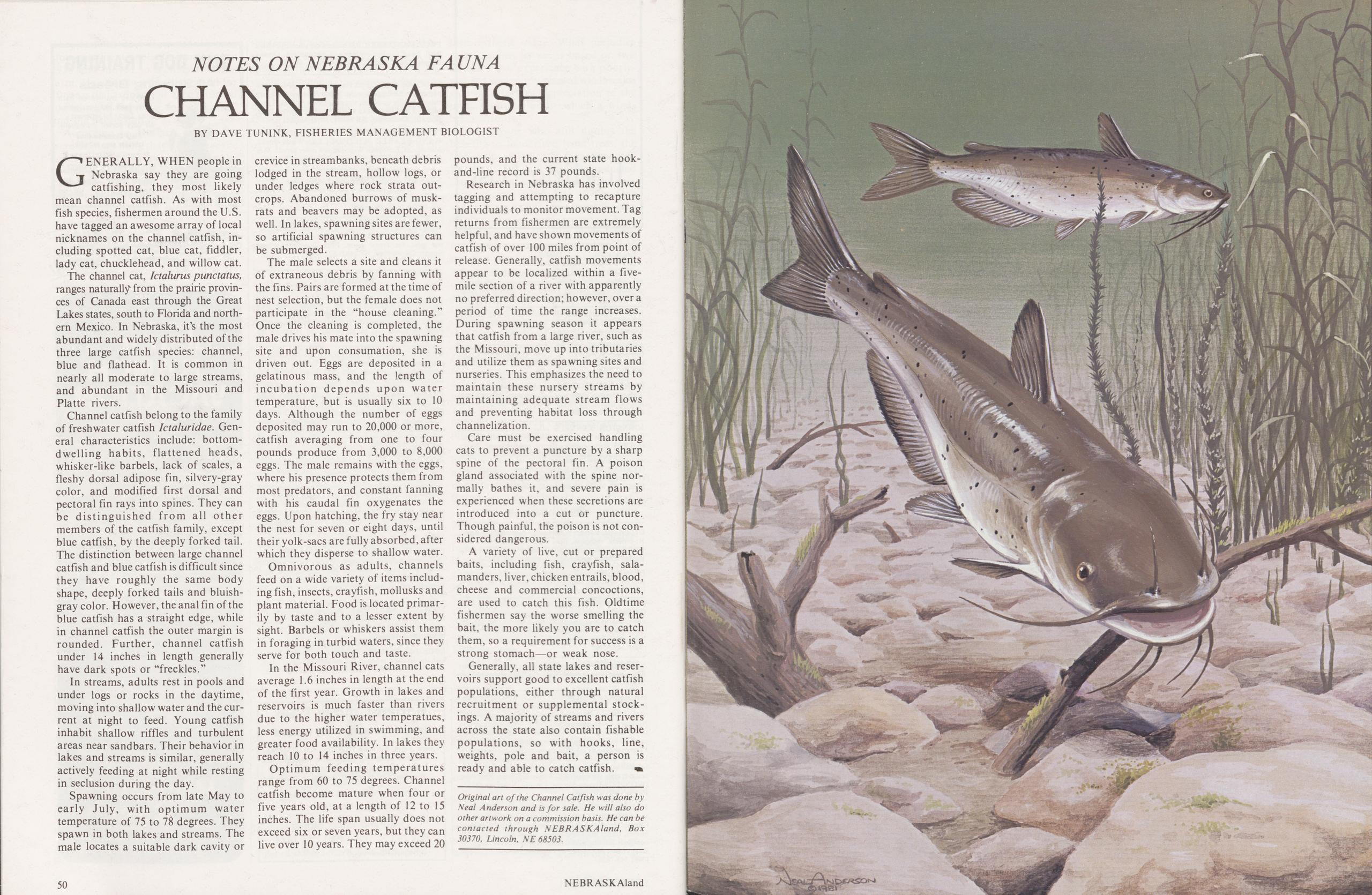
NOTES ON NEBRASKA FA UNA CHANNEL CATFISH
BY DAVE TUNINK, FISHERIES MANAGEMENT BIOLOGISTGENERALLY, WHEN people in Nebraska say they are going catfishing, they most likely mean channel catfish. As with most fish species, fishermen around the U.S. have tagged an awesome array of local nicknames on the channel catfish, including spotted cat, blue cat, fiddler, lady cat, chucklehead, and willow cat.
The channel cat, Ictalurus punctatus, ranges naturally from the prairie provinces of Canada east through the Great Lakes states, south to Florida and northern Mexico. In Nebraska, it's the most abundant and widely distributed of the three large catfish species: channel, blue and flathead. It is common in nearly all moderate to large streams, and abundant in the Missouri and Platte rivers.
Channel catfish belong to the family of freshwater catfish Ictaluridae. General characteristics include: bottom-dwelling habits, flattened heads, whisker-like barbels, lack of scales, a fleshy dorsal adipose fin, silvery-gray color, and modified first dorsal and pectoral fin rays into spines. They can be distinguished from all other members of the catfish family, except blue catfish, by the deeply forked tail. The distinction between large channel catfish and blue catfish is difficult since they have roughly the same body shape, deeply forked tails and bluish-gray color. However, the anal fin of the blue catfish has a straight edge, while in channel catfish the outer margin is rounded. Further, channel catfish under 14 inches in length generally have dark spots or "freckles."
In streams, adults rest in pools and under logs or rocks in the daytime, moving into shallow water and the current at night to feed. Young catfish inhabit shallow riffles and turbulent areas near sandbars. Their behavior in lakes and streams is similar, generally actively feeding at night while resting in seclusion during the day.
Spawning occurs from late May to early July, with optimum water temperature of 75 to 78 degrees. They spawn in both lakes and streams. The male locates a suitable dark cavity or 50 crevice in streambanks, beneath debris lodged in the stream, hollow logs, or under ledges where rock strata out-crops. Abandoned burrows of muskrats and beavers may be adopted, as well. In lakes, spawning sites are fewer, so artificial spawning structures can be submerged.
The male selects a site and cleans it of extraneous debris by fanning with the fins. Pairs are formed at the time of nest selection, but the female does not participate in the "house cleaning." Once the cleaning is completed, the male drives his mate into the spawning site and upon consumation, she is driven out. Eggs are deposited in a gelatinous mass, and the length of incubation depends upon water temperature, but is usually six to 10 days. Although the number of eggs deposited may run to 20,000 or more, catfish averaging from one to four pounds produce from 3,000 to 8,000 eggs. The male remains with the eggs, where his presence protects them from most predators, and constant fanning with his caudal fin oxygenates the eggs. Upon hatching, the fry stay near the nest for seven or eight days, until their yolk-sacs are fully absorbed, after which they disperse to shallow water.
Omnivorous as adults, channels feed on a wide variety of items including fish, insects, crayfish, mollusks and plant material. Food is located primarily by taste and to a lesser extent by sight. Barbels or whiskers assist them in foraging in turbid waters, since they serve for both touch and taste.
In the Missouri River, channel cats average 1.6 inches in length at the end of the first year. Growth in lakes and reservoirs is much faster than rivers due to the higher water temperatues, less energy utilized in swimming, and greater food availability. In lakes they reach 10 to 14 inches in three years.
Optimum feeding temperatures range from 60 to 75 degrees. Channel catfish become mature when four or five years old, at a length of 12 to 15 inches. The life span usually does not exceed six or seven years, but they can live over 10 years. They may exceed 20 pounds, and the current state hook-and-line record is 37 pounds.
Research in Nebraska has involved tagging and attempting to recapture individuals to monitor movement. Tag returns from fishermen are extremely helpful, and have shown movements of catfish of over 100 miles from point of release. Generally, catfish movements appear to be localized within a five-mile section of a river with apparently no preferred direction; however, over a period of time the range increases. During spawning season it appears that catfish from a large river, such as the Missouri, move up into tributaries and utilize them as spawning sites and nurseries. This emphasizes the need to maintain these nursery streams by maintaining adequate stream flows and preventing habitat loss through channelization.
Care must be exercised handling cats to prevent a puncture by a sharp spine of the pectoral fin. A poison gland associated with the spine normally bathes it, and severe pain is experienced when these secretions are introduced into a cut or puncture. Though painful, the poison is not considered dangerous.
A variety of live, cut or prepared baits, including fish, crayfish, salamanders, liver, chicken entrails, blood, cheese and commercial concoctions, are used to catch this fish. Oldtime fishermen say the worse smelling the bait, the more likely you are to catch them, so a requirement for success is a strong stomach—or weak nose.
Generally, all state lakes and reservoirs support good to excellent catfish populations, either through natural recruitment or supplemental stockings. A majority of streams and rivers across the state also contain fishable populations, so with hooks, line, weights, pole and bait, a person is ready and able to catch catfish.
Original art of the Channel Catfish was done by Neal Anderson and is for sale. He will also do other artwork on a commission basis. He can be contacted through NEBRASKAland, Box 30370, Lincoln, NE 68503. 50 NEBRASKAland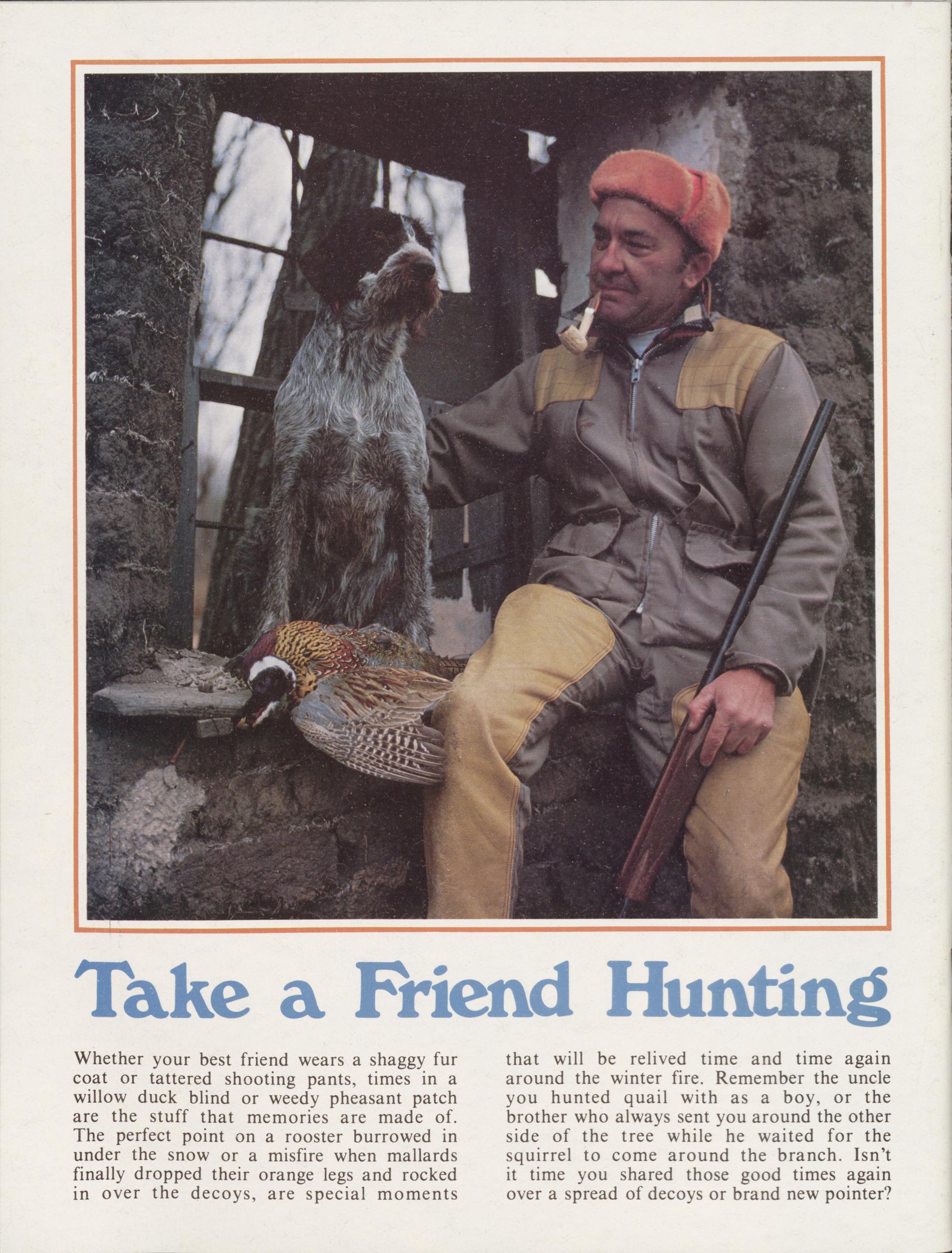
Take a Friend Hunting
Whether your best friend wears a shaggy fur coat or tattered shooting pants, times in a willow duck blind or weedy pheasant patch are the stuff that memories are made of. The perfect point on a rooster burrowed in under the snow or a misfire when mallards finally dropped their orange legs and rocked in over the decoys, are special moments that will be relived time and time again around the winter fire. Remember the uncle you hunted quail with as a boy, or the brother who always sent you around the other side of the tree while he waited for the squirrel to come around the branch. Isn't it time you shared those good times again over a spread of decoys or brand new pointer?
Position: 233 (33 views)