Volume 59, Issue 12, 1981
NEBRASKAland
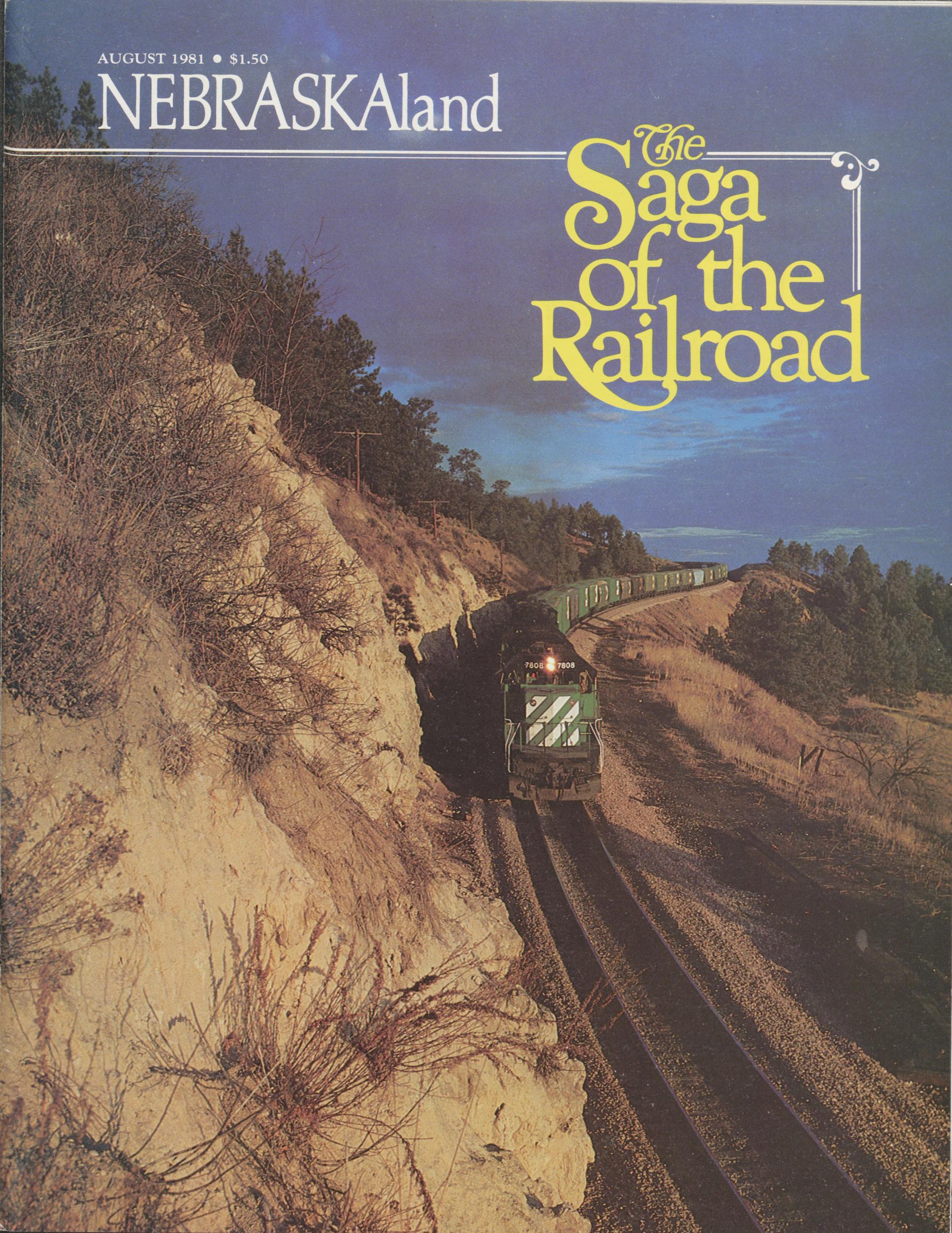
AUGUST 1981 • $1.50 The Saga of the Railroad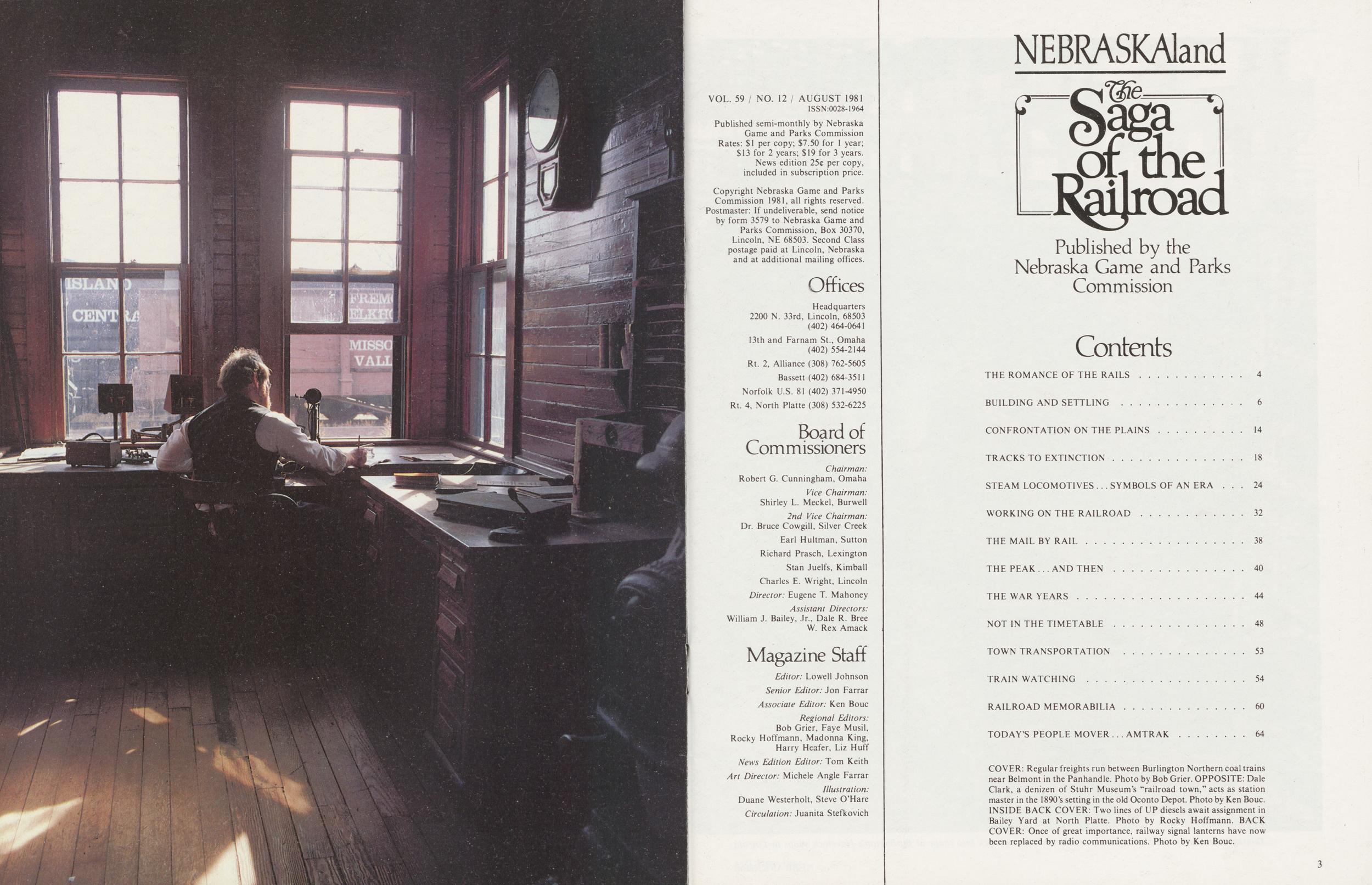
NEBRASKAland
VOL. 59 / NO. 12 / AUGUST 1981 1SSN:0028-1964 Published semi-monthly by Nebraska Game and Parks Commission Rates: $1 per copy; $7.50 for 1 year; $13 for 2 years; $19 for 3 years. News edition 25c per copy, included in subscription price. Copyright Nebraska Game and Parks Commission 1981, all rights reserved. Postmaster: If undeliverable, send notice by form 3579 to Nebraska Game and Parks Commission, Box 30370, Lincoln, NE 68503. Second Class postage paid at Lincoln, Nebraska and at additional mailing offices. Offiices Headquarters 2200 N. 33rd, Lincoln, 68503 (402)464-0641 13th and Farnam St., Omaha (402) 554-2144 Rt. 2, Alliance (308) 762-5605 Bassett (402) 684-3511 Norfolk U.S. 81 (402) 37M950 Rt. 4, North Platte (308) 532-6225 Board of Commissioners Chairman: Robert G. Cunningham, Omaha Vice Chairman: Shirley L. Meckel, Burwell 2nd Vice Chairman: Dr. Bruce Cowgill, Silver Creek Earl Hultman, Sutton Richard Prasch, Lexington Stan Juelfs, Kimball Charles E. Wright, Lincoln Director: Eugene T. Mahoney Assistant Directors: William J. Bailey, Jr., Dale R. Bree W. Rex Amack Magazine Staff Editor: Lowell Johnson Senior Editor: Jon Farrar Associate Editor: Ken Bouc Regional Editors: Bob Grier, Faye Musil, Rocky Hoffmann, Madonna King, Harry Heafer, Liz Huff News Edition Editor: Tom Keith Art Director: Michele Angle Farrar Illustration: Duane Westerholt, Steve O'Hare Circulation: Juanita Stefkovich The Sage of the Railroad Published by the Nebraska Game and Parks Commission Contents THE ROMANCE OF THE RAILS BUILDING AND SETTLING CONFRONTATION ON THE PLAINS TRACKS TO EXTINCTION 14 18 STEAM LOCOMOTIVES SYMBOLS OF AN ERA 24 WORKING ON THE RAILROAD 32 THE MAIL BY RAIL 38 THE PEAK... AND THEN 40 THE WAR YEARS 44 NOT IN THE TIMETABLE TOWN TRANSPORTATION 48 53 TRAIN WATCHING 54 RAILROAD MEMORABILIA 60 TODAY'S PEOPLE MOVER AMTRAK 64 COVER: Regular freights run between Burlington Northern coal trains near Belmont in the Panhandle. Photo by Bob Grier. OPPOSITE: Dale Clark, a denizen of Stuhr Museum's "railroad town," acts as station master in the 1890's setting in the old Oconto Depot. Photo by Ken Bouc. INSIDE BACK COVER: Two lines of UP diesels await assignment in Bailey Yard at North Platte. Photo by Rocky Hoffmann. BACK COVER: Once of great importance, railway signal lanterns have now been replaced by radio communications. Photo by Ken Bouc.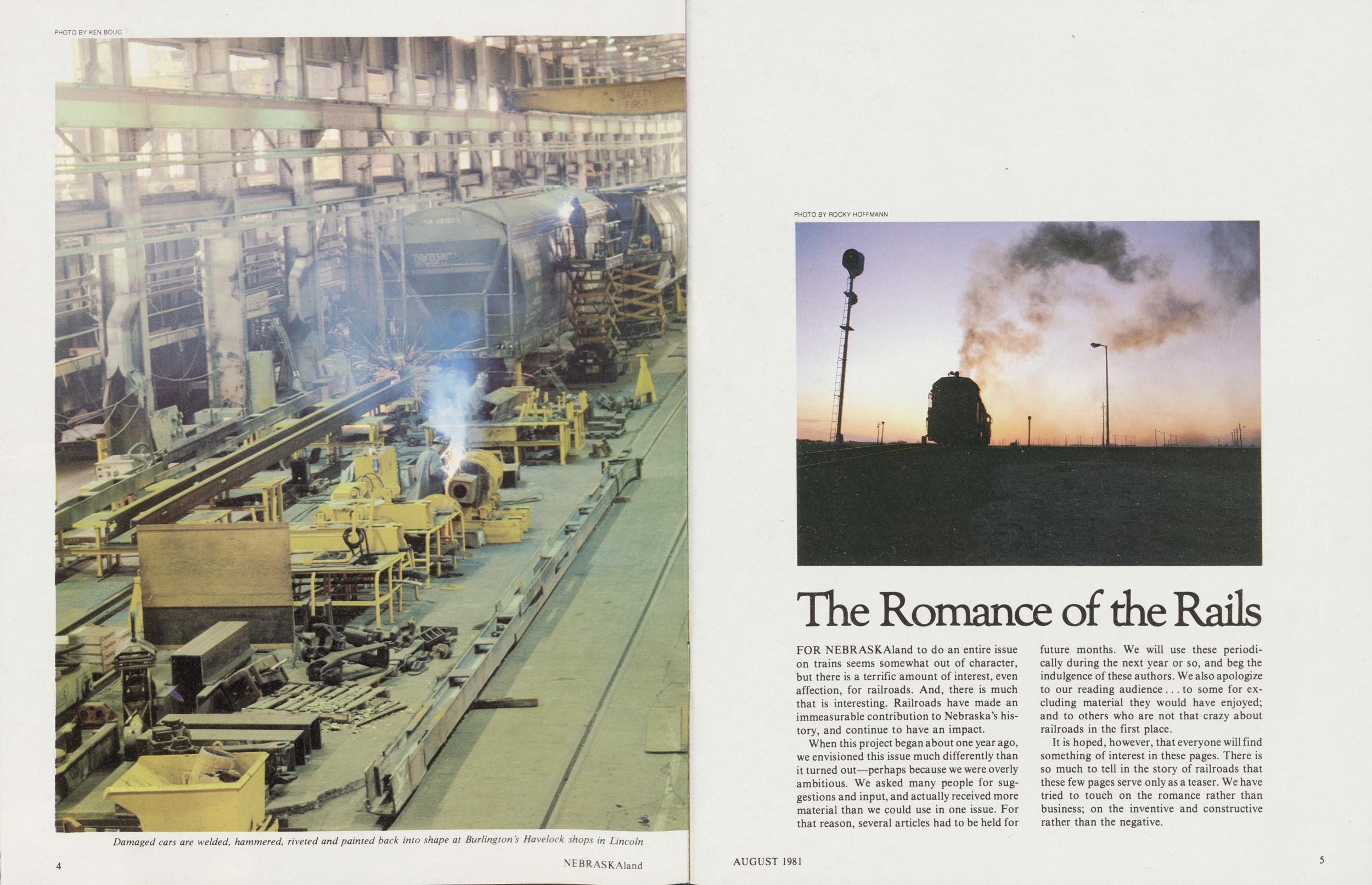
The Romance of the Rails
FOR NEBRASKAland to do an entire issue on trains seems somewhat out of character, but there is a terrific amount of interest, even affection, for railroads. And, there is much that is interesting. Railroads have made an immeasurable contribution to Nebraska's history, and continue to have an impact.
When this project began about one year ago, we envisioned this issue much differently than it turned out—perhaps because we were overly ambitious. We asked many people for suggestions and input, and actually received more material than we could use in one issue. For that reason, several articles had to be held for future months. We will use these periodically during the next year or so, and beg the indulgence of these authors. We also apologize to our reading audience to some for excluding material they would have enjoyed; and to others who are not that crazy about railroads in the first place.
It is hoped, however, that everyone will find something of interest in these pages. There is so much to tell in the story of railroads that these few pages serve only as a teaser. We have tried to touch on the romance rather than business; on the inventive and constructive rather than the negative.
AUGUST 1981 5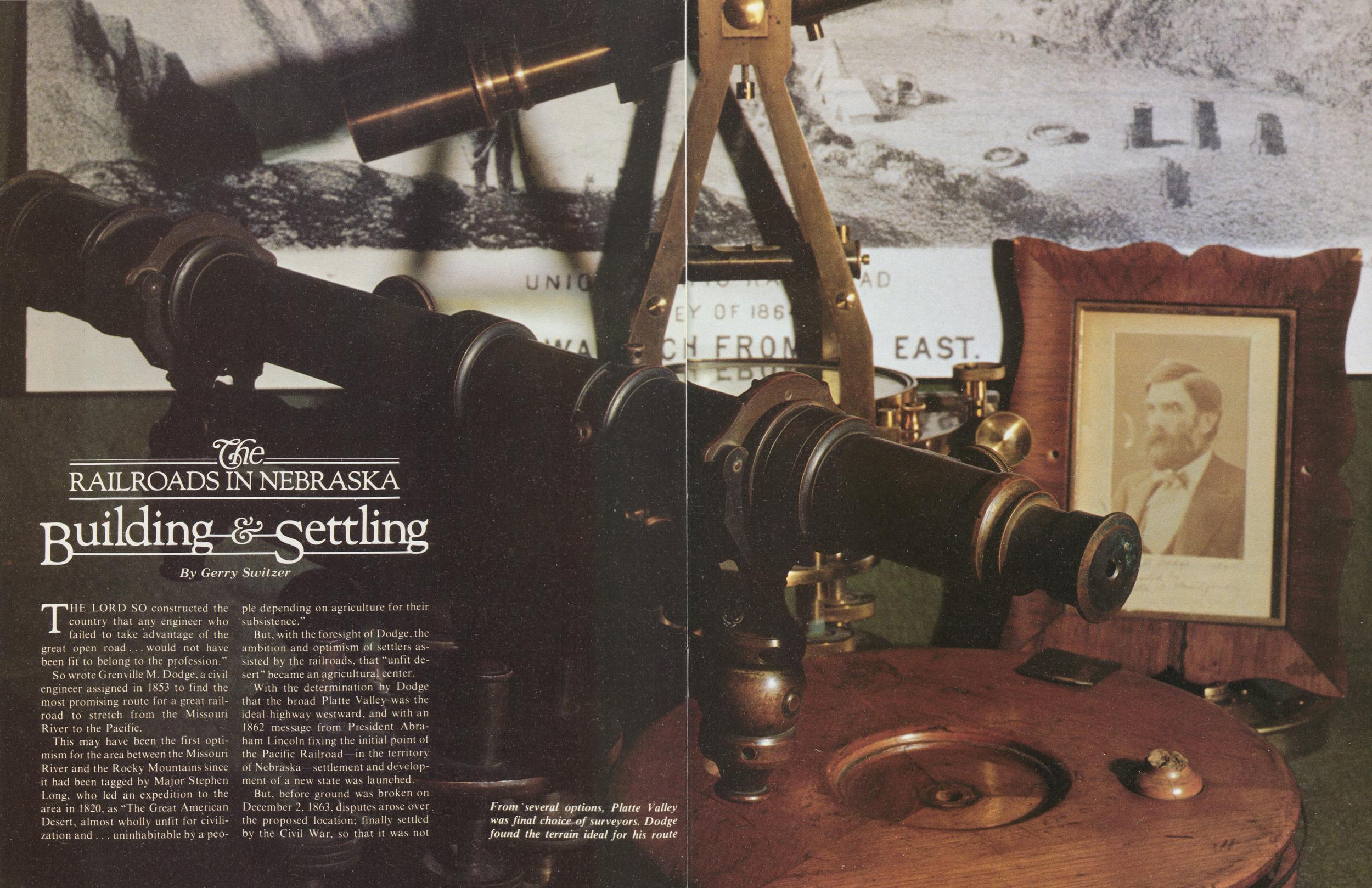
The RAILROADS IN NEBRASKA
Building & Settling By Gerry SwitzerTHE LORD SO constructed the country that any engineer who failed to take advantage of the great open road . . . would not have been fit to belong to the profession."
So wrote Grenville M. Dodge, a civil engineer assigned in 1853 to find the most promising route for a great railroad to stretch from the Missouri River to the Pacific.
This may have been the first optimism for the area between the Missouri River and the Rocky Mountains since it had been tagged by Major Stephen Long, who led an expedition to the area in 1820, as "The Great American Desert, almost wholly unfit for civilization and uninhabitable by a peo- pie depending on agriculture for their subsistence."
But, with the foresight of Dodge, the ambition and optimism of settlers assisted by the railroads, that "unfit desert" became an agricultural center.
With the determination by Dodge that the broad Platte Valley was the ideal highway westward, and with an 1862 message from President Abraham Lincoln fixing the initial point of the Pacific Railroad in the territory of Nebraska settlement and development of a new state was launched.
But, before ground was broken on December 2, 1863, disputes arose over the proposed location; finally settled by the Civil War, so that it was not
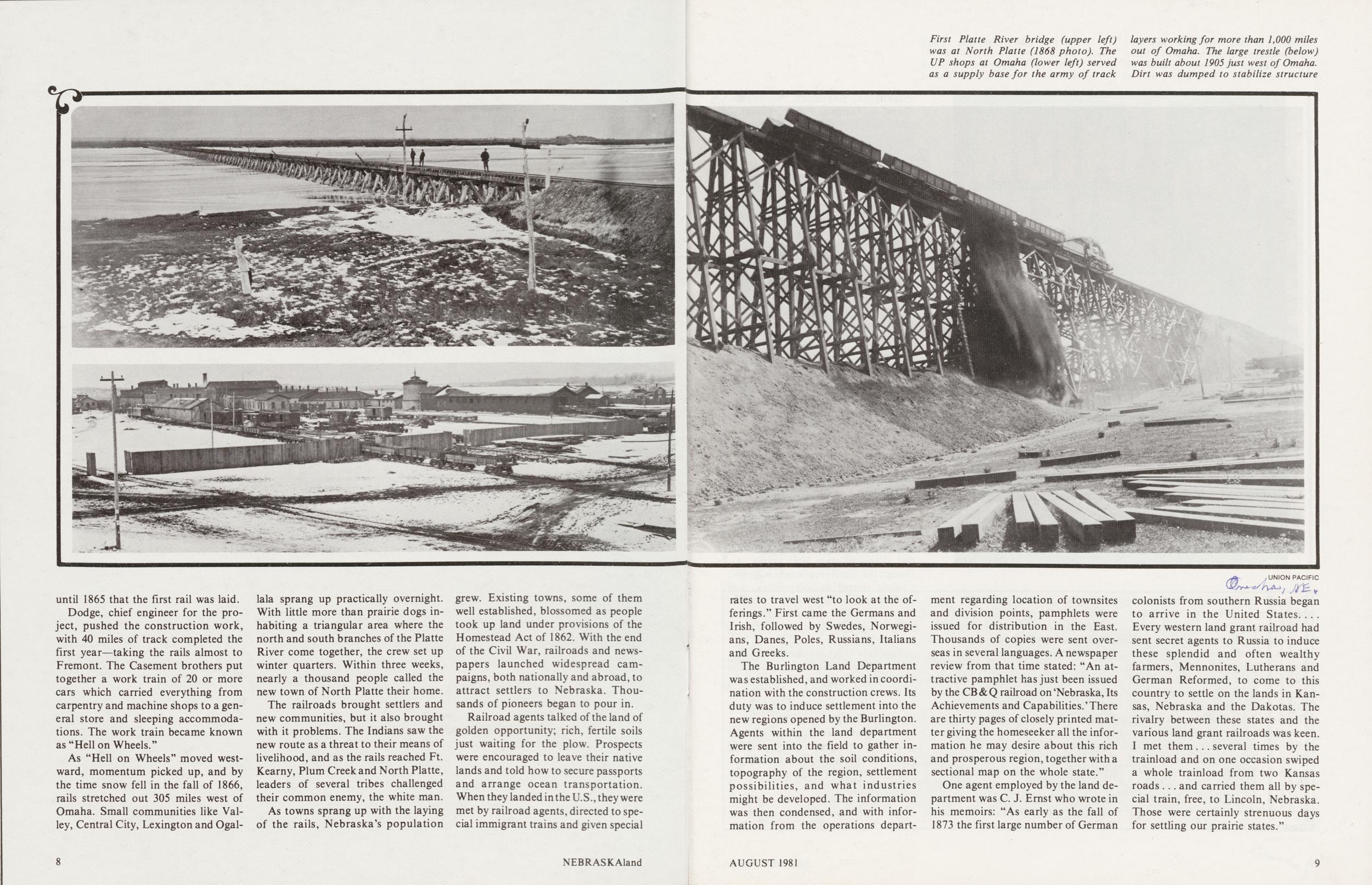
Dodge, chief engineer for the project, pushed the construction work, with 40 miles of track completed the first year—taking the rails almost to Fremont. The Casement brothers put together a work train of 20 or more cars which carried everything from carpentry and machine shops to a general store and sleeping accommodations. The work train became known as "Hell on Wheels."
As "Hell on Wheels" moved westward, momentum picked up, and by the time snow fell in the fall of 1866, rails stretched out 305 miles west of Omaha. Small communities like Valley, Central City, Lexington and Ogallala sprang up practically overnight. With little more than prairie dogs inhabiting a triangular area where the north and south branches of the Platte River come together, the crew set up winter quarters. Within three weeks, nearly a thousand people called the new town of North Platte their home.
The railroads brought settlers and new communities, but it also brought with it problems. The Indians saw the new route as a threat to their means of livelihood, and as the rails reached Ft. Kearny, Plum Creek and North Platte, leaders of several tribes challenged their common enemy, the white man.
As towns sprang up with the laying of the rails, Nebraska's population grew. Existing towns, some of them well established, blossomed as people took up land under provisions of the Homestead Act of 1862. With the end of the Civil War, railroads and newspapers launched widespread campaigns, both nationally and abroad, to attract settlers to Nebraska. Thousands of pioneers began to pour in.
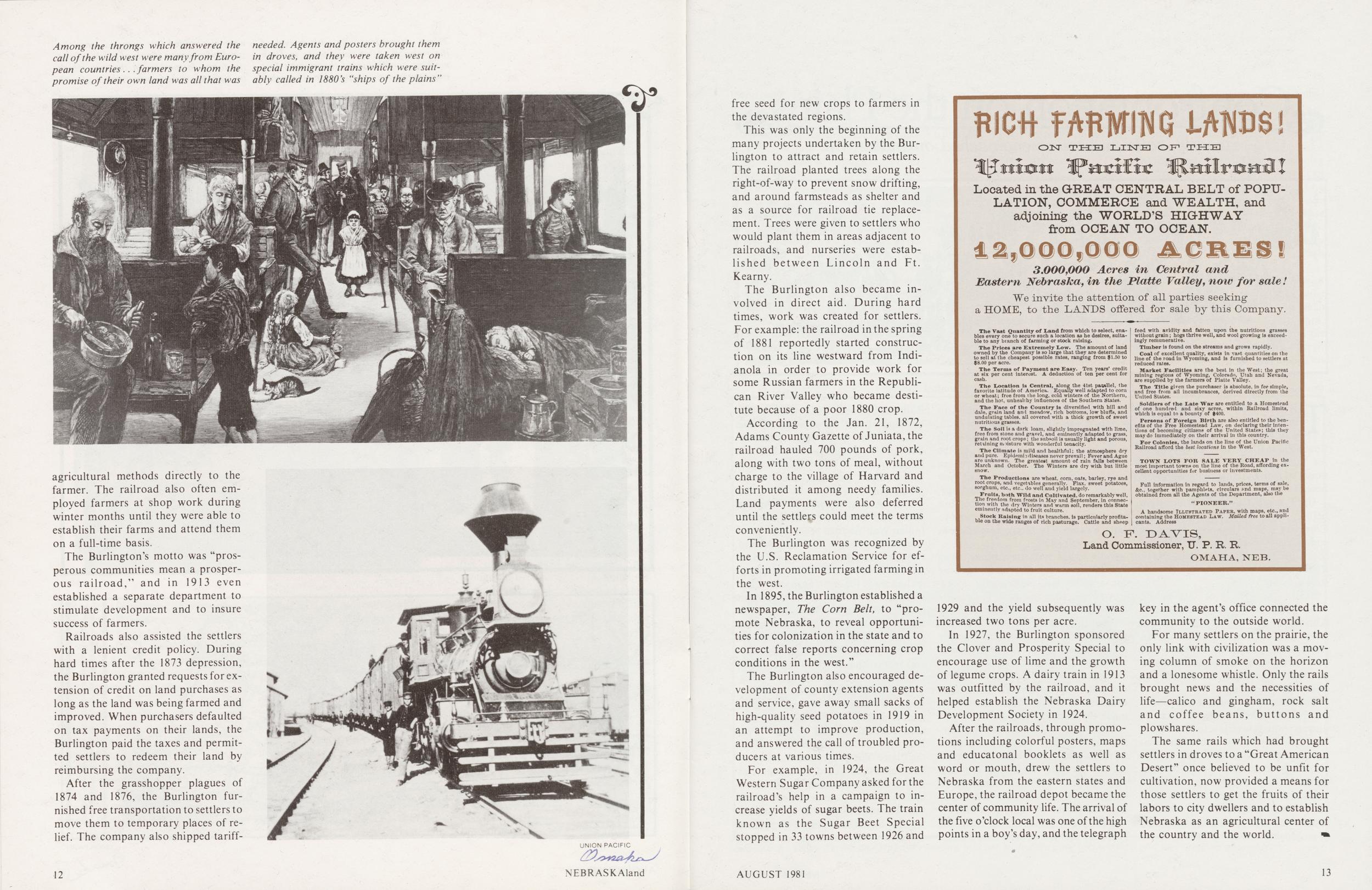
Railroad agents talked of the land of golden opportunity; rich, fertile soils just waiting for the plow. Prospects were encouraged to leave their native lands and told how to secure passports and arrange ocean transportation. When they landed in the U.S., they were met by railroad agents, directed to special immigrant trains and given special 8 NEBRASKAland
The Burlington Land Department was established, and worked in coordination with the construction crews. Its duty was to induce settlement into the new regions opened by the Burlington. Agents within the land department were sent into the field to gather information about the soil conditions, topography of the region, settlement possibilities, and what industries might be developed. The information was then condensed, and with information from the operations department regarding location of townsites and division points, pamphlets were issued for distribution in the East. Thousands of copies were sent overseas in several languages. A newspaper review from that time stated: "An attractive pamphlet has just been issued by the CB&Q railroad on'Nebraska, Its Achievements and Capabilities.'There are thirty pages of closely printed matter giving the homeseeker all the information he may desire about this rich and prosperous region, together with a sectional map on the whole state."
One agent employed by the land department was C. J. Ernst who wrote in his memoirs: "As early as the fall of 1873 the first large number of German UNION PACIFIC colonists from southern Russia began to arrive in the United States. Every western land grant railroad had sent secret agents to Russia to induce these splendid and often wealthy farmers, Mennonites, Lutherans and German Reformed, to come to this country to settle on the lands in Kansas, Nebraska and the Dakotas. The rivalry between these states and the various land grant railroads was keen. I met them several times by the trainload and on one occasion swiped a whole trainload from two Kansas roads ... and carried them all by special train, free, to Lincoln, Nebraska. Those were certainly strenuous days for settling our prairie states."
AUGUST 1981 9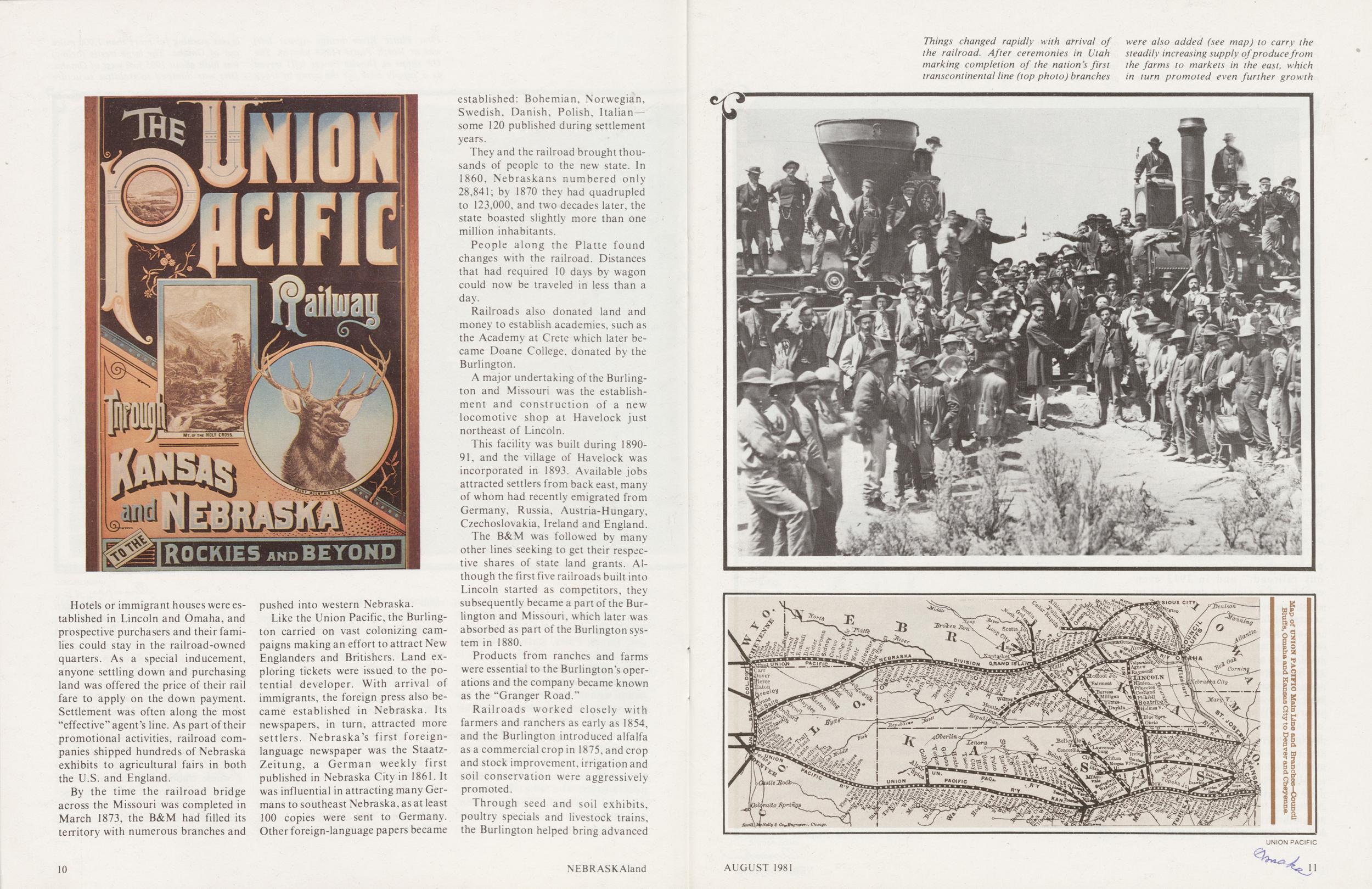
Hotels or immigrant houses were established in Lincoln and Omaha, and prospective purchasers and their families could stay in the railroad-owned quarters. As a special inducement, anyone settling down and purchasing land was offered the price of their rail fare to apply on the down payment. Settlement was often along the most "effective" agent's line. As part of their promotional activities, railroad companies shipped hundreds of Nebraska exhibits to agricultural fairs in both the U.S. and England.
By the time the railroad bridge across the Missouri was completed in March 1873, the B&M had filled its territory with numerous branches and pushed into western Nebraska.
Like the Union Pacific, the Burlington carried on vast colonizing campaigns making an effort to attract New Englanders and Britishers. Land exploring tickets were issued to the potential developer. With arrival of immigrants, the foreign press also became established in Nebraska. Its newspapers, in turn, attracted more settlers. Nebraska's first foreign-language newspaper was the Staatz-Zeitung, a German weekly first published in Nebraska City in 1861. It was influential in attracting many Germans to southeast Nebraska, as at least 100 copies were sent to Germany. Other foreign-language papers became established: Bohemian, Norwegian, Swedish, Danish, Polish, Italian—some 120 published during settlement years.
They and the railroad brought thousands of people to the new state. In 1860, Nebraskans numbered only 28,841; by 1870 they had quadrupled to 123,000, and two decades later, the state boasted slightly more than one million inhabitants.
People along the Platte found changes with the railroad. Distances that had required 10 days by wagon could now be traveled in less than a day.
Railroads also donated land and money to establish academies, such as the Academy at Crete which later became Doane College, donated by the Burlington.
A major undertaking of the Burlington and Missouri was the establishment and construction of a new locomotive shop at Havelock just northeast of Lincoln.
This facility was built during 1890-91, and the village of Havelock was incorporated in 1893. Available jobs attracted settlers from back east, many of whom had recently emigrated from Germany, Russia, Austria-Hungary, Czechoslovakia, Ireland and England.
The B&M was followed by many other lines seeking to get their respective shares of state land grants. Although the first five railroads built into Lincoln started as competitors, they subsequently became a part of the Burlington and Missouri, which later was absorbed as part of the Burlington system in 1880.
Products from ranches and farms were essential to the Burlington's operations and the company became known as the "Granger Road."
Railroads worked closely with farmers and ranchers as early as 1854, and the Burlington introduced alfalfa as a commercial crop in 1875, and crop and stock improvement, irrigation and soil conservation were aggressively promoted.
Through seed and soil exhibits, poultry specials and livestock trains, the Burlington helped bring advanced 10 NEBRASKAland
The Burlington's motto was "prosperous communities mean a prosperous railroad," and in 1913 even established a separate department to stimulate development and to insure success of farmers.
Railroads also assisted the settlers with a lenient credit policy. During hard times after the 1873 depression, the Burlington granted requests for extension of credit on land purchases as long as the land was being farmed and improved. When purchasers defaulted on tax payments on their lands, the Burlington paid the taxes and permitted settlers to redeem their land by reimbursing the company.
After the grasshopper plagues of 1874 and 1876, the Burlington furnished free transportation to settlers to move them to temporary places of relief. The company also shipped tariff-free
This was only the beginning of the many projects undertaken by the Burlington to attract and retain settlers. The railroad planted trees along the right-of-way to prevent snow drifting, and around farmsteads as shelter and as a source for railroad tie replacement. Trees were given to settlers who would plant them in areas adjacent to railroads, and nurseries were established between Lincoln and Ft. Kearny.
The Burlington also became involved in direct aid. During hard times, work was created for settlers. For example: the railroad in the spring of 1881 reportedly started construction on its line westward from Indianola in order to provide work for some Russian farmers in the Republican River Valley who became destitute because of a poor 1880 crop.
According to the Jan. 21, 1872, Adams County Gazette of Juniata, the railroad hauled 700 pounds of pork, along with two tons of meal, without charge to the village of Harvard and distributed it among needy families. Land payments were also deferred until the settlers could meet the terms conveniently.
The Burlington was recognized by the U.S. Reclamation Service for efforts in promoting irrigated farming in the west.
In 1895, the Burlington established a newspaper, The Corn Belt, to "promote Nebraska, to reveal opportunities for colonization in the state and to correct false reports concerning crop conditions in the west."
The Burlington also encouraged development of county extension agents and service, gave away small sacks of high-quality seed potatoes in 1919 in an attempt to improve production, and answered the call of troubled producers at various times.
For example, in 1924, the Great Western Sugar Company asked for the railroad's help in a campaign to increase yields of sugar beets. The train known as the Sugar Beet Special stopped in 33 towns between 1926 and 1929 and the yield subsequently was increased two tons per acre.
In 1927, the Burlington sponsored the Clover and Prosperity Special to encourage use of lime and the growth of legume crops. A dairy train in 1913 was outfitted by the railroad, and it helped establish the Nebraska Dairy Development Society in 1924.
After the railroads, through promotions including colorful posters, maps and educatonal booklets as well as word or mouth, drew the settlers to Nebraska from the eastern states and Europe, the railroad depot became the center of community life. The arrival of the five o'clock local was one of the high points in a boy's day, and the telegraph key in the agent's office connected the community to the outside world.
For many settlers on the prairie, the only link with civilization was a moving column of smoke on the horizon and a lonesome whistle. Only the rails brought news and the necessities of life—calico and gingham, rock salt and coffee beans, buttons and plowshares.
The same rails which had brought settlers in droves to a "Great American Desert" once believed to be unfit for cultivation, now provided a means for those settlers to get the fruits of their labors to city dwellers and to establish Nebraska as an agricultural center of the country and the world.
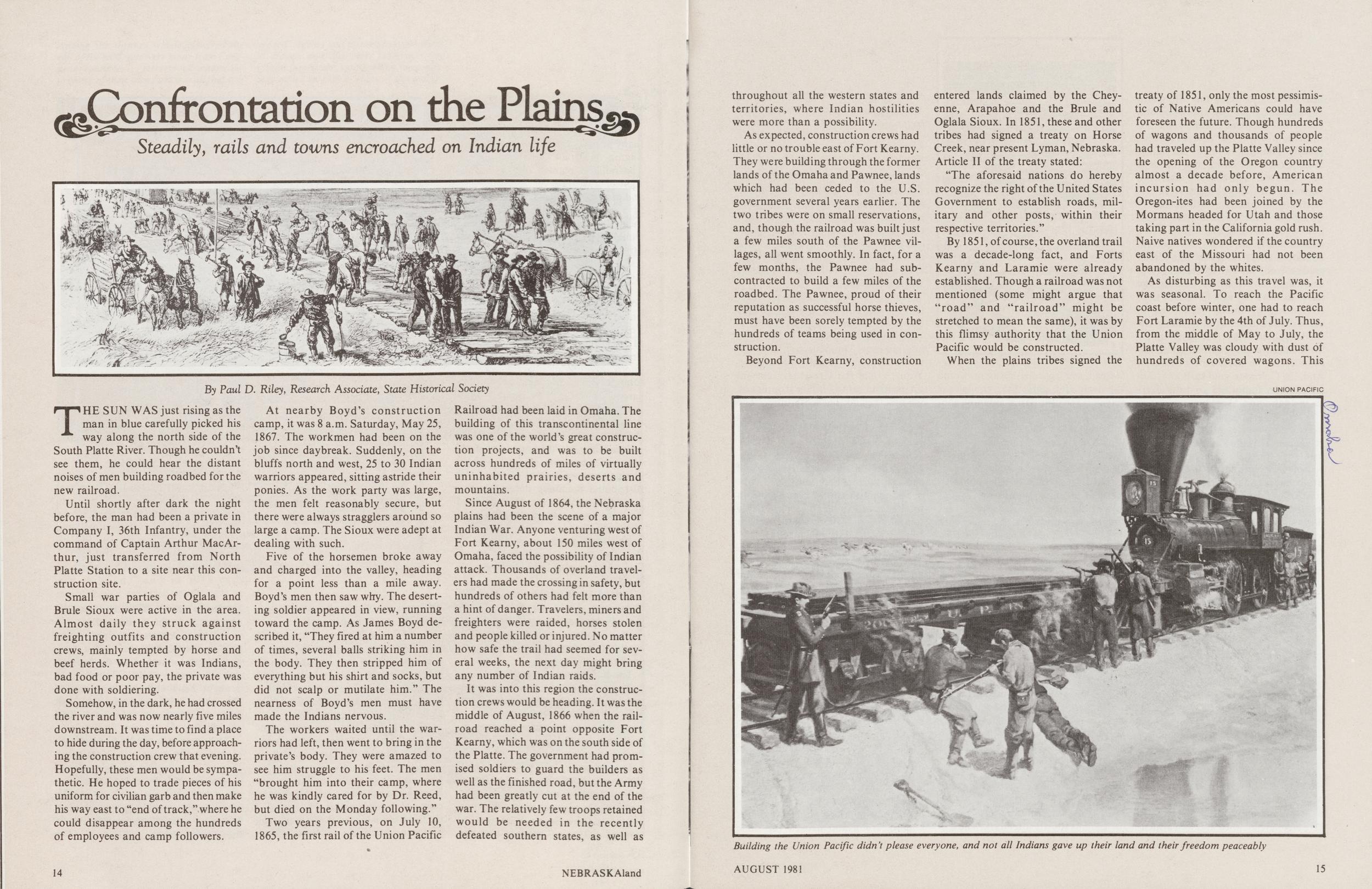
Confrontation on the Plains
Steadily, rails and towns encroached on Indian lifeTHE SUN WAS just rising as the man in blue carefully picked his way along the north side of the South Platte River. Though he couldn't see them, he could hear the distant noises of men building roadbed for the new railroad.
Until shortly after dark the night before, the man had been a private in Company I, 36th Infantry, under the command of Captain Arthur MacArthur, just transferred from North Platte Station to a site near this construction site.
Small war parties of Oglala and Brule Sioux were active in the area. Almost daily they struck against freighting outfits and construction crews, mainly tempted by horse and beef herds. Whether it was Indians, bad food or poor pay, the private was done with soldiering.
Somehow, in the dark, he had crossed the river and was now nearly five miles downstream. It was time to find a place to hide during the day, before approaching the construction crew that evening. Hopefully, these men would be sympathetic. He hoped to trade pieces of his uniform for civilian garb and then make his way east to "end of track," where he could disappear among the hundreds of employees and camp followers.
At nearby Boyd's construction camp, it was 8 a.m. Saturday, May 25, 1867. The workmen had been on the job since daybreak. Suddenly, on the bluffs north and west, 25 to 30 Indian warriors appeared, sitting astride their ponies. As the work party was large, the men felt reasonably secure, but there were always stragglers around so large a camp. The Sioux were adept at dealing with such.
Five of the horsemen broke away and charged into the valley, heading for a point less than a mile away. Boyd's men then saw why. The deserting soldier appeared in view, running toward the camp. As James Boyd described it, "They fired at him a number of times, several balls striking him in the body. They then stripped him of everything but his shirt and socks, but did not scalp or mutilate him." The nearness of Boyd's men must have made the Indians nervous.
The workers waited until the warriors had left, then went to bring in the private's body. They were amazed to see him struggle to his feet. The men "brought him into their camp, where he was kindly cared for by Dr. Reed, but died on the Monday following."
Two years previous, on July 10, 1865, the first rail of the Union Pacific Railroad had been laid in Omaha. The building of this transcontinental line was one of the world's great construction projects, and was to be built across hundreds of miles of virtually uninhabited prairies, deserts and mountains.
Since August of 1864, the Nebraska plains had been the scene of a major Indian War. Anyone venturing west of Fort Kearny, about 150 miles west of Omaha, faced the possibility of Indian attack. Thousands of overland travelers had made the crossing in safety, but hundreds of others had felt more than a hint of danger. Travelers, miners and freighters were raided, horses stolen and people killed or injured. No matter how safe the trail had seemed for several weeks, the next day might bring any number of Indian raids.
It was into this region the construction crews would be heading. It was the middle of August, 1866 when the railroad reached a point opposite Fort Kearny, which was on the south side of the Platte. The government had promised soldiers to guard the builders as well as the finished road, but the Army had been greatly cut at the end of the war. The relatively few troops retained would be needed in the recently defeated southern states, as well as 14 NEBRASKAland throughout all the western states and territories, where Indian hostilities were more than a possibility.
As expected, construction crews had little or no trouble east of Fort Kearny. They were building through the former lands of the Omaha and Pawnee, lands which had been ceded to the U.S. government several years earlier. The two tribes were on small reservations, and, though the railroad was built just a few miles south of the Pawnee villages, all went smoothly. In fact, for a few months, the Pawnee had subcontracted to build a few miles of the roadbed. The Pawnee, proud of their reputation as successful horse thieves, must have been sorely tempted by the hundreds of teams being used in construction.
Beyond Fort Kearny, construction entered lands claimed by the Cheyenne, Arapahoe and the Brule and Oglala Sioux. In 1851, these and other tribes had signed a treaty on Horse Creek, near present Lyman, Nebraska. Article II of the treaty stated:
"The aforesaid nations do hereby recognize the right of the United States Government to establish roads, military and other posts, within their respective territories."
By 1851, of course, the overland trail was a decade-long fact, and Forts Kearny and Laramie were already established. Though a railroad was not mentioned (some might argue that "road" and "railroad" might be stretched to mean the same), it was by this flimsy authority that the Union Pacific would be constructed.
When the plains tribes signed the treaty of 1851, only the most pessimistic of Native Americans could have foreseen the future. Though hundreds of wagons and thousands of people had traveled up the Platte Valley since the opening of the Oregon country almost a decade before, American incursion had only begun. The Oregon-ites had been joined by the Mormans headed for Utah and those taking part in the California gold rush. Naive natives wondered if the country east of the Missouri had not been abandoned by the whites.
As disturbing as this travel was, it was seasonal. To reach the Pacific coast before winter, one had to reach Fort Laramie by the 4th of July. Thus, from the middle of May to July, the Platte Valley was cloudy with dust of hundreds of covered wagons. This
 heavy traffic scattered the wild game, depleted the grass and wood, and otherwise interfered with Indian life.
Their winters, however, were not greatly changed. Then, the tribes broke into small bands and retreated into watered, wooded and sheltered regions. The Republican River of southern Nebraska, with its many spring-fed streams and numerous buffalo herds, was one such area.
The nearly 20 years of seasonal migration ended with the Pike's Peak gold rush of 1858-59. Between the Missouri and the Rocky Mountains, the trail was relatively safe for winter travelers. Feed for horses, oxen or mules could be taken along, eliminating the need for grass. There was good money to be made in hauling food and other supplies to the thousands of miners. And, the Colorado gold rush was soon followed by important gold discoveries in Idaho and Montana.
Starting in the fall of 1863, there were strong rumors of an impending, general Indian attack. At the end of the first week in August 1864, the rumors became fact. War parties of Cheyenne, Brule and Oglala made coordinated attacks on the Overland Trail from south-central Nebraska to the outskirts of Denver. Stage stations and road ranches were destroyed, many of the people killed; stage coaches and other overland travelers were attacked. The limited number of soldiers at Fort Kearny, Cottonwood Springs and Fort Laramie, were as much overwhelmed by the miles as by the war parties.
After the first major attacks, hostilities on the plains settled into a war of attrition. For days, sometimes weeks, all would be calm. Then some unwary freighting outfit would suddenly be swept down upon, their teams scattered or stolen, some of the men killed. The military could do no right. They were slow, they were overly cautious, the overlanders complained.
In return, the military judged the civilians. They were foolhardy. Wagon trains were instructed to wait at major outfitting points until they were strongly manned and well armed.
It was one of the great hopes of the War Department that the Union Pacific would end the problem of delayed reaction to attacks. Word of an Indian raid could be telegraphed to the nearest military post; horses and men would then be loaded onto a train and taken to the site of the raid where they could unload and be after the warriors in a trice.
It was one of those ideas that sound good. Unfortunately, it seldom worked. For the soldiers to use a train meant there had to be a train—a train with steam up and ready to go. Needless to say, this was seldom the case.
To aid the limited number of regular soldiers, the War Department authorized Major Frank North to reorganize the Pawnee Scouts , who had been so effective during campaigns of 1865.
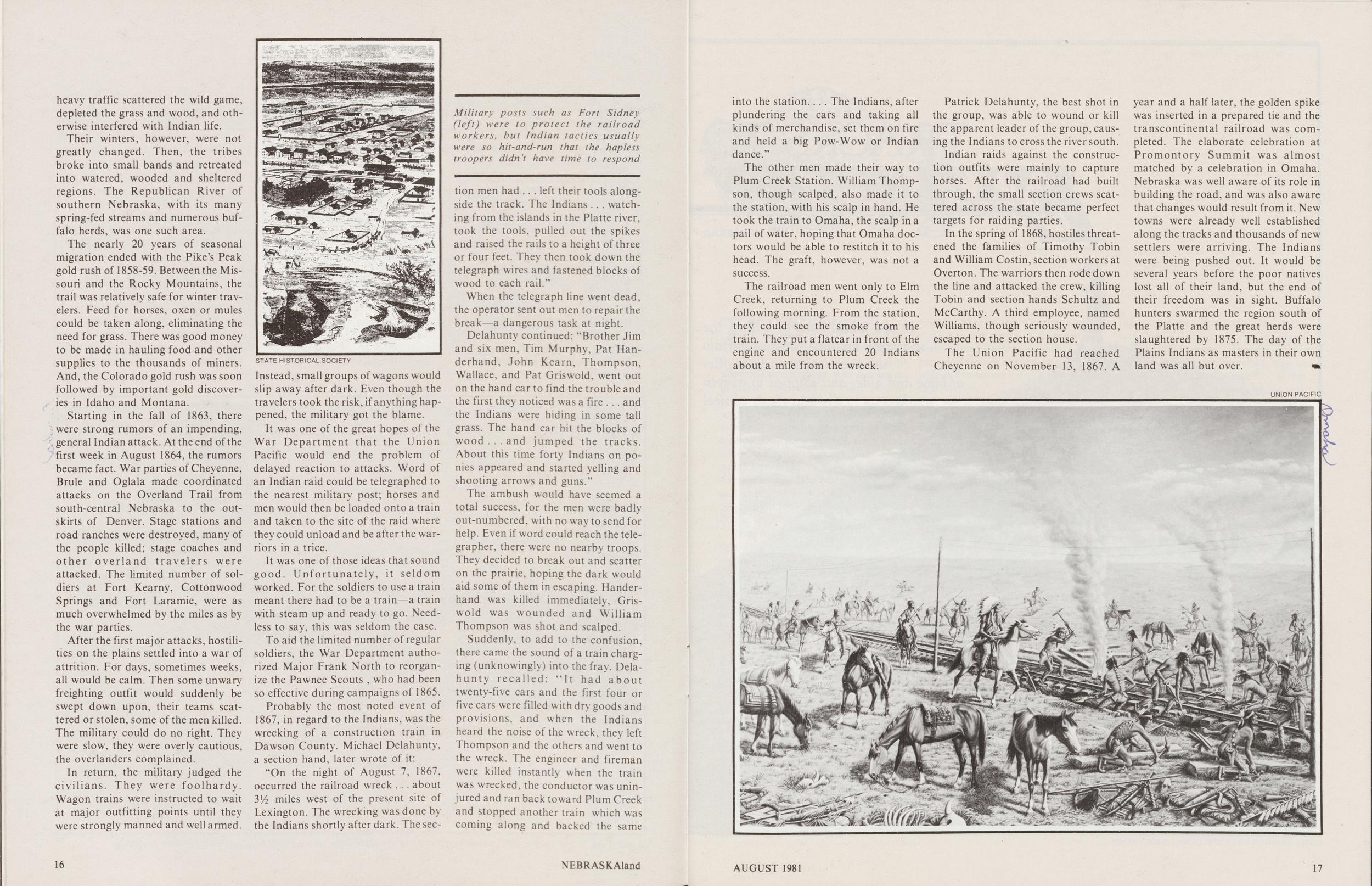
Probably the most noted event of 1867, in regard to the Indians, was the wrecking of a construction train in Dawson County. Michael Delahunty, a section hand, later wrote of it:
"On the night of August 7, 1867, occurred the railroad wreck about 3/2 miles west of the present site of Lexington. The wrecking was done by the Indians shortly after dark. The sec- tion men had left their tools alongside the track. The Indians watching from the islands in the Platte river, took the tools, pulled out the spikes and raised the rails to a height of three or four feet. They then took down the telegraph wires and fastened blocks of wood to each rail."
When the telegraph line went dead, the operator sent out men to repair the break—a dangerous task at night.
Delahunty continued: "Brother Jim and six men, Tim Murphy, Pat Handerhand, John Kearn, Thompson, Wallace, and Pat Griswold, went out on the hand car to find the trouble and the first they noticed was a fire and the Indians were hiding in some tall grass. The hand car hit the blocks of wood and jumped the tracks. About this time forty Indians on ponies appeared and started yelling and shooting arrows and guns."
The ambush would have seemed a total success, for the men were badly out-numbered, with no wav to send for help. Even if word could reach the telegrapher, there were no nearby troops. They decided to break out and scatter on the prairie, hoping the dark would aid some of them in escaping. Handerhand was killed immediately, Griswold was wounded and William Thompson was shot and scalped.
Suddenly, to add to the confusion, there came the sound of a train charging (unknowingly) into the fray. Delahunty recalled: "It had about twenty-five cars and the first four or five cars were filled with dry goods and provisions, and when the Indians heard the noise of the wreck, they left Thompson and the others and went to the wreck. The engineer and fireman were killed instantly when the train was wrecked, the conductor was uninjured and ran back toward Plum Creek and stopped another train which was coming along and backed the same 16 NEBRASKAland into the station The Indians, after plundering the cars and taking all kinds of merchandise, set them on fire and held a big Pow-Wow or Indian dance."
The other men made their way to Plum Creek Station. William Thompson, though scalped, also made it to the station, with his scalp in hand. He took the train to Omaha, the scalp in a pail of water, hoping that Omaha doctors would be able to restitch it to his head. The graft, however, was not a success.
The railroad men went only to Elm Creek, returning to Plum Creek the following morning. From the station, they could see the smoke from the train. They put a flatcar in front of the engine and encountered 20 Indians about a mile from the wreck.
Patrick Delahunty, the best shot in the group, was able to wound or kill the apparent leader of the group, causing the Indians to cross the river south.
Indian raids against the construction outfits were mainly to capture horses. After the railroad had built through, the small section crews scattered across the state became perfect targets for raiding parties.
In the spring of 1868, hostiles threatened the families of Timothy Tobin and William Costin, section workers at Overton. The warriors then rode down the line and attacked the crew, killing Tobin and section hands Schultz and McCarthy. A third employee, named Williams, though seriously wounded, escaped to the section house.
The Union Pacific had reached Cheyenne on November 13, 1867. A year and a half later, the golden spike was inserted in a prepared tie and the transcontinental railroad was completed. The elaborate celebration at Promontory Summit was almost matched by a celebration in Omaha. Nebraska was well aware of its role in building the road, and was also aware that changes would result from it. New towns were already well established along the tracks and thousands of new settlers were arriving. The Indians were being pushed out. It would be several years before the poor natives lost all of their land, but the end of their freedom was in sight. Buffalo hunters swarmed the region south of the Platte and the great herds were slaughtered by 1875. The day of the Plains Indians as masters in their own land was all but over.
TRACKS TO EXTINCTION
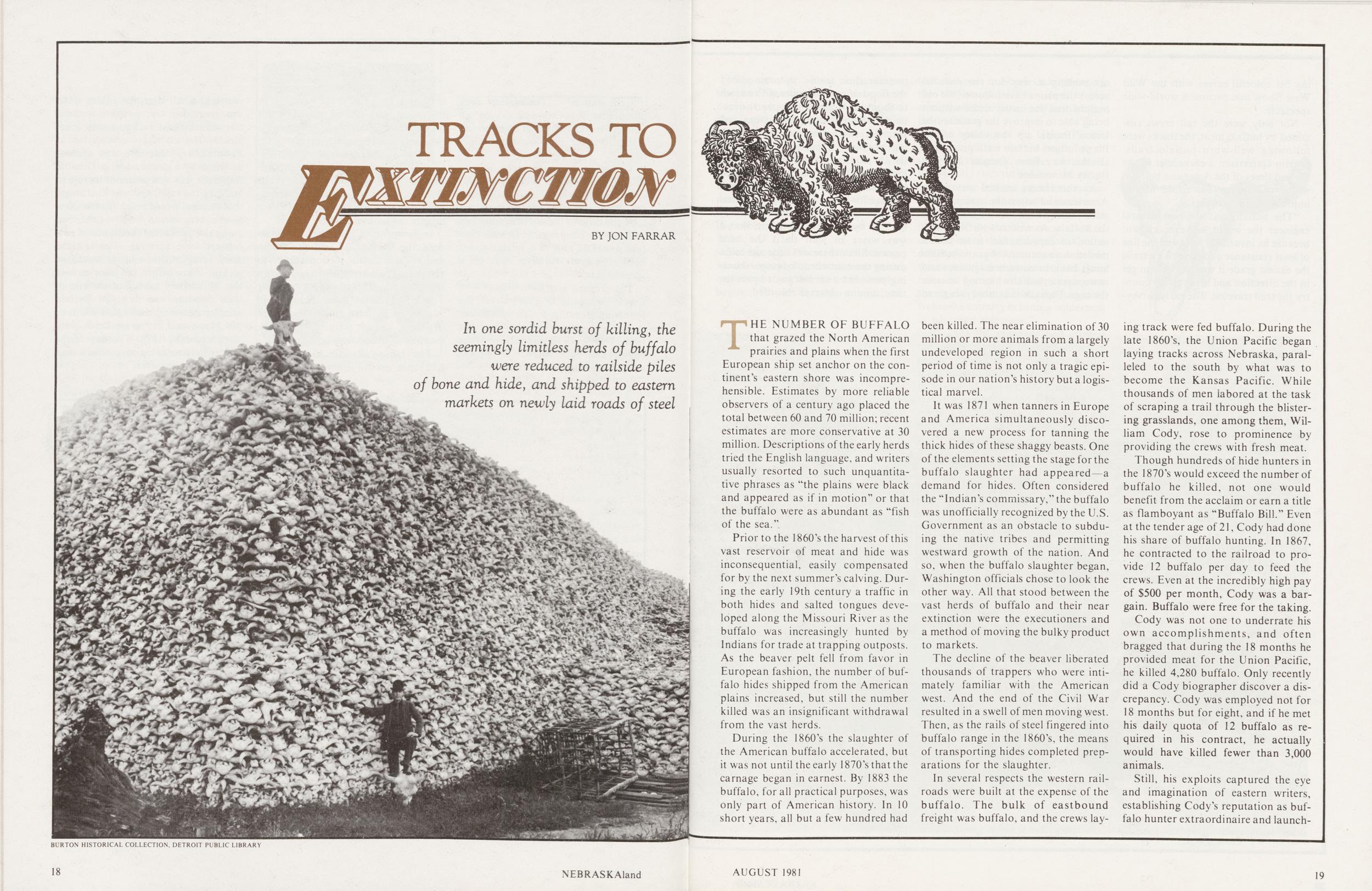
BY JON FARRAR In one sordid burst of killing, the seemingly limitless herds of buffalo were reduced to railside piles of bone and hide, and shipped to eastern markets on newly laid roads of steel 18 NEBRASKAlandTHE NUMBER OF BUFFALO that grazed the North American prairies and plains when the first European ship set anchor on the continent's eastern shore was incomprehensible. Estimates by more reliable observers of a century ago placed the total between 60 and 70 million; recent estimates are more conservative at 30 million. Descriptions of the early herds tried the English language, and writers usually resorted to such unquantitative phrases as "the plains were black and appeared as if in motion" or that the buffalo were as abundant as "fish of the sea."
Prior to the 1860's the harvest of this vast reservoir of meat and hide was inconsequential, easily compensated for by the next summer's calving. During the early 19th century a traffic in both hides and salted tongues developed along the Missouri River as the buffalo was increasingly hunted by Indians for trade at trapping outposts. As the beaver pelt fell from favor in European fashion, the number of buffalo hides shipped from the American plains increased, but still the number killed was an insignificant withdrawal from the vast herds.
During the 1860's the slaughter of the American buffalo accelerated, but it was not until the early 1870's that the carnage began in earnest. By 1883 the buffalo, for all practical purposes, was only part of American history. In 10 short years, all but a few hundred had been killed. The near elimination of 30 million or more animals from a largely undeveloped region in such a short period of time is not only a tragic episode in our nation's history but a logistical marvel.
It was 1871 when tanners in Europe and America simultaneously discovered a new process for tanning the thick hides of these shaggy beasts. One of the elements setting the stage for the buffalo slaughter had appeared—a demand for hides. Often considered the "Indian's commissary," the buffalo was unofficially recognized by the U.S. Government as an obstacle to subduing the native tribes and permitting westward growth of the nation. And so, when the buffalo slaughter began, Washington officials chose to look the other way. All that stood between the vast herds of buffalo and their near extinction were the executioners and a method of moving the bulky product to markets.
The decline of the beaver liberated thousands of trappers who were intimately familiar with the American west. And the end of the Civil War resulted in a swell of men moving west. Then, as the rails of steel fingered into buffalo range in the 1860's, the means of transporting hides completed precautions for the slaughter.
In several respects the western railroads were built at the expense of the buffalo. The bulk of eastbound freight was buffalo, and the crews laying track were fed buffalo. During the late 1860's, the Union Pacific began laying tracks across Nebraska, paralleled to the south by what was to become the Kansas Pacific. While thousands of men labored at the task of scraping a trail through the blistering grasslands, one among them, William Cody, rose to prominence by providing the crews with fresh meat.
Though hundreds of hide hunters in the 1870's would exceed the number of buffalo he killed, not one would benefit from the acclaim or earn a title as flamboyant as "Buffalo Bill." Even at the tender age of 21, Cody had done his share of buffalo hunting. In 1867, he contracted to the railroad to provide 12 buffalo per day to feed the crews. Even at the incredibly high pay of $500 per month, Cody was a bargain. Buffalo were free for the taking.
Cody was not one to underrate his own accomplishments, and often bragged that during the 18 months he provided meat for the Union Pacific, he killed 4,280 buffalo. Only recently did a Cody biographer discover a discrepancy. Cody was employed not for 18 months but for eight, and if he met his daily quota of 12 buffalo as required in his contract, he actually would have killed fewer than 3,000 animals.
Still, his exploits captured the eye and imagination of eastern writers, establishing Cody's reputation as buffalo hunter extraordinaire and launching AUGUST 1981 19 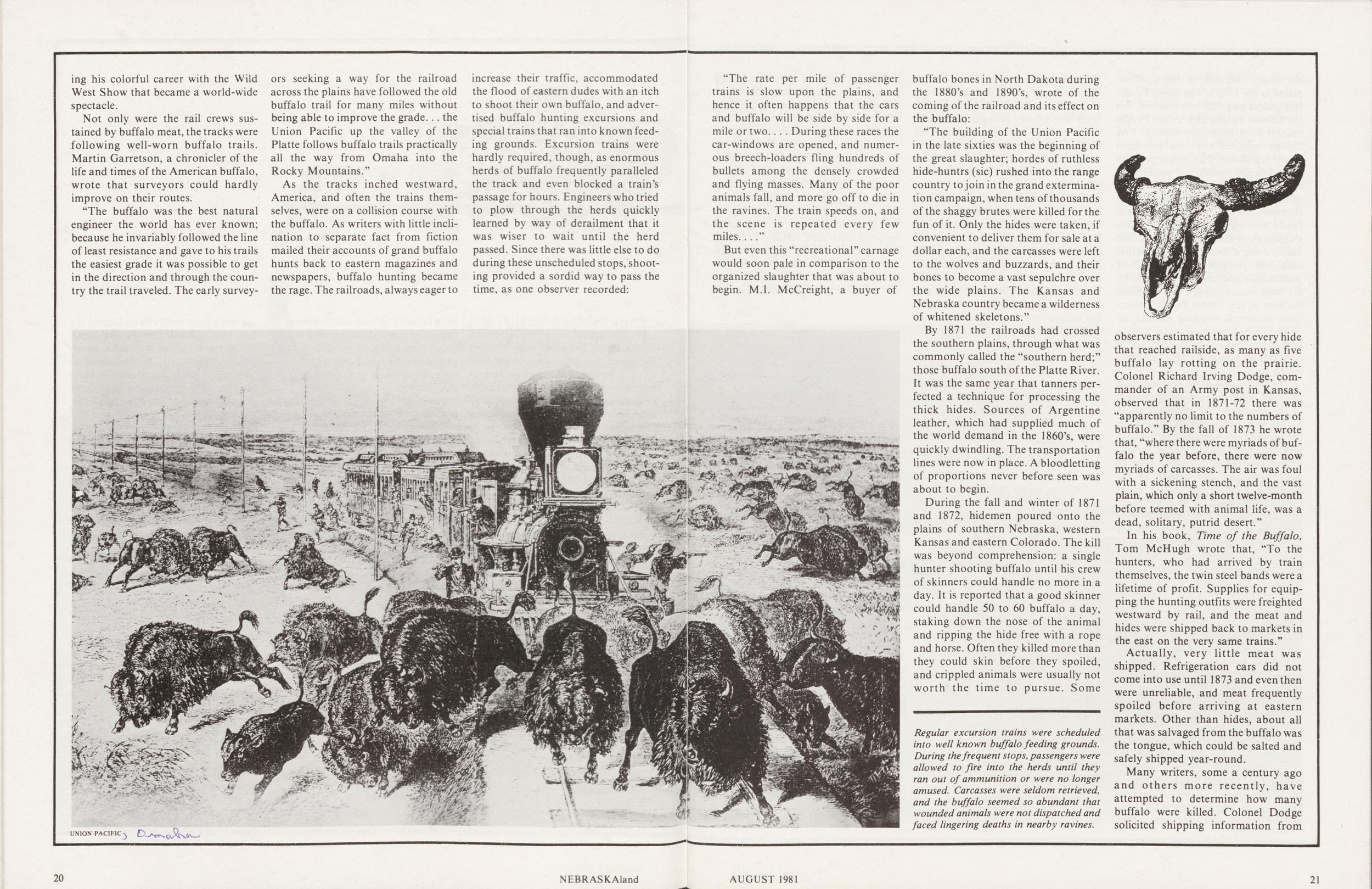 his colorful career with the Wild West Show that became a world-wide spectacle.
Not only were the rail crews sustained by buffalo meat, the tracks were following well-worn buffalo trails. Martin Garretson, a chronicler of the life and times of the American buffalo, wrote that surveyors could hardly improve on their routes.
"The buffalo was the best natural engineer the world has ever known; because he invariably followed the line of least resistance and gave to his trails the easiest grade it was possible to get in the direction and through the country the trail traveled. The early surveyors seeking a way for the railroad across the plains have followed the old buffalo trail for many miles without being able to improve the grade the Union Pacific up the valley of the Platte follows buffalo trails practically all the way from Omaha into the Rocky Mountains."
As the tracks inched westward, America, and often the trains themselves, were on a collision course with the buffalo. As writers with little inclination to separate fact from fiction mailed their accounts of grand buffalo hunts back to eastern magazines and newspapers, buffalo hunting became the rage. The railroads, always eager to increase their traffic, accommodated the flood of eastern dudes with an itch to shoot their own buffalo, and advertised buffalo hunting excursions and special trains that ran into known feeding grounds. Excursion trains were hardly required, though, as enormous herds of buffalo frequently paralleled the track and even blocked a train's passage for hours. Engineers who tried to plow through the herds quickly learned by way of derailment that it was wiser to wait until the herd passed. Since there was little else to do during these unscheduled stops, shooting provided a sordid way to pass the time, as one observer recorded:
"The rate per mile of passenger trains is slow upon the plains, and hence it often happens that the cars and buffalo will be side by side for a mile or two. During these races the car-windows are opened, and numerous breech-loaders fling hundreds of bullets among the densely crowded and flying masses. Many of the poor animals fall, and more go off to die in the ravines. The train speeds on, and the scene is repeated every few miles."
But even this "recreational" carnage would soon pale in comparison to the organized slaughter that was about to begin. M.I. McCreight, a buyer of buffalo bones in North Dakota during the 1880's and 1890's, wrote of the coming of the railroad and its effect on the buffalo:
"The building of the Union Pacific in the late sixties was the beginning of the great slaughter; hordes of ruthless hide-huntrs (sic) rushed into the range country to join in the grand extermination campaign, when tens of thousands of the shaggy brutes were killed for the fun of it. Only the hides were taken, if convenient to deliver them for sale at a dollar each, and the carcasses were left to the wolves and buzzards, and their bones to become a vast sepulchre over the wide plains. The Kansas and Nebraska country became a wilderness of whitened skeletons."
By 1871 the railroads had crossed the southern plains, through what was commonly called the "southern herd;" those buffalo south of the Platte River. It was the same year that tanners perfected a technique for processing the thick hides. Sources of Argentine leather, which had supplied much of the world demand in the 1860's, were quickly dwindling. The transportation lines were now in place. A bloodletting of proportions never before seen was about to begin.
During the fall and winter of 1871 and 1872, hidemen poured onto the plains of southern Nebraska, western Kansas and eastern Colorado. The kill was beyond comprehension: a single hunter shooting buffalo until his crew of skinners could handle no more in a day. It is reported that a good skinner could handle 50 to 60 buffalo a day, staking down the nose of the animal and ripping the hide free with a rope and horse. Often they killed more than they could skin before they spoiled, and crippled animals were usually not worth the time to pursue. Some observers estimated that for every hide that reached railside, as many as five buffalo lay rotting on the prairie. Colonel Richard Irving Dodge, commander of an Army post in Kansas,
In his book, Time of the Buffalo, Tom McHugh wrote that, "To the hunters, who had arrived by train themselves, the twin steel bands were a lifetime of profit. Supplies for equipping the hunting outfits were freighted westward by rail, and the meat and hides were shipped back to markets in the east on the very same trains."
Actually, very little meat was shipped. Refrigeration cars did not come into use until 1873 and even then were unreliable, and meat frequently spoiled before arriving at eastern markets. Other than hides, about all that was salvaged from the buffalo was the tongue, which could be salted and safely shipped year-round.
Many writers, some a century ago and others more recently, have attempted to determine how many buffalo were killed. Colonel Dodge solicited shipping information from AUGUST 1981 21 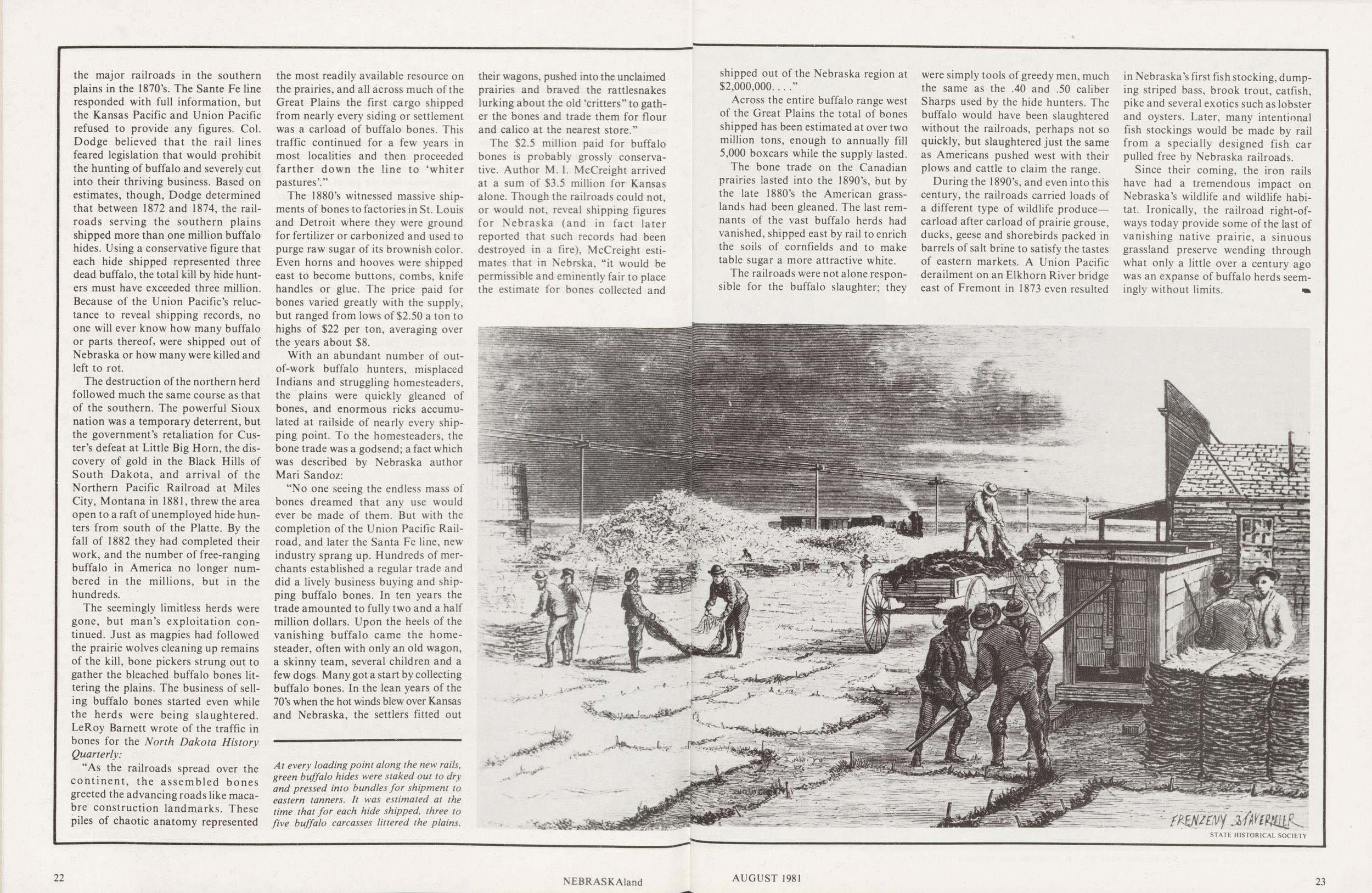 the major railroads in the southern plains in the 1870's. The Sante Fe line responded with full information, but the Kansas Pacific and Union Pacific refused to provide any figures. Col. Dodge believed that the rail lines feared legislation that would prohibit the hunting of buffalo and severely cut into their thriving business. Based on estimates, though, Dodge determined that between 1872 and 1874, the railroads serving the southern plains shipped more than one million buffalo hides. Using a conservative figure that each hide shipped represented three dead buffalo, the total kill by hide hunters must have exceeded three million. Because of the Union Pacific's reluctance to reveal shipping records, no one will ever know how many buffalo or parts thereof, were shipped out of Nebraska or how many were killed and left to rot.
The destruction of the northern herd followed much the same course as that of the southern. The powerful Sioux nation was a temporary deterrent, but the government's retaliation for Custer's defeat at Little Big Horn, the discovery of gold in the Black Hills of South Dakota, and arrival of the Northern Pacific Railroad at Miles City, Montana in 1881, threw the area open to a raft of unemployed hide hunters from south of the Platte. By the fall of 1882 they had completed their work, and the number of free-ranging buffalo in America no longer numbered in the millions, but in the hundreds.
The seemingly limitless herds were gone, but man's exploitation continued. Just as magpies had followed the prairie wolves cleaning up remains of the kill, bone pickers strung out to gather the bleached buffalo bones littering the plains. The business of selling buffalo bones started even while the herds were being slaughtered. LeRoy Barnett wrote of the traffic in bones for the North Dakota History Quarterly:
"As the railroads spread over the continent, the assembled bones greeted the advancing roads like macabre construction landmarks. These piles of chaotic anatomy represented the most readily available resource on the prairies, and all across much of the Great Plains the first cargo shipped from nearly every siding or settlement was a carload of buffalo bones. This traffic continued for a few years in most localities and then proceeded farther down the line to 'whiter pastures'."
The 1880's witnessed massive shipments of bones to factories in St. Louis and Detroit where they were ground for fertilizer or carbonized and used to purge raw sugar of its brownish color. Even horns and hooves were shipped east to become buttons, combs, knife handles or glue. The price paid for bones varied greatly with the supply, but ranged from lows of $2.50 a ton to highs of $22 per ton, averaging over the years about $8.
With an abundant number of out-of-work buffalo hunters, misplaced Indians and struggling homesteaders, the plains were quickly gleaned of bones, and enormous ricks accumulated at railside of nearly every shipping point. To the homesteaders, the bone trade was a godsend; a fact which was described by Nebraska author Mari Sandoz:
"No one seeing the endless mass of bones dreamed that any use would ever be made of them. But with the completion of the Union Pacific Railroad, and later the Santa Fe line, new industry sprang up. Hundreds of merchants established a regular trade and did a lively business buying and shipping buffalo bones. In ten years the trade amounted to fully two and a half million dollars. Upon the heels of the vanishing buffalo came the homesteader, often with only an old wagon, a skinny team, several children and a few dogs. Many got a start by collecting buffalo bones. In the lean years of the 70's when the hot winds blew over Kansas and Nebraska, the settlers fitted out their wagons, pushed into the unclaimed prairies and braved the rattlesnakes lurking about the old 'critters" to gather the bones and trade them for flour and calico at the nearest store."
The $2.5 million paid for buffalo bones is probably grossly conservative. Author M. I. McCreight arrived at a sum of $3.5 million for Kansas alone. Though the railroads could not, or would not, reveal shipping figures for Nebraska (and in fact later reported that such records had been destroyed in a fire), McCreight estimates that in Nebraska, "it would be permissible and eminently fair to place the estimate for bones collected and 22 NEBRASKAland shipped out of the Nebraska region at $2,000,000."
Across the entire buffalo range west of the Great Plains the total of bones shipped has been estimated at over two million tons, enough to annually fill 5,000 boxcars while the supply lasted.
The bone trade on the Canadian prairies lasted into the 1890's, but by the late 1880's the American grasslands had been gleaned. The last remnants of the vast buffalo herds had vanished, shipped east by rail to enrich the soils of cornfields and to make table sugar a more attractive white.
The railroads were not alone responsible for the buffalo slaughter; they were simply tools of greedy men, much the same as the .40 and .50 caliber Sharps used by the hide hunters. The buffalo would have been slaughtered without the railroads, perhaps not so quickly, but slaughtered just the same as Americans pushed west with their plows and cattle to claim the range.
During the 1890's, and even into this century, the railroads carried loads of a different type of wildlife produce—carload after carload of prairie grouse, ducks, geese and shorebirds packed in barrels of salt brine to satisfy the tastes of eastern markets. A Union Pacific derailment on an Elkhorn River bridge east of Fremont in 1873 even resulted in Nebraska's first fish stocking, dumping striped bass, brook trout, catfish, pike and several exotics such as lobster and oysters. Later, many intentional fish stockings would be made by rail from a specially designed fish car pulled free by Nebraska railroads.
Since their coming, the iron rails have had a tremendous impact on Nebraska's wildlife and wildlife habitat. Ironically, the railroad right-of-ways today provide some of the last of vanishing native prairie, a sinuous grassland preserve wending through what only a little over a century ago was an expanse of buffalo herds seemingly without limits.
STEAM LOCOMOTIVES
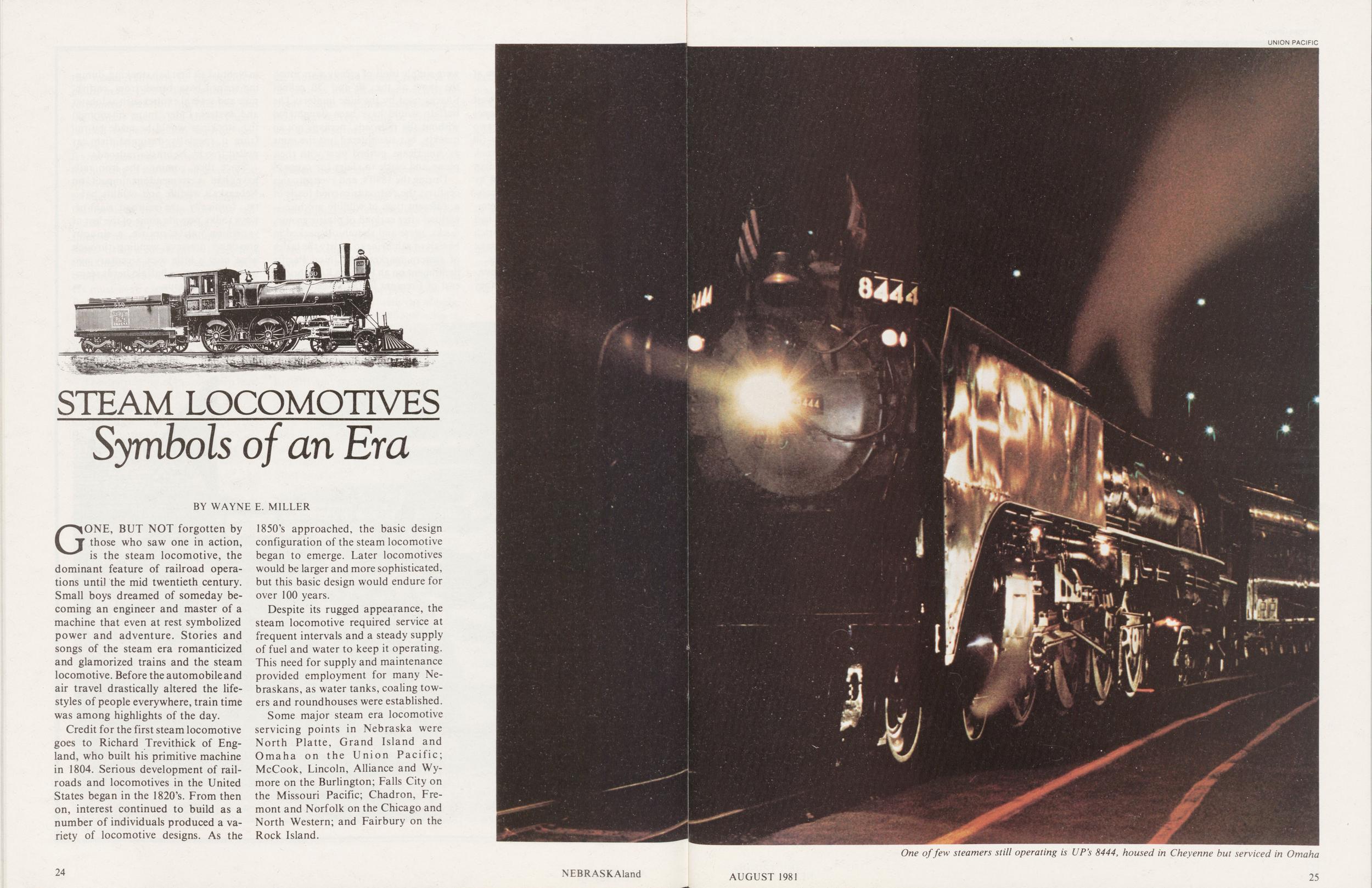
Symbols of an Era BY WAYNE E. MILLERGONE, BUT NOT forgotten by those who saw one in action, is the steam locomotive, the dominant feature of railroad operations until the mid twentieth century. Small boys dreamed of someday becoming an engineer and master of a machine that even at rest symbolized power and adventure. Stories and songs of the steam era romanticized and glamorized trains and the steam locomotive. Before the automobile and air travel drastically altered the lifestyles of people everywhere, train time was among highlights of the day.
Credit for the first steam locomotive goes to Richard Trevithick of England, who built his primitive machine in 1804. Serious development of railroads and locomotives in the United States began in the 1820's. From then on, interest continued to build as a number of individuals produced a variety of locomotive designs. As the 1850's approached, the basic design configuration of the steam locomotive began to emerge. Later locomotives would be larger and more sophisticated, but this basic design would endure for over 100 years.
Despite its rugged appearance, the steam locomotive required service at frequent intervals and a steady supply of fuel and water to keep it operating. This need for supply and maintenance provided employment for many Nebraskans, as water tanks, coaling towers and roundhouses were established.
Some major steam era locomotive servicing points in Nebraska were North Platte, Grand Island and Omaha on the Union Pacific; McCook, Lincoln, Alliance and Wymore on the Burlington; Falls City on the Missouri Pacific; Chadron, Fremont and Norfolk on the Chicago and North Western; and Fairbury on the Rock Island.
24 NEBRASKAland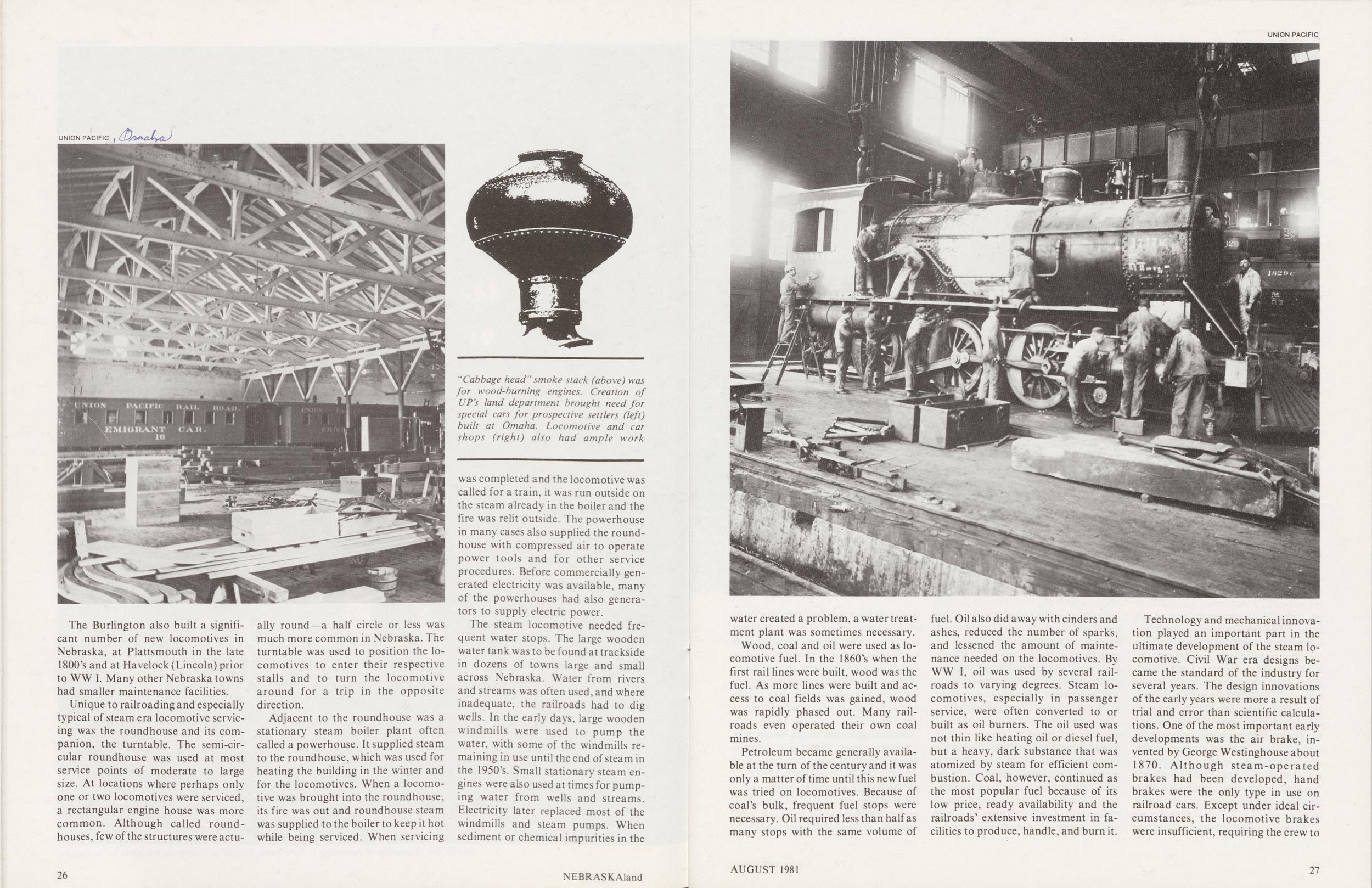
The Burlington also built a significant number of new locomotives in Nebraska, at Plattsmouth in the late 1800's and at Havelock (Lincoln) prior to WW I. Many other Nebraska towns had smaller maintenance facilities.
Unique to railroading and especially typical of steam era locomotive servicing was the roundhouse and its companion, the turntable. The semi-circular roundhouse was used at most service points of moderate to large size. At locations where perhaps only one or two locomotives were serviced, a rectangular engine house was more common. Although called roundhouses, few of the structures were actually round—a half circle or less was much more common in Nebraska. The turntable was used to position the locomotives to enter their respective stalls and to turn the locomotive around for a trip in the opposite direction.
Adjacent to the roundhouse was a stationary steam boiler plant often called a powerhouse. It supplied steam to the roundhouse, which was used for heating the building in the winter and for the locomotives. When a locomotive was brought into the roundhouse, its fire was out and roundhouse steam was supplied to the boiler to keep it hot while being serviced. When servicing was completed and the locomotive was called for a train, it was run outside on the steam already in the boiler and the fire was relit outside. The powerhouse in many cases also supplied the roundhouse with compressed air to operate power tools and for other service procedures. Before commercially generated electricity was available, many of the powerhouses had also generators to supply electric power.
The steam locomotive needed frequent water stops. The large wooden water tank was to be found at trackside in dozens of towns large and small across Nebraska. Water from rivers and streams was often used, and where inadequate, the railroads had to dig wells. In the early days, large wooden windmills were used to pump the water, with some of the windmills remaining in use until the end of steam in the 1950's. Small stationary steam engines were also used at times for pumping water from wells and streams. Electricity later replaced most of the windmills and steam pumps. When sediment or chemical impurities in the 26 NEBRASKAland
Wood, coal and oil were used as locomotive fuel. In the 1860's when the first rail lines were built, wood was the fuel. As more lines were built and access to coal fields was gained, wood was rapidly phased out. Many railroads even operated their own coal mines.
Petroleum became generally available at the turn of the century and it was only a matter of time until this new fuel was tried on locomotives. Because of coal's bulk, frequent fuel stops were necessary. Oil required less than half as many stops with the same volume of fuel. Oil also did away with cinders and ashes, reduced the number of sparks, and lessened the amount of maintenance needed on the locomotives. By WW I, oil was used by several railroads to varying degrees. Steam locomotives, especially in passenger service, were often converted to or built as oil burners. The oil used was not thin like heating oil or diesel fuel, but a heavy, dark substance that was atomized by steam for efficient combustion. Coal, however, continued as the most popular fuel because of its low price, ready availability and the railroads' extensive investment in facilities to produce, handle, and burn it.
Technology and mechanical innovation played an important part in the ultimate development of the steam locomotive. Civil War era designs became the standard of the industry for several years. The design innovations of the early years were more a result of trial and error than scientific calculations. One of the most important early developments was the air brake, invented by George Westinghouse about 1870. Although steam-operated brakes had been developed, hand brakes were the only type in use on railroad cars. Except under ideal circumstances, the locomotive brakes were insufficient, requiring the crew to AUGUST 1981 27 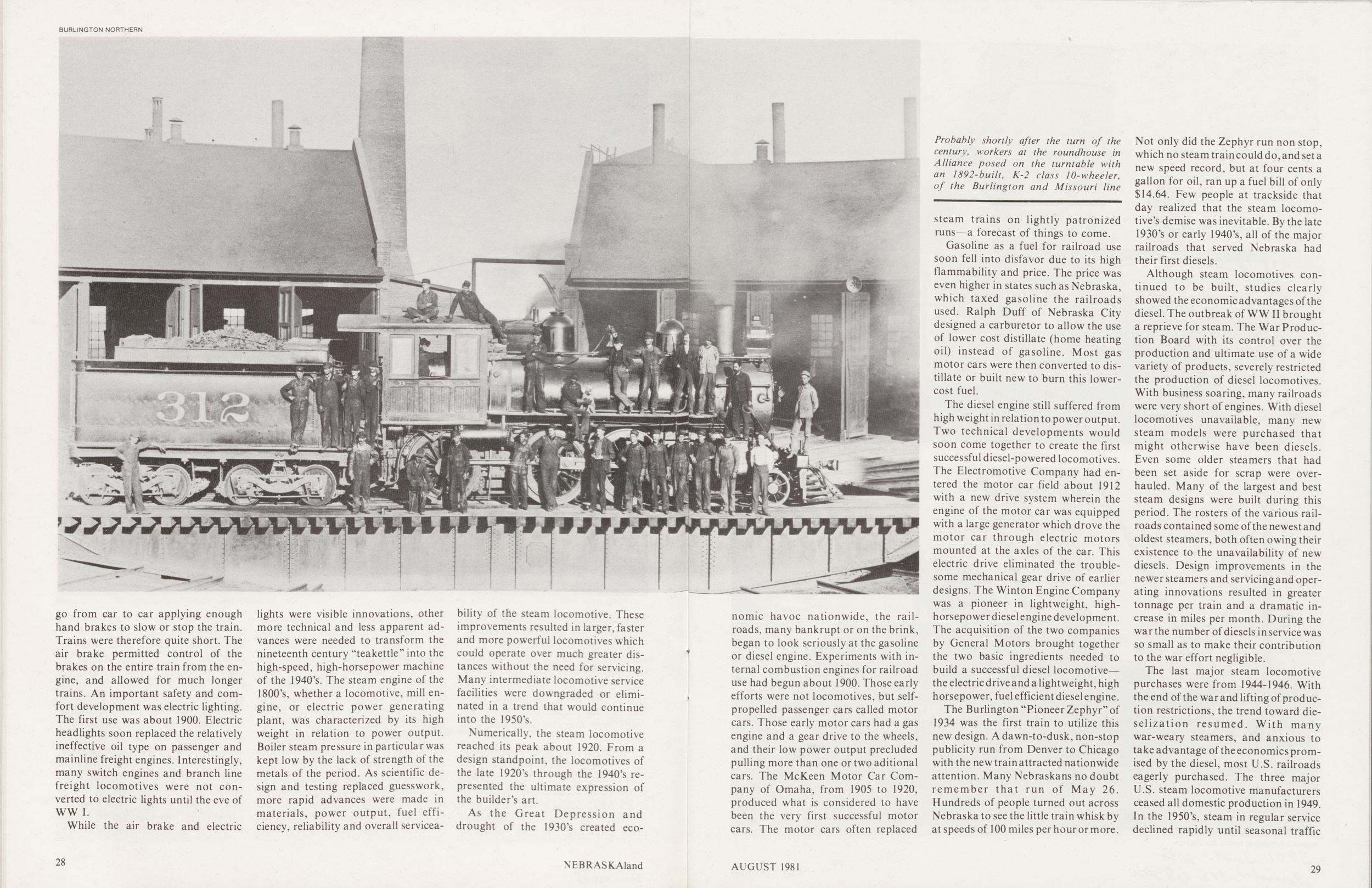
While the air brake and electric lights were visible innovations, other more technical and less apparent advances were needed to transform the nineteenth century "teakettle" into the high-speed, high-horsepower machine of the 1940's. The steam engine of the 1800's, whether a locomotive, mill engine, or electric power generating plant, was characterized by its high weight in relation to power output. Boiler steam pressure in particular was kept low by the lack of strength of the metals of the period. As scientific design and testing replaced guesswork, more rapid advances were made in materials, power output, fuel efficiency, reliability and overall serviceability of the steam locomotive. These improvements resulted in larger, faster and more powerful locomotives which could operate over much greater distances without the need for servicing. Many intermediate locomotive service facilities were downgraded or eliminated in a trend that would continue into the 1950's.
Numerically, the steam locomotive reached its peak about 1920. From a design standpoint, the locomotives of the late 1920's through the 1940's represented the ultimate expression of the builder's art.
As the Great Depression and drought of the 1930's created economic 28 NEBRASKAland havoc nationwide, the railroads, many bankrupt or on the brink, began to look seriously at the gasoline or diesel engine. Experiments with internal combustion engines for railroad use had begun about 1900. Those early efforts were not locomotives, but self-propelled passenger cars called motor cars. Those early motor cars had a gas engine and a gear drive to the wheels, and their low power output precluded pulling more than one or two aditional cars. The McKeen Motor Car Company of Omaha, from 1905 to 1920, produced what is considered to have been the very first successful motor cars. The motor cars often replaced steam trains on lightly patronized runs—a forecast of things to come.
Gasoline as a fuel for railroad use soon fell into disfavor due to its high flammability and price. The price was even higher in states such as Nebraska, which taxed gasoline the railroads used. Ralph Duff of Nebraska City designed a carburetor to allow the use of lower cost distillate (home heating oil) instead of gasoline. Most gas motor cars were then converted to distillate or built new to burn this lower-cost fuel.
The diesel engine still suffered from high weight in relation to power output. Two technical developments would soon come together to create the first successful diesel-powered locomotives. The Electromotive Company had entered the motor car field about 1912 with a new drive system wherein the engine of the motor car was equipped with a large generator which drove the motor car through electric motors mounted at the axles of the car. This electric drive eliminated the trouble-some mechanical gear drive of earlier designs. The Winton Engine Company was a pioneer in lightweight, high-horsepower diesel engine development. The acquisition of the two companies by General Motors brought together the two basic ingredients needed to build a successful diesel locomotive—the electric drive and a lightweight, high horsepower, fuel efficient diesel engine.
The Burlington "Pioneer Zephyr" of 1934 was the first train to utilize this new design. A dawn-to-dusk, non-stop publicity run from Denver to Chicago with the new train attracted nationwide attention. Many Nebraskans no doubt remember that run of May 26. Hundreds of people turned out across Nebraska to see the little train whisk by at speeds of 100 miles per hour or more. Not only did the Zephyr run non stop, which no steam train could do, and set a new speed record, but at four cents a gallon for oil, ran up a fuel bill of only $14.64. Few people at trackside that day realized that the steam locomotive's demise was inevitable. By the late 1930's or early 1940's, all of the major railroads that served Nebraska had their first diesels.
Although steam locomotives continued to be built, studies clearly showed the economic advantages of the diesel. The outbreak of WW II brought a reprieve for steam. The War Production Board with its control over the production and ultimate use of a wide variety of products, severely restricted the production of diesel locomotives. With business soaring, many railroads were very short of engines. With diesel locomotives unavailable, many new steam models were purchased that might otherwise have been diesels. Even some older steamers that had been set aside for scrap were overhauled. Many of the largest and best steam designs were built during this period. The rosters of the various railroads contained some of the newest and oldest steamers, both often owing their existence to the unavailability of new diesels. Design improvements in the newer steamers and servicing and operating innovations resulted in greater tonnage per train and a dramatic increase in miles per month. During the war the number of diesels in service was so small as to make their contribution to the war effort negligible.
The last major steam locomotive purchases were from 1944-1946. With the end of the war and lifting of production restrictions, the trend toward dieselization resumed. With many war-weary steamers, and anxious to take advantage of the economics promised by the diesel, most U.S. railroads eagerly purchased. The three major U.S. steam locomotive manufacturers ceased all domestic production in 1949. In the 1950's, steam in regular service declined rapidly until seasonal traffic AUGUST 1981 29 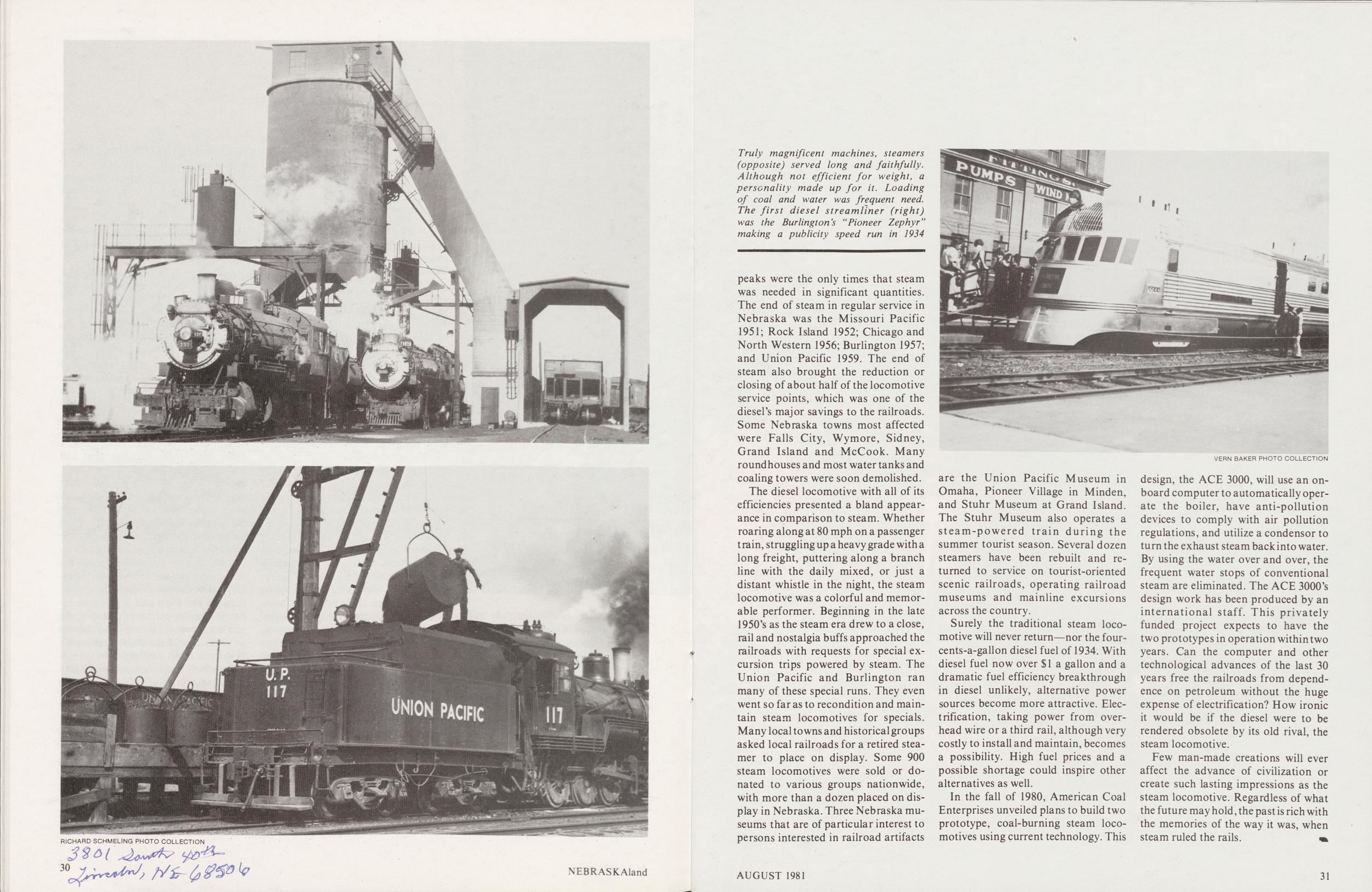
The diesel locomotive with all of its efficiencies presented a bland appearance in comparison to steam. Whether roaring along at 80 mph on a passenger train, struggling up a heavy grade with a long freight, puttering along a branch line with the daily mixed, or just a distant whistle in the night, the steam locomotive was a colorful and memorable performer. Beginning in the late 1950's as the steam era drew to a close, rail and nostalgia buffs approached the railroads with requests for special excursion trips powered by steam. The Union Pacific and Burlington ran many of these special runs. They even went so far as to recondition and maintain steam locomotives for specials. Many local towns and historical groups asked local railroads for a retired steamer to place on display. Some 900 steam locomotives were sold or donated to various groups nationwide, with more than a dozen placed on display in Nebraska. Three Nebraska museums that are of particular interest to persons interested in railroad artifacts are the Union Pacific Museum in Omaha, Pioneer Village in Minden, and Stuhr Museum at Grand Island. The Stuhr Museum also operates a steam-powered train during the summer tourist season. Several dozen steamers have been rebuilt and returned to service on tourist-oriented scenic railroads, operating railroad museums and mainline excursions across the country.
Surely the traditional steam locomotive will never return—nor the four-cents-a-gallon diesel fuel of 1934. With diesel fuel now over $1 a gallon and a dramatic fuel efficiency breakthrough in diesel unlikely, alternative power sources become more attractive. Electrification, taking power from overhead wire or a third rail, although very costly to install and maintain, becomes a possibility. High fuel prices and a possible shortage could inspire other alternatives as well.
In the fall of 1980, American Coal Enterprises unveiled plans to build two prototype, coal-burning steam locomotives using current technology. This design, the ACE 3000, will use an onboard computer to automatically operate the boiler, have anti-pollution devices to comply with air pollution regulations, and utilize a condensor to turn the exhaust steam back into water. By using the water over and over, the frequent water stops of conventional steam are eliminated. The ACE 3000's design work has been produced by an international staff. This privately funded project expects to have the two prototypes in operation within two years. Can the computer and other technological advances of the last 30 years free the railroads from dependence on petroleum without the huge expense of electrification? How ironic it would be if the diesel were to be rendered obsolete by its old rival, the steam locomotive.
Few man-made creations will ever affect the advance of civilization or create such lasting impressions as the steam locomotive. Regardless of what the future may hold, the past is rich with the memories of the way it was, when steam ruled the rails.
AUGUST 1981 31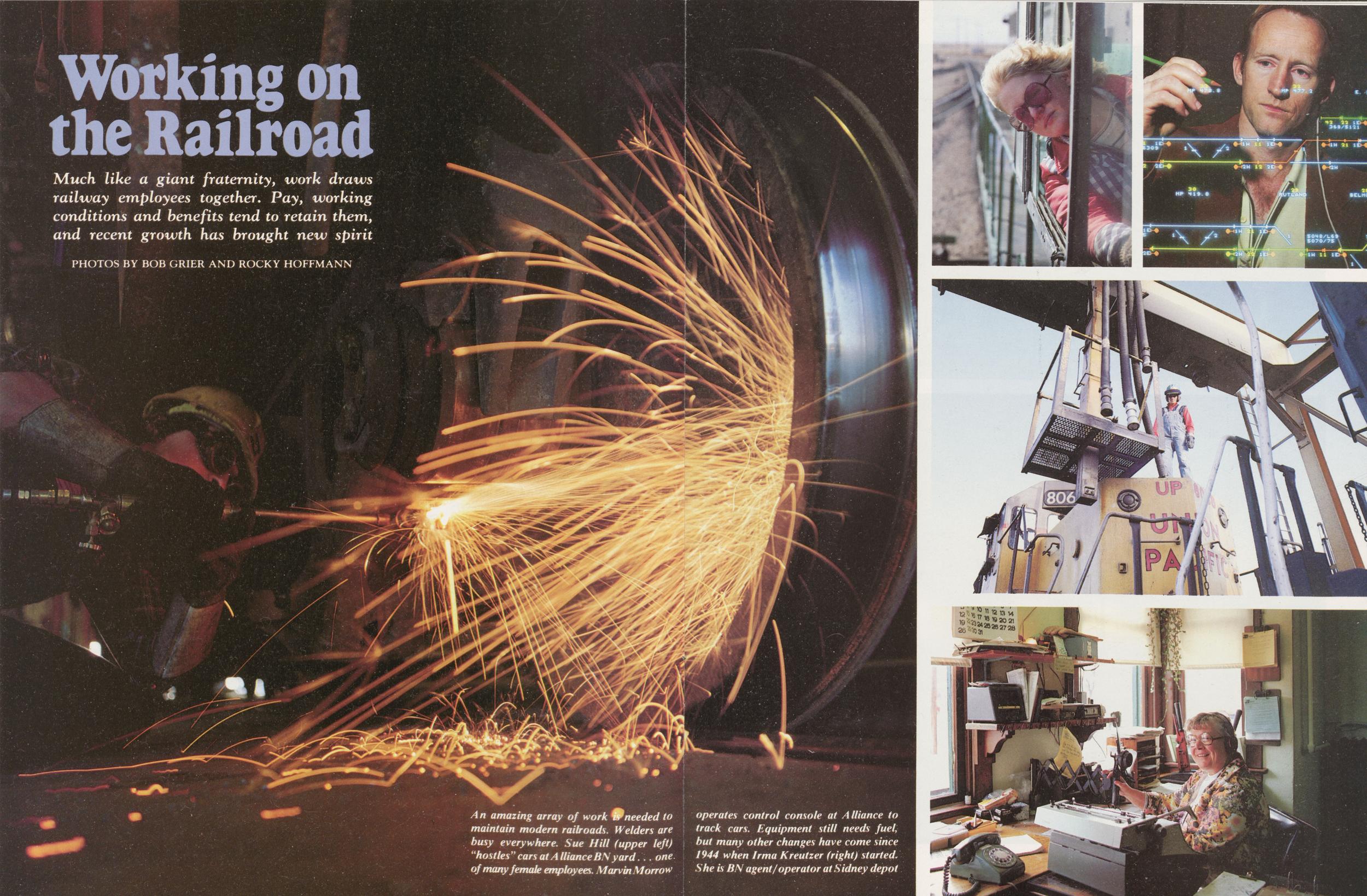
Working on the Railroad
Much like a giant fraternity, work draws railway employees together. Pay, working conditions and benefits tend to retain them, and recent growth has brought new spirit PHOTOS BY BOB GRIER AND ROCKY HOFFMANN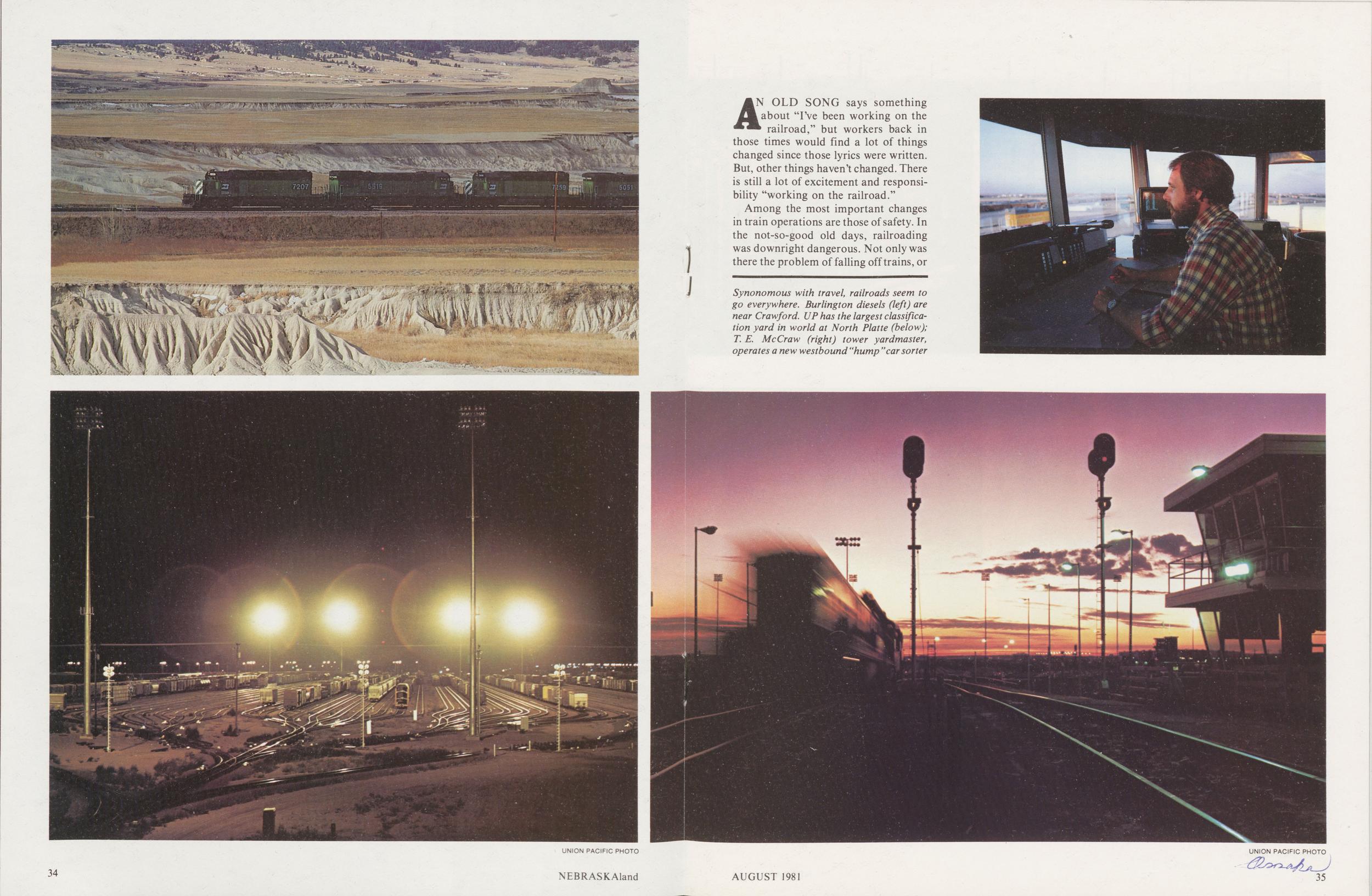
AN OLD SONG says something £M about "I've been working on the A^ railroad," but workers back in those times would find a lot of things changed since those lyrics were written. But, other things haven't changed. There is still a lot of excitement and responsibility "working on the railroad."
Among the most important changes in train operations are those of safety. In the not-so-good old days, railroading was downright dangerous. Not only was there the problem of falling off trains, or
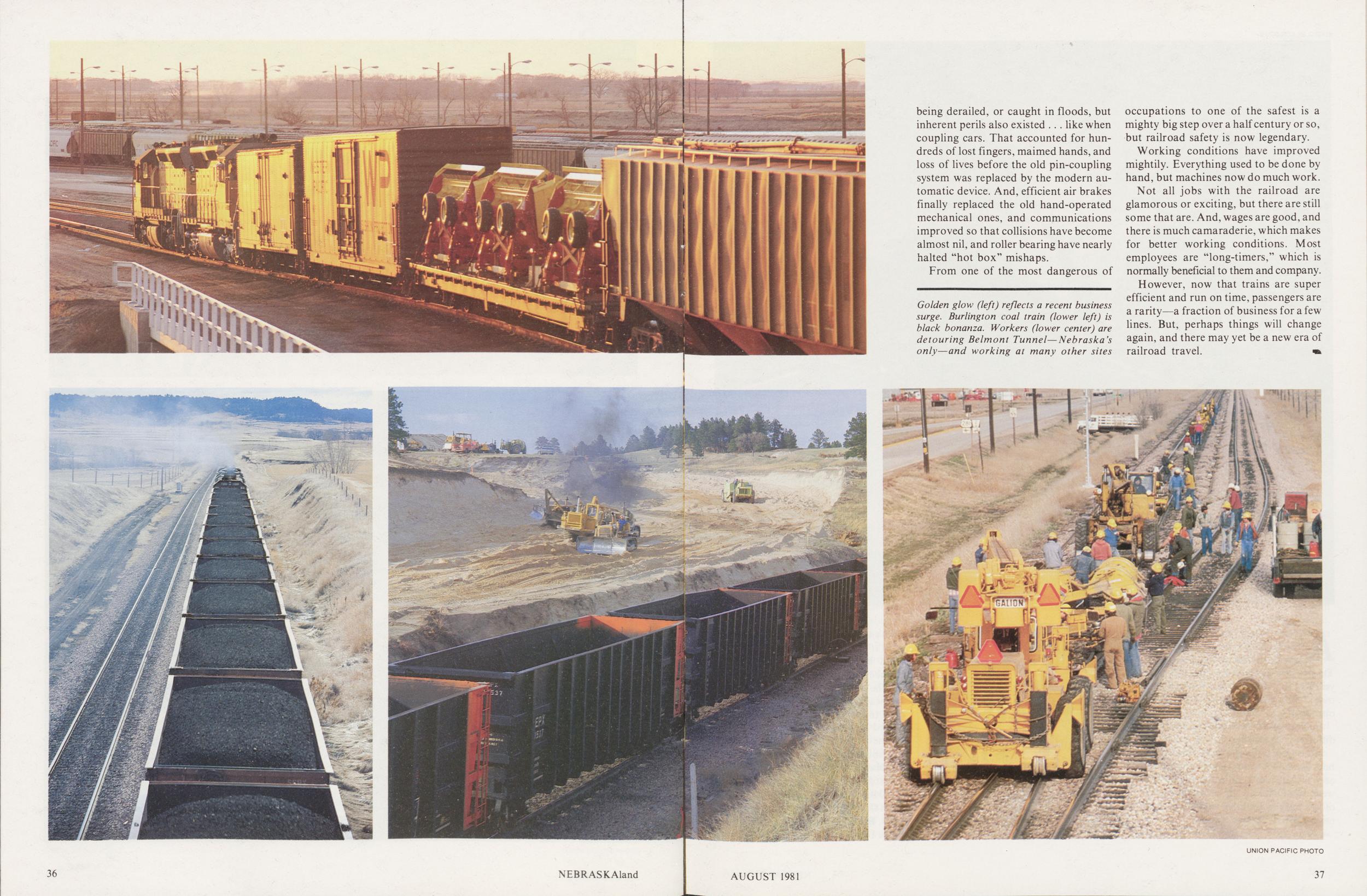
From one of the most dangerous of occupations to one of the safest is a mighty big step over a half century or so, but railroad safety is now legendary.
Working conditions have improved mightily. Everything used to be done by hand, but machines now do much work.
Not all jobs with the railroad are glamorous or exciting, but there are still some that are. And, wages are good, and there is much camaraderie, which makes for better working conditions. Most employees are "long-timers," which is normally beneficial to them and company.
However, now that trains are super efficient and run on time, passengers are a rarity—a fraction of business for a few lines. But, perhaps things will change again, and there may yet be a new era of railroad travel.
The Mail by Rail
A corps of "mobile mailmen" once rode the rails, sorting as they went and doing it accurately. Their last run was 1977—victims of progress BY HARRY HEAFERAT ONE TIME, Railway Post Offices traveled over an amazing 80 percent of the nation's railroad Trackage. And, during the 100-plus years of RPO operation in the U.S., over 7,500 different titled RPO lines operated.
In Nebraska, there once existed 265 differently titled lines.
Gradually phased out over the years because of lessening passenger travel and insufficient mail volume, RPO's were a colorful and interesting aspect of the rather complex history of our nation's mail service.
From their beginnings in the mid 1800's through their heyday in the late 1950's, the in-transit sorting of U.S. Mail by these mobile post offices formed the link between most stations on the line in which they operated. Railway Post Offices (RPO's) were the cars in which mail was distributed, sorted and placed in bags.
The first railroad to experimentally distribute overland mail in transit was the Hannibal and St. Joseph Railroad in 1862. The first official, established RPO line in the U.S. was on the C&NW from Chicago to Clinton on August 28, 1864. By 1902, 146 RPO lines operated in the U.S. At the end of 1948, the RPO 38 NEBRASKAland network was still a major organization and constituted the principal overland mail transportation agency of the country—over 790 lines were operating over 160,000 miles. During the 1950's RPO lines began rapidly disappearing. Finally, the fateful day came in April 1971 when seven of the remaining eight lines were dissolved, leaving only the line from New York to Washington, D.C., which then saw its final run in June of 1977, ending 140 years of Railway Mail Service and 113 years of RPO operation; a sad ending to the days of mail speed and dependability in this country.
Life on the mail train as an RPO clerk was colorful and interesting, but no picnic. As Postmaster General Jones said in 1888, "There is no position more exacting. He must not only be sound in mind and limb, but possessed of above-ordinary intelligence and a retentive memory he must know no night or day."
Always located immediately behind the engine, RPO cars were easily recognized by their low windows containing prison-like wooden rods, and by a catcher hook or safety bar in each sliding door. Containing one or more clerks who picked up and dispatched mail along the route, they worked at a mad pace on a speeding, swaying train. Whether large or small, the interior of the car looked the same: "a tight space filled with one-too-many clerks, 50 too-many pouches of mail, and a tangle of arms and hands blurrily tossing papers, letters and parcels into open sacks."
Letter men handled a case section 11 or 12 holes high and four to 16 columns wide. Pouch clerks busily flung letter packages and first-class packets (slugs) in front, behind, and above into auxiliary overhead boxes. "Paper men" did the same with newspapers and parcels.
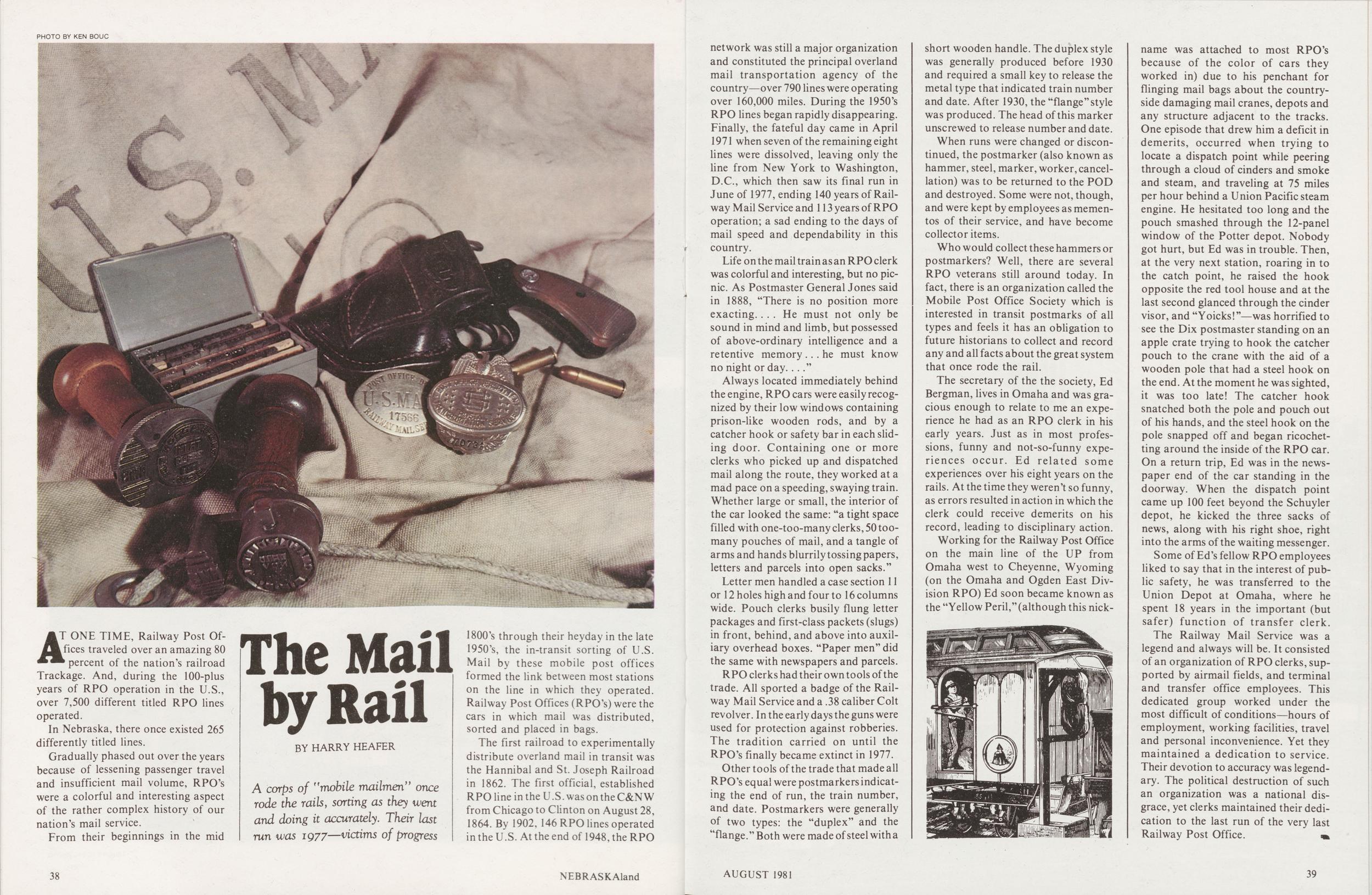
RPO clerks had their own tools of the trade. All sported a badge of the Railway Mail Service and a .38 caliber Colt revolver. In the early days the guns were used for protection against robberies. The tradition carried on until the RPO's finally became extinct in 1977.
Other tools of the trade that made all RPO's equal were postmarkers indicating the end of run, the train number, and date. Postmarkers were generally of two types: the "duplex" and the "flange." Both were made of steel with a short wooden handle. The duplex style was generally produced before 1930 and required a small key to release the metal type that indicated train number and date. After 1930, the "flange" style was produced. The head of this marker unscrewed to release number and date.
When runs were changed or discontinued, the postmarker (also known as hammer, steel, marker, worker, cancellation) was to be returned to the POD and destroyed. Some were not, though, and were kept by employees as mementos of their service, and have become collector items.
Who would collect these hammers or postmarkers? Well, there are several RPO veterans still around today. In fact, there is an organization called the Mobile Post Office Society which is interested in transit postmarks of all types and feels it has an obligation to future historians to collect and record any and all facts about the great system that once rode the rail.
The secretary of the the society, Ed Bergman, lives in Omaha and was gracious enough to relate to me an experience he had as an RPO clerk in his early years. Just as in most professions, funny and not-so-funny experiences occur. Ed related some experiences over his eight years on the rails. At the time they weren't so funny, as errors resulted in action in which the clerk could receive demerits on his record, leading to disciplinary action.
Working for the Railway Post Office on the main line of the UP from Omaha west to Cheyenne, Wyoming (on the Omaha and Ogden East Division RPO) Ed soon became known as the "Yellow Peril,"(although this nickname
Some of Ed's fellow RPO employees liked to say that in the interest of public safety, he was transferred to the Union Depot at Omaha, where he spent 18 years in the important (but safer) function of transfer clerk.
The Railway Mail Service was a legend and always will be. It consisted of an organization of RPO clerks, supported by airmail fields, and terminal and transfer office employees. This dedicated group worked under the most difficult of conditions—hours of employment, working facilities, travel and personal inconvenience. Yet they maintained a dedication to service. Their devotion to accuracy was legendary. The political destruction of such an organization was a national disgrace, yet clerks maintained their dedication to the last run of the very last Railway Post Office.
AUGUST 1981 39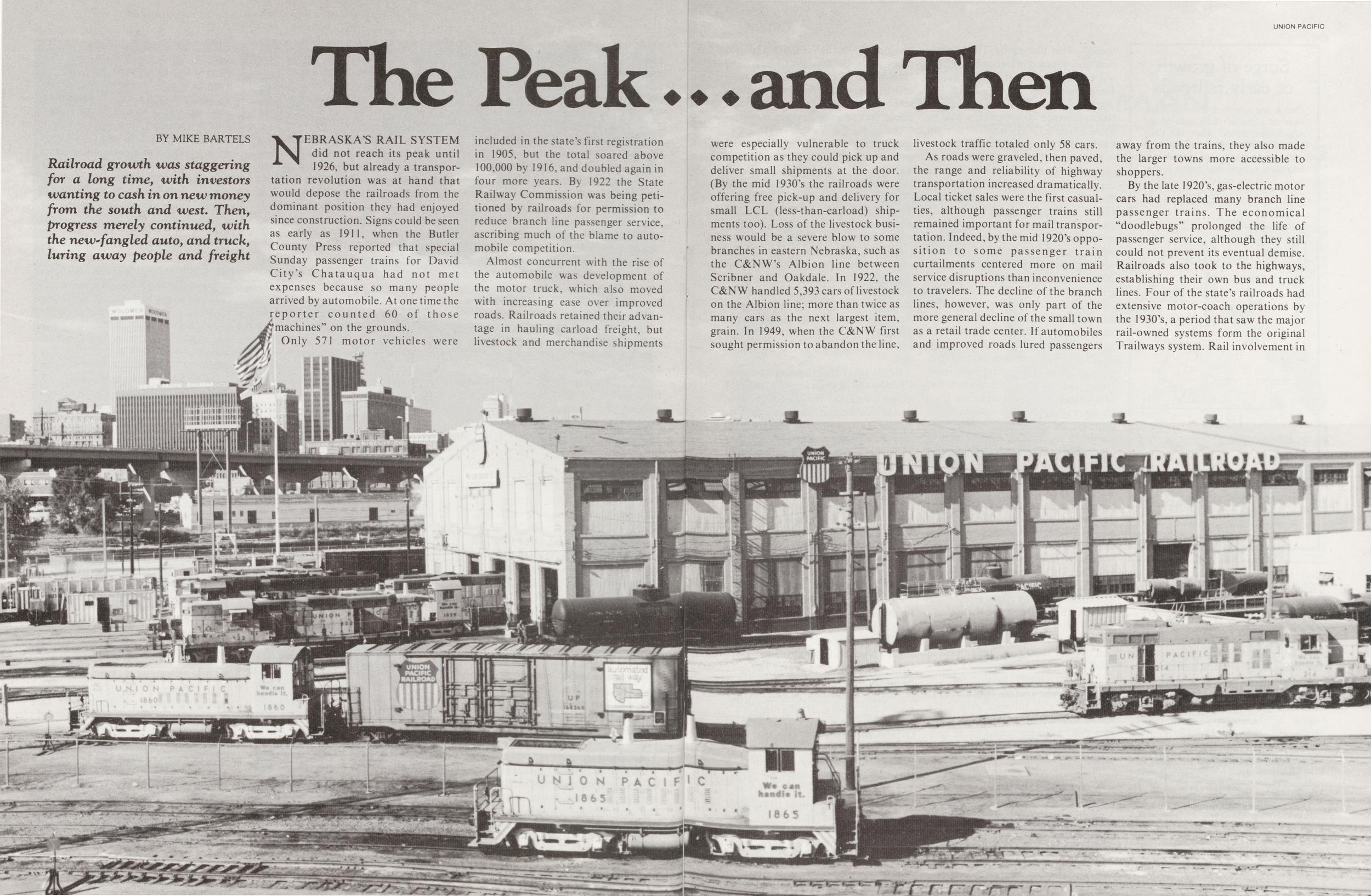
The Peak and Then
NEBRASKA'S RAIL SYSTEM did not reach its peak until 1926, but already a transportation revolution was at hand that would depose the railroads from the dominant position they had enjoyed since construction. Signs could be seen as early as 1911, when the Butler County Press reported that special Sunday passenger trains for David City's Chatauqua had not met expenses because so many people arrived by automobile. At one time the reporter counted 60 of those 'machines" on the grounds.
Only 571 motor vehicles were included in the state's first registration in 1905, but the total soared above 100,000 by 1916, and doubled again in four more years. By 1922 the State Railway Commission was being petitioned by railroads for permission to reduce branch line passenger service, ascribing much of the blame to automobile competition.
Almost concurrent with the rise of the automobile was development of the motor truck, which also moved with increasing ease over improved roads. Railroads retained their advantage in hauling carload freight, but livestock and merchandise shipments
As roads were graveled, then paved, the range and reliability of highway transportation increased dramatically. Local ticket sales were the first casualties, although passenger trains still remained important for mail transportation. Indeed, by the mid 1920's opposition to some passenger train curtailments centered more on mail service disruptions than inconvenience to travelers. The decline of the branch lines, however, was only part of the more general decline of the small town as a retail trade center. If automobiles and improved roads lured passengers away from the trains, they also made the larger towns more accessible to shoppers.
By the late 1920's, gas-electric motor cars had replaced many branch line passenger trains. The economical "doodlebugs" prolonged the life of passenger service, although they still could not prevent its eventual demise. Railroads also took to the highways, establishing their own bus and truck lines. Four of the state's railroads had extensive motor-coach operations by the 1930's, a period that saw the major rail-owned systems form the original Trailways system. Rail involvement in 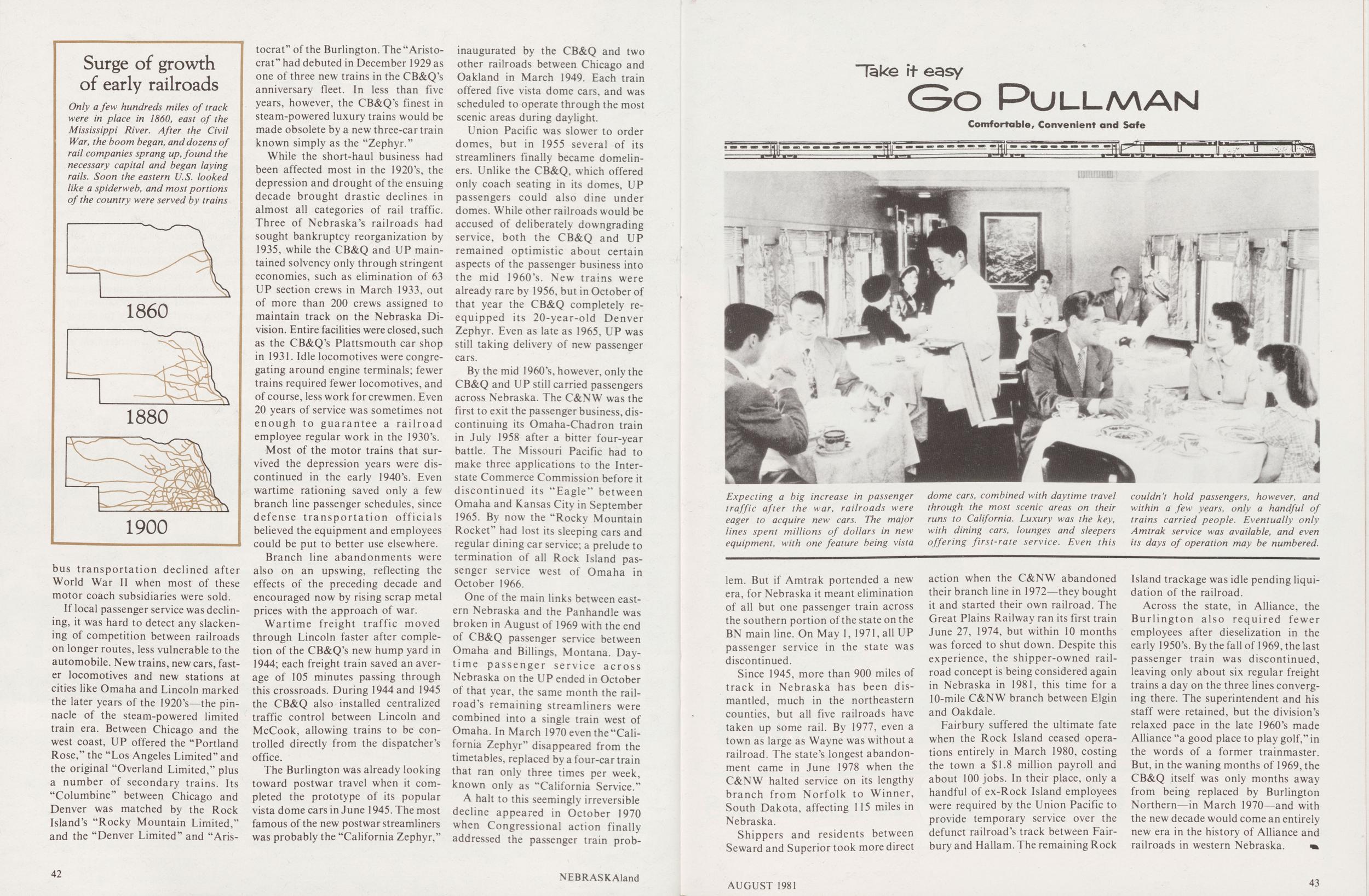
If local passenger service was declining, it was hard to detect any slackening of competition between railroads on longer routes, less vulnerable to the automobile. New trains, new cars, faster locomotives and new stations at cities like Omaha and Lincoln marked the later years of the 1920's—the pinnacle of the steam-powered limited train era. Between Chicago and the west coast, UP offered the "Portland Rose," the "Los Angeles Limited" and the original "Overland Limited," plus a number of secondary trains. Its "Columbine" between Chicago and Denver was matched by the Rock Island's "Rocky Mountain Limited," and the "Denver Limited" and "Aristocrat" of the Burlington. The "Aristocrat" had debuted in December 1929 as one of three new trains in the CB&Q's anniversary fleet. In less than five years, however, the CB&Q's finest in steam-powered luxury trains would be made obsolete by a new three-car train known simply as the "Zephyr."
While the short-haul business had been affected most in the 1920's, the depression and drought ofthe ensuing decade brought drastic declines in almost all categories of rail traffic. Three of Nebraska's railroads had sought bankruptcy reorganization by 1935, while the CB&Q and UP maintained solvency only through stringent economies, such as elimination of 63 UP section crews in March 1933, out of more than 200 crews assigned to maintain track on the Nebraska Division. Entire facilities were closed, such as the CB&Q's Plattsmouth car shop in 1931. Idle locomotives were congregating around engine terminals; fewer trains required fewer locomotives, and of course, less work for crewmen. Even 20 years of service was sometimes not enough to guarantee a railroad employee regular work in the 1930's.
Most of the motor trains that survived the depression years were discontinued in the early 1940's. Even wartime rationing saved only a few branch line passenger schedules, since defense transportation officials believed the equipment and employees could be put to better use elsewhere.
Branch line abandonments were also on an upswing, reflecting the effects of the preceding decade and encouraged now by rising scrap metal prices with the approach of war.
Wartime freight traffic moved through Lincoln faster after completion of the CB&Q's new hump yard in 1944; each freight train saved an average of 105 minutes passing through this crossroads. During 1944 and 1945 the CB&Q also installed centralized traffic control between Lincoln and McCook, allowing trains to be controlled directly from the dispatcher's office.
The Burlington was already looking toward postwar travel when it completed the prototype of its popular vista dome cars in June 1945. The most famous of the new postwar streamliners was probably the "California Zephyr," inaugurated by the CB&Q and two other railroads between Chicago and Oakland in March 1949. Each train offered five vista dome cars, and was scheduled to operate through the most scenic areas during daylight.
Union Pacific was slower to order domes, but in 1955 several of its streamliners finally became domeliners. Unlike the CB&Q, which offered only coach seating in its domes, UP passengers could also dine under domes. While other railroads would be accused of deliberately downgrading service, both the CB&Q and UP remained optimistic about certain aspects of the passenger business into the mid 1960's. New trains were already rare by 1956, but in October of that year the CB&Q completely reequipped its 20-year-old Denver Zephyr. Even as late as 1965, UP was still taking delivery of new passenger cars.
By the mid 1960's, however, only the CB&Q and UP still carried passengers across Nebraska. The C&NW was the first to exit the passenger business, discontinuing its Omaha-Chadron train in July 1958 after a bitter four-year battle. The Missouri Pacific had to make three applications to the Interstate Commerce Commission before it discontinued its "Eagle" between Omaha and Kansas City in September 1965. By now the "Rocky Mountain Rocket" had lost its sleeping cars and regular dining car service; a prelude to termination of all Rock Island passenger service west of Omaha in October 1966.
One of the main links between eastern Nebraska and the Panhandle was broken in August of 1969 with the end of CB&Q passenger service between Omaha and Billings, Montana. Daytime passenger service across Nebraska on the UP ended in October of that year, the same month the railroad's remaining streamliners were combined into a single train west of Omaha. In March 1970 even the "California Zephyr" disappeared from the timetables, replaced by a four-car train that ran only three times per week, known only as "California Service."
A halt to this seemingly irreversible decline appeared in October 1970 when Congressional action finally addressed the passenger train problem. 42 NEBRASKAland
Since 1945, more than 900 miles of track in Nebraska has been dismantled, much in the northeastern counties, but all five railroads have taken up some rail. By 1977, even a town as large as Wayne was without a railroad. The state's longest abandonment came in June 1978 when the C&NW halted service on its lengthy branch from Norfolk to Winner, South Dakota, affecting 115 miles in Nebraska.
Shippers and residents between Seward and Superior took more direct action when the C&NW abandoned their branch line in 1972—they bought it and started their own railroad. The Great Plains Railway ran its first train June 27, 1974, but within 10 months was forced to shut down. Despite this experience, the shipper-owned railroad concept is being considered again in Nebraska in 1981, this time for a 10-mile C&NW branch between Elgin and Oakdale.
Fairbury suffered the ultimate fate when the Rock Island ceased operations entirely in March 1980, costing the town a $1.8 million payroll and about 100 jobs. In their place, only a handful of ex-Rock Island employees were required by the Union Pacific to provide temporary service over the defunct railroad's track between Fairbury and Hallam. The remaining Rock Island trackage was idle pending liquidation of the railroad.
Across the state, in Alliance, the Burlington also required fewer employees after dieselization in the early 1950's. By the fall of 1969, the last passenger train was discontinued, leaving only about six regular freight trains a day on the three lines converging there. The superintendent and his staff were retained, but the division's relaxed pace in the late 1960's made Alliance "a good place to play golf," in the words of a former trainmaster. But, in the waning months of 1969, the CB&Q itself was only months away from being replaced by Burlington Northern—in March 1970—and with the new decade would come an entirely new era in the history of Alliance and railroads in western Nebraska.
"Take it easy So Pullman Comfortable, Convenient and Safe AUGUST 1981 43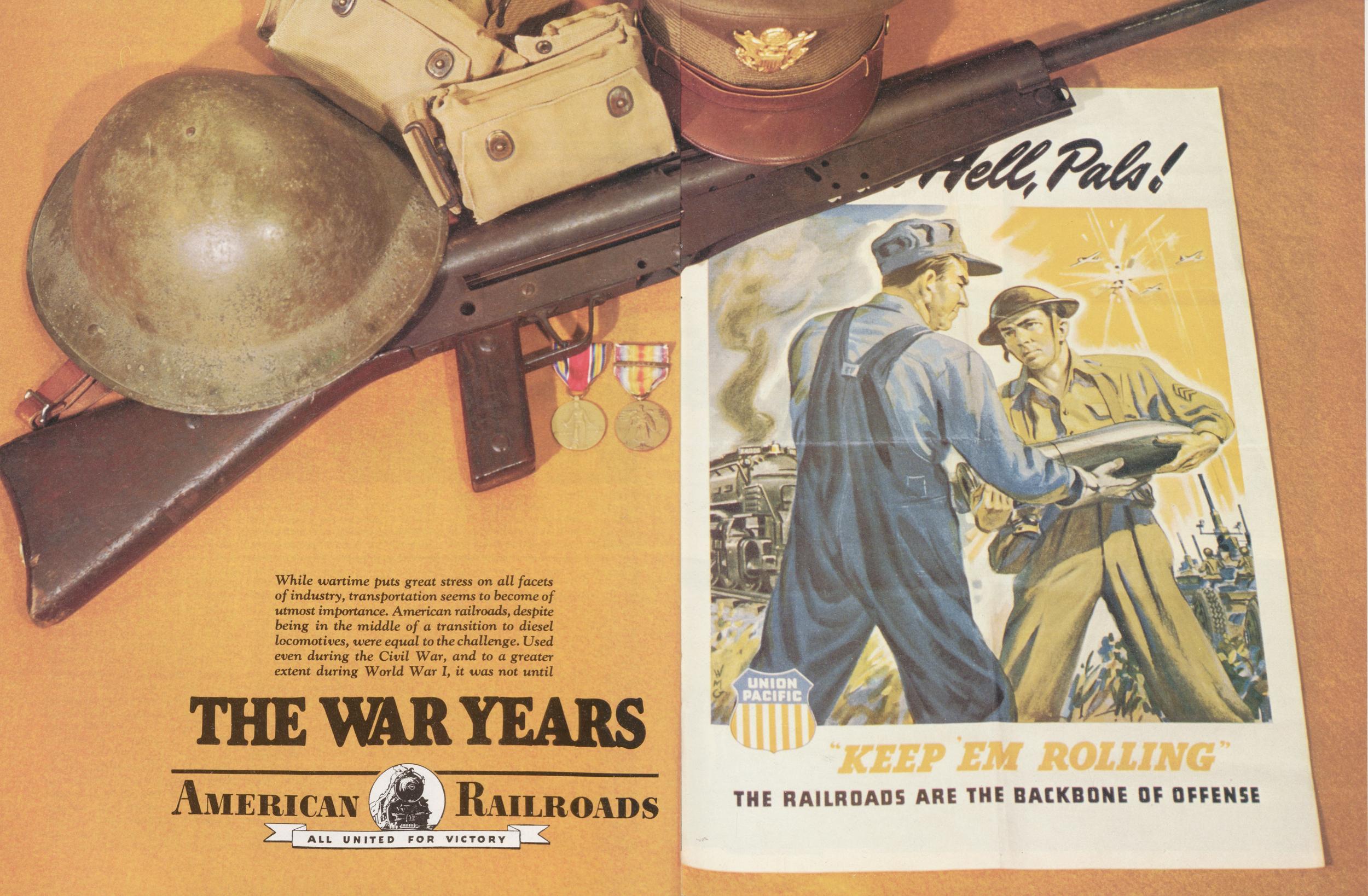
THE WAR YEARS
American Railroads ALL UNITED FOR VICTORY While wartime puts great stress on all facets of industry, transportation seems to become of utmost importance. American railroads, despite being in the middle of a transition to diesel locomotives, were equal to the challenge. Used even during the Civil War, and to a greater extent during World War 1, it was not until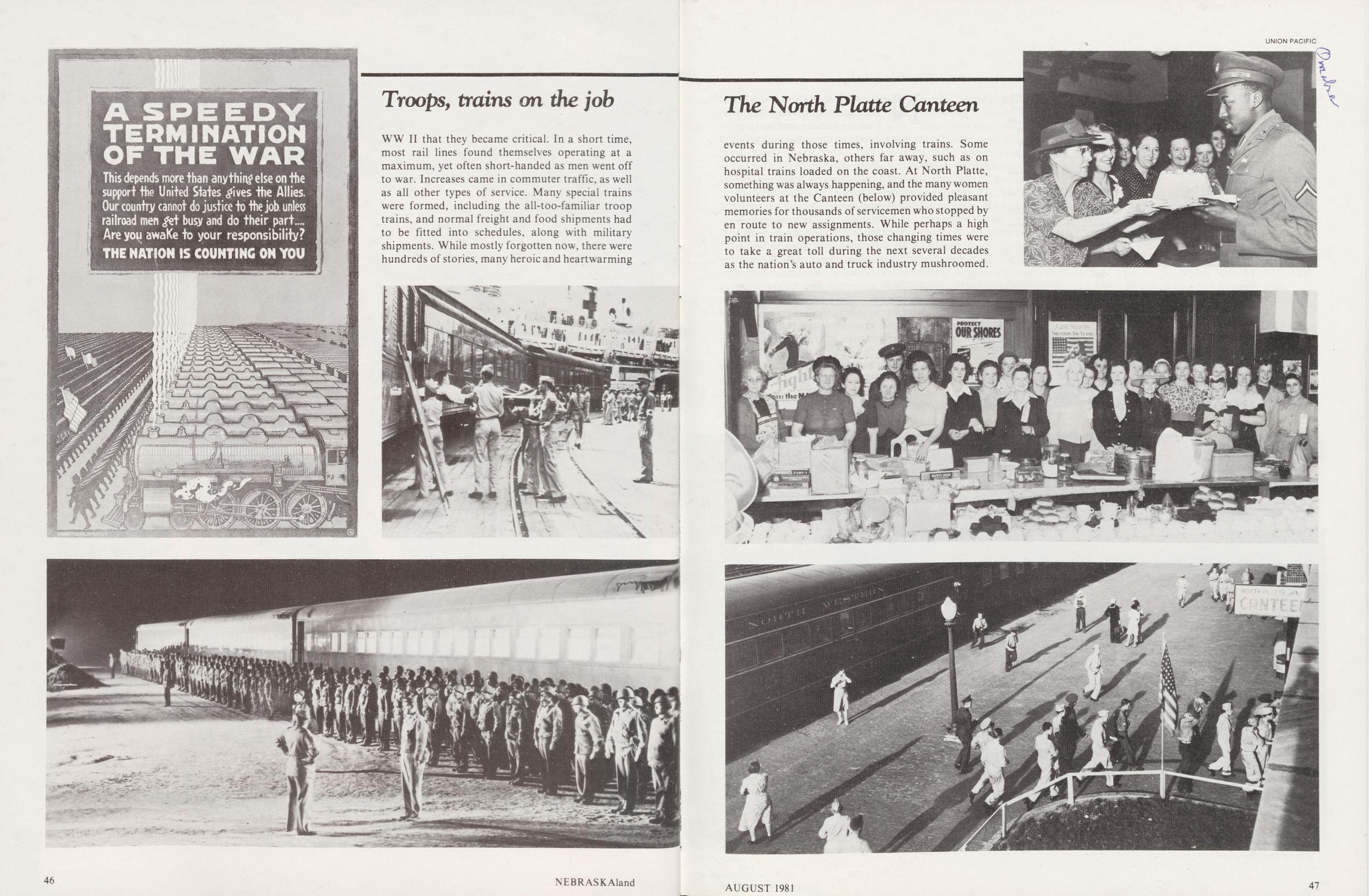
WW II that they became critical. In a short time, most rail lines found themselves operating at a maximum, yet often short-handed as men went off to war. Increases came in commuter traffic, as well as all other types of service. Many special trains were formed, including the all-too-familiar troop trains, and normal freight and food shipments had to be fitted into schedules, along with military shipments. While mostly forgotten now, there were hundreds of stories, many heroic and heartwarming
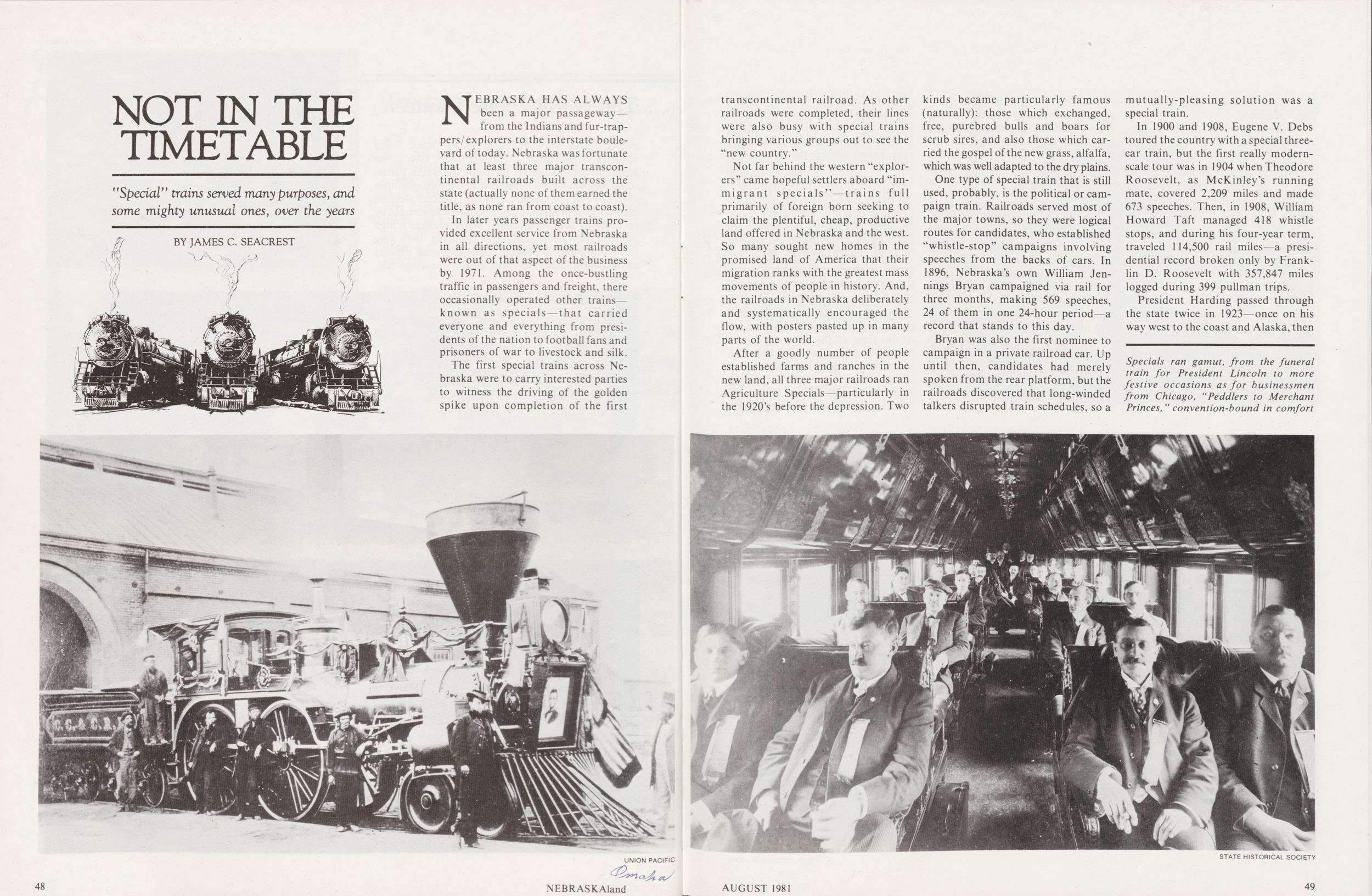
The North Platte Canteen
NOT IN THE TIMETABLE
"Special" trains served many purposes, and some mighty unusual ones, over the years BY JAMES C. SEACRESTNEBRASKA HAS ALWAYS been a major passageway—from the Indians and fur-trappers/explorers to the interstate boulevard of today. Nebraska was fortunate that at least three major transcontinental railroads built across the state (actually none of them earned the title, as none ran from coast to coast).
In later years passenger trains provided excellent service from Nebraska in ail directions, yet most railroads were out of that aspect of the business by 1971. Among the once-bustling traffic in passengers and freight, there occasionally operated other trains—known as specials — that carried everyone and everything from presidents of the nation to football fans and prisoners of war to livestock and silk.
The first special trains across Nebraska were to carry interested parties to witness the driving of the golden spike upon completion of the first
Not far behind the western "explorers" came hopeful settlers aboard "immigrant specials "trains full primarily of foreign born seeking to claim the plentiful, cheap, productive land offered in Nebraska and the west. So many sought new homes in the promised land of America that their migration ranks with the greatest mass movements of people in history. And, the railroads in Nebraska deliberately and systematically encouraged the flow, with posters pasted up in many parts of the world.
After a goodly number of people established farms and ranches in the new land, all three major railroads ran Agriculture Specials—particularly in the 1920's before the depression. Two kinds became particularly famous (naturally): those which exchanged, free, purebred bulls and boars for scrub sires, and also those which carried the gospel of the new grass, alfalfa, which was well adapted to the dry plains.
One type of special train that is still used, probably, is the political or campaign train. Railroads served most of the major towns, so they were logical routes for candidates, who established "whistle-stop" campaigns involving speeches from the backs of cars. In 1896, Nebraska's own William Jennings Bryan campaigned via rail for three months, making 569 speeches, 24 of them in one 24-hour period—a record that stands to this day.
Bryan was also the first nominee to campaign in a private railroad car. Up until then, candidates had merely spoken from the rear platform, but the railroads discovered that long-winded talkers disrupted train schedules, so a mutually-pleasing solution was a special train.
In 1900 and 1908, Eugene V. Debs toured the country with a special three-car train, but the first really modern-scale tour was in 1904 when Theodore Roosevelt, as McKinley's running mate, covered 2,209 miles and made 673 speeches. Then, in 1908, William Howard Taft managed 418 whistle stops, and during his four-year term, traveled 114,500 rail miles—a presidential record broken only by Franklin D. Roosevelt with 357,847 miles logged during 399 pullman trips.
President Harding passed through the state twice in 1923—once on his way west to the coast and Alaska, then
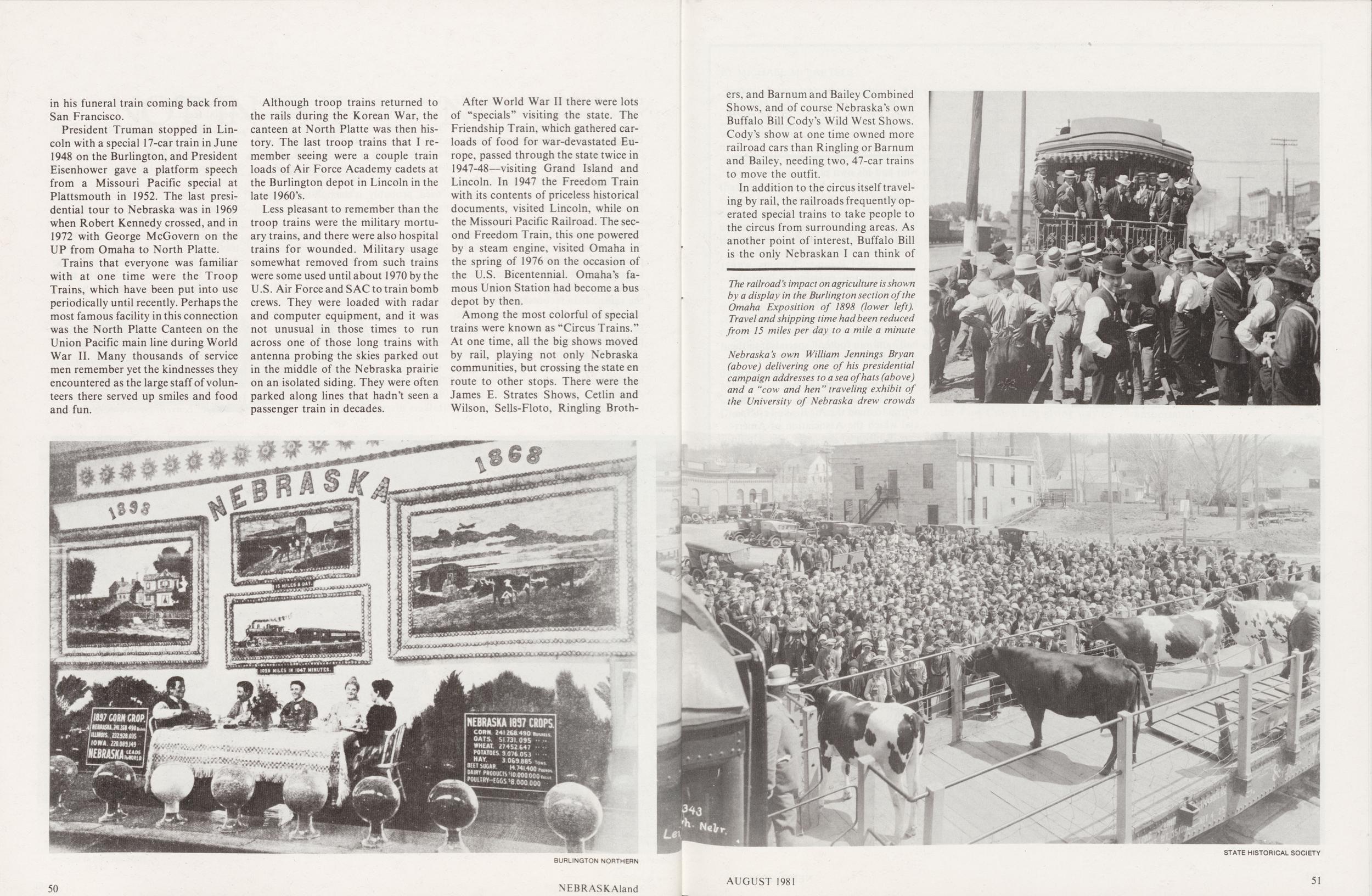 in his funeral train coming back from San Francisco.
President Truman stopped in Lincoln with a special 17-car train in June 1948 on the Burlington, and President Eisenhower gave a platform speech from a Missouri Pacific special at Plattsmouth in 1952. The last presidential tour to Nebraska was in 1969 when Robert Kennedy crossed, and in 1972 with George McGovern on the UP from Omaha to North Platte.
Trains that everyone was familiar with at one time were the Troop Trains, which have been put into use periodically until recently. Perhaps the most famous facility in this connection was the North Platte Canteen on the Union Pacific main line during World War II. Many thousands of service men remember yet the kindnesses they encountered as the large staff of volunteers there served up smiles and food and fun.
Although troop trains returned to the rails during the Korean War, the canteen at North Platte was then history. The last troop trains that I remember seeing were a couple train loads of Air Force Academy cadets at the Burlington depot in Lincoln in the late 1960's.
Less pleasant to remember than the troop trains were the military mortuary trains, and there were also hospital trains for wounded. Military usage somewhat removed from such trains were some used until about 1970 by the U.S. Air Force and SAC to train bomb crews. They were loaded with radar and computer equipment, and it was not unusual in those times to run across one of those long trains with antenna probing the skies parked out in the middle of the Nebraska prairie on an isolated siding. They were often parked along lines that hadn't seen a passenger train in decades.
After World War II there were lots of "specials" visiting the state. The Friendship Train, which gathered carloads of food for war-devastated Europe, passed through the state twice in 1947-48—visiting Grand Island and Lincoln. In 1947 the Freedom Train with its contents of priceless historical documents, visited Lincoln, while on the Missouri Pacific Railroad. The second Freedom Train, this one powered by a steam engine, visited Omaha in the spring of 1976 on the occasion of the U.S. Bicentennial. Omaha's famous Union Station had become a bus depot by then.
Among the most colorful of special trains were known as "Circus Trains." At one time, all the big shows moved by rail, playing not only Nebraska communities, but crossing the state en route to other stops. There were the James E. Strates Shows, Cetlin and Wilson, Sells-Floto, Ringling Brothers,
In addition to the circus itself traveling by rail, the railroads frequently operated special trains to take people to the circus from surrounding areas. As another point of interest, Buffalo Bill is the only Nebraskan I can think of
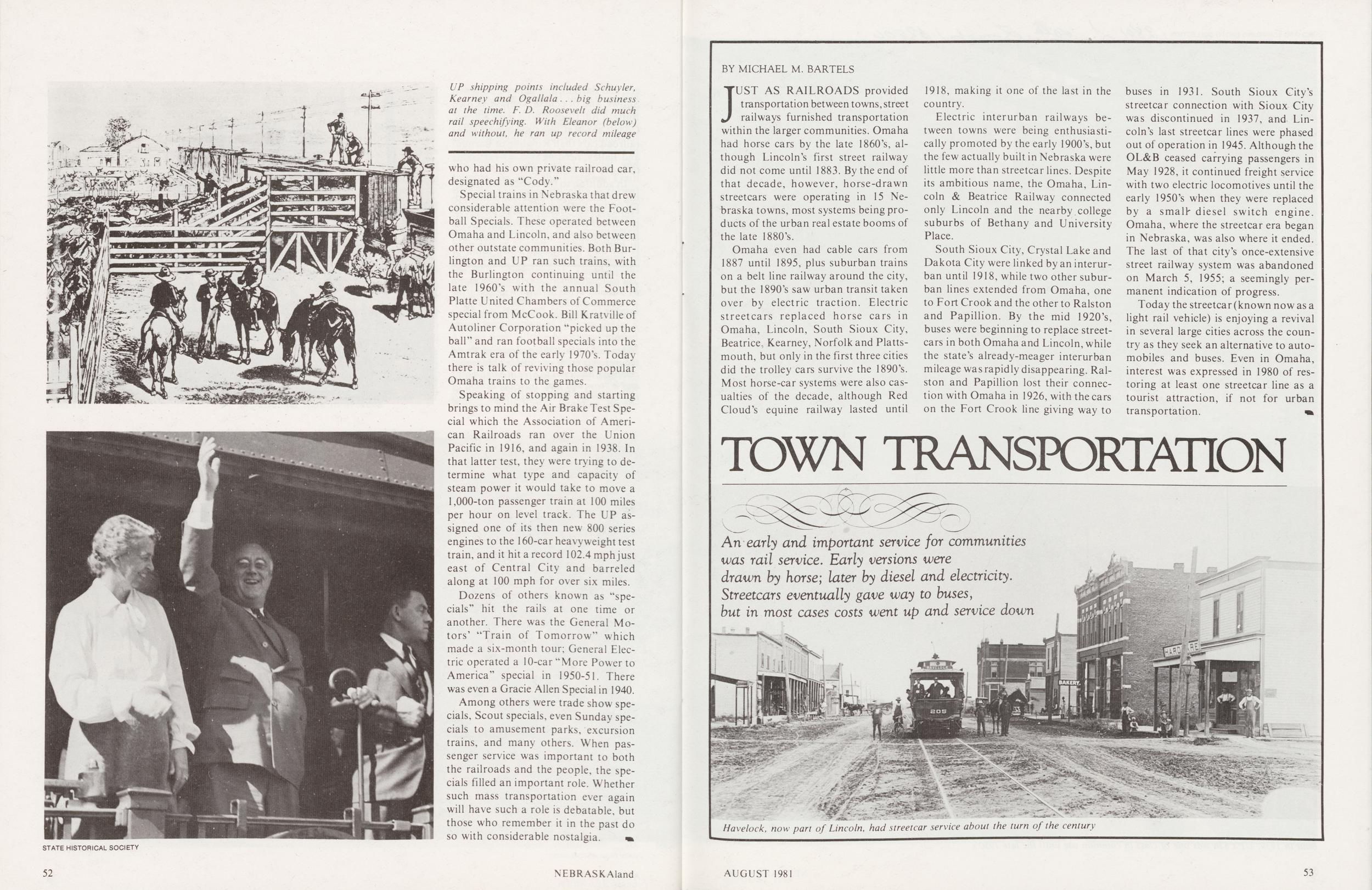
Special trains in Nebraska that drew considerable attention were the Football Specials. These operated between Omaha and Lincoln, and also between other outstate communities. Both Burlington and UP ran such trains, with the Burlington continuing until the late 1960's with the annual South Platte United Chambers of Commerce special from McCook. Bill Kratville of Autoliner Corporation "picked up the ball" and ran football specials into the Amtrak era of the early 1970's. Today there is talk of reviving those popular Omaha trains to the games.
Speaking of stopping and starting brings to mind the Air Brake Test Special which the Association of American Railroads ran over the Union Pacific in 1916, and again in 1938. In that latter test, they were trying to determine what type and capacity of steam power it would take to move a 1,000-ton passenger train at 100 miles per hour on level track. The UP assigned one of its then new 800 series engines to the 160-car heavyweight test train, and it hit a record 102.4 mph just east of Central City and barreled along at 100 mph for over six miles.
Dozens of others known as "specials" hit the rails at one time or another. There was the General Motors' "Train of Tomorrow" which made a six-month tour; General Electric operated a 10-car "More Power to America" special in 1950-51. There was even a Gracie Allen Special in 1940.
Among others were trade show specials, Scout specials, even Sunday specials to amusement parks, excursion trains, and many others. When passenger service was important to both the railroads and the people, the specials filled an important role. Whether such mass transportation ever again will have such a role is debatable, but those who remember it in the past do so with considerable nostalgia.
52 NEBRASKAlandTOWN TRANSPORTATION
An early and important service for communities was rail service. Early versions were drawn by horse; later by diesel and electricity. Streetcars eventually gave way to buses, but in most cases costs went up and service down BY MICHAEL M. BARTELSJUST AS RAILROADS provided transportation between towns, street railways furnished transportation within the larger communities. Omaha had horse cars by the late 1860's, although Lincoln's first street railway did not come until 1883. By the end of that decade, however, horse-drawn streetcars were operating in 15 Nebraska towns, most systems being products of the urban real estate booms of the late 1880's.
Omaha even had cable cars from 1887 until 1895, plus suburban trains on a belt line railway around the city, but the 1890's saw urban transit taken over by electric traction. Electric streetcars replaced horse cars in Omaha, Lincoln, South Sioux City, Beatrice, Kearney, Norfolk and Plattsmouth, but only in the first three cities did the trolley cars survive the 1890's. Most horse-car systems were also casualties of the decade, although Red Cloud's equine railway lasted until 1918, making it one of the last in the country.
Electric interurban railways between towns were being enthusiastically promoted by the early 1900's, but the few actually built in Nebraska were little more than streetcar lines. Despite its ambitious name, the Omaha, Lincoln & Beatrice Railway connected only Lincoln and the nearby college suburbs of Bethany and University Place.
South Sioux City, Crystal Lake and Dakota City were linked by an interurban until 1918, while two other suburban lines extended from Omaha, one to Fort Crook and the other to Ralston and Papillion. By the mid 1920's, buses were beginning to replace street-cars in both Omaha and Lincoln, while the state's already-meager interurban mileage was rapidly disappearing. Ralston and Papillion lost their connection with Omaha in 1926, with the cars on the Fort Crook line giving way to buses in 1931. South Sioux City's streetcar connection with Sioux City was discontinued in 1937, and Lincoln's last streetcar lines were phased out of operation in 1945. Although the OL&B ceased carrying passengers in May 1928, it continued freight service with two electric locomotives until the early 1950's when they were replaced by a small- diesel switch engine. Omaha, where the streetcar era began in Nebraska, was also where it ended. The last of that city's once-extensive street railway system was abandoned on March 5, 1955; a seemingly permanent indication of progress.
Today the streetcar (known now as a light rail vehicle) is enjoying a revival in several large cities across the country as they seek an alternative to automobiles and buses. Even in Omaha, interest was expressed in 1980 of restoring at least one streetcar line as a tourist attraction, if not for urban transportation.
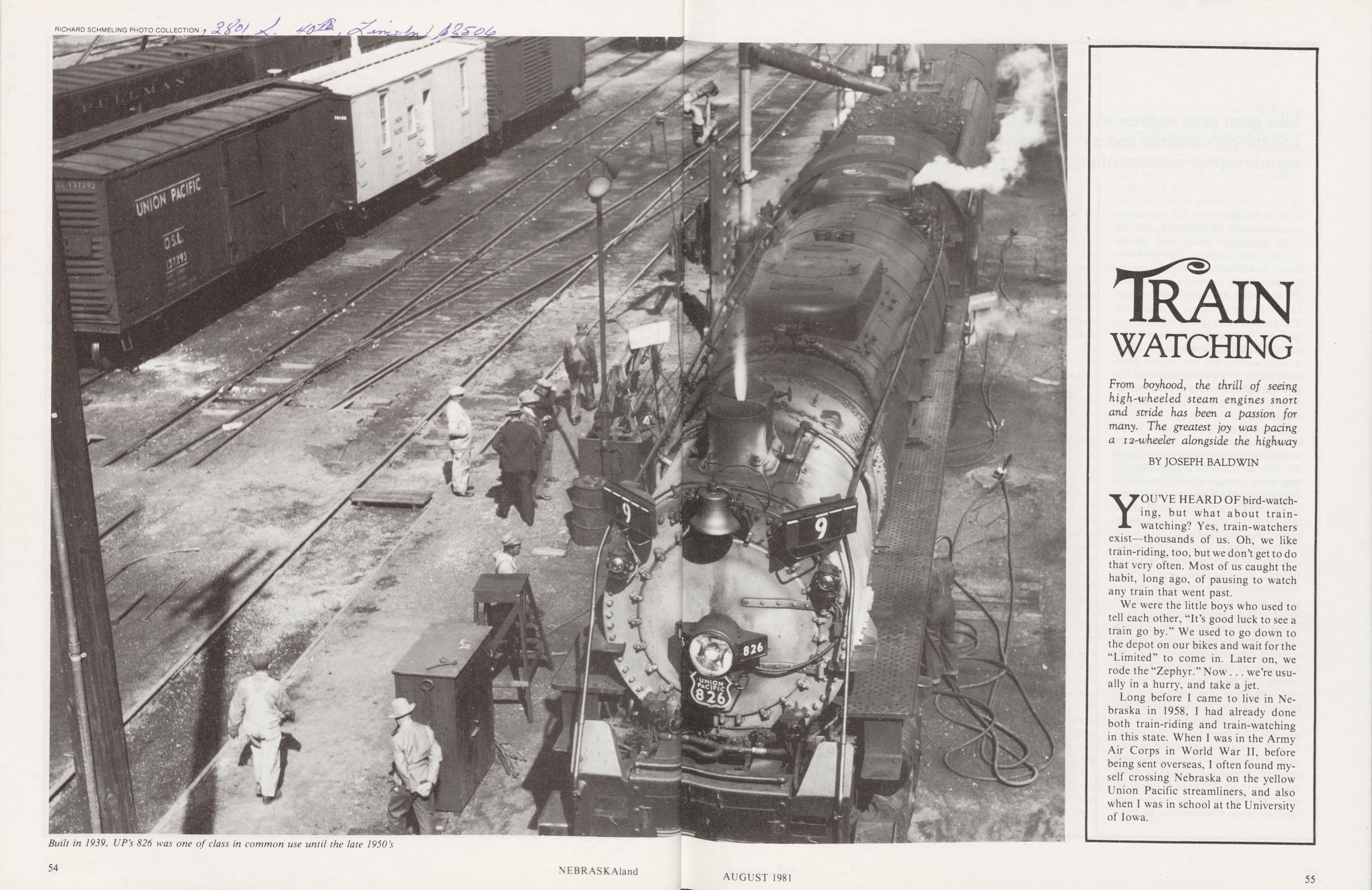
Train WATCHING
From boyhood, the thrill of seeing high-wheeled steam engines snort and stride has been a passion for many. The greatest joy was pacing a 12-wheeler alongside the highway BY JOSEPH BALDWINYOU'VE HEARD OF bird-watch-ing, but what about train-watching? Yes, train-watchers exist—thousands of us. Oh, we like train-riding, too, but we don't get to do that very often. Most of us caught the habit, long ago, of pausing to watch any train that went past.
We were the little boys who used to tell each other, "It's good luck to see a train go by." We used to go down to the depot on our bikes and wait for the "Limited" to come in. Later on, we rode the "Zephyr." Now we're usually in a hurry, and take a jet.
Long before I came to live in Nebraska in 1958, I had already done both train-riding and train-watching in this state. When I was in the Army Air Corps in World War II, before being sent overseas, I often found myself crossing Nebraska on the yellow Union Pacific streamliners, and also when I was in school at the University of Iowa.
AUGUST 1981 55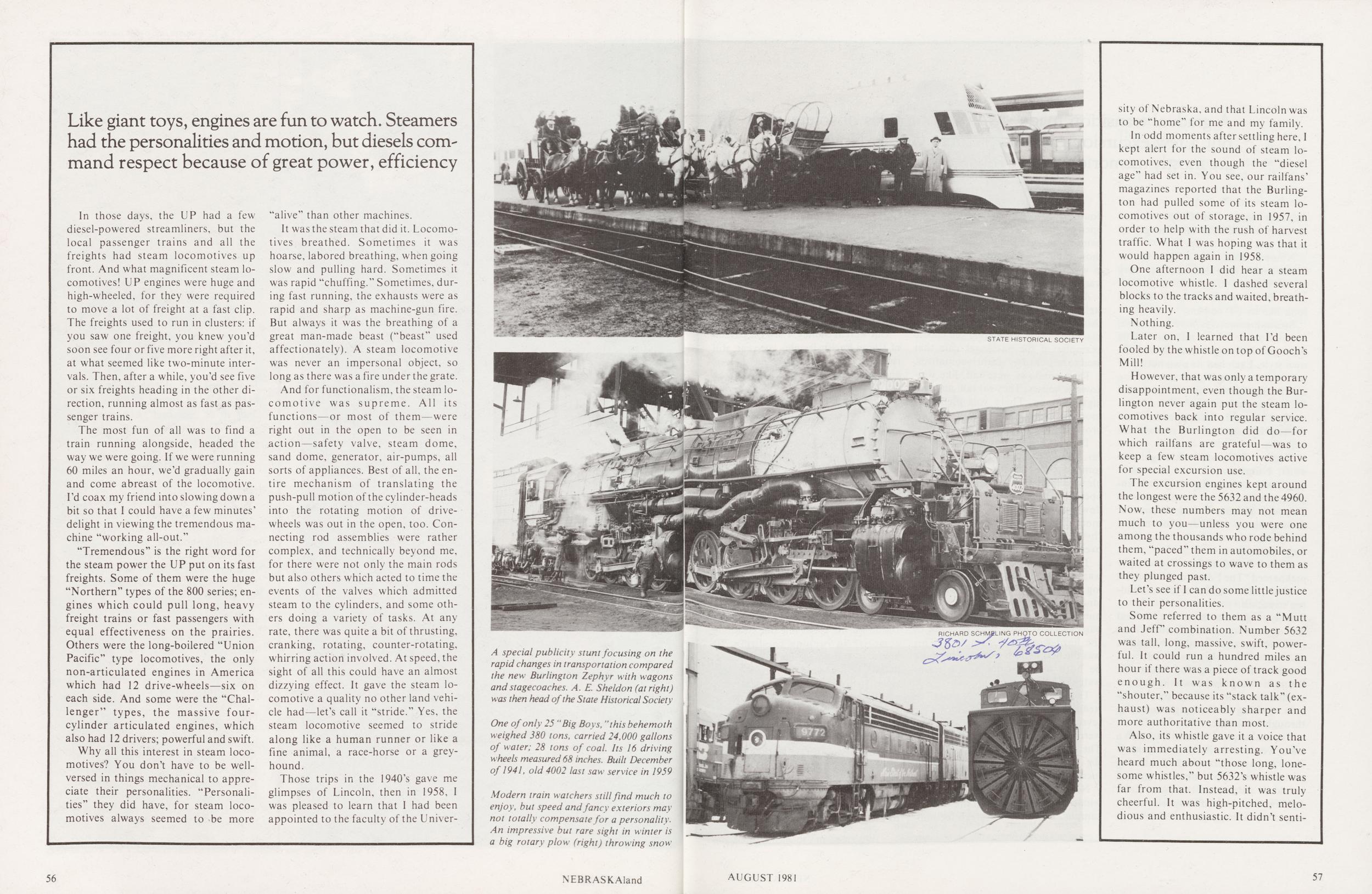 Like giant toys, engines are fun to watch. Steamers had the personalities and motion, but diesels command respect because of great power, efficiency
In those days, the UP had a few diesel-powered streamliners, but the local passenger trains and all the freights had steam locomotives up front. And what magnificent steam locomotives! UP engines were huge and high-wheeled, for they were required to move a lot of freight at a fast clip. The freights used to run in clusters: if you saw one freight, you knew you'd soon see four or five more right after it, at what seemed like two-minute intervals. Then, after a while, you'd see five or six freights heading in the other direction, running almost as fast as passenger trains.
The most fun of all was to find a train running alongside, headed the way we were going. If we were running 60 miles an hour, we'd gradually gain and come abreast of the locomotive. I'd coax my friend into slowing down a bit so that I could have a few minutes' delight in viewing the tremendous machine "working all-out."
"Tremendous" is the right word for the steam power the UP put on its fast freights. Some of them were the huge "Northern" types of the 800 series; engines which could pull long, heavy freight trains or fast passengers with equal effectiveness on the prairies. Others were the long-boilered "Union Pacific" type locomotives, the only non-articulated engines in America which had 12 drive-wheels—six on each side. And some were the "Challenger' types, the massive four-cylinder articulated engines, which also had 12 drivers; powerful and swift.
Why all this interest in steam locomotives? You don't have to be well-versed in things mechanical to appreciate their personalities. "Personalities" they did have, for steam locomotives always seemed to be more "alive" than other machines.
It was the steam that did it. Locomotives breathed. Sometimes it was hoarse, labored breathing, when going slow and pulling hard. Sometimes it was rapid "chuffing." Sometimes, during fast running, the exhausts were as rapid and sharp as machine-gun fire. But always it was the breathing of a great man-made beast ("beast" used affectionately). A steam locomotive was never an impersonal object, so long as there was a fire under the grate.
And for functionalism, the steam locomotive was supreme. All its functions—or most of them—were right out in the open to be seen in action—safety valve, steam dome, sand dome, generator, air-pumps, all sorts of appliances. Best of all, the entire mechanism of translating the push-pull motion of the cylinder-heads into the rotating motion of drive-wheels was out in the open, too. Connecting rod assemblies were rather complex, and technically beyond me, for there were not only the main rods but also others which acted to time the events of the valves which admitted steam to the cylinders, and some others doing a variety of tasks. At any rate, there was quite a bit of thrusting, cranking, rotating, counter-rotating, whirring action involved. At speed, the sight of all this could have an almost dizzying effect. It gave the steam locomotive a quality no other land vehicle had—let's call it "stride." Yes, the steam locomotive seemed to stride along like a human runner or like a fine animal, a race-horse or a greyhound.
Those trips in the 1940's gave me glimpses of Lincoln, then in 1958, I was pleased to learn that I had been appointed to the faculty of the University 56 NEBRASKAland
In odd moments after settling here, I kept alert for the sound of steam locomotives, even though the "diesel age" had set in. You see, our railfans' magazines reported that the Burlington had pulled some of its steam locomotives out of storage, in 1957, in order to help with the rush of harvest traffic. What 1 was hoping was that it would happen again in 1958.
One afternoon I did hear a steam locomotive whistle. 1 dashed several blocks to the tracks and waited, breathing heavily.
Nothing.
Later on, I learned that I'd been fooled by the whistle on top of Gooch's Mill!
However, that was only a temporary disappointment, even though the Burlington never again put the steam locomotives back into regular service. What the Burlington did do—for which railfans are grateful—was to keep a few steam locomotives active for special excursion use.
The excursion engines kept around the longest were the 5632 and the 4960. Now, these numbers may not mean much to you—unless you were one among the thousands who rode behind them, "paced" them in automobiles, or waited at crossings to wave to them as they plunged past.
Let's see if I can do some little justice to their personalities.
Some referred to them as a "Mutt and Jeff combination. Number 5632 was tall, long, massive, swift, powerful. It could run a hundred miles an hour if there was a piece of track good enough. It was known as the "shouter," because its "stack talk" (exhaust) was noticeably sharper and more authoritative than most.
Also, its whistle gave it a voice that was immediately arresting. You've heard much about "those long, lonesome whistles," but 5632's whistle was far from that. Instead, it was truly cheerful. It was high-pitched, melodious and enthusiastic. It didn't sentimentally mentally remind you of trips you used to take; it made you want to get on board and go for a trip.
AUGUST 1981 57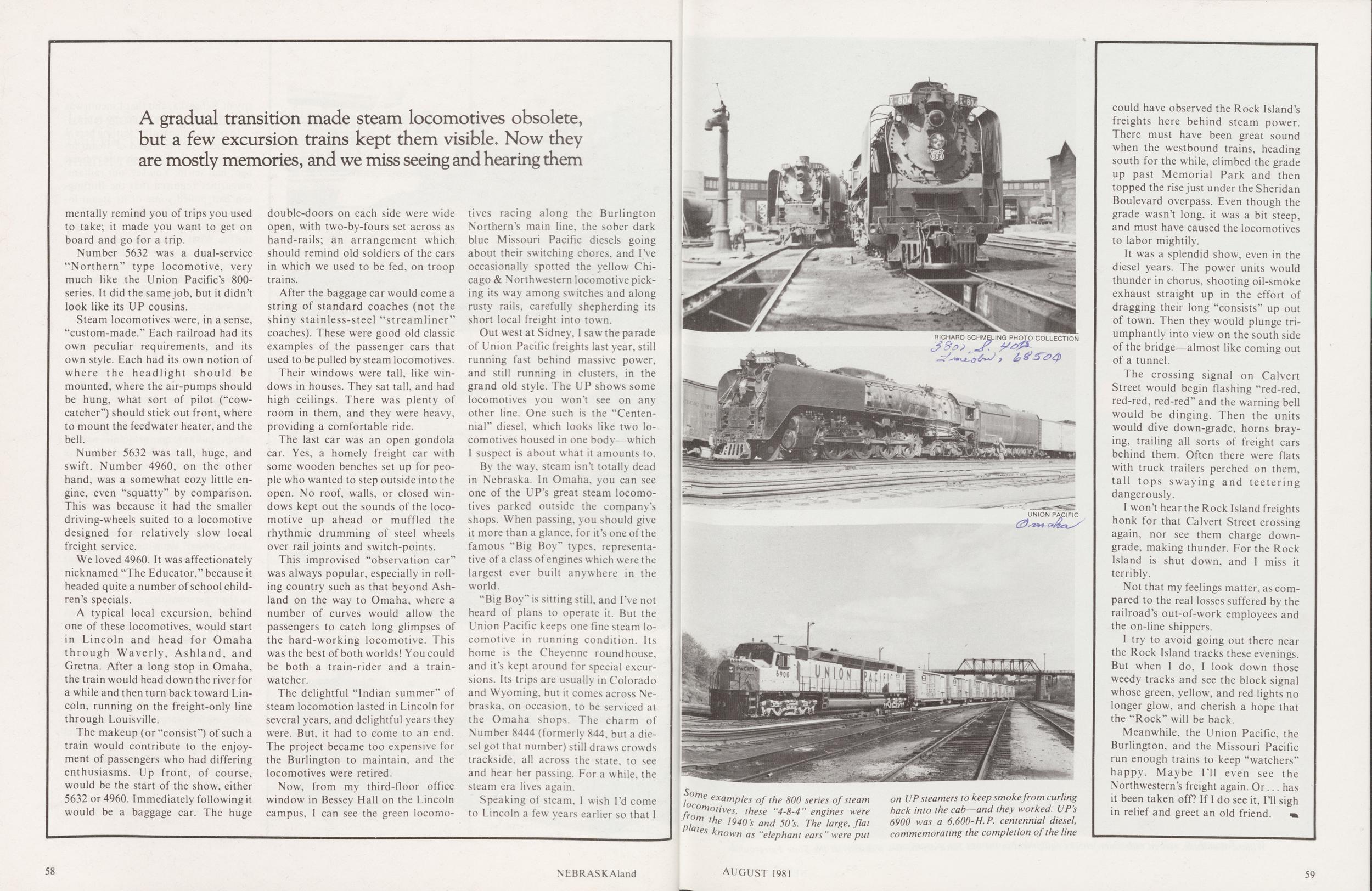 A gradual transition made steam locomotives obsolete, but a few excursion trains kept them visible. Now they are mostly memories, and we miss seeing and hearing them
Number 5632 was a dual-service "Northern" type locomotive, very much like the Union Pacific's 800-series. It did the same job, but it didn't look like its UP cousins.
Steam locomotives were, in a sense, "custom-made." Each railroad had its own peculiar requirements, and its own style. Each had its own notion of where the headlight should be mounted, where the air-pumps should be hung, what sort of pilot ("cow-catcher") should stick out front, where to mount the feedwater heater, and the bell.
Number 5632 was tall, huge, and swift. Number 4960, on the other hand, was a somewhat cozy little engine, even "squatty" by comparison. This was because it had the smaller driving-wheels suited to a locomotive designed for relatively slow local freight service.
We loved 4960. It was affectionately nicknamed "The Educator," because it headed quite a number of school children's specials.
A typical local excursion, behind one of these locomotives, would start in Lincoln and head for Omaha through Waverly, Ashland, and Gretna. After a long stop in Omaha, the train would head down the river for a while and then turn back toward Lincoln, running on the freight-only line through Louisville.
The makeup (or "consist") of such a train would contribute to the enjoyment of passengers who had differing enthusiasms. Up front, of course, would be the start of the show, either 5632 or 4960. Immediately following it would be a baggage car. The huge double-doors on each side were wide open, with two-by-fours set across as hand-rails; an arrangement which should remind old soldiers of the cars in which we used to be fed, on troop trains.
After the baggage car would come a string of standard coaches (not the shiny stainless-steel "streamliner' coaches). These were good old classic examples of the passenger cars that used to be pulled by steam locomotives.
Their windows were tall, like windows in houses. They sat tall, and had high ceilings. There was plenty of room in them, and they were heavy, providing a comfortable ride.
The last car was an open gondola car. Yes, a homely freight car with some wooden benches set up for people who wanted to step outside into the open. No roof, walls, or closed windows kept out the sounds of the loco-motive up ahead or muffled the rhythmic drumming of steel wheels over rail joints and switch-points.
This improvised "observation car" was always popular, especially in rolling country such as that beyond Ashland on the way to Omaha, where a number of curves would allow the passengers to catch long glimpses of the hard-working locomotive. This was the best of both worlds! You could be both a train-rider and a train-watcher.
The delightful "Indian summer" of steam locomotion lasted in Lincoln for several years, and delightful years they were. But, it had to come to an end. The project became too expensive for the Burlington to maintain, and the locomotives were retired.
Now, from my third-floor office window in Bessey Hall on the Lincoln campus, I can see the green locomotives racing along the Burlington Northern's main line, the sober dark blue Missouri Pacific diesels going about their switching chores, and I've occasionally spotted the yellow Chicago & Northwestern locomotive picking its way among switches and along rusty rails, carefully shepherding its short local freight into town.
Out west at Sidney, I saw the parade of Union Pacific freights last year, still running fast behind massive power, and still running in clusters, in the grand old style. The UP shows some locomotives you won't see on any other line. One such is the "Centennial" diesel, which looks like two locomotives housed in one body—which I suspect is about what it amounts to.
By the way, steam isn't totally dead in Nebraska. In Omaha, you can see one of the UP's great steam locomotives parked outside the company's shops. When passing, you should give it more than a glance, for it's one of the famous "Big Boy" types, representative of a class of engines which were the largest ever built anywhere in the world.
"Big Boy" is sitting still, and I've not heard of plans to operate it. But the Union Pacific keeps one fine steam locomotive in running condition. Its home is the Cheyenne roundhouse, and it's kept around for special excursions. Its trips are usually in Colorado and Wyoming, but it comes across Nebraska, on occasion, to be serviced at the Omaha shops. The charm of Number 8444 (formerly 844, but a diesel got that number) still draws crowds trackside, all across the state, to see and hear her passing. For a while, the steam era lives again.
Speaking of steam, I wish I'd come to Lincoln a few years earlier so that I 58 NEBRASKAland
It was a splendid show, even in the diesel years. The power units would thunder in chorus, shooting oil-smoke exhaust straight up in the effort of dragging their long "consists" up out of town. Then they would plunge triumphantly into view on the south side of the bridge—almost like coming out of a tunnel.
The crossing signal on Calvert Street would begin flashing "red-red, red-red, red-red" and the warning bell would be dinging. Then the units would dive down-grade, horns braying, trailing all sorts of freight cars behind them. Often there were flats with truck trailers perched on them, tall tops swaying and teetering dangerously.
I won't hear the Rock Island freights honk for that Calvert Street crossing again, nor see them charge downgrade, making thunder. For the Rock Island is shut down, and I miss it terribly.
Not that my feelings matter, as compared to the real losses suffered by the railroad's out-of-work employees and the on-line shippers.
I try to avoid going out there near the Rock Island tracks these evenings. But when I do, I look down those weedy tracks and see the block signal whose green, yellow, and red lights no longer glow, and cherish a hope that the "Rock" will be back.
Meanwhile, the Union Pacific, the Burlington, and the Missouri Pacific run enough trains to keep "watchers" happy. Maybe I'll even see the Northwestern's freight again. Or has it been taken off? If I do see it, Til sigh in relief and greet an old friend.
AUGUST 1981 59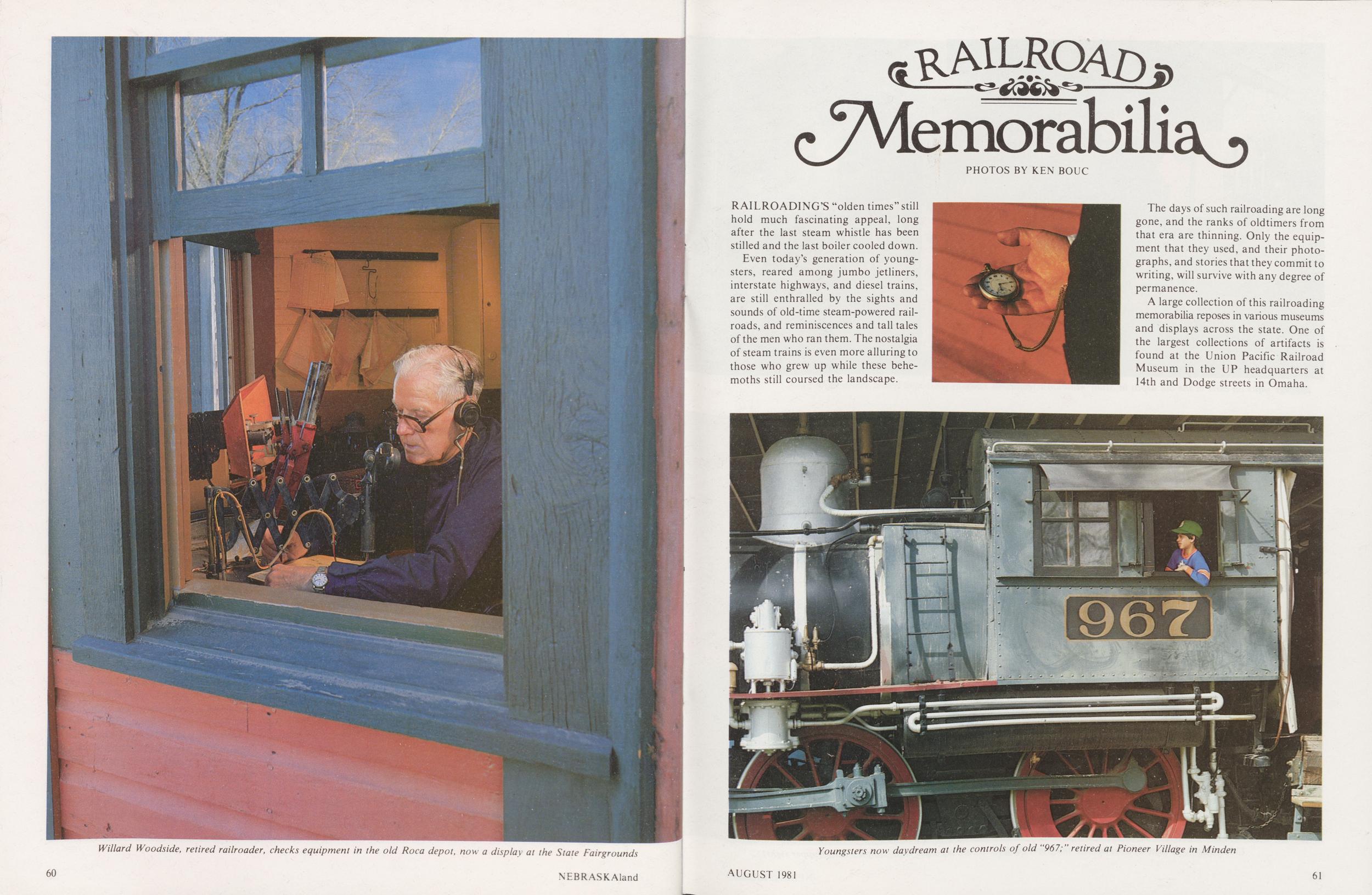
RAILROAD Memorabilia
PHOTOS BY KEN BOUC RAILROADING'S "olden times" still hold much fascinating appeal, long after the last steam whistle has been stilled and the last boiler cooled down. Even today's generation of youngsters, reared among jumbo jetliners, interstate highways, and diesel trains, are still enthralled by the sights and sounds of old-time steam-powered railroads, and reminiscences and tall tales of the men who ran them. The nostalgia of steam trains is even more alluring to those who grew up while these behemoths still coursed the landscape.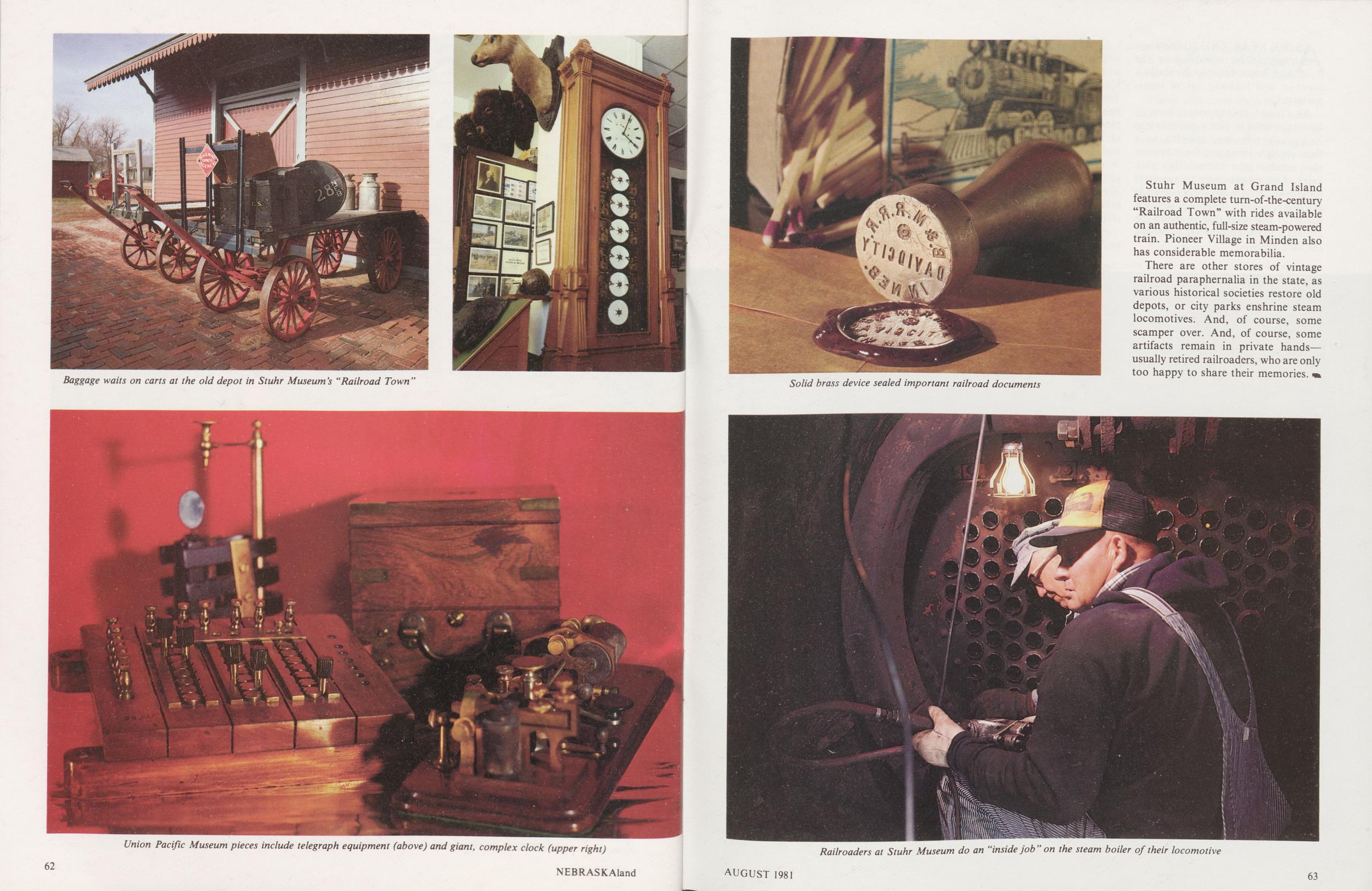
Stuhr Museum at Grand Island features a complete turn-of-the-century "Railroad Town" with rides available on an authentic, full-size steam-powered train. Pioneer Village in Minden also has considerable memorabilia.
There are other stores of vintage railroad paraphernalia in the state, as various historical societies restore old depots, or city parks enshrine steam locomotives. And, of course, some scamper over. And, of course, some artifacts remain in private hands—usually retired railroaders, who are only too happy to share their memories.
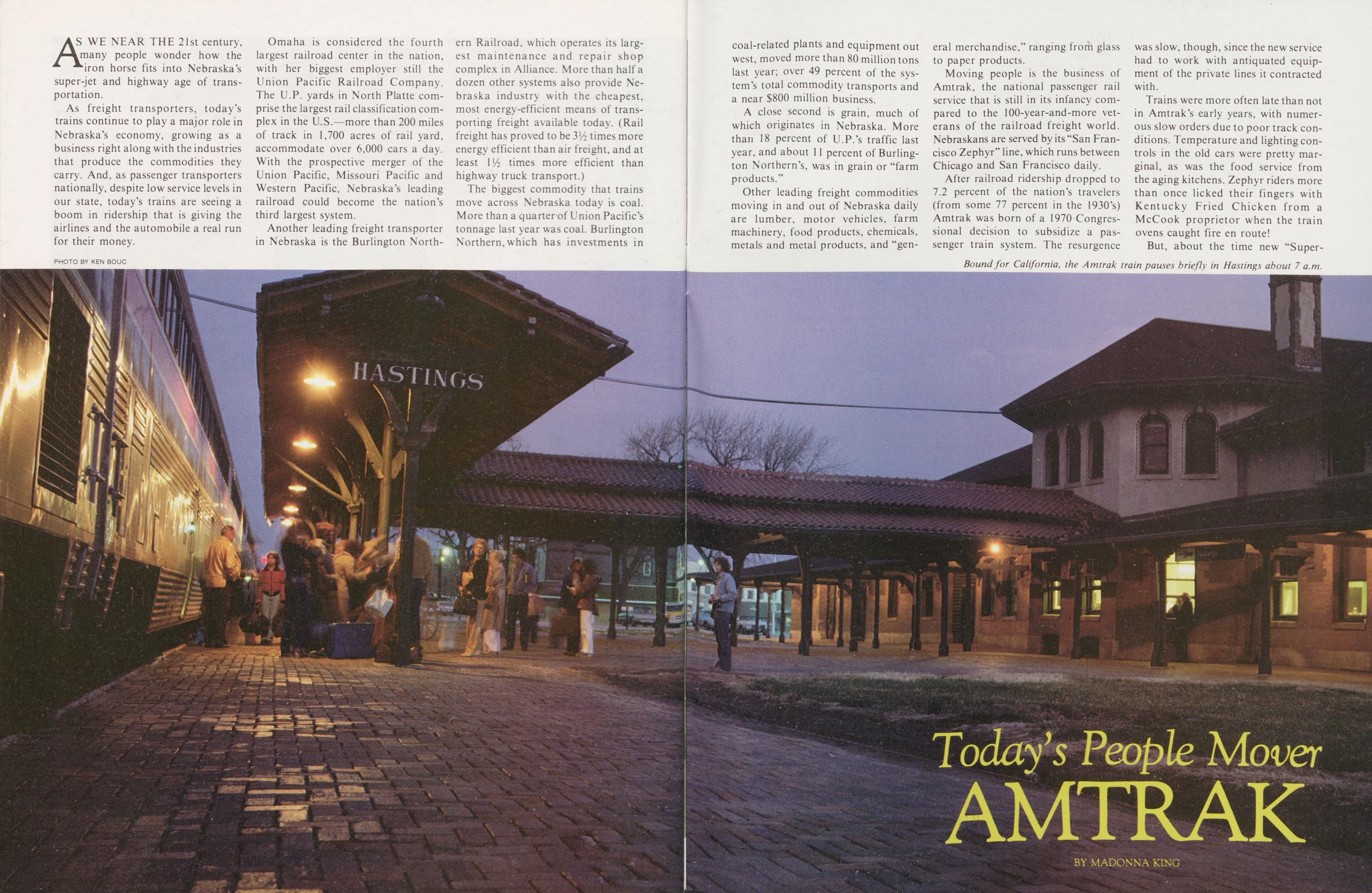
AMTRACK
Today's People Marker BY MADONNA KINGAS WE NEAR THE 21st century, many people wonder how the iron horse fits into Nebraska's super-jet and highway age of transportation.
As freight transporters, today's trains continue to play a major role in Nebraska's economy, growing as a business right along with the industries that produce the commodities they carry. And, as passenger transporters nationally, despite low service levels in our state, today's trains are seeing a boom in ridership that is giving the airlines and the automobile a real run for their money.
Omaha is considered the fourth largest railroad center in the nation, with her biggest employer still the Union Pacific Railroad Company. The U.P. yards in North Platte comprise the largest rail classification complex in the U.S.—more than 200 miles of track in 1,700 acres of rail yard, accommodate over 6,000 cars a day. With the prospective merger of the Union Pacific, Missouri Pacific and Western Pacific, Nebraska's leading railroad could become the nation's third largest system.
Another leading freight transporter in Nebraska is the Burlington Northern Railroad, which operates its largest maintenance and repair shop complex in Alliance. More than half a dozen other systems also provide Nebraska industry with the cheapest, most energy-efficient means of transporting freight available today. (Rail freight has proved to be 3!4 times more energy efficient than air freight, and at least U/2 times more efficient than highway truck transport.)
The biggest commodity that trains move across Nebraska today is coal. More than a quarter of Union Pacific's tonnage last year was coal. Burlington Northern, which has investments in
A close second is grain, much of which originates in Nebraska. More than 18 percent of U.P.'s traffic last year, and about 11 percent of Burlington Northern's, was in grain or "farm products."
Other leading freight commodities moving in and out of Nebraska daily are lumber, motor vehicles, farm machinery, food products, chemicals, metals and metal products, and "general merchandise," ranging from glass to paper products.
Moving people is the business of Amtrak, the national passenger rail service that is still in its infancy compared to the 100-year-and-more veterans of the railroad freight world. Nebraskans are served by its "San Francisco Zephyr" line, which runs between Chicago and San Francisco daily.
After railroad ridership dropped to 7.2 percent of the nation's travelers (from some 77 percent in the 1930's) Amtrak was born of a 1970 Congressional decision to subsidize a passenger train system. The resurgence was slow, though, since the new service had to work with antiquated equipment of the private lines it contracted with.
Trains were more often late than not in Amtrak's early years, with numerous slow orders due to poor track conditions. Temperature and lighting controls in the old cars were pretty marginal, as was the food service from the aging kitchens. Zephyr riders more than once licked their fingers with Kentucky Fried Chicken from a McCook proprietor when the train ovens caught fire en route!
But, about the time new "Superliner"
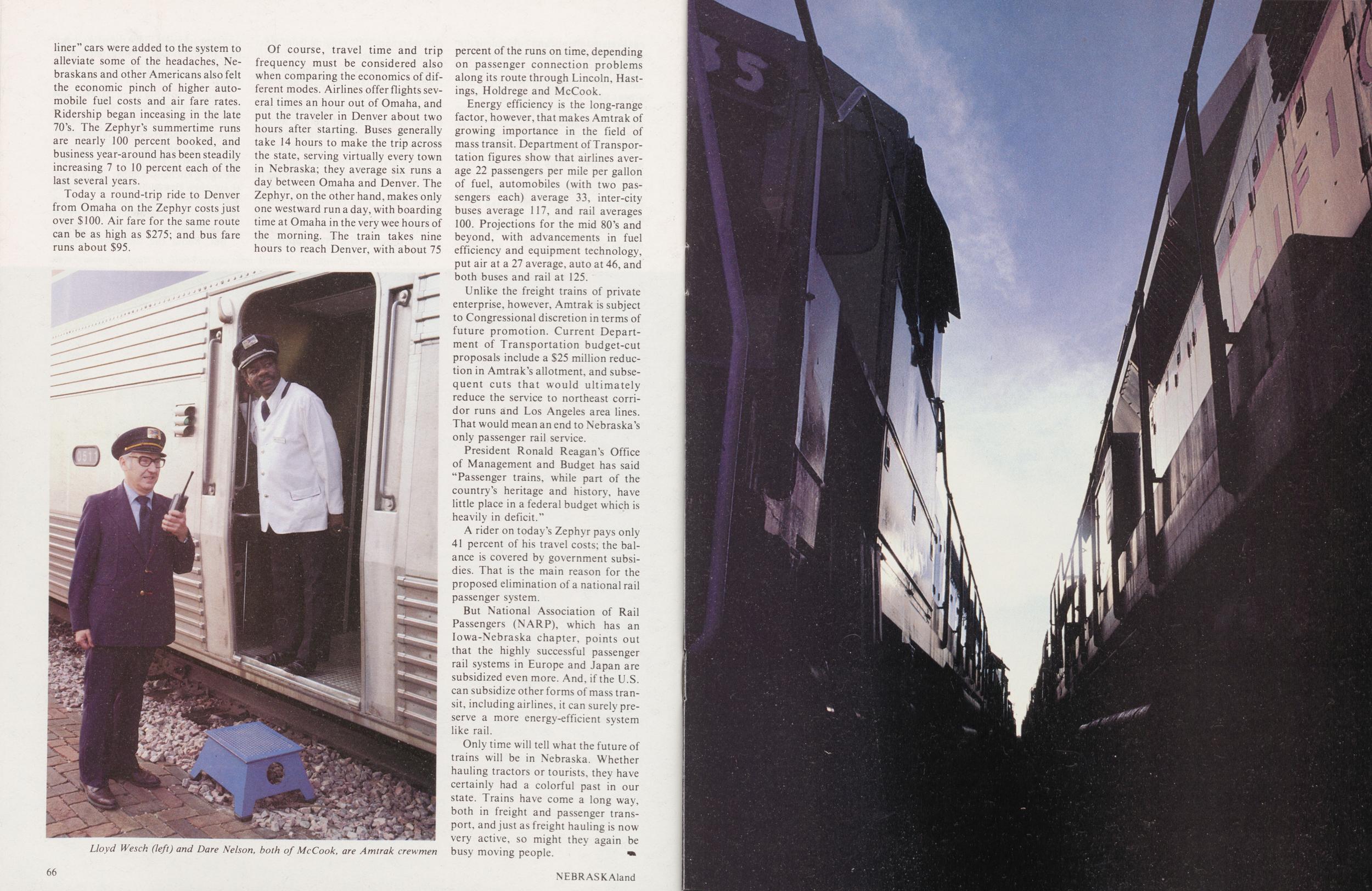 cars were added to the system to alleviate some of the headaches, Nebraskans and other Americans also felt the economic pinch of higher automobile fuel costs and air fare rates. Ridership began inceasing in the late 70's. The Zephyr's summertime runs are nearly 100 percent booked, and business year-around has been steadily increasing 7 to 10 percent each of the last several years.
Today a round-trip ride to Denver from Omaha on the Zephyr costs just over $100. Air fare for the same route can be as high as $275; and bus fare runs about $95.
Of course, travel time and trip frequency must be considered also when comparing the economics of different modes. Airlines offer flights several times an hour out of Omaha, and put the traveler in Denver about two hours after starting. Buses generally take 14 hours to make the trip across the state, serving virtually every town in Nebraska; they average six runs a day between Omaha and Denver. The Zephyr, on the other hand, makes only one westward run a day, with boarding time at Omaha in the very wee hours of the morning. The train takes nine hours to reach Denver, with about 75 percent of the runs on time, depending on passenger connection problems along its route through Lincoln, Hastings, Holdrege and McCook.
Energy efficiency is the long-range factor, however, that makes Amtrak of growing importance in the field of mass transit. Department of Transportation figures show that airlines average 22 passengers per mile per gallon of fuel, automobiles (with two passengers each) average 33, inter-city buses average 117, and rail averages 100. Projections for the mid 80's and beyond, with advancements in fuel efficiency and equipment technology, put air at a 27 average, auto at 46, and both buses and rail at 125.
Unlike the freight trains of private enterprise, however, Amtrak is subject to Congressional discretion in terms of future promotion. Current Department of Transportation budget-cut proposals include a $25 million reduction in Amtrak's allotment, and subsequent cuts that would ultimately reduce the service to northeast corridor runs and Los Angeles area lines. That would mean an end to Nebraska's only passenger rail service.
President Ronald Reagan's Office of Management and Budget has said "Passenger trains, while part of the country's heritage and history, have little place in a federal budget which is heavily in deficit."
A rider on today's Zephyr pays only 41 percent of his travel costs; the balance is covered by government subsidies. That is the main reason for the proposed elimination of a national rail passenger system.
But National Association of Rail Passengers (NARP), which has an Iowa-Nebraska chapter, points out that the highly successful passenger rail systems in Europe and Japan are subsidized even more. And, if the U.S. can subsidize other forms of mass transit, including airlines, it can surely preserve a more energy-efficient system like rail.
Only time will tell what the future of trains will be in Nebraska. Whether hauling tractors or tourists, they have certainly had a colorful past in our state. Trains have come a long way, both in freight and passenger transport, and just as freight hauling is now very active, so might they again be busy moving people.
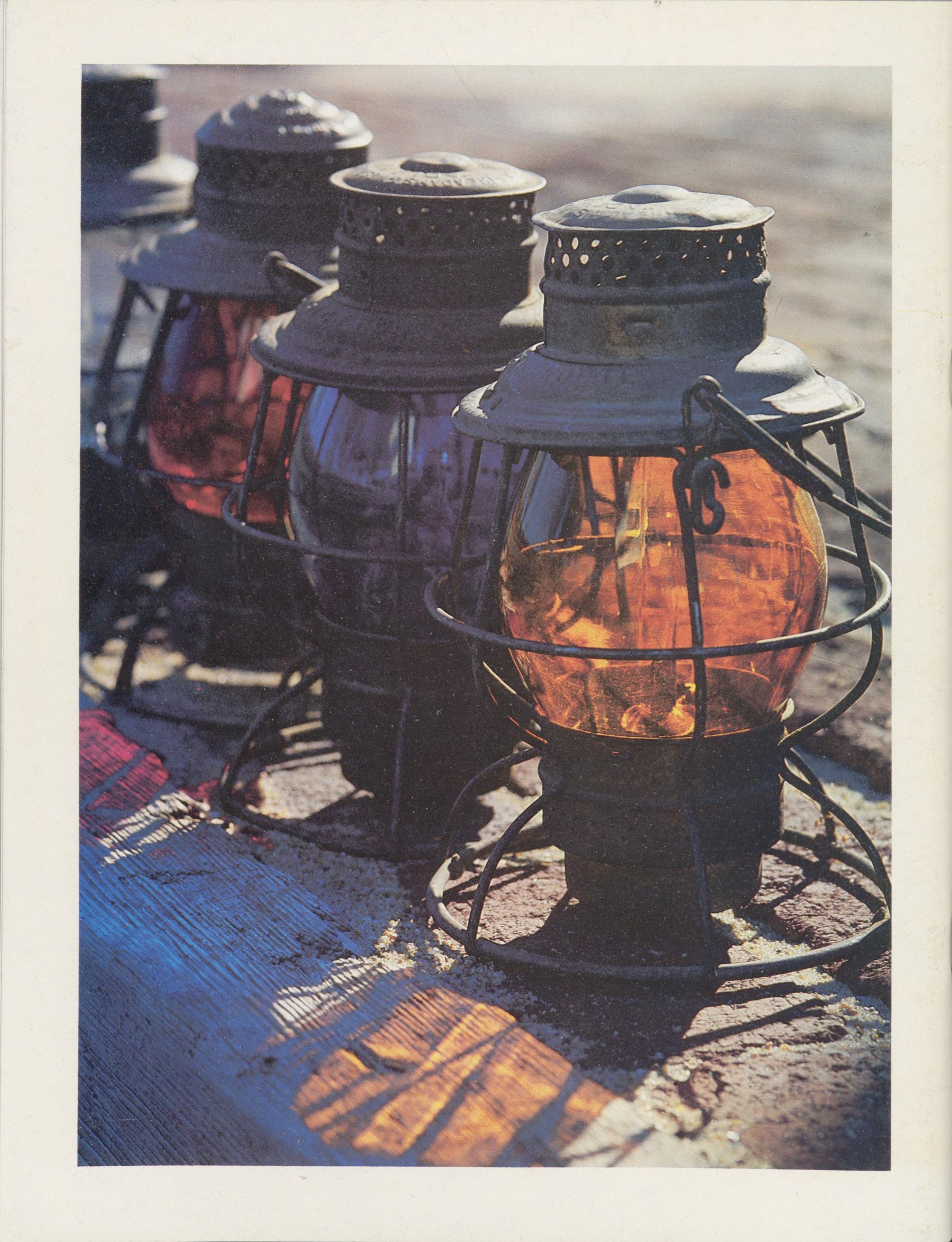
Position: 113 (53 views)