Volume 59, Issue 10, 1981
NEBRASKAland
JULY 1981 $1
NEBRASKAland
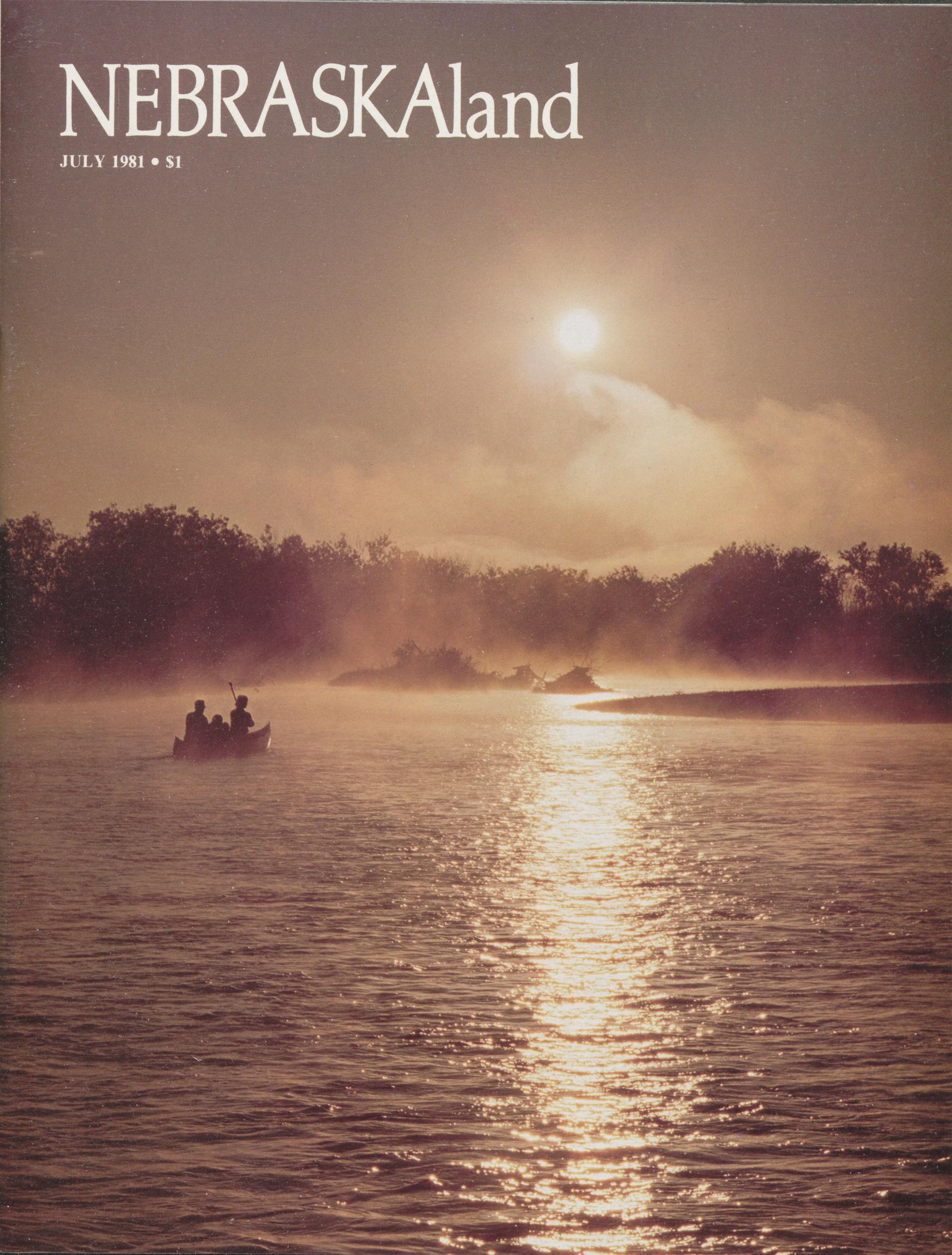
VOL. 59 NO. 10 JULY 1981 ISSN-.0028-1964 Published semi-monthly by Nebraska Game and Parks Commission Rates: $1 per copy; $7.50 for 1 year; $13 for 2 years; $19 for 3 years. News edition 25c per copy, included in subscription price. Copyright Nebraska Game and Parks Commission 1981, all rights reserved. Postmaster: If undeliverable, send notice by form 3579 to Nebraska Game and Parks Commission, Box 30370, Lincoln, NE 68503. Second Class postage paid at Lincoln, Nebraska and at additional mailing offices. Offices Headquarters 2200 N. 33rd, Lincoln, 68503 (402) 464-0641 13th and Famam St., Omaha (402) 554-2144 Rt. 2, Alliance (308) 762-5605 Bassett (402) 684-3511 Norfolk U.S. 81 (402) 371-4950 Rt. 4, North Platte (308) 532-6225 Board of Commissioners Chairman: Robert G. Cunningham, Omaha Vice Chairman: Shirley L. Meckel, Burwell 2nd Vice Chairman: Dr. Bruce Cowgill, Silver Creek Earl Hultman, Sutton Richard Prasch, Lexington Stan Juelfs, Kimball Charles E. Wright, Lincoln Director: Eugene T. Mahoney Assistant Directors: William J. Bailey, Jr., Dale R. Bree W. Rex Amack Magazine Staff Editor: Lowell Johnson Senior Editor: Jon Farrar Associate Editor: Ken Bouc Regional Editors: Bob Grier, Fayc Musil, Rocky Hoffmann, Madonna King Liz Huff News Edition Editor: Tom Keith Art Director: Michele Angle Farrar Illustration: Duane Westerholt, Steve O'Hare Circulation: Juanita Stefkovich Published by the Nebraska Game and Parks Commission Contents Features RIVER OF MANY RETURNS 8 THE GREAT GREEN DESERT 14 WILD FRUITS AND BERRIES SUMMER PLENTY 20 26 RABIES AT HOME IN THE WILD 34 THREADFIN SHAD THE MISSING LINK A WORM WITH WINNING WAYS NOTES ON NEBRASKA FAUNA/RUDDY DUCK 36 38 50 Departments SPEAK UP TRADING POST 49 COVER: A calm, misty morning shrouds urban Scottsbluff from view as the Cliff Snyder family embarks from the Kiwanis Club Campground—on one of their many short excursions on the North Platte River. The campground is one of the Nebraska Canoe Trails sites. A story on the Snyders in this issue begins on page 8. Photo by Bob Grier. OPPOSITE: Although community fireworks displays are getting fewer due to expense and fire danger, they are spectacular methods of observing the nation's independence. Photo by Duane Westerholt. 3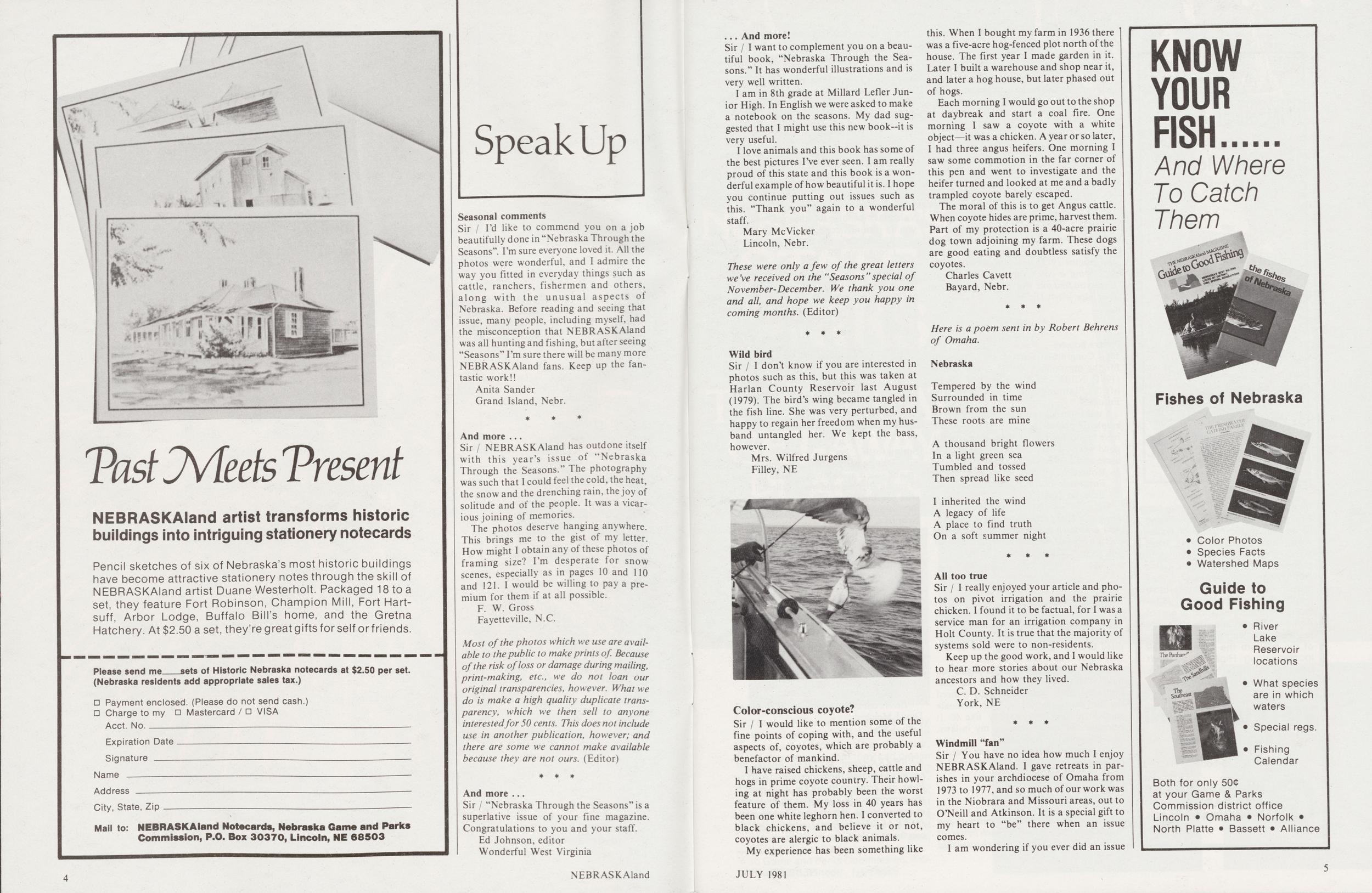
Speak Up
Past Meets Present NEBRASKAland artist transforms historic buildings into intriguing stationery notecards Pencil sketches of six of Nebraska's most historic buildings have become attractive stationery notes through the skill of NEBRASKAland artist Duane Westerholt. Packaged 18 to a set, they feature Fort Robinson, Champion Mill, Fort Hartsuff, Arbor Lodge, Buffalo Bill's home, and the Gretna Hatchery. At $2.50 a set, they're great gifts for self or friends. Please send me sets of Historic Nebraska notecards at $2.50 per set. (Nebraska residents add appropriate sales tax.) Payment enclosed. (Please do not send cash.) Charge to my Mastercard VISA Acct. No. Expiration Date Signature Name Address City, State, Zip Mail to: NEBRASKAland Notecards, Nebraska Game and Parks Commission, P.O. Box 30370, Lincoln, NE 68503 Seasonal commentsSir / I'd like to commend you on a job beautifully done in "Nebraska Through the Seasons". I'm sure everyone loved it. All the photos were wonderful, and I admire the way you fitted in everyday things such as cattle, ranchers, fishermen and others, along with the unusual aspects of Nebraska. Before reading and seeing that issue, many people, including myself, had the misconception that NEBRASKAland was all hunting and fishing, but after seeing "Seasons" I'm sure there will be many more NEBRASKAland fans. Keep up the fantastic work!!
Anita Sander Grand Island, Nebr. And moreSir / NEBRASKAIand has outdone itself with this year's issue of 'Nebraska Through the Seasons." The photography was such that I could feel the cold, the heat, the snow and the drenching rain, the joy of solitude and of the people. It was a vicarious joining of memories.
The photos deserve hanging anywhere. This brings me to the gist of my letter. How might I obtain any of these photos of framing size? I'm desperate for snow scenes, especially as in pages 10 and 110 and 121.1 would be willing to pay a premium for them if at all possible.
F. W. Gross Fayetteville, N.C.Most of the photos which we use are available to the public to make prints of. Because of the risk of loss or damage during mailing, print-making, etc., we do not loan our original transparencies, however. What we do is make a high quality duplicate transparency, which we then sell to anyone interested for 50 cents. This does not include use in another publication, however; and there are some we cannot make available because they are not ours. (Editor)
And moreSir / "Nebraska Through the Seasons" is a superlative issue of your fine magazine. Congratulations to you and your staff.
Ed Johnson, editor Wonderful West Virginia 4 NEBRASKAland ... And more!Sir / I want to complement you on a beautiful book, "Nebraska Through the Seasons." It has wonderful illustrations and is very well written.
I am in 8th grade at Millard Lefler Junior High. In English we were asked to make a notebook on the seasons. My dad suggested that I might use this new book—it is very useful.
I love animals and this book has some of the best pictures I've ever seen. I am really proud of this state and this book is a wonderful example of how beautiful it is. I hope you continue putting out issues such as this. "Thank you" again to a wonderful staff.
Mary McVicker Lincoln, Nebr.These were only a few of the great letters we've received on the "Seasons " special of November-December. We thank you one and all, and hope we keep you happy in coming months. (Editor)
Wild birdSir / I don't know if you are interested in photos such as this, but this was taken at Harlan County Reservoir last August (1979). The bird's wing became tangled in the fish line. She was very perturbed, and happy to regain her freedom when my husband untangled her. We kept the bass, however.
Mrs. Wilfred Jurgens Filley, NESir / I would like to mention some of the fine points of coping with, and the useful aspects of, coyotes, which are probably a benefactor of mankind.
I have raised chickens, sheep, cattle and hogs in prime coyote country. Their howling at night has probably been the worst feature of them. My loss in 40 years has been one white leghorn hen. I converted to black chickens, and believe it or not, coyotes are alergic to black animals.
My experience has been something like this. When I bought my farm in 1936 there was a five-acre hog-fenced plot north of the house. The first year I made garden in it. Later I built a warehouse and shop near it, and later a hog house, but later phased out of hogs.
Each morning I would go out to the shop at daybreak and start a coal fire. One morning I saw a coyote with a white object—it was a chicken. A year or so later, I had three angus heifers. One morning I saw some commotion in the far corner of this pen and went to investigate and the heifer turned and looked at me and a badly trampled coyote barely escaped.
The moral of this is to get Angus cattle. When coyote hides are prime, harvest them. Part of my protection is a 40-acre prairie dog town adjoining my farm. These dogs are good eating and doubtless satisfy the coyotes.
Charles Cavett Bayard, Nebr.Here is a poem sent in by Robert Behrens of Omaha.
Nebraska Tempered by the windSurrounded in time
Brown from the sun
These roots are mine
A thousand bright flowers
In a light green sea
Tumbled and tossed
Then spread like seed
I inherited the wind
A legacy of life
A place to find truth
On a soft summer night All too true
Sir / I really enjoyed your article and photos on pivot irrigation and the prairie chicken. I found it to be factual, for I was a service man for an irrigation company in Holt County. It is true that the majority of systems sold were to non-residents.
Keep up the good work, and I would like to hear more stories about our Nebraska ancestors and how they lived.
C. D. Schneider York, NE Windmill "fan"Sir / You have no idea how much I enjoy NEBRASKAland. I gave retreats in parishes in your archdiocese of Omaha from 1973 to 1977, and so much of our work was in the Niobrara and Missouri areas, out to O'Neill and Atkinson. It is a special gift to my heart to "be" there when an issue comes.
KNOW YOUR FISH And Where To Catch Them Fishes of Nebraska Color Photos Species Facts Watershed Maps Guide to Good Fishing River Lake Reservoir locations What species are in which waters Special regs. Fishing Calendar Both for only 50$ at your Game & Parks Commission district office Lincoln Omaha Norfolk North Platte Bassett Alliance JULY 1981 5 ASH HOLLOW
State
Historical
Park
Like an oasis on the plains, the Ash
Hollow area served early Indiansand
white men, providing shelter, water,
wood and food. Artifacts from
10,000 years ago, plus tales from
pioneers traveling through just a
century ago, mingle here. And, they
are on display at the interpretive
center. A couple miles away is famous Windlass Hill, another part of
Ash Hollow, where the pioneers
lowered their wagons from the top
of the hill into the valley. It is all
located along Highway 26 near
Lewellen in central Nebraska at the
west end of Lake McConaughy.
VISIT US SOON!
LEWELLEN, NE
(308) 778-5651
NEBRASKA GAME
AND PARKS
COMMISSION
ASH HOLLOW
State
Historical
Park
Like an oasis on the plains, the Ash
Hollow area served early Indiansand
white men, providing shelter, water,
wood and food. Artifacts from
10,000 years ago, plus tales from
pioneers traveling through just a
century ago, mingle here. And, they
are on display at the interpretive
center. A couple miles away is famous Windlass Hill, another part of
Ash Hollow, where the pioneers
lowered their wagons from the top
of the hill into the valley. It is all
located along Highway 26 near
Lewellen in central Nebraska at the
west end of Lake McConaughy.
VISIT US SOON!
LEWELLEN, NE
(308) 778-5651
NEBRASKA GAME
AND PARKS
COMMISSION
I am wondering if you ever did an issue on windmills. I have been looking for a photo of one (hopefully a kind of silhouette of one as the sun rises or goes down) and just wonder if you Ve already done such an issue. Many thanks for the gift of beauty you capture and make available to others.
Beth Ann Hughes Notre Dame, Ind.We have probably published nearly 50 windmills during the past 20 years, but trying to locate them would be tedious, indeed. Although we have never done an issue as such, we have done color spreads and used individual photos from all over the state at all times of the year and all times of the day. Some of our people have even been out there before sunrise to catch a few. Anyway, a couple that will be of interest to you are in the issues April 1968 and August 1975. Both are sunsets the first being a color spread on windmills. Hope you find one you like, and thanks for your nice letter. (Editor)
Native boosterSir / Congratulations to you and the staff for the outstanding article in the March (1981) NEBRASKAland entitled "Wildlife Planning and Planting for the Future."
I was especially pleased to see the heavy emphasis placed on native species which have stood the test of time. Keep up the good work—111 use this article for years to come and appreciate its quality.
Robert W. Fluchel, director Fontenelle Forest Nature Center Bellevue, Nebr.Such words of praise from one in the business are much appreciated. I hope before this is worn out, we have something new for you to use. (Editor)
Stringing alongSir / We receive NEBRASKAland and enjoy it very much, and share it with some of our Minnesota friends who are interested in hunting and fishing, and we find they enjoy it as much as we do.
In your March 1981 issue on page 8 you have a wonderful display of an old-fashioned store, and I especially noticed the (boy) string holder as I am fortunate enough to own one exactly like it. It belonged for many years to my in-laws, who pioneered in Nebraska.
I would be interested in any history behind that item, as well as the value of it. Keep up the good work.
Mrs. Dale Kness Battle Lake, Minn.We are hardly authorities on antiques and collectables. You would be much better off consulting a local shop or perhaps could find the string holder in one of the books on the subject. I believe that item is not all that old perhaps dating to the early 1930s, and would hate to estimate a value. Nearly everything I own is old, but none of it has any value. Anyway, thanks for your letter, and if any reader would send in a response, I will forward it to you. (Editor)
Funny limbSir / This photo is of a post that has grown into the two trees, which is on my place about one mile west of Crookston. This has been about 70 years in growing. Willie Joe Holmes of the Soil Conservation Service in Valentine, standing by the tree, will give you an idea of size.
Ron McCoy Crookston, NESir / Being a native of Gering, eight brothers and sisters and I always looked forward to spring after the cold winters there. I have sent you this poem which I scribbled one day while dreaming about lovely Nebraska.
The glories of spring are hard to describe As flowers begin to bloom one by one in stride All colors of the rainbow, plainly in view Bringing forth their fragrance after the morning dew Blades of grass all around can be seen As the rolling hills begin to turn green Budding trees seemingly come alive A sure sign that summer will soon arrive Birds from the south warbling and singing Sweet music to our ears they're bringing While the glories and mysteries of spring we behold Before our eyes the world seems to unfold David Melcher Lodi, Calif.NEBRASKAland Magazine invites all readers to submit their comments, suggestions, and gripes to Speak Up. Each month the magazine will publish as many letters as space permits. Pictures are also welcome. NEBRASKAland does reserve the right to edit and condense letters. (Editor)
6 NEBRASKAland
River of Many Returns
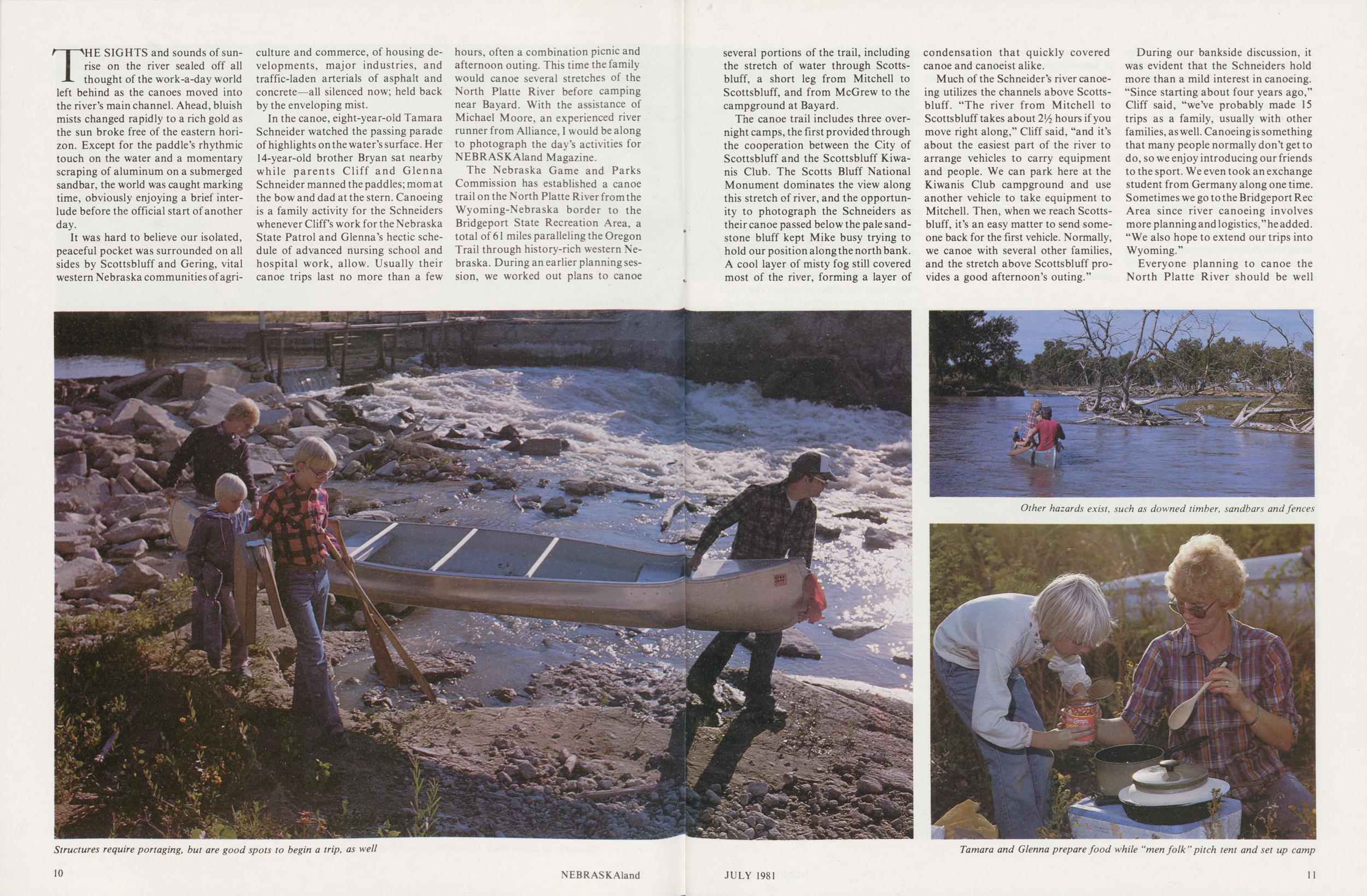
THE SIGHTS and sounds of sunrise on the river sealed off all thought of the work-a-day world left behind as the canoes moved into the river's main channel. Ahead, bluish mists changed rapidly to a rich gold as the sun broke free of the eastern horizon. Except for the paddle's rhythmic touch on the water and a momentary scraping of aluminum on a submerged sandbar, the world was caught marking time, obviously enjoying a brief interlude before the official start of another day.
It was hard to believe our isolated, peaceful pocket was surrounded on all sides by Scottsbluff and Gering, vital western Nebraska communities of agriculture and commerce, of housing developments, major industries, and traffic-laden arterials of asphalt and concrete—all silenced now; held back by the enveloping mist.
In the canoe, eight-year-old Tamara Schneider watched the passing parade of highlights on the water's surface. Her 14-year-old brother Bryan sat nearby while parents Cliff and Glenna Schneider manned the paddles; mom at the bow and dad at the stern. Canoeing is a family activity for the Schneiders whenever Cliff's work for the Nebraska State Patrol and Glenna's hectic schedule of advanced nursing school and hospital work, allow. Usually their canoe trips last no more than a few hours, often a combination picnic and afternoon outing. This time the family would canoe several stretches of the North Platte River before camping near Bayard. With the assistance of Michael Moore, an experienced river runner from Alliance, I would be along to photograph the day's activities for NEBRASKAland Magazine.
The Nebraska Game and Parks Commission has established a canoe trail on the North Platte River from the Wyoming-Nebraska border to the Bridgeport State Recreation Area, a total of 61 miles paralleling the Oregon Trail through history-rich western Nebraska. During an earlier planning session, we worked out plans to canoe
The canoe trail includes three overnight camps, the first provided through the cooperation between the City of Scottsbluff and the Scottsbluff Kiwanis Club. The Scotts Bluff National Monument dominates the view along this stretch of river, and the opportunity to photograph the Schneiders as their canoe passed below the pale sandstone bluff kept Mike busy trying to hold our position along the north bank. A cool layer of misty fog still covered most of the river, forming a layer of condensation that quickly covered canoe and canoeist alike.
Much of the Schneider's river canoeing utilizes the channels above Scottsbluff. "The river from Mitchell to Scottsbluff takes about 2½ hours if you move right along," Cliff said, "and it's about the easiest part of the river to arrange vehicles to carry equipment and people. We can park here at the Kiwanis Club campground and use another vehicle to take equipment to Mitchell. Then, when we reach Scottsbluff, it's an easy matter to send someone back for the first vehicle. Normally, we canoe with several other families, and the stretch above Scottsbluff provides a good afternoon's outing."
During our bankside discussion, it was evident that the Schneiders hold more than a mild interest in canoeing. "Since starting about four years ago," Cliff said, "we've probably made 15 trips as a family, usually with other families, as well. Canoeing is something that many people normally don't get to do, so we enjoy introducing our friends to the sport. We even took an exchange student from Germany along one time. Sometimes we go to the Bridgeport Rec Area since river canoeing involves more planning and logistics,"he added. "We also hope to extend our trips into Wyoming."
Everyone planning to canoe the North Platte River should be well
 aware of its irrigation diversions, some
of which can be hazardous if not approached properly. There are eight diversion structures
along the established
canoe trail; five completely span the
river, but they are plainly visible and
normally present only a minor inconvenience to the canoeist. The diversions
are marked on the handy Nebraska
Canoe Trails brochure distributed by
the Game and Parks Commission.
aware of its irrigation diversions, some
of which can be hazardous if not approached properly. There are eight diversion structures
along the established
canoe trail; five completely span the
river, but they are plainly visible and
normally present only a minor inconvenience to the canoeist. The diversions
are marked on the handy Nebraska
Canoe Trails brochure distributed by
the Game and Parks Commission.
"The diversion structures can serve as canoe access points," Cliff said as we loaded the canoes back onto the cars for a short trip above Scottsbluff. "Canoe access to the river normally is along highway right-of-way, and some of the irrigation districts allow access from their property below the diversions."
Leaving one vehicle at the Kiwanis campground, we drove west from Scottsbluff to the bridge south of Mitchell, where the canoes were unloaded for the second leg of our journey.
"This stretch of the river shows to be about 10 miles on the map," Glenna said as we made ready to push away from the bank. "If you hurry, it makes a nice afternoon trip, but we often put in closer to Scottsbluff and enjoy a more leisurely float."
Despite several bank stabilizing structures, made primarily of rusting car bodies, the stretch of river above Scottsbluff provides a good variety of wildlife and scenery. Overhead, a small flock of Canada geese worked noisily upriver. Several deer, a muskrat or two, and ample beaver sign kept the youngsters watching the willows and cattail-fringed shoreline.
"It is enjoyable to canoe during early spring when the migration is still under way," Cliff added as the two canoes floated effortlessly together into the main channel. "During the migration we see ducks, geese and eagles, and before the leaves set on the vegetation along the shore, it's easier to see deer and other wildlife. Most likely that flock of geese is from a small band that nests each spring along the river."
No fences were encountered in this stretch of river but two irrigation structures required short portages. The first structure spans a branch channel along the north side of the river and is easily portaged along its south edge where calm water backs up by the rock and steel-pilings. The second structure is just above the Kiwanis campground, again in a north channel. By taking the south channel we were forced to portage across an island to put back into the north channel that flows into the campground. Both diversion structures made characteristic roaring sounds that could be heard before they came into view.
It was nearly noon as we approached Scottsbluff. The island portage completed, we pulled into the Kiwanis campground and made preparations for lunch before moving the canoes by vehicle to the McGrew bridge and the final leg of the day's journey. Below Scottsbluff the river widens in several areas; large islands breaking the river into shallower, slower-moving streams. From McGrew to the campground above the Bayard bridge is approximately 3½ miles; an enjoyable journey punctuated by the excited chatter of numerous small shore birds. Blue herons, standing motionless on fallen cottonwood limbs and in shallow back-waters, allowed the canoes to approach only so far before taking to the air. Mallards would pick up from the river's channel only to alight again behind the passing canoes.
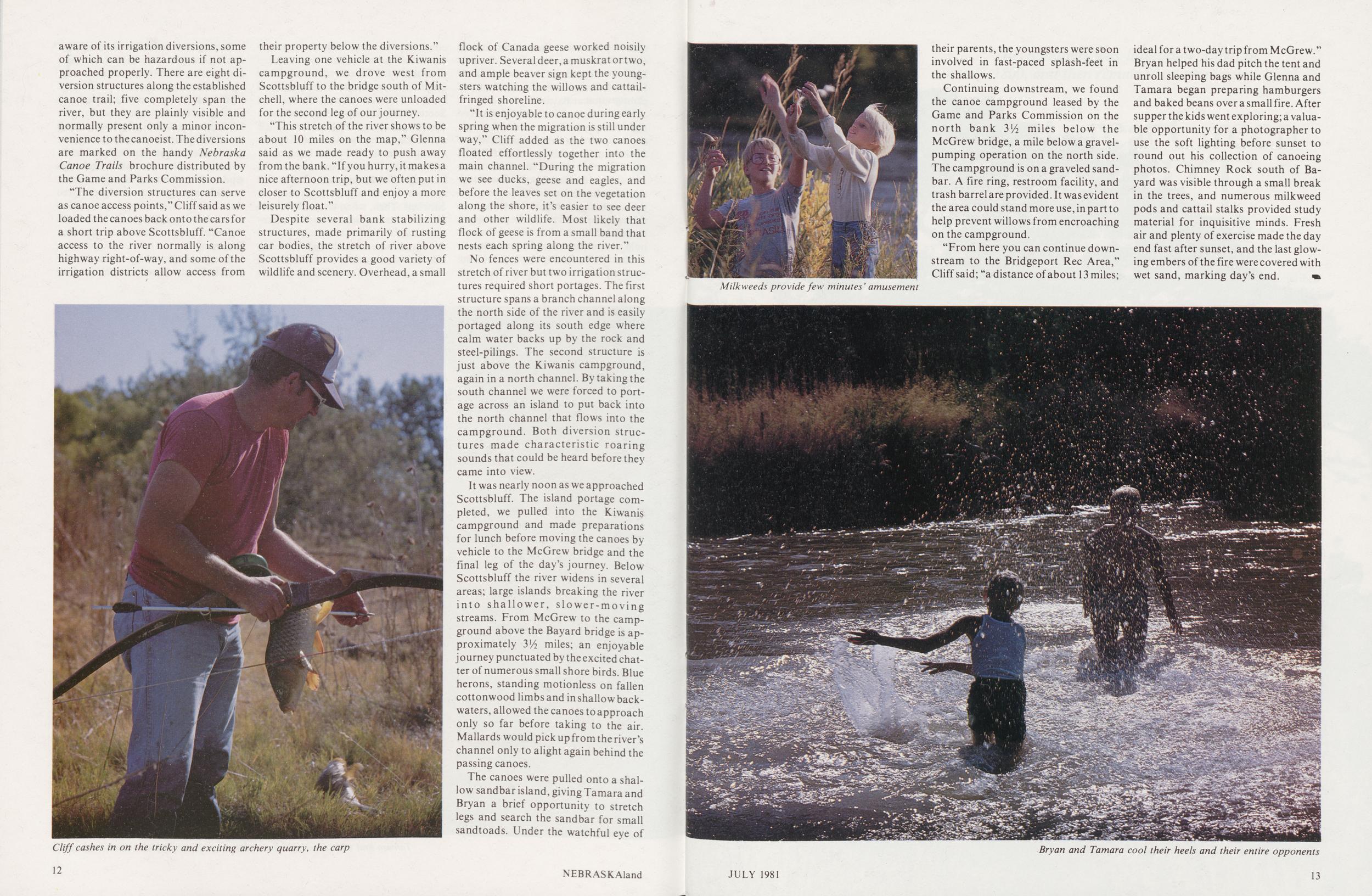
The canoes were pulled onto a shallow sandbar island, giving Tamara and Bryan a brief opportunity to stretch legs and search the sandbar for small sandtoads. Under the watchful eye of
Continuing downstream, we found the canoe campground leased by the Game and Parks Commission on the north bank 3½ miles below the McGrew bridge, a mile below a gravel-pumping operation on the north side. The campground is on a graveled sandbar. A fire ring, restroom facility, and trash barrel are provided. It was evident the area could stand more use, in part to help prevent willows from encroaching on the campground.
"From here you can continue downstream to the Bridgeport Rec Area," Cliff said; "a distance of about 13 miles; ideal for a two-day trip from McGrew." Bryan helped his dad pitch the tent and unroll sleeping bags while Glenna and Tamara began preparing hamburgers and baked beans over a small fire. After supper the kids went exploring; a valuable opportunity for a photographer to use the soft lighting before sunset to round out his collection of canoeing photos. Chimney Rock south of Bayard was visible through a small break in the trees, and numerous milkweed pods and cattail stalks provided study material for inquisitive minds. Fresh air and plenty of exercise made the day end fast after sunset, and the last glowing embers of the fire were covered with wet sand, marking day's end.
The Great Green DESERT
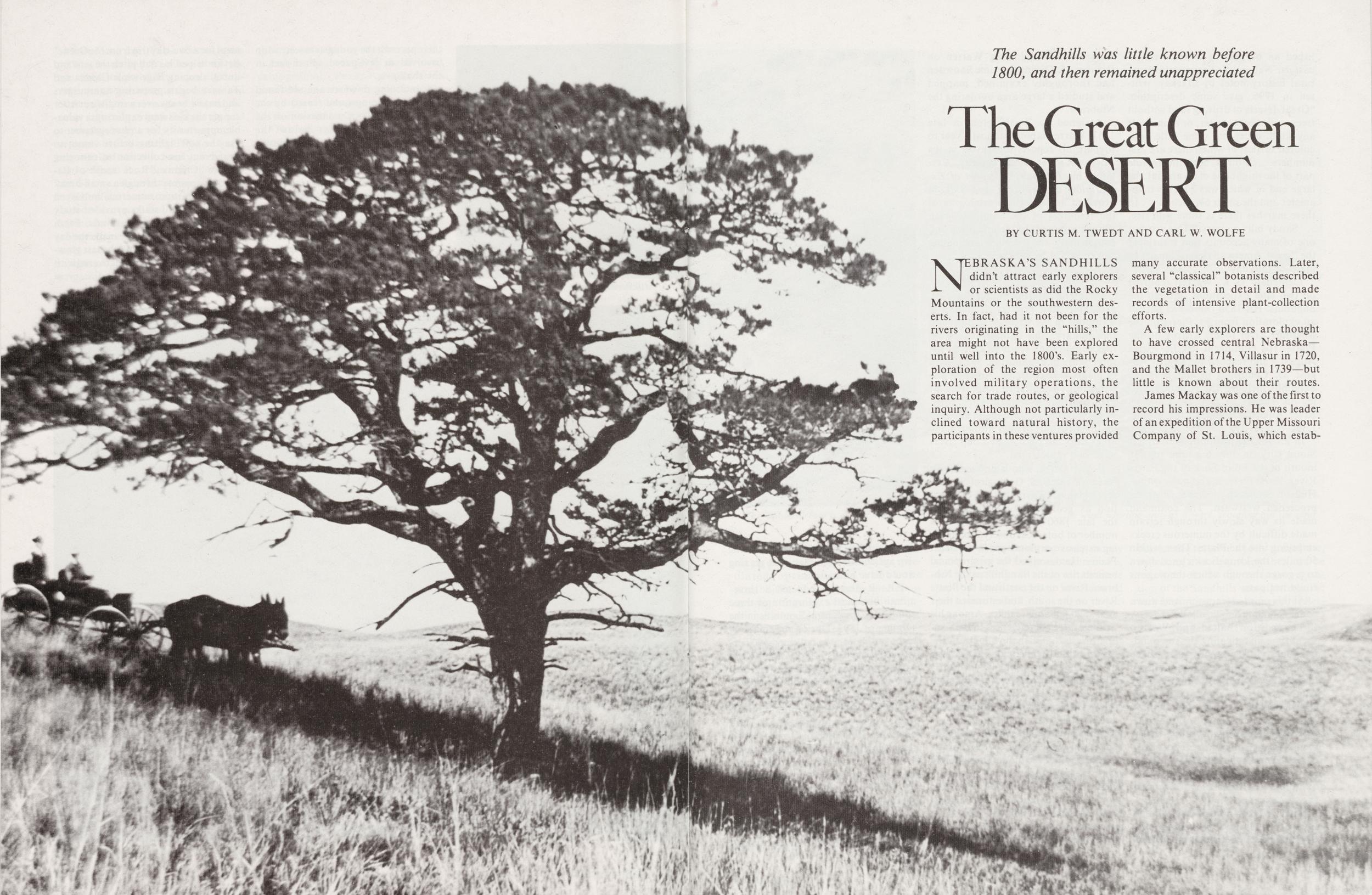
The Sandhills was little known before 1800, and then remained unappreciated BY CURTIS M. TWEDT AND CARL W. WOLFENEBRASKA'S SANDHILLS didn't attract early explorers or scientists as did the Rocky Mountains or the southwestern deserts. In fact, had it not been for the rivers originating in the "hills," the area might not have been explored until well into the 1800's. Early exploration of the region most often involved military operations, the search for trade routes, or geological inquiry. Although not particularly inclined toward natural history, the participants in these ventures provided many accurate observations. Later, several "classical" botanists described the vegetation in detail and made records of intensive plant-collection efforts.
A few early explorers are thought to have crossed central Nebraska—Bourgmond in 1714, Villasur in 1720, and the Mallet brothers in 1739—but little is known about their routes.
James Mackay was one of the first to
record his impressions. He was leader
of an expedition of the Upper Missouri
Company of St. Louis, which established
 an outpost in extreme northeastern Nebraska. Fragmentary natural history notes by
Mackay, written in 1796, give some description:
"Great deserts of drifting sand without
trees, soil, rocks, water, or animals of
any kind, excepting some little vari-colored turtles, of which there are vast
numbers Found here the middle
part of the thighbone of an animal, the
large end of which was 7 inches in diameter and the other 6¾ inches In
these marshes there is some wild rice.
Sandy hilly country." This was but
one of many accounts that translated
the "great American desert" image to
maps of that day.
an outpost in extreme northeastern Nebraska. Fragmentary natural history notes by
Mackay, written in 1796, give some description:
"Great deserts of drifting sand without
trees, soil, rocks, water, or animals of
any kind, excepting some little vari-colored turtles, of which there are vast
numbers Found here the middle
part of the thighbone of an animal, the
large end of which was 7 inches in diameter and the other 6¾ inches In
these marshes there is some wild rice.
Sandy hilly country." This was but
one of many accounts that translated
the "great American desert" image to
maps of that day.
Lieutenant G. K. Warren reported on two later expeditions through the Sandhills. His 1855 route was part of an exploration from Ft. Pierre on the Missouri River to Ft. Kearny on the Platte. His contingent left Ft. Pierre August 9 and reached Ft. Kearny August 25. Campsites in and near the Sandhills included the Niobrara Valley on August 14, near the Calamus River August 17, and on the Middle Loup August 19.
In an 1857 expedition, Warren left Sioux City on July 6 bound for the mouth of the Loup Fork of the Platte River. From there, in company with J. Hudson Snowden, a topographer, he proceeded westward. The command made its way slowly through terrain made difficult by the numerous creeks emptying into the Platte. Then, within 50 miles, the Loup Fork closed down to a gorge through which the wagons could not pass.
At this point, a teamster came down with typhoid fever. To allow recovery, the expedition halted and Warren spent time investigating the surrounding country. The harsh nature of the Sandhills certainly made an immense impression. Warren's account in early August indicated: "We have now traced the river (Loup) from end to end and found the impracticality for almost any purpose so marked that it seems like a great waste of time to have made the exertion we have. Our greatest wish is to get away from it (the Sandhills) as soon as possible and never return."
While Warren moved on with his men to Ft. Laramie, Snowden apparently stayed in the region of the Upper Niobrara until rejoining Warren on October 15. During this time Snowden had thoroughly examined, mapped and studied a large area bordering the Niobrara.
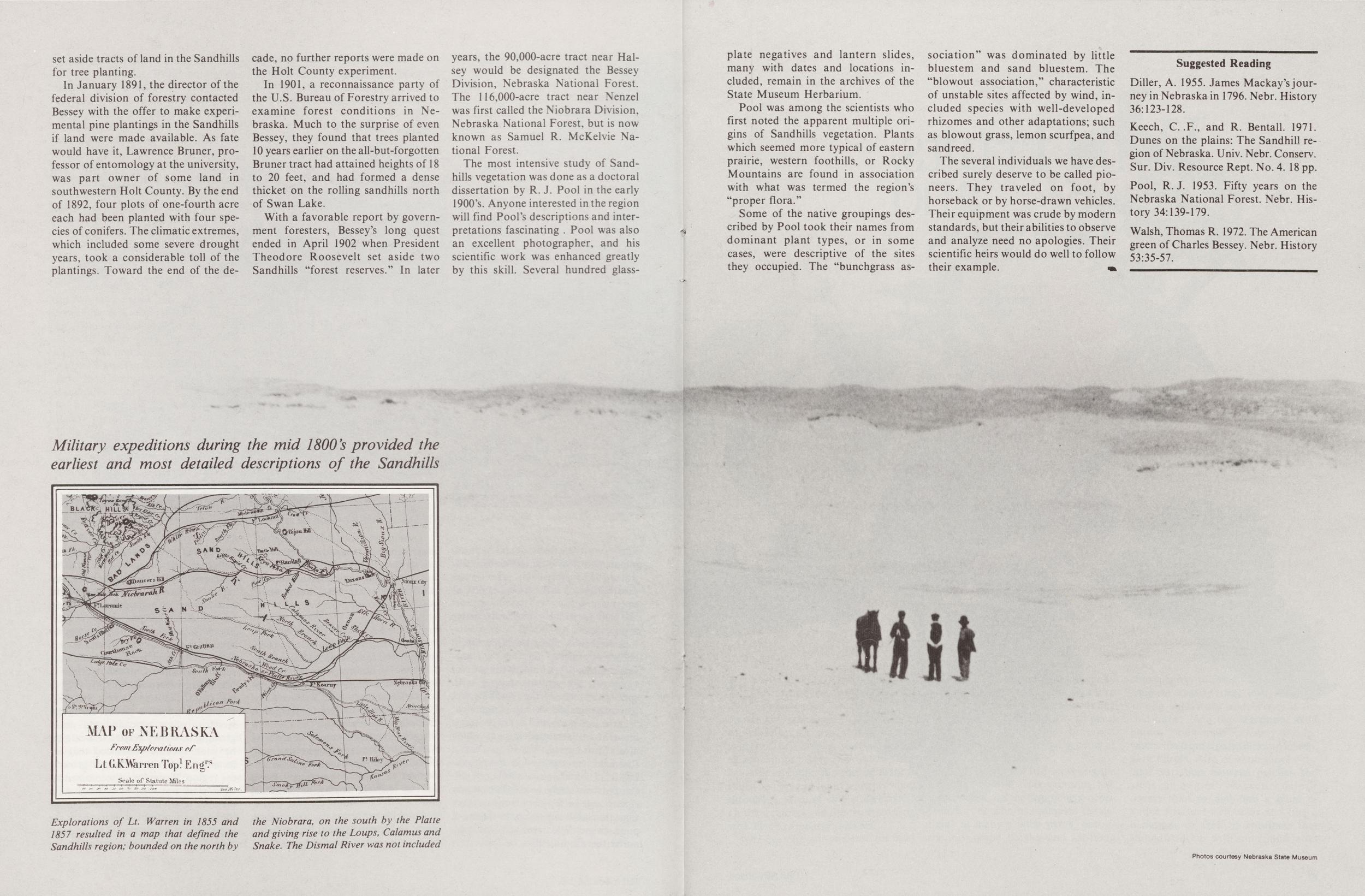
Assigned to Washington in late 1857, Warren labored almost a year to prepare his reports on travels in the Missouri River Basin country. Certainly his Preliminary Report of Exploration in Nebraska and Dakota provided an important cataloging of the resources of the Sandhills, even though much of the identification and commentary on the flora and fauna was provided by others.
Map Makers and BotantistsChapters covering routes traveled, geography and geology, climate, descriptions of the streams, Indians and the military, and natural history all make interesting reading. During the three years of exploration, 593 species of plants were collected. Notes on distribution, abundance and uses of plants by Indians were included. Most of the collections were made adjacent to the Missouri River, although the areas near the Platte and Loup rivers were well represented.
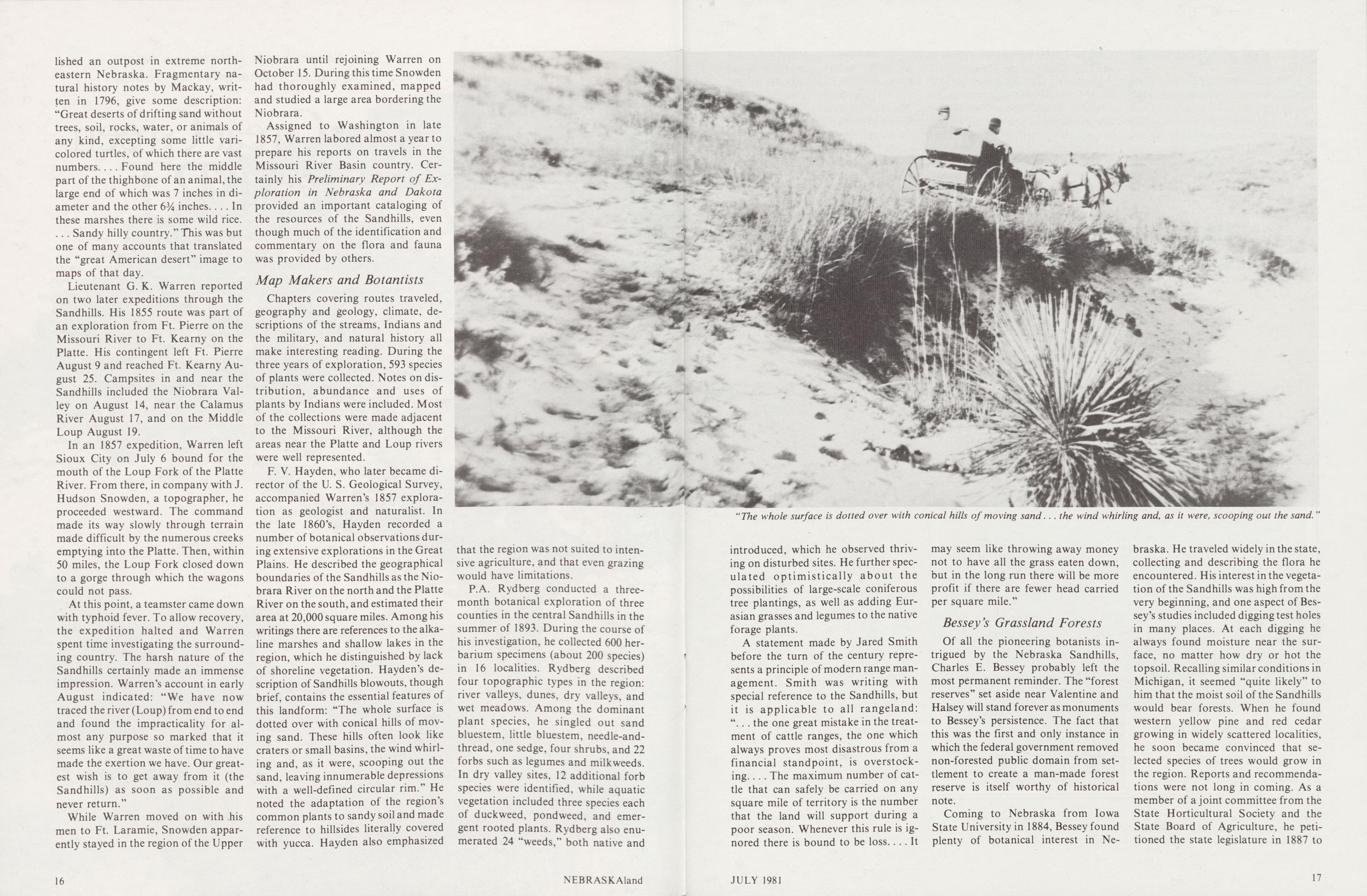
F. V. Hayden, who later became director of the U. S. Geological Survey, accompanied Warren's 1857 exploration as geologist and naturalist. In the late 1860's, Hayden recorded a number of botanical observations during extensive explorations in the Great Plains. He described the geographical boundaries of the Sandhills as the Niobrara River on the north and the Platte River on the south, and estimated their area at 20,000 square miles. Among his writings there are references to the alkaline marshes and shallow lakes in the region, which he distinguished by lack of shoreline vegetation. Hayden's description of Sandhills blowouts, though brief, contains the essential features of this landform: "The whole surface is dotted over with conical hills of moving sand. These hills often look like craters or small basins, the wind whirling and, as it were, scooping out the sand, leaving innumerable depressions with a well-defined circular rim." He noted the adaptation of the region's common plants to sandy soil and made reference to hillsides literally covered with yucca. Hayden also emphasized that the region was not suited to intensive agriculture, and that even grazing would have limitations.
P.A. Rydberg conducted a three-month botanical exploration of three counties in the central Sandhills in the summer of 1893. During the course of his investigation, he collected 600 herbarium specimens (about 200 species) in 16 localities. Rydberg described four topographic types in the region: river valleys, dunes, dry valleys, and wet meadows. Among the dominant plant species, he singled out sand bluestem, little bluestem, needle-and-thread, one sedge, four shrubs, and 22 forbs such as legumes and milkweeds. In dry valley sites, 12 additional forb species were identified, while aquatic vegetation included three species each of duckweed, pondweed, and emergent rooted plants. Rydberg also enumerated 24 "weeds," both native and 16 NEBRASKAland
A statement made by Jared Smith before the turn of the century represents a principle of modern range management. Smith was writing with special reference to the Sandhills, but it is applicable to all rangeland: " the one great mistake in the treatment of cattle ranges, the one which always proves most disastrous from a financial standpoint, is overstocking The maximum number of cattle that can safely be carried on any square mile of territory is the number that the land will support during a poor season. Whenever this rule is ignored there is bound to be loss. It may seem like throwing away money not to have all the grass eaten down, but in the long run there will be more profit if there are fewer head carried per square mile."
Bessey's Grassland ForestsOf all the pioneering botanists intrigued by the Nebraska Sandhills, Charles E. Bessey probably left the most permanent reminder. The "forest reserves" set aside near Valentine and Halsey will stand forever as monuments to Bessey's persistence. The fact that this was the first and only instance in which the federal government removed non-forested public domain from settlement to create a man-made forest reserve is itself worthy of historical note.
Coming to Nebraska from Iowa
State University in 1884, Bessey found
plenty of botanical interest in Nebraska. He traveled widely in the state,
collecting and describing the flora he
encountered. His interest in the vegetation of the Sandhills was high from the
very beginning, and one aspect of Bessey's studies included digging test holes
in many places. At each digging he
always found moisture near the surface, no matter how dry or hot the
topsoil. Recalling similar conditions in
Michigan, it seemed "quite likely" to
him that the moist soil of the Sandhills
would bear forests. When he found
western yellow pine and red cedar
growing in widely scattered localities,
he soon became convinced that selected species of trees would grow in
the region. Reports and recommendations were not long in coming. As a
member of a joint committee from the
State Horticultural Society and the
State Board of Agriculture, he petitioned the state legislature in 1887 to
JULY 1981
17
 set aside tracts of land in the Sandhills
for tree planting.
set aside tracts of land in the Sandhills
for tree planting.
In January 1891, the director of the federal division of forestry contacted Bessey with the offer to make experimental pine plantings in the Sandhills if land were made available. As fate would have it, Lawrence Bruner, professor of entomology at the university, was part owner of some land in southwestern Holt County. By the end of 1892, four plots of one-fourth acre each had been planted with four species of conifers. The climatic extremes, which included some severe drought years, took a considerable toll of the plantings. Toward the end of the decade, no further reports were made on the Holt County experiment.
In 1901, a reconnaissance party of the U.S. Bureau of Forestry arrived to examine forest conditions in Nebraska. Much to the surprise of even Bessey, they found that trees planted 10 years earlier on the all-but-forgotten Bruner tract had attained heights of 18 to 20 feet, and had formed a dense thicket on the rolling sandhills north of Swan Lake.
With a favorable report by government foresters, Bessey's long quest ended in April 1902 when President Theodore Roosevelt set aside two Sandhills "forest reserves." In later years, the 90,000-acre tract near Halsey would be designated the Bessey Division, Nebraska National Forest. The 116,000-acre tract near Nenzel was first called the Niobrara Division, Nebraska National Forest, but is now known as Samuel R. McKelvie National Forest.
The most intensive study of Sandhills vegetation was done as a doctoral dissertation by R. J. Pool in the early 1900's. Anyone interested in the region will find Pool's descriptions and interpretations fascinating . Pool was also an excellent photographer, and his scientific work was enhanced greatly by this skill. Several hundred glass-plate
Pool was among the scientists who first noted the apparent multiple origins of Sandhills vegetation. Plants which seemed more typical of eastern prairie, western foothills, or Rocky Mountains are found in association with what was termed the region's "proper flora."
Some of the native groupings described by Pool took their names from dominant plant types, or in some cases, were descriptive of the sites they occupied. The "bunchgrass association" was dominated by little bluestem and sand bluestem. The "blowout association," characteristic of unstable sites affected by wind, included species with well-developed rhizomes and other adaptations; such as blowout grass, lemon scurfpea, and sandreed.
The several individuals we have described surely deserve to be called pioneers. They traveled on foot, by horseback or by horse-drawn vehicles. Their equipment was crude by modern standards, but their abilities to observe and analyze need no apologies. Their scientific heirs would do well to follow their example.
Suggested ReadingDiller, A. 1955. James Mackay's journey in Nebraska in 1796. Nebr. History 36:123-128. Keech, C. .F., and R. Bentall. 1971. Dunes on the plains: The Sandhill region of Nebraska. Univ. Nebr. Conserv. Sur. Div. Resource Rept. No. 4. 18 pp. Pool, R.J. 1953. Fifty years on the Nebraska National Forest. Nebr. History 34:139-179. Walsh, Thomas R. 1972. The American green of Charles Bessey. Nebr. History 53:35-57.
Wild Fruit an Berries
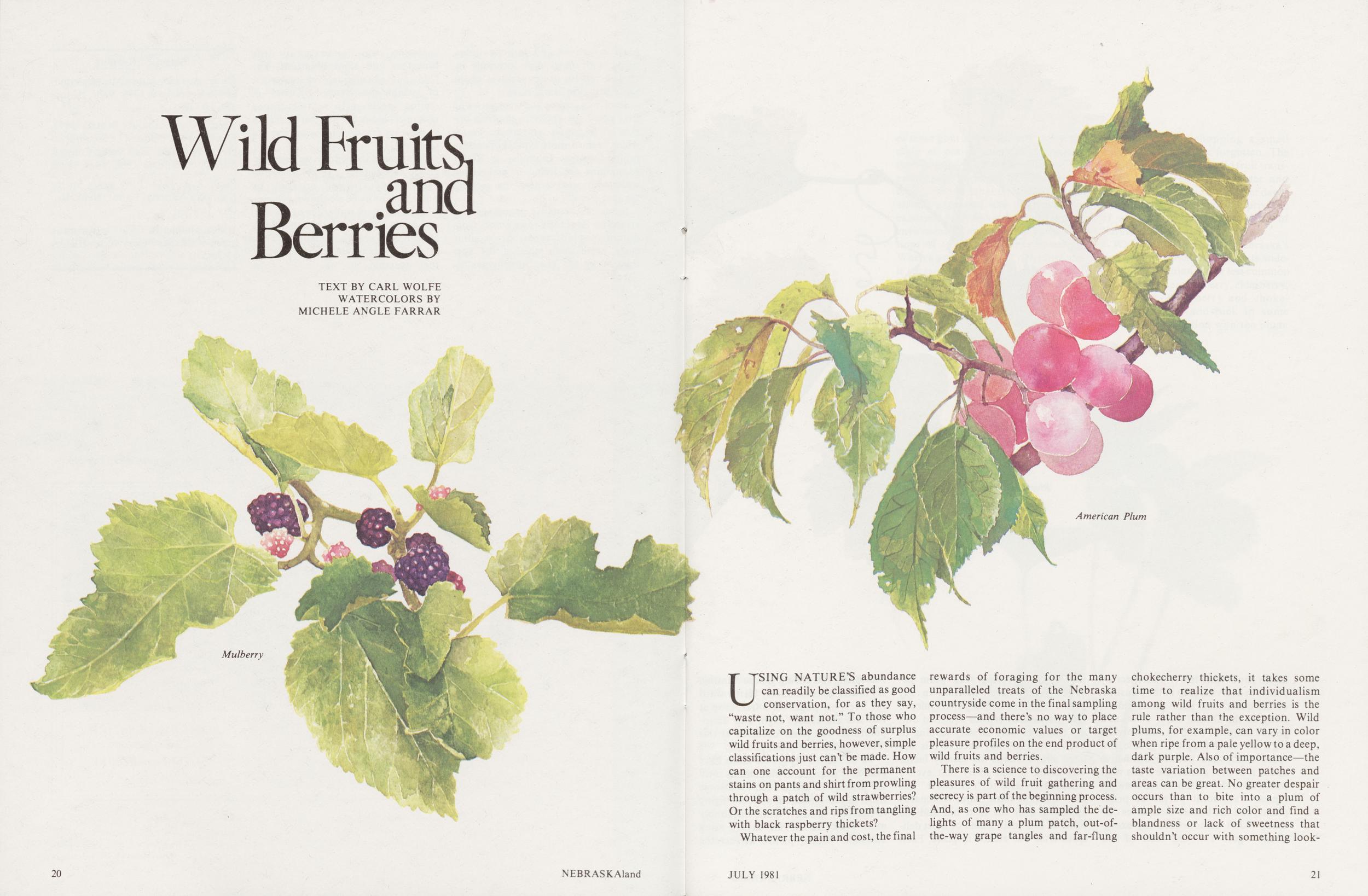
TEXT BY CARL WOLFE WATERCOLORS BY MICHELE ANGLE FARRARUSING NATURE'S abundance can readily be classified as good conservation, for as they say, "waste not, want not." To those who capitalize on the goodness of surplus wild fruits and berries, however, simple classifications just can't be made. How can one account for the permanent stains on pants and shirt from prowling through a patch of wild strawberries? Or the scratches and rips from tangling with black raspberry thickets?
Whatever the pain and cost, the final rewards of foraging for the many unparalleled treats of the Nebraska countryside come in the final sampling process—and there's no way to place accurate economic values or target pleasure profiles on the end product of wild fruits and berries.
There is a science to discovering the
pleasures of wild fruit gathering and
secrecy is part of the beginning process.
And, as one who has sampled the delights of many a plum patch, out-of-the-way grape
tangles and far-flung
chokecherry thickets, it takes some
time to realize that individualism
among wild fruits and berries is the
rule rather than the exception. Wild
plums, for example, can vary in color
when ripe from a pale yellow to a deep,
dark purple. Also of importance—the
taste variation between patches and
areas can be great. No greater despair
occurs than to bite into a plum of
ample size and rich color and find a
blandness or lack of sweetness that
shouldn't occur with something looking
JULY 1981
21
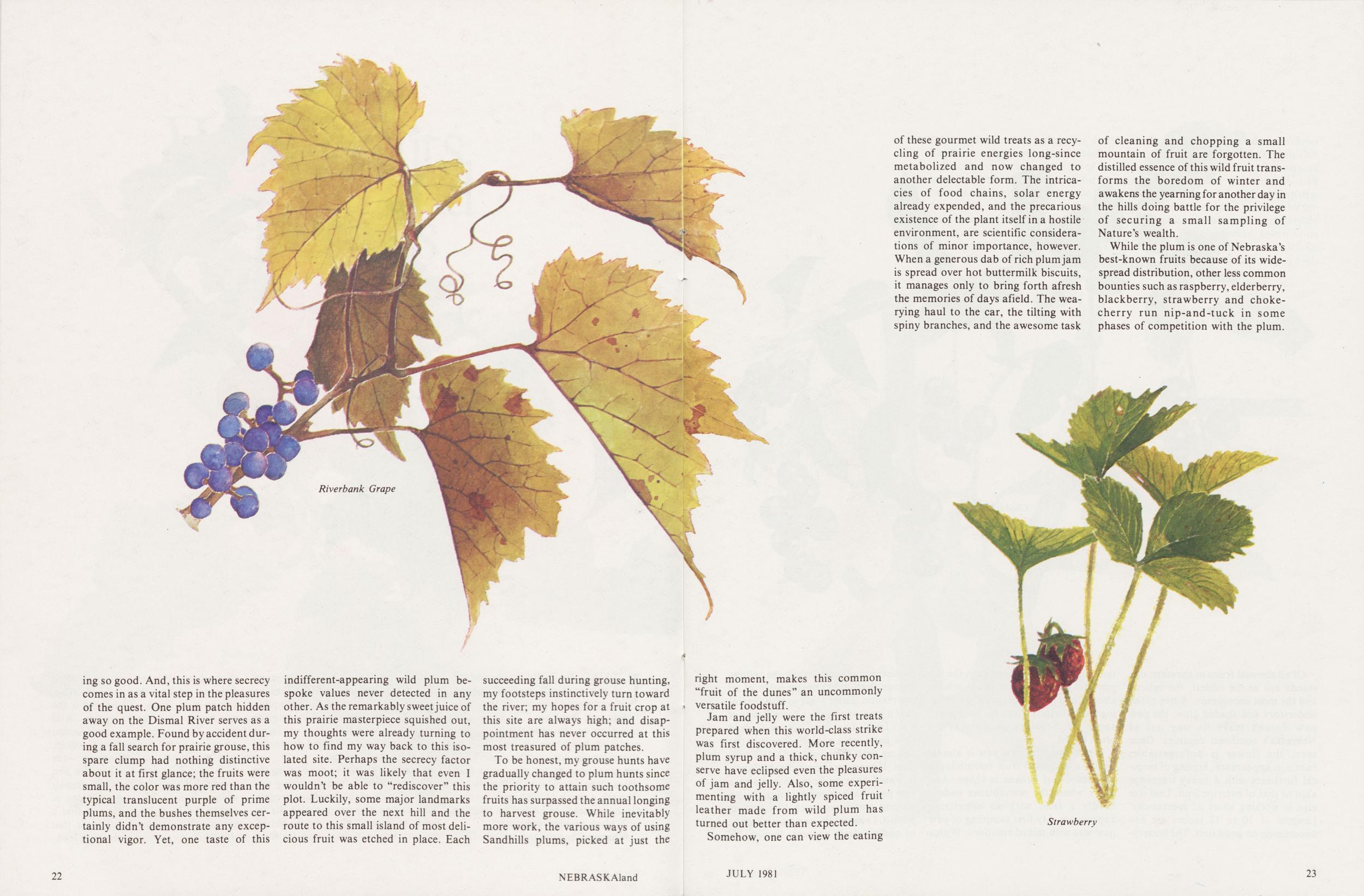
To be honest, my grouse hunts have gradually changed to plum hunts since the priority to attain such toothsome fruits has surpassed the annual longing to harvest grouse. While inevitably more work, the various ways of using Sandhills plums, picked at just the 22 NEBRASKAland right moment, makes this common "fruit of the dunes" an uncommonly versatile foodstuff.
Jam and jelly were the first treats prepared when this world-class strike was first discovered. More recently, plum syrup and a thick, chunky conserve have eclipsed even the pleasures of jam and jelly. Also, some experimenting with a lightly spiced fruit leather made from wild plum has turned out better than expected.
Somehow, one can view the eating of these gourmet wild treats as a recycling of prairie energies long-since metabolized and now changed to another delectable form. The intricacies of food chains, solar energy already expended, and the precarious existence of the plant itself in a hostile environment, are scientific considerations of minor importance, however. When a generous dab of rich plum jam is spread over hot buttermilk biscuits, it manages only to bring forth afresh the memories of days afield. The wearying haul to the car, the tilting with spiny branches, and the awesome task of cleaning and chopping a small mountain of fruit are forgotten. The distilled essence of this wild fruit transforms the boredom of winter and awakens the yearning for another day in the hills doing battle for the privilege of securing a small sampling of Nature's wealth.
While the plum is one of Nebraska's best-known fruits because of its wide-spread distribution, other less common bounties such as raspberry, elderberry, blackberry, strawberry and choke-cherry run nip-and-tuck in some phases of competition with the plum.
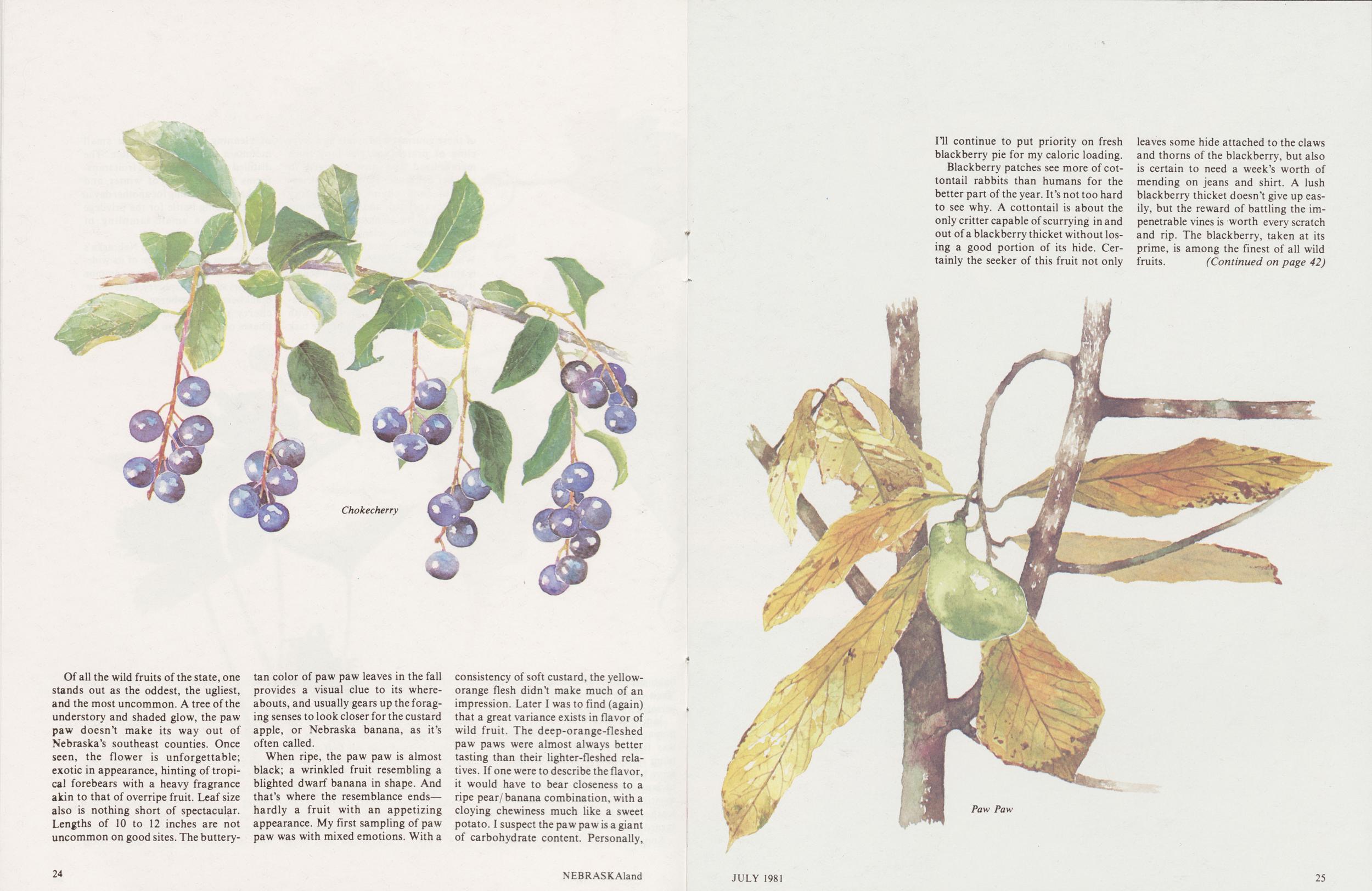
Of all the wild fruits of the state, one stands out as the oddest, the ugliest, and the most uncommon. A tree of the understory and shaded glow, the paw paw doesn't make its way out of Nebraska's southeast counties. Once seen, the flower is unforgettable; exotic in appearance, hinting of tropical forebears with a heavy fragrance akin to that of overripe fruit. Leaf size also is nothing short of spectacular. Lengths of 10 to 12 inches are not uncommon on good sites. The buttery-tan color of paw paw leaves in the fall provides a visual clue to its whereabouts, and usually gears up the foraging senses to look closer for the custard apple, or Nebraska banana, as it's often called.
When ripe, the paw paw is almost black; a wrinkled fruit resembling a blighted dwarf banana in shape. And that's where the resemblance ends—hardly a fruit with an appetizing appearance. My first sampling of paw paw was with mixed emotions. With a consistency of soft custard, the yellow-orange flesh didn't make much of an impression. Later I was to find (again) that a great variance exists in flavor of wild fruit. The deep-orange-fleshed paw paws were almost always better tasting than their lighter-fleshed relatives. If one were to describe the flavor, it would have to bear closeness to a ripe pear/banana combination, with a cloying chewiness much like a sweet potato. I suspect the paw paw is a giant of carbohydrate content. Personally, 24 NEBRASKAland I'll continue to put priority on fresh blackberry pie for my caloric loading.
Blackberry patches see more of cottontail rabbits than humans for the better part of the year. It's not too hard to see why. A cottontail is about the only critter capable of scurrying in and out of a blackberry thicket without losing a good portion of its hide. Certainly the seeker of this fruit not only leaves some hide attached to the claws and thorns of the blackberry, but also is certain to need a week's worth of mending on jeans and shirt. A lush blackberry thicket doesn't give up easily, but the reward of battling the impenetrable vines is worth every scratch and rip. The blackberry, taken at its prime, is among the finest of all wild fruits. (Continued on page 42)
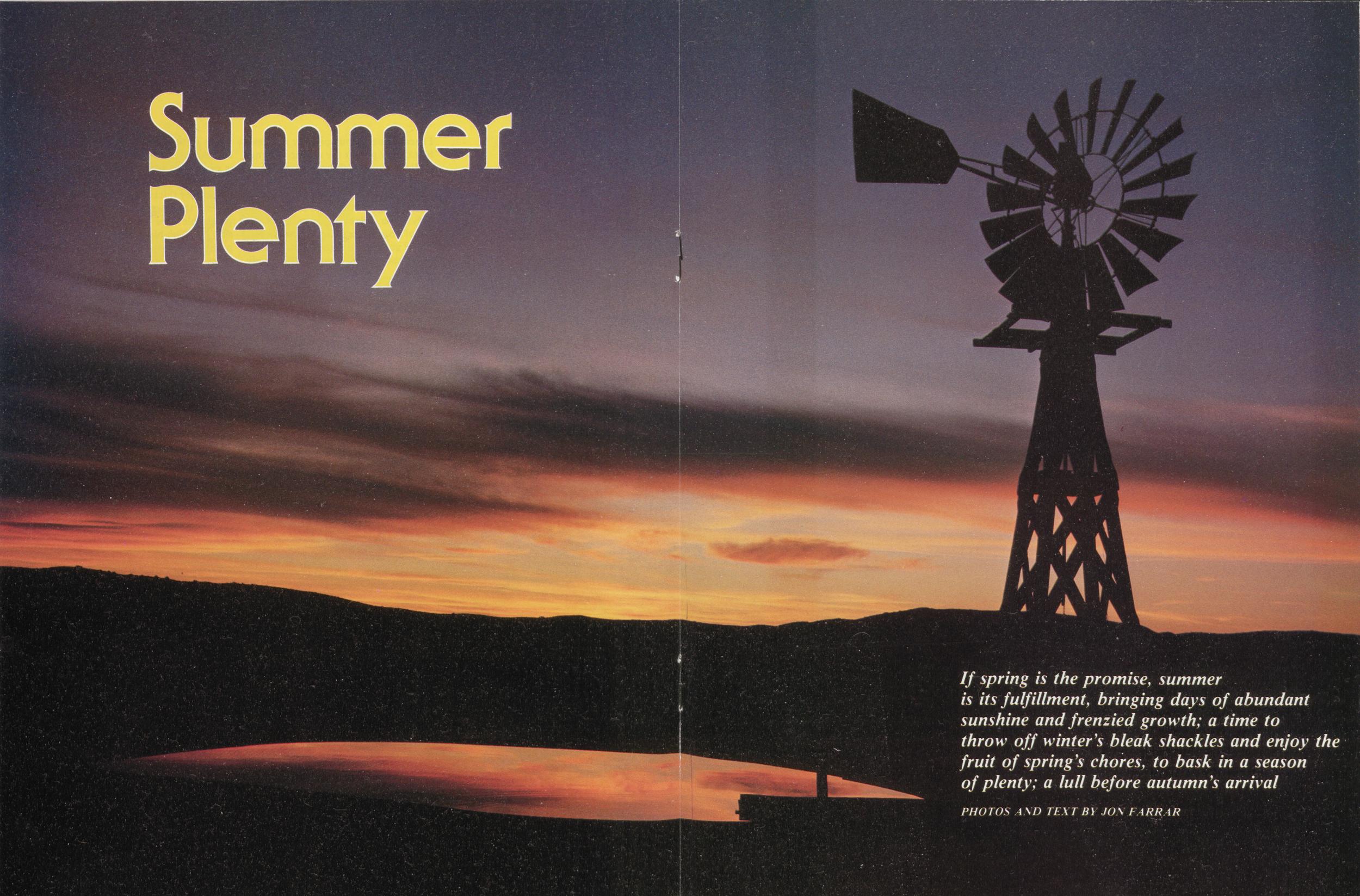
Summer Plenty
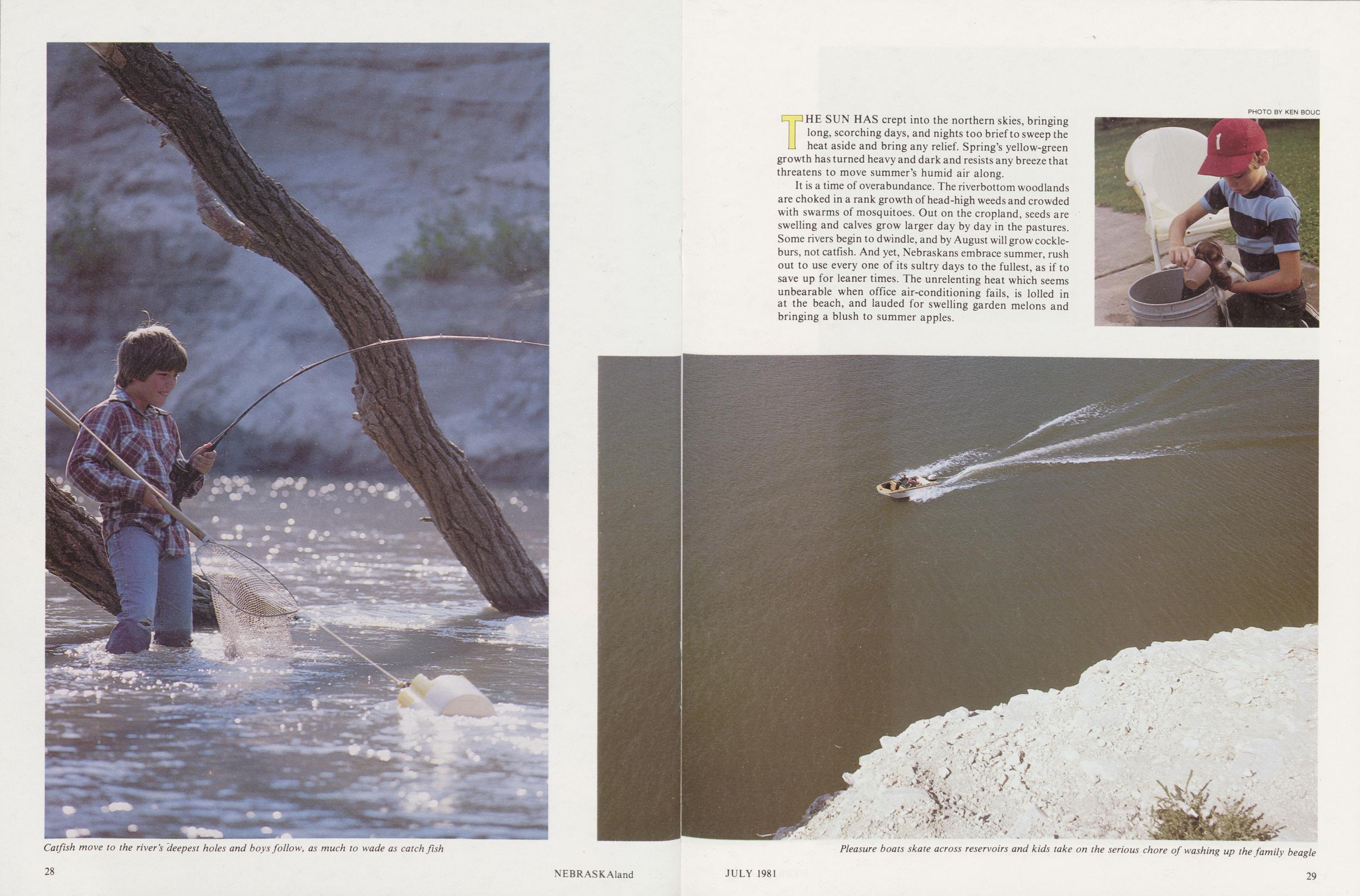
THE SUN HAS crept into the northern skies, bringing long, scorching days, and nights too brief to sweep the heat aside and bring any relief. Spring's yellow-green growth has turned heavy and dark and resists any breeze that threatens to move summer's humid air along.
It is a time of overabundance. The riverbottom woodlands are choked in a rank growth of head-high weeds and crowded with swarms of mosquitoes. Out on the cropland, seeds are swelling and calves grow larger day by day in the pastures. Some rivers begin to dwindle, and by August will grow cockle-burs, not catfish. And yet, Nebraskans embrace summer, rush out to use every one of its sultry days to the fullest, as if to save up for leaner times. The unrelenting heat which seems unbearable when office air-conditioning fails, is lolled in at the beach, and lauded for swelling garden melons and bringing a blush to summer apples.
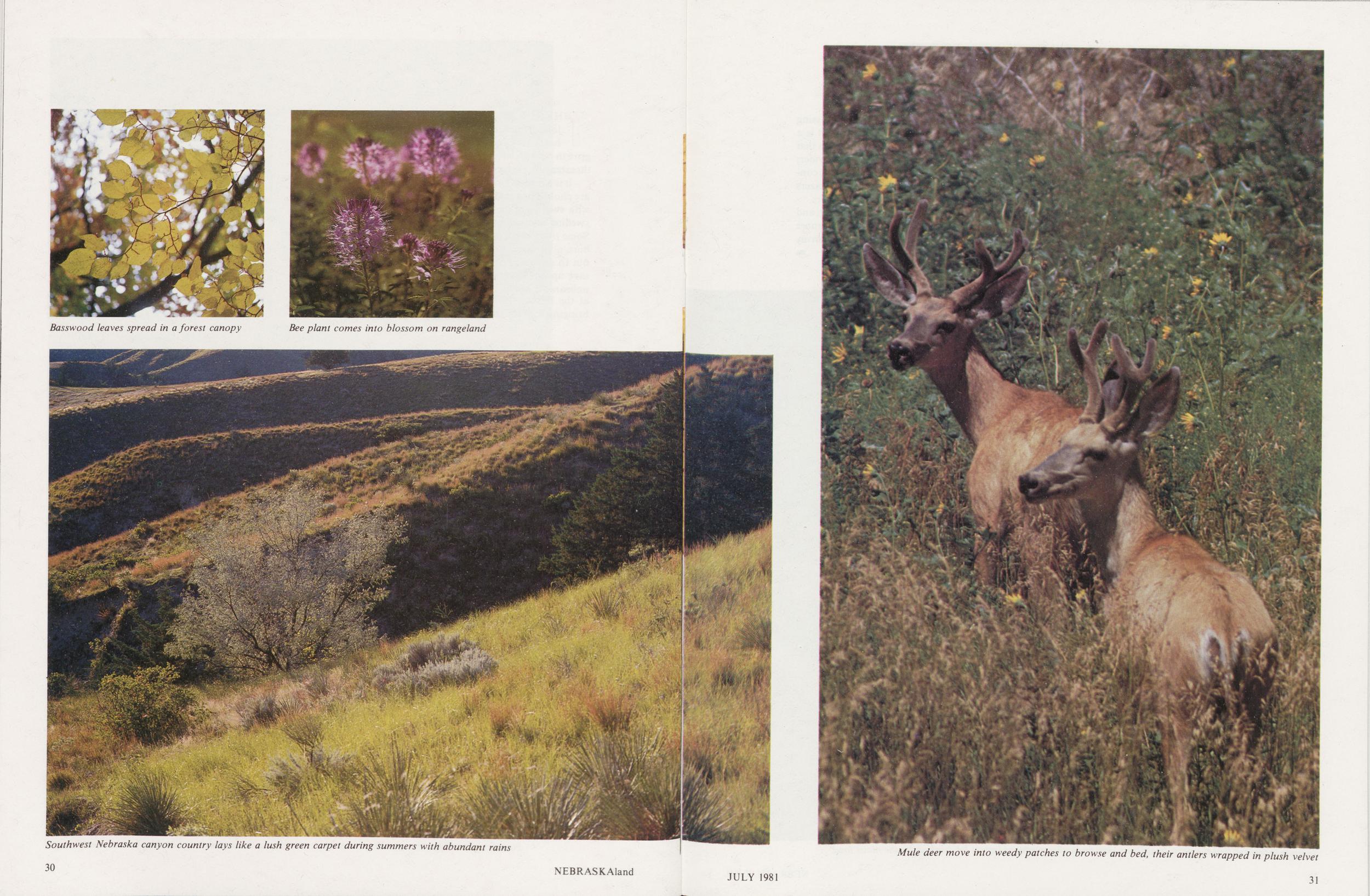
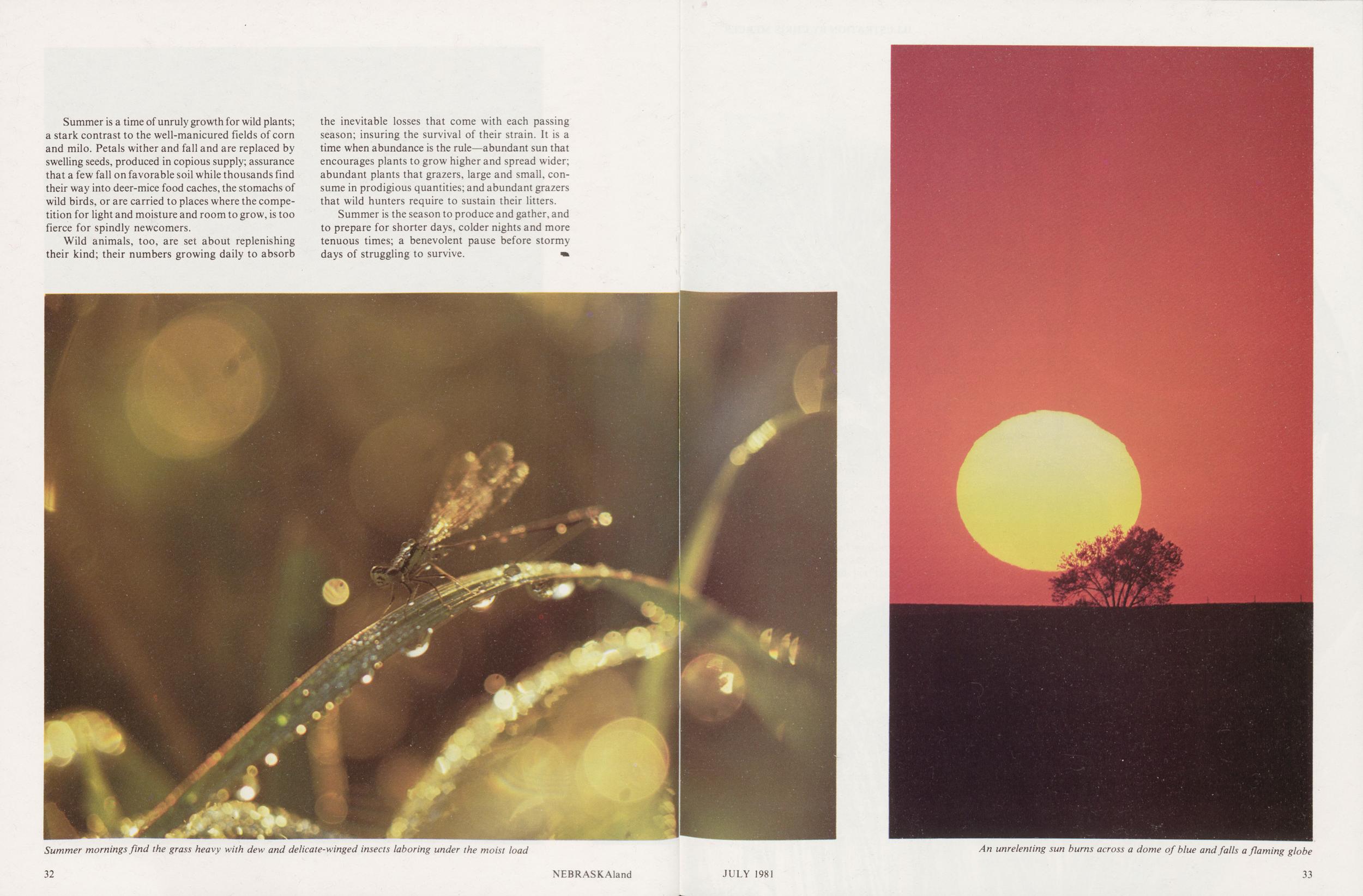
Summer is a time of unruly growth for wild plants; a stark contrast to the well-manicured fields of corn and milo. Petals wither and fall and are replaced by swelling seeds, produced in copious supply; assurance that a few fall on favorable soil while thousands find their way into deer-mice food caches, the stomachs of wild birds, or are carried to places where the competition for light and moisture and room to grow, is too fierce for spindly newcomers.
Wild animals, too, are set about replenishing their kind; their numbers growing daily to absorb the inevitable losses that come with each passing season; insuring the survival of their strain. It is a time when abundance is the rule—abundant sun that encourages plants to grow higher and spread wider; abundant plants that grazers, large and small, consume in prodigious quantities; and abundant grazers that wild hunters require to sustain their litters.
Summer is the season to produce and gather, and to prepare for shorter days, colder nights and more tenuous times; a benevolent pause before stormy days of struggling to survive.
Rabies at Home in the Wild
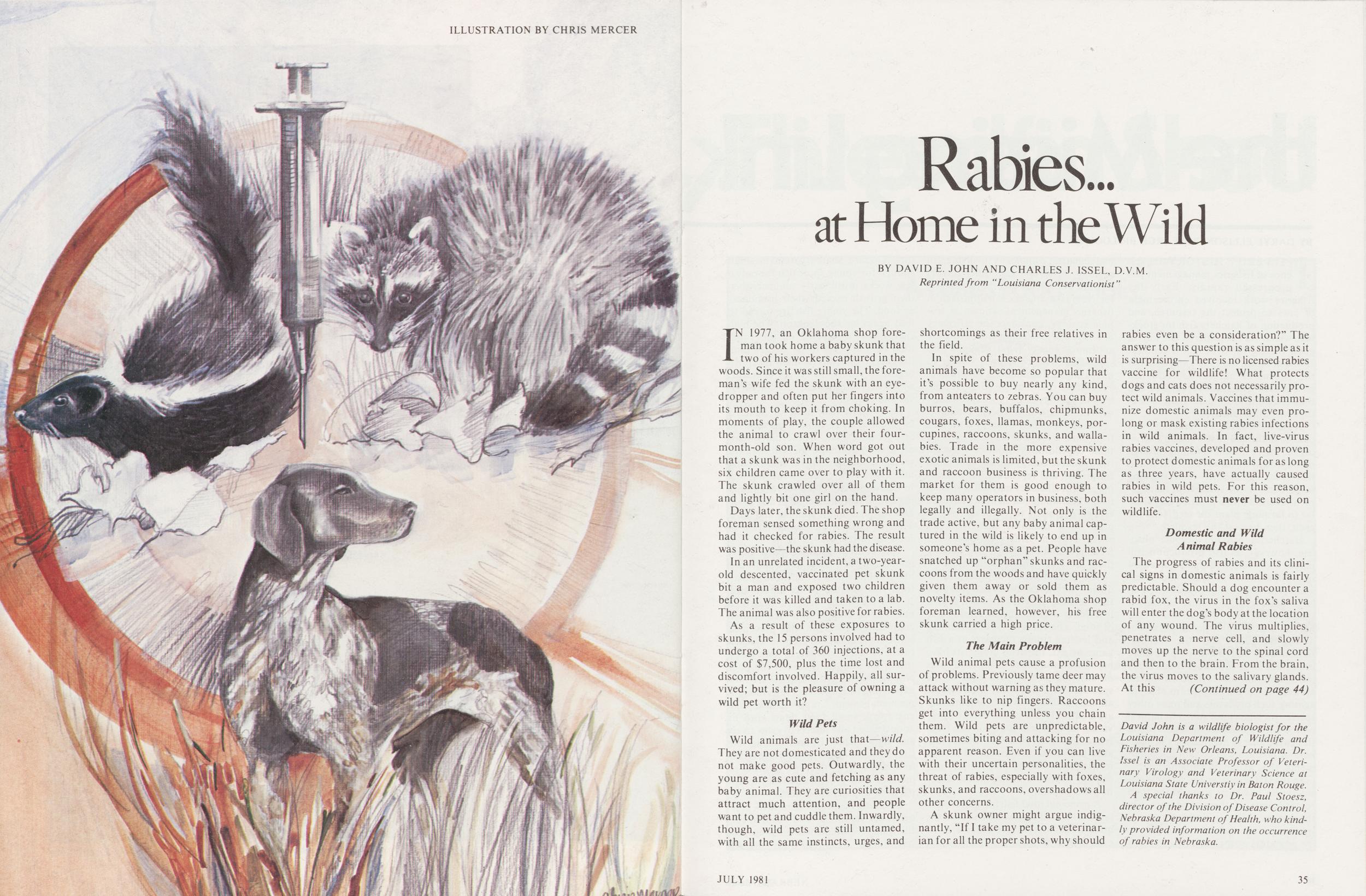
BY DAVID E. JOHN AND CHARLES J. ISSEL, D.V.M. Reprinted from "Louisiana Conservationist"IN 1977, an Oklahoma shop foreman took home a baby skunk that two of his workers captured in the woods. Since it was still small, the foreman's wife fed the skunk with an eye-dropper and often put her fingers into its mouth to keep it from choking. In moments of play, the couple allowed the animal to crawl over their four-month-old son. When word got out that a skunk was in the neighborhood, six children came over to play with it. The skunk crawled over all of them and lightly bit one girl on the hand.
Days later, the skunk died. The shop foreman sensed something wrong and had it checked for rabies. The result was positive—the skunk had the disease.
In an unrelated incident, a two-year-old descented, vaccinated pet skunk bit a man and exposed two children before it was killed and taken to a lab. The animal was also positive for rabies.
As a result of these exposures to skunks, the 15 persons involved had to undergo a total of 360 injections, at a cost of $7,500, plus the time lost and discomfort involved. Happily, all survived; but is the pleasure of owning a wild pet worth it?
Wild PetsWild animals are just that—wild. They are not domesticated and they do not make good pets. Outwardly, the young are as cute and fetching as any baby animal. They are curiosities that attract much attention, and people want to pet and cuddle them. Inwardly, though, wild pets are still untamed, with all the same instincts, urges, and shortcomings as their free relatives in the field.
In spite of these problems, wild animals have become so popular that it's possible to buy nearly any kind, from anteaters to zebras. You can buy burros, bears, buffalos, chipmunks, cougars, foxes, llamas, monkeys, porcupines, raccoons, skunks, and wallabies. Trade in the more expensive exotic animals is limited, but the skunk and raccoon business is thriving. The market for them is good enough to keep many operators in business, both legally and illegally. Not only is the trade active, but any baby animal captured in the wild is likely to end up in someone's home as a pet. People have snatched up "orphan" skunks and raccoons from the woods and have quickly given them away or sold them as novelty items. As the Oklahoma shop foreman learned, however, his free skunk carried a high price.
The Main ProblemWild animal pets cause a profusion of problems. Previously tame deer may attack without warning as they mature. Skunks like to nip fingers. Raccoons get into everything unless you chain them. Wild pets are unpredictable, sometimes biting and attacking for no apparent reason. Even if you can live with their uncertain personalities, the threat of rabies, especially with foxes, skunks, and raccoons, overshadows all other concerns.
A skunk owner might argue indignantly, "If I take my pet to a veterinarian for all the proper shots, why should rabies even be a consideration?" The answer to this question is as simple as it is surprising—There is no licensed rabies vaccine for wildlife! What protects dogs and cats does not necessarily protect wild animals. Vaccines that immunize domestic animals may even prolong or mask existing rabies infections in wild animals. In fact, live-virus rabies vaccines, developed and proven to protect domestic animals for as long as three years, have actually caused rabies in wild pets. For this reason, such vaccines must never be used on wildlife.
Domestic and Wild Animal RabiesThe progress of rabies and its clinical signs in domestic animals is fairly predictable. Should a dog encounter a rabid fox, the virus in the fox's saliva will enter the dog's body at the location of any wound. The virus multiplies, penetrates a nerve cell, and slowly moves up the nerve to the spinal cord and then to the brain. From the brain, the virus moves to the salivary glands. At this (Continued on page 44)
David John is a wildlife biologist for the Louisiana Department of Wildlife and Fisheries in New Orleans, Louisiana. Dr. Issel is an Associate Professor of Veterinary Virology and Veterinary Science at Louisiana State Universtiy in Baton Rouge. A special thanks to Dr. Paul Stoesz, director of the Division of Disease Control, Nebraska Department of Health, who kindly provided information on the occurrence of rabies in Nebraska. JULY 1981 35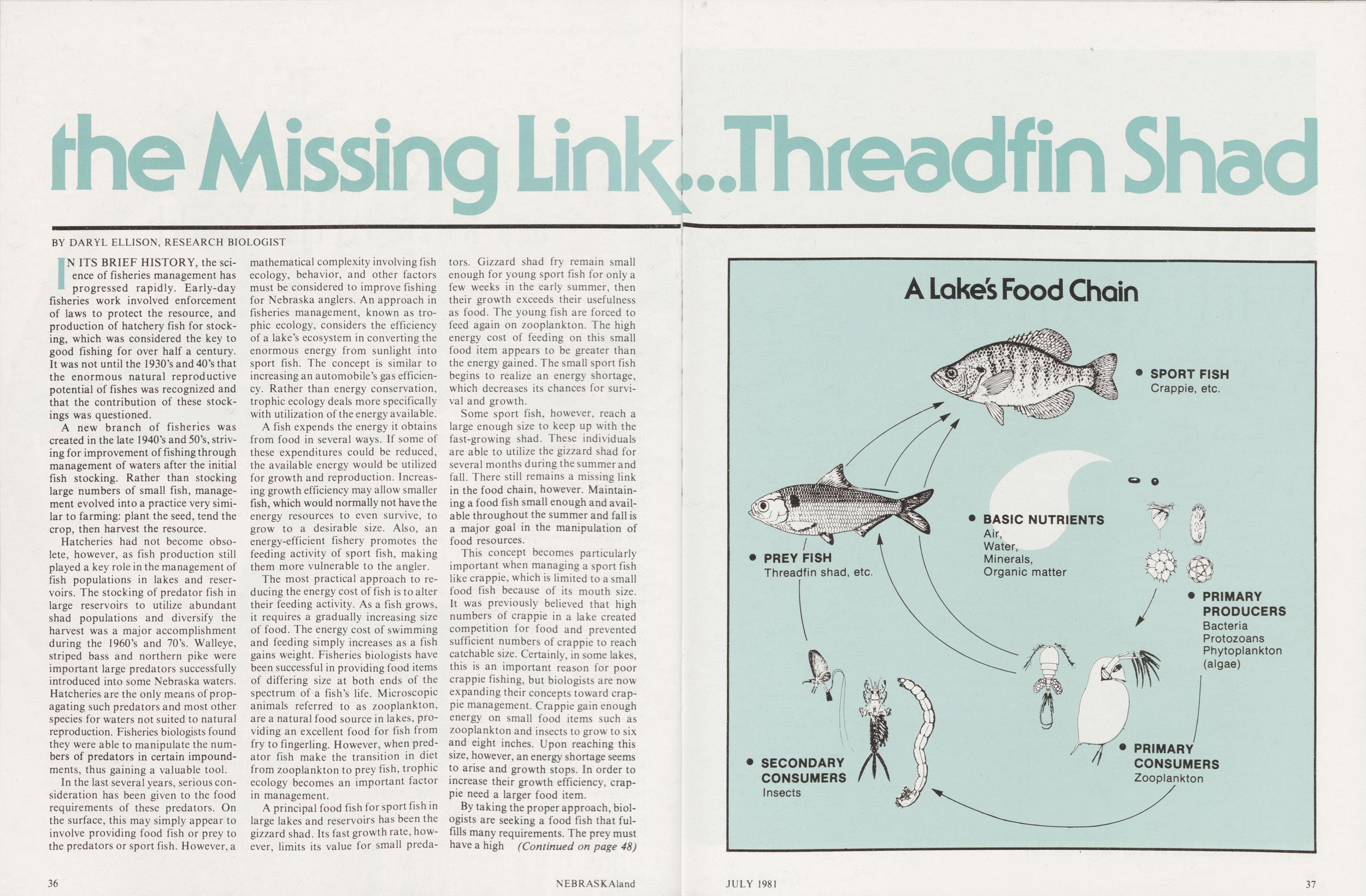
the Missing Link...Threadfin Shad
BY DARYL ELLISON, RESEARCH BIOLOGISTIN ITS BRIEF HISTORY, the science of fisheries management has progressed rapidly. Early-day fisheries work involved enforcement of laws to protect the resource, and production of hatchery fish for stocking, which was considered the key to good fishing for over half a century. It was not until the 1930's and 40's that the enormous natural reproductive potential of fishes was recognized and that the contribution of these stockings was questioned.
A new branch of fisheries was created in the late 1940's and 50's, striving for improvement of fishing through management of waters after the initial fish stocking. Rather than stocking large numbers of small fish, management evolved into a practice very similar to farming: plant the seed, tend the crop, then harvest the resource.
Hatcheries had not become obsolete, however, as fish production still played a key role in the management of fish populations in lakes and reservoirs. The stocking of predator fish in large reservoirs to utilize abundant shad populations and diversify the harvest was a major accomplishment during the 1960's and 70's. Walleye, striped bass and northern pike were important large predators successfully introduced into some Nebraska waters. Hatcheries are the only means of propagating such predators and most other species for waters not suited to natural reproduction. Fisheries biologists found they were able to manipulate the numbers of predators in certain impoundments, thus gaining a valuable tool.
In the last several years, serious consideration has been given to the food requirements of these predators. On the surface, this may simply appear to involve providing food fish or prey to the predators or sport fish. However, a mathematical complexity involving fish ecology, behavior, and other factors must be considered to improve fishing for Nebraska anglers. An approach in fisheries management, known as trophic ecology, considers the efficiency of a lake's ecosystem in converting the enormous energy from sunlight into sport fish. The concept is similar to increasing an automobile's gas efficiency. Rather than energy conservation, trophic ecology deals more specifically with utilization of the energy available.
A fish expends the energy it obtains from food in several ways. If some of these expenditures could be reduced, the available energy would be utilized for growth and reproduction. Increasing growth efficiency may allow smaller fish, which would normally not have the energy resources to even survive, to grow to a desirable size. Also, an energy-efficient fishery promotes the feeding activity of sport fish, making them more vulnerable to the angler.
The most practical approach to reducing the energy cost of fish is to alter their feeding activity. As a fish grows, it requires a gradually increasing size of food. The energy cost of swimming and feeding simply increases as a fish gains weight. Fisheries biologists have been successful in providing food items of differing size at both ends of the spectrum of a fish's life. Microscopic animals referred to as zooplankton, are a natural food source in lakes, providing an excellent food for fish from fry to fingerling. However, when predator fish make the transition in diet from zooplankton to prey fish, trophic ecology becomes an important factor in management.
A principal food fish for sport fish in large lakes and reservoirs has been the gizzard shad. Its fast growth rate, however, limits its value for small predators. Gizzard shad fry remain small enough for young sport fish for only a few weeks in the early summer, then their growth exceeds their usefulness as food. The young fish are forced to feed again on zooplankton. The high energy cost of feeding on this small food item appears to be greater than the energy gained. The small sport fish begins to realize an energy shortage, which decreases its chances for survival and growth.
Some sport fish, however, reach a large enough size to keep up with the fast-growing shad. These individuals are able to utilize the gizzard shad for several months during the summer and fall. There still remains a missing link in the food chain, however. Maintaining a food fish small enough and available throughout the summer and fall is a major goal in the manipulation of food resources.
This concept becomes particularly important when managing a sport fish like crappie, which is limited to a small food fish because of its mouth size. It was previously believed that high numbers of crappie in a lake created competition for food and prevented sufficient numbers of crappie to reach catchable size. Certainly, in some lakes, this is an important reason for poor crappie fishing, but biologists are now expanding their concepts toward crappie management. Crappie gain enough energy on small food items such as zooplankton and insects to grow to six and eight inches. Upon reaching this size, however, an energy shortage seems to arise and growth stops. In order to increase their growth efficiency, crappie need a larger food item.
By taking the proper approach, biologists are seeking a food fish that fulfills many requirements. The prey must have a high (Continued on page 48)
36 NEBRASKAland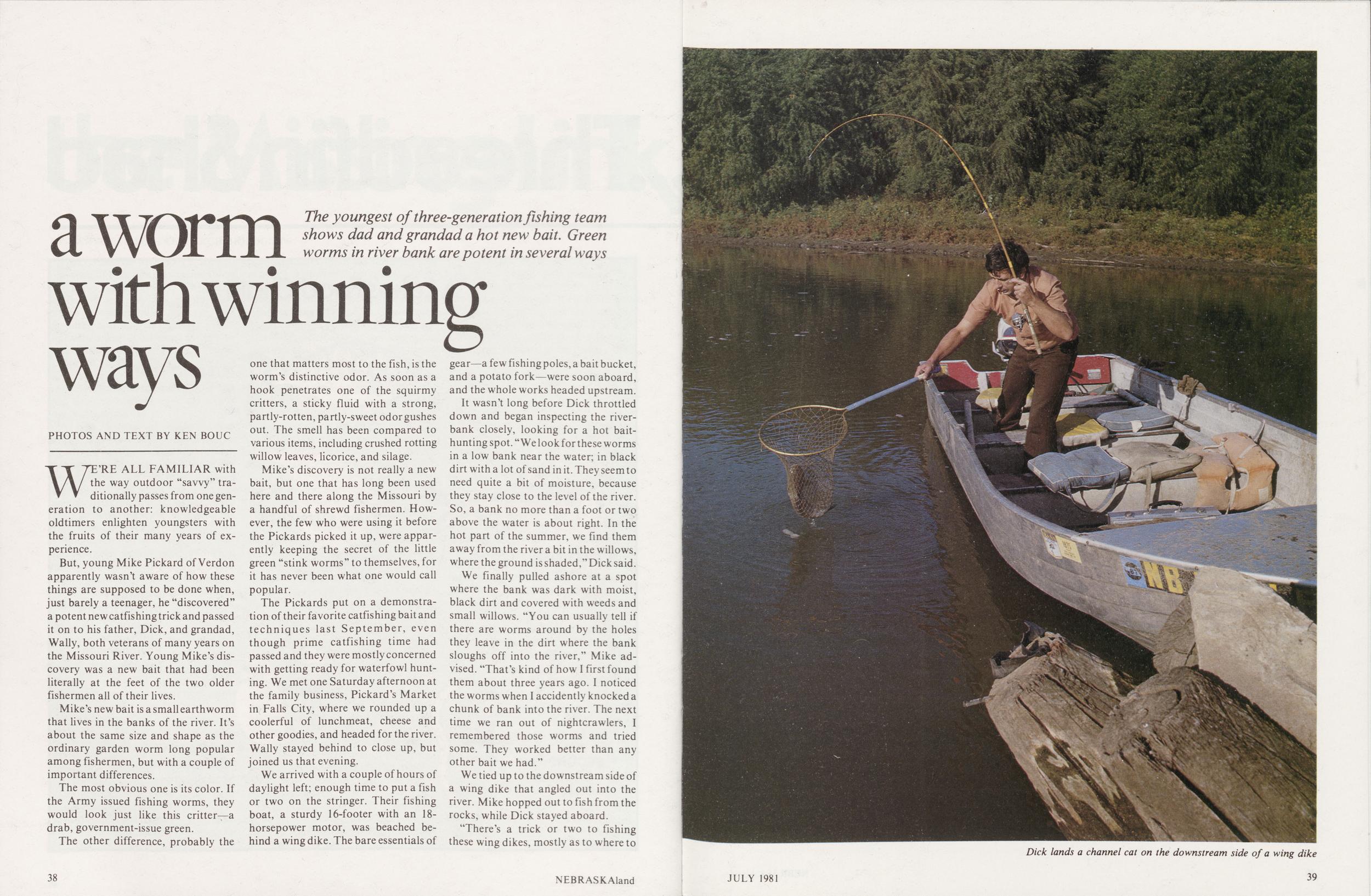
a worm with winning ways
The youngest of three-generation fishing team shows dad and grandad a hot new bait. Green worms in river bank are potent in several ways PHOTOS AND TEXT BY KEN BOUCWE'RE ALL FAMILIAR with the way outdoor "savvy" traditionally passes from one generation to another: knowledgeable oldtimers enlighten youngsters with the fruits of their many years of experience.
But, young Mike Pickard of Verdon apparently wasn't aware of how these things are supposed to be done when, just barely a teenager, he "discovered" a potent new catfishing trick and passed it on to his father, Dick, and grandad, Wally, both veterans of many years on the Missouri River. Young Mike's discovery was a new bait that had been literally at the feet of the two older fishermen all of their lives.
Mike's new bait is a small earthworm that lives in the banks of the river. It's about the same size and shape as the ordinary garden worm long popular among fishermen, but with a couple of important differences.
The most obvious one is its color. If the Army issued fishing worms, they would look just like this critter—a drab, government-issue green.
The other difference, probably the one that matters most to the fish, is the worm's distinctive odor. As soon as a hook penetrates one of the squirmy critters, a sticky fluid with a strong, partly-rotten, partly-sweet odor gushes out. The smell has been compared to various items, including crushed rotting willow leaves, licorice, and silage.
Mike's discovery is not really a new bait, but one that has long been used here and there along the Missouri by a handful of shrewd fishermen. However, the few who were using it before the Pickards picked it up, were apparently keeping the secret of the little green "stink worms" to themselves, for it has never been what one would call popular.
The Pickards put on a demonstration of their favorite catfishing bait and techniques last September, even though prime catfishing time had passed and they were mostly concerned with getting ready for waterfowl hunting. We met one Saturday afternoon at the family business, Pickard's Market in Falls City, where we rounded up a coolerful of lunchmeat, cheese and other goodies, and headed for the river. Wally stayed behind to close up, but joined us that evening.
We arrived with a couple of hours of daylight left; enough time to put a fish or two on the stringer. Their fishing boat, a sturdy 16-footer with an 18-horsepower motor, was beached behind a wing dike. The bare essentials of gear—a few fishing poles, a bait bucket, and a potato fork—were soon aboard, and the whole works headed upstream.
It wasn't long before Dick throttled down and began inspecting the river-bank closely, looking for a hot bait-hunting spot. "We look for these worms in a low bank near the water; in black dirt with a lot of sand in it. They seem to need quite a bit of moisture, because they stay close to the level of the river. So, a bank no more than a foot or two above the water is about right. In the hot part of the summer, we find them away from the river a bit in the willows, where the ground is shaded," Dick said.
We finally pulled ashore at a spot where the bank was dark with moist, black dirt and covered with weeds and small willows. "You can usually tell if there are worms around by the holes they leave in the dirt where the bank sloughs off into the river," Mike advised. "That's kind of how I first found them about three years ago. I noticed the worms when I accidently knocked a chunk of bank into the river. The next time we ran out of nightcrawlers, I remembered those worms and tried some. They worked better than any other bait we had."
We tied up to the downstream side of a wing dike that angled out into the river. Mike hopped out to fish from the rocks, while Dick stayed aboard.
"There's a trick or two to fishing these wing dikes, mostly as to where to 38 NEBRASKAland
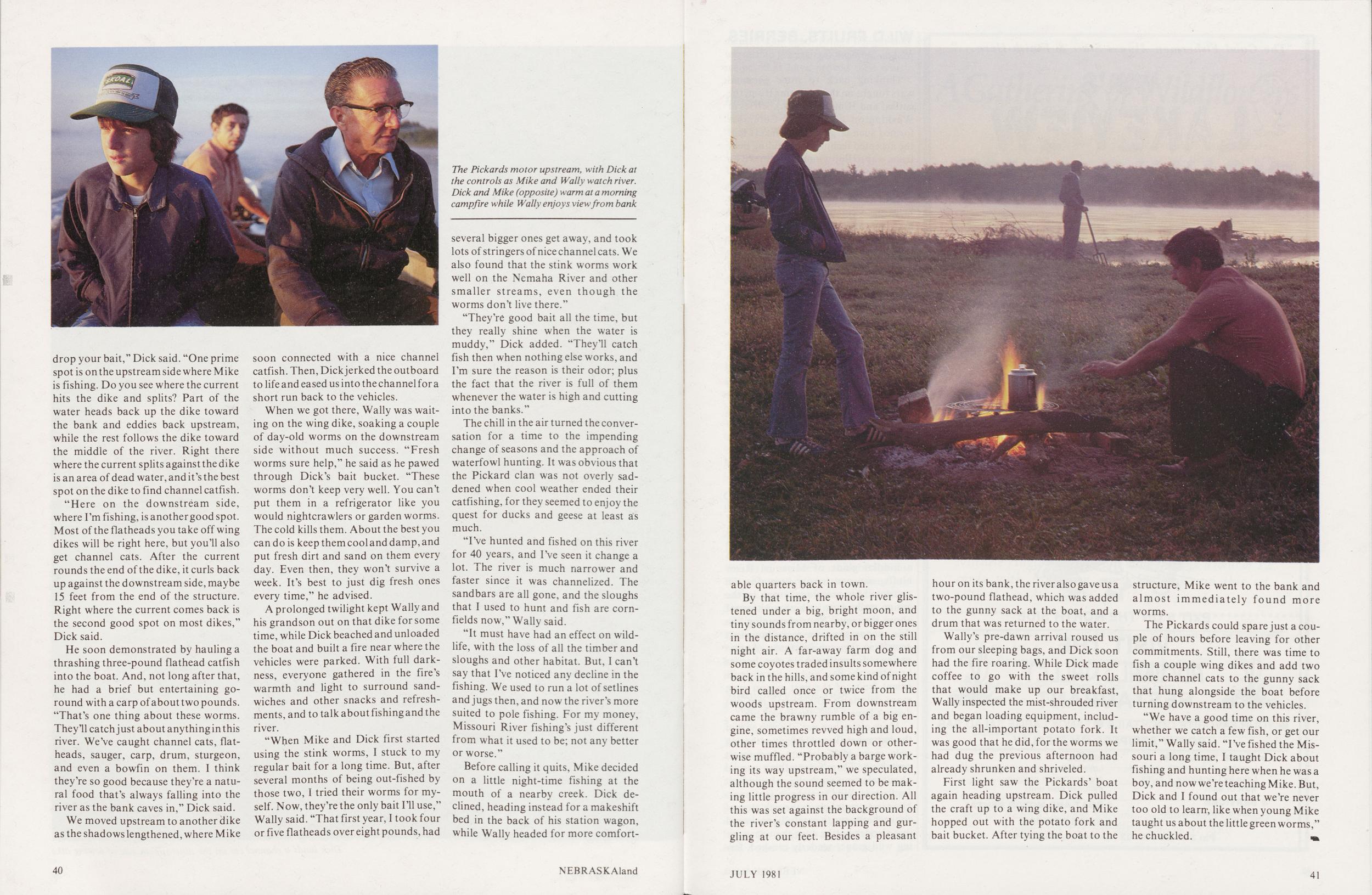
"Here on the downstream side, where I'm fishing, is another good spot. Most of the flatheads you take off wing dikes will be right here, but you'll also get channel cats. After the current rounds the end of the dike, it curls back up against the downstream side, maybe 15 feet from the end of the structure. Right where the current comes back is the second good spot on most dikes," Dick said.
He soon demonstrated by hauling a thrashing three-pound flathead catfish into the boat. And, not long after that, he had a brief but entertaining go-round with a carp of about two pounds. "That's one thing about these worms. They'll catch just about anything in this river. We've caught channel cats, flatheads, sauger, carp, drum, sturgeon, and even a bowfin on them. I think they're so good because they're a natural food that's always falling into the river as the bank caves in," Dick said.
We moved upstream to another dike as the shadows lengthened, where Mike soon connected with a nice channel catfish. Then, Dick jerked the outboard to life and eased us into the channel for a short run back to the vehicles.
When we got there, Wally was waiting on the wing dike, soaking a couple of day-old worms on the downstream side without much success. "Fresh worms sure help," he said as he pawed through Dick's bait bucket. "These worms don't keep very well. You can't put them in a refrigerator like you would nightcrawlers or garden worms. The cold kills them. About the best you can do is keep them cool and damp, and put fresh dirt and sand on them every day. Even then, they won't survive a week. It's best to just dig fresh ones every time," he advised.
A prolonged twilight kept Wally and his grandson out on that dike for some time, while Dick beached and unloaded the boat and built a fire near where the vehicles were parked. With full darkness, everyone gathered in the fire's warmth and light to surround sandwiches and other snacks and refreshments, and to talk about fishing and the river.
"When Mike and Dick first started using the stink worms, I stuck to my regular bait for a long time. But, after several months of being out-fished by those two, I tried their worms for myself. Now, they're the only bait I'll use," Wally said. "That first year, I took four or five flatheads over eight pounds, had several bigger ones get away, and took lots of stringers of nice channel cats. We also found that the stink worms work well on the Nemaha River and other smaller streams, even though the worms don't live there."
"They're good bait all the time, but they really shine when the water is muddy," Dick added. "They'll catch fish then when nothing else works, and I'm sure the reason is their odor; plus the fact that the river is full of them whenever the water is high and cutting into the banks."
The chill in the air turned the conversation for a time to the impending change of seasons and the approach of waterfowl hunting. It was obvious that the Pickard clan was not overly saddened when cool weather ended their catfishing, for they seemed to enjoy the quest for ducks and geese at least as much.
"I've hunted and fished on this river for 40 years, and I've seen it change a lot. The river is much narrower and faster since it was channelized. The sandbars are all gone, and the sloughs that I used to hunt and fish are cornfields now," Wally said.
"It must have had an effect on wildlife, with the loss of all the timber and sloughs and other habitat. But, I can't say that I've noticed any decline in the fishing. We used to run a lot of setlines and jugs then, and now the river's more suited to pole fishing. For my money, Missouri River fishing's just different from what it used to be; not any better or worse."
Before calling it quits, Mike decided on a little night-time fishing at the mouth of a nearby creek. Dick declined, heading instead for a makeshift bed in the back of his station wagon, while Wally headed for more comfort- 40 NEBRASKAland
By that time, the whole river glistened under a big, bright moon, and tiny sounds from nearby, or bigger ones in the distance, drifted in on the still night air. A far-away farm dog and some coyotes traded insults somewhere back in the hills, and some kind of night bird called once or twice from the woods upstream. From downstream came the brawny rumble of a big engine, sometimes revved high and loud, other times throttled down or other-wise muffled. "Probably a barge working its way upstream," we speculated, although the sound seemed to be making little progress in our direction. All this was set against the background of the river's constant lapping and gurgling at our feet. Besides a pleasant hour on its bank, the river also gave us a two-pound flathead, which was added to the gunny sack at the boat, and a drum that was returned to the water.
Wally's pre-dawn arrival roused us from our sleeping bags, and Dick soon had the fire roaring. While Dick made coffee to go with the sweet rolls that would make up our breakfast, Wally inspected the mist-shrouded river and began loading equipment, including the all-important potato fork. It was good that he did, for the worms we had dug the previous afternoon had already shrunken and shriveled.
First light saw the Pickards' boat again heading upstream. Dick pulled the craft up to a wing dike, and Mike hopped out with the potato fork and bait bucket. After tying the boat to the structure, Mike went to the bank and almost immediately found more worms.
The Pickards could spare just a couple of hours before leaving for other commitments. Still, there was time to fish a couple wing dikes and add two more channel cats to the gunny sack that hung alongside the boat before turning downstream to the vehicles.
"We have a good time on this river, whether we catch a few fish, or get our limit," Wally said. "I've fished the Missouri a long time, I taught Dick about fishing and hunting here when he was a boy, and now we're teaching Mike. But, Dick and I found out that we're never too old to learn-, like when young Mike taught us about the little green worms," he chuckled.
JULY 1981 41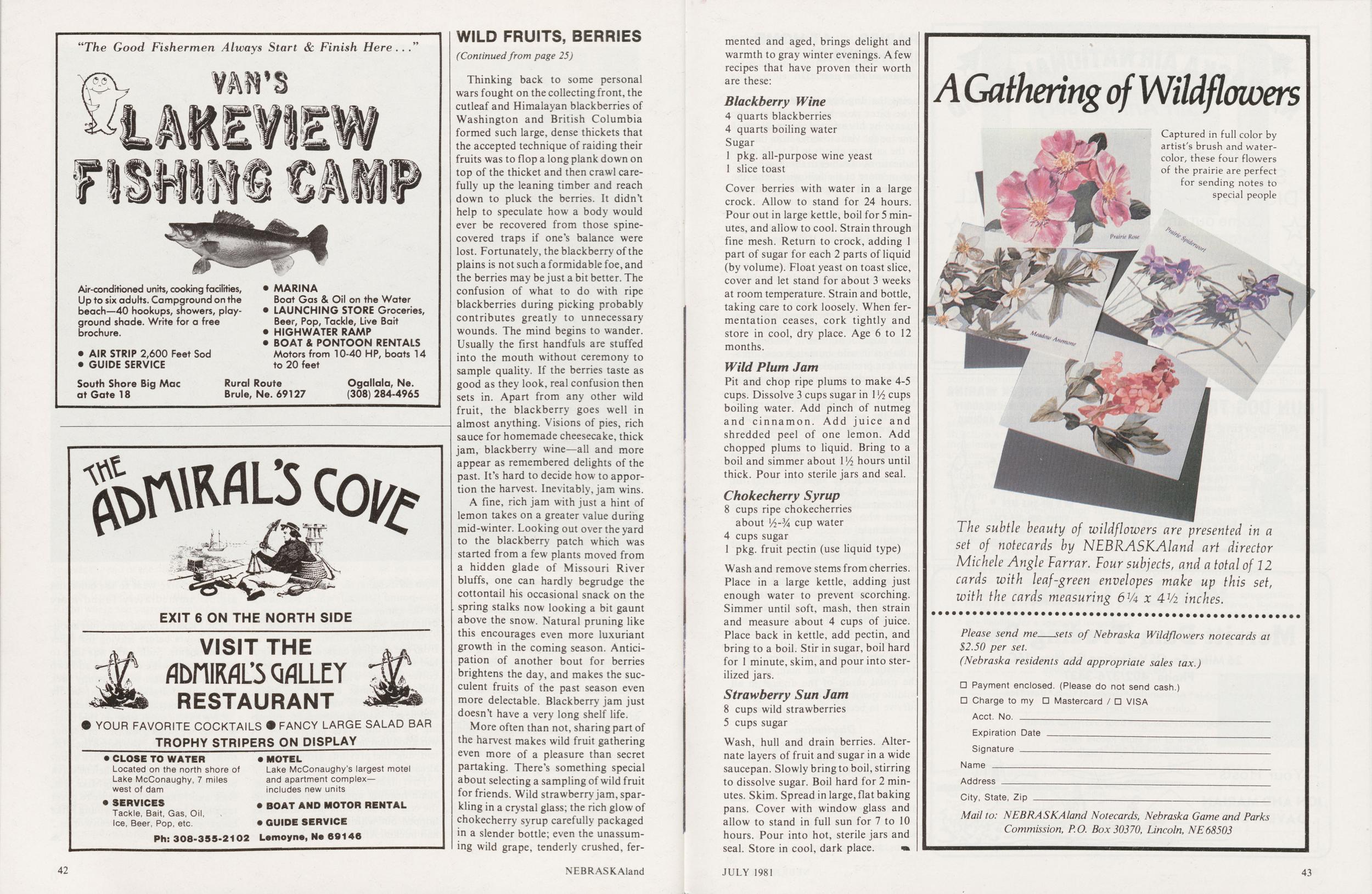
Thinking back to some personal wars fought on the collecting front, the cutleaf and Himalayan blackberries of Washington and British Columbia formed such large, dense thickets that the accepted technique of raiding their fruits was to flop a long plank down on top of the thicket and then crawl carefully up the leaning timber and reach down to pluck the berries. It didn't help to speculate how a body would ever be recovered from those spine-covered traps if one's balance were lost. Fortunately, the blackberry of the plains is not such a formidable foe, and the berries may be just a bit better. The confusion of what to do with ripe blackberries during picking probably contributes greatly to unnecessary wounds. The mind begins to wander. Usually the first handfuls are stuffed into the mouth without ceremony to sample quality. If the berries taste as good as they look, real confusion then sets in. Apart from any other wild fruit, the blackberry goes well in almost anything. Visions of pies, rich sauce for homemade cheesecake, thick jam, blackberry wine—all and more appear as remembered delights of the past. It's hard to decide how to apportion the harvest. Inevitably, jam wins.
A fine, rich jam with just a hint of lemon takes on a greater value during mid-winter. Looking out over the yard to the blackberry patch which was started from a few plants moved from a hidden glade of Missouri River bluffs, one can hardly begrudge the cottontail his occasional snack on the spring stalks now looking a bit gaunt above the snow. Natural pruning like this encourages even more luxuriant growth in the coming season. Anticipation of another bout for berries brightens the day, and makes the succulent fruits of the past season even more delectable. Blackberry jam just doesn't have a very long shelf life.
More often than not, sharing part of the harvest makes wild fruit gathering even more of a pleasure than secret partaking. There's something special about selecting a sampling of wild fruit for friends. Wild strawberry jam, sparkling in a crystal glass; the rich glow of chokecherry syrup carefully packaged in a slender bottle; even the unassuming wild grape, tenderly crushed, fermented 42 NEBRASKAland and aged, brings delight and warmth to gray winter evenings. A few recipes that have proven their worth are these:
Blackberry Wine 4 quarts blackberries 4 quarts boiling water Sugar l pkg. all-purpose wine yeast I slice toastCover berries with water in a large crock. Allow to stand for 24 hours. Pour out in large kettle, boil for 5 minutes, and allow to cool. Strain through fine mesh. Return to crock, adding 1 part of sugar for each 2 parts of liquid (by volume). Float yeast on toast slice, cover and let stand for about 3 weeks at room temperature. Strain and bottle, taking care to cork loosely. When fermentation ceases, cork tightly and store in cool, dry place. Age 6 to 12 months.
Wild Plum JamPit and chop ripe plums to make 4-5 cups. Dissolve 3 cups sugar in 1 1/2 cups boiling water. Add pinch of nutmeg and cinnamon. Add juice and shredded peel of one lemon. Add chopped plums to liquid. Bring to a boil and simmer about VA hours until thick. Pour into sterile jars and seal.
Chokecherry Syrup 8 cups ripe chokecherries about 1/2-3/4 cup water 4 cups sugar 1 pkg. fruit pectin (use liquid type)Wash and remove stems from cherries. Place in a large kettle, adding just enough water to prevent scorching. Simmer until soft, mash, then strain and measure about 4 cups of juice. Place back in kettle, add pectin, and bring to a boil. Stir in sugar, boil hard for 1 minute, skim, and pour into sterilized jars.
Strawberry Sun Jam 8 cups wild strawberries 5 cups sugarWash, hull and drain berries. Alternate layers of fruit and sugar in a wide saucepan. Slowly bring to boil, stirring to dissolve sugar. Boil hard for 2 minutes. Skim. Spread in large, flat baking pans. Cover with window glass and allow to stand in full sun for 7 to 10 hours. Pour into hot, sterile jars and seal. Store in cool, dark place.
A Gathering of Wildflowers Captured in full color by artist's brush and water-color, these four flowers of the prairie are perfect for sending notes to special people The subtle beauty of wildflowers are presented in a set of notecards by NEBRASKAland art director Michele Angle Farrar. Four subjects, and a total of 12 cards with leaf-green envelopes make up this set, with the cards measuring 6V4 x 4V2 inches. Please send me sets of Nebraska Wildflowers notecards at $2.50 per set. (Nebraska residents add appropriate sales tax.) Payment enclosed. (Please do not send cash.) Charge to my Mastercard / VISA Acct. No. Expiration Date Signature Name Address City, State, Zip Mail to: NEBRASKAland Notecards, Nebraska Game and Parks Commission, P.O. Box30370, Lincoln, NE68503 JULY 1981 43 ^MR NATION
35th Anniversary
Air Show—Open House
Sunday July 26, 1981 11am-4 pm
DISPLAYS—FOOD—FUN FOR ALL
Come out and see airplanes up close,
watch them fly, and help us celebrate
our 35th anniversary. Special entertainment is planned, including flying
aircraft of the Air Force and Navy,
booths, etc. Lincoln Municipal Airport.
Admission is Free
GUN DOG TRAINING
All Sporting Breeds
Each dog trained on both
native game and pen-reared
birds. Ducks for retrievers.
All dogs worked individually.
Field Champion-sired
labrador pups for sale.
I Midwest's finest facilities.
WILDERNESS KENNELS
Henry Sader-Roca, Nb.
(402)423-4212 68430
JS OTTER CREEK MARINA
NORTH SIDE LAKE McCONAUGHY
HWY. 92-OPEN YEAR AROUND
ALL-MODERN MOTEL CAFE
BAIT TACKLE GAS
FISH-CLEANING FACILITIES
HUNTING & FISHING LICENSES
ON & OFF-SALE BEER
PHONE 308-355-2341
P.O. LEWELLEN. NE 69147
JAY & JULIE PETERSON
WELCOME
to
Merritt Dam Trading Post
26 Miles So. Of Valentine On Hwy. 16C
Phone 402/376-3437
Bait Tackle Ammunition Groceries Gas Beer Ice
Cabins with Kitchen Facilities
Campground Hook-ups Boat and Motor Rental
Home of the State Record Perch,
Muskellunge and Smallmouth bass
Your Hosts
JON AND MARIAN
DAVENPORT
RABIES AT HOME
IN THE WILD
(Continued from page 35)
^MR NATION
35th Anniversary
Air Show—Open House
Sunday July 26, 1981 11am-4 pm
DISPLAYS—FOOD—FUN FOR ALL
Come out and see airplanes up close,
watch them fly, and help us celebrate
our 35th anniversary. Special entertainment is planned, including flying
aircraft of the Air Force and Navy,
booths, etc. Lincoln Municipal Airport.
Admission is Free
GUN DOG TRAINING
All Sporting Breeds
Each dog trained on both
native game and pen-reared
birds. Ducks for retrievers.
All dogs worked individually.
Field Champion-sired
labrador pups for sale.
I Midwest's finest facilities.
WILDERNESS KENNELS
Henry Sader-Roca, Nb.
(402)423-4212 68430
JS OTTER CREEK MARINA
NORTH SIDE LAKE McCONAUGHY
HWY. 92-OPEN YEAR AROUND
ALL-MODERN MOTEL CAFE
BAIT TACKLE GAS
FISH-CLEANING FACILITIES
HUNTING & FISHING LICENSES
ON & OFF-SALE BEER
PHONE 308-355-2341
P.O. LEWELLEN. NE 69147
JAY & JULIE PETERSON
WELCOME
to
Merritt Dam Trading Post
26 Miles So. Of Valentine On Hwy. 16C
Phone 402/376-3437
Bait Tackle Ammunition Groceries Gas Beer Ice
Cabins with Kitchen Facilities
Campground Hook-ups Boat and Motor Rental
Home of the State Record Perch,
Muskellunge and Smallmouth bass
Your Hosts
JON AND MARIAN
DAVENPORT
RABIES AT HOME
IN THE WILD
(Continued from page 35)
point the dog becomes dangerous—if he bites now he can transmit the disease by his infected saliva. Normal time for the virus to move from the bite to the salivary glands is 15 to 25 days. Indications of rabies in the dog include one or more of the following behavior and physical changes: restlessness, aggressiveness, lethary, change in vocal quality, persistent howling, paralyzed lower jaw, convulsions, profuse ropy saliva, and paralysis. Dogs usually die in 10 days or less after the virus reaches the salivary glands. That is the reason for watching dogs closely after they bite someone. If a dog shows no symptoms and survives 10 days after a biting incident, it does not have the disease. The 10-day waiting period is very reliable in dogs but not in wildlife.
Rabies in wild animals is considerably less predictable. An infected animal can undergo a variable incubation period where the virus remains long dormant in the wound. Furthermore, when the animal does become infective, it may not show any symptoms of the disease while still releasing great amounts of virus. A skunk, for example, can shed the virus in its saliva without showing any signs of illness for months. No 10-day waiting period here. By the time the animal becomes ill, the person who has been bitten could be beyond help.
Wildlife may show some or none of the signs of rabies until the final stages. In general, a wild animal which shows aggressiveness or an unusual lack of fear, is suspect. Raccoons in particular are dangerous because they are less likely to display furious behavior—but this is not a consistent finding either. The only constant among the signs of rabies are the inconsistencies. As in domestic animals and man, death is the usual result of the disease in all wildlife species except bats, which may survive to become lifelong carriers.
DistributionRabies is a worldwide infection primarily affecting dogs, cats, and other carnivores, but man and all warm-blooded animals are susceptible.
Most cases of rabies in man and domestic animals in the U.S. today originate from contact with an infected wildlife host, mostly skunks, bats, raccoons, and foxes. Fox rabies was once 44 NEBRASKAland a serious problem in this country, but hunting and trapping, as well as habitat reduction, have contributed to an appreciable reduction of fox rabies cases.
Skunks are now the most important reservoir in the central U.S. Surveys have indicated that up to 15 percent of all wild skunks are rabid—about one in seven,
By December of 1980, 90 cases of rabies had been confirmed in Nebraska, of which 63 were skunks. That number is impressive when you consider that 1976 was the previous high when there were 17 rabies cases confirmed, and on the average, only five to 10 cases are reported annually. Many Nebraska counties reporting rabies in skunks last year had not confirmed a single case of rabies in the previous eight years.
Whether rabies will continue in wild skunks to the degree that it did in 1980 will depend on the population status of that species. An exceptionally high skunk population occurred last year in Nebraska and it is believed that rabies may act as a natural population control.
SusceptibilitySpecies susceptibility to rabies is variable, with foxes the most susceptible; skunks, cats, raccoons, and bats next in line; then cattle, man, horses, and dogs; and finally oppossums, which are quite resistant. Because rodents such as rats, mice, squirrels, chipmunks, hamsters, gerbils and guinea pigs only rarely acquire rabies under natural conditions, post-exposure treatment for their bites is seldom justified. Of the more than 13,000 rodents and rabbits checked in 1977, only one North Dakota woodchuck was positive. In addition, no human rabies case has ever been attributed to a rodent bite.
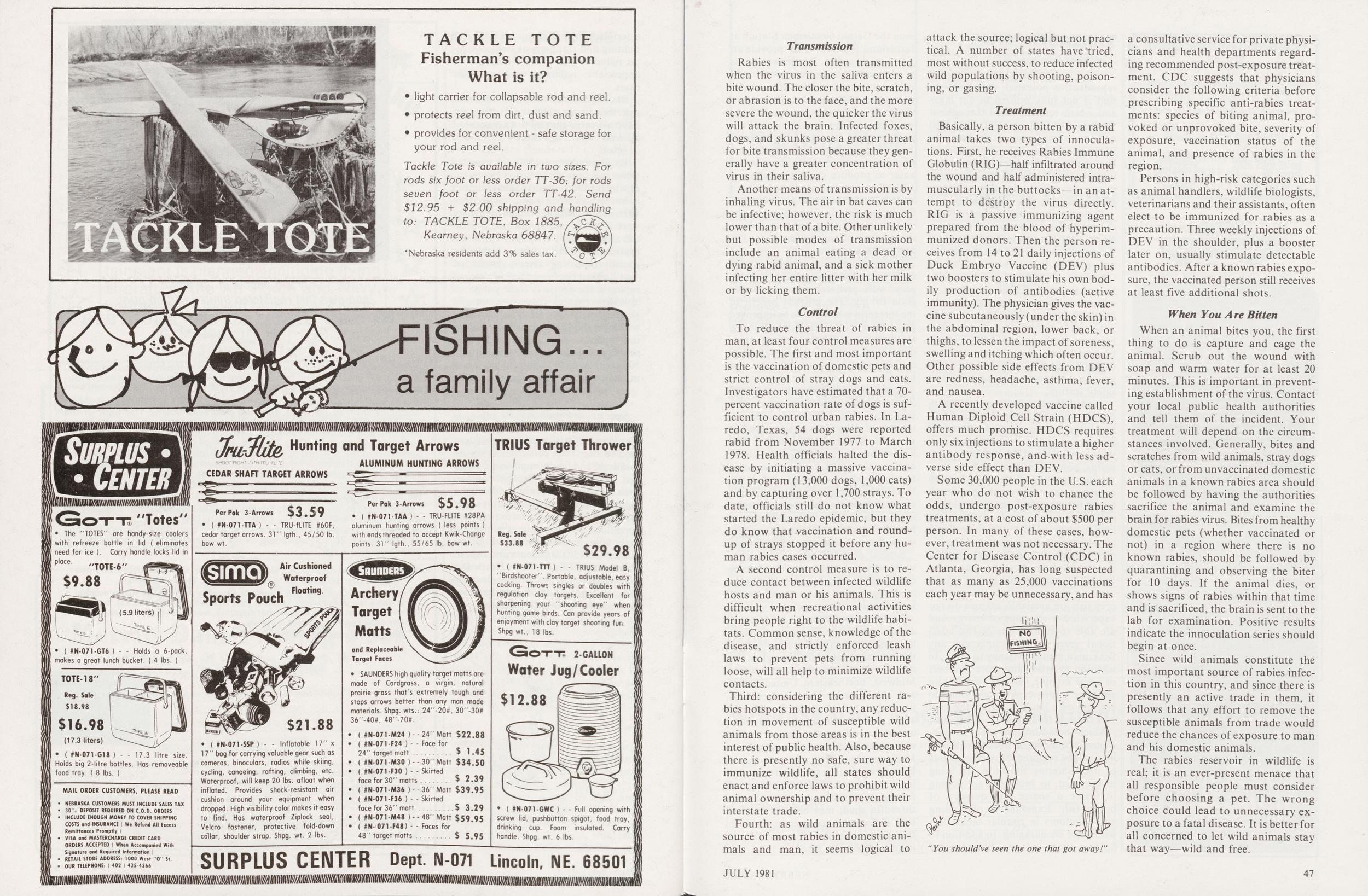 TACKLE TOTE
Fisherman's companion
What is it?
light carrier for collapsable rod and reel.
protects reel from dirt, dust and sand.
provides for convenient - safe storage for
your rod and reel.
Tackle Tote is available in two sizes. For
rods six foot or less order TT-36; for rods
seven foot or less order TT-42. Send
$12.95 + $2.00 shipping and handling
to: TACKLE TOTE, Box 1885,
Kearney, Nebraska 68847.
'Nebraska residents add 3% sales tax.
FISHING
a family affair
Surplus
CEDAR SHAFT TARGET ARROWS
ALUMINUM HUNTING ARROWS
The "TOTES" are handy-size coolers
with refreeze bottle in lid ( eliminates
need for ice ). Carry handle locks lid in
place "T0TE6"
( #N-071-GT6 ) Holds a 6-pack,
makes a great lunch bucket. ( 4 lbs. )
TOTE-18"
Reg. Sale
$18.98
$16.98
(17.3 liters)
( #N-071-G18 ) 17.3 litre size.
Holds big 2-litre bottles. Has removeable
food tray. ( 8 lbs. )
MAIL ORDER CUSTOMERS, PLEASE READ
NEBRASKA CUSTOMERS MUST INCLUDE SALES TAX
30 DEPOSIT REQUIRED ON C.O.D. ORDERS
INCLUDE ENOUGH MONEY TO COVER SHIPPING
COSTS and INSURANCE ( We Refund All Excess
Remittances Promptly )
VISA and MASTERCHARGE CREDIT CARD
ORDERS ACCEPTED ( When Accompanied With
Signature and Required Information )
RETAIL STORE ADDRESS: 1000 West 0 St.
OUR TELEPHONE: ( 402 ) 435 4366
PerPak 3-Arrows $3.59
( #N-071-TTA ) TRU-fLITE #60F,
cedar target arrows. 31" Igth., 45/50 lb.
bow wt.
PerPak 3-Arrows
( #N-071-TAA )
$5.98
TRU-FLITE #28PA
aluminum hunting arrows ( less points )
with ends threaded to accept Kwik-Change
points. 31" Igth., 55/65 lb. bow wt.
sima
Sports Pouch
Air Cushioned
Waterproof
Floating
$21.88
( #N-071-SSP ) Inflatable 17" x
17" bag for carrying valuable gear such as
cameras, binoculars, radios while skiing,
cycling, canoeing, rafting, climbing, etc.
Waterproof, will keep 20 lbs. afloat when
inflated. Provides shock-resistant air
cushion around your equipment when
dropped. High visibility color makes it easy
to find. Has waterproof Ziplock seal,
Velcro fastener, protective fold-down
collar, shoulder strap. Shpg. wt. 2 lbs.
SAUNDERS
Archery
Target
Matts
and Replaceable
Target Faces
SAUNDERS high quality target matts are
made of Cordgrass, a virgin, natural
prairie grass that's extremely tough and
stops arrows better than any man made
materials. Shpg. wts.: 24"-20#, 30"-30#
36"-40#, 48"-70#.
( #N-071-M24 )
( IN-071-F24 )
24" target matt
( #N-071-M30 )
( #N-071-F30 )
face for 30" matts
( IN-071M36 )
( #N-071-F36 )
face for 36" matt
( IN-071-M48 )
( #N-071-F48)
48" target matts .
24" Matt $22.88
Face for
$ 1.45
30" Matt $34.50
Skirted
$ 2.39
36" Matt $39.95
Skirted
$ 3.29
48" Matt $59.95
Faces for
$ 5.95
TRIUS Target Thrower
$29.98
( #N-071-TTT ) TRIUS Model B,
"Birdshooter". Portable, adjustable, easy
cocking. Throws singles or doubles with
regulation clay targets. Excellent for
sharpening your "snooting eye" when
hunting game birds. Can provide years of
enjoyment with clay target shooting fun.
Shpg wt., 18 lbs.
2-GALLON
Water Jug/Cooler
$12.88
( #N-071-GWC ) Full opening with
screw lid, pushbutton spigot, food tray,
drinking cup. Foam insulated. Carry
handle. Shpg. wt. 6 lbs.
SURPLUS CENTER Dept. N-071 Lincoln, NE. 68501
Transmission
TACKLE TOTE
Fisherman's companion
What is it?
light carrier for collapsable rod and reel.
protects reel from dirt, dust and sand.
provides for convenient - safe storage for
your rod and reel.
Tackle Tote is available in two sizes. For
rods six foot or less order TT-36; for rods
seven foot or less order TT-42. Send
$12.95 + $2.00 shipping and handling
to: TACKLE TOTE, Box 1885,
Kearney, Nebraska 68847.
'Nebraska residents add 3% sales tax.
FISHING
a family affair
Surplus
CEDAR SHAFT TARGET ARROWS
ALUMINUM HUNTING ARROWS
The "TOTES" are handy-size coolers
with refreeze bottle in lid ( eliminates
need for ice ). Carry handle locks lid in
place "T0TE6"
( #N-071-GT6 ) Holds a 6-pack,
makes a great lunch bucket. ( 4 lbs. )
TOTE-18"
Reg. Sale
$18.98
$16.98
(17.3 liters)
( #N-071-G18 ) 17.3 litre size.
Holds big 2-litre bottles. Has removeable
food tray. ( 8 lbs. )
MAIL ORDER CUSTOMERS, PLEASE READ
NEBRASKA CUSTOMERS MUST INCLUDE SALES TAX
30 DEPOSIT REQUIRED ON C.O.D. ORDERS
INCLUDE ENOUGH MONEY TO COVER SHIPPING
COSTS and INSURANCE ( We Refund All Excess
Remittances Promptly )
VISA and MASTERCHARGE CREDIT CARD
ORDERS ACCEPTED ( When Accompanied With
Signature and Required Information )
RETAIL STORE ADDRESS: 1000 West 0 St.
OUR TELEPHONE: ( 402 ) 435 4366
PerPak 3-Arrows $3.59
( #N-071-TTA ) TRU-fLITE #60F,
cedar target arrows. 31" Igth., 45/50 lb.
bow wt.
PerPak 3-Arrows
( #N-071-TAA )
$5.98
TRU-FLITE #28PA
aluminum hunting arrows ( less points )
with ends threaded to accept Kwik-Change
points. 31" Igth., 55/65 lb. bow wt.
sima
Sports Pouch
Air Cushioned
Waterproof
Floating
$21.88
( #N-071-SSP ) Inflatable 17" x
17" bag for carrying valuable gear such as
cameras, binoculars, radios while skiing,
cycling, canoeing, rafting, climbing, etc.
Waterproof, will keep 20 lbs. afloat when
inflated. Provides shock-resistant air
cushion around your equipment when
dropped. High visibility color makes it easy
to find. Has waterproof Ziplock seal,
Velcro fastener, protective fold-down
collar, shoulder strap. Shpg. wt. 2 lbs.
SAUNDERS
Archery
Target
Matts
and Replaceable
Target Faces
SAUNDERS high quality target matts are
made of Cordgrass, a virgin, natural
prairie grass that's extremely tough and
stops arrows better than any man made
materials. Shpg. wts.: 24"-20#, 30"-30#
36"-40#, 48"-70#.
( #N-071-M24 )
( IN-071-F24 )
24" target matt
( #N-071-M30 )
( #N-071-F30 )
face for 30" matts
( IN-071M36 )
( #N-071-F36 )
face for 36" matt
( IN-071-M48 )
( #N-071-F48)
48" target matts .
24" Matt $22.88
Face for
$ 1.45
30" Matt $34.50
Skirted
$ 2.39
36" Matt $39.95
Skirted
$ 3.29
48" Matt $59.95
Faces for
$ 5.95
TRIUS Target Thrower
$29.98
( #N-071-TTT ) TRIUS Model B,
"Birdshooter". Portable, adjustable, easy
cocking. Throws singles or doubles with
regulation clay targets. Excellent for
sharpening your "snooting eye" when
hunting game birds. Can provide years of
enjoyment with clay target shooting fun.
Shpg wt., 18 lbs.
2-GALLON
Water Jug/Cooler
$12.88
( #N-071-GWC ) Full opening with
screw lid, pushbutton spigot, food tray,
drinking cup. Foam insulated. Carry
handle. Shpg. wt. 6 lbs.
SURPLUS CENTER Dept. N-071 Lincoln, NE. 68501
Transmission
Rabies is most often transmitted when the virus in the saliva enters a bite wound. The closer the bite, scratch, or abrasion is to the face, and the more severe the wound, the quicker the virus will attack the brain. Infected foxes, dogs, and skunks pose a greater threat for bite transmission because they generally have a greater concentration of virus in their saliva.
Another means of transmission is by inhaling virus. The air in bat caves can be infective; however, the risk is much lower than that of a bite. Other unlikely but possible modes of transmission include an animal eating a dead or dying rabid animal, and a sick mother infecting her entire litter with her milk or by licking them.
ControlTo reduce the threat of rabies in man, at least four control measures are possible. The first and most important is the vaccination of domestic pets and strict control of stray dogs and cats. Investigators have estimated that a 70-percent vaccination rate of dogs is sufficient to control urban rabies. In Laredo, Texas, 54 dogs were reported rabid from November 1977 to March 1978. Health officials halted the disease by initiating a massive vaccination program (13,000 dogs, 1,000 cats) and by capturing over 1,700 strays. To date, officials still do not know what started the Laredo epidemic, but they do know that vaccination and round-up of strays stopped it before any human rabies cases occurred.
A second control measure is to reduce contact between infected wildlife hosts and man or his animals. This is difficult when recreational activities bring people right to the wildlife habitats. Common sense, knowledge of the disease, and strictly enforced leash laws to prevent pets from running loose, will all help to minimize wildlife contacts.
Third: considering the different rabies hotspots in the country, any reduction in movement of susceptible wild animals from those areas is in the best interest of public health. Also, because there is presently no safe, sure way to immunize wildlife, all states should enact and enforce laws to prohibit wild animal ownership and to prevent their interstate trade.
Fourth: as wild animals are the source of most rabies in domestic animals and man, it seems logical to attack the source; logical but not practical. A number of states have tried, most without success, to reduce infected wild populations by shooting, poisoning, or gasing.
TreatmentBasically, a person bitten by a rabid animal takes two types of innoculations. First, he receives Rabies Immune Globulin (RIG)—half infiltrated around the wound and half administered intramuscularly in the buttocks—in an attempt to destroy the virus directly. RIG is a passive immunizing agent prepared from the blood of hyperimmunized donors. Then the person receives from 14 to 21 daily injections of Duck Embryo Vaccine (DEV) plus two boosters to stimulate his own bodily production of antibodies (active immunity). The physician gives the vaccine subcutaneously (under the skin) in the abdominal region, lower back, or thighs, to lessen the impact of soreness, swelling and itching which often occur. Other possible side effects from DEV are redness, headache, asthma, fever, and nausea.
A recently developed vaccine called Human Diploid Cell Strain (HDCS), offers much promise. HDCS requires only six injections to stimulate a higher antibody response, and with less adverse side effect than DEV.
Some 30,000 people in the U.S. each year who do not wish to chance the odds, undergo post-exposure rabies treatments, at a cost of about $500 per person. In many of these cases, however, treatment was not necessary. The Center for Disease Control (CDC) in Atlanta, Georgia, has long suspected that as many as 25,000 vaccinations each year may be unnecessary, and has
Persons in high-risk categories such as animal handlers, wildlife biologists, veterinarians and their assistants, often elect to be immunized for rabies as a precaution. Three weekly injections of DEV in the shoulder, plus a booster later on, usually stimulate detectable antibodies. After a known rabies exposure, the vaccinated person still receives at least five additional shots.
When You Are BittenWhen an animal bites you, the first thing to do is capture and cage the animal. Scrub out the wound with soap and warm water for at least 20 minutes. This is important in preventing establishment of the virus. Contact your local public health authorities and tell them of the incident. Your treatment will depend on the circumstances involved. Generally, bites and scratches from wild animals, stray dogs or cats, or from unvaccinated domestic animals in a known rabies area should be followed by having the authorities sacrifice the animal and examine the brain for rabies virus. Bites from healthy domestic pets (whether vaccinated or not) in a region where there is no known rabies, should be followed by quarantining and observing the biter for 10 days. If the animal dies, or shows signs of rabies within that time and is sacrificed, the brain is sent to the lab for examination. Positive results indicate the innoculation series should begin at once.
Since wild animals constitute the most important source of rabies infection in this country, and since there is presently an active trade in them, it follows that any effort to remove the susceptible animals from trade would reduce the chances of exposure to man and his domestic animals.
The rabies reservoir in wildlife is real; it is an ever-present menace that all responsible people must consider before choosing a pet. The wrong choice could lead to unnecessary exposure to a fatal disease. It is better for all concerned to let wild animals stay that way—wild and free.
JULY 1981 47 Harlan County Dam
Vacation Apartments fully furnished
Color TV Kitchen Facilities Full Baths
Game cleaning room with freezer
One block from shopping center
Weekend or week of pleasant living
Security Deposit Required
Sorry No Pets
Dean and Esther Stone
Box 145 Ph. (308) 799-3422
Republican City, NE 68971
MUTCHIE'S Johnson
Lake RESORT
Upstairs Anchor Room Lounge
Cold Beer-On/Off Sale
Lakefront cabins with swimming beach
Fishing tackle Boats & motors Free boat
ramp Fishing Swimming Cafe and ice
Boating & skiing Gas and oil 9-hole golf
course just around the corner Live and
frozen bait Pontoon, boat & motor rentals.
Overnight Campers —full hookups
WRITE FOR FREE BROCHURE
or phone reservations 785-2298
Elwood, Nebraska
Help Conserve the Good Life of Nebraska
STOCK YOUR LAKE
OR POND
with
CHANNEL CAT
LARGEMOUTH BASS
BLUEGILL
ORDER NOW
WILLOW LAKE FISH HATCHERY
Rt. 3. Box 46, Hastings, Nebr. 68901
Gaylord L. Crawford
Phone: (402) 463-8022
Day or Night
For April to October 15 stocking
Pond Mill-Aquazine for algae-free water
N.E. Nebraska Trout up to
5 pounds 4 ponds and stream
Only 2 cottages Privacy
On the 1981 Know Nebraska
Tour schedule (No. 5)
John & Aletha Eley
Orchard, NE 68764 (402) 893-4745
THREADFIN SHAD
(Continued from page 36)
Harlan County Dam
Vacation Apartments fully furnished
Color TV Kitchen Facilities Full Baths
Game cleaning room with freezer
One block from shopping center
Weekend or week of pleasant living
Security Deposit Required
Sorry No Pets
Dean and Esther Stone
Box 145 Ph. (308) 799-3422
Republican City, NE 68971
MUTCHIE'S Johnson
Lake RESORT
Upstairs Anchor Room Lounge
Cold Beer-On/Off Sale
Lakefront cabins with swimming beach
Fishing tackle Boats & motors Free boat
ramp Fishing Swimming Cafe and ice
Boating & skiing Gas and oil 9-hole golf
course just around the corner Live and
frozen bait Pontoon, boat & motor rentals.
Overnight Campers —full hookups
WRITE FOR FREE BROCHURE
or phone reservations 785-2298
Elwood, Nebraska
Help Conserve the Good Life of Nebraska
STOCK YOUR LAKE
OR POND
with
CHANNEL CAT
LARGEMOUTH BASS
BLUEGILL
ORDER NOW
WILLOW LAKE FISH HATCHERY
Rt. 3. Box 46, Hastings, Nebr. 68901
Gaylord L. Crawford
Phone: (402) 463-8022
Day or Night
For April to October 15 stocking
Pond Mill-Aquazine for algae-free water
N.E. Nebraska Trout up to
5 pounds 4 ponds and stream
Only 2 cottages Privacy
On the 1981 Know Nebraska
Tour schedule (No. 5)
John & Aletha Eley
Orchard, NE 68764 (402) 893-4745
THREADFIN SHAD
(Continued from page 36)
reproductive potential, prefer a food that is not fully utilized in our lakes and which remains small throughout the summer and fall. An additional and important feature is the behavior of the prey compared to the predator. In order for the food fish to be of value, it must inhabit areas of the lake where it can be utilized by the predator. Biologists term this vulnerability.
Biologists have recently introduced several species of prey into Nebraska waters to study their influence on sport fish populations. The threadfin shad, a native of southern states, belongs to the herring family and is a close relative of the gizzard shad. However, it will succumb in water temperatures below 50 degrees, consequently, it will not survive Nebraska's winters. This, however, can be a good feature because biologists will be able to control threadfin populations. They are eliminated every winter, which is a built-in safety feature.
Threadfin shad have a high reproductive potential. A most unusual feature is that young spawned in June will mature and spawn in late summer, providing a small food fish by fall. In other words, some threadfin are "bite-size" during summer and also fall. As soon as young sport fish are large enough to eat fish, the shad are available.
When crappie reach six to eight inches, their dietary transition from zooplankton to threadfin shad significantly increases their growth efficiency. In other words, the food energy gained far exceeds the energy lost in catching the small shad. When small prey fish are available, crappie do not experience a shortage of energy and are able to survive one or two additional years to grow to a size any fisherman would be happy to catch. In addition to producing more numbers of large crappie, fishing success also seems to improve. After all, what do you put on a hook to imitate the food of a crappie feeding on zooplankton?
Since threadfin shad will not over-winter in Nebraska, annual spring stockings will be required. Several methods of overwintering threadfin are being investigated, as biologists are hoping to insure a source and quantity of brood fish. Experiments of holding adults indoors in circular tanks over winter are encouraging. In addition to holding them indoors, heated water from the Gerald Gentlemen Station at Sutherland Reservoir may provide an overwintering area. Warm water is a by-product of the power plant's cooling system, and may be used to advantage in providing a nucleus population of threadfin for stocking in other waters. Personnel from the Nebraska Public Power and Irrigation District and the Game and Parks Commission are working closely to utilize the warmed water to produce good fishing in our lakes. Considerable progress has been made in establishing a source of threadfin brood fish in Nebraska. In the meantime, Arkansas and Illinois have shared their abundant supply for experimental purposes.
Fisheries biologists are presently involved in closely matching suitable prey with predator fish to provide good fishing. The greatest benefit of the threadfin is believed to be improved white crappie and white bass fishing, although striped bass, walleye, rainbow trout, largemouth bass, channel catfish and other sport fish may also benefit.
Experimental introductions of threadfin shad in Lake McConaughy and a small state lake, demonstrated the potential of this new species. Adult threadfins stocked in the spring of 1980 in these lakes successfully reproduced, and growth rates of young were superior to what has been observed in their native southern states. In addition to the successful spawn, the young matured in August and small threadfins were found in September and October, suggesting a second generation spawn.
Several of the biologists' questions were answered; however, the density or necessary number of adults stocked in spring to produce an abundance of food remains to be solved.
Another food fish recently introduced from South Dakota is particularly useful to walleye and suitable to the habitat at lake McConaughy. The spottail shiner is native to the upper Midwest, northeastern United States and into Canada. They rarely exceed five inches, and inhabit the shoreline at night, making them particularly vulnerable to walleye. Studies are underway to establish this minnow in Lake McConaughy to diversify the prey base. Several other species are also being investigated. Trophic ecology of fishes, or prey introductions like the threadfin shad, may become another tool of fisheries management, and in the end could mean improved fishing in some Nebraska lakes.
48 NEBRASKAlandTrading Post
DOGSWELL-BRED Hunting dogs for sale—Brittanies, English setters and pointers—ranging in age from puppies to young dogs. Darrell Yentes, 1118 McMillan, Holdrege, NE 68949. Phone (308) 995-8570 or (308) 995-4797.
K-HAWK KENNELS—Professional training. German Shorthaired Pointer pups and trained dogs. Terry Krommenhoek—Trainer. (712) 255-7878.
FOR SALE: One male and one female Reg. Treeing Walker pups, 3 months old. Sire, World Ch Gr Nite Ch Loomis Tom; Dam, Rolling Hills Sadie by Gr Nite Cr Rolling Hills Lee Roy. Also one broke female, Reg. Treeing Walker. Roger Tegtmeier, Burchard, Nebr. Phone (402) 865-4305.
JOHNSTON KENNELS offers you AKC Golden Retriever pups year-round. Champion bloodline, field, trial and show quality. Gentle temperament. Karen Johnston, Cortland, NE 68331. Phone (402) 798-7440.
O'CEDAR KENNELS offer Labradors, Chesapeakes and Springers. Puppies and trained dogs. Jim Sweeney, Mead, NE 68041. Phone (402) 624-3520.
MISCELLANEOUSGUNS—Browning, Winchester, Remington, others, Hi-powers, shotguns, new, used, antiques. Want Pre-1964 Winchesters. Buy-Sell-Trade. Ph. (402) 729-6112. Bedlan's Sporting Goods, Fairbury, NE 68352.
PLASTIC DECOYS: We're originator of famous do it yourself system. Catalog system. Catalog $1.00. Decoys Unlimited, Clinton, IA 52732.
FISH FOR SALE: For pond and lake stocking. Catfish, bass, bluegill, crappie, perch, bullhead, trout, minnows and hybrid grass carp (eats moss). We deliver. Also available, enzymes for pond sealing. Pleasant Valley Fish Farm, Route 1, McCook, NE 69001. Phone (308) 345-6599.
ATTENTION OUTDOORSMEN—Subscribe to the monthly N.E. Nebr. Outdoorsmen, P.O. Box 354, Hartington, Nebr. 68739. $4.00 per year.
N.E. NEBR. TROUT FISHING. For rent Mon-Thurs. or Fri.-Sun. Two cottages, four ponds and stream. Privacy with trout up to 5 pounds. Open April 1. Diamond E. Trout Resort, Orchard, NE 68764. (402) 893-4745.
FRITZ GUNSMITHING & Supply Co.—Heckler & Koch—Weatherby—M.A.C. Dealer. Handfinishing-Hot Blue-Repair-Antique Restoration. Wanted World War I and II souvenir guns, pistols, rifles, swords, gun parts and shells. Now selling blasting powder and fuse. 407 South Harris, Wilber, NE (402) 821-2260.
SUNNY BROOK CAMP Outfitters—Canoe rentals, modern and wilderness camping, backpacking, cabin, recreation hall for group gatherings, electric hookup, dump station, showers. For information and reservations call (402) 376-1887 or 376-3219, Roy Breuklander, Sparks, NE 69220.
FOR CABIN, Condominium or Resort—new and used furniture, carpeting and appliances. We deliver, Trade, and it's less picked up here. Lukasiewicz Furniture Company, Farwell, NE. Phone (308) 336-3211.
NEW REDWOOD luxurious river cabin on Missouri River near Ponca State Park for sale or lease. (916) 275-3051.
GRUMMAN CANOES—Save $150 with coupon. Send 50c (stamps OK) for catalog and discount price list. Tom Stover—Dealer, Star Route, Gering, NE 69341 (308) 436-2709.
TAXIDERMYBIG BEAR TAXIDERMY, Rt. 2, Mitchell, Nebraska 69357. We specialize in all big game from Alaska to Nebraska, also birds and fish. Hair on and hair off tanning, 4'/2 miles west of Scottsbluff on Highway 26 Phone (308) 635-3013.
KARL SCHWARZ Master Taxidermist. Mounting of game heads—birds—fish—animals—fur rugs—robes-tanning buckskin. Since 1910. 424 South 13th Street, Dept. A, Omaha, Nebraska 68102.
FREEZE-DRY TAXIDERMY Wally Allison's State Record Taxidermy, 2709 Birchwood, North Platte NE 69101. Phone: (308) 534-2324. Specializing in Fishand Small Game, Snake and Lizard and Novelties. (Nothing too small) Newest of all taxidermy methods employed.
AWARD-WINNING TAXIDERMIST. Eight time national award winners. Trust your trophies to a proven winner. Our complete taxidermy service also arranges hunts. Dinges Taxidermy Studio, 2763 South 12th Omaha, NE 68108. Ph. 402-342-3718
JOHNSON TAXIDERMY—servicing southwest Nebraska, specializing in big-game mounts, lifesized mounts, rug work, fish, birds, tanning hair-on leather. Brochure and price list on request. Johnson Taxidermy, Rt. 1, Box 78, Lamar, NE 69035. Telephone (308) 882- 5555.
CREATIVE TAXIDERMY in all its branches since 1935, now includes Northstar Freeze-Dry processing of approved small specimens. Also tanning and deer-skin processing. Naturecraft Studio. Nebraska City, Nebraska 68510. Joe Voges-Owner. Phone (402) 873- 5491.
NABITyS TAXIDERMY. 29 years experience. All-taxidermy services available. Specializing in natural grass backgrounds. 5021 Washington, Lincoln, NE 68506. (402) 489-6351.
BADE TAXIDERMY—Quality a must—Fast service. Fish, birds, rugs, tanning, full mounts and game heads. 1924 North Lincoln, Fremont, Nebraska. 727-5463.
NEBRASKAland Magazine Order Form Please send me a subscription to NEBRASKAland, which now also features 12 issues of the news edition (24 issues in all) One-year $7.50 NAME Two-year $13 ADDRESS CITY Three-year $19 STATE Mail to: NEBRASKAland, Box 30370, Lincoln, NE 68503 ZIP SPORTSMAN'S PARADISE No. 473 115 acres of beautiful wooded and open land less than l mile from Columbus. Located on the Loup River. Nice Lake; ideal private hunting grounds. Town & Country Realty of Columbus 2626 23rd Street Columbus, NE 68601 (402) 564-0526 Town Country "N SOLD MINE DEFENSIVE DRIVING COURSE plan a RANCH Get away from it all to Nebraska's scenic Pine Ridge for a vacation you'll remember a lifetime. Stay in modern nicely-furnished log cabins. Take a quiet walk on scenic hiking trails, try some great fishing then have a campfire cookout. See a 16-foot waterwheel, unbelievable sunsets you'll fever find in the city and more stars than you ever thought existed? JULY 1981 49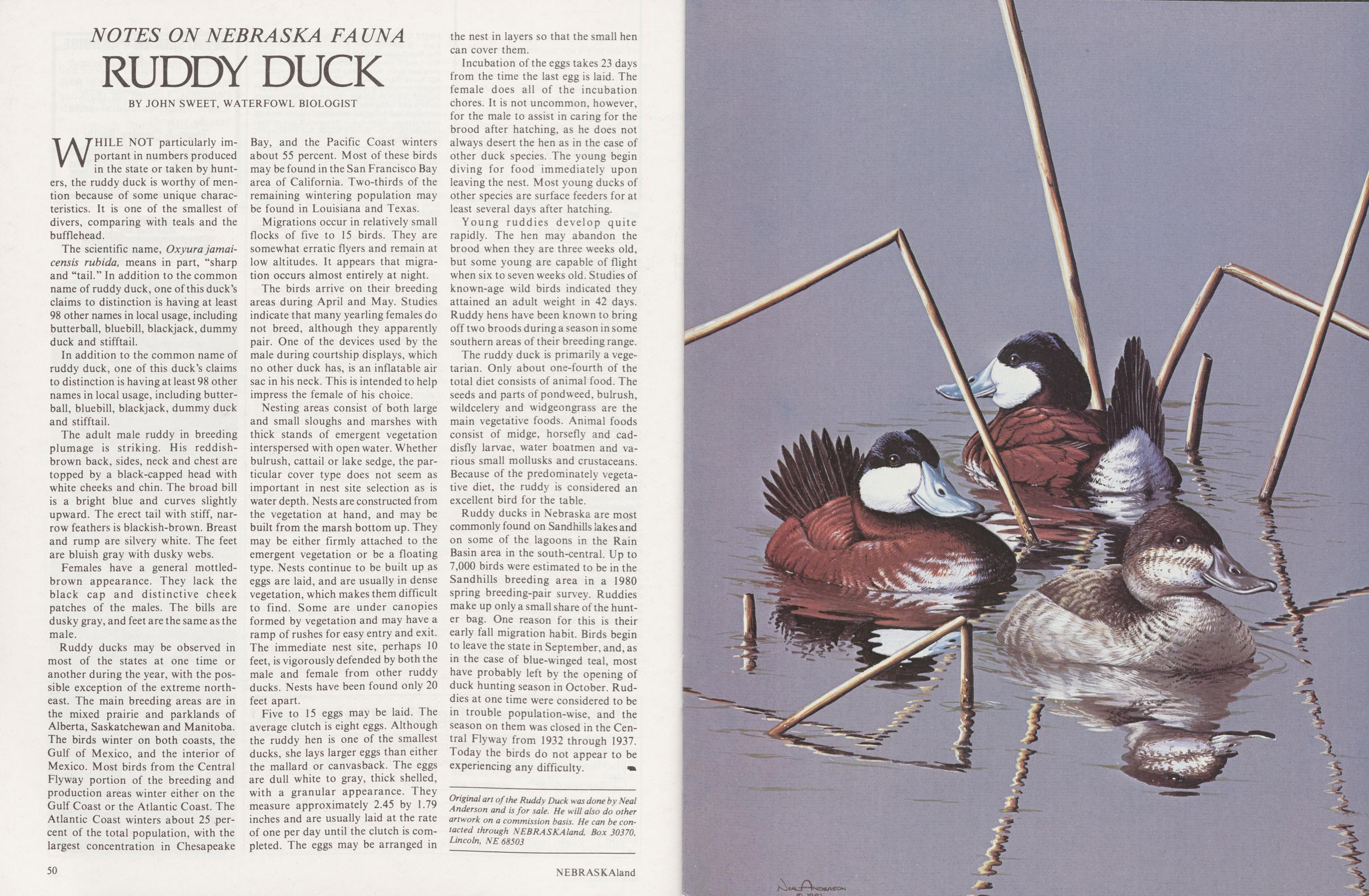
NOTES ON NEBRASKA FAUNA RUDDY DUCK
BY JOHN SWEET, WATERFOWL BIOLOGISTWHILE NOT particularly important in numbers produced in the state or taken by hunters, the ruddy duck is worthy of mention because of some unique characteristics. It is one of the smallest of divers, comparing with teals and the bufflehead.
The scientific name, Oxyura jamaicensis rubida, means in part, "sharp and "tail." In addition to the common name of ruddy duck, one of this duck's claims to distinction is having at least 98 other names in local usage, including butterball, bluebill, blackjack, dummy duck and stifftail.
In addition to the common name of ruddy duck, one of this duck's claims to distinction is having at least 98 other names in local usage, including butterball, bluebill, blackjack, dummy duck and stifftail.
The adult male ruddy in breeding plumage is striking. His reddish-brown back, sides, neck and chest are topped by a black-capped head with white cheeks and chin. The broad bill is a bright blue and curves slightly upward. The erect tail with stiff, narrow feathers is blackish-brown. Breast and rump are silvery white. The feet are bluish gray with dusky webs.
Females have a general mottled-brown appearance. They lack the black cap and distinctive cheek patches of the males. The bills are dusky gray, and feet are the same as the male.
Ruddy ducks may be observed in most of the states at one time or another during the year, with the possible exception of the extreme northeast. The main breeding areas are in the mixed prairie and parklands of Alberta, Saskatchewan and Manitoba. The birds winter on both coasts, the Gulf of Mexico, and the interior of Mexico. Most birds from the Central Flyway portion of the breeding and production areas winter either on the Gulf Coast or the Atlantic Coast. The Atlantic Coast winters about 25 percent of the total population, with the largest concentration in Chesapeake Bay, and the Pacific Coast winters about 55 percent. Most of these birds may be found in the San Francisco Bay area of California. Two-thirds of the remaining wintering population may be found in Louisiana and Texas.
Migrations occur in relatively small flocks of five to 15 birds. They are somewhat erratic flyers and remain at low altitudes. It appears that migration occurs almost entirely at night.
The birds arrive on their breeding areas during April and May. Studies indicate that many yearling females do not breed, although they apparently pair. One of the devices used by the male during courtship displays, which no other duck has, is an inflatable air sac in his neck. This is intended to help impress the female of his choice.
Nesting areas consist of both large and small sloughs and marshes with thick stands of emergent vegetation interspersed with open water. Whether bulrush, cattail or lake sedge, the particular cover type does not seem as important in nest site selection as is water depth. Nests are constructed from the vegetation at hand, and may be built from the marsh bottom up. They may be either firmly attached to the emergent vegetation or be a floating type. Nests continue to be built up as eggs are laid, and are usually in dense vegetation, which makes them difficult to find. Some are under canopies formed by vegetation and may have a ramp of rushes for easy entry and exit. The immediate nest site, perhaps 10 feet, is vigorously defended by both the male and female from other ruddy ducks. Nests have been found only 20 feet apart.
Five to 15 eggs may be laid. The average clutch is eight eggs. Although the ruddy hen is one of the smallest ducks, she lays larger eggs than either the mallard or canvasback. The eggs are dull white to gray, thick shelled, with a granular appearance. They measure approximately 2.45 by 1.79 inches and are usually laid at the rate of one per day until the clutch is completed. The eggs may be arranged in the nest in layers so that the small hen can cover them.
Incubation of the eggs takes 23 days from the time the last egg is laid. The female does all of the incubation chores. It is not uncommon, however, for the male to assist in caring for the brood after hatching, as he does not always desert the hen as in the case of other duck species. The young begin diving for food immediately upon leaving the nest. Most young ducks of other species are surface feeders for at least several days after hatching.
Young ruddies develop quite rapidly. The hen may abandon the brood when they are three weeks old, but some young are capable of flight when six to seven weeks old. Studies of known-age wild birds indicated they attained an adult weight in 42 days. Ruddy hens have been known to bring off two broods during a season in some southern areas of their breeding range.
The ruddy duck is primarily a vegetarian. Only about one-fourth of the total diet consists of animal food. The seeds and parts of pondweed, bulrush, wildcelery and widgeongrass are the main vegetative foods. Animal foods consist of midge, horsefly and caddisfly larvae, water boatmen and various small mollusks and crustaceans. Because of the predominately vegetative diet, the ruddy is considered an excellent bird for the table.
Ruddy ducks in Nebraska are most commonly found on Sandhills lakes and on some of the lagoons in the Rain Basin area in the south-central. Up to 7,000 birds were estimated to be in the Sandhills breeding area in a 1980 spring breeding-pair survey. Ruddies make up only a small share of the hunter bag. One reason for this is their early fall migration habit. Birds begin to leave the state in September, and, as in the case of blue-winged teal, most have probably left by the opening of duck hunting season in October. Ruddies at one time were considered to be in trouble population-wise, and the season on them was closed in the Central Flyway from 1932 through 1937. Today the birds do not appear to be experiencing any difficulty.
Original art of the Ruddy Duck was done by Neal Anderson and is for sale. He will also do other artwork on a commission basis. He can be contacted through NEBRASKAland, Box 30370, Lincoln, NE 68503 50 NEBRASKAland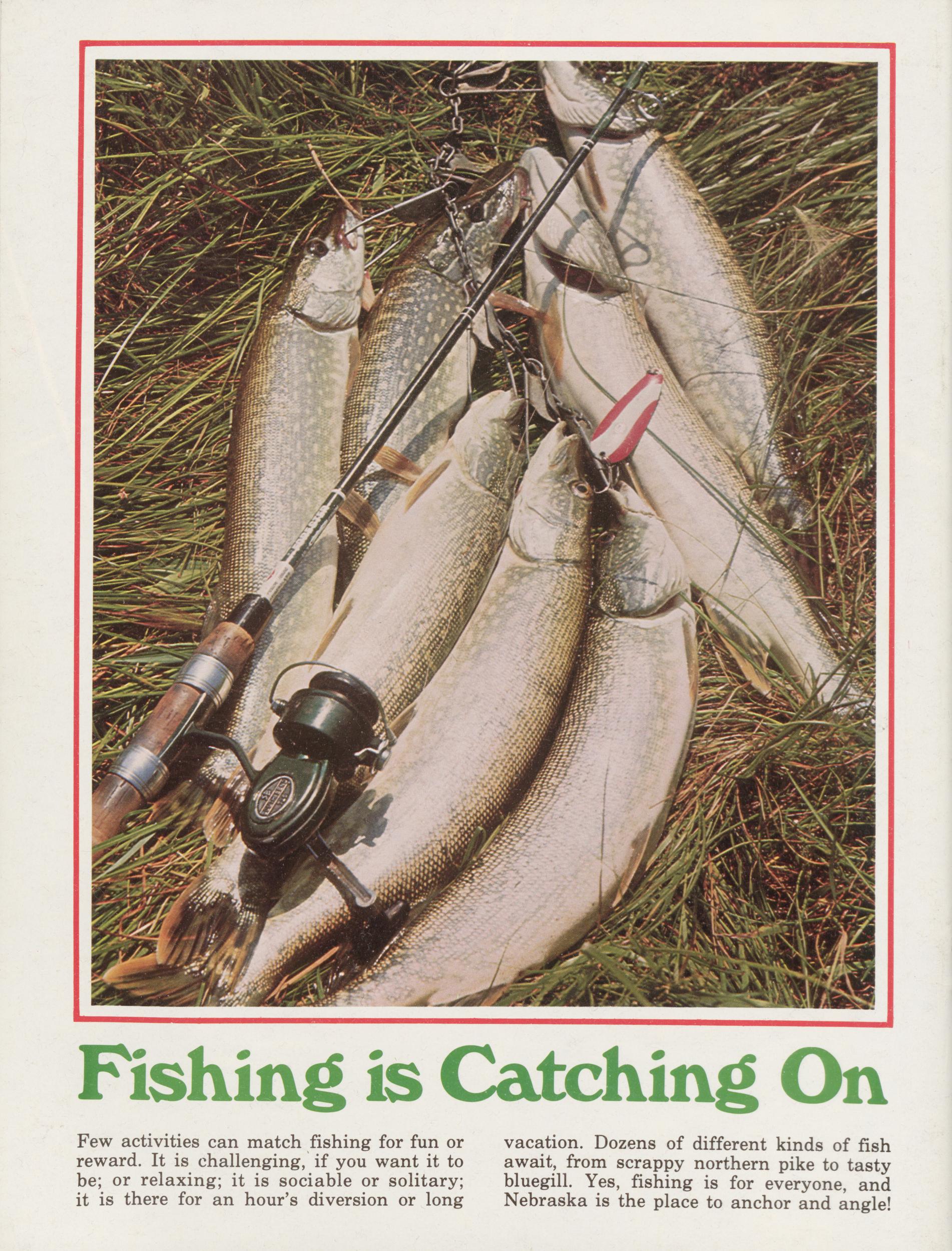
Position: 265 (31 views)