Volume 59, Issue 8, 1981
NEBRASKAland
JUNE 1981 $1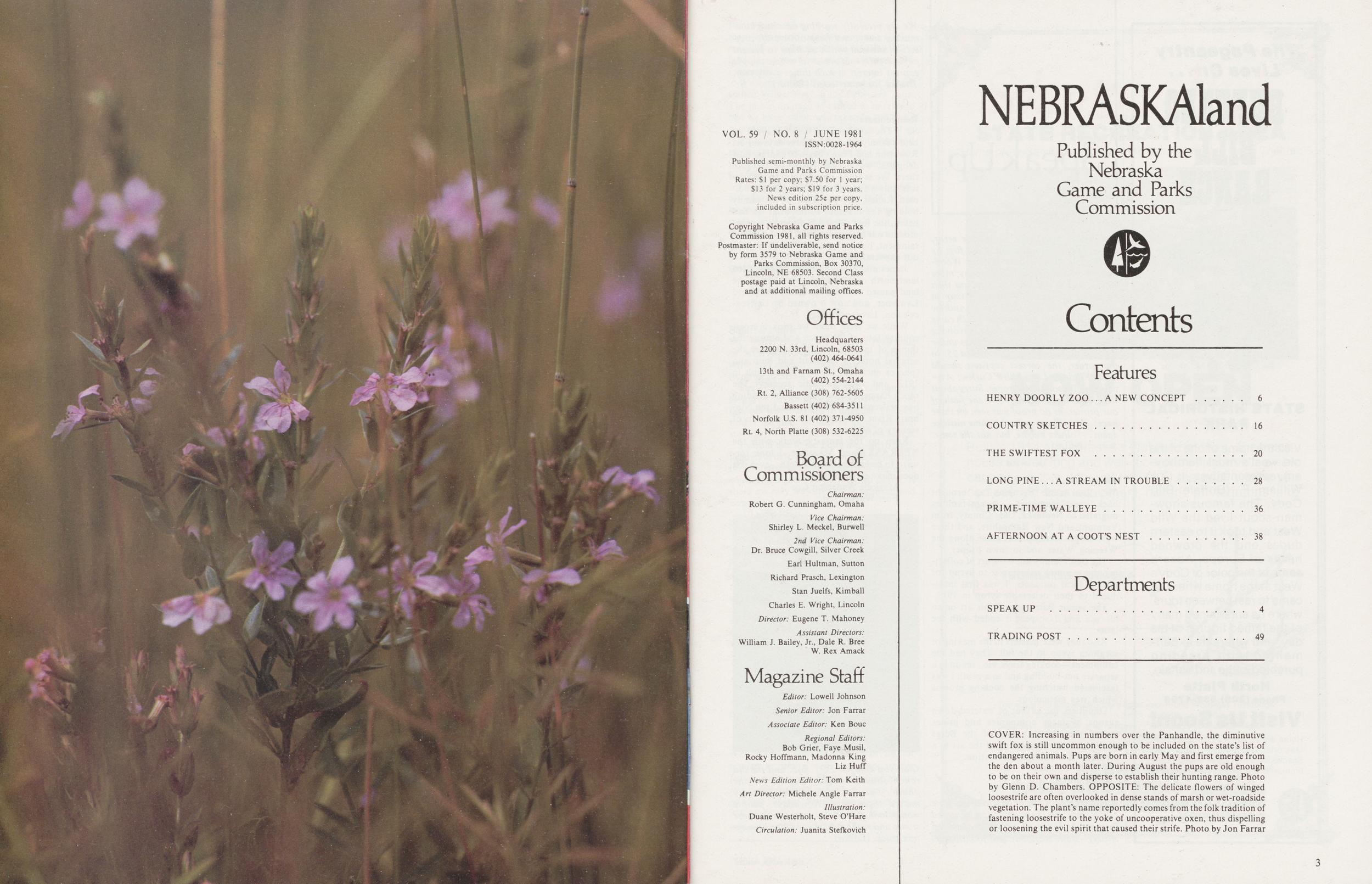
NEBRASKAland
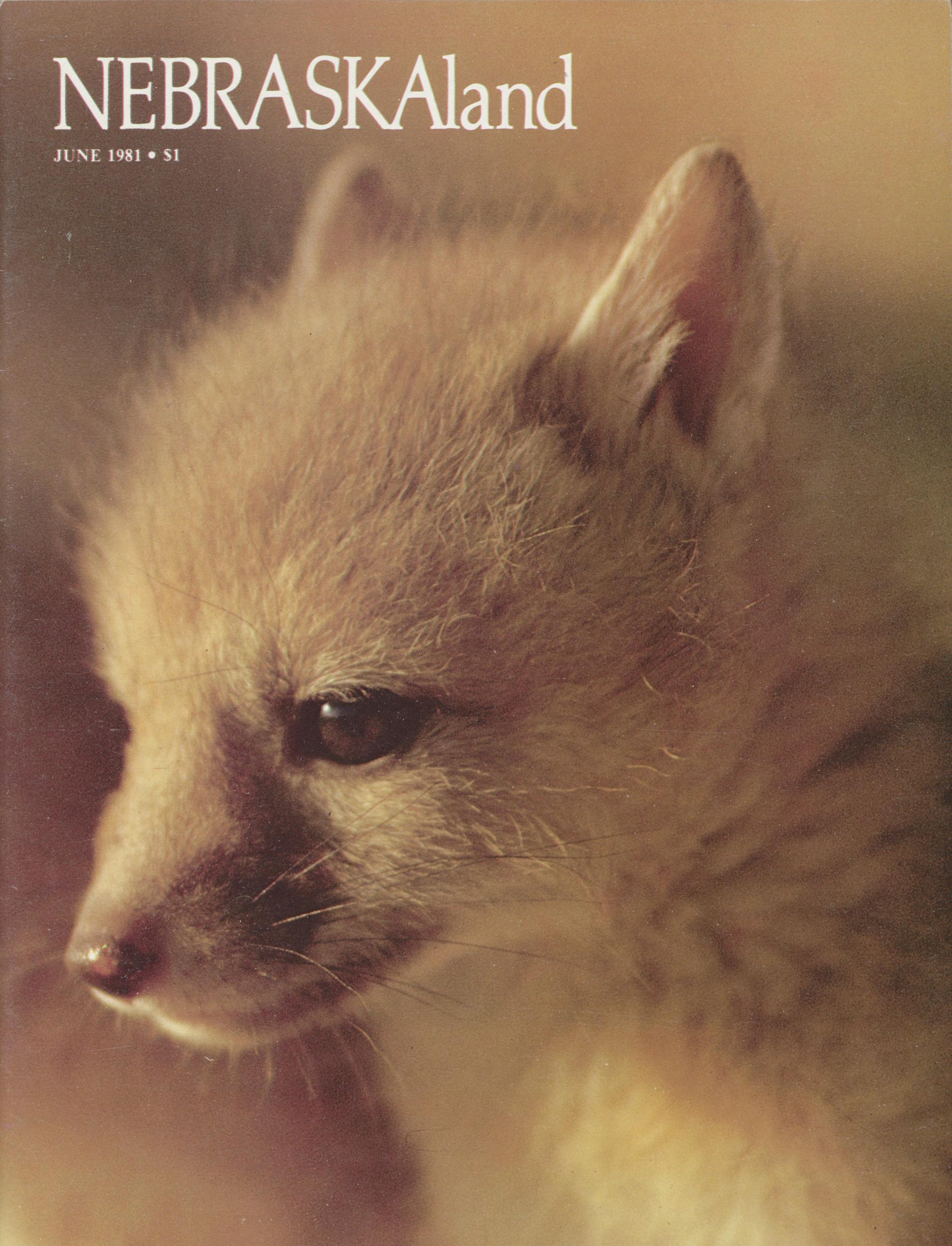
Published by the Nebraska Game and Parks Commission VOL. 59 NO. 8 JUNE 1981 ISSN-.0028-1964 Published semi-monthly by Nebraska Game and Parks Commission Rates: $1 per copy; $7.50 for 1 year; $13 for 2 years; $19 for 3 years. News edition 25c per copy, included in subscription price. Copyright Nebraska Game and Parks Commission 1981, all rights reserved. Postmaster: If undeliverable, send notice by form 3579 to Nebraska Game and Parks Commission, Box 30370, Lincoln, NE 68503. Second Class postage paid at Lincoln, Nebraska and at additional mailing offices. Offices Headquarters 2200 N. 33rd, Lincoln, 68503 (402) 464-0641 13th and Farnam St., Omaha (402) 554-2144 Rt. 2, Alliance (308) 762-5605 Bassett (402) 684-3511 Norfolk U.S. 81 (402) 371-4950 Rt. 4, North Platte (308) 532-6225 Board of Commissioners Chairman: Robert G. Cunningham, Omaha Vice Chairman: Shirley L. Meckel, Burwell 2nd Vice Chairman: Dr. Bruce Cowgill, Silver Creek Earl Hultman, Sutton Richard Prasch, Lexington Stan Jueifs, Kimball Charles E. Wright, Lincoln Director: Eugene T. Mahoney Assistant Directors: William J. Bailey, Jr., Dale R. Bree W. Rex Amack Magazine Staff Editor: Lowell Johnson Senior Editor: Jon Farrar Associate Editor: Ken Bouc Regional Editors: Bob Grier, Faye Musil, Rocky Hoffmann, Madonna King Liz Huff News Edition Editor: Tom Keith Art Director: Michele Angle Farrar Illustration: Duane Westerholt, Steve O'Hare Circulation: Juanita Stefkovich Contents Features HENRY DOORLY ZOO A NEW CONCEPT COUNTRY SKETCHES 16 THE SWIFTEST FOX LONG PINE A STREAM IN TROUBLE 20 28 PRIME-TIME WALLEYE 36 AFTERNOON AT A COOT'S NEST 38 Departments SPEAK UP TRADING POST 49 COVER: Increasing in numbers over the Panhandle, the diminutive swift fox is still uncommon enough to be included on the state's list of endangered animals. Pups are born in early May and first emerge from the den about a month later. During August the pups are old enough to be on their own and disperse to establish their hunting range. Photo by Glenn D. Chambers. OPPOSITE: The delicate flowers of winged loosestrife are often overlooked in dense stands of marsh or wet-roadside vegetation. The plant's name reportedly comes from the folk tradition of fastening loosestrife to the yoke of uncooperative oxen, thus dispelling or loosening the evil spirit that caused their strife. Photo by Jon Farrar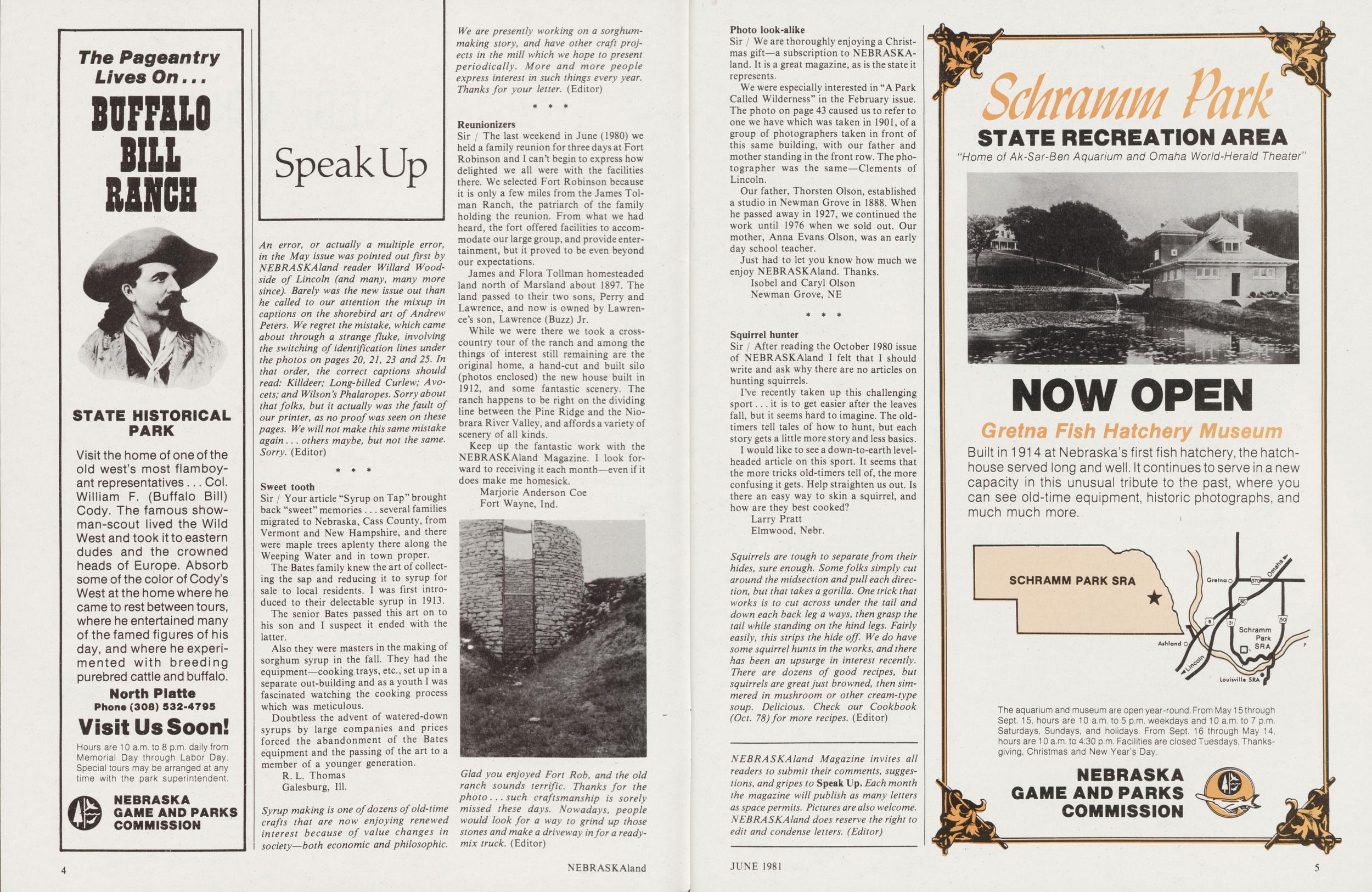
Speka Up
The Pageantry Lives On BUFFALO BILL RANCH STATE HISTORICAL PARK Visit the home of one of the old west's most flamboyant representatives Col. William F. (Buffalo Bill) Cody. The famous show-man-scout lived the Wild West and took it to eastern dudes and the crowned heads of Europe. Absorb some of the color of Cody's West at the home where he came to rest between tours, where he entertained many of the famed figures of his day, and where he experimented with breeding purebred cattle and buffalo. North Platte Phone (308) 532-4795 Visit Us Soon! Hours are 10 a.m. to 8 p.m. daily from Memorial Day through Labor Day. Special tours may be arranged at any time with the park superintendent. NEBRASKA GAME AND PARKS COMMISSIONAn error, or actually a multiple error, in the May issue was pointed out first by NEBRASKAland reader Willard Woodside of Lincoln (and many, many more since). Barely was the new issue out than he called to our attention the mixup in captions on the shorebird art of Andrew Peters. We regret the mistake, which came about through a strange fluke, involving the switching of identification lines under the photos on pages 20, 21, 23 and 25. In that order, the correct captions should read: Killdeer; Long-billed Curlew; Avocets; and Wilson's Phalaropes. Sorry about that folks, but it actually was the fault of our printer, as no proof was seen on these pages. We will not make this same mistake again others maybe, but not the same. Sorry. (Editor)
Sweet toothSir / Your article "Syrup on Tap" brought back "sweet" memories several families migrated to Nebraska, Cass County, from Vermont and New Hampshire, and there were maple trees aplenty there along the Weeping Water and in town proper.
The Bates family knew the art of collecting the sap and reducing it to syrup for sale to local residents. I was first introduced to their delectable syrup in 1913.
The senior Bates passed this art on to his son and I suspect it ended with the latter.
Also they were masters in the making of sorghum syrup in the fall. They had the equipment—cooking trays, etc., set up in a separate out-building and as a youth I was fascinated watching the cooking process which was meticulous.
Doubtless the advent of watered-down syrups by large companies and prices forced the abandonment of the Bates equipment and the passing of the art to a member of a younger generation.
R. L. Thomas Galesburg, III.Syrup making is one of dozens of old-time crafts that are now enjoying renewed interest because of value changes in society—both economic and philosophic. We are presently working on a sorghum-making story, and have other craft projects in the mill which we hope to present periodically. More and more people express interest in such things every year. Thanks for your letter. (Editor)
ReunionizersSir / The last weekend in June (1980) we held a family reunion for three days at Fort Robinson and I can't begin to express how delighted we all were with the facilities there. We selected Fort Robinson because it is only a few miles from the James Tolman Ranch, the patriarch of the family holding the reunion. From what we had heard, the fort offered facilities to accommodate our large group, and provide entertainment, but it proved to be even beyond our expectations.
James and Flora Tollman homesteaded land north of Marsland about 1897. The land passed to their two sons, Perry and Lawrence, and now is owned by Lawrence's son, Lawrence (Buzz) Jr.
While we were there we took a cross-country tour of the ranch and among the things of interest still remaining are the original home, a hand-cut and built silo (photos enclosed) the new house built in 1912, and some fantastic scenery. The ranch happens to be right on the dividing line between the Pine Ridge and the Niobrara River Valley, and affords a variety of scenery of all kinds.
Keep up the fantastic work with the NEBRASKAland Magazine. I look forward to receiving it each month—even if it does make me homesick.
Marjorie Anderson Coe Fort Wayne, Ind.Glad you enjoyed Fort Rob, and the old ranch sounds terrific. Thanks for the photo such craftsmanship is sorely missed these days. Nowadays, people would look for a way to grind up those stones and make a driveway in for a ready-mix truck. (Editor)
4 NEBRASKAland Photo look-alikeSir / We are thoroughly enjoying a Christmas gift—a subscription to NEBRASKAland. It is a great magazine, as is the state it represents.
We were especially interested in "A Park Called Wilderness" in the February issue. The photo on page 43 caused us to refer to one we have which was taken in 1901, of a group of photographers taken in front of this same building, with our father and mother standing in the front row. The photographer was the same—Clements of Lincoln.
Our father, Thorsten Olson, established a studio in Newman Grove in 1888. When he passed away in 1927, we continued the work until 1976 when we sold out. Our mother, Anna Evans Olson, was an early day school teacher.
Just had to let you know how much we enjoy NEBRASKAland. Thanks.
Isobel and Caryl Olson Newman Grove, NE Squirrel hunterSir / After reading the October 1980 issue of NEBRASKAland I felt that I should write and ask why there are no articles on hunting squirrels.
I've recently taken up this challenging sport it is to get easier after the leaves fall, but it seems hard to imagine. The old-timers tell tales of how to hunt, but each story gets a little more story and less basics.
I would like to see a down-to-earth level-headed article on this sport. It seems that the more tricks old-timers tell of, the more confusing it gets. Help straighten us out. Is there an easy way to skin a squirrel, and how are they best cooked?
Larry Pratt Elmwood, Nebr.Squirrels are tough to separate from their hides, sure enough. Some folks simply cut around the midsection and pull each direction, but that takes a gorilla. One trick that works is to cut across under the tail and down each back leg a ways, then grasp the tail while standing on the hind legs. Fairly easily, this strips the hide off. We do have some squirrel hunts in the works, and there has been an upsurge in interest recently. There are dozens of good recipes, but squirrels are great just browned, then simmered in mushroom or other cream-type soup. Delicious. Check our Cookbook (Oct. 78) for more recipes. (Editor)
NEBRASKAland Magazine invites all readers to submit their comments, suggestions, and gripes to Speak Up. Each month the magazine will publish as many letters as space permits. Pictures are also welcome. NEBRASKAland does reserve the right to edit and condense letters. (Editor)
'Schramm Park STATE RECREATION AREA Home of Ak-Sar-Ben Aquarium and Omaha World-Herald Theater" NOW OPEN Gretna Fish Hatchery Museum Built in 1914 at Nebraska's first fish hatchery, the hatch-house served long and well. It continues to serve in a new capacity in this unusual tribute to the past, where you can see old-time equipment, historic photographs, and much much more. SCHRAMM PARK The aquarium and museum are open year-round. From May 15 through Sept. 15, hours are 10 a.m. to 5 p.m. weekdays and 10 a.m. to 7 p.m. Saturdays, Sundays, and holidays. From Sept. 16 through May 14, hours are 10 a.m. to 4:30 p.m. Facilities are closed Tuesdays, Thanksgiving, Christmas and New Year's Day. NEBRASKA GAME AND PARKS COMMISSION JUNE 1981 5
HENRY DOORLY ZOO A NEW CONCEPT
BY MADONNA KING; PHOTOS BY KIT KINGWITH ITS VAST and varied terrain' Nebraska is a land that affords her citizens glimpses of much diverse wildlife throughout the year. But, seven months out of the year, one small spot in Douglas County alone offers visitors a gander at some 132 species of wild animals, most of which are not seen anywhere else in the state.
Henry Doorly Zoo, a 110-acre park at 10th and Deer Park Blvd. in Omaha, boasts almost 600 furred, feathered or finned individuals from around the world. Lions and tigers and bears are just the beginning of a collection that never fails to bring "oh's" and "ah's" from crowds of young and old alike.
But just as Nebraska's native mammals and birds and fishes do not exist simply for our random viewing pleasure, neither do the animals at Henry Doorly Zoo. Specializing in endangered species, Omaha's zoo first of all provides a safe home for animals whose numbers are fast diminishing in the wild. Secondly, it conducts a breeding program to try to ensure the survival of future generations. And finally, the zoo gives the public a chance to learn about and enjoy wildlife of all kinds.
"If we would address only the general public's needs and wants, the zoo just couldn't be justified today," says Dr. Lee Simmons, director for the past decade, and a veternarian with the zoo since 1966. "Our primary concern must be for the animals," he explains. "Their pens are designed to make them feel safe and secure and as much at home as possible. People don't want to feel sorry for a caged animal. But even more importantly, the animals themselves won't breed until they feel comfortable with their surroundings."
6 NEBRASKAland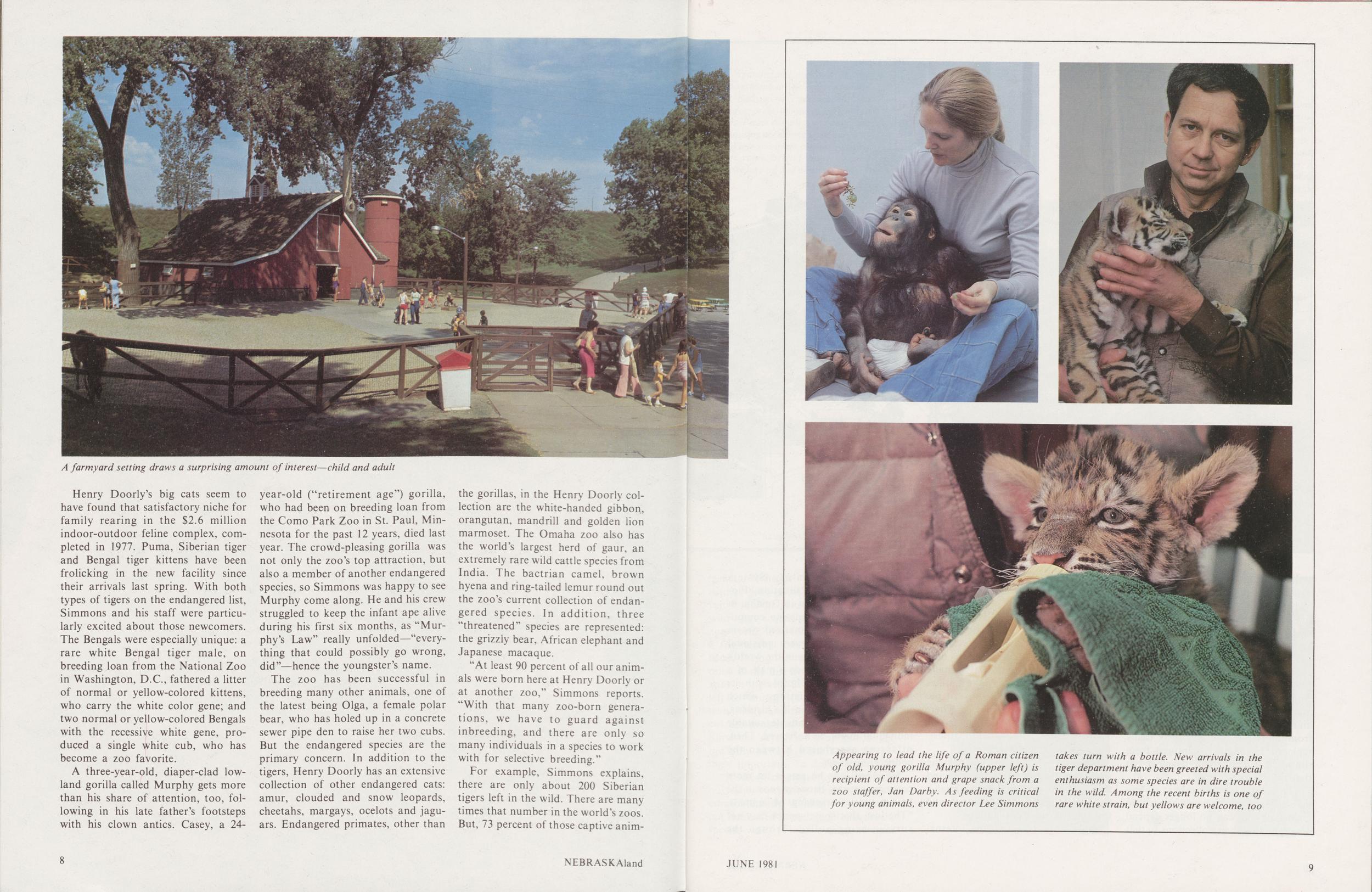
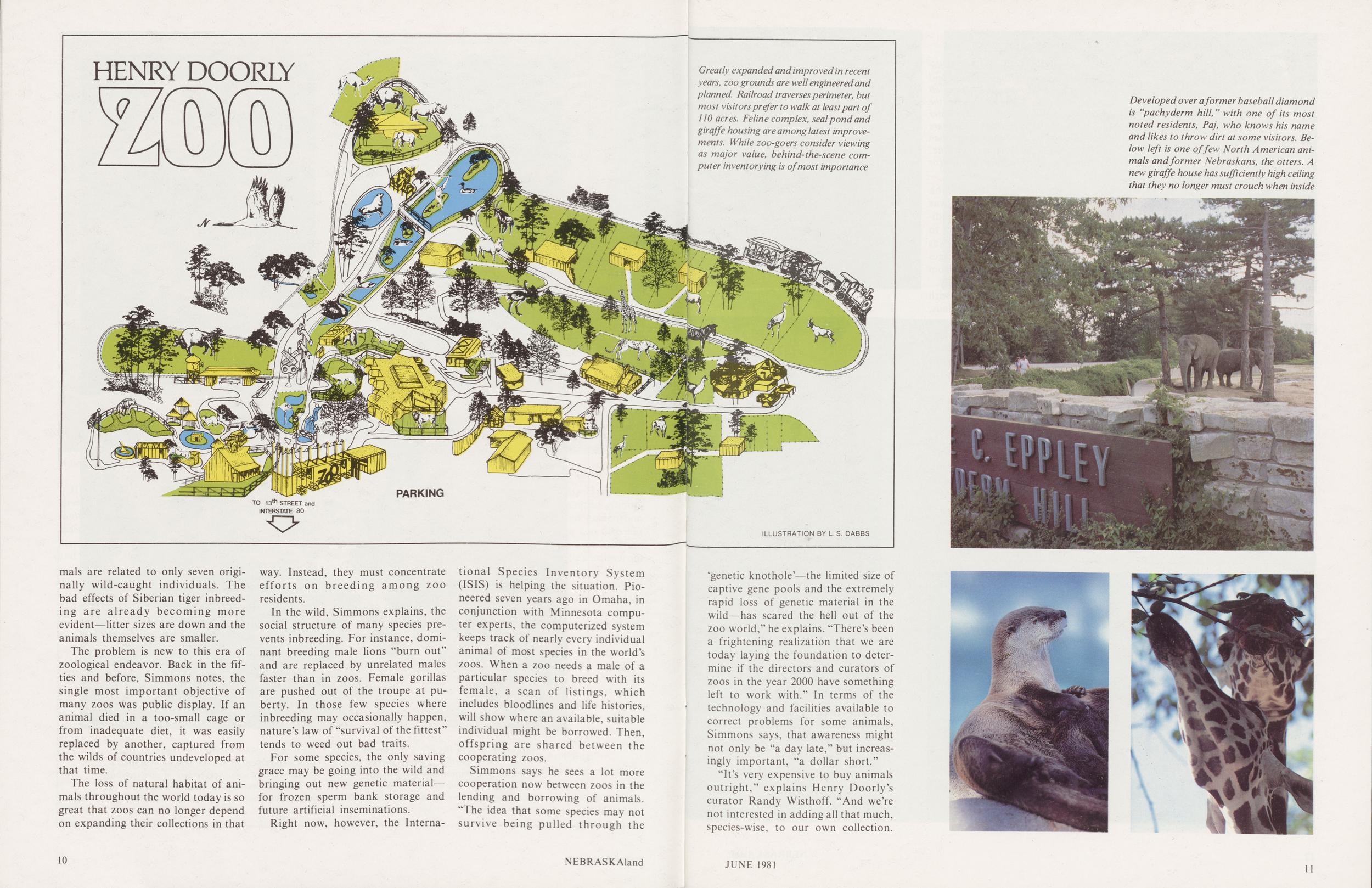
Henry Doorly's big cats seem to have found that satisfactory niche for family rearing in the $2.6 million indoor-outdoor feline complex, completed in 1977. Puma, Siberian tiger and Bengal tiger kittens have been frolicking in the new facility since their arrivals last spring. With both types of tigers on the endangered list, Simmons and his staff were particularly excited about those newcomers. The Bengals were especially unique: a rare white Bengal tiger male, on breeding loan from the National Zoo in Washington, D.C., fathered a litter of normal or yellow-colored kittens, who carry the white color gene; and two normal or yellow-colored Bengals with the recessive white gene, produced a single white cub, who has become a zoo favorite.
A three-year-old, diaper-clad lowland gorilla called Murphy gets more than his share of attention, too, following in his late father's footsteps with his clown antics. Casey, a 24-year-old ("retirement age") gorilla, who had been on breeding loan from the Como Park Zoo in St. Paul, Minnesota for the past 12 years, died last year. The crowd-pleasing gorilla was not only the zoo's top attraction, but also a member of another endangered species, so Simmons was happy to see Murphy come along. He and his crew struggled to keep the infant ape alive during his first six months, as "Murphy's Law" really unfolded—"everything that could possibly go wrong, did"—hence the youngster's name.
The zoo has been successful in breeding many other animals, one of the latest being Olga, a female polar bear, who has holed up in a concrete sewer pipe den to raise her two cubs. But the endangered species are the primary concern. In addition to the tigers, Henry Doorly has an extensive collection of other endangered cats: amur, clouded and snow leopards, cheetahs, margays, ocelots and jaguars. Endangered primates, other than the gorillas, in the Henry Doorly collection are the white-handed gibbon, orangutan, mandrill and golden lion marmoset. The Omaha zoo also has the world's largest herd of gaur, an extremely rare wild cattle species from India. The bactrian camel, brown hyena and ring-tailed lemur round out the zoo's current collection of endangered species. In addition, three "threatened" species are represented: the grizzly bear, African elephant and Japanese macaque.
"At least 90 percent of all our animals were born here at Henry Doorly or at another zoo," Simmons reports. "With that many zoo-born generations, we have to guard against inbreeding, and there are only so many individuals in a species to work with for selective breeding."
For example, Simmons explains, there are only about 200 Siberian tigers left in the wild. There are many times that number in the world's zoos. But, 73 percent of those captive animals 8 NEBRASKAland
The problem is new to this era of zoological endeavor. Back in the fifties and before, Simmons notes, the single most important objective of many zoos was public display. If an animal died in a too-small cage or from inadequate diet, it was easily replaced by another, captured from the wilds of countries undeveloped at that time.
The loss of natural habitat of animals throughout the world today is so great that zoos can no longer depend on expanding their collections in that way. Instead, they must concentrate efforts on breeding among zoo residents.
In the wild, Simmons explains, the social structure of many species prevents inbreeding. For instance, dominant breeding male lions "burn out" and are replaced by unrelated males faster than in zoos. Female gorillas are pushed out of the troupe at puberty. In those few species where inbreeding may occasionally happen, nature's law of "survival of the fittest" tends to weed out bad traits.
For some species, the only saving grace may be going into the wild and bringing out new genetic material—for frozen sperm bank storage and future artificial inseminations.
Right now, however, the International Species Inventory System (ISIS) is helping the situation. Pioneered seven years ago in Omaha, in conjunction with Minnesota computer experts, the computerized system keeps track of nearly every individual animal of most species in the world's zoos. When a zoo needs a male of a particular species to breed with its female, a scan of listings, which includes bloodlines and life histories, will show where an available, suitable individual might be borrowed. Then, offspring are shared between the cooperating zoos.
Simmons says he sees a lot more cooperation now between zoos in the lending and borrowing of animals. "The idea that some species may not survive being pulled through the 10 NEBRASKAland 'genetic knothole'—the limited size of captive gene pools and the extremely rapid loss of genetic material in the wild—has scared the hell out of the zoo world," he explains. "There's been a frightening realization that we are today laying the foundation to determine if the directors and curators of zoos in the year 2000 have something left to work with." In terms of the technology and facilities available to correct problems for some animals, Simmons says, that awareness might not only be "a day late," but increasingly important, "a dollar short."
"It's very expensive to buy animals outright," explains Henry Doorly's curator Randy Wisthoff. "And we're not interested in adding all that much, species-wise, to our own collection.
 But sometimes you have a crucial
money problem when there is no suitable animal available for a breeding
loan, but there is one available for
sale."
But sometimes you have a crucial
money problem when there is no suitable animal available for a breeding
loan, but there is one available for
sale."
That situation is all too real for Henry Doorly right now. With Murphy too young and Casey gone, the zoo needs a male gorilla with unrelated bloodlines to mate with its females. One male available at a foreign zoo has a $55,000 price tag on it. Since the zoo depends on gate admissions, concessions and a share of the city of Omaha's budget just to keep the place operating, a purchase of that size necessitates fund-raising projects. A "Go Ape" campaign that involved banana sales got underway last year for that very purpose.
Fund-raising has always been a part of the zoo story, though, since its first chapter back at the turn of the century. In the 1890's the city of Omaha voted a bond issue for park land purchase, and the initial 65 acres of densely wooded bluffs above the Missouri obtained by the Omaha Board of Park Commissioners was called "Riverview Park." After additional purchases brought the park to 110 acres, a variety of animals was donated and housed in crude cages and pens, including two buffalo from Colonel W.F. "Buffalo Bill" Cody.
A lagoon was created early on, with animals kept on man-made islands, just as some are today. A wooden pen under the still-existing lagoon bridge housed large alligators, and according to early-day "eyewitnesses," their occasional escape was the talk of the town.
A Greek-style, white-pillared pavilion, modeled after one in the Trans-Mississippi Exposition of 1898, was built on the south side of the lagoon in 1904. A popular place for picnics, bingo parties, Saturday night concerts and player-piano dances, the pavilion eventually deteriorated and was torn down in 1948. It was replaced by a stone pavilion that today houses the zoo's administration offices and the
Bear, elk, deer and other animals native to North America made up most of the early collection at Riverview Park. In 1928, a donation from Gould Dietz made construction of the lion cages possible. Additional exotic cat cages built in the 1930's by the W.P.A., have been replaced by the modern complex that houses Henry Doorly's successfully breeding endangered cat populations.
Riverview Park's swimming pool, built in 1916, was buried under tons of earth after World War II, then rediscovered in 1970 when a site for a sea lion was needed. The old "people" pool was repaired and reinforced and a rocky island was added in the center for the sun-worshipping, crowd-pleasing California sea lions.
In 1952 the Omaha Zoological Society was formed. Through the fifties and into the sixties, efforts to raise money continued for development of a children's zoo, using a Mother Goose theme. In 1963 Mrs. Henry Doorly donated $750,000 in the annual fund drive, and the Society agreed to name the new zoo after her late husband, a former publisher-president of the Omaha World-Herald, About the same time, the entire concept for the zoo changed and the first real thrust toward the modern idealogy of putting the animals' welfare first got underway.
In 1966 the bear grottos and "primate valley" were constructed, with a design as similar to natural habitat as possible. At about the same time, the private, non-profit Ak-Sar-Ben (Nebraska spelled backwards) institution contributed $165,000 for the children's "nature kingdom"—and enclosed barnyard where youngsters can really get acquainted with domestic animals like sheep, goats, llamas, horses, pigs, chickens, ducks and geese.
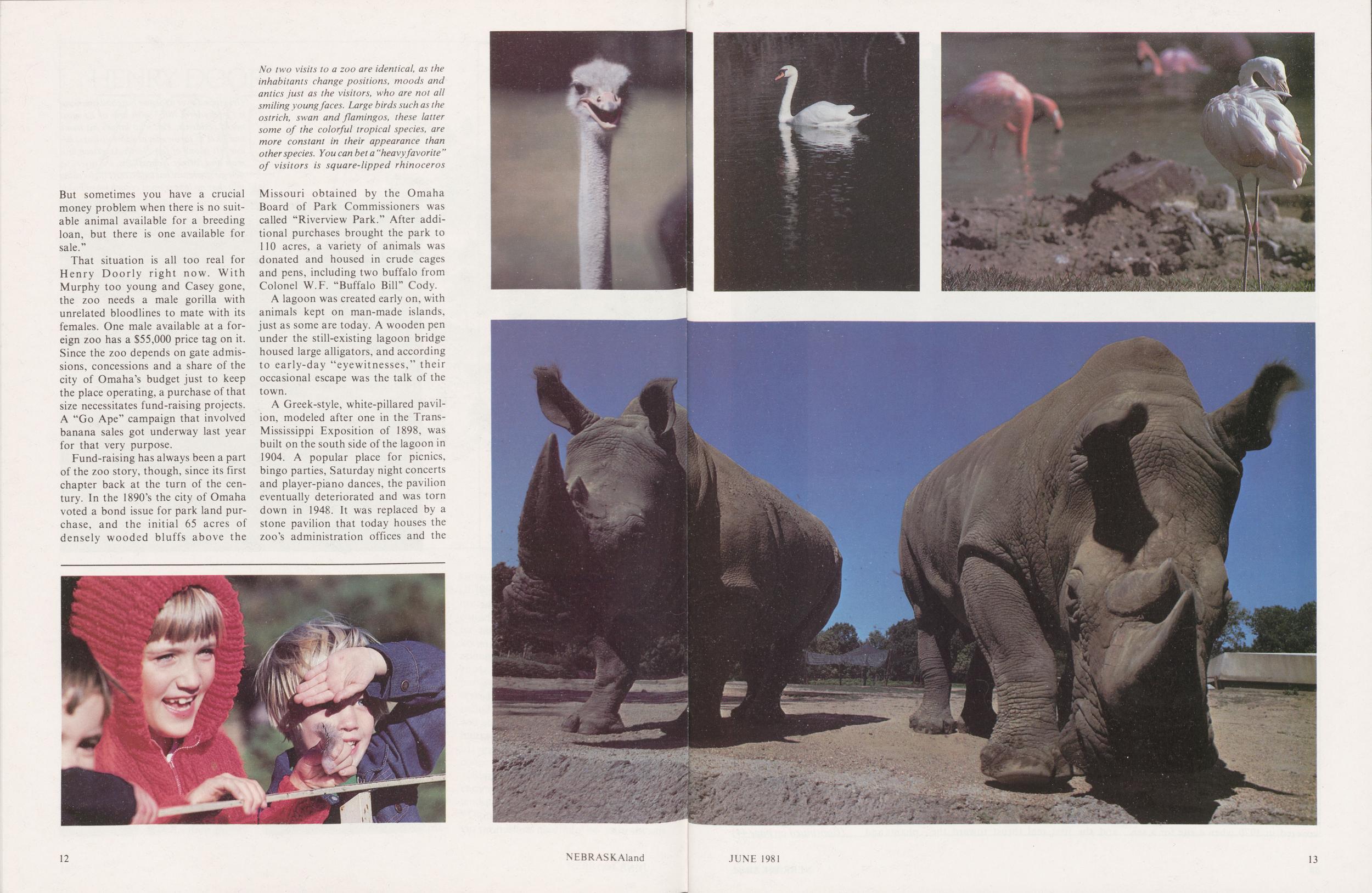
In 1967-68, the old baseball park on the hill above the sea lion pond became "pachyderm hill." There, African elephants and (Continued on page 44)
14 NEBRASKAland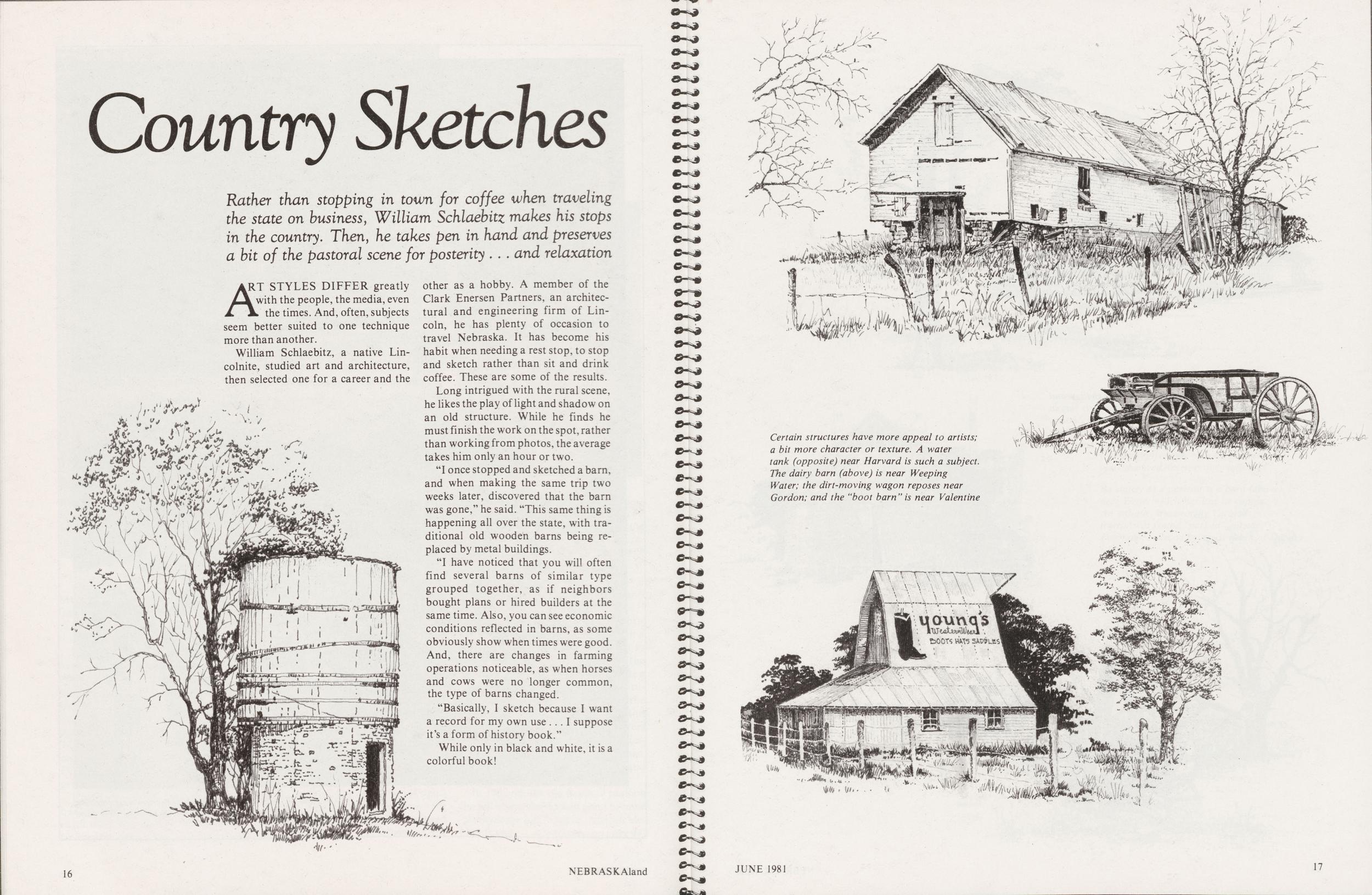
Country Sketches
ART STYLES DIFFER greatly with the people, the media, even the times. And, often, subjects seem better suited to one technique more than another.
William Schlaebitz, a native Lincolnite, studied art and architecture, then selected one for a career and the other as a hobby. A member of the Clark Enersen Partners, an architectural and engineering firm of Lincoln, he has plenty of occasion to travel Nebraska. It has become his habit when needing a rest stop, to stop and sketch rather than sit and drink coffee. These are some of the results.
Long intrigued with the rural scene, he likes the play of light and shadow on an old structure. While he finds he must finish the work on the spot, rather than working from photos, the average takes him only an hour or two.
I once stopped and sketched a barn, and when making the same trip two weeks later, discovered that the barn was gone," he said. "This same thing is happening all over the state, with traditional old wooden barns being replaced by metal buildings.
I have noticed that you will often find several barns of similar type grouped together, as if neighbors bought plans or hired builders at the same time. Also, you can see economic conditions reflected in barns, as some obviously show when times were good. And, there are changes in farming operations noticeable, as when horses and cows were no longer common, the type of barns changed.
Basically, I sketch because I want a record for my own use I suppose it's a form of history book."
While only in black and white, it is a colorful book!
16 NEBRASKAland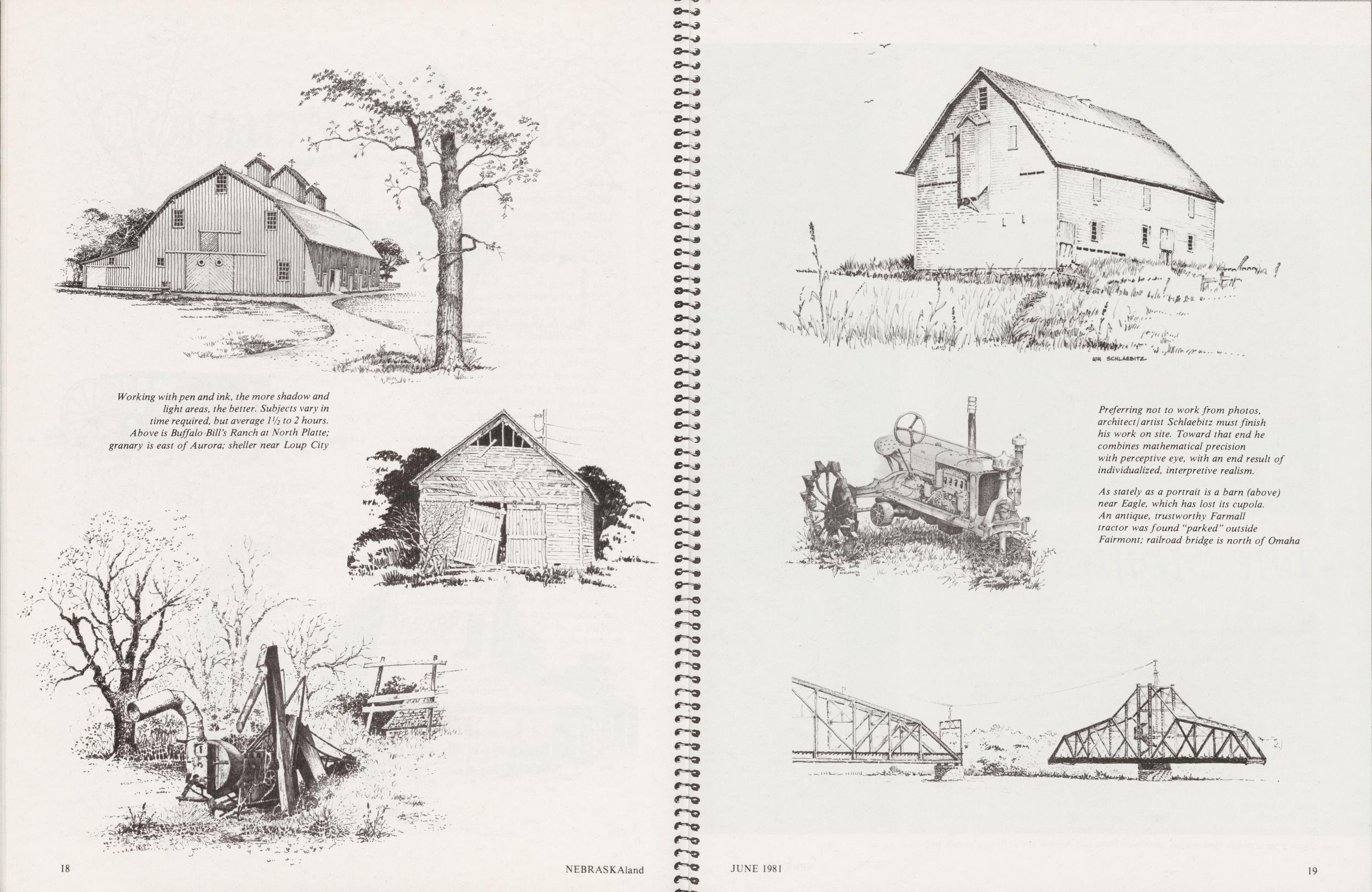
The Swiftest Fox
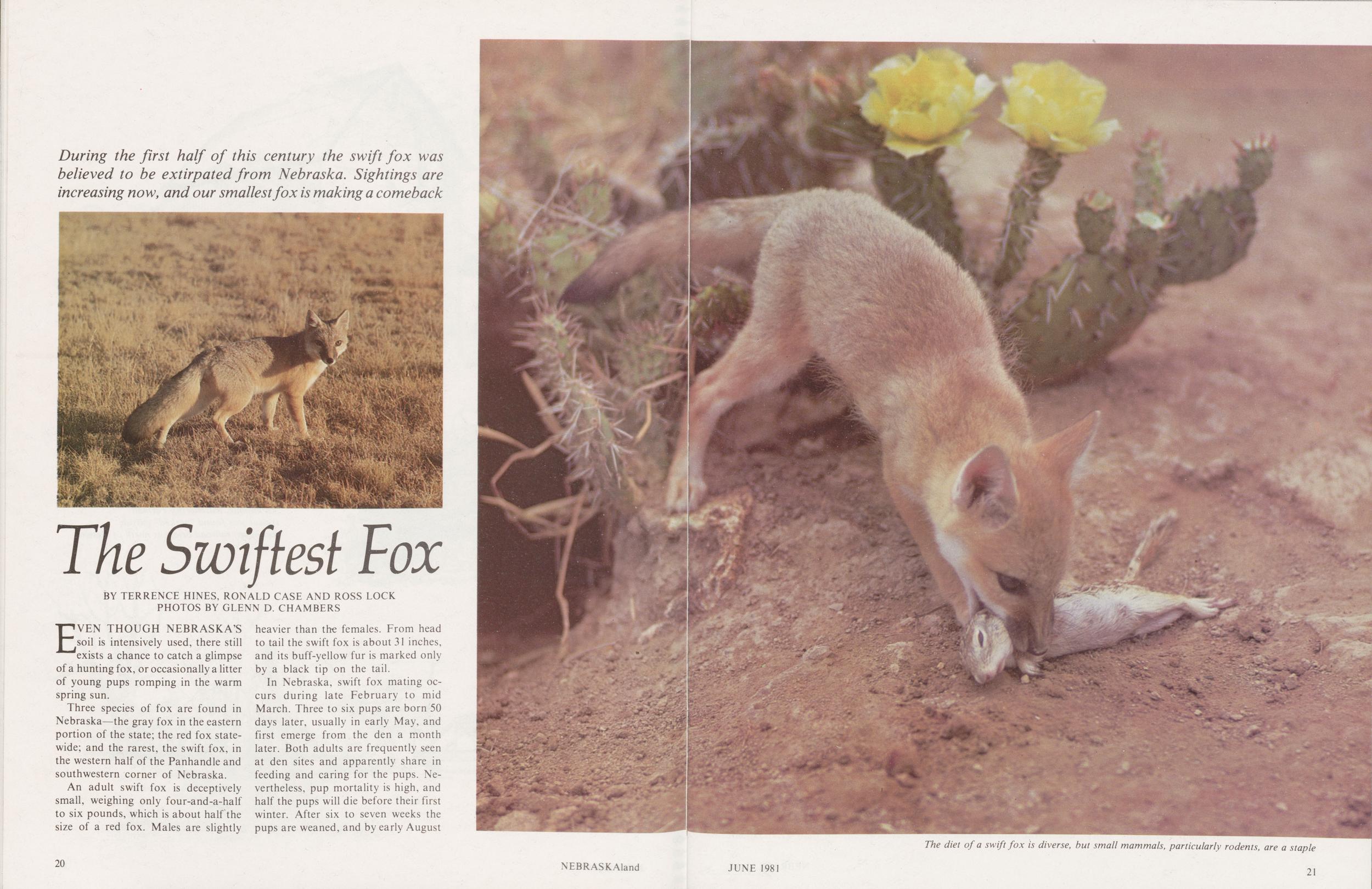
During the first half of this century the swift fox was believed to be extirpated from Nebraska. Sightings are increasing now, and our smallest fox is making a comebackEVEN THOUGH NEBRASKA'S soil is intensively used, there still exists a chance to catch a glimpse of a hunting fox, or occasionally a litter of young pups romping in the warm spring sun.
Three species of fox are found in Nebraska—the gray fox in the eastern portion of the state; the red fox state-wide; and the rarest, the swift fox, in the western half of the Panhandle and southwestern corner of Nebraska.
An adult swift fox is deceptively small, weighing only four-and-a-half to six pounds, which is about half the size of a red fox. Males are slightly heavier than tire females. From head to tail the swift fox is about 31 inches, and its buff-yellow fur is marked only by a black tip on the tail.
In Nebraska, swift fox mating occurs during late February to mid March. Three to six pups are born 50 days later, usually in early May, and first emerge from the den a month later. Both adults are frequently seen at den sites and apparently share in feeding and caring for the pups. Nevertheless, pup mortality is high, and half the pups will die before their first winter. After six to seven weeks the pups are weaned, and by early August 20 NEBRASKAland
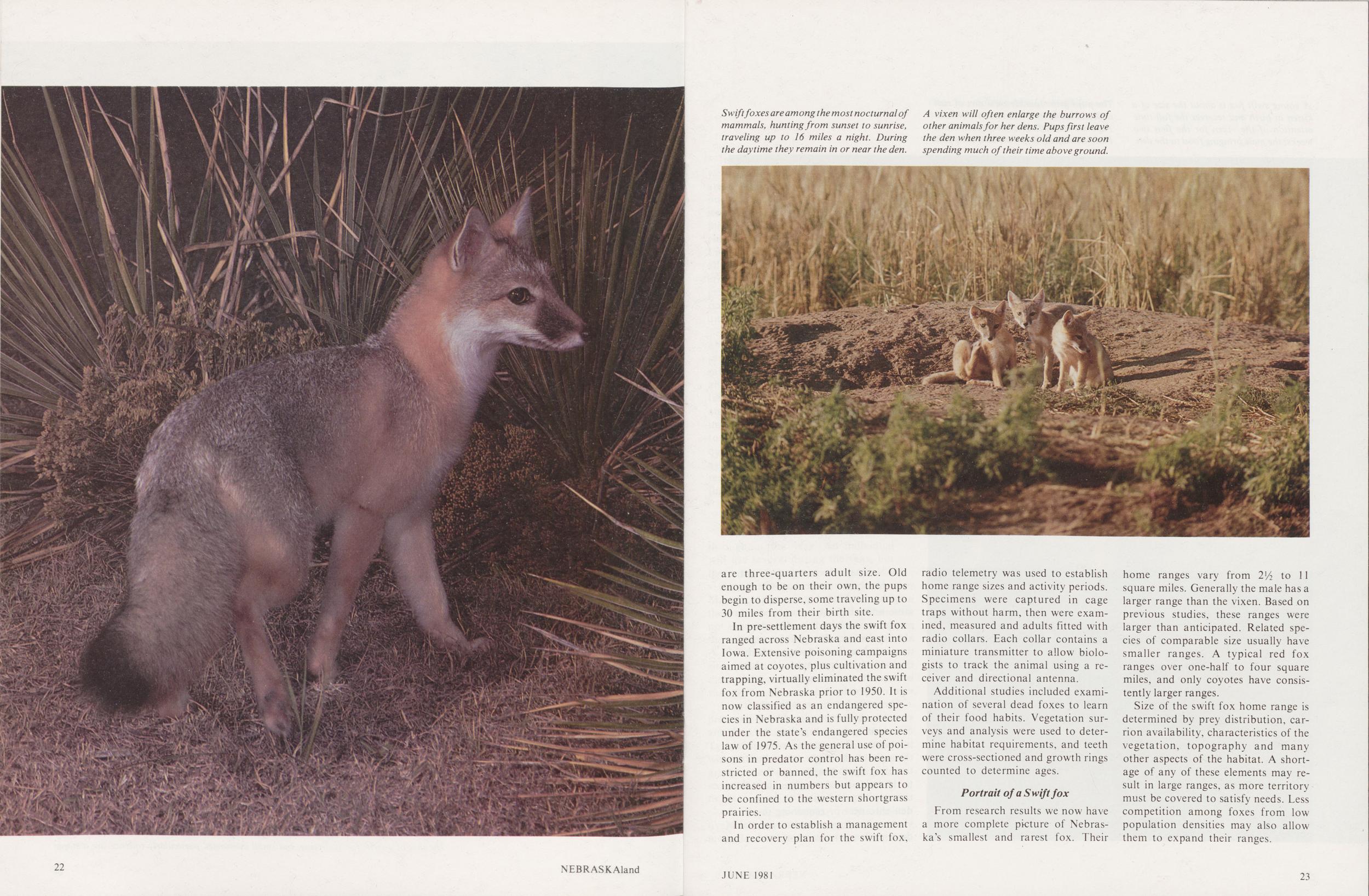
In pre-settlement days the swift fox ranged across Nebraska and east into Iowa. Extensive poisoning campaigns aimed at coyotes, plus cultivation and trapping, virtually eliminated the swift fox from Nebraska prior to 1950. It is now classified as an endangered species in Nebraska and is fully protected under the state's endangered species law of 1975. As the general use of poisons in predator control has been restricted or banned, the swift fox has increased in numbers but appears to be confined to the western shortgrass prairies.
In order to establish a management and recovery plan for the swift fox, radio telemetry was used to establish home range sizes and activity periods. Specimens were captured in cage traps without harm, then were examined, measured and adults fitted with radio collars. Each collar contains a miniature transmitter to allow biologists to track the animal using a receiver and directional antenna.
Additional studies included examination of several dead foxes to learn of their food habits. Vegetation surveys and analysis were used to determine habitat requirements, and teeth were cross-sectioned and growth rings counted to determine ages.
Portrait of a Swift foxFrom research results we now have a more complete picture of Nebraska's smallest and rarest fox. Their home ranges vary from 2 1/2 to 11 square miles. Generally the male has a larger range than the vixen. Based on previous studies, these ranges were larger than anticipated. Related species of comparable size usually have smaller ranges. A typical red fox ranges over one-half to four square miles, and only coyotes have consistently larger ranges.
Size of the swift fox home range is determined by prey distribution, carrion availability, characteristics of the vegetation, topography and many other aspects of the habitat. A shortage of any of these elements may result in large ranges, as more territory must be covered to satisfy needs. Less competition among foxes from low population densities may also allow them to expand their ranges.
JUNE 1981 23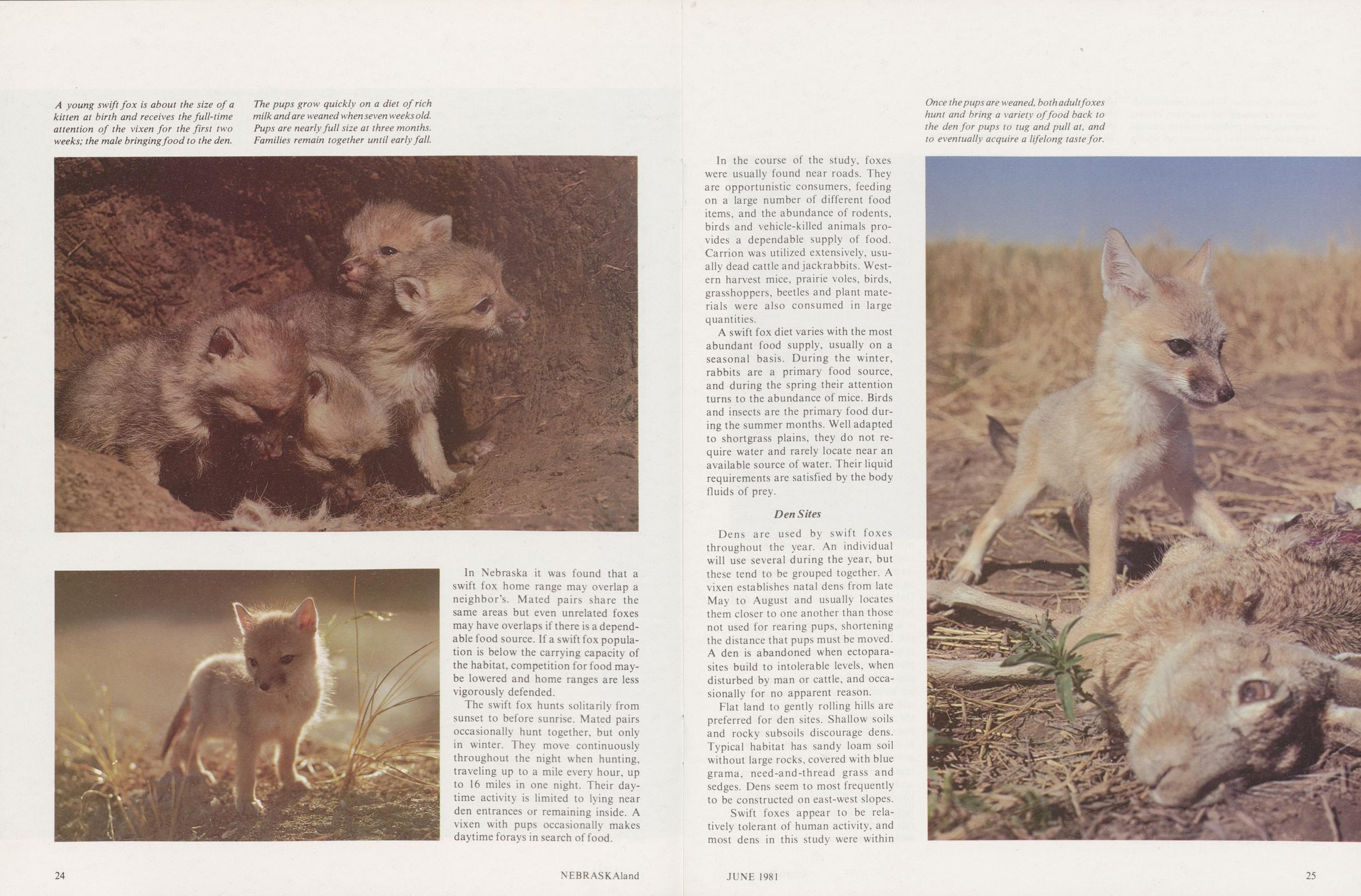
In Nebraska it was found that a swift fox home range may overlap a neighbor's. Mated pairs share the same areas but even unrelated foxes may have overlaps if there is a dependable food source. If a swift fox population is below the carrying capacity of the habitat, competition for food maybe lowered and home ranges are less vigorously defended.
The swift fox hunts solitarily from sunset to before sunrise. Mated pairs occasionally hunt together, but only in winter. They move continuously throughout the night when hunting, traveling up to a mile every hour, up to 16 miles in one night. Their daytime activity is limited to lying near den entrances or remaining inside. A vixen with pups occasionally makes daytime forays in search of food.
24 NEBRASKAlandIn the course of the study, foxes were usually found near roads. They are opportunistic consumers, feeding on a large number of different food items, and the abundance of rodents, birds and vehicle-killed animals provides a dependable supply of food. Carrion was utilized extensively, usually dead cattle and jackrabbits. Western harvest mice, prairie voles, birds, grasshoppers, beetles and plant materials were also consumed in large quantities.
A swift fox diet varies with the most abundant food supply, usually on a seasonal basis. During the winter, rabbits are a primary food source, and during the spring their attention turns to the abundance of mice. Birds and insects are the primary food during the summer months. Well adapted to shortgrass plains, they do not require water and rarely locate near an available source of water. Their liquid requirements are satisfied by the body fluids of prey.
Den SitesDens are used by swift foxes throughout the year. An individual will use several during the year, but these tend to be grouped together. A vixen establishes natal dens from late May to August and usually locates them closer to one another than those not used for rearing pups, shortening the distance that pups must be moved. A den is abandoned when ectoparasites build to intolerable levels, when disturbed by man or cattle, and occasionally for no apparent reason.
Flat land to gently rolling hills are preferred for den sites. Shallow soils and rocky subsoils discourage dens. Typical habitat has sandy loam soil without large rocks, covered with blue grama, need-and-thread grass and sedges. Dens seem to most frequently to be constructed on east-west slopes.
Swift foxes appear to be relatively tolerant of human activity, and most dens in this study were within
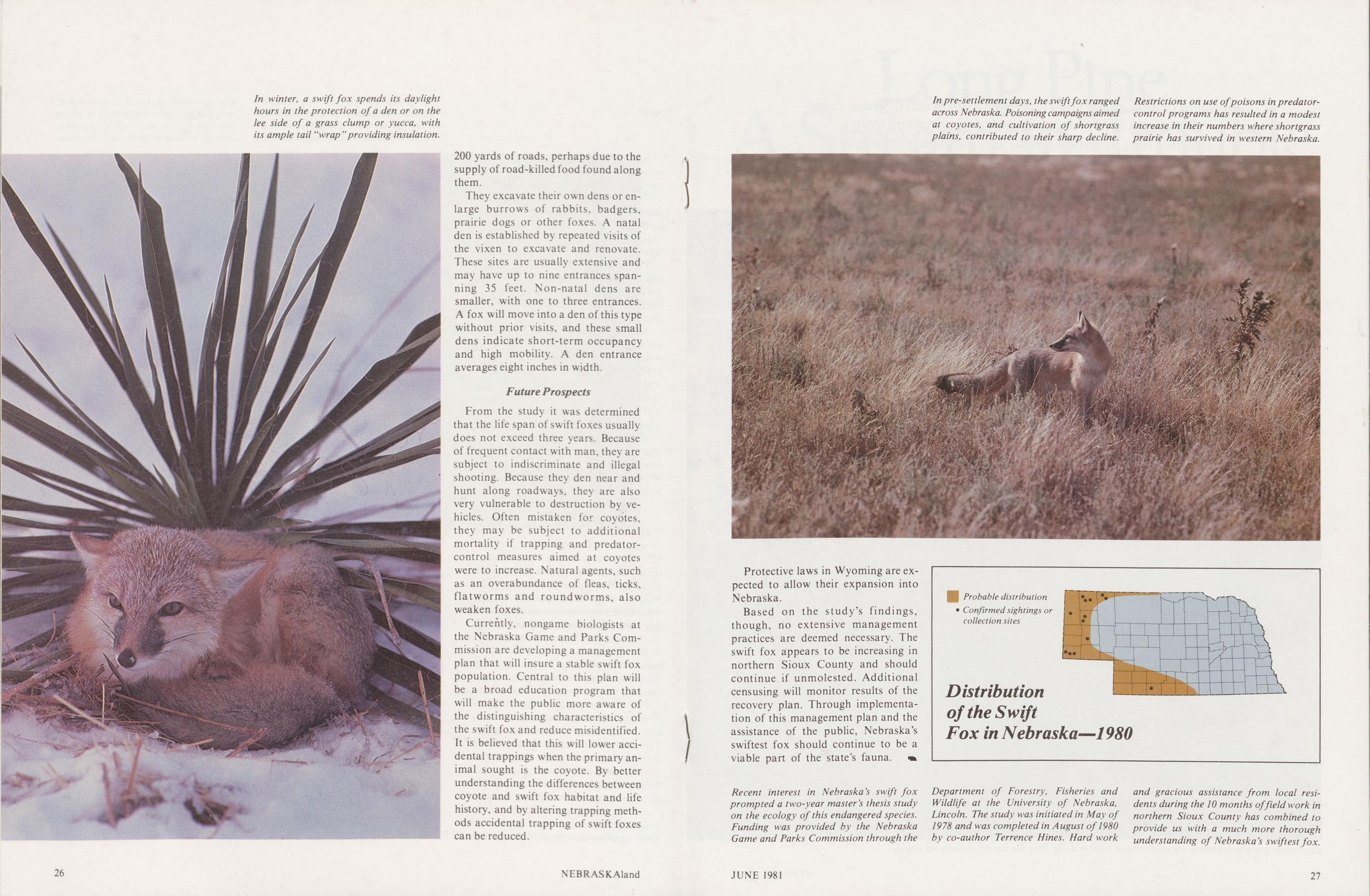
They excavate their own dens or enlarge burrows of rabbits, badgers, prairie dogs or other foxes. A natal den is established by repeated visits of the vixen to excavate and renovate. These sites are usually extensive and may have up to nine entrances spanning 35 feet. Non-natal dens are smaller, with one to three entrances. A fox will move into a den of this type without prior visits, and these small dens indicate short-term occupancy and high mobility. A den entrance averages eight inches in width.
Future ProspectsFrom the study it was determined that the life span of swift foxes usually does not exceed three years. Because of frequent contact with man, they are subject to indiscriminate and illegal shooting. Because they den near and hunt along roadways, they are also very vulnerable to destruction by vehicles. Often mistaken for coyotes, they may be subject to additional mortality if trapping and predator-control measures aimed at coyotes were to increase. Natural agents, such as an overabundance of fleas, ticks, flatworms and roundworms, also weaken foxes.
Currently, nongame biologists at the Nebraska Game and Parks Commission are developing a management plan that will insure a stable swift fox population. Central to this plan will be a broad education program that will make the public more aware of the distinguishing characteristics of the swift fox and reduce misidentified. It is believed that this will lower accidental trappings when the primary animal sought is the coyote. By better understanding the differences between coyote and swift fox habitat and life history, and by altering trapping methods accidental trapping of swift foxes can be reduced.
26 NEBRASKAlandProtective laws in Wyoming are expected to allow their expansion into Nebraska.
Based on the study's findings, though, no extensive management practices are deemed necessary. The swift fox appears to be increasing in northern Sioux Countv and should continue if unmolested. Additional censusing will monitor results of the recovery plan. Through implementation of this management plan and the assistance of the public, Nebraska's swiftest fox should continue to be a viable part of the state's fauna.
Long Pine A Stream in Trouble
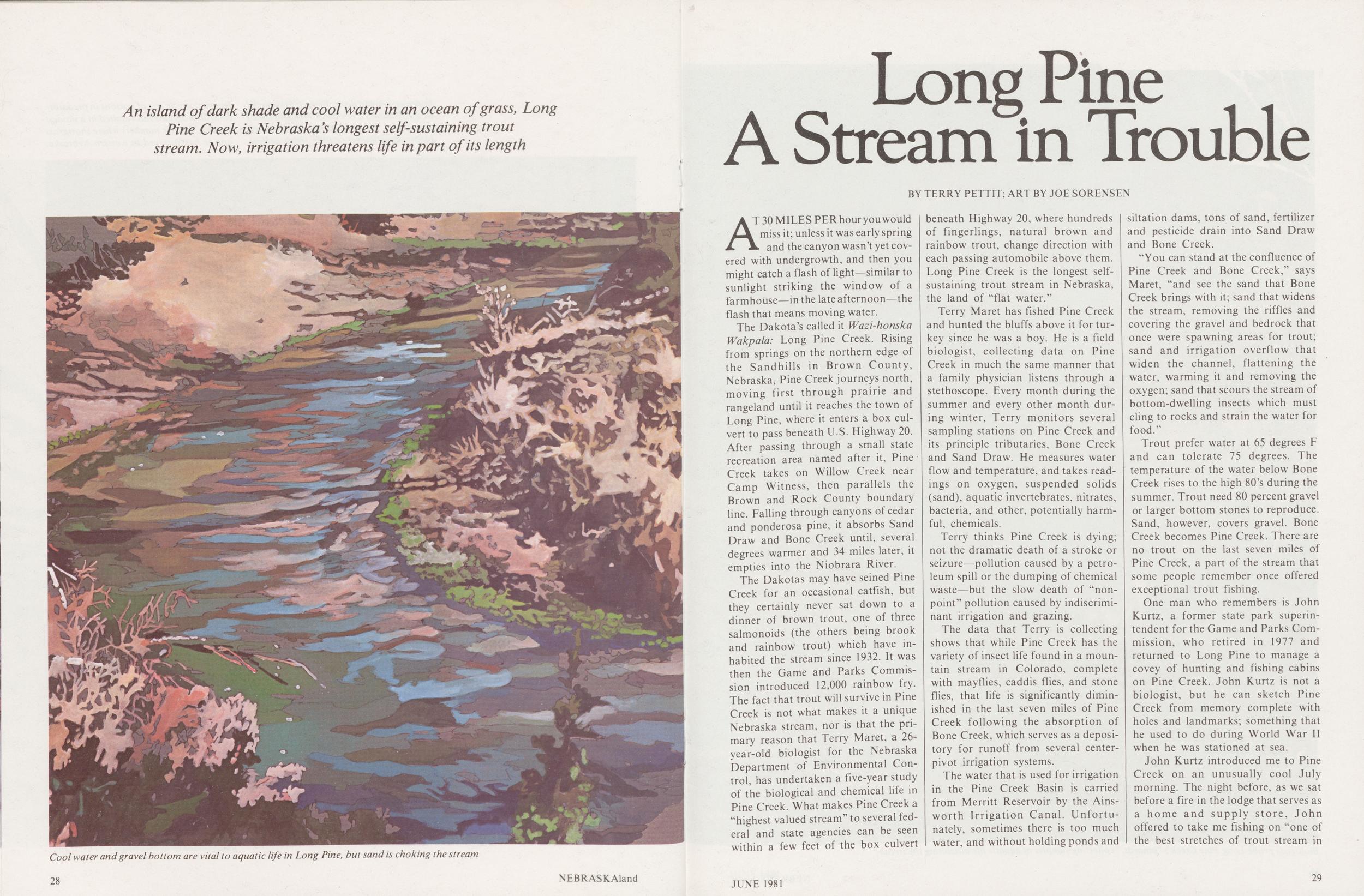
An island of dark shade and cool water in an ocean of grass, Long Pine Creek is Nebraska's longest self-sustaining trout stream. Now, irrigation threatens life in part of its lengthAT 30 MILES PER hour you would miss it; unless it was early spring and the canyon wasn't yet covered with undergrowth, and then you might catch a flash of light—similar to sunlight striking the window of a farmhouse—in the late afternoon—the flash that means moving water.
The Dakota's called it Wazi-honska Wakpala: Long Pine Creek. Rising from springs on the northern edge of the Sandhills in Brown County, Nebraska, Pine Creek journeys north, moving first through prairie and rangeland until it reaches the town of Long Pine, where it enters a box culvert to pass beneath U.S. Highway 20. After passing through a small state recreation area named after it, Pine Creek takes on Willow Creek near Camp Witness, then parallels the Brown and Rock County boundary line. Falling through canyons of cedar and ponderosa pine, it absorbs Sand Draw and Bone Creek until, several degrees warmer and 34 miles later, it empties into the Niobrara River.
The Dakotas may have seined Pine Creek for an occasional catfish, but they certainly never sat down to a dinner of brown trout, one of three salmonoids (the others being brook and rainbow trout) which have inhabited the stream since 1932. It was then the Game and Parks Commission introduced 12,000 rainbow fry. The fact that trout will survive in Pine Creek is not what makes it a unique Nebraska stream, nor is that the primary reason that Terry Maret, a 26-year-old biologist for the Nebraska Department of Environmental Control, has undertaken a five-year study of the biological and chemical life in Pine Creek. What makes Pine Creek a "highest valued stream" to several federal and state agencies can be seen within a few feet of the box culvert beneath Highway 20, where hundreds of fingerlings, natural brown and rainbow trout, change direction with each passing automobile above them. Long Pine Creek is the longest self-sustaining trout stream in Nebraska, the land of "flat water."
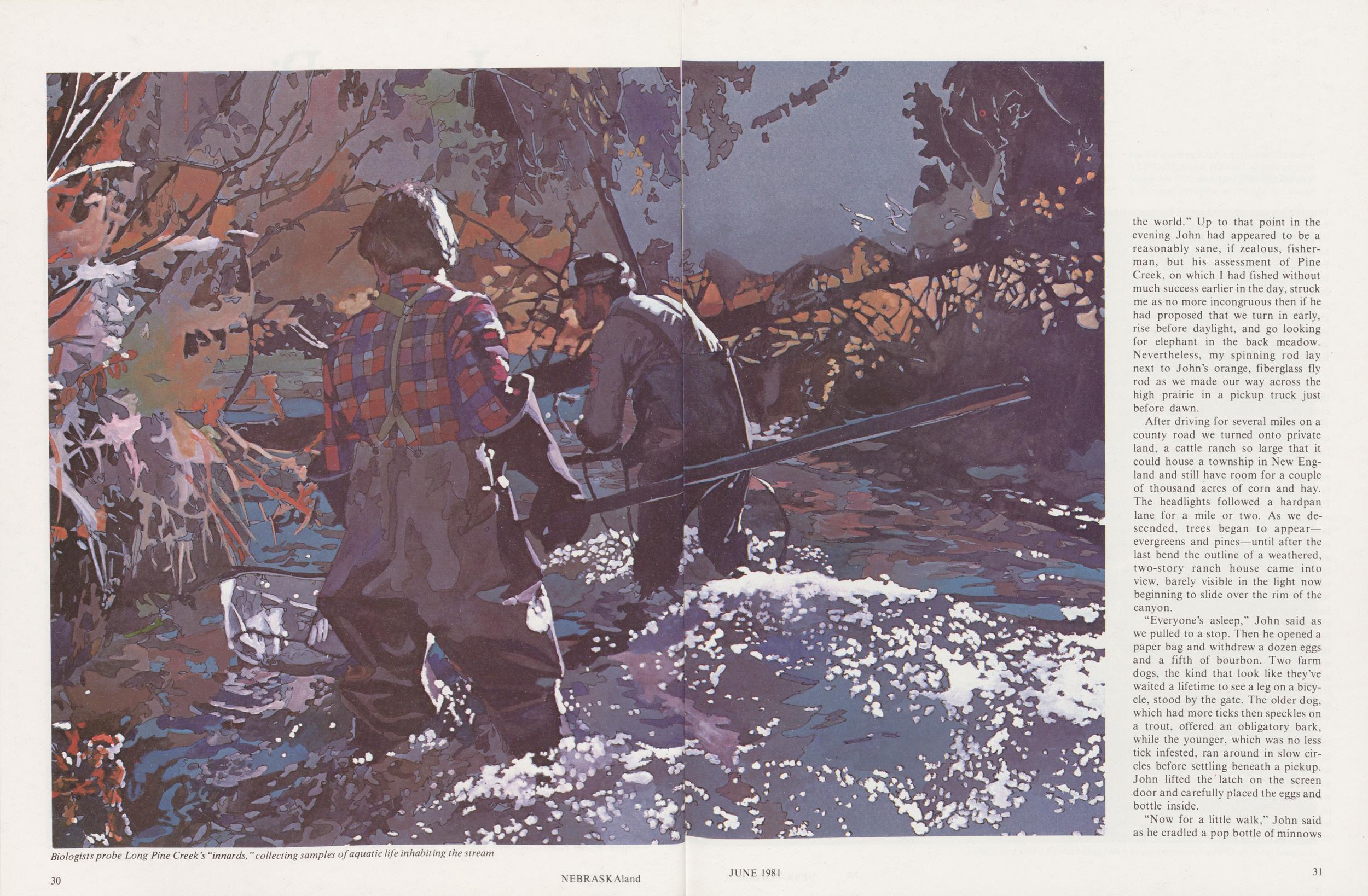
Terry Maret has fished Pine Creek and hunted the bluffs above it for turkey since he was a boy. He is a field biologist, collecting data on Pine Creek in much the same manner that a family physician listens through a stethoscope. Every month during the summer and every other month during winter, Terry monitors several sampling stations on Pine Creek and its principle tributaries, Bone Creek and Sand Draw. He measures water flow and temperature, and takes readings on oxygen, suspended solids (sand), aquatic invertebrates, nitrates, bacteria, and other, potentially harmful, chemicals.
Terry thinks Pine Creek is dying; not the dramatic death of a stroke or seizure—pollution caused by a petroleum spill or the dumping of chemical waste—but the slow death of "non-point" pollution caused by indiscriminant irrigation and grazing.
The data that Terry is collecting shows that while Pine Creek has the variety of insect life found in a mountain stream in Colorado, complete with mayflies, caddis flies, and stone flies, that life is significantly diminished in the last seven miles of Pine Creek following the absorption of Bone Creek, which serves as a depository for runoff from several center-pivot irrigation systems.
The water that is used for irrigation in the Pine Creek Basin is carried from Merritt Reservoir by the Ains-worth Irrigation Canal. Unfortunately, sometimes there is too much water, and without holding ponds and siltation dams, tons of sand, fertilizer and pesticide drain into Sand Draw and Bone Creek.
"You can stand at the confluence of Pine Creek and Bone Creek," says Maret, "and see the sand that Bone Creek brings with it; sand that widens the stream, removing the riffles and covering the gravel and bedrock that once were spawning areas for trout; sand and irrigation overflow that widen the channel, flattening the water, warming it and removing the oxygen; sand that scours the stream of bottom-dwelling insects which must cling to rocks and strain the water for food."
Trout prefer water at 65 degrees F and can tolerate 75 degrees. The temperature of the water below Bone Creek rises to the high 80's during the summer. Trout need 80 percent gravel or larger bottom stones to reproduce. Sand, however, covers gravel. Bone Creek becomes Pine Creek. There are no trout on the last seven miles of Pine Creek, a part of the stream that some people remember once offered exceptional trout fishing.
One man who remembers is John Kurtz, a former state park superintendent for the Game and Parks Commission, who retired in 1977 and returned to Long Pine to manage a covey of hunting and fishing cabins on Pine Creek. John Kurtz is not a biologist, but he can sketch Pine Creek from memory complete with holes and landmarks; something that he used to do during World War II when he was stationed at sea.
John Kurtz introduced me to Pine
Creek on an unusually cool July
morning. The night before, as we sat
before a fire in the lodge that serves as
a home and supply store, John
offered to take me fishing on "one of
the best stretches of trout stream in
JUNE 1981
29
After driving for several miles on a county road we turned onto private land, a cattle ranch so large that it could house a township in New England and still have room for a couple of thousand acres of corn and hay. The headlights followed a hardpan lane for a mile or two. As we descended, trees began to appearevergreens and pines—until after the last bend the outline of a weathered, two-story ranch house came into view, barely visible in the light now beginning to slide over the rim of the canyon.
"Everyone's asleep," John said as we pulled to a stop. Then he opened a paper bag and withdrew a dozen eggs and a fifth of bourbon. Two farm dogs, the kind that look like they've waited a lifetime to see a leg on a bicycle, stood by the gate. The older dog, which had more ticks then speckles on a trout, offered an obligatory bark, while the younger, which was no less tick infested, ran around in slow circles before settling beneath a pickup. John lifted the latch on the screen door and carefully placed the eggs and bottle inside.
"Now for a little walk," John said
as he cradled a pop bottle of minnows
JUNE 1981
31
 beneath his arm, then adjusted his cap
before lifting the rods from the bed
of the truck. There was plenty of light
now—enough to see the circles as bass
broke the surface of a large pond
behind the ranch house. "The people
here don't fish much for trout," John
said, "only when the browns run in
the spring. On hot summer nights
when the work is done, the men,
women and kids come out and worm
fish for bass."
beneath his arm, then adjusted his cap
before lifting the rods from the bed
of the truck. There was plenty of light
now—enough to see the circles as bass
broke the surface of a large pond
behind the ranch house. "The people
here don't fish much for trout," John
said, "only when the browns run in
the spring. On hot summer nights
when the work is done, the men,
women and kids come out and worm
fish for bass."
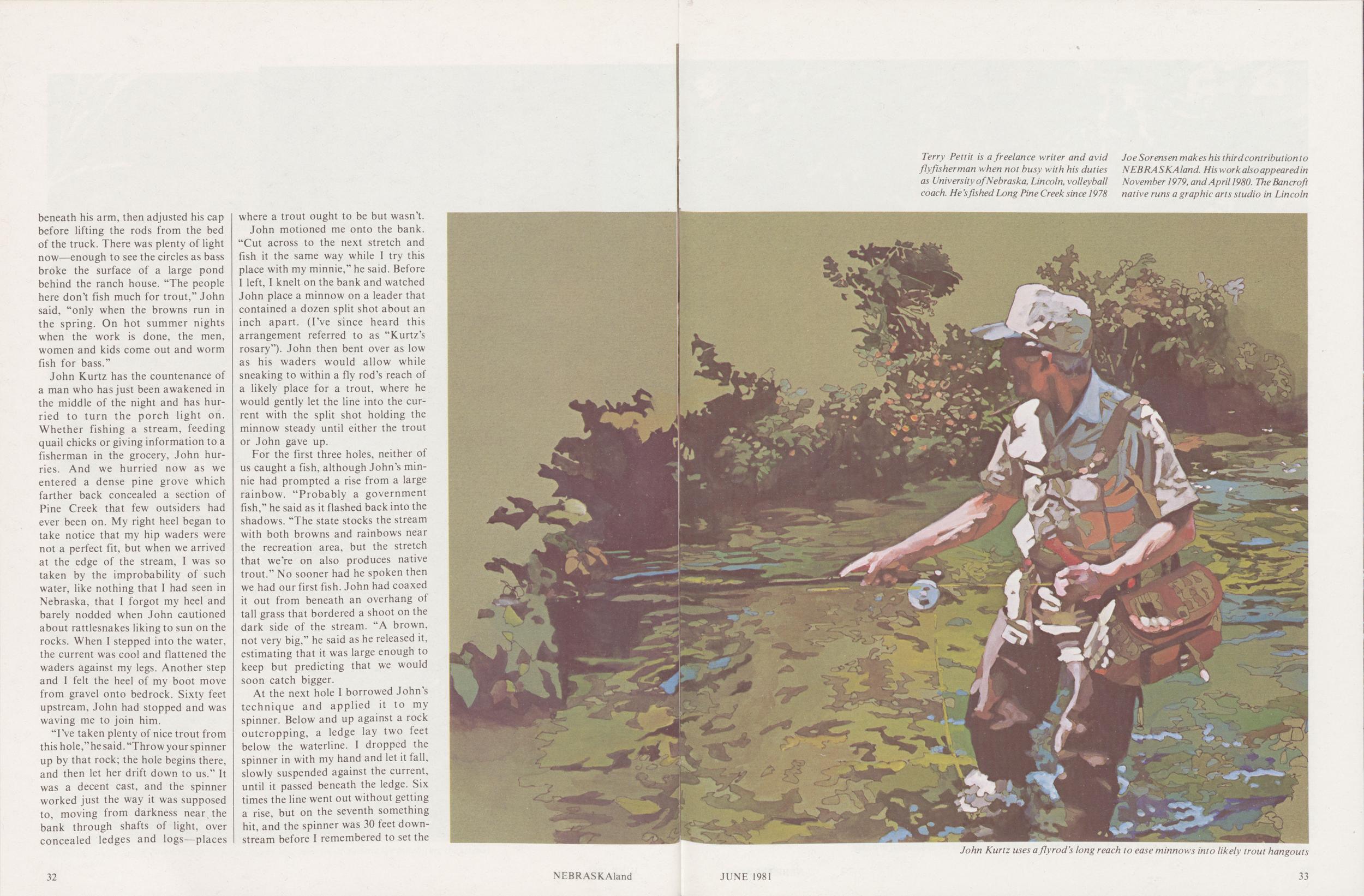
John Kurtz has the countenance of a man who has just been awakened in the middle of the night and has hurried to turn the porch light on. Whether fishing a stream, feeding quail chicks or giving information to a fisherman in the grocery, John hurries. And we hurried now as we entered a dense pine grove which farther back concealed a section of Pine Creek that few outsiders had ever been on. My right heel began to take notice that my hip waders were not a perfect fit, but when we arrived at the edge of the stream, I was so taken by the improbability of such water, like nothing that I had seen in Nebraska, that I forgot my heel and barely nodded when John cautioned about rattlesnakes liking to sun on the rocks. When I stepped into the water, the current was cool and flattened the waders against my legs. Another step and I felt the heel of my boot move from gravel onto bedrock. Sixty feet upstream, John had stopped and was waving me to join him.
"I've taken plenty of nice trout from this hole,"he said. "Throw your spinner up by that rock; the hole begins there, and then let her drift down to us." It was a decent cast, and the spinner worked just the way it was supposed to, moving from darkness near the bank through shafts of light, over concealed ledges and logs—places where a trout ought to be but wasn't.
John motioned me onto the bank. "Cut across to the next stretch and fish it the same way while I try this place with my minnie," he said. Before I left, I knelt on the bank and watched John place a minnow on a leader that contained a dozen split shot about an inch apart. (I've since heard this arrangement referred to as "Kurtz's rosary"). John then bent over as low as his waders would allow while sneaking to within a fly rod's reach of a likely place for a trout, where he would gently let the line into the current with the split shot holding the minnow steady until either the trout or John gave up.
For the first three holes, neither of us caught a fish, although John's minnie had prompted a rise from a large rainbow. "Probably a government fish," he said as it flashed back into the shadows. "The state stocks the stream with both browns and rainbows near the recreation area, but the stretch that we're on also produces native trout." No sooner had he spoken then we had our first fish. John had coaxed it out from beneath an overhang of tall grass that bordered a shoot on the dark side of the stream. "A brown, not very big," he said as he released it, estimating that it was large enough to keep but predicting that we would soon catch bigger.
At the next hole I borrowed John's technique and applied it to my spinner. Below and up against a rock outcropping, a ledge lay two feet below the waterline. I dropped the spinner in with my hand and let it fall, slowly suspended against the current, until it passed beneath the ledge. Six times the line went out without getting a rise, but on the seventh something hit, and the spinner was 30 feet downstream before I remembered to set the hook. Patience, I told myself as I urged the trout toward the gravel bar beside me. John netted the fish, then slipped his thumb beneath the throat. It was beautiful fish—a brown trout that John proclaimed a native.
32 NEBRASKAland Terry Pet tit is a freelance writer and avid flyfisherman when not busy with his duties as University of Nebraska, Lincoln, volleyball coach. He'sfished Long Pine Creek since 1978 Joe Sorensen makes his third contribution to NEBRA SKA land. His work also appeared in November 1979, and April 1980. The Bancroft native runs a graphic arts studio in Lincoln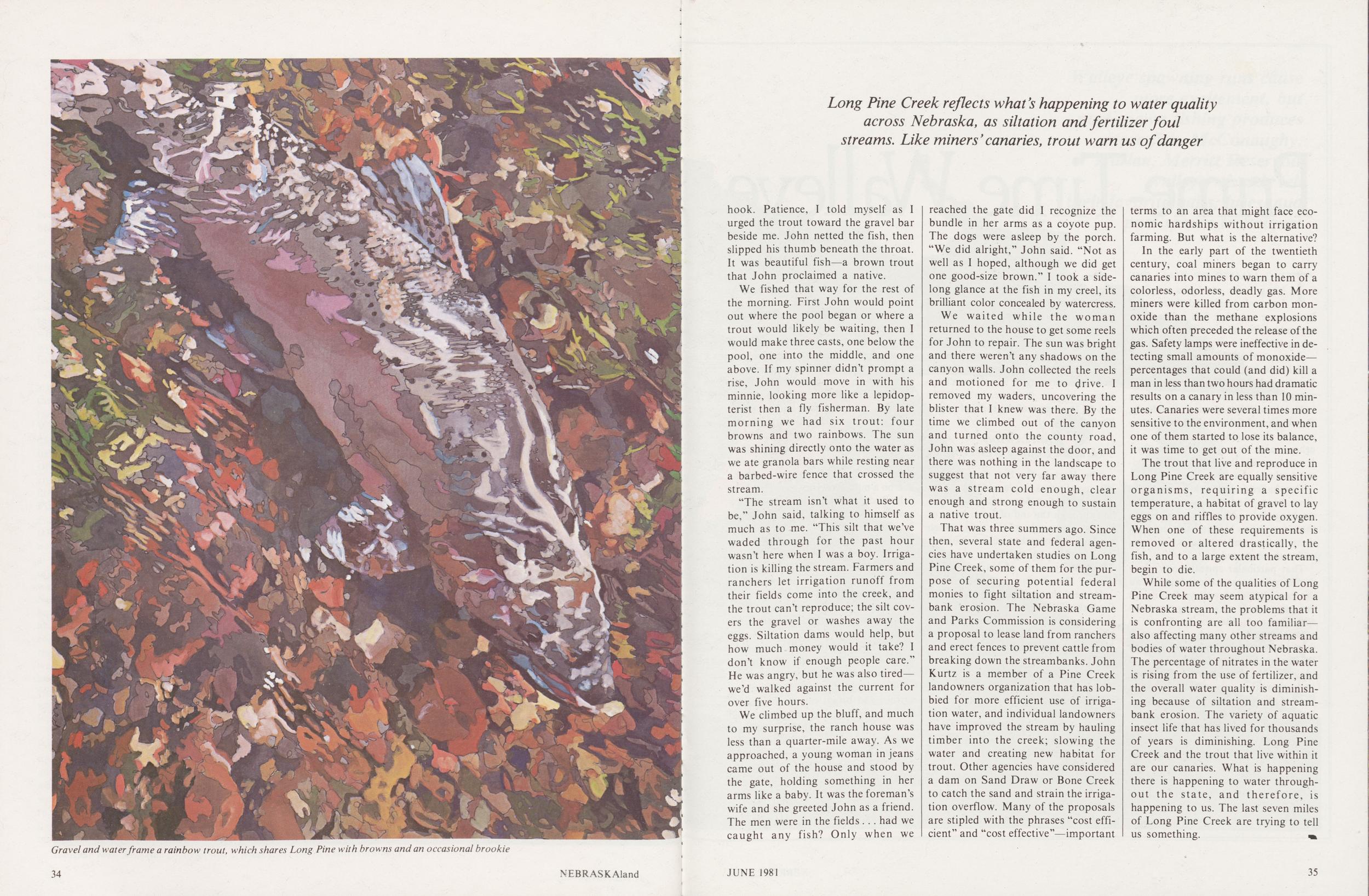
We fished that way for the rest of the morning. First John would point out where the pool began or where a trout would likely be waiting, then I would make three casts, one below the pool, one into the middle, and one above. If my spinner didn't prompt a rise, John would move in with his minnie, looking more like a lepidopterist then a fly fisherman. By late morning we had six trout: four browns and two rainbows. The sun was shining directly onto the water as we ate granola bars while resting near a barbed-wire fence that crossed the stream.
"The stream isn't what it used to be," John said, talking to himself as much as to me. "This silt that we've waded through for the past hour wasn't here when I was a boy. Irrigation is killing the stream. Farmers and ranchers let irrigation runoff from their fields come into the creek, and the trout can't reproduce; the silt covers the gravel or washes away the eggs. Siltation dams would help, but how much money would it take? I don't know if enough people care He was angry, but he was also tired—we'd walked against the current for over five hours.
We climbed up the bluff, and much to my surprise, the ranch house was less than a quarter-mile away. As we approached, a young woman in jeans came out of the house and stood by the gate, holding something in her arms like a baby. It was the foreman's wife and she greeted John as a friend. The men were in the fields had we caught any fish? Only when we reached the gate did I recognize the bundle in her arms as a coyote pup. The dogs were asleep by the porch. "We did alright," John said. "Not as well as I hoped, although we did get one good-size brown." I took a side-long glance at the fish in my creel, its brilliant color concealed by watercress.
We waited while the woman returned to the house to get some reels for John to repair. The sun was bright and there weren't any shadows on the canyon walls. John collected the reels and motioned for me to drive. I removed my waders, uncovering the blister that I knew was there. By the time we climbed out of the canyon and turned onto the county road, John was asleep against the door, and there was nothing in the landscape to suggest that not very far away there was a stream cold enough, clear enough and strong enough to sustain a native trout.
That was three summers ago. Since then, several state and federal agencies have undertaken studies on Long Pine Creek, some of them for the purpose of securing potential federal monies to fight siltation and stream-bank erosion. The Nebraska Game and Parks Commission is considering a proposal to lease land from ranchers and erect fences to prevent cattle from breaking down the streambanks. John Kurtz is a member of a Pine Creek landowners organization that has lobbied for more efficient use of irrigation water, and individual landowners have improved the stream by hauling timber into the creek; slowing the water and creating new habitat for trout. Other agencies have considered a dam on Sand Draw or Bone Creek to catch the sand and strain the irrigation overflow. Many of the proposals are stipled with the phrases "cost efficient" and "cost effective"—important terms to an area that might face economic hardships without irrigation farming. But what is the alternative?
In the early part of the twentieth century, coal miners began to carry canaries into mines to warn them of a colorless, odorless, deadly gas. More miners were killed from carbon monoxide than the methane explosions which often preceded the release of the gas. Safety lamps were ineffective in detecting small amounts of monoxide—percentages that could (and did) kill a man in less than two hours had dramatic results on a canary in less than 10 minutes. Canaries were several times more sensitive to the environment, and when one of them started to lose its balance, it was time to get out of the mine.
The trout that live and reproduce in Long Pine Creek are equally sensitive organisms, requiring a specific temperature, a habitat of gravel to lay eggs on and riffles to provide oxygen. When one of these requirements is removed or altered drastically, the fish, and to a large extent the stream, begin to die.
While some of the qualities of Long Pine Creek may seem atypical for a Nebraska stream, the problems that it is confronting are all too familiar—also affecting many other streams and bodies of water throughout Nebraska. The percentage of nitrates in the water is rising from the use of fertilizer, and the overall water quality is diminishing because of siltation and stream-bank erosion. The variety of aquatic insect life that has lived for thousands of years is diminishing. Long Pine Creek and the trout that live within it are our canaries. What is happening there is happening to water throughout the state, and therefore, is happening to us. The last seven miles of Long Pine Creek are trying to tell us something.
JUNE 1981 35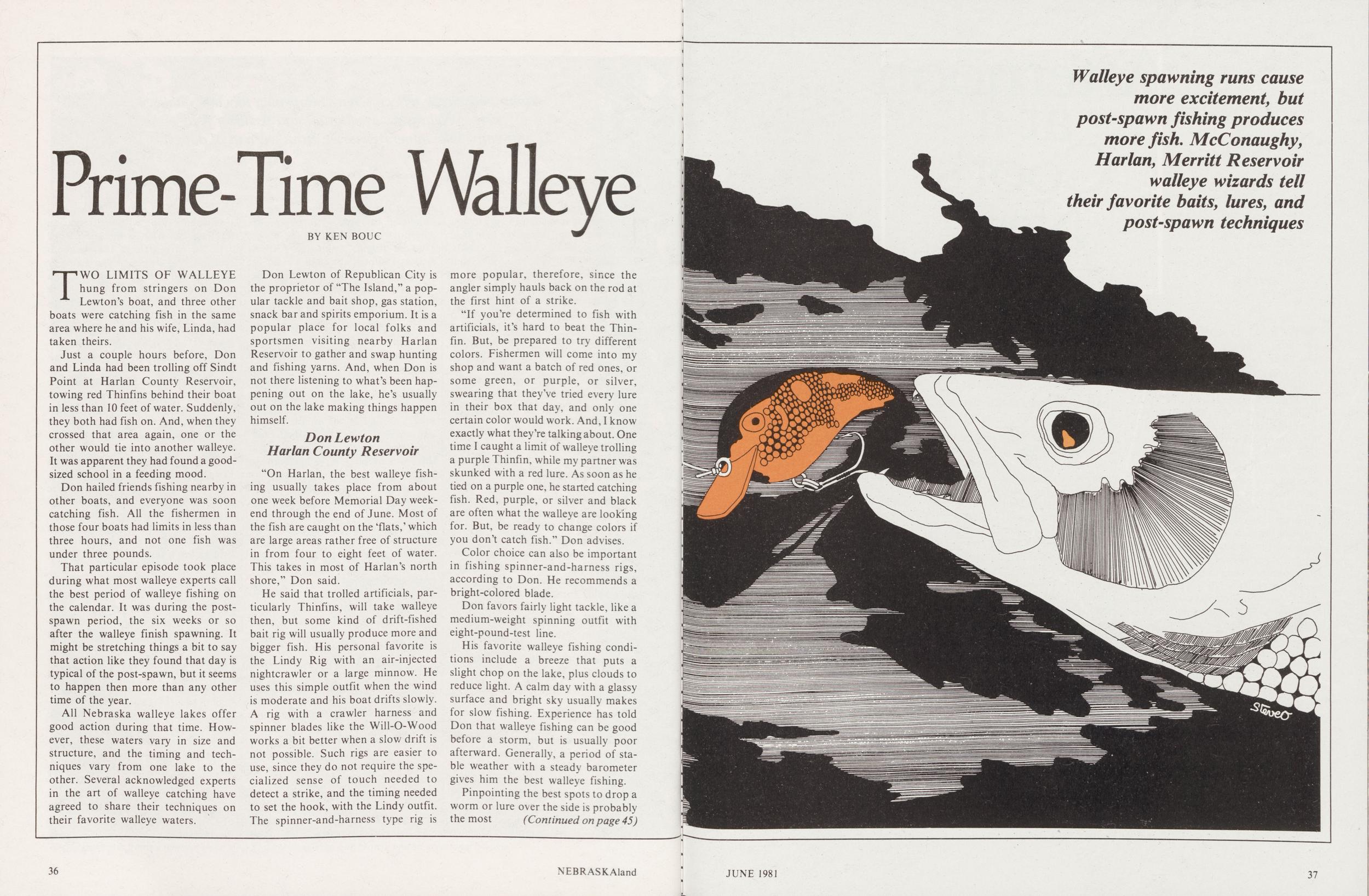
Prime-Time Walleye
BY KEN BOUCTWO LIMITS OF WALLEYE hung from stringers on Don Lewton's boat, and three other boats were catching fish in the same area where he and his wife, Linda, had taken theirs.
Just a couple hours before, Don and Linda had been trolling off Sindt Point at Harlan County Reservoir, towing red Thinfins behind their boat in less than 10 feet of water. Suddenly, they both had fish on. And, when they crossed that area again, one or the other would tie into another walleye. It was apparent they had found a good-sized school in a feeding mood.
Don hailed friends fishing nearby in other boats, and everyone was soon catching fish. All the fishermen in those four boats had limits in less than three hours, and not one fish was under three pounds.
That particular episode took place during what most walleye experts call the best period of walleye fishing on the calendar. It was during the post-spawn period, the six weeks or so after the walleye finish spawning. It might be stretching things a bit to say that action like they found that day is typical of the post-spawn, but it seems to happen then more than any other time of the year.
All Nebraska walleye lakes offer good action during that time. However, these waters vary in size and structure, and the timing and techniques vary from one lake to the other. Several acknowledged experts in the art of walleye catching have agreed to share their techniques on their favorite walleye waters.
Don Lewton of Republican City is the proprietor of "The Island," a popular tackle and bait shop, gas station, snack bar and spirits emporium. It is a popular place for local folks and sportsmen visiting nearby Harlan Reservoir to gather and swap hunting and fishing yarns. And, when Don is not there listening to what's been happening out on the lake, he's usually out on the lake making things happen himself.
Don Lewton Harlan County Reservoir"On Harlan, the best walleye fishing usually takes place from about one week before Memorial Day weekend through the end of June. Most of the fish are caught on the 'flats,' which are large areas rather free of structure in from four to eight feet of water. This takes in most of Harlan's north shore," Don said.
He said that trolled artificials, particularly Thinfins, will take walleye then, but some kind of drift-fished bait rig will usually produce more and bigger fish. His personal favorite is the Lindy Rig with an air-injected nightcrawler or a large minnow. He uses this simple outfit when the wind is moderate and his boat drifts slowly. A rig with a crawler harness and spinner blades like the Will-O-Wood works a bit better when a slow drift is not possible. Such rigs are easier to use, since they do not require the specialized sense of touch needed to detect a strike, and the timing needed to set the hook, with the Lindy outfit. The spinner-and-harness type rig is more popular, therefore, since the angler simply hauls back on the rod at the first hint of a strike.
"If you're determined to fish with artificials, it's hard to beat the Thinfin. But, be prepared to try different colors. Fishermen will come into my shop and want a batch of red ones, or some green, or purple, or silver, swearing that they've tried every lure in their box that day, and only one certain color would work. And, I know exactly what they're talking about. One time I caught a limit of walleye trolling a purple Thinfin, while my partner was skunked with a red lure. As soon as he tied on a purple one, he started catching fish. Red, purple, or silver and black are often what the walleye are looking for. But, be ready to change colors if you don't catch fish." Don advises.
Color choice can also be important in fishing spinner-and-harness rigs, according to Don. He recommends a bright-colored blade.
Don favors fairly light tackle, like a medium-weight spinning outfit with eight-pound-test line.
His favorite walleye fishing conditions include a breeze that puts a slight chop on the lake, plus clouds to reduce light. A calm day with a glassy surface and bright sky usually makes for slow fishing. Experience has told Don that walleye fishing can be good before a storm, but is usually poor afterward. Generally, a period of stable weather with a steady barometer gives him the best walleye fishing. Pinpointing the best spots to drop a worm or lure over the side is probably the most (Continued on page 45)
36 NEBRASKAland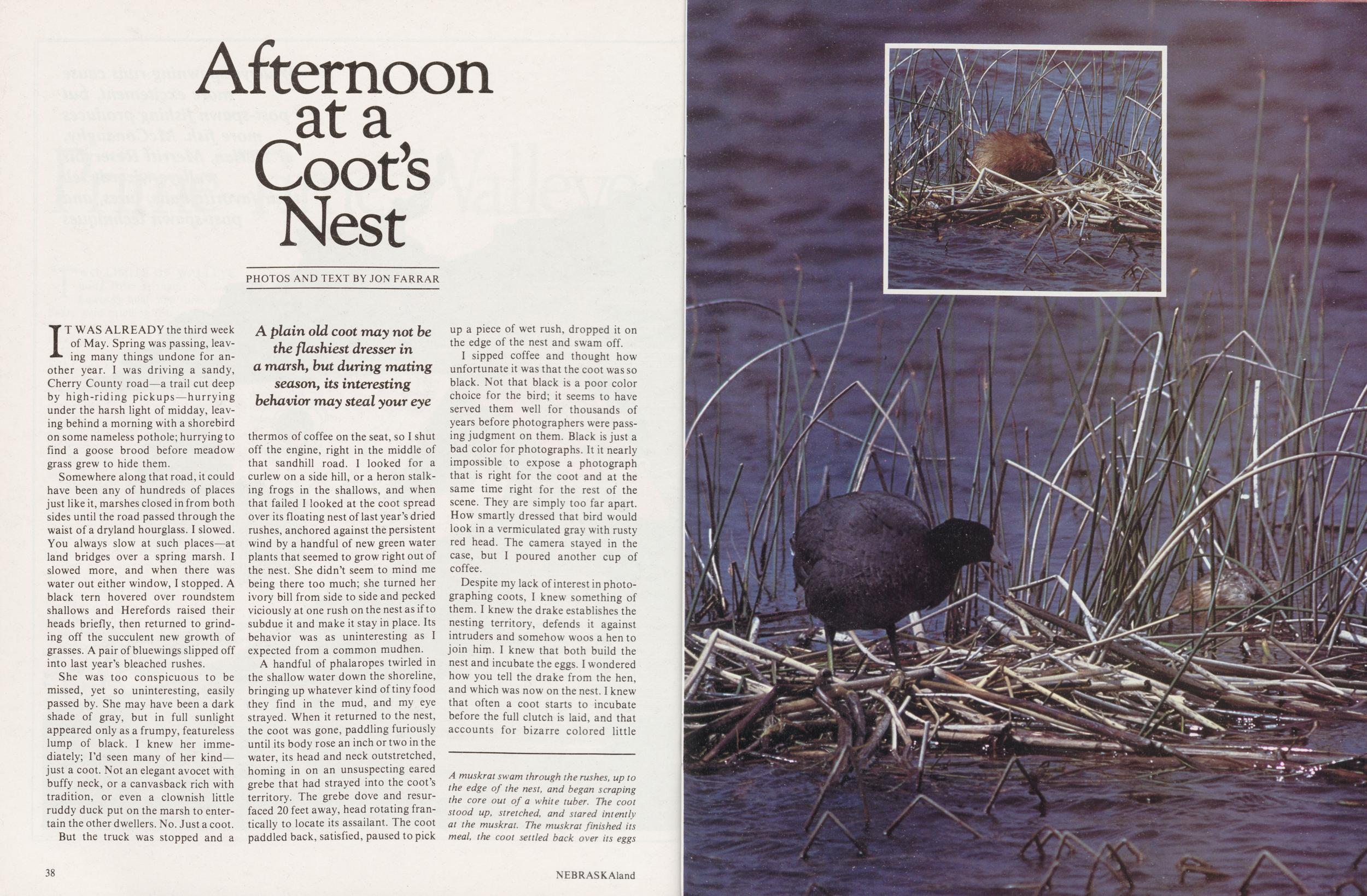
Afternoon at a Coot's Nest
PHOTOS AND TEXT BY JON FARRAR A plain old coot may not be the flashiest dresser in a marsh, but during mating season, its interesting behavior may steal your eyeIT WAS ALREADY the third week of May. Spring was passing, leaving many things undone for another year. I was driving a sandy, Cherry County road—a trail cut deep by high-riding pickups—hurrying under the harsh light of midday, leaving behind a morning with a shorebird on some nameless pothole; hurrying to find a goose brood before meadow grass grew to hide them.
Somewhere along that road, it could have been any of hundreds of places just like it, marshes closed in from both sides until the road passed through the waist of a dryland hourglass. I slowed. You always slow at such places—at land bridges over a spring marsh. I slowed more, and when there was water out either window, I stopped. A black tern hovered over roundstem shallows and Herefords raised their heads briefly, then returned to grinding off the succulent new growth of grasses. A pair of bluewings slipped off into last year's bleached rushes.
She was too conspicuous to be missed, yet so uninteresting, easily passed by. She may have been a dark shade of gray, but in full sunlight appeared only as a frumpy, featureless lump of black. I knew her immediately; I'd seen many of her kind—just a coot. Not an elegant avocet with buffy neck, or a canvasback rich with tradition, or even a clownish little ruddy duck put on the marsh to entertain the other dwellers. No. Just a coot.
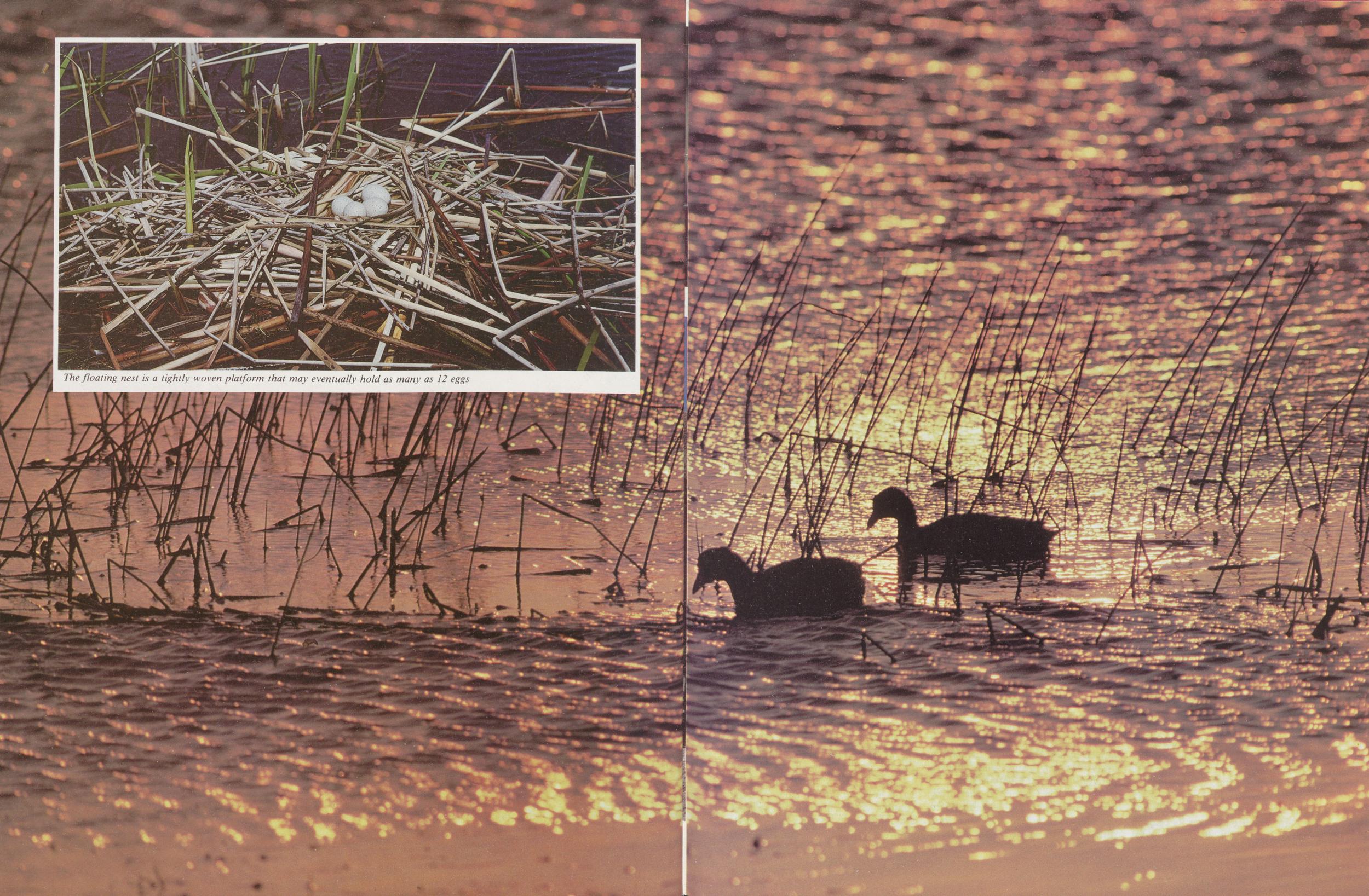
But the truck was stopped and a thermos of coffee on the seat, so I shut off the engine, right in the middle of that sandhill road. I looked for a curlew on a side hill, or a heron stalking frogs in the shallows, and when that failed I looked at the coot spread over its floating nest of last year's dried rushes, anchored against the persistent wind by a handful of new green water plants that seemed to grow right out of the nest. She didn't seem to mind me being there too much; she turned her ivory bill from side to side and pecked viciously at one rush on the nest as if to subdue it and make it stay in place. Its behavior was as uninteresting as I expected from a common mudhen.
A handful of phalaropes twirled in the shallow water down the shoreline, bringing up whatever kind of tiny food they find in the mud, and my eye strayed. When it returned to the nest, the coot was gone, paddling furiously until its body rose an inch or two in the water, its head and neck outstretched, homing in on an unsuspecting eared grebe that had strayed into the coot's territory. The grebe dove and resurfaced 20 feet away, head rotating frantically to locate its assailant. The coot paddled back, satisfied, paused to pick up a piece of wet rush, dropped it on the edge of the nest and swam off.
I sipped coffee and thought how unfortunate it was that the coot was so black. Not that black is a poor color choice for the bird; it seems to have served them well for thousands of years before photographers were passing judgment on them. Black is just a bad color for photographs. It it nearly impossible to expose a photograph that is right for the coot and at the same time right for the rest of the scene. They are simply too far apart. How smartly dressed that bird would look in a vermiculated gray with rusty-red head. The camera stayed in the case, but I poured another cup of coffee.
Despite my lack of interest in photographing coots, I knew something of them. I knew the drake establishes the nesting territory, defends it against intruders and somehow woos a hen to join him. I knew that both build the nest and incubate the eggs. I wondered how you tell the drake from the hen, and which was now on the nest. I knew that often a coot starts to incubate before the full clutch is laid, and that accounts for bizarre colored little 38 NEBRASKAland
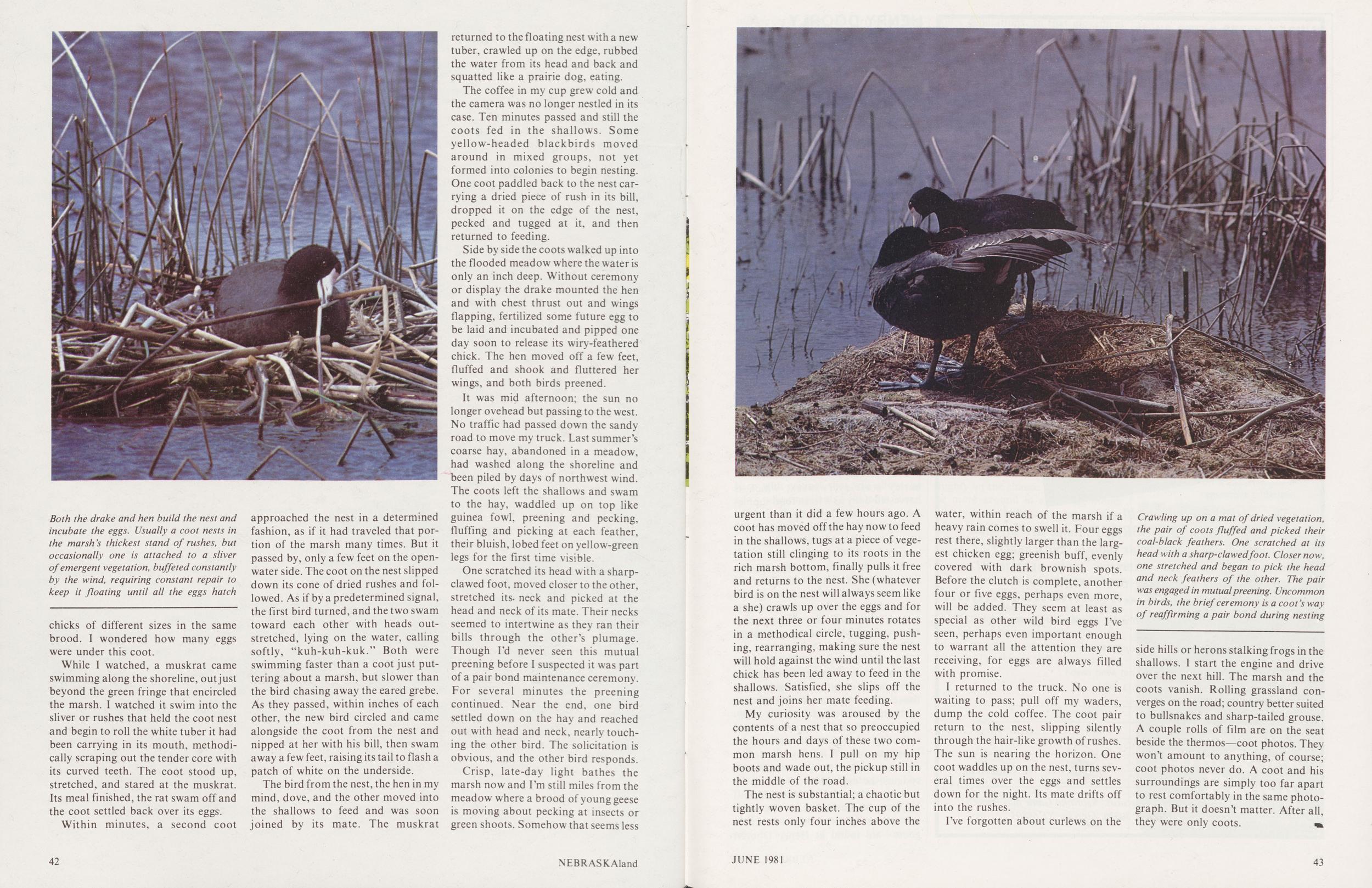
While I watched, a muskrat came swimming along the shoreline, out just beyond the green fringe that encircled the marsh. I watched it swim into the sliver or rushes that held the coot nest and begin to roll the white tuber it had been carrying in its mouth, methodically scraping out the tender core with its curved teeth. The coot stood up, stretched, and stared at the muskrat. Its meal finished, the rat swam off and the coot settled back over its eggs.
Within minutes, a second coot approached the nest in a determined fashion, as if it had traveled that portion of the marsh many times. But it passed by, only a few feet on the open-water side. The coot on the nest slipped down its cone of dried rushes and followed. As if by a predetermined signal, the first bird turned, and the two swam toward each other with heads out-stretched, lying on the water, calling softly, "kuh-kuh-kuk." Both were swimming faster than a coot just puttering about a marsh, but slower than the bird chasing away the eared grebe. As they passed, within inches of each other, the new bird circled and came alongside the coot from the nest and nipped at her with his bill, then swam away a few feet, raising its tail to flash a patch of white on the underside.
The bird from the nest, the hen in my mind, dove, and the other moved into the shallows to feed and was soon joined by its mate. The muskrat returned to the floating nest with a new tuber, crawled up on the edge, rubbed the water from its head and back and squatted like a prairie dog, eating.
The coffee in my cup grew cold and the camera was no longer nestled in its case. Ten minutes passed and still the coots fed in the shallows. Some yellow-headed blackbirds moved around in mixed groups, not yet formed into colonies to begin nesting. One coot paddled back to the nest carrying a dried piece of rush in its bill, dropped it on the edge of the nest, pecked and tugged at it, and then returned to feeding.
Side by side the coots walked up into the flooded meadow where the water is only an inch deep. Without ceremony or display the drake mounted the hen and with chest thrust out and wings flapping, fertilized some future egg to be laid and incubated and pipped one day soon to release its wiry-feathered chick. The hen moved off a few feet, fluffed and shook and fluttered her wings, and both birds preened.
It was mid afternoon; the sun no longer ovehead but passing to the west. No traffic had passed down the sandy road to move my truck. Last summer's coarse hay, abandoned in a meadow, had washed along the shoreline and been piled by days of northwest wind. The coots left the shallows and swam to the hay, waddled up on top like guinea fowl, preening and pecking, fluffing and picking at each feather, their bluish, lobed feet on yellow-green legs for the first time visible.
One scratched its head with a sharp-clawed foot, moved closer to the other, stretched its. neck and picked at the head and neck of its mate. Their necks seemed to intertwine as they ran their bills through the other's plumage. Though I'd never seen this mutual preening before I suspected it was part of a pair bond maintenance ceremony. For several minutes the preening continued. Near the end, one bird settled down on the hay and reached out with head and neck, nearly touching the other bird. The solicitation is obvious, and the other bird responds.
Crisp, late-day light bathes the marsh now and I'm still miles from the meadow where a brood of young geese is moving about pecking at insects or green shoots. Somehow that seems less 42 NEBRASKAland
My curiosity was aroused by the contents of a nest that so preoccupied the hours and days of these two common marsh hens. I pull on my hip boots and wade out, the pickup still in the middle of the road.
The nest is substantial; a chaotic but tightly woven basket. The cup of the nest rests only four inches above the water, within reach of the marsh if a heavy rain comes to swell it. Four eggs rest there, slightly larger than the largest chicken egg; greenish buff, evenly covered with dark brownish spots. Before the clutch is complete, another four or five eggs, perhaps even more, will be added. They seem at least as special as other wild bird eggs I've seen, perhaps even important enough to warrant all the attention they are receiving, for eggs are always filled with promise.
I returned to the truck. No one is waiting to pass; pull off my waders, dump the cold coffee. The coot pair return to the nest, slipping silently through the hair-like growth of rushes. The sun is nearing the horizon. One coot waddles up on the nest, turns several times over the eggs and settles down for the night. Its mate drifts off into the rushes.
I've forgotten about curlews on the side hills or herons stalking frogs in the shallows. I start the engine and drive over the next hill. The marsh and the coots vanish. Rolling grassland converges on the road; country better suited to bullsnakes and sharp-tailed grouse. A couple rolls of film are on the seat beside the thermos—coot photos. They won't amount to anything, of course; coot photos never do. A coot and his surroundings are simply too far apart to rest comfortably in the same photograph. But it doesn't matter. After all, they were only coots.
JUNE 1981 43
square-lipped rhinoceroses sun and roll in the dust once stirred up by the cleats of sliding base runners.
The mini-train installed in 1956 was replaced in 1968 with an authentic yg-scale steam engine and four cars with a 160-passenger capacity. This narrow-gauge train operates around the north and east sections of the zoo on a 2/2-mile track. A second engine, built in Austria in 1890, was donated to the zoo in 1974.
In 1972, the Ak-Sar-Ben waterfall, which recycles 650 gallons of water a minute, was added. Reveling in its spray on the pool below are swans, ducks and other waterfowl; darting under the glassy surface are thousands of koi, Japanese imperial carp.
In 1973, "Flamingo Valleyv was completed as an extension of the lagoon that hosts not only the lanky-legged pink birds, but other waders and shore-dwellers as well.
A modern diet kitchen, replacing one remodeled from an old monkey house built in 1937 by the W.P.A., was made possible in 1974 by another donation from Ak-Sar-Ben. A hydroponic unit grows 2,800 pounds of barley grass every week, which is harvested daily as a fresh food supplement for nearly all the zoo's animals. Every individual resident at Henry Doorly has a nutritionally balanced diet to keep it in good health. For the last three years, barns and large paddocks have been built for the zoo's hoofed stock, including the gaur, addax, sable antelope, scimitar-horned oryx and Lady Grey's water-buck—all of which adapt well to the Midwest's climate.
For the most part, Wisthoff says, the zoo's collection has been geared, along with endangered species, to those that can handle Nebraska's blistering summers and blustery winters. It makes a lot more sense than collecting a lot of exotics that require expensive indoor heating and other accommodations to maintain delicate systems, he explains.
Only a handful of animals still native to Nebraska today—the sandhill crane, prairie dog and snow goose—are found at Henry Doorly, 44 NEBRASKAland but several that once roamed this area, like the otter and mountain lion, are included. It's surprising to many visitors, Wisthoff says, how many places with very different terrain on the other side of the world, have climates very similar to ours. And, the animals that call those places home find Omaha's Zoo a very comfortable home away from home.
Still, provisions are made to ensure their health. Shelters, like the hoofed-stock sheds, are available for escape from windy and wet weather for all the animals that are outdoors year-round. Shade screens, sprinklers and mud-baths are provided in the heat of the summer, often offering not only relief for the animals, but entertainment for visitors as well.
The latest addition to Henry Doorly was the nursery/hospital in 1979. There, special care and incubators are provided for zoo babies whose mothers are unable or unwilling to raise them. Radio telemetry instruments allow zoo staff to check the temperatures of animals momentarily to monitor their health. Surgery facilities and recuperating pens are available for emergencies, although Simmons would someday like to see those included in a larger building, separate from the nursery.
Nearing completion now is a giraffe barn with ceilings that will allow the zoo's tallest residents a lot more "head room." With Mandera, the zoo's female giraffe, expected to deliver this spring, the new foursome will also need more "elbow room." The new complex also includes more stockpens for the increasing hoofed animal collection, and a skylighted aviary for tropical birds.
Henry Doorly Zoo has grown rapidly in the last decade. Some 45 full-time staff members are assisted by more than 60 part-timers from April 1 to October 31, when the zoo is open to the public. Volunteer zoo docents provide guided tours for schools and other groups. A preceptor program trains senior veterinary students with on-the-grounds animal work.
But the zoo's biggest area of growth, as with most ail zoos in the world today, is in philosophy. The "stamp collector" syndrome has all but vanished, as Simmons and his staff strive to preserve the endangered wildlife species of today for tomorrow's generations. In that movement toward a more scientific approach to zoological park management, Henry Doorly also provides Nebraskans and visitors with a much more meaningful educational and recreational experience.
"Even with all our modern and scientific breeding efforts," Simmons warns, however, "many animals will be lost forever if we don't do something about the alarming rate of habitat destruction in the world today. It's estimated that by the year 2000, one plant or animal species per day will join the dinosaur."
Perhaps in seeing and learning about the many beautiful animals that once flourished on earth, he suggests, more people will realize how very important it is to stop the increasing losses of habitat that wild animals depend on for their very lives.
PRIME-TIME WALLEYE (Continued from page 36)difficult part of walleye fishing. "All of the local people have their own favorite spots, but visiting fishermen can best find action by trolling at random along the north shore's flats. When a fish is caught, it's a good idea to work the immediate area thoroughly on the chance that there might be more around in a feeding mood. It's even possible to catch walleye when fishing from shore. Our family has taken limits stillfishing from the bank with nightcrawlers and slip-sinkers," Don said.
In summing up his ideas on fishing Harlan's walleye during the post-spawn, Don stressed the value of flexibility. "Don't start with one lure or one kind of bait and stick with it for hours on end if you're not catching walleye. Try this or that or something else until you start catching them. When you find the right combination of bait or lure, technique and location, then's the time to stick with it," he advised.
 THE POST
PLAYHOUSE
FORT ROBINSON STATE PARK
CRAWFORD, NEBRASKA
The
Post
Playhouse
Company
presents the
1981 Season
"VIRTUE IS IT'S OWN REWARD
OR ALL THAT GLITTERS
MAY BE GOLD"
May 29, 31;
June 3, 5, 7,9, 11, 17,29;
July 4, 10, 16, 22, 28;
August 3, 9, 15,21, 27.
"CURSE YOU JACK DALTON!"
May 30;
June 1, 4, 6, 8, 10, 16, 22, 28;
July 5, 11, 17,23,29;
August 4, 10, 16, 22, 28.
"SAVING GRACE"
June 13, 14, 15;
July 1, 2, 3, 19, 20, 21;
August 6, 7, 8, 24, 25, 26.
"PLAZA SUITE"
June 19, 20, 21;
July 7, 8, 9, 25, 26, 27;
August 12, 13, 14, 29, 30, 31.
"THE GUARDSMAN"
June 25, 26, 27;
July 13, 14, 15, 31;
August 1, 2, 18, 19, 20.
Post Playhouse
Ticket Office Hours:
May 16-29
10 a.m.-5 p.m.
May 29-Aug. 31
10 a.m. to 9 p.m. show nights
Bob Propst
Lake McConaughy
THE POST
PLAYHOUSE
FORT ROBINSON STATE PARK
CRAWFORD, NEBRASKA
The
Post
Playhouse
Company
presents the
1981 Season
"VIRTUE IS IT'S OWN REWARD
OR ALL THAT GLITTERS
MAY BE GOLD"
May 29, 31;
June 3, 5, 7,9, 11, 17,29;
July 4, 10, 16, 22, 28;
August 3, 9, 15,21, 27.
"CURSE YOU JACK DALTON!"
May 30;
June 1, 4, 6, 8, 10, 16, 22, 28;
July 5, 11, 17,23,29;
August 4, 10, 16, 22, 28.
"SAVING GRACE"
June 13, 14, 15;
July 1, 2, 3, 19, 20, 21;
August 6, 7, 8, 24, 25, 26.
"PLAZA SUITE"
June 19, 20, 21;
July 7, 8, 9, 25, 26, 27;
August 12, 13, 14, 29, 30, 31.
"THE GUARDSMAN"
June 25, 26, 27;
July 13, 14, 15, 31;
August 1, 2, 18, 19, 20.
Post Playhouse
Ticket Office Hours:
May 16-29
10 a.m.-5 p.m.
May 29-Aug. 31
10 a.m. to 9 p.m. show nights
Bob Propst
Lake McConaughy
Bob Propst has been a fishing guide since the late 1950's when he worked at resorts in Minnesota. Since then, he's guided at Harlan County Reservoir and Lake McConaughy, where he now makes his home. In recent years, he has also become a professional tournament fisherman, entering and scoring well in big walleye tournaments in the northern U.S.
"After the walleye spawn, we usually have some of the best fishing of the year. The fish go on a feeding binge, and you can find them in eight to 15 feet of water in bays near the dam. For the first three weeks after the spawn, they seem to be concentrated in Martin and Arthur bays, then they move toward the upper end of the lake," Bob said.
He noted that fishing at Big Mac last year was well below par because the lake was full for the first time in seven years, and because its populations of predator and forage fish were out of balance. The high water changed patterns that the fish customarily follow, and they seemed reluctant to feed or take lures.
He predicted a return to good fishing soon, however, because the willows flooded by the high water last year provided excellent habitat for young white bass and walleye.
Bob uses a Lindy Rig, except that he ties his own leaders several times longer than those sold in tackle shops. His leaders measure at least eight feet, thus reducing the chances of a nervous walleye being spooked away from the bait by movement of the rig's weight. He feels that blowing air into the crawler has little to do with fish appeal, but does influence how far off the bottom the worm travels. On lakes with a muck or weedy bottom, a shot of air might keep the bait out of the mess and more visible to fish.
"I've found minnows and crawlers equally effective. I like big minnows, but if I can't find them, I use two small ones hooked through the lips. When I feel a pickup, I usually let the fish have the bait for about 10- seconds before I set the hook, but when using the two small minnows, I hit the fish right away.
"Speed is important with this rig-you have to go dead slow. If the wind drifts you too fast, or if your boat will not troll slowlv, then switch to a crawler harness with several hooks. With this rig, you strike as soon as you feel a fish. Through May and into June, the fish will gradually move into deeper water, but it seems that the best feeding activity is usually in about 15 feet of water," Bob said.
In addition to the bait-trolling techniques common among walleye fishermen, Bob employs another that seems to go contrary to the dead-slow presentation that is so traditional in walleye lore. Bob uses a speed-trolling technique in which he buzzes an artificial along behind his boat just as fast as the lure will allow.
"I use what bass fishermen call 'crankbaits' or Tat' plugs; things like the Fat Albert, Big O, Big Jim, or Wiggle Wart. These are chunky little plugs with big lips up front that make them run deep and give them plenty of action.
"I troll them real fast; faster than you'd troll for trout. I want my speed just below the point where the lure can't handle it any more and turns belly up or starts turning over or spinning. I always test my lure alongside the boat for a spell to see if it can handle the speed I'm going, and to see if a bent eye or diving lip might make it run cockeyed.
"I troll like this in 15 feet of water or less. It's best if the lure runs near the bottom, but it doesn't hurt if it's off the bottom some of the time. Walleye like the bottom, but they'll also suspend and take lures well away from the floor of the lake," Bob said.
He noted that the speed-trolling technique works throughout the year, not just during post-spawn fishing. He also said that he uses it both day and night, with a change of lure color and slightly shallower water the only differences.
"I don't like the 'naturalized' paint jobs that have been offered the past few years. I do best with traditional finishes, mostly the shad-colored silver and black jobs. At night, I go to brighter colors like red," he said.
46 NEBRASKAland BRIISKMANSI SMOKE 'N GRILL CHARCOAL/WATER SMOKERS Makes every user a gourmet cook. Use water ( or marinades ) with charcoal. Vapor does the cooking. Moisture released from the food drips into pan and is regenerated as basting steam. Minimizes shrinkage, tenderizes and moisturizes the food. Use flavor wood chips to produce various smoked flavors. Smokes, steams or barbeques game, poultry, meats, fish, vegetables. Recipe book included. ( #N-061-SGA ) Capacity up to 25 lbs. ( Shpg. wt. 22 lbs. ) Reg. $44.88 $39.88 SMOKE ( #N-061-SGB ) Capacity up to 50 lbs. ( Shpg. wt. 28 lbs. ) Reg. $53.95 $47.50 ( #N-061-SGC ) Capacity up to 50 lbs. ( Shpg. wt. 28 lbs. ) Equipped with inspection door. Reg. $57.88 $49.99 MAIL ORDER CUSTOMERS, PLEASE READ NEBRASKA CUSTOMERS MUST INCLUDE SALES TAX 30% DEPOSIT REQUIRED ON C.C.D. ORDERS INCLUDE ENOUGH MONEY TO COVER SHIPPING COSTS and INSURANCE ( We Refund All Remittances Promptly ) VISA and MASTERCHARGE CREDIT CARD ORDERS ACCEPTED ( When Accompanied With Signature and Required Information ) RETAIL STORE ADDRESS: 1000 West "0" St. OUR TELEPHONE: ( 402 ) 435-4366 Folding Suitcase Table with Seats ( #N-061-SFT ) Model 600 "STANDARD" ( #N-061-DFT ) Model 650 "DELUXE" $55.95 $65.88 Open the 33" x 15" x 4" suitcase and it becomes a table with 4 seats to use at home, camping, picnics, etc. Very rugged, no tools required, no loose parts. Kids can operate it. Table top 33" x 29". Heavy gauge steel frame. Standard model has plain table top, enamelled trim. Deluxe model has antique gold patterned finish, gold baked enamel trim. ( 35 lbs. ) TACSO "Zip-Focus" Binocular Specials "Zip-Focus" feature gives you fast, one-finger focusing to help you see it all — fast! Both models shown below have precision, full coated optics, BK-7 parro prisms, fold-down rubber eyecups, center ( Zip ) focusing. Furnished with case and straps. 7 x 35 EUROPEAN STYLE $29.95 ( #N061-TB35 ) 7-power, 35mm objectives, field of view 346 ft. at 1000 yds. ( 3 lbs. ) 7 x 50 EUROPEAN STYLE Reg. $44.88 $39.95 ( #N-061-TB50 ) 7-power, 50mm objectives, field of view 367 ft. at 1000 yds. ( 4 lbs. ) Lensatic Compass #N-061-LC ( 4 oz. ) $4.88 Luminous Quadrants Folding Type 17-Foot "All-Aluminum Canoe COMPARE FEATURES - COMPARE PRICE F.O.B. Lincoln $349.00 ( #N-061-OAC ) OSAGIAN 17-foot canoe features all-aluminum construction and offers a 10-year limited warranty against structural defects in materials and workmanship. Heat treated aluminum skin has 6061-T6 temper that will withstand impacts to 42,000 lbs. before puncturing. A high performance canoe that also features slip-resistant painted interior, foam filled chambers, 2-seats, ribbed bottom, heliarc welded bottom with V-shaped keel. Length 17 ft., beam 36", depth 14", weight capacity 780 lbs. Rated for 5 H.P. outboard ( max. ). Net wt. 80 lbs. DMC Trail Shoes $24.88 ( #N-061-CTS ) Moulded, elected soles and heels give sure-footed tread for hikers, back-packers, etc. Breathable, padded canvas uppers reinforced with suede leather at counter, toes and lace-up bindings. Padded at ankles. Soles and heels are vulcanized to the uppers. Sizes 5 thru 13 in D width. ( 3 lbs. ) STEARNS Ski Vest Yellow Color, Red Trim $26.88 ( #N-061-SSV-260 ) Adult Sizes ( #N-061-SSV-262 ) on Youth Size • STEARNS "PRO" vinyl ski vest with Aquafoarrf flotation, dual heavy duty belts, non-corrosive Delrin buckles. Designed for maximum freedom of movement and comfort. Adult sizes: S, M, L. ( 6 lbs. ) Hiker's Pedometer ( #N-061-PED ) Clips to belt or clothes. Adjustment for stride. 25-mile range. Easy to reset. ( 4 oz. ) $12.98 LOWRANCE Model LRG-1510B LINE GRAPH DEPTH SOUNDER FISH LOCATOR F.O.B. Lincoln ( 12 lbs. ) $549.50 ( #N-061-SLG ) Straight line graph sounder has four depth ranges ( 0-30', 0-60', 0-120', 0-360' ). Operates from 12-volt electrical system of the boat. Traces fish, bottom, obstructions, etc. on a paper graph. Works in either salt or freshwater, operates at speeds up to 65-MPH, separates and reads targets only 6" apart and reads to shallows of 12" or less. Complete with extra stylus and two 50 ft. rolls of graph paper. Transducer not included. TRANSDUCER-Model LHT-100 FOR USE WITH LRG-1510B ( 2 lbs. ) F.O.B. Lincoln $21.98 GOTT Ice Chests 80 Quart Model lllus. ( #N-061-GC50 ) Reg. 50 Qt. Capacity $39.95 ( #N-061-GC60 ) Reg. 60 Qt. Capacity $44.88 ( #N-061-GC80 ) Reg. 80 Qt. Capacity $59.50 • With refreeze bottles in lids. Foam insulated, recessed drain plug, integral handles, removeable food tray. Red or Blue. Shpg. wts. 15, 18 and 23 lbs. $34.88 $39.88 $49.99 SURPLUS CENTER Dept. N-061 Lincoln, NE 68501 The ADMIRAL'S COVE
EXIT 6 ON THE NORTH SIDE
VISIT THE RESTAURANT
YOUR FAVORITE COCKTAILS FANCY LARGE SALAD BAR
TROPHY STRIPERS ON DISPLAY
CLOSE TO WATER
Located on the north shore of
Lake McConaughy, 7 miles
west of dam
SERVICES
Tackle, Bait, Gas, Oii,
Ice, Beer, Pop, etc.
MOTEL
Lake McConaughy's largest motel
and apartment complex-
includes new units
BOAT AND MOTOR RENTAL
GUIDE SERVICE
Ph: 308-355-2102 Lomoyno, Ne 69146
"The Good Fishermen Always Start & Finish Here
Air-conditioned units, cooking facilities,
Up to six adults. Campground on the
beach—40 hookups, showers, play-ground shade. Write for a free
brochure.
AIR STRIP 2,600 Feet Sod
GUIDE SERVICE
South Shore Big Mac
at Gate 18
MARINA
Boat Gas & Oil on the Water
LAUNCHING STORE Groceries,
Beer, Pop, Tackle, Live Bait
HIGHWATER RAMP
BOAT & PONTOON RENTALS
Motors from 10-40 HP, boats 14
to 20 feet
Rural Route
Brule, Ne. 69127
Ogallala, Ne.
(308) 284-4965
The ADMIRAL'S COVE
EXIT 6 ON THE NORTH SIDE
VISIT THE RESTAURANT
YOUR FAVORITE COCKTAILS FANCY LARGE SALAD BAR
TROPHY STRIPERS ON DISPLAY
CLOSE TO WATER
Located on the north shore of
Lake McConaughy, 7 miles
west of dam
SERVICES
Tackle, Bait, Gas, Oii,
Ice, Beer, Pop, etc.
MOTEL
Lake McConaughy's largest motel
and apartment complex-
includes new units
BOAT AND MOTOR RENTAL
GUIDE SERVICE
Ph: 308-355-2102 Lomoyno, Ne 69146
"The Good Fishermen Always Start & Finish Here
Air-conditioned units, cooking facilities,
Up to six adults. Campground on the
beach—40 hookups, showers, play-ground shade. Write for a free
brochure.
AIR STRIP 2,600 Feet Sod
GUIDE SERVICE
South Shore Big Mac
at Gate 18
MARINA
Boat Gas & Oil on the Water
LAUNCHING STORE Groceries,
Beer, Pop, Tackle, Live Bait
HIGHWATER RAMP
BOAT & PONTOON RENTALS
Motors from 10-40 HP, boats 14
to 20 feet
Rural Route
Brule, Ne. 69127
Ogallala, Ne.
(308) 284-4965
Bob was optimistic about the future of fishing at Lake McConaughy, even though success was down drastically last year. "We had excellent spawns of game fish, and good habitat and water conditions for them. And, it appears the shad population will shape up. All those young white bass and walleye need is a little food and time to grow," he concluded.
Jon Davenport Merritt ReservoirJon Davenport is proprietor of the Merritt Trading Post, the only concession on Merritt Reservoir, southwest of Valentine. Thus, he has the enviable opportunity to spend many hours on this lake, which has proven one of the state's top producers of large walleye in the past few years.
"Fishing for Merritt's walleye is strictly a deep-water operation," Jon said. "I catch all my big fish in 45 to 65 feet of water. A lot of walleye on this lake are taken in 12 to 18 feet, but they are all smaller."
The movements of fish in Merritt in relation to spawning runs and other events are not as cut and dried as at Harlan or McConaughy, he noted. Due to its smooth soil-cement dam, Merritt's walleye have no spawning habitat and are thus unable to reproduce. The population is maintained by stocking from Game and Parks Commission hatcheries.
However, Jon said that the walleye do appear to make an attempt at spawning. They congregate at the dam and several other locations from about V/i weeks after ice-out through Memorial Day. Then, they take up deep-water haunts in what would correspond to the post-spawn period on other lakes.
"My favorite outfit is a Lindy Rig with a half-ounce of weight and a No. 8 hook on a spinning outfit with 8-pound-test line. You can use minnows or crawlers most of the rest of the year, but in the spring, leeches are by far the best.
"These walleye are very tightly schooled. Most of the time, the productive spot will be no larger than a small room, and sometimes not much larger than a good-sized table top. When you're fishing a small spot like that you need absolute control of your boats and your bait, and you have to know exactly where you are in relation to the hotspot. That's why the boat and motors have to be set up for
48 NEBRASKAlandTrading Post
DOGSWELL-BRED Hunting dogs for sale—Brittanies, English setters and pointers—ranging in age from puppies to young dogs. Darrell Yentes, 1118 McMillan, Holdrege, NE 68949. Phone (308) 995-8570 or (308) 995-4797.
K-HAWK KENNELS—Professional training. German Shorthaired Pointer pups and trained dogs. Terry Krommenhoek—Trainer. (712) 255-7878.
TWO PUREBRED Brittany Spaniel pups. Male and female. 11 weeks old. Parents excellent hunters. Magnus Kristensen, Rt. #2, Wausa, NE 68786. Phone No. (402) 586-2887.
MISCELLANEOUSGUNS—Browning, Winchester, Remington, others, Hi-powers, shotguns, new, used, antiques. Want Pre-1964 Winchesters. Buy-Sell-Trade. Ph. (402) 729-6112. Bedlan's Sporting Goods, Fairbury, NE 68352.
PLASTIC DECOYS: We're originator of famous do it yourself system. Catalog system. Catalog $1.00. Decoys Unlimited. Clinton, IA 52732.
FISH FOR SALE: For pond and lake stocking. Cat-fish, bass, bluegill, crappie, perch, bullhead, trout, minnows and hybrid grass carp (eats moss). We deliver. Also available, enzymes for pond sealing. Pleasant Valley Fish Farm, Route 1, McCook, NE 69001. Phone (308) 345-6599.
ATTENTION OUTDOORSMEN—Subscribe to the monthly N.E. Nebr. Outdoorsmen, P.O. Box 354, Hartington, Nebr. 68739. $4.00 per year.
N.E. NEBR. TROUT FISHING. For rent Mon-Thurs. or Fri.-Sun. Two cottages, four ponds and stream. Privacy with trout up to 5 pounds. Open April 1. Diamond E. Trout Resort, Orchard, NE 68764. (402) 893-4745.
FISHES OF NEBRASKA Get the scoop on all Nebraska fish. Send for the 100-page book, "The Fishes of Nebraska," complete with full-color photos and range maps of every species. Send 504 plus tax to the Game and Parks Commission, P.O. Box 30370. Lincoln, Ne 68503.FRITZ GUNSMITHING & Supply Co.—Heckler & Koch—Weatherby—M.A.C. Dealer. Handfinishing-Hot Blue-Repair-Antique Restoration. Wanted World War I and II souvenir guns, pistols, rifles, swords, gun parts and shells. Now selling blasting powder and fuse. 407 South Harris, Wilber, NE (402) 821-2260.
SUNNY BROOK CAMP Outfitters—Canoe rentals, modern and wilderness camping, backpacking, cabin, recreation hall for group gatherings, electric hookup, dump station, showers. For information and reservations call (402) 376-1887 or 376-3219, Roy Breuklander, Sparks, NE 69220.
BACK COPIES—Outdoor NEBRASKA, 1955-1964 (full set); NEBRASKAland, 1964 to present (full set); also includes Nebraska Centennial and Portrait of the Plains—all issues—$250.00. Also, 300 copies (from 1951-1978) American Rifleman—$300.00. Joe Miller, 3215 No. 70th St., Lincoln, NE 68507.
GRUMMAN CANOES—Save $150 with coupon. Send 50c (stamps OK) for catalog and discount price list. Tom Stover—Dealer, Star Route, Gering, NE 69341 (308) 436-2709.
TAXIDERMYBIG BEAR TAXIDERMY, Rt. 2, Mitchell, Nebraska 69357. We specialize in all big game from Alaska to Nebraska, also birds and fish. Hair on and hair off tanning, 4'/2 miles west of Scottsbluff on Highway 26. Phone (308) 635-3013.
KARL SCHWARZ Master Taxidermist. Mounting of game heads—birds—fish—animals—fur rugs—robes—tanning buckskin. Since 1910. 424 South 13th Street, Dept. A, Omaha, Nebraska 68102.
FREEZE-DRY TAXIDERMY Wally Allison's State Record Taxidermy, 2709 Birchwood, North Platte, NE 69101. Phone: (308) 534-2324. Specializing in Fish and Small Game, Snake and Lizard and Novelties. (Nothing too small) Newest of all taxidermy methods employed.
AWARD-WINNING TAXIDERMIST. Eight time national award winners. Trust your trophies to a proven winner. Our complete taxidermy service also arranges hunts. Dinges Taxidermy Studio, 2763 South 12th Omaha, NE 68108. Ph. 402-342-3718.
JOHNSON TAXIDERMY—servicing southwest Nebraska, specializing in big-game mounts, lifesized mounts, rug work, fish, birds, tanning hair-on leather. Brochure and price list on request. Johnson Taxidermy, Rt. 1, Box 78, Lamar, NE 69035. Telephone (308) 882-5555.
CREATIVE TAXIDERMY in all its branches since 1935, now includes Northstar Freeze-Dry processing of approved small specimens. Also tanning and deer-skin processing. Naturecraft Studio. Nebraska City, Nebraska 68510. Joe Voges-Owner. Phone (402) 873-5491.
NABITY'S TAXIDERMY. 29 years experience. All-taxidermy services available. Specializing in natural grass backgrounds. 5021 Washington, Lincoln, NE 68506. (402) 489-6351.
J's TAXIDERMY. Quality work at affordable rates. Call evenings or weekends. Omaha, NE 571-4998.
BADE TAXIDERMY—Quality a must—Fast service. Fish, birds, rugs, tanning, full mounts and game heads. 1924 North Lincoln, Fremont. Nebraska. 727-5463.
Minnetonka Moccasin Catalog , Men's, Women's & Children's Sizes Send Catalog To: Name Address City State Zip Mail To: H & M Bootery, 275 N. Main, Valentine, Neb. 69201 For Full Color Catalog and Price List. GUN DOG TRAINING All Sporting Breeds Each dog trained on both native game and pen-reared birds. Ducks for retrievers. All dogs worked individually. Field Champion-sired labrador pups for sale. Midwest's finest facilities. WILDERNESS KENNELS Henry Sader-Roca, Nb. (402)423-4212 68430 Harlan County Dam Vacation Apartments fully furnished Color TV Kitchen Facilities Full Baths Game cleaning room with freezer One block from shopping center Weekend or week of pleasant living Security Deposit Required Sorry No Pets Dean and Esther Stone Box 145 Ph. (308) 799-3422 Republican City, NE 68971 MUTCHIE'S RESORT Upstairs Anchor Room Lounge Cold Beer-On/Off Sale Lakefront cabins with swimming beach Fishing tackle Boats & motors Free boat ramp Fishing Swimming Cafe and ice Boating & skiing Gas and oil 9-hole golf course just around the corner Live and frozen bait Pontoon, boat & motor rentals. Overnight Campers-fuli hookups WRITE FOR FREE BROCHURE or phone reservations 785-2298 Elwood, Nebraska Rich, natural warmth and beauty with old rime- quality and all the modem comfort 30 eaey to tract model, precut from elected aolld. naturally air dried logs country rustic, modem and contemporary design build It yourself or we can arrange for partial or complete construction Send $3 00 for a plan book or request a free brochure Gale Oleson (402) 426-5701 R.R. 2, Blair NE 68008 N.E. Nebraska Trout up to 5 pounds 4 ponds and otroam Only 2 cottages Privacy On the 1981 Know Nebraska Tour schedule (No. 5) John & Aletha Eley Orchard, NE 68764 (402) 893-4745 JUNE 1981 49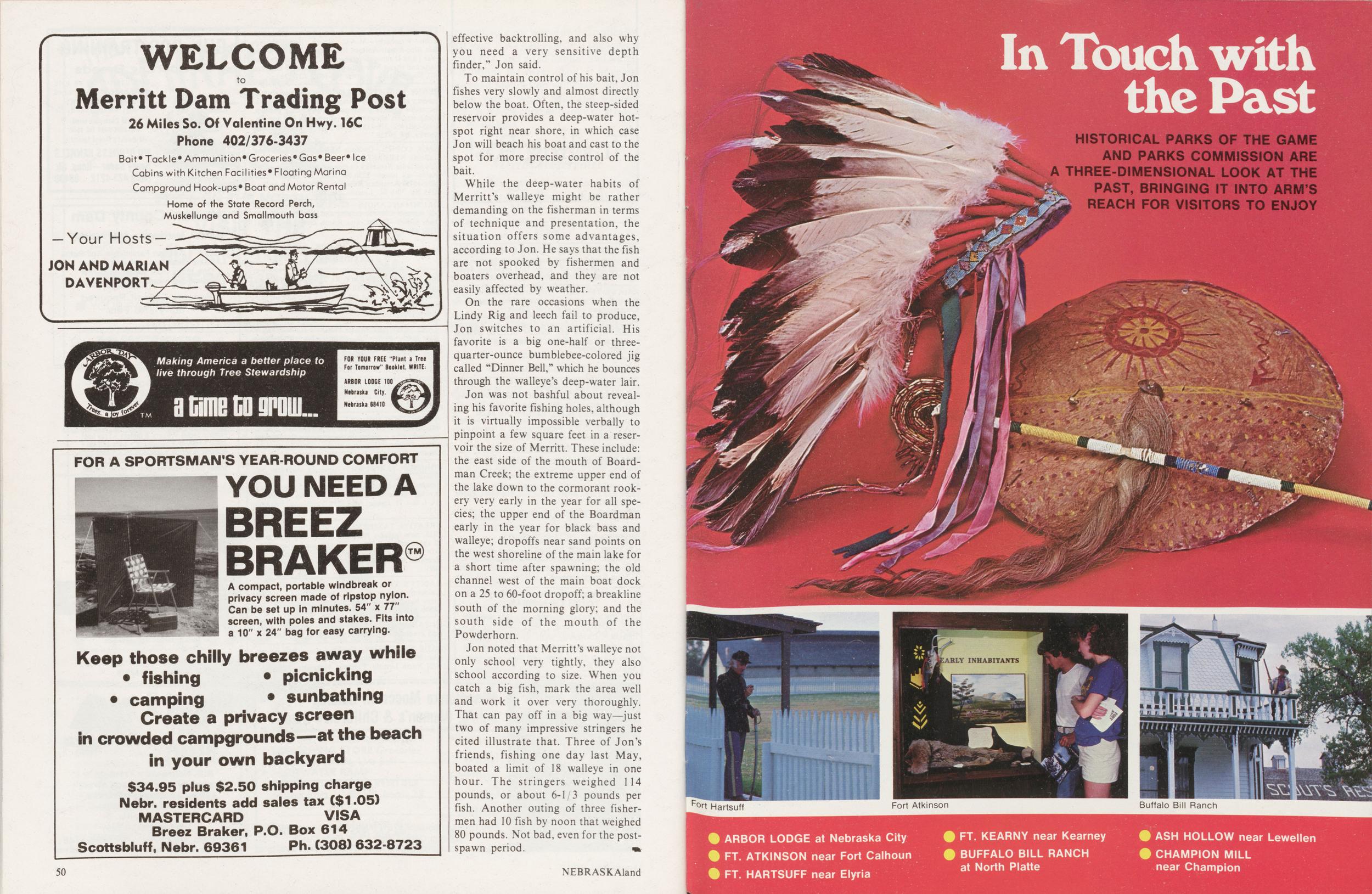
effective backtrolling, and also why you need a very sensitive depth finder," Jon said.
To maintain control of his bait, Jon fishes very slowly and almost directly below the boat. Often, the steep-sided reservoir provides a deep-water hot-spot right near shore, in which case Jon will beach his boat and cast to the spot for more precise control of the bait.
While the deep-water habits of Merritt's walleye might be rather demanding on the fisherman in terms of technique and presentation, the situation offers some advantages, according to Jon. He says that the fish are not spooked by fishermen and boaters overhead, and they are not easily affected by weather.
On the rare occasions when the Lindy Rig and leech fail to produce, Jon switches to an artificial. His favorite is a big one-half or three-quarter-ounce bumblebee-colored jig called "Dinner Bell," which he bounces through the walleye's deep-water lair.
Jon was not bashful about revealing his favorite fishing holes, although it is virtually impossible verbally to pinpoint a few square feet in a reservoir the size of Merritt. These include: the east side of the mouth of Boardman Creek; the extreme upper end of the lake down to the cormorant rookery very early in the year for all species; the upper end of the Boardman early in the year for black bass and walleye; dropoffs near sand points on the west shoreline of the main lake for a short time after spawning; the old channel west of the main boat dock on a 25 to 60-foot dropoff; a breakline south of the morning glory; and the south side of the mouth of the Powderhorn.
Jon noted that Merritt's walleye not only school very tightly, they also school according to size. When you catch a big fish, mark the area well and work it over very thoroughly. That can pay off in a big way—just two of many impressive stringers he cited illustrate that. Three of Jon's friends, fishing one day last May, boated a limit of 18 walleye in one hour. The stringers weighed 114 pounds, or about 6-1/3 pounds per fish. Another outing of three fishermen had 10 fish by noon that weighed
50 NEBRASKAland HISTORICAL PARKS OF THE GAME AND PARKS COMMISSION ARE A THREE-DIMENSIONAL LOOK AT THE PAST, BRINGING IT INTO ARM'S REACH FOR VISITORS TO ENJOY KARLY INHABITANTS Hartsuff Fort Atkinson ARBOR LODGE at Nebraska City FT. ATKINSON near Fort Calhoun FT. HARTSUFF near Elyria FT. KEARNY near Kearney BUFFALO BILL RANCH at North Platte Buffalo Bill Ranch ASH HOLLOW near Lewellen CHAMPION MILL near Champion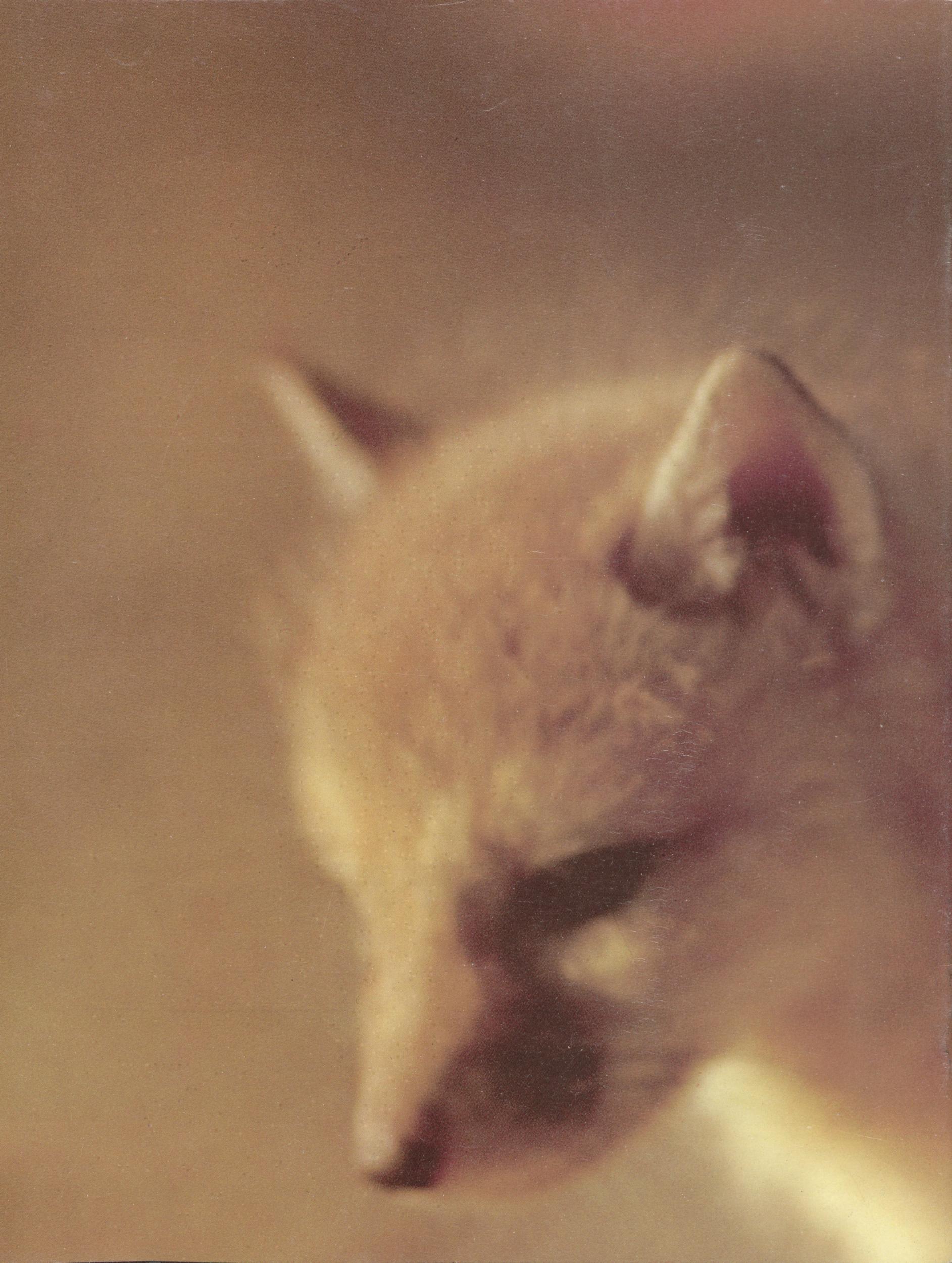
Position: 322 (28 views)