Volume 59, Issue 6, 1981
NEBRASKAland
MAY 1981 $1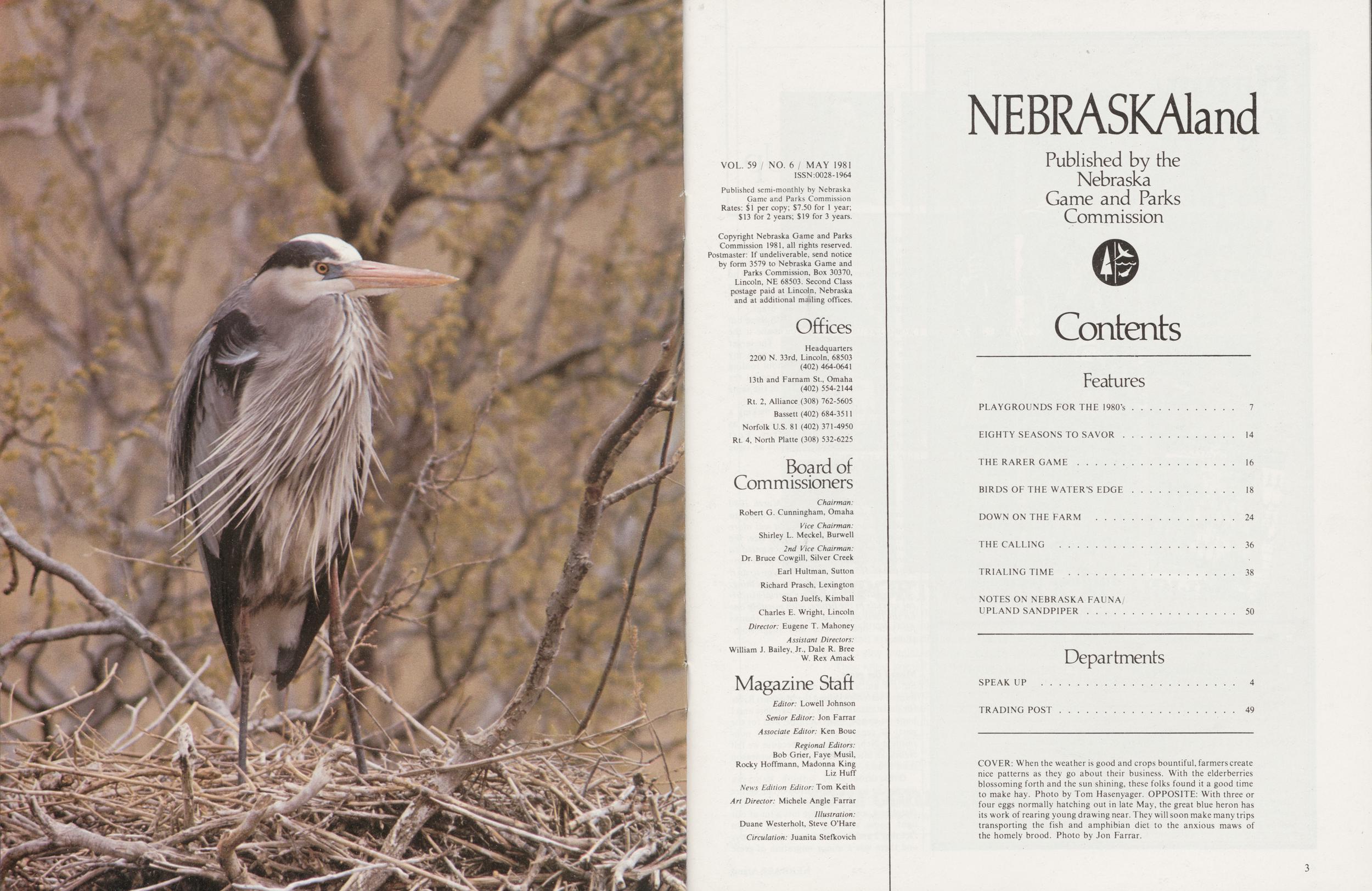
NEBRASKAland
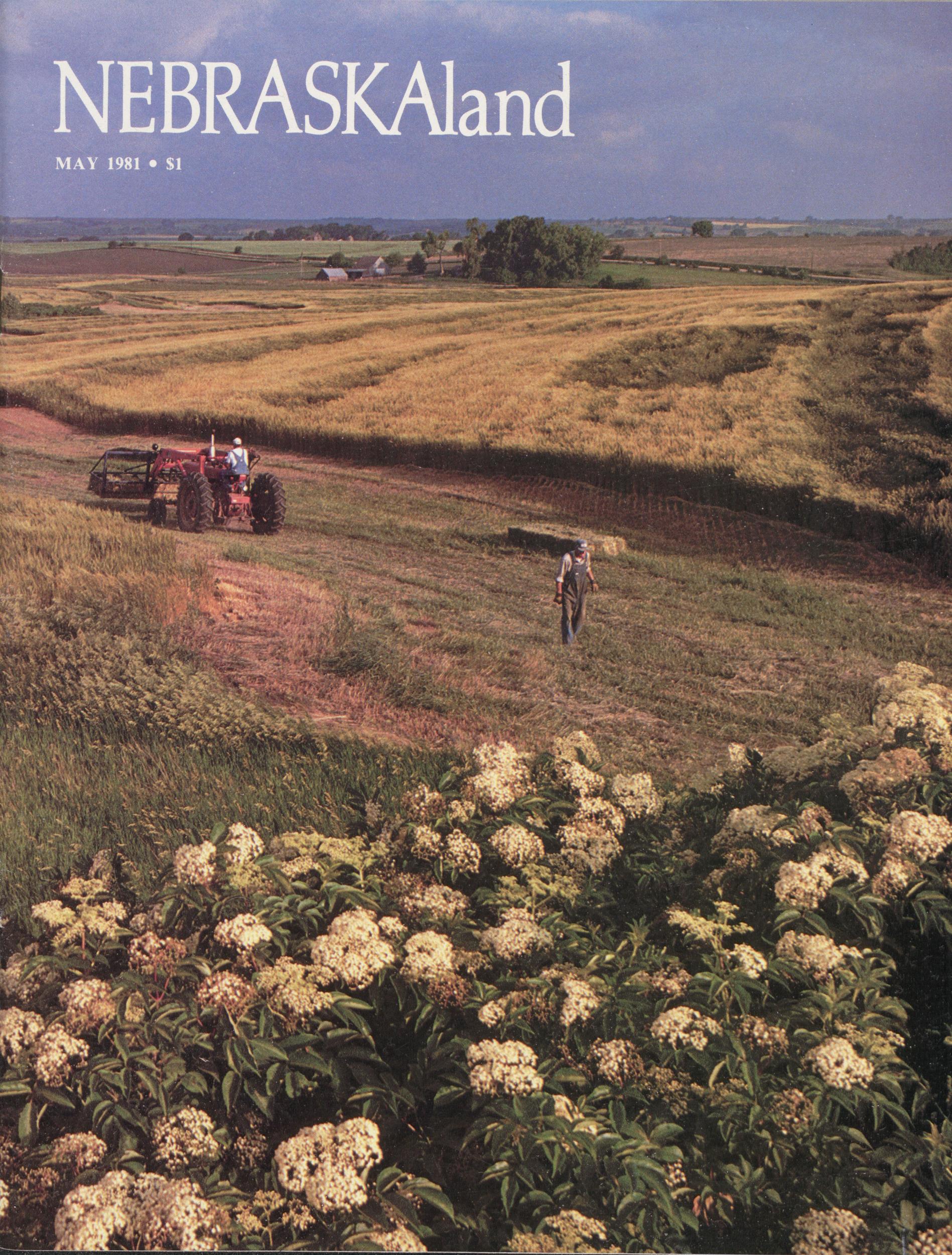
Published by the Nebraska Game and Parks Commission VOL. 59 / NO. 6 / MAY 1981 ISSN:0028-1964 Published semi-monthly by Nebraska Game and Parks Commission Rates: $1 per copy; $7.50 for 1 year; $13 for 2 years; $19 for 3 years. Copyright Nebraska Game and Parks Commission 1981, all rights reserved. Postmaster: If undeliverable, send notice by form 3579 to Nebraska Game and Parks Commission, Box 30370, Lincoln, NE 68503. Second Class postage paid at Lincoln, Nebraska and at additional mailing offices. Offiices Headquarters 2200 N. 33rd, Lincoln, 68503 (402) 464-0641 13th and Farnam St., Omaha (402) 554-2144 Rt. 2, Alliance (308) 762-5605 Bassett (402) 684-3511 Norfolk U.S. 81 (402) 371-4950 Rt. 4, North Platte (308) 532-6225 Board of Commissioners Chairman: Robert G. Cunningham, Omaha Vice Chairman: Shirley L. Meckel, Burwell 2nd Vice Chairman: Dr. Bruce Cowgill, Silver Creek Earl Hultman, Sutton Richard Prasch, Lexington Stan Juelfs, Kimball Charles E. Wright, Lincoln Director: Eugene T. Mahoney Assistant Directors: William J. Bailey, Jr., Dale R. Bree W. Rex Amack Magazine Staft Editor: Lowell Johnson Senior Editor: Jon Farrar Associate Editor: Ken Bouc Regional Editors: Bob Grier, Faye Musil, Rocky Hoffmann, Madonna King Liz Huff News Edition Editor: Tom Keith Art Director: Michele Angle Farrar Illustration: Duane Westerholt, Steve O'Hare Circulation: Juanita Stefkovich Contents Features PLAYGROUNDS FOR THE 1980's EIGHTY SEASONS TO SAVOR THE RARER GAME BIRDS OF THE WATER'S EDGE DOWN ON THE FARM THE CALLING TRIAL1NG TIME 7 14 16 18 24 36 38 NOTES ON NEBRASKA FAUNA UPLAND SANDPIPER Departments SPEAK UP TRADING POST 4 49 COVER: When the weather is good and crops bountiful, farmers create nice patterns as they go about their business. With the elderberries blossoming forth and the sun shining, these folks found it a good time to make hay. Photo by Tom Hasenyager. OPPOSITE: With three or four eggs normally hatching out in late May, the great blue heron has its work of rearing young drawing near. They will soon make many trips transporting the fish and amphibian diet to the anxious maws of the homely brood. Photo by Jon Farrar. 3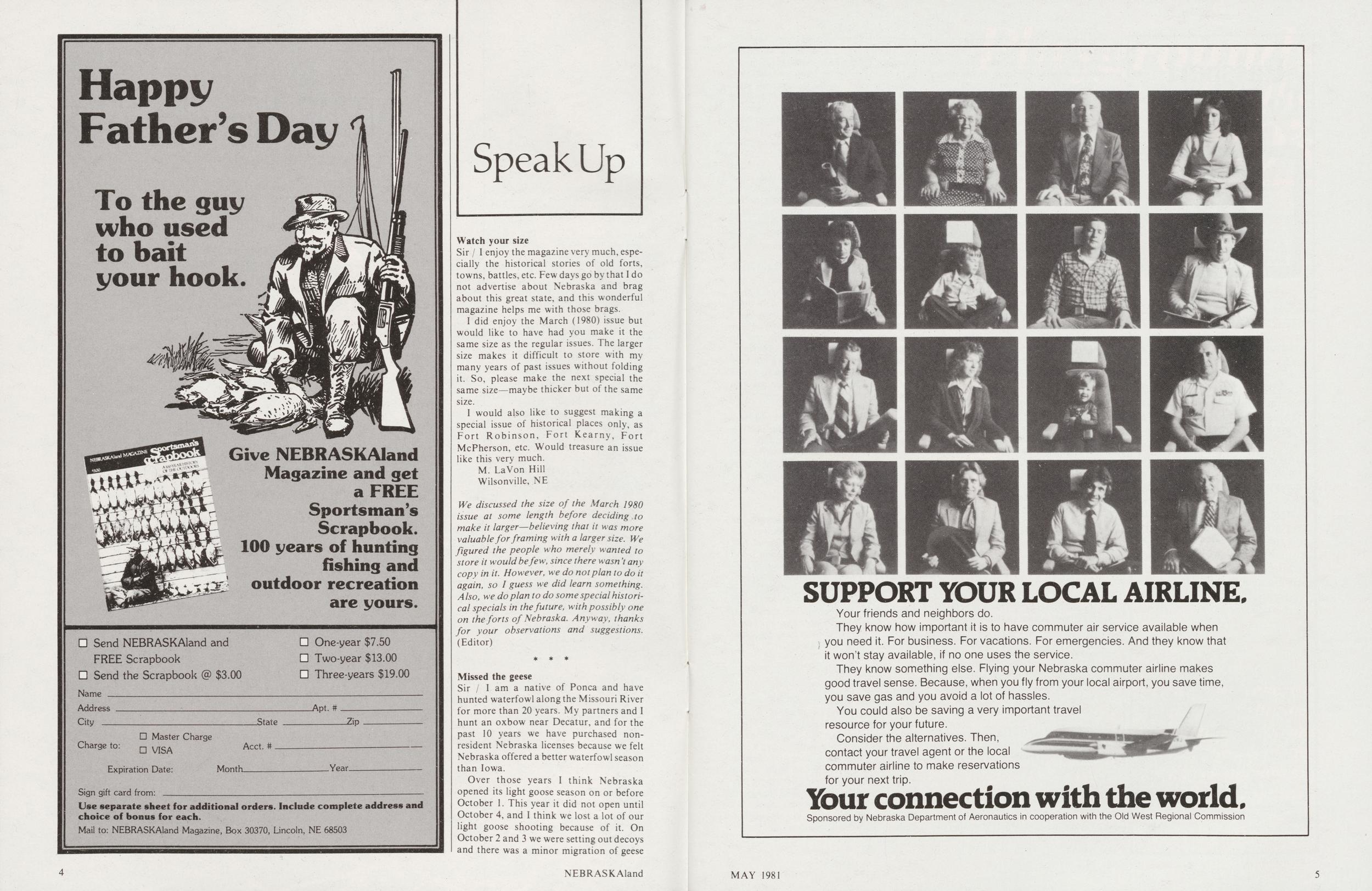
Speak Up
Happy Father's Day To the guy who used to bait your hook. Give NEBRASKAland Magazine and get a FREE Sportsman's Scrapbook. 100 years of hunting fishing and outdoor recreation are yours. Send NEBRASKAland and FREE Scrapbook Send the Scrapbook @ $3.00 Name One-year $7.50 Two-year $13.00 Three-years $19.00 Address City State Zip Master Charge Charge to: Expiration Date: Acct. # Month. .Year. Sign gift card from: Use separate sheet for additional orders. Include complete address and choice of bonus for each. Mail to: NEBRASKAland Magazine, Box 30370, Lincoln, NE 68503 Watch your sizeSir / I enjoy the magazine very much, especially the historical stories of old forts, towns, battles, etc. Few days go by that I do not advertise about Nebraska and brag about this great state, and this wonderful magazine helps me with those brags.
I did enjoy the March (1980) issue but would like to have had you make it the same size as the regular issues. The larger size makes it difficult to store with my many years of past issues without folding it. So, please make the next special the same size—maybe thicker but of the same size.
I would also like to suggest making a special issue of historical places only, as Fort Robinson, Fort Kearny, Fort McPherson, etc. Would treasure an issue like this very much.
M. LaVon Hill Wilsonville, NEWe discussed the size of the March 1980 issue at some length before deciding to make it larger—believing that it was more valuable for framing with a larger size. We figured the people who merely wanted to store it would be few, since there wasn't any copy in it. However, we do not plan to do it again, so I guess we did learn something. Also, we do plan to do some special historical specials in the future, with possibly one on the forts of Nebraska. Anyway, thanks for your observations and suggestions. (Editor)
Missed the geeseSir / I am a native of Ponca and have hunted waterfowl along the Missouri River for more than 20 years. My partners and I hunt an oxbow near Decatur, and for the past 10 years we have purchased non-resident Nebraska licenses because we felt Nebraska offered a better waterfowl season than Iowa.
4 NEBRASKAland SUPPORT YOUR LOCAL AIRLINE. Your friends and neighbors do. They know how important it is to have commuter air service available when I you need it. For business. For vacations. For emergencies. And they know that it won't stay available, if no one uses the service. They know something else. Flying your Nebraska commuter airline makes good travel sense. Because, when you fly from your local airport, you save time, you save gas and you avoid a lot of hassles. You could also be saving a very important travel resource for your future. Consider the alternatives. Then, contact your travel agent or the local commuter airline to make reservations for your next trip. Your connection with the world. Sponsored by Nebraska Department of Aeronautics in cooperation with the Old West Regional Commission MAY 1981 5 Passport
To Pleasure
FOR A REAL OUTDOOR
RECREATION BARGAIN
an annual State Park Vehicle
Entry Permit is tough to beat.
For just $5 per year, it gives access to over 50 state park, recreation, and wayside
areas in
Nebraska. And, you can get a
duplicate for other family vehicles for just $1 each when you
get your original permit. You
not only open the door to a
recreation bonanza, but you
help support your state park
system at the same time. Or, if
you prefer, there's a daily permit for just $1.50. Permits are
available from any hunting and
fishing permit vendor, from
any Game and Parks Commission office, or at most state
park areas.
Passport
To Pleasure
FOR A REAL OUTDOOR
RECREATION BARGAIN
an annual State Park Vehicle
Entry Permit is tough to beat.
For just $5 per year, it gives access to over 50 state park, recreation, and wayside
areas in
Nebraska. And, you can get a
duplicate for other family vehicles for just $1 each when you
get your original permit. You
not only open the door to a
recreation bonanza, but you
help support your state park
system at the same time. Or, if
you prefer, there's a daily permit for just $1.50. Permits are
available from any hunting and
fishing permit vendor, from
any Game and Parks Commission office, or at most state
park areas.
Over those years I think Nebraska opened its light goose season on or before October 1. This year it did not open until October 4, and I think we lost a lot of our light goose shooting because of it. On October 2 and 3 we were setting out decoys and there was a minor migration of geese moving down the river. We even had flocks work our decoys in those two days. We were very optimistic for the opener, but very few geese worked our decoys during the remainder of the season.
This has been one of the poorest seasons I can remember, which every hunter must expect in some years, but I don't think it would have been as poor if the season had opened in late September or earlier October.
I realize it is a tough job trying to satisfy all hunters and stay within the federal guidelines. However, if you are going to separate the light and dark seasons, then why not open them each when the birds are willing to work decoys?
I think most hunters along the Missouri would agree that the best hunting for light geese could be before October 1, and would thus prefer an earlier opener.
From what I read, snow and blue geese populations are at an all-time high, and harvesting a few more would have no detrimental effect. I'm sure most would rather see them harvested than die of disease from being crowded on refuges. I therefore strongly urge the Commission to consider opening the light goose season next season on the last Saturday in September.
Phil Marvin Onawa, IowaThe opening date for the waterfowl season in the Central Flyway is the Saturday closest to Oct. 1. Thus, the season can open as early as September 28 or as late as October 4, depending on the calendar. We know the Missouri River hunters want an early goose opener, but the season that is set must comply with the federal framework. Just hang in there, at least some years will be earlier. It is like farming—when you could, the weather can beat you anyway, but that's what makes life interesting. (Editor)
High graderSir / I am a junior at North High School in Omaha. I just wanted to thank NEBRASKAland for the good grades I've been receiving. For the past three years I have referred to NEBRASKAland for English, Law, History and Creative Writing. I have gotten either 1 's or 2's in these classes. I love you, NEBRASKALand. Thanks again.
Shirley Brickey Omaha, NEIf you were taking a class in personality, you'd get a "I "in it, too—you may be our favorite reader. Thanks much, and I hope we continue in your good graces. (Editor)
The last strawSir / For too long I have put off writing you about what a superb magazine you people are putting out. There is a nice mix of painting, photography and outdoor articles which attract me, someone who is not especially interested in hunting or fishing. I have particularly enjoyed the historical articles as well as the ones about state parks. The article, "The Restless Land," in this month's issue (August 1980) was so fine, both as to prose and photography, that it impelled me to write at last. You people in Nebraska have learned to "celebrate" your prairie. Most people think of Nebraska as being a purgatory one must pass through to get to the Rockies. Too bad! Mr. Farrar's article could show them a different side to it. I appreciate also that you are aware that these beauties are fragile and must be protected against the exigencies of earning a living, lest we make a good living, but lose out on a land in which to enjoy it.
NEBRASKAland has the advantage over other state magazines in that it seems to spring out of the land. It is warm, home-spun, written for Nebraskans. You don't get that feeling with Arizona Highways.
May I suggest, however, that you give attention to everday life right now in Nebraska. And, that your superiors, whoever that may be, be aware not only that they have a first-rate magazine (and that takes first-rate personnel), but also that they, by their support of your work, are doing their state a service.
It was largely the doing of your magazine that we traveled through Nebraska this summer on our way to a wedding—not hurrying through, but exploring the byways—and enjoying every bit of it from South Sioux City to Dundy County.
John Springer Wabasso, MNI guess you about said it all. Thanks for the observations now if we can just get our superiors to agree with you. When you talk about Jon Farrar's "Restless Land", and about the fragile beauties that must be protected, well, I guess he likes doing that with beauties. It is a shame that people now have to be overpowered by noise and light and glamor before they recognize something as beauty. Surely we're right! They say everything runs in cycles—let's hope that people's taste's do, too. (Editor)
Platte PlatitudesSir / I just had to take time out and write an appreciative note in regards to the NEBRASKAland Magazine which I look forward to receiving. The July issue especially, in which there was so much about the Platte River. I was born and raised in Schuyler, and spent many hours at the Platte fishing, swimming and having fun. The article and photos by Tom Mangelsen most interesting and very good. My thanks to the staff, and I am looking forward to more of this good reading.
F. A. Spidle Kinosha, Wisc. NEBRASKAlandPlaygrounds for the 1980's
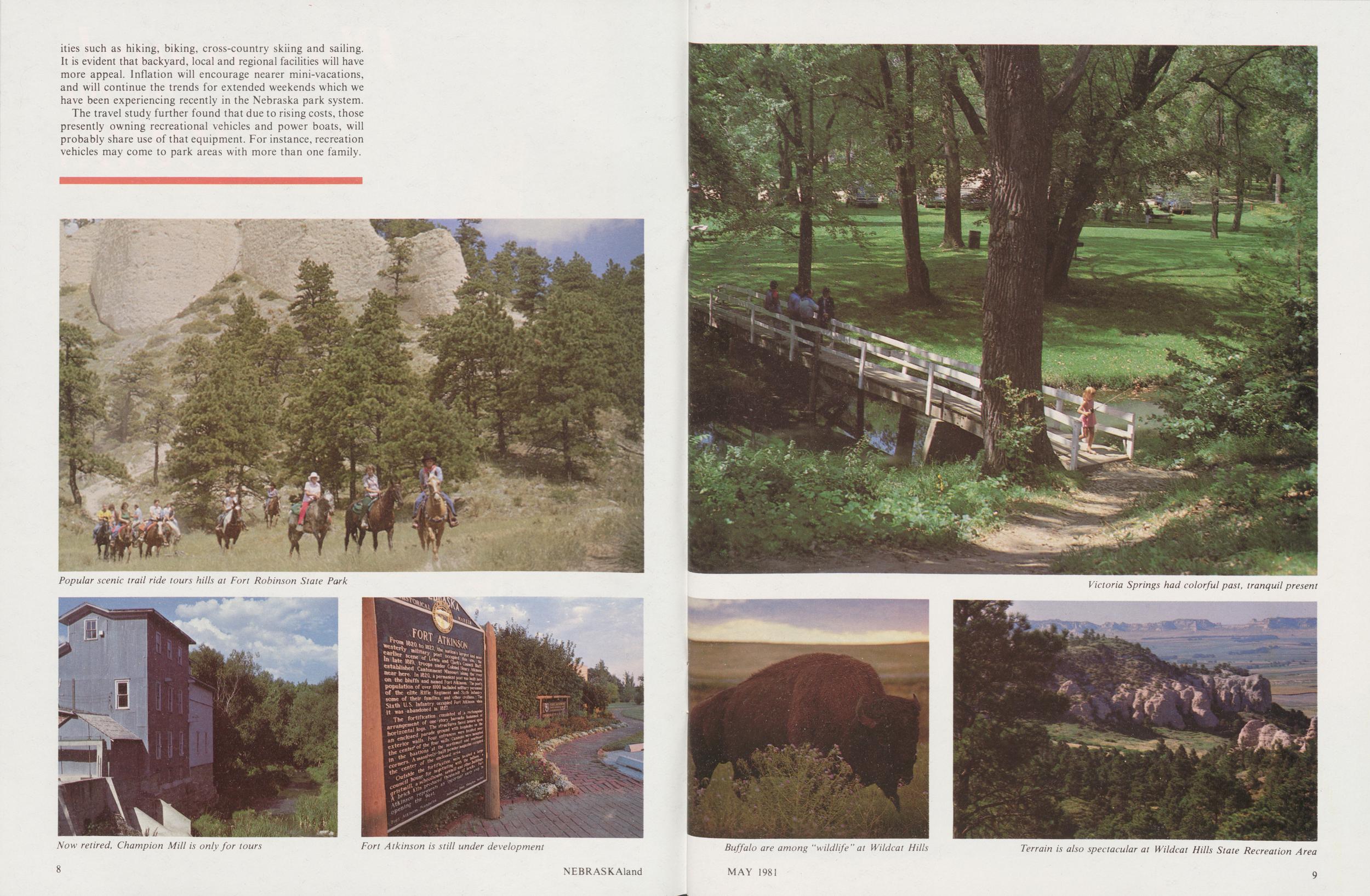
BY DALE BREE, ASSISTANT DIRECTORALL STATE PARK systems, including Nebraska's, are nearing a "fork in the road" as a result of inflation and people's lessened mobility. This has meant changes on how leisure time is used, and these changes will be felt for years. The impact of use patterns on public lands also will mean changes in park operations.
Results of a recent study published
in the Journal of Travel Research states
that Americans put vacations first on
a list of 10 luxury items. The study also
reveals that inflation in general, and
energy costs and availability in particular, will cause major changes in leisure
activities and equipment use in the
1980's and beyond. There will, for example, be less driving for pleasure and
more emphasis on human-energy activ, pack fun into any
vacationer's schedule
 ities such as hiking, biking, cross-country skiing and sailing.
It is evident that backyard, local and regional facilities will have
more appeal. Inflation will encourage nearer mini-vacations,
and will continue the trends for extended weekends which we
have been experiencing recently in the Nebraska park system.
ities such as hiking, biking, cross-country skiing and sailing.
It is evident that backyard, local and regional facilities will have
more appeal. Inflation will encourage nearer mini-vacations,
and will continue the trends for extended weekends which we
have been experiencing recently in the Nebraska park system.
The travel study further found that due to rising costs, those presently owning recreational vehicles and power boats, will probably share use of that equipment. For instance, recreation vehicles may come to park areas with more than one family.
Higher costs will also promote public-private cooperation in local mass transit and package tours to gain access to public recreation sites such as shown by the resounding success of the "Know Nebraska Tours."
Trends involving the nation's mobility include a definite increase in use of recreation sites near residential areas, primary local and regional sites, car-pooling for leisure trips, and longer stays at destinations.
Nevertheless, people like and demand quality recreation services and facilities, and it appears this trend will continue. Pay-as-you-go public outdoor recreation will become more common nation-wide.
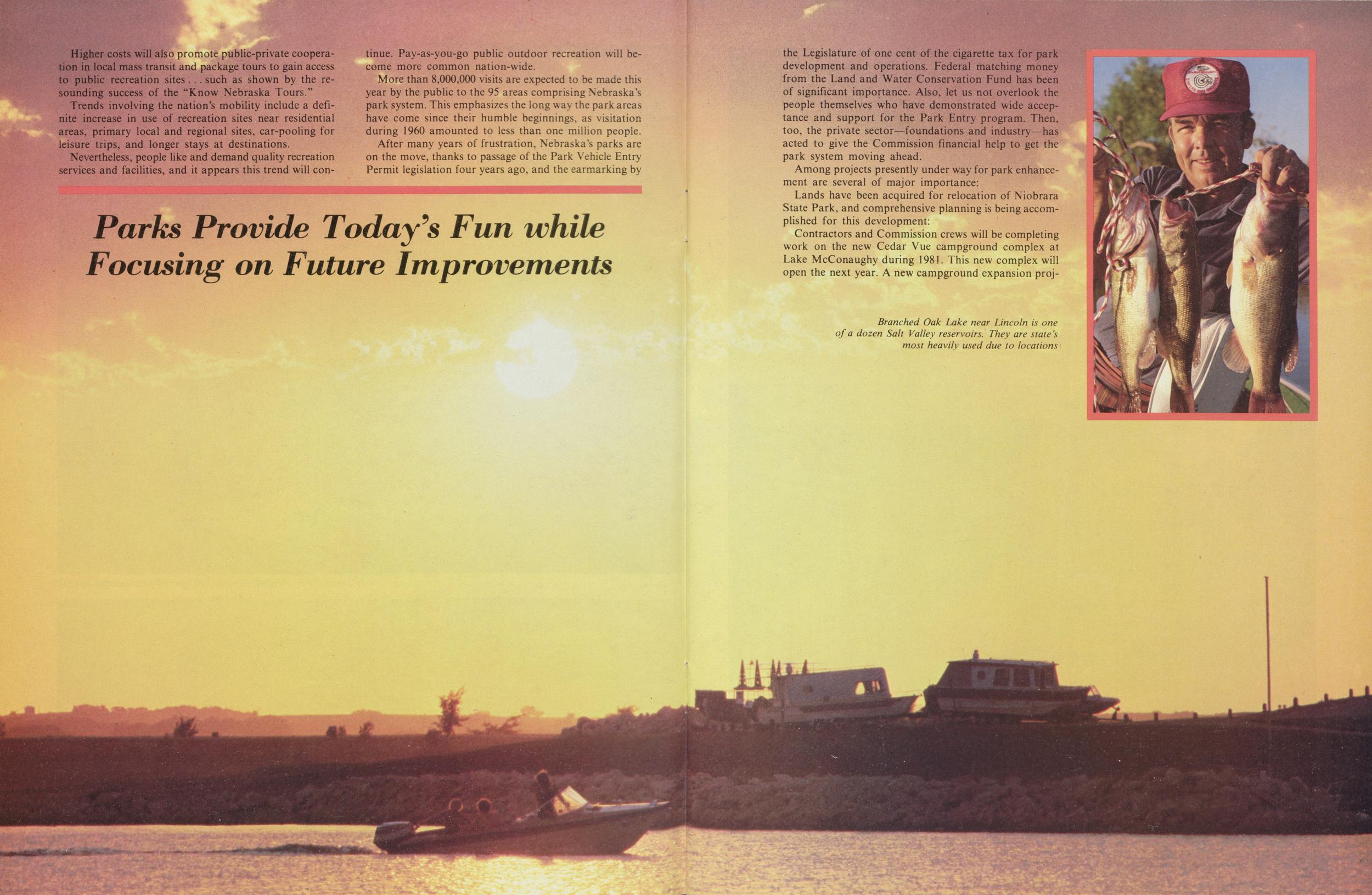
More than 8,000,000 visits are expected to be made this year by the public to the 95 areas comprising Nebraska's park system. This emphasizes the long way the park areas have come since their humble beginnings, as visitation during 1960 amounted to less than one million people.
After many years of frustration, Nebraska's parks are on the move, thanks to passage of the Park Vehicle Entry Permit legislation four years ago, and the earmarking by
Among projects presently under way for park enhancement are several of major importance:
Lands have been acquired for relocation of Niobrara State Park, and comprehensive planning is being accomplished for this development:
Contractors and Commission crews will be completing work on the new Cedar Vue campground complex at Lake McConaughy during 1981. This new complex will open the next year. A new campground expansion project
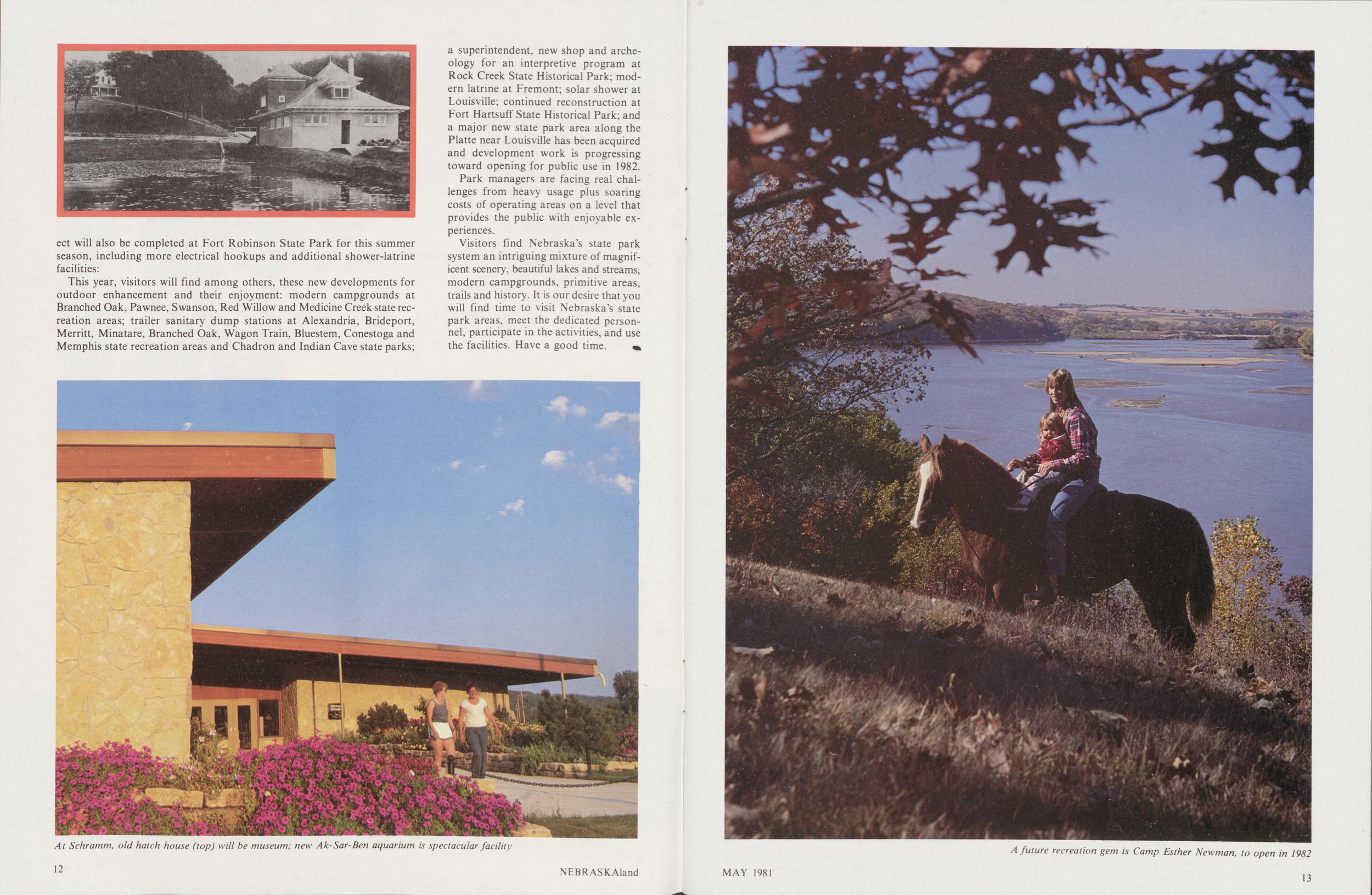
This year, visitors will find among others, these new developments for outdoor enhancement and their enjoyment: modern campgrounds at Branched Oak, Pawnee, Swanson, Red Willow and Medicine Creek state recreation areas; trailer sanitary dump stations at Alexandria, Brideport, Merritt, Minatare, Branched Oak, Wagon Train, Bluestem, Conestoga and Memphis state recreation areas and Chadron and Indian Cave state parks; a superintendent, new shop and archeology for an interpretive program at Rock Creek State Historical Park; modern latrine at Fremont; solar shower at Louisville; continued reconstruction at Fort Hartsuff State Historical Park; and a major new state park area along the Platte near Louisville has been acquired and development work is progressing toward opening for public use in 1982.
Park managers are facing real challenges from heavy usage plus soaring costs of operating areas on a level that provides the public with enjoyable experiences.
Visitors find Nebraska's state park system an intriguing mixture of magnificent scenery, beautiful lakes and streams, modern campgrounds, primitive areas, trails and history. It is our desire that you will find time to visit Nebraska's state park areas, meet the dedicated personnel, participate in the activities, and use the facilities. Have a good time.
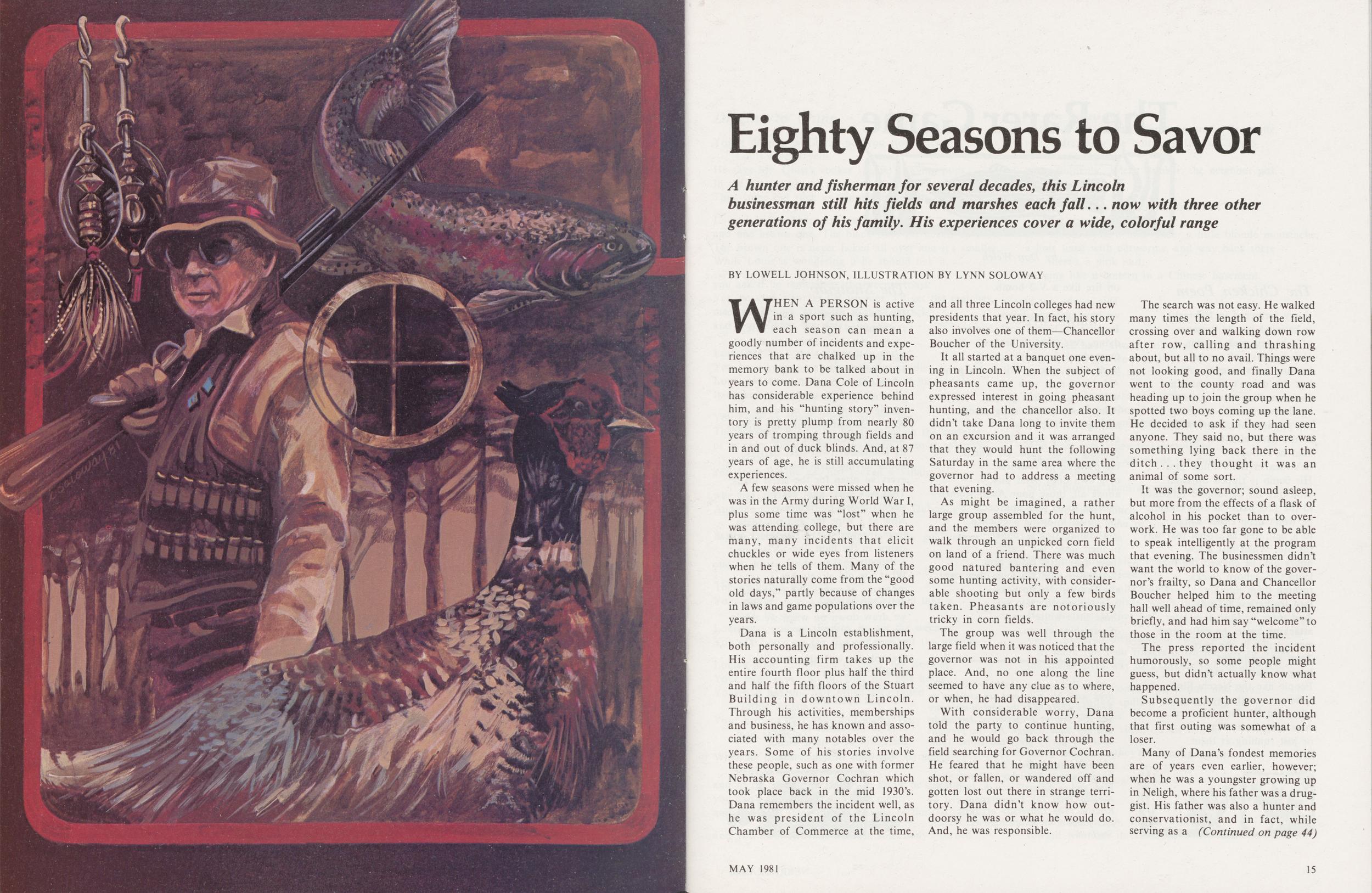
Eighty Seasons to Savor
A hunter and fisherman for several decades, this Lincoln businessman still hits fields and marshes each fall now with three other generations of his family. His experiences cover a wide, colorful range BY LOWELL JOHNSON, ILLUSTRATION BY LYNN SOLOWAYWHEN A PERSON is active in a sport such as hunting, each season can mean a goodly number of incidents and experiences that are chalked up in the memory bank to be talked about in years to come. Dana Cole of Lincoln has considerable experience behind him, and his "hunting story" inventory is pretty plump from nearly 80 years of tromping through fields and in and out of duck blinds. And, at 87 years of age, he is still accumulating experiences.
A few seasons were missed when he was in the Army during World War I, plus some time was "lost" when he was attending college, but there are many, many incidents that elicit chuckles or wide eyes from listeners when he tells of them. Many of the stories naturally come from the "good old days," partly because of changes in laws and game populations over the years.
Dana is a Lincoln establishment, both personally and professionally. His accounting firm takes up the entire fourth floor plus half the third and half the fifth floors of the Stuart Building in downtown Lincoln. Through his activities, memberships and business, he has known and associated with many notables over the years. Some of his stories involve these people, such as one with former Nebraska Governor Cochran which took place back in the mid 1930's. Dana remembers the incident well, as he was president of the Lincoln Chamber of Commerce at the time, and all three Lincoln colleges had new presidents that year. In fact, his story also involves one of them—Chancellor Boucher of the University.
It all started at a banquet one evening in Lincoln. When the subject of pheasants came up, the governor expressed interest in going pheasant hunting, and the chancellor also. It didn't take Dana long to invite them on an excursion and it was arranged that they would hunt the following Saturday in the same area where the governor had to address a meeting that evening.
As might be imagined, a rather large group assembled for the hunt, and the members were organized to walk through an unpicked corn field on land of a friend. There was much good natured bantering and even some hunting activity, with considerable shooting but only a few birds taken. Pheasants are notoriously tricky in corn fields.
The group was well through the large field when it was noticed that the governor was not in his appointed place. And, no one along the line seemed to have any clue as to where, or when, he had disappeared.
With considerable worry, Dana told the party to continue hunting, and he would go back through the field searching for Governor Cochran. He feared that he might have been shot, or fallen, or wandered off and gotten lost out there in strange territory. Dana didn't know how outdoorsy he was or what he would do. And, he was responsible.
The search was not easy. He walked many times the length of the field, crossing over and walking down row after row, calling and thrashing about, but all to no avail. Things were not looking good, and finally Dana went to the county road and was heading up to join the group when he spotted two boys coming up the lane. He decided to ask if they had seen anyone. They said no, but there was something lying back there in the ditch they thought it was an animal of some sort.
It was the governor; sound asleep, but more from the effects of a flask of alcohol in his pocket than to overwork. He was too far gone to be able to speak intelligently at the program that evening. The businessmen didn't want the world to know of the governor's frailty, so Dana and Chancellor Boucher helped him to the meeting hall well ahead of time, remained only briefly, and had him say "welcome" to those in the room at the time.
The press reported the incident humorously, so some people might guess, but didn't actually know what happened.
Subsequently the governor did become a proficient hunter, although that first outing was somewhat of a loser.
Many of Dana's fondest memories are of years even earlier, however; when he was a youngster growing up in Neligh, where his father was a druggist. His father was also a hunter and conservationist, and in fact, while serving as a (Continued on page 44)
MAY 1981 15
The Rarer Game
Don Welch is a native Nebraskan, who lives with his wife and six children in Kearney where he is the poet-in-residence and the Martin Professor of English at Kearney State College. His two previous books of poetry are Dead Horse Table (Windflower Press, 1975) and Handwork (Kearney State College Press, 1978). "The Rarer Game: A Sequence of Poems about Birds and an Animal" won the 1980 Pablo Neruda Prize for Poetry sponsored by Nimrod (The University of Tulsa). The final judge of the competition was William Stafford.
The Shotgun I've always liked the way the shotgun slid out of its case, its barrel a long clean sound against the zipper. I remember I was ten when I took it out for the first time. It was heavy, asking too much of my wrist And I remember telling my friends what my father said about its Damascus twist-steel barrels, about having them tested every so often for the latest loads. That was years ago, years since I tested my father. Now as I wipe the gun oil from the barrel, the blue-black metal swims in the light like a delicate snake. What are old shoots but moments of metal and feather? old hunts but times we draw down on when we think we have lost the edge? Next fall when I walk the uplands with the shotgun cradled in my arms my academic sutures will split open like raw flowers in the fields. And in the center of it all there will be a hard silence I will want to hold onto.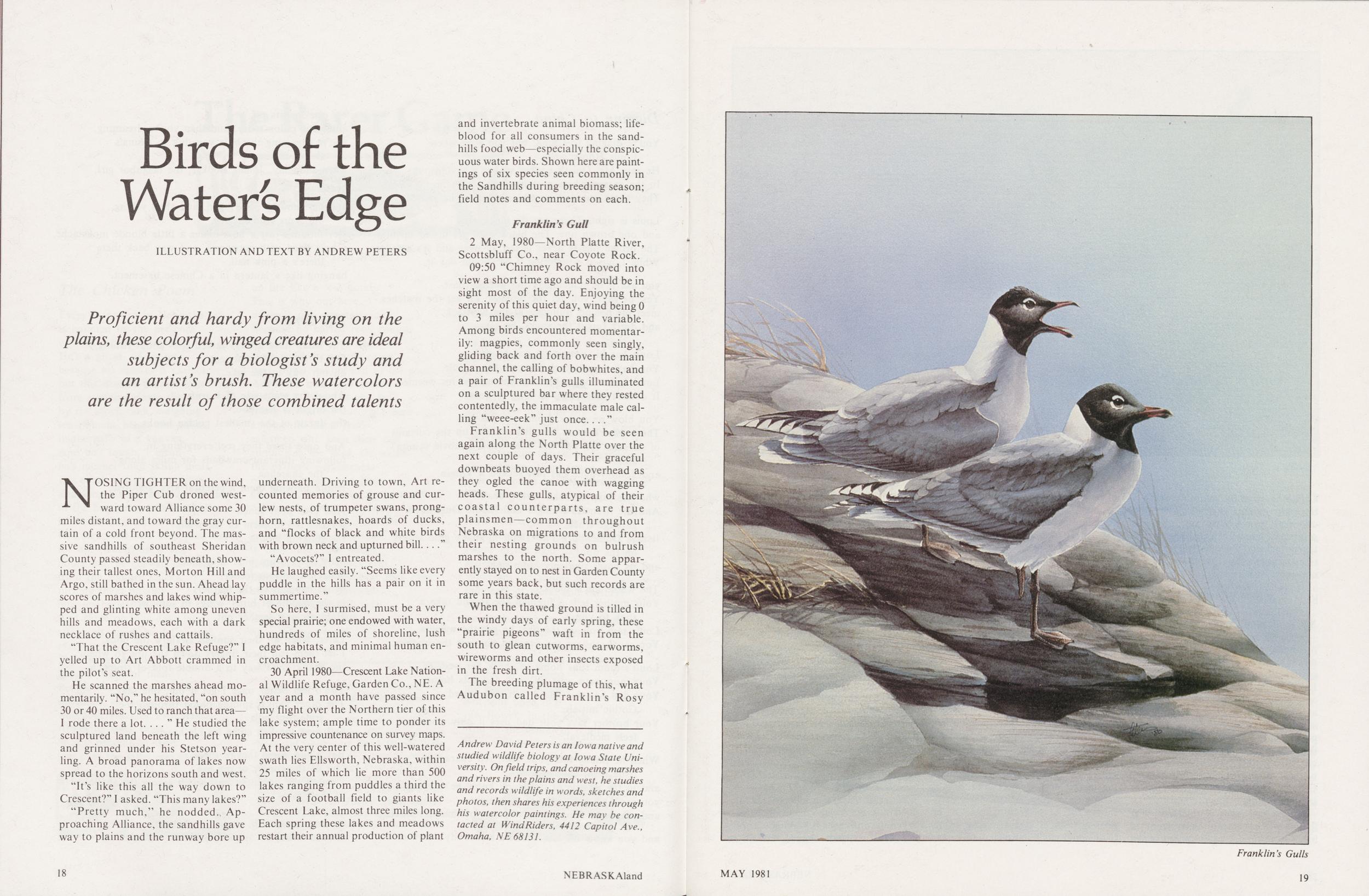
Birds of the Water's Edge
ILLUSTRATION AND TEXT BY ANDREW PETERS Proficient and hardy from living on the plains, these colorful winged creatures are ideal subjects for a biologist's study and an artist's brush. These water colors are the result of those combined talentsNOSING TIGHTER on the wind, the Piper Cub droned westward toward Alliance some 30 miles distant, and toward the gray curtain of a cold front beyond. The massive sandhills of southeast Sheridan County passed steadily beneath, showing their tallest ones, Morton Hill and Argo, still bathed in the sun. Ahead lay scores of marshes and lakes wind whipped and glinting white among uneven hills and meadows, each with a dark necklace of rushes and cattails.
"That the Crescent Lake Refuge?" I yelled up to Art Abbott crammed in the pilot's seat.
He scanned the marshes ahead momentarily. "No," he hesitated, "on south 30 or 40 miles. Used to ranch that area— I rode there a lot" He studied the sculptured land beneath the left wing and grinned under his Stetson yearling. A broad panorama of lakes now spread to the horizons south and west.
"It's like this all the way down to Crescent?" I asked. "This many lakes?"
"Pretty much," he nodded. Approaching Alliance, the sandhills gave way to plains and the runway bore up underneath. Driving to town, Art recounted memories of grouse and curlew nests, of trumpeter swans, pronghorn, rattlesnakes, hoards of ducks, and "flocks of black and white birds with brown neck and upturned bill.
"Avocets?" I entreated.
He laughed easily. "Seems like every puddle in the hills has a pair on it in summertime."
So here, I surmised, must be a very special prairie; one endowed with water, hundreds of miles of shoreline, lush edge habitats, and minimal human encroachment.
30 April 1980—Crescent Lake National Wildlife Refuge, Garden Co., NE. A year and a month have passed since my flight over the Northern tier of this lake system; ample time to ponder its impressive countenance on survey maps. At the very center of this well-watered swath lies Ellsworth, Nebraska, within 25 miles of which lie more than 500 lakes ranging from puddles a third the size of a football field to giants like Crescent Lake, almost three miles long. Each spring these lakes and meadows restart their annual production of plant and invertebrate animal biomass; lifeblood for all consumers in the sandhills food web-especially the conspic-uous water birds. Shown here are paint-ings of six species seen commonly in the Sandhills during breeding season; field notes and comments on each.
Franklin's Gull2 May, 1980—North Platte River, Scottsbluff Co., near Coyote Rock.
09:50 "Chimney Rock moved into view a short time ago and should be in sight most of the day. Enjoying the serenity of this quiet day, wind being 0 to 3 miles per hour and variable. Among birds encountered momentarily: magpies, commonly seen singly, gliding back and forth over the main channel, the calling of bobwhites, and a pair of Franklin's gulls illuminated on a sculptured bar where they rested contentedly, the immaculate male calling "weee-eek" just once"
Franklin's gulls would be seen again along the North Platte over the next couple of days. Their graceful downbeats buoyed them overhead as they ogled the canoe with wagging heads. These gulls, atypical of their coastal counterparts, are true plainsmen—common throughout Nebraska on migrations to and from their nesting grounds on bulrush marshes to the north. Some apparently stayed on to nest in Garden County some years back, but such records are rare in this state.
When the thawed ground is tilled in the windy days of early spring, these "prairie pigeons" waft in from the south to glean cutworms, earworms, wireworms and other insects exposed in the fresh dirt.
Andrew David Peters is an Iowa native and studied wildlife biology at Iowa State University. On field trips, and canoeing marshes and rivers in the plains and west, he studies and records wildlife in words, sketches and photos, then shares his experiences through his watercolor paintings. He may be contacted at Wind Riders, 4412 Capitol Ave., Omaha, NE 68131.
18 NEBRASKAland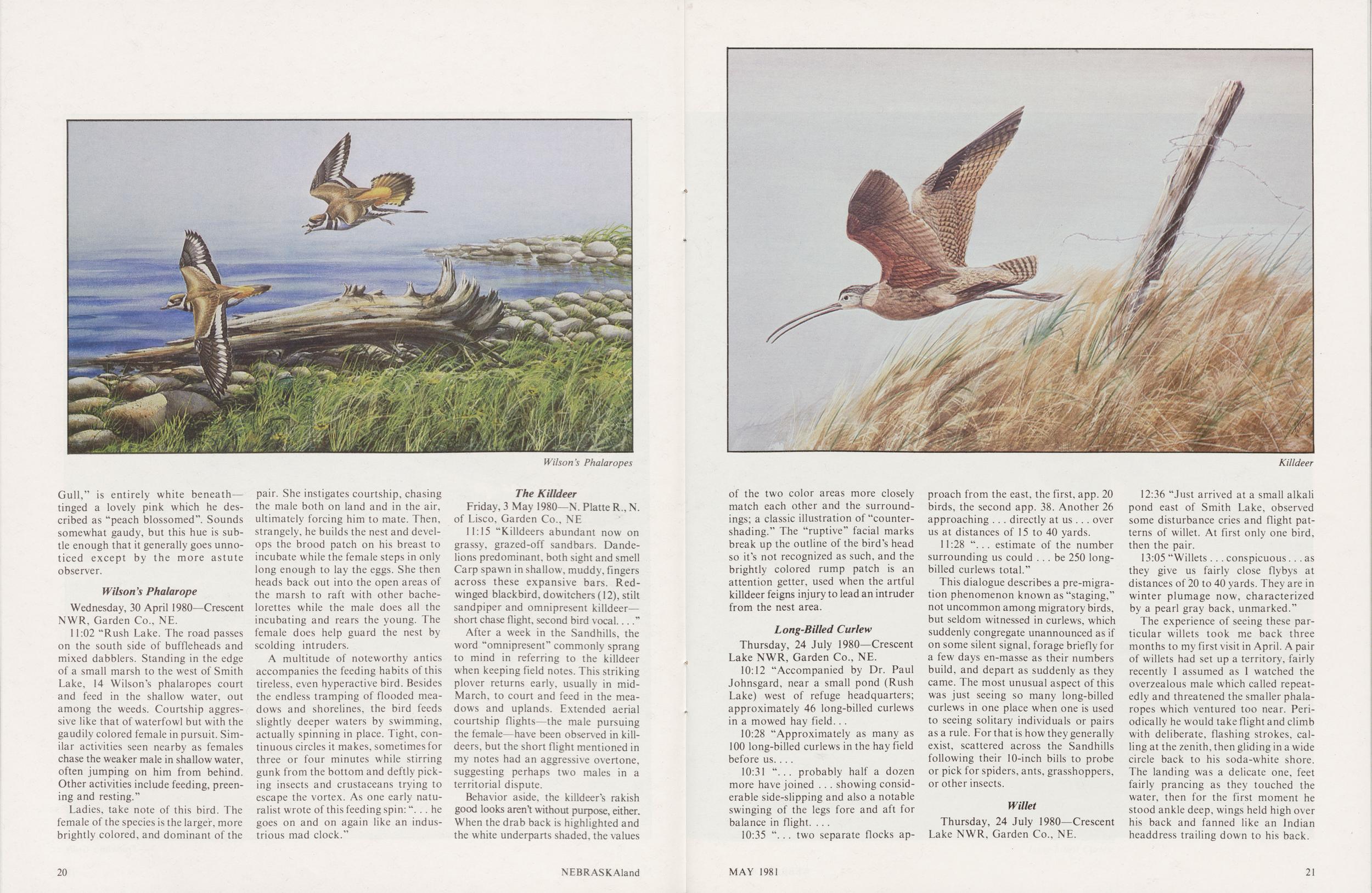
The breeding plumage of this, what Audubon called Franklin's Rosy Gull,'' is entirely white beneathtinged a lovely pink which he described as "peach blossomed". Sounds somewhat gaudy, but this hue is subtle enough that it generally goes unnoticed except by the more astute observer.
Wilson's PhalaropeWednesday, 30 April 1980—Crescent NWR, Garden Co., NE.
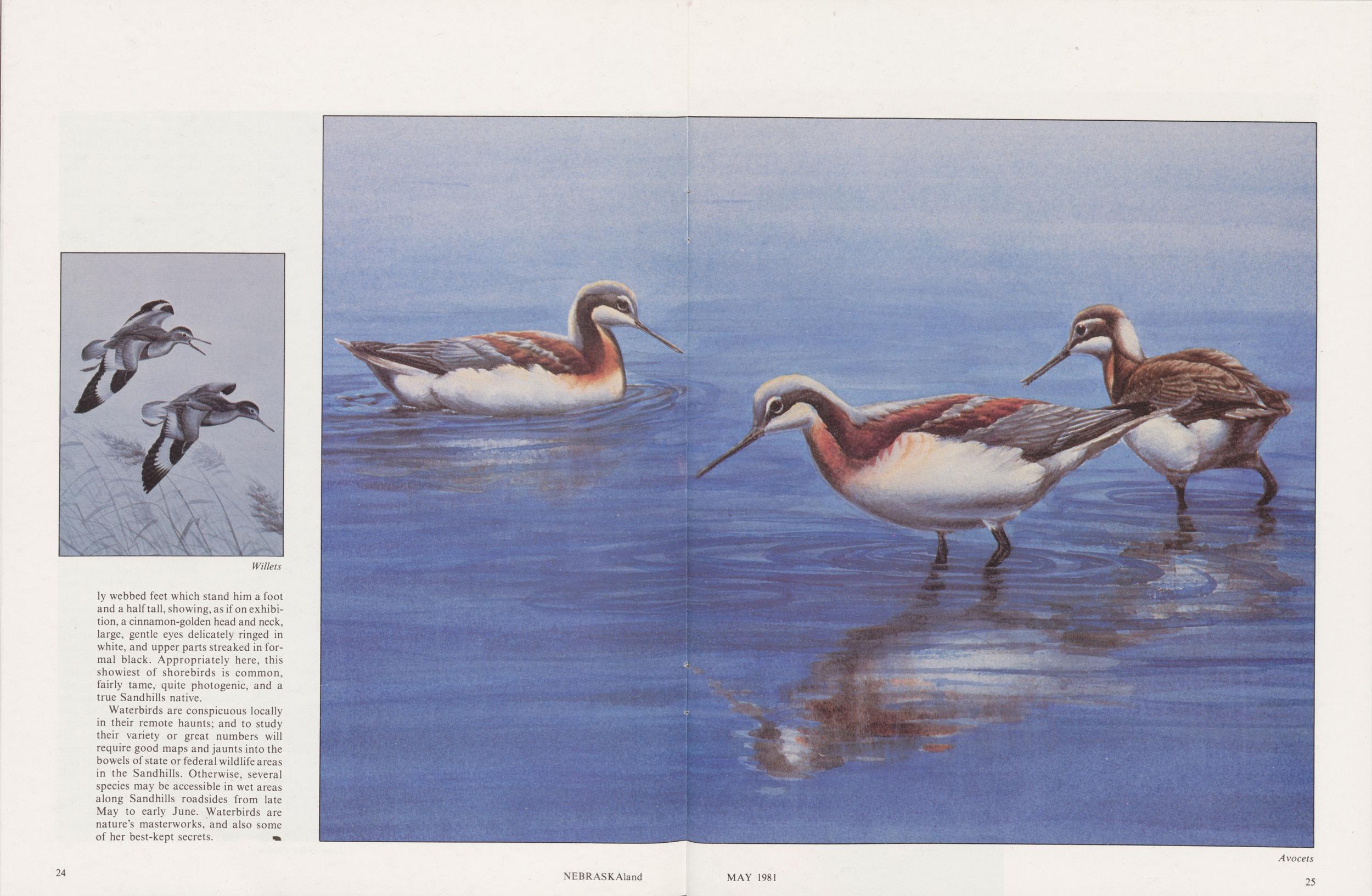
11:02 "Rush Lake. The road passes on the south side of buffleheads and mixed dabblers. Standing in the edge of a small marsh to the west of Smith Lake, 14 Wilson's phalaropes court and feed in the shallow water, out among the weeds. Courtship aggressive like that of waterfowl but with the gaudily colored female in pursuit. Similar activities seen nearby as females chase the weaker male in shallow water, often jumping on him from behind. Other activities include feeding, preening and resting."
Ladies, take note of this bird. The female of the species is the larger, more brightly colored, and dominant of the pair. She instigates courtship, chasing the male both on land and in the air, ultimately forcing him to mate. Then, strangely, he builds the nest and develops the brood patch on his breast to incubate while the female steps in only long enough to lay the eggs. She then heads back out into the open areas of the marsh to raft with other bachelorettes while the male does all the incubating and rears the young. The female does help guard the nest by scolding intruders.
A multitude of noteworthy antics accompanies the feeding habits of this tireless, even hyperactive bird. Besides the endless tramping of flooded meadows and shorelines, the bird feeds slightly deeper waters by swimming, actually spinning in place. Tight, continuous circles it makes, sometimes for three or four minutes while stirring gunk from the bottom and deftly picking insects and crustaceans trying to escape the vortex. As one early naturalist wrote of this feeding spin: " he goes on and on again like an industrious mad clock."
The KilldeerFriday, 3 May 1980—N. Platte R., N. of Lisco, Garden Co., NE
11:15 'Killdeers abundant now on grassy, grazed-off sandbars. Dandelions predominant, both sight and smell Carp spawn in shallow, muddy, fingers across these expansive bars. Redwinged blackbird, dowitchers (12), stilt sandpiper and omnipresent killdeer—short chase flight, second bird vocal"
After a week in the Sandhills, the word "omnipresent" commonly sprang to mind in referring to the killdeer when keeping field notes. This striking plover returns early, usually in mid-March, to court and feed in the meadows and uplands. Extended aerial courtship flights—the male pursuing the female—have been observed in killdeers, but the short flight mentioned in my notes had an aggressive overtone, suggesting perhaps two males in a territorial dispute.
Behavior aside, the killdeer's rakish good looks aren't without purpose, either. When the drab back is highlighted and the white underparts shaded, the values 20 NEBRASKAland
Thursday, 24 July 1980—Crescent Lake NWR, Garden Co., NE.
10:12 "Accompanied by Dr. Paul Johnsgard, near a small pond (Rush Lake) west of refuge headquarters; approximately 46 long-billed curlews in a mowed hay field.
10:28 "Approximately as many as 100 long-billed curlews in the hay field before us.
10:31 " probably half a dozen more have joined showing considerable side-slipping and also a notable swinging of the legs fore and aft for balance in flight.
10:35 " two separate flocks approach from the east, the first, app. 20 birds, the second app. 38. Another 26 approaching directly at us over us at distances of 15 to 40 yards.
11:28 " estimate of the number surrounding us could be 250 long-billed curlews total."
This dialogue describes a pre-migration phenomenon known as "staging," not uncommon among migratory birds, but seldom witnessed in curlews, which suddenly congregate unannounced as if on some silent signal, forage briefly for a few days en-masse as their numbers build, and depart as suddenly as they came. The most unusual aspect of this was just seeing so many long-billed curlews in one place when one is used to seeing solitary individuals or pairs as a rule. For that is how they generally exist, scattered across the Sandhills following their 10-inch bills to probe or pick for spiders, ants, grasshoppers, or other insects.
WilletThursday, 24 July 1980—Crescent Lake NWR, Garden Co., NE.
12:36 "Just arrived at a small alkali pond east of Smith Lake, observed some disturbance cries and flight patterns of willet. At first only one bird, then the pair.
13:05 "Willets conspicuous as they give us fairly close flybys at distances of 20 to 40 yards. They are in winter plumage now, characterized by a pearl gray back, unmarked."
The experience of seeing these particular willets took me back three months to my first visit in April. A pair of willets had set up a territory, fairly recently I assumed as I watched the overzealous male which called repeatedly and threatened the smaller phalaropes which ventured too near. Periodically he would take flight and climb with deliberate, flashing strokes, calling at the zenith, then gliding in a wide circle back to his soda-white shore. The landing was a delicate one, feet fairly prancing as they touched the water, then for the first moment he stood ankle deep, wings held high over his back and fanned like an Indian headdress trailing down to his back.
MAY 1981 21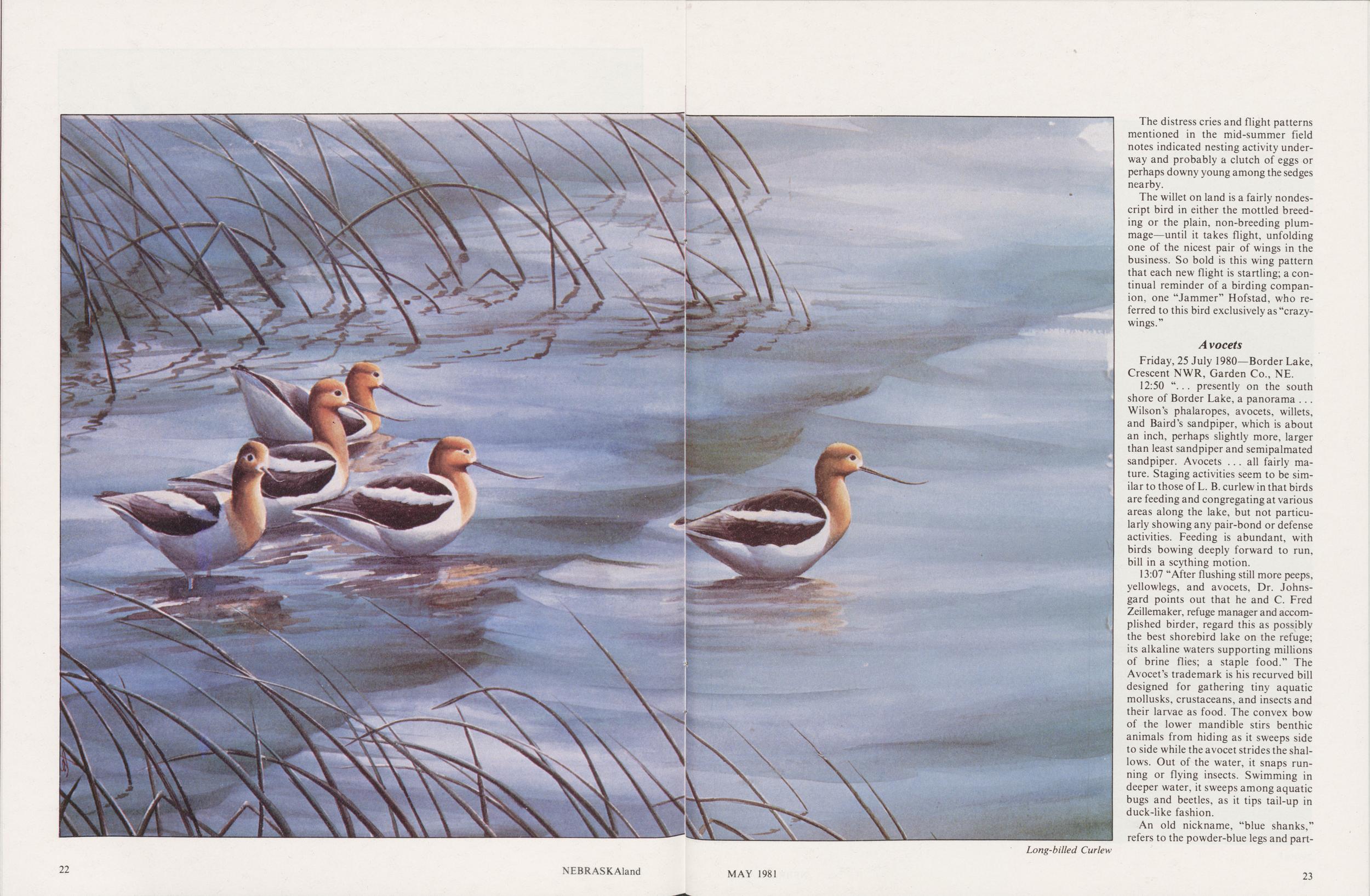
The distress cries and flight patterns mentioned in the mid-summer field notes indicated nesting activity underway and probably a clutch of eggs or perhaps downy young among the sedges nearby.
The willet on land is a fairly nondescript bird in either the mottled breeding or the plain, non-breeding plummage—until it takes flight, unfolding one of the nicest pair of wings in the business. So bold is this wing pattern that each new flight is startling; a continual reminder of a birding companion, one "Jammer" Hofstad, who referred to this bird exclusively as "crazy-wings."
AvocetsFriday, 25 July 1980—Border Lake, Crescent NWR, Garden Co., NE.
12:50 " presently on the south shore of Border Lake, a panorama Wilson's phalaropes, avocets, willets, and Baird's sandpiper, which is about an inch, perhaps slightly more, larger than least sandpiper and semipalmated sandpiper. Avocets all fairly mature. Staging activities seem to be similar to those of L. B. curlew in that birds are feeding and congregating at various areas along the lake, but not particularly showing any pair-bond or defense activities. Feeding is abundant, with birds bowing deeply forward to run, bill in a scything motion.
13:07 "After flushing still more peeps, yellowlegs, and avocets, Dr. Johns-gard points out that he and C. Fred Zeillemaker, refuge manager and accomplished birder, regard this as possibly the best shorebird lake on the refuge; its alkaline waters supporting millions of brine flies; a staple food." The Avocet's trademark is his recurved bill designed for gathering tiny aquatic mollusks, crustaceans, and insects and their larvae as food. The convex bow of the lower mandible stirs benthic animals from hiding as it sweeps side to side while the avocet strides the shallows. Out of the water, it snaps running or flying insects. Swimming in deeper water, it sweeps among aquatic bugs and beetles, as it tips tail-up in duck-like fashion.
An old nickname, "blue shanks,"
refers to the powder-blue legs and partly
MAY 1981
23
Waterbirds are conspicuous locally in their remote haunts; and to study their variety or great numbers will require good maps and jaunts into the bowels of state or federal wildlife areas in the Sandhills. Otherwise, several species may be accessible in wet areas along Sandhills roadsides from late May to early June. Waterbirds are nature's masterworks, and also some of her best-kept secrets.
24 NEBRASKAland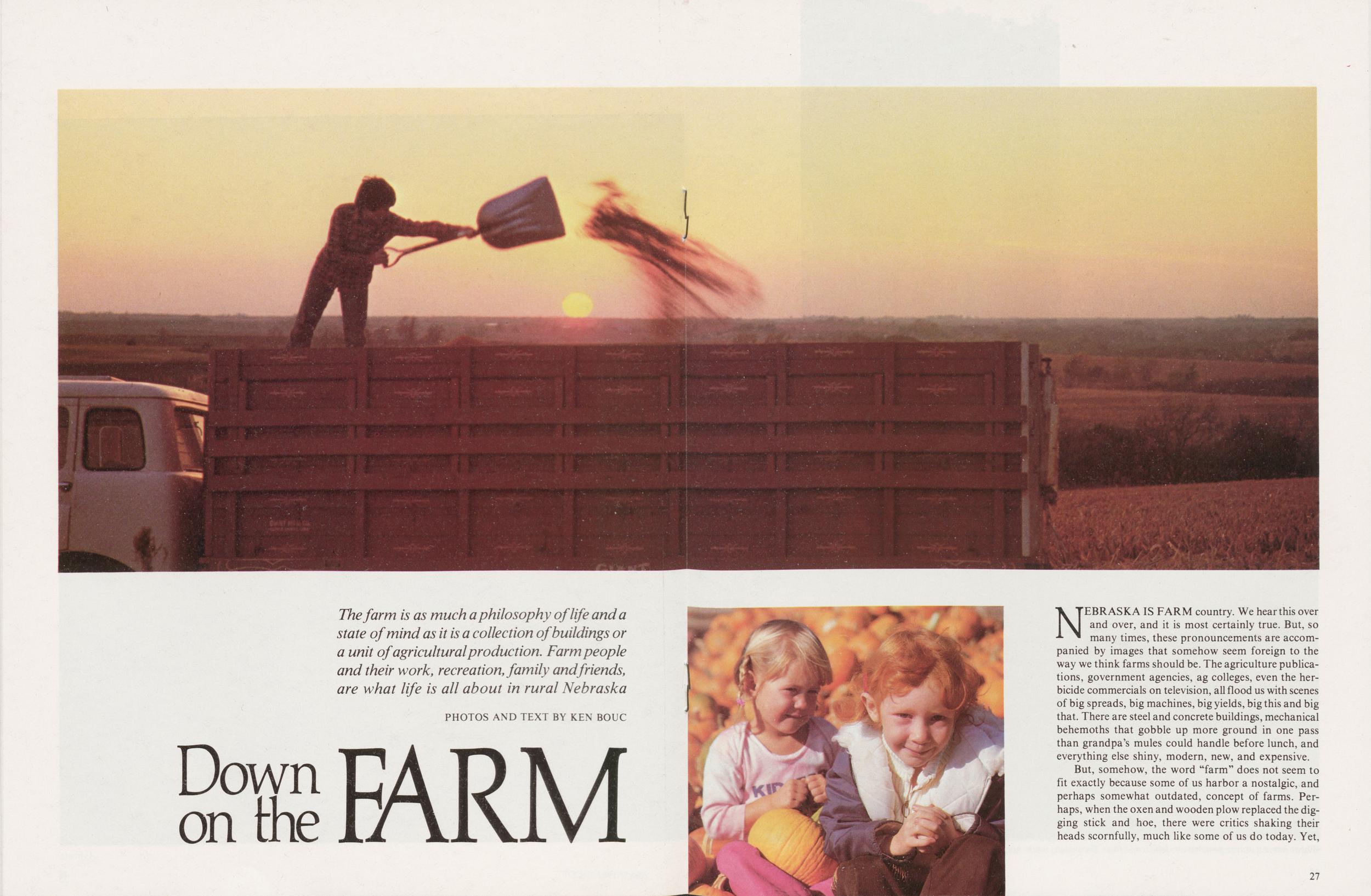
Down on the FARM
The farm is as much a philosophy of life and a state of mind as it is a collection of buildings or a unit of agricultural production. Farm people and their work, recreation, family and friends, are what life is all about in rural Nebraska PHOTOS AND TEXT BY KEN BOUCNEBRASKA IS FARM country. We hear this over and over, and it is most certainly true. But, so many times, these pronouncements are accompanied by images that somehow seem foreign to the way we think farms should be. The agriculture publications, government agencies, ag colleges, even the herbicide commercials on television, all flood us with scenes of big spreads, big machines, big yields, big this and big that. There are steel and concrete buildings, mechanical behemoths that gobble up more ground in one pass than grandpa's mules could handle before lunch, and everything else shiny, modern, new, and expensive.
But, somehow, the word "farm" does not seem to
fit exactly because some of us harbor a nostalgic, and
perhaps somewhat outdated, concept of farms. Perhaps, when the oxen and wooden plow
replaced the digging stick and hoe, there were critics shaking their
heads scornfully, much like some of us do today. Yet,
27
 the current wave of changes on the land seem
more far-reaching than those of past agricultural revolutions. A new word coined by
those
who have outgrown farming and taken up "agribusiness" seems more appropriate for some
of these new food and fiber factories. The
word "farm" belongs to something more traditional, something more personal and alive,
something more than machines and money.
the current wave of changes on the land seem
more far-reaching than those of past agricultural revolutions. A new word coined by
those
who have outgrown farming and taken up "agribusiness" seems more appropriate for some
of these new food and fiber factories. The
word "farm" belongs to something more traditional, something more personal and alive,
something more than machines and money.
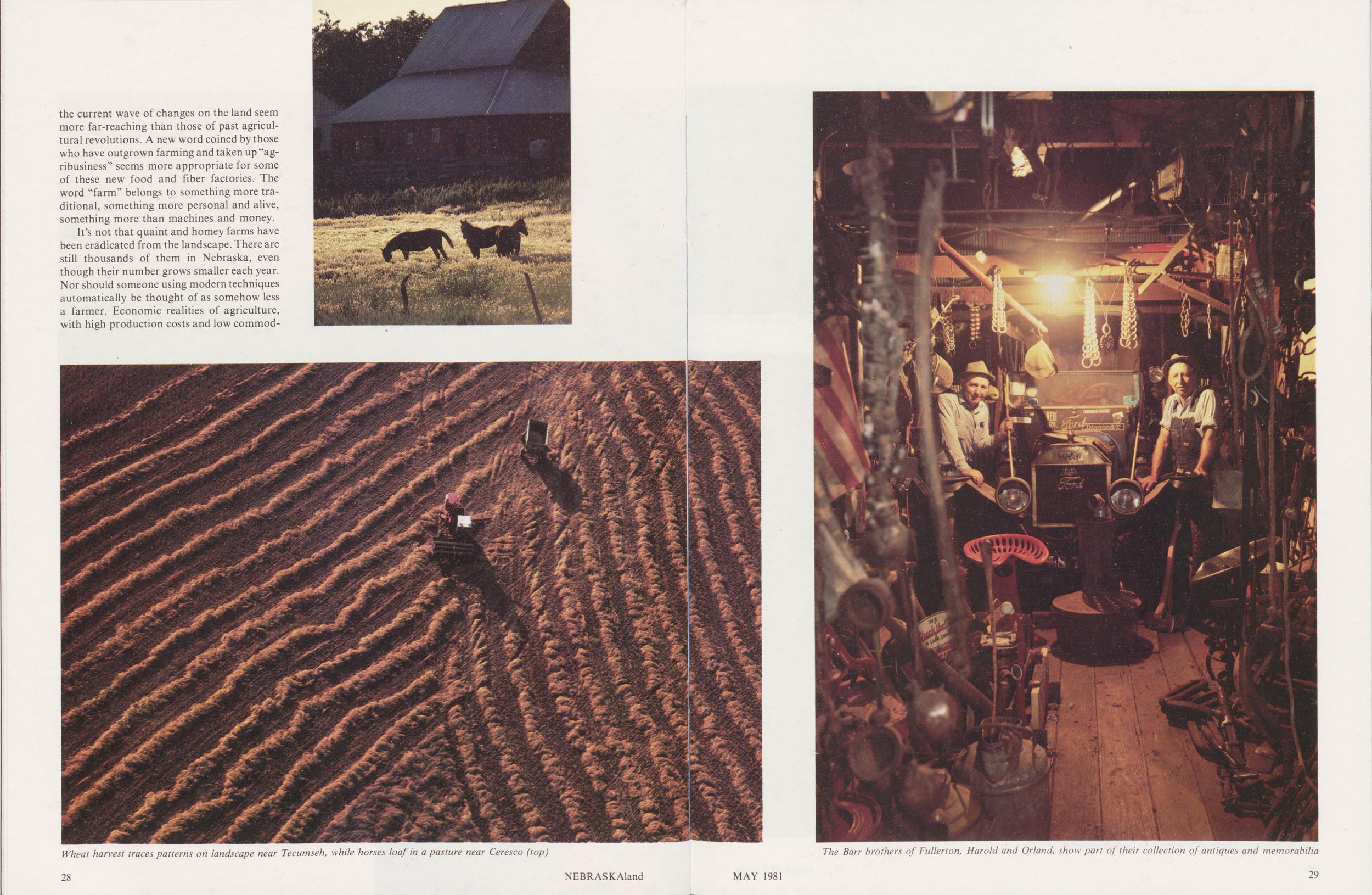
It's not that quaint and homey farms have been eradicated from the landscape. There are still thousands of them in Nebraska, even though their number grows smaller each year. Nor should someone using modern techniques automatically be thought of as somehow less a farmer. Economic realities of agriculture, with high production costs and low commod ity prices, work against the small operator. More acres must be tilled to support a family, thus dictating fewer and bigger farms and new techniques to handle all those acres.
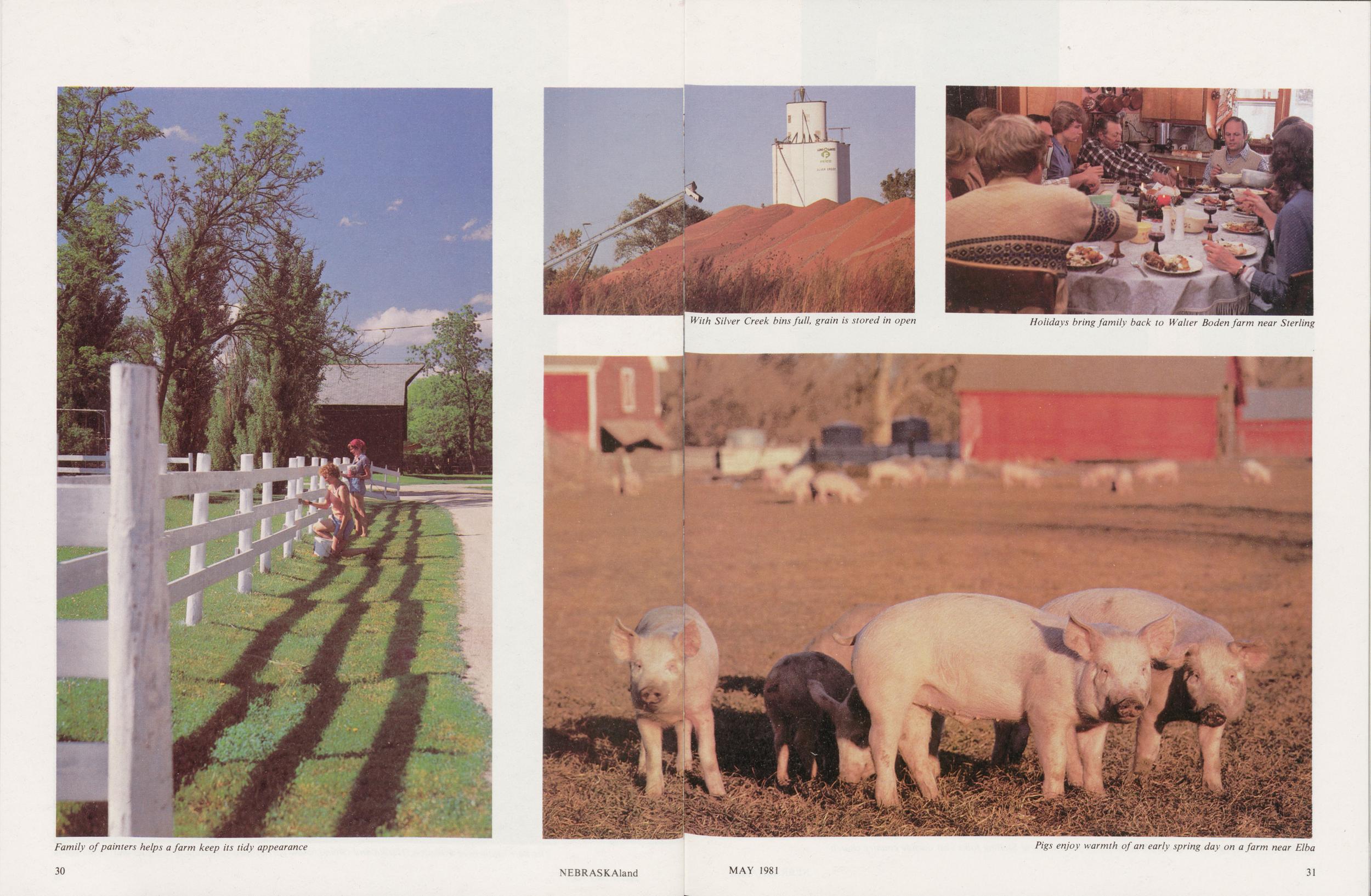
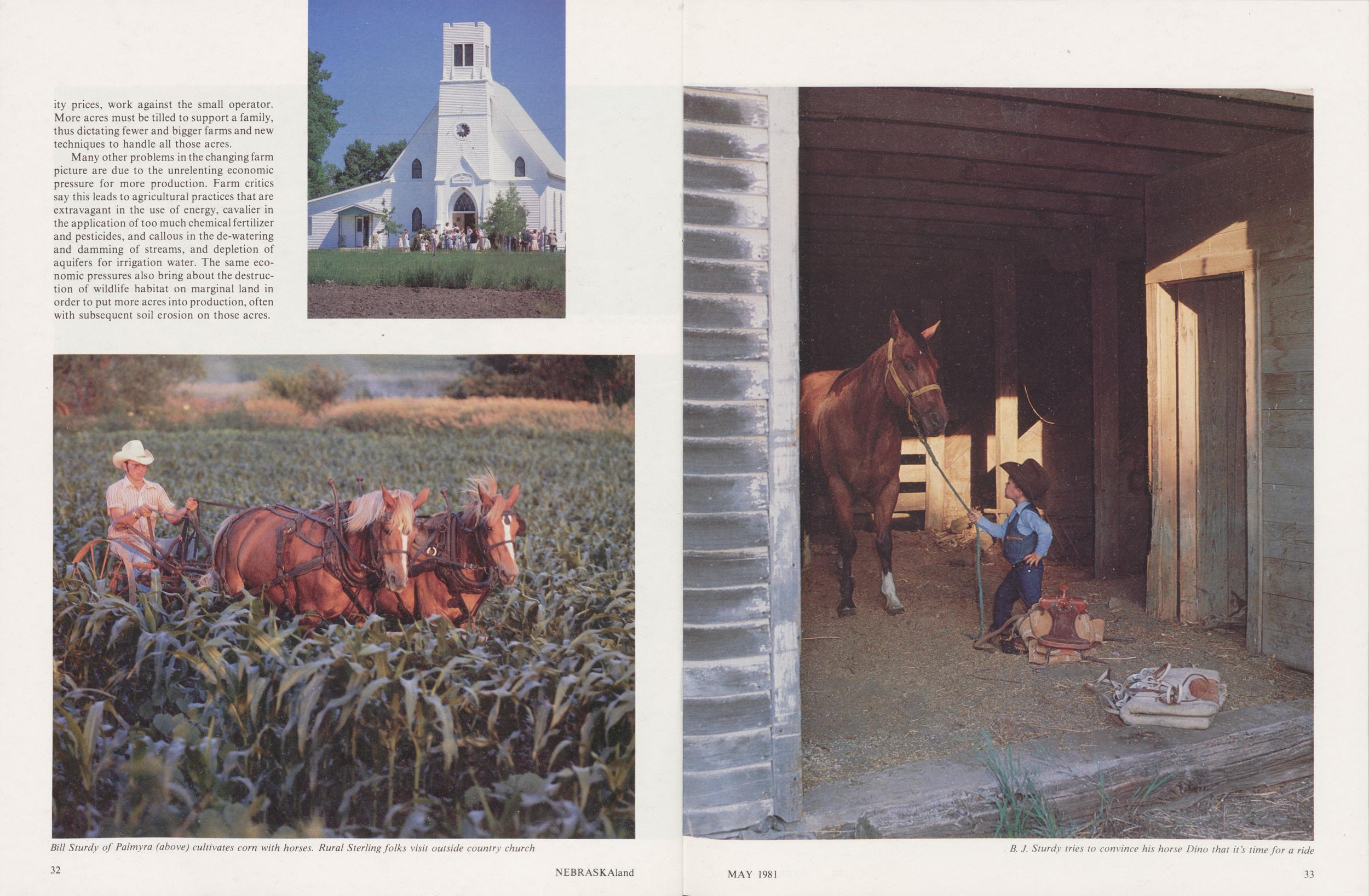
Many other problems in the changing farm picture are due to the unrelenting economic pressure for more production. Farm critics say this leads to agricultural practices that are extravagant in the use of energy, cavalier in the application of too much chemical fertilizer and pesticides, and callous in the de-watering and damming of streams, and depletion of aquifers for irrigation water. The same economic pressures also bring about the destruction of wildlife habitat on marginal land in order to put more acres into production, often with subsequent soil erosion on those acres.
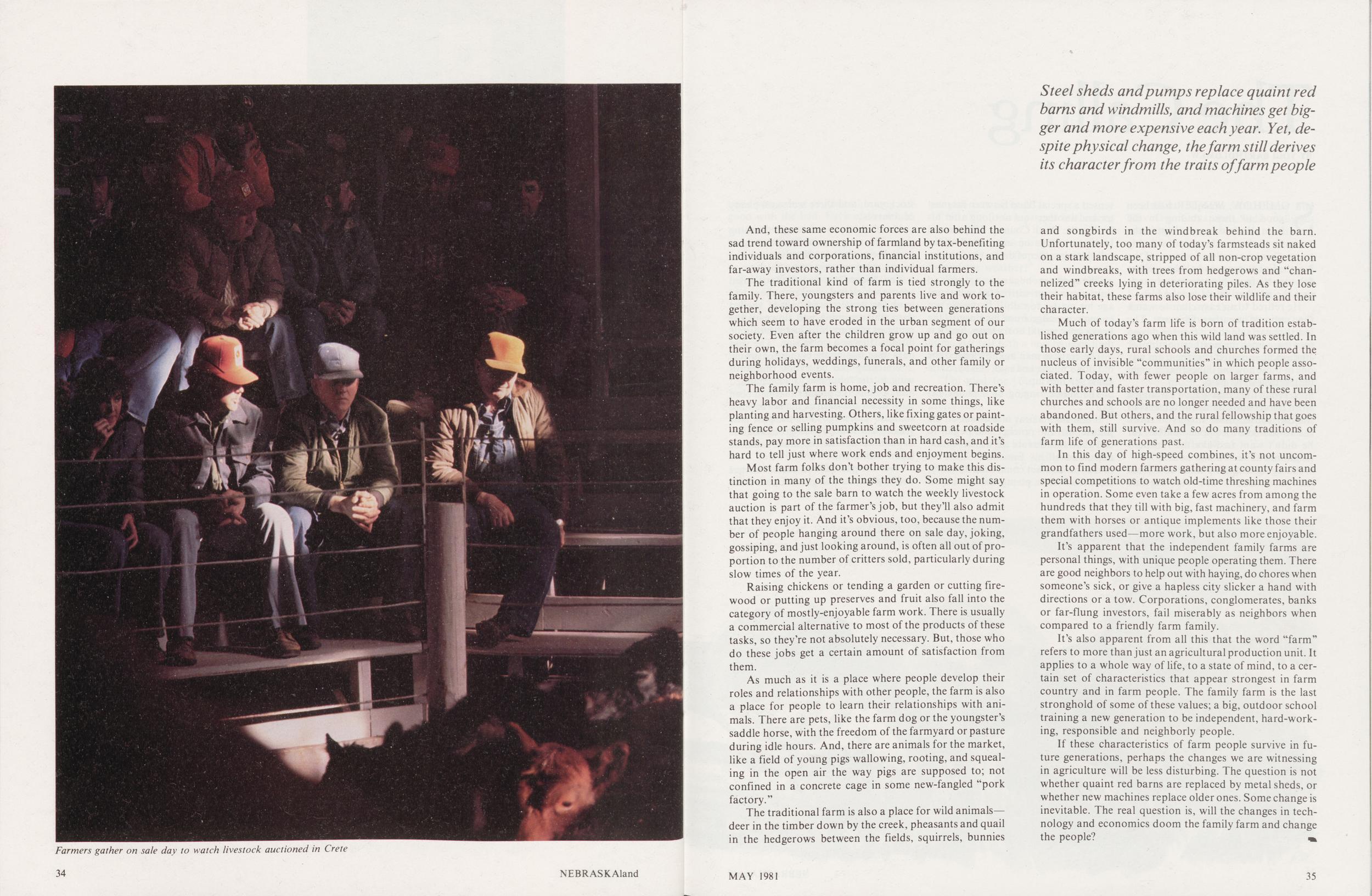
Steel sheds and pumps replace quaint red barns and windmills, and machines get bigger and more expensive each year. Yet, despite physical change, the farm still derives its character from the traits of farm people
And, these same economic forces are also behind the sad trend toward ownership of farmland by tax-benefiting individuals and corporations, financial institutions, and far-away investors, rather than individual farmers.
The traditional kind of farm is tied strongly to the family. There, youngsters and parents live and work together, developing the strong ties between generations which seem to have eroded in the urban segment of our society. Even after the children grow up and go out on their own, the farm becomes a focal point for gatherings during holidays, weddings, funerals, and other family or neighborhood events.
The family farm is home, job and recreation. There's heavy labor and financial necessity in some things, like planting and harvesting. Others, like fixing gates or painting fence or selling pumpkins and sweetcorn at roadside stands, pay more in satisfaction than in hard cash, and it's hard to tell just where work ends and enjoyment begins.
Most farm folks don't bother trying to make this distinction in many of the things they do. Some might say that going to the sale barn to watch the weekly livestock auction is part of the farmer's job, but they'll also admit that they enjoy it. And it's obvious, too, because the number of people hanging around there on sale day, joking, gossiping, and just looking around, is often all out of proportion to the number of critters sold, particularly during slow times of the year.
Raising chickens or tending a garden or cutting firewood or putting up preserves and fruit also fall into the category of mostly-enjoyable farm work. There is usually a commercial alternative to most of the products of these tasks, so they're not absolutely necessary. But, those who do these jobs get a certain amount of satisfaction from them.
As much as it is a place where people develop their roles and relationships with other people, the farm is also a place for people to learn their relationships with animals. There are pets, like the farm dog or the youngster's saddle horse, with the freedom of the farmyard or pasture during idle hours. And, there are animals for the market, like a field of young pigs wallowing, rooting, and squealing in the open air the way pigs are supposed to; not confined in a concrete cage in some new-fangled "pork factory."
The traditional farm is also a place for wild animals-deer in the timber down by the creek, pheasants and quail in the hedgerows between the fields, squirrels, bunnies and songbirds in the windbreak behind the barn. Unfortunately, too many of today's farmsteads sit naked on a stark landscape, stripped of all non-crop vegetation and windbreaks, with trees from hedgerows and "channelized" creeks lying in deteriorating piles. As they lose their habitat, these farms also lose their wildlife and their character.
Much of today's farm life is born of tradition established generations ago when this wild land was settled. In those early days, rural schools and churches formed the nucleus of invisible "communities" in which people associated. Today, with fewer people on larger farms, and with better and faster transportation, many of these rural churches and schools are no longer needed and have been abandoned. But others, and the rural fellowship that goes with them, still survive. And so do many traditions of farm life of generations past.
In this day of high-speed combines, it's not uncommon to find modern farmers gathering at county fairs and special competitions to watch old-time threshing machines in operation. Some even take a few acres from among the hundreds that they till with big, fast machinery, and farm them with horses or antique implements like those their grandfathers used—more work, but also more enjoyable.
It's apparent that the independent family farms are personal things, with unique people operating them. There are good neighbors to help out with haying, do chores when someone's sick, or give a hapless city slicker a hand with directions or a tow. Corporations, conglomerates, banks or far-flung investors, fail miserably as neighbors when compared to a friendly farm family.
It's also apparent from all this that the word "farm" refers to more than just an agricultural production unit. It applies to a whole way of life, to a state of mind, to a certain set of characteristics that appear strongest in farm country and in farm people. The family farm is the last stronghold of some of these values; a big, outdoor school training a new generation to be independent, hard-working, responsible and neighborly people.
If these characteristics of farm people survive in future generations, perhaps the changes we are witnessing in agriculture will be less disturbing. The question is not whether quaint red barns are replaced by metal sheds, or whether new machines replace older ones. Some change is inevitable. The real question is, will the changes in technology and economics doom the family farm and change the people?
MAY 1981 35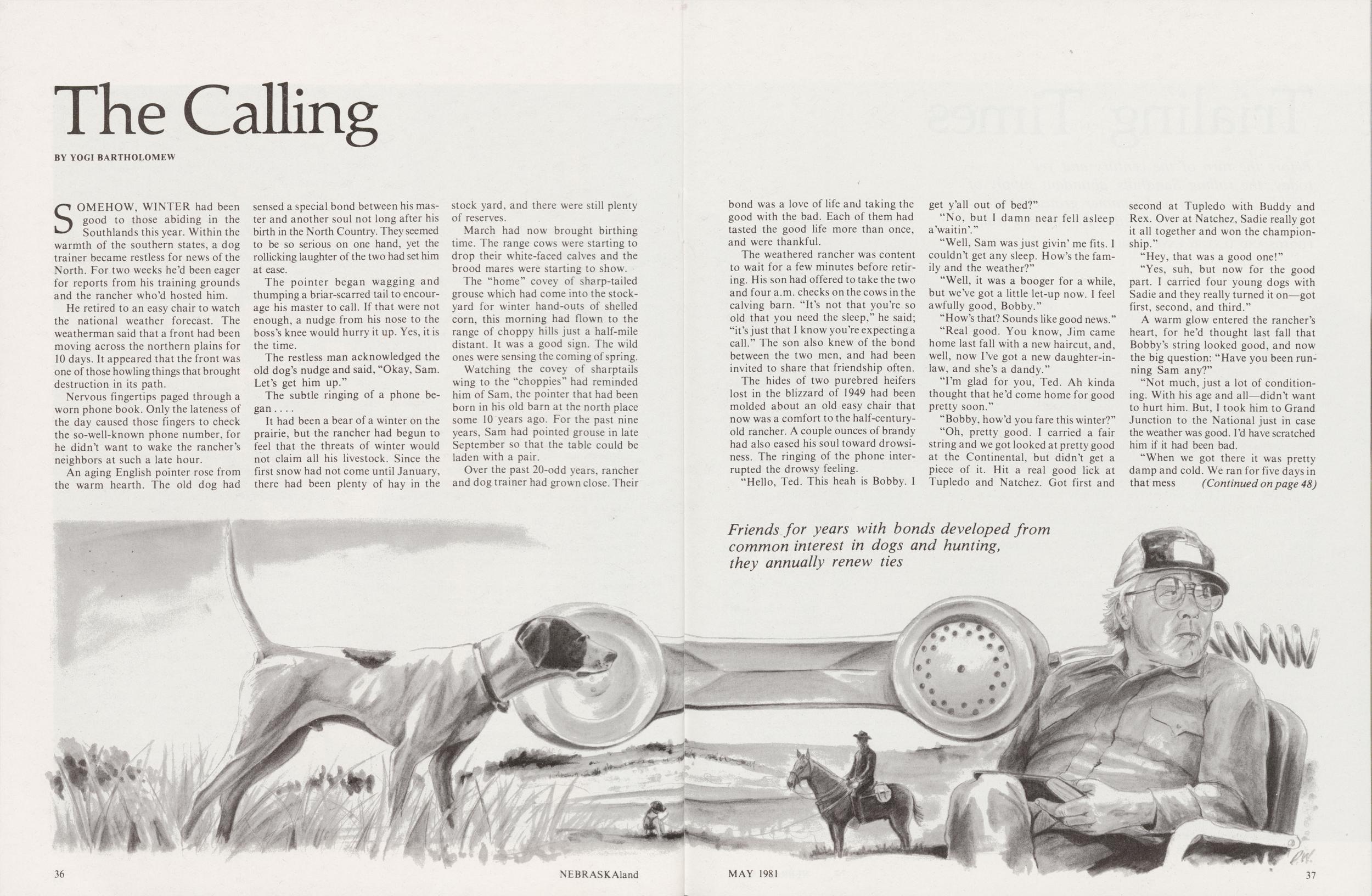
The Calling
BY YOGI BARTHOLOMEWSOMEHOW, WINTER had been good to those abiding in the Southlands this year. Within the warmth of the southern states, a dog trainer became restless for news of the North. For two weeks he'd been eager for reports from his training grounds and the rancher who'd hosted him.
He retired to an easy chair to watch the national weather forecast. The weatherman said that a front had been moving across the northern plains for 10 days. It appeared that the front was one of those howling things that brought destruction in its path.
Nervous fingertips paged through a worn phone book. Only the lateness of the day caused those fingers to check the so-well-known phone number, for he didn't want to wake the rancher's neighbors at such a late hour.
An aging English pointer rose from the warm hearth. The old dog had sensed a special bond between his master and another soul not long after his birth in the North Country. They seemed to be so serious on one hand, yet the rollicking laughter of the two had set him at ease.
The pointer began wagging and thumping a briar-scarred tail to encourage his master to call. If that were not enough, a nudge from his nose to the boss's knee would hurry it up. Yes, it is the time.
The restless man acknowledged the old dog's nudge and said, "Okay, Sam. Let's get him up."
The subtle ringing of a phone began
It had been a bear of a winter on the prairie, but the rancher had begun to feel that the threats of winter would not claim all his livestock. Since the first snow had not come until January, there had been plenty of hay in the stock yard, and there were still plenty of reserves.
March had now brought birthing time. The range cows were starting to drop their white-faced calves and the brood mares were starting to show.
The "home" covey of sharp-tailed grouse which had come into the stockyard for winter hand-outs of shelled corn, this morning had flown to the range of choppy hills just a half-mile distant. It was a good sign. The wild ones were sensing the coming of spring.
Watching the covey of sharptails wing to the "choppies" had reminded him of Sam, the pointer that had been born in his old barn at the north place some 10 years ago. For the past nine years, Sam had pointed grouse in late September so that the table could be laden with a pair.
Over the past 20-odd years, rancher and dog trainer had grown close. Their
The weathered rancher was content to wait for a few minutes before retiring. His son had offered to take the two and four a.m. checks on the cows in the calving barn. "It's not that you're so old that you need the sleep," he said; "it's just that I know you're expecting a call." The son also knew of the bond between the two men, and had been invited to share that friendship often.
The hides of two purebred heifers lost in the blizzard of 1949 had been molded about an old easy chair that now was a comfort to the half-century-old rancher. A couple ounces of brandy had also eased his soul toward drowsiness. The ringing of the phone interrupted the drowsy feeling.
"Hello, Ted. This heah is Bobby. I get y'all out of bed?"
"No, but I damn near fell asleep a'waitin'."
"Well, Sam was just givin' me fits. I couldn't get any sleep. How's the family and the weather?"
"Well, it was a booger for a while, but we've got a little let-up now. I feel awfully good, Bobby."
"How's that? Sounds like good news."
"Real good. You know, Jim came home last fall with a new haircut, and, well, now I've got a new daughter-in-law, and she's a dandy."
"I'm glad for you, Ted. Ah kinda thought that he'd come home for good pretty soon."
"Bobby, how'd you fare this winter?"
"Oh, pretty good. I carried a fair string and we got looked at pretty good at the Continental, but didn't get a piece of it. Hit a real good lick at Tupledo and Natchez. Got first and second at Tupledo with Buddy and Rex. Over at Natchez, Sadie really got it all together and won the championship."
"Hey, that was a good one!"
"Yes, suh, but now for the good part. I carried four young dogs with Sadie and they really turned it on—got first, second, and third."
A warm glow entered the rancher's heart, for he'd thought last fall that Bobby's string looked good, and now the big question: "Have you been running Sam any?"
"Not much, just a lot of conditioning. With his age and all—didn't want to hurt him. But, I took him to Grand Junction to the National just in case the weather was good. I'd have scratched him if it had been bad.
"When we got there it was pretty damp and cold. We ran for five days in that mess (Continued on page 48)
Friends for years with bonds developed from common interest in dogs and hunting, they annually renew ties
MAY 1981 37
Trialing Times
Before the turn of the century and yet today, the rolling Sandhills' abundant supply of affable landowners and summer grouse have provided a near perfect setting for top dog trainers PHOTOS AND TEXT BY FAYE MUSILANY TIME two owners or trainers of two dogs come together, it's inevitable that they eventually have to find out which has the better dog. That's what field trialing is all about.
For 100 years, people with dogs have come to Nebraska to train and trial their dogs. Many top bird dogs in the country have worked and competed in the state.
In 1880, two members of Nebraska's very first Fish Commission judged one of only four field trials held in the entire U.S.—here in Nebraska. Ten setters competed in an all-age stake on the banks of the Big Blue River near Milford. Judges B. E. B. Kennedy and R. R. Livingston awarded first place to Lizze Lee, an English setter.
In 1881, the Nebraska State Sportsman's Association moved its trial to Norfolk. Six trials were held in the U.S. that year.
Back then, settlement was pretty sparse in Nebraska. A few Indians still roamed the hills, startling pioneer women as they peered in soddie windows. Fort Hartsuff, near present-day Burwell, had just outlived its usefulness, closing in '81.
The last of the buffalo had only been gone from Nebraska a few years, and the plow had barely disturbed the waving grasses.
A homesteader or Kincaider could still shoot a brace of prairie chickens from his back door, and outdoor writer Sandy Griswold was still writing for the Omaha World Herald about seeing "thousands of chicken at a single glance of the eye in any direction."
The late James B. Kellogg, wellknown field trial promoter and historian, referred to O'Neill as the first bird dog capital of the West. "O'Neill," he wrote in a 1959 article for American Field, "harbored the summer camps of many of the leading handlers at the turn of the century."
Dogs that were trained in Nebraska's Sandhills included Fishel's Frank, considered by pointer owners and trainers to be the "father of the modern pointer." The records confirm that title, for he sired 52 winners that accumulated 192 field trial placements. Fishel's Frank was elected to the Field Trial Hall of Fame in 1954, and two of his offspring, John Proctor and Comanche Frank, were also named to the hall of Fame.
Frank's owner, U. R. Fishel, became a member of the Hall of Fame in 1962. He was known during his time as the foremost breeder of pointers, and he was famous as a judge of both field trials and bench shows.
Er M. Shelley brought his dogs to the Sandhills. When he was named to the Field Trial Hall of Fame in 1957, he was quoted as having said, "I began training dogs in the early 1890's. Birds were plentiful then. Indeed, it was much easier to train a dog in those days, birds were so abundant." Shelley was known as the dean of professional handlers, and also trained several top trainers—including Clyde Morton, also a Hall of Famer.
One of the dogs Shelley handled was Hard Cash, named to the Hall of Fame in 1963. Hard Cash, a white-and-liver pointer, won 11 placements including first in the Iowa Derby, held at O'Neill in 1904, and third in the Nebraska Derby, also held at O'Neill the same year. Authorities of that time described Hard Cash as an "exceptionally well made pointer, carrying no excess weight, strong-boned and well-muscled. " He sired 15 winners that gained 56 places. He appears in the pedigrees of both parents of Muscle Shoals Jake, a Hall of Fame dog named in 1955.
Pioneer was another of Shelley's triumphs, winning the National Championship in 1906.
Jessie Rodfield's Count Gladstone also came to the Sandhills with Er Shelley. He was regarded as one of the finest bird finders of his period, and counted 17 field trial placements to his name. It was an earlier Count Gladstone of that line that won the first National Championship ever held, in 1896.
These dogs and many others that ran over the huge expanses of open prairie seeking grouse, bred the champions. In Nebraska's Sandhills, trainers followed those dogs on horses, as they do today, and learned about a new kind of dog and a new kind of field trialing.
According to Kellogg, "the rolling hills, abundance of game, and affability of ranchers in this section lent itself to a near perfect training situation." He described the Sandhills as "an area of tall grass, sandhills, blowouts, potholes, lakes, whiteface cattle, windmills, fences, corrals, timber claims, prairie chicken, and grouse.
"If and when the chicken and grouse are forced to make a last stand, Lord 38 NEBRASKAland
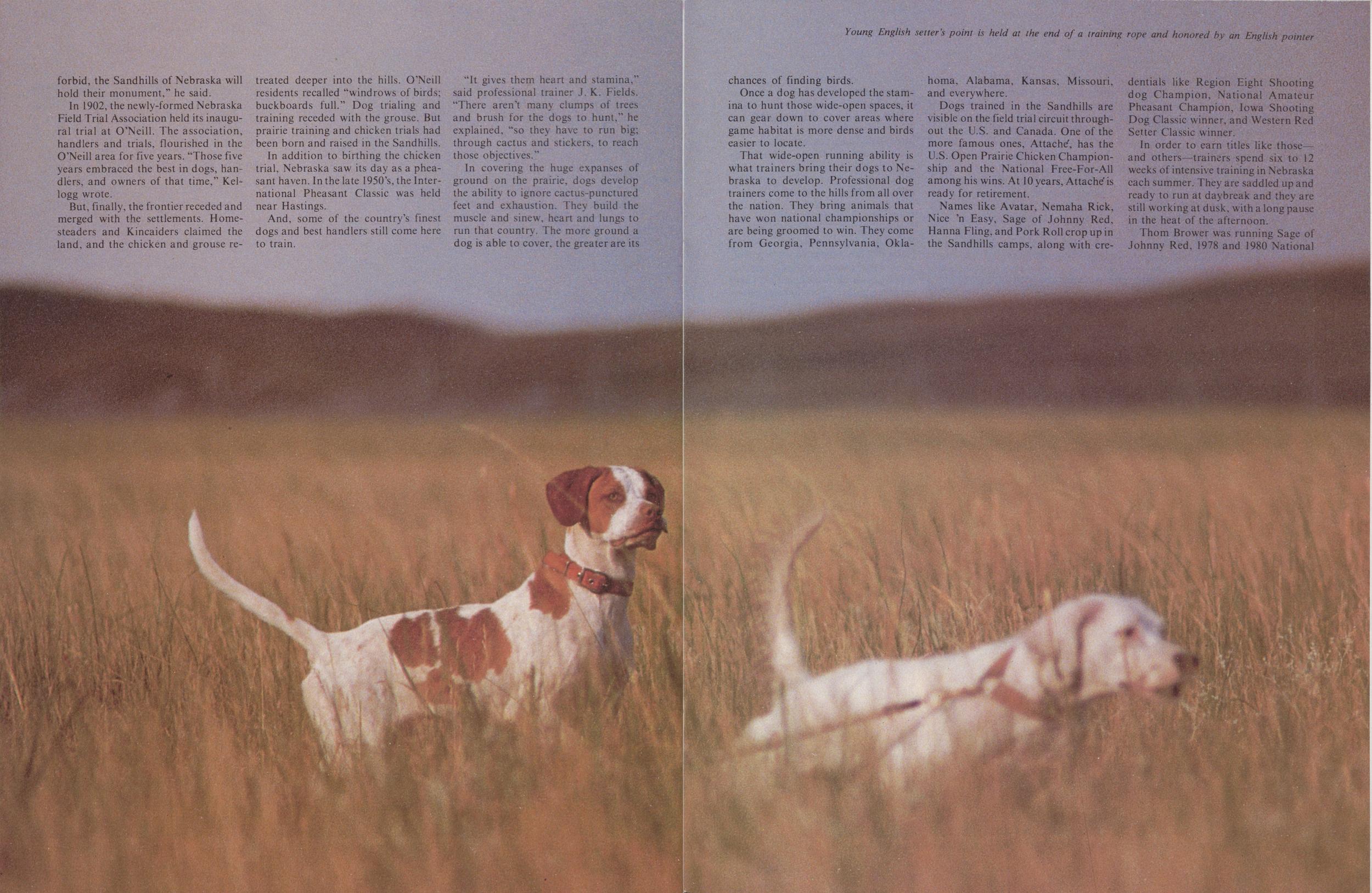
In 1902, the newly-formed Nebraska Field Trial Association held its inaugural trial at O'Neill. The association, handlers and trials, flourished in the O'Neill area for five years. "Those five years embraced the best in dogs, handlers, and owners of that time," Kellogg wrote.
But, finally, the frontier receded and merged with the settlements. Homesteaders and Kincaiders claimed the land, and the chicken and grouse retreated deeper into the hills. O'Neill residents recalled "windrows of birds; buckboards full." Dog trialing and training receded with the grouse. But prairie training and chicken trials had been born and raised in the Sandhills.
In addition to birthing the chicken trial, Nebraska saw its day as a pheasant haven. In the late 1950's, the International Pheasant Classic was held near Hastings.
And, some of the country's finest dogs and best handlers still come here to train.
"It gives them heart and stamina," said professional trainer J. K. Fields. "There aren't many clumps of trees and brush for the dogs to hunt," he explained, "so they have to run big; through cactus and stickers, to reach those objectives."
In covering the huge expanses of ground on the prairie, dogs develop the ability to ignore cactus-punctured feet and exhaustion. They build the muscle and sinew, heart and lungs to run that country. The more ground a dog is able to cover, the greater are its
Once a dog has developed the stamina to hunt those wide-open spaces, it can gear down to cover areas where game habitat is more dense and birds easier to locate.
That wide-open running ability is what trainers bring their dogs to Nebraska to develop. Professional dog trainers come to the hills from all over the nation. They bring animals that have won national championships or are being groomed to win. They come from Georgia, Pennsylvania, Oklahoma, Alabama, Kansas, Missouri, and everywhere.
Dogs trained in the Sandhills are visible on the field trial circuit throughout the U.S. and Canada. One of the more famous ones, Attache, has the U.S. Open Prairie Chicken Championship and the National Free-For-All among his wins. At 10 years, Attache is ready for retirement.
Names like Avatar, Nemaha Rick, Nice 'n Easy, Sage of Johnny Red, Hanna Fling, and Pork Roll crop up in the Sandhills camps, along with credentials like Region Eight Shooting dog Champion, National Amateur Pheasant Champion, Iowa Shooting Dog Classic winner, and Western Red Setter Classic winner.
In order to earn titles like those—and others—trainers spend six to 12 weeks of intensive training in Nebraska each summer. They are saddled up and ready to run at daybreak and they are still working at dusk, with a long pause in the heat of the afternoon.
Thorn Brower was running Sage of
Johnny Red, 1978 and 1980 National
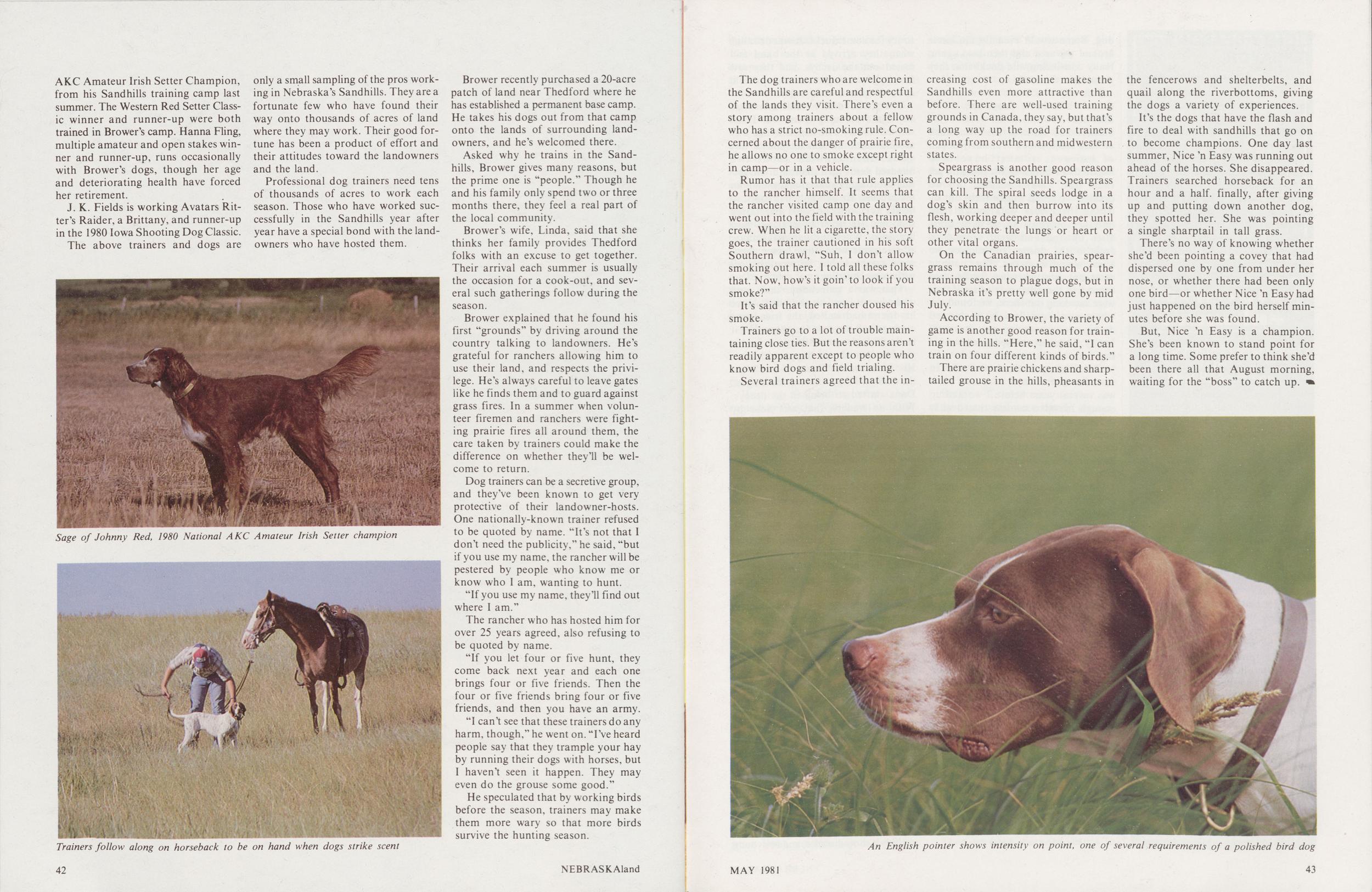 AKC Amateur Irish Setter Champion,
from his Sandhills training camp last
summer. The Western Red Setter Classic winner and runner-up were both
trained in Brower's camp. Hanna Fling,
multiple amateur and open stakes winner and runner-up, runs occasionally
with Brower's dogs, though her age
and deteriorating health have forced
her retirement.
AKC Amateur Irish Setter Champion,
from his Sandhills training camp last
summer. The Western Red Setter Classic winner and runner-up were both
trained in Brower's camp. Hanna Fling,
multiple amateur and open stakes winner and runner-up, runs occasionally
with Brower's dogs, though her age
and deteriorating health have forced
her retirement.
J. K. Fields is working Avatars Ritter's Raider, a Brittany, and runner-up in the 1980 Iowa Shooting Dog Classic.
The above trainers and dogs are only a small sampling of the pros working in Nebraska's Sandhills. They area fortunate few who have found their way onto thousands of acres of land where they may work. Their good fortune has been a product of effort and their attitudes toward the landowners and the land.
Professional dog trainers need tens of thousands of acres to work each season. Those who have worked successfully in the Sandhills year after year have a special bond with the landowners who have hosted them.
Brower recently purchased a 20-acre patch of land near Thedford where he has established a permanent base camp. He takes his dogs out from that camp onto the lands of surrounding landowners, and he's welcomed there.
Asked why he trains in the Sandhills, Brower gives many reasons, but the prime one is "people." Though he and his family only spend two or three months there, they feel a real part of the local community.
Brower's wife, Linda, said that she thinks her family provides Thedford folks with an excuse to get together. Their arrival each summer is usually the occasion for a cook-out, and several such gatherings follow during the season.
Brower explained that he found his first "grounds" by driving around the country talking to landowners. He's grateful for ranchers allowing him to use their land, and respects the privilege. He's always careful to leave gates like he finds them and to guard against grass fires. In a summer when volunteer firemen and ranchers were fighting prairie fires all around them, the care taken by trainers could make the difference on whether they'll be welcome to return.
Dog trainers can be a secretive group, and they've been known to get very protective of their landowner-hosts. One nationally-known trainer refused to be quoted by name. "It's not that I don't need the publicity," he said, "but if you use my name, the rancher will be pestered by people who know me or know who I am, wanting to hunt.
"If you use my name, they'll find out where I am."
The rancher who has hosted him for over 25 years agreed, also refusing to be quoted by name.
"If you let four or five hunt, they come back next year and each one brings four or five friends. Then the four or five friends bring four or five friends, and then you have an army.
"I can't see that these trainers do any harm, though," he went on. "I've heard people say that they trample your hay by running their dogs with horses, but I haven't seen it happen. They may even do the grouse some good."
He speculated that by working birds before the season, trainers may make them more wary so that more birds survive the hunting season.
42 NEBRASKAlandThe dog trainers who are welcome in the Sandhills are careful and respectful of the lands they visit. There's even a story among trainers about a fellow who has a strict no-smoking rule. Concerned about the danger of prairie fire, he allows no one to smoke except right in camp—or in a vehicle.
Rumor has it that that rule applies to the rancher himself. It seems that the rancher visited camp one day and went out into the field with the training crew. When he lit a cigarette, the story goes, the trainer cautioned in his soft Southern drawl, "Suh, I don't allow smoking out here. I told all these folks that. Now, how's it goin' to look if you smoke?"
It's said that the rancher doused his smoke.
Trainers go to a lot of trouble maintaining close ties. But the reasons aren't readily apparent except to people who know bird dogs and field trialing.
Several trainers agreed that the increasing cost of gasoline makes the Sandhills even more attractive than before. There are well-used training grounds in Canada, they say, but that's a long way up the road for trainers coming from southern and midwestern states.
Speargrass is another good reason for choosing the Sandhills. Speargrass can kill. The spiral seeds lodge in a dog's skin and then burrow into its flesh, working deeper and deeper until they penetrate the lungs or heart or other vital organs.
On the Canadian prairies, speargrass remains through much of the training season to plague dogs, but in Nebraska it's pretty well gone by mid July.
According to Brower, the variety of game is another good reason for training in the hills. "Here," he said, "I can train on four different kinds of birds."
There are prairie chickens and sharp-tailed grouse in the hills, pheasants in the fencerows and shelterbelts, and quail along the riverbottoms, giving the dogs a variety of experiences.
It's the dogs that have the flash and fire to deal with sandhills that go on to become champions. One day last summer, Nice 'n Easy was running out ahead of the horses. She disappeared. Trainers searched horseback for an hour and a half, finally, after giving up and putting down another dog, they spotted her. She was pointing a single sharptail in tall grass.
There's no way of knowing whether she'd been pointing a covey that had dispersed one by one from under her nose, or whether there had been only one bird—or whether Nice 'n Easy had just happened on the bird herself minutes before she was found.
But, Nice 'n Easy is a champion. She's been known to stand point for a long time. Some prefer to think she'd been there all that August morning, waiting for the "boss" to catch up.
a state Legislator (in 1915), he introduced a bill which allocated money from the sale of sporting licenses to the Game and Parks Commission rather than to the state school fund, where it formerly went. The school fund had the strongest lobby in the state, and fought his bill mightily. It took him three legislative sessions to get his bill passed, but he finally accomplished it with some "good old-fashioned vote trading." Thus, after two earlier defeats, in 1919 he did it without a single dissenting vote from any member in either house.
Dana's father was also a proponent of pheasant stocking, and actively promoted it. Dana remembers when he was a small boy, probably before 1905, asking his father why anyone would want to shoot such a beautiful bird. "That bird is going to become Nebraska's biggest game bird," he had answered. Dana apparently learned why anyone would shoot them, but also that they were not that easy to shoot, and he became an avid hunter of them over the years. In those early years, his father had pheasant eggs shipped in and took them to area farmers for hatching.
With memories of pleasant, and funny, and exciting experiences stretching over three-quarters of a century, he has much fodder available when chatting about the good old days. Among those times are many recollections and opinions on the use of call ducks—actual live birds which the hunter had captive or as pets, and which were used to lure in wild birds.
"I sincerely believe that live decoys should be permitted again," says Dana. "I think they would mean much better hunting for the water-fowler, but also mean an actual reduction in total duck mortality." This, he explains, would result because ducks would be brought into closer range to a decoy spread, with resultant reduction of wounding and eventual mortality and waste.
As with other hunters, many of Dana's experiences afield harken back to when he was just a boy when live decoys were used. Some of them were simply tremendous birds, serving as faithfully or dependably as a hunting dog. Some would even fly up, circle around the area and then land again, really convincing wild ducks that they should do the same.
Not all of Dana's memories are those which he is proud of, either. Like once he and a chum went out for bunnies and came across a haystack or bale stack which " was just full of holes it must have held hundreds of bunnies. We couldn't get them out," Dana recalls, "so we decided we could smoke them out by letting the breeze waft smoke right into their burrows. So, we lit the grass afire upwind and went around to ambush the dozens of bunnies we knew would dash out. But, nothing came out, and when we finally went around to the other side to see if they were sneaking out there, we found the whole stack on fire. It all burned down and we never saw a single bunny. Then we sneaked away, covering our tracks so we couldn't be trailed. We heard talk about the fire in town for several days, of course, but it was several years before I worked up enough nerve to confess that deal."
He and friends hunted a lot, sharing one shotgun, in most cases. They hunted quail and rabbits, mostly, and he even had a ferret at one time to help in the pursuit of bunnies.
Once when alone in quest of quail, and after considerble effort, he had downed only a single bobwhite. Then, he happened across a big flock of blackbirds, and fired into the bunch. Not liking to waste anything, he actually cleaned quite a number of them and later had his mother cook them—without telling anyone what they really were. Although only one person ate a quail, and the rest ate black-birds, no one ever knew, and he never informed them for a long time, either.
Possibly with the same friend as in the haystack incident, Dana once went just a short distance from Neligh
The friend didn't think there was any sense pursuing them, but Dana wanted to try. He worked his way around until he was behind a hay stack, then crawled about two hundred yards up a shallow ditch, getting thoroughly soaked and muddy in the process. He had only five shots, so he got as close as he could and started shooting. He never fired at any bird but once. When the gun was empty, all five geese were down, some dead, some crippled, but he recovered all with some hustling.
That was a tremendous thrill, and when he returned to the blind where his friend had waited, the friend was ready to call it a day. He only asked if he could have one of the geese for his girl friend, and was happy with that. His friend said, "Dana, if you'll get the decoys, I'll go hitch up the wagon. Dana started to bring in the decoys. With no waders, that was done by throwing a line out with a stick attached, then dragging it over a deke. When only one decoy was left floating, a flock of Canada geese appeared. Dana hurried into the blind, and loaded up. He got one shot when the birds came in, then his gun jammed. No matter how he worked and pulled, he couldn't unshuck that first shell. But, the one shot had been effective, and four large Canada geese had dropped. That brought his total for the morning to nine geese, which was a high point of his hunting career. And, it gave some of the local hunters some anxious moments later to hear about the episode.
One weekend his brother was home from college (at Wesleyan in Lincoln) during spring break. Although he was planning to take the early morning train back, Dana talked him into a later train so they could go duck hunting, and even borrowed a second shotgun so they could both shoot. However, his brother liked to sleep more than hunt, so they didn't get a very early start. When they did arrive, they caught sight of just one flock of geese, which was scared off a pond by other hunters.
The geese sat back down after moving only a short distance, and our young 44 NEBRASKAland hunters managed to get within about 200 yards, but the geese again escaped. And, even though one of them was wounded and stayed behind, they did not shoot at it. Instead they continued the pursuit and finally reached a plum thicket, then saw the geese in a cornfield adjacent feeding right toward them. They waited and waited, but before they reached them, a hay rack on the county road scared them up. It looked bad again, but the birds came overhead, and they dropped the flock leader and two more geese. Then, they backtracked and got the wounded goose, and while working back around the country toward town, shot ducks, which were bunched up on the river. Each bend they checked produced several ducks until they had so many they couldn't carry any more.
With only one shotgun during most of his early excursions, which he often had to share with friends, and with no waders, any successes were pretty much earned, and much cherished.
Hunting and fishing were interrupted by World War I, but it didn't take long for Dana to get back into a more enjoyable type action when he returned from service. While growing up in Neligh, he and friends had spent considerable time down at the Neligh Mill pond offering bait to the resident catfish. He recalls many a pleasant hour on the banks of the pond, where other fishermen from town used to relax, as well. In later years, when the opportunity arose, he took up trout fishing and loved it. Spearfish Creek up in South Dakota was a favorite spot because the family had a cabin there, and he also remembers helping stock trout in Verdigre Creek in Nebraska when he was a boy.
But, it is the hunting of ducks that seems to be most memorable, perhaps because the rewards were better. Much of his early hunting was done in the spring of the year, when that season was still legal, and he recalls never having trouble getting birds then. They were more numerous and less wary. However, fall was not bad either, such as in the mid 1920's and 30's. He had started hunting on the Platte River near Hordville with a former student of his at the University—who became a friend even though he had flunked him. That was when Dana was teaching in the Business College at the University of Nebraska, and the entire faculty in that department was six professors.
At any rate, he recalls one time when the water was so high on the Platte they couldn't be in the blind—they had to hide outside, and the ducks came in such great numbers they had limits in no time. He was the only one with just five shots then, as the others had special extended magazines to hold seven shots. They were using only shadow decoys that day, but they worked. After getting their limits, and they lost quite a number because of the high, fast water, they returned from the cabin to the blind to watch for geese, which usually moved later in the morning. It was on October 10, he remembers, and amid the "oodles" of ducks, sure enough, there was a flock of Hutchinson geese. With only one call, they came right in. He and the two other hunters dropped 17 geese, but lost six to the river. Then a flock of snow geese came by and 10 of them were added to the bag.
Because of the terrible weather, the early-day roads were nearly impassable, and as Dana felt he had to get back to Lincoln, he decided to take the train. So, he went to the station with the 10 snow geese draped around him. Everyone was amazed at the big birds, and people got off the train just to see them.
Another time they were in the blind, just three of them, when the ducks literally invaded. The one hunter had a double barrel, and was the fastest reloader Dana ever saw able to shoot twice, then reload in a second for two more shots at the same flock. During the morning, the three men shot 70 ducks. When the remainder of the party, busy playing cards, saw the birds, they were ready to go the next day. It was not so hectic then, with the eight hunters eventually getting 40 ducks.
Sometime later, he and friends also had a logoon near Waco for hunting waterfowl, and they garnered many limits and had much good hunting there over the years, even staying at the house with the farmer. Their host wouldn't allow them to gamble in his house, however, which put a damper on their night poker game until they slyly substituted matchsticks for money.
Hack water Canadas A new limited edition print IV Neal R. Anderson This beautiful full color print of a family of Canada Geese is a limited edition of 500, signed & numbered by the artist It is printed on neutral ph cotton fiber paper. The size of the print is 15" x 19" with ample margins for matting & framing. Price is $40.00 per print. Please include $2.00 per order to help cover postage & handling. All prints shipped flat well protected. Satisfaction or your money refunded. MAY 1981 45 "The Good Fishermen Always Start & Finish Here 9
Air-conditioned units, cooking facilities,
Up to six adults. Campground on the
beach—40 hookups, showers, playground shade. Write for a free
brochure.
AIR STRIP 2,600 Feet Sod
GUIDE SERVICE
South Shore Big Mac
at Gate 18
MARINA
Boat Gas & Oil on the Water
LAUNCHING STORE Groceries,
Beer, Pop, Tackle, Live Bait
HIGHWATER RAMP
BOAT & PONTOON RENTALS
Motors from 10-40 HP, boats 14
to 20 feet
Rural Route
Brule, Ne. 69127
Ogallala, Ne.
(308) 284-4965
EXIT 6 ON THE NORTH SIDE
VISIT THE
Admiral's Galley
RESTAURANT
YOUR FAVORITE COCKTAILS FANCY LARGE SALAD BAR
TROPHY STRIPERS ON DISPLAY
CLOSE TO WATER
Located on the north shore of
Lake McConaughy, 7 miles
west of dam
SERVICES
Tackle, Bait, Gas, Oil,
Ice, Beer, Pop, etc.
Ph: 308-355-2102
MOTEL
Lake McConaughy's largest motel
and apartment complex-includes new units
BOAT AND MOTOR RENTAL
GUIDE SERVICE
Lemoyne, Ne 69146
"The Good Fishermen Always Start & Finish Here 9
Air-conditioned units, cooking facilities,
Up to six adults. Campground on the
beach—40 hookups, showers, playground shade. Write for a free
brochure.
AIR STRIP 2,600 Feet Sod
GUIDE SERVICE
South Shore Big Mac
at Gate 18
MARINA
Boat Gas & Oil on the Water
LAUNCHING STORE Groceries,
Beer, Pop, Tackle, Live Bait
HIGHWATER RAMP
BOAT & PONTOON RENTALS
Motors from 10-40 HP, boats 14
to 20 feet
Rural Route
Brule, Ne. 69127
Ogallala, Ne.
(308) 284-4965
EXIT 6 ON THE NORTH SIDE
VISIT THE
Admiral's Galley
RESTAURANT
YOUR FAVORITE COCKTAILS FANCY LARGE SALAD BAR
TROPHY STRIPERS ON DISPLAY
CLOSE TO WATER
Located on the north shore of
Lake McConaughy, 7 miles
west of dam
SERVICES
Tackle, Bait, Gas, Oil,
Ice, Beer, Pop, etc.
Ph: 308-355-2102
MOTEL
Lake McConaughy's largest motel
and apartment complex-includes new units
BOAT AND MOTOR RENTAL
GUIDE SERVICE
Lemoyne, Ne 69146
Then, in later years, he claims to have shot the first wild turkey taken legally in Nebraska. He had hunted deer on the James Ranch above Fort Robinson for many years and was friends with the James family, and so was well aware of the turkey stocking program in the area. When the Game and Parks Commission opened the very first season on the big birds, in 1962, a special ceremony was arranged, with members of the press on hand.
There were so many turkeys also on hand that everyone devoted the first half hour or so to taking photos and watching the birds and talking about them, with no shooting until all photos were done. The only trouble was, when they put the cameras away and got out the guns, all the birds disappeared before anyone got a shot. And, things went no better for the rest of the day, with narry a turkey harvested. Nor the next day. On the third day, Dana was up on a ridge and heard birds not far away, and within an hour had a big gobbler—an 18-pounder—for apparently the first one on the James Ranch.
There are hundreds of other hunting yarns, yet they represent only half Dana's outdoor activity, as he also has been an avid fisherman, especially for trout. This diversion has also accounted for many experiences. And, other stories are still in the making, as he is still active in hunting and fishing. He enjoys them yet, but finds pleasure in watching other people enjoy them, too. He is now part of a four-generation hunting family with his son Jack of Lincoln, grandson Dana, and great-grandson Matt Wright. These four were afield together during the 1980 opening day of pheasant season.
People who are bored with life, and can never find anything to amuse them, could take a lesson from Dana Cole. He has been a member of the Lincoln Country Club since 1925, but as yet hasn't found the time, or had the inclination, to even walk around the golf course. There are just too many other things to do.
Over the years, Dana has hunted and fished with good friends. Many of those friendships have spanned several decades, and that makes every excursion a success, because the comradship, as much as the game, makes times afield what they are.
46 NEBRASKAland White Stag, Air Mattress Rubberized Nylon Model 39019 Use With Sleeping Bags Or With Cots ( #N-015-SAM ) Rubberized nylon. Plug type valves for easy inflation and quick deflation. Boxed edge, waffle design with built-in pillow. 36" x 80" ( 6-3/4 lbs. ) AIROLITE Foam Sleeping Pads White Stag ( #N-051-FPA ) 20" x 56",#12504 Pack weight 9 oz. ( #N-051-FPB ) 20" x 70",#12505 Pack weight 12 oz. $8.39 $9.99 Closed cell, polyethylene foam. 3/8" thick. Take the lumps and bumps out of the ground when using your sleeping bag on the trail. Makes the rocks "softer". Very light, roll up compactly. Teardrop Pack Day Pack Model 3352J $10.99 ( #N-051-TDP ) Waterproof oxford nylon. One main compartment with 5-1/2" x 11" outer bag. Main bag is 15-1/2" x 12". Nylon straps, carry handle, zipper. ( 10 oz. ) MAIL ORDER CUSTOMERS, PLEASE READ NEBRASKA CUSTOMERS MUST INCLUDE SALES TAX 30% DEPOSIT REQUIRED ON C.O.D. ORDERS INCLUDE ENOUGH MONEY TO COVER SHIPPING COSTS and INSURANCE ( We Refund All Excess Remittances Promptly ) VISA and MASTERCHARGE CREDIT CARD ORDERS ACCEPTED ( When Accompanied With Signature and Required Information ) RETAIL STORE ADDRESS: 1000 West "0" St. OUR TELEPHONE: ( 402 ) 435-4366 WhiteStag. Top Quality Sleeping Bags "ASPEN" Model 4847-1 Reg. $22.88 $19.88 ( #N-051-ASB ) The "ASPEN has 3 lbs. Poly-Fill polyester insulation with a comfort rating down to 50° F. Finished size 33 x 75 . Taffeta nylon shell, flannel lining, 100 aluminum zipper. Two ASPENS can be zipped together. ( 4-1/2 lbs. ) "MONTEREY" Series ( #N-051-MBA )Model 4624 2-1/2 lbs. Hollofil II insulation. Comfort rating 35° F. ( 4 lbs. ) Reg. $32.50 $29.88 ( #N-051-MBB )Model 4625. 3-1 12 lbs. Hollofil II insulation. Comfort rating 20° F. ( 5 lbs. ) Reg. $36.88 $32.98 The M0NTFREYS are extra long bags ( 81 ) for those taller campers. Hollofil II insulation, npstop nylon shells, taffeta nylon linings Finished size 33 x 81 .100 YKK nylon coil zipper. Two "MONTEREYS zip together "OLYMPIC TWIN" #9621 Reg $34 88 $29.98 ( #N-051-OTB ) The "OLYMPIC TWIN" is a tapered style bag with 33" x 81" finished size. Tube quilted and insulated with 2-1/2 lbs. HOLLOFIL II. Comfort rating down to 35° F. Ripstop nylon shell, taffeta nylon lining, YKK nylon zipper. ( 3-3/4 lbs. ) "COTTONWOOD" #4848 $18.88 A Lot Of Bag For A Little Money ( #N-051-CSB ) Finished size 30" x 75". Durable outer shell, tricot flannel inner lining. Boxed corners, elastic roll-up straps. 96" aluminum zipper. Two "C0TT0NW00DS" can be zipped together. 3 lbs. Poly-Fill insulation. Comfort rating down to 50° F. ( 5 lbs. ) WHITE STAG BAGS ARE WASHABLE! All bags shown here are washable. Washing, when necessary, increases the life of the bag and keeps its comfort efficiency up to specs Quality Reasonable Price by Hirsch-Weis "0AKW00D" SERIES FAMILY TENTS STAG'S most popular tents ( #N-051-OT4 ) ( #N-051-OT5 ) ( #N-051 0T6 ) 10' x 8', Sleeps 4 ( 33 lbs. ) Model 20066 Reg. $199.50 12' x 9', Sleeps 5 ( 39 lbs. ) Model 20067 Reg. $229.50 15' x 9', Sleeps 6 ( 45 lbs. ) Model 20068 keg. $249.95 $188.50 $219.50 $239.98 Available in three sizes to fit your group needs, 4, 5, or 6-persons. All feature the "Reflecto" roof that reflects heat but admits light and breathes to help prevent condensation. Ail are equipped with screened windows and zipper screen door. All screens have zipper storm flaps. Outside, adjustable frame gives 100% usable interior. Waterproof ripstop poly floor. Full length ridge tunnel for a fully supported roof. 4 and 5-person models have two triangular windows, 6-person model has three windows. All conform to CPAI-84 standards for flame resistance. WhiteStag^ "PARKDALE" SERIES FAMILY TENTS Cool, comfortable tent, lots of room! ( #N 051-PT4 ( #N-051-PT5 10' x 8', Sleeps 4, ( 26 lbs. ) Model 20069, Reg. $159.95 12' x 9', Sleeps 5, ( 34 lbs. ) Model 20070, Reg. $179.50 $149.50 $169.95 Roomy tents with outside supporting frame that leaves the interior without any obstructions. Plenty of stand up room, big screened door, large screened windows, and "Reflecto' roof. Comfortable, excellent ventilation, easy to erect. All screened openings are equipped with zippered storm flaps. Waterproof floor. Roof breathes to help eliminate condensation. Quality tent materials. Treated to conform to CPAI-28 standards for flame resistance. "INDEPENDENCE" SERIES COMPACT TENTS GREAT FOR: Bikers Canoers Motorcyclists ( #N-051-IT4 ) ( #N-05MT6 ) 7'-6" x 8-8 ", Sleeps 3 to 4 ( 16 lbs. ) Model 24073-1, Reg. $149.95 -11x9', Sleeps 5 to 6 ( 19 lbs. ) Model 24074-1, Reg. $189.95 $139.50 $179.50 The "INDEPENDENCES ". Designed with the new, compact cars in mind, offering tents with plenty of room but packing into smaller bundles for transporting. Free standing tents with man sized, zippered screen doors and big screened trianglular window at rear. Storm flaps at door and window. Outside frame, 100% useable interior, waterproof floor. Top quality materials. All fabrics treated to conform to CPAI-84 standards for flame resistance. SURPLUS CENTER Dept N-051 Lincoln, NE. 68501 MAY 1981 47 J'S OTTER CREEK MARINA
NORTH SIDE LAKE McCONAUGHY
HWY. 92-OPEN YEAR AROUND
ALL-MODERN MOTEL CAFE
BAIT TACKLE GAS
FISH-CLEANING FACILITIES
HUNTING & FISHING LICENSES
ON & OFF-SALE BEER
PHONE 308-355-2341
P.O. LEWELLEN. NE 69147
JAY & JULIE PETERSON
DEFENSIVE DRIVING COURSE
Get away
from it all to
Nebraska's scenic Pine Ridge
for a vacation you'll
remember a lifetime.
Stay in modern nicely-furnished
log cabins. Take a quiet walk on
scenic hiking trails, try some great
Fishing then have a campfire
cookout. See a 16-foot waterwheel,
unbelievable sunsets you'll never
find in the city and more stars than
you ever thought existed.
Rim Rock
For brochure Write: ,
Rt. 3, Box,30.
Crawford, NE 69339
THE CALLING
(Continued from page 37)
J'S OTTER CREEK MARINA
NORTH SIDE LAKE McCONAUGHY
HWY. 92-OPEN YEAR AROUND
ALL-MODERN MOTEL CAFE
BAIT TACKLE GAS
FISH-CLEANING FACILITIES
HUNTING & FISHING LICENSES
ON & OFF-SALE BEER
PHONE 308-355-2341
P.O. LEWELLEN. NE 69147
JAY & JULIE PETERSON
DEFENSIVE DRIVING COURSE
Get away
from it all to
Nebraska's scenic Pine Ridge
for a vacation you'll
remember a lifetime.
Stay in modern nicely-furnished
log cabins. Take a quiet walk on
scenic hiking trails, try some great
Fishing then have a campfire
cookout. See a 16-foot waterwheel,
unbelievable sunsets you'll never
find in the city and more stars than
you ever thought existed.
Rim Rock
For brochure Write: ,
Rt. 3, Box,30.
Crawford, NE 69339
THE CALLING
(Continued from page 37)
and didn't get many birds pointed. I was ready to go home. On Monday, during the first brace, the weather broke and it started to warm up. Sam was in the afternoon brace, so I put him down to see how he'd do.
"That first hour he had four finds and seemed real good, and during the next two hours his ol'bones were really working. He had 11 more finds. I'll tell you, there were over 200 people behind and I was afraid they'd crowd him too much. But, he just got better. Anyhow, we ran for two more days and it looked like ol' Sam was in there pretty good Ted, would you do me a big favor?"
"Why, sure Bobby, what do you need?"
"Well, suh, ol' Sam needs a lot of special care with his age and all. Besides, I've got several young dogs that need a lot of attention, and well, he doesn't travel as good as he used to. So, when we get there in July, well, I'd like for you to start getting close to him. He's not that hard to handle anymore. You can hunt a lot of chickens with him. Now that Jim's home and all, well, you guys ought to do more hunting."
"Bobby, you are telling me to keep Sam here? Hell! We might mess him up. We don't know much about bird dogs."
"Ted, you don't need to worry about messin' him up anymore. We retired him after Grand Junction."
"Retired him! Why, he's got a couple more years in him. Besides, he could still win a couple more. By the way, what happened at the National?"
"Well, suh, I don't know how to tell you this, but well, you know those bird dog dues you've been paying for the last six years? Well, I'll make it short. I
"Had three finds and a back within 40 minutes. The judges ordered him up and headed for the big house. Finally, about 10:15 the secretary came out for the announcement, and, Ted, I knew by the look on his face ol' Sam had it.
"The Secretary announced that Prairie Master was the winner of the National Championship."
"Prairie Master! What happened to Sam, Bobby?"
"Oh. Well suh, Sam's real name has always been Prairie Master. Guess I never told you that before."
There was a silence over the miles that separated the two men.
The cowhide chair squeaked as the cowman shifted his weight and Bobby queried, "Ted, y'all still there?"
"Yeah, Bobby, I just kinda don't know what to say."
"Well, suh, did the home covey make it?"
"Well yes, they did. In fact, they just flew to that bunch of hills by the booming ground today."
"I'm sure glad to hear that, 'cause we really will need them this summer."
"Why will we need them this summer?"
"Well, we got a flop-eared pup a trottin' 'round here that's goin' to need a special bunch of chickens."
"Must be a real good pup, Bobby, to need the home covey."
Yes, suh, his daddy started on that covey."
"What's his name, not that it makes any difference."
"Well, I kinda like, Sammy—has a nice ring to it. What do you think?"
"Sounds okay, but what about the real name?"
"Well, hadn't given it much thought. Y'all give it some time and tell me in July. Hey! This is costin' a bunch of dough, Ted, I gotta run."
"Okay Bobby, have a good trip up this year."
"Yes, suh! Goodnight."
The early hours of morning were warming as the rancher stepped into the yard. The flight of a covey of sharp-tails caught his attention as they winged toward the hills across the meadow.
Yes sir! It has the makings of a nice day!
48 NEBRASKAlandTrading Post
DOGSWELL-BRED Hunting dogs for sale—Brittanies, English setters and pointers—ranging in age from puppies to young dogs. Darrell Y^mte 1118 McMillan, Holdrege, NE 68949. Phone
K-HAWK KENNELS Shorthaired Pointer Professional training. German pups and trained dogs. Terry ler. (712) 255-7878.
MISCELLANEOUSGUNS—Browning, Winchesteiy/Remington, others, Hi-powers, shotguns, new, used, antiques. Want Pre- 1964 Winchesters. Buy-Sell-Trade. Ph. (402) 729-6112. Bedlan's Sporting Goods Fairbury, NE 68352.
LANKA'S CUSTOM Fishing Rods. Flycasting, spinning, baitcasting, trolling. 610 West 13th St., Grand Island, NE 68801 (308)-382-9333
MODERN ARKAlNSAS home for sale. Centrally located between Bull Shoals and Lake Norfolk on Highway 62. Two bedroom with 1 and 3/4 baths, central air, car port and patio. Priced for immediate sale. Contact: Henry Dewes, Rt. 2, Box'225, Gassville, Ark. Phone: (501) 435-6934,
PLASTIC DECOYS yourself system. We're originator of famous do it Yourself system. Catalog $1.00. Decoys 52732
TULLER'S MEDICINE. CREEK LODGE is for sale. Includes restaurant, two mobile homes, trailer hookups, barges and boatX/and cabins. At Harry Strunk Lake, north of Cambridge, NE. Contract terms available. Call Sullivan/Realty (308) 345-1828 or write Box 313, McCook,NE 69001.
OLD HUNTING LICENSES and duck stamps. 172E Bedford St. Stanford Wow! Send old licenses cash. Wildlife Gallery, Conn. 06901.
FRITZ GUNSMITHING & Supply Co.—Heckler & Koch—Weatherby—M.A.C. Dealer. Handfinishing- Hot Blue-Repair-Antique Restoration. Wanted World War I and II souvenir guns, pistols, rifles, swords, gun parts and shells Now selling blasting powder and fuse. 407 Southerns, Wilder, NE (402) 821-2260.
SUNNY BROOK CAMP Outfitters—Canoe rentals, modern and wilderness camping, backpacking, cabin, recreation hall for group gatherings, electric hookup, dump station, shower for information and reservations call (402) 376-3219 , Roy Breuklander, Sparks, NE 69220.
ATTENTION OUTDOORSMEN-Subscribe to the monthly N.E. Nebr. Outdoorsmen Hartington, Nebr. 68739. Subscribe to , P.O. Box 354, per year.
TRAIN YOUR BIRD TO Cockatiels, parakeets, birds. Stereo tapes postpaid. Satisfaction McCampbell, 17 Royal 33552. Great for teaching , and other talking 8-track or cassette. $9.95 Order from H. P. New Port Richey, FL
FISH FOR SALE: For pond and lake stocking. Catfish, bass, bluegill, crappie, perch, bullhead, trout, minows and hybrid grass carp (eats moss). We deliver. Also available, enzymes for pond sealing. Pleasant Valley Fish Farm, Route 1, McCook, NE 69001. Phone (308) 345-6599.
N.E. NEBR. TROUT FISHING. For rent Mon-Thurs. or Fri.-Sun. Two cottages,four ponds and stream. Privacy with trout up 5 pounds. Open April 1. Diamond E. Trout Resort, Orchard, NE 68764. (402) 893-4745
GRUMMAN CANOES—Save $1.50 (stamps OK) for catalog Tom Stover—Dealer, Star Route (308) 436-2709. with coupon. Send discount price list. Gering, NE 69341
TAXIDERMYBIG BEAR TAXIDERMY, Rt. 2, Mitchell, Nebraska 69357. We specialize in all big game from Alaska to Nebraska, also birds and fish. Hair on and hair off tanning, 4'/2 miles west of Scottsbluff on Highway 26. Phone (308) 635-3019
KARL SCHWARZ Master Taxidermist. Mounting of game heads—birds—fish—animals—fur rugs—robes— tanning buckskin. Since 1910. 424 South 13th Street, Dept. A, Omaha,Nebraska 68102.
FREEZE-DRY TAXIDERMY Wally Allison's State Record Taxidermy, 2709 Birchwood, North Platte, NE 69101. Phone: (308)-534-2324. Specializing in Fish and Small Game, Snake'and Lizzard and Novelties. (Nothing too small) Newest of all taxidermy methods employed.
AWARD-WINNING TAXIDERMIST. Eight time national award winners Trust your trophies to a proven winner. Our complete taxidermy service also arranges hunts. Dinges taxidermy Studio, 2763 South 12th Omaha, NE 68108. Ph. 402-342-3718.
JOHNSON TAXIDERMY—servicing southwest Nebraska, specializing in big-game mounts, lifesized mounts, rug work,fish, birds, tanning hair-on leather. Brochure and price list on request. Johnson Taxidermy, Rt. 1, Box 78, Lamar, NE 69035 Telephone (308) 882-5555.
GUN DOG TRAINING All Sporting Breeds Each dog trained on both native game and pen-reared birds. Ducks for retrievers. All dogs worked individually. Field Champion-sired labrador pups for sale. Midwest's finest facilities.
WILDERNESS KENNELS Henry Sader-Roca. Nb. (402)423-4212 68430
CREATIVE TAXIDERMY 1935, now includes of approved small specimens skin processing. Nebraska 68510 all its branches since Northstar Freeze-Dry processing ens. Also tanning and deer- Naturecraft Studio. Nebraska City, Joe Voges-Owner. Phone (402) 873-5491.
NABITY'S TAXIDERMy 29 years experience. All taxidermy services available. Specializing in natural grass backgrounds. 5021 Washington, Lincoln, NE 68506. (402) 489-6351.
J's TAXIDERMY Call evenings or quality work at affordable rates, weekends. Omaha, NE 571-4998.
BADE TAXIDERMY—Quality a must—Fast service. Fish, birds Rugs,tanning, full mounts and game heads. 1924 North Lincoln, Fremont, Nebraska. 727-5463.
Harlan County Dam Vacation Apartments - fully furnished Color TV Kitchen Facilities Full Baths Game cleaning room with freezer One block from shopping center Weekend or week of pleasant living Security Deposit Required Sorry No Pets Dean and Esther Stone Box 145 Ph. (308) 799-3422 Republican City, NE 68971 MUTCHIE'S JOHNSON LAKE resort Upstairs Anchor Room Lounge Cold Beer-On/Off Sale Lakefront cabins with swimming beach Fishing tackle Boats & motors Free boat ramp Fishing Swimming Cafe and ice Boating & skiing Gas and oil 9 hole golf course just around the corner Live and frozen bait Pontoon, boat & motor rentals. Overnight Campers—full hookups WRITE FOR FREE BROCHURE or phone reservations 785-2298 Elwood, Nebraska WELCOME to Merritt Dam Trading Post 26 Miles So. Of Valentine On Hwy. 16C Phone 402/376-3437 Bait Tackle Ammunition Groceries Gas Beer Ice Cabins with Kitchen Facilities Floating Marina Campground Hook-ups Boat and Motor Rental Home of the State Record Perch, Muskellunge and Smallmouth bass Your Hosts JON AND MARIAN DAVENPORT MAY 1981 49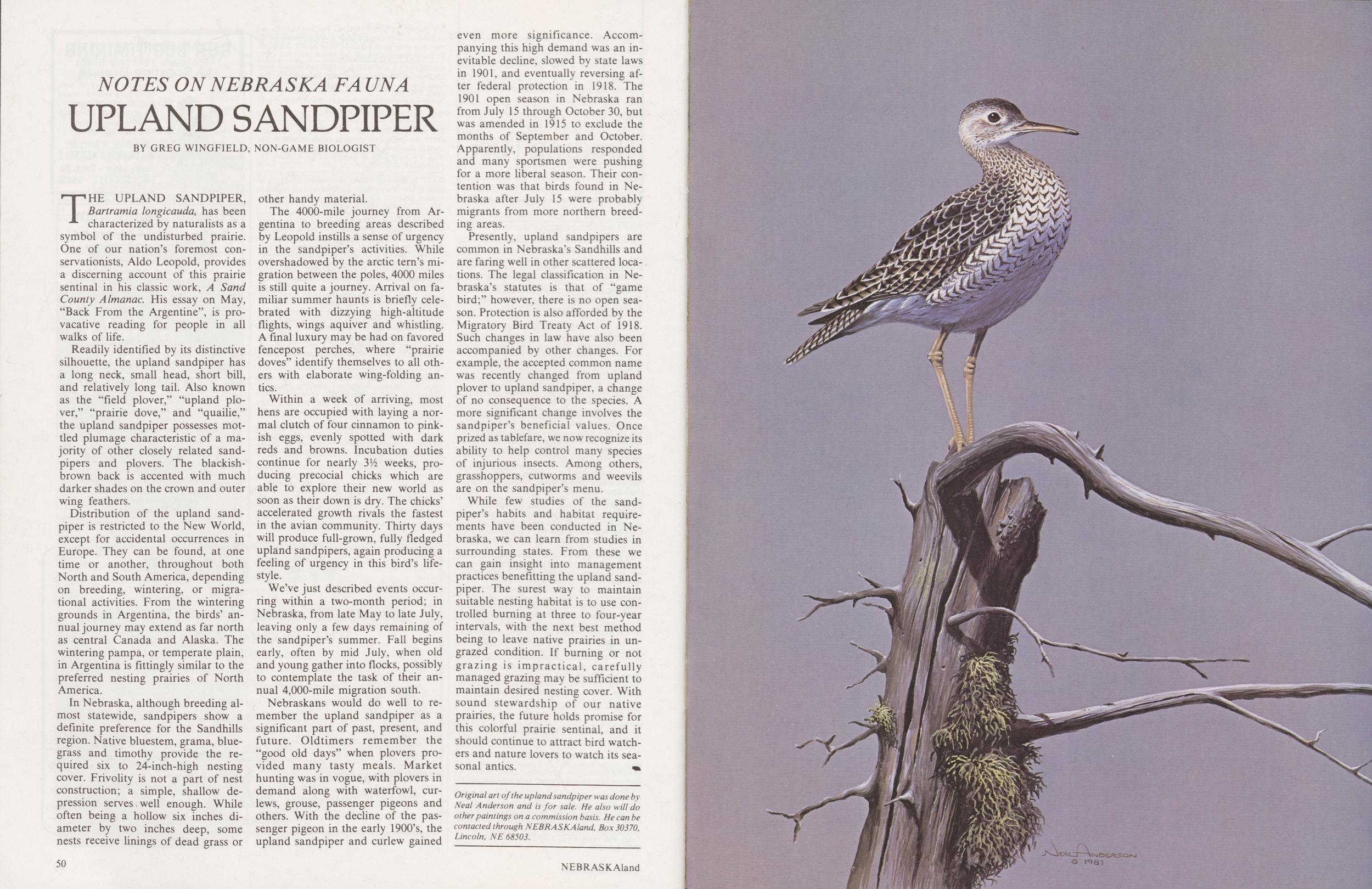
NOTES ON NEBRASKA FAUNA UPLAND SANDPIPER
BY GREG WINGFIELD, NON-GAME BIOLOGISTTHE UPLAND SANDPIPER, Bartramia longicauda, has been characterized by naturalists as a symbol of the undisturbed prairie. One of our nation's foremost conservationists, Aldo Leopold, provides a discerning account of this prairiesentinal in his classic work, A Sand County Almanac. His essay on May, "Back From the Argentine", is provacative reading for people in all walks of life.
Readily identified by its distinctive silhouette, the upland sandpiper has a long neck, small head, short bill, and relatively long tail. Also known as the "field plover," "upland plover," "prairie dove," and "quailie," the upland sandpiper possesses mottled plumage characteristic of a majority of other closely related sandpipers and plovers. The blackish-brown back is accented with much darker shades on the crown and outer wing feathers.
Distribution of the upland sand-piper is restricted to the New World, except for accidental occurrences in Europe. They can be found, at one time or another, throughout both North and South America, depending on breeding, wintering, or migrational activities. From the wintering grounds in Argentina, the birds' annual journey may extend as far north as central Canada and Alaska. The wintering pampa, or temperate plain, in Argentina is fittingly similar to the preferred nesting prairies of North America.
In Nebraska, although breeding almost statewide, sandpipers show a definite preference for the Sandhills region. Native bluestem, grama, bluegrass and timothy provide the required six to 24-inch high nesting cover. Frivolity is not a part of nest construction; a simple, shallow depression serves,well enough. While often being a hollow six inches diameter by two inches deep, some nests receive linings of dead grass or other handy material.
The 4000-mile journey from Argentina to breeding areas described by Leopold instills a sense of urgency in the sandpiper's activities. While overshadowed by the arctic tern's migration between the poles, 4000 miles is still quite a journey. Arrival on familiar summer haunts is briefly celebrated with dizzying high-altitude flights, wings aquiver and whistling. A final luxury may be had on favored fencepost perches, where "prairie doves" identify themselves to all others with elaborate wing-folding antics.
Within a week of arriving, most hens are occupied with laying a normal clutch of four cinnamon to pinkish eggs, evenly spotted with dark reds and browns. Incubation duties continue for nearly 3Vi weeks, producing precocial chicks which are able to explore their new world as soon as their down is dry. The chicks' accelerated growth rivals the fastest in the avian community. Thirty days will produce full-grown, fully fledged upland sandpipers, again producing a feeling of urgency in this bird's life-style.
We've just described events occurring within a two-month period; in Nebraska, from late May to late July, leaving only a few days remaining of the sandpiper's summer. Fall begins early, often by mid July, when old and young gather into flocks, possibly to contemplate the task of their annual 4,000-mile migration south.
Nebraskans would do well to remember the upland sandpiper as a significant part of past, present, and future. Oldtimers remember the "good old days" when plovers provided many tasty meals. Market hunting was in vogue, with plovers in demand along with waterfowl, curlews, grouse, passenger pigeons and others. With the decline of the passenger pigeon in the early 1900's, the upland sandpiper and curlew gained even more significance. Accompanying this high demand was an inevitable decline, slowed by state laws in 1901, and eventually reversing after federal protection in 1918. The 1901 open season in Nebraska ran from July 15 through October 30, but was amended in 1915 to exclude the months of September and October. Apparently, populations responded and many sportsmen were pushing for a more liberal season. Their contention was that birds found in Nebraska after July 15 were probably migrants from more northern breeding areas.
Presently, upland sandpipers are common in Nebraska's Sandhills and are faring well in other scattered locations. The legal classification in Nebraska's statutes is that of "game bird;" however, there is no open season. Protection is also afforded by the Migratory Bird Treaty Act of 1918. Such changes in law have also been accompanied by other changes. For example, the accepted common name was recently changed from upland plover to upland sandpiper, a change of no consequence to the species. A more significant change involves the sandpiper's beneficial values. Once prized as tablefare, we now recognize its ability to help control many species of injurious insects. Among others, grasshoppers, cutworms and weevils are on the sandpiper's menu.
While few studies of the sand-piper's habits and habitat requirements have been conducted in Nebraska, we can learn from studies in surrounding states. From these we can gain insight into management practices benefitting the upland sand-piper. The surest way to maintain suitable nesting habitat is to use controlled burning at three to four-year intervals, with the next best method being to leave native prairies in ungrazed condition. If burning or not grazing is impractical, carefully managed grazing may be sufficient to maintain desired nesting cover. With sound stewardship of our native prairies, the future holds promise for this colorful prairie sentinal, and it should continue to attract bird watchers and nature lovers to watch its seasonal antics.
Original art of the upland sandpiper was done by Neal Anderson and is for sale. He also will do other paintings on a commission basis. He can be contacted through NEBRASKAland, Box 30370, Lincoln, NE 68503.
50 NEBRASKAland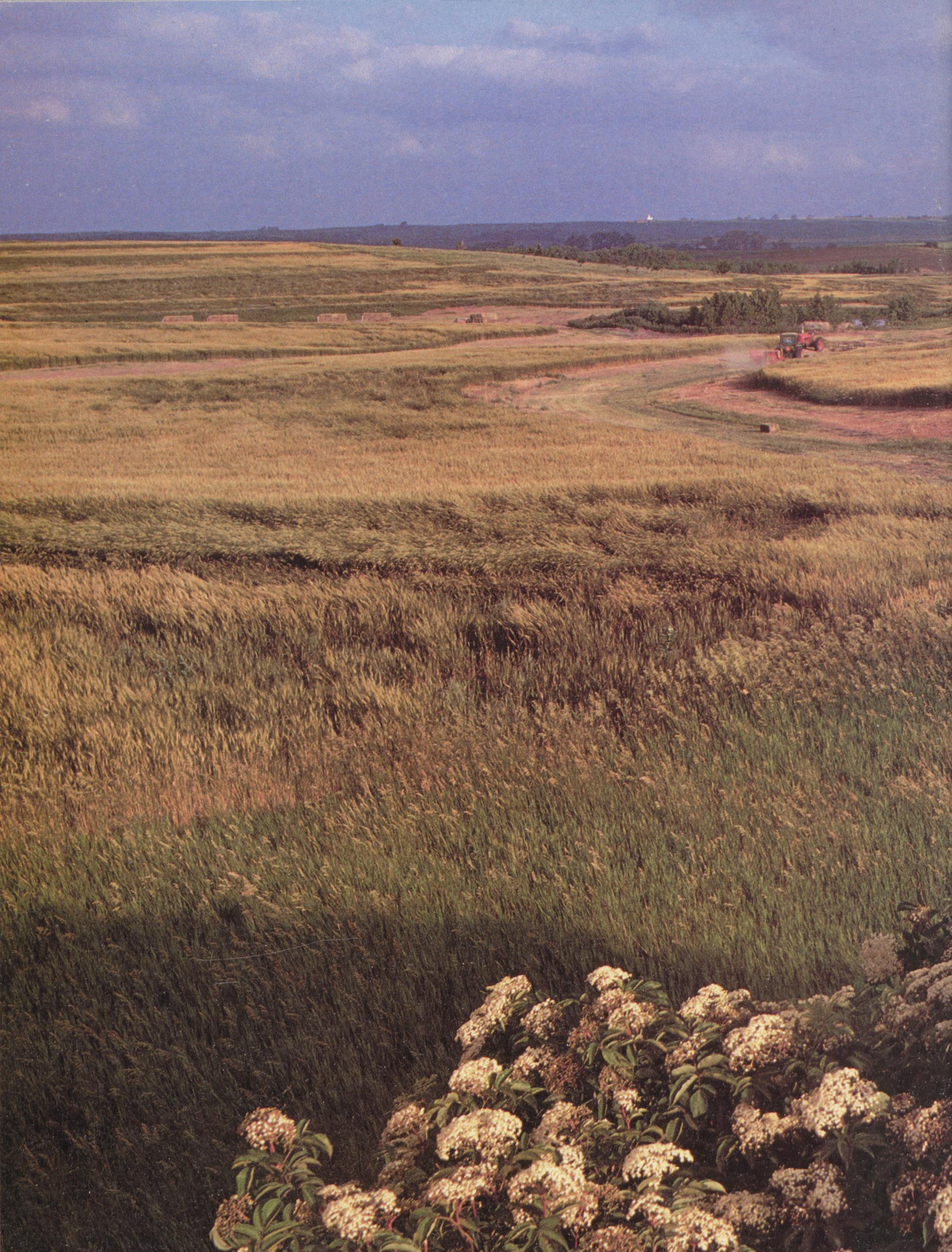
Position: 252 (32 views)