Volume 59, Issue 4, 1981
NEBRASKAland
APRIL 1981 $1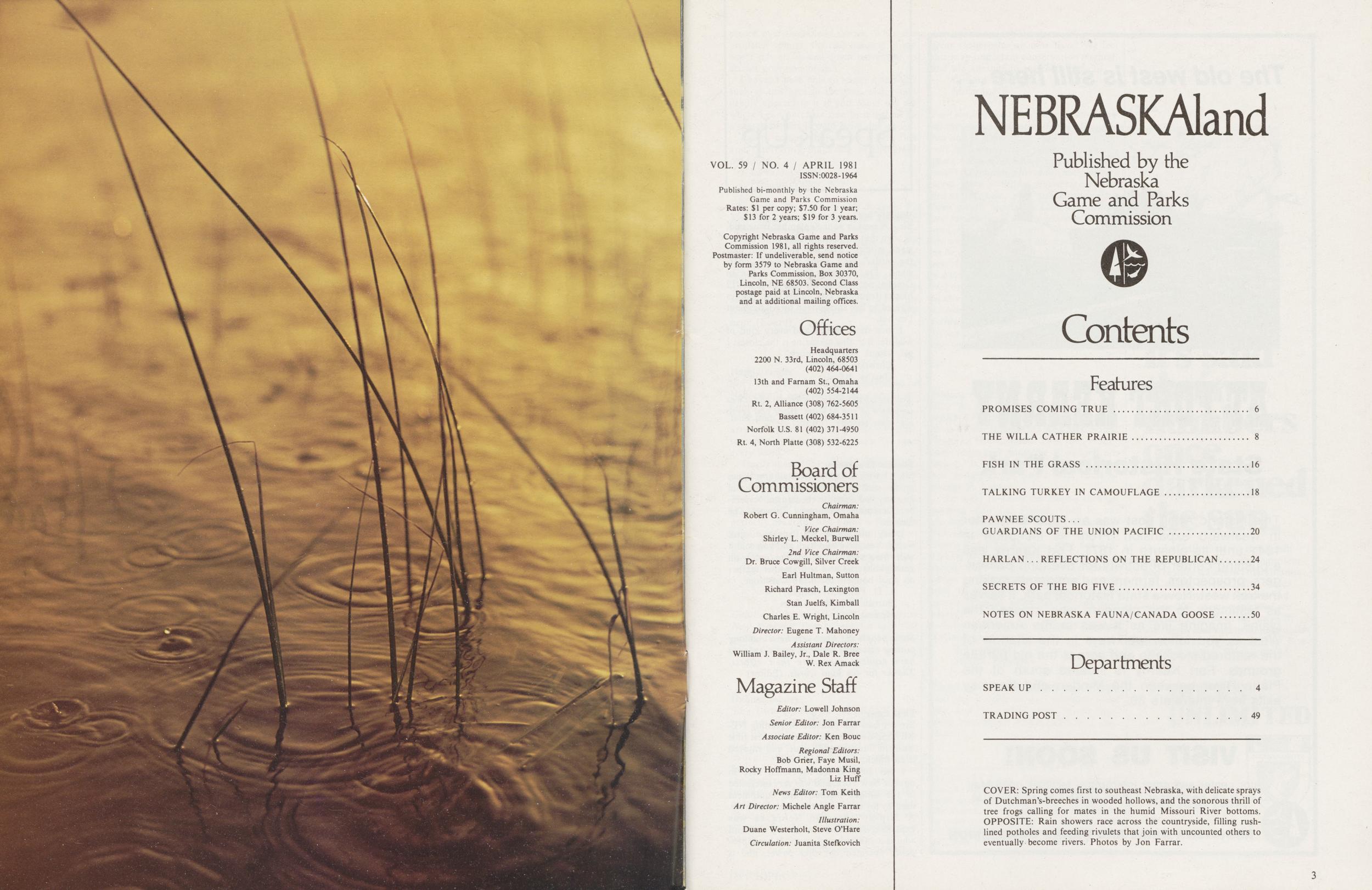
NEBRASKland
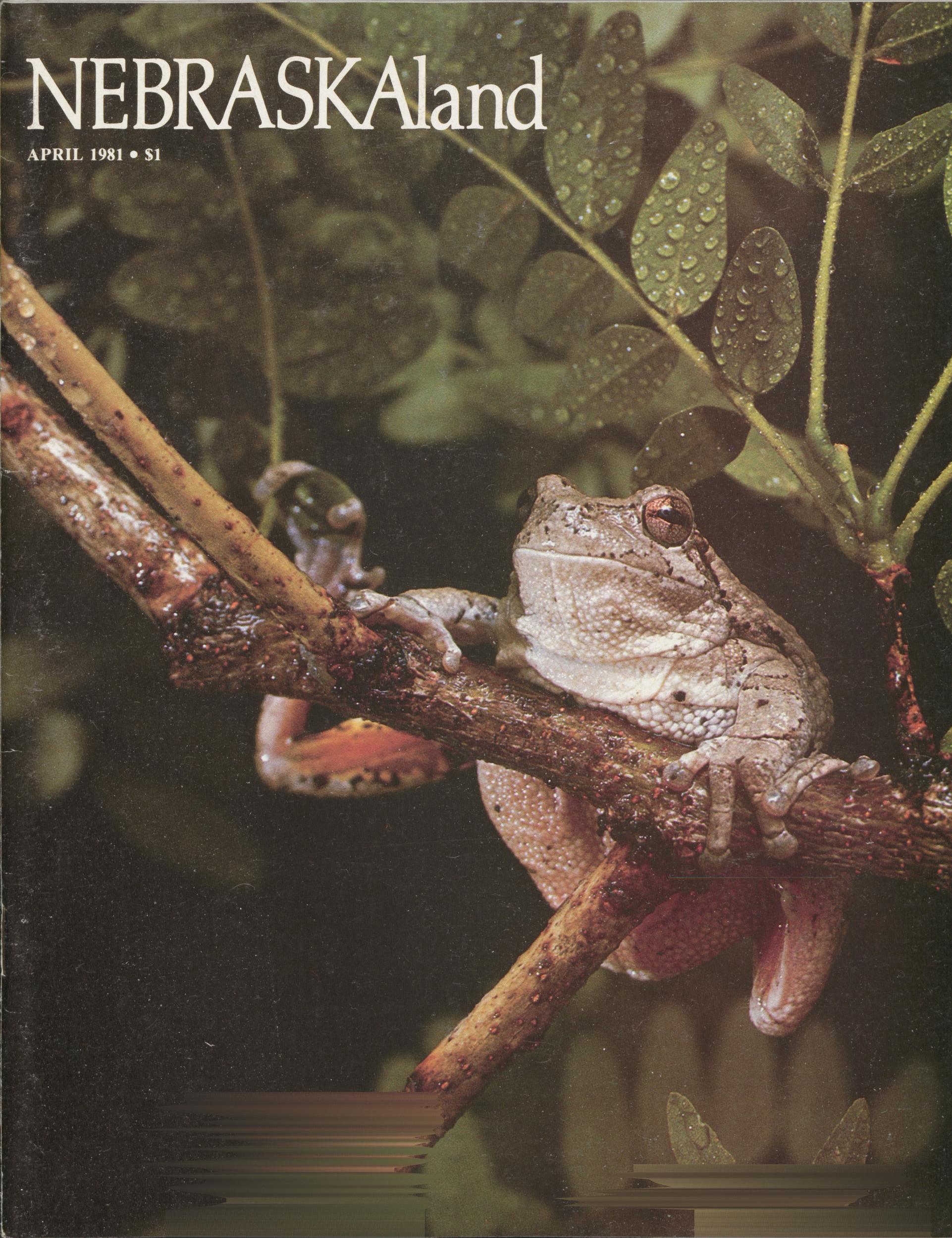
VOL. 59 NO. 4 APRIL 1981 ISSN:0028-1964 Published bi-monthly by the Nebraska Game and Parks Commission Rates: $1 per copy; $7.50 for 1 year; $13 for 2 years; $19 for 3 years. Copyright Nebraska Game and Parks Commission 1981, all rights reserved. Postmaster: If undeliverable, send notice by form 3579 to Nebraska Game and Parks Commission, Box 30370, Lincoln, NE 68503. Second Class postage paid at Lincoln, Nebraska and at additional mailing offices. Offices Headquarters 2200 N. 33rd, Lincoln, 68503 (402) 464-0641 13th and Farnam St., Omaha (402) 554-2144 Rt. 2, Alliance (308) 762-5605 Bassett (402) 684-3511 Norfolk U.S. 81 (402) 371-4950 Rt. 4, North Platte (308) 532-6225 Board of Commissioners Chairman: Robert G. Cunningham, Omaha Vice Chairman: Shirley L. Meckel, Burwell 2nd Vice Chairman: Dr. Bruce Cowgill, Silver Creek Earl Hultman, Sutton Richard Prasch, Lexington Stan Juelfs, Kimball Charles E. Wright, Lincoln Director: Eugene T. Mahoney Assistant Directors: William J. Bailey, Jr., Dale R. Bree W. Rex Amack Magazine Staff Editor: Lowell Johnson Senior Editor: Jon Farrar Associate Editor: Ken Bouc Regional Editors: Bob Grier, Faye Musil, Rocky Hoffmann, Madonna King Liz Huff News Editor: Tom Keith Art Director: Michele Angle Farrar Illustration: Duane Westerholt, Steve O'Hare Circulation: Juanita Stefkovich Published by the Nebraska Game and Parks Commission Contents Features PROMISES COMING TRUE 6 THE WILLA CATHER PRAIRIE 8 FISH IN THE GRASS 16 TALKING TURKEY IN CAMOUFLAGE 18 PAWNEE SCOUTS GUARDIANS OF THE UNION PACIFIC 20 HARLAN REFLECTIONS ON THE REPUBLICAN 24 SECRETS OF THE BIG FIVE 34 NOTES ON NEBRASKA FAUNA/CANADA GOOSE 50 Departments SPEAK UP TRADING POST 49 COVER: Spring comes first to southeast Nebraska, with delicate sprays of Dutchman's-breeches in wooded hollows, and the sonorous thrill of tree frogs calling for mates in the humid Missouri River bottoms. OPPOSITE: Rain showers race across the countryside, filling rushlined potholes and feeding rivulets that join with uncounted others to eventually become rivers. Photos by Jon Farrar. 3
Speak Up
The old west is still here AT FORT KEARNY State Historical Park This historic Army post was an important factor in westward expansion. From its inception in 1841 until its closure in 1871, Fort Kearny was a bustling center of activity for overland passengers, prospectors, farmers and emigrants making the trek west. Now a state historical park, it serves as testimony to the pioneers who crossed the plains. Imagine life as it was in the American West as you follow walkways in the shadow of the restored stockade and across the old parade grounds. Fort Kearny is located south of the Platte River between the Minden and Kearney exits from Interstate 80. VISIT US SOON Visitor center and other interpretive facilities open May 23 through September 7 from 10:00 A.M. to 8:00 P.M. NEBRASKA GAME AND PARKS COMMISSION Wildlife fanSir / A man in your September issue said, "I wish that all young people could understand wildlife, trees and shrubs that feed the birds." Well, some of us do understand. I'm 12 years old and I live in Omaha; not right in the city but about 12 blocks from the city limits. I've always wanted to live surrounded by wildlife, but I'm not.
I love trees, shrubs and every kind of wildlife! But, this magazine is the closest I get. Thank you very much.
Christina Howard Omaha, NEYou are certainly very welcome, and it was very nice of you to write. Hope you get to see some wildlife. (Editor)
Thanks ThousandsSir / I wish to compliment all employees on the staff of this fine magazine who in any way had a part in the issue of November/December, "Nebraska Through The Season."
Every picture is worth a thousand words. You have told it all and you told it well. You should file another notch on your gunbarrels and add another feather on your bonnets for a job well done.
L. D. Fairbairn (retired) Bureau of Indian Affairs Hemet, Calif.Some people did work very hard and long putting that issue together, and it is nice to have readers appreciate their efforts. Thanks for the kind words. (Editor)
First timerSir / I had the pleasure of reading NEBRASKAland magazine for the first time with the January 1981 issue, and enjoyed it so much.
I am an avid ice fisherman here in upstate New York, and was very interested in the unique methods and equipment used by my counterparts in your fine state. A "tip-up" used in Nebraska was explained somewhat to me by a friend who is a subscriber of yours. It has a propeller operated by wind power, and is 4 APRIL 1981 placed over the hole in the ice. When the propeller rotates, the bait hanging in the water has an up-and-down movement to attract attention of fish.
I haven't been able to locate a "tip-up" such as this here in the east, and would deeply appreciate it if you could tell me where I can purchase one, or direct me to a sketch so that I could build one myself.
Again, congratulations for a very fine and interesting magazine of the great outdoors.
Edward Loeffel Pleasant Valley, N.Y.The device you refer to was designed by Ron McConkey, a Nebraska Sandhills rancher who spent much time on the ice trying to figure northern pike out. He knew the value of motion, and over time devised, built and patented his mechanical marvels. We can send you a photo of some of them in use, as we did an ice-fishing story on Ron in January 1974 in NEBRASKAland. Hope the photo will help. (Editor)
Happy readerSir / Although I was born and raised in Nebraska, I have learned more about my home state from reading NEBRASKAland than I ever did in school. When it arrives, I thumb through to enjoy the photography before I settle down to read every word.
The January 1981 issue had me returning time and again to the picture on page 8 of Jerry Johnson and his retriever, Micki. The feeling of love and empathy portrayed in this picture keeps drawing me back. It is perfectly beautiful, and I only wish I had a copy to frame. But, I pass each issue on for others to enjoy and apparently will have to keep the picture in my memory! Thank you for a beautiful publication.
Jeannette Cameron New York, N.Y. Goodness, this is the month to hear from New Yorkers! Thanks, and for such fine words, lam sure we can find an extra copy of that photo to send. (Editor) Habitat moneySir / I was reading our NEBRASKAland and an Omaha World-Herald (Sunday, Jan. 18) article on Habitat Stamp funding, and wondered if you would conduct an in-depth study and an article on where this $1.1 million is being used, then print it in the magazine. My friends and I, who are hunters and fishermen and support this program through the purchase of our licenses and stamps, can't seem to see where throughout the state our money is going.
Also, can any of this money be used to discourage or stop the destruction of the great shelterbelts we now have? We feel this is an important conservation method, and are anxious to see them remain.
Clifford Mindrup Millard, NEI am sending you a fact sheet showing how all the money from the Habitat Program has and is being spent, and Em sure you will be surprised pleasantly. In 3 l/2 years, 6,946 acres have been purchased for nearly $3 million, plus many more private acres have wildlife enhancement programs on them, plus public lands have been greatly improved. Land acquisitions are innumerated on the material sent to you, but they are pretty much scattered around the state, and are sizable enough to be of great value for wildlife and hunters. As to the removal of shelterbelts, that is a little more depressing. There is no control over what landowners do to their land in this regard, as unfortunate as that is. An upcoming story in NEBRASKAland (scheduled for June 1981) will give some strong evidence supporting your belief in the value of shelterbelts. (Editor)
Distant readersSir / We just received the August issue of NEBRASKAland, which is sent regularly to us by our friends, Mr. and Mrs. Forest Jaeger of Grand Island. Your fine, beautifully illustrated magazine is enjoyed not only by us, but by our grown-up children, our grandchildren, and a wide circle of friends in Sydney.
We came to know the Jaegers through meeting their son Danny, when he was serving with the U.S. Navy and came to our city. We see our families as linked. Forest and I, for instance, wear our Australian/American Association ties on a special day. We live right on a surfing beach on the east coast, but we are still able to appreciate the beauty of your wonderful state, which my wife has twice visited.
From down under, we send NEBRASKAland warm greetings.
Bill Jenkings Sydney, AustraliaThanks for your greetings, and I hope that you are able to visit Nebraska some day, and meet some of the people here. Keep circulating NEBRASKAland, too. (Editor)
NEBRASKAland Magazine invites all readers to submit their comments, suggestions, and gripes to Speak Up. Each month the magazine will publish as many letters as space permits. Pictures are also welcome. NEBRASKAland does reserve the right to edit and condense letters. (Editor) It's said their numbers once darkened the sun. Ducks Unlimited is a non-profit organization that works to protect and restore waterfowl marshlands in Canada, where United States Federal funds don't reach. And where 709f of our waterfowl are hatched. Help keep the ducks flying. Send your tax deductible donation to: Ducks Unlimited, P.O. Box 66300, Chicago, Illinois 60666. Please. DUCKS UNLIMITED We need your help. Now. NEBRASKAland 5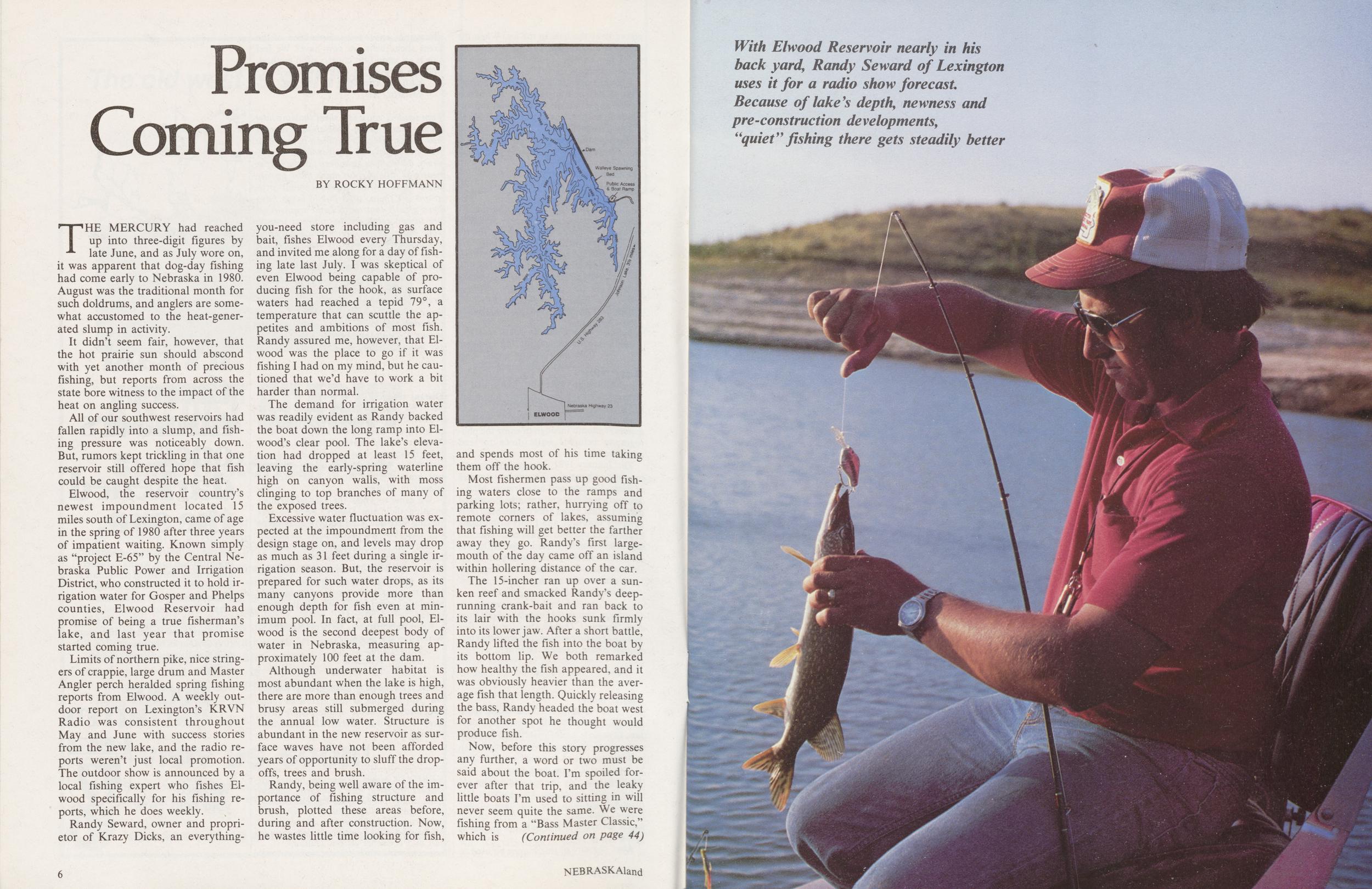
Promises Coming True
BY ROCKY HOFFMANNTHE MERCURY had reached up into three-digit figures by late June, and as July wore on, it was apparent that dog-day fishing had come early to Nebraska in 1980. August was the traditional month for such doldrums, and anglers are somewhat accustomed to the heat-generated slump in activity.
It didn't seem fair, however, that the hot prairie sun should abscond with yet another month of precious fishing, but reports from across the state bore witness to the impact of the heat on angling success.
All of our southwest reservoirs had fallen rapidly into a slump, and fishing pressure was noticeably down. But, rumors kept trickling in that one reservoir still offered hope that fish could be caught despite the heat.
Elwood, the reservoir country's newest impoundment located 15 miles south of Lexington, came of age in the spring of 1980 after three years of impatient waiting. Known simply as "project E-65" by the Central Nebraska Public Power and Irrigation District, who constructed it to hold irrigation water for Gosper and Phelps counties, Elwood Reservoir had promise of being a true fisherman's lake, and last year that promise started coming true.
Limits of northern pike, nice stringers of crappie, large drum and Master Angler perch heralded spring fishing reports from Elwood. A weekly outdoor report on Lexington's KRVN Radio was consistent throughout May and June with success stories from the new lake, and the radio reports weren't just local promotion. The outdoor show is announced by a local fishing expert who fishes Elwood specifically for his fishing reports, which he does weekly.
Randy Seward, owner and proprietor of Krazy Dicks, an everything- you-need store including gas and bait, fishes Elwood every Thursday, and invited me along for a day of fishing late last July. I was skeptical of even Elwood being capable of producing fish for the hook, as surface waters had reached a tepid 79°, a temperature that can scuttle the appetites and ambitions of most fish. Randy assured me, however, that Elwood was the place to go if it was fishing I had on my mind, but he cautioned that we'd have to work a bit harder than normal.
The demand for irrigation water was readily evident as Randy backed the boat down the long ramp into Elwood's clear pool. The lake's elevation had dropped at least 15 feet, leaving the early-spring waterline high on canyon walls, with moss clinging to top branches of many of the exposed trees.
Excessive water fluctuation was expected at the impoundment from the design stage on, and levels may drop as much as 31 feet during a single irrigation season. But, the reservoir is prepared for such water drops, as its many canyons provide more than enough depth for fish even at minimum pool. In fact, at full pool, Elwood is the second deepest body of water in Nebraska, measuring approximately 100 feet at the dam.
Although underwater habitat is most abundant when the lake is high, there are more than enough trees and brusy areas still submerged during the annual low water. Structure is abundant in the new reservoir as surface waves have not been afforded years of opportunity to sluff the dropoffs, trees and brush.
Randy, being well aware of the importance of fishing structure and brush, plotted these areas before, during and after construction. Now, he wastes little time looking for fish, and spends most of his time taking them off the hook.
Most fishermen pass up good fishing waters close to the ramps and parking lots; rather, hurrying off to remote corners of lakes, assuming that fishing will get better the farther away they go. Randy's first largemouth of the day came off an island within hollering distance of the car.
The 15-incher ran up over a sunken reef and smacked Randy's deep- running crank-bait and ran back to its lair with the hooks sunk firmly into its lower jaw. After a short battle, Randy lifted the fish into the boat by its bottom lip. We both remarked how healthy the fish appeared, and it was obviously heavier than the average fish that length. Quickly releasing the bass, Randy headed the boat west for another spot he thought would produce fish.
Now, before this story progresses any further, a word or two must be said about the boat. I'm spoiled forever after that trip, and the leaky little boats I'm used to sitting in will never seem quite the same. We were fishing from a "Bass Master Classic," which is (Continued on page 44)
6 NEBRASKAland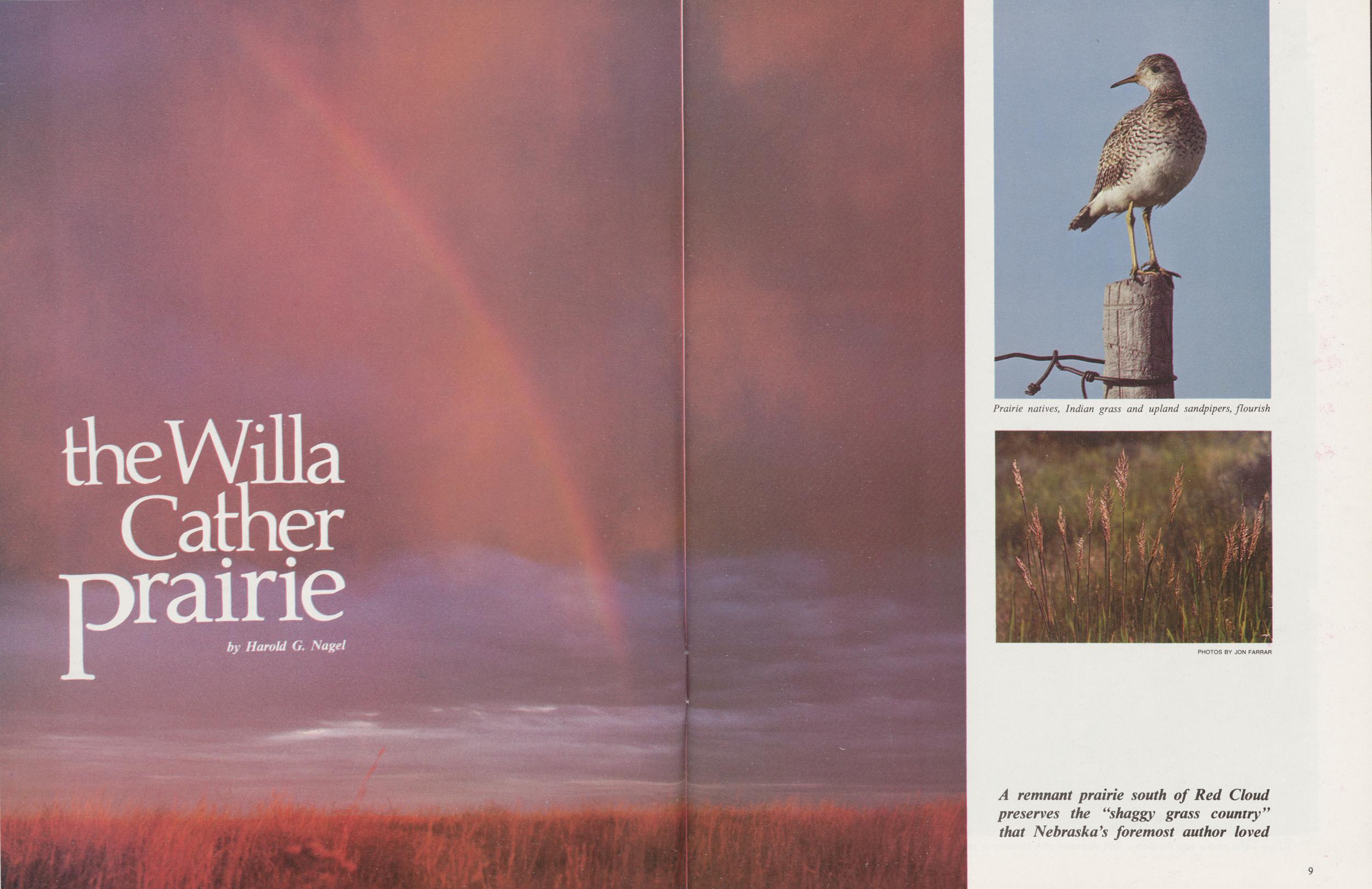
the Willa Cather Prairie
by Harold G. Nagel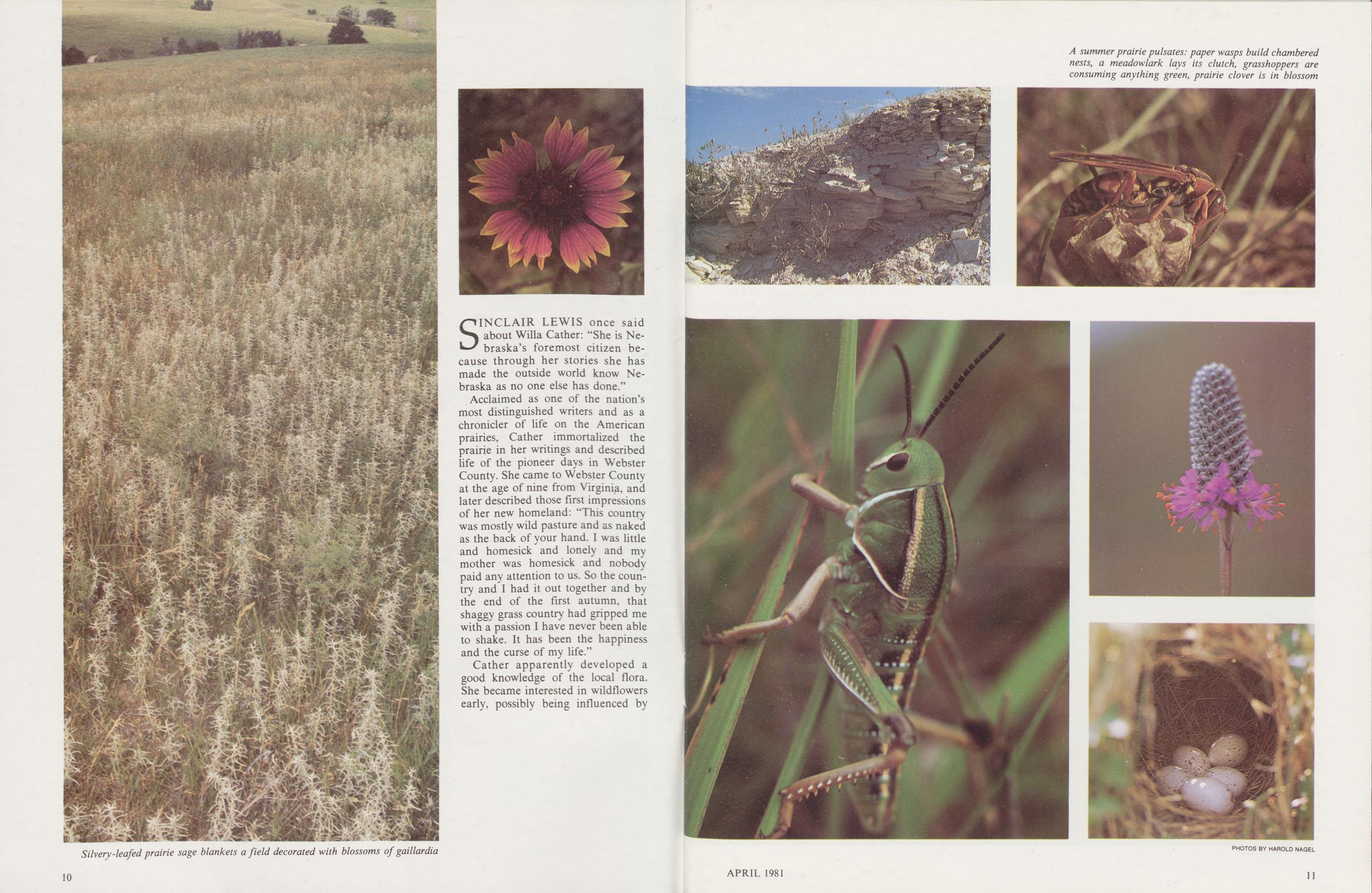
SINCLAIR LEWIS once said about Willa Cather: "She is Nebraska's foremost citizen because through her stories she has made the outside world know Nebraska as no one else has done."
Acclaimed as one of the nation's most distinguished writers and as a chronicler of life on the American prairies, Cather immortalized the prairie in her writings and described life of the pioneer days in Webster County. She came to Webster County at the age of nine from Virginia, and later described those first impressions of her new homeland: "This country was mostly wild pasture and as naked as the back of your hand. I was little and homesick and lonely and my mother was homesick and nobody paid any attention to us. So the country and I had it out together and by the end of the first autumn, that shaggy grass country had gripped me with a passion I have never been able to shake. It has been the happiness and the curse of my life."
Cather apparently developed a good knowledge of the local flora. She became interested in wildflowers early, possibly being influenced by 10
Although she spent most of her life in the eastern U.S., Cather's love for the prairie remained. Bennett wrote: "When she came home from the east on visits, her chief joy was to hire a horse and rig and with a couple of her old friends, drive out to see the country. She would find a still untitled place, leave her friends in the buggy and climb to the top of the ridge and let the wind play in her hair and think long thoughts of the old land, of the prairie as it used to be when it was not yet a country, but the stuff of which countries are made."
In 1955, Mrs. Bennett and friends and relatives of Willa Cather created the Willa Cather Pioneer Memorial and Educational Foundation. The Foundation, as one of its goals, identifies and restores to their original condition, places made famous by the writings of Willa Cather. The Foundation approached The Woods Charitable Fund to purchase a parcel of the prairie which Cather had come to love. Although Cather and her relatives lived northwest of Red Cloud, there were no large, good prairie remnants in that area. In fact, only three prairies of more than 320 acres in good condition were found in Webster County. A 610-acre virgin prairie five miles south of Red Cloud was purchased in 1974 by The Nature Conservancy acting for The Woods Fund.
Cather Prairie combines characteristics of both the tallgrass prairie of the east and shortgrass prairie of the west, and adds unique characteristics of its own for a blend of prairie plants known as mixed-grass prairie. Chalk lilies, butterfly milkweed and other plants thrive on Cather Prairie's chalky outcroppings along the limestone ridges. Vegetation of Cather Prairie is probably similar to what it was when Willa was gathering wildflowers
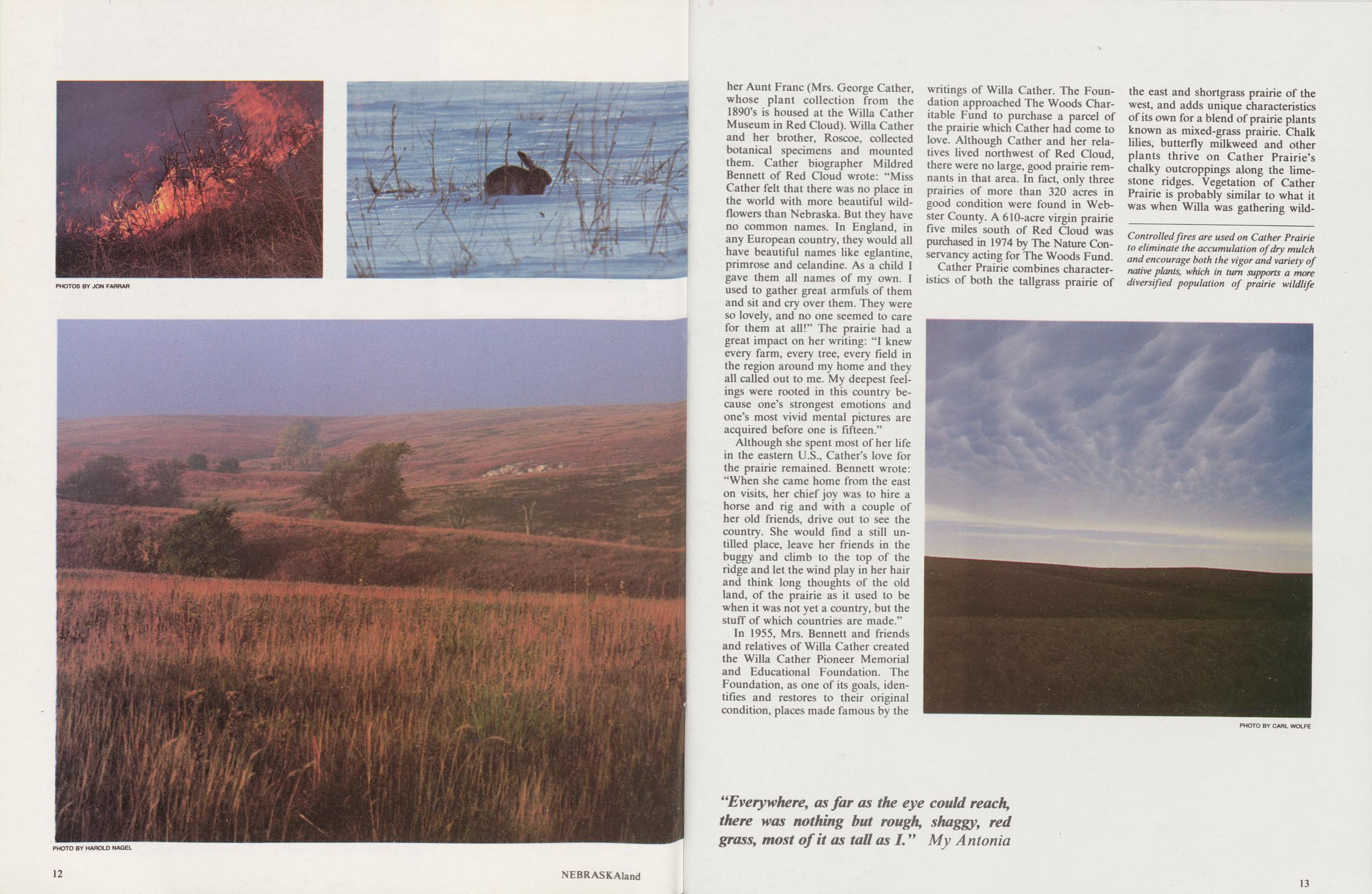
Controlled fires are used on Cather Prairie to eliminate the accumulation of dry mulch and encourage both the vigor and variety of native plants, which in turn supports a more diversified population of prairie wildlife
"Everywhere, as far as the eye could reach, there was nothing but rough, shaggy, red grass, most of it as tall as I." My Antonia
13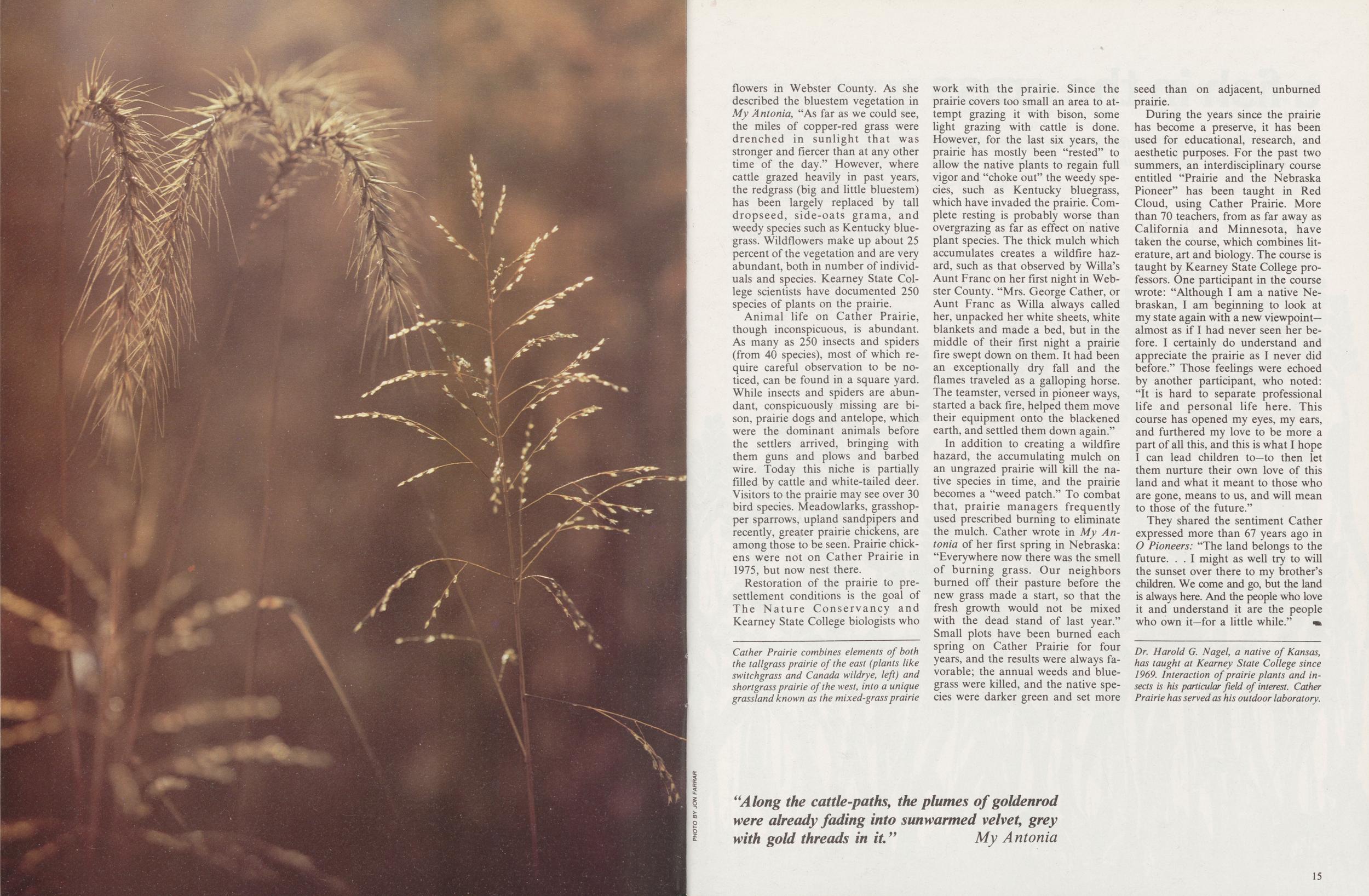
flowers in Webster County. As she described the bluestem vegetation in My Antonia, "As far as we could see, the miles of copper-red grass were drenched in sunlight that was stronger and fiercer than at any other time of the day." However, where cattle grazed heavily in past years, the redgrass (big and little bluestem) has been largely replaced by tall dropseed, side-oats grama, and weedy species such as Kentucky bluegrass. Wildflowers make up about 25 percent of the vegetation and are very abundant, both in number of individuals and species. Kearney State College scientists have documented 250 species of plants on the prairie.
Animal life on Cather Prairie, though inconspicuous, is abundant. As many as 250 insects and spiders (from 40 species), most of which require careful observation to be noticed, can be found in a square yard. While insects and spiders are abundant, conspicuously missing are bison, prairie dogs and antelope, which were the dominant animals before the settlers arrived, bringing with them guns and plows and barbed wire. Today this niche is partially filled by cattle and white-tailed deer. Visitors to the prairie may see over 30 bird species. Meadowlarks, grasshopper sparrows, upland sandpipers and recently, greater prairie chickens, are among those to be seen. Prairie chickens were not on Cather Prairie in 1975, but now nest there.
Restoration of the prairie to presettlement conditions is the goal of The Nature Conservancy and Kearney State College biologists who work with the prairie. Since the prairie covers too small an area to attempt grazing it with bison, some light grazing with cattle is done. However, for the last six years, the prairie has mostly been "rested" to allow the native plants to regain full vigor and "choke out" the weedy species, such as Kentucky bluegrass, which have invaded the prairie. Complete resting is probably worse than overgrazing as far as effect on native plant species. The thick mulch which accumulates creates a wildfire hazard, such as that observed by Willa's Aunt Franc on her first night in Webster County. "Mrs. George Cather, or Aunt Franc as Willa always called her, unpacked her white sheets, white blankets and made a bed, but in the middle of their first night a prairie fire swept down on them. It had been an exceptionally dry fall and the flames traveled as a galloping horse. The teamster, versed in pioneer ways, started a back fire, helped them move their equipment onto the blackened earth, and settled them down again."
In addition to creating a wildfire hazard, the accumulating mulch on an ungrazed prairie will kill the native species in time, and the prairie becomes a "weed patch." To combat that, prairie managers frequently used prescribed burning to eliminate the mulch. Cather wrote in My Antonia of her first spring in Nebraska: "Everywhere now there was the smell of burning grass. Our neighbors burned off their pasture before the new grass made a start, so that the fresh growth would not be mixed with the dead stand of last year." Small plots have been burned each spring on Cather Prairie for four years, and the results were always favorable; the annual weeds and blue- grass were killed, and the native species were darker green and set more seed than on adjacent, unburned prairie.
During the years since the prairie has become a preserve, it has been used for educational, research, and aesthetic purposes. For the past two summers, an interdisciplinary course entitled "Prairie and the Nebraska Pioneer" has been taught in Red Cloud, using Cather Prairie. More than 70 teachers, from as far away as California and Minnesota, have taken the course, which combines literature, art and biology. The course is taught by Kearney State College professors. One participant in the course wrote: "Although I am a native Nebraskan, I am beginning to look at my state again with a new viewpoint— almost as if I had never seen her before. I certainly do understand and appreciate the prairie as I never did before." Those feelings were echoed by another participant, who noted: "It is hard to separate professional life and personal life here. This course has opened my eyes, my ears, and furthered my love to be more a part of all this, and this is what I hope I can lead children to—to then let them nurture their own love of this land and what it meant to those who are gone, means to us, and will mean to those of the future."
They shared the sentiment Cather expressed more than 67 years ago in O Pioneers: "The land belongs to the future I might as well try to will the sunset over there to my brother's children. We come and go, but the land is always here. And the people who love it and understand it are the people who own it—for a little while."
Cather Prairie combines elements of both the tallgrass prairie of the east (plants like switchgrass and Canada wildrye, left) and shortgrass prairie of the west, into a unique grassland known as the mixed-grass prairie
Dr. Harold G. Nagel, a native of Kansas, has taught at Kearney State College since 1969. Interaction of prairie plants and insects is his particular field of interest. Cather Prairie has served as his outdoor laboratory.
"Along the cattle-paths, the plumes of goldenrod were already fading into sunwarmed velvet, grey with gold threads in it." My Antonia
15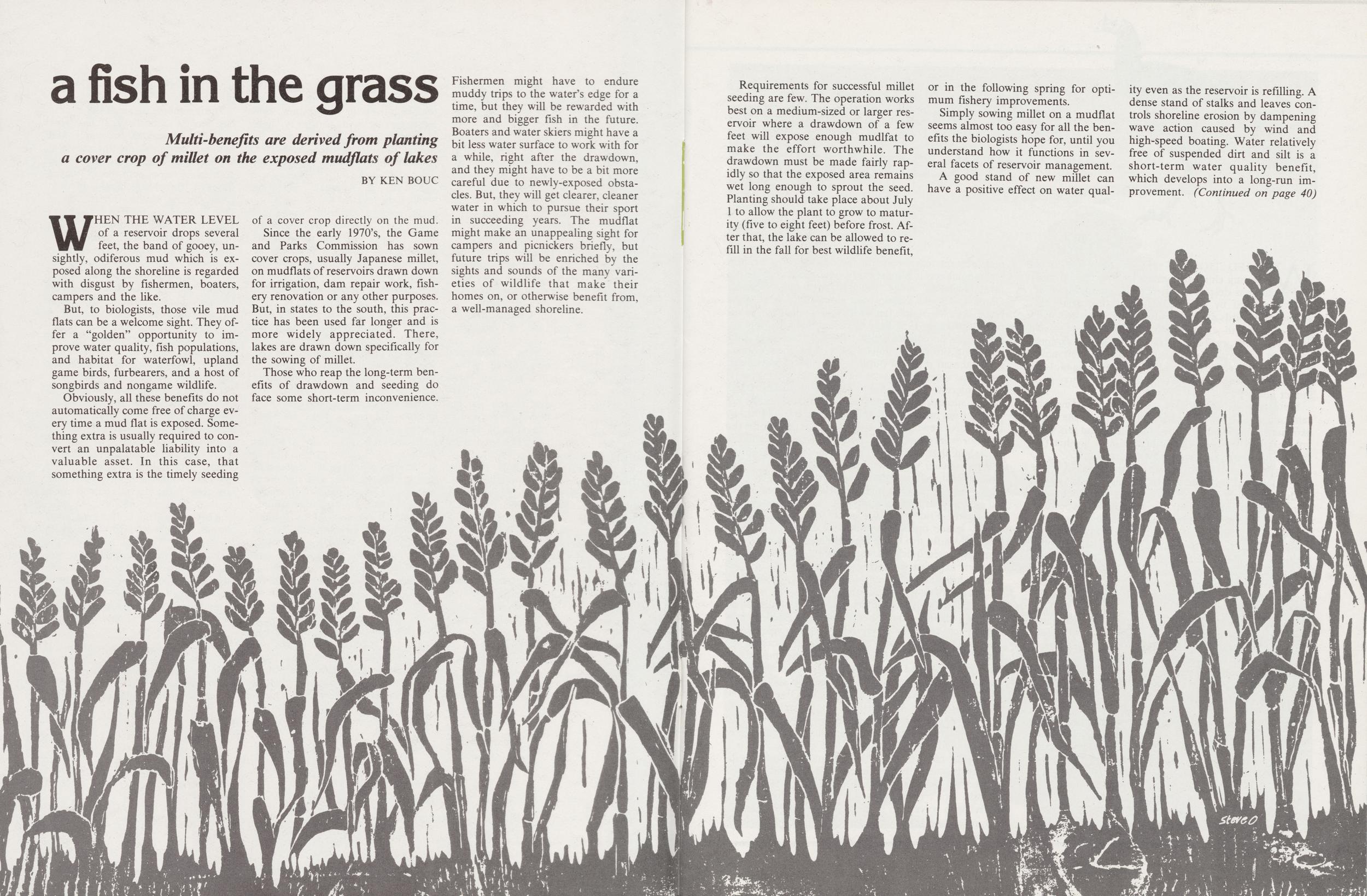
a fish in the grass
Multi-benefits are derived from planting a cover crop of millet on the exposed mudflats of lakes BY KEN BOUCWHEN THE WATER LEVEL of a reservoir drops several feet, the band of gooey, unsightly, odiferous mud which is exposed along the shoreline is regarded with disgust by fishermen, boaters, campers and the like.
But, to biologists, those vile mud flats can be a welcome sight. They offer a "golden" opportunity to improve water quality, fish populations, and habitat for waterfowl, upland game birds, furbearers, and a host of songbirds and nongame wildlife.
Obviously, all these benefits do not automatically come free of charge every time a mud flat is exposed. Something extra is usually required to convert an unpalatable liability into a valuable asset. In this case, that something extra is the timely seeding of a cover crop directly on the mud.
Since the early 1970's, the Game and Parks Commission has sown cover crops, usually Japanese millet, on mudflats of reservoirs drawn down for irrigation, dam repair work, fishery renovation or any other purposes. But, in states to the south, this practice has been used far longer and is more widely appreciated. There, lakes are drawn down specifically for the sowing of millet.
Those who reap the long-term benefits of drawdown and seeding do face some short-term inconvenience. Fishermen might have to endure muddy trips to the water's edge for a time, but they will be rewarded with more and bigger fish in the future. Boaters and water skiers might have a bit less water surface to work with for a while, right after the drawdown, and they might have to be a bit more careful due to newly-exposed obstacles. But, they will get clearer, cleaner water in which to pursue their sport in succeeding years. The mudflat might make an unappealing sight for campers and picnickers briefly, but future trips will be enriched by the sights and sounds of the many varieties of wildlife that make their homes on, or otherwise benefit from, a well-managed shoreline.
Requirements for successful millet seeding are few. The operation works best on a medium-sized or larger reservoir where a drawdown of a few feet will expose enough mudlfat to make the effort worthwhile. The drawdown must be made fairly rapidly so that the exposed area remains wet long enough to sprout the seed. Planting should take place about July 1 to allow the plant to grow to maturity (five to eight feet) before frost. After that, the lake can be allowed to refill in the fall for best wildlife benefit, or in the following spring for optimum fishery improvements.
Simply sowing millet on a mudflat seems almost too easy for all the benefits the biologists hope for, until you understand how it functions in several facets of reservoir management.
A good stand of new millet can have a positive effect on water quality even as the reservoir is refilling. A dense stand of stalks and leaves controls shoreline erosion by dampening wave action caused by wind and high-speed boating. Water relatively free of suspended dirt and silt is a short-term water quality benefit, which develops into a long-run improvement. (Continued on page 40)
Talking Turkey in Camouflage
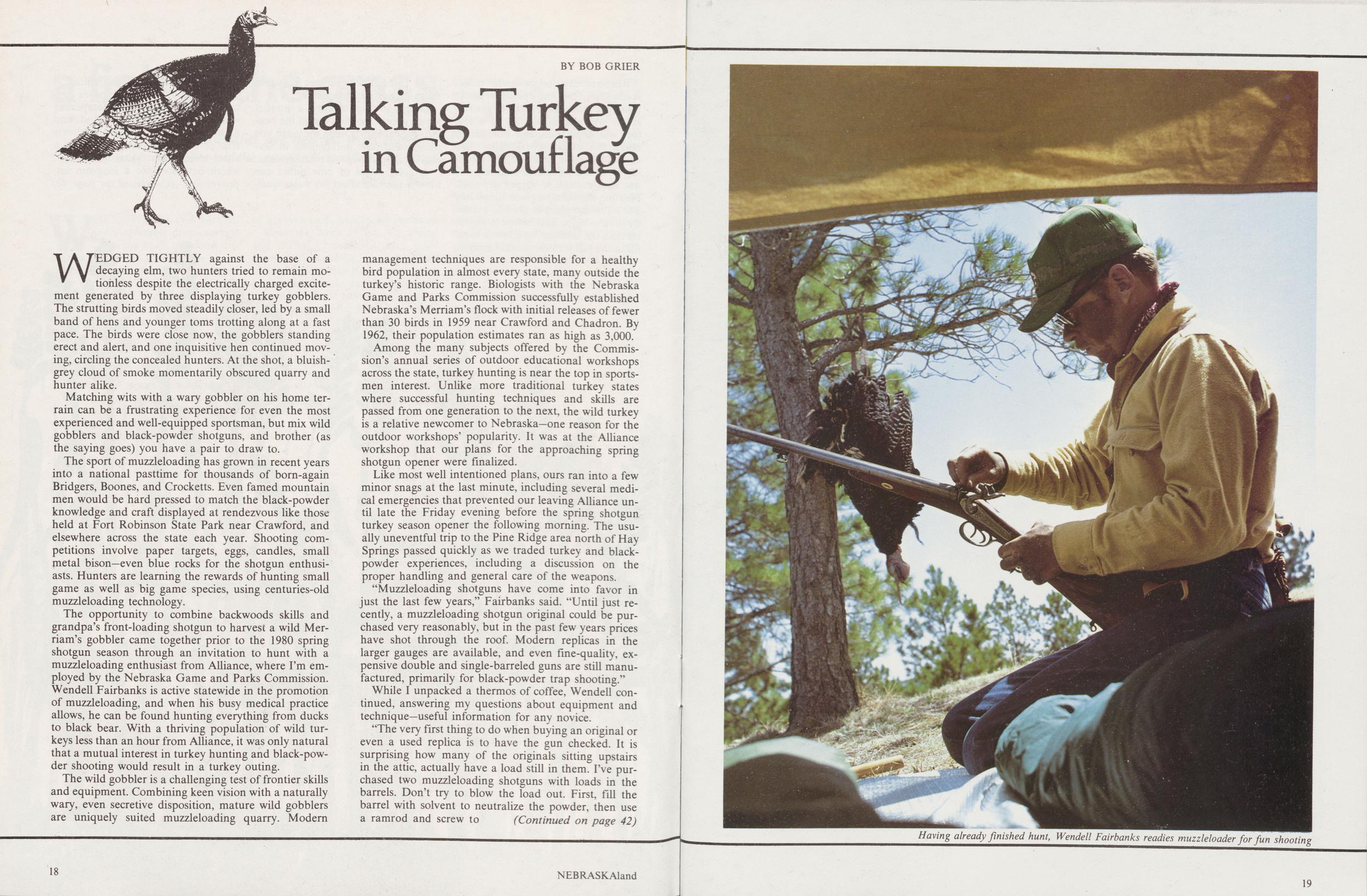
BY BOB GRIERWEDGED TIGHTLY against the base of a decaying elm, two hunters tried to remain motionless despite the electrically charged excitement generated by three displaying turkey gobblers. The strutting birds moved steadily closer, led by a small band of hens and younger toms trotting along at a fast pace. The birds were close now, the gobblers standing erect and alert, and one inquisitive hen continued moving, circling the concealed hunters. At the shot, a bluish-grey cloud of smoke momentarily obscured quarry and hunter alike.
Matching wits with a wary gobbler on his home terrain can be a frustrating experience for even the most experienced and well-equipped sportsman, but mix wild gobblers and black-powder shotguns, and brother (as the saying goes) you have a pair to draw to.
The sport of muzzleloading has grown in recent years into a national pasttime for thousands of born-again Bridgers, Boones, and Crocketts. Even famed mountain men would be hard pressed to match the black-powder knowledge and craft displayed at rendezvous like those held at Fort Robinson State Park near Crawford, and elsewhere across the state each year. Shooting competitions involve paper targets, eggs, candles, small metal bison—even blue rocks for the shotgun enthusiasts. Hunters are learning the rewards of hunting small game as well as big game species, using centuries-old muzzleloading technology.
The opportunity to combine backwoods skills and grandpa's front-loading shotgun to harvest a wild Merriam's gobbler came together prior to the 1980 spring shotgun season through an invitation to hunt with a muzzleloading enthusiast from Alliance, where I'm employed by the Nebraska Game and Parks Commission. Wendell Fairbanks is active statewide in the promotion of muzzleloading, and when his busy medical practice allows, he can be found hunting everything from ducks to black bear. With a thriving population of wild turkeys less than an hour from Alliance, it was only natural that a mutual interest in turkey hunting and black-powder shooting would result in a turkey outing.
The wild gobbler is a challenging test of frontier skills and equipment. Combining keen vision with a naturally wary, even secretive disposition, mature wild gobblers are uniquely suited muzzleloading quarry. Modern management techniques are responsible for a healthy bird population in almost every state, many outside the turkey's historic range. Biologists with the Nebraska Game and Parks Commission successfully established Nebraska's Merriam's flock with initial releases of fewer than 30 birds in 1959 near Crawford and Chadron. By 1962, their population estimates ran as high as 3,000.
Among the many subjects offered by the Commission's annual series of outdoor educational workshops across the state, turkey hunting is near the top in sportsmen interest. Unlike more traditional turkey states where successful hunting techniques and skills are passed from one generation to the next, the wild turkey is a relative newcomer to Nebraska—one reason for the outdoor workshops' popularity. It was at the Alliance workshop that our plans for the approaching spring shotgun opener were finalized.
Like most well intentioned plans, ours ran into a few minor snags at the last minute, including several medical emergencies that prevented our leaving Alliance until late the Friday evening before the spring shotgun turkey season opener the following morning. The usually uneventful trip to the Pine Ridge area north of Hay Springs passed quickly as we traded turkey and black-powder experiences, including a discussion on the proper handling and general care of the weapons.
"Muzzleloading shotguns have come into favor in just the last few years," Fairbanks said. "Until just recently, a muzzleloading shotgun original could be purchased very reasonably, but in the past few years prices have shot through the roof. Modern replicas in the larger gauges are available, and even fine-quality, expensive double and single-barreled guns are still manufactured, primarily for black-powder trap shooting." While I unpacked a thermos of coffee, Wendell continued, answering my questions about equipment and technique—useful information for any novice.
"The very first thing to do when buying an original or even a used replica is to have the gun checked. It is surprising how many of the originals sitting upstairs in the attic, actually have a load still in them. I've purchased two muzzleloading shotguns with loads in the barrels. Don't try to blow the load out. First, fill the barrel with solvent to neutralize the powder, then use a ramrod and screw to (Continued on page 42)
18 NEBRASKAland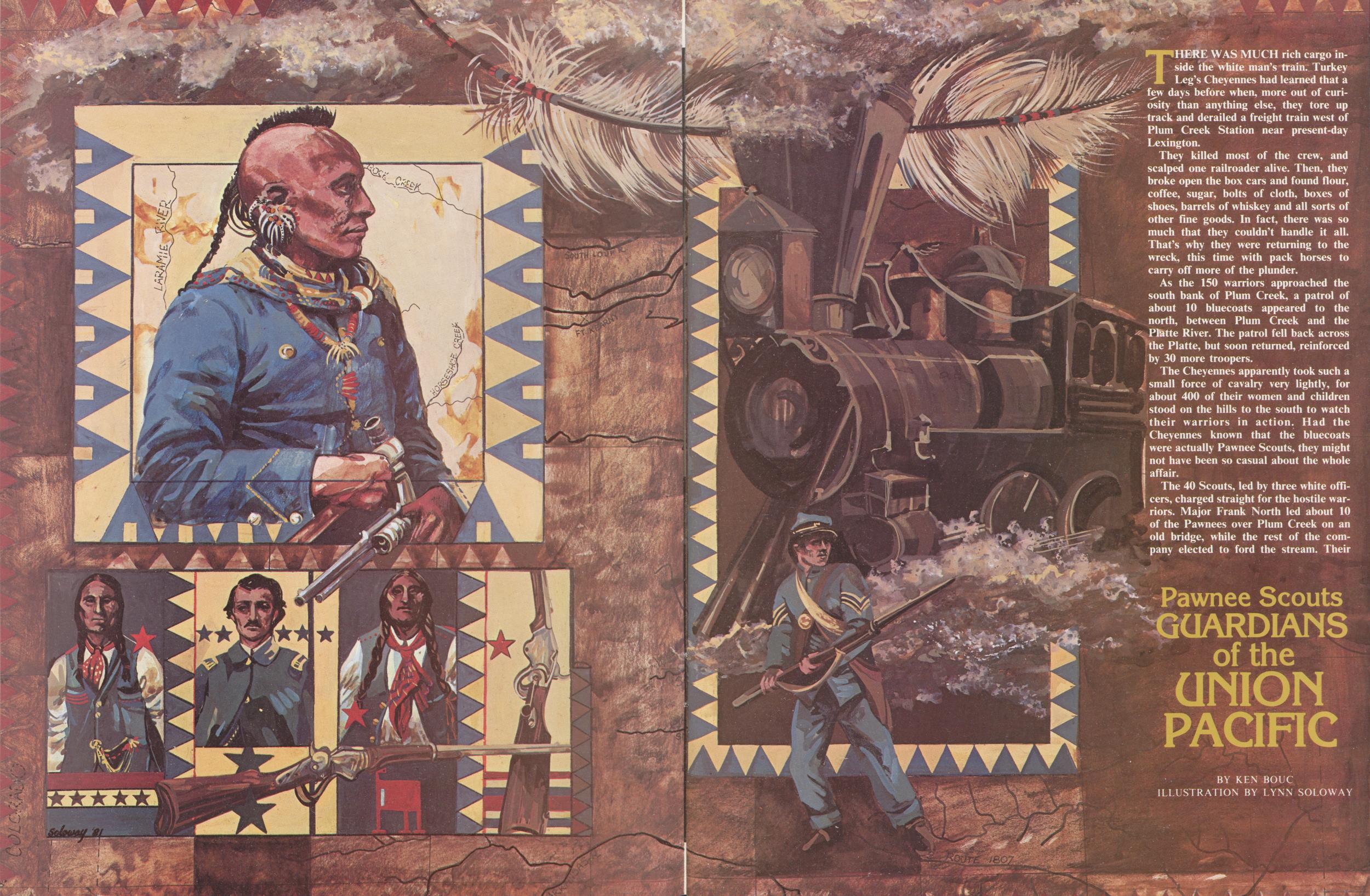
Pawnee Scouts Guardians of the Union Pacific
BY KEN BOUC ILLUSTRATION BY LYNN SOLOWAYHEREWA side the white man's train. Turkey Leg's Cheyennes had learned that a few days before when, more out of curiosity than anything else, they tore up track and derailed a freight train west of Plum Creek Station near present-day Lexington.
They killed most of the crew, and scalped one railroader alive. Then, they broke open the box cars and found flour, coffee, sugar, bolts of cloth, boxes of shoes, barrels of whiskey and all sorts of other fine goods. In fact, there was so much that they couldn't handle it all. That's why they were returning to the wreck, this time with pack horses to carry off more of the plunder.
As the 150 warriors approached the south bank of Plum Creek, a patrol of about 10 bluecoats appeared to the north, between Plum Creek and the Pratte River. The patrol fell back across the Platte, but soon returned, reinforced by 30 more troopers.
The Cheyennes apparently took such a small force of cavalry very lightly, for about 400 of their women and children stood on the hills to the south to watch their warriors in action. Had the Cheyennes known that the bluecoats were actually Pawnee Scouts, they might not have been so casual about the whole affair.
The 40 Scouts, led by three white officers, charged straight for the hostile warriors. Major Frank North led about 10 of the Pawnees over Plum Creek on an old bridge, while the rest of the company elected to ford the stream. Their horses became mired in the mud, which blunted the charge, but the Scouts scrambled up the bank on foot and killed seven Cheyennes.
Stung by that first skirmish, the Cheyennes retreated toward the hills, where they cut the packs from their spare horses, put the women and children aboard, and sent them fleeing. Then, the Cheyenne warriors turned to face the Scouts.
The affair turned into a 20-mile running battle that lasted the rest of the day. The Scouts killed at least 15 Cheyenne warriors, and wounded many more. They also captured Turkey Leg's wife and nephew, about 35 horses and mules, much camp equipment, and some of the booty the Cheyennes had taken from the train the day it was attacked. The Pawnees had two horses killed, and two men were slightly wounded.
Compared to some of the other fights they had been in, the clash with Turkey Leg at Plum Creek on August 17, 1867 would seem to be of minor significance. The Pawnee Scouts would be in larger battles during the 13-year span of their service. On the Powder River Expedition of 1865, for example, they tracked down and led charges against two large hostile bands that saw many hundreds of horses taken, and scores of hostiles killed or captured. They also rescued a lost column of 2,600 starving and panic-stricken cavalrymen. And, the Republican River Expedition of 1869, in which the Pawnee Scouts tracked down Tall Bull's Cheyenne Dog Soldiers at Summit Springs and led the charge into his camp, made bold headlines even in far-away New York City (see "The Invincible Battalion", July 1980 NEBRASKAland).
The Pawnee Scouts earned commendations and made headlines for a few short weeks in the field on the big military expeditions of 1865 and 1869, but they spent most of the time between 1865 and 1871 guarding the Union Pacific Railroad from hostile
The job of protecting the U.P. involved incredible hardship, with scouting forays or pursuits sometimes requiring 24 hours or more in the saddle without food or rest. The Pawnees' courage and fighting skills were tested repeatedly, and passed with flying colors, as when the 40 Scouts at Plum Creek sent 150 Cheyenne warriors packing.
Of course, the Pawnee warriors' reputation as skillful plainsmen and good fighters was the prime reason that Frank North of Columbus was asked to enlist them into the Army. The Pawnees knew and trusted Frank North from the years he had lived near them and worked among them at their agency near Genoa. The loyalty they felt toward him, and the discipline he instilled in them, made the Pawnees utterly dependable and useful soldiers for frontier duty.
The devotion of the Pawnees to Frank North, and to his younger brother, Luther, approached adoration. During their first campaign, the 1865 Powder River Expedition, the Pawnees gave Frank the name Pani Leshar (Chief of the Pawnees), a title of great honor. Only one other white man, General John C. Fremont, ever held that honor.
The Pawnees affectionately called Luther "Father" or "Little Chief." Luther was particularly impressed with the loyalty his Pawnees displayed toward him and his brother. One story he often told involved a scouting trip on Driftwood Creek in what is now Hitchcock County in January 1866.
Luther and 10 Pawnee Scouts were on open ground several miles from the creek when they spotted a large party of Indians, at least 100 of them, in the distance. The Indians came at them, and Luther and the Scouts turned to ride for the creek where they could take cover and make a stand. They didn't hurry their horses, since they were in good condition and could easily hold their own against the skinny Indian ponies.
About a half-mile from the creek, his horse slipped on some ice and threw Luther to the ground, knocking him unconscious. When he came to, one of his Scouts was rubbing his face with snow while the others were dismounted in a circle around him, holding off the attacking Indians with their (Continued on page 45)
Harlan.. Reflections On the Republican
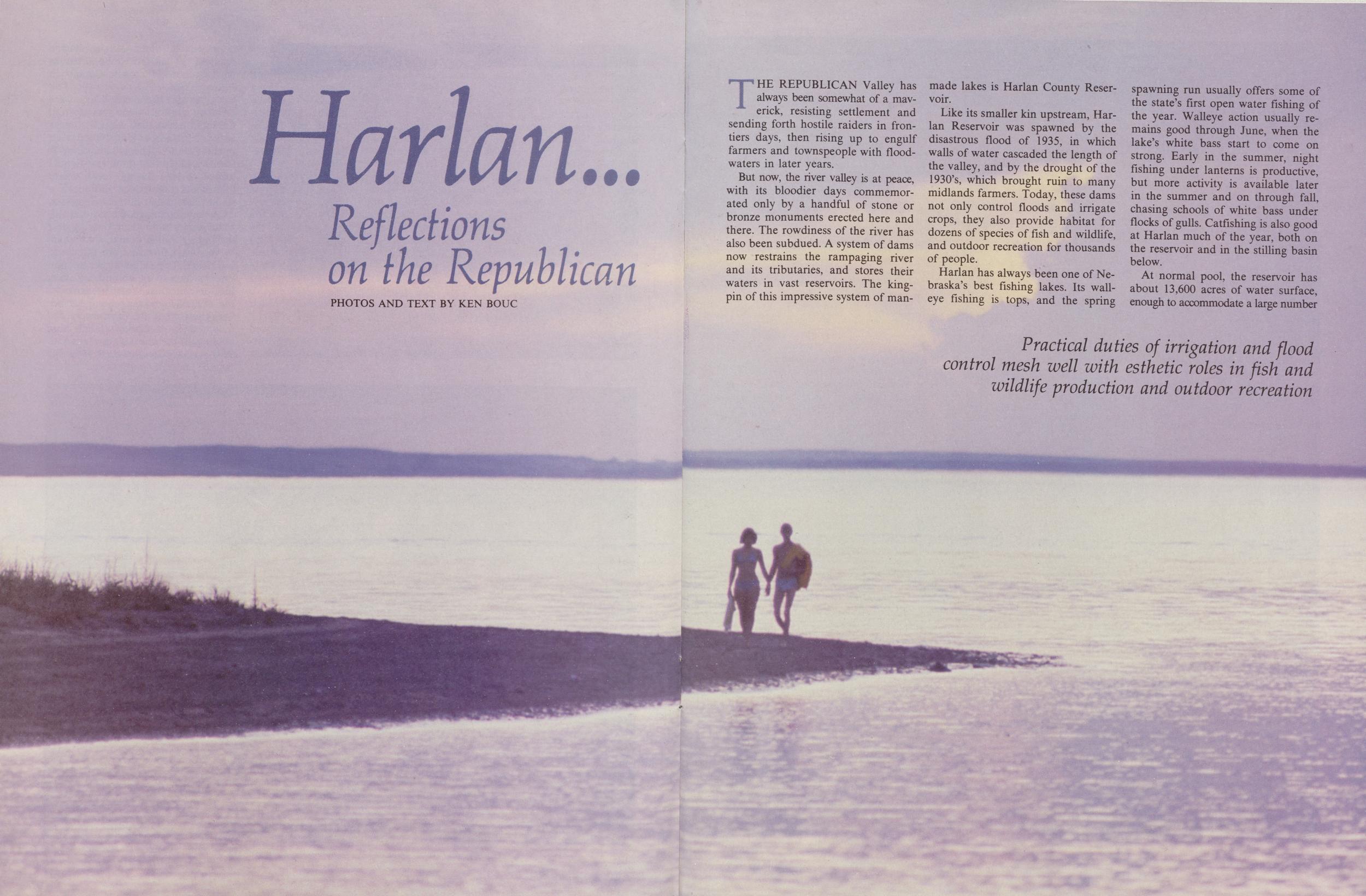
PHOTOS AND TEXT BY KEN BOUCHE REPUBLICAN Valley has always been somewhat of a maverick, resisting settlement and sending forth hostile raiders in frontiers days, then rising up to engulf farmers and townspeople with floodwaters in later years.
But now, the river valley is at peace, with its bloodier days commemorated only by a handful of stone or bronze monuments erected here and there. The rowdiness of the river has also been subdued. A system of dams now restrains the rampaging river and its tributaries, and stores their waters in vast reservoirs. The kingpin of this impressive system of manmade lakes is Harlan County Reservoir.
Like its smaller kin upstream, Harlan Reservoir was spawned by the disastrous flood of 1935, in which walls of water cascaded the length of the valley, and by the drought of the 1930's, which brought ruin to many midlands farmers. Today, these dams not only control floods and irrigate crops, they also provide habitat for dozens of species of fish and wildlife, and outdoor recreation for thousands of people.
Harlan has always been one of Nebraska's best fishing lakes. Its walleye fishing is tops, and the spring spawning run usually offers some of the state's first open water fishing of the year. Walleye action usually remains good through June, when the lake's white bass start to come on strong. Early in the summer, night fishing under lanterns is productive, but more activity is available later in the summer and on through fall, chasing schools of white bass under flocks of gulls. Catfishing is also good at Harlan much of the year, both on the reservoir and in the stilling basin below.
At normal pool, the reservoir has about 13,600 acres of water surface, enough to accommodate a large number
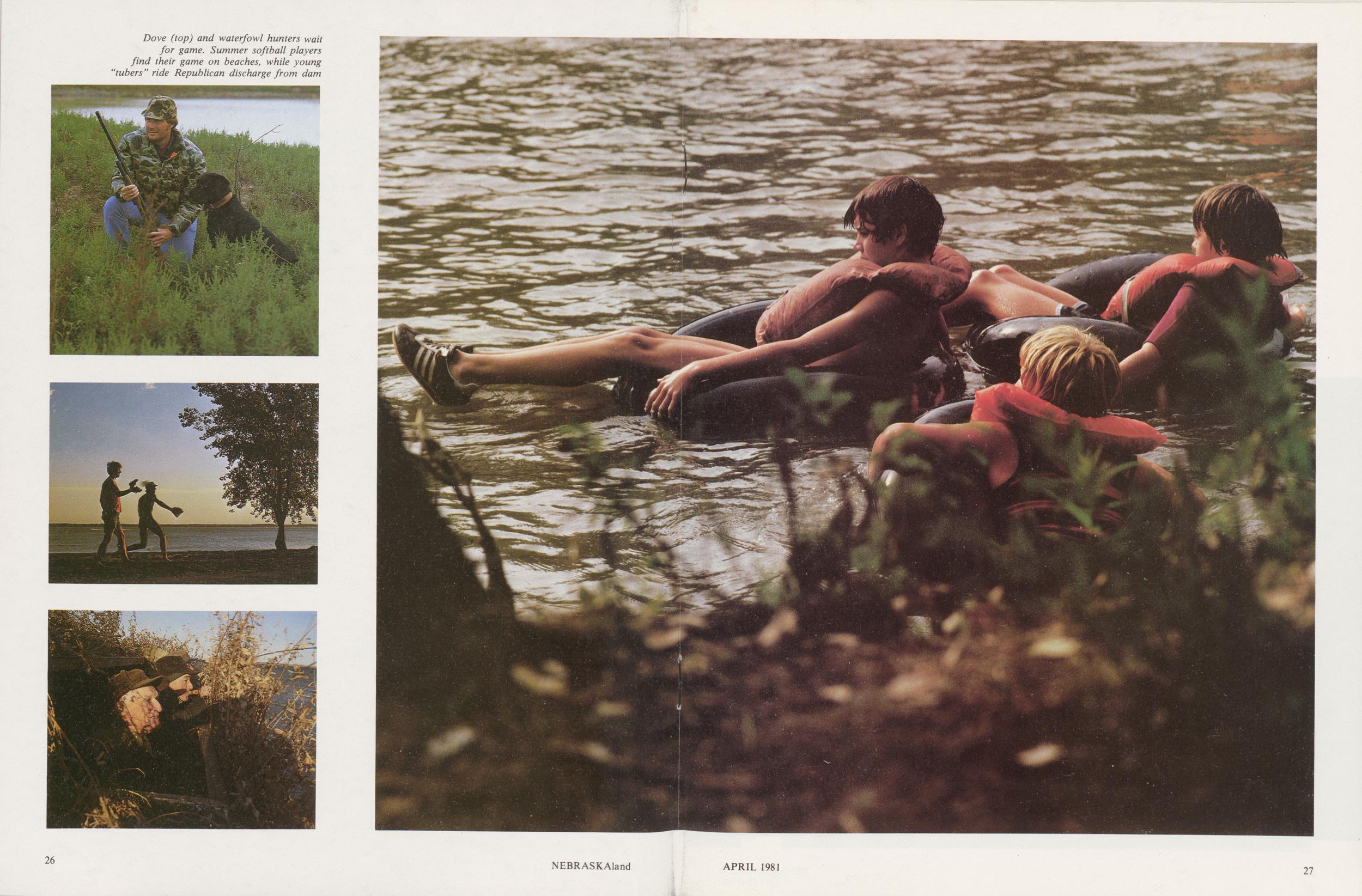
The summer irrigation withdrawal has at least one positive aspect as far as recreation is concerned. The large volume of water released to diversions downstream creates excellent conditions for canoeing and innertube riding on the Republican, usually from
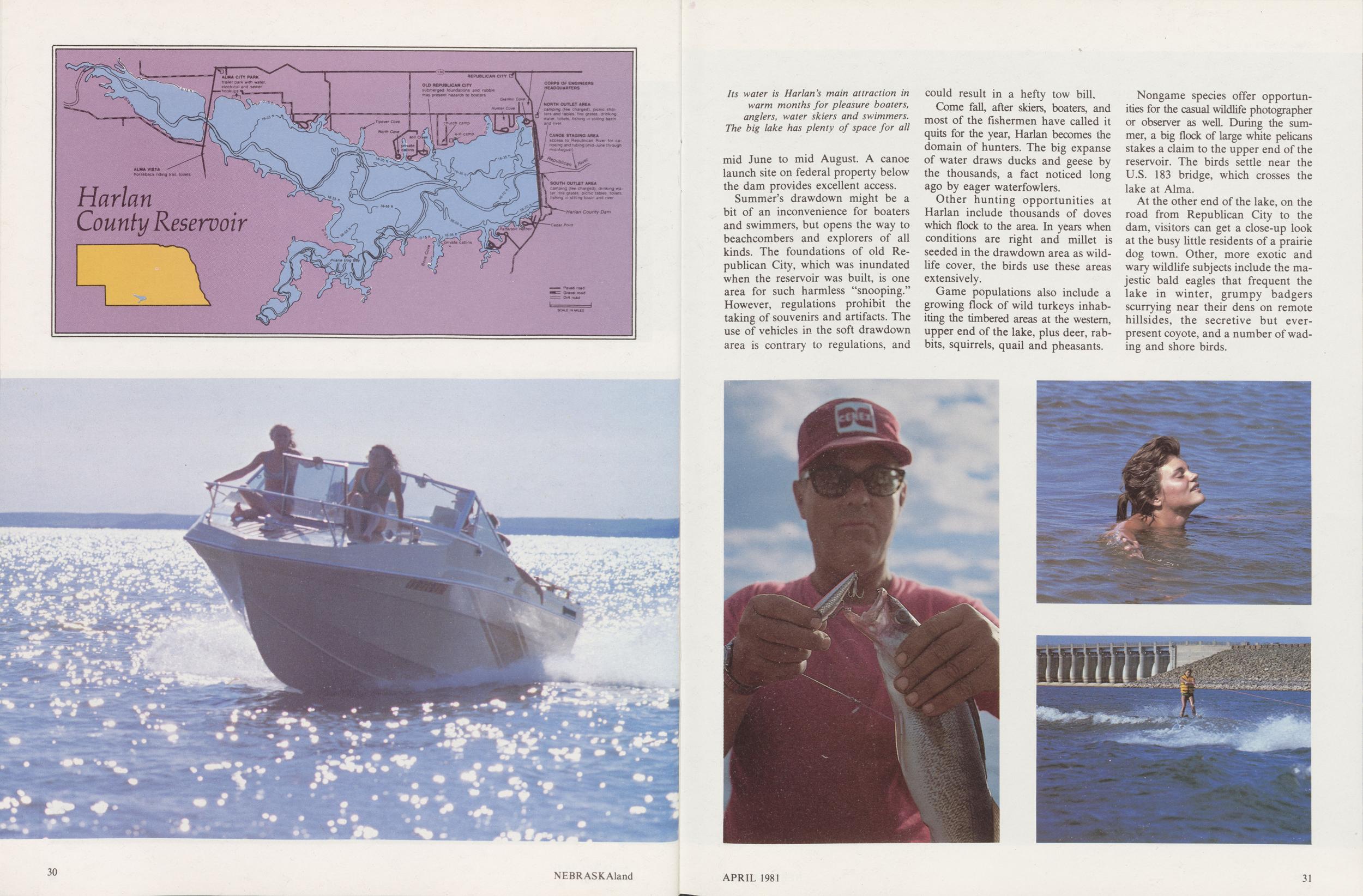
Summer's drawdown might be a bit of an inconvenience for boaters and swimmers, but opens the way to beachcombers and explorers of all kinds. The foundations of old Republican City, which was inundated when the reservoir was built, is one area for such harmless "snooping." However, regulations prohibit the taking of souvenirs and artifacts. The use of vehicles in the soft drawdown area is contrary to regulations, and could result in a hefty tow bill
Come fall, after skiers, boaters, and most of the fishermen have called it quits for the year, Harlan becomes the domain of hunters. The big expanse of water draws ducks and geese by the thousands, a fact noticed long ago by eager waterfowlers.
Other hunting opportunities at Harlan include thousands of doves which flock to the area. In years when conditions are right and millet is seeded in the drawdown area as wildlife cover, the birds use these areas extensively.
Game populations also include a growing flock of wild turkeys inhabiting the timbered areas at the western, upper end of the lake, plus deer, rabbits, squirrels, quail and pheasants.
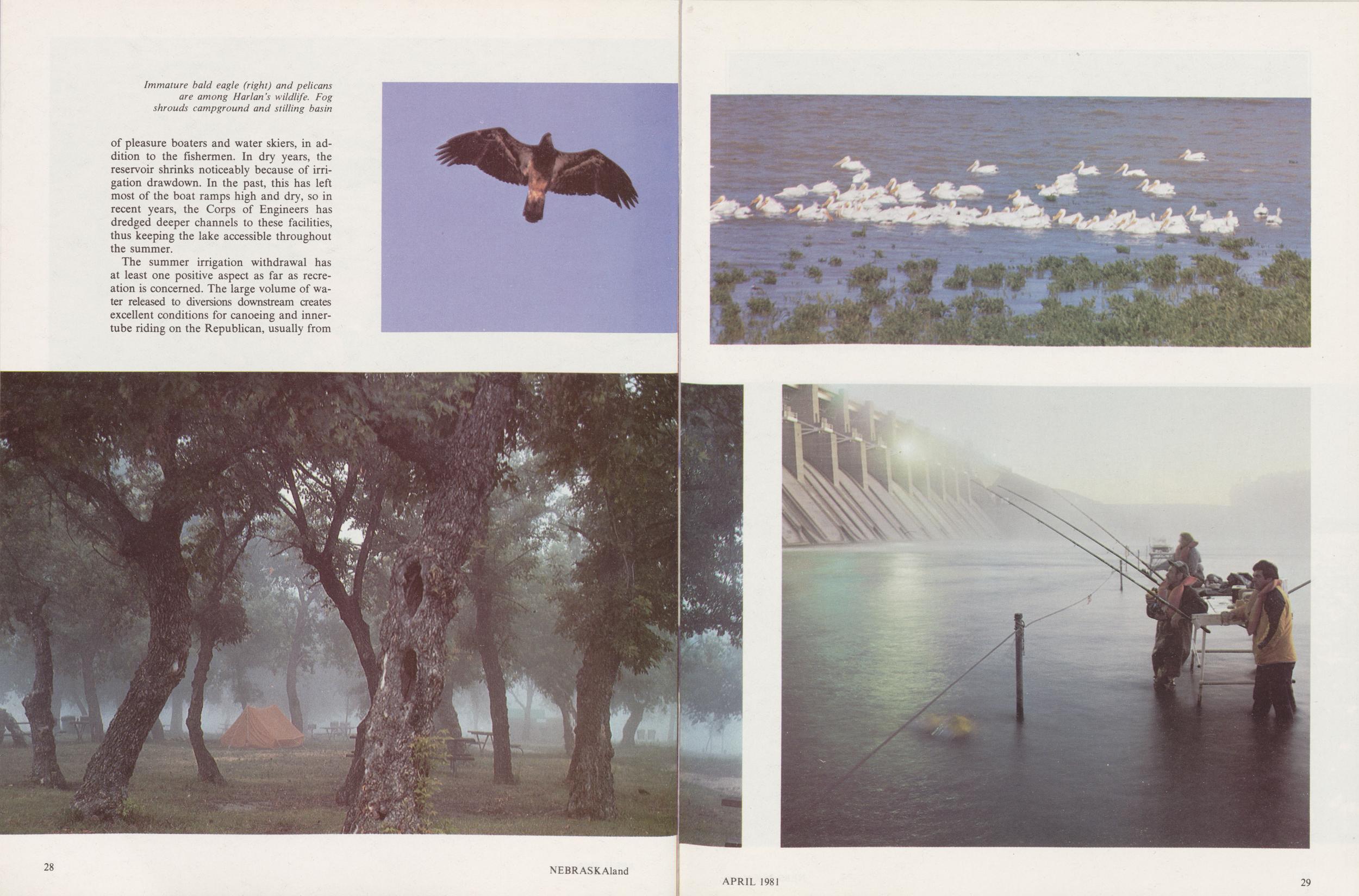
Nongame species offer opportunities for the casual wildlife photographer or observer as well. During the summer, a big flock of large white pelicans stakes a claim to the upper end of the reservoir. The birds settle near the U.S. 183 bridge, which crosses the lake at Alma.
At the other end of the lake, on the road from Republican City to the dam, visitors can get a close-up look at the busy little residents of a prairie dog town. Other, more exotic and wary wildlife subjects include the majestic bald eagles that frequent the lake in winter, grumpy badgers scurrying near their dens on remote hillsides, the secretive but everpresent coyote, and a number of wading and shore birds.
Unlike other Republican Valley impoundments upstream, Harlan County Reservoir remained in federal control after construction was completed in 1952. Since that time, the U.S. Army Corps of Engineers has managed the lake not only for its primary benefits of flood control and irrigation, but also for fish and wildlife production, agriculture and outdoor recreation.
Thus, in taming the irascible Republican, Harlan County Reservoir and its counterparts have created not only peace of mind and security for the valley's residents, but also havens for wildlife and outdoor playgrounds for thousands of Nebraskans and their out-of-state guests.
Secrets of the Big Five
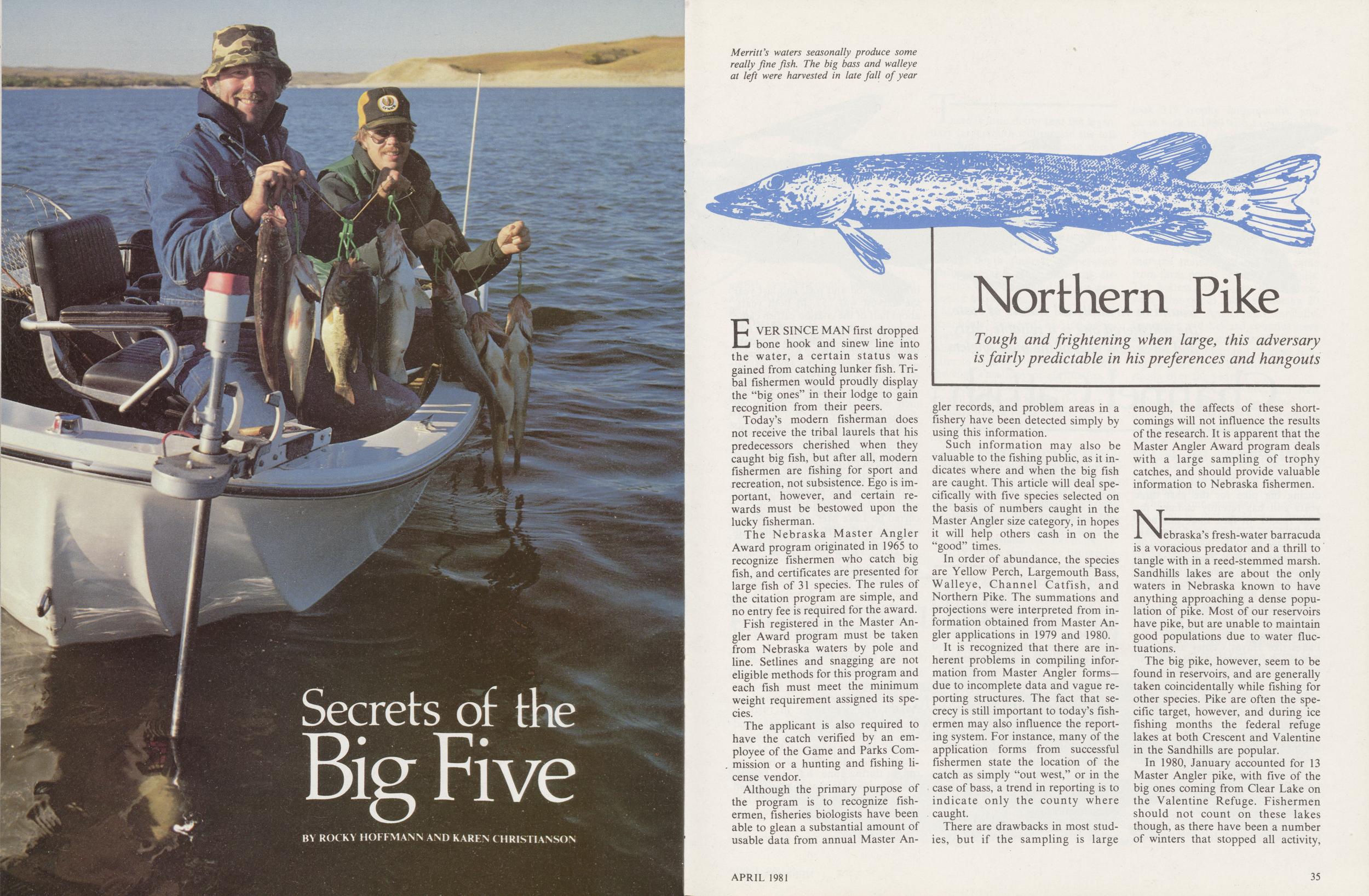
BY ROCKY HOFFMAN AND KAREN CHRISTIANSONEVER SINCE MAN first dropped bone hook and sinew line into the water, a certain status was gained from catching lunker fish. Tribal fishermen would proudly display the "big ones" in their lodge to gain recognition from their peers.
Today's modern fisherman does not receive the tribal laurels that his predecessors cherished when they caught big fish, but after all, modern fishermen are fishing for sport and recreation, not subsistence. Ego is important, however, and certain rewards must be bestowed upon the lucky fisherman.
The Nebraska Master Angler Award program originated in 1965 to recognize fishermen who catch big fish, and certificates are presented for large fish of 31 species. The rules of the citation program are simple, and no entry fee is required for the award.
Fish registered in the Master Angler Award program must be taken from Nebraska waters by pole and line. Setlines and snagging are not eligible methods for this program and each fish must meet the minimum weight requirement assigned its species.
The applicant is also required to have the catch verified by an employee of the Game and Parks Commission or a hunting and fishing license vendor.
Although the primary purpose of the program is to recognize fishermen, fisheries biologists have been able to glean a substantial amount of usable data from annual Master Angler records, and problem areas in a fishery have been detected simply by using this information.
Such information may also be valuable to the fishing public, as it indicates where and when the big fish are caught. This article will deal specifically with five species selected on the basis of numbers caught in the Master Angler size category, in hopes it will help others cash in on the "good" times.
In order of abundance, the species are Yellow Perch, Largemouth Bass, Walleye, Channel Catfish, and Northern Pike. The summations and projections were interpreted from information obtained from Master Angler applications in 1979 and 1980.
It is recognized that there are inherent problems in compiling information from Master Angler forms- due to incomplete data and vague reporting structures. The fact that secrecy is still important to today's fishermen may also influence the reporting system. For instance, many of the application forms from successful fishermen state the location of the catch as simply "out west," or in the case of bass, a trend in reporting is to indicate only the county where caught.
There are drawbacks in most studies, but if the sampling is large enough, the affects of these shortcomings will not influence the results of the research. It is apparent that the Master Angler Award program deals with a large sampling of trophy catches, and should provide valuable information to Nebraska fishermen.
Nebraska's fresh-water barracuda is a voracious predator and a thrill to tangle with in a reed-stemmed marsh. Sandhills lakes are about the only waters in Nebraska known to have anything approaching a dense population of pike. Most of our reservoirs have pike, but are unable to maintain good populations due to water fluctuations.
The big pike, however, seem to be found in reservoirs, and are generally taken coincidentally while fishing for other species. Pike are often the specific target, however, and during ice fishing months the federal refuge lakes at both Crescent and Valentine in the Sandhills are popular.
In 1980, January accounted for 13 Master Angler pike, with five of the big ones coming from Clear Lake on the Valentine Refuge. Fishermen should not count on these lakes though, as there have been a number of winters that stopped all activity, and it is impossible to even get to the lakes.
APRIL 1981 35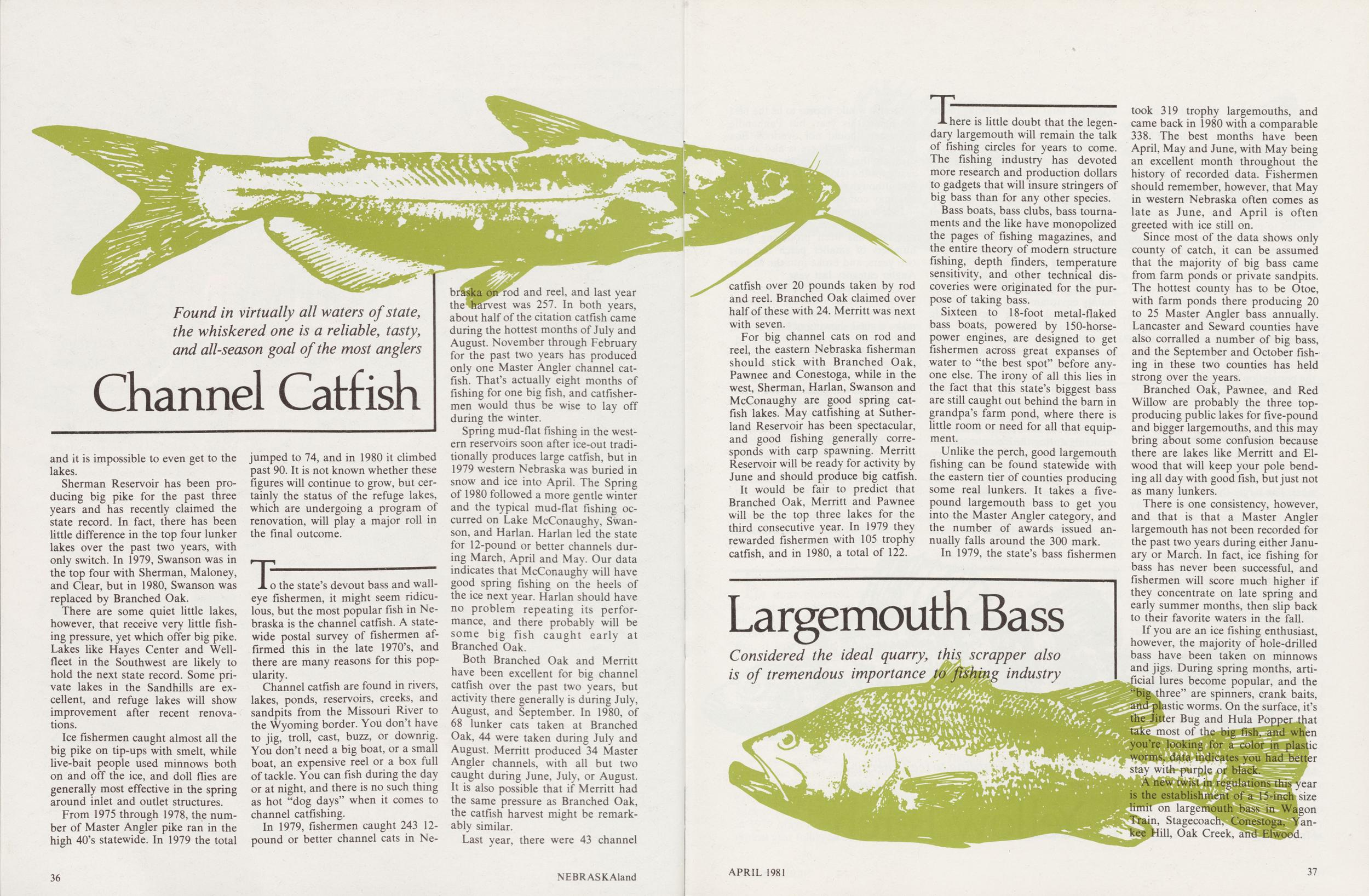
Sherman Reservoir has been producing big pike for the past three years and has recently claimed the state record. In fact, there has been little difference in the top four lunker lakes over the past two years, with only switch. In 1979, Swanson was in the top four with Sherman, Maloney, and Clear, but in 1980, Swanson was replaced by Branched Oak.
There are some quiet little lakes, however, that receive very little fishing pressure, yet which offer big pike. Lakes like Hayes Center and Well-fleet in the Southwest are likely to hold the next state record. Some private lakes in the Sandhills are excellent, and refuge lakes will show improvement after recent renovations.
Ice fishermen caught almost all the big pike on tip-ups with smelt, while live-bait people used minnows both on and off the ice, and doll flies are generally most effective in the spring around inlet and outlet structures.
From 1975 through 1978, the number of Master Angler pike ran in the high 40's statewide. In 1979 the total jumped to 74, and in 1980 it climbed past 90. It is not known whether these figures will continue to grow, but certainly the status of the refuge lakes, which are undergoing a program of renovation, will play a major roll in the final outcome.
To the state's devout bass and walleye fishermen, it might seem ridiculous, but the most popular fish in Nebraska is the channel catfish. A state-wide postal survey of fishermen affirmed this in the late 1970's, and there are many reasons for this popularity.
Channel catfish are found in rivers, lakes, ponds, reservoirs, creeks, and sandpits from the Missouri River to the Wyoming border. You don't have to jig, troll, cast, buzz, or downrig. You don't need a big boat, or a small boat, an expensive reel or a box full of tackle. You can fish during the day or at night, and there is no such thing as hot "dog days" when it comes to channel catfishing.
In 1979, fishermen caught 243 12-pound or better channel cats in Nebraska on rod and reel and last year the harvest was 257. In both years, about half of the citation catfish came during the hottest months of July and August. November through February for the past two years has produced only one Master Angler channel catfish. That's actually eight months of fishing for one big fish, and catfishermen would thus be wise to lay off during the winter.
Spring mud-flat fishing in the western reservoirs soon after ice-out traditionally produces large catfish, but in 1979 western Nebraska was buried in snow and ice into April. The Spring of 1980 followed a more gentle winter and the typical mud-flat fishing occurred on Lake McConaughy, Swanson, and Harlan. Harlan led the state for 12-pound or better channels during March, April and May. Our data indicates that McConaughy will have good spring fishing on the heels of the ice next year. Harlan should have no problem repeating its performance, and there probably will be some big fish caught early at Branched Oak.
Both Branched Oak and Merritt have been excellent for big channel catfish over the past two years, but activity there generally is during July, August, and September. In 1980, of 68 lunker cats taken at Branched Oak, 44 were taken during July and August. Merritt produced 34 Master Angler channels, with all but two caught during June, July, or August. It is also possible that if Merritt had the same pressure as Branched Oak, the catfish harvest might be remarkably similar.
Last year, there were 43 channel 36 NEBRASKAland
For big channel cats on rod and reel, the eastern Nebraska fisherman should stick with Branched Oak, Pawnee and Conestoga, while in the west, Sherman, Harlan, Swanson and McConaughy are good spring catfish lakes. May catfishing at Sutherland Reservoir has been spectacular, and good fishing generally corresponds with carp spawning. Merritt Reservoir will be ready for activity by June and should produce big catfish.
It would be fair to predict that Branched Oak, Merritt and Pawnee will be the top three lakes for the third consecutive year. In 1979 they rewarded fishermen with 105 trophy catfish, and in 1980, a total of 122.
here is little doubt that the legendary largemouth will remain the talk of fishing circles for years to come. The fishing industry has devoted more research and production dollars to gadgets that will insure stringers of big bass than for any other species.
Bass boats, bass clubs, bass tournaments and the like have monopolized the pages of fishing magazines, and the entire theory of modern structure fishing, depth finders, temperature sensitivity, and other technical discoveries were originated for the purpose of taking bass.
Sixteen to 18-foot metal-flaked bass boats, powered by 150-horsepower engines, are designed to get fishermen across great expanses of water to "the best spot" before anyone else. The irony of all this lies in the fact that this state's biggest bass are still caught out behind the barn in grandpa's farm pond, where there is little room or need for all that equipment.
Unlike the perch, good largemouth fishing can be found statewide with the eastern tier of counties producing some real lunkers. It takes a five-pound largemouth bass to get you into the Master Angler category, and the number of awards issued annually falls around the 300 mark.
In 1979, the state's bass fisherman took 319 trophy largemouths, and came back in 1980 with a comparable 338. The best months have been April, May and June, with May being an excellent month throughout the history of recorded data. Fishermen should remember, however, that May in western Nebraska often comes as late as June, and April is often greeted with ice still on.
Since most of the data shows only county of catch, it can be assumed that the majority of big bass came from farm ponds or private sandpits. The hottest county has to be Otoe, with farm ponds there producing 20 to 25 Master Angler bass annually. Lancaster and Seward counties have also corralled a number of big bass, and the September and October fishing in these two counties has held strong over the years.
Branched Oak, Pawnee, and Red Willow are probably the three top-producing public lakes for five-pound and bigger largemouths, and this may bring about some confusion because there are lakes like Merritt and Elwood that will keep your pole bending all day with good fish, but just not as many lunkers.
There is one consistency, however, and that is that a Master Angler largemouth has not been recorded for the past two years during either January or March. In fact, ice fishing for bass has never been successful, and fishermen will score much higher if they concentrate on late spring and early summer months, then slip back to their favorite waters in the fall.
If you are an ice fishing enthusiast, however, the majority of hole-drilled bass have been taken on minnows and jigs. During spring months, artificial lures become popular, and the "big three" are spinners, crank baits, and plastic worms. On the surface, it's the Jitter Bug and Hula Popper that take most of the big fish, and when you're looking for a color in plastic worms, data indicates you had better stay with purple or black. A new twist in regulations this year is the establishment of a 15-inch size limit on largemouth bass in Wagon Train, Stagecoach, Conestoga, Yankee Hill, Oak Creek, and Elwood.
APRIL 1981 37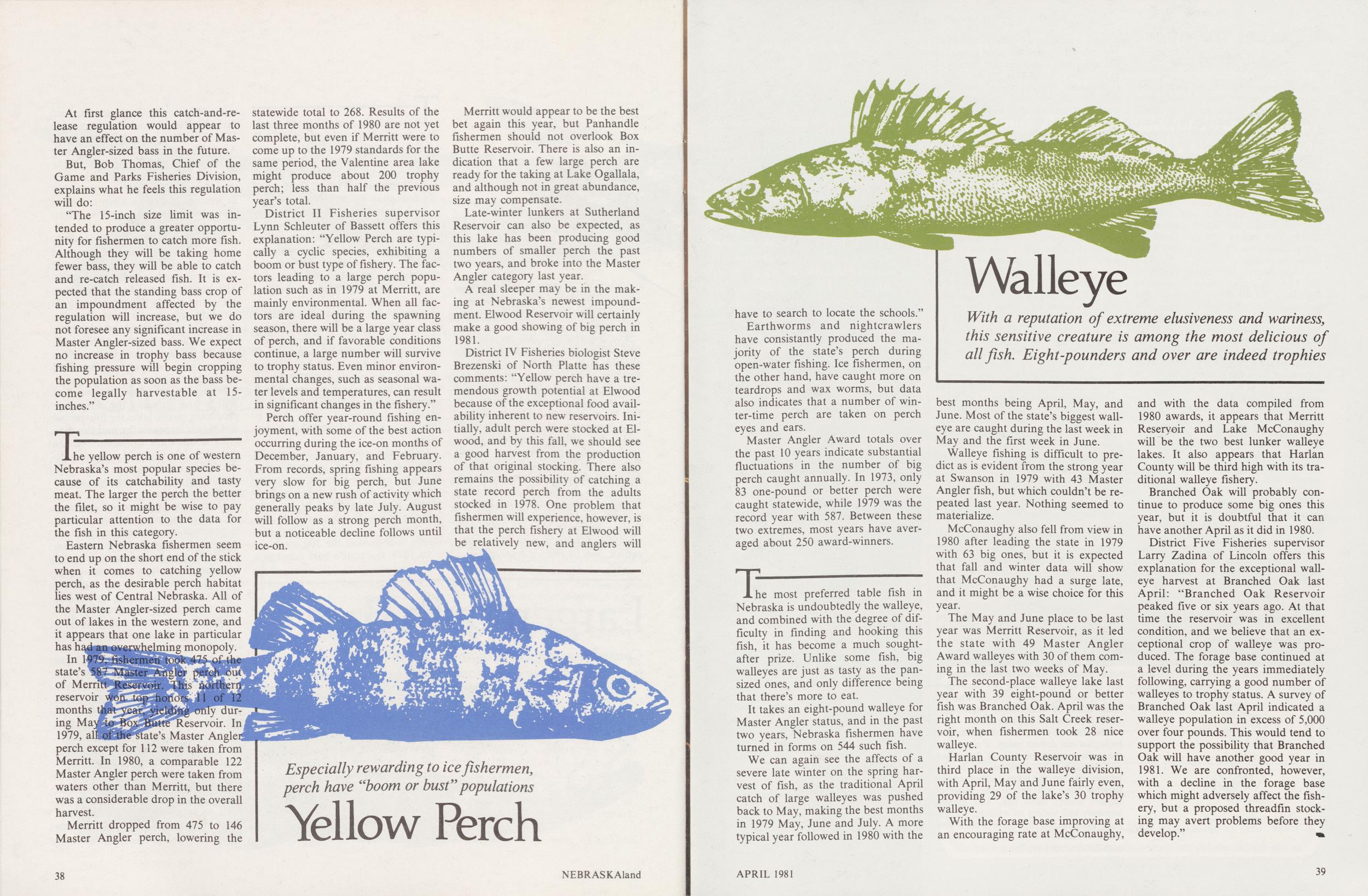
At first glance this catch-and-release regulation would appear to have an effect on the number of Master Angler-sized bass in the future. But, Bob Thomas, Chief of the Game and Parks Fisheries Division, explains what he feels this regulation will do:
"The 15-inch size limit was intended to produce a greater opportunity for fishermen to catch more fish. Although they will be taking home fewer bass, they will be able to catch and re-catch released fish. It is expected that the standing bass crop of an impoundment affected by the regulation will increase, but we do not foresee any significant increase in Master Angler-sized bass. We expect no increase in trophy bass because fishing pressure will begin cropping the population as soon as the bass become legally harvestable at 15-inches."
The yellow perch is one of western Nebraska's most popular species because of its catchability and tasty meat. The larger the perch the better the filet, so it might be wise to pay particular attention to the data for the fish in this category.
Eastern Nebraska fishermen seem to end up on the short end of the stick when it comes to catching yellow perch, as the desirable perch habitat lies west of Central Nebraska. All of the Master Angler-sized perch came out of lakes in the western zone, and it appears that one lake in particular has had an overwhelming monopoly.
In 1979, fishermen took 475 of the state's 587 Master Angler perch except for 112 were taken from Merritt. In 1980, a comparable 122 Master Angler perch were taken from waters other than Merritt, but there was a considerable drop in the overall harvest.
Merritt dropped from 475 to 146 Master Angler perch, lowering the statewide total to 268. Results of the last three months of 1980 are not yet complete, but even if Merritt were to come up to the 1979 standards for the same period, the Valentine area lake might produce about 200 trophy perch; less than half the previous year's total.
District II Fisheries supervisor Lynn Schleuter of Bassett offers this explanation: "Yellow Perch are typically a cyclic species, exhibiting a boom or bust type of fishery. The factors leading to a large perch population such as in 1979 at Merritt, are mainly environmental. When all factors are ideal during the spawning season, there will be a large year class of perch, and if favorable conditions continue, a large number will survive to trophy status. Even minor environmental changes, such as seasonal water levels and temperatures, can result in significant changes in the fishery."
Perch offer year-round fishing enjoyment, with some of the best action occurring during the ice-on months of December, January, and February. From records, spring fishing appears very slow for big perch, but June brings on a new rush of activity which generally peaks by late July. August will follow as a strong perch month, but a noticeable decline follows until ice-on.
Merritt would appear to be the best bet again this year, but Panhandle fishermen should not overlook Box Butte Reservoir. There is also an indication that a few large perch are ready for the taking at Lake Ogallala, and although not in great abundance, size may compensate.
Late-winter lunkers at Sutherland Reservoir can also be expected, as this lake has been producing good numbers of smaller perch the past two years, and broke into the Master Angler category last year.
A real sleeper may be in the making at Nebraska's newest impoundment. Elwood Reservoir will certainly make a good showing of big perch in 1981.
District IV Fisheries biologist Steve Brezenski of North Platte has these comments: "Yellow perch have a tremendous growth potential at Elwood because of the exceptional food availability inherent to new reservoirs. Initially, adult perch were stocked at Elwood, and by this fall, we should see a good harvest from the production of that original stocking. There also remains the possibility of catching a state record perch from the adults stocked in 1978. One problem that fishermen will experience, however, is that the perch fishery at Elwood will be relatively new, and anglers will
Earthworms and nightcrawlers have consistantly produced the majority of the state's perch during open-water fishing. Ice fishermen, on the other hand, have caught more on teardrops and wax worms, but data also indicates that a number of winter-time perch are taken on perch eyes and ears.
Master Angler Award totals over the past 10 years indicate substantial fluctuations in the number of big perch caught annually. In 1973, only 83 one-pound or better perch were caught statewide, while 1979 was the record year with 587. Between these two extremes, most years have averaged about 250 award-winners.
The most preferred table fish in Nebraska is undoubtedly the walleye, and combined with the degree of difficulty in finding and hooking this fish, it has become a much sought-after prize. Unlike some fish, big walleyes are just as tasty as the pansized ones, and only difference being that there's more to eat.
It takes an eight-pound walleye for Master Angler status, and in the past two years, Nebraska fishermen have turned in forms on 544 such fish.
We can again see the affects of a severe late winter on the spring harvest of fish, as the traditional April catch of large walleyes was pushed back to May, making the best months in 1979 May, June and July. A more typical year followed in 1980 with the
Walleye fishing is difficult to predict as is evident from the strong year at Swanson in 1979 with 43 Master Angler fish, but which couldn't be repeated last year. Nothing seemed to materialize.
McConaughy also fell from view in 1980 after leading the state in 1979 with 63 big ones, but it is expected that fall and winter data will show that McConaughy had a surge late, and it might be a wise choice for this year.
The May and June place to be last year was Merritt Reservoir, as it led the state with 49 Master Angler Award walleyes with 30 of them coming in the last two weeks of May.
The second-place walleye lake last year with 39 eight-pound or better fish was Branched Oak. April was the right month on this Salt Creek reservoir, when fishermen took 28 nice walleye.
Harlan County Reservoir was in third place in the walleye division, with April, May and June fairly even, providing 29 of the lake's 30 trophy walleye.
With the forage base improving at an encouraging rate at McConaughy, and with the data compiled from 1980 awards, it appears that Merritt Reservoir and Lake McConaughy will be the two best lunker walleye lakes. It also appears that Harlan County will be third high with its traditional walleye fishery.
Branched Oak will probably continue to produce some big ones this year, but it is doubtful that it can have another April as it did in 1980.
District Five Fisheries supervisor Larry Zadina of Lincoln offers this explanation for the exceptional walleye harvest at Branched Oak last April: "Branched Oak Reservoir peaked five or six years ago. At that time the reservoir was in excellent condition, and we believe that an exceptional crop of walleye was produced. The forage base continued at a level during the years immediately following, carrying a good number of walleyes to trophy status. A survey of Branched Oak last April indicated a walleye population in excess of 5,000 over four pounds. This would tend to support the possibility that Branched Oak will have another good year in 1981. We are confronted, however, with a decline in the forage base which might adversely affect the fishery, but a proposed threadfin stocking may avert problems before they develop.'
APRIL 1981 39
With less dirt in the water, light is able to penetrate deeper, thus allowing more rooted aquatic plants to grow. These plants tie up excess nutrients in the water, which formerly went into the production of algae that created "pea soup" water conditions in late summer. The result is then more rooted aquatic vegetation, which in turn serves as fish habitat and even less algae.
Millet also improves water quality by attracting suspended clay and silt particles to its stem and leaves, particularly at the upper end of a reservoir where it serves as a "filter strip" for runoff water entering the lake.
Clean water is an obvious benefit to fish and fishermen, but millet promises even more for the angler. Northern pike are a favorite game fish for many Nebraskans, and are also a valuable predator that helps keep a lake's panfish population under control. Yet, many Nebraska lakes are unable to sustain pike populations because they lack the submerged vegetation these fish require to spawn. A flooded stand of millet provides this vital spawning habitat.
Flooded millet then serves as a refuge for young pike, as well as small bass and other game fish, and it's a favorite feeding area for larger predator fish. In addition, the leaves and stems of the millet provide anchor points for a variety of aquatic insects—an important source of food for the resident fish population.
Waterfowl are probably the biggest beneficiaries of a millet planting. The heavy seed heads droop toward the water by the time fall flights of ducks and geese arrive, and the birds eagerly swim among them to feed. Lakes with millet on the shoreline attract and hold more waterfowl in the fall, and provide good feeding and brooding areas for young ducks in spring.
Millet is also excellent food for doves, providing an abundant yield of the kind of seeds these birds crave. As with waterfowl, the proximity of food and water makes these millet patches particularly attractive.
Later in the year, when the water
Millet can also be a boon to muskrats, often making the difference between just a half-dozen lodges crowded in one corner of a lake, and several times that number in several areas. On lakes with barren shorelines, muskrats do not have the material they need to build their safe, cozy winter lodges. But, millet fills that need and allows the rats to set up winter quarters wherever they find building material (millet or cattail stalks) near the shallow water. Thus, there are more muskrats, and they have plenty of living space. They avoid disease problems and some of the vicious fighting that occurs during breeding season in overcrowded populations.
The benefits of the seeding can last up to two years, so that the drawdown is not necessary annually. The millet stalks, leaves, and some seedheads remain on until the following spring, summer and fall for spawning habitat, duck brooding and feeding, and wave-dampening. Some may even survive long enough to provide a little habitat for a second pike spawn.
In the last year or two, millet has been sown on the mudflats of Harlan and Sherman reservoirs where irrigation drawdown occurs, and at Yankee Hill, Twin Lakes and Wagon Train in the Salt Valley, all of which were lowered for dam repair work. Benefits at Sherman were less than hoped for, but the others worked out quite well.
With such good results from incidental drawdowns, the next logical step from the fish and wildlife biologists' viewpoint is to lower lakes expressly for millet seeding. But, fish and wildlife are usually not the primary reasons that reservoirs are built. Irrigation, flood control and other interests usually have priority, and their needs might not be totally compatible with drawdowns for millet planting.
There are also other interests to consider. Boat ramps and beaches may be left high and dry during the drawdown period, and the interests of those who use them must be considered, particularly when it involves a popular lake.
There is really very little doubt that the biologists can deliver many, if not all, of the environmental benefits of drawdown and seeding. The question is, do the people who use the lakes understand the benefits they will get in the form of cleaner water, more fish, and greater numbers and variety of wildlife, and do they want to pay for them with a few weeks of inconvenience? It seems a small cost for the big payoffs.
40 NEBRASKAland We still have a supply of beautiful, framable prints for home or office. There are 16 prints in the set, each measuring 9x12 (actual image area), and 11 x 14 1/2 including border. They can be trimmed for standard 11 x 14 frame, or matted in your choice of colors in 14 x 17 or 14x18 frame. Printed on highquality paper, these photos were selected from thousands in the NEBRASKAland Magazine files, and include something for everyone; from flowers to landscapes, waterfalls to wildlife. A real bargain at $4 now being closed out at $2.50 Here is NEBRASKAland Magazine's Book of Collector Prints a set of 16 beautiful photos which show some of the state's scenic splendor Included in this set of heavy, color prints, as shown here, are Courthouse and Jail Rocks; Autumn Woods; Seven Windmills near Scottsbluff; Quail in the Snow; Antique Decoys; Horses in the Calamus Valley; Sandhill Cranes; Weasel; Scarecrow; Mallard Drake; a Gull over McConaughy; White-tailed Deer; an Eared Grebe; the Snake River Falls; a Pasqueflower; and State Capitol. These prints are ideal gifts for yourself or friends! APRIL 1981 41 WELCOME
to
Merritt Dam Trading Post
26 Miles So. Of Valentine On Hwy. 16C
Phone 402/376-3437
Bait Tackle Ammunition Groceries Gas Beer Ice
Cabins with Kitchen Facilities Floating Marina
Campground Hook-ups Boat and Motor Rental
Home of the State Record Perch,
Muskellunge and Smallmouth bass
Your Hosts
JON AND MARIAN
DAVENPORT
easy on
energy
nebraska energy conservation committee
The Good Fishermen Always
Start & Finish Here.
Air-conditioned units, cooking facilities,
Up to six adults. Campground on the
beach—40 hookups, showers, playground,
shade.
AIR STRIP 2,600 Feet Sod
GUIDE SERVICE
MARINA
Boat Gas & Oil on the Water
LAUNCHING SERVICE
GENERAL STORE Groceries, Beer,
Pop, Tackle, Live Bait
HIGHWATER RAMP
BOAT & PONTOON RENTALS Motors
from 10-40 HP, boats 14 to 20 feet
Write For A Free Brochure
South Shore Big Mac
at Gate 18
Rural Route
Brule, Ne. 69127
Ogallala, Ne.
(308) 284-4965
TALKING TURKEY
IN CAMOUFLAGE
(Continued from page 19)
WELCOME
to
Merritt Dam Trading Post
26 Miles So. Of Valentine On Hwy. 16C
Phone 402/376-3437
Bait Tackle Ammunition Groceries Gas Beer Ice
Cabins with Kitchen Facilities Floating Marina
Campground Hook-ups Boat and Motor Rental
Home of the State Record Perch,
Muskellunge and Smallmouth bass
Your Hosts
JON AND MARIAN
DAVENPORT
easy on
energy
nebraska energy conservation committee
The Good Fishermen Always
Start & Finish Here.
Air-conditioned units, cooking facilities,
Up to six adults. Campground on the
beach—40 hookups, showers, playground,
shade.
AIR STRIP 2,600 Feet Sod
GUIDE SERVICE
MARINA
Boat Gas & Oil on the Water
LAUNCHING SERVICE
GENERAL STORE Groceries, Beer,
Pop, Tackle, Live Bait
HIGHWATER RAMP
BOAT & PONTOON RENTALS Motors
from 10-40 HP, boats 14 to 20 feet
Write For A Free Brochure
South Shore Big Mac
at Gate 18
Rural Route
Brule, Ne. 69127
Ogallala, Ne.
(308) 284-4965
TALKING TURKEY
IN CAMOUFLAGE
(Continued from page 19)
pull the loads out. An experienced muzzleloader can be very helpful. Be sure to have someone check the locks, as well; sometimes there is enough wear in the system that the lock will not cock and the hammer will fall.
"Other than the muzzleloading shotgun, the equipment needed to round out a functional black-powder kit is very minimal," he continued. "You can use a plastic shampoo bottle as a shot container, although it will tend to rattle as you walk. A leather shot pouch is preferred; they're quiet and some even come with a shot measure that can be set to throw a measured charge of shot quickly. A powder flask, a ramrod, nipple wrench, a threaded screw worm to remove loads, and some type of shoulder bag or hunting pouch really is about all that's necessary."
On an earlier scouting trip, we'd located both turkey sign and an ideal campsite for Wendell's buckskinner leanto. The pre-season trip made finding the proper combination of small trail roads and gates in the dark somewhat easier. The landowner had accompanied us on that earlier scouting foray, pointing out areas of turkey use. It was nearly midnight before camp was completed and the equipment checked and prepared for the morning hunt.
It was still dark as we rolled out of the sleeping bags. The morning was clear with very little wind—ideal turkey-calling conditions. The hour before sunrise can be very important for the turkey hunter, as gobblers will often signal their location before leaving the roost, giving the hunter an advantage. As we slowly worked our way along a ridge overlooking a wooded creek bottom, several ringing gobbles echoed in the dawn light. The torn was more than half a mile down in the canyon, and the first gobble was quickly followed by several more as three or four other toms answered.
It was still 15 minutes before legal shooting time as we stopped to catch our breath and prepare our equipment. Wendell shoots a 16-gauge double-barreled muzzleloader, which he began to load by carefully measuring his powder charge. The powder was followed by several felt wads as a seal and cushion. His normal VA ounces of No. 6 shot did not pattern well when we had tested the load on a turkey-sized cardboard sheet earlier, so now he loaded the same weight of large buckshot. Normally, size 4 or 6 shot in a 12-gauge is ideal, but each shotgun seems to be a law unto itself, so careful patterning tests should be made to find the most effective load. Wendell decided to use the NEBRASKAland large shot and impose a maximum 35-yard range to guarantee a quick kill with little chance of wounding a bird.
Working along the creek bottom, we located a downed pine that would serve as a blind. Our first series of artificial yelps produced on a cedar box call brought a loud ringing response from the creek ahead, and a second series of calls a few seconds later was quickly answered as well. Waiting a few minutes, Wendell called again, but this time the answering gobble was noticeably weaker', the bird was evidently moving away—often the case when gobblers and hens are still together in the early part of the season.
It was almost impossible to climb out of the creek bottom to circle the moving flock. Each time we'd stop to call, a torn would answer, but the birds continued to move ahead. By mid morning we were approaching the landowner's east boundary fence, with the birds still out of sight and still moving directly away.
Up to this time we'd made sure to conceal our movements as much as possible, refraining from loud noise or sudden movements. With the flock obviously determined to move farther along the creek bottom, possibly off the land we had permission to hunt, we decided to take a much-needed break to shed several layers of down jackets and heavy sweatshirts.
Standing on the exposed ridge, we discussed possible circling routes back to the campsite, but a loud gobble put an end to the discussion. The torn was close; less than 200 yards but hidden by heavy brush in the creek bottom.
"Let's try to make it to that fallen log," Wendell whispered as we neatly stacked our extra clothing and some of my camera gear on the ridge top. Sprinting and crawling, we crossed a wide, sandy wash to the edge of the creek and the shelter of a tangle of decaying elm limbs. I used the cedar call to produce a muted series of yelps, and again the gobbler answered, and the urgency in his voice left no doubt he was more than just a little interested.
Another series of calls about five
minutes later produced no answer, and
over 10 minutes passed without sight
or sound of the torn. Wendell had
crawled behind a slight depression in the
delightfully different
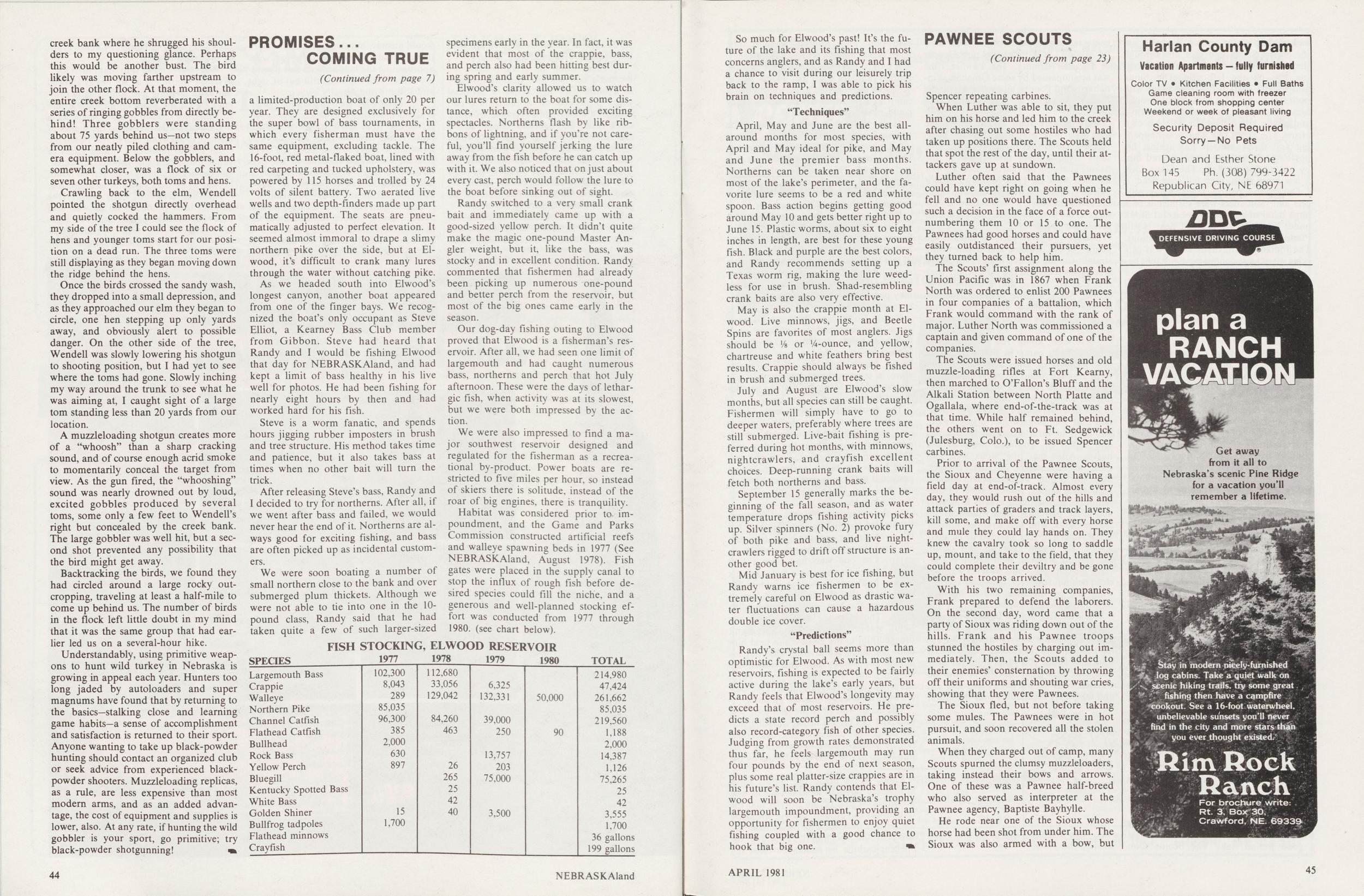
Nebraska! Refreshing. Exciting. Wonderfully unique. A
state that offers vacationers hundreds of events and attractions year 'round. A state
beautifully scenic across its
500 miles of rolling hills, golden plains and winding rivers.
A state you'll find delightfully surprising.
Vacation Nebraska this year.
For more information about "delightful Nebraska," fill
out this coupon.
NAME
8118
ADDRESS
CITY
STATE
ZIP
I
I Mail to Division of Travel and Tourism, Department of Economic Development,
P.O. Box 94666, Lincoln, Nebraska 68509.
Or call toll free, out-of-state (800) 228-4307; In-state (800) 742-7595, or (402)
471-3796
APRIL 1981
43
 creek bank where he shrugged his shoulders to my questioning glance. Perhaps
this would be another bust. The bird
likely was moving farther upstream to
join the other flock. At that moment, the
entire creek bottom reverberated with a
series of ringing gobbles from directly behind! Three gobblers were standing
about 75 yards behind us—not two steps
from our neatly piled clothing and camera equipment. Below the gobblers, and
somewhat closer, was a flock of six or
seven other turkeys, both toms and hens.
creek bank where he shrugged his shoulders to my questioning glance. Perhaps
this would be another bust. The bird
likely was moving farther upstream to
join the other flock. At that moment, the
entire creek bottom reverberated with a
series of ringing gobbles from directly behind! Three gobblers were standing
about 75 yards behind us—not two steps
from our neatly piled clothing and camera equipment. Below the gobblers, and
somewhat closer, was a flock of six or
seven other turkeys, both toms and hens.
Crawling back to the elm, Wendell pointed the shotgun directly overhead and quietly cocked the hammers. From my side of the tree I could see the flock of hens and younger toms start for our position on a dead run. The three toms were still displaying as they began moving down the ridge behind the hens.
Once the birds crossed the sandy wash, they dropped into a small depression, and as they approached our elm they began to circle, one hen stepping up only yards away, and obviously alert to possible danger. On the other side of the tree, Wendell was slowly lowering his shotgun to shooting position, but I had yet to see where the toms had gone. Slowly inching my way around the trunk to see what he was aiming at, I caught sight of a large torn standing less than 20 yards from our location.
A muzzleloading shotgun creates more of a "whoosh" than a sharp cracking sound, and of course enough acrid smoke to momentarily conceal the target from view. As the gun fired, the "whooshing" sound was nearly drowned out by loud, excited gobbles produced by several toms, some only a few feet to Wendell's right but concealed by the creek bank. The large gobbler was well hit, but a second shot prevented any possibility that the bird might get away.
Backtracking the birds, we found they had circled around a large rocky outcropping, traveling at least a half-mile to come up behind us. The number of birds in the flock left little doubt in my mind that it was the same group that had earlier led us on a several-hour hike
.Understandably, using primitive weapons to hunt wild turkey in Nebraska is growing in appeal each year. Hunters too long jaded by autoloaders and super magnums have found that by returning to the basics—stalking close and learning game habits—a sense of accomplishment and satisfaction is returned to their sport. Anyone wanting to take up black-powder hunting should contact an organized club or seek advice from experienced blackpowder shooters. Muzzleloading replicas, as a rule, are less expensive than most modern arms, and as an added advantage, the cost of equipment and supplies is lower, also. At any rate, if hunting the wild gobbler is your sport, go primitive; try black-powder shotgunning!
PROMISES COMING TRUE (Continued from page 7)a limited-production boat of only 20 per year. They are designed exclusively for the super bowl of bass tournaments, in which every fisherman must have the same equipment, excluding tackle. The 16-foot, red metal-flaked boat, lined with red carpeting and tucked upholstery, was powered by 115 horses and trolled by 24 volts of silent battery. Two aerated live wells and two depth-finders made up part of the equipment. The seats are pneumatically adjusted to perfect elevation. It seemed almost immoral to drape a slimy northern pike over the side, but at Elwood, it's difficult to crank many lures through the water without catching pike.
As we headed south into Elwood's longest canyon, another boat appeared from one of the finger bays. We recognized the boat's only occupant as Steve Elliot, a Kearney Bass Club member from Gibbon. Steve had heard that Randy and I would be fishing Elwood that day for NEBRASKAland, and had kept a limit of bass healthy in his live well for photos. He had been fishing for nearly eight hours by then and had worked hard for his fish.
Steve is a worm fanatic, and spends hours jigging rubber imposters in brush and tree structure. His method takes time and patience, but it also takes bass at times when no other bait will turn the trick.
After releasing Steve's bass, Randy and I decided to try for northerns. After all, if we went after bass and failed, we would never hear the end of it. Northerns are always good for exciting fishing, and bass are often picked up as incidental customers.
We were soon boating a number of small northern close to the bank and over submerged plum thickets. Although we were not able to tie into one in the 10-pound class, Randy said that he had taken quite a few of such larger-sized specimens early in the year. In fact, it was evident that most of the crappie, bass, and perch also had been hitting best during spring and early summer.
Elwood's clarity allowed us to watch our lures return to the boat for some distance, which often provided exciting spectacles. Northerns flash by like ribbons of lightning, and if you're not careful, you'll find yourself jerking the lure away from the fish before he can catch up with it. We also noticed that on just about every cast, perch would follow the lure to the boat before sinking out of sight.
Randy switched to a very small crank bait and immediately came up with a good-sized yellow perch. It didn't quite make the magic one-pound Master Angler weight, but it, like the bass, was stocky and in excellent condition. Randy commented that fishermen had already been picking up numerous one-pound and better perch from the reservoir, but most of the big ones came early in the season.
Our dog-day fishing outing to Elwood proved that Elwood is a fisherman's reservoir. After all, we had seen one limit of largemouth and had caught numerous bass, northerns and perch that hot July afternoon. These were the days of lethargic fish, when activity was at its slowest, but we were both impressed by the action.
We were also impressed to find a major southwest reservoir designed and regulated for the fisherman as a recreational by-product. Power boats are restricted to five miles per hour, so instead of skiers there is solitude, instead of the roar of big engines, there is tranquility.
Habitat was considered prior to impoundment, and the Game and Parks Commission constructed artificial reefs and walleye spawning beds in 1977 (See NEBRASKAland, August 1978). Fish gates were placed in the supply canal to stop the influx of rough fish before desired species could fill the niche, and a generous and well-planned stocking effort was conducted from 1977 through 1980. (see chart below).
SPECIES FISH STOCKING, ELWOOD RESERVOIR 1977 1978 1979 1980 Largemouth Bass 102,300 112,680 Crappie 8,043 33,056 6,325 Walleye 289 129,042 132,331 Northern Pike 85,035 Channel Catfish 96,300 84,260 39,000 Flathead Catfish 385 463 250 Bullhead 2,000 Rock Bass 630 13,757 Yellow Perch 897 26 203 Bluegill 265 75,000 Kentucky Spotted Bass 25 White Bass 42 Golden Shiner 15 40 3,500 Bullfrog tadpoles 1,700 Flathead minnows Crayfish TOTAL 214,980 47,424 261,662 85,035 219,560 1,188 2,000 14,387 1,126 75,265 25 42 3,555 1,700 36 gallons 199 gallons 44 NEBRASKAlandSo much for Elwood's past! It's the future of the lake and its fishing that most concerns anglers, and as Randy and I had a chance to visit during our leisurely trip back to the ramp, I was able to pick his brain on techniques and predictions.
"Techniques"April, May and June are the best all-around months for most species, with April and May ideal for pike, and May and June the premier bass months. Northerns can be taken near shore on most of the lake's perimeter, and the favorite lure seems to be a red and white spoon. Bass action begins getting good around May 10 and gets better right up to June 15. Plastic worms, about six to eight inches in length, are best for these young fish. Black and purple are the best colors, and Randy recommends setting up a Texas worm rig, making the lure weedless for use in brush. Shad-resembling crank baits are also very effective.
May is also the crappie month at Elwood. Live minnows, jigs, and Beetle Spins are favorites of most anglers. Jigs should be Vs or V^-ounce, and yellow, chartreuse and white feathers bring best results. Crappie should always be fished in brush and submerged trees.
July and August are Elwood's slow months, but all species can still be caught. Fishermen will simply have to go to deeper waters, preferably where trees are still submerged. Live-bait fishing is preferred during hot months, with minnows, nightcrawlers, and crayfish excellent choices. Deep-running crank baits will fetch both northerns and bass.
September 15 generally marks the beginning of the fall season, and as water temperature drops fishing activity picks up. Silver spinners (No. 2) provoke fury of both pike and bass, and live night-crawlers rigged to drift off structure is another good bet.
Mid January is best for ice fishing, but Randy warns ice fishermen to be extremely careful on Elwood as drastic water fluctuations can cause a hazardous double ice cover.
"Predictions"Randy's crystal ball seems more than optimistic for Elwood. As with most new reservoirs, fishing is expected to be fairly active during the lake's early years, but Randy feels that Elwood's longevity may exceed that of most reservoirs. He predicts a state record perch and possibly also record-category fish of other species. Judging from growth rates demonstrated thus far, he feels largemouth may run four pounds by the end of next season, plus some real platter-size crappies are in his future's list. Randy contends that Elwood will soon be Nebraska's trophy largemouth impoundment, providing an opportunity for fishermen to enjoy quiet fishing coupled with a good chance to hook that big one.
PAWNEE SCOUTS (Continued from page 23)Spencer repeating carbines.
When Luther was able to sit, they put him on his horse and led him to the creek after chasing out some hostiles who had taken up positions there. The Scouts held that spot the rest of the day, until their attackers gave up at sundown.
Luther often said that the Pawnees could have kept right on going when he fell and no one would have questioned such a decision in the face of a force outnumbering them 10 or 15 to one. The Pawnees had good horses and could have easily outdistanced their pursuers, yet they turned back to help him.
The Scouts' first assignment along the Union Pacific was in 1867 when Frank North was ordered to enlist 200 Pawnees in four companies of a battalion, which Frank would command with the rank of major. Luther North was commissioned a captain and given command of one of the companies.
The Scouts were issued horses and old muzzle-loading rifles at Fort Kearny, then marched to O'Fallon's Bluff and the Alkali Station between North Platte and Ogallala, where end-of-the-track was at that time. While half remained behind, the others went on to Ft. Sedgewick (Julesburg, Colo.), to be issued Spencer carbines.
Prior to arrival of the Pawnee Scouts, the Sioux and Cheyenne were having a field day at end-of-track. Almost every day, they would rush out of the hills and attack parties of graders and track layers, kill some, and make off with every horse and mule they could lay hands on. They knew the cavalry took so long to saddle up, mount, and take to the field, that they could complete their deviltry and be gone before the troops arrived.
With his two remaining companies, Frank prepared to defend the laborers. On the second day, word came that a party of Sioux was riding down out of the hills. Frank and his Pawnee troops stunned the hostiles by charging out immediately. Then, the Scouts added to their enemies' consternation by throwing off their uniforms and shouting war cries, showing that they were Pawnees.
The Sioux fled, but not before taking some mules. The Pawnees were in hot pursuit, and soon recovered all the stolen animals.
When they charged out of camp, many Scouts spurned the clumsy muzzleloaders, taking instead their bows and arrows. One of these was a Pawnee half-breed who also served as interpreter at the Pawnee agency, Baptiste Bayhylle.
Harlan County Dam Vacation Apartments - fully furnished Color TV Kitchen Facilities Full Baths Game cleaning room with freezer One block from shopping center Weekend or week of pleasant living Security Deposit Required Sorry No Pets Dean and Esther Stone Box 145 Ph. (308) 799-3422 Republican City, NE 68971 DEFENSIVE DRIVING COURSE plan a RANCH Get away from it all to Nebraska's scenic Pine Ridge for a vacation you'll remember a lifetime. Stay in modern nicely-furnished log cabins. Take a quiet walk on Scenic hiking trails, try some great fishing then have a campfire cookout. See a 16-foot waterwheel, unbelievable sunsets youTl never find in the city and more stars than you ever thought existed. Rim Rock Ranch For brochure write: Rt. 3, Box 30, Crawford, NE. 69339 APRIL 1981 45
He rode near one of the Sioux whose horse had been shot from under him. The Sioux was also armed with a bow, but had used up all his arrows. Bayhylle was the closest Scout, and shot him through the body, with the tip of the arrow emerging low on the left side. The Sioux grasped the shaft behind the point with both hands, pulled it completely through himself, fitted it on his own bowstring, and nearly killed Bayhylle with his own arrow. The Scout saw what was happening and threw himself flat against his horse's neck, and the arrow cleared him by just an inch or two. The Sioux took a few more steps, then fell over dead.
During this period, many Army officers and railroaders were suspicious of a large band of supposedly peaceful Sioux under Spotted Tail, camped near North Platte and living on government rations. The Indian that Bayhylle killed was carrying a package containing hardtack, bacon and coffee (government issue), and he turned out to be old Spotted Tail's brother. Still, despite their apparent troublemaking, these Sioux were allowed to remain camped close to the railroad workers, and the government handouts continued.
There were other raids on railroad working parties, but the Scouts usually caught up with the culprits, killed a few, and recovered the stolen livestock. After a time, word got around among the hostile bands that raiding the graders and track layers was no longer profitable.
Times were still good for the Sioux and Cheyenne. While the military denounced them as hostiles, the Indian Office portrayed them as being misunderstood and mistreated by the Army. Thus, hostile bands would go raiding for a time, until George Custer's Seventh Cavalry picked up their trail and chased them around the buffalo grounds between the Platte and Smoky Hill rivers. After tiring of this game of tag with the Cavalry, they would come to the agency at the forks of the Platte to rest up, draw supplies, arms, ammunition and clothing from the Indian agents before taking up the cycle all over again. The government, interested only in keeping the bulk of the fighting away from its all-important railroad, seemed content to continue this foolish policy.
Times were not so good for the Pawnee tribe, however. The Pawnees, who had always been at peace with the whites, had to buy their own arms and ammunition, which most of them couldn't afford. Then, while trying to feed themselves and their families by hunting buffalo, they had to fight for their very lives against larger bands of Sioux and Cheyenne being fed and armed by the government.
In July of 1868, for example, Frank North and a detachment of 40 Scouts were sent south of the Platte on reconnaissance, taking with them some prominent Chicago businessmen who said they wanted to see a buffalo hunt and witness a good Indian fight. The Scouts soon came across the main body of their tribe on Muddy Creek in what is now Gosper or Frontier County. The Pawnee tribe was accompanied by some Omahas, Winnebagos and Poncas, all on the way to the Republican Valley for their summer buffalo hunt.
Buffalo were soon found, and while the tribe was preparing for its hunt, North decided that his men should take some fresh buffalo meat back to the Scouts guarding the railroad. Leaving half his men with Lt. Fred Mathews, Major North, Captain Charles Morse, and other Scouts went after a small herd a few miles to the west. Soon, they were scattered across the prairie.
Suddenly, a large party of Indians appeared in the distance and began riding straight for the Scouts. Major North and a few men rode into the hills, where they met Captain Morse and a couple more Scouts. Morse's horse became disabled, so the two officers and seven Scouts sought what little shelter was available in a shallow ravine.
There were about 100 warriors from Spotted Tail's camp in that band, with new supplies of arms and ammunition from another round of treaty signings at Fort Laramie. Another 400 were attacking the main Pawnee camp.
The first charge on Frank North's position cost the Sioux a half-dozen killed, but they, in turn, wounded two Scouts and killed or wounded most of the horses. After that, the Sioux were not quite so enthusiastic in their charges. Still, the Scouts were trapped, without serviceable horses, running short of ammunition, and suffering greatly from heat and thirst, particularly the wounded.
One Sioux, who had wrapped himself in an American flag, seemed to be their leader. He would ride up and down, shouting to his men, then gallop off toward the trapped Scouts with his warriors close behind. However, he would veer off while still out of range, and let his men continue the charge without him.
While the flag-draped Indian was making one of his exhortations on a hillside about a half-mile away, Frank crept from his position and crawled up a ravine that took him about 200 yards from the hostiles. One shot from his rifle bowled the war leader from his horse, flag and all, and the others skedaddled over the hill in
It took about five hours for the Pawnee buffalo hunters and the Scouts under Mathews to break the attack on the main camp and push the Sioux back so they could rescue the little party.
It was then discovered that during the buffalo hunt one of the Pawnee Scouts was separated from the rest of his group. He was found by the Sioux, and was shot and scalped. This was the only Pawnee Scout killed in battle during their entire span of service under the North brothers between 1865 and 1876.
While returning from a scouting trip up the North Platte in May of 1869, the Scouts were making camp near Courthouse Rock when they caught a glimpse of two horsemen on the north bank of the river. Before they could determine whether the riders were white or Indian, they passed out of sight behind a willow-covered Island.
Frank North sent three of his men across the river riding bareback, since they had already unsaddled. One of their horses, however, had a sore back, so Frank North gave the man his prize mare, a cream-colored beauty that was seldom ridden. Many felt that she was the fastest horse around at that time.
The two riders were, indeed, Sioux, and they split up when the Scouts rode into view. The Scout on Frank's mare went after one, while the other two Scouts pursued the other. Soon, the two rode back into view, leading an Indian pony and making signs that they had gotten their man. Then, they rode off after their comrade.
In the meantime, Frank and 10 more Scouts had saddled up and were crossing the river. On the opposite bank, they met all three Scouts on their way back to camp. The one who had been riding Frank's mare was now on a mule, and his leg was badly cut from thigh to knee. He told Frank that the Indian had turned and charged at him, so he dismounted to shoot. The cartridge misfired, and the Sioux grabbed for his rifle. The Scout dragged him to the ground and held him until the other two arrived. One put his gun to the Sioux's side and pulled the trigger. But, the Indian apparently squirmed just at that instant, and the bullet went harmlessly into the groun
d.The Scout who fired the shot took one look and ran for his horse, shouting that the Sioux was "medicine man" and could not be killed. The Scout wrestling with him let go to flee, and was slashed by the Sioux.
Frank North made the Scouts show him where this had all taken place, and the strangest part of the story is that the Indian was still around. He was sitting on the far side of a hill a half-mile from the scene of the encounter, examining the Spencer carbine he had taken from the Scout. Frank's prize mare was standing nearby.
46 NEBRASKAland DIAMOND Brand Tents The "FREE SPIRIT" SERIES "FREE SPIRIT" No. 2 ( #N-041-FS2 ) "FREE SPIRIT" No. 2. 7' x 5' x 42". Sleeps two persons. Packed size 8" x 21". ( 7 lbs., 7 oz. ) Reg. $119.95 $99.50 "FREE SPIRIT" No. 4 ( #N-041-FS4 ) "FREE SPIRIT" No. 4. 8'-10" x 7-4" x 58". Sleeps up to four persons. Packed size 9" x 23". ( 10 lbs., 4 oz. ) Reg. $179.50 $169.50 The "FREE SPIRIT" series feature a free standing A-Frame design that is outstanding for its ease of assembly and stability in use. Finest quality ripstop fabrics, large doors, a free floating fly for better insulation against the elements and elimination of inside tent moisture condensation. Zipper screen doors, built-in floors. Complete with waterproof stuff bags. Excellent pack tents, scouting, etc. The "ACORN" DOME TYPE TENT Reg. $136.95 $129.50 (#N-041-DAT) "ACORN" is a light, versatile tent that sleeps two persons. Ideal for back packers, cyclists, canoers, etc. Quick and easy setup. No stakes or guy lines required. High quality construction and ripstop materials, zippered door and rear window, fiberglass poles. 5' x 7-6" x 52". Packed size 7" x 34". ( 6 lbs., 4 oz. ) DIAMOND Tents Shown Here Carry A 3-YEAR LIMITED WARRANTY MAIL ORDER CUSTOMERS. PLEASE READ NEBRASKA CUSTOMERS MUST INCLUDE SALES TAX 30% DEPOSIT REQUIRED ON C.O.D. ORDERS INCLUDE ENOUGH MONEY TO COVER SHIPPING COSTS and INSURANCE ( We Refund All Excess Remittances Promptly ) VISA and MASTERCHARGE CREDIT CARD ORDERS ACCEPTED ( When Accompanied With Signature and Required Information ) RETAIL STORE ADDRESS: 1000 West "0" St. OUR TELEPHONE: ( 402 ) 435-4366 OLD PAL - WOODSTREAM Marine Battery Box ACID PROOF Reg. Sale $6.88 $5.99 ( IN-041-MBB ] Protect your marine batteries from spray and bilge. Keeps battery acid from damaging gear near battery. Holds standard or action series batteries up to 12" long. Accommodates Group 27 batteries. Also useful for dry storage, tools, etc. on board boats. ( 5 lbs.) LOWRANCE Fish Lo-K-Tors and Flashers FLASHER MODEL LFG-225 $149.98 ( #N-041-LFF ) Dual range ( 0-60' and 0-180' ). Accurate bottom readings to less than 12". Reads accurately to speeds of 65-MPH. 45-watts peak to peak power, back lighted face plate for night time fishing, adjustable gimbal bracket. Operates on 12-volts. Battery and transducer not included. Shpg. wt. 5 lbs. TRANSDUCER ( #N-041-TRD ) Transducer for use with Model LFG-225. ( 1 lb. ) Reg. $21.88 $19.88 PORTABLE MODEL LFP-300-D Reg. $229.50 $209.50 ( #N-041-LFL ) Dual range ( 0-6' and 0-120' ). Separates targets only 6" apart. Will display shallow water readings to less than 12". Operates at speeds up to 25-MPH with portable suction cup transducer ( furnished ), up to 65-MPH with shoot-thru-hull mounting ( extra cost option ). Operates on 12-volt battery ( not furn. ). Shpg. wt. 9 lbs. PRIMUS PROPANE FUEL ( #N-041-PFC ) 6-1/2 oz. disposable cylinders. For use with PRIMUS #2225 stove and similar. Reg. $1.69 $1.49 GOULD "Action Pack" Marine/RV Batteries ( #N-041-AP80 ) ( #N-041-AP105 ) 80- Ampere/ Hour 105-Ampere/Hour Shpg. wt. 41 lbs. Shpg. wt. 47 lbs. $69.95 $79.95 "Deep Cycle" batteries will outlast 3 to 4 regular automotive type. Ideal for operating trolling motors. Can be run down and recharged hundreds of times. ( 12-volt ) Shpg. wts. are dry weights. GOULD "Super Crank" Marine Batteries $59.95 • Designed to provide dependable starting for outboards, medium size gasoline and diesel marine engines. Can be used in regulated or unregulated charging systems. Will start the most stubborn' engines. Built to take wave poundings and engine vibrations. ( 12-volt ). Shpg. wt. ( dry ) 35 lbs. Model 370 CANOE-BOAT CAR TOP CARRIER ( #N-041-CTC ) PAC-IT car top carrier kit consists of four special foam pads, ropes and clips to carry canoes, small boats, ladders, skis, plywood, lumber, etc. on top of your automobile. Wont hut car roof. ( 2 lbs. ) BACKPACK (PRIMUS) CTrtUC STOVE (#N-041-PBS) PRIMUS #2255. 4-hrs. cooking time on 6-1/2 oz. disposable cylinder. 4800 BTU. Weighs 13 oz. ( less fuel ) folds to 3" x 3" x 12-1/2" ( Shpg. 2 lbs. ) ELECTRIC FISHING MOTORS By MMN-KOTA Model 35 Reg. $98.50 $88.50 Model 65-3 Reg. $179.50 $169.50 ( Shpg. 16 lbs.) ( #N-041-MKC ) Model 35. 12 lbs. thrust, 3-speeds, forward and reverse. ( #N-041-MKD )Model 65B. 21 lbs. thrust, 4-speeds, forward and reverse. Proven performers. America's first and most popular electrics. More power ( thrust ) at less cost than competitive brands without sacrificing worthwhile features. 12-volt operation. REMOTE CONTROL FISHING MOTORS 'MAG' Series MINNKOTA Complete Foot Control Leaves Both Hands Free For Full-Time Fishing ( #N-041-MKA ) "MAG"-18A, 21 lbs. thrust. ( Shpg. 20 lbs. ) Reg $269.50 $239.50 ( ITEM #N-041-MKB ) "MAG"-28, 28 lbs. thrust. ( Shpg. 25 lbs. ) Reg. $369.50 $339.50 The "MAG" series by MINN-KOTA features remote control operation with 360-degree steer, ON-OFF and speed control, all integrated into the foot pedal. Lets you control your boat with your feet and leaves both hands free for "fishin". Bow mount automatically locks motor in running or transport position. Operate on 12-volts. Boat Trailer Tongue Jack ( #N041 -TTJ ) DUTTON-LAINSON#6324. Fits tongues up to 3"x 5". Worm gear drive, holds in any position. Tongue wt. capacity 400 lbs. ( Shpg. 20 lbs. ) Reg. $37.50 $33.98 SURPLUS CENTER Dept. N-041 Lincoln, NE 68501 APRIL 1981 47
When North and the Scouts rode up, the Indian jumped to his feet, stabbed the horse in the heart with his knife, then shot a couple of arrows at the party and started to run. For the benefit of his superstitious Scouts, North said something like "Now, let's see how much of a medicine man he is." Then he raised his rifle and shot the Indian dead.
North and the Scouts were puzzled over the Indian's strange behavior. He had Frank's mare, one of the fastest horses on the plains. All he had to do was climb on her back and ride off to safety. And, if he was going to stand and fight, why did he toss aside the Spencer carbine and use his bow? The Spencer repeating carbine was one of the most sought-after arms on the plains; a weapon that no Indian would ever abandon. One of the Scouts came up with the most plausible answer: "Maybe he was crazy."
After that incident, the Scouts went to Fort Kearny for a time, then to Fort McPherson. There, they were ordered to join the Republican River Expedition which was to earn them and the Fifth Cavalry such high praise for their victory over Tall Bull at Summit Springs.
After Summit Springs, the Pawnee Scouts and the cavalry pursued the hostiles for more than 200 miles without overtaking them. There was also another rather uneventful campaign back to the Republican and along Beaver Creek.
In 1870, two companies of Scouts were assigned to patrol along the railroad, one stationed at Plum Creek, and the other at O'Fallon's west of North Platte. With the hostiles at least temporarily subdued by the battle at Summit Springs and other military actions, the Scouts had an uneventful year, and were mustered out in January of 1871.
That was the last service the Pawnee Scouts would see along the railroad. The North brothers spent the next few years in and out of the military service, serving as scouts or guides for various scientific and military expeditions. In the meantime, disaster befell the Pawnee tribe at Massacre Canyon near Trenton on August 5, 1873 when over 1,000 well-armed Sioux killed 100 or more Pawnees on a summer buffalo hunt. Much disheartened over this, the Pawnees gave up their Nebraska reservation for one in Indian Territory, now Oklahoma.
There, the North brothers found them idle, disease-ridden and in despair in 1876 when they arrived to enlist a company of 100 Scouts. Starvation, caused by dishonest and incompetent Indian agents, plus the malaria which ravaged every northern tribe moved into that unfamiliar climate, had killed many of their people. Still, their fighting spirit remained, and they fairly besieged the building where the North brothers spent the night so that they might be among the first to enlist. North had his 100 men as quickly as he could write their names on the roll, and twice that number were still clamoring to be taken. Over 100 followed on foot to the nearest railroad station 100 miles away, where the Scouts were to catch a train. Guards had to be posted to keep the extras from boarding the cars.
The Scouts were mounted and armed at Sidney Barracks and, in October, ordered to march to the Red Cloud Agency near Fort Robinson. As they crossed the Niobrara, a courier arrived with orders for them to turn east and join Colonel R. S. Mackenzie's command in the Chadron Creek area. Only 42 Pawnees had horses good enough for the march, but they joined Mackenzie's eight troops of cavalry just before dawn, spending nearly 24 hours in the saddle.
Red Cloud and Red Leaf had led their people away from the Red Cloud Agency to join Swift Bear on Chadron Creek. Fearing that they might go north to reinforce hostile bands on the Powder River, the military sent Mackenzie to bring them back, without a fight if possible.
With Frank leading half of the Pawnees, part of Mackenzie's force approached Red Cloud's camp just before dawn. Luther and the other Pawnees accompanied the rest of the cavalry to Red Leafs camp.
At dawn, the Pawnees charged, followed by the cavalry, and stampeded all the Sioux horses. Before the first Sioux emerged from a tipi, the Pawnees had all the horses rounded up and driven out of reach. They had the choice of fighting on foot, or surrendering.
They gave up without firing a shot. The action at Red Leafs camp was almost a carbon copy. The sullen Sioux warriors were marched back to Fort Robinson on foot, with their ancient Pawnee enemies riding guard over them; an afront the proud Red Cloud lamented to his dying day.
On arrival at the agency, Frank North was ordered to take the 700 captured Sioux horses to Fort Laramie. The Scouts left at once, even though some of them had been in the saddle for 34 hours, and traveled 50 of the 90-mile journey before making camp.
On November 15, the Pawnee Scouts joined a column of 2,000 cavalrymen and infantrymen under General George Crook headed north for a winter campaign against hostile Sioux and Cheyenne bands in the Powder River country and the Bighorn Mountains. The force included not only Pawnee Scouts, but also some Shoshone, as well as some Sioux, Cheyenne and Arapahoes enlisted from bands no longer at war.
Sioux and Arapaho scouts located a large village, and at dawn on November 25, the cavalry and Scouts attacked. It was the winter camp of Dull Knife's Cheyennes, 173 lodges tucked away in a canyon surrounded by rocks, ravines and all sorts of rough country.
The charge drove the Cheyennes from their tipis, but they made a stand on the high ground at the far side of the village and drove the bluecoats back. The affair evolved into a bitter, day-long battle, turning the camp into a no-man's land that neither side could occupy. Part of the Cheyenne horse herd also remained in the village.
Capturing the enemy's horses and destroying his tipis and winter provisions became the most important objectives of the soldiers. First, the Arapaho scouts tried to get into the village to capture the horses, but were driven back by Cheyenne marksmen. Then the Shoshonis tried and had one of their men shot. Then the Sioux went in, but were forced to withdraw. As each party failed, they were jeered heartily by the other troops.
Then, it was the Pawnee's turn. Luther North selected one of his most trusted, veteran sergeants, and they worked their way as close as the cover would allow. Then, they rode out whooping and waving blankets, at times within 100 yards of the Cheyenne riflemen. The horses had been under fire all day and were not too impressed by the display at first, but finally began moving. At one point, Luther rode up to a nice black pony and nudged it with his pistol to get it moving. Just then, a Cheyenne bullet struck the black and knocked it over, and Luther's mount stumbled over it and went down. Luther managed to stick in the saddle as his horse got up, and he and his sergeant succeeded in capturing the herd without injury.
At dark, the Pawnees occupied the village and spent a comfortable night there, even though Cheyenne bullets occasionally whined through the tipis or kicked up dirt around them. The next morning they destroyed the camp.
They expected a more extensive campaign along the Powder and Tongue rivers, but General Crook soon had his command headed out of the field. The Scouts returned to Sidney Barracks in January of 1877, and were mustered out the following May, marking the end of the final campaign of these colorful and courageous warriors and soldiers. 48 NEBRASKAland
Trading Post
DOGSWELL-BRED Hunting dogs for sale—Brittanies, English setters and pointers—ranging in age from puppies to young dogs. Darrell Yentes, 1118 McMillan, Holdrege, NE 68949. Phone (308) 995-8570 or (308) 995-4797.
GERMAN SHORTHAIR pointer pups. Outstanding, close-working bird dogs. Large and affectionate. A proven repeat breeding. Dr. Nelson, Plumthicket Kennels, Kimball, NE 69145. Tel (308) 235-4611 or (308) 235-3392.
MISCELLANEOUSGUNS—Browning, Winchester, Remington, others, Hi-powers, shotguns, new, used, antiques. Want Pre-1964 Winchesters. Buy-Sell-Trade. Ph. (402) 729-6112. Bedlan's Sporting Goods, Fairbury, NE 68352.
N.E. NEBR. TROUT FISHING. For rent Mon-Thurs. or Fri.-Sun. Two cottages, four ponds and stream. Privacy with trout up to 5 pounds. Open April 1. Diamond E. Trout Resort, Orchard, NE 68764. (402) 893-4745.
PLASTIC DECOYS: We're originator of famous do it yourself system. Catalog system. Catalog $1.00. Decoys Unlimited, Clinton, IA 52732.
TULLER'S MEDICINE CREEK LODGE is for sale. Includes restaurant, two mobile homes, trailer hookups, barges and boats, and cabins. At Harry Strunk Lake, north of Cambridge, NE. Contract terms available. Call Sullivan Realty (308) 345-1828 or write Box 313, McCook, NE 69001.
OLD HUNTING LICENSES—Wow! Send old licenses and duck stamps. Immediate cash. Wildlife Gallery, 172E Bedford St., Stamford, Conn. 06901.
FRITZ GUNSMITHING & Supply Co. —Heckler & Koch—Weatherby—M.A.C. Dealer. Handfinishing- Hot Blue-Repair-Antique Restoration. Wanted World War I and II souvenir guns, pistols, rifles, swords, gun parts and shells. Now selling blasting powder and fuse. 407 South Harris, Wilber, NE (402) 821-2260.
PERFECTION TURKEY CALLS—World's finest mouth calls for sale at package price. One single reed (red), one triple reed (brown) plus carrying case, $8. Robert Philips, 3121 West "D", North Platte, Nebraska 69101. Telephone (308) 532-6081.
LANKA'S CUSTOM Fishing Rods. Flycasting, spinning, baitcasting, and trolling. 610 West 13th St., Grand Island, NE 68801 (308) 382-9333.
MODERN ARKANSAS home for sale. Centrally located between Bull Shoals and Lake Norfolk on Highway 62. Two bedroom with 1 and 3/4 baths, central air, car port and patio. Priced for immediate sale. Contact: Henry Dewes, Rt. 2, Box 225, Gassville, Ark. 72635. Phone: (501) 435-6934.
GRUMMAN CANOES—Save $150 with coupon. Send 50 (stamps OK) for catalog and discount price list. Tom Stover—Dealer, Star Route, Gering, NE 69341 (308) 436-2709.
FISH FOR SALE: For pond and lake stocking. Catfish, bass, bluegill, crappie, perch, bullhead, trout, minnows and hybrid grass carp (eats moss). We deliver. Also available, enzymes for pond sealing. Pleasant Valley Fish Farm, Route 1, McCook, NE 69001. Phone (308) 345-6599.
TAXIDERMYBIG BEAR TAXIDERMY, Rt. 2, Mitchell, Nebraska 69357. We specialize in all big game from Alaska to Nebraska, also birds and fish. Hair on and hair off tanning, 4'/2 miles west of Scottsbluff on Highway 26 Phone (308) 635-3013.
KARL SCHWARZ Master Taxidermist. Mounting of game heads—birds—fish—animals—fur rugs—robes-tanning buckskin. Since 1910. 424 South 13th Street, Dept. A, Omaha, Nebraska 68102.
FREEZE-DRY TAXIDERMY Wally Allison's State Record Taxidermy, 2709 Birchwood, North Platte, NE 69101. Phone: (308) 534-2324. Specializing in Fish and Small Game, Snake and Lizard and Novelties. (Nothing too small) Newest of all taxidermy methods employed.
AWARD-WINNING TAXIDERMIST. Eight time national award winners. Trust your trophies to a proven winner. Our complete taxidermy service also arranges hunts. Dinges Taxidermy Studio, 2763 South 12th Omaha, NE 68108. Ph. 402-342-3718.
JOHNSON TAXIDERMY-servicing southwest Nebraska, specializing in big-game mounts, lifesized mounts, rug work, fish, birds, tanning hair-on leather. Brochure and price list on request. Johnson Taxidermy, Rt. 1, Box 78, Lamar, NE 69035. Telephone (308) 882- 5555.
CREATIVE TAXIDERMY in all its branches since 1935, now includes Northstar Freeze-Dry processing of approved small specimens. Also tanning and deerskin processing. Naturecraft Studio. Nebraska City, Nebraska 68510. Joe Voges-Owner. Phone (402) 873-5491.
NABITY'S TAXIDERMY. 29 years experience. All taxidermy services available. Specializing in natural grass backgrounds. 5021 Washington, Lincoln, NE 68506. (402) 489-6351.
J's TAXIDERMY. Quality work at affordable rates. Call evenings or weekends. Omaha, NE 571-4998.
BADE TAXIDERMY—Quality a must—Fast service. Fish, birds, rugs, tanning, full mounts and game heads. 1924 North Lincoln, Fremont, Nebraska. 727-5463.
ALLEN'S WALLEYE GUIDE SERVICE Why go to Canada? Best walleye fishing in the U.S. or Canada Lewis and Clark Lake, Lake Francis Case Lake Sharp, Lake Oahe, Missouri River 98% success in 1979—Early reservations advised. Improve your fish stories-try Allen's walleye rigs. Guide-tested—order direct and save. Two-hook crawler rig, 50$, one-hook minnow rig, 50$. Spinners, 41/2-foot leader, in red, yellow, green, orange, blue, silver, red and white, hammered-gold, white. Include 10% postage. Allen's Walleye Guide Service, 502 East King, Chamberlain, s.d. 57325 Phone (605)-734-5591 N.E. Nebraska Trout up to 5 pounds 4 ponds and stream Only 2 cottages Privacy On the 1981 Know Nebraska Tour schedule (No. 5) John & Aletha Eley Orchard, NE 68764 (402) 893-4745 LEARN ABOUT THE PRAIRIE "The Prairie," a classic 1934 publication by J. E. Weaver and T. J. Fitzpatrick, has been reprinted and is available from: Prairie/Plains Resource Institute 1219 16th St. Aurora, NE 68818 1-9 copies, $6 each; 10 or more, $4.50 each TM Plant a Tree for tomorrow! For details, write: The National Arbor Day foundation Box 100 Arbor Lodge Nebraska City, Nebraska 68410 Birthplace of Arbor Day J'S OTTER CREEK MARINA NORTH SIDE LAKE McCONAUGHY HWY. 92-OPEN YEAR AROUND ALL-MODERN MOTEL CAFE BAIT TACKLE GAS FISH-CLEANING FACILITIES HUNTING & FISHING LICENSES ON & OFF-SALE BEER PHONE 308-355-2341 P.O. LEWELLEN. NE 69147 JAY & JULIE PETERSON GUN DOG TRAINING All Sporting Breeds Each dog trained on both native game and pen-reared birds. Ducks for retrievers. All dogs worked individually. Field Champion-sired labrador pups for sale. Midwest's finest facilities. WILDERNESS KENNELS Henry Sader-Roca, Nb. (402)423-4212 68430 APRIL 1981
NOTES ON NEBRASKA FAUNA CANADA GOOSE
BY JOE HYLAND, WATERFOWL SPECIALISTPOSSIBLY THE MOST commonly recognized North American waterfowl, the Canada goose (Branta canadensis) is usually the bird which comes to mind when the term "wild goose" is used. While the ranges of other goose species may overlap that of the Canada, there is no other North American goose, and in fact very few ducks, so widely distributed. This very fact has led to much discussion, study and disagreement. Since the species is composed of many races or sub-species, very few hard-and-fast rules of identification can be given for size, color and behavior of Canada geese. The exception is that all Canadas have a black head and neck with a white cheek patch, black tail, and shades of brown on the back. The breast ranges from light brown or gray to nearly white. The bill and legs are black. Size also varies widely from the smallest at 2 1/2 pounds to the largest, which may average 12 1/2 pounds with even larger individuals not uncommon. Other features such as bill length, wing-span and tail feather length tend to vary in proportion to weight. Even the calls and voice of the various races cover a wide range of sounds, from the long, deep and resonant "her-onk" of the largest to a short, high-pitched yelp of the smallest.
So much has been written about the Canada goose that it sometimes is difficult to separate fact from fiction. As with any much sought after and rarely-bagged game species, tall tales exist in abundance.
A more realistic picture of the Canada goose in Nebraska reveals a fine game bird of perfectly admirable size from nearly five to perhaps 14 pounds maximum. Canadas do tend to remain with one mate from year to year if nothing happens to that mate and if there is no serious competition from a more dominant individual. Some Canadas have been observed to change mates between nesting attempts in the same year, and others to actually have more than one mate at a time. Even so, they do maintain strong pair and family bonds throughout much of the year. It is not uncommon to see an individual or entire family group attempt to find a lost member following an incident which separated them.
Stories of the wariness of Canada geese, though not unfounded, are often much exaggerated. Actually, they remain the most vulnerable to the gun of any geese frequenting Nebraska. Harvest figures of two popular goose hunting areas in Nebraska confirm this. Clear Creek Waterfowl Management area harvest almost always exceeds 10 percent of the peak population there, while at Plattsmouth, the snow goose harvest rarely exceeds one percent. This difference in vulnerability to hunting is most likely due to differences in behavior and daily activity patterns rather than intelligence.
Regardless of all the arguments, the Canada remains one of the most traditional symbols of free-roaming wildlife.
In relatively recent times, the species has benefited from efforts of wildlife managers to re-establish them in much of their historic range and in new areas. Supported by sportsmen's permit dollars, captive flocks have been established, and progeny of these captive birds released in suitable areas. Where adequate habitat exists, this has been a successful technique for expanding the range and increasing the numbers of Canada geese in many areas.
Nebraskans are fortunate to have so many different populations occurring, at least during migration periods. There is evidence of at least five different populations, and possibly two or three more could be found in the state at some time. A breeding population believed to be in excess of 250 pairs has been established in the Sandhills, and many of these birds remain in Nebraska year-round.
The first fall migrants from breeding grounds far to the north arrive here in late September and early October. The latest to arrive are the large geese of the Western Prairie and Great Plains populations.
In the last two years of mild weather, many have been migrating later or terminating their move farther north. The welfare of geese wintering north of traditional areas is in jeopardy. The ability of wildlife agencies to provide equitable hunting opportunity and at the same time provide adequate safeguards for this resource is challenging. What applies in one area of the state does not necessarily apply in another. This problem contributes to the irregular success when hunting Canada geese. In fact, of the approximately 40,000 waterfowl hunters in Nebraska, only a relative few bag a single Canada in any one season and even fewer are able to take more than one.
All things considered, the future should be bright for the Canada goose—so long as adequate habitat for breeding, migration and wintering is available, and we are willing to keep our harvest within a limit which allows annual reproduction.
In Nebraska, the Canadas breeding in the Sandhills usually lay five or more eggs with over half the nests hatching and producing broods of from four to six goslings in a normal year. From the time of hatch in mid-May until they are old enough to fly in early to mid-July there are some losses to predators, storms and accidents. The goslings grow rapidly, and both parents are usually very protective. During this same time, the adult geese molt and all flight feathers are lost and replaced. Until the new feathers are grown the adults are also flightless. They regain flight at about the same time the young of the year are flying for the first time. Canadas of other breeding areas and populations follow approximately the same schedule of nesting, brood rearing and molt. There is no time for renesting attempts in the arctic, while it is fairly common in areas like Nebraska. It is possible that this variation in production potential is responsible for the differences in young-per-adult ratios in some years between populations. It is just one more example of the complexity that can exist within one species.
Original art of the Canada goose was done by Neal Anderson and is for sale. Prints of this art are also available; in 15 x 19-inch size for $40. Available through NEBRASKAland, Box 30370, Lincoln, NE 68503, or from Neal Anderson, 819 Godfrey, Lincoln, NE 68521. 50 NEBRASKAland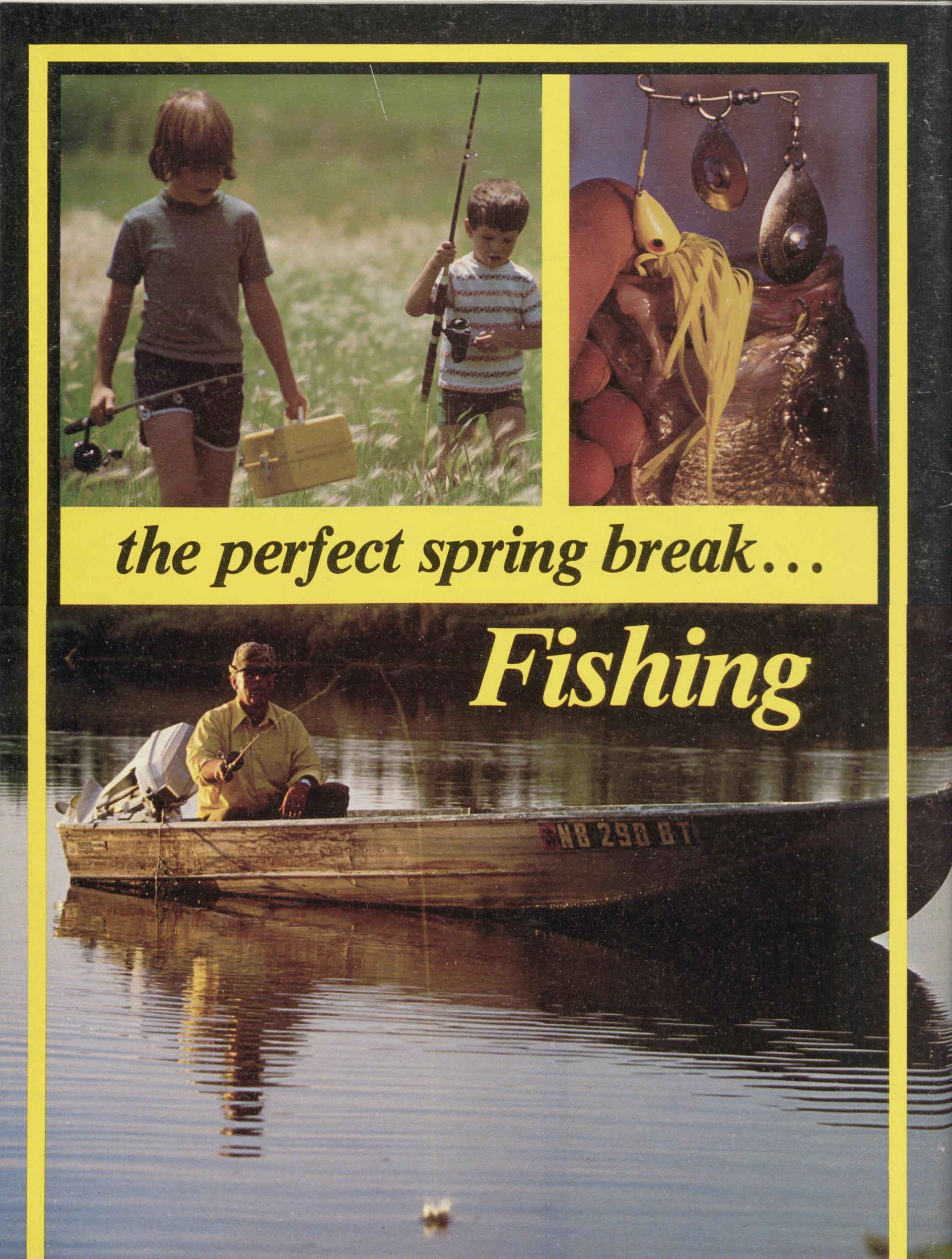
Position: 180 (38 views)