Volume 59, Issue 3, 1981
NEBRASKAland
March 1981 $1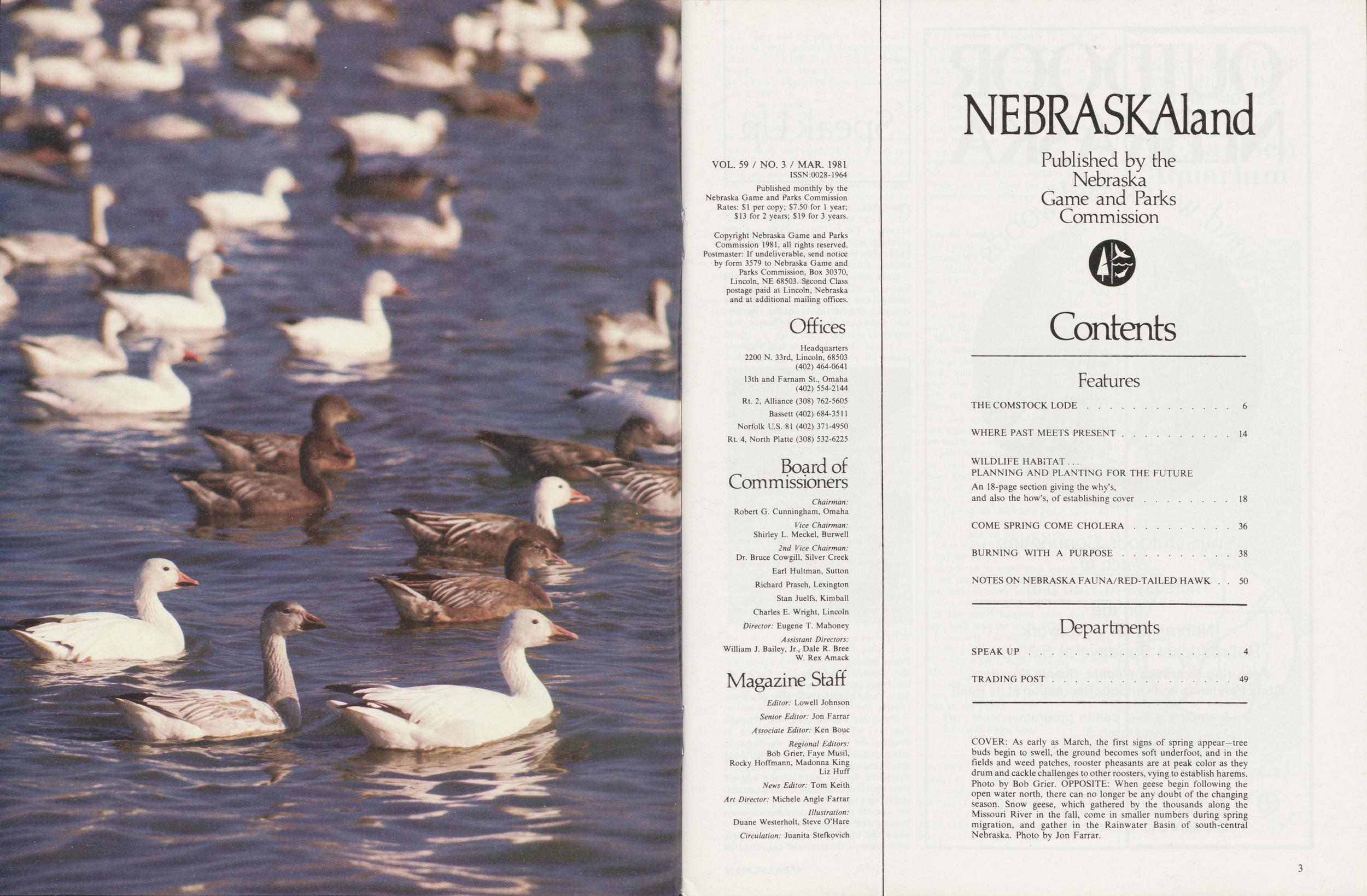
NEBRASKAland
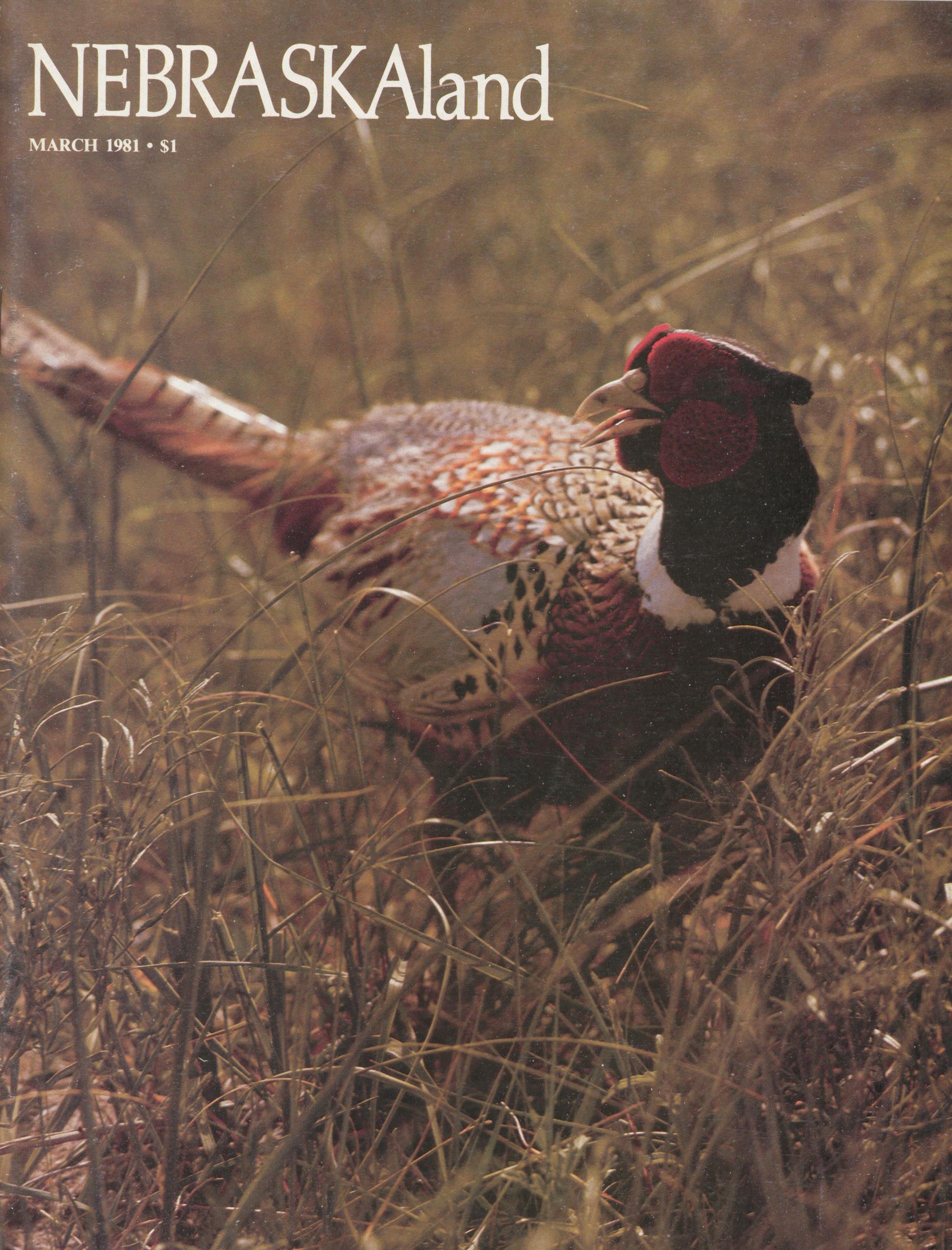
Published by the Nebraska Game and Parks Commission Contents Features THE COMSTOCK LODE 6 WHERE PAST MEETS PRESENT 14 WILDLIFE HABITAT PLANNING AND PLANTING FOR THE FUTURE An 18-page section giving the why's, and also the how's, of establishing cover 18 COME SPRING COME CHOLERA 36 BURNING WITH A PURPOSE 38 NOTES ON NEBRASKA FAUNA/RED-TAILED HAWK 50 Departments SPEAK UP 4 TRADING POST 49 COVER: As early as March, the first signs of spring appear—tree buds begin to swell, the ground becomes soft underfoot, and in the fields and weed patches, rooster pheasants are at peak color as they drum and cackle challenges to other roosters, vying to establish harems. Photo by Bob Grier. OPPOSITE: When geese begin following the open water north, there can no longer be any doubt of the changing season. Snow geese, which gathered by the thousands along the Missouri River in the fall, come in smaller numbers during spring migration, and gather in the Rainwater Basin of south-central Nebraska. Photo by Jon Farrar. 3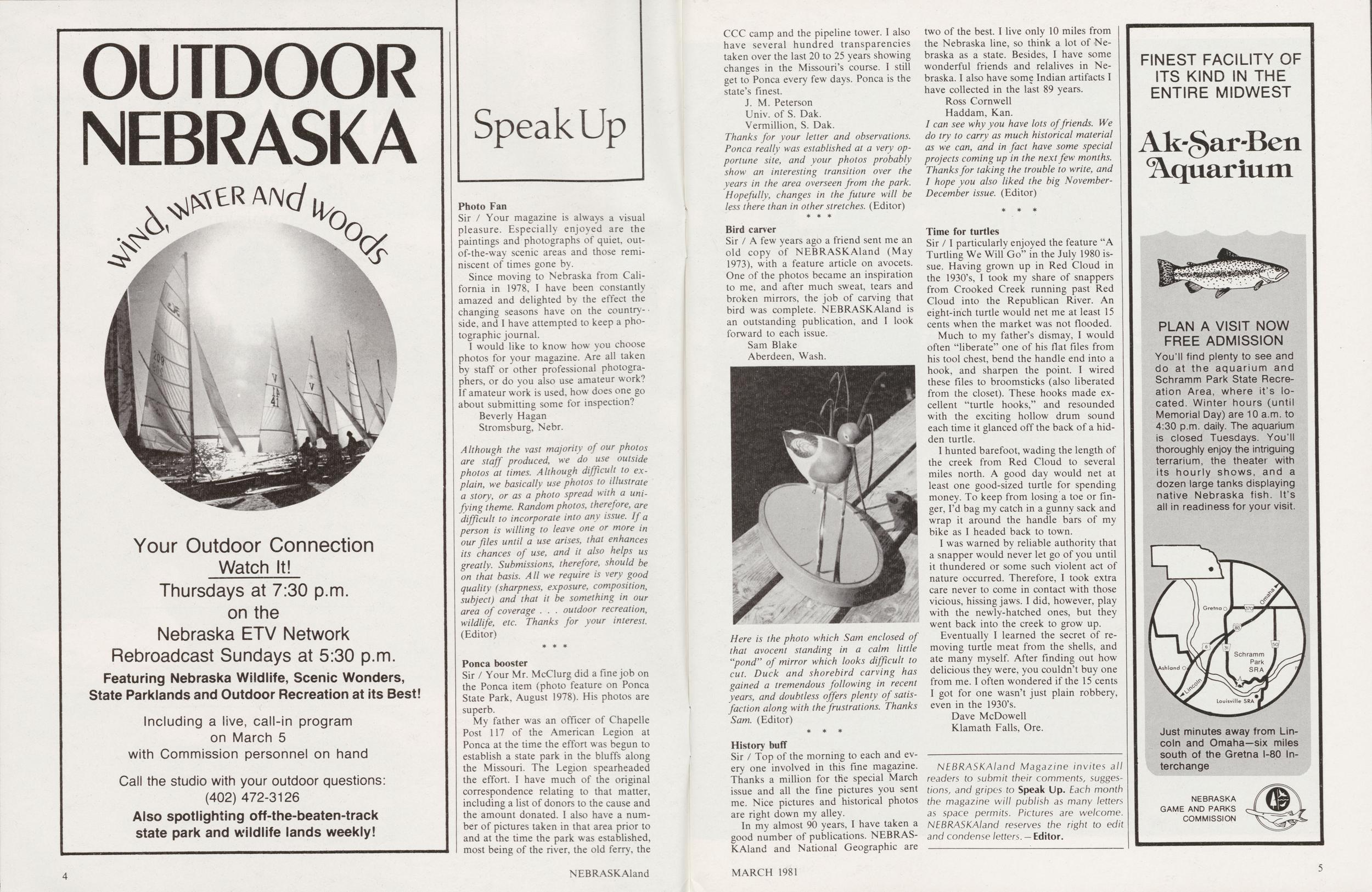
Speak Up
Photo FanSir / Your magazine is always a visual pleasure. Especially enjoyed are the paintings and photographs of quiet, out-of-the-way scenic areas and those reminiscent of times gone by.
Since moving to Nebraska from California in 1978, I have been constantly amazed and delighted by the effect the changing seasons have on the countryside, and I have attempted to keep a photographic journal.
I would like to know how you choose photos for your magazine. Are all taken by staff or other professional photographers, or do you also use amateur work? If amateur work is used, how does one go about submitting some for inspection?
Beverly Hagan Stromsburg, Nebr.Although the vast majority of our photos are staff produced, we do use outside photos at times. Although difficult to explain, we basically use photos to illustrate a story, or as a photo spread with a unifying theme. Random photos, therefore, are difficult to incorporate into any issue. If a person is willing to leave one or more in our files until a use arises, that enhances its chances of use, and it also helps us greatly. Submissions, therefore, should be on that basis. All we require is very good quality (sharpness, exposure, composition, subject) and that it be something in our area of coverage . . . outdoor recreation, wildlife, etc. Thanks for your interest. (Editor)
Ponca boosterSir / Your Mr. McClurg did a fine job on the Ponca item (photo feature on Ponca State Park, August 1978). His photos are superb.
My father was an officer of Chapelle Post 117 of the American Legion at Ponca at the time the effort was begun to establish a state park in the bluffs along the Missouri. The Legion spearheaded the effort. I have much of the original correspondence relating to that matter, including a list of donors to the cause and the amount donated. I also have a number of pictures taken in that area prior to and at the time the park was established, most being of the river, the old ferry, the
4 NEBRASKAlandCCC camp and the pipeline tower. I also have several hundred transparencies taken over the last 20 to 25 years showing changes in the Missouri's course. I still get to Ponca every few days. Ponca is the state's finest.
J. M. Peterson Univ. of S. Dak. Vermillion, S. Dak.Thanks for your letter and observations. Ponca really was established at a very opportune site, and your photos probably show an interesting transition over the years in the area overseen from the park. Hopefully, changes in the future will be less there than in other stretches. (Editor)
Bird carverSir / A few years ago a friend sent me an old copy of NEBRASKAland (May 1973), with a feature article on avocets. One of the photos became an inspiration to me, and after much sweat, tears and broken mirrors, the job of carving that bird was complete. NEBRASKAland is an outstanding publication, and I look forward to each issue.
Sam Blake Aberdeen, Wash.Sir / Top of the morning to each and every one involved in this fine magazine. Thanks a million for the special March issue and all the fine pictures you sent me. Nice pictures and historical photos are right down my alley.
In my almost 90 years, I have taken a good number of publications. NEBRASKAland and National Geographic are two of the best. I live only 10 miles from the Nebraska line, so think a lot of Nebraska as a state. Besides, I have some wonderful friends and relalives in Nebraska. I also have some Indian artifacts I have collected in the last 89 years.
Ross Cornwell Haddam, Kan.I can see why you have lots of friends. We do try to carry as much historical material as we can, and in fact have some special projects coming up in the next few months. Thanks for taking the trouble to write, and I hope you also liked the big November- December issue. (Editor)
Time for turtlesSir / I particularly enjoyed the feature "A Turtling We Will Go" in the July 1980 issue. Having grown up in Red Cloud in the 1930's, I took my share of snappers from Crooked Creek running past Red Cloud into the Republican River. An eight-inch turtle would net me at least 15 cents when the market was not flooded.
Much to my father's dismay, I would often "liberate" one of his flat files from his tool chest, bend the handle end into a hook, and sharpen the point. I wired these files to broomsticks (also liberated from the closet). These hooks made excellent "turtle hooks," and resounded with the exciting hollow drum sound each time it glanced off the back of a hidden turtle.
I hunted barefoot, wading the length of the creek from Red Cloud to several miles north. A good day would net at least one good-sized turtle for spending money. To keep from losing a toe or finger, I'd bag my catch in a gunny sack and wrap it around the handle bars of my bike as I headed back to town.
I was warned by reliable authority that a snapper would never let go of you until it thundered or some such violent act of nature occurred. Therefore, I took extra care never to come in contact with those vicious, hissing jaws. I did, however, play with the newly-hatched ones, but they went back into the creek to grow up.
Eventually I learned the secret of removing turtle meat from the shells, and ate many myself. After finding out how delicious they were, you couldn't buy one from me. I often wondered if the 15 cents I got for one wasn't just plain robbery, even in the 1930's.
Dave McDowell Klamath Falls, Ore. NEBRASKAland Magazine invites all readers to submit their comments, suggestions, and gripes to Speak Up. Each month the magazine will publish as many letters as space permits. Pictures are welcome. NEBRASKAland reserves the right to edit and condense letters. — Editor.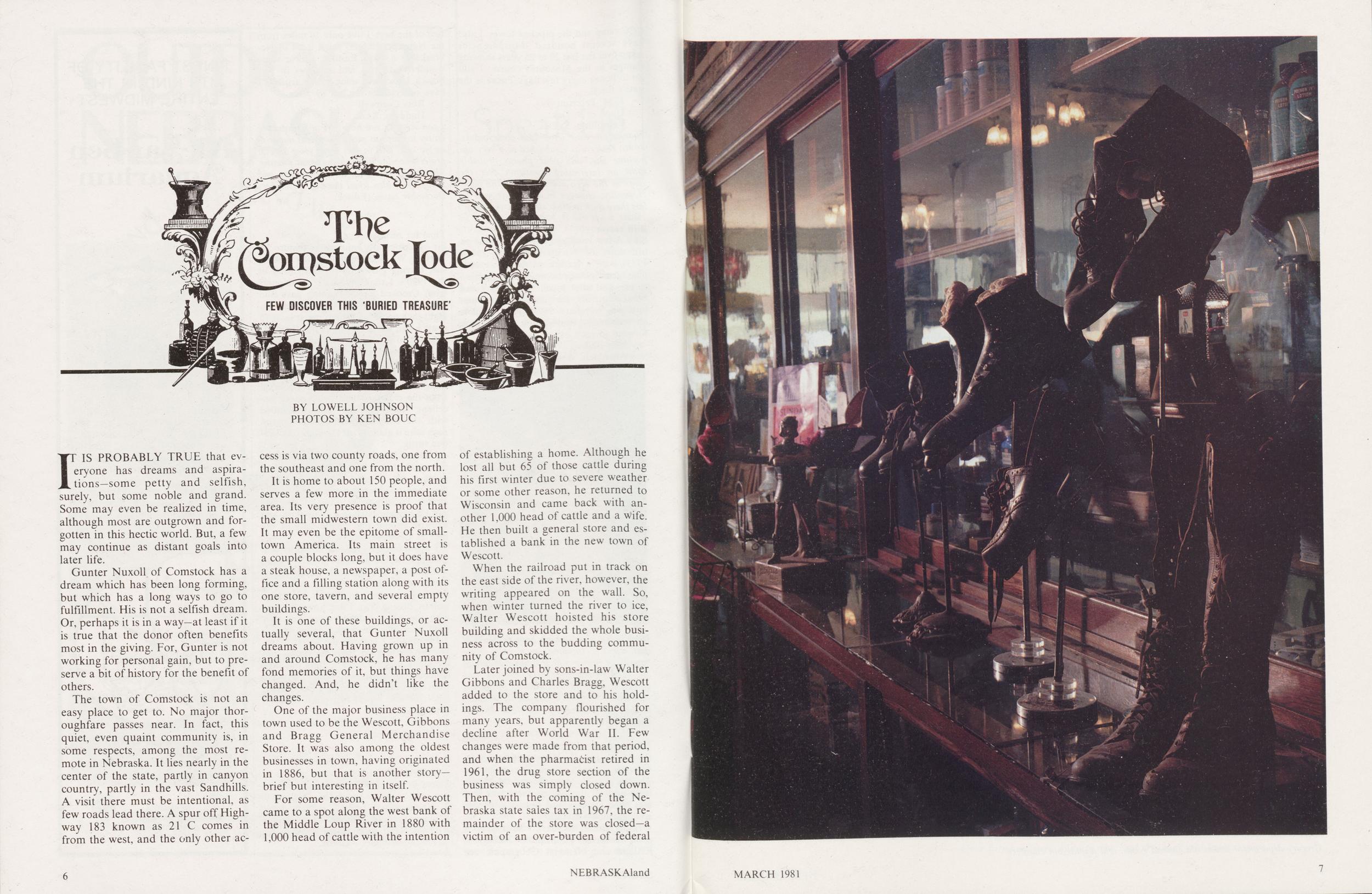
The Comstock Lode
FEW DISCOVER THIS 'BURIED TREASURE'
IT IS PROBABLY TRUE that everyone has dreams and aspirations—some petty and selfish, surely, but some noble and grand. Some may even be realized in time, although most are outgrown and forgotten in this hectic world. But, a few may continue as distant goals into later life.
Gunter Nuxoll of Comstock has a dream which has been long forming, but which has a long ways to go to fulfillment. His is not a selfish dream. Or, perhaps it is in a way—at least if it is true that the donor often benefits most in the giving. For, Gunter is not working for personal gain, but to preserve a bit of history for the benefit of others.
The town of Comstock is not an easy place to get to. No major thoroughfare passes near. In fact, this quiet, even quaint community is, in some respects, among the most remote in Nebraska. It lies nearly in the center of the state, partly in canyon country, partly in the vast Sandhills. A visit there must be intentional, as few roads lead there. A spur off Highway 183 known as 21 C comes in from the west, and the only other access is via two county roads, one from the southeast and one from the north.
It is home to about 150 people, and serves a few more in the immediate area. Its very presence is proof that the small midwestern town did exist. It may even be the epitome of smalltown America. Its main street is a couple blocks long, but it does have a steak house, a newspaper, a post office and a filling station along with its one store, tavern, and several empty buildings.
It is one of these buildings, or actually several, that Gunter Nuxoll dreams about. Having grown up in and around Comstock, he has many fond memories of it, but things have changed. And, he didn't like the changes.
One of the major business place in town used to be the Wescott, Gibbons and Bragg General Merchandise Store. It was also among the oldest businesses in town, having originated in 1886, but that is another story- brief but interesting in itself.
For some reason, Walter Wescott came to a spot along the west bank of the Middle Loup River in 1880 with 1,000 head of cattle with the intention of establishing a home. Although he lost all but 65 of those cattle during his first winter due to severe weather or some other reason, he returned to Wisconsin and came back with another 1,000 head of cattle and a wife, He then built a general store and established a bank in the new town of Wescott.
When the railroad put in track on the east side of the river, however, the writing appeared on the wall. So, when winter turned the river to ice, Walter Wescott hoisted his store building and skidded the whole business across to the budding community of Comstock.
Later joined by sons-in-law Walter Gibbons and Charles Bragg, Wescott added to the store and to his holdings. The company flourished for many years, but apparently began a decline after World War II. Few changes were made from that period, and when the pharmacist retired in 1961, the drug store section of the business was simply closed down. Then, with the coming of the Nebraska state sales tax in 1967, the remainder of the store was closed—a victim of an over-burden of federal
6 NEBRASKAland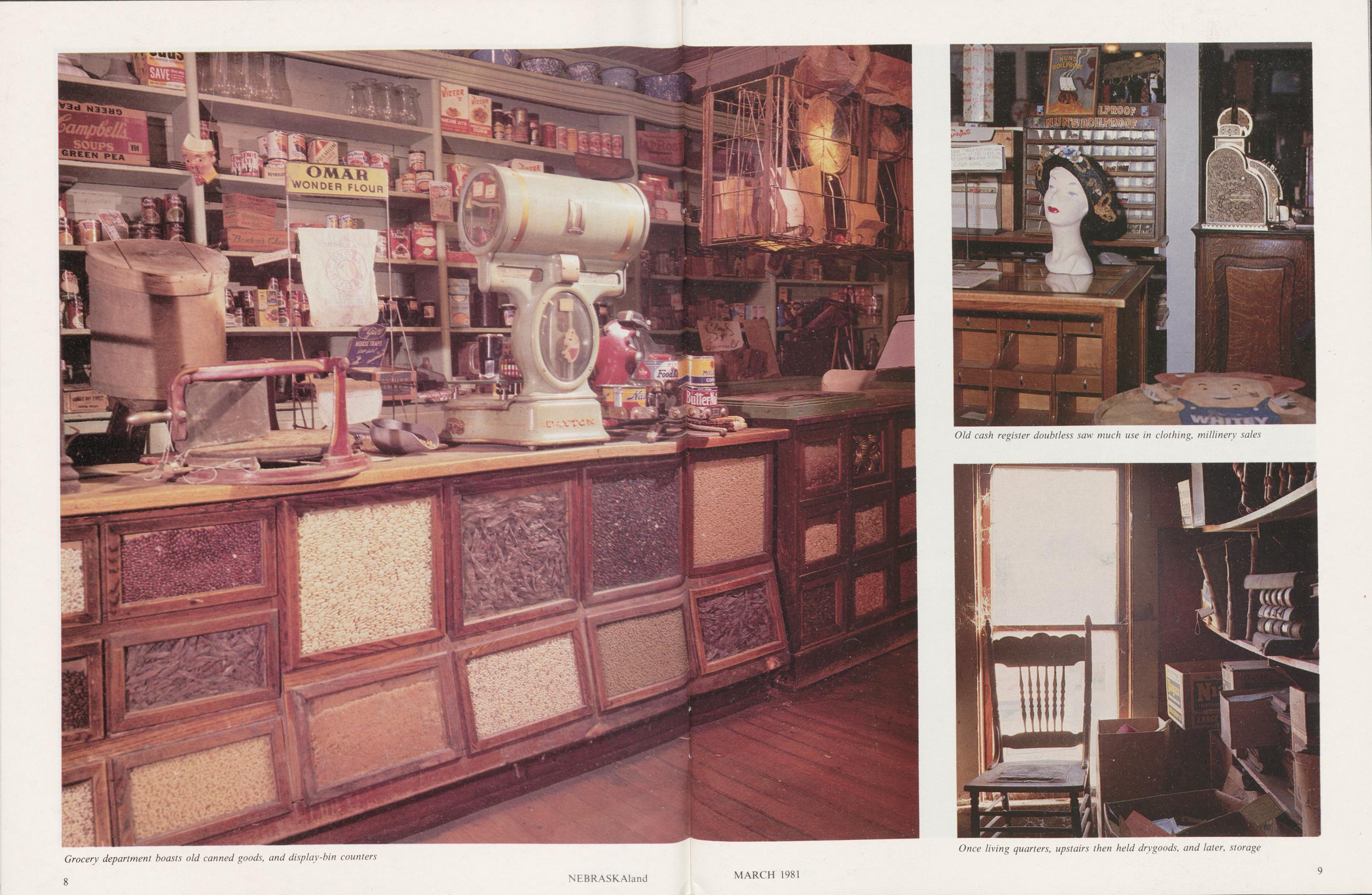
Grocery department boasts old canned goods, and display-bin counters
Old cash register doubtless saw much use in clothing, millinery sales
Once living quarters, upstairs then held drygoods, and later, storage
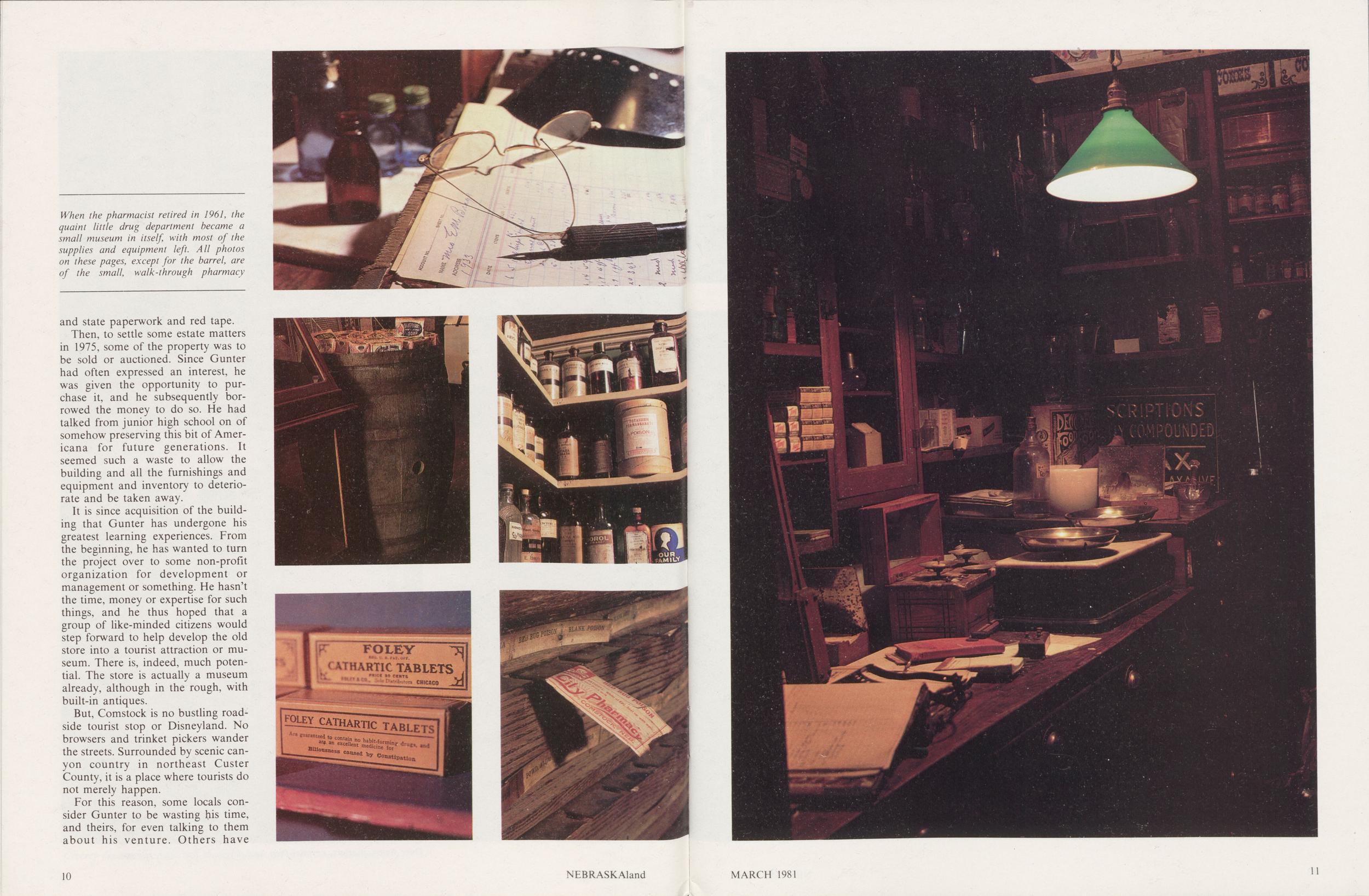
When the pharmacist retired in 1961, the quaint little drug department became a small museum in itself, with most of the supplies and equipment left. All photos on these pages, except for the barrel, are of the small, walk-through pharmacy
and state paperwork and red tape.
Then, to settle some estate matters in 1975, some of the property was to be sold or auctioned. Since Gunter had often expressed an interest, he was given the opportunity to purchase it, and he subsequently borrowed the money to do so. He had talked from junior high school on of somehow preserving this bit of Americana for future generations. It seemed such a waste to allow the building and all the furnishings and equipment and inventory to deteriorate and be taken away.
It is since acquisition of the building that Gunter has undergone his greatest learning experiences. From the beginning, he has wanted to turn the project over to some non-profit organization for development or management or something. He hasn't the time, money or expertise for such things, and he thus hoped that a group of like-minded citizens would step forward to help develop the old store into a tourist attraction or museum. There is, indeed, much potential. The store is actually a museum already, although in the rough, with built-in antiques.
But, Comstock is no bustling roadside tourist stop or Disneyland. No browsers and trinket pickers wander the streets. Surrounded by scenic canyon country in northeast Custer County, it is a place where tourists do not merely happen.
For this reason, some locals consider Gunter to be wasting his time, and theirs, for even talking to them about his venture. Others have
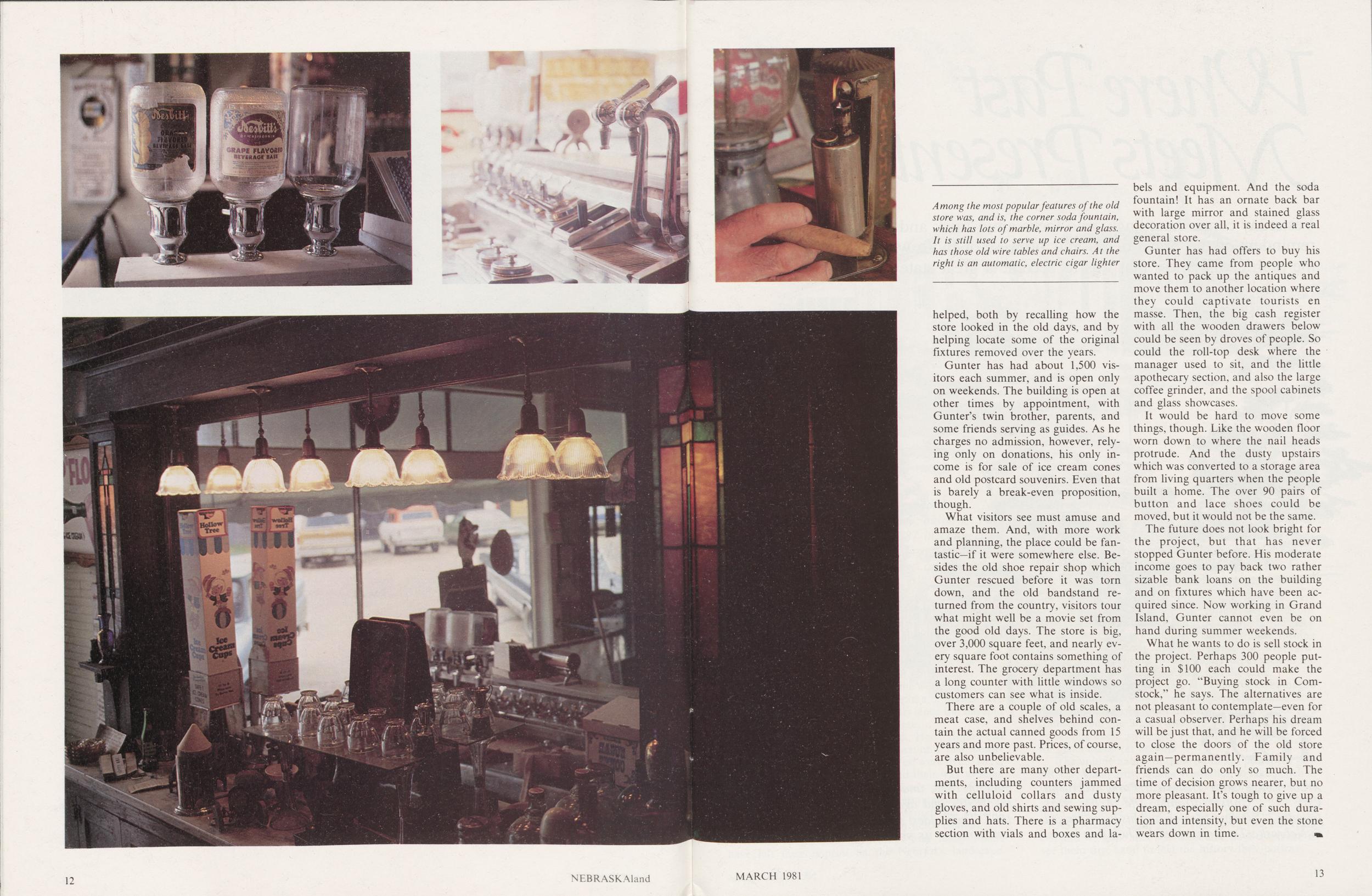
Among the most popular features of the old store was, and is, the corner soda fountain, which has lots of marble, mirror and glass. It is still used to serve up ice cream, and has those old wire tables and chairs. At the right is an automatic, electric cigar lighter
helped, both by recalling how the store looked in the old days, and by helping locate some of the original fixtures removed over the years.
Gunter has had about 1,500 visitors each summer, and is open only on weekends. The building is open at other times by appointment, with Gunter's twin brother, parents, and some friends serving as guides. As he charges no admission, however, relying only on donations, his only income is for sale of ice cream cones and old postcard souvenirs. Even that is barely a break-even proposition, though.
What visitors see must amuse and amaze them. And, with more work and planning, the place could be fantastic—if it were somewhere else. Besides the old shoe repair shop which Gunter rescued before it was torn down, and the old bandstand returned from the country, visitors tour what might well be a movie set from the good old days. The store is big, over 3,000 square feet, and nearly every square foot contains something of interest. The grocery department has a long counter with little windows so customers can see what is inside.
There are a couple of old scales, a meat case, and shelves behind contain the actual canned goods from 15 years and more past. Prices, of course, are also unbelievable.
But there are many other departments, including counters jammed with celluloid collars and dusty gloves, and old shirts and sewing supplies and hats. There is a pharmacy section with vials and boxes and labels and equipment. And the soda fountain! It has an ornate back bar with large mirror and stained glass decoration over all, it is indeed a real general store.
Gunter has had offers to buy his store. They came from people who wanted to pack up the antiques and move them to another location where they could captivate tourists en masse. Then, the big cash register with all the wooden drawers below could be seen by droves of people. So could the roll-top desk where the manager used to sit, and the little apothecary section, and also the large coffee grinder, and the spool cabinets and glass showcases.
It would be hard to move some things, though. Like the wooden floor worn down to where the nail heads protrude. And the dusty upstairs which was converted to a storage area from living quarters when the people built a home. The over 90 pairs of button and lace shoes could be moved, but it would not be the same.
The future does not look bright for the project, but that has never stopped Gunter before. His moderate income goes to pay back two rather sizable bank loans on the building and on fixtures which have been acquired since. Now working in Grand Island, Gunter cannot even be on hand during summer weekends.
What he wants to do is sell stock in the project. Perhaps 300 people putting in $100 each could make the project go. "Buying stock in Cornstock," he says. The alternatives are not pleasant to contemplate—even for a casual observer. Perhaps his dream will be just that, and he will be forced to close the doors of the old store again—permanently. Family and friends can do only so much. The time of decision grows nearer, but no more pleasant. It's tough to give up a dream, especially one of such duration and intensity, but even the stone wears down in time.
MARCH 1981 13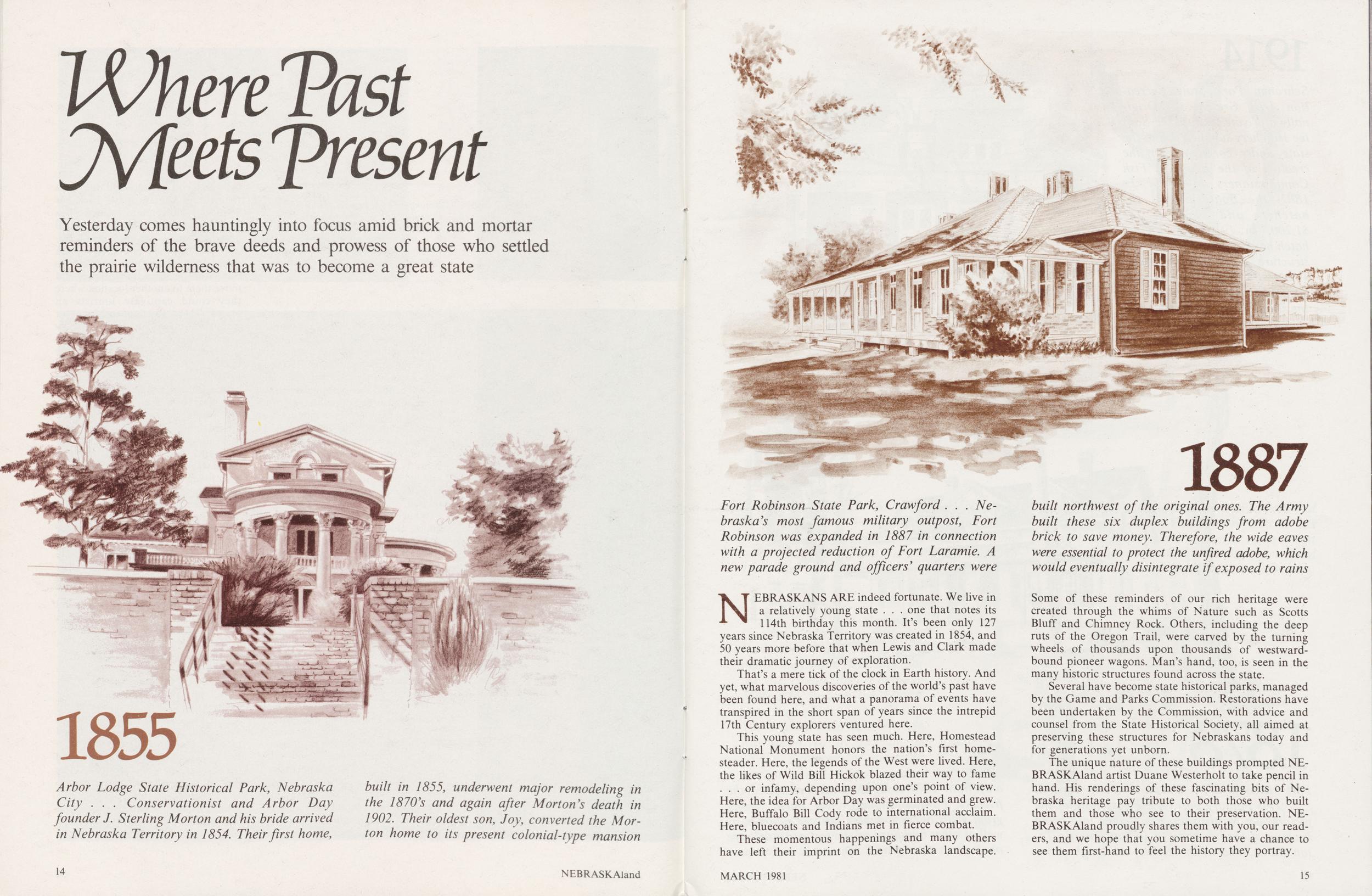
Where Past Meets Present
Yesterday comes hauntingly into focus amid brick and mortar reminders of the brave deeds and prowess of those who settled the prairie wilderness that was to become a great state
NEBRASKANS ARE indeed fortunate. We live in a relatively young state one that notes its 114th birthday this month. It's been only 127 years since Nebraska Territory was created in 1854, and 50 years more before that when Lewis and Clark made their dramatic journey of exploration.
That's a mere tick of the clock in Earth history. And yet, what marvelous discoveries of the world's past have been found here, and what a panorama of events have transpired in the short span of years since the intrepid 17th Century explorers ventured here.
This young state has seen much. Here, Homestead National Monument honors the nation's first homesteader. Here, the legends of the West were lived. Here, the likes of Wild Bill Hickok blazed their way to fame or infamy, depending upon one's point of view. Here, the idea for Arbor Day was germinated and grew. Here, Buffalo Bill Cody rode to international acclaim. Here, bluecoats and Indians met in fierce combat.
These momentous happenings and many others have left their imprint on the Nebraska landscape. Some of these reminders of our rich heritage were created through the whims of Nature such as Scotts Bluff and Chimney Rock. Others, including the deep ruts of the Oregon Trail, were carved by the turning wheels of thousands upon thousands of westwardbound pioneer wagons. Man's hand, too, is seen in the many historic structures found across the state.
Several have become state historical parks, managed by the Game and Parks Commission. Restorations have been undertaken by the Commission, with advice and counsel from the State Historical Society, all aimed at preserving these structures for Nebraskans today and for generations yet unborn.
The unique nature of these buildings prompted NEBRASKAland artist Duane Westerholt to take pencil in hand. His renderings of these fascinating bits of Nebraska heritage pay tribute to both those who built them and those who see to their preservation. NEBRASKAland proudly shares them with you, our readers, and we hope that you sometime have a chance to see them first-hand to feel the history they portray.
MARCH 1981 15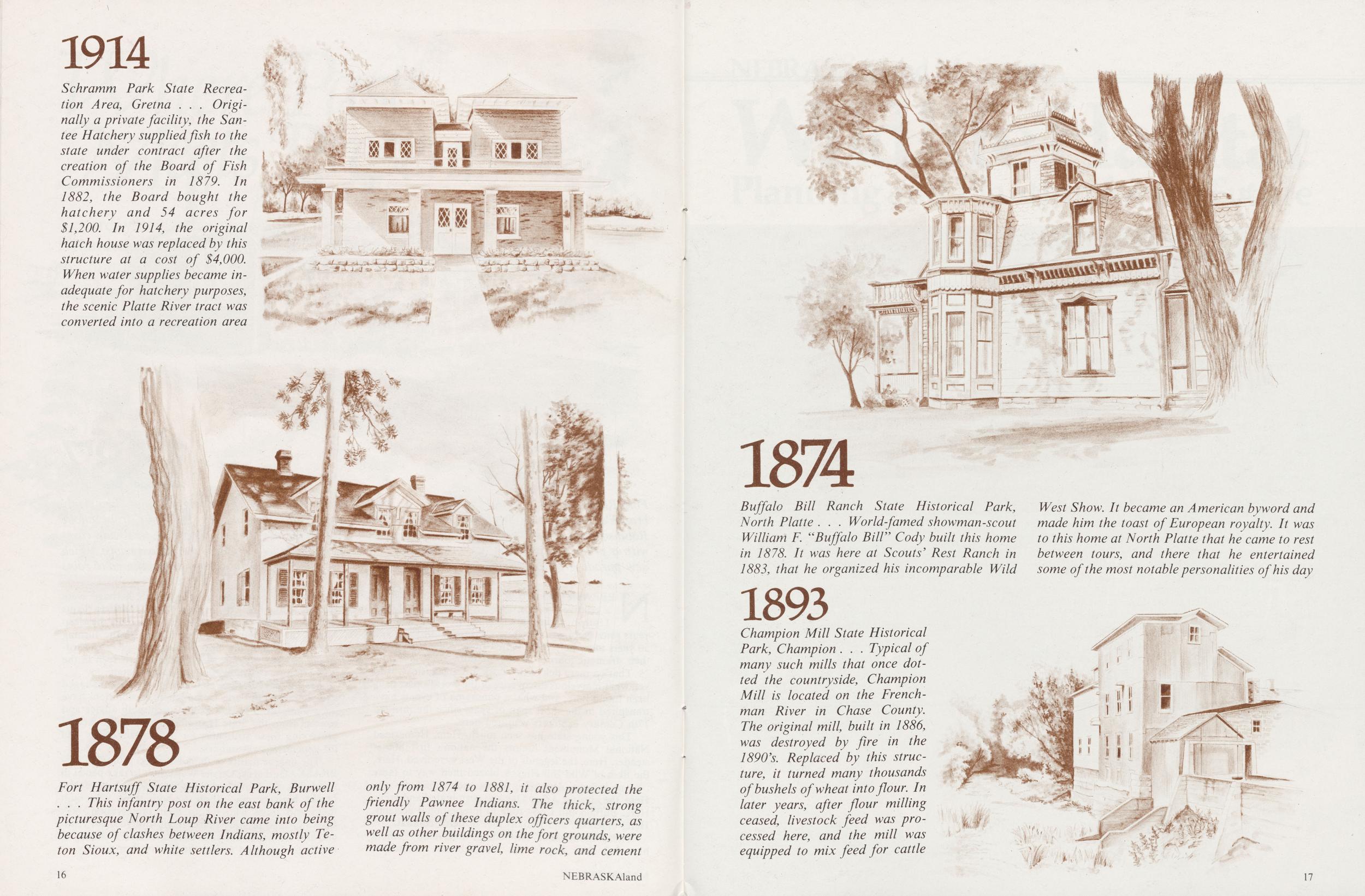
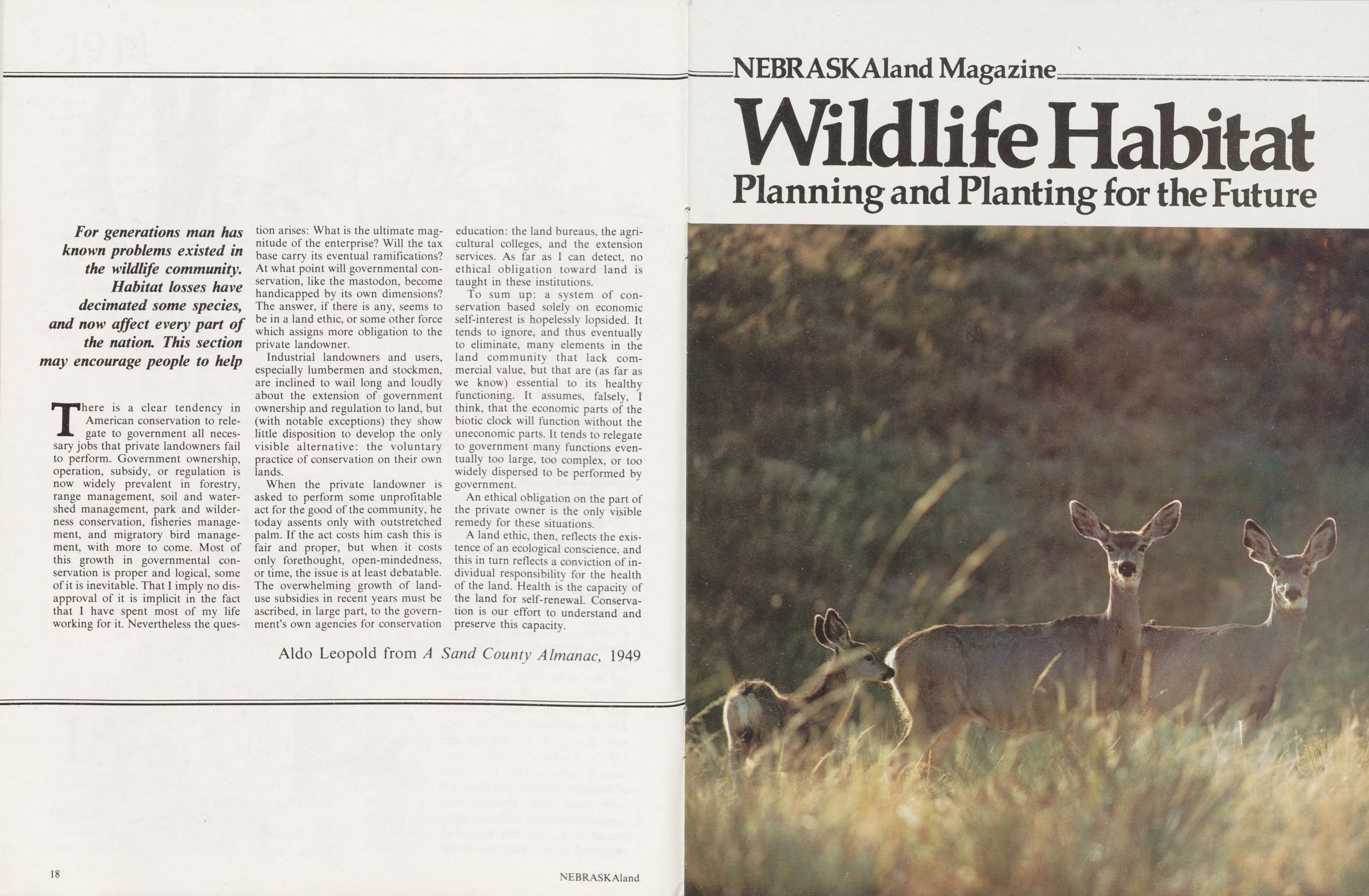
There is a clear tendency in American conservation to relegate to government all necessary jobs that private landowners fail to perform. Government ownership, operation, subsidy, or regulation is now widely prevalent in forestry, range management, soil and watershed management, park and wilderness conservation, fisheries management, and migratory bird management, with more to come. Most of this growth in governmental conservation is proper and logical, some of it is inevitable. That I imply no disapproval of it is implicit in the fact that I have spent most of my life working for it. Nevertheless the question arises: What is the ultimate magnitude of the enterprise? Will the tax base carry its eventual ramifications? At what point will governmental conservation, like the mastodon, become handicapped by its own dimensions? The answer, if there is any, seems to be in a land ethic, or some other force which assigns more obligation to the private landowner.
Industrial landowners and users, especially lumbermen and stockmen, are inclined to wail long and loudly about the extension of government ownership and regulation to land, but (with notable exceptions) they show little disposition to develop the only visible alternative: the voluntary practice of conservation on their own lands.
When the private landowner is asked to perform some unprofitable act for the good of the community, he today assents only with outstretched palm. If the act costs him cash this is fair and proper, but when it costs only forethought, open-mindedness, or time, the issue is at least debatable. The overwhelming growth of land-use subsidies in recent years must be ascribed, in large part, to the government's own agencies for conservation education: the land bureaus, the agricultural colleges, and the extension services. As far as I can detect, no ethical obligation toward land is taught in these institutions.
To sum up: a system of conservation based solely on economic self-interest is hopelessly lopsided. It tends to ignore, and thus eventually to eliminate, many elements in the land community that lack commercial value, but that are (as far as we know) essential to its healthy functioning. It assumes, falsely, I think, that the economic parts of the biotic clock will function without the uneconomic parts. It tends to relegate to government many functions eventually too large, too complex, or too widely dispersed to be performed by government.
An ethical obligation on the part of the private owner is the only visible remedy for these situations.
A land ethic, then, reflects the existence of an ecological conscience, and this in turn reflects a conviction of individual responsibility for the health of the land. Health is the capacity of the land for self-renewal. Conservation is our effort to understand and preserve this capacity.
Aldo Leopold from A Sand County Almanac, 1949 18 NEBRASKAlandNEBRASKAland Magazine Wildlife Habitat Planning and Planting for the Future
Farmers and Ranchers are Nebraska's Real Game Managers
ALL LIVING THINGS are dependent on other living things, and this is very evident when considering wildlife on the central plains.
Living "things" in the form of vegetative growth, known collectively as habitat, have a value to other "beings" which varies greatly during the year, depending on its type, abundance, proximity and quality, coupled with factors such as weather. But, no matter how it is evaluated, habitat is what keeps wildlife alive. It provides the food, and shelter, and safety for all species.
While only major game species are usually thought of when discussing habitat, all wild things from insects to birds and the largest mammals, benefit or suffer depending upon nature's and man's manipulations of vegetative cover.
With less than five percent of Nebraska's real estate in public ownership, it is evident that the state's farmers and ranchers hold the controls over wildlife numbers and their welfare. How much these landowners do, or want to do for wildlife, depends on many factors. The management of certain habitat areas on their lands can cost nothing or very little, vet could be of tremendous benefit to wildlife. It is to this end that these pages are devoted We hope to encourage some plantings and practices, and to give some recommendations as to those which are most suitable to certain land or terrain types.
Key to Life
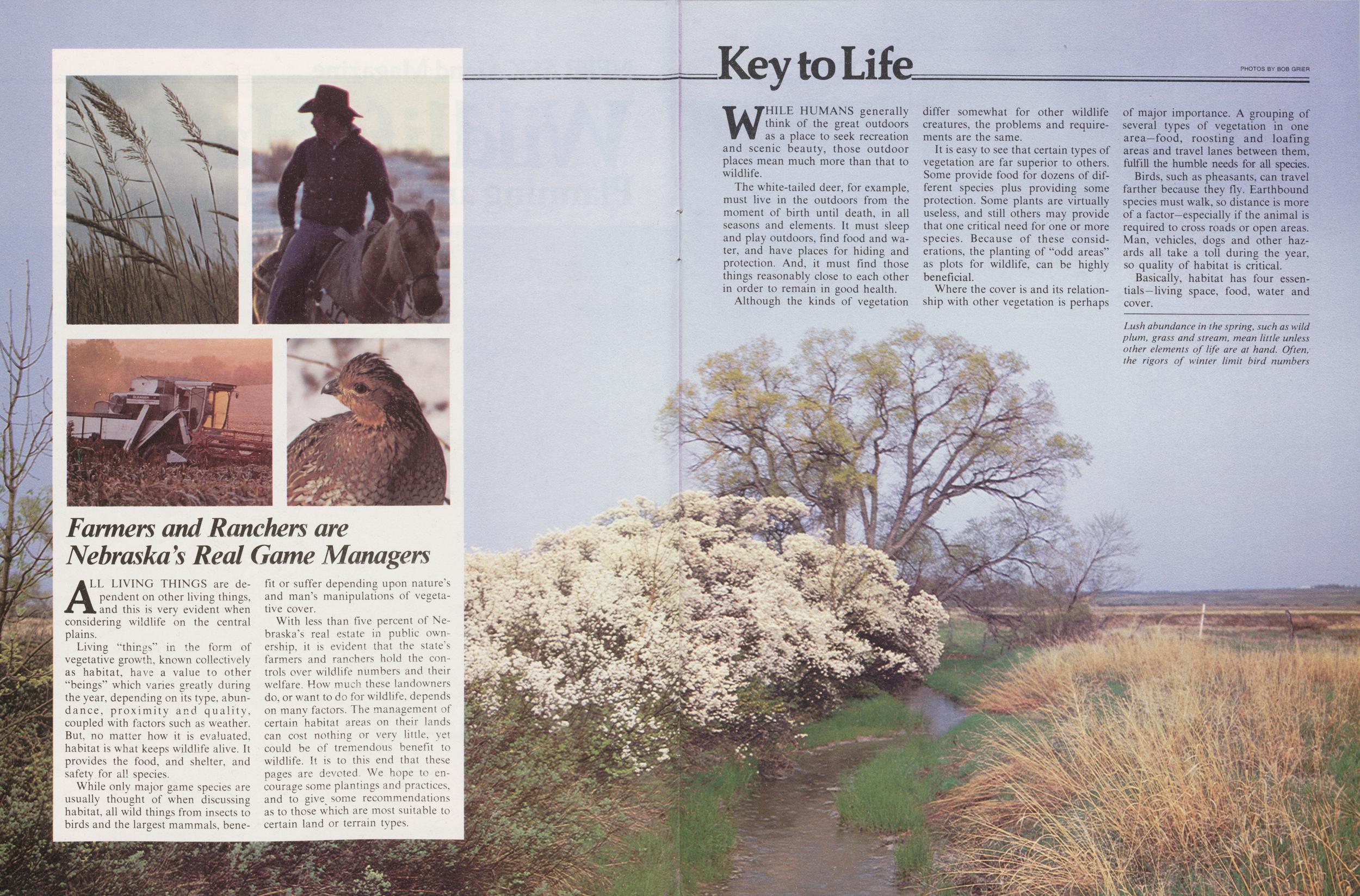
WHILE HUMANS generally think of the great outdoors as a place to seek recreation and scenic beauty, those outdoor places mean much more than that to wildlife. The white-tailed deer, for example, must live in the outdoors from the moment of birth until death, in all seasons and elements. It must sleep and play outdoors, find food and water, and have places for hiding and protection. And, it must find those things reasonably close to each other in order to remain in good health. Although the kinds of vegetation differ somewhat for other wildlife creatures, the problems and requirements are the same. It is easy to see that certain types of vegetation are far superior to others. Some provide food for dozens of different species plus providing some protection. Some plants are virtually useless, and still others may provide that one critical need for one or more species. Because of these considerations, the planting of "odd areas" as plots for wildlife, can be highly beneficial. Where the cover is and its relationship with other vegetation is perhaps of major importance. A grouping of several types of vegetation in one area—food, roosting and loafing areas and travel lanes between them, fulfill the humble needs for all species. Birds, such as pheasants, can travel farther because they fly. Earthbound species must walk, so distance is more of a factor—especially if the animal is required to cross roads or open areas. Man, vehicles, dogs and other hazards all take a toll during the year, so quality of habitat is critical. Basically, habitat has four essentials—living space, food, water and cover.Lush abundance in the spring, such as wild plum, grass and stream, mean little unless other elements of life are at hand. Often, the rigors of winter limit bird numbers
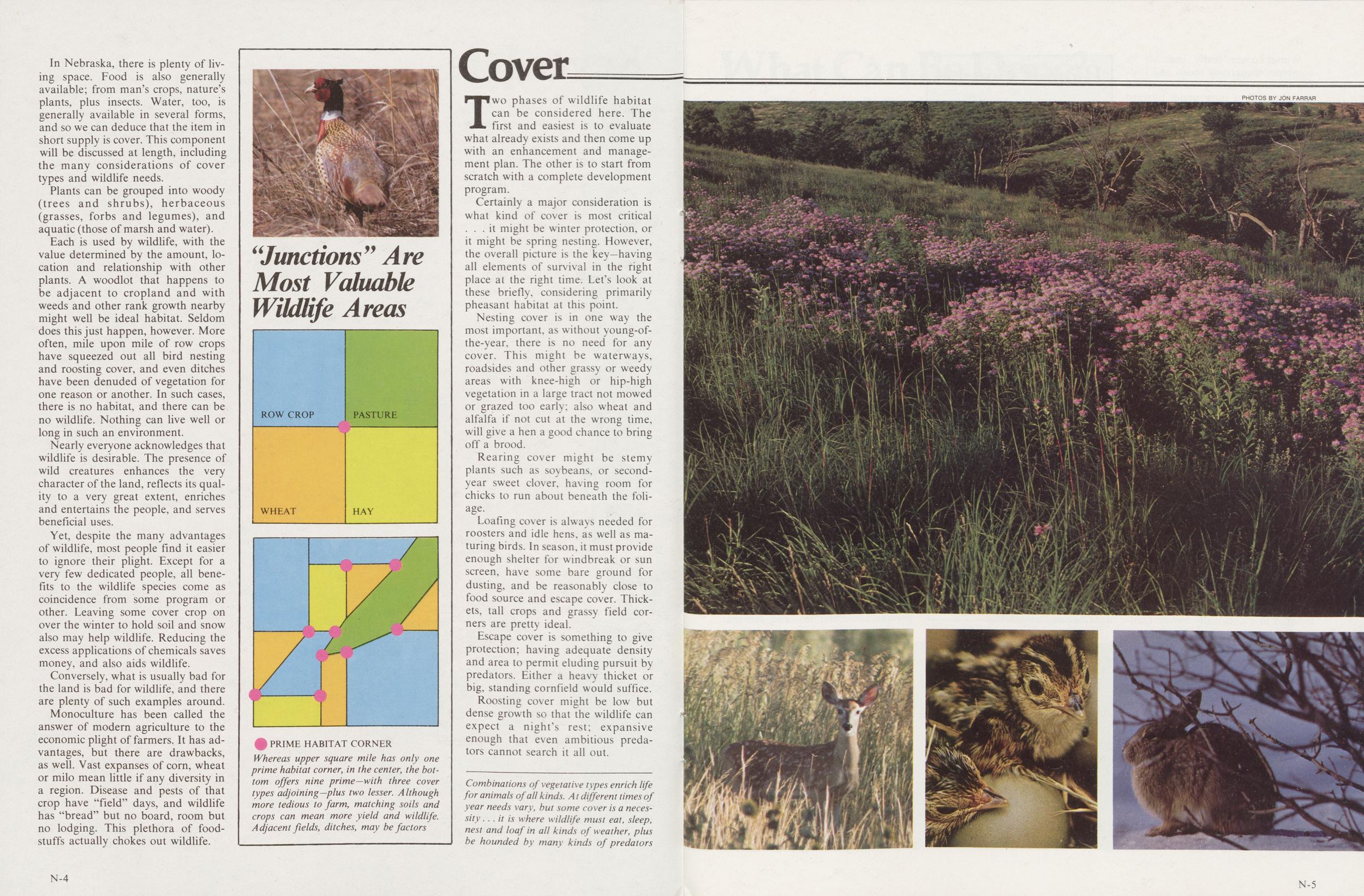
In Nebraska, there is plenty of living space. Food is also generally available; from man's crops, nature's plants, plus insects. Water, too, is generally available in several forms, and so we can deduce that the item in short supply is cover. This component will be discussed at length, including the many considerations of cover types and wildlife needs.
Plants can be grouped into woody (trees and shrubs), herbaceous (grasses, forbs and legumes), and aquatic (those of marsh and water).
Each is used by wildlife, with the value determined by the amount, location and relationship with other plants. A woodlot that happens to be adjacent to cropland and with weeds and other rank growth nearby might well be ideal habitat. Seldom does this just happen, however. More often, mile upon mile of row crops have squeezed out all bird nesting and roosting cover, and even ditches have been denuded of vegetation for one reason or another. In such cases, there is no habitat, and there can be no wildlife. Nothing can live well or long in such an environment.
Nearly everyone acknowledges that wildlife is desirable. The presence of wild creatures enhances the very character of the land, reflects its quality to a very great extent, enriches and entertains the people, and serves beneficial uses.
Yet, despite the many advantages of wildlife, most people find it easier to ignore their plight. Except for a very few dedicated people, all benefits to the wildlife species come as coincidence from some program or other. Leaving some cover crop on over the winter to hold soil and snow also may help wildlife. Reducing the excess applications of chemicals saves money, and also aids wildlife.
Conversely, what is usually bad for the land is bad for wildlife, and there are plenty of such examples around.
Monoculture has been called the answer of modern agriculture to the economic plight of farmers. It has advantages, but there are drawbacks, as well. Vast expanses of corn, wheat or milo mean little if any diversity in a region. Disease and pests of that crop have "field" days, and wildlife has "bread" but no board, room but no lodging. This plethora of food- stuffs actually chokes out wildlife.
Prime Habitat Corner
Cover
Two phases of wildlife habitat can be considered here. The first and easiest is to evaluate what already exists and then come up with an enhancement and management plan. The other is to start from scratch with a complete development program.
Certainly a major consideration is what kind of cover is most critical it might be winter protection, or it might be spring nesting. However, the overall picture is the key—having all elements of survival in the right place at the right time. Let's look at these briefly, considering primarily pheasant habitat at this point.
Nesting cover is in one way the most important, as without young-of-the-year, there is no need for any cover. This might be waterways, roadsides and other grassy or weedy areas with knee-high or hip-high vegetation in a large tract not mowed or grazed too early; also wheat and alfalfa if not cut at the wrong time, will give a hen a good chance to bring off a brood.
Rearing cover might be stemy plants such as soybeans, or second-year sweet clover, having room for chicks to run about beneath the foliage.
Loafing cover is always needed for roosters and idle hens, as well as maturing birds. In season, it must provide enough shelter for windbreak or sun screen, have some bare ground for dusting, and be reasonably close to food source and escape cover. Thickets, tall crops and grassy field corners are pretty ideal.
Escape cover is something to give protection; having adequate density and area to permit eluding pursuit by predators. Either a heavy thicket or big, standing cornfield would suffice.
Roosting cover might be low but dense growth so that the wildlife can expect a night's rest; expansive enough that even ambitious predators cannot search it all out.
Combinations of vegetative types enrich life for animals of all kinds. At different times of year needs vary, but some cover is a necessity it is where wildlife must eat, sleep, nest and loaf in all kinds of weather, plus be hounded by many kinds of predators N-4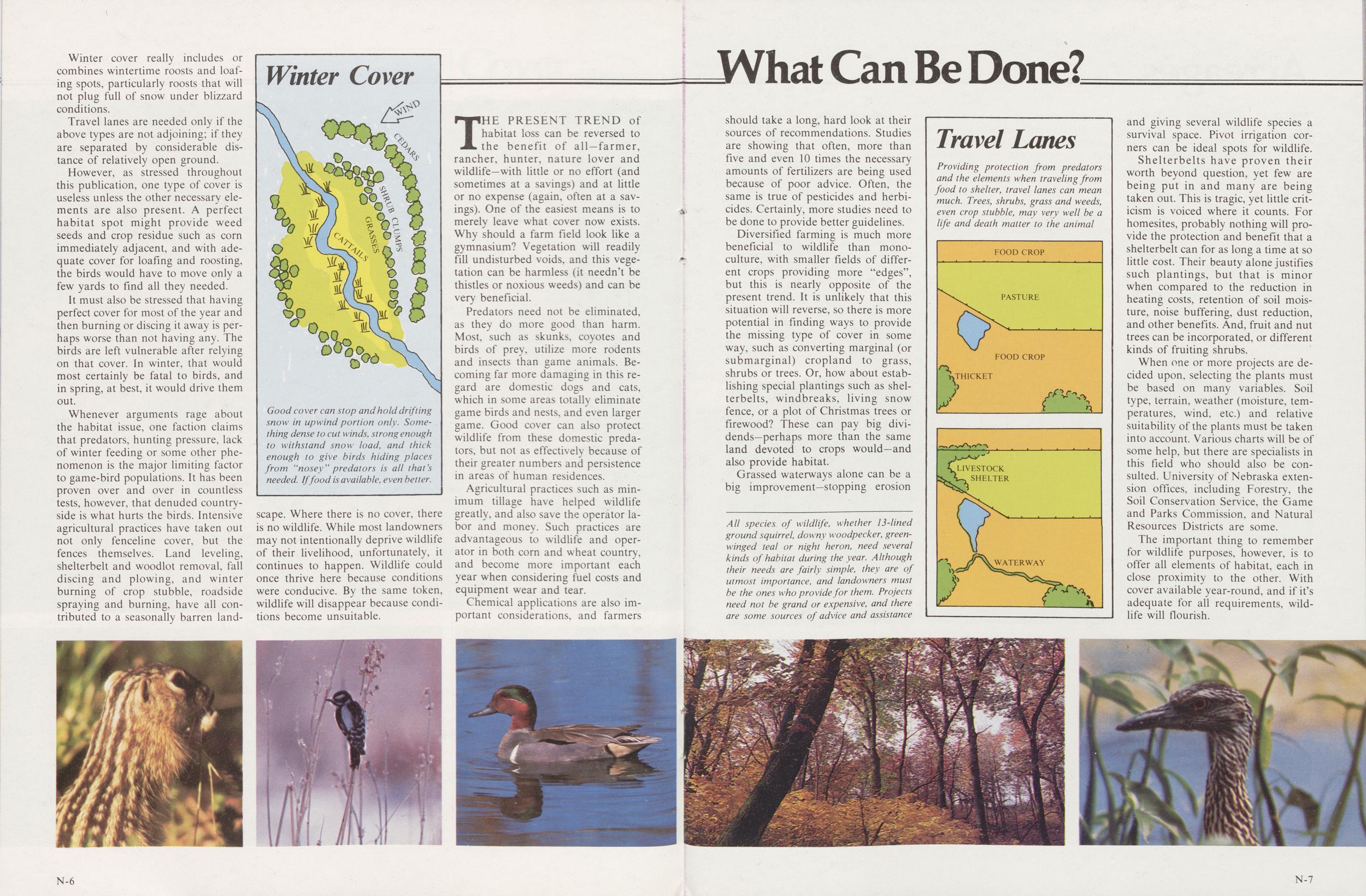
Winter cover really includes or combines wintertime roosts and loafing spots, particularly roosts that will not plug full of snow under blizzard conditions.
Travel lanes are needed only if the above types are not adjoining; if they are separated by considerable distance of relatively open ground.
However, as stressed throughout this publication, one type of cover is useless unless the other necessary elements are also present. A perfect habitat spot might provide weed seeds and crop residue such as corn immediately adjacent, and with adequate cover for loafing and roosting, the birds would have to move only a few yards to find all they needed.
It must also be stressed that having perfect cover for most of the year and then burning or discing it away is perhaps worse than not having any. The birds are left vulnerable after relying on that cover. In winter, that would most certainly be fatal to birds, and in spring, at best, it would drive them out.
Whenever arguments rage about the habitat issue, one faction claims that predators, hunting pressure, lack of winter feeding or some other phenomenon is the major limiting factor to game-bird populations. It has been proven over and over in countless tests, however, that denuded countryside is what hurts the birds. Intensive agricultural practices have taken out not only fenceline cover, but the fences themselves. Land leveling, shelterbelt and woodlot removal, fall discing and plowing, and winter burning of crop stubble, roadside spraying and burning, have all contributed to a seasonally barren landscape.
Where there is no cover, there is no wildlife. While most landowners may not intentionally deprive wildlife of their livelihood, unfortunately, it continues to happen. Wildlife could once thrive here because conditions were conducive. By the same token, wildlife will disappear because conditions become unsuitable.
Predators need not be eliminated, as they do more good than harm. Most, such as skunks, coyotes and birds of prey, utilize more rodents and insects than game animals. Becoming far more damaging in this regard are domestic dogs and cats, which in some areas totally eliminate game birds and nests, and even larger game. Good cover can also protect wildlife from these domestic predators, but not as effectively because of their greater numbers and persistence in areas of human residences.
Agricultural practices such as minimum tillage have helped wildlife greatly, and also save the operator labor and money. Such practices are advantageous to wildlife and operator in both corn and wheat country, and become more important each year when considering fuel costs and equipment wear and tear.
Chemical applications are also important considerations, and farmers
What Can Be Done?
should take a long, hard look at their sources of recommendations. Studies are showing that often, more than five and even 10 times the necessary amounts of fertilizers are being used because of poor advice. Often, the same is true of pesticides and herbicides. Certainly, more studies need to be done to provide better guidelines.
Diversified farming is much more beneficial to wildlife than monoculture, with smaller fields of different crops providing more "edges", but this is nearly opposite of the present trend. It is unlikely that this situation will reverse, so there is more potential in finding ways to provide the missing type of cover in some way, such as converting marginal (or sub-marginal) cropland to grass, shrubs or trees. Or, how about establishing special plantings such as shelterbelts, windbreaks, living snow fence, or a plot of Christmas trees or firewood? These can pay big dividends—perhaps more than the same land devoted to crops would—and also provide habitat.
Grassed waterways alone can be a big improvement—stopping erosion
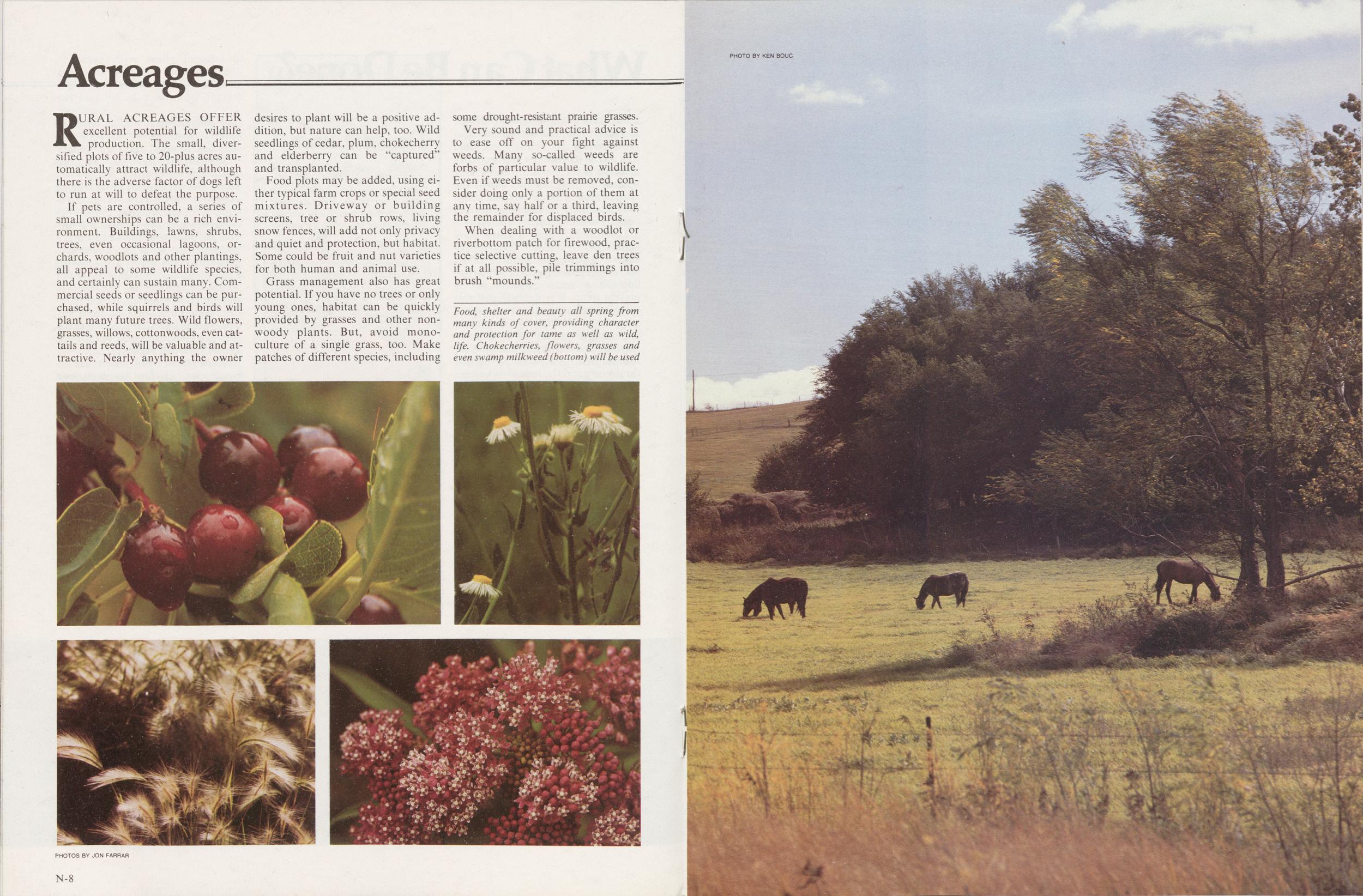
All species of wildlife, whether 13-lined ground squirrel, downy woodpecker, green- winged teal or night heron, need several kinds of habitat during the year. Although their needs are fairly simple, they are of utmost importance, and landowners must be the ones who provide for them. Projects need not be grand or expensive, and there are some sources of advice and assistance
and giving several wildlife species a survival space. Pivot irrigation corners can be ideal spots for wildlife.
Shelterbelts have proven their worth beyond question, yet few are being put in and many are being taken out. This is tragic, yet little criticism is voiced where it counts. For homesites, probably nothing will pro- vide the protection and benefit that a shelterbelt can for as long a time at so little cost. Their beauty alone justifies such plantings, but that is minor when compared to the reduction in heating costs, retention of soil moisture, noise buffering, dust reduction, and other benefits. And, fruit and nut trees can be incorporated, or different kinds of fruiting shrubs.
When one or more projects are decided upon, selecting the plants must be based on many variables. Soil type, terrain, weather (moisture, temperatures, wind, etc.) and relative suitability of the plants must be taken into account. Various charts will be of some help, but there are specialists in this field who should also be consulted. University of Nebraska extension offices, including Forestry, the Soil Conservation Service, the Game and Parks Commission, and Natural Resources Districts are some.
The important thing to remember for wildlife purposes, however, is to offer all elements of habitat, each in close proximity to the other. With cover available year-round, and if it's adequate for all requirements, wildlife will flourish.
Acreages
RURAL ACREAGES OFFER excellent potential for wildlife production. The small, diversified plots of five to 20-plus acres automatically attract wildlife, although there is the adverse factor of dogs left to run at will to defeat the purpose.
If pets are controlled, a series of small ownerships can be a rich environment. Buildings, lawns, shrubs, trees, even occasional lagoons, orchards, woodlots and other plantings, all appeal to some wildlife species, and certainly can sustain many. Commercial seeds or seedlings can be purchased, while squirrels and birds will plant many future trees. Wild flowers, grasses, willows, cottonwoods, even cattails and reeds, will be valuable and attractive. Nearly anything the owner desires to plant will be a positive addition, but nature can help, too. Wild seedlings of cedar, plum, chokecherry and elderberry can be "captured" and transplanted.
Food plots may be added, using either typical farm crops or special seed mixtures. Driveway or building screens, tree or shrub rows, living snow fences, will add not only privacy and quiet and protection, but habitat. Some could be fruit and nut varieties for both human and animal use.
Grass management also has great potential. If you have no trees or only young ones, habitat can be quickly provided by grasses and other non- woody plants. But, avoid monoculture of a single grass, too. Make patches of different species, including some drought-resistant prairie grasses.
Very sound and practical advice is to ease off on your fight against weeds. Many so-called weeds are forbs of particular value to wildlife. Even if weeds must be removed, consider doing only a portion of them at any time, say half or a third, leaving the remainder for displaced birds.
When dealing with a woodlot or riverbottom patch for firewood, practice selective cutting, leave den trees if at all possible, pile trimmings into brush "mounds."
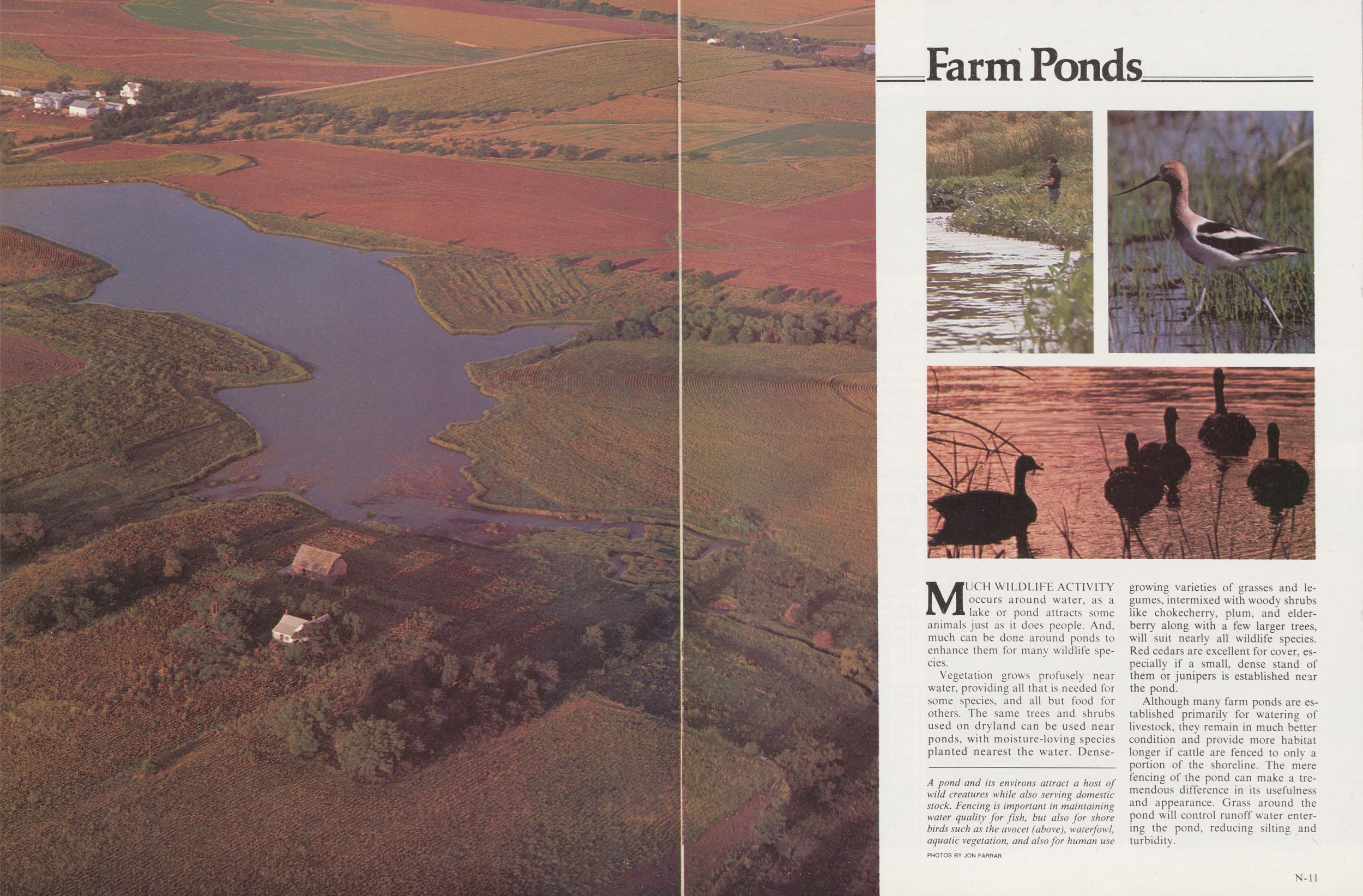
Food, shelter and beauty all spring from many kinds of cover, providing character and protection for tame as well as wild, life. Chokecherries, flowers, grasses and even swamp milkweed (bottom) will be used
Farm Ponds
MUCH WILDLIFE ACTIVITY occurs around water, as a lake or pond attracts some animals just as it does people. And, much can be done around ponds to enhance them for many wildlife species.
Vegetation grows profusely near water, providing all that is needed for some species, and all but food for others. The same trees and shrubs used on dryland can be used near ponds, with moisture-loving species planted nearest the water. Dense-growing varieties of grasses and legumes, intermixed with woody shrubs like chokecherry, plum, and elderberry along with a few larger trees, will suit nearly all wildlife species. Red cedars are excellent for cover, especially if a small, dense stand of them or junipers is established near the pond.
Although many farm ponds are established primarily for watering of livestock, they remain in much better condition and provide more habitat longer if cattle are fenced to only a portion of the shoreline. The mere fencing of the pond can make a tremendous difference in its usefulness and appearance. Grass around the pond will control runoff water entering the pond, reducing silting and turbidity.
N-11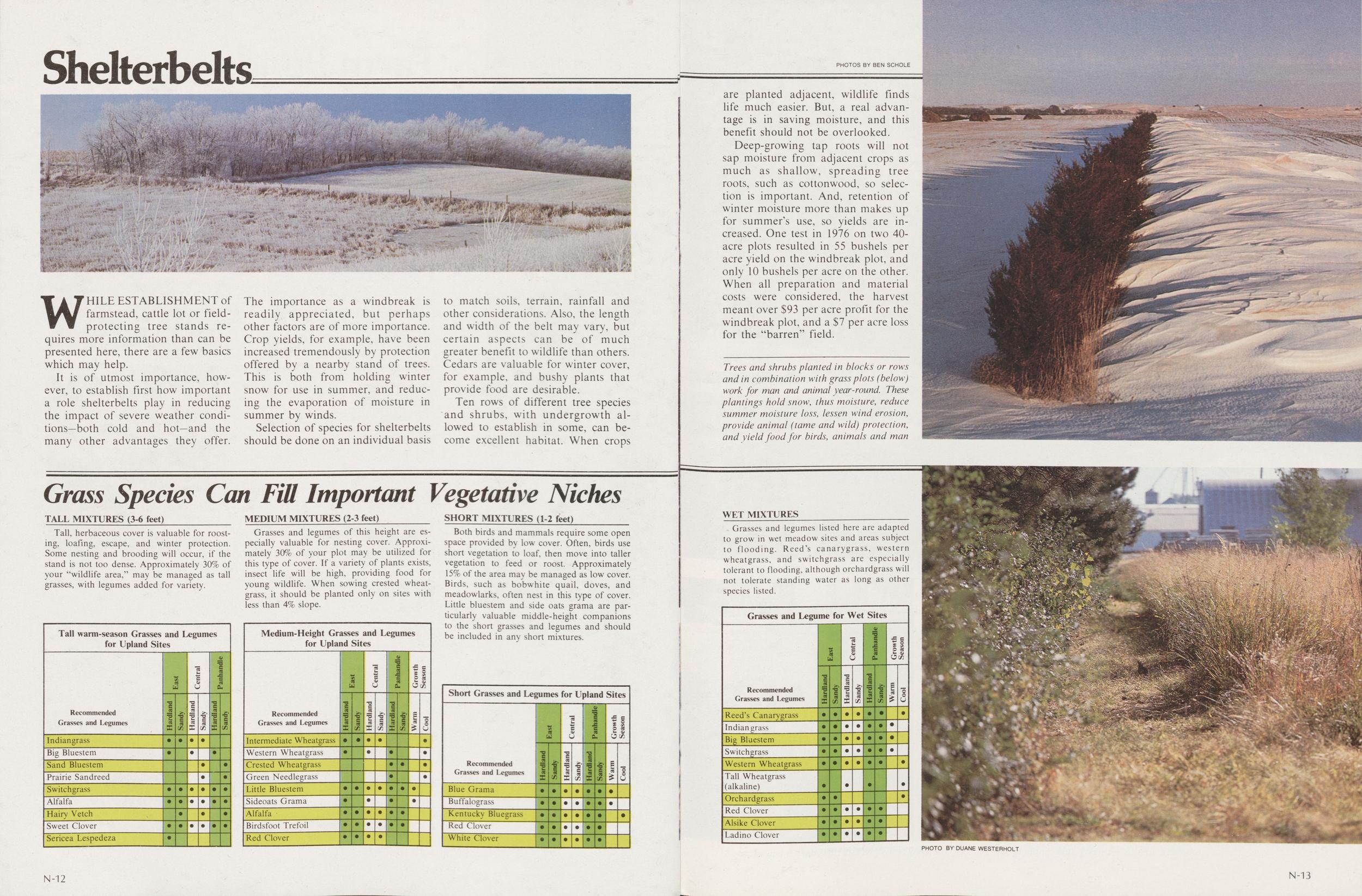
Shelterbelts
WHILE ESTABLISHMENT of farmstead, cattle lot or field- protecting tree stands requires more information than can be presented here, there are a few basics which may help.
It is of utmost importance, however, to establish first how important a role shelterbelts play in reducing the impact of severe weather conditions—both cold and hot—and the many other advantages they offer. The importance as a windbreak is readily appreciated, but perhaps other factors are of more importance. Crop yields, for example, have been increased tremendously by protection offered by a nearby stand of trees. This is both from holding winter snow for use in summer, and reducing the evaporation of moisture in summer by winds.
Selection of species for shelterbelts should be done on an individual basis to match soils, terrain, rainfall and other considerations. Also, the length and width of the belt may vary, but certain aspects can be of much greater benefit to wildlife than others. Cedars are valuable for winter cover, for example, and bushy plants that provide food are desirable.
Ten rows of different tree species and shrubs, with undergrowth allowed to establish in some, can become excellent habitat. When crops are planted adjacent, wildlife finds life much easier. But, a real advantage is in saving moisture, and this benefit should not be overlooked.
Deep-growing tap roots will not sap moisture from adjacent crops as much as shallow, spreading tree roots, such as cottonwood, so selection is important. And, retention of winter moisture more than makes up for summer's use, so yields are increased. One test in 1976 on two 40- acre plots resulted in 55 bushels per acre yield on the windbreak plot, and only 10 bushels per acre on the other. When all preparation and material costs were considered, the harvest meant over $93 per acre profit for the windbreak plot, and a $7 per acre loss for the "barren" field.
Trees and shrubs planted in blocks or rows and in combination with grass plots (below) work for man and animal year-round. These plantings hold snow, thus moisture, reduce summer moisture loss, lessen wind erosion, provide animal (tame and wild) protection, and yield food for birds, animals and man
Grass Species Can Fill Important Vegetative Niches
TALL MIXTURES (3-6 feet)Tall, herbaceous cover is valuable for roosting, loafing, escape, and winter protection. Some nesting and brooding will occur, if the stand is not too dense. Approximately 30% of your "wildlife area," may be managed as tall grasses, with legumes added for variety.
Tall warm-season Grasses and Legumes for Upland SitesGrasses and legumes of this height are especially valuable for nesting cover. Approximately 30% of your plot may be utilized for this type of cover. If a variety of plants exists, insect life will be high, providing food for young wildlife. When sowing crested wheatgrass, it should be planted only on sites with less than 4% slope.
Medium-Height Grasses and Legumes for Upland SitesBoth birds and mammals require some open space provided by low cover. Often, birds use short vegetation to loaf, then move into taller vegetation to feed or roost. Approximately 15% of the area may be managed as low cover. Birds, such as bobwhite quail, doves, and meadowlarks, often nest in this type of cover. Little bluestem and side oats grama are particularly valuable middle-height companions to the short grasses and legumes and should be included in any short mixtures.
Short Grasses and Legumes for Upland SitesGrasses and legumes listed here are adapted to grow in wet meadow sites and areas subject to flooding. Reed's canarygrass, western wheatgrass, and switchgrass are especially tolerant to flooding, although orchardgrass will not tolerate standing water as long as other species listed.
Grasses and Legume for Wet Sites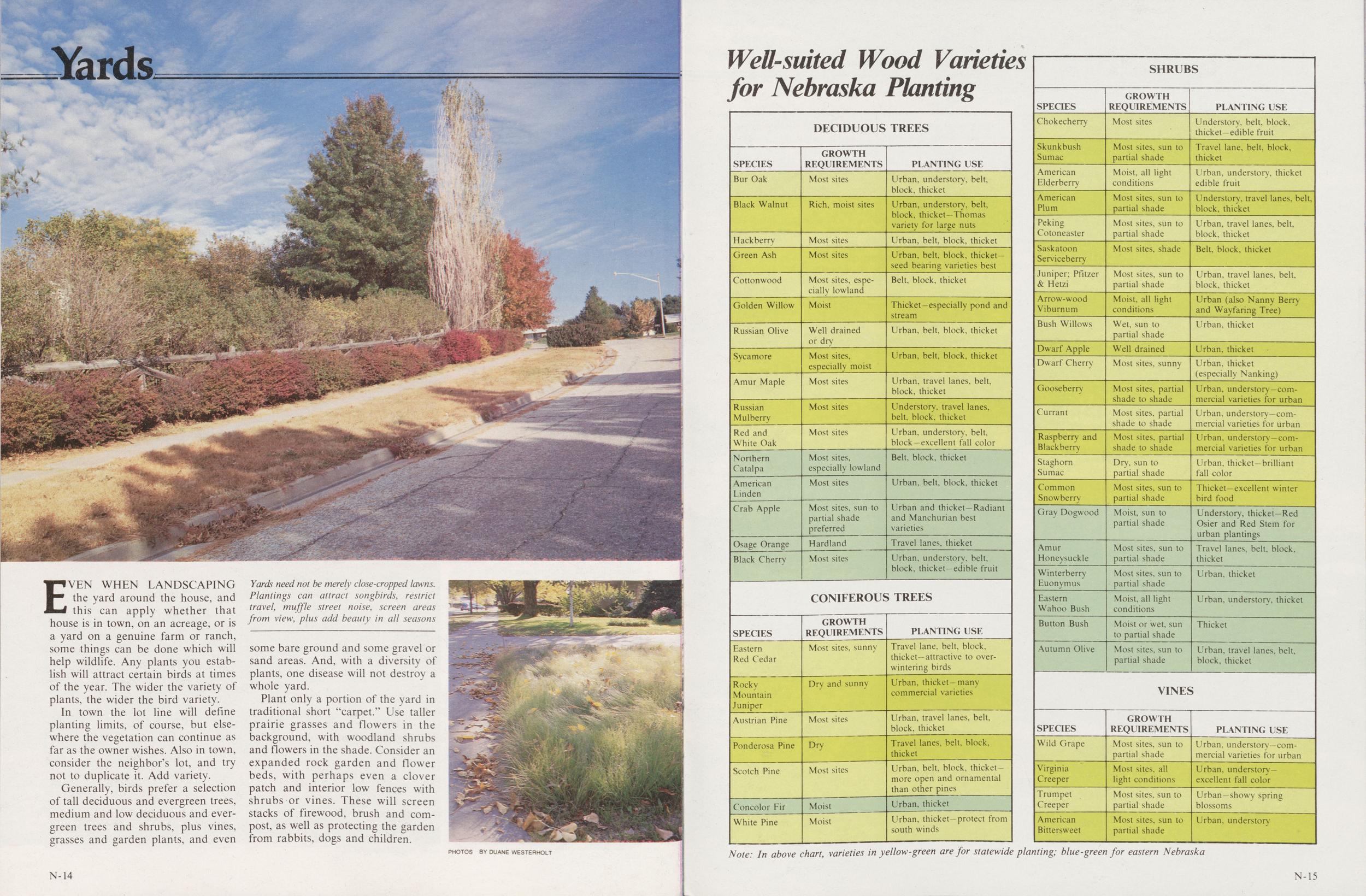
Yards
EVEN WHEN LANDSCAPING the yard around the house, and this can apply whether that house is in town, on an acreage, or is a yard on a genuine farm or ranch, some things can be done which will help wildlife. Any plants you establish will attract certain birds at times of the year. The wider the variety of plants, the wider the bird variety.
In town the lot line will define planting limits, of course, but elsewhere the vegetation can continue as far as the owner wishes. Also in town, consider the neighbor's lot, and try not to duplicate it. Add variety.
Generally, birds prefer a selection of tall deciduous and evergreen trees, medium and low deciduous and evergreen trees and shrubs, plus vines, grasses and garden plants, and even
Yards need not be merely close-cropped lawns. Plantings can attract songbirds, restrict travel, muffle street noise, screen areas from view, plus add beauty in all seasons
PHOTOS BY DUANE WESTERHOLTsome bare ground and some gravel or sand areas. And, with a diversity of plants, one disease will not destroy a whole yard.
Plant only a portion of the yard in traditional short "carpet." Use taller prairie grasses and flowers in the background, with woodland shrubs and flowers in the shade. Consider an expanded rock garden and flower beds, with perhaps even a clover patch and interior low fences with shrubs or vines. These will screen stacks of firewood, brush and compost, as well as protecting the garden from rabbits, dogs and children.
N-14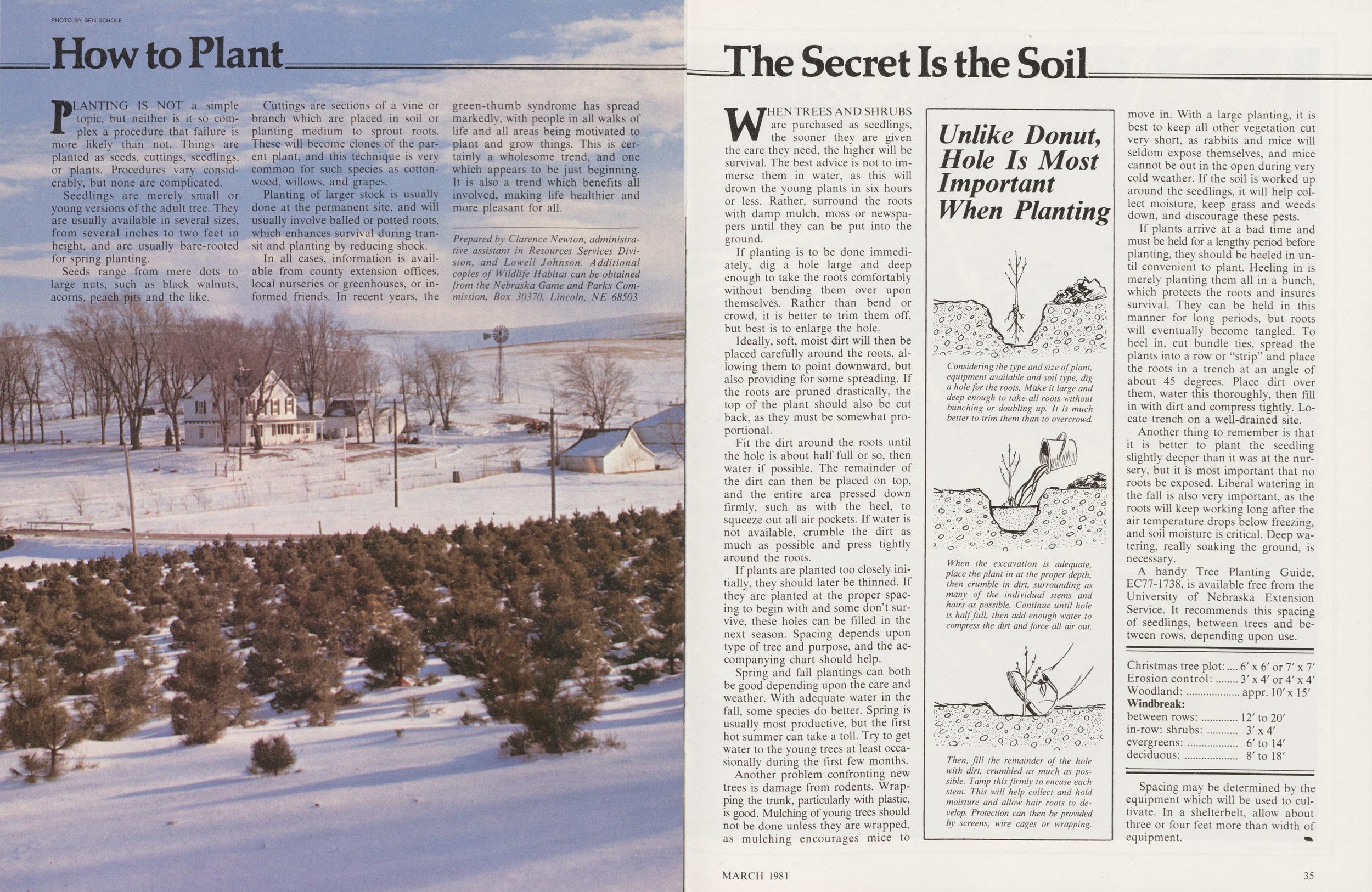
How to Plant
PLANTING IS NOT a simple topic, but neither is it so complex a procedure that failure is more likely than not. Things are planted as seeds, cuttings, seedlings, or plants. Procedures vary considerably, but none are complicated.
Seedlings are merely small or young versions of the adult tree. They are usually available in several sizes, from several inches to two feet in height, and are usually bare-rooted for spring planting.
Seeds range from mere dots to large nuts, such as black walnuts, acorns, peach pits and the like.
Cuttings are sections of a vine or branch which are placed in soil or planting medium to sprout roots. These will become clones of the parent plant, and this technique is very common for such species as cottonwood, willows, and grapes.
Planting of larger stock is usually done at the permanent site, and will usually involve balled or potted roots, which enhances survival during transit and planting by reducing shock.
In all cases, information is available from county extension offices, local nurseries or greenhouses, or informed friends. In recent years, the green-thumb syndrome has spread markedly, with people in all walks of life and all areas being motivated to plant and grow things. This is certainly a wholesome trend, and one which appears to be just beginning. It is also a trend which benefits all involved, making life healthier and more pleasant for all.
Prepared by Clarence Newton, administrative assistant in Resources Services Division, and Lowell Johnson. Additional copies of Wildlife Habitat can be obtained from the Nebraska Game and Parks Commission, Box 30370, Lincoln, NE 68503The Secret Is the Soil
WHEN TREES AND SHRUBS are purchased as seedlings, the sooner they are given the care they need, the higher will be survival. The best advice is not to immerse them in water, as this will drown the young plants in six hours or less. Rather, surround the roots with damp mulch, moss or newspapers until they can be put into the ground.
If planting is to be done immediately, dig a hole large and deep enough to take the roots comfortably without bending them over upon themselves. Rather than bend or crowd, it is better to trim them off, but best is to enlarge the hole.
Ideally, soft, moist dirt will then be placed carefully around the roots, allowing them to point downward, but also providing for some spreading. If the roots are pruned drastically, the top of the plant should also be cut back, as they must be somewhat proportional.
Fit the dirt around the roots until the hole is about half full or so, then water if possible. The remainder of the dirt can then be placed on top, and the entire area pressed down firmly, such as with the heel, to squeeze out all air pockets. If water is not available, crumble the dirt as much as possible and press tightly around the roots.
If plants are planted too closely initially, they should later be thinned. If they are planted at the proper spacing to begin with and some don't survive, these holes can be filled in the next season. Spacing depends upon type of tree and purpose, and the accompanying chart should help.
Spring and fall plantings can both be good depending upon the care and weather. With adequate water in the fall, some species do better. Spring is usually most productive, but the first hot summer can take a toll. Try to get water to the young trees at least occasionally during the first few months.
Another problem confronting new trees is damage from rodents. Wrapping the trunk, particularly with plastic, is good. Mulching of young trees should not be done unless they are wrapped, as mulching encourages mice to
Unlike Donut,
Hole Is Most
Important
When Planting
[image]
Considering the type and size of plant,
equipment available and soil type, dig
a hole for the roots. Make it large and
deep enough to take all roots without
bunching or doubling up. It is much
better to trim them than to overcrowd.
[image]
When the excavation is adequate,
place the plant in at the proper depth,
then crumble in dirt, surrounding as
many of the individual stems and
hairs as possible. Continue until hole
is half full, then add enough water to
compress the dirt and force all air out.
[image]
Then, fill the remainder of the hole
with dirt, crumbled as much as possible. Tamp this firmly to encase each
stem. This will help collect and hold
moisture and allow hair roots to develop. Protection can then be provided
by screens, wire cages or wrapping.
move in. With a large planting, it is best to keep all other vegetation cut very short, as rabbits and mice will seldom expose themselves, and mice cannot be out in the open during very cold weather. If the soil is worked up around the seedlings, it will help collect moisture, keep grass and weeds down, and discourage these pests.
If plants arrive at a bad time and must be held for a lengthy period before planting, they should be heeled in until convenient to plant. Heeling in is merely planting them all in a bunch, which protects the roots and insures survival. They can be held in this manner for long periods, but roots will eventually become tangled. To heel in, cut bundle ties, spread the plants into a row or "strip" and place the roots in a trench at an angle of about 45 degrees. Place dirt over them, water this thoroughly, then fill in with dirt and compress tightly. Locate trench on a well-drained site.
Another thing to remember is that it is better to plant the seedling slightly deeper than it was at the nursery, but it is most important that no roots be exposed. Liberal watering in the fall is also very important, as the roots will keep working long after the air temperature drops below freezing, and soil moisture is critical. Deep watering, really soaking the ground, is necessary.
A handy Tree Planting Guide, EC77-1738, is available free from the University of Nebraska Extension Service. It recommends this spacing of seedlings, between trees and between rows, depending upon use.
Christmas tree plot: 6' x 6' or 7' x 7' Erosion control:3' x 4' or 4' x 4' Woodland:appr. 10' x 15' Windbreak: between rows:12' to 20' in-row: shrubs: 3' x 4' evergreens: 6'to 14' deciduous: 8'to 18'Spacing may be determined by the equipment which will be used to cultivate. In a shelterbelt, allow about three or four feet more than width of equipment.
MARCH 1981 35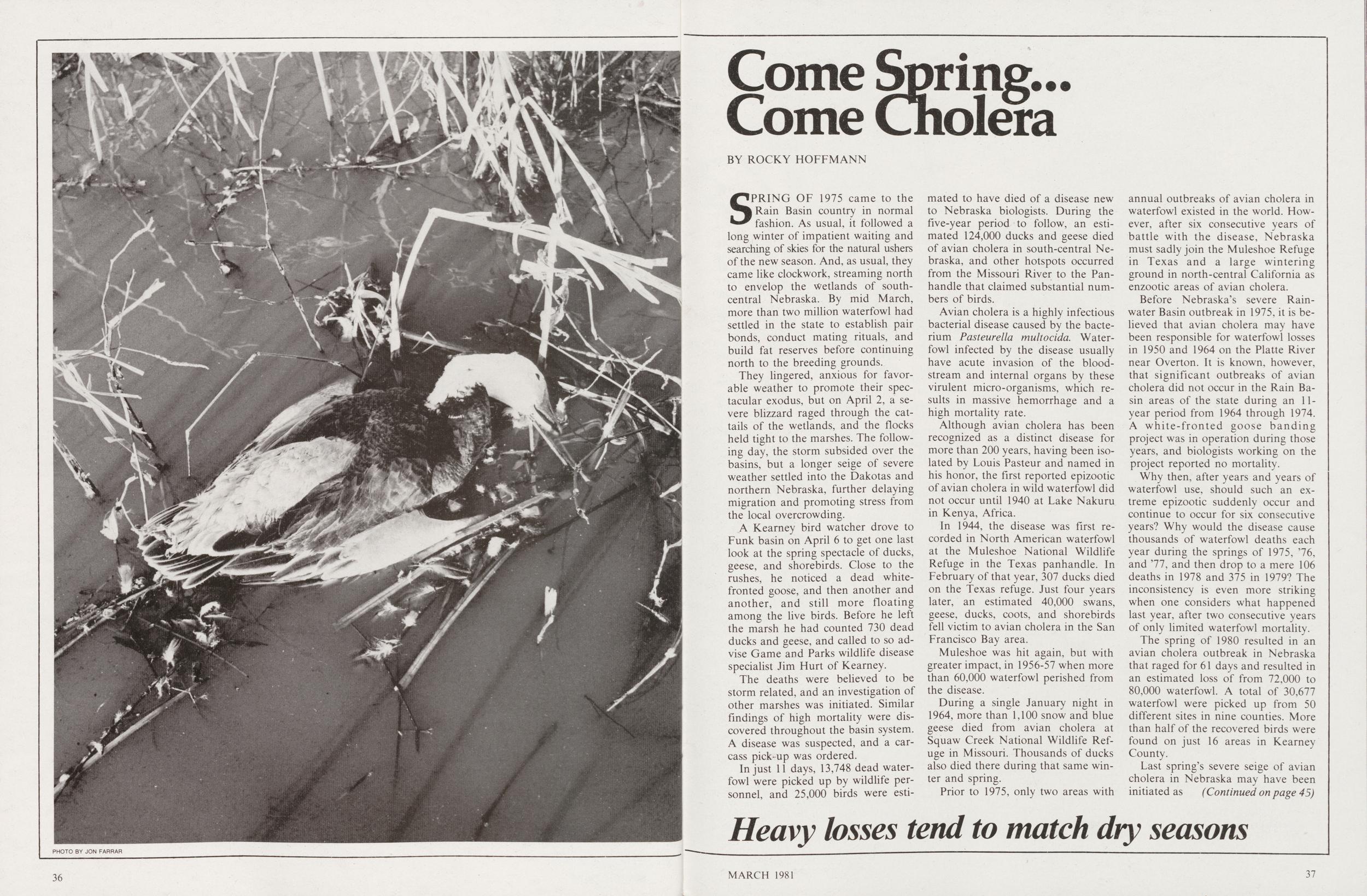
Come Spring Come Cholera
SPRING OF 1975 came to the Rain Basin country in normal fashion. As usual, it followed a long winter of impatient waiting and searching of skies for the natural ushers of the new season. And, as usual, they came like clockwork, streaming north to envelop the wetlands of south- central Nebraska. By mid March, more than two million waterfowl had settled in the state to establish pair bonds, conduct mating rituals, and build fat reserves before continuing north to the breeding grounds.
They lingered, anxious for favorable weather to promote their spectacular exodus, but on April 2, a severe blizzard raged through the cattails of the wetlands, and the flocks held tight to the marshes. The following day, the storm subsided over the basins, but a longer seige of severe weather settled into the Dakotas and northern Nebraska, further delaying migration and promoting stress from the local overcrowding.
A Kearney bird watcher drove to Funk basin on April 6 to get one last look at the spring spectacle of ducks, geese, and shorebirds. Close to the rushes, he noticed a dead white-fronted goose, and then another and another, and still more floating among the live birds. Before he left the marsh he had counted 730 dead ducks and geese, and called to so advise Game and Parks wildlife disease specialist Jim Hurt of Kearney.
The deaths were believed to be storm related, and an investigation of other marshes was initiated. Similar findings of high mortality were discovered throughout the basin system. A disease was suspected, and a carcass pick-up was ordered.
In just 11 days, 13,748 dead waterfowl were picked up by wildlife personnel, and 25,000 birds were estimated to have died of a disease new to Nebraska biologists. During the five-year period to follow, an estimated 124,000 ducks and geese died of avian cholera in south-central Nebraska, and other hotspots occurred from the Missouri River to the Panhandle that claimed substantial numbers of birds.
Avian cholera is a highly infectious bacterial disease caused by the bacterium Pasteurella multocida. Waterfowl infected by the disease usually have acute invasion of the bloodstream and internal organs by these virulent micro-organisms, which results in massive hemorrhage and a high mortality rate.
Although avian cholera has been recognized as a distinct disease for more than 200 years, having been isolated by Louis Pasteur and named in his honor, the first reported epizootic of avian cholera in wild waterfowl did not occur until 1940 at Lake Nakuru in Kenya, Africa.
In 1944, the disease was first recorded in North American waterfowl at the Muleshoe National Wildlife Refuge in the Texas panhandle. In February of that year, 307 ducks died on the Texas refuge. Just four years later, an estimated 40,000 swans, geese, ducks, coots, and shorebirds fell victim to avian cholera in the San Francisco Bay area.
Muleshoe was hit again, but with greater impact, in 1956-57 when more than 60,000 waterfowl perished from the disease.
During a single January night in 1964, more than 1,100 snow and blue geese died from avian cholera at Squaw Creek National Wildlife Refuge in Missouri. Thousands of ducks also died there during that same winter and spring.
Prior to 1975, only two areas with annual outbreaks of avian cholera in waterfowl existed in the world. However, after six consecutive years of battle with the disease, Nebraska must sadly join the Muleshoe Refuge in Texas and a large wintering ground in north-central California as enzootic areas of avian cholera.
Before Nebraska's severe Rainwater Basin outbreak in 1975, it is believed that avian cholera may have been responsible for waterfowl losses in 1950 and 1964 on the Platte River near Overton. It is known, however, that significant outbreaks of avian cholera did not occur in the Rain Basin areas of the state during an 11- year period from 1964 through 1974. A white-fronted goose banding project was in operation during those years, and biologists working on the project reported no mortality.
Why then, after years and years of waterfowl use, should such an extreme epizootic suddenly occur and continue to occur for six consecutive years? Why would the disease cause thousands of waterfowl deaths each year during the springs of 1975, '76, and '77, and then drop to a mere 106 deaths in 1978 and 375 in 1979? The inconsistency is even more striking when one considers what happened last year, after two consecutive years of only limited waterfowl mortality.
The spring of 1980 resulted in an avian cholera outbreak in Nebraska that raged for 61 days and resulted in an estimated loss of from 72,000 to 80,000 waterfowl. A total of 30,677 waterfowl were picked up from 50 different sites in nine counties. More than half of the recovered birds were found on just 16 areas in Kearney County.
Last spring's severe seige of avian cholera in Nebraska may have been initiated as (Continued on page 45)
Heavy losses tend to match dry seasons MARCH 1981 37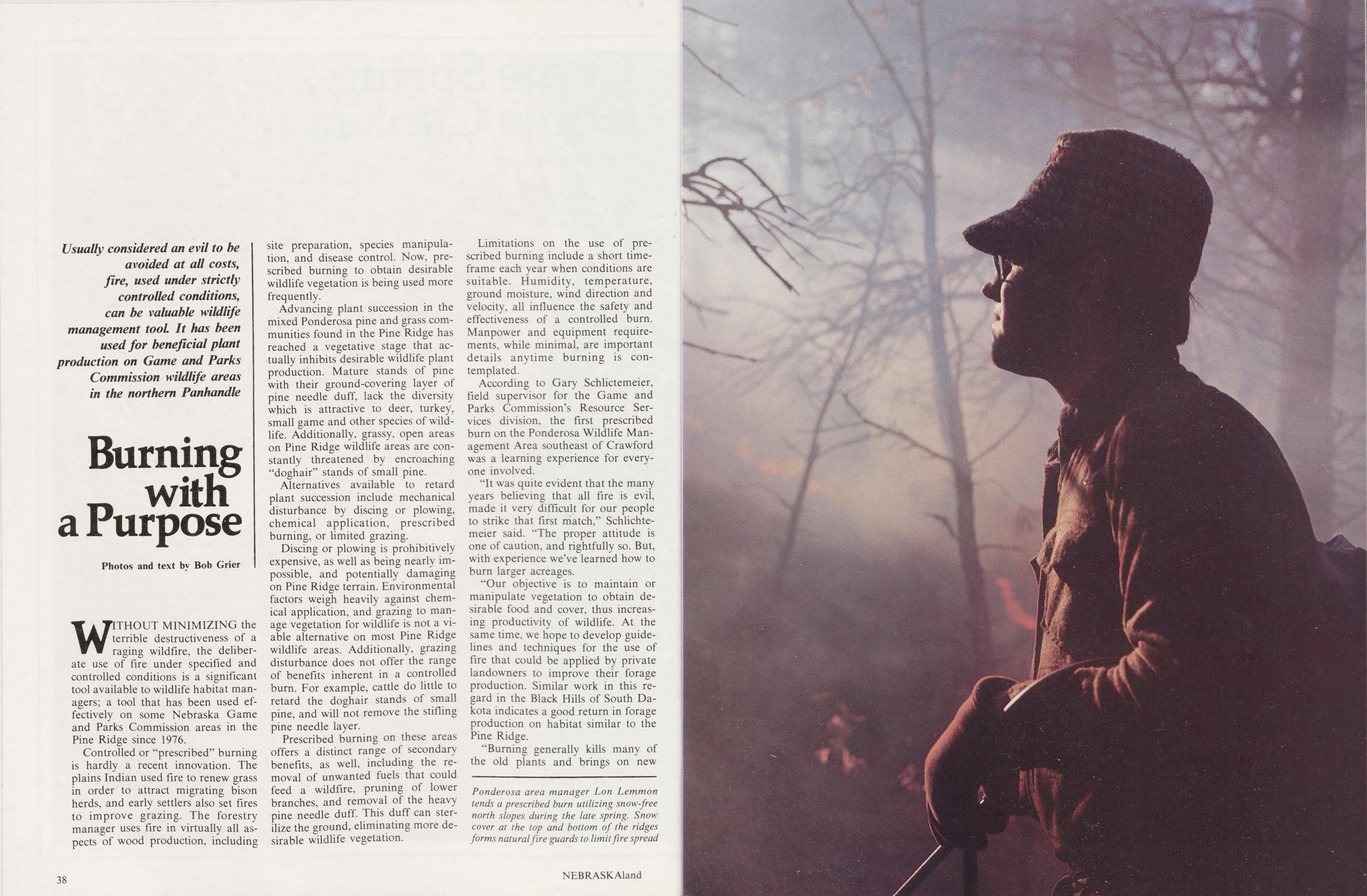
Usually considered an evil to be avoided at all costs, fire, used under strictly controlled conditions, can be valuable wildlife management tool It has been used for beneficial plant production on Game and Parks Commission wildlife areas in the northern Panhandle
Burning with a Purpose
WITHOUT MINIMIZING the terrible destructiveness of a raging wildfire, the deliberate use of fire under specified and controlled conditions is a significant tool available to wildlife habitat managers; a tool that has been used effectively on some Nebraska Game and Parks Commission areas in the Pine Ridge since 1976.
Controlled or "prescribed" burning is hardly a recent innovation. The plains Indian used fire to renew grass in order to attract migrating bison herds, and early settlers also set fires to improve grazing. The forestry manager uses fire in virtually all aspects of wood production, including site preparation, species manipulation, and disease control. Now, pre- scribed burning to obtain desirable wildlife vegetation is being used more frequently.
Advancing plant succession in the mixed Ponderosa pine and grass communities found in the Pine Ridge has reached a vegetative stage that actually inhibits desirable wildlife plant production. Mature stands of pine with their ground-covering layer of pine needle duff, lack the diversity which is attractive to deer, turkey, small game and other species of wildlife. Additionally, grassy, open areas on Pine Ridge wildlife areas are constantly threatened by encroaching "doghair" stands of small pine.
Alternatives available to retard plant succession include mechanical disturbance by discing or plowing, chemical application, prescribed burning, or limited grazing.
Discing or plowing is prohibitively expensive, as well as being nearly impossible, and potentially damaging on Pine Ridge terrain. Environmental factors weigh heavily against chemical application, and grazing to manage vegetation for wildlife is not a viable alternative on most Pine Ridge wildlife areas. Additionally, grazing disturbance does not offer the range of benefits inherent in a controlled burn. For example, cattle do little to retard the doghair stands of small pine, and will not remove the stifling pine needle layer.
Prescribed burning on these areas offers a distinct range of secondary benefits, as well, including the removal of unwanted fuels that could feed a wildfire, pruning of lower branches, and removal of the heavy pine needle duff. This duff can sterilize the ground, eliminating more desirable wildlife vegetation.
Limitations on the use of prescribed burning include a short timeframe each year when conditions are suitable. Humidity, temperature, ground moisture, wind direction and velocity, all influence the safety and effectiveness of a controlled burn. Manpower and equipment requirements, while minimal, are important details anytime burning is contemplated.
According to Gary Schlictemeier, field supervisor for the Game and Parks Commission's Resource Services division, the first prescribed burn on the Ponderosa Wildlife Management Area southeast of Crawford was a learning experience for everyone involved.
"It was quite evident that the many years believing that all fire is evil, made it very difficult for our people to strike that first match," Schlichtemeier said. The proper attitude is one of caution, and rightfully so. But, with experience we've learned how to burn larger acreages.
"Our objective is to maintain or manipulate vegetation to obtain desirable food and cover, thus increasing productivity of wildlife. At the same time, we hope to develop guidelines and techniques for the use of fire that could be applied by private landowners to improve their forage production. Similar work in this regard in the Black Hills of South Dakota indicates a good return in forage production on habitat similar to the Pine Ridge.
"Burning generally kills many of the old plants and brings on new
38 NEBRASKAland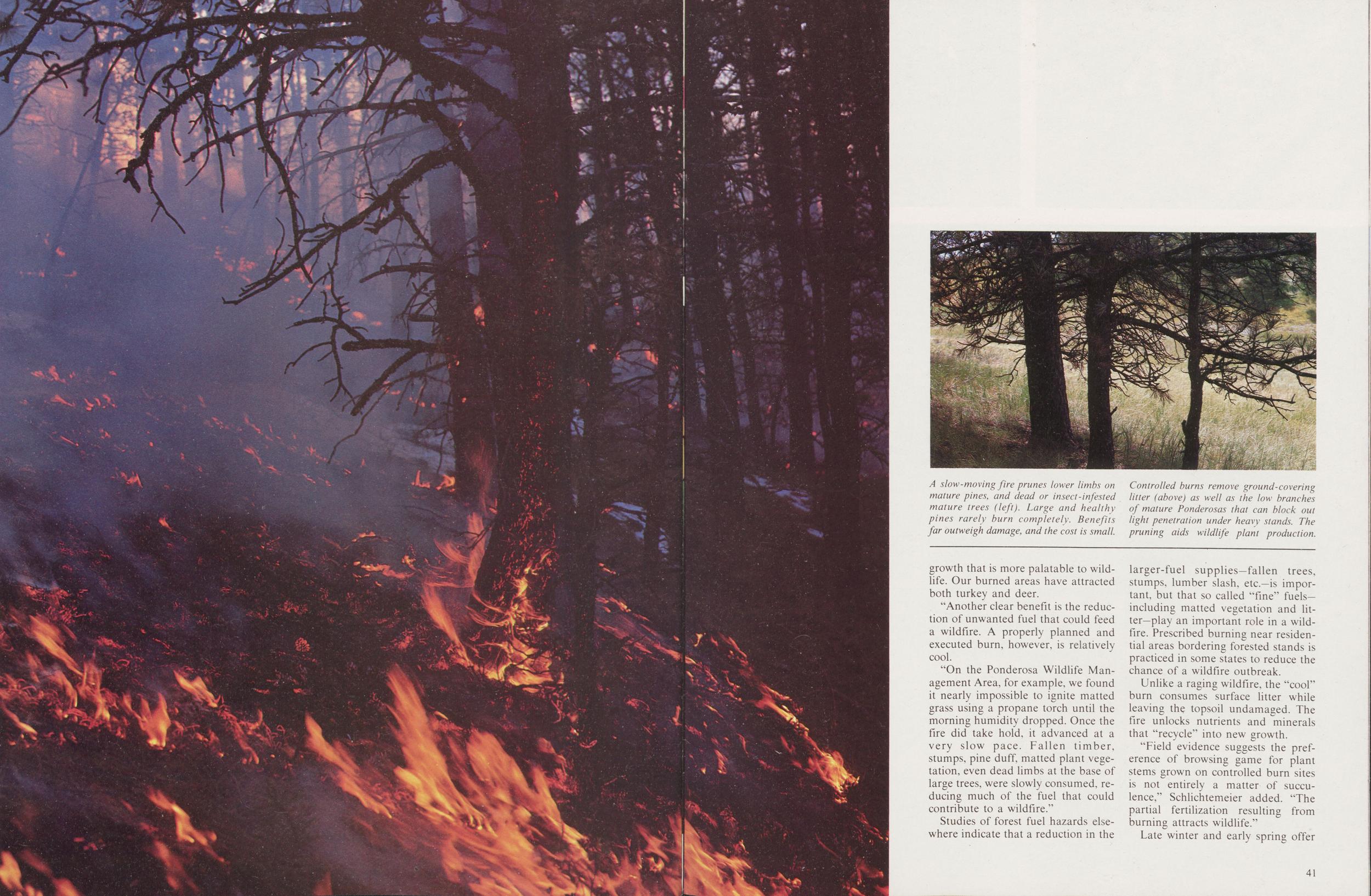
A slow-moving fire prunes lower limbs on mature pines, and dead or insect-infested mature trees (left). Large and healthy pines rarely burn completely. Benefits far outweigh damage, and the cost is small.
Controlled burns remove ground-covering litter (above) as well as the low branches of mature Ponderosas that can block out light penetration under heavy stands. The pruning aids wildlife plant production.
growth that is more palatable to wildlife. Our burned areas have attracted both turkey and deer.
"Another clear benefit is the reduction of unwanted fuel that could feed a wildfire. A properly planned and executed burn, however, is relatively cool.
"On the Ponderosa Wildlife Management Area, for example, we found it nearly impossible to ignite matted grass using a propane torch until the morning humidity dropped. Once the fire did take hold, it advanced at a very slow pace. Fallen timber, stumps, pine duff, matted plant vegetation, even dead limbs at the base of large trees, were slowly consumed, reducing much of the fuel that could contribute to a wildfire."
Studies of forest fuel hazards elsewhere indicate that a reduction in the larger-fuel supplies—fallen trees, stumps, lumber slash, etc.—is important, but that so called "fine" fuels- including matted vegetation and litter—play an important role in a wildfire. Prescribed burning near residential areas bordering forested stands is practiced in some states to reduce the chance of a wildfire outbreak.
Unlike a raging wildfire, the "cool" burn consumes surface litter while leaving the topsoil undamaged. The fire unlocks nutrients and minerals that "recycle" into new growth.
"Field evidence suggests the preference of browsing game for plant stems grown on controlled burn sites is not entirely a matter of succulence," Schlichtemeier added. "The partial fertilization resulting from burning attracts wildlife."
Late winter and early spring offer
41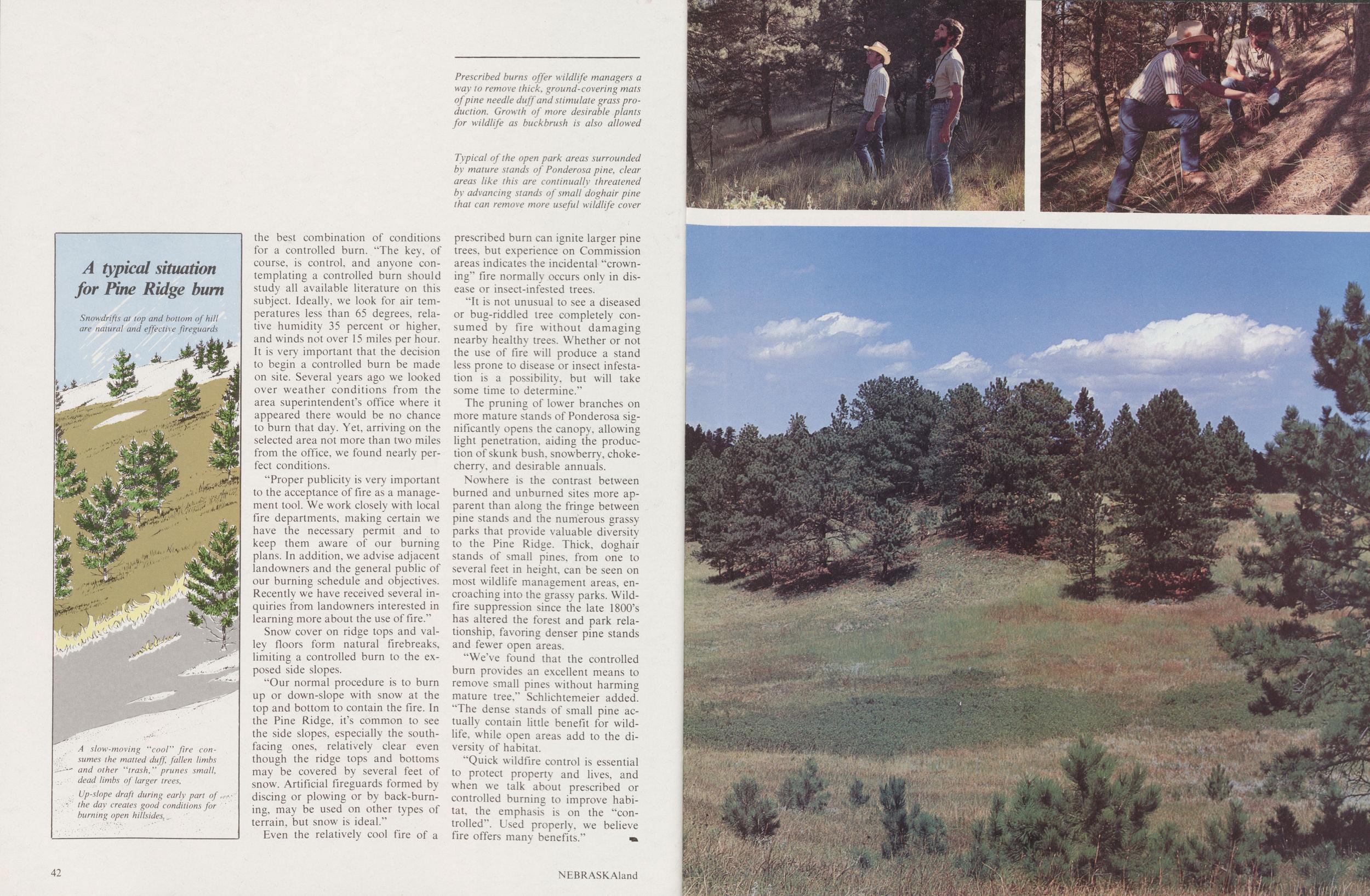
the best combination of conditions for a controlled burn. "The key, of course, is control, and anyone contemplating a controlled burn should study all available literature on this subject. Ideally, we look for air temperatures less than 65 degrees, relative humidity 35 percent or higher, and winds not over 15 miles per hour. It is very important that the decision to begin a controlled burn be made on site. Several years ago we looked over weather conditions from the area superintendent's office where it appeared there would be no chance to burn that day. Yet, arriving on the selected area not more than two miles from the office, we found nearly perfect conditions.
"Proper publicity is very important to the acceptance of fire as a management tool. We work closely with local fire departments, making certain we have the necessary permit and to keep them aware of our burning plans. In addition, we advise adjacent landowners and the general public of our burning schedule and objectives. Recently we have received several inquiries from landowners interested in learning more about the use of fire."
Snow cover on ridge tops and valley floors form natural firebreaks, limiting a controlled burn to the exposed side slopes.
"Our normal procedure is to burn up or down-slope with snow at the top and bottom to contain the fire. In the Pine Ridge, it's common to see the side slopes, especially the south- facing ones, relatively clear even though the ridge tops and bottoms may be covered by several feet of snow. Artificial fireguards formed by discing or plowing or by back-burning, may be used on other types of terrain, but snow is ideal."
Even the relatively cool fire of a prescribed burn can ignite larger pine trees, but experience on Commission areas indicates the incidental "crowning" fire normally occurs only in disease or insect-infested trees.
"It is not unusual to see a diseased or bug-riddled tree completely consumed by fire without damaging nearby healthy trees. Whether or not the use of fire will produce a stand less prone to disease or insect infestation is a possibility, but will take some time to determine."
The pruning of lower branches on more mature stands of Ponderosa significantly opens the canopy, allowing light penetration, aiding the production of skunk bush, snowberry, chokecherry, and desirable annuals.
Nowhere is the contrast between burned and unburned sites more apparent than along the fringe between pine stands and the numerous grassy parks that provide valuable diversity to the Pine Ridge. Thick, doghair stands of small pines, from one to several feet in height, can be seen on most wildlife management areas, encroaching into the grassy parks. Wildfire suppression since the late 1800's has altered the forest and park relationship, favoring denser pine stands and fewer open areas.
"We've found that the controlled burn provides an excellent means to remove small pines without harming mature tree," Schlichtemeier added. "The dense stands of small pine actually contain little benefit for wildlife, while open areas add to the diversity of habitat.
"Quick wildfire control is essential to protect property and lives, and when we talk about prescribed or controlled burning to improve habitat, the emphasis is on the "controlled". Used properly, we believe fire offers many benefits."
42 NEBRASKAland
COME SPRING COME CHOLERA
(Continued from page 37)far back as the summer of 1979, and from as far away as the Hudson Bay area of the Northwest Territories. An unprecedented avian cholera outbreak in the snow goose breeding colonies there resulted in the deaths of thousands of snow and blue geese before they departed that area in September. A chain of events followed that could easily be plotted on a map, south to Texas and north again to Nebraska the following spring.
From the initial die-off on the west side of Hudson Bay, cholera-caused deaths in snow geese were reported in Manitoba, Minnesota, and Horricon Marsh in Wisconsin by late October. The disease rapidly spread to the Canada goose flocks at Horricon and a severe outbreak followed.
Desoto National Wildlife Refuge (NWR) and Forney Lake in Iowa; Plattsmouth Waterfowl Management Area in Nebraska and Squaw Creek NWR in Missouri were all areas of cholera mortality in snow geese and mallards as the migration continued.
By December, cholera had winged its way south with the snow goose migration to the Texas Gulf Coast and was claiming birds at Brazoria NWR. At the same time, Canada geese were dying of cholera at Swan Lake NWR in Missouri. During late winter, a similar outbreak occurred at the the Muleshoe NWR and the Playa Lakes area of Texas.
By early February, wintering flocks were leaving Texas, and with the spring migration came a severe cholera outbreak at Optima NWR in the Oklahoma panhandle. Mallards and pintails were the primary species involved, and it is believed that infected birds migrating from Optima to Nebraska were the source of last spring's outbreak in the Rainwater Basin.
According to Jim Hurt, Nebraska Game and Parks wildlife disease specialist, "Waterfowl moved into the basins during the last week of February, with a major push on the 28th. Very little water was available at that time due to light snow and reduced run-off."
Hurt said that the only water available was at Funk Basin, but that lagoon was still ice-covered. "Birds packed into any open water available, including three waterfowl production areas that were being filled with water by pumps, and they began dying as soon as they arrived."
Hurt feels that a very dangerous situation developed last year when an already infected migrational population of waterfowl was forced to concentrate on the very limited remaining wetlands in the Rainwater Basin.
Wetlands have disappeared from this area at an alarming rate over the past few decades, as more than 80 percent of the original basins have been drained for farming. In 1900, there were 3,907 marshes in this area totaling 94,041 acres of wetlands. Drainage or other destruction began slowly in the early 1900's due to lack of technology and equipment. Earth-moving equipment became available in 1950, and wetland destruction followed rapidly. By the late 1960's 3,222 marshes had been drained, reducing the original 94,000 acres of wetlands to 32,500. Such destruction has continued into recent years, and the actual remaining acres of good wetland habitat is only a few thousand.
During dry years, the U.S. Fish and Wildlife Service has the capability of maintaining a number of existing basins through pumping, but court action is pending on water issues forbidding such activities. Overcrowding due to habitat degradation is known to be a major cause of disease and its transmission in wildlife populations, and is definitely suspect in recent avian cholera outbreaks.
The springs of 1978 and 1979 differed from those of 1975, 1976, 1977 and 1980 in three ways. First and foremost is the fact that thousands of waterfowl died in each of the years except for 1978 and 1979. Secondly, the first three years and last year were very dry, with only a few basins containing water, while in 1978 and 1979, water was available in most basins and low spots in the area. Finally, there were no severe storms during the peak population times in the two low-mortality years, while major storms stressed the waterfowl in three of the four significant-mortality years. A major storm did strike the area in 1980 but a significant loss had already occurred.
By examining the course of the die- offs, it would be easy to lay blame on the national refuges as avian cholera problem areas. But, the fact of the matter is that these areas are among the few avail-
"You've been lost since this morning? You poor dears—maybe it'll make you feel better to know that we've been lost for six days!"
able to waterfowl. The private destruction of marshlands that once dotted the central part of this continent is the primary cause for the present heavy concentrations of waterfowl, and thus may be the leading contributor to disease-related deaths in ducks and geese.
Very little benefit can be realized, however, from dwelling on past mistakes. Biologists must turn to the present and future, and deal directly with this disease and other problems affecting wildlife. Private landowners with valuable wetland resources must consider the impact of their agricultural decisions, and research must be continued or initiated to find answers that will stamp out this devastating waterfowl disease.
The Nebraska Game and Parks Commission has worked closely with the U.S. Fish and Wildlife Service and the National Wildlife Health Laboratory in Madison, Wisconsin, to control the spread of avian cholera during spring migrations through Nebraska. A cholera task force, comprised of federal and state technicians, has worked long and difficult hours over the past six years combing every available marsh for dead and dying waterfowl. Late winter and early spring storms have combined with ice and mud to make their efforts exasperating, but carcasses must be picked up, bagged, sorted by species, and incinerated daily.
Dr. Milton Friend, director of the National Wildlife Health Laboratory, has credited both state and federal agencies for greatly minimizing disease losses through such clean-up operations. Friend believes that transmission of the cholera bacteria occurs when contaminated water is sprayed into the air by waterfowl landing, taking off and disturbing the water during feeding and other activities. Bacteria from diseased birds are released into the water at time of death as fluid is discharged from the bill of some birds, and as the result of scavenging of carcasses by crows and gulls.
Dr. Friend and other wildlife veterinarians have conducted annual research
projects in Nebraska since 1975, and Friend has been on hand for weeks at a time during periods of severe mortality to advise and carry on laboratory and onsite research.
Last year a waterfowl disease emergency was declared by the regional director of the Fish and Wildlife Service, who authorized the use of calcium hypochlorite on highly contaminated marshes. The treatment was to be strictly experimental but was never carried out as heavy precipitation diluted and cleansed the marshes, lifting the emergency. Such natural solutions are preferred over chemical treatments, but biologists were once again left to wonder whether the basins can be effectively treated during periods of severe contamination.
Springtime epizootics of avian cholera strike at the heart of the breeding population, and at a time when waterfowl numbers are at their lowest annual census. For every adult breeder that dies, there is a resultant impact on the number of young that will be produced. A secondary impact is realized from the stress placed on adult birds even though they survive to the breeding grounds. Such stress will probably have an adverse effect on breeding success.
There is currently much concern over the effects of cholera on white-fronted geese. More than 80 percent of the mid continental population of whitefronts stage in Nebraska's Rainwater Basin annually. A total of 14,251 whitefronts were known victims of cholera in Nebraska, and that figure may represent as little as half the true mortality. Last year alone, more than 6,500 whitefront carcasses were recovered from the marshes and incinerated. Continued losses of this magnitude could have a significant impact on this migrational population of whitefronted geese.
Also of primary concern is the welfare of the world's population of endangered whooping cranes. Whooping cranes often rest in these same marshes during their annual spring migration, and the very existence of this species could be at stake if they came in contact with contaminated marshes or diseased waterfowl.
Such a situation occurred in 1975 when on April 17, nine whooping cranes landed on Funk Lagoon. Permits had already been obtained to harass whooping cranes out of the area if the need arose. A light plane of the Game and Parks Commission was successful in hazing the birds north to the fresh water of the Platte, and the cranes were able to continue their migration without incidence of mortality.
Come spring, come cholera this year in Nebraska? Probably so! We have no reason to expect that the series will break, and that this spring will pass cholera-free. We can hope that the impact is minimal and the death toll light, and a wet spring would be of tremendous benefit.
Trading Post
DOGS WELL-BRED Hunting dogs for sale-Brittanies, English setters and pointers—ranging in age from puppies to young dogs. Darrell Yentes, 1118 McMillan, Holdrege, NE 68949. Phone (308) 995-8570 or (308) 995-4797. DOG OBEDIENCE Training. 214-page book by Gust Kessopulos. Get the most useful enjoyment from your dog. The dog will appreciate this beneficial book as much as will the master. Illustrated. $3.50 postpaid. McCampbell, 17 Royal Palm, New Port Richey, FL 33552. MISCELLANEOUS GUNS—Browning, Winchester, Remington, others, Hi- powers, shotguns, new, used, antiques. Want Pre-1964 Winchesters. Buy-Sell-Trade. Ph. (402) 729-6112. Bedlan's Sporting Goods, Fairbury, NE 68352. N.E. NEBR. TROUT FISHING. For rent Mon-Thurs. or Fri.-Sun. Two cottages, four ponds and stream. Privacy with trout up to 5 pounds. Open April 1. Diamond E. Trout Resort, Orchard, NE 68764. (402) 893-4745. PLASTIC DECOYS: We're originator of famous do it yourself system. Catalog $1.00. Decoys Unlimited, Clinton, IA 52732. BIG MAC HOME Building lots for sale by airport and Lakeview Gate 18. Good roads year-round. Write Vinta Claney, Imperial, NE 69033. TULLER'S MEDICINE CREEK LODGE is for sale. Includes restaurant, two mobile homes, trailer hookups, barges and boats, and cabins. At Harry Strunk Lake, north of Cambridge, NE. Contract terms available. Call Sullivan Realtv (308) 345-1828 or write Box 313, McCook, NE 69001. QUALITY SAFE Canoe Trips and Rentals. Qualit) only hurts once. Our life jackets and cushions float! Write for our brochure. Wilson Outfitters Nebraska (WON) 1329 Dawes Avenue, Lincoln. Nebraska 68521. OLD HUNTING LICENSES-Wow! Send old licenses and duck stamps. Immediate cash. Wildlife Gallery, 172E Bedford St., Stamford, Conn. 06901. FRITZ GUNSMITHING & Supply Co.-Heckler & Koch-Weatherby-M.A.C. Dealer. Handfinishing-Hot Blue-Repair-Antique Restoration. Wanted World War I and II souvenir guns, pistols, rifles, swords, gun parts and shells. Now selling blasting powder and fuse. 407 South Harris, Wilber, NE (402) 821-2260. LANKA'S CUSTOM Fishing Rods. Flycasting, spinning, baitcasting, and trolling. 610 West 13th St., Grand Island, NE 68801 (308) 382-9333. FEBRUARY AND MARCH Special! 17' Heat Treated, .050 gauge, tough, 5-ribbed aluminum canoes by MichiCraft. Our price $100 below factory list plus $25 freight. See us when in Lincoln. 20 other models to choose from. Wilson Outfitters Nebraska (WON) 1329 Dawes, 14th and Cornhusker. TAXIDERMY BIG BEAR TAXIDERMY, Rt. 2, Mitchell, Nebraska 69357. We specialize in all big game from Alaska to Nebraska, also birds and fish. Hair on and hair off tanning, 4'/2 miles west of Scottsbluff on Highway 26. Phone (308) 635-3013. KARL SCHWARZ Master Taxidermist. Mounting of game heads—birds—fish—animals-fur rugs—robes-"tanning buckskin. Since 1910. 424 South 13th Street, Dept. A, Omaha, Nebraska 68102. FREEZE-DRY TAXIDERMY Wally Allison's State Record Taxidermy, 2709 Birchwood, North Platte, NE 69101. Phone: (308) 534-2324. Specializing in Fish and Small Game, Snake and Lizard and Novelties. (Nothing too small) Newest of all taxidermy methods employed. AWARD-WINNING TAXIDERMIST. Eight time national award winners. Trust your trophies to a proven winner. Our complete taxidermy service also arranges hunts. Dinges Taxidermy Studio, 2763 South 12th Omaha, NE 68108. Ph. 402-342-3718. JOHNSON TAXIDERMY-servicing southwest Nebraska, specializing in big-game mounts, lifesized mounts, rug work, fish, birds, tanning hair-on leather. Brochure and price list on request. Johnson Taxidermy, Rt. 1, Box 78, Lamar, NE 69035. Telephone (308) 882- 5555. CREATIVE TAXIDERMY in all its branches since 1935, now includes Northstar Freeze-Dry processing of approved small specimens. Also tanning and deerskin processing. Naturecraft Studio. Nebraska City, Nebraska 68510. Joe Voges-Owner. Phone (402) 873-5491. NABITY'S TAXIDERMY. 29 years experience. All taxidermy services available. Specializing in natural grass backgrounds. 5021 Washington, Lincoln, NE 68506. (402) 489-6351. J's TAXIDERMY. Quality work at affordable rates. Call evenings or weekends. Omaha, NE 571-4998. NEBRASKAland Magazine Order Form Please send me a subscription to NEBRASKAland, which now also features 12 issues of the news edition (24 issues in al One-year $7.50 Two-year $13 Three-year $19 STATE NAME ADDRESS CITY ZIP Mail to: NEBRASKAland, Box 30370, Lincoln, NE 68503 N.E. Nebraska Trout up to 5 pounds 4 ponds and stream Only 2 cottages Privacy On the 1981 Know Nebraska Tour schedule (No. 5) John & Aletha Eley Orchard, NE 68764 (402) 893-4745 DEFENSIVE DRIVING COURSE plan a RANCH VACATION Get away from it all to Nebraska's scenic Pine Ridge for a vacation you'll remember a lifetime. Stay in modern nicely-furnished log cabins. Take a quiet walk on scenic hiking trails, try some great fishing then have a campfire cookout. See a 16-foot waterwheel, unbelievable sunsets you'll never find in the city and more stars than you ever thought existed? For brochure write: Rt. & Box 30, Crawford, NE, 69339 MARCH 1981 49
NOTES ON NEBRASKA FAUNA RED-TAILED HAWK
MOST folks have heard the saying, "It's just an old chicken hawk." Odds are that the "chicken hawk" you saw out in the pasture or near downtown Omaha was actually the red-tailed hawk, Buteo jamaicensis. It must be pointed out, though, that chicken killing is not a universal habit of all redtails, or any other predator for that matter. However, some loss is bound to occur where poultry is allowed to roam at will within the redtail's hunting domain.
Of all of our hawks, the redtail is perhaps the most familiar. This broadwinged, fan-tailed bird will soar lazily overhead on a breezy summer day. A large brown-backed hawk with a white chest, it's easy to spot as it perches on telephone or electric poles during the fall or winter.
Adult males and females look virtually identical, except that the female is normally larger. Upper parts of the adults are dark chocolate brown with lighter colored feather edges. The white-tipped tail is a rich rusty-red color, crossed by one conspicuous subterminal dark band and several (three to six) narrower and less distinct bands that fade out toward the base of the tail. From below, individuals vary from nearly white to almost solid brown, with a broken band of brownish streaking on the upper breast and lower abdomen. The under side of the wings and tail are pale grayish white, with dark-tipped feathers in the wing.
The immature red-tailed hawk is often confused with other hawks, since it does not acquire its red tail until its second year. Immatures are like the adults in pattern, but they are whiter underneath and duller brown above.
The redtail's extensive range covers much of North America—from coast to coast and from Alaska to the Dominican Republic. It is common in Nebraska year-round, both as a breeding bird, particularly in the eastern third of the state, and as a winter resident. However, it is seen.most often during fall migration from late September through early November.
Depending on where it happens to be, the redtail preys on whatever is at hand. On the Pacific Coast, its young are raised on lizards and snakes; in the winter it takes waterfowl. In the eastern forests, the redtail subsists on small birds and mammals. Here, on the Plains, it feeds on anything from grasshoppers to jack rabbits and commonly takes ground squirrels and mice. Birds, such as pheasants or ducks, are normally taken on the ground by a carefully calculated surprise attack. As hawks go, the redtail is not particularly fast and can't capture its prey effectively in the air.
In some areas of Nebraska, some pairs of redtails will winter on their breeding territories. During the spring, all other mature pairs of redtails move into well-defined territories. At once they become aggressive toward all other birds of prey, including others of their own kind. Redtails mate for life. Only on the death of its mate will the survivor take a new partner.
Large trees are favored for nesting, but not exclusively. In northwestern Nebraska, nests are sometimes found on ledges of the larger rocky bluffs. No matter what is used as a support, redtails always build a stick nest These are large, bulky affairs, and depending on location, may be used for several seasons.
In Nebraska, egg laying usually begins in early April. Clutch size varies, but two or three eggs are normal, and four rather unusual. Eggs are grayish white with sparse to moderate brown blotching or marbling. Incubation averages 30 days and is shared to some degree by both sexes.
As with most birds of prey, the male supplies nearly all food from the time eggs are laid until about two weeks after hatching. Young redtails develop rapidly. They are able to pick at food as early as a week after they're hatched. Within a month they are exercising their wings on the rim of the nest. They may attempt their first flight at 45 days. Following the first flights of the young, families stay closely associated for another 40 to 60 days. During the earlier part of this period the parents still supply food for the young. By mid-August, the youngsters become essentially solitary, and they migrate from the nesting area as individuals.
The red-tailed hawk is, without question, the most successful large bird-of-prey on the North American continent. Yet, in the wake of our ever- exploding civilization and continued clearing of woodlands, the redtail must not be taken for granted. While the species appears adaptable enough to escape extermination in the future, continued removal of nesting habitat will eventually result in population declines, especially in local areas.
50 NEBRASKAland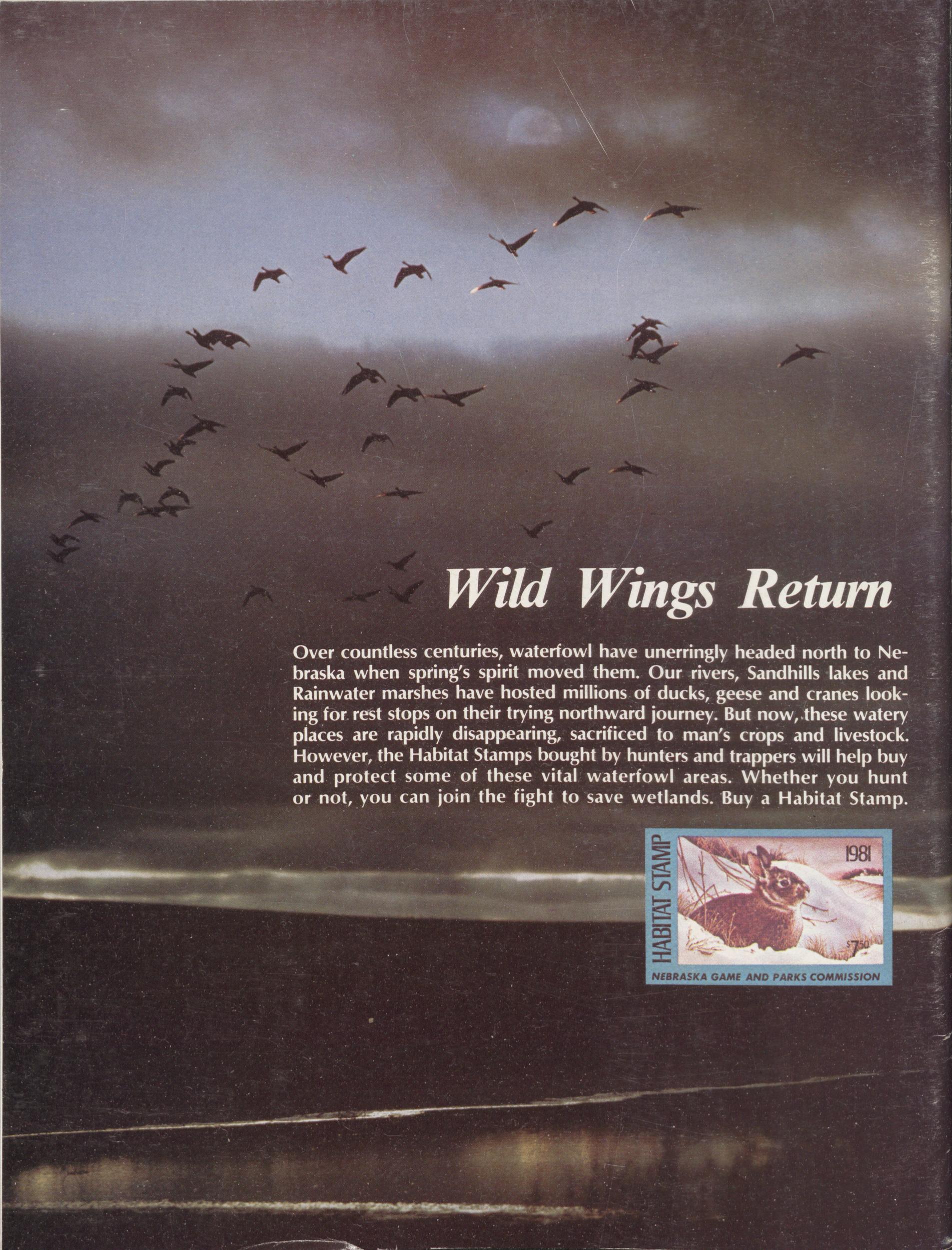
Position: 191 (36 views)