Volume 59, Issue 2, 1981
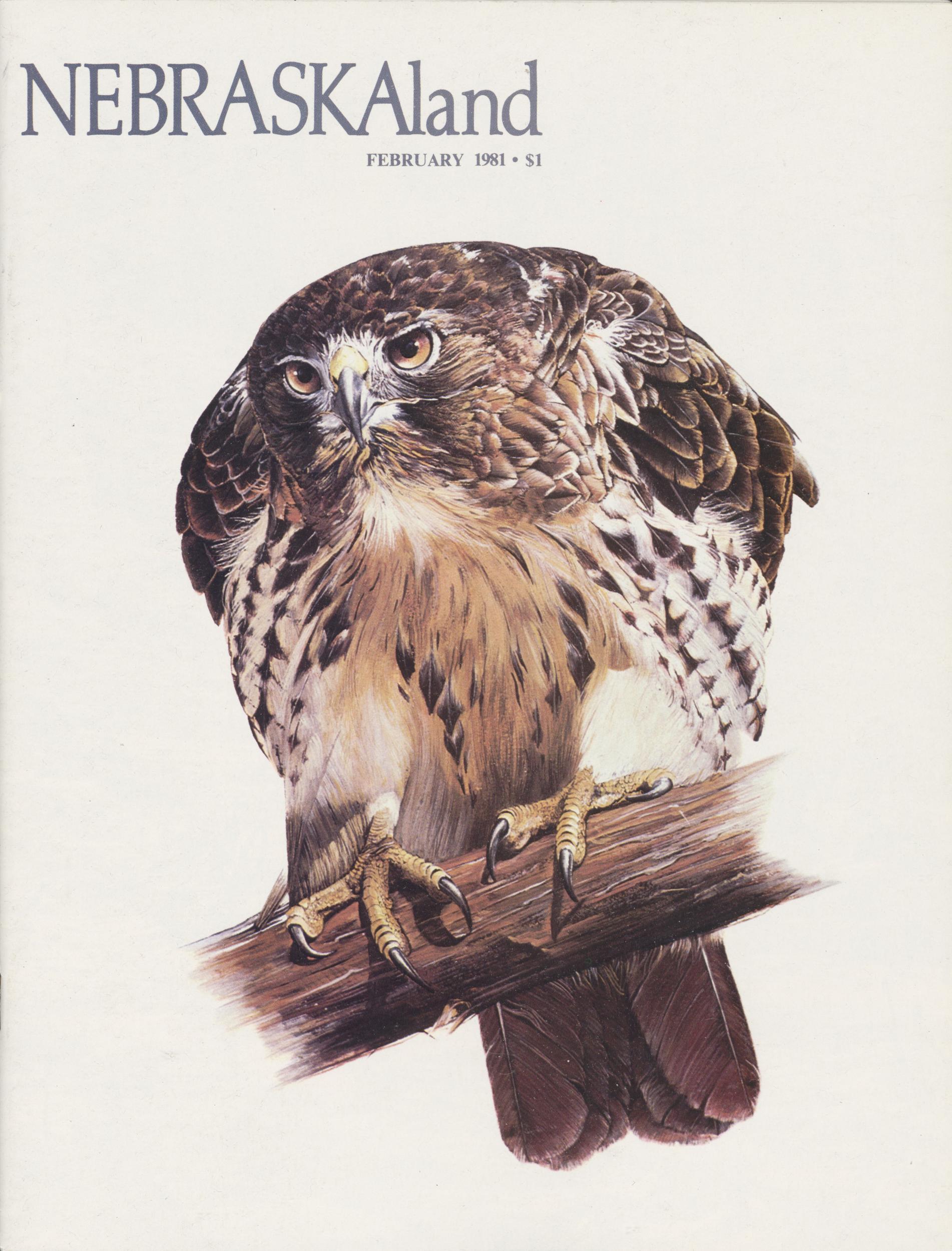
NEBRASKAland
FEBRUARY 1981 • $1
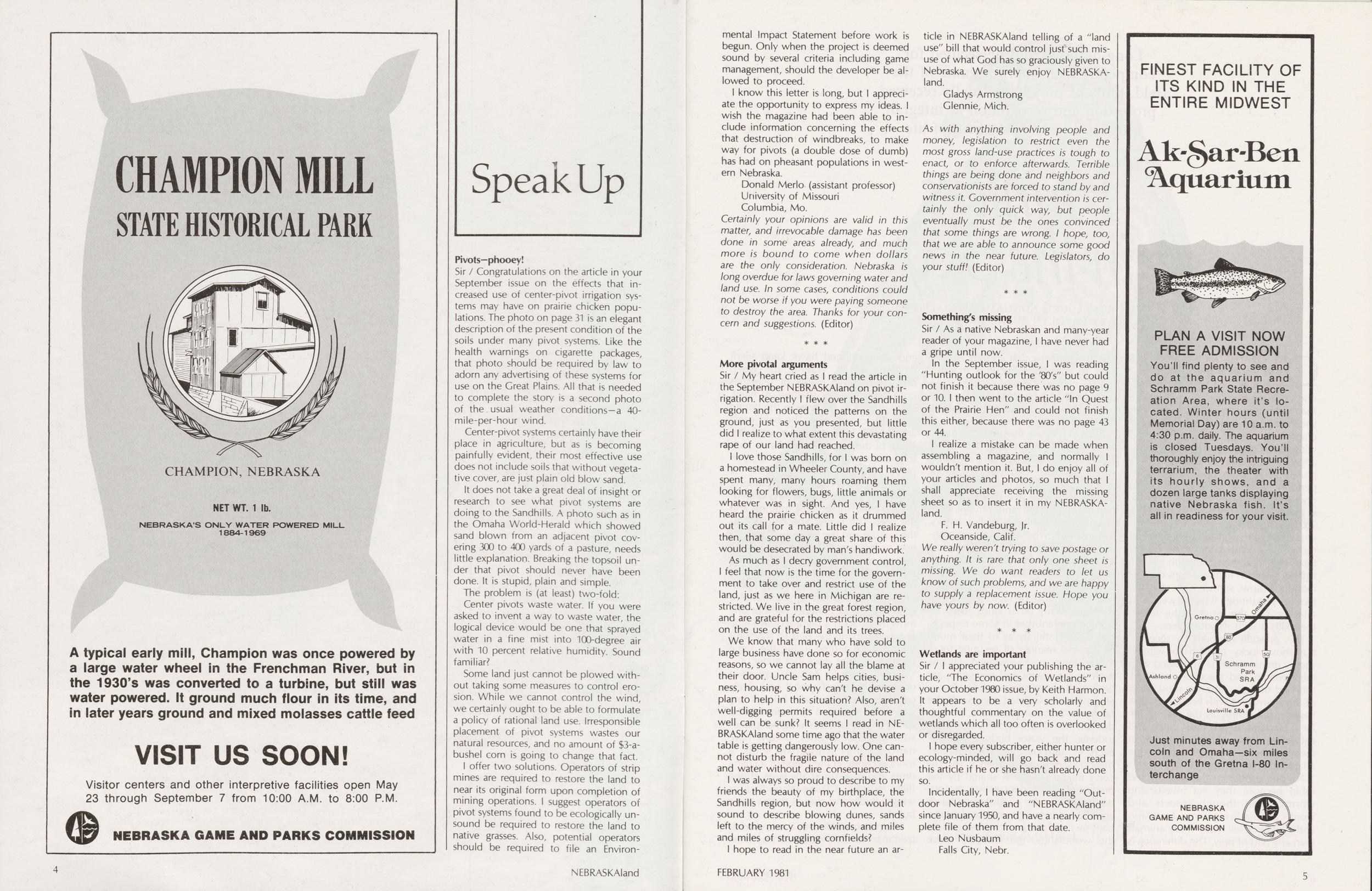
A typical early mill, Champion was once powered by a large water wheel in the Frenchman River, but in the 1930's was converted to a turbine, but still was water powered. It ground much flour in its time, and in later years ground and mixed molasses cattle feed VISIT US SOON! Visitor centers and other interpretive facilities open May 23 through September 7 from 10:00 A.M. to 8:00 P.M. NEBRASKA GAME AND PARKS COMMISSION
Speak Up
Pivots—phooey!Sir / Congratulations on the article in your September issue on the effects that in creased use of center-pivot irrigation systems may have on prairie chicken populations. The photo on page 31 is an elegant description of the present condition of the soils under many pivot systems. Like the health warnings on cigarette packages, that photo should be required by law to adorn any advertising of these systems for use on the Great Plains. All that is needed to complete the story is a second photo of the usual weather conditions—a 40 mile-per-hour wind.
Center-pivot systems certainly have their place in agriculture, but as is becoming painfully evident, their most effective use does not include soils that without vegetative cover, are just plain old blow sand.
It does not take a great deal of insight or research to see what pivot systems are doing to the Sandhills. A photo such as in the Omaha World-Herald which showed sand blown from an adjacent pivot covering 300 to 400 yards of a pasture, needs little explanation. Breaking the topsoil under that pivot should never have been done. It is stupid, plain and simple.
The problem is (at least) two-fold:
Center pivots waste water. If you were asked to invent a way to waste water, the logical device would be one that sprayed water in a fine mist into 100-degree air with 10 percent relative humidity. Sound familiar?
Some land just cannot be plowed with out taking some measures to control erosion. While we cannot control the wind, we certainly ought to be able to formulate a policy of rational land use. Irresponsible placement of pivot systems wastes our natural resources, and no amount of $3-a-bushel corn is going to change that fact.
I offer two solutions. Operators of strip mines are required to restore the land to near its original form upon completion of mining operations. I suggest operators of pivot systems found to be ecologically unsound be required to restore the land to native grasses. Also, potential operators should be required to file an Environmental 4 NEBRASKAland Impact Statement before work is begun. Only when the project is deemed sound by several criteria including game management, should the developer be allowed to proceed.
I know this letter is long, but I appreciate the opportunity to express my ideas. I wish the magazine had been able to include information concerning the effects that destruction of windbreaks, to make way for pivots (a double dose of dumb) has had on pheasant populations in western Nebraska.
Donald Merlo (assistant professor) University of Missouri Columbia, Mo.Certainly your opinions are valid in this matter, and irrevocable damage has been done in some areas already, and much more is bound to come when dollars are the only consideration. Nebraska is long overdue for laws governing water and land use. In some cases, conditions could not be worse if you were paying someone to destroy the area. Thanks for your concern and suggestions. (Editor)
More pivotal argumentsSir / My heart cried as I read the article in the September NEBRASKAland on pivot irrigation. Recently I flew over the Sandhills region and noticed the patterns on the ground, just as you presented, but little did I realize to what extent this devastating rape of our land had reached.
I love those Sandhills, for I was born on a homestead in Wheeler County, and have spent many, many hours roaming them looking for flowers, bugs, little animals or whatever was in sight. And yes, I have heard the prairie chicken as it drummed out its call for a mate. Little did I realize then, that some day a great share of this would be desecrated by man's handiwork.
As much as I decry government control, I feel that now is the time for the government to take over and restrict use of the land, just as we here in Michigan are restricted. We live in the great forest region, and are grateful for the restrictions placed on the use of the land and its trees.
We know that many who have sold to large business have done so for economic reasons, so we cannot lay all the blame at their door. Uncle Sam helps cities, business, housing, so why can't he devise a plan to help in this situation? Also, aren't well-digging permits required before a well can be sunk? It seems I read in NEBRASKAland some time ago that the water table is getting dangerously low. One can not disturb the fragiie nature of the land and water without dire consequences.
I was always so proud to describe to my friends the beauty of my birthplace, the Sandhills region, but now how would it sound to describe blowing dunes, sands left to the mercy of the winds, and miles and miles of struggling cornfields?
I hope to read in the near future an article in NEBRASKAland telling of a "land use" bill that would control just such misuse of what God has so graciously given to Nebraska. We surely enjoy NEBRASKAland.
Gladys Armstrong
Glennie, Mich.
As with anything involving people and money, legislation to restrict even the most gross land-use practices is tough to enact, or to enforce afterwards. Terrible things are being done and neighbors and conservationists are forced to stand by and witness it. Government intervention is certainly the only quick way, but people eventually must be the ones convinced that some things are wrong. I hope, too, that we are able to announce some good news in the near future. Legislators, do your stuff! (Editor)
Something's missingSir / As a native Nebraskan and many-year reader of your magazine, I have never had a gripe until now.
In the September issue, I was reading "Hunting outlook for the '80's" but could not finish it because there was no page 9 or 10. I then went to the article "In Quest of the Prairie Hen" and could not finish this either, because there was no page 43 or 44.
I realize a mistake can be made when assembling a magazine, and normally I wouldn't mention it. But, I do enjoy all of your articles and photos, so much that I shall appreciate receiving the missing sheet so as to insert it in my NEBRASKAland.
F. H. Vandeburg, Jr.
Oceanside, Calif.
We really weren't trying to save postage or anything. It is rare that only one sheet is missing. We do want readers to let us know of such problems, and we are happy to supply a replacement issue. Hope you have yours by now. (Editor)
Wetlands are importantSir / I appreciated your publishing the article, "The Economics of Wetlands" in your October 1980 issue, by Keith Harmon. It appears to be a very scholarly and thoughtful commentary on the value of wetlands which all too often is overlooked or disregarded.
I hope every subscriber, either hunter or ecology-minded, will go back and read this article if he or she hasn't already done so.
Incidentally, I have been reading "Outdoor Nebraska" and "NEBRASKAland" since January 1950, and have a nearly complete file of them from that date.
Leo Nusbaum
Falls City, Nebr.
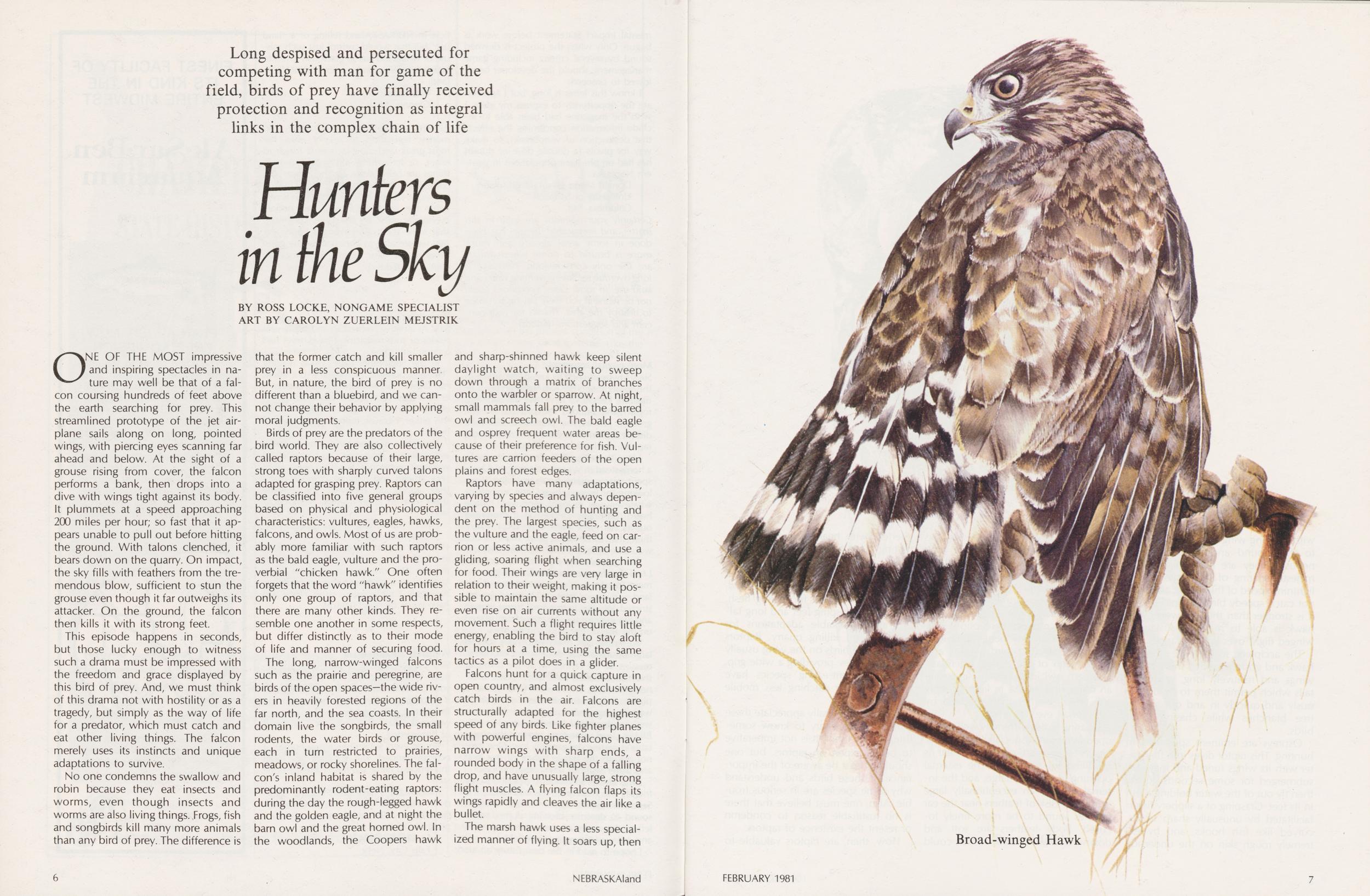
Long despised and persecuted for competing with man for game of the field, birds of prey have finally received protection and recognition as integral links in the complex chain of life
Hunters in the Sky
ONE OF THE MOST impressive and inspiring spectacles in nature may well be that of a falcon coursing hundreds of feet above the earth searching for prey. This streamlined prototype of the jet airplane sails along on long, pointed wings, with piercing eyes scanning far ahead and below. At the sight of a grouse rising from cover, the falcon performs a bank, then drops into a dive with wings tight against its body. It plummets at a speed approaching 200 miles per hour; so fast that it appears unable to pull out before hitting the ground. With talons clenched, it bears down on the quarry. On impact, the sky fills with feathers from the tremendous blow, sufficient to stun the grouse even though it far outweighs its attacker. On the ground, the falcon then kills it with its strong feet.
This episode happens in seconds, but those lucky enough to witness such a drama must be impressed with the freedom and grace displayed by this bird of prey. And, we must think of this drama not with hostility or as a tragedy, but simply as the way of life for a predator, which must catch and eat other living things. The falcon merely uses its instincts and unique adaptations to survive.
No one condemns the swallow and robin because they eat insects and worms, even though insects and worms are also living things. Frogs, fish and songbirds kill many more animals than any bird of prey. The difference is that the former catch and kill smaller prey in a less conspicuous manner. But, in nature, the bird of prey is no different than a bluebird, and we cannot change their behavior by applying moral judgments.
Birds of prey are the predators of the bird world. They are also collectively called raptors because of their large, strong toes with sharply curved talons adapted for grasping prey. Raptors can be classified into five general groups based on physical and physiological characteristics: vultures, eagles, hawks, falcons, and owls. Most of us are probably more familiar with such raptors as the bald eagle, vulture and the proverbial "chicken hawk." One often forgets that the word "hawk" identifies only one group of raptors, and that there are many other kinds. They resemble one another in some respects, but differ distinctly as to their mode of life and manner of securing food.
The long, narrow-winged falcons such as the prairie and peregrine, are birds of the open spaces-the wide rivers in heavily forested regions of the far north, and the sea coasts. In their domain live the songbirds, the small rodents, the water birds or grouse, each in turn restricted to prairies, meadows, or rocky shorelines. The falcon's inland habitat is shared by the predominantly rodent-eating raptors: during the day the rough-legged hawk and the golden eagle, and at night the barn owl and the great horned owl. In the woodlands, the Coopers hawk and sharp-shinned hawk keep silent daylight watch, waiting to sweep down through a matrix of branches onto the warbler or sparrow. At night, small mammals fall prey to the barred owl and screech owl. The bald eagle and osprey frequent water areas because of their preference for fish. Vultures are carrion feeders of the open plains and forest edges.
Raptors have many adaptations, varying by species and always dependent on the method of hunting and the prey. The largest species, such as the vulture and the eagle, feed on carrion or less active animals, and use a gliding, soaring flight when searching for food. Their wings are very large in relation to their weight, making it possible to maintain the same altitude or even rise on air currents without any movement. Such a flight requires little energy, enabling the bird to stay aloft for hours at a time, using the same tactics as a pilot does in a glider.
Falcons hunt for a quick capture in open country, and almost exclusively catch birds in the air. Falcons are structurally adapted for the highest speed of any birds. Like fighter planes with powerful engines, falcons have narrow wings with sharp ends, a rounded body in the shape of a falling drop, and have unusually large, strong flight muscles. A flying falcon flaps its wings rapidly and cleaves the air like a bullet.
The marsh hawk uses a less specialized manner of flying. It soars up, then
6 NEBRASKAlandBroad-winged Hawk
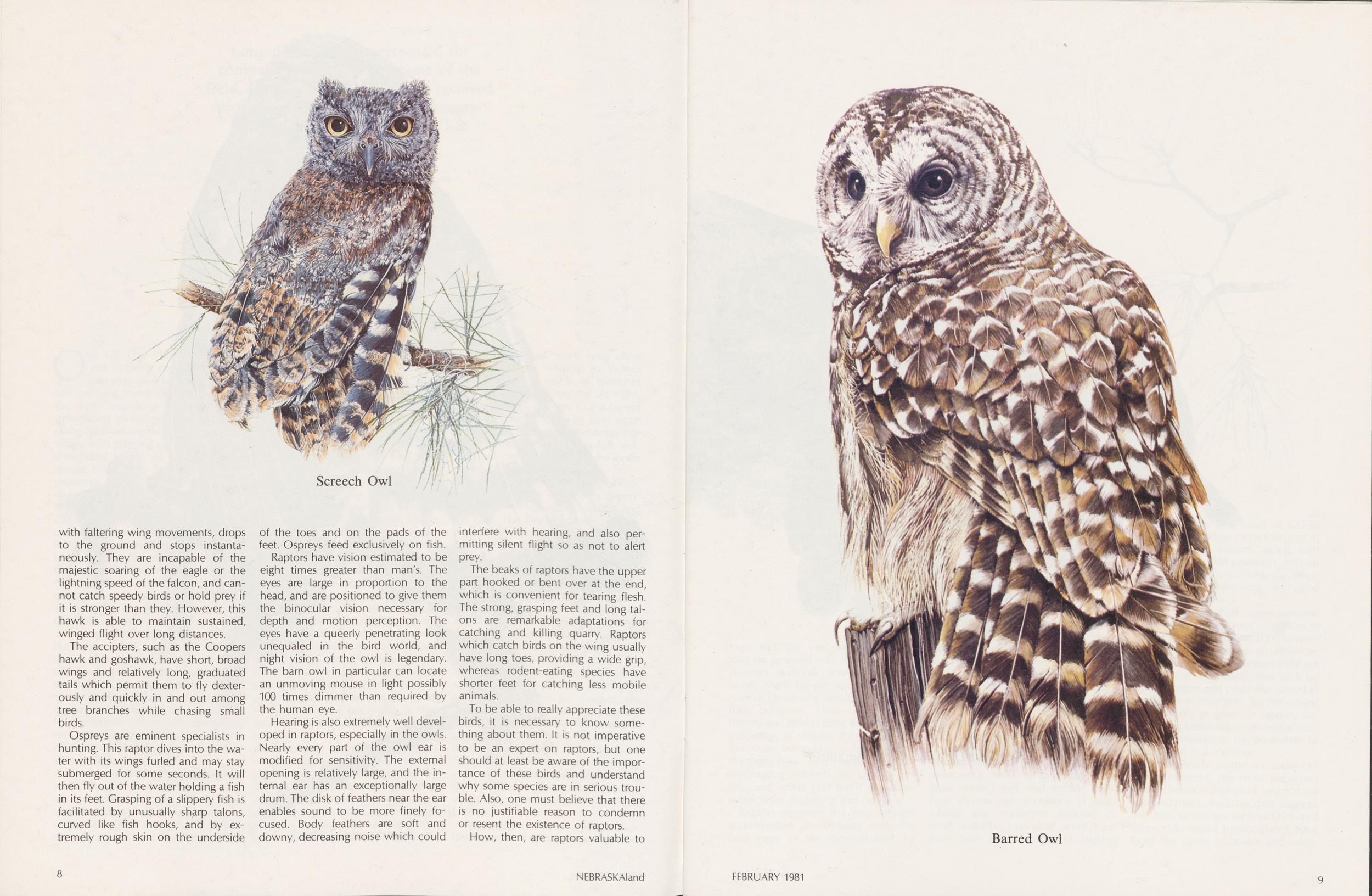
Screech Owl
with faltering wing movements, drops to the ground and stops instantaneously. They are incapable of the majestic soaring of the eagle or the lightning speed of the falcon, and cannot catch speedy birds or hold prey if it is stronger than they. However, this hawk is able to maintain sustained, winged flight over long distances.
The accipters, such as the Coopers hawk and goshawk, have short, broad wings and relatively long, graduated tails which permit them to fly dexterously and quickly in and out among tree branches while chasing small birds.
Ospreys are eminent specialists in hunting. This raptor dives into the water with its wings furled and may stay submerged for some seconds. It will then fly out of the water holding a fish in its feet. Grasping of a slippery fish is facilitated by unusually sharp talons, curved like fish hooks, and by extremely rough skin on the underside of the toes and on the pads of the feet. Ospreys feed exclusively on fish.
Raptors have vision estimated to be eight times greater than man's. The eyes are large in proportion to the head, and are positioned to give them the binocular vision necessary for depth and motion perception. The eyes have a queerly penetrating look unequaled in the bird worid, and night vision of the owl is legendary. The barn owl in particular can locate an unmoving mouse in light possibly 100 times dimmer than required by the human eye.
Hearing is also extremely well developed in raptors, especially in the owls. Nearly every part of the owl ear is modified for sensitivity. The external opening is relatively large, and the internal ear has an exceptionally large drum. The disk of feathers near the ear enables sound to be more finely focused. Body feathers are soft and downy, decreasing noise which could interfere with hearing, and also permitting silent flight so as not to alert prey.
The beaks of raptors have the upper part hooked or bent over at the end, which is convenient for tearing flesh. The strong, grasping feet and long talons are remarkable adaptations for catching and killing quarry. Raptors which catch birds on the wing usually have long toes, providing a wide grip, whereas rodent-eating species have shorter feet for catching less mobile animals.
To be able to really appreciate these birds, it is necessary to know something about them. It is not imperative to be an expert on raptors, but one should at least be aware of the importance of these birds and understand why some species are in serious trouble. Also, one must believe that there is no justifiable reason to condemn or resent the existence of raptors.
How, then, are raptors valuable to
8 NEBRASKAlandBarred Owl
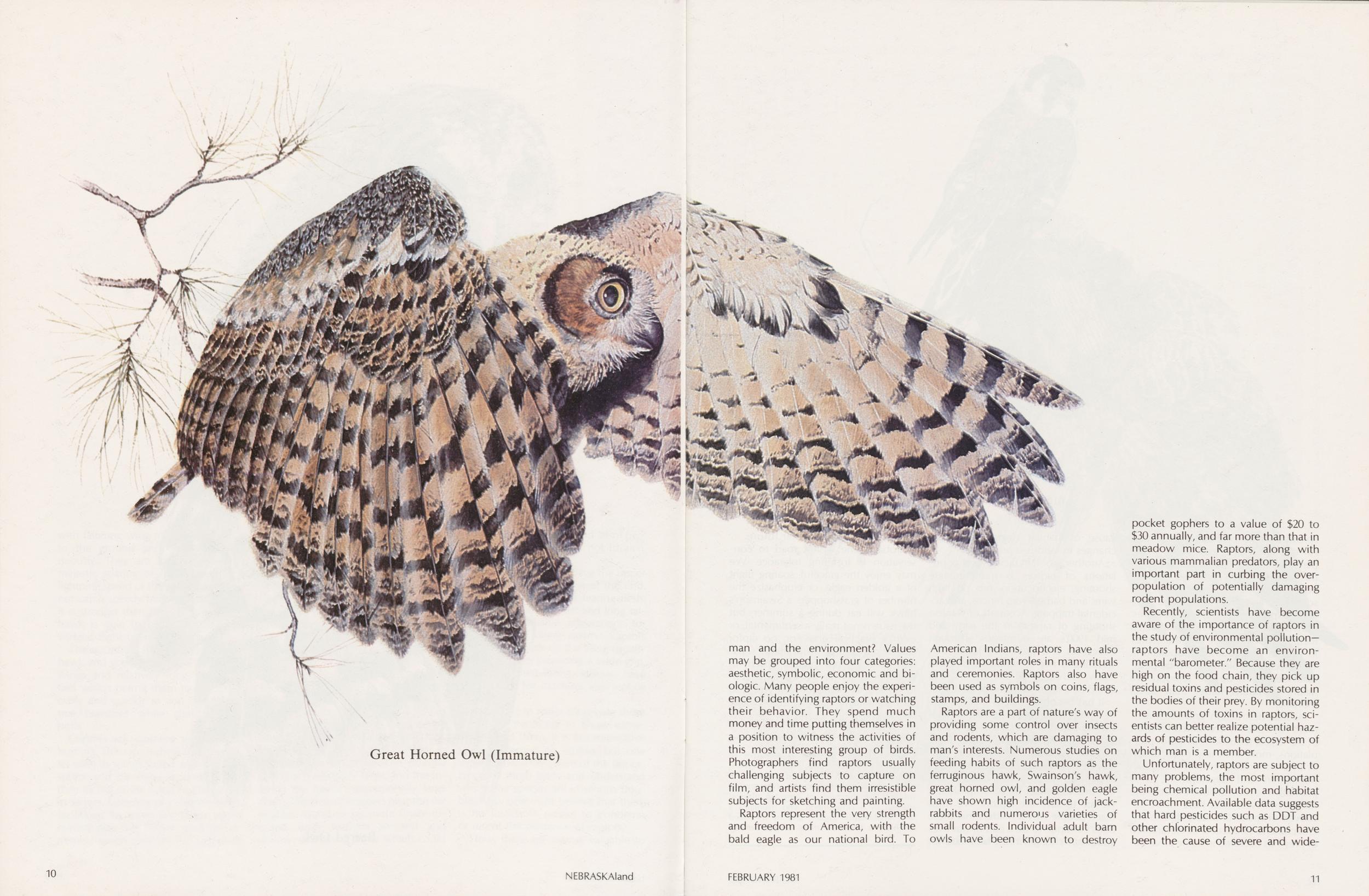
Great Horned Owl (Immature)
man and the environment? Values may be grouped into four categories: aesthetic, symbolic, economic and biologic. Many people enjoy the experience of identifying raptors or watching their behavior. They spend much money and time putting themselves in a position to witness the activities of this most interesting group of birds. Photographers find raptors usually challenging subjects to capture on film, and artists find them irresistible subjects for sketching and painting.
Raptors represent the very strength and freedom of America, with the bald eagle as our national bird. To American Indians, raptors have also played important roles in many rituals and ceremonies. Raptors also have been used as symbols on coins, flags, stamps, and buildings.
Raptors are a part of nature's way of providing some control over insects and rodents, which are damaging to man's interests. Numerous studies on feeding habits of such raptors as the ferruginous hawk, Swainson's hawk, great horned owl, and golden eagle have shown high incidence of jackrabbits and numero'js varieties of small rodents. Individual adult barn owls have been known to destroy pocket gophers to a value of $20 to $30 annually, and far more than that in meadow mice. Raptors, along with various mammalian predators, play an important part in curbing the over population of potentially damaging rodent populations.
Recently, scientists have become aware of the importance of raptors in the study of environmental pollution - raptors have become an environmental "barometer." Because they are high on the food chain, they pick up residual toxins and pesticides stored in the bodies of their prey. By monitoring the amounts of toxins in raptors, scientists can better realize potential hazards of pesticides to the ecosystem of which man is a member.
Unfortunately, raptors are subject to many problems, the most important being chemical pollution and habitat encroachment. Available data suggests that hard pesticides such as DDT and other chlorinated hydrocarbons have been the cause of severe and widespread
FEBRUARY 1981 11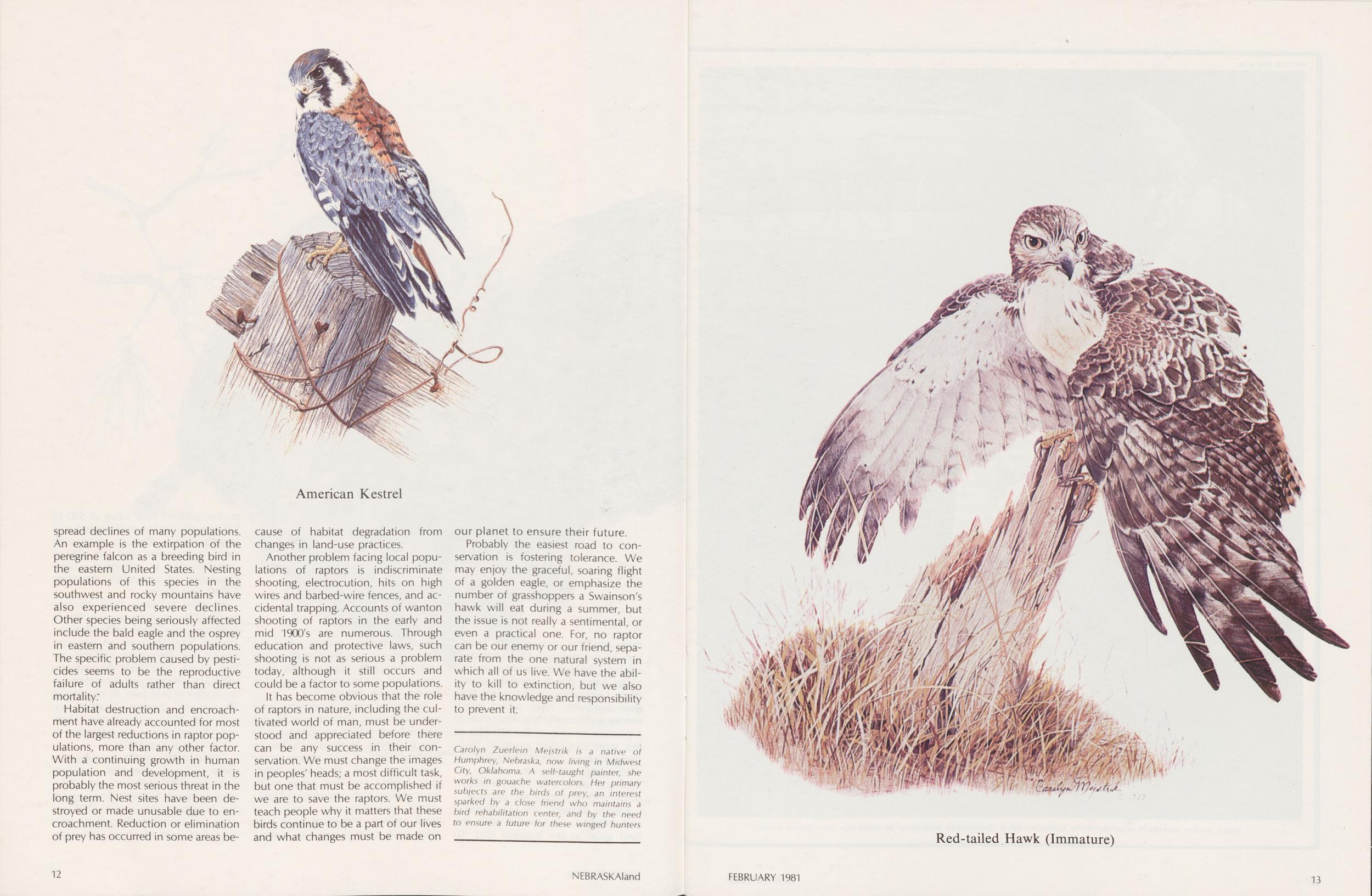
American Kestrel
declines of many populations. An example is the extirpation of the peregrine falcon as a breeding bird in the eastern United States. Nesting populations of this species in the southwest and rocky mountains have also experienced severe declines. Other species being seriously affected include the bald eagle and the osprey in eastern and southern populations. The specific problem caused by pesticides seems to be the reproductive failure of adults rather than direct mortality.
Habitat destruction and encroachment have already accounted for most of the largest reductions in raptor populations, more than any other factor. With a continuing growth in human population and development, it is probably the most serious threat in the long term. Nest sites have been destroyed or made unusable due to encroachment. Reduction or elimination of prey has occurred in some areas because of habitat degradation from changes in land-use practices.
Another problem facing local populations of raptors is indiscriminate shooting, electrocution, hits on high wires and barbed-wire fences, and accidental trapping. Accounts of wanton shooting of raptors in the early and mid 1900's are numerous. Through education and protective laws, such shooting is not as serious a problem today, although it still occurs and could be a factor to some populations.
It has become obvious that the role of raptors in nature, including the cultivated world of man, must be understood and appreciated before there can be any success in their conservation. We must change the images in peoples' heads; a most difficult task, but one that must be accomplished if we are to save the raptors. We must teach people why it matters that these birds continue to be a part of our lives and what changes must be made on our planet to ensure their future.
Probably the easiest road to conservation is fostering tolerance. We may enjoy the graceful, soaring flight of a golden eagle, or emphasize the number of grasshoppers a Swainson's hawk will eat during a summer, but the issue is not really a sentimental, or even a practical one. For, no raptor can be our enemy or our friend, separate from the one natural system in which all of us live. We have the ability to kill to extinction, but we also have the knowledge and responsibility to prevent it.
Carolyn Zuerlein Mejstrik is a native of Humphrey, Nebraska, now living in Midwest City, Oklahoma. A self-taught painter, she works in gouache watercolors. Her primary subjects are the birds of prey, an interest sparked by a close friend who maintains a bird rehabilitation center, and by the need to ensure a future for these winged hunters 12 NEBRASKAlandRed-tailed Hawk (Immature)
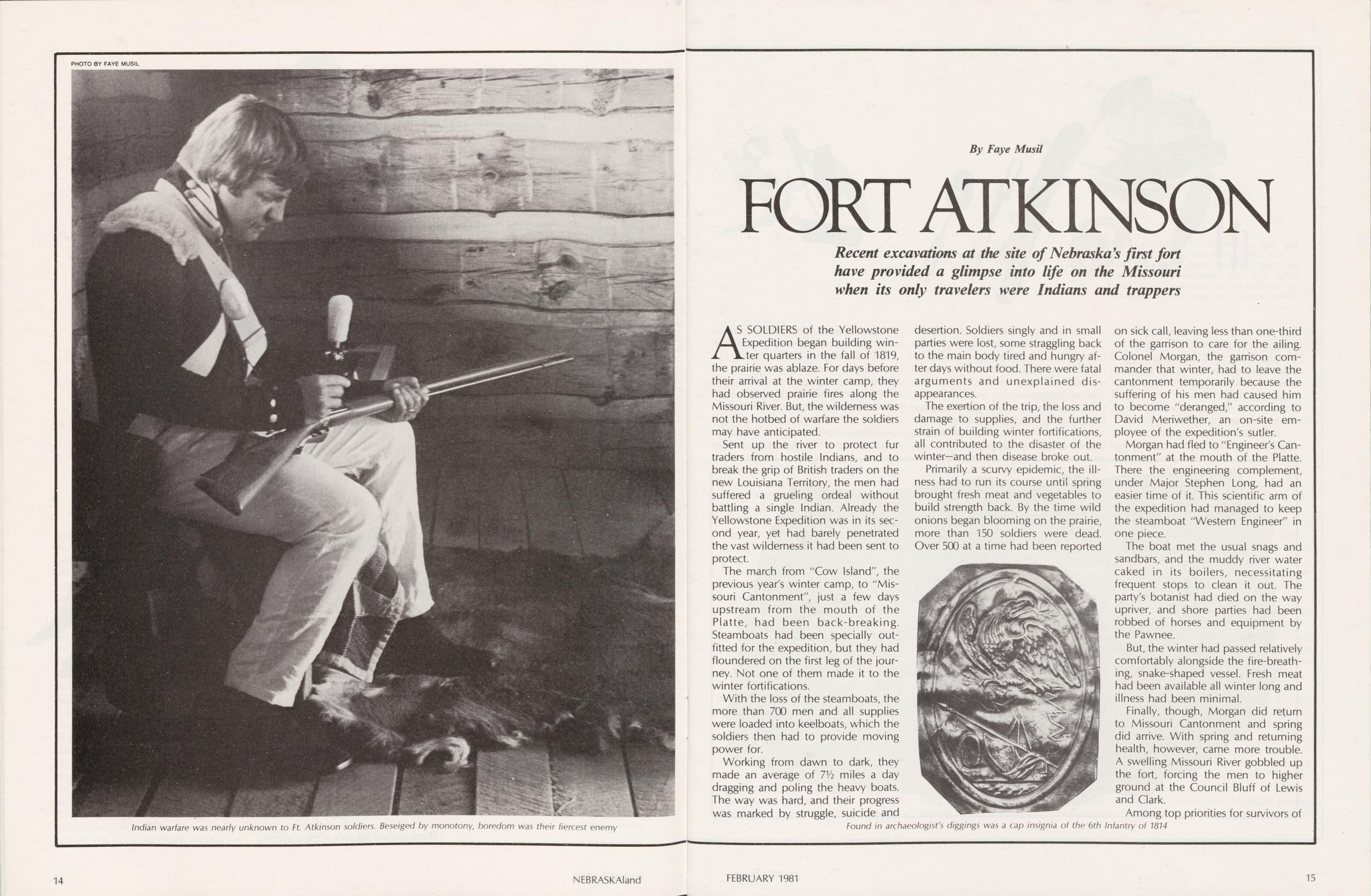
Indian warfare was nearly unknown to Ft Atkinson soldiers. Beseiged by monotony, boredom was their fiercest enemy
FORT ATKINSON
Recent excavations at the site of Nebraska's first fort have provided a glimpse into life on the Missouri when its only travelers were Indians and trappers
AS SOLDIERS of the Yellowstone Expedition began building winter quarters in the fall of 1819, the prairie was ablaze. For days before their arrival at the winter camp, they had observed prairie fires along the Missouri River. But, the wilderness was not the hotbed of warfare the soldiers may have anticipated.
Sent up the river to protect fur traders from hostile Indians, and to break the grip of British traders on the new Louisiana Territory, the men had suffered a grueling ordeal without battling a single Indian. Already the Yellowstone Expedition was in its second year, yet had barely penetrated the vast wilderness it had been sent to protect.
The march from "Cow Island", the previous year's winter camp, to "Missouri Cantonment", just a few days upstream from the mouth of the Platte, had been back-breaking. Steamboats had been specially outfitted for the expedition, but they had floundered on the first leg of the journey. Not one of them made it to the winter fortifications.
With the loss of the steamboats, the more than 700 men and all supplies were loaded into keelboats, which the soldiers then had to provide moving power for.
Working from dawn to dark, they made an average of 7 1/2 miles a day dragging and poling the heavy boats. The way was hard, and their progress was marked by struggle, suicide and desertion. Soldiers singly and in small parties were lost, some straggling back to the main body tired and hungry after days without food. There were fatal arguments and unexplained disappearances.
The exertion of the trip, the loss and damage to supplies, and the further strain of building winter fortifications, all contributed to the disaster of the winter—and then disease broke out.
Primarily a scurvy epidemic, the illness had to run its course until spring brought fresh meat and vegetables to build strength back. By the time wild onions began blooming on the prairie, more than 150 soldiers were dead. Over 500 at a time had been reported
Found in archaeologist's diggings was a cap insignia of the 6th Infantry of 1814
on sick call, leaving less than one-third of the garrison to care for the ailing. Colonel Morgan, the garrison commander that winter, had to leave the cantonment temporarily because the suffering of his men had caused him to become "deranged," according to David Meriwether, an on-site employee of the expedition's sutler.
Morgan had fled to "Engineer's Cantonment" at the mouth of the Platte. There the engineering complement, under Major Stephen Long, had an easier time of it. This scientific arm of the expedition had managed to keep the steamboat "Western Engineer" in one piece.
The boat met the usual snags and sandbars, and the muddy river water caked in its boilers, necessitating frequent stops to clean it out. The party's botanist had died on the way upriver, and shore parties had been robbed of horses and equipment by the Pawnee.
But, the winter had passed relatively comfortably alongside the fire-breathing, snake-shaped vessel. Fresh meat had been available all winter long and illness had been minimal.
Finally, though, Morgan did return to Missouri Cantonment and spring did arrive. With spring and returning health, however, came more trouble. A swelling Missouri River gobbled up the fort, forcing the men to higher ground at the Council Bluff of Lewis and Clark.
Among top priorities for survivors of
FEBRUARY 1981 15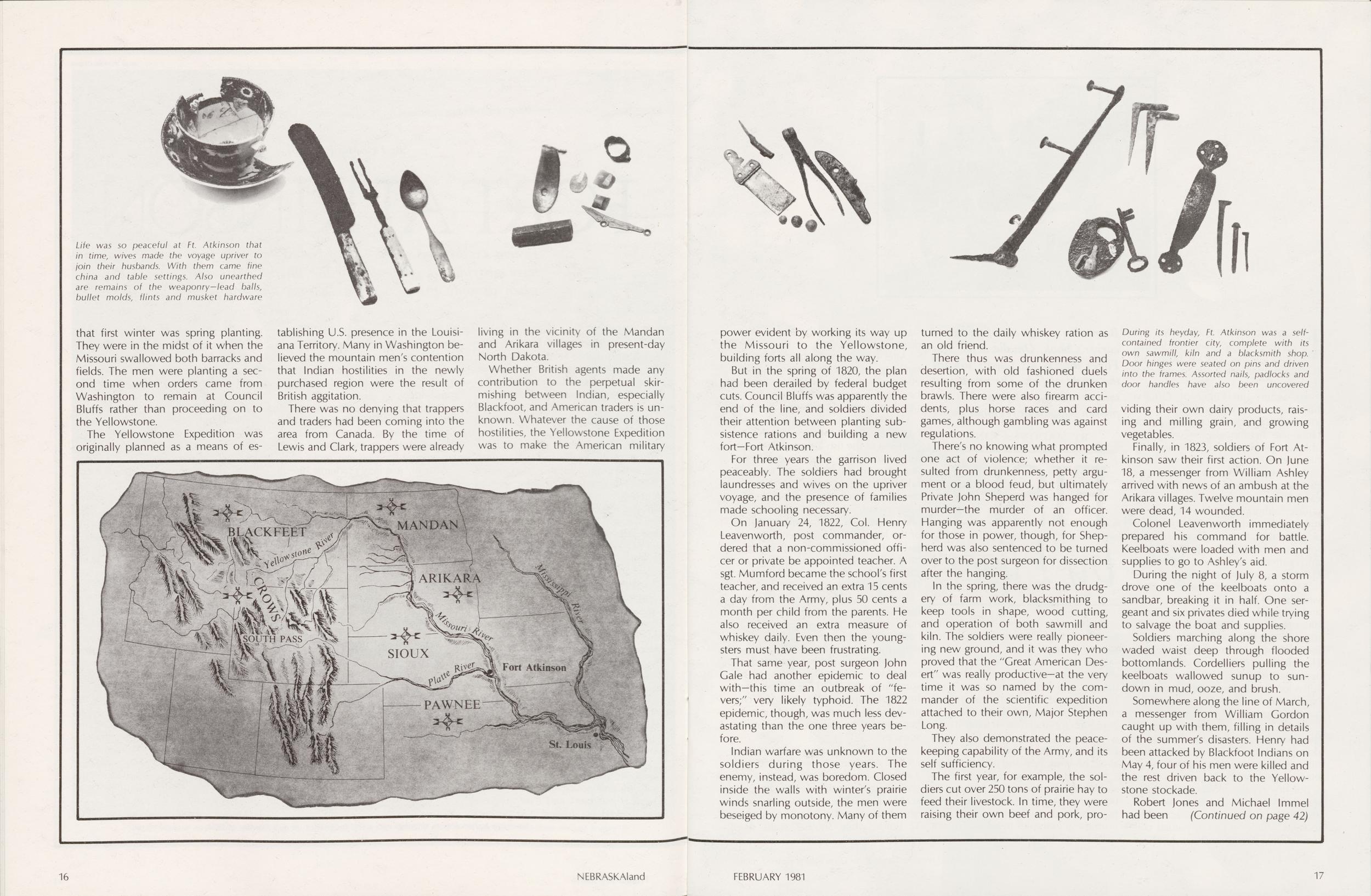
Life was so peaceful at Ft. Atkinson that in time, wives made the voyage upriver to join their husbands. With them came fine china and table settings. Also unearthed are remains of the weaponry—lead balls, bullet molds, flints and musket hardware
that first winter was spring planting. They were in the midst of it when the Missouri swallowed both barracks and fields. The men were planting a second time when orders came from Washington to remain at Council Bluffs rather than proceeding on to the Yellowstone.
The Yellowstone Expedition was originally planned as a means of establishing U.S. presence in the Louisiana Territory. Many in Washington believed the mountain men's contention that Indian hostilities in the newly purchased region were the result of British aggitation.
There was no denying that trappers and traders had been coming into the area from Canada. By the time of Lewis and Clark, trappers were already living in the vicinity of the Mandan and Ankara villages in present-day North Dakota.
Whether British agents made any contribution to the perpetual skirmishing between Indian, especially Blackfoot, and American traders is unknown. Whatever the cause of those hostilities, the Yellowstone Expedition was to make the American military
During its heyday, Ft. Atkinson was a self-contained frontier city, complete with its own sawmill, kiln and a blacksmith shop. Door hinges were seated on pins and driven into the frames. Assorted nails, padlocks and door handles have also been uncovered
power evident by working its way up the Missouri to the Yellowstone, building forts all along the way.
But in the spring of 1820, the plan had been derailed by federal budget cuts. Council Bluffs was apparently the end of the line, and soldiers divided their attention between planting subsistence rations and building a new fort—Lort Atkinson.
For three years the garrison lived peaceably. The soldiers had brought laundresses and wives on the upriver voyage, and the presence of families made schooling necessary.
On January 24, 1822, Col. Henry Leavenworth, post commander, ordered that a non-commissioned officer or private be appointed teacher. A sgt. Mumford became the school's first teacher, and received an extra 15 cents a day from the Army, plus 50 cents a month per child from the parents. He also received an extra measure of whiskey daily. Even then the youngsters must have been frustrating.
That same year, post surgeon John Gale had another epidemic to deal with—this time an outbreak of "fevers;" very likely typhoid. The 1822 epidemic, though, was much less devastating than the one three years before.
Indian warfare was unknown to the soldiers during those years. The enemy, instead, was boredom. Closed inside the walls with winter's prairie winds snarling outside, the men were beseiged by monotony. Many of them turned to the daily whiskey ration as an old friend.
There thus was drunkenness and desertion, with old fashioned duels resulting from some of the drunken brawls. There were also firearm accidents, plus horse races and card games, although gambling was against regulations.
There's no knowing what prompted one act of violence; whether it resulted from drunkenness, petty argument or a blood feud, but ultimately Private John Sheperd was hanged for murder—the murder of an officer. Hanging was apparently not enough for those in power, though, for Shepherd was also sentenced to be turned over to the post surgeon for dissection after the hanging.
In the spring, there was the drudgery of farm work, blacksmithing to keep tools in shape, wood cutting, and operation of both sawmill and kiln. The soldiers were really pioneering new ground, and it was they who proved that the "Great American Desert" was really productive—at the very time it was so named by the commander of the scientific expedition attached to their own, Major Stephen Long.
They also demonstrated the peacekeeping capability of the Army, and its self sufficiency.
The first year, for example, the soldiers cut over 250 tons of prairie hay to feed their livestock. In time, they were raising their own beef and pork, providing their own dairy products, raising and milling grain, and growing vegetables.
Finally, in 1823, soldiers of Fort Atkinson saw their first action. On June 18, a messenger from William Ashley arrived with news of an ambush at the Arikara villages. Twelve mountain men were dead, 14 wounded.
Colonel Leavenworth immediately prepared his command for battle. Keelboats were loaded with men and supplies to go to Ashley's aid. During the night of July 8, a storm drove one of the keelboats onto a sandbar, breaking it in half. One sergeant and six privates died while trying to salvage the boat and supplies.
Soldiers marching along the shore waded waist deep through flooded bottomlands. Cordelliers pulling the keelboats wallowed sunup to sun down in mud, ooze, and brush.
Somewhere along the line of March, a messenger from William Gordon caught up with them, filling in details of the summer's disasters. Henry had been attacked by Blackfoot Indians on May 4, four of his men were killed and the rest driven back to the Yellowstone stockade.
Robert Jones and Michael Immel had been (Continued on page 42)
FEBRUARY 1981 17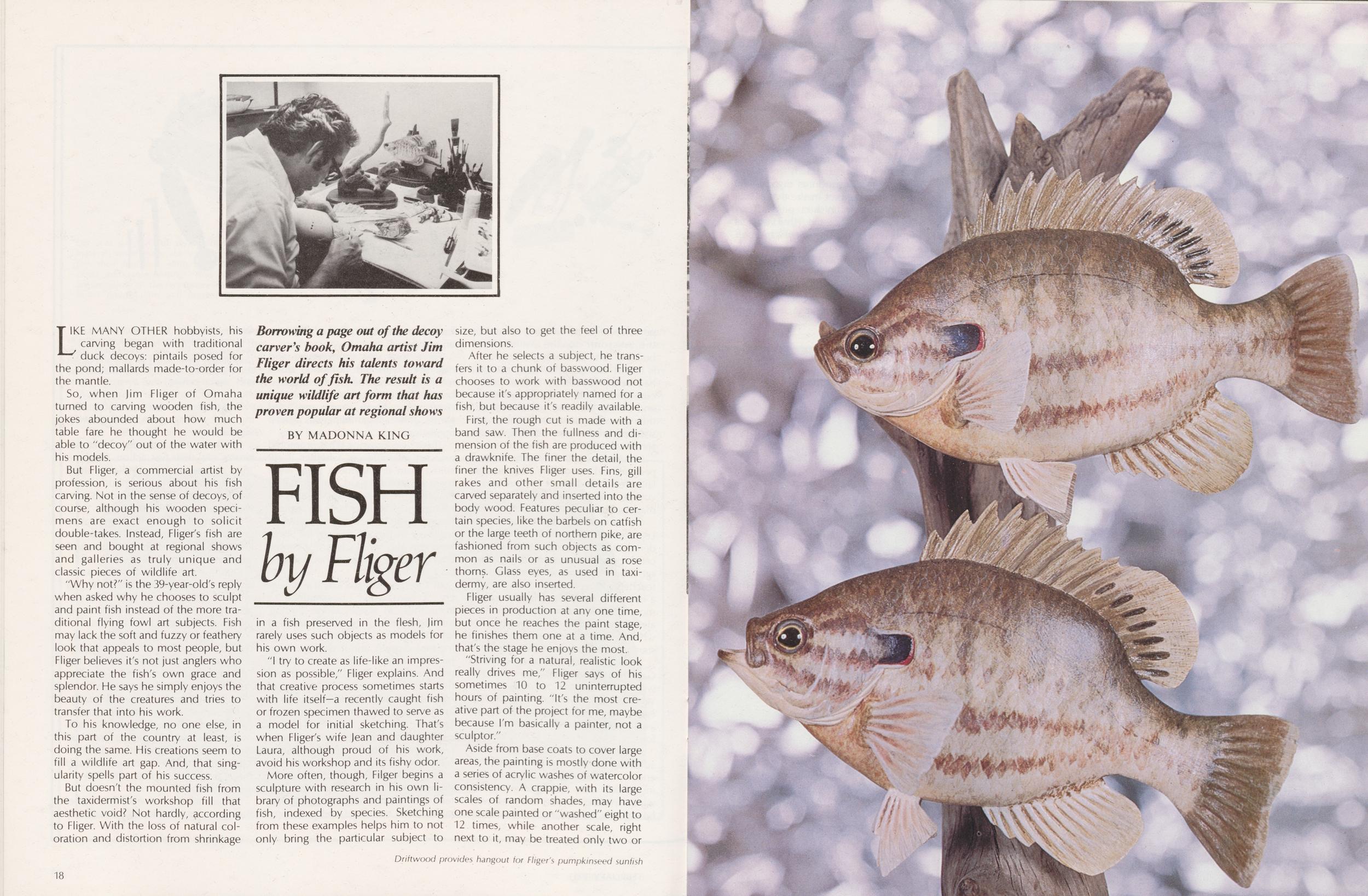
Borrowing a page out of the decoy carver's book, Omaha artist Jim Fliger directs his talents toward the world offish. The result is a unique wildlife art form that has proven popular at regional shows
FISH by Fliger
LIKE MANY OTHER hobbyists, his carving began with traditional duck decoys: pintails posed for the pond; mallards made-to-order for the mantle.
So, when Jim Fliger of Omaha turned to carving wooden fish, the jokes abounded about how much table fare he thought he would be able to "decoy" out of the water with his models.
But Fliger, a commercial artist by profession, is serious about his fish carving. Not in the sense of decoys, of course, although his wooden specimens are exact enough to solicit double-takes. Instead, Fliger's fish are seen and bought at regional shows and galleries as truly unique and classic pieces of wildlife art.
"Why not?" is the 39-year-old's reply when asked why he chooses to sculpt and paint fish instead of the more traditional flying fowl art subjects. Fish may lack the soft and fuzzy or feathery look that appeals to most people, but Fliger believes it's not just anglers who appreciate the fish's own grace and splendor. He says he simply enjoys the beauty of the creatures and tries to transfer that into his work.
To his knowledge, no one else, in this part of the country at least, is doing the same. His creations seem to fill a wildlife art gap. And, that singularity spells part of his success.
But doesn't the mounted fish from the taxidermist's workshop fill that aesthetic void? Not hardly, according to Fliger. With the loss of natural coloration and distortion from shrinkage in a fish preserved in the flesh, Jim rarely uses such objects as models for his own work.
"I try to create as life-like an impression as possible," Fliger explains. And that creative process sometimes starts with life itself-a recently caught fish or frozen specimen thawed to serve as a model for initial sketching. That's when Fliger's wife Jean and daughter Laura, although proud of his work, avoid his workshop and its fishy odor.
More often, though, Filger begins a sculpture with research in his own library of photographs and paintings of fish, indexed by species. Sketching from these examples helps him to not only bring the particular subject to size, but also to get the feel of three dimensions.
After he selects a subject, he transfers it to a chunk of basswood. Fliger chooses to work with basswood not because it's appropriately named for a fish, but because it's readily available.
First, the rough cut is made with a band saw. Then the fullness and dimension of the fish are produced with a drawknife. The finer the detail, the finer the knives Fliger uses. Fins, gill rakes and other small details are carved separately and inserted into the body wood. Features peculiar to certain species, like the barbels on catfish or the large teeth of northern pike, are fashioned from such objects as common as nails or as unusual as rose thorns. Glass eyes, as used in taxidermy, are also inserted.
Fliger usually has several different pieces in production at any one time, but once he reaches the paint stage, he finishes them one at a time. And, that's the stage he enjoys the most.
"Striving for a natural, realistic look really drives me," Fliger says of his sometimes 10 to 12 uninterrupted hours of painting. "It's the most creative part of the project for me, maybe because I'm basically a painter, not a sculptor."
Aside from base coats to cover large areas, the painting is mostly done with a series of acrylic washes of watercolor consistency. A crappie, with its large scales of random shades, may have one scale painted or "washed" eight to 12 times, while another scale, right next to it, may be treated only two or
Driftwood provides hangout for Fliger's pumpkinseed sunfish 18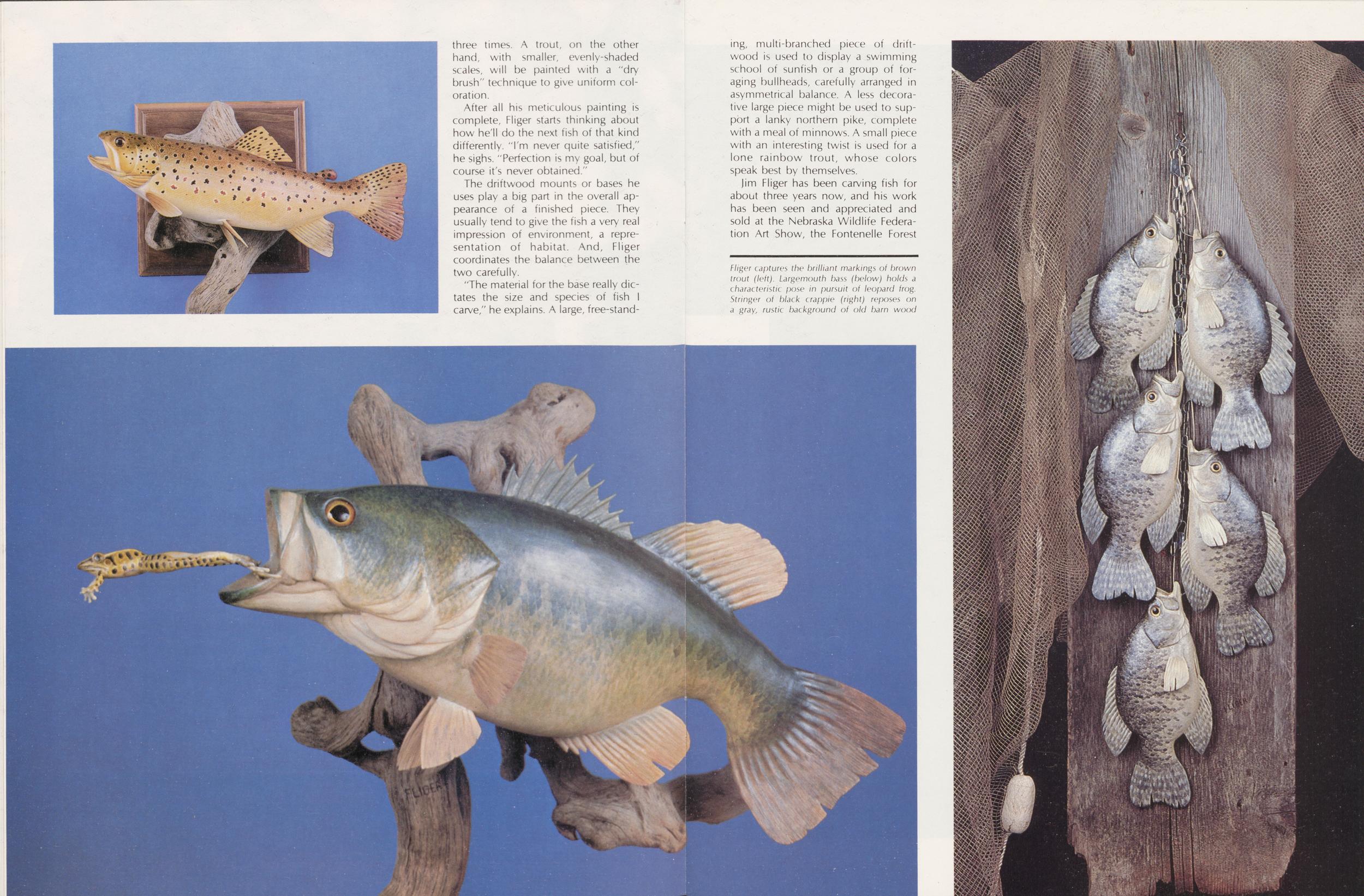
three times. A trout, on the other hand, with smaller, evenly-shaded scales, will be painted with a "dry brush" technique to give uniform coloration.
After all his meticulous painting is complete, Fliger starts thinking about how he'll do the next fish of that kind differently. "I'm never quite satisfied," he sighs. "Perfection is my goal, but of course it's never obtained."
The driftwood mounts or bases he uses play a big part in the overall appearance of a finished piece. They usually tend to give the fish a very real impression of environment, a representation of habitat. And, Fliger coordinates the balance between the two carefully.
"The material for the base really dictates the size and species of fish I carve," he explains. A large, free-standing,
multi-branched piece of driftwood is used to display a swimming school of sunfish or a group of for aging bullheads, carefully arranged in asymmetrical balance. A less decorative large piece might be used to support a lanky northern pike, complete with a meal of minnows. A small piece with an interesting twist is used for a lone rainbow trout, whose colors speak best by themselves.
Jim Fliger has been carving fish for about three years now, and his work has been seen and appreciated and sold at the Nebraska Wildlife Federation Art Show, the Fontenelle Forest
Fliger captures the brilliant markings of brown trout (left). Largemouth bass (below) holds a characteristic pose in pursuit of leopard frog. Stringer of black crappie (right) reposes on a gray, rustic background of old barn wood
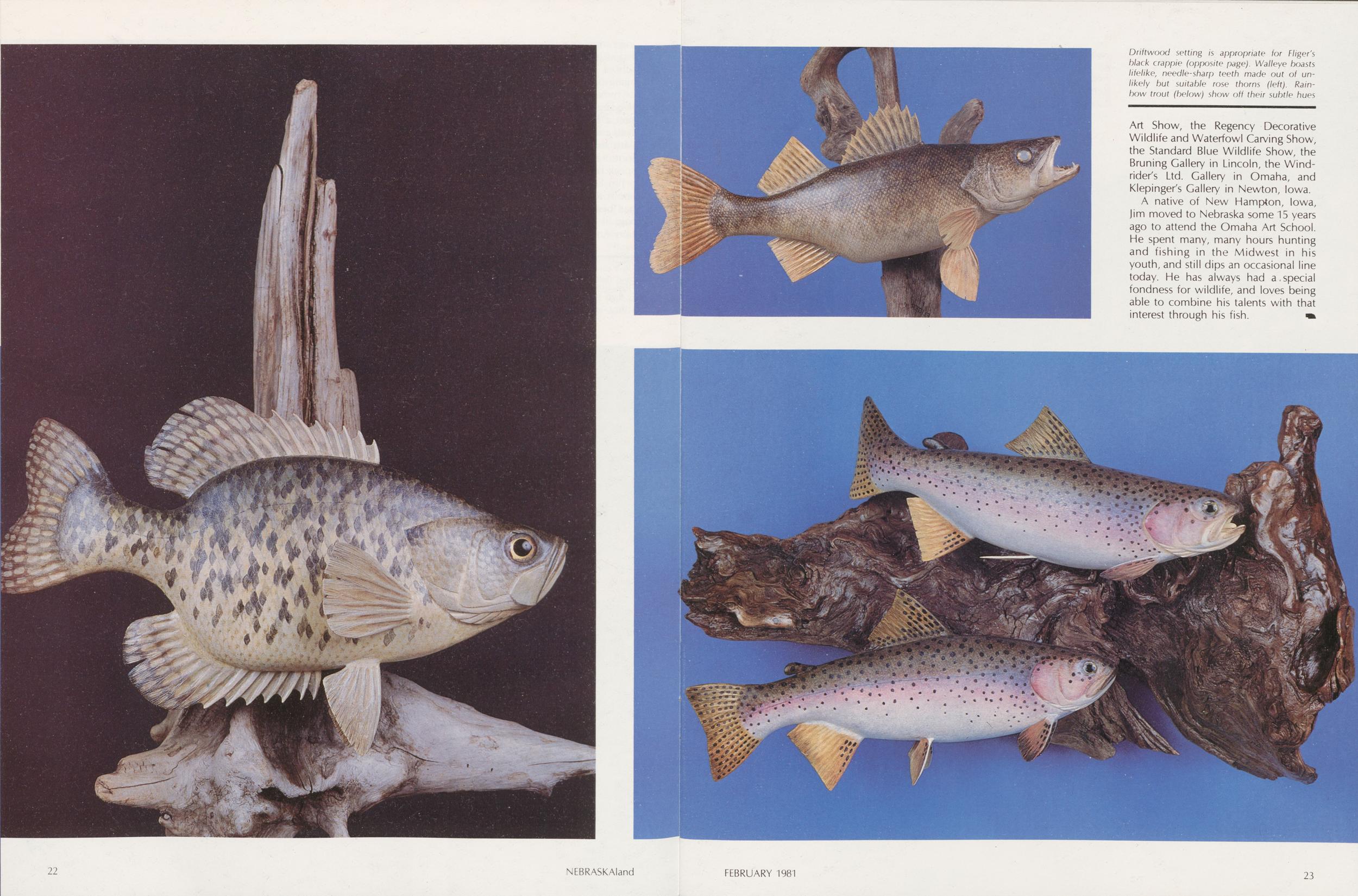
Driftwood setting is appropriate for Fliger's black crappie (opposite page). Walleye boasts lifelike, needle-sharp teeth made out of un likely but suitable rose thorns (left). Rainbow trout (below) show off their subtle hues
Art Show, the Regency Decorative Wildlife and Waterfowl Carving Show, the Standard Blue Wildlife Show, the Bruning Gallery in Lincoln, the Windrider's Ltd. Gallery in Omaha, and Klepinger's Gallery in Newton, Iowa.
A native of New Hampton, Iowa, Jim moved to Nebraska some 15 years ago to attend the Omaha Art School. He spent many, many hours hunting and fishing in the Midwest in his youth, and still dips an occasional line today. He has always had a-special fondness for wildlife, and loves being able to combine his talents with that interest through his fish.
BROOMSTICK PIKE
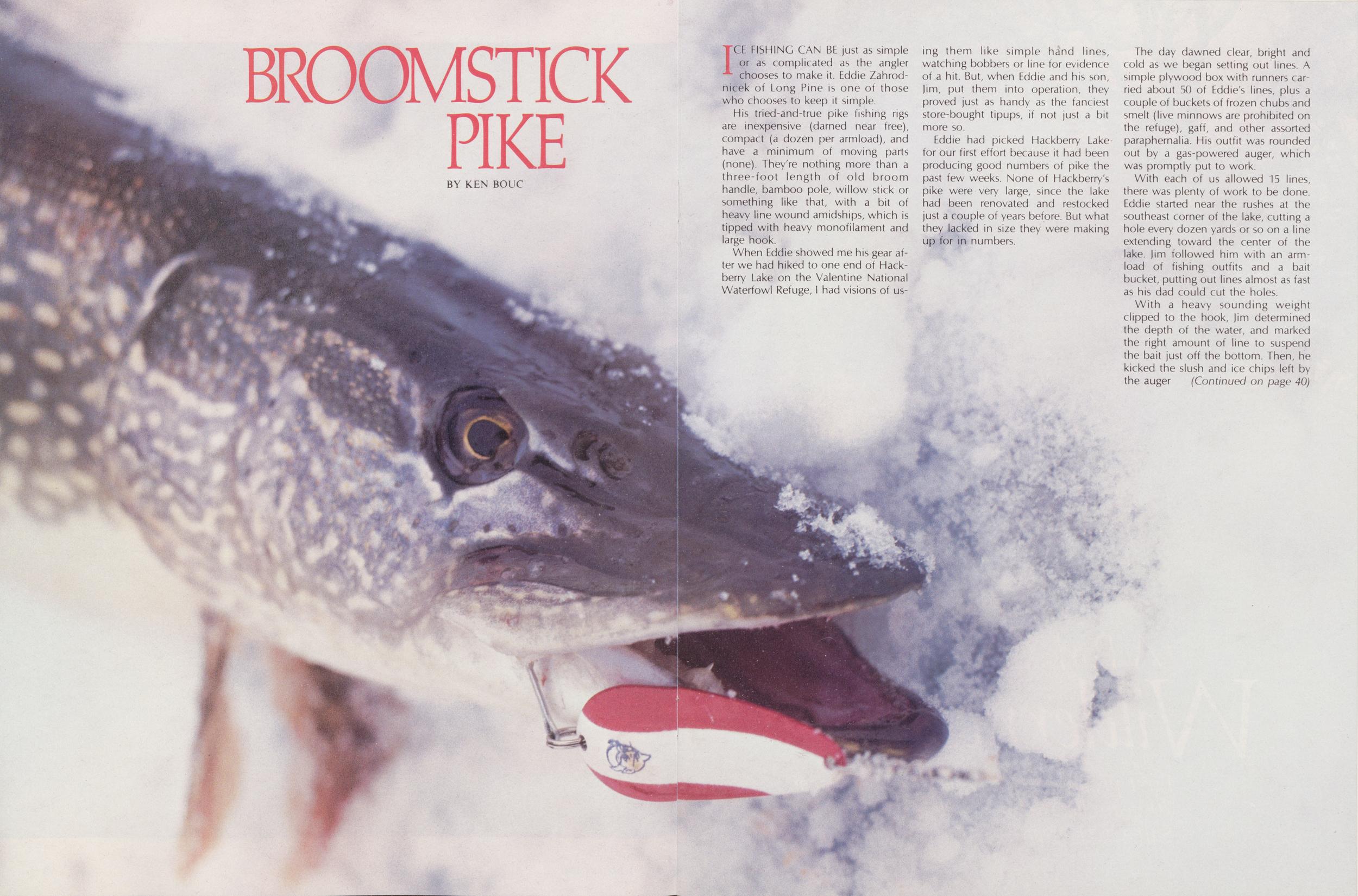
ICE FISHING CAN BE just as simple or as complicated as the angler chooses to make it. Eddie Zahrod nicek of Long Pine is one of those who chooses to keep it simple.
His tried-and-true pike fishing rigs are inexpensive (darned near free), compact (a dozen per armload), and have a minimum of moving parts (none). They're nothing more than a three-foot length of old broom handle, bamboo pole, willow stick or something like that, with a bit of heavy line wound amidships, which is tipped with heavy monofilament and large hook.
When Eddie showed me his gear after we had hiked to one end of Hack berry Lake on the Valentine National Waterfowl Refuge, I had visions of using them like simple hand lines, watching bobbers or line for evidence of a hit. But, when Eddie and his son, Jim, put them into operation, they proved just as handy as the fanciest store-bought tipups, if not just a bit more so.
Eddie had picked Hackberry Lake for our first effort because it had been producing good numbers of pike the past few weeks. None of Hackberry's pike were very large, since the lake had been renovated and restocked just a couple of years before. But what they lacked in size they were making up for in numbers.
The day dawned clear, bright and cold as we began setting out lines. A simple plywood box with runners carried about 50 of Eddie's lines, plus a couple of buckets of frozen chubs and smelt (live minnows are prohibited on the refuge), gaff, and other assorted paraphernalia. His outfit was rounded out by a gas-powered auger, which was promptly put to work.
With each of us allowed 15 lines, there was plenty of work to be done. Eddie started near the rushes at the southeast corner of the lake, cutting a hole every dozen yards or so on a line extending toward the center of the lake. Jim followed him with an armload of fishing outfits and a bait bucket, putting out lines almost as fast as his dad could cut the holes.
With a heavy sounding weight clipped to the hook, Jim determined the depth of the water, and marked the right amount of line to suspend the bait just off the bottom. Then, he kicked the slush and ice chips left by the auger (Continued on page 40)
A Park Called Wilderness
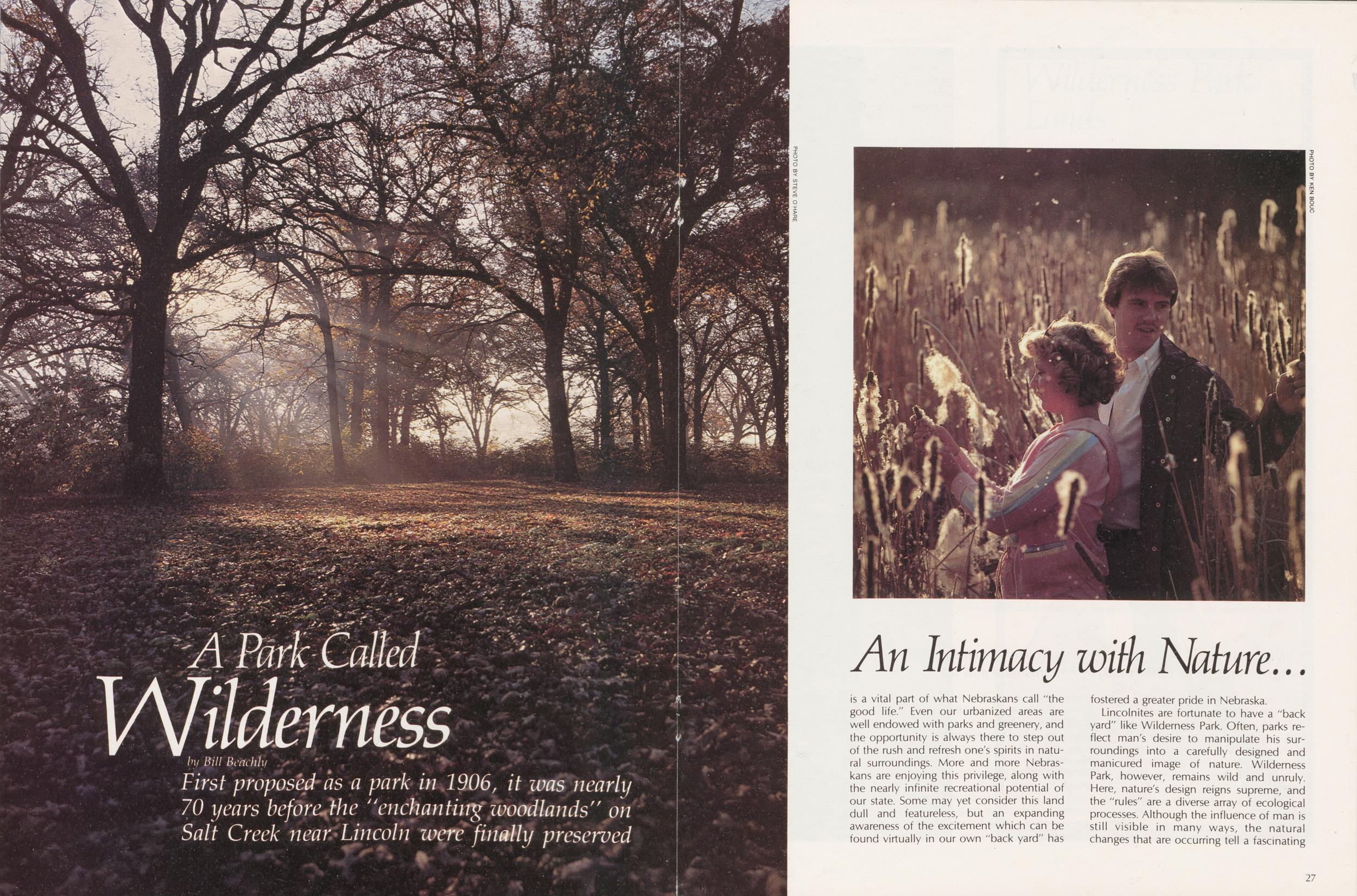
First proposed as a park in 1906, it was nearly 70 years before the "enchanting woodlands" on Salt Creek near Lincoln were finally preserved
An Intimacy with Nature
is a vital part of what Nebraskans call "the good life." Even our urbanized areas are well endowed with parks and greenery, and the opportunity is always there to step out of the rush and refresh one's spirits in natural surroundings. More and more Nebraskans are enjoying this privilege, along with the nearly infinite recreational potential of our state. Some may yet consider this land dull and featureless, but an expanding awareness of the excitement which can be found virtually in our own "back yard" has fostered a greater pride in Nebraska.
Lincolnites are fortunate to have a "back yard" like Wilderness Park. Often, parks reflect man's desire to manipulate his surroundings into a carefully designed and manicured image of nature. Wilderness Park, however, remains wild and unruly. Here, nature's design reigns supreme, and the "rules" are a diverse array of ecological processes. Although the influence of man is still visible in many ways, the natural changes that are occurring tell a fascinating
27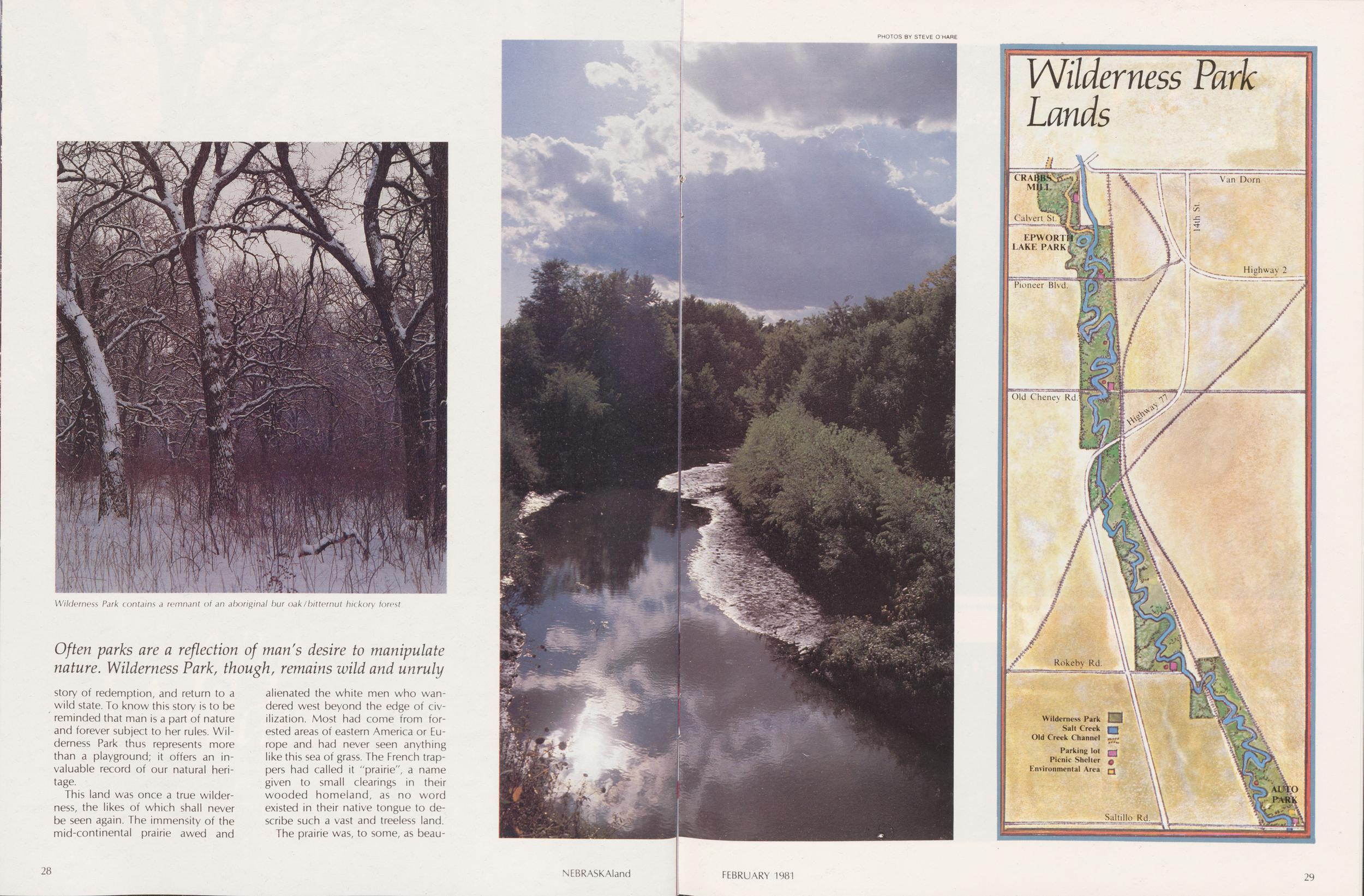
Wilderness Park contains a remnant of an aboriginal bur oak/bitternut hickory forest
story of redemption, and return to a wild state. To know this story is to be reminded that man is a part of nature and forever subject to her rules. Wilderness Park thus represents more than a playground; it offers an in valuable record of our natural heritage.
This land was once a true wilderness, the likes of which shall never be seen again. The immensity of the mid-continental prairie awed and alienated the white men who wandered west beyond the edge of civilization. Most had come from forested areas of eastern America or Europe and had never seen anything like this sea of grass. The French trappers had called it "prairie", a name given to small clearings in their wooded homeland, as no word existed in their native tongue to describe such a vast and treeless land.
The prairie was, to some, as beautiful
28 NEBRASKAland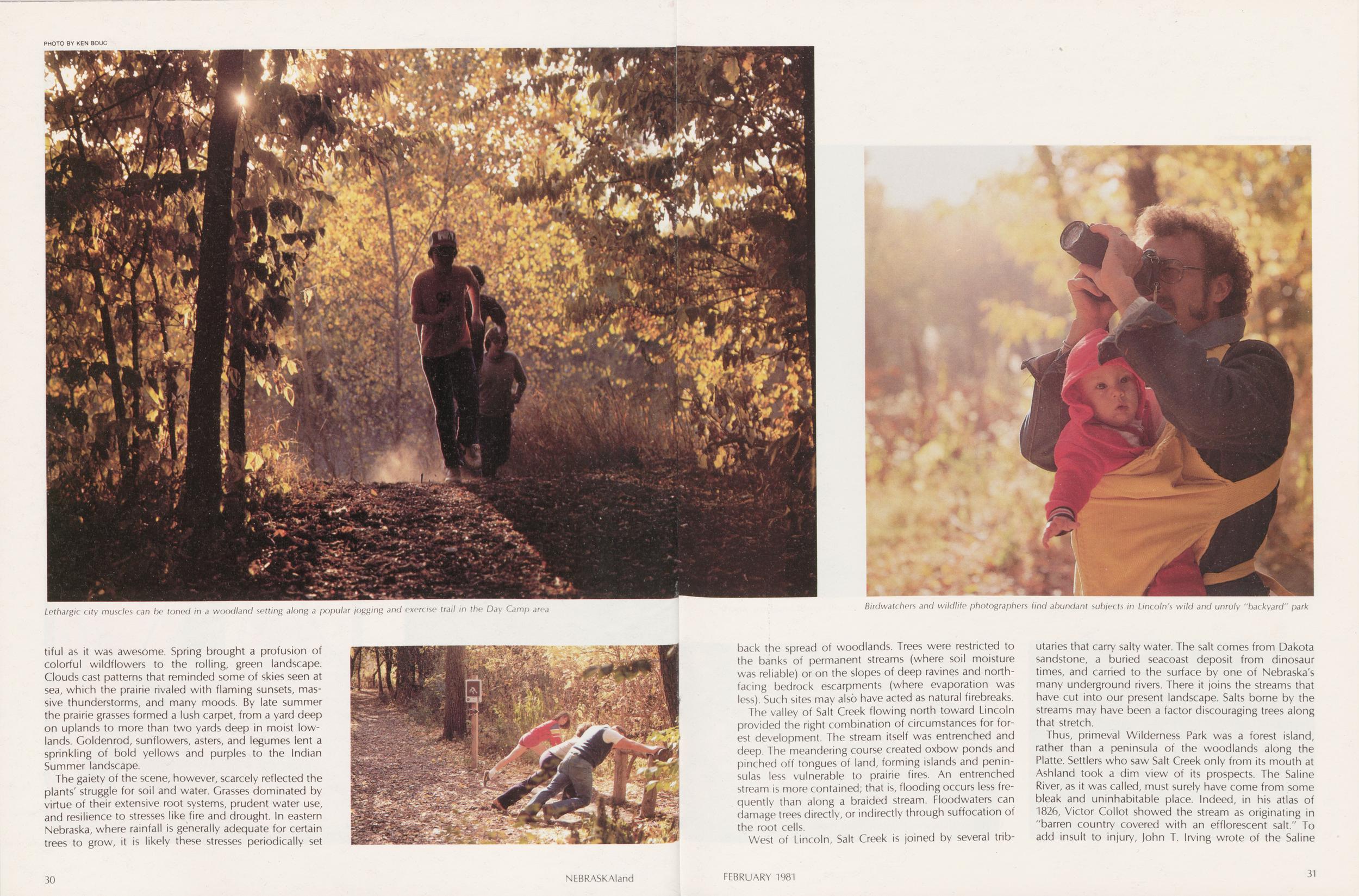
Lethargic city muscles can be toned in a woodland setting along a popular jogging and exercise trail in the Day Camp area
as it was awesome. Spring brought a profusion of colorful wildflowers to the rolling, green landscape. Clouds cast patterns that reminded some of skies seen at sea, which the prairie rivaled with flaming sunsets, massive thunderstorms, and many moods. By late summer the prairie grasses formed a lush carpet, from a yard deep on uplands to more than two yards deep in moist low lands. Goldenrod, sunflowers, asters, and legumes lent a sprinkling of bold yellows and purples to the Indian Summer landscape.
The gaiety of the scene, however, scarcely reflected the plants' struggle for soil and water. Grasses dominated by virtue of their extensive root systems, prudent water use, and resilience to stresses like fire and drought. In eastern Nebraska, where rainfall is generally adequate for certain trees to grow, it is likely these stresses periodically set
Birdwatchers and wildlife photographers find abundant subjects in Lincoln's wild and unruly "backyard" park
back the spread of woodlands. Trees were restricted to the banks of permanent streams (where soil moisture was reliable) or on the slopes of deep ravines and northfacing bedrock escarpments (where evaporation was less). Such sites may also have acted as natural firebreaks.
The valley of Salt Creek flowing north toward Lincoln provided the right combination of circumstances for for est development. The stream itself was entrenched and deep. The meandering course created oxbow ponds and pinched off tongues of land, forming islands and peninsulas less vulnerable to prairie fires. An entrenched stream is more contained; that is, flooding occurs less frequently than along a braided stream. Floodwaters can damage trees directly, or indirectly through suffocation of the root cells.
West of Lincoln, Salt Creek is joined by several tributaries that carry salty water. The salt comes from Dakota sandstone, a buried seacoast deposit from dinosaur times, and carried to the surface by one of Nebraska's many underground rivers. There it joins the streams that have cut into our present landscape. Salts borne by the streams may have been a factor discouraging trees along that stretch.
Thus, primeval Wilderness Park was a forest island, rather than a peninsula of the woodlands along the Platte. Settlers who saw Salt Creek only from its mouth at Ashland took a dim view of its prospects. The Saline River, as it was called, must surely have come from some bleak and uninhabitable place. Indeed, in his atlas of 1826, Victor Collot showed the stream as originating in "barren country covered with an efflorescent salt." To add insult to injury, John T. Irving wrote of the Saline
FEBRUARY 1981 31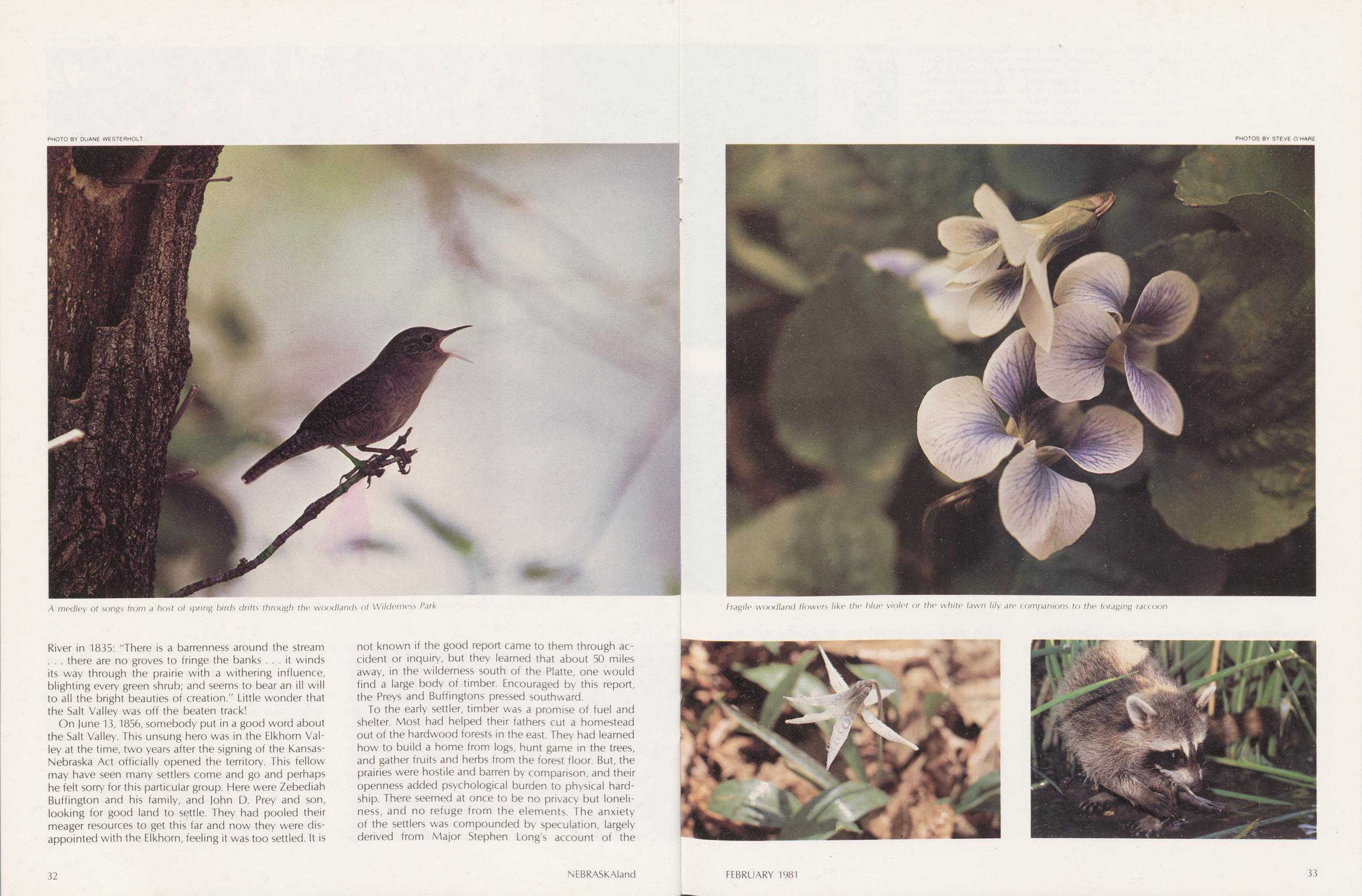
A medley of songs from a host of spring birds drifts through the woodlands of Wilderness Park
River in 1835: "There is a barrenness around the stream there are no groves to fringe the banks it winds its way through the prairie with a withering influence, blighting every green shrub; and seems to bear an ill will to all the bright beauties of creation." Little wonder that the Salt Valley was off the beaten track!
On June 13,1856, somebody put in a good word about the Salt Valley. This unsung hero was in the Elkhorn Valley at the time, two years after the signing of the Kansas-Nebraska Act officially opened the territory. This fellow may have seen many settlers come and go and perhaps he felt sorry for this particular group. Here were Zebediah Buffington and his family, and John D. Prey and son, looking for good land to settle. They had pooled their meager resources to get this far and now they were disappointed with the Elkhorn, feeling it was too settled. It is not known if the good report came to them through accident or inquiry, but they learned that about 50 miles away, in the wilderness south of the Platte, one would find a large body of timber. Encouraged by this report, the Preys and Buffingtons pressed southward.
To the early settler, timber was a promise of fuel and shelter. Most had helped their fathers cut a homestead out of the hardwood forests in the east. They had learned how to build a home from logs, hunt game in the trees, and gather fruits and herbs from the forest floor. But, the prairies were hostile and barren by comparison, and their openness added psychological burden to physical hardship. There seemed at once to be no privacy but loneliness, and no refuge from the elements. The anxiety of the settlers was compounded by speculation, largely derived from Major Stephen Long's account of the
32 NEBRASKAlandFragile woodland flowers like the blue violet or the white fawn lily are companions to the foraging raccoon
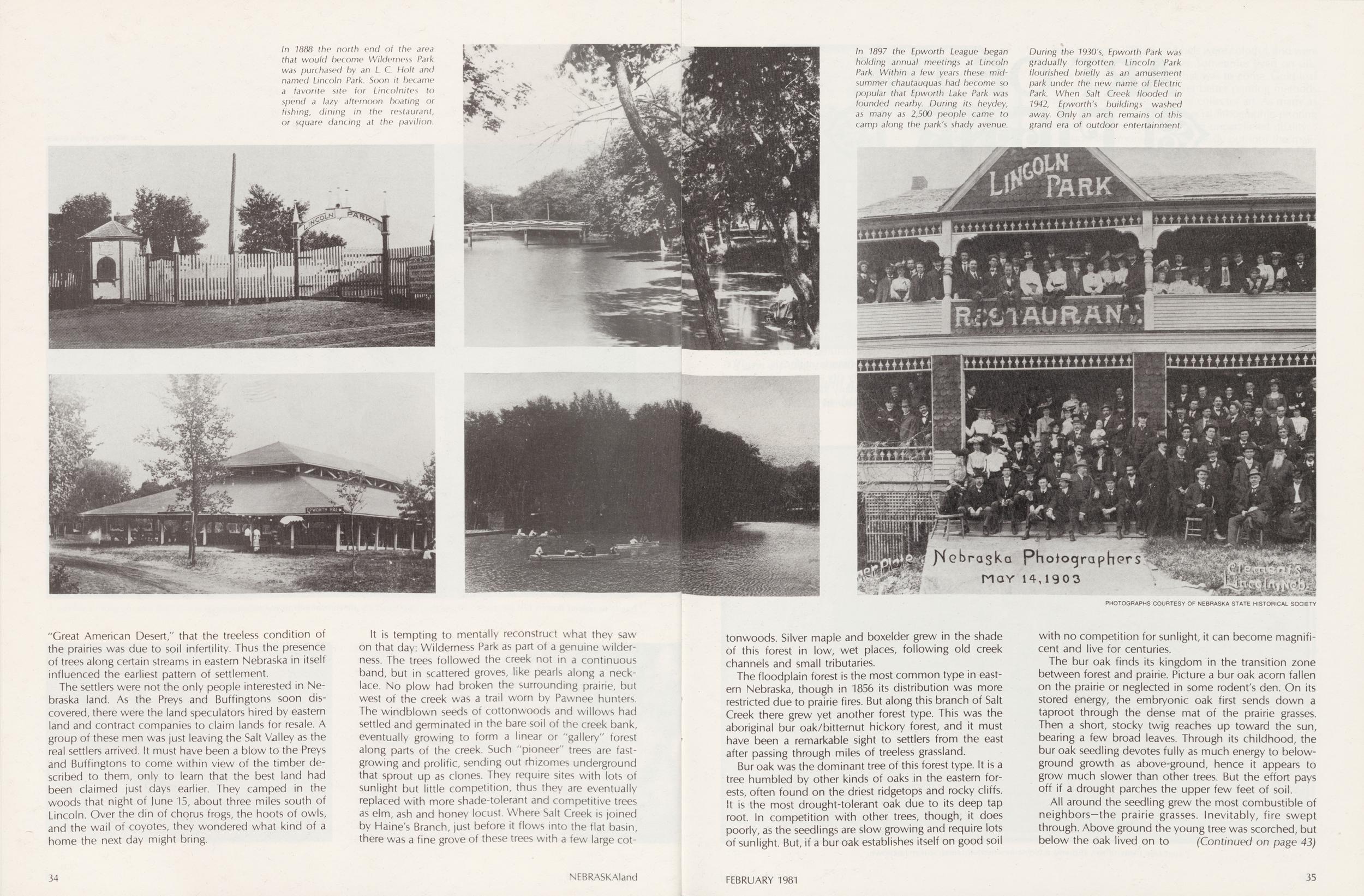
In 1888 the north end of the area that would become Wilderness Park was purchased by an L C. Holt and named Lincoln Park. Soon it became a favorite site for Licolnites to spend a lazy afternoon boating or fishing, dining in the restaurant, or square dancing at the pavilion.
"Great American Desert," that the treeless condition of the prairies was due to soil infertility. Thus the presence of trees along certain streams in eastern Nebraska in itself influenced the earliest pattern of settlement.
The settlers were not the only people interested in Nebraska land. As the Preys and Buffingtons soon discovered, there were the land speculators hired by eastern land and contract companies to claim lands for resale. A group of these men was just leaving the Salt Valley as the real settlers arrived. It must have been a blow to the Preys and Buffingtons to come within view of the timber described to them, only to learn that the best land had been claimed just days earlier. They camped in the woods that night of June 15, about three miles south of Lincoln. Over the din of chorus frogs, the hoots of owls, and the wail of coyotes, they wondered what kind of a home the next day might bring.
It is tempting to mentally reconstruct what they saw on that day: Wilderness Park as part of a genuine wilderness. The trees followed the creek not in a continuous band, but in scattered groves, like pearls along a necklace. No plow had broken the surrounding prairie, but west of the creek was a trail worn by Pawnee hunters. The windblown seeds of cottonwoods and willows had settled and germinated in the bare soil of the creek bank, eventually growing to form a linear or "gallery" forest along parts of the creek. Such "pioneer" trees are fast-growing and prolific, sending out rhizomes underground that sprout up as clones. They require sites with lots of sunlight but little competition, thus they are eventually replaced with more shade-tolerant and competitive trees as elm, ash and honey locust. Where Salt Creek is joined by Haine's Branch, just before it flows into the flat basin, there was a fine grove of these trees with a few large cottonwoods.
34 NEBRASKAlandIn 1897 the Epworth League began holding annual meetings at Lincoln Park. Within a few years these midsummer chautauquas had become so popular that Epworth Lake Park was founded nearby. During its heydey, as many as 2,500 people came to camp along the park's shady avenue.
During the 1930's, Epworth Park was gradually forgotten. Lincoln Park flourished briefly as an amusement park under the new name of Electric Park. When Salt Creek flooded in 1942, Epworth's buildings washed away. Only an arch remains of this grand era of outdoor entertainment.
PHOTOGRAPHS COURTESY OF NEBRASKA STATE HISTORICAL SOCIETYSilver maple and boxelder grew in the shade of this forest in low, wet places, following old creek channels and small tributaries.
The floodplain forest is the most common type in eastern Nebraska, though in 1856 its distribution was more restricted due to prairie fires. But along this branch of Salt Creek there grew yet another forest type. This was the aboriginal bur oak/bitternut hickory forest, and it must have been a remarkable sight to settlers from the east after passing through miles of treeless grassland.
Bur oak was the dominant tree of this forest type. It is a tree humbled by other kinds of oaks in the eastern forests, often found on the driest ridgetops and rocky cliffs. It is the most drought-tolerant oak due to its deep tap root. In competition with other trees, though, it does poorly, as the seedlings are slow growing and require lots of sunlight. But, if a bur oak establishes itself on good soil with no competition for sunlight, it can become magnificent and live for centuries.
The bur oak finds its kingdom in the transition zone between forest and prairie. Picture a bur oak acorn fallen on the prairie or neglected in some rodent's den. On its stored energy, the embryonic oak first sends down a taproot through the dense mat of the prairie grasses. Then a short, stocky twig reaches up toward the sun, bearing a few broad leaves. Through its childhood, the bur oak seedling devotes fully as much energy to below-ground growth as above-ground, hence it appears to grow much slower than other trees. But the effort pays off if a drought parches the upper few feet of soil.
All around the seedling grew the most combustible of neighbors—the prairie grasses. Inevitably, fire swept through. Above ground the young tree was scorched, but below the oak lived on to (Continued on page 43)
FEBRUARY 1981 35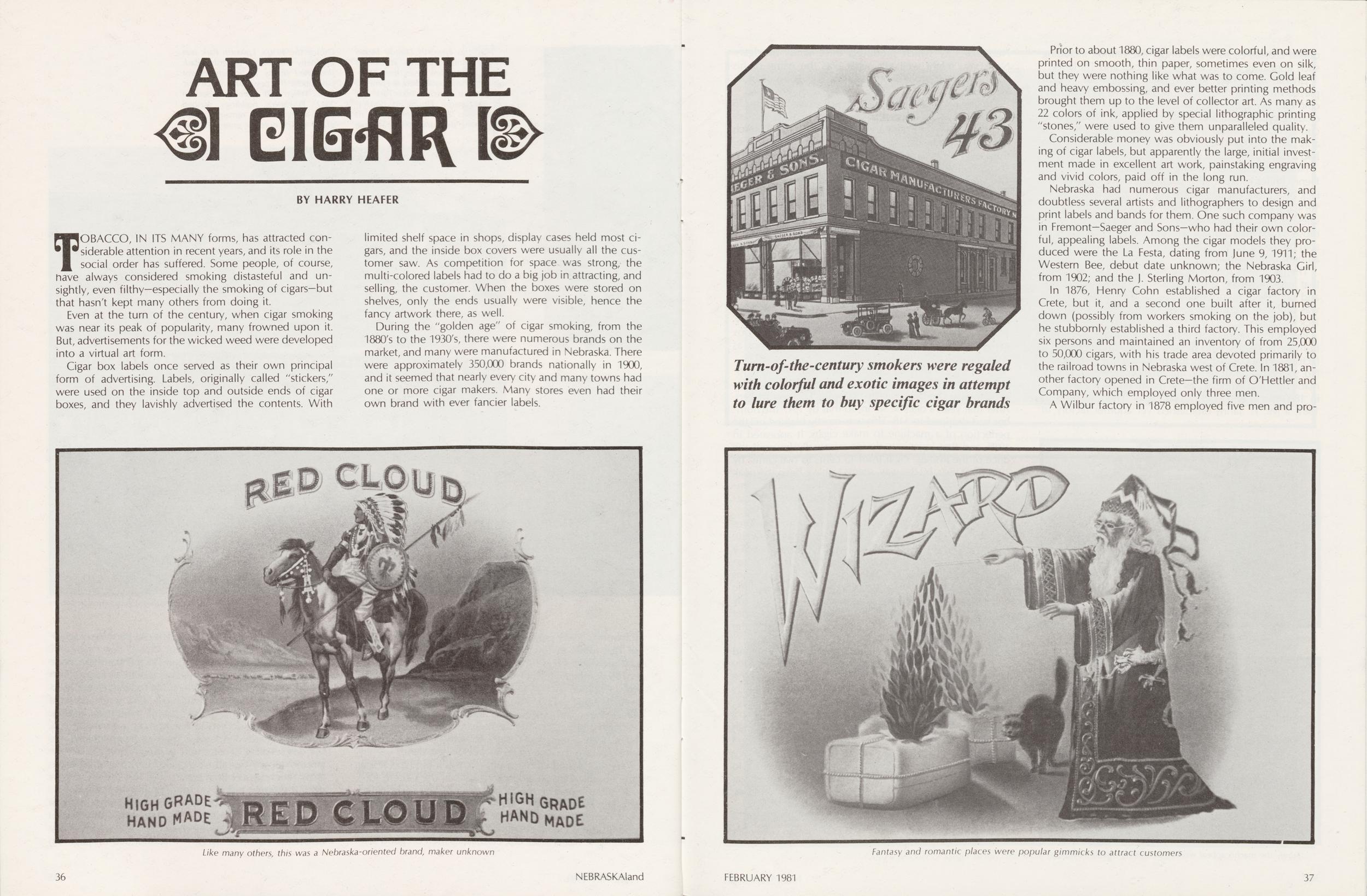
ART OF THE CIGAR
TOBACCO, IN ITS MANY forms, has attracted considerable attention in recent years, and its role in the social order has suffered. Some people, of course, have always considered smoking distasteful and unsightly, even filthy—especially the smoking of cigars—but that hasn't kept many others from doing it.
Even at the turn of the century, when cigar smoking was near its peak of popularity, many frowned upon it. But, advertisements for the wicked weed were developed into a virtual art form.
Cigar box labels once served as their own principal form of advertising. Labels, originally called "stickers," were used on the inside top and outside ends of cigar boxes, and they lavishly advertised the contents. With limited shelf space in shops, display cases held most cigars, and the inside box covers were usually all the customer saw. As competition for space was strong, the multi-colored labels had to do a big job in attracting, and selling, the customer. When the boxes were stored on shelves, only the ends usually were visible, hence the fancy artwork there, as well.
During the "golden age" of cigar smoking, from the 1880's to the 1930's, there were numerous brands on the market, and many were manufactured in Nebraska. There were approximately 350,000 brands nationally in 1900, and it seemed that nearly every city and many towns had one or more cigar makers. Many stores even had their own brand with ever fancier labels.
Like many others, this was a Nebraska-oriented brand, maker unknown
Prior to about 1880, cigar labels were colorful, and were printed on smooth, thin paper, sometimes even on silk, but they were nothing like what was to come. Gold leaf and heavy embossing, and ever better printing methods brought them up to the level of collector art. As many as 22 colors of ink, applied by special lithographic printing "stones," were used to give them unparalleled quality.
Considerable money was obviously put into the making of cigar labels, but apparently the large, initial investment made in excellent art work, painstaking engraving and vivid colors, paid off in the long run.
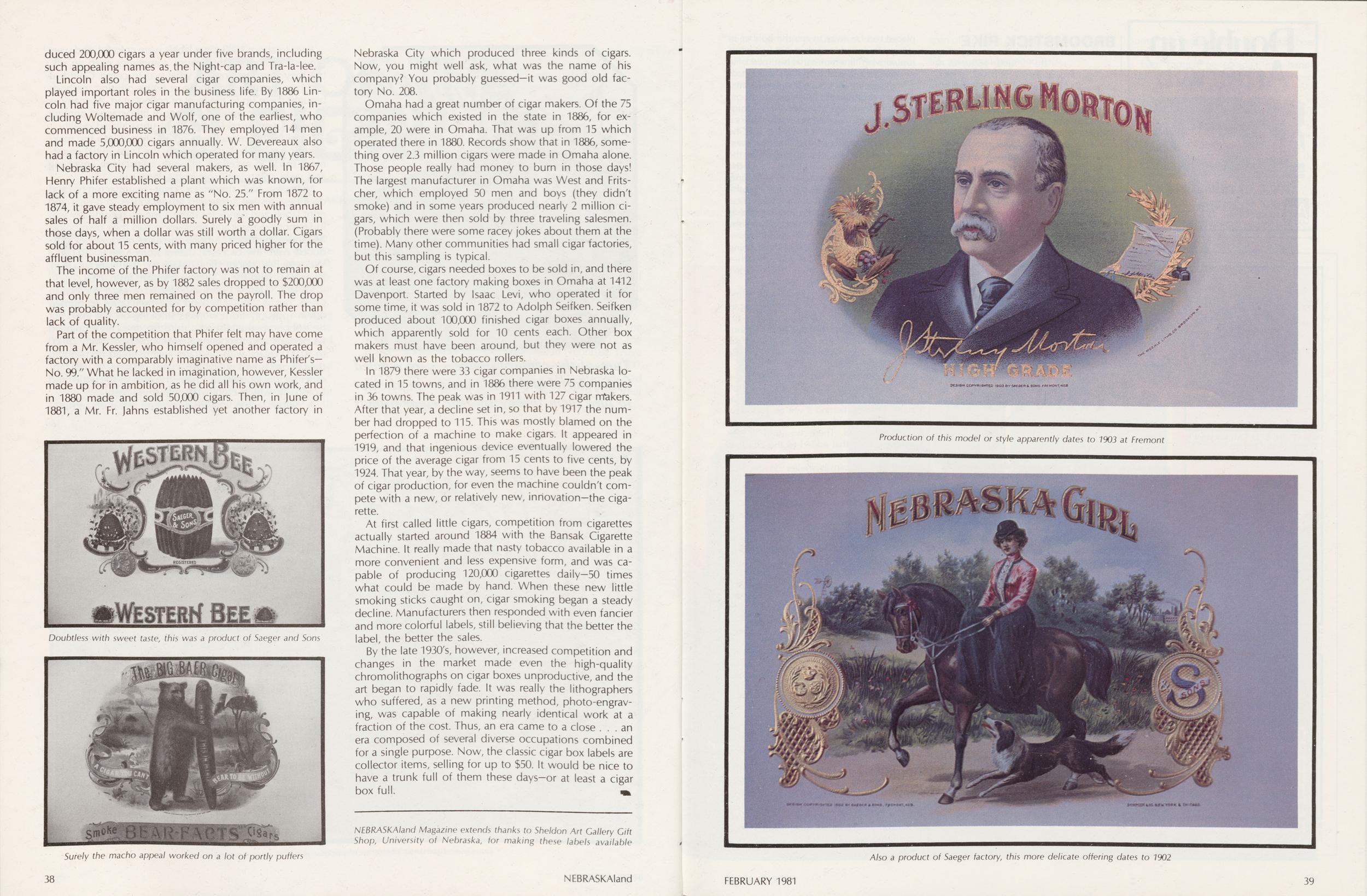
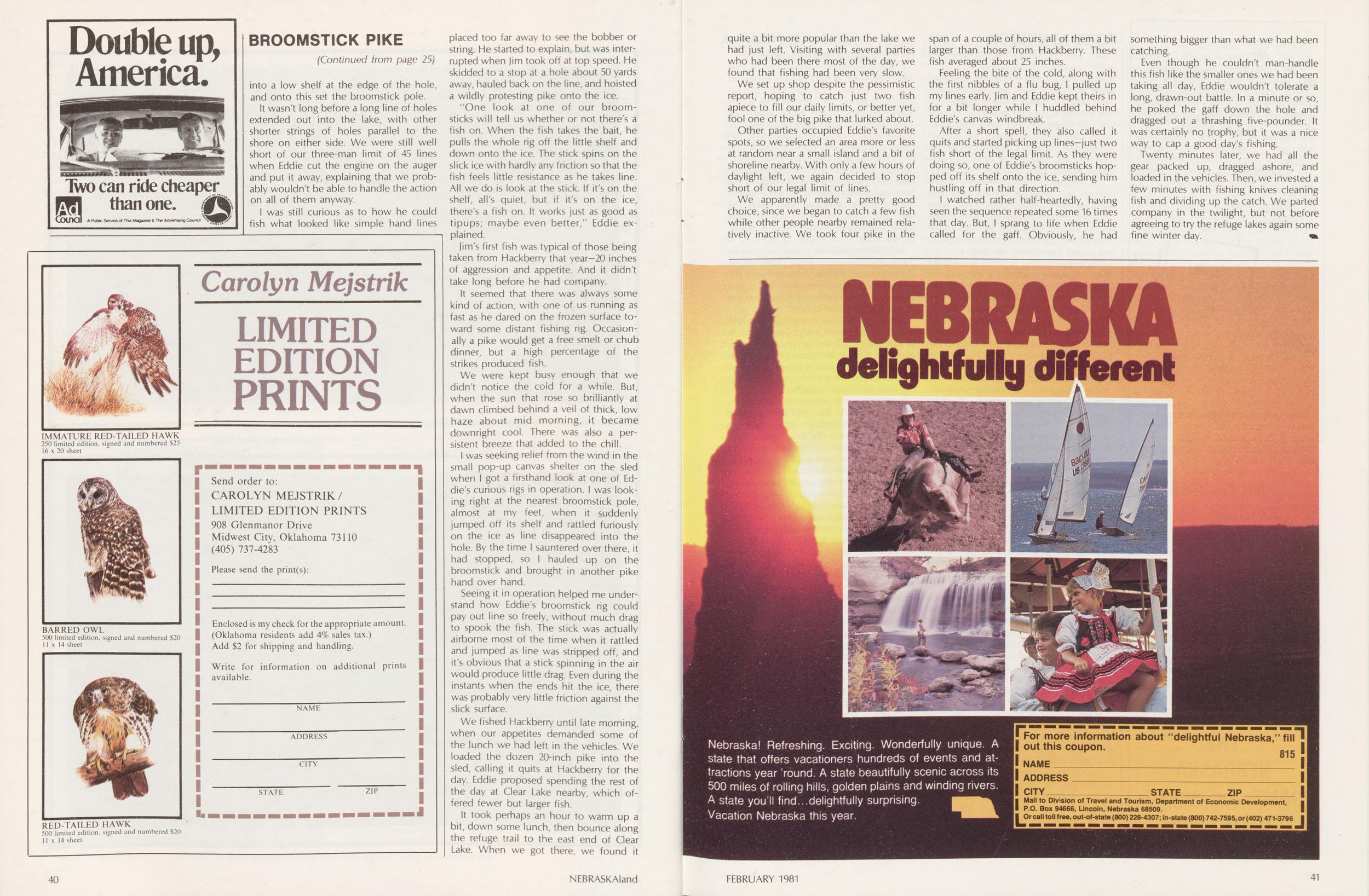
Nebraska had numerous cigar manufacturers, and doubtless several artists and lithographers to design and print labels and bands for them. One such company was in Fremont—Saeger and Sons—who had their own colorful, appealing labels. Among the cigar models they produced were the La Festa, dating from June 9, 1911; the Western Bee, debut date unknown; the Nebraska Girl, from 1902; and the J. Sterling Morton, from 1903.
In 1876, Henry Cohn established a cigar factory in Crete, but it, and a second one built after it, burned down (possibly from workers smoking on the job), but he stubbornly established a third factory. This employed six persons and maintained an inventory of from 25,000 to 50,000 cigars, with his trade area devoted primarily to the railroad towns in Nebraska west of Crete. In 1881, another factory opened in Crete-the firm of O'Hettler and
Company, which employed only three men. A Wilbur factory in 1878 employed five men and produced
Fantasy and romantic places were popular gimmicks to attract customers
200,000 cigars a year under five brands, including such appealing names as the Night-cap and Tra-la-lee.
Lincoln also had several cigar companies, which played important roles in the business life. By 1886 Lincoln had five major cigar manufacturing companies, including Woltemade and Wolf, one of the earliest, who commenced business in 1876. They employed 14 men and made 5,000,000 cigars annually. W. Devereaux also had a factory in Lincoln which operated for many years.
Nebraska City had several makers, as well. In 1867, Henry Phifer established a plant which was known, for lack of a more exciting name as "No. 25." From 1872 to 1874, it gave steady employment to six men with annual sales of half a million dollars. Surely a goodly sum in those days, when a dollar was still worth a dollar. Cigars sold for about 15 cents, with many priced higher for the affluent businessman.
The income of the Phifer factory was not to remain at that level, however, as by 1882 sales dropped to $200,000 and only three men remained on the payroll. The drop was probably accounted for by competition rather than lack of quality.
Part of the competition that Phifer felt may have come from a Mr. Kessler, who himself opened and operated a factory with a comparably imaginative name as Phifer's— No. 99." What he lacked in imagination, however, Kessler made up for in ambition, as he did all his own work, and in 1880 made and sold 50,000 cigars. Then, in June of 1881, a Mr. Fr. Jahns established yet another factory in
Doubtless with sweet taste, this was a product of Saeger and Sons
Surely the macho appeal worked on a lot of portly puffers
Nebraska City which produced three kinds of cigars. Now, you might well ask, what was the name of his company? You probably guessed—it was good old factory No. 208.
Omaha had a great number of cigar makers. Of the 75 companies which existed in the state in 1886, for example, 20 were in Omaha. That was up from 15 which operated there in 1880. Records show that in 1886, something over 2.3 million cigars were made in Omaha alone. Those people really had money to burn in those days! The largest manufacturer in Omaha was West and Fritscher, which employed 50 men and boys (they didn't smoke) and in some years produced nearly 2 million cigars, which were then sold by three traveling salesmen. (Probably there were some racey jokes about them at the time). Many other communities had small cigar factories, but this sampling is typical.
Of course, cigars needed boxes to be sold in, and there was at least one factory making boxes in Omaha at 1412 Davenport. Started by Isaac Levi, who operated it for some time, it was sold in 1872 to Adolph Seifken. Seifken produced about 100,000 finished cigar boxes annually, which apparently sold for 10 cents each. Other box makers must have been around, but they were not as well known as the tobacco rollers.
In 1879 there were 33 cigar companies in Nebraska located in 15 towns, and in 1886 there were 75 companies in 36 towns. The peak was in 1911 with 127 cigar makers. After that year, a decline set in, so that by 1917 the number had dropped to 115. This was mostly blamed on the perfection of a machine to make cigars. It appeared in 1919, and that ingenious device eventually lowered the price of the average cigar from 15 cents to five cents, by 1924. That year, by the way, seems to have been the peak of cigar production, for even the machine couldn't compete with a new, or relatively new, innovation-the cigarette.
At first called little cigars, competition from cigarettes actually started around 1884 with the Bansak Cigarette Machine. It really made that nasty tobacco available in a more convenient and less expensive form, and was capable of producing 120,000 cigarettes daily—50 times what could be made by hand. When these new little smoking sticks caught on, cigar smoking began a steady decline. Manufacturers then responded with even fancier and more colorful labels, still believing that the better the label, the better the sales.
By the late 1930's, however, increased competition and changes in the market made even the high-quality chromolithographs on cigar boxes unproductive, and the art began to rapidly fade. It was really the lithographers who suffered, as a new printing method, photo-engraving, was capable of making nearly identical work at a fraction of the cost. Thus, an era came to a close an era composed of several diverse occupations combined for a single purpose. Now, the classic cigar box labels are collector items, selling for up to $50. It would be nice to have a trunk full of them these days-or at least a cigar box full.
NEBRASKAland Magazine extends thanks to Sheldon Art Gallery Gift Shop, University of Nebraska, for making these labels available 38 NEBRASKAlandProduction of this model or style apparently dates to 1903 at Fremont
Also a product of Saeger factory, this more delicate offering dates to 1902
BROOMSTICK PIKE
Double up, America. Two can ride cheaper than one. A Public Service of This Magazine & The Advertising Council IMMATURE RED-TAILED HAWK 250 limited edition, signed and numbered $25 16 x 20 sheet BARRED OWL 500 limited edition, signed and numbered $20 11x14 sheet RED-TAILED HAWK 500 limited edition, signed and numbered $20 11 x 14 sheet Carolyn Mejstrik LIMITED EDITION PRINTS Send order to: CAROLYN MEJSTRIK/ LIMITED EDITION PRINTS 908 Glenmanor Drive Midwest City, Oklahoma 73110 (405) 737-4283 Please send the print(s): Enclosed is my check for the appropriate amount. (Oklahoma residents add 4% sales tax.) Add $2 for shipping and handling. Write for information on additional prints available. NAME ADDRESS CITY STATE ZIPinto a low shelf at the edge of the hole, and onto this set the broomstick pole. It wasn't long before a long line of holes extended out into the lake, with other shorter strings of holes parallel to the shore on either side. We were still well short of our three-man limit of 45 lines when Eddie cut the engine on the auger and put it away, explaining that we probably wouldn't be able to handle the action on all of them anyway.
I was still curious as to how he could fish what looked like simple hand lines placed too far away to see the bobber or string. He started to explain, but was interrupted when Jim took off at top speed. He skidded to a stop at a hole about 50 yards away, hauled back on the line, and hoisted a wildly protesting pike onto the ice.
"One look at one of our broomsticks will tell us whether or not there's a fish on. When the fish takes the bait, he pulls the whole rig off the little shelf and down onto the ice. The stick spins on the slick ice with hardly any friction so that the fish feels little resistance as he takes line. All we do is look at the stick. If it's on the shelf, all's quiet, but if it's on the ice, there's a fish on. It works just as good as tipups; maybe even better," Eddie explained.
Jim's first fish was typical of those being taken from Hackberry that year-20 inches of aggression and appetite. And it didn't take long before he had company.
It seemed that there was always some kind of action, with one of us running as fast as he dared on the frozen surface toward some distant fishing rig. Occasionally a pike would get a free smelt or chub dinner, but a high percentage of the strikes produced fish.
We were kept busy enough that we didn't notice the cold for a while. But, when the sun that rose so brilliantly at dawn climbed behind a veil of thick, low haze about mid morning, it became downright cool. There was also a persistent breeze that added to the chill.
I was seeking relief from the wind in the small pop-up canvas shelter on the sled when I got a firsthand look at one of Eddie's curious rigs in operation. I was looking right at the nearest broomstick pole, almost at my feet, when it suddenly jumped off its shelf and rattled furiously on the ice as line disappeared into the hole. By the time I sauntered over there, it had stopped, so I hauled up on the broomstick and brought in another pike hand over hand.
Seeing it in operation helped me understand how Eddie's broomstick rig could pay out line so freely, without much drag to spook the fish. The stick was actually airborne most of the time when it rattled and jumped as line was stripped off, and it's obvious that a stick spinning in the air would produce little drag. Even during the instants when the ends hit the ice, there was probably very little friction against the slick surface.
We fished Hackberry until late morning, when our appetites demanded some of the lunch we had left in the vehicles. We loaded the dozen 20-inch pike into the sled, calling it quits at Hackberry for the day. Eddie proposed spending the rest of the day at Clear Lake nearby, which offered fewer but larger fish.
It took perhaps an hour to warm up a bit, down some lunch, then bounce along the refuge trail to the east end of Clear Lake. When we got there, we found it 40 NEBRASKAland quite a bit more popular than the lake we had just left. Visiting with several parties who had been there most of the day, we found that fishing had been very slow.
We set up shop despite the pessimistic report, hoping to catch just two fish apiece to fill our daily limits, or better yet, fool one of the big pike that lurked about.
Other parties occupied Eddie's favorite spots, so we selected an area more or less at random near a small island and a bit of shoreline nearby. With only a few hours of daylight left, we again decided to stop short of our legal limit of lines.
We apparently made a pretty good choice, since we began to catch a few fish while other people nearby remained relatively inactive. We took four pike in the span of a couple of hours, all of them a bit larger than those from Hackberry. These fish averaged about 25 inches.
Feeling the bite of the cold, along with the first nibbles of a flu bug, I pulled up my lines early. Jim and Eddie kept theirs in for a bit longer while I huddled behind Eddie's canvas windbreak.
After a short spell, they also called it quits and started picking up lines-just two fish short of the legal limit. As they were doing so, one of Eddie's broomsticks hopped off its shelf onto the ice, sending him hustling off in that direction.
I watched rather half-heartedly, having seen the sequence repeated some 16 times that day. But, I sprang to life when Eddie called for the gaff. Obviously, he had something bigger than what we had been catching.
Even though he couldn't man-handle this fish like the smaller ones we had been taking all day, Eddie wouldn't tolerate a long, drawn-out battle. In a minute or so, he poked the gaff down the hole and dragged out a thrashing five-pounder. It was certainly no trophy, but it was a nice way to cap a good day's fishing.
Twenty minutes later, we had all the gear packed up, dragged ashore, and loaded in the vehicles. Then, we invested a few minutes with fishing knives cleaning fish and dividing up the catch. We parted company in the twilight, but not before agreeing to try the refuge lakes again some fine winter day.
FORT ATKINSON
(Continued from page 17)working the Three Forks country. They had gathered many beaver and headed back downstream. On May 30, near Pryor's Fork, they funneled through an area where the trail was single-file, and were ambushed. Seven died including Immel and Jones- their bodies literally hacked to pieces. Before survivors could build rafts, they had lost all horses, traps and furs.
On August 1, Leavenworth finally reached the camp of Ashley, who had been joined by Henry's party. There were now only 80 men, but they joined Leavenworth's troops, along with the men of the Missouri Fur Company, and the Sioux who had joined them along the way.
On August 9, they reached the Ankara villages. The Sioux, riding out ahead of the soldiers and trappers, skirmished with the Rees out in front of the villages. As the soldiers marched up, they found a knot of mounted Indians. The Sioux, marked by white headbands, were barely holding their own when the whites caught up. When the dust cleared, the Arikaras were in their village, protected by row upon row of vertical logs.
After several days of military bombardment and raiding of cornfields, the Rees asked for a conference.
Trappers, soldier, and Indians haggled, reached an agreement, then couldn't agree on how to carry out the agreement. Then, on the night of August 12, the Rees simply moved out of their village, leaving behind only one feeble squaw, the mother of the dead chief Gray Eyes, who had been killed in the bombardment.
Thus ended the first battle of Fort Atkinson troops. Very few of the soldiers really saw action, other than watching the shelling of the village. It had been a "watch and wait" battle and the results had been questionable at best.
A highly-publicized "war" between Joshua Pilcher of the Missouri Fur Company, and Colonel Leavenworth followed, in which each berated the other for incompetence in subduing the Indian.
As the soldiers headed back to Fort Atkinson for another two years of gardening and drills, the trappers dropped back and planned new strategies. Henry stuck to the original plan and took a small party of men back up the river to the fort at the mouth of the Yellowstone. On August 20, they were attacked by Arikara. Two men were killed and two wounded. Pilcher had given up the upper river after losing Immel and Jones and all their supplies and furs.
But Ashley decided to try a new angle. He thought that the fur-rich country west of the Shining Mountains could be reached overland, so he sent Jed Smith with a party, including Jim Bridger, to find a route. The men wintered with the Crow, and the Indians drew them maps of the mountains with mounds of sand representing the peaks. Come spring, Smith followed their "sand trail" to the South Pass.
It was sometime in September of 1824 that Jim Clyman of Smith's party staggered into Fort Atkinson. He had been cut off from the rest of the party 80 days earlier near the source of the North Platte, 600 miles away. He had headed back with 11 bullets in his gun, no horse, and no provisions. Ten days later, Tom Fitzpatrick and two unidentified men from Smith's party dragged in in even worse shape than Clyman, but they had found the South Pass. They had hunted the Green River Valley, caching packs of beaver skins along the way. Jed Smith, however, was still out there somewhere, filling in blank spaces on the maps.
Meanwhile, as Smith's men straggled in, a few miles downriver at the French Company's post, another expedition was in the making. A hundred men were to be sent overland to the southern Rockies and the mountains of New Mexico.
Immense changes were taking place even while Jed Smith wandered. Hundreds of thousands of immigrants were preparing to follow him through the South Pass to Oregon and California. Others would follow the expedition-in-the-making over the Santa Fe Trail.
For more than a century, white men had followed rivers to get from here to there and back again. William Ashley was the only fur man ready and financially able to break that tradition. By the time he caught up with Smith and gathered the year's furs, he had an enormous load. He cut to the northeast and the Bighorn River where he loaded his furs on vessels that he and his men built, and floated back to St. Louis.
Again, the soldiers were more spectators than participants in the drama that was taking place on the frontier. An expedition by Gen. Atkinson up the Missouri to the mouth of the Yellowstone to make treaties, merely tied the threads of empire that had been in the spinning before Lewis and Clark.
The result of Gen. Atkinson's mission was a recommendation against further military occupation of the upper Missouri. Except for the Blackfeet, the Indians were at peace. The British had withdrawn, and the upper Missouri was no longer the frontier of the American trappers.
The new frontier would be to the west and southwest from Fort Atkinson, not to the north.
In the spring of 1827, Fort Atkinson was abandoned. The country to the north was set aside, as new pioneers talked of more exciting places like Oregon and California. The post fell quickly into ruins, and Indians and settlers "borrowed" materials for their own use.
In a matter of a few years, Fort Atkinson and the fur trappers and traders who had passed through it were only memories from that glorious time of mapping and trading on the Nebraska frontier.
42 NEBRASKAlandA PARK CALLED WILDERNESS
(Continued from page 35)send up a new shoot the following spring.
This scenario may have been repeated again and again until, by whim of climate or pure chance, several years passed without a grass fire. Now the little oak's persistence paid off. It grew large enough and accumulated a sufficient thickness of bark that further fires would not kill it. The result was not a closed forest, but a savanna of widely-dispersed oaks among the grasses.
In areas where fires were less frequent, the offspring of these pioneer oaks began to fill in the gaps in the savanna or, alternatively, many oaks were established at once, leading to a closed forest. Being more crowded, these oaks grew taller and straighter, erecting a canopy. As the leaves of the canopy blocked more sunlight and deflected drying winds, the microclimate on the ground below changed. Furthermore, the decaying leaves released acids into the soil, altering chemical processes there. The warm-season grasses of the prairie gave way to cool-season grasses, able to utilize the light that penetrated in spring before the oak leaves emerged. Shade-tolerant forbs and shrubs found a favorable habitat on the forest floor. The neighborhood was altogether less combustible than the prairie, and other kinds of trees were able to invade. When a canopy tree died, a black walnut, bitternut hickory, or kentucky coffee tree was waiting and ready to move in quickly.
Surely these complicated doings, spanning centuries, were not on the minds of Lancaster County's first settlers. In the forest they saw not only beauty and reassuring familiarity, but also items of great practicality.
In this forest grew black walnut, a source of durable and decay-resistant lumber as well as delicious nuts. Not so tasty were the nuts of bitternut hickory, but the oil they contained provided a pioneer remedy for rheumatism. The wood of bitternut hickory is resilient and shock-resistant, hence a favorite for plow, ax handles and wagon parts. The slimy inner bark of slippery elm was valued as a dressing for wounds, and as a tea to treat a variety of ailments including cholera. Here, too, were trees and shrubs with juicy fruits like red mulberry, wild plum, chokecherry, gooseberry, and elderberry. Silver maple and boxelder yielded a sugar syrup.
Game was also abundant. The Buffingtons had given up and left in the first summer, but the Preys (with the arrival of the rest of their clan) built a log cabin and stayed through the winter of 1856-7. This was a winter of heavy snows and John W. Prey recalled that deer and wild turkey were easily captured in the deep drifts. The salt basins west of Lincoln were a popular stopover for migrating waterfowl, and a salt lick for bison, elk, and deer. W. W. Cox settled on the basin in 1861 and gave this report: "Elk and antelope were plentiful, and the nimrods of that day had great and exciting sport in the chase. The Basin was a great place for wild water fowls to congregate. Geese, brant, swan, ducks, and pelicans were there by the thousands, and it was a hunter's paradise." Cox was similarly enthused by the fishing: "Black suckers and buffalo were the leading varieties. Great numbers were caught that would weigh ten to fifteen pounds, and we have seen them that tipped the beam at thirty- five pounds." In 1863 a settler named John S. Gregory poisoned many coyotes by setting balls of fat laced with strychnine out in the snow. He kept the skins and threw the carcasses of the "prairie wolves" in a pile. Much to his frustration and consternation, some Pawnees gathered the carcasses for food despite his attempts to warn them. Later an interpreter told him the Pawnees knew about the strychnine and often ate the poisoned coyotes with no ill effects.
The Pawnees were never belligerent toward the settlers of Lancaster County in an organized way. They already had a fulltime enemy in the Sioux, who were still strong and warring. The few conflicts that did occur here were most often the result of some act of thievery or insolence. At least two of these incidents occurred in Wilderness Park.
The north end of Wilderness Park was the scene of one violent event between Indians and settlers. By 1859, several legitimate homesteads had been filed in Wilderness Park (formerly land claimed by speculators). Abraham Beals claimed 40 acres now bounded by Pioneers Boulevard on the north. One day while he was out, some Pawnees broke into his cabin and stole food and clothing. When Beals returned and discovered this trespass, he summoned his neighbors to help him recover his goods. One of their cabins had been robbed as well, and the Indians had been seen encamped near the present-day penitentiary. The party of settlers gathered at the cabin of Mr. Sophir to plan their next move. It was decided that Joel Mason (Beal's neighbor to the south) would parley with the Indians, but within rifle range of the other men hidden in the cabin. In the morning, 15 Pawnees approached the cabin and Joel Mason confronted them according to plan. The Pawnees laughed
"We forgot to take the boat off the car!"
and began to hit Mason with their guns, pushing him closer to the cabin. The settlers rushed out and fired upon the Indians, killing three and wounding five. The remaining Pawnees fled. The three bodies were buried at the site (somewhere in the present-day Day Camp area of Wilderness Park).
John Cadman was a very important man in the early days of Lancaster County. He would serve as businessman, promoter, school teacher, legislator, justice of the peace, probate judge, sheriff, and county treasurer. He arrived in 1859 and settled near the south end of Wilderness Park. At that time the nearest town was Nebraska City, and the settlers along Salt Creek had beaten a narrow path in the prairie going to and fro for supplies. Cadman saw in this winding rut a great highway of the future, a short-cut between Nebraska City and Fort Kearny. He organized his neighbors to help him make a crossing on Salt Creek suitable for wagons. Salt Creek was the only major obstacle on the route, so boulders and limestone were hauled in to improve the crossing. By 1861, the Nebraska City-Fort Kearny cutoff was a popular route linking the bustling river port with the Oregon and Mormon trails. John Cadman was ready for the traffic. He built a stage station at Saltillo complete with a blacksmith shop and stable.
In 1862 a new invention, the steam wagon, was built in Nebraska City and the cutoff route was selected to become its highway. The residents of the south Salt Valley busily constructed a bridge over Salt Creek that would accommodate the heavy wagons. July 22 was the day of great excitement as the 20 ton steam wagon paraded through Nebraska City and out on the highway for Denver hauling 10 7,000-pound freight wagons. Seven miles out a piston rod broke and the steam wagon was permanently disabled.
Though the steam wagon's role in plains transportation was very short-lived, more conventional ox-drawn or mule-drawn wagon trains were able to benefit from the improved road and bridge. The steam wagon bridge the settlers built was probably located where West Calvert Street now crosses the old channel of Salt Creek. In the years that followed, thousands of wagons used the bridge, each carrying up to 7,000 pounds of freight. By 1865 it was estimated that 75 percent of the westward traffic followed the cutoff route. This brought a tremendous amount of revenue to the valley, revenue and investments that John Cadman wanted to funnel into Saline City, a newborn settlement northwest of the bridge.
John Cadman was eager to have Saline City named as the county seat. Though he carried significant political clout in his own area, he was unable to prevent the village of Lancaster from becoming the county seat, or from eventually being named Lincoln, the seat of state government.
FEBRUARY 1981 43
In just 10 years an uninhabited wilderness had become the state capital. The woodlands along Salt Creek had been both theater and actor in this drama. Two events occurred, though, that would shape the destiny of Wilderness Park when, in 1872, the Atchison and Nebraska Railroad was completed along the east side of Salt Creek, and, in 1877, the Union Pacific Railroad paralleled its course. Certainly many trees were cut for ties and bridge material, but the railroad did help the park's preservation by limiting access and forming a barrier of sorts against the ravages of ax and plow. By the late 1800's the land around Lincoln lay under an orderly grid of roads and fences. In the spaces between grew orderly rows of crops.
The wilderness had all but vanished, and those areas that retained a wildness about them began to be recognized for their park potential. In 1906, Professor E. H. Barbour noted that while pioneers had no need of parks and hence planned for none, the growing city of Lincoln had a golden opportunity to design a radiating system of parks, not unlike Boston. He envisioned wooded parks along Salt Creek, Oak Creek, Antelope Creek, and Dead Man's Run, which, he added, would be the best use for these flood-prone areas. While Antelope Creek was well on the way to becoming a city park, the Salt Creek woodlands remained in private ownership until the late 1960's. But, that is not to say that these woodlands did not serve the recreational needs of Lincolnites. On the contrary, there is no park in Lincoln, and probably none in Nebraska, as rich in recreational history as Wilderness Park.
In 1888, L C Holt acquired and developed the property at the north end of Wilderness Park (now known as the Day Camp area). This became Lincoln Park. We have all seen paintings of tranquil picnic parties of the "Gay Nineties." Well, Lincoln Park was a favorite picnic place for Lincolnites. One could get there by horsedrawn buggy or trolly car, grab a snack at the ornate Lincoln Park Restaurant, then spend the afternoon boating on the old mill pond. The pond was formed behind a dam that Colonel Crabb had built to trap and divert water through a gulley (flume) and then over the water wheel of his grist mill. Crabb's Mill was no longer in operation, but the pond remained and supplied excellent boating and fishing. For more sociable recreation one could join a squaredance in the dance hall, hear a concert in the open-air pavilion, or play a game in the oriental-style arcade.
In 1897 the Nebraska Epworth League (an organization of methodist churches) began to hold annual assemblies at Lincoln Park. These summer campout meet- ings were a forum for religious training, social acquaintance, rousing speeches, music, and other entertainment. By 1903 these meetings, called Chautauquas, had gained enormous popularity and sufficient funds were raised to purchase a 40-acre site south of Lincoln Park to be used and improved solely for the summer meetings. This became Epworth Lake Park, with 857 tent sites staked off, flanking shady "avenues" and accommodating up to 2,500 people. In 1906 a lot and tent large enough for four people could be rented for $3.50 per day, and admission was $1 per person. This revenue went into other improvements including wells, drainage ditches, privies, and extensive tree and flower plantings. A circular gulley, part of an abandoned creek channel, was dammed and pumped full of water to form Epworth Lake. Scenic footbridges led to Oxford Isle with its "Kindernook" playground and boat dock. Scenes of boaters on Epworth Lake adorn vintage postcards. In a 1903 Epworth League pamphlet, the area was described: "Enchanting woodland of oak, walnut, ash, and elm trees of just the right size and just far enough apart to let the sunshine in on the greensward carpet, Nature's own Axminister, all combining to form as inviting a lodge for the great assembly camp as the mind can picture." As attendance grew, buildings were constructed, including the 70 x 70-foot Great Hall and a new auditorium that could seat 4,000 people.
Meanwhile, the character of Lincoln Park changed to more of an amusement park under the direction of new owners. The coming of electric power brought lights, a ferris wheel and a merry-go-round. The name was changed to Electric Park in 1916. There was a mile-long race track and Hippodrome Theater. Fish in a cement pond and revolving swings were favorites of children.
Later, Burlington Beach (now Capital Beach Lake) was developed as an amusement park, and Electric Park closed down. The Burlington Railroad acquired the land and improved the old mill dam. They pumped fresh water from the pond to their roundhouse west of Lincoln (since the salty water from wells and streams there corroded the locomotives). In 1933, B. B. Dawson of the Boy Scout Association rented the 86 acres from the Burlington. This he developed into Camp Minus-kuya. Volunteers helped build a swimming pool, the Long House, and a lodge with cooking
"You know the old timers followed a good line there. Let's use it for our new super highway."
and dining facilities. He also designed a splendid suspension bridge and, for more venturesome Scouts, a cable-and-pulley crossing. But the trees, stream, and wildlife were the camp's greatest assets. Here was a place close to Lincoln where the Scouts could learn about nature. Here they could gather around a fire at night, some fighting pangs of homesickness, others planning mischief or telling grisly tales to frighten the faint-hearted. Indeed, of the three Pawnees killed there at Sophir's cabin, the ghost of the one beheaded just might haunt the area, restlessly in search of the skull Cadman kept as a souvenir.
Thus the thirties brought new life and function to the Lincoln Park area, but to Epworth Park the thirties brought gradual abandonment. The great age of radio brought religion, music, drama, and comedy right into the home, and attendance at the Epworth meetings dropped. Hard times brought debts to the Epworth League, and in 1940 the meetings were moved to Bethany College. As if to toll the final bell, Salt Creek swelled over its banks in May of 1942 and destroyed the buildings in Epworth Park. The dam was dynamited for flood control. The old arch that spanned the entryway, once the site of Chautauquas among the greatest in America, is all that now remains standing. Epworth Lake is once again being reclaimed by trees. On Oxford Isle is the rubble of a cabin, and other relics are scattered through the area.
History records substantial changes in the south end of Wilderness Park as well. The first frame house in Lancaster County was built there on Richard Wallingford's claim in the winter of 1861-2. Black Walnut was used for the doors and shingles, and the floor was of white ash. Since the days of John Cadman's stage station, the village of Saltillo grew and was incorporated in 1862. Ten years later, the Atchison and Nebraska Railroad brought more business and a depot was built. The village included a schoolhouse and church, but sometime around the turn of the century Saltillo faded into obscurity. In the 1930's the area was known as the Auto Park. The Lincoln Auto Club leased the land and put up picnic tables, a shelter, fireplaces, and a baseball diamond. The same 1942 flood that swept through Epworth Park destroyed most of these improvements but spared a stone and brick fireplace that stands to this day.
In the 1960's, the sentiments expressed by Professor Barbour in 1906 resurfaced. The Corps of Engineers acknowledged that the meanders of Salt Creek and the natural wooded cover would act to retard and disperse floodwaters, a welcome alternative to channelization as flood control. In 1966 the Wilderness Park Project was initiated as a unique cooperative effort of the City of Lincoln, Lancaster County, and the Salt Valley Watershed District. A loosely-knit panel of leaders from many professions made up the Wilderness Park Committee and provided guidance for the acquisition of land. Federal funds were made available through the Open Spaces Act, and private contributions were made by the Seacrest Foundation, the Woods Foundation, and the Lincoln Foundation. Professors from several departments of the University of Nebraska expressed their desire to have a natural laboratory like Wilderness Park close to campus. The Epworth Area was willed to the City of Lincoln by Arnott R. Eolsom with the request that it be included in Wilderness Park. The Youth Conservation Corps (Y.C.C.) and the Sierra Club of Lincoln helped to make woodchip trails, bridges, and other improvements. By 1972, Wilderness Park was a reality.
Now the park encompasses 1,455 acres with more than 20 miles of hiking and bridal trails, which are included in the National Recreational Hiking Trail System. Access is provided by six parking lots along the park's seven-mile length. A popular jogging/exercise trail loops around the Day Camp area. Day Camp is used extensively by groups from local schools and organizations for environmental education
"That's a coincidence —I'm hunting too."
outings, guided by park naturalists. South of Pioneers Boulevard there is a Tree Identification Trail. During the summer months, the Wilderness Park Environmental Center at 27th and Saltillo Road offers guided group tours, classes in basic tree identification, evening "owl prowls," and displays about the area's geologic history, flora, and fauna.
Changes in the vegetation are everywhere apparent in Wilderness Park. Man has altered the frequency of natural disturbances like floods and fires. He has brought exotic plants, animals, and diseases that have invaded the indigenous forest community. A fungus disease killed many of the native hickories in the 1920's. The great drought of the 1930's took its toll as did the demand for walnut gun stocks during World War II. Dutch elm disease struck in the 1960's, and in its wake other kinds of trees are inheriting the gaps in the canopy. Years of grazing by cattle have favored herbs that are thorny, toxic, or armed with stinging hairs. Old fields are undergoing a slow recovery to forest. One old field has been planted with native prairie grasses and, with the encouragement of spring burning, will come to resemble the tallgrass prairie that once dominated the landscape. The only natural prairie that remains in the park is currently threatened by the invasion of Siberian elms and brome grass. In other areas there have been extensive tree plantings as a buffer between park and highway.
Beyond all these things, Wilderness Park is a place of discovery. Fascinating things are revealed to those willing to seek them out. In this unhurried place there is room for contemplation, sensual expansion, and imaginary forays back to wilderness times. Such reflections fulfill a need in us all, bringing the realization that nature works in exquisite ways. Wilderness Park provides a reference point, a glimpse into the past, and a refreshing contrast to our manipulated environment. In 1856 the first settlers were led here by a report of a large body of timber on Salt Creek. In 1981, I'm very pleased to report that it's still here.
Author Bill Beachley has a Master of Science degree in Life Sciences from University of Nebraska, Lincoln, and recently served as park naturalist at Wilderness Park."Three more minutes, then wham! On go the bacon and eggs."
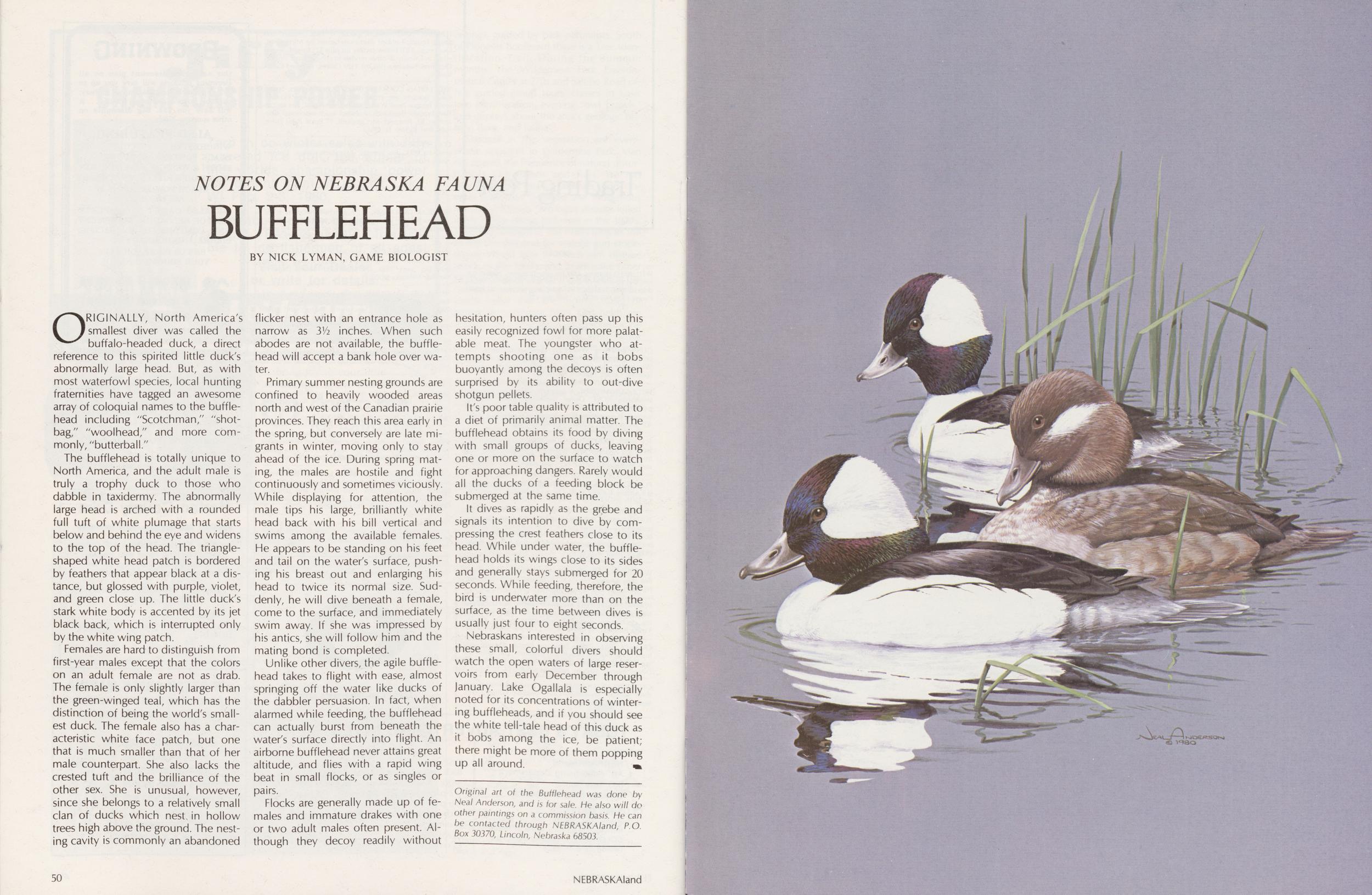
NOTES ON NEBRASKA FAUNA
BUFFLEHEAD
ORIGINALLY, North America's smallest diver was called the buffalo-headed duck, a direct reference to this spirited little duck's abnormally large head. But, as with most waterfowl species, local hunting fraternities have tagged an awesome array of coloquial names to the bufflehead including "Scotchman," "shotbag," "woolhead," and more commonly, "butterball."
The bufflehead is totally unique to North America, and the adult male is truly a trophy duck to those who dabble in taxidermy. The abnormally large head is arched with a rounded full tuft of white plumage that starts below and behind the eye and widens to the top of the head. The triangle shaped white head patch is bordered by feathers that appear black at a distance, but glossed with purple, violet, and green close up. The little duck's stark white body is accented by its jet black back, which is interrupted only by the white wing patch.
Females are hard to distinguish from first-year males except that the colors on an adult female are not as drab. The female is only slightly larger than the green-winged teal, which has the distinction of being the world's smallest duck. The female also has a characteristic white face patch, but one that is much smaller than that of her male counterpart. She also lacks the crested tuft and the brilliance of the other sex. She is unusual, however, since she belongs to a relatively small clan of ducks which nest in hollow trees high above the ground. The nesting cavity is commonly an abandoned flicker nest with an entrance hole as narrow as 3 1/2 inches. When such abodes are not available, the bufflehead will accept a bank hole over water.
Primary summer nesting grounds are confined to heavily wooded areas north and west of the Canadian prairie provinces. They reach this area early in the spring, but conversely are late migrants in winter, moving only to stay ahead of the ice. During spring mating, the males are hostile and fight continuously and sometimes viciously. While displaying for attention, the male tips his large, brilliantly white head back with his bill vertical and swims among the available females. He appears to be standing on his feet and tail on the water's surface, pushing his breast out and enlarging his head to twice its normal size. Suddenly, he will dive beneath a female, come to the surface, and immediately swim away. If she was impressed by his antics, she will follow him and the mating bond is completed.
Unlike other divers, the agile bufflehead takes to flight with ease, almost springing off the water like ducks of the dabbler persuasion. In fact, when alarmed while feeding, the bufflehead can actually burst from beneath the water's surface directly into flight. An airborne bufflehead never attains great altitude, and flies with a rapid wing beat in small flocks, or as singles or pairs.
Flocks are generally made up of females and immature drakes with one or two adult males often present. Although they decoy readily without hesitation, hunters often pass up this easily recognized fowl for more palatable meat. The youngster who attempts shooting one as it bobs buoyantly among the decoys is often surprised by its ability to out-dive shotgun pellets.
It's poor table quality is attributed to a diet of primarily animal matter. The bufflehead obtains its food by diving with small groups of ducks, leaving one or more on the surface to watch for approaching dangers. Rarely would all the ducks of a feeding block be submerged at the same time.
It dives as rapidly as the grebe and signals its intention to dive by compressing the crest feathers close to its head. While under water, the bufflehead holds its wings close to its sides and generally stays submerged for 20 seconds. While feeding, therefore, the bird is underwater more than on the surface, as the time between dives is usually just four to eight seconds.
Nebraskans interested in observing these small, colorful divers should watch the open waters of large reservoirs from early December through January. Lake Ogallala is especially noted for its concentrations of wintering buffleheads, and if you should see the white tell-tale head of this duck as it bobs among the ice, be patient; there might be more of them popping up all around.
Original art of the Bufflehead was done by Neal Anderson, and is for sale. He also will do other paintings on a commission basis. He can be contacted through NEBRASKAland, P.O. Box 30370, Lincoln, Nebraska 68503. 50 NEBRASKAland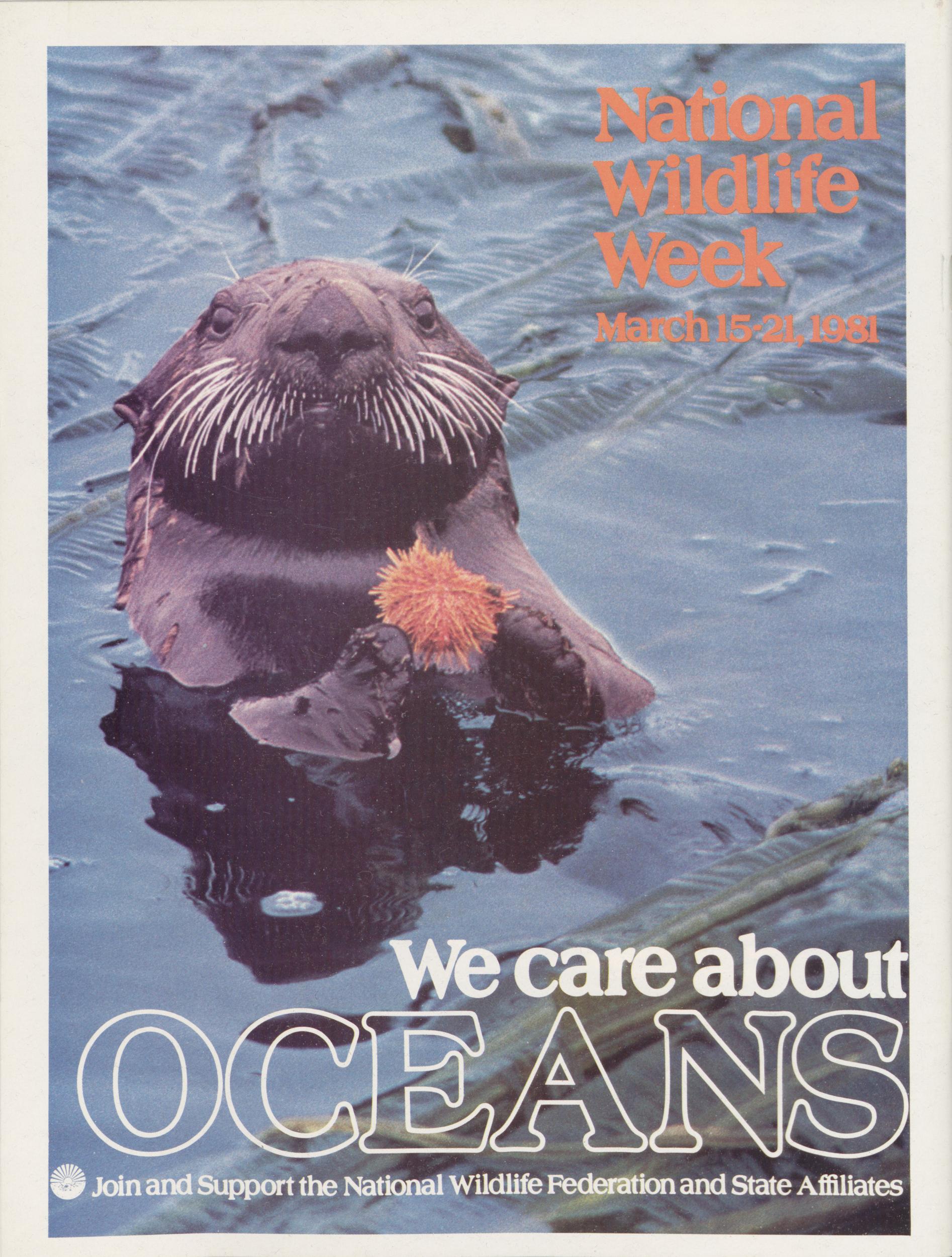
Position: 396 (24 views)