Volume 59, Issue 1, 1981
NEBRASKAland
January 1981 $1
Speak Up
A "Knowing" lookSir Thank you for Know Nebraska Tour number 12 to Fort Robinson. We enjoyed every minute, even the weather was comfortable. You have done a great job rebuilding the fort. We are looking forward to next year's brochure. Thanks again.
Louis and Grace Roy Fremont, NE.For those who may not have heard about these tours, they are co-sponsored by the Game and Parks Commission and the Omaha World Herald, and range from backpacking and cross-country skiing to cruising around in a bus to visit historical places. Many hundreds of folks have taken the tours, which have visited every part of the state in the past two years. And, we have gotten many hundreds of fine comments from the travelers, of which this is just one. Thank you folks for your letter, and hope you find something this year you like. In fact, the Lincoln journalStar is also co-sponsoring tours in 1981. (Editor)
Elevator going downSir I, too, must comment about the "old structure" on the front page of the August NEBRASKAland. The small town of Charleston, where the elevator was, is where I was born in 1912. My father had a grocery store and the living quarters were in the back of the store.
It was labeled a barn in a section of an Omaha paper within the last two years, and I'm glad this has now been corrected.
An elderly gentleman told us upon inquiring about Charleston in York that "all that's left is the old elevator and depot be cause the Interstate went right through the town."
Rea (Hagemeister) Golden
Sidney, NE
You must admit that to a city-bred and reared kid, any old building in need of paint and located out in the country, that doesn't look like a house, is probably a barn. At any rate, it is an interesting and colorful structure, and gives a lot of passersby on the Interstate a view of the past.
4 NEBRASKAlandIt is good to learn some of this place's his tory, and I thank you for passing that along. (Editor)
Barn loverSir I enjoyed the article, "Barns, Martyrs to Progress" so much. All the old nostalgic accounts described by Carl Wolfe brought back memories of our old barn and how we loved every square inch of it as children growing up south of Gothenburg, Nebraska.
I also am so lucky that my husband was the recipient of a wonderful painting by Linda Stych. She can capture so much of the old country scenes which bring back fond memories of Nebraska as it used to be. Thanks again for the article and the paintings.
Mary Tederman
Holdrege, NE
Wagging the tailwatersSir We are writing in regard to the possible turning over of the Tailwaters area of Gavins Point Dam to South Dakota.
I am really surprised that this would even be considered. The fact of the matter is, this is a part of Nebraska and should stay so. There isn't that much in northeast Nebraska for recreation anyway, so why start giving it away? People in this area take pride in this being part of Nebraska.
We own a bait shop on the Nebraska side of the river, and we sell a tremendous number of non-resident permits to people wanting to fish the Tailwaters area. A lot of Nebraska people use this area because it is the only one close to them on the Missouri River.
South Dakota has all the other big dams in their state, and I don't think it is fair that they control another. Nebraska doesn't have their Black Hills, Lake Oahe, Fort Randall, Lake Sharp, Lake Francis Case and the Badlands. Let Nebraska keep what is rightfully ours.
What's to say in a few years they decide to take away Nebraska fishing rights. If it is possible for them to take the Tailwaters, it may be possible for that to happen, too.
Donn and Penny Marshall
Crofton, NE
Nebraska has always been pretty liberal in making presents of its holdings remember what used to be here—Colorado, Wyoming, the Dakotas, etc. We "gave away" our mountains and roaring rivers and coal and gold to form those other states. I guess you are right that we should retain our border waters, as there has in deed been a lack of cooperation between some states in the past, and it could happen again. (Editor)
Not so drySir I would like to comment on the article "Frozen in Flight" in the May 1980 NEBRASKAland. I feel your readers should be informed that freeze-dry taxidermy is not all it's built up to be.
I had several specimens freeze-dried a few years ago to find out about its longevity. In less than one year the specimens became moldy, and had dermesticides in them. Also, during warm, humid weather, they seem to take on moisture and give off an unpleasant odor.
Mike Dinges (Dinges Taxidermy Studio)
Omaha, NE
Fish GaloreSir My wife and I read with considerable enjoyment and a lot of empathy the story "Grandfather and the River" in the August 1980 NEBRASKAland.
I have been fishing for whatever kind of fish I could catch since about 1923 at 13 years of age. My wife has been fishing ever since she married me over 40 years back. One time we were coming from Brewster to Hastings in late May 1938 and I made the serious mistake of suggesting we stop and look at the new, nearly completed Ord Diversion Dam on the beautiful North Loup River.
It was nearing midday. When my wife saw all those fish coming out of that pure, clean river, she got a funny look in her eye and I think that was the last day I was ever able to get her to use any sense. And I was a little worse off.
I have never seen so many fish of any kind anywhere, from Canada on south. They were big and we soon had our limit, and they were caught with rod and reel and hooks and minnows. Long stringers of catfish up to several pounds, were laid over people's shoulders as they had to leave with their limit.
But, what we absolutely did not observe anyplace around there was fish of any kind just thrown down in the dirt and sand to die. No sirree! People just didn't do that, even in those early days.
There must be quite a few people around who saw this and maybe took a few snapshots. There was even a little boy who had a giant carp jump right out of the water and land smack dab in his lap.
D. A. Kivett
Hastings, NE
You had me going there for a bit, but like most anglers, you had to throw in that part about the fish jumping right out of the water. Oh well, as long as you enjoy fishing, that's the important thing. Thanks for your letter and your observations. (Editor)
NEBRASKAland Magazine invites all readers to submit their comments, suggestions, and gripes to Speak Up. Each month the magazine will publish as many letters as space permits. Pictures are welcome. NEBRASKAland reserves the right to edit and condense letters. Editor.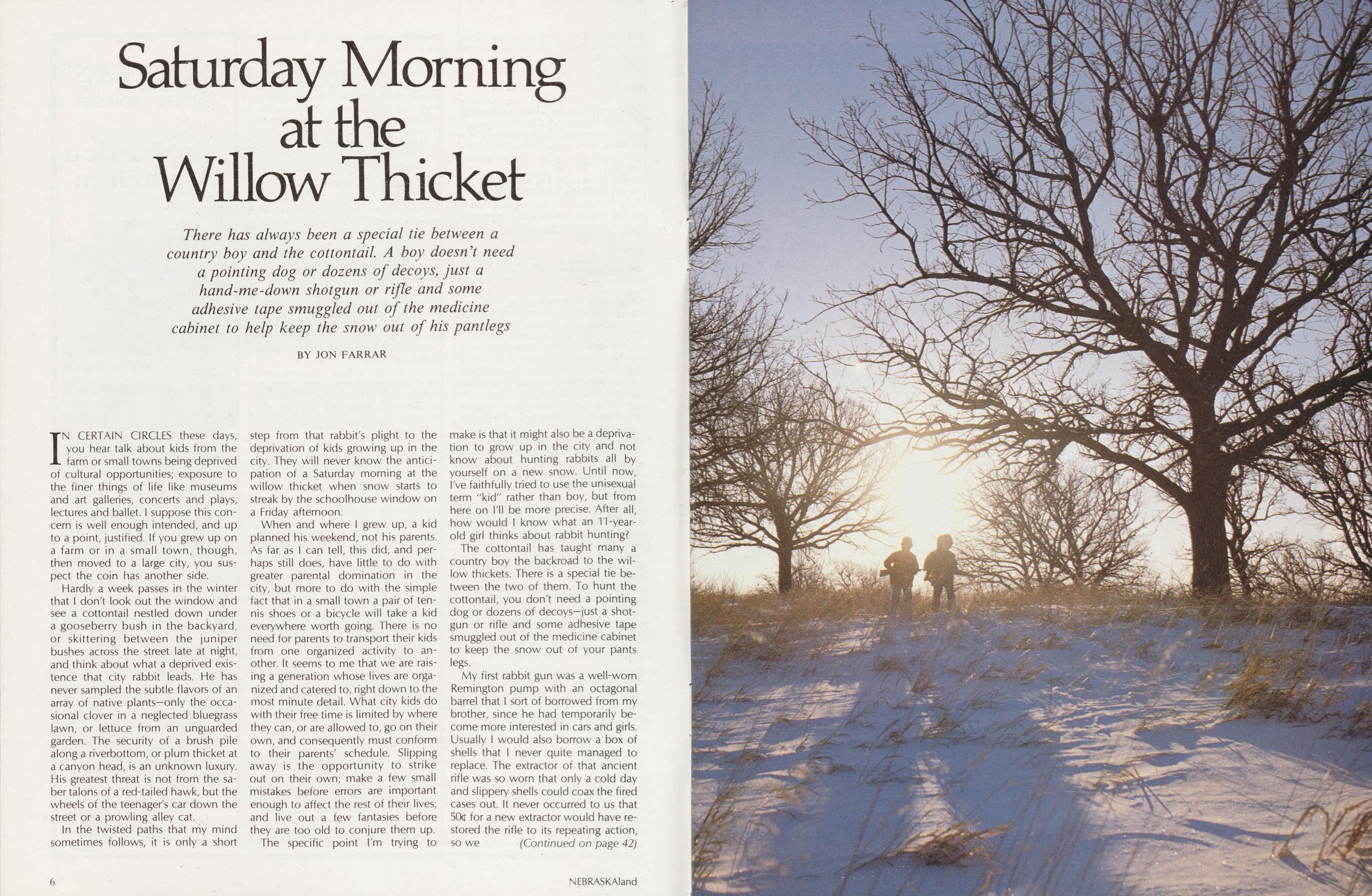
Saturday Morning at the Willow Thicket
There has always been a special tie between a country boy and the cottontail. A boy doesn't need a pointing dog or dozens of decoys, just a hand-me-down shotgun or rifle and some adhesive tape smuggled out of the medicine cabinet to help keep the snow out of his pantlegs
IN CERTAIN CIRCLES these days, you hear talk about kids from the farm or small towns being deprived of cultural opportunities; exposure to the finer things of life like museums and art galleries, concerts and plays, lectures and ballet. I suppose this concern is well enough intended, and up to a point, justified. If you grew up on a farm or in a small town, though, then moved to a large city, you suspect the coin has another side.
Hardly a week passes in the winter that I don't look out the window and see a cottontail nestled down under a gooseberry bush in the backyard, or skittering between the juniper bushes across the street late at night, and think about what a deprived existence that city rabbit leads. He has never sampled the subtle flavors of an array of native plants—only the occasional clover in a neglected bluegrass lawn, or lettuce from an unguarded garden. The security of a brush pile along a riverbottom, or plum thicket at a canyon head, is an unknown luxury. His greatest threat is not from the saber talons of a red-tailed hawk, but the wheels of the teenagers car down the street or a prowling alley cat.
In the twisted paths that my mind sometimes follows, it is only a short step from that rabbit's plight to the deprivation of kids growing up in the city. They will never know the anticipation of a Saturday morning at the willow thicket when snow starts to streak by the schoolhouse window on a Friday afternoon.
When and where I grew up, a kid planned his weekend, not his parents. As far as I can tell, this did, and perhaps still does, have little to do with greater parental domination in the city, but more to do with the simple fact that in a small town a pair of ten nis shoes or a bicycle will take a kid everywhere worth going. There is no need for parents to transport their kids from one organized activity to another. It seems to me that we are raising a generation whose lives are organized and catered to, right down to the most minute detail. What city kids do with their free time is limited by where they can, or are allowed to, go on their own, and consequently must conform to their parents' schedule. Slipping away is the opportunity to strike out on their own; make a few small mistakes before errors are important enough to affect the rest of their lives; and live out a few fantasies before they are too old to conjure them up.
The specific point I'm trying to make is that it might also be a deprivation to grow up in the city and not know about hunting rabbits all by yourself on a new snow. Until now, I've faithfully tried to use the unisexual term "kid" rather than boy, but from here on I'll be more precise. After all, how would I know what an 11-year old girl thinks about rabbit hunting?
The cottontail has taught many a country boy the backroad to the willow thickets. There is a special tie be tween the two of them. To hunt the cottontail, you don't need a pointing dog or dozens of decoys—just a shot gun or rifle and some adhesive tape smuggled out of the medicine cabinet to keep the snow out of your pants legs.
My first rabbit gun was a well-worn Remington pump with an octagonal barrel that I sort of borrowed from my brother, since he had temporarily be come more interested in cars and girls. Usually I would also borrow a box of shells that I never quite managed to replace. The extractor of that ancient rifle was so worn that only a cold day and slippery shells could coax the fired cases out. It never occurred to us that 504 for a new extractor would have restored the rifle to its repeating action, so we
(Continued on page 42) 6 NEBRASKAland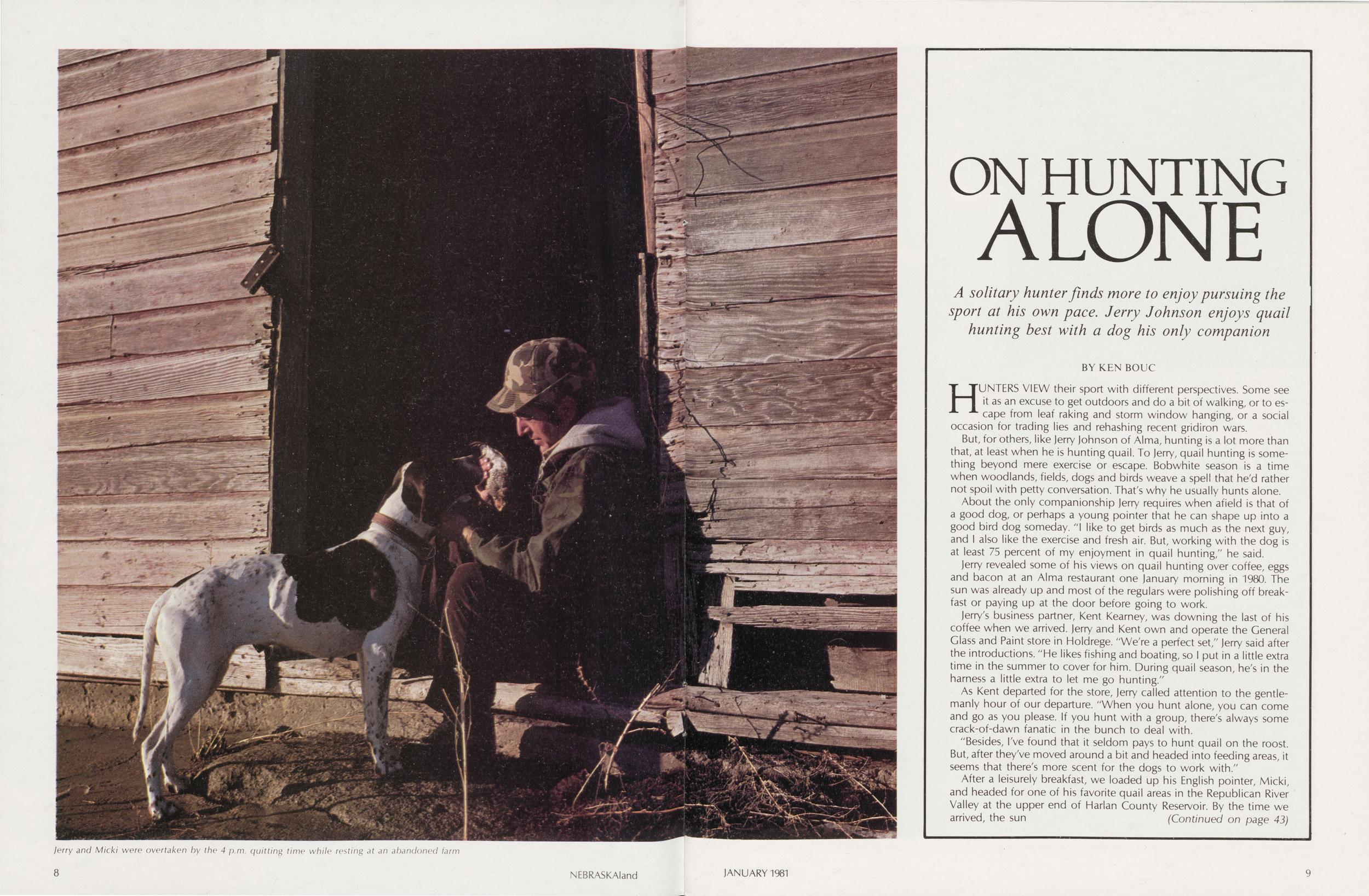
Jerry and Micki were overtaken by the 4 p.m. quitting time while resting at an abandoned farm
ON HUNTING ALONE
A solitary hunter finds more to enjoy pursuing the sport at his own pace. Jerry Johnson enjoys quail hunting best with a dog his only companion
HUNTERS VIEW their sport with different perspectives. Some see it as an excuse to get outdoors and do a bit of walking, or to escape from leaf raking and storm window hanging, or a social occasion for trading lies and rehashing recent gridiron wars.
But, for others, like Jerry Johnson of Alma, hunting is a lot more than that, at least when he is hunting quail. To Jerry, quail hunting is some thing beyond mere exercise or escape. Bobwhite season is a time when woodlands, fields, dogs and birds weave a spell that he'd rather not spoil with petty conversation. That's why he usually hunts alone.
About the only companionship Jerry requires when afield is that of a good dog, or perhaps a young pointer that he can shape up into a good bird dog someday. "I like to get birds as much as the next guy, and I also like the exercise and fresh air. But, working with the dog is at least 75 percent of my enjoyment in quail hunting," he said. Jerry revealed some of his views on quail hunting over coffee, eggs and bacon at an Alma restaurant one January morning in 1980. The sun was already up and most of the regulars were polishing off break fast or paying up at the door before going to work.
Jerry's business partner, Kent Kearney, was downing the last of his coffee when we arrived. Jerry and Kent own and operate the General Glass and Paint store in Holdrege. "We're a perfect set," Jerry said after the introductions. "He likes fishing and boating, so I put in a little extra time in the summer to cover for him. During quail season, he's in the harness a little extra to let me go hunting."
As Kent departed for the store, Jerry called attention to the gentle manly hour of our departure. "When you hunt alone, you can come and go as you please. If you hunt with a group, there's always some crack-of-dawn fanatic in the bunch to deal with.
"Besides, I've found that it seldom pays to hunt quail on the roost. But, after they've moved around a bit and headed into feeding areas, it seems that there's more scent for the dogs to work with."
After a leisurely breakfast, we loaded up his English pointer, Micki, and headed for one of his favorite quail areas in the Republican River Valley at the upper end of Harlan County Reservoir. By the time we arrived, the sun
(Continued on page 43) JANUARY 1981 9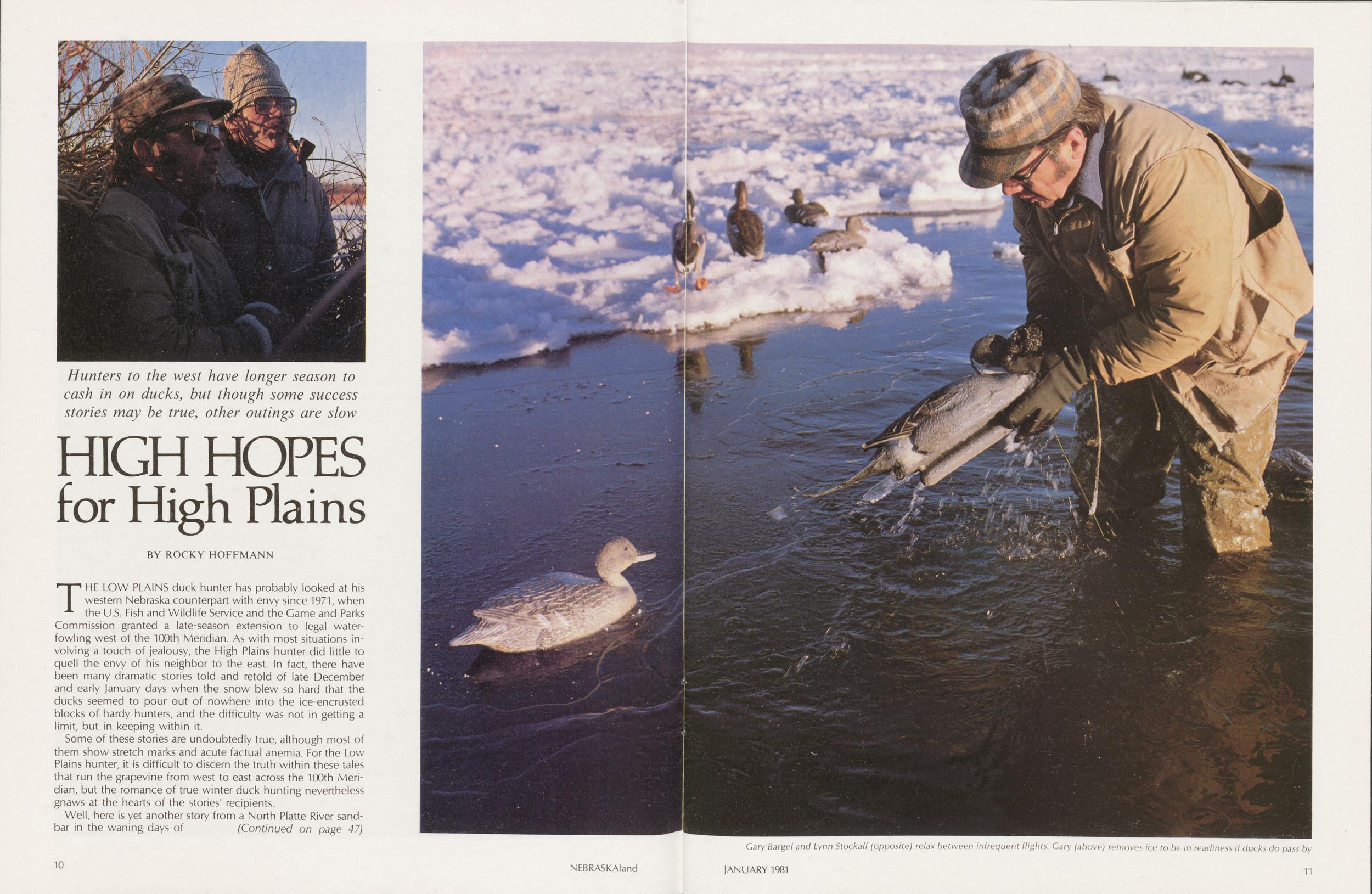
Hunters to the west have longer season to cash in on ducks, but though some success stories may be true, other outings are slow
HIGH HOPES for High Plains
THE LOW PLAINS duck hunter has probably looked at his western Nebraska counterpart with envy since 1971, when the U.S. Fish and Wildlife Service and the Game and Parks Commission granted a late-season extension to legal water fowling west of the 100th Meridian. As with most situations involving a touch of jealousy, the High Plains hunter did little to quell the envy of his neighbor to the east. In fact, there have been many dramatic stories told and retold of late December and early January days when the snow blew so hard that the ducks seemed to pour out of nowhere into the ice-encrusted blocks of hardy hunters, and the difficulty was not in getting a limit, but in keeping within it.
Some of these stories are undoubtedly true, although most of them show stretch marks and acute factual anemia. For the Low Plains hunter, it is difficult to discern the truth within these tales that run the grapevine from west to east across the 100th Meridian, but the romance of true winter duck hunting nevertheless gnaws at the hearts of the stories' recipients.
Well, here is yet another story from a North Platte River sandbar in the waning days of
(Continued on page 47) 10 NEBRASKAlandGary Bargel and Lynn Stockall (opposite) relax between infrequent flights. Gary (above) removes ice to be in readiness if ducks do pass by
A GREAT PLACE FOR CATTLE AND MEN
A search for independent, isolated people leads photographer from the mountains of eastern Kentucky to Nebraska's Sandhills
IF YOU HAVE NEVER tried to load a roll of 120 film while in a bouncing pickup wearing two pairs of in sulated mittens, well then, you probably didn't photo graph Cherry County in January of 1979 when every day had a reading of below-zero temperature and even a four-wheel-drive with snow tires and chains wasn't much insurance against being stalled and stranded.
Any document purporting to discuss the Nebraska Sandhills must include all seasons and cycles of cattle life—the mainstay of local economy—not just the green period after spring melts the snow, but also the terrible beauty of a Sandhills winter.
Only the hardy can withstand the daily, constant commitment of Sandhills ranching. Yet, these independent
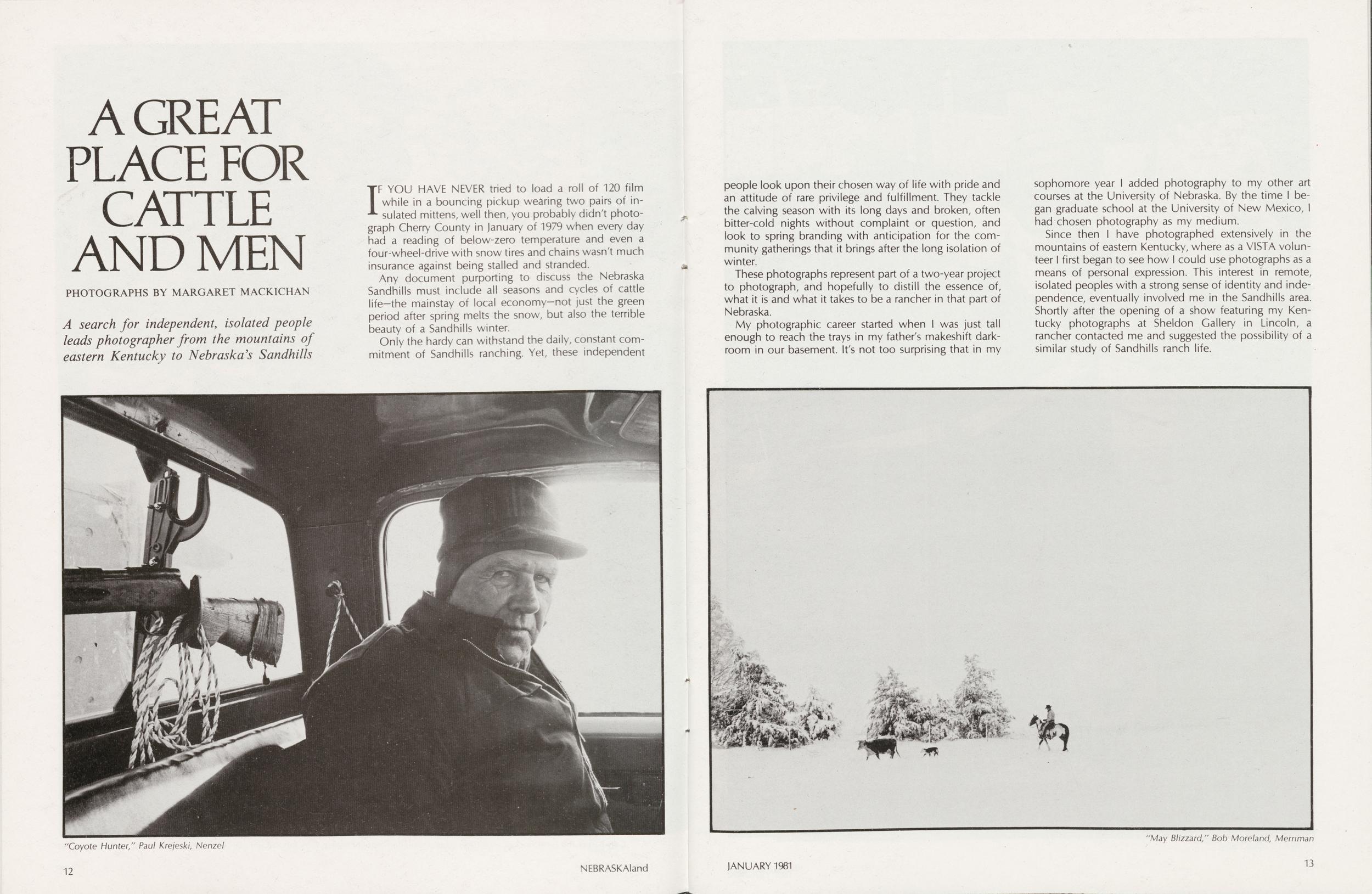
"Coyote Hunter," Paul Krejeski, Nenzel
people look upon their chosen way of life with pride and an attitude of rare privilege and fulfillment. They tackle the calving season with its long days and broken, often bitter-cold nights without complaint or question, and look to spring branding with anticipation for the community gatherings that it brings after the long isolation of winter.
These photographs represent part of a two-year project to photograph, and hopefully to distill the essence of, what it is and what it takes to be a rancher in that part of Nebraska.
My photographic career started when I was just tall enough to reach the trays in my father's makeshift dark room in our basement. It's not too surprising that in my sophomore year I added photography to my other art courses at the University of Nebraska. By the time I began graduate school at the University of New Mexico, I had chosen photography as my medium.
Since then I have photographed extensively in the mountains of eastern Kentucky, where as a VISTA volunteer I first began to see how I could use photographs as a means of personal expression. This interest in remote, isolated peoples with a strong sense of identity and independence, eventually involved me in the Sandhills area. Shortly after the opening of a show featuring my Kentucky photographs at Sheldon Gallery in Lincoln, a rancher contacted me and suggested the possibility of a similar study of Sandhills ranch life.
"May Blizzard," Bob Moreland, Merriman
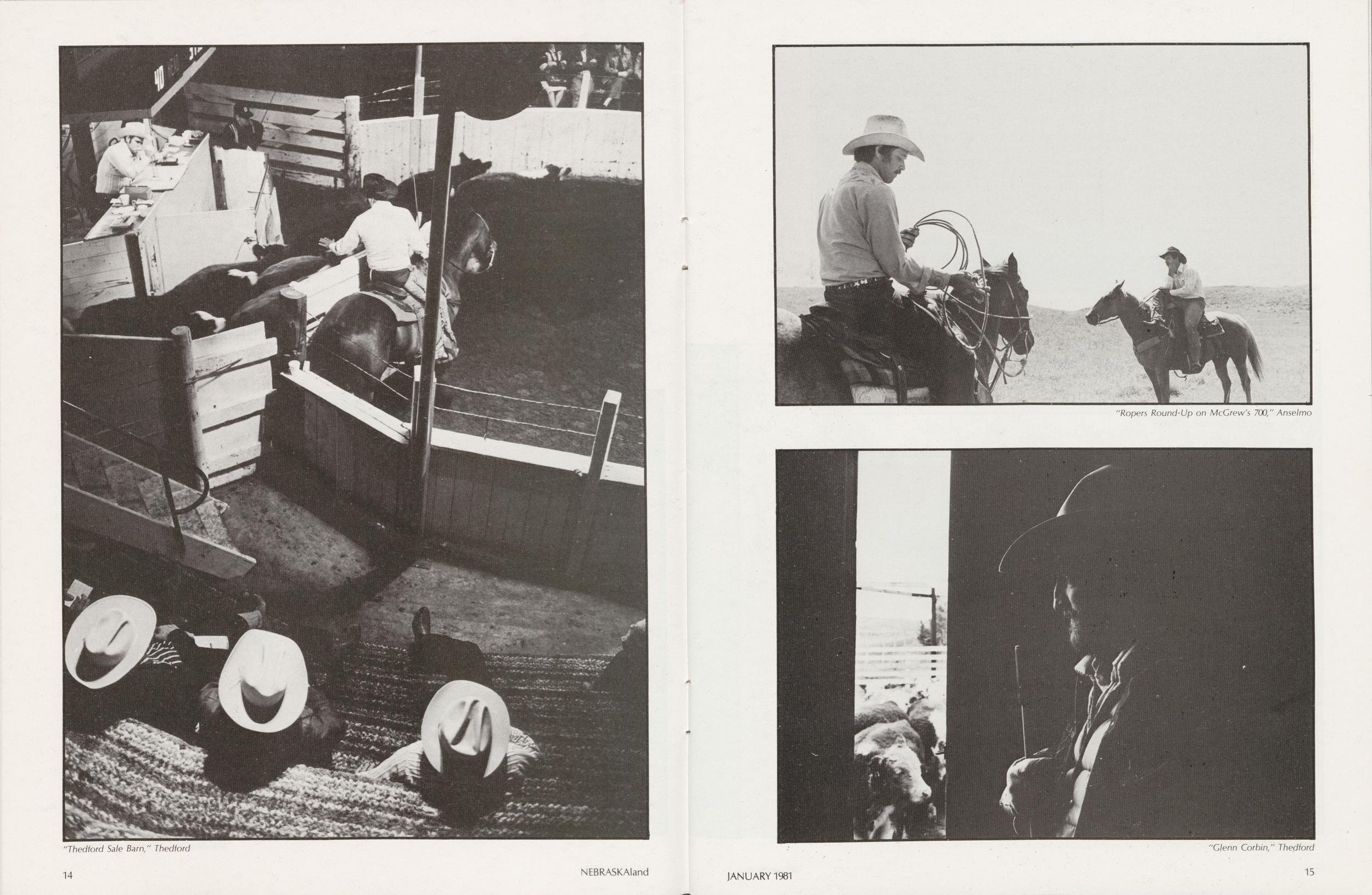
"Thedford Sale Barn," Thedford
"Ropers Round-Up on McCrew's 700," Anselmo
"Glenn Corbin," Thedford
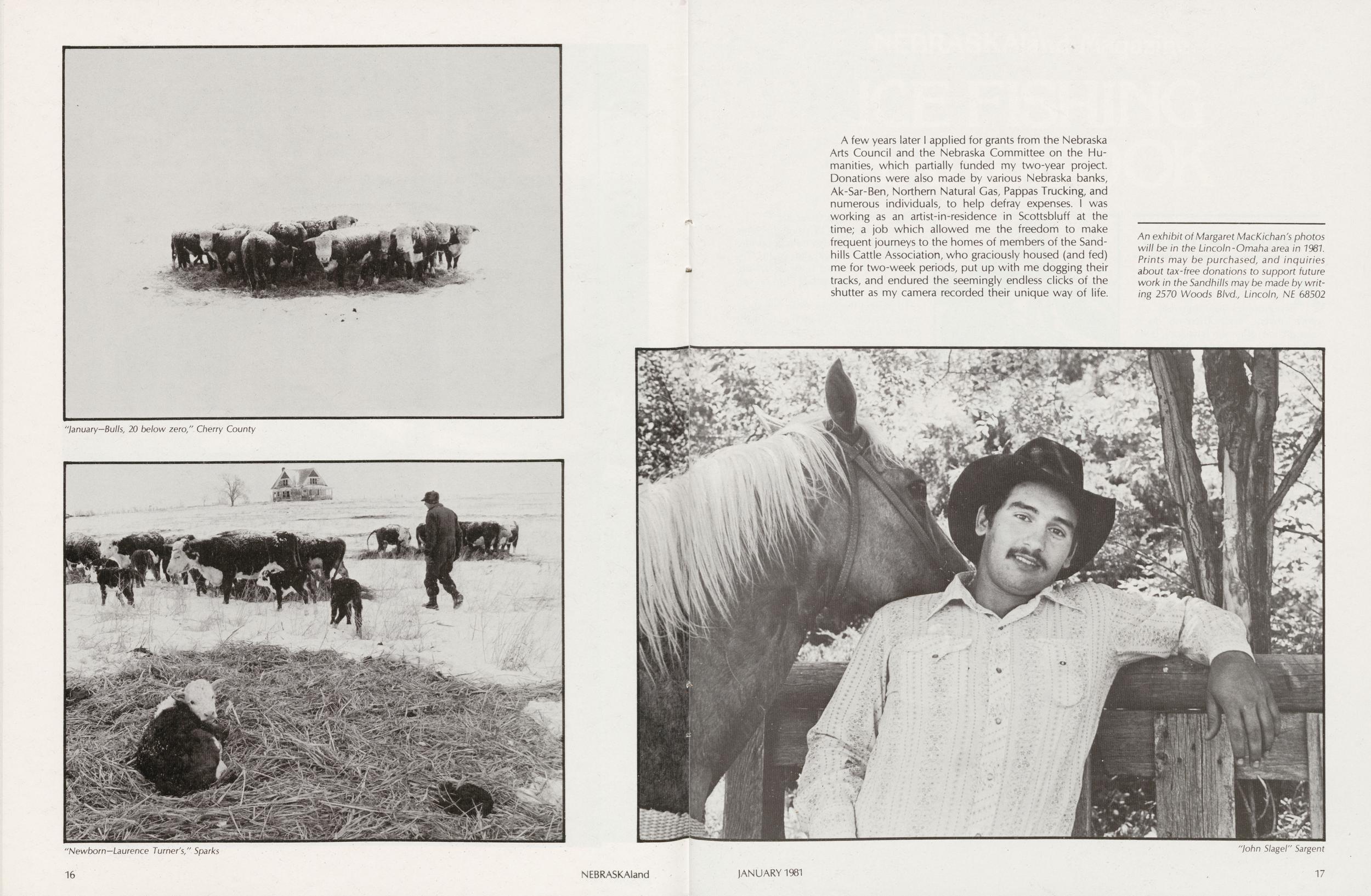
"January—Bulls, 20 below zero," Cherry County
"Newborn—Laurence Turner's," Sparks
A few years later I applied for grants from the Nebraska Arts Council and the Nebraska Committee on the Humanities, which partially funded my two-year project. Donations were also made by various Nebraska banks, Ak-Sar-Ben, Northern Natural Gas, Pappas Trucking, and numerous individuals, to help defray expenses. I was working as an artist-in-residence in Scottsbluff at the time; a job which allowed me the freedom to make frequent journeys to the homes of members of the Sand hills Cattle Association, who graciously housed (and fed) me for two-week periods, put up with me dogging their tracks, and endured the seemingly endless clicks of the shutter as my camera recorded their unique way of life.
An exhibit of Margaret MacKichan's photos will be in the Lincoln-Omaha area in 1981. Prints may be purchased, and inquiries about tax-free donations to support future work in the Sandhills may be made by writing 2570 Woods Blvd., Lincoln, NE 68502"John Slagel" Sargent
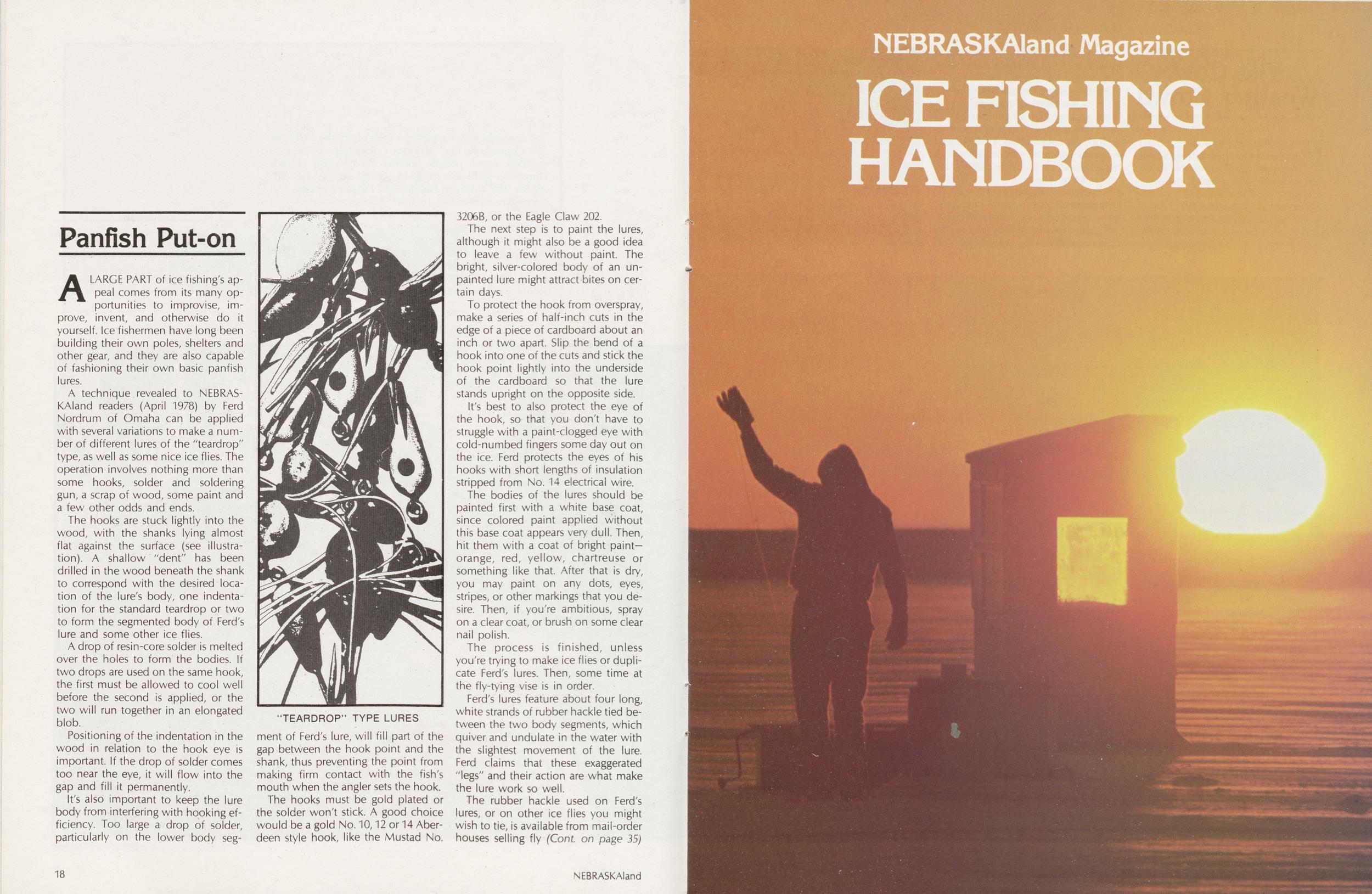
Panfish Put-on
A LARGE PART of ice fishing's appeal comes from its many opportunities to improvise, improve, invent, and otherwise do it yourself. Ice fishermen have long been building their own poles, shelters and other gear, and they are also capable of fashioning their own basic panfish lures.
A technique revealed to NEBRASKAland readers (April 1978) by Ferd Nordrum of Omaha can be applied with several variations to make a number of different lures of the "teardrop" type, as well as some nice ice flies. The operation involves nothing more than some hooks, solder and soldering gun, a scrap of wood, some paint and a few other odds and ends.
The hooks are stuck lightly into the wood, with the shanks lying almost flat against the surface (see illustration). A shallow "dent" has been drilled in the wood beneath the shank to correspond with the desired location of the lure's body, one indentation for the standard teardrop or two to form the segmented body of Ferd's lure and some other ice flies.
A drop of resin-core solder is melted over the holes to form the bodies. If two drops are used on the same hook, the first must be allowed to cool well before the second is applied, or the two will run together in an elongated blob.
Positioning of the indentation in the wood in relation to the hook eye is important. If the drop of solder comes too near the eye, it will flow into the gap and fill it permanently.
"TEARDROP" TYPE LURES
The hooks must be gold plated or the solder won't stick. A good choice would be a gold No. 10,12 or 14 Aberdeen style hook, like the Mustad No. 3206B, or the Eagle Claw 202.
The next step is to paint the lures, although it might also be a good idea to leave a few without paint. The bright, silver-colored body of an unpainted lure might attract bites on certain days.
To protect the hook from overspray, make a series of half-inch cuts in the edge of a piece of cardboard about an inch or two apart. Slip the bend of a hook into one of the cuts and stick the hook point lightly into the underside of the cardboard so that the lure stands upright on the opposite side.
It's best to also protect the eye of the hook, so that you don't have to struggle with a paint-clogged eye with cold-numbed fingers some day out on the ice. Ferd protects the eyes of his hooks with short lengths of insulation stripped from No. 14 electrical wire.
The bodies of the lures should be painted first with a white base coat, since colored paint applied without this base coat appears very dull. Then, hit them with a coat of bright paint orange, red, yellow, chartreuse or something like that. After that is dry, you may paint on any dots, eyes, stripes, or other markings that you desire. Then, if you're ambitious, spray on a clear coat, or brush on some clear nail polish.
The process is finished, unless you're trying to make ice flies or duplicate Ferd's lures. Then, some time at the fly-tying vise is in order.
Ferd's lures feature about four long, white strands of rubber hackle tied be tween the two body segments, which quiver and undulate in the water with the slightest movement of the lure. Ferd claims that these exaggerated "legs" and their action are what make the lure work so well.
The rubber hackle used on Ferd's lures, or on other ice flies you might wish to tie, is available from mail-order houses selling fly
(Cont on page 35) 18 NEBRASKAlandNEBRASKAland Magazine ICE FISHING HANDBOOK
The Cold Weather Crowd
EACH WINTER, thousands of otherwise sane and rational people foresake cozy homes and TV's to risk frostbite and pneumonia on a cold and windblown slab of ice in the hopes of catching a few fish.
A dozen years ago, when ice fishing was just starting to catch on in Nebraska, the sanity of winter anglers was held in serious doubt by a good many folks. But today, many of these same skeptics can be found out on the ice themselves, drawn there by the promise of a bucketful of panfish, or per haps a couple of larger fish, plus a good deal of fun in getting them.
Since the cold that once intimidated would-be winter outdoorsmen has been found to be manageable, ice fishermen have been joined by legions of hardy fun seekers, including cross country skiers, hikers, winter campers, ice skaters, and many others. By dress ing properly and understanding the cold environment, fishermen and
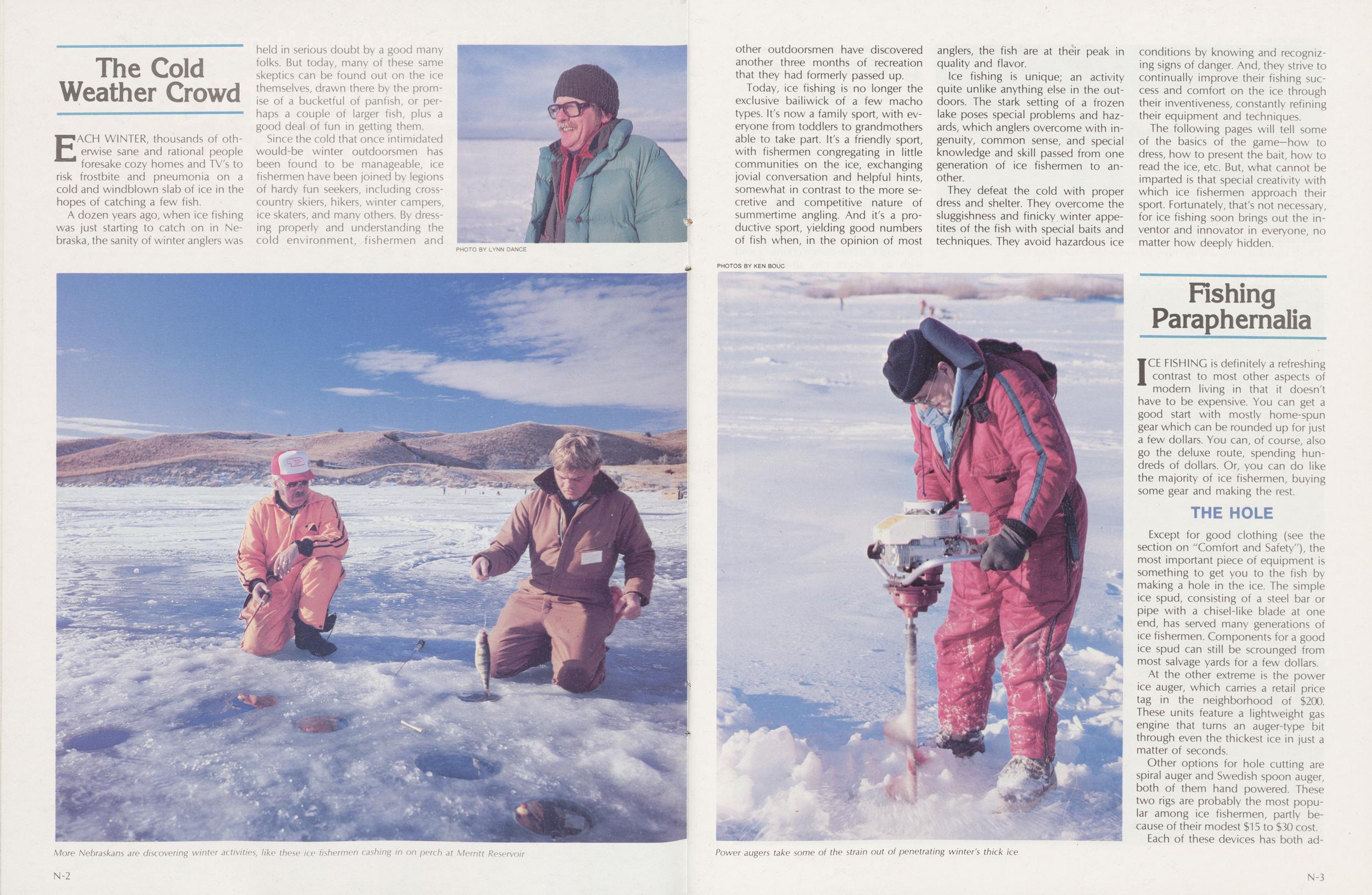
More Nebraskans are discovering winter activities, like these ice fishermen cashing in on perch at Merritt Reservoir
other outdoorsmen have discovered another three months of recreation that they had formerly passed up.
Today, ice fishing is no longer the exclusive bailiwick of a few macho types. It's now a family sport, with everyone from toddlers to grandmothers able to take part. It's a friendly sport, with fishermen congregating in little communities on the ice, exchanging jovial conversation and helpful hints, somewhat in contrast to the more secretive and competitive nature of summertime angling. And it's a productive sport, yielding good numbers of fish when, in the opinion of most anglers, the fish are at their peak in quality and flavor.
Ice fishing is unique; an activity quite unlike anything else in the outdoors. The stark setting of a frozen lake poses special problems and hazards, which anglers overcome with ingenuity, common sense, and special knowledge and skill passed from one generation of ice fishermen to an other.
They defeat the cold with proper dress and shelter. They overcome the sluggishness and finicky winter appetites of the fish with special baits and techniques. They avoid hazardous ice
PHOTOS BY KEN BOUCconditions by knowing and recognizing signs of danger. And, they strive to continually improve their fishing success and comfort on the ice through their inventiveness, constantly refining their equipment and techniques.
The following pages will tell some of the basics of the game—how to dress, how to present the bait, how to read the ice, etc. But, what cannot be imparted is that special creativity with which ice fishermen approach their sport. Fortunately, that's not necessary, for ice fishing soon brings out the in ventor and innovator in everyone, no matter how deeply hidden.
Fishing ParaphernaliaICE FISHING is definitely a refreshing contrast to most other aspects of modern living in that it doesn't have to be expensive. You can get a good start with mostly home-spun gear which can be rounded up for just a few dollars. You can, of course, also go the deluxe route, spending hundreds of dollars. Or, you can do like the majority of ice fishermen, buying some gear and making the rest.
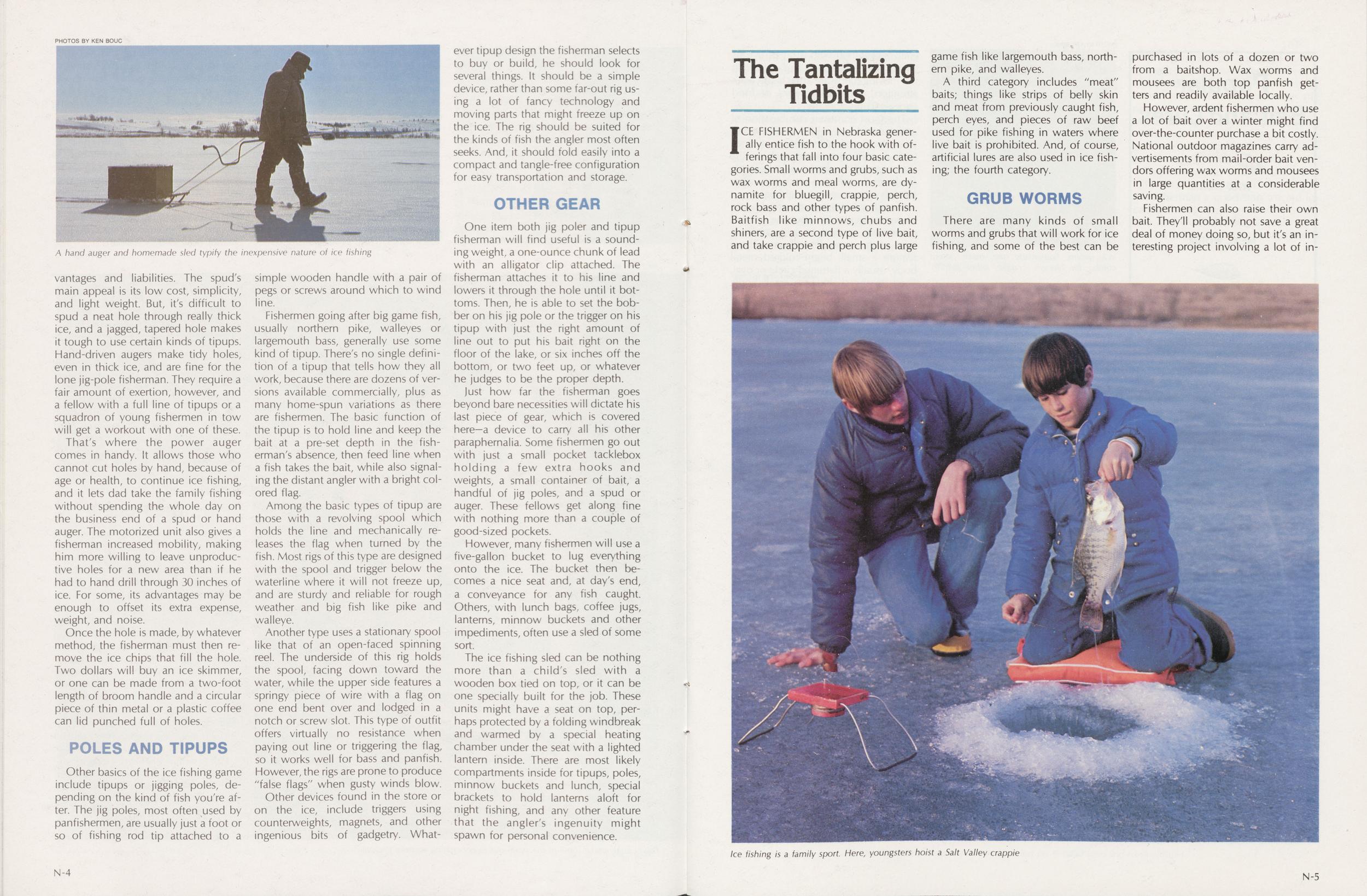
THE HOLEExcept for good clothing (see the section on "Comfort and Safety"), the most important piece of equipment is something to get you to the fish by making a hole in the ice. The simple ice spud, consisting of a steel bar or pipe with a chisel-like blade at one end, has served many generations of ice fishermen. Components for a good ice spud can still be scrounged from most salvage yards for a few dollars.
At the other extreme is the power ice auger, which carries a retail price tag in the neighborhood of $200. These units feature a lightweight gas engine that turns an auger-type bit through even the thickest ice in just a matter of seconds.
Other options for hole cutting are spiral auger and Swedish spoon auger, both of them hand powered. These two rigs are probably the most popular among ice fishermen, partly be cause of their modest $15 to $30 cost.
Each of these devices has both ad-
Power augers take some of the strain out of penetrating winter's thick ice
 PHOTOS BY KEN BOUC
A hand auger and homemade sled typify the inexpensive nature of ice fishing
vantages and liabilities. The spud's main appeal is its low cost, simplicity, and light weight. But, it's difficult to spud a neat hole through really thick ice, and a jagged, tapered hole makes it tough to use certain kinds of tipups. Hand-driven augers make tidy holes, even in thick ice, and are fine for the lone jig-pole fisherman. They require a fair amount of exertion, however, and a fellow with a full line of tipups or a squadron of young fishermen in tow will get a workout with one of these.
That's where the power auger comes in handy. It allows those who cannot cut holes by hand, because of age or health, to continue ice fishing, and it lets dad take the family fishing without spending the whole day on the business end of a spud or hand auger. The motorized unit also gives a fisherman increased mobility, making him more willing to leave unproductive holes for a new area than if he had to hand drill through 30 inches of ice. For some, its advantages may be enough to offset its extra expense, weight, and noise.
Once the hole is made, by whatever method, the fisherman must then remove the ice chips that fill the hole. Two dollars will buy an ice skimmer, or one can be made from a two-foot length of broom handle and a circular piece of thin metal or a plastic coffee can lid punched full of holes.
POLES AND TIPUPSOther basics of the ice fishing game include tipups or jigging poles, depending on the kind of fish you're after. The jig poles, most often used by panfishermen, are usually just a foot or so of fishing rod tip attached to a simple wooden handle with a pair of pegs or screws around which to wind line.
Fishermen going after big game fish, usually northern pike, walleyes or largemouth bass, generally use some kind of tipup. There's no single definition of a tipup that tells how they all work, because there are dozens of versions available commercially, plus as many home-spun variations as there are fishermen. The basic function of the tipup is to hold line and keep the bait at a pre-set depth in the fisherman's absence, then feed line when a fish takes the bait, while also signal ing the distant angler with a bright colored flag.
Among the basic types of tipup are those with a revolving spool which holds the line and mechanically releases the flag when turned by the fish. Most rigs of this type are designed with the spool and trigger below the waterline where it will not freeze up, and are sturdy and reliable for rough weather and big fish like pike and walleye.
Another type uses a stationary spool like that of an open-faced spinning reel. The underside of this rig holds the spool, facing down toward the water, while the upper side features a springy piece of wire with a flag on one end bent over and lodged in a notch or screw slot. This type of outfit offers virtually no resistance when paying out line or triggering the flag, so it works well for bass and panfish. However, the rigs are prone to produce "false flags" when gusty winds blow.
Other devices found in the store or on the ice, include triggers using counterweights, magnets, and other ingenious bits of gadgetry. Whatever tipup design the fisherman selects to buy or build, he should look for several things. It should be a simple device, rather than some far-out rig us ing a lot of fancy technology and moving parts that might freeze up on the ice. The rig should be suited for the kinds of fish the angler most often seeks. And, it should fold easily into a compact and tangle-free configuration for easy transportation and storage.
OTHER GEAROne item both jig poler and tipup fisherman will find useful is a sound ing weight, a one-ounce chunk of lead with an alligator clip attached. The fisherman attaches it to his line and lowers it through the hole until it bottoms. Then, he is able to set the bobber on his jig pole or the trigger on his tipup with just the right amount of line out to put his bait right on the floor of the lake, or six inches off the bottom, or two feet up, or whatever he judges to be the proper depth.
Just how far the fisherman goes beyond bare necessities will dictate his last piece of gear, which is covered here—a device to carry all his other paraphernalia. Some fishermen go out with just a small pocket tacklebox holding a few extra hooks and weights, a small container of bait, a handful of jig poles, and a spud or auger. These fellows get along fine with nothing more than a couple of good-sized pockets.
However, many fishermen will use a five-gallon bucket to lug everything onto the ice. The bucket then be comes a nice seat and, at day's end, a conveyance for any fish caught. Others, with lunch bags, coffee jugs, lanterns, minnow buckets and other impediments, often use a sled of some sort.
The ice fishing sled can be nothing more than a child's sled with a wooden box tied on top, or it can be one specially built for the job. These units might have a seat on top, perhaps protected by a folding windbreak and warmed by a special heating chamber under the seat with a lighted lantern inside. There are most likely compartments inside for tipups, poles, minnow buckets and lunch, special brackets to hold lanterns aloft for night fishing, and any other feature that the angler's ingenuity might spawn for personal convenience.
N-4 The Tantalizing TidbitsICE FISHERMEN in Nebraska generally entice fish to the hook with offerings that fall into four basic categories. Small worms and grubs, such as wax worms and meal worms, are dynamite for bluegill, crappie, perch, rock bass and other types of panfish. Baitfish like minnows, chubs and shiners, are a second type of live bait, and take crappie and perch plus large game fish like largemouth bass, northern pike, and walleyes.
A third category includes "meat" baits; things like strips of belly skin and meat from previously caught fish, perch eyes, and pieces of raw beef used for pike fishing in waters where live bait is prohibited. And, of course, artificial lures are also used in ice fishing; the fourth category.
GRUB WORMSThere are many kinds of small worms and grubs that will work for ice fishing, and some of the best can be purchased in lots of a dozen or two from a baitshop. Wax worms and mousees are both top panfish get ters and readily available locally.
However, ardent fishermen who use a lot of bait over a winter might find over-the-counter purchase a bit costly. National outdoor magazines carry advertisements from mail-order bait vendors offering wax worms and mousees in large quantities at a considerable saving.
Fishermen can also raise their own bait. They'll probably not save a great deal of money doing so, but it's an interesting project involving a lot of in-
Ice fishing is a family sport. Here, youngsters hoist a Salt Valley crappie
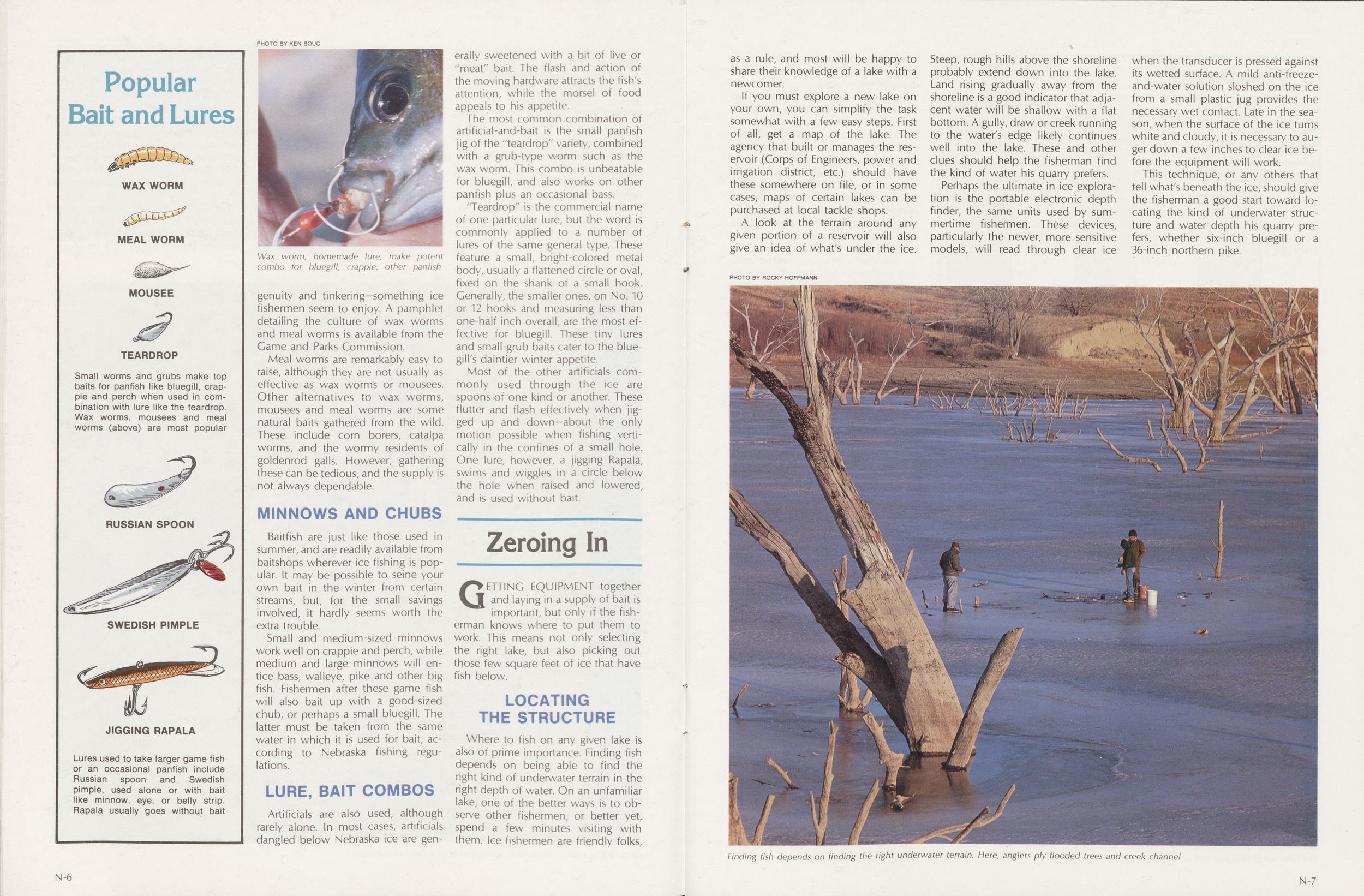 PHOTO BY KEN BOUC
Popular
Bait and Lures
PHOTO BY KEN BOUC
Popular
Bait and Lures
Wax worm, homemade lure, make potent combo for bluegill, crappie, other panfish
genuity and tinkering—something ice fishermen seem to enjoy. A pamphlet detailing the culture of wax worms and meal worms is available from the Game and Parks Commission.
Meal worms are remarkably easy to raise, although they are not usually as effective as wax worms or mousees. Other alternatives to wax worms, mousees and meal worms are some natural baits gathered from the wild. These include corn borers, catalpa worms, and the wormy residents of goldenrod galls. However, gathering these can be tedious, and the supply is not always dependable.
MINNOWS AND CHUBSBaitfish are just like those used in summer, and are readily available from baitshops wherever ice fishing is popular. It may be possible to seine your own bait in the winter from certain streams, but, for the small savings involved, it hardly seems worth the extra trouble.
Small and medium-sized minnows work well on crappie and perch, while medium and large minnows will entice bass, walleye, pike and other big fish. Fishermen after these game fish will also bait up with a good-sized chub, or perhaps a small bluegill. The latter must be taken from the same water in which it is used for bait, according to Nebraska fishing regulations.
LURE, BAIT COMBOSArtificials are also used, although rarely alone. In most cases, artificials dangled below Nebraska ice are generally sweetened with a bit of live or "meat" bait. The flash and action of the moving hardware attracts the fish's attention, while the morsel of food appeals to his appetite.
The most common combination of artificial-and-bait is the small panfish jig of the "teardrop" variety, combined with a grub-type worm such as the wax worm. This combo is unbeatable for bluegill, and also works on other panfish plus an occasional bass.
"Teardrop" is the commercial name of one particular lure, but the word is commonly applied to a number of lures of the same general type. These feature a small, bright-colored metal body, usually a flattened circle or oval, fixed on the shank of a small hook. Generally, the smaller ones, on No. 10 or 12 hooks and measuring less than one-half inch overall, are the most effective for bluegill. These tiny lures and small-grub baits cater to the bluegill's daintier winter appetite.
Most of the other artificials commonly used through the ice are spoons of one kind or another. These flutter and flash effectively when jig ged up and down—about the only motion possible when fishing vertically in the confines of a small hole. One lure, however, a jigging Rapala, swims and wiggles in a circle below the hole when raised and lowered, and is used without bait.
Zeroing InGETTING EQUIPMENT together and laying in a supply of bait is important, but only if the fish erman knows where to put them to work. This means not only selecting the right lake, but also picking out those few square feet of ice that have fish below.
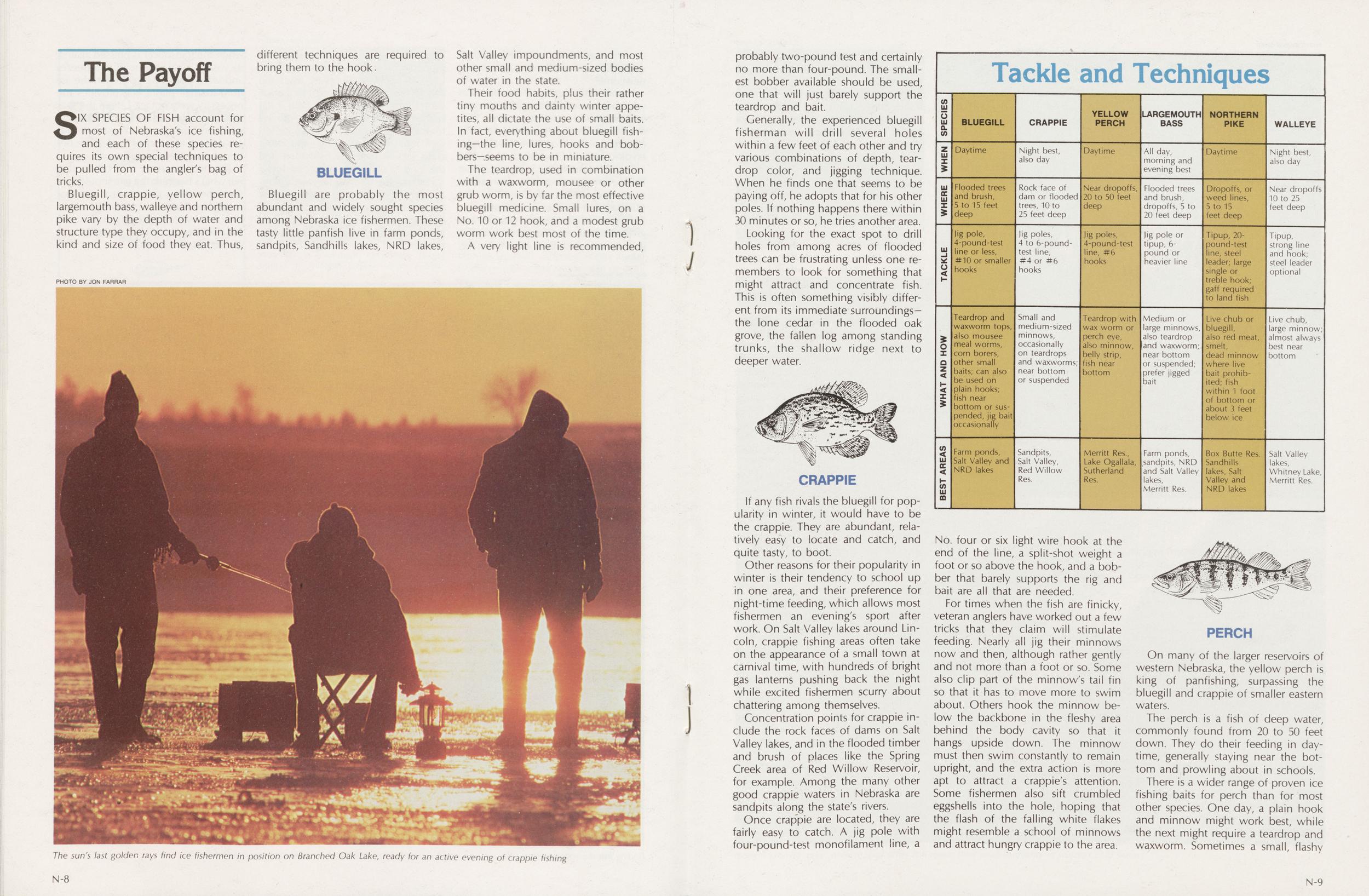
LOCATING THE STRUCTUREWhere to fish on any given lake is also of prime importance. Finding fish depends on being able to find the right kind of underwater terrain in the right depth of water. On an unfamiliar lake, one of the better ways is to observe other fishermen, or better yet, spend a few minutes visiting with them. Ice fishermen are friendly folks, N-6 as a rule, and most will be happy to share their knowledge of a lake with a newcomer.
If you must explore a new lake on your own, you can simplify the task somewhat with a few easy steps. First of all, get a map of the lake. The agency that built or manages the reservoir (Corps of Engineers, power and irrigation district, etc.) should have these somewhere on file, or in some cases, maps of certain lakes can be purchased at local tackle shops.
A look at the terrain around any given portion of a reservoir will also give an idea of what's under the ice. Steep, rough hills above the shoreline probably extend down into the lake. Land rising gradually away from the shoreline is a good indicator that adjacent water will be shallow with a flat bottom. A gully, draw or creek running to the water's edge likely continues well into the lake. These and other clues should help the fisherman find the kind of water his quarry prefers.
Perhaps the ultimate in ice exploration is the portable electronic depth finder, the same units used by summertime fishermen. These devices, particularly the newer, more sensitive models, will read through clear ice when the transducer is pressed against its wetted surface. A mild anti-freeze and-water solution sloshed on the ice from a small plastic jug provides the necessary wet contact. Late in the season, when the surface of the ice turns white and cloudy, it is necessary to auger down a few inches to clear ice be fore the equipment will work.
This technique, or any others that tell what's beneath the ice, should give the fisherman a good start toward locating the kind of underwater structure and water depth his quarry prefers, whether six-inch bluegill or a 36-inch northern pike.
PHOTO BY ROCKY HOFFMANNFinding fish depends on finding the right underwater terrain. Here, anglers ply flooded trees and creek channel
 The Payoff
SIX SPECIES OF FISH account for most of Nebraska's ice fishing, and each of these species requires its own special techniques to be pulled from the angler's bag of tricks.
Bluegill, crappie, yellow perch, largemouth bass, walleye and northern pike vary by the depth of water and structure type they occupy, and in the kind and size of food they eat. Thus, different techniques are required to bring them to the hook.
Bluegill are probably the most abundant and widely sought species among Nebraska ice fishermen. These tasty little panfish live in farm ponds, sandpits, Sandhills lakes, NRD lakes, Salt Valley impoundments, and most other small and medium-sized bodies of water in the state.
Their food habits, plus their rather tiny mouths and dainty winter appetites, all dictate the use of small baits. In fact, everything about bluegill fish ing—the line, lures, hooks and bobbers—seems to be in miniature.
The teardrop, used in combination with a waxworm, mousee or other grub worm, is by far the most effective bluegill medicine. Small lures, on a No. 10 or 12 hook, and a modest grub worm work best most of the time.
A very light line is recommended,
PHOTO BY JON FARRARThe sun's last golden rays find ice fishermen in position on Branched Oak Lake, ready for an active evening of crappie fishing
probably two-pound test and certainly no more than four-pound. The small est bobber available should be used, one that will just barely support the teardrop and bait.
Generally, the experienced bluegill fisherman will drill several holes within a few feet of each other and try various combinations of depth, tear drop color, and jigging technique. When he finds one that seems to be paying off, he adopts that for his other poles. If nothing happens there within 30 minutes or so, he tries another area.
Looking for the exact spot to drill holes from among acres of flooded trees can be frustrating unless one remembers to look for something that might attract and concentrate fish. This is often something visibly differ ent from its immediate surroundings the lone cedar in the flooded oak grove, the fallen log among standing trunks, the shallow ridge next to deeper water.
If any fish rivals the bluegill for popularity in winter, it would have to be the crappie. They are abundant, relatively easy to locate and catch, and quite tasty, to boot.
Other reasons for their popularity in winter is their tendency to school up in one area, and their preference for night-time feeding, which allows most fishermen an evening's sport after work. On Salt Valley lakes around Lincoln, crappie fishing areas often take on the appearance of a small town at carnival time, with hundreds of bright gas lanterns pushing back the night while excited fishermen scurry about chattering among themselves.
Concentration points for crappie include the rock faces of dams on Salt Valley lakes, and in the flooded timber and brush of places like the Spring Creek area of Red Willow Reservoir, for example. Among the many other good crappie waters in Nebraska are sandpits along the state's rivers.
Once crappie are located, they are fairly easy to catch. A jig pole with four-pound-test monofilament line, a
Tackle and Techniques YELLOW LARGEMOUTH NORTHERN BLUEGILL CRAPPIE PERCH BASS PIKE WALLEYE Daytime Night best, Daytime All day, Daytime Night best, also day morning and also day evening best Flooded trees Rock face of Near dropoffs, Flooded trees Dropoffs, or Near dropoffs and brush, dam or flooded 20 to 50 feet and brush, weed lines, 10 5 to 15 feet trees, 10 to deep dropoffs, 5 to 5 to 15 feet deep deep 25 feet deep 20 feet deep feet deep Jig pole, Jig poles, Jig poles, Jig pole or Tipup, 20 Tipup, 4-pound-test 4 to 6-pound 4-pound-test tipup, 6 pound-test strong line UJ line or less, test line, line, #6 pound or line, steel and hook; #10 or smaller #4 or #6 hooks heavier line leader; large steel leader hooks hooks single or optional treble hook; gaff required to land fish Teardrop and Small and Teardrop with Medium or Live chub or Live chub, waxworm tops, medium-sized wax worm or large minnows, bluegill, large minnow; also mousee minnows, perch eye, also teardrop also red meat, almost always meal worms, occasionally also minnow, and waxworm; smelt, best near corn borers, on teardrops belly strip, near bottom dead minnow bottom other small and waxworms; fish near or suspended; where live baits; can also near bottom bottom prefer jigged bait prohib be used on or suspended bait ited; fish plain hooks; within 1 foot fish near of bottom or bottom or sus about 3 feet pended, jig bait below ice occasionally Farm ponds, Sandpits, Merritt Res., Farm ponds, Box Butte Res. Salt Valley Salt Valley and Salt Valley, Lake Ogallala, sandpits, NRD Sandhills lakes, NRD lakes Red Willow Sutherland and Salt Valley lakes, Salt Whitney Lake, Res. Res. lakes, Valley and Merritt Res. Merritt Res. NRD lakesNo. four or six light wire hook at the end of the line, a split-shot weight a foot or so above the hook, and a bobber that barely supports the rig and bait are all that are needed.
For times when the fish are finicky, veteran anglers have worked out a few tricks that they claim will stimulate feeding. Nearly all jig their minnows now and then, although rather gently and not more than a foot or so. Some also clip part of the minnow's tail fin so that it has to move more to swim about. Others hook the minnow be low the backbone in the fleshy area behind the body cavity so that it hangs upside down. The minnow must then swim constantly to remain upright, and the extra action is more apt to attract a crappie's attention. Some fishermen also sift crumbled eggshells into the hole, hoping that the flash of the falling white flakes might resemble a school of minnows and attract hungry crappie to the area.
On many of the larger reservoirs of western Nebraska, the yellow perch is king of panfishing, surpassing the bluegill and crappie of smaller eastern waters.
The perch is a fish of deep water, commonly found from 20 to 50 feet down. They do their feeding in day time, generally staying near the bottom and prowling about in schools.
There is a wider range of proven ice fishing baits for perch than for most other species. One day, a plain hook and minnow might work best, while the next might require a teardrop and waxworm. Sometimes a small, flashy
N-9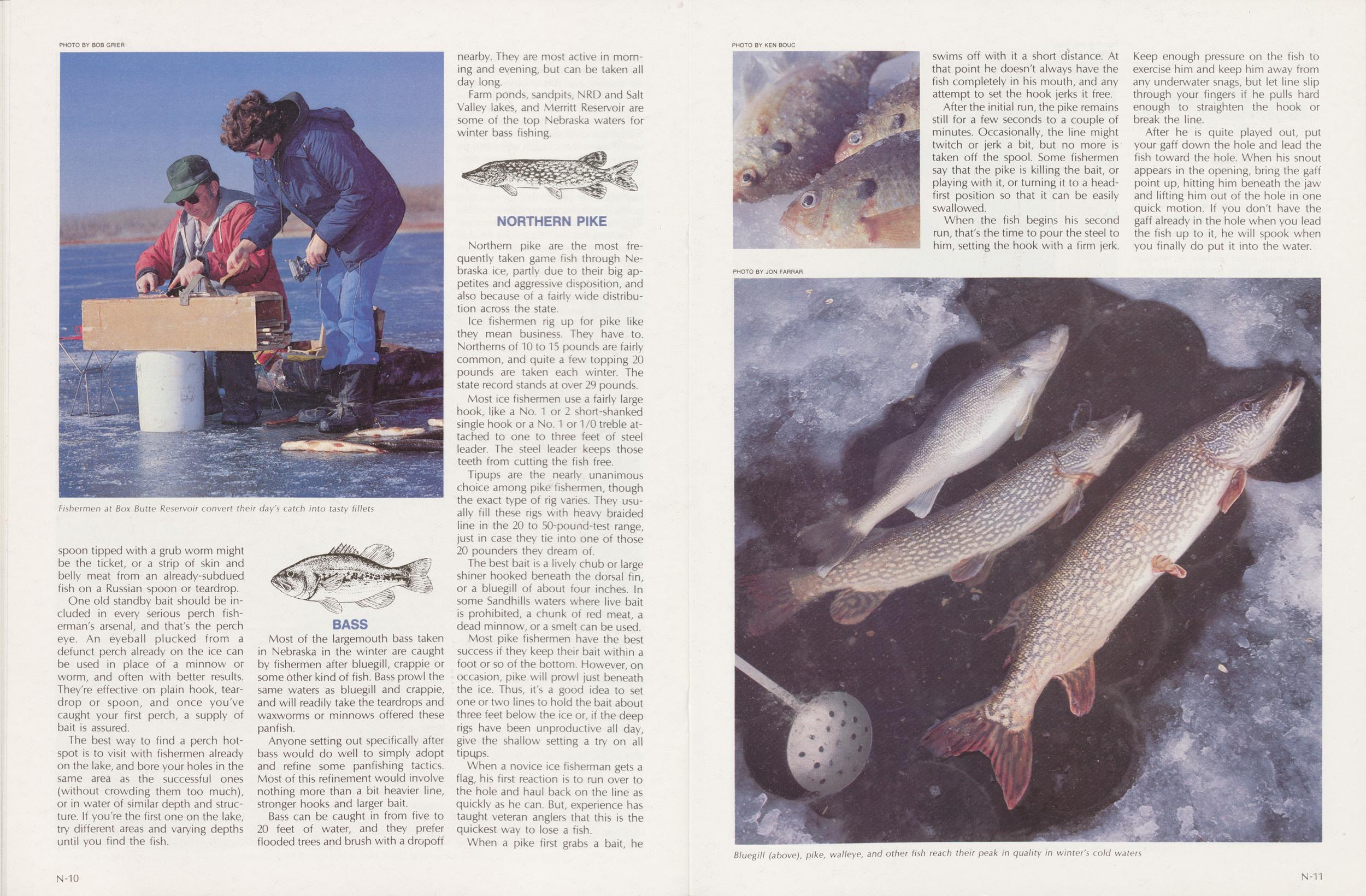
Fishermen at Box Butte Reservoir convert their day's catch into tasty fillets
spoon tipped with a grub worm might be the ticket, or a strip of skin and belly meat from an already-subdued fish on a Russian spoon or teardrop.
One old standby bait should be included in every serious perch fisherman's arsenal, and that's the perch eye. An eyeball plucked from a defunct perch already on the ice can be used in place of a minnow or worm, and often with better results. They're effective on plain hook, tear drop or spoon, and once you've caught your first perch, a supply of bait is assured.
The best way to find a perch hot spot is to visit with fishermen already on the lake, and bore your holes in the same area as the successful ones (without crowding them too much), or in water of similar depth and structure. If you're the first one on the lake, try different areas and varying depths until you find the fish.
Most of the largemouth bass taken in Nebraska in the winter are caught by fishermen after bluegill, crappie or some other kind of fish. Bass prowl the same waters as bluegill and crappie, and will readily take the teardrops and waxworms or minnows offered these panfish.
Anyone setting out specifically after bass would do well to simply adopt and refine some panfishing tactics. Most of this refinement would involve nothing more than a bit heavier line, stronger hooks and larger bait.
Bass can be caught in from five to 20 feet of water, and they prefer flooded trees and brush with a dropoff nearby. They are most active in morning and evening, but can be taken all day long.
Farm ponds, sandpits, NRD and Salt Valley lakes, and Merritt Reservoir are some of the top Nebraska waters for winter bass fishing.
Northern pike are the most frequently taken game fish through Nebraska ice, partly due to their big appetites and aggressive disposition, and also because of a fairly wide distribution across the state.
Ice fishermen rig up for pike like they mean business. They have to. Northerns of 10 to 15 pounds are fairly common, and quite a few topping 20 pounds are taken each winter. The state record stands at over 29 pounds.
Most ice fishermen use a fairly large hook, like a No. 1 or 2 short-shanked single hook or a No. 1 or 1 /0 treble attached to one to three feet of steel leader. The steel leader keeps those teeth from cutting the fish free.
Tipups are the nearly unanimous choice among pike fishermen, though the exact type of rig varies. They usually fill these rigs with heavy braided line in the 20 to 50-pound-test range, just in case they tie into one of those 20 pounders they dream of.
The best bait is a lively chub or large shiner hooked beneath the dorsal fin, or a bluegill of about four inches. In some Sandhills waters where live bait is prohibited, a chunk of red meat, a dead minnow, or a smelt can be used.
Most pike fishermen have the best success if they keep their bait within a foot or so of the bottom. However, on occasion, pike will prowl just beneath the ice. Thus, it's a good idea to set one or two lines to hold the bait about three feet below the ice or, if the deep rigs have been unproductive all day, give the shallow setting a try on all tipups.
When a novice ice fisherman gets a flag, his first reaction is to run over to the hole and haul back on the line as quickly as he can. But, experience has taught veteran anglers that this is the quickest way to lose a fish.
When a pike first grabs a bait, he
N-10swims off with it a short distance. At that point he doesn't always have the fish completely in his mouth, and any attempt to set the hook jerks it free. After the initial run, the pike remains still for a few seconds to a couple of minutes. Occasionally, the line might twitch or jerk a bit, but no more is taken off the spool. Some fishermen say that the pike is killing the bait, or playing with it, or turning it to a head first position so that it can be easily swallowed.
When the fish begins his second run, that's the time to pour the steel to him, setting the hook with a firm jerk. Keep enough pressure on the fish to exercise him and keep him away from any underwater snags, but let line slip through your fingers if he pulls hard enough to straighten the hook or break the line.
After he is quite played out, put your gaff down the hole and lead the fish toward the hole. When his snout appears in the opening, bring the gaff point up, hitting him beneath the jaw and lifting him out of the hole in one quick motion. If you don't have the gaff already in the hole when you lead the fish up to it, he will spook when you finally do put it into the water.
Bluegill (above), pike, walleye, and other fish reach their peak in quality in winter's cold waters
Walleye are at least as elusive in the winter as they are in open-water fish ing, and only a relatively few ice fishermen have developed the techniques that take them with any degree of regularity.
However, good walleye techniques vary but little from northern pike fish ing, except that walleye might be found a bit deeper, perhaps down to 25 feet, and they almost never take a bait that isn't on or very near the bottom. In many ways, the habits and habitats of walleye and northern pike overlap, and many walleye are taken by pleasantly surprised pike fishermen.
Since they feed at night at least as much as in the daytime, walleye cause some excitement among crappie fish ermen as well. However, they lose some of the walleye they hook because of light line and hooks, and because few crappie fishermen carry the gaff needed to land big fish.
In most cases, walleye insist on the liveliest of baits, with chubs and large minnows their favorite. Occasionally, walleye will also hit a jigged spoon with a minnow or belly strip attached. Among Nebraska waters yielding wall-eye through the ice are the Salt Valley lakes, Whitney Lake and Merritt Reservoir.
Comfort and SafetyWHETHER HE REALIZES it or not, everything that the smart fisherman does on the ice is tempered by one primary consideration placed even above catching fish - staying warm and safe.
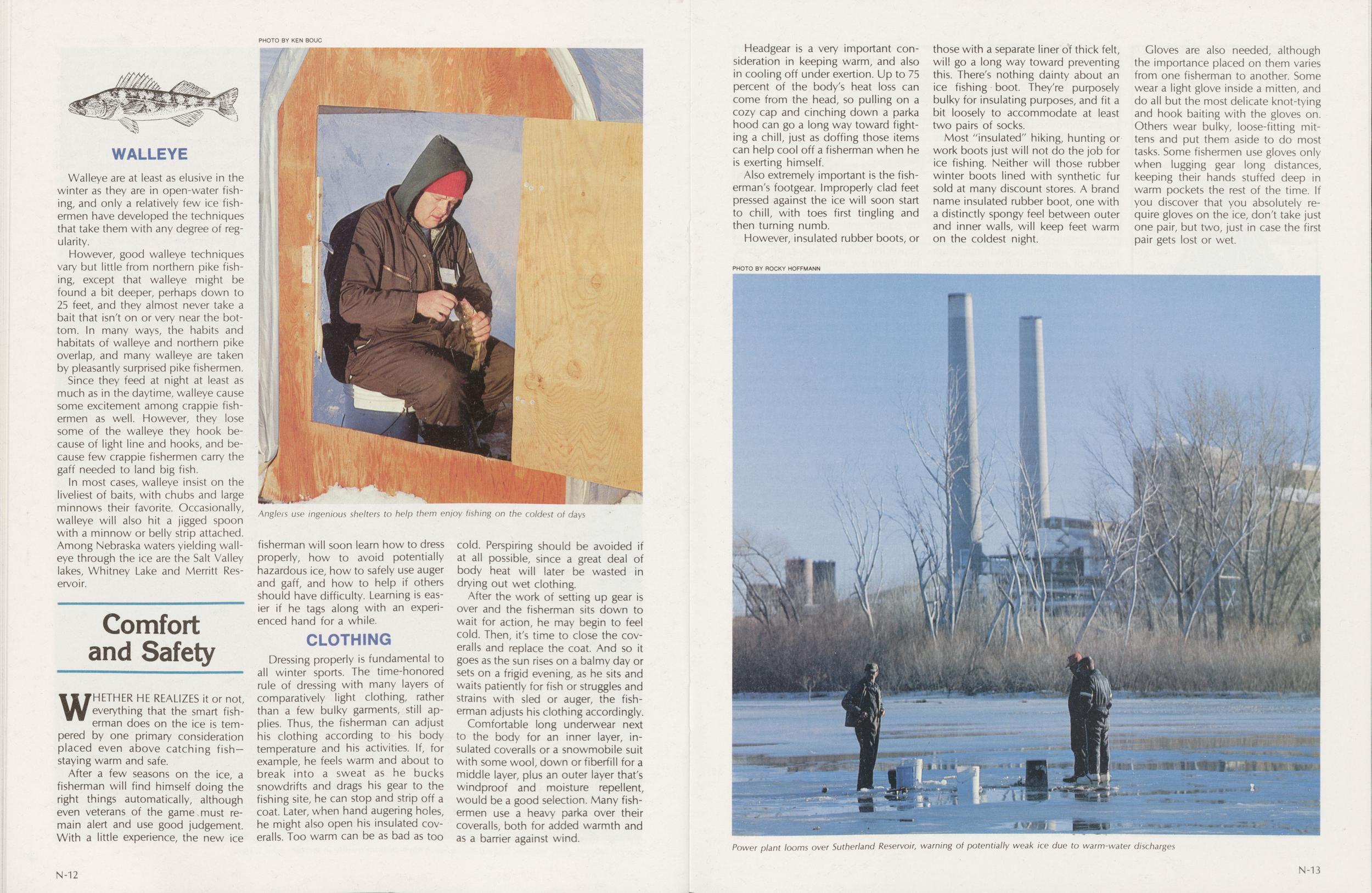
Anglers use ingenious shelters to help them enjoy fishing on the coldest of days
Dressing properly is fundamental to all winter sports. The time-honored rule of dressing with many layers of comparatively light clothing, rather than a few bulky garments, still applies. Thus, the fisherman can adjust his clothing according to his body temperature and his activities. If, for example, he feels warm and about to break into a sweat as he bucks snowdrifts and drags his gear to the fishing site, he can stop and strip off a coat. Later, when hand augering holes, he might also open his insulated coveralls. Too warm can be as bad as too cold. Perspiring should be avoided if at all possible, since a great deal of body heat will later be wasted in drying out wet clothing.
After the work of setting up gear is over and the fisherman sits down to wait for action, he may begin to feel cold. Then, it's time to close the coveralls and replace the coat. And so it goes as the sun rises on a balmy day or sets on a frigid evening, as he sits and waits patiently for fish or struggles and strains with sled or auger, the fisherman adjusts his clothing accordingly.
Comfortable long underwear next to the body for an inner layer, insulated coveralls or a snowmobile suit with some wool, down or fiberfill for a middle layer, plus an outer layer that's windproof and moisture repellent, would be a good selection. Many fishermen use a heavy parka over their coveralls, both for added warmth and as a barrier against wind.
N-12Headgear is a very important consideration in keeping warm, and also in cooling off under exertion. Up to 75 percent of the body's heat loss can come from the head, so pulling on a cozy cap and cinching down a parka hood can go a long way toward fight ing a chill, just as doffing those items can help cool off a fisherman when he is exerting himself.
Also extremely important is the fisherman's footgear. Improperly clad feet pressed against the ice will soon start to chill, with toes first tingling and then turning numb.
However, insulated rubber boots, or those with a separate liner of thick felt, will go a long way toward preventing this. There's nothing dainty about an ice fishing boot. They're purposely bulky for insulating purposes, and fit a bit loosely to accommodate at least two pairs of socks.
Most "insulated" hiking, hunting or work boots just will not do the job for ice fishing. Neither will those rubber winter boots lined with synthetic fur sold at many discount stores. A brand name insulated rubber boot, one with a distinctly spongy feel between outer and inner walls, will keep feet warm on the coldest night.
Gloves are also needed, although the importance placed on them varies from one fisherman to another. Some wear a light glove inside a mitten, and do all but the most delicate knot-tying and hook baiting with the gloves on. Others wear bulky, loose-fitting mittens and put them aside to do most tasks. Some fishermen use gloves only when lugging gear long distances, keeping their hands stuffed deep in warm pockets the rest of the time. If you discover that you absolutely require gloves on the ice, don't take just one pair, but two, just in case the first pair gets lost or wet.
Power plant looms over Sutherland Reservoir, warning of potentially weak ice due to warm water discharges
 Windbreaks
THREE-POLED TIPI
Windbreaks
THREE-POLED TIPI
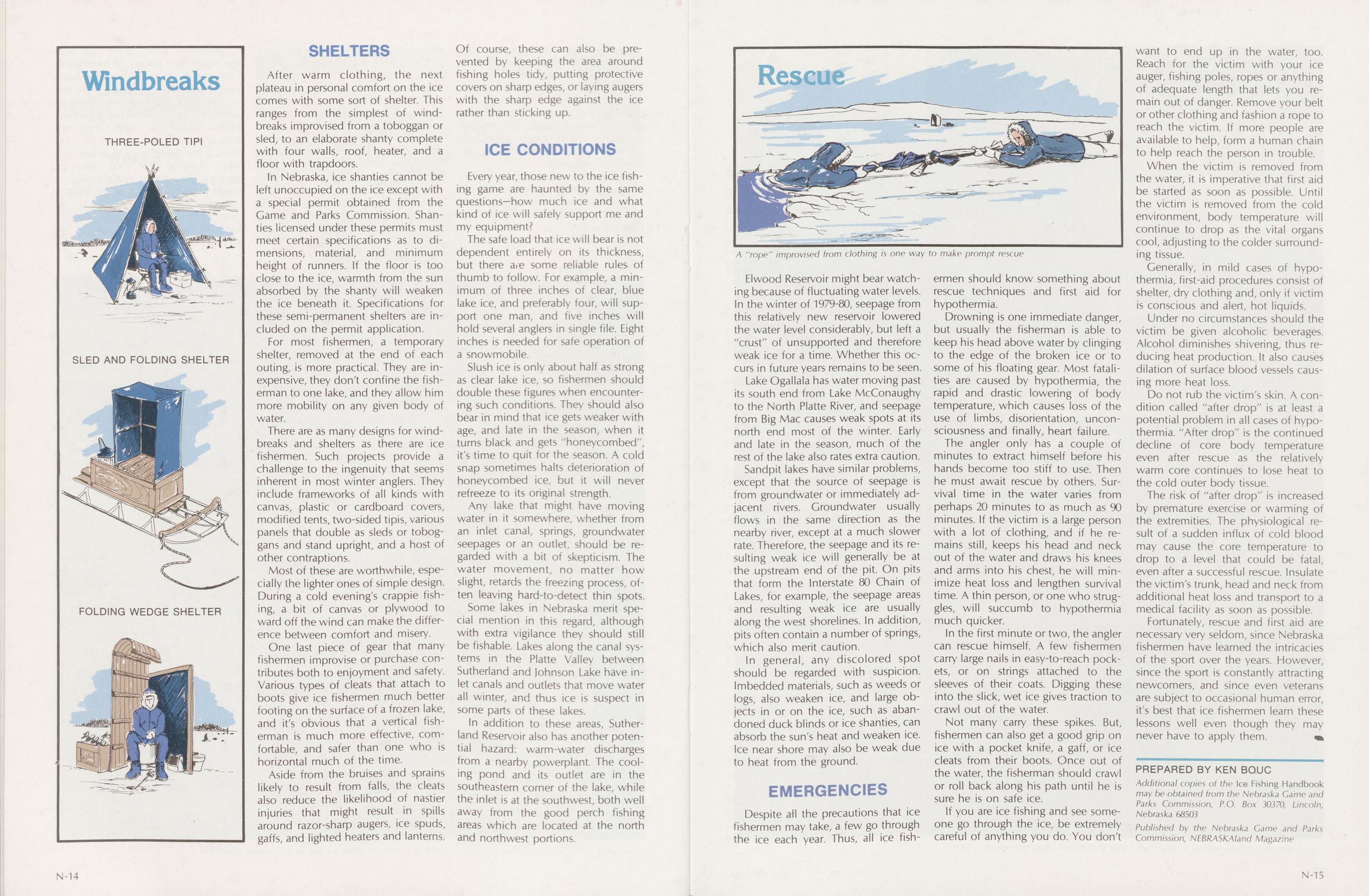
After warm clothing, the next plateau in personal comfort on the ice comes with some sort of shelter. This ranges from the simplest of wind breaks improvised from a toboggan or sled, to an elaborate shanty complete with four walls, roof, heater, and a floor with trapdoors.
In Nebraska, ice shanties cannot be left unoccupied on the ice except with a special permit obtained from the Game and Parks Commission. Shanties licensed under these permits must meet certain specifications as to dimensions, material, and minimum height of runners. If the floor is too close to the ice, warmth from the sun absorbed by the shanty will weaken the ice beneath it. Specifications for these semi-permanent shelters are included on the permit application.
For most fishermen, a temporary shelter, removed at the end of each outing, is more practical. They are inexpensive, they don't confine the fisherman to one lake, and they allow him more mobility on any given body of water.
There are as many designs for wind breaks and shelters as there are ice fishermen. Such projects provide a challenge to the ingenuity that seems inherent in most winter anglers. They include frameworks of all kinds with canvas, plastic or cardboard covers, modified tents, two-sided tipis, various panels that double as sleds or toboggans and stand upright, and a host of other contraptions.
Most of these are worthwhile, especially the lighter ones of simple design. During a cold evening's crappie fish ing, a bit of canvas or plywood toward off the wind can make the difference between comfort and misery.
One last piece of gear that many fishermen improvise or purchase contributes both to enjoyment and safety. Various types of cleats that attach to boots give ice fishermen much better footing on the surface of a frozen lake, and it's obvious that a vertical fisherman is much more effective, comfortable, and safer than one who is horizontal much of the time.
Aside from the bruises and sprains likely to result from falls, the cleats also reduce the likelihood of nastier injuries that might result in spills around razor-sharp augers, ice spuds, gaffs, and lighted heaters and lanterns. Of course, these can also be prevented by keeping the area around fishing holes tidy, putting protective covers on sharp edges, or laying augers with the sharp edge against the ice rather than sticking up.
ICE CONDITIONSEvery year, those new to the ice fishing game are haunted by the same questions—how much ice and what kind of ice will safely support me and my equipment?
The safe load that ice will bear is not dependent entirely on its thickness, but there are some reliable rules of thumb to follow. For example, a minimum of three inches of clear, blue lake ice, and preferably four, will support one man, and five inches will hold several anglers in single file. Eight inches is needed for safe operation of a snowmobile.
Slush ice is only about half as strong as clear lake ice, so fishermen should double these figures when encounter ing such conditions. They should also bear in mind that ice gets weaker with age, and late in the season, when it turns black and gets "honeycombed", it's time to quit for the season. A cold snap sometimes halts deterioration of honeycombed ice, but it will never refreeze to its original strength.
Any lake that might have moving water in it somewhere, whether from an inlet canal, springs, groundwater seepages or an outlet, should be regarded with a bit of skepticism. The water movement, no matter how slight, retards the freezing process, of ten leaving hard-to-detect thin spots.
Some lakes in Nebraska merit special mention in this regard, although with extra vigilance they should still be fishable. Lakes along the canal systems in the Platte Valley between Sutherland and Johnson Lake have in let canals and outlets that move water all winter, and thus ice is suspect in some parts of these lakes.
In addition to these areas, Sutherland Reservoir also has another potential hazard: warm-water discharges from a nearby powerplant. The cool ing pond and its outlet are in the southeastern corner of the lake, while the inlet is at the southwest, both well away from the good perch fishing areas which are located at the north and northwest portions.
N-14A "rope" improvised from clothing is one way to make prompt rescue
Elwood Reservoir might bear watch ing because of fluctuating water levels. In the winter of 1979-80, seepage from this relativelv new reservoir lowered the water level considerably, but left a "crust" of unsupported and therefore weak ice for a time. Whether this occurs in future years remains to be seen.
Lake Ogallala has water moving past its south end from Lake McConaughy to the North Platte River, and seepage from Big Mac causes weak spots at its north end most of the winter. Early and late in the season, much of the rest of the lake also rates extra caution.
Sandpit lakes have similar problems, except that the source of seepage is from groundwater or immediately adjacent rivers. Groundwater usually flows in the same direction as the nearby river, except at a much slower rate. Therefore, the seepage and its resulting weak ice will generally be at the upstream end of the pit. On pits that form the Interstate 80 Chain of Lakes, for example, the seepage areas and resulting weak ice are usually along the west shorelines. In addition, pits often contain a number of springs, which also merit caution.
In general, any discolored spot should be regarded with suspicion. Imbedded materials, such as weeds or logs, also weaken ice, and large objects in or on the ice, such as abandoned duck blinds or ice shanties, can absorb the sun's heat and weaken ice. Ice near shore may also be weak due to heat from the ground.
EMERGENCIESDespite all the precautions that ice fishermen may take, a few go through the ice each year. Thus, all ice fishermen should know something about rescue techniques and first aid for hypothermia.
Drowning is one immediate danger, but usually the fisherman is able to keep his head above water by clinging to the edge of the broken ice or to some of his floating gear. Most fatalities are caused by hypothermia, the rapid and drastic lowering of body temperature, which causes loss of the use of limbs, disorientation, unconsciousness and finally, heart failure.
The angler only has a couple of minutes to extract himself before his hands become too stiff to use. Then he must await rescue by others. Survival time in the water varies from perhaps 20 minutes to as much as 90 minutes. If the victim is a large person with a lot of clothing, and if he remains still, keeps his head and neck out of the water and draws his knees and arms into his chest, he will minimize heat loss and lengthen survival time. A thin person, or one who struggles, will succumb to hypothermia much quicker.
In the first minute or two, the angler can rescue himself. A few fishermen carry large nails in easy-to-reach pockets, or on strings attached to the sleeves of their coats. Digging these into the slick, wet ice gives traction to crawl out of the water.
Not many carry these spikes. But, fishermen can also get a good grip on ice with a pocket knife, a gaff, or ice cleats from their boots. Once out of the water, the fisherman should crawl or roll back along his path until he is sure he is on safe ice.
If you are ice fishing and see some one go through the ice, be extremely careful of anything you do. You don't want to end up in the water, too. Reach for the victim with your ice auger, fishing poles, ropes or anything of adequate length that lets you remain out of danger. Remove your belt or other clothing and fashion a rope to reach the victim. If more people are available to help, form a human chain to help reach the person in trouble.
When the victim is removed from the water, it is imperative that first aid be started as soon as possible. Until the victim is removed from the cold environment, body temperature will continue to drop as the vital organs cool, adjusting to the colder surrounding tissue.
Generally, in mild cases of hypothermia, first-aid procedures consist of shelter, dry clothing and, only if victim is conscious and alert, hot liquids.
Under no circumstances should the victim be given alcoholic beverages. Alcohol diminishes shivering, thus reducing heat production. It also causes dilation of surface blood vessels causing more heat loss.
Do not rub the victim's skin. A condition called "after drop" is at least a potential problem in all cases of hypothermia. "After drop" is the continued decline of core body temperature even after rescue as the relatively warm core continues to lose heat to the cold outer body tissue.
The risk of "after drop" is increased by premature exercise or warming of the extremities. The physiological result of a sudden influx of cold blood may cause the core temperature to drop to a level that could be fatal, even after a successful rescue. Insulate the victim's trunk, head and neck from additional heat loss and transport to a medical facility as soon as possible.
Fortunately, rescue and first aid are necessary very seldom, since Nebraska fishermen have learned the intricacies of the sport over the years. However, since the sport is constantly attracting newcomers, and since even veterans are subject to occasional human error, it's best that ice fishermen learn these lessons well even though they may never have to apply them.
PREPARED BY KEN BOUC Additional copies of the Ice Fishing Handbook may be obtained from the Nebraska Game and Parks Commission, P.O. Box 30370, Lincoln, Nebraska 68503 Published by the Nebraska Game and Parks Commission, NEBRASKAIand Magazine N-15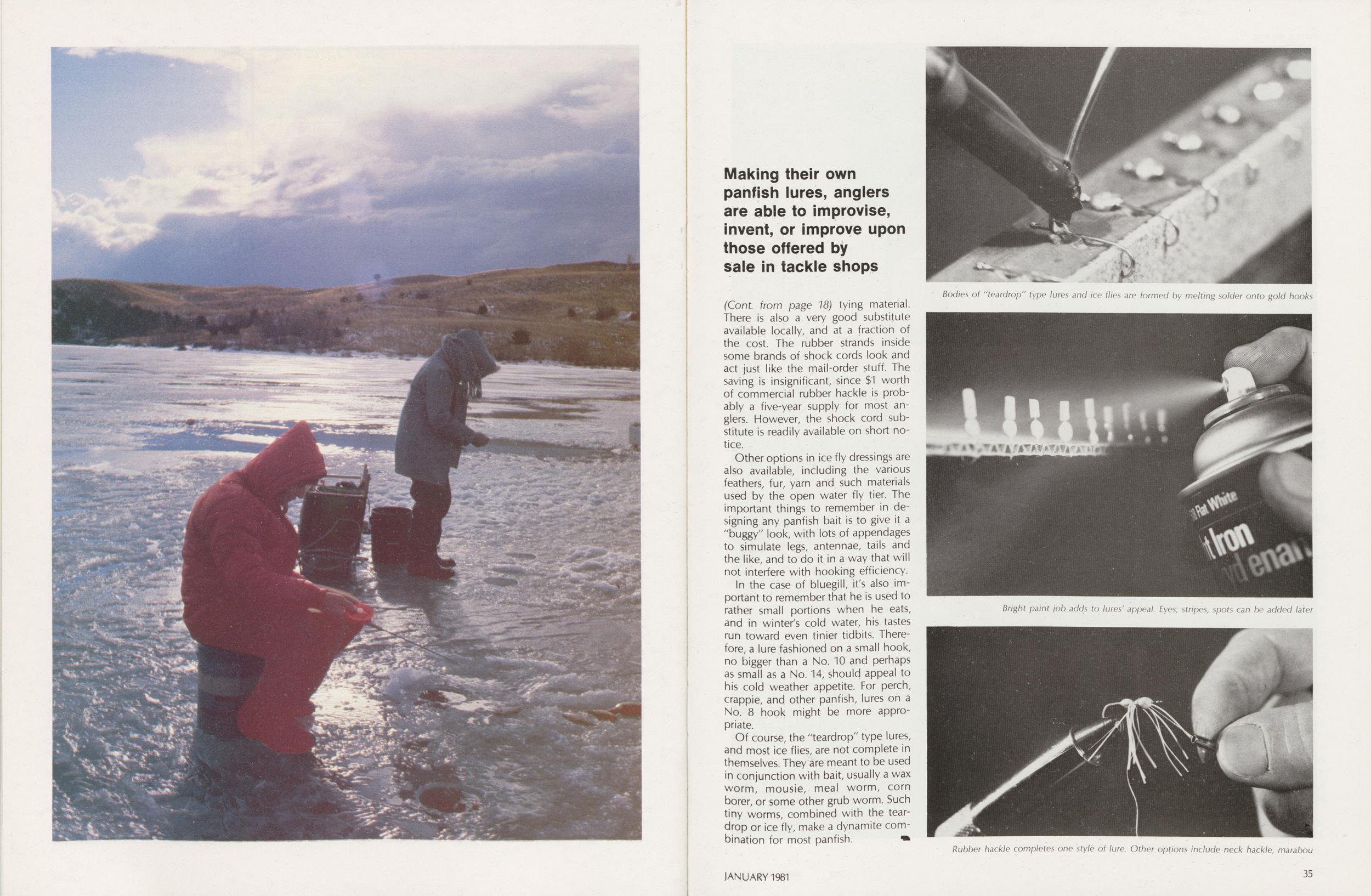
(Cont. from page 18) tying material. There is also a very good substitute available locally, and at a fraction of the cost. The rubber strands inside some brands of shock cords look and act just like the mail-order stuff. The saving is insignificant, since $1 worth of commercial rubber hackle is probably a five-year supply for most anglers. However, the shock cord substitute is readily available on short notice.
Other options in ice fly dressings are also available, including the various feathers, fur, yarn and such materials used by the open water fly tier. The important things to remember in designing any panfish bait is to give it a "buggy" look, with lots of appendages to simulate legs, antennae, tails and the like, and to do it in a way that will not interfere with hooking efficiency.
In the case of bluegill, it's also important to remember that he is used to rather small portions when he eats, and in winter's cold water, his tastes run toward even tinier tidbits. There fore, a lure fashioned on a small hook, no bigger than a No. 10 and perhaps as small as a No. 14, should appeal to his cold weather appetite. For perch, crappie, and other panfish, lures on a No. 8 hook might be more appropriate.
Of course, the "teardrop" type lures, and most ice flies, are not complete in themselves. They are meant to be used in conjunction with bait, usually a wax worm, mousie, meal worm, corn borer, or some other grub worm. Such tiny worms, combined with the tear drop or ice fly, make a dynamite combination for most panfish.
Bodies of "teardrop" type lures and ice flies are formed by melting solder onto gold hooks
Bright paint job adds to lures' appeal. Eyes, stripes, spots can be added later
Rubber hackle completes one style of lure. Other options include neck hackle, marabou

Stan's mother, Eillen Wallen, and daughter Becky, sample finished product
Syrup on Tap
"How sweet it is" might well be comment of this food specialist as he plies his hobby
WHAT CHILD hasn't dreamed of having his own candy factory, or candy tree. Perhaps most of us outgrow that tantalizing prospect, but there might really be more to it than we think. At least Stan Wallen of rural Lincoln has discovered a way to make candy from trees, and to convert them into syrup, as well.
Sound unreal? Well, not really. Stan is just one of very few in this part of the country who are carrying on a tradition passed down from the pilgrims, who were taught the process of syrup making by the Indians.
Although maple trees were not in evidence here in those early days, enough have been planted since that time, Stan says, that many people could be making their own maple syrup now-right here in Nebraska. Stan is a University of Nebraska food scientist, and is one of those people with a yen for syrup, and the curiosity to study the matter. Although his title includes initials indicating he holds a doctorate in his food technology field, it was a more homey and personal interest which set him experimenting and researching the maple syrup project.
Having worked for a year in New England, Stan had enjoyed the colorful procedures of gathering maple sap in early spring. Quite a tradition back there, it made quite an impression on him, and he wondered, after returning to Nebraska, why the same methods couldn't be used here. Ultimately, he found out they could, with modifications. It has all been an enjoyable learning experience.
Actually, the sap is nearly like water directly from the tree—a clear, thin fluid. However, it is slightly sweet to the taste, and as Stan learned, needed only to be evaporated and condensed to become the real thing—maple syrup.
As settlers moved west from the early communities back near the coast, they lost their source of maple sap, but through plan and chance, there have now been enough maple trees planted to provide a source. Sugar maple, red maple or silver maple trees are considered the best for this purpose, although others will serve. In fact, sap from boxelders, elms and other kinds of trees have also been converted into a somewhat lesser quality syrup by some folks.
Basic methods to make syrup have changed very little over the years, Stan says. The goal is to concentrate the sap by boiling until only the sweet sugar syrup is left. However, the fun is in the doing the planning and preparing and gathering of sap, then converting into the final product.
The only difference between Nebraska gathering and that of New England is the length of time that sap is available. What is needed are cold nights and warm days, under 32 degrees at night and up to 50 degrees during the day. The daytime sun and heat cause the tree to start pumping sap up to the branches. The sap collector simply diverts some of this fluid to his use, with negligible (if done properly) effects to the tree. The toughest part is boiling, as the sap must be condensed to one-fourtieth its volume! That means that 10 gallons of sap will make one quart of syrup.
It doesn't take much of an imagination to see that a large amount of sap is going to be involved, and that haul ing it any distance is going to provide enough exercise to burn off the calories which will be later gained. In fact, Stan once calculated that it was about a break-even proposition, both calorie-wise and financially, to make the syrup, so the fun derived was the deciding factor.
Early one spring, when there was still quite a bit of snow on the ground,
JANUARY 1981 37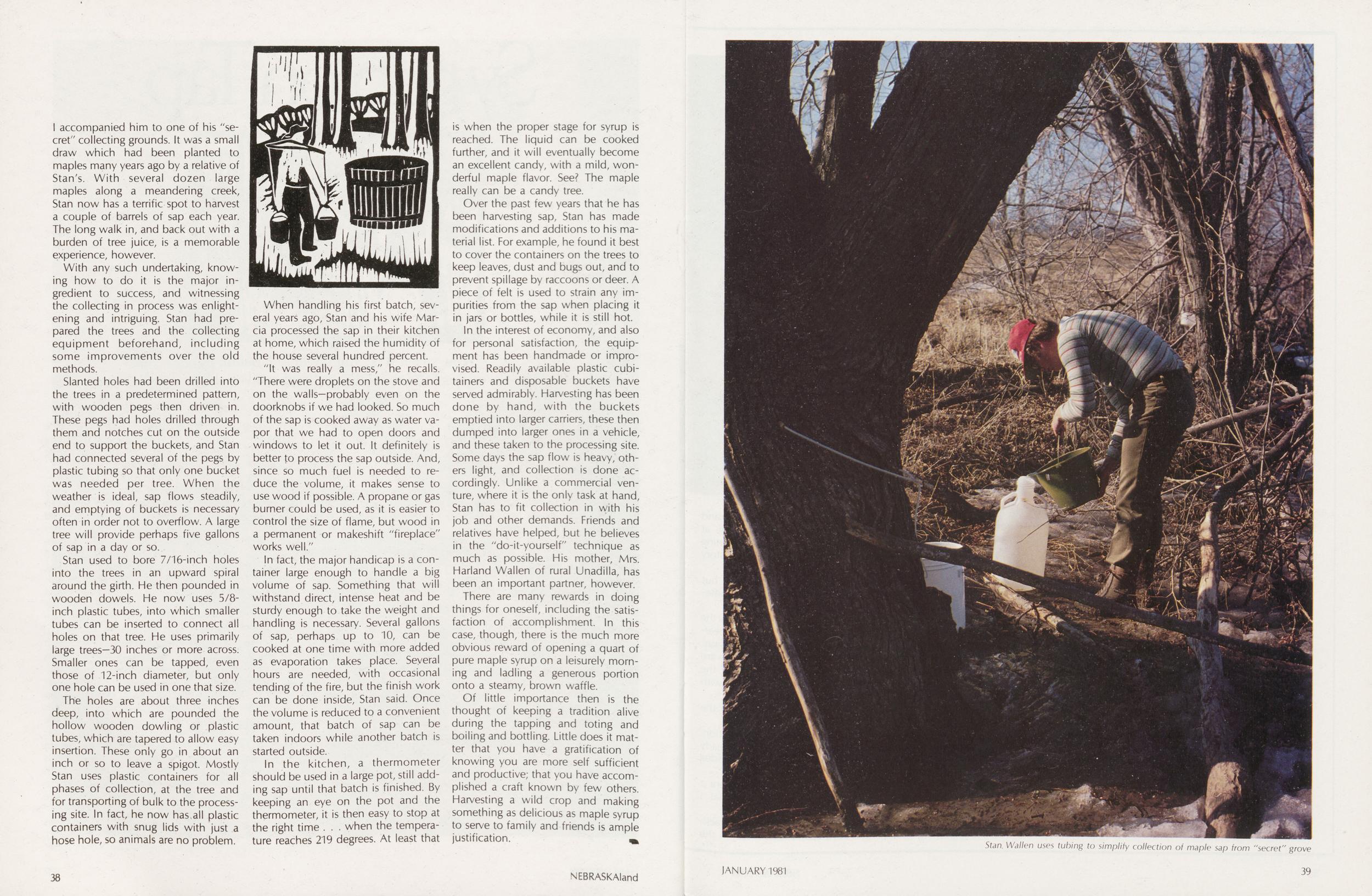
I accompanied him to one of his "secret" collecting grounds. It was a small draw which had been planted to maples many years ago by a relative of Stan's. With several dozen large maples along a meandering creek, Stan now has a terrific spot to harvest a couple of barrels of sap each year. The long walk in, and back out with a burden of tree juice, is a memorable experience, however.
With any such undertaking, knowing how to do it is the major in gredient to success, and witnessing the collecting in process was enlightening and intriguing. Stan had prepared the trees and the collecting equipment beforehand, including some improvements over the old methods.
Slanted holes had been drilled into the trees in a predetermined pattern, with wooden pegs then driven in. These pegs had holes drilled through them and notches cut on the outside end to support the buckets, and Stan had connected several of the pegs by plastic tubing so that only one bucket was needed per tree. When the weather is ideal, sap flows steadily, and emptying of buckets is necessary often in order not to overflow. A large tree will provide perhaps five gallons of sap in a day or so.
Stan used to bore 7/16-inch holes into the trees in an upward spiral around the girth. He then pounded in wooden dowels. He now uses 5/8 inch plastic tubes, into which smaller tubes can be inserted to connect all holes on that tree. He uses primarily large trees—30 inches or more across. Smaller ones can be tapped, even those of 12-inch diameter, but only one hole can be used in one that size.
The holes are about three inches deep, into which are pounded the hollow wooden dowling or plastic tubes, which are tapered to allow easy insertion. These only go in about an inch or so to leave a spigot. Mostly Stan uses plastic containers for all phases of collection, at the tree and for transporting of bulk to the process ing site. In fact, he now has all plastic containers with snug lids with just a hose hole, so animals are no problem.
When handling his first batch, several years ago, Stan and his wife Marcia processed the sap in their kitchen at home, which raised the humidity of the house several hundred percent.
"It was really a mess," he recalls. "There were droplets on the stove and on the walls—probably even on the doorknobs if we had looked. So much of the sap is cooked away as water vapor that we had to open doors and windows to let it out. It definitely is better to process the sap outside. And, since so much fuel is needed to reduce the volume, it makes sense to use wood if possible. A propane or gas burner could be used, as it is easier to control the size of flame, but wood in a permanent or makeshift "fireplace" works well."
In fact, the major handicap is a container large enough to handle a big volume of sap. Something that will withstand direct, intense heat and be sturdy enough to take the weight and handling is necessary. Several gallons of sap, perhaps up to 10, can be cooked at one time with more added as evaporation takes place. Several hours are needed, with occasional tending of the fire, but the finish work can be done inside, Stan said. Once the volume is reduced to a convenient amount, that batch of sap can be taken indoors while another batch is started outside.
In the kitchen, a thermometer should be used in a large pot, still add ing sap until that batch is finished. By keeping an eye on the pot and the thermometer, it is then easy to stop at the right time when the temperature reaches 219 degrees. At least that is when the proper stage for syrup is reached. The liquid can be cooked further, and it will eventually become an excellent candy, with a mild, wonderful maple flavor. See? The maple really can be a candy tree.
Over the past few years that he has been harvesting sap, Stan has made modifications and additions to his material list. For example, he found it best to cover the containers on the trees to keep leaves, dust and bugs out, and to prevent spillage by raccoons or deer. A piece of felt is used to strain any impurities from the sap when placing it in jars or bottles, while it is still hot.
In the interest of economy, and also for personal satisfaction, the equipment has been handmade or improvised. Readily available plastic cubitainers and disposable buckets have served admirably. Harvesting has been done by hand, with the buckets emptied into larger carriers, these then dumped into larger ones in a vehicle, and these taken to the processing site. Some days the sap flow is heavy, others light, and collection is done accordingly. Unlike a commercial venture, where it is the only task at hand, Stan has to fit collection in with his job and other demands. Friends and relatives have helped, but he believes in the "do-it-yourself" technique as much as possible. His mother, Mrs. Harland Wallen of rural Unadilla, has been an important partner, however.
There are many rewards in doing things for oneself, including the satisfaction of accomplishment. In this case, though, there is the much more obvious reward of opening a quart of pure maple syrup on a leisurely morn ing and ladling a generous portion onto a steamy, brown waffle.
Of little importance then is the thought of keeping a tradition alive during the tapping and toting and boiling and bottling. Little does it matter that you have a gratification of knowing you are more self sufficient and productive; that you have accomplished a craft known by few others. Harvesting a wild crop and making something as delicious as maple syrup to serve to family and friends is ample justification.
38 NEBRASKAlandStan. Wallen uses tubing to simplify collection of maple sap from "secret" grove
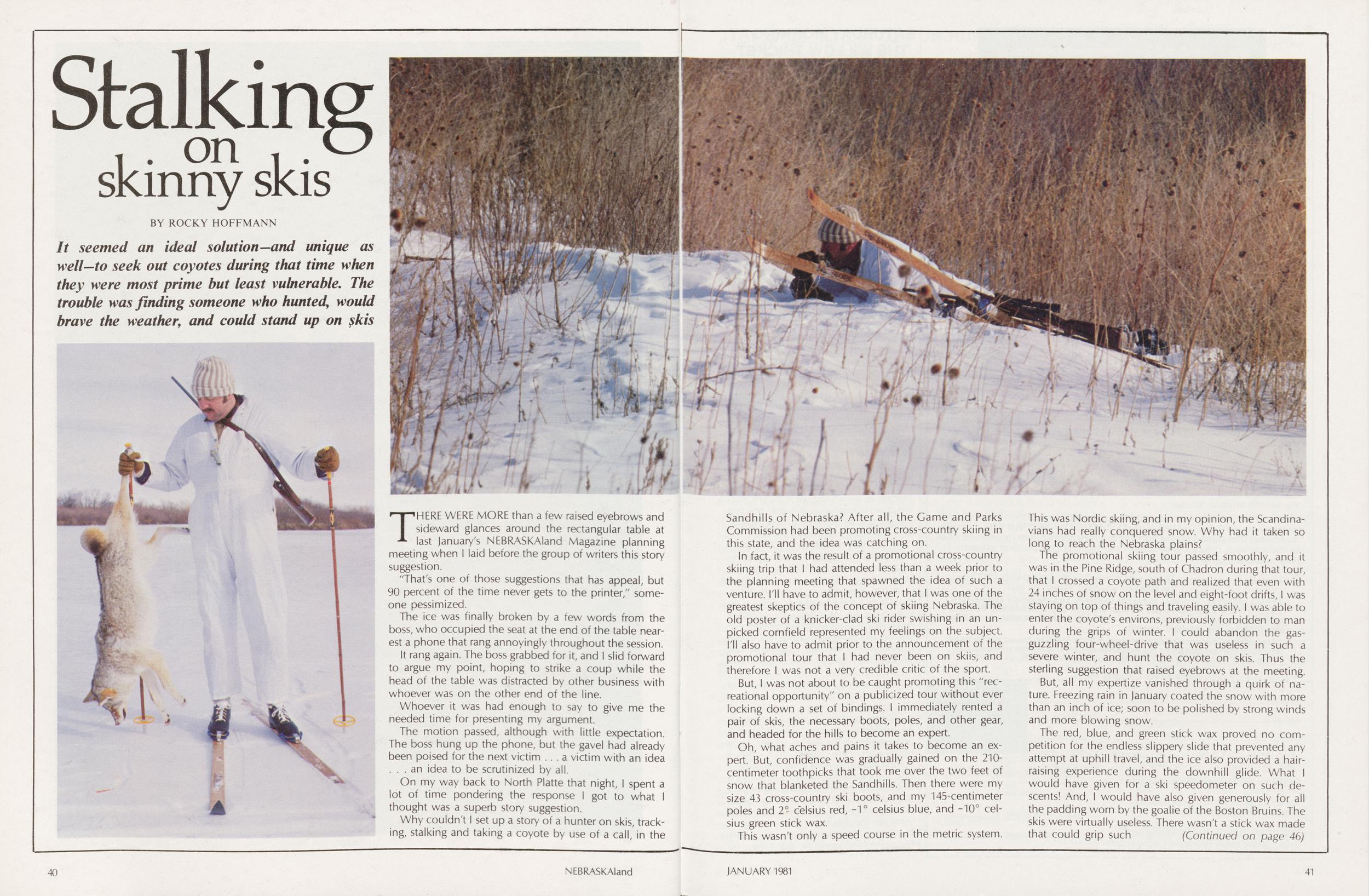
Stalking on skinny skis
It seemed an ideal solution—and unique as well—to seek out coyotes during that time when they were most prime but least vulnerable. The trouble was finding someone who hunted, would brave the weather, and could stand up on skis
THERE WERE MORE than a few raised eyebrows and sideward glances around the rectangular table at last January's NEBRASKAland Magazine planning meeting when I laid before the group of writers this story suggestion.
"That's one of those suggestions that has appeal, but 90 percent of the time never gets to the printer," some one pessimized.
The ice was finally broken by a few words from the boss, who occupied the seat at the end of the table nearest a phone that rang annoyingly throughout the session.
It rang again. The boss grabbed for it, and I slid forward to argue my point, hoping to strike a coup while the head of the table was distracted by other business with whoever was on the other end of the line.
Whoever it was had enough to say to give me the needed time for presenting my argument.
The motion passed, although with little expectation. The boss hung up the phone, but the gavel had already been poised for the next victim a victim with an idea an idea to be scrutinized by all.
On my way back to North Platte that night, I spent a lot of time pondering the response I got to what I thought was a superb story suggestion.
Why couldn't I set up a story of a hunter on skis, tracking, stalking and taking a coyote by use of a call, in the
40 NEBRASKAlandSandhills of Nebraska? After all, the Game and Parks Commission had been promoting cross-country skiing in this state, and the idea was catching on.
In fact, it was the result of a promotional cross-country skiing trip that I had attended less than a week prior to the planning meeting that spawned the idea of such a venture. I'll have to admit, however, that I was one of the greatest skeptics of the concept of skiing Nebraska. The old poster of a knicker-clad ski rider swishing in an unpicked cornfield represented my feelings on the subject. I'll also have to admit prior to the announcement of the promotional tour that I had never been on skiis, and therefore I was not a very credible critic of the sport.
But, I was not about to be caught promoting this "recreational opportunity" on a publicized tour without ever locking down a set of bindings. I immediately rented a pair of skis, the necessary boots, poles, and other gear, and headed for the hills to become an expert.
Oh, what aches and pains it takes to become an expert. But, confidence was gradually gained on the 210 centimeter toothpicks that took me over the two feet of snow that blanketed the Sandhills. Then there were my size 43 cross-country ski boots, and my 145-centimeter poles and 2° Celsius red, -1° celsius blue, and -10° Celsius green stick wax.
This wasn't only a speed course in the metric system. This was Nordic skiing, and in my opinion, the Scandinavians had really conquered snow. Why had it taken so long to reach the Nebraska plains?
The promotional skiing tour passed smoothly, and it was in the Pine Ridge, south of Chadron during that tour, that I crossed a coyote path and realized that even with 24 inches of snow on the level and eight-foot drifts, I was staying on top of things and traveling easily. I was able to enter the coyote's environs, previously forbidden to man during the grips of winter. I could abandon the gas guzzling four-wheel-drive that was useless in such a severe winter, and hunt the coyote on skis. Thus the sterling suggestion that raised eyebrows at the meeting.
But, all my expertize vanished through a quirk of nature. Freezing rain in January coated the snow with more than an inch of ice; soon to be polished by strong winds and more blowing snow.
The red, blue, and green stick wax proved no competition for the endless slippery slide that prevented any attempt at uphill travel, and the ice also provided a hair raising experience during the downhill glide. What I would have given for a ski speedometer on such descents! And, I would have also given generously for all the padding worn by the goalie of the Boston Bruins. The skis were virtually useless. There wasn't a stick wax made that could grip such
Continued on page 46) JANUARY 1981 41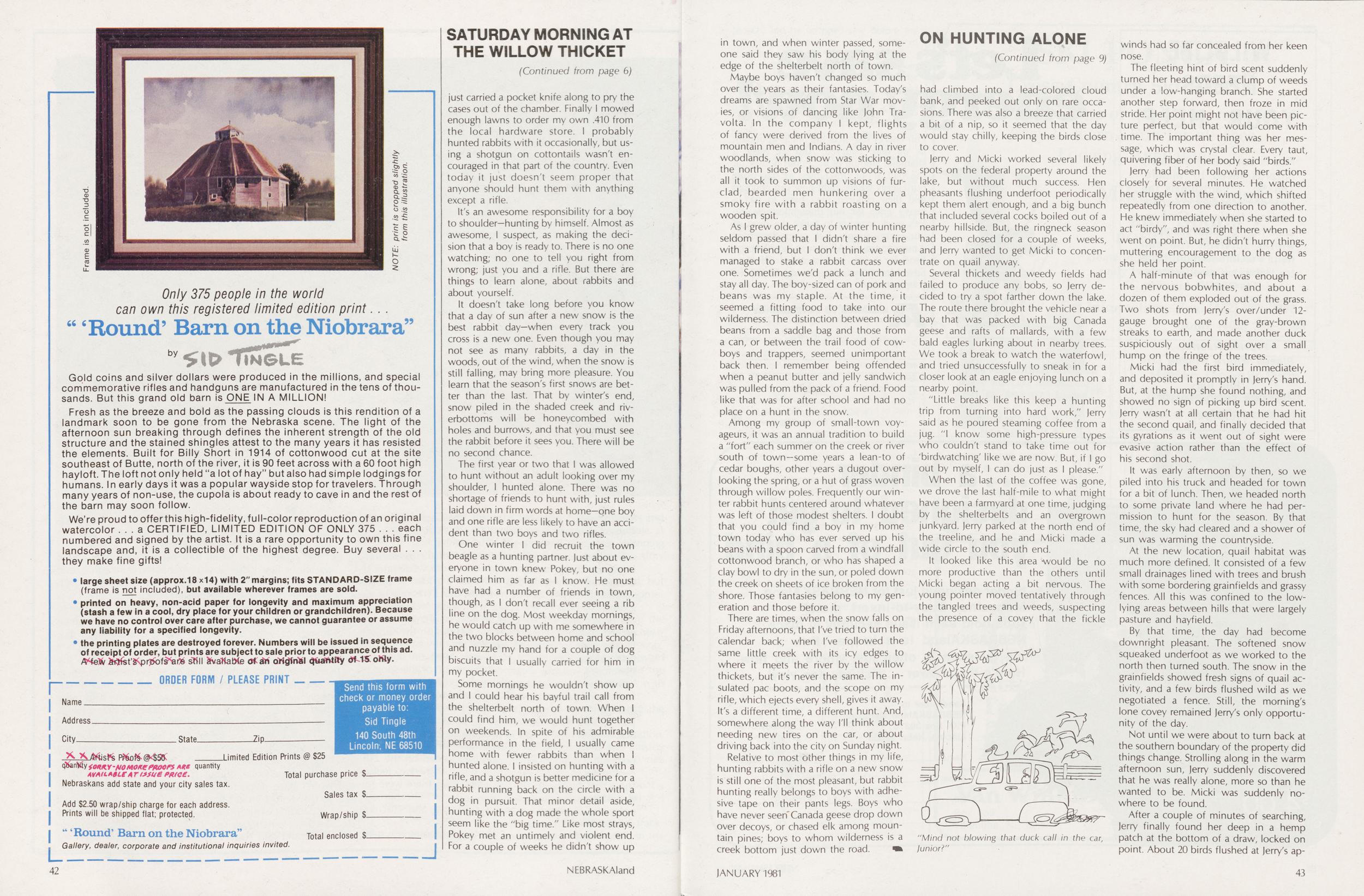
SATURDAY MORNING AT THE WILLOW THICKET
(Continued from page 6)just carried a pocket knife along to pry the cases out of the chamber. Finally I mowed enough lawns to order my own .410 from the local hardware store. I probably hunted rabbits with it occasionally, but using a shotgun on cottontails wasn't encouraged in that part of the country. Even today it just doesn't seem proper that anyone should hunt them with anything except a rifle.
It's an awesome responsibility for a boy to shoulder—hunting by himself. Almost as awesome, i suspect, as making the decision that a boy is ready to. There is no one watching; no one to tell you right from wrong; just you and a rifle. But there are things to learn alone, about rabbits and about yourself.
It doesn't take long before you know that a day of sun after a new snow is the best rabbit day—when every track you cross is a new one. Even though you may not see as many rabbits, a day in the woods, out of the wind, when the snow is still falling, may bring more pleasure. You learn that the season's first snows are better than the last. That by winter's end, snow piled in the shaded creek and riverbottoms will be honeycombed with holes and burrows, and that you must see the rabbit before it sees you. There will be no second chance.
The first year or two that I was allowed to hunt without an adult looking over my shoulder, I hunted alone. There was no shortage of friends to hunt with, just rules laid down in firm words at home-one boy and one rifle are less likely to have an accident than two boys and two rifles.
One winter I did recruit the town beagle as a hunting partner, just about everyone in town knew Pokey, but no one claimed him as far as I know. He must have had a number of friends in town, though, as I don't recall ever seeing a rib line on the dog. Most weekday mornings, he would catch up with me somewhere in the two blocks between home and school and nuzzle my hand for a couple of dog biscuits that I usually carried for him in my pocket.
Some mornings he wouldn't show up and I could hear his bayful trail call from the shelterbelt north of town. When I could find him, we would hunt together on weekends. In spite of his admirable performance in the field, I usually came home with fewer rabbits than when I hunted alone. I insisted on hunting with a rifle, and a shotgun is better medicine for a rabbit running back on the circle with a dog in pursuit. That minor detail aside, hunting with a dog made the whole sport seem like the "big time." Like most strays, Pokey met an untimely and violent end. For a couple of weeks he didn't show up 42 NEBRASKAland in town, and when winter passed, some one said they saw his body lying at the edge of the shelterbelt north of town.
Maybe boys haven't changed so much over the years as their fantasies. Today's dreams are spawned from Star War movies, or visions of dancing like John Travolta. In the company I kept, flights of fancy were derived from the lives of mountain men and Indians. A day in river woodlands, when snow was sticking to the north sides of the cottonwoods, was all it took to summon up visions of fur clad, bearded men hunkering over a smoky fire with a rabbit roasting on a wooden spit.
As I grew older, a day of winter hunting seldom passed that I didn't share a fire with a friend, but I don't think we ever managed to stake a rabbit carcass over one. Sometimes we'd pack a lunch and stay all day. The boy-sized can of pork and beans was my staple. At the time, it seemed a fitting food to take into our wilderness. The distinction between dried beans from a saddle bag and those from a can, or between the trail food of cowboys and trappers, seemed unimportant back then. I remember being offended when a peanut butter and jelly sandwich was pulled from the pack of a friend. Food like that was for after school and had no place on a hunt in the snow.
Among my group of small-town voyageurs, it was an annual tradition to build a "fort" each summer on the creek or river south of town—some years a lean-to of cedar boughs, other years a dugout over looking the spring, or a hut of grass woven through willow poles. Frequently our winter rabbit hunts centered around whatever was left of those modest shelters. I doubt that you could find a boy in my home town today who has ever served up his beans with a spoon carved from a windfall cottonwood branch, or who has shaped a clay bowl to dry in the sun, or poled down the creek on sheets of ice broken from the shore. Those fantasies belong to my generation and those before it.
There are times, when the snow falls on Friday afternoons, that I've tried to turn the calendar back; when I've followed the same little creek with its icy edges to where it meets the river by the willow thickets, but it's never the same. The insulated pac boots, and the scope on my rifle, which ejects every shell, gives it away. It's a different time, a different hunt. And, somewhere along the way I'll think about needing new tires on the car, or about driving back into the city on Sunday night.
Relative to most other things in my life, hunting rabbits with a rifle on a new snow is still one of the most pleasant, but rabbit hunting really belongs to boys with adhesive tape on their pants legs. Boys who have never seen'Canada geese drop down over decoys, or chased elk among mountain pines; boys to whom wilderness is a creek bottom just down the road.
ON HUNTING ALONE
(Continued from page 9)had climbed into a lead-colored cloud bank, and peeked out only on rare occasions. There was also a breeze that carried a bit of a nip, so it seemed that the day would stay chilly, keeping the birds close to cover.
Jerry and Micki worked several likely spots on the federal property around the lake, but without much success. Hen pheasants flushing underfoot periodically kept them alert enough, and a big bunch that included several cocks boiled out of a nearby hillside. But, the ringneck season had been closed for a couple of weeks, and Jerry wanted to get Micki to concentrate on quail anyway.
Several thickets and weedy fields had failed to produce any bobs, so jerry decided to try a spot farther down the lake. The route there brought the vehicle near a bay that was packed with big Canada geese and rafts of mallards, with a few bald eagles lurking about in nearby trees. We took a break to watch the waterfowl, and tried unsuccessfully to sneak in for a closer look at an eagle enjoying lunch on a nearby point.
"Little breaks like this keep a hunting trip from turning into hard work," Jerry said as he poured steaming coffee from a jug. "I know some high-pressure types who couldn't stand to take time out for 'birdwatching' like we are now. But, if I go out by myself, I can do just as I please."
When the last of the coffee was gone, we drove the last half-mile to what might have been a farmyard at one time, judging by the shelterbelts and an overgrown junkyard, jerry parked at the north end of the treeline, and he and Micki made a wide circle to the south end.
It looked like this area would be no more productive than the others until Micki began acting a bit nervous. The young pointer moved tentatively through the tangled trees and weeds, suspecting the presence of a covey that the fickle
"Mind not blowing that duck call in the car, Junior?"
winds had so far concealed from her keen nose.
The fleeting hint of bird scent suddenly turned her head toward a clump of weeds under a low-hanging branch. She started another step forward, then froze in mid stride. Her point might not have been pic ture perfect, but that would come with time. The important thing was her message, which was crystal clear. Every taut, quivering fiber of her body said "birds."
Jerry had been following her actions closely for several minutes. He watched her struggle with the wind, which shifted repeatedly from one direction to another. He knew immediately when she started to act "birdy", and was right there when she went on point. But, he didn't hurry things, muttering encouragement to the dog as she held her point.
A half-minute of that was enough for the nervous bobwhites, and about a dozen of them exploded out of the grass. Two shots from Jerry's over/under 12 gauge brought one of the gray-brown streaks to earth, and made another duck suspiciously out of sight over a small hump on the fringe of the trees.
Micki had the first bird immediately, and deposited it promptly in Jerry's hand. But, at the hump she found nothing, and showed no sign of picking up bird scent. Jerry wasn't at all certain that he had hit the second quail, and finally decided that its gyrations as it went out of sight were evasive action rather than the effect of his second shot.
It was early afternoon by then, so we piled into his truck and headed for town for a bit of lunch. Then, we headed north to some private land where he had permission to hunt for the season. By that time, the sky had cleared and a shower of sun was warming the countryside.
At the new location, quail habitat was much more defined. It consisted of a few small drainages lined with trees and brush with some bordering grainfields and grassy fences. All this was confined to the low lying areas between hills that were largely pasture and hayfield.
By that time, the day had become downright pleasant. The softened snow squeaked underfoot as we worked to the north then turned south. The snow in the grainfields showed fresh signs of quail activity, and a few birds flushed wild as we negotiated a fence. Still, the morning's lone covey remained Jerry's only opportunity of the day.
Not until we were about to turn back at the southern boundary of the property did things change. Strolling along in the warm afternoon sun, Jerry suddenly discovered that he was really alone, more so than he wanted to be. Micki was suddenly no where to be found.
After a couple of minutes of searching, Jerry finally found her deep in a hemp patch at the bottom of a draw, locked on point. About 20 birds flushed at Jerry's approach
JANUARY 1981 43
and he dropped one before the rest escaped through a nearby screen of small trees.
A couple of birds from the broken covey settled into a grassy hillside not far away, but most cleared the crest and sailed to landings somewhere out of sight. Working the hillside where the few singles went in netted Jerry and Micki another bird, but they had no idea where to begin looking for the others. A mile or more of potential hiding places stretched beyond that hill, and with no idea where to start, it might take the rest of the day to find more birds. Instead, Jerry made for his vehicle, which was not far away.
"We can just make it to a small patch of cover near an abandoned farmstead be fore quitting time. We have to stop hunt ing quail at 4 p.m. during January' to give the birds time to regroup before dark. I think that's a good regulation. During cold weather, quail flushed just before sunset don't have time to get back together be fore dark, and they can freeze to death during the night without the collective warmth of the covey," Jerry said.
The area near the farmstead held a couple of spooky hen pheasants, but no bobwhites. After a few minutes of search ing, the 4 p.m. deadline overtook the hunters and ended their outing. Jerry paused to rest at the old barn, to enjoy the golden moments at day's end and to summarize his philosophy on quail hunting.
"Everything about hunting alone works out best for me. The lone hunter has better access to private land than a mob of people, he can come and go as he pleases and he can sit around like this and enjoy a bit of scenery and silence without worrying about keeping up with the group.
"And, it works out for the best when hunting with a dog. With a young dog like Micki, I don't have to make excuses if she doesn't handle each covey perfectly. It's easier to train a dog when you're alone, and no matter how young or old the dog is, each hunt is another training session. Hunting alone makes for more rapport be tween man and dog, and for me, that's what quail hunting is all about."
"Except for that one defective cartridge, it was a very enjoyable bear hunt."
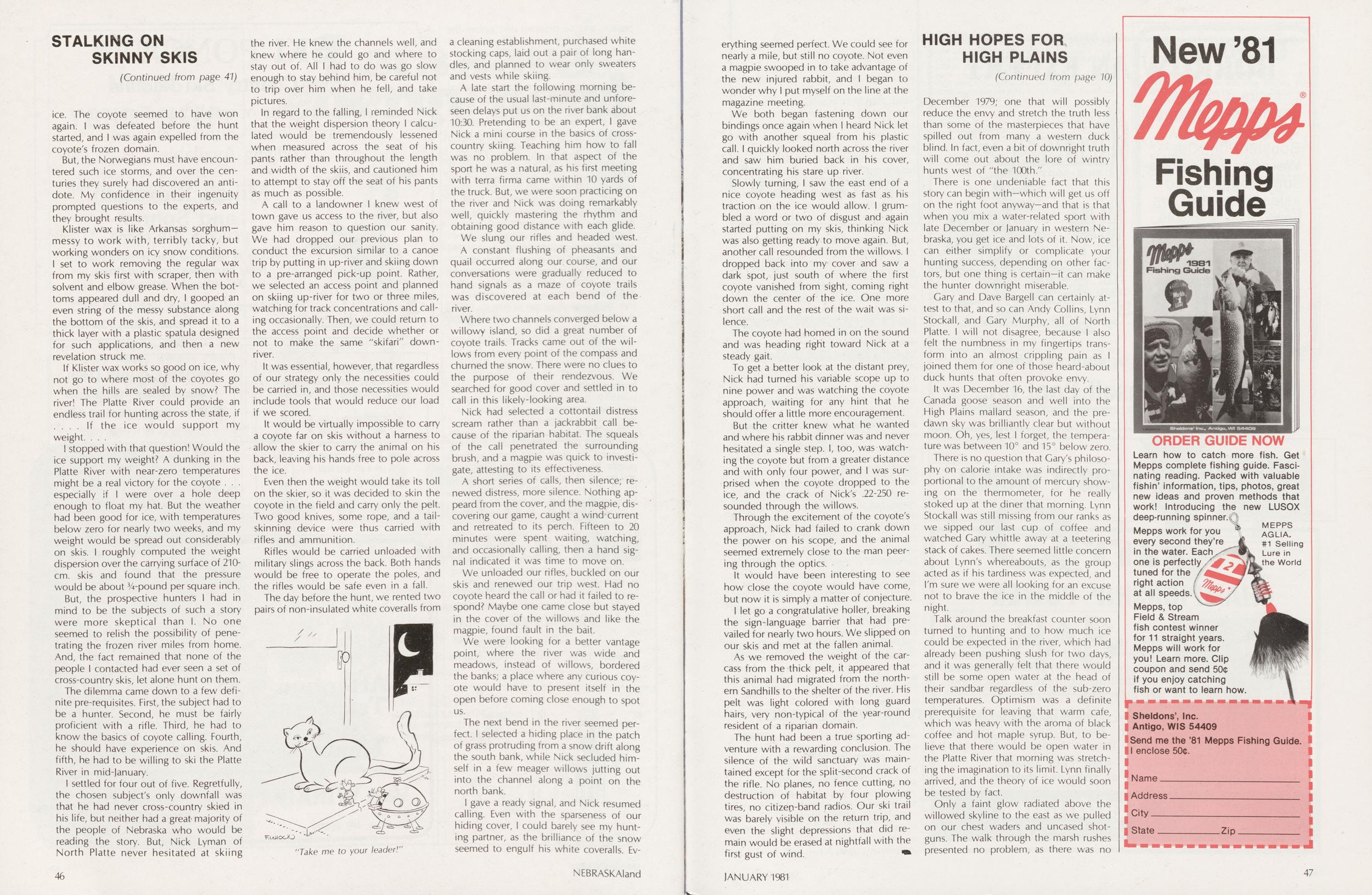
STALKING ON SKINNY SKIS
(Continued from page 41)ice. The coyote seemed to have won again. I was defeated before the hunt started, and I was again expelled from the coyote's frozen domain.
But, the Norwegians must have encountered such ice storms, and over the centuries they surely had discovered an antidote. My confidence in their ingenuity prompted questions to the experts, and they brought results.
Klister wax is like Arkansas sorghum messy to work with, terribly tacky, but working wonders on icy snow conditions. I set to work removing the regular wax from my skis first with scraper, then with solvent and elbow grease. When the bottoms appeared dull and dry, I gooped an even string of the messy substance along the bottom of the skis, and spread it to a thick layer with a plastic spatula designed for such applications, and then a new revelation struck me.
If Klister wax works so good on ice, why not go to where most of the coyotes go when the hills are sealed by snow? The river! The Platte River could provide an endless trail for hunting across the state, if If the ice would support my weight
I stopped with that question! Would the ice support my weight? A dunking in the Platte River with near-zero temperatures might be a real victory for the coyote especially if I were over a hole deep enough to float my hat. But the weather had been good for ice, with temperatures below zero for nearly two weeks, and my weight would be spread out considerably on skis. I roughly computed the weight dispersion over the carrying surface of 210 cm. skis and found that the pressure would be about 3/4-pound per square inch.
But, the prospective hunters I had in mind to be the subjects of such a story were more skeptical than I. No one seemed to relish the possibility of penetrating the frozen river miles from home. And, the fact remained that none of the people I contacted had ever seen a set of cross-country skis, let alone hunt on them.
The dilemma came down to a few definite pre-requisites. First, the subject had to be a hunter. Second, he must be fairly proficient with a rifle. Third, he had to know the basics of coyote calling. Fourth, he should have experience on skis. And fifth, he had to be willing to ski the Platte River in mid-January.
I settled for four out of five. Regretfully, the chosen subject's only downfall was that he had never cross-country skied in his life, but neither had a great majority of the people of Nebraska who would be reading the story. But, Nick Lyman of North Platte never hesitated at skiing the river. He knew the channels well, and knew where he could go and where to stay out of. All I had to do was go slow enough to stay behind him, be careful not to trip over him when he fell, and take pictures.
In regard to the falling, I reminded Nick that the weight dispersion theory I calculated would be tremendously lessened when measured across the seat of his pants rather than throughout the length and width of the skiis, and cautioned him to attempt to stay off the seat of his pants as much as possible.
A call to a landowner I knew west of town gave us access to the river, but also gave him reason to question our sanity. We had dropped our previous plan to conduct the excursion similar to a canoe trip by putting in up-river and skiing down to a pre-arranged pick-up point. Rather, we selected an access point and planned on skiing up-river for two or three miles, watching for track concentrations and call ing occasionally. Then, we could return to the access point and decide whether or not to make the same "skifari" down river.
It was essential, however, that regardless of our strategy only the necessities could be carried in, and those necessities would include tools that would reduce our load if we scored.
It would be virtually impossible to carry a coyote far on skis without a harness to allow the skier to carry the animal on his back, leaving his hands free to pole across the ice.
Even then the weight would take its toll on the skier, so it was decided to skin the coyote in the field and carry only the pelt. Two good knives, some rope, and a tail skinning device were thus carried with rifles and ammunition.
Rifles would be carried unloaded with military slings across the back. Both hands would be free to operate the poles, and the rifles would be safe even in a fall.
The day before the hunt, we rented two pairs of non-insulated white coveralls from
Take me to your leader!"
a cleaning establishment, purchased white stocking caps, laid out a pair of long handles, and planned to wear only sweaters and vests while skiing.
A late start the following morning be cause of the usual last-minute and unforeseen delays put us on the river bank about 10:30. Pretending to be an expert, I gave Nick a mini course in the basics of cross country skiing. Teaching him how to fall was no problem. In that aspect of the sport he was a natural, as his first meeting with terra firma came within 10 yards of the truck. But, we were soon practicing on the river and Nick was doing remarkably well, quickly mastering the rhythm and obtaining good distance with each glide.
We slung our rifles and headed west.
A constant flushing of pheasants and quail occurred along our course, and our conversations were gradually reduced to hand signals as a maze of coyote trails was discovered at each bend of the river.
Where two channels converged below a willowy island, so did a great number of coyote trails. Tracks came out of the willows from every point of the compass and churned the snow. There were no clues to the purpose of their rendezvous. We searched for good cover and settled in to call in this likely-looking area.
Nick had selected a cottontail distress scream rather than a jackrabbit call because of the riparian habitat. The squeals of the call penetrated the surrounding brush, and a magpie was quick to investigate, attesting to its effectiveness.
A short series of calls, then silence; renewed distress, more silence. Nothing appeard from the cover, and the magpie, discovering our game, caught a wind current and retreated to its perch. Fifteen to 20 minutes were spent waiting, watching, and occasionally calling, then a hand signal indicated it was time to move on.
We unloaded our rifles, buckled on our skis and renewed our trip west. Had no coyote heard the call or had it failed to respond? Maybe one came close but stayed in the cover of the willows and like the magpie, found fault in the bait.
We were looking for a better vantage point, where the river was wide and meadows, instead of willows, bordered the banks; a place where any curious coyote would have to present itself in the open before coming close enough to spot us.
The next bend in the river seemed perfect. I selected a hiding place in the patch of grass protruding from a snow drift along the south bank, while Nick secluded him self in a few meager willows jutting out into the channel along a point on the north bank.
I gave a ready signal, and Nick resumed calling. Even with the sparseness of our hiding cover, I could barely see my hunt ing partner, as the brilliance of the snow seemed to engulf his white coveralls. Everything 46 NEBRASKAland seemed perfect. We could see for nearly a mile, but still no coyote. Not even a magpie swooped in to take advantage of the new injured rabbit, and I began to wonder why I put myself on the line at the magazine meeting.
We both began fastening down our bindings once again when I heard Nick let go with another squeal from his plastic call. I quickly looked north across the river and saw him buried back in his cover, concentrating his stare up river.
Slowly turning, I saw the east end of a nice coyote heading west as fast as his traction on the ice would allow. I grumbled a word or two of disgust and again started putting on my skis, thinking Nick was also getting ready to move again. But, another call resounded from the willows. I dropped back into my cover and saw a dark spot, just south of where the first coyote vanished from sight, coming right down the center of the ice. One more short call and the rest of the wait was silence.
The coyote had homed in on the sound and was heading right toward Nick at a steady gait.
To get a better look at the distant prey, Nick had turned his variable scope up to nine power and was watching the coyote approach, waiting for any hint that he should offer a little more encouragement.
But the critter knew what he wanted and where his rabbit dinner was and never hesitated a single step. I, too, was watch ing the coyote but from a greater distance and with only four power, and I was surprised when the coyote dropped to the ice, and the crack of Nick's .22-250 resounded through the willows.
Through the excitement of the coyote's approach, Nick had failed to crank down the power on his scope, and the animal seemed extremely close to the man peer ing through the optics.
It would have been interesting to see how close the coyote would have come, but now it is simply a matter of conjecture.
I let go a congratulative holler, breaking the sign-language barrier that had prevailed for nearly two hours. We slipped on our skis and met at the fallen animal.
As we removed the weight of the car cass from the thick pelt, it appeared that this animal had migrated from the northern Sandhills to the shelter of the river. His pelt was light colored with long guard hairs, very non-typical of the year-round resident of a riparian domain.
The hunt had been a true sporting adventure with a rewarding conclusion. The silence of the wild sanctuary was maintained except for the split-second crack of the rifle. No planes, no fence cutting, no destruction of habitat by four plowing tires, no citizen-band radios. Our ski trail was barely visible on the return trip, and even the slight depressions that did remain would be erased at nightfall with the first gust of wind.
HIGH HOPES FOR HIGH PLAINS
(Continued from page 10)December 1979; one that will possibly reduce the envy and stretch the truth less than some of the masterpieces that have spilled out from many a western duck blind. In fact, even a bit of downright truth will come out about the lore of wintry hunts west of "the 100th."
There is one undeniable fact that this story can begin with—which will get us off on the right foot anyway—and that is that when you mix a water-related sport with late December or January in western Nebraska, you get ice and lots of it. Now, ice can either simplify or complicate your hunting success, depending on other factors, but one thing is certain—it can make the hunter downright miserable.
Gary and Dave Bargell can certainly attest to that, and so can Andy Collins, Lynn Stockall, and Gary Murphy, all of North Platte. I will not disagree, because I also felt the numbness in my fingertips transform into an almost crippling pain as I joined them for one of those heard-about duck hunts that often provoke envy.
It was December 16, the last day of the Canada goose season and well into the High Plains mailard season, and the predawn sky was brilliantly clear but without moon. Oh, yes, lest I forget, the temperature was between 10° and 15° below zero.
There is no question that Gary's philosophy on calorie intake was indirectly proportional to the amount of mercury show ing on the thermometer, for he really stoked up at the diner that morning. Lynn Stockall was still missing from our ranks as we sipped our last cup of coffee and watched Gary whittle away at a teetering stack of cakes. There seemed little concern about Lynn's whereabouts, as the group acted as if his tardiness was expected, and I'm sure we were all looking for an excuse not to brave the ice in the middle of the night.
Talk around the breakfast counter soon turned to hunting and to how much ice could be expected in the river, which had already been pushing slush for two days, and it was generally felt that there would still be some open water at the head of their sandbar regardless of the sub-zero temperatures. Optimism was a definite prerequisite for leaving that warm cafe, which was heavy with the aroma of black coffee and hot maple syrup. But, to believe that there would be open water in the Platte River that morning was stretch ing the imagination to its limit. Lynn finally arrived, and the theory of ice would soon be tested by fact.
Only a faint glow radiated above the willowed skyline to the east as we pulled on our chest waders and uncased shot guns. The walk through the marsh rushes presented no problem, as there was no

mud to contend with in the now ice-incarcerated slough. A slender willow switch snapped off the end of Andy's gun barrel and caught me across my right eye, sending a gusher of tears down my cheek which then froze as solid as the marsh before reaching my mustache. I immediately allowed Andy another three-step lead and continued on into the darkness a bit more educated and subdued than before.
As we crossed the marsh, Dave pointed out the remains of their early-season blind, now solidly locked into the marsh until spring break-up. Most High Plains hunters are forced to utilize two blinds during a single season one for early and one to close it out with. In today's world, most waterfowlers are lucky just to have one gunning blind, let alone two.
Now, back to the premise of ice and how it can be a help or a hindrance. If you are a still-water hunter, your biggest night mare will be winter freeze-up, and you should be prepared to end your duck hunting sometime around Thanksgiving. However, if you hunt the river or a warm water stream, your best hunting begins when the lake and marsh boys are packing it in until next year, and the few two climate blind holders, like my hunting partners for the day, can really enjoy, and cash in on, the full High Plains season.
Puddle ducks like mallards, teal, wigeon and gadwall prefer the shallow impoundments, rich with vegetation and rushes. Marshes and backwaters provide such early season oases for these species, but such areas are also the first to succumb to the physical change of water from liquid to solid. Teal push on south to better climates, but the mallards that stay through freeze-up are generally going to stick it out until spring. Their feeding habits change from the natural vegetation of the marsh to corn missed by the combine, and it is generally after their crops are packed with golden kernels that an unquenchable thirst makes them vulnerable to river or slough decoys where open water remains.
The harder the wind blows, the better for river hunters, as open water in the center of large reservoirs is not as desirable to ducks as more protected streams, but on this particular day, even the cattail cotton fell straight to the ground as we brushed against them on the way to the blind.
The blind, by the way, was now the focal point of my concentration, as rumors concerning the quality of Bargell workmanship in blind construction always seemed to surface in any local hunting conversations. Andy Collins always claimed that a day in one of their blinds should be considered cruel and unusual punishment, and from the looks of the marsh blind we had just passed, it's doubtful anyone could survive an entire day in it.
The usual sound of swirling current associated with the river did not greet us as we poked through the final wall of rushes at the river's bank. A two-inch layer of ice
48 NEBRASKAland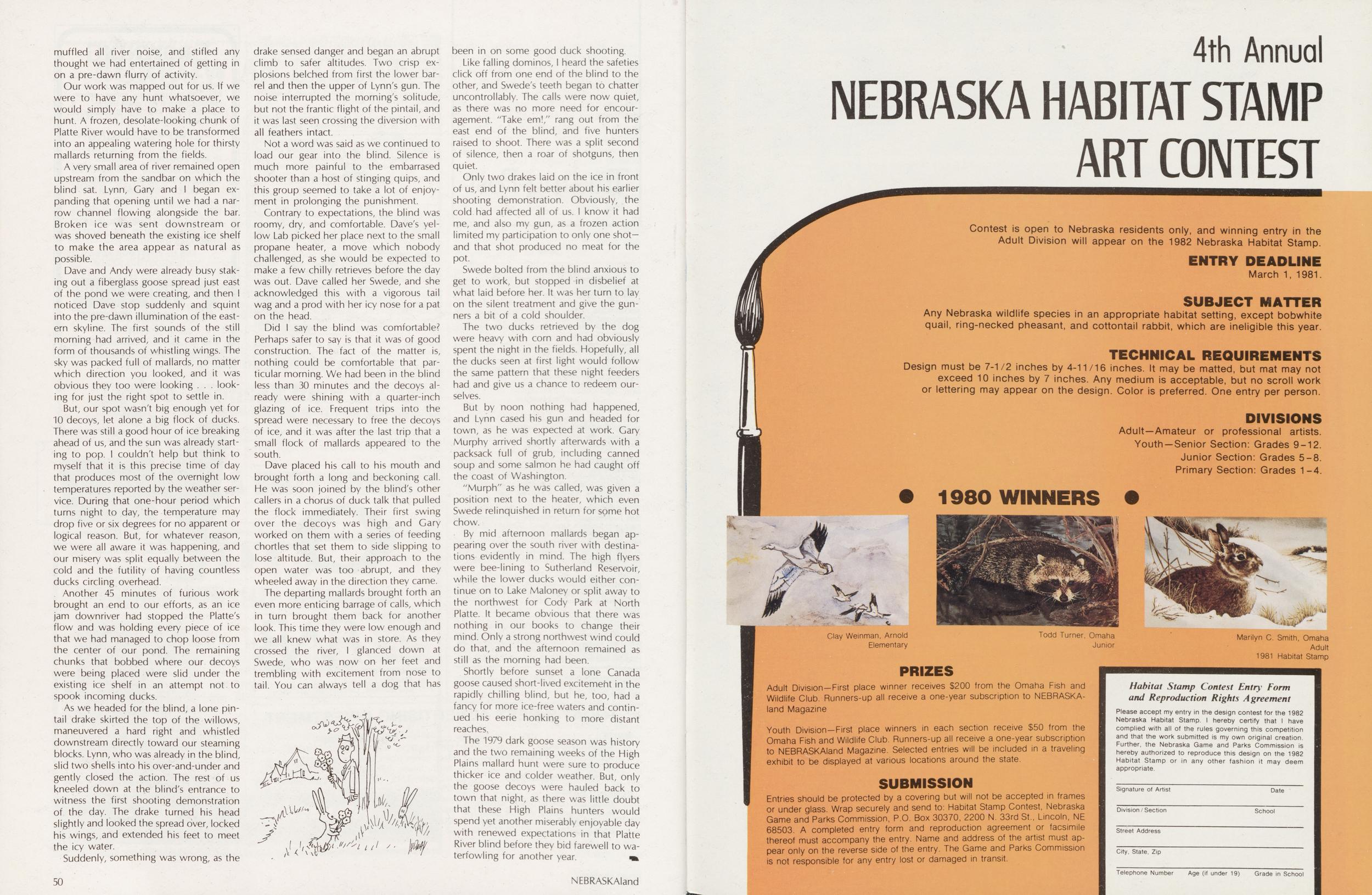
muffled all river noise, and stifled any thought we had entertained of getting in on a pre-dawn flurry of activity.
Our work was mapped out for us. If we were to have any hunt whatsoever, we would simply have to make a place to hunt. A frozen, desolate-looking chunk of Platte River would have to be transformed into an appealing watering hole for thirsty mallards returning from the fields.
A very small area of river remained open upstream from the sandbar on which the blind sat. Lynn, Gary and I began expanding that opening until we had a narrow channel flowing alongside the bar. Broken ice was sent downstream or was shoved beneath the existing ice shelf to make the area appear as natural as possible.
Dave and Andy were already busy staking out a fiberglass goose spread just east of the pond we were creating, and then I noticed Dave stop suddenly and squint into the pre-dawn illumination of the east ern skyline. The first sounds of the still morning had arrived, and it came in the form of thousands of whistling wings. The sky was packed full of mallards, no matter which direction you looked, and it was obvious they too were looking look ing for just the right spot to settle in.
But, our spot wasn't big enough yet for 10 decoys, let alone a big flock of ducks. There was still a good hour of ice breaking ahead of us, and the sun was already start ing to pop. I couldn't help but think to myself that it is this precise time of day that produces most of the overnight low temperatures reported by the weather service. During that one-hour period which turns night to day, the temperature may drop five or six degrees for no apparent or logical reason. But, for whatever reason, we were all aware it was happening, and our misery was split equally between the cold and the futility of having countless ducks circling overhead.
Another 45 minutes of furious work brought an end to our efforts, as an ice jam downriver had stopped the Platte's flow and was holding every piece of ice that we had managed to chop loose from the center of our pond. The remaining chunks that bobbed where our decoys were being placed were slid under the existing ice shelf in an attempt not to spook incoming ducks.
As we headed for the blind, a lone pin tail drake skirted the top of the willows, maneuvered a hard right and whistled downstream directly toward our steaming blocks. Lynn, who was already in the blind, slid two shells into his over-and-under and gently closed the action. The rest of us kneeled down at the blind's entrance to witness the first shooting demonstration of the day. The drake turned his head slightly and looked the spread over, locked his wings, and extended his feet to meet the icy water.
Suddenly, something was wrong, as the drake sensed danger and began an abrupt climb to safer altitudes. Two crisp explosions belched from first the lower bar rel and then the upper of Lynn's gun. The noise interrupted the morning's solitude, but not the frantic flight of the pintail, and it was last seen crossing the diversion with all feathers intact.
Not a word was said as we continued to load our gear into the blind. Silence is much more painful to the embarrased shooter than a host of stinging quips, and this group seemed to take a lot of enjoyment in prolonging the punishment.
Contrary to expectations, the blind was roomy, dry, and comfortable. Dave's yellow Lab picked her place next to the small propane heater, a move which nobody challenged, as she would be expected to make a few chilly retrieves before the day was out. Dave called her Swede, and she acknowledged this with a vigorous tail wag and a prod with her icy nose for a pat on the head.
Did I say the blind was comfortable? Perhaps safer to say is that it was of good construction. The fact of the matter is, nothing could be comfortable that particular morning. We had been in the blind less than 30 minutes and the decoys already were shining with a quarter-inch glazing of ice. Frequent trips into the spread were necessary to free the decoys of ice, and it was after the last trip that a small flock of mallards appeared to the south.
Dave placed his call to his mouth and brought forth a long and beckoning call. He was soon joined by the blind's other callers in a chorus of duck talk that pulled the flock immediately. Their first swing over the decoys was high and Gary worked on them with a series of feeding chortles that set them to side slipping to lose altitude. But, their approach to the open water was too abrupt, and they wheeled away in the direction they came.
The departing mallards brought forth an even more enticing barrage of calls, which in turn brought them back for another look. This time they were low enough and we all knew what was in store. As they crossed the river, I glanced down at Swede, who was now on her feet and trembling with excitement from nose to tail. You can always tell a dog that has
Like falling dominos, I heard the safeties click off from one end of the blind to the other, and Swede's teeth began to chatter uncontrollably. The calls were now quiet, as there was no more need for encouragement. "Take em!," rang out from the east end of the blind, and five hunters raised to shoot. There was a split second of silence, then a roar of shotguns, then quiet.
Only two drakes laid on the ice in front of us, and Lynn felt better about his earlier shooting demonstration. Obviously, the cold had affected all of us. I know it had me, and also my gun, as a frozen action limited my participation to only one shot and that shot produced no meat for the pot.
Swede bolted from the blind anxious to get to work, but stopped in disbelief at what laid before her. It was her turn to lay on the silent treatment and give the gunners a bit of a cold shoulder.
The two ducks retrieved by the dog were heavy with corn and had obviously spent the night in the fields. Hopefully, all the ducks seen at first light would follow the same pattern that these night feeders had and give us a chance to redeem ourselves.
But by noon nothing had happened, and Lynn cased his gun and headed for town, as he was expected at work. Gary Murphy arrived shortly afterwards with a packsack full of grub, including canned soup and some salmon he had caught off the coast of Washington.
"Murph" as he was called, was given a position next to the heater, which even Swede relinquished in return for some hot chow.
By mid afternoon mallards began appearing over the south river with destinations evidently in mind. The high flyers were bee-lining to Sutherland Reservoir, while the lower ducks would either continue on to Lake Maloney or split away to the northwest for Cody Park at North Platte. It became obvious that there was nothing in our books to change their mind. Only a strong northwest wind could do that, and the afternoon remained as still as the morning had been.
Shortly before sunset a lone Canada goose caused short-lived excitement in the rapidly chilling blind, but he, too, had a fancy for more ice-free waters and continued his eerie honking to more distant reaches.
The 1979 dark goose season was history and the two remaining weeks of the High Plains mallard hunt were sure to produce thicker ice and colder weather. But, only the goose decoys were hauled back to town that night, as there was little doubt that these High Plains hunters would spend yet another miserably enjoyable day with renewed expectations in that Platte River blind before they bid farewell to waterfowling for another year.
50 NEBRASKAland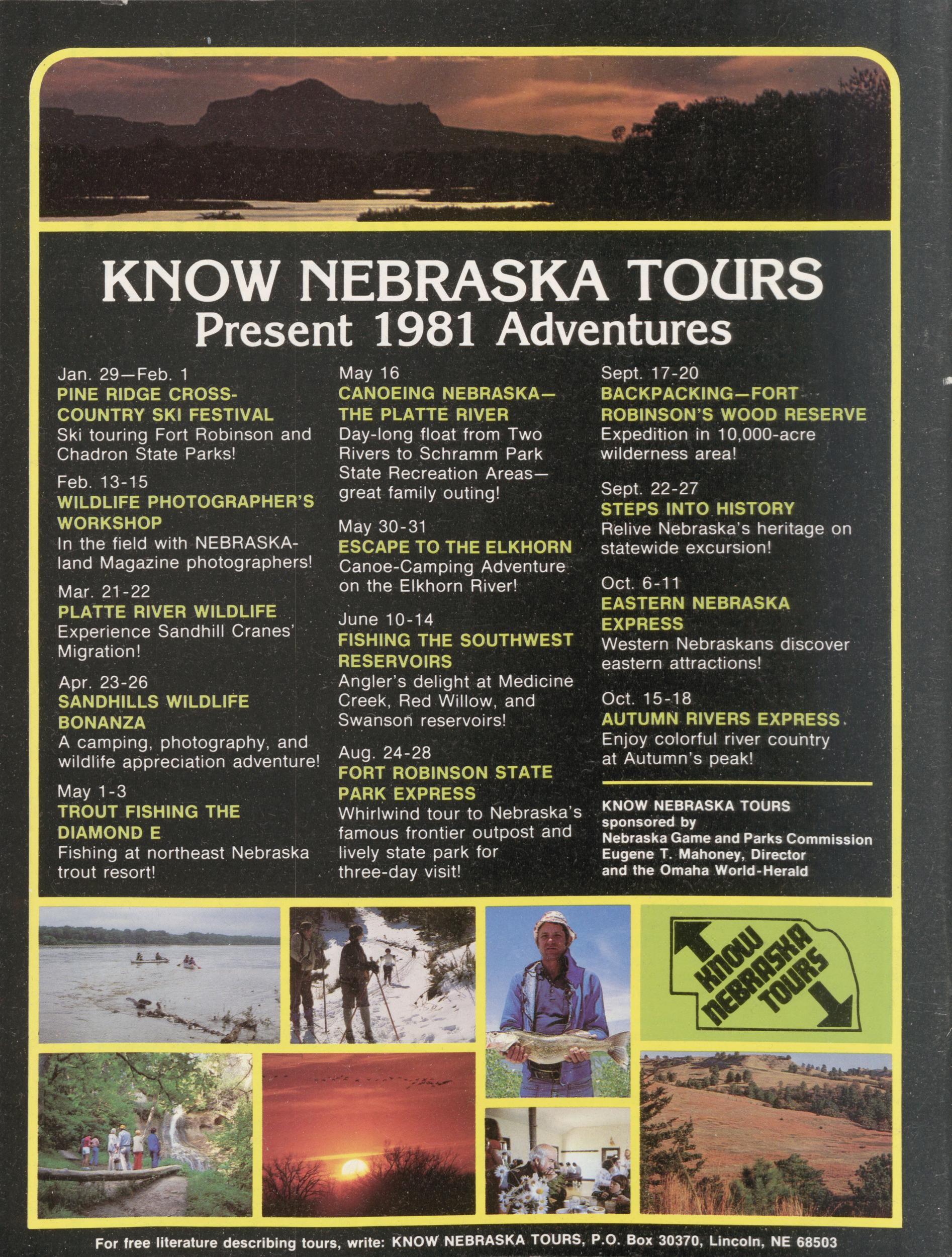
KNOW NEBRASKA TOURS Present 1981 Adventures
Jan. 29—Feb. 1 PINE RIDGE CROSS COUNTRY SKI FESTIVAL Ski touring Fort Robinson and Chadron State Parks! Feb. 13-15 WILDLIFE PHOTOGRAPHER'S WORKSHOP In the field with NEBRASKA land Magazine photographers! Mar. 21-22 PLATTE RIVER WILDLIFE Experience Sandhill Cranes' Migration! Apr. 23-26 SANDHILLS WILDLIFE BONANZA A camping, photography, and May 1-3 TROUT FISHING THE DIAMOND E Fishing at northeast Nebraska trout resort! May 16 CANOEING NEBRASKA THE PLATTE RIVER Day-long float from Two Rivers to Schramm Park State Recreation Areas great family outing! May 30-31 ESCAPE TO THE ELKHORN Canoe-Camping Adventure on the Elkhorn River! June 10-14 FISHING THE SOUTHWEST RESERVOIRS Angler's delight at Medicine Creek, Red Willow, and Swanson reservoirs! FORT ROBINSON STATE PARK EXPRESS Whirlwind tour to Nebraska's famous frontier outpost and lively state park for three-day visit! Sept. 17-20 BACKPACKING-FORT ROBINSON'S WOOD RESERVE Expedition in 10,000-acre wilderness area! Sept. 22-27 STEPS INTO HISTORY Relive Nebraska's heritage on statewide excursion! Oct. 6-11 EASTERN NEBRASKA EXPRESS Western Nebraskans discover eastern attractions! Oct. 15-18 AUTUMN RIVERS EXPRESS. Enjoy colorful river country at Autumn's peak! KNOW NEBRASKA TOURS sponsored by Nebraska Game and Parks Commission Eugene T. Mahoney, Director and the Omaha World-HeraldPosition: 467 (22 views)