Volume 58, Issue 11, 1980
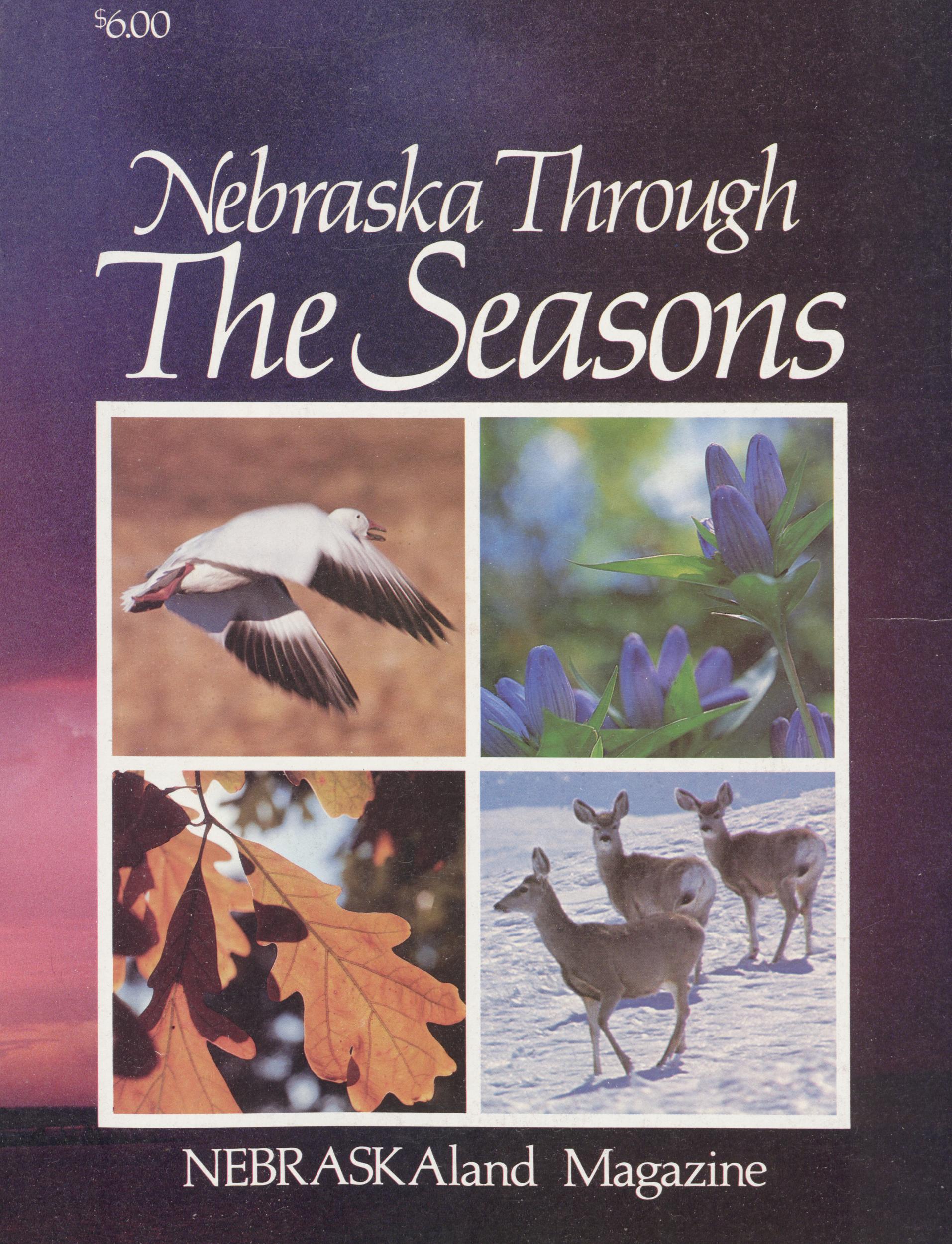
Nebraska Through The Seasons
$6.00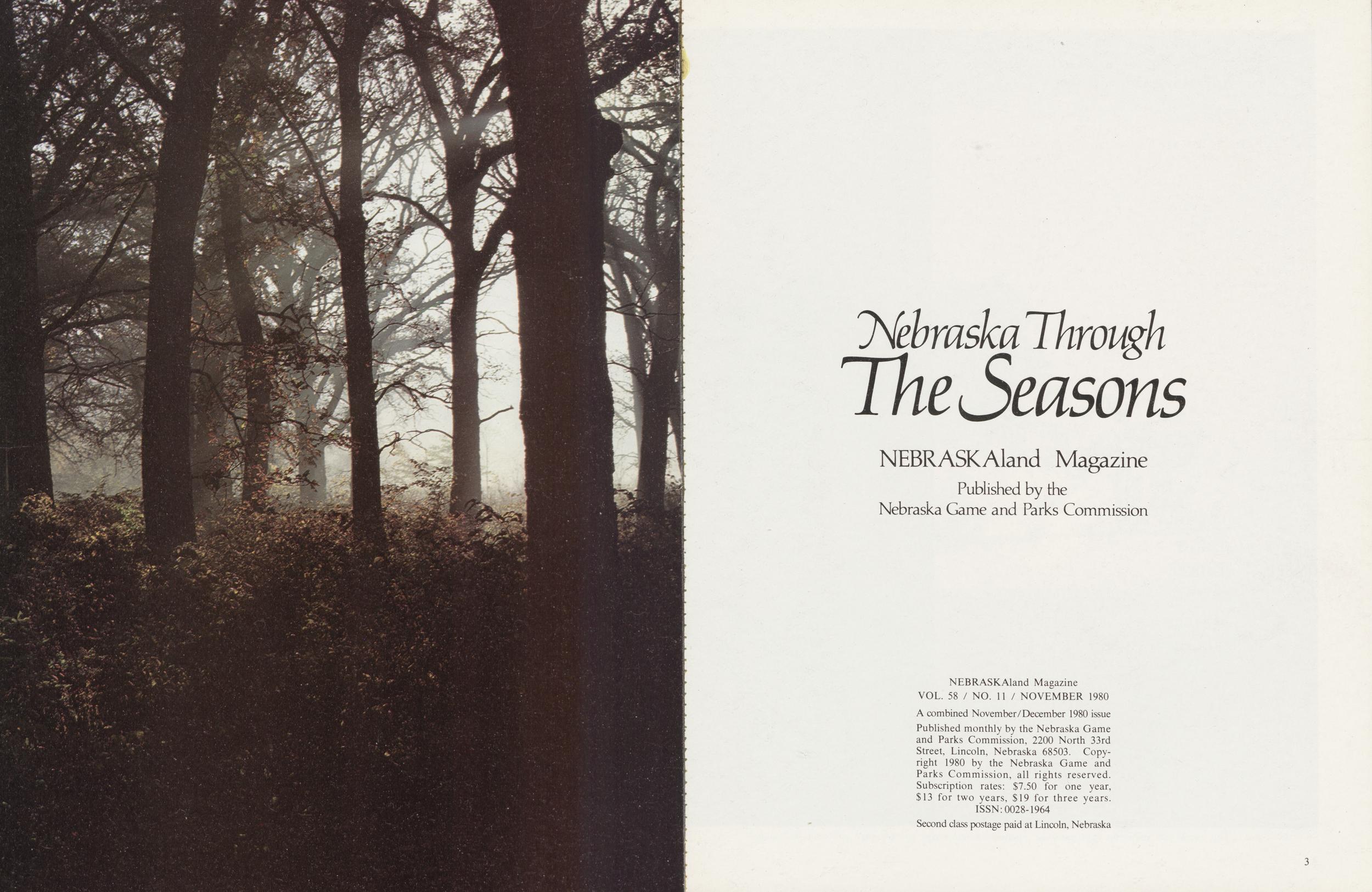
Nebraska Through The Seasons
NEBRASKAland Magazine Published by the Nebraska Game and Parks Commission NEBRASKAland Magazine VOL. 58 / NO. 11 / NOVEMBER 1980 A combined November/December 1980 issue Published monthly by the Nebraska Game and Parks Commission, 2200 North 33rd Street, Lincoln, Nebraska 68503. Copyright 1980 by the Nebraska Game and Parks Commission, all rights reserved. Subscription rates: $7.50 for one year, $13 for two years, $19 for three years. ISSN: 0028-1964 Second class postage paid at Lincoln, Nebraska 3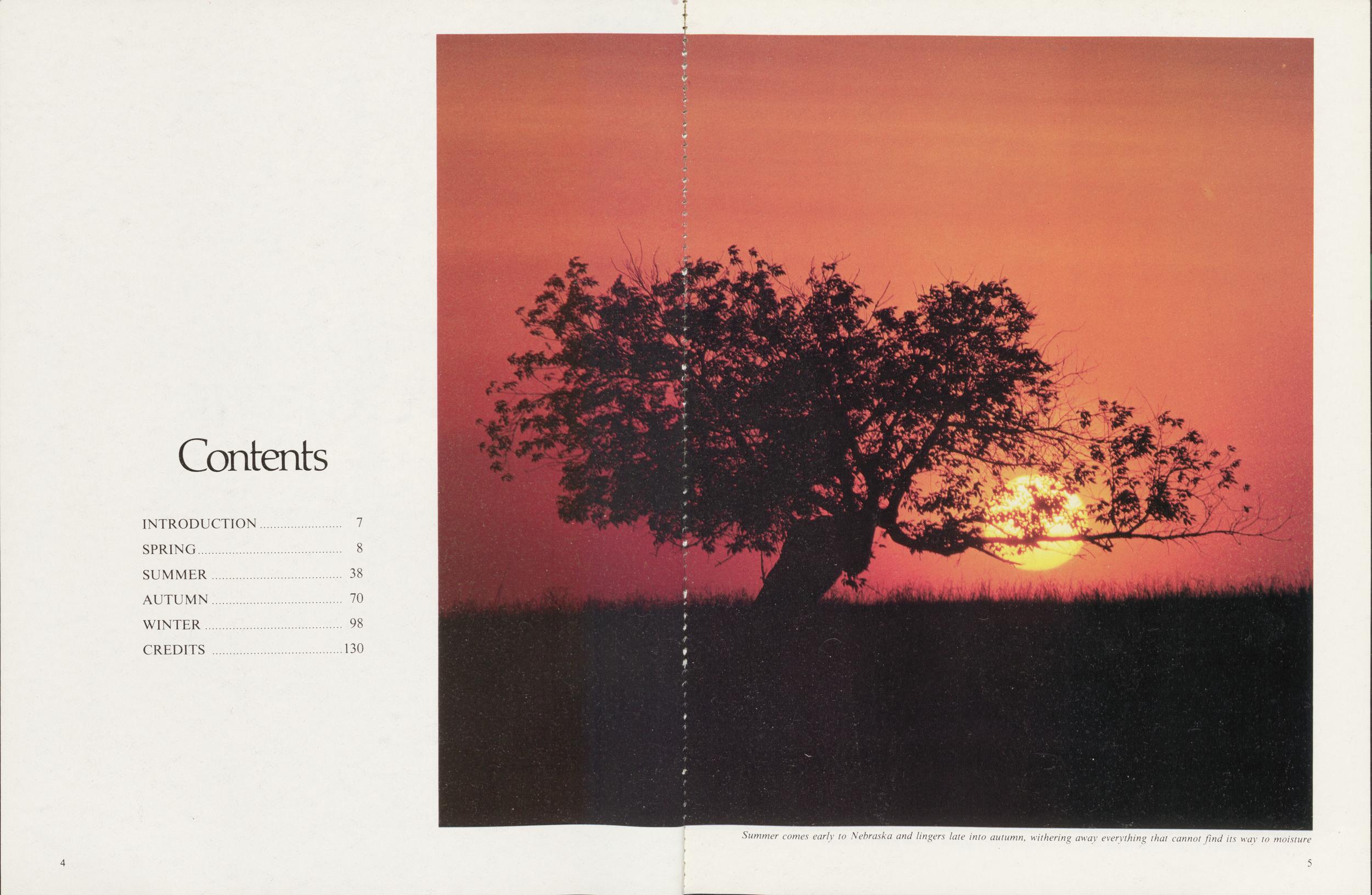 Contents INTRODUCTION 7 SPRING 8 SUMMER 38 AUTUMN 70 WINTER 98 CREDITS 130 4
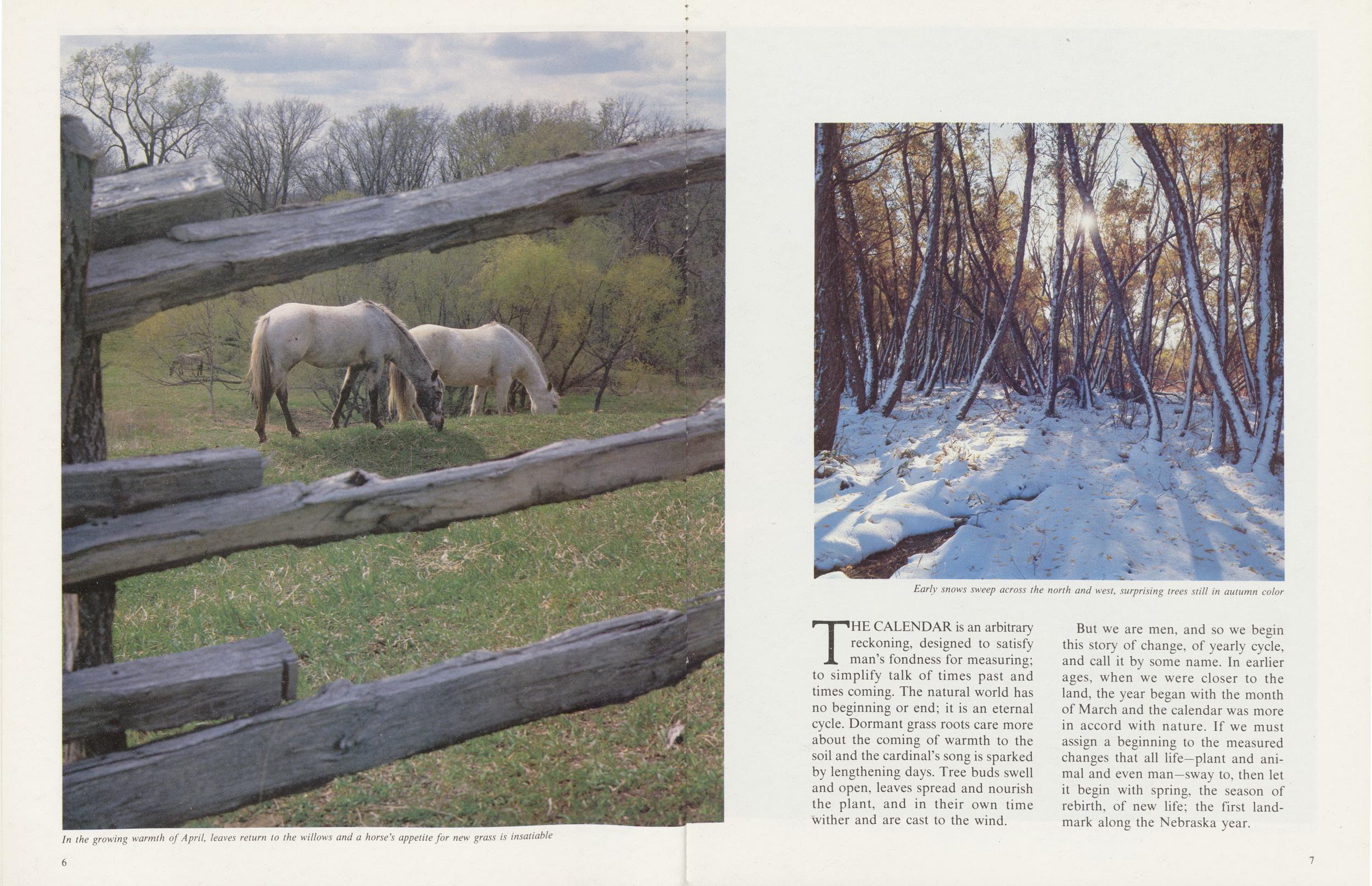
THE CALENDAR is an arbitrary reckoning, designed to satisfy man's fondness for measuring; to simplify talk of times past and times coming. The natural world has no beginning or end; it is an eternal cycle. Dormant grass roots care more about the coming of warmth to the soil and the cardinal's song is sparked by lengthening days. Tree buds swell and open, leaves spread and nourish the plant, and in their own time wither and are cast to the wind.
But we are men, and so we begin this story of change, of yearly cycle, and call it by some name. In earlier ages, when we were closer to the land, the year began with the month of March and the calendar was more in accord with nature. If we must assign a beginning to the measured changes that all life—plant and animal and even man—sway to, then let it begin with spring, the season of rebirth, of new life; the first landmark along the Nebraska year.
7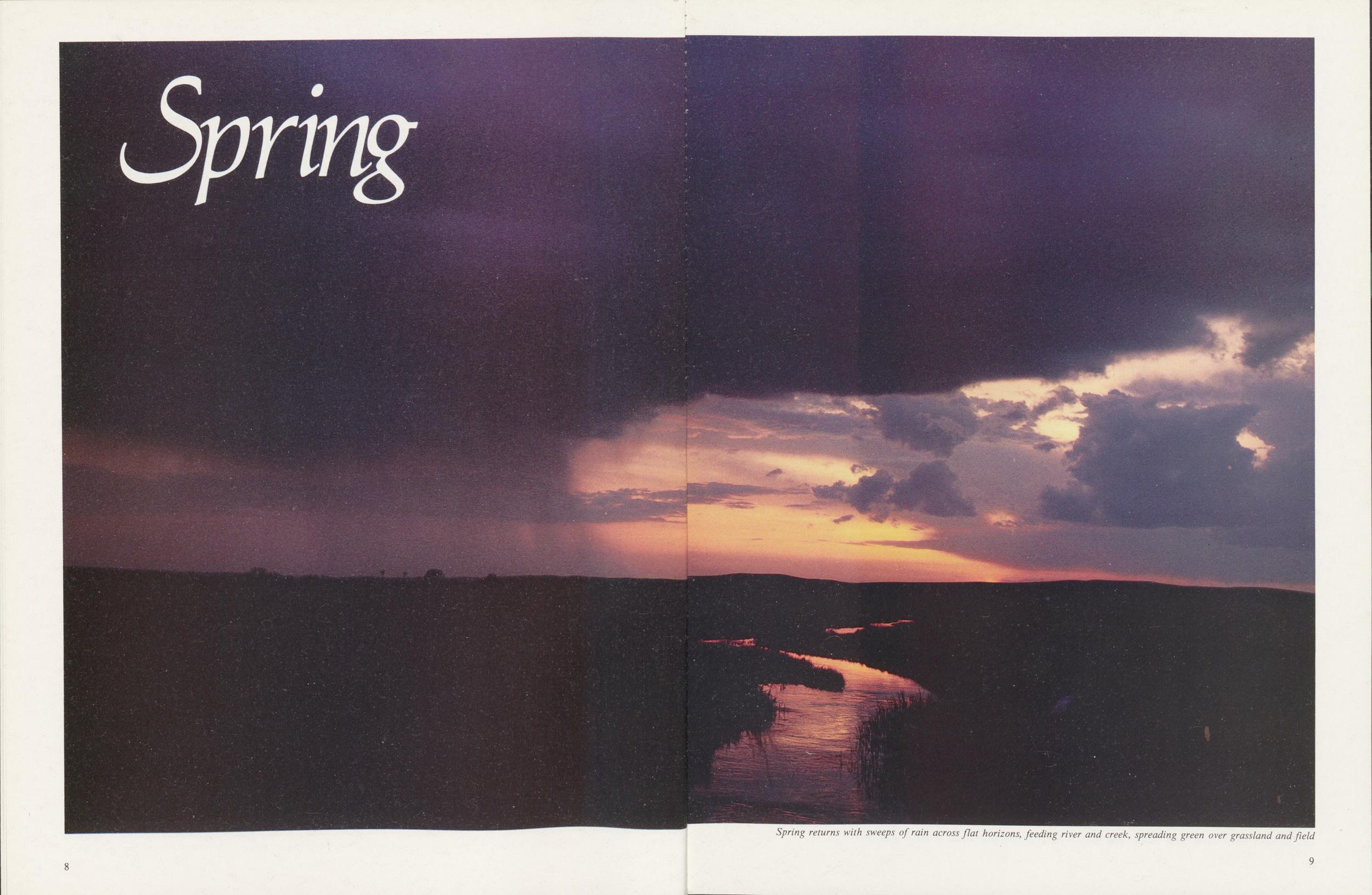
SPRING
8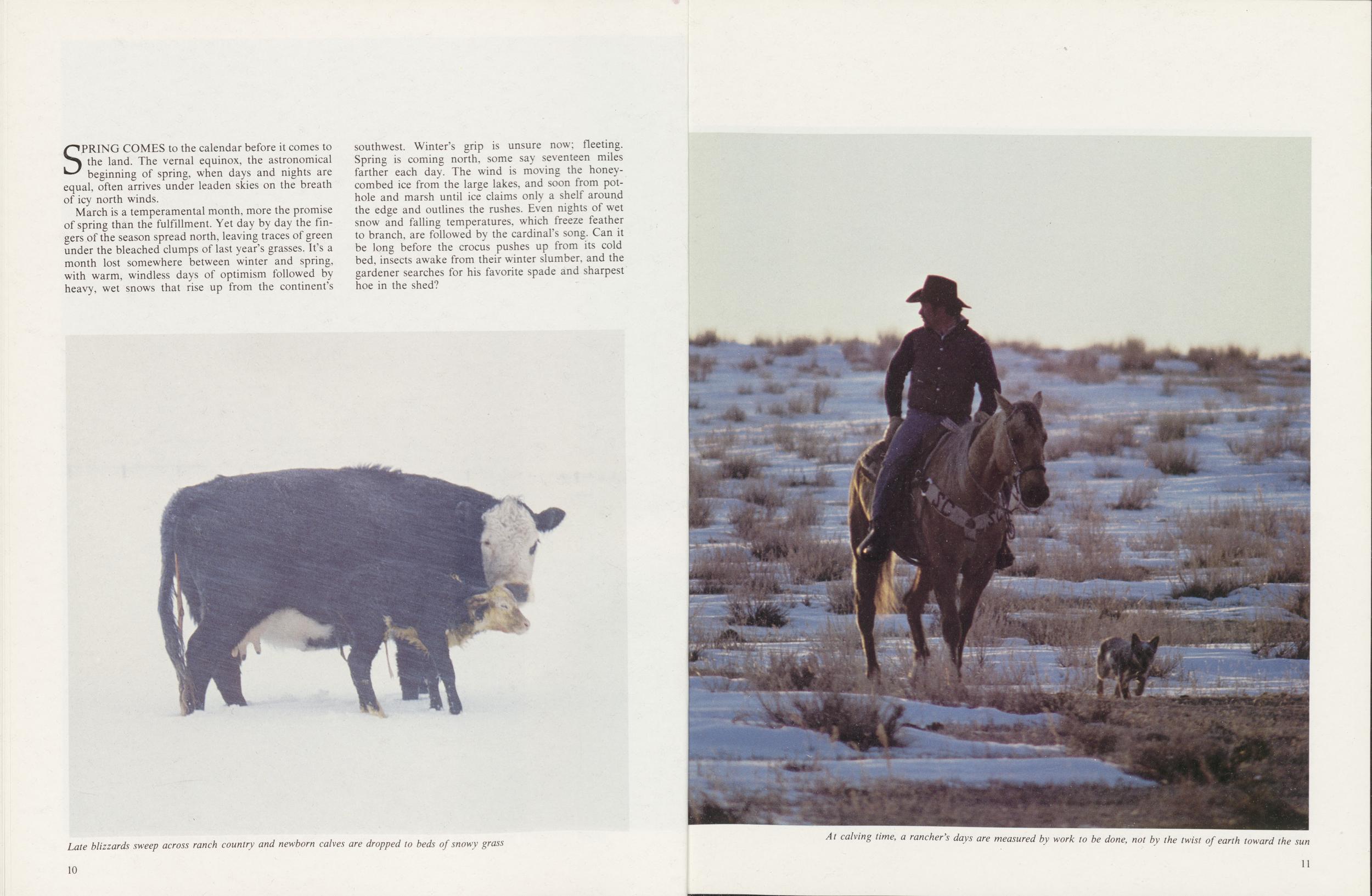
SPRING COMES to the calendar before it comes to the land. The vernal equinox, the astronomical beginning of spring, when days and nights are equal, often arrives under leaden skies on the breath of icy north winds.
March is a temperamental month, more the promise of spring than the fulfillment. Yet day by day the fingers of the season spread north, leaving traces of green under the bleached clumps of last year's grasses. It's a month lost somewhere between winter and spring, with warm, windless days of optimism followed by heavy, wet snows that rise up from the continent's southwest. Winter's grip is unsure now; fleeting. Spring is coming north, some say seventeen miles farther each day. The wind is moving the honeycombed ice from the large lakes, and soon from pothole and marsh until ice claims only a shelf around the edge and outlines the rushes. Even nights of wet snow and falling temperatures, which freeze feather to branch, are followed by the cardinal's song. Can it be long before the crocus pushes up from its cold bed, insects awake from their winter slumber, and the gardener searches for his favorite spade and sharpest hoe in the shed?
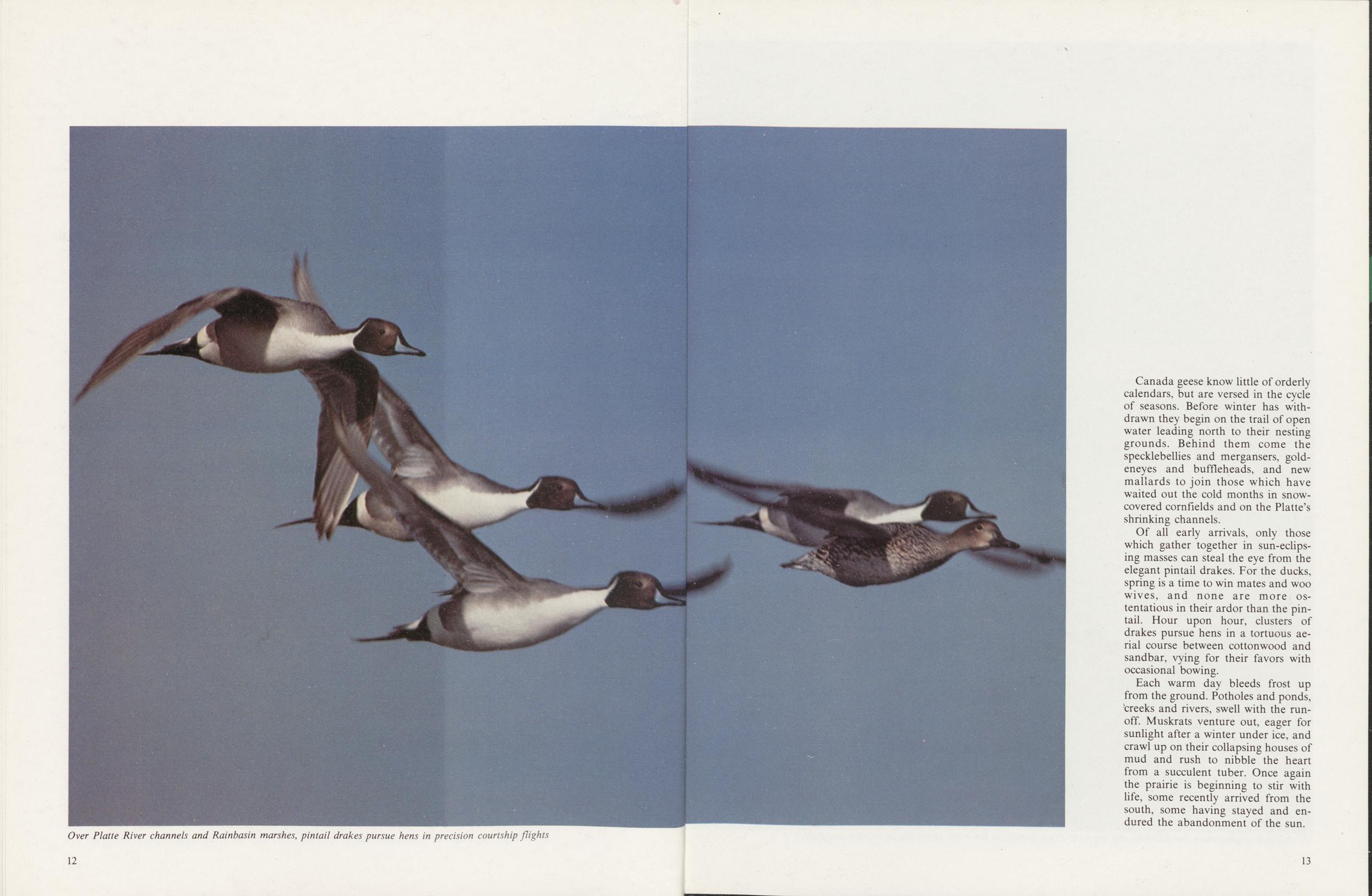
Canada geese know little of orderly calendars, but are versed in the cycle of seasons. Before winter has withdrawn they begin on the trail of open water leading north to their nesting grounds. Behind them come the specklebellies and mergansers, goldeneyes and buffleheads, and new mallards to join those which have waited out the cold months in snowcovered cornfields and on the Platte's shrinking channels.
Of all early arrivals, only those which gather together in sun-eclipsing masses can steal the eye from the elegant pintail drakes. For the ducks, spring is a time to win mates and woo wives, and none are more ostentatious in their ardor than the pintail. Hour upon hour, clusters of drakes pursue hens in a tortuous aerial course between cottonwood and sandbar, vying for their favors with occasional bowing.
Each warm day bleeds frost up from the ground. Potholes and ponds, creeks and rivers, swell with the run-off. Muskrats venture out, eager for sunlight after a winter under ice, and crawl up on their collapsing houses of mud and rush to nibble the heart from a succulent tuber. Once again the prairie is beginning to stir with life, some recently arrived from the south, some having stayed and endured the abandonment of the sun.
13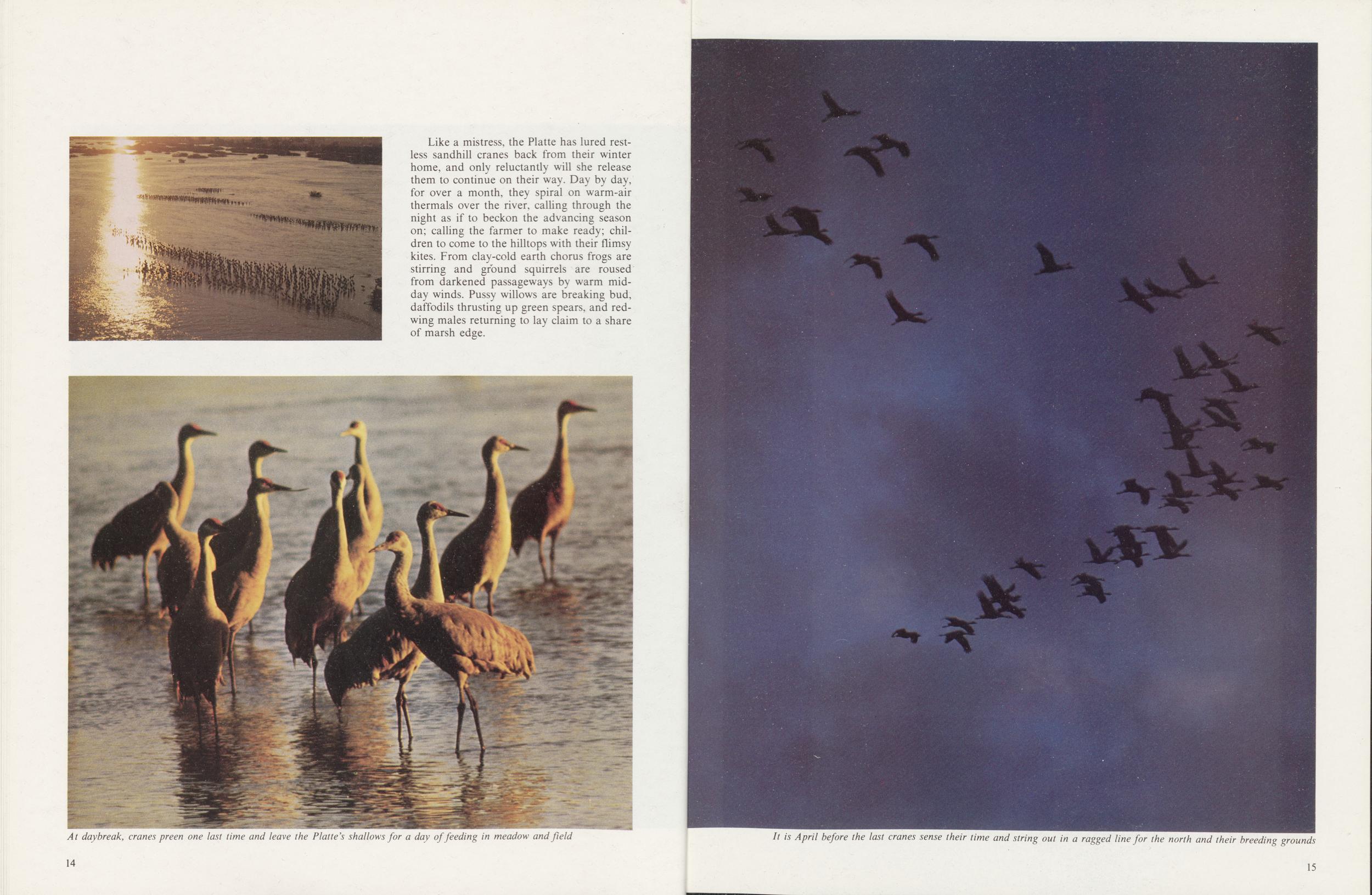
Like a mistress. the Platte has lured restless sandhill cranes back from their winter home, and only reluctantly will she release them to continue on their way. Day by day, for over a month, they spiral on warm-air thermals over the river, calling through the night as if to beckon the advancing season on; calling the farmer to make ready; children to come to the hilltops with their flimsy kites. From clay-cold earth chorus frogs are stirring and ground squirrels are roused from darkened passageways by warm midday winds. Pussy willows are breaking bud, daffodils thrusting up green spears, and redwing males returning to lay claim to a share of marsh edge.
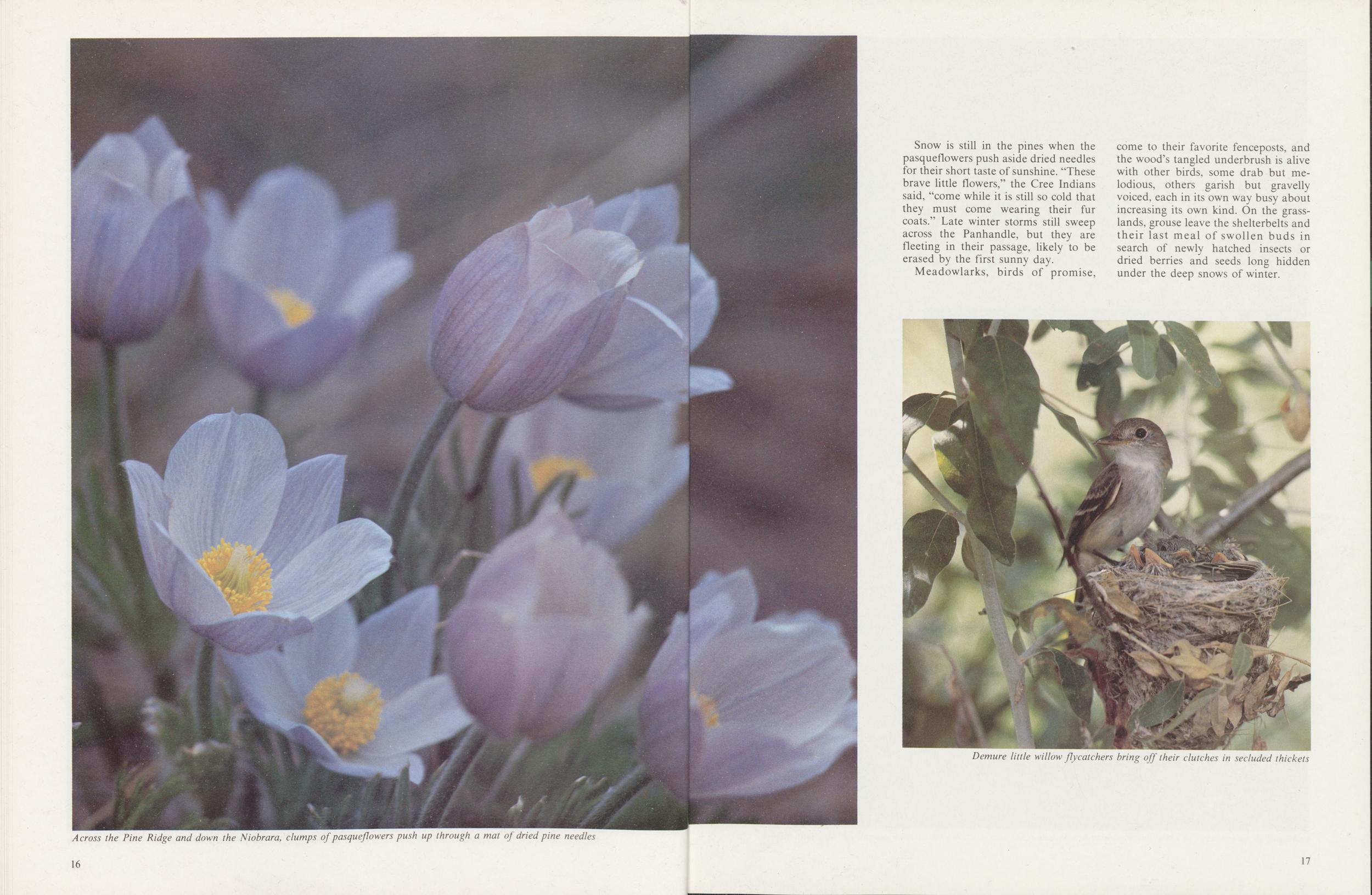
Snow is still in the pines when the pasqueflowers push aside dried needles for their short taste of sunshine. "These brave little flowers," the Cree Indians said, "come while it is still so cold that they must come wearing their fur coats." Late winter storms still sweep across the Panhandle, but they are fleeting in their passage, likely to be erased by the first sunny day.
Meadowlarks, birds of promise, come to their favorite fenceposts, and the wood's tangled underbrush is alive with other birds, some drab but melodious, others garish but gravelly voiced, each in its own way busy about increasing its own kind. On the grasslands, grouse leave the shelterbelts and their last meal of swollen buds in search of newly hatched insects or dried berries and seeds long hidden under the deep snows of winter.
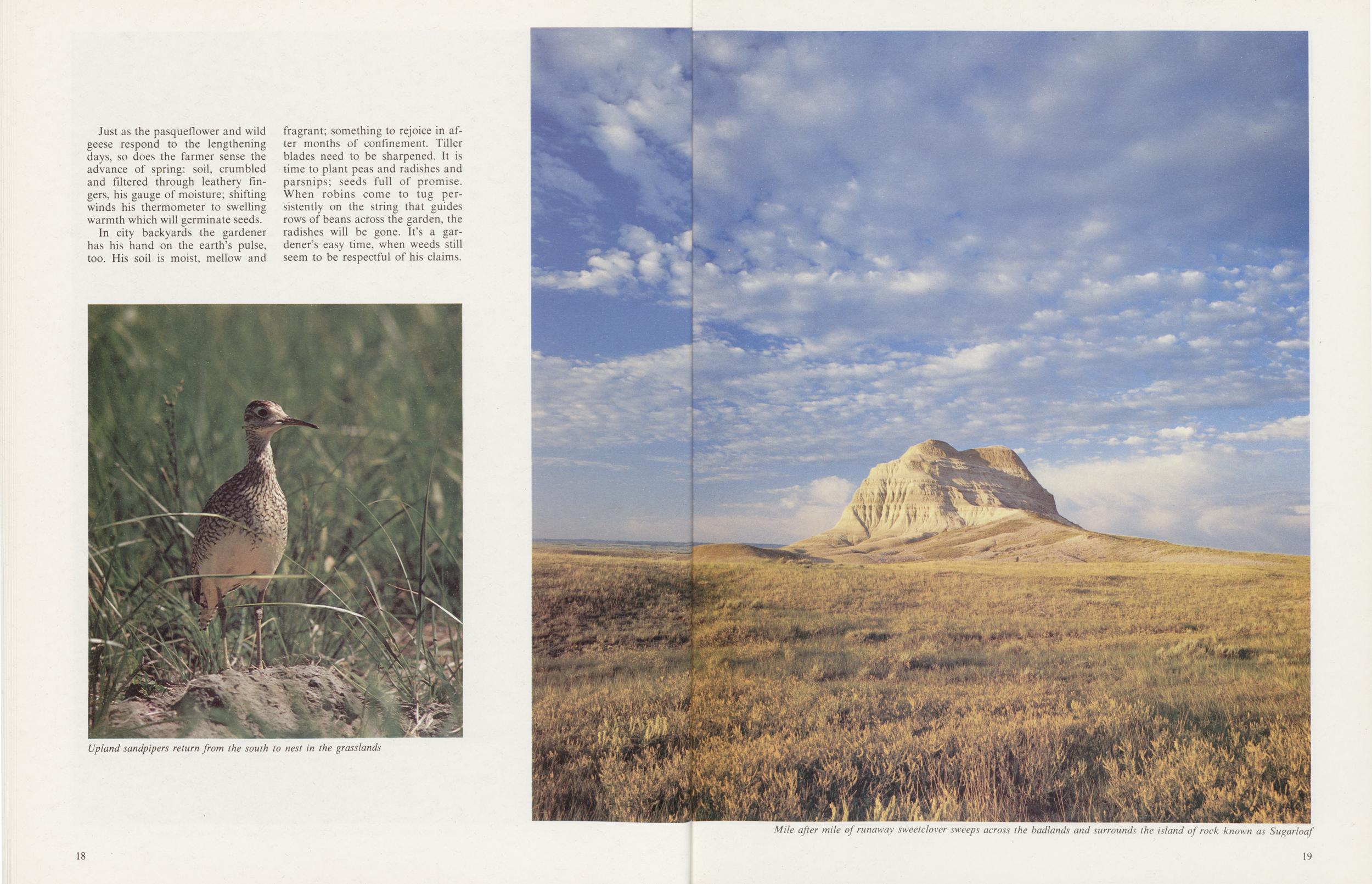
Just as the pasqueflower and wild geese respond to the lengthening days, so does the farmer sense the advance of spring: soil, crumbled and filtered through leathery fingers, his gauge of moisture; shifting winds his thermometer to swelling warmth which will germinate seeds.
In city backyards the gardener has his hand on the earth's pulse, too. His soil is moist, mellow and fragrant; something to rejoice in after months of confinement. Tiller blades need to be sharpened. It is time to plant peas and radishes and parsnips; seeds full of promise. When robins come to tug persistently on the string that guides rows of beans across the garden, the radishes will be gone. It's a gardener's easy time, when weeds still seem to be respectful of his claims.
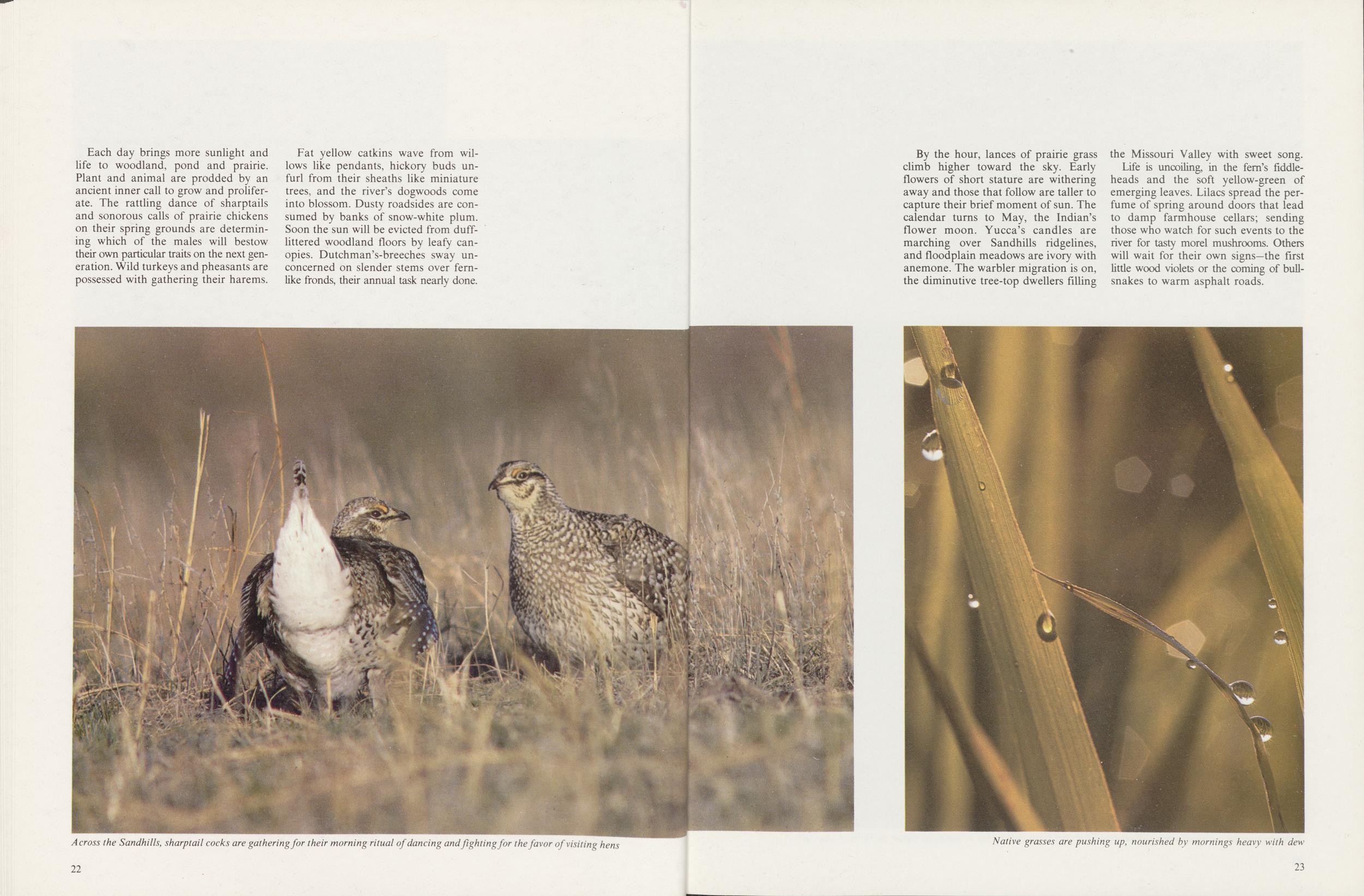
Each day brings more sunlight and life to woodland, pond and prairie. Plant and animal are prodded by an ancient inner call to grow and proliferate. The rattling dance of sharptails and sonorous calls of prairie chickens on their spring grounds are determining which of the males will bestow their own particular traits on the next generation. Wild turkeys and pheasants are possessed with gathering their harems.
Fat yellow catkins wave from willows like pendants, hickory buds unfurl from their sheaths like miniature trees, and the river's dogwoods come into blossom. Dusty roadsides are consumed by banks of snow-white plum. Soon the sun will be evicted from dufflittered woodland floors by leafy canopies. Dutchman's-breeches sway unconcerned on slender stems over fern-like fronds, their annual task nearly done.
By the hour, lances of prairie grass climb higher toward the sky. Early flowers of short stature are withering away and those that follow are taller to capture their brief moment of sun. The calendar turns to May, the Indian's flower moon. Yucca's candles are marching over Sandhills ridgelines, and floodplain meadows are ivory with anemone. The warbler migration is on, the diminutive tree-top dwellers filling the Missouri Valley with sweet song.
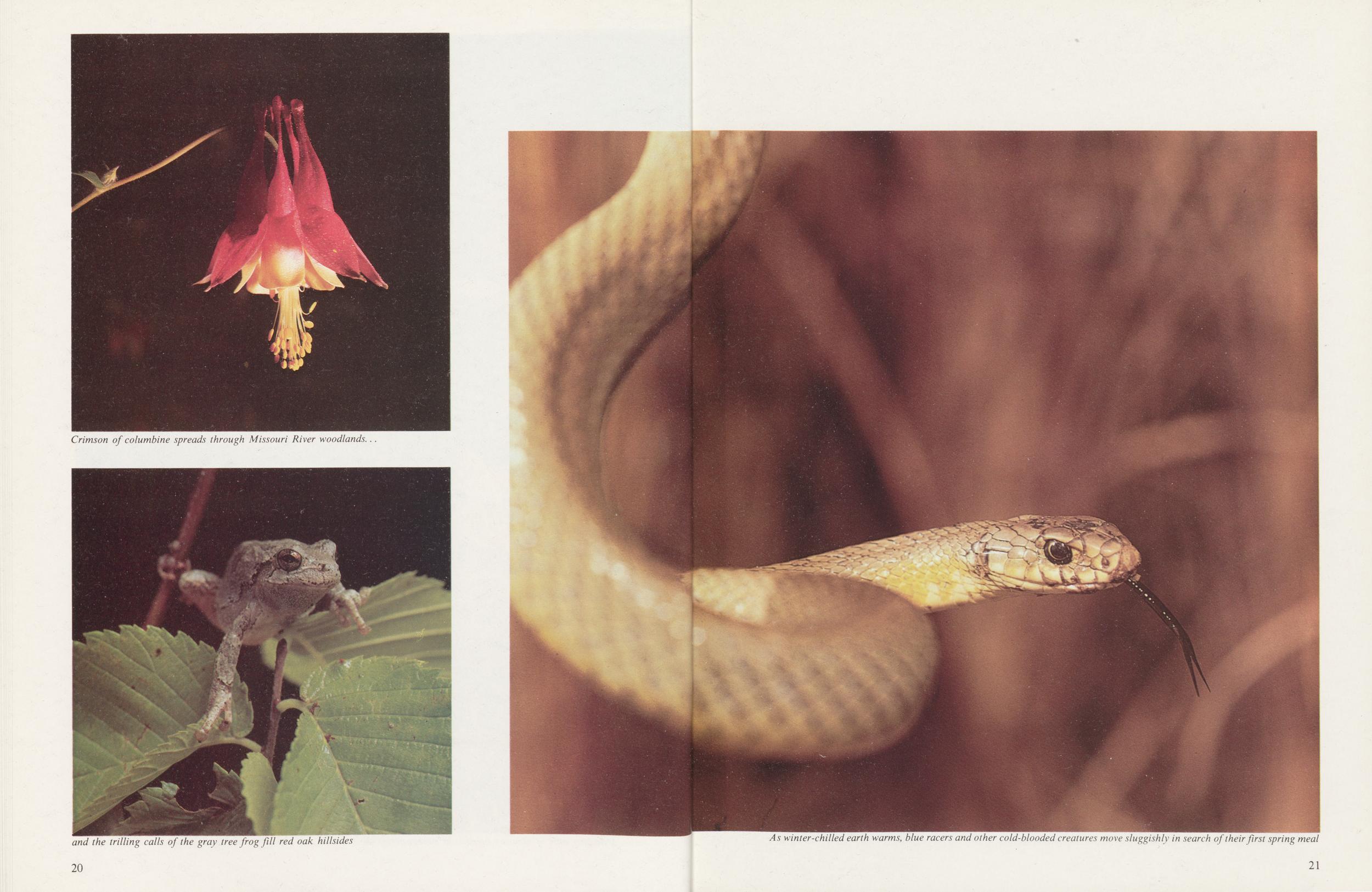
Life is uncoiling, in the fern's fiddle-heads and the soft yellow-green of emerging leaves. Lilacs spread the perfume of spring around doors that lead to damp farmhouse cellars; sending those who watch for such events to the river for tasty morel mushrooms. Others will wait for their own signs—the first little wood violets or the coming of bullsnakes to warm asphalt roads.
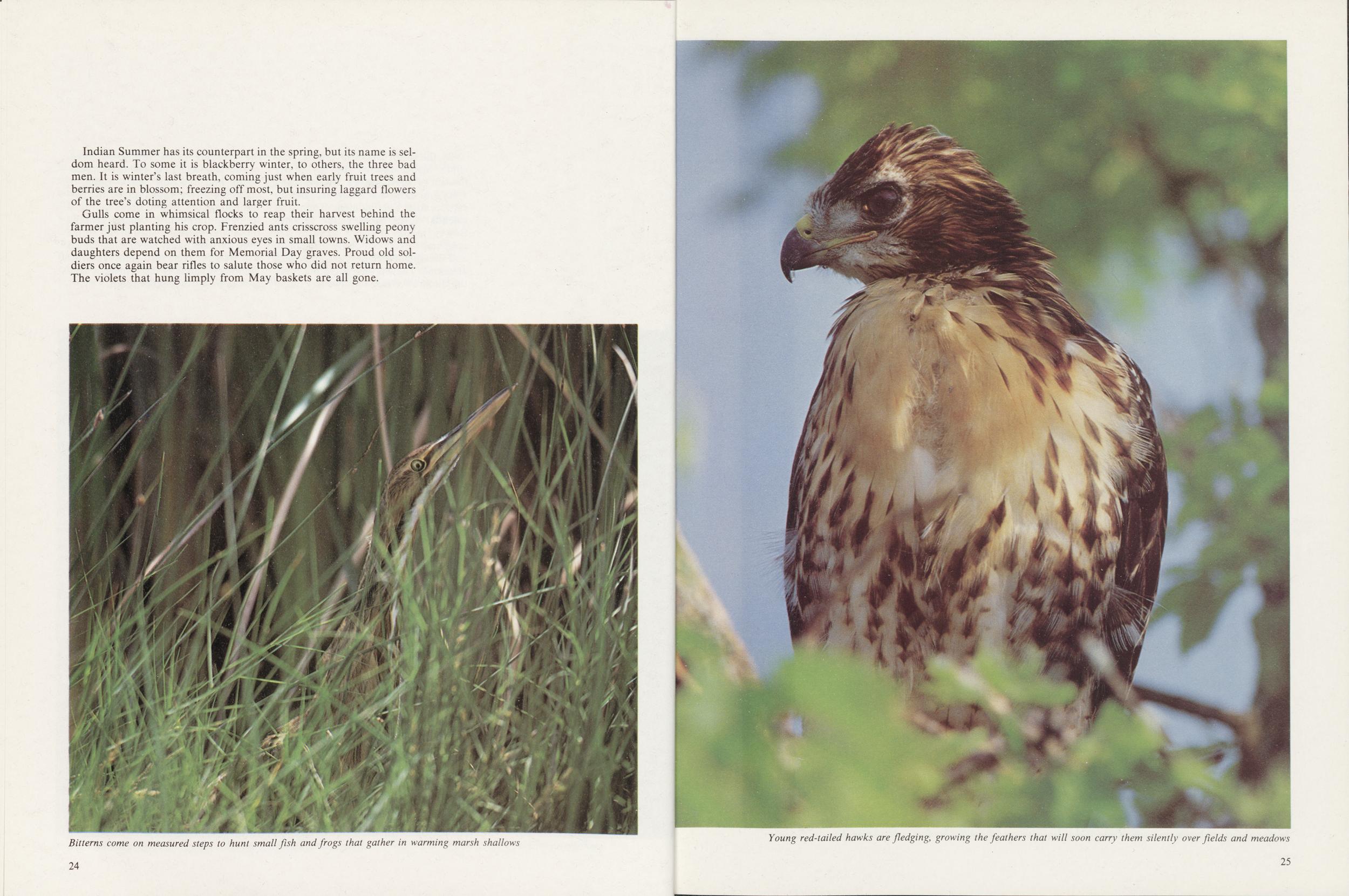
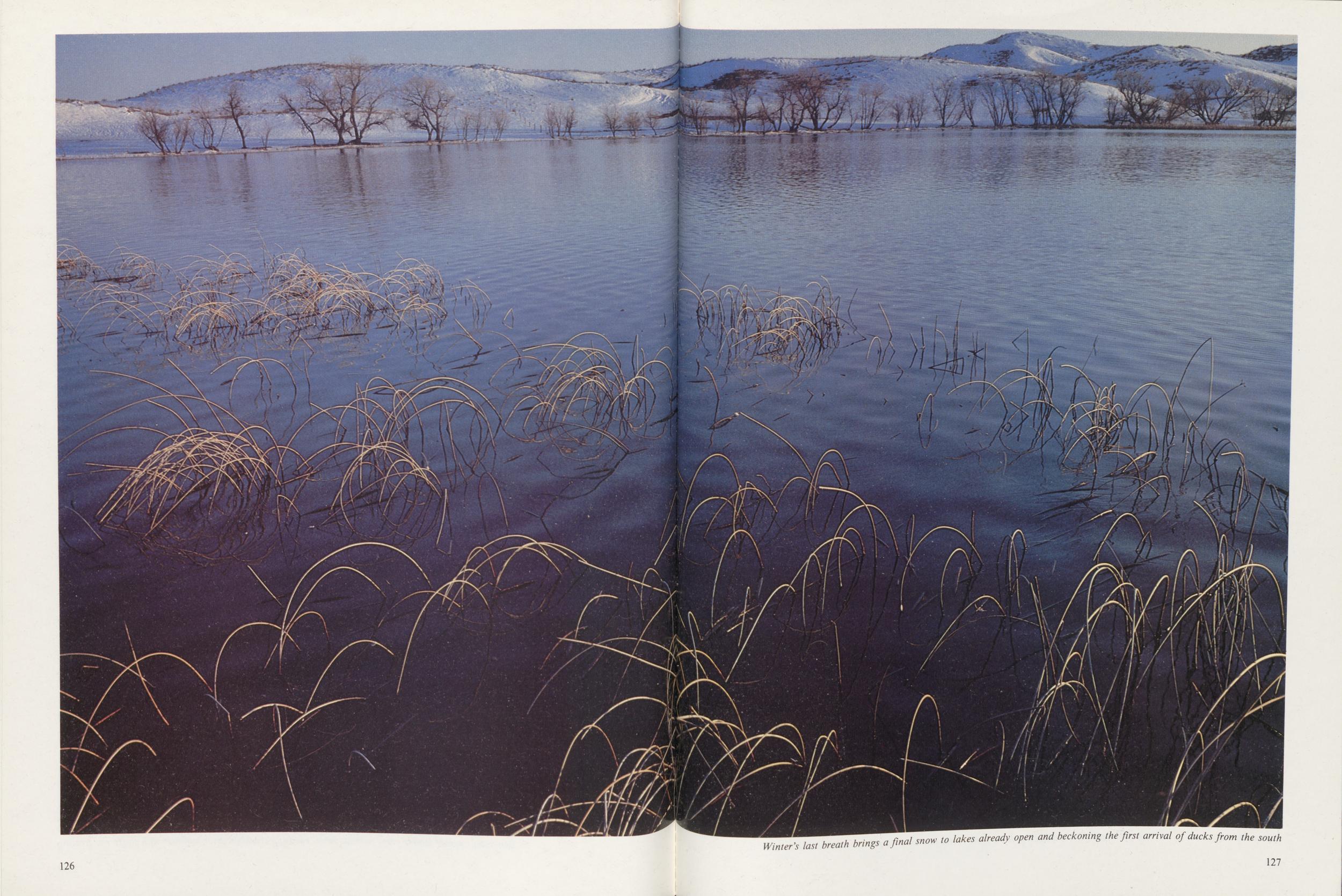
Indian Summer has its counterpart in the spring, but its name is seldom heard. To some it is blackberry winter, to others, the three bad men. It is winter's last breath, coming just when early fruit trees and berries are in blossom; freezing off most, but insuring laggard flowers of the tree's doting attention and larger fruit.
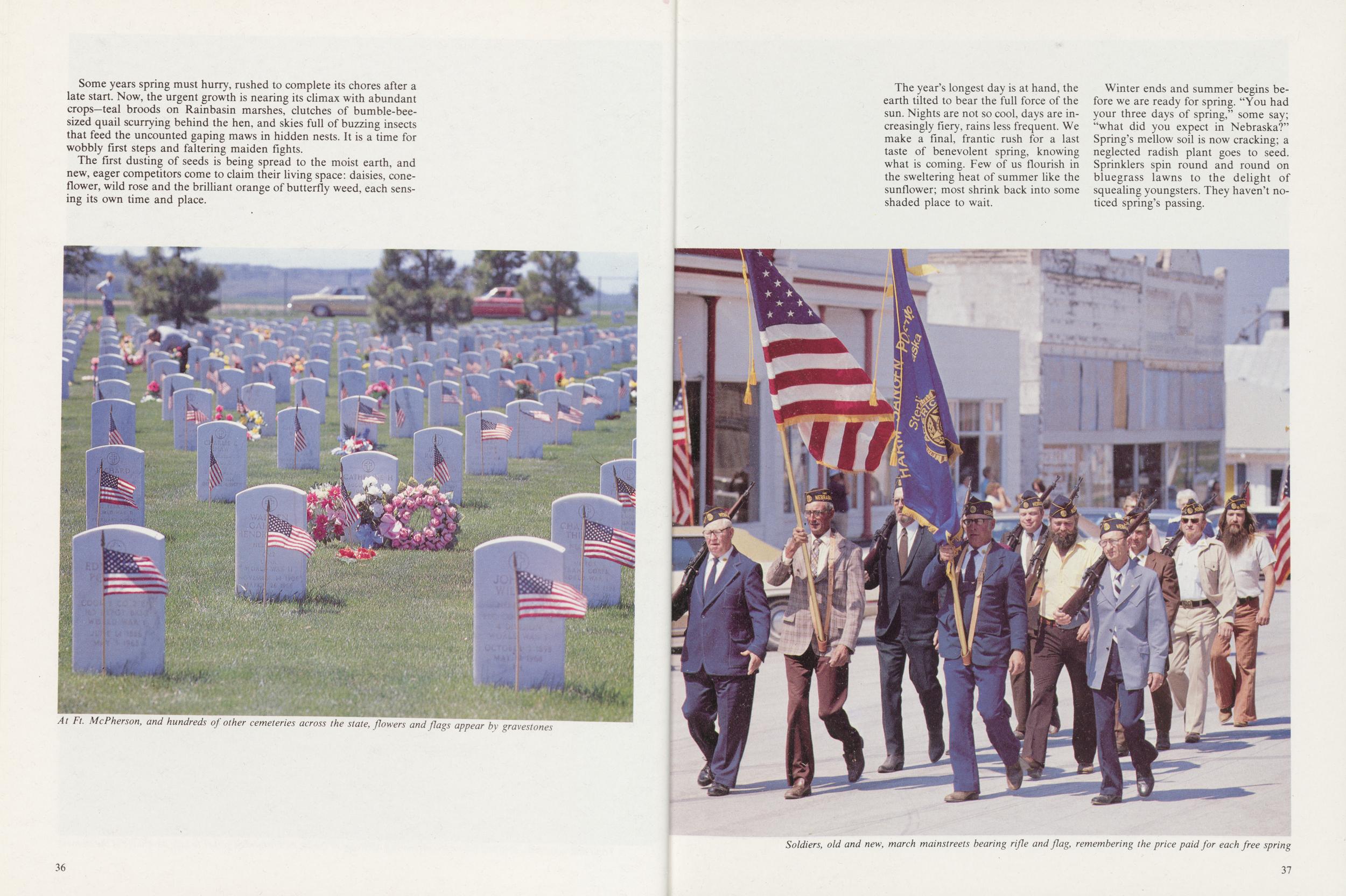
Gulls come in whimsical flocks to reap their harvest behind the farmer just planting his crop. Frenzied ants crisscross swelling peony buds that are watched with anxious eyes in small towns. Widows and daughters depend on them for Memorial Day graves. Proud old soldiers once again bear rifles to salute those who did not return home. The violets that hung limply from May baskets are all gone.
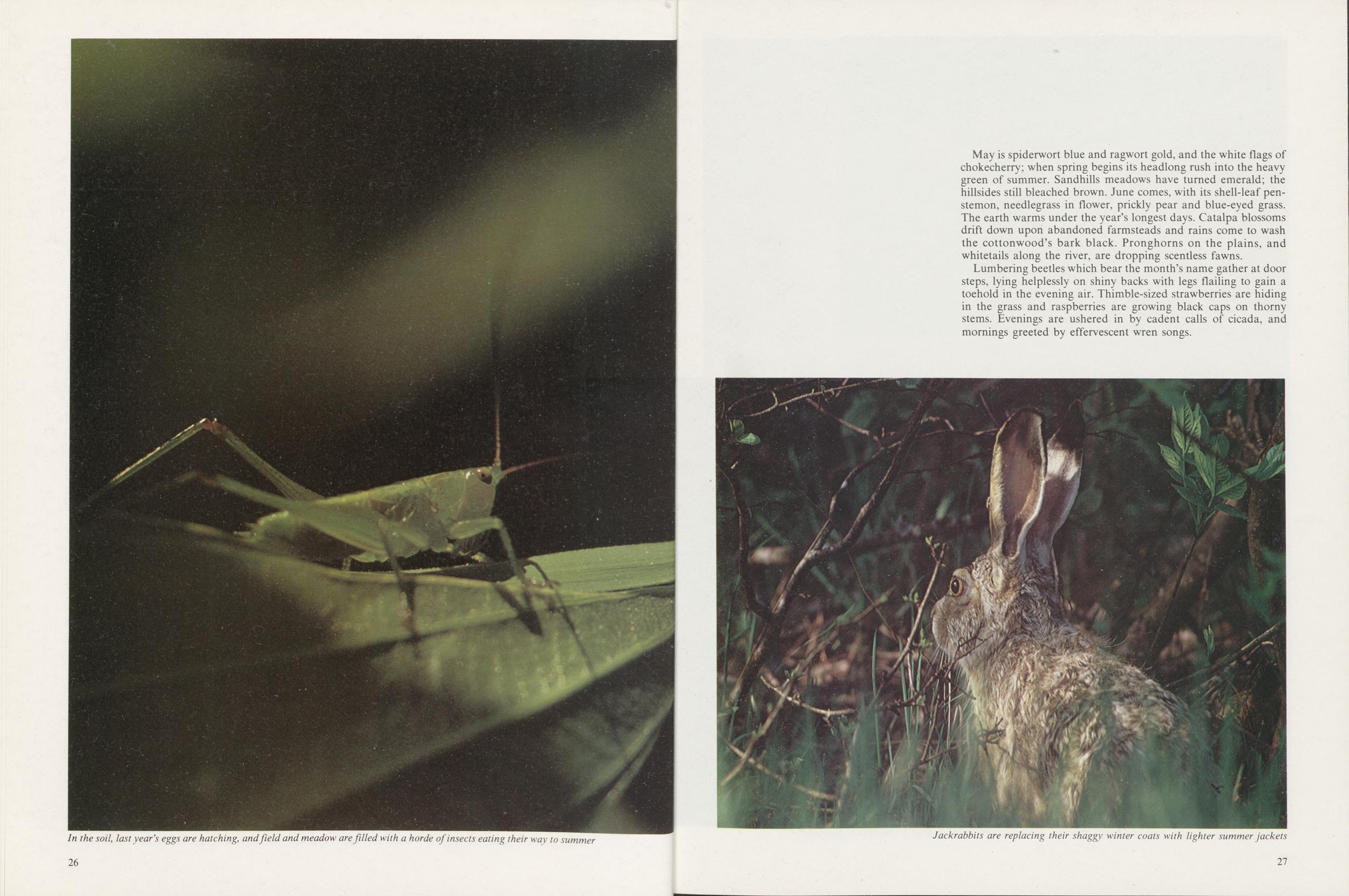
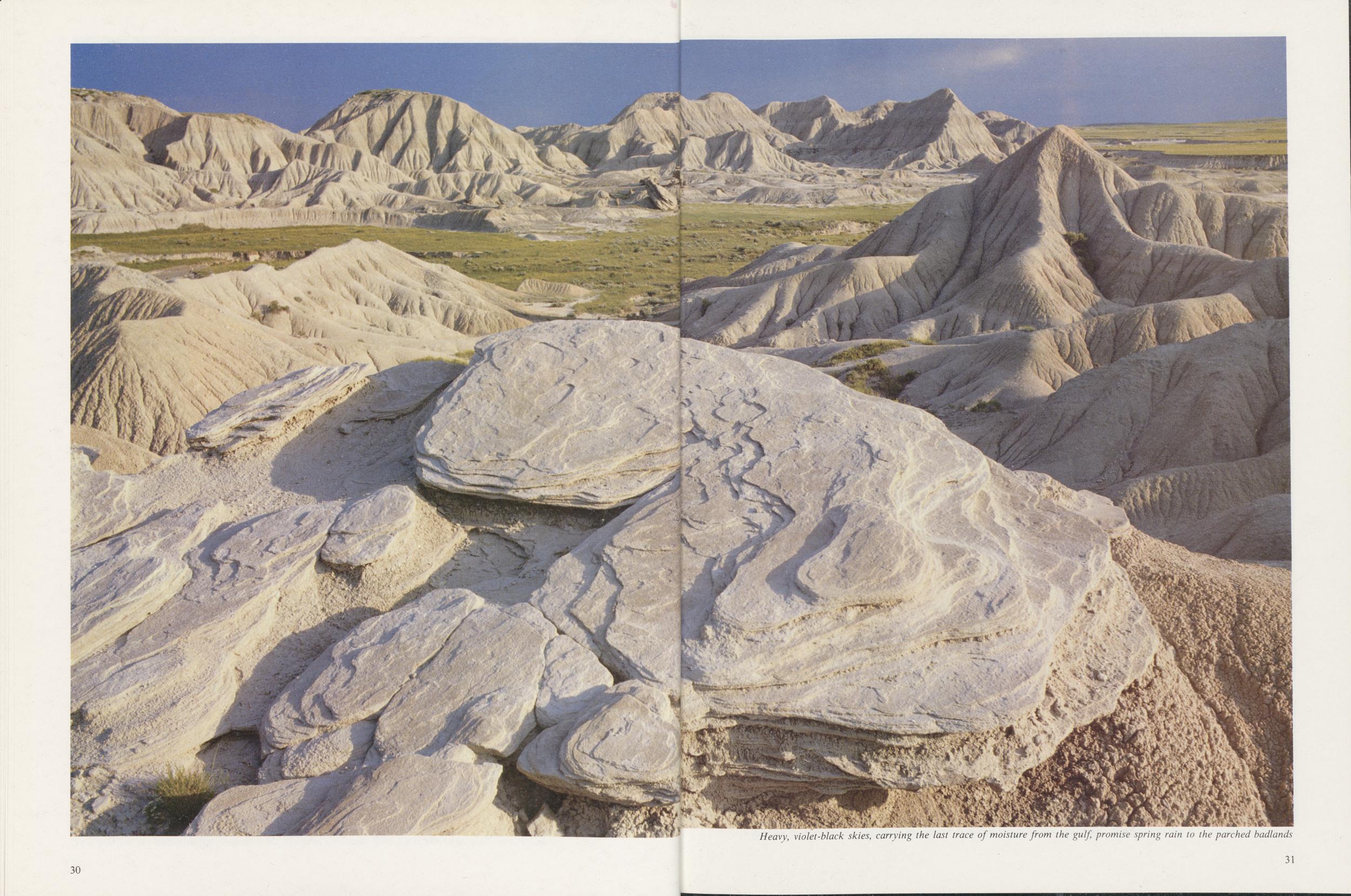
May is spiderwort blue and ragwort gold, and the white flags of chokecherry; when spring begins its headlong rush into the heavy green of summer. Sandhills meadows have turned emerald; the hillsides still bleached brown. June comes, with its shell-leaf penstemon, needlegrass in flower, prickly pear and blue-eyed grass. The earth warms under the year's longest days. Catalpa blossoms drift down upon abandoned farmsteads and rains come to wash the Cottonwood's bark black. Pronghorns on the plains, and whitetails along the river, are dropping scentless fawns.
Lumbering beetles which bear the month's name gather at door steps, lying helplessly on shiny backs with legs flailing to gain a toehold in the evening air. Thimble-sized strawberries are hiding in the grass and raspberries are growing black caps on thorny stems. Evenings are ushered in by cadent calls of cicada, and mornings greeted by effervescent wren songs.
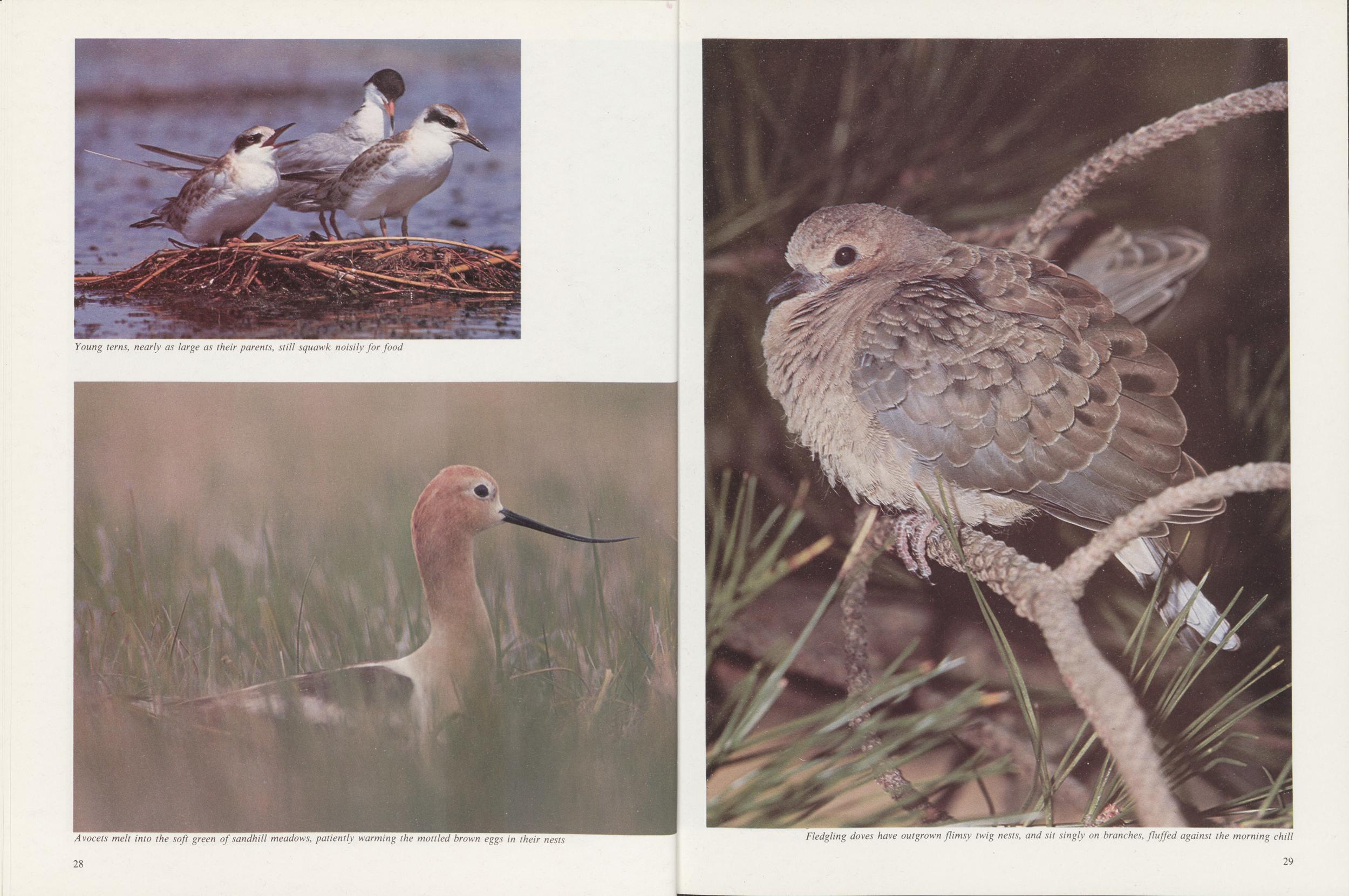
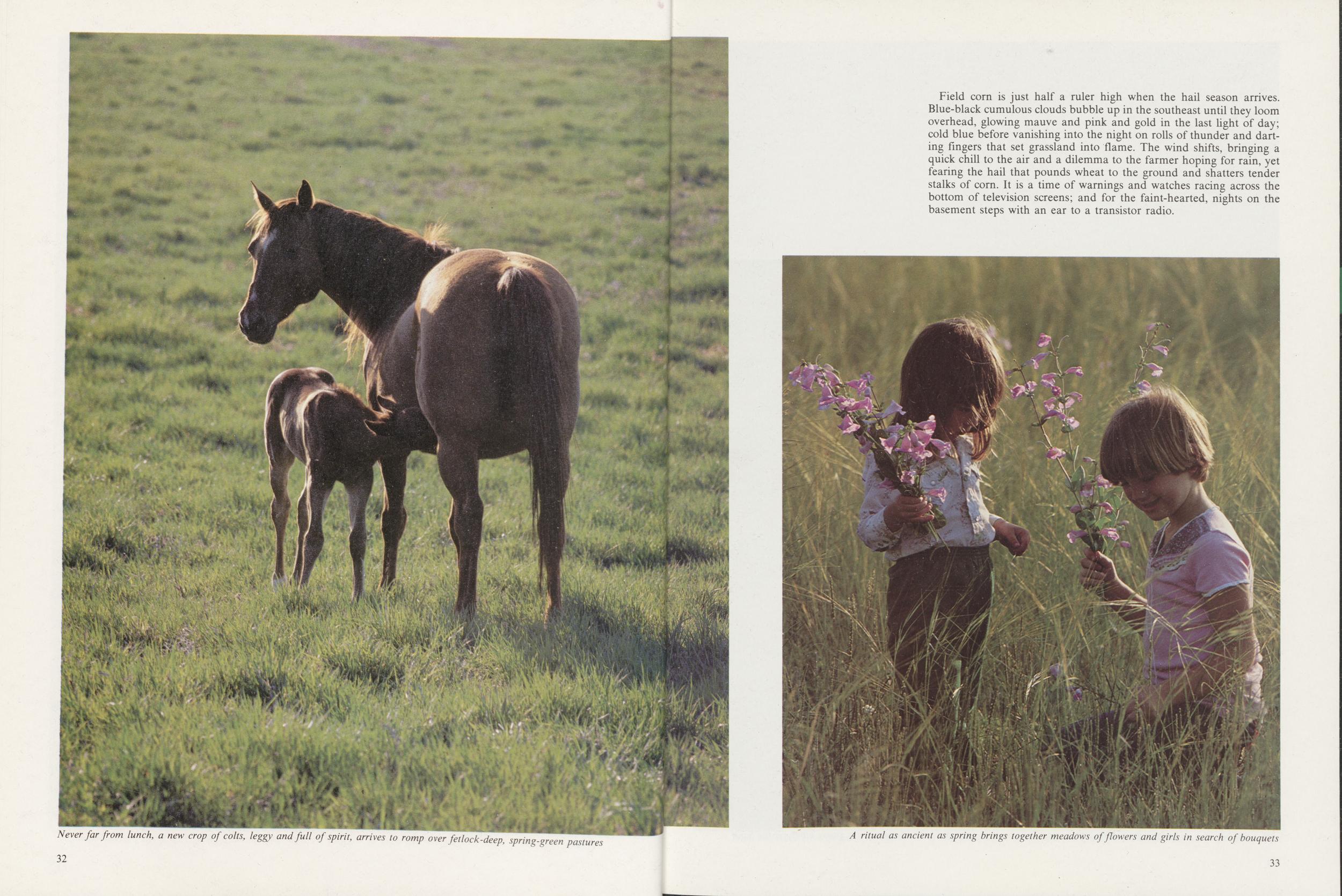
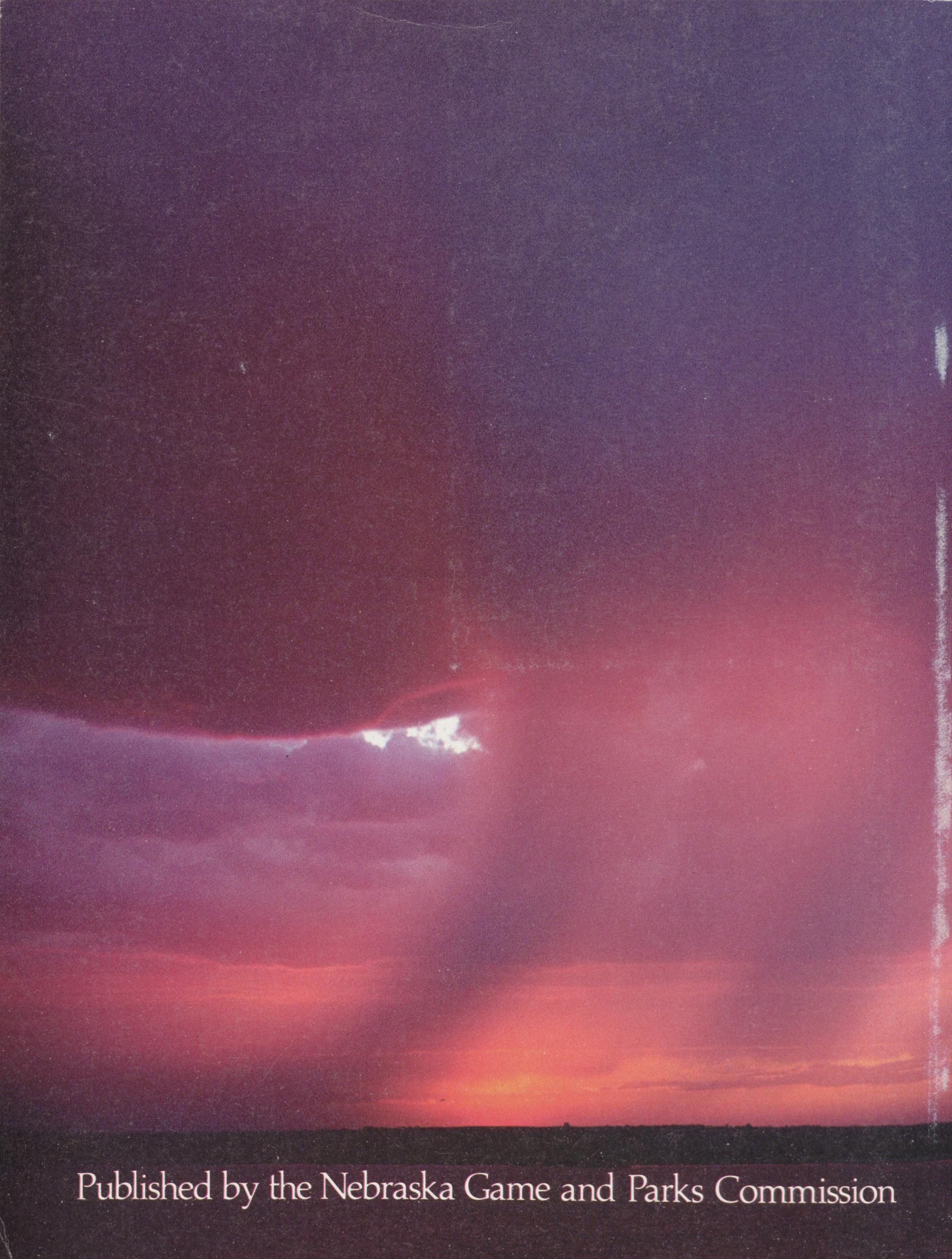
Field corn is just half a ruler high when the hail season arrives. Blue-black cumulous clouds bubble up in the southeast until they loom overhead, glowing mauve and pink and gold in the last light of day; cold blue before vanishing into the night on rolls of thunder and darting fingers that set grassland into flame. The wind shifts, bringing a quick chill to the air and a dilemma to the farmer hoping for rain, yet fearing the hail that pounds wheat to the ground and shatters tender stalks of corn. It is a time of warnings and watches racing across the bottom of television screens; and for the faint-hearted, nights on the basement steps with an ear to a transistor radio.
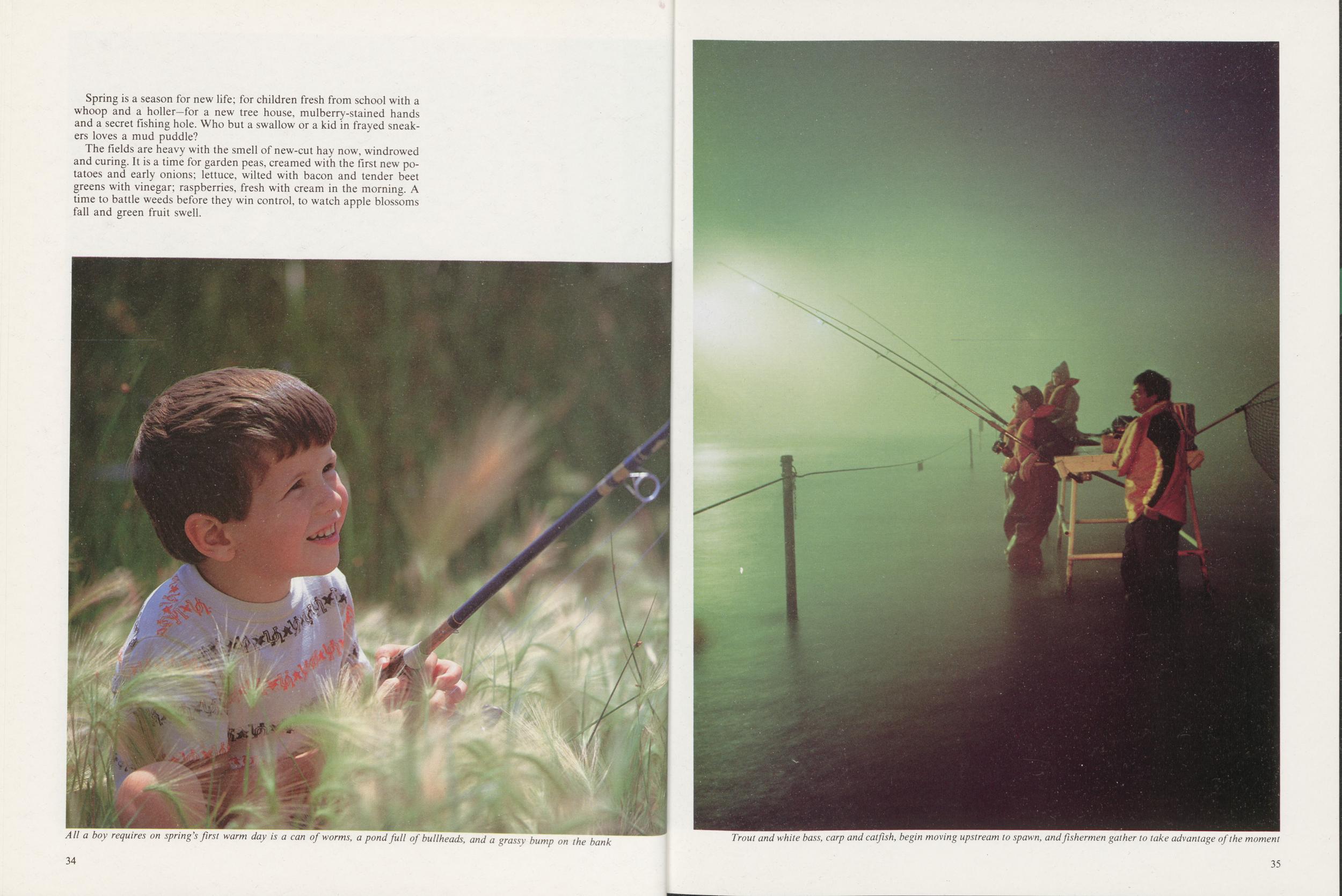
Spring is a season for new life; for children fresh from school with a whoop and a holler—for a new tree house, mulberry-stained hands and a secret fishing hole. Who but a swallow or a kid in frayed sneakers loves a mud puddle?
The fields are heavy with the smell of new-cut hay now, windrowed and curing. It is a time for garden peas, creamed with the first new potatoes and early onions; lettuce, wilted with bacon and tender beet greens with vinegar; raspberries, fresh with cream in the morning. A time to battle weeds before they win control, to watch apple blossoms fall and green fruit swell.
Some years spring must hurry, rushed to complete its chores after a late start. Now, the urgent growth is nearing its climax with abundant crops—teal broods on Rainbasin marshes, clutches of bumble-bee-sized quail scurrying behind the hen, and skies full of buzzing insects that feed the uncounted gaping maws in hidden nests. It is a time for wobbly first steps and faltering maiden fights.
The first dusting of seeds is being spread to the moist earth, and new, eager competitors come to claim their living space: daisies, coneflower, wild rose and the brilliant orange of butterfly weed, each sensing its own time and place.
The year's longest day is at hand, the earth tilted to bear the full force of the sun. Nights are not so cool, days are increasingly fiery, rains less frequent. We make a final, frantic rush for a last taste of benevolent spring, knowing what is coming. Few of us flourish in the sweltering heat of summer like the sunflower; most shrink back into some shaded place to wait.
Winter ends and summer begins before we are ready for spring. "You had your three days of spring," some say; "what did you expect in Nebraska?" Spring's mellow soil is now cracking; a neglected radish plant goes to seed. Sprinklers spin round and round on bluegrass lawns to the delight of squealing youngsters. They haven't noticed spring's passing.
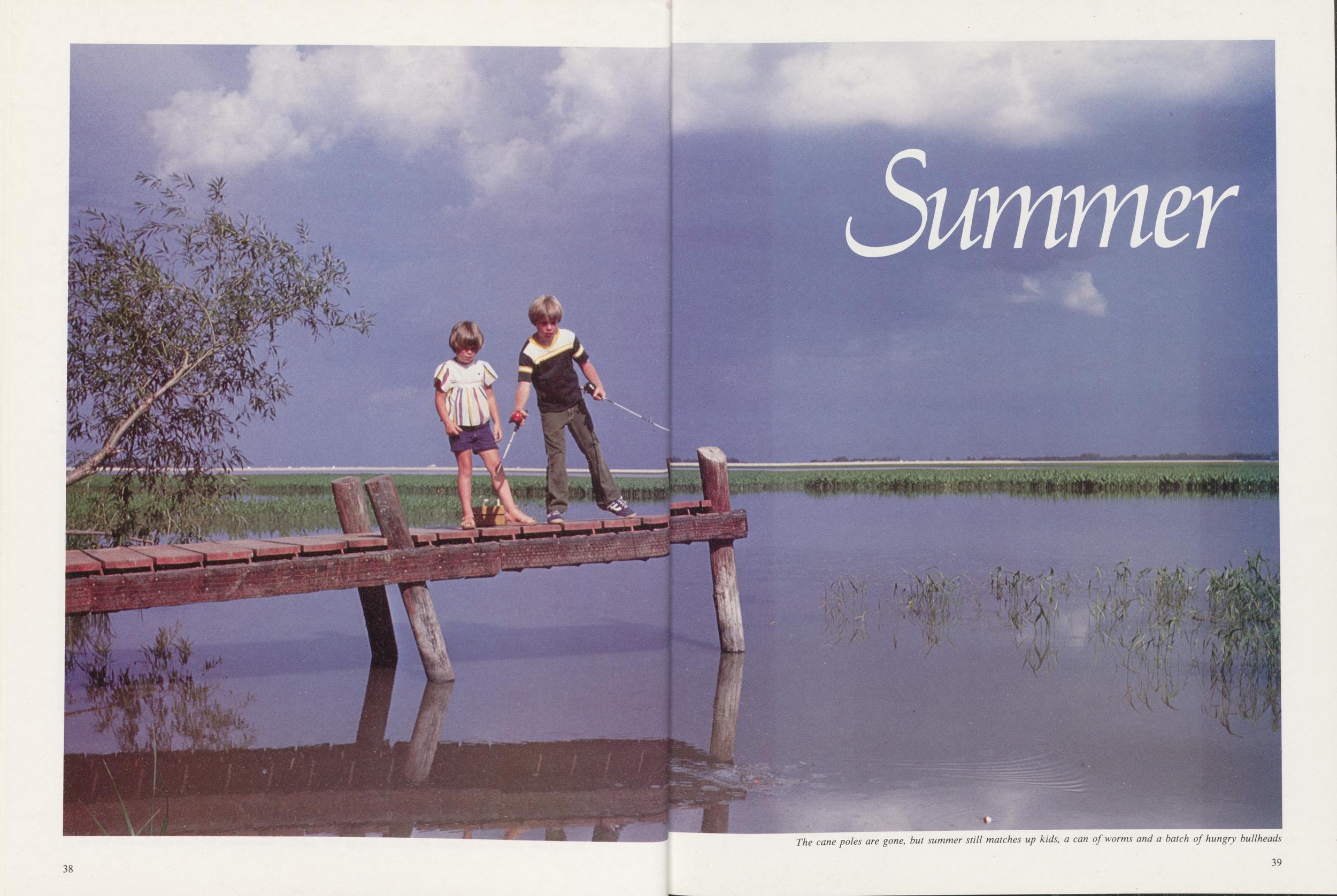
Summer
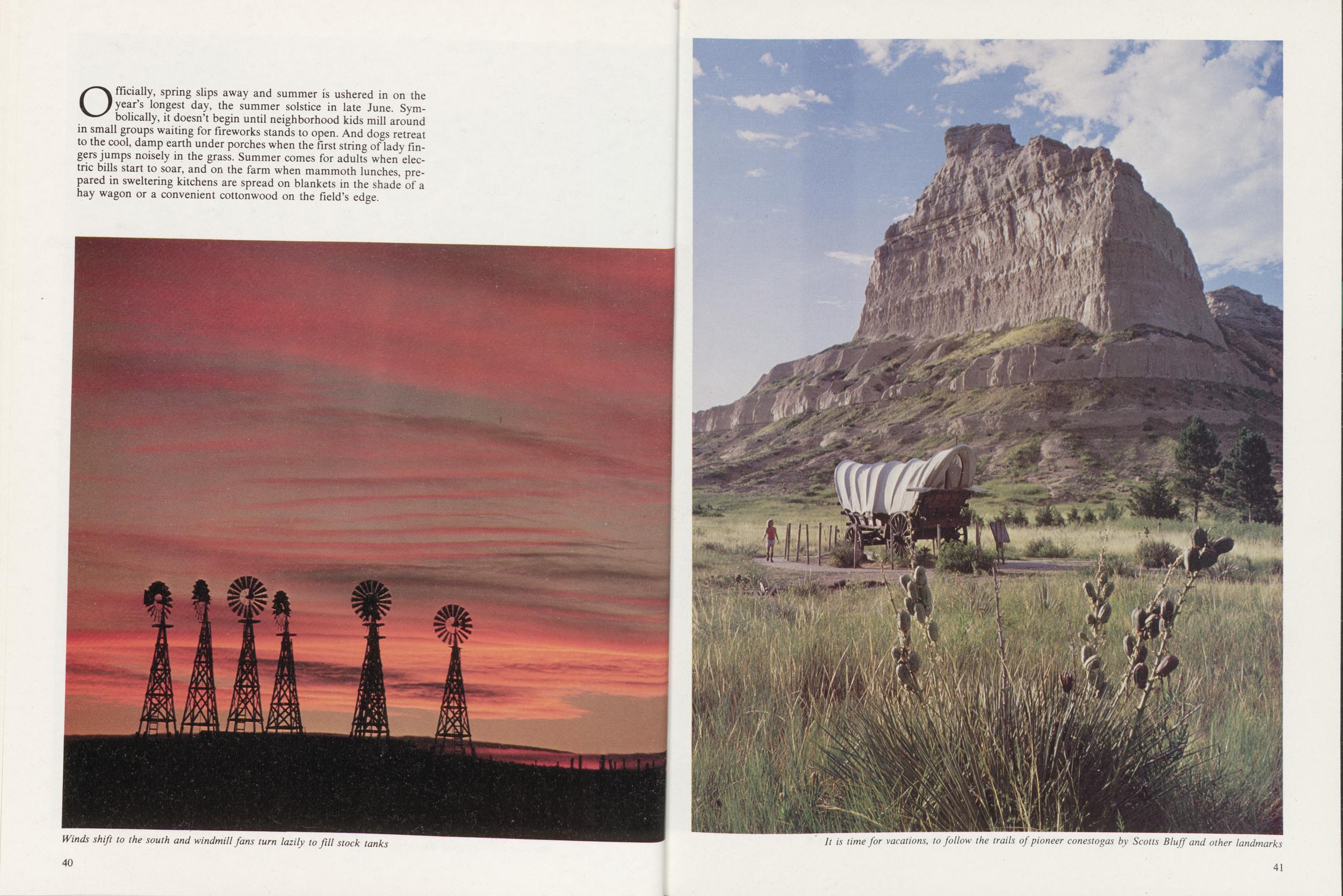
Officially, spring slips away and summer is ushered in on the year's longest day, the summer solstice in late June. Symbolically, it doesn't begin until neighborhood kids mill around in small groups waiting for fireworks stands to open. And dogs retreat to the cool, damp earth under porches when the first string of lady fingers jumps noisely in the grass. Summer comes for adults when electric bills start to soar, and on the farm when mammoth lunches, prepared in sweltering kitchens are spread on blankets in the shade of a hay wagon or a convenient cottonwood on the field's edge.
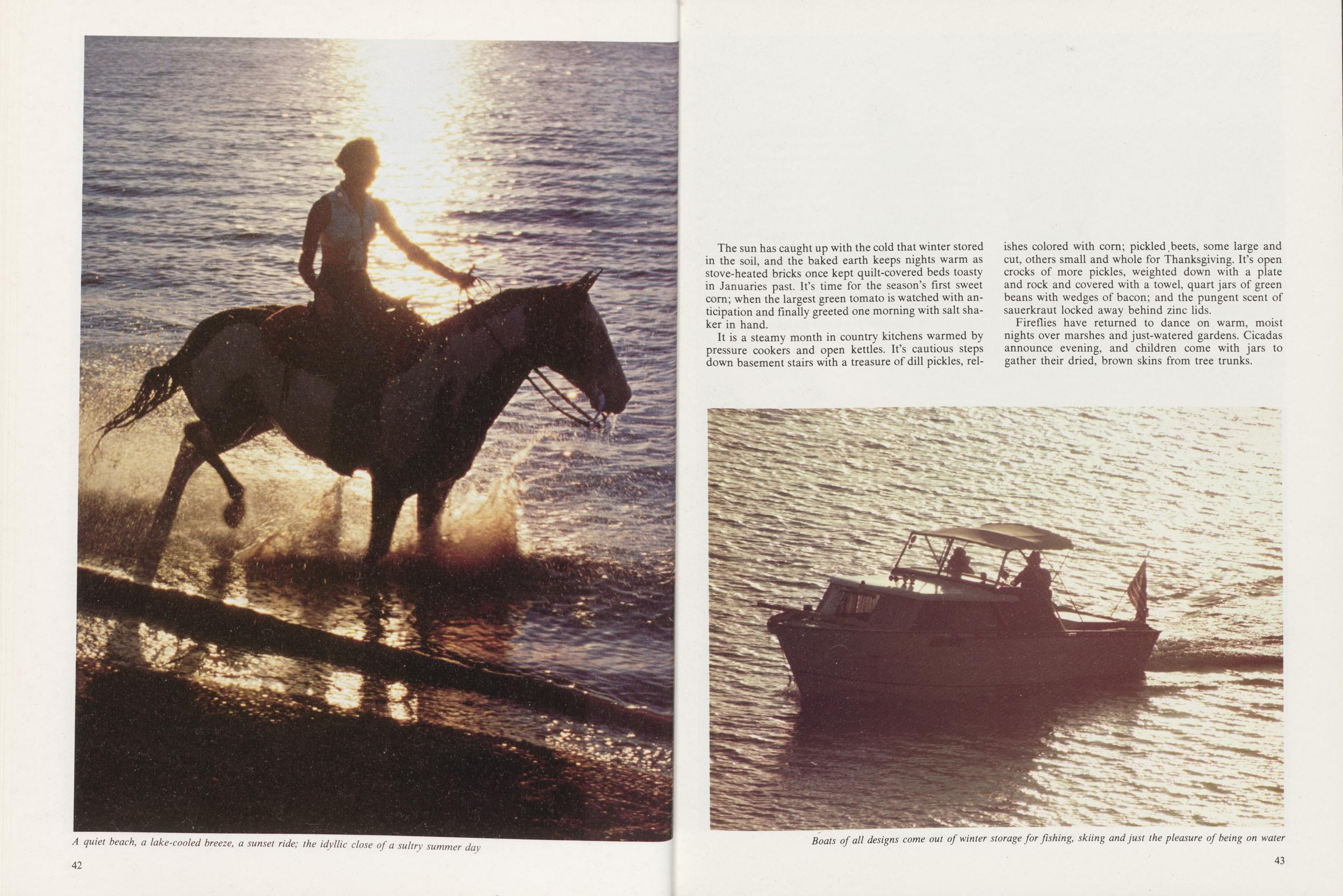
The sun has caught up with the cold that winter stored in the soil, and the baked earth keeps nights warm as stove-heated bricks once kept quilt-covered beds toasty in Januaries past. It's time for the season's first sweet corn; when the largest green tomato is watched with anticipation and finally greeted one morning with salt shaker in hand.
It is a steamy month in country kitchens warmed by pressure cookers and open kettles. It's cautious steps down basement stairs with a treasure of dill pickles, relishes colored with corn; pickled beets, some large and cut, others small and whole for Thanksgiving. It's open crocks of more pickles, weighted down with a plate and rock and covered with a towel, quart jars of green beans with wedges of bacon; and the pungent scent of sauerkraut locked away behind zinc lids.
Fireflies have returned to dance on warm, moist nights over marshes and just-watered gardens. Cicadas announce evening, and children come with jars to gather their dried, brown skins from tree trunks.
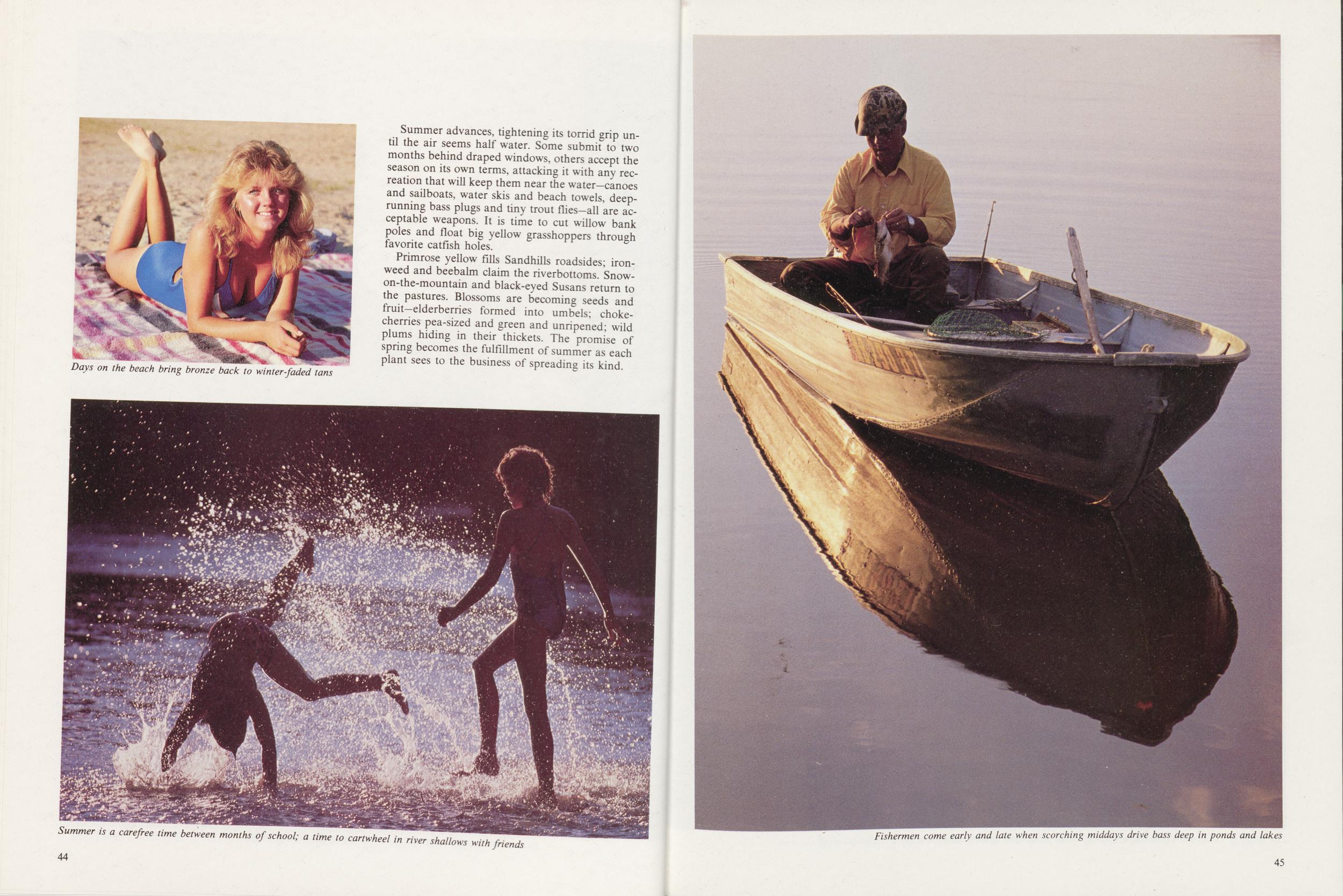
Summer advances, tightening its torrid grip until the air seems half water. Some submit to two months behind draped windows, others accept the season on its own terms, attacking it with any recreation that will keep them near the water—canoes and sailboats, water skis and beach towels, deep-running bass plugs and tiny trout flies—all are acceptable weapons. It is time to cut willow bank poles and float big yellow grasshoppers through favorite catfish holes.
Primrose yellow fills Sandhills roadsides; ironweed and beebalm claim the riverbottoms. Snow-on-the-mountain and black-eyed Susans return to the pastures. Blossoms are becoming seeds and fruit—elderberries formed into umbels; chokecherries pea-sized and green and unripened; wild plums hiding in their thickets. The promise of spring becomes the fulfillment of summer as each plant sees to the business of spreading its kind.
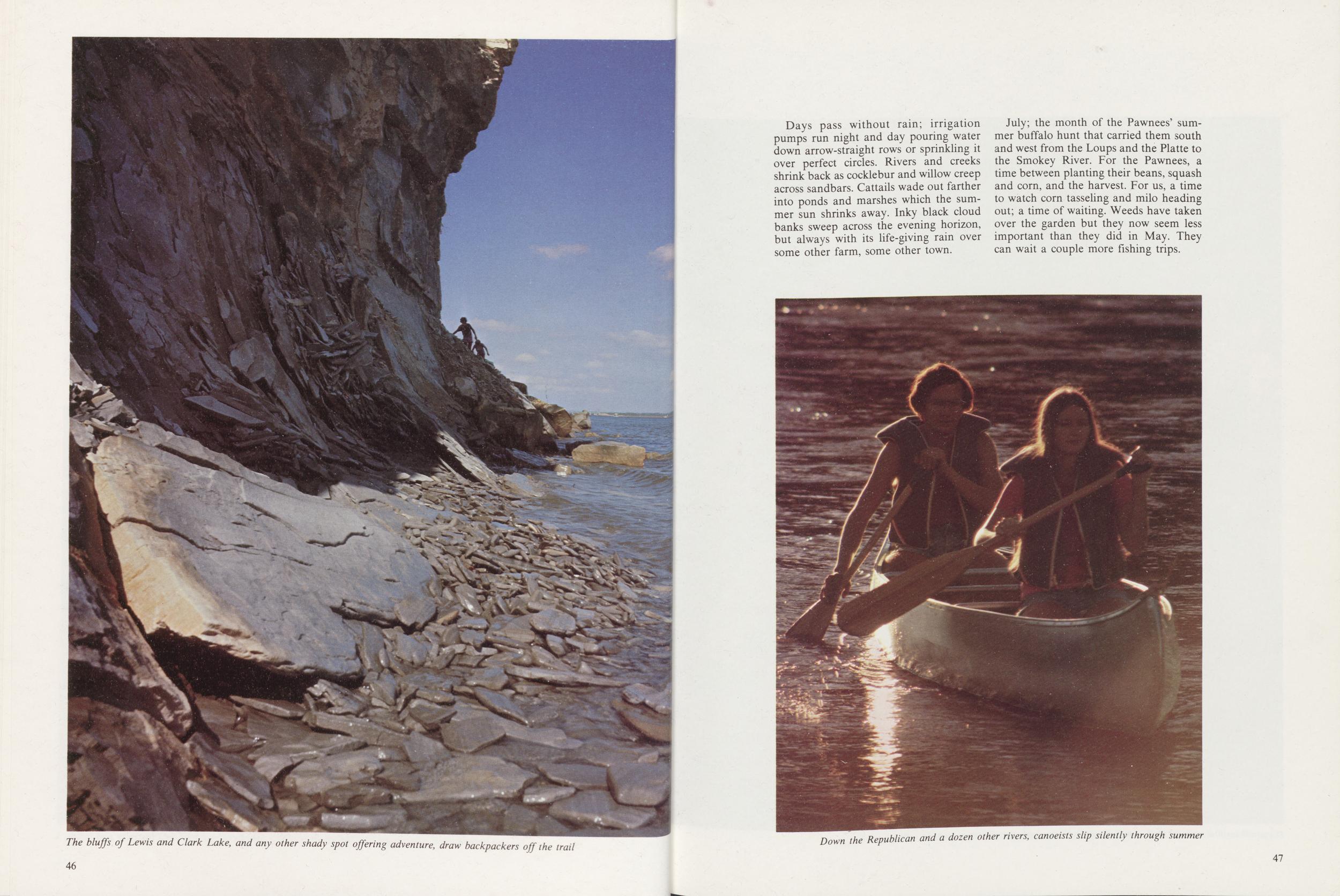
Days pass without rain; irrigation pumps run night and day pouring water down arrow-straight rows or sprinkling it over perfect circles. Rivers and creeks shrink back as cocklebur and willow creep across sandbars. Cattails wade out farther into ponds and marshes which the summer sun shrinks away. Inky black cloud banks sweep across the evening horizon, but always with its life-giving rain over some other farm, some other town.
July; the month of the Pawnees' summer buffalo hunt that carried them south and west from the Loups and the Platte to the Smokey River. For the Pawnees, a time between planting their beans, squash and corn, and the harvest. For us, a time to watch corn tasseling and milo heading out; a time of waiting. Weeds have taken over the garden but they now seem less important than they did in May. They can wait a couple more fishing trips.
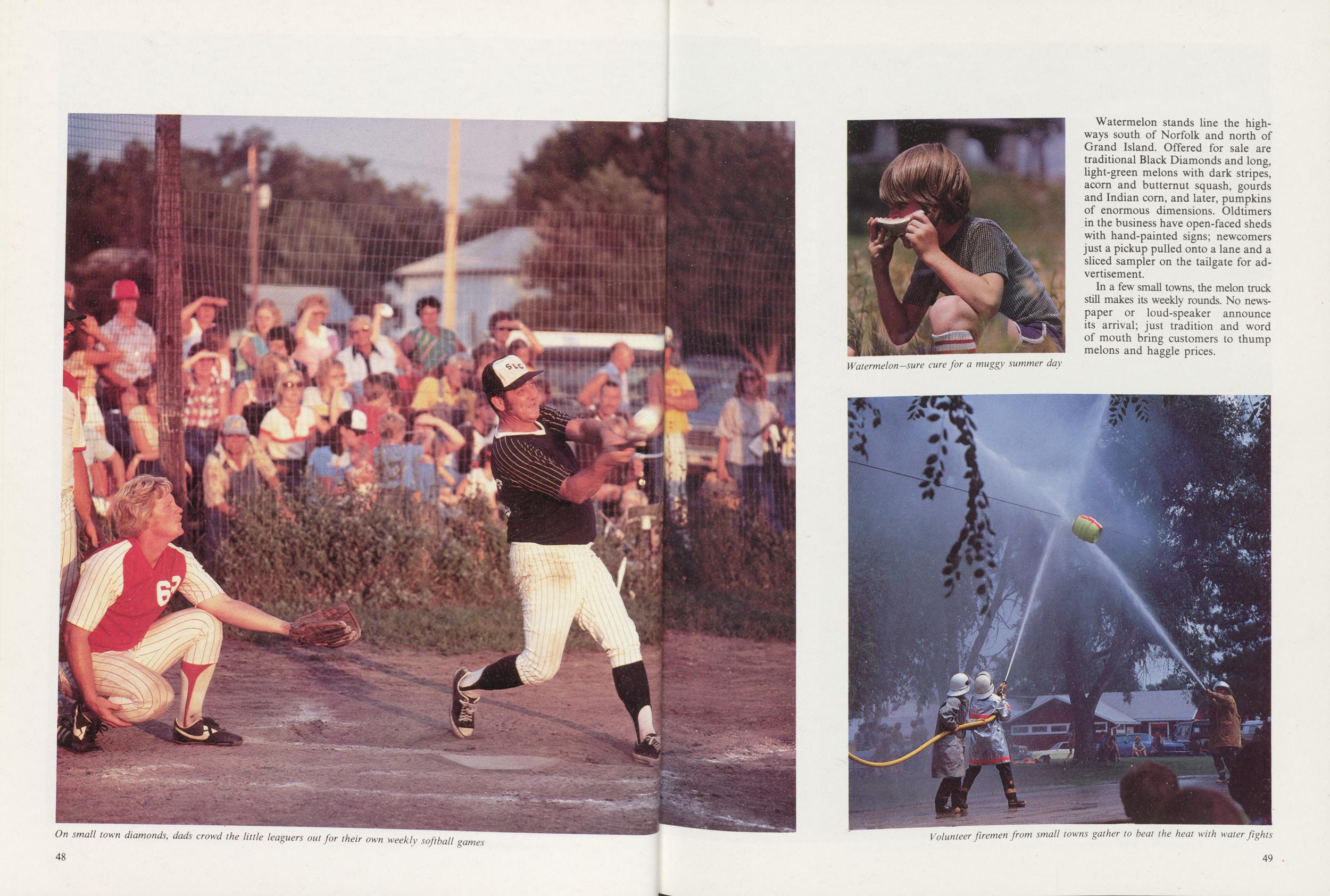
Watermelon stands line the highways south of Norfolk and north of Grand Island. Offered for sale are traditional Black Diamonds and long, light-green melons with dark stripes, acorn and butternut squash, gourds and Indian corn, and later, pumpkins of enormous dimensions. Oldtimers in the business have open-faced sheds with hand-painted signs; newcomers just a pickup pulled onto a lane and a sliced sampler on the tailgate for advertisement.
In a few small towns, the melon truck still makes its weekly rounds. No newspaper or loud-speaker announce its arrival; just tradition and word of mouth bring customers to thump melons and haggle prices.
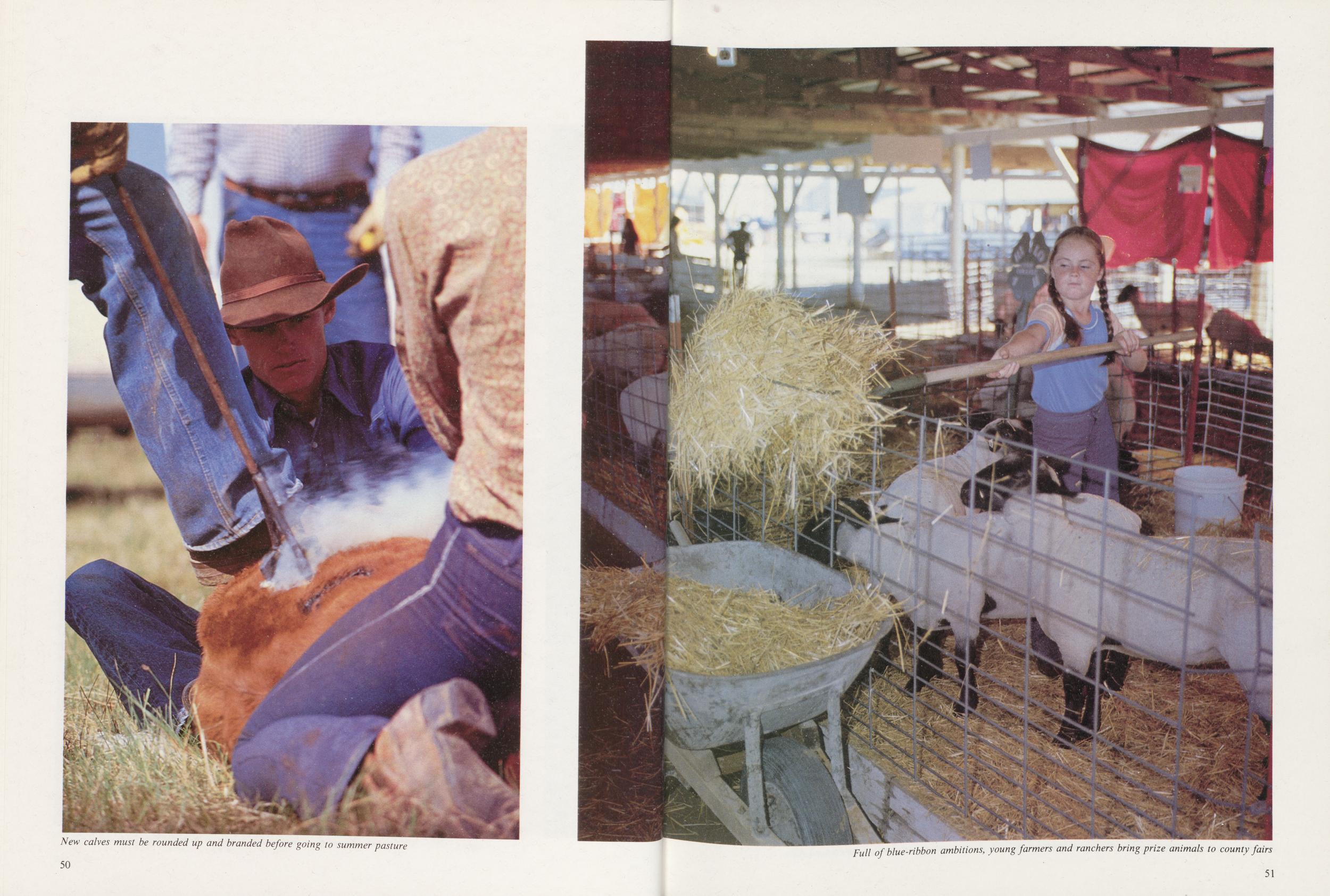
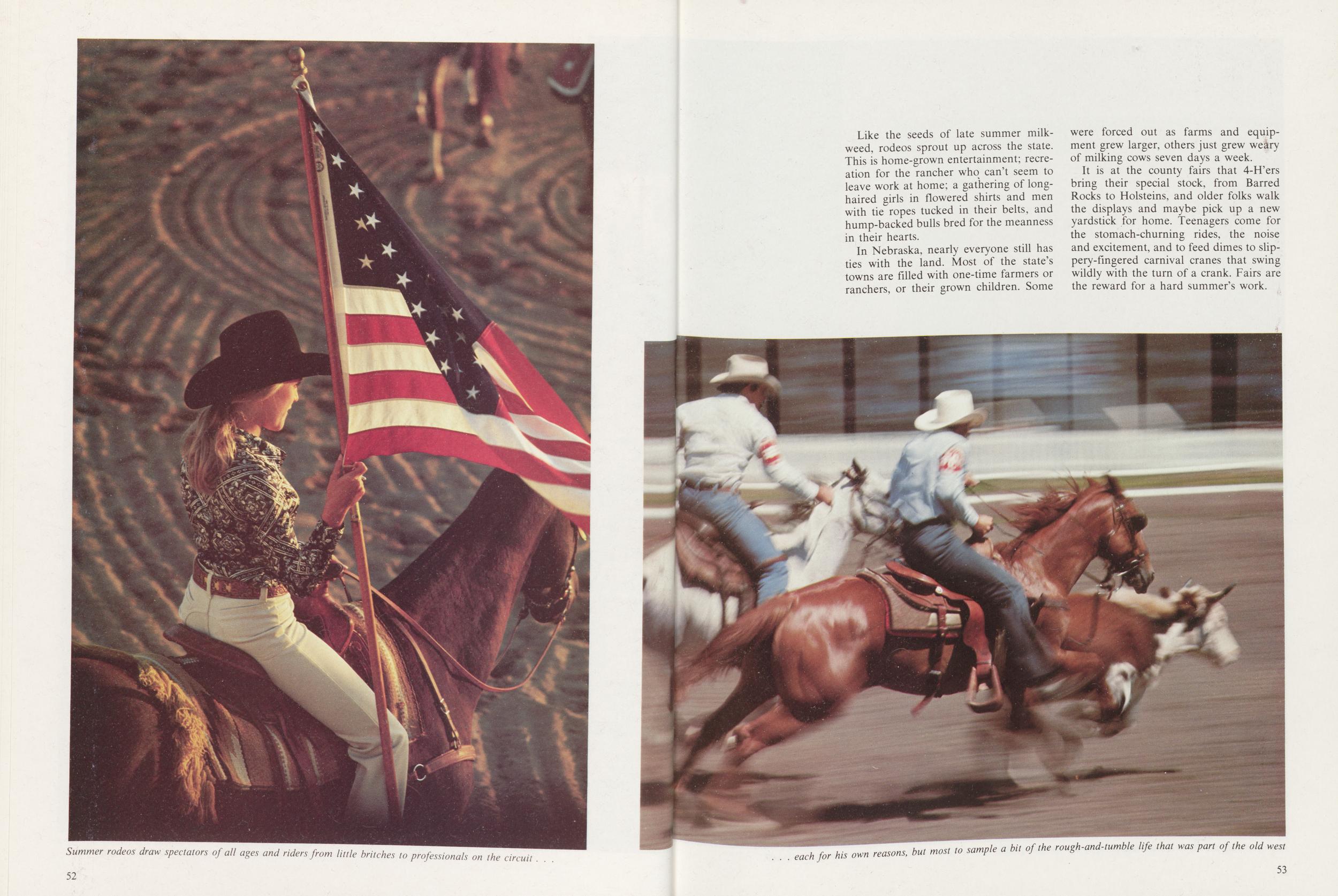
Like the seeds of late summer milkweed, rodeos sprout up across the state. This is home-grown entertainment; recreation for the rancher who can't seem to leave work at home; a gathering of long-haired girls in flowered shirts and men with tie ropes tucked in their belts, and hump-backed bulls bred for the meanness in their hearts.
In Nebraska, nearly everyone still has ties with the land. Most of the state's towns are filled with one-time farmers or ranchers, or their grown children. Some were forced out as farms and equipment grew larger, others just grew weary of milking cows seven days a week.
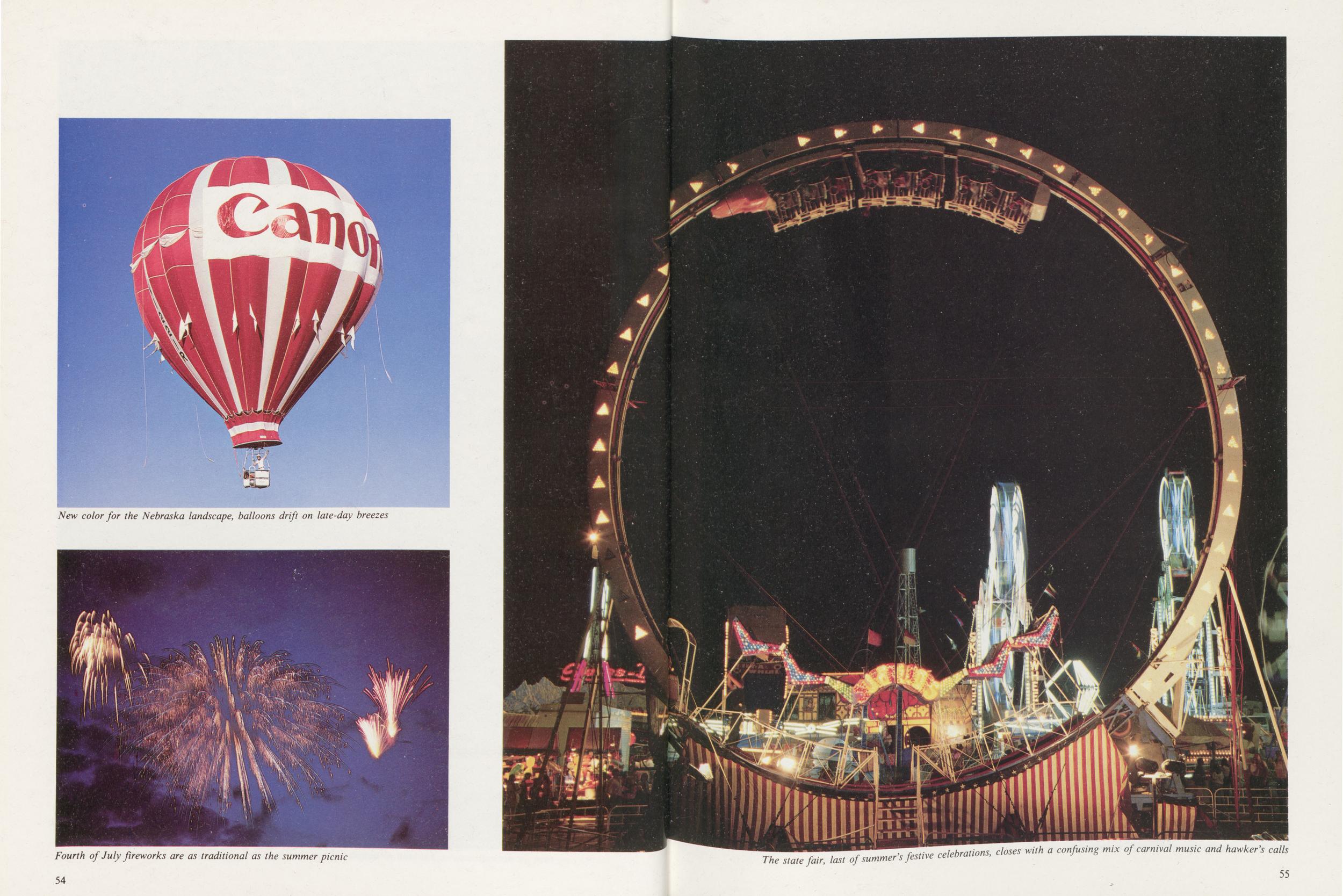
It is at the county fairs that 4-H'ers bring their special stock, from Barred Rocks to Holsteins, and older folks walk the displays and maybe pick up a new yardstick for home. Teenagers come for the stomach-churning rides, the noise and excitement, and to feed dimes to slippery-fingered carnival cranes that swing wildly with the turn of a crank. Fairs are the reward for a hard summer's work.
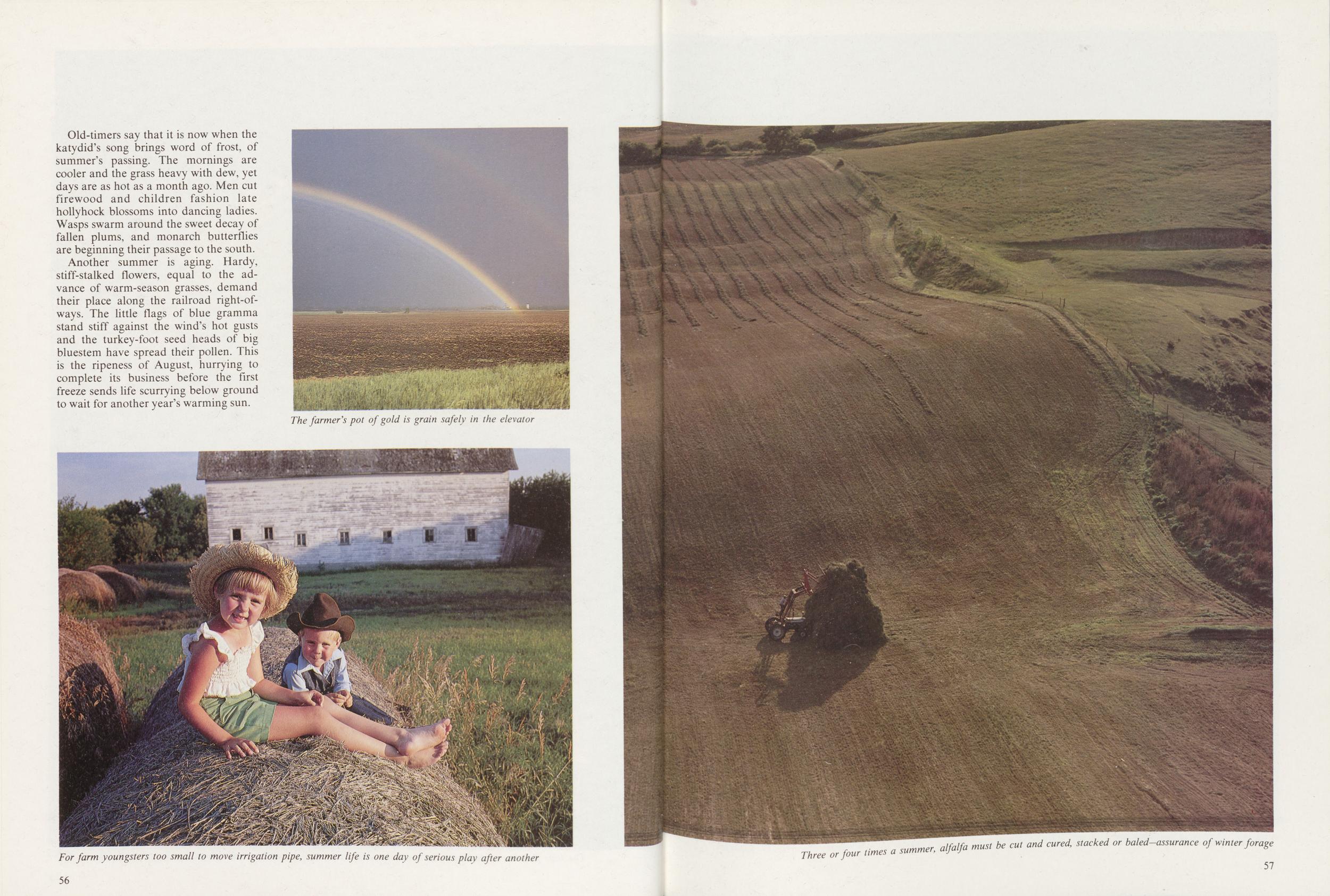
Old-timers say that it is now when the katydid's song brings word of frost, of summer's passing. The mornings are cooler and the grass heavy with dew, yet days are as hot as a month ago. Men cut firewood and children fashion late hollyhock blossoms into dancing ladies. Wasps swarm around the sweet decay of fallen plums, and monarch butterflies are beginning their passage to the south.
Another summer is aging. Hardy, stiff-stalked flowers, equal to the advance of warm-season grasses, demand their place along the railroad right-of-ways. The little flags of blue gramma stand stiff against the wind's hot gusts and the turkey-foot seed heads of big bluestem have spread their pollen. This is the ripeness of August, hurrying to complete its business before the first freeze sends life scurrying below ground to wait for another year's warming sun.
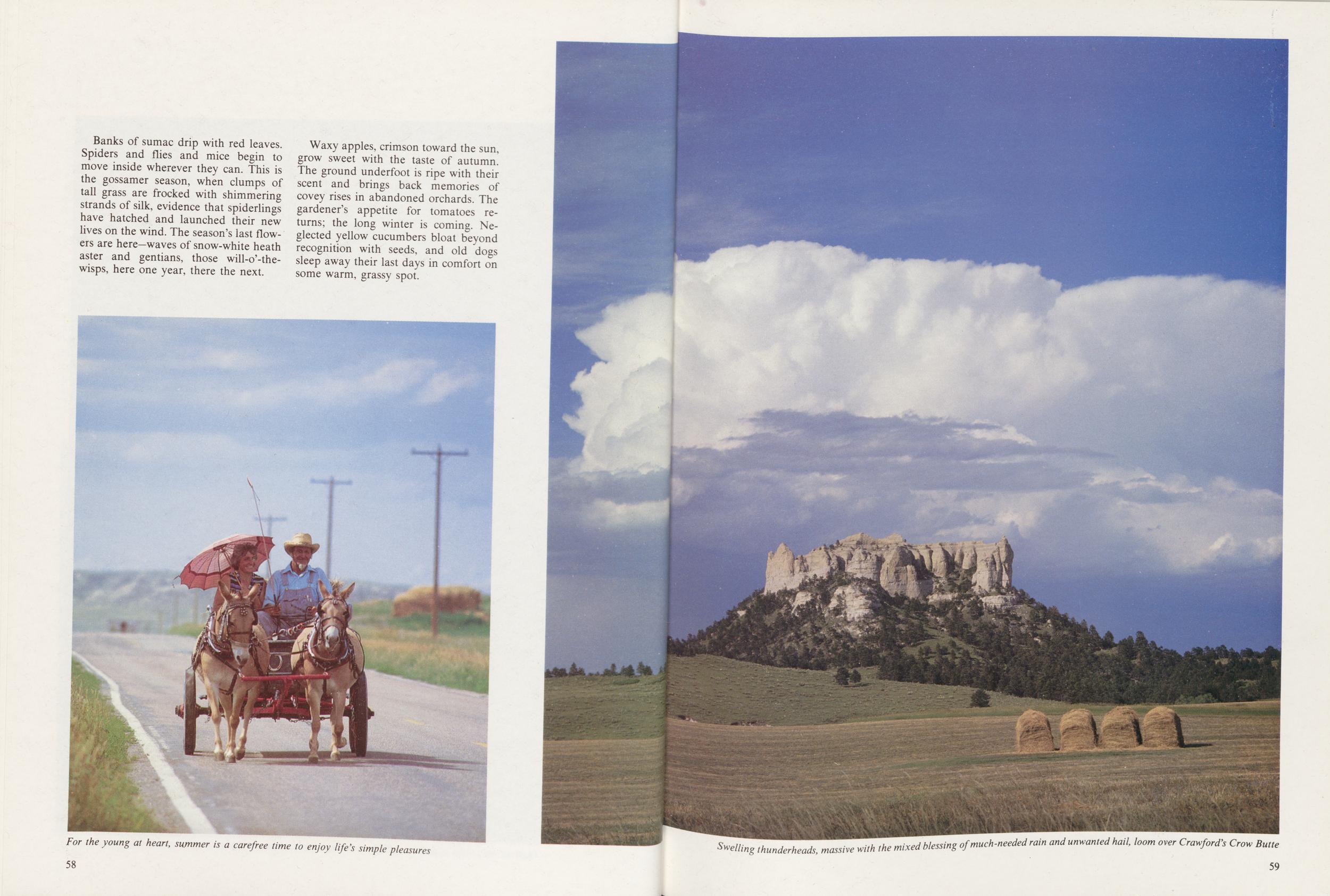
Banks of sumac drip with red leaves. Spiders and flies and mice begin to move inside wherever they can. This is the gossamer season, when clumps of tall grass are frocked with shimmering strands of silk, evidence that spiderlings have hatched and launched their new lives on the wind. The season's last flowers are here—waves of snow-white heath aster and gentians, those will-o'-the-wisps, here one year, there the next.
Waxy apples, crimson toward the sun, grow sweet with the taste of autumn. The ground underfoot is ripe with their scent and brings back memories of covey rises in abandoned orchards. The gardener's appetite for tomatoes returns; the long winter is coming. Neglected yellow cucumbers bloat beyond recognition with seeds, and old dogs sleep away their last days in comfort on some warm, grassy spot.
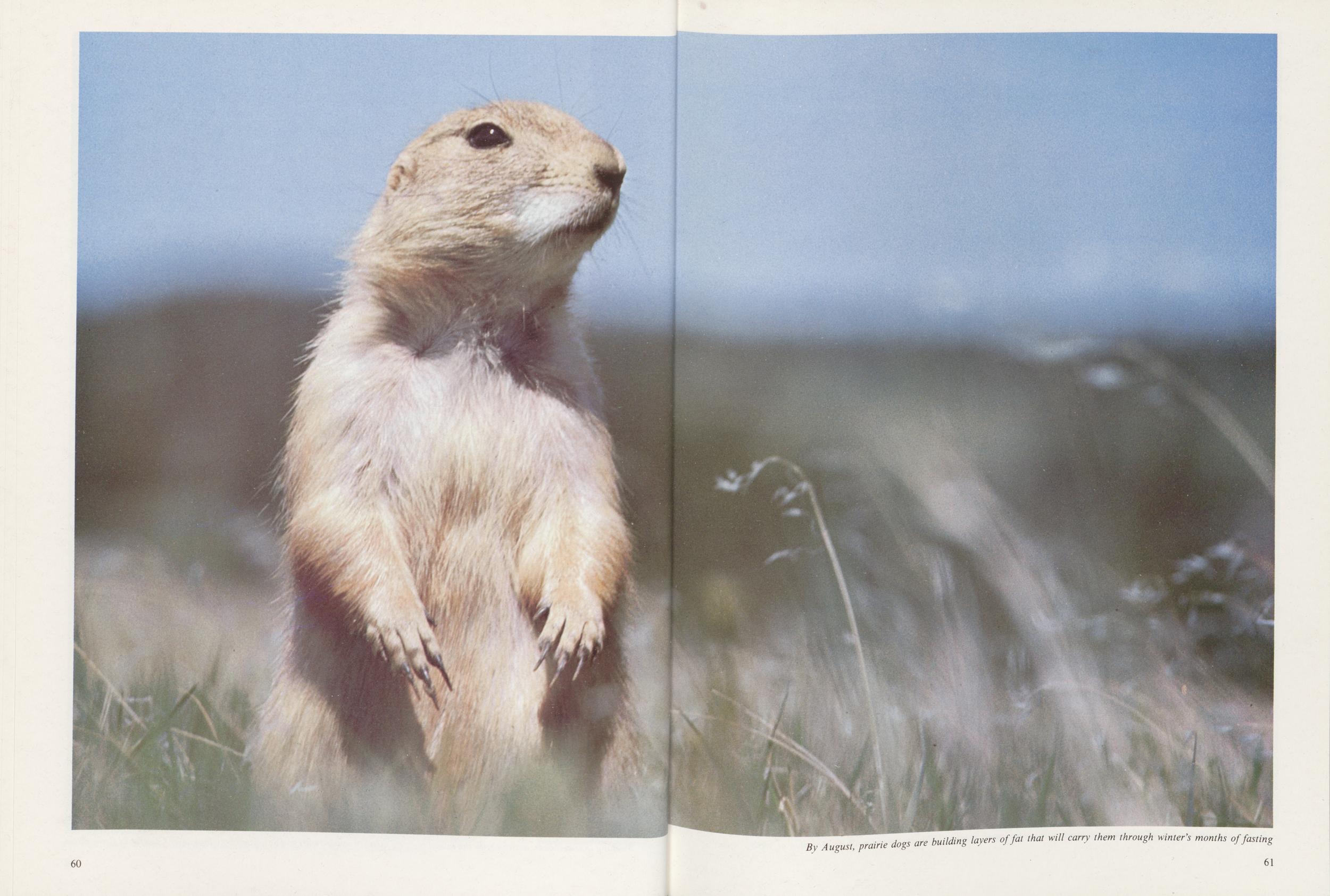
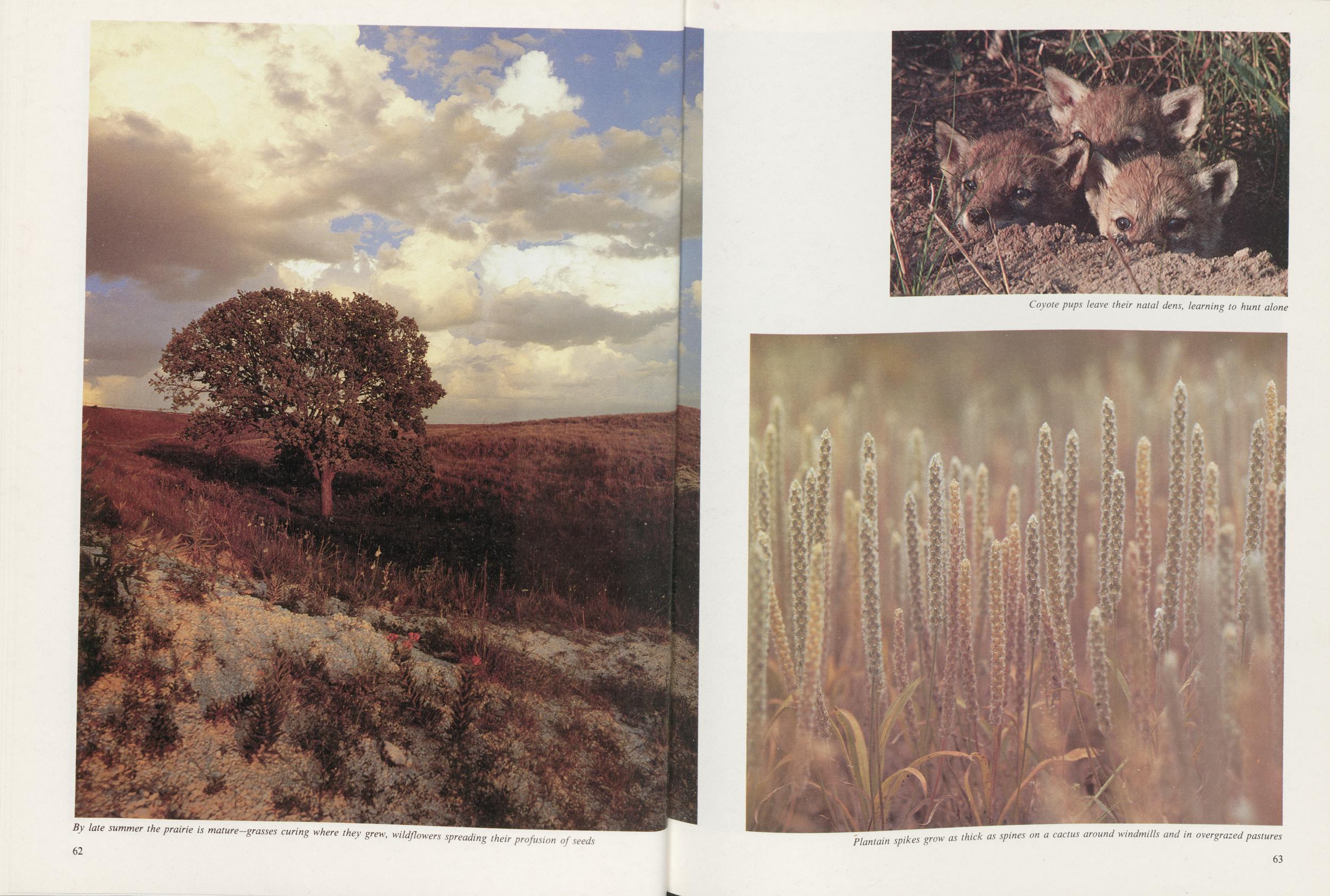
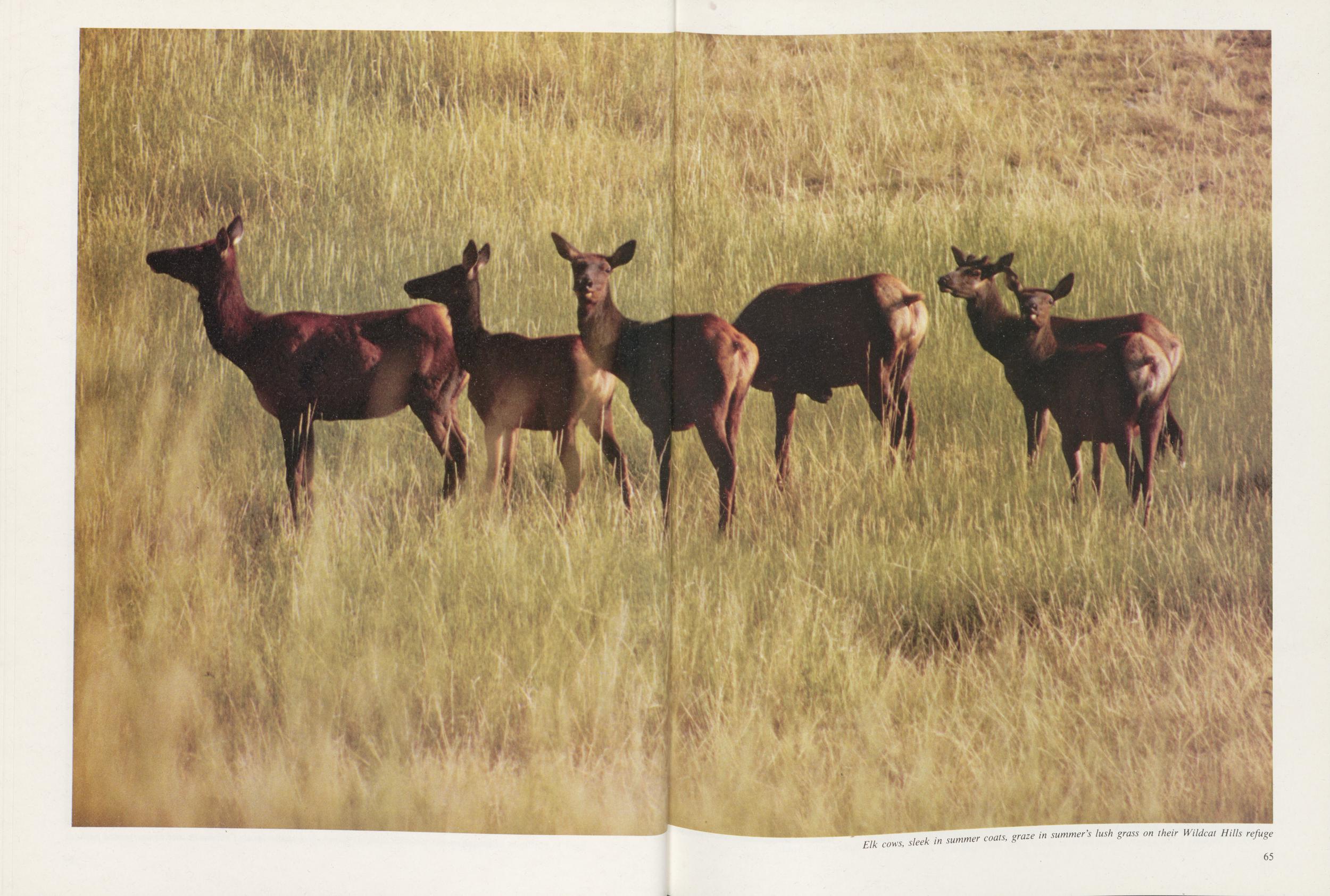
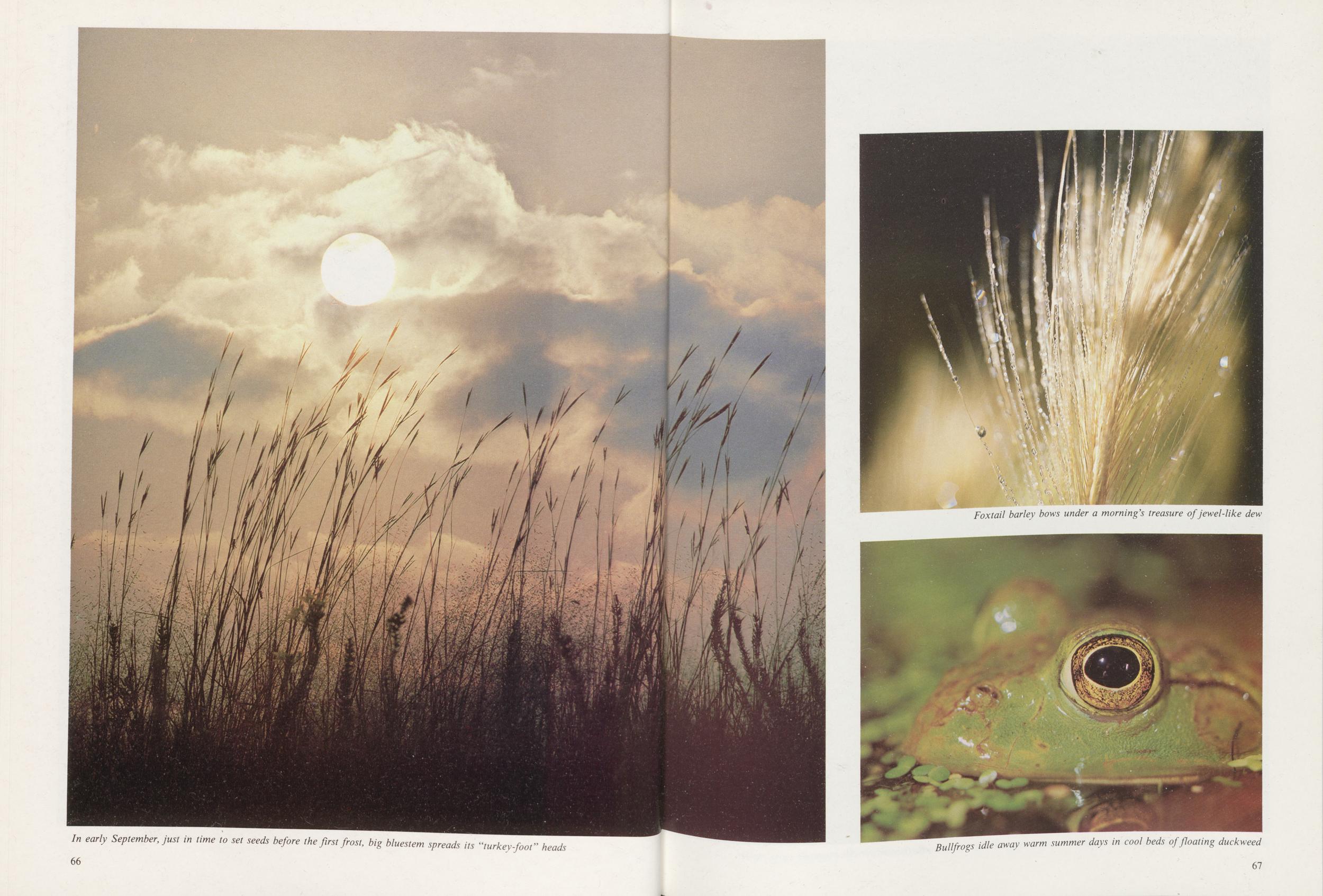
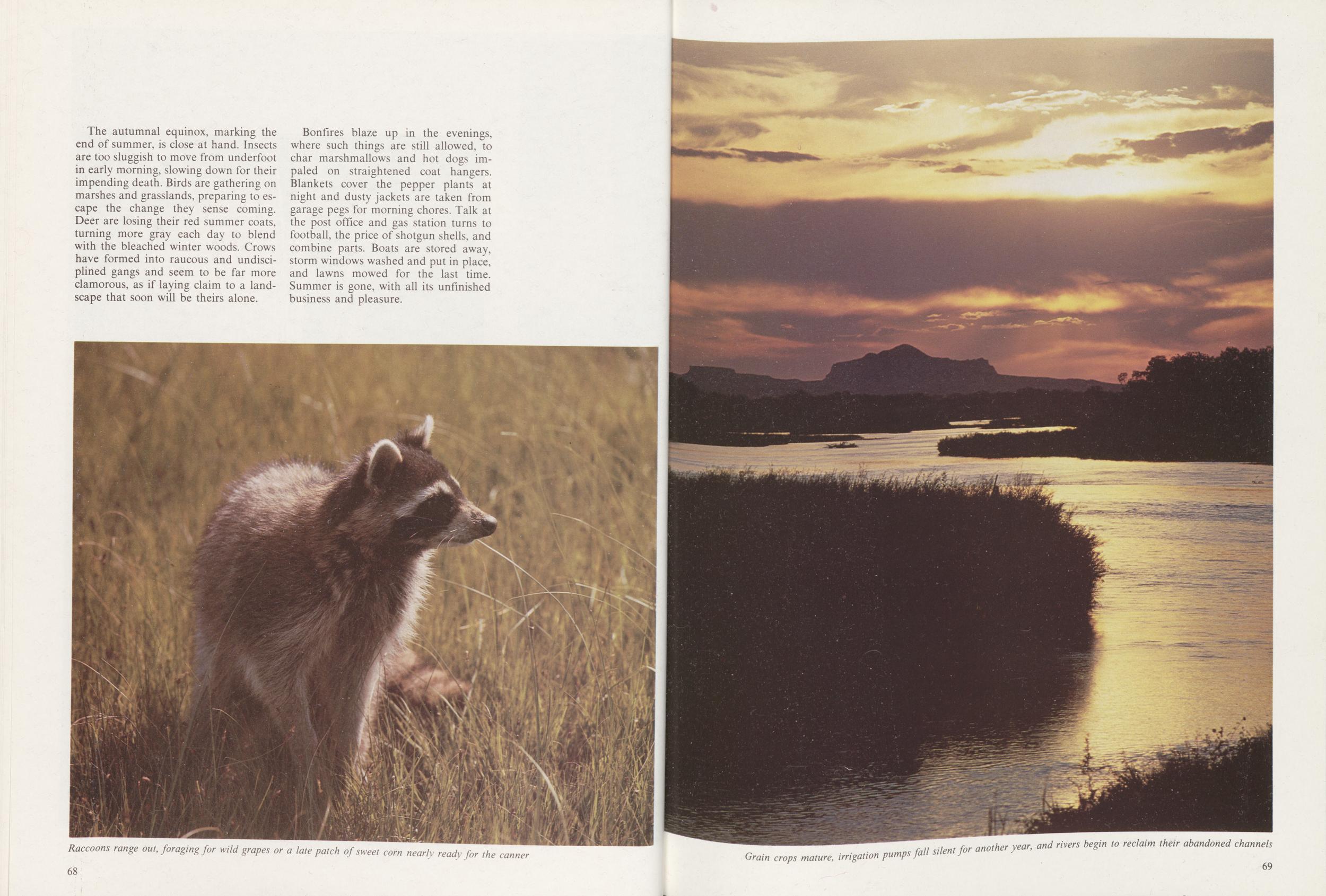
The autumnal equinox, marking the end of summer, is close at hand. Insects are too sluggish to move from underfoot in early morning, slowing down for their impending death. Birds are gathering on marshes and grasslands, preparing to escape the change they sense coming. Deer are losing their red summer coats, turning more gray each day to blend with the bleached winter woods. Crows have formed into raucous and undisciplined gangs and seem to be far more clamorous, as if laying claim to a landscape that soon will be theirs alone.
Bonfires blaze up in the evenings, where such things are still allowed, to char marshmallows and hot dogs impaled on straightened coat hangers. Blankets cover the pepper plants at night and dusty jackets are taken from garage pegs for morning chores. Talk at the post office and gas station turns to football, the price of shotgun shells, and combine parts. Boats are stored away, storm windows washed and put in place, and lawns mowed for the last time. Summer is gone, with all its unfinished business and pleasure.
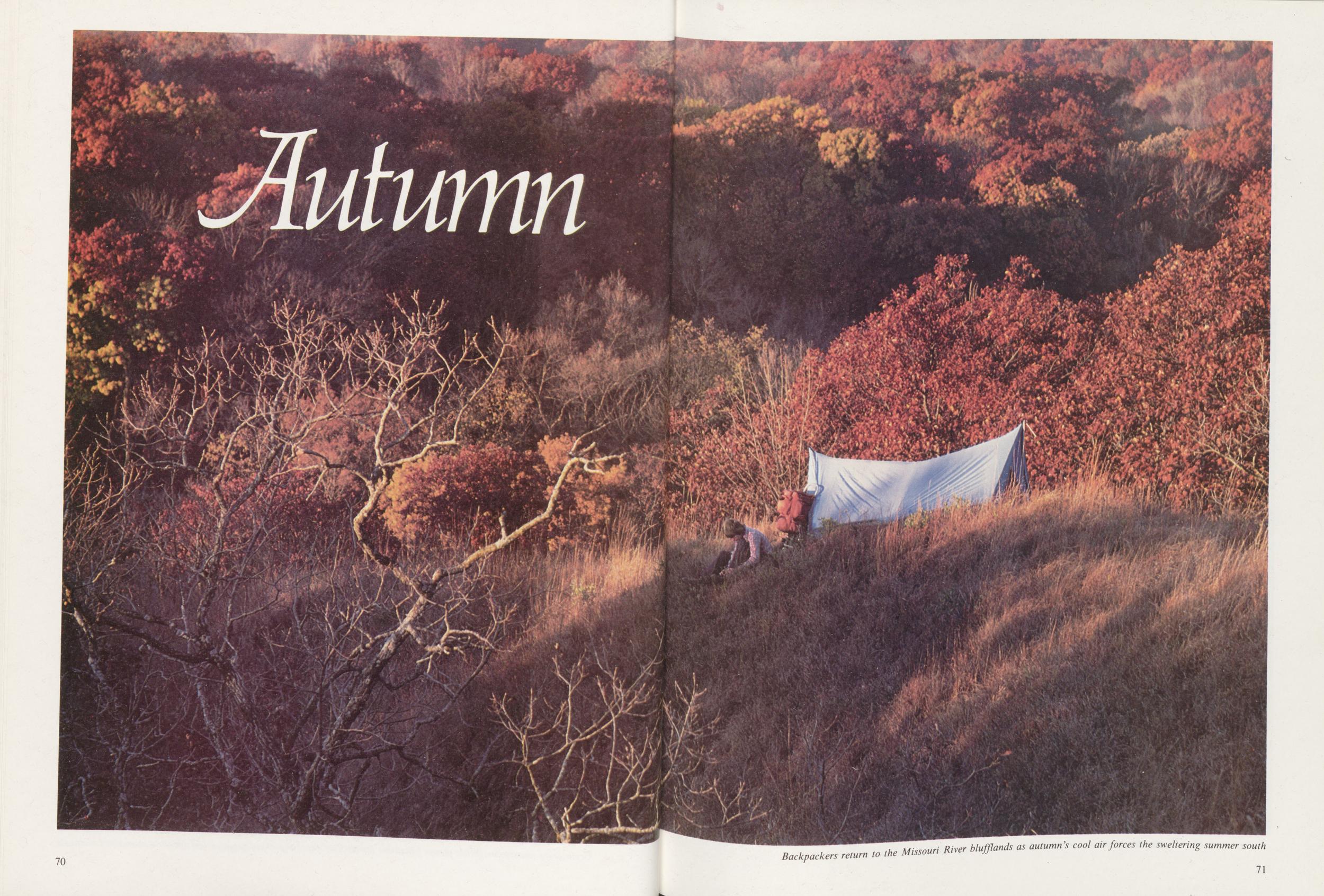
Autumn
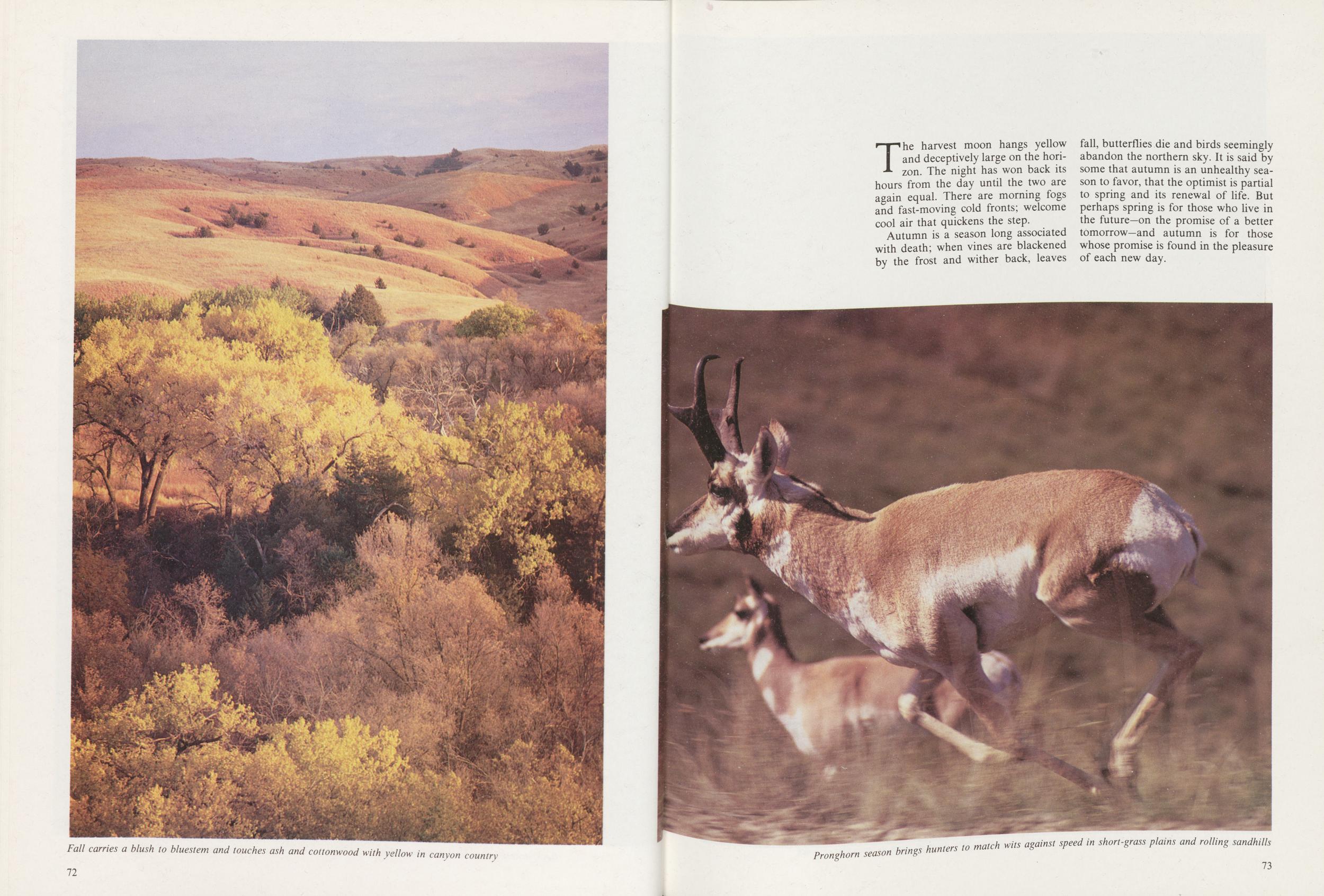
The harvest moon hangs yellow and deceptively large on the horizon. The night has won back its hours from the day until the two are again equal. There are morning fogs and fast-moving cold fronts; welcome cool air that quickens the step.
Autumn is a season long associated with death; when vines are blackened by the frost and wither back, leaves fall, butterflies die and birds seemingly abandon the northern sky. It is said by some that autumn is an unhealthy season to favor, that the optimist is partial to spring and its renewal of life. But perhaps spring is for those who live in the future—on the promise of a better tomorrow—and autumn is for those whose promise is found in the pleasure of each new day.
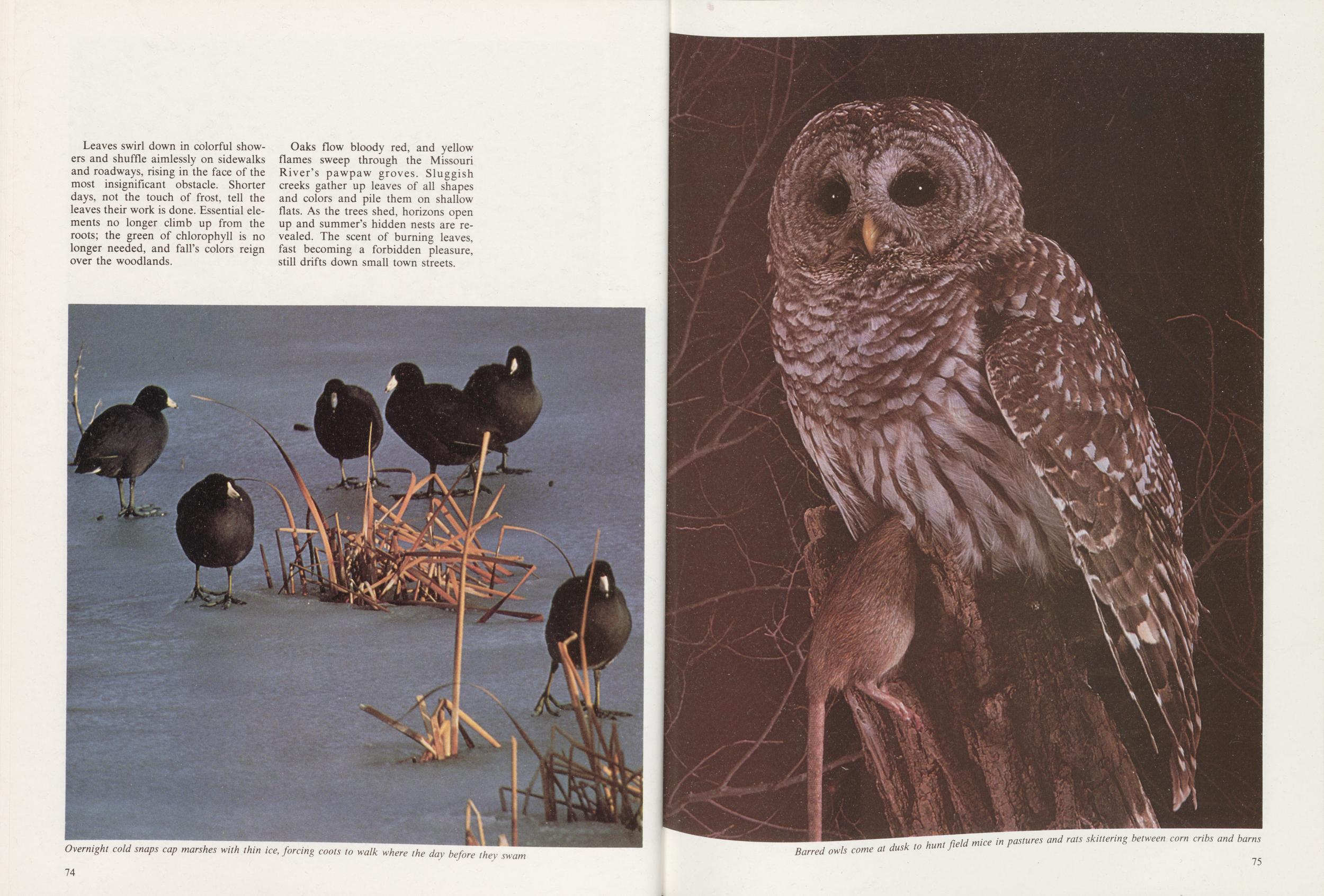
Leaves swirl down in colorful showers and shuffle aimlessly on sidewalks and roadways, rising in the face of the most insignificant obstacle. Shorter days, not the touch of frost, tell the leaves their work is done. Essential elements no longer climb up from the roots; the green of chlorophyll is no longer needed, and fall's colors reign over the woodlands.
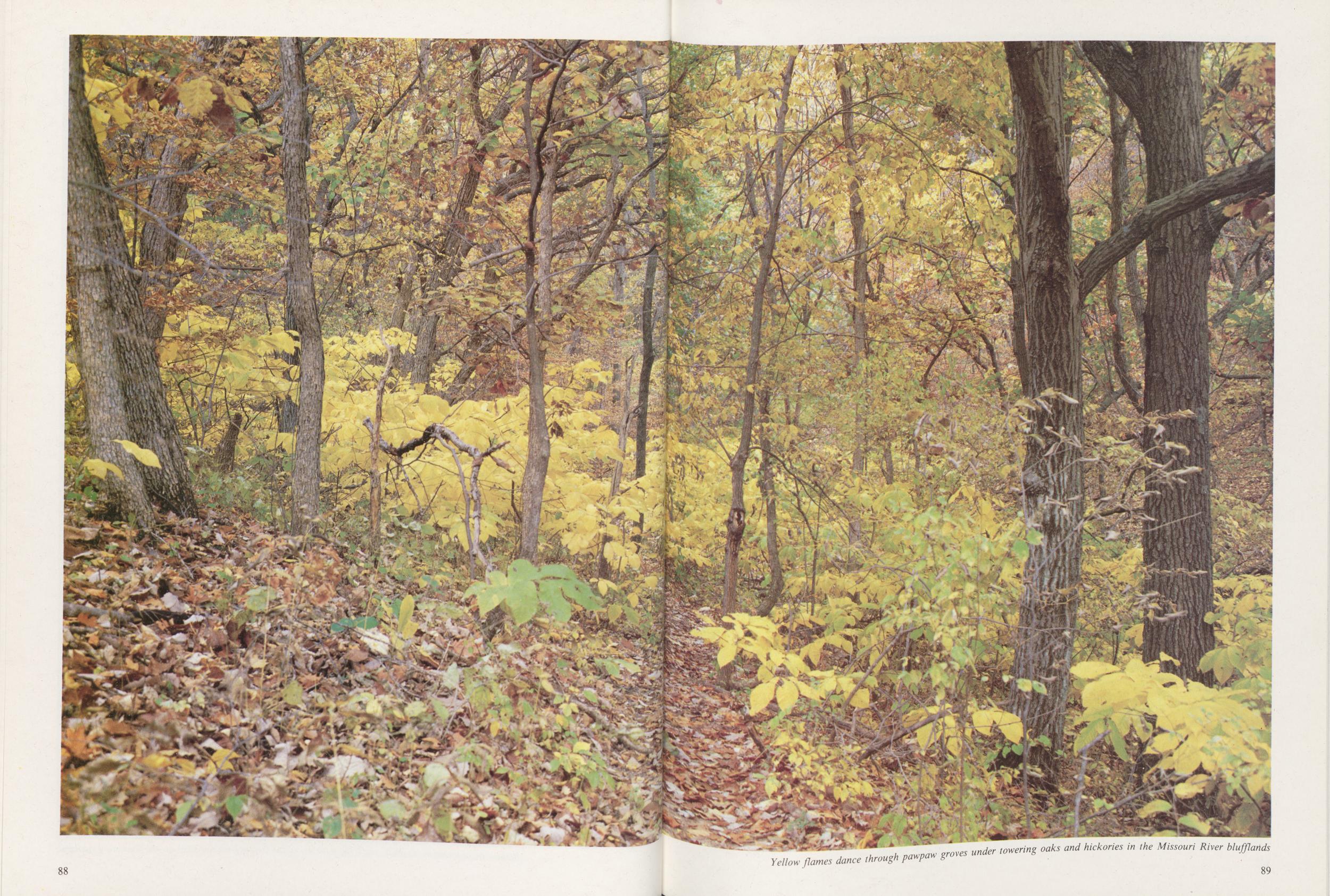
Oaks flow bloody red, and yellow flames sweep through the Missouri River's pawpaw groves. Sluggish creeks gather up leaves of all shapes and colors and pile them on shallow flats. As the trees shed, horizons open up and summer's hidden nests are revealed. The scent of burning leaves, fast becoming a forbidden pleasure, still drifts down small town streets.
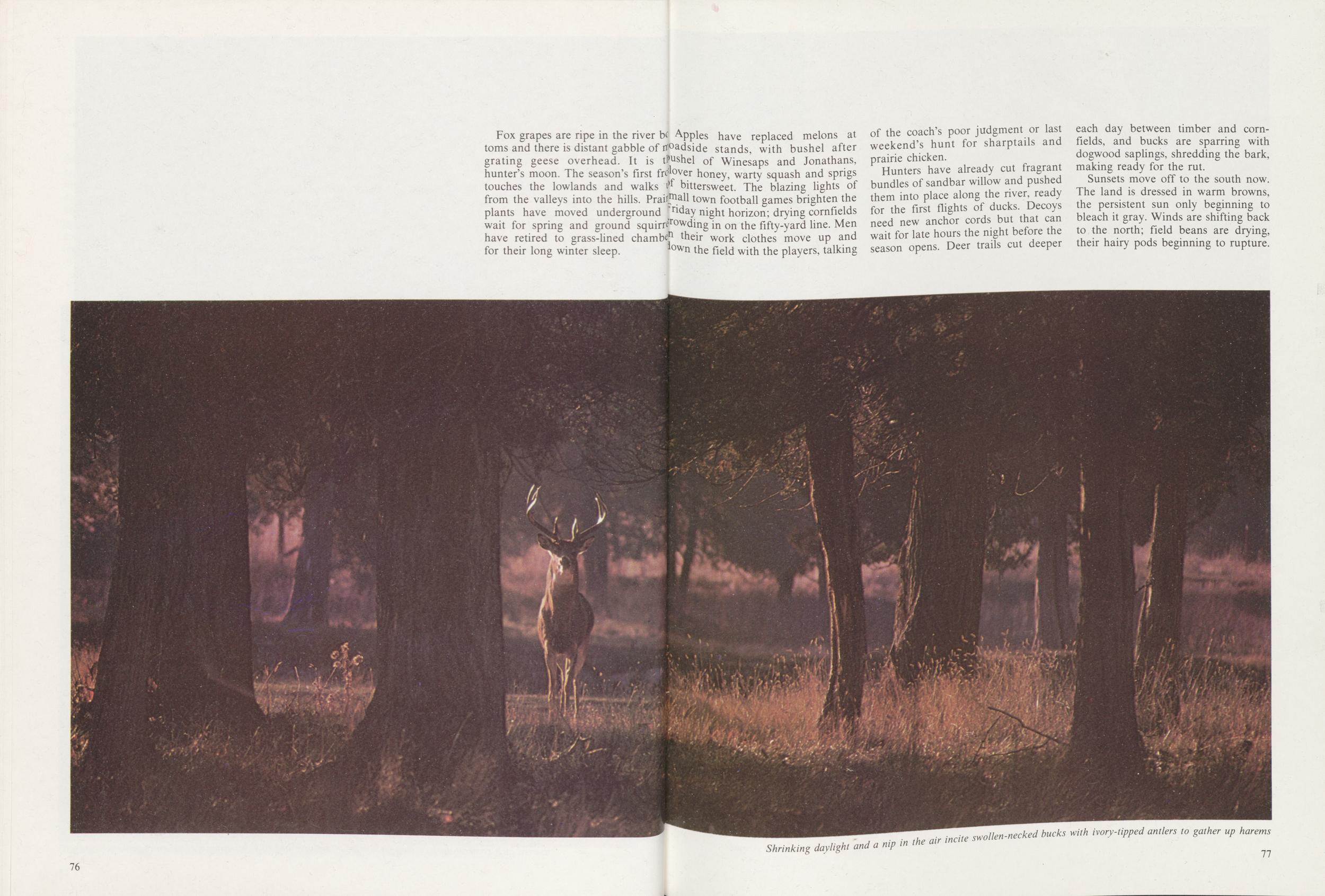
Fox grapes are ripe in the river be toms and there is distant gabble of grating geese overhead. It is hunter's moon. The season's first fr touches the lowlands and walks from the valleys into the hills. Prai plants have moved underground wait for spring and ground squirr have retired to grass-lined chamber for their long winter sleep.
76Apples have replaced melons at roadside stands, with bushel after bushel of Winesaps and Jonathans, clover honey, warty squash and sprigs of bittersweet. The blazing lights of small town football games brighten the Friday night horizon; drying cornfields crowding in on the fifty-yard line. Men in their work clothes move up and down the field with the players, talking of the coach's poor judgment or last weekend's hunt for sharptails and prairie chicken.
Hunters have already cut fragrant bundles of sandbar willow and pushed them into place along the river, ready for the first flights of ducks. Decoys need new anchor cords but that can wait for late hours the night before the season opens. Deer trails cut deeper each day between timber and cornfields, and bucks are sparring with dogwood saplings, shredding the bark, making ready for the rut.
Sunsets move off to the south now. The land is dressed in warm browns, the persistent sun only beginning to bleach it gray. Winds are shifting back to the north; field beans are drying, their hairy pods beginning to rupture.
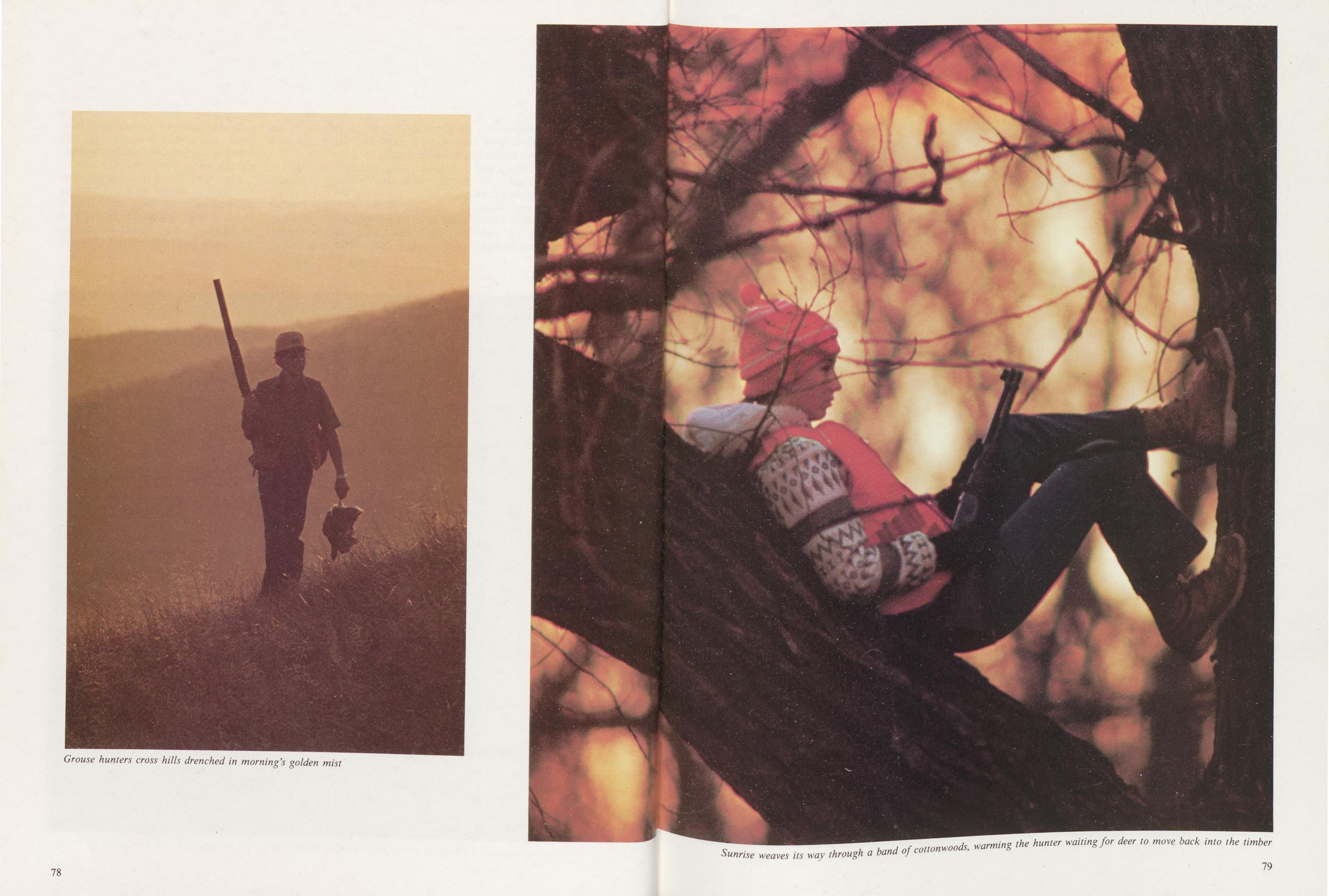
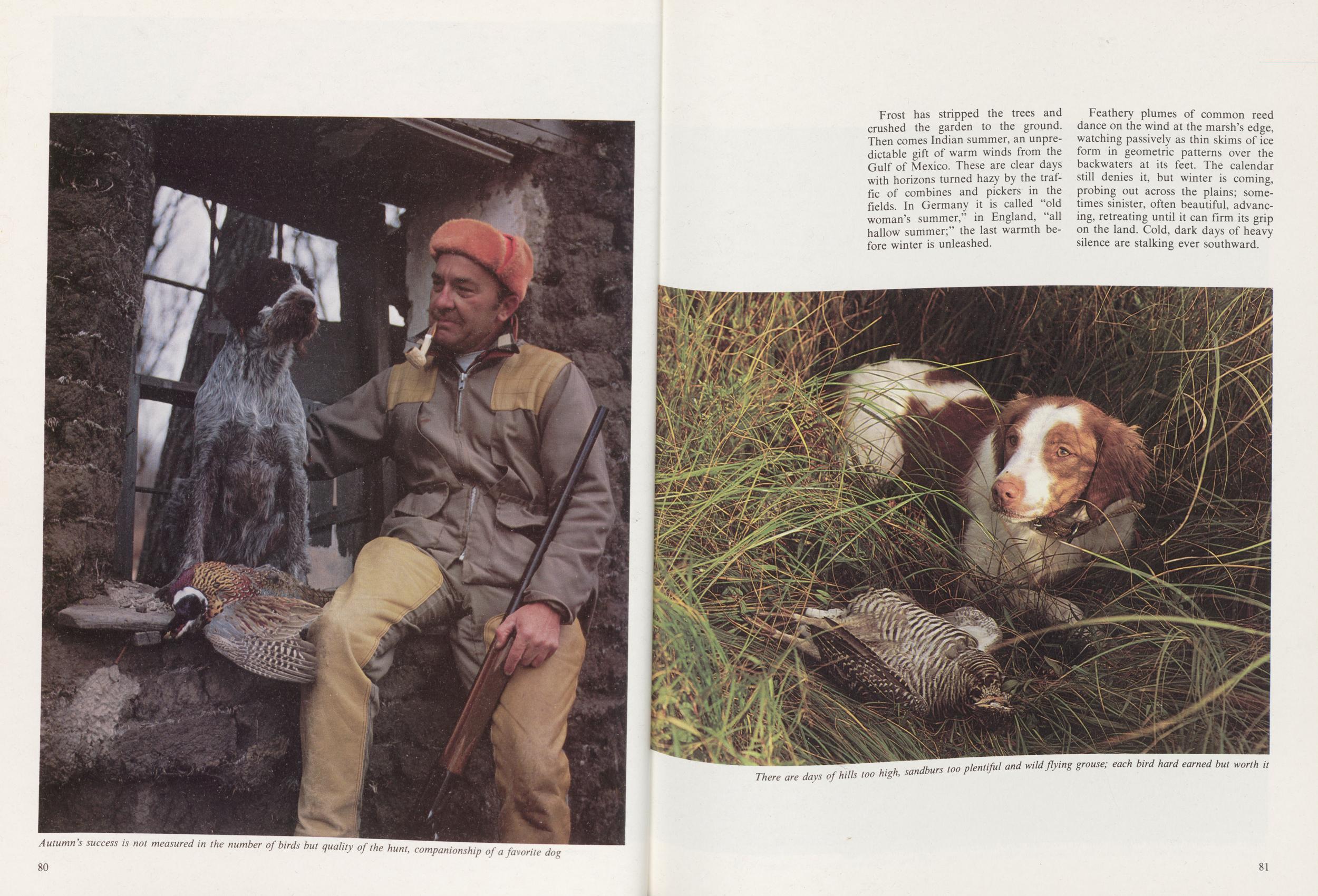
Frost has stripped the trees and crushed the garden to the ground. Then comes Indian summer, an unpredictable gift of warm winds from the Gulf of Mexico. These are clear days with horizons turned hazy by the traffic of combines and pickers in the fields. In Germany it is called "old woman's summer," in England, "all hallow summer;" the last warmth before winter is unleashed.
Feathery plumes of common reed dance on the wind at the marsh's edge, watching passively as thin skims of ice form in geometric patterns over the backwaters at its feet. The calendar still denies it, but winter is coming, probing out across the plains; sometimes sinister, often beautiful, advancing, retreating until it can firm its grip on the land. Cold, dark days of heavy silence are stalking ever southward.
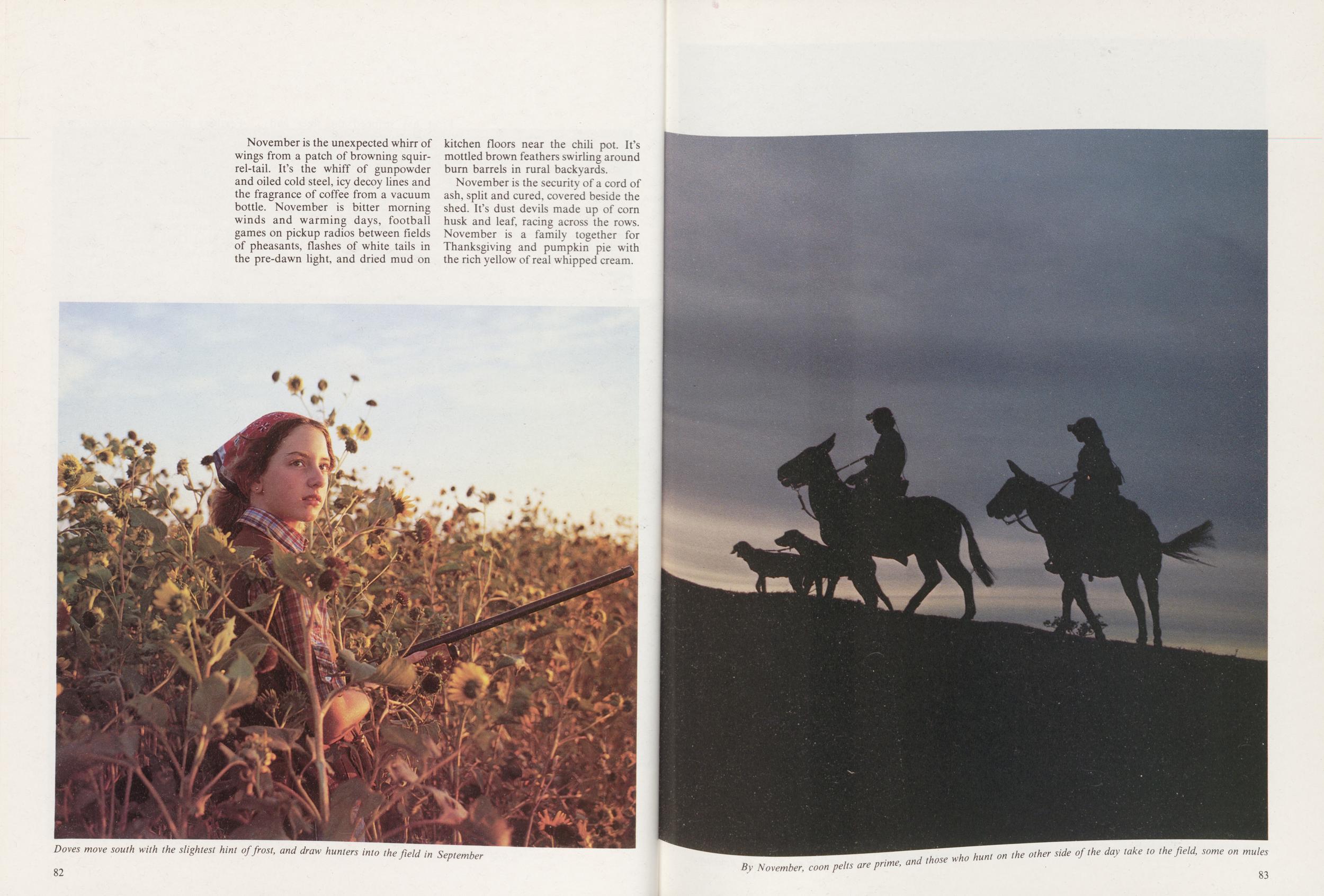
November is the unexpected whirr of wings from a patch of browning squirrel-tail. It's the whiff of gunpowder and oiled cold steel, icy decoy lines and the fragrance of coffee from a vacuum bottle. November is bitter morning winds and warming days, football games on pickup radios between fields of pheasants, flashes of white tails in the pre-dawn light, and dried mud on kitchen floors near the chili pot. It's mottled brown feathers swirling around burn barrels in rural backyards.
November is the security of a cord of ash, split and cured, covered beside the shed. It's dust devils made up of corn husk and leaf, racing across the rows. November is a family together for Thanksgiving and pumpkin pie with the rich yellow of real whipped cream.
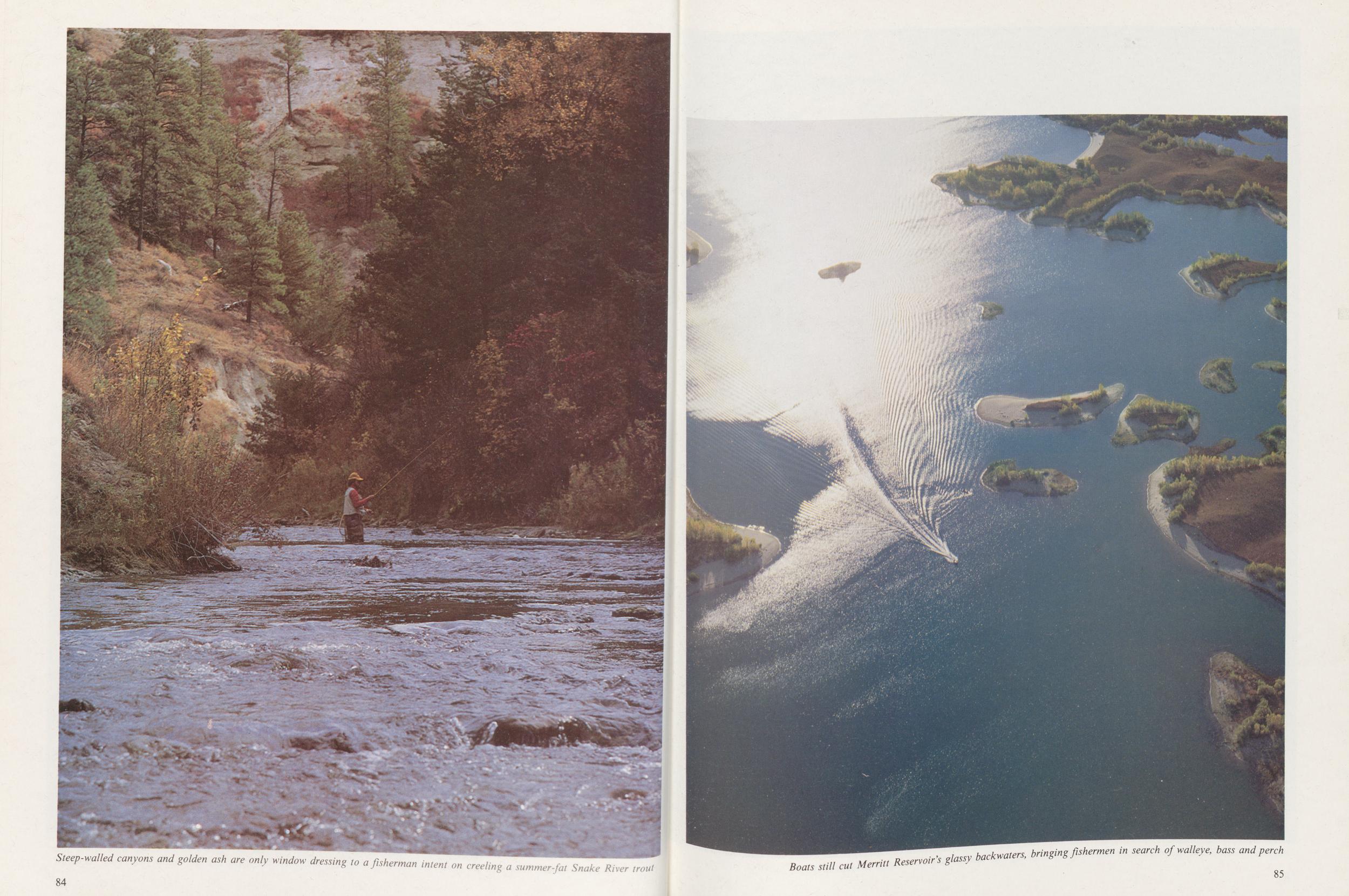
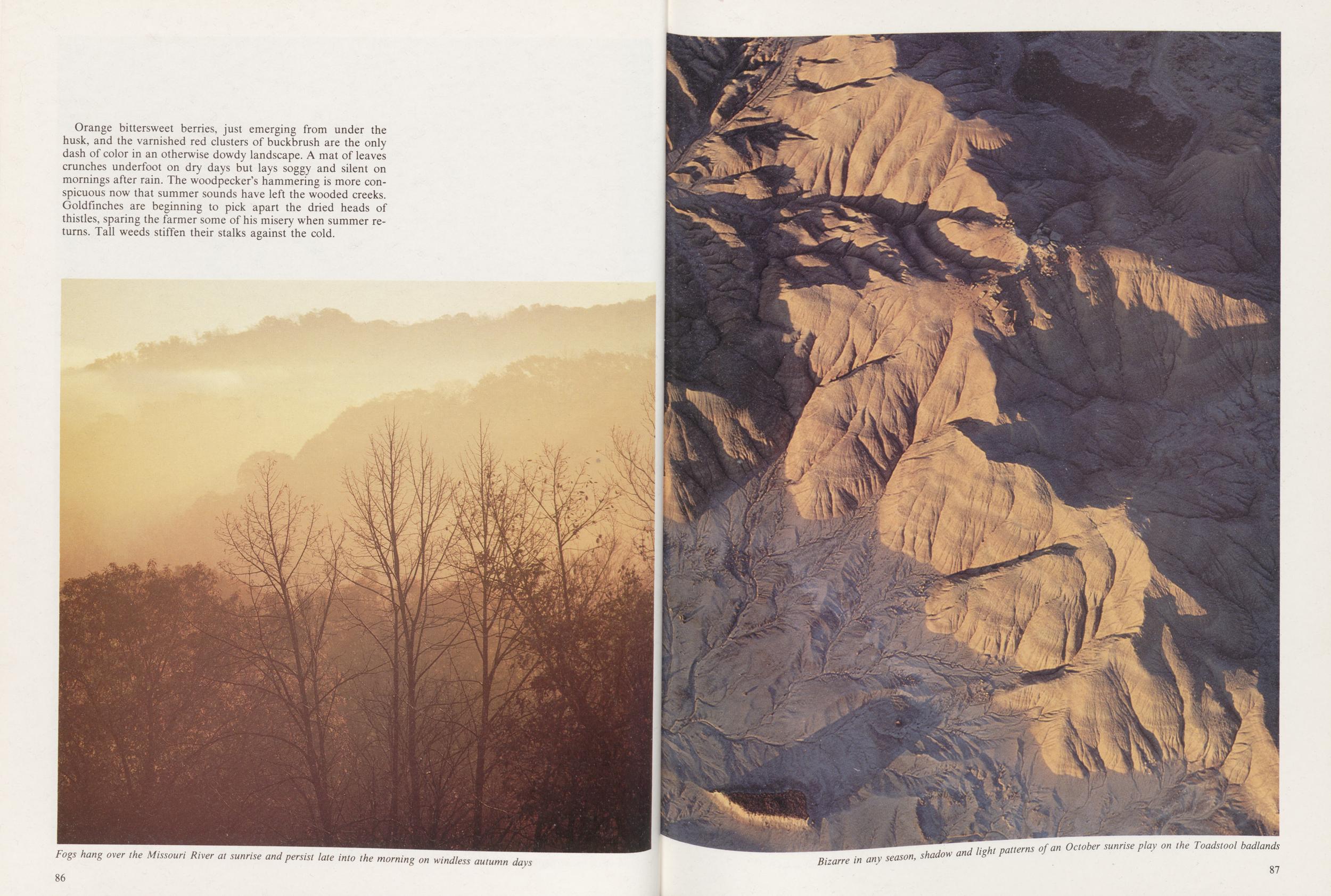
Orange bittersweet berries, just emerging from under the husk, and the varnished red clusters of buckbrush are the only dash of color in an otherwise dowdy landscape. A mat of leaves crunches underfoot on dry days but lays soggy and silent on mornings after rain. The woodpecker's hammering is more conspicuous now that summer sounds have left the wooded creeks. Goldfinches are beginning to pick apart the dried heads of thistles, sparing the farmer some of his misery when summer returns. Tall weeds stiffen their stalks against the cold.
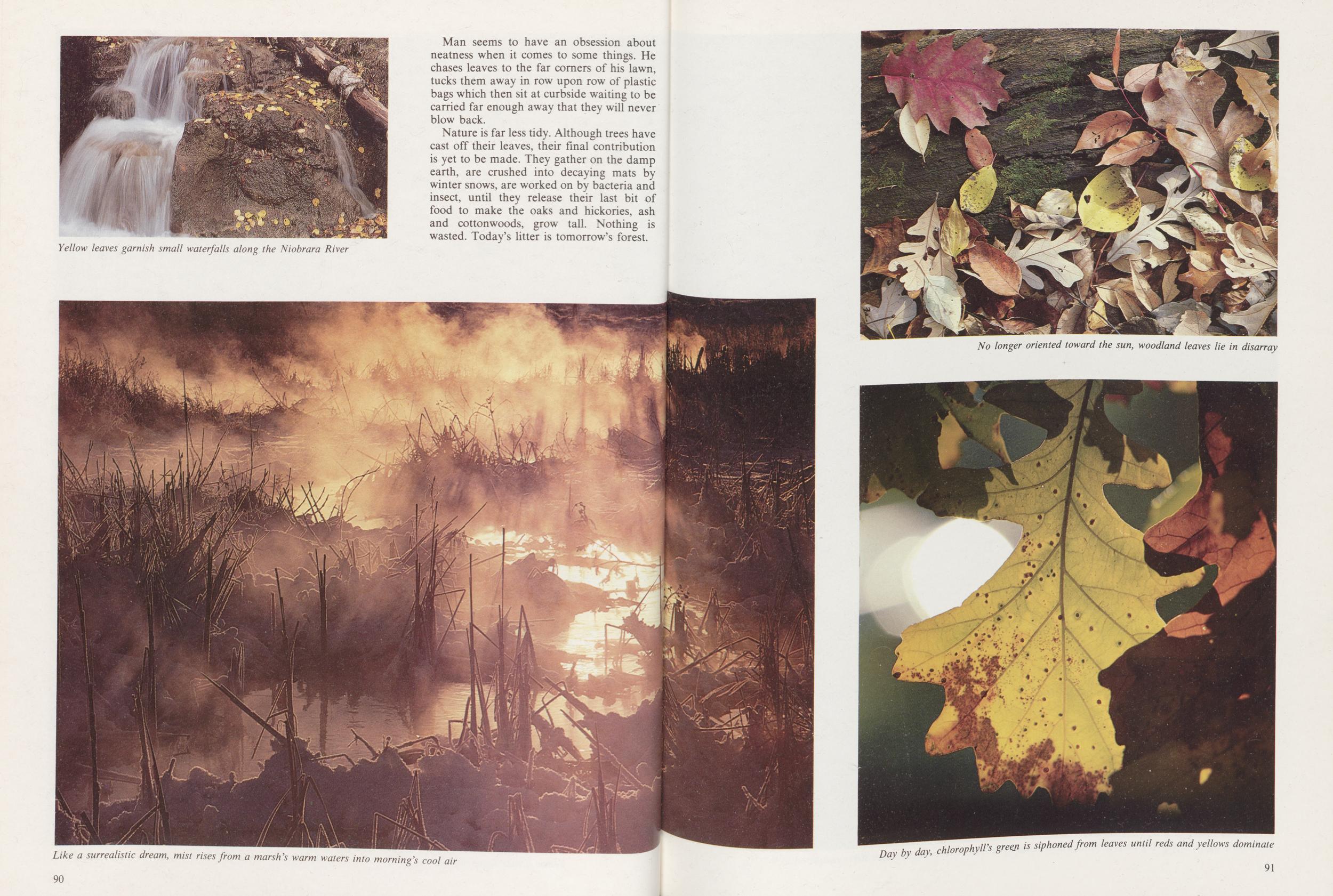
Man seems to have an obsession about neatness when it comes to some things. He chases leaves to the far corners of his lawn, tucks them away in row upon row of plastic bags which then sit at curbside waiting to be carried far enough away that they will never blow back.
Nature is far less tidy. Although trees have cast off their leaves, their final contribution is yet to be made. They gather on the damp earth, are crushed into decaying mats by winter snows, are worked on by bacteria and insect, until they release their last bit of food to make the oaks and hickories, ash and cottonwoods, grow tall. Nothing is wasted. Today's litter is tomorrow's forest.
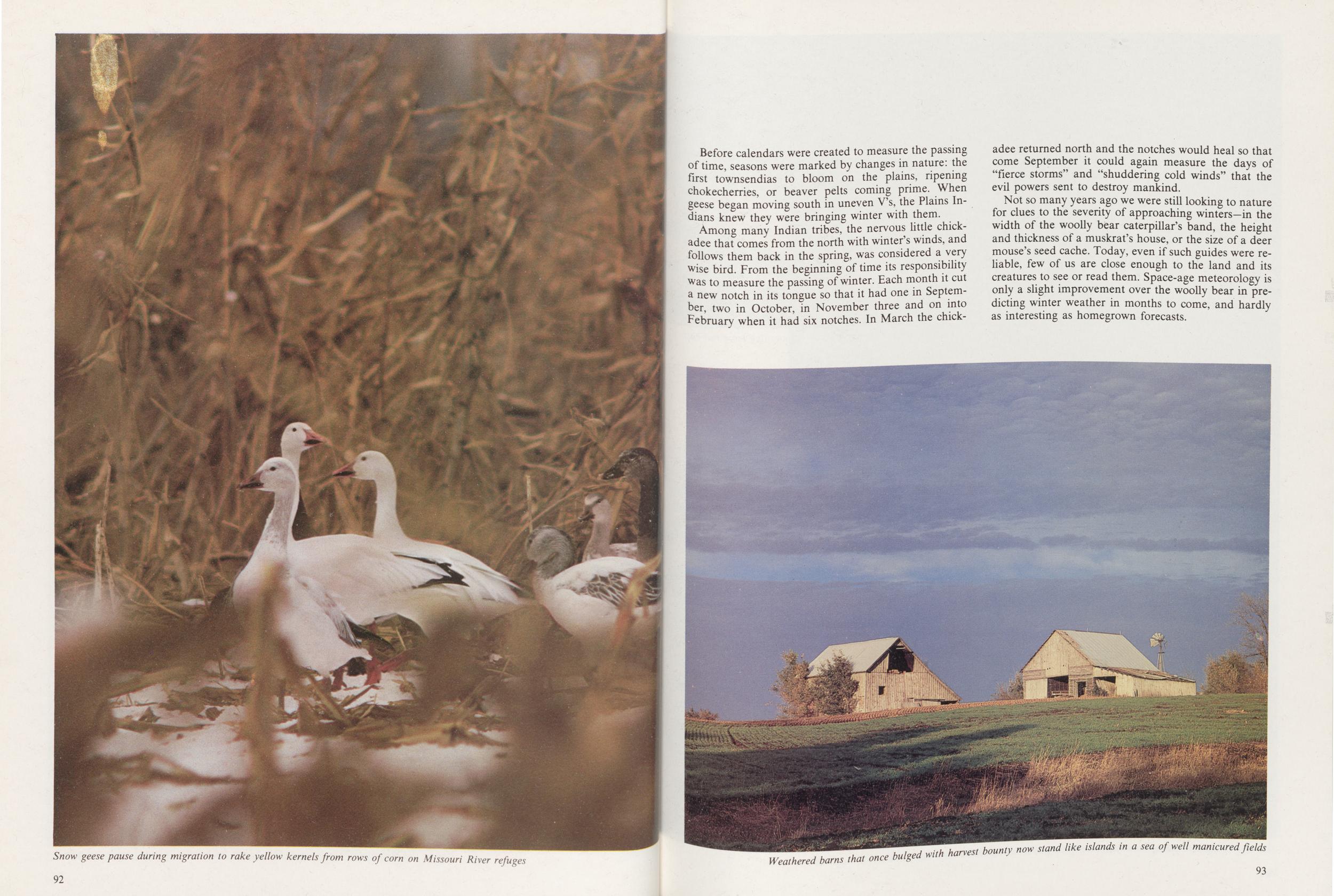
Before calendars were created to measure the passing of time, seasons were marked by changes in nature: the first townsendias to bloom on the plains, ripening chokecherries, or beaver pelts coming prime. When geese began moving south in uneven V's, the Plains Indians knew they were bringing winter with them.
Among many Indian tribes, the nervous little chickadee that comes from the north with winter's winds, and follows them back in the spring, was considered a very wise bird. From the beginning of time its responsibility was to measure the passing of winter. Each month it cut a new notch in its tongue so that it had one in September, two in October, in November three and on into February when it had six notches. In March the chickadee returned north and the notches would heal so that come September it could again measure the days of "fierce storms" and "shuddering cold winds" that the evil powers sent to destroy mankind.
Not so many years ago we were still looking to nature for clues to the severity of approaching winters—in the width of the woolly bear caterpillar's band, the height and thickness of a muskrat's house, or the size of a deer mouse's seed cache. Today, even if such guides were reliable, few of us are close enough to the land and its creatures to see or read them. Space-age meteorology is only a slight improvement over the woolly bear in predicting winter weather in months to come, and hardly as interesting as homegrown forecasts.
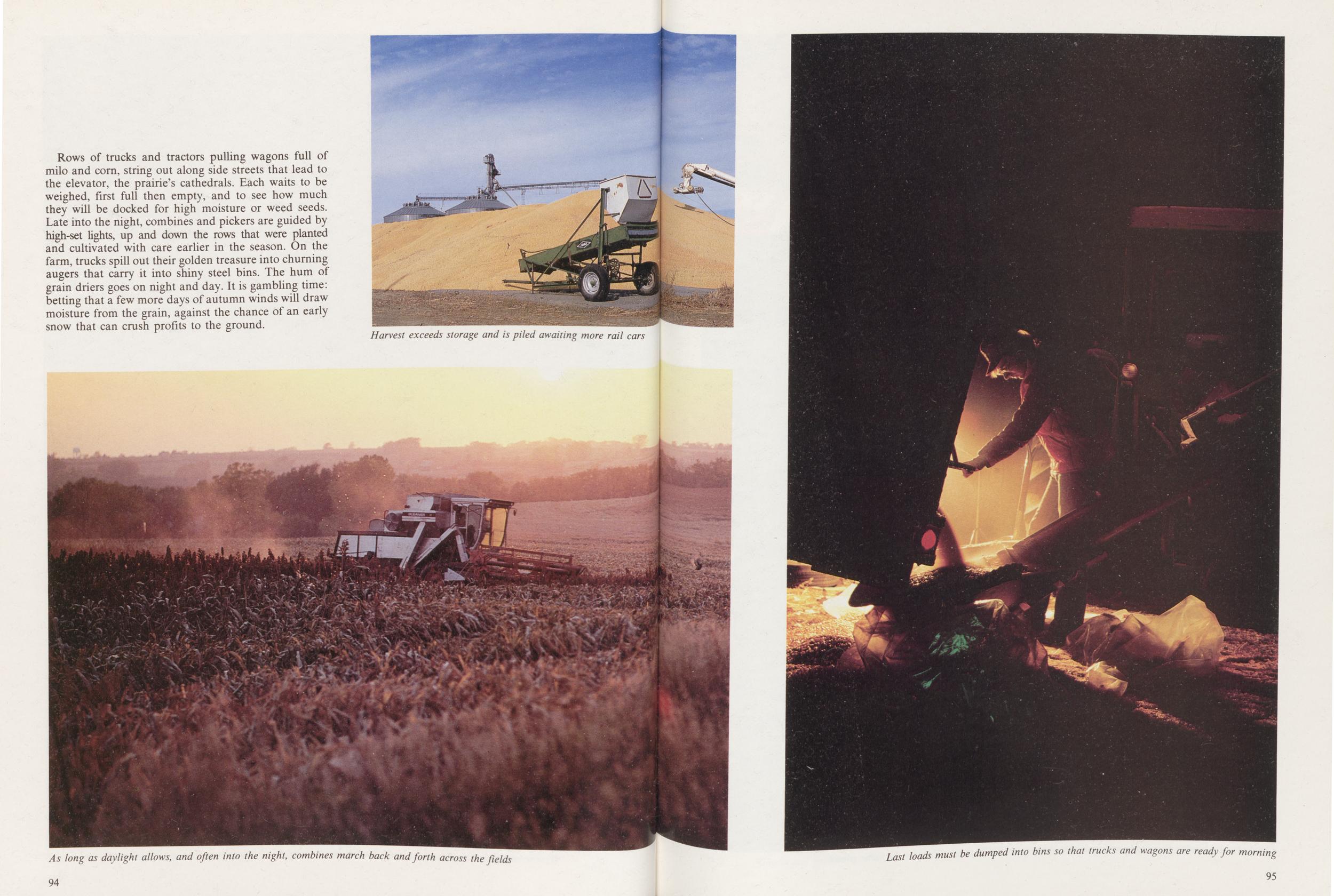
Rows of trucks and tractors pulling wagons full of milo and corn, string out along side streets that lead to the elevator, the prairie's cathedrals. Each waits to be weighed, first full then empty, and to see how much they will be docked for high moisture or weed seeds. Late into the night, combines and pickers are guided by high-set lights, up and down the rows that were planted and cultivated with care earlier in the season. On the farm, trucks spill out their golden treasure into churning augers that carry it into shiny steel bins. The hum of grain driers goes on night and day. It is gambling time: betting that a few more days of autumn winds will draw moisture from the grain, against the chance of an early snow that can crush profits to the ground.
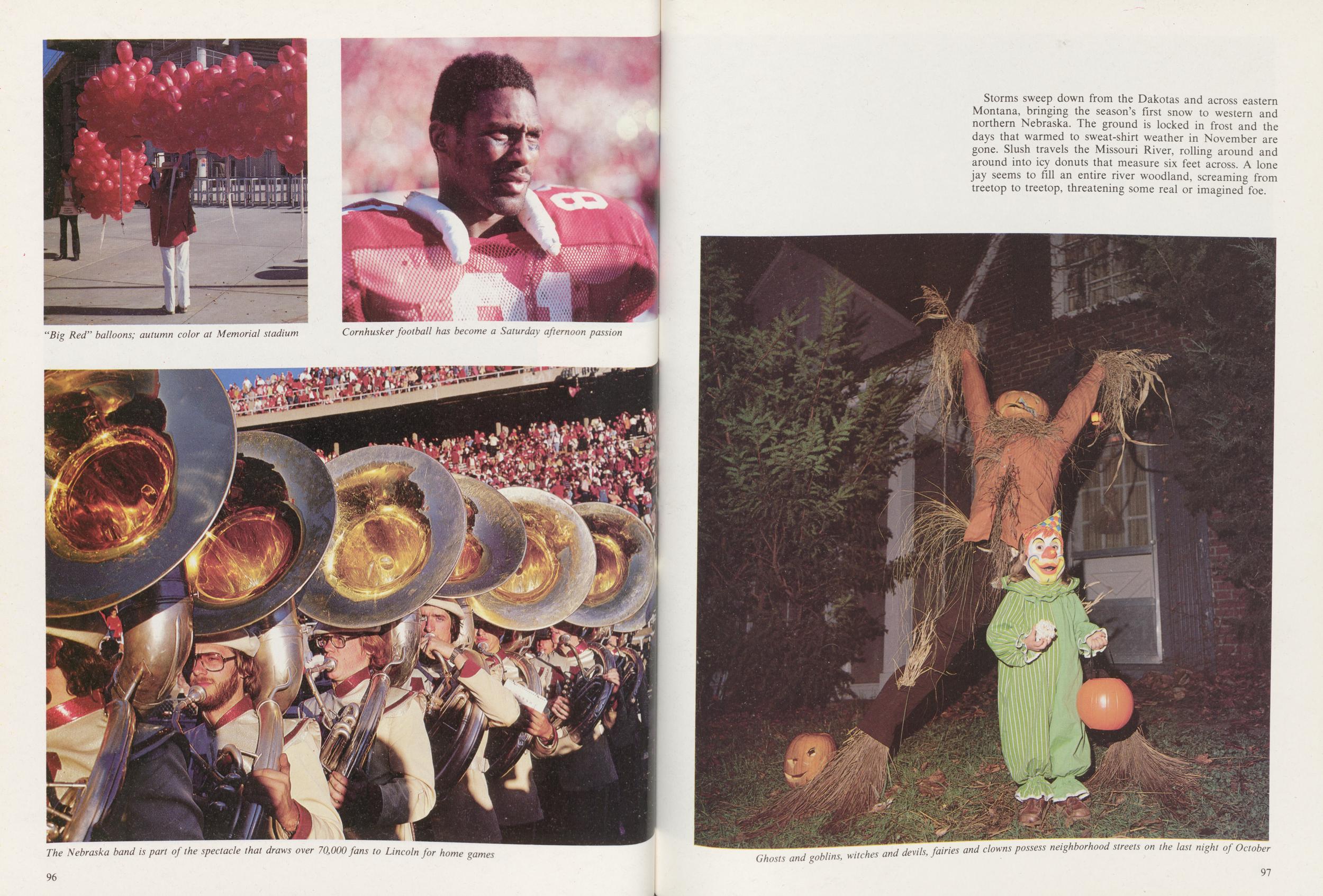
Storms sweep down from the Dakotas and across eastern Montana, bringing the season's first snow to western and northern Nebraska. The ground is locked in frost and the days that warmed to sweat-shirt weather in November are gone. Slush travels the Missouri River, rolling around and around into icy donuts that measure six feet across. A lone jay seems to fill an entire river woodland, screaming from treetop to treetop, threatening some real or imagined foe.
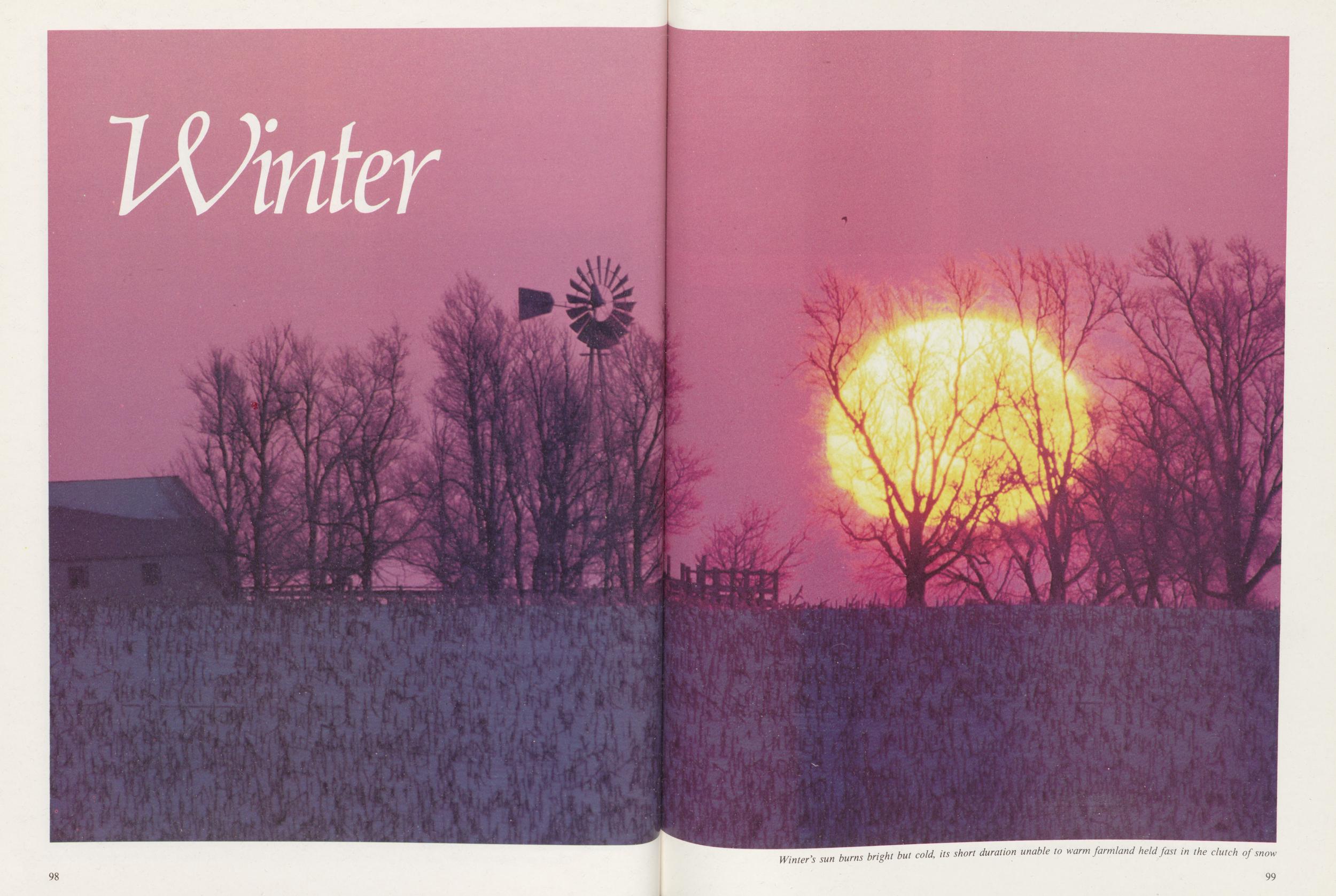
Winter
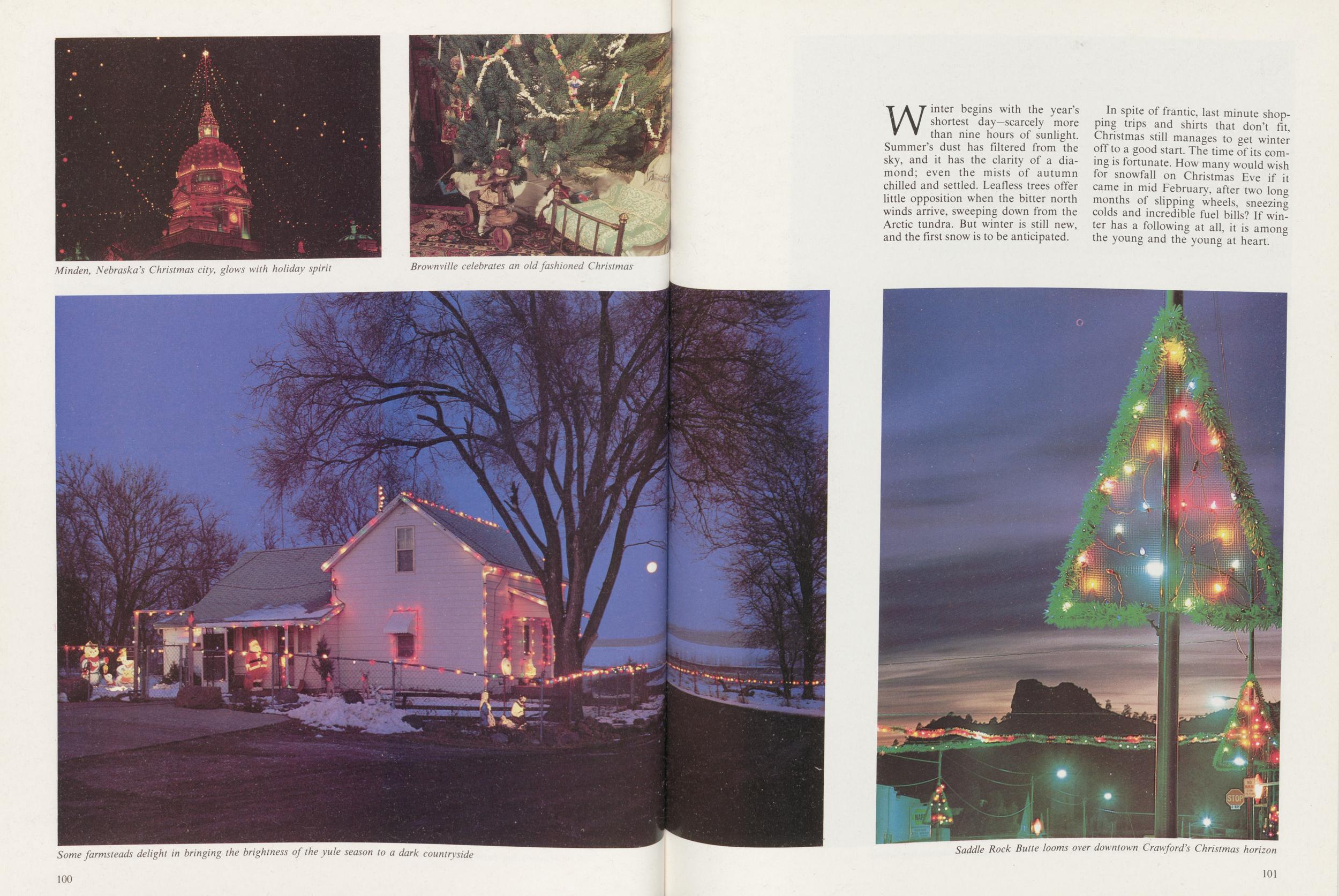
Winter begins with the year's shortest day—scarcely more than nine hours of sunlight. Summer's dust has filtered from the sky, and it has the clarity of a diamond; even the mists of autumn chilled and settled. Leafless trees offer little opposition when the bitter north winds arrive, sweeping down from the Arctic tundra. But winter is still new, and the first snow is to be anticipated.
In spite of frantic, last minute shopping trips and shirts that don't fit, Christmas still manages to get winter off to a good start. The time of its coming is fortunate. How many would wish for snowfall on Christmas Eve if it came in mid February, after two long months of slipping wheels, sneezing colds and incredible fuel bills? If winter has a following at all, it is among the young and the young at heart.
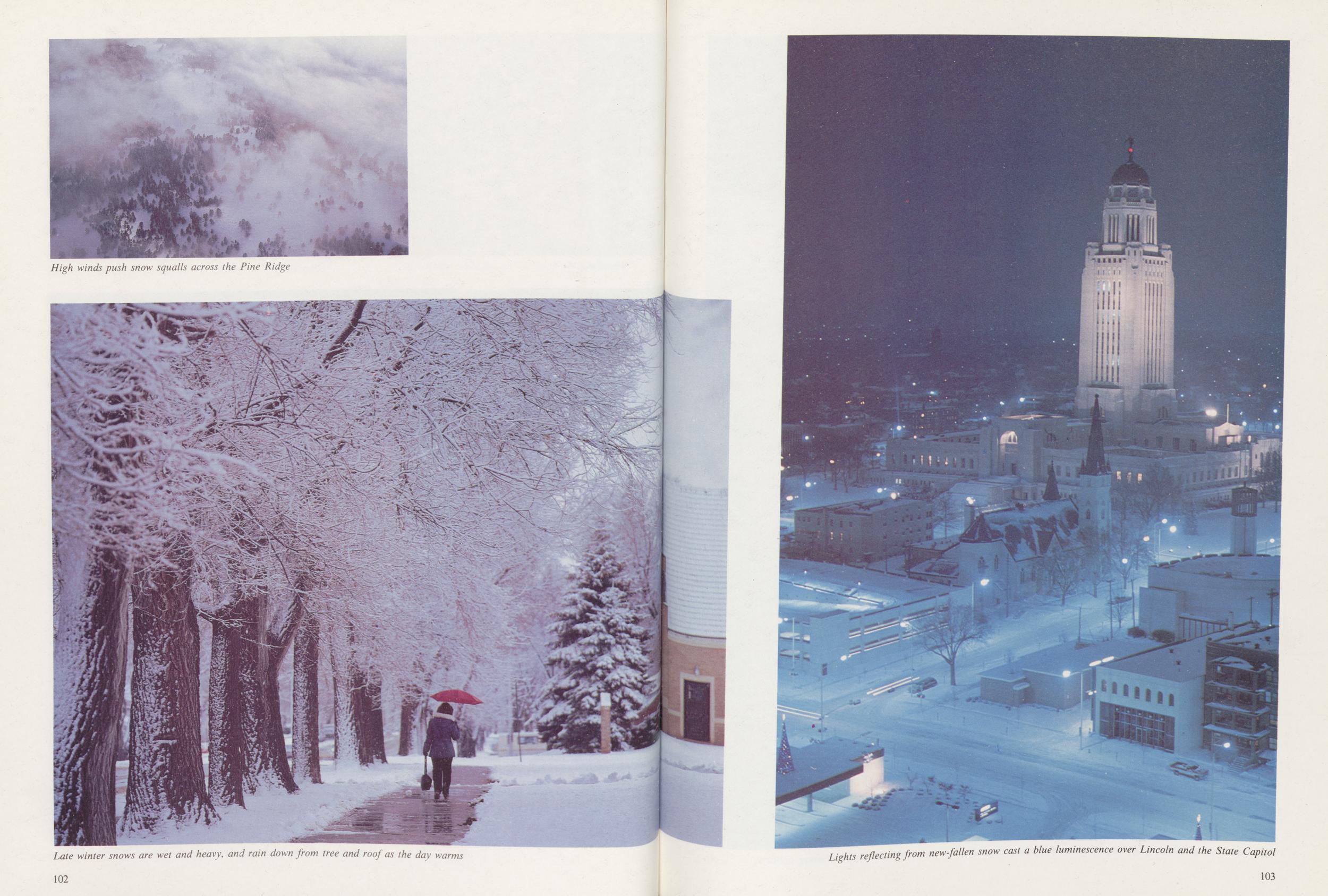
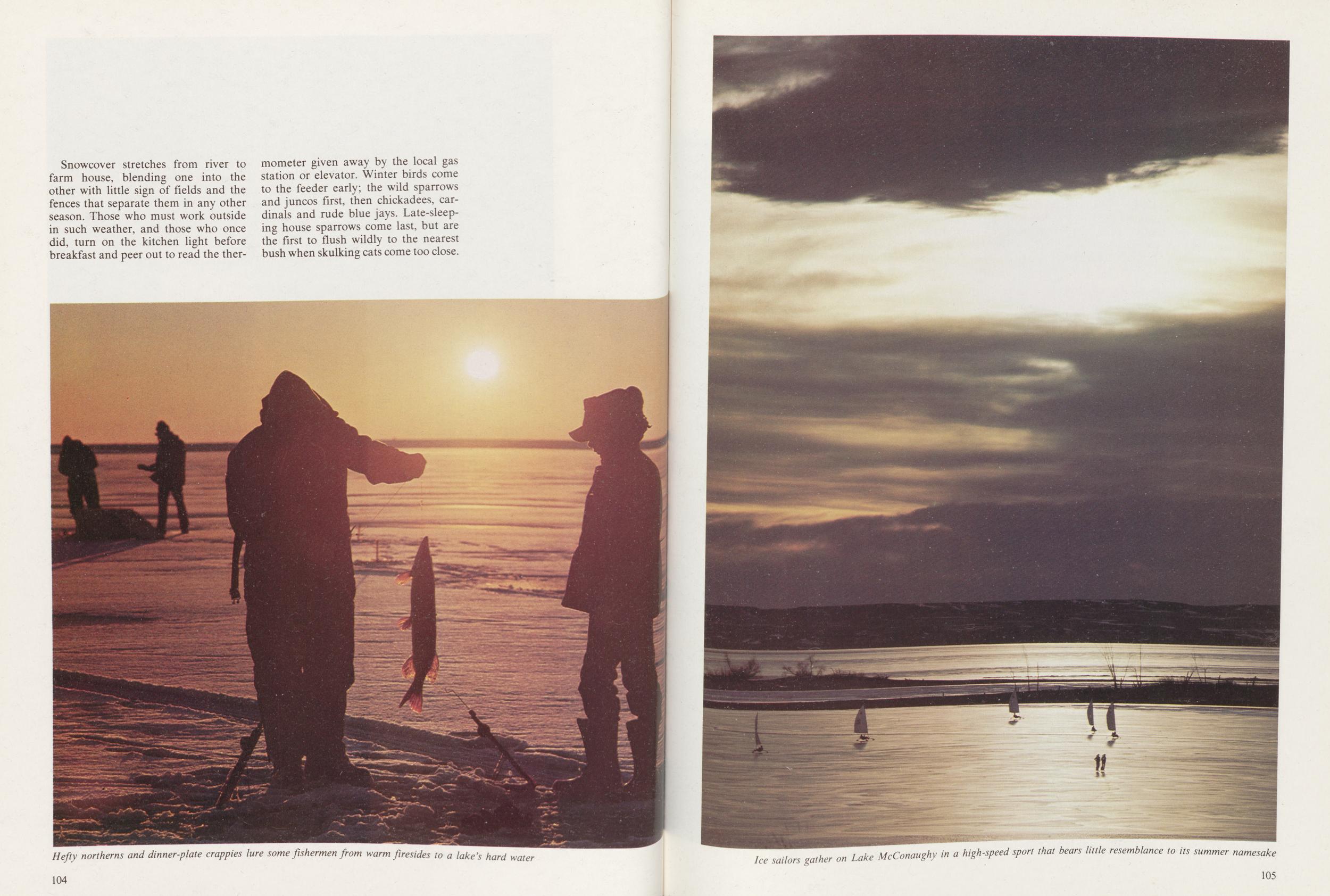
Snowcover stretches from river to farm house, blending one into the other with little sign of fields and the fences that separate them in any other season. Those who must work outside in such weather, and those who once did, turn on the kitchen light before breakfast and peer out to read the thermometer given away by the local gas station or elevator. Winter birds come to the feeder early; the wild sparrows and juncos first, then chickadees, cardinals and rude blue jays. Late-sleeping house sparrows come last, but are the first to flush wildly to the nearest bush when skulking cats come too close.
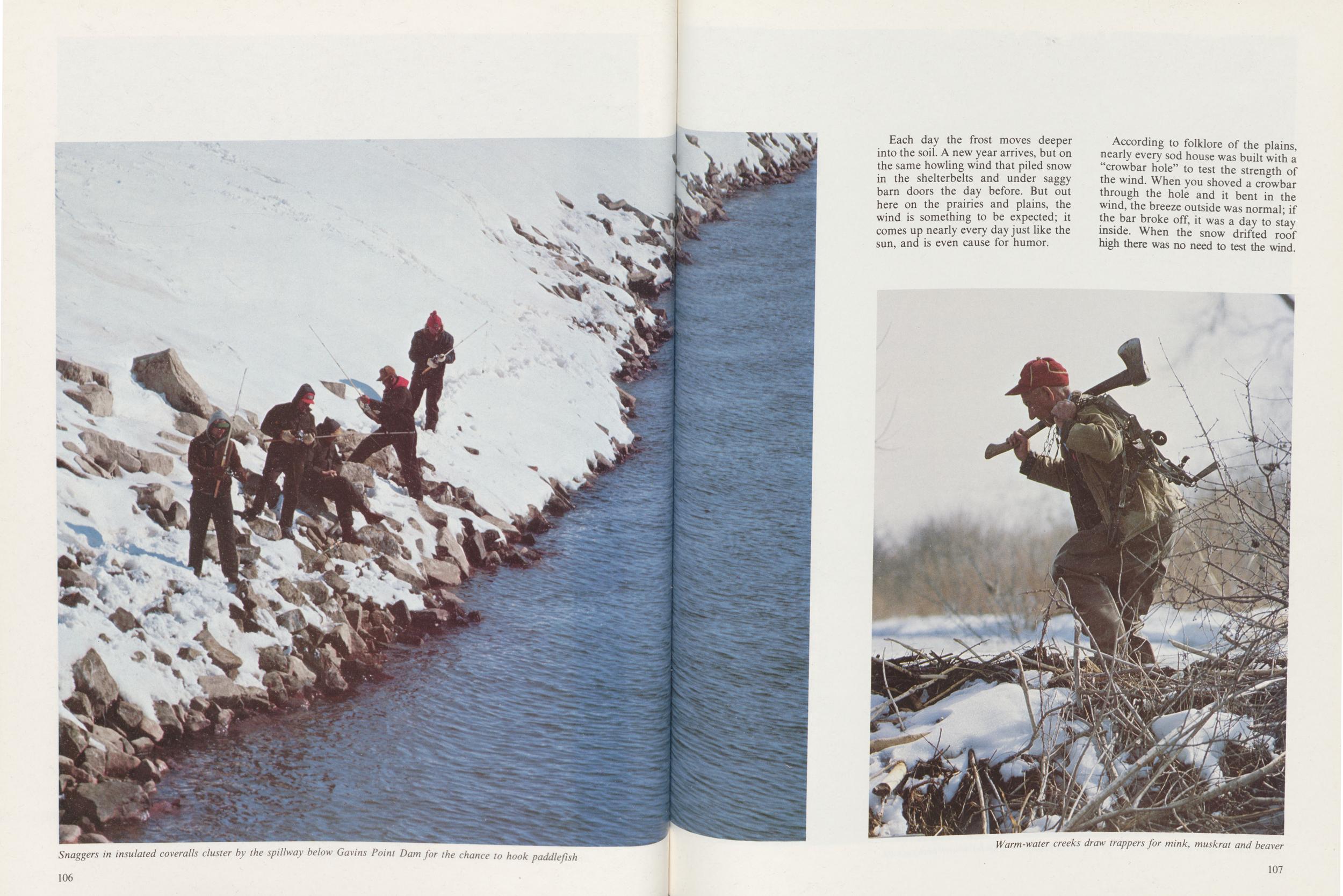
Each day the frost moves deeper into the soil. A new year arrives, but on the same howling wind that piled snow in the shelterbelts and under saggy barn doors the day before. But out here on the prairies and plains, the wind is something to be expected; it comes up nearly every day just like the sun, and is even cause for humor.
According to folklore of the plains, nearly every sod house was built with a "crowbar hole" to test the strength of the wind. When you shoved a crowbar through the hole and it bent in the wind, the breeze outside was normal; if the bar broke off, it was a day to stay inside. When the snow drifted roof high there was no need to test the wind.
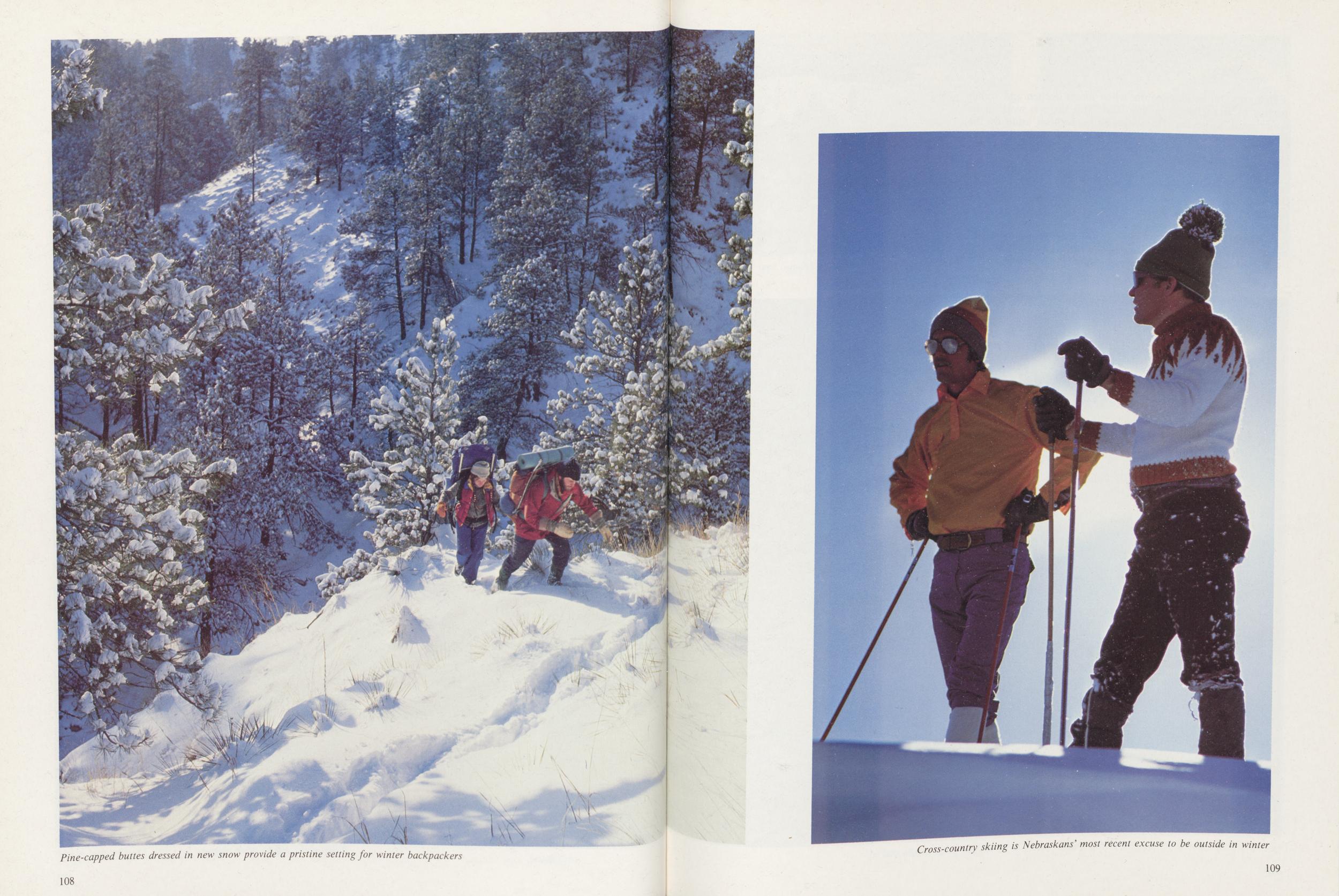
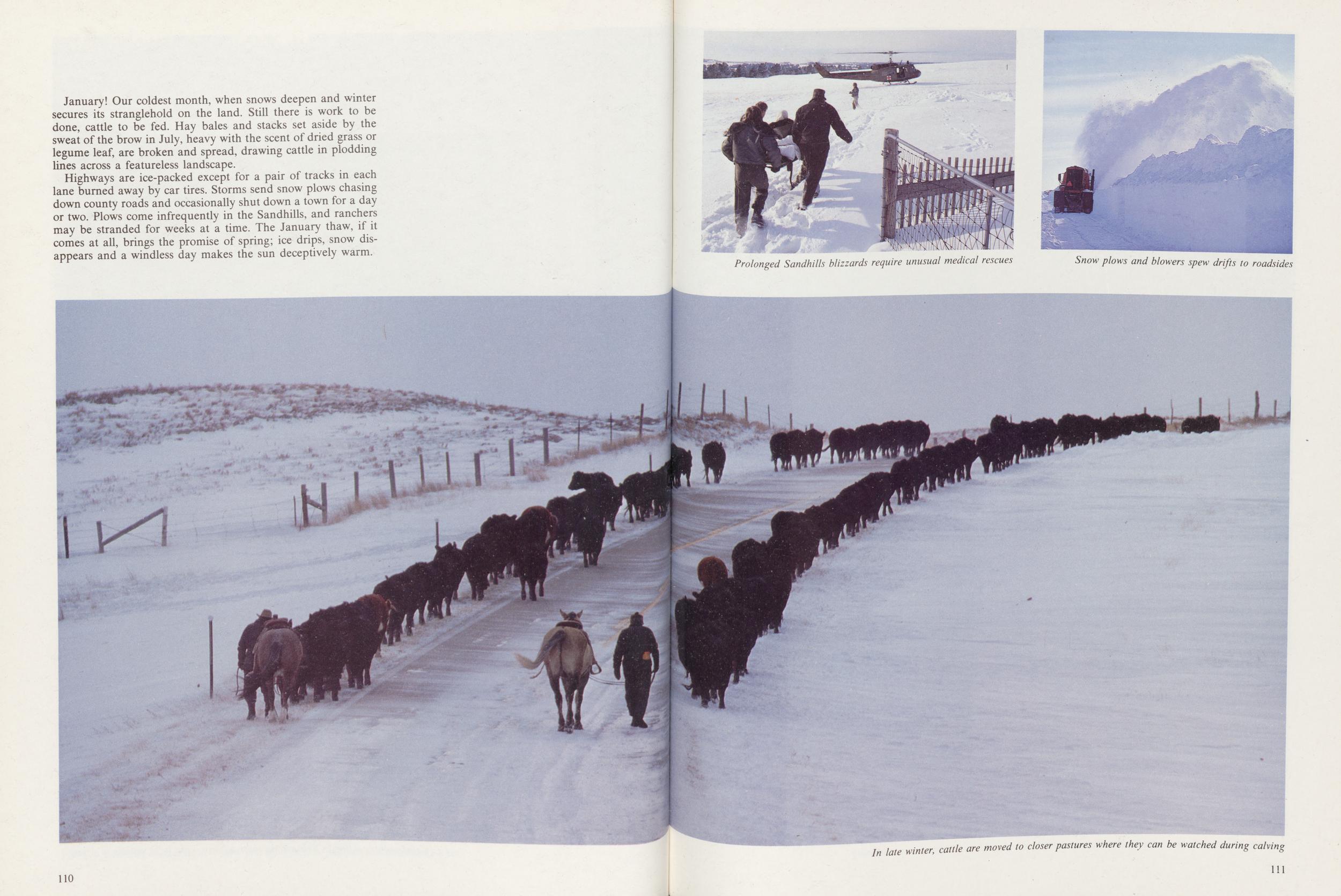
January! Our coldest month, when snows deepen and winter secures its stranglehold on the land. Still there is work to be done, cattle to be fed. Hay bales and stacks set aside by the sweat of the brow in July, heavy with the scent of dried grass or legume leaf, are broken and spread, drawing cattle in plodding lines across a featureless landscape.
Highways are ice-packed except for a pair of tracks in each lane burned away by car tires. Storms send snow plows chasing down county roads and occasionally shut down a town for a day or two. Plows come infrequently in the Sandhills, and ranchers may be stranded for weeks at a time. The January thaw, if it comes at all, brings the promise of spring; ice drips, snow disappears and a windless day makes the sun deceptively warm.
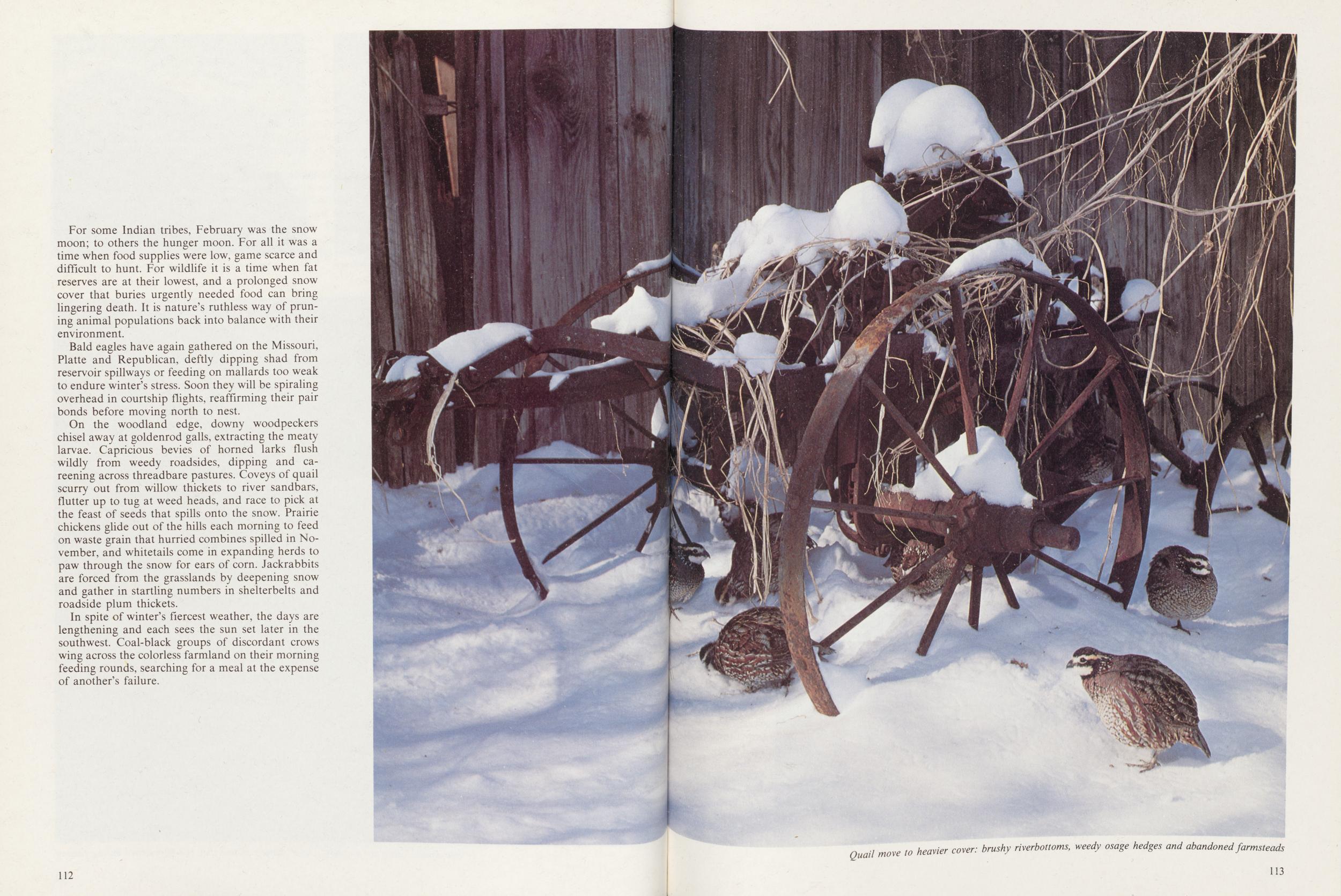
For some Indian tribes, February was the snow moon; to others the hunger moon. For all it was a time when food supplies were low, game scarce and difficult to hunt. For wildlife it is a time when fat reserves are at their lowest, and a prolonged snow cover that buries urgently needed food can bring lingering death. It is nature's ruthless way of pruning animal populations back into balance with their environment.
Bald eagles have again gathered on the Missouri, Platte and Republican, deftly dipping shad from reservoir spillways or feeding on mallards too weak to endure winter's stress. Soon they will be spiraling overhead in courtship flights, reaffirming their pair bonds before moving north to nest.
On the woodland edge, downy woodpeckers chisel away at goldenrod galls, extracting the meaty larvae. Capricious bevies of horned larks flush wildly from weedy roadsides, dipping and careening across threadbare pastures. Coveys of quail scurry out from willow thickets to river sandbars, flutter up to tug at weed heads, and race to pick at the feast of seeds that spills onto the snow. Prairie chickens glide out of the hills each morning to feed on waste grain that hurried combines spilled in November, and whitetails come in expanding herds to paw through the snow for ears of corn. Jackrabbits are forced from the grasslands by deepening snow and gather in startling numbers in shelterbelts and roadside plum thickets.
In spite of winter's fiercest weather, the days are lengthening and each sees the sun set later in the southwest. Coal-black groups of discordant crows wing across the colorless farmland on their morning feeding rounds, searching for a meal at the expense of another's failure.
112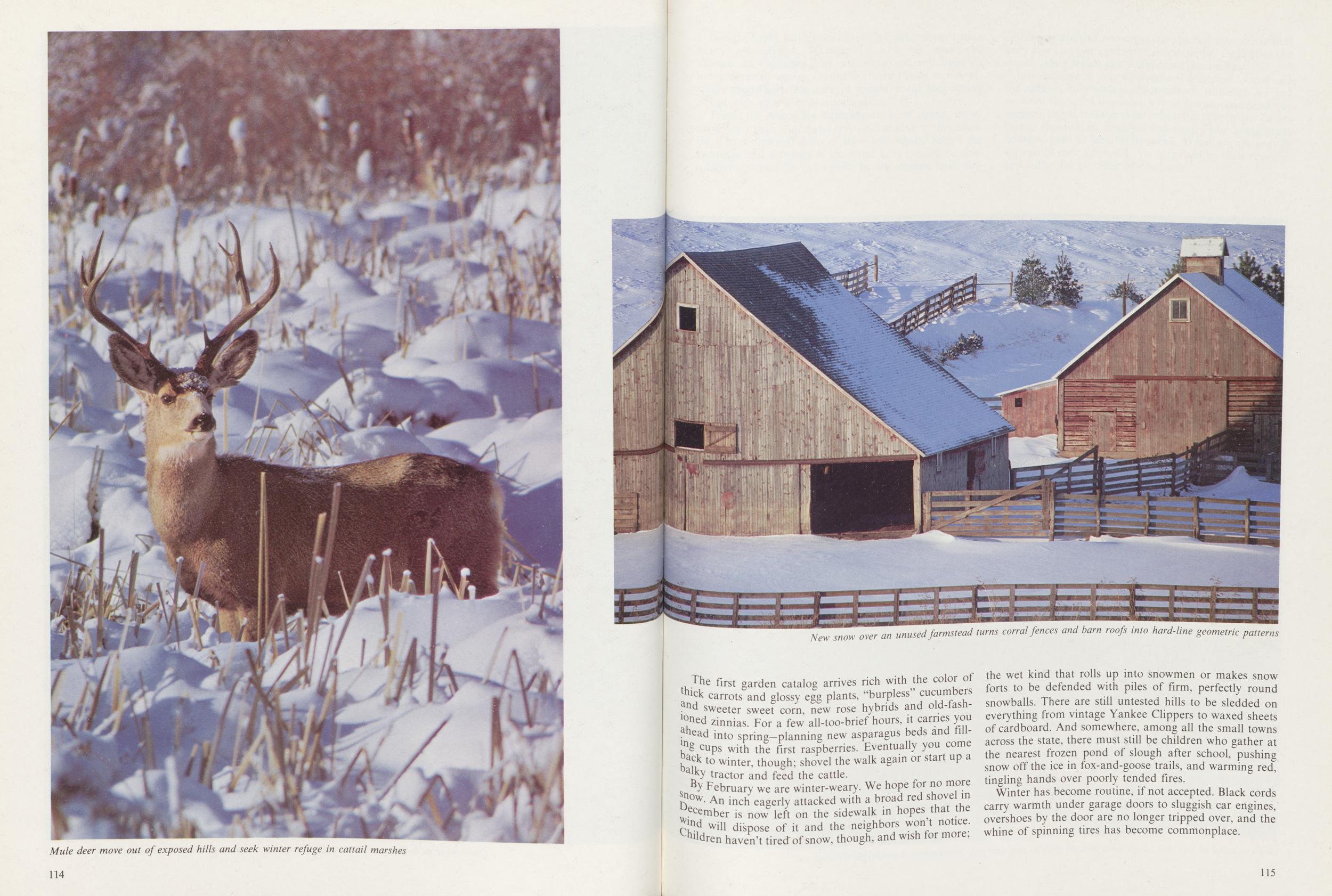
The first garden catalog arrives rich with the color of thick carrots and glossy egg plants, "burpless" cucumbers and sweeter sweet corn, new rose hybrids and old-iash-10uned zinnias. For a few all-too-brief hours, it carries you ahead into spring-planning new asparagus beds and tiling cups with the first raspberries. Eventually you come Jack to winter, though; shovel the walk again or start up a tractor and feed the cattle.
t B.v February we are winter-weary. We hope for no more An inch eagerly attacked with a broad red shovel in ember is now left on the sidewalk in hopes that the will dispose of it and the neighbors woirt notice, haven't tired of snow, though, and wish for more, the wet kind that rolls up into snowmen or makes snow forts to be defended with piles of firm, perfectly round snowballs. There are still untested hills to be sledded on everything from vintage Yankee Clippers to waxed sheets of cardboard. And somewhere, among all the small towns across the state, there must still be children who gather at the nearest frozen pond of slough after school, pushing snow off the ice in fox-and-goose trails, and warming red, tingling hands over poorly tended fires.
Winter has become routine, if not accepted. Black cords carry warmth under garage doors to sluggish car engines, overshoes by the door are no longer tripped over, and the whine of spinning tires has become commonplace.
115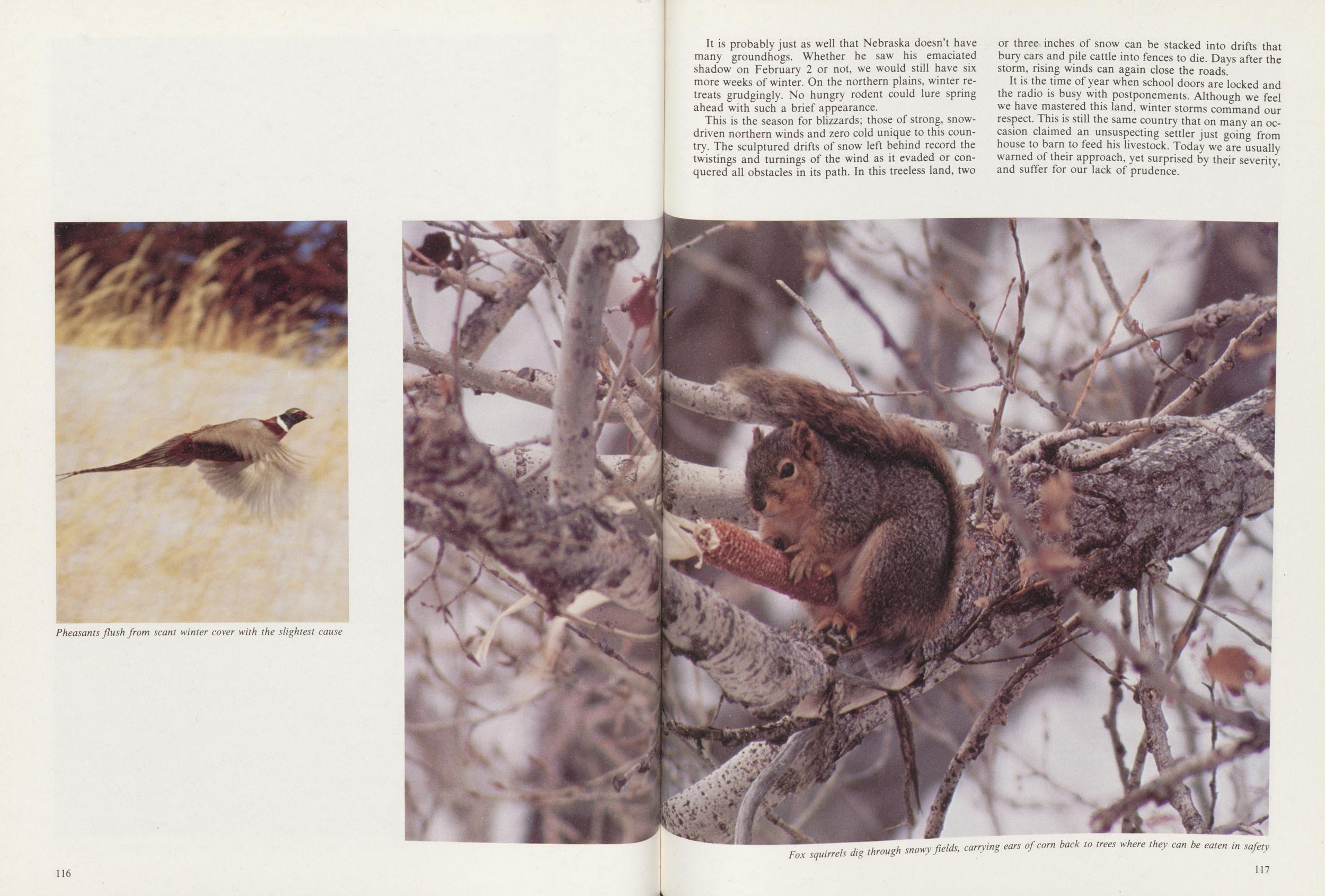
It is probably just as well that Nebraska doesn't have many groundhogs. Whether he saw his emaciated shadow on February 2 or not, we would still have six more weeks of winter. On the northern plains, winter retreats grudgingly. No hungry rodent could lure spring ahead with such a brief appearance.
This is the season for blizzards; those of strong, snowdriven northern winds and zero cold unique to this country. The sculptured drifts of snow left behind record the twistings and turnings of the wind as it evaded or conquered all obstacles in its path. In this treeless land, two or three inches of snow can be stacked into drifts that bury cars and pile cattle into fences to die. Days after the storm, rising winds can again close the roads.
It is the time of year when school doors are locked and the radio is busy with postponements. Although we feel we have mastered this land, winter storms command our respect. This is still the same country that on many an occasion claimed an unsuspecting settler just going from house to barn to feed his livestock. Today we are usually warned of their approach, yet surprised by their severity, and suffer for our lack of prudence.
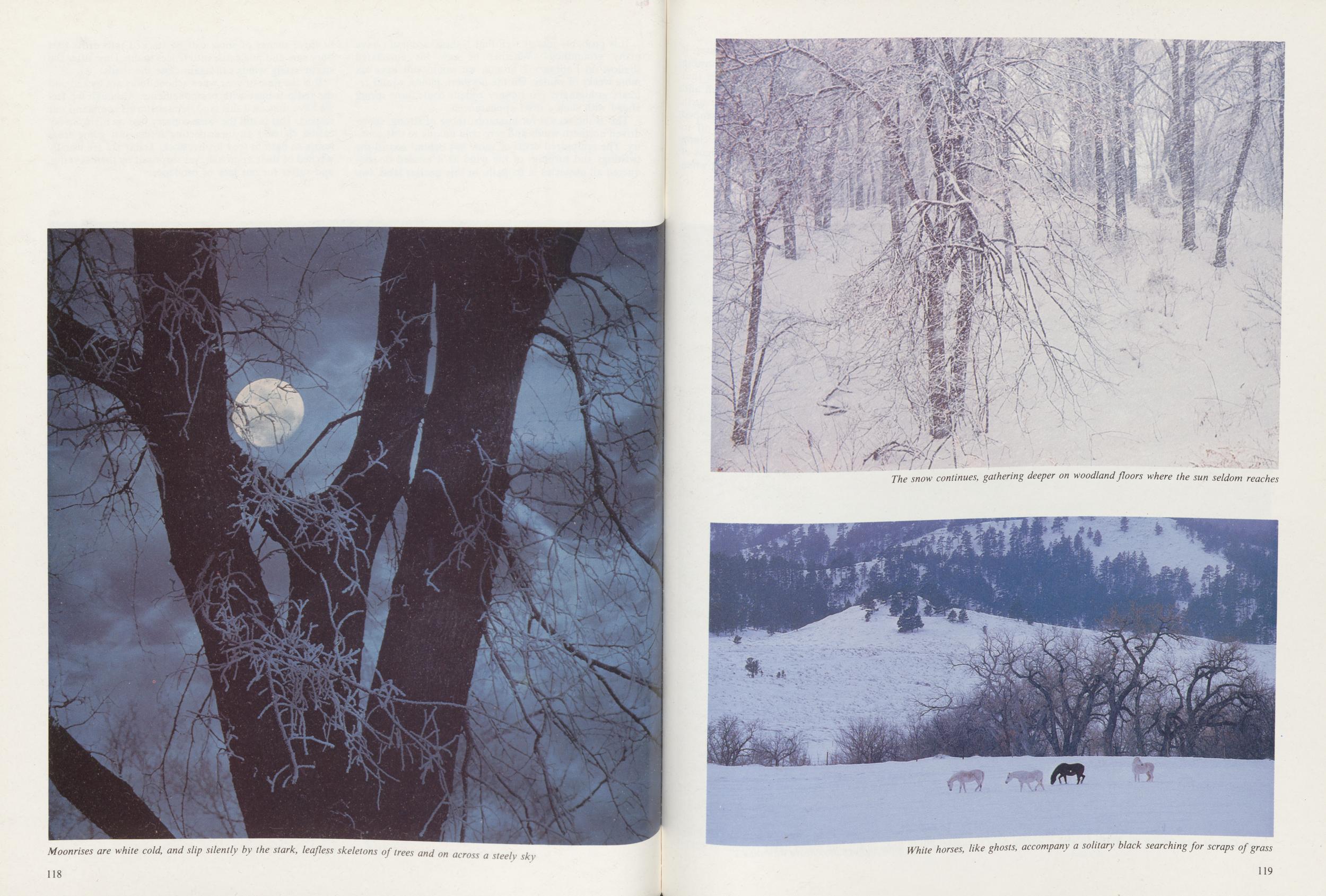
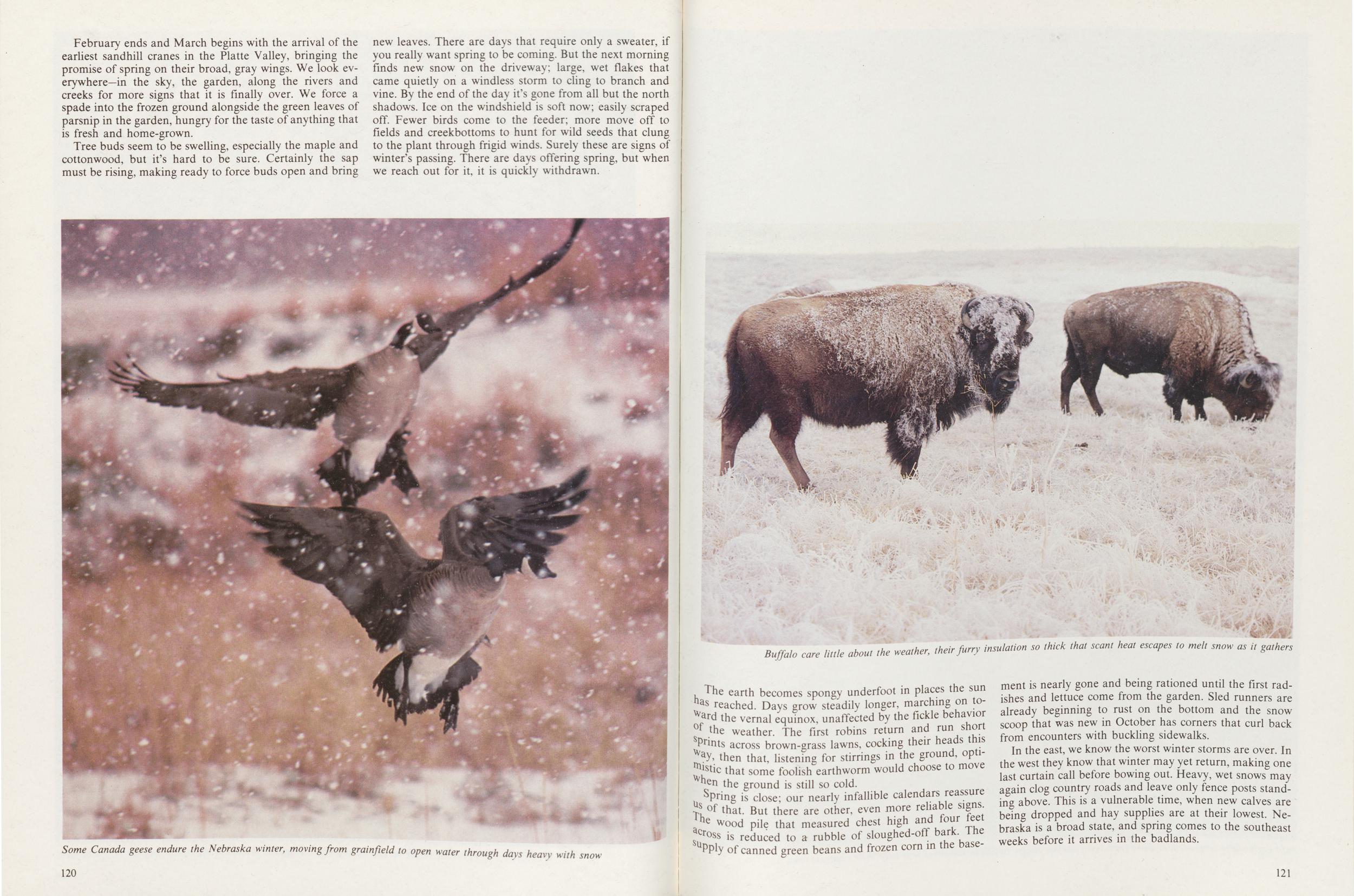
February ends and March begins with the arrival of the earliest sandhill cranes in the Platte Valley, bringing the promise of spring on their broad, gray wings. We look everywhere—in the sky, the garden, along the rivers and creeks for more signs that it is finally over. We force a spade into the frozen ground alongside the green leaves of parsnip in the garden, hungry for the taste of anything that is fresh and home-grown.
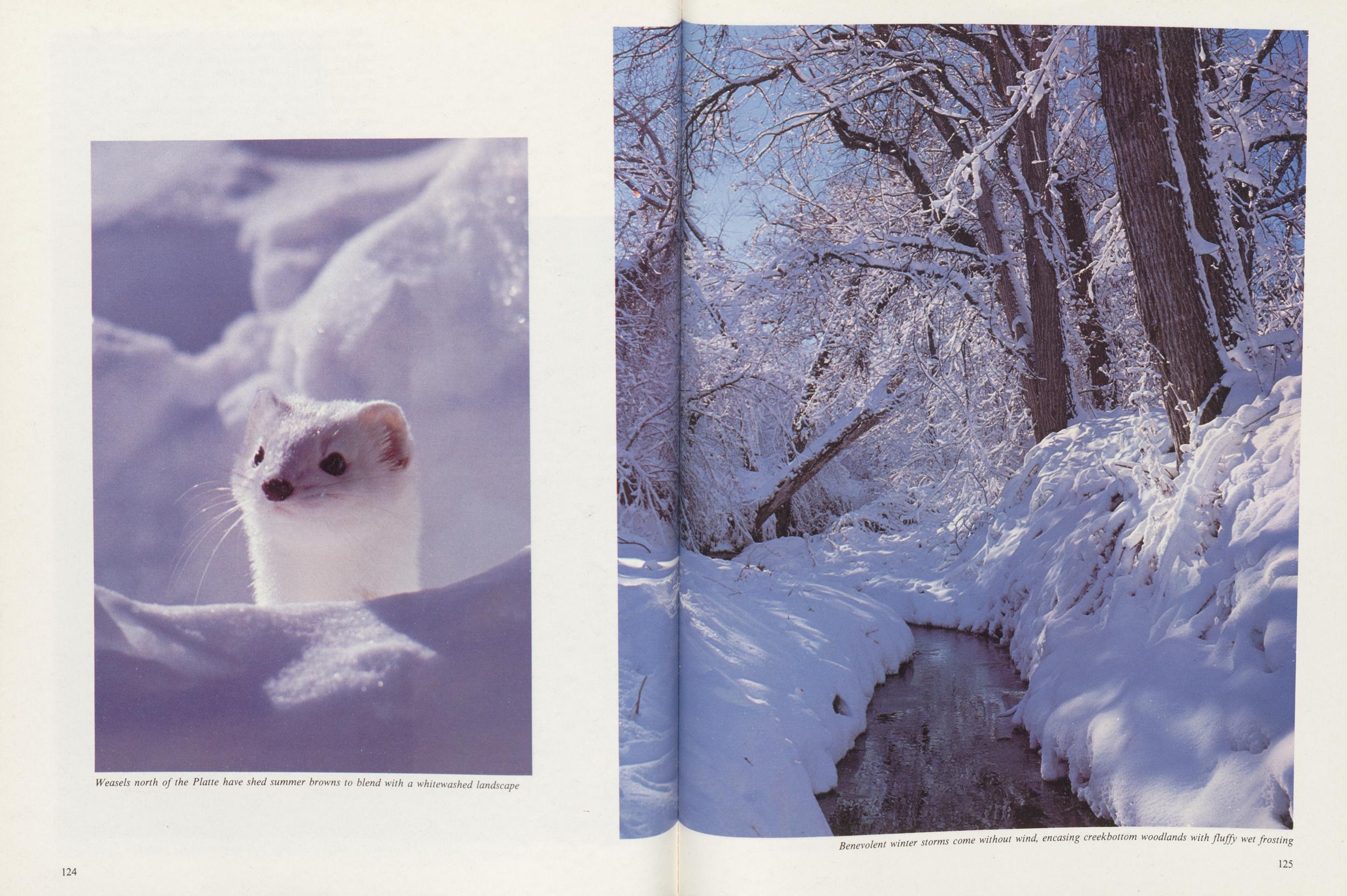
Tree buds seem to be swelling, especially the maple and cottonwood, but it's hard to be sure. Certainly the sap must be rising, making ready to force buds open and bring new leaves. There are days that require only a sweater, if you really want spring to be coming. But the next morning finds new snow on the driveway; large, wet flakes that came quietly on a windless storm to cling to branch and vine. By the end of the day it's gone from all but the north shadows. Ice on the windshield is soft now; easily scraped off. Fewer birds come to the feeder; more move off to fields and creekbottoms to hunt for wild seeds that clung to the plant through frigid winds. Surely these are signs of winter's passing. There are days offering spring, but when we reach out for it, it is quickly withdrawn.
The earth becomes spongy underfoot in places the sun has reached. Days grow steadily longer, marching on toward the vernal equinox, unaffected by the fickle behavior of the weather. The first robins return and run short sPrints across brown-grass lawns, cocking their heads this WaY, then that, listening for stirrings in the ground, optimistic that some foolish earthworm would choose to move hen the ground is still so cold.
Spring is close; our nearly infallible calendars reassure at. But there are other, even more reliable signs the wood pile that measured chest high and four leet Cross is reduced to a rubble of sloughed-off bark. 1 tie Supply of canned green beans and frozen corn in the basement is nearly gone and being rationed until the first radishes and lettuce come from the garden. Sled runners are already beginning to rust on the bottom and the snow scoop that was new in October has corners that curl back from encounters with buckling sidewalks.
In the east, we know the worst winter storms are over. In the west they know that winter may yet return, making one last curtain call before bowing out. Heavy, wet snows may again clog country roads and leave only fence posts standing above. This is a vulnerable time, when new calves are being dropped and hay supplies are at their lowest. Nebraska is a broad state, and spring comes to the southeast weeks before it arrives in the badlands.
121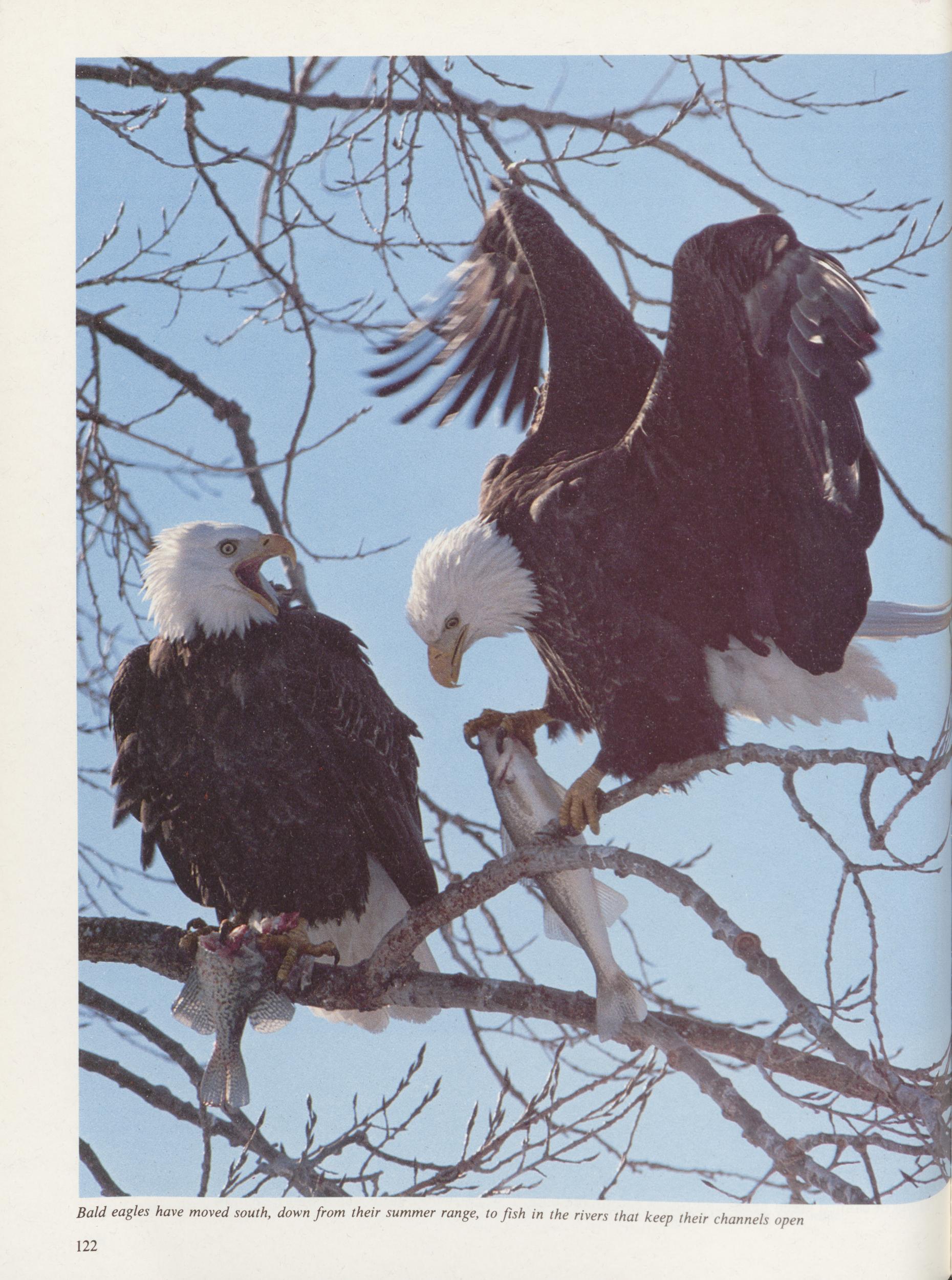
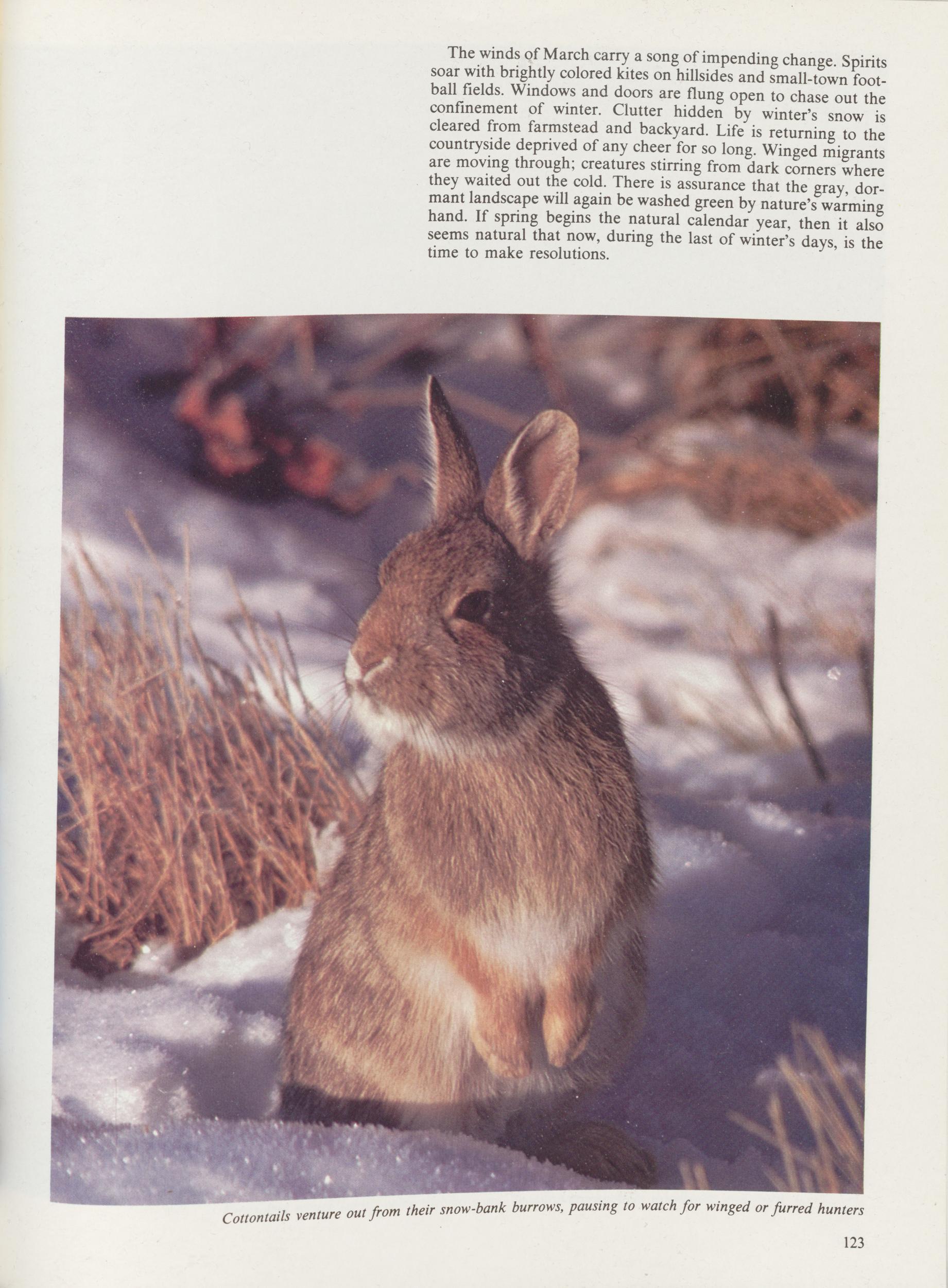
The winds of March carry a song of impending change. Spirits soar with brightly colored kites on hillsides and small-town football fields. Windows and doors are flung open to chase out the confinement of winter. Clutter hidden by winter's snow is cleared from farmstead and backyard. Life is returning to the countryside deprived of any cheer for so long. Winged migrants are moving through; creatures stirring from dark corners where they waited out the cold. There is assurance that the gray, dormant landscape will again be washed green by nature's warming hand. If spring begins the natural calendar year, then it also seems natural that now, during the last of winter's days, is the time to make resolutions.
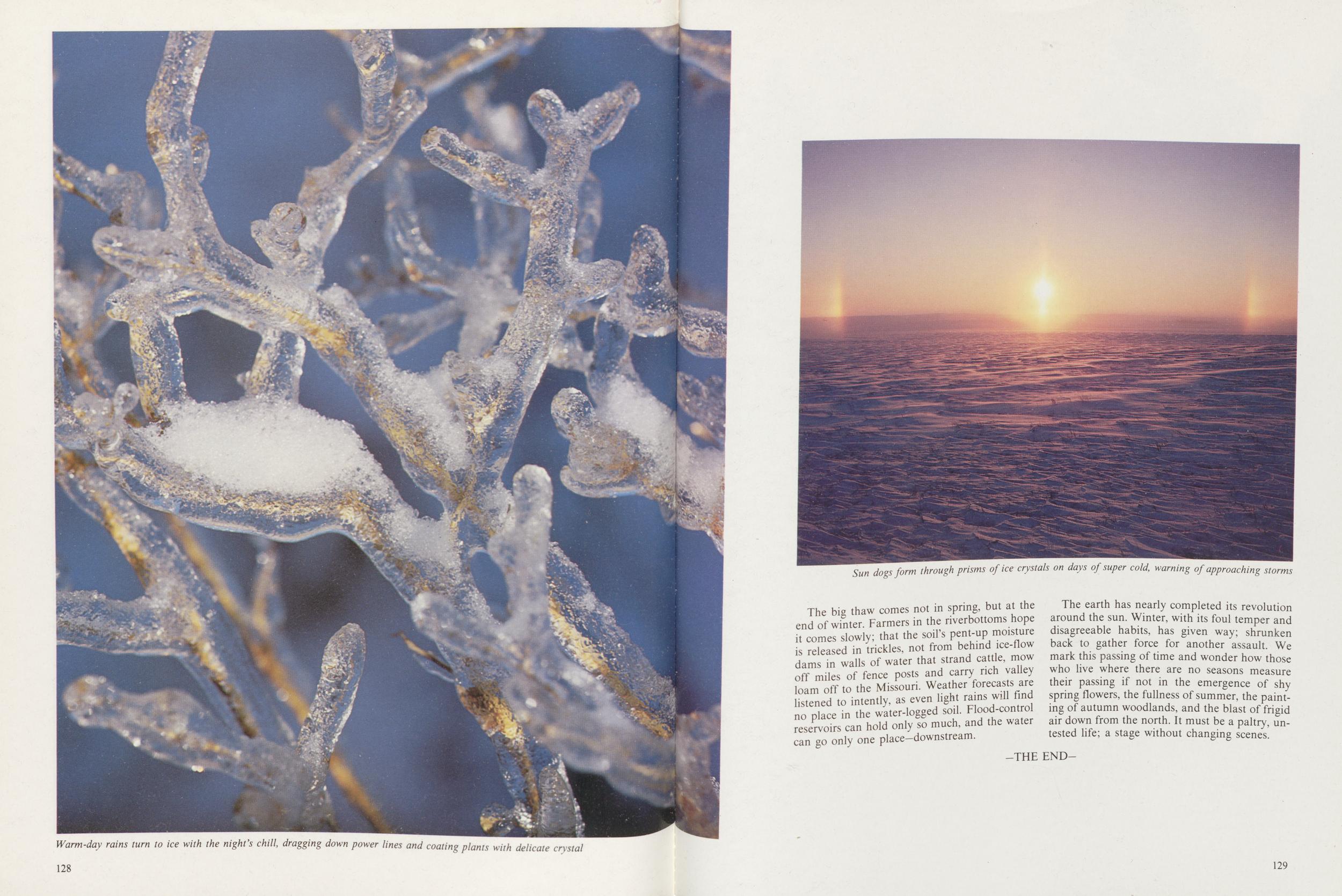
The big thaw comes not in spring, but at the end of winter. Farmers in the riverbottoms hope it comes slowly; that the soil's pent-up.moisture is released in trickles, not from behind ice-How dams in walls of water that strand cattle, mow off miles of fence posts and carry rich valley loam off to the Missouri. Weather forecasts are listened to intently, as even light rains will find no place in the water-logged sod. Food-com reservoirs can hold only so much, and the water can go only one place-downstream.
The earth has nearly completed its revolution around the sun. Winter, with its foul temper and disagreeable habits, has given way; shrunken back to gather force for another assault. We mark this passing of time and wonder how those who live where there are no seasons measure their passing if not in the emergence of shy spring flowers, the fullness of summer, the painting of autumn woodlands, and the blast of frigid air down from the north. It must be a paltry, untested life; a stage without changing scenes.
-THE END- 129
Position: 216 (34 views)