Volume 58, Issue 10, 1980
NEBRASKAland
OCTOBER 1980 · $1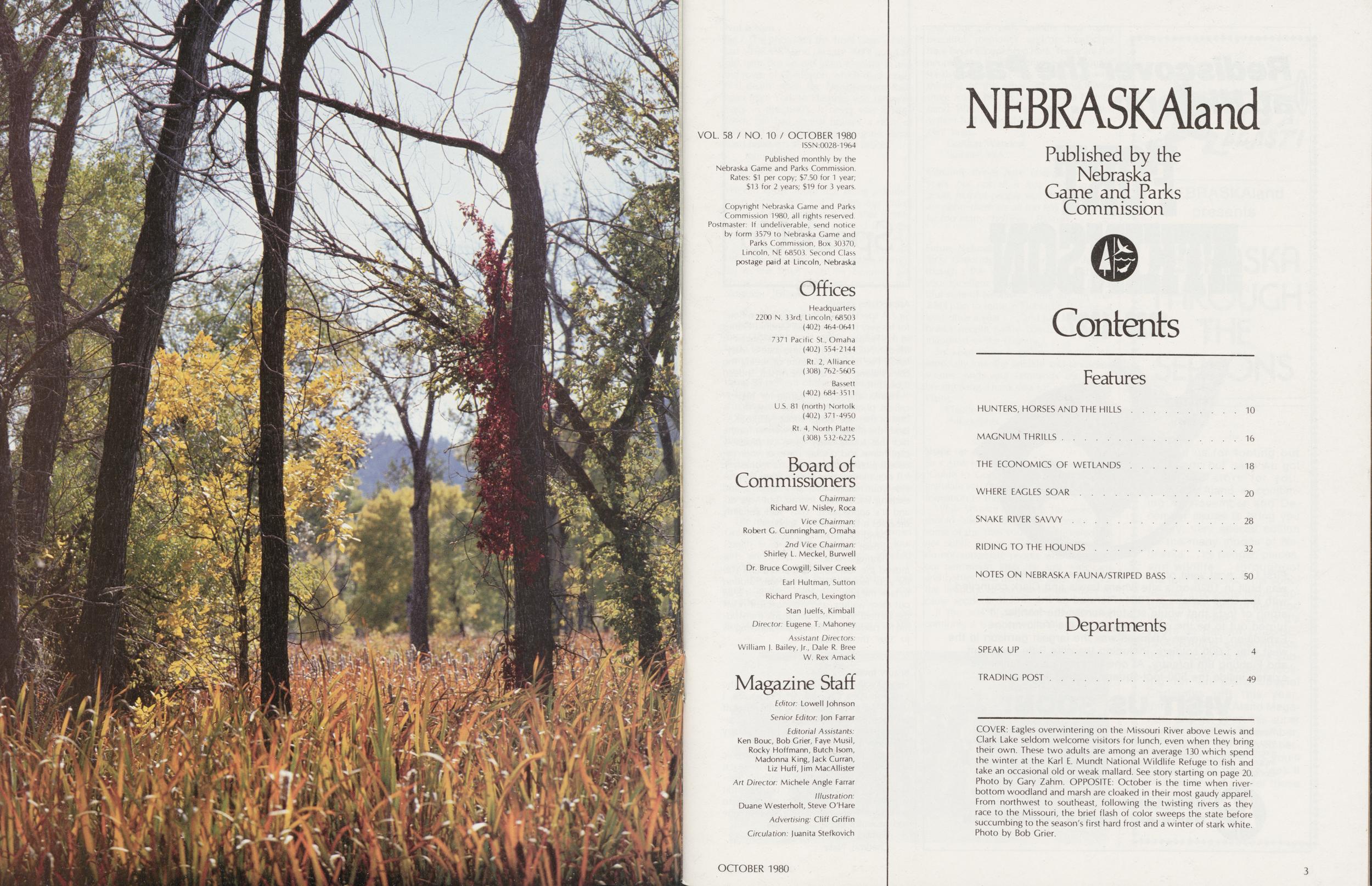
NEBRASKAland
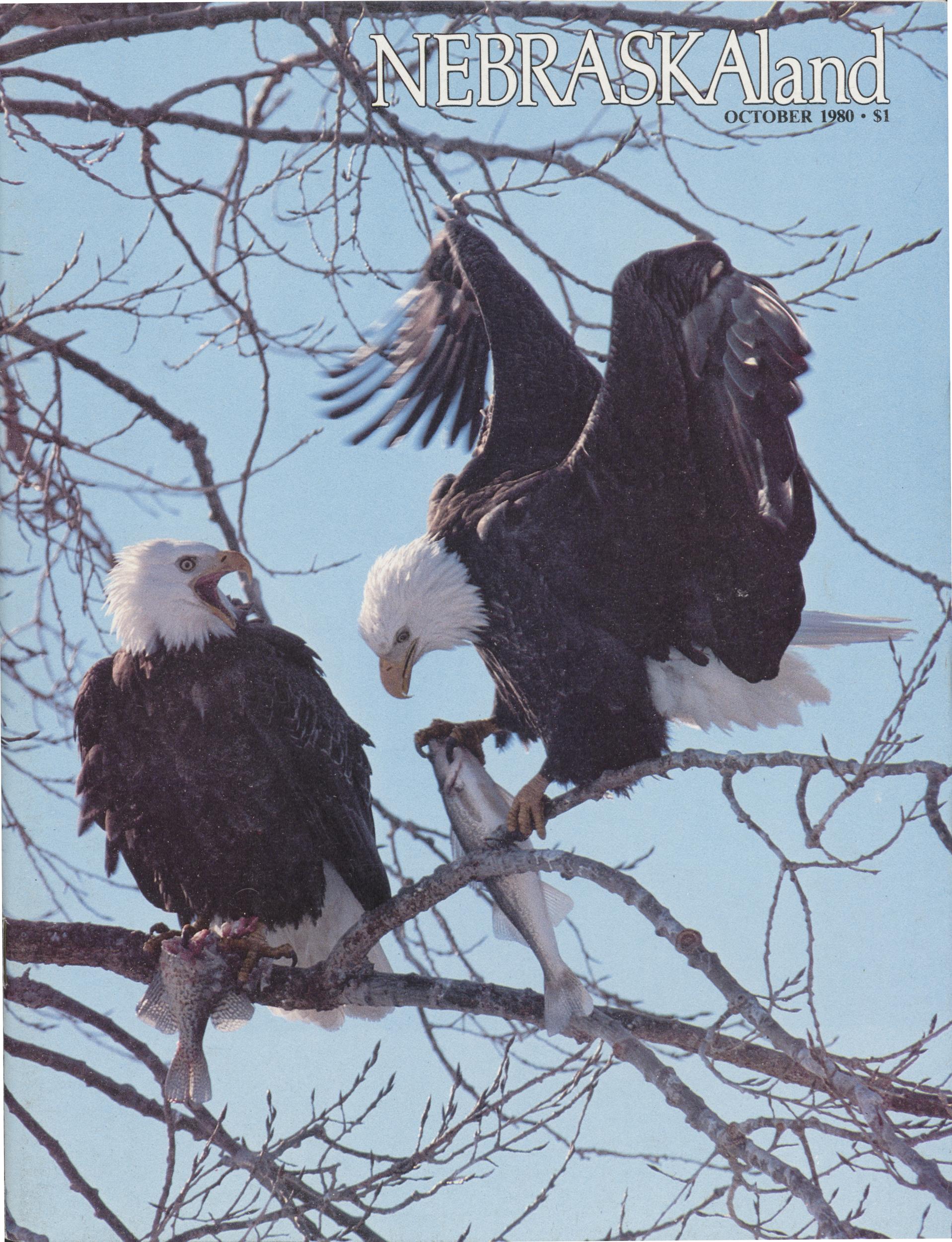
Published by the Nebraska Game and Parks Commission VOL. 58 / NO. 10 / OCTOBER 1980 ISSN :0028-1964 Published monthly by the Nebraska Game and Parks Commission. Rates: $1 per copy; $7.50 for 1 year; $13 for 2 years; $19 for 3 years. Copyright Nebraska Game and Parks Commission 1980, all rights reserved. Postmaster: If undeliverable, send notice by form 3579 to Nebraska Game and Parks Commission, Box 30370, Lincoln, NE 68503. Second Class postage paid at Lincoln, Nebraska Offices Headquarters 2200 N. 33rd, Lincoln, 68503 (402) 464-0641 7371 Pacific St., Omaha (402) 554-2144 Rt. 2, Alliance (308) 762-5605 Bassett (402) 684-3511 U.S. 81 (north) Norfolk (402) 371-4950 Rt. 4, North Platte (308) 5V2-6225 Board of Commissioners Chairman: Richard W. Nisley, Roca Vice Chairman: Robert G. Cunningham, Omaha 2nd Vice Chairman: Shirley L. Meckel, Burwell Dr. Bruce Cowgill, Silver Creek Earl Hultman, Sutton Richard Prasch, Lexington Stan luelfs, Kimball Director: Eugene T. Mahoney Assistant Directors: William ). Bailey, )r., Dale R Bree W. Rex Amack Magazine Staff Editor: Lowell Johnson Senior Editor: Jon Farrar Editorial Assistants: Ken Bouc, Bob Grier, Faye Musil, Rocky Hoffmann, Butch Isom, Madonna King, Jack Curran, Liz Huff, Jim MacAllister Art Director: Michele Angle Farrar Illustration: Duane Westerholt, Steve O'Hare Advertising: Cliff Griffin Circulation: Juanita Stefkovich Contents Features HUNTERS, HORSES AND THE HILLS 10 MAGNUM THRILLS 16 THE ECONOMICS OF WETLANDS 18 WHERE EAGLES SOAR 20 SNAKE RIVER SAVVY 28 RIDING TO THE HOUNDS. 32 NOTES ON NEBRASKA FAUNA/STRIPED BASS 50 Departments SPEAK UP TRADING POST COVER: Eagles overwintering on the Missouri River above Lewis and Clark Lake seldom welcome visitors for lunch, even when they bring their own. These two adults are among an average 130 which spend the winter at the Karl E. Mundt National Wildlife Refuge to fish and take an occasional old or weak mallard. See story starting on page 20. Photo by Gary Zahm. OPPOSITE: October is the time when riverbottom woodland and marsh are cloaked in their most gaudy apparel. From northwest to southeast, following the twisting rivers as they race to the Missouri, the brief flash of color sweeps the state before succumbing to the season's first hard frost and a winter of stark white. Photo by Bob Grier. 3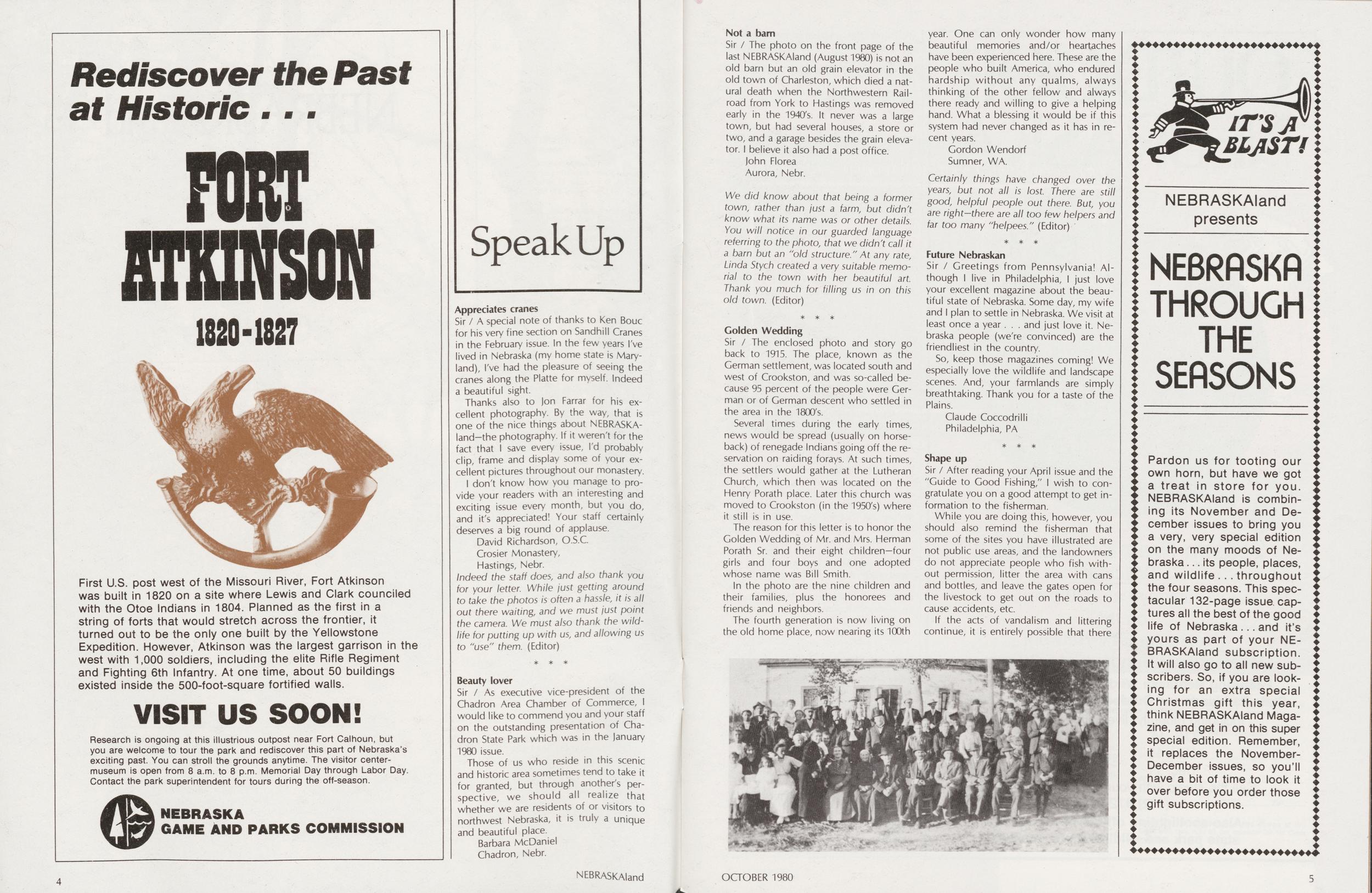
Speak Up
Appreciates cranesSir / A special note of thanks to Ken Bouc for his very fine section on Sandhill Cranes in the February issue. In the few years I've lived in Nebraska (my home state is Maryland), I've had the pleasure of seeing the cranes along the Platte for myself. Indeed a beautiful sight.
Thanks also to jon Farrar for his excellent photography. By the way, that is one of the nice things about NEBRASKAland-the photography. If it weren't for the fact that I save every issue, I'd probably clip, frame and display some of your excellent pictures throughout our monastery.
I don't know how you manage to provide your readers with an interesting and exciting issue every month, but you do, and it's appreciated! Your staff certainly deserves a big round of applause.
David Richardson, O.S.C Crosier Monastery, Hastings, Nebr.Indeed the staff does, and also thank you for your letter. While just getting around to take the photos is often a hassle, it is all out there waiting, and we must just point the camera. We must also thank the wild-life for putting up with us, and allowing us to "use" them. (Editor)
* * * Beauty loverThose of us who reside in this scenic and historic area sometimes tend to take it for granted, but through another's perspective, we should all realize that whether we are residents of or visitors to northwest Nebraska, it is truly a unique and beautiful place.
Barbara McDaniel Chadron, Nebr. 4 NEBRASKAland Not a barnSir / The photo on the front page of the last NEBRASKAland (August 1980) is not an old barn but an old grain elevator in the old town of Charleston, which died a natural death when the Northwestern Railroad from York to Hastings was removed early in the 1940's. It never was a large town, but had several houses, a store or two, and a garage besides the grain elevator. I believe it also had a post office.
John Florea Aurora, Nebr.We did know about that being a former town, rather than just a farm, but didn't know what its name was or other details. You will notice in our guarded language referring to the photo, that we didn't call it a barn but an "old structure." At any rate, Linda Stych created a very suitable memorial to the town with her beautiful art. Thank you much for filling us in on this old town. (Editor)
* * * Golden WeddingSir / The enclosed photo and story go back to 1915. The place, known as the German settlement, was located south and west of Crookston, and was so-called because 95 percent of the people were German or of German descent who settled in the area in the 1800/s.
Several times during the early times, news would be spread (usually on horseback) of renegade indians going off the reservation on raiding forays. At such times, the settlers would gather at the Lutheran Church, which then was located on the Henry Porath place. Later this church was moved to Crookston (in the 1950's) where it still is in use.
The reason for this letter is to honor the Golden Wedding of Mr. and Mrs. Herman Porath Sr. and their eight children-four girls and four boys and one adopted whose name was Bill Smith.
In the photo are the nine children and their families, plus the honorees and friends and neighbors.
The fourth generation is now living on the old home place, now nearing its 100th year. One can only wonder how many beautiful memories and/or heartaches have been experienced here. These are the people who built America, who endured hardship without any qualms, always thinking of the other fellow and always there ready and willing to give a helping hand. What a blessing it would be if this system had never changed as it has in recent years.
Gordon Wendorf Sumner, WA.Certainly things have changed over the years, but not all is lost. There are still good, helpful people out there. But, you are right—there are all too few helpers and far too many "helpees." (Editor)
* * *Sir / Greetings from Pennsylvania! Although I live in Philadelphia, I just love your excellent magazine about the beautiful state of Nebraska. Some day, my wife and I plan to settle in Nebraska. We visit at least once a year...and just love it. Nebraska people (we're convinced) are the friendliest in the country.
So, keep those magazines coming! We especially love the wildlife and landscape scenes. And, your farmlands are simply breathtaking. Thank you for a taste of the Plains.
Claude Coccodrilli Philadelphia, PA * * * It'S A BLAST! NEBRASKAland presents NEBRRSKA THROUGH THE SEPSONS Pardon us for tooting our own horn, but have we got a treat in store for you. NEBRASKAland is combining its November and December issues to bring you a very, very special edition on the many moods of Nebraska... its people, places, and wildlife...throughout the four seasons. This spectacular 132-page issue captures all the best of the good life of Nebraska... and it's yours as part of your NEBRASKAIand subscription. It will also go to all new subscribers. So, if you are looking for an extra special Christmas gift this year, think NEBRASKAland Magazine, and get in on this super special edition. Remember, it replaces the November-December issues, so you'll have a bit of time to look it over before you order those gift subscriptions. Shape upSir / After reading your April issue and the "Guide to Good Fishing," I wish to congratulate you on a good attempt to get information to the fisherman.
While you are doing this, however, you should also remind the fisherman that some of the sites you have illustrated are not public use areas, and the landowners do not appreciate people who fish without permission, litter the area with cans and bottles, and leave the gates open for the livestock to get out on the roads to cause accidents, etc.
If the acts of vandalism and littering continue, it is entirely possible that there will be no areas available for the fisherman or the hunter. Let's do what we can to reverse the present trend and obtain the best land use on these areas for everyone concerned.
Virgil Overbeck Fairbury, Nebr.You are absolutely right, and perhaps we do not stress enough that personal behavior is of the utmost importance, not only on public areas, but also on private. We attempt not to steer people to private areas, however, to avoid as much impact and ill will as possible. But, it never hurts to remind folks to behave. (Editor)
OCTOBER 1980 5 OUTDOOR
NEBRASKA
Season Premier October 2
Watch It!
Thursdays at 7:30 p.m.
on the
Nebraska ETV Network
Rebroadcast Sundays at 5:30 p.m.
Featuring Nebraska Wildlife, Scenic Wonders,
State Parklands and Outdoor Recreation at its Best!
Including monthly, live call-in programs:
Oct. 16 Jan. 8
Nov. 13 Feb. 5
Dec. 11 Mar. 5
Call the studio with your outdoor questions:
(402)472-3126
Also spotlighting off-the-beaten-track
state park and wildlife lands weekly!
* * *
Paper Chase
OUTDOOR
NEBRASKA
Season Premier October 2
Watch It!
Thursdays at 7:30 p.m.
on the
Nebraska ETV Network
Rebroadcast Sundays at 5:30 p.m.
Featuring Nebraska Wildlife, Scenic Wonders,
State Parklands and Outdoor Recreation at its Best!
Including monthly, live call-in programs:
Oct. 16 Jan. 8
Nov. 13 Feb. 5
Dec. 11 Mar. 5
Call the studio with your outdoor questions:
(402)472-3126
Also spotlighting off-the-beaten-track
state park and wildlife lands weekly!
* * *
Paper Chase
Gene Roncka called today and said his printer had to switch paper for his art prints, which were advertised in the September NEBRASKAland. The rag paper advertised caused too many problems in printing, so a high quality "paper" paper was substituted. He wanted buyers of his prints to be aware of the switch, however. (Editor)
* * * A Bartley BoosterSir / I could not believe anyone would not like the March issue (letter in June Speak Up), but I guess you can't please everyone. I'm sure not many were unhappy with it. All the pictures are beautiful, but my favorite is the State Capitol. I have a picture from an old NEBRASKAland Magazine in a frame. Anyway, I want you to know we enjoy your magazine and have never been disappointed in any issue. I don't look at the pictures for the artwork, either, but for the beauty I see and feel from each scene. Also, fond memories of having been at some of the places, or seeing other places. That is one reason we have always enjoyed your magazine—for the beautiful photos, as well as the interesting reading. Keep up the good work—you're pleasing more people than not.
Charlene Colson Bartley, Nebr./ guess it is just human nature that one detractor makes more of an impression than many boosters, but I hope you are right-about pleasing more people than not. I guess it is also much easier to criticize, so you are hereby triply or quadruply thanked for your kind letter. (Editor)
* * * NEBRASKAland Magazine invites all readers to submit their comments, suggestions, and gripes to Speak Up. Each month the magazine will publish as many letters as space permits. Pictures are welcome. NEBRASKAland reserves the right to edit and condense letters. -Editor. 6 NEBRASKAland
Hunters,Horses and the Hills
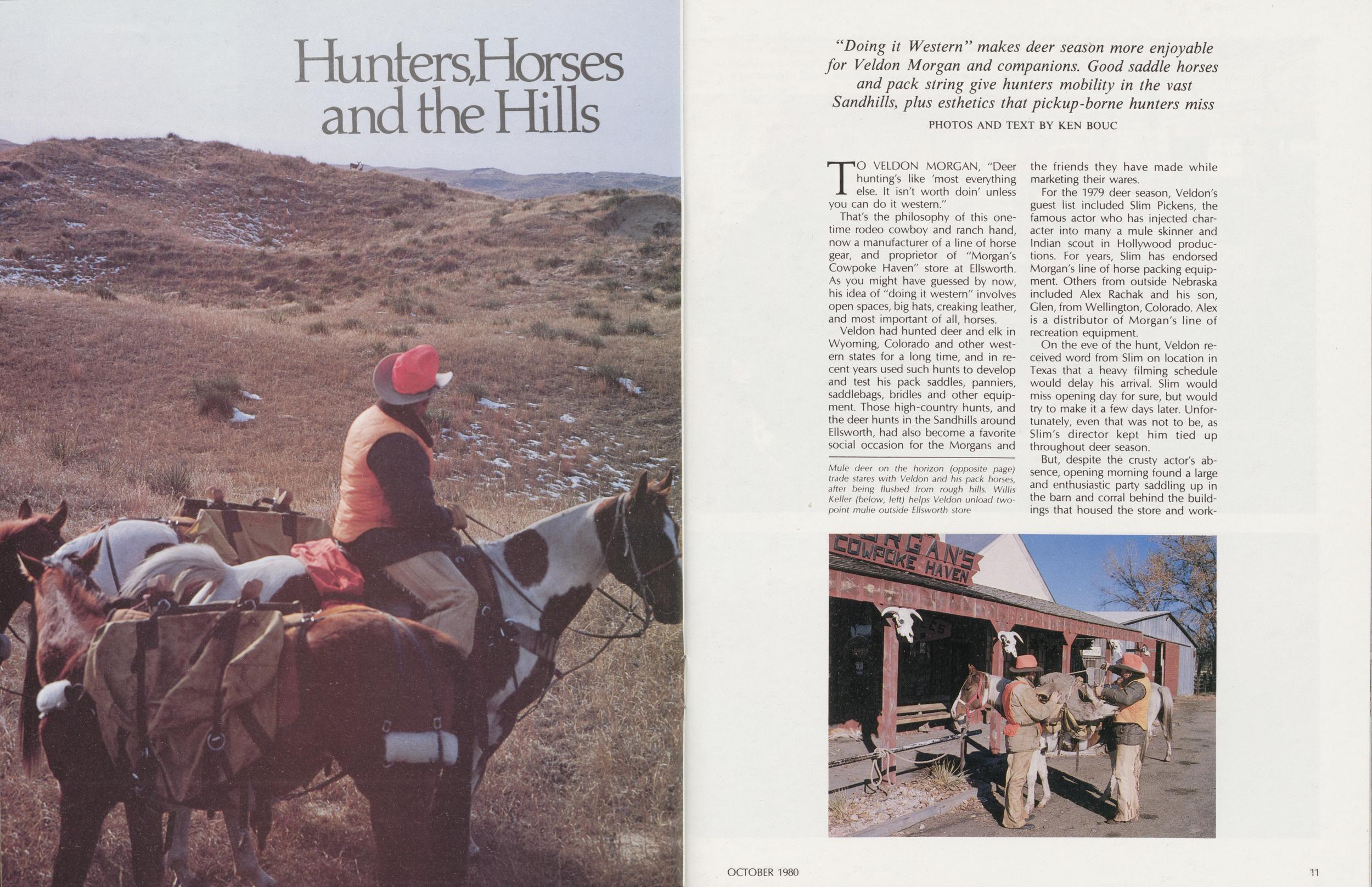
TO VELDON MORGAN, "Deer hunting's like 'most everything else. It isn't worth doin' unless you can do it western."
That's the philosophy of this one-time rodeo cowboy and ranch hand, now a manufacturer of a line of horse gear, and proprietor of "Morgan's Cowpoke Haven" store at Ellsworth. As you might have guessed by now, his idea of "doing it western" involves open spaces, big hats, creaking leather, and most important of all, horses.
Veldon had hunted deer and elk in Wyoming, Colorado and other western states for a long time, and in re- cent years used such hunts to develop and test his pack saddles, panniers, saddlebags, bridles and other equipment. Those high-country hunts, and the deer hunts in the Sandhills around Ellsworth, had also become a favorite social occasion for the Morgans and the friends they have made while marketing their wares.
For the 1979 deer season, Veldon's guest list included Slim Pickens, the famous actor who has injected character into many a mule skinner and Indian scout in Hollywood productions. For years, Slim has endorsed Morgan's line of horse packing equipment. Others from outside Nebraska included Alex Rachak and his son, Glen, from Wellington, Colorado. Alex is a distributor of Morgan's line of recreation equipment.
On the eve of the hunt, Veldon received word from Slim on location in Texas that a heavy filming schedule would delay his arrival. Slim would miss opening day for sure, but would try to make it a few days later. Unfortunately, even that was not to be, as Slim's director kept him tied up throughout deer season.
But, despite the crusty actor's absence, opening morning found a large
and enthusiastic party saddling up in
the barn and corral behind the buildings that housed the store and workshops.
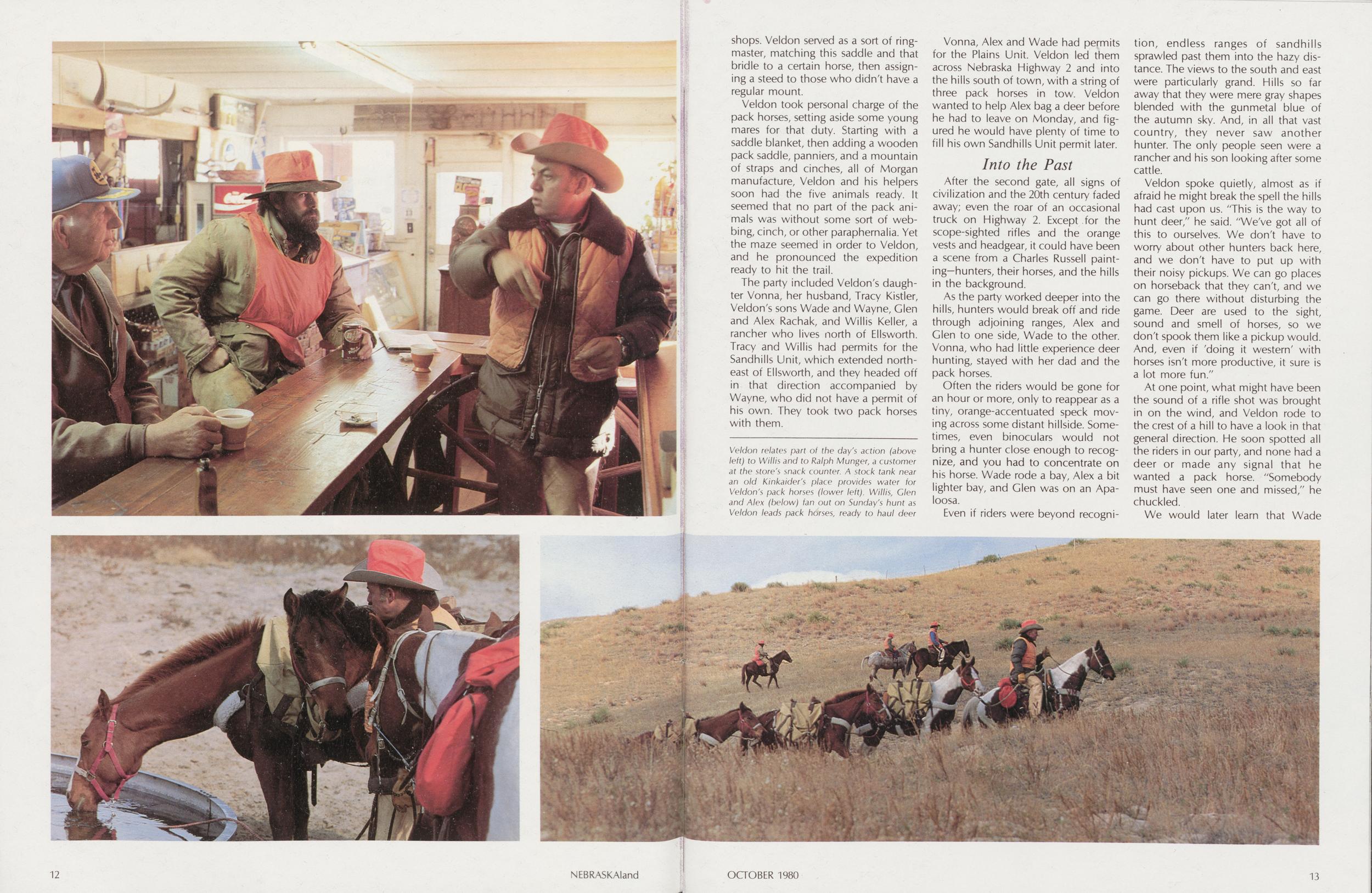
Veldon took personal charge of the pack horses, setting aside some young mares for that duty. Starting with a saddle blanket, then adding a wooden pack saddle, panniers, and a mountain of straps and cinches, all of Morgan manufacture, Veldon and his helpers soon had the five animals ready. It seemed that no part of the pack animals was without some sort of webbing, cinch, or other paraphernalia. Yet the maze seemed in order to Veldon, and he pronounced the expedition ready to hit the trail.
The party included Veldon's daughter Vonna, her husband, Tracy Kistler, Veldon's sons Wade and Wayne, Glen and Alex Rachak, and Willis Keller, a rancher who lives north of Ellsworth. Tracy and Willis had permits for the Sandhills Unit, which extended northeast of Ellsworth, and they headed off in that direction accompanied by Wayne, who did not have a permit of his own. They took two pack horses with them.
Vonna, Alex and Wade had permits for the Plains Unit. Veldon led them across Nebraska Highway 2 and into the hills south of town, with a string of three pack horses in tow. Veldon wanted to help Alex bag a deer before he had to leave on Monday, and figured he would have plenty of time to fill his own Sandhills Unit permit later.
After the second gate, all signs of civilization and the 20th century faded away; even the roar of an occasional truck on Highway 2. Except for the scope-sighted rifles and the orange vests and headgear, it could have been a scene from a Charles Russell painting—hunters, their horses, and the hills in the background.
As the party worked deeper into the hills, hunters would break off and ride through adjoining ranges, Alex and Glen to one side, Wade to the other. Vonna, who had little experience deer hunting, stayed with her dad and the pack horses.
Often the riders would be gone for an hour or more, only to reappear as a tiny, orange-accentuated speck moving across some distant hillside. Sometimes, even binoculars would not bring a hunter close enough to recognize, and you had to concentrate on his horse. Wade rode a bay, Alex a bit lighter bay, and Glen was on an Apaloosa.
Even if riders were beyond recognition, endless ranges of sandhills sprawled past them into the hazy distance. The views to the south and east were particularly grand. Hills so far away that they were mere gray shapes blended with the gunmetal blue of the autumn sky. And, in all that vast country, they never saw another hunter. The only people seen were a rancher and his son looking after some cattle.
Veldon spoke quietly, almost as if afraid he might break the spell the hills had cast upon us. "This is the way to hunt deer," he said. "We've got all of this to ourselves. We don't have to worry about other hunters back here, and we don't have to put up with their noisy pickups. We can go places on horseback that they can't, and we can go there without disturbing the game. Deer are used to the sight, sound and smell of horses, so we don't spook them like a pickup would. And, even if 'doing it western' with horses isn't more productive, it sure is a lot more fun."
At one point, what might have been the sound of a rifle shot was brought in on the wind, and Veldon rode to the crest of a hill to have a look in that general direction. He soon spotted all the riders in our party, and none had a deer or made any signal that he wanted a pack horse. "Somebody must have seen one and missed," he chuckled.
We would later learn that Wade was the guilty party. Only 17 at the time, and on just his second deer hunt, Wade had become flustered when he jumped a doe practically under his nose. "I just plain missed her," he said rather sheepishly. But, he would more than make up for it later in the season.
OCTOBER 1980 13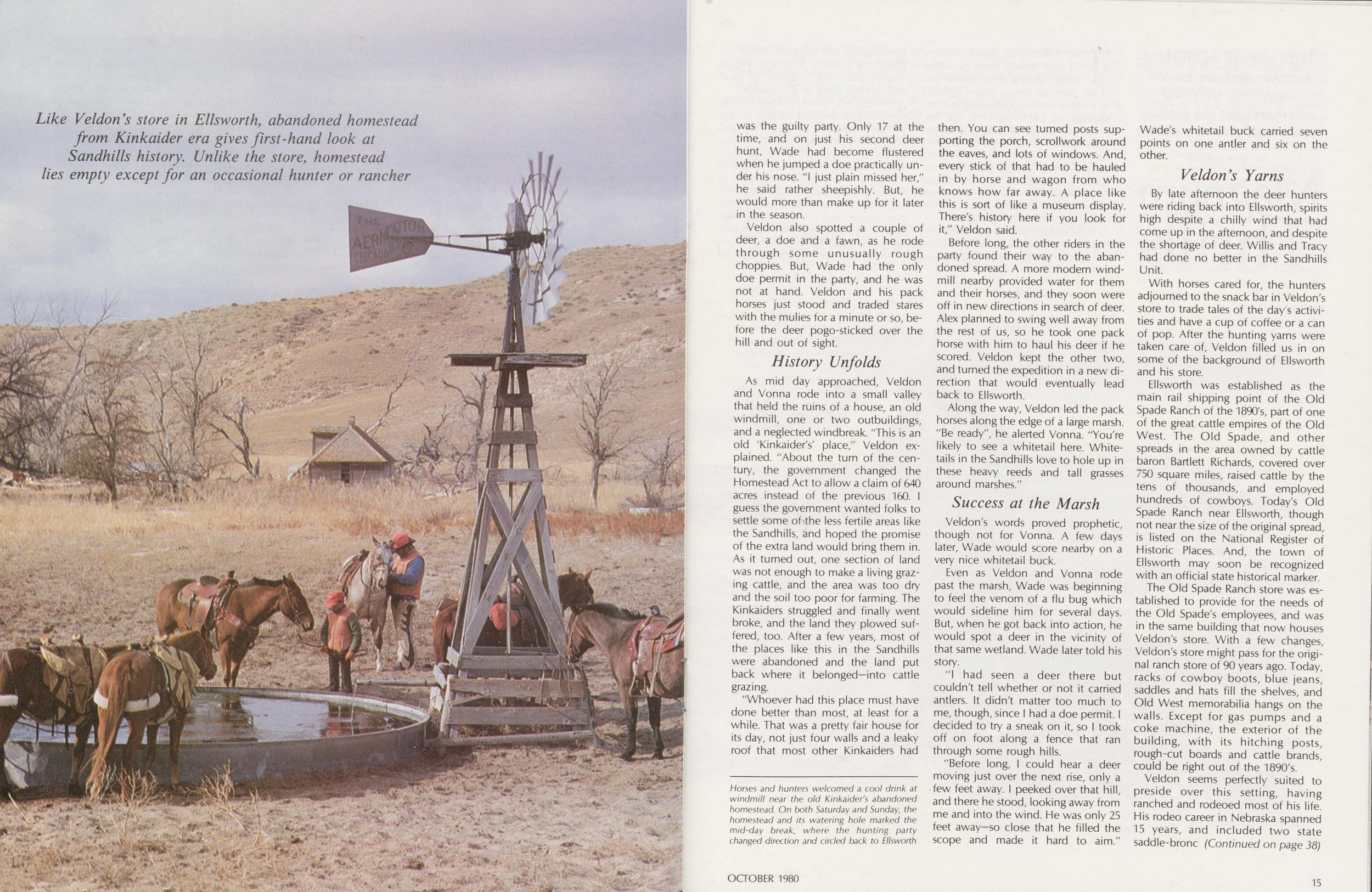
Veldon also spotted a couple of deer, a doe and a fawn, as he rode through some unusually rough choppies. But, Wade had the only doe permit in the party, and he was not at hand. Veldon and his pack horses just stood and traded stares with the mulies for a minute or so, before the deer pogo-sticked over the hill and out of sight.
History UnfoldsAs mid day approached, Veldon and Vonna rode into a small valley that held the ruins of a house, an old windmill, one or two outbuildings, and a neglected windbreak. "This is an old 'Kinkaider's' place," Veldon explained. "About the turn of the century, the government changed the Homestead Act to allow a claim of 640 acres instead of the previous 160. I guess the government wanted folks to settle some of the less fertile areas like the Sandhills, and hoped the promise of the extra land would bring them in. As it turned out, one section of land was not enough to make a living grazing cattle, and the area was too dry and the soil too poor for farming. The Kinkaiders struggled and finally went broke, and the land they plowed suffered, too. After a few years, most of the places like this in the Sandhills were abandoned and the land put back where it belonged—into cattle grazing.
"Whoever had this place must have done better than most, at least for a while. That was a pretty fair house for its day, not just four walls and a leaky roof that most other Kinkaiders had then. You can see turned posts supporting the porch, scrollwork around the eaves, and lots of windows. And, every stick of that had to be hauled in by horse and wagon from who knows how far away. A place like this is sort of like a museum display. There's history here if you look for it," Veldon said.
Before long, the other riders in the party found their way to the abandoned spread. A more modern windmill nearby provided water for them and their horses, and they soon were off in new directions in search of deer. Alex planned to swing well away from the rest of us, so he took one pack horse with him to haul his deer if he scored. Veldon kept the other two, and turned the expedition in a new direction that would eventually lead back to Ellsworth.
Along the way, Veldon led the pack horses along the edge of a large marsh. "Be ready", he alerted Vonna. "You're likely to see a whitetail here. White-tails in the Sandhills love to hole up in these heavy reeds and tall grasses around marshes."
Success at the MarshVeldon's words proved prophetic, though not for Vonna. A few days later, Wade would score nearby on a very nice whitetail buck.
Even as Veldon and Vonna rode past the marsh, Wade was beginning to feel the venom of a flu bug which would sideline him for several days. But, when he got back into action, he would spot a deer in the vicinity of that same wetland. Wade later told his story.
"I had seen a deer there but couldn't tell whether or not it carried antlers. It didn't matter too much to me, though, since I had a doe permit. I decided to try a sneak on it, so I took off on foot along a fence that ran through some rough hills.
"Before long, I could hear a deer moving just over the next rise, only a few feet away. I peeked over that hill, and there he stood, looking away from me and into the wind. He was only 25 feet away—so close that he filled the scope and made it hard to aim." Wade's whitetail buck carried seven points on one antler and six on the other.
Veldon's YarnsBy late afternoon the deer hunters were riding back into Ellsworth, spirits high despite a chilly wind that had come up in the afternoon, and despite the shortage of deer. Willis and Tracy had done no better in the Sandhills Unit.
With horses cared for, the hunters adjourned to the snack bar in Veldon's store to trade tales of the day s activities and have a cup of coffee or a can of pop. After the hunting yarns were taken care of, Veldon filled us in on some of the background of Ellsworth and his store.
Ellsworth was established as the main rail shipping point of the Old Spade Ranch of the 1890's, part of one of the great cattle empires of the Old West. The Old Spade, and other spreads in the area owned by cattle baron Bartlett Richards, covered over 750 square miles, raised cattle by the tens of thousands, and employed hundreds of cowboys. Today's Old Spade Ranch near Ellsworth, though not near the size of the original spread, is listed on the National Register of Historic Places. And, the town of Ellsworth may soon be recognized with an official state historical marker.
The Old Spade Ranch store was established to provide for the needs of the Old Spade's employees, and was in the same building that now houses Veldon's store. With a few changes, Veldon's store might pass for the original ranch store of 90 years ago. Today, racks of cowboy boots, blue jeans, saddles and hats fill the shelves, and Old West memorabilia hangs on the walls. Except for gas pumps and a coke machine, the exterior of the building, with its hitching posts, rough-cut boards and cattle brands, could be right out of the 1890's.
Veldon seems perfectly suited to preside over this setting, having ranched and rodeoed most of his life. His rodeo career in Nebraska spanned 15 years, and included two state saddle-bronc (Continued on page 38)
OCTOBER 1980 15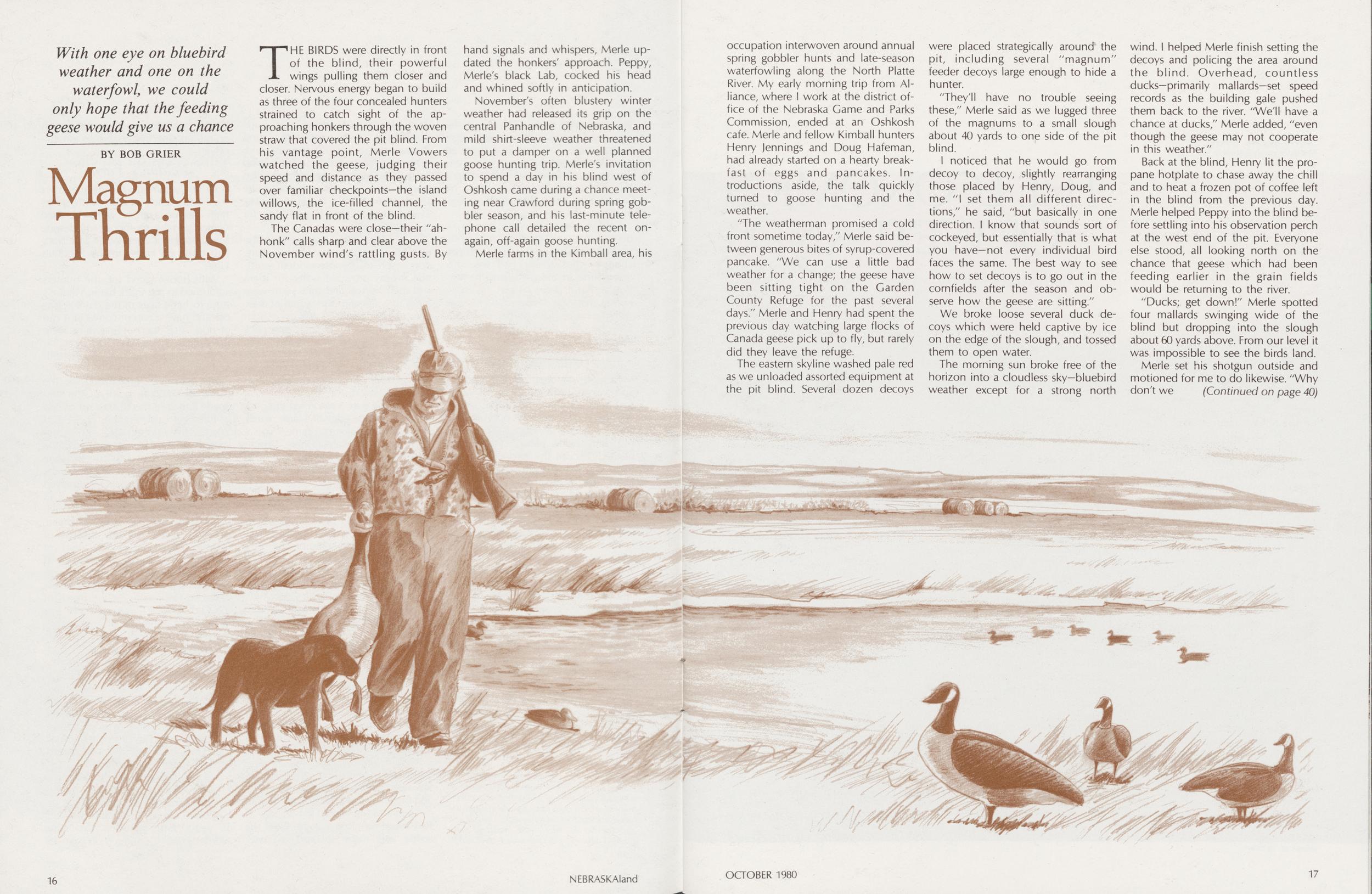
Magnum Thrills
With one eye on bluebird weather and one on the waterfowl, we could only hope that the feeding geese would give us a chance BY BOB GRIERTHE BIRDS were directly in front of the blind, their powerful wings pulling them closer and closer. Nervous energy began to build as three of the four concealed hunters strained to catch sight of the approaching honkers through the woven straw that covered the pit blind. From his vantage point, Merle Vowers watched the geese, judging their speed and distance as they passed over familiar checkpoints—the island willows, the ice-filled channel, the sandy flat in front of the blind.
The Canadas were close—their "ahhonk" calls sharp and clear above the November wind's rattling gusts. By hand signals and whispers, Merle updated the honkers' approach. Peppy, Merle's black Lab, cocked his head and whined softly in anticipation.
November's often blustery winter weather had released its grip on the central Panhandle of Nebraska, and mild shirt-sleeve weather threatened to put a damper on a well planned goose hunting trip. Merle's invitation to spend a day in his blind west of Oshkosh came during a chance meeting near Crawford during spring gobbler season, and his last-minute telephone call detailed the recent on-again, off-again goose hunting.
Merle farms in the Kimball area, his 16 NEBRASKAland occupation interwoven around annual spring gobbler hunts and late-season waterfowling along the North Platte River. My early morning trip from Alliance, where I work at the district office of the Nebraska Game and Parks Commission, ended at an Oshkosh cafe. Merle and fellow Kimball hunters Henry Jennings and Doug Hafeman, had already started on a hearty breakfast of eggs and pancakes. Introductions aside, the talk quickly turned to goose hunting and the weather.
"The weatherman promised a cold front sometime today," Merle said between generous bites of syrup-covered pancake. "We can use a little bad weather for a change; the geese have been sitting tight on the Garden County Refuge for the past several days." Merle and Henry had spent the previous day watching large flocks of Canada geese pick up to fly, but rarely did they leave the refuge.
The eastern skyline washed pale red as we unloaded assorted equipment at the pit blind. Several dozen decoys were placed strategically around the pit, including several "magnum" feeder decoys large enough to hide a hunter.
"They'll have no trouble seeing these," Merle said as we lugged three of the magnums to a small slough about 40 yards to one side of the pit blind.
I noticed that he would go from decoy to decoy, slightly rearranging those placed by Henry, Doug, and me. "I set them all different directions," he said, "but basically in one direction. I know that sounds sort of cockeyed, but essentially that is what you have—not every individual bird faces the same. The best way to see how to set decoys is to go out in the cornfields after the season and observe how the geese are sitting."
We broke loose several duck decoys which were held captive by ice on the edge of the slough, and tossed them to open water.
The morning sun broke free of the horizon into a cloudless sky—bluebird weather except for a strong north wind. I helped Merle finish setting the decoys and policing the area around the blind. Overhead, countless ducks—primarily mallards—set speed records as the building gale pushed them back to the river. "We'll have a chance at ducks," Merle added, "even though the geese may not cooperate in this weather."
Back at the blind, Henry lit the propane hotplate to chase away the chill and to heat a frozen pot of coffee left in the blind from the previous day. Merle helped Peppy into the blind before settling into his observation perch at the west end of the pit. Everyone else stood, all looking north on the chance that geese which had been feeding earlier in the grain fields would be returning to the river.
"Ducks; get down!" Merle spotted four mallards swinging wide of the blind but dropping into the slough about 60 yards above. From our level it was impossible to see the birds land.
Merle set his shotgun outside and motioned for me to do likewise. "Why don't we (Continued on page 40)
OCTOBER 1980 17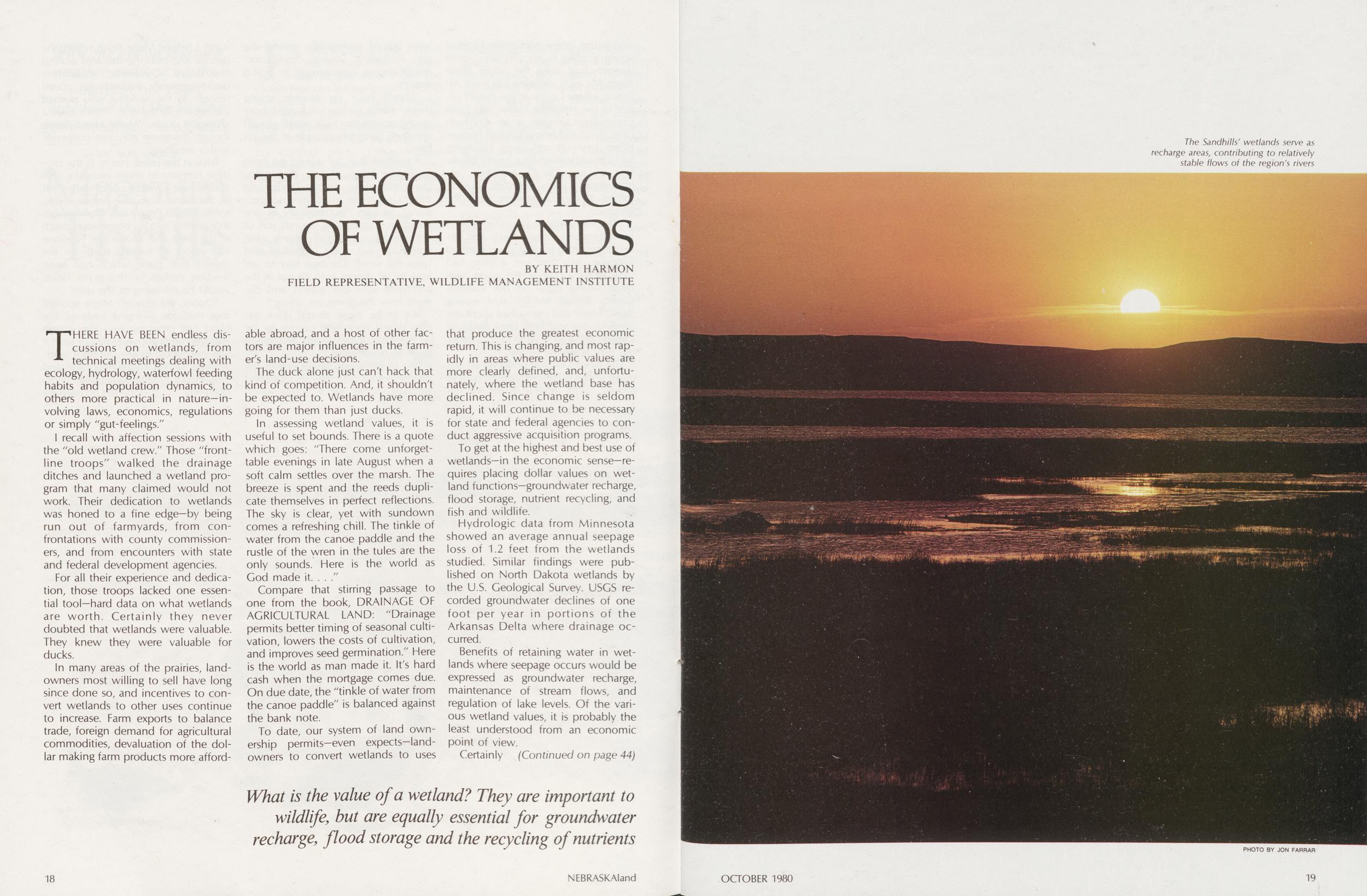
THE ECONOMICS OF WETLANDS
BY KEITH HARMON FIELD REPRESENTATIVE, WILDLIFE MANAGEMENT INSTITUTETHERE HAVE BEEN endless discussions on wetlands, from technical meetings dealing with ecology, hydrology, waterfowl feeding habits and population dynamics, to others more practical in nature—involving laws, economics, regulations or simply "gut-feelings."
I recall with affection sessions with the "old wetland crew." Those "frontline troops" walked the drainage ditches and launched a wetland program that many claimed would not work. Their dedication to wetlands was honed to a fine edge—by being run out of farmyards, from confrontations with county commissioners, and from encounters with state and federal development agencies.
For all their experience and dedication, those troops lacked one essential tool—hard data on what wetlands are worth. Certainly they never doubted that wetlands were valuable. They knew they were valuable for ducks.
In many areas of the prairies, landowners most willing to sell have long since done so, and incentives to convert wetlands to other uses continue to increase. Farm exports to balance trade, foreign demand for agricultural commodities, devaluation of the dollar making farm products more affordable abroad, and a host of other factors are major influences in the farmer's land-use decisions.
The duck alone just can't hack that kind of competition. And, it shouldn't be expected to. Wetlands have more going for them than just ducks.
In assessing wetland values, it is useful to set bounds. There is a quote which goes: "There come unforgettable evenings in late August when a soft calm settles over the marsh. The breeze is spent and the reeds duplicate themselves in perfect reflections. The sky is clear, yet with sundown comes a refreshing chill. The tinkle of water from the canoe paddle and the rustle of the wren in the tules are the only sounds. Here is the world as God made it...."
Compare that stirring passage to one from the book, DRAINAGE OF AGRICULTURAL LAND: "Drainage permits better timing of seasonal cultivation, lowers the costs of cultivation, and improves seed germination." Here is the world as man made it. It's hard cash when the mortgage comes due. On due date, the "tinkle of water from the canoe paddle" is balanced against the bank note.
To date, our system of land ownership permits-even expects-landowners to convert wetlands to uses that produce the greatest economic return. This is changing, and most rapidly in areas where public values are more clearly defined, and, unfortunately, where the wetland base has declined. Since change is seldom rapid, it will continue to be necessary for state and federal agencies to conduct aggressive acquisition programs.
To get at the highest and best use of wetlands—in the economic sense—requires placing dollar values on wetland functions-groundwater recharge, flood storage, nutrient recycling, and fish and wildlife.
Hydrologic data from Minnesota showed an average annual seepage loss of 1.2 feet from the wetlands studied. Similar findings were published on North Dakota wetlands by the U.S. Geological Survey. USGS recorded groundwater declines of one foot per year in portions of the Arkansas Delta where drainage occurred.
Benefits of retaining water in wetlands where seepage occurs would be expressed as groundwater recharge, maintenance of stream flows, and regulation of lake levels. Of the various wetland values, it is probably the least understood from an economic point of view.
Certainly (Continued on page 44)
What is the value of a wetland? They are important to wildlife, but are equally essential for groundwater recharge, flood storage and the recycling of nutrients 18 NEBRASKAland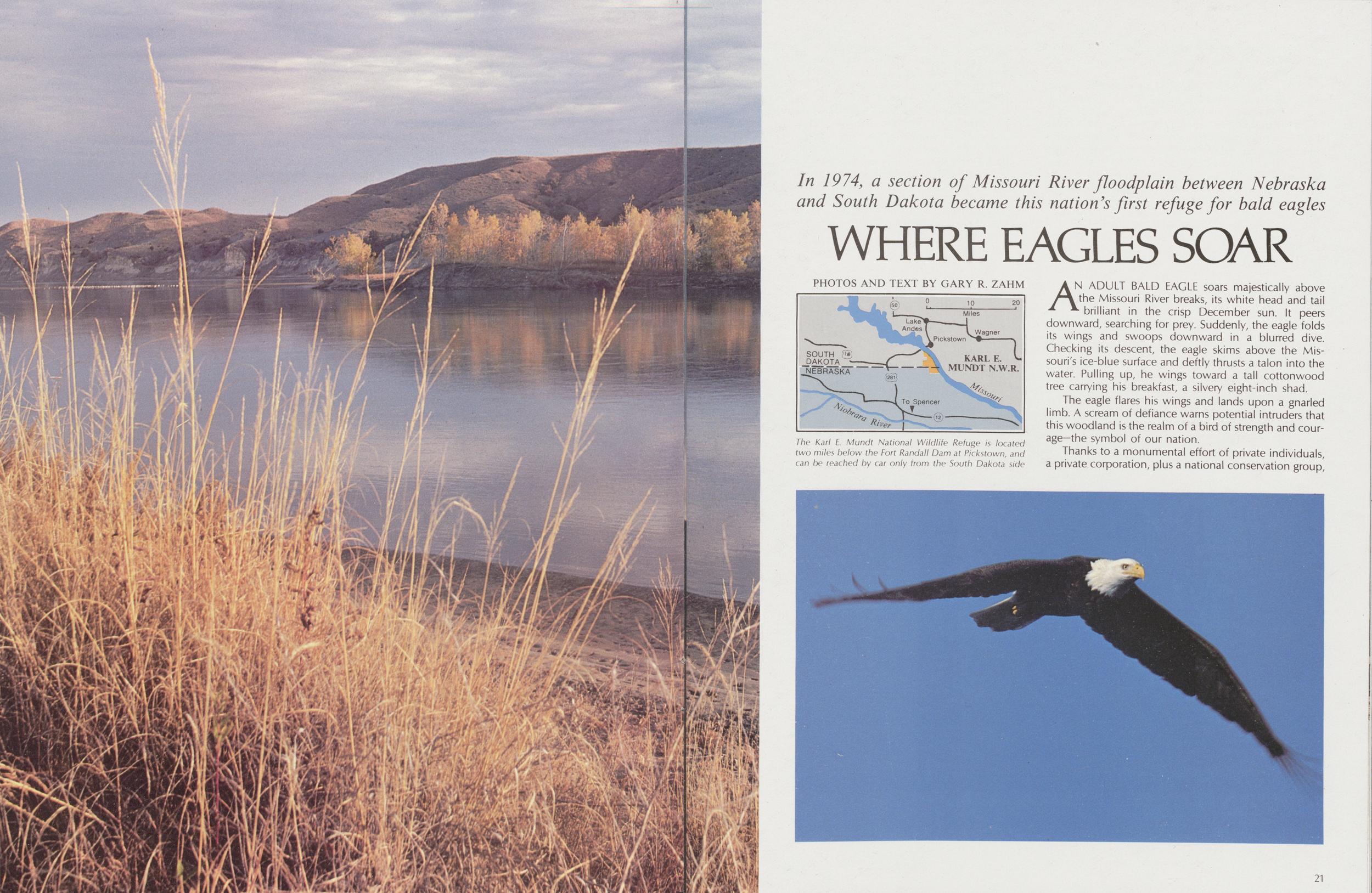
WHERE EAGLES SOAR
In 1974, a section of Missouri River floodplain between Nebraska and South Dakota became this nation's first refuge for bald eaglesAN ADULT BALD EAGLE soars majestically above f\ the Missouri River breaks, its white head and tail brilliant in the crisp December sun. It peers downward, searching for prey. Suddenly, the eagle folds its wings and swoops downward in a blurred dive. Checking its descent, the eagle skims above the Missouri's ice-blue surface and deftly thrusts a talon into the water. Pulling up, he wings toward a tall cottonwood tree carrying his breakfast, a silvery eight-inch shad.
The eagle flares his wings and lands upon a gnarled limb. A scream of defiance warns potential intruders that this woodland is the realm of a bird of strength and courage—the symbol of our nation.
Thanks to a monumental effort of private individuals,
a private corporation, plus a national conservation group,
2F
 the thrilling presence of a wild bald eagle has been perpetuated for Nebraskans and
South Dakotans to cherish
and enjoy.
the thrilling presence of a wild bald eagle has been perpetuated for Nebraskans and
South Dakotans to cherish
and enjoy.
Receipts generated from sales of endangered-species drinking cups were set aside in the "Save a Living Thing" project sponsored by the Southland Corporation, which raised $250,000 for the National Wildlife Federation. With these funds, Raymond Nesbitt, a realtor for the Federation, negotiated with South Dakota landowners Mabel and John Cassidy, for purchase of 780 acres of pristine riverbottom habitat. In addition, a perpetual easement which guarantees the preservation of an additional 300 acres of important woodlands, was purchased from William Jonas, an O'Neil, Nebraska resident, who has long been an advocate of wildlife preservation.
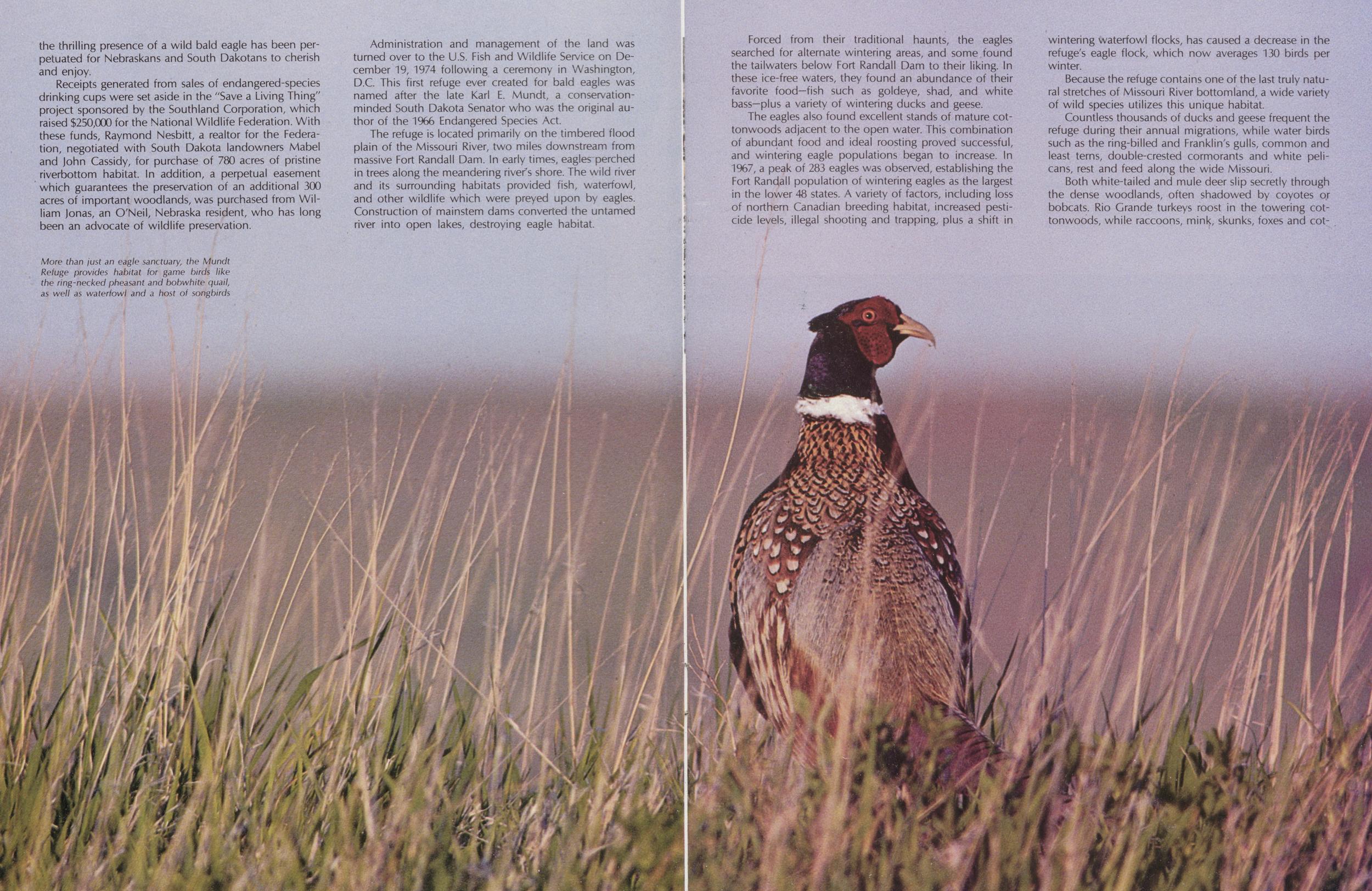
More than just an eagle sanctuary, the Mundt Refuge provides habitat for game birds like the ring-necked pheasant and bobwhite quail, as well as waterfowl and a host of songbirdsAdministration and management of the land was turned over to the U.S. Fish and Wildlife Service on December 19, 1974 following a ceremony in Washington, D.C. This first refuge ever created for bald eagles was named after the late Karl E. Mundt, a conservation-minded South Dakota Senator who was the original author of the 1966 Endangered Species Act.
The refuge is located primarily on the timbered flood plain of the Missouri River, two miles downstream from massive Fort Randall Dam. In early times, eaglesrperched in trees along the meandering river's shore. The wild river and its surrounding habitats provided fish, waterfowl, and other wildlife which were preyed upon by eagles. Construction of mainstem dams converted the untamed river into open lakes, destroying eagle habitat.
Forced from their traditional haunts, the eagles searched for alternate wintering areas, and some found the tailwaters below Fort Randall Dam to their liking. In these ice-free waters, they found an abundance of their favorite food-fish such as goldeye, shad, and white bass—plus a variety of wintering ducks and geese.
The eagles also found excellent stands of mature cottonwoods adjacent to the open water. This combination of abundant food and ideal roosting proved successful, and wintering eagle populations began to increase. In 1967, a peak of 283 eagles was observed, establishing the Fort Randall population of wintering eagles as the largest in the lower 48 states. A variety of factors, including loss of northern Canadian breeding habitat, increased pesticide levels, illegal shooting and trapping, plus a shift in wintering waterfowl flocks, has caused a decrease in the refuge's eagle flock, which now averages 130 birds per winter.
Because the refuge contains one of the last truly natural stretches of Missouri River bottomland, a wide variety of wild species utilizes this unique habitat.
Countless thousands of ducks and geese frequent the refuge during their annual migrations, while water birds such as the ring-billed and Franklin's gulls, common and least terns, double-crested cormorants and white pelicans, rest and feed along the wide Missouri.
Both white-tailed and mule deer slip secretly through
the dense woodlands, often shadowed by coyotes or
bobcats. Rio Grande turkeys roost in the towering cottonwoods, while raccoons, mink,
skunks, foxes and cottontail
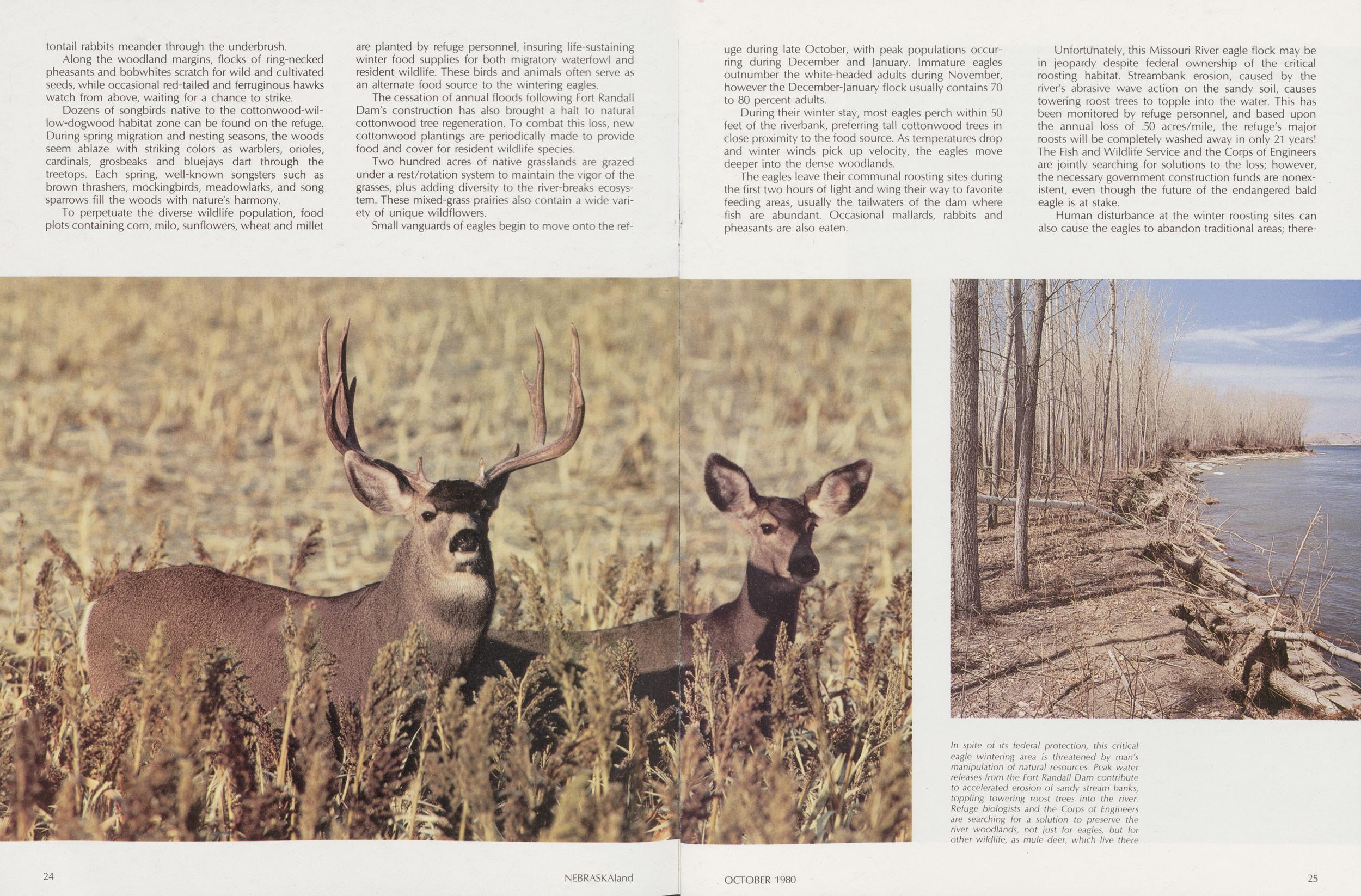 rabbits meander through the underbrush.
Along the woodland margins, flocks of ring-necked pheasants and bobwhites scratch for wild and cultivated seeds, while occasional red-tailed and ferruginous hawks watch from above, waiting for a chance to strike.
Dozens of songbirds native to the cottonwood-willow-dogwood habitat zone can be found on the refuge. During spring migration and nesting seasons, the woods seem ablaze with striking colors as warblers, orioles, cardinals, grosbeaks and bluejays dart through the treetops. Each spring, well-known songsters such as brown thrashers, mockingbirds, meadowlarks, and song sparrows fill the woods with nature's harmony.
To perpetuate the diverse wildlife population, food plots containing corn, milo, sunflowers, wheat and millet are planted by refuge personnel, insuring life-sustaining winter food supplies for both migratory waterfowl and resident wildlife. These birds and animals often serve as an alternate food source to the wintering eagles.
The cessation of annual floods following Fort Randall Dam's construction has also brought a halt to natural Cottonwood tree regeneration. To combat this loss, new cottonwood plantings are periodically made to provide food and cover for resident wildlife species.
Two hundred acres of native grasslands are grazed under a rest/rotation system to maintain the vigor of the grasses, plus adding diversity to the river-breaks ecosystem. These mixed-grass prairies also contain a wide variety of unique wildflowers.
Small vanguards of eagles begin to move onto the refuge during late 24 NEBRASKAland October, with peak populations occurring during December and January. Immature eagles outnumber the white-headed adults during November, however the December-January flock usually contains 70 to 80 percent adults.
During their winter stay, most eagles perch within 50 feet of the riverbank, preferring tall cottonwood trees in close proximity to the food source. As temperatures drop and winter winds pick up velocity, the eagles move deeper into the dense woodlands.
The eagles leave their communal roosting sites during the first two hours of light and wing their way to favorite feeding areas, usually the tailwaters of the dam where fish are abundant. Occasional mallards, rabbits and pheasants are also eaten.
Unfortunately, this Missouri River eagle flock may be in jeopardy despite federal ownership of the critical roosting habitat. Streambank erosion, caused by the river's abrasive wave action on the sandy soil, causes towering roost trees to topple into the water. This has been monitored by refuge personnel, and based upon the annual loss of .50 acres/mile, the refuge's major roosts will be completely washed away in only 21 years! The Fish and Wildlife Service and the Corps of Engineers are jointly searching for solutions to the loss; however, the necessary government construction funds are nonexistent, even though the future of the endangered bald eagle is at stake.
Human disturbance at the winter roosting sites can also cause the eagles to abandon traditional areas therefore therefore, public use on the refuge is prohibited. An excellent eagle observation point is located on Corps of Engineers property directly below Fort Randall Dam. From this observation point above the tailwaters, visitors can get close-up views as eagles deftly pluck fish from the fast-flowing waters. Visitors should refrain from disturbing eagles perched among the cottonwoods during the midday loafing period.
In these times of dwindling habitat, the Karl E. Mundt National Wildlife Refuge stands as a shining example of resource management. Even though energy shortages threaten to restrict outings, a visit to view the wintering eagle concentrations in the Fort Randall vicinity should rank high on a traveler's priority list.
Individuals or groups wishing more information on the current eagle population or local accommodations should contact the refuge manager, Lake Andes Refuge Complex, P.O. Box 279, Lake Andes, South Dakota 57356, Phone (605) 487-7603.
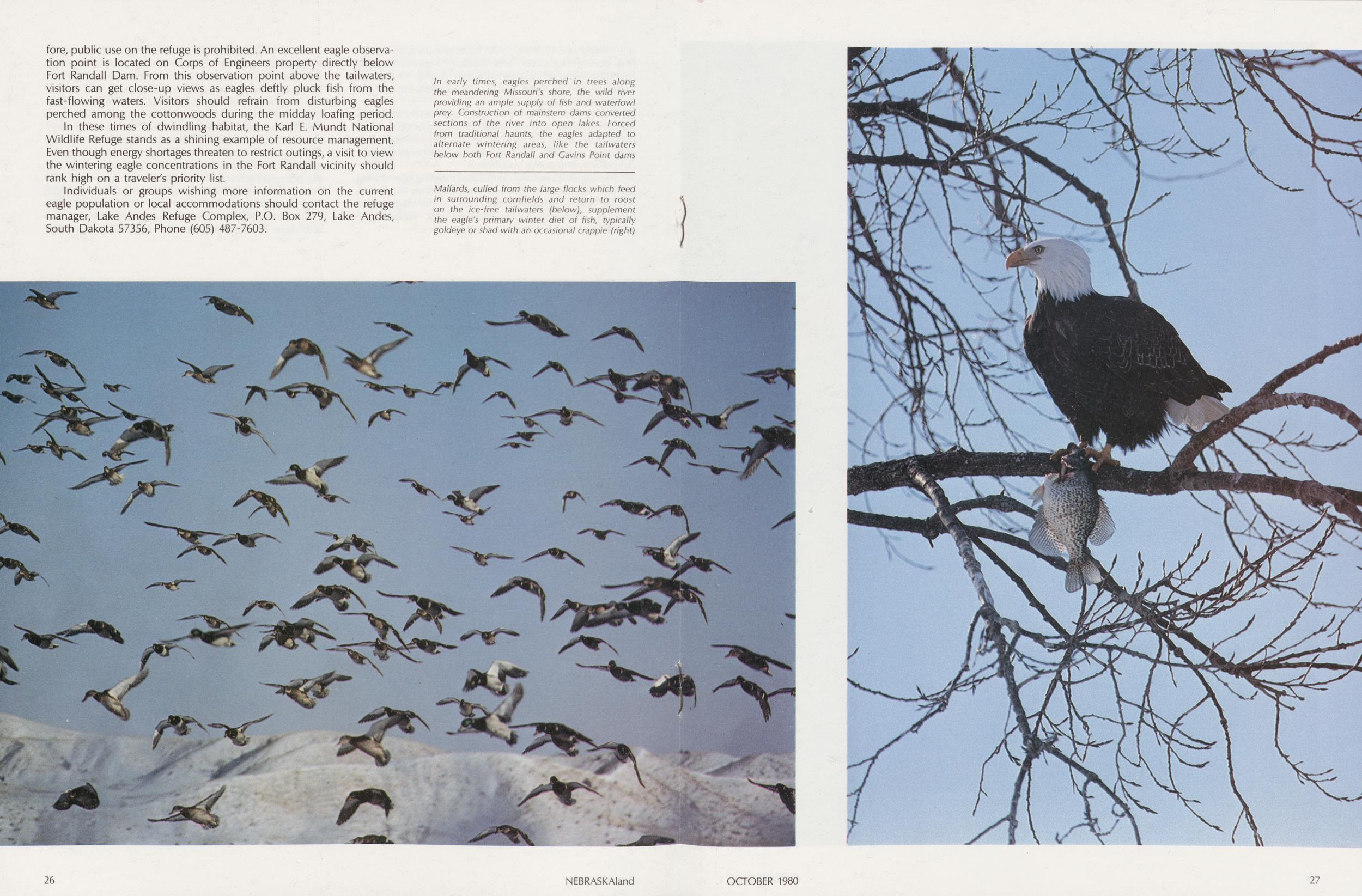
In early times, eagles perched in trees along the meandering Missouri's shore, the wild river providing an ample supply of fish and waterfowl prey. Construction of mainstem dams converted sections of the river into open lakes. Forced from traditional haunts, the eagles adapted to alternate wintering areas, like the tailwaters below both Fort Randall and Gavins Point dams Mallards, culled from the large flocks which feed in surrounding cornfields and return to roost on the ice-free tailwaters (below), supplement the eagle's primary winter diet of fish, typically goldeye or shad with an occasional crappie (right)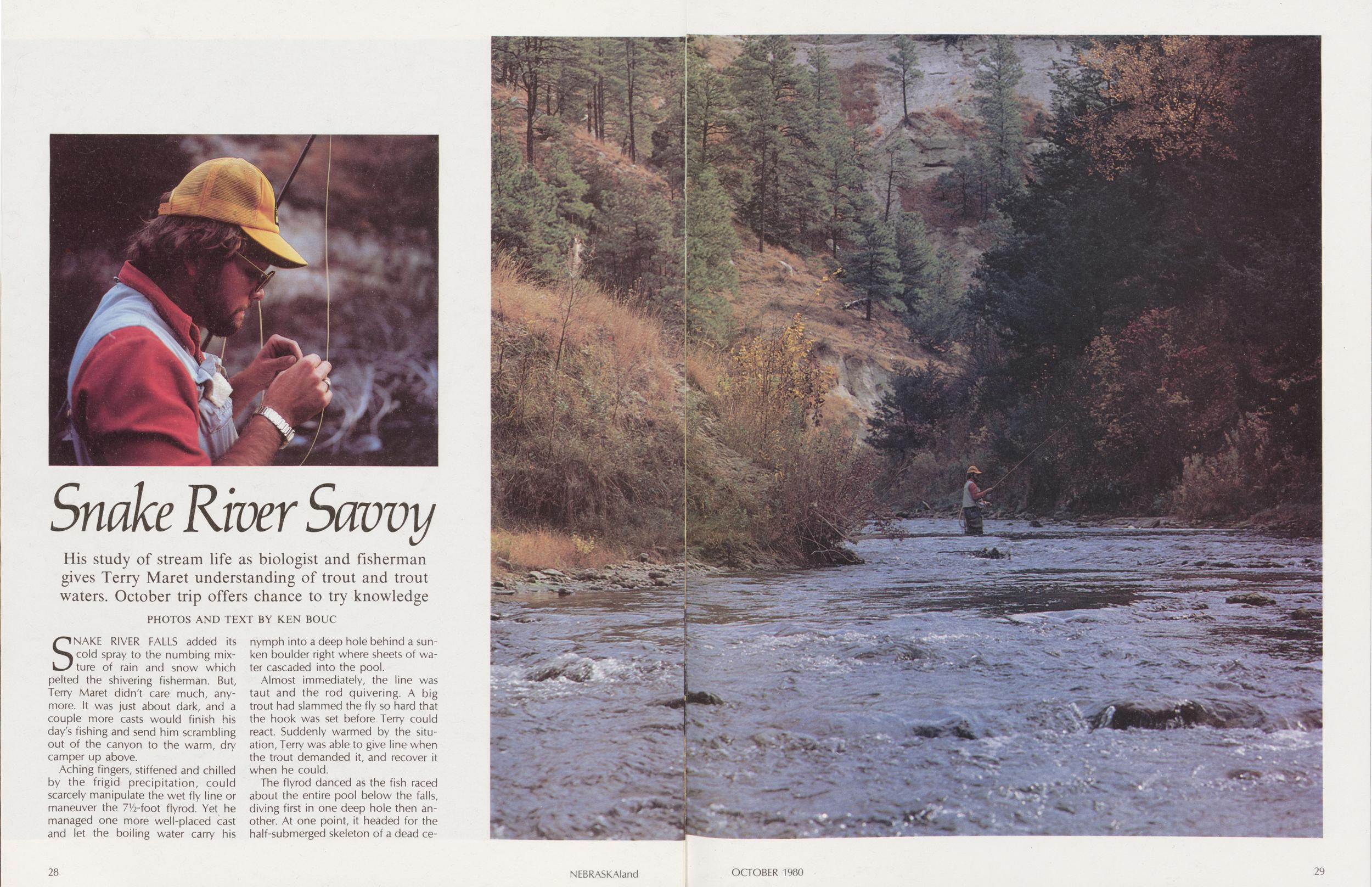
Snake River Savvy
His study of stream life as biologist and fisherman gives Terry Maret understanding of trout and trout waters. October trip offers chance to try knowledge PHOTOS AND TEXT BY KEN BOUCSNAKE RIVER FALLS added its cold spray to the numbing mixture of rain and snow which pelted the shivering fisherman. But, Terry Maret didn't care much, anymore. It was just about dark, and a couple more casts would finish his day's fishing and send him scrambling out of the canyon to the warm, dry camper up above.
Aching fingers, stiffened and chilled by the frigid precipitation, could scarcely manipulate the wet fly line or maneuver the 71/2-foot flyrod. Yet he managed one more well-placed cast and let the boiling water carry his nymph into a deep hole behind a sunken boulder right where sheets of water cascaded into the pool.
Almost immediately, the line was taut and the rod quivering. A big trout had slammed the fly so hard that the hook was set before Terry could react. Suddenly warmed by the situation, Terry was able to give line when the trout demanded it, and recover it when he could.
The flyrod danced as the fish raced about the entire pool below the falls, diving first in one deep hole then another. At one point, it headed for the half-submerged skeleton of a dead cedar tree in order to entangle the delicate leader, then tried to bore downstream and outrun the fisherman. Each time, Terry put just enough pressure on the fish to control it without breaking the tiny three-pound-test tippet.
Finally, after a 10-minute struggle, the 20-inch brown came to the surface, jumped a few times, then surrendered to the net.
The fish would make a fine addition to this afternoon's catch, which was another brown perhaps an inch longer and a half-pound heavier than this one. The darkness, the steep and wet canyon walls, and the clumsy hip waders made the climb out of the canyon an adventure unto itself.
In the warmth and light of the camper, Terry's estimates of the trouts' relative sizes were verified—21 inches and 31/4 pounds for the afternoon's fish, and 191/2 inches and 23/4 pounds for the one just caught.
The Snake River was finally overcoming an uncharacteristic spell of stinginess. But, even as the river warmed to our efforts, the weather showed us a cold shoulder and made us pay dearly for fish.
I was with Terry Maret of Lincoln, a fisherman who understands that stream as few others can. Not only does he study trout waters in his role as avid fly fisherman, he also knows them professionally, as a water-quality biologist with the Nebraska State Department of Environmental Control (DEC).
By education and professional experience, Terry has acquired what most other trout purists seek all their lives but few can obtain—a thorough knowledge of a stream's aquatic insect and fish life.
We arrived Friday, the evening of a picture-perfect October day, and clambered down the canyon for an hour's fishing before day's end. But, we got no action. And most of the next day, under cloudy skies but otherwise decent conditions, nothing happened.
30 NEBRASKAlandNot until late Saturday afternoon, when rain began falling, did we get action. Then, Terry's streamers fooled five pan-sized trout, which indeed became our supper that evening.
During streamside breaks through the day, and at night as the rain pummeled the camper, Terry discussed the relationship of aquatic insect life to trout streams and the high water quality that trout demand.
"In a stream with high water quality, you'll find diversity. There will be a large number of different orders, and many species within each order. Distribution will also be fairly equal, with no one insect really dominant.
"In the Snake, for example, there's an abundance of the orders of stone-flies, the mayflies, and caddis flies, and there are certain species present from each of these orders that are found only in the highest quality water.
"We look at the abundance and variety of aquatic life, in addition to chemical and bacterial analysis and observations on sediment, to judge a stream's quality. The Snake is in excellent shape as far as water quality is concerned; one of the best in the state, according to DEC data."
As he spoke, Terry would periodically flip over a rock or stir up some gravel to expose a Helicopsyche or Isoperla patricia or some other little critter with a name several times longer than itself.
His only concern for the Snake's status as a trout fishery involved extreme low summer flows during irrigation season. When Merritt Dam releases water into the canal, very little is allowed to flow downstream.
"The water in the river gets pretty low then, and it warms up quickly. There are fewer places for trout to hide, and the stream is less able to produce food for fish. All this has to be hard on the trout Just a little more water flowing downstream in the summer might mean a real improvement in the Snake as a trout fishery.
"Of course, you have to understand that if it were not for the dam, trout fishing down here would not be nearly as good as it is. The dam catches sand and sediment that the river carries. (Continued on page 46)
OCTOBER 1980 31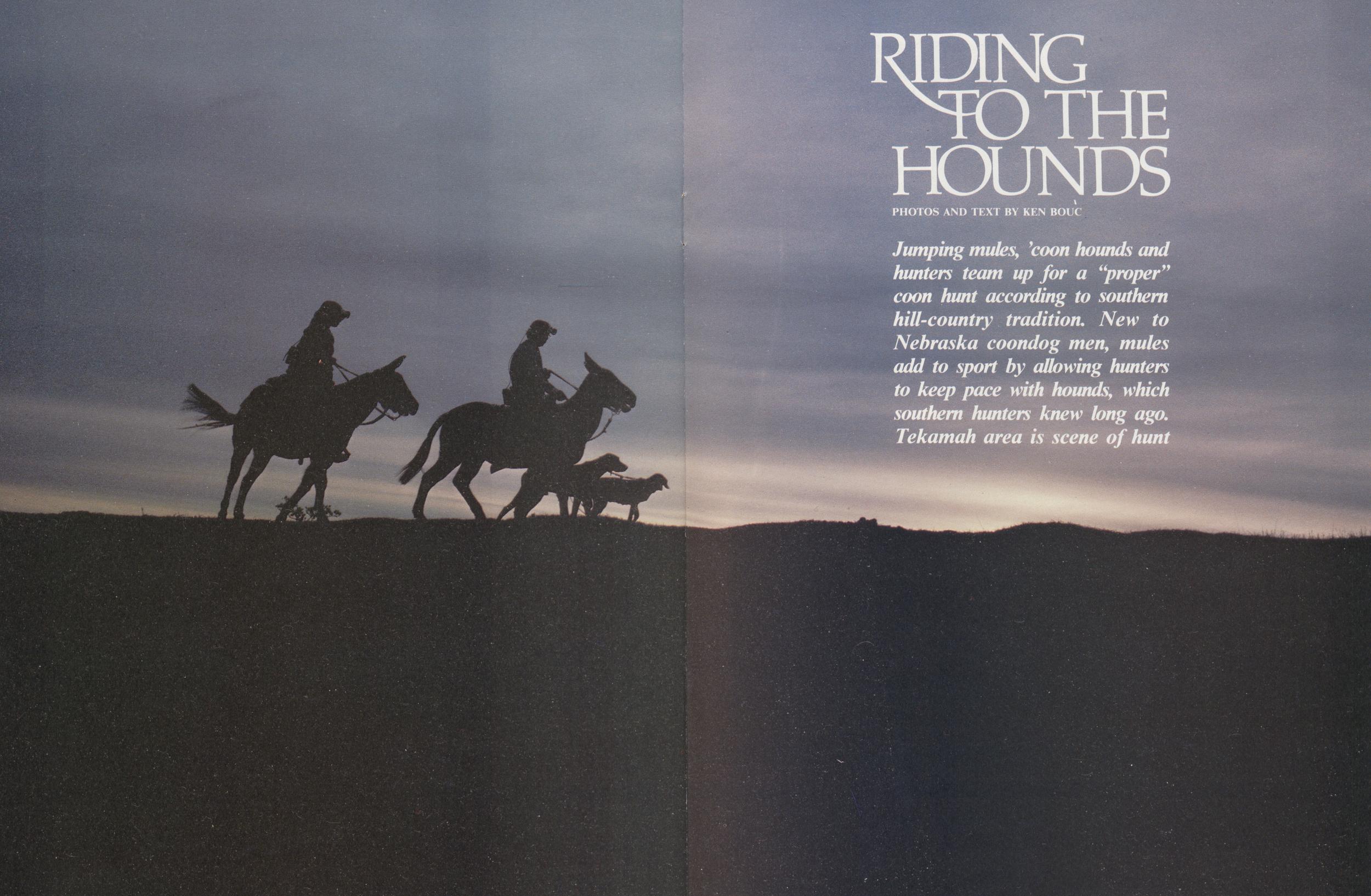
RIDING TO THE HOUNDS
PHOTOS AND TEXT BY KEN BOUC Jumping mules, eoon hounds and hunters team up for a "proper" coon hunt according to southern hill-country tradition. New to Nebraska coondog men, mules add to sport by allowing hunters to keep pace with hounds, which southern hunters knew long ago, Tekamah area is scene of hunt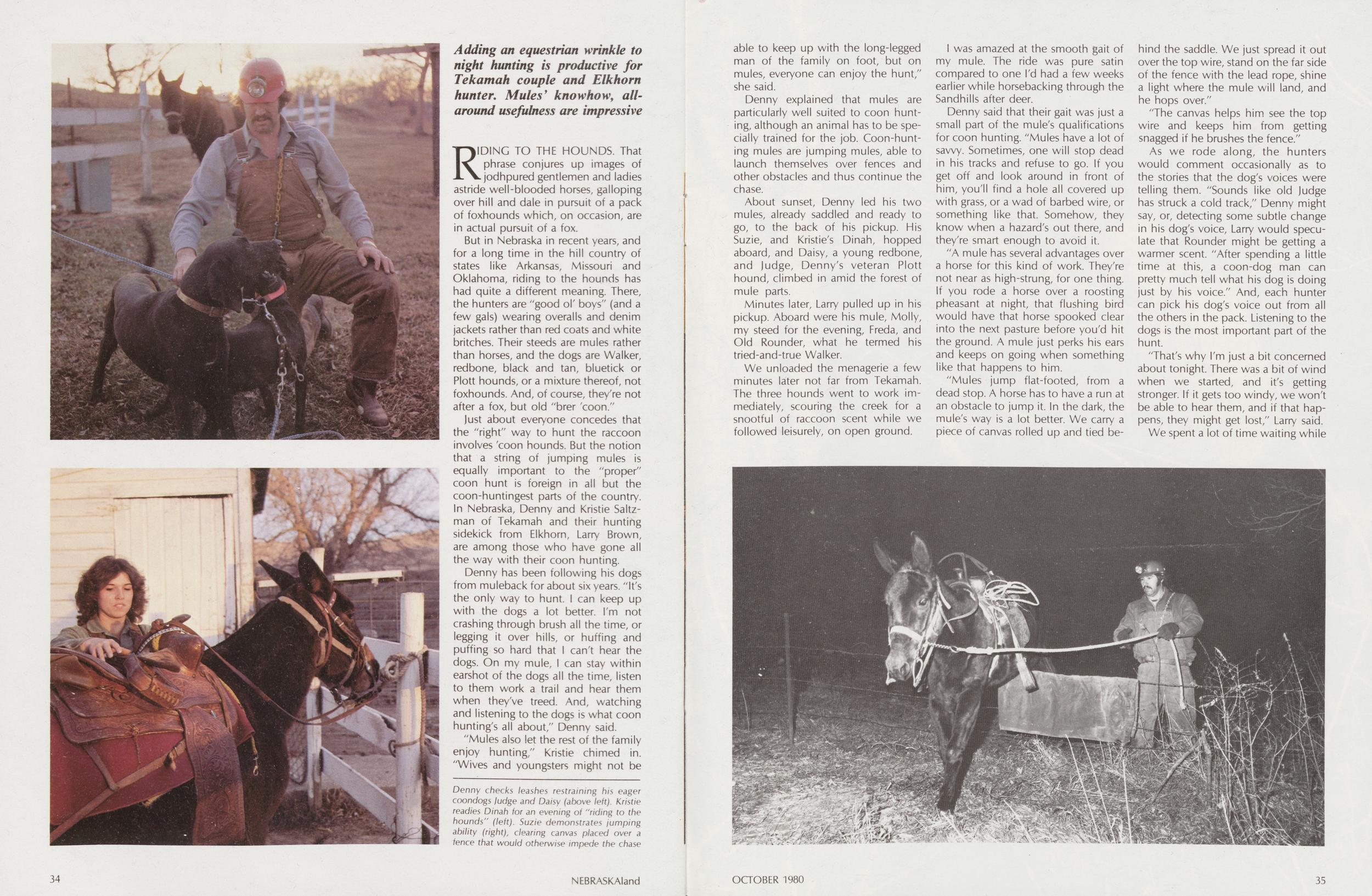
RIDING TO THE HOUNDS. That phrase conjures up images of gentlemen and ladies astride well-blooded horses, galloping over hill and dale in pursuit of a pack of foxhounds which, on occasion, are in actual pursuit of a fox.
But in Nebraska in recent years, and for a long time in the hill country of states like Arkansas, Missouri and Oklahoma, riding to the hounds has had quite a different meaning. There, the hunters are "good ol' boys" (and a few gals) wearing overalls and denim jackets rather than red coats and white britches. Their steeds are mules rather than horses, and the dogs are Walker, redbone, black and tan, bluetick or Plott hounds, or a mixture thereof, not foxhounds. And, of course, they're not after a fox, but old "brer 'coon."
Just about everyone concedes that the "right" way to hunt the raccoon involves 'coon hounds. But the notion that a string of jumping mules is equally important to the "proper" coon hunt is foreign in all but the coon-huntingest parts of the country. In Nebraska, Denny and Kristie Saltzman of Tekamah and their hunting sidekick from Elkhorn, Larry Brown, are among those who have gone all the way with their coon hunting.
Denny has been following his dogs from muleback for about six years. "It's the only way to hunt. I can keep up with the dogs a lot better. I'm not crashing through brush all the time, or legging it over hills, or huffing and puffing so hard that I can't hear the dogs. On my mule, I can stay within earshot of the dogs all the time, listen to them work a trail and hear them when they've treed. And, watching and listening to the dogs is what coon hunting's all about," Denny said.
"Mules also let the rest of the family enjoy hunting," Kristie chimed in. Wives and youngsters might not be able to keep up with the long-legged man of the family on foot, but on mules, everyone can enjoy the hunt," she said.
Denny checks leashes restraining his eager coondogs judge and Daisy (above left). Kristie readies Dinah for an evening of "riding to the hounds" (left). Suzie demonstrates jumping ability (right), clearing canvas placed over a fence that would otherwise impede the chase 34 NEBRASKAlandDenny explained that mules are particularly well suited to coon hunting, although an animal has to be specially trained for the job. Coon-hunting mules are jumping mules, able to launch themselves over fences and other obstacles and thus continue the chase.
About sunset, Denny led his two mules, already saddled and ready to go, to the back of his pickup. His Suzie, and Kristie's Dinah, hopped aboard, and Daisy, a young redbone, and Judge, Denny's veteran Plott hound, climbed in amid the forest of mule parts.
Minutes later, Larry pulled up in his pickup. Aboard were his mule, Molly, my steed for the evening, Freda, and Old Rounder, what he termed his tried-and-true Walker.
We unloaded the menagerie a few minutes later not far from Tekamah. The three hounds went to work immediately, scouring the creek for a snootful of raccoon scent while we followed leisurely, on open ground.
I was amazed at the smooth gait of my mule. The ride was pure satin compared to one I'd had a few weeks earlier while horsebacking through the Sandhills after deer.
Denny said that their gait was just a small part of the mule's qualifications for coon hunting. "Mules have a lot of savvy. Sometimes, one will stop dead in his tracks and refuse to go. If you get off and look around in front of him, you'll find a hole all covered up with grass, or a wad of barbed wire, or something like that. Somehow, they know when a hazard's out there, and they're smart enough to avoid it.
"A mule has several advantages over a horse for this kind of work. They're not near as high-strung, for one thing. If you rode a horse over a roosting pheasant at night, that flushing bird would have that horse spooked clear into the next pasture before you'd hit the ground. A mule just perks his ears and keeps on going when something like that happens to him.
"Mules jump flat-footed, from a dead stop. A horse has to have a run at an obstacle to jump it. In the dark, the mule's way is a lot better. We carry a piece of canvas rolled up and tied behind the saddle. We just spread it out over the top wire, stand on the far side of the fence with the lead rope, shine a light where the mule will land, and he hops over."
"The canvas helps him see the top wire and keeps him from getting snagged if he brushes the fence."
As we rode along, the hunters would comment occasionally as to the stories that the dog's voices were telling them. "Sounds like old Judge has struck a cold track," Denny might say, or, detecting some subtle change in his dog's voice, Larry would speculate that Rounder might be getting a warmer scent. "After spending a little time at this, a coon-dog man can pretty much tell what his dog is doing just by his voice." And, each hunter can pick his dog's voice out from all the others in the pack. Listening to the dogs is the most important part of the hunt.
"That's why I'm just a bit concerned about tonight. There was a bit of wind when we started, and it's getting stronger. If it gets too windy, we won't be able to hear them, and if that happens, they might get lost," Larry said.
We spent a lot of time waiting while
OCTOBER 1980
35
We had to backtrack just a bit to cross the creek, and by the time we were on the other side, the dog noise was beginning to fade. We headed up the creek at a hurried walk, expecting to more than match the dogs' pace, but their voices faded even more as the wind increased.
We found ourselves stopping on occasion, picking out a note or two of coondog melody that the wind might carry to us, then heading off in a new direction. Each time it turned out that the wind was playing tricks with the dogs' voices and our ears.
Often, Larry would climb off old Molly and walk away some distance to listen, knowing that he could hear better when away from the miscellaneous mule noises that constantly issued from our mounts. The background sounds of creaking leather, snorts, and almost non-stop chewing could easily mask the faint sound of distant hounds.
But, even that soon proved futile. The dogs were lost.
We had been trying to follow the dogs' fading voices for perhaps 45 minutes before we finally admitted that they were lost. We wandered about for another half-hour or so, looking in a couple of abandoned farmsteads and checking out other areas that Denny knew to be likely spots for dogs to tree a coon. Then, we began a big circle that took about an hour to bring us near the pickups. "A good coon dog seldom gets lost. They usually return to where you turn them loose. But, if our dogs have a coon treed, it could take a while. Rounder and Judge will stay by a tree all night if it has a coon in it," Kristie said.
As we clopped down the road that led to the pickups, we suddenly noticed a dog among us. It was Daisy, Denny's youngest hound. An instant later, she headed back across a field toward the creek. We took off after her, and a minute or so later, heard Judge and Rounder.
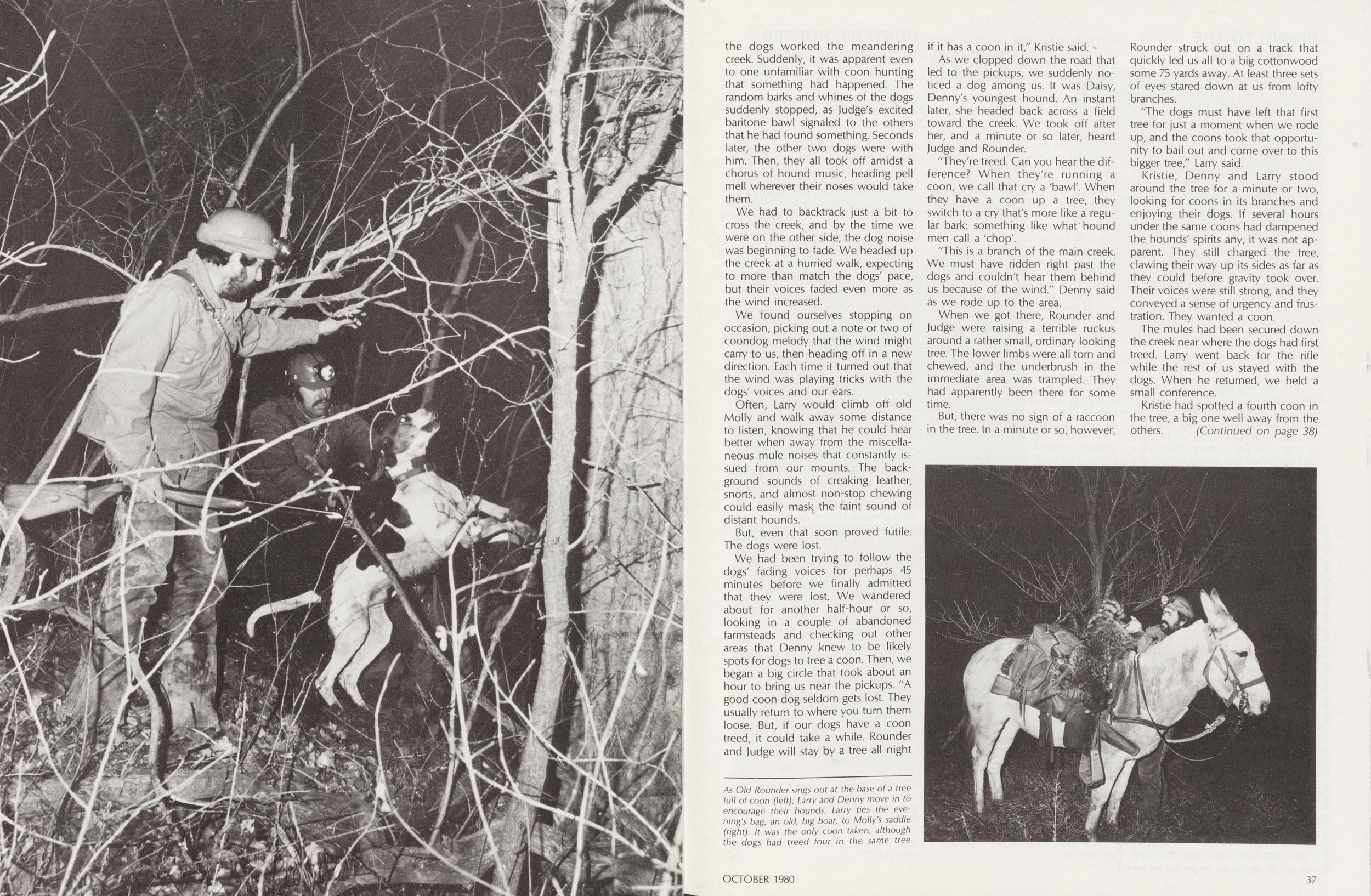
"They're treed. Can you hear the difference? When they're running a coon, we call that cry a 'bawl'. When they have a coon up a tree, they switch to a cry that's more like a regular bark; something like what hound men call a 'chop'.
"This is a branch of the main creek. We must have ridden right past the dogs and couldn't hear them behind us because of the wind." Denny said as we rode up to the area.
When we got there, Rounder and Judge were raising a terrible ruckus around a rather small, ordinary looking tree. The lower limbs were all torn and chewed, and the underbrush in the immediate area was trampled. They had apparently been there for some time.
But, there was no sign of a raccoon in the tree. In a minute or so, however, Rounder struck out on a track that quickly led us all to a big cottonwood some 75 yards away. At least three sets of eyes stared down at us from lofty branches.
"The dogs must have left that first tree for just a moment when we rode up, and the coons took that opportunity to bail out and come over to this bigger tree," Larry said.
Kristie, Denny and Larry stood around the tree for a minute or two, looking for coons in its branches and enjoying their dogs. If several hours under the same coons had dampened the hounds' spirits any, it was not apparent. They still charged the tree, clawing their way up its sides as far as they could before gravity took over. Their voices were still strong, and they conveyed a sense of urgency and frustration. They wanted a coon.
The mules had been secured down the creek near where the dogs had first treed. Larry went back for the rifle while the rest of us stayed with the dogs. When he returned, we held a small conference.
Kristie had spotted a fourth coon in the tree, a big one well away from the others. (Continued on page 38)
OCTOBER 1980 37
RIDING TO THE HOUNDS
(Continued from page 37)'That might be an old boar, and that's what we want. Most hound men only take one coon per tree, and they try to leave the sow and the younger animals. We'll look him over real good from the creek bank before we shoot," Denny said.
He explained that hound men can increase the chances of identifying a boar by using a couple of tricks. The boar is often bigger, and is more likely to look down at the hunter. The sows usually look up or away. When a coon hunter "squalls", which imitates the sound of a fighting coon, the boar is likely to start down the tree, or at least act fidgety. The squall makes the males want to fight, according to Denny.
Minutes later, the .22 rifle cracked and the lone coon plummeted to earth with a heavy thud. He was probably dead when he hit the ground, but Rounder and Judge were on him immediately just to make sure, and Daisy wasn't far behind. They shook and worried the coon for a bit, until Denny and Larry pulled them off.
"That's the part many folks finds most difficult to accept about coon hunting—where the hounds get on the coon. But, the dogs have to get ahold of a coon now and then. A pheasant hunter would give it up if he never got to shoot a bird, and a coon dog would lose interest in following coons if he never got to kill a coon, or at least think he'd killed one.
"We try to shoot every coon stone dead, but they're ornery critters, and now and then one comes down with some fight left in him. That's when tough old hounds like Judge and Rounder get their licks in. Whether they're warring a dead one or finishing off a dying coon, the dogs get the feeling that they're in on the final act of the hunt," Denny said.
Larry hefted the big boar, estimating his weight at about 35 pounds. He loaded the prize on Molly, and we all prepared to leave.
"We always take just one coon from a tree, no matter how many are up there. We kill the coons for the dogs' sake. But, when a dog strikes a trail, he follows and trees only one coon, so one is all we shoot.
"We're leaving from $100 to $150 worth of coons in that tree. If we were jacklighters or road hunters, you can bet that every one of those animals would be dead by now, We're not that interested in the cash value of furs. We hunted coons just as of- ten in the days when they were worth $4 apiece. But a jacklighter—all he cares about is cash. When the price goes down someday, the jacklighters will very likely disappear, but in the meantime, they're really decimating our coon population," he continued.
Like most other coon dog men, Larry and Denny had nothing good to say about the poachers who take raccoons illegally, driving rural roads and remote creeks at night and shining high-powered spotlights at the trees.
"They kill every coon they see, boars, sows and young. They're interested in only one thing—money. And when good coons brought $40 a year ago (1978-79), there was plenty of money in it. If a poacher got caught and convicted, he just had to shoot one or two extra coons the next night to pay the fine. With fur prices high and fines low, it's easy to make money poaching coons. All you need is a light and a gun. You don't need any special skill, no experience, and there's no sport involved," Denny said.
"There's no doubt about it. The coon population's way down, and jacklighters are to blame. Responsible folks, law-abiding coon dog men and trappers, tried to help the situation by agitating for more restrictive seasons. But, all that did was cut back those taking coons legally, and they aren't the problem. We have to stop the illegal hunter, and more laws won't do that because the poachers will ignore the new laws just like they ignore old ones. Something has to be done to take the profit out of coon poaching. Fur prices are going down, and that should help. Now, I'd like to see fines go up. But, unfortunately that's up to the judges," he concluded.
We loaded dogs and mules well after midnight, a considerably longer hunt than Denny, Kristie and Larry had anticipated. "We only got one chase out of the dogs tonight, and we missed most of that. But it was still fun," Larry said.
We loaded dogs and mules well after midnight, a considerably longer hunt than Denny, Kristie and Larry had anticipated. "We only got one chase out of the dogs tonight, and we missed most of that. But it was still fun," Larry said.
HUNTERS, HORSES AND THE HILLS
(Continued from page 15)riding championships. He is also the only cowboy to win money in every approved rodeo event while a member of the Nebraska State Rodeo Association. He began manufacturing his horse products in 1969, retired from the rodeo circuit in 1970, and bought the old store in 1971.
When Sunday's hunting party convened, it was a bit smaller than the opening-day expedition, with Wade downed by the flu bug, and Tracy and Vonna electing to take a day off. Willis joined the Plains Unit party to help Alex scout up a deer, but his efforts were to no avail. The pack horses came back empty. A fine hot supper served by Veldon's wife, Wanda, was just the thing to relift the spirits of the consumers.
On Monday morning, Alex decided that he could spare another half-day of hunting before he had to get back to work. Early light found him, Glen, and Veldon closing the last gate into the vast expanse of hills they had been hunting. Alex threw a casual glance toward those hills as he finished with the gate.
And there he was. On a hill less than 200 yards away stood a nice mule deer buck, looking right at them. How long he had been there was anybody's guess. He might have watched the whole sequence of opening and closing the gate, for all they knew. No one expected to see a deer that close to the highway, so the old buck caught them all napping.
Before Alex could get to his rifle, the buck retreated behind the hill. That triggered a chase that lasted most of the morning, with riders trying to head him off and flush him out or track him down in the new overnight snow. But, the big mulie gave them all the slip, and Alex and Glen had to load their horses and head back out to Colorado that afternoon without him.
Veldon was to fare a bit better. A few days later, he and Willis decided to try filling their Sandhills Unit permits in the hills northeast of Ellsworth. About midafternoon, Veldon spotted a buck and four does in an alfalfa patch. Leaving his horse with Willis, he stalked within range. One shot from his .308 dropped the two-point mulie in his tracks.
It wasn't a big deer by any measure, certainly not like Wade's whitetail. But, the size of either of the deer didn't seem important to Veldon.
"We found those deer on horseback, and we packed them out of there with horses," Veldon said. "I shot mine only six miles from town. We could have hunted him and brought him back with a pickup, but we didn't. We really just wanted to 'do it western,' and that makes it all a lot more fun."
38 NEBRASKAland
MAGNUM THRILLS
(Continued from page 17)try for them since nothing else is flying?"
We rose cautiously from the blind. The birds were still behind a small rise. Peppy tried to jump out of the blind, but Merle cautioned him to stay. Moving slowly at a half crouch, we circled to where the birds had dropped from sight.
As we stood, the mallards—four greenhead drakes—broke water and clawed almost straight into the air. I was somewhat out of position but Merle's 12-gauge dropped the third bird to my right. I was able to swing on the first mallard, then the second, dropping both on the far side of the knee-deep slough. Merle's second shot dropped the fourth drake into the ankle-high ground cover.
Obviously Peppy had played this game before—at the shots he jumped out of the pit blind and skidded to a sitting position beside Merle.
"Back Peppy!" Merle commanded, using a hand signal to set the dog's direction. In four succeeding passes, Peppy made four blind retrieves, depositing each bird in Merle's hand before setting off again in the direction that Merle indicated with a hand signal.
We were about halfway back to the blind with the mallards when Henry and Doug waved and pointed north. Several small flocks of Canadas were moving directly for the blind, and to the east an undulating black cloud signaled a major movement of geese.
"The birds went out to feed early this morning," Merle said, "but with this wind pushing them back they will be too high when they come over. We might be able to decoy a straggler or two." Henry, Doug and I dropped the woven mat lids into place and set about arranging shotguns and shells. Peppy jumped onto one of the camera bags as Merle finished buttoning down his end of the blind. For the next few minutes it was watch and wait.
The geese were definitely too high, but for the next hour or so a lone bird or small flock would pass by close enough to cause some excitement. Even Merle's best efforts on the goose call couldn't entice the birds into shotgun range, though.
"People often ask what type of gun and shot to use," Merle mentioned, "but the real thing to remember is to take the birds at the right time and distance, judging distance is tough, especially in different kinds of light. I pace off the distance to each landmark around the blind. For example, I know it's 41 yards to that small dike, and too far to the west edge of the slough to shoot. If hunters would let the birds come in-l believe a 12-gauge, even a 20-gauge magnum, is plenty good. One thing I do like, however, is copper-plated shot; it penetrates better than lead. A Canada has a heavy layer of feathers, and the copper seems to get through better."
Morning flights ended without a shot being fired at geese, although Doug and Henry joined forces to bag several mallards that decoyed into the slough. Henry's culinary expertise—fried elk steaks, toast and eggs—were the highlight of midday. Henry offered to fry the eggs to order, "as long as it's over easy!
The wind moderated slightly through midday, and the temperature climbed into the low 50's.
Camouflage lids on the blind remained open until mid afternoon. Large numbers of geese moved back and forth on the refuge to the south, and once in a while a flock would appear to be headed toward the blind only to veer off well out of range.
A light-colored movement on the ground north of the blind caught my eye. As I stared intently at the weedy hedgerow, a feeding coyote suddenly appeared through the thin weeds. A well furred coyote would be a bonus trophy for a goose hunter if he moved into shotgun range.
Surely aware of our position, the coyote moved southwest and passed within 30 yards of Merle's west pit. The two hunters inside did not notice the coyote, as it approached from the rear, but the predator circled in front of the blind and back into shotgun range. At the shot, the coyote jumped several feet and collapsed.
The coyote episode was a break in the routine of mid afternoon, but everyone's attention soon reverted to the geese to the south. "They'll be moving out to feed soon," Henry offered while pointing off to the southeast where several large flocks seemed to be forming.
"When they do, we should have our decoys in," Merle added. "With this north wind, chances are good that some of the geese will pass over low, and I don't want to take a chance that they might shy away from our decoys."
At Merle's instructions, everyone set to gathering decoys, which we piled in the end of the pit. Several flocks of geese moved low out of the refuge but well east of Merle's blind. Shots from a neighboring pit dropped two geese, and one of the hunters waved to catch our attention. "He wants me to bring Peppy over," Merle said. "The goose must have dropped into the pond behind his blind."
While Doug and Henry manned the blind, I joined Merle and Peppy as they hiked toward the distant blind.
The goose was on a shelf of ice at the east end of the small pond. As we approached, Peppy, unfamiliar with the new surroundings, mistook the sitting bird for just another decoy until Merle pointed his hand and ordered the dog back. The goose moved slightly and Peppy picked up speed. The dog's first pass was something to see as he locked all four legs trying to stop on the ice. Like an Olympic ice skater moving through an intricate exercise, Peppy slid sideways, all the while trying to grasp the goose. Peppy's second pass was right on the money, and soon the Labrador effortlessly carried the large goose to Merle.
Merle said, "Peppy has been one of the finest retrievers I've ever had the pleasure to watch," as he handed the goose to a very appreciative hunter.
We covered the last hundred yards back to the blind at a half crouch as the geese were definitely moving out to feed now. Up and down the river, small flocks from three to 10 birds broke over the horizon and began moving north.
"Watch this flock," Doug whispered as we closed the lids and positioned shotguns. If they continue, they'll pass right over us."
At the west end of the blind, Merle raised the lid with one hand, shotgun firmly grasped in the other, ready, r-e-a-d-y!" Dropping the lid and raising my shot- gun in one not-so-fluid motion, I rose up in time to see two geese drop behind the blind. The birds had veered to the west at the last moment, giving Merle and Henry ideal shots.
"Be ready, there are several other bunches that could move this way.
"With Henry and I limited out, the next opportunity belongs to you and Doug," Merle whispered, "and I think this next flock will come right over. Ready; ready, now!"
My earlier inept practice paid off and my timing improved. The geese were slightly in front of the blind, about 35 yards high, and as Doug and I fired, two birds faltered and began to drop. One appeared able to set his wings and glide, and Doug fired again, dropping the bird cleanly.
As we finished loading the truck, several other hunters pulled up to chat, and goose hunting stories—including several of dubious authenticity-began to fly. For my part, it had been an enjoyable outing, but one last task remained before I could pull up stakes and head for home. I had to ask Merle where he would be turkey hunting next spring—so another "chance" meeting and a new invitation to "spend a day in the blind" could be arranged.
40 NEBRASKAland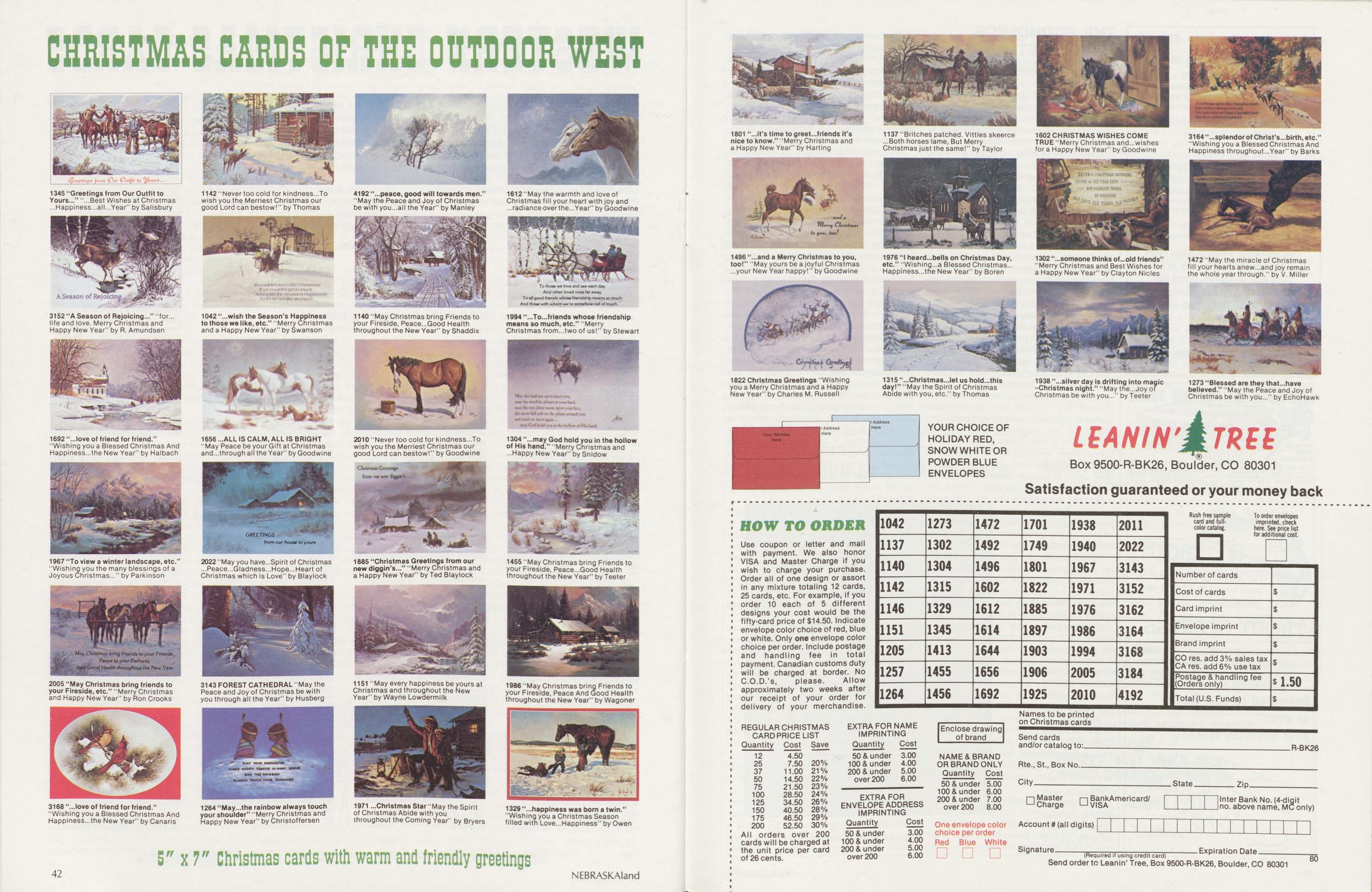 CHRISTMAS CARDS OF THE OUTDOOR WEST
ran Our Outfit
1345 "Greetings from Our Outfit to
Yours..." "...Best Wishes at Christmas
...Happiness...all...Year" by Salisbury
A Season of Re
3152 "A Season of Rejoicing..." "for.
life and love. Merry Christmas and
Happy New Year" by R. Amundsen
1692 "...love of friend for friend."
"Wishing you a Blessed Christmas And
Happiness...the New Year" by Halbach
1967 "To view a winter landscape, etc.
"Wishing you the many blessings of a
Joyous Christmas..." by Parkinson
fay Christmas bring Friends to your Fireside,
Peace to your Pathway
I Good Health throughout the New Year
2005 "May Christmas bring friends to
your Fireside, etc." "Merry Christmas
and Happy New Year" by Ron Crooks
3168 "...love of friend for friend."
"Wishing you a Blessed Christmas And
Happiness...the New Year" by Canaris
1142 "Never too cold for kindness...To
wish you the Merriest Christmas our
good Lord can bestow!" by Thomas
1042 "...wish the Season's Happiness
to those we like, etc." "Merry Christmas
and a Happy New Year" by Swanson
1656 ...ALL IS CALM, ALL IS BRIGHT
"May Peace be your Gift at Christmas
and...through all the Year" by Goodwine
GREETINGS
from our house to yours
2022 "May you have...Spirit of Christmas
...Peace...Gladness...Hope...Heart of
Christmas which is Love" by Blaylock
3143 FOREST CATHEDRAL "May the
Peace and Joy of Christmas be with
you through all the Year" by Husberg
1264 "May...the rainbow always touch
your shoulder" "Merry Christmas and
Happy New Year" by Christoffersen
4192 "...peace, good will towards men.
"May the Peace and Joy of Christmas
be with you...all the Year" by Manley
1140 "May Christmas bring Friends to
your Fireside, Peace...Good Health
throughout the New Year" by Shaddix
2010 "Never too cold for kindness...To
wish you the Merriest Christmas our
good Lord can bestow!" by Goodwine
1885 "Christmas Greetings from our
new diggin's..." "Merry Christmas and
a Happy New Year" by Ted Blaylock
1151 "May every happiness be yours at
Christmas and throughout the New
Year" by Wayne Lowdermilk
1971 ...Christmas Star "May the Spirit
of Christmas Abide with you
throughout the Coming Year' by Bryers
1612 "May the warmth and love of
Christmas fill your heart with joy and
...radiance over the...Year" by Goodwine
To those we love and see each day
And other loved ones far away
To all good friends whose friendship means so much
And those with whom we're somehow out of touch
1994 "...To...friends whose friendship
means so much, etc." "Merry
Christmas from...two of us!" by Stewart
1304 "...may God hold you in the hollow
of His hand." "Merry Christmas and
...Happy New Year" by Snidow
1455 "May Christmas bring Friends to
your Fireside, Peace...Good Health
throughout the New Year" by Teeter
1986 "May Christmas bring Friends to
your Fireside, Peace And Good Health
throughout the New Year" by Wagoner
1329 "...happiness was born a twin."
"Wishing you a Christmas Season
filled with Love...Happiness" by Owen
5" x 7" Christmas cards with warm and friendly greetings
42
NEBRASKAland
1801 "...it's time to greet...friends it's
nice to know." "Merry Christmas and
a Happy New Year" by Harting
1137 "Britches patched. Vittles skeerce
...Both horses lame, But Merry
Christmas just the same!" by Taylor
1602 CHRISTMAS WISHES COME
TRUE "Merry Christmas and...wishes
for a Happy New Year" by Goodwine
3164 "...splendor of Christ's...birth, etc."
"Wishing you a Blessed Christmas And
Happiness throughout...Year" by Barks
1496 "...and a Merry Christmas to you,
too!" "May yours be a joyful Christmas
...your New Year happy!" by Goodwine
1976 "I heard...bells on Christmas Day,
etc." "Wishing...a Blessed Christmas...
Happiness...the New Year" by Boren
1302 "...someone thinks of ...old friends"
"Merry Christmas and Best Wishes for
a Happy New Year" by Clayton Nicies
1472 "May the miracle of Christmas
fill your hearts anew...and joy remain
the whole year through." by V. Miller
1822 Christmas Greetings "Wishing
you a Merry Christmas and a Happy
New Year" by Charles M. Russell
1315 ' ...Christmas...let us hold...this
day!" "May the Spirit of Christmas
Abide with you, etc." by Thomas
1938 "...silver day is drifting into magic
-Christmas night." "May the...Joy of
Christmas be with you..." by Teeter
1273 "Blessed are they that...have
believed." "May the Peace and Joy of
Christmas be with you..." by EchoHawk
Address Here
Address Here
YOUR CHOICE OF
HOLIDAY RED,
SNOW WHITE OR
POWDER BLUE
ENVELOPES
LEANIN' TREE
Box 9500-R-BK26, Boulder, CO 80301
Satisfaction guaranteed or your money back
HOW TO ORDER
Use coupon or letter and mail
with payment. We also honor
VISA and Master Charge if you
wish to charge your purchase.
Order all of one design or assort
in any mixture totaling 12 cards,
25 cards, etc. For example, if you
order 10 each of 5 different
designs your cost would be the
fifty-card price of $14.50. Indicate
envelope color choice of red, blue
or white. Only one envelope color
choice per order. Include postage
and handling fee in total
payment. Canadian customs duty
will be charged at border. No
C.O.D.'s, please. Allow
approximately two weeks after
our receipt of your order for
delivery of your merchandise.
1042 1273 1472 1701 1938 2011 Rush free sample card and full-color catalog. To order
envelopes imprinted, check here. See price list for additional cost.
1137 1302 1492 1749 1940 2022
1140 1304 1496 1801 1967 3143
Number of cards
1142 1315 1602 1822 1971 3152 Cost of cards $
1146 1329 1612 1885 1976 3162 Card imprint $
1151 1345 1614 1897 1986 3164 Envelope imprint $
Brand imprint $
1205 1413 1644 1903 1994 3168
|CO res. add 3% sales tax |CA res. add 6% use tax $
1257 1455 1656 1906 2005 3184
■ Postage & handling ■ (Orders onlvl fee $1.50
1264 1456 1692 1925 2010 4192 ■Total (U.S. Funds) $
REGULAR CHRISTMAS
CARD PRICE LIST
Quantity Cost Save
12 4.50
25 7.50 20%
37 11.00 21%
50 14.50 22%
75 21.50 23%
100 28.50 24%
125 34.50 26%
150 40.50 28%
175 46.50 29%
200 52.50 30%
All orders over 200
cards wi II be charged at
the unit price per card
of 26 cents.
EXTRA FOR NAME
IMPRINTING
Quantity Cost
50 & under 3.00
100 & under 4.00
200 & under 5.00
over 200 6.00
Enclose drawing
of brand
Names to be printed
on Christmas cards
EXTRA FOR
ENVELOPE ADDRESS
IMPRINTING
Quantity Cost
50 & under 3.00
100 & under 4.00
200 & under 5.00
over 200 6.00
NAME & BRAND
OR BRAND ONLY
Quantity Cost
50 & under 5.00
100 & under 6.00
200 & under 7.00
over 200 8.00
One envelope color
choice per order
Red Blue White
Send cards
and/or catalog to:
Rte.,St., BoxNo.
R-BK26
City.
State
Zip.
i—I Master
LJ Charge
r—i BankAmericard
VISA
Inter Bank No. (4-digit
no. above name, MC only)
Account # (all digits)
Signature
Expiration Date
(Required if using credit card)
Send order to Leanin' Tree, Box 9500-R-BK26, Boulder, CO 80301
CHRISTMAS CARDS OF THE OUTDOOR WEST
ran Our Outfit
1345 "Greetings from Our Outfit to
Yours..." "...Best Wishes at Christmas
...Happiness...all...Year" by Salisbury
A Season of Re
3152 "A Season of Rejoicing..." "for.
life and love. Merry Christmas and
Happy New Year" by R. Amundsen
1692 "...love of friend for friend."
"Wishing you a Blessed Christmas And
Happiness...the New Year" by Halbach
1967 "To view a winter landscape, etc.
"Wishing you the many blessings of a
Joyous Christmas..." by Parkinson
fay Christmas bring Friends to your Fireside,
Peace to your Pathway
I Good Health throughout the New Year
2005 "May Christmas bring friends to
your Fireside, etc." "Merry Christmas
and Happy New Year" by Ron Crooks
3168 "...love of friend for friend."
"Wishing you a Blessed Christmas And
Happiness...the New Year" by Canaris
1142 "Never too cold for kindness...To
wish you the Merriest Christmas our
good Lord can bestow!" by Thomas
1042 "...wish the Season's Happiness
to those we like, etc." "Merry Christmas
and a Happy New Year" by Swanson
1656 ...ALL IS CALM, ALL IS BRIGHT
"May Peace be your Gift at Christmas
and...through all the Year" by Goodwine
GREETINGS
from our house to yours
2022 "May you have...Spirit of Christmas
...Peace...Gladness...Hope...Heart of
Christmas which is Love" by Blaylock
3143 FOREST CATHEDRAL "May the
Peace and Joy of Christmas be with
you through all the Year" by Husberg
1264 "May...the rainbow always touch
your shoulder" "Merry Christmas and
Happy New Year" by Christoffersen
4192 "...peace, good will towards men.
"May the Peace and Joy of Christmas
be with you...all the Year" by Manley
1140 "May Christmas bring Friends to
your Fireside, Peace...Good Health
throughout the New Year" by Shaddix
2010 "Never too cold for kindness...To
wish you the Merriest Christmas our
good Lord can bestow!" by Goodwine
1885 "Christmas Greetings from our
new diggin's..." "Merry Christmas and
a Happy New Year" by Ted Blaylock
1151 "May every happiness be yours at
Christmas and throughout the New
Year" by Wayne Lowdermilk
1971 ...Christmas Star "May the Spirit
of Christmas Abide with you
throughout the Coming Year' by Bryers
1612 "May the warmth and love of
Christmas fill your heart with joy and
...radiance over the...Year" by Goodwine
To those we love and see each day
And other loved ones far away
To all good friends whose friendship means so much
And those with whom we're somehow out of touch
1994 "...To...friends whose friendship
means so much, etc." "Merry
Christmas from...two of us!" by Stewart
1304 "...may God hold you in the hollow
of His hand." "Merry Christmas and
...Happy New Year" by Snidow
1455 "May Christmas bring Friends to
your Fireside, Peace...Good Health
throughout the New Year" by Teeter
1986 "May Christmas bring Friends to
your Fireside, Peace And Good Health
throughout the New Year" by Wagoner
1329 "...happiness was born a twin."
"Wishing you a Christmas Season
filled with Love...Happiness" by Owen
5" x 7" Christmas cards with warm and friendly greetings
42
NEBRASKAland
1801 "...it's time to greet...friends it's
nice to know." "Merry Christmas and
a Happy New Year" by Harting
1137 "Britches patched. Vittles skeerce
...Both horses lame, But Merry
Christmas just the same!" by Taylor
1602 CHRISTMAS WISHES COME
TRUE "Merry Christmas and...wishes
for a Happy New Year" by Goodwine
3164 "...splendor of Christ's...birth, etc."
"Wishing you a Blessed Christmas And
Happiness throughout...Year" by Barks
1496 "...and a Merry Christmas to you,
too!" "May yours be a joyful Christmas
...your New Year happy!" by Goodwine
1976 "I heard...bells on Christmas Day,
etc." "Wishing...a Blessed Christmas...
Happiness...the New Year" by Boren
1302 "...someone thinks of ...old friends"
"Merry Christmas and Best Wishes for
a Happy New Year" by Clayton Nicies
1472 "May the miracle of Christmas
fill your hearts anew...and joy remain
the whole year through." by V. Miller
1822 Christmas Greetings "Wishing
you a Merry Christmas and a Happy
New Year" by Charles M. Russell
1315 ' ...Christmas...let us hold...this
day!" "May the Spirit of Christmas
Abide with you, etc." by Thomas
1938 "...silver day is drifting into magic
-Christmas night." "May the...Joy of
Christmas be with you..." by Teeter
1273 "Blessed are they that...have
believed." "May the Peace and Joy of
Christmas be with you..." by EchoHawk
Address Here
Address Here
YOUR CHOICE OF
HOLIDAY RED,
SNOW WHITE OR
POWDER BLUE
ENVELOPES
LEANIN' TREE
Box 9500-R-BK26, Boulder, CO 80301
Satisfaction guaranteed or your money back
HOW TO ORDER
Use coupon or letter and mail
with payment. We also honor
VISA and Master Charge if you
wish to charge your purchase.
Order all of one design or assort
in any mixture totaling 12 cards,
25 cards, etc. For example, if you
order 10 each of 5 different
designs your cost would be the
fifty-card price of $14.50. Indicate
envelope color choice of red, blue
or white. Only one envelope color
choice per order. Include postage
and handling fee in total
payment. Canadian customs duty
will be charged at border. No
C.O.D.'s, please. Allow
approximately two weeks after
our receipt of your order for
delivery of your merchandise.
1042 1273 1472 1701 1938 2011 Rush free sample card and full-color catalog. To order
envelopes imprinted, check here. See price list for additional cost.
1137 1302 1492 1749 1940 2022
1140 1304 1496 1801 1967 3143
Number of cards
1142 1315 1602 1822 1971 3152 Cost of cards $
1146 1329 1612 1885 1976 3162 Card imprint $
1151 1345 1614 1897 1986 3164 Envelope imprint $
Brand imprint $
1205 1413 1644 1903 1994 3168
|CO res. add 3% sales tax |CA res. add 6% use tax $
1257 1455 1656 1906 2005 3184
■ Postage & handling ■ (Orders onlvl fee $1.50
1264 1456 1692 1925 2010 4192 ■Total (U.S. Funds) $
REGULAR CHRISTMAS
CARD PRICE LIST
Quantity Cost Save
12 4.50
25 7.50 20%
37 11.00 21%
50 14.50 22%
75 21.50 23%
100 28.50 24%
125 34.50 26%
150 40.50 28%
175 46.50 29%
200 52.50 30%
All orders over 200
cards wi II be charged at
the unit price per card
of 26 cents.
EXTRA FOR NAME
IMPRINTING
Quantity Cost
50 & under 3.00
100 & under 4.00
200 & under 5.00
over 200 6.00
Enclose drawing
of brand
Names to be printed
on Christmas cards
EXTRA FOR
ENVELOPE ADDRESS
IMPRINTING
Quantity Cost
50 & under 3.00
100 & under 4.00
200 & under 5.00
over 200 6.00
NAME & BRAND
OR BRAND ONLY
Quantity Cost
50 & under 5.00
100 & under 6.00
200 & under 7.00
over 200 8.00
One envelope color
choice per order
Red Blue White
Send cards
and/or catalog to:
Rte.,St., BoxNo.
R-BK26
City.
State
Zip.
i—I Master
LJ Charge
r—i BankAmericard
VISA
Inter Bank No. (4-digit
no. above name, MC only)
Account # (all digits)
Signature
Expiration Date
(Required if using credit card)
Send order to Leanin' Tree, Box 9500-R-BK26, Boulder, CO 80301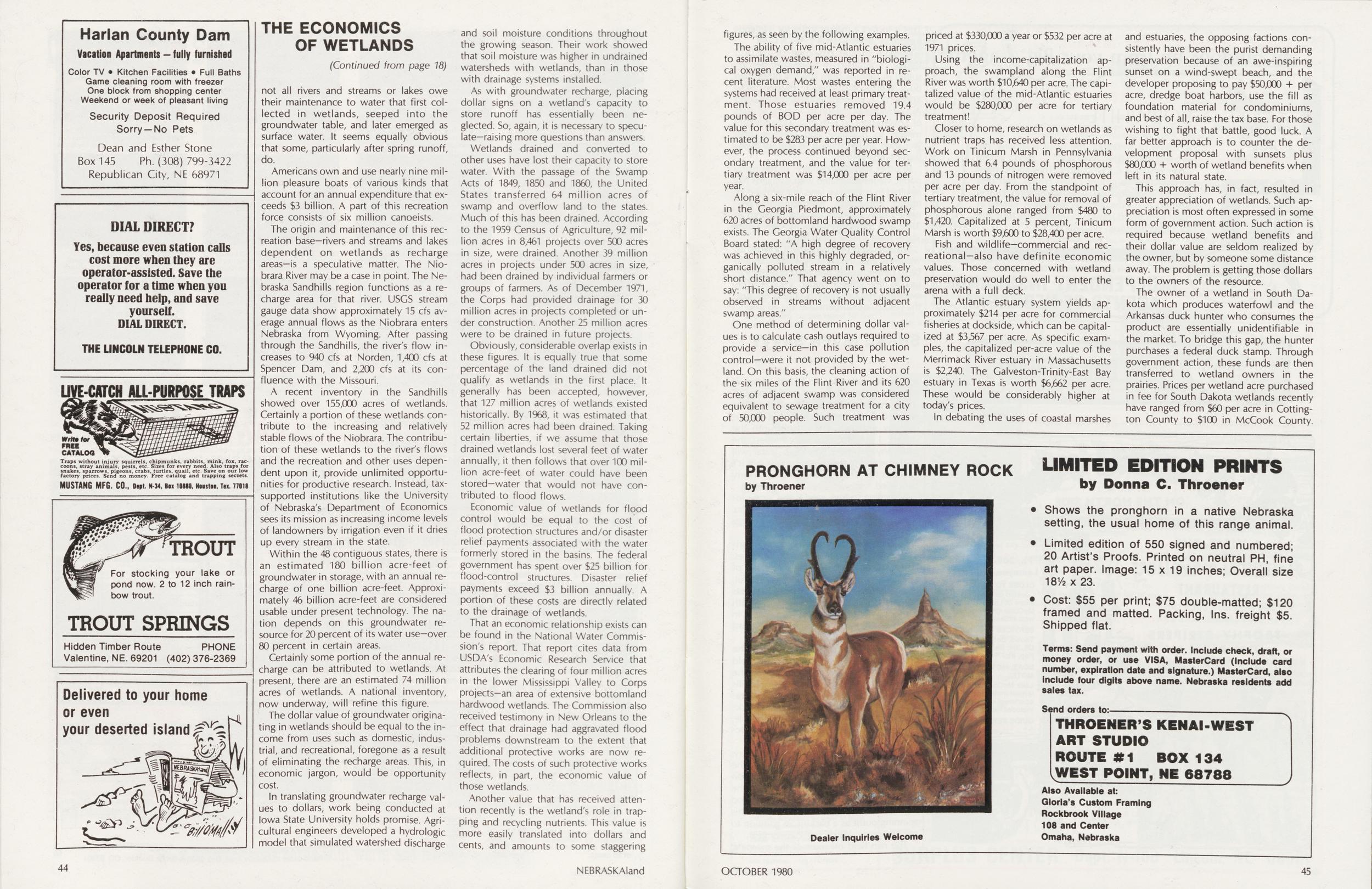 Harlan County Dam
Vacation Apartments - fully furnished
Color TV Kitchen Facilities Full Baths
Game cleaning room with freezer
One block from shopping center
Weekend or week of pleasant living
Security Deposit Required
Sorry —No Pets
Dean and Esther Stone
Box 145 Ph. (308) 799-3422
Republican City, NE 68971
DIAL DIRECT?
Yes, because even station calls
cost more when they are
operator-assisted. Save the
operator for a time when you
really need help, and save
yourself.
DIAL DIRECT.
THE LINCOLN TELEPHONE CO.
UYE-CATCH ALL-PURPOSE TRAPS
FREE
CATALOG
Traps without injury squirrels, chipmunks, rabbits, mink, fox, raccoons, stray animals,
pests, etc. Sizes for every need. Also traps for
snakes, sparrows, pigeons, crabs, turtles, quail, etc. Save on our low
factory prices. Send no money. Free catalog and trapping secrets.
MUSTANG MFG. CO., Dept. N 34, Box 10880. HoHStoi. Tex. 77018
TROUT
For stocking your lake or
pond now. 2 to 12 inch rainbow trout.
TROUT SPRINGS
Hidden Timber Route PHONE
Valentine, NE. 69201 (402) 376-2369
Delivered to your home
or even
your deserted island
Harlan County Dam
Vacation Apartments - fully furnished
Color TV Kitchen Facilities Full Baths
Game cleaning room with freezer
One block from shopping center
Weekend or week of pleasant living
Security Deposit Required
Sorry —No Pets
Dean and Esther Stone
Box 145 Ph. (308) 799-3422
Republican City, NE 68971
DIAL DIRECT?
Yes, because even station calls
cost more when they are
operator-assisted. Save the
operator for a time when you
really need help, and save
yourself.
DIAL DIRECT.
THE LINCOLN TELEPHONE CO.
UYE-CATCH ALL-PURPOSE TRAPS
FREE
CATALOG
Traps without injury squirrels, chipmunks, rabbits, mink, fox, raccoons, stray animals,
pests, etc. Sizes for every need. Also traps for
snakes, sparrows, pigeons, crabs, turtles, quail, etc. Save on our low
factory prices. Send no money. Free catalog and trapping secrets.
MUSTANG MFG. CO., Dept. N 34, Box 10880. HoHStoi. Tex. 77018
TROUT
For stocking your lake or
pond now. 2 to 12 inch rainbow trout.
TROUT SPRINGS
Hidden Timber Route PHONE
Valentine, NE. 69201 (402) 376-2369
Delivered to your home
or even
your deserted island
THE ECONOMICS OF WETLANDS
(Continued from page 18)not all rivers and streams or lakes owe their maintenance to water that first collected in wetlands, seeped into the groundwater table, and later emerged as surface water. It seems equally obvious that some, particularly after spring runoff, do.
Americans own and use nearly nine million pleasure boats of various kinds that account for an annual expenditure that exceeds $3 billion. A part of this recreation force consists of six million canoeists.
The origin and maintenance of this recreation base—rivers and streams and lakes dependent on wetlands as recharge areas—is a speculative matter. The Niobrara River may be a case in point. The Nebraska Sandhills region functions as a recharge area for that river. USGS stream gauge data show approximately 15 cfs average annual flows as the Niobrara enters Nebraska from Wyoming. After passing through the Sandhills, the river's flow increases to 940 cfs at Norden, 1,400 cfs at Spencer Dam, and 2,200 cfs at its confluence with the Missouri.
A recent inventory in the Sandhills showed over 155,000 acres of wetlands. Certainly a portion of these wetlands contribute to the increasing and relatively stable flows of the Niobrara. The contribution of these wetlands to the river's flows and the recreation and other uses dependent upon it, provide unlimited opportunities for productive research. Instead, tax-supported institutions like the University of Nebraska's Department of Economics sees its mission as increasing income levels of landowners by irrigation even if it dries up every stream in the state.
Within the 48 contiguous states, there is an estimated 180 billion acre-feet of groundwater in storage, with an annual recharge of one billion acre-feet. Approximately 46 billion acre-feet are considered usable under present technology. The nation depends on this groundwater resource for 20 percent of its water use-over 80 percent in certain areas.
Certainly some portion of the annual recharge can be attributed to wetlands. At present, there are an estimated 74 million acres of wetlands. A national inventory, now underway, will refine this figure.
The dollar value of groundwater originating in wetlands should be equal to the income from uses such as domestic, industrial, and recreational, foregone as a result of eliminating the recharge areas. This, in economic jargon, would be opportunity cost.
In translating groundwater recharge values to dollars, work being conducted at Iowa State University holds promise. Agricultural engineers developed a hydrologic model that simulated watershed discharge and soil moisture conditions throughout the growing season. Their work showed that soil moisture was higher in undrained watersheds with wetlands, than in those with drainage systems installed.
As with groundwater recharge, placing dollar signs on a wetland's capacity to store runoff has essentially been neglected. So, again, it is necessary to speculate-raising more questions than answers.
Wetlands drained and converted to other uses have lost their capacity to store water. With the passage of the Swamp Acts of 1849, 1850 and 1860, the United States transferred 64 million acres of swamp and overflow land to the states. Much of this has been drained. According to the 1959 Census of Agriculture, 92 million acres in 8,461 projects over 500 acres in size, were drained. Another 39 million acres in projects under 500 acres in size, had been drained by individual farmers or groups of farmers. As of December 1971, the Corps had provided drainage for 30 million acres in projects completed or under construction. Another 25 million acres were to be drained in future projects.
Obviously, considerable overlap exists in these figures. It is equally true that some percentage of the land drained did not qualify as wetlands in the first place. It generally has been accepted, however, that 127 million acres of wetlands existed historically. By 1968, it was estimated that 52 million acres had been drained. Taking certain liberties, if we assume that those drained wetlands lost several feet of water annually, it then follows that over 100 million acre-feet of water could have been stored-water that would not have contributed to flood flows.
Economic value of wetlands for flood control would be equal to the cost of flood protection structures and/or disaster relief payments associated with the water formerly stored in the basins. The federal government has spent over $25 billion for flood-control structures. Disaster relief payments exceed $3 billion annually. A portion of these costs are directly related to the drainage of wetlands.
That an economic relationship exists can be found in the National Water Commission's report. That report cites data from USDA's Economic Research Service that attributes the clearing of four million acres in the lower Mississippi Valley to Corps projects—an area of extensive bottomland hardwood wetlands. The Commission also received testimony in New Orleans to the effect that drainage had aggravated flood problems downstream to the extent that additional protective works are now required. The costs of such protective works reflects, in part, the economic value of those wetlands.
Another value that has received attention recently is the wetland's role in trapping and recycling nutrients. This value is more easily translated into dollars and cents, and amounts to some staggering 44 NEBRASKAland figures, as seen by the following examples.
The ability of five mid-Atlantic estuaries to assimilate wastes, measured in "biological oxygen demand," was reported in recent literature. Most wastes entering the systems had received at least primary treatment. Those estuaries removed 19.4 pounds of BOD per acre per day. The value for this secondary treatment was estimated to be $283 per acre per year. However, the process continued beyond secondary treatment, and the value for tertiary treatment was $14,000 per acre per year.
Along a six-mile reach of the Flint River in the Georgia Piedmont, approximately 620 acres of bottomland hardwood swamp exists. The Georgia Water Quality Control Board stated: "A high degree of recovery was achieved in this highly degraded, organically polluted stream in a relatively short distance." That agency went on to say: "This degree of recovery is not usually observed in streams without adjacent swamp areas."
One method of determining dollar values is to calculate cash outlays required to provide a service-in this case pollution control-were it not provided by the wetland. On this basis, the cleaning action of the six miles of the Flint River and its 620 acres of adjacent swamp was considered equivalent to sewage treatment for a city of 50,000 people. Such treatment was priced at $330,000 a year or $532 per acre at 1971 prices.
Using the income-capitalization approach, the swampland along the Flint River was worth $10,640 per acre. The capitalized value of the mid-Atlantic estuaries would be $280,000 per acre for tertiary treatment!
Closer to home, research on wetlands as nutrient traps has received less attention. Work on Tinicum Marsh in Pennsylvania showed that 6.4 pounds of phosphorous and 13 pounds of nitrogen were removed per acre per day. From the standpoint of tertiary treatment, the value for removal of phosphorous alone ranged from $480 to $1,420. Capitalized at 5 percent, Tinicum Marsh is worth $9,600 to $28,400 per acre.
Fish and wildlife—commercial and recreational—also have definite economic values. Those concerned with wetland preservation would do well to enter the arena with a full deck.
The Atlantic estuary system yields approximately $214 per acre for commercial fisheries at dockside, which can be capitalized at $3,567 per acre. As specific examples, the capitalized per-acre value of the Merrimack River estuary in Massachusetts is $2,240. The Galveston-Trinity-East Bay estuary in Texas is worth $6,662 per acre. These would be considerably higher at today's prices.
In debating the uses of coastal marshes and estuaries, the opposing factions consistently have been the purist demanding preservation because of an awe-inspiring sunset on a wind-swept beach, and the developer proposing to pay $50,000 + per acre, dredge boat harbors, use the fill as foundation material for condominiums, and best of all, raise the tax base. For those wishing to fight that battle, good luck. A far better approach is to counter the development proposal with sunsets plus $80,000 + worth of wetland benefits when left in its natural state.
This approach has, in fact, resulted in greater appreciation of wetlands. Such appreciation is most often expressed in some form of government action. Such action is required because wetland benefits and their dollar value are seldom realized by the owner, but by someone some distance away. The problem is getting those dollars to the owners of the resource.
The owner of a wetland in South Dakota which produces waterfowl and the Arkansas duck hunter who consumes the product are essentially unidentifiable in the market. To bridge this gap, the hunter purchases a federal duck stamp. Through government action, these funds are then transferred to wetland owners in the prairies. Prices per wetland acre purchased in fee for South Dakota wetlands recently have ranged from $60 per acre in Cottington County to $100 in McCook County. This is in fact a market value for wetlands for ducks alone.
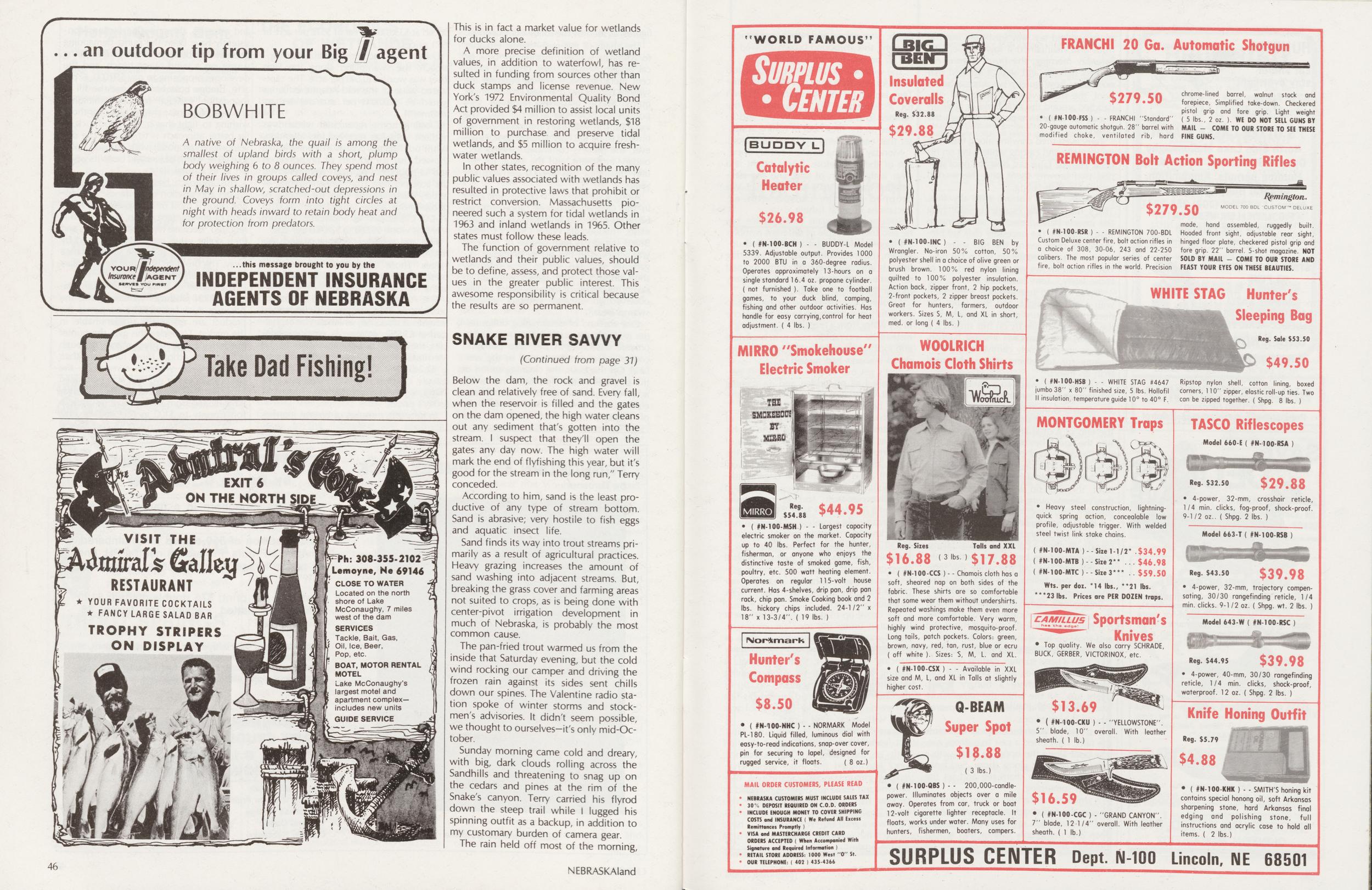
A more precise definition of wetland values, in addition to waterfowl, has resulted in funding from sources other than duck stamps and license revenue. New York's 1972 Environmental Quality Bond Act provided $4 million to assist local units of government in restoring wetlands, $18 million to purchase and preserve tidal wetlands, and $5 million to acquire freshwater wetlands.
In other states, recognition of the many public values associated with wetlands has resulted in protective laws that prohibit or restrict conversion. Massachusetts pioneered such a system for tidal wetlands in 1963 and inland wetlands in 1965. Other states must follow these leads.
The function of government relative to wetlands and their public values, should be to define, assess, and protect those values in the greater public interest. This awesome responsibility is critical because the results are so permanent.
SNAKE RIVER SAVVY
(Continued from page 31)Below the dam, the rock and gravel is clean and relatively free of sand. Every fall, when the reservoir is filled and the gates on the dam opened, the high water cleans out any sediment that's gotten into the stream. I suspect that they'll open the gates any day now. The high water will mark the end of flyfishing this year, but it's good for the stream in the long run," Terry conceded.
According to him, sand is the least productive of any type of stream bottom. Sand is abrasive; very hostile to fish eggs and aquatic insect life.
Sand finds its way into trout streams primarily as a result of agricultural practices. Heavy grazing increases the amount of sand washing into adjacent streams. But, breaking the grass cover and farming areas not suited to crops, as is being done with center-pivot irrigation development in much of Nebraska, is probably the most common cause.
The pan-fried trout warmed us from the inside that Saturday evening, but the cold wind rocking our camper and driving the frozen rain against its sides sent chills down our spines. The Valentine radio station spoke of winter storms and stockmen's advisories. It didn't seem possible, we thought to ourselves-it's only mid-October.
Sunday morning came cold and dreary, with big, dark clouds rolling across the Sandhills and threatening to snag up on the cedars and pines at the rim of the Snake's canyon. Terry carried his flyrod down the steep trail while I lugged his spinning outfit as a backup, in addition to my customary burden of camera gear.
The rain held off most of the morning, as we worked our way upstream, but the trout also maintained a low profile. Like Saturday morning, the trout seemed extremely nervous and alert. It seemed that no matter how quietly we approached a pool, the trout were watching and skedaddled around the next bend or beneath a snag the instant we peeked through the brush.
46 NEBRASKAland WORLD FAMOUS Surplus buddy Catalytic Heater $26.98 ( #N-100-BCH ) - - BUDDY-L Model 5339. Adjustable output. Provides 1000 to 2000 BTU in a 360-degree radius. Operates approximately 13-hours on a single standard 16.4 oz. propane cylinder. ( not furnished ). Take one to football games, to your duck blind, camping, fishing and other outdoor activities. Has handle for easy carrying,control for heat adjustment. ( 4 lbs. ) MIRRO "Smokehouse Electric Smoker 25. $44.95 $54.88 ( #N-100-MSH ) - - Largest capacity electric smoker on the market. Capacity up to 40 lbs. Perfect for the hunter, fisherman, or anyone who enjoys the distinctive taste of smoked game, fish, poultry, etc. 500 watt heating element. Operates on regular 115-volt house current. Has 4-shelves, drip pan, drip pan rack, chip pan. Smoke Cooking book and 2 lbs. hickory chips included. 24-1/2" x 18" x 13-3/4". ( 19 lbs. ) Nonkmark Hunter's Compass $8.50 ( IN-100-NHC ) - NORMARK Model PL-180. Liquid filled, luminous dial with easy-to-read indications, snap-over cover, pin for securing to lapel, designed for rugged service, it floats. ( 8 oz.) MAIL ORDER CUSTOMERS, PLEASE READ NEBRASKA CUSTOMERS MUST INCLUDE SALES TAX 30% DEPOSIT REQUIRED ON C.O.D. ORDERS INCLUDE ENOUGH MONEY TO COVER SHIPPING COSTS and INSURANCE ( We Refund All Excess Remittances Promptly ) VISA and MASTERCHARGE CREDIT CARD ORDERS ACCEPTED ( When Accompanied With Signature and Required Information ) RETAIL STORE ADDRESS: 1000 West "0" St. OUR TELEPHONE: ( 402 ) 435-4366 by 50% ( #N-100-INC ) - - BIG BEN Wrangler. No-iron 50% cotton, polyester shell in a choice of olive green or brush brown. 100% red nylon lining quilted to 100% polyester insulation. Action back, zipper front, 2 hip pockets, 2-front pockets, 2 zipper breast pockets. Great for hunters, farmers, outdoor workers. Sizes S, M, L, and XL in short, med. or long ( 4 lbs. ) WOOLRICH Chamois Cloth Shirts Reg. Sizes $16.88 ( 3 lbs. ) Tails and XXL $17.88 ( IN-IOO-CCS ) - - Chamois cloth has a soft, sheared nap on both sides of the fabric. These shirts are so comfortable that some wear them without undershirts. Repeated washings make them even more soft and more comfortable. Very warm, highly wind protective, mosquito-proof. Long tails, patch pockets. Colors: green, brown, navy, red, tan, rust, blue or ecru ( off white ). Sizes: S, M, L. and XL. ( #N-100-CSX ) Available in XXL size and M, L, and XL in Tails at slightly higher cost. Q-BEAM Super Spot $18.88 ( 3 lbs.) ( #N-100-QBS ) - - 200,000-candlepower. Illuminates objects over a mile away. Operates from car, truck or boat 12-volt cigarette lighter receptacle. It floats, works under water. Many uses for hunters, fishermen, boaters, campers. FRANCHI 20 Ga. Automatic Shotgun $279 ( #N100-FSS) - - FRANCHI "Standard" 20-gauge automatic shotgun. 28" barrel with modified choke, ventilated rib, hard chrome-lined barrel, walnut stock and forepiece, Simplified take-down. Checkered pistol grip and fore grip. Light weight ( 5 lbs , 2 oz ) WE DO NOT SELL GUNS BY MAIL - COME TO OUR STORE TO SEE THESE FINE GUNS. REMINGTON Bolt Action Sporting Rifles a. $279.50 MODEL 700 BDL CUSTOM "" DELUXE ( IN-100-RSR ) - - REMINGTON 700-BDL Custom Deluxe center fire, bolt action rifles in a choice of 308, 30-06, 243 and 22-250 calibers. The most popular series of center fire, bolt action rifles in the world. Precision made, hand assembled, ruggedly built. Hooded front sight, adjustable rear sight, hinged floor plate, checkered pistol grip and fore grip. 22" barrel. 5-shot magazine. NOT SOLD BY MAIL - COME TO OUR STORE AND FEAST YOUR EYES ON THESE BEAUTIES. WHITE STAG Hunter's Sleeping Bag ( #N-100-HSB ) - - WHITE STAG #4647 jumbo 38" x 80" finished size, 5 lbs. II insulation temperature guide 10° to 40° F. Reg. Sale $53.50 $49.50 Ripstop nylon shell, cotton lining, boxed corners, 110" zipper, elastic roll-up ties. Two can be zipped together. ( Shpg. 8 lbs. ) MONTGOMERY Traps Heavy steel construction, lightning-quick spring action, concealable low profile, adjustable trigger. With welded steel twist link stake chains. ( #N-100-MTA ) Size 1-1/2 ( #N-100-MTB ) Size 2. ( #N-100-MTC ) Size 3 Wts. per doz. 14 lbs., $34.99 $46.98 $59.50 21 lbs. 23 lbs. Prices are PER DOZEN traps. camllus Sportsman's the edge! Knives Top quality. We also carry SCHRADE, BUCK, GERBER, VICTORINOX, etc. $13.69 ( #N-100-CKU ) - - "YELLOWSTONE". 5" blade, 10" overall. With leather sheath. (1 lb.) $16.59 ( #N-100-CGC ) - "GRAND CANYON". 7" blade, 12 1/4" overall. With leather sheath. (1 lb.) TASCO Rifiescopes Model 660-E ( #N-100-RSA ) Reg. $32.50 $29.88 4-power, 32-mm, crosshair reticle, 1/4 min. clicks, fog-proof, shock-proof. 9-1/2 oz.. ( Shpg. 2 lbs. ) Model 663-T ( #N-100-RSB ) Reg. $43.50 $39.98 4-power, 32-mm, trajectory compensating, 30/30 rangefinding reticle, 1/4 min. clicks. 9-112 oz. ( Shpg. wt. 2 lbs. ) Model 643-W ( #N 100-RSC ) Reg. $44.95 $39.98 4-power, 40-mm, 30/30 rangefinding reticle, 1/4 min. clicks, shock-proof, waterproof. 12 oz. ( Shpg. 2 lbs. ) Knife Honing Outfit ( #N-100-KHK ) - - SMITH'S honing kit contains special honong oil, soft Arkansas sharpening stone, hard Arkansas final edging and polishing stone, full instructions and acrylic case to hold all items. ( 2 lbs.) SURPLUS CENTER Dept. IM-100 Lincoln, NE 68501 HUNTERS
Eat and/or
stay overnight
$20.75 per
person per day
J'S OTTER CREEK MARINA
North Side Lake McConaughy
Open 4:30 a.m. till 7 p.m. daily
Hunting permits, Ammunition,
General Hunting Supplies
Phone LEYMOYNE (308) 355-2341
P.O. LEWELLEN, NEBR. 69147
Jay & Julie Peterson
STOCK YOUR LAKE
OR POND
with
CHANNEL CAT
LARGEMOUTH BASS
BLUEGILL - CRAPPIE
ORDER NOW
WILLOW LAKE FISH HATCHERY
Rt. 3, Box 46, Hastings, Nebr. 68901
Gaylord L. Crawford
Phone: (402) 463-8022
Day or Night
For 1980 Stocking
Pond Mill—Products for algae control
SAV
Make 'em yourself!
NEW MODELS from the originator of
the famous do-it-yourself decoy making system. Improved design for more
economy and easier to make. More
realism in a hunting decoy than ever
before!
SOLID PLASTIC DECOYS made with our famous
cast aluminum molds. Tried and tested since
1958. No special tools needed. Just boil 'em to
make 'em!
ECONOMICAL, fun to make, outfits for most
popular hunted species ducks and geese. Write
today for catalog. Please send $1.00 (applicable to
first order) to cover handling.
DECOYS UNLIMITED, INC.
CLINTON, IOWA 52732
HUNTERS
Eat and/or
stay overnight
$20.75 per
person per day
J'S OTTER CREEK MARINA
North Side Lake McConaughy
Open 4:30 a.m. till 7 p.m. daily
Hunting permits, Ammunition,
General Hunting Supplies
Phone LEYMOYNE (308) 355-2341
P.O. LEWELLEN, NEBR. 69147
Jay & Julie Peterson
STOCK YOUR LAKE
OR POND
with
CHANNEL CAT
LARGEMOUTH BASS
BLUEGILL - CRAPPIE
ORDER NOW
WILLOW LAKE FISH HATCHERY
Rt. 3, Box 46, Hastings, Nebr. 68901
Gaylord L. Crawford
Phone: (402) 463-8022
Day or Night
For 1980 Stocking
Pond Mill—Products for algae control
SAV
Make 'em yourself!
NEW MODELS from the originator of
the famous do-it-yourself decoy making system. Improved design for more
economy and easier to make. More
realism in a hunting decoy than ever
before!
SOLID PLASTIC DECOYS made with our famous
cast aluminum molds. Tried and tested since
1958. No special tools needed. Just boil 'em to
make 'em!
ECONOMICAL, fun to make, outfits for most
popular hunted species ducks and geese. Write
today for catalog. Please send $1.00 (applicable to
first order) to cover handling.
DECOYS UNLIMITED, INC.
CLINTON, IOWA 52732
Terry even tried crawling along the bank on his belly and casting while lying on his back. His first false cast over the pool startled two browns there, and the second sent them high-tailing.
"I really prefer fishing with dry flies. That's the ultimate experience—watching the insects hatch, selecting something to match, making the necessary delicate presentation, then seeing the fish strike. Insects will hatch readily on warm fall days, but heaven knows we haven't had any of those lately," Terry lamented.
"I also like to use nymphs. I tie them with a bit of weight, and they work the deep pools and runs quite effectively. But, the most productive fly on this stream is a streamer, which imitates a small baitfish. Browns are extremely carniverous, always looking for something more substantial than an insect.
"You have to switch to a sinking line to fish nymphs and streamers. I always cast the streamers upstream, or perhaps across current, but never downstream. I throw to the end of a riffle and work the streamer into the pool. They're also good along tree roots and downed cedars.
"I usually decide on my strategy by checking the stomach contents of my first trout, then tie on a fly similar to what they've been eating. But, to check a trout's stomach, you have to have a trout, which we don't," he chuckled.
After a quick lunch, we returned to the canyon. By then a cold drizzle was falling, and it wasn't long before that turned into a full-fleged rain. All the while the temperature kept falling, and flecks of snow began sneaking in among the raindrops.
Before long, Terry's fingers were too stiff to perform the delicate task of handling the flyline. He stoically stowed the flyrod and took up his spinning outfit.
He worked a couple of pools and deep runs with a brass spinner, casting upstream to the deepest holes, along brushpiles, behind rocks-anywhere a hungry brown might lurk. All the while the temperature was dropping and more flakes appeared among the raindrops.
Just a couple of hundred yards below the falls, Terry rifled a cast to a deep, narrow pool along the opposite bank with a fallen cedar lying along shore. Suddenly, he gave the rod a sharp tug and set the barbs in something.
A smile of satisfaction spread across his face as the rod developed a healthy bow and quivered just a bit. The fish stayed deep and made only one or two serious attempts to leave the pool or head for brush. After a short and rather unspectacular fight, the 3V2-pound brown allowed itself to be beached on a gravel bar.
The weather had long since become too nasty for any sane person, and by the time Terry landed his fish, it was too much even for a fisherman. We adjourned to the camper to thaw out and dry off, and to prepare for the final hour of fishing at sunset that earned Terry his other nice trout.
Monday morning dawned exactly opposite of the day before. It was bright and clear with no sign of rain, and the temperature had risen to a tolerable level. We dropped into the canyon with expectations of great fishing.
Streamers were again Terry's choice, but he also tried a couple of different nymphs.
I lagged behind a bit as we waded upstream, thus reducing chances of spooking fish. My attention was temporarily focused on some of my gear when I heard Terry mutter an expletive of surprise.
I looked up, expecting to see him fast to a big fish, or perhaps up to his moustache in icy water from a misstep on a slick rock. Instead, he was rapidly reeling in his flyline and looking anxiously at the water. I wondered if sharks had moved in.
"Let's get out of here. The water's getting roiled all of sudden and it's coming up fast. They've opened the gates on the dam," he said.
With somewhat humorous visions of the dam bursting, I followed close on his heels as he scrambled for the east bank of the stream, and by the time we left the water, the change in the stream was very evident, as its increased flow began pushing along sticks, leaves, vegetation, and miscellaneous stuff. And, as we left the canyon a few minutes later, the change in the stream was complete. Where we had stood knee-deep in fairly placid, clear water 10 minutes before, there was now a brownish, boiling torrent perhaps eyeball deep or more. If we had been slow in getting out of there, or had to go to the opposite bank, we would have had to walk 10 miles or more.
We drove up to the waterfall to have a look at it under the new circumstances, and it was barely recognizable. In place of the gossamer filaments of crystal water dancing off the rock shelf, there was a roaring brown hump of water crashing into the pool, cascading down on top of the spot where Terry had landed his fish the evening before. The entire pool was aboil with angry, dirty water.
We left the Snake a few minutes later, not loaded down with fish, but satisfied with an interesting angling experience. Terry had fished the Snake under challenging circumstances, caught two nice browns and some supper-size fish, and in general had a pretty good time. "You know," he said after we drove a few miles, "that was a great trip. You really don't have to catch fish every day to have a good time on the Snake."
48 NEBRASKAlandTrading Post
DOGSWELL-BRED Hunting dogs for sale-Brittanies, English setters and pointers-ranging in age from puppies to young dogs Darrell Yentes, 1118 McMillan, Holdrege, NE 68949. Phone (308) 995-8570 or (308) 995-4797.
AKC BRITTANY female partially trained. Marion North, R.R. 1, York, Nebraska 68467. (402) 362-2663.
AKC BEAGLES. All ages. Beautiful, affectionate, excellent hunters, and household companions. Stud service by proven hunter. Clint Burge, Route 8, Lincoln, NE. 68506 (402) 423-4295.
BRITTANY PUPPIES for sale, AKC registered. Both parents good hunters. Lon Clark, Route 2, Holdrege, Nebraska 68949 (308) 567-3712.
MISCELLANEOUSGUNS-Browning, Winchester, Remington, others, Hi-powers, shotguns, new, used, antiques. Want Pre-1964 Winchesters. Buy-Sell-Trade. Ph. (402) 729-6112. Bedlan's Sporting Goods, Fairbury, NE 68352.
FRITZ GUNSMITHING & Supply Co-Heckler & Koch-Weatherby-M.A.C. Dealer. Handfinishing-Hot Blue-Repair-Antique Restoration. Wanted World War I and II souvenir guns, pistols, rifles, swords, gun parts and shells. 407 South Hams, Wilber, NE (402) 821-2260.
NE. NEBR. TROUT FISHING. For rent Mon.-Thurs. or Fri-Sun. Two cottages, four ponds and stream. Privacy with trout up to 5 pounds. Open April 1. Diamond E. Trout Resort, Orchard, NE 68764. (402) 893-4745.
FISH FOR SALE: Channel Catfish, Largemouth Bass, Bluegill, Crappie, Perch, Bullhead, Rainbow Trout and minnows for pond and lake stocking. Contact the Pleasant Valley Fish Farm, Route 1, McCook, Nebraska 69091. Phone (308) 345-6599.
PLASTIC DECOYS: We're originator of famous do it yourself system. Catalog $1.00. Decoys Unlimited, Ointon, IA 52732.
EIGHT-TIME NATIONAL Award-Winning Studio. We assist in arranging hunting and fishing trips, also Dinges Taxidermy Studio, 2763 So. 12th Street, Omaha, NE 68108. 402- 342-3718.
DUCK HUNTERS! Guided hunts on the Platte River near Schuyler. Hunt over the finest decoy spread in eastern Nebraska. Individuals or groups $20 per day. Make your reservations early. Call Frank Hoppe at 402-464-8417 or 466-5351 Lincoln.
Christmas Gift Idea COYOTE TRAPPING WITH SMITTY 16 years modern experience—Michigan, Montana, Arizona. 124 pages, 149 photos. Check or money order $10.50 P.P. R. C. Smith, 3321 E. Cook, Grand Island, Mich. 48439.
77 RED DALE PICKUP Camper for sale. Eleven-foot, fully self-contained, 3-way refrigerator, stool, shower, hydraulic jacks, water heater, roof storage. Hardly used. Contact Fred Rimington, 15405 Blackwell Drive, Omaha, NE 68137. Phone (402) 895-0181.
TAXIDERMYBIG BEAR TAXIDERMY, Rt. 2, Mitchell, Nebraska 69357. We specialize in all big game from Alaska to Nebraska, also birds and fish. Hair on and hair off tanning, AYi miles west of Scottsbluff on Highway 26. Phone (308) 635-3013.
KARL SCHWARZ Master Taxidermist. Mounting of game heads— birds — fish - animals — fur rugs — robes — tanning buckskin. Since 1910. 424 South 13th Street, Dept. A, Omaha, Nebraska 68102.
FREEZE-DRY TAXIDERMY Wally Allison's State Record Taxidermy, 2709 Birchwood, North Platte, NE 69101. Phone: (308) 534-2324. Specializing in Fish and Small Game, Snake and Lizard and Novelties. (Nothing too small) Newest of all taxidermy methods employed.
CREATIVE TAXIDERMY-AII types work since 1935 now includes Freeze-Dry processing of approved small specimens. Naturecraft Studio, 925 Fourth Corso, Nebraska City, Nebraska 68410. Phone: (402) 873-5491. |oe Voges-Owner.
IOHNSON TAXIDERMY-servicing southwest Nebraska, specializing in big-game mounts, life-sized mounts, rug work, fish, birds, tanning hair-on leather. Brochure and price list on request. Johnson Taxidermy, Rt. 1, Box 78, Lamar, NE 69035. Telephone (308) 882-5555.
WHITETAIL TAXIDERMY: Ten years experience. Professional, lifelike mounts to your satisfaction. Reasonable rates, fast service. Try me this year. 2983 Air Vista Drive, Columbus, NE Phone (402)564-6885.
CREATIVE TAXIDERMY in all its branches since 1935, now includes Northstar Freeze-Dry processing of approved small specimens. Also tanning and deerskin processing. Naturecraft Studio, Nebraska City, Nebraska 68410. )oe Voges-Owner. Phone (402) 873-5491.
NABITY'S TAXIDERMY. 29 years experience. All taxidermy services available. Specializing in natural grass backgrounds. 5021 Washington, Lincoln, NE 68506. (402) 489-6351.
GANDER INC Lewellen, Nebraska Western Nebraska's Goose Hunting at its Best 13 heated concrete blinds Adjacent to two game reserves 1/2-mile river frontage at mouth of Lake McConaughy Nearby lodging available *" 1% miles east, 1/2-mile south of highway 26 and 92 junction For Reservations call (308) 284-4691 After November 10 call (308) 778-5631 Browning Our exclusive discount plan on all Browning products will save you up to 20%. This includes guns, knives, archery, clothing, boots & gun cases. Inquire... it will $ave you $$$. Big discounts on other sporting goods. ALSO FEATURING: WINCHESTER COLT BLACK POWDER RUGER SMITH & WESSON REMINGTON COLT SAUER RIFLES WEATHERBY BLACK POWDER GUNS & ACCESSORIES WE ALSO CARRY A COMPLETE LINE OF RELOADING EQUIPMENT AND COMPONENTS BY PACIFIC, SIERRA AND HORNADY. SEE US FIRST FOR ALL YOUR SHOOTING NEEDS. Phone (402) 643-3303 Box 243, Seward, Nebraska 68434 GUN DOG TRAINING All Sporting Breeds Each dog trained on both native game and pen-reared birds. Ducks for retrievers. All dogs worked individually. Field Champion-sired labrador pups for sale. 7 Midwest's finest facilities. " WILDERNESS KENNELS Henry Sader-Roca. Nb. (402)423-4212 68430 RISHLING'S GOOSE LORE 4 miles east, V2 mile south on north side Platte River Lewellen, Nebr. in Garden County COMMERCIAL GOOSE BLINDS Write or Call George O. Rishling, Manager Lewellen, Nebr. 69147 Phone (308) 778-5622 or (308) 432-2519 OCTOBER 1980 49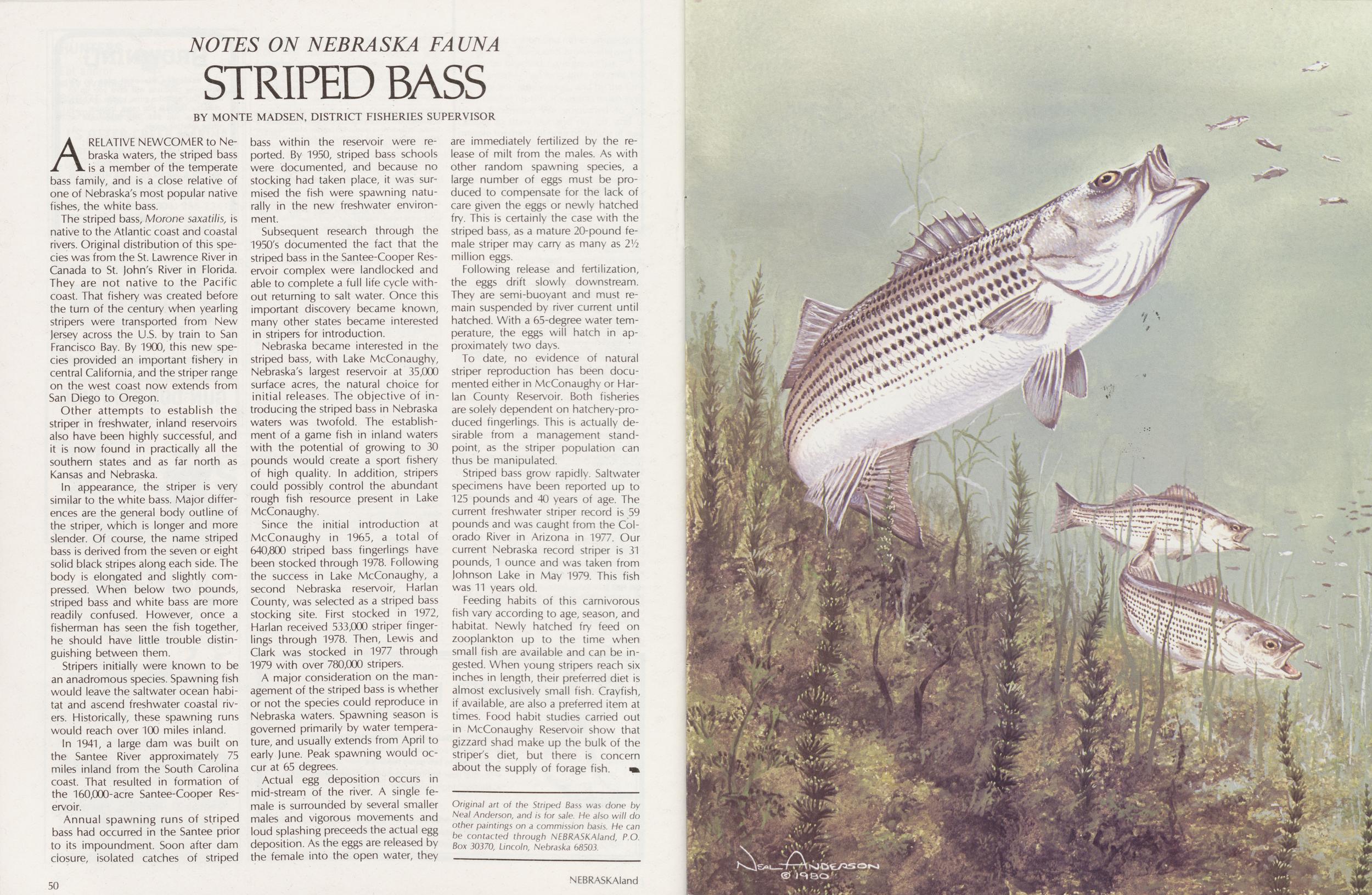
NOTES ON NEBRASKA FAUNA STRIPED BASS
BY MONTE MADSEN, DISTRICT FISHERIES SUPERVISORA RELATIVE NEWCOMER to Nebraska waters, the striped bass is a member of the temperate bass family, and is a close relative of one of Nebraska's most popular native fishes, the white bass.
The striped bass, Morone saxatilis, is native to the Atlantic coast and coastal rivers. Original distribution of this species was from the St. Lawrence River in Canada to St. John's River in Florida. They are not native to the Pacific coast. That fishery was created before the turn of the century when yearling stripers were transported from New Jersey across the U.S. by train to San Francisco Bay. By 1900, this new species provided an important fishery in central California, and the striper range on the west coast now extends from San Diego to Oregon.
Other attempts to establish the striper in freshwater, inland reservoirs also have been highly successful, and it is now found in practically all the southern states and as far north as Kansas and Nebraska.
In appearance, the striper is very similar to the white bass. Major differences are the general body outline of the striper, which is longer and more slender. Of course, the name striped bass is derived from the seven or eight solid black stripes along each side. The body is elongated and slightly compressed. When below two pounds, striped bass and white bass are more readily confused. However, once a fisherman has seen the fish together, he should have little trouble distinguishing between them.
Stripers initially were known to be an anadromous species. Spawning fish would leave the saltwater ocean habitat and ascend freshwater coastal rivers. Historically, these spawning runs would reach over 100 miles inland.
In 1941, a large dam was built on the Santee River approximately 75 miles inland from the South Carolina coast. That resulted in formation of the 160,000-acre Santee-Cooper Reservoir.
Annual spawning runs of striped bass had occurred in the Santee prior to its impoundment. Soon after damciosure, isolated catches of striped bass within the reservoir were reported. By 1950, striped bass schools were documented, and because no stocking had taken place, it was surmised the fish were spawning naturally in the new freshwater environment.
Subsequent research through the 1950's documented the fact that the striped bass in the Santee-Cooper Reservoir complex were landlocked and able to complete a full life cycle without returning to salt water. Once this important discovery became known, many other states became interested in stripers for introduction.
Nebraska became interested in the striped bass, with Lake McConaughy, Nebraska's largest reservoir at 35,000 surface acres, the natural choice for initial releases. The objective of introducing the striped bass in Nebraska waters was twofold. The establishment of a game fish in inland waters with the potential of growing to 30 pounds would create a sport fishery of high quality. In addition, stripers could possibly control the abundant rough fish resource present in Lake McConaughy.
Since the initial introduction at McConaughy in 1965, a total of 640,800 striped bass fingerlings have been stocked through 1978. Following the success in Lake McConaughy, a second Nebraska reservoir, Harlan County, was selected as a striped bass stocking site. First stocked in 1972, Harlan received 533,000 striper fingerlings through 1978. Then, Lewis and Clark was stocked in 1977 through 1979 with over 780,000 stripers.
A major consideration on the management of the striped bass is whether or not the species could reproduce in Nebraska waters. Spawning season is governed primarily by water temperature, and usually extends from April to early June. Peak spawning would occur at 65 degrees.
Actual egg deposition occurs in mid-stream of the river. A single female is surrounded by several smaller males and vigorous movements and loud splashing preceeds the actual egg deposition. As the eggs are released by the female into the open water, they are immediately fertilized by the release of milt from the males. As with other random spawning species, a large number of eggs must be produced to compensate for the lack of care given the eggs or newly hatched fry. This is certainly the case with the striped bass, as a mature 20-pound female striper may carry as many as 216 million eggs.
Following release and fertilization, the eggs drift slowly downstream. They are semi-buoyant and must remain suspended by river current until hatched. With a 65-degree water temperature, the eggs will hatch in approximately two days.
To date, no evidence of natural striper reproduction has been documented either in McConaughy or Harlan County Reservoir. Both fisheries are solely dependent on hatchery-produced fingerlings. This is actually desirable from a management standpoint, as the striper population can thus be manipulated.
Striped bass grow rapidly. Saltwater specimens have been reported up to 125 pounds and 40 years of age. The current freshwater striper record is 59 pounds and was caught from the Colorado River in Arizona in 1977. Our current Nebraska record striper is 31 pounds, 1 ounce and was taken from Johnson Lake in May 1979. This fish was 11 years old.
Feeding habits of this carnivorous fish vary according to age, season, and habitat. Newly hatched fry feed on zooplankton up to the time when small fish are available and can be ingested. When young stripers reach six inches in length, their preferred diet is almost exclusively small fish. Crayfish, if available, are also a preferred item at times. Food habit studies carried out in McConaughy Reservoir show that gizzard shad make up the bulk of the striper's diet, but there is concern about the supply of forage fish.
Original art of the Striped Bass was done by Neal Anderson, and is for sale. He also will do other paintings on a commission basis. He can be contacted through NEBRASKAland, P.O. Box 30370, Lincoln, Nebraska 68503. 50 NEBRASKAland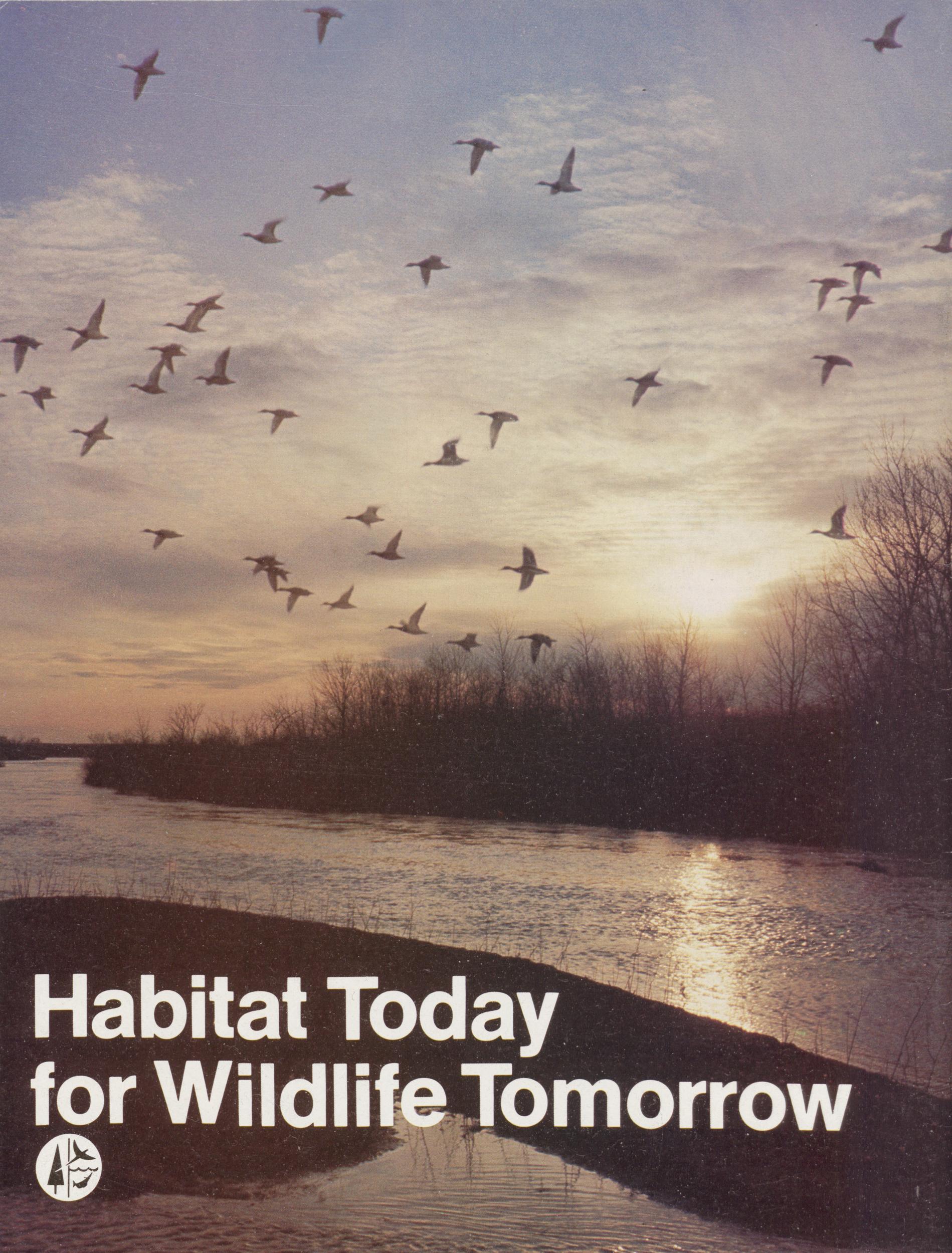
Habitat Today for Wildlife Tomorrow
Position: 412 (24 views)