Volume 58, Issue 9, 1980
NEBRASKAland
AUGUST 1980 · $1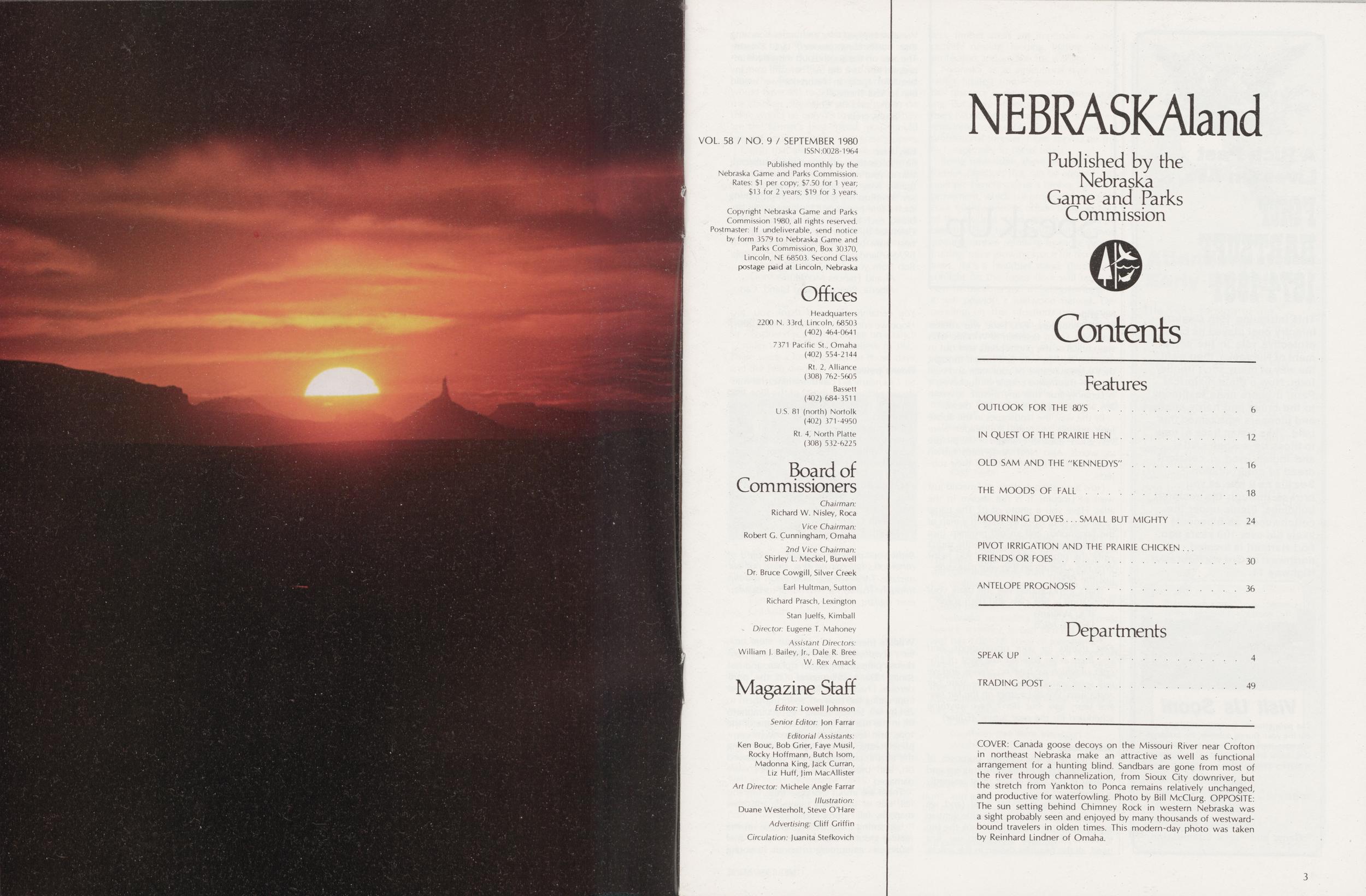
NEBRASKAland
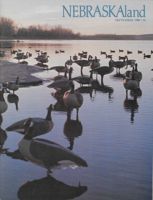
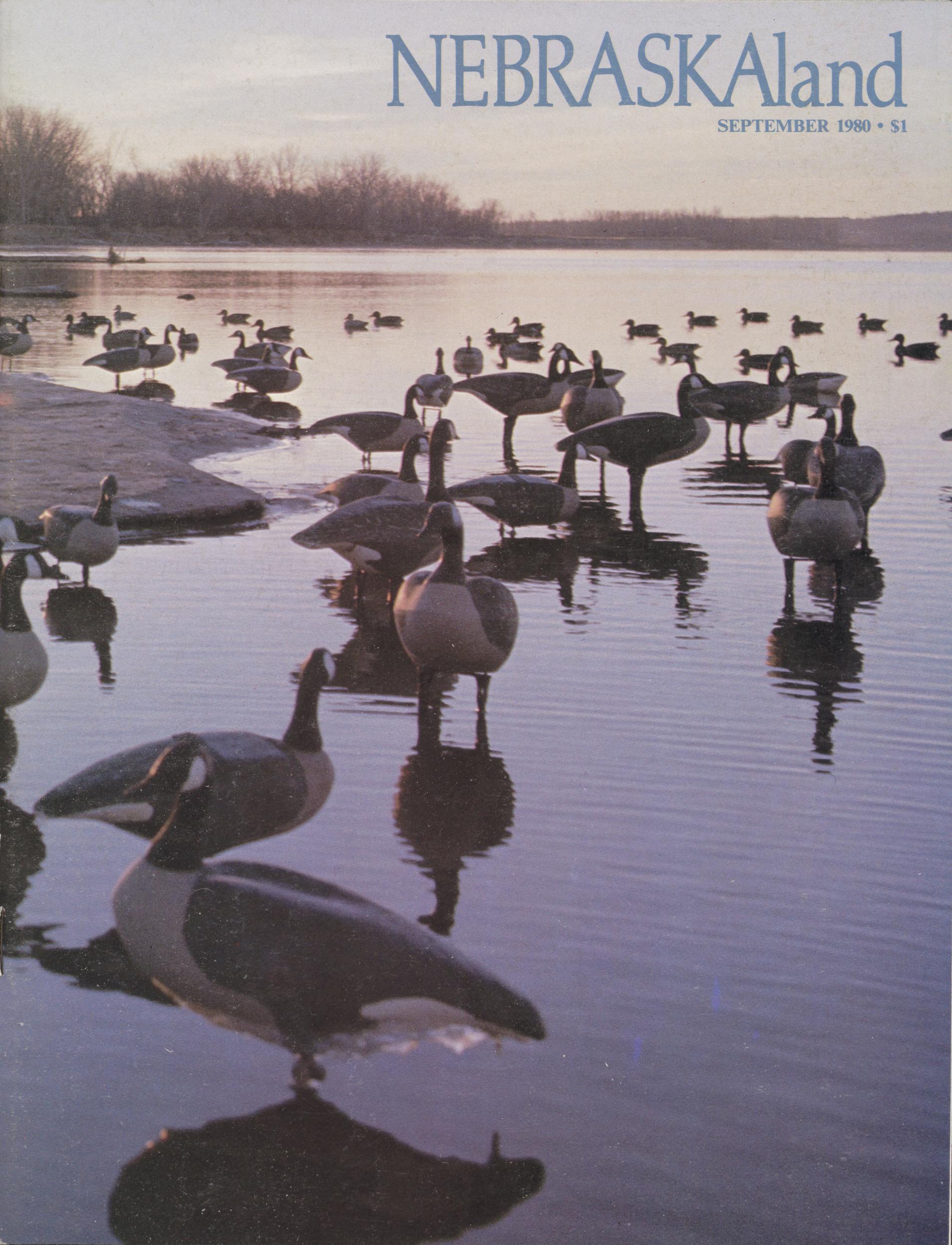
Published by the NEbraska Game and Parks Commission VOL. 58 / NO. 9 / SEPTEMBER 1980 ISSN :0028-1964 Published monthly by the Nebraska Game and Parks Commission. Rates: $1 per copy; $7.50 for 1 year; $13 for 2 years; $19 for 3 years. Copyright Nebraska Game and Parks Commission 1980, all rights reserved. Postmaster: If undeliverable, send notice by form 3579 to Nebraska Game and Parks Commission, Box 30370, Lincoln, NE 68503. Second Class postage paid at Lincoln, Nebraska Offices Headquarters 2200 N. 33rd, Lincoln, 68503 (402) 464-0641 7371 Pacific St., Omaha (402) 554-2144 Rt. 2, Alliance (308) 762-5605 Bassett (402) 684-3511 U.S. 81 (north) Norfolk (402) 371-4950 Rt. 4, North Platte (308) 532-6225 Board of Commissioners Chairman: Richard W. Nisley, Roca Vice Chairman: Robert G. Cunningham, Omaha 2nd Vice Chairman: Shirley L. Meckel, Burwell Dr. Bruce Cowgill, Silver Creek Earl Hultman, Sutton Richard Prasch, Lexington Stan Juelfs, Kimball Director: Eugene T. Mahoney Assistant Directors: William ). Bailey, Jr., Dale R. Bree W. Rex Amack Magazine Staff Editor: Lowell Johnson Senior Editor: Jon Farrar Editorial Assistants: Ken Bouc, Bob Grier, Faye Musil, Rocky Hoffmann, Butch Isom, Madonna King, Jack Curran, Liz Huff, Jim MacAllister Art Director: Michele Angle Farrar Illustration: Duane Westerholt, Steve O'Hare Advertising: Cliff Griffin Circulation: Juanita Stefkovich Contents Features OUTLOOK FOR THE 80'S 6 IN QUEST OF THE PRAIRIE HEN 12 OLD SAM AND THE "KENNEDYS" 16 THE MOODS OF FALL 18 MOURNING DOVES... SMALL BUT MIGHTY 24 PIVOT IRRIGATION AND THE PRAIRIE CHICKEN FRIENDS OR FOES 30 ANTELOPE PROGNOSIS 36 Departments SPEAK UP TRADING POST 49 COVER: Canada goose decoys on the Missouri River near Crofton in northeast Nebraska make an attractive as well as functional arrangement for a hunting blind. Sandbars are gone from most of the river through channelization, from Sioux City downriver, but the stretch from Yankton to Ponca remains relatively unchanged, and productive for waterfowling. Photo by Bill McClurg. OPPOSITE: The sun setting behind Chimney Rock in western Nebraska was a sight probably seen and enjoyed by many thousands of westward-bound travelers in olden times. This modern-day photo was taken by Reinhard Lindner of Omaha. 3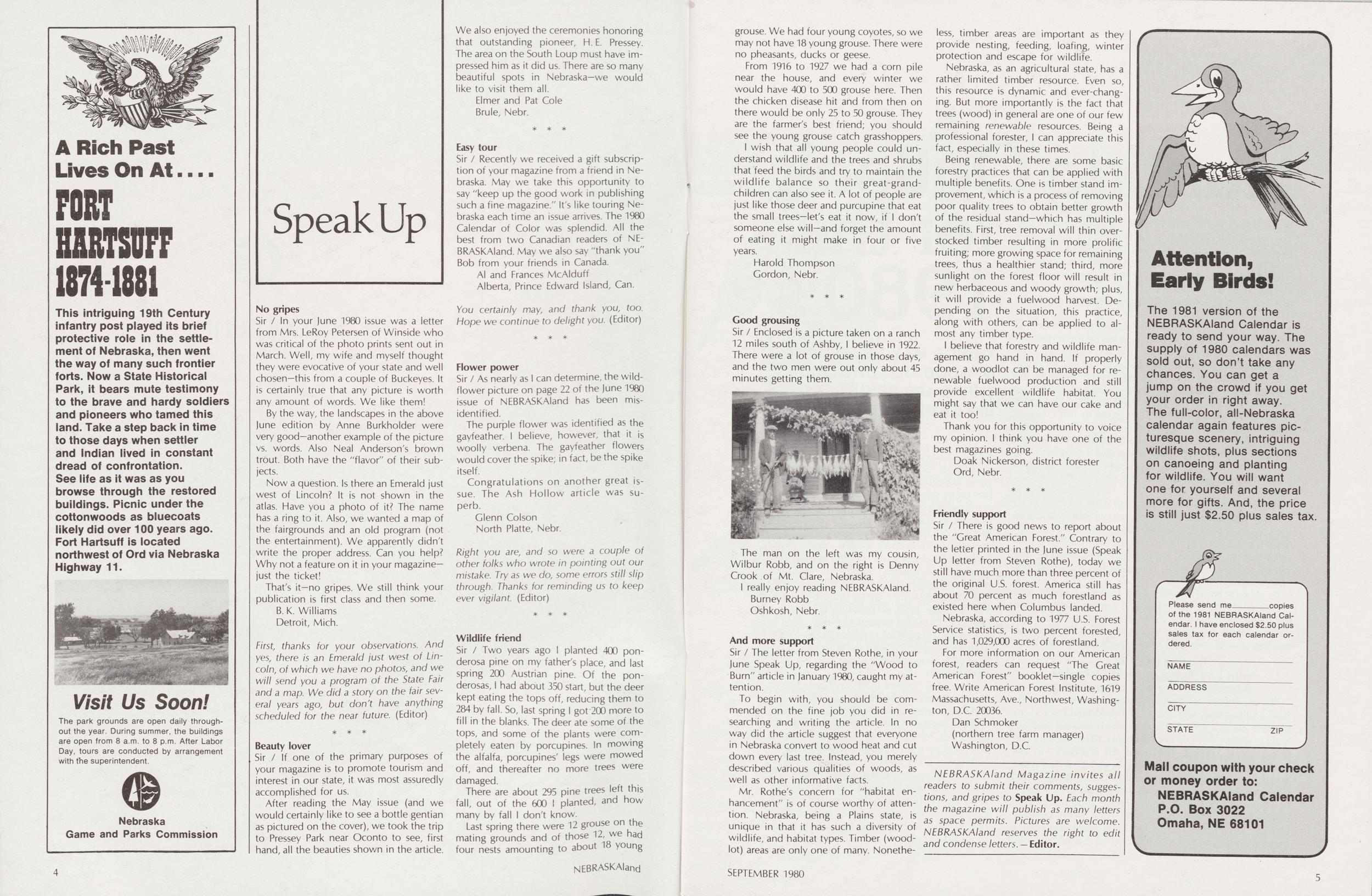
FORT HARTSUFF
1874-1881
This intriguing 19th Century infantry post played its brief protective role in the settlement of Nebraska, then went the way of many such frontier forts. Now a State Historical Park, it bears mute testimony to the brave and hardy soldiers and pioneers who tamed this land. Take a step back in time to those days when settler and Indian lived in constant dread of confrontation. See life as it was as you browse through the restored buildings. Picnic under the cottonwoods as bluecoats likely did over 100 years ago. Fort Hartsuff is located northwest of Ord via Nebraska Highway 11.
Visit Us Soon!
The park grounds are open daily throughout the year. During summer, the buildings are open from 8 a.m. to 8 p.m. After Labor Day, tours are conducted by arrangement with the superintendent. Nebraska Game and Parks Commisson
Speak Up
No gripesSir / In your June 1980 issue was a letter from Mrs. LeRoy Petersen of Winside who was critical of the photo prints sent out in March. Well, my wife and myself thought they were evocative of your state and well chosen—this from a couple of Buckeyes. It is certainly true that any picture is worth any amount of words. We like them!
By the way, the landscapes in the above June edition by Anne Burkholder were very good—another example of the picture vs. words. Also Neal Anderson's brown trout. Both have the "flavor" of their subjects.
Now a question. Is there an Emerald just west of Lincoln? It is not shown in the atlas. Have you a photo of it? The name has a ring to it. Also, we wanted a map of the fairgrounds and an old program (not the entertainment). We apparently didn't write the proper address. Can you help? Why not a feature on it in your magazine-just the ticket!
That's it-no gripes. We still think your publication is first class and then some.
B.K.Williams Detroit, Mich.First, thanks for your observations. And yes, there is an Emerald just west of Lincoln, of which we have no photos, and we will send you a program of the State Fair and a map. We did a story on the fair several years ago, but don't have anything scheduled for the near future. (Editor)
* * * Beauty loverSir / If one of the primary purposes of your magazine is to promote tourism and interest in our state, it was most assuredly accomplished for us.
After reading the May issue (and we would certainly like to see a bottle gentian as pictured on the cover), we took the trip to Pressey Park near Oconto to see, first hand, all the beauties shown in the article. We also enjoyed the ceremonies honoring that outstanding pioneer, H. E. Pressey. The area on the South Loup must have impressed him as it did us. There are so many beautiful spots in Nebraska—we would like to visit them all.
Elmer and Pat Cole Brule, Nebr. * * * Easy tourSir / Recently we received a gift subscription of your magazine from a friend in Nebraska. May we take this opportunity to say "keep up the good work in publishing such a fine magazine." It's like touring Nebraska each time an issue arrives. The 1980 Calendar of Color was splendid. All the best from two Canadian readers of NEBRASKAland. May we also say "thank you" Bob from your friends in Canada.
Al and Frances McAlduff Alberta, Prince Edward Island, Can.You certainly may, and thank you, too. Hope we continue to delight you. (Editor)
* * * Flower powerSir / As nearly as I can determine, the wildflower picture on page 22 of the June 1980 issue of NEBRASKAland has been misidentified.
The purple flower was identified as the gayfeather. I believe, however, that it is woolly verbena. The gayfeather flowers would cover the spike; in fact, be the spike itself.
Congratulations on another great issue. The Ash Hollow article was superb.
Glenn Colson North Platte, Nebr.Right you are, and so were a couple of other folks who wrote in pointing out our mistake. Try as we do, some errors still slip through. Thanks for reminding us to keep ever vigilant. (Editor)
* * * Wildlife friendSir / Two years ago I planted 400 ponderosa pine on my father's place, and last spring 200 Austrian pine. Of the ponderosas, I had about 350 start, but the deer kept eating the tops off, reducing them to 284 by fall. So, last spring I got 200 more to fill in the blanks. The deer ate some of the tops, and some of the plants were completely eaten by porcupines. In mowing the alfalfa, porcupines' legs were mowed off, and thereafter no more trees were damaged.
There are about 295 pine trees left this fall, out of the 600 I planted, and how many by fall I don't know.
Last spring there were 12 grouse on the mating grounds and of those 12, we had four nests amounting to about 18 young 4 NEBRASKAland grouse. We had four young coyotes, so we may not have 18 young grouse. There were no pheasants, ducks or geese.
From 1916 to 1927 we had a corn pile near the house, and every winter we would have 400 to 500 grouse here. Then the chicken disease hit and from then on there would be only 25 to 50 grouse. They are the farmer's best friend; you should see the young grouse catch grasshoppers.
I wish that all young people could understand wildlife and the trees and shrubs that feed the birds and try to maintain the wildlife balance so their great-grandchildren can also see it. A lot of people are just like those deer and purcupine that eat the small trees—let's eat it now, if I don't someone else will—and forget the amount of eating it might make in four or five years.
Harold Thompson Gordon, Nebr. * * * Good grousingSir / Enclosed is a picture taken on a ranch 12 miles south of Ashby, I believe in 1922. There were a lot of grouse in those days, and the two men were out only about 45 minutes getting them.
The man on the left was my cousin, Wilbur Robb, and on the right is Denny Crook of Mt. Clare, Nebraska.
I really enjoy reading NEBRASKAland.
Burney Robb Oshkosh, Nebr. * * * And more supportSir / The letter from Steven Rothe, in your June Speak Up, regarding the "Wood to Burn" article in January 1980, caught my attention.
To begin with, you should be commended on the fine job you did in re- searching and writing the article. In no way did the article suggest that everyone in Nebraska convert to wood heat and cut down every last tree. Instead, you merely described various qualities of woods, as well as other informative facts.
Mr. Rothe's concern for "habitat enhancement" is of course worthy of attention. Nebraska, being a Plains state, is unique in that it has such a diversity of wildlife, and habitat types. Timber (woodlot) areas are only one of many. Nonetheless, timber areas are important as they provide nesting, feeding, loafing, winter protection and escape for wildlife.
Nebraska, as an agricultural state, has a rather limited timber resource. Even so, this resource is dynamic and ever-changing. But more importantly is the fact that trees (wood) in general are one of our few remaining renewable resources. Being a professional forester, I can appreciate this fact, especially in these times.
Being renewable, there are some basic forestry practices that can be applied with multiple benefits. One is timber stand improvement, which is a process of removing poor quality trees to obtain better growth of the residual stand—which has multiple benefits. First, tree removal will thin overstocked timber resulting in more prolific fruiting; more growing space for remaining trees, thus a healthier stand; third, more sunlight on the forest floor will result in new herbaceous and woody growth; plus, it will provide a fuelwood harvest. Depending on the situation, this practice, along with others, can be applied to almost any timber type.
I believe that forestry and wildlife management go hand in hand. If properly done, a woodlot can be managed for renewable fuelwood production and still provide excellent wildlife habitat. You might say that we can have our cake and eat it too!
Thank you for this opportunity to voice my opinion. I think you have one of the best magazines going.
Doak Nickerson, district forester Ord, Nebr. * * * Friendly supportSir / There is good news to report about the "Great American Forest." Contrary to the letter printed in the June issue (Speak Up letter from Steven Rothe), today we still have much more than three percent of the original U.S. forest. America still has about 70 percent as much forestland as existed here when Columbus landed.
Nebraska, according to 1977 U.S. Forest Service statistics, is two percent forested, and has 1,029,000 acres of forestland.
For more information on our American forest, readers can request "The Great American Forest" booklet—single copies free. Write American Forest Institute, 1619 Massachusetts, Ave., Northwest, Washington, D.C 20036.
Dan Schmoker (northern tree farm manager) Washington, D.C. NEBRASKAland Magazine invites all readers to submit their comments, suggestions, and gripes to Speak Up. Each month the magazine will publish as many letters as space permits. Pictures are welcome. NEBRASKAland reserves the right to edit and condense letters. — Editor.Attention, Early Birds!
The 1981 version of the NEBRASKAland Calendar is ready to send your way. The supply of 1980 calendars was sold out, so don't take any chances. You can get a jump on the crowd if you get your order in right away. The full-color, all-Nebraska calendar again features picturesque scenery, intriguing wildlife shots, plus sections on canoeing and planting for wildlife. You will want one for yourself and several more for gifts. And, the price is still just $2.50 plus sales tax.
Please send me_____copies of the 1981 NEBRASKAland Calendar. I have enclosed $2.50 plus sales tax for each calendar ordered. NAME_______ ADDRESS______ CITY______ STATE______ ZIP______
Mall coupon with your check or money order to: NEBRASKAland Calendar P.O. Box 3022 Omaha, NE 68101 SEPTEMBER 1980 5
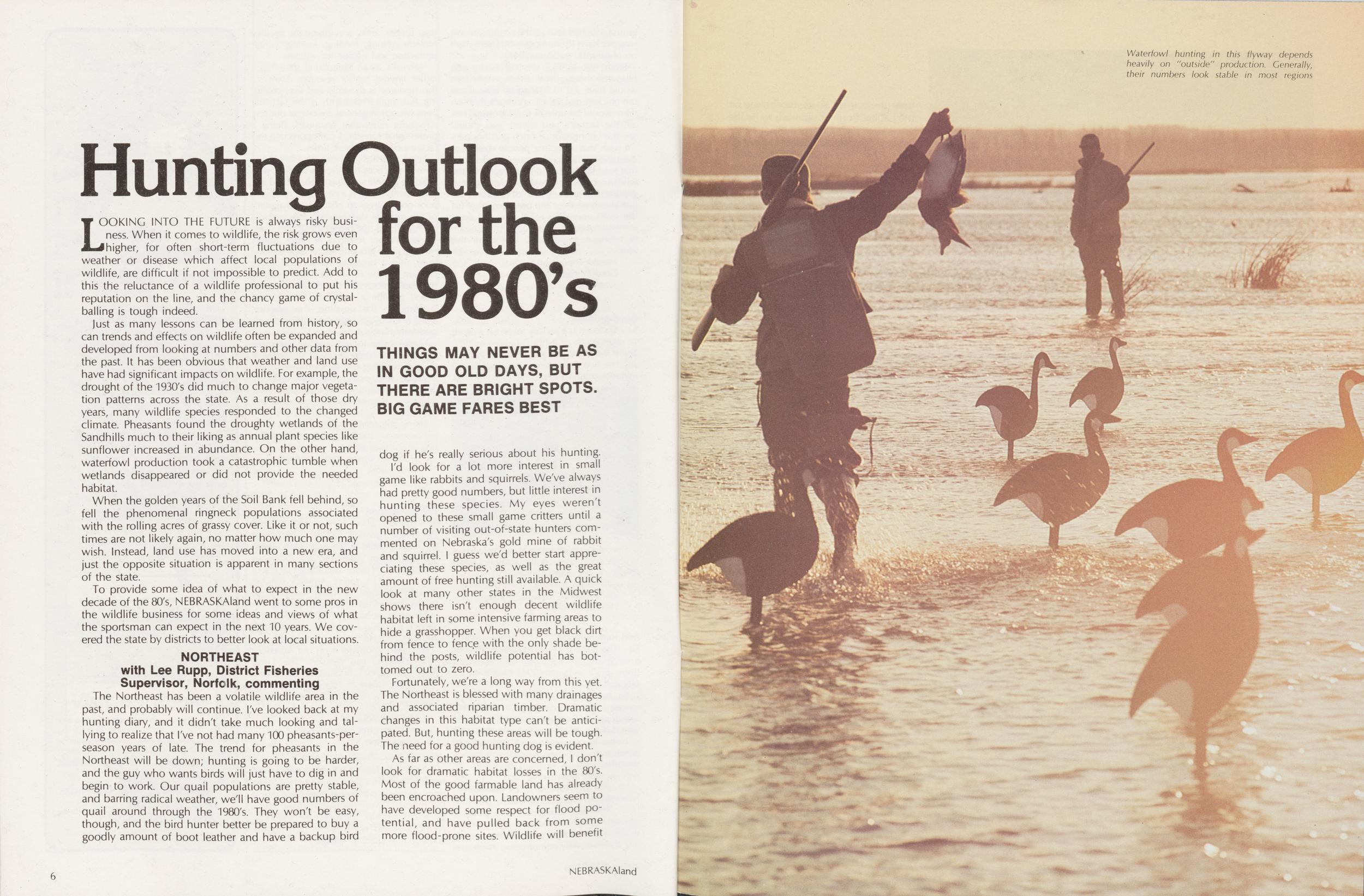
Hunting Outlook for the 1980,s
THINGS MAY NEVER BE AS IN GOOD OLD DAYS, BUT THERE ARE BRIGHT SPOTS. BIG GAME FARES BESTLOOKING INTO THE FUTURE is always risky business. When it comes to wildlife, the risk grows even higher, for often short-term fluctuations due to weather or disease which affect local populations of wildlife, are difficult if not impossible to predict. Add to this the reluctance of a wildlife professional to put his reputation on the line, and the chancy game of crystal-balling is tough indeed.
Just as many lessons can be learned from history, so can trends and effects on wildlife often be expanded and developed from looking at numbers and other data from the past. It has been obvious that weather and land use have had significant impacts on wildlife. For example, the drought of the 1930's did much to change major vegetation patterns across the state. As a result of those dry years, many wildlife species responded to the changed climate. Pheasants found the droughty wetlands of the Sandhills much to their liking as annual plant species like sunflower increased in abundance. On the other hand, waterfowl production took a catastrophic tumble when wetlands disappeared or did not provide the needed habitat.
When the golden years of the Soil Bank fell behind, so fell the phenomenal ringneck populations associated with the rolling acres of grassy cover. Like it or not, such times are not likely again, no matter how much one may wish. Instead, land use has moved into a new era, and just the opposite situation is apparent in many sections of the state.
To provide some idea of what to expect in the new decade of the 80's, NEBRASKAland went to some pros in the wildlife business for some ideas and views of what the sportsman can expect in the next 10 years. We covered the state by districts to better look at local situations.
NORTHEAST with Lee Rupp, District Fisheries Supervisor, Norfolk, commentingThe Northeast has been a volatile wildlife area in the past, and probably will continue. I've looked back at my hunting diary, and it didn't take much looking and tallying to realize that I've not had many 100 pheasants-perseason years of late. The trend for pheasants in the Northeast will be down; hunting is going to be harder, and the guy who wants birds will just have to dig in and begin to work. Our quail populations are pretty stable, and barring radical weather, we'll have good numbers of quail around through the 1980's. They won't be easy, though, and the bird hunter better be prepared to buy a goodly amount of boot leather and have a backup bird dog if he's really serious about his hunting.
I'd look for a lot more interest in small game like rabbits and squirrels. We've always had pretty good numbers, but little interest in hunting these species. My eyes weren't opened to these small game critters until a number of visiting out-of-state hunters commented on Nebraska's gold mine of rabbit and squirrel. I guess we'd better start appreciating these species, as well as the great amount of free hunting still available. A quick look at many other states in the Midwest shows there isn't enough decent wildlife habitat left in some intensive farming areas to hide a grasshopper. When you get black dirt from fence to fence with the only shade behind the posts, wildlife potential has bottomed out to zero.
Fortunately, we're a long way from this yet. The Northeast is blessed with many drainages and associated riparian timber. Dramatic changes in this habitat type can't be anticipated. But, hunting these areas will be tough. The need for a good hunting dog is evident.
Fortunately, we're a long way from this yet. The Northeast is blessed with many drainages and associated riparian timber. Dramatic changes in this habitat type can't be anticipated. But, hunting these areas will be tough. The need for a good hunting dog is evident.
6 NEBRASKAland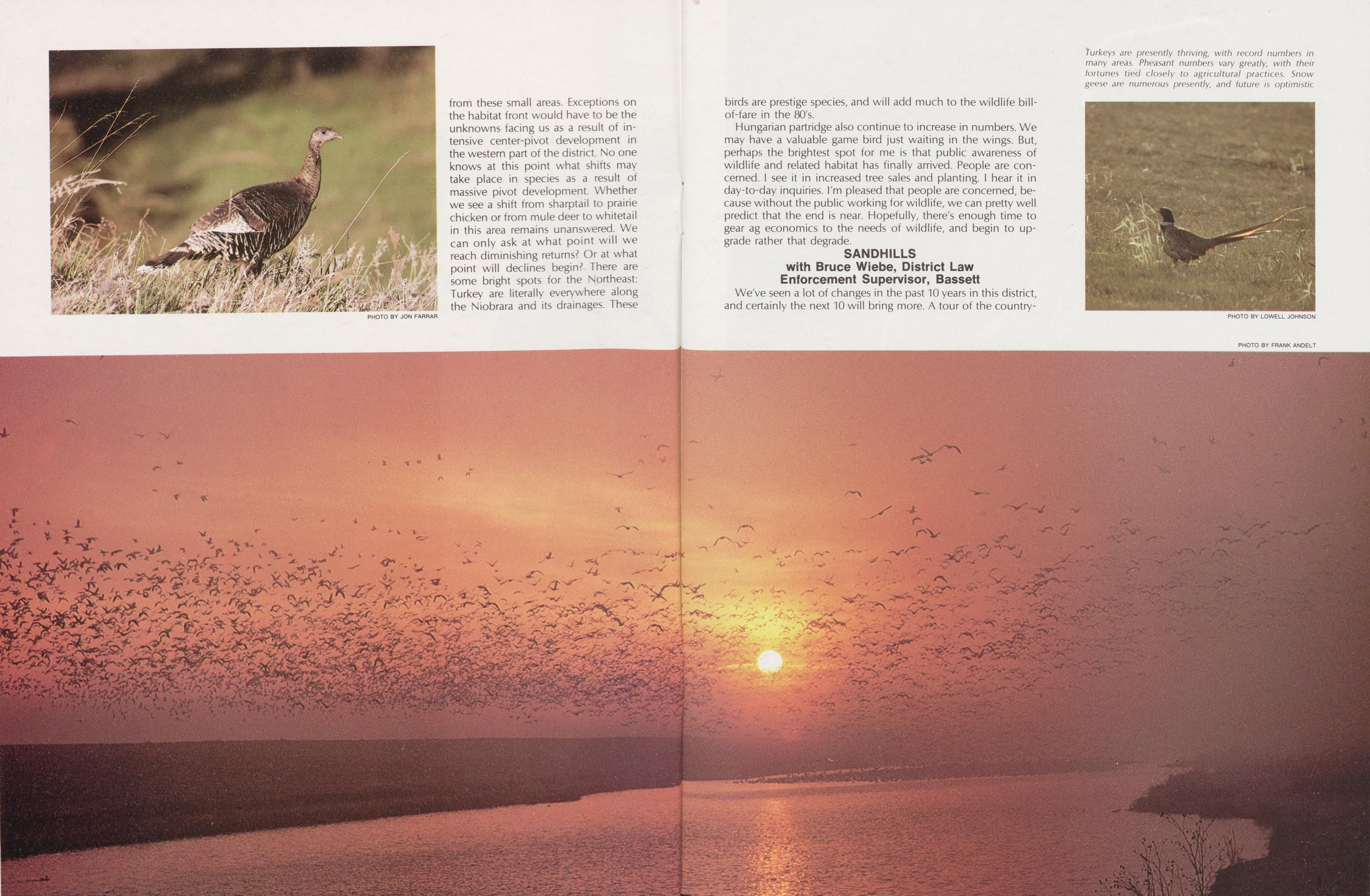
As far as other areas are concerned, I don't look for dramatic habitat losses in the 80's. Most of the good farmable land has already been encroached upon. Landowners seem to have developed some respect for flood potential, and have pulled back from some more flood-prone sites. Wildlife will benefit from these small areas. Exceptions on the habitat front would have to be the unknowns facing us as a result of intensive center-pivot development in the western part of the district. No one knows at this point what shifts may take place in species as a result of massive pivot development. Whether we see a shift from sharptail to prairie chicken or from mule deer to whitetail in this area remains unanswered. We can only ask at what point will we reach diminishing returns? Or at what point will declines begin? There are some bright spots for the Northeast: Turkey are literally everywhere along the Niobrara and its drainages. These birds are prestige species, and will add much to the wildlife bill-of-fare in the 80's.
Hungarian partridge also continue to increase in numbers. We may have a valuable game bird just waiting in the wings. But, perhaps the brightest spot for me is that public awareness of wildlife and related habitat has finally arrived. People are concerned. I see it in increased tree sales and planting. I hear it in day-to-day inquiries. I'm pleased that people are concerned, because without the public working for wildlife, we can pretty well predict that the end is near. Hopefully, there's enough time to gear ag economics to the needs of wildlife, and begin to upgrade rather that degrade.
We've seen a lot of changes in the past 10 years in this district,
and certainly the next 10 will bring more. A tour of the country
 side can't be made without noticing the increased center-pivot
development. Right now no one is able to say what effects this
is likely to bring. I believe we better start looking at some of the
historically and presently important wildlife species of the Sandhills. We'll need
to be able to make assessments; we'll need to
be able to predict impact. Right now we have pretty sparse material to base outlooks
on.
side can't be made without noticing the increased center-pivot
development. Right now no one is able to say what effects this
is likely to bring. I believe we better start looking at some of the
historically and presently important wildlife species of the Sandhills. We'll need
to be able to make assessments; we'll need to
be able to predict impact. Right now we have pretty sparse material to base outlooks
on.
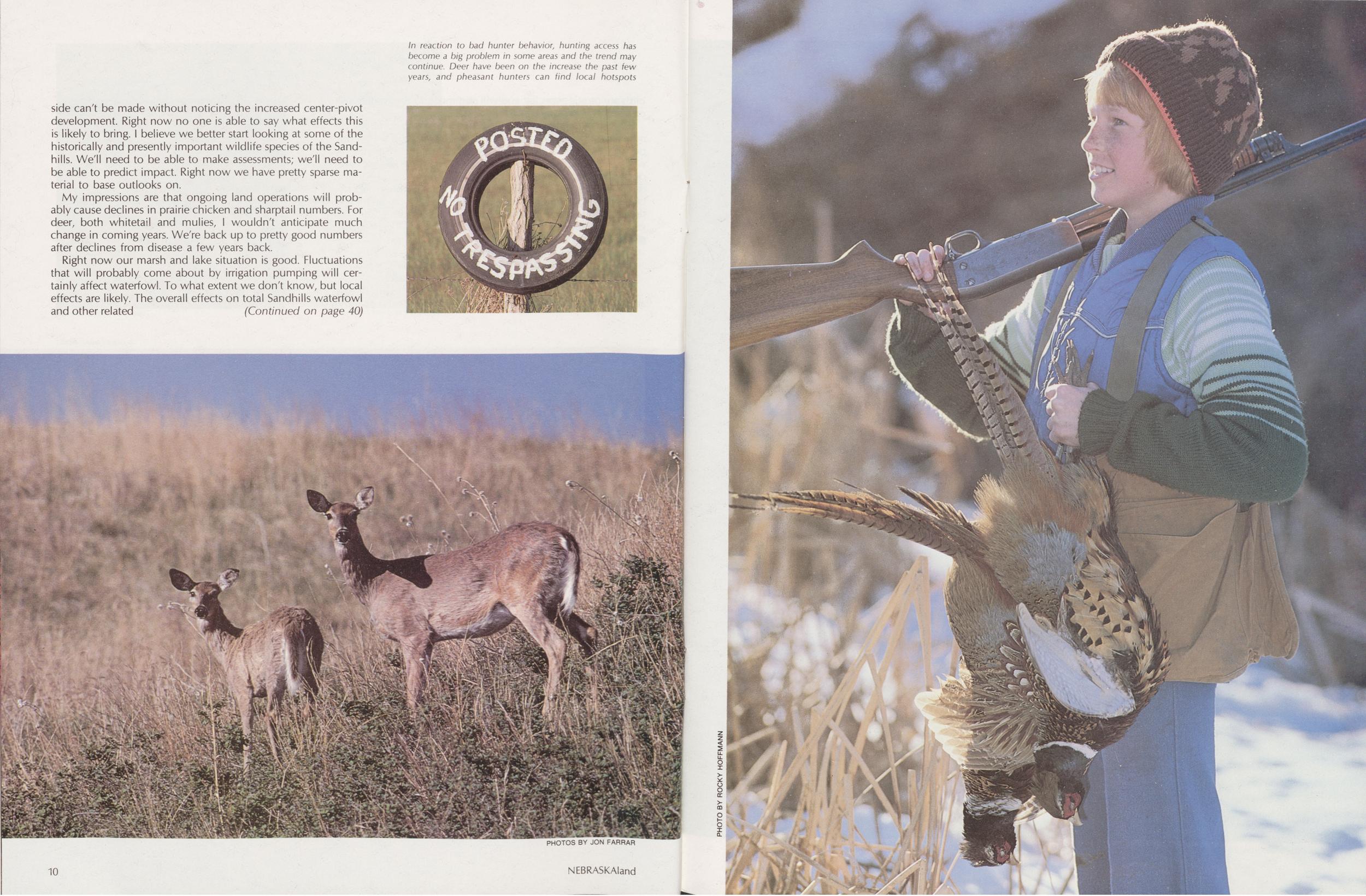
My impressions are that ongoing land operations will probably cause declines in prairie chicken and sharptail numbers. For deer, both whitetail and mulies, I wouldn't anticipate much change in coming years. We're back up to pretty good numbers after declines from disease a few years back.
Right now our marsh and lake situation is good. Fluctuations that will probably come about by irrigation pumping will certainly affect waterfowl. To what extent we don't know, but local effects are likely. The overall effects on total Sandhills waterfowl and other related (Continued on page 40)
In Quest of the PRAIRIE HEN
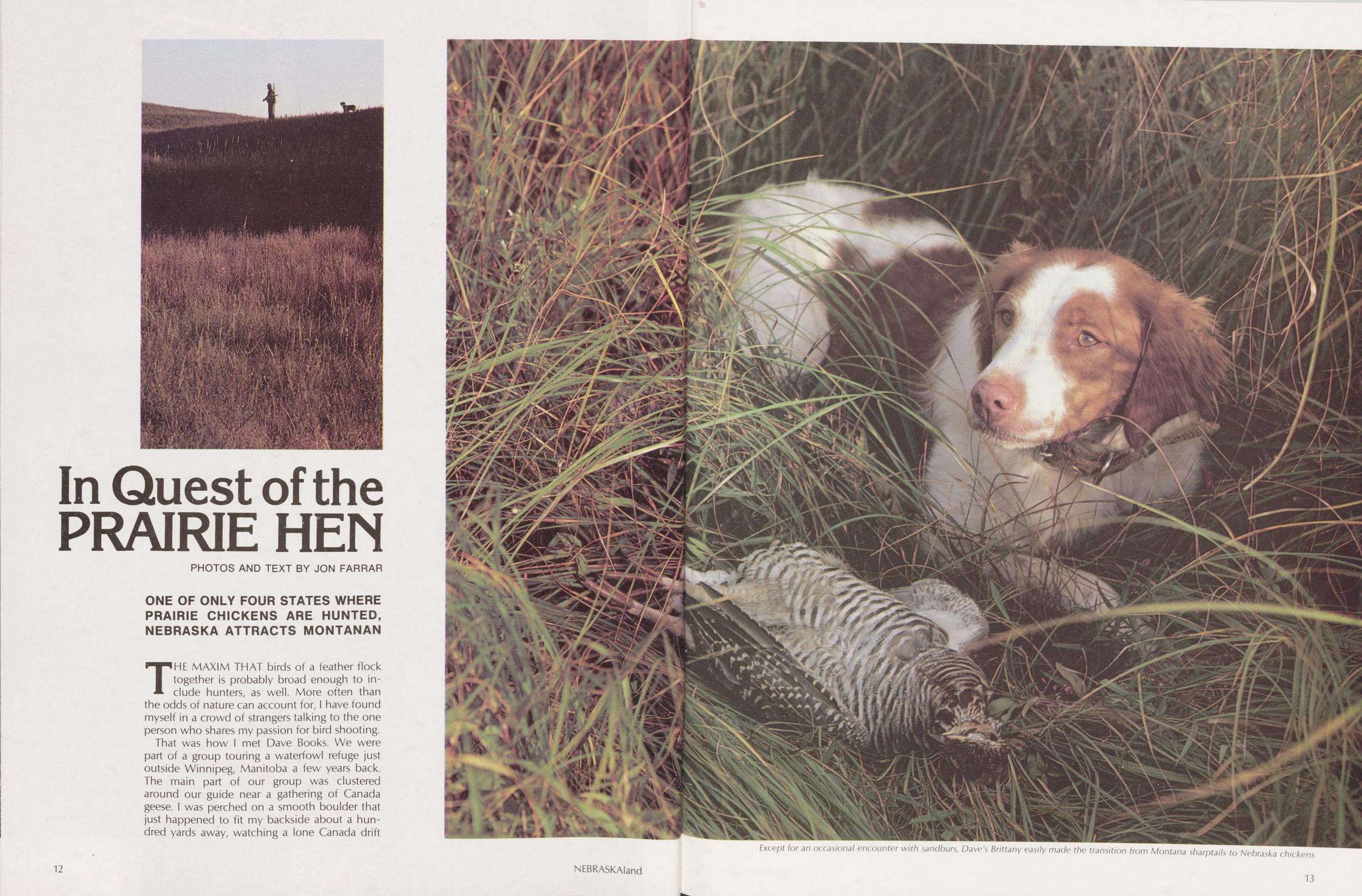
PHOTOS AND TEXT BY JON FARRAR ONE OF ONLY FOUR STATES WHERE PRAIRIE CHICKENS ARE HUNTED, NEBRASKA ATTRACTS MONTANANTHE MAXIM THAT birds of a feather flock together is probably broad enough to include hunters, as well. More often than the odds of nature can account for, I have found myself in a crowd of strangers talking to the one person who shares my passion for bird shooting.
That was how I met Dave Books. We were part of a group touring a waterfowl refuge just outside Winnipeg, Manitoba a few years back. The main part of our group was clustered around our guide near a gathering of Canada geese. I was perched on a smooth boulder that just happened to fit my backside about a hundred yards away, watching a lone Canada drift with the breeze along the shoreline. Dave was also a straggler, and before we had even exchanged names, the talk had turned to shooting quail on new snow and cooking the rank taste out of old sage hens. I can't say with any degree of certainty what brings two people of like interests together, but in this particular case I think we each noticed the other rummage in a side pocket for a heavy load when a second Canada goose came in on set wings to join the single on the water.
12 NEBRASKAland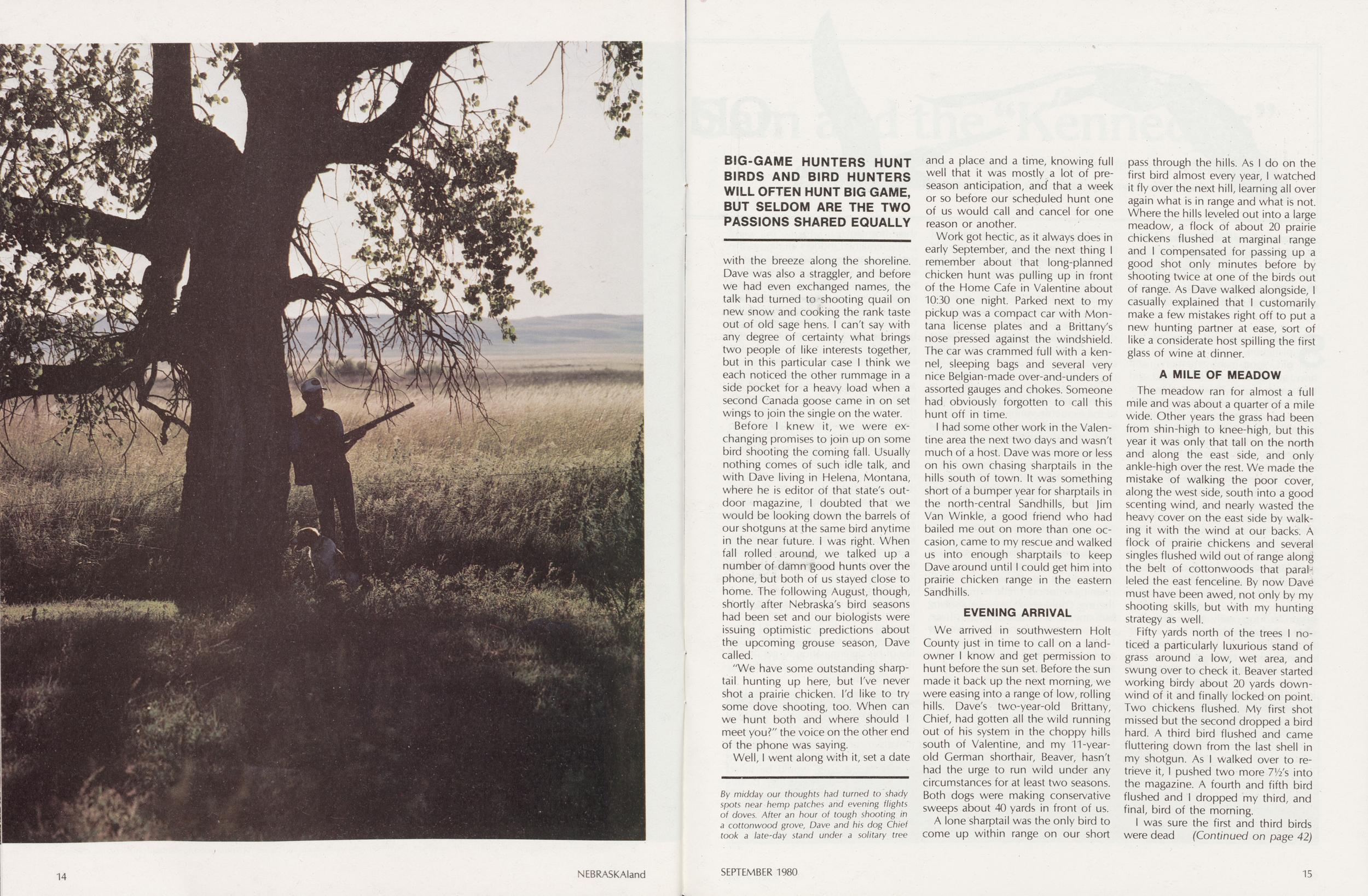
Before I knew it, we were exchanging promises to join up on some bird shooting the coming fall. Usually nothing comes of such idle talk, and with Dave living in Helena, Montana, where he is editor of that state's outdoor magazine, I doubted that we would be looking down the barrels of our shotguns at the same bird anytime in the near future. I was right. When fall rolled around, we talked up a number of damn good hunts over the phone, but both of us stayed close to home. The following August, though, shortly after Nebraska's bird seasons had been set and our biologists were issuing optimistic predictions about the upcoming grouse season, Dave called.
"We have some outstanding sharptail hunting up here, but I've never shot a prairie chicken. I'd like to try some dove shooting, too. When can we hunt both and where should I meet you?" the voice on the other end of the phone was saying.
By midday our thoughts had turned to shady spots near hemp patches and evening flights of doves. After an hour of tough shooting in a cottonwood grove, Dave and his dog Chief took a late-day stand under a solitary treeWell, I went along with it, set a date and a place and a time, knowing full well that it was mostly a lot of preseason anticipation, and that a week or so before our scheduled hunt one of us would call and cancel for one reason or another.
Work got hectic, as it always does in early September, and the next thing I remember about that long-planned chicken hunt was pulling up in front of the Home Cafe in Valentine about 10:30 one night. Parked next to my pickup was a compact car with Montana license plates and a Brittany's nose pressed against the windshield. The car was crammed full with a kennel, sleeping bags and several very nice Belgian-made over-and-unders of assorted gauges and chokes. Someone had obviously forgotten to call this hunt off in time.
I had some other work in the Valentine area the next two days and wasn't much of a host. Dave was more or less on his own chasing sharptails in the hills south of town. It was something short of a bumper year for sharptails in the north-central Sandhills, but Jim Van Winkle, a good friend who had bailed me out on more than one occasion, came to my rescue and walked us into enough sharptails to keep Dave around until I could get him into prairie chicken range in the eastern Sandhills.
EVENING ARRIVALWe arrived in southwestern Holt County just in time to call on a landowner I know and get permission to hunt before the sun set. Before the sun made it back up the next morning, we were easing into a range of low, rolling hills. Dave's two-year-old Brittany, Chief, had gotten all the wild running out of his system in the choppy hills south of Valentine, and my 11-year-old German shorthair, Beaver, hasn't had the urge to run wild under any circumstances for at least two seasons. Both dogs were making conservative sweeps about 40 yards in front of us.
A lone sharptail was the only bird to come up within range on our short pass through the hills. As I do on the first bird almost every year, I watched it fly over the next hill, learning all over again what is in range and what is not. Where the hills leveled out into a large meadow, a flock of about 20 prairie chickens flushed at marginal range and I compensated for passing up a good shot only minutes before by shooting twice at one of the birds out of range. As Dave walked alongside, I casually explained that I customarily make a few mistakes right off to put a new hunting partner at ease, sort of like a considerate host spilling the first glass of wine at dinner.
A MILE OF MEADOWThe meadow ran for almost a full mile and was about a quarter of a mile wide. Other years the grass had been from shin-high to knee-high, but this year it was only that tall on the north and along the east side, and only ankle-high over the rest. We made the mistake of walking the poor cover, along the west side, south into a good scenting wind, and nearly wasted the heavy cover on the east side by walking it with the wind at our backs. A flock of prairie chickens and several singles flushed wild out of range along the belt of cottonwoods that paralleled the east fenceline. By now Dave must have been awed, not only by my shooting skills, but with my hunting strategy as well.
Fifty yards north of the trees I noticed a particularly luxurious stand of grass around a low, wet area, and swung over to check it. Beaver started working birdy about 20 yards down-wind of it and finally locked on point. Two chickens flushed. My first shot missed but the second dropped a bird hard. A third bird flushed and came fluttering down from the last shell in my shotgun. As I walked over to retrieve it, I pushed two more 7½'s into the magazine. A fourth and fifth bird flushed and I dropped my third, and final, bird of the morning.
I was sure the first and third birds were dead (Continued on page 42)
SEPTAMBER 1980 15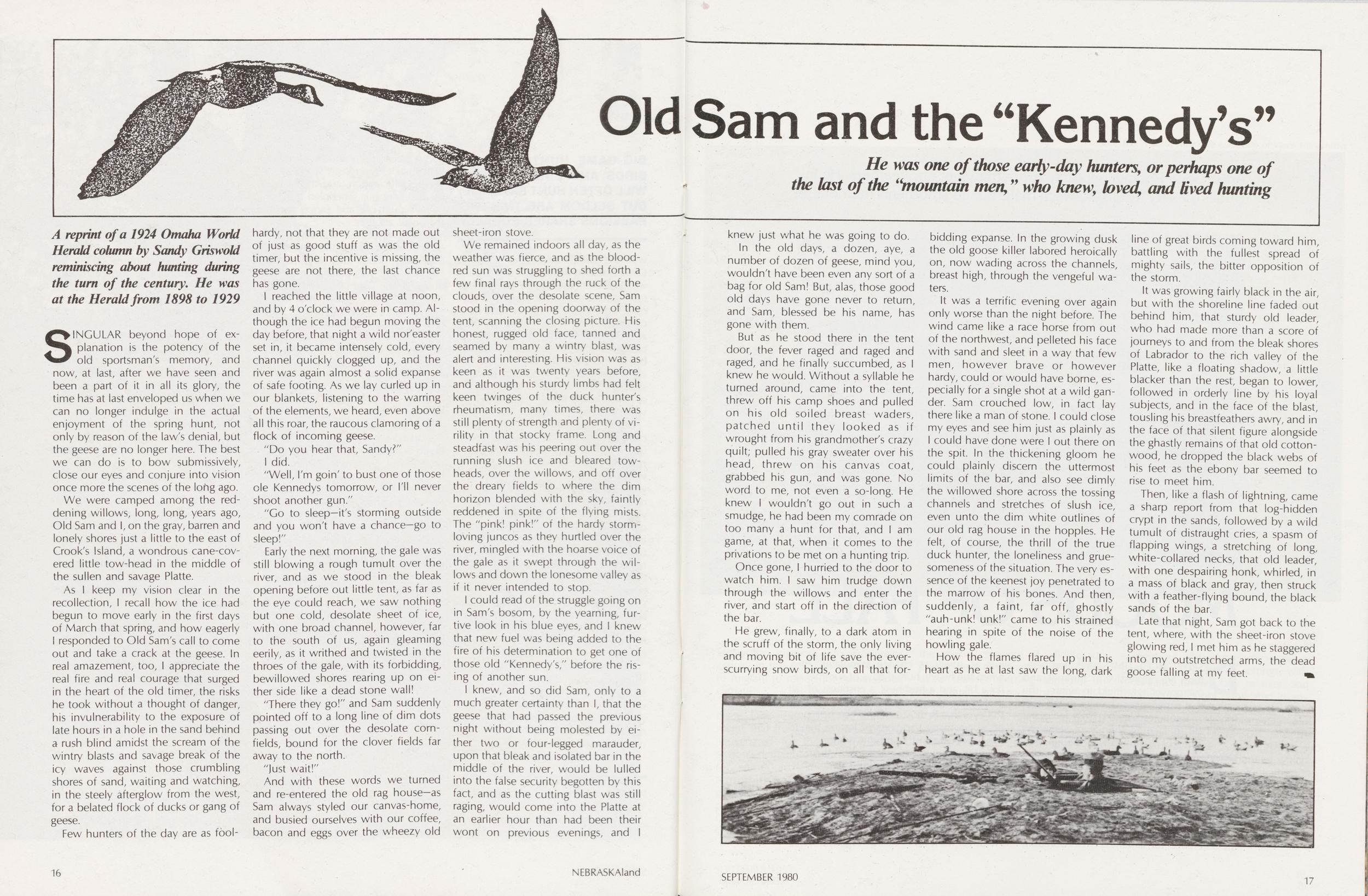
Old Sam and the "Kennedy's"
He was one of those early-day hunters, or perhaps one of the last of the "mountain men," who knew, loved, and lived hunting
SINGULAR beyond hope of explanation is the potency of the old sportsman's memory, and now, at last, after we have seen and been a part of it in all its glory, the time has at last enveloped us when we can no longer indulge in the actual enjoyment of the spring hunt, not only by reason of the law's denial, but the geese are no longer here. The best we can do is to bow submissively, close our eyes and conjure into vision once more the scenes of the long ago.
We were camped among the reddening willows, long, long, years ago, Old Sam and I, on the gray, barren and lonely shores just a little to the east of Crook's Island, a wondrous cane-covered little tow-head in the middle of the sullen and savage Platte.
As I keep my vision clear in the recollection, I recall how the ice had begun to move early in the first days of March that spring, and how eagerly I responded to Old Sam's call to come out and take a crack at the geese. In real amazement, too, I appreciate the real fire and real courage that surged in the heart of the old timer, the risks he took without a thought of danger, his invulnerability to the exposure of late hours in a hole in the sand behind a rush blind amidst the scream of the wintry blasts and savage break of the icy waves against those crumbling shores of sand, waiting and watching, in the steely afterglow from the west, for a belated flock of ducks or gang of geese.
Few hunters of the day are as foolhardy, not that they are not made out of just as good stuff as was the old timer, but the incentive is missing, the geese are not there, the last chance has gone.
I reached the little village at noon, and by 4 o'clock we were in camp. Although the ice had begun moving the day before, that night a wild nor'easter set in, it became intensely cold, every channel quickly clogged up, and the river was again almost a solid expanse of safe footing. As we lay curled up in our blankets, listening to the warring of the elements, we heard, even above all this roar, the raucous clamoring of a flock of incoming geese.
"Do you hear that, Sandy?"
I did.
"Well, I'm goin' to bust one of those ole Kennedys tomorrow, or I'll never shoot another gun."
"Go to sleep—it's storming outside and you won't have a chance—go to sleep!"
Early the next morning, the gale was still blowing a rough tumult over the river, and as we stood in the bleak opening before out little tent, as far as the eye could reach, we saw nothing but one cold, desolate sheet of ice, with one broad channel, however, far to the south of us, again gleaming eerily, as it writhed and twisted in the throes of the gale, with its forbidding, bewillowed shores rearing up on either side like a dead stone wall!
"There they go!" and Sam suddenly pointed off to a long line of dim dots passing out over the desolate cornfields, bound for the clover fields far away to the north.
"Just wait!"
And with these words we turned and re-entered the old rag house-as Sam always styled our canvas-home, and busied ourselves with our coffee, bacon and eggs over the wheezy old sheet-iron stove.
We remained indoors all day, as the weather was fierce, and as the blood-red sun was struggling to shed forth a few final rays through the ruck of the clouds, over the desolate scene, Sam stood in the opening doorway of the tent, scanning the closing picture. His honest, rugged old face, tanned and seamed by many a wintry blast, was alert and interesting. His vision was as keen as it was twenty years before, and although his sturdy limbs had felt keen twinges of the duck hunter's rheumatism, many times, there was still plenty of strength and plenty of virility in that stocky frame. Long and steadfast was his peering out over the running slush ice and bleared towheads, over the willows, and off over the dreary fields to where the dim horizon blended with the sky, faintly reddened in spite of the flying mists. The "pink! pink!" of the hardy storm-loving juncos as they hurtled over the river, mingled with the hoarse voice of the gale as it swept through the willows and down the lonesome valley as if it never intended to stop.
I could read of the struggle going on in Sam's bosom, by the yearning, furtive look in his blue eyes, and I knew that new fuel was being added to the fire of his determination to get one of those old "Kennedy's," before the rising of another sun.
I knew, and so did Sam, only to a much greater certainty than I, that the geese that had passed the previous night without being molested by either two or four-legged marauder, upon that bleak and isolated bar in the middle of the river, would be lulled into the false security begotten by this fact, and as the cutting blast was still raging, would come into the Platte at an earlier hour than had been their wont on previous evenings, and I 16 NEBRASKAland knew just what he was going to do.
In the old days, a dozen, aye, a number of dozen of geese, mind you, wouldn't have been even any sort of a bag for old Sam! But, alas, those good old days have gone never to return, and Sam, blessed be his name, has gone with them.
But as he stood there in the tent door, the fever raged and raged and raged, and he finally succumbed, as I knew he would. Without a syllable he turned around, came into the tent, threw off his camp shoes and pulled on his old soiled breast waders, patched until they looked as if wrought from his grandmother's crazy quilt; pulled his gray sweater over his head, threw on his canvas coat, grabbed his gun, and was gone. No word to me, not even a so-long. He knew I wouldn't go out in such a smudge, he had been my comrade on too many a hunt for that, and I am game, at that, when it comes to the privations to be met on a hunting trip.
Once gone, I hurried to the door to watch him. I saw him trudge down through the willows and enter the river, and start off in the direction of the bar.
He grew, finally, to a dark atom in the scruff of the storm, the only living and moving bit of life save the ever-scurrying snow birds, on all that forbidding expanse. In the growing dusk the old goose killer labored heroically on, now wading across the channels, breast high, through the vengeful waters.
It was a terrific evening over again only worse than the night before. The wind came like a race horse from out of the northwest, and pelleted his face with sand and sleet in a way that few men, however brave or however hardy, could or would have borne, especially for a single shot at a wild gander. Sam crouched low, in fact lay there like a man of stone. I could close my eyes and see him just as plainly as I could have done were I out there on the spit. In the thickening gloom he could plainly discern the uttermost limits of the bar, and also see dimly the willowed shore across the tossing channels and stretches of slush ice, even unto the dim white outlines of our old rag house in the hopples. He felt, of course, the thrill of the true duck hunter, the loneliness and gruesomeness of the situation. The very essence of the keenest joy penetrated to the marrow of his bones. And then, suddenly, a faint, far off, ghostly "auh-unk! unk!" came to his strained hearing in spite of the noise of the howling gale.
How the flames flared up in his heart as he at last saw the long, dark line of great birds coming toward him, battling with the fullest spread of mighty sails, the bitter opposition of the storm.
It was growing fairly black in the air, but with the shoreline line faded out behind him, that sturdy old leader, who had made more than a score of journeys to and from the bleak shores of Labrador to the rich valley of the Platte, like a floating shadow, a little blacker than the rest, began to lower, followed in orderly line by his loyal subjects, and in the face of the blast, tousling his breastfeathers awry, and in the face of that silent figure alongside the ghastly remains of that old cottonwood, he dropped the black webs of his feet as the ebony bar seemed to rise to meet him.
Then, like a flash of lightning, came a sharp report from that log-hidden crypt in the sands, followed by a wild tumult of distraught cries, a spasm of flapping wings, a stretching of long, white-collared necks, that old leader, with one despairing honk, whirled, in a mass of black and gray, then struck with a feather-flying bound, the black sands of the bar.
Late that night, Sam got back to the tent, where, with the sheet-iron stove glowing red, I met him as he staggered into my outstretched arms, the dead goose falling at my feet.
MOODS OF FALL
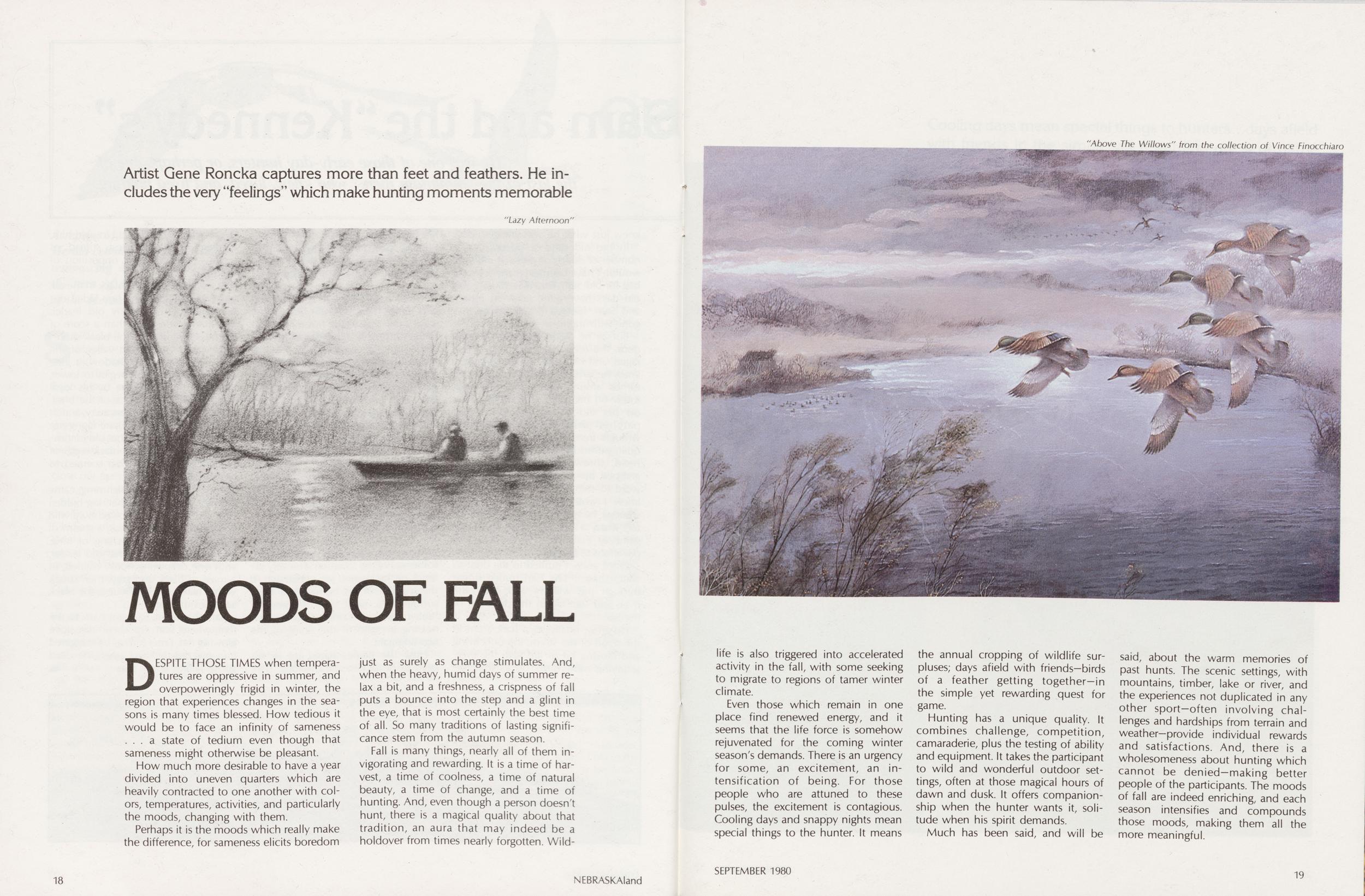
"Above The Willows" from the collection of Vince Finocchiaro Artist Gene Roncka captures more than feet and feathers. He includes the very "feelings" which make hunting moments memorableDESPITE THOSE TIMES when temperatures are oppressive in summer, and overpoweringly frigid in winter, the region that experiences changes in the seasons is many times blessed. How tedious it would be to face an infinity of sameness ...a state of tedium even though that sameness might otherwise be pleasant.
How much more desirable to have a year divided into uneven quarters which are heavily contracted to one another with colors, temperatures, activities, and particularly the moods, changing with them.
Perhaps it is the moods which really make the difference, for sameness elicits boredom just as surely as change stimulates. And, when the heavy, humid days of summer relax a bit, and a freshness, a crispness of fall puts a bounce into the step and a glint in the eye, that is most certainly the best time of all. So many traditions of lasting significance stem from the autumn season.
Fall is many things, nearly all of them invigorating and rewarding. It is a time of harvest, a time of coolness, a time of natural beauty, a time of change, and a time of hunting. And, even though a person doesn't hunt, there is a magical quality about that tradition, an aura that may indeed be a holdover from times nearly forgotten. Wildlife 18 NEBRASKAland is also triggered into accelerated activity in the fall, with some seeking to migrate to regions of tamer winter climate.
Even those which remain in one place find renewed energy, and it seems that the life force is somehow rejuvenated for the coming winter season's demands. There is an urgency for some, an excitement, an intensification of being. For those people who are attuned to these pulses, the excitement is contagious. Cooling days and snappy nights mean special things to the hunter. It means the annual cropping of wildlife surpluses; days afield with friends—birds of a feather getting together—in the simple yet rewarding quest for game.
Hunting has a unique quality. It combines challenge, competition, camaraderie, plus the testing of ability and equipment. It takes the participant to wild and wonderful outdoor settings, often at those magical hours of dawn and dusk. It offers companionship when the hunter wants it, solitude when his spirit demands.
Much has been said, and will be said, about the warm memories of past hunts. The scenic settings, with mountains, timber, lake or river, and the experiences not duplicated in any other sport—often involving challenges and hardships from terrain and weather—provide individual rewards and satisfactions. And, there is a wholesomeness about hunting which cannot be denied—making better people of the participants. The moods of fall are indeed enriching, and each season intensifies and compounds those moods, making them all the more meaningful.
SEPTEMBER 1980 19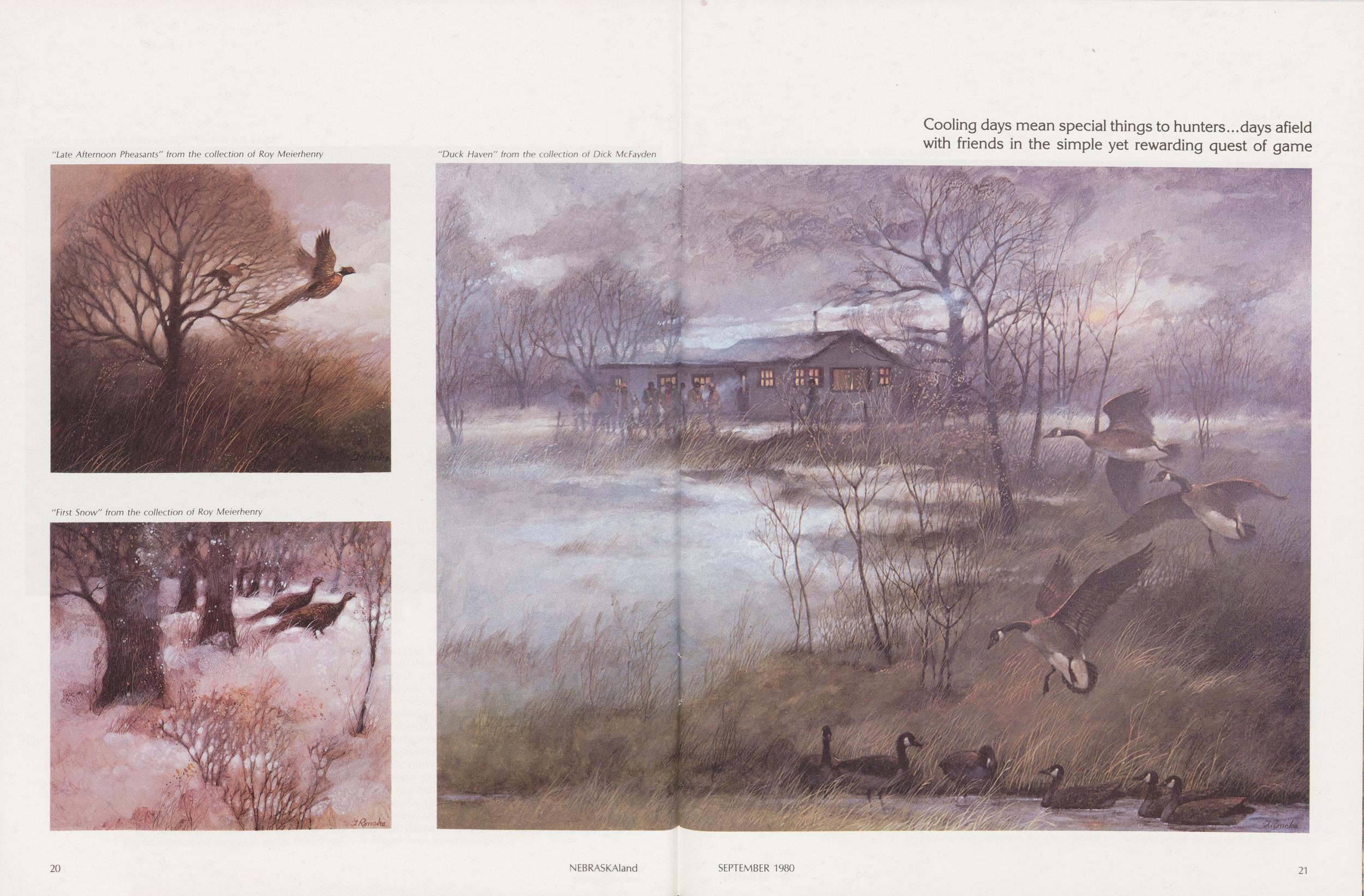
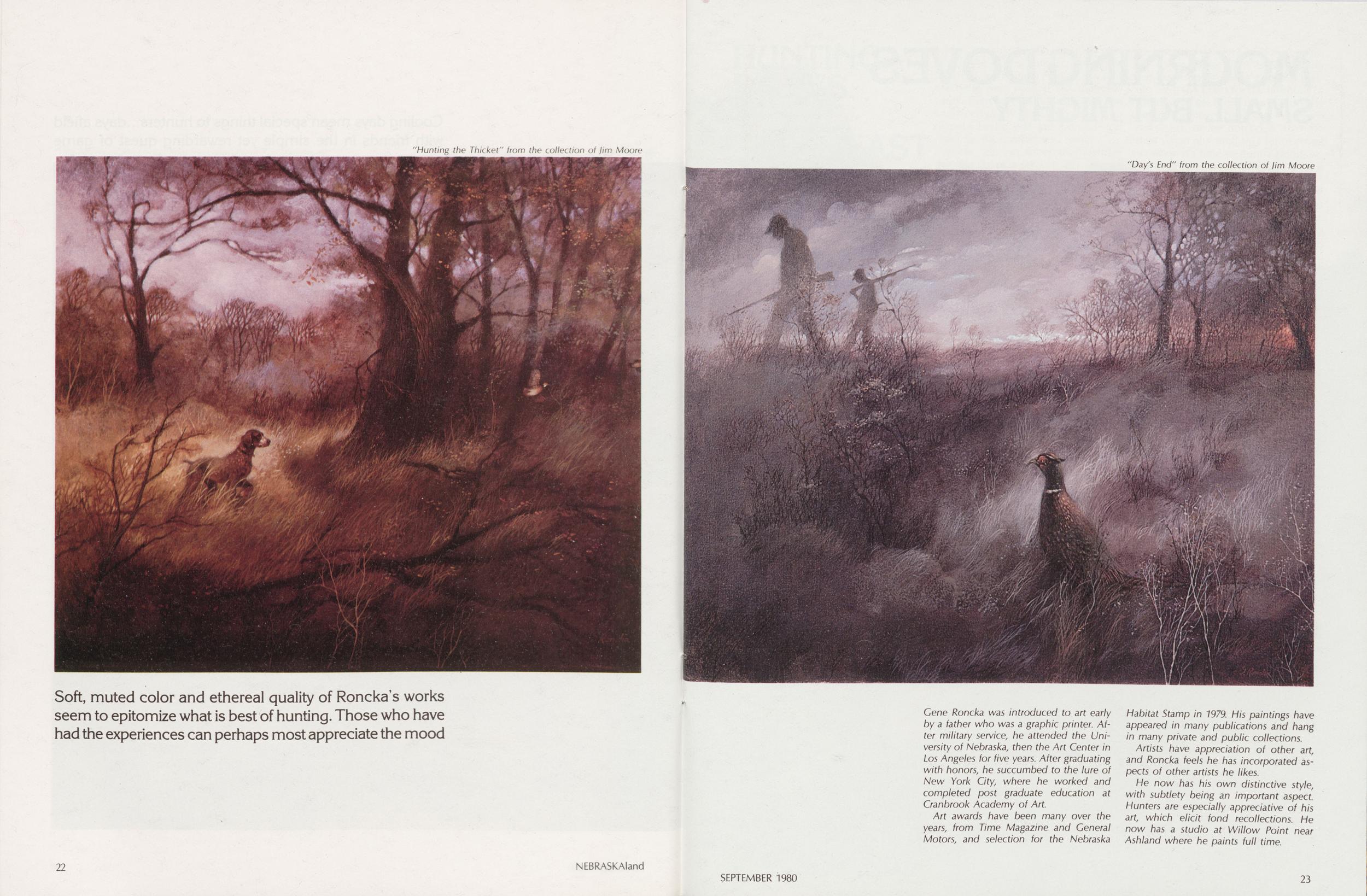
Gene Roncka was introduced to art early by a father who was a graphic printer. After military service, he attended the University of Nebraska, then the Art Genter in Los Angeles for five years. After graduating with honors, he succumbed to the lure of New York Gity, where he worked and completed post graduate education at Granbrook Academy of Art.
Art awards have been many over the years, from Time Magazine and General Motors, and selection for the Nebraska Habitat Stamp in 1979. His paintings have appeared in many publications and hang in many private and public collections.
Artists have appreciation of other art, and Roncka feels he has incorporated aspects of other artists he likes.
He now has his own distinctive style, with subtlety being an important aspect. Hunters are especially appreciative of his art, which elicit fond recollections. He now has a studio at Willow Point near Ashland where he paints full time.
SEPTEMBER 1980 23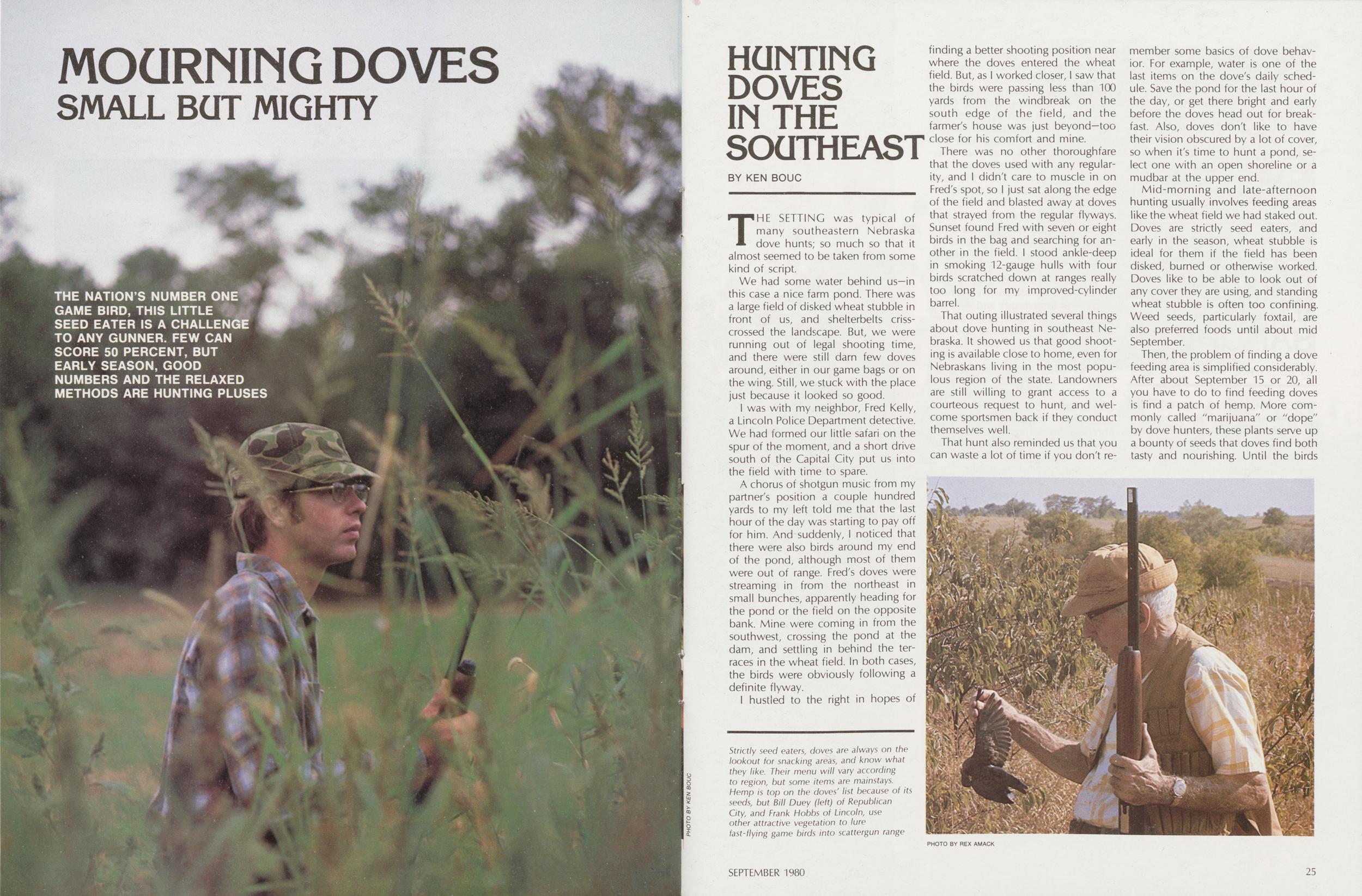
MOURNING DOVES SMALL BUT MIGHTY
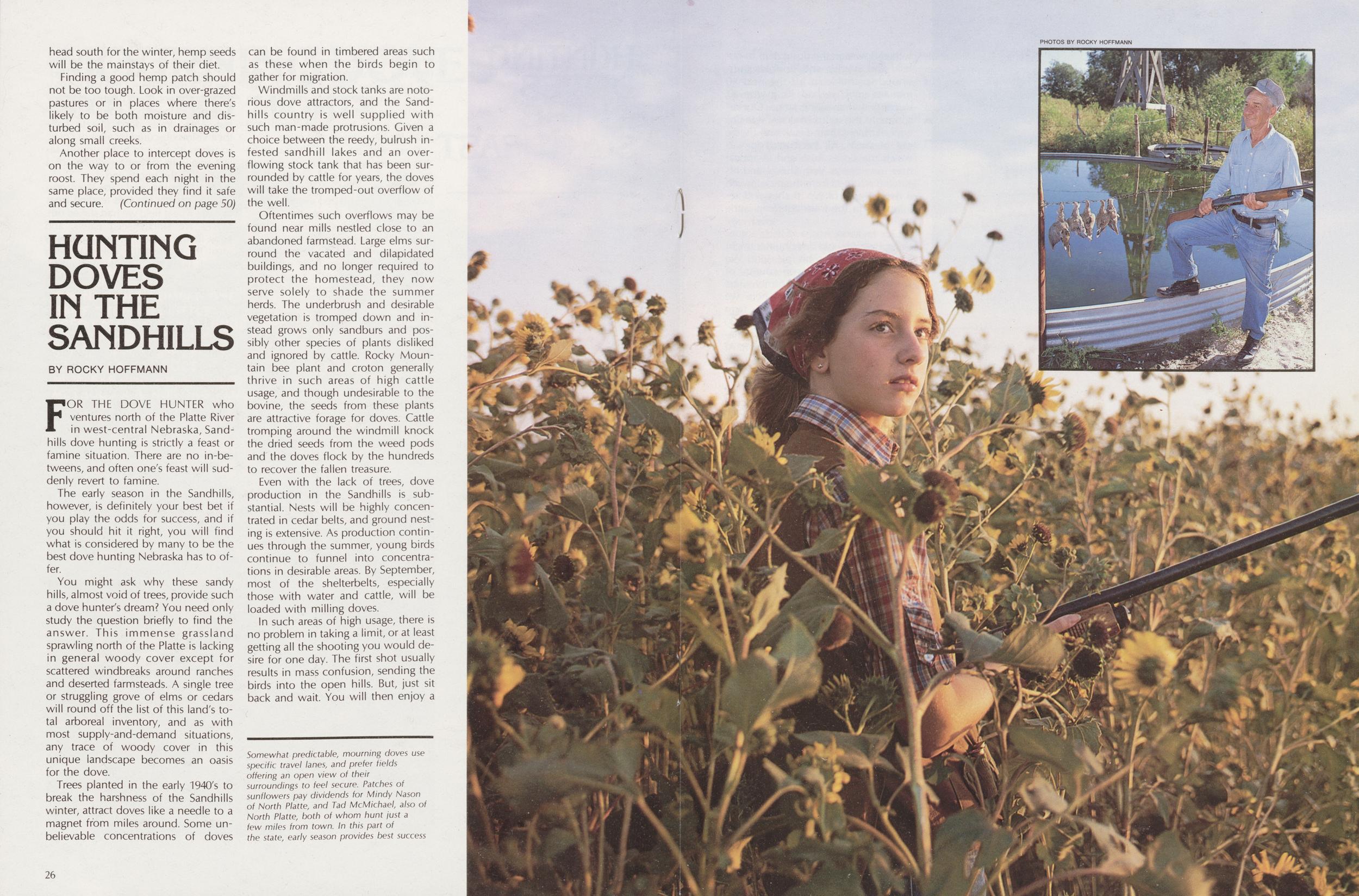
THE NATION'S NUMBER ONE GAME BIRD, THIS LITTLE SEED EATER IS A CHALLENGE TO ANY GUNNER, BUT EARLY SEASON, GOOD NUMBERS AND THE RELAXED METHODS ARE HUNTING PLUSES HUNTING DOVES IN THE SOUTHEAST BY KEN BOUCTHE SETTING was typical of many southeastern Nebraska dove hunts; so much so that it almost seemed to be taken from some kind of script.
We had some water behind us—in this case a nice farm pond. There was a large field of disked wheat stubble in front of us, and shelterbelts criss-crossed the landscape. But, we were running out of legal shooting time, and there were still darn few doves around, either in our game bags or on the wing. Still, we stuck with the place just because it looked so good.
I was with my neighbor, Fred Kelly, a Lincoln Police Department detective. We had formed our little safari on the spur of the moment, and a short drive south of the Capital City put us into the field with time to spare.
A chorus of shotgun music from my partner's position a couple hundred yards to my left told me that the last hour of the day was starting to pay off for him. And suddenly, I noticed that there were also birds around my end of the pond, although most of them were out of range. Fred's doves were streaming in from the northeast in small bunches, apparently heading for the pond or the field on the opposite bank. Mine were coming in from the southwest, crossing the pond at the dam, and settling in behind the terraces in the wheat field. In both cases, the birds were obviously following a definite flyway.
I hustled to the right in hopes of finding a better shooting position near where the doves entered the wheat field. But, as I worked closer, I saw that the birds were passing less than 100 yards from the windbreak on the south edge of the field, and the farmer's house was just beyond—too close for his comfort and mine.
There was no other thoroughfare that the doves used with any regularity, and I didn't care to muscle in on Fred's spot, so I just sat along the edge of the field and blasted away at doves that strayed from the regular flyways. Sunset found Fred with seven or eight birds in the bag and searching for another in the field. I stood ankle-deep in smoking 12-gauge hulls with four birds scratched down at ranges really too long for my improved-cylinder barrel.
That outing illustrated several things about dove hunting in southeast Nebraska. It showed us that good shooting is available close to home, even for Nebraskans living in the most populous region of the state. Fandowners are still willing to grant access to a courteous request to hunt, and welcome sportsmen back if they conduct themselves well.
That hunt also reminded us that you can waste a lot of time if you don't remember some basics of dove behavior. For example, water is one of the last items on the dove's daily schedule. Save the pond for the last hour of the day, or get there bright and early before the doves head out for breakfast. Also, doves don't like to have their vision obscured by a lot of cover, so when it's time to hunt a pond, select one with an open shoreline or a mudbar at the upper end.
Mid-morning and late-afternoon hunting usually involves feeding areas like the wheat field we had staked out. Doves are strictly seed eaters, and early in the season, wheat stubble is ideal for them if the field has been disked, burned or otherwise worked. Doves like to be able to look out of any cover they are using, and standing wheat stubble is often too confining. Weed seeds, particularly foxtail, are also preferred foods until about mid September.
Then, the problem of finding a dove
feeding area is simplified considerably.
After about September 15 or 20, all
you have to do to find feeding doves
is find a patch of hemp. More commonly called "marijuana" or "dope"
by dove hunters, these plants serve up
a bounty of seeds that doves find both
tasty and nourishing. Until the birds
SEPTEMBER 1980
25
 head south for the winter, hemp seeds
will be the mainstays of their diet.
head south for the winter, hemp seeds
will be the mainstays of their diet.
Finding a good hemp patch should not be too tough. Look in over-grazed pastures or in places where there's likely to be both moisture and disturbed soil, such as in drainages or along small creeks.
Another place to intercept doves is on the way to or from the evening roost. They spend each night in the same place, provided they find it safe and secure. (Continued on page 50)
HUNTING DOVES IN THE SANDHILLS BY ROCKY HOFFMANNFOR THE DOVE HUNTER who ventures north of the Platte River in west-central Nebraska, Sandhills dove hunting is strictly a feast or famine situation. There are no in-betweens, and often one's feast will suddenly revert to famine.
The early season in the Sandhills, however, is definitely your best bet if you play the odds for success, and if you should hit it right, you will find what is considered by many to be the best dove hunting Nebraska has to offer.
You might ask why these sandy hills, almost void of trees, provide such a dove hunter's dream? You need only study the question briefly to find the answer. This immense grassland sprawling north of the Platte is lacking in general woody cover except for scattered windbreaks around ranches and deserted farmsteads. A single tree or struggling grove of elms or cedars will round off the list of this land's total arboreal inventory, and as with most supply-and-demand situations, any trace of woody cover in this unique landscape becomes an oasis for the dove.
Trees planted in the early 1940's to break the harshness of the Sandhills winter, attract doves like a needle to a magnet from miles around. Some unbelievable concentrations of doves can be found in timbered areas such as these when the birds begin to gather for migration.
Windmills and stock tanks are notorious dove attractors, and the Sandhills country is well supplied with such man-made protrusions. Given a choice between the reedy, bulrush infested sandhill lakes and an overflowing stock tank that has been surrounded by cattle for years, the doves will take the tromped-out overflow of the well.
Oftentimes such overflows may be found near mills nestled close to an abandoned farmstead. Large elms surround the vacated and dilapidated buildings, and no longer required to protect the homestead, they now serve solely to shade the summer herds. The underbrush and desirable vegetation is tromped down and instead grows only sandburs and possibly other species of plants disliked and ignored by cattle. Rocky Mountain bee plant and croton generally thrive in such areas of high cattle usage, and though undesirable to the bovine, the seeds from these plants are attractive forage for doves. Cattle tromping around the windmill knock the dried seeds from the weed pods and the doves flock by the hundreds to recover the fallen treasure.
Even with the lack of trees, dove production in the Sandhills is substantial. Nests will be highly concentrated in cedar belts, and ground nesting is extensive. As production continues through the summer, young birds continue to funnel into concentrations in desirable areas. By September, most of the shelterbelts, especially those with water and cattle, will be loaded with milling doves.
In such areas of high usage, there is no problem in taking a limit, or at least getting all the shooting you would desire for one day. The first shot usually results in mass confusion, sending the birds into the open hills. But, just sit back and wait. You will then enjoy a steady stream of doves returning—in singles, pairs and small flocks—to the trees, the water and the seeds scattered by the cows.
Somewhat predictable, mourning doves use specific travel lanes, and prefer fields offering an open view of their surroundings to feel secure. Patches of sunflowers pay dividends for Mindy Nason of North Platte, and Tad McMichael, also of North Platte, both of whom hunt just a few miles from town. In this part of the state, early season provides best success 26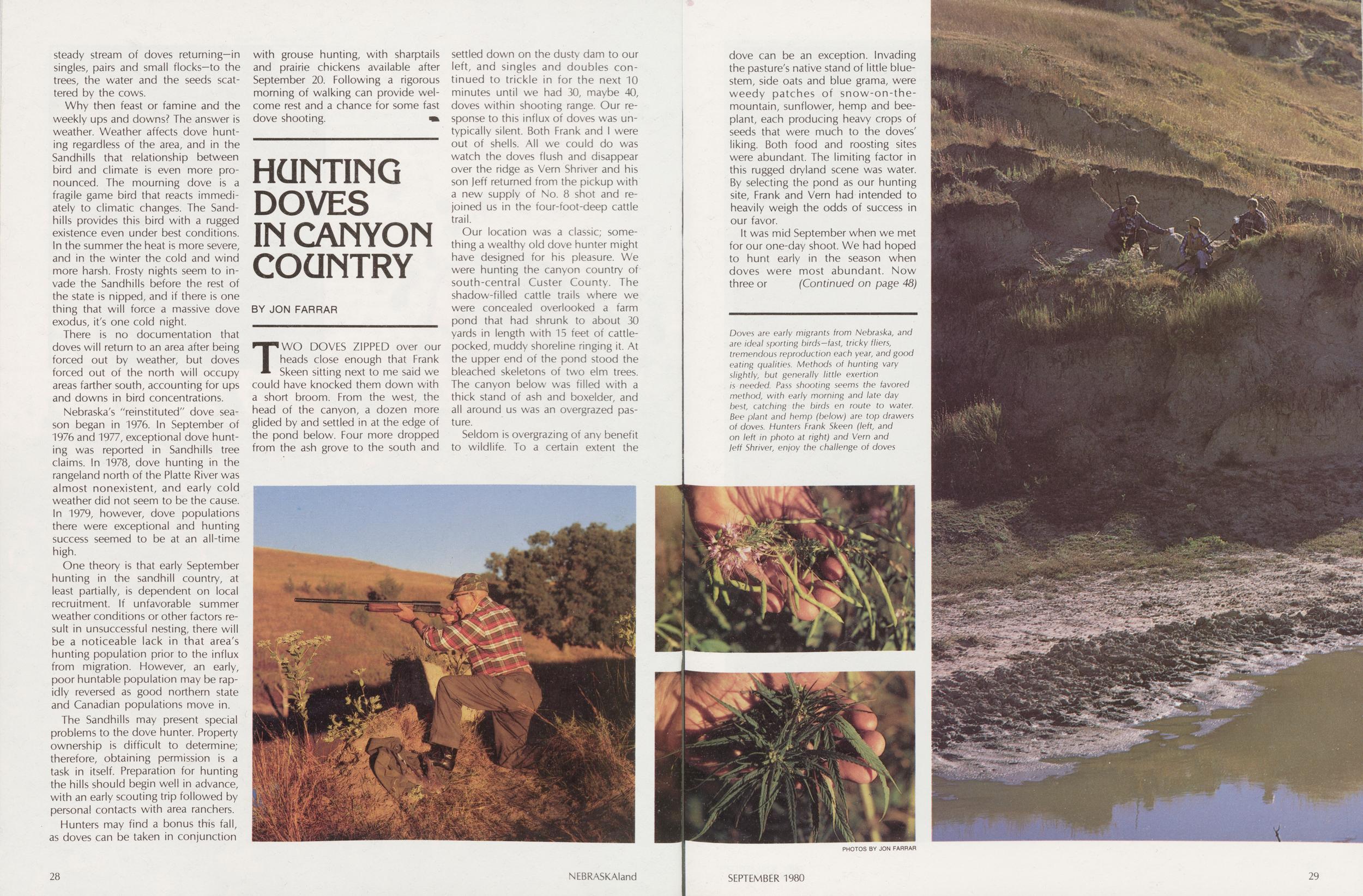
Why then feast or famine and the weekly ups and downs? The answer is weather. Weather affects dove hunting regardless of the area, and in the Sandhills that relationship between bird and climate is even more pronounced. The mourning dove is a fragile game bird that reacts immediately to climatic changes. The Sandhills provides this bird with a rugged existence even under best conditions. In the summer the heat is more severe, and in the winter the cold and wind more harsh. Frosty nights seem to invade the Sandhills before the rest of the state is nipped, and if there is one thing that will force a massive dove exodus, it's one cold night.
There is no documentation that doves will return to an area after being forced out by weather, but doves forced out of the north will occupy areas farther south, accounting for ups and downs in bird concentrations.
Nebraska's "reinstituted" dove season began in 1976. In September of 1976 and 1977, exceptional dove hunting was reported in Sandhills tree claims. In 1978, dove hunting in the rangeland north of the Platte River was almost nonexistent, and early cold weather did not seem to be the cause. In 1979, however, dove populations there were exceptional and hunting success seemed to be at an all-time high.
One theory is that early September hunting in the sandhill country, at least partially, is dependent on local recruitment. If unfavorable summer weather conditions or other factors result in unsuccessful nesting, there will be a noticeable lack in that area's hunting population prior to the influx from migration. However, an early, poor huntable population may be rapidly reversed as good northern state and Canadian populations move in.
The Sandhills may present special problems to the dove hunter. Property ownership is difficult to determine; therefore, obtaining permission is a task in itself. Preparation for hunting the hills should begin well in advance, with an early scouting trip followed by personal contacts with area ranchers.
Hunters may find a bonus this fall, as doves can be taken in conjunction with grouse hunting, with sharptails and prairie chickens available after September 20. Following a rigorous morning of walking can provide welcome rest and a chance for some fast dove shooting.
HUNTING DOVES IN CANYON COUNTRY BY JON FARRARTWO DOVES ZIPPED over our heads close enough that Frank Skeen sitting next to me said we could have knocked them down with a short broom. From the west, the head of the canyon, a dozen more glided by and settled in at the edge of the pond below. Four more dropped from the ash grove to the south and settled down on the dusty dam to our left, and singles and doubles continued to trickle in for the next 10 minutes until we had 30, maybe 40, doves within shooting range. Our response to this influx of doves was untypically silent. Both Frank and I were out of shells. All we could do was watch the doves flush and disappear over the ridge as Vern Shriver and his son Jeff returned from the pickup with a new supply of No. 8 shot and rejoined us in the four-foot-deep cattle trail.
Our location was a classic; something a wealthy old dove hunter might have designed for his pleasure. We were hunting the canyon country of south-central Custer County. The shadow-filled cattle trails where we were concealed overlooked a farm pond that had shrunk to about 30 yards in length with 15 feet of cattle-pocked, muddy shoreline ringing it. At the upper end of the pond stood the bleached skeletons of two elm trees. The canyon below was filled with a thick stand of ash and boxelder, and all around us was an overgrazed pasture.
Seldom is overgrazing of any benefit to wildlife, To a certain extent the 28 NEBRASKAland dove can be an exception. Invading the pasture's native stand of little bluestem, side oats and blue grama, were weedy patches of snow-on-the-mountain, sunflower, hemp and beeplant, each producing heavy crops of seeds that were much to the doves' liking. Both food and roosting sites were abundant. The limiting factor in this rugged dryland scene was water. By selecting the pond as our hunting site, Frank and Vern had intended to heavily weigh the odds of success in our favor.
It was mid September when we met for our one-day shoot. We had hoped to hunt early in the season when doves were most abundant. Now three or (Continued on page 48)
Doves are early migrants from Nebraska, and are ideal sporting birds—fast, tricky fliers, tremendous reproduction each year, and good eating qualities. Methods of hunting vary slightly, but generally little exertion is needed. Pass shooting seems the favored method, with early morning and late day best, catching the birds en route to water. Bee plant and hemp (below) are top drawers of doves. Hunters Frank Skeen (left, and on left in photo at right) and Vern and Jeff Shriver, enjoy the challenge of doves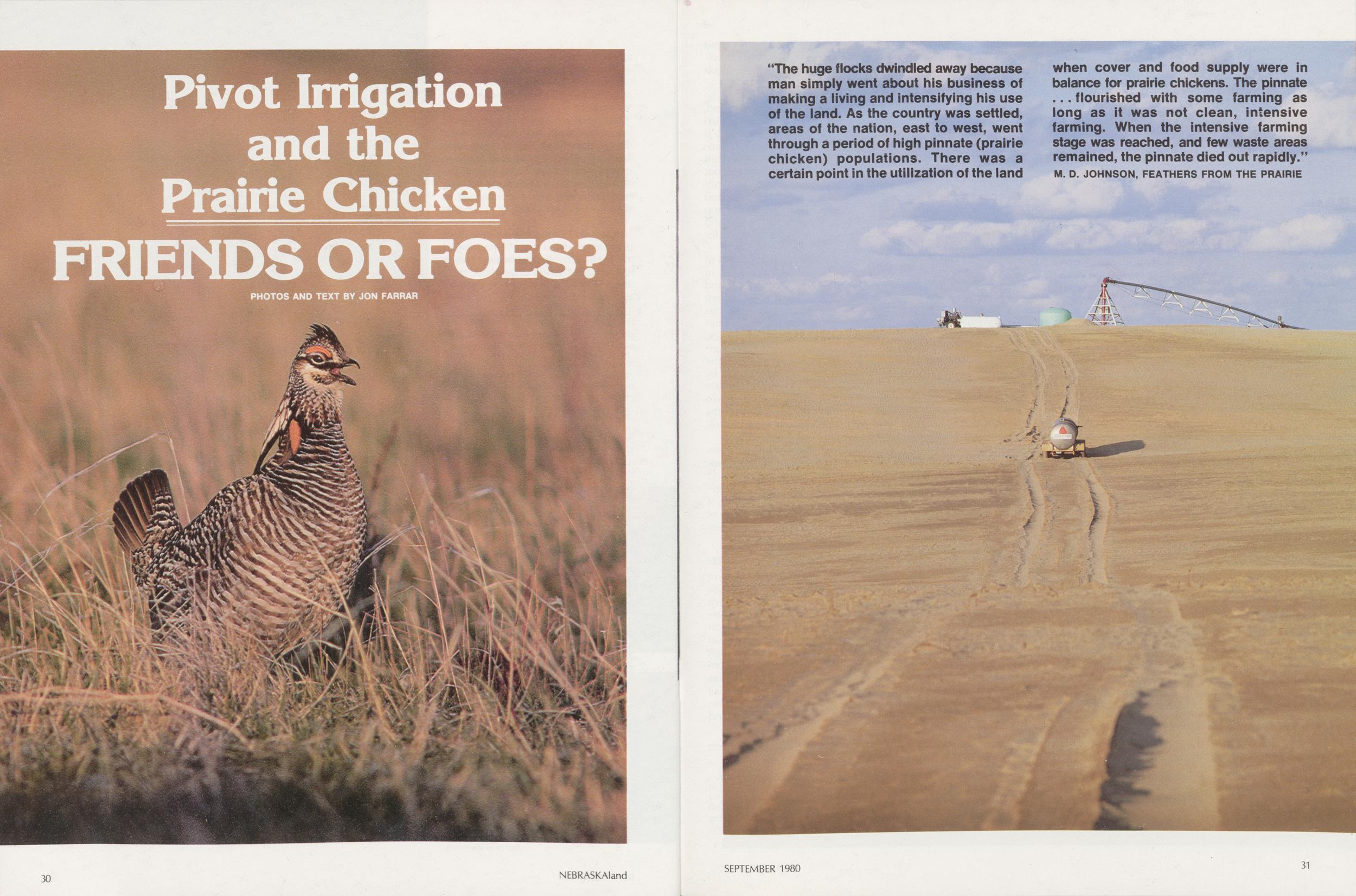
Pivot Irrigation and the Prairie Chicken FRIENDS OR FOES?
PHOTOS AND TEXT BY JON FARRAR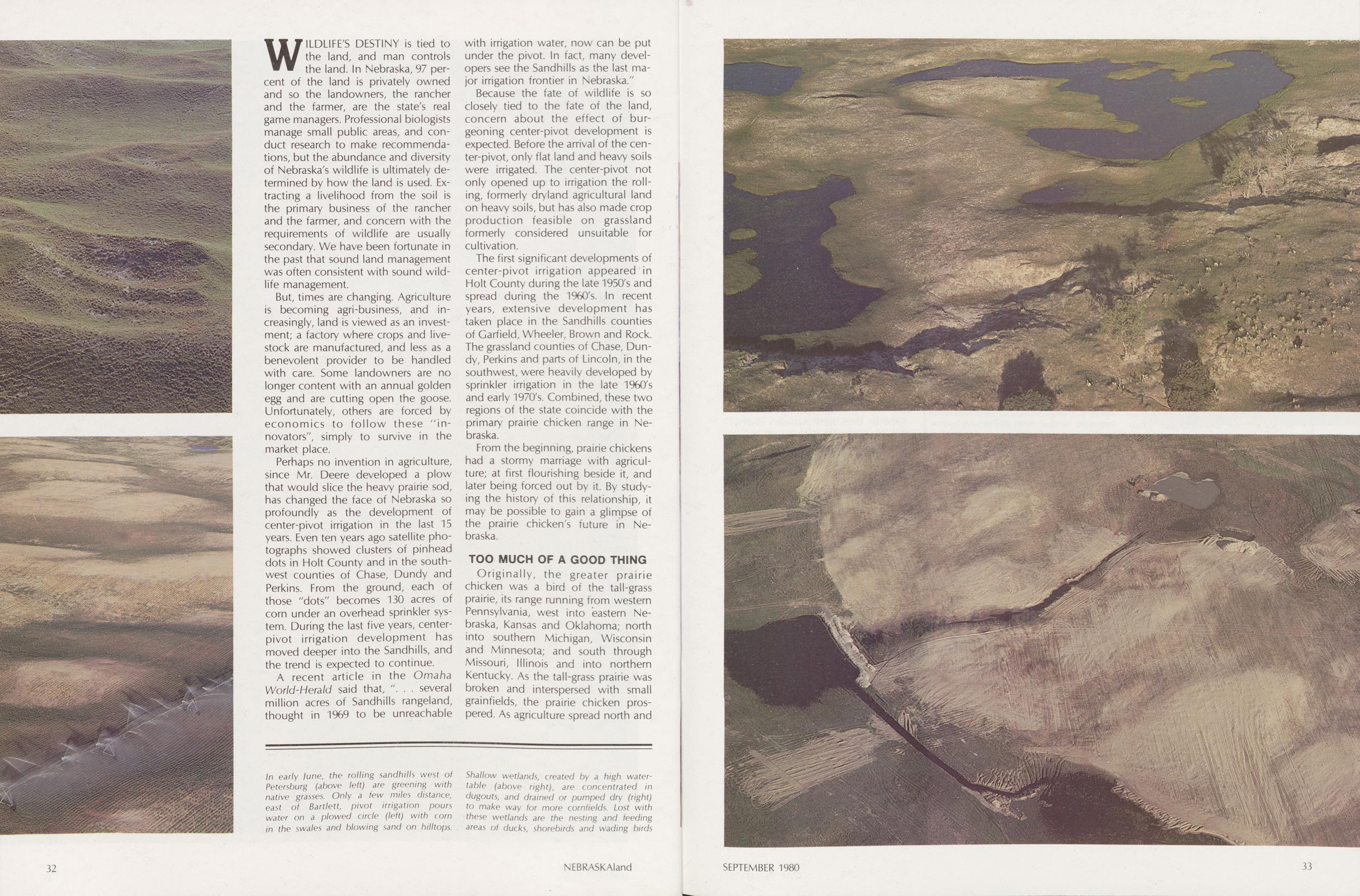
WILDLIFE'S DESTINY is tied to the land, and man controls the land. In Nebraska, 97 percent of the land is privately owned and so the landowners, the rancher and the farmer, are the state's real game managers. Professional biologists manage small public areas, and conduct research to make recommendations, but the abundance and diversity of Nebraska's wildlife is ultimately determined by how the land is used. Extracting a livelihood from the soil is the primary business of the rancher and the farmer, and concern with the requirements of wildlife are usually secondary. We have been fortunate in the past that sound land management was often consistent with sound wildlife management.
But, times are changing. Agriculture is becoming agri-business, and increasingly, land is viewed as an investment; a factory where crops and livestock are manufactured, and less as a benevolent provider to be handled with care. Some landowners are no longer content with an annual golden egg and are cutting open the goose. Unfortunately, others are forced by economics to follow these "innovators", simply to survive in the market place.
Perhaps no invention in agriculture, since Mr. Deere developed a plow that would slice the heavy prairie sod, has changed the face of Nebraska so profoundly as the development of center-pivot irrigation in the last 15 years. Even ten years ago satellite photographs showed clusters of pinhead dots in Holt County and in the southwest counties of Chase, Dundy and Perkins. From the ground, each of those "dots" becomes 130 acres of corn under an overhead sprinkler system. During the last five years, centerpivot irrigation development has moved deeper into the Sandhills, and the trend is expected to continue.
A recent article in the Omaha World-Herald said that, "...several million acres of Sandhills rangeland, thought in 1969 to be unreachable with irrigation water, now can be put under the pivot. In fact, many developers see the Sandhills as the last major irrigation frontier in Nebraska."
In early June, the rolling sandhills west of Petersburg (above left) are greening with native grasses. Only a few miles distance, east of Bartlett, pivot irrigation pours water on a plowed circle (left) with corn in the swales and blowing sand on hilltops. Shallow wetlands, created by a high water-table (above right), are concentrated in dugouts, and drained or pumped dry (right) to make way for more cornfields. Lost with these wetlands are the nesting and feeding areas of ducks, shorebirds and wading birdsBecause the fate of wildlife is so closely tied to the fate of the land, concern about the effect of burgeoning center-pivot development is expected. Before the arrival of the center-pivot, only flat land and heavy soils were irrigated. The center-pivot not only opened up to irrigation the rolling, formerly dryland agricultural land on heavy soils, but has also made crop production feasible on grassland formerly considered unsuitable for cultivation.
The first significant developments of center-pivot irrigation appeared in Holt County during the late 1950's and spread during the 1960's. In recent years, extensive development has taken place in the Sandhills counties of Garfield, Wheeler, Brown and Rock. The grassland counties of Chase, Dundy, Perkins and parts of Lincoln, in the southwest, were heavily developed by sprinkler irrigation in the late 1960's and early 1970's. Combined, these two regions of the state coincide with the primary prairie chicken range in Nebraska.
From the beginning, prairie chickens had a stormy marriage with agriculture; at first flourishing beside it, and later being forced out by it. By studying the history of this relationship, it may be possible to gain a glimpse of the prairie chicken's future in Nebraska.
TOO MUCH OF A GOOD THINGOriginally, the greater prairie chicken was a bird of the tall-grass prairie, its range running from western Pennsylvania, west into 'eastern Nebraska, Kansas and Oklahoma; north into southern Michigan, Wisconsin and Minnesota; and south through Missouri, Illinois and into northern Kentucky. As the tall-grass prairie was broken and interspersed with small grainfields, the prairie chicken prospered. As agriculture spread north and west, the prairie chicken "followed the plow", extending its range across Nebraska and Kansas, into northern Colorado and southern portions of Manitoba, Saskatchewan and Alberta. The supply of waste grain left in the fields allowed the prairie chicken to survive in regions of low rainfall and harsh winters that had formerly prevented expansion of their range.
32 NEBRASKAland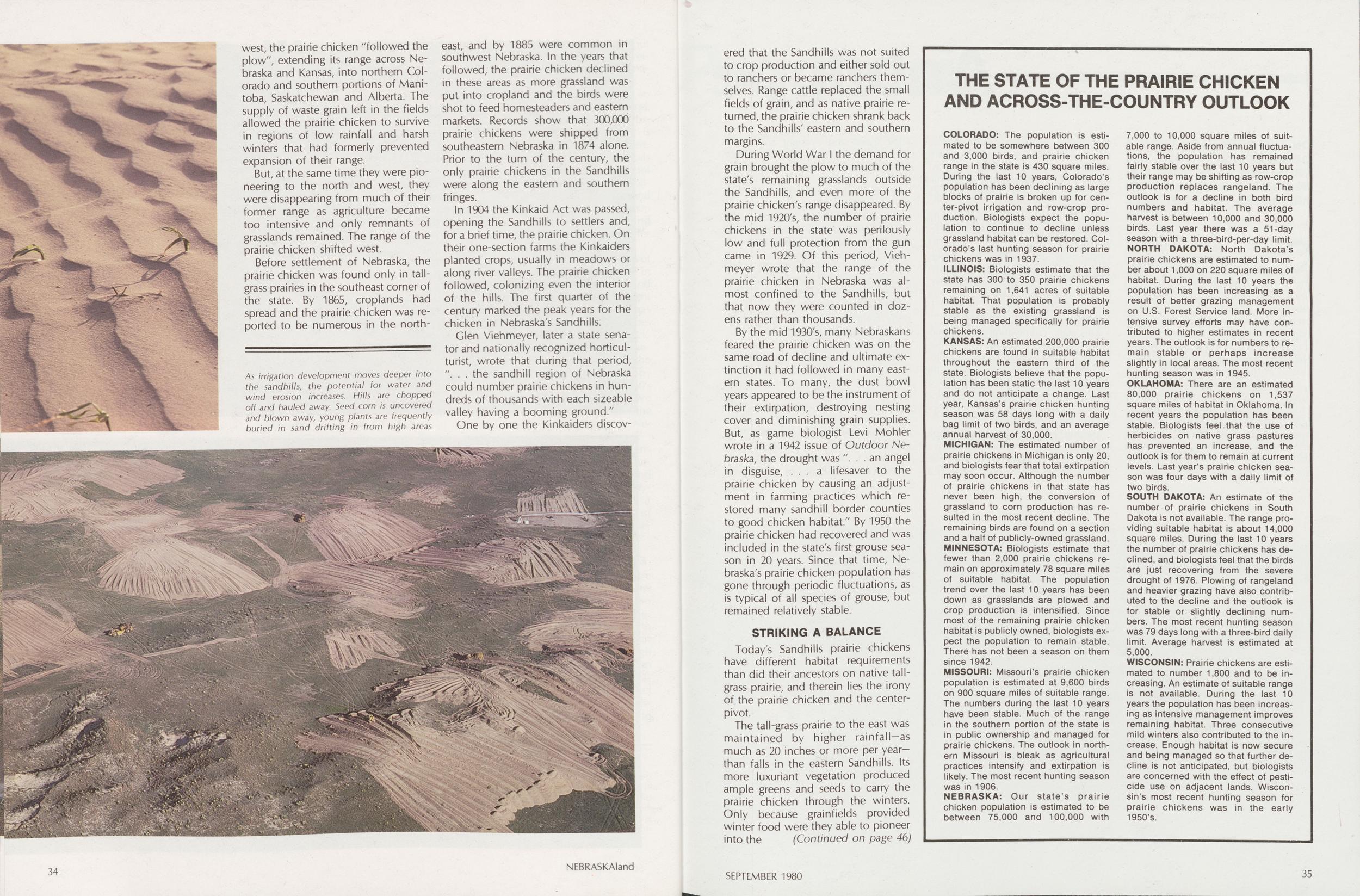
But, at the same time they were pioneering to the north and west, they were disappearing from much of their former range as agriculture became too intensive and only remnants of grasslands remained. The range of the prairie chicken shifted west.
Before settlement of Nebraska, the prairie chicken was found only in tallgrass prairies in the southeast corner of the state. By 1865, croplands had spread and the prairie chicken was reported to be numerous in the northeast, and by 1885 were common in southwest Nebraska. In the years that followed, the prairie chicken declined in these areas as more grassland was put into cropland and the birds were shot to feed homesteaders and eastern markets. Records show that 300,000 prairie chickens were shipped from southeastern Nebraska in 1874 alone. Prior to the turn of the century, the only prairie chickens in the Sandhills were along the eastern and southern fringes.
As irrigation development moves deeper into the sandhills, the potential for water and wind erosion increases. Hills are chopped off and hauled away. Seed corn is uncovered and blown away, young plants are frequently buried in sand drifting in from high areasIn 1904 the Kinkaid Act was passed, opening the Sandhills to settlers and, for a brief time, the prairie chicken. On their one-section farms the Kinkaiders planted crops, usually in meadows or along river valleys. The prairie chicken followed, colonizing even the interior of the hills. The first quarter of the century marked the peak years for the chicken in Nebraska's Sandhills.
Glen Viehmeyer, later a state senator and nationally recognized horticulturist, wrote that during that period, "...the sandhill region of Nebraska could number prairie chickens in hundreds of thousands with each sizeable valley having a booming ground."
One by one the Kinkaiders discovered 34 NEBRASKAland that the Sandhills was not suited to crop production and either sold out to ranchers or became ranchers themselves. Range cattle replaced the small fields of grain, and as native prairie returned, the prairie chicken shrank back to the Sandhills' eastern and southern margins.
During World War I the demand for grain brought the plow to much of the state's remaining grasslands outside the Sandhills, and even more of the prairie chicken's range disappeared. By the mid 1920's, the number of prairie chickens in the state was perilously low and full protection from the gun came in 1929. Of this period, Viehmeyer wrote that the range of the prairie chicken in Nebraska was almost confined to the Sandhills, but that now they were counted in dozens rather than thousands.
By the mid 1930's, many Nebraskans feared the prairie chicken was on the same road of decline and ultimate extinction it had followed in many eastern states. To many, the dust bowl years appeared to be the instrument of their extirpation, destroying nesting cover and diminishing grain supplies. But, as game biologist Levi Mohler wrote in a 1942 issue of Outdoor Nebraska, the drought was "...an angel in disguise,...a lifesaver to the prairie chicken by causing an adjustment in farming practices which restored many sandhill border counties to good chicken habitat." By 1950 the prairie chicken had recovered and was included in the state's first grouse season in 20 years. Since that time, Nebraska's prairie chicken population has gone through periodic fluctuations, as is typical of all species of grouse, but remained relatively stable.
STRIKING A BALANCEToday's Sandhills prairie chickens have different habitat requirements than did their ancestors on native tallgrass prairie, and therein lies the irony of the prairie chicken and the centerpivot.
The tall-grass prairie to the east was maintained by higher rainfall—as much as 20 inches or more per year-than falls in the eastern Sandhills. Its more luxuriant vegetation produced ample greens and seeds to carry the prairie chicken through the winters. Only because grainfields provided winter food were they able to pioneer into the (Continued on page 46)
THE STATE OF THE PRAIRIE CHICKEN AND ACROSS-THE-COUNTRY OUTLOOKCOLORADO: The population is estimated to be somewhere between 300 and 3,000 birds, and prairie chicken range in the state is 430 square miles. During the last 10 years, Colorado's population has been declining as large blocks of prairie is broken up for center-pivot irrigation and row-crop production. Biologists expect the population to continue to decline unless grassland habitat can be restored. Colorado's last hunting season for prairie chickens was in 1937.
ILLINOIS: Biologists estimate that the state has 300 to 350 prairie chickens remaining on 1,641 acres of suitable habitat. That population is probably stable as the existing grassland is being managed specifically for prairie chickens.
KANSAS: An estimated 200,000 prairie chickens are found in suitable habitat throughout the eastern third of the state. Biologists believe that the population has been static the last 10 years and do not anticipate a change. Last year, Kansas's prairie chicken hunting season was 58 days long with a daily bag limit of two birds, and an average annual harvest of 30,000.
MICHIGAN: The estimated number of prairie chickens in Michigan is only 20, and biologists fear that total extirpation may soon occur. Although the number of prairie chickens in that state has never been high, the conversion of grassland to corn production has resulted in the most recent decline. The remaining birds are found on a section and a half of publicly-owned grassland.
MINNESOTA: Biologists estimate that fewer than 2,000 prairie chickens remain on approximately 78 square miles of suitable habitat. The population trend over the last 10 years has been down as grasslands are plowed and crop production is intensified. Since most of the remaining prairie chicken habitat is publicly owned, biologists expect the population to remain stable. There has not been a season on them since 1942.
MISSOURI: Missouri's prairie chicken population is estimated at 9,600 birds on 900 square miles of suitable range. The numbers during the last 10 years have been stable. Much of the range in the southern portion of the state is in public ownership and managed for prairie chickens. The outlook in northern Missouri is bleak as agricultural practices intensify and extirpation is likely. The most recent hunting season was in 1906.
NEBRASKA: Our state's prairie chicken population is estimated to be between 75,000 and 100,000 with 7,000 to 10,000 square miles of suitable range. Aside from annual fluctuations, the population has remained fairly stable over the last 10 years but their range may be shifting as row-crop production replaces rangeland. The outlook is for a decline in both bird numbers and habitat. The average harvest is between 10,000 and 30,000 birds. Last year there was a 51-day season with a three-bird-per-day limit.
NORTH DAKOTA: North Dakota's prairie chickens are estimated to number about 1,000 on 220 square miles of habitat. During the last 10 years the population has been increasing as a result of better grazing management on U.S. Forest Service land. More intensive survey efforts may have contributed to higher estimates in recent years. The outlook is for numbers to remain stable or perhaps increase slightly in local areas. The most recent hunting season was in 1945.
OKLAHOMA: There are an estimated 80,000 prairie chickens on 1,537 square miles of habitat in Oklahoma. In recent years the population has been stable. Biologists feel that the use of herbicides on native grass pastures has prevented an increase, and the outlook is for them to remain at current levels. Last year's prairie chicken season was four days with a daily limit of two birds.
SOUTH DAKOTA: An estimate of the number of prairie chickens in South Dakota is not available. The range providing suitable habitat is about 14,000 square miles. During the last 10 years the number of prairie chickens has declined, and biologists feel that the birds are just recovering from the severe drought of 1976. Plowing of rangeland and heavier grazing have also contributed to the decline and the outlook is for stable or slightly declining numbers. The most recent hunting season was 79 days long with a three-bird daily limit. Average harvest is estimated at 5,000.
WISCONSIN: Prairie chickens are estimated to number 1,800 and to be increasing. An estimate of suitable range is not available. During the last 10 years the population has been increasing as intensive management improves remaining habitat. Three consecutive mild winters also contributed to the increase. Enough habitat is now secure and being managed so that further decline is not anticipated, but biologists are concerned with the effect of pesticide use on adjacent lands. Wisconsin's most recent hunting season for prairie chickens was in the early 1950's.
SEPTEMBER 1980 35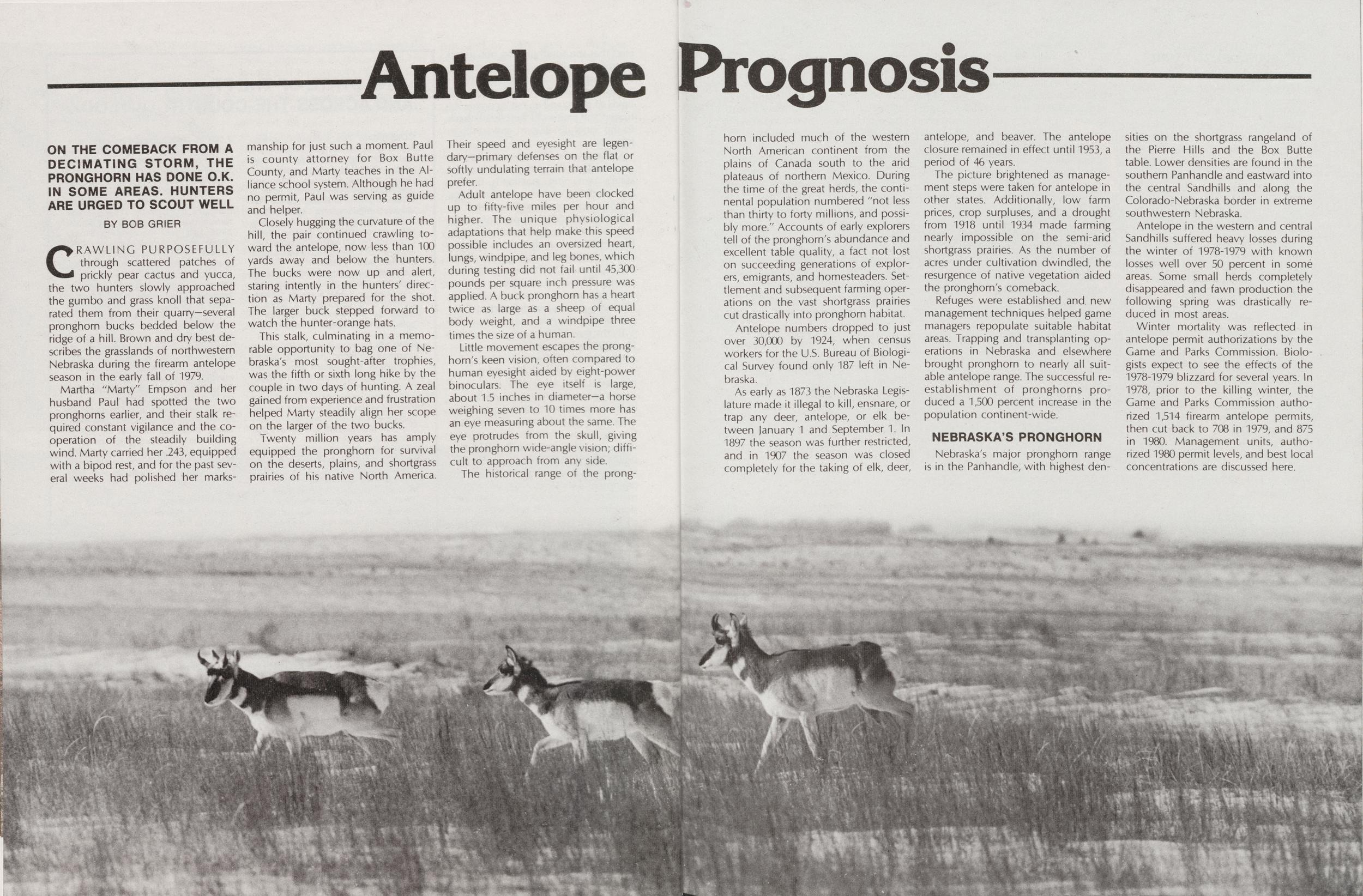
Antelope Prognosis
ON THE COMEBACK FROM A DECIMATING STORM, THE PRONGHORN HAS DONE O.K. IN SOME AREAS. HUNTERS ARE URGED TO SCOUT WELL BY BOB GRIERCRAWLING PURPOSEFULLY through scattered patches of prickly pear cactus and yucca, the two hunters slowly approached the gumbo and grass knoll that separated them from their quarry—several pronghorn bucks bedded below the ridge of a hill. Brown and dry best describes the grasslands of northwestern Nebraska during the firearm antelope season in the early fall of 1979.
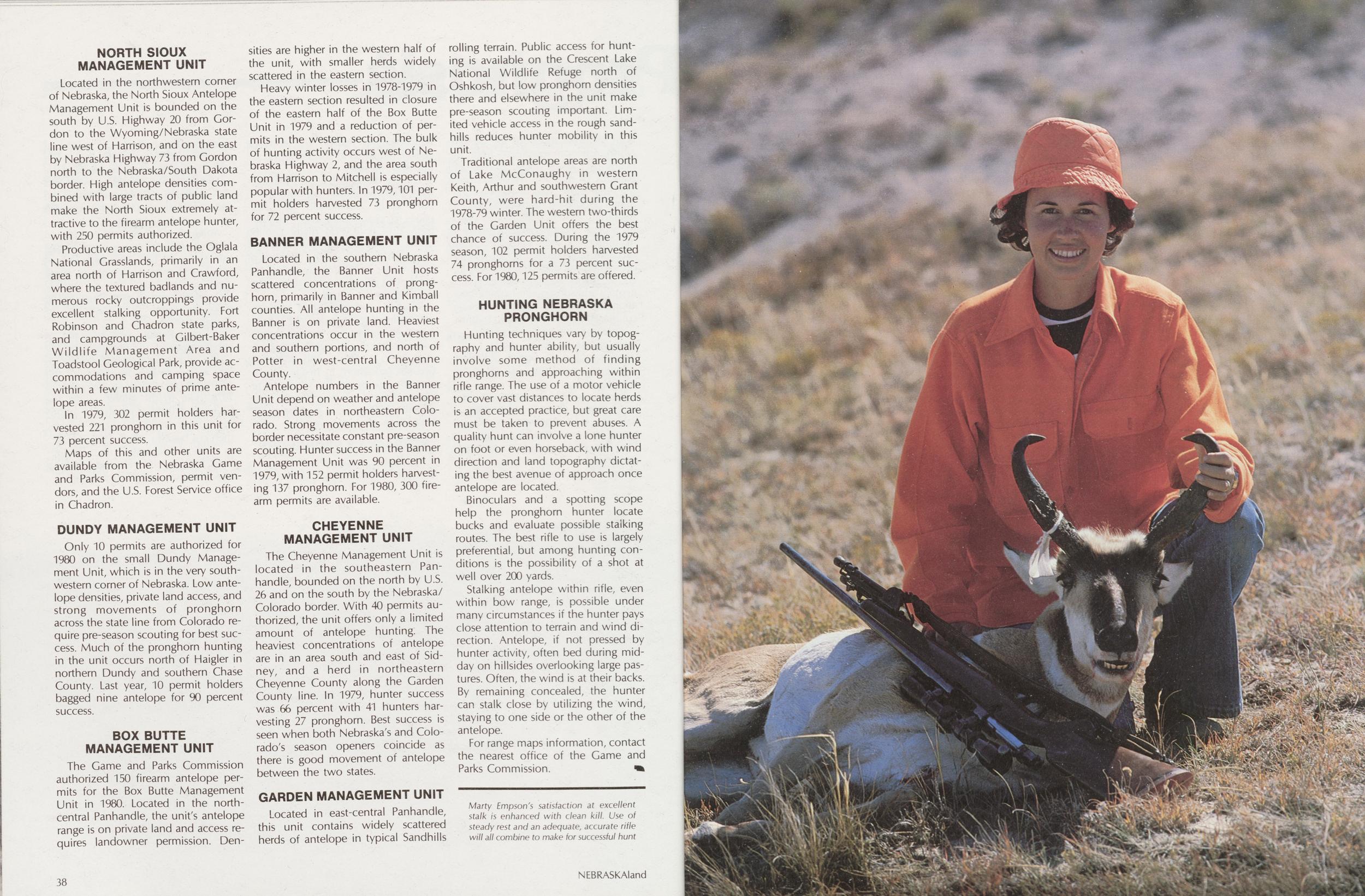
Martha "Marty" Empson and her husband Paul had spotted the two pronghorns earlier, and their stalk required constant vigilance and the cooperation of the steadily building wind. Marty carried her .243, equipped with a bipod rest, and for the past several weeks had polished her marksmanhip for just such a moment. Paul is county attorney for Box Butte County, and Marty teaches in the Alliance school system. Although he had no permit, Paul was serving as guide and helper.
Closely hugging the curvature of the hill, the pair continued crawling toward the antelope, now less than 100 yards away and below the hunters. The bucks were now up and alert, staring intently in the hunters' direction as Marty prepared for the shot. The larger buck stepped forward to watch the hunter-orange hats.
This stalk, culminating in a memorable opportunity to bag one of Nebraska's most sought-after trophies, was the fifth or sixth long hike by the couple in two days of hunting. A zeal gained from experience and frustration helped Marty steadily align her scope on the larger of the two bucks.
Twenty million years has amply equipped the pronghorn for survival on the deserts, plains, and shortgrass prairies of his native North America. Their speed and eyesight are legendary—primary defenses on the flat or softly undulating terrain that antelope prefer.
Adult antelope have been clocked up to fifty-five miles per hour and higher. The unique physiological adaptations that help make this speed possible includes an oversized heart, lungs, windpipe, and leg bones, which during testing did not fail until 45,300 pounds per square inch pressure was applied. A buck pronghorn has a heart twice as large as a sheep of equal body weight, and a windpipe three times the size of a human.
Little movement escapes the pronghorn's keen vision, often compared to human eyesight aided by eight-power binoculars. The eye itself is large, about 1.5 inches in diameter—a horse weighing seven to 10 times more has an eye measuring about the same. The eye protrudes from the skull, giving the pronghorn wide-angle vision; difficult to approach from any side.
The historical range of the prong horn included much of the western North American continent from the plains of Canada south to the arid plateaus of northern Mexico. During the time of the great herds, the continental population numbered "not less than thirty to forty millions, and possibly more." Accounts of early explorers tell of the pronghorn's abundance and excellent table quality, a fact not lost on succeeding generations of explorers, emigrants, and homesteaders. Settlement and subsequent farming operations on the vast shortgrass prairies cut drastically into pronghorn habitat.
Antelope numbers dropped to just over 30,000 by 1924, when census workers for the U.S. Bureau of Biological Survey found only 187 left in Nebraska.
As early as 1873 the Nebraska Legislature made it illegal to kill, ensnare, or trap any deer, antelope, or elk between January 1 and September 1. In 1897 the season was further restricted, and in 1907 the season was closed completely for the taking of elk, deer, antelope, and beaver. The antelope closure remained in effect until 1953, a period of 46 years.
The picture brightened as management steps were taken for antelope in other states. Additionally, low farm prices, crop surpluses, and a drought from 1918 until 1934 made farming nearly impossible on the semi-arid shortgrass prairies. As the number of acres under cultivation dwindled, the resurgence of native vegetation aided the pronghorn's comeback.
Refuges were established and. new management techniques helped game managers repopulate suitable habitat areas. Trapping and transplanting operations in Nebraska and elsewhere brought pronghorn to nearly all suitable antelope range. The successful reestablishment of pronghorns produced a 1,500 percent increase in the population continent-wide.
NEBRASKA'S PRONGHORNNebraska's major pronghorn range is in the Panhandle, with highest densities on the shortgrass rangeland of the Pierre Hills and the Box Butte table. Lower densities are found in the southern Panhandle and eastward into the central Sandhills and along the Colorado-Nebraska border in extreme southwestern Nebraska.
Antelope in the western and central Sandhills suffered heavy losses during the winter of 1978-1979 with known losses well over 50 percent in some areas. Some small herds completely disappeared and fawn production the following spring was drastically reduced in most areas.
Winter mortality was reflected in antelope permit authorizations by the Game and Parks Commission. Biologists expect to see the effects of the 1978-1979 blizzard for several years. In 1978, prior to the killing winter, the Game and Parks Commission authorized 1,514 firearm antelope permits, then cut back to 708 in 1979, and 875 in 1980. Management units, authorized 1980 permit levels, and best local concentrations are discussed here.
 NORTH SIOUX
MANAGEMENT UNIT
NORTH SIOUX
MANAGEMENT UNIT
Located in the northwestern corner of Nebraska, the North Sioux Antelope Management Unit is bounded on the south by U.S. Highway 20 from Gordon to the Wyoming/Nebraska state line west of Harrison, and on the east by Nebraska Highway 73 from Gordon north to the Nebraska/South Dakota border. High antelope densities combined with large tracts of public land make the North Sioux extremely attractive to the firearm antelope hunter, with 250 permits authorized.
Productive areas include the Oglala National Grasslands, primarily in an area north of Harrison and Crawford, where the textured badlands and numerous rocky outcroppings provide excellent stalking opportunity. Fort Robinson and Chadron state parks, and campgrounds at Gilbert-Baker Wildlife Management Area and Toadstool Geological Park, provide accommodations and camping space within a few minutes of prime antelope areas.
In 1979, 302 permit holders harvested 221 pronghorn in this unit for 73 percent success.
Maps of this and other units are available from the Nebraska Game and Parks Commission, permit vendors, and the U.S. Forest Service office in Chadron.
DUNDY MANAGEMENT UNITOnly 10 permits are authorized for 1980 on the small Dundy Management Unit, which is in the very south- western corner of Nebraska. Low antelope densities, private land access, and strong movements of pronghorn across the state line from Colorado require pre-season scouting for best success. Much of the pronghorn hunting in the unit occurs north of Haigler in northern Dundy and southern Chase County. Last year, 10 permit holders bagged nine antelope for 90 percent success.
BOX BUTTE MANAGEMENT UNITThe Game and Parks Commission authorized 150 firearm antelope permits for the Box Butte Management Unit in 1980. Located in the northcentral Panhandle, the unit's antelope range is on private land and access requires landowner permission. Densities are higher in the western half of the unit, with smaller herds widely scattered in the eastern section.
Heavy winter losses in 1978-1979 in the eastern section resulted in closure of the eastern half of the Box Butte Unit in 1979 and a reduction of permits in the western section. The bulk of hunting activity occurs west of Nebraska Highway 2, and the area south from Harrison to Mitchell is especially popular with hunters. In 1979,101 permit holders harvested 73 pronghorn for 72 percent success.
BANNER MANAGEMENT UNITLocated in the southern Nebraska Panhandle, the Banner Unit hosts scattered concentrations of pronghorn, primarily in Banner and Kimball counties. All antelope hunting in the Banner is on private land. Heaviest concentrations occur in the western and southern portions, and north of Potter in west-central Cheyenne County.
Antelope numbers in the Banner Unit depend on weather and antelope season dates in northeastern Colorado. Strong movements across the border necessitate constant pre-season scouting. Hunter success in the Banner Management Unit was 90 percent in 1979, with 152 permit holders harvesting 137 pronghorn. For 1980, 300 firearm permits are available.
CHEYENNE MANAGEMENT UNITThe Cheyenne Management Unit is located in the southeastern Panhandle, bounded on the north by U.S. 26 and on the south by the Nebraska/ Colorado border. With 40 permits authorized, the unit offers only a limited amount of antelope hunting. The heaviest concentrations of antelope are in an area south and east of Sidney, and a herd in northeastern Cheyenne County along the Garden County line. In 1979, hunter success was 66 percent with 41 hunters harvesting 27 pronghorn. Best success is seen when both Nebraska's and Colorado's season openers coincide as there is good movement of antelope between the two states.
GARDEN MANAGEMENT UNITLocated in east-central Panhandle, this unit contains widely scattered herds of antelope in typical Sandhills rolling terrain. Public access for hunting is available on the Crescent Lake National Wildlife Refuge north of Oshkosh, but low pronghorn densities there and elsewhere in the unit make pre-season scouting important. Limited vehicle access in the rough sandhills reduces hunter mobility in this unit.
Traditional antelope areas are north of Lake McConaughy in western Keith, Arthur and southwestern Grant County, were hard-hit during the 1978-79 winter. The western two-thirds of the Garden Unit offers the best chance of success. During the 1979 season, 102 permit holders harvested 74 pronghorns for a 73 percent success. For 1980,125 permits are offered.
HUNTING NEBRASKA PRONGHORNHunting techniques vary by topography and hunter ability, but usually involve some method of finding pronghorns and approaching within rifle range. The use of a motor vehicle to cover vast distances to locate herds is an accepted practice, but great care must be taken to prevent abuses. A quality hunt can involve a lone hunter on foot or even horseback, with wind direction and land topography dictating the best avenue of approach once antelope are located.
Binoculars and a spotting scope help the pronghorn hunter locate bucks and evaluate possible stalking routes. The best rifle to use is largely preferential, but among hunting conditions is the possibility of a shot at well over 200 yards.
Stalking antelope within rifle, even within bow range, is possible under many circumstances if the hunter pays close attention to terrain and wind direction. Antelope, if not pressed by hunter activity, often bed during midday on hillsides overlooking large pastures. Often, the wind is at their backs. By remaining concealed, the hunter can stalk close by utilizing the wind, staying to one side or the other of the antelope.
For range maps information, contact the nearest office of the Game and Parks Commission.
Marty Empson's satisfaction at excellent stalk is enhanced with clean kill. Use of steady rest and an adequate, accurate rifle will all combine to make for successful hunt 38 NEBRASKAland
OUTLOOK FOR THE 80's
(Continued from page 10)wildlife will probably be low for awhile—unless irrigation continues to make significant inroads.
One prediction I will make is increasing use of state recreation and wildlife areas, particularly by our local population. People just aren't going to be doing the traveling they've done in the past to hunt or fish. I think they're going to be staying a lot longer, too, at the public areas. This may mean problems in management for us, but we better be ready to take it on because everything points to greater use of and greater demand for nearby public rec and hunting areas.
Disturbing to me when I try to look ahead is not so much the changes in agriculture that have already begun, or the really unknown impact that agriculture may have on wildlife and its habitat. Rather, I see a real change in feeling for the land. Absentee owners just don't have the deep-rooted land ethic that the folks who grew up on these fragile hills have developed. As a matter of fact, when you really think about it, there's not much reason to have any land ethic if you're never going to see the place, or work like hell to get trees started, or maintain range in top condition. If anything will hurt this area, it's going to be because people don't care. Maybe here's where we need to start working.
SOUTHWEST Dick Nelson, district Resource Services supervisor, North PlatteWe've got six basic habitat types which we look to for wildlife. These include portions of the Sandhills, large reservoirs, bluffland or the rough areas separating river valley and plains, the valleys, the plains, and the dissected plains (those old plains eroded by water and wind). All six of these are important to wildlife in their own particular way.
Right now the Sandhills area is in good condition as a result of lower cattle numbers and excellent moisture. Wildlife numbers in this habitat type are in good condition. If cattle numbers increase and moisture decreases, look for a decrease in wildlife. The formula is pretty simple for this habitat. An occasional center-pivot unit in the Sandhills may actually increase diversity and thus be beneficial to wildlife. However, with wall-to-wall pivots, look for a traumatic impact on Sandhills wildlife. With production costs on the increase, economists and other specialists are flashing warning signs. Yet, I see a mass of pivots going in; someone is apparently willing to gamble.
Looking at the Platte, we find a river already 70 percent dewatered. And, we're also seeing many people trying to find ways to use the last of it! With decreased flows, waterfowl habitat will decrease. As islands go to willows, I'd predict deer habitat will expand. For water-related wildlife species, though, the plight of the Platte is painfully obvious.
Water and water use are going to play a major role in this area in the next decade. The effects on wildlife will be dramatic in some areas. With the Frenchman River predicted dry by 1990-95, Enders will fail. A recent plan to build a canal from the South Platte to Enders would be like giving a cadaver a blood transfusion. The basic laws of ecology must take over in the water-use dilemma before major and critical effects are felt on wildlife.
Clearing of land along rivers like the Republican is expected to continue—gradually. At present, fair to good wildlife habitat exists along most of the larger stream courses. Declines appear to be inevitable, but the situation is not alarming yet. I view the ailment as more like cancer than heart attack.
Bluff lands are unique in the district. They are the transition areas between valley and plain and thus serve as important "buffer" areas for all types of wildlife. Cattle numbers and demand for home development will impact the bluffs more than any other factor in the 80's.
The plains will continue to be the wheat belt of the district. Grazing and pivot development will create inroads and have an effect on wildlife. On the brighter side, the recent move to ecofallow agriculture is expected to benefit both wildlife and farmer. Crop residue in the fields after harvest will furnish reasonably good food and cover for upland game and other species.
Probably the most secure habitat we've got in the district is the dissected plains. Small farming operations here, coupled with the limited or lack of grazing lands, give these important pockets some security for the future. They provide some of the best upland habitat in the district. I'm optimistic for their future and the role these eroded hills will play in future wildlife populations.
Looking ahead, it's obvious and downright discouraging that the long-term wild-life habitat outlook is not the brightest. We've made tremendous progress in management on both public and private lands. We've made some key acquisitions of important wildlife habitat. But right now, it's not in the cards to expect any return to the glory days of the 1950's or 60's. We do have, though, darn good hunting for those who want to get out and give it a real go. I expect that for these types of folks, the 80's will still be bright.
Our district sweeps from the Missouri River bluffs on the east to the irrigated country of south-central Nebraska. We have a lot of wildlife habitat, and a real diversity of wildlife species. We're seeing a lot of the same disturbing trend in land use experienced in the rest of the state-intensification of agriculture, which has a very real impact on wildlife. To most of the public, these changes are so subtle that many people believe the landscape is very much the same as when they were kids. No so, and we've got the data to prove it.
We ran some comparisons a few years back that looked at changes on one of our pheasant study areas in south-central Nebraska from 1955 to 1976. Even we were surprised at the tremendous changes that took place in this period of time. Fields grew larger, fencerows grew smaller, and valuable plots of cover such as wetlands and unused areas simply disappeared. As we expected, the pheasant population also dropped in the same proportion as the loss of habitat. We took a loss of about 35 percent during those two decades, and there's no way that these habitat losses or the pheasant numbers can ever be replaced.
We're looking at similar changes now, and would anticipate that they will continue on into the 80's. I feel that intensification of agriculture will continue, and despite increased energy costs, I think we'll still be looking at shrinking habitat. Hedgerows and fencerows will continue to decline in size and length; brush patches will decrease; small grains will be up in acreage. Unfortunately, I think we'll see continued development of land not really suitable for agriculture.
In spite of the rather dismal outlook on the land-use side, I feel we'll still be able to hold wildlife populations together through the 80's. Pheasants should remain static, along with bobwhite, squirrel and rabbit. Our deer have come back strong, and with any luck we'll continue to provide good deer harvests. Waterfowl, particularly in the Rain Basin, will exist at the whim of weather patterns. If good water conditions continue through the decade, waterfowl production and hunting should be pretty fair.
We do have some positive outlooks for the 80's in the Southeast. State and federal land acquisitions have included some key 40 NEBRASKAland habitat areas. These small but vital areas will begin to show a positive return in the next 10 years. The Habitat Program funded by Nebraska hunters has brought about some good changes in attitude as well as in habitat. For one thing, people have become aware of habitat and its importance to wildlife. More rewarding, perhaps, is the demonstrated willingness to sit down and try to solve problems. If anything will help wildlife in the 80's, it will be this new-formed awareness and appreciation for the role of wildlife in the ecological picture of which we are all a part.
I'm impressed by the recent interest in ecofallow techniques and its acceptance by farmers. This change is a positive step for wildlife and energy. Interest in crop rotation is also a bright light on the horizon. Oat/sweetclover rotations are not only good soil enrichment practices, but also a boon for critically-needed nesting cover. With energy costs going up, we'll keep our fingers crossed and hope that these practices will see greater acceptance across the Southeast.
NORTHWEST Hal Gibbs, wildlife biologist, U.S. Forest ServiceOut here in the northwest corner of the state, we've got a lot of diversity in wildlife and wildlife habitat. And we cover a lot of territory from the badlands breaks of the Oglala grasslands to the buttes of the Pine Ridge. Any changes for the 80's that affect wildlife can be traced to energy demands and pure, old economics.
At present, we're seeing a great resurgence and interest in wood heating. While we have an abundance of wood, most firewood exists in draws and stream courses. Species like ash, elm and oak get cut out pretty fast. The impact of firewood cutting on these small but very critical habitat areas is unknown, but we know that these woody draws are one of the most important habitat types we've got. They serve as brooding areas for turkey, feeding and loafing areas for deer, and provide a substantial amount of diversity both in physiographic and vegetative character. Management in these draws is a definite need.
Also on the potentially negative side for wildlife is the ongoing search for oil and gas deposits.
Another negative for wildlife in the 80's will be reduction in funds for resource agencies. While the effects will not be noticed immediately, by the mid to late 80's, lowered operating monies for management and research will place the future of wildlife in a very precarious position. I am hopeful the public will become more aware in the 80's, and place priority on management of a very valuable heritage.
We do have some optimistic sides to the wildlife picture for the coming decade. I see less demand for conflicting uses on Forest Service lands. This will give us a good chance to "home in" on more intensive management of both grasslands and the forest area of the Ridge. Also, with fuel prices continuing upward, I would expect less demand for big-game hunting here in the northwest.
All in all, and given near-normal weather patterns through the decade, we can anticipate most wildlife populations remaining steady in this area.
POSTSCRIPTIn each of the forecasts for the five regions of Nebraska, a sense of apprehension can be sensed over continued intensification of agriculture. This is the cloud which pervades each forecast for wildlife in the 1980's. That trends toward cleaner agriculture have significant impacts on wildlife cannot be argued.
But, that good land ethics is good business, is a fact often disregarded. History as well as common sense tell us that sound ecological management is the only way to be assured of resources for the future. Practices that subvert sound land-use practices are certain of upsetting delicate systems which we are just beginning to understand. Land and water are the basis for the web of life that supports us all-wildlife included.
 Tree-shaded sites
Peaceful Surroundings
Fishing Swimming
Picnics RV Supplies
LAKESIDE CAMPING
EXIT 342 1-80
Henderson, Nebraska
Gas Discount to our Campers
Full Groceries — Souvenirs
Store Game Room
Horseshoes Net Games
Tenters Welcome
Stay two days, third day FREE with this ad!!
Phone for reservations (402) 723-4310
THIS IS AN
OXYGEN FACTORY.
i e
BURN IT DOWN.
WATERFOWL ID
Hunters-Send for this waterfowl identification book.
Only 36$ (Incl. tax)
Mali to: Game and Parks Commission,
Box 30370, Lincoln, NE 68503
PUDDLE DUCKS
WINTER
My
Send Duck ID Book to:
Name
Address
City
State
Zip
an outdoor tip from your Big JJ agent
OPOSSUM
Qu/et and unassuming, the opossum is the only
native North American mammal that carries its
young in a pouch. They inhabit nearly all continental states as well as Canada and
Mexico. Gray
and about the size of a house cat, they have a naked
tail, are basically nocturnal, and feed on about
anything.
...this message brought to you by the
INDEPENDENT INSURANCE
AGENTS OF NEBRASKA
Tree-shaded sites
Peaceful Surroundings
Fishing Swimming
Picnics RV Supplies
LAKESIDE CAMPING
EXIT 342 1-80
Henderson, Nebraska
Gas Discount to our Campers
Full Groceries — Souvenirs
Store Game Room
Horseshoes Net Games
Tenters Welcome
Stay two days, third day FREE with this ad!!
Phone for reservations (402) 723-4310
THIS IS AN
OXYGEN FACTORY.
i e
BURN IT DOWN.
WATERFOWL ID
Hunters-Send for this waterfowl identification book.
Only 36$ (Incl. tax)
Mali to: Game and Parks Commission,
Box 30370, Lincoln, NE 68503
PUDDLE DUCKS
WINTER
My
Send Duck ID Book to:
Name
Address
City
State
Zip
an outdoor tip from your Big JJ agent
OPOSSUM
Qu/et and unassuming, the opossum is the only
native North American mammal that carries its
young in a pouch. They inhabit nearly all continental states as well as Canada and
Mexico. Gray
and about the size of a house cat, they have a naked
tail, are basically nocturnal, and feed on about
anything.
...this message brought to you by the
INDEPENDENT INSURANCE
AGENTS OF NEBRASKA
IN QUEST OF THE PRAIRIE HEN
(Continued from page 15)so I continued in the direction of the cripple. I had taken only a step or two when a chicken flushed from the very spot the cripple had gone down. I pulled up, thinking it was the cripple. Usually it doesn't take much of a hit to keep a grouse down, but on the other hand, I didn't want to let a crippled bird fly off to die later. While I weighed the possible solutions to my dilemma, the bird flew out of range and I brought my shotgun down.
After a few minutes of searching, Beaver pointed the crippled bird. I was relieved that I had passed on the last bird to flush. The first had fallen in short grass, but oddly enough, proved the most difficult to find. Dave brought Chief over and both dogs worked hack and forth over the area. Neither dog seemed particularly interested in that spot and kept drifting off, working the still-fresh scent of other birds, or so we thought. After about 15 minutes, Beaver went on an unsteady point 40 yards west of where I had marked the chicken down with my handkerchief. Dave walked in, convinced that it was yet another bird sitting tight, but Beaver broke point and picked up my first bird.
Rainfall had been unusually heavy in the eastern Sandhills the preceding spring, resulting in more renesting than during a dry year, probably accounting for more young birds when the season opened. Young grouse hold exceptionally well for a pointing dog, and that was just what I had walked into.
Since birds were holding tight in the heavy grass, we worked parts of the north end of the meadow more thoroughly. Not only were the grouse behaving in a peculiar fashion, so was my dog. Just south of a stack yard, he started working birdy again and went on point. Chief moved in behind him and honored the point beautifully. A single chicken got the jitters, Dave dropped it cleanly, and Chief made a classy retrieve to Dave's hand.
There seemed to be little advantage in my watching over Dave's shoulder, so I returned to the pickup to clean the four grouse. Dave and Chief cut north into the eastern end of the hills we had skirted on our way to the meadow earlier in the morning. They nearly beat me back to the pickup.
As he poured a cup of coffee, Dave told me that a pair of sharptails had flushed wild only minutes after we separated. A couple of hills later he watched a small flock of sharptails down in a grassy flat near a windmill. Even if the birds wouldn't let him within gun range, Chief could use a drink from the stock tank, so they worked in that direction.
Walking into the wind, Chief quickly picked up the scent of the birds, slowed to a point, broke it, creeped ahead and 42 NEBRASKAland pointed again. The birds had been moving, but as Chief closed the distance between them, they stopped and Dave flushed them up, killing one of the sharptails with his second shot.
To the south the pasture climbed into a series of small hills with a blowout in the center. The area bordered on the meadow and had a heavier cover of grass than the rest of the pasture, making it a likely place for birds. Again Chief locked onto a point and a brace of prairie chickens took wing. Dave picked his last bird from the two and ended his grouse hunting for the day. By mid morning our six birds were cleaned and in the cooler.
Now, there are few things that compare with the satisfaction of a quality day's shoot, especially if it's still only lunch time. We cleaned up camp, including the last of the Colby cheese, braunschweiger, smoked oysters and crackers. With our bodies satisfied, our thoughts turned to shady spots near hemp patches and evening flights of doves.
We were faced, though, with that uneasy time that all hunters are confronted with occasionally: finding a place to hunt. None of the land we were hunting grouse on was really suited to dove shooting. I was brooding over our limited options when the solution came bouncing up in a four-wheel-drive vehicle. Clark Gotschall, part of the family on whose ranch we were hunting, had stopped by to see how the grouse shooting was progressing. He said he had time for a couple of hours of dove shooting and just happened to have a shotgun and box of light loads along.
The value of tagging along with someone who lives where you are hunting can hardly be overrated. They not only know who owns land but where the birds have been in recent days. Clark had hunted an abandoned farmstead several days earlier with good success. As we turned off the country road, I could see it offered everything a dove, or dove hunter, could possibly want.
All that remained of the buildings was a barn and the foundation of the house. East of the barn, where the old corral had been, was a hemp patch about 20 yards across and running maybe 40 yards long. South of the barn was one of the "shorty" windmills with a tank that overflowed to create a small marshy area. Beyond the windmill was open pasture with occasional clumps of stunted hemp and bee plant. A band of cottonwoods ran along an old trail to the north. West of the barn was a wooded area with an opening part way through that seemed to be a heavily used flyway. Dave took a stand in that opening and I settled down in a mansized opening in the hemp east of the ham. Clark shot from the other end of the hemp patch when he wasn't graciously increasing the dove traffic for Dave and me by walking the pasture to the south.
Dave probably had the most consistent shooting but also the most difficult. His birds either came in high from behind, over the trees and out of sight until almost out of range, or high and fast straight at him. Shooting a little skeet during the summer probably didn't hurt his average. Clark and I had fewer birds, but most were flying low and could be seen in plenty of time to over-plan a shooting strategy. They left me with little explanation for the pile of expired hulls building around my feet, and so periodically I moved to a new spot.
Clark had business in town that evening, so we left before the really heavy dove flights were underway; Dave one bird short of his limit and Clark and I with a dozen birds between us.
While I filleted the breasts from the doves, back at the pickup, Dave and Chief made a pass through a weedy pasture across the fence and collected his tenth bird. That night was a gastronomic delight, Sandhills style. We cubed half of the dove breasts and sauteed them with onions in butter. When the cubes were tender to the gentle prodding of a fork, a can of mushroom soup (unfortunately our coolers were out of sour cream) and a can of button mushrooms joined the dark meat in the pan. Served over piles of long-grained and wild rice, alongside hard rolls and the last of summer's tomatoes, the meal was mouth-watering, especially considering the limited culinary skills of both diners.
If anything was to be savored that day, though, it was the night talk of desert quail and black Lab retrieves from the far side of icy rivers. Big-game hunters may hunt birds, and bird hunters may hunt big game, but the two passions are seldom shared equally in the same hunter. If a psychologist analyzed a sampling of each, he would probably find the personalities of those dedicated to either, miles apart; that in many cases the big-game hunter is more goal oriented, his whole effort directed to one end, to one moment. The bird hunter may be just as fanatical about his sport, but what brings him satisfaction comes in smaller packages and is needed in larger doses spread throughout each day and a longer season. I often think that the bird shooter is a person fleeing from pressure, avoiding the decisive moment of success or failure, choosing instead the right to miss the shot and yet enjoy the moment. I would guess, too, that in the makeup of a serious bird hunter there is a bit of the boy left, who delights in the paraphernalia that accompanies bird shooting-dogs and whistles, decoys and calls, boots and waders, boats and blinds. As a lot, the bird hunter is probably less solitary, more social, for bird shooting usually means being with companions, sharing times when bluebills are flying or pheasants sitting tight.
 EXIT 6
ON THE NORTH SIDE
VISIT THE
RESTAURANT
YOUR FAVORITE COCKTAILS
FANCY LARGE SALAD BAR
TROPHY STRIPERS
ON DISPLAY
Ph: 308-355-2102
Lemoyne, Ne 69146
CLOSE TO WATER
Located on the north
shore of Lake
McConaughy, 7 miles
west of the dam
SERVICES
Tackle, Bait, Gas,
Oil, Ice, Beer,
Pop, etc.
BOAT, MOTOR RENTAL
MOTEL
Lake McConaughy's
largest motel and
apartment complex-includes new units
GUIDE SERVICE
"The Good Fishermen Always
Start & Finish Here. . ."
Air-conditioned units, cooking facilities,
Up to six adults. Campground on the
beach—40 hookups, showers, playground,
shade.
AIR STRIP 2,600 Feet Sod
GUIDE SERVICE
MARINA
Boat Gas & Oil on the Water
LAUNCHING SERVICE
GENERAL STORE Groceries, Beer,
Pop, Tackle, Live Bait
HIGHWATER RAMP
BOAT & PONTOON RENTALS Motors
from 10-40 HP, boats 14 to 20 feet
Write For A Free Brochure
South Shore Big Mac
at Gate 18
Rural Route
Brule, Ne. 69127
Ogallala, Ne.
(308) 284-4965
EXIT 6
ON THE NORTH SIDE
VISIT THE
RESTAURANT
YOUR FAVORITE COCKTAILS
FANCY LARGE SALAD BAR
TROPHY STRIPERS
ON DISPLAY
Ph: 308-355-2102
Lemoyne, Ne 69146
CLOSE TO WATER
Located on the north
shore of Lake
McConaughy, 7 miles
west of the dam
SERVICES
Tackle, Bait, Gas,
Oil, Ice, Beer,
Pop, etc.
BOAT, MOTOR RENTAL
MOTEL
Lake McConaughy's
largest motel and
apartment complex-includes new units
GUIDE SERVICE
"The Good Fishermen Always
Start & Finish Here. . ."
Air-conditioned units, cooking facilities,
Up to six adults. Campground on the
beach—40 hookups, showers, playground,
shade.
AIR STRIP 2,600 Feet Sod
GUIDE SERVICE
MARINA
Boat Gas & Oil on the Water
LAUNCHING SERVICE
GENERAL STORE Groceries, Beer,
Pop, Tackle, Live Bait
HIGHWATER RAMP
BOAT & PONTOON RENTALS Motors
from 10-40 HP, boats 14 to 20 feet
Write For A Free Brochure
South Shore Big Mac
at Gate 18
Rural Route
Brule, Ne. 69127
Ogallala, Ne.
(308) 284-4965
Far later into the night than is judicious for a timely start the next morning, we talked about prairie hens, the good points and poor shots; subconsciously building the memories that we would take away with us at the end of tomorrow's hunt.
The next morning we started not in the hills, but the meadow. The wind had shifted overnight and early on was blowing strong out of the north. We knew we couldn't cover the meadow in one northward sweep and decided to make short east-west passes, at least giving the dogs the advantage of a cross wind.
Midway back on our second sweep, Chief went on the morning's first point by a slight depression with thick grass. Dave walked in and without much fanfare shot the lone chicken. On the very next pass Chief pointed again, only a hundred yards south of the first bird. Confident that the day would yield ample birds, Dave motioned me ahead and I gathered up my first chicken.
We then worked the pasture east of the meadow north into the wind without flushing another bird. As we neared the north end, a single glided in from the hills and dropped down about 300 yards behind us. We marked the bird down and circled to take advantage of the wind. Either the chicken had moved while we were circling or we had confused one grass patch with another, because it flushed unexpectedly from a sparse stand of little bluestem. The wind was gusty and the bird rode it to full advantage. My first shot missed, as did Dave's. My second just tipped one wing and the bird glided down.
Dave had been impressed with the number of grouse in the eastern end of the range of hills the previous day so we worked north into them. Several singles and a double flushed wild near the blowout and our only point was Beaver's on an American bittern that stood his ground, wings spread, neck out and hissing until we were within 20 feet.
We continued north to the windmill without seeing another bird—grouse or otherwise. Turning west into the hills, we split, Dave taking the northern ridge and me following the ridge 200 yards south. We were hardly out of sight when I heard Dave shoot once and guessed that he had his second grouse. As I topped the ridge I missed my first shot at a sharptail that flushed from a grassy dish. The second shot also seemed to miss but when the bird was about a hundred yards out it glided down suddenly on a side hill. When I dressed the bird out, it had only one shot in the chest cavity. My grouse shooting was done for the day and I walked in Dave's direction.
44 NEBRASKAland
I hadn't heard another shot from the north, but when I reached Dave he had his three birds. He had walked into a flock of about 25 prairie chickens over a good point. His first, and only, shot dropped two birds.
Of the 12 grouse we shot in the two days, only two were sharptails. If we had been hunting the high, dry hills, the ratio of chickens to sharptails would probably have been reversed. Every flock we had flushed had been prairie chickens, probably more a reflection of their relative abundance than social habits.
By noon the wind was blowing at least 15 miles per hour and gusting higher. Clouds swept in from the west and showers passed to the south. Overnight, the temperature had dropped and in part accounted for the absence of doves and our short shooting session that afternoon.
We parted with grouse and doves in the coolers, though; a pair of tired dogs, empty shell boxes and memories of prairie grouse shooting that the next generation may not have the chance to experience. With any luck, Dave may pick up his phone this fall and hear a voice on the other end say, "When and where can I meet you to hunt sage hens and Hungarian partridge at the same time?" Good bird shooters are hard to find in Montana.
PIVOT IRRIGATION AND THE PRAIRIE CHICKEN
(Continued from page 35)Nebraska Sandhills. Here, they require a delicate balance between grainfields and grassland. A shift in that balance to either extreme will inevitably be followed by declining numbers of prairie chickens.
Grasslands provide the "booming grounds" for spring courtship and mating, nest sites, roosting sites and feeding areas. Each of these needs is met by a specific type of cover within the grassland: shortgrass sites, usually in open valleys, afford maximum advantage for displaying males; heavier grass on well-drained areas provides nest and roosting sites; and wet meadows offer cover for brood rearing and feeding.
Cropland is equally important as winter feeding areas. Researchers suggest that populations are highest where 30 percent of the prairie chicken's range is cultivated and 70 percent is in native grassland. Prairie chickens can be maintained, though in small numbers, on range that is only 30 to 40 percent grassland, providing some of the grass is in large blocks.
Prairie chicken and sharptail ranges overlap in the Sandhills, but their habitat requirements are distinctive. Though sharptails will use grainfields for winter food, they do not require them, and in fact tolerate a lower percentage of cropland within their range. Wet, or subirrigated meadows appear to be a critical component of prairie chicken range in the Sandhills, and though used by sharptails, are not as critical to survival.
The principal summer foods of young grouse are clovers and insects, both of which are abundant in wet meadows. Marvin Schwilling, a grouse researcher in Nebraska during the late 1950's and early 1960's, found that most prairie chicken nests are located on the first bench above wet meadows. As soon as the young birds hatch out, they are led to the meadows to feed.
It is not a question of center-pivot irrigation in the Sandhills being inherently good or bad, but rather a question of degree. A few cornfields sprinkled throughout the grassland may not only increase the number of prairie chickens in that local area, but may actually extend their range as it did during the days of the Kinkaiders. It is important to remember, though, that at some stage of irrigation development in the Sandhills, gains in prairie chicken range will probably be at the expense of sharptail range. There are few voids in the Sandhills as far as grouse are concerned; either there are sharptails or prairie chickens; and increasing one usually means decreasing the other. While prairie chickens may gain range to the west, they will likely lose it on the east, just as they did in their retreat from the eastern states in the 1800/s.
Large-scale development of center-pivot irrigation in the Sandhills has the potential of adversely affecting the prairie chicken population in two ways: by reducing the amount of grassland needed for display grounds, roosting cover and nest sites; and by lowering the water table enough that wet meadows become dry valleys. Some biologists consider the wet-meadow complex as critical a component as grain fields for winter feeding.
March of the PivotsDuring the 1960's and 1970s, pivots spread like wildfire, first over nearly flat grasslands with heavier soils, then progressively deeper into rolling hills with topsoil measured in fractions of an inch, and nothing but sand below. Some pivots are installed on private ranches to grow forage for winter feed, but increasingly, they are associated with developers and investors who do not live on the land and install systems side by side in blocks, a section at a time. In the last two or three years, large pivot developments appeared in Garfield and Wheeler counties, the heart of Nebraska's prairie chicken range. One project in Wheeler County contained over 40 pivots. The size of these developments, and the disregard for the fragile nature of the land where they are being installed, has caused concern among even the staunchest advocates of free-enterprise agriculture.
Recent data compiled by Ken Robertson, district Game and Parks biologist from Bassett, suggests that in some areas of the eastern Sandhills, the balance between cropland and grassland is being tipped beyond the prairie chicken's preference.
In 1965, the 16 counties comprising the bulk of the Sandhills, had a total of 64,500 acres under irrigation. By 1978 there were over 535,000 acres! The low, rolling hills of the eastern Sandhills, where pivots can be installed with a minimum of earth moving, have been most affected. During that same 13-year period, in the nine counties constituting the primary prairie chicken range, the number of acres under irrigation increased from 171,500 to over 454,000.
Each spring, game biologists conduct display ground surveys to establish trends in the state's grouse population. In the period from 1968 to 1978, the average non grassy habitat (usually cropland) along those routes increased from 11 to 26 percent overall, and on some routes, such as one in the O'Neill area, increased 66 percent. Half of one 20-mile survey route was discontinued because there was no longer enough grassland along it to support booming grounds.
The average number of breeding grounds per route declined from nine to seven. At the same time, the average number of males on remaining breeding grounds increased, but not enough to compensate for the overall decline in males because of loss of grounds.
Preferred sites for pivot systems are meadows and valleys; areas critical to the prairie chicken as brooding habitat and display sites.
The prairie chicken is not the only potential loser in the conversion of Sandhills grassland into cropland. Lost with the wetlands that are being drained and filled is the annual production of blue-winged teai, mallards, gadwall and other ducks, as well as nesting and feeding areas for shore birds, wading birds and a whole association of small birds that live near the water or depend on it. There is also a loss of wildlife on the uplands-everything from dickcissels to jackrabbits-as grasslands become corn fields.
Rising Public ConcernThere are implications of pivot development in the Sandhills that reach beyond concern for prairie chickens, blue-winged teal and dickcissels. In June of this year, Petersburg's old shallow well went dry. Holt County, where extensive center-pivot development has been around for two decades now, has already faced falling water tables and accumulations of nitrates in drinking water supplies that exceed levels considered safe by the Environmental Protection Agency and the Department of Health. During the dry years in the mid 1970/s, doctors in Atkinson and Lynch reported symptoms of nitrate poisoning among their patients.
46 NEBRASKAland WORLD FAMOUS Sumus SAF-T-BAK Camouflage Suit For: Bow Hunters Varmint Hunters Duck and Goose Hunters Wild Life Photographers $20.88 Complete 2-pc. Suit ( 4 lbs. ) ( #N-090-SCS ) - - SAF-T-BAK #391/41. 2-piece suit in green camouflage pattern. Crease resistant, water repellent cotton. Button front coat with two pockets with flaps. Pants have two front pockets, two hip pockets with flaps. Zipper fly. Sizes S, M, L and XL. SAF-T-BAK Apron-Vests Your Choice $9.88 Each SAF-T-BAK apron vests available in brown, blaze orange or camouflage. Two large front pockets, 24 elastic shell loops, elastic side closures, urethane coated 200 denier nylon game bag attached to back. One size fits all. ( 2 lbs. ) ( #N-090-VAB ) - - Brown ( #N-090-VAC ) - - Camouflage ( IN-090-VAO ) - - Blaze Orange BENJAMIN Air Pistols Models 132 and 137 $44.88 ( 3 lbs. ) Precision built, powerful, accurate ( #N-090-AP77 ) - - 177 Cal. ( 137 ) ( #N-090-AP22 ) - - 22 Cal. ( 132 ) MAIL ORDER CUSTOMERS, PLEASE READ NEBRASKA CUSTOMERS MUST INCLUDE SALES TAX 30% DEPOSIT REQUIRED ON C.O.D. ORDERS INCLUDE ENOUGH MONEY TO COVER SHIPPING COSTS and INSURANCE ( We Refund All Excess Remittances Promptly ) VISA and MASTERCHARGE CREDIT CARD ORDERS ACCEPTED ( When Accompanied With Signature and Required Information ) RETAIL STORE ADDRESS: 1000 Wost "0" St. OUR TELEPHONE: ( 402 ) 435-4366 SAF-T-BAK Hunting Coat $19.88 ( #N-090-SHC ) - - SAF-T-BAK #900. Brush and brier resistant 2-ply brown Army Duck. Built-in foam recoil pad on right shoulder. Three front pockets with flaps. Two bottom pockets have inside elastic shell loop. Outside entry, built-in game bag. Concealed license hanger under corduroy collar. Water repellent finish. Sizes S, M, Lor XL. ( 3-1/2 lbs. ) SAF-T-BAK Hunters ( #N-090-SHB ) - - SAF-T-BAK #800. Bib type hunters overalls. 2-ply Army Duck with two spill-proof front pockets, two hip pockets. Inside double layer rubberized front and seat. Heavy duty elastic suspenders. 20 elastic shell loops in front. Zip-off urethane coated, 200 denier nylon game pocket. Sizes S, M, L and XL. Std. inseam. ( 3 lbs. ) TASCO Spotting Scope 20 to 60 Power For Hunters Target Shooters With Tripod Model 1ST $99.95 ( 8 lbs. ) SAF-T-BAK Hunting Pants $15.99 ( #N-090-SHP ) - - SAF-T-BAK #420. Brush and brier resistant 2-ply, brown Army Duck. Slash side pockets and patch type hip pockets with flaps. Zipper fly. Inside front and seat patch of water repellent nylon. Water repellent finish. Waist sizes 32, 34, 36, 38, 40, 42, 44. Inseam 32". ( 2-1/2 lbs. ) SAF-T-BAK Brush Pant ( #N-090-SBP ) - - SAF-T-BAK #455. Deluxe hunting pants with overpanels of urethane coated 200 denier nylon on leg fronts, leg heel patches and on seat. Brush and brier resistant 2-ply brown Army Duck. Zipper fly. Slash front pockets, patch type hip pockets with flaps. Waist sizes 32, 34, 36, 38, 40, 42, 44. Inseams 32" ( 3 lbs. ) 12-Ga. Trap Loads WINCHESTER AA-PLUS 3-1/8 x 7-1/2 or 3-1/8 x 8 Reg. $4.99 Per Box $4.50 Per Box 25 Shells Limit 10 Boxes Per Customer NOT MAILABLE SAF-T-BAK Hunting Vest ADULT MEN SIZES $8.99 ( #N-090-SHV ) - - SAF-T-BAK #610. Men's 2-ply brown Army Duck with zipper closure, two large front pockets, one breast pocket, 12 elastic shell loops. Urethane coated 200 denier nylon game bag attached to back. Sizes S, M, L and XL. ( 2-1/2 lbs. ) BOYS/LADIES SIZES $7.88 ( #N-090-BWV ) - - SAF-T-BAK #610-B. Same vest as above except in sizes to fit women and boys. Sizes S, M, L and XL. ( 2-1/4 lbs. ) SAF-T-BAK Deluxe Hunters W Vest $12.88 ( 2-1/2 lbs. ) ( #N-090-DHV ) - - SAF-T-BAK #627. 2-ply, brown Army Duck with foam recoil pad on right shoulder. Two large front pockets with 6 shell loops in each pocket. 12 shell loops on outside of vest front. One breast pocket. Zipper closure. Detachable, urethane coated, 200 denier nylon game pocket. Sizes S, M, L and XL. SAF-T-BAK Shell Belts Your Choice $2.99 Each Choice of brown, blaze orange or camouflage. 2-3/4" wide with 24 elastic shell loops. One size fits all. ( 1 lb. ) ( #N-090-SBB ) - - Brown ( #N-090-SBC ) - - Camouflage ( #N-090-SBO ) - - Blaze Orange BENJAMIN Air Rifles ( 8 lbs. ) Models 342 and 347 $54.95 ( #N-090-AR77 ) - - 177 Cal. ( 347 ) ( #N-090-AR22 ) - - 22 Cal. ( 342 ) SURPLUS CENTER Dept. N-090 Lincoln, NE. 68501 SEPTEMBER 1980 47
teal and dickcissels. In June of this year, Petersburg's old shallow well went dry. Holt County, where extensive center-pivot development has been around for two decades now, has already faced falling water tables and accumulations of nitrates in drinking water supplies that exceed levels considered safe by the Environmental Protection Agency and the Department of Health. During the dry years in the mid 1970/s, doctors in Atkinson and Lynch reported symptoms of nitrate poisoning among their patients.
Petersburg residents were concerned enough with the complications that may accompany large pivot development west of their town, that the Commercial Club passed a resolution to governmental officials, stressing their anxiety about the effect on farm prices, erosion, water supply and water quality.
A recent issue of New Land Review, a publication of the Center for Rural Affairs, reported on the mood of that northern Boone County community.
"The people on the land speak of their desire to pass on a way of life as well as a livelihood to their children. They hope to pass on natural resources still intact, that will provide for their children's future. Parents instill a responsibility to care for the land as they were taught by their parents, so that it will continue to produce for generations to follow. People in Petersburg see these values being undermined by center-pivot irrigation development."
Wind erosion is a chronic threat in the Sandhills. Disturbance of the vegetation by too many cattle around a salt block or windmill is often enough to put the dunes in motion. The potential for erosion, when acre upon acre is plowed, hilltops dozed off and fields left unprotected over the winter months is real, and in fact is already taking place. On some new fields, seed corn is uncovered and rolls across the sand before sprinklers can make a full circle to wet the ground and hold it in place. In low swales protected from the wind, corn that germinates is often buried under sand blowing in from high areas. A newspaper story last summer reported that "soil" from some of the new developments was blowing away at a rate of 90 tons per acre in the spring. Five tons per acre is considered an acceptable rate of erosion.
Many local landowners see large developments as a threat to family ranch operations. Rarely does the developer live on the land or even in the immediate area. Some are realtors or investors, others own farming conglomerates, operate feedlots and elevators, or are invested heavily in center-pivot manufacturing.
Because the developer has the potential to produce a cash crop, he is willing to pay more for land than the local rancher can justify for pasturing cattle. In Garfield and Wheeler counties, pasture land sells for about $150 an acre. Developers are paying $200 to $350 an acre and investing another $400 to $600 per acre to knock the hilltops off, drill wells and install pivot systems. When a field contains a wetland, development costs are driven even higher for ditches, tiles and pumps to drain them. In some cases, the developers are converting grassland to cropland strictly as a short-term investment, and in a few years resell the land for $800 to $1,200 an acre. The rancher, faced with a longer period to recoup the expense of the land, is priced right out of the land market.
Dick Beran, manager of the Lower Loup Natural Resources District, which includes Garfield and Wheeler counties, expects further expansion of pivots in his region.
"I would assume that it is going to continue. As ranchland comes up for sale, people are going to look for that developer's dollar. The price of corn can only go one way, and that's up. If it goes to $3 a bushel, or anything better, I think you're going to see added pressure for development."
Many have speculated that the cost of production, of fertilizer and energy to run the pivots, will make further development unlikely unless the price of corn rises dramatically. Thus far, Beran has seen little indication of a slowing in the rate of development. In a three-month period, from January through March of this year, 45 new pivots were installed in Wheeler County alone, and of those, only four or five could be identified as belonging to local landowners.
The American wildlife dilemma, and particularly in the eastern Sandhills, is that the future of this resource, owned in principle by all citizens, is tied inextricably to the use of the land—owned and controlled by a few. Under current state law, the landowner is free to do as he will with his land and the water under it. With sound conservation and stewardship of the land, wildlife prospers, but as agriculture falls increasingly within the realm of corporate business, balancing of ledgers frequently dictates land-use practices, and also the fate of the state's wildlife.
Government regulations are generally distasteful to most citizens, but perhaps the time has arrived when a form of agricultural land zoning is required to preserve land too fragile to survive the bite of the plow. As critical is legislation that recognizes groundwater as a common resource and prevents a few from degrading it with toxic pollutants, or depleting it to the detriment of those who share it. For several years, groundwater legislation has been debated without agreement.
When it becomes clear that more than just the future of the prairie chicken is at stake, perhaps a voice of reason will prevail over the dictates of the dollar. Will such safeguards for the state's land, water and wildlife come in time, or will we still be debating fine points of legislation when the last marsh and the very last acre of grassland in the eastern Sandhills are being destroyed?
DOVE HUNTING IN CANYON COUNTRY
(Continued from page 29)four nights with temperatures in the low 4t7s and upper 30's had preceded our hunt. The previous day I had seen only 20 or so doves, and we were less than optimistic when we pulled in about 20 minutes before sunrise that morning.
Early morning was slow. The abundant supply of weedy plants on the disturbed soil immediately around the pond was probably drawing as many doves as the water. Occasionally, a single or double would wing overhead, then most often retreat rapidly in the opposite direction after our shot without so much as a dropped feather. We had positioned ourselves to take advantage of preferred flyways to the pond, but since the birds were more concerned with feeding than watering, their patterns were random and many passed by out of range.
After an hour of drinking coffee and reliving an elk hunt or two, and days ofeeps floorboard-deep in snow drifts, there were only three doves in the game bag. Occasionally, one of us would walk the wooded canyon to the south or the pasture to the north; supposedly to move a dove or two in the direction of the pond, but probably just as much to loosen cramped leg muscles.
Between 9:30 and 10:30 a.m. the traffic increased as birds came to water after their morning feeding period. Grass-covered shorelines seldom attract doves, but the open, muddy edges of this pond were ideal. The sky was seldom without a dove. During that hour, 10 minutes never passed without us expending a shell or two in the direction of one of the gray ghosts. By mid morning the wind rose to fierce proportions and our already poor ratio of birds- to-shells threatened to plummet to unmentionable lows. We gathered up our 17 doves and retreated to the wooded sanctuary of the South Loup River.
We returned to the pond in late afternoon, our ranks swollen by a bleacher full of spectators including a wife, a couple more youngsters and a pair of dogs that insisted on patroling the pond's shoreline. Along the way we had seen encouraging gatherings of doves in hemp patches at roadside. Late-day shooting, especially at a water hole, is traditionally best for doves, and we were not disappointed.
The first hour was slow. A few birds drifted in high from the pastureland to the north and fell out of the sky, landing on the far side of the pond just outside shotgun range. Promising to remove at least one of the dogs from the pond's edge, I walked half a mile north to a side hill that overlooked a small canyon festooned with five-foot-high hemp. Near the top was a dry windmill, a cattle oiler, and one or two straggly boxelders. Concentrations of cattle from when the windmill was wet, and the more recent attraction of the trees and oiler for rubbing, had resulted in a quality stand of stunted hemp that attracted five doves close enough to end up in my game pack.
48 NEBRASKAlandTrading Post
DOGSWELL-BRED Hunting dogs for sale-Brittanies, English setters and pointers—ranging in age from puppies to young dogs. Darrell Yentes, 1118 McMillan, Holdrege, NE 68949. Phone (308) 995-8570 or (308) 995-4797.
MISCELLANEOUSGUNS—Browning, Winchester, Remington, others, Hi-powers, shotguns, new, used, antiques. Want Pre-1964 Winchesters. Buy-Sell-Trade. Ph. (402) 729-6112. Bedlan's Sporting Goods, Fairbury, NE 68352.
FRITZ GUNSMITHING & Supply Co-Heckler & Koch-Weatherby—M.A.C. Dealer. Handfinishing-Hot Blue-Repair-Antique Restoration. Wanted World War I and II souvenir guns, pistols, rifles, swords, gun parts and shells. 407 South Harris, Wilber, NE (402) 821-2260.
PREPARE FISH so bones are soft like canned salmon. Works real good with carp. Simple. Delicious. $3.25. L. Clark, RR #1, Benkelman, NE 69021.
N.E. NEBR. TROUT FISHiNG. For rent Mon.-Thurs. or Fn-Sun. Two cottages, four ponds and stream. Privacy with trout up to 5 pounds. Open April 1. Diamond E. Trout Resort, Orchard, NE 68764. (402) 893-4745
FISH FOR SALE: Channel Catfish, Largemouth Bass, Bluegill, Crappie, Perch, Bullhead, Rainbow Trout and minnows for pond and lake stocking. Contact the Pleasant Valley Fish Farm, Route 1, McCook, Nebraska 69001. Phone (308) 345-6599.
FOR QUALITY Auto, home, health and life insurance at a reasonable cost, contact Paul Schupbach, your American Family Insurance Agent. Phone (402) 477-5353, Lincoln. TM
PLASTIC DECOYS: We're originator of famous do it yourself system. Catalog $1.00. Decoys Unlimited, Clinton, IA 52732.
WILD TURKEYS for sale. Young and old. Contact Jim McKinney, Wauneta, NE 69045. (.308) 394-5714.
TAXIDERMYBIG BEAR TAXIDERMY, Rt. 2, Mitchell, Nebraska 69357. We specialize in all big game from Alaska to Nebraska, also birds and fish. Hair on and hair off tanning, 4V2 miles west of Scottsbluff on Highway 26. Phone (308) 635-3013.
KARL SCHWARZ Master Taxidermist. Mounting of game heads— birds — fish — animals — fur rugs — robes — tanning buckskin. Since 1910. 424 South 13th Street, Dept. A, Omaha, Nebraska 68102.
FREEZE-DRY TAXIDERMY Wally Allison's State Record Taxidermy, 2709 Birchwood, North Platte, NE 69101. Phone: (308) 534-2324. Specializing in. Fish and Small Game, Snake and Lizard and Novelties. (Nothing too small) Newest of all taxidermy methods employed.
CREATIVE TAXIDERMY-AII types work since 1935 now includes Freeze-Dry processing of approved small specimens. Naturecraft Studio, 925 Fourth Corso, Nebraska City, Nebraska 68410. Phone: (402) 873-5491. Joe Voges-Owner.
"AWARD-WINNING" Taxidermist. Trust your trophies to a proven winner. Our complete taxidermy service also books hunts anywhere in the world. Dinges Taxidermy, 2760 South 12th, Omaha, NE 68108 Phone: (402) 342-3718.
JOHNSON TAXIDERMY-servicing southwest Nebraska, specializing in big-game mounts, life-sized mounts, rug work, fish, birds, tanning hair-on leather. Brochure and price list on request. Johnson Taxidermy, Rt. 1, Box 78, Lamar, NE 69035. Telephone (308) 882-5555.
Delivered to your home or even your deserted island GUN DOG TRAINING All Sporting Breeds Each dog trained on both native game and pen-reared birds. Ducks for retrievers. All dogs worked individually. Field Champion-sired Labrador pups for sale. Midwest's finest facilities. WILDERNESS KENNELS Henry Sader-Roca. Nb. (402)423-4212 68430 LIVE-CATCH ALL-PURPOSE TRAPS FREE CATALOG Traps without injury squirrels, chipmunks, rabbits, mink, fox, raccoons, stray animals, pests, etc. Sizes for every need. Also traps for snakes, sparrows, pigeons, crabs, turtles, quail, etc. Save on our low factory prices. Send no money. Free catalog and trapping secrets. MUSTANG MFG. CO., Dept. N-34, Box 10880, Houston, Tex. 77018 TROUT For stocking your lake or pond now. 2 to 12 inch rainbow trout. TROUT SPRINGS Hidden Timber Route PHONE Valentine, NE. 69201 (402) 376-2369 BROWNING Our exclusive discount plan on all Browning products will save you up to 20%. This includes guns, knives, archery, clothing, boots & gun cases. Inquire... it will $ave you $$$. Big discounts on other sporting goods. ALSO FEATURING: WINCHESTER COLT BLACK POWDER RUGER SMITH & WESSON REMINGTON COLT SAUER RIFLES WEATHERBY BLACK POWDER GUNS & ACCESSORIES WE ALSO CARRY A COMPLETE LINE OF RELOADING EQUIPMENT AND COMPONENTS BY PACIFIC, SIERRA AND HORNADY. SEE US FIRST FOR ALL YOUR SHOOTING NEEDS. nil cm Phone (402) 643-3303 Box 243, Seward, Nebraska 68434 SAVE DECOYS SAVE Make 'em yourself! NEW MODELS from the originator of the famous do-it-yourself decoy making system. Improved design for more economy and easier to make. More realism in a hunting decoy than ever before! SOLID PLASTIC DECOYS made with our famous cast aluminum molds. Tried and tested since 1958. No special tools needed. Just boil 'em to make 'em! ECONOMICAL, fun to make, outfits for most popular hunted species ducks and geese. Write today for catalog. Please send $1.00 (applicable to first order) to cover handling. DECOYS UNLIMITED, INC. CLINTON, IOWA 52732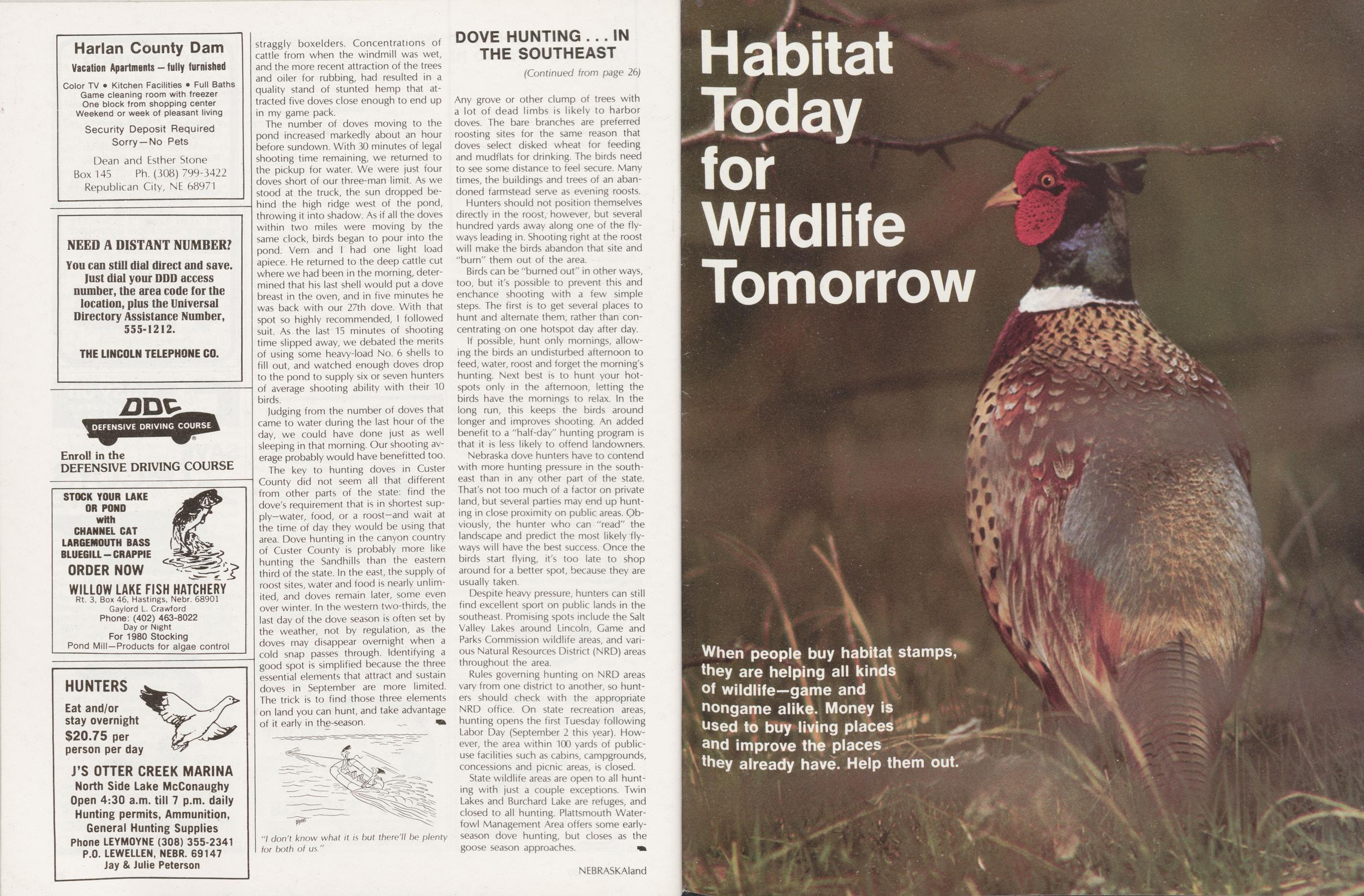 Harlan County Dam
Vacation Apartments - fully furnished
Color TV Kitchen Facilities Full Baths
Game cleaning room with freezer
One block from shopping center
Weekend or week of pleasant living
Security Deposit Required
Sorry —No Pets
Dean and Esther Stone
Box 145 Ph. (308) 799-3422
Republican City, NE 68971
NEED A DISTANT NUMBER?
You can still dial direct and save.
lust dial your DDD access
number, the area code for the
location, plus the Universal
Directory Assistance Number,
555-1212.
THE LINCOLN TELEPHONE CO.
DEFENSIVE DRIVING COURSE
Enroll in the
DEFENSIVE DRIVING COURSE
STOCK YOUR LAKE
OR POND
with
CHANNEL CAT
LARGEMOUTH BASS
BLUEGILL - CRAPPIE
ORDER NOW
WILLOW LAKE FISH HATCHERY
Rt. 3, Box 46, Hastings, Nebr. 68901
Gaylord L. Crawford
Phone: (402) 463-8022
Day or Night
For 1980 Stocking
Pond Mill—Products for algae control
HUNTERS
Eat and/or
stay overnight
$20.75 per
person per day
J'S OTTER CREEK MARINA
North Side Lake McConaughy
Open 4:30 a.m. till 7 p.m. daily
Hunting permits, Ammunition,
General Hunting Supplies
Phone LEYMOYNE (308) 355-2341
P.O. LEWELLEN, NEBR. 69147
Jay & Julie Peterson
Harlan County Dam
Vacation Apartments - fully furnished
Color TV Kitchen Facilities Full Baths
Game cleaning room with freezer
One block from shopping center
Weekend or week of pleasant living
Security Deposit Required
Sorry —No Pets
Dean and Esther Stone
Box 145 Ph. (308) 799-3422
Republican City, NE 68971
NEED A DISTANT NUMBER?
You can still dial direct and save.
lust dial your DDD access
number, the area code for the
location, plus the Universal
Directory Assistance Number,
555-1212.
THE LINCOLN TELEPHONE CO.
DEFENSIVE DRIVING COURSE
Enroll in the
DEFENSIVE DRIVING COURSE
STOCK YOUR LAKE
OR POND
with
CHANNEL CAT
LARGEMOUTH BASS
BLUEGILL - CRAPPIE
ORDER NOW
WILLOW LAKE FISH HATCHERY
Rt. 3, Box 46, Hastings, Nebr. 68901
Gaylord L. Crawford
Phone: (402) 463-8022
Day or Night
For 1980 Stocking
Pond Mill—Products for algae control
HUNTERS
Eat and/or
stay overnight
$20.75 per
person per day
J'S OTTER CREEK MARINA
North Side Lake McConaughy
Open 4:30 a.m. till 7 p.m. daily
Hunting permits, Ammunition,
General Hunting Supplies
Phone LEYMOYNE (308) 355-2341
P.O. LEWELLEN, NEBR. 69147
Jay & Julie Peterson
The number of doves moving to the pond increased markedly about an hour before sundown. With 30 minutes of legal shooting time remaining, we returned to the pickup for water. We were just four doves short of our three-man limit. As we stood at the truck, the sun dropped behind the high ridge west of the pond, throwing it into shadow. As if all the doves within two miles were moving by the same clock, birds began to pour into the pond. Vern and I had one light load apiece. He returned to the deep cattle cut where we had been in the morning, determined that his last shell would put a dove breast in the oven, and in five minutes he was back with our 27th dove. With that spot so highly recommended, I followed suit. As the last 15 minutes of shooting time slipped away, we debated the merits of using some heavy-load No. 6 shells to fill out, and watched enough doves drop to the pond to supply six or seven hunters of average shooting ability with their 10 birds.
Judging from the number of doves that came to water during the last hour of the day, we could have done just as well sleeping in that morning. Our shooting average probably would have benefitted too.
The key to hunting doves in Custer County did not seem all that different from other parts of the state: find the dove's requirement that is in shortest supply-water, food, or a roost-and wait at the time of day they would be using that area. Dove hunting in the canyon country of Custer County is probably more like hunting the Sandhills than the eastern third of the state. In the east, the supply of roost sites, water and food is nearly unlimited, and doves remain later, some even over winter. In the western two-thirds, the last day of the dove season is often set by the weather, not by regulation, as the doves may disappear overnight when a cold snap passes through. Identifying a good spot is simplified because the three essential elements that attract and sustain doves in September are more limited. The trick is to find those three elements on land you can hunt, and take advantage of it early in the~season.
DOVE HUNTING... IN THE SOUTHEAST
(Continued from page 26)Any grove or other clump of trees with a lot of dead limbs is likely to harbor doves. The bare branches are preferred roosting sites for the same reason that doves select disked wheat for feeding and mudflats for drinking. The birds need to see some distance to feel secure. Many times, the buildings and trees of an abandoned farmstead serve as evening roosts.
Hunters should not position themselves directly in the roost, however, but several hundred yards away along one of the flyways leading in. Shooting right at the roost will make the birds abandon that site and "burn" them out of the area.
Birds can be "burned out" in other ways, too, but it's possible to prevent this and enchance shooting with a few simple steps. The first is to get several places to hunt and alternate them, rather than concentrating on one hotspot day after day.
If possible, hunt only mornings, allowing the birds an undisturbed afternoon to feed, water, roost and forget the morning's hunting. Next best is to hunt your hotspots only in the afternoon, letting the birds have the mornings to relax. In the long run, this keeps the birds around longer and improves shooting. An added benefit to a "half-day" hunting program is that it is less likely to offend landowners.
Nebraska dove hunters have to contend with more hunting pressure in the southeast than in any other part of the state. That's not too much of a factor on private land, but several parties may end up hunting in close proximity on public areas. Obviously, the hunter who can "read" the landscape and predict the most likely flyways will have the best success. Once the birds start flying, it's too late to shop around for a better spot, because they are usually taken.
Despite heavy pressure, hunters can still find excellent sport on public lands in the southeast. Promising spots include the Salt Valley Lakes around Lincoln, Game and Parks Commission wildlife areas, and various Natural Resources District (NRD) areas throughout the area.
Rules governing hunting on NRD areas vary from one district to another, so hunters should check with the appropriate NRD office. On state recreation areas, hunting opens the first Tuesday following Labor Day (September 2 this year). However, the area within 100 yards of public-use facilities such as cabins, campgrounds, concessions and picnic areas, is closed.
State wildlife areas are open to ail hunting with just a couple exceptions. Twin Lakes and Burchard Lake are refuges, and closed to all hunting. Plattsmouth Waterfowl Management Area offers some early-season dove hunting, but closes as the goose season approaches.
50 NEBRASKAland Today for Wildlife Toomrrow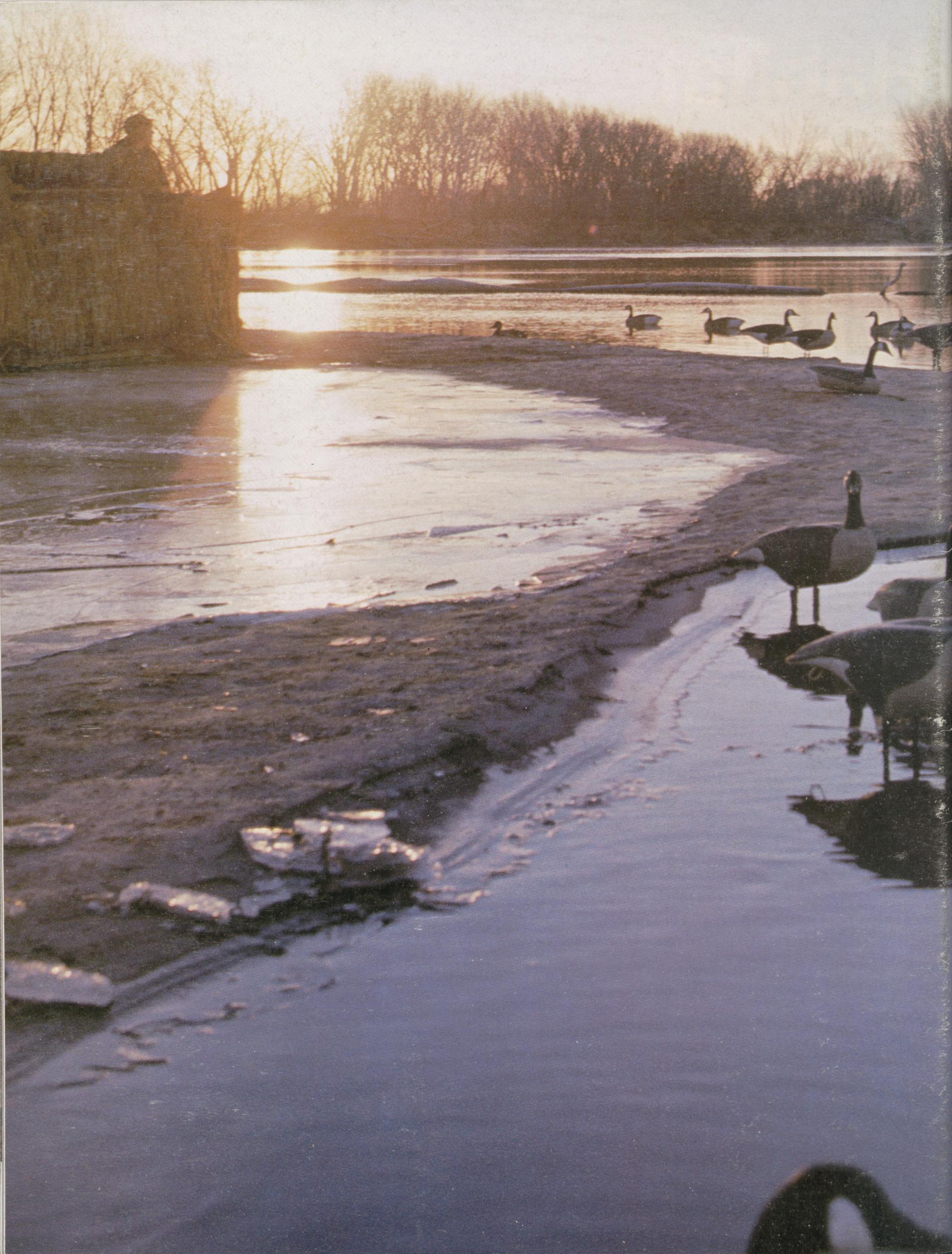
Position: 3 (1472 views)