Volume 58, Issue 8, 1980
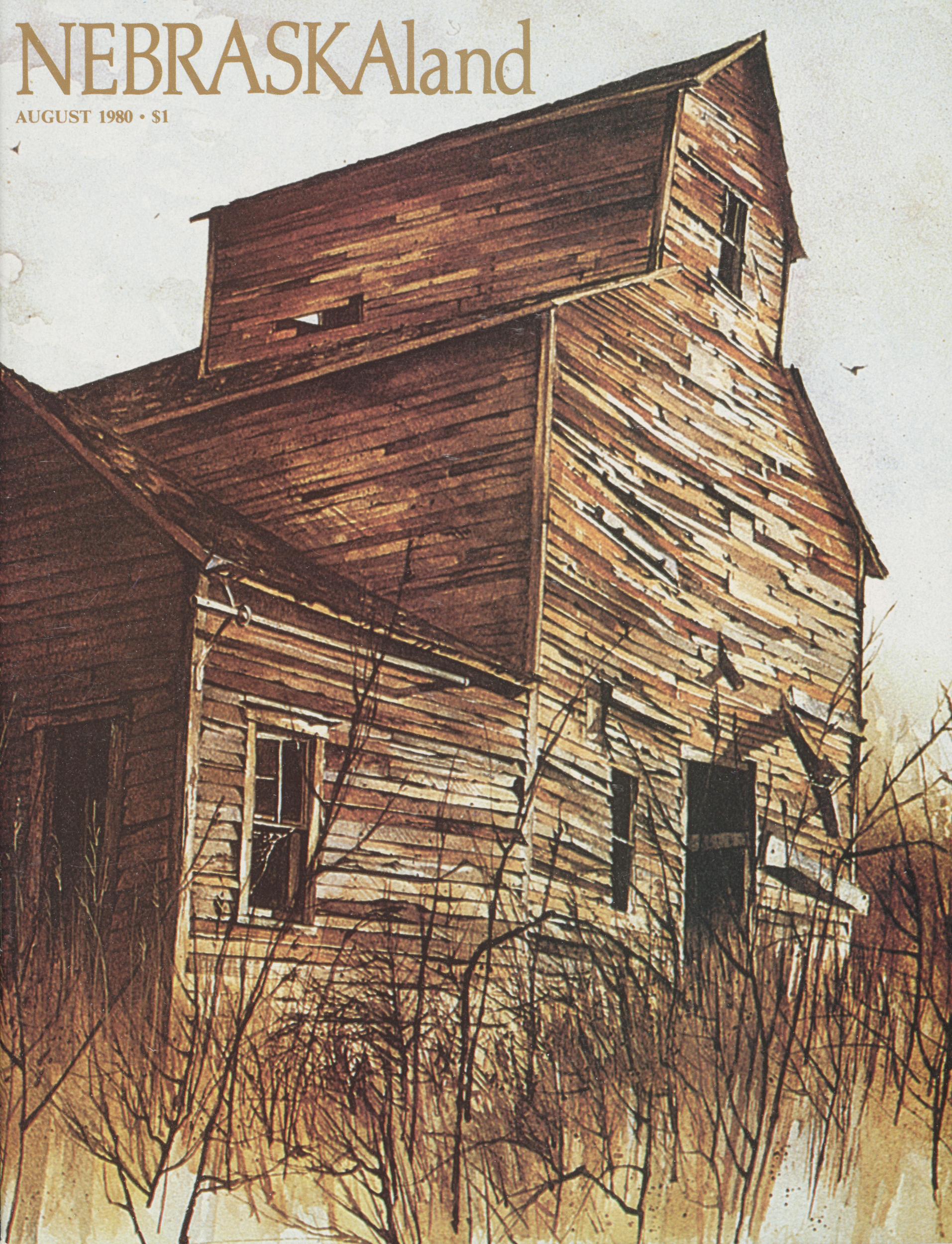
NEBRASKAland
AUGUST 1980 $1
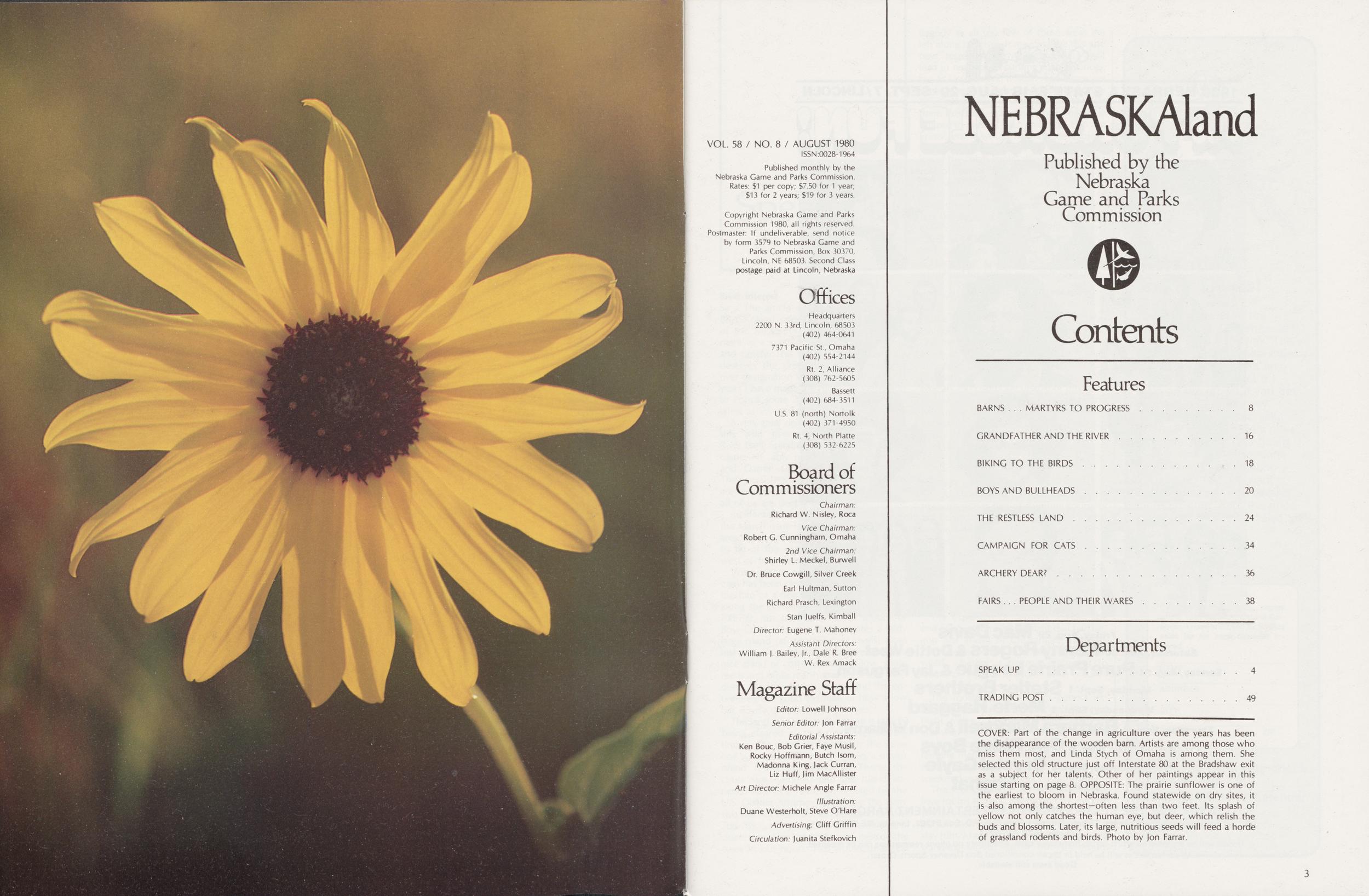
Magazine Staff Editor: Lowell Johnson Senior Editor: Jon Farrar Editorial Assistants: Ken Bouc, Bob Grier, Faye Musil, Rocky Hoffmann, Butch Isom, Madonna King, Jack Curran, Liz Huff, Jim MacAllister Art Director: Michele Angle Farrar Illustration: Duane Westerholt, Steve O'Hare Advertising: Cliff Griffin Circulation: Juanita Stefkovich
NEBRASKAland
Published by the Nebraska Game and Parks Commission
Contents Features BARNS . . . MARTYRS TO PROGRESS 8 GRANDFATHER AND THE RIVER 16 BIKING TO THE BIRDS 18 BOYS AND BULLHEADS 20 THE RESTLESS LAND 24 CAMPAIGN FOR CATS 34 ARCHERY DEAR? 36 FAIRS . . . PEOPLE AND THEIR WARES 38 Departments SPEAK UP 4 TRADING POST 49
Speak Up
River interest
Sir / The article in the March (1979) NEBRASKAIand concerning the designation of the Missouri's Yankton-to-Ponca segment as a recreational river is interesting and timely. This delightful area certainly deserves the protection the recreational river designation will give it. In the last 25 years I have made the run from Vermillion to Ponca some 200 times, and I find the latest as interesting as the first.
A very great deal of the credit for saving this "wild" river must go to the Missouri River Bank Stabilization Association, Newcastle, NE, ably headed by Earl Rowland and Darrell Curry, both of Newcastle. Their persistence and their arduous efforts are models of citizen-inspired programs; all of us are deeply in their debt.
Incidentally, the aerial shot contained in the March issue is, I believe, of a different area on the Missouri. The photo appears to be of the island lying 12 miles or so west of the mouth of the Niobrara. With reference to another matter—concern has been expressed in this area about the fate of a fine tract of low bar located along the Nebraska shore at about Mile 788-789, just upstream of the mouth of Bow Creek. There, a chute creates a fairly large island (at summer river levels) close inshore. This "island" is covered with a nice stand of cottonwoods, willow, some reeds and other marsh grasses. A low sand dune occupies its lower end, and the entire area is a good example of how a low bar slowly develops and changes.
The land adjacent to the chute is rapidly being cleared of its typical river-bottom timber. The owner is apparently the same one who cleared, then cultivated, a similar island north of Newcastle. There, the chute was dammed and the island annexed to shore. Although ordered by the U.S. District Attorney to remove the dam, this has not been done. The island at Mile 788-789 is likely to suffer the same fate. A dozer can dam the chute and destroy the trees in but hours. This would be a real tragedy as all too few of these areas are left along the river. It may well be that the new recreational river designation will lead to regulations curbing such practices, but as I understand it, such regulations are likely a year or more away. By then, the desecration may well be done. Whether there exists any state law which might be utilized to prevent such an action, I do not know, but it would be most desirable it this virgin tract could be preserved. Clearing of the "high bank" along the Nebraska side of the St. Helena Bend last summer has surely converted a once-lovely, timbered shoreline into an ugly tangle of windrowed logs and brush. There is real fear the same treatment will be accorded the "island" above the mouth of Bow Creek. If you can do anything to save this area, please do so!
Thanks for your interest in the Missouri—and for a most enjoyable magazine.
J. M. Peterson Vermillion, S. Dak.Sir / As I was typing the enclosed essay for my husband, as part of a writing course of his, I couldn't help but think the thoughts are probably those of a number of other hunters.
Connie Lair Ceresco, Nebr. * * * ValuesThe explosion of feathers marked the end of an upward arc of flight that had begun just ahead of the ranging retriever. The beauty of the downed bird is unrivaled; whether it be man's attempt to create an artificial art form or in nature's other mutants.
The rooster pheasant is a perfect example of survival. He is equipped for rapid flight, miles of evasive running, or to sit and wait unnoticed until a hunter passes. He has been able to adapt to our intensive farming methods as only a handful of his natural neighbors. How he survives the weekend wars is a subject unto itself.
The real question lies in my soul. My love for his survival, my respect for his grit, my protection of him from unlawful pursuit seem hypocritical, for I too seek to slay him. Many times I have taken a warm bundle of bloody feathers from the mouth
Attention, Early Birds!
The 1981 version of the NEBRASKAIand Calendar is ready to send your way. The supply of 1980 calendars was sold out, so don’t take any chances. You can get a jump on the crowd if you get your order in right away. The full-color, all-Nebraska calendar again features pic- turesque scenery, intriguing wildlife shots, plus sections on canoeing and planting for wildlife. You will want one for yourself and several more for gifts. And, the price is still just $2.50 plus sales tax. Please send me copies of the 1981 NEBRASKAIand Cal- endar. I have enclosed $2.50 plus sales tax for each calendar or- dered.
NAME ADDRESS CITY STATE ZIP Mall coupon with your check or money order to: NEBRASKAIand Calendar P.O. Box 3022 Omaha, NE 68101
Finest facility of its kind in the entire midwest
Ak-Sar-Ben Aquarium
Plan a visit now Free Admission You'll find plenty to see and do at the aquarium and Schramm Park State Recreation Area, where it's located. Summer hours are 10 a.m. to 5 p.m. daily except weekends and holidays, when they are 10 a.m. to 6 p.m. The aquarium is closed on Tuesdays. You'll thoroughly enjoy the intriguing terrarium, the theater with its hourly shows, and a dozen large tanks displaying native Nebraska fish. It's all in readiness for your visit. Just minutes away from Lincoln and Omaha - six miles south of the Gretna I-80 interchange.of one of the dogs and exclaimed: "Isn't he pretty?"
What is it in me that demands the act?
Why do I hunt? For meat?
No! I really don't care for fowl.
For the thrill of the chase?
Why must it end in blood if the chase is the thing?
For the primal instinct of man?
I'm afraid I can't accept that argument either.
I have come upon this question several times in my growth to manhood and each time I have struggled with it only to file it away unanswered. I can take consolation only in the fact that with each successful hunt, my feelings are still mixed, and this paradox seems to balance the hunter and the lover of all that is wild. The answer, if indeed there is one, seems to lie in this balance.
Sir / About Mr. De Baets' article in the April (1980 Speakup) issue on nighttime raccoon hunting. If he is referring to the many sportsmen who hunt with hounds, and do it legally, he better stop and take a good look at the situation.
For one thing, we houndsmen also realize the continuing depletion of the raccoon family. But, don't push the blame on us. There are several catefories which affect this. Among them are houndsmen, trappers, loss of habitat, and poachers! These latter have had the biggest and most devastating effect on their population. If you want to talk about the problem, tell it like it is.
Pat RaheKearney, Nebr. A dirty trick
Sir / The December (1979 NEBRASKAland) article about the coyotes and seeing the picture of a coyote holding a rabbit recalled the following experience of many years ago. When I drove to my farm near Staton from Omaha, I carried a pistol type .410 shotgun (now very illegal) in the door pocket to shoot an occasional pheasant on the farm. West of Fremont, a coyote darted across the highway holding a rabbit. I fired at the coyote, scaring him, and he dropped the cottontail, which had a broken neck. I picked up the rabbit and used it for a dinner that night instead of a pheasant.
A.E. Bennett, M.D.Berkeley, Calif.
Sir / Your article on the Calamus River made canoeing seem very enjoyable. I was upset to see the photo on page 33 -- "Bubbling with enthusiasm, Leslie Olson . . . . " The priority is not shampooing hair. I was always taught to get water from streams and wash your hair elsewhere, because shampoo clogs the gills of fish. I feel the picture advocates pollution of streams. Leslie should clean up her act someplace else besides the stream.
Guyla J. WowakLaramie, Wyo.
A Rich Past Lives On
At Nebraska's state historical parks, vicistors can really get the feel of those special people whose lives affectd us all. Each is a "timeless" treat Buffalo Bill Ranch at North Platte Arbor Lodge at Nebraska City Ft. Atkinson near Fort Calhoun Champion Mill near Champion Ash Hollow near Lewellen Ft. Hartsuff near Elyria Ft. Kearny near Kearney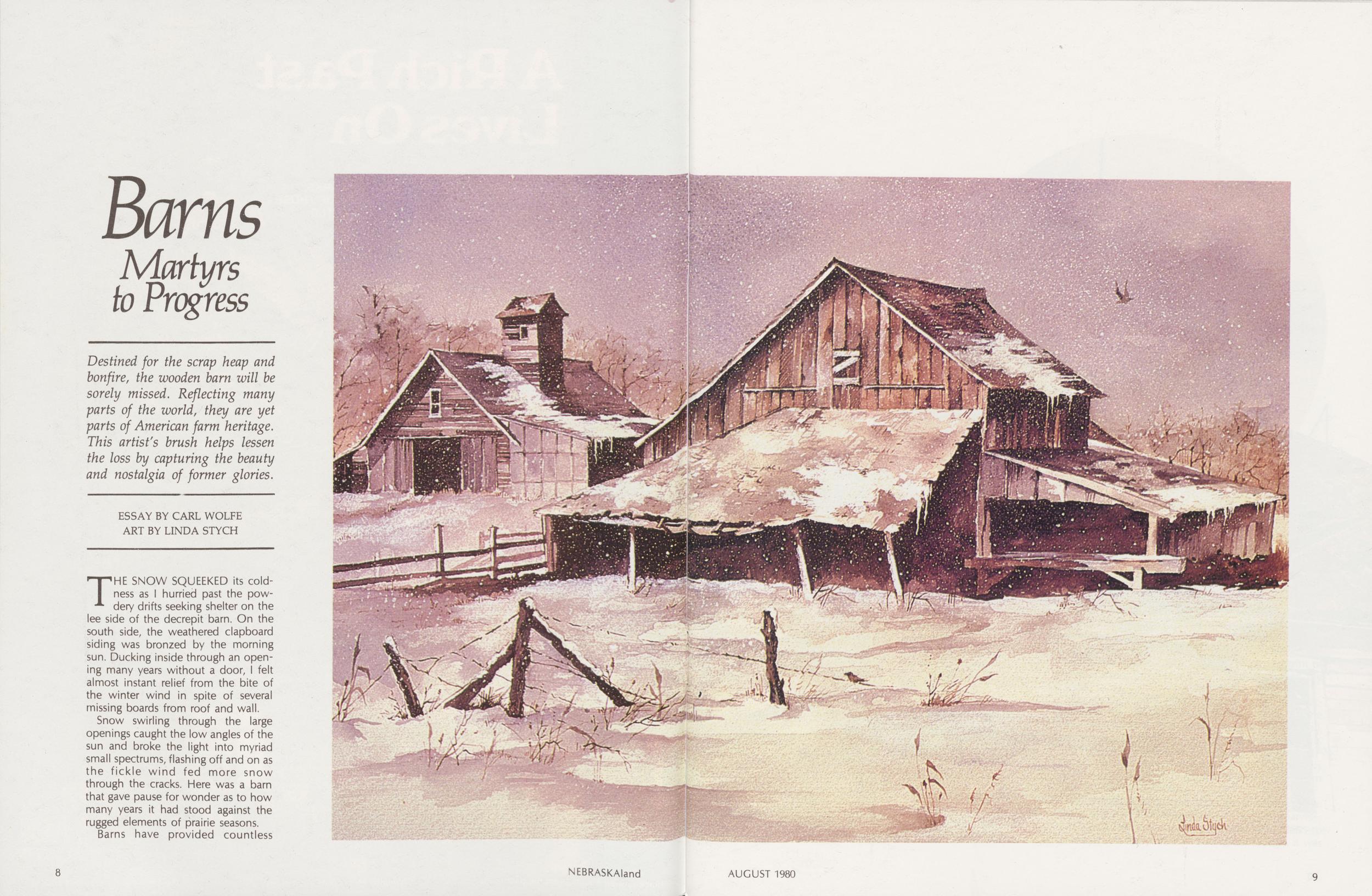
Barns
Martyrs to Progress
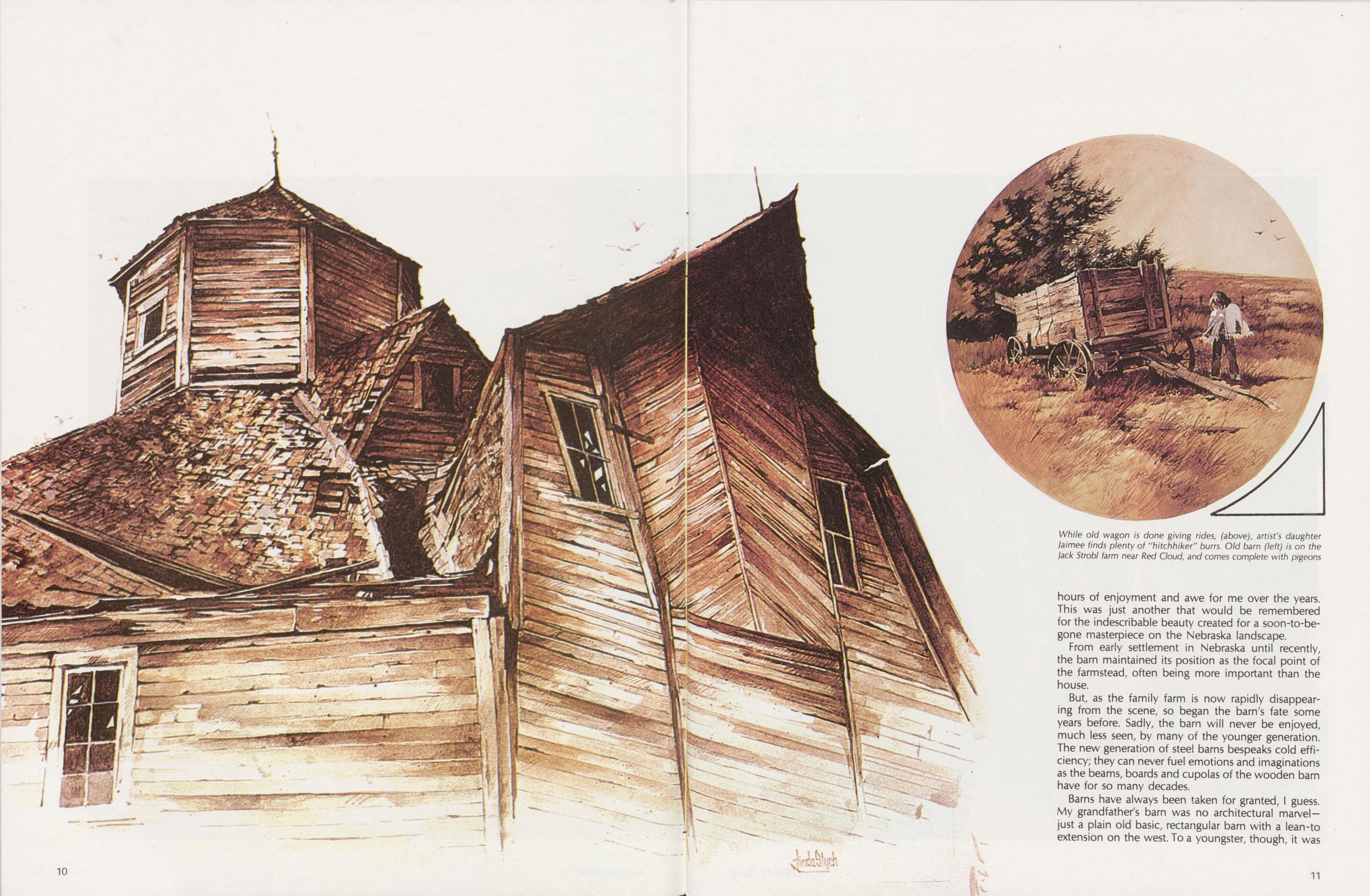
Destined for the scrap heap and bonfire, the wooden barn will be sorely missed. Reflecting many parts of the world, they are yet parts of American farm heritage. This artist's brush helps lessen the loss by capturing the beauty and nostalgia of former glories.
THE SNOW SQUEEKED its coldness as I hurried past the powdery drifts seeking shelter on the lee side of the decrepit barn. On the south side, the weathered clapboard siding was bronzed by the morning sun. Ducking inside through an opening many years without a door, I felt almost instant relief from the bite of the winter wind in spite of several missing boards from roof and wall. Snow swirling through the large openings caught the low angles of the sun and broke the light into myriad small spectrums, flashing off and on as the fickle wind fed more snow through the cracks. Here was a barn that gave pause for wonder as to how many years it had stood against the rugged elements of prairie seasons.
Barns have provided countless
hours of enjoyment and awe for me over the years. This was just another that would be remembered for the indescribable beauty created for a soon-to-be- gone masterpiece on the Nebraska landscape.
From early settlement in Nebraska until recently, the barn maintained its position as the focal point of the farmstead, often being more important than the house.
But, as the family farm is now rapidly disappearing from the scene, so began the barn's fate some years before. Sadly, the barn will never be enjoyed, much less seen, by many of the younger generation. The new generation of steel barns bespeaks cold efficiency; they can never fuel emotions and imaginations as the beams, boards and cupolas of the wooden barn have for so many decades.
Barns have always been taken for granted, I guess. My grandfather's barn was no architectural marvel- just a plain old basic, rectangular barn with a lean-to extension on the west. To a youngster, though, it was
11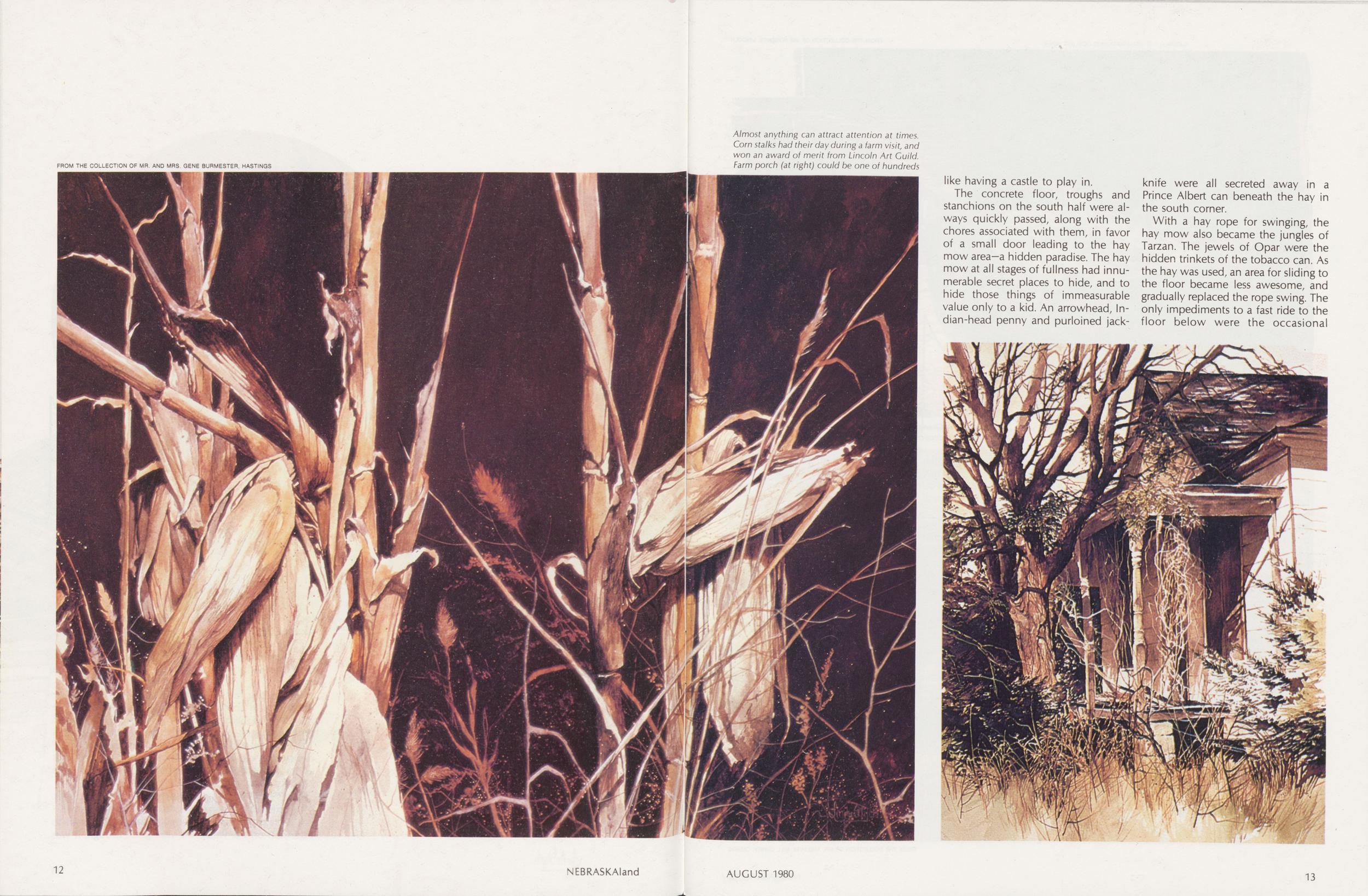
like having a castle to play in.
The concrete floor, troughs and stanchions on the south half were always quickly passed, along with the chores associated with them, in favor of a small door leading to the hay mow area—a hidden paradise. The hay mow at all stages of fullness had innumerable secret places to hide, and to hide those things of immeasurable value only to a kid. An arrowhead, In- dian-head penny and purloined jackknife were all secreted away in a Prince Albert can beneath the hay in the south corner.
With a hay rope for swinging, the hay mow also became the jungles of Tarzan. The jewels of Opar were the hidden trinkets of the tobacco can. As the hay was used, an area for sliding to the floor became less awesome, and gradually replaced the rope swing. The only impediments to a fast ride to the floor below were the occasional
AUGUST 1980 13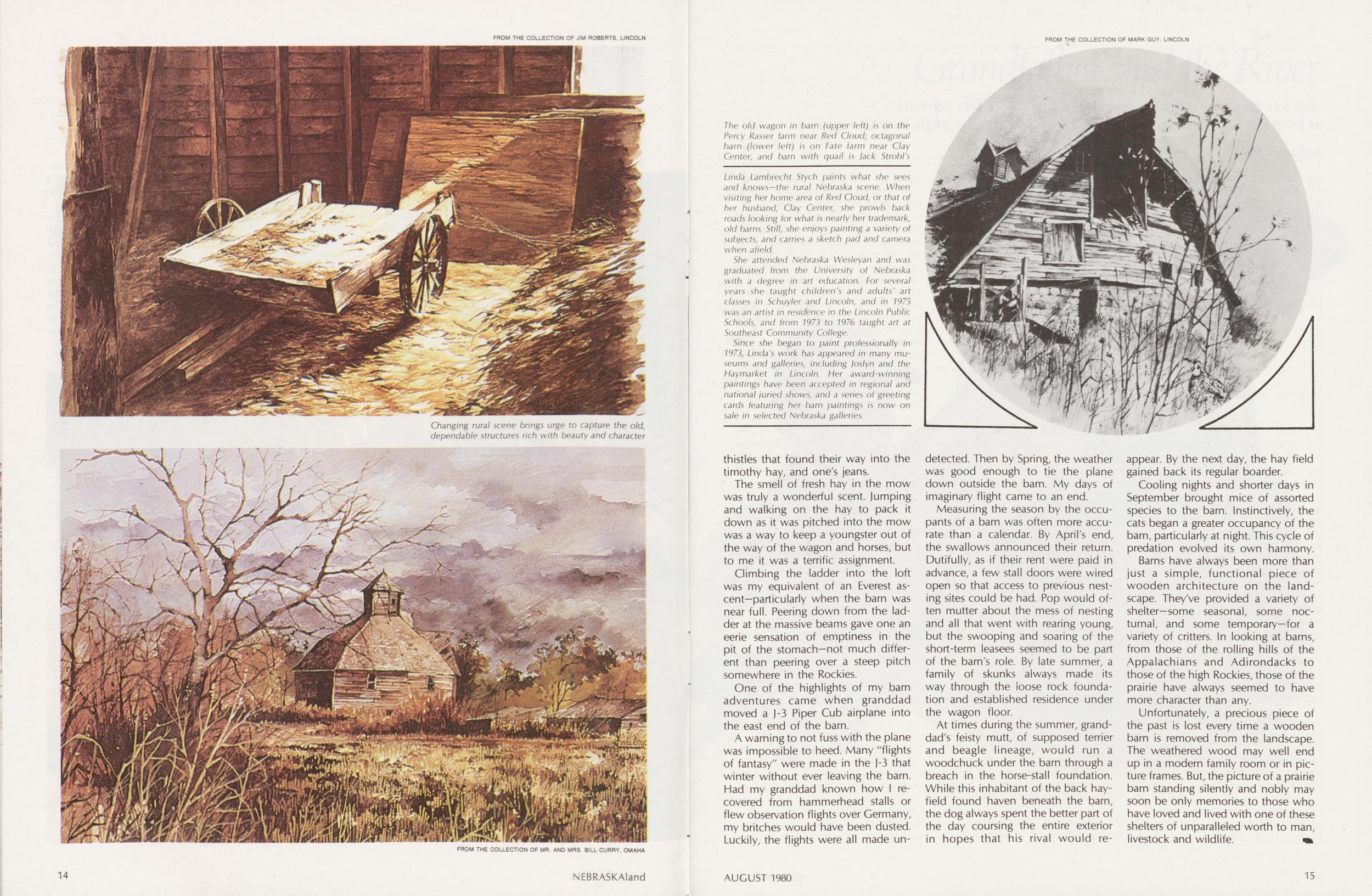
The old wagon in barn (upper left) is on the Percy Passer farm near Red Cloud; octagonal barn (lower left) is on Fate farm near Clay Center, and barn with quail is Jack Strobl's
Linda Lambrecht Stych paints what she sees and knows—the rural Nebraska scene. When visiting her home area of Red Cloud, or that of her husband, Clay Center, she prowls back roads looking for what is nearly her trademark, old barns. Still, she enjoys painting a variety of subjects, and carries a sketch pad and camera when afield.
She attended Nebraska Wesleyan and was graduated from the University of Nebraska with a degree in art education. For several years she taught children's and adults' art classes in Schuyler and Lincoln, and in 1975 was an artist in residence in the Lincoln Public Schools, and from 7973 to 7976 taught art at Southeast Community College.
Since she began to paint professionally in 1973, Linda's work has appeared in many museums and galleries, including Joslyn and the Haymarket in Lincoln. Her award-winning paintings have been accepted in regional and national Juried shows, and a series of greeting cards featuring her barn paintings is now on sale in selected Nebraska galleries.
FROM THE COLLECTION OF MARK GUY, LINCOLNthistles that found their way into the timothy hay, and one's jeans.
The smell of fresh hay in the mow was truly a wonderful scent. Jumping and walking on the hay to pack it down as it was pitched into the mow was a way to keep a youngster out of the way of the wagon and horses, but to me it was a terrific assignment.
Climbing the ladder into the loft was my equivalent of an Everest ascent—particularly when the barn was near full. Peering down from the ladder at the massive beams gave one an eerie sensation of emptiness in the pit of the stomach-not much different than peering over a steep pitch somewhere in the Rockies.
One of the highlights of my barn adventures came when granddad moved a J-3 Piper Cub airplane into the east end of the barn.
A warning to not fuss with the plane was impossible to heed. Many "flights of fantasy" were made in the J-3 that winter without ever leaving the barn. Had my granddad known how I recovered from hammerhead stalls or flew observation flights over Germany, my britches would have been dusted. Luckily, the flights were all made undetected. Then by Spring, the weather was good enough to tie the plane down outside the barn. My days of imaginary flight came to an end.
Measuring the season by the occupants of a barn was often more accurate than a calendar. By April's end, the swallows announced their return. Dutifully, as if their rent were paid in advance, a few stall doors were wired open so that access to previous nesting sites could be had. Pop would often mutter about the mess of nesting and all that went with rearing young, but the swooping and soaring of the short-term leasees seemed to be part of the barn's role. By late summer, a family of skunks always made its way through the loose rock foundation and established residence under the wagon floor.
At times during the summer, granddad's feisty mutt, of supposed terrier and beagle lineage, would run a woodchuck under the barn through a breach in the horse-stall foundation. While this inhabitant of the back hayfield found haven beneath the barn, the dog always spent the better part of the day coursing the entire exterior in hopes that his rival would reappear. By the next day, the hay field gained back its regular boarder.
Cooling nights and shorter days in September brought mice of assorted species to the barn. Instinctively, the cats began a greater occupancy of the barn, particularly at night. This cycle of predation evolved its own harmony.
Barns have always been more than just a simple, functional piece of wooden architecture on the landscape. They've provided a variety of shelter—some seasonal, some nocturnal, and some temporary—for a variety of critters. In looking at barns, from those of the rolling hills of the Appalachians and Adirondack to those of the high Rockies, those of the prairie have always seemed to have more character than any.
Unfortunately, a precious piece of the past is lost every time a wooden barn is removed from the landscape. The weathered wood may well end up in a modern family room or in picture frames. But, the picture of a prairie barn standing silently and nobly may soon be only memories to those who have loved and lived with one of these shelters of unparalleled worth to man, livestock and wildlife.
AUGUST 1980 15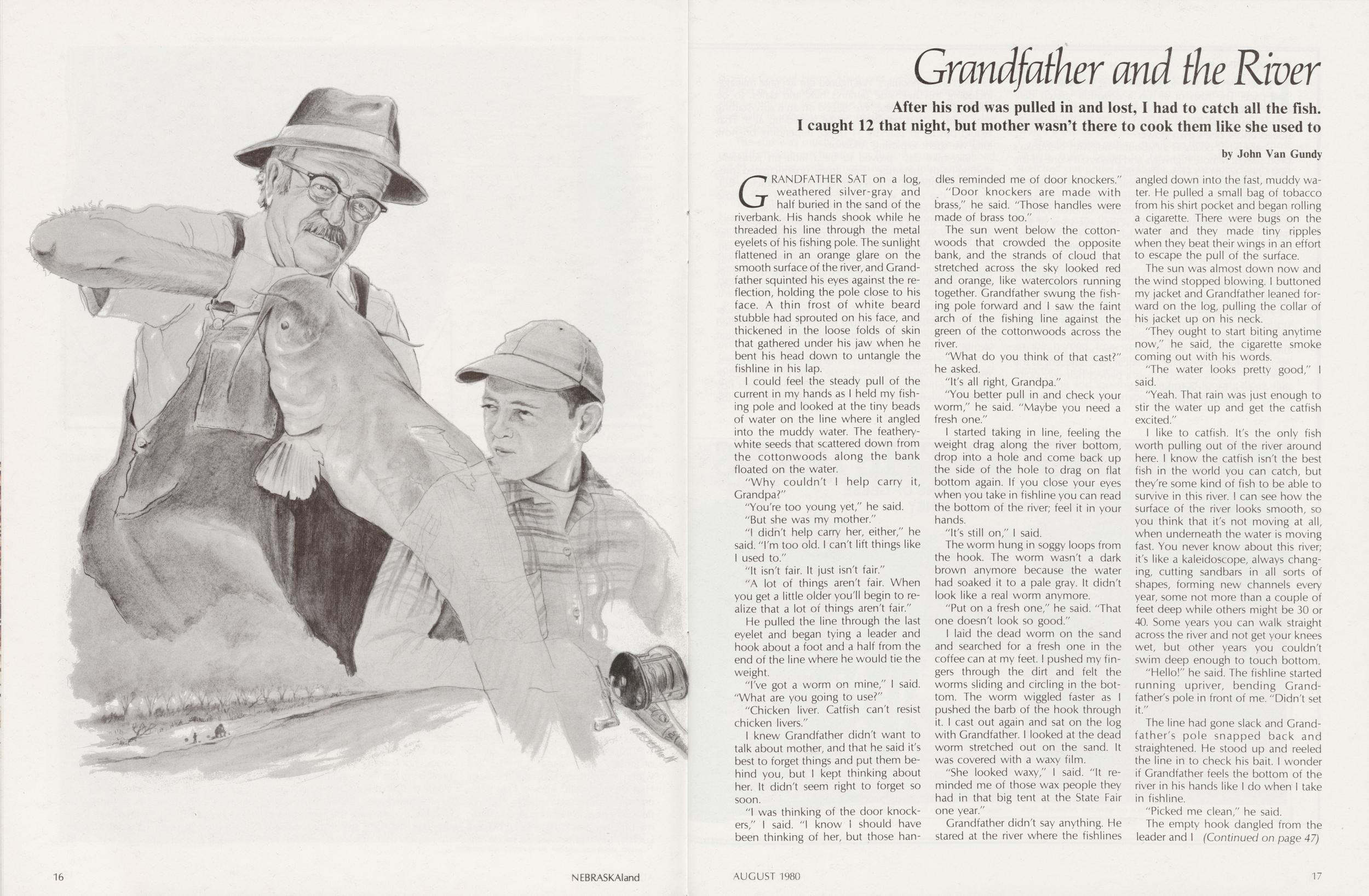
Grandfather and the River
After his rod was pulled in and lost, I had to catch all the fish. I caught 12 that night, but mother wasn’t there to cook them like she used to
Grandfather sat on a log, weathered silver-gray and half buried in the sand of the riverbank. His hands shook while he threaded his line through the metal eyelets of his fishing pole. The sunlight flattened in an orange glare on the smooth surface of the river, and Grandfather squinted his eyes against the reflection, holding the pole close to his face. A thin frost of white beard stubble had sprouted on his face, and thickened in the loose folds of skin that gathered under his jaw when he bent his head down to untangle the fishline in his lap.
I could feel the steady pull of the current in my hands as I held my fishing pole and looked at the tiny beads of water on the line where it angled into the muddy water. The feathery- white seeds that scattered down from the cottonwoods along the bank floated on the water.
"Why couldn't I help carry it, Grandpa?"
"You're too young yet," he said.
"But she was my mother."
"I didn't help carry her, either," he said. "I'm too old. I can't lift things like I used to."
"It isn't fair. It just isn't fair."
"A lot of things aren't fair. When you get a little older you'll begin to realize that a lot of things aren't fair."
He pulled the line through the last eyelet and began tying a leader and hook about a foot and a half from the end of the line where he would tie the weight.
"I've got a worm on mine," I said. "What are you going to use?"
"Chicken liver. Catfish can't resist chicken livers."
I knew Grandfather didn't want to talk about mother, and that he said it's best to forget things and put them behind you, but I kept thinking about her. It didn't seem right to forget so soon.
"I was thinking of the door knockers," I said. "I know I should have been thinking of her, but those handles reminded me of door knockers."
"Door knockers are made with brass," he said. "Those handles were made of brass too."
The sun went below the cottonwoods that crowded the opposite bank, and the strands of cloud that stretched across the sky looked red and orange, like watercolors running together. Grandfather swung the fishing pole forward and I saw the faint arch of the fishing line against the green of the cottonwoods across the river.
"What do you think of that cast?" he asked.
"It's all right, Grandpa."
"You better pull in and check your worm," he said. "Maybe you need a fresh one."
I started taking in line, feeling the weight drag along the river bottom, drop into a hole and come back up the side of the hole to drag on flat bottom again. If you close your eyes when you take in fishline you can read the bottom of the river; feel it in your hands.
"It's still on," I said.
The worm hung in soggy loops from the hook. The worm wasn't a dark brown anymore because the water had soaked it to a pale gray. It didn't look like a real worm anymore.
"Put on a fresh one," he said. "That one doesn't look so good."
I laid the dead worm on the sand and searched for a fresh one in the coffee can at my feet. I pushed my fingers through the dirt and felt the worms sliding and circling in the bottom. The worm wiggled faster as I pushed the barb of the hook through it. I cast out again and sat on the log with Grandfather. I looked at the dead worm stretched out on the sand. It was covered with a waxy film.
"She looked waxy," I said. "It reminded me of those wax people they had in that big tent at the State Fair one year."
Grandfather didn't say anything. He stared at the river where the fishlines angled down into the fast, muddy water. He pulled a small bag of tobacco from his shirt pocket and began rolling a cigarette. There were bugs on the water and they made tiny ripples when they beat their wings in an effort to escape the pull of the surface.
The sun was almost down now and the wind stopped blowing. I buttoned my jacket and Grandfather leaned forward on the log, pulling the collar of his jacket up on his neck.
"They ought to start biting anytime now," he said, the cigarette smoke coming out with his words.
"The water looks pretty good," I said.
"Yeah. That rain was just enough to stir the water up and get the catfish excited."
I like to catfish. It's the only fish worth pulling out of the river around here. I know the catfish isn't the best fish in the world you can catch, but they're some kind of fish to be able to survive in this river. I can see how the surface of the river looks smooth, so you think that it's not moving at all, when underneath the water is moving fast. You never know about this river; it's like a kaleidoscope, always changing, cutting sandbars in all sorts of shapes, forming new channels every year, some not more than a couple of feet deep while others might be 30 or 40. Some years you can walk straight across the river and not get your knees wet, but other years you couldn't swim deep enough to touch bottom.
"Hello!" he said. The fishline started running upriver, bending Grandfather's pole in front of me. "Didn't set it."
The line had gone slack and Grandfather's pole snapped back and straightened. He stood up and reeled the line in to check his bait. I wonder if Grandfather feels the bottom of the river in his hands like I do when 1 take in fishline.
"Picked me clean," he said.
The empty hook dangled from the leader and I (Continued on page 47)
16 NEBRASKAIand AUGUST 1980 17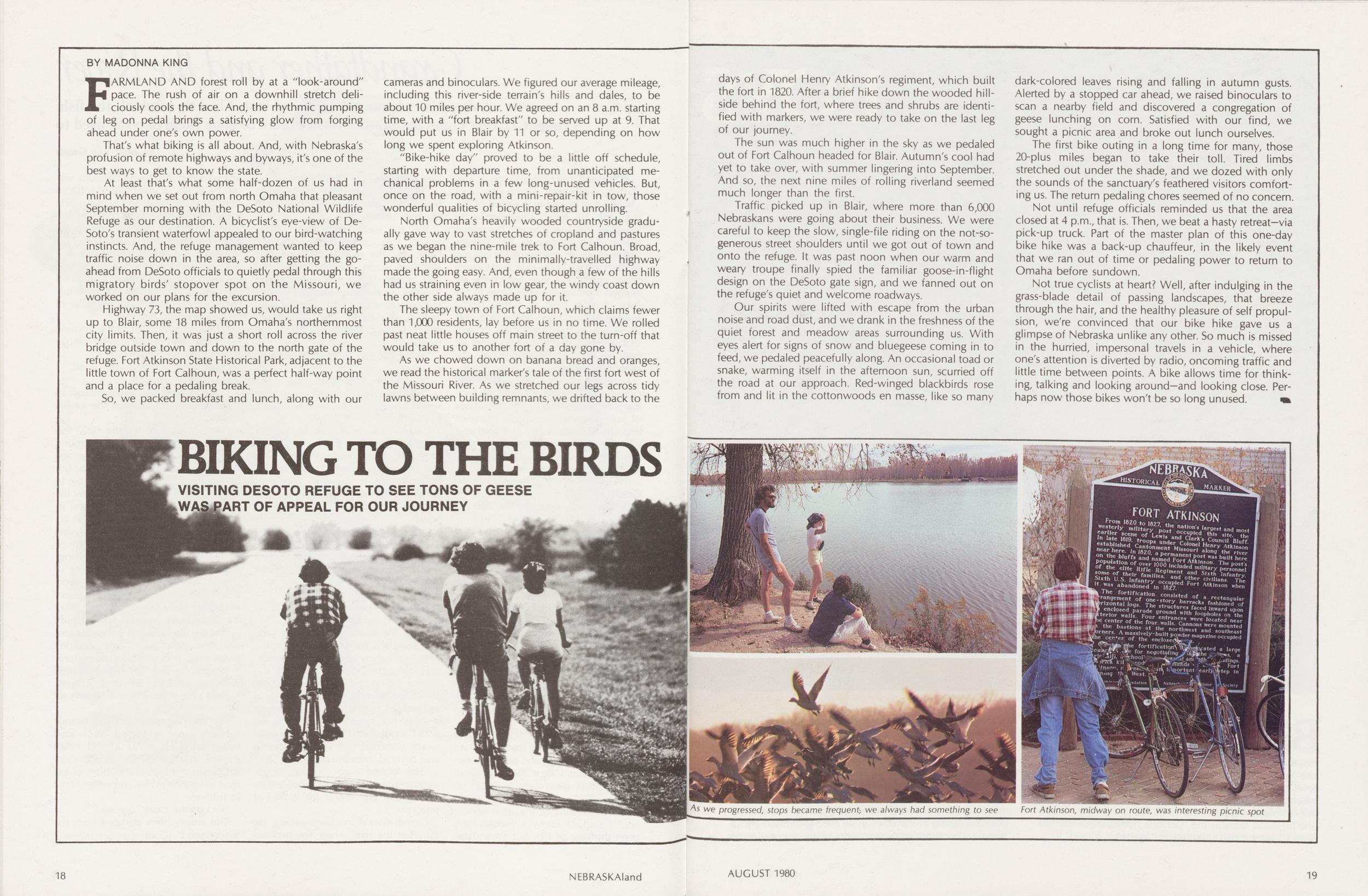
BIKING TO THE BIRDS
VISITING DESOTO REFUGE TO SEE TONS OF GEESE WAS PART OF APPEAL FOR OUR JOURNEY
FARMLAND AND forest roll by at a "look-around" pace. The rush of air on a downhill stretch deliciously cools the face. And, the rhythmic pumping of leg on pedal brings a satisfying glow from forging ahead under one's own power.
That's what biking is all about. And, with Nebraska's profusion of remote highways and byways, it's one of the best ways to get to know the state.
At least that's what some half-dozen of us had in mind when we set out from north Omaha that pleasant September morning with the DeSoto National Wildlife Refuge as our destination. A bicyclist's eye-view of DeSoto's transient waterfowl appealed to our bird-watching instincts. And, the refuge management wanted to keep traffic noise down in the area, so after getting the go- ahead from DeSoto officials to quietly pedal through this migratory birds' stopover spot on the Missouri, we worked on our plans for the excursion.
Highway 73, the map showed us, would take us right up to Blair, some 18 miles from Omaha's northernmost city limits. Then, it was just a short roll across the river bridge outside town and down to the north gate of the refuge. Fort Atkinson State Historical Park, adjacent to the little town of Fort Calhoun, was a perfect half-way point and a place for a pedaling break.
So, we packed breakfast and lunch, along with our cameras and binoculars. We figured our average mileage, including this river-side terrain's hills and dales, to be about 10 miles per hour. We agreed on an 8 a.m. starting time, with a "fort breakfast" to be served up at 9. That would put us in Blair by 11 or so, depending on how long we spent exploring Atkinson.
"Bike-hike day" proved to be a little off schedule, starting with departure time, from unanticipated mechanical problems in a few long-unused vehicles. But, once on the road, with a mini-repair-kit in tow, those wonderful qualities of bicycling started unrolling.
North Omaha's heavily wooded countryside gradually gave way to vast stretches of cropland and pastures as we began the nine-mile trek to Fort Calhoun. Broad, paved shoulders on the minimally-travelled highway made the going easy. And, even though a few of the hills had us straining even in low gear, the windy coast down the other side always made up for it.
The sleepy town of Fort Calhoun, which claims fewer than 1,000 residents, lay before us in no time. We rolled past neat little houses off main street to the turn-off that would take us to another fort of a day gone by.
As we chowed down on banana bread and oranges, we read the historical marker's tale of the first fort west of the Missouri River. As we stretched our legs across tidy lawns between building remnants, we drifted back to the days of Colonel Henry Atkinson's regiment, which built the fort in 1820. After a brief hike down the wooded hillside behind the fort, where trees and shrubs are identified with markers, we were ready to take on the last leg of our journey.
The sun was much higher in the sky as we pedaled out of Fort Calhoun headed for Blair. Autumn's cool had yet to take over, with summer lingering into September. And so, the next nine miles of rolling riverland seemed much longer than the first.
Traffic picked up in Blair, where more than 6,000 Nebraskans were going about their business. We were careful to keep the slow, single-file riding on the not-so- generous street shoulders until we got out of town and onto the refuge. It was past noon when our warm and weary troupe finally spied the familiar goose-in-flight design on the DeSoto gate sign, and we fanned out on the refuge's quiet and welcome roadways.
Our spirits were lifted with escape from the urban noise and road dust, and we drank in the freshness of the quiet forest and meadow areas surrounding us. With eyes alert for signs of snow and bluegeese coming in to feed, we pedaled peacefully along. An occasional toad or snake, warming itself in the afternoon sun, scurried off the road at our approach. Red-winged blackbirds rose from and lit in the cottonwoods en masse, like so many dark-colored leaves rising and falling in autumn gusts. Alerted by a stopped car ahead, we raised binoculars to scan a nearby field and discovered a congregation of geese lunching on corn. Satisfied with our find, we sought a picnic area and broke out lunch ourselves.
The first bike outing in a long time for many, those 20-plus miles began to take their toll. Tired limbs stretched out under the shade, and we dozed with only the sounds of the sanctuary's feathered visitors comforting us. The return pedaling chores seemed of no concern.
Not until refuge officials reminded us that the area closed at 4 p.m., that is. Then, we beat a hasty retreat—via pick-up truck. Part of the master plan of this one-day bike hike was a back-up chauffeur, in the likely event that we ran out of time or pedaling power to return to Omaha before sundown.
Not true cyclists at heart? Well, after indulging in the grass-blade detail of passing landscapes, that breeze through the hair, and the healthy pleasure of self propulsion, we're convinced that our bike hike gave us a glimpse of Nebraska unlike any other. So much is missed in the hurried, impersonal travels in a vehicle, where one's attention is diverted by radio, oncoming traffic and little time between points. A bike allows time for thinking, talking and looking around—and looking close. Perhaps now those bikes won't be so long unused.
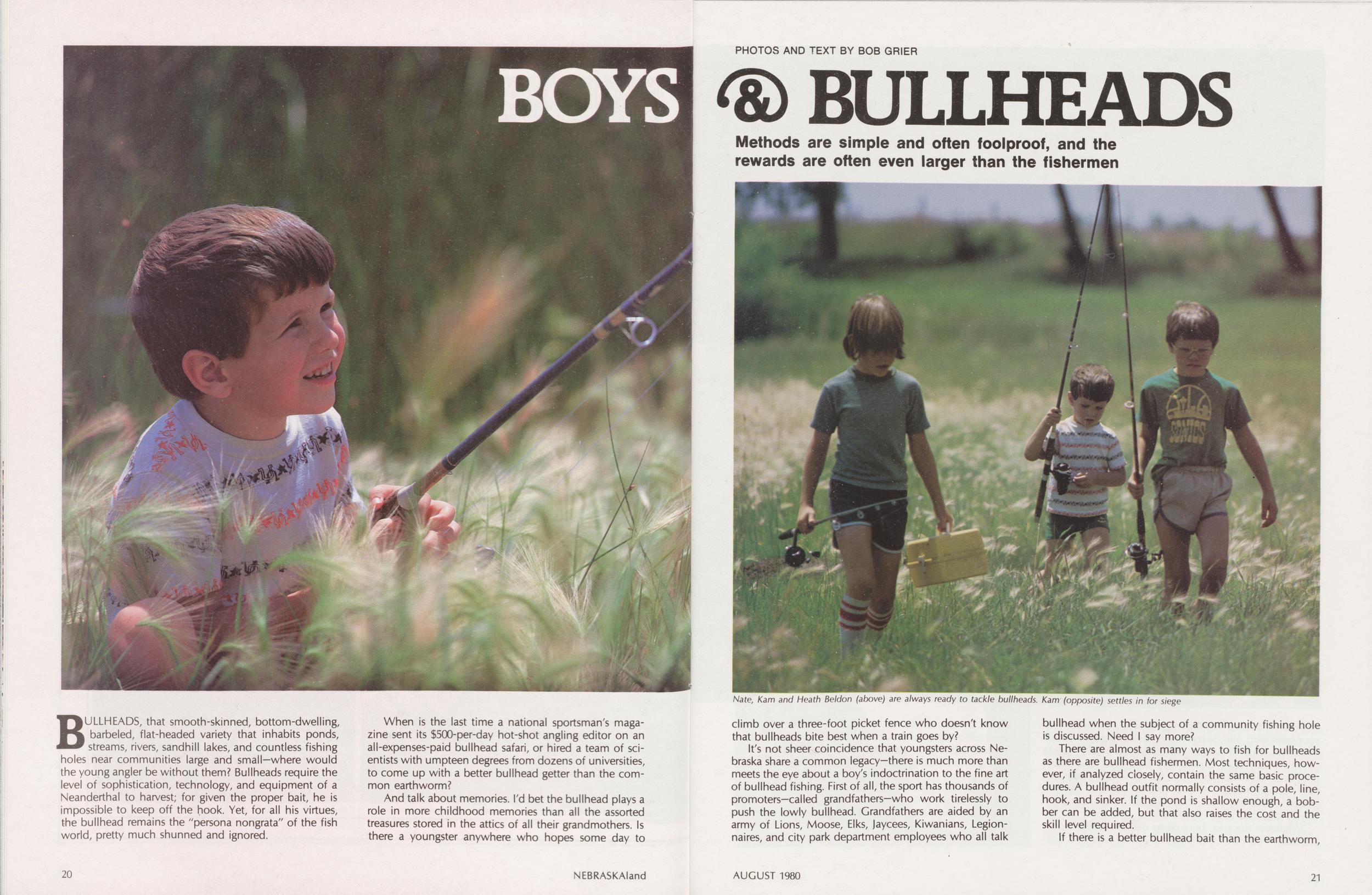
BOYS & BULLHEADS
Methods are simple and often foolproof, and the rewards are often even larger than the fishermen
BULLHEADS, that smooth-skinned, bottom-dwelling, barbeled, flat-headed variety that inhabits ponds, streams, rivers, sandhill lakes, and countless fishing holes near communities large and small—where would the young angler be without them? Bullheads require the level of sophistication, technology, and equipment of a Neanderthal to harvest; for given the proper bait, he is impossible to keep off the hook. Yet, for all his virtues, the bullhead remains the "persona nongrata" of the fish world, pretty much shunned and ignored.
When is the last time a national sportsman's magazine sent its $500-per-day hot-shot angling editor on an all-expenses-paid bullhead safari, or hired a team of scientists with umpteen degrees from dozens of universities, to come up with a better bullhead getter than the common earthworm?
And talk about memories. I'd bet the bullhead plays a role in more childhood memories than all the assorted treasures stored in the attics of all their grandmothers. Is there a youngster anywhere who hopes some day to climb over a three-foot picket fence who doesn't know that bullheads bite best when a train goes by?
It's not sheer coincidence that youngsters across Nebraska share a common legacy—there is much more than meets the eye about a boy's indoctrination to the fine art of bullhead fishing. First of all, the sport has thousands of promoters—called grandfathers—who work tirelessly to push the lowly bullhead. Grandfathers are aided by an army of Lions, Moose, Elks, Jaycees, Kiwanians, Legionnaires, and city park department employees who all talk bullhead when the subject of a community fishing hole is discussed. Need I say more?
There are almost as many ways to fish for bullheads as there are bullhead fishermen. Most techniques, however, if analyzed closely, contain the same basic procedures. A bullhead outfit normally consists of a pole, line, hook, and sinker. If the pond is shallow enough, a bobber can be added, but that also raises the cost and the skill level required.
If there is a better bullhead bait than the earthworm, 20 NEBRASKAIand AUGUST 1980 21 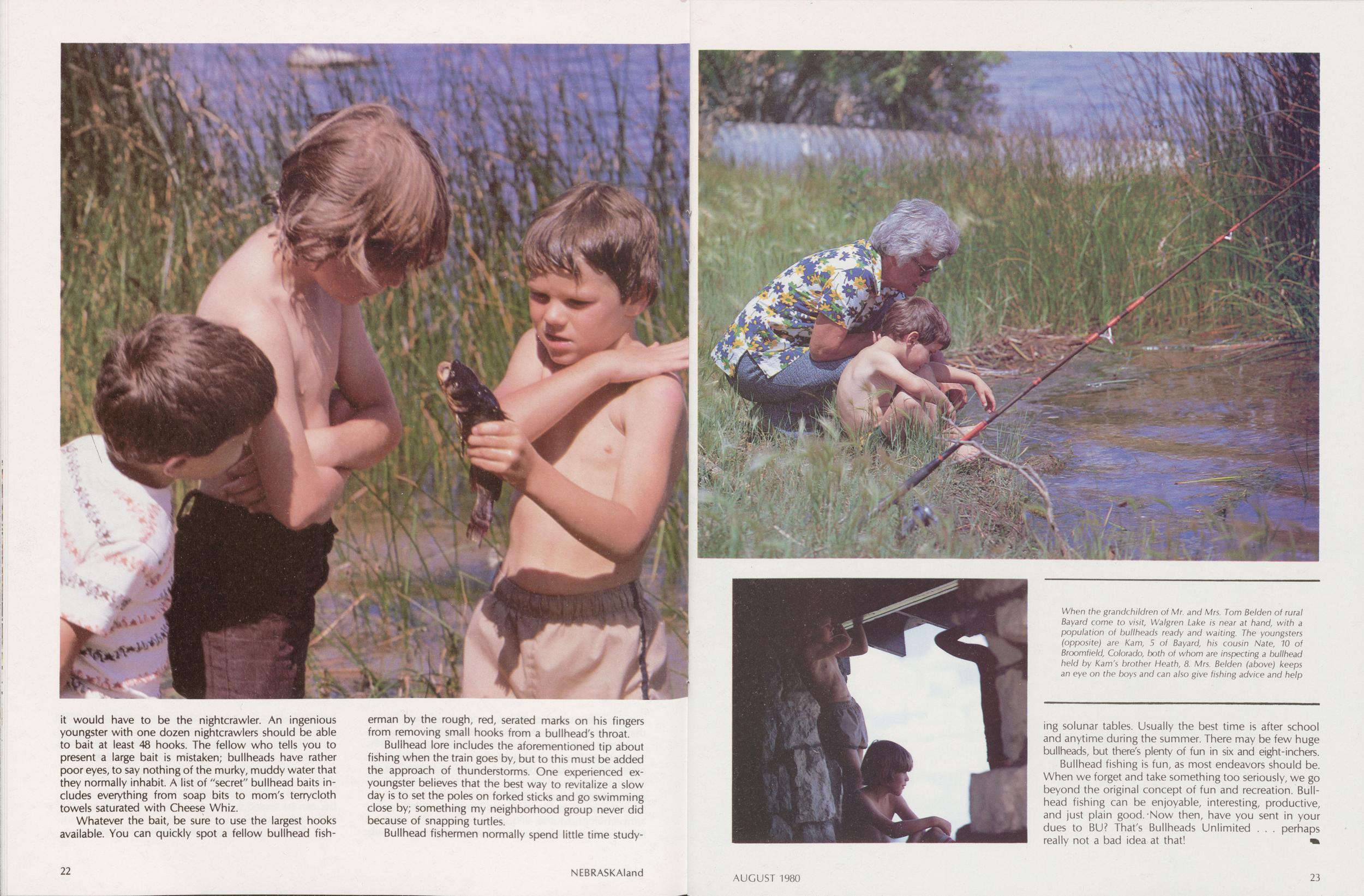
Whatever the bait, be sure to use the largest hooks available. You can quickly spot a fellow bullhead fisherman by the rough, red, serated marks on his fingers from removing small hooks from a bullhead's throat.
Bullhead lore includes the aforementioned tip about fishing when the train goes by, but to this must be added the approach of thunderstorms. One experienced ex- youngster believes that the best way to revitalize a slow day is to set the poles on forked sticks and go swimming close by; something my neighborhood group never did because of snapping turtles.
Bullhead fishermen normally spend little time studying
Bullhead fishing is fun, as most endeavors should be. When we forget and take something too seriously, we go beyond the original concept of fun and recreation. Bullhead fishing can be enjoyable, interesting, productive, and just plain good.-Nlow then, have you sent in your dues to BU? That's Bullheads Unlimited . . . perhaps really not a bad idea at that!
22 AUGUST 1980 NEBRASKAIand 23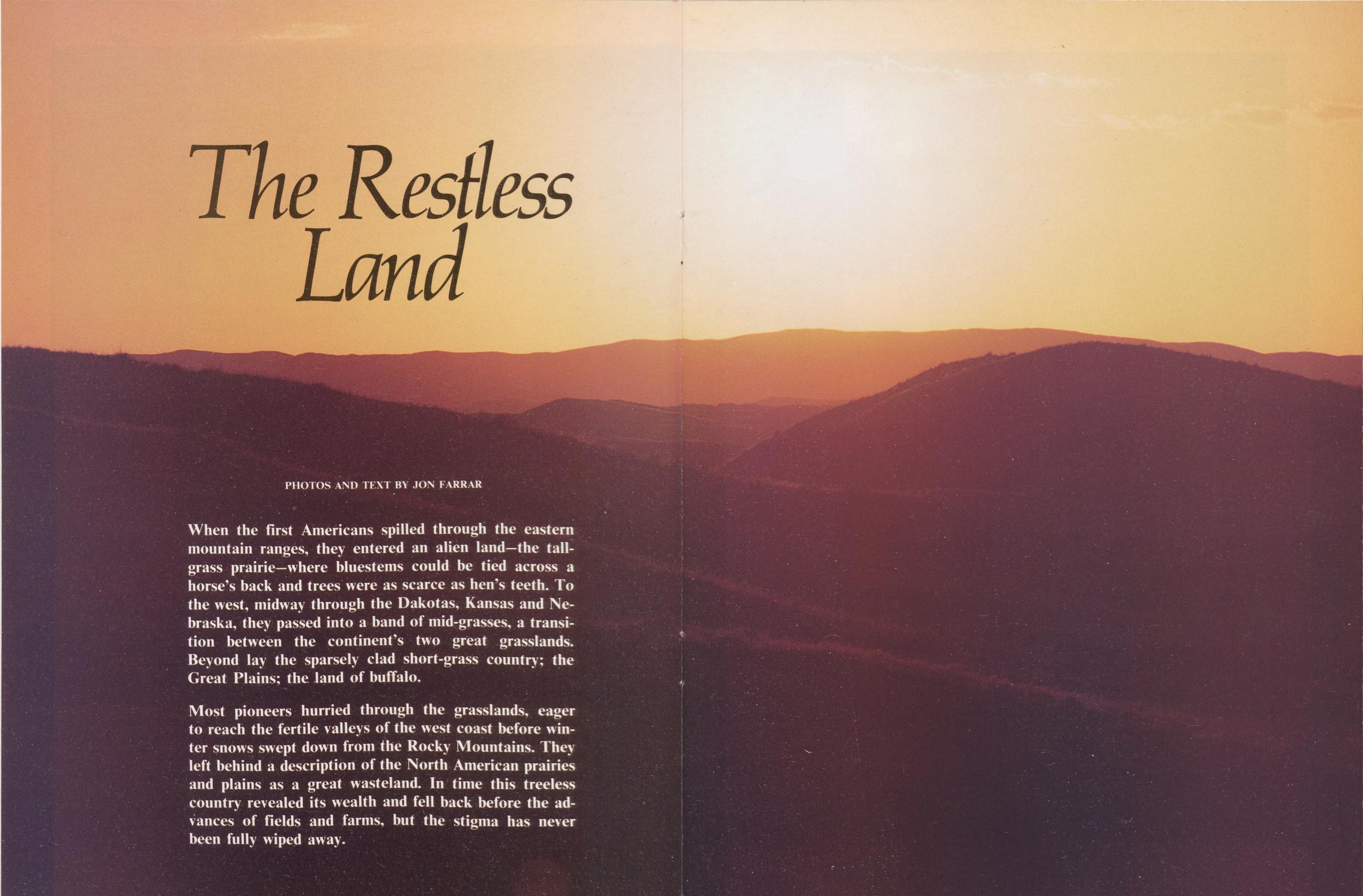
The Restless Land
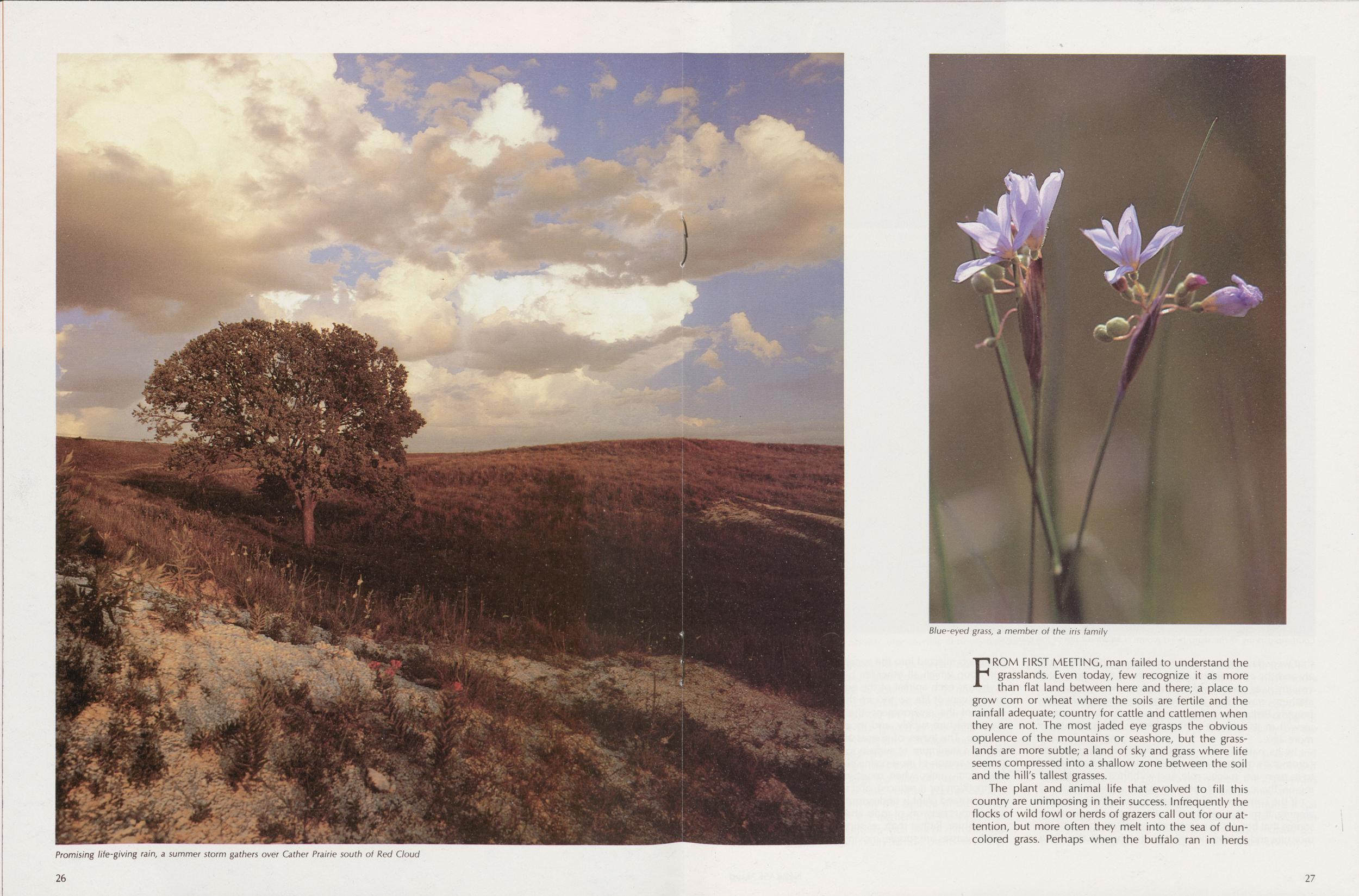
When the first Americans spilled through the eastern mountain ranges, they entered an alien land—the tail-grass prairie—where bluestems could be tied across a horse’s back and trees were as scarce as hen’s teeth. To the west, midway through the Dakotas, Kansas and Nebraska, they passed into a band of mid-grasses, a transition between the continent’s two great grasslands. Beyond lay the sparsely clad short-grass country; the Great Plains; the land of buffalo.
Most pioneers hurried through the grasslands, eager to reach the fertile valleys of the west coast before winter snows swept down from the Rocky Mountains. They left behind a description of the North American prairies and plains as a great wasteland. In time this treeless country revealed its wealth and fell back before the advances of fields and farms, but the stigma has never been fully wiped away.
FROM FIRST MEETING, man failed to understand the grasslands. Even today, few recognize it as more than flat land between here and there; a place to grow corn or wheat where the soils are fertile and the rainfall adequate; country for cattle and cattlemen when they are not. The most jaded eye grasps the obvious opulence of the mountains or seashore, but the grasslands are more subtle; a land of sky and grass where life seems compressed into a shallow zone between the soil and the hill's tallest grasses.
The plant and animal life that evolved to fill this country are unimposing in their success. Infrequently the flocks of wild fowl or herds of grazers call out for our attention, but more often they melt into the sea of dun- colored grass. Perhaps when the buffalo ran in herds
26 27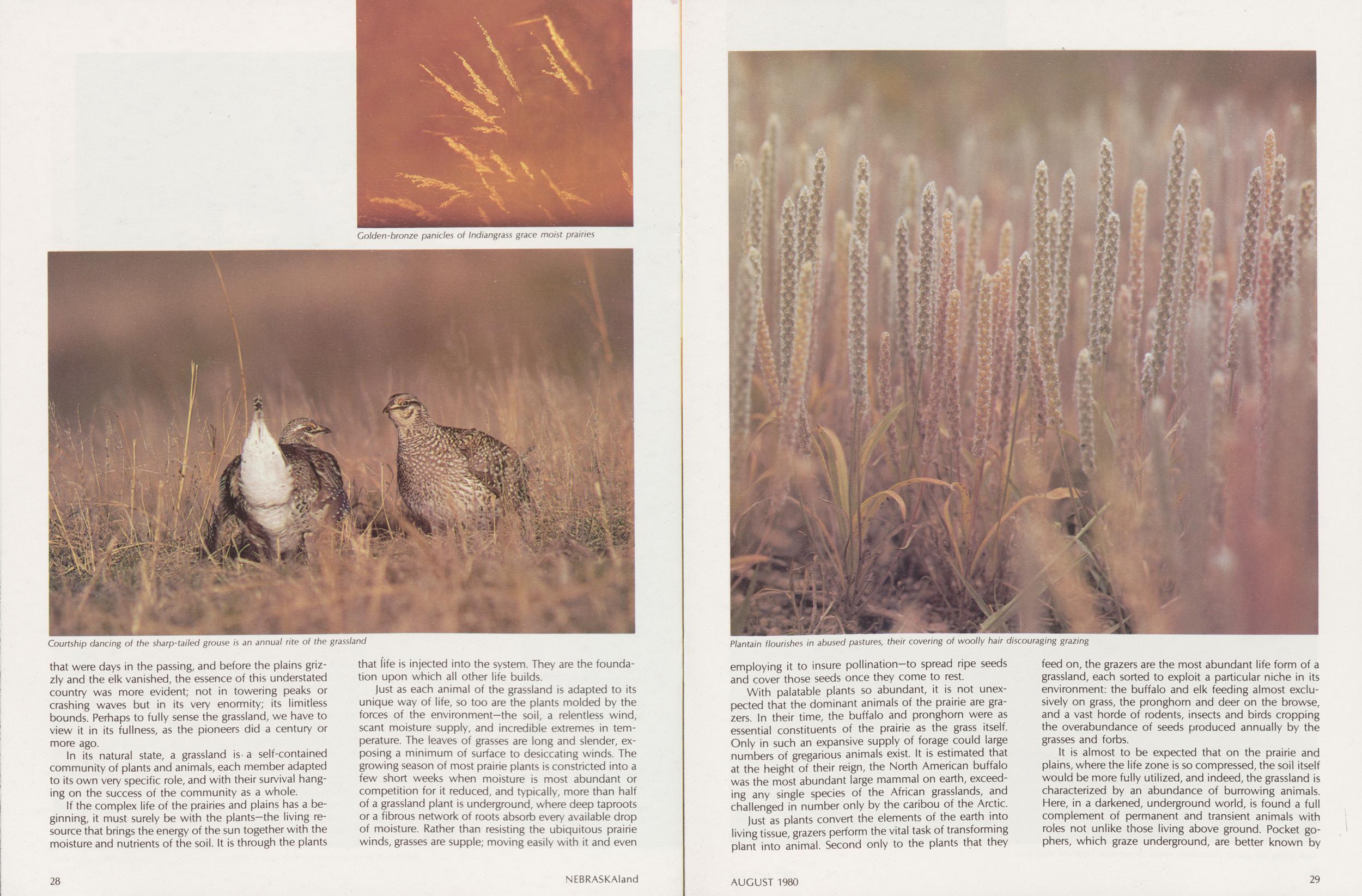
that were days in the passing, and before the plains grizzly and the elk vanished, the essence of this understated country was more evident; not in towering peaks or crashing waves but in its very enormity; its limitless bounds. Perhaps to fully sense the grassland, we have to view it in its fullness, as the pioneers did a century or more ago.
In its natural state, a grassland is a self-contained community of plants and animals, each member adapted to its own very specific role, and with their survival hanging on the success of the community as a whole.
If the complex life of the prairies and plains has a beginning, it must surely be with the plants—the living resource that brings the energy of the sun together with the moisture and nutrients of the soil. It is through the plants that life is injected into the system. They are the foundation upon which all other life builds.
Just as each animal of the grassland is adapted to its unique way of life, so too are the plants molded by the forces of the environment—the soil, a relentless wind, scant moisture supply, and incredible extremes in temperature. The leaves of grasses are long and slender, exposing a minimum of surface to desiccating winds. The growing season of most prairie plants is constricted into a few short weeks when moisture is most abundant or competition for it reduced, and typically, more than half of a grassland plant is underground, where deep taproots or a fibrous network of roots absorb every available drop of moisture. Rather than resisting the ubiquitous prairie winds, grasses are supple; moving easily with it and even employing it to insure pollination-to spread ripe seeds and cover those seeds once they come to rest.
With palatable plants so abundant, it is not unexpected that the dominant animals of the prairie are grazers. In their time, the buffalo and pronghorn were as essential constituents of the prairie as the grass itself. Only in such an expansive supply of forage could large numbers of gregarious animals exist. It is estimated that at the height of their reign, the North American buffalo was the most abundant large mammal on earth, exceeding any single species of the African grasslands, and challenged in number only by the caribou of the Arctic.
Just as plants convert the elements of the earth into living tissue, grazers perform the vital task of transforming plant into animal. Second only to the plants that they feed on, the grazers are the most abundant life form of a grassland, each sorted to exploit a particular niche in its environment: the buffalo and elk feeding almost exclusively on grass, the pronghorn and deer on the browse, and a vast horde of rodents, insects and birds cropping the overabundance of seeds produced annually by the grasses and forbs.
It is almost to be expected that on the prairie and plains, where the life zone is so compressed, the soil itself would be more fully utilized, and indeed, the grassland is characterized by an abundance of burrowing animals. Here, in a darkened, underground world, is found a full complement of permanent and transient animals with roles not unlike those living above ground. Pocket gophers, which graze underground, are better known by
28 NEBRASKAIand AUGUST 1980 29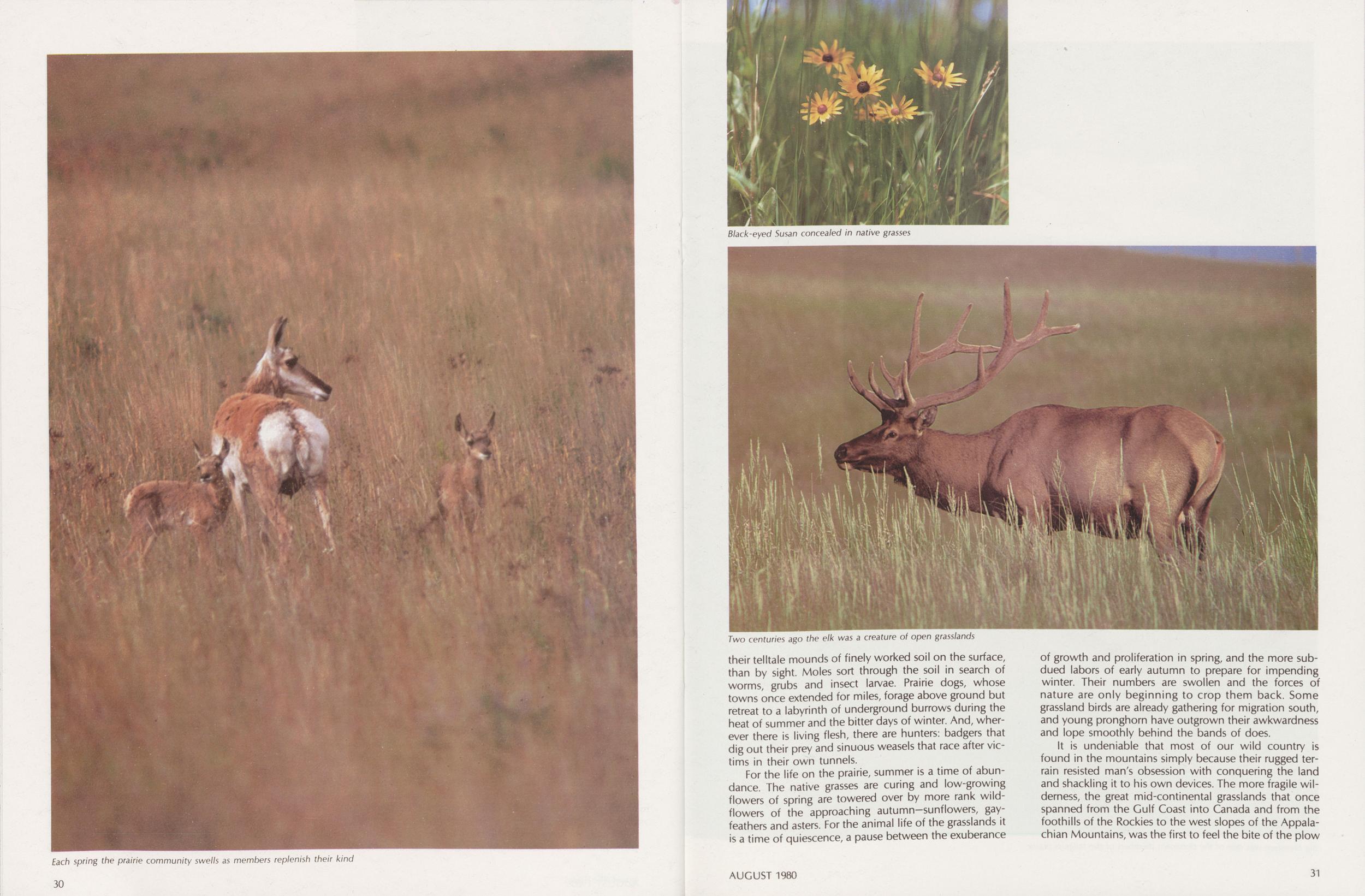
their telltale mounds of finely worked soil on the surface, than by sight. Moles sort through the soil in search of worms, grubs and insect larvae. Prairie dogs, whose towns once extended for miles, forage above ground but retreat to a labyrinth of underground burrows during the heat of summer and the bitter days of winter. And, wherever there is living flesh, there are hunters: badgers that dig out their prey and sinuous weasels that race after victims in their own tunnels.
For the life on the prairie, summer is a time of abundance. The native grasses are curing and low-growing flowers of spring are towered over by more rank wildflowers of the approaching autumn—sunflowers, gayfeathers and asters. For the animal life of the grasslands it is a time of quiescence, a pause between the exuberance of growth and proliferation in spring, and the more subdued labors of early autumn to prepare for impending winter. Their numbers are swollen and the forces of nature are only beginning to crop them back. Some grassland birds are already gathering for migration south, and young pronghorn have outgrown their awkwardness and lope smoothly behind the bands of does.
It is undeniable that most of our wild country is found in the mountains simply because their rugged terrain resisted man's obsession with conquering the land and shackling it to his own devices. The more fragile wilderness, the great mid-continental grasslands that once spanned from the Gulf Coast into Canada and from the foothills of the Rockies to the west slopes of the Appalachian Mountains, was the first to feel the bite of the plow
30 AUGUST 1980 31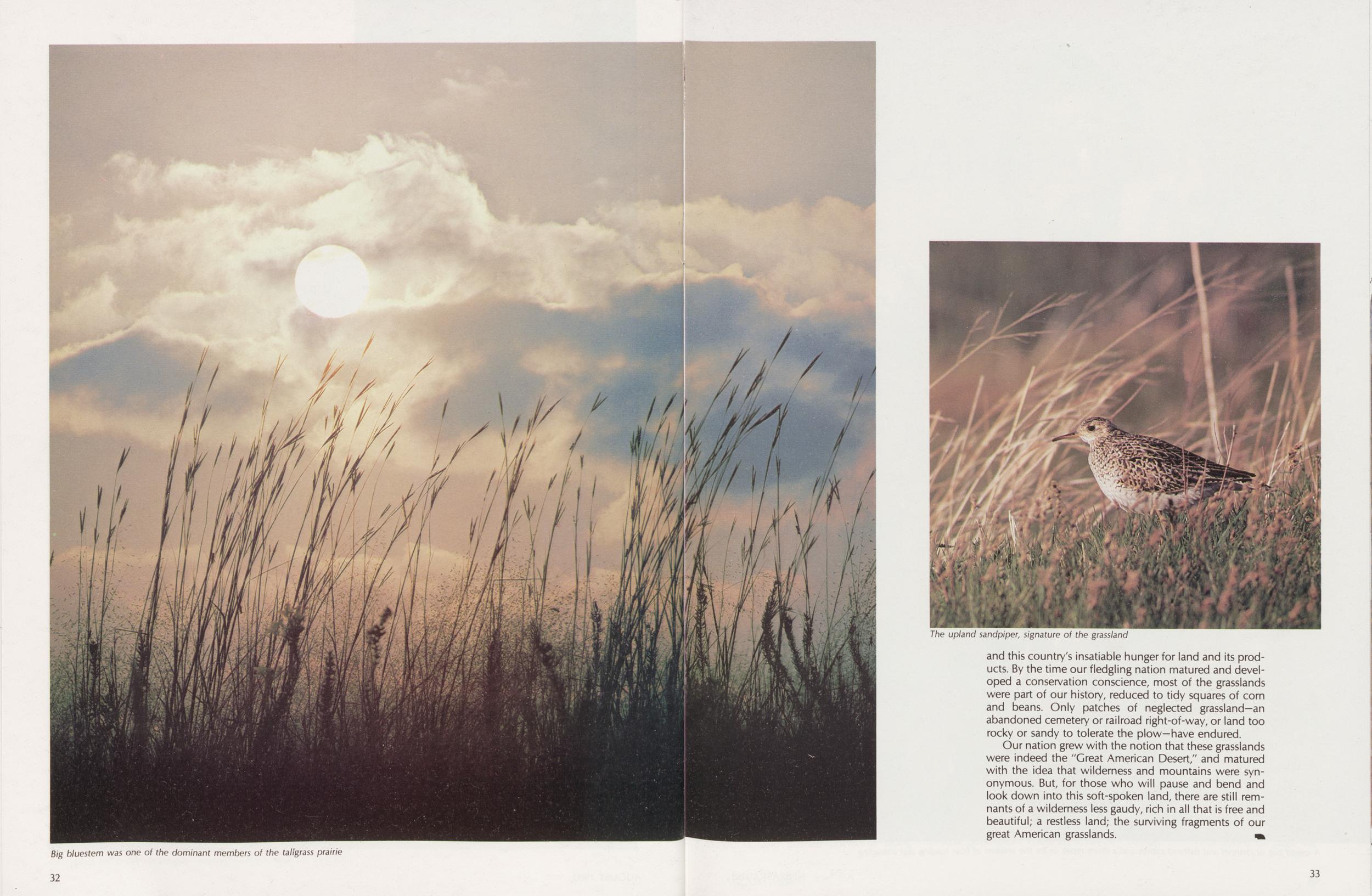
and this country's insatiable hunger for land and its products. By the time our fledgling nation matured and developed a conservation conscience, most of the grasslands were part of our history, reduced to tidy squares of corn and beans. Only patches of neglected grassland-an abandoned cemetery or railroad right-of-way, or land too rocky or sandy to tolerate the plow—have endured.
Our nation grew with the notion that these grasslands were indeed the "Great American Desert," and matured with the idea that wilderness and mountains were synonymous. But, for those who will pause and bend and look down into this soft-spoken land, there are still remnants of a wilderness less gaudy, rich in all that is free and beautiful; a restless land; the surviving fragments of our great American grasslands.
32 33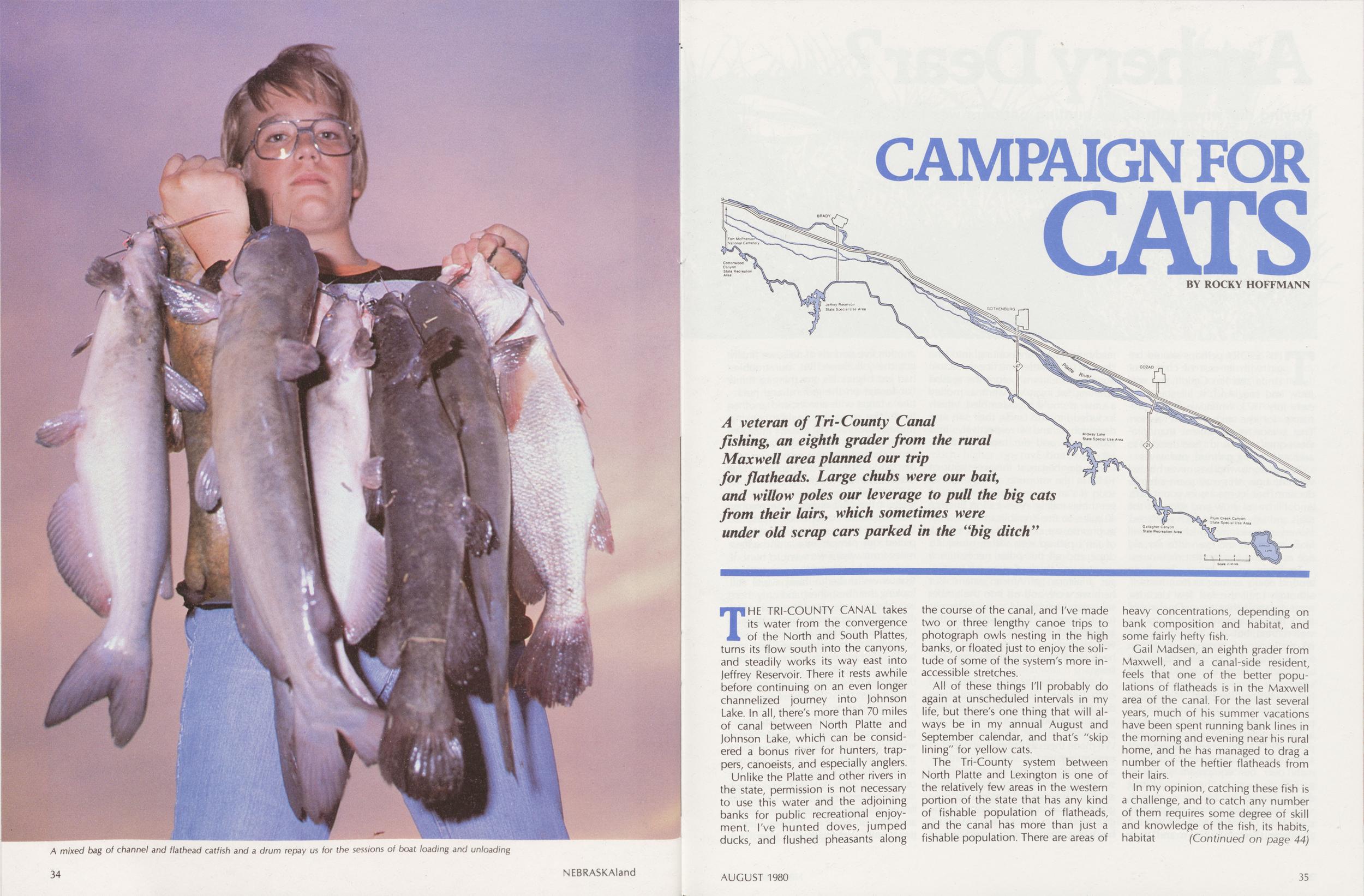
CAMPAIGN FOR CATS
A veteran of Tri-County Canal fishing, an eighth grader from the rural Maxwell area planned our trip for flatheads. Large chubs were our bait, and willow poles our leverage to pull the big cats from their lairs, which sometimes were under old scrap cars parked in the “big ditch ”
THE TRI-COUNTY CANAL takes its water from the convergence of the North and South Plattes, turns its flow south into the canyons, and steadily works its way east into Jeffrey Reservoir. There it rests awhile before continuing on an even longer channelized journey into Johnson Lake. In all, there's more than 70 miles of canal between North Platte and Johnson Lake, which can be considered a bonus river for hunters, trappers, canoeists, and especially anglers.
Unlike the Platte and other rivers in the state, permission is not necessary to use this water and the adjoining banks for public recreational enjoyment. I've hunted doves, jumped ducks, and flushed pheasants along the course of the canal, and I've made two or three lengthy canoe trips to photograph owls nesting in the high banks, or floated just to enjoy the solitude of some of the system's more inaccessible stretches.
All of these things I'll probably do again at unscheduled intervals in my life, but there's one thing that will always be in my annual August and September calendar, and that's "skip lining" for yellow cats.
The Tri-County system between North Platte and Lexington is one of the relatively few areas in the western portion of the state that has any kind of fishable population of flatheads, and the canal has more than just a fishable population. There are areas of heavy concentrations, depending on bank composition and habitat, and some fairly hefty fish.
Gail Madsen, an eighth grader from Maxwell, and a canal-side resident, feels that one of the better populations of flatheads is in the Maxwell area of the canal. For the last several years, much of his summer vacations have been spent running bank lines in the morning and evening near his rural home, and he has managed to drag a number of the heftier flatheads from their lairs.
In my opinion, catching these fish is a challenge, and to catch any number of them requires some degree of skill and knowledge of the fish, its habits, habitat (Continued on page 44)
34 NEBRASKAland AUGUST 1980 35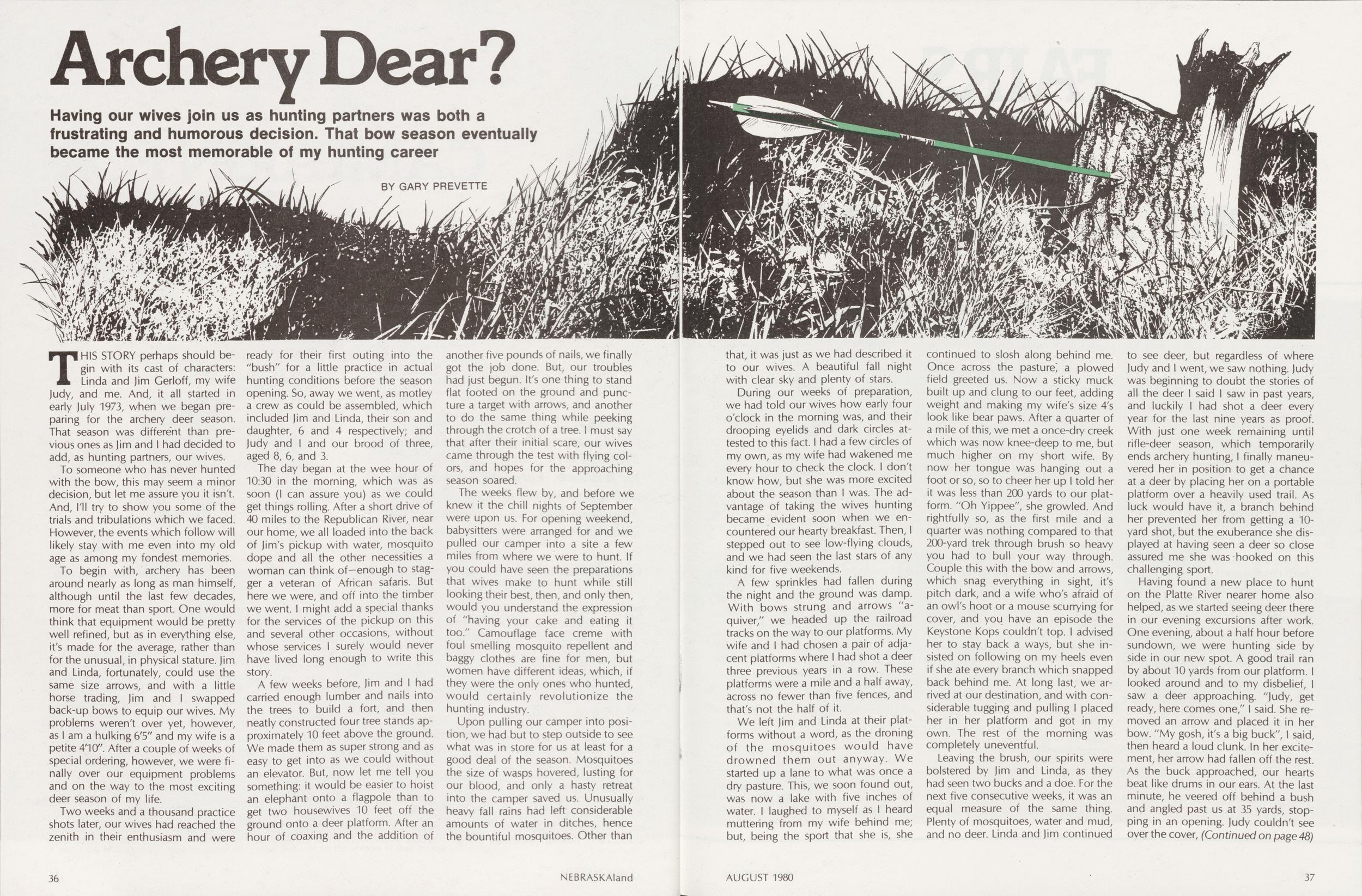
Archery Dear?
Having our wives join us as hunting partners was both a frustrating and humorous decision. That bow season eventually became the most memorable of my hunting career
THIS STORY perhaps should begin with its cast of characters: Linda and Jim Gerloff, my wife Judy, and me. And, it all started in early July 1973, when we began preparing for the archery deer season. That season was different than previous ones as Jim and I had decided to add, as hunting partners, our wives.
To someone who has never hunted with the bow, this may seem a minor decision, but let me assure you it isn't. And, I'll try to show you some of the trials and tribulations which we faced. However, the events which follow will likely stay with me even into my old age as among my fondest memories.
To begin with, archery has been around nearly as long as man himself, although until the last few decades, more for meat than sport. One would think that equipment would be pretty well refined, but as in everything else, it's made for the average, rather than for the unusual, in physical stature. Jim and Linda, fortunately, could use the same size arrows, and with a little horse trading, Jim and I swapped back-up bows to equip our wives. My problems weren't over yet, however, as I am a hulking 6'5" and my wife is a petite 4'10". After a couple of weeks of special ordering, however, we were finally over our equipment problems and on the way to the most exciting deer season of my life.
Two weeks and a thousand practice shots later, our wives had reached the zenith in their enthusiasm and were ready for their first outing into the "bush" for a little practice in actual hunting conditions before the season opening. So, away we went, as motley a crew as could be assembled, which included Jim and Linda, their son and daughter, 6 and 4 respectively; and Judy and I and our brood of three, aged 8, 6, and 3.
The day began at the wee hour of 10:30 in the morning, which was as soon (I can assure you) as we could get things rolling. After a short drive of 40 miles to the Republican River, near our home, we all loaded into the back of Jim's pickup with water, mosquito dope and all the other necessities a woman can think of—enough to stagger a veteran of African safaris. But here we were, and off into the timber we went. I might add a special thanks for the services of the pickup on this and several other occasions, without whose services I surely would never have lived long enough to write this story.
A few weeks before, Jim and I had carried enough lumber and nails into the trees to build a fort, and then neatly constructed four tree stands approximately 10 feet above the ground. We made them as super strong and as easy to get into as we could without an elevator. But, now let me tell you something: it would be easier to hoist an elephant onto a flagpole than to get two housewives 10 feet off the ground onto a deer platform. After an hour of coaxing and the addition of another five pounds of nails, we finally got the job done. But, our troubles had just begun. It's one thing to stand flat footed on the ground and punc- ture a target with arrows, and another to do the same thing while peeking through the crotch of a tree. I must say that after their initial scare, our wives came through the test with flying colors, and hopes for the approaching season soared.
The weeks flew by, and before we knew it the chill nights of September were upon us. For opening weekend, babysitters were arranged for and we pulled our camper into a site a few miles from where we were to hunt. If you could have seen the preparations that wives make to hunt while still looking their best, then, and only then, would you understand the expression of "having your cake and eating it too." Camouflage face creme with foul smelling mosquito repellent and baggy clothes are fine for men, but women have different ideas, which, if they were the only ones who hunted, would certainly revolutionize the hunting industry.
Upon pulling our camper into position, we had but to step outside to see what was in store for us at least for a good deal of the season. Mosquitoes the size of wasps hovered, lusting for our blood, and only a hasty retreat into the camper saved us. Unusually heavy fall rains had left considerable amounts of water in ditches, hence the bountiful mosquitoes. Other than that, it was just as we had described it to our wives. A beautiful fall night with clear sky and plenty of stars.
During our weeks of preparation, we had told our wives how early four o'clock in the morning was, and their drooping eyelids and dark circles attested to this fact. I had a few circles of my own, as my wife had wakened me every hour to check the clock. I don't know how, but she was more excited about the season than I was. The advantage of taking the wives hunting became evident soon when we encountered our hearty breakfast. Then, I stepped out to see low-flying clouds, and we had seen the last stars of any kind for five weekends.
A few sprinkles had fallen during the night and the ground was damp. With bows strung and arrows "a- quiver," we headed up the railroad tracks on the way to our platforms. My wife and I had chosen a pair of adjacent platforms where I had shot a deer three previous years in a row. These platforms were a mile and a half away, across no fewer than five fences, and that's not the half of it.
We left Jim and Linda at their platforms without a word, as the droning of the mosquitoes would have drowned them out anyway. We started up a lane to what was once a dry pasture. This, we soon found out, was now a lake with five inches of water. I laughed to myself as I heard muttering from my wife behind me; but, being the sport that she is, she continued to slosh along behind me. Once across the pasture^ a plowed field greeted us. Now a sticky muck built up and clung to our feet, adding weight and making my wife's size 4's look like bear paws. After a quarter of a mile of this, we met a once-dry creek which was now knee-deep to me, but much higher on my short wife. By now her tongue was hanging out a foot or so, so to cheer her up 1 told her it was less than 200 yards to our platform. "Oh Yippee", she growled. And rightfully so, as the first mile and a quarter was nothing compared to that 200-yard trek through brush so heavy you had to bull your way through. Couple this with the bow and arrows, which snag everything in sight, it's pitch dark, and a wife who's afraid of an owl's hoot or a mouse scurrying for cover, and you have an episode the Keystone Kops couldn't top. I advised her to stay back a ways, but she insisted on following on my heels even if she ate every branch which snapped back behind me. At long last, we arrived at our destination, and with considerable tugging and pulling I placed her in her platform and got in my own. The rest of the morning was completely uneventful.
Leaving the brush, our spirits were bolstered by Jim and Linda, as they had seen two bucks and a doe. For the next five consecutive weeks, it was an equal measure of the same thing. Plenty of mosquitoes, water and mud, and no deer. Linda and Jim continued to see deer, but regardless of where Judy and I went, we saw nothing. Judy was beginning to doubt the stories of all the deer I said I saw in past years, and luckily I had shot a deer every year for the last nine years as proof. With just one week remaining until rifle-deer season, which temporarily ends archery hunting, I finally maneuvered her in position to get a chance at a deer by placing her on a portable platform over a heavily used trail. As luck would have it, a branch behind her prevented her from getting a 10- yard shot, but the exuberance she displayed at having seen a deer so close assured me she was hooked on this challenging sport.
Having found a new place to hunt on the Platte River nearer home also helped, as we started seeing deer there in our evening excursions after work. One evening, about a half hour before sundown, we were hunting side by side in our new spot. A good trail ran by about 10 yards from our platform. I looked around and to my disbelief, I saw a deer approaching. "Judy, get ready, here comes one," I said. She removed an arrow and placed it in her bow. "My gosh, it's a big buck", I said, then heard a loud clunk. In her excitement, her arrow had fallen off the rest. As the buck approached, our hearts beat like drums in our ears. At the last minute, he veered off behind a bush and angled past us at 35 yards, stopping in an opening. Judy couldn't see over the cover, (Continued on page 48)
36 NEBRASKAIand AUGUST 1980 37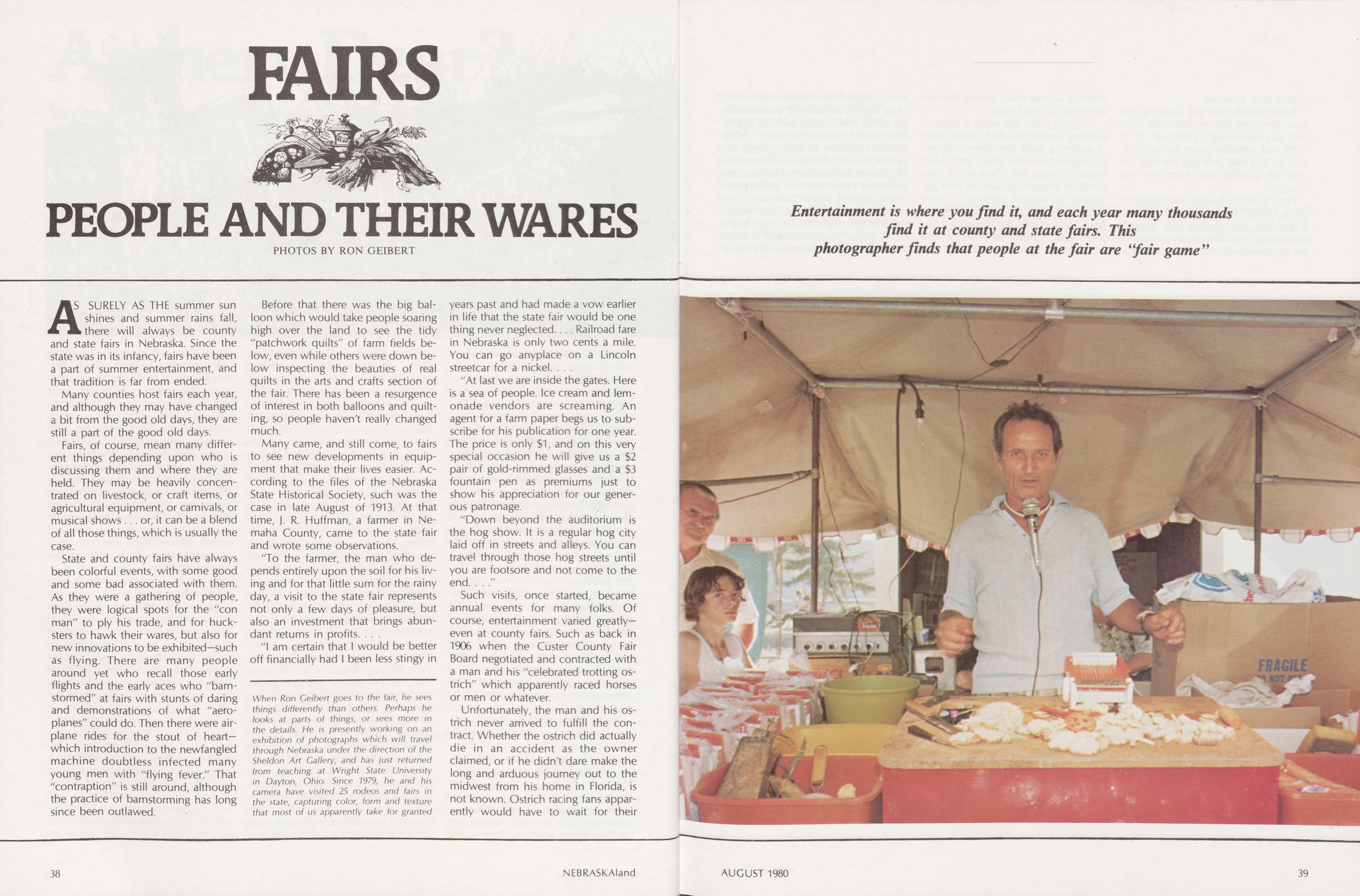
FAIRS
PEOPLE AND THEIR WARES
Entertainment is where you find it, and each year many thousands find it at county and state fairs. This photographer finds that people at the fair are "fair game”
SURELY AS THE summer sun shines and summer rains fall, there will always be county and state fairs in Nebraska. Since the state was in its infancy, fairs have been a part of summer entertainment, and that tradition is far from ended.
Many counties host fairs each year, and although they may have changed a bit from the good old days, they are still a part of the good old days. Fairs, of course, mean many different things depending upon who is discussing them and where they are held. They may be heavily concentrated on livestock, or craft items, or agricultural equipment, or carnivals, or musical shows ... or, it can be a blend of all those things, which is usually the case.
State and county fairs have always been colorful events, with some good and some bad associated with them. As they were a gathering of people, they were logical spots for the "con man" to ply his trade, and for huck- sters to hawk their wares, but also for new innovations to be exhibited—such as flying. There are many people around yet who recall those early flights and the early aces who "barn- stormed" at fairs with stunts of daring and demonstrations of what "aeroplanes" could do. Then there were airplane rides for the stout of heart— which introduction to the newfangled machine doubtless infected many young men with "flying fever." That "contraption" is still around, although the practice of barnstorming has long since been outlawed.
Before that there was the big balloon which would take people soaring high over the land to see the tidy "patchwork quilts" of farm fields below, even while others were down below inspecting the beauties of real quilts in the arts and crafts section of the fair. There has been a resurgence of interest in both balloons and quilting, so people haven't really changed much.
Many came, and still come, to fairs to see new developments in equipment that make their lives easier. According to the files of the Nebraska State Historical Society, such was the case in late August of 1913. At that time, J. R. Huffman, a farmer in Nemaha County, came to the state fair and wrote some observations.
"To the farmer, the man who depends entirely upon the soil for his living and for that little sum for the rainy day, a visit to the state fair represents not only a few days of pleasure, but also an investment that brings abundant returns in profits. . . .
"I am certain that I would be better off financially had I been less stingy in When Ron Geibert goes to the fair, he sees things differently than others. Perhaps he looks at parts of things, or sees more in the details. He is presently working on an exhibition of photographs which will travel through Nebraska under the direction of the Sheldon Art Gallery; and has just returned from teaching at Wright State University in Dayton, Ohio. Since 7979, he and his camera have visited 25 rodeos and fairs in the state, capturing color, form and texture that most of us apparently take for granted years past and had made a vow earlier in life that the state fair would be one thing never neglected.... Railroad fare in Nebraska is only two cents a mile. You can go anyplace on a Lincoln streetcar for a nickel. . . .
"At last we are inside the gates. Here is a sea of people. Ice cream and lemonade vendors are screaming. An agent for a farm paper begs us to subscribe for his publication for one year. The price is only $1, and on this very special occasion he will give us a $2 pair of gold-rimmed glasses and a $3 fountain pen as premiums just to show his appreciation for our generous patronage.
"Down beyond the auditorium is the hog show. It is a regular hog city laid off in streets and alleys. You can travel through those hog streets until you are footsore and not come to the end. . . ."
Such visits, once started, became annual events for many folks. Of course, entertainment varied greatly- even at county fairs. Such as back in 1906 when the Custer County Fair Board negotiated and contracted with a man and his "celebrated trotting ostrich" which apparently raced horses or men or whatever.
Unfortunately, the man and his ostrich never arrived to fulfill the contract. Whether the ostrich did actually die in an accident as the owner claimed, or if he didn't dare make the long and arduous journey out to the midwest from his home in Florida, is not known. Ostrich racing fans apparently would have to wait for their
38 NEBRASKAIand AUGUST 1980 39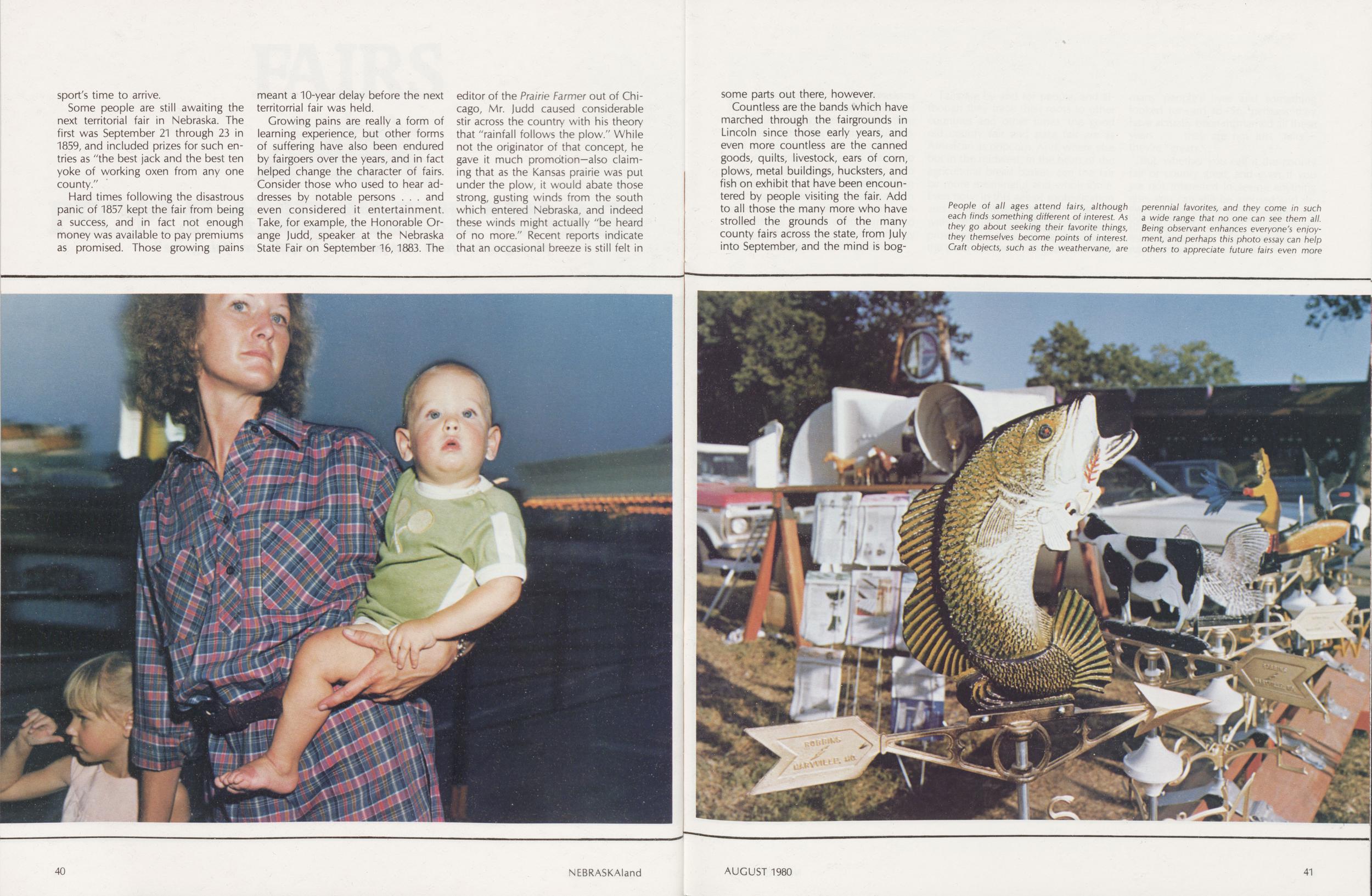
sport's time to arrive.
Some people are still awaiting the next territorial fair in Nebraska. The first was September 21 through 23 in 1859, and included prizes for such entries as "the best jack and the best ten yoke of working oxen from any one county."
Hard times following the disastrous panic of 1857 kept the fair from being a success, and in fact not enough money was available to pay premiums as promised. Those growing pains meant a 10-year delay before the next territorial fair was held.
Growing pains are really a form of learning experience, but other forms of suffering have also been endured by fairgoers over the years, and in fact helped change the character of fairs. Consider those who used to hear addresses by notable persons . . . and even considered it entertainment. Take, for example, the Honorable Orange Judd, speaker at the Nebraska State Fair on September 16, 1883. The editor of the Prairie Farmer out of Chicago, Mr. Judd caused considerable stir across the country with his theory that "rainfall follows the plow." While not the originator of that concept, he gave it much promotion-also claiming that as the Kansas prairie was put under the plow, it would abate those strong, gusting winds from the south which entered Nebraska, and indeed these winds might actually "be heard of no more." Recent reports indicate that an occasional breeze is still felt in some parts out there, however.
Countless are the bands which have marched through the fairgrounds in Lincoln since those early years, and even more countless are the canned goods, quilts, livestock, ears of corn, plows, metal buildings, hucksters, and fish on exhibit that have been encountered by people visiting the fair. Add to all those the many more who have strolled the grounds of the many county fairs across the state, from July into September, and the mind is boggled.
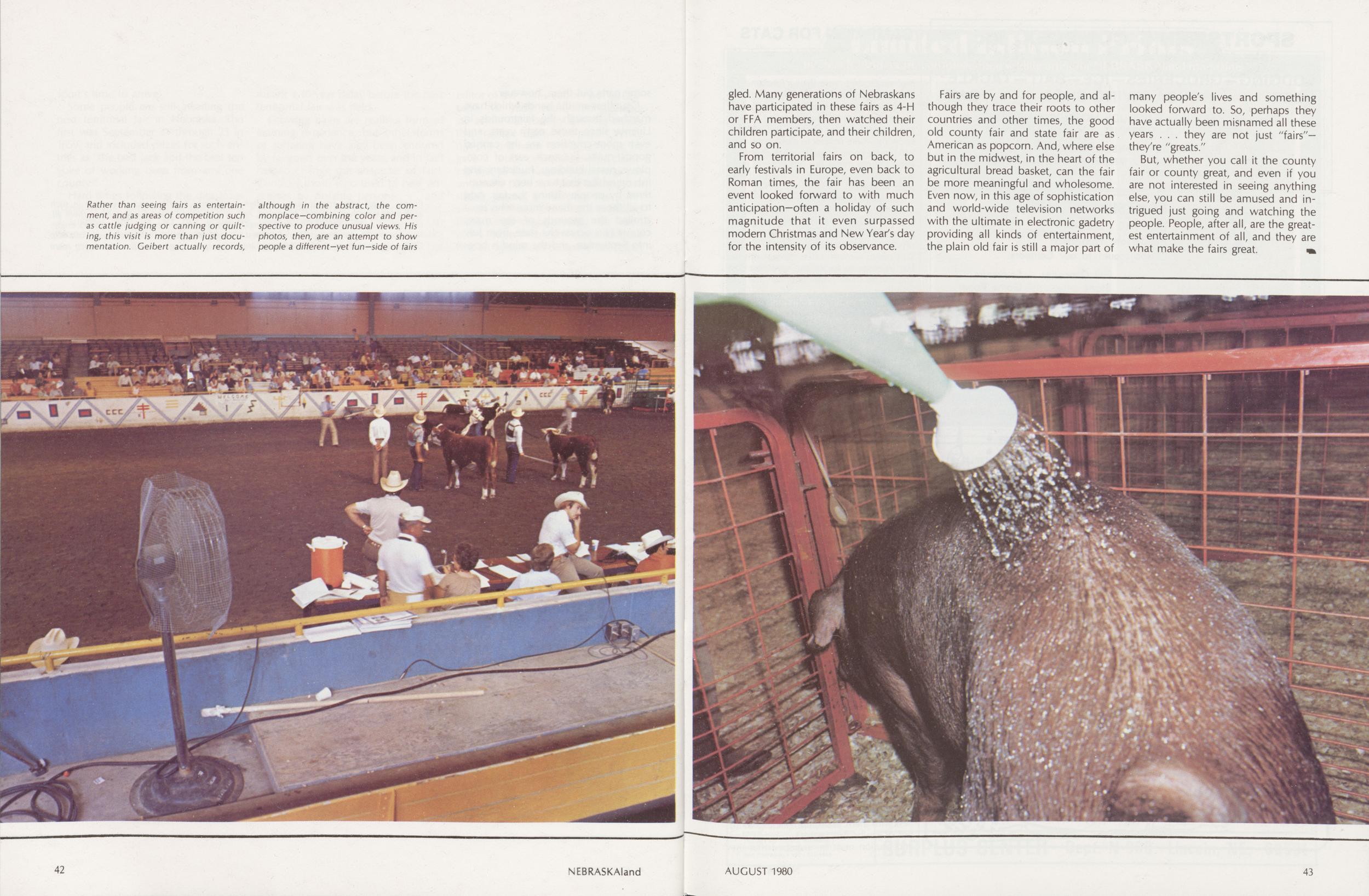
Many generations of Nebraskans have participated in these fairs as 4-H or FFA members, then watched their children participate, and their children, and so on.
From territorial fairs on back, to early festivals in Europe, even back to Roman times, the fair has been an event looked forward to with much anticipation—often a holiday of such magnitude that it even surpassed modern Christmas and New Year's day for the intensity of its observance.
Fairs are by and for people, and although they trace their roots to other countries and other times, the good old county fair and state fair are as American as popcorn. And, where else but in the midwest, in the heart of the agricultural bread basket, can the fair be more meaningful and wholesome. Even now, in this age of sophistication and world-wide television networks with the ultimate in electronic gadetry providing all kinds of entertainment, the plain old fair is still a major part of many people's lives and something looked forward to. So, perhaps they have actually been misnamed all these years . . . they are not just "fairs"— they're "greats."
But, whether you call it the county fair or county great, and even if you are not interested in seeing anything else, you can still be amused and intrigued just going and watching the people. People, after all, are the greatest entertainment of all, and they are what make the fairs great.
42 NEBRASKAIand AUGUST 1980 43
CAMPAIGN FOR CATS
(Continued from page 17)preference, and more than a fundamental understanding of flowing water. Flathead fishing has to be compared to trapping to some degree, as an inexperienced trapper can set 100 traps for raccoon, but without knowing where or how to make good sets, will maybe come up with only a couple. A good trapper might put out only 10 traps and walk into the furbuyer the next day with 10 skins.
You simply have to find good sets, not marginal ones, present the bait properly, and then you're in. But, in trapping as well as flathead fishing, to find enough good sets you need a lot of good territory. The Tri-County system offers such territory, but in order to locate the very best sets and utilize them properly entails the use of a boat.
Now, there's nothing forbidding the operation of a motorboat throughout most of the canal system, but you're not going to find any boat ramps or docks, and you're not going to find any easy launching areas. Instead, you will find steep banks lined with concrete rip-rap, pilings, and cabled-off car bodies. Obviously, boat selection is of fundamental importance, which will determine if you even make it into the water or not, and remember, once you get it in, it has to come out.
Gail offered to make up the lines if I'd round up the bait, boat, and willows. For some reason, I think I was getting the short end of the deal, but after all, I was going to borrow some of his experience and maybe discover some of the better sets that he's found along the canal.
Next to finding an adequate boat, bait is most important. You have to have good bait and plenty of it, and sometimes by late August or September that can be a difficult order to fill. The flathead, yellow cat, or mud cat if you will, turns into a proficient .predator after it passes adolescence. Live bait is the key to large flatheads—a fish that will pass up even the better recipe of stinky concoctions guaranteed to catch channel cats.
It's really a toss-up between large chubs and crayfish (although I prefer clubs) and oftentimes one will work noticeably better than the other. Crayfish have some distinct advantages. If they are kept healthy, they will remain hardy on the hook and present a tempting meal to game fish. They are also attractive to drum, which can become a nuisance, although drum filets are one of my preferred fried fish. Crayfish are also less likely to be stolen from a hook by smaller fish.
I guess my preference for chubs comes from the fact that they provide a lot of action on the line, and I have had more success with them. Transporting a large number of chubs can be tricky on hot days, and caution must be exercised that they
Great Outdoors Instructional Tapes Tell How, When, Where! Bass Fishing Secrets $7 Successful Trout Fishing $7 Catfish Methods $7 Whitewater Canoe, Kayak, Raft...$9 Gold Panning, Prospecting $9 Hunter Safety Course $10 Outdoor Survival Course $10 Mink Trapping Course $7 Raccoon Trapping Instructions...$7 $2-per-tape discount for senior citizens and students! Send 60-min. cassette Send 8-track Outdoors Voice Box 49 Glenwood, Iowa 51534
don't use up all their oxygen. You may as well not set lines at all if you arrive with a bait bucket full of dead chubs.
By late August not only are big minnows getting scarce, but so are crayfish. Not a bait vendor in North Platte had anything more than a tiny, crappie-size minnow on hand, and prospects didn't look good that they would get any big stuff for awhile. Finally, a call to Rick Parr at Sutherland re- sulted in a generous supply of big chubs and sucker minnows, although it meant a 50-mile round trip.
Before departing for Sutherland, I headed for a close-by growth of river willows with a corn knife. Willows make excellent setline poles. They should be cut off at about six feet, just above any sizable fork. Green willows provide enough give to tire the fish while not allowing him to pull free.
With bait, willows, boat and motor and other paraphernalia necessary to setlines, I picked up Gail at his place and we headed down the canal in search of a spot to launch the 14-foot flat-bottom boat. About a mile east of his place we found a low bank (only about a three-foot drop to the water), unhitched the trailer, backed it over the bank with a thud, and were ready to go fishing.
We gave the chubs a fresh shot of water, grabbed the spool of lines, loaded up the willows, axe, hammer, nails, wire, life jackets and Arfie, Gail's yellow Labrador, and off we went.
We elected not to use any weight at all since the water had been warmed by three months of summer, and most of the flatheads would be surface feeding at night. It is important to match the size of your hooks to the size of your bait, and this, I believe, was our biggest downfall. The six- inch and larger chubs outsized our hooks considerably, but we decided to give it a go as we only planned to fish one night.
The first set was off the back-side of a pair of pilings that had trapped a mass of debris and caused a quiet pool on the down-current side. Gail tested the depth with an oar and couldn't touch bottom, although it was just five feet from the bank.
Cables joining the pilings offered a small gap to slide a heavy willow through. This would provide the front support for the pole, while the butt was nailed firmly to "Oh dear. . . I've forgotten which was which!" Ion line to the end of the willow just below the fork and hitched it up until just the eye of the hook cleared the surface of the water. He hooked a nice chub under the dorsal fin and a little forward, which allowed it to swim as naturally as a hooked minnow can. If the current throws the bait on its side and bends a curve in it, the water is too fast. Look for a better spot.
Upstream, we found another piling set, and then a couple limb-line sets were provided by trees overhanging the canal in perfect spots. Then we came to a stretch of canal lined with old vehicles for bank stabilization. We joked about finding an old "cat-iliac" to hook lines to, or one with an old "flathead" engine, or maybe a newer model with a "cat-alytic" converter.
But these cars do make excellent sets for catfish as the fish seem to find good habitat under them and spend the night chasing bait fish which also live in the underwater structure. Here's where the axe comes in handy. When you find a likely looking spot, the axe can be used to make a slit in the roof or trunk of the car. The willow can be forced into the opening and won't pull out. Be sure that the line is restricted enough to prevent the fish from wrapping it around part of the car body and pulling free. We once had a flathead swim through the broken-out back win- dow of an old Dodge, and make several trips around the door post. It took us nearly an hour to untangle the mess.
With 15 baited hooks in the water, the sun dropped below the canyon rim to the southwest and we headed the boat back to the truck. It took quite a little work and the help of a 12-foot tow chain to pull the trailer up the bank. And, up to that point, we had done nothing but work for about six hours including preparation, and hadn't caught a fish. Perhaps that's why some people think fishermen are crazy.
I picked Gail and Arfie up at 10 the next morning. The late start had given us both a chance to test the dove opener and burn up about 50 shells between us. As we drove down the canal road toward the make-shift boat ramp, I noticed a willow pole on the opposite bank slapping the water, and from the straight-down, methodical jerks, I knew we had a catfish.
The boat always seems to go into the water easier when you know you have fish on, so in a matter of minutes, Gail slipped the dip net under a fine yellow cat and hoisted it into the boat.
Bait was stolen from the next hook, and our first limb line revealed another bare hook hanging in the branches five feet above the water. This is a common occurrence on surface-line sets. A fish will take the bait and become poorly hooked. When he runs to deep water to free himself, the hook pulls free and snaps out of the water. The second limb line was in the same shape, but in the car bodies we picked up a four-pound drum. Two channel cats came on the next two sets, then NEBRASKAIand another flathead. We lost a third flathead just before netting it on one of our piling lines, and finished with three more channel cats; all in all a good night's take.
What was notable was that we lost every single bait, and with the number of fish caught, it was obvious that the fish were feeding. We wondered if we might have had better success, especially with the flatheads, had our hooks matched the size of the bait.
Gail and I fished only two miles of bank with just fifteen lines. Legally, we could have put out 30 hooks between us, and there were still 68 more miles of canal available in that stretch of the Tri-County system.
Putting out 30 hooks requires a lot of willows, bait, time, and energy. If fished properly, at least 12 dozen large chubs would be necessary to keep bait on the hooks for more than two days. Fifteen lines were enough for us, and as a bonus, we only had to pull the boat up out of the canal one more time.
GRANDFATHER AND THE RIVER
(Continued from page 35)saw that the catfish had bent the hook. It's exciting to see a hook like that after a good bite. You try to imagine how big the fish was to do that to a good steel hook.
"Must have been a big catfish to do that," I said.
"Felt like a good-sized one the way it took upriver like that."
He put another piece of chicken liver on the hook and cast out again. I couldn't see the arch of the line when he cast, and the first stars were blinking in the sky over- head. The crickets began chirping in the tall grass behind us and the sound felt like it was coming from inside your head and far away. Grandfather leaned forward and struck a match against the log. He lit the pile of small branches we had gathered and started throwing pieces of driftwood on the smoldering twigs.
I stared into the flames and remembered how mother used to build the fire while Grandfather and I waded across the river, sticking bamboo poles with three or four baited lines in the narrow channels. She had a good fire going by the time we waded back across, and we would stand beside the fire with the steam rolling off our wet trousers. Then we fished from the bank and Mother always brought along a frying pan and some grease, and she would cook the catfish as we caught them.
"Grandpa," I said. "Have you ever caught any kind of fish other than a catfish?"
"Nope. Don't really care to, either." He tossed a chunk of driftwood on the fire and a shower of sparks swirled above the flames. I set my fishing pole across my AUGUST 1980 legs and held out my hands to warm them by the fire.
"Better check your worm," he said.
"I'm going to bring it in a little and let it set some more. I won't catch anything if I keep checking my worm."
"Where'd you get that notion?"
"You told me, Grandpa. Don't you remember?"
"Sure. Sure I do."
I started taking in fishline; the weight dragged on level bottom, then dropped into a hole. Grandfather had told me that when the river dried up the catfish got trapped in these holes, and if the water went down in these holes.the catfish burrowed underneath the sand and mud, where they slept until the water came back.
Grandfather and I fished this same spot last summer. It was hot that day and the fishing was good. There were catfish lying all over the bank where we had tossed them, some of them flipping until they were coated with sand, while others lay dry and curled like horseshoes in the sun. Grandfather set one of the horseshoe- shaped catfish in the shallow water near the bank; it looked stiff and brittle from the sun and settled like a starfish on the clean sandy bottom. After a few minutes the gills started pumping and the black pointed whiskers around the mouth be- gan to twitch. The catfish wiggled as it swam back out into the river.
"I used to tell you of things," he said.
The light from the fire rippled across his face and there were two wet lines that ran down from his eyes and disappeared in his thick grey moustache. Grandfather's hayfever has started early this year, I thought.
"Aren't you cold?" he asked. "It's warmer closer to the fire."
"You going to check your bait, Grandpa?" I ask.
"Nope. I think I'll let it set awhile longer."
He propped his fishing pole up against the end of the log where a tangle of roots, worn smooth and washed clean of dirt by the river, fanned. He achored the butt of the pole with a big rock. I moved closer to the fire and he put his arm around me when he sat back down on the log.
"You know the best thing about catfishing is all the stories that come out of it," he said.
"Tell me a fishing story, Grandpa."
"I've told you all of my fishing stories. I'll -tell you a fish story, instead."
"A fish story?"
"Yeah, a fish story. There's a lot of fishing stories, but not many fish stories." I looked at his steel-blue eyes glinting in the firelight. His yellow, tobacco-stained teeth peeked out from below his moustache, and I thought he might be playing a joke on me.
"I don't get it, Grandpa," I said. "What's the difference?"
"I wasn't fishing," he says, rubbing the top of my head with his hand and messing up my hair. "I can't call it a fishing story if I wasn't fishing, can I?"
"I guess not."
He glanced over at his fishing pole where it stood upright, wedged between the rock and the roots of the log. I took in some slack and felt the hum of the river current as I pinched the taut fishline between my thumb and forefinger.
"I was ice-skating on the river," he says. "I was about your age then, and I didn't know how dangerous the ice was in the early part of the winter. The ice was clear and thin in places and I could see the water running underneath. I was watching the bubbles in the water sliding below the ice when I noticed a dark smudge where the ice turned thick and cloudy. I crawled on my stomach to the edge of the thin spot and punched my fist through. The water spilled out through the hole onto the ice, and I rubbed the water over the thicker ice with my hands.
He paused to pull out his tobacco pouch and began rolling a cigarette. His fishing pole was twitching in jerking motions over the log and the line had gone taut.
"Grandpa!" I yelled. "Your pole!"
The pole snapped straight again and the line had gone slack.
"False alarm," he said lighting the cigarette with the tip of an embered stick he had pulled from the fire. "Where was I? Oh, yeah. I rubbed the surface clear with the water and looked down through the ice at the dark smudge. About 12 inches down was a catfish frozen in the ice." "How did it get caught in the ice, Grandpa? I thought the catfish were pretty smart about this river."
"They are," he says. "You see, when the river starts to freezing, the catfish swim into the deep holes on the bottom. This catfish picked a hole that was too shallow and the first good cold snap froze the hole solid."
"How come the catfish didn't swim out of the hole before it froze, Grandpa?"
"The water freezes around the rim of the hole first and traps the fish. These catfish are smart, but they can't predict what this river will do. They have to wait to see what the river does, then go where instinct takes them."
"So what happened to the fish?"
"Well, seeing it was such a good-sized catfish, I started chipping away at the ice with my skate, and I managed to knock it loose in a big block of ice. I ran home and put the block of ice in an old washtub and filled it with water to melt the ice overnight. Boy, did I get a surprise the next morning when I reached into the washtub to get the catfish."
He puffed on his cigarette and pretended like he was checking his pole. Grandfather liked to keep you hanging at the end of a story.
"Come on, Grandpa. What happened?"
"The bugger stung me."
"You mean the catfish was still alive?"
"Yup. He was swimming around the bottom of that washtub like nobody's business, feeling the sides for a way out with his whiskers. That's why I don't care to catch nothin' but catfish. You can't find a more persistent fish than the catfish that are in this river.
"Grandpa! Your pole!"
Just as he stood and reached out for the pole, it bent clean over the log and the rock anchor slipped. The pole made a whistling sound as it leaped out into the darkness. I heard the splash in the river. Grandfather stood for the longest time, looking out toward where the pole had jumped into the river, bent over at the waist with his hands on his knees, like he was going to be sick to his stomach over the loss of his fishing pole. Then he started laughing and slapping his hands on his knees. "Damn!" he said. "That musta been a big cat!" I started laughing too. I don't know why I was laughing; I just felt like it.
"Looks like you're going to have to do enough fishing for the both of us," he says.
"What about your pole, Grandpa?"
"That pole will be halfway across the state by morning the way this current's running. Besides, if you gotta lose a pole that's the best way to do it. You're out a pole but you always have the memory of the fish that took it."
I caught 12 catfish that night, and Grandfather looked tired as we walked across the field to the house; the warm morning sun shadowing the deep wrinkles below his eyes. After Grandfather put me to bed, I lay awake looking out the window where the smooth brown ribbon of the river parted the cottonwoods. The wind had begun to blow and a blizzard of feathery-white cottonwood seeds scattered over the river where Grandfather had found the catfish in the ice.
ARCHERY DEAR?
(Continued from page 37)so I had no choice but to take the shot myself. I either miscalculated the distance or released poorly, for I missed. At that moment I felt lower than a snake's belly, as my wife had witnessed the great white hunter miss. But, lady luck was on my side. The buck, being spooked, circled our position. On the third time around, he gave me a shot through the bush at 25 yards. I had picked this spot in advance, expecting him to pass through it. I released my arrow and saw it disappear in his side—a perfect heart shot. That didn't stop him from breaking down 30 yards of brush getting away from there and running down a channel of the river. In the dimming light I followed the trail as far as I could, then went back to the car for a flashlight, leaving Judy in the dark to mark the trail. I'm sure I'll never hear the last of that.
Trailing a deer on dry ground in daylight is one thing; it's another to trail one along a creek in the dark. Finally, I lost the trail and decided to come back in the morning. I was grumbling about my bad luck as we headed for the car. I took Judy up the channel to cross at a beaver dam so it would be easier for her, and low and behold, on the other side of the dam lay my deer. If it hadn't been for Judy, I would never have crossed at that point. A little luck never hurts. He was a nice four-point whitetail that field dressed at 155 pounds.
For two weekends during the rifle season, we cooled our heels and tried to mend our wounds. Judy had fallen and twisted a knee while attempting to skip a stone down the creek. I'm sure all of you have heard men gripe about their athletic injuries, but it couldn't compare with this. Even at that, my pride for her was beyond compare.
For some reason, deer continued to elude us on the Republican River. We had seen only two in approximately 50 hours of hunting. Linda and Jim had seen around 100 in that same time. Most of them the same deer, but nevertheless, deer. After the rifle season, Judy and I decided to hunt the Platte while Jim and Linda stayed on the Republican. Usually the weeks following rifle season are very tough on archery success in our area, and I have only filled one permit after it in 10 years. This is due to the high percentage of white-tailed deer in our area, which are spooky, even when they live in a zoo. But, in the four weeks that followed, I was to see more deer than I can ever remember in my life. Judy was persistent. I never thought I would see the day my wife would wake me up to face below-freezing temperatures and waist-deep snow drifts, but wake me up she did, and off we went every weekend, each packed with adventure. After considerable maneuvering, we located the best platforms in our area and
Trading Post
DOGSWELL-BRED Hunting dogs for sale—Brittanies, English set- ters and pointers—ranging in age from puppies to young dogs. Darrell Yentes, 1118 McMillan, Holdrege, NE 68949. Phone (308) 995-8570 or (308) 995-4797.
MISCELLANEOUSGUNS—Browning, Winchester, Remington, others, Hi- powers, shotguns, new, used, antiques. Want Pre-1964 Winchesters. Buy-Sell-Trade. Ph. (402) 729-6112. Bedlan's Sporting Goods, Fairbury, NE 68352.
DUCK HUNTERS: learn how to make quality, solid plastic, waterfowl decoys. We're originators of famous system. Send, $1 for colorful catalog. Decoys Unlimited, Clinton, Iowa 52732.
FRITZ GUNSMITHING & Supply Co.-Heckler & Koch Dealer. Handfinishing-Hot Blue-Parkerization-Custom Rifles-Antique Restoration. 407 South Harris, Wilber, NE. (402) 821-2260.
N.E. NEBR. TROUT FISHING. For rent Mon.-Thurs. or Fri.- Sun. Two cottages, four ponds and stream. Privacy with trout up to 5 pounds. Open April 1. Diamond E. Trout Re- sort, Orchard, NE 68764. (402) 893-4745.
FISH FOR SALE. Channel Catfish, Largemouth Bass, Blue- gill, Crappie, Perch, Bullhead, Rainbow Trout and min- nows for pond and lake stocking. Contact the Pleasant Valley Fish Farm, Route 1, McCook, Nebraska 69001. Phone (308) 345-6599.
ROCK CLIMBING classes and guide services brochure available. Dakota Territory Rock and Snow c/o Mark Ebel, 3868 Starr, Lincoln, NE 68503. Ph. (402) 467-3064.
FOR QUALITY Auto, home, health and life insurance at a reasonable cost, contact Paul Schupbach, your American Family Insurance Agent. Phone (402) 477-5353, Lincoln.
WILD TURKEYS for sale. Young and old. Contact Jim McKinney, Wauneta, NE 69045. (308) 394-5714.
COLLECTOR WANTS antique Nebraska hunt licenses prior to 1923 . . . also licenses with duck stamps. Contact Amos Henely, 9507 Binney, Omaha, NE 68134.
Delivered to your home or even your deserted island
PLASTIC DECOYS: We're originator of famous do it your- self system. Catalog $1.00. Decoys Unlimited, Clinton, IA 52732.
FISHERMEN: Fish for less, where the fish are at, with a two-man Pontoon Boat. Easy to build plans. $3.00. Write J & R Co., P.O. Box 4596, Lincoln, NE 68504.
TAXIDERMYBIG BEAR TAXIDERMY, Rt. 2, Mitchell, Nebraska 69357. We specialize in all big game from Alaska to Nebraska, also birds and fish. Hair on and hair off tanning, 414 miles west of Scottsbluff on Highway 26. Phone (308) 635-3013.
KARL SCHWARZ Master Taxidermist. Mounting of game heads- birds — fish — animals — fur rugs — robes — tanning buckskin. Since 1910. 424 South 13th Street, Dept. A, Omaha, Nebraska 68102.
FREEZE-DRY TAXIDERMY Wally Allison's State Record Taxidermy, 2709 Birchwood, North Platte, NE 69101. Phone: (308) 534-2324. Specializing in Fish and Small Game, Snake and Lizard and Novelties. (Nothing too small) Newest of all taxidermy methods employed.
CREATIVE TAXIDERMY—All types work since 1935 now includes Freeze-Dry processing of approved small speci- mens. Naturecraft Studio, 925 Fourth Corso, Nebraska City, Nebraska 68410. Phone: (402) 873-5491. Joe Voges-Owner.
"AWARD-WINNING” Taxidermist. Trust your trophies to a proven winner. Our complete taxidermy service also books hunts anywhere in the world. Dinges Taxidermy, 2760 South 12th, Omaha, NE 68108 Phone: (402) 342-3718.
JOHNSON TAXIDERMY—servicing southwest Nebraska, specializing in big-game mounts, life-sized mounts, rug work, fish, birds, tanning hair-on leather. Brochure and price list on request. Johnson Taxidermy, Rt. 1, Box 78, La- mar, NE 69035. Telephone (308) 882-5555.
GUN DOG TRAINING All Sporting Breeds Each dog trained on both native game and pen-reared birds. Ducks for retrievers. All dogs worked individually. Field Champion-sired labrador pups for sale. - Midwest’s finest facilities. ' WILDERNESS KENNELS Henry Sader-Roca. Nb. (402j 423-4212 68430
LIVE-CATCH ALL-PURPOSE TRAPS Write for FREE CATALOG Traps without injury squirrels, chipmunks, rabbits, mink, fox, rac- coons, stray animals, pests, etc. Sires for every need. Also traps for snakes, sparrows, pigeons, crabs, turtles, quail, etc. Save on our low factory prices. Send no money. Free catalog and trapping secrets. MUSTANG MFG. CO., Dept. N-34, Box 10880, Huston, Tex. 77018 For stocking your lake or pond now. 2 to 12 inch rain-
bow trout. TROUT TROUT SPRINGS Hidden Timber Route PHONE Valentine, NE. 69201 (402) 376-2369 Browning Our exclusive discount plan on all Browning products will save you up to 20%. This includes guns, knives, archery, clothing, boots & gun cases. Inquire ... it will Have you $$$. Big discounts on other sporting goods. ALSO FEATURING: WINCHESTER COLT BLACK POWDER ROGER SMITH L WESSON REMINGTON COLT SAUER RIFLES WEATHERBY BLACK POWDER GUNS & ACCESSORIES WE ALSO CARRY A COMPLETE LINE OF RELOADING EQUIPMENT AND COMPONENTS BY PACIFIC, SIERRA AND HORNADY. SEE US FIRST FOR ALL YOUR SHOOTING NEEDS. Plum Creek GUN SHOP Phone (402) 643-3303 Box 243, Seward, Nebraska 68434Make ’em yourself! NEW MODELS from the originator of the famous do-it-yourself decoy mak- ing system. Improved design for more economy and easier to make. More realism in a hunting decoy than ever before! SOLID PLASTIC DECOYS made with our famous cast aluminum molds. Tried and tested since 1958. No special tools needed. Just boil ’em to make ’em! ECONOMICAL, fun to make, outfits for most popular hunted species ducks and geese. Write today for catalog. Please send $1.00 (applicable to first order) to cover handling. DECOYS UNLIMITED, INC. CLINTON, IOWA 52732
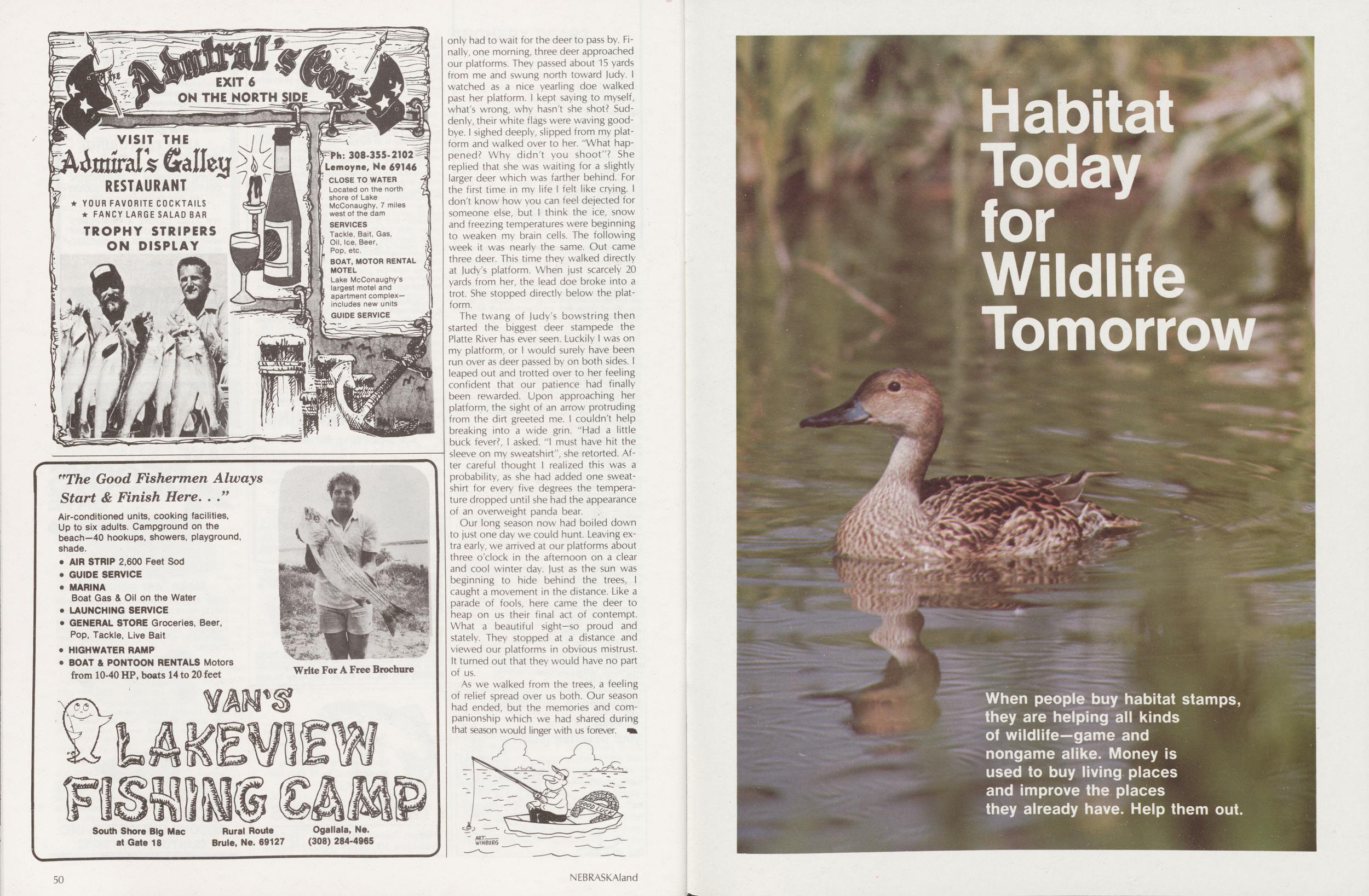
only had to wait for the deer to pass by. Finally, one morning, three deer approached our platforms. They passed about 15 yards from me and swung north toward Judy. I watched as a nice yearling doe walked past her platform. I kept saying to myself, what's wrong, why hasn't she shot? Suddenly, their white flags were waving goodbye. I sighed deeply, slipped from my platform and walked over to her. "What happened? Why didn't you shoot"? She replied that she was waiting for a slightly larger deer which was farther behind. For the first time in my life I felt like crying. I don't know how you can feel dejected for someone else, but I think the ice, snow and freezing temperatures were beginning to weaken my brain cells. The following week it was nearly the same. Out came three deer. This time they walked directly at Judy's platform. When just scarcely 20 yards from her, the lead doe broke into a trot. She stopped directly below the platform.
The twang of Judy's bowstring then started the biggest deer stampede the Platte River has ever seen. Luckily I was on my platform, or I would surely have been run over as deer passed by on both sides. I leaped out and trotted over to her feeling confident that our patience had finally been rewarded. Upon approaching her platform, the sight of an arrow protruding from the dirt greeted me. I couldn't help breaking into a wide grin. "Had a little buck fever?, I asked. "I must have hit the sleeve on my sweatshirt", she retorted. After careful thought I realized this was a probability, as she had added one sweatshirt for every five degrees the temperature dropped until she had the appearance of an overweight panda bear.
Our long season now had boiled down to just one day we could hunt. Leaving extra early, we arrived at our platforms about three o'clock in the afternoon on a clear and cool winter day. Just as the sun was beginning to hide behind the trees, I caught a movement in the distance. Like a parade of fools, here came the deer to heap on us their final act of contempt. What a beautiful sight—so proud and stately. They stopped at a distance and viewed our platforms in obvious mistrust. It turned out that they would have no part of us.
As we walked from the trees, a feeling of relief spread over us both. Our season had ended, but the memories and companionship which we had shared during that season would linger with us forever.
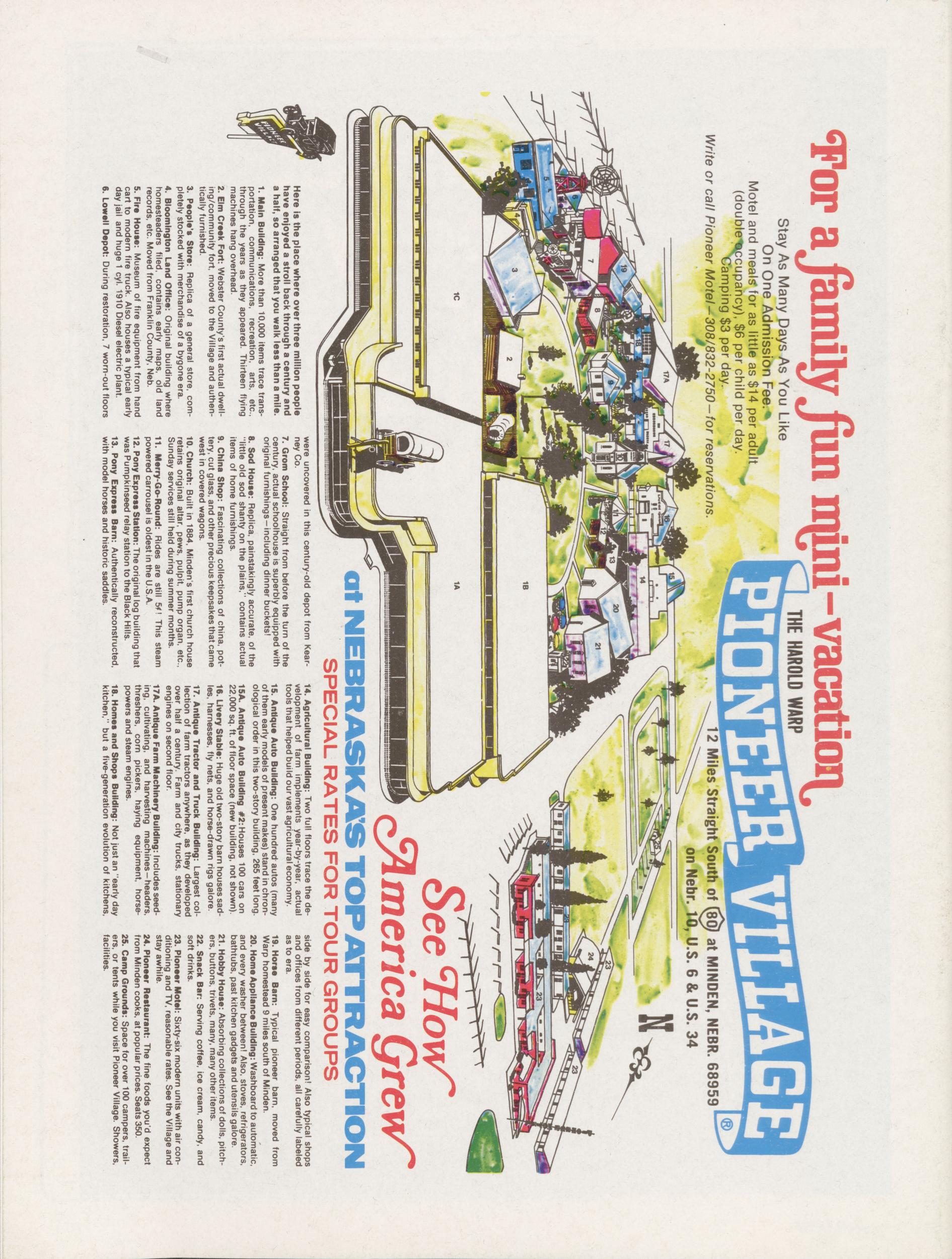
For a family fun mini-vacation
THE HAROLD WARP 21 Stay As Many Days As You Like On One Admission Fee.* Motel and meals for as little as $14 per adult (double^ccupancy), $6 per child per day. * Vamping $3 per day. Write or call Pioneer Motel - 308/832-2750—for reservations. 12 Miles Straight South of (80) at MINDEN, NEBR. 68959 on Nebr. 10, U.S. 6 & U.S. 34 America at NEBRASKA^ TOP ATTRACTION SPECIAL RATES FOR TOUR GROUPS Here is the place where over three million people have enjoyed a stroll back through a century and a half, so arranged that you walk less than a mile. 1. Main Building: More than 10,000 items trace trans- portation, communications, recreation, arts, etc., through the years as they appeared. Thirteen flying machines hang overhead. 2. Elm Creek Fort: Webster County's first actual dwell- ing/community fort, moved to the Village and authen- tically furnished. 3. People's Store: Replica of a general store, com- pletely stocked with merchandise of a bygone era. 4. Bloomington Land Office: Original building where homesteaders filed, contains early maps, old land records, etc. Moved from Franklin County, Neb. 5. Fire House: Museum of fire equipment from hand cart to modern fire truck. Also houses a typical early day jail and huge 1 cyl. 1910 Diesel electric plant. 6. Lowell Depot: During restoration, 7 worn-out floors were uncovered in this century-old depot from Kear- ney Co. 7. Grom School: Straight from before the turn of the century, actual schoolhouse is superbly equipped with original furnishings-including dinner buckets! 8. Sod House: Replica, painstakingly accurate, of the "little old sod shanty on the plains," contains actual items of home furnishings. 9. China Shop: Fascinating collections of china, pot- tery, cut glass, and other precious keepsakes that came west in covered wagons. 10. Church: Built in 1884, Minden’s first church house retains original altar, pews, pulpit, pump organ, etc., Sunday services still held during summer months. 11. Merry-Go-Round: Rides are still 5 This steam powered carrousel is oldest in the U.S.A. 12. Pony Express Station: The original log building that was Pumpkinseed relay station to the Black Hills. 13. Pony Express Barn: Authentically reconstructed, with model horses and historic saddles. 14. Agricultural Building: Two full floors trace the de- velopment of farm implements year-by-year, actual tools that helped build our vast agricultural economy. 15. Antique Auto Building: One hundred autos (many of them early models of present makes) stand in chron- ological order in this two-story building. 265 feet long. 15A. Antique Auto Building #2: Houses 100 cars on 22,000 sq ft. of floor space (new building, not shown). 16. Livery Stable: Huge old two-story barn houses sad- les, harnesses, fly nets, and horse-drawn rigs galore. 17. Antique Tractor and Truck Building: Largest col- lection of farm tractors anywhere, as they developed over half a century. Farm and city trucks, stationary engines on second floor. 17A. Antique Farm Machinery Building: Includes seed- ing, cultivating, and harvesting machines-headers, threshers, corn pickers, haying equipment, horse- powers and steam engines. 18. Home* and Shop* Building: Not just an “early day kitchen,” but a five-generation evolution of kitchens, side by side for easy comparison! Also typical shops and offices from different periods, all carefully labeled as to era. 19. Horse Barn: Typical pioneer barn, moved from Warp homestead 9 miles south of Minden. 20. Home Appliance Building: Washboard to automatic, and every washer between! Also, stoves, refrigerators, bathtubs, past kitchen gadgets and utensils galore. 21. Hobby House: Absorbing collections of dolls, pitch- ers, buttons, trivets, many, many other items. 22. Snack Bar: Serving coffee, ice cream, candy, and soft drinks. 23. Pioneer Motel: Sixty-six modern units with air con- ditioning and TV, reasonable rates. See the Village and stay awhile. 24. Pioneer Restaurant: The fine foods you'd expect from Minden cooks, at popular prices. Seats 350. 25. Camp Grounds: Space for over 100 campers, trail- ers, or tents while you visit Pioneer Village. Showers, facilities.Position: 119 (50 views)