Volume 58, Issue 7, 1980
NEBRASKAland
July 1980 60 cents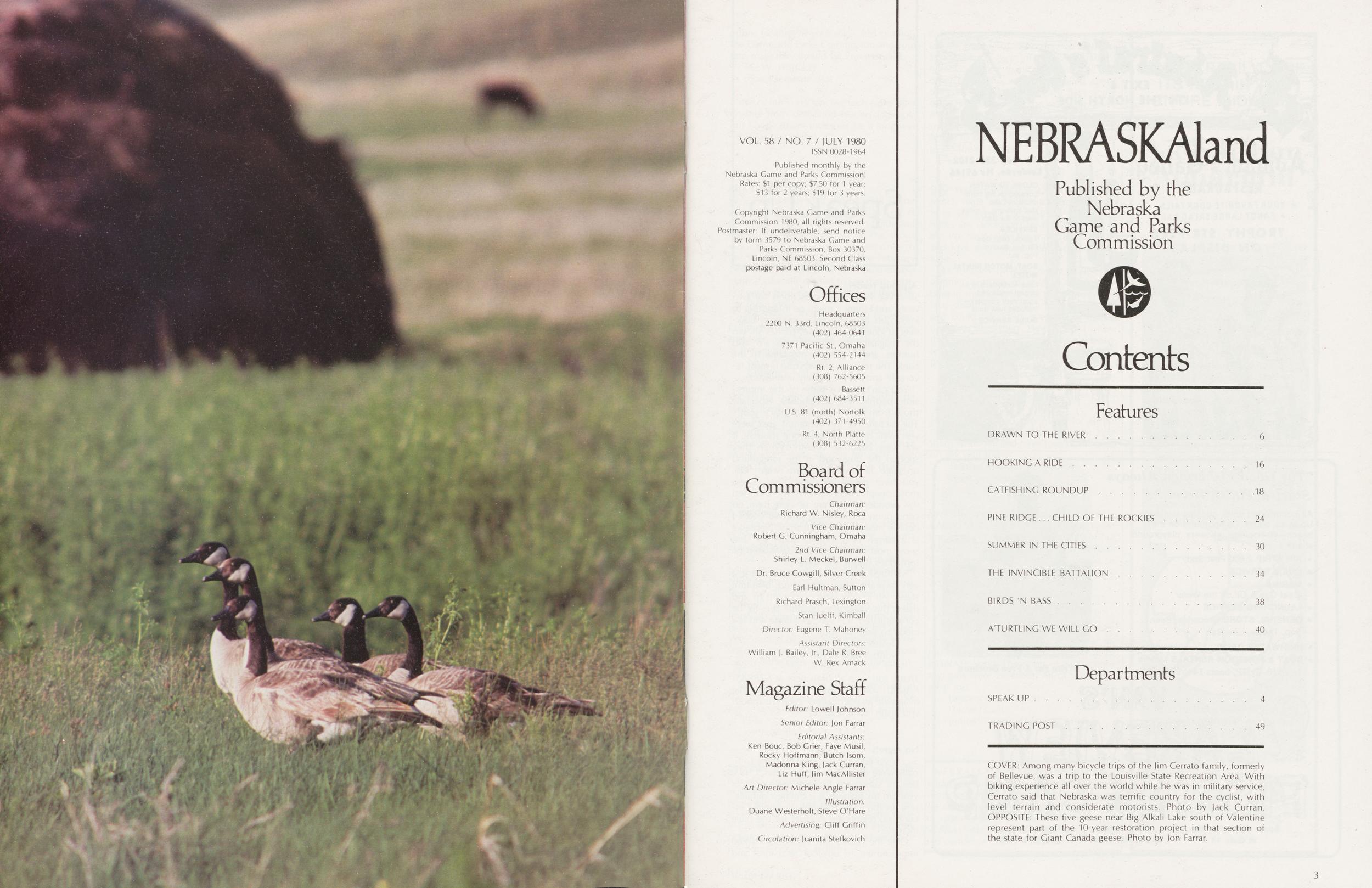
NEBRASKAland
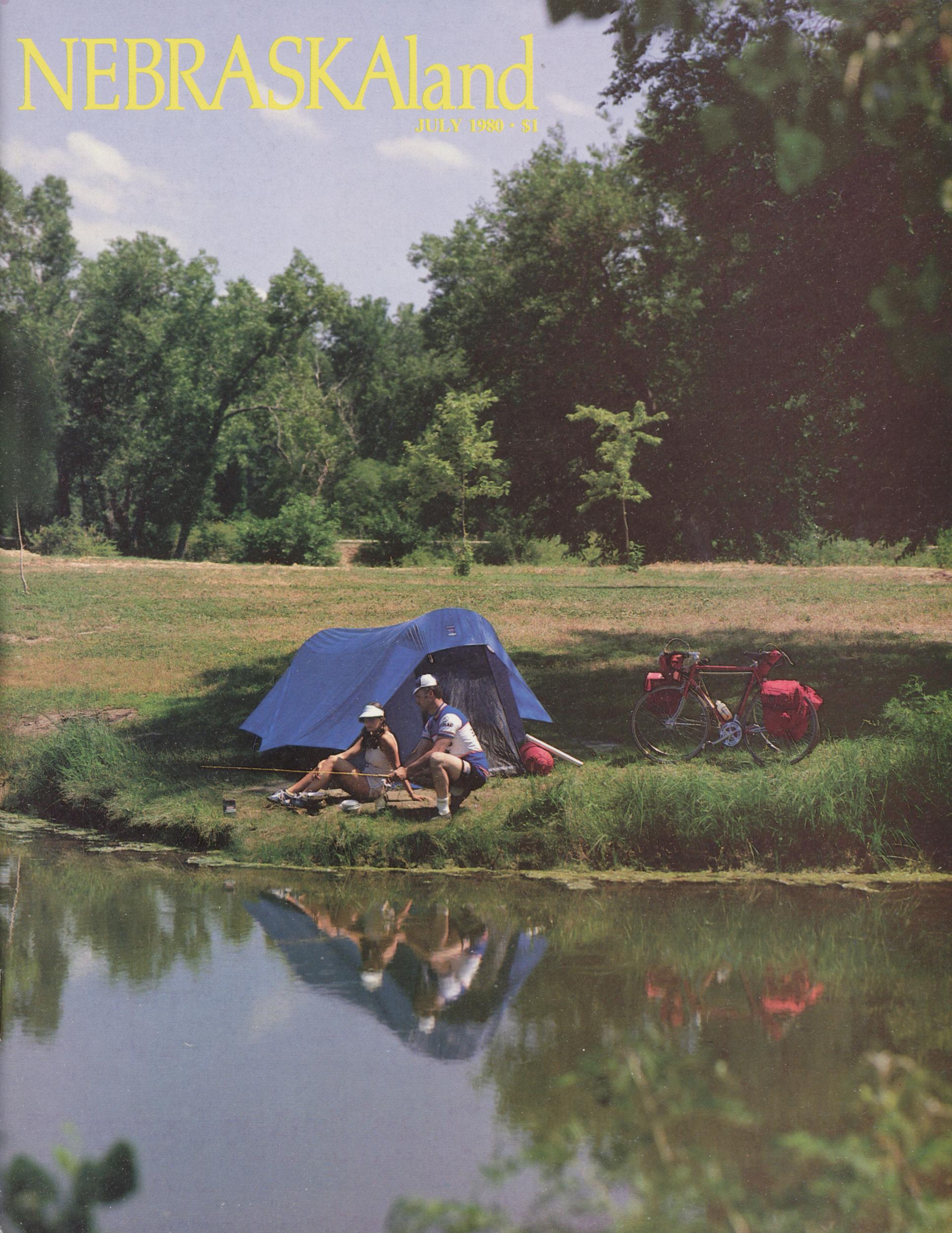
Published by the Nebraska Game and Parks Commission VOL. 58 / NO. 7 / JULY 1980 ISSN :0028-1964 Published monthly by the Nebraska Game and Parks Commission. Rates: $1 per copy; $7.50 for 1 year; $13 for 2 years; $19 for 3 years. Copyright Nebraska Game and Parks Commission 1980, all rights reserved. Postmaster: If undeliverable, send notice by form 3579 to Nebraska Game and Parks Commission, Box 30370, Lincoln, NE 08503. Second Class postage paid at Lincoln, Nebraska Offices Headquarters 2200 N. 3 3rd, Lincoln, 68503 (402) 464-0641 7371 Pacific St., Omaha (402) 554-2144 Rt. 2, Alliance (308) 762-5605 Bassett (402) 684-3511 U.S. 81 (north) Norfolk (402) 371-4950 Rt 4, North Platte (308) 5 32-6225 Board of Commissioners Chairman: Richard W. Nisley, Roca Vice Chairman: Robert G. Cunningham, Omaha 2nd Vice Chairman: Shirley L. Meckel, Burwell Dr. Bruce Cowgill, Silver Creek Earl Hultman, Sutton Richard Prasch, Lexington Stan juelff, Kimball Direr tor: Eugene T. Mahoney Assistant Direr tors: William ). Bailey, )r., Dale R. Bree W. Rex Amack Magazine Staff Editor: Lowell Johnson Senior Editor: Jon Farrar Editorial Assistants: Ken Bouc, Bob Grier, Faye Musil, Rocky Hoffmann, Butch Isom, Madonna King, Jack Curran, Liz Huff, Jim MacAllister Art Director: Michele Angle Farrar Illustration: Duane Westerholt, Steve O'Hare Advertising: Cliff Griffin Circulation: Juanita Stefkovich Contents Features DRAWN TO THE RIVER 6 HOOKING A RIDE 16 CATFISHING ROUNDUP 18 PINE RIDGE. . CHILD OF THE ROCKIES 24 SUMMER IN THE CITIES 30 THE INVINCIBLE BATTALION 34 BIRDS 'N BASS 38 ATURTLING WE WILL GO 40 Departments SPEAK UP 4 TRADING POST 49 COVER: Among many bicycle trips of the Jim Cerrato family, formerly of Bellevue, was a trip to the Louisville State Recreation Area. With biking experience all over the world while he was in military service, Cerrato said that Nebraska was terrific country for the cyclist, with level terrain and considerate motorists. Photo by Jack Curran. OPPOSITE: These five geese near Big Alkali Lake south of Valentine represent part of the 10-year restoration project in that section of the state for Giant Canada geese. Photo by Jon Farrar. 3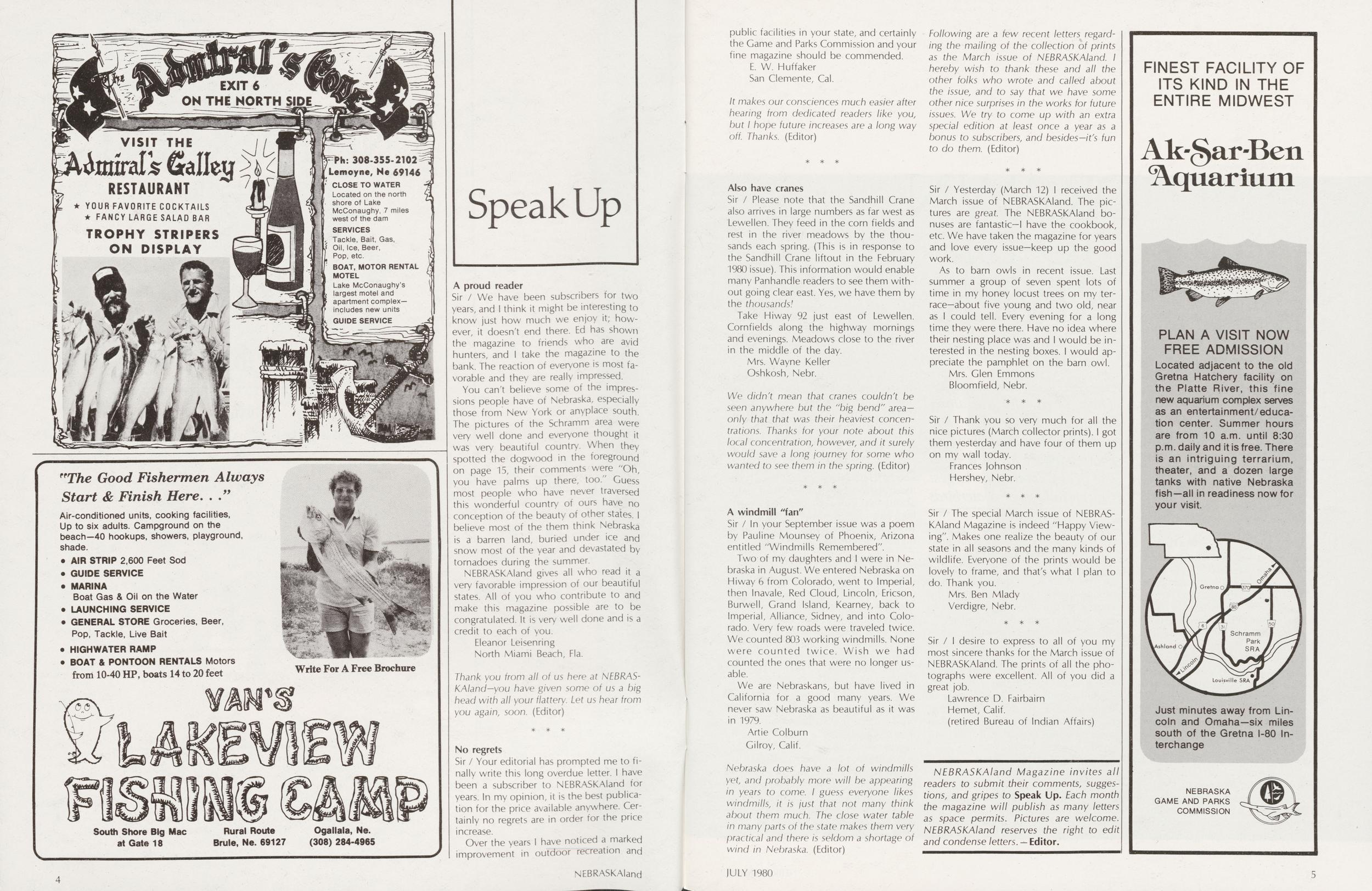
Speak Up
A proud readerSir / We have been subscribers for two years, and I think it might be interesting to know just how much we enjoy it; however, it doesn't end there. Ed has shown the magazine to friends who are avid hunters, and I take the magazine to the bank. The reaction of everyone is most favorable and they are really impressed.
You can't believe some of the impressions people have of Nebraska, especially those from New York or anyplace south. The pictures of the Schramm area were very well done and everyone thought it was very beautiful country. When they spotted the dogwood in the foreground on page 15, their comments were "Oh, you have palms up there, too." Guess most people who have never traversed this wonderful country of ours have no conception of the beauty of other states. I believe most of the them think Nebraska is a barren land, buried under ice and snow most of the year and devastated by tornadoes during the summer.
NEBRASKAland gives all who read it a very favorable impression of our beautiful states. All of you who contribute to and make this magazine possible are to be congratulated. It is very well done and is a credit to each of you.
Eleanor Eeisenring North Miami Beach, Fla.Thank you from all of us here at NEBRASKAland—you have given some of us a big head with all your flattery. Let us hear from you again, soon. (Editor)
* * * No regretsSir / Your editorial has prompted me to finally write this long overdue letter. I have been a subscriber to NEBRASKAland for years. In my opinion, it is the best publication for the price available anywhere. Certainly no regrets are in order for the price increase.
Over the years I have noticed a marked improvement in outdoor recreation and public facilities in your state, and certainly the Game and Parks Commission and your fine magazine should be commended.
E. W. Huffaker San Clemente, Cal.It makes our consciences much easier after hearing from dedicated readers like you, but I hope future increases are a long way off. Thanks. (Editor)
* * * Also have cranesSir / Please note that the Sandhill Crane also arrives in large numbers as far west as Lewellen. They feed in the corn fields and rest in the river meadows by the thousands each spring. (This is in response to the Sandhill Crane liftout in the February 1980 issue). This information would enable many Panhandle readers to see them without going clear east. Yes, we have them by the thousands!
Take Hiway 92 just east of Lewellen. Cornfields along the highway mornings and evenings. Meadows close to the river in the middle of the day.
Mrs. Wayne Keller Oshkosh, Nebr.We didn't mean that cranes couldn't be seen anywhere but the "big bend" area-only that that was their heaviest concentrations. Thanks for your note about this local concentration, however, and it surely would save a long journey for some who wanted to see them in the spring. (Editor)
* * * A windmill "fan"Sir / In your September issue was a poem by Pauline Mounsey of Phoenix, Arizona entitled "Windmills Remembered".
Two of my daughters and I were in Nebraska in August. We entered Nebraska on Hiway 6 from Colorado, went to Imperial, then Inavale, Red Cloud, Lincoln, Ericson, Burwell, Grand Island, Kearney, back to Imperial, Alliance, Sidney, and into Colorado. Very few roads were traveled twice.
We counted 803 working windmills. None were counted twice. Wish we had counted the ones that were no longer usable. We are Nebraskans, but have lived in California for a good many years. We never saw Nebraska as beautiful as it was in 1979.
Artie Colburn Gilroy, Calif.Nehjraska does have a lot of windmills yet, and probably more will be appearing in years to come. I guess everyone likes windmills, it is just that not many think about them much. The close water table in many parts of the state makes them very practical and there is seldom a shortage of wind in Nebraska. (Editor)
* * * Following are a few recent letters regarding the mailing of the collection of prints as the March issue of NEBRASKAland. I hereby wish to thank these and all the other folks who wrote and called about the issue, and to say that we have some other nice surprises in the works for future issues. We try to come up with an extra special edition at least once a year as a bonus to subscribers, and besides-it's fun to do them. (Editor) * * *Sir / Yesterday (March 12) I received the March issue of NEBRASKAland. The pictures are great. The NEBRASKAland bonuses are fantastic-l have the cookbook, etc. We have taken the magazine for years and love every issue—keep up the good work.
As to barn owls in recent issue. Last summer a group of seven spent lots of time in my honey locust trees on my terrace-about five young and two old, near as I could tell. Every evening for a long time they were there. Have no idea where their nesting place was and I would be interested in the nesting boxes. I would appreciate the pamphlet on the barn owl.
Mrs. Glen Emmons Bloomfield, Nebr. * * *Sir / Thank you so very much for all the nice pictures (March collector prints). I got them yesterday and have four of them up on my wall today.
Frances Johnson Hershey, Nebr. * * *Sir / The special March issue of NEBRASKAland Magazine is indeed "Happy Viewing". Makes one realize the beauty of our state in all seasons and the many kinds of wildlife. Everyone of the prints would be lovely to frame, and that's what I plan to do. Thank you.
Mrs. Ben Mlady Verdigre, Nebr. * * *Sir / I desire to express to all of you my most sincere thanks for the March issue of NEBRASKAland. The prints of all the photographs were excellent. All of you did a great job.
Lawrence D. Fairbairn Hemet, Calif. (retired Bureau of Indian Affairs)NEBRASKAland Magazine invites all readers to submit their comments, suggestions, and gripes to Speak Up. Each month the magazine will publish as many letters as space permits. Pictures are welcome. NEBRASKAIand reserves the right to edit and condense letters. — Editor.
FINEST FACILITY OF ITS KIND IN THE ENTIRE MIDWEST Ak-§ar-Ben Aquarium
Located adjacent to the old Gretna Hatchery facility on the Platte River, this fine new aquarium complex serves as an entertainment/education center. Summer hours are from 10 a.m. until 8:30 p.m. daily and it is free. There is an intriguing terrarium, theater, and a dozen large tanks with native Nebraska fish—all in readiness now for your visit.
Just minutes away from Lincoln and Omaha—six miles south of the Gretna I-80 Interchange
NEBRASKA GAME AND PARKS COMMISSION NEBRASKAland JULY 1980 5
DRAWN TO THE RIVER
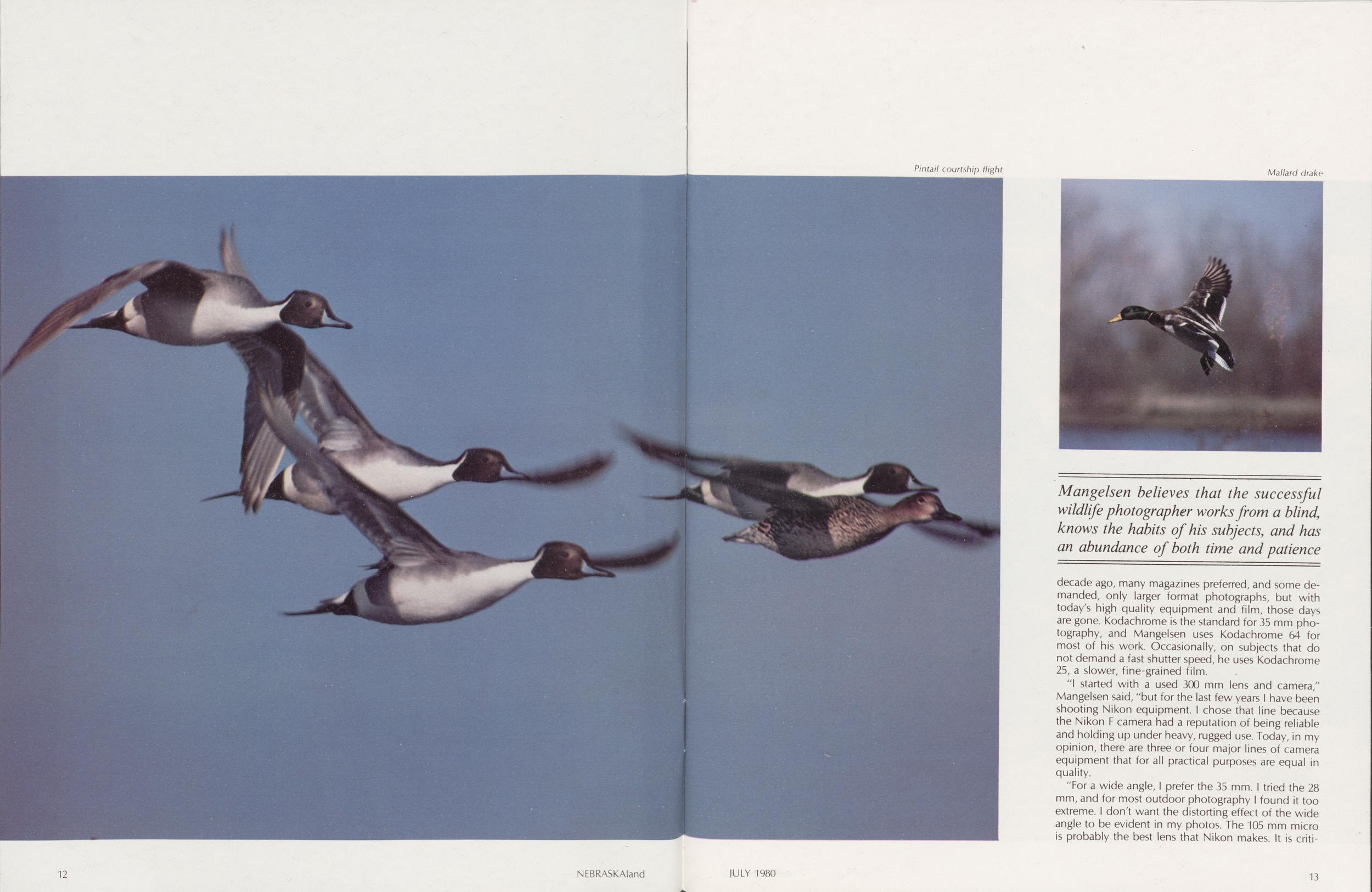
PHOTOGRAPHS BY TOM MANGELSENSPRING ON THE PLATTE. That combination of time and place has a mystical attraction for waterbirds and those who know waterbirds. Both are drawn to the Big Bend of the Platte for there is no other river quite like it in March. When the whitefronts and Canadas, mallards and pintails, and the sandhill cranes pause on the river's sandbars and shallows before following the opening water north to the breeding grounds, you can count on Tom Mangelsen, camera in hand, returning too.
Mangelsen was born in Nebraska, graduated with a B.A. in biology from Doane College, and did graduate work in zoology at the University of Nebraska. It was at the university that he studied under Paul Johnsgard, one of the country's leading authorities on waterfowl, and the two traveled together to the western coastline of Canada to photograph and study sea ducks. Since then, Mangelsen has returned to Alaska, and photographed in Canada, Mexico and most of the western United States. Today he lives in Moose, Wyoming, but each spring, as surely as cranes will labor into late winter storms to reach the Platte, so will Mangelsen return.
"I don't think I have seen any place in my travels where the opportunity for bird photography is better than on the Platte in the spring," Mangelsen said. "There is nothing that compares with the tremendous concentrations of waterbirds. I've photographed on the Yukon-Kuskokwim Delta on the coast of Alaska. It is one of the major nesting areas for sandhill cranes on the continent, but they are nowhere as concentrated as on the Platte."
Those of us who live along the Platte River often take it for granted, but wildlife photographers know it hosts one of the continent's largest concentrations of waterbirdsWhen photographing on the Platte, Mangelsen works out of the family's cabin near Wood River and uses nearby duck blinds for concealment. The birds are accustomed to the hunting blinds, and with a new dressing of willows and brush, they serve well for his nonconsumptive" use. A few decoys encourage the ducks and geese.
Even with such an ideal arrangement there are frequent disappointments and days of long hours waiting—for birds to work within range and for the right light. One of the most difficult crane photographs to make is of the birds on their river roosts. Typically, the cranes leave the river each morning before sunrise and do not return until after sunset. Mangelsen said he has probably spent 40 or 50 mornings in the blind, often sleeping in it overnight in hopes of catching cranes that lingered until there was enough light to photograph. Of all those attempts, he has been successful about five times. The photo shown here (see page 9) was an evening shot, when a small flock returned 10 or 15 minutes before sunset.
Concern for the PlattePerhaps, because Mangelsen has followed waterbirds up and down the continent from their wintering grounds along the Gulf of Mexico to their breeding grounds in the Arctic tundra, he has a broader view of the Platte's importance.
"I'm concerned about the changes taking place on the Platte and how they will affect it as a gathering place for waterbirds. I don't think most Nebraskans realize the importance of this river because they live so close to it. People along the Platte, or those who make the annual pilgrimage to see or photograph the birds, have the feeling that this gathering of cranes, geese and ducks is ane everyday occurence in the spring. We all expect the birds to return each spring.
6 NEBRASKAland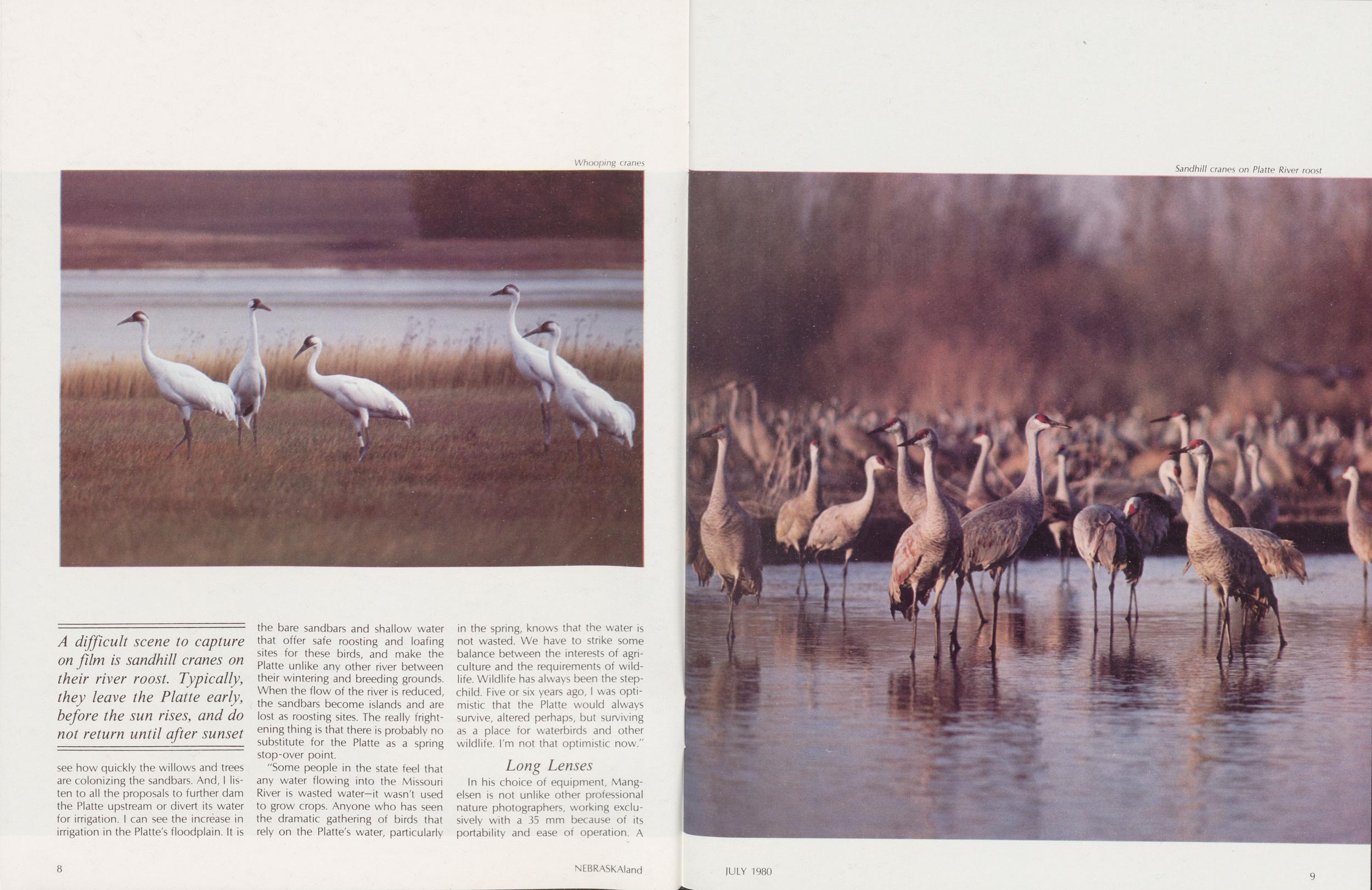
"Every year when I come back, I can see how quickly the willows and trees are colonizing the sandbars. And, I listen to all the proposals to further dam the Platte upstream or divert its water for irrigation. I can see the increase in irrigation in the Platte's floodplain. It is the bare sandbars and shallow water that offer safe roosting and loafing sites for these birds, and make the Platte unlike any other river between their wintering and breeding grounds. When the flow of the river is reduced, the sandbars become islands and are lost as roosting sites. The really frightening thing is that there is probably no substitute for the Platte as a spring stop-over point.
"Some people in the state feel that any water flowing into the Missouri River is wasted water-it wasn't used to grow crops. Anyone who has seen the dramatic gathering of birds that rely on the Platte's water, particularly in the spring, knows that the water is not wasted. We have to strike some balance between the interests of agriculture and the requirements of wildlife. Wildlife has always been the stepchild. Five or six years ago, I was optimistic that the Platte would always survive, altered perhaps, but surviving as a place for waterbirds and other wildlife. I'm not that optimistic now."
Long Lenses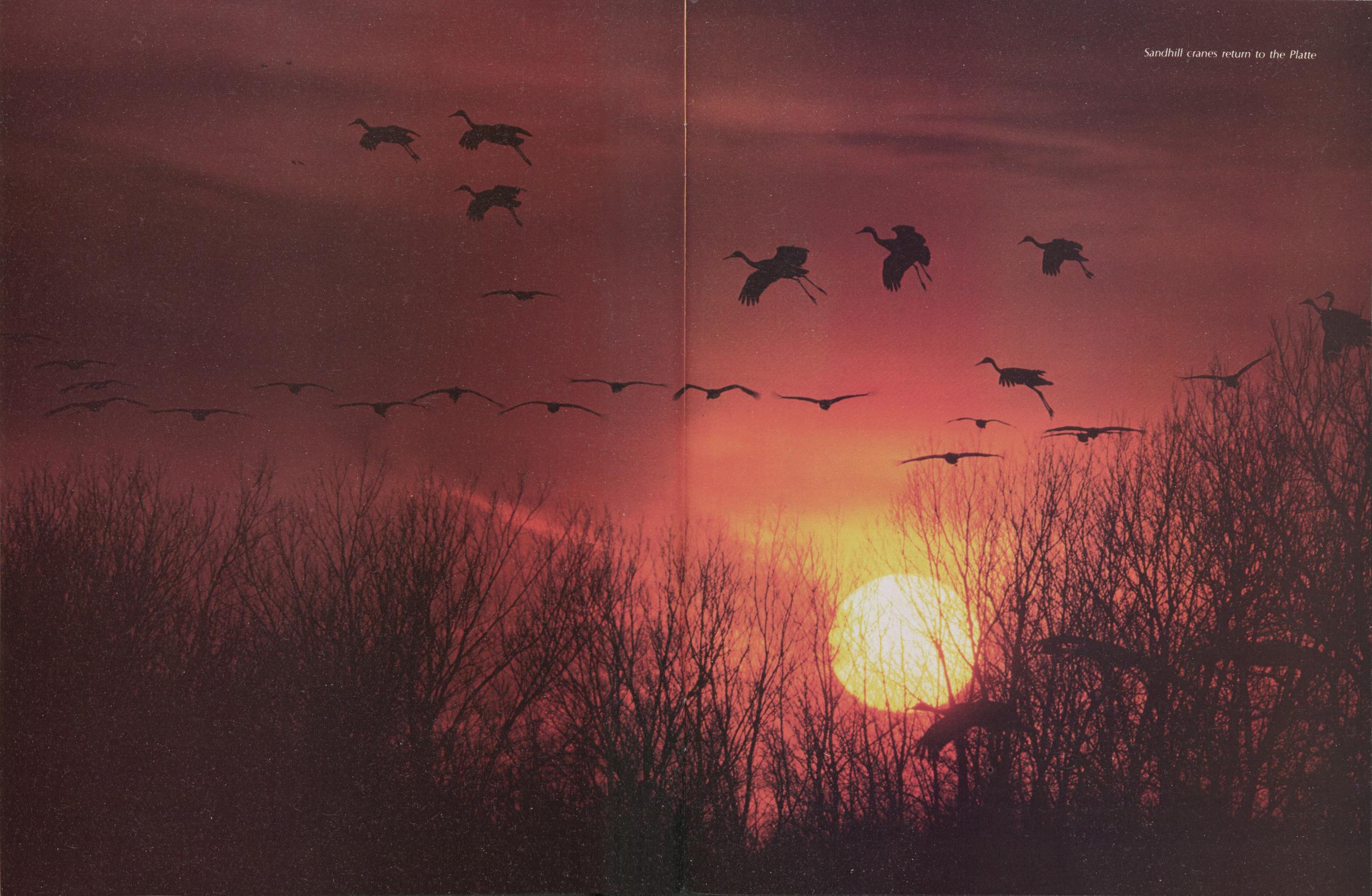
In his choice of equipment, Mangelsen is not unlike other professional nature photographers, working exclusively with a 35 mm because of its portability and ease of operation. A decade ago, many magazines preferred, and some demanded, only larger format photographs, but with today's high quality equipment and film, those days are gone. Kodachrome is the standard for 35 mm photography, and Mangelsen uses Kodachrome 64 for most of his work. Occasionally, on subjects that do not demand a fast shutter speed, he uses Kodachrome 25, a slower, fine-grained film.
"I started with a used 300 mm lens and camera," Mangelsen said, "but for the last few years I have been shooting Nikon equipment. I chose that line because the Nikon F camera had a reputation of being reliable and holding up under heavy, rugged use. Today, in my opinion, there are three or four major lines of camera equipment that for all practical purposes are equal in quality.
"For a wide angle, I prefer the 35 mm. I tried the 28 mm, and for most outdoor photography I found it too extreme. I don't want the distorting effect of the wide angle to be evident in my photos. The 105 mm micro is probably the best lens that Nikon makes. It is critically sharp. I also use the 55 micro for close-up work, and it doubles nicely as a normal lens. But, the 300 mm and 400 mm telephotos are probably the two I use most. I have a tele-extender that doubles the focal length of these lenses, but seldom use it because it demands the use of a tripod, and the way I photograph usually doesn't permit carrying one along."
JULY 1980 13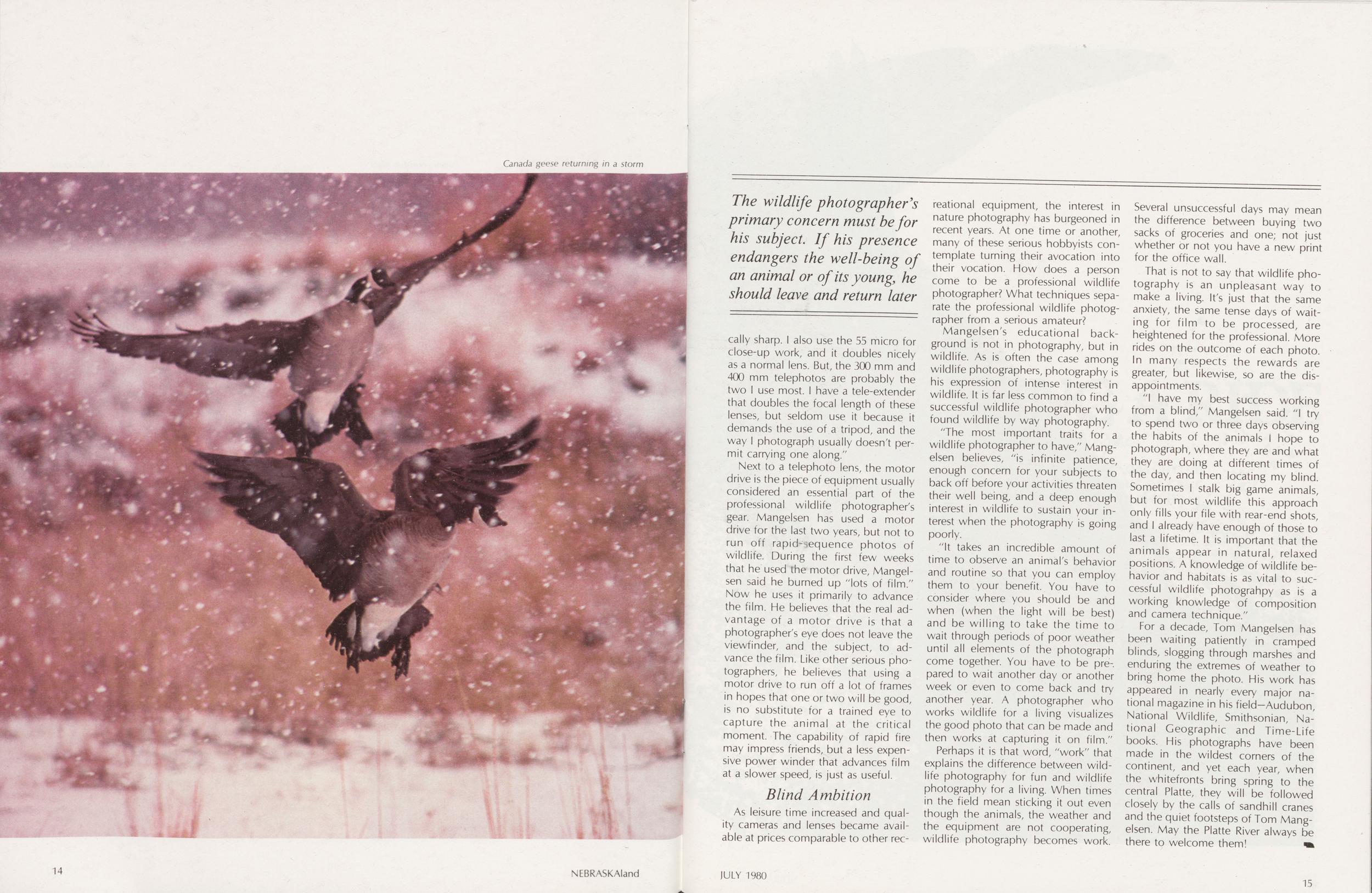
Next to a telephoto lens, the motor drive is the piece of equipment usually considered an essential part of the professional wildlife photographer's gear. Mangelsen has used a motor drive for the last two years, but not to run off rapid-sequence photos of wildlife. During the first few weeks that he used the motor drive, Mangelsen said he burned up "lots of film." Now he uses it primarily to advance the film. He believes that the real advantage of a motor drive is that a photographer's eye does not leave the viewfinder, and the subject, to advance the film. Like other serious photographers, he believes that using a motor drive to run off a lot of frames in hopes that one or two will be good, is no substitute for a trained eye to capture the animal at the critical moment. The capability of rapid fire may impress friends, but a less expensive power winder that advances film at a slower speed, is just as useful.
Blind AmbitionAs leisure time increased and quality cameras and lenses became avail- able at prices comparable to other recreational equipment, the interest in nature photography has burgeoned in recent years. At one time or another, many of these serious hobbyists contemplate turning their avocation into their vocation. How does a person come to be a professional wildlife photographer? What techniques separate the professional wildlife photographer from a serious amateur?
Mangelsen's educational background is not in photography, but in wildlife. As is often the case among wildlife photographers, photography is his expression of intense interest in wildlife. It is far less common to find a successful wildlife photographer who found wildlife by way photography.
"The most important traits for a wildlife photographer to have," Mangelsen believes, "is infinite patience, enough concern for your subjects to back off before your activities threaten their well being, and a deep enough interest in wildlife to sustain your interest when the photography is going poorly.
"It takes an incredible amount of time to observe an animal's behavior and routine so that you can employ them to your benefit. You have to consider where you should be and when (when the light will be best) and be willing to take the time to wait through periods of poor weather until all elements of the photograph come together. You have to be prepared to wait another day or another week or even to come back and try another year. A photographer who works wildlife for a living visualizes the good photo that can be made and then works at capturing it on film."
Perhaps it is that word, "work" that explains the difference between wildlife photography for fun and wildlife photography for a living. When times in the field mean sticking it out even though the animals, the weather and the equipment are not cooperating, wildlife photography becomes work. Several unsuccessful days may mean the difference between buying two sacks of groceries and one; not just whether or not you have a new print for the office wall.
That is not to say that wildlife photography is an unpleasant way to make a living. It's just that the same anxiety, the same tense days of waiting for film to be processed, are heightened for the professional. More rides on the outcome of each photo. In many respects the rewards are greater, but likewise, so are the disappointments.
"I have my best success working from a blind," Mangelsen said. "I try to spend two or three days observing the habits of the animals I hope to photograph, where they are and what they are doing at different times of the day, and then locating my blind. Sometimes I stalk big game animals, but for most wildlife this approach only fills your file with rear-end shots, and I already have enough of those to last a lifetime. It is important that the animals appear in natural, relaxed positions. A knowledge of wildlife behavior and habitats is as vital to successful wildlife photograhpy as is a working knowledge of composition and camera technique."
For a decade, Tom Mangelsen has been waiting patiently in cramped blinds, slogging through marshes and enduring the extremes of weather to bring home the photo. His work has appeared in nearly every major national magazine in his field—Audubon, National Wildlife, Smithsonian, National Geographic and Time-Life books. His photographs have been made in the wildest corners of the continent, and yet each year, when the whitefronts bring spring to the central Platte, they will be followed closely by the calls of sandhill cranes and the quiet footsteps of Tom Mangelsen. May the Platte River always be there to welcome them!
JULY 1980 15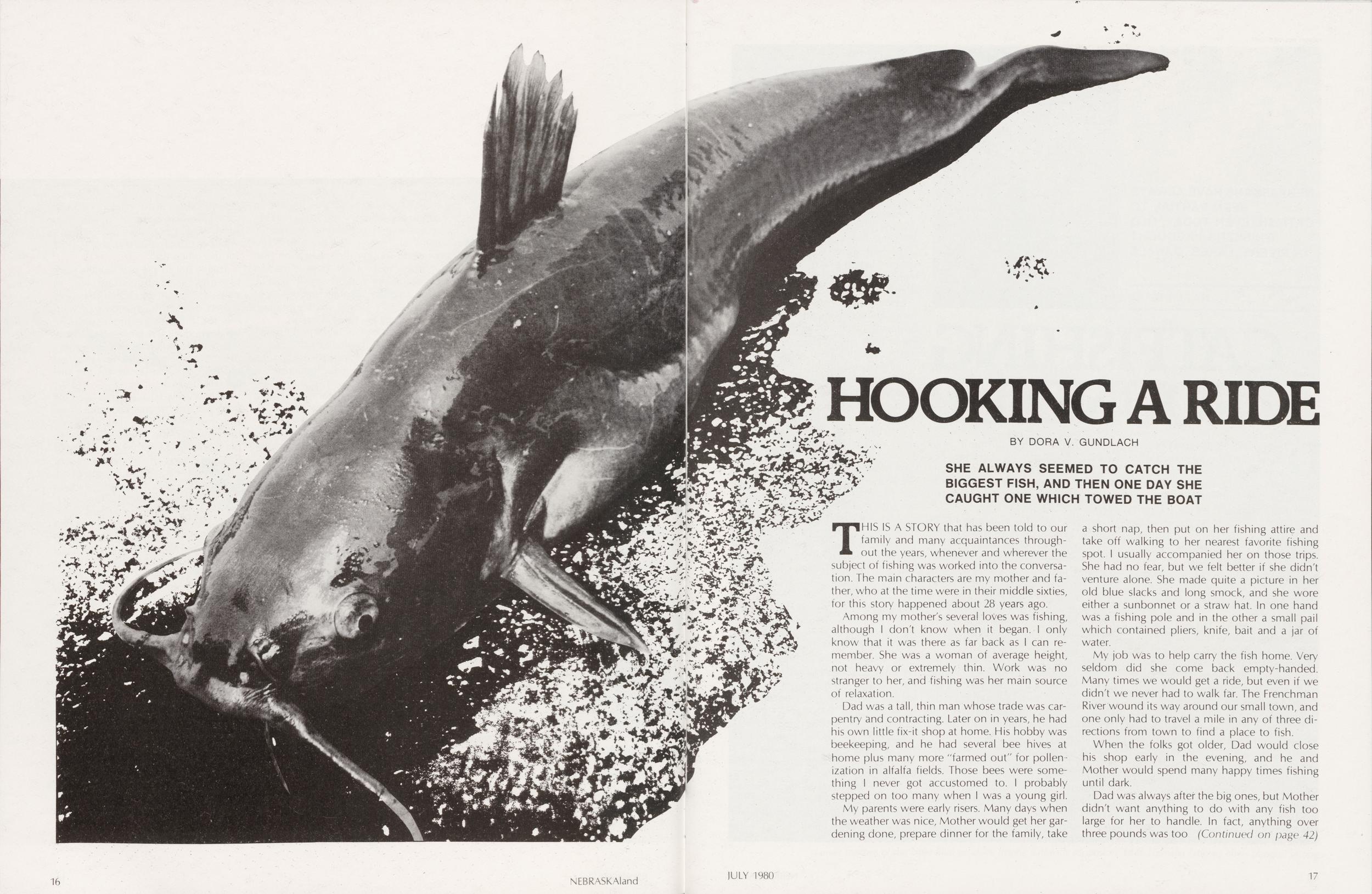
HOOKING A RIDE
BY DORA V. GUNDLACH SHE ALWAYS SEEMED TO CATCH THE BIGGEST FISH, AND THEN ONE DAY SHE CAUGHT ONE WHICH TOWED THE BOATTHIS IS A STORY that has been told to our family and many acquaintances throughout the years, whenever and wherever the subject of fishing was worked into the conversation. The main characters are my mother and father, who at the time were in their middle sixties, for this story happened about 28 years ago.
Among my mother's several loves was fishing, although I don't know when it began. I only know that it was there as far back as I can remember. She was a woman of average height, not heavy or extremely thin. Work was no stranger to her, and fishing was her main source of relaxation.
Dad was a tall, thin man whose trade was carpentry and contracting. Later on in years, he had his own little fix-it shop at home. His hobby was beekeeping, and he had several bee hives at home plus many more "farmed out" for pollenization in alfalfa fields. Those bees were something I never got accustomed to. I probably stepped on too many when I was a young girl.
My parents were early risers. Many days when the weather was nice, Mother would get her gardening done, prepare dinner for the family, take a short nap, then put on her fishing attire and take off walking to her nearest favorite fishing spot. I usually accompanied her on those trips. She had no fear, but we felt better if she didn't venture alone. She made quite a picture in her old blue slacks and long smock, and she wore either a sunbonnet or a straw hat. In one hand was a fishing pole and in the other a small pail which contained pliers, knife, bait and a jar of water.
My job was to help carry the fish home. Very seldom did she come back empty-handed. Many times we would get a ride, but even if we didn't we never had to walk far. The Frenchman River wound its way around our small town, and one only had to travel a mile in any of three directions from town to find a place to fish.
When the folks got older, Dad would close his shop early in the evening, and he and Mother would spend many happy times fishing until dark.
Dad was always after the big ones, but Mother didn't want anything to do with any fish too large for her to handle. In fact, anything over three pounds was too (Continued on page 42)
JULY 1980 17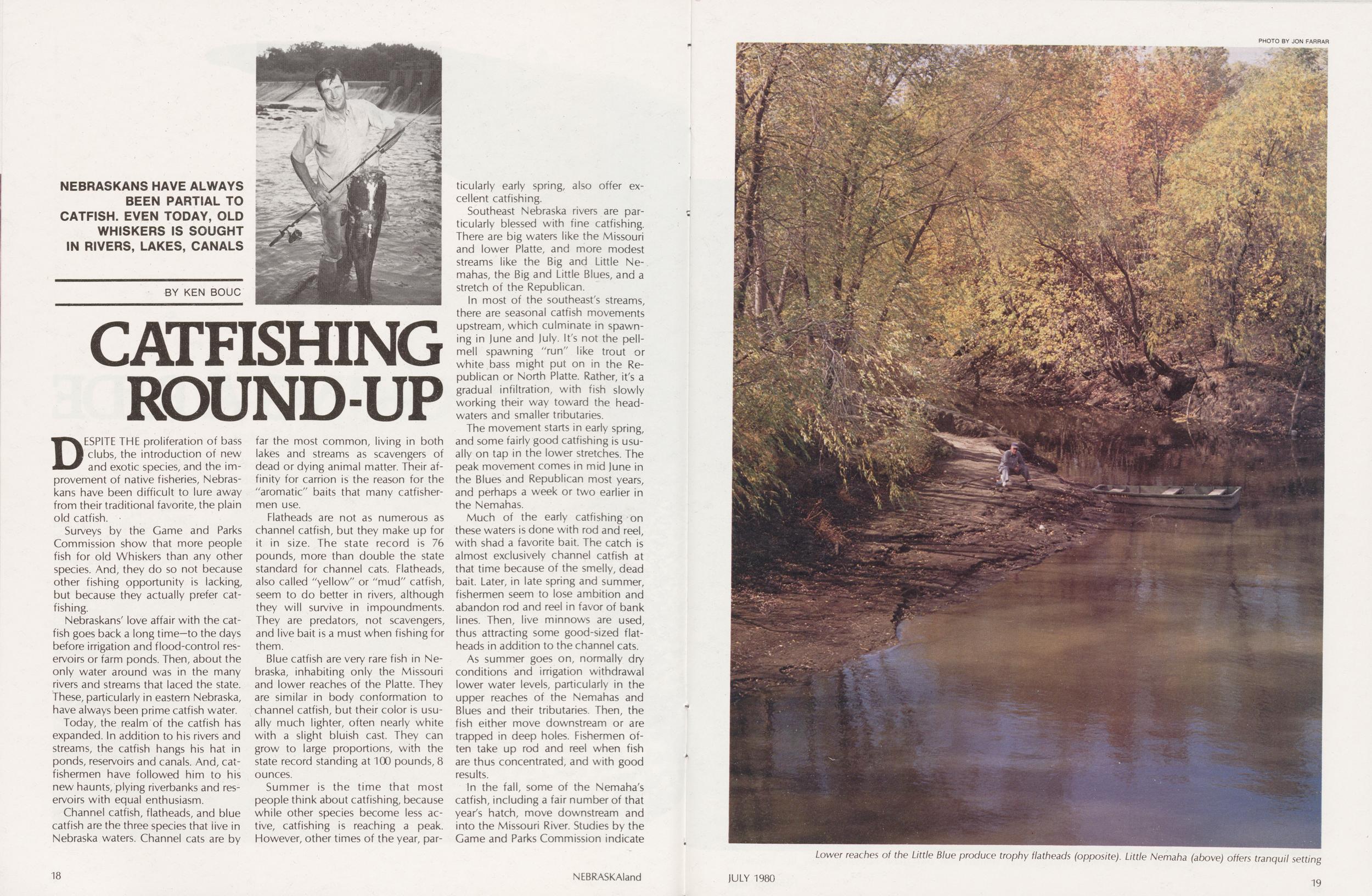
CATFISHING ROUND-UP
NEBRASKANS HAVE ALWAYS BEEN PARTIAL TO CATFISH. EVEN TODAY, OLD WHISKERS IS SOUGHT IN RIVERS, LAKES, CANALS BY KEN BOUCDESPITE THE proliferation of bass clubs, the introduction of new and exotic species, and the improvement of native fisheries, Nebraskans have been difficult to lure away from their traditional favorite, the plain old catfish.
Surveys by the Game and Parks Commission show that more people fish for old Whiskers than any other species. And, they do so not because other fishing opportunity is lacking, but because they actually prefer catfishing.
Nebraskans' love affair with the catfish goes back a long time—to the days before irrigation and flood-control reservoirs or farm ponds. Then, about the only water around was in the many rivers and streams that laced the state. These, particularly in eastern Nebraska, have always been prime catfish water.
Today, the realm of the catfish has expanded. In addition to his rivers and streams, the catfish hangs his hat in ponds, reservoirs and canals. And, catfishermen have followed him to his new haunts/plying riverbanks and reservoirs with equal enthusiasm.
Channel catfish, flatheads, and blue catfish are the three species that live in Nebraska waters. Channel cats are by far the most common, living in both lakes and streams as scavengers of dead or dying animal matter. Their affinity for carrion is the reason for the "aromatic" baits that many catfishermen use.
Flatheads are not as numerous as channel catfish, but they make up for it in size. The state record is 76 pounds, more than double the state standard for channel cats. Flatheads, also called "yellow" or "mud" catfish, seem to do better in rivers, although they will survive in impoundments. They are predators, not scavengers, and live bait is a must when fishing for them.
Blue catfish are very rare fish in Nebraska, inhabiting only the Missouri and lower reaches of the Platte. They are similar in body conformation to channel catfish, but their color is usually much lighter, often nearly white with a slight bluish cast. They can grow to large proportions, with the state record standing at 100 pounds, 8 ounces.
Summer is the time that most people think about catfishing, because while other species become less active, catfishing is reaching a peak. However, other times of the year, particularly early spring, also offer excellent catfishing.
Southeast Nebraska rivers are particularly blessed with fine catfishing. There are big waters like the Missouri and lower Platte, and more modest streams like the Big and Little Nemahas, the Big and Little Blues, and a stretch of the Republican.
In most of the southeast's streams, there are seasonal catfish movements upstream, which culminate in spawning in June and July. It's not the pellmell spawning "run" like trout or white bass might put on in the Republican or North Platte. Rather, it's a gradual infiltration, with fish slowly working their way toward the headwaters and smaller tributaries.
The movement starts in early spring, and some fairly good catfishing is usually on tap in the lower stretches. The peak movement comes in mid June in the Blues and Republican most years, and perhaps a week or two earlier in the Nemahas.
Much of the early catfishing on these waters is done with rod and reel, with shad a favorite bait. The catch is almost exclusively channel catfish at that time because of the smelly, dead bait. Later, in late spring and summer, fishermen seem to lose ambition and abandon rod and reel in favor of bank lines. Then, live minnows are used, thus attracting some good-sized flatheads in addition to the channel cats.
As summer goes on, normally dry conditions and irrigation withdrawal lower water levels, particularly in the upper reaches of the Nemahas and Blues and their tributaries. Then, the fish either move downstream or are trapped in deep holes. Fishermen often take up rod and reel when fish are thus concentrated, and with good results.
In the fall, some of the Nemaha's catfish, including a fair number of that year's hatch, move downstream and into the Missouri River. Studies by the Game and Parks Commission indicate that the Nemahas serve as nurseries for the Missouri, and it's likely that other tributaries do likewise.
18 NEBRASKAland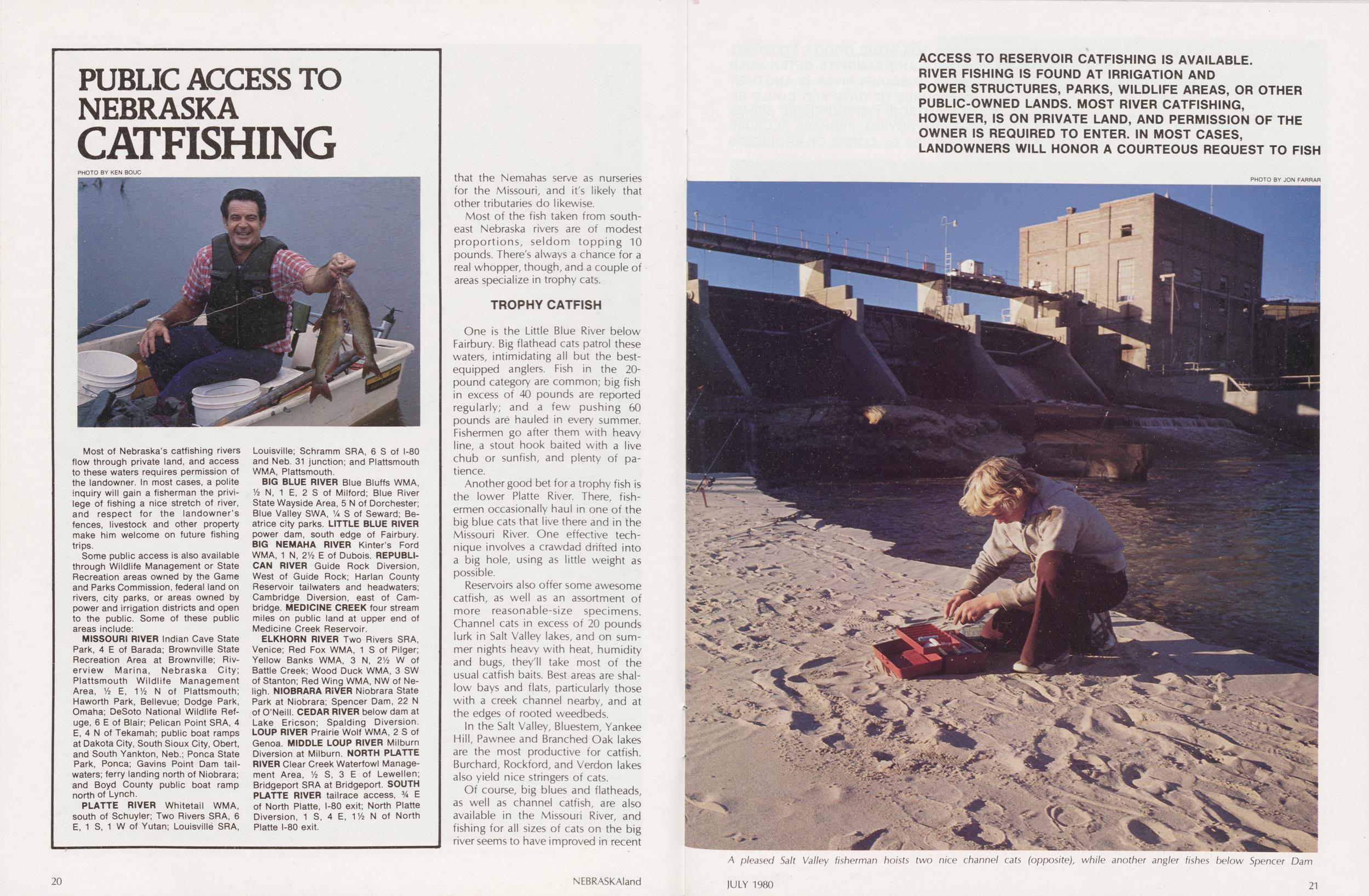
Most of the fish taken from southeast Nebraska rivers are of modest proportions, seldom topping 10 pounds. There's always a chance for a real whopper, though, and a couple of areas specialize in trophy cats.
PUBLIC ACCESS TO NEBRASKA CATFISHINGMost of Nebraska's catfishing rivers flow through private land, and access to these waters requires permission of the landowner. In most cases, a polite inquiry will gain a fisherman the privilege of fishing a nice stretch of river, and respect for the landowner's fences, livestock and other property make him welcome on future fishing trips.
Some public access is also available through Wildlife Management or State Recreation areas owned by the Game and Parks Commission, federal land on rivers, city parks, or areas owned by power and irrigation districts and open to the public. Some of these public areas include:
MISSOURI RIVER Indian Cave State Park, 4 E of Barada; Brownville State Recreation Area at Brownville; Riverview Marina, Nebraska City; Plattsmouth Wildlife Management Area, ½ E, 1½ N of Plattsmouth; Haworth Park, Bellevue; Dodge Park, Omaha; DeSoto National Wildlife Refuge, 6 E of Blair; Pelican Point SRA, 4 E, 4 N of Tekamah; public boat ramps at Dakota City, South Sioux City, Obert, and South Yankton, Neb.; Ponca State Park, Ponca; Gavins Point Dam tailwaters; ferry landing north of Niobrara; and Boyd County public boat ramp north of Lynch.
PLATTE RIVER Whitetail WMA, south of Schuyler; Two Rivers SRA, 6 E, 1 S, 1 W of Yutan; Louisville SRA, Louisville; Schramm SRA, 6 S of I-80 and Neb. 31 junction; and Plattsmouth WMA, Plattsmouth.
BIG BLUE RIVER Blue Bluffs WMA, ½ N, 1 E, 2 S of Milford; Blue River State Wayside Area, 5 N of Dorchester; Blue Valley SWA, ¼ S of Seward; Beatrice city parks. LITTLE BLUE RIVER power dam, south edge of Fairbury. BIG NEMAHA RIVER Kinter's Ford WMA, 1 N, 2½ E of Dubois. REPUBLICAN RIVER Guide Rock Diversion, West of Guide Rock; Harlan County Reservoir tailwaters and headwaters; Cambridge Diversion, east of Cambridge. MEDICINE CREEK four stream miles on public land at upper end of Medicine Creek Reservoir.
ELKHORN RIVER Two Rivers SRA, Venice; Red Fox WMA, 1 S of Pilger; Yellow Banks WMA, 3 N, 2½ W of Battle Creek; Wood Duck WMA, 3 SW of Stanton; Red Wing WMA, NW of Neligh. NIOBRARA RIVER Niobrara State Park at Niobrara; Spencer Dam, 22 N of O'Neill. CEDAR RIVER below dam at Lake Ericson; Spalding Diversion. LOUP RIVER Prairie Wolf WMA, 2 S of Genoa. MIDDLE LOUP RIVER Milburn Diversion at Milburn. NORTH PLATTE RIVER Clear Creek Waterfowl Management Area, ½ S, 3 E of Lewellen; Bridgeport SRA at Bridgeport. SOUTH PLATTE RIVER tailrace access, ¾ E of North Platte, I-80 exit; North Platte Diversion, 1 S, 4 E, ½ N of North Platte I-80 exit.
TROPHY CATFISHOne is the Little Blue River below Fairbury. Big flathead cats patrol these waters, intimidating all but the best-equipped anglers. Fish in the 20-pound category are common; big fish in excess of 40 pounds are reported regularly; and a few pushing 60 pounds are hauled in every summer. Fishermen go after them with heavy line, a stout hook baited with a live chub or sunfish, and plenty of patience.
Another good bet for a trophy fish is the lower Platte River. There, fishermen occasionally haul in one of the big blue cats that live there and in the Missouri River. One effective technique involves a crawdad drifted into a big hole, using as little weight as possible.
Reservoirs also offer some awesome catfish, as well as an assortment of more reasonable-size specimens. Channel cats in excess of 20 pounds lurk in Salt Valley lakes, and on summer nights heavy with heat, humidity and bugs, they'll take most of the usual catfish baits. Best areas are shallow bays and flats, particularly those with a creek channel nearby, and at the edges of rooted weedbeds.
In the Salt Valley, Bluestem, Yankee Hill, Pawnee and Branched Oak lakes are the most productive for catfish. Burchard, Rockford, and Verdon lakes also yield nice stringers of cats.
Of course, big blues and flatheads, as well as channel catfish, are also available in the Missouri River, and fishing for all sizes of cats on the big river seems to have improved in recent years. Although there is no proof, biologists speculate that this might be due to "notches", which are modifications that the Corps of Engineers has made to its structures on the river in an effort to improve fish habitat.
20 NEBRASKAland ACCESS TO RESERVOIR CATFISHING IS AVAILABLE. RIVER FISHING IS FOUND AT IRRIGATION AND POWER STRUCTURES, PARKS, WILDLIFE AREAS, OR OTHER PUBLIC-OWNED LANDS. MOST RIVER CATFISHING, HOWEVER, IS ON PRIVATE LAND, AND PERMISSION OF THE OWNER IS REQUIRED TO ENTER. IN MOST CASES, LANDOWNERS WILL HONOR A COURTEOUS REQUEST TO FISH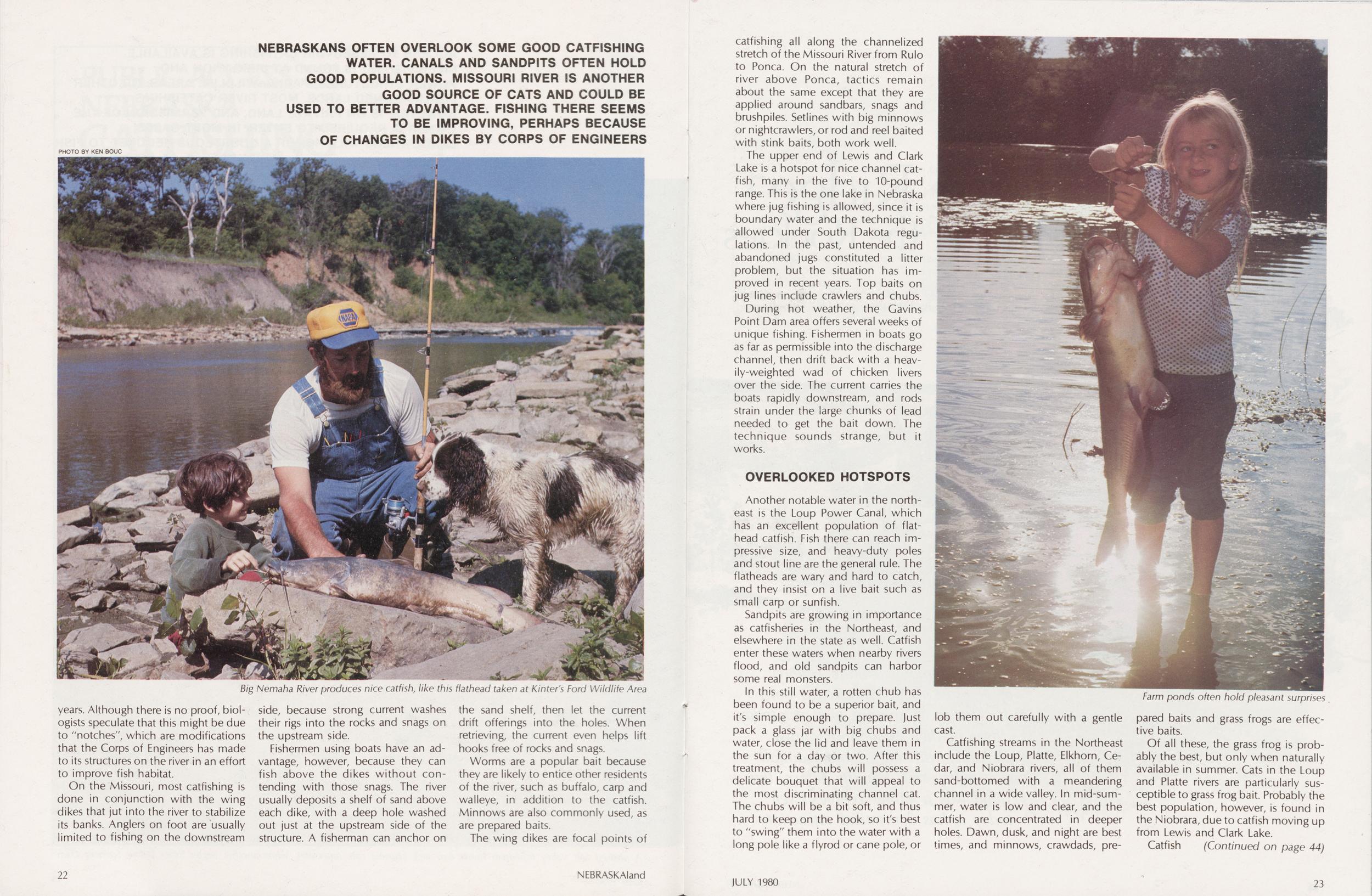 NEBRASKANS OFTEN OVERLOOK SOME GOOD CATFISHING
WATER. CANALS AND SANDPITS OFTEN HOLD
GOOD POPULATIONS. MISSOURI RIVER IS ANOTHER
GOOD SOURCE OF CATS AND COULD BE
USED TO BETTER ADVANTAGE. FISHING THERE SEEMS
TO BE IMPROVING, PERHAPS BECAUSE
OF CHANGES IN DIKES BY CORPS OF ENGINEERS
NEBRASKANS OFTEN OVERLOOK SOME GOOD CATFISHING
WATER. CANALS AND SANDPITS OFTEN HOLD
GOOD POPULATIONS. MISSOURI RIVER IS ANOTHER
GOOD SOURCE OF CATS AND COULD BE
USED TO BETTER ADVANTAGE. FISHING THERE SEEMS
TO BE IMPROVING, PERHAPS BECAUSE
OF CHANGES IN DIKES BY CORPS OF ENGINEERS
On the Missouri, most catfishing is done in conjunction with the wing dikes that jut into the river to stabilize its banks. Anglers on foot are usually limited to fishing on the downstream side, because strong current washes their rigs into the rocks and snags on the upstream side.
Fishermen using boats have an advantage, however, because they can fish above the dikes without contending with those snags. The river usually deposits a shelf of sand above each dike, with a deep hole washed out just at the upstream side of the structure. A fisherman can anchor on the sand shelf, then let the current drift offerings into the holes. When retrieving, the current even helps lift hooks free of rocks and snags.
Worms are a popular bait because they are likely to entice other residents of the river, such as buffalo, carp and walleye, in addition to the catfish. Minnows are also commonly used, as are prepared baits.
The wing dikes are focal points of 22 NEBRASKAland catfishing all along the channelized stretch of the Missouri River from Rulo to Ponca. On the natural stretch of river above Ponca, tactics remain about the same except that they are applied around sandbars, snags and brushpiles. Setlines with big minnows or nightcrawlers, or rod and reel baited with stink baits, both work well.
The upper end of Lewis and Clark Lake is a hotspot for nice channel catfish, many in the five to 10-pound range. This is the one lake in Nebraska where jug fishing is allowed, since it is boundary water and the technique is allowed under South Dakota regulations. In the past, untended and abandoned jugs constituted a litter problem, but the situation has improved in recent years. Top baits on jug lines include crawlers and chubs.
During hot weather, the Gavins Point Dam area offers several weeks of unique fishing. Fishermen in boats go as far as permissible into the discharge channel, then drift back with a heavily-weighted wad of chicken livers over the side. The current carries the boats rapidly downstream, and rods strain under the large chunks of lead needed to get the bait down. The technique sounds strange, but it works.
OVERLOOKED HOTSPOTSAnother notable water in the northeast is the Loup Power Canal, which has an excellent population of flathead catfish. Fish there can reach impressive size, and heavy-duty poles and stout line are the general rule. The flatheads are wary and hard to catch, and they insist on a live bait such as small carp or sunfish.
Sandpits are growing in importance as catfisheries in the Northeast, and elsewhere in the state as well. Catfish enter these waters when nearby rivers flood, and old sandpits can harbor some real monsters.
In this still water, a rotten chub has been found to be a superior bait, and it's simple enough to prepare. Just pack a glass jar with big chubs and water, close the lid and leave them in the sun for a day or two. After this treatment, the chubs will possess a delicate bouquet that will appeal to the most discriminating channel cat. The chubs will be a bit soft, and thus hard to keep on the hook, so it's best to "swing" them into the water with a long pole like a flyrod or cane pole, or lob them out carefully with a gentle cast.
Catfishing streams in the Northeast include the Loup, Platte, Elkhorn, Cedar, and Niobrara rivers, all of them sand-bottomed with a meandering channel in a wide valley. In mid-summer, water is low and clear, and the catfish are concentrated in deeper holes. Dawn, dusk, and night are best times, and minnows, crawdads, prepared baits and grass frogs are effective baits.
Of all these, the grass frog is probably the best, but only when naturally available in summer. Cats in the Loup and Platte rivers are particularly susceptible to grass frog bait. Probably the best population, however, is found in the Niobrara, due to catfish moving up from Lewis and Clark Lake. Catfish (Continued on page 44)
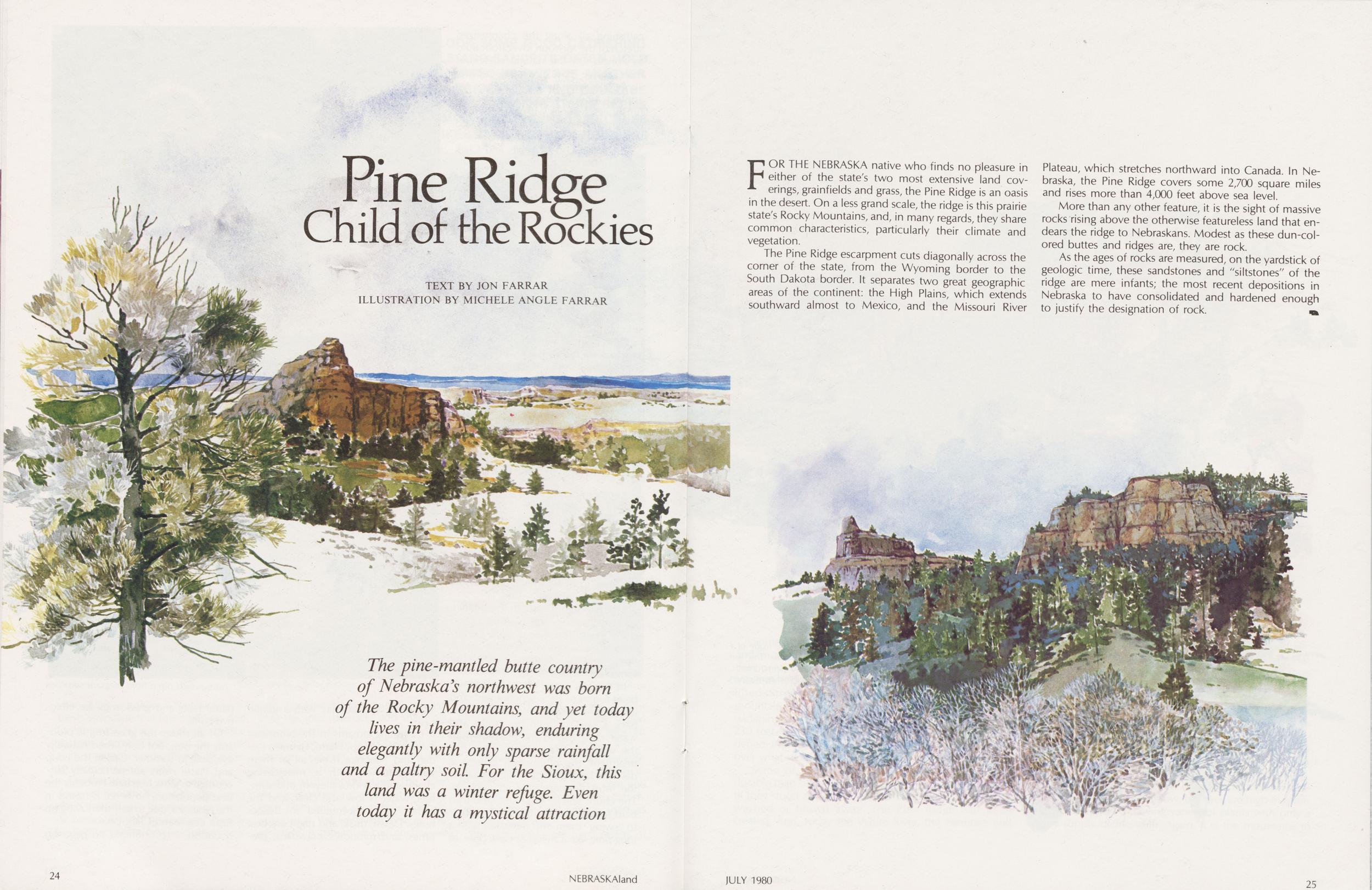
Pine Ridge Child of the Rockies
TEXT BY JON FARRAR ILLUSTRATION BY MICHELE ANGLE FARRARFOR THE NEBRASKA native who finds no pleasure in either of the state's two most extensive land coverings, grainfields and grass, the Pine Ridge is an oasis in the desert. On a less grand scale, the ridge is this prairie state's Rocky Mountains, and, in many regards, they share common characteristics, particularly their climate and vegetation.
The Pine Ridge escarpment cuts diagonally across the corner of the state, from the Wyoming border to the South Dakota border. It separates two great geographic areas of the continent: the High Plains, which extends southward almost to Mexico, and the Missouri River Plateau, which stretches northward into Canada. In Nebraska, the Pine Ridge covers some 2,700 square miles and rises more than 4,000 feet above sea level.
More than any other feature, it is the sight of massive rocks rising above the otherwise featureless land that endears the ridge to Nebraskans. Modest as these dun-colored buttes and ridges are, they are rock.
As the ages of rocks are measured, on the yardstick of geologic time, these sandstones and "siltstones" of the ridge are mere infants; the most recent depositions in Nebraska to have consolidated and hardened enough to justify the designation of rock.
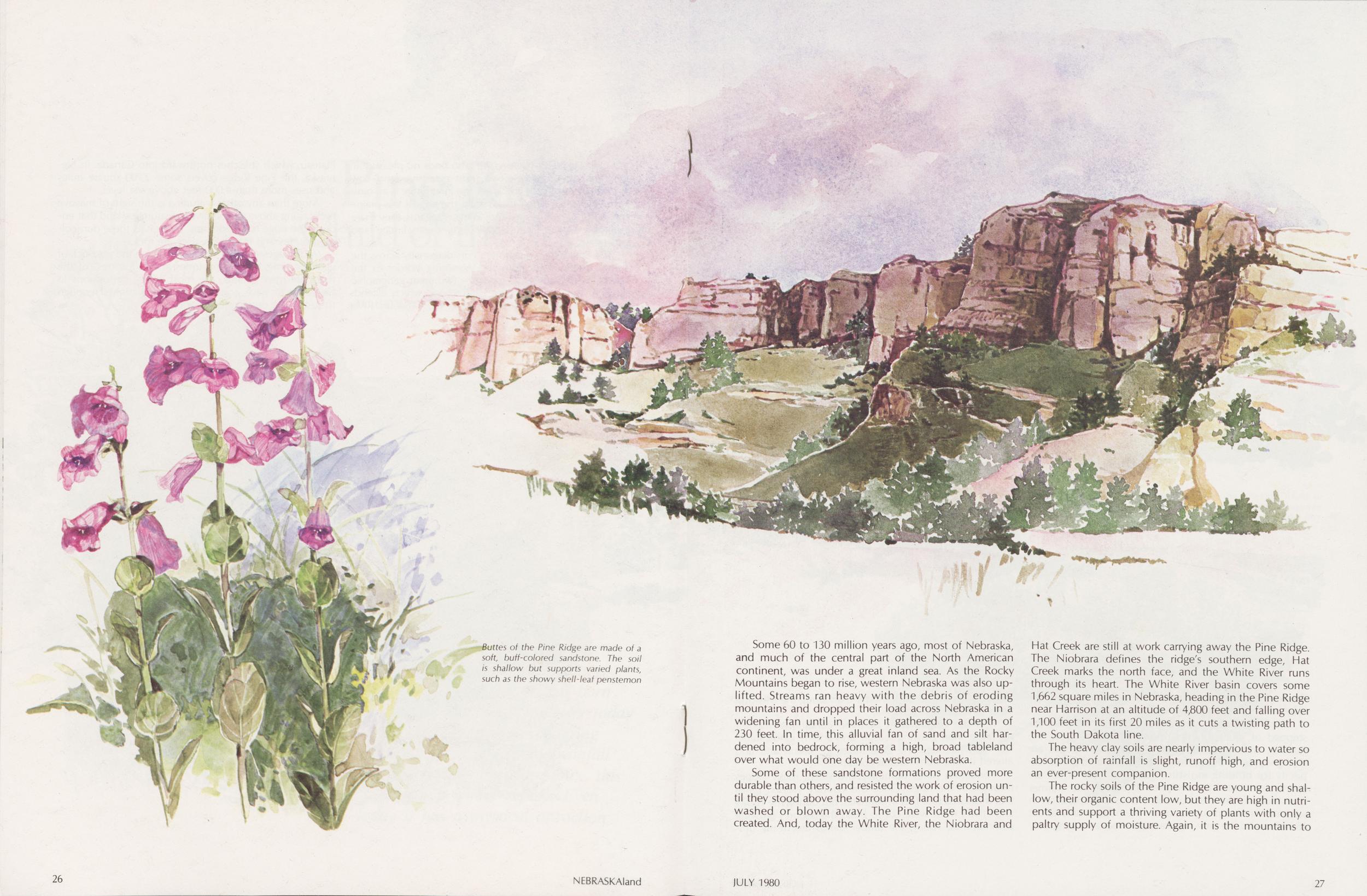
Some 60 to 130 million years ago, most of Nebraska, and much of the central part of the North American continent, was under a great inland sea. As the Rocky Mountains began to rise, western Nebraska was also uplifted. Streams ran heavy with the debris of eroding mountains and dropped their load across Nebraska in a widening fan until in places it gathered to a depth of 230 feet. In time, this alluvial fan of sand and silt hardened into bedrock, forming a high, broad tableland over what would one day be western Nebraska.
Some of these sandstone formations proved more durable than others, and resisted the work of erosion until they stood above the surrounding land that had been washed or blown away. The Pine Ridge had been created. And, today the White River, the Niobrara and Hat Creek are still at work carrying away the Pine Ridge. The Niobrara defines the ridge's southern edge, Hat Creek marks the north face, and the White River runs through its heart. The White River basin covers some 1,662 square miles in Nebraska, heading in the Pine Ridge near Harrison at an altitude of 4,800 feet and falling over 1,100 feet in its first 20 miles as it cuts a twisting path to the South Dakota line.
The heavy clay soils are nearly impervious to water so absorption of rainfall is slight, runoff high, and erosion an ever-present companion.
The rocky soils of the Pine Ridge are young and shallow, their organic content low,
but they are high in nutrients and support a thriving variety of plants with only
a
paltry supply of moisture. Again, it is the mountains to
JULY 1980
27
 the west that dictate the environmental conditions of the
ridge and much of western Nebraska.
the west that dictate the environmental conditions of the
ridge and much of western Nebraska.
Weather fronts moving east from the Pacific Coast are stripped of much of their moisture as they cross the Rockies, and winds descending the eastern slopes are drying winds. As the air descends, it is warmed and its capacity for holding moisture increases. This effect accounts for winter temperatures that often are warmer than those to the east but also increases evaporation in summer. Annual precipitation in the ridge is only about 18 inches and the growing season is short, averaging only 110 days—nearly 50 days shorter than along the Missouri River in southeast Nebraska.
It is the combination of these conditions—modest rainfall, a short growing season, and a fairly inhospitable soil—that has kept the Pine Ridge in pastureland and altered it little from natural condition.
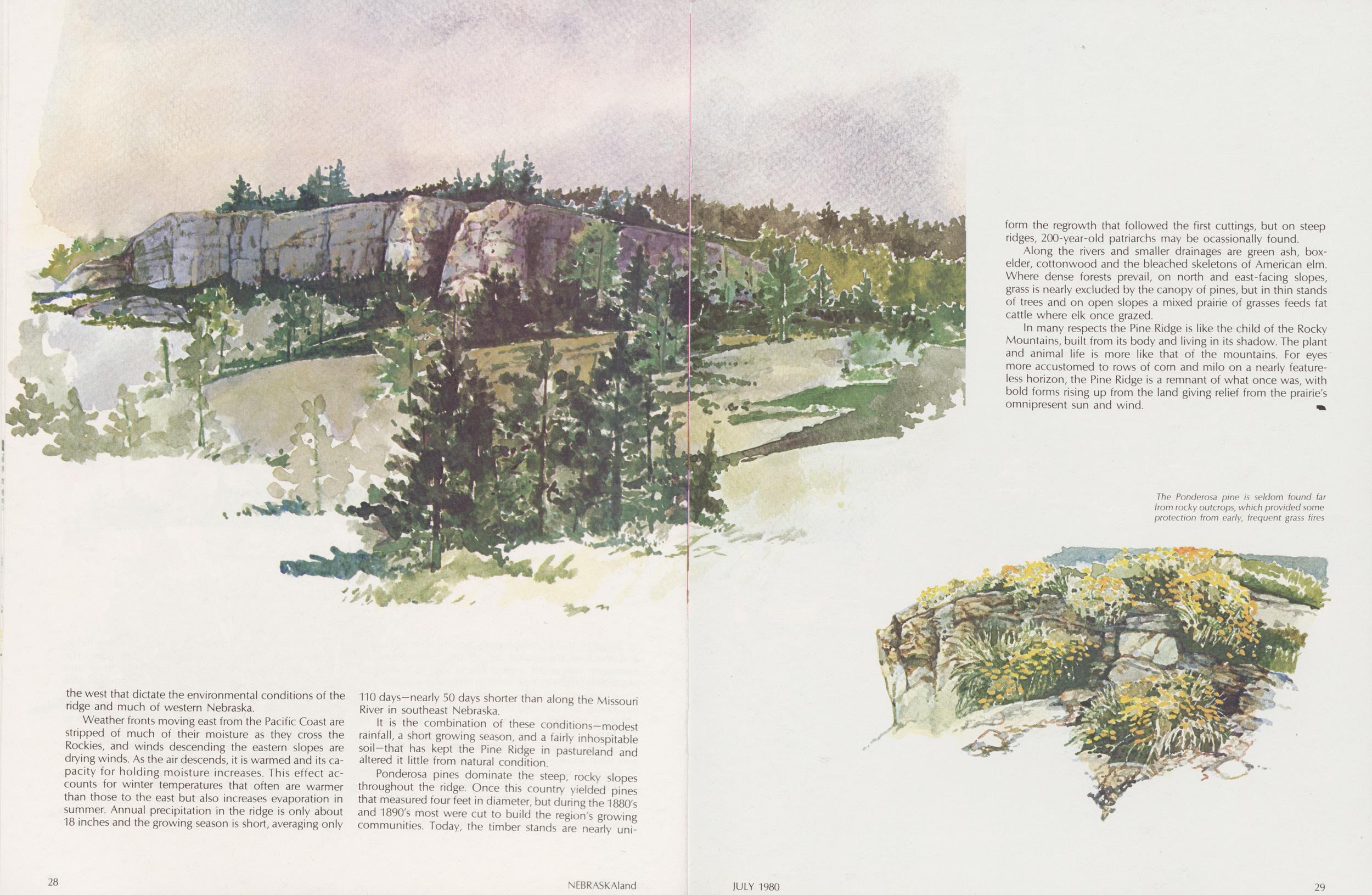
Ponderosa pines dominate the steep, rocky slopes throughout the ridge. Once this country yielded pines that measured four feet in diameter, but during the 1880's and 1890's most were cut to build the region's growing communities. Today, the timber stands are nearly uniform 28 NEBRASKAland the regrowth that followed the first cuttings, but on steep ridges, 200-year-old patriarchs may be ocassionally found.
Along the rivers and smaller drainages are green ash, boxelder, cottonwood and the bleached skeletons of American elm.
In many respects the Pine Ridge is like the child of the Rocky Mountains, built from its body and living in its shadow. The plant and animal life is more like that of the mountains. For eyes more accustomed to rows of corn and milo on a nearly featureless horizon, the Pine Ridge is a remnant of what once was, with bold forms rising up from the land giving relief from the prairie's omnipresent sun and wind.
FESTIVAL OF SUMMER
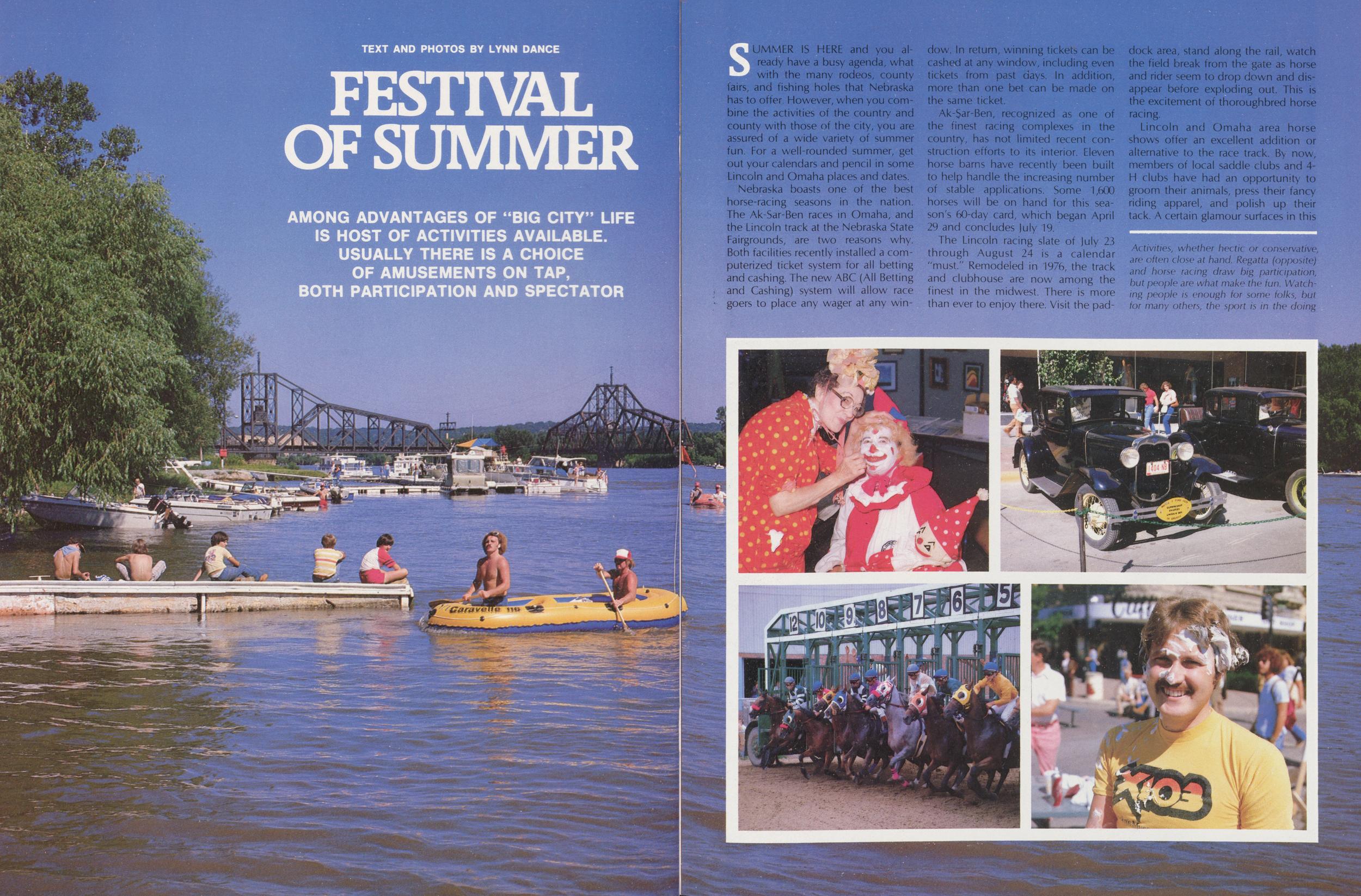
TEXT AND PHOTOS BY LYNN DANCE AMONG ADVANTAGES OF "BIG CITY" LIFE IS HOST OF ACTIVITIES AVAILABLE. USUALLY THERE IS A CHOICE OF AMUSEMENTS ON TAP, BOTH PARTICIPATION AND SPECTATORSUMMER IS HERE and you already have a busy agenda, what with the many rodeos, county fairs, and fishing holes that Nebraska has to offer. However, when you combine the activities of the country and county with those of the city, you are assured of a wide variety of summer fun. For a well-rounded summer, get out your calendars and pencil in some Lincoln and Omaha places and dates.
Nebraska boasts one of the best horse-racing seasons in the nation. The Ak-Sar-Ben races in Omaha, and the Lincoln track at the Nebraska State Fairgrounds, are two reasons why. Both facilities recently installed a computerized ticket system for all betting and cashing. The new ABC (All Betting and Cashing) system will allow race goers to place any wager at any window. In return, winning tickets can be cashed at any window, including even tickets from past days. In addition, more than one bet can be made on the same ticket.
Ak-Sar-Ben, recognized as one of the finest racing complexes in the country, has not limited recent construction efforts to its interior. Eleven horse barns have recently been built to help handle the increasing number of stable applications. Some 1,600 horses will be on hand for this season's 60-day card, which began April 29 and concludes |u!y 19.
The Lincoln racing slate of July 23 through August 24 is a calendar "must." Remodeled in 1976, the track and clubhouse are now among the finest in the midwest. There is more than ever to enjoy there. Visit the paddock area, stand along the rail, watch the field break from the gate as horse and rider seem to drop down and disappear before exploding out. This is the excitement of thoroughbred horse racing.
Lincoln and Omaha area horse shows offer an excellent addition or alternative to the race track. By now, members of local saddle clubs and 4-H clubs have had an opportunity to groom their animals, press their fancy riding apparel, and polish up their tack. A certain glamour surfaces in this sport when riders compete in tailored, color-coordinated outfits. Coupled with precision horsemanship, this is as elegant a spectator sport as you can find.
Activities, whether hectic or conservative, are often close at hand. Regatta (opposite) and horse racing draw big participation, but people are what make the fun. Watching people is enough for some folks, but for many others, the sport is in the doing
Kids from six to 60, boys and girls, men and women, compete in a variety of horse classes and events. Classes range from western pleasure, poles, barrels, and western horsemanship, to timed, patterned, and jumping events. These are also arranged by age group and/or horse breed.
The glamour of the horse show is coupled with the wholesomeness of a family-oriented, all-day outing. With preparation such a big factor, it is not uncommon to find the entire family participating in horse training and care.
A Dolly Parton look-alike contest, the baseball water dunk, pie fights featuring local dignitaries and business execs, live music and dance, senior citizen Olympics, a face-painting parlor, and a bed race are but a few of the traditional features of this year's celebration in downtown Lincoln, "Lincolnfest '80," September 26 through 28. Other favorite activities include an antique auto display, fire fighters in a water-and-barrel competition (Southeast Rural Fire Department has vowed to retain its 1979 championship title). The favorite of many, the food-fest, featuring Czech, German, Greek, and Ukrainian cuisine, has a double appeal of great food served with an international flair. Add new events such as the great bicycle race, and you have something of interest for every member of the family regardless of age.
Omaha's Septemberfest, August 29 through September 1, is a similar celebration held annually to honor labor and business working together. Septemberfest also provides a family-oriented atmosphere, with a carnival midway that features rides, games and prizes. Many local craftsmen, artists and artisans turn out to display their work. Native Americans appear in full regalia exhibiting Indian art and traditional dances. This is a colorful display and one of Septemberfest's highlights.
While dining in the Old Market area, you might overhear a stockbroker and his client conferring, and the subject might be the 10th annual Great Missouri River Raft Regatta. Hank Katzenberger, the regatta's founder, explains that the fastest teams usually take some 5½ hours to 32 NEBRASKAland complete the 34.2-mile course. Multiply 10 years of races times an average of 400 hardy rafters per year, times 5½ hours, times the number of legs, arms, and necks. That's a lot of sunburns, but it's also even more fun. There is something about the weather in Nebraska, especially in August, that compels one to participate in nearly any sport that involves water. This year's regatta is Sunday, August 31.
Now that your calendar is filled, have an eventful, safe, Nebraska summer. (Activity listing on page 33)
Omaha and Lincoln festivals are big and colorful, with range of events from dunking tank catering to police and politicians to pie throwing, but also offering gentler fun via clowns, puppets, dancing and music. Horses are a big part of summer, with racing, rodeos and shows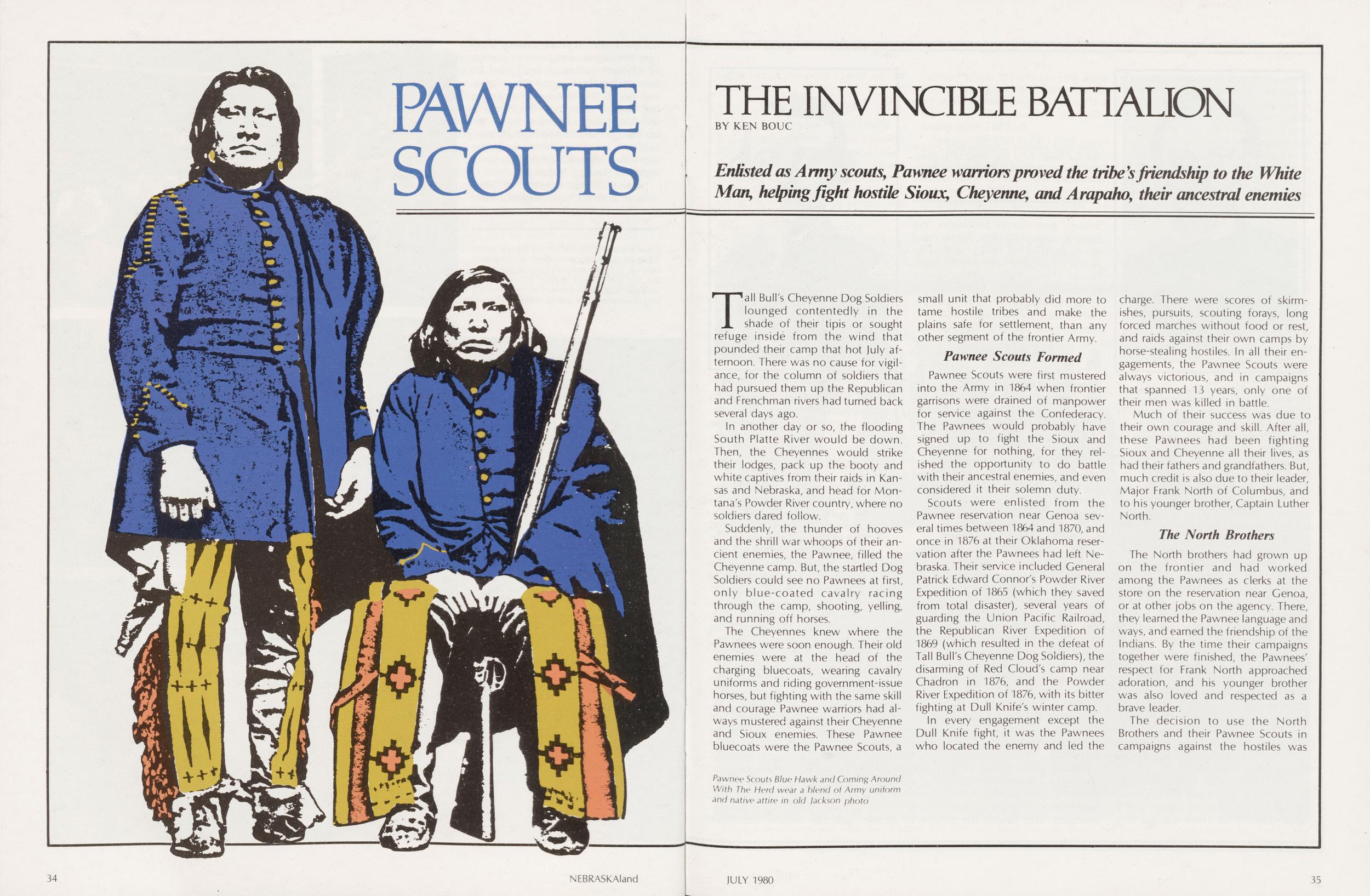
PAWNEE
SCOUTS
THE INVINCIBLE BATTALION
Tall Bull's Cheyenne Dog Soldiers lounged contentedly in the shade of their tipis or sought refuge inside from the wind that pounded their camp that hot July afternoon. There was no cause for vigilance, for the column of soldiers that had pursued them up the Republican and Frenchman rivers had turned back several days ago.
In another day or so, the flooding South Platte River would be down. Then, the Cheyennes would strike their lodges, pack up the booty and white captives from their raids in Kansas and Nebraska, and head for Montana's Powder River country, where no soldiers dared follow.
Suddenly, the thunder of hooves and the shrill war whoops of their ancient enemies, the Pawnee, filled the Cheyenne camp. But, the startled Dog Soldiers could see no Pawnees at first, only blue-coated cavalry racing through the camp, shooting, yelling, and running off horses.
The Cheyennes knew where the Pawnees were soon enough. Their old enemies were at the head of the charging bluecoats, wearing cavalry uniforms and riding government-issue horses, but fighting with the same skill and courage Pawnee warriors had always mustered against their Cheyenne and Sioux enemies. These Pawnee bluecoats were the Pawnee Scouts, a small unit that probably did more to tame hostile tribes and make the plains safe for settlement, than any other segment of the frontier Army.
Pawnee Scouts FormedPawnee Scouts were first mustered into the Army in 1864 when frontier garrisons were drained of manpower for service against the Confederacy. The Pawnees would probably have signed up to fight the Sioux and Cheyenne for nothing, for they relished the opportunity to do battle with their ancestral enemies, and even considered it their solemn duty.
Scouts were enlisted from the Pawnee reservation near Genoa several times between 1864 and 1870, and once in 1876 at their Oklahoma reservation after the Pawnees had left Nebraska. Their service included General Patrick Edward Connor's Powder River Expedition of 1865 (which they saved from total disaster), several years of guarding the Union Pacific Railroad, the Republican River Expedition of 1869 (which resulted in the defeat of Tall Bull's Cheyenne Dog Soldiers), the disarming of Red Cloud's camp near Chadron in 1876, and the Powder River Expedition of 1876, with its bitter fighting at Dull Knife's winter camp.
In every engagement except the Dull Knife fight, it was the Pawnees who located the enemy and led the charge. There were scores of skirmishes, pursuits, scouting forays, long forced marches without food or rest, and raids against their own camps by horse-stealing hostiles. In all their engagements, the Pawnee Scouts were always victorious, and in campaigns that spanned 13 years, only one of their men was killed in battle.
Much of their success was due to their own courage and skill. After all, these Pawnees had been fighting Sioux and Cheyenne all their lives, as had their fathers and grandfathers. But, much credit is also due to their leader, Major Frank North of Columbus, and to his younger brother, Captain Luther North.
The North BrothersThe North brothers had grown up on the frontier and had worked among the Pawnees as clerks at the store on the reservation near Genoa, or at other jobs on the agency. There, they learned the Pawnee language and ways, and earned the friendship of the Indians. By the time their campaigns together were finished, the Pawnees' respect for Frank North approached adoration, and his younger brother was also loved and respected as a brave leader.
The decision to use the North
Brothers and their Pawnee Scouts in
campaigns against the hostiles was
JULY 1980
35
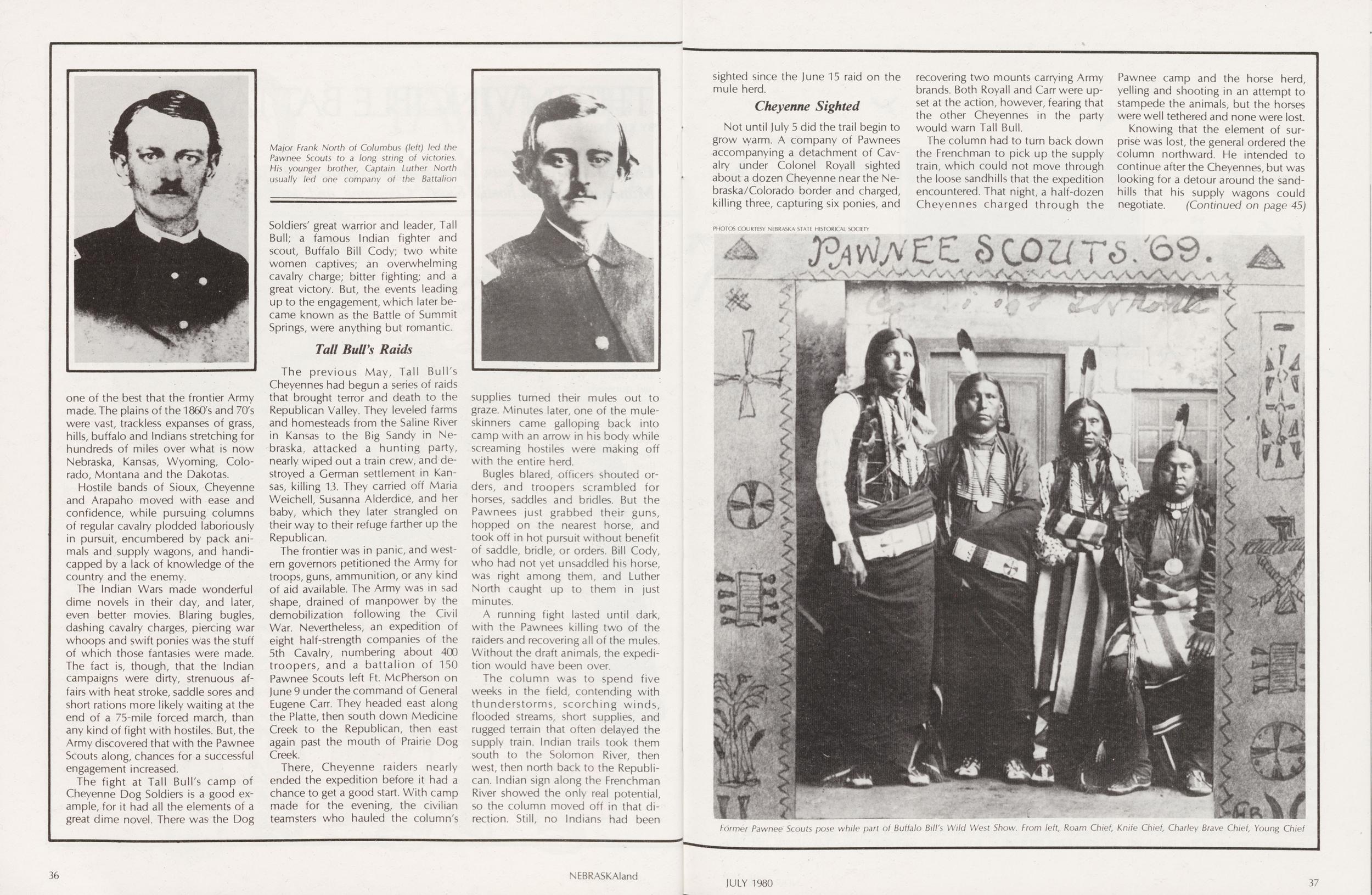 one of the best that the frontier Army
made. The plains of the 1860 and 70's
were vast, trackless expanses of grass,
hills, buffalo and Indians stretching for
hundreds of miles over what is now
Nebraska, Kansas, Wyoming, Colorado, Montana and the Dakotas.
one of the best that the frontier Army
made. The plains of the 1860 and 70's
were vast, trackless expanses of grass,
hills, buffalo and Indians stretching for
hundreds of miles over what is now
Nebraska, Kansas, Wyoming, Colorado, Montana and the Dakotas.
Hostile bands of Sioux, Cheyenne and Arapaho moved with ease and confidence, while pursuing columns of regular cavalry plodded laboriously in pursuit, encumbered by pack animals and supply wagons, and handicapped by a lack of knowledge of the country and the enemy.
The Indian Wars made wonderful dime novels in their day, and later, even better movies. Blaring bugles, dashing cavalry charges, piercing war whoops and swift ponies was the stuff of which those fantasies were made. The fact is, though, that the Indian campaigns were dirty, strenuous affairs with heat stroke, saddle sores and short rations more likely waiting at the end of a 75-mile forced march, than any kind of fight with hostiles. But, the Army discovered that with the Pawnee Scouts along, chances for a successful engagement increased.
The fight at Tall Bull's camp of Cheyenne Dog Soldiers is a good example, for it had all the elements of a great dime novel. There was the Dog Soldiers' great warrior and leader, Tall Bull; a famous Indian fighter and scout, Buffalo Bill Cody; two white women captives; an overwhelming cavalry charge; bitter fighting; and a great victory. But, the events leading up to the engagement, which later became known as the Battle of Summit Springs, were anything but romantic.
The previous May, Tall Bull's Cheyennes had begun a series of raids that brought terror and death to the Republican Valley. They leveled farms and homesteads from the Saline River in Kansas to the Big Sandy in Nebraska, attacked a hunting party, nearly wiped out a train crew, and destroyed a German settlement in Kansas, killing 13. They carried off Maria Weichell, Susanna Alderdice, and her baby, which they later strangled on their way to their refuge farther up the Republican.
The frontier was in panic, and western governors petitioned the Army for troops, guns, ammunition, or any kind of aid available. The Army was in sad shape, drained of manpower by the demobilization following the Civil War. Nevertheless, an expedition of eight half-strength companies of the 5th Cavalry, numbering about 400 troopers, and a battalion of 150 Pawnee Scouts left Ft. McPherson on June 9 under the command of General Eugene Carr. They headed east along the Platte, then south down Medicine Creek to the Republican, then east again past the mouth of Prairie Dog Creek.
There, Cheyenne raiders nearly ended the expedition before it had a chance to get a good start. With camp made for the evening, the civilian teamsters who hauled the column's supplies turned their mules out to graze. Minutes later, one of the mule-skinners came galloping back into camp with an arrow in his body while screaming hostiles were making off with the entire herd.
Bugles blared, officers shouted orders, and troopers scrambled for horses, saddles and bridles. But the Pawnees just grabbed their guns, hopped on the nearest horse, and took off in hot pursuit without benefit of saddle, bridle, or orders. Bill Cody, who had not yet unsaddled his horse, was right among them, and Luther North caught up to them in just minutes.
A running fight lasted until dark, with the Pawnees killing two of the raiders and recovering all of the mules. Without the draft animals, the expedition would have been over.
The column was to spend five weeks in the field, contending with thunderstorms, scorching winds, flooded streams, short supplies, and rugged terrain that often delayed the supply train. Indian trails took them south to the Solomon River, then west, then north back to the Republican. Indian sign along the Frenchman River showed the only real potential, so the column moved off in that direction. Still, no Indians had been 36 NEBRASKAland sighted since the June 15 raid on the mule herd.
Cheyenne SightedNot until July 5 did the trail begin to grow warm. A company of Pawnees accompanying a detachment of Cavalry under Colonel Royall sighted about a dozen Cheyenne near the Nebraska/Colorado border and charged, killing three, capturing six ponies, and recovering two mounts carrying Army brands. Both Royall and Carr were upset at the action, however, fearing that the other Cheyennes in the party would warn Tall Bull.
The column had to turn back down the Frenchman to pick up the supply train, which could not move through the loose sandhills that the expedition encountered. That night, a half-dozen Cheyennes charged through the Pawnee camp and the horse herd, yelling and shooting in an attempt to stampede the animals, but the horses were well tethered and none were lost.
Knowing that the element of surprise was lost, the general ordered the column northward. He intended to continue after the Cheyennes, but was looking for a detour around the sandhills that his supply wagons could negotiate. (Continued on page 45)
JULY 1980 37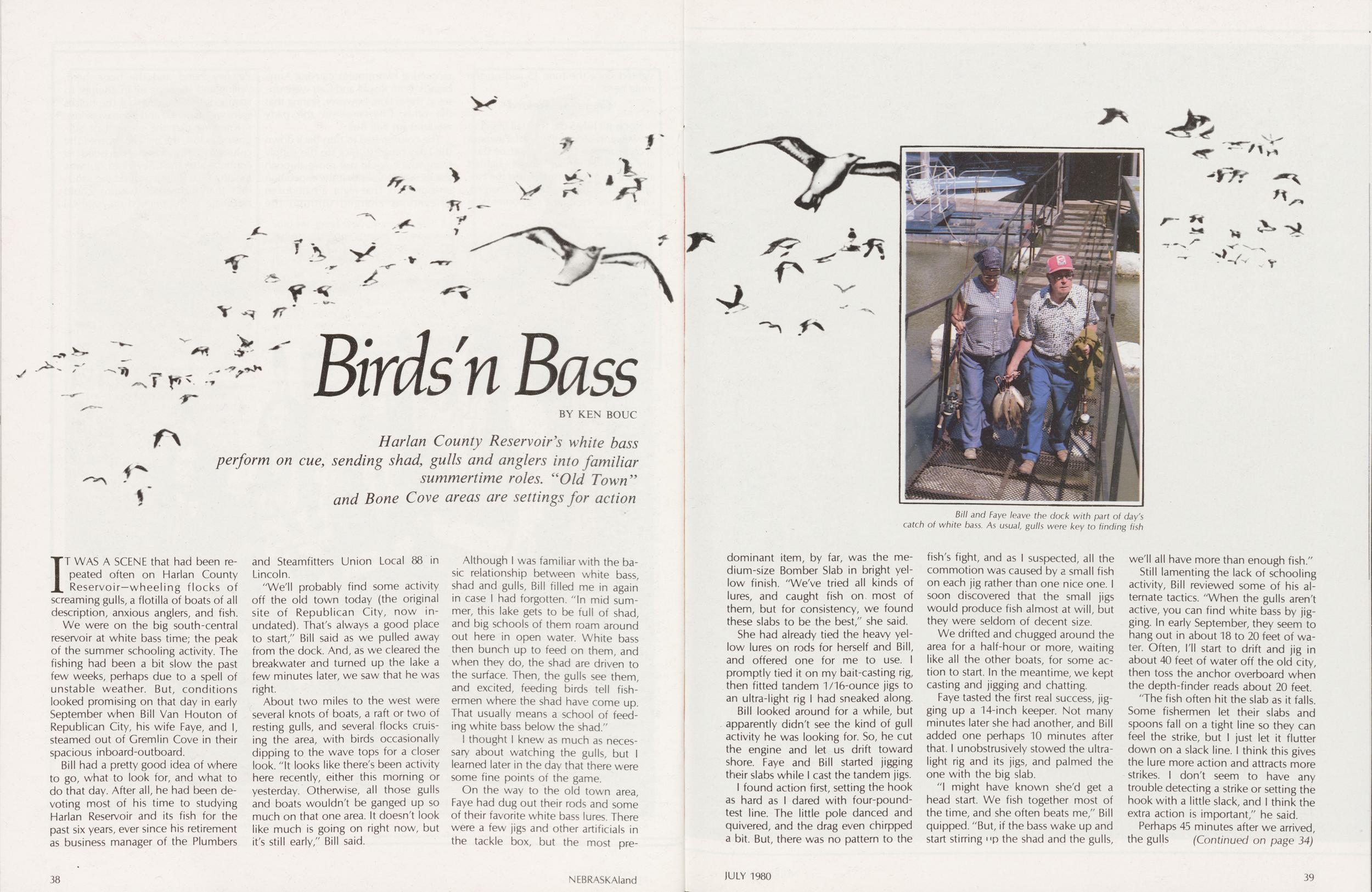
Birds'n Bass
BY KEN BOUC Harlan County Reservoir's white bass perform on cue, sending shad, gulls and anglers into familiar summertime roles. "Old Town" and Bone Cove areas are settings for actionIT WAS A SCENE that had been repeated often on Harlan County Reservoir—wheeling flocks of screaming gulls, a flotilla of boats of all description, anxious anglers, and fish.
We were on the big south-central reservoir at white bass time; the peak of the summer schooling activity. The fishing had been a bit slow the past few weeks, perhaps due to a spell of unstable weather. But, conditions looked promising on that day in early September when Bill Van Houton of Republican City, his wife Faye, and I, steamed out of Gremlin Cove in their spacious inboard-outboard.
Bill had a pretty good idea of where to go, what to look for, and what to do that day. After all, he had been devoting most of his time to studying Harlan Reservoir and its fish for the past six years, ever since his retirement as business manager of the Plumbers and Steamfitters Union Local 88 in Lincoln.
"Well probably find some activity off the old town today (the original site of Republican City, now inundated). That's always a good place to start," Bill said as we pulled away from the dock. And, as we cleared the breakwater and turned up the lake a few minutes later, we saw that he was right.
About two miles to the west were several knots of boats, a raft or two of resting gulls, and several flocks cruising the area, with birds occasionally dipping to the wave tops for a closer look. "It looks like there's been activity here recently, either this morning or yesterday. Otherwise, all those gulls and boats wouldn't be ganged up so much on that one area. It doesn't look like much is going on right now, but it's still early," Bill said.
Although I was familiar with the basic relationship between white bass, shad and gulls, Bill filled me in again in case I had forgotten. "In mid summer, this lake gets to be full of shad, and big schools of them roam around out here in open water. White bass then bunch up to feed on them, and when they do, the shad are driven to the surface. Then, the gulls see them, and excited, feeding birds tell fishermen where the shad have come up. That usually means a school of feeding white bass below the shad."
I thought I knew as much as necessary about watching the gulls, but I learned later in the day that there were some fine points of the game.
On the way to the old town area, Faye had dug out their rods and some of their favorite white bass lures. There were a few jigs and other artificials in the tackle box, but the most predominant 38 NEBRASKAland item, by far, was the medium-size Bomber Slab in bright yellow finish. "We've tried all kinds of lures, and caught fish on most of them, but for consistency, we found these slabs to be the best," she said.
She had already tied the heavy yellow lures on rods for herself and Bill, and offered one for me to use. I promptly tied it on my bait-casting rig, then fitted tandem 1/16-ounce jigs to an ultra-light rig I had sneaked along.
Bill looked around for a while, but apparently didn't see the kind of gull activity he was looking for. So, he cut the engine and let us drift toward shore. Faye and Bill started jigging their slabs while I cast the tandem jigs.
I found action first, setting the hook as hard as I dared with four-pound-test line. The little pole danced and quivered, and the drag even chirped a bit. But, there was no pattern to the fish's fight, and as I suspected, all the commotion was caused by a small fish on each jig rather than one nice one. I soon discovered that the small jigs would produce fish almost at will, but they were seldom of decent size.
We drifted and chugged around the area for a half-hour or more, waiting like all the other boats, for some action to start. In the meantime, we kept casting and jigging and chatting.
Faye tasted the first real success, jigging up a 14-inch keeper. Not many minutes later she had another, and Bill added one perhaps 10 minutes after that. I unobtrusively stowed the ultra-light rig and its jigs, and palmed the one with the big slab.
"I might have known she'd get a head start. We fish together most of the time, and she often beats me," Bill quipped. "But, if the bass wake up and start stirring "p the shad and the gulls, we'll all have more than enough fish."
Still lamenting the lack of schooling activity, Bill reviewed some of his alternate tactics. "When the gulls aren't active, you can find white bass by jigging. In early September, they seem to hang out in about 18 to 20 feet of water. Often, I'll start to drift and jig in about 40 feet of water off the old city, then toss the anchor overboard when the depth-finder reads about 20 feet.
"The fish often hit the slab as it falls. Some fishermen let their slabs and spoons fall on a tight line so they can feel the strike, but I just let it flutter down on a slack line. I think this gives the lure more action and attracts more strikes. I don't seem to have any trouble detecting a strike or setting the hook with a little slack, and I think the extra action is important," he said.
Perhaps 45 minutes after we arrived, the gulls (Continued on page 34)
JULY 1980 39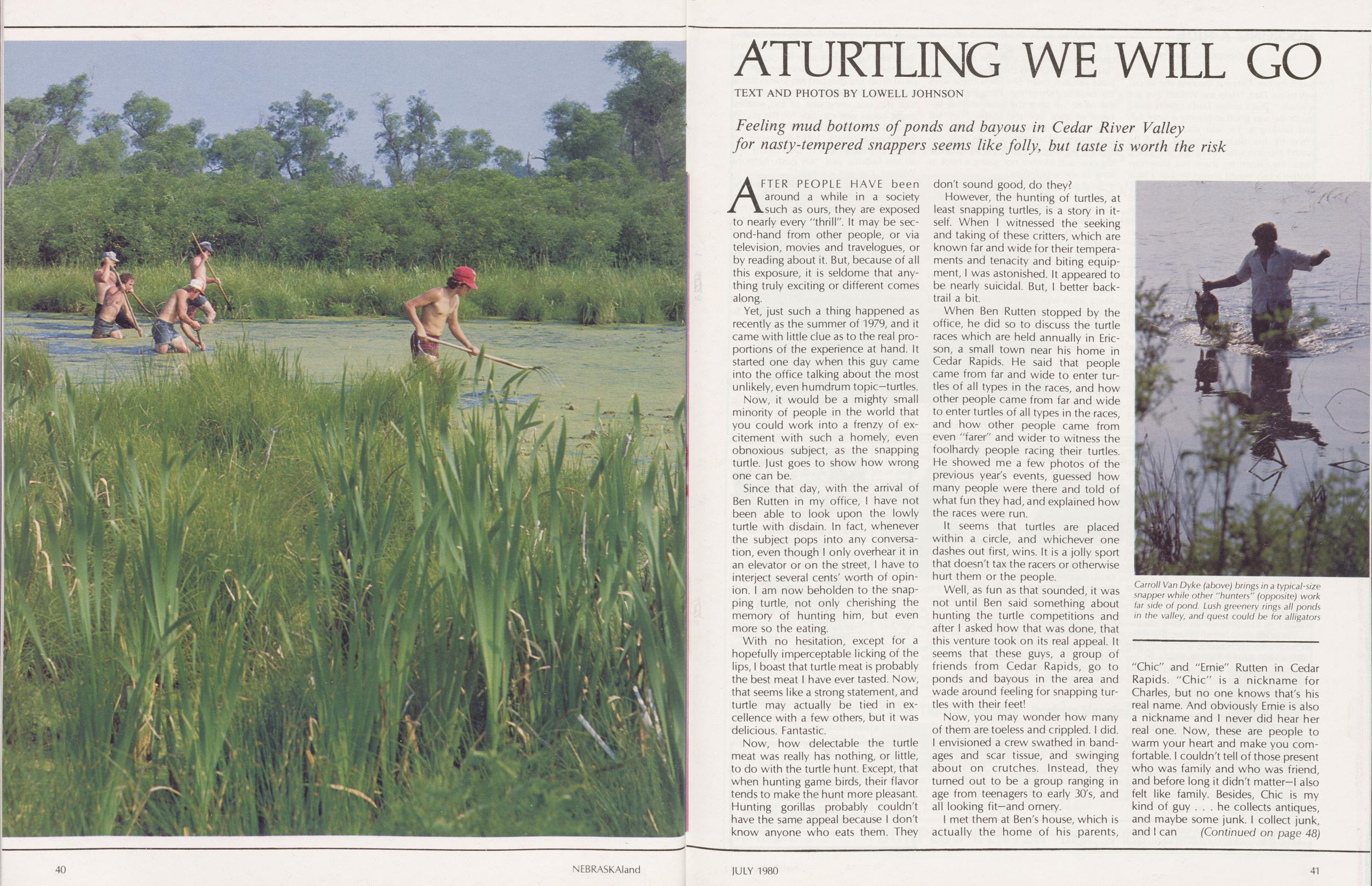
A'TURTLING WE WILL GO
TEXT AND PHOTOS BY LOWELL JOHNSON Feeling mud bottoms of ponds and bayous in Cedar River Valley for nasty-tempered snappers seems like folly, but taste is worth the riskAFTER PEOPLE HAVE been around a while in a society such as ours, they are exposed to nearly every "thrill". It may be second-hand from other people, or via television, movies and travelogues, or by reading about it. But, because of all this exposure, it is seldom that anything truly exciting or different comes along.
Yet, just such a thing happened as recently as the summer of 1979, and it came with little clue as to the real proportions of the experience at hand. It started one day when this guy came into the office talking about the most unlikely, even humdrum topic-turtles.
Now, it would be a mighty small minority of people in the world that you could work into a frenzy of excitement with such a homely, even obnoxious subject, as the snapping turtle. Just goes to show how wrong one can be.
Since that day, with the arrival of Ben Rutten in my office, I have not been able to look upon the lowly turtle with disdain. In fact, whenever the subject pops into any conversation, even though I only overhear it in an elevator or on the street, I have to interject several cents' worth of opinion. I am now beholden to the snapping turtle, not only cherishing the memory of hunting him, but even more so the eating.
With no hesitation, except for a hopefully imperceptible licking of the lips, I boast that turtle meat is probably the best meat I have ever tasted. Now, that seems like a strong statement, and turtle may actually be tied in excellence with a few others, but it was delicious. Fantastic.
Now, how delectable the turtle meat was really has nothing, or little, to do with the turtle hunt. Except, that when hunting game birds, their flavor tends to make the hunt more pleasant. Hunting gorillas probably couldn't have the same appeal because I don't know anyone who eats them. They don't sound good, do they?
However, the hunting of turtles, at least snapping turtles, is a story in itself. When I witnessed the seeking and taking of these critters, which are known far and wide for their temperaments and tenacity and biting equipment, I was astonished. It appeared to be nearly suicidal. But, I better back-trail a bit.
When Ben Rutten stopped by the office, he did so to discuss the turtle races which are held annually in Ericson, a small town near his home in Cedar Rapids. He said that people came from far and wide to enter turtles of all types in the races, and how other people came from far and wide to enter turtles of all types in the races, and how other people came from even "farer" and wider to witness the foolhardy people racing their turtles. He showed me a few photos of the previous year's events, guessed how many people were there and told of what fun they had, and explained how the races were run.
It seems that turtles are placed within a circle, and whichever one dashes out first, wins. It is a jolly sport that doesn't tax the racers or otherwise hurt them or the people.
Well, as fun as that sounded, it was not until Ben said something about hunting the turtle competitions and after I asked how that was done, that this venture took on its real appeal. It seems that these guys, a group of friends from Cedar Rapids, go to ponds and bayous in the area and wade around feeling for snapping turtles with their feet!
Now, you may wonder how many of them are toeless and crippled. I did. I envisioned a crew swathed in bandages and scar tissue, and swinging about on crutches. Instead, they turned out to be a group ranging in age from teenagers to early 30's, and all looking fit—and ornery.
I met them at Ben's house, which is actually the home of his parents, "Chic" and "Ernie" Rutten in Cedar Rapids. "Chic" is a nickname for Charles, but no one knows that's his real name. And obviously Ernie is also a nickname and I never did hear her real one. Now, these are people to warm your heart and make you comfortable. I couldn't tell of those present who was family and who was friend, and before long it didn't matter-l also felt like family. Besides, Chic is my kind of guy...he collects antiques, and maybe some junk. I collect junk, and I can (Continued on page 48)
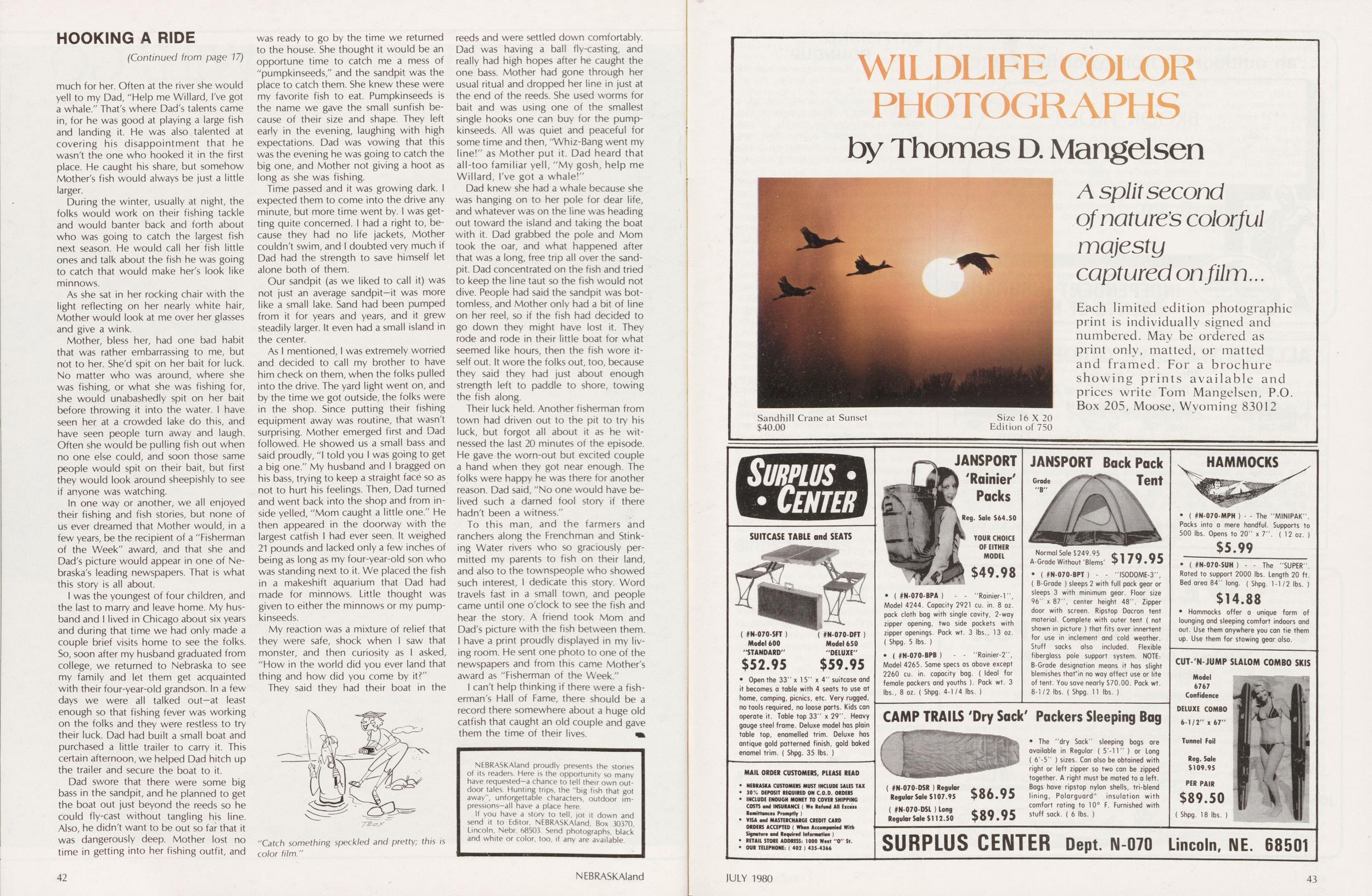
HOOKING A RIDE
(Continued from page 17)much for her. Often at the river she would yell to my Dad, "Help me Willard, I've got a whale." That's where Dad's talents came in, for he was good at playing a large fish and landing it. He was also talented at covering his disappointment that he wasn't the one who hooked it in the first place. He caught his share, but somehow Mother's fish would always be just a little larger.
During the winter, usually at night, the folks would work on their fishing tackle and would banter back and forth about who was going to catch the largest fish next season. He would call her fish little ones and talk about the fish he was going to catch that would make her's look like minnows.
As she sat in her rocking chair with the light reflecting on her nearly white hair, Mother would look at me over her glasses and give a wink.
Mother, bless her, had one bad habit that was rather embarrassing to me, but not to her. She'd spit on her bait for luck. No matter who was around, where she was fishing, or what she was fishing for, she would unabashedly spit on her bait before throwing it into the water. I have seen her at a crowded lake do this, and have seen people turn away and laugh. Often she would be pulling fish out when no one else could, and soon those same people would spit on their bait, but first they would look around sheepishly to see if anyone was watching.
In one way or another, we all enjoyed their fishing and fish stories, but none of us ever dreamed that Mother would, in a few years, be the recipient of a "Fisherman of the Week" award, and that she and Dad's picture would appear in one of Nebraska's leading newspapers. That is what this story is all about.
I was the youngest of four children, and the last to marry and leave home. My husband and I lived in Chicago about six years and during that time we had only made a couple brief visits home to see the folks. So, soon after my husband graduated from college, we returned to Nebraska to see my family and let them get acquainted with their four-year-old grandson. In a few days we were all talked out-at least enough so that fishing fever was working on the folks and they were restless to try their luck. Dad had built a small boat and purchased a little trailer to carry it. This certain afternoon, we helped Dad hitch up the trailer and secure the boat to it.
Dad swore that there were some big bass in the sandpit, and he planned to get the boat out just beyond the reeds so he could fly-cast without tangling his line. Also, he didn't want to be out so far that it was dangerously deep. Mother lost no time in getting into her fishing outfit, and was ready to go by the time we returned to the house. She thought it would be an opportune time to catch me a mess of "pumpkinseeds," and the sandpit was the place to catch them. She knew these were my favorite fish to eat. Pumpkinseeds is the name we gave the small sunfish because of their size and shape. They left early in the evening, laughing with high expectations. Dad was vowing that this was the evening he was going to catch the big one, and Mother not giving a hoot as long as she was fishing.
Time passed and it was growing dark. I expected them to come into the drive any minute, but more time went by. I was getting quite concerned. I had a right to, because they had no life jackets, Mother couldn't swim, and I doubted very much if Dad had the strength to save himself let alone both of them.
Our sandpit (as we liked to call it) was not just an average sandpit—it was more like a small lake. Sand had been pumped from it for years and years, and it grew steadily larger. It even had a small island in the center.
As I mentioned, I was extremely worried and decided to call my brother to have him check on them, when the folks pulled into the drive. The yard light went on, and by the time we got outside, the folks were in the shop. Since putting their fishing equipment away was routine, that wasn't surprising. Mother emerged first and Dad followed. He showed us a small bass and said proudly, "I told you I was going to get a big one." My husband and I bragged on his bass, trying to keep a straight face so as not to hurt his feelings. Then, Dad turned and went back into the shop and from inside yelled, "Mom caught a little one." He then appeared in the doorway with the largest catfish I had ever seen. It weighed 21 pounds and lacked only a few inches of being as long as my four-year-old son who was standing next to it. We placed the fish in a makeshift aquarium that Dad had made for minnows. Little thought was given to either the minnows or my pumpkinseeds.
My reaction was a mixture of relief that they were safe, shock when I saw that monster, and then curiosity as I asked, "How in the world did you ever land that thing and how did you come by it?"
They said they had their boat in the reeds and were settled down comfortably. Dad was having a ball fly-casting, and really had high hopes after he caught the one bass. Mother had gone through her usual ritual and dropped her line in just at the end of the reeds. She used worms for bait and was using one of the smallest single hooks one can buy for the pumpkinseeds. All was quiet and peaceful for some time and then, "Whiz-Bang went my line!" as Mother put it. Dad heard that ail-too familiar yell, "My gosh, help me Willard, I've got a whale!"
Dad knew she had a whale because she was hanging on to her pole for dear life, and whatever was on the line was heading out toward the island and taking the boat with it. Dad grabbed the pole and Mom took the oar, and what happened after that was a long, free trip all over the sandpit. Dad concentrated on the fish and tried to keep the line taut so the fish would not dive. People had said the sandpit was bottomless, and Mother only had a bit of line on her reel, so if the fish had decided to go down they might have lost it. They rode and rode in their little boat for what seemed like hours, then the fish wore itself out. It wore the folks out, too, because they said they had just about enough strength left to paddle to shore, towing the fish along.
Their luck held. Another fisherman from town had driven out to the pit to try his luck, but forgot all about it as he witnessed the last 20 minutes of the episode. He gave the worn-out but excited couple a hand when they got near enough. The folks were happy he was there for another reason. Dad said, "No one would have belived such a darned fool story if there hadn't been a witness."
To this man, and the farmers and ranchers along the Frenchman and Stinking Water rivers who so graciously permitted my parents to fish on their land, and also to the townspeople who showed such interest, I dedicate this story. Word travels fast in a small town, and people came until one o'clock to see the fish and hear the story. A friend took Mom and Dad's picture with the fish between them. I have a print proudly displayed in my living room. He sent one photo to one of the newspapers and from this came Mother's award as "Fisherman of the Week."
I can't help thinking if there were a fisherman's Hall of Fame, there should be a record there somewhere about a huge old catfish that caught an old couple and gave them the time of their lives.
NEBRASKAland proudly presents the stories of its readers. Here is the opportunity so many have requested-a chance to tell their own outdoor tales. Hunting trips, the "big fish that got away", unforgettable characters, outdoor impressions—all have a place here. If you have a story to tell, jot it down and send it to Editor, NEBRASKAland, Box 30370, Lincoln, Nebr. 68503. Send photographs, black and white or color, too, if any are available. 42 NEBRASKAlandWILDLIFE C PHOTOGRAPHS
by Thomas D. MangelsenEach limited edition photographic print is individually signed and numbered. May be ordered as print only, matted, or matted and framed. For a brochure showing prints available and prices write Tom Mangelsen, P.O. Box 205, Moose, Wvoming 8301
Sandhill Crane at Sunset $40.00 Size 16 X 20 Edition of 750 Surplus SUITCASE TABLE and SEATS ( #N-070-SFT ) Model 600 "STANDARD" ( #N-070-DFT ) Model 650 "DELUXE" NEBRASKAland $52.95 $59.95 Open the 33" x 15" x 4" suitcase and it becomes a table with 4 seats to use at home, camping, picnics, etc. Very rugged, no tools required, no loose ports. Kids can operate it. Table top 33" x 29". Heavy gauge steel frame. Deluxe model has plain table top, enamelled trim. Deluxe has antique gold patterned finish, gold baked enamel trim. ( Shpg. 35 lbs. ) MAIL ORDER CUSTOMERS, PLEASE READ NEBRASKA CUSTOMERS MUST INCLUDE SALES TAX 30% DEPOSIT REQUIRED ON C.O.D. ORDERS INCLUDE ENOUGH MONET TO COVER SHIPPING COSTS and INSURANCE ( W« Refund All Exes* Remittances Promptly ) VISA and MASTERCHARGE CREDIT CARD ORDERS ACCEPTED ( When Accompanied With Signature and Required Information ) RETAIL STORE ADDRESS: 1000 West "0" St. OUR TELEPHONE: ( 402 ) 435-4366 JANSP0RT 'Rainier' Packs Reg. Sale $64.50 YOUR CHOICE OF EITHER MODEL $49.98 ( #N-070-BPA ) "Rainier-1", Model 4244. Capacity 2921 cu. in. 8 oz. pack cloth bag with single cavity, 2-way zipper opening, two side pockets with zipper openings. Pack wt. 3 lbs., 13 oz. ( Shpg. 5 lbs. ) ( #N-070-BPB ) - - "Rainier-2", Model 4265. Same specs as above except 2260 cu. in. capacity bag. ( Ideal for female packers and youths ). Pack wt. 3 lbs., 8 oz. ( Shpg. 4-1/4 lbs. ) JANSPORT Back Pack Tent Normal Sale $249.95 A-Grade Without 'Blems' $179.95 ( #N-070-BPT ) - - "IS0D0ME-3", ( B-Grade ) sleeps 2 with full pack gear or sleeps 3 with minimum gear. Floor size 96" x 87", center height 48". Zipper door with screen. Ripstop Dacron tent material. Complete with outer tent ( not shown in picture ) that fits over innertent for use in inclement and cold weather. Stuff sacks also included. Flexible fiberglass poie support system. NOTE: B-Grade designation means it has slight blemishes that'in no way affect use or lite of tent. You save nearly $70.00. Pack wt. 8-1/2 lbs. ( Shpg. 11 lbs. ) CAMP TRAILS 'Dry Sack' Packers Sleeping Bag ( #N070-DSR ) Regular Regular Sale $107.95 ( #N-070-DSL ) Long Regular Sale $112.50 $86.95 $89.95 The "dry Sack" sleeping bags are available in Regular ( 5'-ll" ) or Long ( 6'-5" ) sizes. Can also be obtained with right or left zipper so two can be zipped together. A right must be mated to a left. Bags have ripstop nylon shells, tri-blend lining, Polarguard" insulation with comfort rating to 10° F. Furnished with stuff sack. ( 6 lbs. ) HAMMOCKS ( #N-070-MPH ) - - The "MINIPAK". Packs into a mere handful. Supports to 500 lbs. Opens to 20" x 7". ( 12 oz. ) $5.99 ( #N-070-SUH ) - - The "SUPER". Rated to support 2000 lbs. Length 20 ft. Bed area 84" long. ( Shpg. 1-1/2 lbs. ) $14.88 Hammocks offer a unique form of lounging and sleeping comfort indoors and out. Use them anywhere you can tie them up. Use them for stowing gear also. CUT-N-JUMP SLALOM COMBO SKIS Model 6767 Confidence DELUXE COMBO 6-1/2" x 67" Tunnel Foil Reg. Sale $109.95 PER PAIR $89.50 ( Shpg. 18 lbs. ) SURPLUS CENTER Dept. N-070 Lincoln, NE. 68501 ...an outdoor tip from your Big JJ agent
BROOK TROUT
Known also as speckled trout, the brook trout
inhabits cool, clear, spring-fed ponds and
streams, and has a relatively low tolerance of
warm temperature. First recorded stocking was
in the Elkhorn River during the summer of
1873 when a train derailment spilled fish. The
state record stands at 5 pounds, 1 ounce.
...this message brought to you by the
INDEPENDENT INSURANCE
AGENTS OF NEBRASKA
ALLEN'S WALLEYE GUIDE SERVICE
Why go to Canada?
Best walleye fishing in the U.S. or Canada
Lewis and Clark Lake, Lake Francis Case
Lake Sharp, Lake Oahe, Missouri River
98% success in 1979—Early reservations advised. Improve your fish stories-try Allen's
walleye rigs. Guide-tested—order direct and save. Two-hook crawler
rig, 50$, one-hook minnow rig, 500. Spinners, 41/2-foot leader, in red, yellow,
green, orange, blue, silver, red and white, hammered-gold, white. Include
10% postage.
Allen's Walleye Guide Service, 502 East King, Chamberlain, S.D. 57325
Phone (605)-734-5591
WELCOME
Merritt Dam Trading Post
26 Miles So. Of Valentine On Hwy. 16C
Phone 402/376-3437
Bait Tackle Ammunition Groceries Gas Beer Ice
Campground Hook-ups Boat and Motor Rental
Cabins with Kitchen Facilities
Your Hosts
JON AND MARIAN
DAVENPORT
...an outdoor tip from your Big JJ agent
BROOK TROUT
Known also as speckled trout, the brook trout
inhabits cool, clear, spring-fed ponds and
streams, and has a relatively low tolerance of
warm temperature. First recorded stocking was
in the Elkhorn River during the summer of
1873 when a train derailment spilled fish. The
state record stands at 5 pounds, 1 ounce.
...this message brought to you by the
INDEPENDENT INSURANCE
AGENTS OF NEBRASKA
ALLEN'S WALLEYE GUIDE SERVICE
Why go to Canada?
Best walleye fishing in the U.S. or Canada
Lewis and Clark Lake, Lake Francis Case
Lake Sharp, Lake Oahe, Missouri River
98% success in 1979—Early reservations advised. Improve your fish stories-try Allen's
walleye rigs. Guide-tested—order direct and save. Two-hook crawler
rig, 50$, one-hook minnow rig, 500. Spinners, 41/2-foot leader, in red, yellow,
green, orange, blue, silver, red and white, hammered-gold, white. Include
10% postage.
Allen's Walleye Guide Service, 502 East King, Chamberlain, S.D. 57325
Phone (605)-734-5591
WELCOME
Merritt Dam Trading Post
26 Miles So. Of Valentine On Hwy. 16C
Phone 402/376-3437
Bait Tackle Ammunition Groceries Gas Beer Ice
Campground Hook-ups Boat and Motor Rental
Cabins with Kitchen Facilities
Your Hosts
JON AND MARIAN
DAVENPORT
CATFISHING ROUNDUP
(Continued from page 23)Merritt Reservoir is something of a sleeper, holding a catfish population that appears to be improving steadily. Though not heavily harvested a few years ago, more catfishermen are discovering its potential, particularly in early spring at its upper end.
In contrast to the Sandhills, southwest Nebraska has large stores of untapped catfishing potential, particularly in its irrigation canals. The Tri-County supply canal from the North Platte diversion to Gothenburg offers cats from May through August, but fishing is particularly good in mid summer.
Man-made structures along the canals are good places to try. The checks stop upstream movements and are thus concentration points for fish. Inlets to reservoirs along the canal system are also good, especially the inlet at Sutherland Reservoir.
Reservoirs of the Republican Valley are also good catfish waters. The action starts in early spring at ice-out, when the cats gather in the warmer water at the upper ends of these lakes. This usually occurs in March and early April.
In May and June, catfish move upstream to spawn, and mid summer finds them dispersed throughout the reservoirs and watersheds upstream.
Many baits work in the Southwest, but area catfishermen generally swear by some sort of gizzard shad. Some use shad entrails, others use small whole shad, while still others use chunks of shad. The effectiveness of shad baits is easy to understand, since the primary natural food source in the southwest reservoirs and canals is the gizzard shad.
In the Panhandle, most catfishing takes place on Lake McConaughy or the North Platte River upstream to the Belmont Diversion near Bridgeport. The upper end of Lake McConaughy offers perhaps the most consistent and predictable catfishing in the state. As soon as the ice leaves the upper end of the big lake, cats and catfishermen congregate there.
That's when Big Mac offers its best catfishing of the year. Anglers gather at Omaha Beach, Gate 13, and just about anywhere else they can along the lake's upper reaches. Like just about everywhere else in western Nebraska, shad is the top bait.
During spring and early summer, McConaughy's catfish move up the North Platte River to spawn, and during that time, the river provides excellent action. The spawning fish are stopped by the Belmont irrigation diversion near Bridgeport, and that structure marks the end of the river's really prime catfishing.
However, catfish also exist above the diversion as a result of stocking by the Game 44 NEBRASKAland and Parks Commission in an effort to establish a population there. Stocking is continuing, but the program has so far had only limited success because so many of the fish are lost in irrigation ditches.
The North Platte River stocking program is the only such effort being conducted in rivers by the Game and Parks Commission, since such waters are repopulated by natural reproduction. Most reservoirs also have some catfish reproduction, but many are given a helping hand through supplemental stocking by the Game and Parks Commission, particularly the most heavily-fished waters of eastern Nebraska.
During 1979, 228,000 catfish were stocked by the Commission, and another 283,000 are planned for release this year. Some are fingerlings, a few inches in length, but many are the expensive, advanced fingerlings or "jumbos" of six to 12 inches which have a much better chance of survival.
The catfish is important in Nebraska. More than half of Nebraska's fishermen go after cats during the year, a much greater percentage of fishing effort than is devoted to walleye, trout, bass, or other more publicized species.
The importance of this plain, if not downright homely, fish is apparent in the efforts that the Game and Parks Commission devotes to its study and management. In recent years, catfish have been tagged and studied in Nebraska rivers, raised in confinement and studied in cages, propagated in state fish hatcheries, and stocked by the hundreds of thousands.
break. And, with good catfish water holding good catfish populations, why should they even try?
BIRDS 'N BASS
(Continued from page 39)in the area suddenly began acting fidgety. That made Bill perk up.
Not far from us, a flock of gulls began swooping and screaming and diving to the water. We could see the birds carry off a small fish now and then, or accidentally drop one as they struggled to regain altitude. And, as we closed in on the area, we occasionally spotted a panic-stricken shad break water as he fled from the danger below. This was what we were looking for.
It took Bill only a minute or so to maneuver us upwind and to one side of all the activity. The stiffening breeze soon moved us alongside the scene of the fracas, within easy casting distance of my ultra-light rig, and child's play for the heavy slabs. My jigs didn't seem to attract any interest, but Bill and Faye were kept busy hoisting and removing white bass from their slabs.
There were one or two more bursts of activity like that, and our stringers began gaining heft. However, each white bass feeding binge lasted only a short time before things quieted down.
We kept jigging and studying the various antics of gulls in the vicinity. "In rough water like this, you often see gulls swooping down and taking shad off the tops of waves, but that doesn't necessarily mean there are white bass there.
"And, gulls just loafing on the water are often over shad, bass or both. But in those cases, the bass are still deep and have not pushed the shad to the top, or maybe the bass are not feeding heavily. It pays to keep an eye on those birds and be ready when they do get excited. Or, you can jig or cast around them and maybe pick up a fish or two.
"But the real clue to look for is the screaming, diving flock of gulls. When they're swarming and squalling like that, there are feeding bass around for sure."
We stayed around the old town area until late morning, when the strong south wind made it nearly impossible to fish there. Then, we set sail for another of Bill's favorite spots, the mouth of Bone Cove directly across the lake.
There were a few gulls around, but no large flocks and no sign of feeding activity. Using his depth finder, Bill sought out more 18-foot water and we all settled back to pump the slabs a bit more while drifting in relative calm in the lee of the south shore. During the next hour or so that we spent there, we caught fish at a slow but steady pace. Between bass, Bill and Faye filled me in on how they fish Harlan at other times of the year.
There were a few gulls around, but no large flocks and no sign of feeding activity. Using his depth finder, Bill sought out more 18-foot water and we all settled back to pump the slabs a bit more while drifting in relative calm in the lee of the south shore. During the next hour or so that we spent there, we caught fish at a slow but steady pace. Between bass, Bill and Faye filled me in on how they fish Harlan at other times of the year.
"We start fishing the lake in April, usually still-fishing off the North Shore cabins. We like to use good-sized shiners, and fish them close to the bottom in 12 to 17 feet of water. We usually keep this up through May. The flats off Sindt Point and the old city are also good spots," Faye added.
"That's right, and she'll often out-fish me when we use bait," Bill said. "In June, we do some minnow fishing, but we also like to troll.
"In July, we troll deep. The water's hot then, and we find the walleye, plus a few stripers and northern pike, in deep water. In August, we start watching the gulls, and that fishing gets steadily better through the fall. Most people quit in September, but that's when white bass fishing really gets good. We've caught some of our biggest white bass well into October," Bill noted.
We had to call it quits early in the afternoon since the Van Houtons had company arriving. We hoisted stringers aboard, and set the big inboard/outboard on a course back to Gremlin Cove.
But, as we neared the buoys around the spillway, we noticed several bunches of gulls, and one group seemed pretty excited. Bill figured that he and Faye could spare a few more minutes before tending to social obligations, particularly if schooling fish were involved. We spent another 20 minutes in the area, sometimes casting to rising schools, but mostly jigging. Thus, we added a few more silver specimens to our stringers. Then, the gulls dispersed and we chugged on into the cove.
Our stringers held 36 white bass, about half of our legal limit. No doubt there would have been many more with a full day, but it was a nice mess of fish just the same. I wasn't able to follow up on Bill's invitation to come back in a few weeks, when he promised better fishing and almost no competition. That was unfortunate, because he could have more than made good on that promise.
THE INVINCIBLE BATTALION
(Continued from page 37)The Cheyennes must have interpreted his move as a departure from the field. But, the column simply sought out a new route, and gruelling, forced marches through extremely hot, dusty sandhills put them within striking distance the evening of July 10. General Carr stopped at the site of the last Cheyenne camp, about 20 miles into Colorado, to ready his command for the final assault.
The horses were in sorry shape with nothing to eat in that barren country except cactus and soapweeds. Of more than 400 cavalrymen, only 244 had mounts in good enough shape for the next day's action, and the Pawnees had only 50 horses. Those whose mounts were spent would lag behind with the wagons, while the rest made the final push.
After covering another 20 miles of rugged country, and after several false alarms, scouts came in with word that tipis had been sighted. The cavalry slipped into position about a mile from the camp, then charged.
Some Cheyennes met the initial charge and were cut down. Others fled on foot to nearby ravines, where they put up stiff resistance. Still others managed to get to their horses and flee. Those were the fortunate ones, for the cavalry's horses couldn't raise a gallop after about four miles of pursuit. Of the 13 horses that the cavalry lost in the action, only one was killed. The rest died of exhaustion.
Drama at Summit SpringsAfter the initial charge, many of the Cheyennes "holed up" in ravines in the area. Frank and Luther North were riding near one of these when an Indian suddenly raised up and fired at them, with the bullet passing between the brothers. Frank threw up his hands and slipped from the saddle as if hit, but took his rifle to the ground with him. He motioned for his brother to ride off. Frank waited there with his rifle ready, and when the Indian raised his head for another look, shot him dead. It was later learned that the sniper was Tall Bull himself, leader of the marauding band of Dog Soldiers.
During the charge, Sergeant Traveling Bear of the Pawnee Scouts saw four Cheyenne warriors running toward a ravine, and took off in pursuit. His horse gave out before he got there, but he ran on after them. A short time later, Traveling Bear emerged from the canyon carrying four scalps and four captured revolvers.
JULY 1980 45 MUTCHIE'S RESORT
Upstairs Anchor Room Lounge
Cold Beer -On/Off Sale
Lakefront cabins with swimming beach
Fishing tackle Boats & motors • Free boat
ramp Fishing Swimming Cafe and ice
Boating & skiing Gas and oil 9-hole golf
course just around the corner Live and
frozen bait Pontoon, boat & motor rentals.
Overnight Campers—full hookups
WRITE FOR FREE BROCHURE
or phone reservations 785-2298
Elwood, Nebraska
TROUT
For stocking your lake or
pond now. 2 to 12 inch rainbow trout.
TROUT SPRINGS
Hidden Timber Route PHONE
Valentine, NE. 69201 (402) 376-2369
STOCK YOUR LAKE
OR POND
with
CHANNEL CAT
LARGEMOUTH BASS
BLUEGILL-CRAPPIE
ORDER NOW
WILLOW LAKE FISH HATCHERY
Rt. 3, Box 46, Hastings, Nebr. 68901
Gaylord L. Crawford
Phone: (402) 463-8022
Day or Night
For 1980 Stocking
Pond Mill—Products for algae control
E-CATCH ALL-PURPOSE TRAPS
FREE
CATALOG
Traps without injury squirrels, chipmunks, rabbits, mink, fox, raccoons, stray animals,
pests, etc. Sizes for every need. Also traps for
snakes, sparrows, pigeons, crabs, turtles, quail, etc. Save on our low
factory prices. Send no money. Free catalog and trapping secrets.
MUSTANG MFG. CO., Dept. N 34, Box 10880, Houston, Tex. 77018
Harlan County Dam
Vacation Apartments - fully furnished
Color TV • Kitchen Facilities Full Baths
Game cleaning room with freezer
One block from shopping center
Weekend or week of pleasant living
Security Deposit Required
Sorry —No Pets
Dean and Esther Stone
Box 145 Ph. (308) 799-3422
Republican City, NE 68971
MUTCHIE'S RESORT
Upstairs Anchor Room Lounge
Cold Beer -On/Off Sale
Lakefront cabins with swimming beach
Fishing tackle Boats & motors • Free boat
ramp Fishing Swimming Cafe and ice
Boating & skiing Gas and oil 9-hole golf
course just around the corner Live and
frozen bait Pontoon, boat & motor rentals.
Overnight Campers—full hookups
WRITE FOR FREE BROCHURE
or phone reservations 785-2298
Elwood, Nebraska
TROUT
For stocking your lake or
pond now. 2 to 12 inch rainbow trout.
TROUT SPRINGS
Hidden Timber Route PHONE
Valentine, NE. 69201 (402) 376-2369
STOCK YOUR LAKE
OR POND
with
CHANNEL CAT
LARGEMOUTH BASS
BLUEGILL-CRAPPIE
ORDER NOW
WILLOW LAKE FISH HATCHERY
Rt. 3, Box 46, Hastings, Nebr. 68901
Gaylord L. Crawford
Phone: (402) 463-8022
Day or Night
For 1980 Stocking
Pond Mill—Products for algae control
E-CATCH ALL-PURPOSE TRAPS
FREE
CATALOG
Traps without injury squirrels, chipmunks, rabbits, mink, fox, raccoons, stray animals,
pests, etc. Sizes for every need. Also traps for
snakes, sparrows, pigeons, crabs, turtles, quail, etc. Save on our low
factory prices. Send no money. Free catalog and trapping secrets.
MUSTANG MFG. CO., Dept. N 34, Box 10880, Houston, Tex. 77018
Harlan County Dam
Vacation Apartments - fully furnished
Color TV • Kitchen Facilities Full Baths
Game cleaning room with freezer
One block from shopping center
Weekend or week of pleasant living
Security Deposit Required
Sorry —No Pets
Dean and Esther Stone
Box 145 Ph. (308) 799-3422
Republican City, NE 68971
The rescue of the two white women
was uppermost in the minds of the troopers as they charged. Frank and Luther
North, and another officer in the Pawnee
Battalion, Captain Cushing, stopped at the
far end of the village to take a quick drink
of water from a small keg lying near one of
the tipis. Cushing had drunk his fill and
was handing the keg to Frank when a
white woman ran out of the tipi and hysterically threw herself at the Captain's feet.
Maria Weichell had been shot by the
Cheyenne, but would later recover.
The second white woman was not as fortunate. Susanna Alderdice had been tomahawked to death.
While the other officers comforted Mrs. Weichell, Luther raised the keg to take a drink. At that moment, a Cheyenne hiding in tall grass about 50 yards away raised up and fired at the group. Luther felt a sharp blow to his stomach, and was almost bowled off his horse. But, when he looked for a wound or blood he found none. There was nothing but a large and painful bruise beneath his belt buckle. Captain Cushing picked up the spent bullet where it had landed at his feet.
The fighting and pursuit lasted about four hours, and when it was over, the hold of the Cheyenne on the Republican Valley was broken. Tall Bull's village of 85 lodges was destroyed, 52 Cheyennes killed, 17 women and children captured, and a great quantity of supplies and livestock taken. General Carr's report listed 274 horses, 144 mules, 9,300 pounds of dried meat, 56 rifles, 22 revolvers, 40 bows and arrows, 50 pounds of gunpowder, 20 boxes of percussion caps, plus sabres, lances and tomahawks. The soldiers also recovered scalps of white women, a necklace of human fingers, and some papers testifying to the "high character" of some of the Cheyennes.
The Battle of Summit Springs was one of the most celebrated victories of the Indian Wars on the Plains. It made headlines even in the New York Times, and earned commendations for the officers and men involved from the Nebraska and Colorado territorial legislatures. Buffalo Bill later incorporated a re-enactment of the affair into his Wild West Show, which was the climax of the performance in Madison Square Garden as late as 1906, some 35 years later.
Such a fuss over that particular fight probably baffled the Pawnees, for they had engaged hostiles in the service of the Army for a half-dozen years before Summit Springs, and had many good fights. Perhaps not all their actions were as large, as dramatic, or as strategically decisive as Summit Springs, but they were all victorious. To limit their story to Summit springs would be an injustice to the record of this Nebraska unit, whose record is unequaled on the plains.
After an unheralded start in 1864, the Pawnee Scouts rode to a steady string of successes.
Powder River CampaignTheir first campaign brought little action, partly due to lack of opportunity, and partly because of poor leadership of their first white commander, a Captain McFadden. But in 1865, organized under Captain (later promoted to Major) Frank North of Columbus, a company of Pawnees accompanied General P. E. Connor's campaign against Sioux, Cheyenne and Arapaho hostiles to Wyoming's Powder River country. They proved indispensible.
In their first big fight, they had followed the trail of a band of Cheyenne and Sioux all night, and were in position to attack the camp shortly after dawn. The Pawnees rode toward the camp in full uniform in an orderly column of twos, while the hostiles formed a line of defense on a small hill.
But, when about 200 yards away, the scouts began throwing off their hats and blouses and giving war whoops. The Sioux and Cheyenne turned and ran. They appeared willing to fight white troops, but wanted no part of a bunch of well-armed and well-mounted Pawnees. The scouts took the camp, killing 26 warriors and recapturing government horses and mules. They also recovered white scalps and white women's and children's clothing, proving that this camp had attacked Army units and settlers.
The Pawnees had ridden 150 miles, then fought a successful fight, all without food or rest. It was the first success of the Pawnee Scouts under Frank North, and the first success of the expedition. General Connors was pleased, awarding captured horses and other booty to the Pawnees and allowing them to celebrate with a big scalp dance.
The next day, scouts brought news of more hostiles a few miles away. North found three parties of about 50 Indians each, divided his force into three parts, and ordered the charge.
The Pawnees' horses were still tired from the previous engagement, and were unable to overtake the hostiles. But, Frank North was on a fine horse and soon had left his command behind. He fired one last shot at the retreating Indians, and turned to go back when he discovered about a dozen Cheyenne had turned on him. They overtook him and wounded his horse badly enough that it couldn't be ridden. Frank, in turn, dismounted and killed one Cheyenne with his rifle. He then discovered that he had left his revolvers behind when he abandoned his saddle, and most of his rifle ammunition had bounced from its pouch. He had only three rounds reft.
46 NEBRASKAlandThe Indians would make a rush at him, but veer off when he took aim. He used their respect for his marksmanship to bluff them off while he led his horse back to his command, a distance of several miles.
The Arapaho CampShortly after Frank's close call, a forced march to the north was ordered. After five days, the scouts brought in word that they had found sign of a large Indian camp. Frank North and 10 of his Pawnees moved ahead to investigate, and 25 miles ahead of the column, found a large village. Two Pawnees eased into a small stream that led to the camp and were able to slip into the village, but were unable to get any idea of its size.
North sent a messenger to General Connor asking for all the scouts and an additional company of cavalry. At dawn the next day, Pawnee scouts from the main column found Frank and his small band in the hills some distance from the camp. They told him that the general was on his way with not only the rest of the scouts, but also 400 cavalry and two pieces of artillery, making the 75-mile night march without rest.
When the attack was made, the Soldiers discovered a very large village of 250 lodges and some 1,500 Arapahoes.
At the charge, the Arapahoes raced for their horses. There was a 15-mile running battle in which 162 hostile warriors were killed. The village was destroyed and some 750 horses and mules captured. It was the second and last victory of the ill-fated campaign. But, the Pawnee Scouts would be called upon once again, this time to save the expedition from catastrophe.
There were three columns involved in the expedition. One, under General Connor, would move to the mouth of the Tongue River with supplies, cavalry and the Pawnee Scouts. Another, consisting of 1,600 cavalry under Colonel Cole, marched from Omaha. A third, under Colonel Walker with 1,000 cavalry, left Ft. Laramie to skirt the eastern edge of the Black Hills. Walker and Cole each had enough supplies to last until September 1, when they were to meet Connor at the Tongue.
But, September 1 came and went with no sign of Cole or Walker. The thought of 2,600 men lost and without supplies in hostile territory was very sobering, to say the least, and Connor sent Frank North and his Pawnees out to find the two lost columns on September 8.
They ran into bad weather—rain one day, a sleet storm that night, and a blizzard the next day. On the third day, they found a large Indian camp on the Powder River, and a few hours later, the trail of the lost columns, perhaps three days old.
North and his men were dumbfounded when, a few hours later, they found where the soldiers had camped during the storm. The ground was littered with dead horses—more than 900. Some of the horses were shot in the head, as if to be used as protection in a big battle. But, there was no other evidence of a fight.
Frank North thought it unsafe to remain there with just 50 men, so they left at once on a 24-hour ride to report what they had found to an equally-puzzled General Connor. He sent North and 50 Pawnees out again in search of the missing columns.
The Starvation MarchThey found the trail again, marked by discarded equipment and the remains of horses and mules butchered and eaten by hungry troopers. On September 19,18 days after their rations were scheduled to expire, the columns were found.
The men were exhausted and discouraged. Thirty-five had died of starvation or exposure, and the rest were near starvation. Only 600 horses were left, and all were too weak to be of any use. Some 1,200 cavalrymen were on foot, many of them lame and with feet wrapped in rags or blankets. While the Pawnees divided what little supplies they had, word was sent to General Connor's column, which, fortunately was only 25 miles away.
Finally, the mystery of the 900 dead horses was solved when Colonel Cole told his story. On September 8, the day North first went looking for the missing columns, Cole and Walter were attacked by Red Cloud and 2,500 Sioux warriors. They were defending a large camp on the Powder River of about 10,000 Indians.
The cavalry fought in the driving rain all day without rest. When night fell, they were trapped out in the open, with the Sioux stubbornly holding the only significant stand of timber around. The soldiers formed a hollow square, with horses, wagons and artillery on the perimeter as protection for the men inside.
The horses were tired and overheated, and when the rain changed to sleet and snow, many of them chilled and died. The next morning, many more were so stiff they could not move, and were shot.
General Connor was greatly discouraged, but decided to rest Cole's and Walker's men for two weeks before taking them afield as infantry. That was not to be. Orders arrived relieving General Connor of command and ending the expedition. Except for victories the Pawnee Scouts had given him, his campaign was a failure.
Editor's note: The Republican River Expedition of 1869, which culminated in the defeat of Tall Bull's Cheyenne Dog Soldiers, and the Powder River Expedition of 1865, were by no means the only campaigns in which the Pawnee Scouts served. Perhaps their most valuable service was their protection of the Union Pacific Railroad construction crews as track was laid across Nebraska and eastern Wyoming. This phase of their service, and the 1876 campaign to the Powder River country, will be covered soon in a future issue of NEBRASKAland.
AL'S MARINA Swanson Reservoir PONTOON BOAT RENTALS-TRAILER RENTAL-FOOD-BAIT-TACKLE-OFF SALE BEER-ICE-OVERNIGHT TRAILER PARKING Trenton Dam Site, Phone (308) 334-5268 Box 115, Trenton, NE 69044 plan a RANCH Get away from it all to Nebraska's scenic Pine Ridge for a vacation you'll remember a lifetime. Stay in modern finished cabins. Take hiking fishing then have a campfire cookout. See a 16-foot waterwheel, unbelievable sunsets you'll never find in the city and more stars than you ever .thought existed! For brochure write: Rt. 3; Box-30, Crawford 0933 46 NEBRASKAland JULY 1980 47
SUMMER IN THE CITIES
(Continued from page 33) OMAHA'S SUMMER CALENDAR April 29-July 19 May-Sept. May 30-June 7 June 7-8 June 27-29 Aug. 14-17 Aug. 29-Sept. 1 Aug. 31 Sept. 14 Sept. 19-28 Horse Racing, Ak-Sar-Ben Horse Shows College World Series, Rosenblatt Stadium Ethnic Festival Summer Arts Festival, Old Market Douglas County Fair, Waterloo Septemberfest, downtown Great Missouri River Raft Regatta Omaha Marathon, Westroads Shopping Center Ak-Sar-Ben World Championship Rodeo & 4-H Livestock Exposition LINCOLN'S SUMMER CALENDAR May-Sept. May 4-Sept. 1 May 7-Sept. 24 May 11 Throughout Summer July 4 July 23-Aug. 24 Aug. 9 Aug. 14-17 Aug. 16-19 Sept. 26-28 Horse Shows Folsom Children's Zoo Brown Bag Concerts, noon Wednesdays, Foundation Garden, 14th &N Lincoln Marathon Farmer's Market, every Saturday, downtown Independence Day Celebration, Holmes Park Horse Races, State Fairgrounds Shrine Football Game, Memorial Stadium National Junior Girls' Fast-Pitch Softball Tournament, Mahoney Park National AAU Junior Olympics Swimming Championships 11 -state Zone C area, Woods Pool Lincolnfest '80, downtownA'TURTLING WE WILL GO
(Continued from page 41)appreciate a master at it. He has old cars and tractors rivaling the best museums - iron-wheel monsters from the turn of the century, and stationary power plants, and old cars from the teens, twenties and thirties, and collectables from all eras.
And, Ernie is a grower. She has berry vines and bushes, and many fruit trees, all of which she planted as seeds. Their acre-age on the edge of town is a veritable paradise—a combination of berries and trees and antique tractors.
Among the many community activities in Cedar Rapids during the year is a friendly, informal and festive "turtle feed" hosted by the Ruttens, during which they use many of the snappers accumulated during spring and summer. Ernie and several friends cook the meat during the day, using a recipe which includes breading, frying and steaming. I probably shouldn't dwell again on the taste, but this may well be what the Greeks called ambrosia.
Anyway, after several hours of touring, visiting and dining on turtle the day before, we prepared seriously to hunt the following morning. It was a pleasant July day, and after a few moments of organizational pangs, our entourage headed out in two rigs in a southeasterly direction to visit a couple nearby ponds. There was only a slight breeze and the setting was like a calendar picture—greenery of many sorts ringing a blue pond nestled in a pleasant valley. Reeds and grasses and cattails provided excellent habitat for aquatic and amphibious creatures, and the human crew soon joined those other creatures.
Pitchforks were the preferred utensil for the hunt, it appeared, but it seemed rather inadequate when considering the heavy shell protecting the turtles. Within a few moments, though, their application became apparent, and the tines really were only valuable for their sensitivity. The turtle seekers walked in the shallows (which to them meant up to their chins) probing the bottom of the lagoon with feet and fork. So it was sort of feet and fork versus tooth and nail.
When the telltale sound or "feel" of a turtle shell was encountered, the hunters would either scoop up the critter with the fork or feel around the shell until they selected the right end. and pull up the snapper by hand. Now, that sounds easy enough, but it would take more than a pitchfork in most people's backs to get them into the water, and some downright threats of violence to get them to finger around the snapper shell—sight unseen. I tried to appear busy at all times whenever near a pond, and thus only had to handle the snappers during the relay between pond and vehicle. That was much safer.
The first pond turned up only one snapper, however; and the second pond scored a zero. This seemed to call for a strategy session, and fingers pointed in many directions and names were bandied about as the most ideal ponds were brought into the conversation.
Actual hunters, which numbered nine, included Chick's three sons, Ben, Sam and Dave, and his son-in-law, Dan Schilousky. There were several friends who were frequent or chronic turtlers—Tim and Fred Hellbusch, Kevin Kolm and Bobby Batnhorst. Carroll Van Dyke, a former resident who had moved to Columbus but still comes back for hunts occasionally, was one of several in the gang who provided endless chuckles during the day. Also accompanying the crew, and helping with the relaying chores with Chic and me, were Jim Cox, the mayor of Cedar Rapids, and his son Carroll.
It was the camaraderie and banter that made the excursion so much fun, but it certainly ranked high as an educational experience, as well.
The first day was butchering day, as several big snappers had been in holding tanks to "age" and to clean up their act a bit. The old horse tank was commonly used on the farm, but barrels serve in town.
Turtles which we rounded up during this hunt would also go into holding pens for a while. This delay also enables the crew to weed out any which might be injured or sick, so that they won't go into the pot.
Speaking of pots brings to mind a story that Chic told during the day. He started hunting turtles when he was just a lad, but he had never been fond of eating them. That was because turtle soup was the only method of serving it, and so he enjoyed the hunting but not the eating. Then, after many years of ignoring them as table fare, an acquaintance prepared it the way it should be—fried and tender. That occasion encouraged serious turtle hunting, and the younger generation has continued-largely, however, because of the fun.
After the first couple of ponds, which produced only the one prisoner, our crew turned upriver. They have made arrangements, over the years, with several people to hunt turtles on their places. And, they have relatives who harbor some of the "shellfood." Within a few miles, and after one more long, dry run which included a sweep down a shallow creek ending at the Loup River, we began to worry about the outcome of our hunt. Had the turtles all departed the country? Maybe these guys had been pulling my leg about the turtle population, I worried...perhaps this was another massive "snipe hunt" they liked to pull on outsiders.
48 NEBRASKAlandTrading Post
DOGSWELL-BRED Hunting dogs for sale-Brittanies, English setters and pointers—ranging in age from puppies to young dogs. Darrell Yentes, 1118 McMillan, Holdrege, NE 68949. Phone (308) 995-8570 or (308) 995-4797.
CHOCOLATE LABRADOR pups-parents good hunters. Gene Baker, Box K, Wausa, NE 68786. Phone (402) 586-2916.
MISCELLANEOUSGUNS-Browning, Winchester, Remington, others.. Hi-powers, shotguns, new, used, antiques. Want Pre-1964 Winchesters. Buy-Sell-Trade. Ph. (402) 729-6112. Bedlan's Sporting Goods, Fairbury, NE 68352.
DUCK HUNTERS: learn how to make quality, solid plastic, waterfowl decoys. We're originators of famous system. Send, $1 for colorful catalog. Decoys Unlimited, Clinton, Iowa 52732.
FRITZ GUNSMITHING & Supply Co-Heckler & Koch Dealer. Handfinishing-Hot Blue-Parkerization-Custom Rifles-Antique Restoration. 407 South Harris, Wilber, NE. (402) 821-2260.
N.E. NEBR. TROUT FISHING. For rent Mon.-Thurs. or Fri-Sun. Two cottages, four ponds and stream. Privacy with trout up to 5 pounds. Open April 1. Diamond E. Trout Resort, Orchard, NE 68764. (402) 893-4745.
FISH FOR SALE: Channel Catfish, Largemouth Bass, Bluegill, Crappie, Perch, Bullhead, Rainbow Trout and min- nows for pond and lake stocking. Contact the Pleasant Valley Fish Farm, Route 1, McCook, Nebraska 69001. Phone (308) 345-6599.
ROCK CLIMBING classes and guide services brochure available. Dakota Territory Rock and Snow c/o Mark Ebel, 3868 Starr, Lincoln, NE 68503. Ph. (402) 467-3064.
FURNISHED MODERN Lake house for sale or rent-accommodate 4 to 6 people. Admiral's Cove, Lake McConaughy frontage. Phone 12-355-3282.
CABIN FOR SALE at Lake McConaughy. Will sleep eight; bath with tub and shower, Completely furnished. Two refrigerators, range, cooking utensils, linens, etc. Small storage shed. Price $9,500.00. Contact L. E. Whitehead, Cozad, NE 69130. Phone (308) 784-3700.
DUCK HUNTER'S Wives, Wow' Send out of date Duck Hunting Stamps for immediate cash. Wildlife 172E Bedford Stamford, Conn. 06901.
PLASTIC DECOYS: We're originator of famous do-it-yourself system. Catalog $1.00. Decoys Unlimited, Clinton, IA 52732
FOR QUALITY Auto, home, health and life insurance at a reasonable cost, contact Paul Schupbach, your American Family Insurance Agent. Phone (402) 477-5353. Lincoln.
FISHERMEN: Fish for less, where the fish are, with a two-man Pontoon Boat. Easy-to-build plans, $3.00. Write: ) & R Co., P.O. Box 45%, Lincoln, NE 68504
4 WINCHESTER NEBRASKA Centennial, Serial No. 669, and Colt Nebraska Centennial No. 259, sold as a set $1,250. Plum Creek Gun Shop, R. R. Box 243, Seward NE (402) 643-3303.
WILD TURKEYS for sale. Young and old. Contact Jim McKinney, Wauneta, NE 69045. (308) 394-5715.
TAXIDERMYBIG BEAR TAXIDERMY, Rt. 2, Mitchell, Nebraska 69357. We specialize in all big game from Alaska to Nebraska, also birds and fish. Hair on and hair off tanning, Wi miles west of Scottsbluff on Highway 26. Phone (308) 635-3013.
KARL SCHWARZ Master Taxidermist. Mounting of game heads- birds - fish - animals - fur rugs - robes - tanning buckskin. Since 1910. 424 South 13th Street Dept A Omaha, Nebraska 68102.
FREEZE-DRY TAXIDERMY Wally Allison's State Record Taxidermy, 2709 Birchwood, North Platte, NE 69101. Phone: (308) 534-2324. Specializing in Fish and Small Game, Snake and Lizard and Novelties. (Nothing too small) Newest of all taxidermy methods employed.
CREATIVE TAXIDERMY-AII types work since 1935 now includes Freeze-Dry processing of approved small specimens. Naturecraft Studio, 925 Fourth Corso, Nebraska City, Nebraska 68410. Phone: (402) 873-5491. Joe Voges-Owner.
"AWARD-WINNING" Taxidermist. Trust your trophies to a proven winner. Our complete taxidermy service also books hunts anywhere in the world. Dinges Taxidermy, 2760 South 12th, Omaha, NE 68108 Phone: (402) 342-3718.
JOHNSON TAXIDERMY-servicing southwest Nebraska, specializing in big-game mounts, life-sized mounts, rug work, fish, birds, tanning hair-on leather. Brochure and price list on request. Johnson Taxidermy, Rt. 1, Box 78, Lamar, NE 69035. Telephone (308) 882-5555.
BARBE'S FISHING CENTER (Under new management) FISHING HEADQUARTERS RESTAURANT FACILITIES EAT IN OR CARRY OUT OVERNIGHT CAMPER FACILITIES GAS AND ICE TACKLE LICENSES MINNOWS-WORMS BOAT AND BARGE RENTALS OFF-SALE BEER call (308) 345-3560 No. Hiway 83 10 miles from McCook RR 1, McCook, NE 69001 RED WILLOW RESERVOIR TODAY'S BEST ADVERTISING INVESTMENT WRITE: NEBRASKAland Att: Advertising Department P.O. Box 30370 Lincoln, Nebraska 68503 CLOSING DATES: Black and White: 5th of second month preceding date of issue. COLOR: First of second month preceding date of issue. Advertising Rates DISPLAY Back covers (color only): outside-$680; inside-$620. Inside full-page-$480; 2/3-page-$325; 1/2-page-$245; 1/3-page-$165; 1/4-page-$137; 1/6-page-$91; per column inch-$19.50. $25 for each additional color; $100 for 4-color (1/3 page minimum size). CLASSIFIED 25 cents per word, minimum of $5. COLT RUGER REMINGTON WEATHERBY Browning Our exclusive discount plan on all Browning products will save you up to 20%. This includes guns, knives, archery, clothing, boots & gun cases. Inquire...it will $ave you $$$. Big discounts on other sporting goods. ALSO FEATURING: WINCHESTER BLACK POWDER SMITH & WESSON COLT SAUER RIFLES BLACK POWDER GUNS & ACCESSORIES WE ALSO CARRY A COMPLETE LINE OF RELOADING EQUIPMENT AND COMPONENTS BY PACIFIC, SIERRA AND HORNADY. SEE US FIRST FOR ALL YOUR SHOOTING NEEDS. IED1E CM Phone (402) 643-3303 Box 243, Seward, Nebraska 68434 J'S OTTER CREEK MARINA NORTH SIDE LAKE McCONAU&HY HWY. 92-OPEN YEAR AROUND ALL-MODERN MOTEL CAFE BAIT TACKLE GAS FISH-CLEANING FACILITIES HUNTING & FISHING LICENSES ON & OFF-SALE BEER PHONE 308-355-2341 P.O. LEWELLEN. NE 69147 JAY & JULIE PETERSON Great Outdoors Instructional Tapes Tell How, When, Where! Bass Fishing Secrets $7 Successful Trout Fishing $7 Catfish Methods $7 Whitewater Canoe, Kayak, Raft $9 Gold Panning, Prospecting $9 Hunter Safety Course $10 Outdoor Survival Course $10 Mink Trapping Course $7 Raccoon Trapping Instructions $7 S2-per-tape discount for senior citizens and students! □ Send 60-min. cassette Send 8-track Outdoors Voice Box 49 Glenwood, Iowa 51534 JULY 1980 49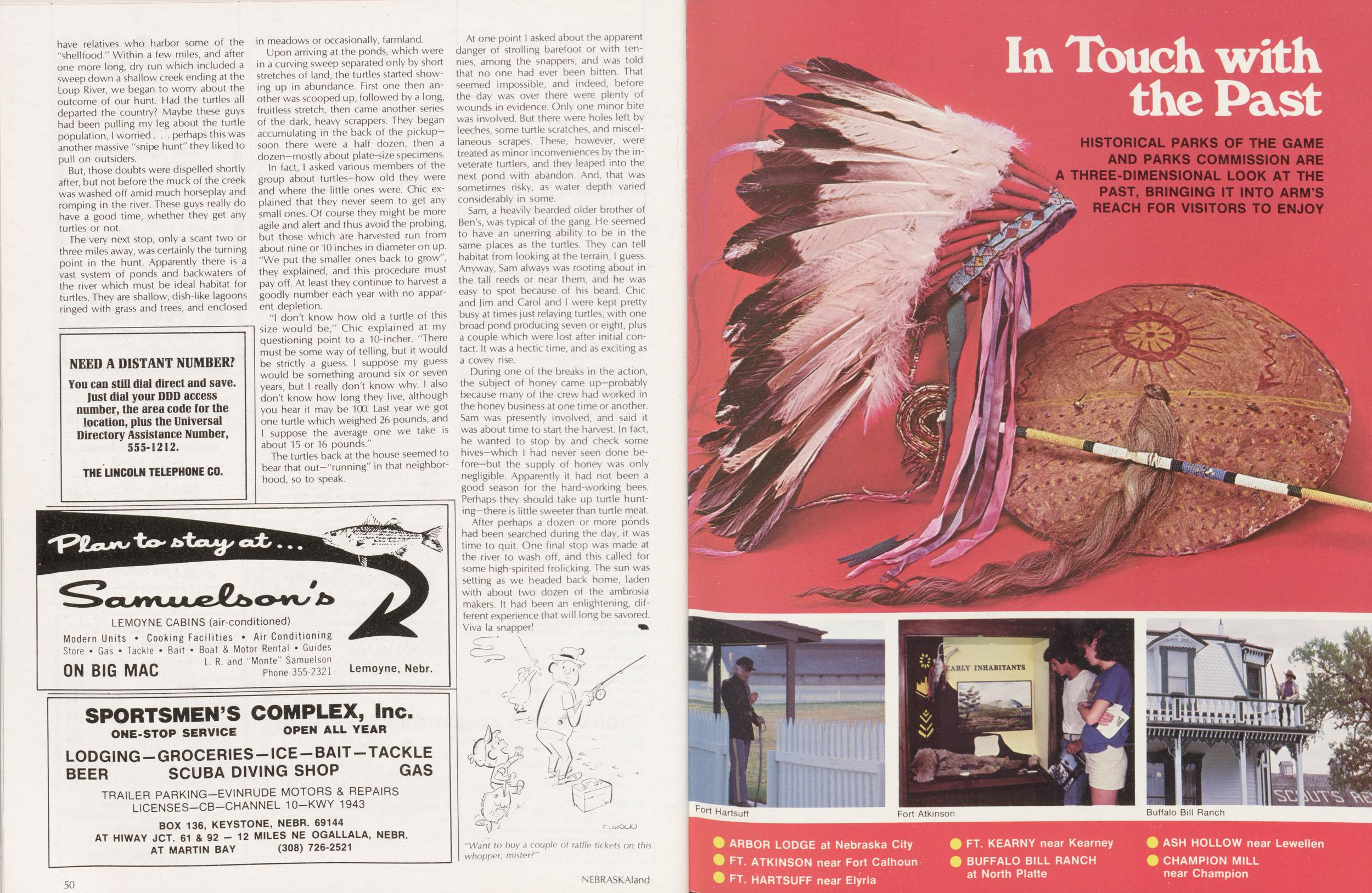
But, those doubts were dispelled shortly after, but not before the muck of the creek was washed off amid much horseplay and romping in the river. These guys really do have a good time, whether they get any turtles or not.
The very next stop, only a scant two or three miles away, was certainly the turning point in the hunt. Apparently there is a vast system of ponds and backwaters of the river which must be ideal habitat for turtles. They are shallow, dish-like lagoons ringed with grass and trees, and enclosed in meadows or occasionally, farmland.
Upon arriving at the ponds, which were in a curving sweep separated only by short stretches of land, the turtles started showing up in abundance. First one then another was scooped up, followed by a long, fruitless stretch, then came another series of the dark, heavy scrappers. They began accumulating in the back of the pickup-soon there were a half dozen, then a dozen—mostly about plate-size specimens.
In fact, I asked various members of the group about turtles—how old they were and where the little ones were. Chic explained that they never seem to get any small ones. Of course they might be more agile and alert and thus avoid the probing, but those which are harvested run from about nine or 10 inches in diameter on up. "We put the smaller ones back to grow", they explained, and this procedure must pay off. At least they continue to harvest a goodly number each year with no apparent depletion.
"I don't know how old a turtle of this size would be," Chic explained at my questioning point to a 10-incher. "There must be some way of telling, but it would be strictly a guess. I suppose my guess would be something around six or seven years, but I really don't know why. I also don't know how long they live, although you hear it may be 100. Last year we got one turtle which weighed 26 pounds, and I suppose the average one we take is about 15 or 16 pounds."
The turtles back at the house seemed to bear that out-"running" in that neighborhood, so to speak.
At one point I asked about the apparent danger of strolling barefoot or with tennies, among the snappers, and was told that no one had ever been bitten. That seemed impossible, and indeed, before the day was over there were plenty of wounds in evidence. Only one minor bite was involved. But there were holes left by leeches, some turtle scratches, and miscellaneous scrapes. These, however, were treated as minor inconveniences by the inveterate turtlers, and they leaped into the next pond with abandon. And, that was sometimes risky, as water depth varied considerably in some.
Sam, a heavily bearded older brother of Ben's, was typical of the gang. He seemed to have an unerring ability to be in the same places as the turtles. They can tell habitat from looking at the terrain, I guess. Anyway, Sam always was rooting about in the tall reeds or near them, and he was easy to spot because of his beard. Chic and Jim and Carol and I were kept pretty busy at times just relaying turtles, with one broad pond producing seven or eight, plus a couple which were lost after initial contact. It was a hectic time, and as exciting as a covey rise.
During one of the breaks in the action, the subject of honey came up-probably because many of the crew had worked in the honey business at one time or another. Sam was presently involved, and said it was about time to start the harvest. In fact, he wanted to stop by and check some hives-which I had never seen done before—but the supply of honey was only negligible. Apparently it had not been a good season for the hard-working bees. Perhaps they should take up turtle hunting-there is little sweeter than turtle meat.
After perhaps a dozen or more ponds had been searched during the day, it was time to quit. One final stop was made at the river to wash off, and this called for some high-spirited frolicking. The sun was setting as we headed back home, laden with about two dozen of the ambrosia makers. It had been an enlightening, different experience that will long be savored. Viva la snapper!
NEED A DISTANT NUMBER? You can still dial direct and save. Just dial your DDD access number, the area code for the location, plus the Universal Directory Assistance Number, 555-1212. THE LINCOLN TELEPHONE CO. Plan to stay at... Samuelson's LEMOYNE CABINS (air-conditioned) Modern Units Cooking Facilities Air Conditioning Store Gas Tackle Bait Boat & Motor Rental Guides L. R. and "Monte" Samuelson ON BIG MAC Phone 355 2321 Lemoyne, Nebr. SPORTSMEN'S COMPLEX, Inc ONE-STOP SERVICE OPEN ALL YEAR LODGING-GROCERIES-ICE-BAIT-TACKLE BEER SCUBA DIVING SHOP GAS TRAILER PARKING-EVINRUDE MOTORS & REPAIRS LICENSES-CB-CHANNEL 10-KWY 1943 BOX 136, KEYSTONE, NEBR. 69144 AT HIWAY JCT. 61 & 92 - 12 MILES NE OGALLALA, NEBR. AT MARTIN BAY (308) 726-2521In Touch with the Past
HISTORICAL PARKS OF THE GAME AND PARKS COMMISSION ARE A THREE-DIMENSIONAL LOOK AT THE PAST, BRINGING IT INTO ARM'S REACH FOR VISITORS TO ENJOY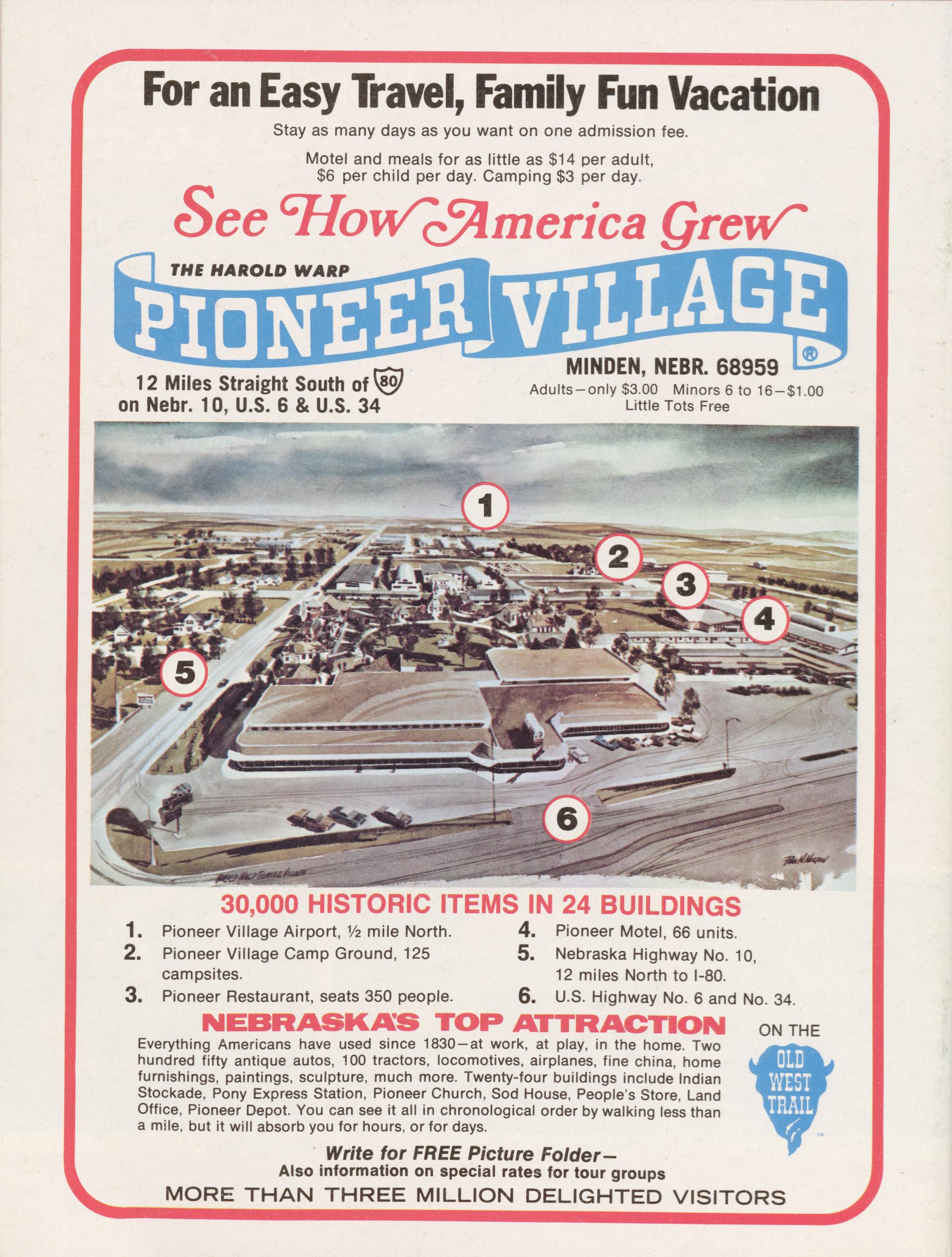
For an Easy Travel, Family Fun Vacation
Stay as many days as you want on one admission fee. Motel and meals for as little as $14 per adult, $6 per child per day. Camping $3 per day. See 12 Miles Straight South of V^/ on Nebr. 10, U.S. 6 & U.S. 34 MINDEN, NEBR. 68959 Adults-only $3.00 Minors 6 to 16-$1.00 Little Tots FreePosition: 171 (39 views)