Volume 58, Issue 6, 1980
NEBRASKAland
June 1980 60 cents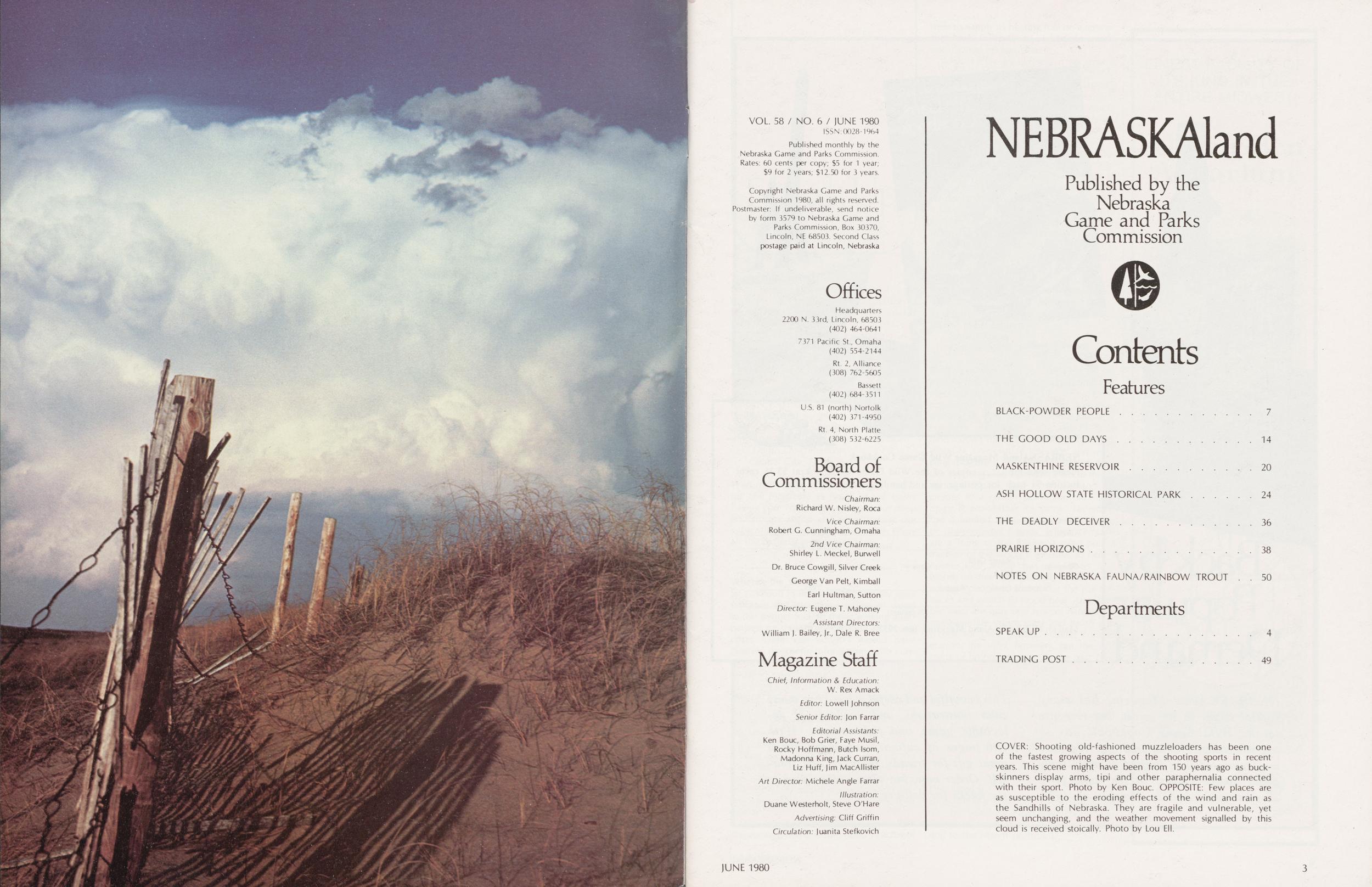
NEBRASKAland
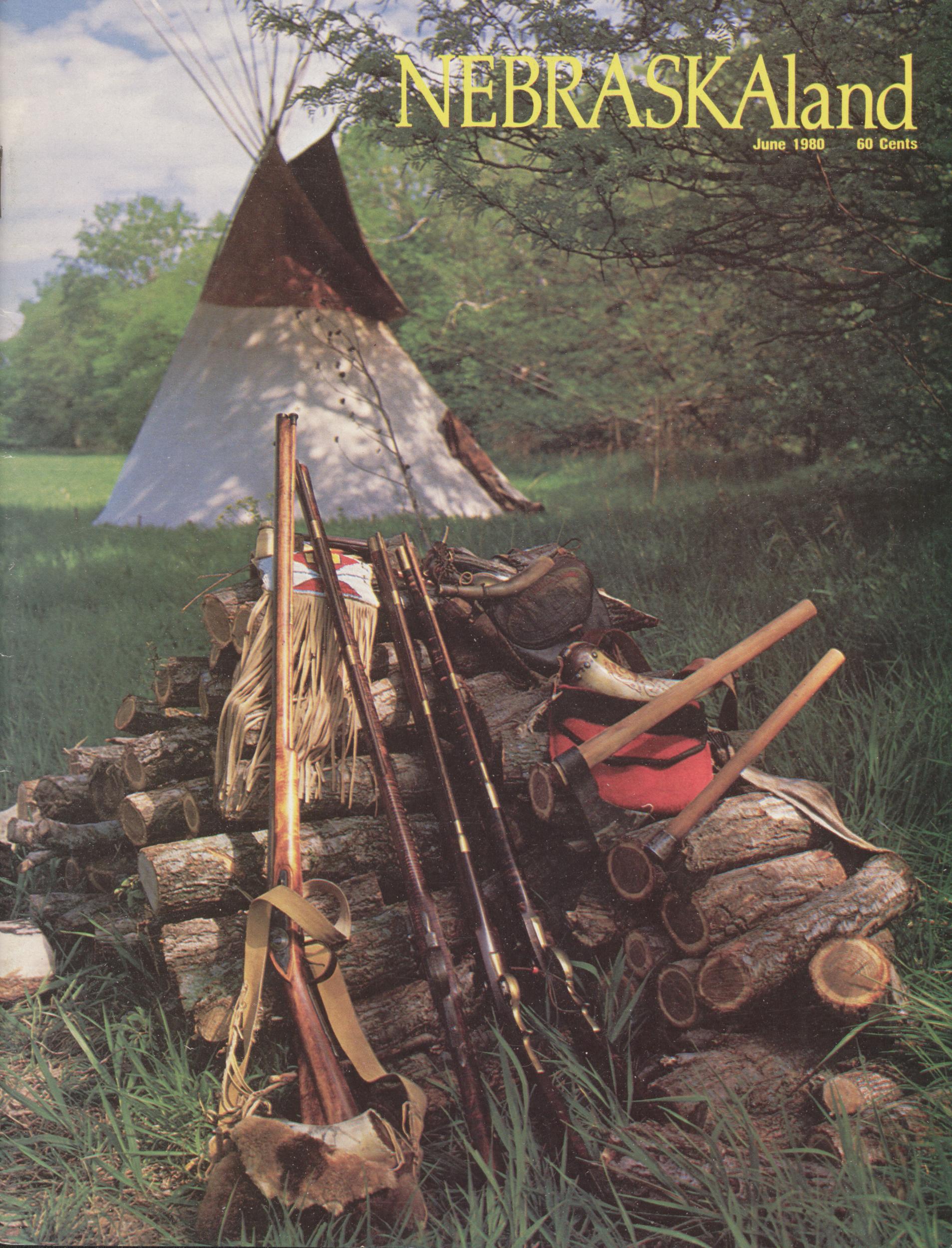
Published by the Nebraska Game and Parks Commission VOL 58 / NO. 6 / JUNE 1980 ISSN: 0028-1464 Published monthly by the Nebraska Game and Parks Commission. Rates: 60 cents per copy; $5 for 1 year; $9 for 2 years; $12.50 for 3 years. Copyright Nebraska Game and Parks Commission 1980, all rights reserved. Postmaster: If undeliverable, send notice by form 3579 to Nebraska Game and Parks Commission, Box 30370, Lincoln, NE 68503. Second Class postage paid at Lincoln, Nebraska Offices Headquarters 2200 N. 33rd, Lincoln, 68503 (402) 464-0641 7371 Pacific St., Omaha (402) 554-2144 Rt. 2, Alliance (308) 762-5605 Bassett (402) 684-3511 U.S. 81 (north) Norfolk (402) 371-4950 Rt 4, North Platte (308) 532-6225 Board of Commissioners Chairman: Richard W. Nisley, Roca Vice Chairman: Robert G. Cunningham, Omaha 2nd Vice Chairman: Shirley L. Meckel, Burwell Dr. Bruce Cowgill, Silver Creek George Van Pelt, Kimball Earl Hultman, Sutton Director: Eugene T. Mahoney Assistant Directors: William ). Bailey, Jr., Dale R. Bree Magazine Staff Chief, Information & Education: W. Rex Amack Editor: Lowell Johnson Senior Editor: Jon Farrar Editorial Assistants: Ken Bouc, Bob Grier, Faye Musil, Rocky Hoffmann, Butch Isom, Madonna King, Jack Curran, Liz Huff, Jim MacAllister Art Director: Michele Angle Farrar Illustration: Duane Westerholt, Steve O'Hare Advertising: Cliff Griffin Circulation: Juanita Stefkovich Contents Features BLACK-POWDER PEOPLE 7 THE GOOD OLD DAYS 14 MASKENTHINE RESERVOIR 20 ASH HOLLOW STATE HISTORICAL PARK 24 THE DEADLY DECEIVER 36 PRAIRIE HORIZONS 38 NOTES ON NEBRASKA FAUNA/RAINBOW TROUT 50 Departments SPEAK UP TRADING POST 49 COVER: Shooting old-fashioned muzzleloaders has been one of the fastest growing aspects of the shooting sports in recent years. This scene might have been from 150 years ago as buck- skinners display arms, tipi and other paraphernalia connected with their sport. Photo by Ken Bouc. OPPOSITE: Few places are as susceptible to the eroding effects of the wind and rain as the Sandhills of Nebraska. They are fragile and vulnerable, yet seem unchanging, and the weather movement signaled by this cloud is received stoically. Photo by Lou Ell. JUNE 1980 3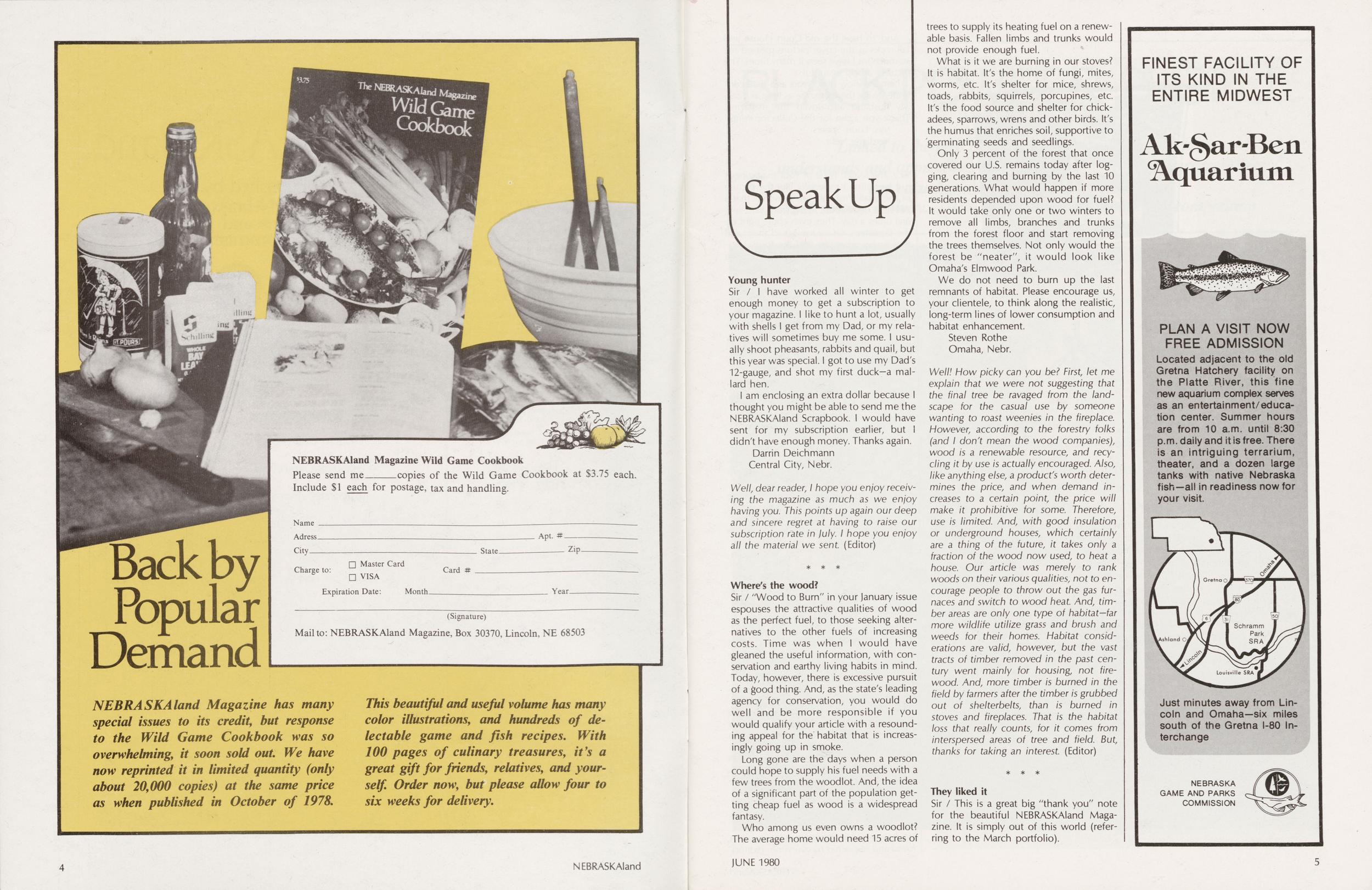
Speak Up
Young hunterSir / I have worked all winter to get enough money to get a subscription to your magazine. I like to hunt a lot, usually with shells I get from my Dad, or my relatives will sometimes buy me some. I usually shoot pheasants, rabbits and quail, but this year was special. I got to use my Dad's 12-gauge, and shot my first duck—a mallard hen.
I am enclosing an extra dollar because I thought you might be able to send me the NEBRASKAland Scrapbook. I would have sent for my subscription earlier, but I didn't have enough money. Thanks again.
Darrin Deichmann Central City, Nebr.Well, dear reader, I hope you enjoy receiving the magazine as much as we enjoy having you. This points up again our deep and sincere regret at having to raise our subscription rate in July. I hope you enjoy all the material we sent. (Editor)
* * * Where's the wood?Sir / "Wood to Burn" in your January issue espouses the attractive qualities of wood as the perfect fuel, to those seeking alternatives to the other fuels of increasing costs. Time was when I would have gleaned the useful information, with conservation and earthy living habits in mind. Today, however, there is excessive pursuit of a good thing. And, as the state's leading agency for conservation, you would do well and be more responsible if you would qualify your article with a resounding appeal for the habitat that is increasingly going up in smoke.
Long gone are the days when a person could hope to supply his fuel needs with a few trees from the woodlot. And, the idea of a significant part of the population getting cheap fuel as wood is a widespread fantasy.
Who among us even owns a woodlot? The average home would need 15 acres of trees to supply its heating fuel on a renewable basis. Fallen limbs and trunks would not provide enough fuel.
What is it we are burning in our stoves? It is habitat. It's the home of fungi, mites, worms, etc. It's shelter for mice, shrews, toads, rabbits, squirrels, porcupines, etc. It's the food source and shelter for chickadees, sparrows, wrens and other birds. It's the humus that enriches soil, supportive to germinating seeds and seedlings.
Only 3 percent of the forest that once covered our U.S. remains today after logging, clearing and burning by the last 10 generations. What would happen if more residents depended upon wood for fuel? It would take only one or two winters to remove all limbs, branches and trunks from the forest floor and start removing the trees themselves. Not only would the forest be "neater", it would look like Omaha's Elmwood Park.
We do not need to burn up the last remnants of habitat. Please encourage us, your clientele, to think along the realistic, long-term lines of lower consumption and habitat enhancement.
Steven Rothe Omaha, Nebr.Well! How picky can you be? First, let me explain that we were not suggesting that the final tree be ravaged from the landscape for the casual use by someone wanting to roast weenies in the fireplace. However, according to the forestry folks (and I don't mean the wood companies), wood is a renewable resource, and recycling it by use is actually encouraged. Also, like anything else, a product's worth determines the price, and when demand increases to a certain point, the price will make it prohibitive for some. Therefore, use is limited. And, with good insulation or underground houses, which certainly are a thing of the future, it takes only a fraction of the wood now used, to heat a house. Our article was merely to rank woods on their various qualities, not to encourage people to throw out the gas furnaces and switch to wood heat. And, timber areas are only one type of habitat—far more wildlife utilize grass and brush and weeds for their homes. Habitat considerations are valid, however, but the vast tracts of timber removed in the past century went mainly for housing, not firewood. And, more timber is burned in the field by farmers after the timber is grubbed out of shelterbelts, than is burned in stoves and fireplaces. That is the habitat loss that really counts, for it comes from interspersed areas of tree and field. But, thanks for taking an interest. (Editor)
* * * They liked itSir / This is a great big "thank you" note for the beautiful NEBRASKAland Magazine. It is simply out of this world (referring to the March portfolio).
FINEST FACILITY OF ITS KIND IN THE ENTIRE MIDWESTAk-§ar-Ben Aquarium
PLAN A VISIT NOW FREE ADMISSION
Located adjacent to the old Gretna Hatchery facility on the Platte River, this fine new aquarium complex serves as an entertainment/ education center. Summer hours are from 10 a.m. until 8:30 p.m. daily and it is free. There is an intriguing terrarium, theater, and a dozen large tanks with native Nebraska fish—all in readiness now for your visit.
Just minutes away from Lincoln and Omaha—six miles south of the Gretna I-80 Interchange
NEBRASKA GAME AND PARKS/. COMMISSION JUNE 1980 5
 A DOUBLE
·FEATURE
·TEACHERS
·YOUTH
LEADERS
·PARENTS
You'll enjoy these two special slide programs
from photo files of NEBRASKAland Magazine
Mr. Whiskers Mammal Wildlife Friends
and
The Tower on the Plains
Ideal for groups or classroom use, these slide programs provide a rare
opportunity for a personal glimpse of Nebraska's State Capitol and
our myriad wildlife species. Both have taped narration and a follow-along script.
With the "Tower on the Plains," you'll also receive a beautiful 22-inch by 30-inch
full-color framable print of the State Capitol.
The Capitol series is also available in a filmstrip. Since sets are made
up to order, please allow six to eight weeks for delivery.
Please send me the show(s) indicated:
sets of "Mr. Whiskers Mammal Wildlife Friends"
(52 slides) at $21.50 per set
sets of "The Tower of the Plains"
(59 slides) at $21.50 per set
filmstrips of "The Tower on the Plains"
at $17.50 per set
Nebraska residents, please add appropriate sales
tax. Send check or money order. No cash, please!
Name
School or Group
Address
City
State
Zip
Mail to: Nebraska Game and Parks Commission
P.O. Box 30370
Lincoln, Nebraska 68503
A DOUBLE
·FEATURE
·TEACHERS
·YOUTH
LEADERS
·PARENTS
You'll enjoy these two special slide programs
from photo files of NEBRASKAland Magazine
Mr. Whiskers Mammal Wildlife Friends
and
The Tower on the Plains
Ideal for groups or classroom use, these slide programs provide a rare
opportunity for a personal glimpse of Nebraska's State Capitol and
our myriad wildlife species. Both have taped narration and a follow-along script.
With the "Tower on the Plains," you'll also receive a beautiful 22-inch by 30-inch
full-color framable print of the State Capitol.
The Capitol series is also available in a filmstrip. Since sets are made
up to order, please allow six to eight weeks for delivery.
Please send me the show(s) indicated:
sets of "Mr. Whiskers Mammal Wildlife Friends"
(52 slides) at $21.50 per set
sets of "The Tower of the Plains"
(59 slides) at $21.50 per set
filmstrips of "The Tower on the Plains"
at $17.50 per set
Nebraska residents, please add appropriate sales
tax. Send check or money order. No cash, please!
Name
School or Group
Address
City
State
Zip
Mail to: Nebraska Game and Parks Commission
P.O. Box 30370
Lincoln, Nebraska 68503
And, to have the old Court House and
Jail rocks as the cover picture pleased me
so much for I have seen it many times. The
pictures are all beautiful.
I am a widow of 80 years and shall continue taking the magazine as long as I can. My husband also loved the magazine. Thank you again for the Collector Prints.
Mrs. Louis Speers Verdigre, Nebr. * * *Sir / The March issue of your magazine is just beautiful. I especially like the picture of the quail. Probably one reason is that a covey of quail come to my front yard several times a day. They even come right on the doorsteps. Of course I feed them and they know where to find the food. I enjoyed the birds very much and they are a lot of company for me.
Emma Hoist Edgar, Nebr. * * *Sir / Just wanted to thank you for the wonderful March issue! Some of my friends were unaware of the beautiful sights in our state. These thoughts come to mind:
I've traveled the East,And I've been through the West,
But, still I like NEBRASKAland best! Ms. Sandy Struble Omaha, Nebr.
Sir / Received the March issue of NEBRASKAland Magazine-it is great. Your photographs are excellent in every issue.
Many of the photos from your magazine have been the inspiration that sparked some of our students' paintings. Your silhouettes are always outstanding! Keep the good quality coming.
Ruth Goldsberry Minburn, Iowa * * * A detractorSir / Your March "issue" was very disappointing. You better look up the definition of "magazine." We subscribe to a magazine for the many hours of reading it will provide us. Your March issue provided us each with about 15 seconds of "looking." You see, we have no special interest in art. I think you owe your subscribers a one-month extension to their subscriptions. We've subscribed to NEBRASKAland since the late 1950's. We've been disappointed a few times when the issues had far more space given to pictures than to articles, but this picture folder is a complete disaster as far as we are concerned. Go back to publishing a good magazine and we'll forgive you for your blunder.
Mrs. LeRoy Petersen Winside, Nebr.Well, even Abraham Lincoln was not loved and respected by everyone. (Editor)
6 NEBRASKAlandBLACK-POWDER PEOPLE
BY BOB GRIER Linked to the post by choice, the muzzleloading clan understands and appreciates an earlier time. Some are purists, others are casual, but all enjoy this colorful, noisy, and smoky activity. Their shoots are social and fun competition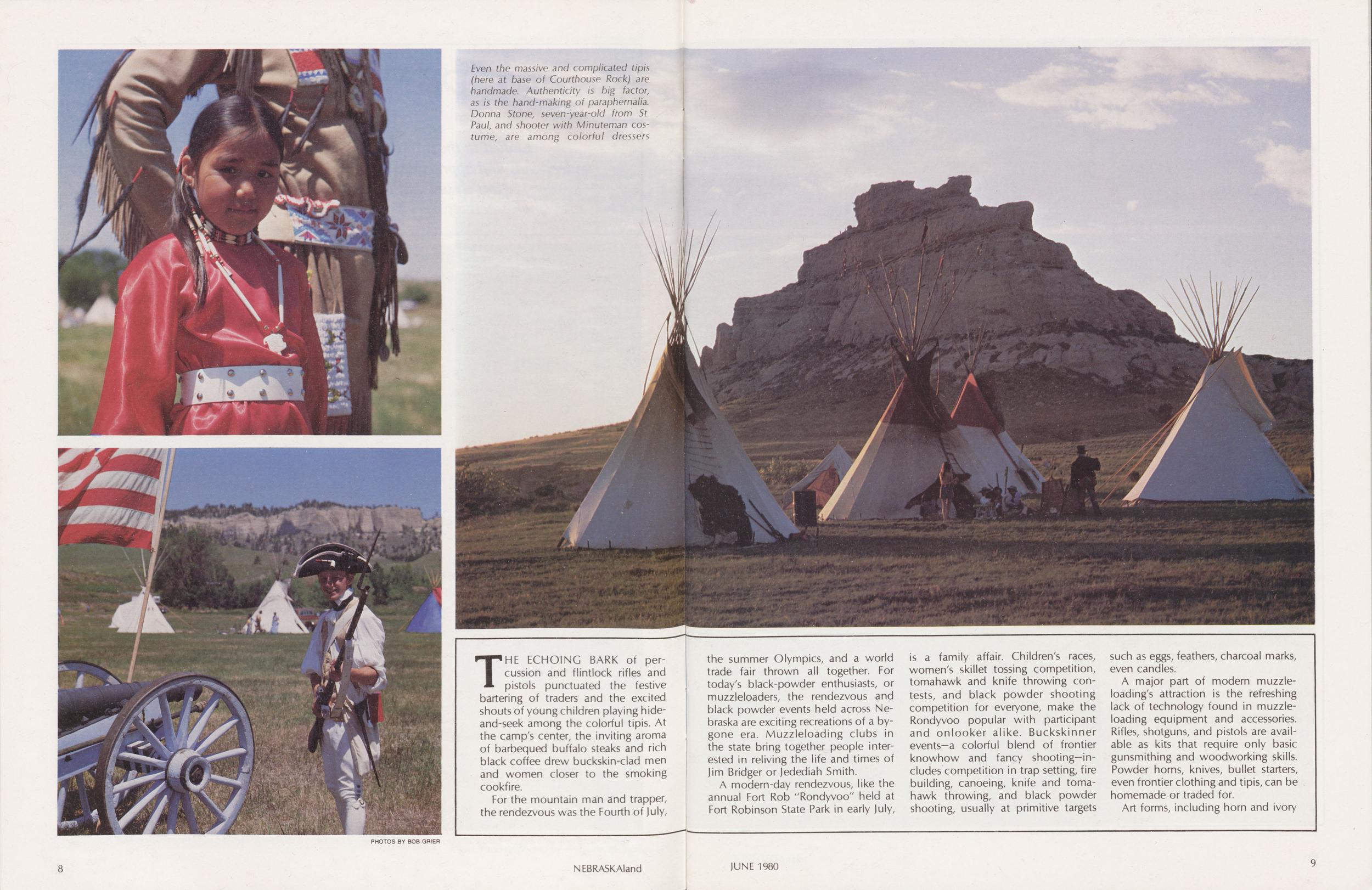
THE ECHOING BARK of percussion and flintlock rifles and pistols punctuated the festive bartering of traders and the excited shouts of young children playing hide-and-seek among the colorful tipis. At the camp's center, the inviting aroma of barbequed buffalo steaks and rich black coffee drew buckskin-clad men and women closer to the smoking cookfire.
For the mountain man and trapper, the rendezvous was the Fourth of July, the summer Olympics, and a world trade fair thrown all together. For today's black-powder enthusiasts, or muzzleloaders, the rendezvous and black powder events held across Nebraska are exciting recreations of a bygone era. Muzzleloading clubs in the state bring together people interested in reliving the life and times of Jim Bridger or Jedediah Smith.
For the mountain man and trapper, the rendezvous was the Fourth of July, the summer Olympics, and a world trade fair thrown all together. For today's black-powder enthusiasts, or muzzleloaders, the rendezvous and black powder events held across Nebraska are exciting recreations of a bygone era. Muzzleloading clubs in the state bring together people interested in reliving the life and times of Jim Bridger or Jedediah Smith.
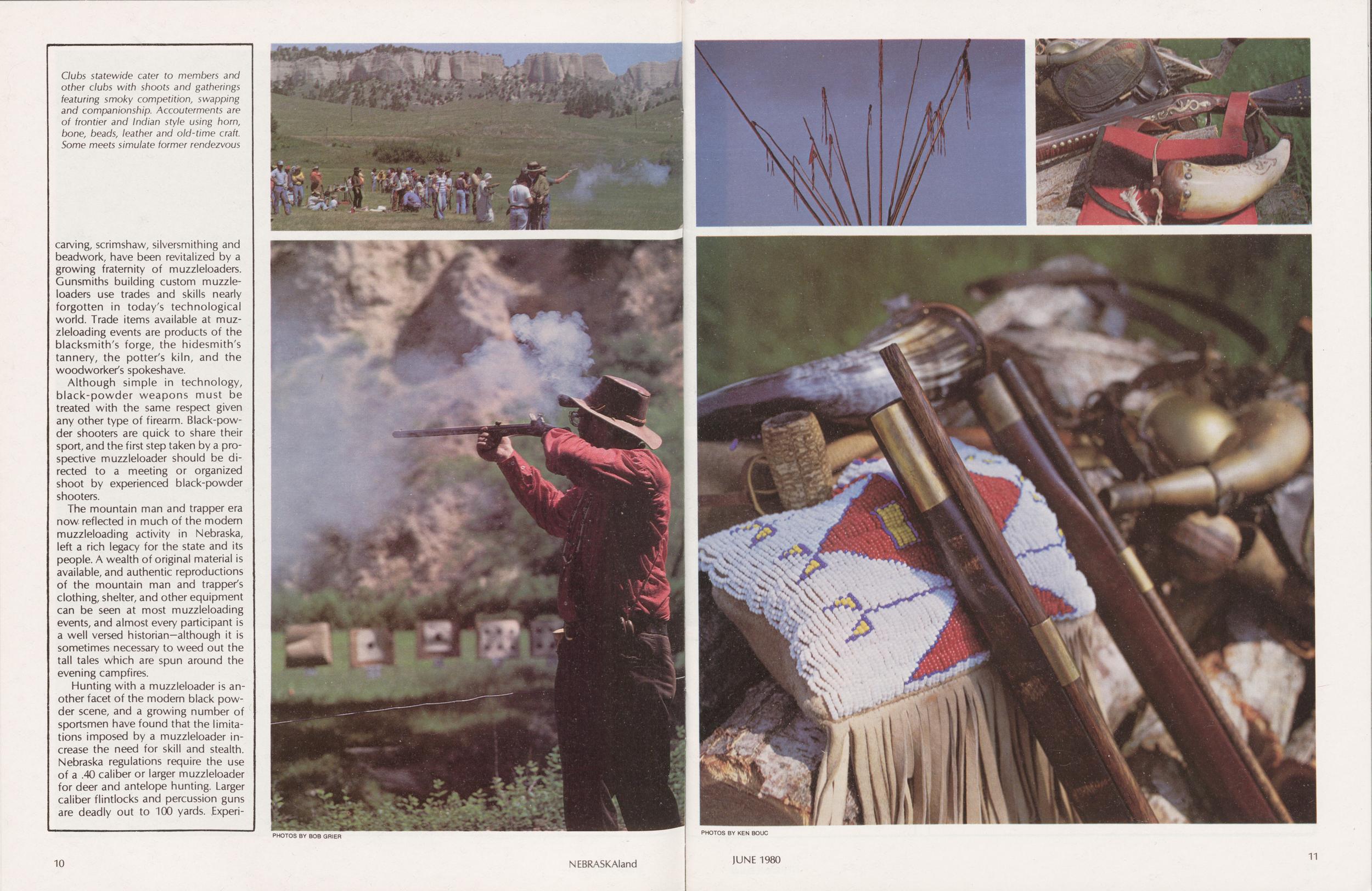
A modern-day rendezvous, like the annual Fort Rob "Rondyvoo" held at Fort Robinson State Park in early July, is a family affair. Children's races, women's skillet tossing competition, tomahawk and knife throwing contests, and black powder shooting competition for everyone, make the Rondyvoo popular with participant and onlooker alike. Buckskinner events—a colorful blend of frontier knowhow and fancy shooting—includes competition in trap setting, fire building, canoeing, knife and tomahawk throwing, and black powder shooting, usually at primitive targets such as eggs, feathers, charcoal marks, even candles.
A major part of modern muzzleloading's attraction is the refreshing lack of technology found in muzzleloading equipment and accessories. Rifles, shotguns, and pistols are available as kits that require only basic gunsmithing and woodworking skills. Powder horns, knives, bullet starters, even frontier clothing and tipis, can be homemade or traded for.
Art forms, including horn and ivory
JUNE 1980
9
 carving, scrimshaw, silversmithing and
beadwork, have been revitalized by a
growing fraternity of muzzleloaders.
Gunsmiths building custom muzzleloaders use trades and skills nearly
forgotten in today's technological
world. Trade items available at muzzleloading events are products of the
blacksmith's forge, the hidesmith's
tannery, the potter's kiln, and the
woodworker's spokeshave.
carving, scrimshaw, silversmithing and
beadwork, have been revitalized by a
growing fraternity of muzzleloaders.
Gunsmiths building custom muzzleloaders use trades and skills nearly
forgotten in today's technological
world. Trade items available at muzzleloading events are products of the
blacksmith's forge, the hidesmith's
tannery, the potter's kiln, and the
woodworker's spokeshave.
Although simple in technology, black-powder weapons must be treated with the same respect given any other type of firearm. Black-powder shooters are quick to share their sport, and the first step taken by a prospective muzzleloader should be directed to a meeting or organized shoot by experienced black-powder shooters.
The mountain man and trapper era now reflected in much of the modern muzzleloading activity in Nebraska, left a rich legacy for the state and its people. A wealth of original material is available, and authentic reproductions of the mountain man and trapper's clothing, shelter, and other equipment can be seen at most muzzleloading events, and almost every participant is a well versed historian—although it is sometimes necessary to weed out the tall tales which are spun around the evening campfires.
Hunting with a muzzleloader is another facet of the modern black powder scene, and a growing number of sportsmen have found that the limitations imposed by a muzzleloader increase the need for skill and stealth. Nebraska regulations require the use of a .40 caliber or larger muzzleloader for deer and antelope hunting. Larger caliber flintlocks and percussion guns are deadly out to 100 yards. Experienced hunters recommend the patched lead ball for big game. Spring and fall turkey hunting with a black-powder shotgun is also growing in popularity.
10 NEBRASKAland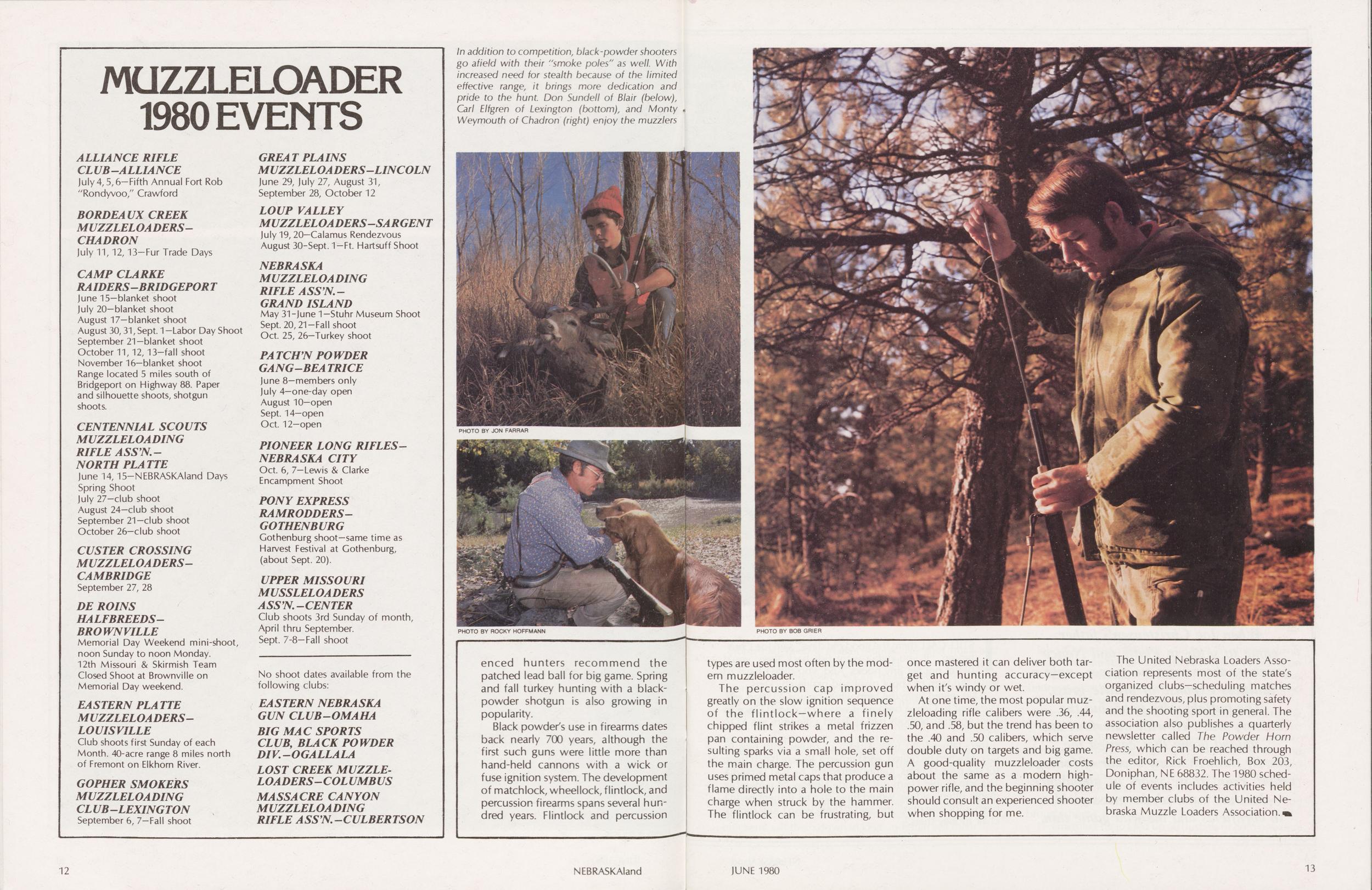 MUZZLELOADER
1980 EVENTS
ALLIANCE RIFLE
CLUB-ALLIANCE
July 4,5,6—Fifth Annual Fort Rob
"Rondyvoo," Crawford
BORDEA UX CREEK
MUZZLELOADERS
CHADRON
July 11,12,13-Fur Trade Days
CAMP CLARKE
RAIDERS-BRIDGEPORT
June 15—blanket shoot
July 20—blanket shoot
August 17—blanket shoot
August 30,31, Sept. 1 —Labor Day Shoot
September 21—blanket shoot
October 11,12,13—fall shoot
November 16—blanket shoot
Range located 5 miles south of
Bridgeport on Highway 88. Paper
and silhouette shoots, shotgun
shoots.
CENTENNIAL SCOUTS
MUZZLELOADING
RIFLE ASSN.
NORTH PLA TTE
June 14,15-NEBRASKAland Days
Spring Shoot
July 27—club shoot
August 24—club shoot
September 21—club shoot
October 26—club shoot
CUSTER CROSSING
MUZZLELOADERS
CAMBRIDGE
September 27, 28
DE ROINS
HALFBREEDS-BROWNVILLE
Memorial Day Weekend mini-shoot,
noon Sunday to noon Monday.
12th Missouri & Skirmish Team
Closed Shoot at Brownville on
Memorial Day weekend.
EASTERN PLATTE
MUZZLELOADERS - LOUISVILLE
Club shoots first Sunday of each
Month. 40-acre range 8 miles north
of Fremont on Elkhorn River.
GOPHER SMOKERS
MUZZLELOADING
CLUB-LEXINGTON
September 6, 7—Fall shoot
GREA T PLAINS
MUZZLELOADERS-LINCOLN
June 29, July 27, August 31,
September 28, October 12
LOUP VALLEY
MUZZLELOADERS-SARGENT
July 19, 20—Calamus Rendezvous
August 30-Sept. 1—Ft. Hartsuff Shoot
NEBRASKA
MUZZLELOADING
RIFLE ASSN.
GRAND ISLAND
May 31-June 1—Stuhr Museum Shoot
Sept. 20, 21-Fall shoot
Oct. 25, 26—Turkey shoot
PATCH'N POWDER
GANG-BEATRICE
June 8—members only
July 4—one-day open
August 10—open
Sept. 14—open
Oct. 12—open
PIONEER LONG RIFLES-NEBRASKA CITY
Oct. 6, 7—Lewis & Clarke
Encampment Shoot
PONY EXPRESS
RAMRODDERS-
GOTHENBURG
Gothenburg shoot—same time as
Harvest Festival at Gothenburg,
(about Sept. 20).
UPPER MISSOURI
MUSSLELOADERS
ASSN.-CENTER
Club shoots 3rd Sunday of month,
April thru September.
Sept. 7-8-Fall shoot
No shoot dates available from the
following clubs:
EASTERN NEBRASKA
GUN CLUB-OMAHA
MUZZLELOADER
1980 EVENTS
ALLIANCE RIFLE
CLUB-ALLIANCE
July 4,5,6—Fifth Annual Fort Rob
"Rondyvoo," Crawford
BORDEA UX CREEK
MUZZLELOADERS
CHADRON
July 11,12,13-Fur Trade Days
CAMP CLARKE
RAIDERS-BRIDGEPORT
June 15—blanket shoot
July 20—blanket shoot
August 17—blanket shoot
August 30,31, Sept. 1 —Labor Day Shoot
September 21—blanket shoot
October 11,12,13—fall shoot
November 16—blanket shoot
Range located 5 miles south of
Bridgeport on Highway 88. Paper
and silhouette shoots, shotgun
shoots.
CENTENNIAL SCOUTS
MUZZLELOADING
RIFLE ASSN.
NORTH PLA TTE
June 14,15-NEBRASKAland Days
Spring Shoot
July 27—club shoot
August 24—club shoot
September 21—club shoot
October 26—club shoot
CUSTER CROSSING
MUZZLELOADERS
CAMBRIDGE
September 27, 28
DE ROINS
HALFBREEDS-BROWNVILLE
Memorial Day Weekend mini-shoot,
noon Sunday to noon Monday.
12th Missouri & Skirmish Team
Closed Shoot at Brownville on
Memorial Day weekend.
EASTERN PLATTE
MUZZLELOADERS - LOUISVILLE
Club shoots first Sunday of each
Month. 40-acre range 8 miles north
of Fremont on Elkhorn River.
GOPHER SMOKERS
MUZZLELOADING
CLUB-LEXINGTON
September 6, 7—Fall shoot
GREA T PLAINS
MUZZLELOADERS-LINCOLN
June 29, July 27, August 31,
September 28, October 12
LOUP VALLEY
MUZZLELOADERS-SARGENT
July 19, 20—Calamus Rendezvous
August 30-Sept. 1—Ft. Hartsuff Shoot
NEBRASKA
MUZZLELOADING
RIFLE ASSN.
GRAND ISLAND
May 31-June 1—Stuhr Museum Shoot
Sept. 20, 21-Fall shoot
Oct. 25, 26—Turkey shoot
PATCH'N POWDER
GANG-BEATRICE
June 8—members only
July 4—one-day open
August 10—open
Sept. 14—open
Oct. 12—open
PIONEER LONG RIFLES-NEBRASKA CITY
Oct. 6, 7—Lewis & Clarke
Encampment Shoot
PONY EXPRESS
RAMRODDERS-
GOTHENBURG
Gothenburg shoot—same time as
Harvest Festival at Gothenburg,
(about Sept. 20).
UPPER MISSOURI
MUSSLELOADERS
ASSN.-CENTER
Club shoots 3rd Sunday of month,
April thru September.
Sept. 7-8-Fall shoot
No shoot dates available from the
following clubs:
EASTERN NEBRASKA
GUN CLUB-OMAHABIG MAC SPORTS CLUB, BLACK POWDER DIV.-OGALLALA
LOST CREEK MUZZLELOADERS-COLUMBUS
MASSACRE CANYON MUZZLELOADING RIFLE ASSN.-CULBERTSON In addition to competition, black-powder shooters go afield with their "smoke poles" as well. With increased need for stealth because of the limited effective range, it brings more dedication and pride to the hunt. Don Sundell of Blair (below), Carl Elfgren of Lexington (bottom), and Monty Weymouth of Chadron (right) enjoy the muzzlers
Black powder's use in firearms dates back nearly 700 years, although the first such guns were little more than hand-held cannons with a wick or fuse ignition system. The development of matchlock, wheellock, flintlock, and percussion firearms spans several hundred years. Flintlock and percussion 12 NEBRASKAland types are used most often by the modern muzzleloader.
The percussion cap improved greatly on the slow ignition sequence of the flintlock—where a finely chipped flint strikes a metal frizzen pan containing powder, and the resulting sparks via a small hole, set off the main charge. The percussion gun uses primed metal caps that produce a flame directly into a hole to the main charge when struck by the hammer. The flintlock can be frustrating, but once mastered it can deliver both target and hunting accuracy—except when it's windy or wet.
At one time, the most popular muzzleloading rifle calibers were .36, .44, .50, and .58, but the trend has been to the .40 and .50 calibers, which serve double duty on targets and big game. A good-quality muzzleloader costs about the same as a modern high-power rifle, and the beginning shooter should consult an experienced shooter when shopping for me.
The United Nebraska Loaders Association represents most of the state's organized clubs—scheduling matches and rendezvous, plus promoting safety and the shooting sport in general. The association also publishes a quarterly newsletter called The Powder Horn Press, which can be reached through the editor, Rick Froehlich, Box 203, Doniphan, NE 68832. The 1980 schedule of events includes activities held by member clubs of the United Nebraska Muzzle Loaders Association.
JUNE 1980 13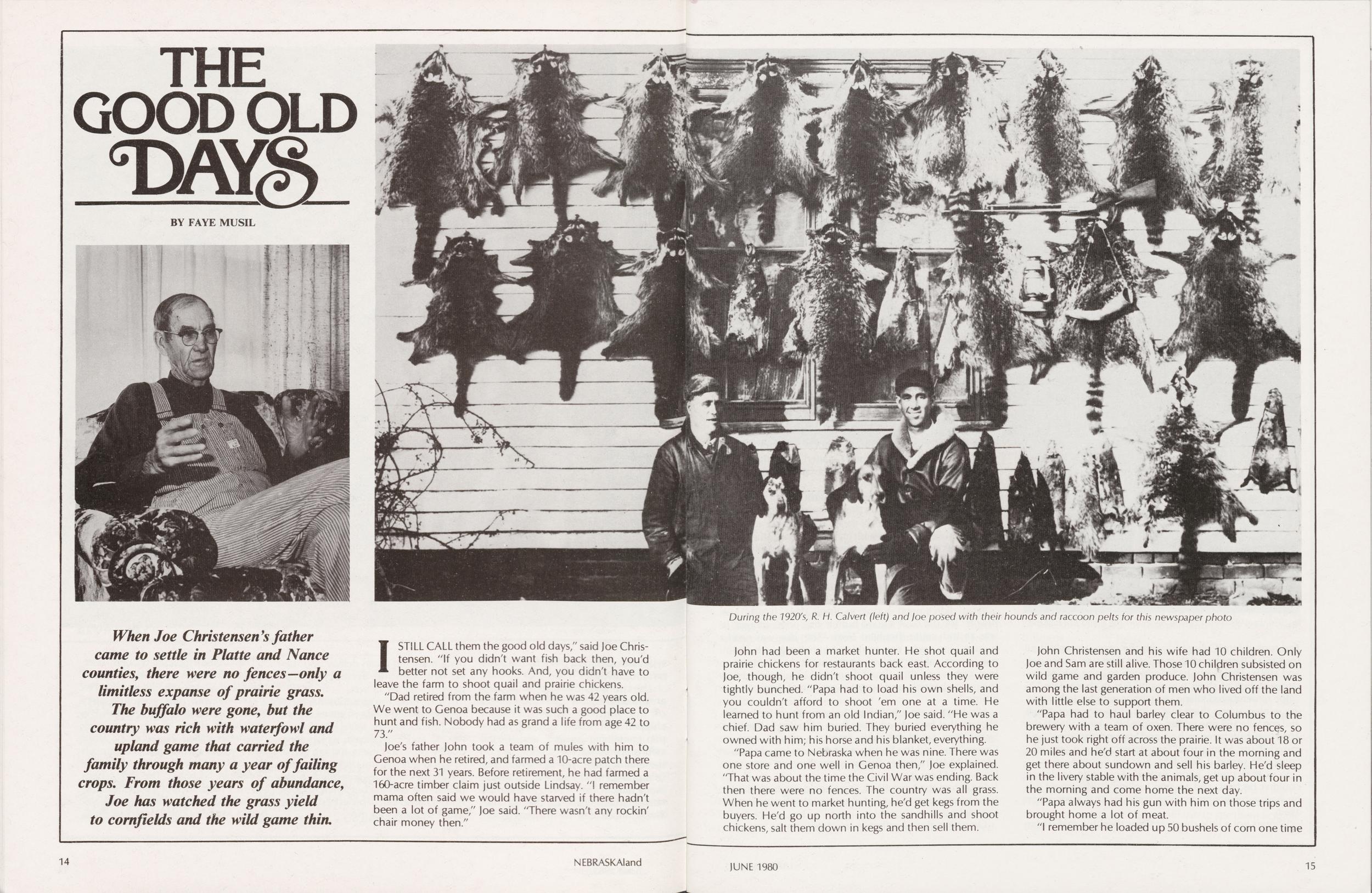
THE GOOD OLD DAYS
BY FAYE MUSILI STILL CALL them the good old days," said Joe Christensen. "If you didn't want fish back then, you'd better not set any hooks. And, you didn't have to leave the farm to shoot quail and prairie chickens.
"Dad retired from the farm when he was 42 years old. We went to Genoa because it was such a good place to hunt and fish. Nobody had as grand a life from age 42 to 73."
Joe's father John took a team of mules with him to Genoa when he retired, and farmed a 10-acre patch there for the next 31 years. Before retirement, he had farmed a 160-acre timber claim just outside Lindsay. "I remember mama often said we would have starved if there hadn't been a lot of game," Joe said. "There wasn't any rockin' chair money then."
14 NEBRASKAlandJohn had been a market hunter. He shot quail and prairie chickens for restaurants back east. According to Joe, though, he didn't shoot quail unless they were tightly bunched. "Papa had to load his own shells, and you couldn't afford to shoot 'em one at a time. He learned to hunt from an old Indian," Joe said. "He was a chief. Dad saw him buried. They buried everything he owned with him; his horse and his blanket, everything.
"Papa came to Nebraska when he was nine. There was one store and one well in Genoa then," Joe explained. "That was about the time the Civil War was ending. Back then there were no fences. The country was all grass. When he went to market hunting, he'd get kegs from the buyers. He'd go up north into the sandhills and shoot chickens, salt them down in kegs and then sell them.
John Christensen and his wife had 10 children. Only Joe and Sam are still alive. Those 10 children subsisted on wild game and garden produce. John Christensen was among the last generation of men who lived off the land with little else to support them.
"Papa had to haul barley clear to Columbus to the brewery with a team of oxen. There were no fences, so he just took right off across the prairie. It was about 18 or 20 miles and he'd start at about four in the morning and get there about sundown and sell his barley. He'd sleep in the livery stable with the animals, get up about four in the morning and come home the next day.
"Papa always had his gun with him on those trips and brought home a lot of meat.
"I remember he loaded up 50 bushels of corn one time
JUNE 1980
15
 and took it into Columbus with the oxen. He sold it all
for $2.50. Of course all they wanted then was coffee, salt
and sugar. They were lucky enough to raise lots of potatoes. A box of shells was worth
50¢ in those days."
and took it into Columbus with the oxen. He sold it all
for $2.50. Of course all they wanted then was coffee, salt
and sugar. They were lucky enough to raise lots of potatoes. A box of shells was worth
50¢ in those days."
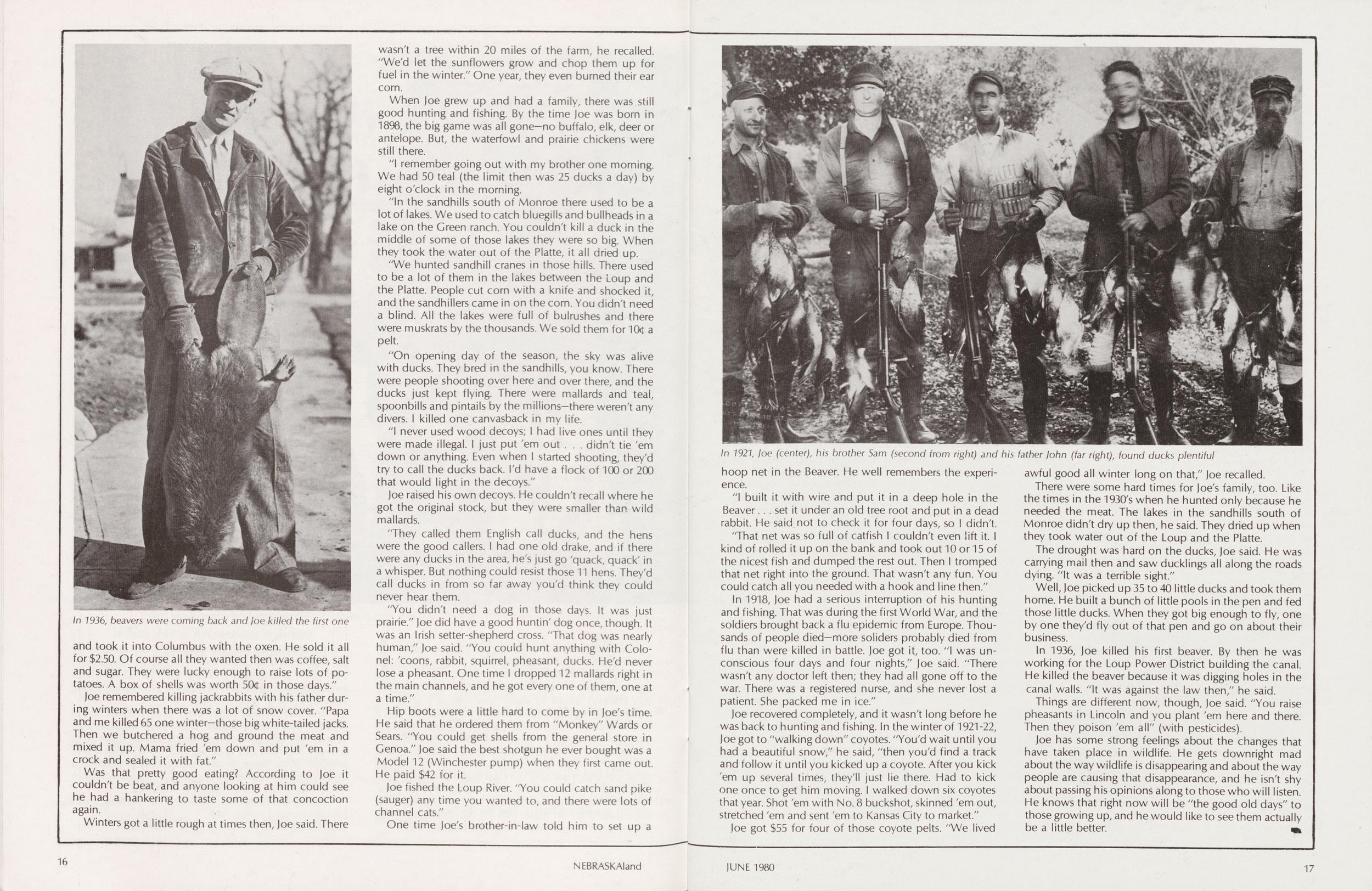
Joe remembered killing jackrabbits with his father during winters when there was a lot of snow cover. "Papa and me killed 65 one winter—those big white-tailed jacks. Then we butchered a hog and ground the meat and mixed it up. Mama fried 'em down and put 'em in a crock and sealed it with fat."
Was that pretty good eating? According to Joe it couldn't be beat, and anyone looking at him could see he had a hankering to taste some of that concoction again.
Winters got a little rough at times then, Joe said. There wasn't a tree within 20 miles of the farm, he recalled. "We'd let the sunflowers grow and chop them up for fuel in the winter." One year, they even burned their ear corn.
When Joe grew up and had a family, there was still good hunting and fishing. By the time Joe was born in 1898, the big game was all gone-no buffalo, elk, deer or antelope. But, the waterfowl and prairie chickens were still there.
"I remember going out with my brother one morning. We had 50 teal (the limit then was 25 ducks a day) by eight o'clock in the morning.
"In the sandhills south of Monroe there used to be a lot of lakes. We used to catch bluegills and bullheads in a lake on the Green ranch. You couldn't kill a duck in the middle of some of those lakes they were so big. When they took the water out of the Platte, it all dried up.
"We hunted sandhill cranes in those hills. There used to be a lot of them in the lakes between the Loup and the Platte. People cut corn with a knife and shocked it, and the sandhillers came in on the corn. You didn't need a blind. All the lakes were full of bulrushes and there were muskrats by the thousands. We sold them for 10 a pelt.
"On opening day of the season, the sky was alive with ducks. They bred in the sandhills, you know. There were people shooting over here and over there, and the ducks just kept flying. There were mallards and teal, spoonbills and pintails by the millions—there weren't any divers. I killed one canvasback in my life.
"I never used wood decoys; I had live ones until they were made illegal. I just put 'em out...didn't tie 'em down or anything. Even when I started shooting, they'd try to call the ducks back. I'd have a flock of 100 or 200 that would light in the decoys."
Joe raised his own decoys. He couldn't recall where he got the original stock, but they were smaller than wild mallards.
"They called them English call ducks, and the hens were the good callers. I had one old drake, and if there were any ducks in the area, he's just go 'quack, quack' in a whisper. But nothing could resist those 11 hens. They'd call ducks in from so far away you'd think they could never hear them.
"You didn't need a dog in those days. It was just prairie." Joe did have a good huntin' dog once, though. It was an Irish setter-shepherd cross. "That dog was nearly human," Joe said. "You could hunt anything with Colonel: 'coons, rabbit, squirrel, pheasant, ducks. He'd never lose a pheasant. One time I dropped 12 mallards right in the main channels, and he got every one of them, one at a time."
Hip boots were a little hard to come by in Joe's time. He said that he ordered them from "Monkey" Wards or Sears. "You could get shells from the general store in Genoa." Joe said the best shotgun he ever bought was a Model 12 (Winchester pump) when they first came out. He paid $42 for it.
Joe fished the Loup River. "You could catch sand pike (sauger) any time you wanted to, and there were lots of channel cats."
One time Joe's brother-in-law told him to set up a 16 NEBRASKAland hoop net in the Beaver. He well remembers the experience.
"I built it with wire and put it in a deep hole in the Beaver... set it under an old tree root and put in a dead rabbit. He said not to check it for four days, so I didn't.
"That net was so full of catfish I couldn't even lift it. I kind of rolled it up on the bank and took out 10 or 15 of the nicest fish and dumped the rest out. Then I tromped that net right into the ground. That wasn't any fun. You could catch all you needed with a hook and line then."
In 1918, Joe had a serious interruption of his hunting and fishing. That was during the first World War, and the soldiers brought back a flu epidemic from Europe. Thousands of people died—more soliders probably died from flu than were killed in battle. Joe got it, too. "I was unconscious four days and four nights," Joe said. "There wasn't any doctor left then; they had all gone off to the war. There was a registered nurse, and she never lost a patient. She packed me in ice."
Joe recovered completely, and it wasn't long before he was back to hunting and fishing. In the winter of 1921-22, Joe got to "walking down" coyotes. "You'd wait until you had a beautiful snow," he said, "then you'd find a track and follow it until you kicked up a coyote. After you kick 'em up several times, they'll just lie there. Had to kick one once to get him moving. I walked down six coyotes that year. Shot 'em with No. 8 buckshot, skinned 'em out, stretched 'em and sent 'em to Kansas City to market."
Joe got $55 for four of those coyote pelts. "We lived awful good all winter long on that," Joe recalled.
There were some hard times for Joe's family, too. Like the times in the 1930's when he hunted only because he needed the meat. The lakes in the sandhills south of Monroe didn't dry up then, he said. They dried up when they took water out of the Loup and the Platte.
The drought was hard on the ducks, Joe said. He was carrying mail then and saw ducklings all along the roads dying. "It was a terrible sight."
Well, Joe picked up 35 to 40 little ducks and took them home. He built a bunch of little pools in the pen and fed those little ducks. When they got big enough to fly, one by one they'd fly out of that pen and go on about their business.
In 1936, Joe killed his first beaver. By then he was working for the Loup Power District building the canal. He killed the beaver because it was digging holes in the canal walls. "It was against the law then," he said.
Things are different now, though, Joe said. "You raise pheasants in Lincoln and you plant 'em here and there. Then they poison 'em all" (with pesticides).
Joe has some strong feelings about the changes that have taken place in wildlife. He gets downright mad about the way wildlife is disappearing and about the way people are causing that disappearance, and he isn't shy about passing his opinions along to those who will listen. He knows that right now will be "the good old days" to those growing up, and he would like to see them actually be a little better.
JUNE 1980 17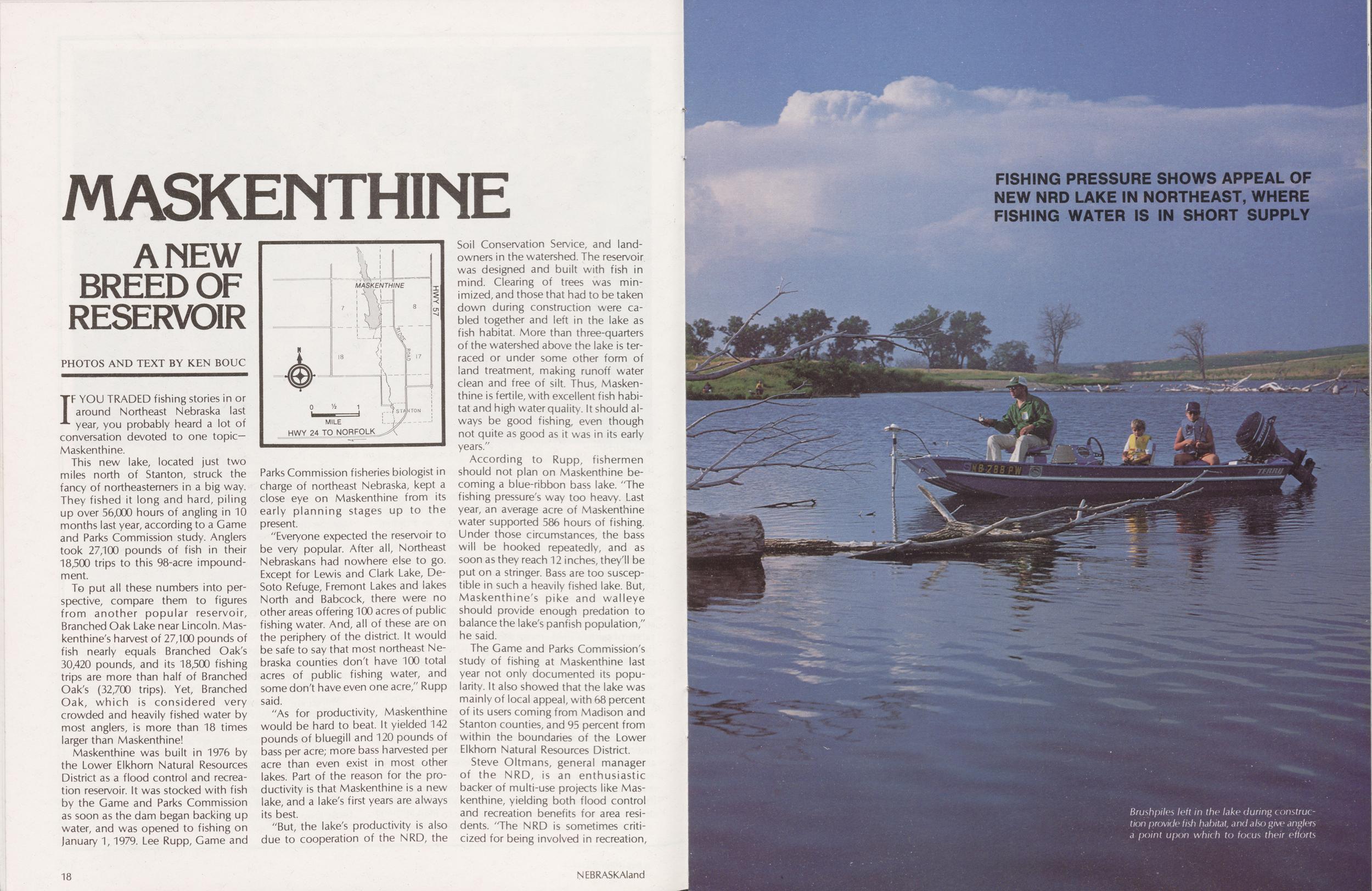
MASKENTHINE
A NEW BREED OF RESERVOIR PHOTOS AND TEXT BY KEN BOUCIF YOU TRADED fishing stories in or around Northeast Nebraska last year, you probably heard a lot of conversation devoted to one topic—Maskenthine.
This new lake, located just two miles north of Stanton, struck the fancy of northeasterners in a big way. They fished it long and hard, piling, up over 56,000 hours of angling in 10 months last year, according to a Game and Parks Commission study. Anglers took 27,100 pounds of fish in their 18,500 trips to this 98-acre impoundment.
To put all these numbers into perspective, compare them to figures from another popular reservoir, Branched Oak Lake near Lincoln. Maskenthine's harvest of 27,100 pounds of fish nearly equals Branched Oak's 30,420 pounds, and its 18,500 fishing trips are more than half of Branched Oak's (32,700 trips). Yet, Branched Oak, which is considered very crowded and heavily fished water by most anglers, is more than 18 times larger than Maskenthine!
Maskenthine was built in 1976 by the Lower Elkhorn Natural Resources District as a flood control and recreation reservoir. It was stocked with fish by the Game and Parks Commission as soon as the dam began backing up water, and was opened to fishing on January 1,1979. Lee Rupp, Game and Parks Commission fisheries biologist in charge of northeast Nebraska, kept a close eye on Maskenthine from its early planning stages up to the present.
"Everyone expected the reservoir to be very popular. After all, Northeast Nebraskans had nowhere else to go. Except for Lewis and Clark Lake, DeSoto Refuge, Fremont Lakes and lakes North and Babcock, there were no other areas offering 100 acres of public fishing water. And, all of these are on the periphery of the district. It would be safe to say that most northeast Nebraska counties don't have 100 total acres of public fishing water, and some don't have even one acre," Rupp said.
"As for productivity, Maskenthine would be hard to beat. It yielded 142 pounds of bluegill and 120 pounds of bass per acre; more bass harvested per acre than even exist in most other lakes. Part of the reason for the productivity is that Maskenthine is a new lake, and a lake's first years are always its best.
"But, the lake's productivity is also due to cooperation of the NRD, the Soil Conservation Service, and landowners in the watershed. The reservoir was designed and built with fish in mind. Clearing of trees was minimized, and those that had to be taken down during construction were cabled together and left in the lake as fish habitat. More than three-quarters of the watershed above the lake is terraced or under some other form of land treatment, making runoff water clean and free of silt. Thus, Maskenthine is fertile, with excellent fish habitat and high water quality. It should always be good fishing, even though not quite as good as it was in its early years."
According to Rupp, fishermen should not plan on Maskenthine becoming a blue-ribbon bass lake. "The fishing pressure's way too heavy. Last year, an average acre of Maskenthine water supported 586 hours of fishing. Under those circumstances, the bass will be hooked repeatedly, and as soon as they reach 12 inches, they'll be put on a stringer. Bass are too susceptible in such a heavily fished lake. But, Maskenthine's pike and walleye should provide enough predation to balance the lake's panfish population," he said.
The Game and Parks Commission's study of fishing at Maskenthine last year not only documented its popularity. It also showed that the lake was mainly of local appeal, with 68 percent of its users coming from Madison and Stanton counties, and 95 percent from within the boundaries of the Lower Elkhorn Natural Resources District.
Steve Oltmans, general manager of the NRD, is an enthusiastic backer of multi-use projects like Maskenthine, yielding both flood control and recreation benefits for area residents. "The NRD is sometimes criticized for being involved in recreation, but we really don't spend much on that sort of thing. In the Maskenthine project, and a smaller one at Pilger, we have only about $70,000 in NRD money in purely recreational expenditures. We could have built Maskenthine exclusively for flood control and ignored fishing and recreation to save a little money. But, the people of this area would have been denied those 18,500 fishing trips, plus uncounted picnics, swimming parties, nature walks and rowboat rides which took place there last year. And, they'd miss all the recreation that this area will provide for several decades. I'd say that the people are much better off for our rather modest initial investment in recreation," Oltmans said.
18 NEBRASKAland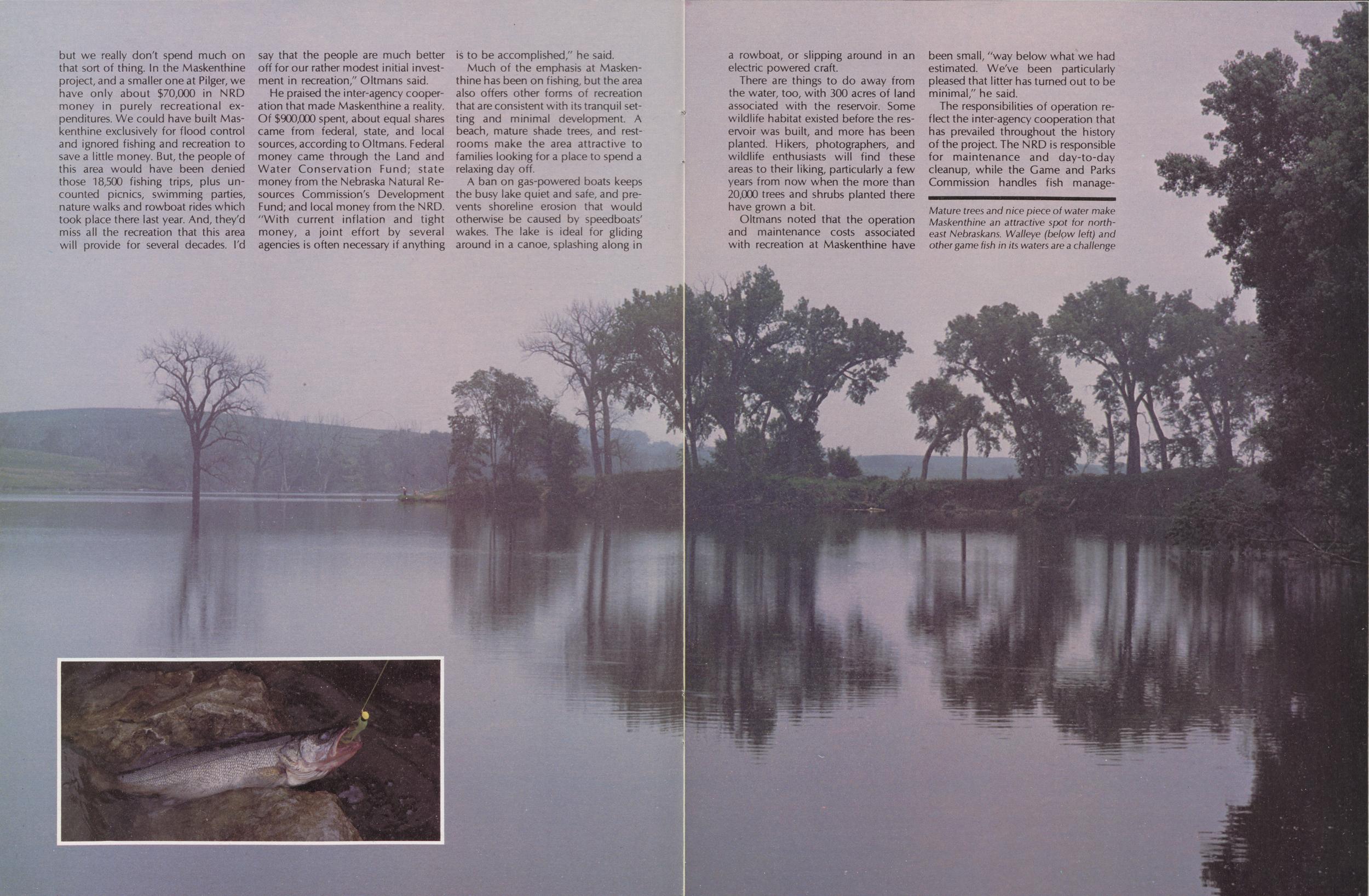
He praised the inter-agency cooperation that made Maskenthine a reality. Of $900,000 spent, about equal shares came from federal, state, and local sources, according to Oltmans. Federal money came through the Land and Water Conservation Fund; state money from the Nebraska Natural Resources Commission's Development Fund; and local money from the NRD. "With current inflation and tight money, a joint effort by several agencies is often necessary if anything is to be accomplished," he said.
Much of the emphasis at Maskenthine has been on fishing, but the area also offers other forms of recreation that are consistent with its tranquil setting and minimal development. A beach, mature shade trees, and restrooms make the area attractive to families looking for a place to spend a relaxing day off.
A ban on gas-powered boats keeps the busy lake quiet and safe, and prevents shoreline erosion that would otherwise be caused by speedboats' wakes. The lake is ideal for gliding around in a canoe, splashing along in a rowboat, or slipping around in an electric powered craft.
There are things to do away from the water, too, with 300 acres of land associated with the reservoir. Some wildlife habitat existed before the reservoir was built, and more has been planted. Hikers, photographers, and wildlife enthusiasts will find these areas to their liking, particularly a few years from now when the more than 20,000 trees and shrubs planted there have grown a bit.
Oltmans noted that the operation and maintenance costs associated with recreation at Maskenthine have been small, "way below what we had estimated. We've been particularly pleased that litter has turned out to be minimal," he said.
The responsibilities of operation reflect the inter-agency cooperation that has prevailed throughout the history of the project. The NRD is responsible for maintenance and day-to-day cleanup, while the Game and Parks Commission handles fish management and shares law enforcement duties with the local sheriffs department.
Mature trees and nice piece of water make Maskenthine an attractive spot for northeast Nebraskans. Walleye (below left) and other game fish in its waters are a challenge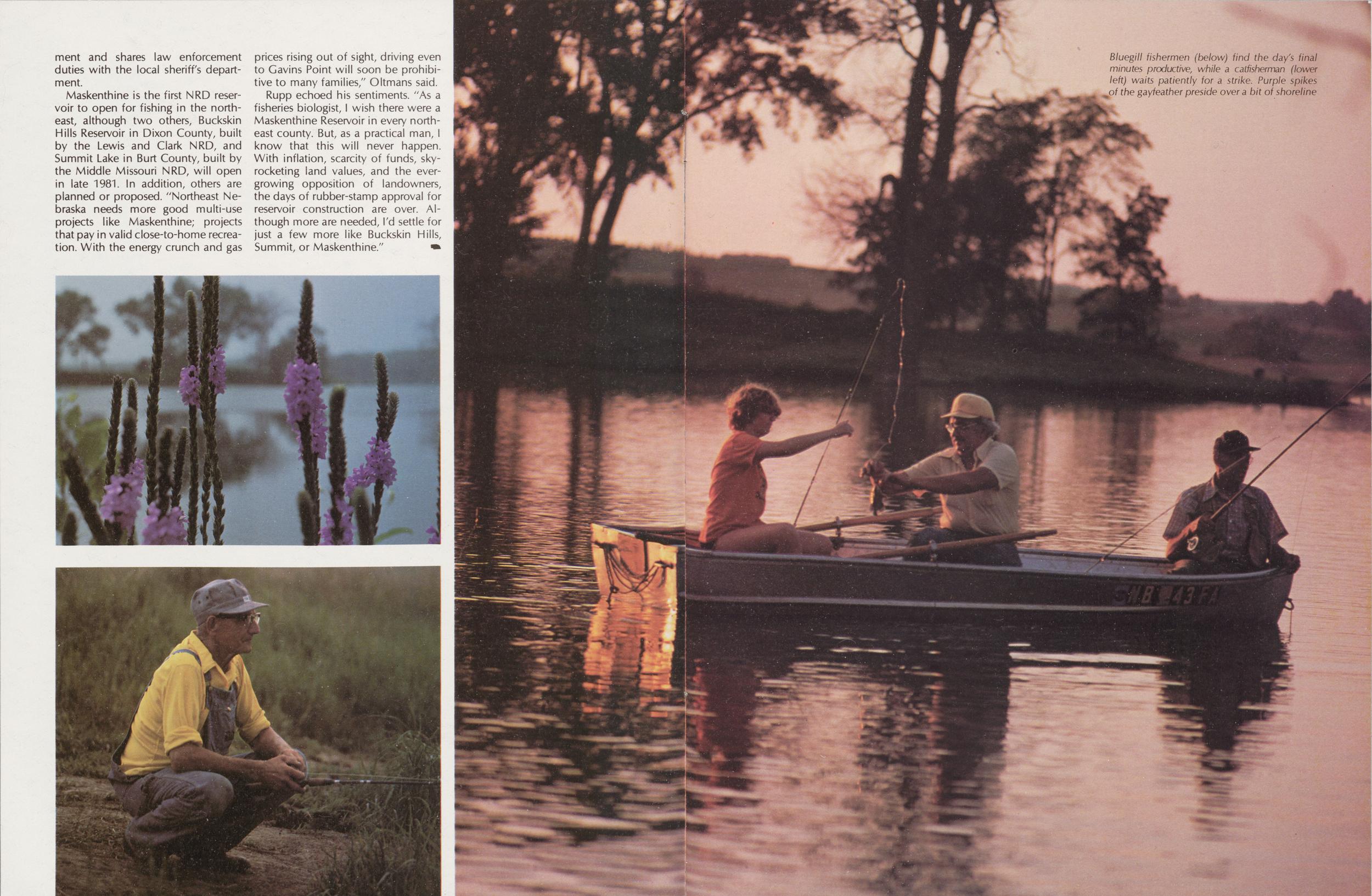
Maskenthine is the first NRD reservoir to open for fishing in the northeast, although two others, Buckskin Hills Reservoir in Dixon County, built by the Lewis and Clark NRD, and Summit Lake in Burt County, built by the Middle Missouri NRD, will open in late 1981. In addition, others are planned or proposed. "Northeast Nebraska needs more good multi-use projects like Maskenthine; projects that pay in valid close-to-home recreation. With the energy crunch and gas prices rising out of sight, driving even to Gavins Point will soon be prohibitive to many families," Oltmans said.
Rupp echoed his sentiments. "As a fisheries biologist, I wish there were a Maskenthine Reservoir in every northeast county. But, as a practical man, I know that this will never happen. With inflation, scarcity of funds, skyrocketing land values, and the evergrowing opposition of landowners, the days of rubber-stamp approval for reservoir construction are over. Although more are needed, I'd settle for just a few more like Buckskin Hills, Summit, or Maskenthine."
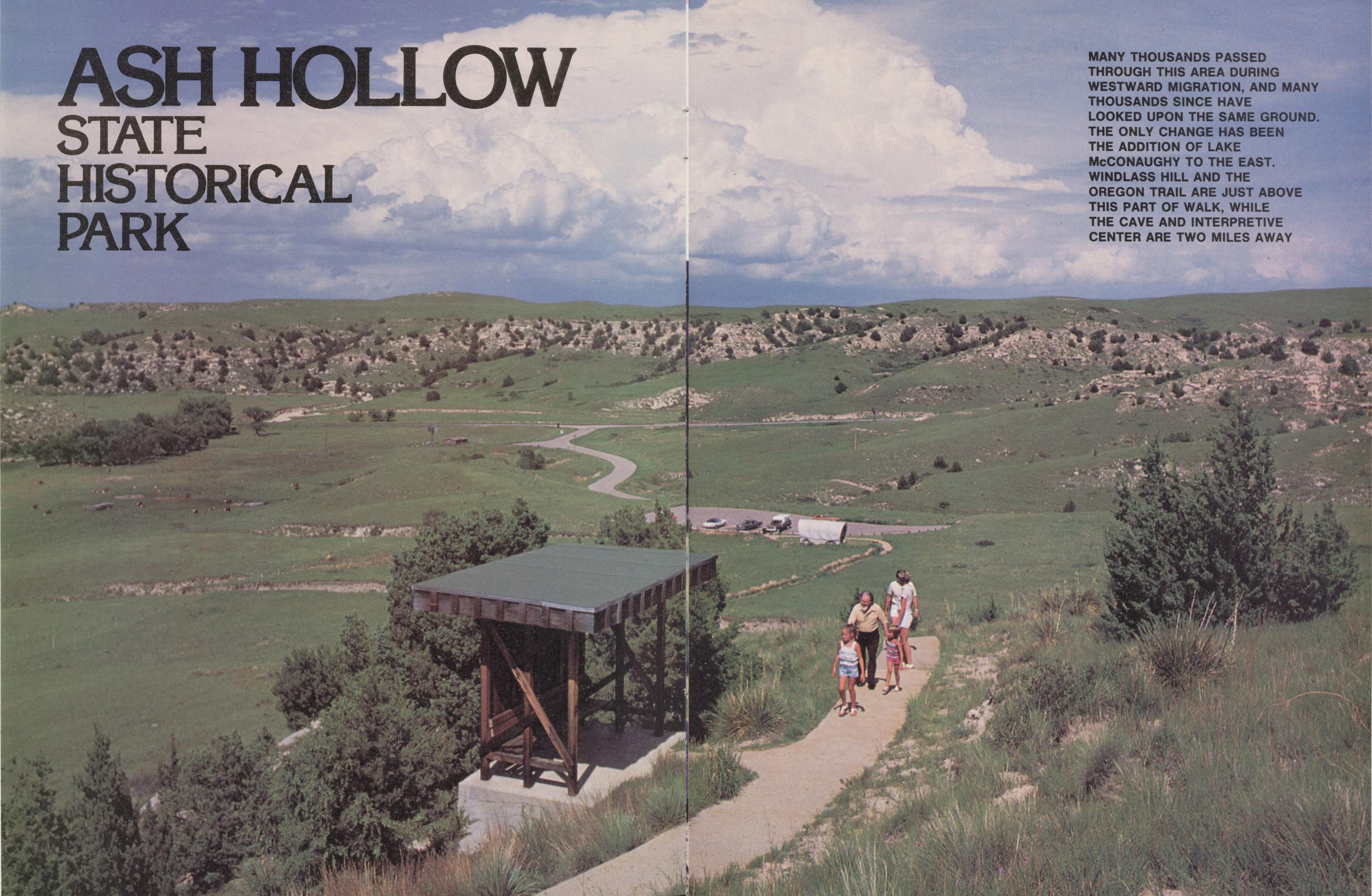
ASH HOLLOW STATE HISTORICAL PARK
 PHOTOS AND TEXT BY BOB GRIER
LOCATED THREE MILES east of Lewellen on U.S. 26, Ash Hollow State Historical Park preserves a rich span of North American history stretching back almost 10,000 years—from the first big game hunter following mammoth and bison to the oxdrawn wagons of immigrants struggling westward on the Oregon Trail.
Totaling slightly over 1,000 acres, Ash Hollow is the largest of nine state historical parks in the Nebraska State Park System. Development since initial acquisition by the Game and Parks Commission in 1962 includes a modern $211,000 visitor center, a unique cave interpretive shelter, and satellite displays and foot paths. A primitive campground on U.S. 26 offers a shady retreat within walking distance of the visitor center and cave shelter, and a flowing spring that refreshed mammoth hunter and immigrant alike.
The geological forces that formed Ash Hollow are evident in the outcroppings of sedimentary rock that form the canyon's side. Succeeding intervals of erosion and deposition by streams flowing eastward from the newly formed Rocky Mountains laid down layer after layer of sediment. Renewed wind and water erosion formed the Wildcat Hills and Pine Ridge, and left their mark on Ash Hollow as well. At the base of the cliffs, a pebble conglomerate is exposed—also visible in the cave shelter. Overlying strata of hard and soft sandstone include beds of volcanic ash, witness to the great forces at work.
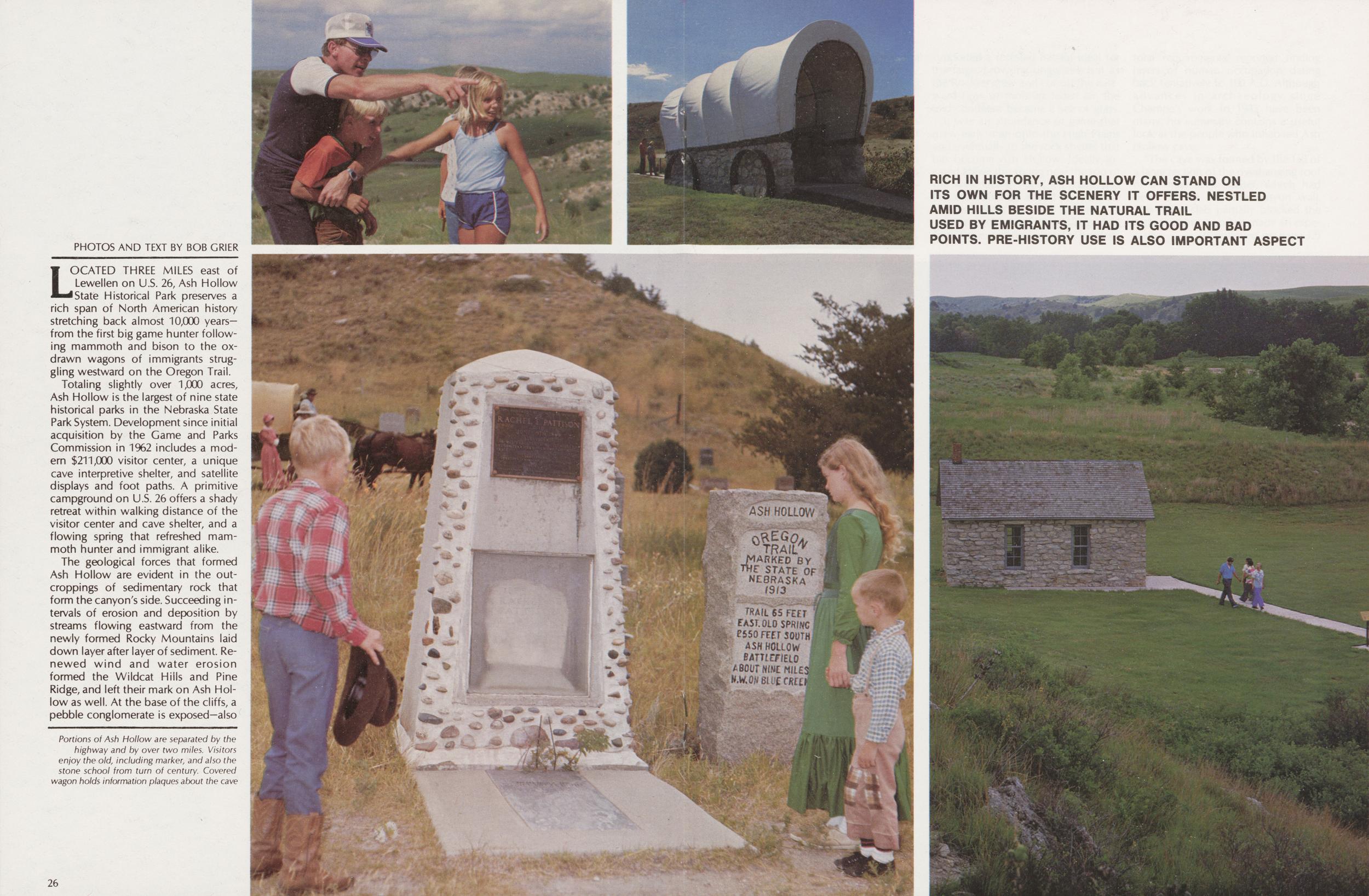
Portions of Ash Hollow are separated by the highway and by over two miles. Visitors enjoy the old, including marker, and also the stone school from turn of century. Covered wagon holds information plaques about the cave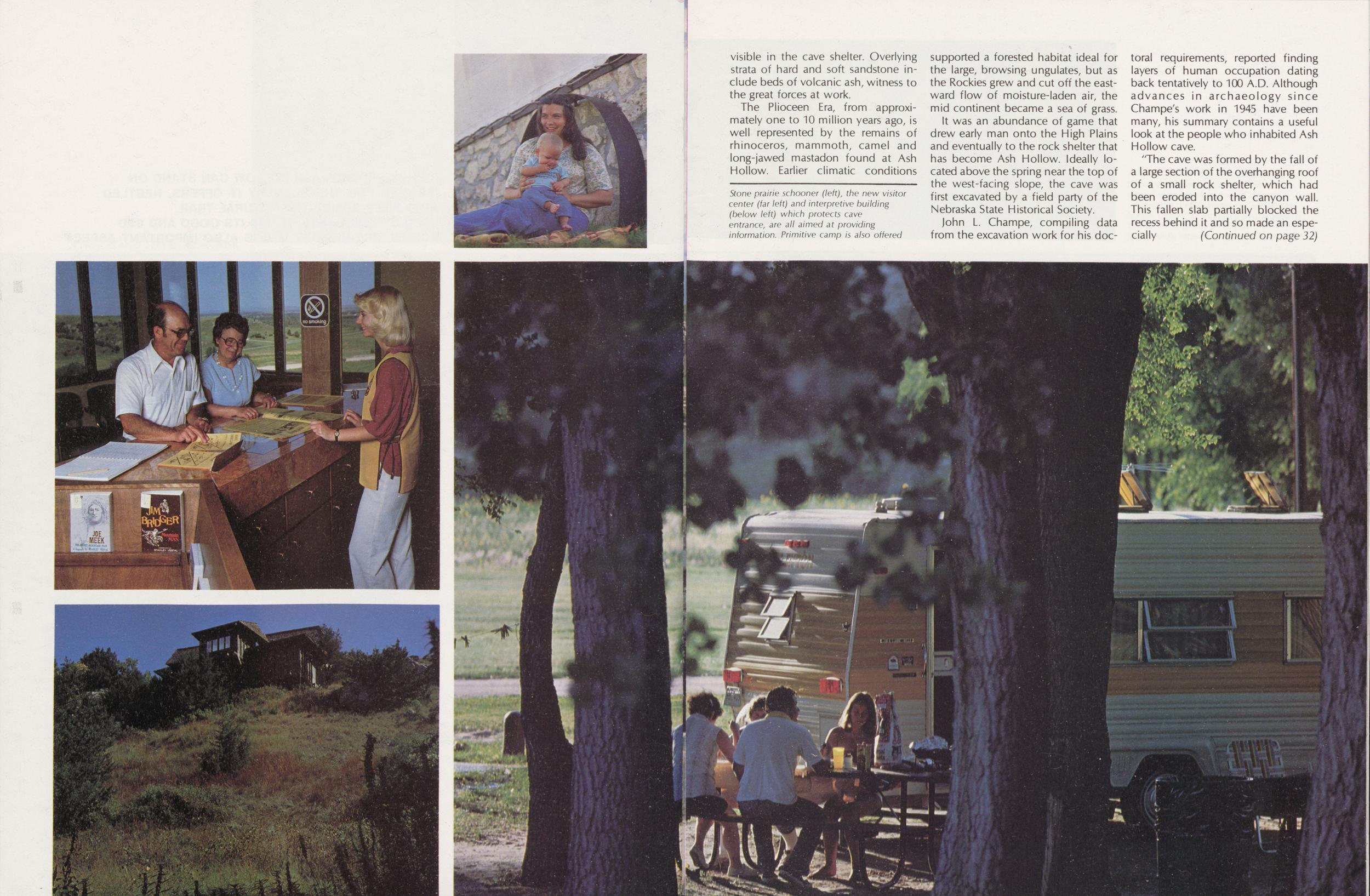
The Plioceen Era, from approximately one to 10 million years ago, is well represented by the remains of rhinoceros, mammoth, camel and long-jawed mastadon found at Ash Hollow. Earlier climatic conditions supported a forested habitat ideal for the large, browsing ungulates, but as the Rockies grew and cut off the eastward flow of moisture-laden air, the mid continent became a sea of grass.
Stone prairie schooner (left), the new visitor center (far left) and interpretive building (below left) which protects cave entrance, are all aimed at providing information. Primitive camp is also offeredIt was an abundance of game that drew early man onto the High Plains and eventually to the rock shelter that has become Ash Hollow. Ideally located above the spring near the top of the west-facing slope, the cave was first excavated by a field party of the Nebraska State Historical Society.
John L Champe, compiling data from the excavation work for his doctoral requirements, reported finding layers of human occupation dating back tentatively to 100 A.D. Although advances in archaeology since Champe's work in 1945 have been many, his summary contains a useful look at the people who inhabited Ash Hollow cave.
'The cave was formed by the fall of a large section of the overhanging roof of a small rock shelter, which had been eroded into the canyon wall. This fallen slab partially blocked the recess behind it and so made an especially (Continued on page 32)
ASH HOLLOW...ITS BLOODIEST DAY
REPRINTED COURTESY OF KEITH COUNTY NEWS ALTHOUGH LITTLE KNOWN, IN HISTORY, THIS SIOUX-VERSUS-PAWNEE BATTLEGROUND CLAIMED MANY LIVES FROM BOTH TRIBES, AND HELPED DRIVE THE PAWNEE TO EASTERN NEBRASKAA ONE-DAY BATTLE which left more than 100 Sioux and Pawnee warriors dead was fought at Ash Hollow in 1835.
The battle was significant in that as a result of the defeat the vanquished Pawnee apparently packed up their lodges and moved to eastern Nebraska.
Explorer Rufus Sage, visiting Ash Hollow in 1841 or 1843, recorded the event as told to him by a French trader who may have lived with the Sioux at the time.
His account is carried in his book, "Rocky Mountain Life or Startling Scenes and Perilous Adventures in the Far West," published by Donohue Henneberry & Co. of Chicago, 1857. (A copy may be found in the archives of the Nebraska State Historical Society.)
Sage painted a pastoral image of the Ash Hollow camping area. "The valley is of variable width and well timbered with beautiful Ash groves from which the creek (Ash Creek) derives its name. Here are also found several varieties of wild fruit indigenous to the mountains. As a whole, it presents to the eye, a pretty flower garden, walled in by huge piles of argillaceous rock, and watered by murmuring streamlets whose banks are ornamental with shade trees and shrubbery."
Not so pastoral was his description of the fierce and bloody battle fought in 1835 between the mortal enemies, the Pawnee and the Sioux. The battle left 60 Pawnee dead and 45 Sioux killed.
Although the account was told to him, he said evidence of the battle still remained. "The evidences of this cruel death-harvest were yet scattered over the prairie, whose bones and sculls (sic) looked sad, indeed. One of the latter was noticed near camp, with a huge wasp's nest occupying the vacuum once filled by the subtle organs of intellect. Strange tenants truly of a human scull-but perhaps not an unfit antitype of the fierce passions that whilom claimed it as their dwelling place."
Sage's account of the battle was equally descriptive, which is as follows:
"Near camp had been the scene of a fierce and bloody battle between the Pawnee and Sioux in the winter of 1835. The affray commenced earlier in the morning and continued until near night. A trader, who was present with the Sioux on the occasion, described it had been remarkably close. Every inch of ground was disputed—now the Pawnees advancing upon the retreating Sioux; and now the Sioux, while the Pawnees gave way; but returning to the charge with redoubled fury, the former once more recoiled. The arrows flew in full showers—the bullets whistled the death song of many a warrior-the yells of combating savages filled the air and drowned the lesser din of arms.
"At length arrows and balls were exhausted upon both sides but still the battle raged fiercer than before.
"War clubs, tomahawks and butcher knife were bandied with terrific force as the hostile parties engaged hand to hand and the clash of resounding blows, comingling with the clamor of unearthly voices which rent the very heavens, seemed more to prefigure the contest of friends than aught else.
"Finally the Pawnee abandoned the field to their victorious enemies, leaving 60 of their warriors upon the ensanguined battleground. But the Sioux had paid dearly for their advantage; 45 of their bravest men lay mingled with the slain. The defeated parties were pursued only a short distance and then permitted to return without further molestation to their village at the Forks of the Platte.
"This disaster so completely disheartened the Pawnee they immediately abandoned their station and moved down the river some 400 miles—nor have they again ventured so high up unless in strong war parties.
"About the same time the village on Republican fork of Kansas was also abandoned and its inhabitants united with the Loups."
Other mentions of the battle are less descriptive. In "The Prairie Log Books," Lt. J. Henry Carleton merely reported, "Ash Hollow has been the scene of a major fight between the Pawnee and the Sioux."
When the use of the Lower California Crossing was discontinued and travel proceeded on up the South Platte and used a new crossing called the Upper California Crossing, immigrant travel down Windlass Hill and through the Hollow was considerably lessened for wheel vehicles. However, the pack trains and cavalry units still used the Lower Crossing route and went through the Hollow.
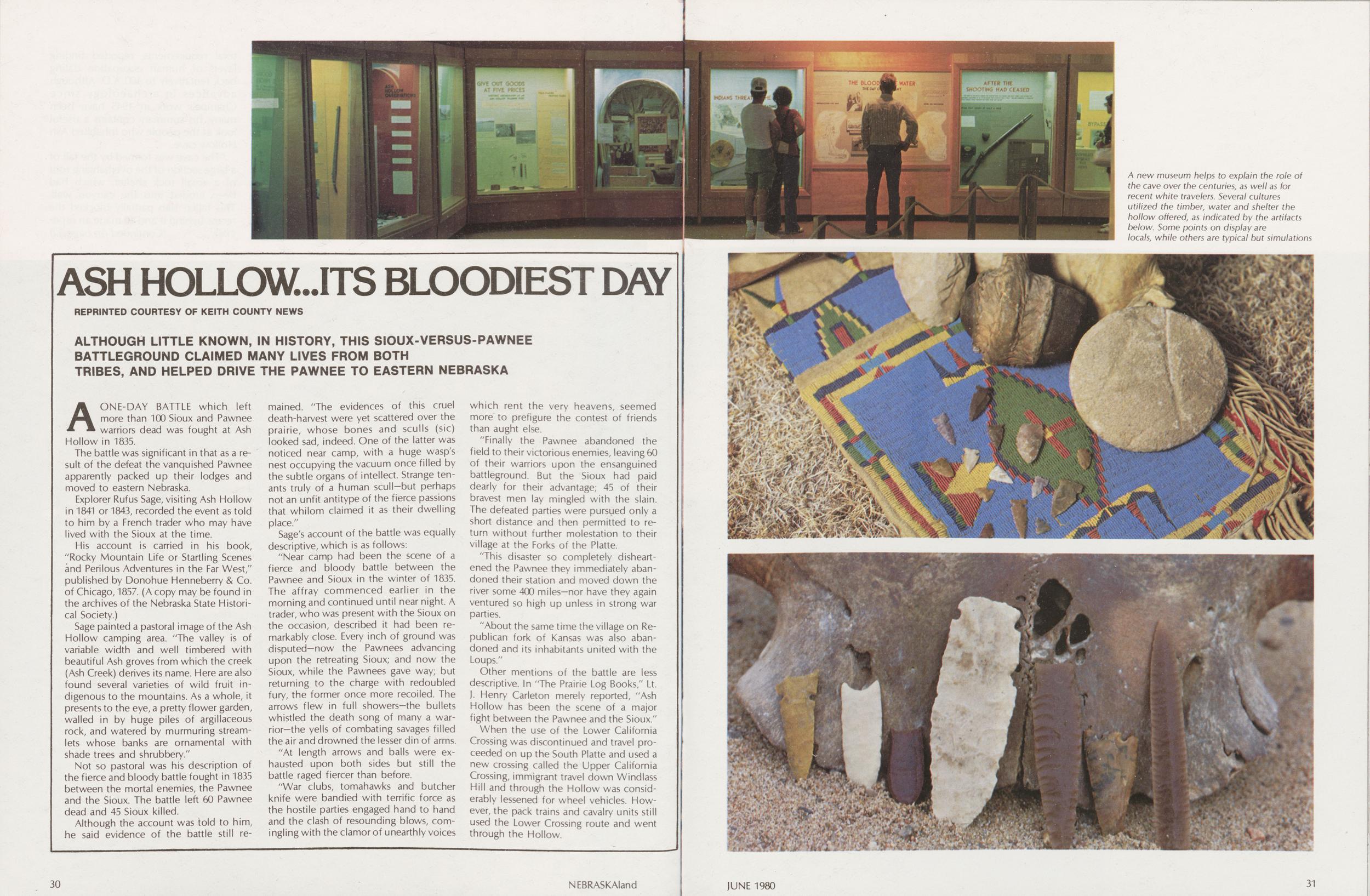
30 NEBRASKAland A new museum helps to explain the role of the cave over the centuries, as well as for recent white travelers. Several cultures utilized the timber, water and shelter the hollow offered, as indicated by the artifacts below. Some points on display are locals, while others are typical but simulations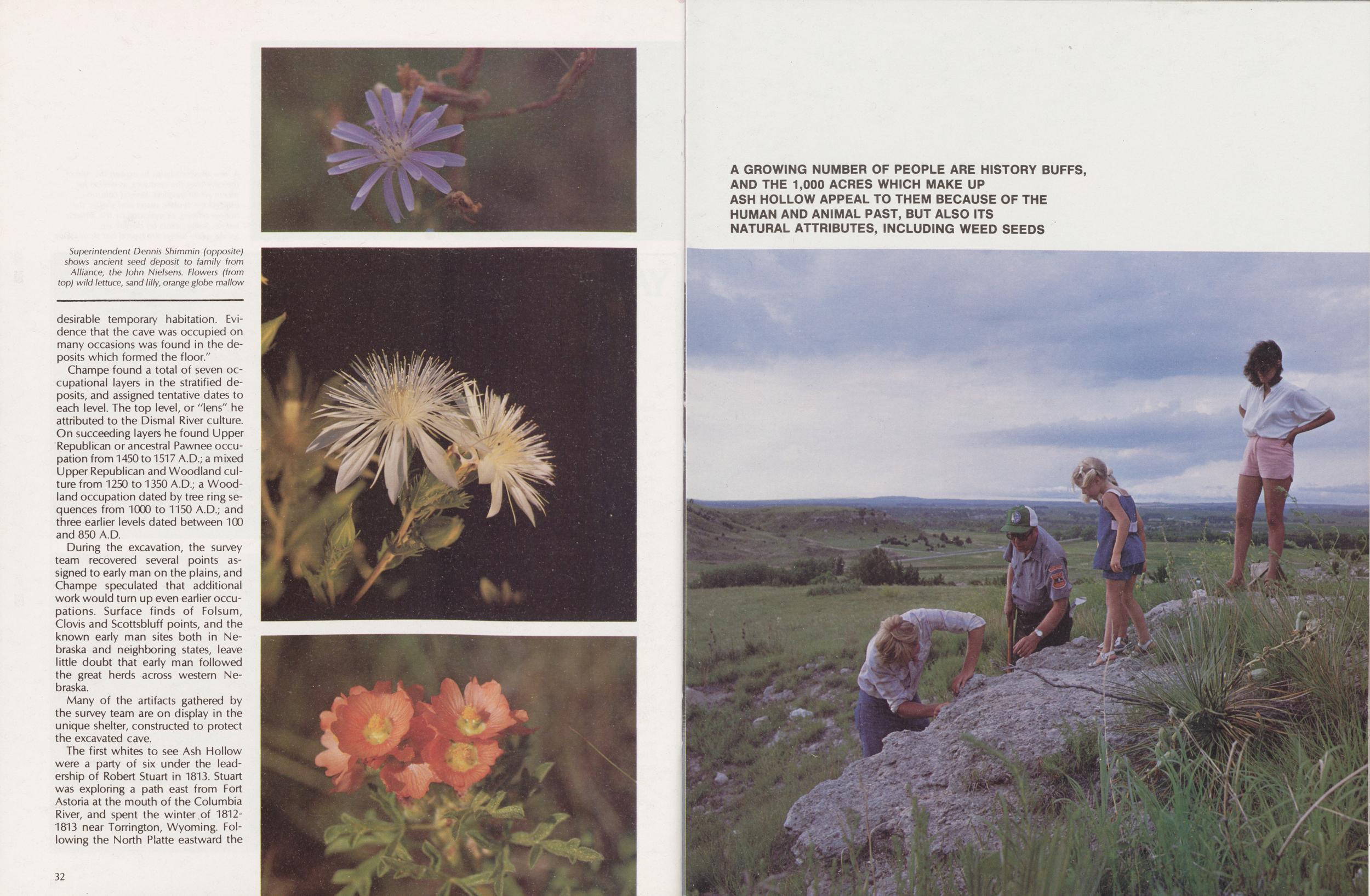
desirable temporary habitation. Evidence that the cave was occupied on many occasions was found in the deposits which formed the floor."
Champe found a total of seven occupational layers in the stratified deposits, and assigned tentative dates to each level. The top level, or "lens" he attributed to the Dismal River culture. On succeeding layers he found Upper Republican or ancestral Pawnee occupation from 1450 to 1517 A.D.; a mixed Upper Republican and Woodland culture from 1250 to 1350 A.D.; a Woodland occupation dated by tree ring sequences from 1000 to 1150 A.D.; and three earlier levels dated between 100 and 850 A.D.
During the excavation, the survey team recovered several points assigned to early man on the plains, and Champe speculated that additional work would turn up even earlier occupations. Surface finds of Folsum, Clovis and Scottsbluff points, and the known early man sites both in Nebraska and neighboring states, leave little doubt that early man followed the great herds across western Nebraska.
Many of the artifacts gathered by the survey team are on display in the unique shelter, constructed to protect the excavated cave.
The first whites to see Ash Hollow were a party of six under the leadership of Robert Stuart in 1813. Stuart was exploring a path east from Fort Astoria at the mouth of the Columbia River, and spent the winter of 1812-1813 near Torrington, Wyoming. Following the North Platte eastward the following spring, Stuart's journal mentioned the crossing of "a creek thirty yards wide", or Blue Creek on the west edge of Lewellen.
A GROWING NUMBER OF PEOPLE ARE HISTORY BUFFS, AND THE 1,000 ACRES WHICH MAKE UP ASH HOLLOW APPEAL TO THEM BECAUSE OF THE HUMAN AND ANIMAL PAST, BUT ALSO ITS NATURAL ATTRIBUTES, INCLUDING WEED SEEDS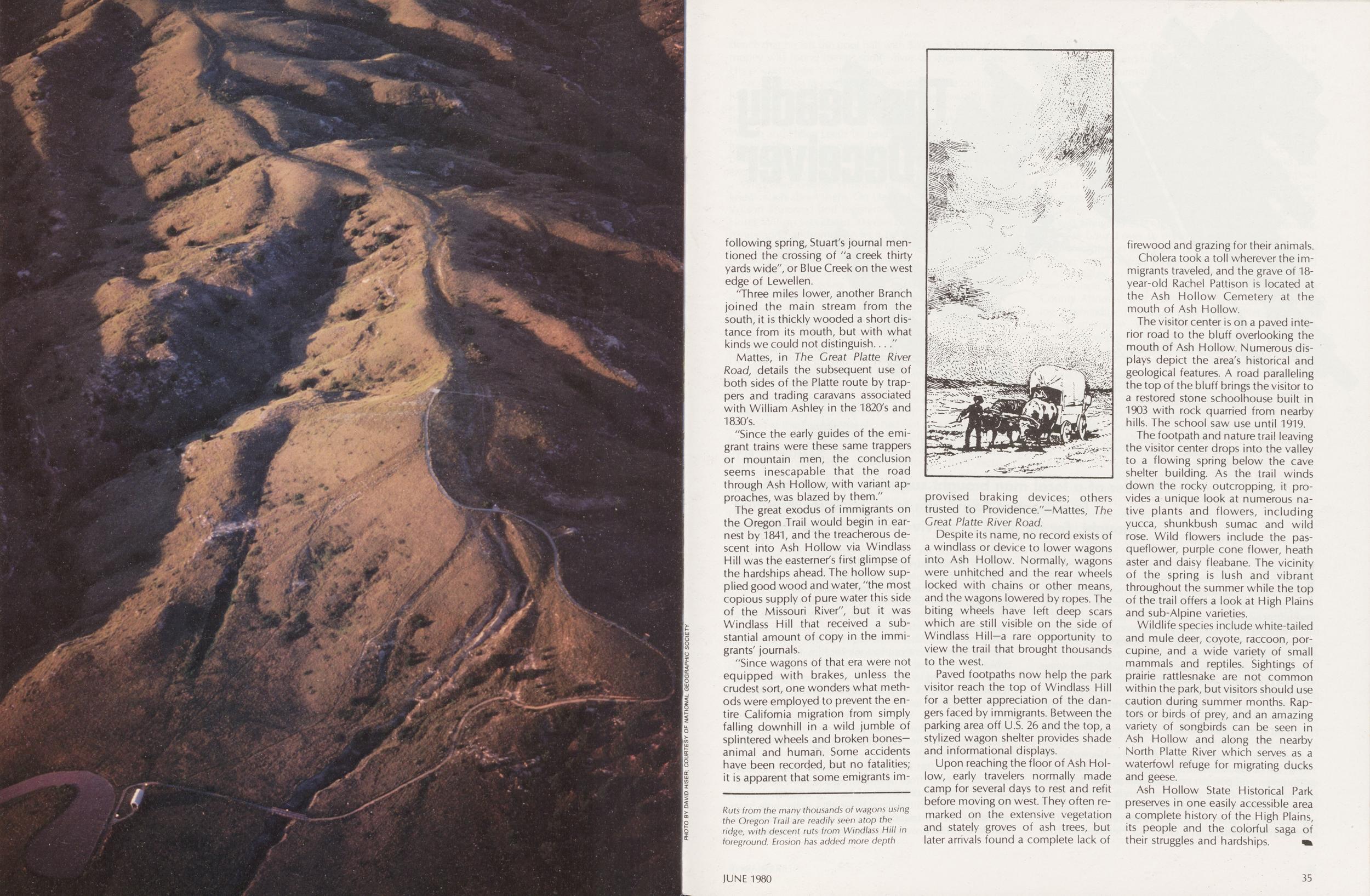
"Three miles lower, another Branch joined the main stream from the south, it is thickly wooded a short distance from its mouth, but with what kinds we could not distinguish... ."
Mattes, in The Great Platte River Road, details the subsequent use of both sides of the Platte route by trappers and trading caravans associated with William Ashley in the 1820's and 1830's.
"Since the early guides of the emigrant trains were these same trappers or mountain men, the conclusion seems inescapable that the road through Ash Hollow, with variant approaches, was blazed by them."
The great exodus of immigrants on the Oregon Trail would begin in earnest by 1841, and the treacherous descent into Ash Hollow via Windlass Hill was the easterner's first glimpse of the hardships ahead. The hollow supplied good wood and water, "the most copious supply of pure water this side of the Missouri River", but it was Windlass Hill that received a substantial amount of copy in the immigrants' journals.
"Since wagons of that era were not equipped with brakes, unless the crudest sort, one wonders what methods were employed to prevent the entire California migration from simply falling downhill in a wild jumble of splintered wheels and broken bones-animal and human. Some accidents have been recorded, but no fatalities; it is apparent that some emigrants im-Ruts from the many thousands of wagons using the Oregon Trail are readily seen atop the ridge, with descent ruts from Windlass Hill in foreground. Erosion has added more depth provised braking devices; others trusted to Providence."-Mattes, The Great Platte River Road.
Despite its name, no record exists of a windlass or device to lower wagons into Ash Hollow. Normally, wagons were unhitched and the rear wheels locked with chains or other means, and the wagons lowered by ropes. The biting wheels have left deep scars which are still visible on the side of Windlass Hill—a rare opportunity to view the trail that brought thousands to the west.
Paved footpaths now help the park visitor reach the top of Windlass Hill for a better appreciation of the dangers faced by immigrants. Between the parking area off U.S. 26 and the top, a stylized wagon shelter provides shade and informational displays.
Upon reaching the floor of Ash Hollow, early travelers normally made camp for several days to rest and refit before moving on west. They often remarked on the extensive vegetation and stately groves of ash trees, but later arrivals found a complete lack of firewood and grazing for their animals.
Cholera took a toll wherever the immigrants traveled, and the grave of 18-year-old Rachel Pattison is located at the Ash Hollow Cemetery at the mouth of Ash Hollow.
The visitor center is on a paved interior road to the bluff overlooking the mouth of Ash Hollow. Numerous displays depict the area's historical and geological features. A road paralleling the top of the bluff brings the visitor to a restored stone schoolhouse built in 1903 with rock quarried from nearby hills. The school saw use until 1919.
The footpath and nature trail leaving the visitor center drops into the valley to a flowing spring below the cave shelter building. As the trail winds down the rocky outcropping, it provides a unique look at numerous native plants and flowers, including yucca, shunkbush sumac and wild rose. Wild flowers include the pasqueflower, purple cone flower, heath aster and daisy fleabane. The vicinity of the spring is lush and vibrant throughout the summer while the top of the trail offers a look at High Plains and sub-Alpine varieties.
Wildlife species include white-tailed and mule deer, coyote, raccoon, porcupine, and a wide variety of small mammals and reptiles. Sightings of prairie rattlesnake are not common within the park, but visitors should use caution during summer months. Raptors or birds of prey, and an amazing variety of songbirds can be seen in Ash Hollow and along the nearby North Platte River which serves as a waterfowl refuge for migrating ducks and geese.
Ash Hollow State Historical Park preserves in one easily accessible area a complete history of the High Plains, its people and the colorful saga of their struggles and hardships.
JUNE 1980 35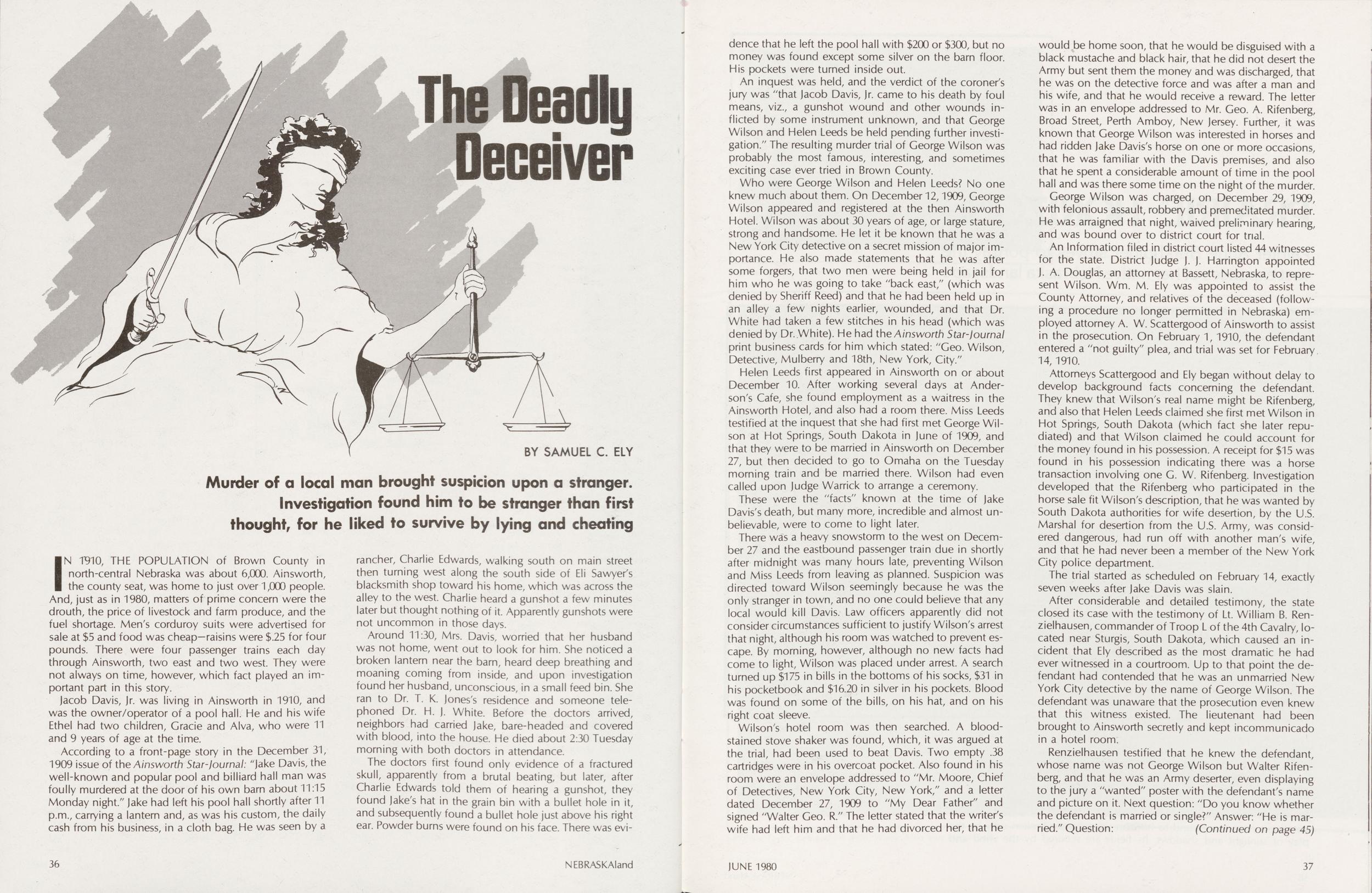
The Deadly Deceiver
IN 1910, THE POPULATION of Brown County in north-central Nebraska was about 6,000. Ainsworth, the county seat, was home to just over 1,000 people. And, just as in 1980, matters of prime concern were the drouth, the price of livestock and farm produce, and the fuel shortage. Men's corduroy suits were advertised for sale at $5 and food was cheap—raisins were $.25 for four pounds. There were four passenger trains each day through Ainsworth, two east and two west. They were not always on time, however, which fact played an important part in this story.
Jacob Davis, jr. was living in Ainsworth in 1910, and was the owner/operator of a pool hall. He and his wife Ethel had two children, Gracie and Alva, who were 11 and 9 years of age at the time.
According to a front-page story in the December 31, 1909 issue of the Ainsworth Star-journal: "Jake Davis, the well-known and popular pool and billiard hall man was foully murdered at the door of his own barn about 11:15 Monday night." Jake had left his pool hall shortly after 11 p.m., carrying a lantern and, as was his custom, the daily cash from his business, in a cloth bag. He was seen by a rancher, Charlie Edwards, walking south on main street then turning west along the south side of Eli Sawyer's blacksmith shop toward his home, which was across the alley to the west. Charlie heard a gunshot a few minutes later but thought nothing of it. Apparently gunshots were not uncommon in those days.
Around 11:30, Mrs. Davis, worried that her husband was not home, went out to look for him. She noticed a broken lantern near the barn, heard deep breathing and moaning coming from inside, and upon investigation found her husband, unconscious, in a small feed bin. She ran to Dr. T. K. Jones's residence and someone telephoned Dr. H. J. White. Before the doctors arrived, neighbors had carried Jake, bare-headed and covered with blood, into the house. He died about 2:30 Tuesday morning with both doctors in attendance.
The doctors first found only evidence of a fractured skull, apparently from a brutal beating, but later, after Charlie Edwards told them of hearing a gunshot, they found Jake's hat in the grain bin with a bullet hole in it, and subsequently found a bullet hole just above his right ear. Powder burns were found on his face. There was evidence 36 NEBRASKAland that he left the pool hall with $200 or $300, but no money was found except some silver on the barn floor. His pockets were turned inside out.
An inquest was held, and the verdict of the coroner's jury was "that Jacob Davis, Jr. came to his death by foul means, viz., a gunshot wound and other wounds inflicted by some instrument unknown, and that George Wilson and Helen Leeds be held pending further investigation." The resulting murder trial of George Wilson was probably the most famous, interesting, and sometimes exciting case ever tried in Brown County.
Who were George Wilson and Helen Leeds? No one knew much about them. On December 12,1909, George Wilson appeared and registered at the then Ainsworth Hotel. Wilson was about 30 years of age, or large stature, strong and handsome. He let it be known that he was a New York City detective on a secret mission of major importance. He also made statements that he was after some forgers, that two men were being held in jail for him who he was going to take "back east," (which was denied by Sheriff Reed) and that he had been held up in an alley a few nights earlier, wounded, and that Dr. White had taken a few stitches in his head (which was denied by Dr. White). He had the Ainsworth Star-journal print business cards for him which stated: "Geo. Wilson, Detective, Mulberry and 18th, New York, City."
Helen Leeds first appeared in Ainsworth on or about December 10. After working several days at Anderson's Cafe, she found employment as a waitress in the Ainsworth Hotel, and also had a room there. Miss Leeds testified at the inquest that she had first met George Wilson at Hot Springs, South Dakota in June of 1909, and that they were to be married in Ainsworth on December 27, but then decided to go to Omaha on the Tuesday morning train and be married there. Wilson had even called upon Judge Warrick to arrange a ceremony.
These were the "facts" known at the time of Jake Davis's death, but many more, incredible and almost unbelievable, were to come to light later.
There was a heavy snowstorm to the west on December 27 and the eastbound passenger train due in shortly after midnight was many hours late, preventing Wilson and Miss Leeds from leaving as planned. Suspicion was directed toward Wilson seemingly because he was the only stranger in town, and no one could believe that any local would kill Davis. Law officers apparently did not consider circumstances sufficient to justify Wilson's arrest that night, although his room was watched to prevent escape. By morning, however, although no new facts had come to light, Wilson was placed under arrest. A search turned up $175 in bills in the bottoms of his socks, $31 in his pocketbook and $16.20 in silver in his pockets. Blood was found on some of the bills, on his hat, and on his right coat sleeve.
Wilson's hotel room was then searched. A bloodstained stove shaker was found, which, it was argued at the trial, had been used to beat Davis. Two empty .38 cartridges were in his overcoat pocket. Also found in his room were an envelope addressed to "Mr. Moore, Chief of Detectives, New York City, New York," and a letter dated December 27, 1909 to "My Dear Father" and signed "Walter Geo. R." The letter stated that the writer's wife had left him and that he had divorced her, that he would be home soon, that he would be disguised with a black mustache and black hair, that he did not desert the Army but sent them the money and was discharged, that he was on the detective force and was after a man and his wife, and that he would receive a reward. The letter was in an envelope addressed to Mr. Geo. A. Rifenberg, Broad Street, Perth Amboy, New Jersey. Further, it was known that George Wilson was interested in horses and had ridden Jake Davis's horse on one or more occasions, that he was familiar with the Davis premises, and also that he spent a considerable amount of time in the pool hall and was there some time on the night of the murder.
George Wilson was charged, on December 29, 1909, with felonious assault, robbery and premeditated murder. He was arraigned that night, waived preliminary hearing, and was bound over to district court for trial.
An Information filed in district court listed 44 witnesses for the state. District Judge J. J. Harrington appointed J. A. Douglas, an attorney at Bassett, Nebraska, to represent Wilson. Wm. M. Ely was appointed to assist the County Attorney, and relatives of the deceased (following a procedure no longer permitted in Nebraska) employed attorney A. W. Scattergood of Ainsworth to assist in the prosecution. On February 1, 1910, the defendant entered a "not guilty" plea, and trial was set for February 14, 1910.
Attorneys Scattergood and Ely began without delay to develop background facts concerning the defendant. They knew that Wilson's real name might be Rifenberg, and also that Helen Leeds claimed she first met Wilson in Hot Springs, South Dakota (which fact she later repudiated) and that Wilson claimed he could account for the money found in his possession. A receipt for $15 was found in his possession indicating there was a horse transaction involving one G. W. Rifenberg. Investigation developed that the Rifenberg who participated in the horse sale fit Wilson's description, that he was wanted by South Dakota authorities for wife desertion, by the U.S. Marshal for desertion from the U.S. Army, was considered dangerous, had run off with another man's wife, and that he had never been a member of the New York City police department.
The trial started as scheduled on February 14, exactly seven weeks after Jake Davis was slain.
After considerable and detailed testimony, the state closed its case with the testimony of Lt. William B. Renzielhausen, commander of Troop L of the 4th Cavalry, located near Sturgis, South Dakota, which caused an incident that Ely described as the most dramatic he had ever witnessed in a courtroom. Up to that point the defendant had contended that he was an unmarried New York City detective by the name of George Wilson. The defendant was unaware that the prosecution even knew that this witness existed. The lieutenant had been brought to Ainsworth secretly and kept incommunicado in a hotel room.
Renzielhausen testified that he knew the defendant, whose name was not George Wilson but Walter Rifenberg, and that he was an Army deserter, even displaying to the jury a "wanted" poster with the defendant's name and picture on it. Next question: "Do you know whether the defendant is married or single?" Answer: "He is married." Question: (Continued on page 45)
JUNE 1980 37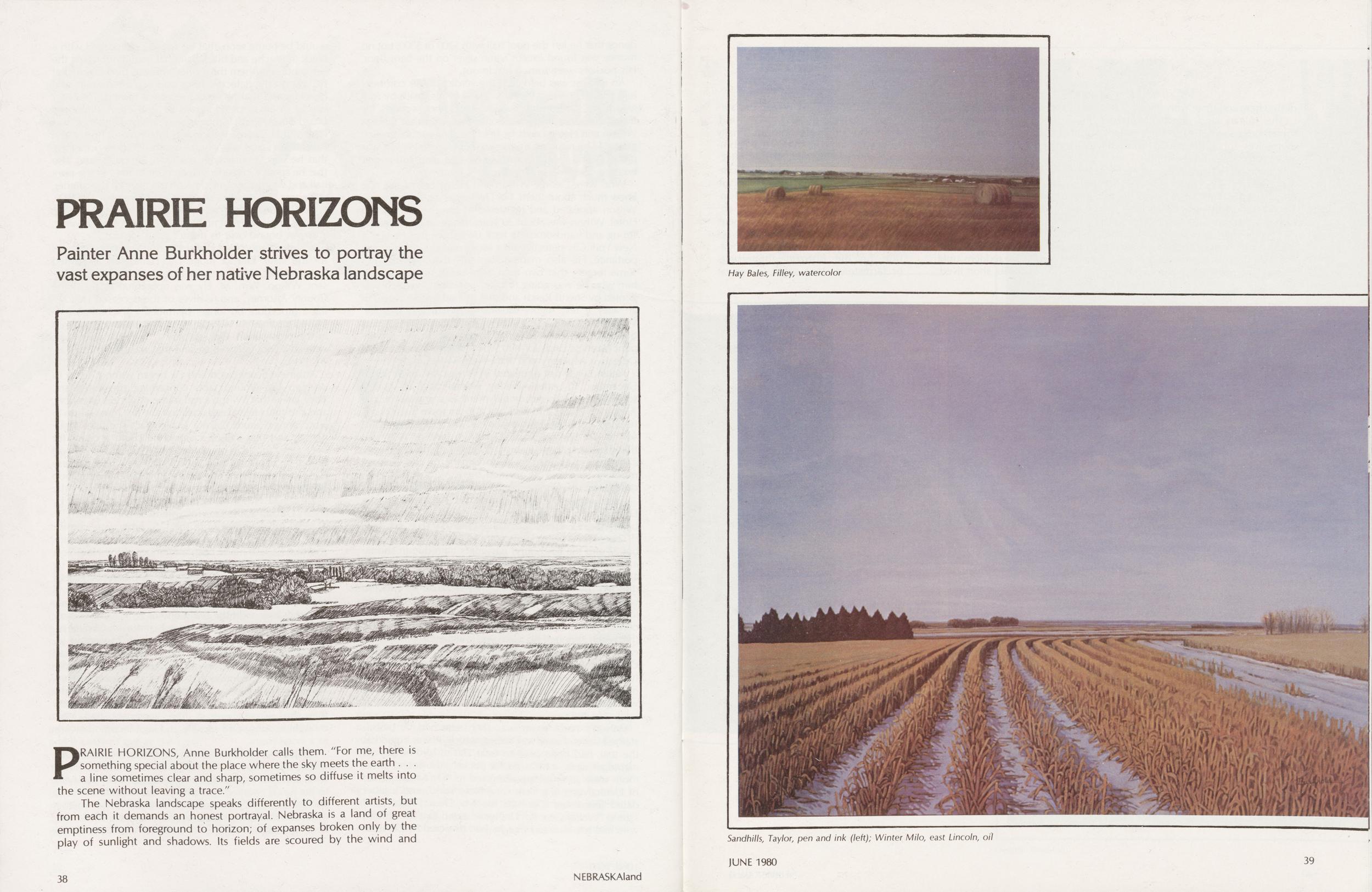
PRAIRIE HORIZONS
Painter Anne Burkholder strives to portray the vast expanses of her native Nebraska landscapePRAIRIE HORIZONS, Anne Burkholder calls them. "For me, there is something special about the place where the sky meets the earth... a line sometimes clear and sharp, sometimes so diffuse it melts into the scene without leaving a trace."
The Nebraska landscape speaks differently to different artists, but from each it demands an honest portrayal. Nebraska is a land of great emptiness from foreground to horizon; of expanses broken only by the play of sunlight and shadows. Its fields are scoured by the wind and dotted here and there with stands of battered cotton woods. The simplicity of this solitary land stretching to meet the sky is always inspiring and sometimes beautiful. Anne Burkholder's paintings, like the Nebraska plains themselves, touch the native heart. They make no quaint or picturesque attempt to appeal to the tourist.
38 NEBRASKAland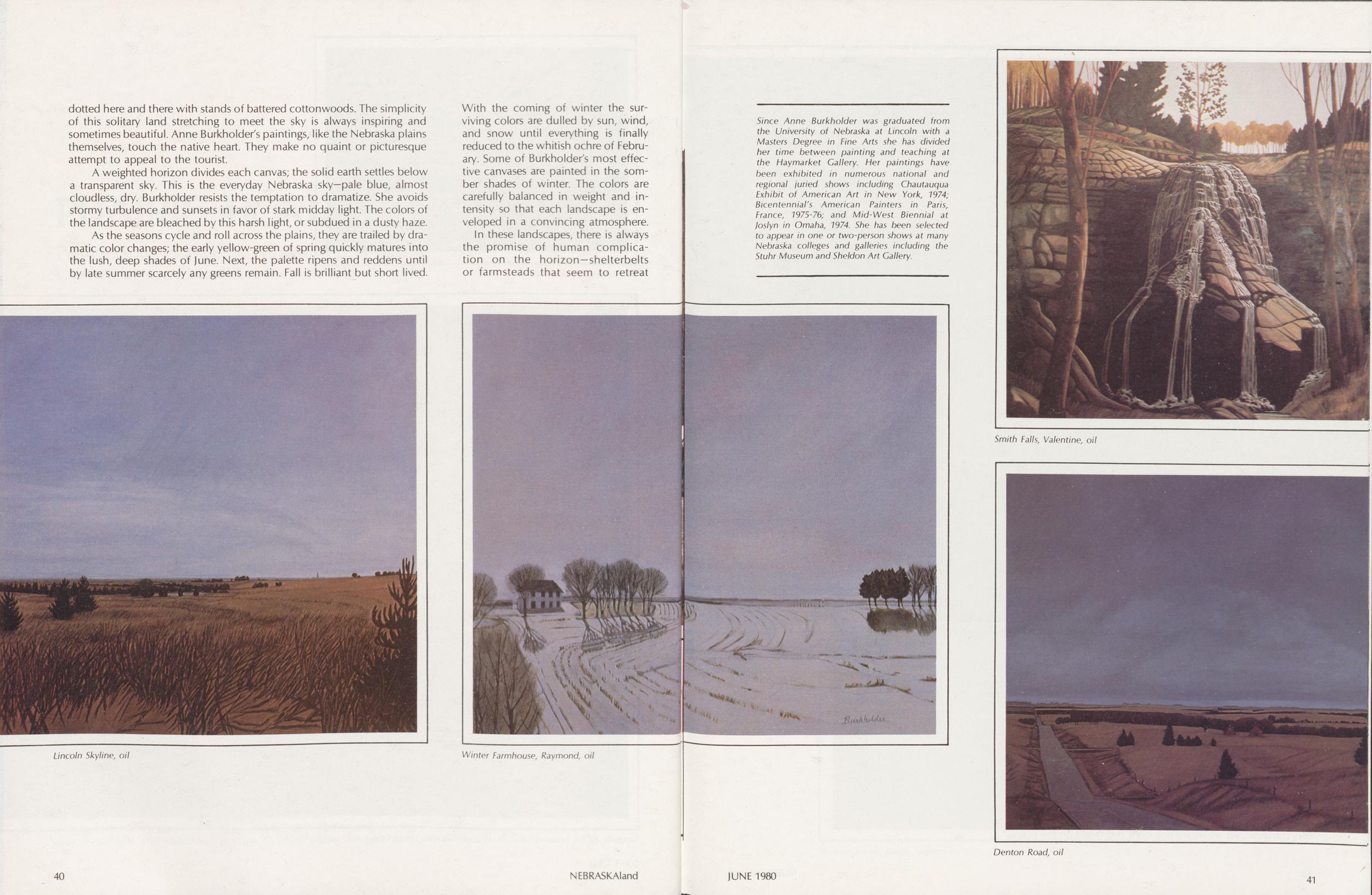
A weighted horizon divides each canvas; the solid earth settles below a transparent sky. This is the everyday Nebraska sky—pale blue, almost cloudless, dry. Burkholder resists the temptation to dramatize. She avoids stormy turbulence and sunsets in favor of stark midday light. The colors of the landscape are bleached by this harsh light, or subdued in a dusty haze.
As the seasons cycle and roll across the plains, they are trailed by dramatic color changes; the early yellow-green of spring quickly matures into the lush, deep shades of June. Next, the palette ripens and reddens until by late summer scarcely any greens remain. Fall is brilliant but short lived. With the coming of winter the surviving colors are dulled by sun, wind, and snow until everything is finally reduced to the whitish ochre of February. Some of Burkholder's most effective canvases are painted in the somber shades of winter. The colors are carefully balanced in weight and intensity so that each landscape is enveloped in a convincing atmosphere.
In these landscapes, there is always the promise of human complication on the horizon —shelterbelts or farmsteads that seem to retreat like a mirage upon approach. Man's mark is everywhere while he himself is noticeably absent. His straight rows and right-angled intersections pattern the plains.
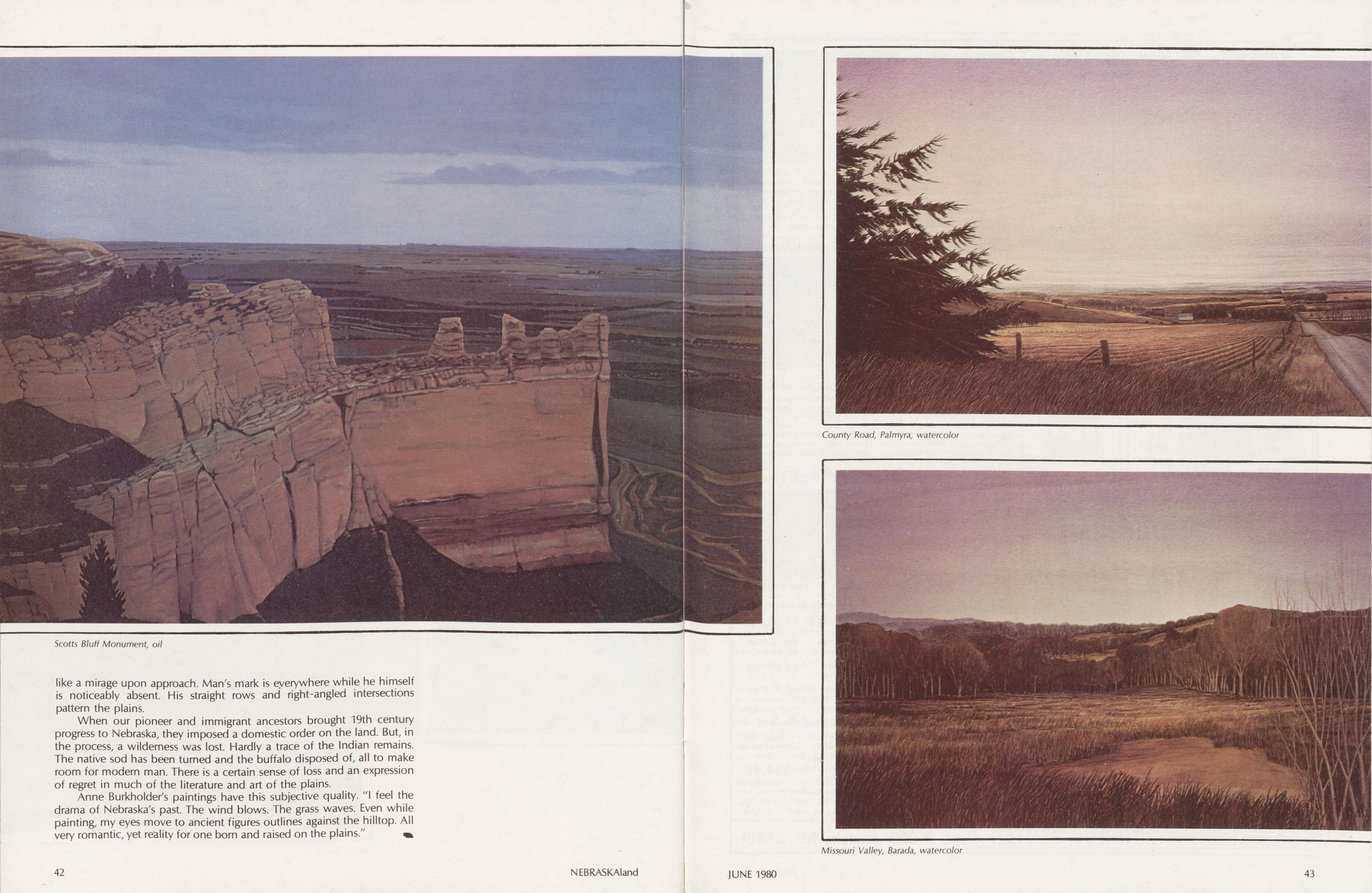
When our pioneer and immigrant ancestors brought 19th century progress to Nebraska, they imposed a domestic order on the land. But, in the process, a wilderness was lost. Hardly a trace of the Indian remains. The native sod has been turned and the buffalo disposed of, all to make room for modern man. There is a certain sense of loss and an expression of regret in much of the literature and art of the plains.
Anne Burkholder's paintings have this subjective quality. "I feel the drama of Nebraska's past. The wind blows. The grass waves. Even while painting, my eyes move to ancient figures outlines against the hilltop. All very romantic, yet reality for one born and raised on the plains."
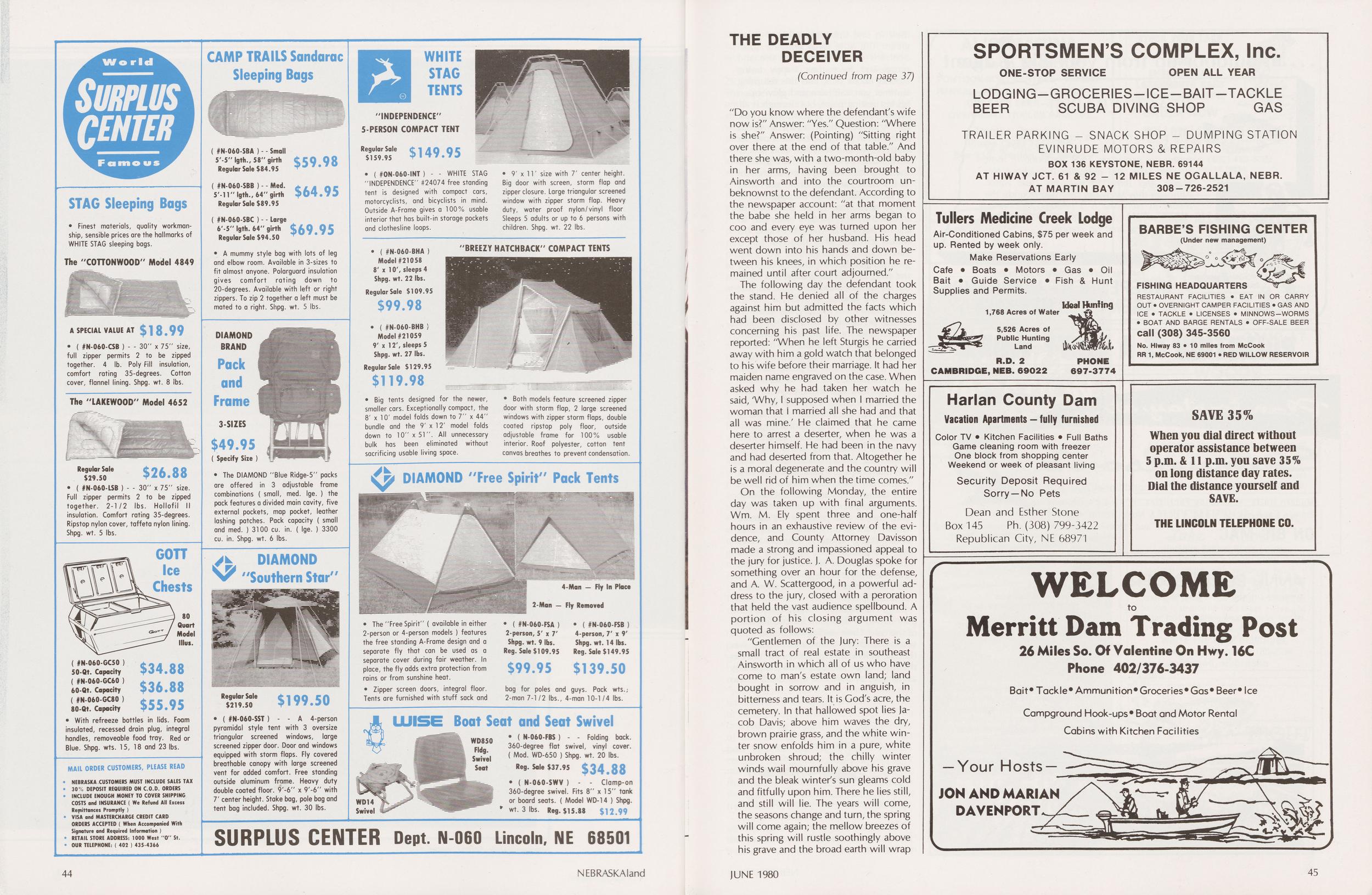 STAG Sleeping Bags
Finest materials, quality workmanship, sensible prices are the hallmarks of
WHITE STAG sleeping bags.
The "COTTONWOOD" Model 4849
A SPECIAL VALUE AT $18.99
( #N-060-CSB ) - - 30" x 75" size,
full zipper permits 2 to be zipped
together. 4 lb. Poly Fill insulation,
comfort rating 35-degrees. Cotton
cover, flannel lining. Shpg. wt. 8 lbs.
The "LAKEWOOD" Model 4652
Regular Sale
$29.50
( #N-060-LSB )
Full zipper permits
together. 2-1/2
insulation. Comfort rating 35-degrees.
Ripstop nylon cover, taffeta nylon lining.
Shpg. wt. 5 lbs.
$26.88
- 30" x 75" size.
2 to be zipped
lbs. Hollofil
( #N-060-GC50 )
50-Qt. Capacity
( #N-06Q-GC60 )
60-Qt. Capacity
( #N-060-GC80 )
80-Qt. Capacity
• With refreeze bottles in lids. Foam
insulated, recessed drain plug, integral
handles, removeable food tray. Red or
Blue. Shpg. wts. 15, 18 and 23 lbs.
$34.88
$36.88
$55.95
MAIL ORDER CUSTOMERS, PLEASE READ
NEBRASKA CUSTOMERS MUST INCLUDE SALES TAX
30% DEPOSIT REQUIRED ON C.O.D. ORDERS
INCLUDE ENOUGH MONEY TO COVER SHIPPING
COSTS and INSURANCE ( We Refund All Excess
Remittances Promptly )
VISA and MASTERCHARGE CREDIT CARD
ORDERS ACCEPTED ( When Accompanied With
Signature and Required Information )
RETAIL STORE ADDRESS: 1000 West "0" St.
OUR TELEPHONE: ( 402 ) 435-4366
CAMP TRAILS Sandarac
Sleeping Bags
( #N-060-SBA ) - - Small
5'-5" Igth., 58" girth
Regular Sale $84.95
( #N-060-SBB ) - - Med.
5'11" Igth., 64" girth
Regular Sale $89.95
$59.98
$64.95
( #N-060-SBC ) - - Large
6-5" Igth. 64" girth $69.95
Regular Sale $94.50
• A mummy style bag with lots of leg
and elbow room. Available in 3-sizes to
fit almost anyone. Polarguard insulation
gives comfort rating down to
20-degrees. Available with left or right
zippers. To zip 2 together a left must be
mated to a right. Shpg. wt. 5 lbs.
DIAMOND
BRAND
Pack
and
Frame
3-SIZES
$49.95
( Specify Size )
The DIAMOND "Blue Ridge-5" packs
are offered in 3 adjustable frame
combinations ( small, med. Ige. ) the
pack features a divided main cavity, five
external pockets, map pocket, leather
lashing patches. Pack capacity ( small
and med. ) 3100 cu. in. ( Ige. ) 3300
cu. in. Shpg. wt. 6 lbs.
DIAMOND
S/ "Southern Star
$199.50
( #N-060-SST) - - A 4-person
pyramidal style tent with 3 oversize
triangular screened windows, large
screened zipper door. Door and windows
equipped with storm flaps. Fly covered
breathable canopy with large screened
vent for added comfort. Free standing
outside aluminum frame. Heavy duty
double coated floor. 9'-6" x 9'-6" with
7' center height. Stake bag, pole bag and
tent bag included. Shpg. wt. 30 lbs.
WHITE
STAG
TENTS
"INDEPENDENCE"
5-PERSON COMPACT TENT
Regular Sale £"|AQ O C
$159.95 ^ItT.TJ
( ION-060-INT ) - - WHITE STAG
"INDEPENDENCE" #24074 free standing
tent is designed with compact cars,
motorcyclists, and bicyclists in mind.
Outside A-Frame gives a 100% usable
interior that has built-in storage pockets
and clothesline loops.
9' x 11' size with 7' center height.
Big door with screen, storm flap and
zipper closure. Large triangular screened
window with zipper storm flap. Heavy
duty, water proof nylon/vinyl floor
Sleeps 5 adults or up to 6 persons with
children. Shpg. wt. 22 lbs.
( #N-060-BHA )
Model #21058
8' x 10', sleeps 4
Shpg. wt. 22 lbs.
Regular Sale $109.95
$99.98
( #N-060-BHB )
Model #21059
9' x 12', sleeps 5
Shpg. wt. 27 lbs.
Regular Sale $129.95
$119.98
Big tents designed for the newer,
smaller cars. Exceptionally compact, the
8' x 10' model folds down to 7" x 44"
bundle and the 9' x 12' model folds
down to TO" x 51". All unnecessary
bulk has been eliminated without
sacrificing usable living space.
"BREEZY HATCHBACK" COMPACT TENTS
Both models feature screened zipper
door with storm flap, 2 large screened
windows with zipper storm flaps, double
coated ripstop poly floor, outside
adjustable frame for 100% usable
interior. Roof polyester, cotton tent
canvas breathes to prevent condensation.
Vfc
C» DIAMOND "Free Spirit" Pack Tents
4-Man — Fly In Place
2-Man — Fly Removed
The "Free Spirit" ( available in either
2-person or 4-person models ) features
the free standing A-Frame design and a
separate fly that can be used as a
separate cover during fair weather. In
place, the fly adds extra protection from
rains or from sunshine heat.
Zipper screen doors, integral floor.
Tents are furnished with stuff sack and
( #N-060-FSA )
2-person, 5' x 7'
Shpg. wt. 9 lbs.
Reg. Sale $109.95
( #N-060-FSB )
4-person, 7' x 9'
Shpg. wt. 14 lbs.
Reg. Sale $149.95
$99.95 $139.50
bag for poles and guys. Pack wts.;
2-man 7-1 /2 lbs., 4-man 10-1 /4 lbs.
Boat Seat and Seat Swivel
VYD850
Fldg.
Swivel
Seat
WD14
Swivel
( N-060-FBS ) - - Folding back.
360-degree flat swivel, vinyl cover.
( Mod. WD-650 ) Shpg. wt. 20 lbs.
Reg. Sale $37.95 $34.88
( N-060-SWV ) - - Clamp-on
360-degree swivel. Fits 8" x 15" tank
or board seats. ( Model WD-14 ) Shpg.
wt. 3 lbs. Reg. $15.88 $12.99
SURPLUS CENTER Dept. N-060 Lincoln, NE 68501
44
NEBRASKAland
STAG Sleeping Bags
Finest materials, quality workmanship, sensible prices are the hallmarks of
WHITE STAG sleeping bags.
The "COTTONWOOD" Model 4849
A SPECIAL VALUE AT $18.99
( #N-060-CSB ) - - 30" x 75" size,
full zipper permits 2 to be zipped
together. 4 lb. Poly Fill insulation,
comfort rating 35-degrees. Cotton
cover, flannel lining. Shpg. wt. 8 lbs.
The "LAKEWOOD" Model 4652
Regular Sale
$29.50
( #N-060-LSB )
Full zipper permits
together. 2-1/2
insulation. Comfort rating 35-degrees.
Ripstop nylon cover, taffeta nylon lining.
Shpg. wt. 5 lbs.
$26.88
- 30" x 75" size.
2 to be zipped
lbs. Hollofil
( #N-060-GC50 )
50-Qt. Capacity
( #N-06Q-GC60 )
60-Qt. Capacity
( #N-060-GC80 )
80-Qt. Capacity
• With refreeze bottles in lids. Foam
insulated, recessed drain plug, integral
handles, removeable food tray. Red or
Blue. Shpg. wts. 15, 18 and 23 lbs.
$34.88
$36.88
$55.95
MAIL ORDER CUSTOMERS, PLEASE READ
NEBRASKA CUSTOMERS MUST INCLUDE SALES TAX
30% DEPOSIT REQUIRED ON C.O.D. ORDERS
INCLUDE ENOUGH MONEY TO COVER SHIPPING
COSTS and INSURANCE ( We Refund All Excess
Remittances Promptly )
VISA and MASTERCHARGE CREDIT CARD
ORDERS ACCEPTED ( When Accompanied With
Signature and Required Information )
RETAIL STORE ADDRESS: 1000 West "0" St.
OUR TELEPHONE: ( 402 ) 435-4366
CAMP TRAILS Sandarac
Sleeping Bags
( #N-060-SBA ) - - Small
5'-5" Igth., 58" girth
Regular Sale $84.95
( #N-060-SBB ) - - Med.
5'11" Igth., 64" girth
Regular Sale $89.95
$59.98
$64.95
( #N-060-SBC ) - - Large
6-5" Igth. 64" girth $69.95
Regular Sale $94.50
• A mummy style bag with lots of leg
and elbow room. Available in 3-sizes to
fit almost anyone. Polarguard insulation
gives comfort rating down to
20-degrees. Available with left or right
zippers. To zip 2 together a left must be
mated to a right. Shpg. wt. 5 lbs.
DIAMOND
BRAND
Pack
and
Frame
3-SIZES
$49.95
( Specify Size )
The DIAMOND "Blue Ridge-5" packs
are offered in 3 adjustable frame
combinations ( small, med. Ige. ) the
pack features a divided main cavity, five
external pockets, map pocket, leather
lashing patches. Pack capacity ( small
and med. ) 3100 cu. in. ( Ige. ) 3300
cu. in. Shpg. wt. 6 lbs.
DIAMOND
S/ "Southern Star
$199.50
( #N-060-SST) - - A 4-person
pyramidal style tent with 3 oversize
triangular screened windows, large
screened zipper door. Door and windows
equipped with storm flaps. Fly covered
breathable canopy with large screened
vent for added comfort. Free standing
outside aluminum frame. Heavy duty
double coated floor. 9'-6" x 9'-6" with
7' center height. Stake bag, pole bag and
tent bag included. Shpg. wt. 30 lbs.
WHITE
STAG
TENTS
"INDEPENDENCE"
5-PERSON COMPACT TENT
Regular Sale £"|AQ O C
$159.95 ^ItT.TJ
( ION-060-INT ) - - WHITE STAG
"INDEPENDENCE" #24074 free standing
tent is designed with compact cars,
motorcyclists, and bicyclists in mind.
Outside A-Frame gives a 100% usable
interior that has built-in storage pockets
and clothesline loops.
9' x 11' size with 7' center height.
Big door with screen, storm flap and
zipper closure. Large triangular screened
window with zipper storm flap. Heavy
duty, water proof nylon/vinyl floor
Sleeps 5 adults or up to 6 persons with
children. Shpg. wt. 22 lbs.
( #N-060-BHA )
Model #21058
8' x 10', sleeps 4
Shpg. wt. 22 lbs.
Regular Sale $109.95
$99.98
( #N-060-BHB )
Model #21059
9' x 12', sleeps 5
Shpg. wt. 27 lbs.
Regular Sale $129.95
$119.98
Big tents designed for the newer,
smaller cars. Exceptionally compact, the
8' x 10' model folds down to 7" x 44"
bundle and the 9' x 12' model folds
down to TO" x 51". All unnecessary
bulk has been eliminated without
sacrificing usable living space.
"BREEZY HATCHBACK" COMPACT TENTS
Both models feature screened zipper
door with storm flap, 2 large screened
windows with zipper storm flaps, double
coated ripstop poly floor, outside
adjustable frame for 100% usable
interior. Roof polyester, cotton tent
canvas breathes to prevent condensation.
Vfc
C» DIAMOND "Free Spirit" Pack Tents
4-Man — Fly In Place
2-Man — Fly Removed
The "Free Spirit" ( available in either
2-person or 4-person models ) features
the free standing A-Frame design and a
separate fly that can be used as a
separate cover during fair weather. In
place, the fly adds extra protection from
rains or from sunshine heat.
Zipper screen doors, integral floor.
Tents are furnished with stuff sack and
( #N-060-FSA )
2-person, 5' x 7'
Shpg. wt. 9 lbs.
Reg. Sale $109.95
( #N-060-FSB )
4-person, 7' x 9'
Shpg. wt. 14 lbs.
Reg. Sale $149.95
$99.95 $139.50
bag for poles and guys. Pack wts.;
2-man 7-1 /2 lbs., 4-man 10-1 /4 lbs.
Boat Seat and Seat Swivel
VYD850
Fldg.
Swivel
Seat
WD14
Swivel
( N-060-FBS ) - - Folding back.
360-degree flat swivel, vinyl cover.
( Mod. WD-650 ) Shpg. wt. 20 lbs.
Reg. Sale $37.95 $34.88
( N-060-SWV ) - - Clamp-on
360-degree swivel. Fits 8" x 15" tank
or board seats. ( Model WD-14 ) Shpg.
wt. 3 lbs. Reg. $15.88 $12.99
SURPLUS CENTER Dept. N-060 Lincoln, NE 68501
44
NEBRASKAland
THE DEADLY DECEIVER
(Continued from page 37)"Do you know where the defendant's wife now is?" Answer: "Yes." Question: "Where is she?" Answer: (Pointing) "Sitting right over there at the end of that table." And there she was, with a two-month-old baby in her arms, having been brought to Ainsworth and into the courtroom unbeknownst to the defendant/According to the newspaper account: "at that moment the babe she held in her arms began to coo and every eye was turned upon her except those of her husband. His head went down into his hands and down between his knees, in which position he remained until after court adjourned."
The following day the defendant took the stand. He denied all of the charges against him but admitted the facts which had been disclosed by other witnesses concerning his past life. The newspaper reported: "When he left Sturgis he carried away with him a gold watch that belonged to his wife before their marriage. It had her maiden name engraved on the case. When asked why he had taken her watch he said, 'Why, I supposed when I married the woman that i married all she had and that all was mine.' He claimed that he came here to arrest a deserter, when he was a deserter himself. He had been in the navy and had deserted from that. Altogether he is a moral degenerate and the country will be well rid of him when the time comes."
On the following Monday, the entire day was taken up with final arguments. Wm. M. Ely spent three and one-half hours in an exhaustive review of the evidence, and County Attorney Davisson made a strong and impassioned appeal to the jury for justice. J. A. Douglas spoke for something over an hour for the defense, and A. W. Scattergood, in a powerful address to the jury, closed with a peroration that held the vast audience spellbound. A portion of his closing argument was quoted as follows:
"Gentlemen of the Jury: There is a small tract of real estate in southeast Ainsworth in which all of us who have come to man's estate own land; land bought in sorrow and in anguish, in bitterness and tears. It is God's acre, the cemetery. In that hallowed spot lies Jacob Davis; above him waves the dry, brown prairie grass, and the white winter snow enfolds him in a pure, white unbroken shroud; the chilly winter winds wail mournfully above his grave and the bleak winter's sun gleams cold and fitfully upon him. There he lies still, and still will lie. The years will come, the seasons change and turn, the spring will come again; the mellow breezes of this spring will rustle soothingly above his grave and the broad earth will wrap itself in one unbroken robe of living green. The little birds and the small denizens of the prairie will live and move and have their happy being around about him, and the returning summer sun will burn and glow upon his last resting place, but through it all, Jacob Davis will lie peacefully and still, for 'After life's fitful fever, he sleeps well,' and in the broad breast of mother earth he lies and with him all is peace. "It matters not to him whether his murderer receives the just punishment of his crime, or whether he goes free; for Jacob Davis sleeps his long eternal sleep, nevermore to be disturbed or troubled by the hand of man. But to us, his friends, his neighbors and his fellow citizens, the blood of Jacob Davis cries for vengeance from the ground, like Abel's blood of old-not the wild, lawless vengeance of a mob, but the sober, ordered, righteous justice of the land.
SPORTSMEN'S COMPLEX, Inc ONE-STOP SERVICE OPEN ALL YEAR LODGING-GROCERIES-ICE-BAIT-TACKLE BEER SCUBA DIVING SHOP GAS TRAILER PARKING - SNACK SHOP - DUMPING STATION EVINRUDE MOTORS & REPAIRS BOX 136 KEYSTONE, NEBR. 69144 AT HIWAY JCT. 61 & 92 - 12 MILES NE OGALLALA, NEBR. AT MARTIN BAY 308-726-2521 Tullers Medicine Creek Lodge Air-Conditioned Cabins, $75 per week and up. Rented by week only. Make Reservations Early Cafe • Boats • Motors • Gas • Oil Bait • Guide Service • Fish & Hunt Supplies and Permits. Ideal Hunting 1,768 Acres of Water 5,526 Acres of Public Hunting Land R.D. 2 CAMBRIDGE, NEB. 69022 PHONE 697-3774 Harlan County Dam Vacation Apartments - fully furnished Color TV Kitchen Facilities Full Baths Game cleaning room with freezer One block from shopping center Weekend or week of pleasant living Security Deposit Required Sorry —No Pets Dean and Esther Stone Box 145 Ph. (308) 799-3422 Republican City, NE 68971 BARBE'S FISHING CENTER (Under new management) FISHING HEADQUARTERS RESTAURANT FACILITIES EAT IN OR CARRY OUT OVERNIGHT CAMPER FACILITIES GAS AND ICE TACKLE LICENSES MINNOWS-WORMS BOAT AND BARGE RENTALS OFF-SALE BEER call (308) 345-3560 No. Hiway 83 10 miles from McCook RR 1, McCook, NE 69001 RED WILLOW RESERVOIR SAVE 35% When you dial direct without operator assistance between 5 p.m. & 11 p.m. you save 35% on long distance day rates. Dial the distance yourself and SAVE. THE LINCOLN TELEPHONE CO. WELCOME to Merritt Dam Trading Post 26 Miles So. Of Valentine On Hwy. 16C Phone 402/376-3437 Bait Tackle0 Ammunition Groceries Gas Beer Ice Campground Hook-ups Boat and Motor Rental Cabins with Kitchen Facilities Your Hosts JON AND MARIAN DAVENPORT JUNE 1980 45 ... an outdoor tip from your Big //'agent
BLACK CRAPPIE
One of the numerous sunfishes, the black
crappie is among the most sought-after of all
freshwater gamesters. They are found in most
streams, lakes and reservoirs throughout Nebraska, and thrive in relatively clear
water.
Although they rarely run over two pounds, the
record in Nebraska is 3 pounds, 15 ounces,
caught at Lake McConaughy in 1962. There is
no possession limit on crappie.
your 'this message brought to you by the
INDEPENDENT INSURANCE
AGENTS OF NEBRASKA
POLLUTION IS A DIRTY WORD!
Plant to stayt at...
Samuelson's
LEMOYNE CABINS (air-conditioned)
Modern Units Cooking Facilities Air Conditioning
Store Gas Tackle Bait Boat & Motor Rental Guides
L. R. and "Monte" Samuelson
Phone 355-2321
ON BIG MAC
Lemoyne, Nebr.
ANNS- BURJ4JOLDER
ORIGINAL OIL AND WATERCOLORS
STUDIO
720 "O" STREET
LINCOLN. NE 68S08
(402) 477-3305. 489-3424
... an outdoor tip from your Big //'agent
BLACK CRAPPIE
One of the numerous sunfishes, the black
crappie is among the most sought-after of all
freshwater gamesters. They are found in most
streams, lakes and reservoirs throughout Nebraska, and thrive in relatively clear
water.
Although they rarely run over two pounds, the
record in Nebraska is 3 pounds, 15 ounces,
caught at Lake McConaughy in 1962. There is
no possession limit on crappie.
your 'this message brought to you by the
INDEPENDENT INSURANCE
AGENTS OF NEBRASKA
POLLUTION IS A DIRTY WORD!
Plant to stayt at...
Samuelson's
LEMOYNE CABINS (air-conditioned)
Modern Units Cooking Facilities Air Conditioning
Store Gas Tackle Bait Boat & Motor Rental Guides
L. R. and "Monte" Samuelson
Phone 355-2321
ON BIG MAC
Lemoyne, Nebr.
ANNS- BURJ4JOLDER
ORIGINAL OIL AND WATERCOLORS
STUDIO
720 "O" STREET
LINCOLN. NE 68S08
(402) 477-3305. 489-3424
"Gentlemen of the Jury, the question of the punishment of this lost, guilty wretch is in your hands, to be decided upon by you and you alone. If the state has not proven his guilt in this case, then it is impossible to prove the guilt of any criminal; if he has not been fairly and rightfully convicted, then it is impossible to convict a criminal in Brown County. His punishment is for you to decide and fix. It is a dreadful responsibility, but one which you cannot shirk and which you must settle and you alone. But, if you should decide that this man is not guilty and that you must acquit him, then, when vice and crime and lawlessness stalk with unblushing, brazen front across the land, when life and liberty and property are unsafe within your county; when crime and wrong-doing surround you on every side, then look back upon this day's work and say to yourselves, 'We did this; we are the cause of this, when we set free from punishment the murderer of Jacob Davis.'"
Judge Harrington instructed the jury and they retired at 8:20 p.m. for consideration of the case. Their verdict, reached at about seven o'clock the following morning, was that the defendant was guilty of murder in the first degree and they fixed the penalty at hanging by the neck until dead. It was 46 NEBRASKAland later learned that the jury's first vote resulted in a verdict of guilty, with the penalty decision reached on the twelfth vote.
Wilson was so sentenced on February 25, 1910, with his execution set for June 27. The defendant appealed, setting forth 35 errors or reasons why the trial judge should grant him a new trial, among which was alleged misconduct of the prosecutors in bringing the defendant's wife and little babe into the courtroom and having them pointed out, "causing the defendant to be overcome with grief and emotion and putting him in such condition as to require the assistance of his guards to keep him from falling to the floor." This was vigorously denied by the prosecution. A further reason given for a new trial was that while the trial was in progress, the Jake Davis pool hall burned to the ground, thereby increasing the sympathy of the general public for his widow and family. This was apparently just an unfortunate accident occurring at an inopportune time from the defendant's standpoint. In any event, Judge Harrington overruled the defendant's motion for a new trial, which was not surprising, and the case proceeded to the Supreme Court on appeal.
It was natural that everyone in the community was extremely agitated over the murder of a well-liked and respected citizen, and there was even some talk of a lynching. The feeling of the community was well illustrated by the tenor of the reporting in the newspaper. After announcing, prior to the trial, that the Star-Journal would report the case impartially and that it did not intend to prejudge the case or to convict a man outside of court and outside of the due process of law, editor John M. Cotton, who was also an attorney, went on to say that there was a network of circumstances that pointed directly to his guilt. It was even pointed out that two murder-mystery books found in Wilson's room were very suggestive of the character of any man who would read them. This feeling continued to be evident throughout the reporting of the trial.
In the February 6 issue of the Star-Journal, it was reported that two of Wilson's pocketbooks, wrapped in bloody papers, a gun and some cartridges, had been found hidden in the mattress in Wilson's hotel room. The editor's comment was that "with this discovery the supreme court will hardly disturb the verdict and the sentence of death, though the proceedings will be delayed some to go through the formality of the hearing." He did not explain just how the Supreme Court could possibly consider this evidence, discovered after the trial, and he proved, by his prognosis, that no one can ever predict a decision of the Supreme Court. It ultimately reversed the case and sent it back for a new trial.
Strong feelings of the editor and the general public were apparently shared by the prosecuting attorneys for, it seems, their error was that they over prosecuted the defendant after they found out that on November 12, 1909, he had taken his wife to Lead, South Dakota to have her baby, went back to Ft. Mead and drew his pay, obtained a 10-day furlough because of his wife's condition, sold about $300 worth of household goods for $50, and then went to Hot Springs with a Mrs. Allison, living with her "in adulterous debauchery" for four weeks, that he then sold some of her horses, kept the proceeds, deserted her and took up with Helen Leeds, alias Mrs. Lester, "another woman of the same stripe." It was obvious the defendant was being tried for those acts as well as for murder. This was later admitted by Wm. M. Ely, who, because Mr. Ely's first child (this writer) was born on January 9, 1910, wife and child desertion seemed to him to be even more serious than murder.
AL'S MARINA Swanson Reservoir PONTOON BOAT RENTALS-TRAILER RENTAL-FOOD-BAIT-TACKLE-OFF SALE BEER-ICE-OVERNIGHT TRAILER PARKING Trenton Dam Site, Phone (308) 334-5268 Box 115, Trenton, NE 69044 plan a RANCH Get away from it all to Nebraska's scenic Pine Ridge for a vacation you'll remember a lifetime. ty in modern nicely-furnished Jog cabins. Take a quiet walk on scenic hiking trails/try some great fishing then have a campfire cookout. See a 16-foot .waterwheel, unbelievable sunsets you'll never find in the city and more stars you ever thought existed." Tiim Rock For brochure write:/ Rt. 3/Boor 30, Crawford/ NE. S933 STOCK YOUR LAKE OR POND with CHANNEL CAT LARGEMOUTH BASS BLUEGILL - CRAPPIE ORDER NOW WILLOW LAKE FISH HATCHERY Rt. 3, Box 46, Hastings, Nebr. 68901 Gaylord L. Crawford Phone: (402) 463-8022 Day or Night For 1980 Stocking Pond Mill—Products for algae control LIVE-CATCH ALL-PURPOSE TRAPS Writ* for FREE CATALOG Traps without injury squirrels, chipmunks, rabbits, mink, fox, raccoons, stray animals, pests, etc. Sizes for every need. Also traps for snakes, sparrows, pigeons, crabs, turtles, quail, etc. Save on our low factory prices. Send no money. Free catalog and trapping secrets. MUSTANG MFG. CO., Dept. N-34, Box 10880, Houston, Tex. 77018 SAVE GAS - CAMP AT GRANDPA'S WOODS "THE QUIET CAMPGROUND" Camp in the shade and just relax or fish for those Black Bass & Crappies. Shoot our challenging par 31 nine hole golf course. Canoe our beautiful winding lake or paint a picture of our own covered bridge. Take a trail ride and do a little bird watching. Located 2 miles north — 1 mile east & V2 mile north of Elmwood, NE 68349. MUTCHIE'S ZaksL RESORT Upstairs Anchor Room Lounge Cold Beer-On/Off Sale Lakefront cabins with swimming beach Fishing tackle Boats & motors Free boat ramp Fishing Swimming Cafe and ice Boating & skiing Gas and oil 9-hole golf course just around the corner Live and frozen bait Pontoon, boat & motor rentals. Overnight Campers—full hookups WRITE FOR FREE BROCHURE or phone reservations 785-2298 Elwood, Nebraska TROUT For stocking your lake or pond now. 2 to 12 inch rainbow trout. TROUT SPRINGS Hidden Timber Route PHONE Valentine, NE. 69201 (402) 376-2369 JUNE 1980 47 EXIT 6
ON THE NORTH SIDE
VISIT THE
RESTAURANT
YOUR FAVORITE COCKTAILS
FANCY LARGE SALAD BAR
TROPHY STRIPERS
ON DISPLAY
Ph: 308-355-2102
Lemoyne, Ne 69146
CLOSE TO WATER
Located on the north
shore of Lake
McConaughy, 7 miles
west of the dam
SERVICES
Tackle, Bait, Gas,
}Oil, Ice, Beer,
Pop, etc.
BOAT, MOTOR RENTAL
MOTEL
Lake McConaughy's
largest motel and
apartment complex
includes new units
GUIDE SERVICE
"The Good Fishermen Always
Start & Finish Here..."
Air-conditioned units, cooking facilities,
Up to six adults. Campground on the
beach—40 hookups, showers, playground,
shade.
AIR STRIP 2,600 Feet Sod
GUIDE SERVICE
MARINA
Boat Gas & Oil on the Water
LAUNCHING SERVICE
GENERAL STORE Groceries, Beer,
Pop, Tackle, Live Bait
HIGHWATER RAMP
BOAT & PONTOON RENTALS Motors
from 10-40 HP, boats 14 to 20 feet
Write For A Free Brochure
South Shore Big Mac
at Gate 18
Rural Route
Brule, Ne. 69127
Ogallala, Ne.
(308) 284-4965
EXIT 6
ON THE NORTH SIDE
VISIT THE
RESTAURANT
YOUR FAVORITE COCKTAILS
FANCY LARGE SALAD BAR
TROPHY STRIPERS
ON DISPLAY
Ph: 308-355-2102
Lemoyne, Ne 69146
CLOSE TO WATER
Located on the north
shore of Lake
McConaughy, 7 miles
west of the dam
SERVICES
Tackle, Bait, Gas,
}Oil, Ice, Beer,
Pop, etc.
BOAT, MOTOR RENTAL
MOTEL
Lake McConaughy's
largest motel and
apartment complex
includes new units
GUIDE SERVICE
"The Good Fishermen Always
Start & Finish Here..."
Air-conditioned units, cooking facilities,
Up to six adults. Campground on the
beach—40 hookups, showers, playground,
shade.
AIR STRIP 2,600 Feet Sod
GUIDE SERVICE
MARINA
Boat Gas & Oil on the Water
LAUNCHING SERVICE
GENERAL STORE Groceries, Beer,
Pop, Tackle, Live Bait
HIGHWATER RAMP
BOAT & PONTOON RENTALS Motors
from 10-40 HP, boats 14 to 20 feet
Write For A Free Brochure
South Shore Big Mac
at Gate 18
Rural Route
Brule, Ne. 69127
Ogallala, Ne.
(308) 284-4965
The Supreme Court gave several reasons for reversing the case and remanding it back for a new trial on October 22. By that time some of the state's witnesses were deceased, the whereabouts of others unknown, and the passage of time had subdued the strong community feelings. A new complaint was filed, but the next step was what has become the much-criticized procedure of plea bargaining. This resulted in a signed confession by the defendant in exchange for a reduction in charge to second degree murder, and a sentence of 25 years in the penitentiary. Judge Harrington not only sentenced the defendant but also told him that he was utterly depraved, that no penalty known to the law would be too severe and that he was forever branded as a murderer. It would seem that the story of the Jake Davis murder and of the resulting trial should end here but it does not. There is a short sequel.
It seems that shortly after World War I, a citizen of Ainsworth saw a copy of the Denver Post with a picture of Reifenberg, under an assumed name, who, the news item said, was in Denver lecturing "on his experiences as an ace pilot during the war while serving as an officer in the Canadian Royal Air Force." Inquiry at the Nebraska State Penitentiary disclosed that Rifenberg had indeed escaped earlier, an event which went completely unpublicized. In any case, he was apprehended and returned to the penitentiary to serve the balance of his 25-year sentence without any time credit for good behavior. Nothing further is known of him, and perhaps for all concerned that is best.
NEBRASKAland proudly presents the stories of its readers. Here is the opportunity so many have requested-a chance to tell their own out- door tales. Hunting trips, the "big fish that got away", unforgettable characters, outdoor impressions-all have a place here.
If you have a story to tel I, jot it down and send it to Editor, NEBRASKAland, Box 30370, Lincoln, Nebr. 68503. Send photographs, black and white or color, too, if any are available.
48 NEBRASKAlandTrading Post
MISCELLANEOUSGUNS-Browning, Winchester, Remington, others, Hi-powers, shotguns, new, used, antiques. Want Pre-1964 Winchesters. Buy-Sell-Trade. Ph. (402) 729-6112. Bedlan's Sporting Goods, Fairbury, NE 68352.
DUCK HUNTERS: learn how to make quality, solid plastic, waterfowl decoys. We're originators of famous system. Send, $1 for colorful catalog. Decoys Unlimited, Clinton, Iowa 52732
FRITZ GUNSMITHING & Supply Co-Heckler & Koch Dealer. Handfinishing-Hot Blue-Parkerization-Custom Rifles-Antique Restoration. 407 South Harris, Wilber, NE. (402) 821-2260.
NEBRASKA CENTENNIAL WINCHESTER COMMEM- ORATIVES, SERIAL NUMBERS #100 (CENTENNIAL) AND #1867 (year of Statehood) $3,000 (sold only as a set). BUFFALO BILL "ONE OF 300" WINCHESTER COMMEMORATIVES, SERIAL #57 and #58 $3,000 (sold only as a set). BINOCULARS LEITZ 7x35B Sale $575. BROWNING GRADE 111, List $699.95, Sale $594.95. LEE-GRANT COLT COMMEMORATIVES (Same serial number) $750 for 2 guns. BROWNING INTERNATIONAL MEDALIST list $575, Sale $460. BROWNING A-5 COMMEMORATIVE #2211, $1,250. BROWNING B1 CENTENNIAL MOD. 78 .45-70 $1,800. COLT-RESERVED, SERIAL NUMBERS 243 and 244. Buy the Cavalry Commemorative Set at $995 and the Ned Buntline Commemorative at $900 and you have reserved the Heritage Model to be issued later this year. A unique opportunity for Colt Collectors and investors. 24 BROWN- ING A-5 BELGIAN BBLS. $195 each or $175 each when purchasing entire lot. RAMPANT COLT STATUE $1,750. (only 100 cast). MANNUCHER SCHOENAUER MODEL MC .243 appx. 1960 manufacture, double-set triggers $700. Plum Creek Gun Shop, R.R., Box 243, Seward, NE 68434 Phone 643-3303.
HARLAN COUNTY DAM. Vacation apartments, fully furnished. Game cleaning room with freezer. One block from shopping center. Weekend or week of pleasant living. Must see to appreciate. Security deposit required. Sorry no pets. Dean and Esther Stone, Box 145, Republican City, NE 68971 Ph. (308) 799-342
NE. NEBR. TROUT FISHING. For rent Mon.-Thurs. or Fri.-Sun. Two cottages, four ponds and stream. Privacy with trout up to 5 pounds. Open April 1. Diamond E. Trout Resort, Orchard, NE 68764. (402) 893-4745. FISH FOR SALE: Channel Catfish, Largemouth Bass, Bluegill, Crappie, Perch, Bullhead, Rainbow Trout and minnows for pond and lake stocking. Contact the Pleasant Valley Fish Farm, Route 1, McCook, Nebraska 69001. Phone (308) 345-6599.
GRUMMAN CANOES for sale at cost + 10 percent. Send 50 cents (stamps OK) for literature and prices. Tom Stover, Dealer, Star Rt., Gering, NE 69341.
ROCK CLIMBING classes and guide services brochure available. Dakota Territory Rock and Snow c/o Mark Ebel, 3868 Starr, Lincoln, NE 68503. Ph. (402) 467-3064.
FURNISHED MODERN Lake house for sale or rent-accommodate 4 to 6 people. Admiral's Cove, Lake McConaughy frontage. Phone 12-355-3282.
DUCK HUNTER'S Wives, Wow! Send out of date Duck Hunting Stamps for immediate cash. Wildlife 172E Bedford Stamford, Conn. 06901. JUNE 1980
EXCLUSIVE Browning Discount Plan! A card file is kept on all Browning purchases from Plum Creek Gun Shop. When annual purchases reach the levels in the following table, the appropriate discounts will apply not only to the current purchase but to all previous purchases in 1980 as well. 0 to $49.99 0% discount; $50 to $399.99 10% discount; $400 to $1,499.99 15% discount; $1,500 and over 20% discount. If you think Browning, it will pay you to think Plum Creek Gun Shop, R.R., Box 243, Seward, NE 643-3303.
CABIN FOR SALE at Lake McConaughy. Will sleep eight, bath with tub and shower. Completely furnished. Two refrigerators, range, cooking utensils, linens and etc. Small storage shed. Contact L E. Whitehead, Cozad, NE 69130. Phone (308) 784-3700.
TAXIDERMYBIG BEAR TAXIDERMY, Rt. 2, Mitchell, Nebraska 69357. We specialize in all big game from Alaska to Nebraska, also birds and fish. Hair on and hair off tanning, 41/2 miles west of Scottsbluff on Highway 26. Phone (308) 635-3013.
KARL SCHWARZ Master Taxidermists. Mounting of game heads —birds —fish — animals—fur rugs— robes — tanning buckskin. Since 1910. 424 South 13th Street, Dept. A, Omaha, Nebraska.68102.
FREEZE-DRY TAXIDERMY Wally Allison's State Record Taxidermy, 2709 Birch wood, North Platte, NE 69101 Phone: (308) 534-2324. Specializing in Fish and Small Game, Snake and Lizard and Novelties. (Nothing too small) Newest of all taxidermy methods employed.
CREATIVE TAXIDERMY-AII types work since 1935 now includes Freeze-Dry processing of approved small specimens. Naturecraft Studio, 925 Fourth Corso, Nebraska City, Nebraska 68410. Phone: (402) 873-5491. Joe Voges-Owner.
"AWARD-WINNING Taxidermist. Trust your trophies to a proven winner. Our complete taxidermy service also books hunts anywhere in the world. Dinges Taxidermy, 2760 South 12th, Omaha, NE 68108 Phone: (402) 342-3718
JOHNSON TAXIDERMY-servicing southwest Nebraska, specializing in big-game mounts, life-sized mounts, rug work, fish, birds, tanning hair-on leather. Brochure and price list on request. Johnson Taxidermy, Rt. 1, Box 78, Lamar, NE 69035. Telephone (308) 882-5555.
NABITY'S TAXIDERMY. 28 years experience. All taxidermy services available. Specializing in natural grass backgrounds. 5021 Washington, Lincoln, NE 68506. (402) 489-6351. J'S OTTER CREEK MARINA
J'S OTTER CREEK MARINA NORTH SIDE LAKE McCONAUGHY HWY. 92-OPEN YEAR AROUND ALL-MODERN MOTEL CAFE BAIT TACKLE GAS FISH-CLEANING FACILITIES HUNTING & FISHING LICENSES ON & OFF-SALE BEER PHONE 308-355-2341 P.O. LEWELLEN. NE 69147 JAY & JULIE PETERSON THE FISHES OF NEBRASKA If there is anything you want to know about Nebraska's wet and wild fish life, chances are that you'll find it in this 98-page booklet. The book features full color photographs, range maps, and discussion on more than 70 of the fish found in Nebraska's waterways. Whether you are fisherman, student, or nature-lover, you're sure to find this an interesting and informative publication. Available for 50C a copy (plus sales tax) from: Nebraska Game and Parks Commission P.O. Box 30370 Lincoln, NE 68503 BROWNING Our exclusive discount plan on all Browning products will save you up to 20%. This includes guns, knives, archery, clothing, boots & gun cases. Inquire...it will $ave you $$$. Big discounts on other sporting goods. ALSO FEATURING: WINCHESTER COLT BLACK POWDER RUGER SMITH & WESSON REMINGTON COLT SAUER RIFLES WEATHERBY BLACK POWDER GUNS & ACCESSORIES WE ALSO CARRY A COMPLETE LINE OF RELOADING EQUIPMENT AND COMPONENTS BY PACIFIC, SIERRA AND HORNADY. SEE US FIRST FOR ALL YOUR SHOOTING NEEDS. ar ra cm W GUN SHOP Phone (402) 643-3303 Box 243, Seward, Nebraska 68434 YOUNG FISHERMEN (Ages 11-17) Fish Nebraska, South Dakota, Minnesota with Bob Propst Professional guide and tournament fisherman Learn how to fish properly while enjoying great fishing First Trip June 1 5 days-$160 9 days-$275 For information or reservations, contact Bob Propst, Lemoyne, NE 69146 (308) 726-2811 JUNE 1980 49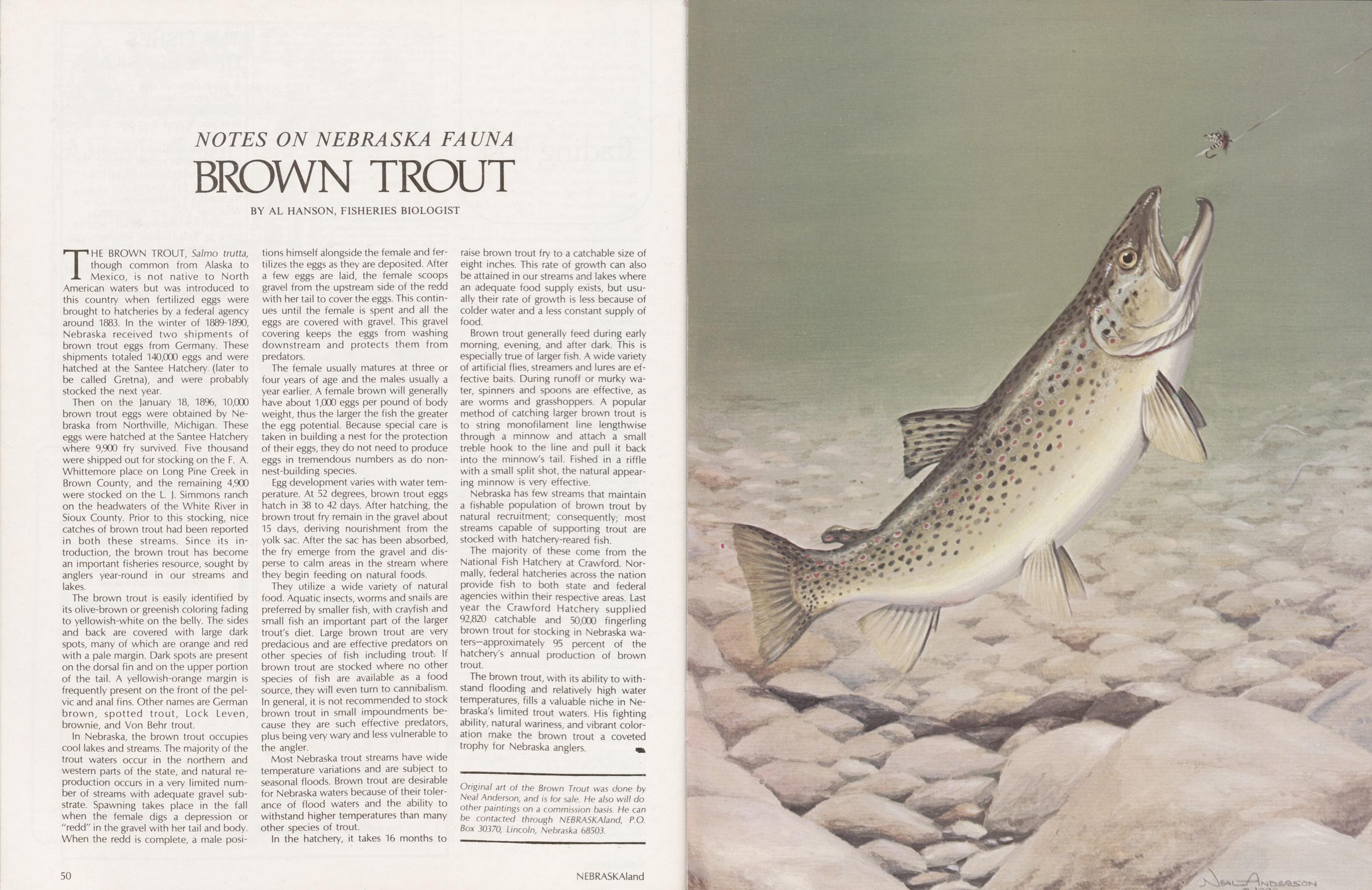
NOTES ON NEBRASKA FAUNA BROWN TROUT
BY AL HANSON, FISHERIES BIOLOGISTTHE BROWN TROUT, 5a/mo trutta, though common from Alaska to Mexico, is not native to North American waters but was introduced to this country when fertilized eggs were brought to hatcheries by a federal agency around 1883. In the winter of 1889-1890, Nebraska received two shipments of brown trout eggs from Germany. These shipments totaled 140,000 eggs and were hatched at the Santee Hatchery (later to be called Gretna), and were probably stocked the next year.
Then on the January 18, 18%, 10,000 brown trout eggs were obtained by Nebraska from Northville, Michigan. These eggs were hatched at the Santee Hatchery where 9,900 fry survived. Five thousand were shipped out for stocking on the F. A. Whittemore place on Long Pine Creek in Brown County, and the remaining 4,900 were stocked on the L J. Simmons ranch on the headwaters of the White River in Sioux County. Prior to this stocking, nice catches of brown trout had been reported in both these streams. Since its introduction, the brown trout has become an important fisheries resource, sought by anglers year-round in our streams and lakes.
The brown trout is easily identified by its olive-brown or greenish coloring fading to yellowish-white on the belly. The sides and back are covered with large dark spots, many of which are orange and red with a pale margin. Dark spots are present on the dorsal fin and on the upper portion of the tail. A yellowish-orange margin is frequently present on the front of the pelvic and anal fins. Other names are German brown, spotted trout, Lock Leven, brownie, and Von Behr trout.
In Nebraska, the brown trout occupies cool lakes and streams. The majority of the trout waters occur in the northern and western parts of the state, and natural reproduction occurs in a very limited number of streams with adequate gravel substrate. Spawning takes place in the fall when the female digs a depression or "redd" in the gravel with her tail and body. When the redd is complete, a male positions himself alongside the female and fertilizes the eggs as they are deposited. After a few eggs are laid, the female scoops gravel from the upstream side of the redd with her tail to cover the eggs. This continues until the female is spent and all the eggs are covered with gravel. This gravel covering keeps the eggs from washing downstream and protects them from predators.
The female usually matures at three or four years of age and the males usually a year earlier. A female brown will generally have about 1,000 eggs per pound of body weight, thus the larger the fish the greater the egg potential. Because special care is taken in building a nest for the protection of their eggs, they do not need to produce eggs in tremendous numbers as do non-nest-building species.
Egg development varies with water temperature. At 52 degrees, brown trout eggs hatch in 38 to 42 days. After hatching, the brown trout fry remain in the gravel about 15 days, deriving nourishment from the yolk sac. After the sac has been absorbed, the fry emerge from the gravel and disperse to calm areas in the stream where they begin feeding on natural foods.
They utilize a wide variety of natural food. Aquatic insects, worms and snails are preferred by smaller fish, with crayfish and small fish an important part of the larger trout's diet. Large brown trout are very predacious and are effective predators on other species of fish including troub If brown trout are stocked where no other species of fish are available as a food source, they will even turn to cannibalism. In general, it is not recommended to stock brown trout in small impoundments because they are such effective predators, plus being very wary and less vulnerable to the angler.
Most Nebraska trout streams have wide temperature variations and are subject to seasonal floods. Brown trout are desirable for Nebraska waters because of their tolerance of flood waters and the ability to withstand higher temperatures than many other species of trout.
In the hatchery, it takes 16 months to raise brown trout fry to a catchable size of eight inches. This rate of growth can also be attained in our streams and lakes where an adequate food supply exists, but usually their rate of growth is less because of colder water and a less constant supply of food.
Brown trout generally feed during early morning, evening, and after dark. This is especially true of larger fish. A wide variety of artificial flies, streamers and lures are effective baits. During runoff or murky water, spinners and spoons are effective, as are worms and grasshoppers. A popular method of catching larger brown trout is to string monofilament line lengthwise through a minnow and attach a small treble hook to the line and pull it back into the minnow's tail. Fished in a riffle with a small split shot, the natural appearing minnow is very effective.
Nebraska has few streams that maintain a fishable population of brown trout by natural recruitment; consequently, most streams capable of supporting trout are stocked with hatchery-reared fish.
The majority of these come from the National Fish Hatchery at Crawford. Normally, federal hatcheries across the nation provide fish to both state and federal agencies within their respective areas. Last year the Crawford Hatchery supplied 92,820 catchable and 50,000 fingerling brown trout for stocking in Nebraska waters-approximately 95 percent of the hatchery's annual production of brown trout.
The brown trout, with its ability to withstand flooding and relatively high water temperatures, fills a valuable niche in Nebraska's limited trout waters. His fighting ability, natural wariness, and vibrant coloration make the brown trout a coveted trophy for Nebraska anglers.
Original art of the Brown Trout was done by Neal Anderson, and is for sale. He also will do other paintings on a commission basis. He can be contacted through NEBRASKAland, P.O. Box 30370, Lincoln, Nebraska 68503. 50 NEBRASKAland
Position: 309 (28 views)