Volume 58, Issue 5, 1980
NEBRASKAland
May 1980 60 cents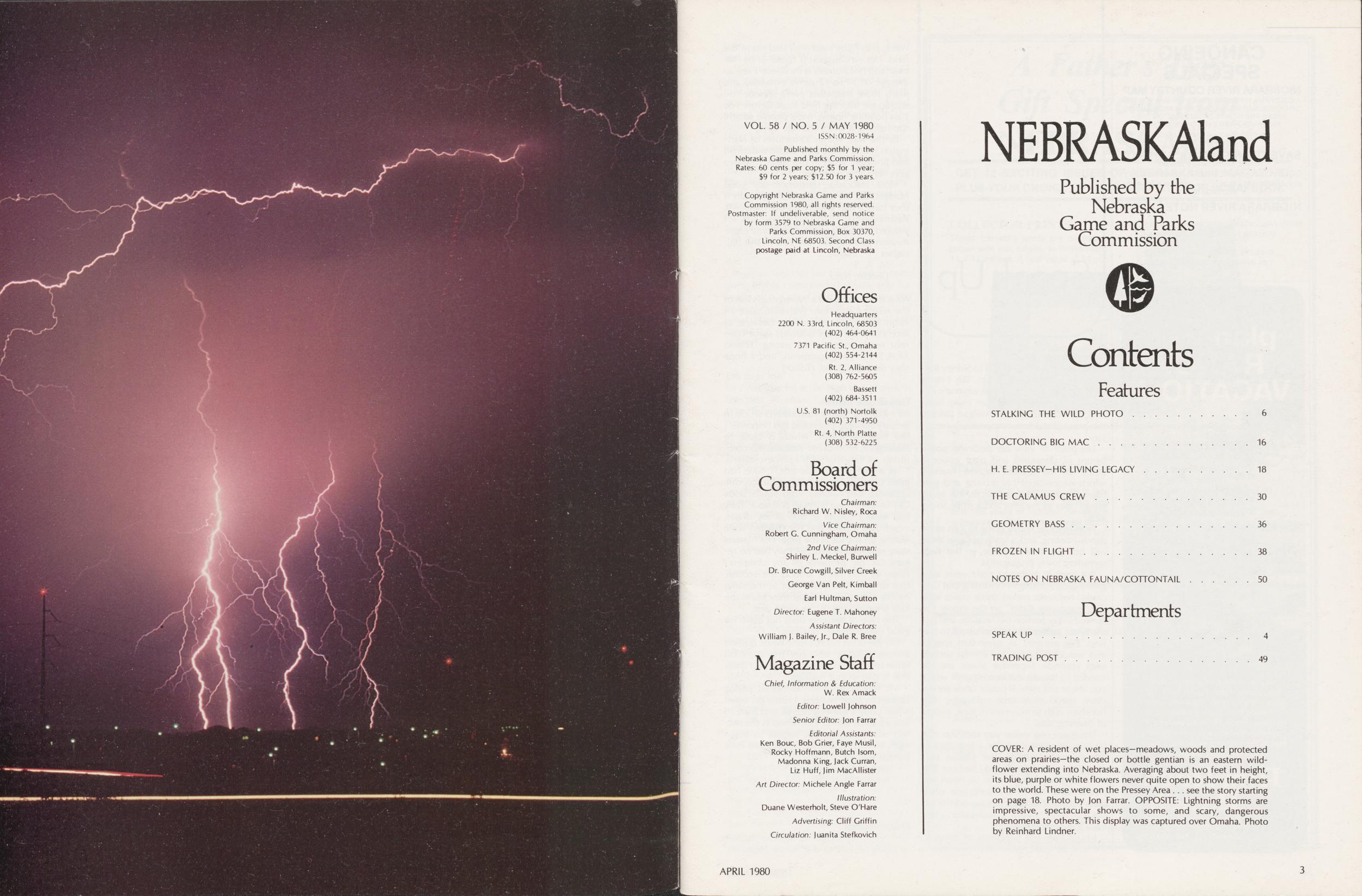
NEBRASKAland
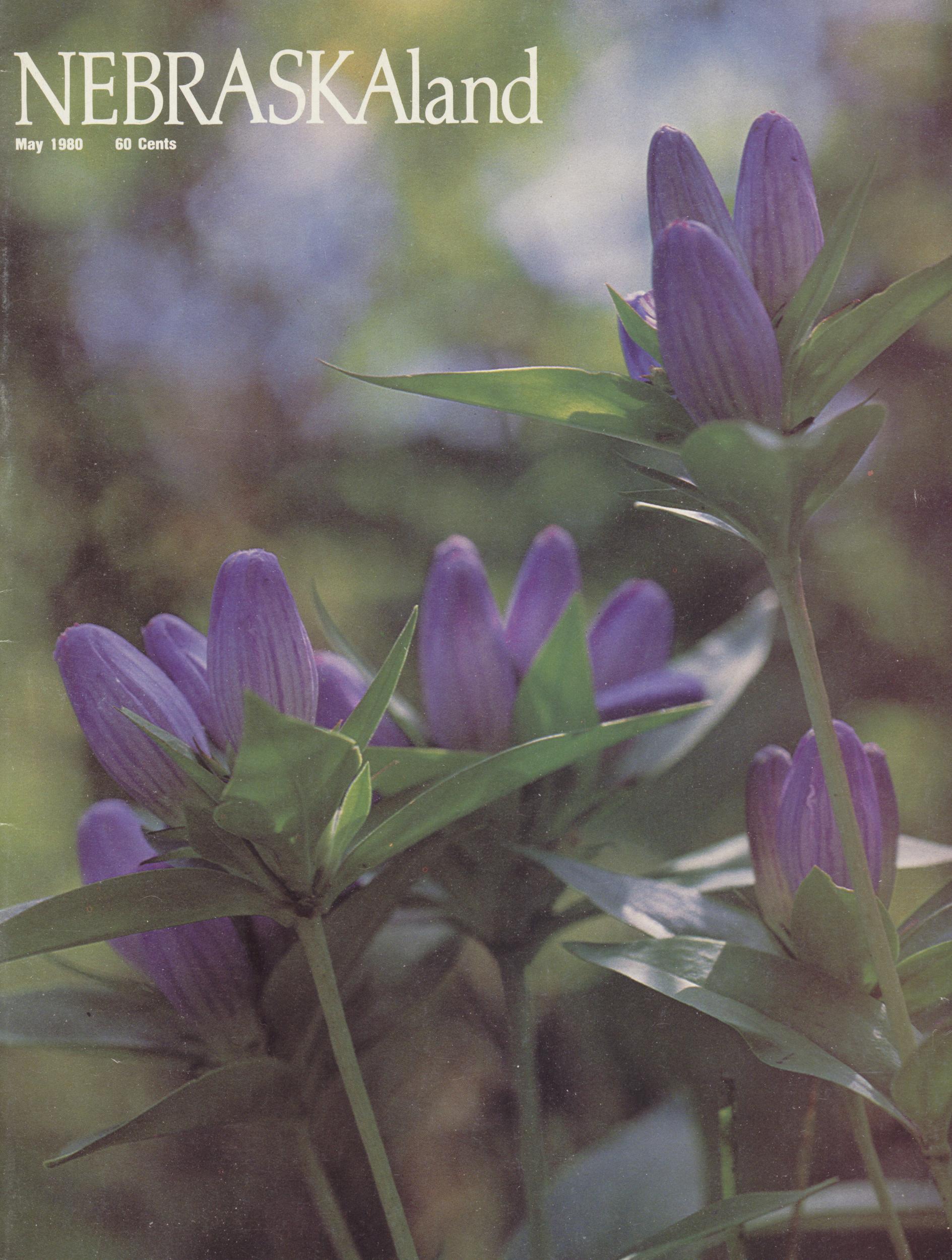
Published by the Nebraska Game and Parks Commission VOL. 58 / NO. 5 / MAY 1980 ISSN: 0028-1964 Published monthly by the Nebraska Game and Parks Commission. Rates: 60 cents per copy; $5 for 1 year; $9 for 2 years; $12.50 for 3 years. Copyright Nebraska Game and Parks Commission 1980, all rights reserved. Postmaster: If undeliverable, send notice by form 3579 to Nebraska Game and Parks Commission, Box 30370, Lincoln, NE 68503. Second Class postage paid at Lincoln, Nebraska Offices Headquarters 2200 N. 33rd, Lincoln, 68503 (402) 464-0641 7371 Pacific St., Omaha (402) 554-2144 Rt. 2, Alliance (308) 762-5605 Bassett (402) 684-3511 U.S. 81 (north) Norfolk (402) 371-4950 Rt. 4, North Platte (308) 532-6225 Board of Commissioners Chairman: Richard W. Nisley, Roca Vice Chairman: Robert G. Cunningham, Omaha 2nd Vice Chairman: Shirley L. Meckel, Burwell Dr. Bruce Cowgill, Silver Creek George Van Pelt, Kimball Earl Hultman, Sutton Director: Eugene T. Mahoney Assistant Directors: William j. Bailey, jr., Dale R. Bree Magazine Staff Chief, Information & Education: W. Rex Amack Editor: Lowell Johnson Senior Editor: Jon Farrar Editorial Assistants: Ken Bouc, Bob Grier, Faye Musil, Rocky Hoffmann, Butch Isom, Madonna King, Jack Curran, Liz Huff, Jim MacAllister Art Director: Michele Angle Farrar Illustration: Duane Westerholt, Steve O'Hare Advertising: Cliff Griffin Circulation: Juanita Stefkovich Contents Features STALKING THE WILD PHOTO 6 DOCTORING BIG MAC 16 H. E. PRESSEY-HIS LIVING LEGACY 18 THE CALAMUS CREW 30 GEOMETRY BASS 36 FROZEN IN FLIGHT 38 NOTES ON NEBRASKA FAUNA/COTTONTAIL 50 Departments SPEAK UP 4 TRADING POST 49 COVER: A resident of wet places—meadows, woods and protected areas on prairies-the closed or bottle gentian is an eastern wildflower extending into Nebraska. Averaging about two feet in height, its blue, purple or white flowers never quite open to show their faces to the world. These were on the Pressey Area...see the story starting on page 18. Photo by Jon Farrar. OPPOSITE: Lightning storms are impressive, spectacular shows to some, and scary, dangerous phenomena to others. This display was captured over Omaha. Photo by Reinhard Lindner. APRIL 1980 3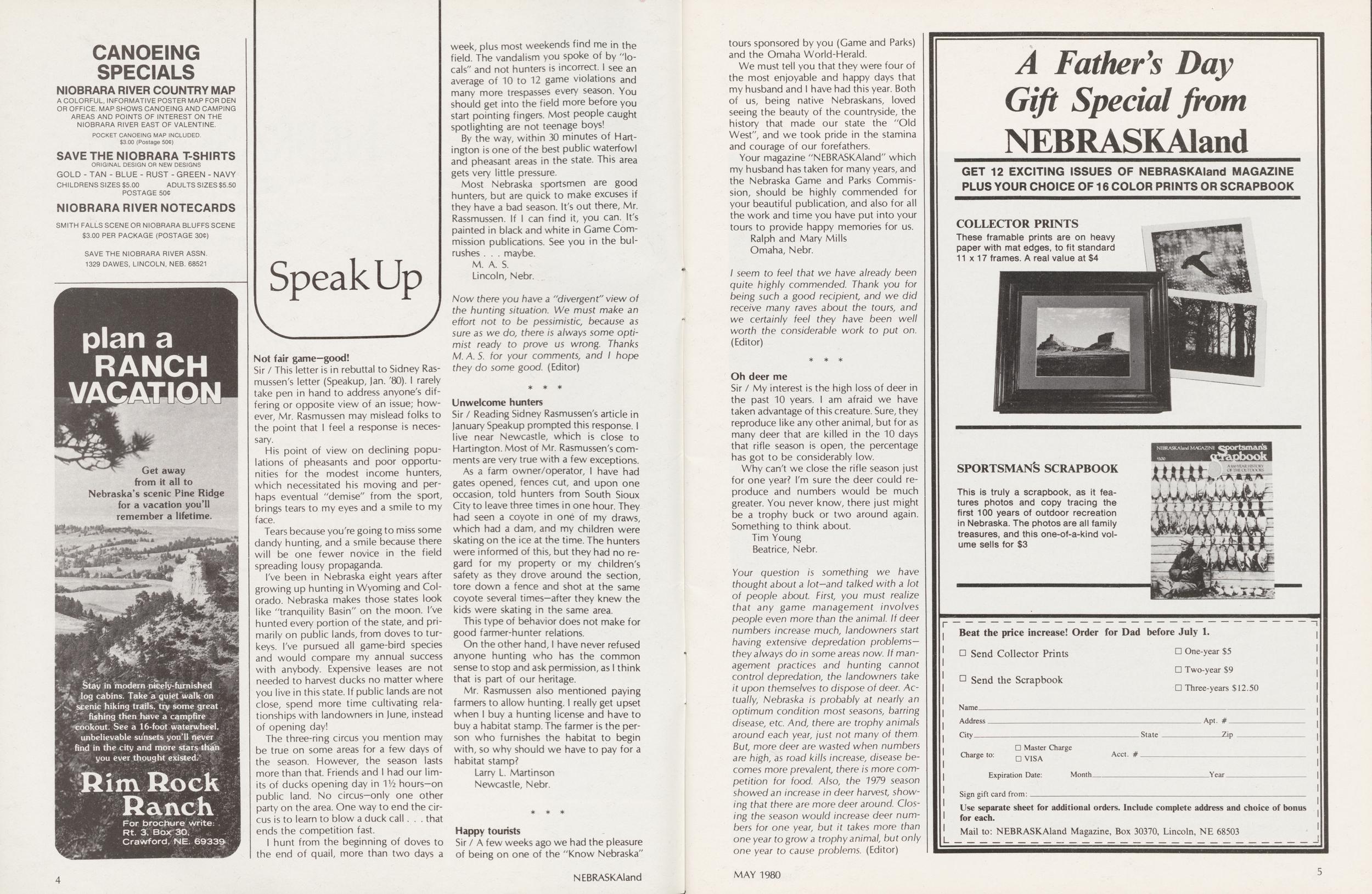
Speak Up
Not fair game—good!Sir / This letter is in rebuttal to Sidney Rasmussen's letter (Speakup, Jan. '80). I rarely take pen in hand to address anyone's differing or opposite view of an issue; however, Mr. Rasmussen may mislead folks to the point that I feel a response is necessary.
His point of view on declining populations of pheasants and poor opportunities for the modest income hunters, which necessitated his moving and perhaps eventual "demise" from the sport, brings tears to my eyes and a smile to my face.
Tears because you're going to miss some dandy hunting, and a smile because there will be one fewer novice in the field spreading lousy propaganda.
I've been in Nebraska eight years after growing up hunting in Wyoming and Colorado. Nebraska makes those states look like "tranquility Basin" on the moon. I've hunted every portion of the state, and primarily on public lands, from doves to turkeys. I've pursued all game-bird species and would compare my annual success with anybody. Expensive leases are not needed to harvest ducks no matter where you live in this state. If public lands are not close, spend more time cultivating relationships with landowners in June, instead of opening day!
The three-ring circus you mention may be true on some areas for a few days of the season. However, the season lasts more than that. Friends and I had our limits of ducks opening day in 1½ hours-on public land. No circus—only one other party on the area. One way to end the circus is to learn to blow a duck call...that ends the competition fast.
I hunt from the beginning of doves to the end of quail, more than two days a week, plus most weekends find me in the field. The vandalism you spoke of by "locals" and not hunters is incorrect. I see an average of 10 to 12 game violations and many more trespasses every season. You should get into the field more before you start pointing fingers. Most people caught spotlighting are not teenage boys!
By the way, within 30 minutes of Harrington is one of the best public waterfowl and pheasant areas in the state. This area gets very little pressure.
Most Nebraska sportsmen are good hunters, but are quick to make excuses if they have a bad season. It's out there, Mr. Rassmussen. If I can find it, you can. It's painted in black and white in Game Commission publications. See you in the bulrushes...maybe.
M. A. S. Lincoln, Nebr.Now there you have a "divergent" view of the hunting situation. We must make an effort not to be pessimistic, because as sure as we do, there is always some optimist ready to prove us wrong. Thanks M. A. S. for your comments, and I hope they do some good. (Editor)
* * * Unwelcome huntersSir / Reading Sidney Rasmussen's article in January Speakup prompted this response. I live near Newcastle, which is close to Hartington. Most of Mr. Rasmussen's comments are very true with a few exceptions.
As a farm owner/operator, I have had gates opened, fences cut, and upon one occasion, told hunters from South Sioux City to leave three times in one hour. They had seen a coyote in one of my draws, which had a dam, and my children were skating on the ice at the time. The hunters were informed of this, but they had no regard for my property or my children's safety as they drove around the section, tore down a fence and shot at the same coyote several times—after they knew the kids were skating in the same area.
This type of behavior does not make for good farmer-hunter relations.
On the other hand, I have never refused anyone hunting who has the common sense to stop and ask permission, as I think that is part of our heritage.
Mr. Rasmussen also mentioned paying farmers to allow hunting. I really get upset when I buy a hunting license and have to buy a habitat stamp. The farmer is the person who furnishes the habitat to begin with, so why should we have to pay for a habitat stamp?
Larry L. Martinson Newcastle, Nebr. Happy touristsSir / A few weeks ago we had the pleasure of being on one of the "Know Nebraska" 4 NEBRASKAland NEBRASKAland tours sponsored by you (Game and Parks) and the Omaha World-Herald.
We must tell you that they were four of the most enjoyable and happy days that my husband and I have had this year. Both of us, being native Nebraskans, loved seeing the beauty of the countryside, the history that made our state the "Old West", and we took pride in the stamina and courage of our forefathers.
Your magazine "NEBRASKAland" which my husband has taken for many years, and the Nebraska Game and Parks Commission, should be highly commended for your beautiful publication, and also for all the work and time you have put into your tours to provide happy memories for us.
Ralph and Mary Mills Omaha, Nebr.I seem to feel that we have already been quite highly commended. Thank you for being such a good recipient, and we did receive many raves about the tours, and we certainly feel they have been well worth the considerable work to put on. (Editor)
Oh deer meSir / My interest is the high loss of deer in the past 10 years. I am afraid we have taken advantage of this creature. Sure, they reproduce like any other animal, but for as many deer that are killed in the 10 days that rifle season is open, the percentage has got to be considerably low.
Why can't we close the rifle season just for one year? I'm sure the deer could reproduce and numbers would be much greater. You never know, there just might be a trophy buck or two around again. Something to think about.
Tim Young Beatrice, Nebr.Your question is something we have thought about a lot-and talked with a lot of people about. First, you must realize that any game management involves people even more than the animal. If deer numbers increase much, landowners start having extensive depredation problems—they always do in some areas now. If management practices and hunting cannot control depredation, the landowners take it upon themselves to dispose of deer. Actually, Nebraska is probably at nearly an optimum condition most seasons, barring disease, etc. And, there are trophy animals around each year, just not many of them. But, more deer are wasted when numbers are high, as road kills increase, disease becomes more prevalent, there is more competition for food. Also, the 7979 season showed an increase in deer harvest, showing that there are more deer around. Closing the season would increase deer numbers for one year, but it takes more than one year to grow a trophy animal, but only one year to cause problems. (Editor)
A Father's Day Gift Special from NEBRASKAland GET 12 EXCITING ISSUES OF NEBRASKAland MAGAZINE PLUS YOUR CHOICE OF 16 COLOR PRINTS OR SCRAPBOOK COLLECTOR PRINTS These framable prints are on heavy paper with mat edges, to fit standard 11x17 frames. A real value at $4 SPORTSMANS SCRAPBOOK This is truly a scrapbook, as it features photos and copy tracing the first 100 years of outdoor recreation in Nebraska. The photos are all family treasures, and this one-of-a-kind volume sells for $3 A WP-YfcAll HISTORY Beat the price increase! Order for Dad before July 1. Send Collector Prints Send the Scrapbook Name. One-year $5 Two-year $9 Three-years $12.50 Address City Apt. #. State Charge to: Expiration Date Sign gift card from: Master Charge VISA Acct. # Month. Year Use separate sheet for additional orders. Include complete address and choice of bonus for each. Mail to: NEBRASKAland Magazine, Box 30370, Lincoln, NE 68503 MAY 1980 5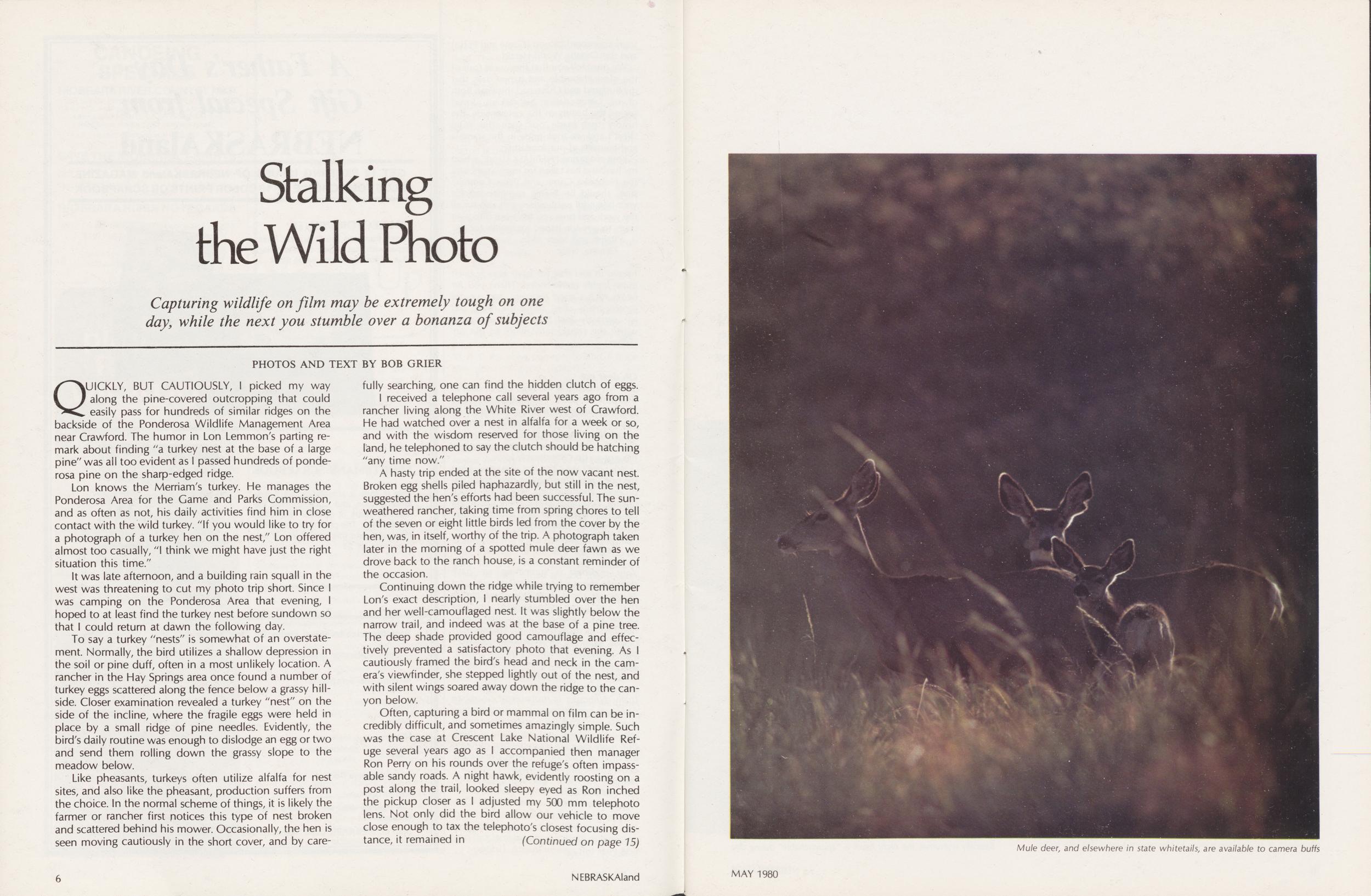
Stalking the Wild Photo
Capturing wildlife on film may be extremely tough on one day, while the next you stumble over a bonanza of subjects
QUICKLY, BUT CAUTIOUSLY, I picked my way along the pine-covered outcropping that could easily pass for hundreds of similar ridges on the backside of the Ponderosa Wildlife Management Area near Crawford. The humor in Lon Lemmon's parting remark about finding "a turkey nest at the base of a large pine" was all too evident as I passed hundreds of ponderosa pine on the sharp-edged ridge.
Lon knows the Merriam's turkey. He manages the Ponderosa Area for the Game and Parks Commission, and as often as not, his daily activities find him in close contact with the wild turkey. "If you would like to try for a photograph of a turkey hen on the nest," Lon offered almost too casually, "I think we might have just the right situation this time."
It was late afternoon, and a building rain squall in the west was threatening to cut my photo trip short. Since I was camping on the Ponderosa Area that evening, I hoped to at least find the turkey nest before sundown so that I could return at dawn the following day.
To say a turkey "nests" is somewhat of an overstatement. Normally, the bird utilizes a shallow depression in the soil or pine duff, often in a most unlikely location. A rancher in the Hay Springs area once found a number of turkey eggs scattered along the fence below a grassy hillside. Closer examination revealed a turkey "nest" on the side of the incline, where the fragile eggs were held in place by a small ridge of pine needles. Evidently, the bird's daily routine was enough to dislodge an egg or two and send them rolling down the grassy slope to the meadow below.
Like pheasants, turkeys often utilize alfalfa for nest sites, and also like the pheasant, production suffers from the choice. In the normal scheme of things, it is likely the farmer or rancher first notices this type of nest broken and scattered behind his mower. Occasionally, the hen is seen moving cautiously in the short cover, and by carefully searching, one can find the hidden clutch of eggs.
I received a telephone call several years ago from a rancher living along the White River west of Crawford. He had watched over a nest in alfalfa for a week or so, and with the wisdom reserved for those living on the land, he telephoned to say the clutch should be hatching "any time now."
A hasty trip ended at the site of the now vacant nest. Broken egg shells piled haphazardly, but still in the nest, suggested the hen's efforts had been successful. The sun-weathered rancher, taking time from spring chores to tell of the seven or eight little birds led from the cover by the hen, was, in itself, worthy of the trip. A photograph taken later in the morning of a spotted mule deer fawn as we drove back to the ranch house, is a constant reminder of the occasion.
Continuing down the ridge while trying to remember Lon's exact description, I nearly stumbled over the hen and her well-camouflaged nest. It was slightly below the narrow trail, and indeed was at the base of a pine tree. The deep shade provided good camouflage and effectively prevented a satisfactory photo that evening. As I cautiously framed the bird's head and neck in the camera's viewfinder, she stepped lightly out of the nest, and with silent wings soared away down the ridge to the canyon below.
Often, capturing a bird or mammal on film can be incredibly difficult, and sometimes amazingly simple. Such was the case at Crescent Lake National Wildlife Refuge several years ago as I accompanied then manager Ron Perry on his rounds over the refuge's often impassable sandy roads. A night hawk, evidently roosting on a post along the trail, looked sleepy eyed as Ron inched the pickup closer as I adjusted my 500 mm telephoto lens. Not only did the bird allow our vehicle to move close enough to tax the telephoto's closest focusing distance, it remained in (Continued on page 15)
6 NEBRASKAland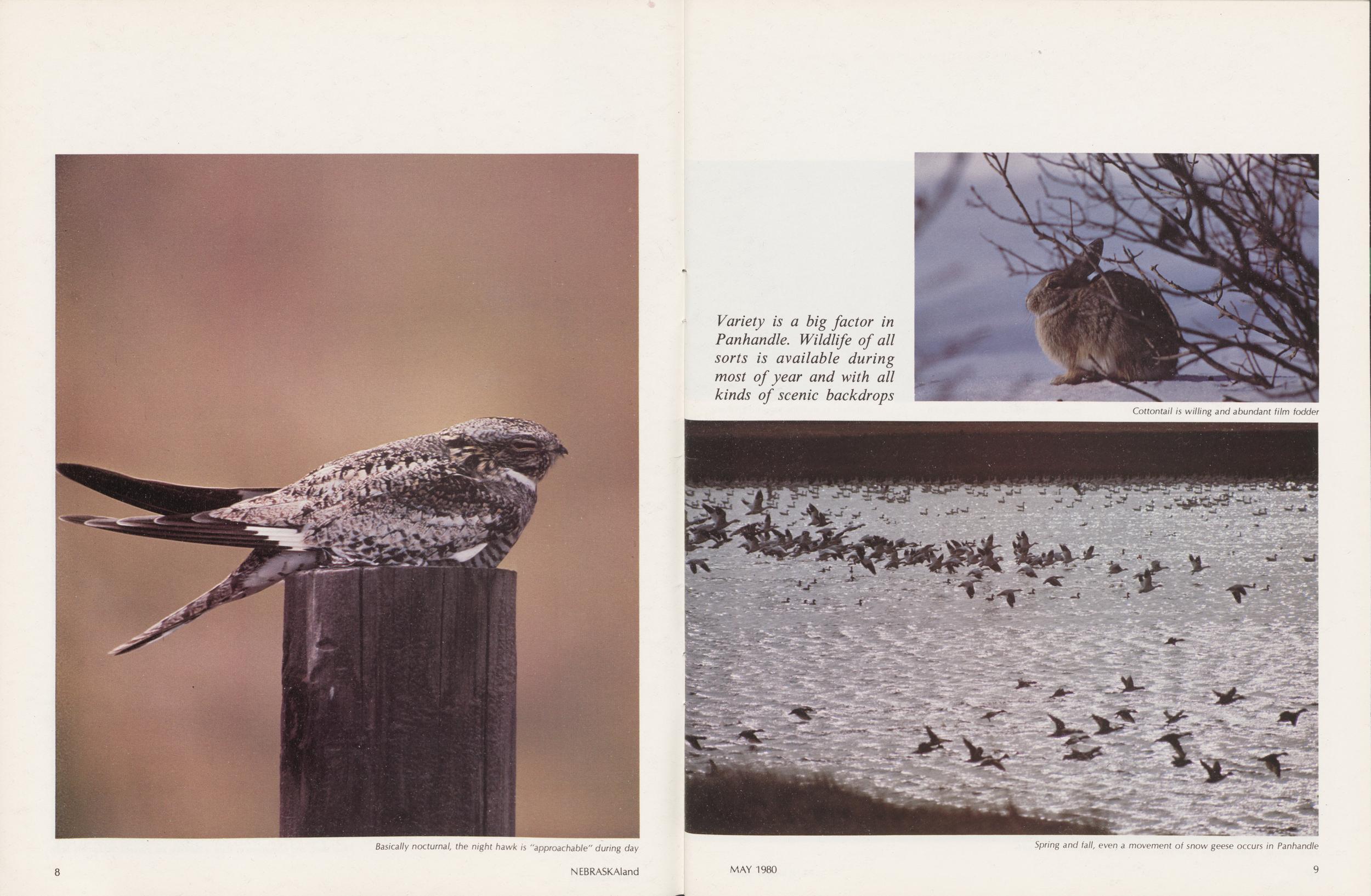
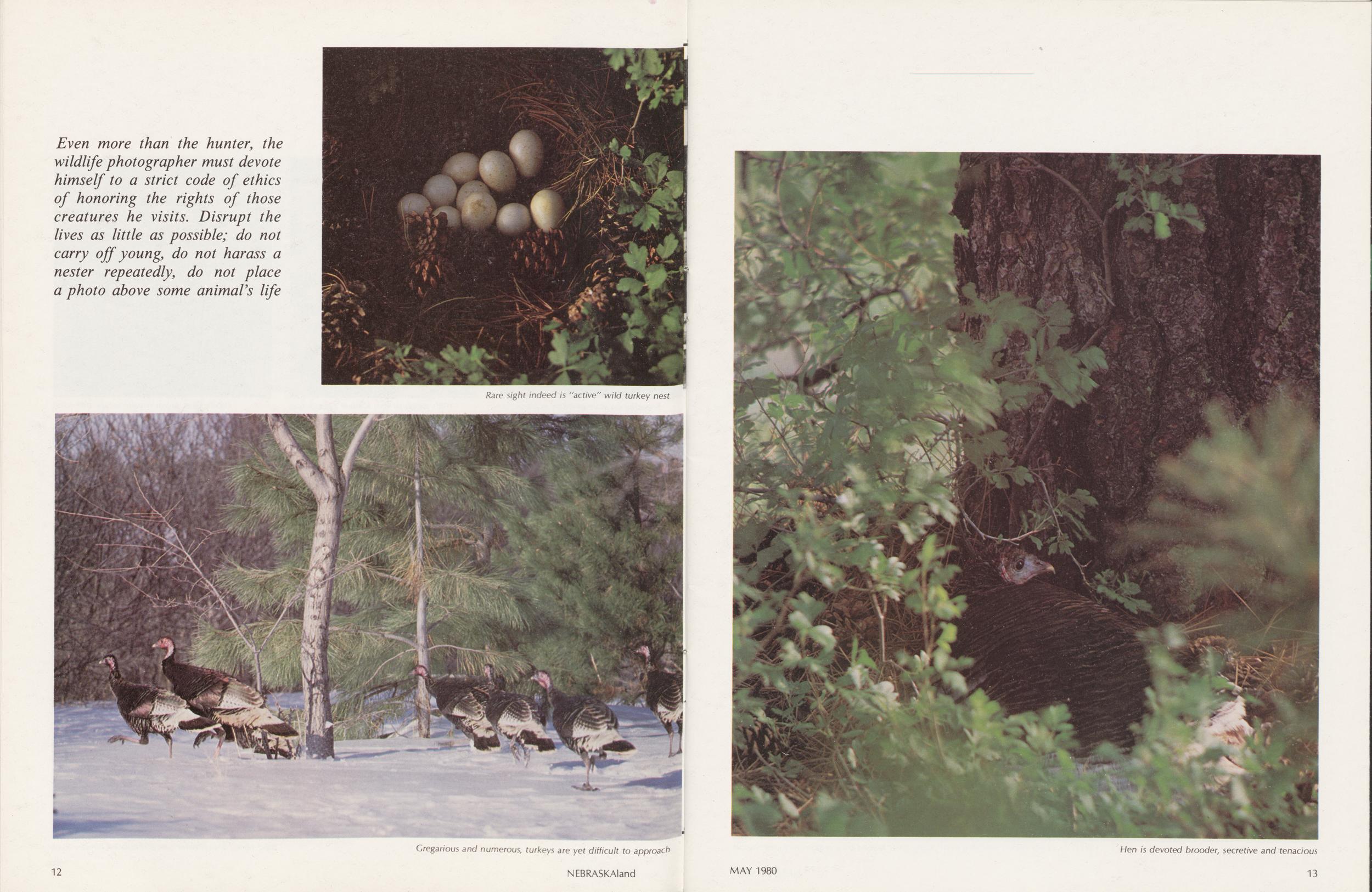 Even more than the hunter, the wildlife photographer must devote himself to a strict code of ethics of honoring the rights of those creatures he visits. Disrupt the lives as little as possible; do not carry off young, do not harass a nester repeatedly, do not place a photo above some animal's life
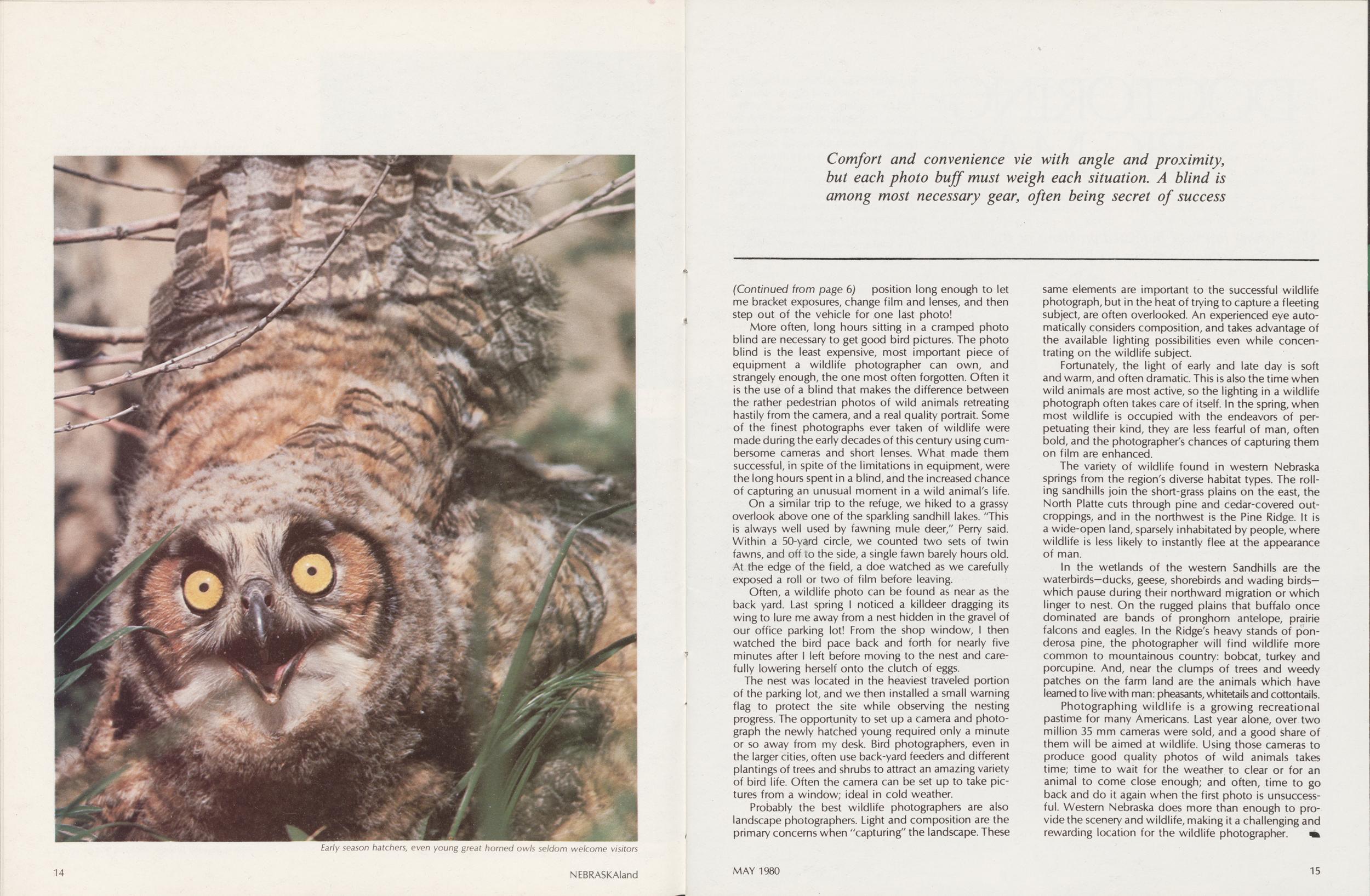
(Continued from page 6) position long enough to let me bracket exposures, change film and lenses, and then step out of the vehicle for one last photo!
More often, long hours sitting in a cramped photo blind are necessary to get good bird pictures. The photo blind is the least expensive, most important piece of equipment a wildlife photographer can own, and strangely enough, the one most often forgotten. Often it is the use of a blind that makes the difference between the rather pedestrian photos of wild animals retreating hastily from the camera, and a real quality portrait. Some of the finest photographs ever taken of wildlife were made during the early decades of this century using cumbersome cameras and short lenses. What made them successful, in spite of the limitations in equipment, were the long hours spent in a blind, and the increased chance of capturing an unusual moment in a wild animal's life.
On a similar trip to the refuge, we hiked to a grassy overlook above one of the sparkling sandhill lakes. 'This is always well used by fawning mule deer," Perry said. Within a 50-yard circle, we counted two sets of twin fawns, and off to the side, a single fawn barely hours old. At the edge of the field, a doe watched as we carefully exposed a roll or two of film before leaving.
Often, a wildlife photo can be found as near as the back yard. Last spring I noticed a killdeer dragging its wing to lure me away from a nest hidden in the gravel of our office parking lot! From the shop window, I then watched the bird pace back and forth for nearly five minutes after I left before moving to the nest and carefully lowering herself onto the clutch of eggs.
The nest was located in the heaviest traveled portion of the parking lot, and we then installed a small warning flag to protect the site while observing the nesting progress. The opportunity to set up a camera and photograph the newly hatched young required only a minute or so away from my desk. Bird photographers, even in the larger cities, often use back-yard feeders and different plantings of trees and shrubs to attract an amazing variety of bird life. Often the camera can be set up to take pictures from a window; ideal in cold weather.
Probably the best wildlife photographers are also landscape photographers. Light and composition are the primary concerns when "capturing" the landscape. These same elements are important to the successful wildlife photograph, but in the heat of trying to capture a fleeting subject, are often overlooked. An experienced eye automatically considers composition, and takes advantage of the available lighting possibilities even while concentrating on the wildlife subject.
Fortunately, the light of early and late day is soft and warm, and often dramatic. This is also the time when wild animals are most active, so the lighting in a wildlife photograph often takes care of itself. In the spring, when most wildlife is occupied with the endeavors of perpetuating their kind, they are less fearful of man, often bold, and the photographer's chances of capturing them on film are enhanced.
The variety of wildlife found in western Nebraska springs from the region's diverse habitat types. The rolling sandhills join the shorgrass plains on the east, the North Platte cuts through pine and cedar-covered outcroppings, and in the northwest is the Pine Ridge. It is a wide-open land, sparsely inhabitated by people, where wildlife is less likely to instantly flee at the appearance of man.
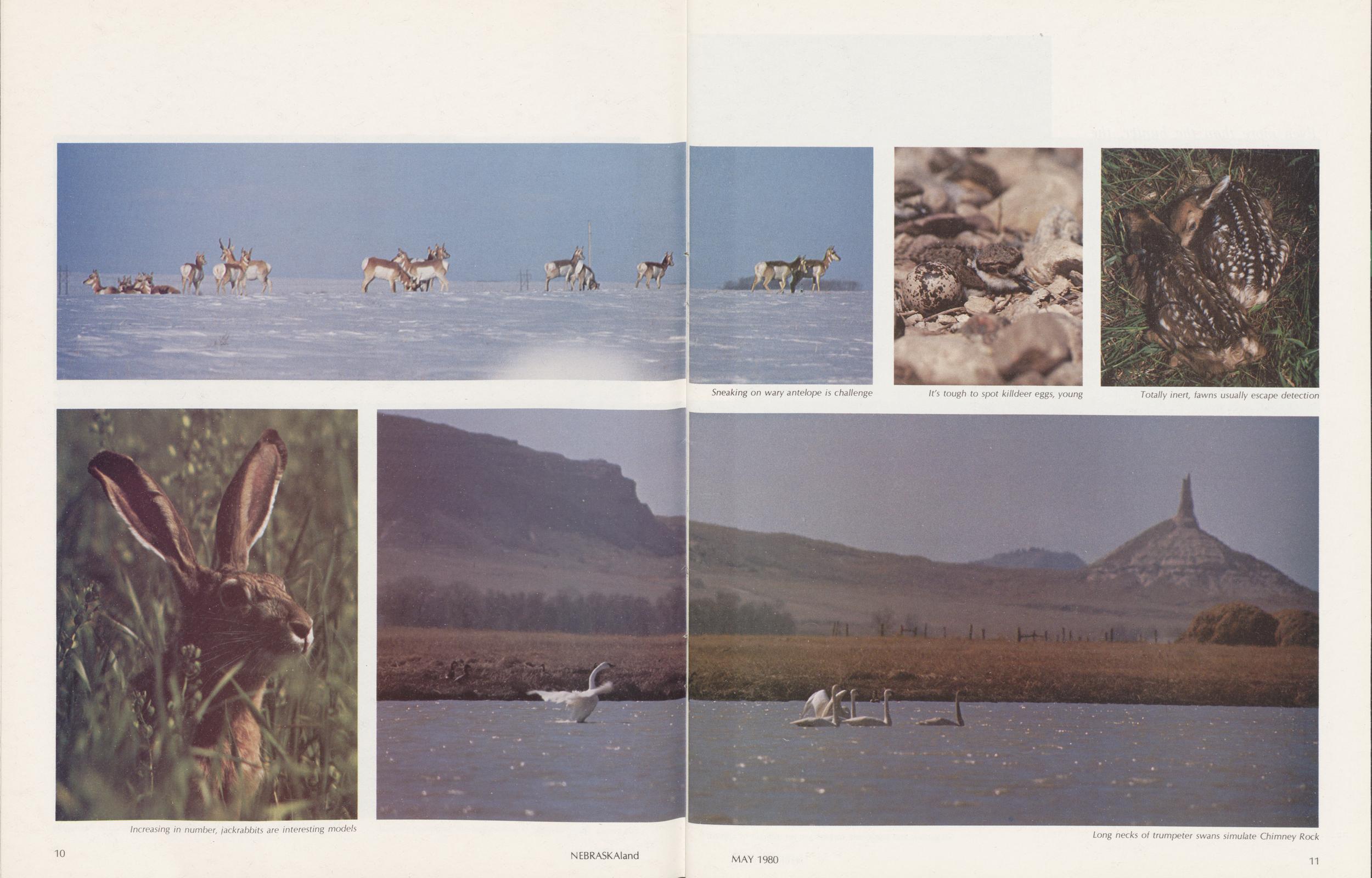
In the wetlands of the western Sandhills are the waterbirds—ducks, geese, shorebirds and wading birds—which pause during their northward migration or which linger to nest. On the rugged plains that buffalo once dominated are bands of pronghorn antelope, prairie falcons and eagles. In the Ridge's heavy stands of ponderosa pine, the photographer will find wildlife more common to mountainous country: bobcat, turkey and porcupine. And, near the clumps of trees and weedy patches on the farm land are the animals which have learned to live with man: pheasants, whitetails and cottontails.
Photographing wildlife is a growing recreational pastime for many Americans. Last year alone, over two million 35 mm cameras were sold, and a good share of them will be aimed at wildlife. Using those cameras to produce good quality photos of wild animals takes time; time to wait for the weather to clear or for an animal to come close enough; and often, time to go back and do it again when the first photo is unsuccessful. Western Nebraska does more than enough to pro- vide the scenery and wildlife, making it a challenging and rewarding location for the wildlife photographer.
MAY 1980 15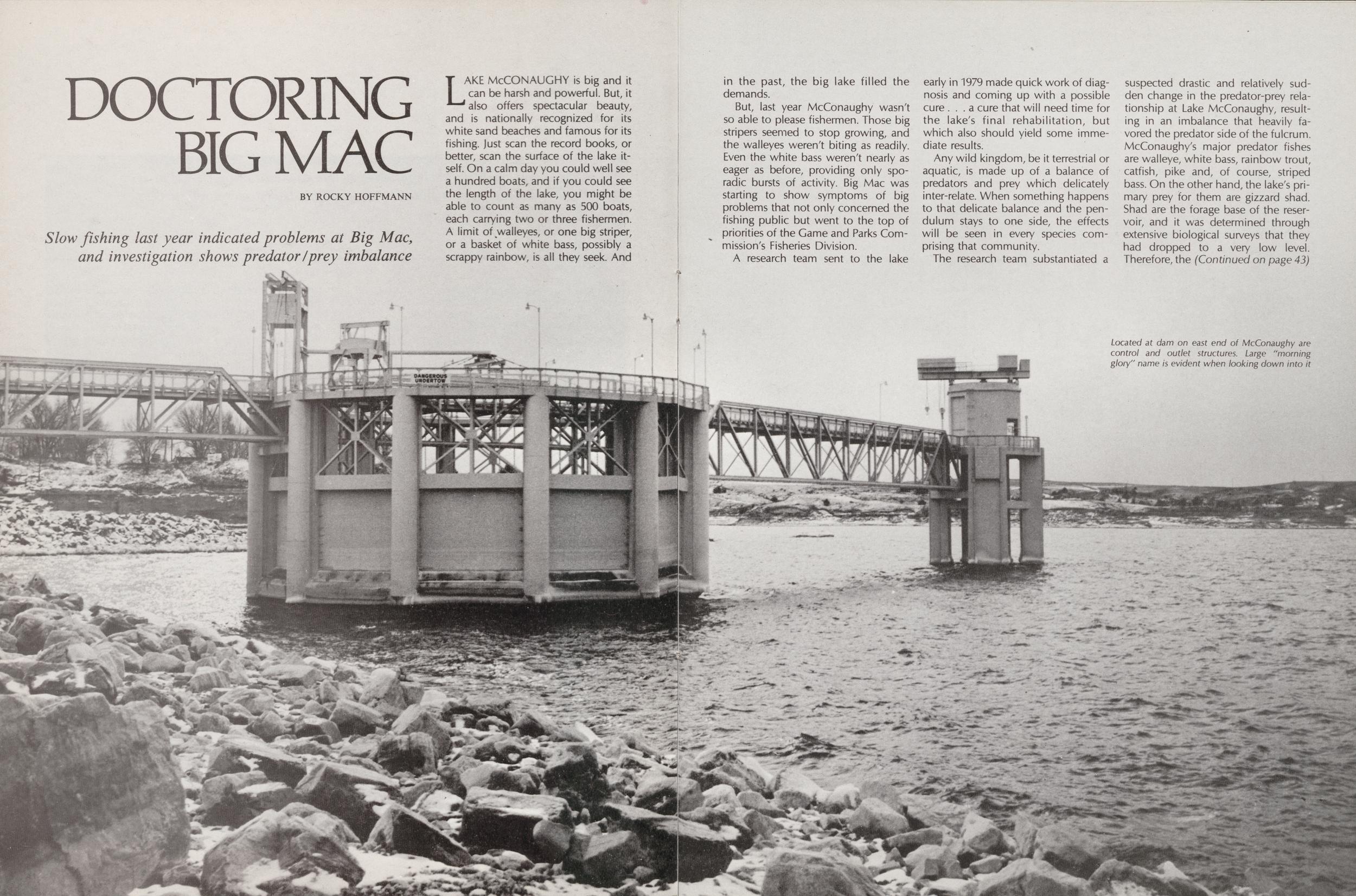
DOCTORING BIG MAC
BY ROCKY HOFFMANN Slow fishing last year indicated problems at Big Mac, and investigation shows predator/prey imbalanceLAKE McCONAUGHY is big and it can be harsh and powerful. But, it also offers spectacular beauty, and is nationally recognized for its white sand beaches and famous for its fishing. Just scan the record books, or better, scan the surface of the lake itself. On a calm day you could well see a hundred boats, and if you could see the length of the lake, you might be able to count as many as 500 boats, each carrying two or three fishermen. A limit of walleyes, or one big striper, or a basket of white bass, possibly a scrappy rainbow, is all they seek. And in the past, the big lake filled the demands.
But, last year McConaughy wasn't so able to please fishermen. Those big stripers seemed to stop growing, and the walleyes weren't biting as readily. Even the white bass weren't nearly as eager as before, providing only sporadic bursts of activity. Big Mac was starting to show symptoms of big problems that not only concerned the fishing public but went to the top of priorities of the Game and Parks Commission's Fisheries Division.
A research team sent to the lake early in 1979 made quick work of diagnosis and coming up with a possible cure ... a cure that will need time for the lake's final rehabilitation, but which also should yield some immediate results.
Any wild kingdom, be it terrestrial or aquatic, is made up of a balance of predators and prey which delicately inter-relate. When something happens to that delicate balance and the pendulum stays to one side, the effects will be seen in every species comprising that community.
The research team substantiated a suspected drastic and relatively sudden change in the predator-prey relationship at Lake McConaughy, resulting in an imbalance that heavily favored the predator side of the fulcrum. McConaughy's major predator fishes are walleye, white bass, rainbow trout, catfish, pike and, of course, striped bass. On the other hand, the lake's primary prey for them are gizzard shad. Shad are the forage base of the reservoir, and it was determined through extensive biological surveys that they had dropped to a very low level. Therefore, the (Continued on page 43)
Located at dam on east end of McConaughy are control and outlet structures. Large "morning glory" name is evident when looking down into it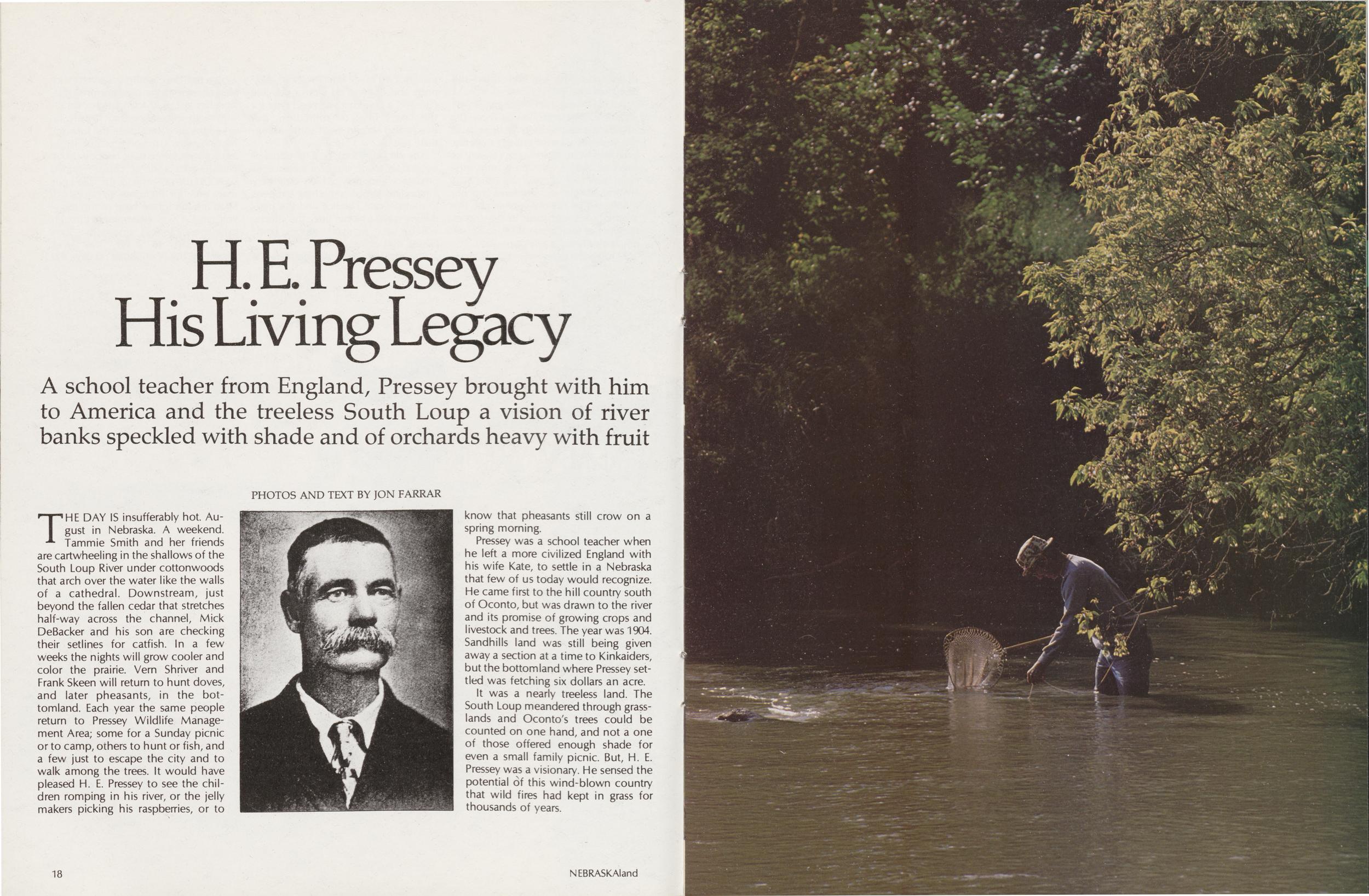
H. E Pressey His Living Legacy
A school teacher from England, Pressey brought with him to America and the treeless South Loup a vision of river banks speckled with shade and of orchards heavy with fruit PHOTOS AND TEXT BY JON FARRARTHE DAY IS Insufferably hot. August in Nebraska. A weekend. Tammie Smith and her friends are cartwheeling in the shallows of the South Loup River under cottonwoods that arch over the water like the walls of a cathedral. Downstream, just beyond the fallen cedar that stretches half-way across the channel, Mick DeBacker and his son are checking their setlines for catfish. In a few weeks the nights will grow cooler and color the prairie. Vern Shriver and Frank Skeen will return to hunt doves, and later pheasants, in the bottomland. Each year the same people return to Pressey Wildlife Management Area; some for a Sunday picnic or to camp, others to hunt or fish, and a few just to escape the city and to walk among the trees. It would have pleased H. E. Pressey to see the children romping in his river, or the jelly makers picking his raspberries, or to know that pheasants still crow on a spring morning.
Pressey was a school teacher when he left a more civilized England with his wife Kate, to settle in a Nebraska that few of us today would recognize. He came first to the hill country south of Oconto, but was drawn to the river and its promise of growing crops and livestock and trees. The year was 1904. Sandhills land was still being given away a section at a time to Kinkaiders, but the bottomland where Pressey settled was fetching six dollars an acre.
It was a nearly treeless land. The South Loup meandered through grasslands and Oconto's trees could be counted on one hand, and not a one of those offered enough shade for even a small family picnic. But, H. E. Pressey was a visionary. He sensed the potential of this wind-blown country that wild fires had kept in grass for thousands of years.
18 NEBRASKAland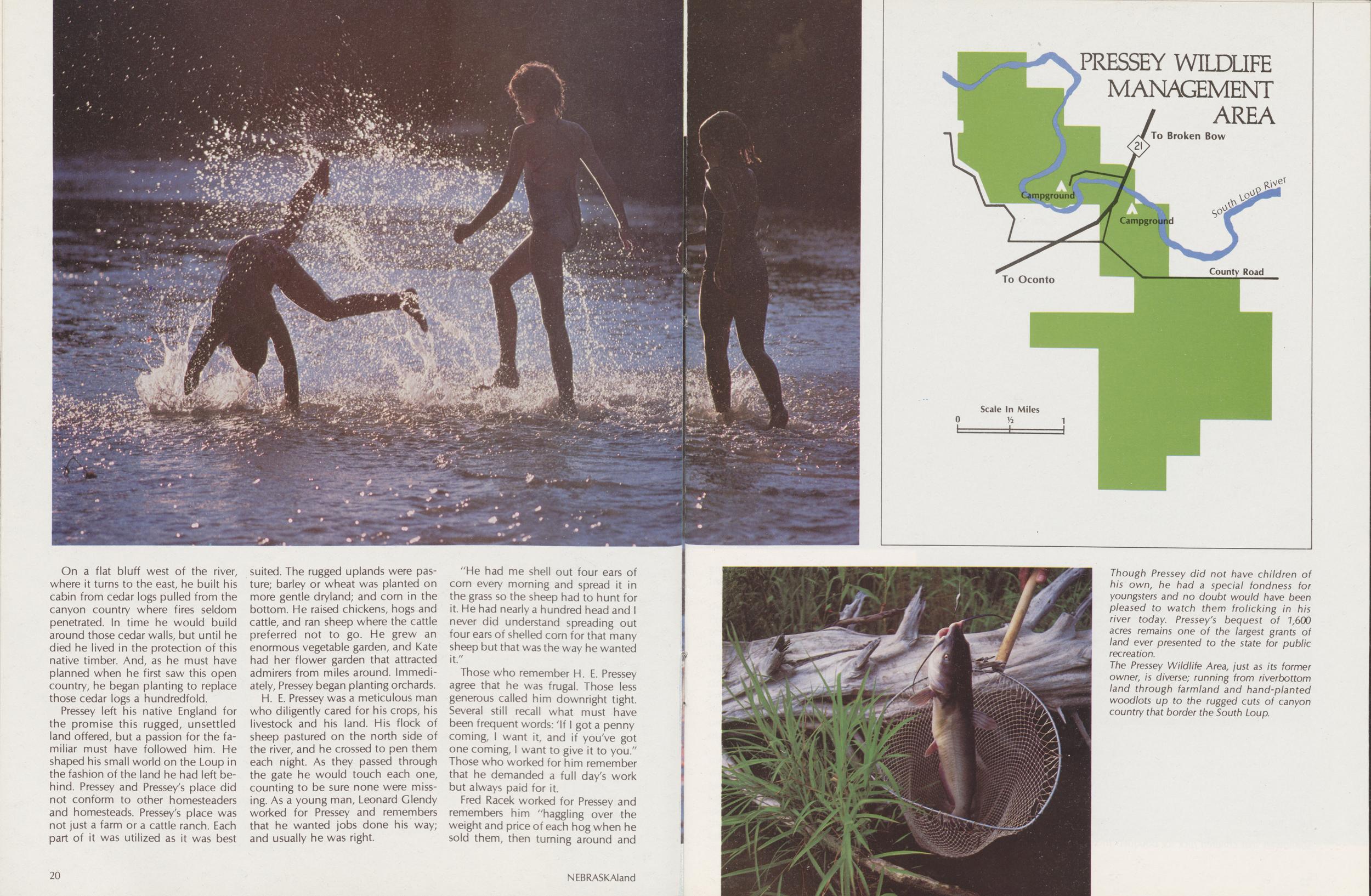
On a flat bluff west of the river, where it turns to the east, he built his cabin from cedar logs pulled from the canyon country where fires seldom penetrated. In time he would build around those cedar walls, but until he died he lived in the protection of this native timber. And, as he must have planned when he first saw this open country, he began planting to replace those cedar logs a hundredfold.
Pressey left his native England for the promise this rugged, unsettled land offered, but a passion for the familiar must have followed him. He shaped his small world on the Loup in the fashion of the land he had left behind. Pressey and Pressey's place did not conform to other homesteaders and homesteads. Pressey's place was not just a farm or a cattle ranch. Each part of it was utilized as it was best suited. The rugged uplands were pasture; barley or wheat was planted on more gentle dryland; and corn in the bottom. He raised chickens, hogs and cattle, and ran sheep where the cattle preferred not to go. He grew an enormous vegetable garden, and Kate had her flower garden that attracted admirers from miles around. Immediately, Pressey began planting orchards.
H. E. Pressey was a meticulous man who diligently cared for his crops, his livestock and his land. His flock of sheep pastured on the north side of the river, and he crossed to pen them each night. As they passed through the gate he would touch each one, counting to be sure none were missing. As a young man, Leonard Glendy worked for Pressey and remembers that he wanted jobs done his way; and usually he was right.
"He had me shell out four ears of corn every morning and spread it in the grass so the sheep had to hunt for it. He had nearly a hundred head and I never did understand spreading out four ears of shelled corn for that many sheep but that was the way he wanted it."
Those who remember H. E. Pressey agree that he was frugal. Those less generous called him downright tight. Several still recall what must have been frequent words: 'If I got a penny coming, I want it, and if you've got one coming, I want to give it to you." Those who worked for him remember that he demanded a full day's work but always paid for it.
Fred Racek worked for Pressey and remembers him "haggling over the weight and price of each hog when he sold them, then turning around and Though Pressey did not have children of his own, he had a special fondness for youngsters and no doubt would have been pleased to watch them frolicking in his river today. Pressey's bequest of 7,600 acres remains one of the largest grants of land ever presented to the state for public recreation.
The Pressey Wildlife Area, just as its former owner, is diverse; running from riverbottom land through farmland and hand-planted woodlots up to the rugged cuts of canyon country that border the South Loup.
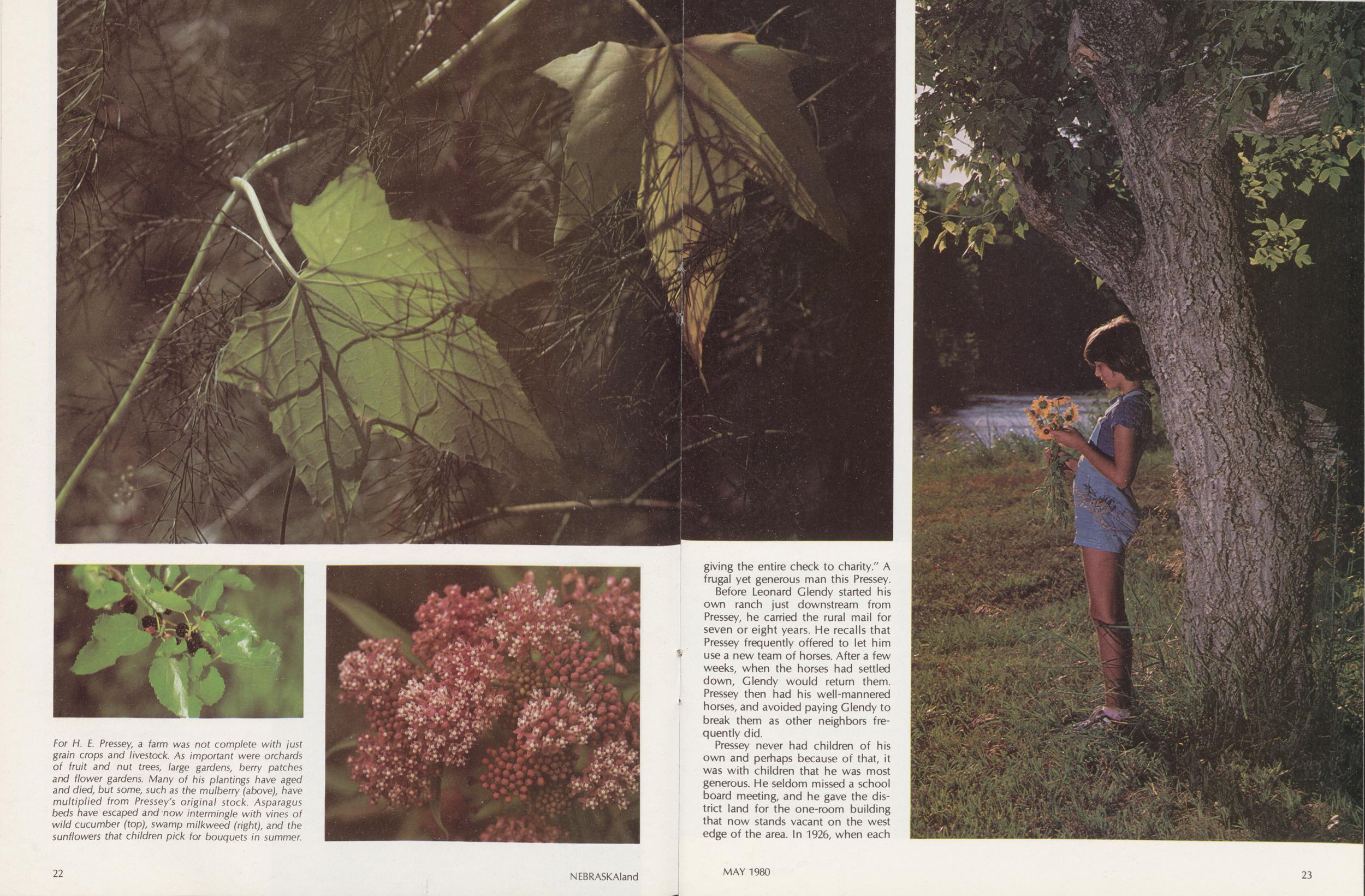
For H. E. Pressey, a farm was not complete with just grain crops and livestock. As important were orchards of fruit and nut trees, large gardens, berry patches and flower gardens. Many of his plantings have aged and died, but some, such as the mulberry (above), have multiplied from Pressey's original stock. Asparagus beds have escaped and now intermingle with vines of wild cucumber (top), swamp milkweed (right), and the sunflowers that children pick for bouquets in summer. 22 NEBRASKAland giving the entire check to charity. A frugal yet generous man this Pressey.
Before Leonard Giendy started his own ranch just downstream from Pressey, he carried the rural mail for seven or eight years. He recalls that Pressey frequently offered to let him use a new team of horses. After a few weeks, when the horses had settled down, Giendy would return them.
Pressey then had his well-mannered horses, and avoided paying Giendy to break them as other neighbors frequently did. Pressey never had children of his own and perhaps because of that, it was with children that he was most generous. He seldom missed a school board meeting, and he gave the district land for the one-room building that now stands vacant on the west edge of the area. In 1926, when each MAY 1980 23 dollar was hard-earned, Pressey made a charitable gift of $5,000 to the Nebraska Children's Home; the same H. E. Pressey who wanted each penny he had coming.
Those who were young men when they knew Pressey remember that it was his custom to give advice freely and without request. Jess Edmisten recalled that on the day of a local celebration for young men about to leave for World War I, Pressey took him aside and described England and told him what to expect from the English people and from the Germans. Before he left, Pressey told him: "Young man, I'm going to pray for you every day you are gone." Jess was seriously wounded in that war, and on the following day, his replacement was killed. When Jess returned home and met Pressey, he asked him if he had stopped praying because he was nearly killed. Pressey replied: "Young man, the good Lord took you out of there to save your life; I never missed a day."
During the early 1920's when Fred Racek was working for Pressey, he was administered his share of practical, if not moral, lectures.
"H.E. had sent me to the north side of the river to bring back the bags of wheat we had threshed. There were two fords—the downstream ford had a steep grade down to the river and it was slick with snow. I made it down alright and loaded the wagon, but didn't think I would make it back up so I decided to recross at the upstream ford. Well, the wheels sank in the loose river sand and the tongue of the wagon jammed into the bank. The doubletree broke and the horses walked out. H. E. brought the team back and a set of pulleys, and we hooked onto the axle and pulled it out. I remember he told me: 'Don't ever cross the river with a load unless you crossed it empty first.'
"When we put out trees, I would plow the furrow but he always did the planting. He wanted the trees planted just his way and that was how he was about everything."
It was Pressey's preoccupation with planting trees, more than anything else, that set him apart from hundreds of other "slightly eccentric Englishmen" who settled in Nebraska. There are obvious parallels between H. E. Pressey and "Old Jules" Sandoz, who at about the same time was nurturing his second Nebraska orchard to life, this time not on the Niobrara but in the Sandhills. Both had friendly relations 24 NEBRASKAland with university horticulturists; learning the proper way to prune and plant, experimenting with new varieties, and growing trees and shrubs that were not expected to survive so far outside their native range. Pressey's horticultural acquaintances were even more distinguished than those of Sandoz. He corresponded, and later in life visited on several occasions, the nation's leading horticulturist, Luther Burbank, in Santa Rosa, California and probably brought to Nebraska fruit and berry crosses for testing.
Pressey arrived 20 years too late for, and by disposition probably would have avoided anyway, the rough and-tumble dealings of the Old West that Old Jules savored; but both were strong-willed leaders with a passion for making this grassland bear fruit. It is unfortunate that like Sandoz, Pressey did not have a daughter inclined to write of his times.
Each autumn, as yellow sweeps through the cottonwoods, hunters gather at the Pressey area in search of game. First are the dove hunters (above) to hunker down by a pond's edge or marijuana patch. Soon they will be followed by others in search of squirrels, rabbits, pheasants or deer. Food plots are planted in stands of native grass (above left) or near weedy, brushy areas so when winter comes to Custer County, everything that wildlife needs to survive is close at hand. MAY 1980 25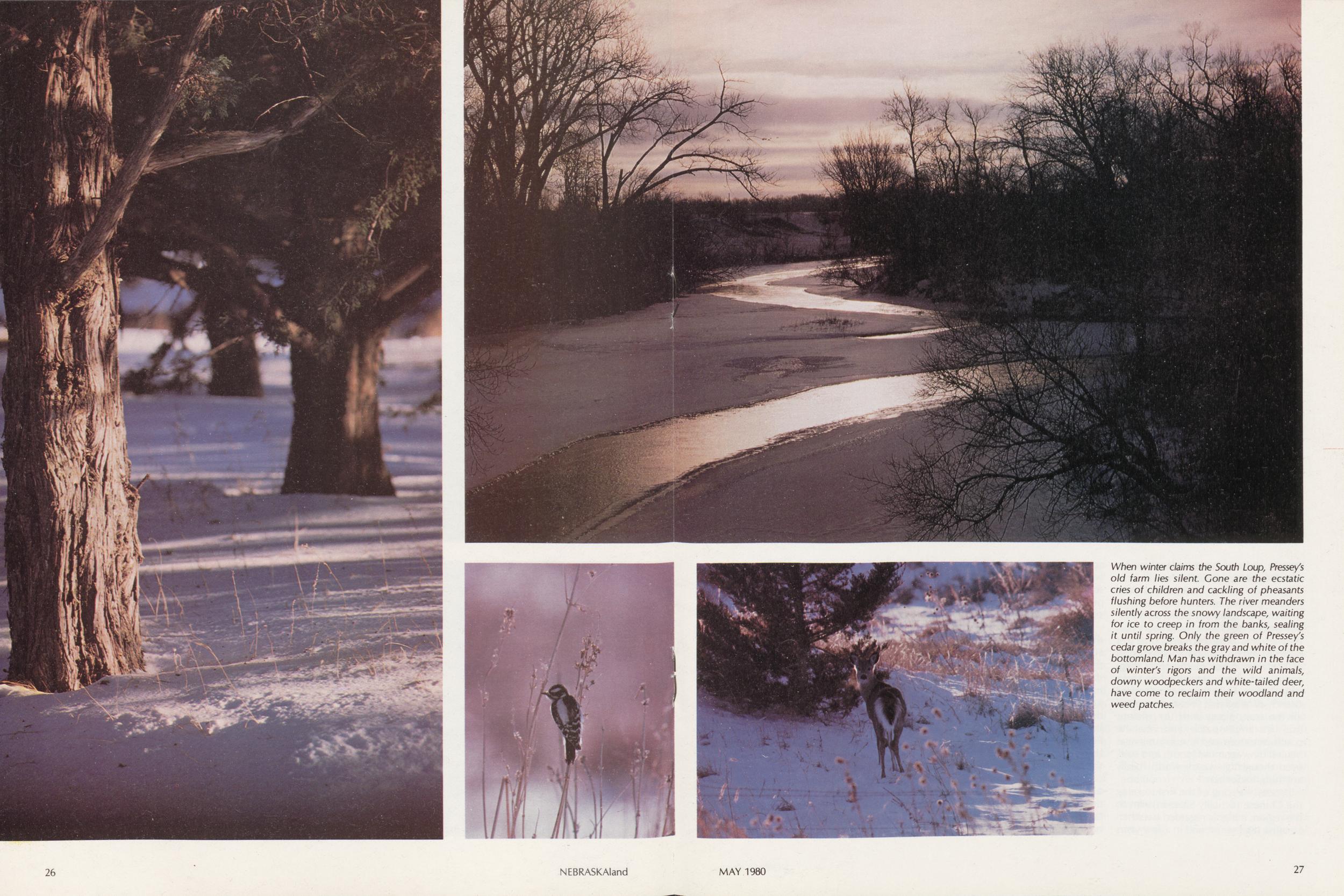
Just how many trees and shrubs Pressey planted on his Loup farm no one knows. Some say 50 to 60 different types. Fred Racek remembers that he had two large orchards, one just north of his house and another north of the river. Most of the trees were apple and cherry varieties but there were other fruits as well. Leonard Glendy recalled that Pressey harvested all the fruit, along with the melons from his ample patch, and what he could not store and use himself was hauled by wagon to Oconto and sold, even though "it wasn't worth hardly anything back then."
Pressey was one of the first to bring the Chinese (actually Siberian) elm to the region; a highly regarded tree then because it grew fast and in a few years could shade a house or break the wind. Most of his planting stock was shipped in, even the cottonwoods, probably compliments of the University for test planting.
Fred Racek helped plant many of those trees and remembers seeing H. E. taking bundles of seedlings to the chopping block and cutting back the tops with an ax "so the roots don't have to feed so much when they are just starting. You plant a tree, but you don't water it for a couple of days," Pressey told Glendy. One room of Pressey's house was devoted to a library; many of the books no doubt of the latest horticulture theory.
Pressey must have been something of an innovator and a sometimes tinkerer. Once his cottonwoods were large enough, he strung a steel cable between two of them across the river. In a homemade "breeches buoy" that traveled on a pulley, he would then pull himself across the river to work in the orchard or pen the sheep for the night.
His blacksmith shop was well equipped and he was skilled at not only repairing and replacing, but creating new hardware. Even the gate to his farm was designed so that he could drive his Model T up to it, open it and drive through, then close it behind him without leaving the seat. He installed tile pipes in his garden to improve the drainage, and fashioned his own doubletrees and singletrees from homegrown ash.
It is ironic that this man who loved trees would spend the last half of his life walking on wood. Leonard Glendy recalled that H. E. developed a swelling on his right leg, probably from an 28 NEBRASKAland infection. "It kept getting worse and worse until his doctor friend from Broken Bow had to amputate. After it healed, I went down to the river with him and he picked out a hackberry and carved his own peg leg, just the way he wanted it.
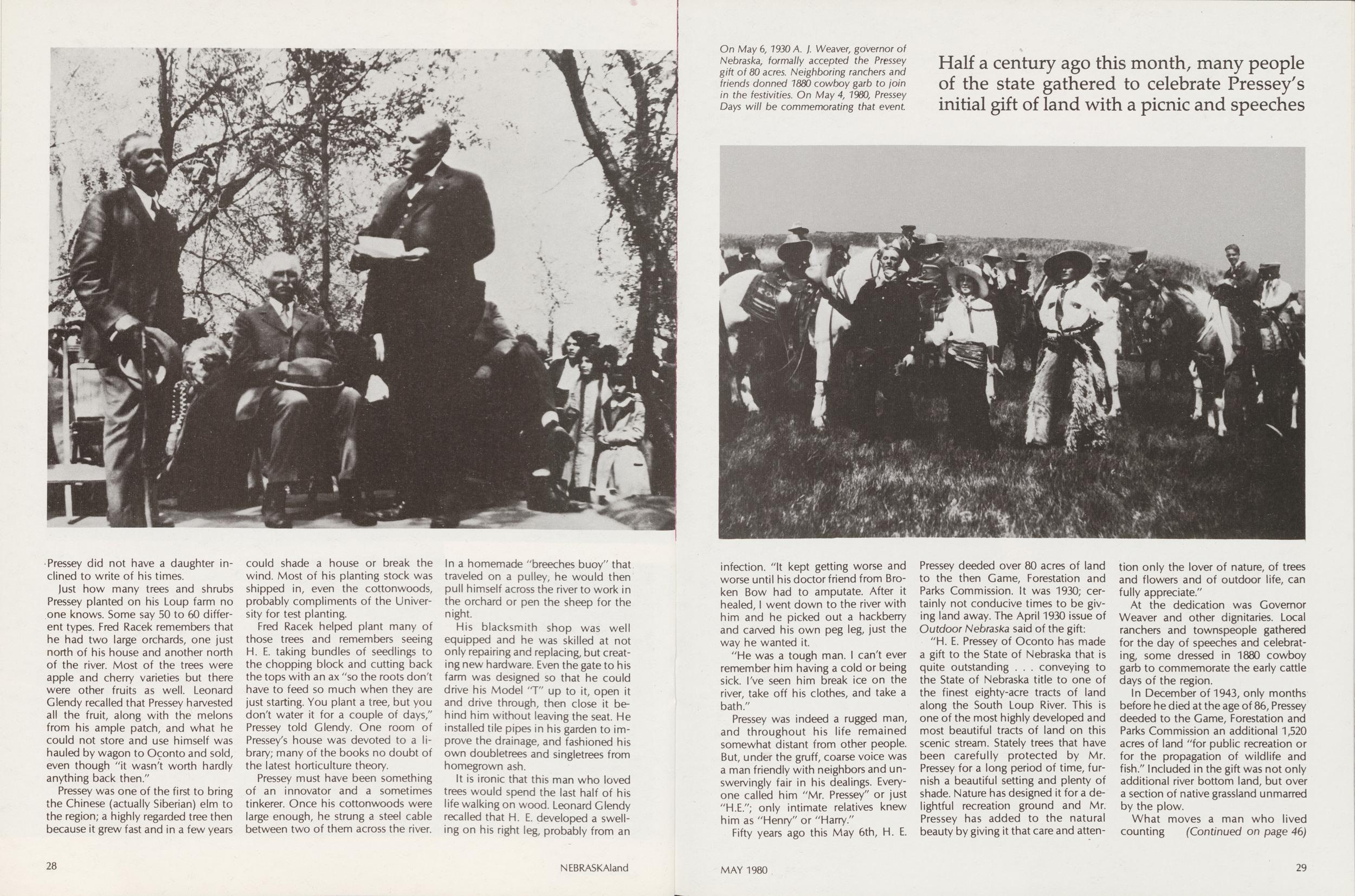
On May 6, 7930 A. Weaver, governor of Nebraska, formally accepted the Pressey gift of 80 acres. Neighboring ranchers and friends donned 1880 cowboy garb to join in the festivities. On May 4, 1980, Pressey Days will be commemorating that event. Half a century ago this month, many people of the state gathered to celebrate Pressey's initial gift of land with a picnic and speeches"He was a tough man. I can't ever remember him having a cold or being sick. I've seen him break ice on the river, take off his clothes, and take a bath."
Pressey was indeed a rugged man, and throughout his life remained somewhat distant from other people. But, under the gruff, coarse voice was a man friendly with neighbors and unswervingly fair in his dealings. Everyone called him "Mr. Pressey" or just "H.E."; only intimate relatives knew him as "Henry" or "Harry."
Fifty years ago this May 6th, H. E. Pressey deeded over 80 acres of land to the then Game, Forestation and Parks Commission. It was 1930; certainly not conducive times to be giving land away. The April 1930 issue of Outdoor Nebraska said of the gift:
"H. E. Pressey of Oconto has made a gift to the State of Nebraska that is quite outstanding...conveying to the State of Nebraska title to one of the finest eighty-acre tracts of land along the South Loup River. This is one of the most highly developed and most beautiful tracts of land on this scenic stream. Stately trees that have been carefully protected by Mr. Pressey for a long period of time, furnish a beautiful setting and plenty of shade. Nature has designed it for a delightful recreation ground and Mr. Pressey has added to the natural beauty by giving it that care and attention only the lover of nature, of trees and flowers and of outdoor life, can fully appreciate."
At the dedication was Governor Weaver and other dignitaries. Local ranchers and townspeople gathered for the day of speeches and celebrating, some dressed in 1880 cowboy garb to commemorate the early cattle days of the region.
In December of 1943, only months before he died at the age of 86, Pressey deeded to the Game, Forestation and Parks Commission an additional 1,520 acres of land "for public recreation or for the propagation of wildlife and fish." Included in the gift was not only additional river bottom land, but over a section of native grassland unmarred by the plow.
What moves a man who lived counting (Continued on page 46)
MAY 1980 29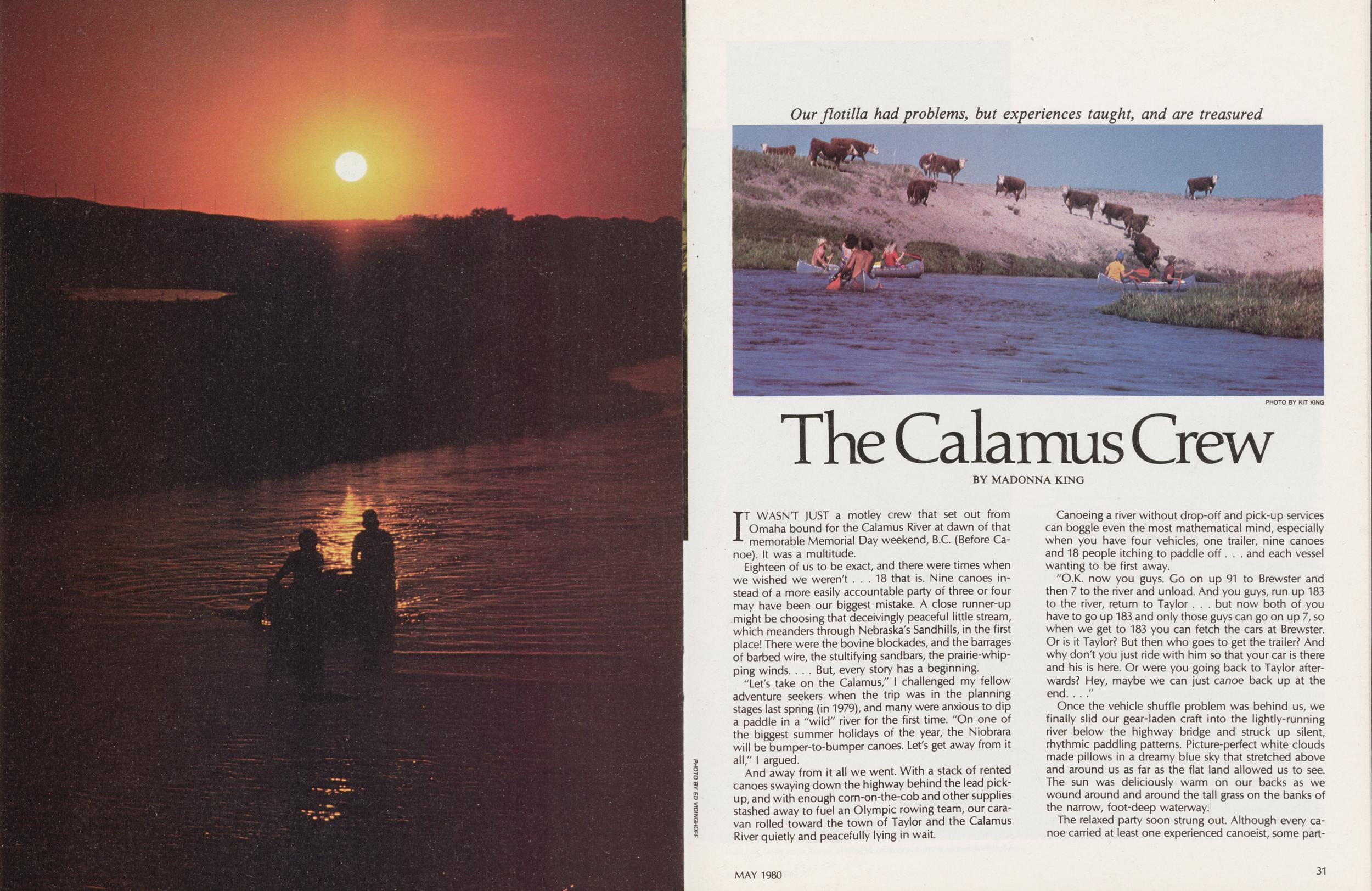
The Calamus Crew
Our flotilla had problems, but experiences taught, and are treasuredIT WASNT JUST a motley crew that set out from Omaha bound for the Calamus River at dawn of that memorable Memorial Day weekend, B.C. (Before Canoe). It was a multitude.
Eighteen of us to be exact, and there were times when we wished we weren't ... 18 that is. Nine canoes instead of a more easily accountable party of three or four may have been our biggest mistake. A close runner-up might be choosing that deceivingly peaceful little stream, which meanders through Nebraska's Sandhills, in the first place! There were the bovine blockades, and the barrages of barbed wire, the stultifying sandbars, the prairie-whipping winds. ...But, every story has a beginning.
"Let's take on the Calamus," I challenged my fellow adventure seekers when the trip was in the planning stages last spring (in 1979), and many were anxious to dip a paddle in a "wild" river for the first time. "On one of the biggest summer holidays of the year, the Niobrara will be bumper-to-bumper canoes. Let's get away from it all," I argued.
And away from it all we went. With a stack of rented canoes swaying down the highway behind the lead pickup, and with enough corn-on-the-cob and other supplies stashed away to fuel an Olympic rowing team, our caravan rolled toward the town of Taylor and the Calamus River quietly and peacefully lying in wait.
Canoeing a river without drop-off and pick-up services can boggle even the most mathematical mind, especially when you have four vehicles, one trailer, nine canoes and 18 people itching to paddle off...and each vessel wanting to be first away.
"O.K. now you guys. Go on up 91 to Brewster and then 7 to the river and unload. And you guys, run up 183 to the river, return to Taylor...but now both of you have to go up 183 and only those guys can go on up 7, so when we get to 183 you can fetch the cars at Brewster. Or is it Taylor? But then who goes to get the trailer? And why don't you just ride with him so that your car is there and his is here. Or were you going back to Taylor afterwards? Hey, maybe we can just canoe back up at the end...."
Once the vehicle shuffle problem was behind us, we finally slid our gear-laden craft into the lightly-running river below the highway bridge and struck up silent, rhythmic paddling patterns. Picture-perfect white clouds made pillows in a dreamy blue sky that stretched above and around us as far as the flat land allowed us to see. The sun was deliciously warm on our backs as we wound around and around the tall grass on the banks of the narrow, foot-deep waterway.
The relaxed party soon strung out. Although every canoe carried at least one experienced canoeist, some partners 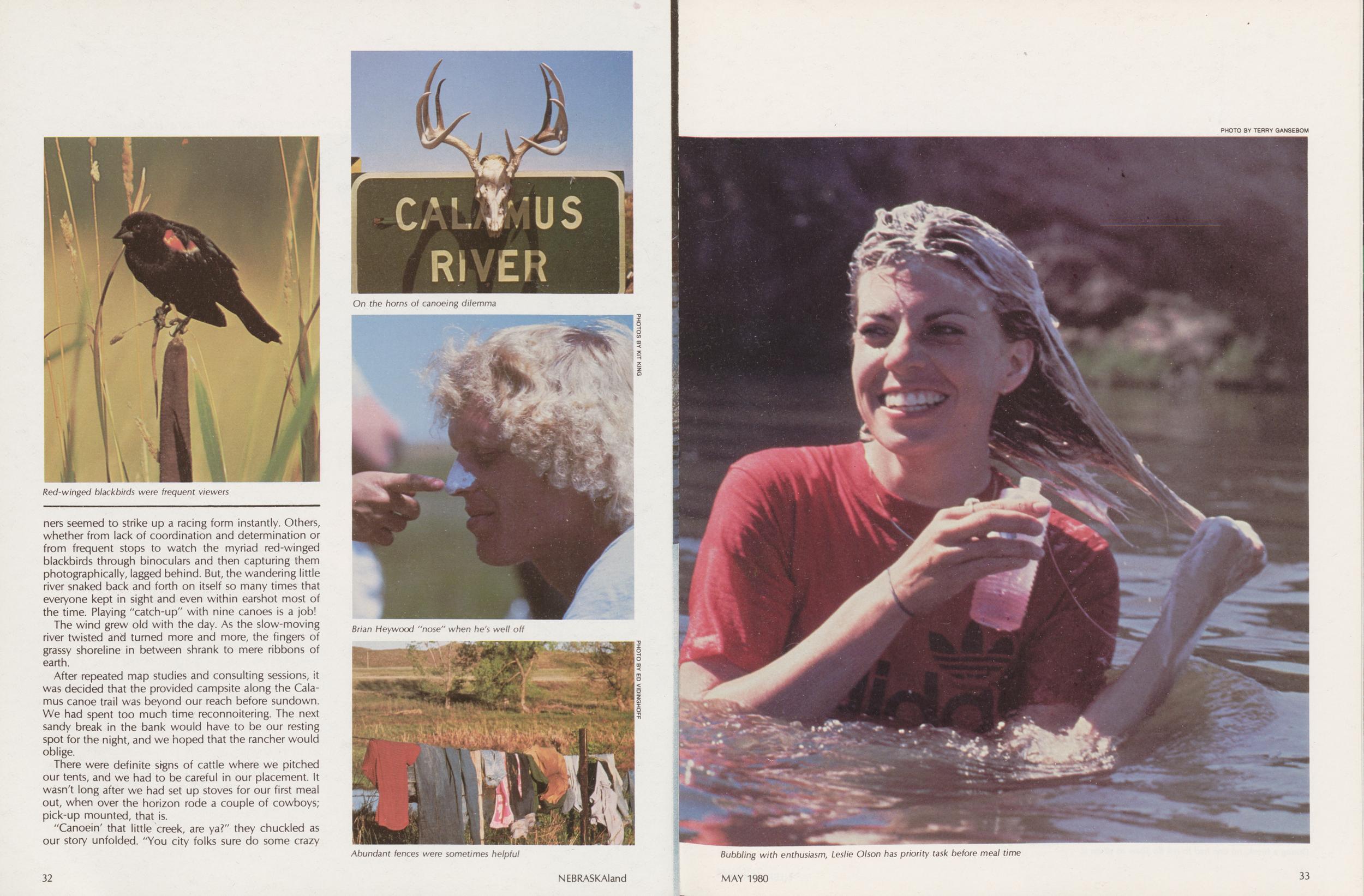 seemed to strike up a racing form instantly. Others, whether from lack of coordination and determination or from frequent stops to watch the myriad red-winged blackbirds through binoculars and then capturing them photographically, lagged behind. But, the wandering little river snaked back and forth on itself so many times that everyone kept in sight and even within earshot most of the time. Playing "catch-up" with nine canoes is a job!
The wind grew old with the day. As the slow-moving river twisted and turned more and more, the fingers of grassy shoreline in between shrank to mere ribbons of earth.
After repeated map studies and consulting sessions, it was decided that the provided campsite along the Calamus canoe trail was beyond our reach before sundown. We had spent too much time reconnoitering. The next sandy break in the bank would have to be our resting spot for the night, and we hoped that the rancher would oblige.
There were definite signs of cattle where we pitched our tents, and we had to be careful in our placement. It wasn't long after we had set up stoves for our first meal out, when over the horizon rode a couple of cowboys; pick-up mounted, that is.
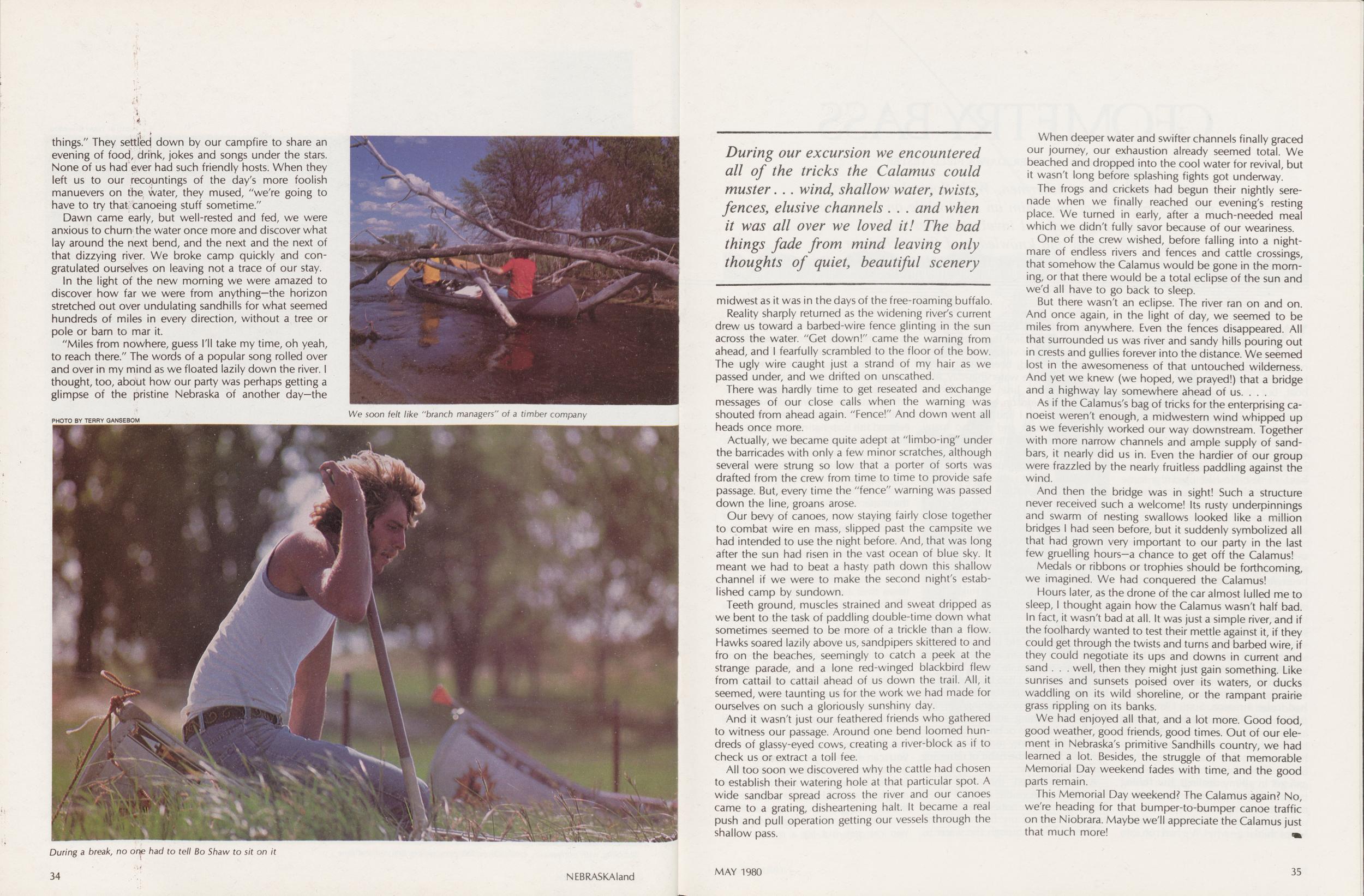
"Canoein' that little creek, are ya?" they chuckled as our story unfolded. "You city folks sure do some crazy things." They settled down by our campfire to share an evening of food, drink, jokes and songs under the stars. None of us had ever had such friendly hosts. When they left us to our recountings of the clay's more foolish manuevers on the water, they mused, "we're going to have to try that canoeing stuff sometime."
Dawn came early, but well-rested and fed, we were anxious to churn the water once more and discover what lay around the next bend, and the next and the next of that dizzying river. We broke camp quickly and congratulated ourselves on leaving not a trace of our stay.
In the light of the new morning we were amazed to discover how far we were from anything—the horizon stretched out over undulating sandhills for what seemed hundreds of miles in every direction, without a tree or pole or barn to mar it.
"Miles from nowhere, guess I'll take my time, oh yeah, to reach there." The words of a popular song rolled over and over in my mind as we floated lazily down the river. I thought, too, about how our party was perhaps getting a glimpse of the pristine Nebraska of another day—the midwest as it was in the days of the free-roaming buffalo.
Reality sharply returned as the widening river's current drew us toward a barbed-wire fence glinting in the sun across the water. "Get down!" came the warning from ahead, and I fearfully scrambled to the floor of the bow. The ugly wire caught just a strand of my hair as we passed under, and we drifted on unscathed.
There was hardly time to get reseated and exchange messages of our close calls when the warning was shouted from ahead again. "Fence!" And down went all heads once more.
Actually, we became quite adept at "limbo-ing" under the barricades with only a few minor scratches, although several were strung so low that a porter of sorts was drafted from the crew from time to time to provide safe passage. But, every time the "fence" warning was passed down the line, groans arose.
Our bevy of canoes, now staying fairly close together to combat wire en mass, slipped past the campsite we had intended to use the night before. And, that was long after the sun had risen in the vast ocean of blue sky. it meant we had to beat a hasty path down this shallow channel if we were to make the second night's established camp by sundown.
Teeth ground, muscles strained and sweat dripped as we bent to the task of paddling double-time down what sometimes seemed to be more of a trickle than a flow. Hawks soared lazily above us, sandpipers skittered to and fro on the beaches, seemingly to catch a peek at the strange parade, and a lone red-winged blackbird flew from cattail to cattail ahead of us down the trail. All, it seemed, were taunting us for the work we had made for ourselves on such a gloriously sunshiny day
And it wasn't just our feathered friends who gathered to witness our passage. Around one bend loomed hundreds of glassy-eyed cows, creating a river-block as if to check us or extract a toll fee.
All too soon we discovered why the cattle had chosen to establish their watering hole at that particular spot. A wide sandbar spread across the river and our canoes came to a grating, disheartening halt. It became a real push and pull operation getting our vessels through the shallow pass.
When deeper water and swifter channels finally graced our journey, our exhaustion already seemed total. We beached and dropped into the cool water for revival, but it wasn't long before splashing fights got underway.
The frogs and crickets had begun their nightly serenade when we finally reached our evening's resting place. We turned in early, after a much-needed meal which we didn't fully savor because of our weariness.
One of the crew wished, before falling into a nightmare of endless rivers and fences and cattle crossings, that somehow the Calamus would be gone in the morning, or that there would be a total eclipse of the sun and we'd all have to go back to sleep.
But there wasn't an eclipse. The river ran on and on. And once again, in the light of day, we seemed to be miles from anywhere. Even the fences disappeared. All that surrounded us was river and sandy hills pouring out in crests and gullies forever into the distance. We seemed lost in the awesomeness of that untouched wilderness. And yet we knew (we hoped, we prayed!) that a bridge and a highway lay somewhere ahead of us....
As if the Calamus's bag of tricks for the enterprising canoeist weren't enough, a midwestern wind whipped up as we feverishly worked our way downstream. Together with more narrow channels and ample supply of sandbars, it nearly did us in. Even the hardier of our group were frazzled by the nearly fruitless paddling against the wind.
And then the bridge was in sight! Such a structure never received such a welcome! Its rusty underpinnings and swarm of nesting swallows looked like a million bridges I had seen before, but it suddenly symbolized all that had grown very important to our party in the last few gruelling hours-a chance to get off the Calamus!
Medals or ribbons or trophies should be forthcoming, we imagined. We had conquered the Calamus!
Hours later, as the drone of the car almost lulled me to sleep, I thought again how the Calamus wasn't half bad. In fact, it wasn't bad at all. It was just a simple river, and if the foolhardy wanted to test their mettle against it, if they could get through the twists and turns and barbed wire, if they could negotiate its ups and downs in current and sand . . . well, then they might just gain something. Like sunrises and sunsets poised over its waters, or ducks waddling on its wild shoreline, or the rampant prairie grass rippling on its banks.
We had enjoyed all that, and a lot more. Good food, good weather, good friends, good times. Out of our element in Nebraska's primitive Sandhills country, we had learned a lot. Besides, the struggle of that memorable Memorial Day weekend fades with time, and the good parts remain.
This Memorial Day weekend? The Calamus again? No, we're heading for that bumper-to-bumper canoe traffic on the Niobrara. Maybe we'll appreciate the Calamus just that much more!
MAY 1980 35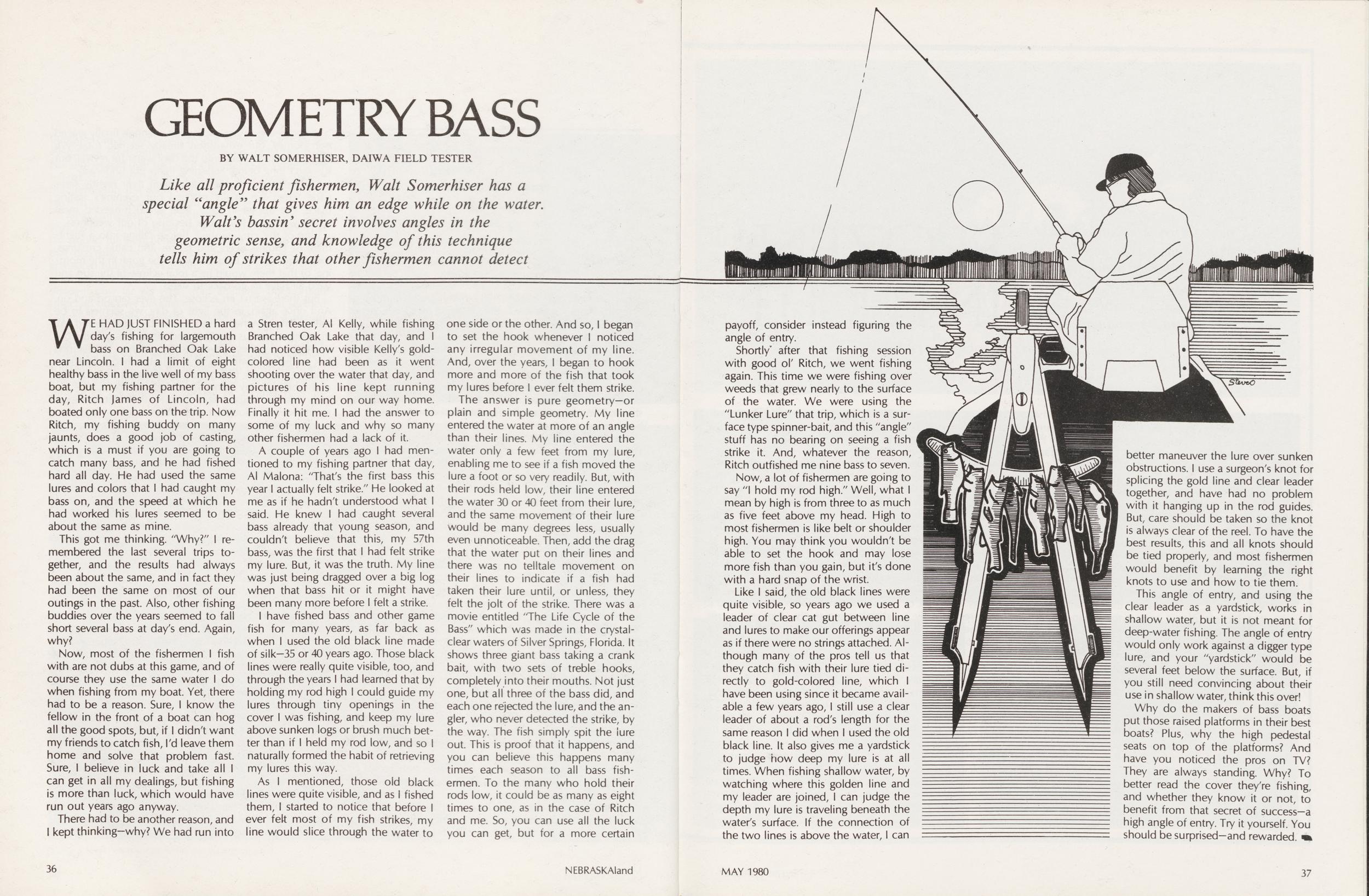
GEOMETRY BASS
BY WALT SOMERHISER, DAIWA FIELD TESTER Like all proficient fishermen, Walt Somerhiser has a special "angle" that gives him an edge while on the water. Waifs bassing secret involves angles in the geometric sense, and knowledge of this technique tells him of strikes that other fishermen cannot detectWE HAD JUST FINISHED a hard day's fishing for largemouth bass on Branched Oak Lake near Lincoln. I had a limit of eight healthy bass in the live well of my bass boat, but my fishing partner for the day, Ritch James of Lincoln, had boated only one bass on the trip. Now Ritch, my fishing buddy on many jaunts, does a good job of casting, which is a must if you are going to catch many bass, and he had fished hard all day. He had used the same lures and colors that I had caught my bass on, and the speed at which he had worked his lures seemed to be about the same as mine.
This got me thinking. "Why?" I remembered the last several trips together, and the results had always been about the same, and in fact they had been the same on most of our outings in the past. Also, other fishing buddies over the years seemed to fall short several bass at day's end. Again, why?
Now, most of the fishermen I fish with are not dubs at this game, and of course they use the same water I do when fishing from my boat. Yet, there had to be a reason. Sure, I know the fellow in the front of a boat can hog all the good spots, but, if I didn't want my friends to catch fish, I'd leave them home and solve that problem fast. Sure, I believe in luck and take all I can get in all my dealings, but fishing is more than luck, which would have run out years ago anyway.
There had to be another reason, and I kept thinking—why? We had run into a Stren tester, Al Kelly, while fishing Branched Oak Lake that day, and I had noticed how visible Kelly's gold-colored line had been as it went shooting over the water that day, and pictures of his line kept running through my mind on our way home. Finally it hit me. I had the answer to some of my luck and why so many other fishermen had a lack of it.
A couple of years ago I had mentioned to my fishing partner that day, Al Malona: "That's the first bass this year I actually felt strike." He looked at me as if he hadn't understood what I said. He knew I had caught several bass already that young season, and couldn't believe that this, my 57th bass, was the first that I had felt strike my lure. But, it was the truth. My line was just being dragged over a big log when that bass hit or it might have been many more before I felt a strike.
I have fished bass and other game fish for many years, as far back as when I used the old black line made of silk—35 or 40 years ago. Those black lines were really quite visible, too, and through the years I had learned that by holding my rod high I could guide my lures through tiny openings in the cover I was fishing, and keep my lure above sunken logs or brush much better than if I held my rod low, and so I naturally formed the habit of retrieving my lures this way.
As I mentioned, those old black lines were quite visible, and as I fished them, I started to notice that before I ever felt most of my fish strikes, my line would slice through the water to one side or the other. And so, I began to set the hook whenever I noticed any irregular movement of my line. And, over the years, I began to hook more and more of the fish that took my lures before I ever felt them strike.
The answer is pure geometry—or plain and simple geometry. My line entered the water at more of an angle than their lines. My line entered the water only a few feet from my lure, enabling me to see if a fish moved the lure a foot or so very readily. But, with their rods held low, their line entered the water 30 or 40 feet from their lure, and the same movement of their lure would be many degrees less, usually even unnoticeable. Then, add the drag that the water put on their lines and there was no telltale movement on their lines to indicate if a fish had taken their lure until, or unless, they felt the jolt of the strike. There was a movie entitled "The Life Cycle of the Bass" which was made in the crystal-clear waters of Silver Springs, Florida. It shows three giant bass taking a crank bait, with two sets of treble hooks, completely into their mouths. Not just one, but all three of the bass did, and each one rejected the lure, and the angler, who never detected the strike, by the way. The fish simply spit the lure out. This is proof that it happens, and you can believe this happens many times each season to all bass fishermen. To the many who hold their rods low, it could be as many as eight times to one, as in the case of Ritch and me. So, you can use all the luck you can get, but for a more certain 36 NEBRASKAland payoff, consider instead figuring the angle of entry.
Shortly' after that fishing session with good ol' Ritch, we went fishing again. This time we were fishing over weeds that grew nearly to the surface of the water. We were using the "Lunker Lure" that trip, which is a surface type spinner-bait, and this "angle" stuff has no bearing on seeing a fish strike it. And, whatever the reason, Ritch outfished me nine bass to seven.
Now, a lot of fishermen are going to say "I hold my rod high." Well, what I mean by high is from three to as much as five feet above my head. High to most fishermen is like belt or shoulder high. You may think you wouldn't be able to set the hook and may lose more fish than you gain, but it's done with a hard snap of the wrist.
Like I said, the old black lines were quite visible, so years ago we used a leader of clear cat gut between line and lures to make our offerings appear as if there were no strings attached. Although many of the pros tell us that they catch fish with their lure tied directly to gold-colored line, which I have been using since it became available a few years ago, I still use a clear leader of about a rod's length for the same reason I did when I used the old black line. It also gives me a yardstick to judge how deep my lure is at all times. When fishing shallow water, by watching where this golden line and my leader are joined, I can judge the depth my lure is traveling beneath the water's surface. If the connection of the two lines is above the water, I can better maneuver the lure over sunken obstructions. I use a surgeon's knot for splicing the gold line and clear leader together, and have had no problem with it hanging up in the rod guides. But, care should be taken so the knot is always clear of the reel. To have the best results, this and all knots should be tied properly, and most fishermen would benefit by learning the right knots to use and how to tie them.
This angle of entry, and using the clear leader as a yardstick, works in shallow water, but it is not meant for deep-water fishing. The angle of entry would only work against a digger type lure, and your "yardstick" would be several feet below the surface. But, if you still need convincing about their use in shallow water, think this over!
Why do the makers of bass boats put those raised platforms in their best boats? Plus, why the high pedestal seats on top of the platforms? And have you noticed the pros on TV? They are always standing. Why? To better read the cover they're fishing, and whether they know it or not, to benefit from that secret of success-a high angle of entry. Try it yourself. You should be surprised—and rewarded.
MAY 1980 37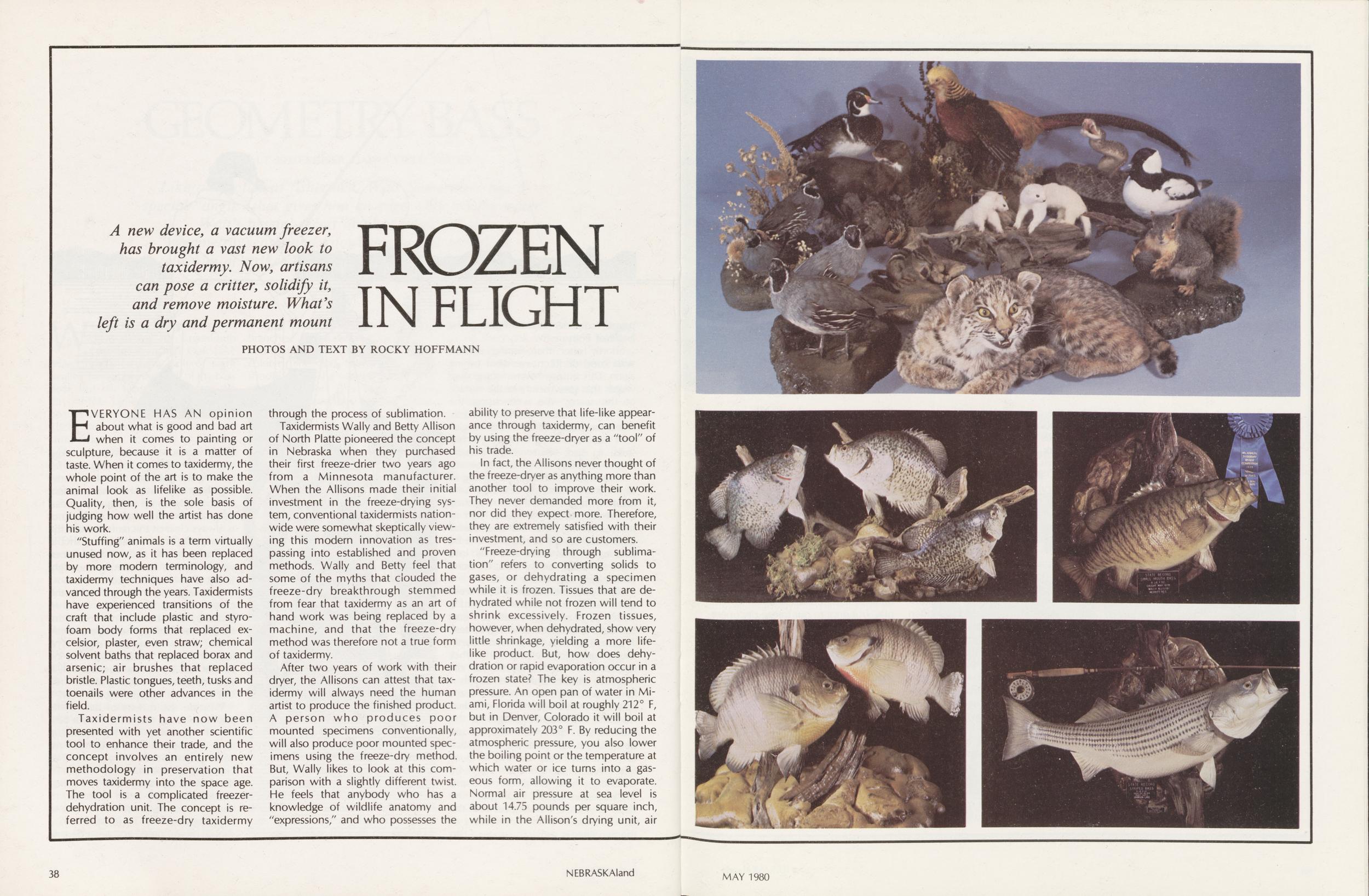
FROZEN IN FLIGHT
A new device, a vacuum freezer, has brought a vast new look to taxidermy. Now, artisans can pose a critter, solidify it, and remove moisture. What's left is a dry and permanent mount PHOTOS AND TEXT BY ROCKY HOFFMANNabout what is good and bad art when it comes to painting or sculpture, because it is a matter of taste. When it comes to taxidermy, the whole point of the art is to make the animal look as lifelike as possible. Quality, then, is the sole basis of judging how well the artist has done his work.
"Stuffing" animals is a term virtually unused now, as it has been replaced by more modern terminology, and taxidermy techniques have also advanced through the years. Taxidermists have experienced transitions of the craft that include plastic and styrofoam body forms that replaced excelsior, plaster, even straw; chemical solvent baths that replaced borax and arsenic; air brushes that replaced bristle. Plastic tongues, teeth, tusks and toenails were other advances in the field.
Taxidermists have now been presented with yet another scientific tool to enhance their trade, and the concept involves an entirely new methodology in preservation that moves taxidermy into the space age. The tool is a complicated freezer-dehydration unit. The concept is referred to as freeze-dry taxidermy through the process of sublimation.
Taxidermists Wally and Betty Allison of North Platte pioneered the concept in Nebraska when they purchased their first freeze-drier two years ago from a Minnesota manufacturer. When the Allisons made their initial investment in the freeze-drying system, conventional taxidermists nationwide were somewhat skeptically viewing this modern innovation as trespassing into established and proven methods. Wally and Betty feel that some of the myths that clouded the freeze-dry breakthrough stemmed from fear that taxidermy as an art of hand work was being replaced by a machine, and that the freeze-dry method was therefore not a true form of taxidermy.
After two years of work with their dryer, the Allisons can attest that taxidermy will always need the human artist to produce the finished product. A person who produces poor mounted specimens conventionally, will also produce poor mounted specimens using the freeze-dry method. But, Wally likes to look at this comparison with a slightly different twist. He feels that anybody who has a knowledge of wildlife anatomy and "expressions," and who possesses the ability to preserve that life-like appearance through taxidermy, can benefit by using the freeze-dryer as a "tool" of his trade.
In fact, the Allisons never thought of the freeze-dryer as anything more than another tool to improve their work. They never demanded more from it, nor did they expect more. Therefore, they are extremely satisfied with their investment, and so are customers.
"Freeze-drying through sublimation" refers to converting solids to gases, or dehydrating a specimen while it is frozen. Tissues that are dehydrated while not frozen will tend to shrink excessively. Frozen tissues, however, when dehydrated, show very little shrinkage, yielding a more life-like product. But, how does dehydration or rapid evaporation occur in a frozen state? The key is atmospheric pressure. An open pan of water in Miami, Florida will boil at roughly 212° F, but in Denver, Colorado it will boil at approximately 203° F. By reducing the atmospheric pressure, you also lower the boiling point or the temperature at which water or ice turns into a gaseous form, allowing it to evaporate. Normal air pressure at sea level is about 14.75 pounds per square inch, while in the Allison's drying unit, air pressure is reduced to .0035 pounds per square inch, lowering the boiling point of water to -15° F.
38 NEBRASKAland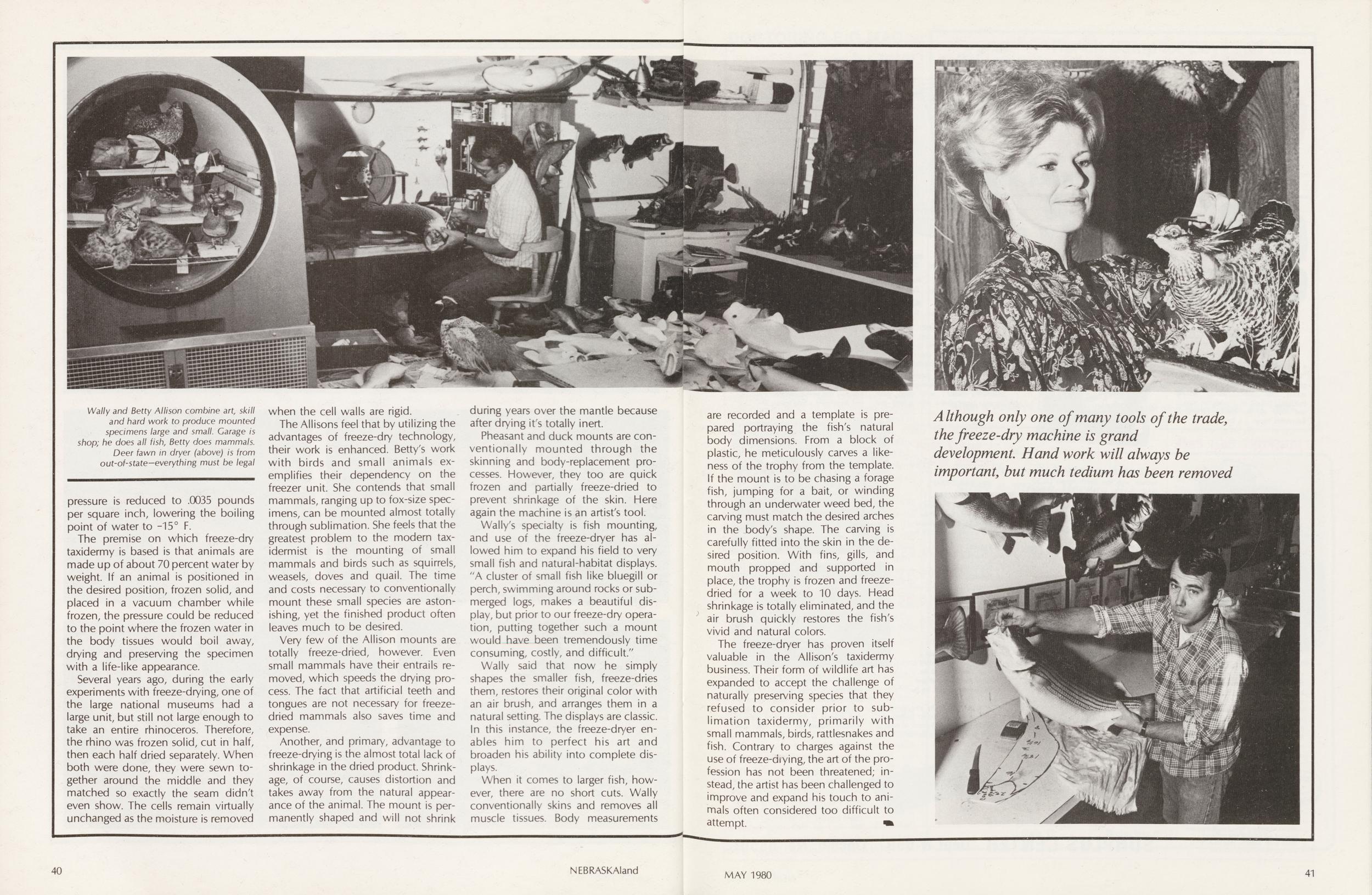
The premise on which freeze-dry taxidermy is based is that animals are made up of about 70 percent water by weight. If an animal is positioned in the desired position, frozen solid, and placed in a vacuum chamber while frozen, the pressure could be reduced to the point where the frozen water in the body tissues would boil away, drying and preserving the specimen with a life-like appearance.
Several years ago, during the early experiments with freeze-drying, one of the large national museums had a large unit, but still not large enough to take an entire rhinoceros. Therefore, the rhino was frozen solid, cut in half, then each half dried separately. When both were done, they were sewn together around the middle and they matched so exactly the seam didn't even show. The cells remain virtually unchanged as the moisture is removed when the cell walls are rigid.
The Allisons feel that by utilizing the advantages of freeze-dry technology, their work is enhanced. Betty's work with birds and small animals exemplifies their dependency on the freezer unit. She contends that small mammals, ranging up to fox-size specimens, can be mounted almost totally through sublimation. She feels that the greatest problem to the modern taxidermist is the mounting of small mammals and birds such as squirrels, weasels, doves and quail. The time and costs necessary to conventionally mount these small species are astonishing, yet the finished product often leaves much to be desired.
Very few of the Allison mounts are totally freeze-dried, however. Even small mammals have their entrails removed, which speeds the drying process. The fact that artificial teeth and tongues are not necessary for freeze-dried mammals also saves time and expense.
Another, and primary, advantage to freeze-drying is the almost total lack of shrinkage in the dried product. Shrinkage, of course, causes distortion and takes away from the natural appearance of the animal. The mount is permanently shaped and will not shrink during years over the mantle because after drying it's totally inert.
Pheasant and duck mounts are conventionally mounted through the skinning and body-replacement processes. However, they too are quick frozen and partially freeze-dried to prevent shrinkage of the skin. Here again the machine is an artist's tool.
Wally's specialty is fish mounting, and use of the freeze-dryer has allowed him to expand his field to very small fish and natural-habitat displays. "A cluster of small fish like bluegill or perch, swimming around rocks or submerged logs, makes a beautiful display, but prior to our freeze-dry operation, putting together such a mount would have been tremendously time consuming, costly, and difficult."
Wally said that now he simply shapes the smaller fish, freeze-dries them, restores their original color with an air brush, and arranges them in a natural setting. The displays are classic. In this instance, the freeze-dryer enables him to perfect his art and broaden his ability into complete displays.
When it comes to larger fish, however, there are no short cuts. Wally conventionally skins and removes all muscle tissues. Body measurements are recorded and a template is prepared portraying the fish's natural body dimensions. From a block of plastic, he meticulously carves a likeness of the trophy from the template. If the mount is to be chasing a forage fish, jumping for a bait, or winding through an underwater weed bed, the carving must match the desired arches in the body's shape. The carving is carefully fitted into the skin in the desired position. With fins, gills, and mouth propped and supported in place, the trophy is frozen and freeze-dried for a week to 10 days. Head shrinkage is totally eliminated, and the air brush quickly restores the fish's vivid and natural colors.
The freeze-dryer has proven itself valuable in the Allison's taxidermy business. Their form of wildlife art has expanded to accept the challenge of naturally preserving species that they refused to consider prior to sublimation taxidermy, primarily with small mammals, birds, rattlesnakes and fish. Contrary to charges against the use of freeze-diying, the art of the profession has not been threatened; instead, the artist has been challenged to improve and expand his touch to animals often considered too difficult to attempt.
 DIAMOND BRAND "Blue Ridge Pack" Choice of Small, Medium, or Large Size $49.98 ( #N-050 DBP ) the DIAMOND "Blue Ridge 5" pack has a divided main cavity and five external pockets, easy access map pocket, leather lashing patches. 3100 cu. in. ( small and med. ) and 3300 cu. in. capacity ( large ). Adjustable frame. ( 6 lbs. ) JANSPORT Back Pack ( #N-050-JPA ) Your Choice Model D-3 ( #N-050-JPB ) Model D-5 JANSPORT'S famous Dhaulagiris feature the flexible frame that allows the load to move with the body for less load resistance. Top quality 8 oz. nylon pack cloth bag with four outside pockets with zipper access, leather accessory patches. Models D-3 and D-5 are identical except for size. D-5 ( 4 lbs., 10 oz. ) 3111 cu. in. capacity. D-3 ( 5 lbs., 3 oz. ) 4146 cu. in. capacity. MAIL ORDER CUSTOMERS, PLEASE READ NEBRASKA CUSTOMERS MUST INCLUDE SALES TAX 30% DEPOSIT REQUIRED ON C.O.D. ORDERS INCLUDE ENOUGH MONEY TO COVER SHIPPING COSTS and INSURANCE ( We Refund All Excess Remittances Promptly ) VISA and MASTERCHARGE CREDIT CARD ORDERS ACCEPTED ( When Accompanied With Signature and Required Information ) RETAIL STORE ADDRESS: 1000 West "O" St. OUR TELEPHONE: ( 402 ) 435 4366 LOWRANCE Fish Lo-K-Tors and Sounders PORTABLE MODEL LFP-300-D $189.50 $197.50 ( #N-050-LFL ) Dual range ( 0-60' and 0-120' ). Separates targets only 6" apart. Will display shallow water readings to less than 12". Operates at speeds to 25 MPH with suction cup transducer ( furnished ) or up to 65 MPH with shoot-thru-hull mounting. Operates on 12-volt battery ( not furn. ). 9 lbs. Model LRG-1510B LINE GRAPH $499.50 ( #N-050-LLG ) Straight line graph sounder with four depth ranges ( 0-30', 0-60', 0-120', 0-360' ). Traces bottom, fish, obstructions, etc. on a paper graph. ( less transducer ). 12 lbs. TRANSDUCER OFFER: LOWRANCE Model LHT-100 transducer ( Regular $21.88 ) for use with the LRG-1510B is yours for only $9.98 when purchased with the Model LRG-1510B. ( Offer expires May 31, 1980 ) BRINKMAN 'TROUBLE-SHOOTER' Fluorescent Floodlight and Powerful Spotlight Reg. $16.88 $13.99 ( #N-050-BTS ) 2 in 1 light for auto, campers, boats, fishing, home, etc. Fluorescent floodlight and also powerful spotlight search light. Uses six "D" cell batteries ( not included ). 3 lbs. COLEMAN "PEAK 1" BACK PACK STOVE ( #N-050-CPS ) 8500 BTU Input Fuel Capacity, 10 oz. Burning Time 1-1 /4 hr. ( Wide Open ) 3 |DS. $29.88 $25.88 COLEMAN "CLASSIC" Quality Made Tents ( #N-050-CTA ) ( 138 cu. ft. ) size ( #N-050-CTB ) ( 330 cu. ft. ) size. ( #N-050-CTC ) ( 410 cu. ft. ) size. Model 810 8' x 6-9" Reg. $109.50 Sleeps 3 or more. ( 19 lbs. ) Model 3830 10' x 8' Reg. $182.50 Sleeps 4 or more. { 35 lbs. ) Model B840 11x10' Reg $209.50 Sleeps 5 or more. ( 36 lbs. ) $99.50 $174.50 $199.50 The COLEMAN "CLASSIC" series is offered here in three sizes. One of the easiest and quickest tents to set up you'll find anywhere. They are, feature for feature, the most liveable tents around. The "CLASSICS" feature large, triangular windows ( retangular on the 8' x 6-9" model ) with nylon mesh screens, zipper doors with screens and storm flaps, double vinyl coated floors, 7 oz. flame resistant tent material on sides and top. High sidewalls provide lots of stand up room inside and there are no inside poles to interfere with the living area. The "CLASSICS' are quality made of finest materials and workmanship to make your tent investment a long lasting one. "BASS HUNTER" 1 and 2-Man Fishing Boats ONE-MAN MODELS 39" x 79" ( Deluxe ) 39" x 79" ( Standard ) Max. load cap. 400 lbs. Rated for 2 HP outboard Net weight approx. 70 lbs. (#N-050-BBl ) 1 -Man Standard ( #N-050-BB3 ) 1 -Man Deluxe $219.95 ( IN-050-BB2 ) 2-Man Standard ( #N-050-BB4 1 2-Man Deluxe $319.95 $379.95 TWO-MAN MODELS 46" x 114" ( Deluxe ) 39" x 109" ( Standard ) Max. load cap. 650 lbs. Rated for 2 HP outboard Net weight approx. 95 lbs. These boats will take you where the fish and game never expect to find you. Moulded from tough ABS plastic to meet or exceed U.S.C.G. regulations. Foam flotation makes them unsinkable with full load capacity. They're easy to cartop, carry in a pick-up and the 1-man models will fit in many station wagons. Great for duck hunters or for just pure pleasure. Standard models are white color only. Deluxe models are olive green color. 1 $24.88 GREYLOCK MOUNTAIN SLEEPING BAG ( #N-050-GMB ) - - Mod. 4837-1 "Red Lion". Finished size 33" x 75". 3 lbs. Dacron Hollofil 808 insulation, nylon outer shell, check pattern cotton flannel lining. Full length zipper. Two can be zipped together. ( 6 lbs. ) SURPLUS CENTER Dept N-050 Lincoln, Ne. 68501 42 NEBRASKAland
DOCTORING BIG MAC
(Continued from page 17)stripers have shown very little growth, the walleyes aren't as easy to put on stringers and the white bass show only spurts of activity.
Research concluded that the problem is probably two-fold. Gizzard shad are susceptible to mortality when water temperatures drop below 36° F.; a temperature these fragile fish were forced to endure for months on end during the past three winters. Such extremes began taking a toll on the big lake's sole forage species. Spawning-size shad were found lodged in the ice. It's not certain how drastically the forage base was reduced, but there can be little doubt that extreme weather played an important roll in the downfall of the shad population.
Secondly, the lake's striped bass population boomed in 1975 and continued to develop into lunker-size fish through 1978. The more weight the stripers put on, the more shad they demanded, which further strained the forage population. Finally, the weight per acre of striped bass exceeded the carrying capacity of the reservoir's forage base. Striped bass could no longer continue to grow or even obtain enough food value to carry them through a severe winter. Along with the gizzard shad, the stripers showed signs of winter mortality, and their demands on the forage base began to play heavily in the habits of other fishes involved in the delicate balance of predator and prey.
It would seem logical that if food was not available, a fisherman could snap up any of the lake's predators with even the most outlandish lure in the bottom of the tackle box, but such is not the case. When food is not available, fish lose their frenzied feeding drive. Good trout fishermen have learned to watch insect activity along the bank in selecting which bait to use, but what do you put on a hook if there's no natural bait exciting the feeding activity? Therefore, if the lake lacks forage, not only will the stripers be hard to hook, but so will other predators like walleye.
How much shall we curse the stripers for their part in the downfall of the gizzard shad? We should not forget the tackle-breaking runs and the strength of this tremendous trophy. We should not forget the many new records in the fall of 1975 and the hours spent in Theis Bay in hopes that we might be named in the Nebraska record book for at least a day. And, we should not forget the excitement of anglers, young and old, as they came to the docks with fantastic fish stories.
How much should we blame the Game and Parks Commission for introducing this exotic ocean fish to our big lake? The Commission exerted caution in considering striped bass introductions. While the angling public criticized the sparse release densities, the Commission held to a conservative three- to five-fish-per-acre stocking rate, about half the rate of southern states. But, there is something biologically unexplained about the quality of Big Mac's water. While stripers in southern waters gradually increased in size, the Big Mac striped bass exploded in weight gain and demanded awesome amounts of forage.
Ranch Camp for Boys and Girls Ages 8-15 Our 4th season Located near Milford, Nebraska on the Blue River. Horses-Riding-Farm Animals-Canoeing-Swimming-Fishing-Riflery-Archery-Many sports and crafts! Join campers from Nebraska and neighboring states for the time of your life. Stay 1 to 9 weeks! June 11 to August 11. For brochure and application write: Farlin Family Farm Ranch Camp Milford, NE. 68405 Phone (402) 761-2005 FARLIN FAMILY FARM RANCH CAMP ALLEN'S WALLEYE GUIDE SERVICE Why go to Best walleye fishing in the U.S. or Canada Lewis and Clark Lake, Lake Francis Case Lake Sharp, Lake Oahe, Missouri River 98% success in 1979—Early reservations advised. Improve your fish stories-try Allen's walleye rigs. Guide-tested—order direct and save. Two-hook crawler rig, 50c, one-hook minnow rig, 500. Spinners, 41/2-foot leader, in red, yellow, green, orange, blue, silver, red and white, hammered-gold, white. Include: 10% postage. Allen's Walleye Guide Service, 502 East King, Chamberlain, S.D. 57325 Phone (605)-734-5591 "The Good Fishermen Always Start & Finish Here. . ." Air-conditioned units, cooking facilities, Up to six adults. Campground on the beach—40 hookups, showers, playground, shade. AIR STRIP 2,600 Feet Sod GUIDE SERVICE MARINA Boat Gas & Oil on the Water LAUNCHING SERVICE GENERAL STORE Groceries, Beer, Pop, Tackle, Live Bait HIGHWATER RAMP BOAT & PONTOON RENTALS Motors from 10-40 HP, boats 14 to 20 feet Write For A Free Brochure South Shore Big Mac at Gate 18 Rural Route Brule, Ne. 69127 Ogallala, Ne. (308) 284-4965 MAY 1980 43
 43 an outdoor tip from your Big I agent MOURNING DOVE From Early spring until fall, the mourning dove inhabits the suburbs and farmlands of Nebraska. With a slim body and long, tapered tail, its flight is swift and direct, without "coasting," and with whistling wings. It nests in pairs, feeds on seeds in flocks, and is the most abundant migratory game bird in the state. your Independent Insurance agent this message brought to you by the INDEPENDENT INSURANCE AGENTS OF NEBRASKA America salutes theltee Farmer. Today, some 32,500 individuals have qualified for participation in the Tree Farm Program. And they rate a salute, for these are the landowners who actively manage their in the public interest. It's not just a matter of planting trees, or having 10 acres or more of woodland. Tree Farmers actively manage their forests...growing and harvesting repeated crops of trees; protecting the land from fire, insects, disease and destructive grazing. They provide watershed protection, better food and habitat for wildlife, and opportunities for outdoor recreation. And it is the Tree Farmer who will make possible the lumber, wood fiber, and other natural resources America needs for tomorrow's growth. If you have 10 acres or more of woodland, why not send for information on this valuable program? Tree Farms pay off for their owners and our country. Nebraska Tree Farm Program 704 East 10th St. Wayne, Nebraska 68787 I am interested in additional information on how I can manage my woodlands to meet Tree Farm Standards. Name City, State. Address zip
The Commission also expected that striped bass would not naturally reproduce in the reservoir, it would be a simple matter to control the population. What the Commission hadn't bargained for, however, was the excellent survival of the stocked fingerlings, and the high survival to lunker status. Southern states with even higher shad populations than Nebraska could not match the trophy fish population that developed in Lake McConaughy.
It is obvious that Lake McConaughy's forage base must be re-established, and threats to that forage base must be alleviated. It is also obvious that nothing can be done about winter's impact. However, there is a solution to the predation by striped bass. The Game and Parks Commission will not stock striped bass this year at Lake McConaughy, setting the stage for the gradual return of the balance between predator and prey. The research team at Lake McConaughy has concluded that the North Platte River reservoir may only support two pounds of stripers per acre, and when realizing that a true trophy striped bass may weigh 20 pounds, that's no more than one trophy fish per 10 acres. This is indeed a trophy fishery that cannot be maintained under existing conditions. An alternative to the trophy dilemma is the establishment of a crossbred fish incorporating the zest of a striper and the palatability of white bass. It's the reciprocal hybrid resulting from fertilization of white bass eggs by striper sperm. The hybrid is a very catchable fish and will grow rapidly to a six-pound trophy. The lake will still support two pounds of this hybrid per acre, providing three times the trophy fish, and conceivably, a harvest of six times the trophy fish allowed by 20-pounders. The accelerated harvest potential of the new species is the result of the hybrid's vulnerability to the hook.
As previously indicated, gizzard shad are the primary forage for Big Mac's predators, but the spawning population has dropped to a very low level. This year (1980), the Game and Parks Commission will stock a target figure of 1,000 mature gizzard shad. With the awesome production capabilities of a single female shad, it is felt that this stocking alone will give the reservoir a tremendous boost.
Secondly, a new species of shad, the threadfin, will be stocked at Lake McConaughy. The Game and Parks Commission hopes to stock 6,000 of these smaller shad by late May or early June.
STOCK YOUR LAKE OR POND with CHANNEL CAT LARGEM0UTH BASS BLUEGILL - CRAPPIE ORDER NOW WILLOW LAKE FISH HATCHERY Rt. 3, Box 46, Hastings, Nebr. 68901 Gaylord L. Crawford Phone: (402) 463-8022 Day or Night For 1980 Stocking Pond Mill—Aquazine for algae-free water Plan to stay at... Samuelson's LEMOYNE CABINS (air-conditioned) Modern Units Cooking Facilities Air Conditioning Store Gas Tackle Bait Boat & Motor Rental Guides L. R. and "Monte" Samuelson Phone 355-2321 ON BIG MAC Lemoyne, Nebr. Take Dad Fishing! WILDLIFE PRINT OF THE YEAR Cardinal by James D. McClelland. 1980 NEBRASKA WILDLIFE FEDERATION ART COMPETITION WINNER First in a series of Special Limited Editions. All signed and numbered by the artist. THE ARTIST: James D. McClelland, professor of art at Union College in Lincoln, Nebraska, also won the 1980 Habitat Stamp competition. His work has been exhibited at galleries and shows throughout the state. Image Size 7Vi x 10 Trim Size 11 Vi x 14 Order Form NAME ADDRESS CITY ZIP STATE Mail to: NEBRASKA WILDLIFE FEDERATION R.R. 1, Box 122 Firth, Nebr. 68358 Print(s) @ $35.00 each. Total print price $ Add $2.50 for handling. Nebraskans add sales tax plus tax for your area. Total price $ Payment by Account Number Expiration Date check or money order Master Charge Signature (if credit card) AL'S MARINA Swanson Reservoir PONTOON BOAT RENTALS-TRAILER RENTAL-FOOD-BAIT-TACKLE-OFF SALE BEER-ICE-OVERNIGHT TRAILER PARKING Trenton Dam Site, Phone (308) 334-5268 Box 115, Trenton, NE 69044 SWANSON RESERVOIR MUTCHIE'S ZoJul RESORT Upstairs Anchor Room Lounge Cold Beer-On/Off Sale Lakefront cabins with swimming beach Fishing tackle Boats & motors Free boat ramp Fishing Swimming Cafe and ice Boating & skiing Gas and oil 9-hole golf course just around the corner Live and frozen bait Pontoon, boat & motor rentals. Overnight Campers-full hookups WRITE FOR FREE BROCHURE or phone reservations 785-2298 Elwood, Nebraska J'S OTTER CREEK MARINA NORTH SIDE LAKE McCONAUGHY HWY. 92 - OPEN YEAR AROUND ALL-MODERN MOTEL CAFE BAIT TACKLE GAS FISH-CLEANING FACILITIES HUNTING & FISHING LICENSES ON & OFF-SALE BEER PHONE 308-355-2341 P.O. LEWELLEN. NE 69147 JAY & JULIE PETERSON MAY 1980 45 The Admiral Cove Formerly "French's Paradise" TheMcCown's Modern Motel and Apartments Cafe Boats Tackle Beauty Shop Located on the north shore of Lake McConaughy, 7 miles west of dam. Permits, boat and motor rental-everything for the angler and vacationer. Stop by and see us whenever you're in the area. Complete line of bait, gas, oil, beer, pop, candy, ice, etc. A public boat ramp located nearby. Lemoyne, Nebraska 69146 Ph. 308/355-2102 NEBRASKAland On Parade JUNE 14-22, 1980 The third full week in June, you and your family should plan to be in North Platte, Nebraska. Young 'n old alike mix it up for family, western fun during Nebraska's statewide celebration. Nine days loaded with western pageantry, parades, art shows, shoot-outs, races, barbeques, melodramas, and contests galore. Highlighted by the big Buffalo Bill Rodeo and famous grandstand entertainment. June 18 Tom T. Hall June 19 Bobby Bare FOR ADVANCE TICKET INFORMATION CALL OR WRITE: NBBEISEAland DJYS PH: 308/532-7939 NORTH PLATTE, NE. 69101 P.O. Box 706N
At first glance, efforts with the thread fin may seem to be a losing battle, as the small fish succumb to water temperatures below 50° F. Annual stockings will be a necessity, but it is hoped that the benefits provided by this species during a single year in the reservoir should more than offset the troubles of restocking. Like its gizzard shad cousin, the thread fin produces a fantastic number of fry, but unlike the gizzard shad, these fry will also produce young in the same summer. It's difficult to realize the number of fish that could be produced from the initial 6,000 fish, and all this means more food for the fish we like to catch.
If thread fin introductions are successful in McConaughy, the benefit will maximize in the fall when the new shad should provide a usable-size food.
Also, the Game and Parks Commission will introduce the spottail shiner, which should always be available to walleye because of its small size and habitat preferences. Unlike the thread fin, the shiner minnow will overwinter in Big Mac's cold water and will reproduce annually.
A final note of encouragement is that the walleye and white bass fishing should improve with forage increases. Last year's slow walleye fishing was not a population indicator, as walleye numbers are good. We are confident that through management of the forage, in relation to predator species, Lake McConaughy's excellent fishing will be re-established. There will be some immediate results, but we must be patient for the return of a balance between predator and prey to enjoy the final benefits.
H. E. PRESSEY... LIVING LEGACY
(Continued from page 29)pennies to make such a gift? Perhaps it was because he had no children to pass his land and his trees to. Perhaps he wanted to insure children yet unborn a cool river on hot summer days, and deer a place to retreat from the prairie winter. Perhaps H. E. Pressey could foresee the day when his walnut trees would bear not only a crop for squirrels but dollars as well; when landowners tear out trees to make room for more crops rather than planting them; and hungry chain saws would be hunting for firewood. He had spent a lifetime helping those trees gain a foothold on the prairie. There can be little doubt he did it for his trees.
On a quiet day, when the campers are gone, you can walk the South Loup, run your hand over the coarse bark of one of the cottonwoods and sense what this man was about. There are no visions to be found here of a heavily mustached man pulling himself across the river on a cable car to pick an apple fragrant with the com ing of fail. But you know you are walking through the fulfillment of one man's dream; a school teacher who came from England to the treeless plains and left his mark.
46 NEBRASKAland SPORTSMEN'S COMPLEX, Inc ONE-STOP SERVICE OPEN ALL YEAR LODGING-GROCERIES-ICE-BAIT-TACKLE SCUBA DIVING SHOP GAS TRAILER PARKING - SNACK SHOP - DUMPING STATION EVINRUDE MOTORS & REPAIRS BOX 136 KEYSTONE, NEBR. 69144 AT HIWAY JCT. 61 & 92 - 12 MILES NE OGALLALA, NEBR. AT MARTIN BAY 308-726-2521 Tullers Creek Lodge Air-Conditioned Cabins, $75 per week and up. Rented by week only. Make Reservations Early Cafe Boats Motors Gas Oil Bait Guide Service Fish & Hunt Supplies and Permits. Weal Hunting 1,768 Acres of Water 5,526 Acres of Public Hunting Land R.D. 2 CAMBRIDGE, NEB. 69022 PHONE 697-3774 Harlan County Dam Vacation Apartments - fully furnished Color TV Kitchen Facilities Full Baths Game cleaning room with freezer One block from shopping center Weekend or week of pleasant living Security Deposit Required Sorry —No Pets Dean and Esther Stone Box 145 Ph.(308)799-3422 Republican City, NE 68971 BARBE'S FISHING CENTER (Under new management) FISHING HEADQUARTERS RESTAURANT FACILITIES EAT IN OR CARRY OUT OVERNIGHT CAMPER FACILITIES GAS AND ICE TACKLE LICENSES MINNOWS-WORMS BOAT AND BARGE RENTALS OFF-SALE BEER call (308) 345-3560 No. Hiway 83 10 miles from McCook RR 1, McCook, NE 69001 RED WILLOW RESERVOIR SAVE 35% When you dial direct without operator assistance between 5 p.m. & 11 p.m. you save 35% on long distance day rates. Dial the distance yourself and SAVE. THE LINCOLN TELEPHONE CO. WELCOME to Merritt Dam Trading Post 26 Miles So. Of Valentine On Hwy. 16C Phone 402/376-3437 Bait Tackle Ammunition Groceries Gas Beer Ice Campground Hook-ups* Boat and Motor Rental Cabins with Kitchen Facilities — Your Hosts JON AND MARIAN DAVENPORT
Ah, yes, H. E., your trees are still here and the children you never had come each summer to pick flowers and catch fish and run in the river. Your neighbors still come, too, looking for the shade of your cottonwoods on the Fourth of July, just like they always have. Your trees; they are giants now, a ribbon of green tracing the river through the rolling grasslands. Ash, locust, catalpa, Russian olive, Chinese elm, walnut and maple. The American elm are gone, taken by disease, but there are still a few hackberry around if you needed to replace that peg.
And no, your fruit is not being wasted. Each summer the wine and jelly makers come to pick your raspberries, plums, grapes and chokecherries. And what they miss the birds find in the winter. Sometimes a camper even finds your asparagus. There is a pond up in the hills now, with bluegill and bass, and each fall a few hunters come to harvest the pheasants and deer you have grown. And, the sharptails come to sit in the tops of your trees and eat buds when the winters are hard.
Your place is quiet in the winter, though. Only the deer and the rabbits mark the smooth snow, and you could still chip away the ice on the river to bathe. You would still like it here, H. E., and oh yes, Tammie Smith and her friends, and Mick DeBacker and his son, and Vern Shriver and his family, and Frank Skeen and a lot of other people, just wanted you to know they all appreciate what you did. And one last thing: you remember that lone birch you planted down by the bend in the river? Well, it's about 35 feet tall now.
On May 4, 7980, the Pressey Days will be revived to commemorate the 50th anniversary of H. E. Pressey's first gift of 80 acres to the people of Nebraska. It will be held in conjunction with the annual trail ride. Lunch will be served on the grounds and there will be bands, a drill team and other entertainment. All activities are open to the public.Trading Post
DOGSMUST SACRIFICE 3-year-old German Shorthaired Pointer. Well trained for quail, pheasant, dove. Marion North, Rt. #1, York, NE 68467. (402) 362-2663.
LABRADOR RETRIEVERS. Puppies from parents that are proven duck and pheasant hunters. (308) 235-3392, (308) 235-4611, Dr. Nelson, Kimball, NE 69145.
MISCELLANEOUSGUNS-Browning, Winchester, Remington, others, Hi-powers, shotguns, new, used, antiques. Want Pre-1964 Winchesters. Buy-Sell-Trade. Ph. (402) 729-6112. Bedlan's Sporting Goods, Fairbury, NE 68352.
DUCK HUNTERS: learn how to make quality, solid plastic, waterfowl decoys. We're originators of famous system. Send, $1 for .colorful catalog. Decoys Unlimited, Clinton, Iowa 52732
FRITZ GUNSMITHING & Supply Co-Heckler & Koch Dealer. Handfinishing-Hot Blue-Parkerization-Custom Rifles-Antique Restoration. 407 South Harris, Wilber, NE. (402) 821-2260.
EXCLUSIVE Browning Discount Plan! A card file is kept on all Browning purchases from Plum Creek Gun Shop. When annual purchases reach the levels in the following table, the appropriate discounts will apply not only to the current purchase but to all previous purchases in 1980 as well. 0 to $49.99 0% discount; $50 to $399.99 10% discount; $400 to $1,499.99 15% discount; $1,500 and over 20% discount. If you think Browning, it will pay you to think Plum Creek Gun Shop, R.R., Box 243, Seward, NE 643-3303.
TRAPPER'S VOICE Tape Club presents hour cassette or 8-track Raccoon Trapping Instruction Tape $7.00. Mink Trapping Tape $7.00 (Senior Citizen-Student Rate $5 each). Full year membership (12 months-12 tapes) only $36. All the trapping news! TrappeTs Voice, Box 49, Glenwood, Iowa 51534.
HARLAN COUNTY DAM. vacation apartments, fully furnished. Game cleaning room with freezer. One block from shopping center. Weekend or week of pleasant living. Must see to appreciate. Security deposit required. Sorry no pets. Dean and Esther Stone, Box 145, Republican City, NE 68971 Ph. (306) 799-3422.
N.E. NEBR. TROUT FISHING. For rent Mon.-Thurs. or Fri.- Sun. Two cottages, four ponds and stream. Privacy with trout up to 5 pounds. Open April 1. Diamond E. Trout Resort, Orchard, NE 68764. (402) 893-4745.
FISH FOR SALE: Channel Catfish, Largemouth Bass, Bluegill, Crappie, Perch, Bullhead, Rainbow Trout and minnows for pond and lake stocking. Contact the Pleasant Valley Fish Farm, Route 1, McCook, Nebraska 69001. Phone (308) 345-6599.
GRUMMAN CANOES for sale at cost + 10 percent. Send 50 cents (stamps OK) for literature and prices. Tom Stover, Dealer. Star Rt., Gering, NE 69341.
DUCK HUNTER'S Wives, Wow! Send out of date Duck Hunting Stamps for immediate cash. Wildlife 172E Bedford Stamford, Conn. 06901.
NEBRASKA CENTENNIAL WINCHESTER COMMEMORATIVES, SERIAL NUMBERS #100 (CENTENNIAL) AND #1867 (year of Statehood) $3,000 (sold only as a set). BUFFALO BILL "ONE OF 300" WINCHESTER COMMEMORATIVES, SERIAL #57 and #58 $3,000 (sold only as a set). BINOCULARS LEITZ 7x35B Sale $575. BROWNING GRADE 111, List $699.95, Sale $594.95. LEE-GRANT COLT COMMEMORATIVES (Same serial number) $750 for 2 guns. BROWNING INTERNATIONAL MEDALIST list $575, Sale $460. BROWNING A-5 COMMEMORATIVE #2211, $1,250. BROWNING B1 CENTENNIAL MOD. 78 .45-70 $1,800. COLT-RESERVED, SERIAL NUMBERS 243 and 244. Buy the Cavalry Commemorative Set at $995 and the Ned Buntline Commemorative at $900 and you have reserved the Heritage Model to be issued later this year. A unique opportunity for Colt Collectors and investors. 24 BROWNING A-5 BELGIAN BBLS. $195 each or $175 each when purchasing entire lot. RAMPANT COLT STATUE $1,750. (only 100 cast). MANNUCHER SCHOENAUER MODEL MC .243 appx. 1960 manufacture, double-set triggers $700. Plum Creek Gun Shop, R.R., Box 243, Seward, NE 68434 Phone 643-3303.
CANOE NEBRASKA...with Wilson Outfitters Nebraska (WON)! Full-service group trips with or without vehicular transportation. Statewide Canoe Rental Network featuring 20 locations! Pre/Post Season; Midweek; and Quantity Discounts! We've been selling Nebraska to Nebraskans for 9 years now! For 1980-81 brochure, write WON, 1329 Dawes Ave., Lincoln, NE 68521.
TAXIDERMYBIG BEAR TAXIDERMY, Rt. 2, Mitchell, Nebraska 69357. We specialize in all big game from Alaska to Nebraska, also birds and fish. Hair on and hair off tanning, 41/2 miles west of Scottsbluff on Highway 26. Phone (308) 635-3013.
KARL SCHWARZ Master Taxidermists. Mounting of game heads - birds - fish - animals — fur rugs - robes — tanni ng buckskin. Since 1910. 424 South 13th Street, Dept. A, Omaha, Nebraska 68102.
FREEZE-DRY TAXIDERMY Wally Allison's State Record Taxidermy, 2709 Birchwood, North Platte, NE 69101 Phone: (306) 534-2324. Specializing in Fish and Small Game, Snake and Lizard and Novelties. (Nothing too small) Newest of all taxidermy methods employed.
CREATIVE TAXIDERMY-AII types work since 1935 now includes Freeze-Dry processing of approved small specimens. Naturecraft Studio, 925 Fourth Corso, Nebraska City, Nebraska 68410. Phone: (402) 873-5491. Joe Voges-Owner.
"AWARD-WINNING Taxidermist. Trust your trophies to a proven winner. Our complete taxidermy service also books hunts anywhere in the world. Dinges Taxidermy, 2760 South 12th, Omaha, NE 68108 Phone: (402) 342-3718
JOHNSON TAXIDERMY-servicing southwest Nebraska, specializing in big-game mounts, life-sized mounts, rug work, fish, birds, tanning hair-on leather. Brochure and price list on request. Johnson Taxidermy, Rt. 1, Box 78, Lamar, NE 69035. Telephone (308) 882-5555.
easy on energy Browning Our exclusive discount plan on all Browning products will save you up to 20%. This includes guns, knives, archery, clothing, boots & gun cases. Inquire...it will $ave you $$$. Big discounts on other sporting goods. ALSO FEATURING: WINCHESTER COLT BLACK POWDER RUGER SMITH & WESSON REMINGTON COLT SAUER RIFLES WEATHERBY BLACK POWDER GUNS & ACCESSORIES WE ALSO CARRY A COMPLETE LINE OF RELOADING EQUIPMENT AND COMPONENTS BY PACIFIC, SIERRA AND HORNADY. SEE US FIRST FOR ALL YOUR SHOOTING NEEDS. £ im cm BUM SHOP Phone (402) 643-3303 Box 243, Seward, Nebraska 68434 CATCH ALL-PURPOSE TRAPS FREE CATALOG Traps without injury squirrels, chipmunks, rabbits, mink, fox, raccoons, stray animals, pests, etc. Sizes for every need. Also traps for snakes, sparrows, pigeons, crabs, turtles, quail, etc. Save on our low factory prices. Send no money. Free catalog and trapping secrets. MUSTANG MFG. CO., Dept. M-34, Bex 10888. Heistee, Tex. 77118 TROUT For stocking your lake or pond now. 2 to 12 inch rainbow trout. TROUT SPRINGS Hidden Timber Route PHONE Valentine, NE. 69201 (402) 376-2369 YOUNG FISHERMEN (Ages 11-17) Fish Nebraska, South Dakota, Minnesota with Bob Propst Professional guide and tournament fisherman Learn how to fish properly while enjoying great fishing First Trip June 1 5 days-$160 9 days-$275 For information or reservations, contact Bob Propst, Lemoyne, NE 69146 (308) 726-2811 MAY 1980 49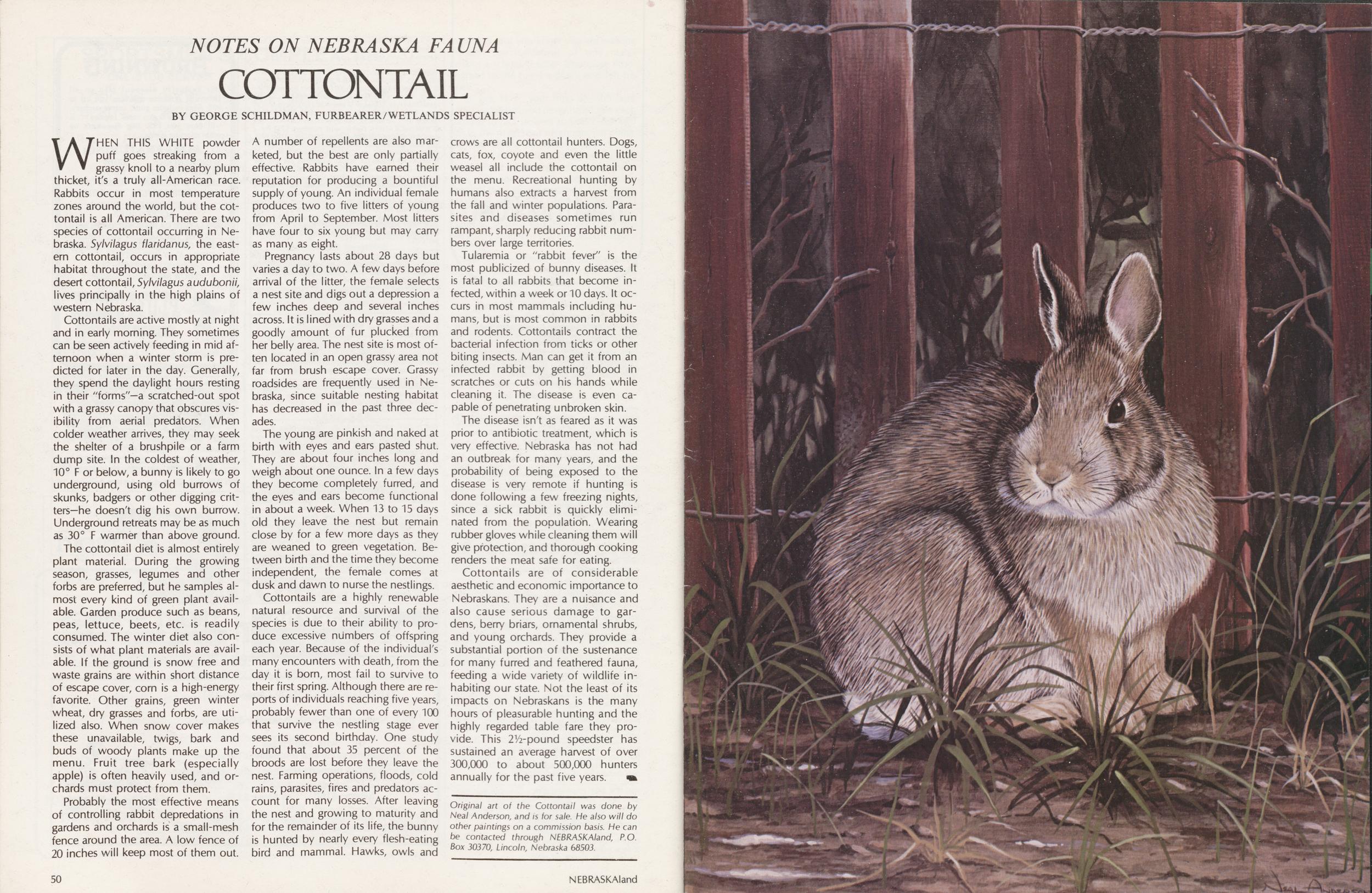
NOTES ON NEBRASKA FAUNA COTTONTAIL
BY GEORGE SCHILDMAN, FURBEARER/WETLANDS SPECIALISTWHEN THIS WHITE powder puff goes streaking from a grassy knoll to a nearby plum thicket, it's a truly ail-American race. Rabbits occur in most temperature zones around the world, but the cottontail is all American. There are two species of cottontail occurring in Nebraska. Sylvilagus flaridanus, the eastern cottontail, occurs in appropriate habitat throughout the state, and the desert cottontail, Sylvilagus audubonii, lives principally in the high plains of western Nebraska.
Cottontails are active mostly at night and in early morning. They sometimes can be seen actively feeding in mid afternoon when a winter storm is predicted for iater in the day. Generally, they spend the daylight hours resting in their "forms"—a scratched-out spot with a grassy canopy that obscures visibility from aerial predators. When colder weather arrives, they may seek the shelter of a brushpile or a farm dump site. In the coldest of weather, 10° F or below, a bunny is likely to go underground, using old burrows of skunks, badgers or other digging critters—he doesn't dig his own burrow. Underground retreats may be as much as 30° F warmer than above ground.
The cottontail diet is almost entirely plant material. During the growing season, grasses, legumes and other forbs are preferred, but he samples almost every kind of green plant available. Garden produce such as beans, peas, lettuce, beets, etc. is readily consumed. The winter diet also consists of what plant materials are available. If the ground is snow free and waste grains are within short distance of escape cover, corn is a high-energy favorite. Other grains, green winter wheat, dry grasses and forbs, are utilized also. When snow cover makes these unavailable, twigs, bark and buds of woody plants make up the menu. Fruit tree bark (especially apple) is often heavily used, and orchards must protect from them.
Probably the most effective means of controlling rabbit depredations in gardens and orchards is a small-mesh fence around the area. A low fence of 20 inches will keep most of them out. 50 A number of repellents are also marketed, but the best are only partially effective. Rabbits have earned their reputation for producing a bountiful supply of young. An individual female produces two to five litters of young from April to September. Most litters have four to six young but may carry as many as eight.
Pregnancy lasts about 28 days but varies a day to two. A few days before arrival of the litter, the female selects a nest site and digs out a depression a few inches deep and several inches across. It is lined with dry grasses and a goodly amount of fur plucked from her belly area. The nest site is most often located in an open grassy area not far from brush escape cover. Grassy roadsides are frequently used in Nebraska, since suitable nesting habitat has decreased in the past three decades.
The young are pinkish and naked at birth with eyes and ears pasted shut. They are about four inches long and weigh about one ounce. In a few days they become completely furred, and the eyes and ears become functional in about a week. When 13 to 15 days old they leave the nest but remain close by for a few more days as they are weaned to green vegetation. Between birth and the time they become independent, the female comes at dusk and dawn to nurse the nestlings.
Cottontails are a highly renewable natural resource and survival of the species is due to their ability to produce excessive numbers of offspring each year. Because of the individual's many encounters with death, from the day it is born, most fail to survive to their first spring. Although there are reports of individuals reaching five years, probably fewer than one of every 100 that survive the nestling stage ever sees its second birthday. One study found that about 35 percent of the broods are lost before they leave the nest. Farming operations, floods, cold rains, parasites, fires and predators account for many losses. After leaving the nest and growing to maturity and for the remainder of its life, the bunny is hunted by nearly every flesh-eating bird and mammal. Hawks, owls and crows are all cottontail hunters. Dogs, cats, fox, coyote and even the little weasel all include the cottontail on the menu. Recreational hunting by humans also extracts a harvest from the fall and winter populations. Parasites and diseases sometimes run rampant, sharply reducing rabbit numbers over large territories.
Tularemia or "rabbit fever" is the most publicized of bunny diseases. It is fatal to all rabbits that become infected, within a week or 10 days. It occurs in most mammals including humans, but is most common in rabbits and rodents. Cottontails contract the bacterial infection from ticks or other biting insects. Man can get it from an infected rabbit by getting blood in scratches or cuts on his hands while cleaning it. The disease is even capable of penetrating unbroken skin.
The disease isn't as feared as it was prior to antibiotic treatment, which is very effective. Nebraska has not had an outbreak for many years, and the probability of being exposed to the disease is very remote if hunting is done following a few freezing nights, since a sick rabbit is quickly eliminated from the population. Wearing rubber gloves while cleaning them will give protection, and thorough cooking renders the meat safe for eating.
Cottontails are of considerable aesthetic and economic importance to Nebraskans. They are a nuisance and also cause serious damage to gardens, berry briars, ornamental shrubs, and young orchards. They provide a substantial portion of the sustenance for many furred and feathered fauna, feeding a wide variety of wildlife inhabiting our state. Not the least of its impacts on Nebraskans is the many hours of pleasurable hunting and the highly regarded table fare they provide. This 21/2-pound speedster has sustained an average harvest of over 300,000 to about 500,000 hunters annually for the past five years.
Original art of the Cottontail was done by Neal Anderson, and is for sale. He also will do other paintings on a commission basis. He can be contacted through NEBRASKAland, P.O. Box 30370, Lincoln, Nebraska 68503. 50 NEBRASKAland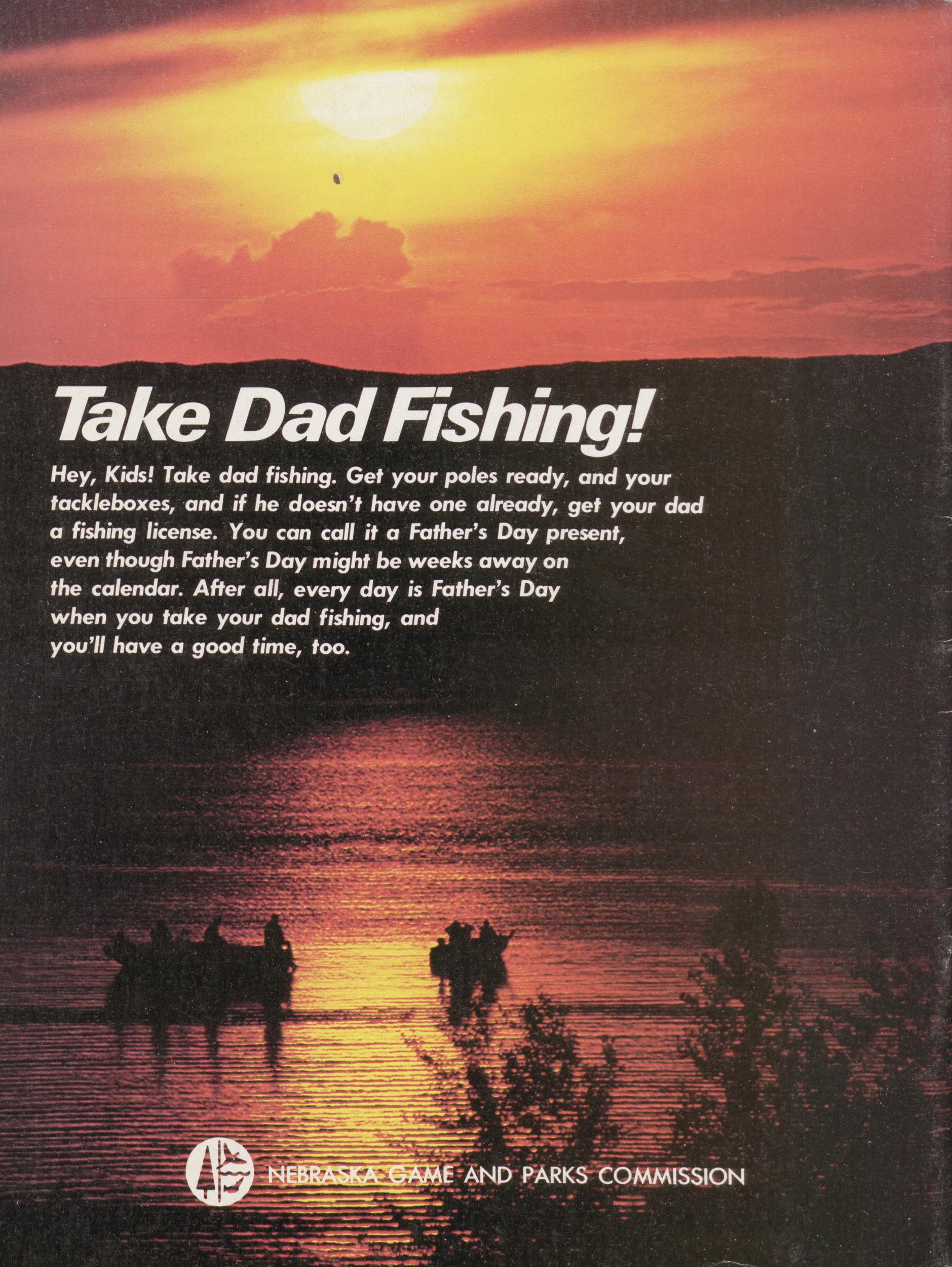
Take Dad Fishing!
Hey, Kids! Take dad fishing. Get your poles ready, and your tackleboxes, and if he doesn't have one already, get your dad a fishing license. You can call it a Father's Day present, even though Father's Day might be weeks away on the calendar. After all, every day is Father's Day when you take your dad fishing, and you'll have a good time, too. NEBRASKA GAME AND PARKS COMMISSIONPosition: 213 (35 views)