Volume 58, Issue 4, 1980
NEBRASKAland
April 1980 60 Cents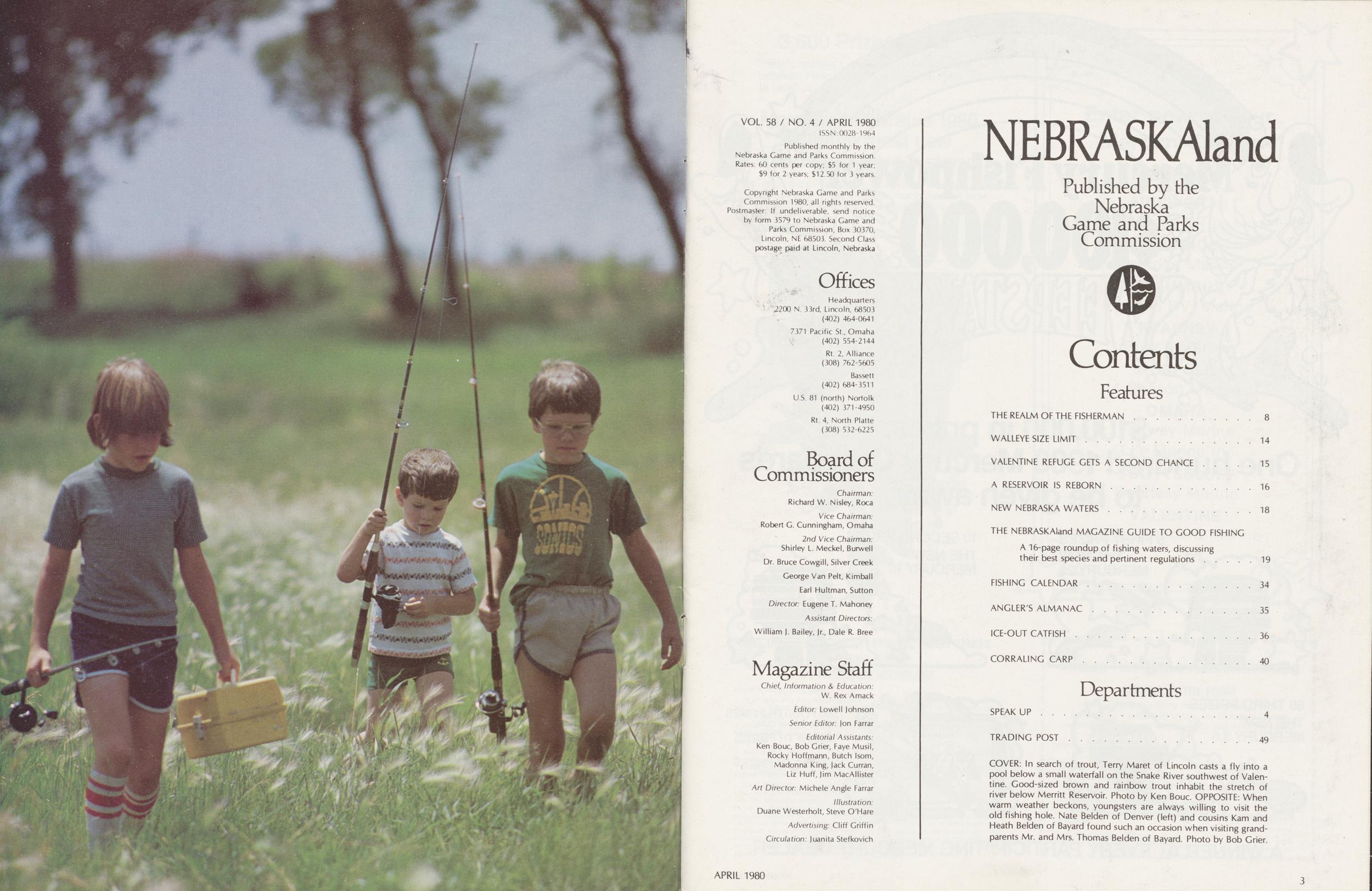
NEBRASKAland
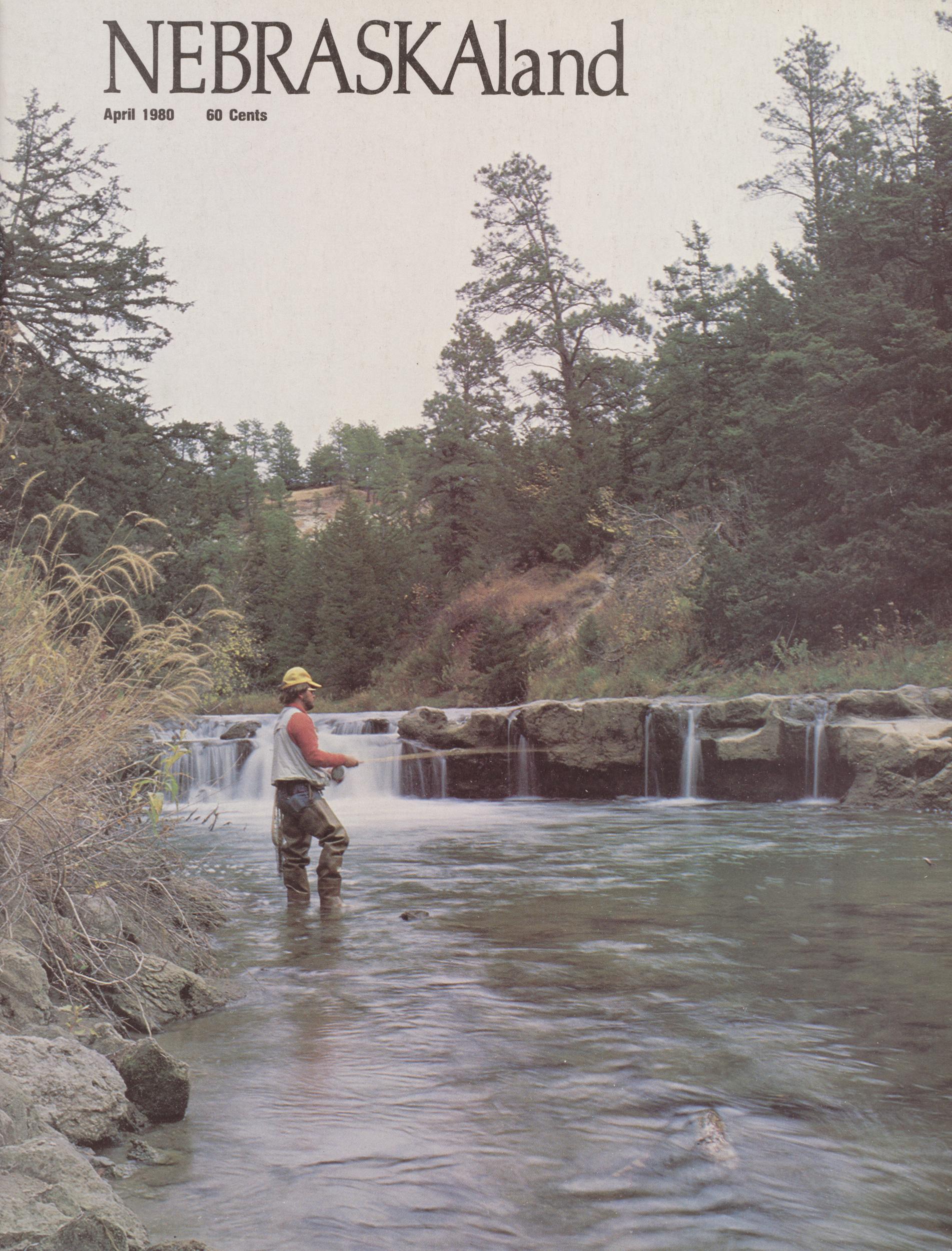
Published by the Nebraska Game and Parks Commission VOL. 58 / NO. 4 / APRIL 1980 ISSN: 0028-1964 Published monthly by the Nebraska Game and Parks Commission. Rates: 60 cents per copy; $5 for 1 year; $9 for 2 years; $12.50 for 3 years. Copyright Nebraska Game and Parks Commission 1980, all rights reserved. Postmaster: If undeliverable, send notice by form 3579 to Nebraska Game and Parks Commission, Box 30370, Lincoln, NE 68503. Second Class postage paid at Lincoln, Nebraska Offices Headquarters 2200 N. 33rd, Lincoln, 68503 (402) 464-0641 7371 Pacific St., Omaha (402) 554-2144 Rt. 2, Alliance (308) 762-5605 Bassett (402) 684-3511 U.S. 81 (north) Norfolk (402) 371-4950 Rt. 4, North Platte (308) 532-6225 Board of Commissioners Chairman: Richard W. Nisley, Roca Vice Chairman: Robert G. Cunningham, Omaha 2nd Vice Chairman: Shirley L. Meckel, Burwell Dr. Bruce Cowgill, Silver Creek George Van Pelt, Kimball Earl Hultman, Sutton Director: Eugene T. Mahoney Assistant Directors: William J. Bailey, Jr., Dale R. Bree Magazine Staff Chief, Information & Education: W. Rex Amack Editor: Lowell Johnson Senior Editor: Jon Farrar Editorial Assistants: Ken Bouc, Bob Grier, Faye Musil, Rocky Hoffmann, Butch Isom, Madonna King, Jack Curran, Liz Huff, Jim MacAllister Art Director: Michele Angle Farrar Illustration: Duane Westerholt, Steve O'Hare Advertising: Cliff Griffin Circulation: Juanita Stefkovich Contents Features THE REALM OF THE FISHERMAN 8 WALLEYE SIZE LIMIT 14 VALENTINE REFUGE GETS A SECOND CHANCE 15 A RESERVOIR IS REBORN 16 NEW NEBRASKA WATERS THE NEBRASKAland MAGAZINE GUIDE TO GOOD FISHING A 16-page roundup of fishing waters, discussing their best species and pertinent regulations FISHING CALENDAR ANGLER'S ALMANAC ICE-OUT CATFISH 18 19 34 35 36 CORRALING CARP 40 Departments SPEAK UP 4 TRADING POST 49 COVER: In search of trout, Terry Maret of Lincoln casts a fly into a pool below a small waterfall on the Snake River southwest of Valentine. Good-sized brown and rainbow trout inhabit the stretch of river below Merritt Reservoir. Photo by Ken Bouc. OPPOSITE: When warm weather beckons, youngsters are always willing to visit the old fishing hole. Nate Belden of Denver (left) and cousins Kam and Heath Belden of Bayard found such an occasion when visiting grandparents Mr. and Mrs. Thomas Belden of Bayard. Photo by Bob Grier. APRIL 1980 3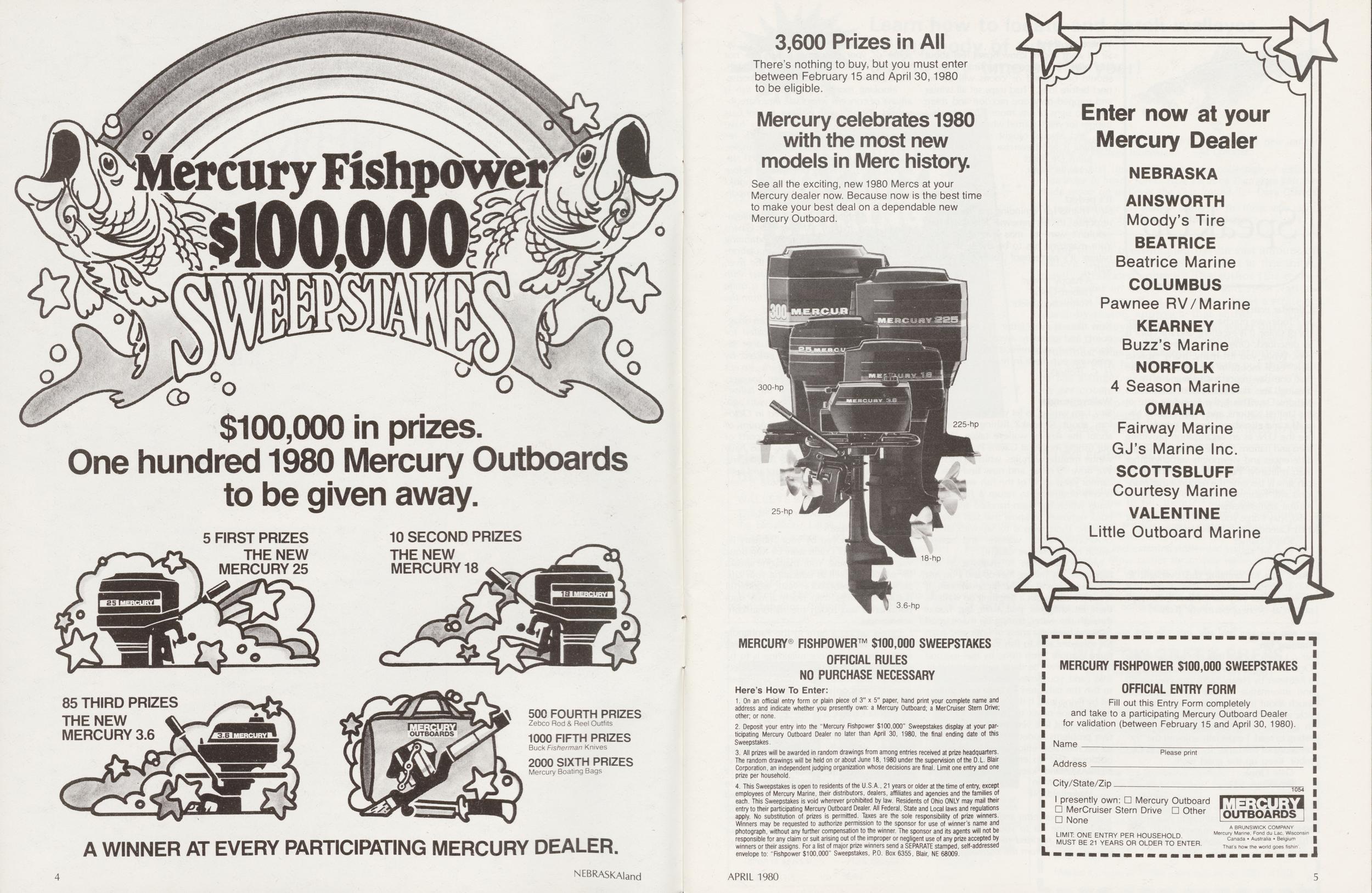
$100,000
SWEEPSTAKES
$100,000 in prizes. One hundred 1980 Mercury Outboards to be given away.
5 FIRST PRIZES THE NEW MERCURY 25
10 SECOND PRIZES THE NEW MERCURY 18
85 THIRD PRIZES THE NEW MERCURY 3.6
500 FOURTH PRIZES Zebco Rod & Reel Outfits 1000 FIFTH PRIZES Buck Fisherman Knives 2000 SIXTH PRIZES Mercury Boating Bags A WINNER AT EVERY PARTICIPATING MERCURY DEALER. 4 NEBRASKAland $100,000 in prizes. One hundred 1980 Mercury Outboards to be given away. 5 FIRST PRIZES THE NEW MERCURY 25 10 SECOND PRIZES THE NEW MERCURY 18 85 THIRD PRIZES THE NEW MERCURY 3.6 500 FOURTH PRIZES Zebco Rod & Reel Outfits 1000 FIFTH PRIZES Buck Fisherman Knives 2000 SIXTH PRIZES Mercury Boating Bags A WINNER AT EVERY PARTICIPATING MERCURY DEALER. Enter now at your Mercury Dealer NEBRASKA AINSWORTH Moody's Tire BEATRICE Beatrice Marine COLUMBUS Pawnee RV/Marine KEARNEY Buzz's Marine NORFOLK 4 Season Marine OMAHA Fairway Marine GJ's Marine Inc. SCOTTSBLUFF Courtesy Marine VALENTINE Little Outboard Marine MERCURY FISHPOWER $100,000 SWEEPSTAKES OFFICIAL ENTRY FORM Fill out this Entry Form completely and take to a participating Mercury Outboard Dealer for validation (between February 15 and April 30, 1980). Name Please print Address City/State/Zip I presently own: Mercury Outboard MerCruiser Stern Drive Other None LIMIT: ONE ENTRY PER HOUSEHOLD. MUST BE 21 YEARS OR OLDER TO ENTER. 1C54 lAhsMUsVI OUTBOARDS A BRUNSWICK COMPANY Mercury Marine, Fond du Lac. Wisconsin Canada • Australia • Belgium That's how the world goes fishin'.
Speak Up
Calendar watcher Sir / Today we purchased your 1980 Calendar of Color. It is excellent, and the color is as described. One disappointment, however. While you list many, many "special days" each month in the calendar, I note that one day important to many of us, is missing! This date is October 24-United Nations Day. This is the founding date of the United Nations, and many of us in Nebraska and elsewhere observe this day and see the U.N. as an organization providing men and nations a place to express natural differences and viewpoints verbally rather than militarily! We believe that the U.N. can slowly become the resource that mankind will habitually come to to mute its natural aggressiveness. So, May I urge you to list Oct. 24 in your 1981 Calendar as "United Nations Day". Ralph Garner Lincoln, NE Thank you for bringing this oversight to our attention. Certainly it is a day that should be not only remembered, but supported at every opportunity. (Editor) * * * Training fanSir / I wish to say that the article in the October 1979 NEBRASKAland on Training a Retriever by Henry Sader was very useful and informative. I have not heard that much about force breaking, and so the article was very enlightening on the subject. In general, NEBRASKAland is very interesting to read. I especially enjoyed the "Expressions of the Land" by Jon Farrar in October. Keep up the good work.
Dale Onisk Brookings, S.D.I assume that you also read the third supplement on the dog training in November NEBRASKAland and enjoyed that also. Thanks for the kind words, and hope you continue to be a reader. (Editor)
Where are they?Sir / I want you to know how I feel about this nighttime raccoon hunting. I say it should be stopped or 'coons will be ex- tinct before long. I had traps set all winter and trapped only one raccoon and there were no signs of any more. I have been a trapper for years, started when I was a little boy, and always caught several 'coons. Trapping is good exercise and I enjoy it.
Julius De Baets Schuyler, Nebr. * * * It's perfectSir / Thanks for reminding me (this was in response to his renewal letter). I sure wouldn't want to miss even one copy. Your magazine has to be the best in the nation. It's perfection! Thank the whole staff.
A happy reader, Hubert Golus North Loup, Nebr.Now there is a real letter...short, to the point, and certainly sweet enough. We hope that it truly reflects the attitudes of everyone out there in readerland. Thanks H. G. (Editor)
* * * Walleye wonderSir / I am writing to let you know my feelings about Nebraska fishing—first of all about the size of walleye taken. We do our fishing mostly at Gavins Point Dam in winter months with jigs, which is exciting. We drive 75 miles, and now find that we cannot keep some of the fish we catch. It is very disgusting to return a fish to the water which has been handled and had a hook removed, to know that fish may die anyway. Then, who is to say with all the cross-breeding of walleye and sauger which is the one we caught?
My second gripe is snagging in the tailwaters. My fishing friends and I do not fish this way and dislike those who do. It looks foolish to put a size limit on walleye, then let snaggers pull their big hooks through the water, tearing up many good fish and leaving a mass of lines and trash for someone else to fish in. We think that there is more harm done by this method than could ever be done with light tackle. May I add, you almost need a suit of armor to fish the tailwaters to keep from getting hit by flying lead. If these are called sportsmen, I hope never to be one.
We would like very much to see these two problems ironed out in future times so we may also enjoy what is left of our outdoors. We do enjoy all the issues of NEBRASKAland-keep up the good work.
Dean Salmon Wakefield, NEThanks for your letter and comment about the magazine. As to your other observations, I have resorted to the district fisheries supervisor from the northeast district, Lee Rupp, to answer. I hope they clear up some of your concerns, which are not without support; but like most things, there are two sides. Here is Lee's response.
"Hooking mortality of sub-legal fish is always of concern when size limits are involved, not only with walleye, but for bass and northern pike as well. Studies have shown this loss can be substantially reduced by caution on the part of the angler. (See a story on this in the April 1980 NEBRASKAland). Wetting one's hands before handling the fish, and cutting off hooks when deeply imbedded, are two important methods that should be used.
"The problem of identity in walleye-sauger (and hybrid) fisheries like Gavins Point has been considered. A continuing effort is being made to make regulations more uniform on both sides of the river, since we share it as a border water with three states. Within this effort, it is quite likely that excluding the Missouri from the walleye size limit will be studied.
"Finally, the ethics of paddlefish snagging have been thoroughly debated for years. Paddlefish represent a valuable, viable resource. It cannot be utilized by sport fishermen by any means except snagging. The conflict between snaggers and conventional fishermen in the tailwaters area was recognized several years ago, and snagging season was closed in October and April to reduce the amount of conflict in that crowded area. Reports of disagreements in the past few years have been minimal, as the majority of snagging takes place in December, January and February when bait fishing pressure is very low."
* * * Watching changesI was deeply moved by your February issue. The Sandhill Crane story by Ken Bouc was superbly done. Your magazine speaks for wildlife as well as educating your citizens about Nebraska's vast, wonderful natural resources. You reach across state boundaries and touch the national conscienceness.
I grew up on a farm in the Panhandle and each time I visit I see changes—some subtle, some not. Your magazine is to be credited for presenting a balanced spectrum so that readers can make wiser personal choices on issues.
Ruth Foos Antolini Santa Cruz, Cal.It is not our purpose in life to stir up controversy, especially needlessly, although we have opinions on things just like everyone else. We attempt to keep most of these to ourselves and concentrate on beauty, instead, hoping that people will eventually see the light and do things right. Hopefully, we do accomplish something toward that end. Thank you for your input, and we hope you keep liking us. (Editor)
6 NEBRASKAland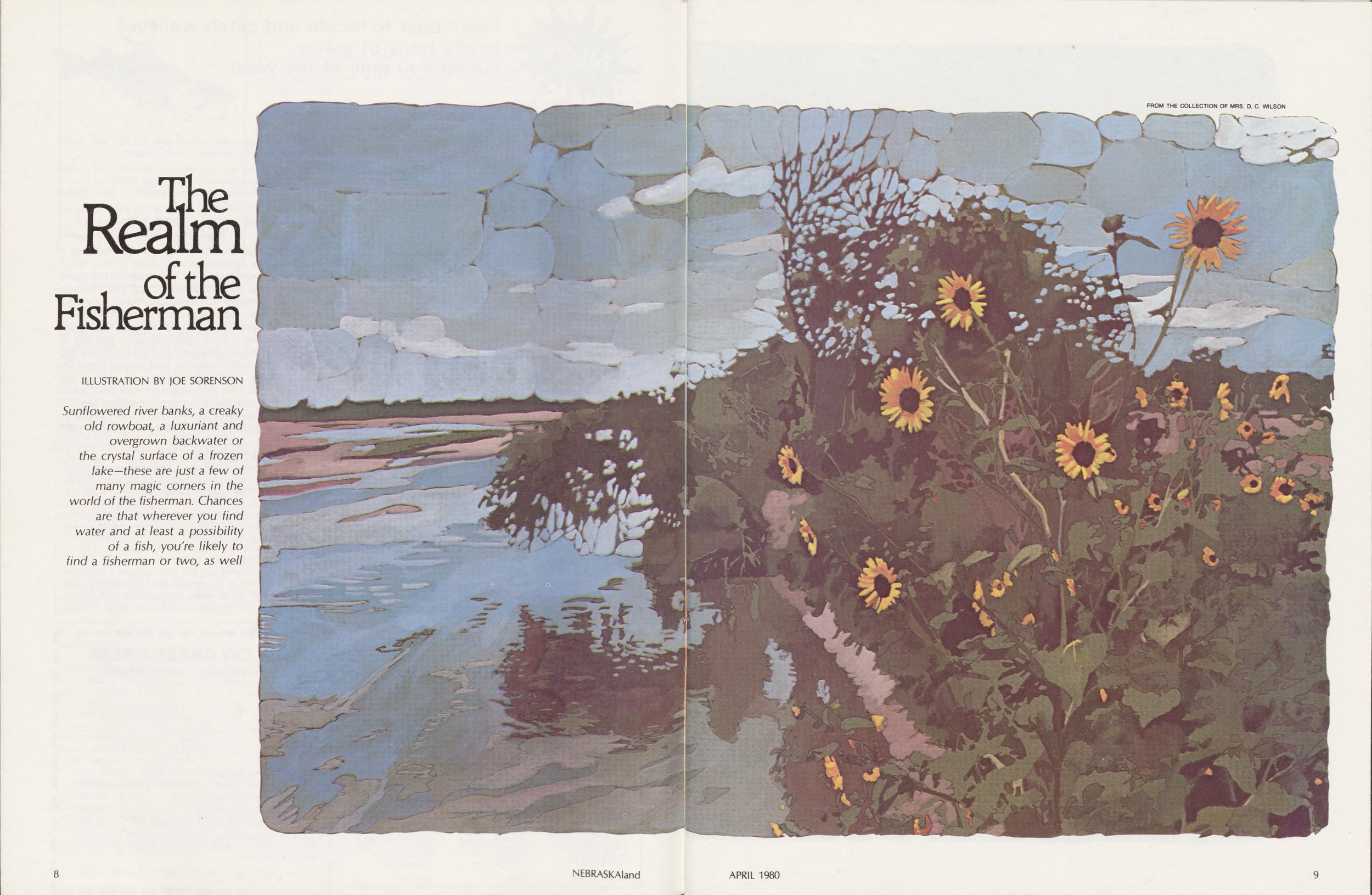
Realm of the Fisherman
ILLUSTRATION BY JOE SORENSONSunflowered river banks, a creaky old rowboat, a luxuriant and overgrown backwater or the crystal surface of a frozen lake—these are just a few of many magic corners in the world of the fisherman. Chances are that wherever you find water and at least a possibility of a fish, you're likely to find a fisherman or two, as well
8 NEBRASKAland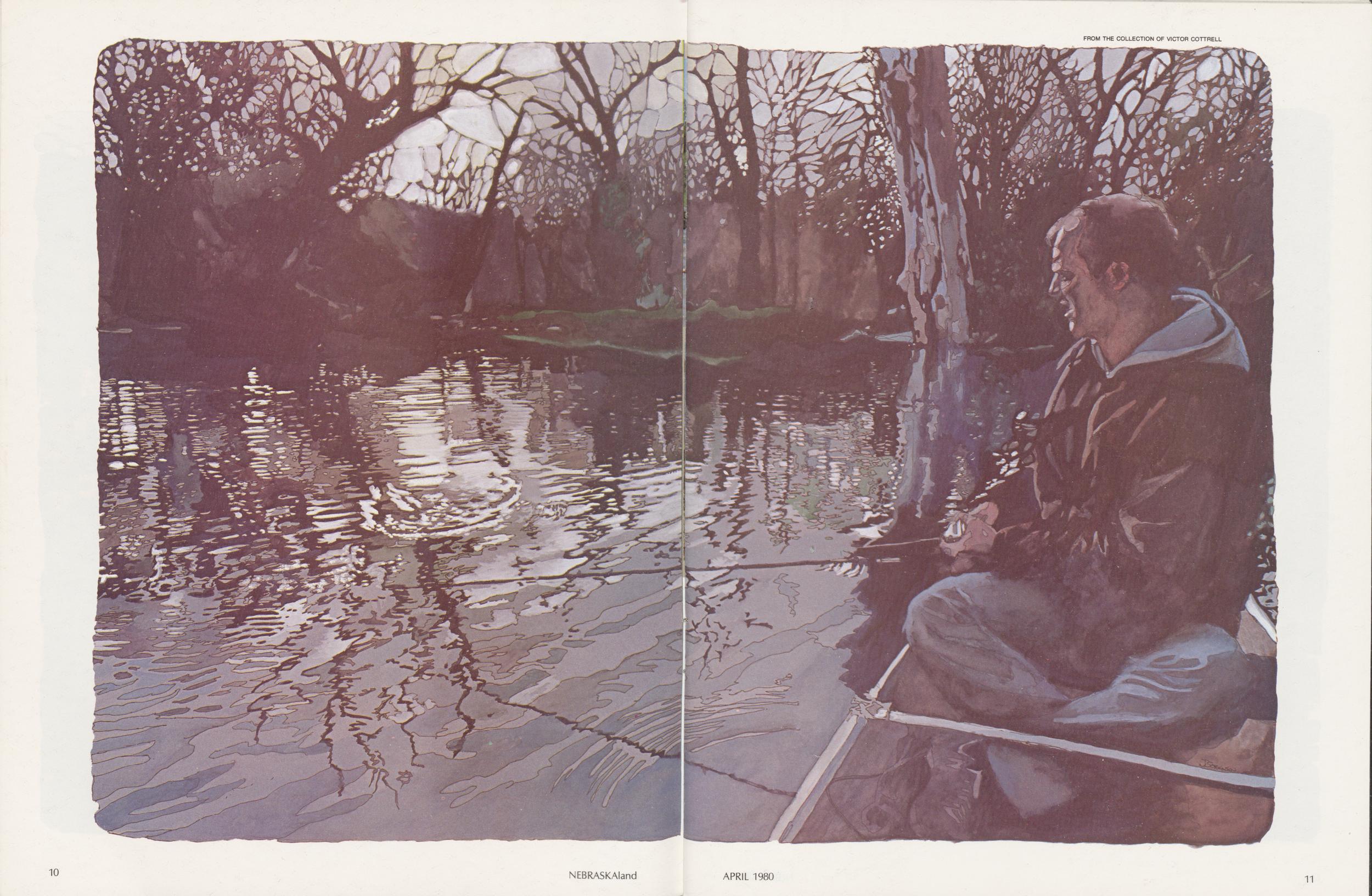
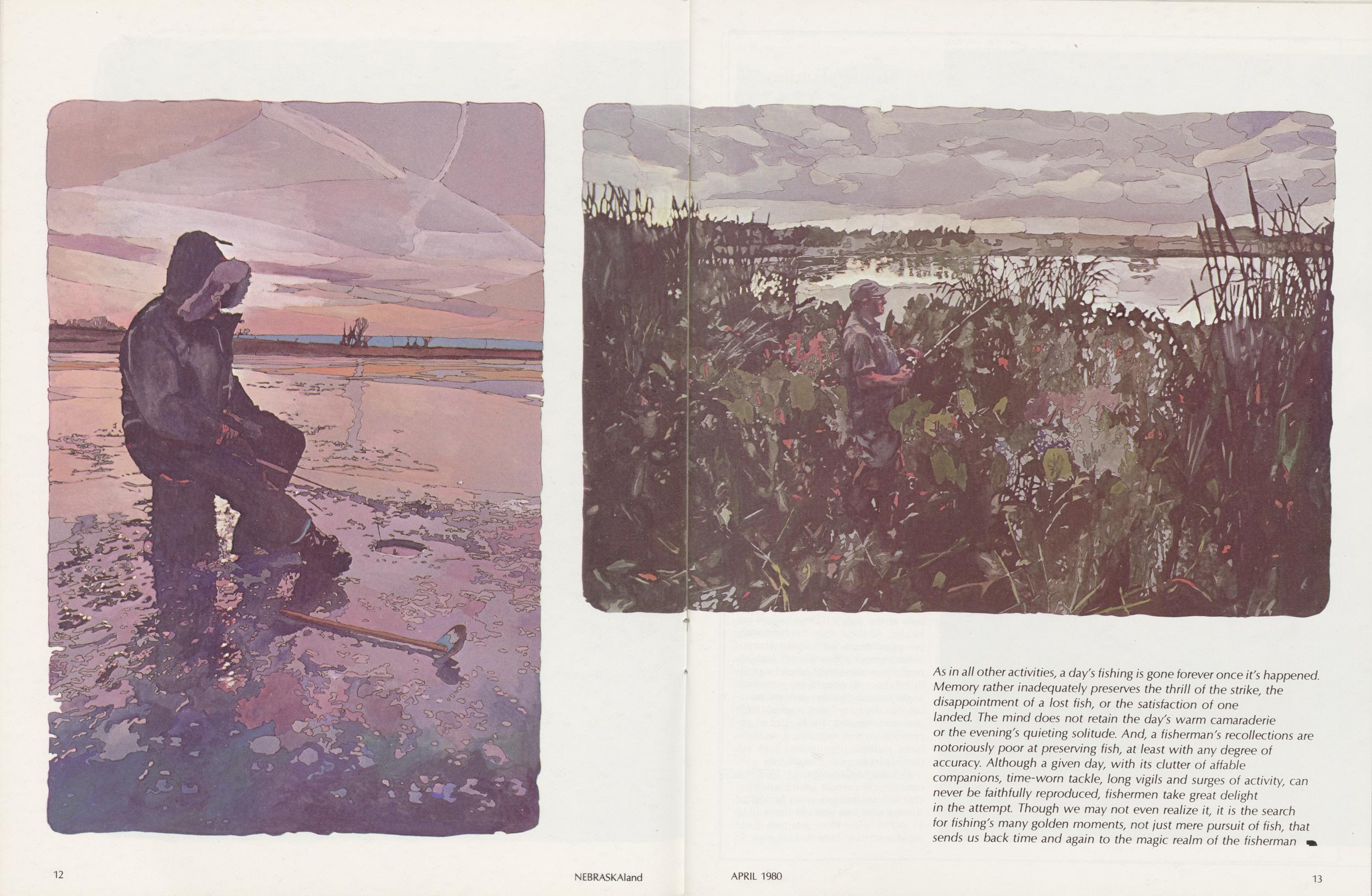
As in all other activities, a day's fishing is gone forever once it's happened. Memory rather inadequately preserves the thrill of the strike, the disappointment of a lost fish, or the satisfaction of one landed. The mind does not retain the day's warm camaraderie or the evening's quieting solitude. And, a fisherman's recollections are notoriously poor at preserving fish, at least with any degree of accuracy. Although a given day, with its clutter of affable companions, time-worn tackle, long vigils and surges of activity, can never be faithfully reproduced, fishermen take great delight in the attempt. Though we may not even realize it, it is the search for fishing's many golden moments, not just mere pursuit of fish, that sends us back time and again to the magic realm of the fisherman
APRIL 1980 13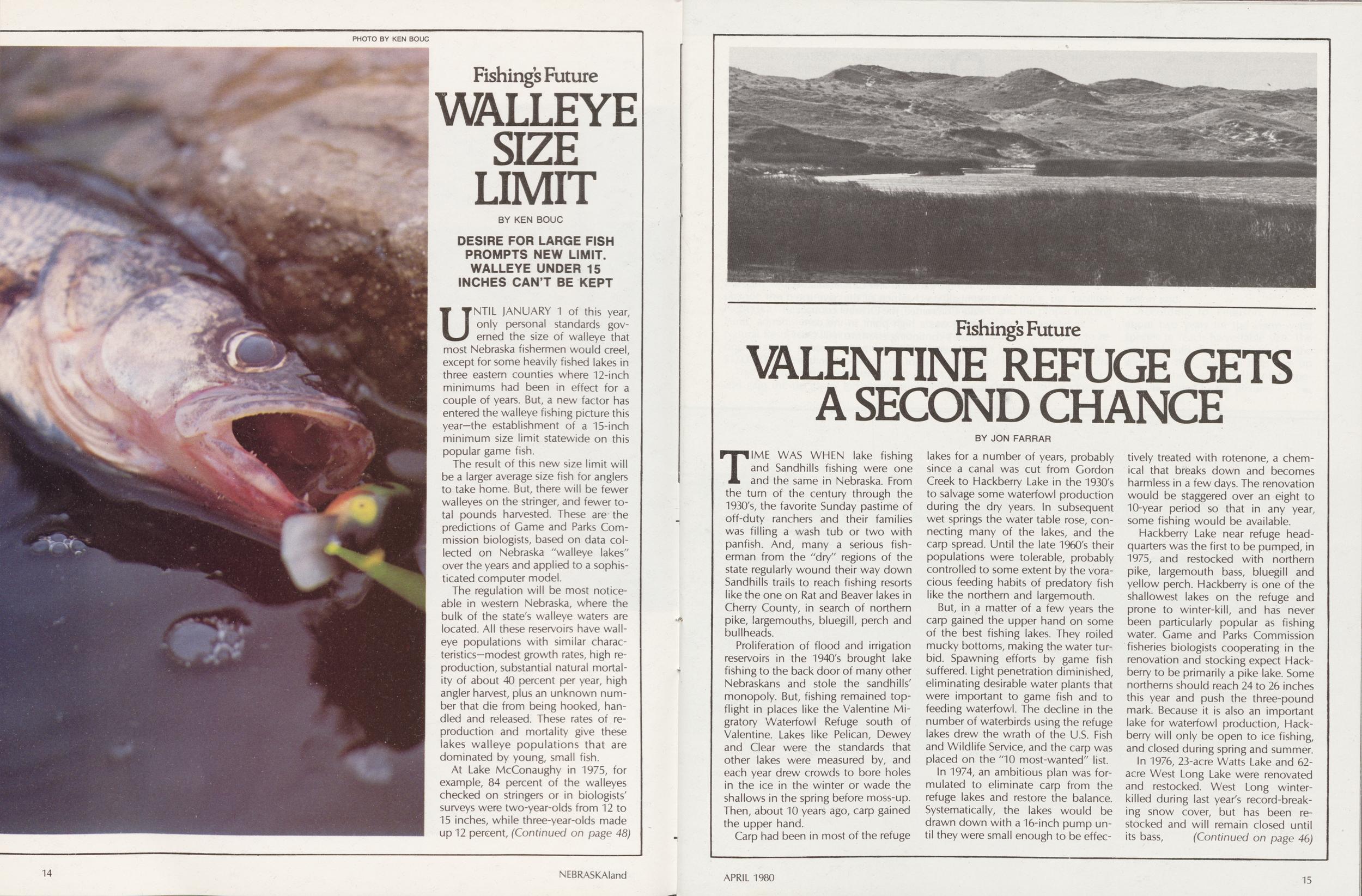
Fishing's Future WALLEYE SIZE LIMIT
UNTIL JANUARY 1 of this year, only personal standards governed the size of walleye that most Nebraska fishermen would creel, except for some heavily fished lakes in three eastern counties where 12-inch minimums had been in effect for a couple of years. But, a new factor has entered the walleye fishing picture this year—the establishment of a 15-inch minimum size limit statewide on this popular game fish.
The result of this new size limit will be a larger average size fish for anglers to take home. But, there will be fewer walleyes on the stringer, and fewer total pounds harvested. These are the predictions of Game and Parks Commission biologists, based on data collected on Nebraska "walleye lakes" over the years and applied to a sophisticated computer model.
The regulation will be most noticeable in western Nebraska, where the bulk of the state's walleye waters are located. All these reservoirs have walleye populations with similar characteristics-modest growth rates, high reproduction, substantial natural mortality of about 40 percent per year, high angler harvest, plus an unknown number that die from being hooked, handled and released. These rates of reproduction and mortality give these lakes walleye populations that are dominated by young, small fish.
At Lake McConaughy in 1975, for example, 84 percent of the walleyes checked on stringers or in biologists' surveys were two-year-olds from 12 to 15 inches, while three-year-olds made up 12 percent, (Continued on page 48)
14 NEBRASKAlandFishings Future
VALENTINE REFUGE GETS A SECOND CHANCE
BY JOHN FARRAR
TIME WAS WHEN lake fishing and Sandhills fishing were one and the same in Nebraska. From the turn of the century through the 1930's, the favorite Sunday pastime of off-duty ranchers and their families was filling a wash tub or two with panfish. And, many a serious fisherman from the "dry" regions of the state regularly wound their way down Sandhills trails to reach fishing resorts like the one on Rat and Beaver lakes in Cherry County, in search of northern pike, largemouths, bluegill, perch and bullheads.
Proliferation of flood and irrigation reservoirs in the 1940's brought lake fishing to the back door of many other Nebraskans and stole the sandhills' monopoly. But, fishing remained top-flight in places like the Valentine Migratory Waterfowl Refuge south of Valentine. Lakes like Pelican, Dewey and Clear were the standards that other lakes were measured by, and each year drew crowds to bore holes in the ice in the winter or wade the shallows in the spring before moss-up. Then, about 10 years ago, carp gained the upper hand.
Carp had been in most of the refuge lakes for a number of years, probably since a canal was cut from Gordon Creek to Hackberry Lake in the 1930's to salvage some waterfowl production during the dry years. In subsequent wet springs the water table rose, connecting many of the lakes, and the carp spread. Until the late 1960's their populations were tolerable, probably controlled to some extent by the voracious feeding habits of predatory fish like the northern and largemouth.
But, in a matter of a few years the carp gained the upper hand on some of the best fishing lakes. They roiled mucky bottoms, making the water turbid. Spawning efforts by game fish suffered. Light penetration diminished, eliminating desirable water plants that were important to game fish and to feeding waterfowl. The decline in the number of waterbirds using the refuge lakes drew the wrath of the U.S. Fish and Wildlife Service, and the carp was placed on the "10 most-wanted" list.
In 1974, an ambitious plan was formulated to eliminate carp from the refuge lakes and restore the balance. Systematically, the lakes would be drawn down with a 16-inch pump until they were small enough to be effectively treated with rotenone, a chemical that breaks down and becomes harmless in a few days. The renovation would be staggered over an eight to 10-year period so that in any year, some fishing would be available.
Hackberry Lake near refuge headquarters was the first to be pumped, in 1975, and restocked with northern pike, largemouth bass, bluegill and yellow perch. Hackberry is one of the shallowest lakes on the refuge and prone to winter-kill, and has never been particularly popular as fishing water. Game and Parks Commission fisheries biologists cooperating in the renovation and stocking expect Hackberry to be primarily a pike lake. Some northerns should reach 24 to 26 inches this year and push the three-pound mark. Because it is also an important lake for waterfowl production, Hackberry will only be open to ice fishing, and closed during spring and summer.
In 1976, 23-acre Watts Lake and 62-acre West Long Lake were renovated and restocked. West Long winter-killed during last year's record-breaking snow cover, but has been restocked and will remain closed until its bass, (Continued on page 46)
APRIL 1980 15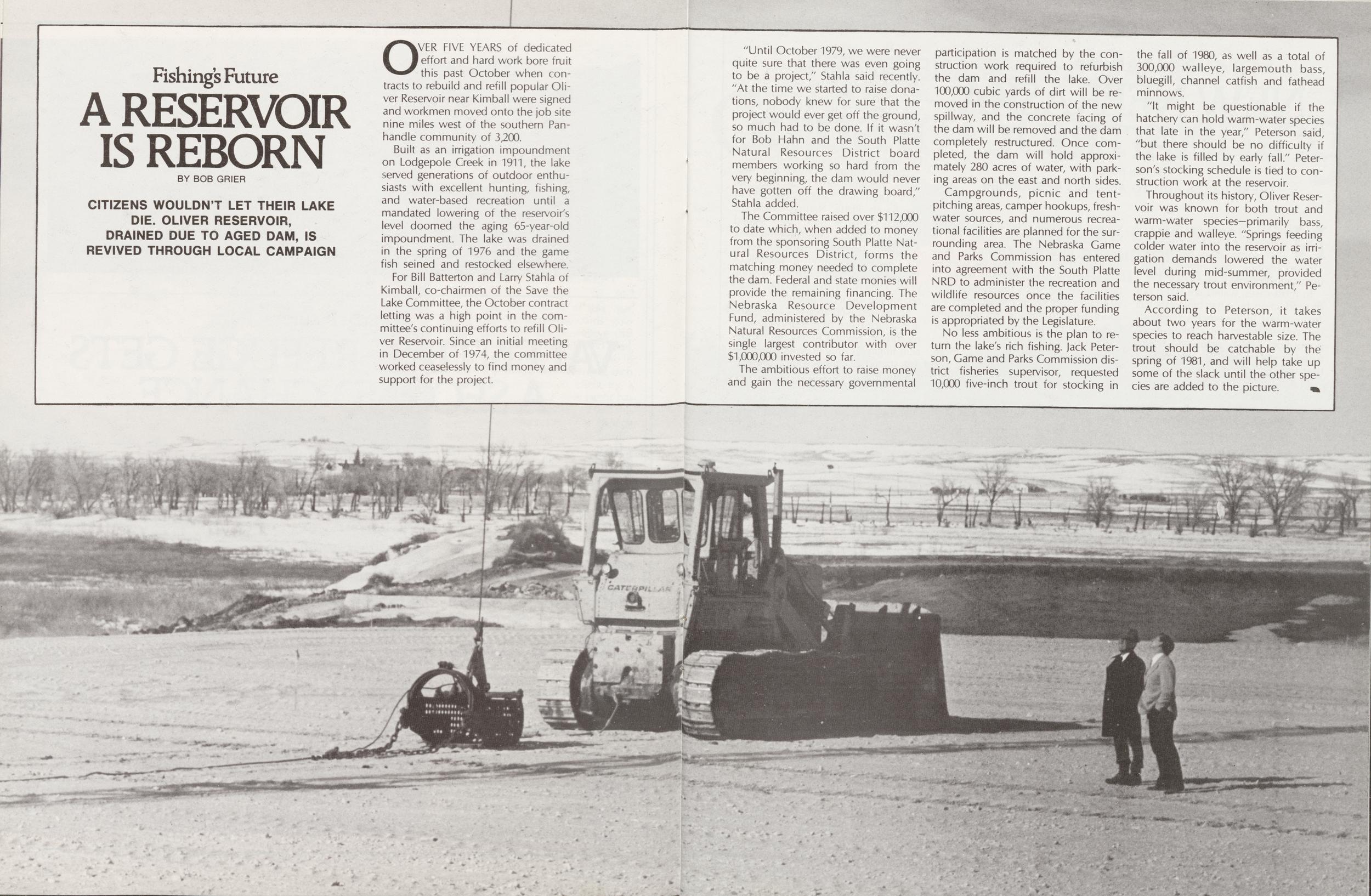
Fishings Future
A RESERVOIR IS REBORN
BY BOB GRIER CITIZENS WOULDN'T LET THEIR LAKE DIE. OLIVER RESERVOIR, DRAINED DUE TO AGED DAM, IS REVIVED THROUGH LOCAL CAMPAIGN
OVER FIVE YEARS of dedicated effort and hard work bore fruit this past October when contracts to rebuild and refill popular Oliver Reservoir near Kimball were signed and workmen moved onto the job site nine miles west of the southern Panhandle community of 3,200.
Built as an irrigation impoundment on Lodgepole Creek in 1911, the lake served generations of outdoor enthusiasts with excellent hunting, fishing, and water-based recreation until a mandated lowering of the reservoir's level doomed the aging 65-year-old impoundment. The lake was drained in the spring of 1976 and the game fish seined and restocked elsewhere.
For Bill Batterton and Larry Stahia of Kimball, co-chairmen of the Save the Lake Committee, the October contract letting was a high point in the committee's continuing efforts to refill Oli- ver Reservoir. Since an initial meeting in December of 1974, the committee worked ceaselessly to find money and support for the project.
"Until October 1979, we were never quite sure that there was even going to be a project," Stahia said recently. "At the time we started to raise donations, nobody knew for sure that the project would ever get off the ground, so much had to be done. If it wasn't for Bob Hahn and the South Platte Natural Resources District board members working so hard from the very beginning, the dam would never have gotten off the drawing board," Stahia added.
The Committee raised over $112,000 to date which, when added to money from the sponsoring South Platte Natural Resources District, forms the matching money needed to complete the dam. Federal and state monies will provide the remaining financing. The Nebraska Resource Development Fund, administered by the Nebraska Natural Resources Commission, is the single largest contributor with over $1,000,000 invested so far.
The ambitious effort to raise money and gain the necessary governmental participation is matched by the construction work required to refurbish the dam and refill the lake. Over 100,000 cubic yards of dirt will be removed in the construction of the new spillway, and the concrete facing of the dam will be removed and the dam completely restructured. Once completed, the dam will hold approximately 280 acres of water, with parking areas on the east and north sides.
Campgrounds, picnic and tent-pitching areas, camper hookups, freshwater sources, and numerous recreational facilities are planned for the surrounding area. The Nebraska Game and Parks Commission has entered into agreement with the South Platte NRD to administer the recreation and wildlife resources once the facilities are completed and the proper funding is appropriated by the Legislature.
No less ambitious is the plan to return the lake's rich fishing, jack Peterson, Game and Parks Commission district fisheries supervisor, requested 10,000 five-inch trout for stocking in the fall of 1980, as well as a total of 300,000 walleye, largemouth bass, bluegill, channel catfish and fathead minnows.
"It might be questionable if the hatchery can hold warm-water species that late in the year," Peterson said, "but there should be no difficulty if the lake is filled by early fall." Peterson's stocking schedule is tied to construction work at the reservoir.
Throughout its history, Oliver Reservoir was known for both trout and warm-water species—primarily bass, crappie and walleye. "Springs feeding colder water into the reservoir as irrigation demands lowered the water level during mid-summer, provided the necessary trout environment," Peterson said.
According to Peterson, it takes about two years for the warm-water species to reach harvestable size. The trout should be catchable by the spring of 1981, and will help take up some of the slack until the other species are added to the picture.
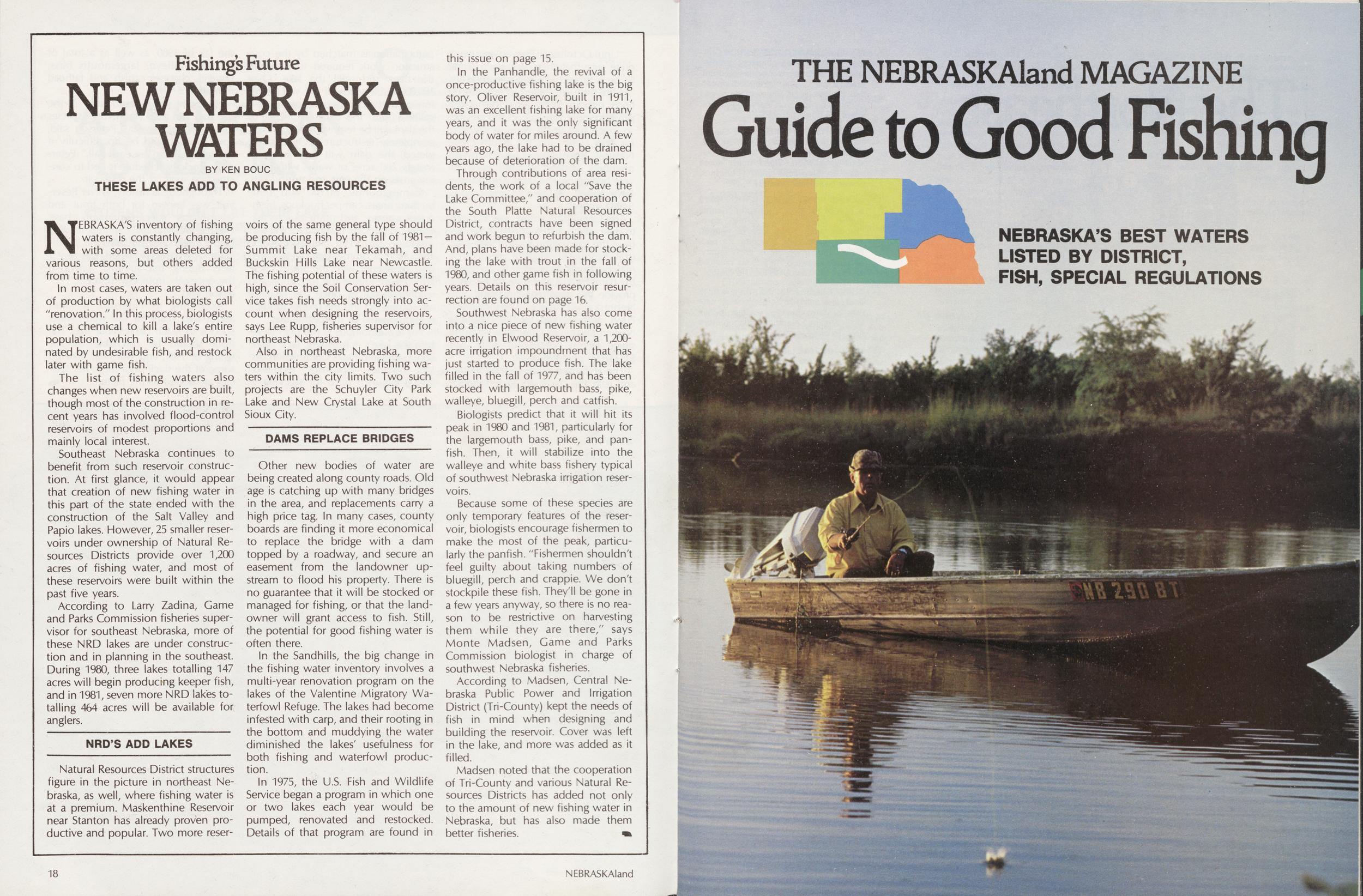
THE NEBRASKAland MAGAZINE Guide to Good Fishing
NEBRASKA'S BEST WATERS LISTED BY DISTRICT, FISH, SPECIAL REGULATIONS
Fishings Future NEW NEBRASKA WATERS
THESE LAKES ADD TO ANGLING RESOURCESNEBRASKA'S inventory of fishing waters is constantly changing, with some areas deleted for various reasons, but others added from time to time.
In most cases, waters are taken out of production by what biologists call "renovation." In this process, biologists use a chemical to kill a lake's entire population, which is usually dominated by undesirable fish, and restock later with game fish.
The list of fishing waters also changes when new reservoirs are built, though most of the construction in recent years has involved flood-control reservoirs of modest proportions and mainly local interest.
Southeast Nebraska continues to benefit from such reservoir construction. At first glance, it would appear that creation of new fishing water in this part of the state ended with the construction of the Salt Valley and Papio lakes. However, 25 smaller reservoirs under ownership of Natural Resources Districts provide over 1,200 acres of fishing water, and most of these reservoirs were built within the past five years.
According to Larry Zadina, Game and Parks Commission fisheries supervisor for southeast Nebraska, more of these NRD lakes are under construction and in planning in the southeast. During 1980, three lakes totalling 147 acres will begin producing keeper fish, and in 1981, seven more NRD lakes totalling 464 acres will be available for anglers.
NRD'S ADD LAKESNatural Resources District structures figure in the picture in northeast Nebraska, as well, where fishing water is at a premium. Maskenthine Reservoir near Stanton has already proven productive and popular. Two more reservoirs of the same general type should be producing fish by the fall of 1981 — Summit Lake near Tekamah, and Buckskin Hills Lake near Newcastle. The fishing potential of these waters is high, since the Soil Conservation Service takes fish needs strongly into account when designing the reservoirs, says Lee Rupp, fisheries supervisor for northeast Nebraska.
Also in northeast Nebraska, more communities are providing fishing waters within the city limits. Two such projects are the Schuyler City Park Lake and New Crystal Lake at South Sioux City.
DAMS REPLACE BRIDGESOther new bodies of water are being created along county roads. Old age is catching up with many bridges in the area, and replacements carry a high price tag. In many cases, county boards are finding it more economical to replace the bridge with a dam topped by a roadway, and secure an easement from the landowner upstream to flood his property. There is no guarantee that it will be stocked or managed for fishing, or that the landowner will grant access to fish. Still, the potential for good fishing water is often there.
In the Sandhills, the big change in the fishing water inventory involves a multi-year renovation program on the lakes of the Valentine Migratory Waterfowl Refuge. The lakes had become infested with carp, and their rooting in the bottom and muddying the water diminished the lakes' usefulness for both fishing and waterfowl production.
In 1975, the U.S. Fish and Wildlife Service began a program in which one or two lakes each year would be pumped, renovated and restocked. Details of that program are found in this issue on page 15.
In the Panhandle, the revival of a once-productive fishing lake is the big story. Oliver Reservoir, built in 1911, was an excellent fishing lake for many years, and it was the only significant body of water for miles around. A few years ago, the lake had to be drained because of deterioration of the dam.
Through contributions of area residents, the work of a local "Save the Lake Committee," and cooperation of the South Platte Natural Resources District, contracts have been signed and work begun to refurbish the dam. And, plans have been made for stocking the lake with trout in the fall of 1980, and other game fish in following years. Details on this reservoir resurrection are found on page 16.
Southwest Nebraska has also come into a nice piece of new fishing water recently in Elwood Reservoir, a 1,200-acre irrigation impoundment that has just started to produce fish. The lake filled in the fall of 1977, and has been stocked with largemouth bass, pike, walleye, bluegill, perch and catfish.
Biologists predict that it will hit its peak in 1980 and 1981, particularly for the largemouth bass, pike, and panfish. Then, it will stabilize into the walleye and white bass fishery typical of southwest Nebraska irrigation reservoirs.
Because some of these species are only temporary features of the reservoir, biologists encourage fishermen to make the most of the peak, particularly the panfish. "Fishermen shouldn't feel guilty about taking numbers of bluegill, perch and crappie. We don't stockpile these fish. They'll be gone in a few years anyway, so there is no reason to be restrictive on harvesting them while they are there," says Monte Madsen, Game and Parks Commission biologist in charge of southwest Nebraska fisheries.
According to Madsen, Central Nebraska Public Power and Irrigation District (Tri-County) kept the needs of fish in mind when designing and building the reservoir. Cover was left in the lake, and more was added as it filled.
Madsen noted that the cooperation of Tri-County and various Natural Resources Districts has added not only to the amount of new fishing water in Nebraska, but has also made them better fisheries.
18 NEBRASKAland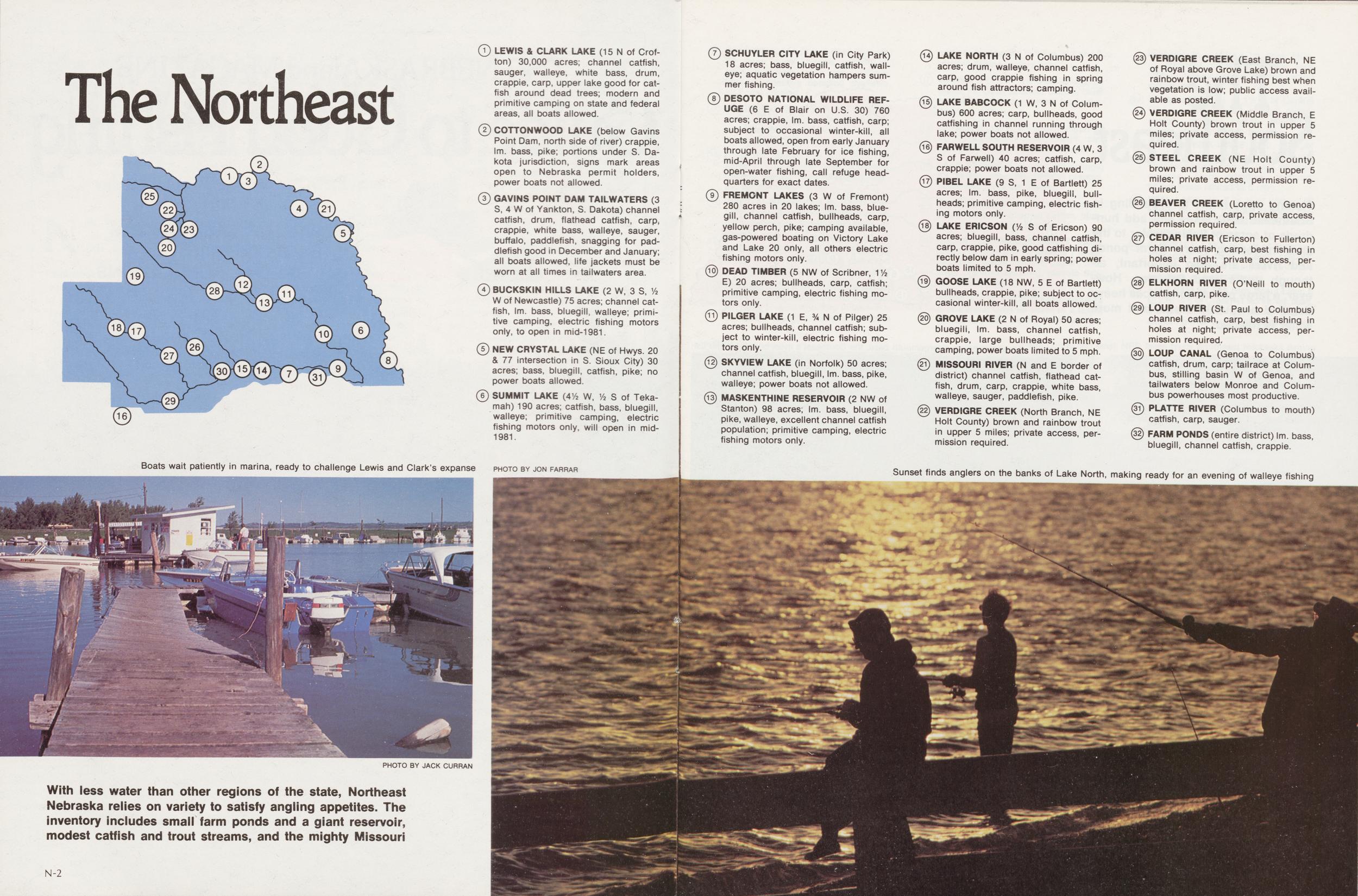
The Northeast
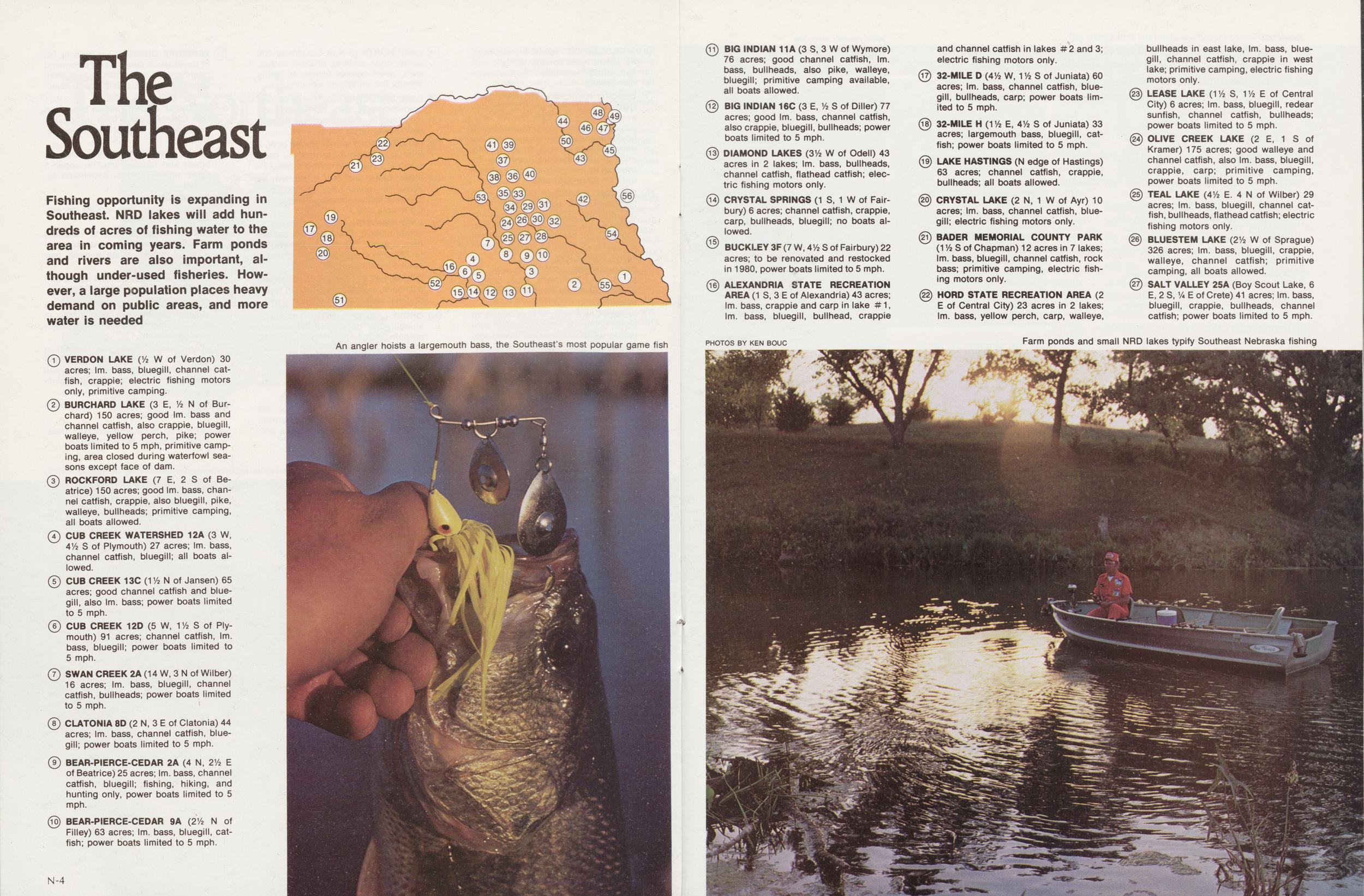
The Southeast
Fishing opportunity is expanding in Southeast. NRD lakes will add hundreds of acres of fishing water to the area in coming years. Farm ponds and rivers are also important, although under-used fisheries. However, a large population places heavy demand on public areas, and more water is needed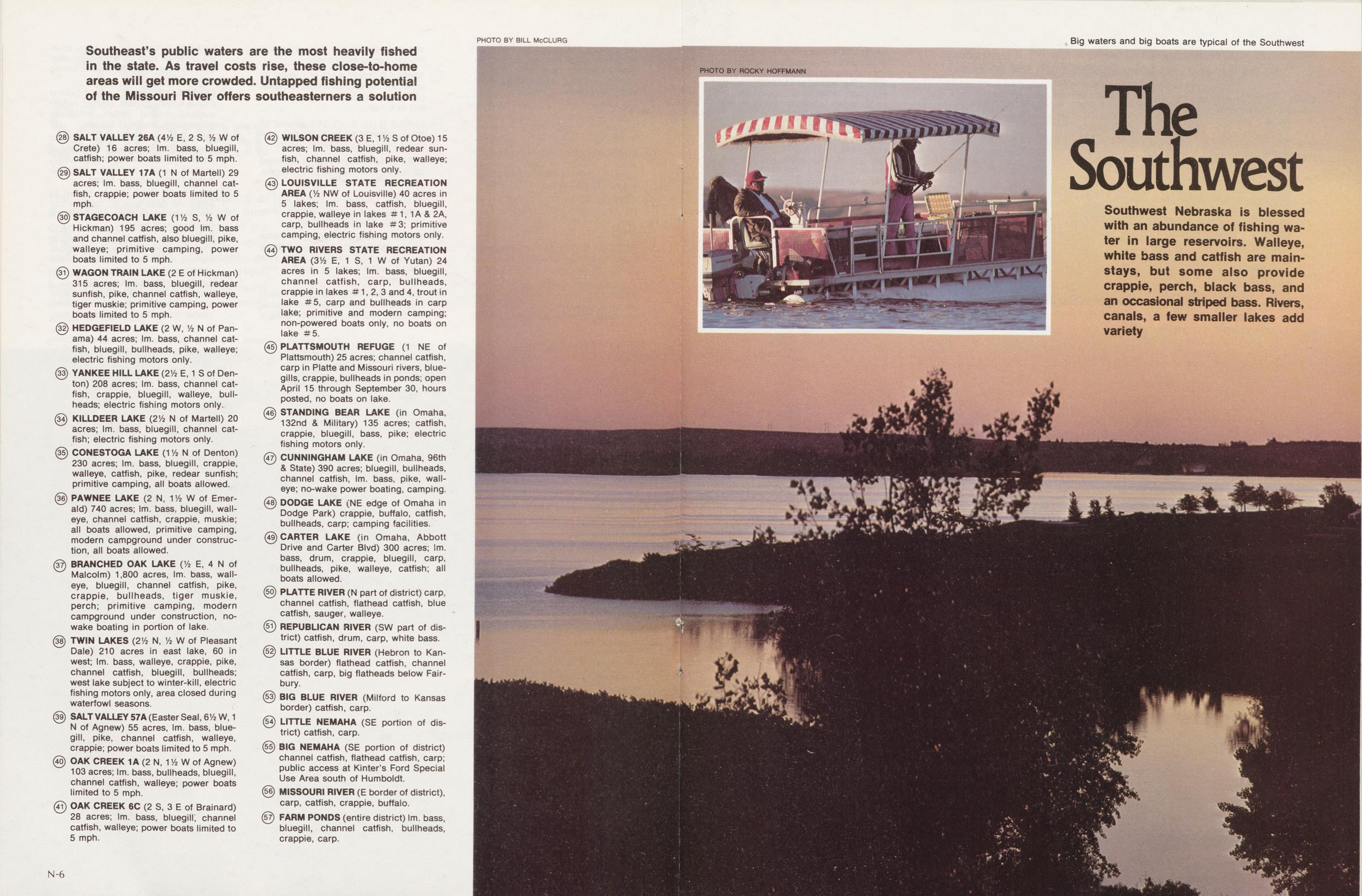 Southeast's public waters are the most heavily fished in the state. As travel costs rise, these close-to-home areas will get more crowded. Untapped fishing potential of the Missouri River offers southeasterners a solution 28 SALT VALLEY 26A (4½ E, 2 S, ½ W of Crete) 16 acres; Im. bass, bluegill, catfish; power boats limited to 5 mph. 29 SALT VALLEY 17A (1 N of Martell) 29 acres; Im. bass, bluegill, channel catfish, crappie; power boats limited to 5 mph 30 STAGECOACH LAKE (1½ S, ½ W of Hickman) 195 acres; good Im. bass and channel catfish, also bluegill, pike, walleye; primitive camping, power boats limited to 5 mph. 31 WAGON TRAIN LAKE (2 E of Hickman) 315 acres; Im. bass, bluegill, redear sunfish, pike, channel catfish, walleye, tiger muskie; primitive camping, power boats limited to 5 mph. 32 HEDGEFIELD LAKE (2 W, ½ N of Panama) 44 acres; Im. bass, channel catfish, bluegill, bullheads, pike, walleye; electric fishing motors only. 33 YANKEE HILL LAKE (2½ E, 1 S of Denton) 208 acres; Im. bass, channel catfish, crappie, bluegill, walleye, bullheads; electric fishing motors only. 34 KILLDEER LAKE (2½ N of Martell) 20 acres; Im. bass, bluegill, channel catfish; electric fishing motors only. 35 CONESTOGA LAKE (1½ N of Denton) 230 acres; Im. bass, bluegill, crappie, walleye, catfish, pike, redear sunfish; primitive camping, all boats allowed. 36 PAWNEE LAKE (2 N, 1½ W of Emerald) 740 acres; Im. bass, bluegill, walleye, channel catfish, crappie, muskie; all boats allowed, primitive camping, modern campground under construction, all boats allowed. 37 BRANCHED OAK LAKE (½ E, 4 N of Malcolm) 1,800 acres, Im. bass, walleye, bluegill, channel catfish, pike, crappie, bullheads, tiger muskie, perch; primitive camping, modern campground under construction, nowake boating in portion of lake. 38 TWIN LAKES (2½ N, ½ W of Pleasant Dale) 210 acres in east lake, 60 in west; Im. bass, walleye, crappie, pike, channel catfish, bluegill, bullheads; west lake subject to winter-kill, electric fishing motors only, area closed during waterfowl seasons. 39 SALT VALLEY 57A (Easter Seal, 6½ W, 1 N of Agnew) 55 acres, Im. bass, bluegill, pike, channel catfish, walleye, crappie; power boats limited to 5 mph. 40 OAK CREEK 1A (2 N, 1½ W of Agnew) 103 acres; Im. bass, bullheads, bluegill, channel catfish, walleye; power boats limited to 5 mph. 41 OAK CREEK 6C (2 S, 3 E of Brainard) 28 acres; Im. bass, bluegill, channel catfish, walleye; power boats limited to 5 mph. 42 WILSON CREEK (3 E, 1½ S of Otoe) 15 acres; Im. bass, bluegill, redear sunfish, channel catfish, pike, walleye; electric fishing motors only. 43 LOUISVILLE STATE RECREATION AREA (½ NW of Louisville) 40 acres in 5 lakes; Im. bass, catfish, bluegill, crappie, walleye in lakes #1, 1A & 2A, carp, bullheads in lake #3; primitive camping, electric fishing motors only. 44 TWO RIVERS STATE RECREATION AREA (3½ E, 1 S, 1 W of Yutan) 24 acres in 5 lakes; Im. bass, bluegill, channel catfish, carp, bullheads, crappie in lakes # 1, 2, 3 and 4, trout in lake #5, carp and bullheads in carp lake; primitive and modern camping; non-powered boats only, no boats on lake #5. 45 PLATTSMOUTH REFUGE (1 NE of Plattsmouth) 25 acres; channel catfish, carp in Platte and Missouri rivers, bluegills, crappie, bullheads in ponds; open April 15 through September 30, hours posted, no boats on lake. 46 STANDING BEAR LAKE (in Omaha, 132nd & Military) 135 acres; catfish, crappie, bluegill, bass, pike; electric fishing motors only. 47 CUNNINGHAM LAKE (in Omaha, 96th 6 State) 390 acres; bluegill, bullheads, channel catfish, Im. bass, pike, walleye; no-wake power boating, camping. 48 DODGE LAKE (NE edge of Omaha in Dodge Park) crappie, buffalo, catfish, bullheads, carp; camping facilities. 50 PLATTE RIVER (N part of district) carp, channel catfish, flathead catfish, blue catfish, sauger, walleye. 51 REPUBLICAN RIVER (SW part of district) catfish, drum, carp, white bass. 52 LITTLE BLUE RIVER (Hebron to Kansas border) flathead catfish, channel catfish, carp, big flatheads below Fairbury. 53 BIG BLUE RIVER (Milford to Kansas border) catfish, carp. 54 LITTLE NEMAHA (SE portion of district) catfish, carp. 55 BIG NEMAHA (SE portion of district) channel catfish, flathead catfish, carp; public access at Kinter's Ford Special Use Area south of Humboldt. 56 MISSOURI RIVER (E border of district), carp, catfish, crappie, buffalo. 57 FARM PONDS (entire district) Im. bass, bluegill, channel catfish, bullheads, crappie, carp. N-6
The Southwest
Southwest Nebraska is blessed with an abundance of fishing water in large reservoirs. Walleye, white bass and catfish are mainstays, but some also provide crappie, perch, black bass, and an occasional striped bass, canals, a few smaller lakes add variety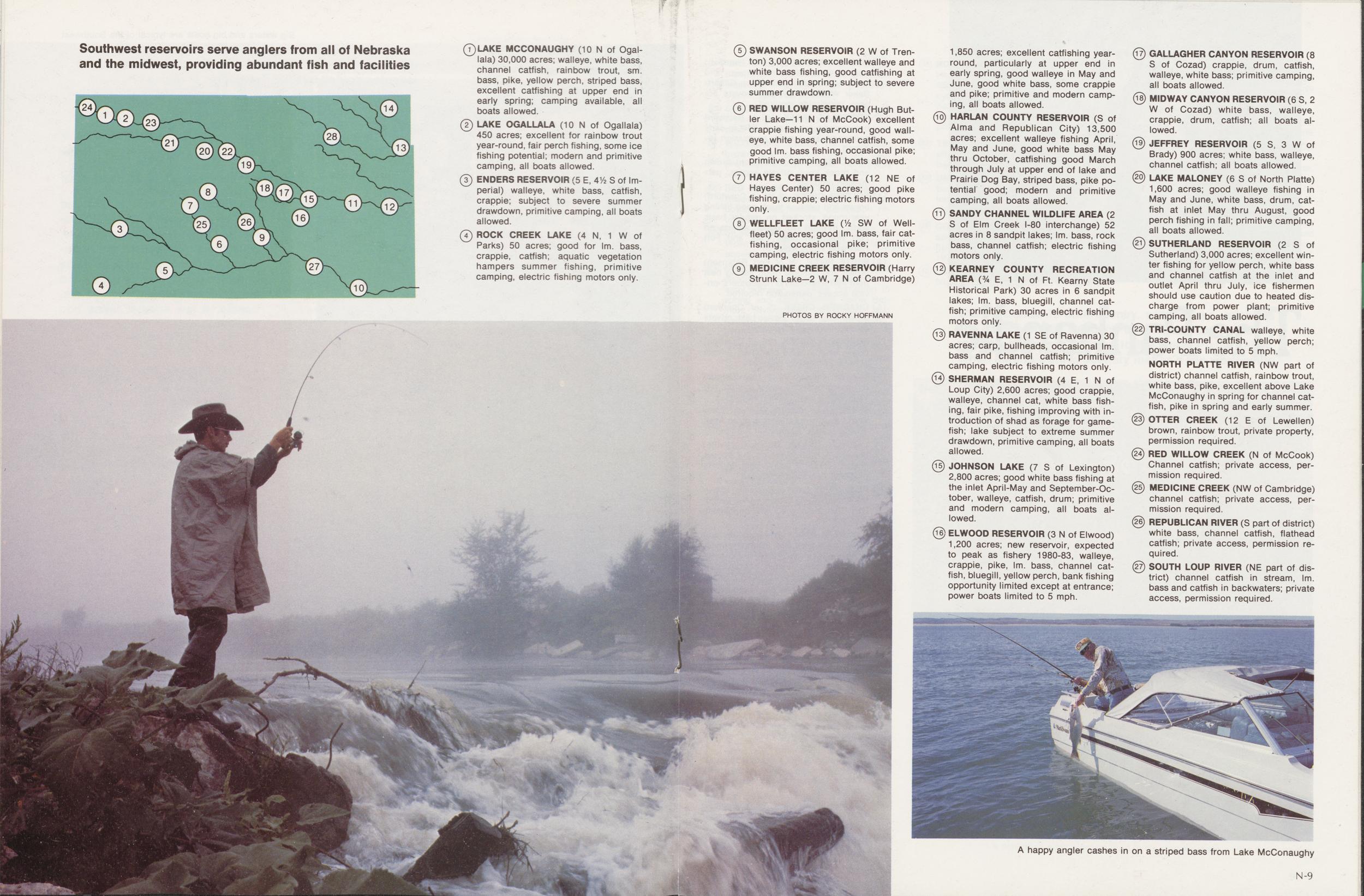 Southwest reservoirs serve anglers from all of Nebraska and the midwest, providing abundant fish and facilities
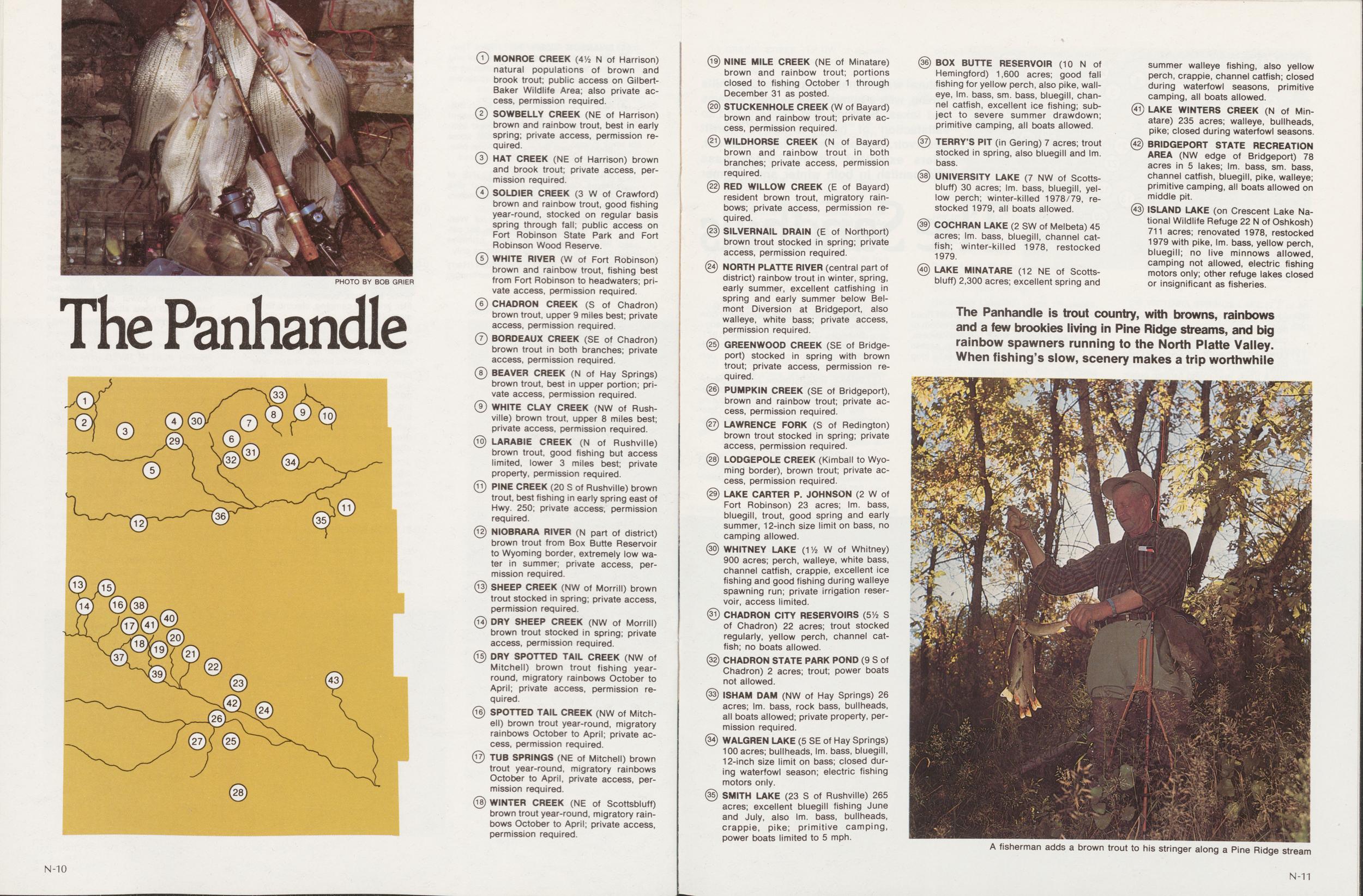
The Panhandle
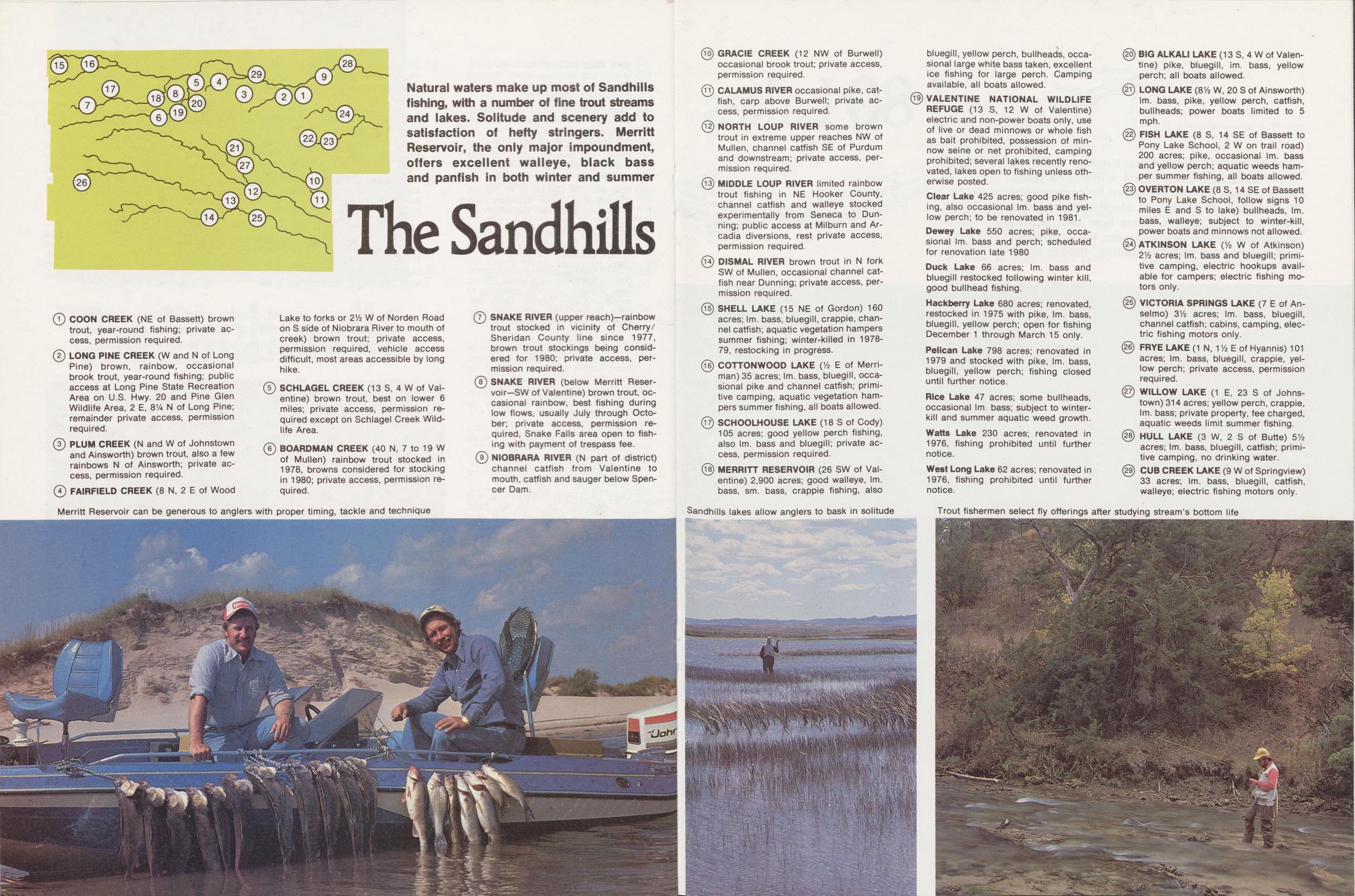
The Sandhills
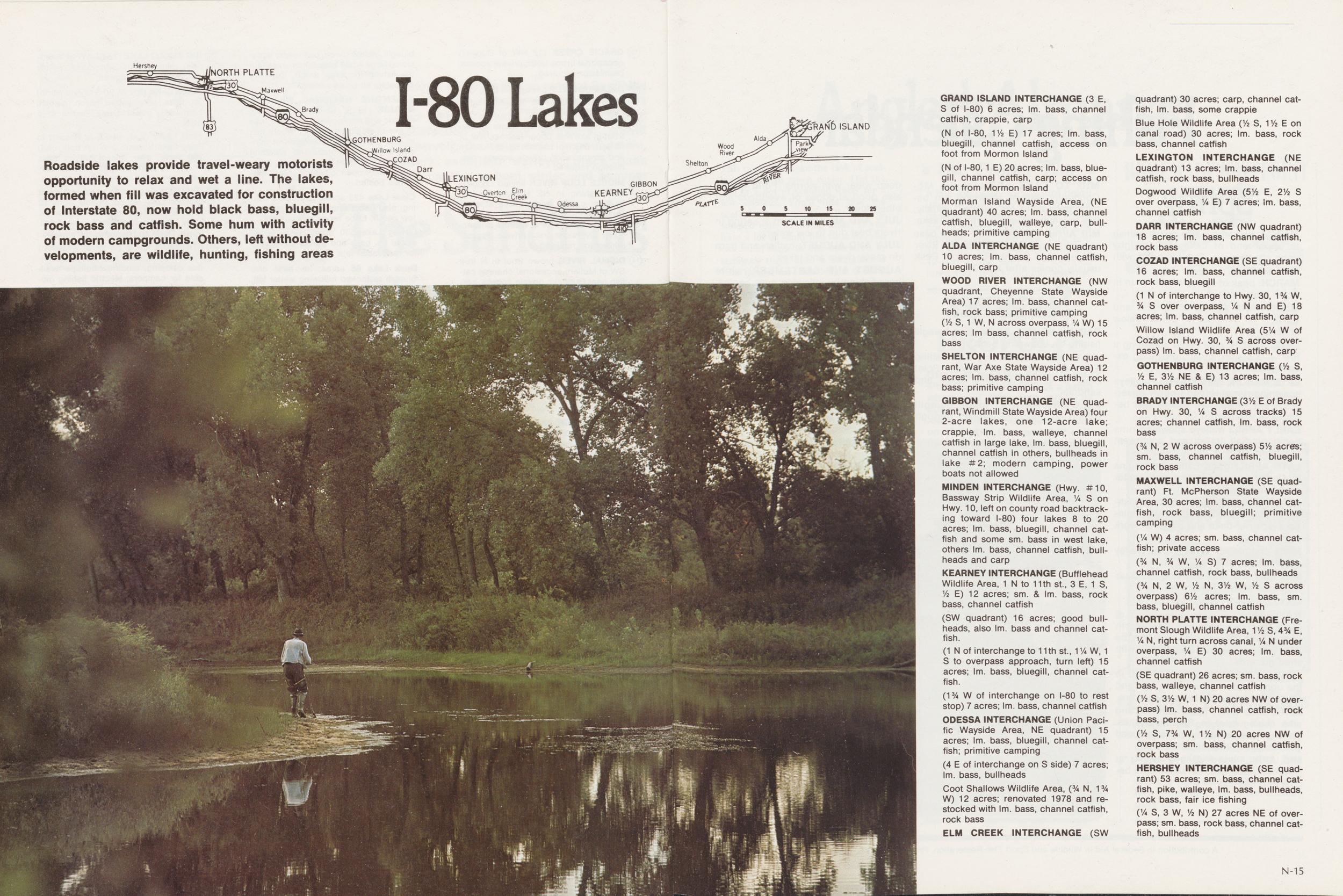
I-80 Lakes
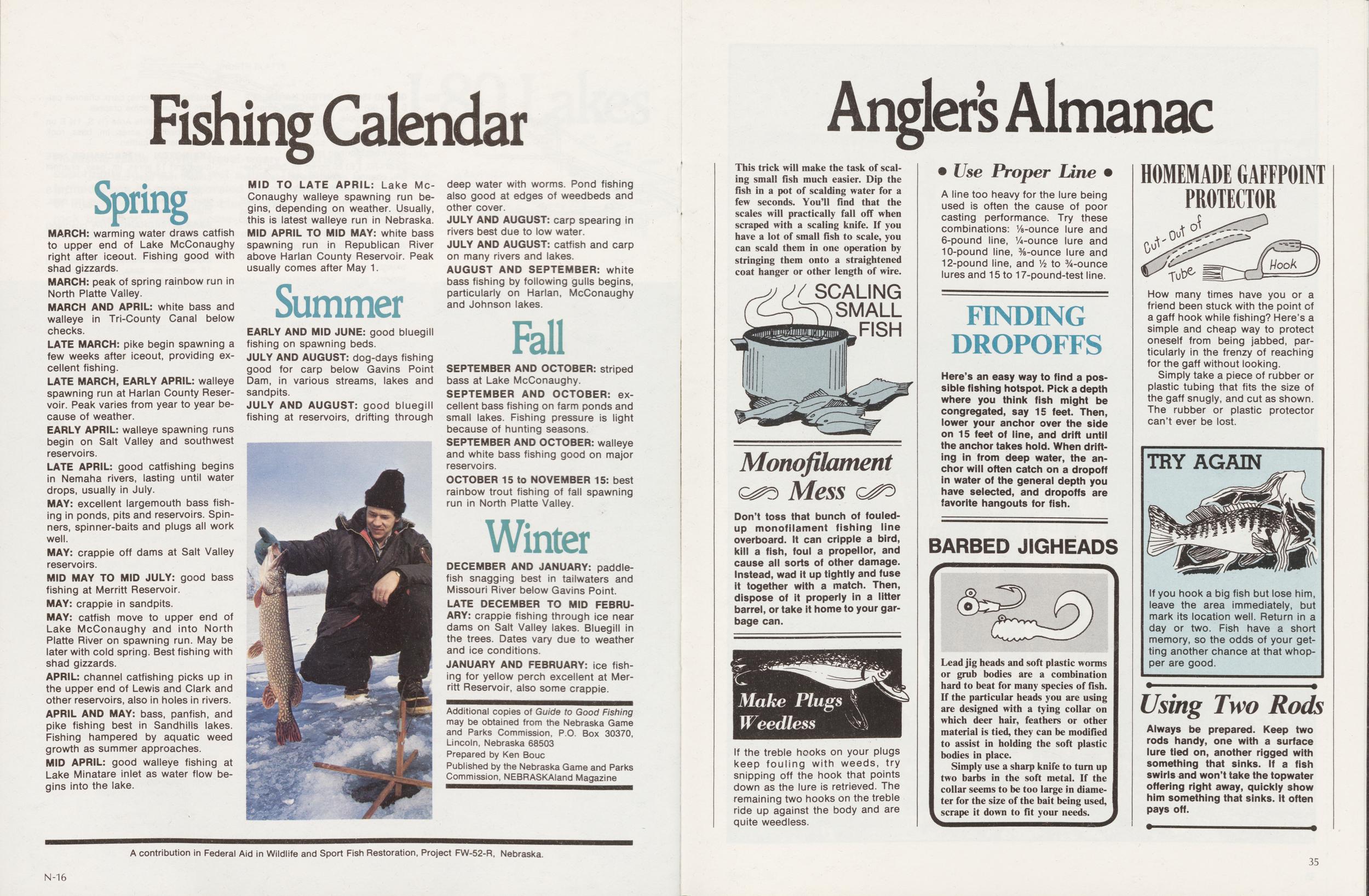
Fishing Calendar
Spring MARCH: warming water draws catfish to upper end of Lake McConaughy right after iceout. Fishing good with shad gizzards. MARCH: peak of spring rainbow run in North Platte Valley. MARCH AND APRIL: white bass and walleye in Tri-County Canal below checks. LATE MARCH: pike begin spawning a few weeks after iceout, providing excellent fishing. LATE MARCH, EARLY APRIL: walleye spawning run at Harlan County Reservoir. Peak varies from year to year because of weather. EARLY APRIL: walleye spawning runs begin on Salt Valley and southwest reservoirs. LATE APRIL: good catfishing begins in Nemaha rivers, lasting until water drops, usually in July. MAY: excellent largemouth bass fishing in ponds, pits and reservoirs. Spinners, spinner-baits and plugs all work well. MAY: crappie off dams at Salt Valley reservoirs. MID MAY TO MID JULY: good bass fishing at Merritt Reservoir. MAY: crappie in sandpits. MAY: catfish move to upper end of Lake McConaughy and into North Platte River on spawning run. May be later with cold spring. Best fishing with shad gizzards. APRIL: channel catfishing picks up in the upper end of Lewis and Clark and other reservoirs, also in holes in rivers. APRIL AND MAY: bass, panfish, and pike fishing best in Sandhills lakes. Fishing hampered by aquatic weed growth as summer approaches. MID APRIL: good walleye fishing at Lake Minatare inlet as water flow begins into the lake. MID TO LATE APRIL: Lake McConaughy walleye spawning run begins, depending on weather. Usually, this is latest walleye run in Nebraska. MID APRIL TO MID MAY: white bass spawning run in Republican River above Harlan County Reservoir. Peak usually comes after May 1. Summer EARLY AND MID JUNE: good bluegill fishing on spawning beds. JULY AND AUGUST: dog-days fishing good for carp below Gavins Point Dam, in various streams, lakes and sandpits. JULY AND AUGUST: good bluegill fishing at reservoirs, drifting through deep water with worms. Pond fishing also good at edges of weedbeds and other cover. JULY AND AUGUST: carp spearing in rivers best due to low water. JULY AND AUGUST: catfish and carp on many rivers and lakes. AUGUST AND SEPTEMBER: white bass fishing by following gulls begins, particularly on Harlan, McConaughy and Johnson lakes. Fall SEPTEMBER AND OCTOBER: striped bass at Lake McConaughy. SEPTEMBER AND OCTOBER: excellent bass fishing on farm ponds and small lakes. Fishing pressure is light because of hunting seasons. SEPTEMBER AND OCTOBER: walleye and white bass fishing good on major reservoirs. OCTOBER 15 to NOVEMBER 15: best rainbow trout fishing of fall spawning run in North Platte Valley. Winter DECEMBER AND JANUARY: paddlefish snagging best in tailwaters and Missouri River below Gavins Point. LATE DECEMBER TO MID FEBRUARY: crappie fishing through ice near dams on Salt Valley lakes. Bluegill in the trees. Dates vary due to weather and ice conditions. JANUARY AND FEBRUARY: ice fishing for yellow perch excellent at Merritt Reservoir, also some crappie. Additional copies of Guide to Good Fishing may be obtained from the Nebraska Game and Parks Commission, P.O. Box 30370, Lincoln, Nebraska 68503 Prepared by Ken Bouc Published by the Nebraska Game and Parks Commission, NEBRASKAland Magazine A contribution in Federal Aid in Wildlife and Sport Fish Restoration, Project FW-52-R, Nebraska. N-16Angler's Almanac
This trick will make the task of scaling small fish much easier. Dip the fish in a pot of scalding water for a few seconds. You'll find that the scales will practically fall off when scraped with a scaling knife. If you have a lot of small fish to scale, you can scald them in one operation by stringing them onto a straightened coat hanger or other length of wire.
SCALING SMALL FISHDon't toss that bunch of fouled-up monofilament fishing line overboard. It can cripple a bird, kill a fish, foul a propeller, and cause all sorts of other damage. Instead, wad it up tightly and fuse it together with a match. Then, dispose of it properly in a litter barrel, or take it home to your garbage can.
Make Plugs WeedlessIf the treble hooks on your plugs keep fouling with weeds, try snipping off the hook that points down as the lure is retrieved. The remaining two hooks on the treble ride up against the body and are quite weedless.
Use Proper LineA line too heavy for the lure being used is often the cause of poor casting performance. Try these combinations: Vs-ounce lure and 6-pound line, 1/4-ounce lure and 10-pound line, %-ounce lure and 12-pound line, and Vi to %-ounce lures and 15 to 17-pound-test line.
FINDING DROPOFFSHere's an easy way to find a possible fishing hotspot. Pick a depth where you think fish might be congregated, say 15 feet. Then, lower your anchor over the side on 15 feet of line, and drift until the anchor takes hold. When drifting in from deep water, the anchor will often catch on a dropoff in water of the general depth you have selected, and dropoffs are favorite hangouts for fish.
BARBED JIGHEADSLead jig heads and soft plastic worms or grub bodies are a combination hard to beat for many species of fish. If the particular heads you are using are designed with a tying collar on which deer hair, feathers or other material is tied, they can be modified to assist in holding the soft plastic bodies in place.
Simply use a sharp knife to turn up two barbs in the soft metal. If the collar seems to be too large in diameter for the size of the bait being used, scrape it down to fit your needs.
HOMEMADE GAFFPOINT PROTECTORHow many times have you or a friend been stuck with the point of a gaff hook while fishing? Here's a simple and cheap way to protect oneself from being jabbed, particularly in the frenzy of reaching for the gaff without looking.
Simply take a piece of rubber or plastic tubing that fits the size of the gaff snugly, and cut as shown. The rubber or plastic protector can't ever be lost.
TRY AGAINIf you hook a big fish but lose him, leave the area immediately, but mark its location well. Return in a day or two. Fish have a short memory, so the odds of your getting another chance at that whopper are good.
Using Two RodsAlways be prepared. Keep two rods handy, one with a surface lure tied on, another rigged with something that sinks. If a fish swirls and won't take the topwater offering right away, quickly show him something that sinks. It often pays off.
35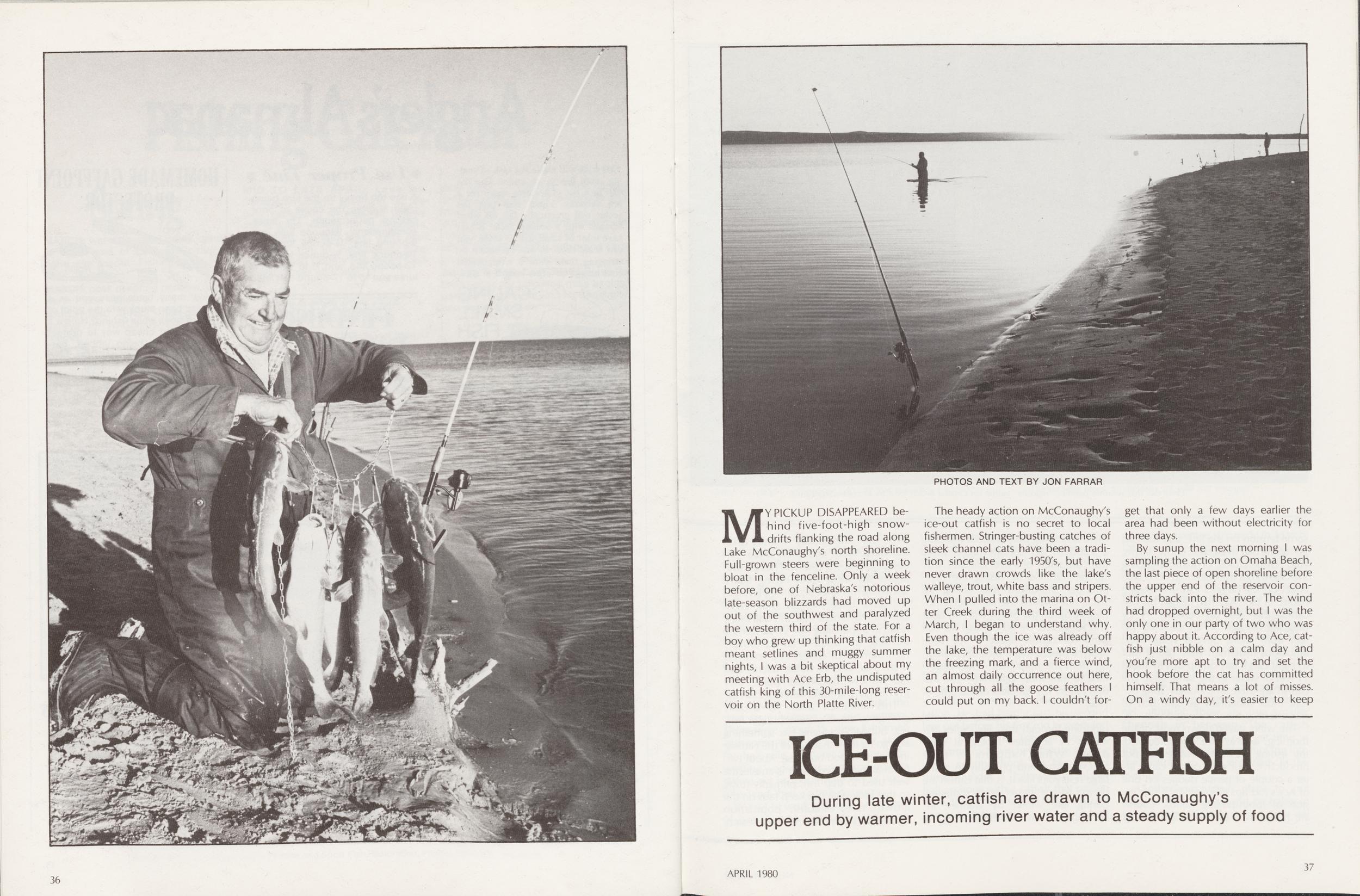
ICE-OUT CATFISH
During late winter, catfish are drawn to McConaughy's upper end by warmer, incoming river water and a steady supply of foodMY PICKUP DISAPPEARED behind five-foot-high snowdrifts flanking the road along Lake McConaughy's north shoreline. Full-grown steers were beginning to bloat in the fenceline. Only a week before, one of Nebraska's notorious late-season blizzards had moved up out of the southwest and paralyzed the western third of the state. For a boy who grew up thinking that catfish meant setlines and muggy summer nights, I was a bit skeptical about my meeting with Ace Erb, the undisputed catfish king of this 30-mile-long reservoir on the North Platte River.
The heady action on McConaughy's ice-out catfish is no secret to local fishermen. Stringer-busting catches of sleek channel cats have been a tradition since the early 1950's, but have never drawn crowds like the lake's walleye, trout, white bass and stripers. When I pulled into the marina on Otter Creek during the third week of March, I began to understand why. Even though the ice was already off the lake, the temperature was below the freezing mark, and a fierce wind, an almost daily occurrence out here, cut through all the goose feathers I could put on my back. I couldn't forget that only a few days earlier the area had been without electricity for three days.
By sunup the next morning I was sampling the action on Omaha Beach, the last piece of open shoreline before the upper end of the reservoir constricts back into the river. The wind had dropped overnight, but I was the only one in our party of two who was happy about it. According to Ace, catfish just nibble on a calm day and you're more apt to try and set the hook before the cat has committed himself. That means a lot of misses. On a windy day, it's easier to keep 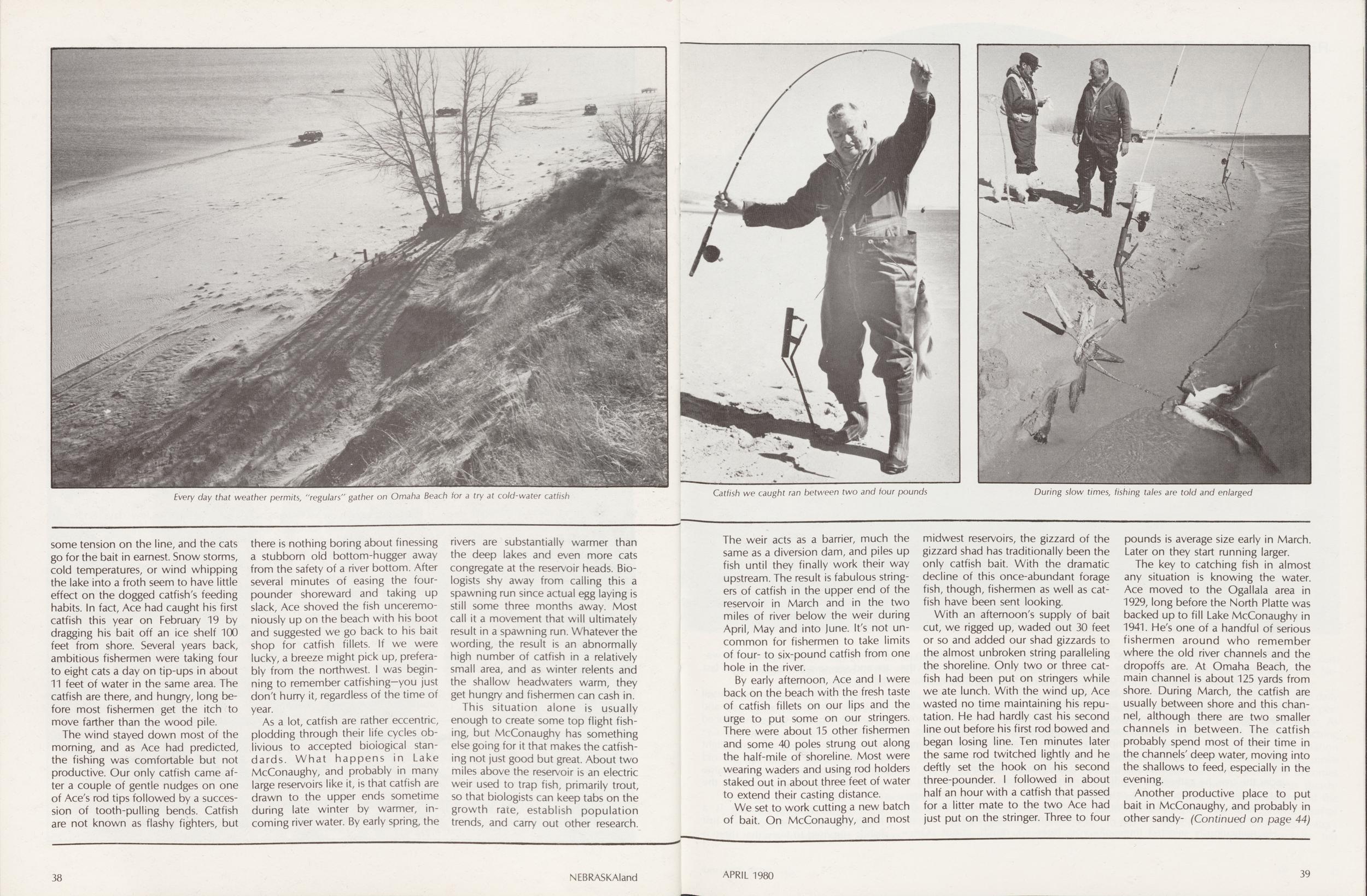
some tension on the line, and the cats go for the bait in earnest. Snow storms, cold temperatures, or wind whipping the lake into a froth seem to have little effect on the dogged catfish's feeding habits. In fact, Ace had caught his first catfish this year on February 19 by dragging his bait off an ice shelf 100 feet from shore. Several years back, ambitious fishermen were taking four to eight cats a day on tip-ups in about 11 feet of water in the same area. The catfish are there, and hungry, long before most fishermen get the itch to move farther than the wood pile.
The wind stayed down most of the morning, and as Ace had predicted, the fishing was comfortable but not productive. Our only catfish came after a couple of gentle nudges on one of Ace's rod tips followed by a succession of tooth-pulling bends. Catfish are not known as flashy fighters, but there is nothing boring about finessing a stubborn old bottom-hugger away from the safety of a river bottom. After several minutes of easing the four-pounder shoreward and taking up slack, Ace shoved the fish unceremoniously up on the beach with his boot and suggested we go back to his bait shop for catfish fillets. If we were lucky, a breeze might pick up, preferably from the northwest. I was beginning to remember catfishing-you just don't hurry it, regardless of the time of year.
As a lot, catfish are rather eccentric, plodding through their life cycles oblivious to accepted bioiogical standards. What happens in Lake McConaughy, and probably in many large reservoirs like it, is that catfish are drawn to the upper ends sometime during late winter by warmer, incoming river water. By early spring, the rivers are substantially warmer than the deep lakes and even more cats congregate at the reservoir heads. Biologists shy away from calling this a spawning run since actual egg laying is still some three months away. Most call it a movement that will ultimately result in a spawning run. Whatever the wording, the result is an abnormally high number of catfish in a relatively small area, and as winter relents and the shallow headwaters warm, they get hungry and fishermen can cash in.
This situation alone is usually enough to create some top flight fishing, but McConaughy has something else going for it that makes the catfishing not just good but great. About two miles above the reservoir is an electric weir used to trap fish, primarily trout, so that biologists can keep tabs on the growth rate, establish population trends, and carry out other research. 38 NEBRASKAland The weir acts as a barrier, much the same as a diversion dam, and piles up fish until they finally work their way upstream. The result is fabulous stringers of catfish in the upper end of the reservoir in March and in the two miles of river below the weir during April, May and into June. It's not uncommon for fishermen to take limits of four- to six-pound catfish from one hole in the river.
By early afternoon, Ace and I were back on the beach with the fresh taste of catfish fillets on our lips and the urge to put some on our stringers. There were about 15 other fishermen and some 40 poles strung out along the half-mile of shoreline. Most were wearing waders and using rod holders staked out in about three feet of water to extend their casting distance.
We set to work cutting a new batch of bait. On McConaughy, and most midwest reservoirs, the gizzard of the gizzard shad has traditionally been the only catfish bait. With the dramatic decline of this once-abundant forage fish, though, fishermen as well as catfish have been sent looking.
With an afternoon's supply of bait cut, we rigged up, waded out 30 feet or so and added our shad gizzards to the almost unbroken string paralleling the shoreline. Only two or three catfish had been put on stringers while we ate lunch. With the wind up, Ace wasted no time maintaining his reputation. He had hardly cast his second line out before his first rod bowed and began losing line. Ten minutes later the same rod twitched lightly and he deftly set the hook on his second three-pounder. I followed in about half an hour with a catfish that passed for a litter mate to the two Ace had just put on the stringer. Three to four pounds is average size early in March. Later on they start running larger.
The key to catching fish in almost any situation is knowing the water. Ace moved to the Ogallala area in 1929, long before the North Platte was backed up to fill Lake McConaughy in 1941. He's one of a handful of serious fishermen around who remember where the old river channels and the dropoffs are. At Omaha Beach, the main channel is about 125 yards from shore. During March, the catfish are usually between shore and this channel, although there are two smaller channels in between. The catfish probably spend most of their time in the channels' deep water, moving into the shallows to feed, especially in the evening.
Another productive place to put bait in McConaughy, and probably in other sandy- (Continued on page 44)
APRIL 1980 39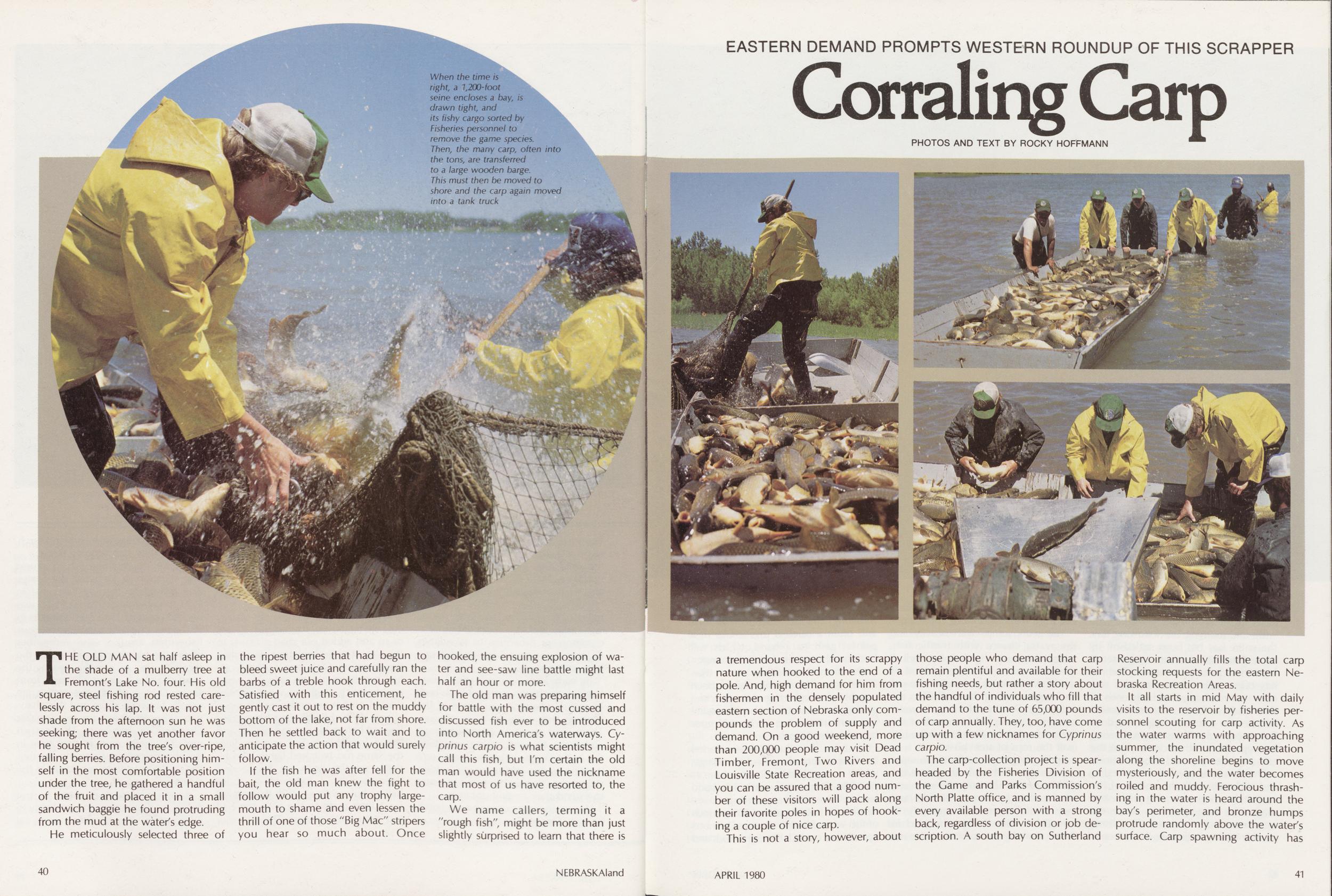
Corraling Carp
EASTERN DEMAND PROMPTS WESTERN ROUNDUP OF THIS SCRAPPER
THE OLD MAN sat half asleep in the shade of a mulberry tree at Fremont's Lake No. four. His old square, steel fishing rod rested carelessly across his lap. It was not just shade from the afternoon sun he was seeking; there was yet another favor he sought from the tree's over-ripe, falling berries. Before positioning himself in the most comfortable position under the tree, he gathered a handful of the fruit and placed it in a small sandwich baggie he found protruding from the mud at the water's edge.
He meticulously selected three of the ripest berries that had begun to bleed sweet juice and carefully ran the barbs of a treble hook through each. Satisfied with this enticement, he gently cast it out to rest on the muddy bottom of the lake, not far from shore. Then he settled back to wait and to anticipate the action that would surely follow.
If the fish he was after fell for the bait, the old man knew the fight to follow would put any trophy largemouth to shame and even lessen the thrill of one of those "Big Mac" stripers you hear so much about. Once hooked, the ensuing explosion of water and see-saw line battle might last half an hour or more.
The old man was preparing himself for battle with the most cussed and discussed fish ever to be introduced into North America's waterways. Cyprinus carpio is what scientists might call this fish, but I'm certain the old man would have used the nickname that most of us have resorted to, the carp.
We name callers, terming it a "rough fish", might be more than just slightly surprised to learn that there is 40 NEBRASKAland a tremendous respect for its scrappy nature when hooked to the end of a pole. And, high demand for him from fishermen in the densely populated eastern section of Nebraska only compounds the problem of supply and demand. On a good weekend, more than 200,000 people may visit Dead Timber, Fremont, Two Rivers and Louisville State Recreation areas, and you can be assured that a good number of these visitors will pack along their favorite poles in hopes of hooking a couple of nice carp.
This is not a story, however, about those people who demand that carp remain plentiful and available for their fishing needs, but rather a story about the handful of individuals who fill that demand to the tune of 65,000 pounds of carp annually. They, too, have come up with a few nicknames for Cyprinus carpio.
The carp-collection project is spear-headed by the Fisheries Division of the Game and Parks Commission's North Platte office, and is manned by every available person with a strong back, regardless of division or job description. A south bay on Sutherland Reservoir annually fills the total carp stocking requests for the eastern Nebraska Recreation Areas.
It all starts in mid May with daily visits to the reservoir by fisheries personnel scouting for carp activity. As the water warms with approaching summer, the inundated vegetation along the shoreline begins to move mysteriously, and the water becomes roiled and muddy. Ferocious thrashing in the water is heard around the bay's perimeter, and bronze humps protrude randomly above the water's surface. Carp spawning activity has APRIL 1980 41 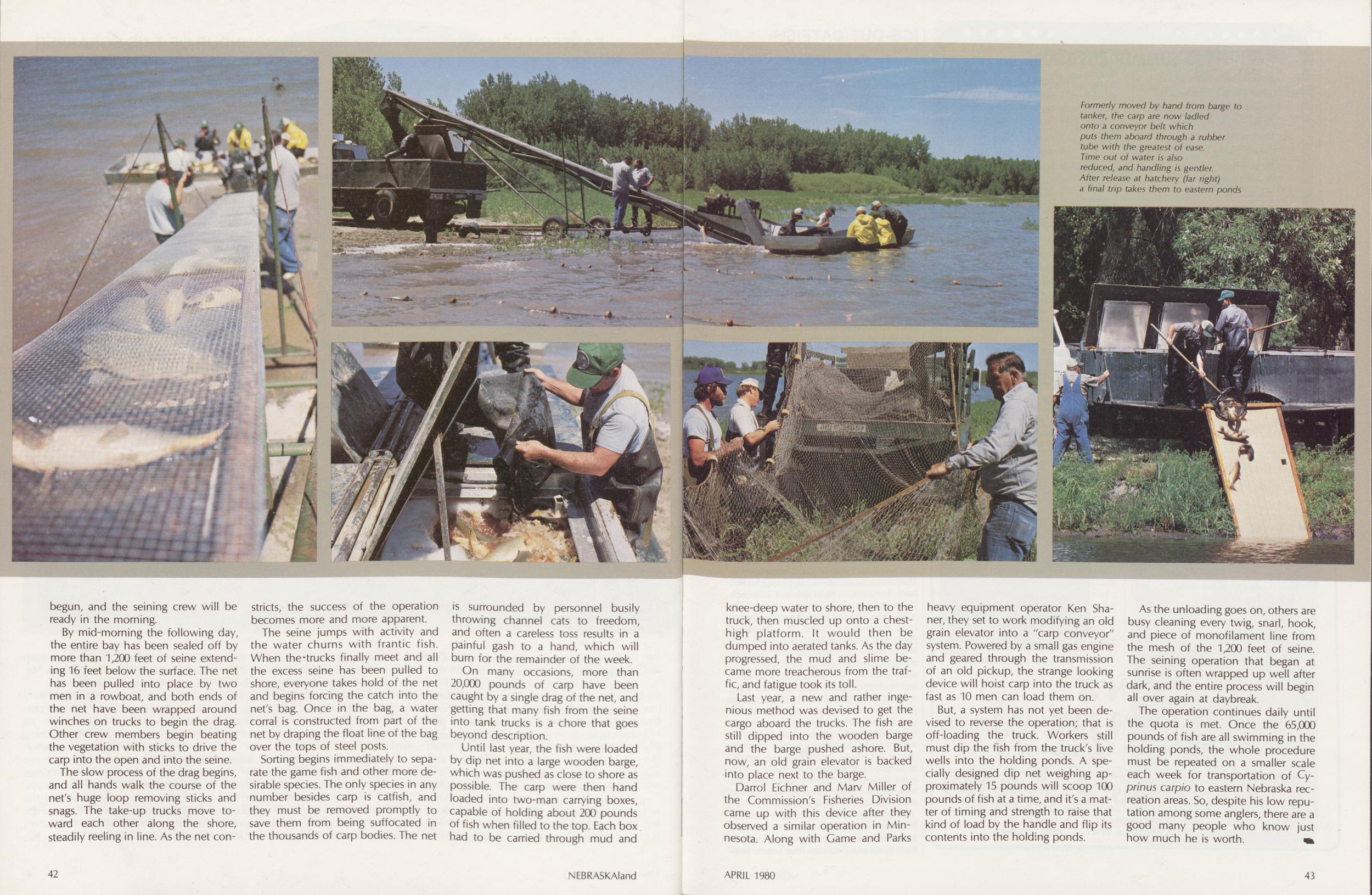 begun, and the seining crew will be ready in the morning.
By mid-morning the following day, the entire bay has been sealed off by more than 1,200 feet of seine extending 16 feet below the surface. The net has been pulled into place by two men in a rowboat, and both ends of the net have been wrapped around winches on trucks to begin the drag. Other crew members begin beating the vegetation with sticks to drive the carp into the open and into the seine.
The slow process of the drag begins, and all hands walk the course of the net's huge loop removing sticks and snags. The take-up trucks move toward each other along the shore, steadily reeling in line. As the net constricts, the success of the operation becomes more and more apparent.
The seine jumps with activity and the water churns with frantic fish. When the-trucks finally meet and all the excess seine has been pulled to shore, everyone takes hold of the net and begins forcing the catch into the net's bag. Once in the bag, a water corral is constructed from part of the net by draping the float line of the bag over the tops of steel posts.
Sorting begins immediately to separate the game fish and other more desirable species. The only species in any number besides carp is catfish, and they must be removed promptly to save them from being suffocated in the thousands of carp bodies. The net is surrounded by personnel busily throwing channel cats to freedom, and often a careless toss results in a painful gash to a hand, which will burn for the remainder of the week.
On many occasions, more than 20,000 pounds of carp have been caught by a single drag of the net, and getting that many fish from the seine into tank trucks is a chore that goes beyond description.
Until last year, the fish were loaded by dip net into a large wooden barge, which was pushed as close to shore as possible. The carp were then hand loaded into two-man carrying boxes, capable of holding about 200 pounds of fish when filled to the top. Each box had to be carried through mud and 42 NEBRASKAland knee-deep water to shore, then to the truck, then muscled up onto a chest-high platform. It would then be dumped into aerated tanks. As the day progressed, the mud and slime became more treacherous from the traffic, and fatigue took its toll.
Last year, a new and rather ingenious method was devised to get the cargo aboard the trucks. The fish are still dipped into the wooden barge and the barge pushed ashore. But, now, an old grain elevator is backed into place next to the barge.
Darrol Eichner and Marv Miller of the Commission's Fisheries Division came up with this device after they observed a similar operation in Minnesota. Along with Game and Parks heavy equipment operator Ken Shaner, they set to work modifying an old grain elevator into a "carp conveyor" system. Powered by a small gas engine and geared through the transmission of an old pickup, the strange looking device will hoist carp into the truck as fast as 10 men can load them on.
But, a system has not yet been devised to reverse the operation; that is off-loading the truck. Workers still must dip the fish from the truck's live wells into the holding ponds. A specially designed dip net weighing approximately 15 pounds will scoop 100 pounds of fish at a time, and it's a matter of timing and strength to raise that kind of load by the handle and flip its contents into the holding ponds.
As the unloading goes on, others are busy cleaning every twig, snarl, hook, and piece of monofilament line from the mesh of the 1,200 feet of seine. The seining operation that began at sunrise is often wrapped up well after dark, and the entire process will begin all over again at daybreak.
The operation continues daily until the quota is met. Once the 65,000 pounds of fish are all swimming in the holding ponds, the whole procedure must be repeated on a smaller scale each week for transportation of Cyprinus carpio to eastern Nebraska recreation areas. So, despite his low reputation among some anglers, there are a good many people who know just how much he is worth.
APRIL 1980 43 1980 SUMMER BUS TOURS Nashville—Fan Fair 7 days Great Pacific Northwest 17 days Smoky Mountains 10 days Great Pacific Northwest 17 days Black Hills 7 days Lake Superior 9 days Black Hills 4 days Colorful Colorado 6 days Black Hills 4 days Great Pacific Northwest 17 days Wisconsin Dells 6 days Black Hills 4 days Lake Superior 9 days Colorful Colorado 6 days Nashville—Music City 6 days 5 OFFICES TO SERVE YOU! Norfolk 402-371-3840 Columbus 402-564-0561 Omaha Sioux City 712-255-0141 Grand Island June 9 June 16 June 22 July 7 July 9 July 10 July 16 July 21 July 23 August 4 August 4 August 6 August 7 August 11 August 20 402-339-9966 308-382-7844 Allied Tour & Travel, Inc "The Whole World Is At Our Doorstep Call Toll Free 800-672-3420 "Your Free 1980 Tour Book Now Available" The Good Fishermen Always Start & Finish Here..." Air-conditioned units, cooking facilities, Up to six adults. Campground on the beach—40 hookups, showers, playground, shade. AIR STRIP 2,600 Feet Sod GUIDE SERVICE MARINA Boat Gas & Oil on the Water LAUNCHING SERVICE GENERAL STORE Groceries, Beer, Pop, Tackle, Live Bait HIGHWATER RAMP BOAT & PONTOON RENTALS Motors from 10-40 HP, boats 14 to 20 feet Write For A Free Brochure South Shore Big Mac at Gate 18 Rural Route Brule, Ne. 69127 Ogallaia, Ne. (308) 284-4965
ICE-OUT CATFISH
(Continued from page 39)banked reservoirs, is just below submerged drop-offs crested during low-water periods. When south winds predominate, the wave action eats away at the north shore creating two or three-foot-high cuts. Commonly, the lake will freeze over before north winds can level the drop-offs and they last through the winter under the ice cover. The lake fills over winter, and by spring the drop-offs may be 50 to 100 feet from shore and become favorite hangouts for catfish that feed on whatever washes over the edge.
Catfishermen are not known for their sophisticated equipment, and Ace is no exception. He had a pickup box full of short, inexpensive, five to five-and-a-half-foot rods with even less expensive closed-face spin-cast reels. I'd fought off a last-minute urge to buy a new bait-casting rig with a fairly stiff rod, and was using a medium-action, seven-foot spinning rod with open-faced reel. Blowing sand is a gritty problem for open-faced rigs, and ruggedness is probably a more important attribute of equipment for this type of fishing than a jazzy looking rig. Along the beach, I'd seen just about every type of outfit you could imagine and most were taking catfish, although some were taking more than others. One party had five beautiful salt-water casting rods with heavy-duty open-faced reels, but caught only one fish the entire day. The moral is that the fisherman behind the equipment is probably more important than the number of bills spent on it.
The hardware on the end of the line is fairly standard for catfish. A 1/0 snelled hook on a swivel makes it easy to pop on a new hook if a cat swallows it. You can retrieve the swallowed hook later, save time rebaiting, and keep the catch alive and fresh through the day. We were using one-ounce bell weights looped on the line just above the swivel. Some fishermen prefer a slip sinker, claiming that a catfish is less reluctant to take a bait that gives when tugged, and that a bite is easier to detect. Either way, use just enough weight to keep your line where you want it. Pinpoint casting is not all that important so a heavier line, say 10 to 15-pound-test monofilament, is not a drawback.
By mid afternoon the wind we had hoped for in the morning was threatening to sandblast the paint off the pickup. Four-inch-deep truck ruts on the beach were 44 NEBRASKAland blowing over in 15 minutes and our ounce of lead wasn't holding. Fishing continued but the catching stopped until the wind relented in the late afternoon.
Late afternoon, night and early morning hours are traditionally peak times for catfish, and at McConaughy is no exception. Early evening fishing from Omaha Beach can be hot. i caught two more three to four-pounders by sundown, and Ace landed one that stretched the spring on his hand scale to the five-pound mark. We'd taken about 24 pounds of channel catfish by the time we quit.
Just before sundown the lake was abnormally glassy. Two Pine Bluff, Wyoming fishermen, Roger Lushenko and John lessen, motored in from up river with full stringers; 18 catfish in all. Except for two or three they had taken early in the day, all had come from one hole below the mouth of the North Platte River in an hour of fishing late in the afternoon.
The upper three miles of the lake are good for catfish, but the top mile is unequalled. Bank fishing is possible only from Omaha Beach on the north shore. The south shore is choked with mud flats and rushes. If you're out for the maximum catch and don't mind the extra hassle of using a boat, the top spot in late March is the very tip of the reservoir and the first half-mile of river.
Fishing the holes in the "tules" produces the big catches. Open water is at a premium among the snags and emergent vegetation, and often you'll only be using 20 feet of line in 10 feet of water. Just as often, you'll have to drop your line over the side of the boat. According to Ace and other local fishermen, it isn't uncommon to lose 15 catfish in the snags and still come home with a limit of 10, four to five-pounders.
We gave Omaha Beach another try the next morning. A 20-mile-per-hour wind was blowing into our faces from the south and whipping up whitecaps that literally devoured the shoreline inches at a time. We had all the makings to prove Ace's theory that catfishing is at its best on a breezy day.
By mid-morning, I had seen only five fish come in along the beach. Ace caught a two-pounder and released one of about a pound-and-a-half.
My pole bumped twice before I could reach it. I eased it out of the holder and waited for a hint of pressure on the tip. I passed up a gentle bump hoping for something more substantial. This was typical catfishing-the gentle pulls of a catfish mouthing the bait with no hint as to his size. If I had been fishing back home in the Loup River, it could just as well have been a half-pound "fiddler" as a six-pounder. A minute later I felt steady pressure on the line long enough to know that the shad gut would still be in the cat's mouth when I set the hook. From the bend on my rod I knew I had him and that he was a larger fish than the three-pounders I had taken the day before. I was using 15-pound-test line and wasn't worried about losing the fish. I took up enough line to keep it taut and enjoyed the four or five minutes it took to beach the fish. He was typically smooth skinned with black dots on the sides, a strongly notched tail, and weighed a little over four and a half pounds (call it five pounds for the sake of a good story).
As a rule, catfish are gentle biters. On McConaughy there is usually barely enough rod tip movement that a bump can be difficult to tell from wave action. Several times we noticed slack on the line and reeled in to find a catfish hooked. Unlike more aggressive game fish that hit the same way time after time, you can't count on a channel cat to always take the bait the same way. The big test is setting the hook. We watched several fishermen on the beach who had as many bites as we did but consistently failed to hook any fish.
By noon we were blown off the beach. The winds had crept up to a steady 25 to 30 miles per hour with gusts reaching 35 to 40. Foot-high whitecaps were pummeling the shore, and with the wind from the south it was impossible to keep lines out.
We finished the morning with five catfish between three and five pounds—a fair morning by my standards, especially considering the wind. I took Ace's apologies in stride on the drive back to his bait shop.
"Real slow," he said several times. "As a rule we would have taken our 10-fish limits in a day's fishing."
It made me wonder what the catfishing on Omaha Beach might have been like in better weather, or how it might have been if we'd fished from a boat up where the river pours into the reservoir, up where the Wyoming fishermen filled stringers in an hour. How many catfish might we have caught if we'd stayed after sundown when the cats start really feeding? It also made me wonder what the ice-out fishing might be like on some of Nebraska's other good catfish reservoirs where you could be the only one fishing the beach. One thing is for sure—if I don't find out, someone else is bound to!
 Paintings with Distinction Sorensen Graphics ORIGINAL PAINTINGS, PORTRAITS, ILLUSTRATION 2802 SO. 12th, Lincoln, NE 68502 402/423-1393 Sorensen paintings may be viewed at Famous French Galleries, 4220 So. 33rd, Lincoln Ranch Camp for Boys and Girls Ages 8-13 Our 2nd season Located near Milford, Nebraska on the Blue River. Horses-Riding-Farm Animals-Canoeing-Swimming-Fishing-Riflery-Archery-Many sports and crafts! Join campers from Nebraska and neighboring states for the time of your life. Stay 1 to 10 weeks! June 5 to August 18. For brochure and application write: Farlin Family Farm Ranch Camp Milford, NE. 68405 Phone (402) 761-2005 FARLIN FAMILY FARM RANCH CAMP bring joy to your little corner of the world... Plant a Tree for tomorrow! For details, write: The National Arbor Day Foundation Arbor Lodge 100 Nebraska City, Nebraska 68410 ALLEN'S WALLEYE GUIDE SERVICE Why go to Canada? Best walleye fishing in the U.S. or Canada Lewis and Clark Lake, Lake Francis Case Lake Sharp, Lake Oahe, Missouri River 98% success in 1979—Early reservations advised. Improve your fish stories-try Allen's walleye rigs. Guide-tested—order direct and save. Two-hook crawler rig, 50C, one-hook minnow rig, 50C. Spinners, 41/2-foot leader, in red, yellow, green, orange, blue, silver, red and white, hammered-gold, white. Include: 10% postage. Allen's Walleye Guide Service, 502 East King, Chamberlain, s.d. 57325 Phone (605)-734-5591
VALENTINE REFUGE
(Continued from page 15)bluegill and yellow perch are of a harvestable size. Watts Lake is also closed to public fishing, but for a different reason. Game and Parks fisheries biologists are using the lake as a nursery to raise muskellunge as an egg source for stocking.
In 1979 the largest lake on the refuge, 798-acre Pelican, was drawn down. Pelican had been a source of northern pike spawn for a number of years, and during collection operations the previous two springs, as many adults as possible were moved to Dewey and Clear lakes. In the summer of 1979, Pelican was rotenone and restocked with fathead minnows as a forage fish, along with northerns, largemouths, bluegills and yellow perch. Pelican will be closed until further notice, but when it comes back in three to five years, biologists anticipate excellent fishing.
Dewey Lake will be pumped next, beginning this month after some of the pike have been trapped and stripped of their spawn. Most of the early summer will be required to pump this 550-acre lake, so Dewey should provide the opportunity for bass and pike before June moss-up.
The last lake on the Valentine Refuge scheduled for renovation is 425-acre Clear. Spawners salvaged from Pelican have been moved to Clear and it should remain a good northern lake through the spring of 1981 when it will be drawn down. By the time spring of 1982 rolls around, the first lakes renovated should start providing some fishing.
Fisheries biologists do not expect a 100 percent kill of the carp in the refuge lakes but something very close to it. Even if every carp were eliminated they would be reintroduced eventually by natural means, such as eggs being transported on the feet of waterbirds, or movement between lakes during high water, and for the rather needless reason that some fisherman will chose to ignore the prohibition on the use of live bait on the refuge and inadvertently "stock" carp when he dumps his minnow bucket at the end of the day. The expectation is to maintain an aquatic system in which carp are not an influence for at least 10 years. Hopefully, though, the lakes of the Valentine Refuge will be worth wading in and boring holes into, for many more years than that.
 ...an outdoor tip from your Big JJagent AMERICAN ELM Serving as America's No. 1 shade tree until devastated by Dutch elm disease, the American elm was also Nebraska's state tree until being replaced by the cottonwood. On mature trees, bark is dark gray with flat-topped ridges separated by roughly diamond-shaped areas. It grows to 120 feet in height and to four feet in diameter. .this message brought to you by the INDEPENDENT INSURANCE AGENTS OF NEBRASKA Tomorrow's Forests Begin Here. This is the sign of the future for American forestry. It indicates one of the more than 32,500 Tree Farms being managed by private landowners for the growing and harvesting of forest crops. A Tree Farm is not just a matter of planting trees, or having 10 acres or more of woodland. Tree Farmers actively manage their forests...growing and harvesting crops of trees; protecting the land from fire, insects, disease and destructive grazing. They provide watershed protection, better food and habitat for wildlife, and opportunities for outdoor recreation. And it is the Tree Farmer who will make possible the lumber, wood fiber, and other natural resources America needs for tomorrow's growth. If you have 10 acres or more of woodland, why not send for information on this valuable program? Tree Farms pay off for their owners and for our country. I Nebraska Tree Farm Program 704 East 10th St. I Wayne, Nebraska 68787 II am interested in additional information on how I can manage my woodlands to meet Tree Farm Standards. Name Address City, State. ZIP.
WALLEYE SIZE LIMIT
(Continued from page 14)four-year-olds comprised three percent, and fish five years and older accounted for just one percent.
What the size limit will mean for fishermen, according to the computer, is an average weight of 1.8 pounds for Big Mac walleye, compared to 1.3 pounds with no size limit. Fishermen will catch and keep about 38 percent fewer fish, harvest 18 percent fewer pounds of fish, and release about four times more fish than in the past. Figures are similar for other western reservoirs.
Biologists temper the computer's prediction for Big Mac just a bit, saying that last year's rather slow fishing may have allowed more fish than normal to reach larger size. Thus, for 1980 at least, average size may be larger, and there may be more "keepers."
Whether the size limit's promised benefit of larger fish becomes reality, however, depends entirely on sport fishermen. To produce larger walleye, fishermen must comply with the regulation by releasing under-size fish, and they must do it in a way that will allow the fish to survive.
It would make little sense to land a small fish, let him flop around in the bottom of the boat for several minutes, grab him in the gills or crush his innards while jerking the hook free, then drop him overboard to die. Rather, the angler should give the fish the best chance possible to survive.
The first rule is to minimize handling and the time the fish spends out of the water. Unhook and release the walleye first, then untangle line and lures. For small walleye, it's probably best to just hoist him aboard, rather than using the landing net. A struggling walleye will weave the net and loose hooks into an incredible mess in short order, thus delaying the release. Also, the net fabric may scrub off the coat of mucous that protects the walleye's skin from invasion by fungus and infection.
Don't grab a fish with dry hands. This also may remove the protective coat. Wet your hands when handling a fish that is to be released. In the case of walleye, wet hands should be no handicap, since the walleye's skin is somewhat rough and easy to hold in a firm, even grip.
Don't grab any fish, that is to be released, by the gill cover or anywhere else near the gills. This invites infection. And, don't grab him hard amidships while removing the hook, since this causes internal injuries that will likely be fatal.
In removing a hook, try to minimize additional damage. Working a hook around carelessly can drive a point upward into the fish's eye, backward into his gills, or down into the heart cavity, which lies just below the floor of the esophagus at the rear of the fish's mouth
Trading Post
DOGS BRITTANY SPANIEL pups-all A.K.C Registered. Reasonable. Marion North, Rt. #1, York, NE 68467. (402) 362-2663. MUST SACRIFICE 3-year-old German Shorthaired Pointer. Well trained for quail, pheasant, dove. Marion North, Rt. #1, York, NE 68467. (402) 362-2663. LABRADOR RETRiEVERS. Puppies from parents that are proven duck and pheasant hunters. (306) 235-3392, (308) 235-4611, Dr. Nelson, Kimball, NE 69145. MISCELLANEOUS GUNS-Browning, Winchester, Remington, others, Hi-powers, shotguns, new, used, antiques. Want Pre-1964 Winchesters. Buy-Sell-Trade. Ph. (402) 729-6112. Bedlan's Sporting Goods, Fairbury, NE 68352. DUCK HUNTERS, learn how to make quality, solid plastic, waterfowl decoys. We're originators of famous system. Send, $1 for colorful catalog. Decoys Unlimited, Clinton, Iowa 52732 FRITZ GUNSMITHING & Supply Co.-Heckler & Koch Dealer. Handfinishing-Hot Blue-Parkerization-Custom Rifles-Antique Restoration. 407 South Harris, Wilber, NE. (402) 821-2260. BUSINESS OPPORTUNITY-Close to Branched Oak Lake. Almost 3 acres of Commercial-zoned land with 4-year-old building. Now set up for Fast Food and Soft-Serve Ice Cream. Man.v possibilities: Bait Shop-Gas Station-R.V. Parking-Off Sale Liquor-Formerly Phil's Corner. Call Ed Golden (402) 483-2179 or CENTURY 21 Atlas Real Estate. 467-4641 GET THE MOST out of your woodburning stove. Learn how to cook complete meals while heating your home. Send $2.50 to P.O. Box 2351, Lincoln, NE 68502. GRUMMAN CANOES for sale at cost + 10 percent. Send 50 cents (stamps OK) for literature and prices. Tom Stover, Dealer, Star Rt., Gering, NE 69341. CANOE NEBRASKA...with Wilson Outfitters Nebraska (WON)! Full-service group trips with or without vehicular transportation. Statewide Canoe Rental Network featuring 20 locations! Pre/Post Season; Midweek; and Quantity Discounts! We've been selling Nebraska to Nebraskans for 9 years now! For 1980-81 brochure, write WON, 1329 Dawes Ave., Lincoln, NE 68521. COMPUTERS: FIND OUT how inexpensive Ohio Scientific computers can be used as teaching aids for math, spelling, much more. Free technical assistance by phone. Send SASE for literature and prices. Tom Stover, Consultant, Star Rt., Gering, NE 69341. DWARF REED Canary grass will mature at 3'-4' height and give excellent cover for lake shorelines. Plugs available at $.20 each, F.O.B. O'Neill. Contact Bob Hill, Box 208, O'Neill, NE Call (402) 336-2569. HARLAN COUNTY DAM. Vacation apartments, fully furnished. Game cleaning room with freezer. One block from shopping center. Weekend or week of pleasant living. Must see to appreciate. Security deposit required. Sorry no pets. Dean and Esther Stone, Box 145, Republican City, NE 68971 Ph. (308) 799-3422. NE. NEBR. TROUT FISHING. For rent Mon.-Thurs. or Fri.- Sun. Two cottages, four ponds and stream. Privacy with trout up to 5 pounds. Open April 1. Diamond E. Trout Resort, Orchard, NE 68764. (402) 893-4745. FISH FOR SALE: Channel Catfish, Largemouth Bass, Bluegill, Crappie, Perch, Bullhead, Rainbow Trout and minnows for pond and lake stocking. Contact the Pleasant Valley Fish Farm, Route 1, McCook, Nebraska 69001. Phone (308) 345-6599. TAXIDERMY BIG BEAR TAXIDERMY, Rt. 2, Mitchell, Nebraska 69357. We specialize in all big game from Alaska to Nebraska, also birds and fish. Hair on and hair off tanning, 41/2 miles west of Scottsbluff on Highway 26. Phone (308) 635-3013. KARL SCHWARZ Master Taxidermists. Mounting of game heads —birds —fish — animals—fur rugs— robes —tanning buckskin. Since 1910. 424 South 13th Street, Dept. A, Omaha, Nebraska 68102. FREEZE-DRY TAXIDERMY Wally Allison's State Record Taxidermy, 2709 Birchwood, North Platte, NE 69101 Phone: (308) 534-2324. Specializing in Fish and Small Game, Snake and Lizard and Novelties. (Nothing too small) Newest of all taxidermy methods employed. CREATIVE TAXIDERMY-AII types work since 1935 now includes Freeze-Dry processing of approved small specimens. Naturecraft Studio, 925 Fourth Corso, Nebraska City, Nebraska 68410. Phone: (402) 873-5491. Joe Voges-Owner. "AWARD-WINNING Taxidermist. Trust your trophies to a proven winner. Our complete taxidermy service also books hunts anywhere in the world. Dinges Taxidermy, 2760 South 12th, Omaha, NE 68108 Phone: (402) 342-3718 NABITY'S TAXIDERMY. 28 years' experience. All taxidermy services available. Specializing in natural-grass backgrounds. 5021 Washington, Lincoln, NE 68506. (402) 489-6351. JOHNSON TAXIDERMY-servicing southwest Nebraska, specializing in big-game mounts, life-sized mounts, rug work, fish, birds, tanning hair-on leather. Brochure and price list on request. Johnson Taxidermy, Rt. 1, Box 78, Lamar, NE 69035. Telephone (308) 882-5555. NEBRASKAland Magazine Order Form Please send me a subscription to NEBRASKAland, with a free bonus subscription to Afield & Afloat. One-year $5 Two-year $9 Three-year $12.50 Ma/7 to: NEBRASKAland, Box 30370, Lincoln, NE 68503 NAME ADDRESS CITY STATE ZIP Browning Our exclusive discount plan on all Browning products will save you up to 20%. This includes guns, knives, archery, clothing, boots & gun cases. Inquire...it will $ave you $$$. Big discounts on other sporting goods. ALSO FEATURING: WINCHESTER COLT BLACK POWDER RUGER SMITH & WESSON REMINGTON COLT SAUER RIFLES WEATHERBY BLACK POWDER GUNS & ACCESSORIES WE ALSO CARRY A COMPLETE LINE OF RELOADING EQUIPMENT AND COMPONENTS BY PACIFIC, SIERRA AND HORNADY. SEE US FIRST FOR ALL YOUR SHOOTING NEEDS. W BUN SHOP Phone (402) 643-3303 Box 243, Seward, Nebraska 68434 LIVE-CATCH ALL-PURPOSE TRAPS FREE CATALOG Traps without injury squirrels, chipmunks, rabbits, mink, fox, raccoons, stray animals, pests, etc. Sizes for every need. Also traps for snakes, sparrows, pigeons, crabs, turtles, quail, etc. Save on our low factory prices. Send no money. Free catalog and trapping secrets. MUSTANG MFG. CO., Dept. N-34, Box 10880, Houston, Tex. 77018 TROUT For stocking your lake or pond now. 2 to 12 inch rainbow trout. TROUT SPRINGS Hidden Timber Route PHONE Valentine, NE. 69201 (402) 376-2369 J'S OTTER CREEK MARINA NORTH SIDE LAKE McCONAUGHY HWY. 92-OPEN YEAR AROUND ALL-MODERN MOTEL CAFE BAIT TACKLE GAS FISH-CLEANING FACILITIES HUNTING & FISHING LICENSES ON & OFF-SALE BEER PHONE 308-355-2341 P.O. LEWELLEN. NE 69147 JAY & JULIE PETERSON STOCK YOUR LAKE OR POND with CHANNEL CAT LARGEMOUTH BASS BLUEGILL - CRAPPIE ORDER NOW WILLOW LAKE FISH HATCHERY Rt. 3, Box 46, Hastings, Nebr. 68901 Gaylord L. Crawford Phone: (402) 463-8022 Day or Night For 1980 Stocking Pond Mill—Aquazine for algae-free water YOU PAY You pay 24c to send a 2-ounce letter. You pay no more than 20c plus tax to dial direct for the first minute outside Nebraska between 11:00 p.m. & 8:00 a.m. Sometimes it's cheaper to tell it than to write it. THE LINCOLN TELEPHONE CO. MUTCHIE'S ZoJul RESORT Upstairs Anchor Room Lounge Cold Beer-On/Off Sale Lakefront cabins with swimming beach Fishing tackle Boats & motors Free boat ramp Fishing Swimming Cafe and ice Boating & skiing Gas and oil 9-hole golf course just around the corner Live and frozen bait Pontoon, boat & motor rentals. Overnight Campers—full hookups WRITE FOR FREE BROCHURE or phone reservations 785-2298 Elwood, Nebraska It's said their numbers once darkened the sum Ducks Unlimited is a non-profit organization that works to protect and restore waterfowl marshlands in Canada, where United States Federal funds don't reach. And where 709c of our waterfowl are hatched. Help keep the ducks flying. Send your tax deductible donation to: Ducks Unlimited, P.O. Box 66300, Chicago, Illinois 60666. Please. DUCKS UNLIMITED We need your help. Now. CUSTOM FRAMES for NEBRASKAland prints Limited offer on 9" X 12" beautifully finished selected oak frames—$5.45. Easily install your own prints. Add $1.50 for handling and tax. Send return addressed, stamped envelope for other styles available. H. W. FRAMES, Box 30136, Lincoln, NE 68503 WELCOME to Merritt Dam Trading Post 26 Miles So. Of Valentine On Hwy. 16C Phone 402/376-3437 Bait Tackle Ammunition Groceries Gas Beer Ice Campground Hook-ups Boat and Motor Rental Cabins with Kitchen Facilities Your Hosts JON AND MARIAN DAVENPORT
If a hook has been swallowed into the esophagus, just cut the line and release the fish. The acid in the fish's system can dissolve the hook, perhaps in time to allow it to begin feeding again before too long. It's chances are certainly better than forcibly removing the hook, which is almost certain death. And finally, don't assume that a fish bleeding slightly from a gill injury is doomed. Release them anyway, because they have a good chance of healing and surviving.
So much for the "don'ts". Probably the best way to handle a small walleye is to grab him firmly just behind the head, wetting your hands first. Apply most pressure to the muscle area of the back, rather than to the ribs and innards. Work the hook free as quickly and gently as possible, and slip the fish back into the water immediately. If you're on a river, it's best to release the fish in quiet water.
If it "bellies up", turn it right-side-up and move him gently back and forth in the water. This pumps water through his gills, a sort of artificial respiration for fish. When the fish can stay upright and swim under his own power, you've done your job.
Many of these same handling techniques apply to other fish. There are size limits on black bass, northern pike, and muskies in all or parts of Nebraska, which necessitates proper handling of under-size fish.
Largemouth and smallmouth bass are easily handled by the lower jaw, which immobilizes the fish and minimizes contact with net, boat, or the angler's hands.
Pike and muskies should probably be netted to avoid their rather formidable dental apparatus, then grabbed behind the head much like a walleye. Pike or muskies that are to be released should not be grabbed by the eye sockets, as shown in some popular national outdoor magazines. This technique immobilizes the fish and provides a dandy handle for the fisherman, but, it also damages the fish's eyes.
Proper handling and releasing of fish is an increasingly important outdoor skill, in light of size limits on game fish. It's also important to an increasing number of anglers who are releasing even legal size game fish as part of their own personal conservation program. They thus enjoy fishing action or enjoyment, plus allowing other anglers to enjoy the same fish.
Discover the Good Life! KNOW NEBRASKA TOURS Return with an expanded 1980 schedule
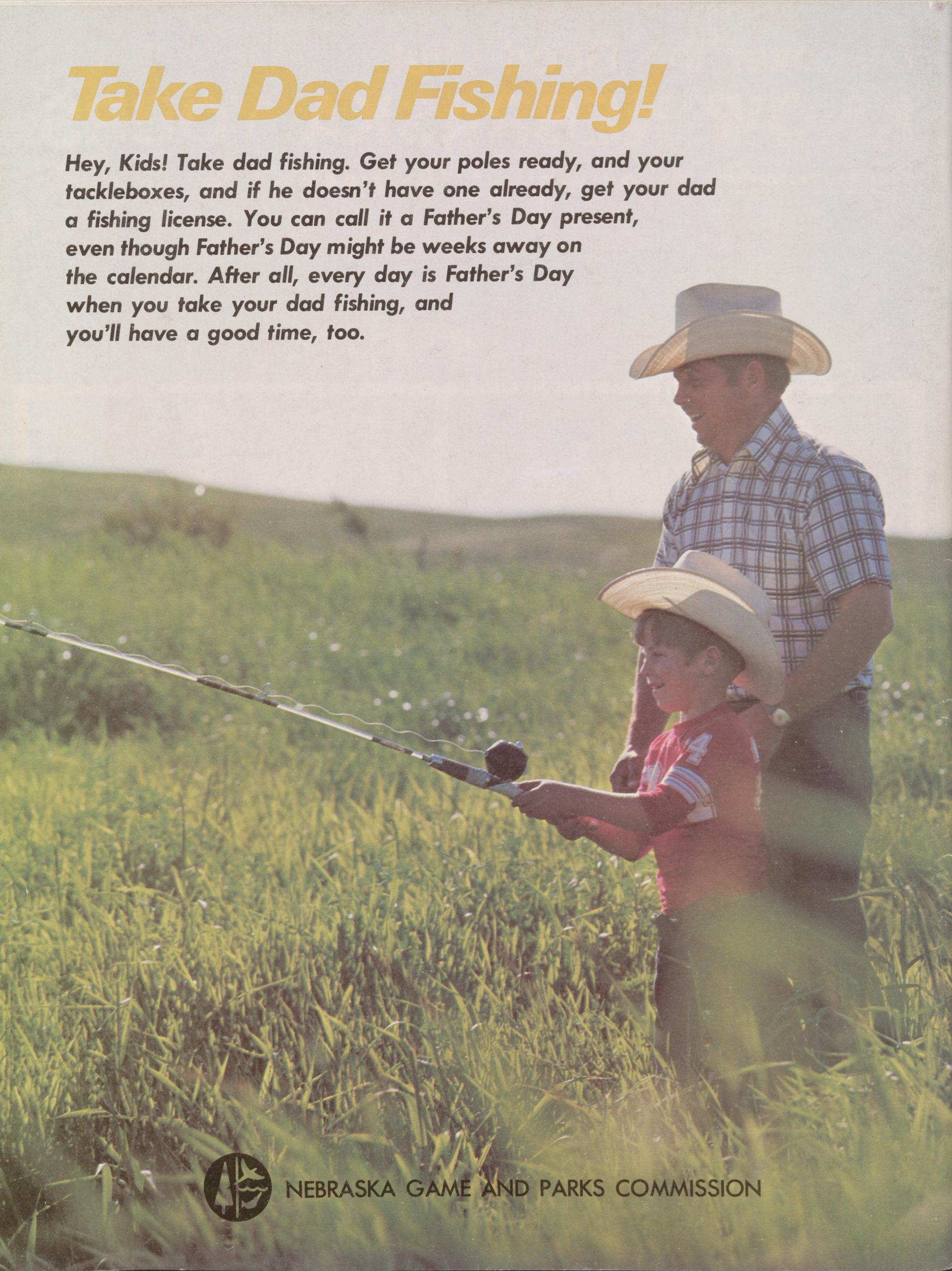
Take Dad Fishing!
Hey, Kids! Take dad fishing. Get your poles ready, and your tackleboxes, and if he doesn't have one already, get your dad a fishing license. You can call it a Father's Day present, even though Father's Day might be weeks away on the calendar. After all, every day is Father's Day when you take your dad fishing, and you'll have a good time, too.
NEBRASKA GAME: AND PARKS COMMISSIONPosition: 16 (397 views)