Volume 58, Issue 2, 1980
NEBRASKAland
February 1980 60 Cents
NEBRASKAland
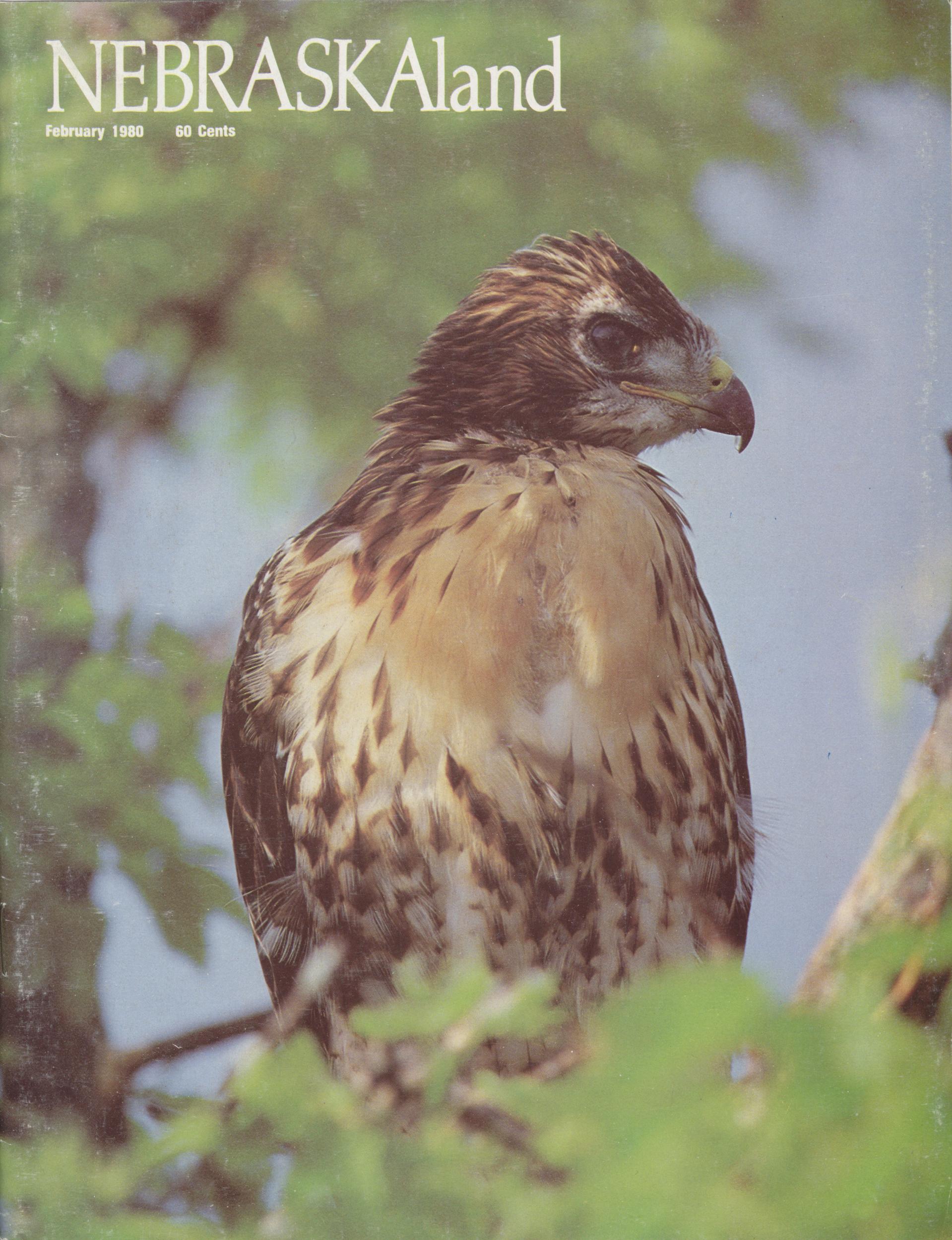
Published by the Nebraska Game and Parkls Commission VOL. 58 / NO. 2 / FEBRUARY 1980 ISSN: 0028-1964 Published monthly by the Nebraska Game and Parks Commission. Rates: 60 cents per copy; $5 for 1 year; $9 for 2 years; $12.50 for 3 years. Copyright Nebraska Game and Parks Commission 1980, all rights reserved. Postmaster: If undeliverable, send notice by form 3579 to Nebraska Game and Parks Commission, Box 30370, Lincoln, NE 68503. Second Class postage paid at Lincoln, Nebraska Office Headquarters 2200 N. 33rd, Lincoln, 68503 (402) 464-0641 7371 Pacific St., Omaha (402) 554-2144 Rt. 2, Alliance (308) 762-5605 Bassett (402) 684-3511 U.S. 81 (north) Norfolk (402) 371-4950 Rt. 4, North Platte (308) 532-6225 Board of Commissioners Chairman: H.B. (Tod) Kuntzelman, North Platte Vice Chairman: Richard W. Nisley, Roca 2nd Vice Chairman: Robert G. Cunningham, Omaha Shirley L. Meckel, Burwell Dr. Bruce Covygill, Silver Creek George Van Pelt, Kimball Earl Hultman, Sutton Director: Eugene T. Mahoney Assistant Directors: William ). Bailey, jr., Dale R. Bree Magazine Staff Chief, Information & Education: W. Rex Amack Editor: Lowell Johnson Senior Editor: |on Farrar Editorial Assistants: Ken Bouc, Bill McClurg District Editors: Bob Grier, Faye Musil, Rocky Hoffmann, Butch Isom Contributing Editors: lack Curran, Liz Huff, |im MacAllister Art Director: Michele Angle Farrar Illustration: Duane Westerholt, Steve O'Hare Advertising: Cliff Griffin Circulation: luanita Stefkovich Contents Features WILD CREATURES GREAT AND SMALL 6 PATCHWORK 16 SANDHILL CRANES...WINGS OVER THE PLATTE 18 An 18-page section devoted to this grand visitor to Nebraska's Platte Valley each spring DAWN ON THE RIVER N-4 THE CHANGING PLATTE N-7 A DAY WITH THE CRANES N-8 CALL OF THE NORTHLAND N-12 IN-STINK-TIVE HUNTER 36 A WINTER HARVEST 38 "DAM THE DARTER...PROTECT THE PORPOISE" 44 NOTES ON NEBRASKA FAUNA/SNOWY OWL 50 Departments SPEAK UP 4 TRADING POST 49 COVER: One of Nebraska's most common birds of prey, the red-tailed hawk feeds primarily on small rodents, and is finally being recognized for this beneficial service. This nestling is nearing "maiden flight", which will carry it away from its nest on Twin Lakes Wildlife Management Area west of Lincoln. For more on non game, see the story starting on page 6. OPPOSITE: In winter, Nebraska is sometimes glazed with a sheet of ice; encasing fences, buildings, and any plant that can support the weight. Photos by Jon Farrar.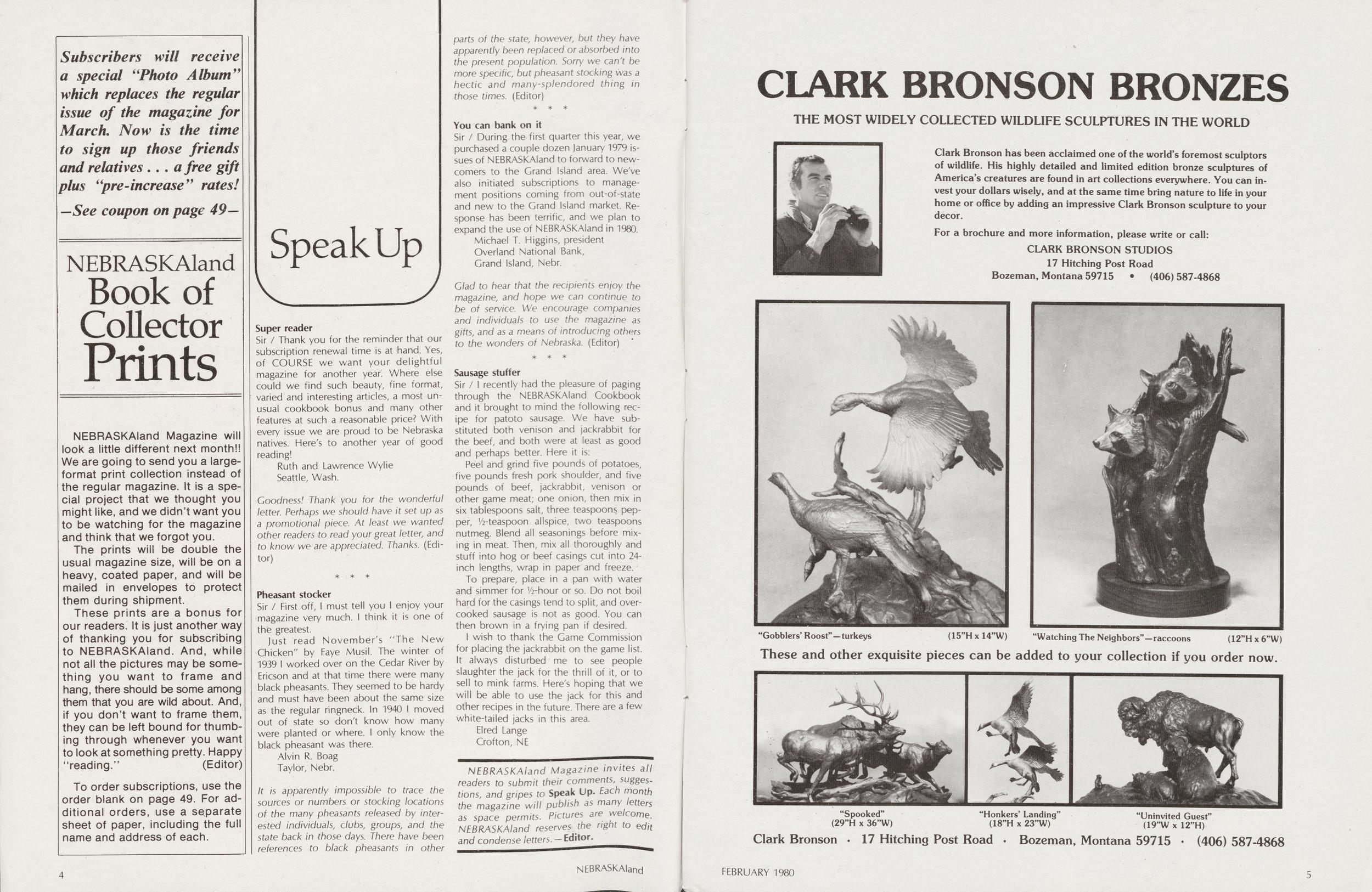
NEBRASKAland Magazine will look a little different next month!! We are going to send you a large-format print collection instead of the regular magazine. It is a special project that we thought you might like, and we didn't want you to be watching for the magazine and think that we forgot you.
The prints will be double the usual magazine size, will be on a heavy, coated paper, and will be mailed in envelopes to protect them during shipment.
These prints are a bonus for our readers. It is just another way of thanking you for subscribing to NEBRASKAland. And, while not all the pictures may be something you want to frame and hang, there should be some among them that you are wild about. And, if you don't want to frame them, they can be left bound for thumbing through whenever you want to look at something pretty. Happy "reading." (Editor)
To order subscriptions, use the order blank on page 49. For additional orders, use a separate sheet of paper, including the full name and address of each.
Speak Up
Super readerSir / Thank you for the reminder that our subscription renewal time is at hand. Yes, of COURSE we want your delightful magazine for another year. Where else could we find such beauty, fine format, varied and interesting articles, a most unusual cookbook bonus and many other features at such a reasonable price? With every issue we are proud to be Nebraska natives. Here's to another year of good reading!
Ruth and Lawrence Wylie Seattle, Wash.Goodness! Thank you for the wonderful letter. Perhaps we should have it set up as a promotional piece. At least we wanted other readers to read your great letter, and to know we are appreciated. Thanks. (Editor)
Pheasant stockerSir / First off, I must tell you I enjoy your magazine very much. I think it is one of the greatest.
Just read November's "The New Chicken" by Faye Musil. The winter of 1939 I worked over on the Cedar River by Ericson and at that time there were many black pheasants. They seemed to be hardy and must have been about the same size as the regular ringneck. In 1940 I moved out of state so don't know how many were planted or where. I only know the black pheasant was there.
Alvin R. Boag Taylor, Nebr.It is apparently impossible to trace the sources or numbers or stocking locations of the many pheasants released by interested individuals, clubs, groups, and the state back in those days. There have been references to black pheasants in other parts of the state, however, but they have apparently been replaced or absorbed into the present population. Sorry we can't be more specific, but pheasant stocking was a hectic and many-splendored thing in those times. (Editor)
You can bank on itSir / During the first quarter this year, we purchased a couple dozen January 1979 issues of NEBRASKAland to forward to newcomers to the Grand Island area. We've also initiated subscriptions to management positions coming from out-of-state and new to the Grand Island market. Response has been terrific, and we plan to expand the use of NEBRASKAland in 1980.
Michael T. Higgins, president Overland National Bank, Grand Island, Nebr.Glad to hear that the recipients enjoy the magazine, and hope we can continue to be of service. We encourage companies and individuals to use the magazine as gifts, and as a means of introducing others to the wonders of Nebraska. (Editor)
Sausage stufferSir / I recently had the pleasure of paging through the NEBRASKAland Cookbook and it brought to mind the following recipe for potato sausage. We have substituted both venison and jackrabbit for the beef, and both were at least as good and perhaps better. Here it is:
Peel and grind five pounds of potatoes, five pounds fresh pork shoulder, and five pounds of beef, jackrabbit, venison or other game meat; one onion, then mix in six tablespoons salt, three teaspoons pepper, ½-teaspoon allspice, two teaspoons nutmeg. Blend all seasonings before mixing in meat. Then, mix all thoroughly and stuff into hog or beef casings cut into 24-inch lengths, wrap in paper and freeze.
To prepare, place in a pan with water and simmer for ½-hour or so. Do not boil hard for the casings tend to split, and overcooked sausage is not as good. You can then brown in a frying pan if desired.
I wish to thank the Game Commission for placing the jackrabbit on the game list. It always disturbed me to see people slaughter the jack for the thrill of it, or to sell to mink farms. Here's hoping that we will be able to use the jack for this and other recipes in the future. There are a few white-tailed jacks in this area.
Elred Lange Crofton, NENEBRASKAland Magazine invites all readers to submit their comments, suggestions, and gripes to Speak Up. Each month the magazine will publish as many letters as space permits. Pictures are welcome. NEBRASKAland reserves the right to edit and condense letters. - Editor.
4 NEBRASKAlandTHE MOST WIDELY COLLECTED WILDLIFE SCULPTURES IN THE WORLD
Clark Bronson has been acclaimed one of the world's foremost sculptors of wildlife. His highly detailed and limited edition bronze sculptures of America's creatures are found in art collections everywhere. You can invest your dollars wisely, and at the same time bring nature to life in your home or office by adding an impressive Clark Bronson sculpture to your decor. For a brochure and more information, please write or call: CLARK BRONSON STUDIOS 17 Hitching Post Road Bozeman, Montana 59715 (406) 587-4868 "Gobblers' Roost"-turkeys (15"H x 14"W) "Watching The Neighbors"-raccoons (12"H x 6"W) These and other exquisite pieces can be added to your collection if you order now. "Spooked" (29"H x 36"W) tHonkers, Landing' (18"H x 23"W) Uninvited Guest' (19"W x 12"H) Clark Bronson 17 Hitching Post Road Bozeman, Montana 59715 (406) 587-4868 FEBRUARY 1980 5
WILD CREATURES GREAT AND SMALL
In the United States, at least 150 animals are endangered; 14 species have been lost in Nebraska since first settlement, 16 are in serious trouble and others,0 some that we are probably not even aware of, will need help to survive. Our technology has exceeded our value for a natural environment Almost a decade has passed since the Nebraska Game and Parks Commission assummed the role of monitoring and conserving threatened and endangered wildlife and those species that are not protected by game animal status. Work accomplished and planned under this program has to some extent gone unnoticed. Following is an interview with Ross Lock, the state's nongame specialist who heads-up the effortNEBRASKAland: First, tell us exactly what is Nebraska's nongame program?
Ross Lock: Essentially it is an effort by the Game and Parks Commission to conserve the state's nongame and endangered wildlife, and to preserve their habitat. It is the goal of the program to insure their perpetuation as viable components of our environment for human enjoyment, scientific purposes and economic benefit. Our various projects are designed to increase our knowledge of their population status, distribution and biological requirements. Then, we use this knowledge to develop and implement management plans to insure the viability of this resource. Viability, in this case, means a wildlife population that is free-ranging and self-supporting.
NEBRASKAland: How do you manage a nongame species?
Ross Lock: At the most basic Jevel, a management decision may be either to take an action onto take no action, depending on the species' need for assistance and if funding is available. The ultimate goal of our management programs for endangered and threatened species is to increase their populations to a self-supporting level and eventually remove them from the endangered and threatened categories. Our management efforts for other nongame wildlife is designed to sustain them at self-supporting levels and prevent them from declining to an endangered or threatened level. We have another responsibility: to assist other state departments and various federal agencies in utilizing their authority to carry out programs for the conservation of endangered and threatened wildlife and their habitat.
NEBRASKAland: How did the nongame program come into existence and how is it funded?
Ross Lock: The program was initiated in 1971 with authority from the Legislature to list and protect endangered species. The positional of Non-game Specialist was create and funded with money from the sale of hunting licenses. In 1975 additional legislation was passed ... the Non-game and Endangered Species Act, which granted additional authority to the Game and Parks Commission for the conservation of endangered and threatened wildlife as well as for nongame wildlife. From that point on, funding for our program was restricted to General Fund tax dollars. An additional full-time biologist was added to the staff in 1977.
NEBRASKAland: Why do we need a nongame program? If these animals are not hunted won't they take care of themselves?
Ross Lock: In an environment free of man's tampering, these wildlife species would probably take care of themselves, but that is obviously not the case. We exert a tremendous force on our environment, often in very subtle ways. Modern man, through his technological progress, has exceeded his comprehension of the value of maintaining the quality of his natural environment. Following settlement of our state, the cow and the plow made the initial changes in the natural environment.
With the advent of modern, highly mechanized equipment, the rate of change has accelerated. Now agricultural land is yielding to the growth of cities. Woodlands are being removed and grasslands often overgrazed. Wetlands are disappearing at an alarming, rate. The demand is increasing for more roads, power plants, dams, housing developments, shopping centers and all the other companions of our modern society. Some species have been able to cope with these changes, but an increasing number are in trouble and unable to adapt to conditions created by expanding human populations and technological development.
During the past century and a half, more than 200 species of animals have disappeared from the face of this planet, nearly 50 of those in the United States alone. Today in the United States at least 150 animals are known to be endangered. At feast 14 species of animals have been lost in Nebraska since first settlement, 16 are in serious trouble, and others, some that we are probably not even aware of, will need assistance to survive.
NEBRASKAland: Is it really all that important if we lose a species?
Ross Lock: Rarely is the impact of losing a species immediately apparent.
 The long-term effect cannot always be
determined right away. Wildlife diversity lends stability to the ecosystem,
and that diversity provides the variability that is essential for minerals to
adapt evolutionary to long-term environmental changes. The loss of one
species may result in the elimination
of other species or even a breakdown
of the entire system. Looking at it from
a very selfish human point of view,
wildlife serves our own interests by
being biological indicators of the
health of our environment.
The long-term effect cannot always be
determined right away. Wildlife diversity lends stability to the ecosystem,
and that diversity provides the variability that is essential for minerals to
adapt evolutionary to long-term environmental changes. The loss of one
species may result in the elimination
of other species or even a breakdown
of the entire system. Looking at it from
a very selfish human point of view,
wildlife serves our own interests by
being biological indicators of the
health of our environment.
Many people benefit from nongame wildlife simply knowing that they exist. These nongame species have an intangible, aesthetic value that cannot be measured in dollars. Nonetheless, observing, hearing, photographing or studying them is just as legitimate a reason for preserving them. All species have a right to continue to exist on this earth along with man. Once a wildlife species is lost, it cannot be replaced.
NEBRASKAland: Why should the Game and Parks Commission be concerned with wildlife that is not hunted?
Ross Lock: One of the primary reasons is a response to an increasing concern for the resource in general by the public. People are requesting more information on nongame from this agency and are expecting implementation of management programs that will preserve this resource for future generations. Managing wildlife is the special skill of this agency. In Nebraska, no other agency or group is qualified or authorized to handle such responsibilities. The distinction between game and nongame animals is entirely man-made and artificial.
In the natural world there is no such distinction and a healthy environment is beneficial for all those animals in it, whether they are hunted or not. When the Game and Parks Commission buys a wetland with hunters' dollars to preserve waterfowl nesting habitat, they are also insuring that marsh wrens and bitterns will have a place to feed and nest. Sound habitat management benefits the hunted and the non-hunted, so it seems logical that both should be managed by the same agency.
NEBRASKAland: Would you define the terms endangered, threatened and nongame as they apply to wildlife?
Ross Lock: Any species of wildlife is considered to be endangered if its continued existence as a viable component of the wild fauna of the state is determined to be in jeopardy or if it meets the criteria of the Federal Endangered Species Act. Any species of wild fauna which appears likely to become endangered is considered threatened. Legally, any species of mollusk, crustacean or vertebrate wildlife not legally classified as game--game bird, game animal, game fish, furbearer--or considered threatened or endangered, is a nongame animal. In Nebraska we have approximately 355 species of nongame birds, 54 species of nongame animals and 60 species of reptiles and amphibians.
NEBRASKAland: What are the endangered and threatened species found in Nebraska?
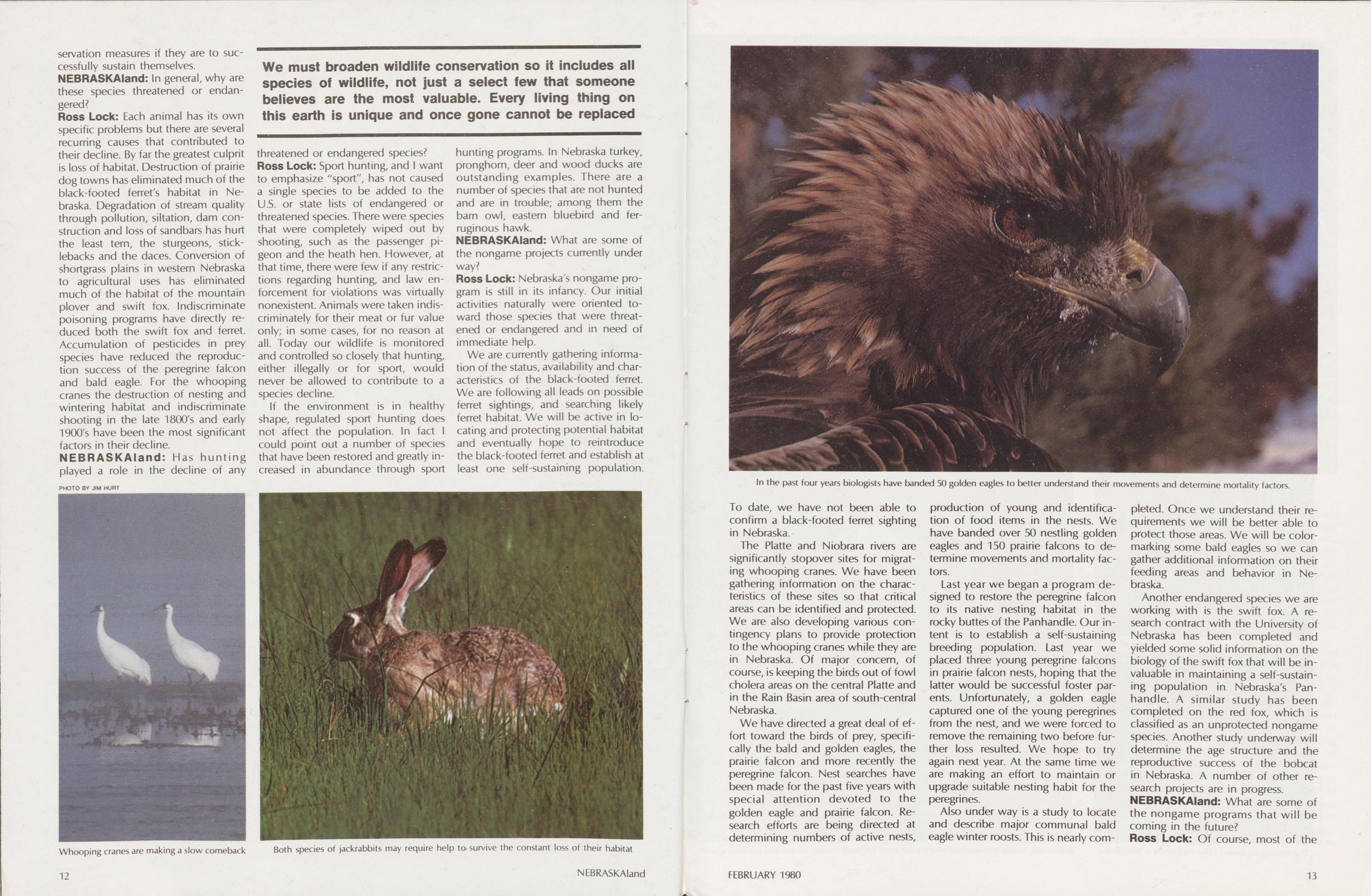
Ross Lock: Currently there are six species considered as endangered and nine as threatened. Endangered are the black-footed ferret, swift fox, whooping crane, peregrine falcon, Eskimo curlew and the bald eagle. Our threatened species are the least tern, mountain plover, flying squirrel, lake sturgeon, pallid sturgeon, brook stickleback, and three daces (members of the minnow family). In addition to the threatened and endangered species, the bobcat, black-tailed and whitetailed jackrabbit, spotted skunk and short-horned lizard are nongame species that we feel are in need of conservation measures if they are to successfully sustain themselves.
FEBRUARY 1980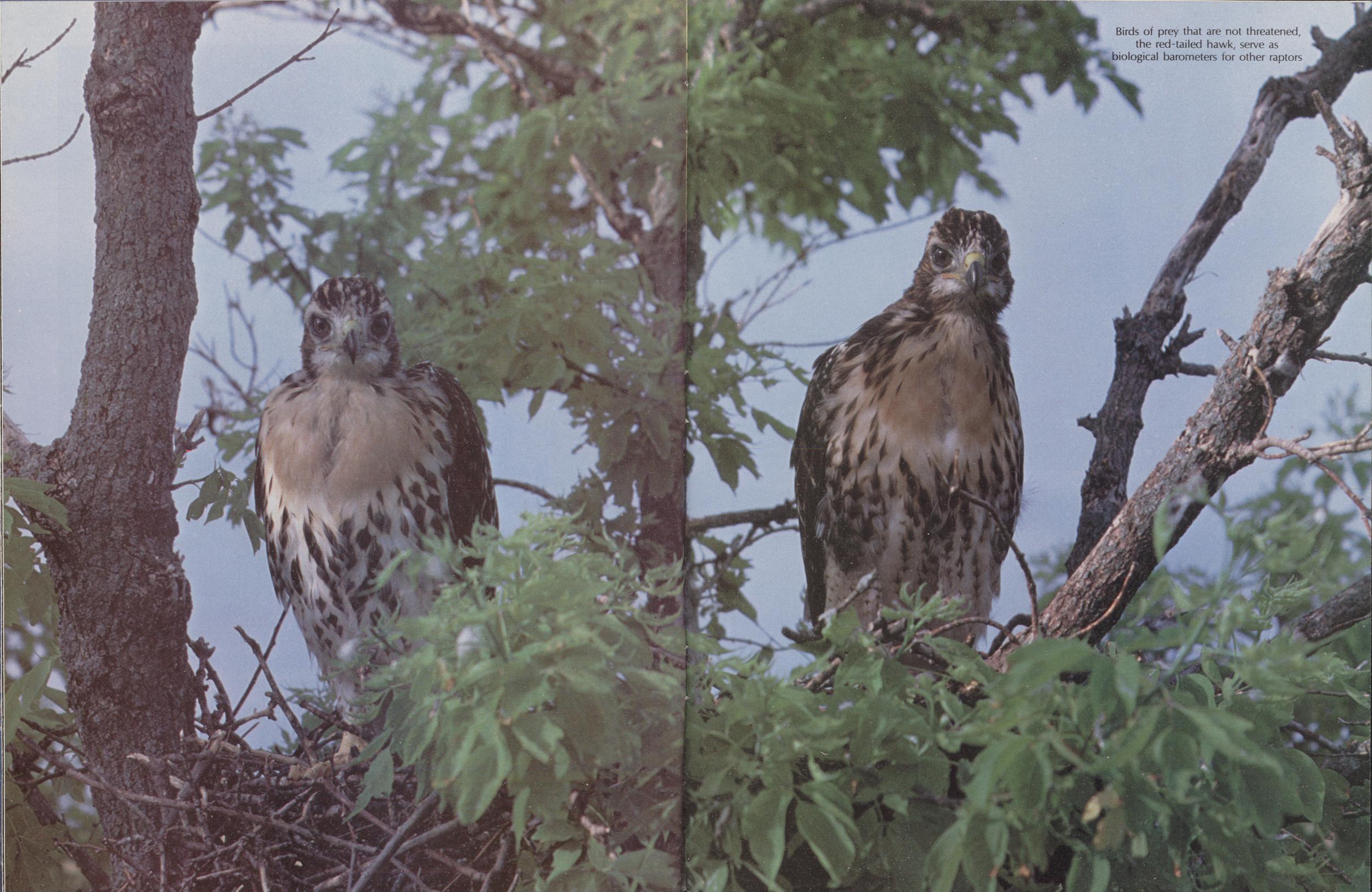
NEBRASKAland: In general, why are these species threatened or endangered?
Ross Lock: Each animal has its own specific problems but there are several recurring causes that contributed to their decline. By far the greatest culprit is loss of habitat. Destruction of prairie dog towns has eliminated much of the black-footed ferret's habitat in Nebraska. Degradation of stream quality through pollution, siltation, dam construction and loss of sandbars has hurt the least tern, the sturgeons, sticklebacks and the daces. Conversion of shortgrass plains in western Nebraska to agricultural uses has eliminated much of the habitat of the mountain plover and swift fox. Indiscriminate poisoning programs have directly reduced both the swift fox and ferret. Accumulation of pesticides in prey species have reduced the reproduction success of the peregrine falcon and bald eagle. For the whooping cranes the destruction of nesting and wintering habitat and indiscriminate shooting in the late 1800's and early 1900's have been the most significant factors in their decline.
NEBRASKAland: Has hunting played a role in the decline of any threatened or endangered species?
We must broaden wildlife conservation so it includes all species of wildlife, not just a select few that someone believes are the most valuable. Every living thing on this earth is unique and once gone cannot be replacedRoss Lock: Sport hunting, and I want to emphasize "sport", has not caused a single species to be added to the U.S. or state lists of endangered or threatened species. There were species that were completely wiped out by shooting, such as the passenger pigeon and the heath hen. However, at that time, there were few if any restrictions regarding hunting, and law enforcement for violations was virtually nonexistent. Animals were taken indiscriminately for their meat or fur value only; in some cases, for no reason at all. Today our wildlife is monitored and controlled so closely that hunting, either illegally or for sport, would never be allowed to contribute to a species decline.
If the environment is in healthy shape, regulated sport hunting does not affect the population. In fact I could point out a number of species that have been restored and greatly increased in abundance through sport hunting programs. In Nebraska turkey, pronghorn, deer and wood ducks are outstanding examples. There are a number of species that are not hunted and are in trouble; among them the barn owl, eastern bluebird and ferruginous hawk.
NEBRASKAland: What are some of the nongame projects currently under way?
Ross Lock: Nebraska's nongame program is still in its infancy. Our initial activities naturally were oriented toward those species that were threatened or endangered and in need of immediate help.
We are currently gathering information of the status, availability and characteristics of the black-footed ferret. We are following all leads on possible ferret sightings, and searching likely ferret habitat. We will be active in locating and protecting potential habitat and eventually hope to reintroduce the black-footed ferret and establish at least one self-sustaining population. To date, we have not been able to confirm a black-footed ferret sighting in Nebraska.
The Platte and Niobrara rivers are significantly stopover sites for migrating whooping cranes. We have been gathering information on the characteristics of these sites so that critical areas can be identified and protected. We are also developing various contingency plans to provide protection to the whooping cranes while they are in Nebraska. Of major concern, of course, is keeping the birds out of fowl cholera areas on the central Platte and in the Rain Basin area of south-central Nebraska.
We have directed a great deal of effort toward the birds of prey, specifically the bald and golden eagles, the prairie falcon and more recently the peregrine falcon. Nest searches have been made for the past five years with special attention devoted to the golden eagle and prairie falcon. Research efforts are being directed at determining numbers of active nests, production of young and identification of food items in the nests. We have banded over 50 nestling golden eagles and 150 prairie falcons to determine movements and mortality factors.
Last year we began a program designed to restore the peregrine falcon to its native nesting habitat in the rocky buttes of the Panhandle. Our intent is to establish a self-sustaining breeding population. Last year we placed three young peregrine falcons in prairie falcon nests, hoping that the latter would be successful foster parents. Unfortunately, a golden eagle captured one of the young peregrines from the nest, and we were forced to remove the remaining two before further loss resulted. We hope to try again next year. At the same time we are making an effort to maintain or upgrade suitable nesting habit for the peregrines.
Also under way is a study to locate and describe major communal bald eagle winter roosts. This is nearly completed. Once we understand their requirements we will be better able to protect those areas. We will be colormarking some bald eagles so we can gather additional information on their feeding areas and behavior in Nebraska.
Another endangered species we are working with is the swift fox. A research contract with the University of Nebraska has been completed and yielded some solid information on the biology of the swift fox that will be invaluable in maintaining a self-sustaining population in Nebraska's Panhandle. A similar study has been completed on the red fox, which is classified as an unprotected nongame species. Another study underway will determine the age structure and the reproductive success of the bobcat in Nebraska. A number of other research projects are in progress.
NEBRASKAland: What are some of the nongame programs that will be coming in the future?
FEBRUARY 1980 13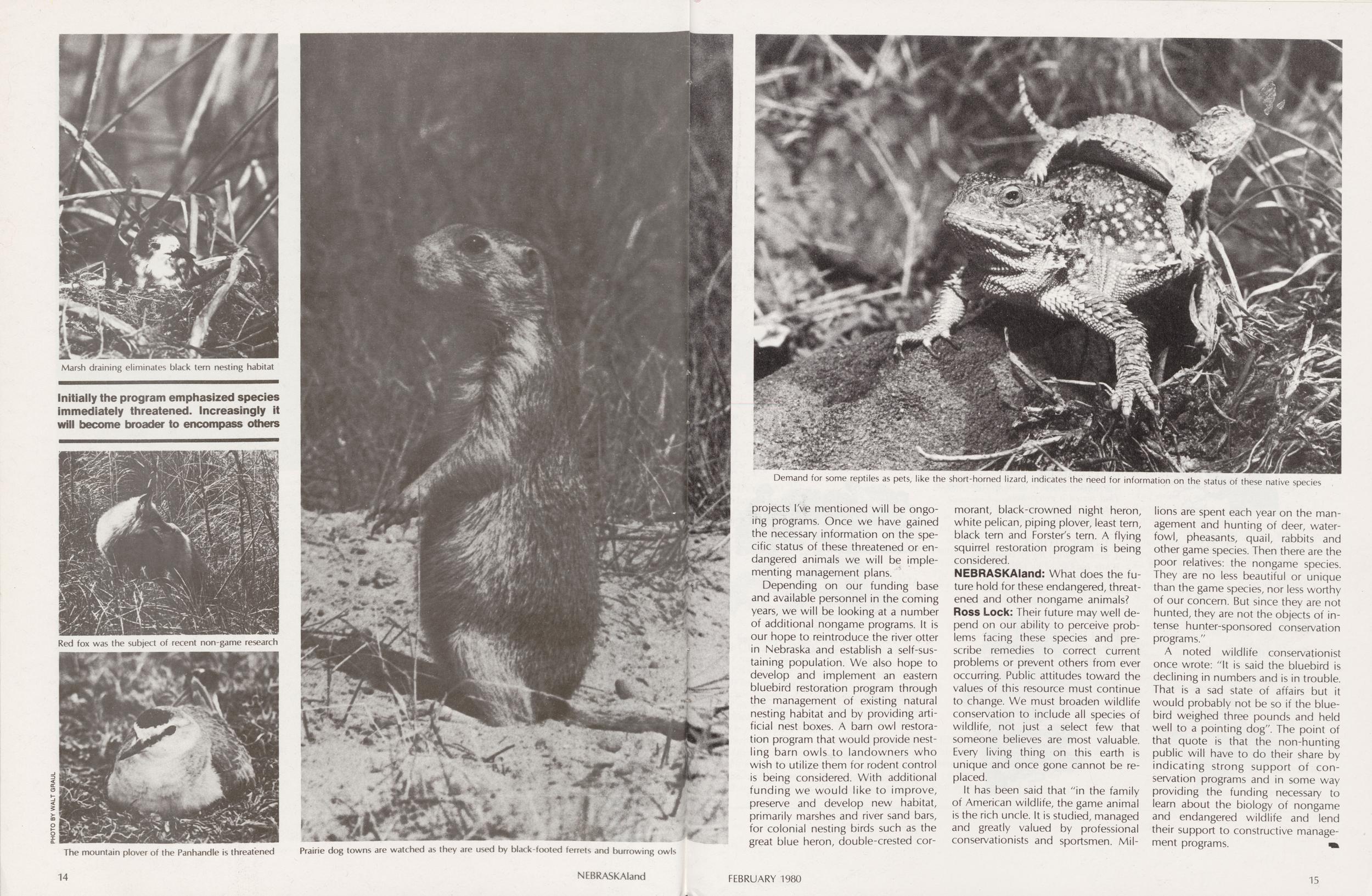
Ross Lock: Of course, most of the projects I've mentioned will be ongoing programs. Once we have gained the necessary information on the specific status of these threatened or endangered animals we will be implementing management plans.
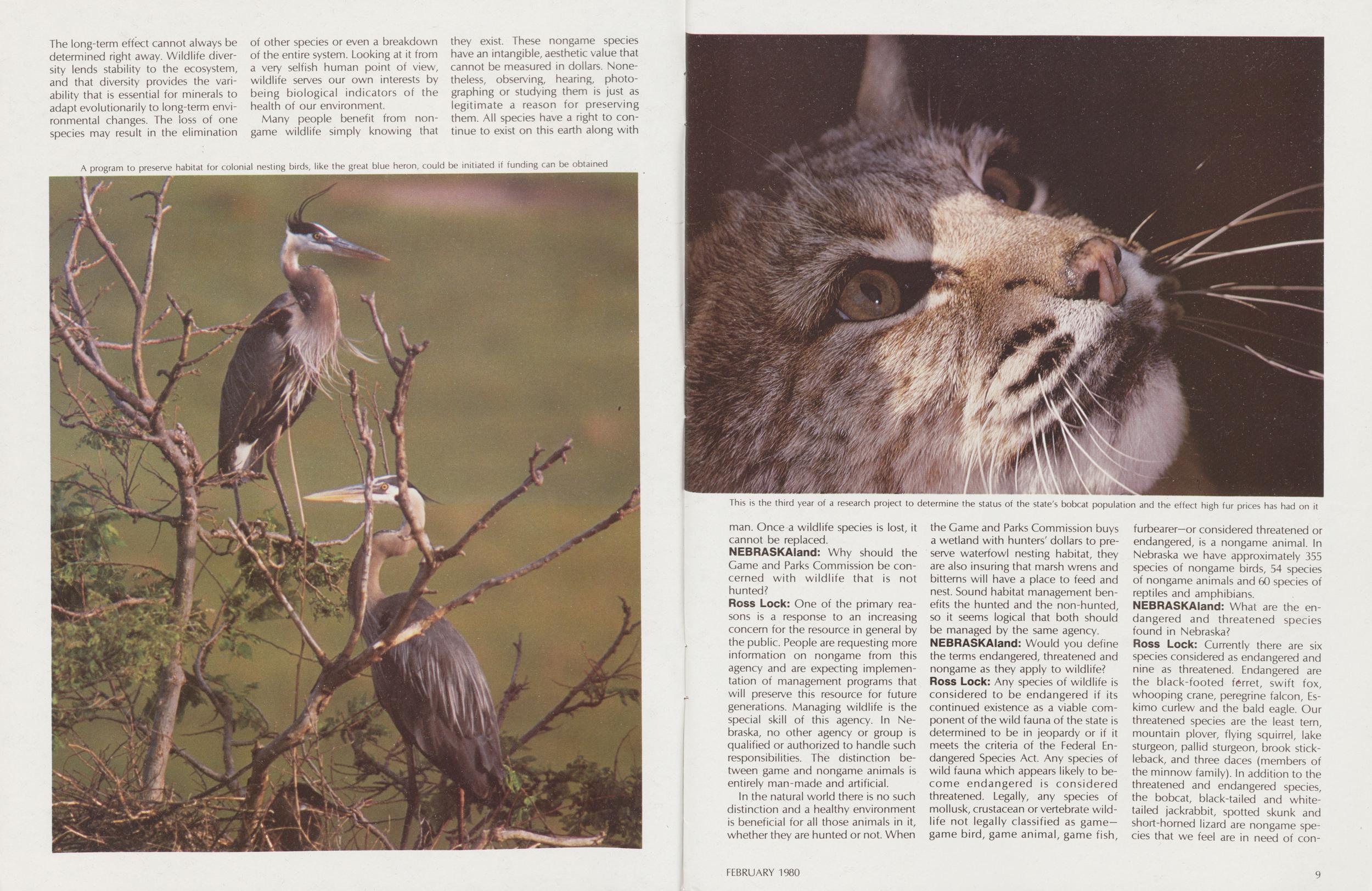
Depending on our funding base and available personnel in the coming years, we will be looking at a number of additional nongame programs. It is our hope to reintroduce the river otter in Nebraska and establish a self-sustaining population. We also hope to develop and implement an eastern bluebird restoration program through the management of existing natural nesting habitat and by providing artificial nest boxes. A barn owl restoration program that would provide nestling barn owls to landowners who wish to utilize them for rodent control is being considered. With additional funding we would like to improve, preserve and develop new habitat, primarily marshes and river sand bars, for colonial nesting birds such as the great blue heron, double-crested cormorant, black-crowned night heron, white pelican, piping plover, least tern, black tern and Forster's tern. A flying squirrel restoration program is being considered.
NEBRASKAland: What does the future hold for these endangered, threatened and other nongame animals?
Ross Lock: Their future may well depend on our ability to perceive problems facing these species and prescribe remedies to correct current problems or prevent others from ever occurring. Public attitudes toward the values of this resource must continue to change. We must broaden wildlife conservation to include all species of wildlife, not just a select few that someone believes are most valuable. Every living thing on this earth is unique and once gone cannot be replaced.
It has been said that 'In the family of American wildlife, the game animal is the rich uncle. It is studied, managed and greatly valued by professional conservationists and sportsmen. Millions are spent each year on the management and hunting of deer, waterfowl, pheasants, quail, rabbits and other game species. Then there are the poor relatives: the nongame species. They are no less beautiful or unique than the game species, nor less worthy of our concern. But since they are not hunted, they are not the objects of intense hunter-sponsored conservation programs."
A noted wildlife conservationist once wrote: "It is said the bluebird is declining in numbers and is in trouble. That is a sad state of affairs but it would probably not be so if the bluebird weighed three pounds and held well to a pointing dog". The point of that quote is that the non-hunting public will have to do their share by indicating strong support of conservation programs and in some way providing the funding necessary to learn about the biology of nongame and endangered wildlife and lend their support to constructive management programs.
FEBRUARY 1980 15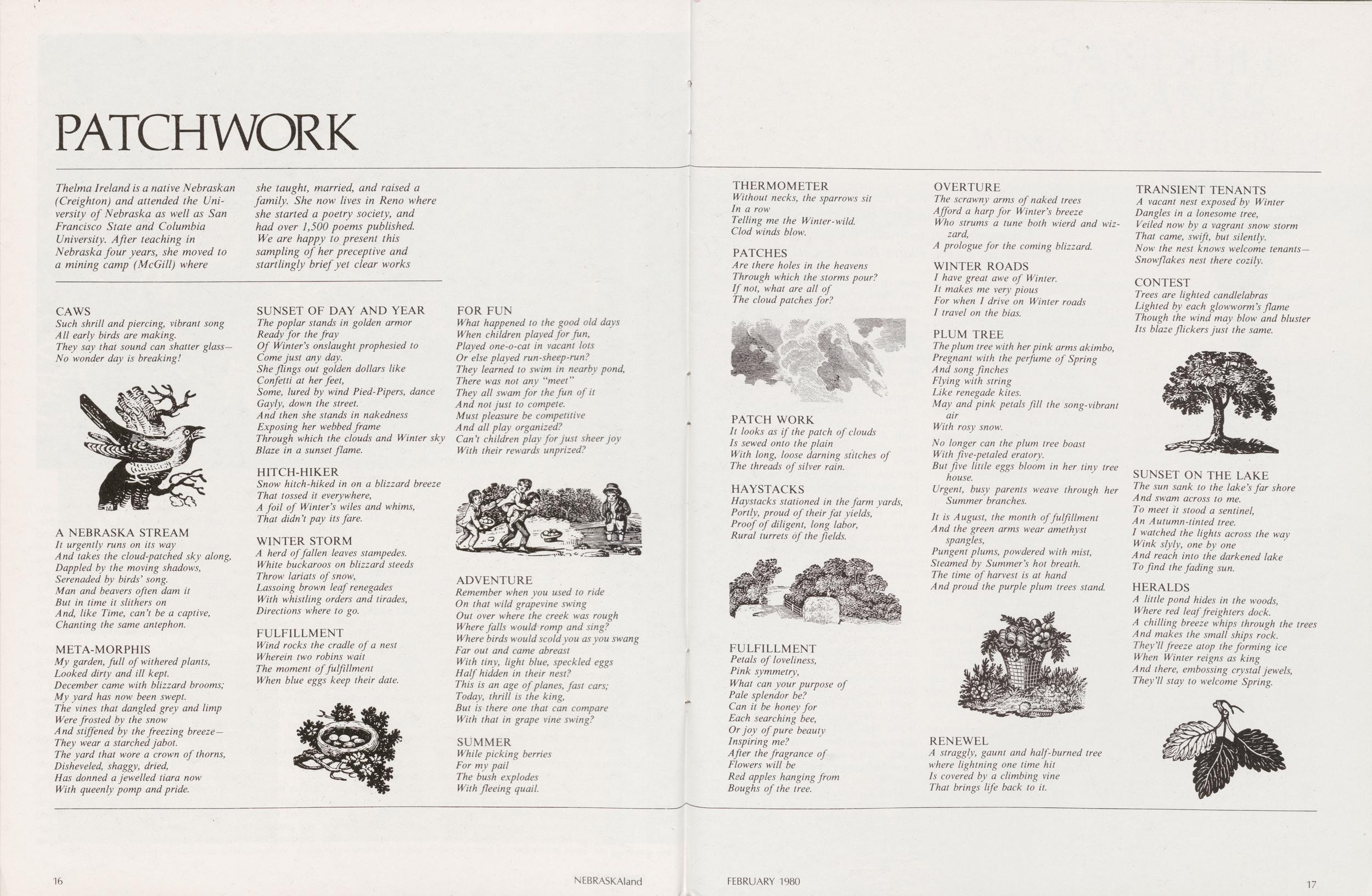
PATCHWORK
Thelma Ireland is a native Nebraskan (Creighton) and attended the University of Nebraska as well as San Francisco State and Columbia University. After teaching in Nebraska four years, she moved to a mining camp (McGill) where she taught, married, and raised a family. She now lives in Reno where she started a poetry society, and had over 1,500 poems published. We are happy to present this sampling of her preceptive and start lingly brief yet clear works CAWS Such shrill and piercing, vibrant songAll early birds are making.
They say that sound can shatter glass -
No wonder day is breaking!
And takes the cloud-patched sky along,
Dappled by the moving shadows,
Serenaded by birds' song.
Man and beavers often dam it
But in time it slithers on
And, like Time, can't be a captive,
Chanting the same antephon. META-MORPHIS My garden, full of withered plants,
Looked dirty and ill kept.
December came with blizzard brooms;
My yard has now been swept.
The vines that dangled grey and limp
Were frosted by the snow
And stiffened by the freezing breeze —
They wear a starched jabot.
The yard that wore a crown of thorns,
Disheveled, shaggy, dried,
Has donned a jeweled tiara now
With queenly pomp and pride. SUNSET OF DAY AND YEAR The poplar stands in golden armor
Ready for the fray
Of Winter's onslaught prophesied to
Come just any day.
She flings out golden dollars like
Confetti at her feet,
Some, lured by wind Pied-Pipers, dance
Gayly, down the street.
And then she stands in nakedness
Exposing her webbed frame
Through which the clouds and Winter sky
Blaze in a sunset flame. HITCH-HIKER Snow hitch-hiked in on a blizzard breeze
That tossed it everywhere,
A foil of Winter's wiles and whims,
That didn 't pay its fare. WINTER STORM A herd of fallen leaves stampedes.
White buckaroos on blizzard steeds
Throw lariats of snow,
Lassoing brown leaf renegades
With whistling orders and tirades,
Directions where to go. FULFILLMENT Wind rocks the cradle of a nest
Wherein two robins wait
The moment of fulfillment
When blue eggs keep their date.
When children played for fun,
Played one-o-cat in vacant lots
Or else played run-sheep-run?
They learned to swim in nearby pond,
There was not any "meet"
They all swam for the fun of it
And not just to compete.
Must pleasure be competitive
And all play organized?
Can't children play for just sheer joy
With their rewards unprized?
On that wild grapevine swingy
Out over where the creek was roughy
Where falls would romp and sing?
Where birds would scold you as you swang
Far out and came abreast
With tiny, light blue, speckled eggs
Half hidden in their nest?
This is an age of planes, fast cars;
Today, thrill is the king,
But is there one that can compare
With that in grape vine swing? SUMMER While picking berries
For my pail
The bush explodes
With fleeing quail 16 NEBRASKAland THERMOMETER Without necks, the sparrows sit
In a row
Telling me the Winter-wild.
Clod winds blow. PATCHES Are there holes in the heavens
Through which the storms pour?
If not, what are all of
The cloud patches for?
Is sewed onto the plain
With long, loose darning stitches of
The threads of silver rain. HAYSTACKS Haystacks stationed in the farm yards,
Portly, proud of their fat yields,
Proof of diligent, long labor,
Rural turrets of the fields.
Pink symmetry,
What can your purpose of
Pale splendor be?
Can it be honey for
Each searching bee,
Or joy of pure beauty
Inspiring me?
After the fragrance of
Flowers will be
Red apples hanging from
Boughs of the tree. OVERTURE The scrawny arms of naked trees
Afford a harp for Winter's breeze
Who strums a tune both weird and wizzard,
A prologue for the coming blizzard. WINTER ROADS I have great awe of Winter.
It makes me very pious
For when I drive on Winter roads
I travel on the bias. PLUM TREE The plum tree with her pink arms akimbo,
Pregnant with the perfume of Spring
And song finches
Flying with string
Like renegade kites.
May and pink petals fill the song-vibrant air
With rosy snow.
No longer can the plum tree boast
With five-petaled eratory.
But five little eggs bloom in her tiny tree house.
Urgent, busy parents weave through her Summer branches.
It is August, the month of fulfillment
And the green arms wear amethyst spangles,
Pungent plums, powdered with mist,
Steamed by Summer's hot breath.
The time of harvest is at hand
And proud the purple plum trees stand.
where lightning one time hit
Is covered by a climbing vine
That brings life back to it. TRANSIENT TENANTS A vacant nest exposed by Winter
Dangles in a lonesome tree,
Veiled now by a vagrant snow storm
That came, swift, but silently.
Now the nest knows welcome tenants —
Snowflakes nest there cozily. CONTEST Trees are lighted candlelabras
Lighted by each glowworm's flame
Though the wind may blow and bluster
Its blaze flickers just the same.
And swam across to me.
To meet it stood a sentinel,
An Autumn-tinted tree.
I watched the lights across the way
Wink slyly, one by one
And reach into the darkened lake
To find the fading sun. HERALDS A little pond hides in the woods,
Where red leaf freighters dock.
A chilling breeze whips through the trees
And makes the small ships rock.
They'll freeze atop the forming ice
When Winter reigns as king
And there, embossing crystal jewels,
They'll stay to welcome Spring.
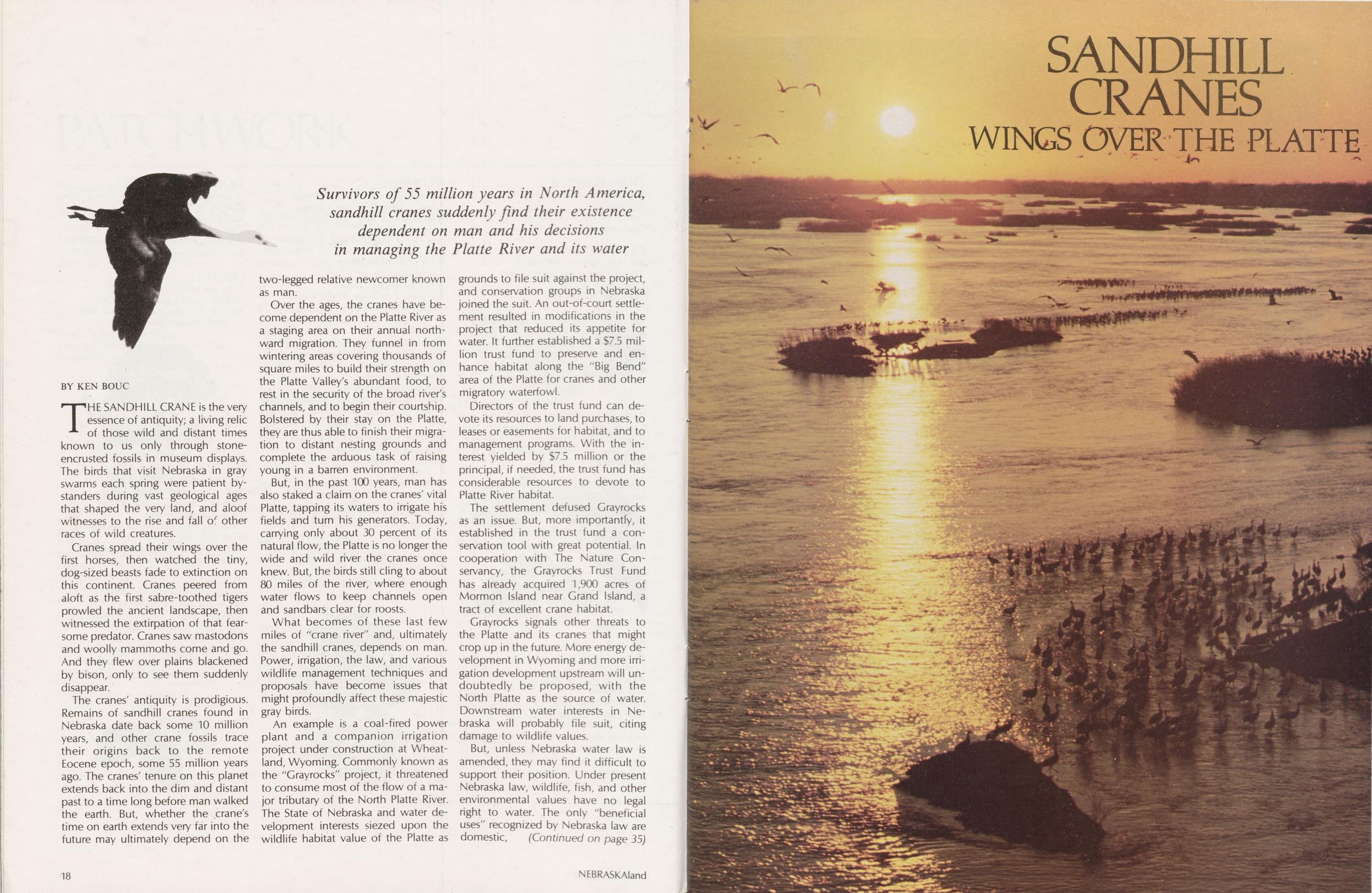
SANDILL CRANES WINGS OVER THE PLATTE
THE SANDHILL CRANE is the very essence of antiquity; a living relic of those wild and distant times known to us only through stone-encrusted fossils in museum displays. The birds that visit Nebraska in gray swarms each spring were patient bystanders during vast geological ages that shaped the very land, and aloof witnesses to the rise and fall of other races of wild creatures.
Cranes spread their wings over the first horses, then watched the tiny, dog-sized beasts fade to extinction on this continent. Cranes peered from aloft as the first sabre-toothed tigers prowled the ancient landscape, then witnessed the extirpation of that fearsome predator. Cranes saw mastodons and woolly mammoths come and go. And they flew over plains blackened by bison, only to see them suddenly disappear.
The cranes' antiquity is prodigious. Remains of sandhill cranes found in Nebraska date back some 10 million years, and other crane fossils trace their origins back to the remote Eocene epoch, some 55 million years ago. The cranes' tenure on this planet extends back into the dim and distant past to a time long before man walked the earth. But, whether the crane's time on earth extends very far into the future may ultimately depend on the two-legged relative newcomer known as man.
Over the ages, the cranes have become dependent on the Platte River as a staging area on their annual northward migration. They funnel in from wintering areas covering thousands of square miles to build their strength on the Platte Valley's abundant food, to rest in the security of the broad river's channels, and to begin their courtship. Bolstered by their stay on the Platte, they are thus able to finish their migration to distant nesting grounds and complete the arduous task of raising young in a barren environment.
But, in the past 100 years, man has also staked a claim on the cranes' vital Platte, tapping its waters to irrigate his fields and turn his generators. Today, carrying only about 30 percent of its natural flow, the Platte is no longer the wide and wild river the cranes once knew. But, the birds still cling to about 80 miles of the river, where enough water flows to keep channels open and sandbars clear for roosts.
What becomes of these last few miles of "crane river" and, ultimately the sandhill cranes, depends on man. Power, irrigation, the law, and various wildlife management techniques and proposals have become issues that might profoundly affect these majestic gray birds.
An example is a coal-fired power plant and a companion irrigation project under construction at Wheatland, Wyoming. Commonly known as the "Grayrocks" project, it threatened to consume most of the flow of a major tributary of the North Platte River. The State of Nebraska and water development interests siezed upon the wildlife habitat value of the Platte as grounds to file suit against the project, and conservation groups in Nebraska joined the suit. An out-of-court settlement resulted in modifications in the project that reduced its appetite for water. It further established a $7.5 million trust fund to preserve and enhance habitat along the "Big Bend" area of the Platte for cranes and other migratory waterfowl.
Directors of the trust fund can devote its resources to land purchases, to leases or easements for habitat, and to management programs. With the interest yielded by $7.5 million or the principal, if needed, the trust fund has considerable resources to devote to Platte River habitat.
The settlement defused Grayrocks as an issue. But, more importantly, it established in the trust fund a conservation tool with great potential. In cooperation with The Nature Conservancy, the Grayrocks Trust Fund has already acquired 1,900 acres of Mormon Island near Grand Island, a tract of excellent crane habitat.
Grayrocks signals other threats to the Platte and its cranes that might crop up in the future. More energy development in Wyoming and more irrigation development upstream will undoubtedly be proposed, with the North Platte as the source of water. Downstream water interests in Nebraska will probably file suit, citing damage to wildlife values.
But, unless Nebraska water law is amended, they may find it difficult to support their position. Under present Nebraska law, wildlife, fish, and other environmental values have no legal right to water. The only "beneficial uses" recognized by Nebraska law are domestic, (Continued on page 35)
18 NEBRASKAland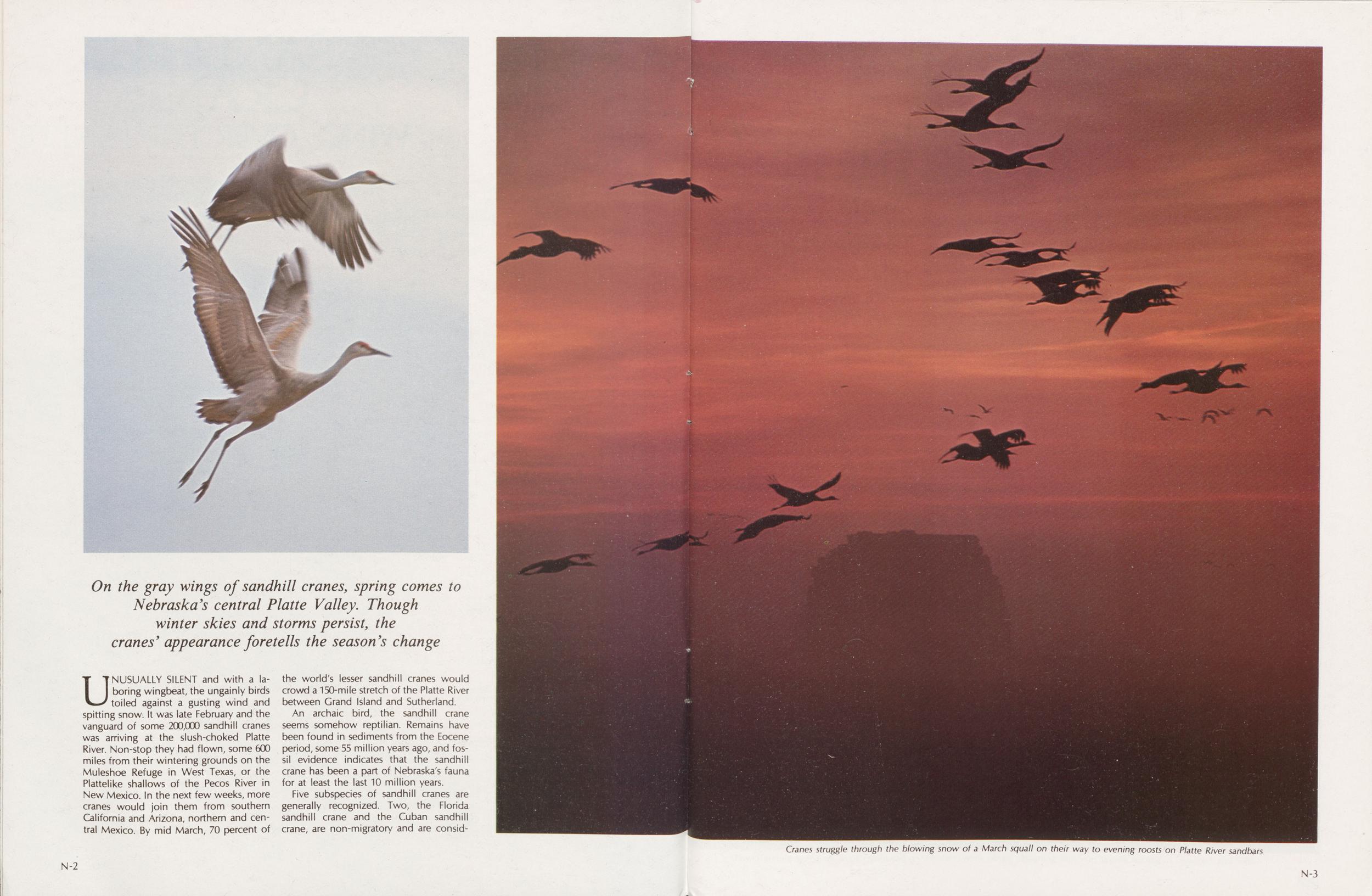
UNUSUALLY SILENT and with a laboring wingbeat, the ungainly birds toiled against a gusting wind and spitting snow. It was late February and the vanguard of some 200,000 sandhill cranes was arriving at the slush-choked Platte River. Non-stop they had flown, some 600 miles from their wintering grounds on the Muleshoe Refuge in West Texas, or the Plattelike shallows of the Pecos River in New Mexico. In the next few weeks, more cranes would join them from southern California and Arizona, northern and central Mexico. By mid March, 70 percent of the world's lesser sandhill cranes would crowd a 150-mile stretch of the Platte River between Grand Island and Sutherland.
An archaic bird, the sandhill crane seems somehow reptilian. Remains have been found in sediments from the Eocene period, some 55 million years ago, and fossil evidence indicates that the sandhill crane has been a part of Nebraska's fauna for at least the last 10 million years.
Five subspecies of sandhill cranes are generally recognized. Two, the Florida sandhill crane and the Cuban sandhill crane, are non-migratory and are considered rare by the U.S. Fish and Wildlife Service. Fewer than 600 Florida cranes and less than 100 Cuban cranes are known to exist.
N-2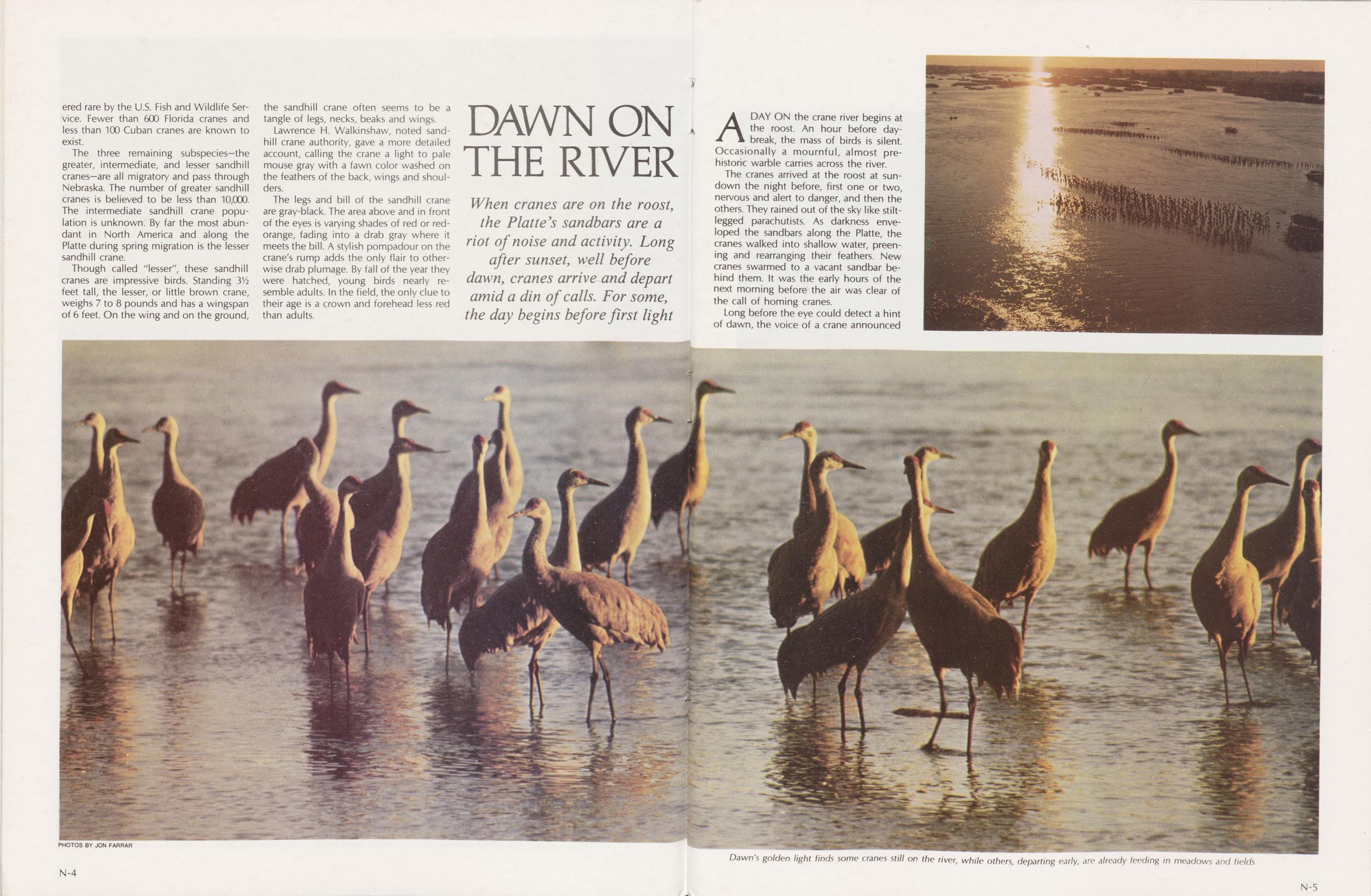
The three remaining subspecies—the greater, intermediate, and lesser sandhill cranes—are all migratory and pass through Nebraska. The number of greater sandhill cranes is believed to be less than 10,000. The intermediate sandhill crane population is unknown. By far the most abundant in North America and along the Platte during spring migration is the lesser sandhill crane.
Though called "lesser", these sandhill cranes are impressive birds. Standing 31/2 feet tall, the lesser, or little brown crane, weighs 7 to 8 pounds and has a wingspan of 6 feet. On the wing and on the ground, the sandhill crane often seems to be a tangle of legs, necks, beaks and wings.
Lawrence H. Walkinshaw, noted sandhill crane authority, gave a more detailed account, calling the crane a light to pale mouse gray with a fawn color washed on the feathers of the back, wings and shoulders.
The legs and bill of the sandhill crane are gray-black. The area above and in front of the eyes is varying shades of red or red-orange, fading into a drab gray where it meets the bill. A stylish pompadour on the crane's rump adds the only flair to otherwise drab plumage. By fall of the year they were hatched, young birds nearly resemble adults. In the field, the only clue to their age is a crown and forehead less red than adults.
DAWN ON THE RIVER
When cranes are on the roost, the Platte's sandbars are a riot of noise and activity. Long after sunset, well before dawn, cranes arrive and depart amid a din of calls. For some, the day begins before first lightA DAY ON the crane river begins at the roost. An hour before daybreak, the mass of birds is silent. Occasionally a mournful, almost prehistoric warble carries across the river.
The cranes arrived at the roost at sundown the night before, first one or two, nervous and alert to danger, and then the others. They rained out of the sky like stilt-legged parachutists. As darkness enveloped the sandbars along the Platte, the cranes walked into shallow water, preening and rearranging their feathers. New cranes swarmed to a vacant sandbar behind them. It was the early hours of the next morning before the air was clear of the call of homing cranes.
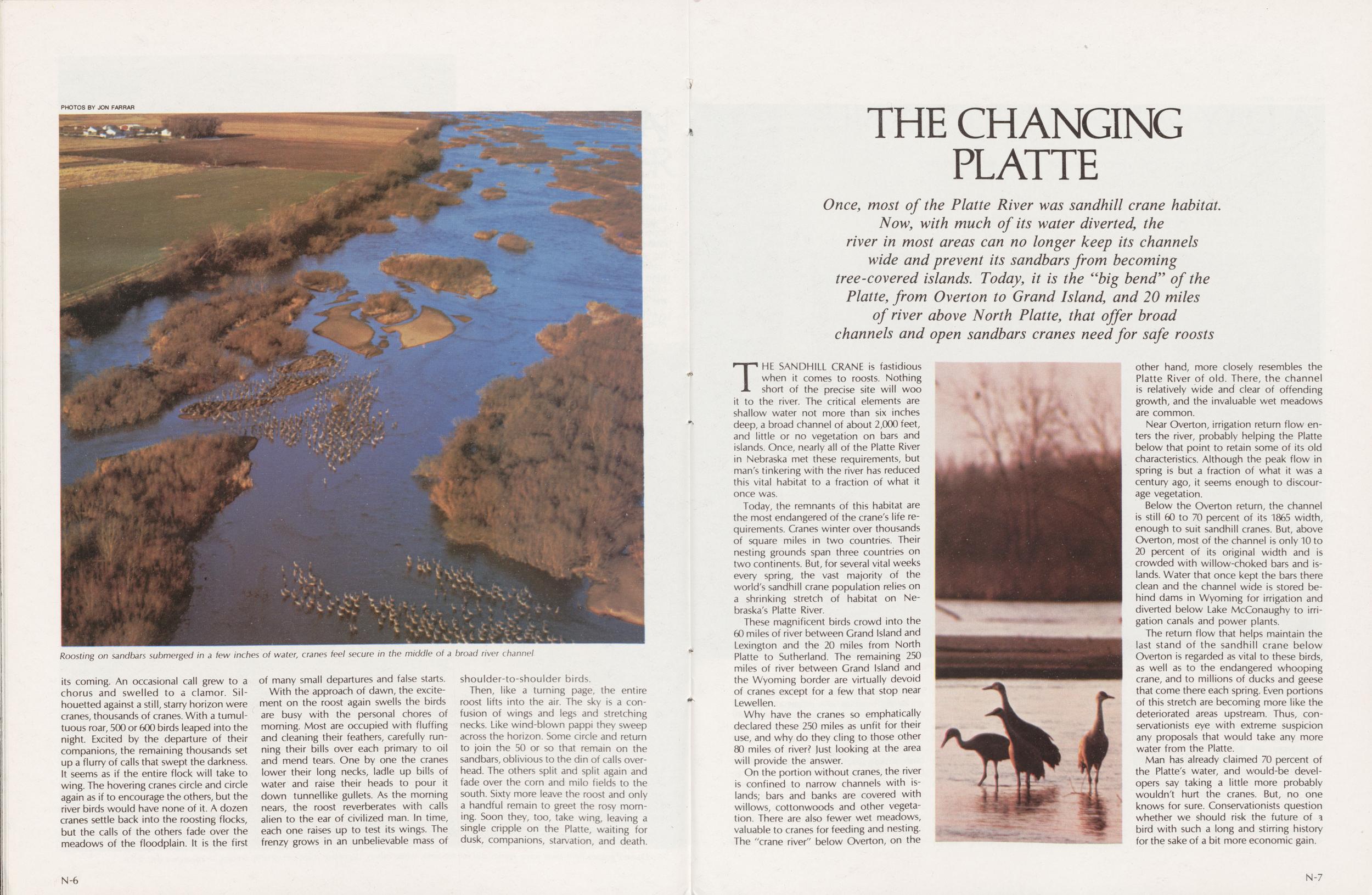
Long before the eye could detect a hint of dawn, the voice of a crane announced its coming. An occasional call grew to a chorus and swelled to a clamor. Silhouetted against a still, starry horizon were cranes, thousands of cranes. With a tumultuous roar, 500 or 600 birds leaped into the night. Excited by the departure of their companions, the remaining thousands set up a flurry of calls that swept the darkness. It seems as if the entire flock will take to wing. The hovering cranes circle and circle again as if to encourage the others, but the river birds would have none of it. A dozen cranes settle back into the roosting flocks, but the calls of the others fade over the meadows of the floodplain. It is the first of many small departures and false starts.
With the approach of dawn, the excitement on the roost again swells the birds are busy with the personal chores of morning. Most are occupied with fluffing and cleaning their feathers, carefully running their bills over each primary to oil and mend tears. One by one the cranes lower their long necks, ladle up bills of water and raise their heads to pour it down tunnellike gullets. As the morning nears, the roost reverberates with calls alien to the ear of civilized man. In time, each one raises up to test its wings. The frenzy grows in an unbelievable mass of shoulder-to-shoulder birds.
Then, like a turning page, the entire roost lifts into the air. The sky is a confusion of wings and legs and stretching necks. Like wind-blown pappi they sweep across the horizon. Some circle and return to join the 50 or so that remain on the sandbars, oblivious to the din of calls overhead. The others split and split again and fade over the corn and milo fields to the south. Sixty more leave the roost and only a handful remain to greet the rosy morning. Soon they, too, take wing, leaving a single cripple on the Platte, waiting for dusk, companions, starvation, and death.
N-6THE CHANGING PLATTE
Once, most of the Platte River was sandhill crane habitat. Now, with much of its water diverted, the river in most areas can no longer keep its channels wide and prevent its sandbars from becoming tree-covered islands. Today, it is the "big bend" of the Platte, from Overton to Grand Island, and 20 miles of river above North Platte, that offer broad channels and open sandbars cranes need for safe roostsTHE SANDHILL CRANE is fastidious when it comes to roosts. Nothing short of the precise site will woo it to the river. The critical elements are shallow water not more than six inches deep, a broad channel of about 2,000 feet, and little or no vegetation on bars and islands. Once, nearly all of the Platte River in Nebraska met these requirements, but man's tinkering with the river has reduced this vital habitat to a fraction of what it once was.
Today, the remnants of this habitat are the most endangered of the crane's life requirements. Cranes winter over thousands of square miles in two countries. Their nesting grounds span three countries on two continents. But, for several vital weeks every spring, the vast majority of the world's sandhill crane population relies on a shrinking stretch of habitat on Nebraska's Platte River.
These magnificent birds crowd into the 60 miles of river between Grand Island and Lexington and the 20 miles from North Platte to Sutherland. The remaining 250 miles of river between Grand Island and the Wyoming border are virtually devoid of cranes except for a few that stop near Lewellen.
Why have the cranes so emphatically declared these 250 miles as unfit for their use, and why do they cling to those other 80 miles of river? Just looking at the area will provide the answer.
On the portion without cranes, the river is confined to narrow channels with islands; bars and banks are covered with willows, cotton woods and other vegetation. There are also fewer wet meadows, valuable to cranes for feeding and nesting. The "crane river" below Overton, on the other hand, more closely resembles the Platte River of old. There, the channel is relatively wide and clear of offending growth, and the invaluable wet meadows are common.
Near Overton, irrigation return flow enters the river, probably helping the Platte below that point to retain some of its old characteristics. Although the peak flow in spring is but a fraction of what it was a century ago, it seems enough to discourage vegetation.
Below the Overton return, the channel is still 60 to 70 percent of its 1865 width, enough to suit sandhill cranes. But, above Overton, most of the channel is only 10 to 20 percent of its original width and is crowded with willow-choked bars and islands. Water that once kept the bars there clean and the channel wide is stored behind dams in Wyoming for irrigation and diverted below Lake McConaughy to irrigation canals and power plants.
The return flow that helps maintain the last stand of the sandhill crane below Overton is regarded as vital to these birds, as well as to the endangered whooping crane, and to millions of ducks and geese that come there each spring. Even portions of this stretch are becoming more like the deteriorated areas upstream. Thus, conservationists eye with extreme suspicion any proposals that would take any more water from the Platte.
Man has already claimed 70 percent of the Platte's water, and would-be developers say taking a little more probably wouldn't hurt the cranes. But, no one knows for sure. Conservationists question whether we should risk the future of a bird with such a long and stirring history for the sake of a bit more economic gain.
N-7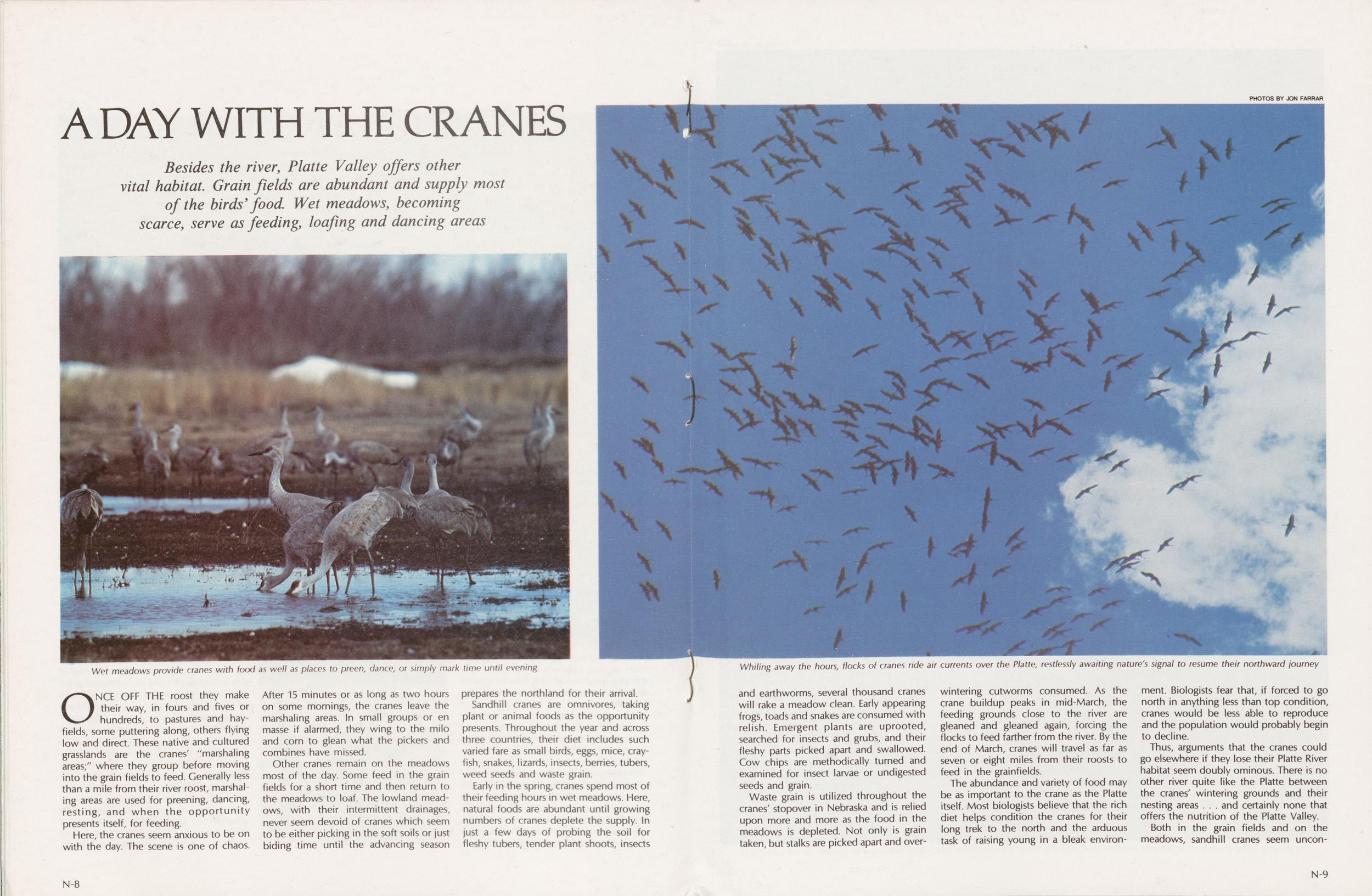
A DAY WITH THE CRANES
Besides the river, Platte Valley offers other vital habitat. Grain fields are abundant and supply most of the birds food. Wet meadows, becoming scarce, serve as feeding, loafing and dancing areasONCE OFF THE roost they make their way, in fours and fives or hundreds, to pastures and hayfields, some puttering along, others flying low and direct. These native and cultured grasslands are the cranes' "marshaling areas," where they group before moving into the grain fields to feed. Generally less than a mile from their river roost, marshaling areas are used for preening, dancing, resting, and when the opportunity presents itself, for feeding.
Here, the cranes seem anxious to be on with the day. The scene is one of chaos. After 15 minutes or as long as two hours on some mornings, the cranes leave the marshaling areas. In small groups or en masse if alarmed, they wing to the milo and corn to glean what the pickers and combines have missed.
Other cranes remain on the meadows most of the day. Some feed in the grain fields for a short time and then return to the meadows to loaf. The lowland meadows, with their intermittent drainages, never seem devoid of cranes which seem to be either picking in the soft soils or just biding time until the advancing season prepares the northland for their arrival.
Sandhill cranes are omnivores, taking plant or animal foods as the opportunity presents. Throughout the year and across three countries, their diet includes such varied fare as small birds, eggs, mice, crayfish, snakes, lizards, insects, berries, tubers, weed seeds and waste grain.
Early in the spring, cranes spend most of their feeding hours in wet meadows. Here, natural foods are abundant until growing numbers of cranes deplete the supply. In just a few days of probing the soil for fleshy tubers, tender plant shoots, insects and earthworms, several thousand cranes will rake a meadow clean. Early appearing frogs, toads and snakes are consumed with relish. Emergent plants are uprooted, searched for insects and grubs, and their fleshy parts picked apart and swallowed. Cow chips are methodically turned and examined for insect larvae or undigested seeds and grain.
Waste grain is utilized throughout the cranes' stopover in Nebraska and is relied upon more and more as the food in the meadows is depleted. Not only is grain taken, but stalks are picked apart and over-wintering cutworms consumed. As the crane buildup peaks in mid-March, the feeding grounds close to the river are gleaned and gleaned again, forcing the flocks to feed farther from the river. By the end of March, cranes will travel as far as seven or eight miles from their roosts to feed in the grainfields.
The abundance and variety of food may be as important to the crane as the Platte itself. Most biologists believe that the rich diet helps condition the cranes for their long trek to the north and the arduous task of raising young in a bleak environment. Biologists fear that, if forced to go north in anything less than top condition, cranes would be less able to reproduce and the population would probably begin to decline.
Thus, arguments that the cranes could go elsewhere if they lose their Platte River habitat seem doubly ominous. There is no other river quite like the Platte between the cranes' wintering grounds and their nesting areas...and certainly none that offers the nutrition of the Platte Valley.
N-9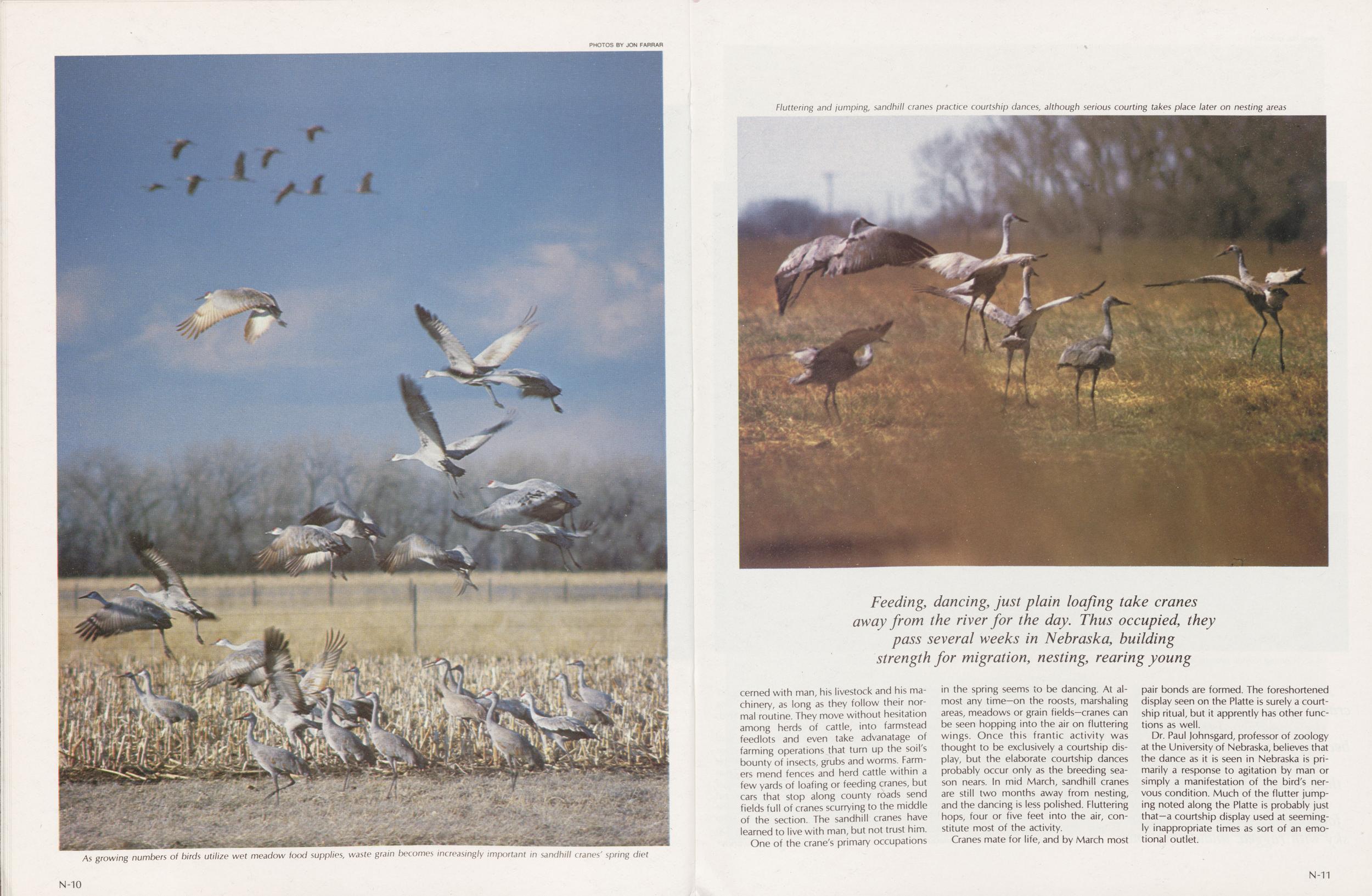
Both in the grain fields and on the meadows, sandhill cranes seem unconcerned with man, his livestock and his machinery, as long as they follow their normal routine. They move without hesitation among herds of cattle, into farmstead feed lots and even take advantage of farming operations that turn up the soil's bounty of insects, grubs and worms. Farmers mend fences and herd cattle within a few yards of loafing or feeding cranes, but cars that stop along county roads send fields full of cranes scurrying to the middle of the section. The sandhill cranes have learned to live with man, but not trust him.
One of the crane's primary occupations in the spring seems to be dancing. At almost any time—on the roosts, marshaling areas, meadows or grain fields—cranes can be seen hopping into the air on fluttering wings. Once this frantic activity was thought to be exclusively a courtship display, but the elaborate courtship dances probably occur only as the breeding season nears. In mid March, sandhill cranes are still two months away from nesting, and the dancing is less polished. Fluttering hops, four or five feet into the air, constitute most of the activity.
Cranes mate for life, and by March most pair bonds are formed. The foreshortened display seen on the Platte is surely a courtship ritual, but it apparently has other functions as well.
Dr. Paul Johnsgard, professor of zoology at the University of Nebraska, believes that the dance as it is seen in Nebraska is primarily a response to agitation by man or simply a manifestation of the bird's nervous condition. Much of the flutter jumping noted along the Platte is probably just that—a courtship display used at seemingly inappropriate times as sort of an emotional outlet.
N-11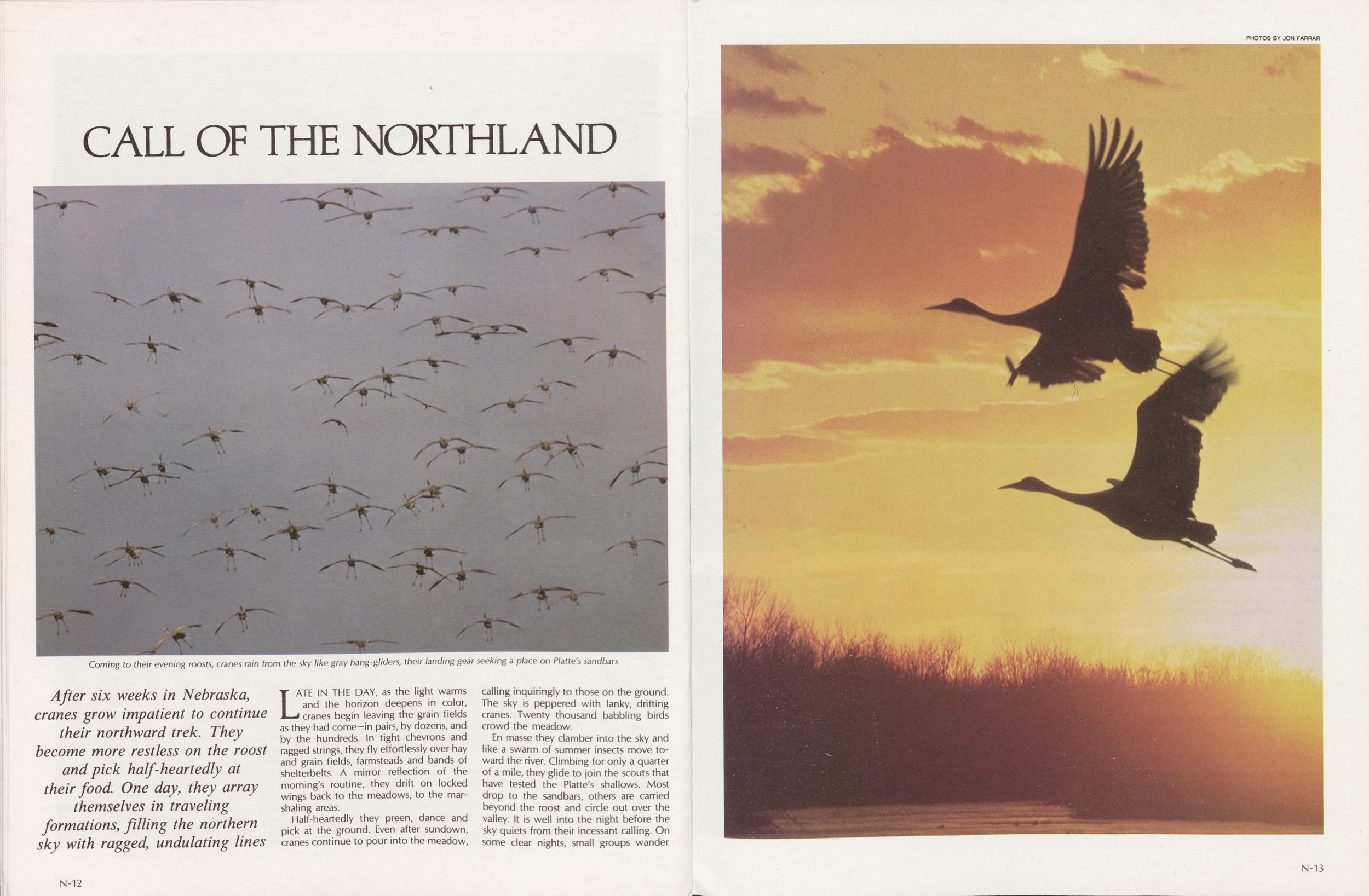
CALL OF THE NORTHLAND
LATE IN THE DAY, as the light warms and the horizon deepens in color, cranes begin leaving the grain fields as they had come-in pairs, by dozens, and by the hundreds. In tight chevrons and ragged strings, they fly effortlessly over hay and grain fields, farmsteads and bands of shelterbelts. A mirror reflection of the morning's routine, they drift on locked wings back to the meadows, to the marshaling areas.
Half-heartedly they preen, dance and pick at the ground. Even after sundown, cranes continue to pour into the meadow, calling inquiringly to those on the ground. The sky is peppered with lanky, drifting cranes. Twenty thousand babbling birds crowd the meadow.
En masse they clamber into the sky and like a swarm of summer insects move toward the river. Climbing for only a quarter of a mile, they glide to join the scouts that have tested the Platte's shallows. Most drop to the sandbars, others are carried beyond the roost and circle out over the valley. It is well into the night before the sky quiets from their incessant calling. On some clear nights, small groups wander the Platte's shores, barely clearing the cottonwoods, calling mournfully into the darkness. Winter has passed, and the cranes seem anxious to move on.
N-12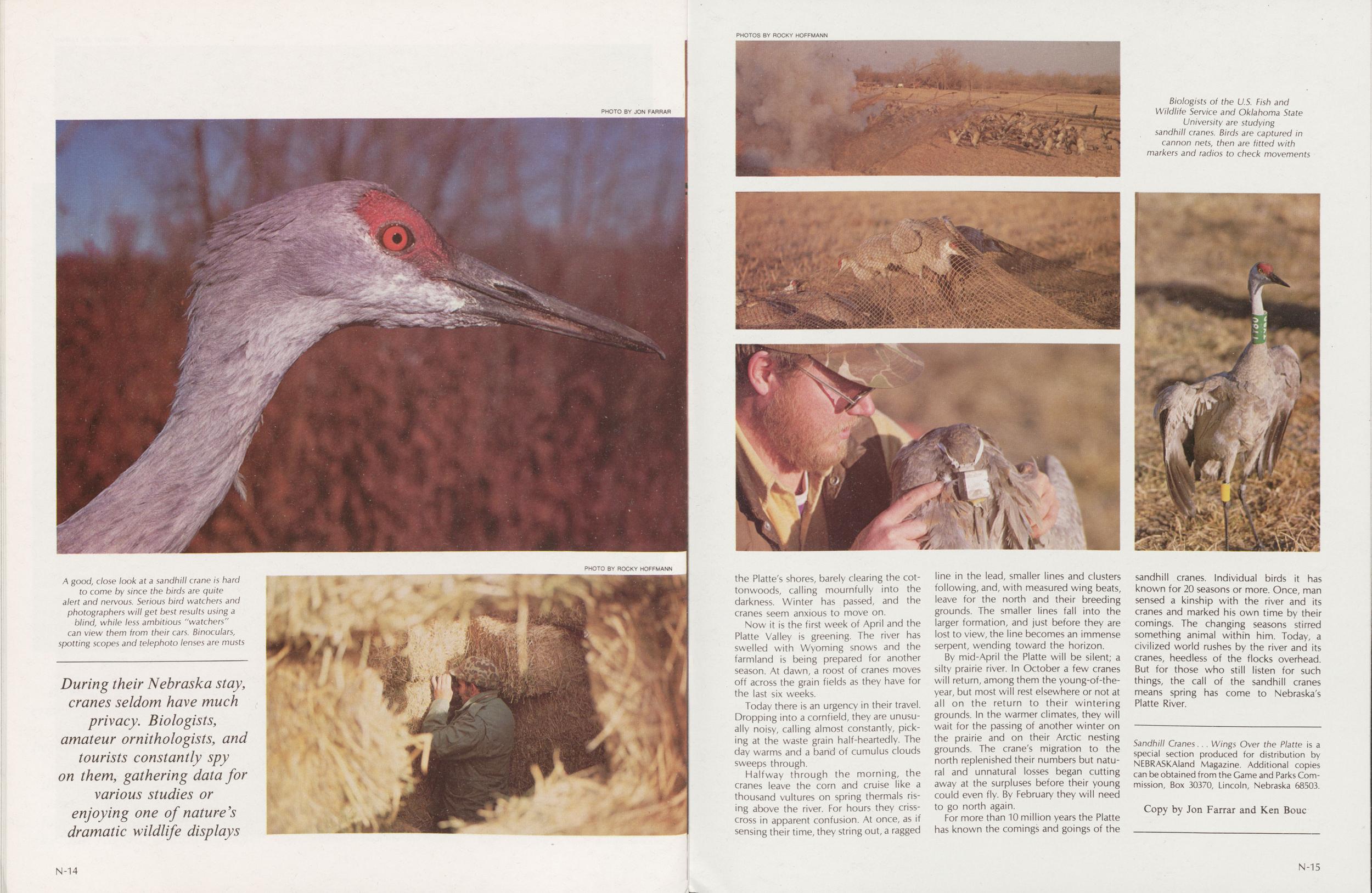
Now it is the first week of April and the Platte Valley is greening. The river has swelled with Wyoming snows and the farmland is being prepared for another season. At dawn, a roost of cranes moves off across the grain fields as they have for the last six weeks.
Today there is an urgency in their travel. Dropping into a cornfield, they are unusually noisy, calling almost constantly, picking at the waste grain half-heartedly. The day warms and a band of cumulus clouds sweeps through.
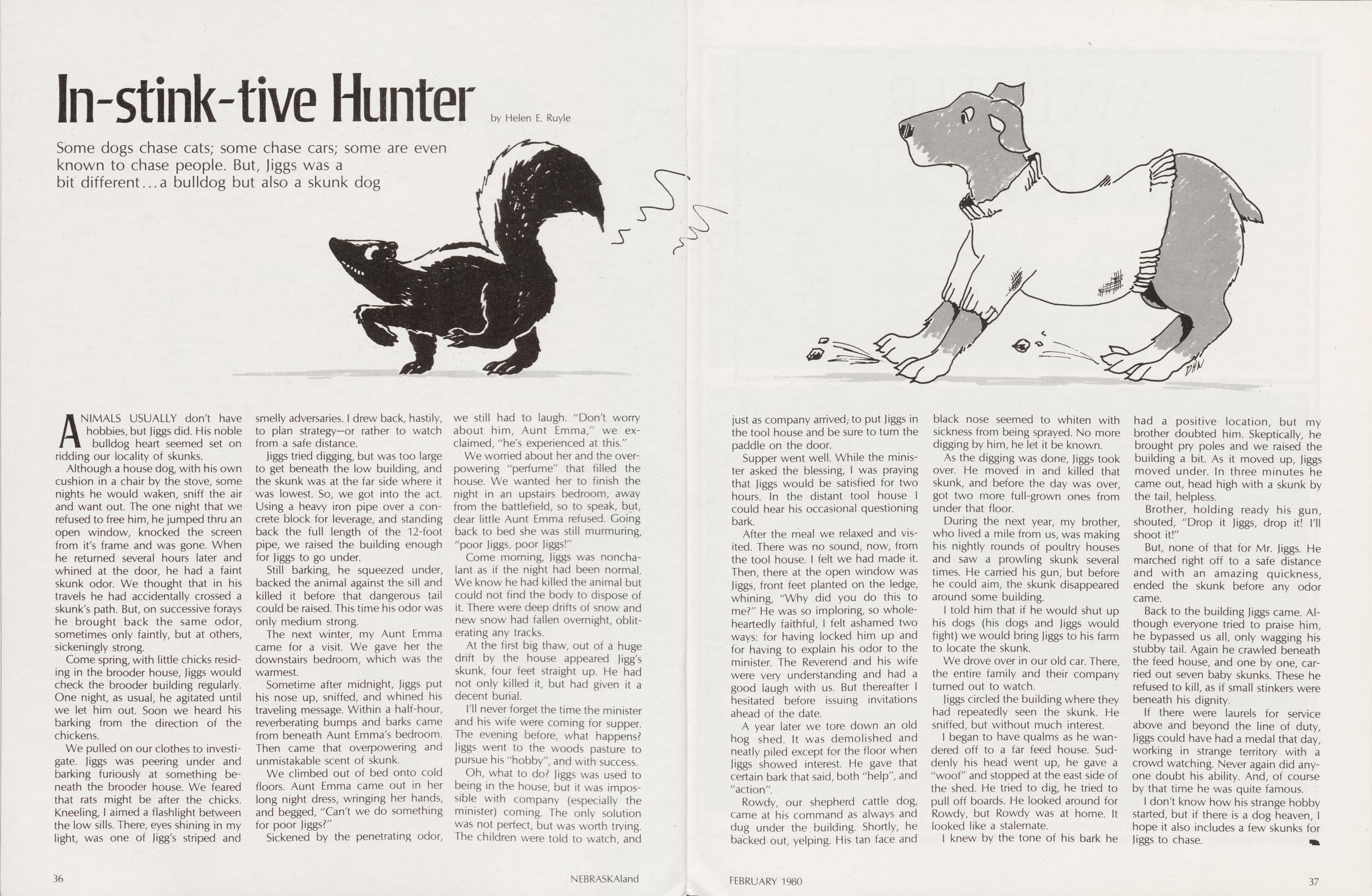
Halfway through the morning, the cranes leave the corn and cruise like a thousand vultures on spring thermals rising above the river. For hours they criss-cross in apparent confusion. At once, as if sensing their time, they string out, a ragged line in the lead, smaller lines and clusters following, and, with measured wing beats, leave for the north and their breeding grounds. The smaller lines fall into the larger formation, and just before they are lost to view, the line becomes an immense serpent, wending toward the horizon.
By mid-April the Platte will be silent; a silty prairie river. In October a few cranes will return, among them the young-of-the-year, but most will rest elsewhere or not at all on the return to their wintering grounds. In the warmer climates, they will wait for the passing of another winter on the prairie and on their Arctic nesting grounds. The crane's migration to the north replenished their numbers but natural and unnatural losses began cutting away at the surpluses before their young could even fly. By February they will need to go north again.
For more than 10 million years the Platte has known the comings and goings of the Biologists of the U.S. Fish and Wildlife Service and Oklahoma State University are studying sandhill cranes. Birds are captured in cannon nets, then are fitted with markers and radios to check movements p sandhill cranes. Individual birds it has known for 20 seasons or more. Once, man sensed a kinship with the river and its cranes and marked his own time by their comings. The changing seasons stirred something animal within him. Today, a civilized world rushes by the river and its cranes, heedless of the flocks overhead. But for those who still listen for such things, the call of the sandhill cranes means spring has come to Nebraska's Platte River.
Sandhill Cranes...Wings Over the Platte is a special section produced for distribution by NEBRASKAland Magazine. Additional copies can be obtained from the Game and Parks Commission, Box 30370, Lincoln, Nebraska 68503. Copy by Jon Farrar and Ken Bouc N-15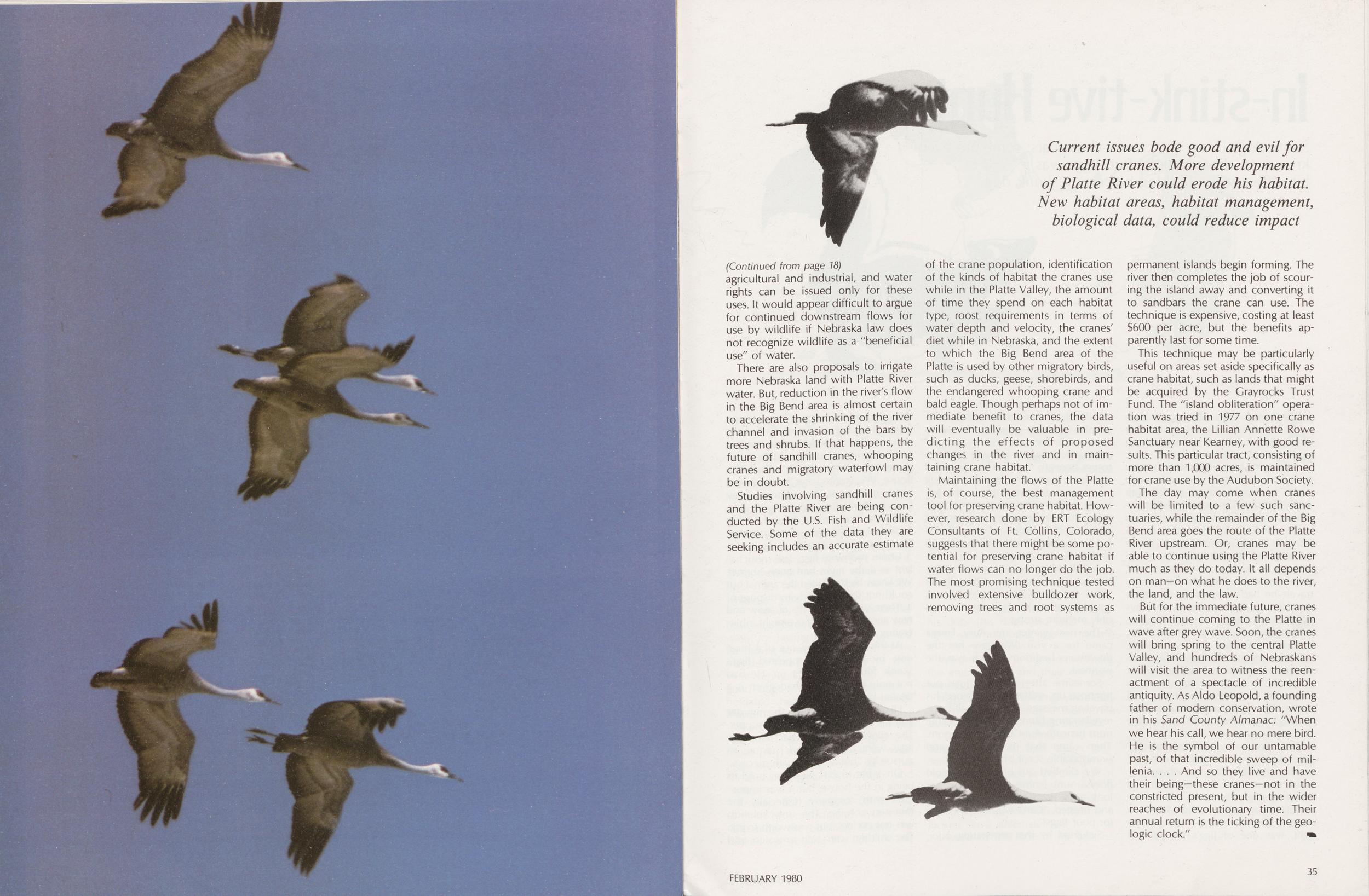
agricultural and industrial, and water rights can be issued only for these uses. It would appear difficult to argue for continued downstream flows for use by wildlife if Nebraska law does not recognize wildlife as a "beneficial use" of water.
There are also proposals to irrigate more Nebraska land with Platte River water. But, reduction in the river's flow in the Big Bend area is almost certain to accelerate the shrinking of the river channel and invasion of the bars by trees and shrubs. If that happens, the future of sandhill cranes, whooping cranes and migratory waterfowl may be in doubt.
Studies involving sandhill cranes and the Platte River are being conducted by the U.S. Fish and Wildlife Service. Some of the data they are seeking includes an accurate estimate of the crane population, identification of the kinds of habitat the cranes use while in the Platte Valley, the amount of time they spend on each habitat type, roost requirements in terms of water depth and velocity, the cranes' diet while in Nebraska, and the extent to which the Big Bend area of the Platte is used by other migratory birds, such as ducks, geese, shorebirds, and the endangered whooping crane and bald eagle. Though perhaps not of immediate benefit to cranes, the data will eventually be valuable in predicting the effects of proposed changes in the river and in maintaining crane habitat.
Maintaining the flows of the Platte is, of course, the best management tool for preserving crane habitat. However, research done by ERT Ecology Consultants of Ft. Collins, Colorado, suggests that there might be some potential for preserving crane habitat if water flows can no longer do the job. The most promising technique tested involved extensive bulldozer work, removing trees and root systems as permanent islands begin forming. The river then completes the job of scouring the island away and converting it to sandbars the crane can use. The technique is expensive, costing at least $600 per acre, but the benefits apparently last for some time.
This technique may be particularly useful on areas set aside specifically as crane habitat, such as lands that might be acquired by the Grayrocks Trust Fund. The "island obliteration" operation was tried in 1977 on one crane habitat area, the Lillian Annette Rowe Sanctuary near Kearney, with good results. This particular tract, consisting of more than 1,000 acres, is maintained for crane use by the Audubon Society.
The day may come when cranes will be limited to a few such sanctuaries, while the remainder of the Big Bend area goes the route of the Platte River upstream. Or, cranes may be able to continue using the Platte River much as they do today. It all depends on man—on what he does to the river, the land, and the law.
But for the immediate future, cranes will continue coming to the Platte in wave after grey wave. Soon, the cranes will bring spring to the central Platte Valley, and hundreds of Nebraskans will visit the area to witness the reenactment of a spectacle of incredible antiquity. As Aldo Leopold, a founding father of modern conservation, wrote in his Sand County Almanac: "When we hear his call, we hear no mere bird. He is the symbol of our untamable past, of that incredible sweep of millenia....And so they live and have their being—these cranes—not in the constricted present, but in the wider reaches of evolutionary time. Their annual return is the ticking of the geologic clock.
In-stink-tive Hunter
by Helen E. Ruyle Some dogs chase cats; some chase cars; some are even known to chase people. But, Jiggs was a bit different...a bulldog but also a skunk dogANIMALS USUALLY don't have hobbies, but Jiggs did. His noble bulldog heart seemed set on ridding our locality of skunks.
Although a house dog, with his own cushion in a chair by the stove, some nights he would waken, sniff the air and want out. The one night that we refused to free him, he jumped thru an open window, knocked the screen from it's frame and was gone. When he returned several hours later and whined at the door, he had a faint skunk odor. We thought that in his travels he had accidentally crossed a skunk's path. But, on successive forays he brought back the same odor, sometimes only faintly, but at others, sickeningly strong.
Come spring, with little chicks residing in the brooder house, Jiggs would check the brooder building regularly. One night, as usual, he agitated until we let him out. Soon we heard his barking from the direction of the chickens.
We pulled on our clothes to investigate. Jiggs was peering under and barking furiously at something beneath the brooder house. We feared that rats might be after the chicks. Kneeling, I aimed a flashlight between the low sills. There, eyes shining in my light, was one of Jigg's striped and smelly adversaries. I drew back, hastily, to plan strategy—or rather to watch from a safe distance.
Jiggs tried digging, but was too large to get beneath the low building, and the skunk was at the far side where it was lowest. So, we got into the act. Using a heavy iron pipe over a concrete block for leverage, and standing back the full length of the 12-foot pipe, we raised the building enough for Jiggs to go under.
Still barking, he squeezed under, backed the animal against the sill and killed it before that dangerous tail could be raised. This time his odor was only medium strong.
The next winter, my Aunt Emma came for a visit. We gave her the downstairs bedroom, which was the warmest.
Sometime after midnight, Jiggs put his nose up, sniffed, and whined his traveling message. Within a half-hour, reverberating bumps and barks came from beneath Aunt Emma's bedroom. Then came that overpowering and unmistakable scent of skunk.
We climbed out of bed onto cold floors. Aunt Emma came out in her long night dress, wringing her hands, and begged, "Can't we do something for poor Jiggs?"
Sickened by the penetrating odor, we still had to laugh. "Don't worry about him, Aunt Emma," we exclaimed, "he's experienced at this."
We worried about her and the overpowering "perfume" that filled the house. We wanted her to finish the night in an upstairs bedroom, away from the battlefield, so to speak, but, dear little Aunt Emma refused. Going back to bed she was still murmuring, "poor Jiggs, poor Jiggs!"
Come morning, Jiggs was nonchalant as if the night had been normal. We know he had killed the animal but could not find the body to dispose of it. There were deep drifts of snow and new snow had fallen overnight, obliterating any tracks.
At the first big thaw, out of a huge drift by the house appeared Jigg's skunk, four feet straight up. He had not only killed it, but had given it a decent burial.
I'll never forget the time the minister and his wife were coming for supper. The evening before, what happens? Jiggs went to the woods pasture to pursue his "hobby", and with success.
Oh, what to do? Jiggs was used to being in the house, but it was impossible with company (especially the minister) coming. The only solution was not perfect, but was worth trying. The children were told to watch, and 36 NEBRASKAland just as company arrived; to put Jiggs in the tool house and be sure to turn the paddle on the door.
Supper went well. While the minister asked the blessing, I was praying that Jiggs would be satisfied for two hours. In the distant tool house I could hear his occasional questioning bark.
After the meal we relaxed and visited. There was no sound, now, from the tool house. I felt we had made it. Then, there at the open window was Jiggs, front feet planted on the ledge, whining, "Why did you do this to me?" He was so imploring, so wholeheartedly faithful, I felt ashamed two ways: for having locked him up and for having to explain his odor to the minister. The Reverend and his wife were very understanding and had a good laugh with us. But thereafter I hesitated before issuing invitations ahead of the date.
A year later we tore down an old hog shed. It was demolished and neatly piled except for the floor when Jiggs showed interest. He gave that certain bark that said, both "help", and "action".
Rowdy, our shepherd cattle dog, came at his command as always and dug under the building. Shortly, he backed out, yelping. His tan face and black nose seemed to whiten with sickness from being sprayed. No more digging by him, he let it be known.
As the digging was done, Jiggs took over. He moved in and killed that skunk, and before the day was over, got two more full-grown ones from under that floor.
During the next year, my brother, who lived a mile from us, was making his nightly rounds of poultry houses and saw a prowling skunk several times. He carried his gun, but before he could aim, the skunk disappeared around some building.
I told him that if he would shut up his dogs (his dogs and Jiggs would fight) we would bring Jiggs to his farm to locate the skunk.
We drove over in our old car. There, the entire family and their company turned out to watch.
Jiggs circled the building where they had repeatedly seen the skunk. He sniffed, but without much interest.
I began to have qualms as he wandered off to a far feed house. Suddenly his head went up, he gave a "woof" and stopped at the east side of the shed. He tried to dig, he tried to pull off boards. He looked around for Rowdy, but Rowdy was at home. It looked like a stalemate.
I knew by the tone of his bark he had a positive location, but my brother doubted him. Skeptically, he brought pry poles and we raised the building a bit. As it moved up, Jiggs moved under. In three minutes he came out, head high with a skunk by the tail, helpless.
Brother, holding ready his gun, shouted, "Drop it Jiggs, drop it! I'll shoot it!"
But, none of that for Mr. Jiggs. He marched right off to a safe distance and with an amazing quickness, ended the skunk before any odor came.
Back to the building Jiggs came. Although everyone tried to praise him, he bypassed us all, only wagging his stubby tail. Again he crawled beneath the feed house, and one by one, carried out seven baby skunks. These he refused to kill, as if small stinkers were beneath his dignity.
If there were laurels for service above and beyond the line of duty, Jiggs could have had a medal that day, working in strange territory with a crowd watching. Never again did anyone doubt his ability. And, of course by that time he was quite famous.
I don't know how his strange hobby started, but if there is a dog heaven, I hope it also includes a few skunks for Jiggs to chase.
FEBRUARY 1980 37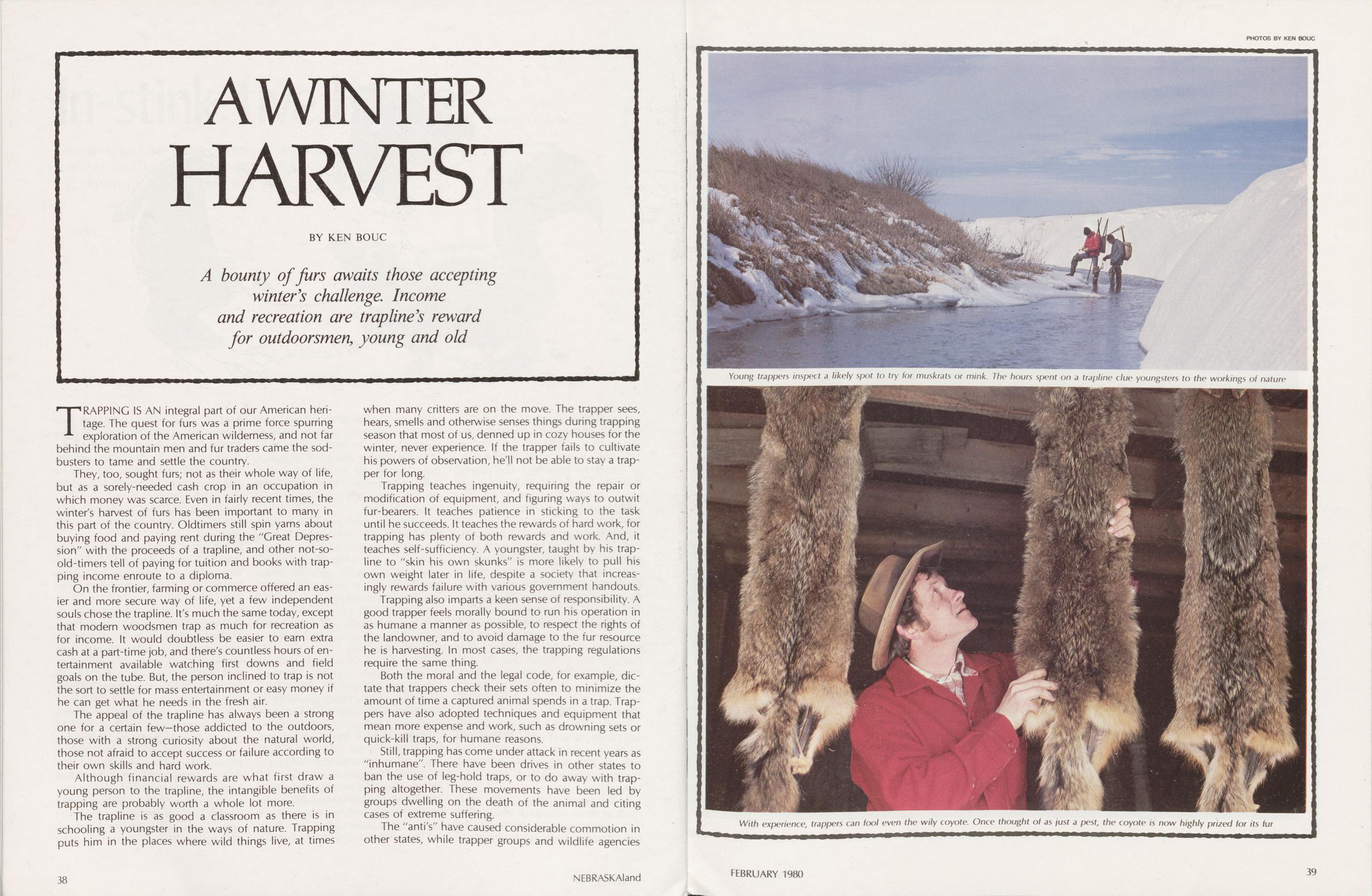
A WINTER HARVEST
BY KEN BOUC A bounty of furs awaits those accepting winter's challenge. Income and recreation are trap line's reward for outdoorsmen, young and oldTRAPPING IS AN integral part of our American heritage. The quest for furs was a prime force spurring exploration of the American wilderness, and not far behind the mountain men and fur traders came the sodbusters to tame and settle the country.
They, too, sought furs; not as their whole way of life, but as a sorely-needed cash crop in an occupation in which money was scarce. Even in fairly recent times, the winter's harvest of furs has been important to many in this part of the country. Oldtimers still spin yarns about buying food and paying rent during the "Great Depression" with the proceeds of a trapline, and other not-so-old-timers tell of paying for tuition and books with trapping income enroute to a diploma.
On the frontier, farming or commerce offered an easier and more secure way of life, yet a few independent souls chose the trapline. It's much the same today, except that modern woodsmen trap as much for recreation as for income. It would doubtless be easier to earn extra cash at a part-time job, and there's countless hours of entertainment available watching first downs and field goals on the tube. But, the person inclined to trap is not the sort to settle for mass entertainment or easy money if he can get what he needs in the fresh air.
The appeal of the trapline has always been a strong one for a certain few—those addicted to the outdoors, those with a strong curiosity about the natural world, those not afraid to accept success or failure according to their own skills and hard work.
Although financial rewards are what first draw a young person to the trapline, the intangible benefits of trapping are probably worth a whole lot more.
The trapline is as good a classroom as there is in schooling a youngster in the ways of nature. Trapping puts him in the places where wild things live, at times when many critters are on the move. The trapper sees, hears, smells and otherwise senses things during trapping season that most of us, denned up in cozy houses for the winter, never experience. If the trapper fails to cultivate his powers of observation, he'll not be able to stay a trapper for long.
Trapping teaches ingenuity, requiring the repair or modification of equipment, and figuring ways to outwit fur-bearers. It teaches patience in sticking to the task until he succeeds. It teaches the rewards of hard work, for trapping has plenty of both rewards and work. And, it teaches self-sufficiency. A youngster, taught by his trapline to "skin his own skunks" is more likely to pull his own weight later in life, despite a society that increasingly rewards failure with various government handouts.
Trapping also imparts a keen sense of responsibility. A good trapper feels morally bound to run his operation in as humane a manner as possible, to respect the rights of the landowner, and to avoid damage to the fur resource he is harvesting. In most cases, the trapping regulations require the same thing.
Both the moral and the legal code, for example, dictate that trappers check their sets often to minimize the amount of time a captured animal spends in a trap. Trappers have also adopted techniques and equipment that mean more expense and work, such as drowning sets or quick-kill traps, for humane reasons.
Still, trapping has come under attack in recent years as "inhumane". There have been drives in other states to ban the use of leg-hold traps, or to do away with trapping altogether. These movements have been led by groups dwelling on the death of the animal and citing cases of extreme suffering.
The "anti's" have caused considerable commotion in other states, while trapper groups and wildlife agencies
38 NEBRASKAland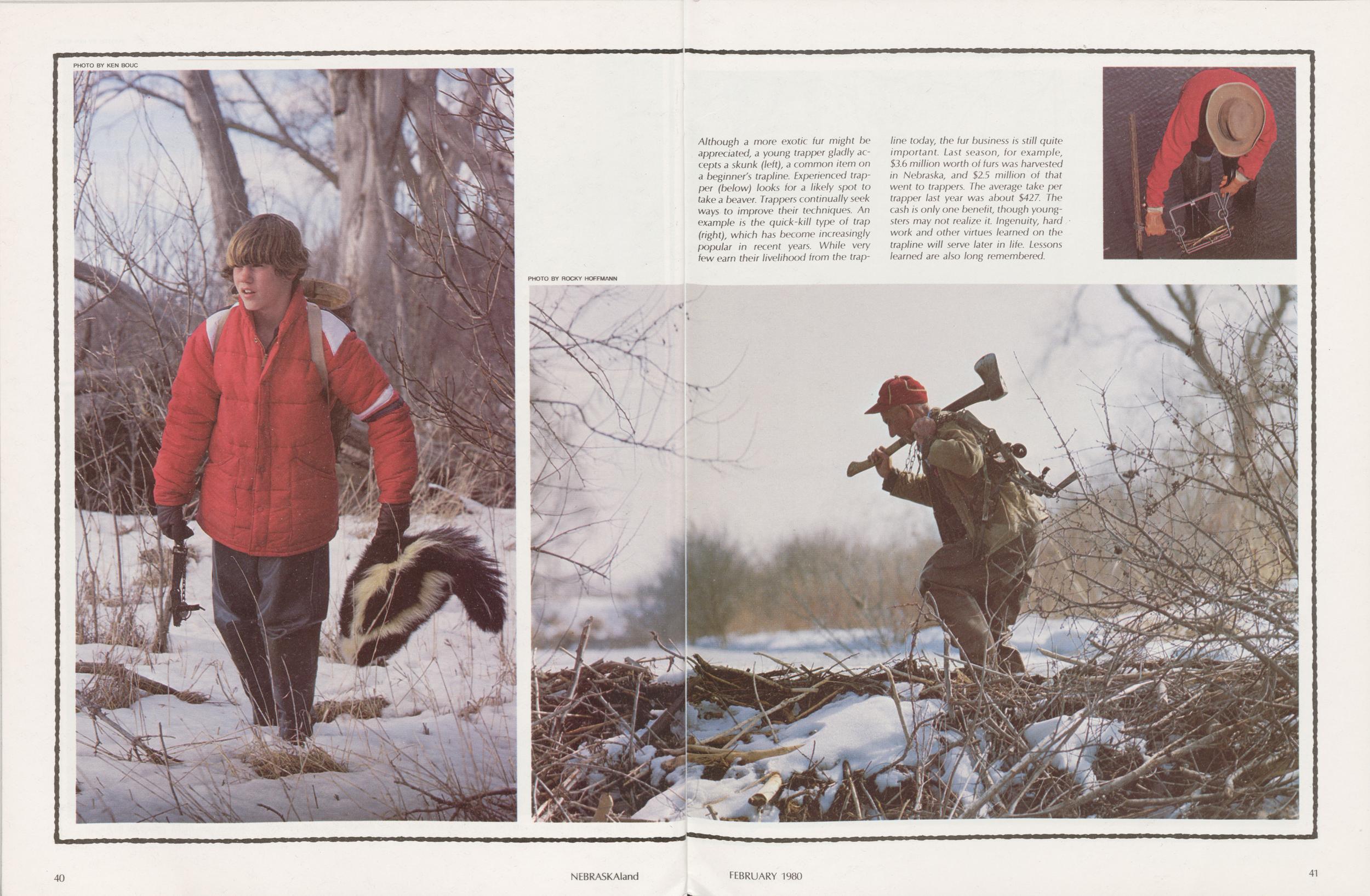
Although a more exotic fur might be appreciated, a young trapper gladly accepts a skunk (left), a common item on a beginner's trapline. Experienced trapper (below) looks for a likely spot to take a beaver. Trappers continually seek ways to improve their techniques. An example is the quick-kill type of trap (right), which has become increasingly popular in recent years. While very few earn their livelihood from the trapline today, the fur business is still quite important. Last season, for example, $3.6 million worth of furs was harvested in Nebraska, and $2.5 million of that went to trappers. The average take per trapper last year was about $427. The cash is only one benefit, though youngsters may not realize it. Ingenuity, hard work and other virtues learned on the trapline will serve later in life. Lessons learned are also long remembered countered with a low-key effort based on biological facts. So far, the "anti's" have had little success, as the voters apparently realized that those who scream the loudest on an issue usually know the least about it.
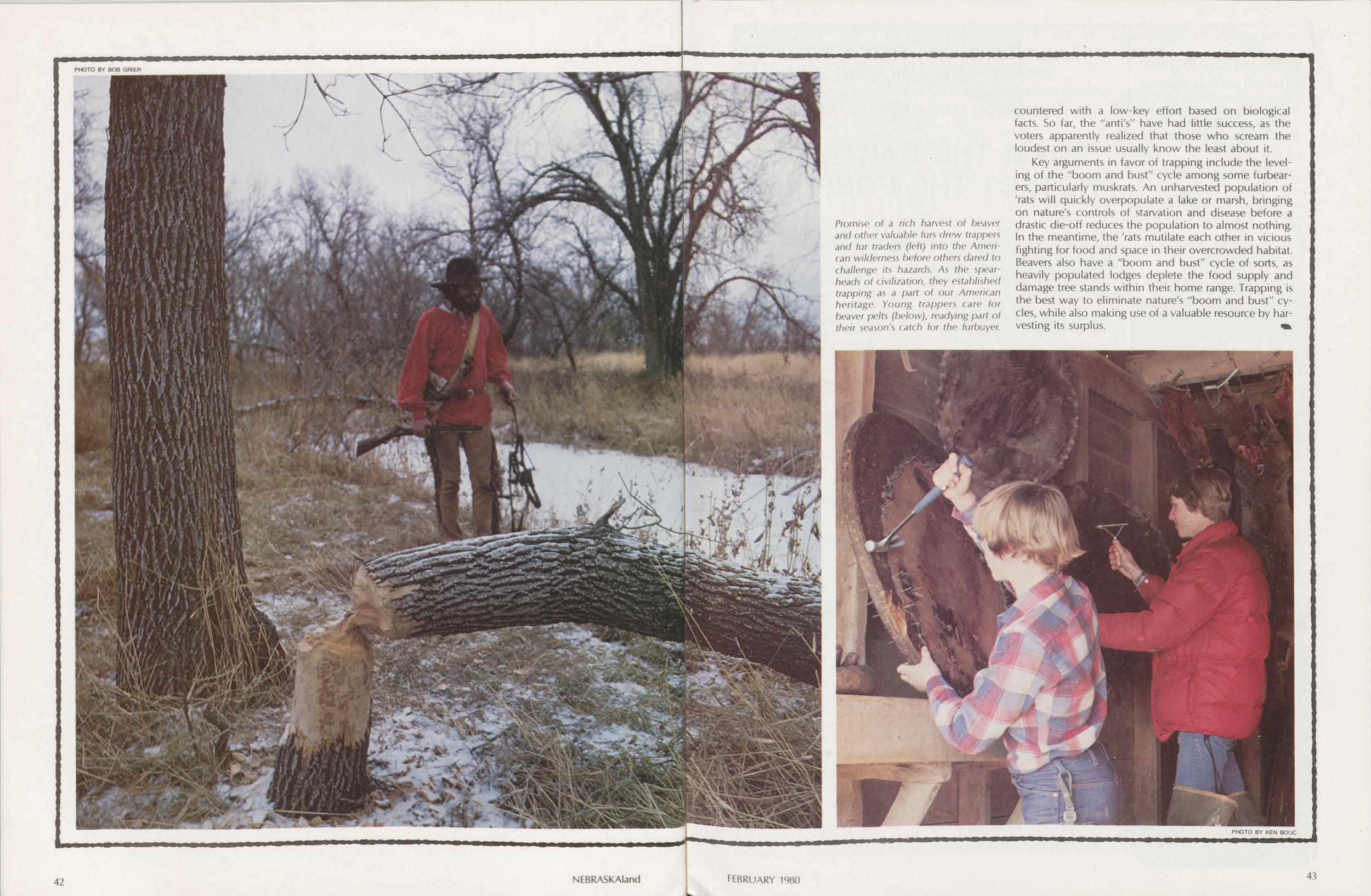
Key arguments in favor of trapping include the leveling of the "boom and bust" cycle among some furbearers, particularly muskrats. An unharvested population of 'rats will quickly overpopulate a lake or marsh, bringing on nature's controls of starvation and disease before a drastic die-off reduces the population to almost nothing. In the meantime, the 'rats mutilate each other in vicious fighting for food and space in their overcrowded habitat. Beavers also have a "boom and bust" cycle of sorts, as heavily populated lodges deplete the food supply and damage tree stands within their home range. Trapping is the best way to eliminate nature's "boom and bust" cycles, while also making use of a valuable resource by harvesting its surplus.
 NEED A DISTANT NUMBER?
You can still dial direct and save.
Just dial your DDD access
number, the area code for the
location, plus the Universal
Directory Assistance Number,
555-1212.
THE LINCOLN TELEPHONE CO.
NEED A DISTANT NUMBER?
You can still dial direct and save.
Just dial your DDD access
number, the area code for the
location, plus the Universal
Directory Assistance Number,
555-1212.
THE LINCOLN TELEPHONE CO.
"DAM THE DARTER... PROTECT THE PORPOISE"
High-accuracy national survey probes peoples' attitudes on wildlife and comes up with expected results—except for a few surprises. More data is to comeWHAT DO AMERICANS really think about saving endangered species, hunting, and other issues that affect wildlife? The first of four reports on a comprehensive study of American attitudes toward wildlife has revealed some interesting answers—including some surprises.
The report analyzes initial findings of a three-year study by Dr. Stephen Kellert of the Yale School of Forestry and Environmental Studies, conducted under a research grant from the Interior Department's U.S. Fish and Wildlife Service. Total cost was $450,000.
Kellert's first report concerns American attitudes, behavior, and knowledge about endangered species, animal damage control, habitat preservation, consumptive uses of wildlife, management, use of back country and parks, and miscellaneous issues. Among the study's findings:
—Of eight selected wildlife issues, the public knew the most about "killing baby seals for fur" (43 percent knowledgeable) and "effects of pesticides such as DDT on birds" (42 per- cent). The least recognized issue was "use of steel shot versus lead shot by waterfowl hunters" (14 percent). Only 34 percent indicated that they had some knowledge about the Endangered Species Act, and only 17 percent were knowledgeable about the much publicized snail darter/Tellico Dam controversy.
—On a variety of questions, a majority favored protecting wildlife even at the expense of jobs, housing, and development projects. Fifty-five percent opposed the principle of building an industrial plant on a marsh needed by a rare bird species even if the plant would help solve an unemployment problem. Fifty-seven percent disapproved of building houses on marshes used by ducks and other non endangered wildlife. Seventy-six percent thought cutting trees for lumber and paper should be done in ways that help wildlife even if it resulted in higher lumber prices.
—The public's support for endangered species protection when it would increase costs for an energy project depended on the animal involved and the nature of the project. Americans overwhelmingly supported protecting the bald eagle, eastern mountain lion, American crocodile, and an endangered butterfly. They opposed protecting an endangered plant, snake, or spider if it increased costs for an energy project. On a snail darter type question, most people opposed blocking a hypothetical water project designed for essential uses such as drinking water, hydroelectric power, or irrigation to protect an unknown fish species. But nearly 60 percent opposed construction of a dam for "non essential" purposes such as making a recreational lake if it would endanger a fish.
—In general, support for protecting endangered species depended on such factors as the animal's attractiveness, close biological relationship to humans, reason for endangerment, economic value, and importance in American history and folklore.
In a surprising finding, 77 percent said they thought it would be all right to kill whales for a useful product if the species hunted was not endangered. But on another intelligent sea mammal, the porpoise, 69 percent said they would rather pay a higher price for tuna fish than see the tuna industry continue killing porpoises in their nets. The researchers said the apparently contradictory responses may be related to the tradition of whaling in the U.S.
44 NEBRASKAland 8942 LANKERSHIM, po. box, CATCH OUR SUPER SAVINGS SAVE AS MUCH AS 41% 195 it's a -gold mine" DELUXE SPINNING Kl FOR PRICE OF 5 Famous, Popular and for only $895 20 LURES Lures in this set were chosen by expert fishermen. Action-Plugs, Deep and Shallow Runners. Divers, Spinners, Cobblers, Spoons Natural Plastic-Ba and more! All well known types. A great ALL-AROUND LURE SET for lake, river, stream or pond for any and ALL FISHING TRIPS. GOLD our regular retail well OVER $50.00 if bought individually #6845- All this for only A GREAT GIFT FOR A BEGINNER OR PRO 50-Assorted SNAP-SWIVELS. 5-most used sizes for every Fishing use. The Best! Every Fisherman needs these. 1730- 50-SWIVELS Asst'd. sizes...$ The 3 SHORTY! Nylon-Covered WIRE LEADERS. Big Fish have very Sharp Teeth1 "SAFE-GUARD ' from losing your Lures, Plugs Spinners' 15-Lb. Test with Snap and Swivel 1560- SPECIAL 15 for $- 99 TRIPLE 'XXX9 MONOFILAMENT SUPER-fiNE QUALITY SPECIAL JUMBO BULK-SPOOLS New FRESH-STOCK Newest GOLD color The BEST! • XTRA SOFT! Will NOT stiffen in any weather! • XTRA STRONG! Small diameter, Low stretch • XTRA INVISIBLE! Gets More Strikes! 6V2 ft. 2 pc. Spinning Rod Spinning reel level wind, multi disc-drag anti-reverse Two tray 15-compartment, worm proof tackle box Filled with the best most famous types of plugs sure catch bobber trailer skirts 6" and 8" crawlers. Everything you XTRA SPECIAL! BUY 2-SPOOLS $C90 For Only 3 and Receive a $2.00 LINE-WINDER SPECIAL DISCOUNT ALL LB.-TEST SAME PRICE #1001 _$295 MILITARY "TYPE" JUNGLE SURVIVAL all purpose KNIFE. Genuine Leather sheath, double sewn and riveted. Blade back has sharp "Sawteeth" lor saw or fish scaler. Heavy hexagonal head for use as a hammer. 5" blade for skinning. Laminated leather handle. Sharpening stone and pocket for stone. Belt-loop and leg-laces. 9 1/2- overall. #4690-only 10 95 TWELVE "Famous" SPINNERS! LAKE and STREAM Tested FAVORITES! A Large purchase enables us to offer this Well Known ASSORTMENT of Lures! (A $7.00 Value). #0221- C For only... ARKANSAS WHETSTONES AND HONING OIL! The best Sharpening Stones known. Will sharpen and polish every kind of Knife, Tool or Cutting Edge and prolong the life of your blade! Will LAST a Lifetime and WILL NOT hollow out or wear down! Arkansas SOFT-STONE will rapidly CUT the fastest edge. Arkansas HARDST0NE is for FINAL polishing of an already sharp knife. #4220-complete kit... TWELVE "Famous" SPOONS! LATEST Assortment of SHAPES. WEIGHTS, and ACTIONS! A COMPLETE SET... to meet every Fresh-Water Fishing need! (A $6.00 Value). #0331 - IL For only... SAVE MONEY AND MAKE DINING A PLEASURE SCREEN HOUSE TENT BIG...ROOMY...COMFORTABLE...for camp or backyard! Large 11 1/2' x 11 1/2'...6' high at eaves...7 1/2' high at center...FIRE RETARDANT... WATERPROOF...Lightweight TUBULAR STEEL POLES...Heavy-Duty Plastic Stakes! Adjustable Center Pole. NO BUGS or insects...NYLON SCREEN on all 4 sides! Zipper Door. 7300-SPECIAL... $695° HANDY "ROD-HOLDER" Ideal for CAMPER, BOAT or DEN. Handsome and Practical Rack Holds and Protects 4 RODS. Use Vertical or Horizontal on any Wall. Mounting Screws included. $079 #1290-SPECIAL...PAIR LIFE-LIKE" PLASTIC They WIGGLE, Sink and Float like REAL Worms! Asst'd Colors and Stripes 6" to 8" #1220 25 "NITE" CRAWLERS #1012 100 "NITE" CRAWLERS. WORMS $ 1.95 $ 4.95 SATISFACTION GUARANTEED ... or Full Refund BIG SUPER SAVINGS CATALOG send $1.00 refundable w/first catalog purchase #9001 #0110 25 PIECE LURE SET $8.95 #1290 D HANDY ROD HOLDERS $ 2.79 #4690 SURVIVAL KNIFE $10.95 #6845 DELUXE SPINNING KIT $29.95 #4220 ARKANSAS WHETSTONES $ 6.95 #1001 TRIPLE XXX BULK SPOOL $ 2.95 LB TEST #1730 50 SNAP SWIVELS $ 1.99 #1002 2 SPOOLS & LINE WINDER $ 5.90 LB. TEST #1220 "NITE" CRAWLERS $ 1.95 #0221 12 DIFFERENT SPINNERS $ 3.95 #1012 100 "NITE" CRAWLERS $ 4.95 #0331 12 DIFFERENT SPOONS $ 2.95 #1560 15 WIRE LEADERS $ 1.99 #7300 SCREEN HOUSE $69.50 D AMERICAN EXPRESS VISA/BANK AMERICARD DINERS CLUB ADD POSTAGE AND HANDLING MASTER CHARGE, INTERBANK NO 0n orders to $20.00 add $1 50 NAME Orders over $20.00 add $2.00 ADDRESS add 6% sales tax CUT STATE ZIP Total enclosed Expiration Date Acct. No CHECK CASH Signature MONEY ORDER CREDIT CARD ORDERS ONLY: Phone (213) 768-6542 TV liquidators 8942 LANKERSHIM, P.O. BOX 414, DEPT01B241 Sun Valley, CA, 91352 FEBRUARY 1980 45
On the controversial issue of animal damage control, the public was not altogether opposed to controlling coyotes that prey on livestock, but strongly preferred non lethal control methods or hunting only individual coyotes known to have killed livestock. Most were strongly opposed to poisoning, and were also opposed to shooting and trapping as many coyotes as possible.
-Attitudes toward hunting depended on the purpose. The public overwhelmingly supported traditional native American subsistence hunting and also hunting excessively for meat, regardless of who hunted. Sixty-four percent approved of hunting for recreation if the meat was used, but about 60 percent opposed hunting just for sport or recreation. Over 80 percent opposed hunting exclusively for a trophy.
...an outdoor tip from your Big agent COTTONTAIL The most popular game animal in many states, the cottontail is found statewide in Nebraska, and in great numbers. A high reproduction enables them to keep up with the heavy demand by predators, including man. It utilizes a wide range of habitat from urban yards to heavily-wooded creek bottoms. ...this message brought to you by the INDEPENDENT INSURANCE AGENTS OF NEBRASKAAlthough some observers have linked anti-hunting sentiment with an anti-wildlife management attitude, results of the study did not support this. Sixty percent of members of humane organizations and 61 percent of those opposed to sport hunting supported government management programs to "control" populations of deer and ducks.
When asked about possible sources of funding for wildlife management programs, the public indicated stronger support for taxes on "consumptive" activities, such as buying fur, than on "nonconsumptive" uses such as birdwatching. Eighty-two percent favored a sales tax on fur clothing from wild animals; 75 percent favored entrance fees to wildlife refuges and other public wildlife areas; and 71 percent favored a sales tax on off-road vehicles. Fifty-seven percent favored increasing the amount of general tax revenues for wildlife management; the same number favored sales taxes on backpacking and camping equipment; and 54 percent favored taxes on bird-watching supplies and equipment.(Continued on page 48)
Coyote Hunter Special Rifle Only $167.50 Our Reg. Sale $212.33 ( Rifle, Scope, Mounts ) SPECIAL $179.50 OLT CO. PEKIN ILL Predator Calls Finest Quality Field Tested $2.79 ( #ON-020-OPC ) - - OLT S #CP-21 for close range calling. ( 16 oz. ) $2.49 ( #ON-020-FPC ) - - FAULK'S #P-60. Walnut barrel, precision tuned metal reed. ( 6 oz. ) ( #0N 020 CHS ) - - An outstanding buy in a rifle and scope sight combination with a special appeal to coyote hunter. It's a great combination for deer hunters, etc. The rifle is the famous SAVAGE Mod. 99-E lever action in your choice of .243 or .308 SAVAGE 99E LEVER ACTION RIFLE TASCO 663 A TELESCOPE SIGHT calibers. A rugged rifle that will serve you and your heirs, is the only lever action that can handle the powerful .308 cartridge. The telescope sight is a TASCO Mod. 663-A heavy duty, 4-power unit with 30-30 rangefmding reticle, 1 /4-min. click stops. Fully coated optics, fog-proof, anodized. We do not sell guns or ammo by mail. This Special Offer can be obtained at our store only in person. Coleman Qqleman $3.49 ( 6 oz. ) ( #ON-020-FAP ) - - FAULK'S #P-60-A. Adjustable reed. Walnut barrel, metal reed. MAIL ORDER CUSTOMERS, PLEASE READ NEBRASKA CUSTOMERS MUST INCLUDE SALES TAX 30% DEPOSIT REQUIRED ON C.O.D.'s INCLUDE ENOUGH MONEY TO COVER SHIPPING COSTS and INSURANCE ( We Refund All Excess ) i VISA ( BankAmericard ) and MASTERCHARGE ORDERS ACCEPTED ( With your signature and all required information ) RETAIL STORE ADDRESS: 1000 West "0" St. OUR TELEPHONE: ( 402 ) 435 4366 PEAK 1R Sleeping Bags Models 610-611 PEAK1 Models 715-716 ( #ON-020-610R ) Right Hand Zipper ( #0N 020-6111 ) Left Hand Zipper ! #ON-020-715R ) Right Hand Zipper #ON-020-716L ) Left Hand Zipper $57.95 $57.95 Mummy style bogs with 3 lbs. Dacron Hollofil II insulation with 0° F. comfort rating. Double quilt, staggered seam construction, 2-way coil zipper, nylon shell, tri-blend liner, drawstring hood. Inside length 70", shoulder girth 62", 7" loft. Stuff sack furnished. Pack wt. 5 lbs. Shpg. wt. 7 lbs. $64.50 $64.50 Mummy style with 4 lbs. Dacron Hollofil II insulation and comfort rating down to 20-degress below zero ( F. ). Great bag for scouting FREEZEREES and other cold weather outings. Same size and construction as Models 610-611 but more insulation and higher loft ( 8-112" ). Pack wt. 6 lbs. Shpg. wt. 8 lbs. Two bags in this series can be zipped together by mating a left zipper with a right zipper. Stove Installation Supplies Ceiling and Roof ChOSe Storm Collar Kit 5 PIECE KIT FOR EASY CHIMNEY INSTALLATION $34.95 ( #ON-020-CRK ) - - Includes the 5-pieces shown, necessary for installation of chimney pipe from room ceiling through the roof. For 6" diameter pipe. ( 15 lbs. ) 3-Wall Chimney Pipe ( ION-020-CP3 ) 3 ft. Length Shpg. wt. 17 lbs. ( #ON 020 CP4 ) 4 ft. Length Shpg. wt. 20 lbs. We have a fine selection of wood burning stoves and heaters at lowest prices. Come in and look them over. FREE FISHING CLASSES! Sponsored by SURPLUS CENTER with LINCOLN PARKS and RECREATION DEPARTMENT Nationally famous, expert fishing personalities, drawings for valuable door prizes. Watch for announcements in Journal-Star and radio stations KLMS, KFOR, KLIN starting late February. Learn from the experts how to bring home bigger catches, enjoy fishing even more SURPLUS CENTER Dept. ON-020 Lincoln, Ne. 68501 $26.99 $31.98 Three wall construction, sections snap-fit together. Inner liner is stainless steel. Outer wall sections are galvanized. THE CROSS-COUNTRY
STORE
Everything for the person
on the go in the snow!!
SKI RENTAL AND SALES
Complete line of ski equipment
Major brands-TRAK, SILVA, NORMARK, EPOKE, etc.
Rentals $6 per day, $10 per weekend, $30 per week
Purchase package... skis, poles, boots, bindings, from $93
THE BONSALL COMPANY
3201 Pioneers Blvd., Lincoln, NE (402) 488-0148
9 a.m.-6 p.m. Mon.-Fri.; 9 a.m.-1 p.m. Sat.
2909 Hiway 30, Grand Island, NE (308) 382-4785
8 a.m.-5 p.m. Mon.-Fri.; 8 a.m.-noon Sat.
START YOUR OWN ORCHARD
Nut and fruit tree seeds
Adapted to Nebraska's climate
Nut and fruit trees are excellent for landscaping
and provide food for their owners and wildlife.
The Nebraska Nut Grower's Association is now
offering seed packets containing butternut,
pecan, chestnut, filbert, black cherry,
and others for $5 while supply lasts.
One packet per individual. Included
is planting instruction pamphlet.
Write: Nebraska Nut Growers Association,
P.O. Box 2815, Lincoln, Nebr. 68502
THE CROSS-COUNTRY
STORE
Everything for the person
on the go in the snow!!
SKI RENTAL AND SALES
Complete line of ski equipment
Major brands-TRAK, SILVA, NORMARK, EPOKE, etc.
Rentals $6 per day, $10 per weekend, $30 per week
Purchase package... skis, poles, boots, bindings, from $93
THE BONSALL COMPANY
3201 Pioneers Blvd., Lincoln, NE (402) 488-0148
9 a.m.-6 p.m. Mon.-Fri.; 9 a.m.-1 p.m. Sat.
2909 Hiway 30, Grand Island, NE (308) 382-4785
8 a.m.-5 p.m. Mon.-Fri.; 8 a.m.-noon Sat.
START YOUR OWN ORCHARD
Nut and fruit tree seeds
Adapted to Nebraska's climate
Nut and fruit trees are excellent for landscaping
and provide food for their owners and wildlife.
The Nebraska Nut Grower's Association is now
offering seed packets containing butternut,
pecan, chestnut, filbert, black cherry,
and others for $5 while supply lasts.
One packet per individual. Included
is planting instruction pamphlet.
Write: Nebraska Nut Growers Association,
P.O. Box 2815, Lincoln, Nebr. 68502
Most Americans wanted to preserve wildlife values on public lands. Two-thirds—including 77 percent of Alaskans—were opposed to hypothetical oil development in Yellowstone National Park if it would harm the park's wildlife. Fifty-six percent thought national forest land should be set aside to protect grizzly bears even if it resulted in some loss of jobs and building materials.
Attitudes toward many issues varied considerably according to the respondent's age, sex, educational level, place of residence, and other factors. For example, support for protecting endangered species was strongest among the highly educated, people under 35, residents of areas with more than 1 million population, people with higher incomes, professionals, and residents of the Pacific Coast and Alaska. Older persons, those with less than an 8th grade education, farmers, rural residents, and southerners were more likely to oppose protecting endangered species. On the animal damage-control issue, residents of the South—not the Rocky Mountain states, where predator damage is higher—expressed greatest support for shooting or trapping as many coyotes as possible. Residents of Pacific Coast states indicated the most protectionist sentiment.
Of all regions, Alaskans were the most knowledgeable about and supportive of wildlife. Their support was based on understanding of wildlife and ecology, rather than on emotional or sentimental notions about animals. As a group, Alaskans ranked third in level of knowledge, bested only by Ph.D.'s and those with other graduate education. They also expressed greater willingness to forego personal benefits such as recreation and jobs in order to preserve wildlife habitat and endangered species.
Trading Post
DOGSBRITTANY SPANIEL pups-all A.K.C. Registered. Reasonable. Marion North, Rt. #1, York, NE 68467. (402) 362-2663.
MISCELLANEOUSWAX WORMS: 500-$8; 1000-$14, postpaid. Add 3% sales tax. No C.O.D. Harold Malicky, Burwell, NE 68823.
GUNS-Browning, Winchester, Remington, others, Hi-powers, shotguns, new, used, antiques. Want Pre-1964 Winchesters. Buy-Sell-Trade. Ph. (402) 729-6112. Bedlan's Sporting Goods, Fairbury, NE 68352.
DUCK HUNTERS: learn how to make quality, solid plastic, waterfowl decoys. We're originators of famous system. Send, $1 for colorful catalog. Decoys Unlimited, Clinton. Iowa 52732
FRITZ GUNSMITHING & Supply Co-Heckler & Koch Dealer. Handfmishing-Hot Blue-Parkerization-Custom Rifles-Antique Restoration. 407 South Harris, Wilber, NE. (402) 821-2260.
OLD HUNTING Licenses. Wow! Send old licenses and duck stamps for immediate cash. Wildlife Gallery, 172 E. Bedford, Stamford. Conn. 06901.
BUSINESS OPPORTUNITY-Close to Branched Oak Lake. Almost 3 acres of Commercial-zoned land with 4-year-old building. Now set up for Fast Food and Soft-Serve Ice Cream. Many possibilities: Bait Shop-Gas Station-R.V. Parking-Off Sale Liquor-Formerly Phil's Corner. Call Ed Golden (402) 483-2179 or CENTURY 21 Atlas Real Estate. 467-4641
TAXIDERMYBIG BEAR TAXIDERMY, Rt. 2, Mitchell, Nebraska 69357. We specialize in all big game from Alaska to Nebraska, also birds and fish. Hair on and hair off tanning, 41/2 miles west of Scottsbluff on Highway 26. Phone (308) 635-3013.
KARL SCHWARZ Master Taxidermists. Mounting of game heads —birds —fish — animals—fur rugs— robes — tanning buckskin. Since 1910. 424 South 13th Street, Dept. A, Omaha, Nebraska 68102.
FREEZE-DRY TAXIDERMY Wally Allison's State Record Taxidermy, 2709 Birch wood, North Platte, NE 69101 Phone: (308) 534-2324. Specializing in Fish and Small Game, Snake and Lizard and Novelties. (Nothing too small) Newest of all taxidermy methods employed.
CREATIVE TAXIDERMY-AII types work since 1935 now includes Freeze-Dry processing of approved small specimens. Naturecraft Studio, 925 Fourth Corso, Nebraska City, Nebraska 68410. Phone: (402) 873-5491. Voges-Owner.
"AWARD-WINNING Taxidermist. Trust your trophies to a proven winner. Our complete taxidermy service also books hunts anywhere in the world. Dinges Taxidermy, 2760 South 12th, Omaha, NE 68108 Phone: (402) 342-3718
NABITY'S TAXIDERMY. 28 years' experience. All taxidermy services available. Specializing in natural-grass backgrounds. 5021 Washington, Lincoln, NE 68506. (402) 489-6351.
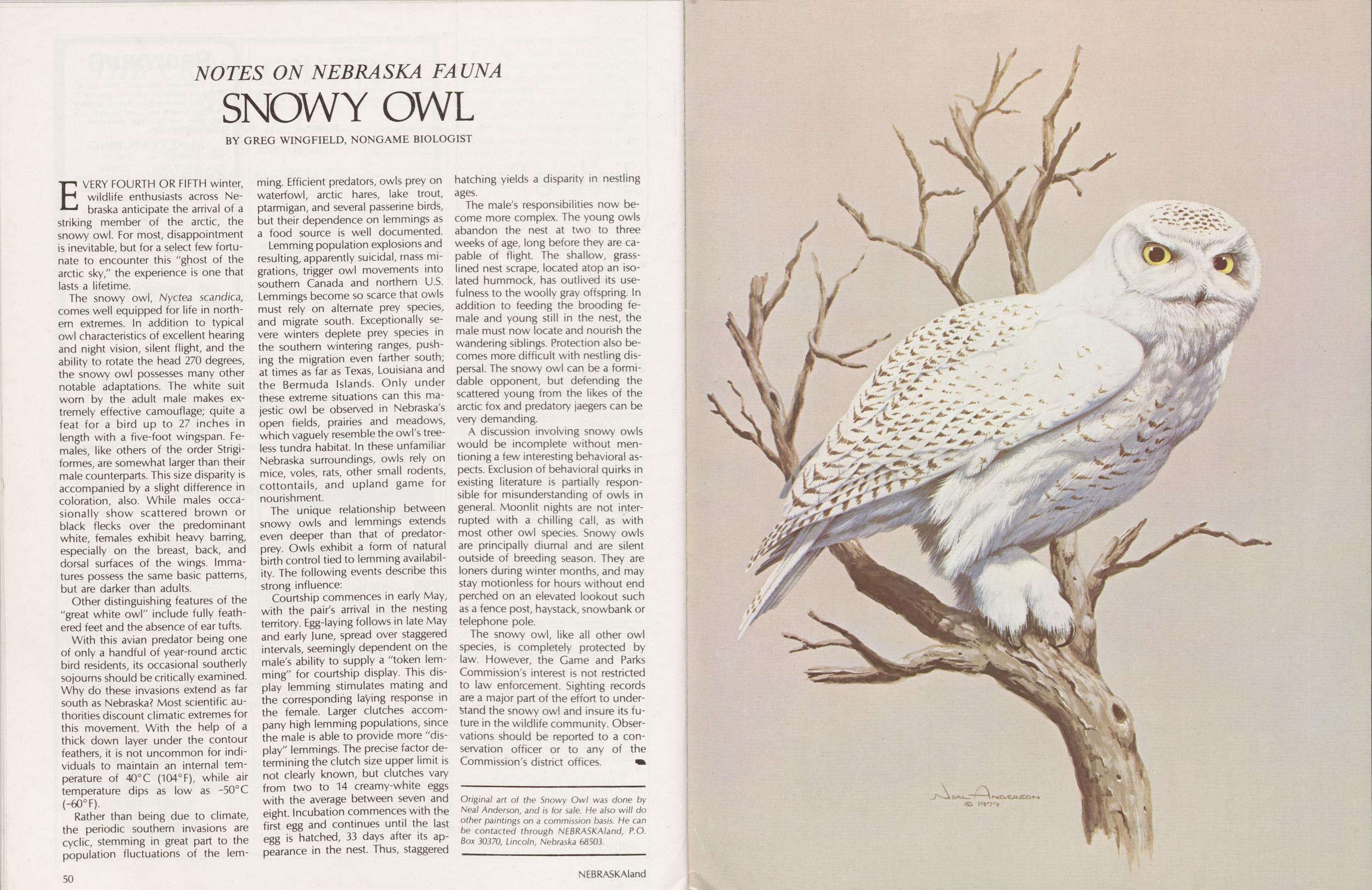
NOTES ON NEBRASKA FAUNA SNOWY OWL
BY GREG WINGFIELD, NONGAME BIOLOGISTEVERY FOURTH OR FIFTH winter, wildlife enthusiasts across Nebraska anticipate the arrival of a striking member of the arctic, the snowy owl. For most, disappointment is inevitable, but for a select few fortunate to encounter this "ghost of the arctic sky," the experience is one that lasts a lifetime.
The snowy owl, Nyctea scandica, comes well equipped for life in northern extremes. In addition to typical owl characteristics of excellent hearing and night vision, silent flight, and the ability to rotate the head 270 degrees, the snowy owl possesses many other notable adaptations. The white suit worn by the adult male makes extremely effective camouflage; quite a feat for a bird up to 27 inches in length with a five-foot wingspan. Females, like others of the order Strigiformes, are somewhat larger than their male counterparts. This size disparity is accompanied by a slight difference in coloration, also. While males occasionally show scattered brown or black flecks over the predominant white, females exhibit heavy barring, especially on the breast, back, and dorsal surfaces of the wings. Immatures possess the same basic patterns, but are darker than adults.
Other distinguishing features of the "great white owl" include fully feathered feet and the absence of ear tufts.
With this avian predator being one of only a handful of year-round arctic bird residents, its occasional southerly sojourns should be critically examined. Why do these invasions extend as far south as Nebraska? Most scientific authorities discount climatic extremes for this movement. With the help of a thick down layer under the contour feathers, it is not uncommon for individuals to maintain an internal temperature of 40°C (104°F), while air temperature dips as low as -50°C (-60° F).
Rather than being due to climate, the periodic southern invasions are cyclic, stemming in great part to the population fluctuations of the lemming. Efficient predators, owls prey on waterfowl, arctic hares, lake trout, ptarmigan, and several passerine birds, but their dependence on lemmings as a food source is well documented.
Lemming population explosions and resulting, apparently suicidal, mass migrations, trigger owl movements into southern Canada and northern U.S. Lemmings become so scarce that owls must rely on alternate prey species, and migrate south. Exceptionally severe winters deplete prey species in the southern wintering ranges, pushing the migration even farther south; at times as far as Texas, Louisiana and the Bermuda Islands. Only under these extreme situations can this majestic owl be observed in Nebraska's open fields, prairies and meadows, which vaguely resemble the owl's treeless tundra habitat. In these unfamiliar Nebraska surroundings, owls rely on mice, voles, rats, other small rodents, cottontails, and upland game for nourishment.
The unique relationship between snowy owls and lemmings extends even deeper than that of predator-prey. Owls exhibit a form of natural birth control tied to lemming availability. The following events describe this strong influence:
Courtship commences in early May, with the pair's arrival in the nesting territory. Egg-laying follows in late May and early June, spread over staggered intervals, seemingly dependent on the male's ability to supply a "token lemming" for courtship display. This display lemming stimulates mating and the corresponding laying response in the female. Larger clutches accompany high lemming populations, since the male is able to provide more "display" lemmings. The precise factor determining the clutch size upper limit is not clearly known, but clutches vary from two to 14 creamy-white eggs with the average between seven and eight. Incubation commences with the first egg and continues until the last egg is hatched, 33 days after its appearance in the nest. Thus, staggered hatching yields a disparity in nestling ages.
The male's responsibilities now become more complex. The young owls abandon the nest at two to three weeks of age, long before they are capable of flight. The shallow, grass-lined nest scrape, located atop an isolated hummock, has outlived its usefulness to the woolly gray offspring. In addition to feeding the brooding female and young still in the nest, the male must now locate and nourish the wandering siblings. Protection also becomes more difficult with nestling dispersal. The snowy owl can be a formidable opponent, but defending the scattered young from the likes of the arctic fox and predatory jaegers can be very demanding.
A discussion involving snowy owls would be incomplete without mentioning a few interesting behavioral aspects. Exclusion of behavioral quirks in existing literature is partially responsible for misunderstanding of owls in general. Moonlit nights are not interrupted with a chilling Call, as with most other owl species. Snowy owls are principally diurnal and are silent outside of breeding season. They are loners during winter months, and may stay motionless for hours without end perched on an elevated lookout such as a fence post, haystack, snowbank or telephone pole.
The snowy owl, like all other owl species, is completely protected by law. However, the Game and Parks Commission's interest is not restricted to law enforcement. Sighting records are a major part of the effort to understand the snowy ow! and insure its future in the wildlife community. Observations should be reported to a conservation officer or to any of the Commission's district offices.
Original art of the Snowy Owl was done by Neal Anderson, and is for sale. He also will do other paintings on a commission basis. He can be contacted through NEBRASKAland, P.O. Box 30370, Lincoln, Nebraska 68503. 50 NEBRASKAland
A SHOW TO KNOW OUTDOOR NEBRASKA
A WEEKLY PRESENTATION OF THE NEBRASKA GAME AND PARKS COMMISSION COVERING NEBRASKA WILDLIFE, SCENIC PLACES AND OUTDOOR RECREATION PLUS MUCH MUCH MOREFEB. 28: "THE ENDLESS JOURNEY", MIGRATORY BIRDS
MAR. 6: SHOVE OFF...WITH CARE!! SAFE BOATING LIVE CALL-IN SHOW!! TELEPHONE (402) 472-3126Position: 270 (30 views)