Volume 58, Issue 1, 1980
NEBRASKAland
January 1980 60 Cents
NEBRASKAland
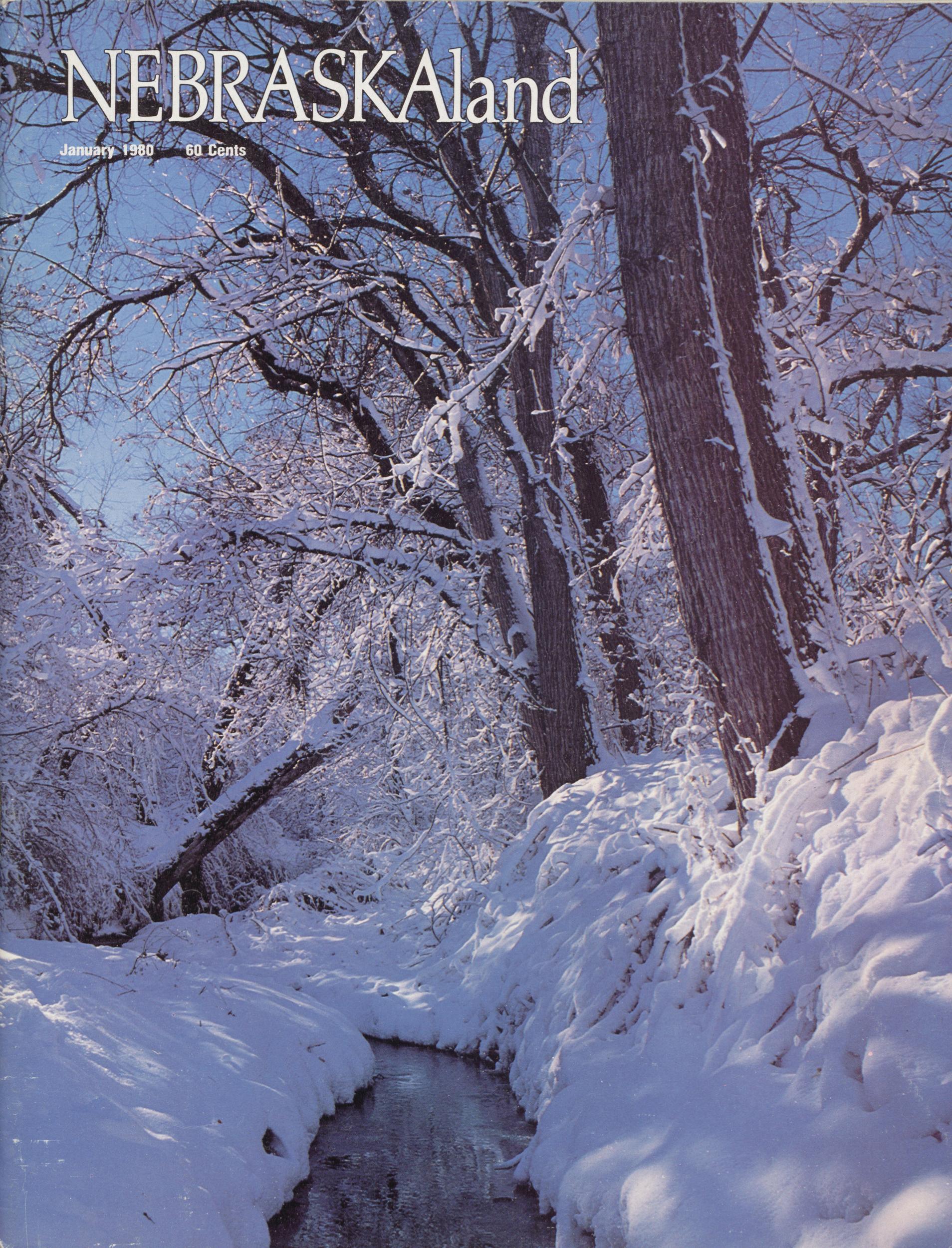
Published by the Nebraska Game and Parks Commission VOL 58 / NO. 1 / JANUARY 1980 ISSN: 0028-1964 Published monthly by the Nebraska Game and Parks Commission. Rates: 60 cents per copy; $5 for 1 year; $9 for 2 years; $12.50 for 3 years. Copyright Nebraska Game and Parks Commission 1980, all rights reserved. Postmaster: If undeliverable, send notice by form 3579 to Nebraska Game and Parks Commission, Box 30370, Lincoln, NE 68503. Second Class postage paid at Lincoln, Nebraska Offices Headquarters 2200 N. 33rd, Lincoln, 68503 (402) 464-0641 7371 Pacific St., Omaha (402) 554-2144 Rt. 2, Alliance (308) 762-5605 Bassett (402) 684-3511 U.S. 81 (north) Norfolk (402) 371-4950 Rt. 4, North Platte (308) 532-6225 Board of Commissioners Chairman: H.B. (Tod) Kuntzelman, North Platte Vice Chairman: Richard W. Nisley, Roca 2nd Vice Chairman: Robert C. Cunningham, Omaha Shirley L. Meckel, Burwell Dr. Bruce Cowgill, Silver Creek George Van Pelt, Kimball Director: Eugene T Mahoney Assistant Directors: William J. Bailey, Jr., Dale R. Bree Magazine Staff Chief, Information & Education: W. Rex Amack Editor: Lowell Johnson Senior Editor: Jon Farrar Editorial Assistants: Ken Bouc, Bill McClurg District Editors: Bob Grier, Faye Musil, Rocky Hoffmann, Butch Isom Contributing Editors: lack Curran, Liz Huff, )im MacAllister Art Director: Michele Angle Farrar Illustration: Duane Westerholt, Steve O'Hare Advertising: Cliff Griffin Circulation: luanita Stefkovich Contents Features CHADRON...TRAPPER TO TOURIST 8 WOOD TO BURN 15 VACATION NEBRASKA A special 18-page color section on the places to visit and what's available to see and do 17 WESTERN NEBRASKA N- 4 CENTRAL NEBRASKA N- 6 EASTERN NEBRASKA N- 8 THE GREAT PLATTE RIVER ROAD N-10 THE OUTDOOR SCENE N-12 FINE ARTS AND EVENTS N-14 STATE AND FEDERAL CAMPING AREAS N-16 TRAILS TO ADVENTURE N-17 HUNTING HEIRLOOMS 36 TRACKING THE BOBCAT 38 HIGH PLAINS MALLARDS 42 Departments SPEAK UP 4 BOOK REVIEW 48 TRADING POST 49 COVER: Coupled with the discomfort and hardship sometimes present in winter are beauty and tranquility, as well. There are sheer "Christmas card" scenes, such as this view of Squaw Creek in the Ponderosa Wildlife Management Area near Crawford. Photo by Bob Grier. OPPOSITE: Amid the falling rubble and rusting machinery of the abandoned farm lie the makings of a home for a covey of bobwhites. Photo by Jon Farrar. JANUARY 1980 3
Speak Up
Hunting problemsSir / I've been closely watching the hunting situation in Nebraska for several years. I've read every article and letter in NEBRASKAIand and Afield & Afloat about the deteriorating situation and who is supposedly to blame.
Well, here is another point of view, but shared by many of us. I'm a native Nebraskan, and grew up in Hartington, which was once the greatest pheasant hunting area in the state. I've been hunting and fishing since I was 12 and used to spend every possible minute hunting the ringneck. When the pheasant population declined, I moved to western Nebraska and turned to ducks and doves. Now I'm on the verge of giving up hunting because we of modest income can't afford it, and it's very difficult to find a place to hunt.
I realize it takes money to manage and restore bird populations. I also realize that something has to be done with the dwindling habitat problem. But, if you keep on raising our hunting fees and taxes, you're going to drive many of us out.
The going price for renting a blind is $300 to $500 for a duck blind, and $1,500 for a goose blind. How many people besides doctors and lawyers can afford that? You tell us to go to public areas, but either we don't live near one, or these places are like three-ring circuses.
And, getting permission to hunt—a man who owns land near Sutherland may live in Denver, or North Platte, or it may be a corporation. And we don't all know people who know people where we can hunt. It gets very discouraging. Farmers aren't very cooperative, either. They accuse hunters of slaughtering harmless birds, of leaving gates open, of cutting fences, shooting livestock, and many others. I don't believe hunters do as much as they are accused of. I think most damage is done by local vandals-usually teenage boys. I hear too much bragging by these kids. I have never known one hunter who has done any of the things mentioned above. Laziness is the only fault of most hunters.
4 NEBRASKAland KAWASAKI INVADER 440 INVADER 340 AND INTRUDER 440. It's no news that there are differences between snowmobiles. But when it comes to fundamental differences, we offer one of the most important there is. The IT'S NOT ONEY UNIQUE, IT'S BETTER. 1 It's unmatched for strength and lightness. To get more strength from less metal, the K-Line chassis tapers from front to back in a straight line. We use HSLA steel in the front, heat-treated aluminum in the tunnel, stainless steel rivets at all high structure points, and chrome-molv steel steering components. 2 It's got a unique mounting system. With a primary engine mount right around the drive shaft, the engine can't twist under hard acceleration. The drive belt stays aligned. And the power gets to the track. 3 A suspension that adapts. Instead of a constant spring rate, ours varies and is fully adjustable. So no matter what the terrain and speed, the suspension resists bottoming. 4 A cooling system that works twice as hard. Our liquid cooling system not onlv uses a radiator but a heat exchanger under the seat as well. Your engine will run more efficiently and you won't lose horsepower after long runs. 5 Oil injection. Good for you. Good for the engine. Our oil injection system varies the oil/gas mixture automatically, depending on your engine load. So your engine runs better and should last longer. There are plenty of other differences too. The Invader 440 holds the World's 24 Hour Endurance Record. The fan-cooled Intruder 440 has all the strength and agility of the liquids, plus standard electric start and improved cooling. Plus all feature one of the best 2-up seats in the business, full instrumentation, and the plain pure thrill of owning a Kawasaki. A FINAL POINT. In closing, we'll admit that there is one other sled in the world which shares this unique chassis. The new Kawasaki LTD. But that onlv proves our point. THEY'VE GOT THE FINEST CHASSIS A SNOWMOBILE HAS EVER HAD, SSCC Certified 1979. K M C Snowmobile Division PO Box 8367. Grand Rapids. Michigan 49508 AGENA'S SERVICE 145 South 9th Broken Bow AINSWORTK KAWASAKI RR 2 Ainsworth B & B KAWASAKI 319 Lafayette Holdrege BEN-N-DALES BV, INC. Ord BELTLINE FORD TRACTOR 641 W. South Street Lincoln BONGERS CYCLE Brainard CORK'S BAIT SHOP West Hwy 20 Valentine CRETE CYCLE 1535 Oak Crete ( SEE YOUR LOCAL KAWASAKI DEALER. The hottest thing on snow. d & J CYCLE 521 East 9th Gothenburg HIGH PLAINS SUZUKI 422 S. Beltline Hwy E. Scottsbluff KOUNTRY KAWASAKI RT 1 Tekamah OMAHA KAWASAKI 7529 Dodge Street Omaha RUSHVILLE SERVICE & SPORT West Hwy 20 Rushville SCHUYLER CYCLE South Park Road Schuyler SORENSEN CYCLE SALES Creighton THACKER MARINE & SUPPLY 605 W. 3rd South Sioux City WEST POINT CYCLE 107 West Park West Point WACO CYCLE Waco BRIDGEPORT EQUIPMENT 705 Main Bridgeport BROWER KAWASAKI SNOWMOBILES 512 Adams 57 Kimball COUNTRY SPORTSMAN STORE West Hwy. 35 Wayne 4-SEASONS MARINE South Hwy. 81 Norfolk FREMONT KAWASAKI East Hwy. 275 Fremont FULLER & SON North Hwy. 281 O'Neill HENNEK'S SPORTING GOODS Rt. 2 South 283 Lexington KRALIK & BECKMAN 4225 23rd Street Columbus OLSON MOTORS CYCLE CENTER 814 West 1st Ogalla TREW'S CYCLE CENTER 1202 First Ave. Kearney YOUNG'S SPORTING GOODS 414 North Dewey North Platte JANUARY 1980 5 NEW '80 Fishing Guide ORDER GUIDE NOW Learn how to catch more fish. Get Mepps complete fishing guide. Fascinating reading. Packed with valuable fishin' information, tips, photos, great new ideas and proven methods that work! Mepps work for you every second they're in the water. Each one is perfectly tuned for the right action at all speeds. Mepps, top Field & Stream fish contest winner for 11 straight years. Mepps will work for you! Learn more. Clip coupon and send 25C if you enjoy catching fish or want to learn how Sheldons', Inc. MEPPS AGLIA. #1 Selling Lure in the World N-1 Antigo, WIS 54409 Send me the '80 Mepps Fishing Guide. I enclose 250. Name Address City State Zip
What are the solutions? I don't have answers, but I have a few ideas. The old saying that money can't buy everything applies also to game management. Our major objective should be better rapport between hunters, landowners and game managers. The bad hunters should be weeded out—with licenses taken away—and second offenders should get fined and jail terms.
I think a program should be set up with farmers getting a percentage of our hunting fees for allowing hunting on their land. They would be required to sign up for money, and would have to put effort into restoring habitat.
All of us, hunters, landowners and game managers, should be given an incentive to clean up the problems. If many of us are forced to quit hunting, where will funds come from?
Sidney Rasmussen Sutherland, Nebr. Oh, deer meSir / Enclosed is a photo from the local newspaper of the two bucks which my dad and I killed during the recent (1978) deer season. The deer had been feeding on corn and alfalfa and their meat is excellent.
I have been an instructor at Kearney State College for the past 10 years and enjoy Nebraska hunting more each year. I have lived in Colorado, New Mexico, and Missouri, and Nebraska has them all beat for hunting and fishing. I would like to commend the Game and Parks Commission for what I feel is an outstanding job of managing our wildlife and parks. Places like Fort Robinson and Fort Kearny are outstanding examples of a job well done. My dad and I want to personally thank you for your efforts. We know that my sons will have good hunting and fishing to look forward to due to your good management.
James A. Miller Kearney, Nebr. What are the facts?Sir / I look forward to receiving NEBRASKAland every month, and this month (May) is one of the best I have ever received. The photography is just fantastic and I only wish I could do as well.
My question is this-How much trouble would it be to list with each photo the equipment used, the film, film speed, lenses, etc.? This might help rank beginners like me take better pictures of the scenes in Nebraska. Please don't take this as criticism because it isn't intended that way. I think it's terrific and probably the biggest magazine bargain on the market. Keep up the good work and will look forward to receiving it for a long time.
Wm. Homested Omaha, Nebr.It isn't that listing the photo data would be much trouble-it probably would be impossible. Many of our photos are in file for many months, some even years, before they are used, and we are lucky to have identification on them, let alone the technical data. However, all but a handful of our photos are taken with Ektrachrome professional 120 roll film, (EPR-64) which we process "in house". We also use some 35 mm, and we use some Kodachrome. Camera-wise, we use Hasselblads and Mamiya 120's, Pentax 35 mm's, plus a few miscellaneous. The shutter speed and stops are dictated by conditions at a particular time and would be of no value, anyway. Lenses are the usual-many are telephotos, all are brand-matched with equipment. No secrets, just many exposures and taking the time to do things right. The big thing is being there when the light is right for what you want to accomplish, and recognizing a good photo before you take it. (Editor)
Bravos for CalendarSir / For the second year...your colorful calendar has won national recognition with our Mead Award of Merit. Our competition is truly nationwide...with fine printing entries from all parts of the country .. . the creative portion ... is handled "in-house" by your talented designers. Since yours is one of the most scenic of all our states, one of the most difficult tasks must be selecting the photographs to be used in your "Calendar of Color." All those chosen for your 1980 calendar are spectacular, but our personal favorite is the ermine peeping out over the snow!
Allan Godshall (director of awards) Mead Paper Co. Dayton, OhioThe 1980 Calendar of Color is particularly good, and deserves the award, and we hope all you folks out there in need of one will slip down to the newsstand or order one. They are $2.50 and can be ordered from NEBRASKAland, Box 30370, Lincoln NE. 68503.
6 NEBRASKAland3rd Annual
NEBRASKA HABITAT STAMP ART CONTEST
Contest is open to Nebraska residents only, and winning entry in the Adult Division will appear on the 1981 Nebraska Habitat Stamp. ENTRY DEADLINE March 1, 1980. SUBJECT MATTER Any Nebraska wildlife species in an appropriate habitat setting, except bobwhite quail and ring-necked pheasant, which are ineligible this year. TECHNICAL REQUIREMENTS Design must be 7-1/2 inches by 4-11/16 inches. It may be matted, but mat may not exceed 10 inches by 7 inches. Any medium is acceptable, but no scroll work or lettering may appear on the design. Color is preferred. DIVISIONS Adult—Amateur or professional artists age 19 and older. Youth—Junior Section: Grades 7-12. Elementary Section: Grades 1-6. 1979 WINNERS
Adult Division—First place winner receives $200 from the Omaha Fish and Wildlife Club. Runners-up all receive a one-year subscription to NEBRASKAland Magazine.
Youth Division—First place winners in each section receive $50 from the Omaha Fish and Wildlife Club. Runners-up all receive a one-year subscription to NEBRASKAland Magazine. Selected entries will be included in a traveling exhibit to be displayed at various locations around the state.
SUBMISSIONEntries should be protected by a covering but will not be accepted in frames or under glass. Wrap securely and send to: Habitat Stamp Contest, Nebraska Game and Parks Commission, P.O. Box 30370, 2200 N. 33rd St., Lincoln, NE 68503. A completed entry form and reproduction agreement or facsimile thereof must accompany the entry. Name and address of the artist must appear only on the reverse side of the entry. The Game and Parks Commission is not responsible for any entry lost or damaged in transit.
Habitat Stamp Contest Entry Form and Reproduction Rights Agreement Please accept my entry in the design contest for the 1981 Nebraska Habitat Stamp. I hereby certify that I have complied with all of the rules governing this competition and that the work submitted is my own original creation. Further, the Nebraska Game and Parks Commission is hereby authorized to reproduce this design on the 1981 Habitat Stamp or in any other fashion it may deem appropriate. Signature of Artist Date Division School Street Address City, State, Zip NEBRASKAland Telephone Number Age (if under 19) Grade in School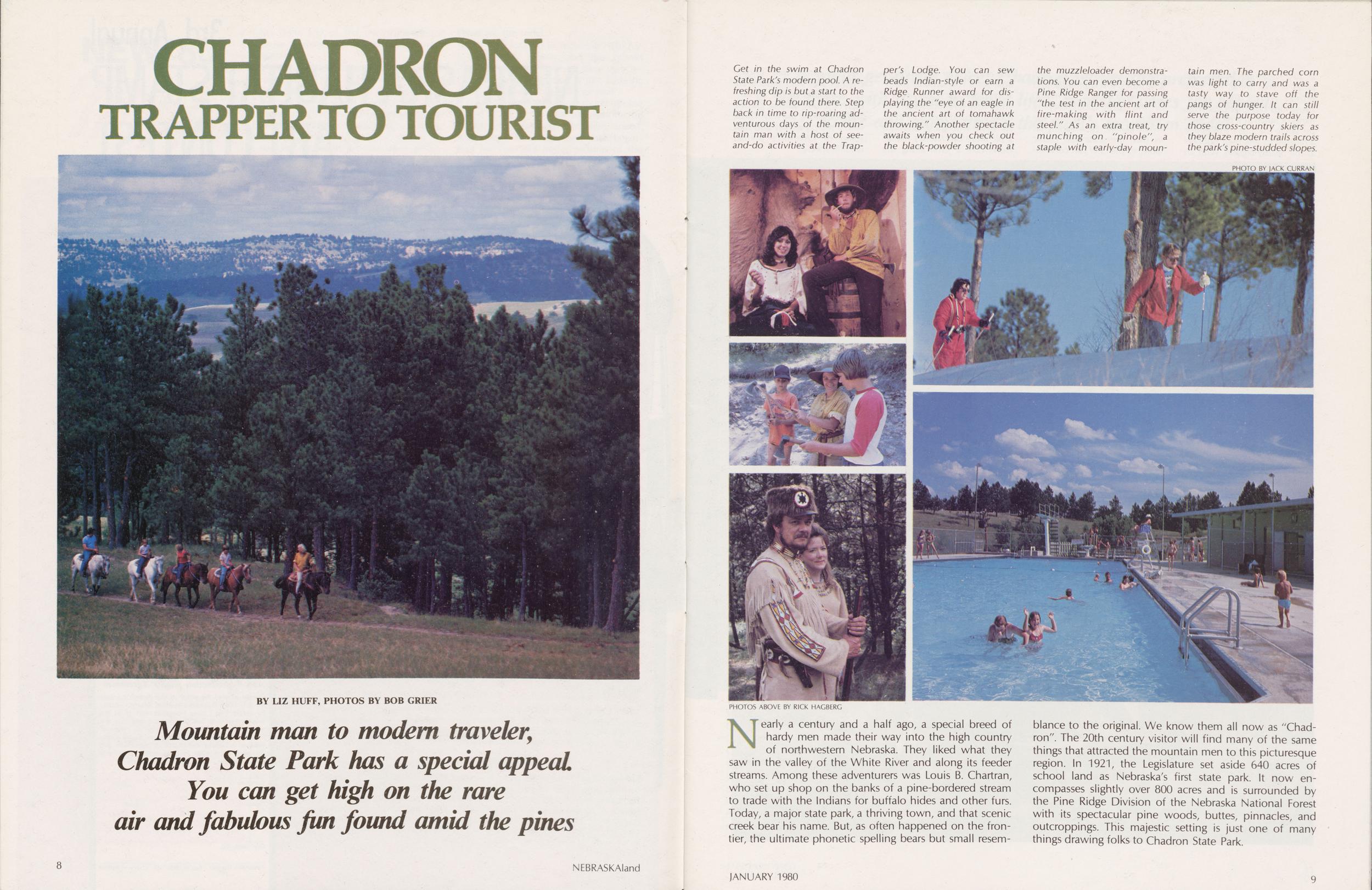
CHADRON TRAPPER TO TOURIST
Get in the swim at Chadron State Park's modern pool. A refreshing dip is but a start to the action to be found there. Step back in time to rip-roaring adventurous days of the mountain man with a host of see-and-do activities at the Trapper's Lodge. You can sew beads Indian-style or earn a Ridge Runner award for displaying the "eye of an eagle in the ancient art of tomahawk throwing." Another spectacle awaits when you check out the black-powder shooting at the muzzleloader demonstrations. You can even become a Pine Ridge Ranger for passing "the test in the ancient art of fire-making with flint and steel." As an extra treat, try munching on "pinole", a staple with early-day mountain men. The parched corn was light to carry and was a tasty way to stave off the pangs of hunger. It can still serve the purpose today for those cross-country skiers as they blaze modern trails across the park's pine-studded slopes.
Nearly a century and a half ago, a special breed of hardy men made their way into the high country of northwestern Nebraska. They liked what they saw in the valley of the White River and along its feeder streams. Among these adventurers was Louis B. Chartran, who set up shop on the banks of a pine-bordered stream to trade with the Indians for buffalo hides and other furs. Today, a major state park, a thriving town, and that scenic creek bear his name. But, as often happened on the frontier, the ultimate phonetic spelling bears but small resemblance to the original. We know them all now as "Chadron". The 20th century visitor will find many of the same things that attracted the mountain men to this picturesque region. In 1921, the Legislature set aside 640 acres of school land as Nebraska's first state park. It now encompasses slightly over 800 acres and is surrounded by the Pine Ridge Division of the Nebraska National Forest with its spectacular pine woods, buttes, pinnacles, and outcroppings. This majestic setting is just one of many things drawing folks to Chadron State Park.
JANUARY 1980 9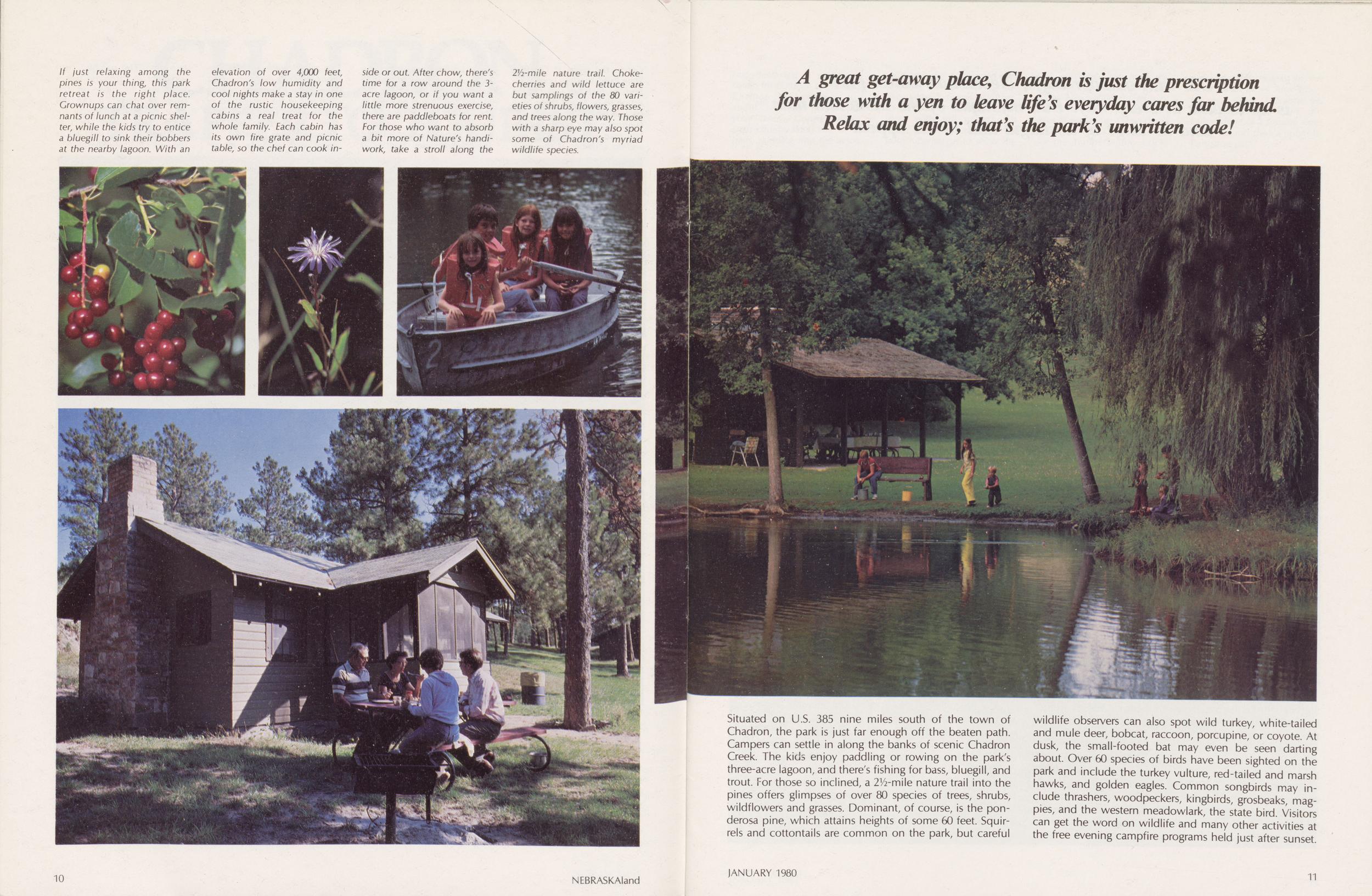
If just relaxing among the pines is your thing, this park retreat is the right place. Grownups can chat over remnants of lunch at a picnic shelter, while the kids try to entice a bluegill to sink their bobbers at the nearby lagoon. With an elevation of over 4,000 feet, Chadron's low humidity and cool nights make a stay in one of the rustic housekeeping cabins a real treat for the whole family. Each cabin has its own fire grate and picnic table, so the chef can cook inside or out. After chow, there's time for a row around the 3-acre lagoon, or if you want a little more strenuous exercise, there are paddleboats for rent. For those who want to absorb a bit more of Nature's handiwork, take a stroll along the 2½-mile nature trail. Chokecherries and wild lettuce are but samplings of the 80 varieties of shrubs, flowers, grasses, and trees along the way. Those with a sharp eye may also spot some of Chadron's myriad wildlife species.
Situated on U.S. 385 nine miles south of the town of Chadron, the park is just far enough off the beaten path. Campers can settle in along the banks of scenic Chadron Creek. The kids enjoy paddling or rowing on the park's three-acre lagoon, and there's fishing for bass, bluegill, and trout. For those so inclined, a 2 ½-mile nature trail into the pines offers glimpses of over 80 species of trees, shrubs, wildflowers and grasses. Dominant, of course, is the ponderosa pine, which attains heights of some 60 feet. Squirrels and cottontails are common on the park, but careful wildlife observers can also spot wild turkey, white-tailed and mule deer, bobcat, raccoon, porcupine, or coyote. At dusk, the small-footed bat may even be seen darting about. Over 60 species of birds have been sighted on the park and include the turkey vulture, red-tailed and marsh hawks, and golden eagles. Common songbirds may include thrashers, woodpeckers, kingbirds, grosbeaks, magpies, and the western meadowlark, the state bird. Visitors can get the word on wildlife and many other activities at the free evening campfire programs held just after sunset.
January 1980 11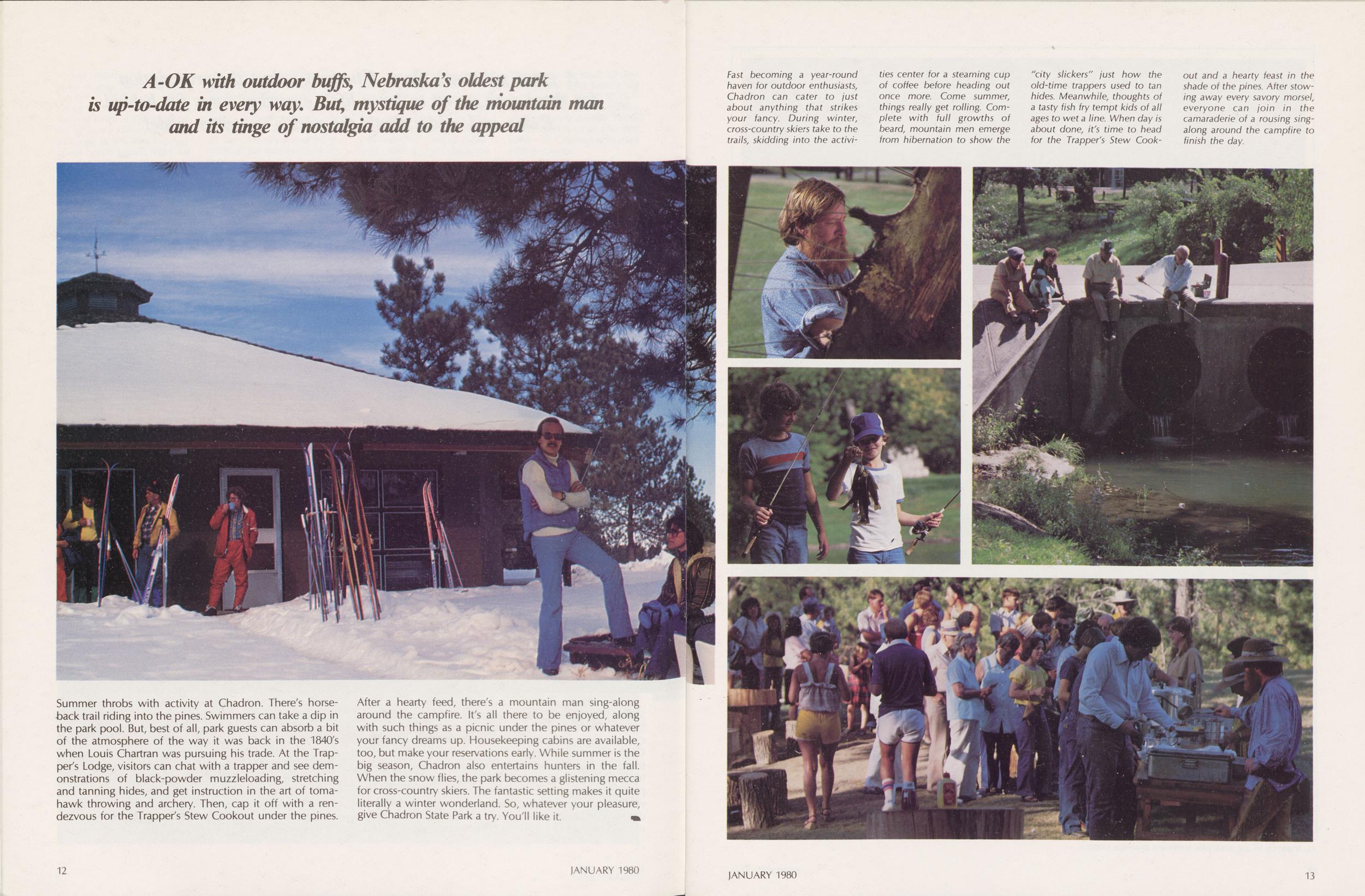 A-OK with outdoor buffs, Nebraska's oldest park is up-to-date in every way. But, mystique of the mountain man and its tinge of nostalgia add to the appeal
Summer throbs with activity at Chadron. There's horseback trail riding into the pines. Swimmers can take a dip in the park pool. But, best of all, park guests can absorb a bit of the atmosphere of the way it was back in the 1840's when Louis Chartran was pursuing his trade. At the Trapper's Lodge, visitors can chat with a trapper and see demonstrations of black-powder muzzleloading, stretching and tanning hides, and get instruction in the art of tomahawk throwing and archery. Then, cap it off with a rendezvous for the Trapper's Stew Cookout under the pines. After a hearty feed, there's a mountain man sing-along around the campfire. It's all there to be enjoyed, along with such things as a picnic under the pines or whatever your fancy dreams up. Housekeeping cabins are available, too, but make your reservations early. While summer is the big season, Chadron also entertains hunters in the fall. When the snow flies, the park becomes a glistening mecca for cross-country skiers. The fantastic setting makes it quite literally a winter wonderland. So, whatever your pleasure, give Chadron State Park a try. You'll like it.
12 JANUARY 1980Fast becoming a year-round haven for outdoor enthusiasts, Chadron can cater to just about anything that strikes your fancy. During winter, cross-country skiers take to the trails, skidding into the activities center for a steaming cup of coffee before heading out once more. Come summer, things really get rolling. Complete with full growths of beard, mountain men emerge from hibernation to show the "city slickers" just how the old-time trappers used to tan hides. Meanwhile, thoughts of a tasty fish fry tempt kids of all ages to wet a line. When day is about done, it's time to head for the Trapper's Stew Cookout and a hearty feast in the shade of the pines. After stowing away every savory morsel, everyone can join in the camaraderie of a rousing sing-along around the campfire to finish the day.
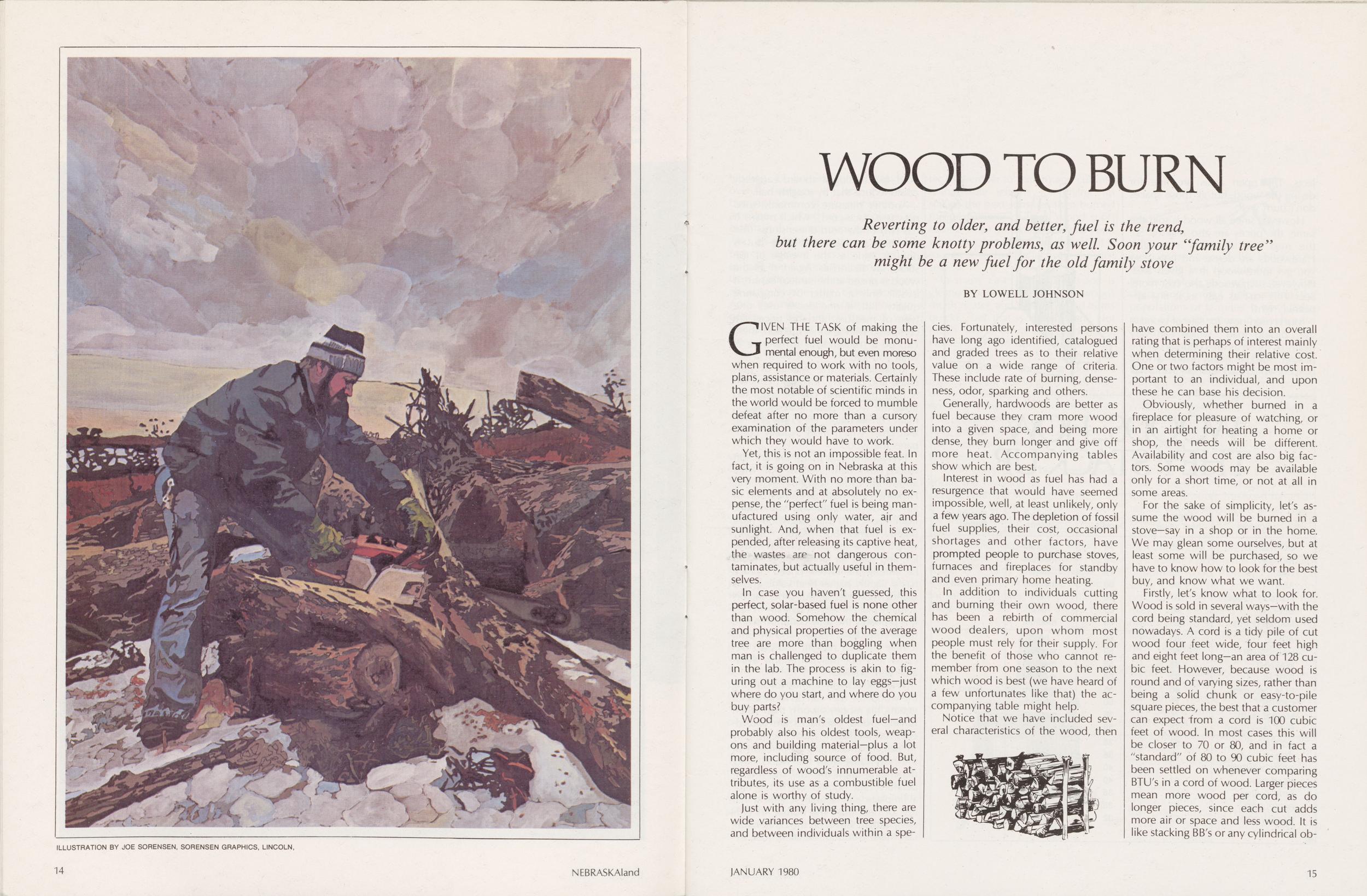
WOOD TO BURN
GIVEN THE TASK of making the perfect fuel would be monumental enough, but even moreso when required to work with no tools, plans, assistance or materials. Certainly the most notable of scientific minds in the world would be forced to mumble defeat after no more than a cursory examination of the parameters under which they would have to work.
Yet, this is not an impossible feat. In fact, it is going on in Nebraska at this very moment. With no more than basic elements and at absolutely no expense, the "perfect" fuel is being manufactured using only water, air and sunlight. And, when that fuel is expended, after releasing its captive heat, the wastes are not dangerous contaminates, but actually useful in themselves.
In case you haven't guessed, this perfect, solar-based fuel is none other than wood. Somehow the chemical and physical properties of the average tree are more than boggling when man is challenged to duplicate them in the lab. The process is akin to figuring out a machine to lay eggs—just where do you start, and where do you buy parts?
Wood is man's oldest fuel—and probably also his oldest tools, weapons and building material—plus a lot more, including source of food. But, regardless of wood's innumerable attributes, its use as a combustible fuel alone is worthy of study.
Just with any living thing, there are wide variances between tree species, and between individuals within a species. Fortunately, interested persons have long ago identified, catalogued and graded trees as to their relative value on a wide range of criteria. These include rate of burning, denseness, odor, sparking and others.
Generally, hardwoods are better as fuel because they cram more wood into a given space, and being more dense, they burn longer and give off more heat. Accompanying tables show which are best.
Interest in wood as fuel has had a resurgence that would have seemed impossible, well, at least unlikely, only a few years ago. The depletion of fossil fuel supplies, their cost, occasional shortages and other factors, have prompted people to purchase stoves, furnaces and fireplaces for standby and even primary home heating.
In addition to individuals cutting and burning their own wood, there has been a rebirth of commercial wood dealers, upon whom most people must rely for their supply. For the benefit of those who cannot remember from one season to the next which wood is best (we have heard of a few unfortunates like that) the accompanying table might help.
Notice that we have included several characteristics of the wood, then have combined them into an overall rating that is perhaps of interest mainly when determining their relative cost. One or two factors might be most important to an individual, and upon these he can base his decision.
Obviously, whether burned in a fireplace for pleasure of watching, or in an airtight for heating a home or shop, the needs will be different. Availability and cost are also big factors. Some woods may be available only for a short time, or not at all in some areas.
For the sake of simplicity, let's assume the wood will be burned in a stove—say in a shop or in the home. We may glean some ourselves, but at least some will be purchased, so we have to know how to look for the best buy, and know what we want.
Firstly, let's know what to look for. Wood is sold in several ways—with the cord being standard, yet seldom used nowadays. A cord is a tidy pile of cut wood four feet wide, four feet high and eight feet long—an area of 128 cubic feet. However, because wood is round and of varying sizes, rather than being a solid chunk or easy-to-pile square pieces, the best that a customer can expect from a cord is 100 cubic feet of wood. In most cases this will be closer to 70 or 80, and in fact a "standard" of 80 to 90 cubic feet has been settled on whenever comparing BTU's in a cord of wood. Larger pieces mean more wood per cord, as do longer pieces, since each cut adds more air or space and less wood. It is like stacking BB's or any cylindrical objects. JANUARY 1980 15 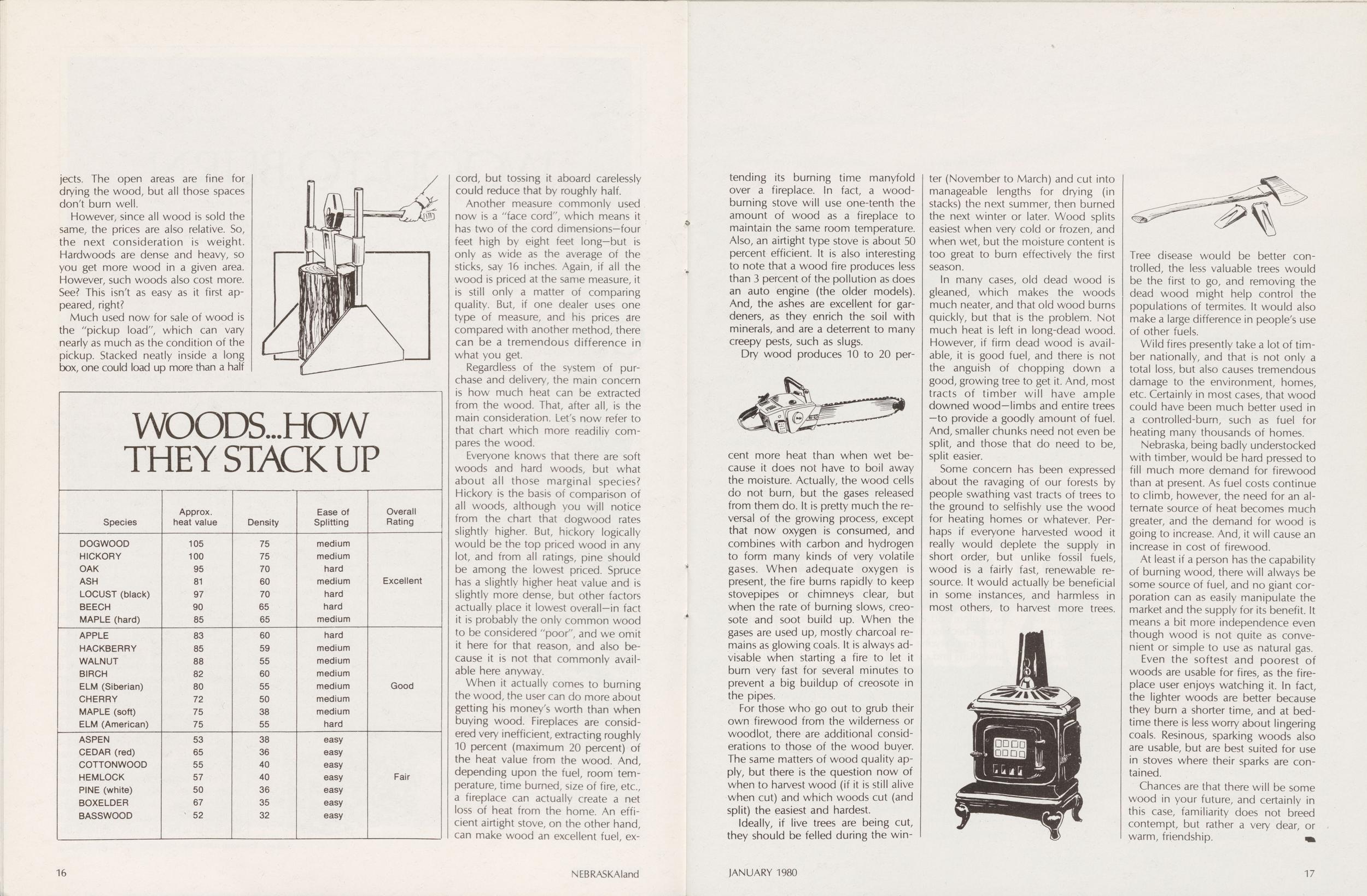 The open areas are fine for drying the wood, but all those spaces don't burn well.
However, since all wood is sold the same, the prices are also relative. So, the next consideration is weight. Hardwoods are dense and heavy, so you get more wood in a given area. However, such woods also cost more. See? This isn't as easy as it first appeared, right?
Much used now for sale of wood is the "pickup load", which can vary nearly as much as the condition of the pickup. Stacked neatly inside a long box, one could load up more than a half cord, but tossing it aboard carelessly could reduce that by roughly half.
WOODS...HOW THEY STACK UPSpecies Approx. heat value Density Ease of Splitting Overall Rating
DOGWOOD 105 75 medium
HICKORY 100 75 medium
OAK 95 70 hard
ASH 81 60 medium
LOCUST (black) 97 70 hard
BEECH 90 65 hard
MAPLE (hard) 85 65 medium
Excellent
APPLE 83 60 hard
HACKBERRY 85 59 medium
WALNUT 88 55 medium
BIRCH 82 60 medium
ELM (Siberian) 80 55 medium
CHERRY 72 50 medium
MAPLE (soft) 75 38 medium
ELM (American) 75 55 hard
Good
ASPEN 53 38 easy
CEDAR (red) 65 36 easy
COTTONWOOD 55 40 easy
HEMLOCK 57 40 easy
PINE (white) 50 36 easy
BOXELDER 67 35 easy
BASSWOOD 52 32 easy
Fair
Another measure commonly used now is a "face cord", which means it has two of the cord dimensions—four feet high by eight feet long—but is only as wide as the average of the sticks, say 16 inches. Again, if all the wood is priced at the same measure, it is still only a matter of comparing quality. But, if one dealer uses one type of measure, and his prices are compared with another method, there can be a tremendous difference in what you get.
Regardless of the system of purchase and delivery, the main concern is how much heat can be extracted from the wood. That, after all, is the main consideration. Let's now refer to that chart which more readiliy compares the wood.
Everyone knows that there are soft woods and hard woods, but what about all those marginal species? Hickory is the basis of comparison of all woods, although you will notice from the chart that dogwood rates slightly higher. But, hickory logically would be the top priced wood in any lot, and from all ratings, pine should be among the lowest priced. Spruce has a slightly higher heat value and is slightly more dense, but other factors actually place it lowest overall-in fact it is probably the only common wood to be considered "poor", and we omit it here for that reason, and also because it is not that commonly available here anyway.
When it actually comes to burning the wood, the user can do more about getting his money's worth than when buying wood. Fireplaces are considered very inefficient, extracting roughly 10 percent (maximum 20 percent) of the heat value from the wood. And, depending upon the fuel, room temperature, time burned, size of fire, etc., a fireplace can actually create a net loss of heat from the home. An efficient airtight stove, on the other hand, can make wood an excellent fuel, extending 16 NEBRASKAland its burning time manyfold over a fireplace. In fact, a wood-burning stove will use one-tenth the amount of wood as a fireplace to maintain the same room temperature. Also, an airtight type stove is about 50 percent efficient. It is also interesting to note that a wood fire produces less than 3 percent of the pollution as does an auto engine (the older models). And, the ashes are excellent for gardeners, as they enrich the soil with minerals, and are a deterrent to many creepy pests, such as slugs.
Dry wood produces 10 to 20 percent more heat than when wet because it does not have to boil away the moisture. Actually, the wood cells do not burn, but the gases released from them do. It is pretty much the reversal of the growing process, except that now oxygen is consumed, and combines with carbon and hydrogen to form many kinds of very volatile gases. When adequate oxygen is present, the fire burns rapidly to keep stovepipes or chimneys clear, but when the rate of burning slows, creosote and soot build up. When the gases are used up, mostly charcoal remains as glowing coals. It is always advisable when starting a fire to let it burn very fast for several minutes to prevent a big buildup of creosote in the pipes.
For those who go out to grub their own firewood from the wilderness or woodlot, there are additional considerations to those of the wood buyer. The same matters of wood quality apply, but there is the question now of when to harvest wood (if it is still alive when cut) and which woods cut (and split) the easiest and hardest.
Ideally, if live trees are being cut, they should be felled during the winter (November to March) and cut into manageable lengths for drying (in stacks) the next summer, then burned the next winter or later. Wood splits easiest when very cold or frozen, and when wet, but the moisture content is too great to burn effectively the first season.
In many cases, old dead wood is gleaned, which makes the woods much neater, and that old wood burns quickly, but that is the problem. Not much heat is left in long-dead wood. However, if firm dead wood is available, it is good fuel, and there is not the anguish of chopping down a good, growing tree to get it. And, most tracts of timber will have ample downed wood—limbs and entire trees —to provide a goodly amount of fuel. And, smaller chunks need not even be split, and those that do need to be, split easier.
Some concern has been expressed about the ravaging of our forests by people swathing vast tracts of trees to the ground to selfishly use the wood for heating homes or whatever. Perhaps if everyone harvested wood it really would deplete the supply in short order, but unlike fossil fuels, wood is a fairly fast, renewable resource. It would actually be beneficial in some instances, and harmless in most others, to harvest more trees. Tree disease would be better controlled, the less valuable trees would be the first to go, and removing the dead wood might help control the populations of termites. It would also make a large difference in people's use of other fuels.
Wild fires presently take a lot of timber nationally, and that is not only a total loss, but also causes tremendous damage to the environment, homes, etc. Certainly in most cases, that wood could have been much better used in a controlled-burn, such as fuel for heating many thousands of homes.
Nebraska, being badly understocked with timber, would be hard pressed to fill much more demand for firewood than at present. As fuel costs continue to climb, however, the need for an alternate source of heat becomes much greater, and the demand for wood is going to increase. And, it will cause an increase in cost of firewood.
At least if a person has the capability of burning wood, there will always be some source of fuel, and no giant corporation can as easily manipulate the market and the supply for its benefit. It means a bit more independence even though wood is not quite as convenient or simple to use as natural gas.
Even the softest and poorest of woods are usable for fires, as the fireplace user enjoys watching it. In fact, the lighter woods are better because they burn a shorter time, and at bedtime there is less worry about lingering coals. Resinous, sparking woods also are usable, but are best suited for use in stoves where their sparks are contained.
Chances are that there will be some wood in your future, and certainly in this case, familiarity does not breed contempt, but rather a very dear, or warm, friendship.
JANUARY 1980 17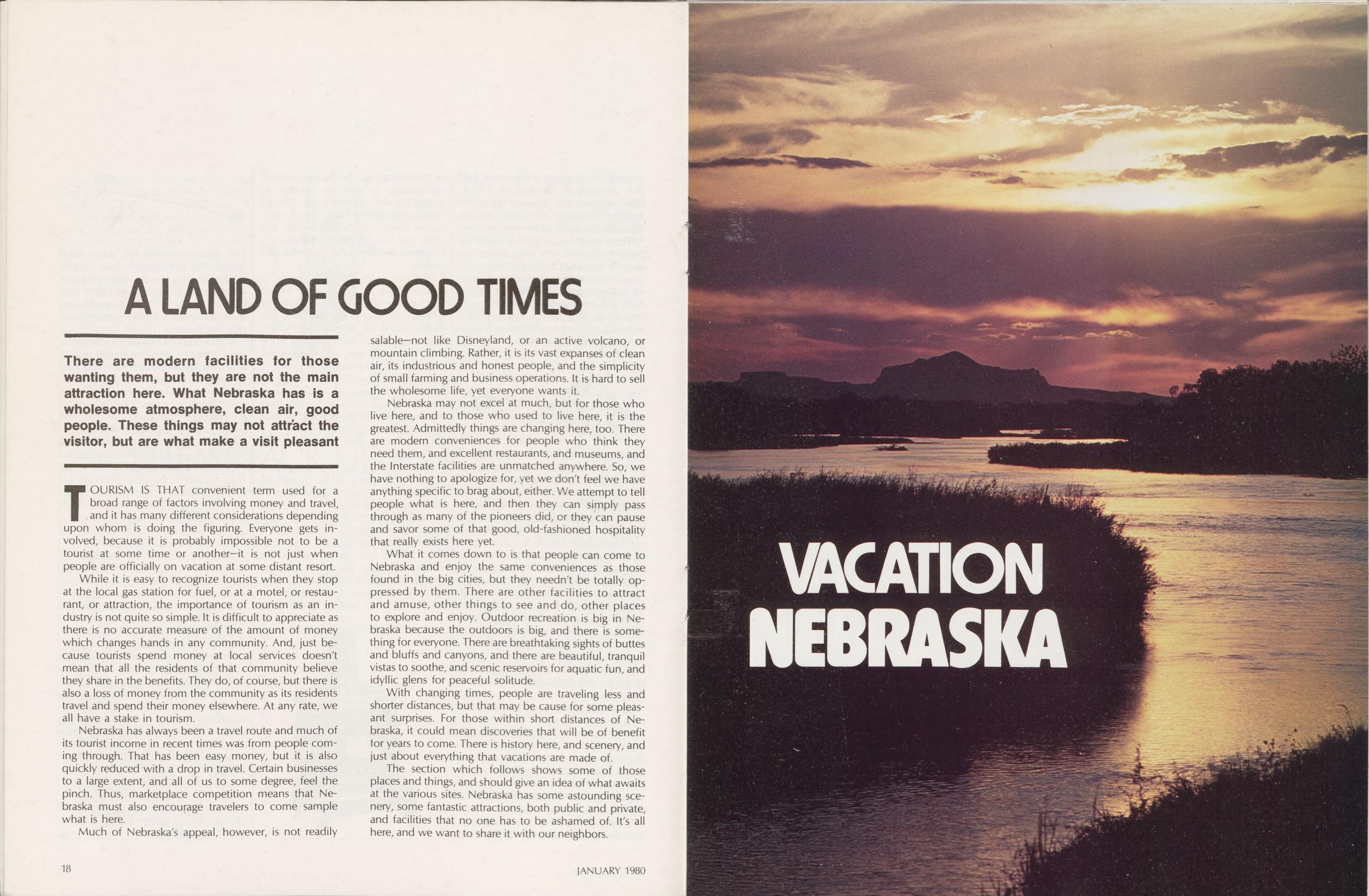
A LAND OF GOOD TIMES
There are modern facilities for those wanting them, but they are not the main attraction here. What Nebraska has is a wholesome atmosphere, clean air, good people. These things may not attract the visitor, but are what make a visit pleasantTOURISM IS THAT convenient term used for a broad range of factors involving money and travel, and it has many different considerations depending upon whom is doing the figuring. Everyone gets involved, because it is probably impossible not to be a tourist at some time or another—it is not just when people are officially on vacation at some distant resort.
While it is easy to recognize tourists when they stop at the local gas station for fuel, or at a motel, or restaurant, or attraction, the importance of tourism as an industry is not quite so simple. It is difficult to appreciate as there is no accurate measure of the amount of money which changes hands in any community. And, just because tourists spend money at local services doesn't mean that all the residents of that community believe they share in the benefits. They do, of course, but there is also a loss of money from the community as its residents travel and spend their money elsewhere. At any rate, we all have a stake in tourism.
Nebraska has always been a travel route and much of its tourist income in recent times was from people coming through. That has been easy money, but it is also quickly reduced with a drop in travel. Certain businesses to a large extent, and all of us to some degree, feel the pinch. Thus, marketplace competition means that Nebraska must also encourage travelers to come sample what is here.
Much of Nebraska's appeal, however, is not readily salable—not like Disneyland, or an active volcano, or mountain climbing. Rather, it is its vast expanses of clean air, its industrious and honest people, and the simplicity of small farming and business operations. It is hard to sell the wholesome life, yet everyone wants it.
Nebraska may not excel at much, but for those who live here, and to those who used to live here, it is the greatest. Admittedly things are changing here, too. There are modern conveniences for people who think they need them, and excellent restaurants, and museums, and the Interstate facilities are unmatched anywhere. So, we have nothing to apologize for, yet we don't feel we have anything specific to brag about, either. We attempt to tell people what is here, and then they can simply pass through as many of the pioneers did, or they can pause and savor some of that good, old-fashioned hospitality that really exists here yet.
What it comes down to is that people can come to Nebraska and enjoy the same conveniences as those found in the big cities, but they needn't be totally oppressed by them. There are other facilities to attract and amuse, other things to see and do, other places to explore and enjoy. Outdoor recreation is big in Nebraska because the outdoors is big, and there is something for everyone. There are breathtaking sights of buttes and bluffs and canyons, and there are beautiful, tranquil vistas to soothe, and scenic reservoirs for aquatic fun, and idyllic glens for peaceful solitude.
With changing times, people are traveling less and shorter distances, but that may be cause for some pleasant surprises. For those within short distances of Nebraska, it could mean discoveries that will be of benefit for years to come. There is history here, and scenery, and just about everything that vacations are made of.
The section which follows shows some of those places and things, and should give an idea of what awaits at the various sites. Nebraska has some astounding scenery, some fantastic attractions, both public and private, and facilities that no one has to be ashamed of. It's all here, and we want to share it with our neighbors.
18 JANUARY 1980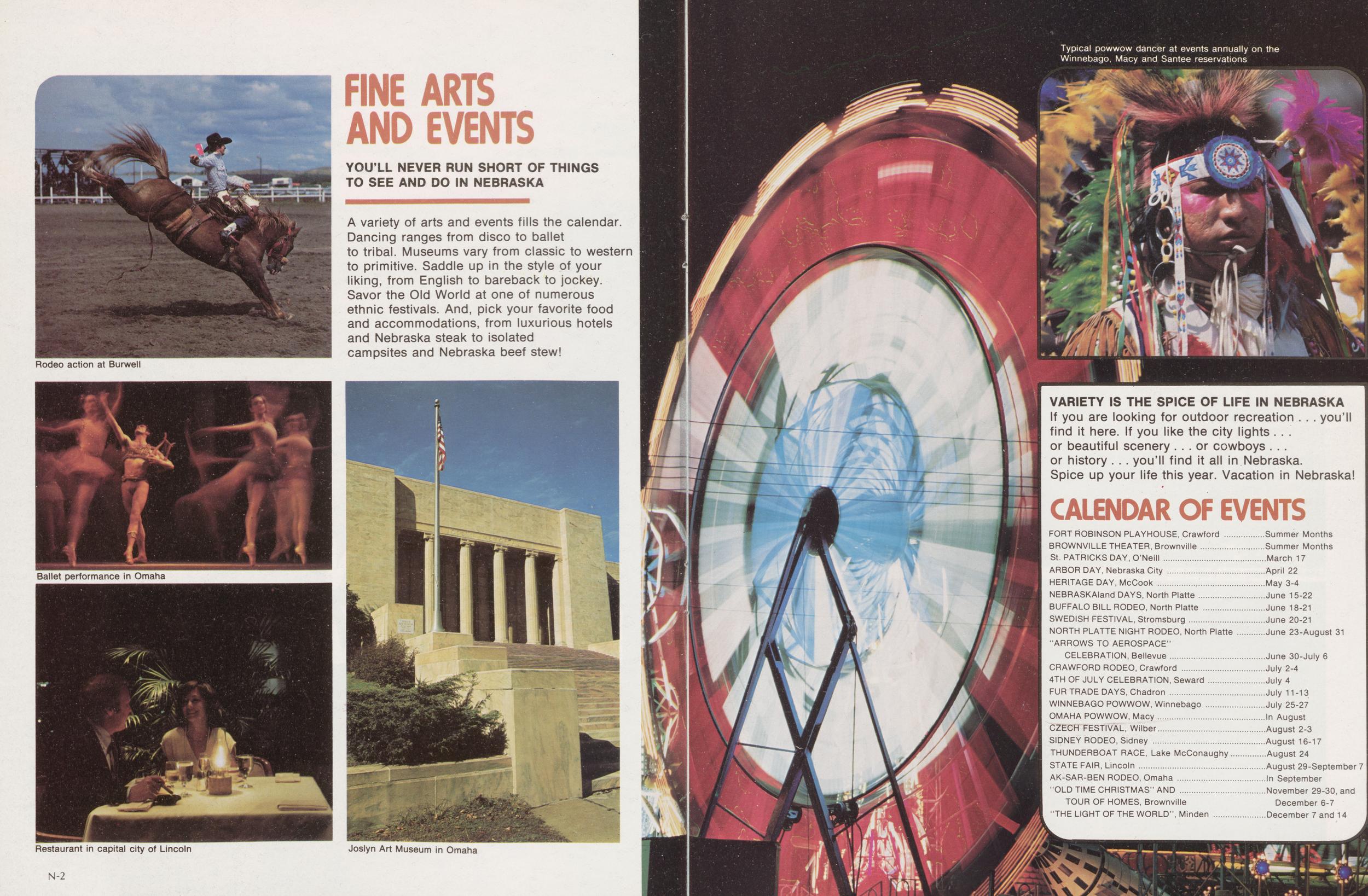
A variety of arts and events fills the calendar. Dancing ranges from disco to ballet to tribal. Museums vary from classic to western to primitive. Saddle up in the style of your liking, from English to bareback to jockey. Savor the Old World at one of numerous ethnic festivals. And, pick your favorite food and accommodations, from luxurious hotels and Nebraska steak to isolated campsites and Nebraska beef stew!
BROWNVILLE THEATER, Brownville.............Summer Months
St. PATRICKS DAY, O'Neill.............March 17
ARBOR DAY, Nebraska City.............April 22
HERITAGE DAY, McCook.............May 3-4
NEBRASKAland DAYS, North Platte.............June 15-22
BUFFALO BILL RODEO, North Platte.............June 18-21
SWEDISH FESTIVAL, Stromsburg.............June 20-21
NORTH PLATTE NIGHT RODEO, North Platte.............June 23-August 31
"ARROWS TO AEROSPACE"
CELEBRATION, Bellevue.............June 30-July 6
CRAWFORD RODEO, Crawford.............July 2-4
4TH OF JULY CELEBRATION, Seward.............July 4
FUR TRADE DAYS, Chadron.............July 11-13
WINNEBAGO POWWOW, Winnebago.............July 25-27
OMAHA POWWOW, Macy.............In August
CZECH FESTIVAL, Wilber.............August 2-3
SIDNEY RODEO, Sidney.............August 16-17
THUNDERBOAT RACE, Lake McConaughy.............August 24
STATE FAIR, Lincoln.............August 29-September 7
AK-SAR-BEN RODEO, Omaha.............In September
"OLD TIME CHRISTMAS" AND.............November 29-30, and
TOUR OF HOMES, Brownville.............December 6-7
"THE LIGHT OF THE WORLD", Minden.............December 7 and 14
 WESTERN NEBRASKA FOR SCENERY, WESTERN NEBRASKA HAS IT ALL
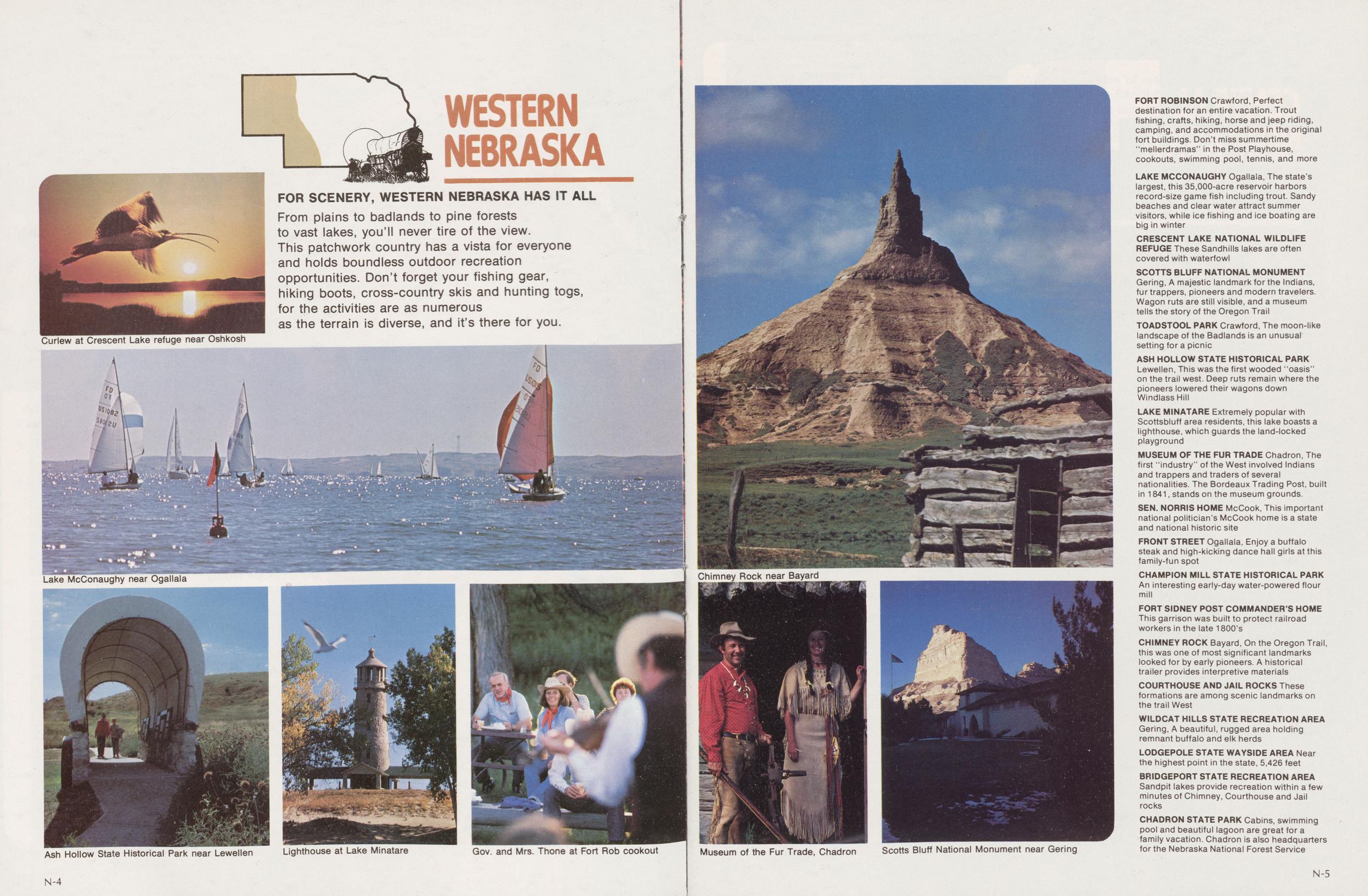
From plains to badlands to pine forests to vast lakes, you'll never tire of the view. This patchwork country has a vista for everyone and holds boundless outdoor recreation opportunities. Don't forget your fishing gear, hiking boots, cross-country skis and hunting togs, for the activities are as numerous as the terrain is diverse, and it's there for you.
FORT ROBINSON Crawford, Perfect destination for an entire vacation. Trout fishing, crafts, hiking, horse and jeep riding, camping, and accommodations in the original fort buildings. Don't miss summertime "mellerdramas" in the Post Playhouse, cookouts, swimming pool, tennis, and more
LAKE MCCONAUGHY Ogallala, The state's largest, this 35,000-acre reservoir harbors record-size game fish including trout. Sandy beaches and clear water attract summer visitors, while ice fishing and ice boating are big in winter
CRESCENT LAKE NATIONAL WILDLIFE REFUGE These Sandhills lakes are often covered with waterfowl
SCOTTS BLUFF NATIONAL MONUMENT Gering, A majestic landmark for the Indians, fur trappers, pioneers and modern travelers. Wagon ruts are still visible, and a museum tells the story of the Oregon Trail
TOADSTOOL PARK Crawford, The moon-like landscape of the Badlands is an unusual setting for a picnic
ASH HOLLOW STATE HISTORICAL PARK Lewellen, This was the first wooded "oasis" on the trail west. Deep ruts remain where the pioneers lowered their wagons down Windlass Hill
LAKE MINATARE Extremely popular with Scottsbluff area residents, this lake boasts a lighthouse, which guards the land-locked playground
MUSEUM OF THE FUR TRADE Chadron, The first "industry" of the West involved Indians and trappers and traders of several nationalities. The Bordeaux Trading Post, built in 1841, stands on the museum grounds.
SEN. NORRIS HOME McCook, This important national politician's McCook home is a state and national historic site
FRONT STREET Ogallala, Enjoy a buffalo steak and high-kicking dance hall girls at this family-fun spot
CHAMPION MILL STATE HISTORICAL PARK An interesting early-day water-powered flour mill
FORT SIDNEY POST COMMANDERS HOME This garrison was built to protect railroad workers in the late 1800's
CHIMNEY ROCK Bayard, On the Oregon Trail, this was one of most significant landmarks looked for by early pioneers. A historical trailer provides interpretive materials
COURTHOUSE AND JAIL ROCKS These formations are among scenic landmarks on the trail West
WILDCAT HILLS STATE RECREATION AREA Gering, A beautiful, rugged area holding remnant buffalo and elk herds
LODGEPOLE STATE WAYSIDE AREA Near the highest point in the state, 5,426 feet
BRIDGEPORT STATE RECREATION AREA Sandpit lakes provide recreation within a few minutes of Chimney, Courthouse and Jail rocks
CHADRON STATE PARK Cabins, swimming pool and beautiful lagoon are great for a family vacation. Chadron is also headquarters for the Nebraska National Forest Service
N-5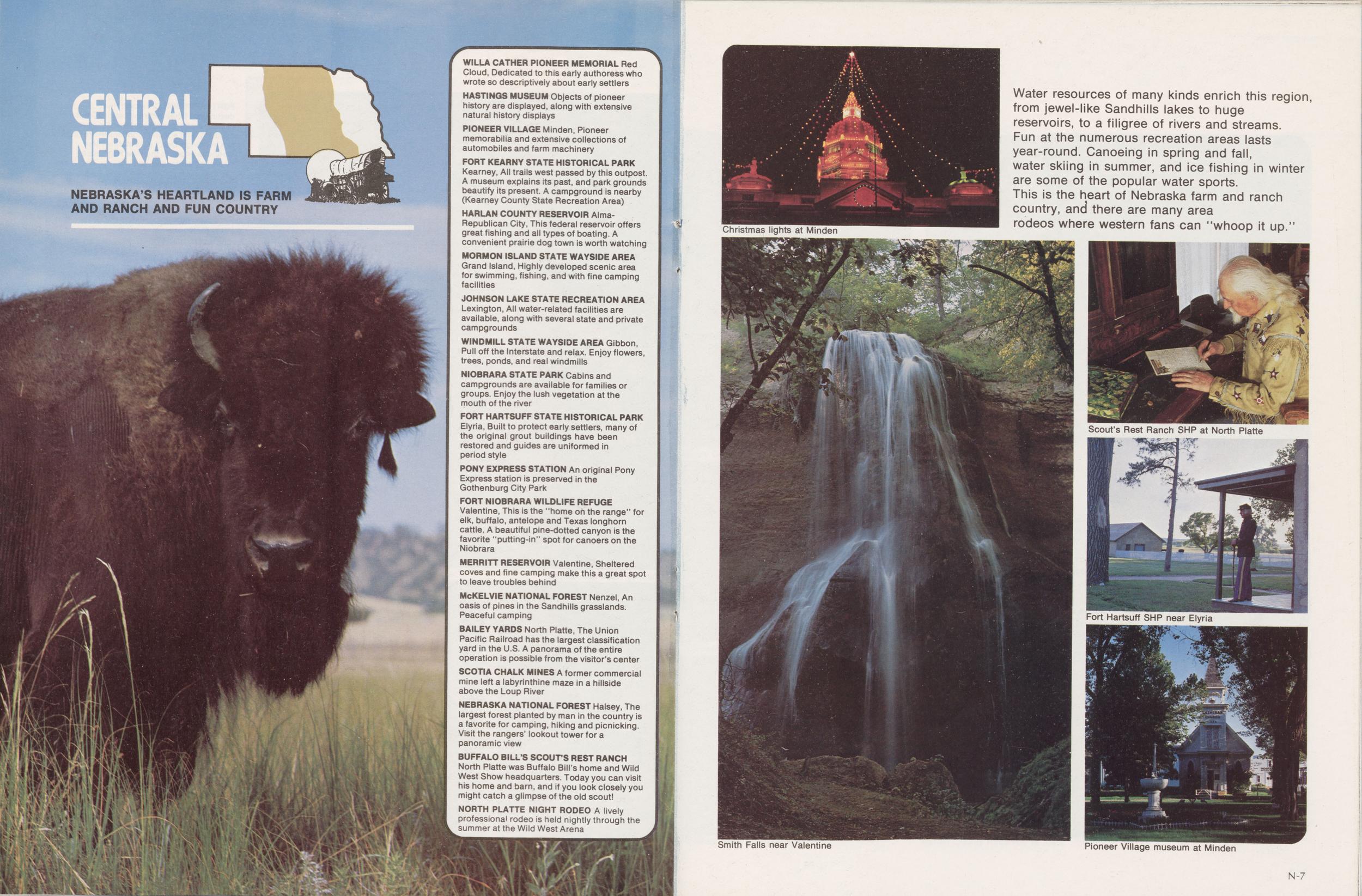 CENTRAL NEBRASKA NEBRASKA'S HEARTLAND IS FARM AND RANCH AND FUN COUNTRY
WILLA CATHER PIONEER MEMORIAL Red Cloud, Dedicated to this early authoress who wrote so descriptively about early settlers
HASTINGS MUSEUM Objects of pioneer history are displayed, along with extensive natural history displays
PIONEER VILLAGE Minden, Pioneer memorabilia and extensive collections of automobiles and farm machinery
FORT KEARNY STATE HISTORICAL PARK Kearney, All trails west passed by this outpost. A museum explains its past, and park grounds beautify its present. A campground is nearby (Kearney County State Recreation Area)
HARLAN COUNTY RESERVOIR Alma-Republican City, This federal reservoir offers great fishing and all types of boating. A convenient prairie dog town is worth watching
MORMON ISLAND STATE WAYSIDE AREA Grand Island, Highly developed scenic area for swimming, fishing, and with fine camping facilities
JOHNSON LAKE STATE RECREATION AREA Lexington, All water-related facilities are available, along with several state and private campgrounds
WINDMILL STATE WAYSIDE AREA Gibbon, Pull off the Interstate and relax. Enjoy flowers, trees, ponds, and real windmills
NIOBRARA STATE PARK Cabins and campgrounds are available for families or groups. Enjoy the lush vegetation at the mouth of the river
FORT HARTSUFF STATE HISTORICAL PARK Elyria, Built to protect early settlers, many of the original grout buildings have been restored and guides are uniformed in period style
PONY EXPRESS STATION An original Pony Express station is preserved in the Gothenburg City Park
FORT NIOBRARA WILDLIFE REFUGE Valentine, This is the "home on the range" for elk, buffalo, antelope and Texas longhorn cattle. A beautiful pine-dotted canyon is the favorite "putting-in" spot for canoers on the Niobrara
MERRITT RESERVOIR Valentine, Sheltered coves and fine camping make this a great spot to leave troubles behind
McKELVIE NATIONAL FOREST Nenzel, An oasis of pines in the Sandhills grasslands. Peaceful camping
BAILEY YARDS North Platte, The Union Pacific Railroad has the largest classification yard in the U.S. A panorama of the entire operation is possible from the visitor's center
SCOTIA CHALK MINES A former commercial mine left a labyrinthine maze in a hillside above the Loup River
NEBRASKA NATIONAL FOREST Halsey, The largest forest planted by man in the country is a favorite for camping, hiking and picnicking. Visit the rangers' lookout tower for a panoramic view
BUFFALO BILL'S SCOUTS REST RANCH North Platte was Buffalo Bills home and Wild West Show headquarters. Today you can visit his home and barn, and if you look closely you might catch a glimpse of the old scout!
NORTH PLATTE NIGHT RODEO A lively professional rodeo is held nightly through the summer at the Wild West Arena
Water resources of many kinds enrich this region, from jewel-like Sandhills lakes to huge reservoirs, to a filigree of rivers and streams. Fun at the numerous recreation areas lasts year-round. Canoeing in spring and fall, water skiing in summer, and ice fishing in winter are some of the popular water sports. This is the heart of Nebraska farm and ranch country, and there are many area rodeos where western fans can "whoop it up."
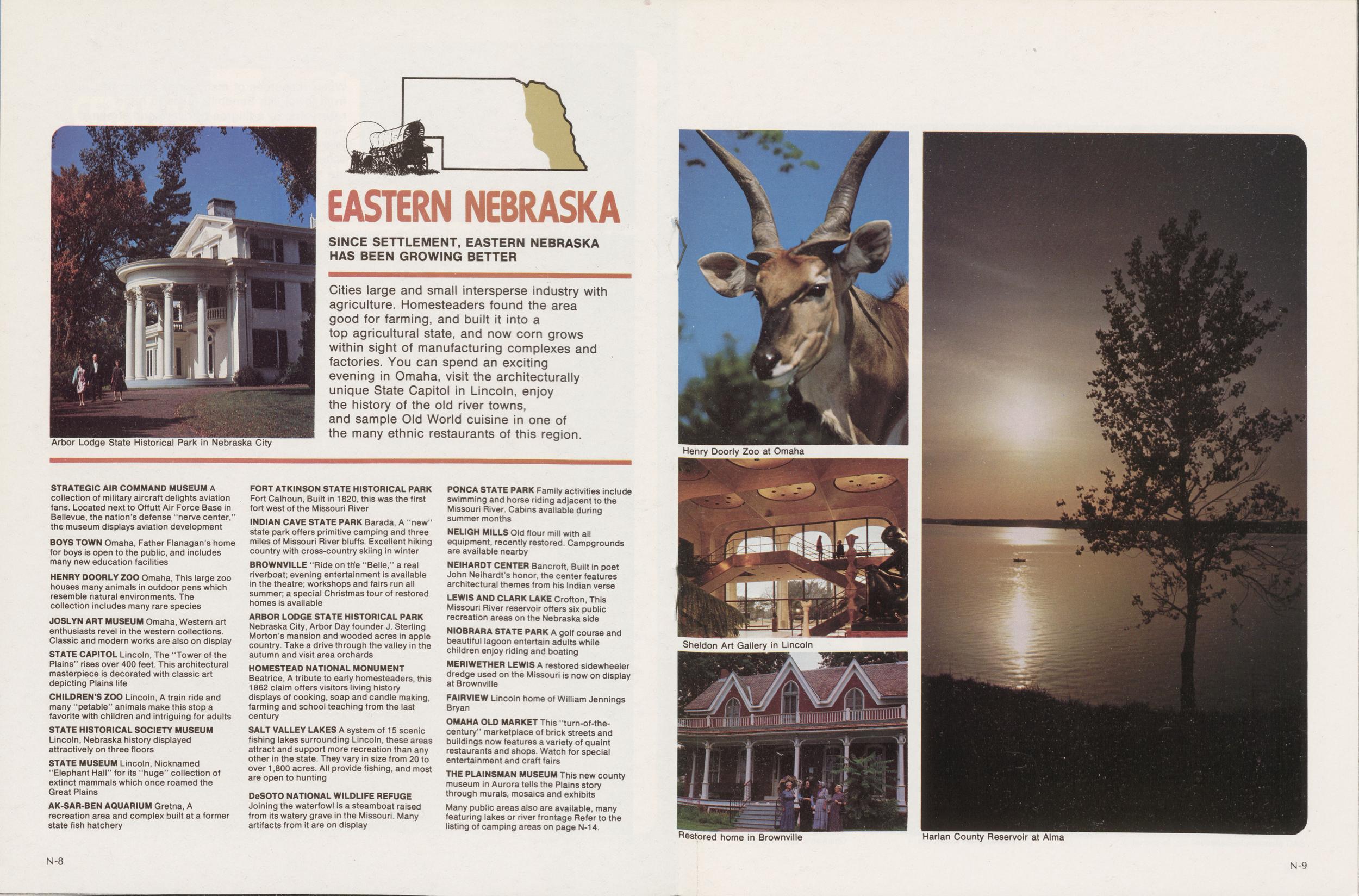 EASTERN NEBRASKA SINCE SETTLEMENT, EASTERN NEBRASKA HAS BEEN GROWING BETTER
Cities large and small intersperse industry with agriculture. Homesteaders found the area good for farming, and built it into a top agricultural state, and now corn grows within sight of manufacturing complexes and factories. You can spend an exciting evening in Omaha, visit the architecturally unique State Capitol in Lincoln, enjoy the history of the old river towns, and sample Old World cuisine in one of the many ethnic restaurants of this region.
STRATEGIC AIR COMMAND MUSEUM A collection of military aircraft delights aviation fans. Located next to Offutt Air Force Base in Bellevue, the nation's defense "nerve center," the museum displays aviation development
BOYS TOWN Omaha, Father Flanagan's home for boys is open to the public, and includes many new education facilities
HENRY DOORLY ZOO Omaha, This large zoo houses many animals in outdoor pens which resemble natural environments. The collection includes many rare species
JOSLYN ART MUSEUM Omaha, Western art enthusiasts revel in the western collections. Classic and modern works are also on display
STATE CAPITOL Lincoln, The "Tower of the Plains" rises over 400 feet. This architectural masterpiece is decorated with classic art depicting Plains life
CHILDREN'S ZOO Lincoln, A train ride and many "petable" animals make this stop a favorite with children and intriguing for adults
STATE HISTORICAL SOCIETY MUSEUM Lincoln, Nebraska history displayed attractively on three floors
STATE MUSEUM Lincoln, Nicknamed "Elephant Hall" for its "huge" collection of extinct mammals which once roamed the Great Plains
AK-SAR-BEN AQUARIUM Gretna, A recreation area and complex built at a former state fish hatchery
FORT ATKINSON STATE HISTORICAL PARK Fort Calhoun, Built in 1820, this was the first fort west of the Missouri River
INDIAN CAVE STATE PARK Barada, A "new" state park offers primitive camping and three miles of Missouri River bluffs. Excellent hiking country with cross-country skiing in winter
BROWNVILLE "Ride on the "Belle," a real riverboat; evening entertainment is available in the theatre; workshops and fairs run all summer; a special Christmas tour of restored homes is available
ARBOR LODGE STATE HISTORICAL PARK Nebraska City, Arbor Day founder J. Sterling Morton's mansion and wooded acres in apple country. Take a drive through the valley in the autumn and visit area orchards
HOMESTEAD NATIONAL MONUMENT Beatrice, A tribute to early homesteaders, this 1862 claim offers visitors living history displays of cooking, soap and candle making, farming and school teaching from the last century
SALT VALLEY LAKES A system of 15 scenic fishing lakes surrounding Lincoln, these areas attract and support more recreation than any other in the state. They vary in size from 20 to over 1,800 acres. All provide fishing, and most are open to hunting
DeSOTO NATIONAL WILDLIFE REFUGE Joining the waterfowl is a steamboat raised from its watery grave in the Missouri. Many artifacts from it are on display
PONCA STATE PARK Family activities include swimming and horse riding adjacent to the Missouri River. Cabins available during summer months
NELIGH MILLS Old flour mill with all equipment, recently restored. Campgrounds are available nearby
NEIHARDT CENTER Bancroft, Built in poet John Neihardt's honor, the center features architectural themes from his Indian verse
LEWIS AND CLARK LAKE Crofton, This Missouri River reservoir offers six public recreation areas on the Nebraska side
NIOBRARA STATE PARK A golf course and beautiful lagoon entertain adults while children enjoy riding and boating
MERIWETHER LEWIS A restored sidewheeler dredge used on the Missouri is now on display at Brownville
FAIRVIEW Lincoln home of William Jennings Bryan
OMAHA OLD MARKET This "turn-of-the-century" marketplace of brick streets and buildings now features a variety of quaint restaurants and shops. Watch for special entertainment and craft fairs
THE PLAINSMAN MUSEUM This new county museum in Aurora tells the Plains story through murals, mosaics and exhibits
Many public areas also are available, many featuring lakes or river frontage Refer to the listing of camping areas on page N-14.
N-8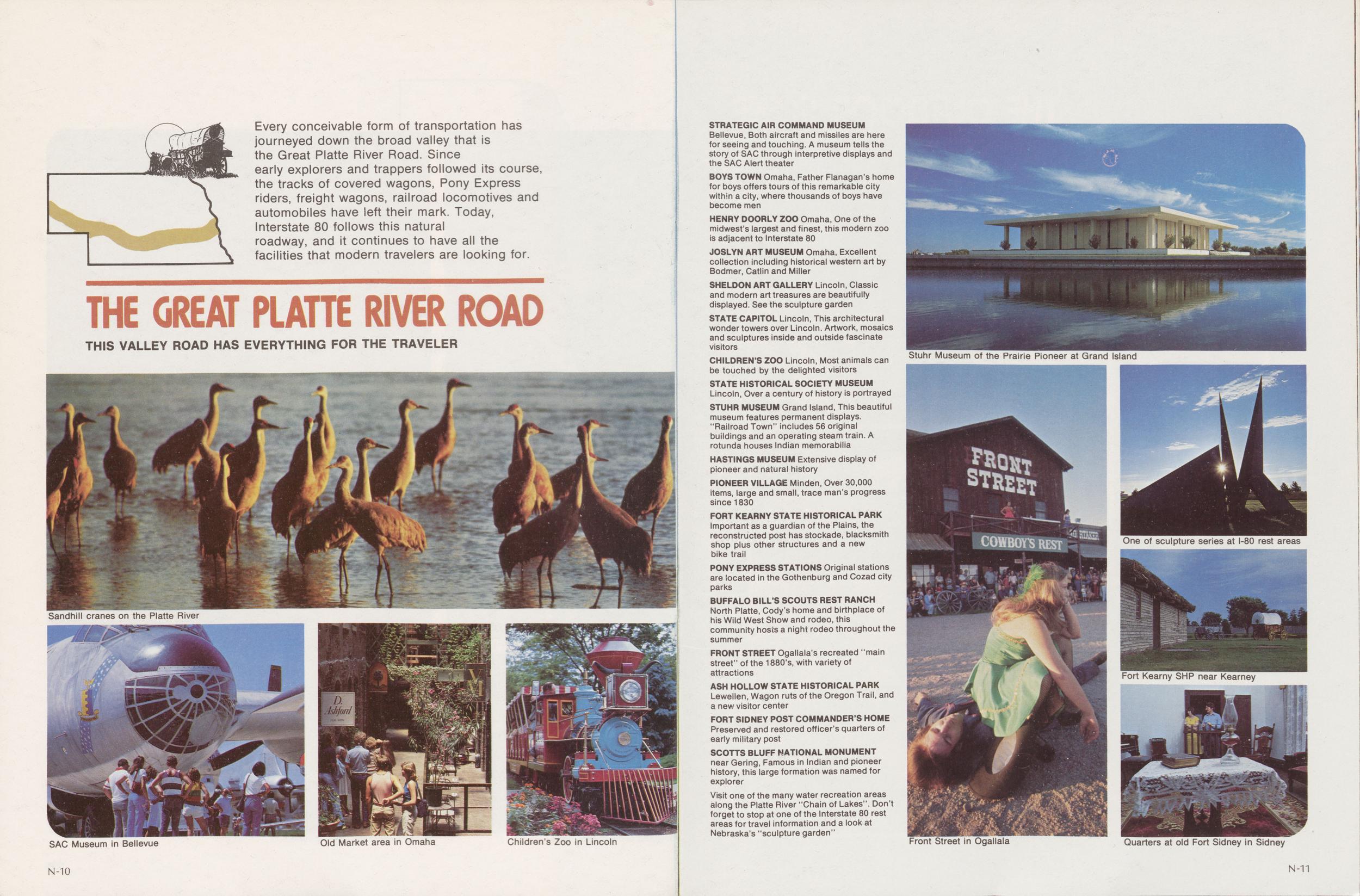 THE GREAT PLATTE RIVER ROAD THIS VALLEY ROAD HAS EVERYTHING FOR THE TRAVELER
Every conceivable form of transportation has journeyed down the broad valley that is the Great Platte River Road. Since early explorers and trappers followed its course, the tracks of covered wagons, Pony Express riders, freight wagons, railroad locomotives and automobiles have left their mark. Today, Interstate 80 follows this natural roadway, and it continues to have all the facilities that modern travelers are looking for.
STRATEGIC AIR COMMAND MUSEUM Bellevue, Both aircraft and missiles are here for seeing and touching. A museum tells the story of SAC through interpretive displays and the SAC Alert theater
BOYS TOWN Omaha, Father Flanagan's home for boys offers tours of this remarkable city within a city, where thousands of boys have become men
HENRY DOORLY ZOO Omaha, One of the midwest's largest and finest, this modern zoo is adjacent to Interstate 80
JOSLYN ART MUSEUM Omaha, Excellent collection including historical western art by Bodmer, Catlin and Miller
SHELDON ART GALLERY Lincoln, Classic and modern art treasures are beautifully displayed. See the sculpture garden
STATE CAPITOL Lincoln, This architectural wonder towers over Lincoln. Artwork, mosaics and sculptures inside and outside fascinate visitors
CHILDREN'S ZOO Lincoln, Most animals can be touched by the delighted visitors
STATE HISTORICAL SOCIETY MUSEUM Lincoln, Over a century of history is portrayed
STUHR MUSEUM Grand Island, This beautiful museum features permanent displays. "Railroad Town" includes 56 original buildings and an operating steam train. A rotunda houses Indian memorabilia
HASTINGS MUSEUM Extensive display of pioneer and natural history
PIONEER VILLAGE Minden, Over 30,000 items, large and small, trace man's progress since 1830
FORT KEARNY STATE HISTORICAL PARK Important as a guardian of the Plains, the reconstructed post has stockade, blacksmith shop plus other structures and a new bike trail
PONY EXPRESS STATIONS Original stations are located in the Gothenburg and Cozad city parks
BUFFALO BILL'S SCOUTS REST RANCH North Platte, Cody's home and birthplace of his Wild West Show and rodeo, this community hosts a night rodeo throughout the summer
FRONT STREET Ogallala's recreated "main street" of the 1880's, with variety of attractions
ASH HOLLOW STATE HISTORICAL PARK Lewellen, Wagon ruts of the Oregon Trail, and a new visitor center
FORT SIDNEY POST COMMANDER'S HOME Preserved and restored officer's quarters of early military post
SCOTTS BLUFF NATIONAL MONUMENT near Gering, Famous in Indian and pioneer history, this large formation was named for explorer
Visit one of the many water recreation areas along the Platte River "Chain of Lakes". Don't forget to stop at one of the Interstate 80 rest areas for travel information and a look at Nebraska's "sculpture garden"
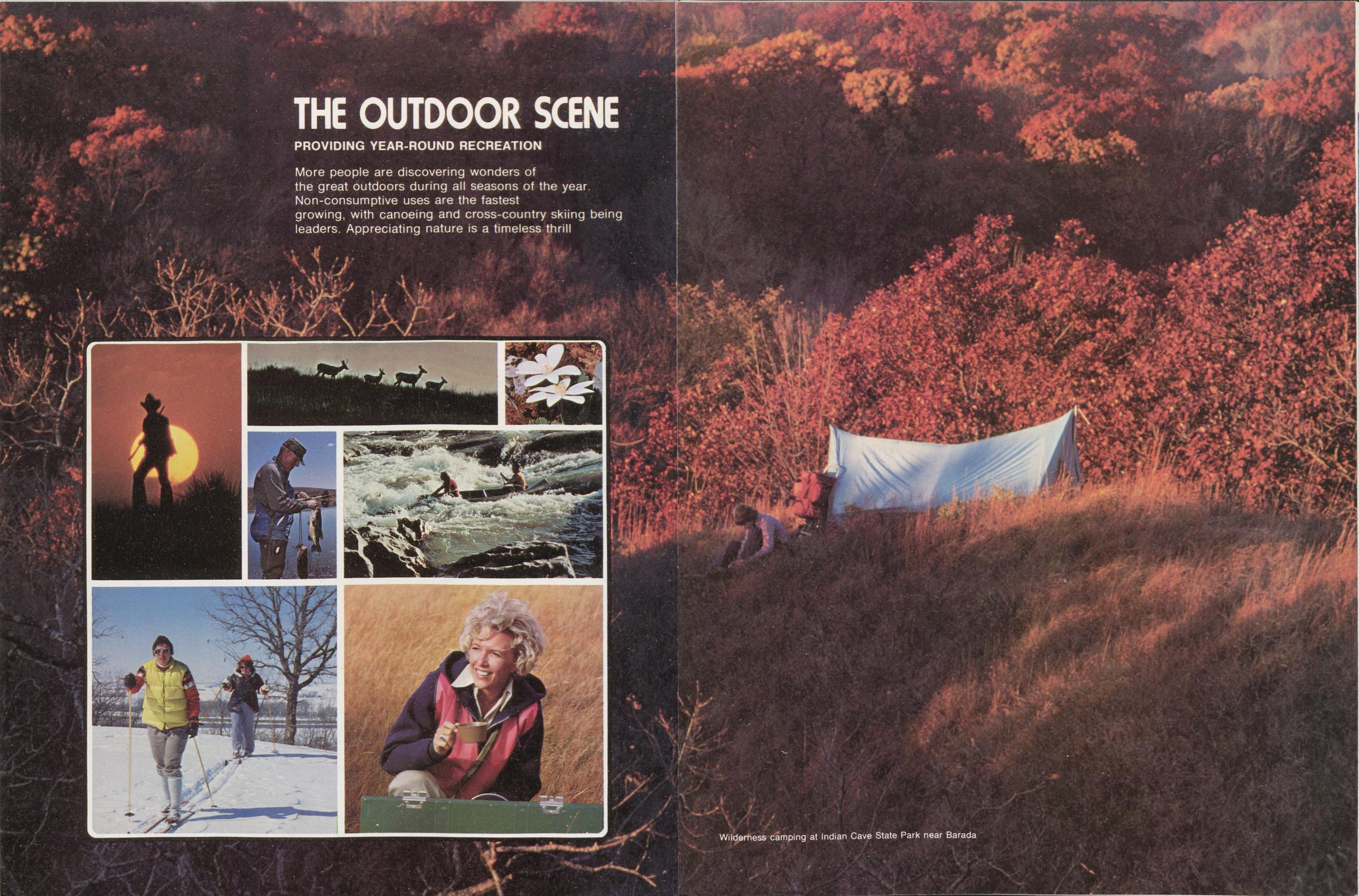
THE OUTDOOR SCENE
PROVIDING YEAR-ROUND RECREATION
More people are discovering wonders of the great outdoors during all seasons of the year. Non-consumptive uses are the fastest growing, with canoeing and cross-country skiing being leaders. Appreciating nature is a timeless thrill
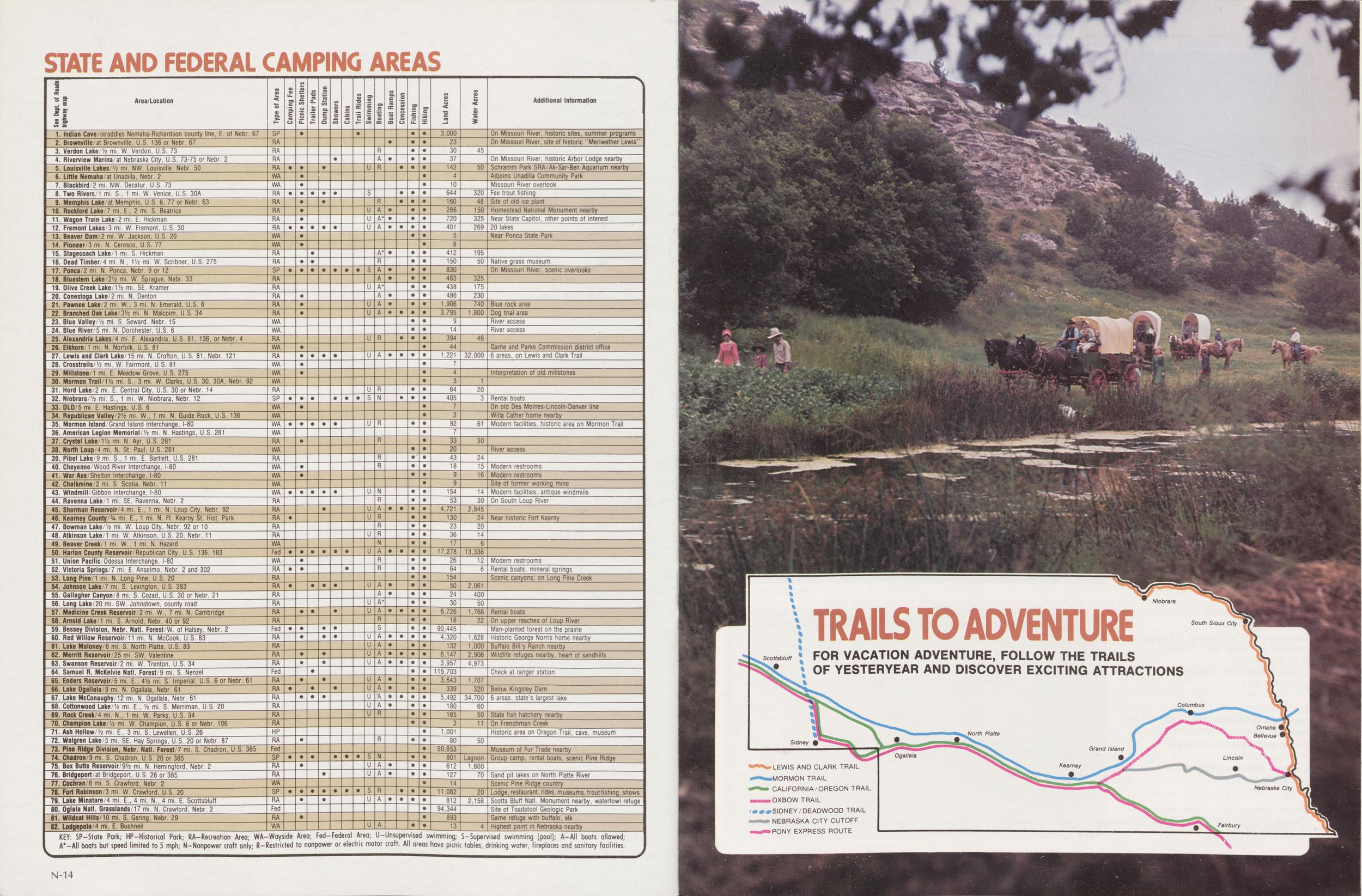 STATE AND FEDERAL CAMPING AREAS LEWIS AND CLARK TRAIL MORMON TRAIL CALIFORNIA/OREGON TRAIL OXBOW TRAIL SIDNEY/DEADWOOD TRAIL NEBRASKA CITY CUTOFF PONY EXPRESS ROUTE Toadstool Park near Crawford Famous statue in Boys' Town in Omaha Ice boating on Lake McConaughy State Capitol in Lini Czech dancers at Wilber festival For additional travel information on Nebraska, contact: Department of Economic Development Division of Travel and Tourism P.O. Box 94666 Lincoln, Nebraska 68509 (402) 471-3111 For information on hunting, fishing, camping and outdoor recreation in Nebraska, contact: Game and Parks Commission P.O. Box 30370 Lincoln, Nebraska 68503 (402) 464-0641 Vacation Nebraska was produced jointly by the Game & Parks Commission and the Department of Economic Development. Copyright 1980 by NEBRASKAland Magazine. TRANSPORTATION FACILITIES SERVING NEBRASKA CAR RENTALS Avis Hertz Budget Rent-a-Car National Car Rentals RAILROADS Amtrak Burlington Northern Illinois Central Milwaukee Missouri Pacific Norfolk & Western Northwestern Rock Island Union Pacific AIRLINES Air Nebraska Air Wisconsin American Braniff Eastern Frontier Mississippi Valley Ozark Pioneer United TWA BUS LINES Arrow Black Hills-Stage Lines Continental Trailways Greyhound N-14 TRAILS TO ADVENTURE FOR VACATION ADVENTURE, FOLLOW THE TRAILS OF YESTERDAY AND DISCOVER EXCITING ATTRACTIONS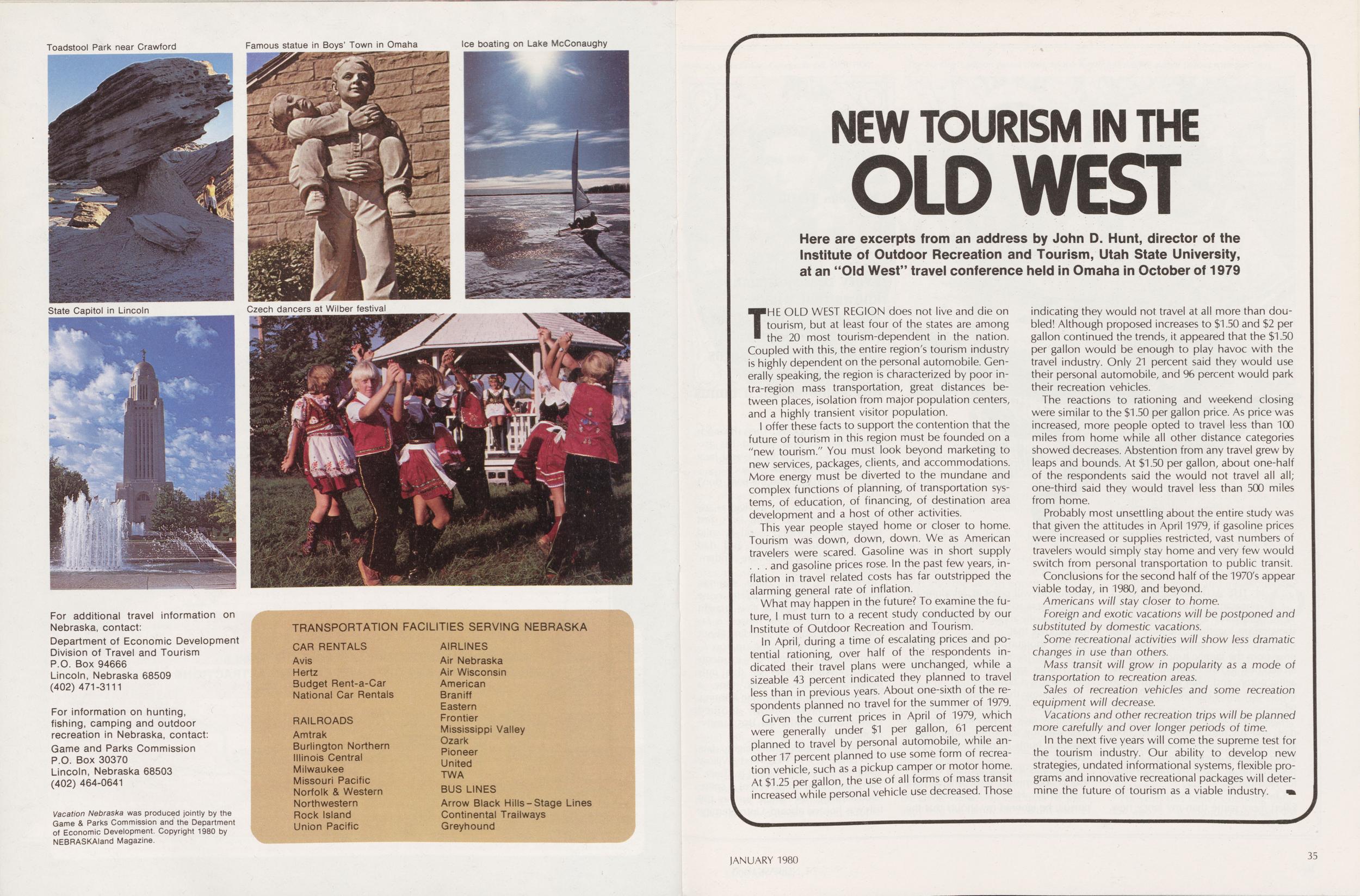
P.O. Box 94666
Lincoln, Nebraska 68509
(402) 471-3111 For information on hunting, fishing, camping and outdoor recreation in Nebraska, contact: Game and Parks Commission
P.O. Box 30370
Lincoln, Nebraska 68503
(402) 464-0641 Vacation Nebraska was produced jointly by the Game & Parks Commission and the Department of Economic Development. Copyright 1980 by NEBRASKAland Magazine. TRANSPORTATION FACILITIES SERVING NEBRASKA CAR RENTALS Avis Hertz Budget Rent-a-Car National Car Rentals RAILROADS Amtrak Burlington Northern Illinois Central Milwaukee Missouri Pacific Norfolk & Western Northwestern Rock Island Union Pacific AIRLINES Air Nebraska Air Wisconsin American Braniff Eastern Frontier Mississippi Valley Ozark Pioneer United TWA BUS LINES Arrow Black Hills-Stage Lines Continental Trailways Greyhound
NEW TOURISM IN THE OLD WEST
Here are excerpts from an address by John D. Hunt, director of the Institute of Outdoor Recreation and Tourism, Utah State University, at an "Old West" travel conference held in Omaha in October of 1979THE OLD WEST REGION does not live and die on tourism, but at least four of the states are among the 20 most tourism-dependent in the nation. Coupled with this, the entire region's tourism industry is highly dependent on the personal automobile. Generally speaking, the region is characterized by poor intra-region mass transportation, great distances between places, isolation from major population centers, and a highly transient visitor population.
I offer these facts to support the contention that the future of tourism in this region must be founded on a "new tourism." You must look beyond marketing to new services, packages, clients, and accommodations. More energy must be diverted to the mundane and complex functions of planning, of transportation systems, of education, of financing, of destination area development and a host of other activities.
This year people stayed home or closer to home. Tourism was down, down, down. We as American travelers were scared. Gasoline was in short supply ...and gasoline prices rose. In the past few years, inflation in travel related costs has far outstripped the alarming general rate of inflation.
What may happen in the future? To examine the future, I must turn to a recent study conducted by our Institute of Outdoor Recreation and Tourism.
In April, during a time of escalating prices and potential rationing, over half of the respondents indicated their travel plans were unchanged, while a sizeable 43 percent indicated they planned to travel less than in previous years. About one-sixth of the respondents planned no travel for the summer of 1979.
Given the current prices in April of 1979, which were generally under $1 per gallon, 61 percent planned to travel by personal automobile, while another 17 percent planned to use some form of recreation vehicle, such as a pickup camper or motor home. At $1.25 per gallon, the use of all forms of mass transit increased while personal vehicle use decreased. Those indicating they would not travel at all more than doubled! Although proposed increases to $1.50 and $2 per gallon continued the trends, it appeared that the $1.50 per gallon would be enough to play havoc with the travel industry. Only 21 percent said they would use their personal automobile, and 96 percent would park their recreation vehicles.
The reactions to rationing and weekend closing were similar to the $1.50 per gallon price. As price was increased, more people opted to travel less than 100 miles from home while all other distance categories showed decreases. Abstention from any travel grew by leaps and bounds. At $1.50 per gallon, about one-half of the respondents said the would not travel all all; one-third said they would travel less than 500 miles from home.
Probably most unsettling about the entire study was that given the attitudes in April 1979, if gasoline prices were increased or supplies restricted, vast numbers of travelers would simply stay home and very few would switch from personal transportation to public transit.
Conclusions for the second half of the 1970's appear viable today, in 1980, and beyond.
Americans will stay closer to home.
Foreign and exotic vacations will be postponed and substituted by domestic vacations.
Some recreational activities will show less dramatic changes in use than others.
Mass transit will grow in popularity as a mode of transportation to recreation areas.
Sales of recreation vehicles and some recreation equipment will decrease.
Vacations and other recreation trips will be planned more carefully and over longer periods of time.
In the next five years will come the supreme test for the tourism industry. Our ability to develop new strategies, undated informational systems, flexible programs and innovative recreational packages will determine the future of tourism as a viable industry.
JANUARY 1980 35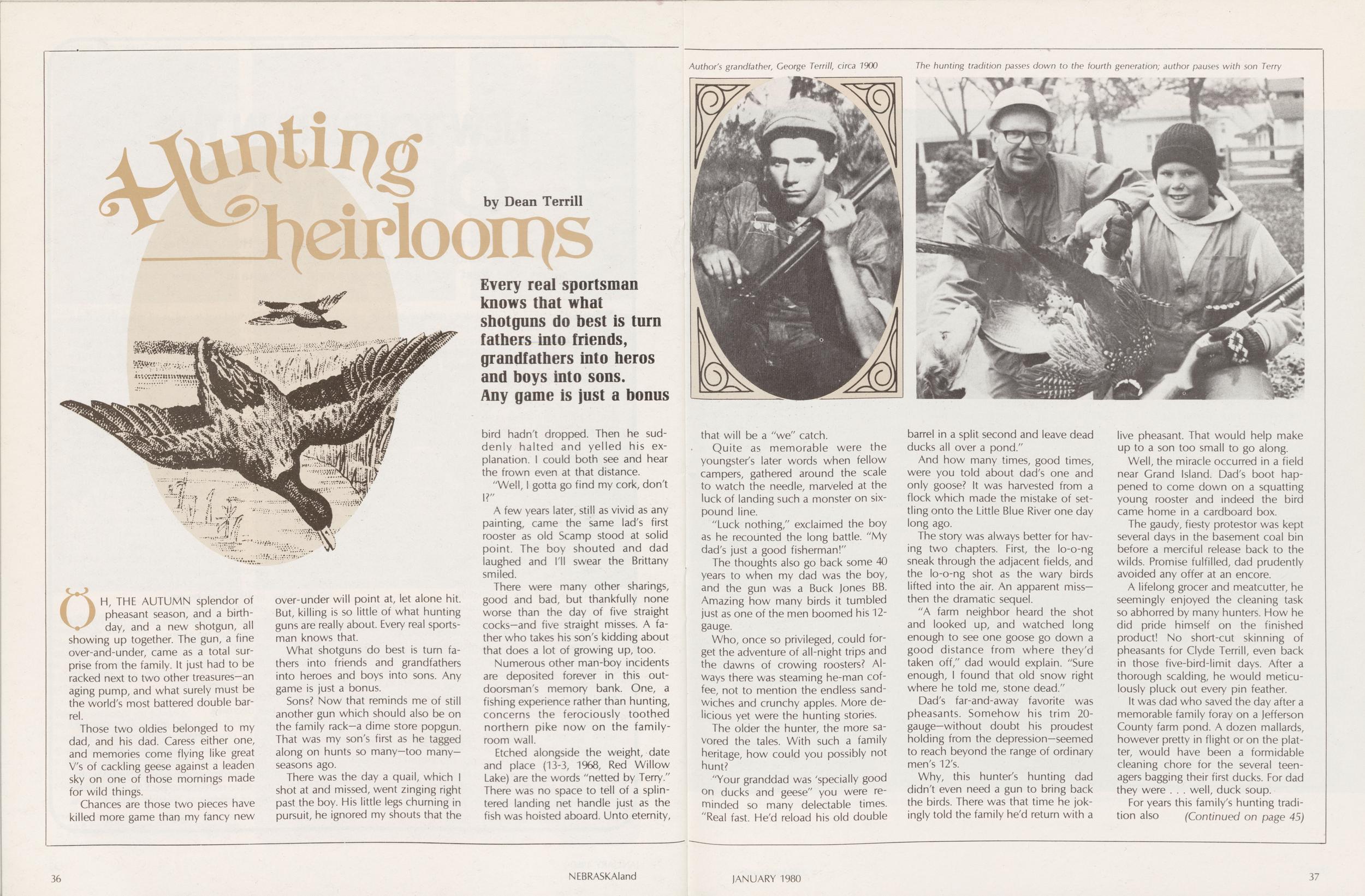
Hunting heirlooms
by Dean Terrill Every real sportsman knows that what shotguns do best is turn fathers into friends, grandfathers into heros and boys into sons. Any game is just a bonusOH, THE AUTUMN splendor of pheasant season, and a birthday, and a new shotgun, all showing up together. The gun, a fine over-and-under, came as a total surprise from the family. It just had to be racked next to two other treasures-an aging pump, and what surely must be the world's most battered double barrel.
Those two oldies belonged to my dad, and his dad. Caress either one, and memories come flying like great V's of cackling geese against a leaden sky on one of those mornings made for wild things.
Chances are those two pieces have killed more game than my fancy new over-under will point at, let alone hit. But, killing is so little of what hunting guns are really about. Every real sportsman knows that.
What shotguns do best is turn fathers into friends and grandfathers into heroes and boys into sons. Any game is just a bonus.
Sons? Now that reminds me of still another gun which should also be on the family rack—a dime store popgun. That was my son's first as he tagged along on hunts so many—too manyseasons ago.
There was the day a quail, which I shot at and missed, went zinging right past the boy. His little legs churning in pursuit, he ignored my shouts that the bird hadn't dropped. Then he suddenly halted and yelled his explanation. I could both see and hear the frown even at that distance.
"Well, I gotta go find my cork, don't I?"
A few years later, still as vivid as any painting, came the same lad's first rooster as old Scamp stood at solid point. The boy shouted and dad laughed and I'll swear the Brittany smiled.
There were many other sharings, good and bad, but thankfully none worse than the day of five straight cocks-and five straight misses. A father who takes his son's kidding about that does a lot of growing up, too.
Numerous other man-boy incidents are deposited forever in this outdoorsman's memory bank. One, a fishing experience rather than hunting, concerns the ferociously toothed northern pike now on the family-room wall.
Etched alongside the weight, date and place (13-3, 1968, Red Willow Lake) are the words "netted by Terry." There was no space to tell of a splintered landing net handle just as the fish was hoisted aboard. Unto eternity, that will be a "we" catch.
36 NEBRASKAlandQuite as memorable were the youngster's later words when fellow campers, gathered around the scale to watch the needle, marveled at the luck of landing such a monster on six-pound line.
"Luck nothing," exclaimed the boy as he recounted the long battle. "My dad's just a good fisherman!"
The thoughts also go back some 40 years to when my dad was the boy, and the gun was a Buck Jones BB. Amazing how many birds it tumbled just as one of the men boomed his 12-gauge.
Who, once so privileged, could forget the adventure of all-night trips and the dawns of crowing roosters? Always there was steaming he-man coffee, not to mention the endless sandwiches and crunchy apples. More delicious yet were the hunting stories.
The older the hunter, the more savored the tales. With such a family heritage, how could you possibly not hunt?
"Your granddad was 'specially good on ducks and geese" you were reminded so many delectable times. "Real fast. He'd reload his old double barrel in a split second and leave dead ducks all over a pond."
And how many times, good times, were you told about dad's one and only goose? It was harvested from a flock which made the mistake of settling onto the Little Blue River one day long ago.
The story was always better for having two chapters. First, the lo-o-ng sneak through the adjacent fields, and the lo-o-ng shot as the wary birds lifted into the air. An apparent miss—then the dramatic sequel.
"A farm neighbor heard the shot and looked up, and watched long enough to see one goose go down a good distance from where they'd taken off," dad would explain. "Sure enough, I found that old snow right where he told me, stone dead."
Dad's far-and-away favorite was pheasants. Somehow his trim 20-gauge—without doubt his proudest holding from the depression—seemed to reach beyond the range of ordinary men's 12's.
Why, this hunter's hunting dad didn't even need a gun to bring back the birds. There was that time he jokingly told the family he'd return with aive pheasant. That would help make up to a son too small to go along.
Well, the miracle occurred in a field near Grand Island. Dad's boot happened to come down on a squatting young rooster and indeed the bird came home in a cardboard box.
The gaudy, fiesty protestor was kept several days in the basement coal bin before a merciful release back to the wilds. Promise fulfilled, dad prudently avoided any offer at an encore.
A lifelong grocer and meatcutter, he seemingly enjoyed the cleaning task so abhorred by many hunters. How he did pride himself on the finished product! No short-cut skinning of pheasants for Clyde Terrill, even back in those five-bird-limit days. After a thorough scalding, he would meticulously pluck out every pin feather.
It was dad who saved the day after a memorable family foray on a Jefferson County farm pond. A dozen mallards, however pretty in flight or on the platter, would have been a formidable cleaning chore for the several teenagers bagging their first ducks. For dad they were...well, duck soup.
For years this family's hunting tradition also (Continued on page 45)
JANURAY 1980 37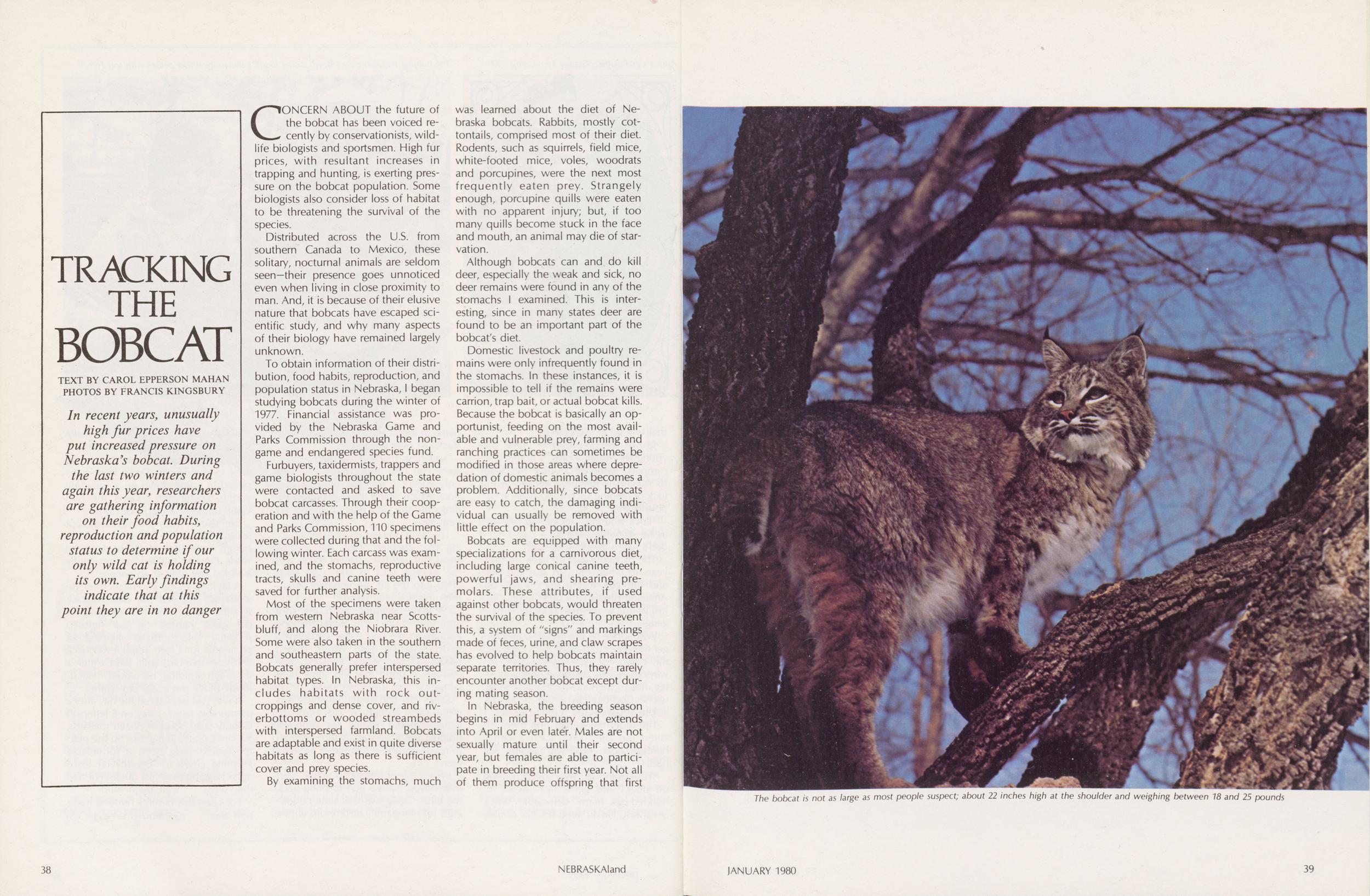
TRACKING THE BOBCAT
TEXT BY CAROL EPPERSON MAHAN PHOTOS BY FRANCIS KINGSBURY In recent years, unusually high fur prices have put increased pressure on Nebraska's bobcat. During the last two winters and again this year, researchers are gathering information on their food habits, reproduction and population status to determine if our only wild cat is holding its own. Early findings indicate that at this point they are in no dangerCONCERN ABOUT the future of the bobcat has been voiced recently by conservationists, wildlife biologists and sportsmen. High fur prices, with resultant increases in trapping and hunting, is exerting pressure on the bobcat population. Some biologists also consider loss of habitat to be threatening the survival of the species.
Distributed across the U.S. from southern Canada to Mexico, these solitary, nocturnal animals are seldom seen—their presence goes unnoticed even when living in close proximity to man. And, it is because of their elusive nature that bobcats have escaped scientific study, and why many aspects of their biology have remained largely unknown.
To obtain information of their distribution, food habits, reproduction, and population status in Nebraska, I began studying bobcats during the winter of 1977. Financial assistance was provided by the Nebraska Game and Parks Commission through the nongame and endangered species fund.
Furbuyers, taxidermists, trappers and game biologists throughout the state were contacted and asked to save bobcat carcasses. Through their cooperation and with the help of the Game and Parks Commission, 110 specimens were collected during that and the following winter. Each carcass was examined, and the stomachs, reproductive tracts, skulls and canine teeth were saved for further analysis.
Most of the specimens were taken from western Nebraska near Scottsbluff, and along the Niobrara River. Some were also taken in the southern and southeastern parts of the state. Bobcats generally prefer interspersed habitat types. In Nebraska, this includes habitats with rock outcroppings and dense cover, and riverbottoms or wooded streambeds with interspersed farmland. Bobcats are adaptable and exist in quite diverse habitats as long as there is sufficient cover and prey species.
By examining the stomachs, much was learned about the diet of Nebraska bobcats. Rabbits, mostly cottontails, comprised most of their diet. Rodents, such as squirrels, field mice, white-footed mice, voles, woodrats and porcupines, were the next most frequently eaten prey. Strangely enough, porcupine quills were eaten with no apparent injury; but, if too many quills become stuck in the face and mouth, an animal may die of starvation.
Although bobcats can and do kill deer, especially the weak and sick, no deer remains were found in any of the stomachs I examined. This is interesting, since in many states deer are found to be an important part of the bobcat's diet.
Domestic livestock and poultry remains were only infrequently found in the stomachs. In these instances, it is impossible to tell if the remains were carrion, trap bait, or actual bobcat kills. Because the bobcat is basically an opportunist, feeding on the most available and vulnerable prey, farming and ranching practices can sometimes be modified in those areas where depredation of domestic animals becomes a problem. Additionally, since bobcats are easy to catch, the damaging individual can usually be removed with little effect on the population.
Bobcats are equipped with many specializations for a carnivorous diet, including large conical canine teeth, powerful jaws, and shearing premolars. These attributes, if used against other bobcats, would threaten the survival of the species. To prevent this, a system of "signs" and markings made of feces, urine, and claw scrapes has evolved to help bobcats maintain separate territories. Thus, they rarely encounter another bobcat except during mating season.
In Nebraska, the breeding season begins in mid February and extends into April or even later. Males are not sexually mature until their second year, but females are able to participate in breeding their first year. Not all of them produce offspring that first spring, however. Young females usually have slightly smaller litters than older females, and give birth later in the year. These late litters may have decreased chance for survival due to the rigors of Nebraska's winters. Most kittens of older females are born in May and June, allowing plenty of time for them to learn how to hunt and become independent of their mother's care before the onset of winter. Therefore, older females are very important in maintaining a healthy population since they contribute most of the surviving offspring.
38 NEBRASKAland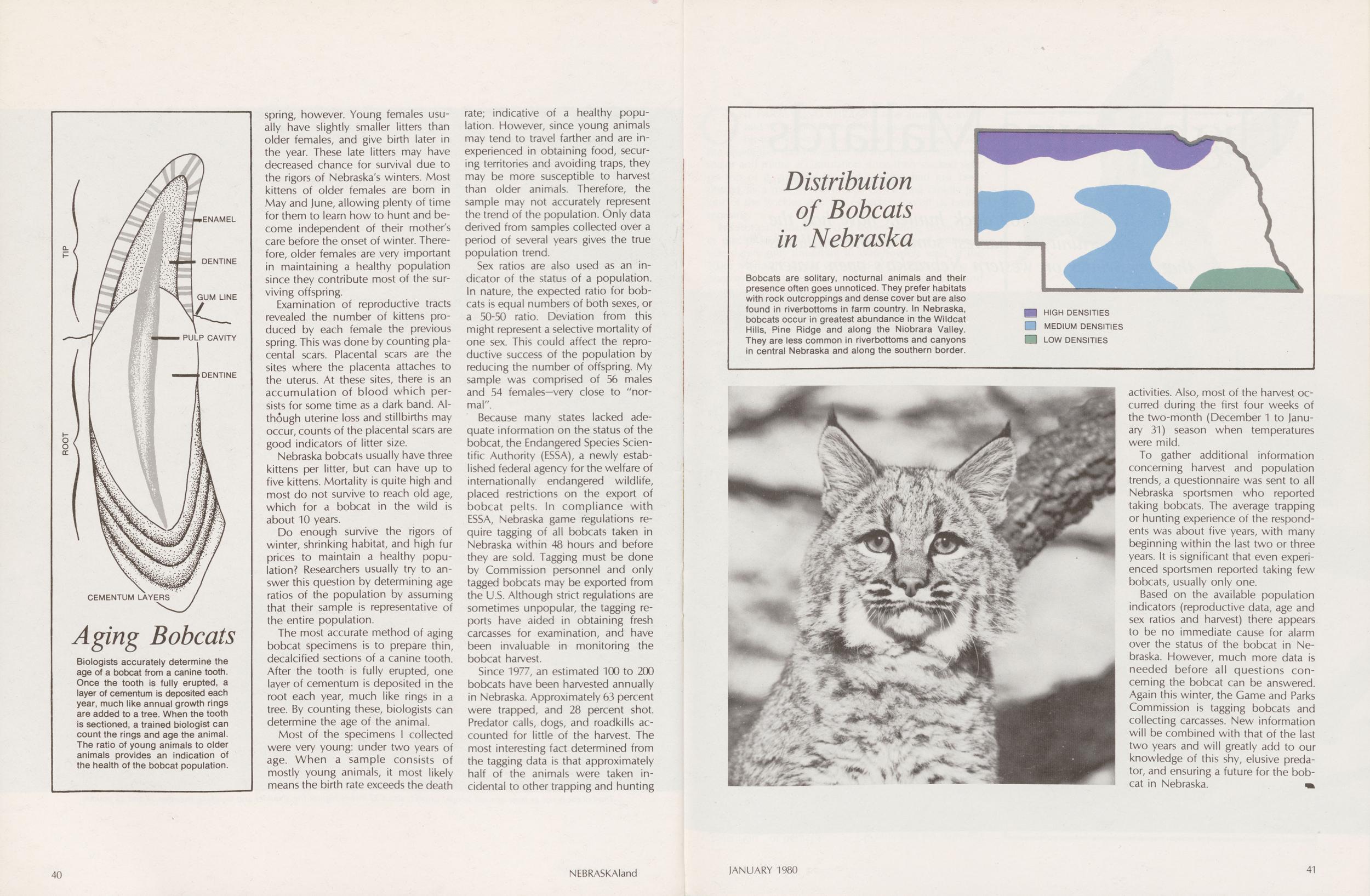
Examination of reproductive tracts revealed the number of kittens produced by each female the previous spring. This was done by counting placental scars. Placental scars are the sites where the placenta attaches to the uterus. At these sites, there is an accumulation of blood which persists for some time as a dark band. Although uterine loss and stillbirths may occur, counts of the placental scars are good indicators of litter size.
Nebraska bobcats usually have three kittens per litter, but can have up to five kittens. Mortality is quite high and most do not survive to reach old age, which for a bobcat in the wild is about 10 years.
Do enough survive the rigors of winter, shrinking habitat, and high fur prices to maintain a healthy population? Researchers usually try to answer this question by determining age ratios of the population by assuming that their sample is representative of the entire population.
The most accurate method of aging bobcat specimens is to prepare thin, decalcified sections of a canine tooth. After the tooth is fully erupted, one layer of cementum is deposited in the root each year, much like rings in a tree. By counting these, biologists can determine the age of the animal.
Most of the specimens I collected were very young: under two years of age. When a sample consists of mostly young animals, it most likely means the birth rate exceeds the death rate; indicative of a healthy population. However, since young animals may tend to travel farther and are inexperienced in obtaining food, securing territories and avoiding traps, they may be more susceptible to harvest than older animals. Therefore, the sample may not accurately represent the trend of the population. Only data derived from samples collected over a period of several years gives the true population trend.
Sex ratios are also used as an indicator of the status of a population. In nature, the expected ratio for bobcats is equal numbers of both sexes, or a 50-50 ratio. Deviation from this might represent a selective mortality of one sex. This could affect the reproductive success of the population by reducing the number of offspring. My sample was comprised of 56 males and 54 females—very close to "normal".
Because many states lacked adequate information on the status of the bobcat, the Endangered Species Scientific Authority (ESSA), a newly established federal agency for the welfare of internationally endangered wildlife, placed restrictions on the export of bobcat pelts. In compliance with ESSA, Nebraska game regulations require tagging of all bobcats taken in Nebraska within 48 hours and before they are sold. Tagging must be done by Commission personnel and only tagged bobcats may be exported from the U.S. Although strict regulations are sometimes unpopular, the tagging reports have aided in obtaining fresh carcasses for examination, and have been invaluable in monitoring the bobcat harvest.
Since 1977, an estimated 100 to 200 bobcats have been harvested annually in Nebraska. Approximately 63 percent were trapped, and 28 percent shot. Predator calls, dogs, and roadkills accounted for little of the harvest. The most interesting fact determined from the tagging data is that approximately half of the animals were taken incidental to other trapping and hunting 40 NEBRASKAland activities. Also, most of the harvest occurred during the first four weeks of the two-month (December 1 to January 31) season when temperatures were mild.
To gather additional information concerning harvest and population trends, a questionnaire was sent to all Nebraska sportsmen who reported taking bobcats. The average trapping or hunting experience of the respondents was about five years, with many beginning within the last two or three years. It is significant that even experienced sportsmen reported taking few bobcats, usually only one.
Based on the available population indicators (reproductive data, age and sex ratios and harvest) there appears to be no immediate cause for alarm over the status of the bobcat in Nebraska. However, much more data is needed before all questions concerning the bobcat can be answered. Again this winter, the Game and Parks Commission is tagging bobcats and collecting carcasses. New information will be combined with that of the last two years and will greatly add to our knowledge of this shy, elusive predator, and ensuring a future for the bobcat in Nebraska.
JANURAY 1980 41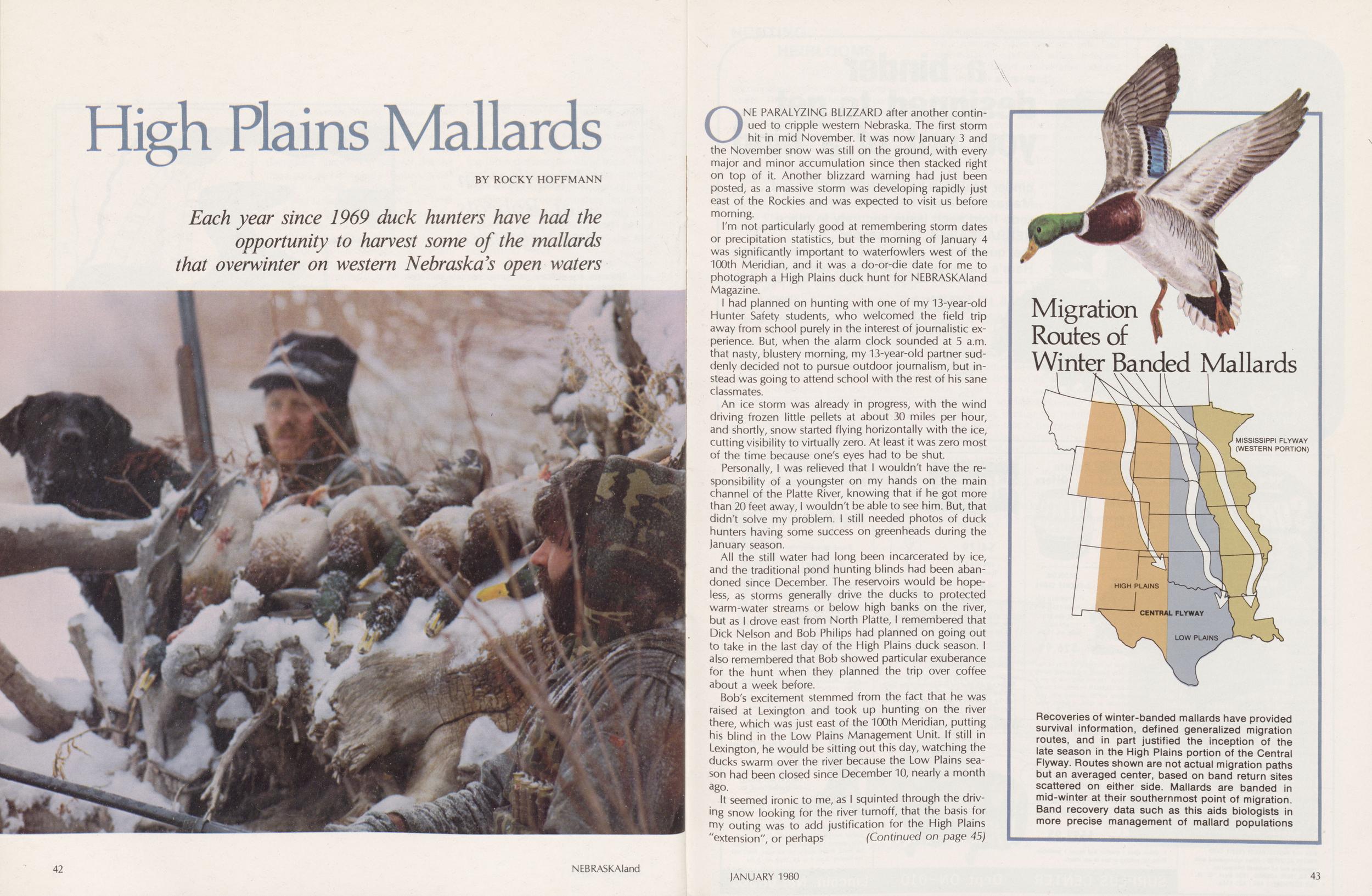
High Plains Mallards
Each year since 1969 duck hunters have had the opportunity to harvest some of the mallards that overwinter on western Nebraska's open waters
ONE PARALYZING BLIZZARD after another continued to cripple western Nebraska. The first storm hit in mid November, it was now January 3 and the November snow was still on the ground, with every major and minor accumulation since then stacked right on top of it. Another blizzard warning had just been posted, as a massive storm was developing rapidly just east of the Rockies and was expected to visit us before morning.
I'm not particularly good at remembering storm dates or precipitation statistics, but the morning of January 4 was significantly important to waterfowlers west of the 100th Meridian, and it was a do-or-die date for me to photograph a High Plains duck hunt for NEBRASKAland Magazine.
I had planned on hunting with one of my 13-year-old Hunter Safety students, who welcomed the field trip away from school purely in the interest of journalistic experience. But, when the alarm clock sounded at 5 a.m. that nasty, blustery morning, my 13-year-old partner suddenly decided not to pursue outdoor journalism, but instead was going to attend school with the rest of his sane classmates.
An ice storm was already in progress, with the wind driving frozen little pellets at about 30 miles per hour, and shortly, snow started flying horizontally with the ice, cutting visibility to virtually zero. At least it was zero most of the time because one's eyes had to be shut.
Personally, I was relieved that I wouldn't have the responsibility of a youngster on my hands on the main channel of the Platte River, knowing that if he got more than 20 feet away, I wouldn't be able to see him. But, that didn't solve my problem. I still needed photos of duck hunters having some success on greenheads during the January season.
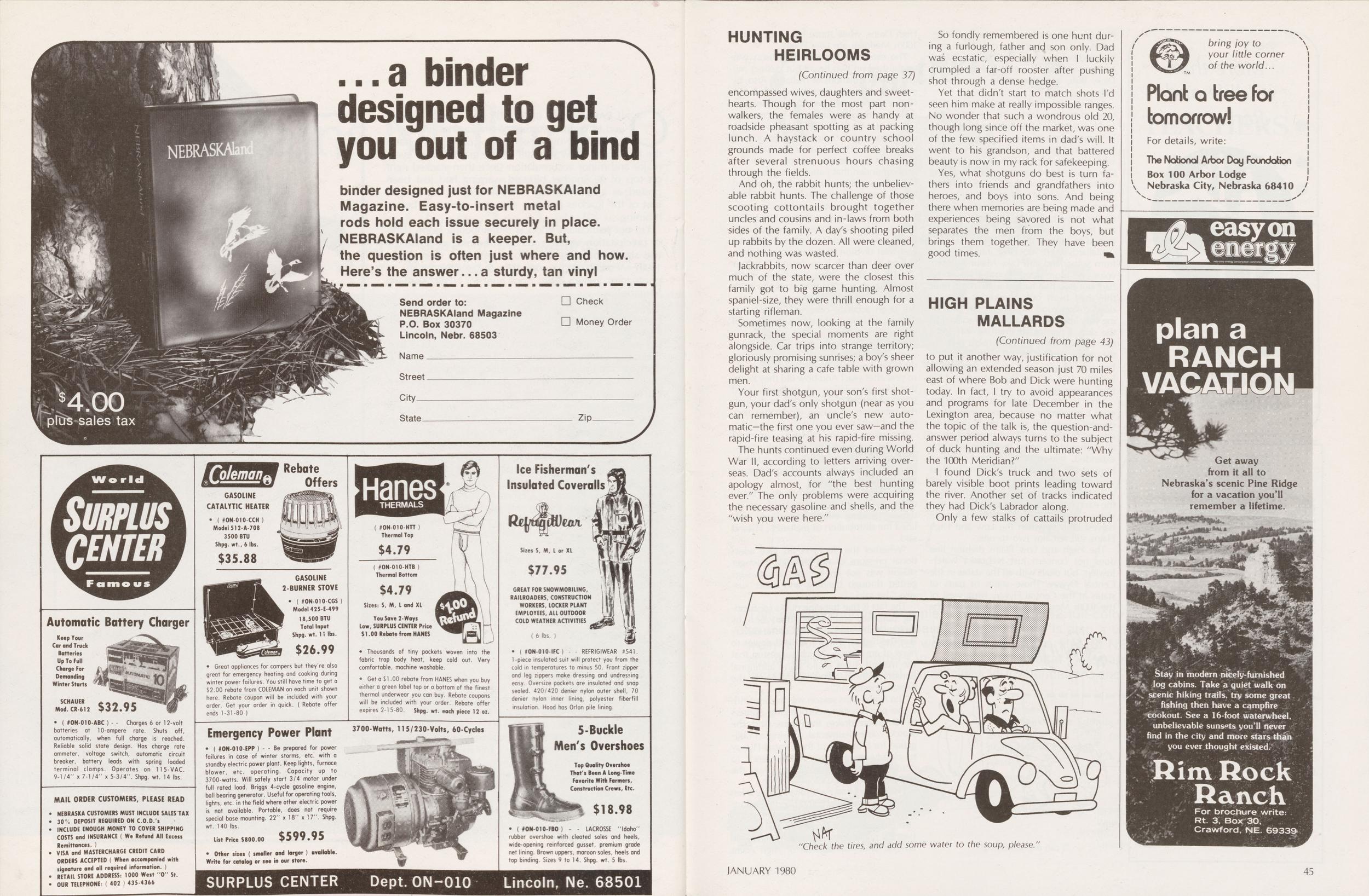
All the still water had long been incarcerated by ice, and the traditional pond hunting blinds had been abandoned since December. The reservoirs would be hopeless, as storms generally drive the ducks to protected warm-water streams or below high banks on the river, but as I drove east from North Platte, I remembered that Dick Nelson and Bob Philips had planned on going out to take in the last day of the High Plains duck season. I also remembered that Bob showed particular exuberance for the hunt when they planned the trip over coffee about a week before.
Bob's excitement stemmed from the fact that he was raised at Lexington and took up hunting on the river there, which was just east of the 100th Meridian, putting his blind in the Low Plains Management Unit. If still in Lexington, he would be sitting out this day, watching the ducks swarm over the river because the Low Plains season had been closed since December 10, nearly a month ago.
It seemed ironic to me, as I squinted through the driving snow looking for the river turnoff, that the basis for my outing was to add justification for the High Plains "extension", or perhaps (Continued on page 45)
HUNTING HEIRLOOMS
(Continued from page 37)encompassed wives, daughters and sweethearts. Though for the most part non-walkers, the females were as handy at roadside pheasant spotting as at packing lunch. A haystack or country school grounds made for perfect coffee breaks after several strenuous hours chasing through the fields.
And oh, the rabbit hunts; the unbelievable rabbit hunts. The challenge of those scooting cottontails brought together uncles and cousins and in-laws from both sides of the family. A day's shooting piled up rabbits by the dozen. All were cleaned, and nothing was wasted.
Jackrabbits, now scarcer than deer over much of the state, were the closest this family got to big game hunting. Almost spaniel-size, they were thrill enough for a starting rifleman.
Sometimes now, looking at the family gunrack, the special moments are right alongside. Car trips into strange territory; gloriously promising sunrises; a boy's sheer delight at sharing a cafe table with grown men.
Your first shotgun, your son's first shotgun, your dad's only shotgun (near as you can remember), an uncle's new automatic-the first one you ever saw-and the rapid-fire teasing at his rapid-fire missing.
The hunts continued even during World War II, according to letters arriving overseas. Dad's accounts always included an apology almost, for "the best hunting ever." The only problems were acquiring the necessary gasoline and shells, and the "wish you were here."
So fondly remembered is one hunt during a furlough, father and son only. Dad was ecstatic, especially when I luckily crumpled a far-off rooster after pushing shot through a dense hedge.
Yet that didn't start to match shots I'd seen him make at really impossible ranges. No wonder that such a wondrous old 20, though long since off the market, was one of the few specified items in dad's will. It went to his grandson, and that battered beauty is now in my rack for safekeeping.
Yes, what shotguns do best is turn fathers into friends and grandfathers into heroes, and boys into sons. And being there when memories are being made and experiences being savored is not what separates the men from the boys, but brings them together. They have been good times.
HIGH PLAINS MALLARDS
(Continued from page 43)to put it another way, justification for not allowing an extended season just 70 miles east of where Bob and Dick were hunting today. In fact, I try to avoid appearances and programs for late December in the Lexington area, because no matter what the topic of the talk is, the question-and-answer period always turns to the subject of duck hunting and the ultimate: "Why the 100th Meridian?"
I found Dick's truck and two sets of barely visible boot prints leading toward the river. Another set of tracks indicated they had Dick's Labrador along.
Only a few stalks of cattails protruded through a huge snowdrift outlining the remains of a once-huntable river blind, and huddled below a high bank under a fallen cottonwood just 30 yards up channel were Dick, Bob, and the nearly moose-sized dog.
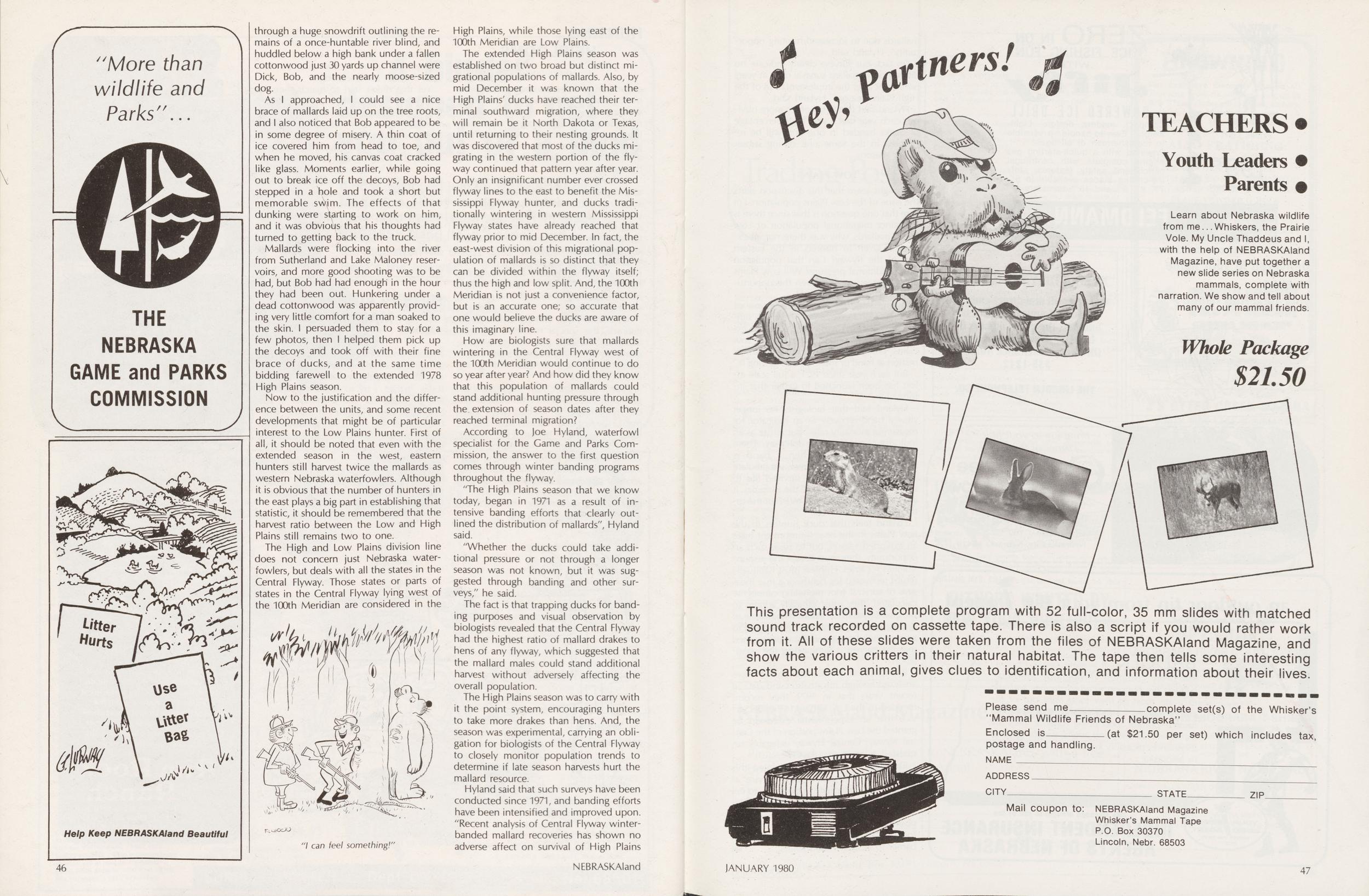 "More than wildlife and Parks''... NEBRASKA GAME and PARKS COMMISSION
As I approached, I could see a nice brace of mallards laid up on the tree roots, and I also noticed that Bob appeared to be in some degree of misery. A thin coat of ice covered him from head to toe, and when he moved, his canvas coat cracked like glass. Moments earlier, while going out to break ice off the decoys, Bob had stepped in a hole and took a short but memorable swim. The effects of that dunking were smarting to work on him, and it was obvious that his thoughts had turned to getting back to the truck.
Mallards were flocking into the river from Sutherland and Lake Maloney reservoirs, and more good shooting was to be had, but Bob had had enough in the hour they had been out. Hunkering under a dead cottonwood was apparently providing very little comfort for a man soaked to the skin. I persuaded them to stay for a few photos, then I helped them pick up the decoys and took off with their fine brace of ducks, and at the same time bidding farewell to the extended 1978 High Plains season.
Now to the justification and the difference between the units, and some recent developments that might be of particular interest to the Low Plains hunter. First of all, it should be noted that even with the extended season in the west, eastern hunters still harvest twice the mallards as western Nebraska waterfowlers. Although it is obvious that the number of hunters in the east plays a big part in establishing that statistic, it should be remembered that the harvest ratio between the Low and High Plains still remains two to one.
The High and Low Plains division line does not concern just Nebraska waterfowlers, but deals with all the states in the Central Flyway. Those states or parts of states in the Central Flyway lying west of the 100th Meridian are considered in the High Plains, while those lying east of the 100th Meridian are Low Plains.
The extended High Plains season was established on two broad but distinct migrational populations of mallards. Also, by mid December it was known that the High Plains' ducks have reached their terminal southward migration, where they will remain be it North Dakota or Texas, until returning to their nesting grounds. It was discovered that most of the ducks migrating in the western portion of the flyway continued that pattern year after year. Only an insignificant number ever crossed flyway lines to the east to benefit the Mississippi Flyway hunter, and ducks traditionally wintering in western Mississippi Flyway states have already reached that flyway prior to mid December. In fact, the east-west division of this migrational population of mallards is so distinct that they can be divided within the flyway itself; thus the high and low split. And, the 100th Meridian is not just a convenience factor, but is an accurate one; so accurate that one would believe the ducks are aware of this imaginary line.
How are biologists sure that mallards wintering in the Central Flyway west of the 100th Meridian would continue to do so year after year? And how did they know that this population of mallards could stand additional hunting pressure through the extension of season dates after they reached terminal migration?
According to Joe Hyland, waterfowl specialist for the Game and Parks Commission, the answer to the first question comes through winter banding programs throughout the flyway.
"The High Plains season that we know today, began in 1971 as a result of intensive banding efforts that clearly outlined the distribution of mallards", Hyland said.
"Whether the ducks could take additional pressure or not through a longer season was not known, but it was suggested through banding and other surveys," he said.
The fact is that trapping ducks for banding purposes and visual observation by biologists revealed that the Central Flyway had the highest ratio of mallard drakes to hens of any flyway, which suggested that the mallard males could stand additional harvest without adversely affecting the overall population.
The High Plains season was to carry with it the point system, encouraging hunters to take more drakes than hens. And, the season was experimental, carrying an obligation for biologists of the Central Flyway to closely monitor population trends to determine if late season harvests hurt the mallard resource.
Hyland said that such surveys have been conducted since 1971, and banding efforts have been intensified and improved upon. "Recent analysis of Central Flyway winter-banded mallard recoveries has shown no adverse affect on survival of High Plains mallards due to increased hunting opportunity", Hyland said.
46 NEBRASKAlandTEACHERS
Youth Leaders
Parents
Learn about Nebraska wildlife from me... Whiskers, the Prairie Vole. My Uncle Thaddeus and I, with the help of NEBRASKAland Magazine, have put together a new slide series on Nebraska mammals, complete with narration. We show and tell about many of our mammal friends.
Whole Package
$21.50
This presentation is a complete program with 52 full-color, 35 mm slides with matched sound track recorded on cassette tape. There is also a script if you would rather work from it. All of these slides were taken from the files of NEBRASKAland Magazine, and show the various critters in their natural habitat. The tape then tells some interesting facts about each animal, gives clues to identification, and information about their lives. Please send me_________complete set(s) of the Whisker's "Mammal Wildlife Friends of Nebraska" Enclosed ______ is (at $21.50 per set) which includes tax, postage and handling. NAME ADDRESS CITY STATE ZIP
Mail coupon to:
NEBRASKAland Magazine
Whisker's Mammal Tape
P.O. Box 30370
Lincoln, Nebr. 68503
"In fact, our surveys clearly indicate no difference in mallard survival rates in years prior to or after the implementation of the High Plains season", Hyland said.
Hyland said that it becomes more obvious each year that a very high percentage of ducks banded in one unit will be recovered in the same unit during subsequent seasons.
LOW PLAINSIt might seem that this discussion skirts the issue of the Low Plains population. I'm sure that one question is that since there is a distinct migrational population of Low Plains mallards, why was there not an extension given to hunters in the eastern part of the flyway? Can that population stand additional pressure? Will Low Plains duck hunters ever be given the opportunity for late winter harvest?
Hyland said that in 1971, at the time of the High Plains extension, "There was simply no means in existence to justify ex- tended harvest opportunities in the Low Plains. We simply did not have the information at hand or the means of getting it."
But each year since 1971, a full-scale effort has been launched to gather that information.
Hyland said that biologists no longer view a band recovery as an indicator for measuring mortality rates, but rather as an indicator of survival. "We don't say, There goes another duck' when a band is brought in these days. Rather, we tabulate another mallard that has survived life to that point, and knowing all the formulas, it allows us to calculate how much of the total population survived."
Hyland feels that duck hunters in the Low Plains in the near future might have an extended season, but to have such an opportunity, they must accept the responsibilities it carries. Hunters must habitually return recovered leg bands, or a true measure of survival (not mortality) cannot be calculated; they must ethically adhere to the point system to insure the harvest of drakes; and they must also be prepared to give up their late season if it is determined that the harvest is diminishing the population.
Biologists of the Central Llyway have analyzed enough information and data in recent years that in 1979, they recommended to the U.S. Lish and Wildlife Service that an experimental extension be granted the Low Plains portion of the Central Llyway. Central Llyway delegates requested 16 additional days.
The recommendation was denied this year by the Lish and Wildlife Service as there was not adequate opportunity to examine and substantiate findings, but Hyland feels that if data continues to reveal positive conclusions, it won't be long before the 100th Meridian will no longer be a barrier to eastern waterfowlers.
48 NEBRASKAlandTrading Post
DOGSBRITTANY SPANIEL pups-training well started, 6 months old. Marion North, Rt. 1, York, NE 68467. (402) 362-2663.
GERMAN SHORTHAIR pups, 4 months; Black Labs, 7 months; Yellow Labs, 2 months. Also Irish Setters, all A.K.C. Registered. $40 each. Roland Everett, Atkinson, NE 68713.
MISCELLANEOUSWAX WORMS: 5(X>-$8; 1000-$14, postpaid. Add 3% sales tax. No C.O.D. Harold Malicky, Burwell, NE 68823.
GUNS-Browning, Winchester, Remington, others, Hipewers, shotguns, new, used, antiques. Want Pre-1%4 Winchesters. Buy-Sell-Trade. Ph. (402) 729-6112. Bedlan's Sporting Goods, Fairbury, NE 68352.
DUCK HUNTERS: learn how to make quality, solid plastic, waterfowl decoys. We're originators of famous system. Send, $1 for colorful catalog. Decoys Unlimited, Clinton, Iowa 52732
HAND-REARED WILD DUCKS: Wood ducks, Mandarins and European Wigeons. Mrs. R. W. Hansen, 3315 Ave L, Kearney, Nebr. 68847
ATTENTION-HUNTERS and fishermen, 1-bedroom home for sale in Lewellen, Nebr. Ideal for summer home, for couple or small family close to good fishing and hunting. Contact Betty Feusner-(308) 284-3452.
LAPIDARIES: GENUINE Nebraska Blue Agate. This extremely rare and difficult-to-locate material is our official state gem stone. Priced at a fraction of the cost of collecting. Return privileges with 1 cut per piece allowed; $7.95 per pound, limit 5 pounds. Postage and tax paid. World Wide Investment Gems, 3250 So. 12th, #C-17, Lincoln, NE 68502 (402) 423-5112.
FRITZ GUNSMITHING & Supply Co-Heckler & Koch Dealer. Handfinishing—Hot Blue—Parkerization—Custom Rifles—Antique Restoration. 407 South Harris, Wilber, NE. (402) 821-2260.
TAXIDERMYBIG BEAR TAXIDERMY, Rt. 2, Mitchell, Nebraska 69357. We specialize in all big game from Alaska to Nebraska, also birds and fish. Hair on and hair off tanning, 416 miles west of Scottsbluff on Highway 26. Phone (308) 635-3013.
KARL SCHWARZ Master Taxidermists. Mounting of game heads —birds —fish —animals—fur rugs— robes — tanning buckskin. Since 1910. 424 South 13th Street, Dept. A, Omaha, Nebraska 68102.
FREEZE-DRY TAXIDERMY Wally Allison's State Record Taxidermy, 2709 Birchwood, North Platte, NE 69101 Phone: (308) 534-2324. Specializing in Fish and Small Game. Snake and Lizard and Novelties. (Nothing too small) Newest of all taxidermy methods employed.
CREATIVE TAXIDERMY-AII types work since 1935 now includes Freeze-Dry processing of approved small specimens. Naturecraft Studio, 925 Fourth Corso, Nebraska City, Nebraska 68410. Phone: (402) 873-5491. Joe Voges-Owner.
"AWARD-WINNING Taxidermist. Trust your trophies to a proven winner. Our complete taxidermy service also books hunts anywhere in the world. Dinges Taxidermy, 2760 South 12th, Omaha, NE 68108 Phone: (402) 342-3718
NABITY'S TAXIDERMY. 28 years' experience. All taxidermy services available. Specializing in natural-grass backgrounds. 5021 Washington, Lincoln, NE 68506. (402) 489-6351.
JOHNSON TAXIDERMY-servicing southwest Nebraska, specializing in big-game mounts, life sized mounts, rug work, fish, birds, tanning hair-on or leather. Brochure and price list on request. Johnson Taxidermy, Rt. 1, Box 78, Lamar, NE.69035. Telephone (308) 882-5555.
WHITETAIL TAXIDERMY-Columbus, Nebr., 2983 Air Vista Drive 68601. Beautiful mounts from experienced taxidermists are your best choice. Reasonable, personal and fast. Phone 402-564-6885.
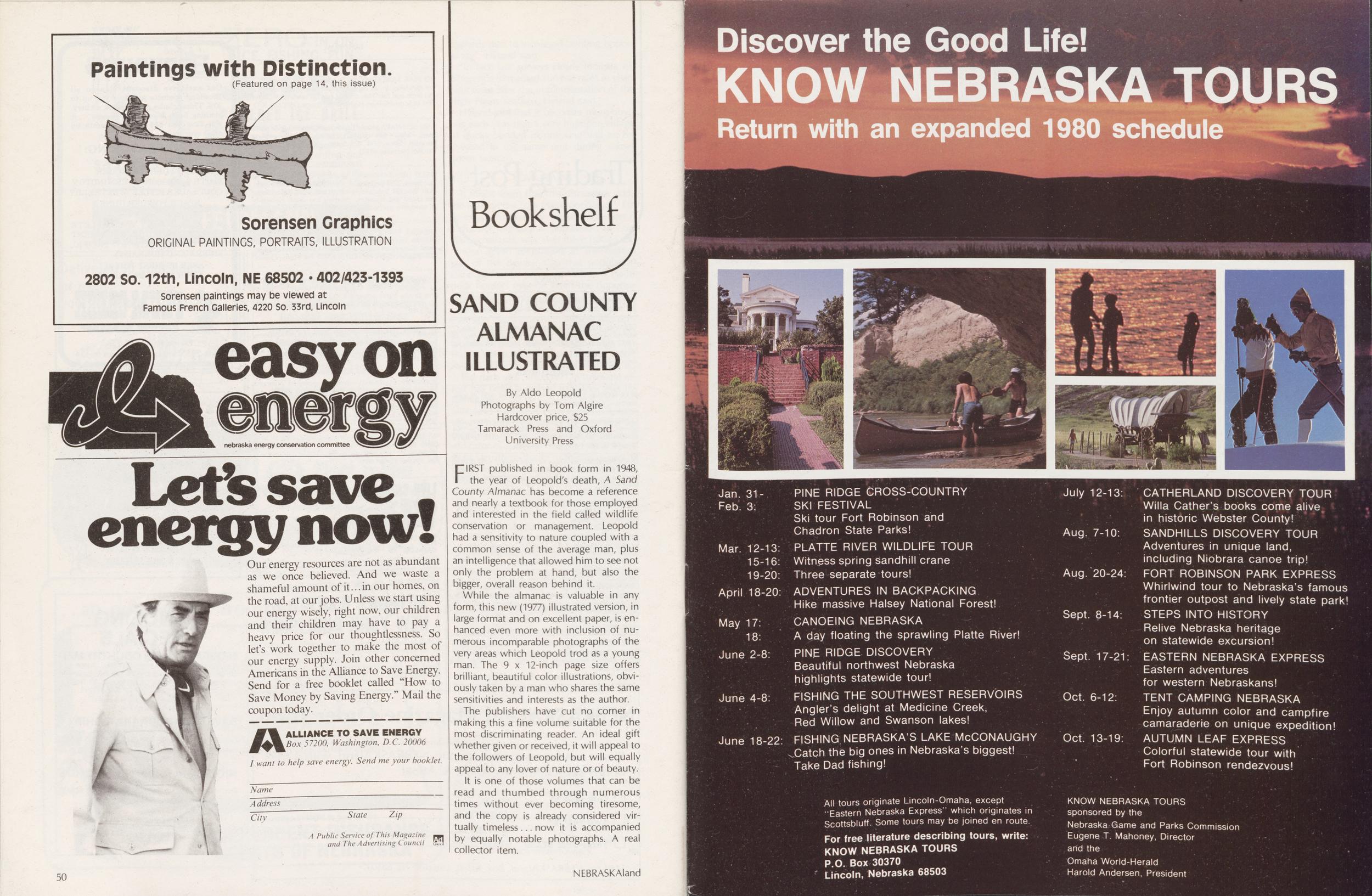
Bookshelf
SAND COUNTY ALMANAC ILLUSTRATED By Aldo Leopold Photographs by Tom Algire Hardcover price, $25 Tamarack Press and Oxford University PressFIRST published in book form in 1948, the year of Leopold's death, A Sand County Almanac has become a reference and nearly a textbook for those employed and interested in the field called wildlife conservation or management. Leopold had a sensitivity to nature coupled with a common sense of the average man, plus an intelligence that allowed him to see not only the problem at hand, but also the bigger, overall reason behind it.
While the almanac is valuable in any form, this new (1977) illustrated version, in large format and on excellent paper, is enhanced even more with inclusion of numerous incomparable photographs of the very areas which Leopold trod as a young man. The 9 x 12-inch page size offers brilliant, beautiful color illustrations, obviously taken by a man who shares the same sensitivities and interests as the author.
The publishers have cut no corner in making this a fine volume suitable for the most discriminating reader. An ideal gift whether given or received, it will appeal to the followers of Leopold, but will equally appeal to any lover of nature or of beauty.
It is one of those volumes that can be read and thumbed through numerous times without ever becoming tiresome, and the copy is already considered virtually timeless... now it is accompanied by equally notable photographs. A real collector item.
50 NEBRASKAlandDiscover the Good Life! KNOW NEBRASKA TOURS
Return with an expanded 1980 schedule
A SHOW TO KNOW OUTDOOR NEBRASKA
A WEEKLY PRESENTATION OF THE NEBRASKA GAME AND PARKS COMMISSION COVERING NEBRASKA WILDUFE, SCENIC PLACES AND OUTDOOR RECREATION PLUS MUCH MUCH MOREPosition: 86 (70 views)