Volume 57, Issue 12, 1979
NEBRASKAland
December 1979 60 Cents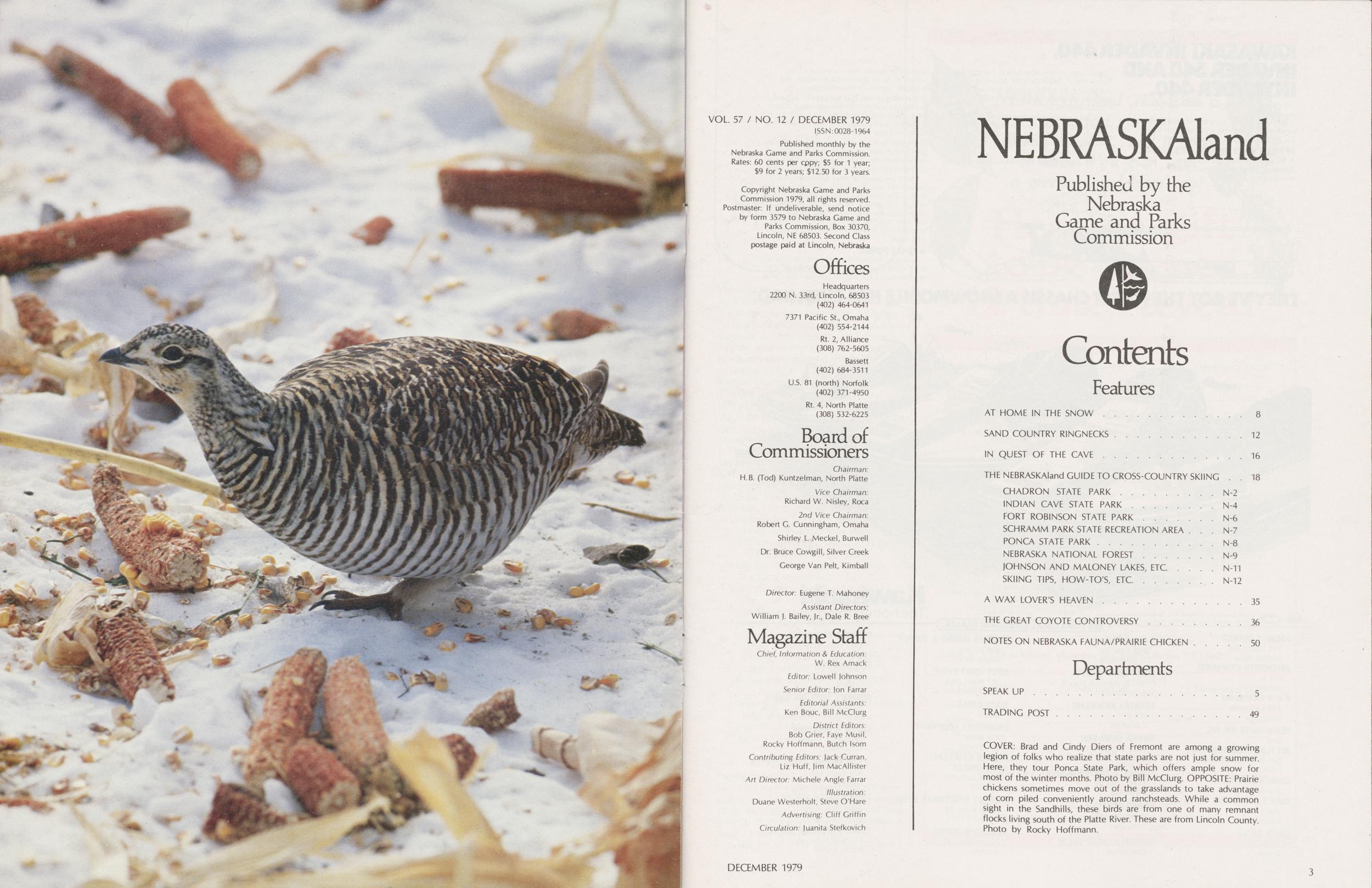
NEBRASKAland
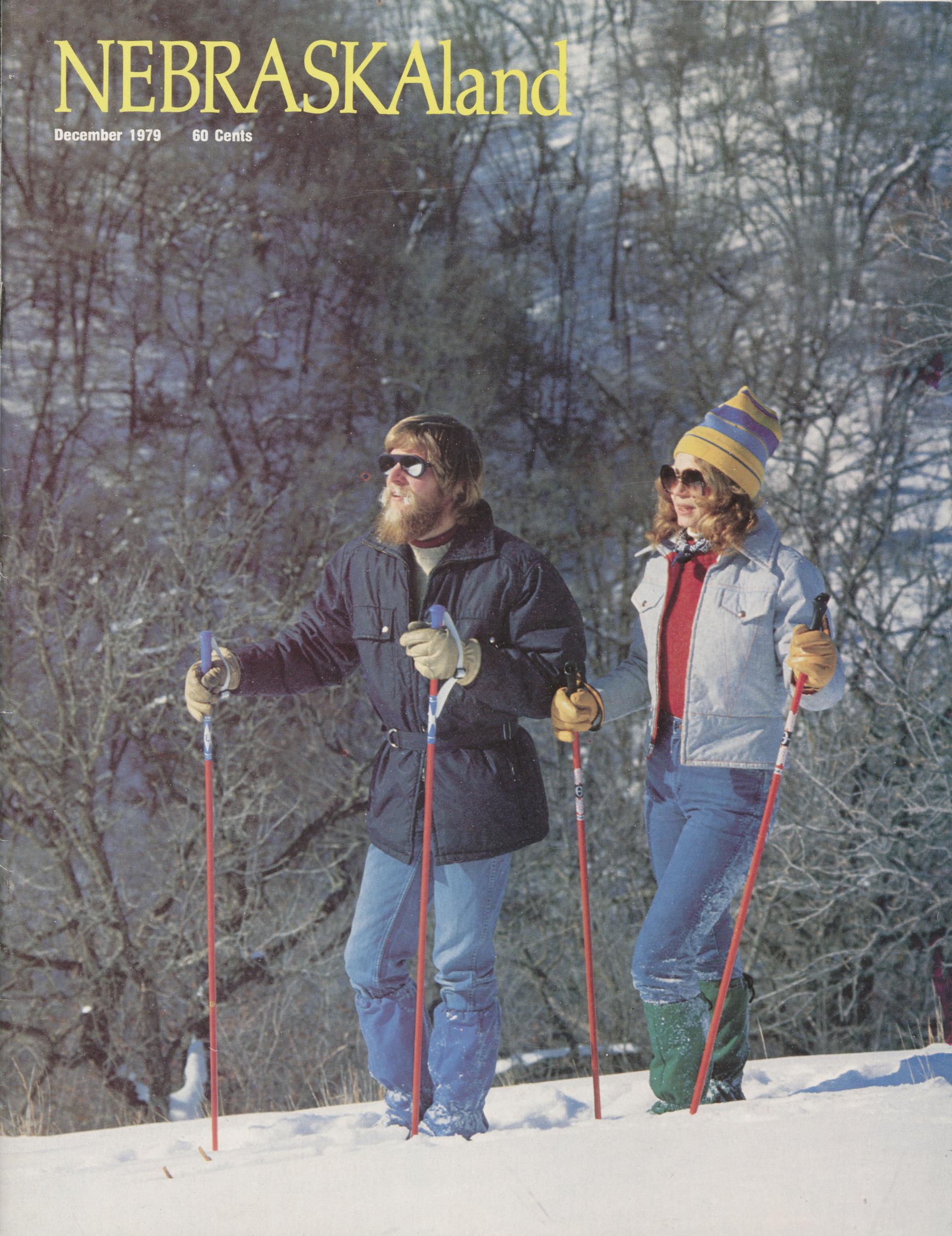
VOL 57 / NO. 12 / DECEMBER 1979 ISSN :0028-1964 Published monthly by the Nebraska Game and Parks Commission. Rates: 60 cents per cppy; $5 for 1 year; $9 for 2 years; $12.50 for 3 years. Copyright Nebraska Game and Parks Commission 1979, all rights reserved. Postmaster: If undeliverable, send notice by form 3579 to Nebraska Game and Parks Commission, Box 30370, Lincoln, NE 68503. Second Class postage paid at Lincoln, Nebraska Offices Headquarters 2200 N. 33rd, Lincoln, 68503 (402) 464-0641 7371 Pacific St., Omaha (402) 554-2144 Rt. 2, Alliance (308) 762-5605 Bassett (402) 684-3511 U.S. 81 (north) Norfolk (402) 371-4950 Rt. 4, North Platte (308) 532-6225 Board of Commissioners Chairman: H.B. (Tod) Kuntzelman, North Platte Vice Chairman: Richard VV. Nisley, Roca 2nd Vice Chairman: Robert G. Cunningham, Omaha Shirley L. Meckel, Burwell Dr. Bruce Cowgill, Silver Creek George Van Pelt, Kimball Director: Eugene T. Mahoney Assistant Directors: William J. Bailey, Jr., Dale R. Bree Magazine Staff Chief, Information & Education: W. Rex Amack Editor: Lowell lohnson Senior Editor: Jon Farrar Editorial Assistants: Ken Bouc, Bill McClurg District Editors: Bob Grier, Faye Musil, Rocky Hoffmann, Butch Isom Contributing Editors: Jack Curran. Liz Huff, Jim MacAllister Art Director: Michele Angle Farrar Illustration: Duane Westerholt, Steve O'Hare Advertising: Cliff Griffin Circulation: Juanita Stefkovich Published by the Nebraska Game and Parks Commission Contents Features AT HOME IN THE SNOW SAND COUNTRY RINGNECKS IN QUEST OF THE CAVE THE NEBRASKAland GUIDE TO CROSS-COUNTRY SKIING CHADRON STATE PARK INDIAN CAVE STATE PARK FORT ROBINSON STATE PARK SCHRAMM PARK STATE RECREATION AREA PONCA STATE PARK NEBRASKA NATIONAL FOREST JOHNSON AND MALONEY LAKES, ETC SKIING TIPS, HOW-TO'S, ETC A WAX LOVER'S HEAVEN THE GREAT COYOTE CONTROVERSY NOTES ON NEBRASKA FAUNA/PRAIRIE CHICKEN 8 12 16 18 N-2 N-4 N-6 N-7 N-8 N-9 N-11 N-12 35 36 50 Departments SPEAK UP TRADING POST 5 49 COVER: Brad and Cindy Diers of Fremont are among a growing legion of folks who realize that state parks are not just for summer. Here, they tour Ponca State Park, which offers ample snow for most of the winter months. Photo by Bill McClurg. OPPOSITE: Prairie chickens sometimes move out of the grasslands to take advantage of corn piled conveniently around ranchsteads. While a common sight in the Sandhills, these birds are from one of many remnant flocks living south of the Platte River. These are from Lincoln County. Photo by Rocky Hoffmann. DECEMBER 1979 3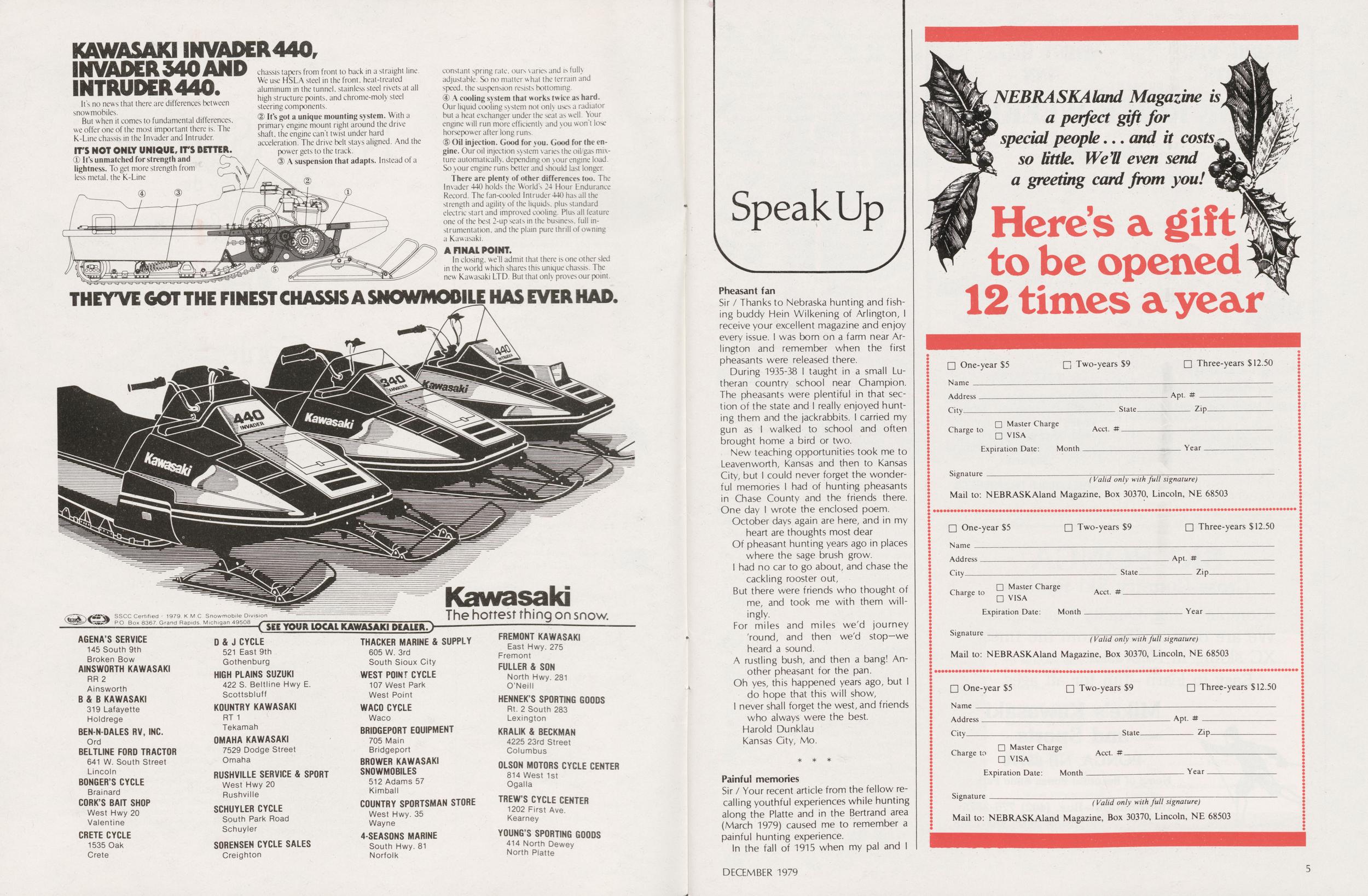
Speak Up
KAWASAKI INVADER 440, INVADER 540 AND INTRUDER 440.It's no news that there are differences between snowmobiles.
But when it comes to fundamental differences, we offer one of the most important there is. The K-Line chassis in the Invader and Intruder.
NOT ONLY UNIQUE, IT'S BETTER.
1 It's unmatched for strength and lightness. To get more strength from less metal, the K-Line chassis tapers from front to back in a straight line. We use HSLA steel in the front, heat-treated aluminum in the tunnel, stainless steel rivets at all high structure points, and chrome-molv steel steering components.
2 It's got a unique mounting system. With a primary engine mount right around the drive shaft, the engine can't twist under hard acceleration. The drive belt stavs aligned. And the power gets to the track.
3 A suspension that adapts. Instead of a constant spring rate, ours varies and is fully adjustable. So no matter what the terrain and speed, the suspension resists bottoming.
4 A cooling system that works twice as hard. Our liquid cooling system not onlv uses a radiator but a heat exchanger under the seat as well. Your engine will run more efficiently and you won't lose horsepower after long runs.
5 Oil injection. Good for you. Good for the engine. Our oil injection system varies the oil gas mixture automaticallv. depending on vour engine load. So vour engine runs better and should last longer.
There are plenty of other differences too. The Invader 440 holds the World's 24 Hour Endurance Record. The fan-cooled Intruder 440 has all the strength and agility of the liquids, plus standard electric start and improved cooling. Plus all feature one of the best 2-up seats in the business, full instrumentation, and the plain pure thrill of owning a Kawasaki.
A FINAL POINT.
In closing, we'll admit that there is one other sled in the world which shares this unique chassis. The new Kawasaki LTD. But that onlv proves our point.
THEY'VE GOT THE FINEST CHASSIS A SNOWMOBILE HAS EVER HAD.
SSCC Certified 1979. K M C PO Box 8367. Grand Rapids. Snowmobile Division Michigan 49508 AGENA'S SERVICE 145 South 9th Broken Bow AINSWORTH KAWASAKI RR 2 Ainsworth B & B KAWASAKI 319 Lafayette Holdrege BEN-N DALES RV, INC. Ord BELTLINE FORD TRACTOR 641 W. South Street Lincoln BONGER'S CYCLE Brainard CORK'S BAIT SHOP West Hwy 20 Valentine CRETE CYCLE 1535 Oak Crete SEE YOUR LOCAL KAWASAKI DEALER. Kawasaki The hottest thing on snow. d & J CYCLE 521 East 9th Gothenburg HIGH PLAINS SUZUKI 422 S. Beltline Hwy E. Scottsbluff KOUNTRY KAWASAKI RT 1 Tekamah OMAHA KAWASAKI 7529 Dodge Street Omaha RUSHVILLE SERVICE & SPORT West Hwy 20 Rushville SCHUYLER CYCLE South Park Road Schuyler SORENSEN CYCLE SALES Creighton THACKER MARINE & SUPPLY 605 W. 3rd South Sioux City WEST POINT CYCLE 107 West Park West Point WACO CYCLE Waco BRIDGEPORT EQUIPMENT 705 Main Bridgeport BROWER KAWASAKI SNOWMOBILES 512 Adams 57 Kimball COUNTRY SPORTSMAN STORE West Hwy. 35 Wayne 4-SEASONS MARINE South Hwy. 81 Norfolk FREMONT KAWASAKI East Hwy. 275 Fremont FULLER & SON North Hwy. 281 O'Neill HENNEK'S SPORTING GOODS Rt. 2 South 283 Lexington KRALIK & BECKMAN 4225 23rd Street Columbus OLSON MOTORS CYCLE CENTER 814 West 1st Ogalla TREW'S CYCLE CENTER 1202 First Ave. Kearney YOUNG'S SPORTING GOODS 414 North Dewey North Piatte Pheasant fan
Sir / Thanks to Nebraska hunting and fishing buddy Hein Wilkening of Arlington, I receive your excellent magazine and enjoy every issue. I was born on a farm near Arlington and remember when the first pheasants were released there.
During 1935-38 I taught in a small Lutheran country school near Champion. The pheasants were plentiful in that section of the state and I really enjoyed hunting them and the jackrabbits. I carried my gun as I walked to school and often brought home a bird or two.
New teaching opportunities took me to Leavenworth, Kansas and then to Kansas City, but I could never forget the wonderful memories I had of hunting pheasants in Chase County and the friends there. One day I wrote the enclosed poem.
October days again are here, and in my heart are thoughts most dearOf pheasant hunting years ago in places where the sage brush grow.
I had no car to go about, and chase the cackling rooster out,
But there were friends who thought of me, and took me with them willingly.
For miles and miles we'd journey 'round, and then we'd stop—we heard a sound.
A rustling bush, and then a bang! Another pheasant for the pan.
Oh yes, this happened years ago, but I do hope that this will show,
I never shall forget the west, and friends who always were the best. Harold Dunklau Kansas City, Mo. Painful memories
Sir / Your recent article from the fellow recalling youthful experiences while hunting along the Platte and in the Bertrand area (March 1979) caused me to remember a painful hunting experience.
NEBRASKAland Magazine is a perfect gift for special people... and it costs, so little. We'll even send a greeting card from you! Here's a gift to be opened 12 times a year One-year $5 Two-years $9 Three-years $12.50 Name Address City Apt. # State. Zip. Charge to Master Charge VISA Expiration Date: Month Acct. # Year Signature (Valid only with full signature) Mail to: NEBRASKAland Magazine, Box 30370, Lincoln, NE 68503 One-year $5 Name Two-years $9 Three-years $12.50 Address City Apt. # State. Zip. Charge to Master Charge VISA Expiration Date: Month Acct. #. Year Signature (Valid onlv with full signature) Mail to: NEBRASKAland Magazine, Box 30370, Lincoln, NE 68503 One-year $5 Name Two-years $9 Three-years $12.50 Address City Apt. # State. Zip. Charge Master Charge VISA Expiration Date: Month Acct. #. Year Signature (Valid only with full signature) Mail to: NEBRASKAland Magazine, Box 30370, Lincoln, NE 68503 DECEMBER 1979 3 PRAIRIE PINE
SPORTS
and
PRESENT
WEST HILLS
INN
A PINE RIDGE WEEKEND
in Chadron, Nebraska, X-Country Skis, boots, poles, room, Sauna, whirlpool and
Heated Covered pool for Combined Rate of $21 Single Person (1-bed). For further
information, reservations and family or group rates:
Call: (308) 432-3305 - West Hills
(308) 432-2720 - Prairie Pine
717 East 6th
Chadron, NE 69337
Reservations are required. Offer good Nov. 22-Feb. 29
Harlan County Dam
Vacation Apartments - fully furnished
Week or Month of pleasant living
One Mile to Harlan Dam
Security Deposit Required
Sorry —No Pets
Dean and Esther Stone
Box 145 Ph. (308) 799-3422
Republican City, NE 68971
TALK SMART.
Dial direct and pay only for the
time you need to use. All direct
dialed calls without operator
assistance are billed by the
minute instead of in 3-minute
segments.
THE LINCOLN TELEPHONE CO.
SKI PONCA
Cross-Country Ski Rentals
Complete line, Quality Equipment.
We are only 2 miles from the finest
XC skiing in Nebraska.
Easy to learn—fun for all ages.
Mike's Kawasaki
and Sports
PONCA, NB 68770
Home of Beautiful Ponca State Park
For Information-Bus. (402) 775-2875
Home (402) 755-2388
PRAIRIE PINE
SPORTS
and
PRESENT
WEST HILLS
INN
A PINE RIDGE WEEKEND
in Chadron, Nebraska, X-Country Skis, boots, poles, room, Sauna, whirlpool and
Heated Covered pool for Combined Rate of $21 Single Person (1-bed). For further
information, reservations and family or group rates:
Call: (308) 432-3305 - West Hills
(308) 432-2720 - Prairie Pine
717 East 6th
Chadron, NE 69337
Reservations are required. Offer good Nov. 22-Feb. 29
Harlan County Dam
Vacation Apartments - fully furnished
Week or Month of pleasant living
One Mile to Harlan Dam
Security Deposit Required
Sorry —No Pets
Dean and Esther Stone
Box 145 Ph. (308) 799-3422
Republican City, NE 68971
TALK SMART.
Dial direct and pay only for the
time you need to use. All direct
dialed calls without operator
assistance are billed by the
minute instead of in 3-minute
segments.
THE LINCOLN TELEPHONE CO.
SKI PONCA
Cross-Country Ski Rentals
Complete line, Quality Equipment.
We are only 2 miles from the finest
XC skiing in Nebraska.
Easy to learn—fun for all ages.
Mike's Kawasaki
and Sports
PONCA, NB 68770
Home of Beautiful Ponca State Park
For Information-Bus. (402) 775-2875
Home (402) 755-2388In the fall of 1915 when my pal and I were squirrel hunting in the timber three miles west of Swanton, it was a perfect October afternoon with not a breeze stirring. When we came out of the timber onto a meadow, we stretched out to rest a bit. As I laid there gazing up, I raised the question that if one shot straight up, could we hear the shot fall back to earth around us. My pal said to give it a try, so flat on my back I fitted the stock of my 28-gauge securely against my shoulder, aimed straight up and pulled the trigger. We didn't hear any shot fall around us, because for the next five minutes the only sounds were my hollering, groaning and moaning. Twenty-four hours later I had the most tender, bruised shoulder anyone could imagine. The following year in a physics class I had no problem agreeing with the statement that for every action there is an opposite and equal reaction.
C. E. "Bud" Clark Omaha, Nebr. The good old daysSir / I enjoyed the article "Growing up a Hunting" in the March NEBRASKAIand because it certainly paralleled my early-day hunting experiences. However, my greatest enjoyment was reading your reply to Daniel Metzger's letter in the August issue. You really hit the nail on the head!
Certainly we don't hunt these days in the same way we did 40 years ago, and we don't want to do so. There is no need to. In the 1930's, I sneaked up on ducks to potshoot them with a single shot 12-gauge because I had only one shell, no other meat, and no money. At times, I shot quail on the ground with a .22 rifle for the same reason.
To meet changing economic conditions and the increase in population, many changes have come about in hunting practices and laws in the last 40 years, and all for the better.
I look forward to each issue of NEBRASKAland as I look to any visit of a friend.
Art Cognard Omaha, Nebr. Traveling onSir / I just finished reading the April issue of your magazine. The feature story on our state parks was excellent, with the many colorful photos and information about each one. With this great issue, more and more people are going to plan to visit as many of these parks as possible during their vacations.
Roger Splattstoesser Grand Island, Nebr. People certainly should be more familiar with their own state parks, and the main reason we run such features is to show them what is available out there. Thank you for your observations, and I hope you are right. (Editor) 6 NEBRASKAland to friends and relatives both near 12 exciting, full-color pictures, suitable for framing space aplenty for personal notes and appointments sunrise-sunset schedules moon phases state parks information delectible wildlife recipes TO: NEBRASKAland Date. P.O. Box 3022, Omaha, Nebraska 68103 Gentlemen: PLEASE PRINT CLEARLY Please mail, postpaid, (quantity) Calendars at $2.50 each (plus tax, if any). Total enclosed $ NAME Nebraska residents include sales tax. My check is enclosed Money order enclosed ADDRESS CITY. STATE. Calendars are mailed at no extra charge at 3rd class bulk rate.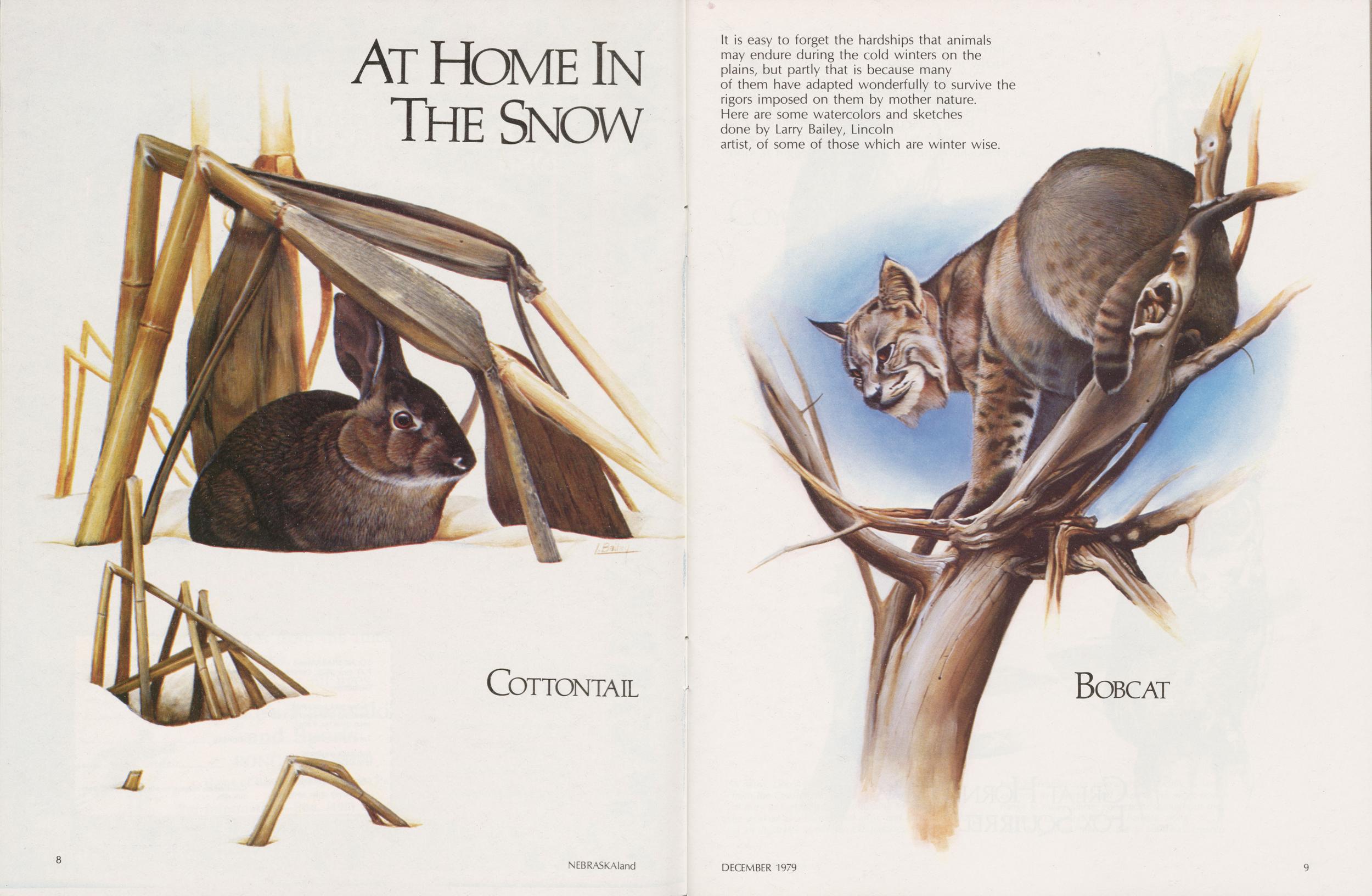
At Home In The Snow
It is easy to forget the hardships that animals may endure during the cold winters on the plains, but partly that is because many of them have adapted wonderfully to survive the rigors imposed on them by mother nature. Here are some watercolors and sketches done by Larry Bailey, Lincoln artist, of some of those which are winter wise.
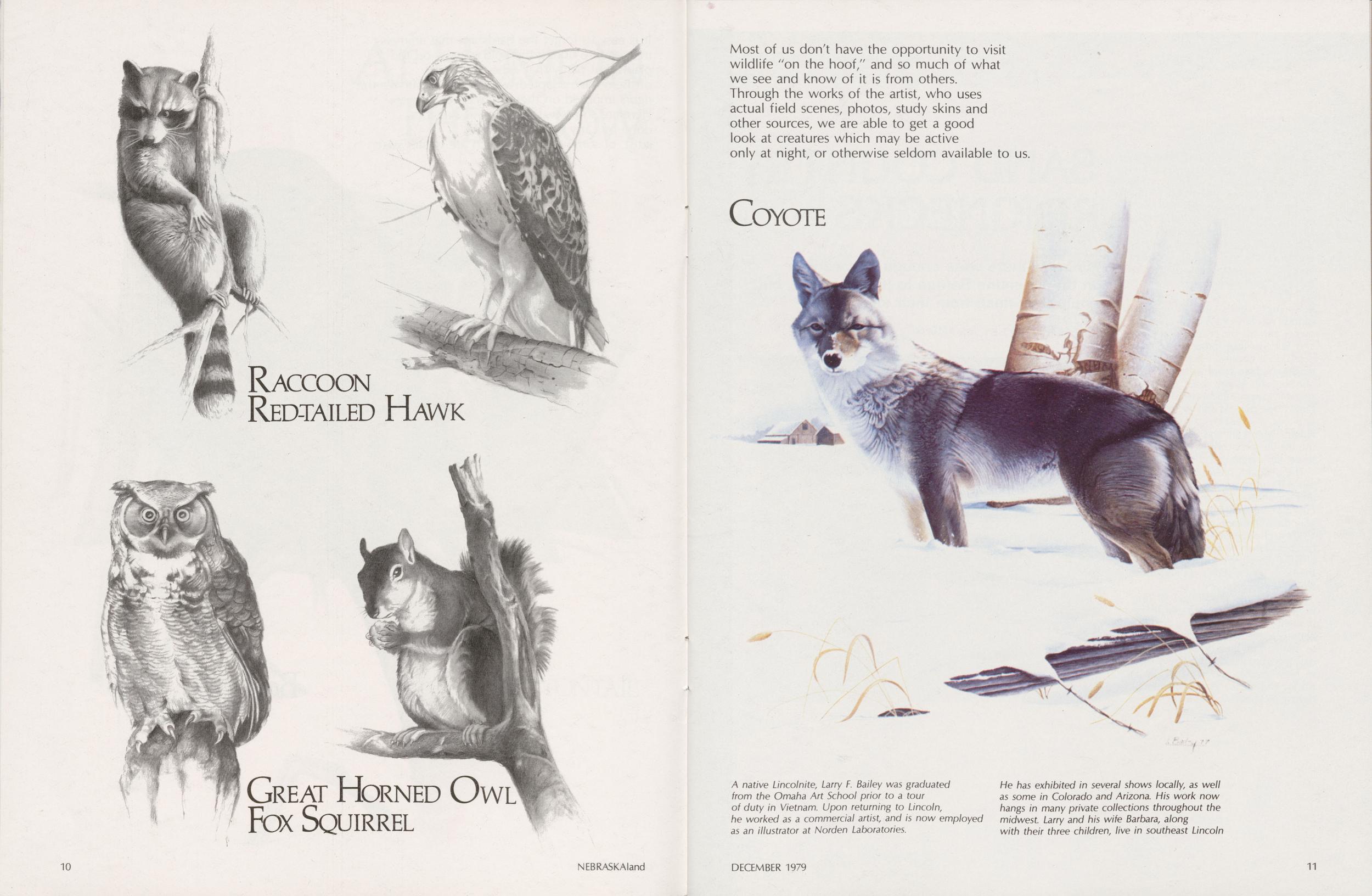
Most of us don't have the opportunity to visit wildlife "on the hoof," and so much of what we see and know of it is from others. Through the works of the artist, who uses actual field scenes, photos, study skins and other sources, we are able to get a good look at creatures which may be active only at night, or otherwise seldom available to us.
A native Lincolnite, Larry F. Bailey was graduated from the Omaha Art School prior to a tour of duty in Vietnam. Upon returning to Lincoln, he worked as a commercial artist, and is now employed as an illustrator at Norden Laboratories. He has exhibited in several shows locally, as well as some in Colorado and Arizona. His work now hangs in many private collections throughout the midwest. Larry and his wife Barbara, along with their three children, live in southeast Lincoln
DECEMBER 1979 11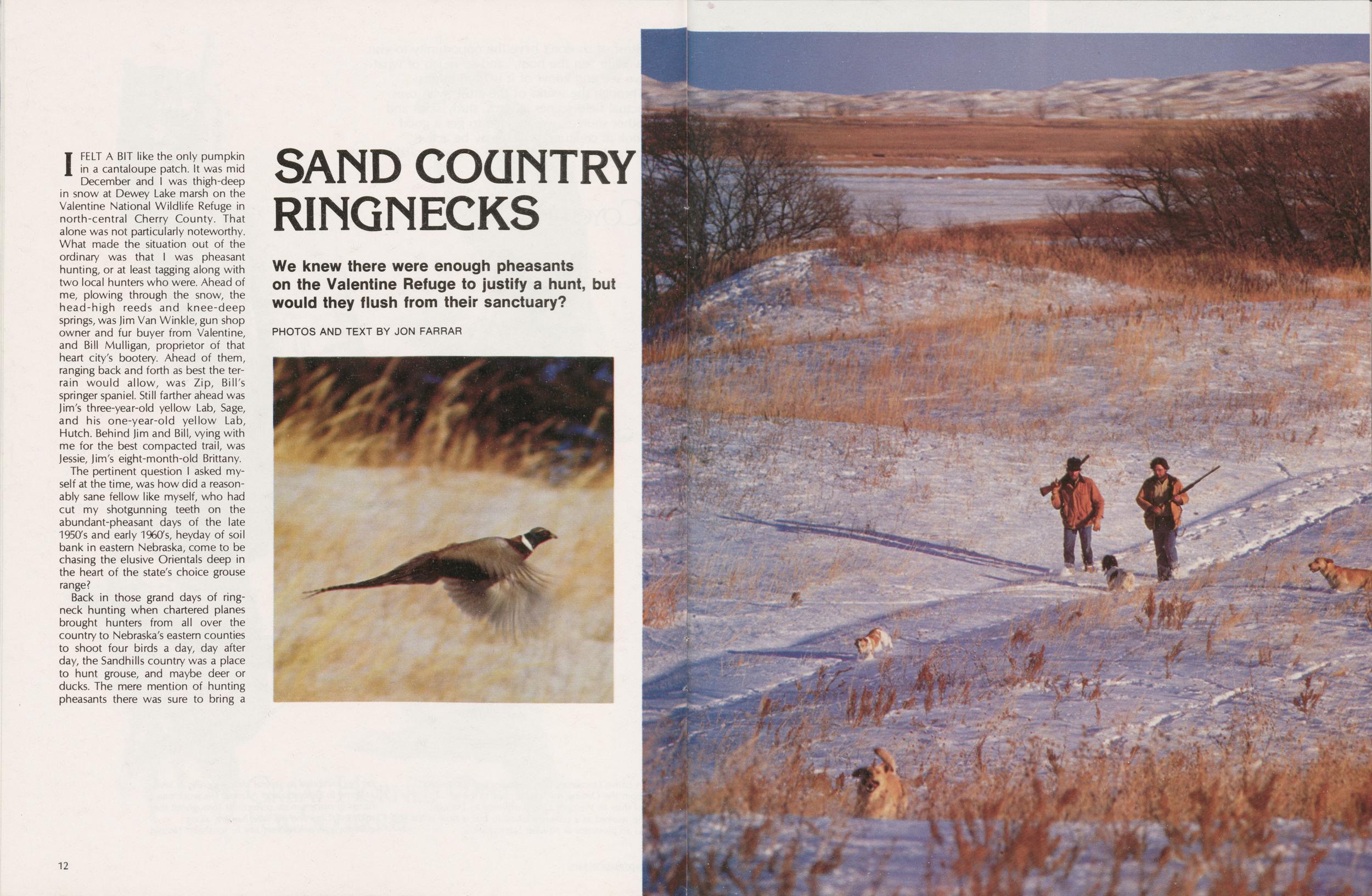
SAND COUNTRY RINGNECKS
We knew there were enough pheasants on the Valentine Refuge to justify a hunt, but would they flush from their sanctuary? PHOTOS AND TEXT BY JON FARRARI FELT A BIT like the only pumpkin in a cantaloupe patch. It was mid December and I was thigh-deep in snow at Dewey Lake marsh on the Valentine National Wildlife Refuge in north-central Cherry County. That alone was not particularly noteworthy. What made the situation out of the ordinary was that I was pheasant hunting, or at least tagging along with two local hunters who were. Ahead of me, plowing through the snow, the head-high reeds and knee-deep springs, was Jim Van Winkle, gun shop owner and fur buyer from Valentine, and Bill Mulligan, proprietor of that heart city's bootery. Ahead of them, ranging back and forth as best the terrain would allow, was Zip, Bill's springer spaniel. Still farther ahead was Jim's three-year-old yellow Lab, Sage, and his one-year-old yellow Lab, Hutch. Behind Jim and Bill, vying with me for the best compacted trail, was Jessie, Jim's eight-month-old Brittany.
The pertinent question I asked myself at the time, was how did a reasonably sane fellow like myself, who had cut my shotgunning teeth on the abundant-pheasant days of the late 195(ys and early 1960% heyday of soil bank in eastern Nebraska, come to be chasing the elusive Orientals deep in the heart of the state's choice grouse range?
Back in those grand days of ringneck hunting when chartered planes brought hunters from all over the country to Nebraska's eastern counties to shoot four birds a day, day after day, the Sandhills country was a place to hunt grouse, and maybe deer or ducks. The mere mention of hunting pheasants there was sure to bring a 12
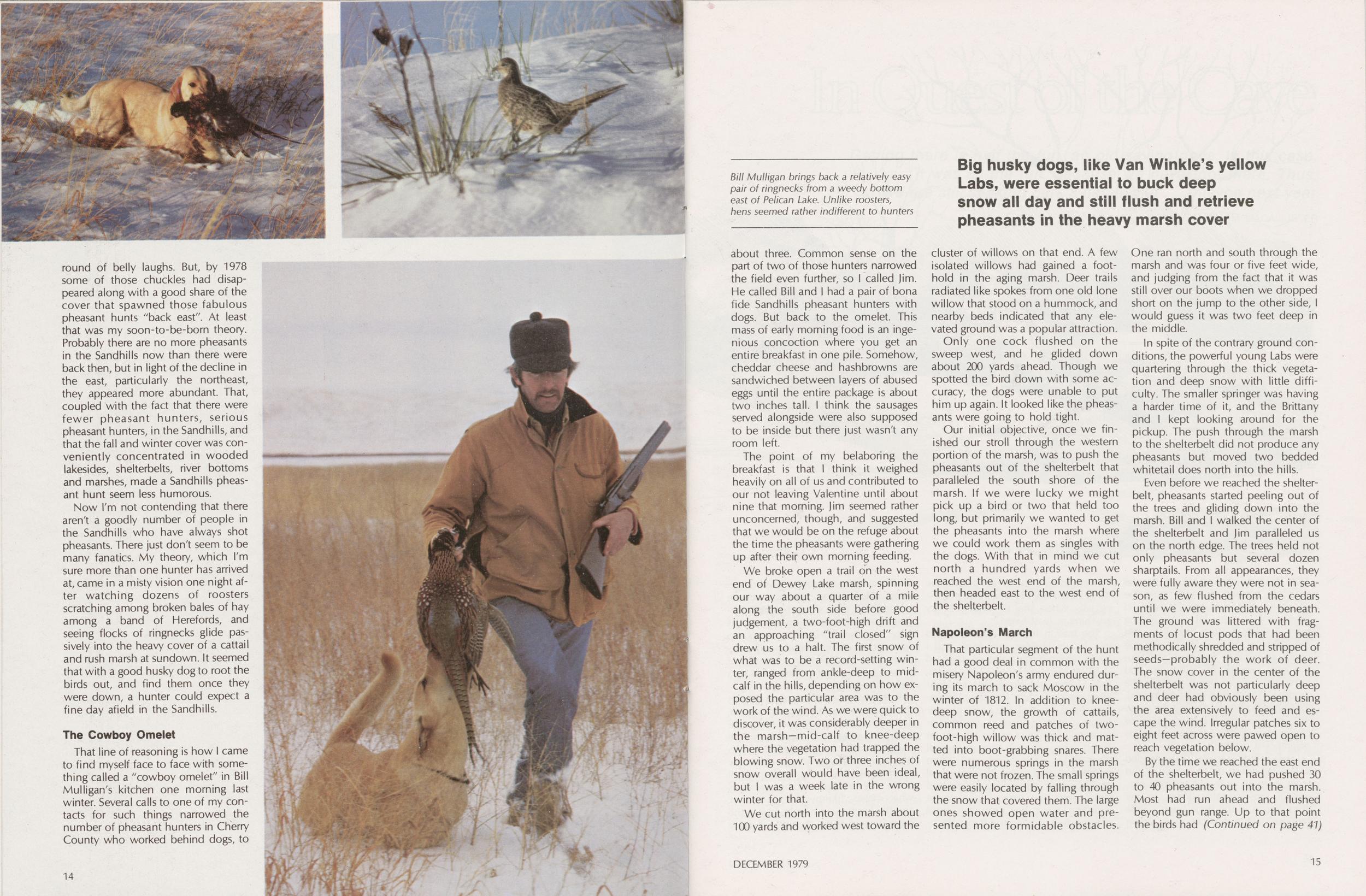
Now I'm not contending that there aren't a goodly number of people in the Sandhills who have always shot pheasants. There just don't seem to be many fanatics. My theory, which I'm sure more than one hunter has arrived at, came in a misty vision one night after watching dozens of roosters scratching among broken bales of hay among a band of Herefords, and seeing flocks of ringnecks glide passively into the heavy cover of a cattail and rush marsh at sundown. It seemed that with a good husky dog to root the birds out, and find them once they were down, a hunter could expect a fine day afield in the Sandhills.
The Cowboy OmeletThat line of reasoning is how I came to find myself face to face with something called a "cowboy omelet" in Bill Mulligan's kitchen one morning last winter. Several calls to one of my contacts for such things narrowed the number of pheasant hunters in Cherry County who worked behind dogs, to about three. Common sense on the part of two of those hunters narrowed the field even further, so I called Jim. He called Bill and I had a pair of bona fide Sandhills pheasant hunters with dogs. But back to the omelet. This mass of early morning food is an ingenious concoction where you get an entire breakfast in one pile. Somehow, cheddar cheese and hashbrowns are sandwiched between layers of abused eggs until the entire package is about two inches tall. I think the sausages served alongside were also supposed to be inside but there just wasn't any room left.
The point of my belaboring the breakfast is that I think it weighed heavily on all of us and contributed to our not leaving Valentine until about nine that morning. Jim seemed rather unconcerned, though, and suggested that we would be on the refuge about the time the pheasants were gathering up after their own morning feeding.
We broke open a trail on the west end of Dewey Lake marsh, spinning our way about a quarter of a mile along the south side before good judgement, a two-foot-high drift and an approaching "trail closed" sign drew us to a halt. The first snow of what was to be a record-setting winter, ranged from ankle-deep to mid-calf in the hills, depending on how exposed the particular area was to the work of the wind. As we were quick to discover, it was considerably deeper in the marsh—mid-calf to knee-deep where the vegetation had trapped the blowing snow. Two or three inches of snow overall would have been ideal, but I was a week late in the wrong winter for that.
We cut north into the marsh about 100 yards and worked west toward the cluster of willows on that end. A few isolated willows had gained a foot-hold in the aging marsh. Deer trails radiated like spokes from one old lone willow that stood on a hummock, and nearby beds indicated that any elevated ground was a popular attraction.
Only one cock flushed on the sweep west, and he glided down about 200 yards ahead. Though we spotted the bird down with some accuracy, the dogs were unable to put him up again. It looked like the pheasants were going to hold tight.
Our initial objective, once we finished our stroll through the western portion of the marsh, was to push the pheasants out of the shelterbelt that paralleled the south shore of the marsh. If we were lucky we might pick up a bird or two that held too long, but primarily we wanted to get the pheasants into the marsh where we could work them as singles with the dogs. With that in mind we cut north a hundred yards when we reached the west end of the marsh, then headed east to the west end of the shelterbelt.
Napoleon's MarchThat particular segment of the hunt had a good deal in common with the misery Napoleon's army endured during its march to sack Moscow in the winter of 1812. In addition to knee-deep snow, the growth of cattails, common reed and patches of two-foot-high willow was thick and matted into boot-grabbing snares. There were numerous springs in the marsh that were not frozen. The small springs were easily located by falling through the snow that covered them. The large ones showed open water and presented more formidable obstacles. One ran north and south through the marsh and was four or five feet wide, and judging from the fact that it was still over our boots when we dropped short on the jump to the other side, I would guess it was two feet deep in the middle.
In spite of the contrary ground conditions, the powerful young Labs were quartering through the thick vegetation and deep snow with little difficulty. The smaller springer was having a harder time of it, and the Brittany and I kept looking around for the pickup. The push through the marsh to the shelterbelt did not produce any pheasants but moved two bedded whitetail does north into the hills.
Even before we reached the shelterbelt, pheasants started peeling out of the trees and gliding down into the marsh. Bill and I walked the center of the shelterbelt and Jim paralleled us on the north edge. The trees held not only pheasants but several dozen sharptails. From all appearances, they were fully aware they were not in season, as few flushed from the cedars until we were immediately beneath. The ground was littered with fragments of locust pods that had been methodically shredded and stripped of seeds—probably the work of deer. The snow cover in the center of the shelterbelt was not particularly deep and deer had obviously been using the area extensively to feed and escape the wind. Irregular patches six to eight feet across were pawed open to reach vegetation below.
By the time we reached the east end of the shelterbelt, we had pushed 30 to 40 pheasants out into the marsh. Most had run ahead and flushed beyond gun range. Up to that point the birds had (Continued on page 41)
DECEMBER 1979 15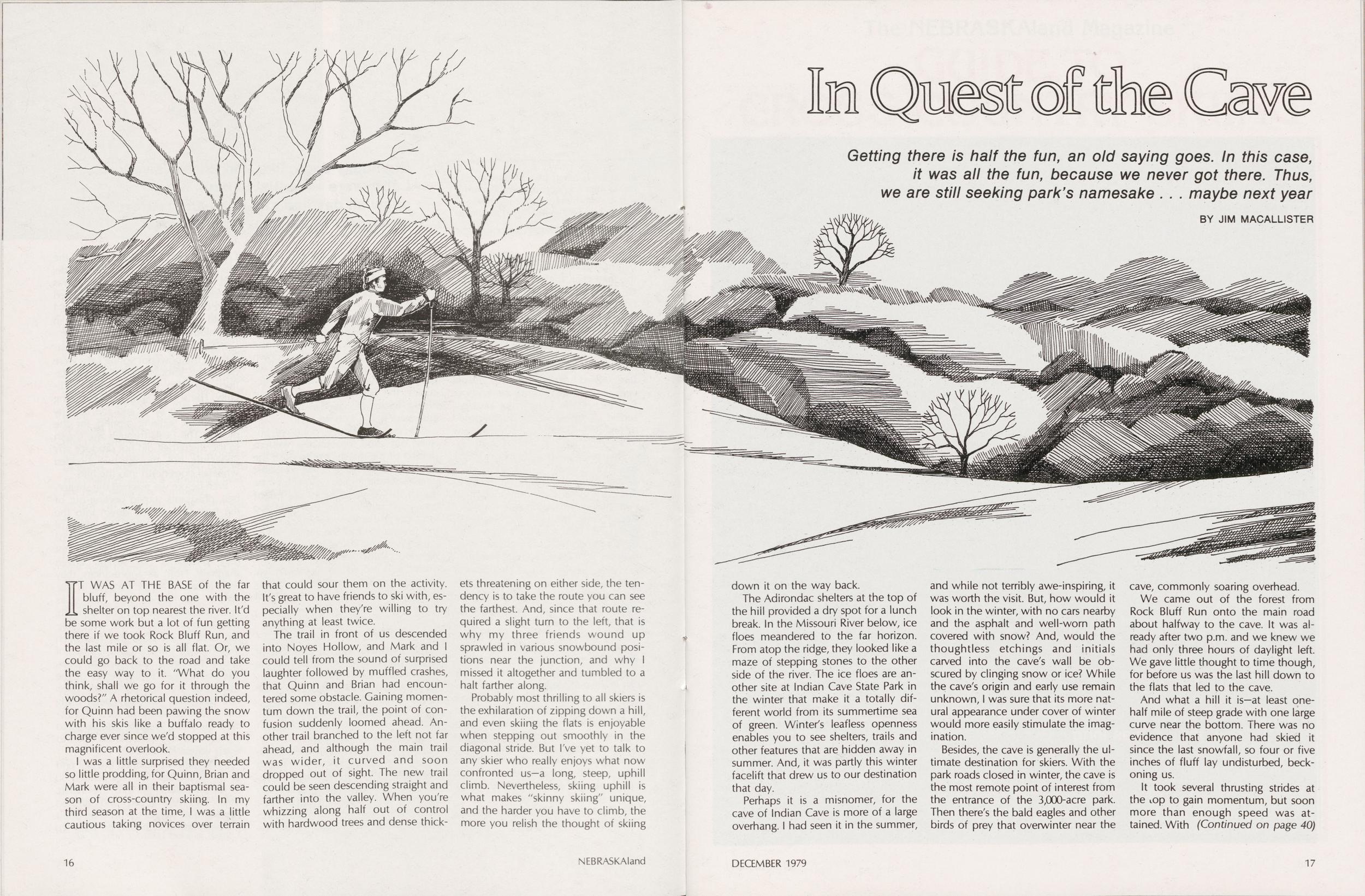
In Quest of the Cave
Getting there is half the fun, an old saying goes. In this case, it was all the fun, because we never got there. Thus, we are still seeking park's namesake . . . maybe next year BY JIM MACALLISTERIT WAS AT THE BASE of the far bluff, beyond the one with the shelter on top nearest the river. It'd be some work but a lot of fun getting there if we took Rock Bluff Run, and the last mile or so is all flat. Or, we could go back to the road and take the easy way to it. '"What do you think, shall we go for it through the woods?" A rhetorical question indeed, for Quinn had been pawing the snow with his skis like a buffalo ready to charge ever since we'd stopped at this magnificent overlook.
I was a little surprised they needed so little prodding, for Quinn, Brian and Mark were all in their baptismal sea- son of cross-country skiing. In my third season at the time, I was a little cautious taking novices over terrain that could sour them on the activity. It's great to have friends to ski with, especially when they're willing to try anything at least twice.
The trail in front of us descended into Noyes Hollow, and Mark and I could tell from the sound of surprised laughter followed by muffled crashes, that Quinn and Brian had encountered some obstacle. Gaining momentum down the trail, the point of confusion suddenly loomed ahead. Another trail branched to the left not far ahead, and although the main trail was wider, it curved and soon dropped out of sight. The new trail could be seen descending straight and farther into the valley. When you're whizzing along half out of control with hardwood trees and dense thickets threatening on either side, the tendency is to take the route you can see the farthest. And, since that route required a slight turn to the left, that is why my three friends wound up sprawled in various snowbound positions near the junction, and why I missed it altogether and tumbled to a halt farther along.
Probably most thrilling to all skiers is the exhilaration of zipping down a hill, and even skiing the flats is enjoyable when stepping out smoothly in the diagonal stride. But I've yet to talk to any skier who really enjoys what now confronted us—a long, steep, uphill climb. Nevertheless, skiing uphill is what makes "skinny skiing" unique, and the harder you have to climb, the more you relish the thought of skiing 16 NEBRASKAland down it on the way back.
The Adirondac shelters at the top of the hill provided a dry spot for a lunch break. In the Missouri River below, ice floes meandered to the far horizon. From atop the ridge, they looked like a maze of stepping stones to the other side of the river. The ice floes are another site at Indian Cave State Park in the winter that make it a totally different world from its summertime sea of green. Winter's leafless openness enables you to see shelters, trails and other features that are hidden away in summer. And, it was partly this winter facelift that drew us to our destination that day.
Perhaps it is a misnomer, for the cave of Indian Cave is more of a large overhang. I had seen it in the summer, and while not terribly awe-inspiring, it was worth the visit. But, how would it look in the winter, with no cars nearby and the asphalt and well-worn path covered with snow? And, would the thoughtless etchings and initials carved into the cave's wall be obscured by clinging snow or ice? While the cave's origin and early use remain unknown, I was sure that its more natural appearance under cover of winter would more easily stimulate the imagination.
Besides, the cave is generally the ultimate destination for skiers. With the park roads closed in winter, the cave is the most remote point of interest from the entrance of the 3,000-acre park. Then there's the bald eagles and other birds of prey that overwinter near the cave, commonly soaring overhead.
We came out of the forest from Rock Bluff Run onto the main road about halfway to the cave. It was already after two p.m. and we knew we had only three hours of daylight left. We gave little thought to time though, for before us was the last hill down to the flats that led to the cave.
And what a hill it is—at least one-half mile of steep grade with one large curve near the bottom. There was no evidence that anyone had skied it since the last snowfall, so four or five inches of fluff lay undisturbed, beckoning us.
It took several thrusting strides at the Lop to gain momentum, but soon more than enough speed was attained. With (Continued on page 40)
DECEMBER 1979 17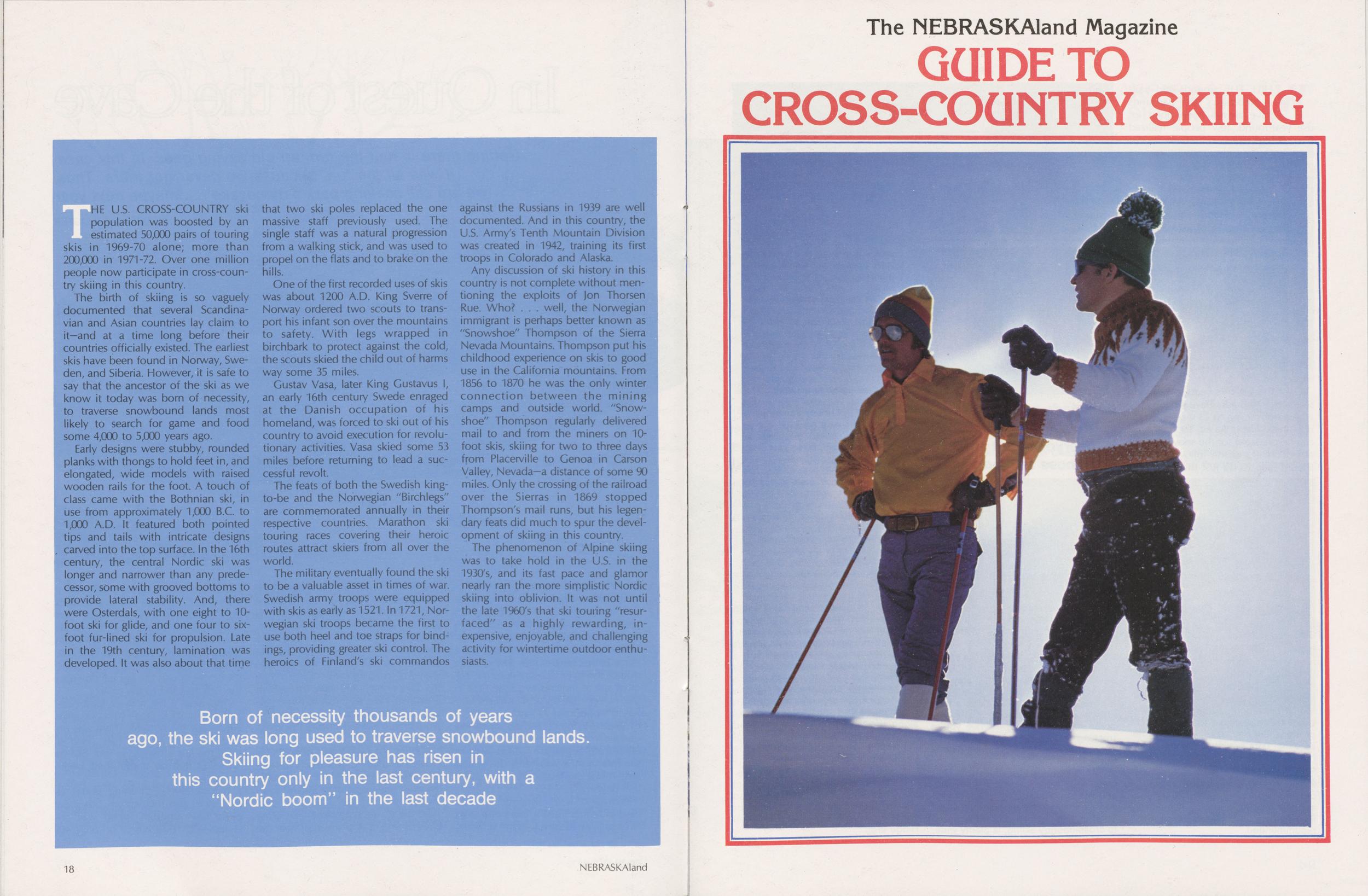
The NEBRASKAland Magazine GUIDE TO CROSS-COUNTRY SKIING
THE U.S. CROSS-COUNTRY ski population was boosted by an estimated 50,000 pairs of touring skis in 1969-70 alone; more than 200,000 in 1971-72. Over one million people now participate in cross-country skiing in this country.
The birth of skiing is so vaguely documented that several Scandinavian and Asian countries lay claim to it—and at a time long before their countries officially existed. The earliest skis have been found in Norway, Sweden, and Siberia. However, it is safe to say that the ancestor of the ski as we know it today was born of necessity, to traverse snowbound lands most likely to search for game and food some 4,000 to 5,000 years ago.
Early designs were stubby, rounded planks with thongs to hold feet in, and elongated, wide models with raised wooden rails for the foot. A touch of class came with the Bothnian ski, in use from approximately 1,000 B.C. to 1,000 A.D. It featured both pointed tips and tails with intricate designs carved into the top surface. In the 16th century, the central Nordic ski was longer and narrower than any predecessor, some with grooved bottoms to provide lateral stability. And, there were Osterdals, with one eight to 10-foot ski for glide, and one four to six-foot furlined ski for propulsion. Late in the 19th century, lamination was developed. It was also about that time that two ski poles replaced the one massive staff previously used. The single staff was a natural progression from a walking stick, and was used to propel on the flats and to brake on the hills.
One of the first recorded uses of skis was about 1200 A.D. King Sverre of Norway ordered two scouts to transport his infant son over the mountains to safety. With legs wrapped in birchbark to protect against the cold, the scouts skied the child out of harms way some 35 miles.
Gustav Vasa, later King Custavus I, an early 16th century Swede enraged at the Danish occupation of his homeland, was forced to ski out of his country to avoid execution for revolutionary activities. Vasa skied some 53 miles before returning to lead a successful revolt.
The feats of both the Swedish king-to-be and the Norwegian "Birchlegs" are commemorated annually in their respective countries. Marathon ski touring races covering their heroic routes attract skiers from all over the world.
The military eventually found the ski to be a valuable asset in times of war. Swedish army troops were equipped with skis as early as 1521. In 1721, Norwegian ski troops became the first to use both heel and toe straps for bindings, providing greater ski control. The heroics of Finland's ski commandos against the Russians in 1939 are well documented. And in this country, the U.S. Army's Tenth Mountain Division was created in 1942, training its first troops in Colorado and Alaska.
Any discussion of ski history in this country is not complete without mentioning the exploits of Jon Thorsen Rue. Who? ...well, the Norwegian immigrant is perhaps better known as "Snowshoe" Thompson of the Sierra Nevada Mountains. Thompson put his childhood experience on skis to good use in the California mountains. From 1856 to 1870 he was the only winter connection between the mining camps and outside world. "Snow-shoe" Thompson regularly delivered mail to and from the miners on 10-foot skis, skiing for two to three days from Placerville to Genoa in Carson Valley, Nevada—a distance of some 90 miles. Only the crossing of the railroad over the Sierras in 1869 stopped Thompson's mail runs, but his legendary feats did much to spur the development of skiing in this country.
The phenomenon of Alpine skiing was to take hold in the U.S. in the 1930's, and its fast pace and glamor nearly ran the more simplistic Nordic skiing into oblivion. It was not until the late 1960's that ski touring "resurfaced" as a highly rewarding, inexpensive, enjoyable, and challenging activity for wintertime outdoor enthusiasts.
Born of necessity thousands of years ago, the ski was long used to traverse snowbound lands. Skiing for pleasure has risen in this country only in the last century, with a "Nordic boom" in the last decade 18 NEBRASKAland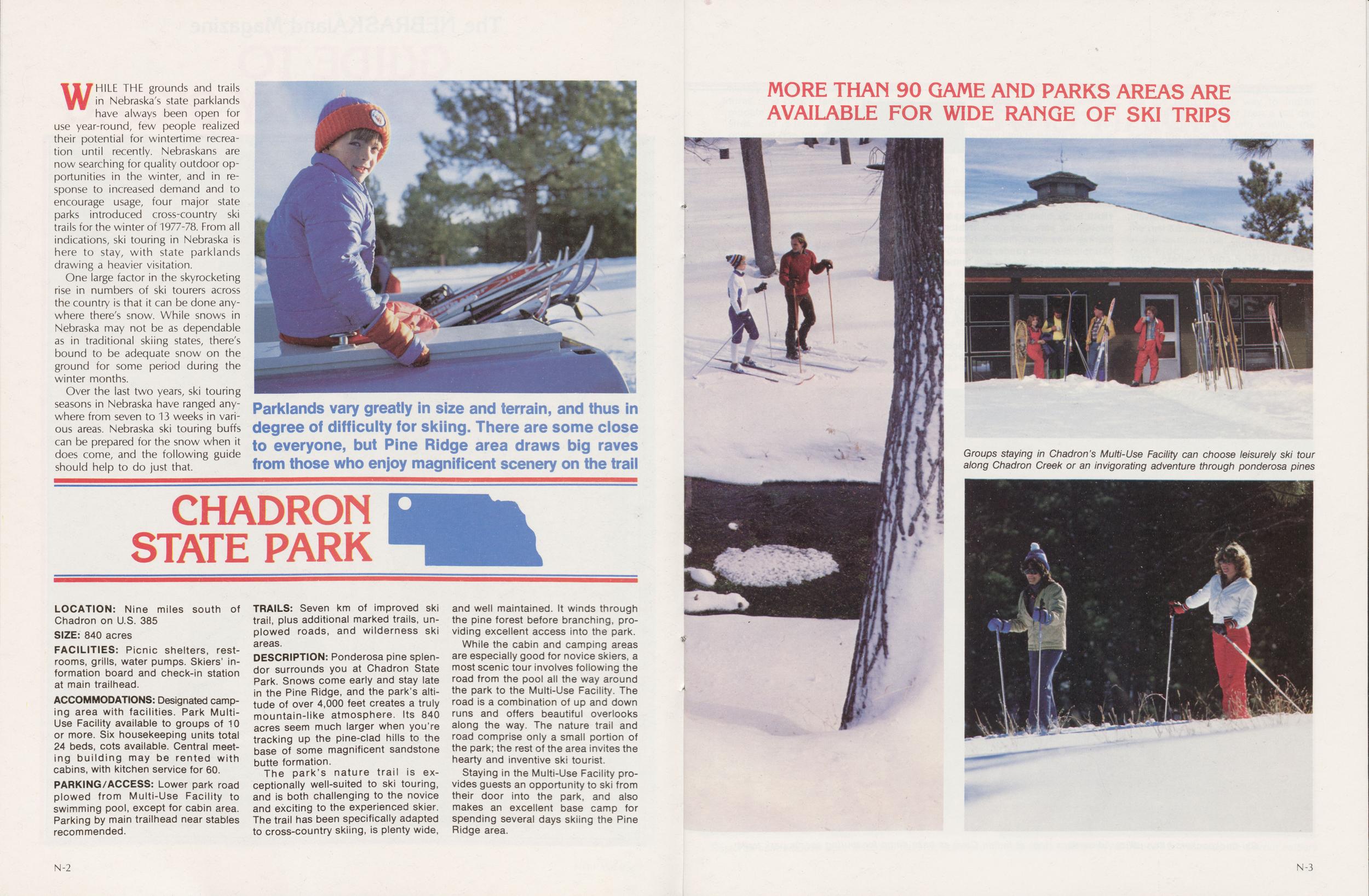
WHILE THE grounds and trails in Nebraska's state parklands have always been open for use year-round, few people realized their potential for wintertime recreation until recently. Nebraskans are now searching for quality outdoor opportunities in the winter, and in response to increased demand and to encourage usage, four major state parks introduced cross-country ski trails for the winter of 1977-78. From all indications, ski touring in Nebraska is here to stay, with state parklands drawing a heavier visitation.
One large factor in the skyrocketing rise in numbers of ski tourers across the country is that it can be done anywhere there's snow. While snows in Nebraska may not be as dependable as in traditional skiing states, there's bound to be adequate snow on the ground for some period during the winter months.
Over the last two years, ski touring seasons in Nebraska have ranged anywhere from seven to 13 weeks in various areas. Nebraska ski touring buffs can be prepared for the snow when it does come, and the following guide should help to do just that.
LOCATION: Nine miles south of Chadron on U.S. 385
SIZE: 840 acres
FACILITIES: Picnic shelters, restrooms, grills, water pumps. Skiers' information board and check-in station at main trailhead.
ACCOMMODATIONS: Designated camping area with facilities. Park Multi-Use Facility available to groups of 10 or more. Six housekeeping units total 24 beds, cots available. Central meeting building may be rented with cabins, with kitchen service for 60.
PARKING/ACCESS: Lower park road plowed from Multi-Use Facility to swimming pool, except for cabin area. Parking by main trailhead near stables recommended.
TRAILS: Seven km of improved ski trail, plus additional marked trails, unplowed roads, and wilderness ski areas.
DESCRIPTION: Ponderosa pine splendor surrounds you at Chadron State Park. Snows come early and stay late in the Pine Ridge, and the park's altitude of over 4,000 feet creates a truly mountain-like atmosphere. Its 840 acres seem much larger when you're tracking up the pine-clad hills to the base of some magnificent sandstone butte formation.
The park's nature trail is exceptionally well-suited to ski touring, and is both challenging to the novice and exciting to the experienced skier. The trail has been specifically adapted to cross-country skiing, is plenty wide, and well maintained. It winds through the pine forest before branching, providing excellent access into the park.
While the cabin and camping areas are especially good for novice skiers, a most scenic tour involves following the road from the pool all the way around the park to the Multi-Use Facility. The road is a combination of up and down runs and offers beautiful overlooks along the way. The nature trail and road comprise only a small portion of the park; the rest of the area invites the hearty and inventive ski tourist.
Staying in the Multi-Use Facility provides guests an opportunity to ski from their door into the park, and also makes an excellent base camp for spending several days skiing the Pine Ridge area.
N-2 MORE THAN 90 GAME AND PARKS AREAS ARE AVAILABLE FOR WIDE RANGE OF SKI TRIPS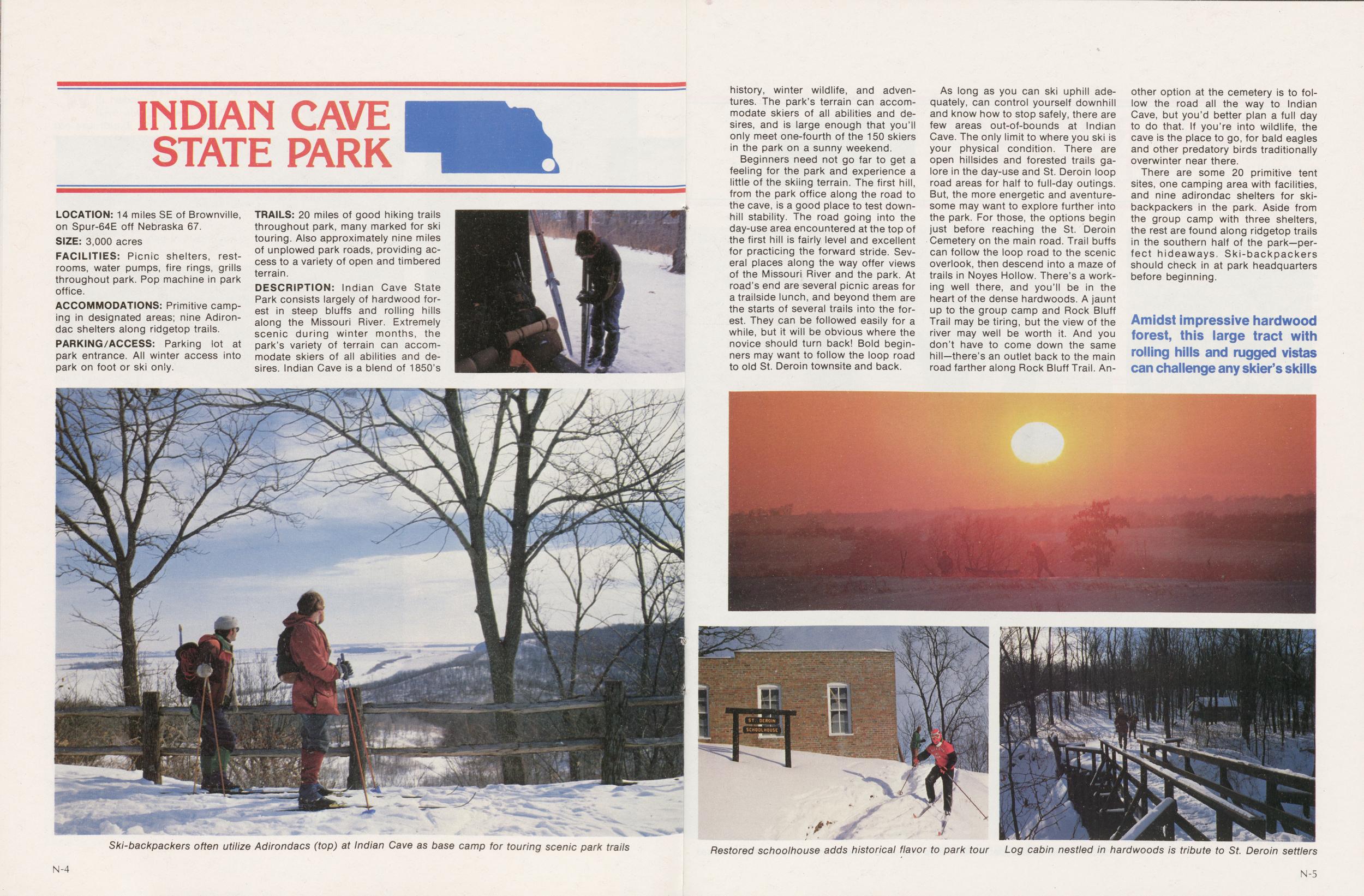 INDIAN CAVE
STATE PARK
INDIAN CAVE
STATE PARK
LOCATION: 14 miles SE of Brownville, on Spur-64E off Nebraska 67.
SIZE: 3,000 acres
FACILITIES: Picnic shelters, restrooms, water pumps, fire rings, grills throughout park. Pop machine in park office.
ACCOMMODATIONS: Primitive camping in designated areas; nine Adirondac shelters along ridgetop trails.
PARKING/ACCESS: Parking lot at park entrance. All winter access into park on foot or ski only.
TRAILS: 20 miles of good hiking trails throughout park, many marked for ski touring. Also approximately nine miles of unplowed park roads, providing access to a variety of open and timbered terrain.
DESCRIPTION: Indian Cave State Park consists largely of hardwood forest in steep bluffs and rolling hills along the Missouri River. Extremely scenic during winter months, the park's variety of terrain can accommodate skiers of all abilities and desires. Indian Cave is a blend of 1850's
Beginners need not go far to get a feeling for the park and experience a little of the skiing terrain. The first hill, from the park office along the road to the cave, is a good place to test downhill stability. The road going into the day-use area encountered at the top of the first hill is fairly level and excellent for practicing the forward stride. Several places along the way offer views of the Missouri River and the park. At road's end are several picnic areas for a trailside lunch, and beyond them are the starts of several trails into the forest. They can be followed easily for a while, but it will be obvious where the novice should turn back! Bold beginners may want to follow the loop road to old St. Deroin townsite and back.
As long as you can ski uphill adequately, can control yourself downhill and know how to stop safely, there are few areas out-of-bounds at Indian Cave. The only limit to where you ski is your physical condition. There are open hillsides and forested trails galore in the day-use and St. Deroin loop road areas for half to full-day outings. But, the more energetic and aventuresome may want to explore further into the park. For those, the options begin just before reaching the St. Deroin Cemetery on the main road. Trail buffs can follow the loop road to the scenic overlook, then descend into a maze of trails in Noyes Hollow. There's a working well there, and you'll be in the heart of the dense hardwoods. A jaunt up to the group camp and Rock Bluff Trail may be tiring, but the view of the river may well be worth it. And you don't have to come down the same hill—there's an outlet back to the main road farther along Rock Bluff Trail. Another option at the cemetery is to follow the road all the way to Indian Cave, but you'd better plan a full day to do that. If you're into wildlife, the cave is the place to go, for bald eagles and other predatory birds traditionally overwinter near there.
There are some 20 primitive tent sites, one camping area with facilities, and nine adirondac shelters for ski-backpackers in the park. Aside from the group camp with three shelters, the rest are found along ridgetop trails in the southern half of the park—perfect hideaways. Ski-backpackers should check in at park headquarters before beginning.
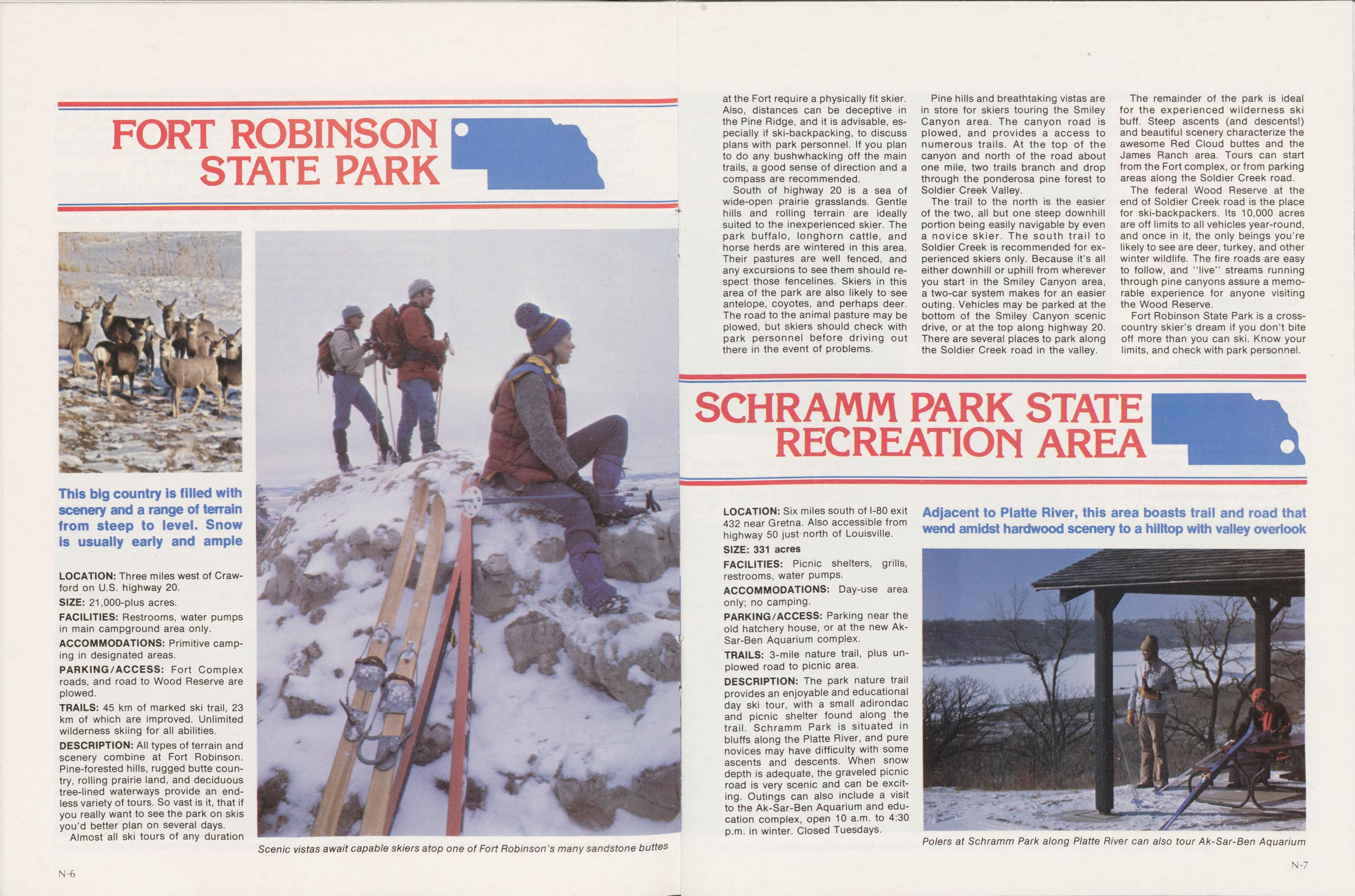 FORT ROBINSON
STATE PARK
FORT ROBINSON
STATE PARK
LOCATION: Three miles west of Crawford on U.S. highway 20.
SIZE: 21,000-plus acres.
FACILITIES: Restrooms, water pumps in main campground area only.
ACCOMMODATIONS: Primitive camping in designated areas.
PARKING/ACCESS: Fort Complex roads, and road to Wood Reserve are plowed.
TRAILS: 45 km of marked ski trail, 23 km of which are improved. Unlimited wilderness skiing for all abilities.
DESCRIPTION: All types of terrain and scenery combine at Fort Robinson. Pine-forested hills, rugged butte country, rolling prairie land, and deciduous tree-lined waterways provide an endless variety of tours. So vast is it, that if you really want to see the park on skis you'd better plan on several days.
Almost all ski tours of any duration
South of highway 20 is a sea of wide-open prairie grasslands. Gentle hills and rolling terrain are ideally suited to the inexperienced skier. The park buffalo, longhorn cattle, and horse herds are wintered in this area. Their pastures are well fenced, and any excursions to see them should respect those fencelines. Skiers in this area of the park are also likely to see antelope, coyotes, and perhaps deer. The road to the animal pasture may be plowed, but skiers should check with park personnel before driving out there in the event of problems.
Pine hills and breathtaking vistas are in store for skiers touring the Smiley Canyon area. The canyon road is plowed, and provides a access to numerous trails. At the top of the canyon and north of the road about one mile, two trails branch and drop through the ponderosa pine forest to Soldier Creek Valley.
The trail to the north is the easier of the two, all but one steep downhill portion being easily navigable by even a novice skier. The south trail to Soldier Creek is recommended for experienced skiers only. Because it's all either downhill or uphill from wherever you start in the Smiley Canyon area, a two-car system makes for an easier outing. Vehicles may be parked at the bottom of the Smiley Canyon scenic drive, or at the top along highway 20. There are several places to park along the Soldier Creek road in the valley.
The remainder of the park is ideal for the experienced wilderness ski buff. Steep ascents (and descents!) and beautiful scenery characterize the awesome Red Cloud buttes and the James Ranch area. Tours can start from the Fort complex, or from parking areas along the Soldier Creek road.
The federal Wood Reserve at the end of Soldier Creek road is the place for ski-backpackers. Its 10,000 acres are off limits to all vehicles year-round, and once in it, the only beings you're likely to see are deer, turkey, and other winter wildlife. The fire roads are easy to follow, and "live" streams running through pine canyons assure a memorable experience for anyone visiting the Wood Reserve.
Fort Robinson State Park is a crosscountry skier's dream if you don't bite off more than you can ski. Know your limits, and check with park personnel.
SCHRAMM PARK STATE RECREATION AREALOCATION: Six miles south of I-80 exit 432 near Gretna. Also accessible from highway 50 just north of Louisville.
SIZE: 331 acres
FACILITIES: Picnic shelters, grills, restrooms, water pumps.
ACCOMMODATIONS: Day-use area only; no camping.
PARKING/ACCESS: Parking near the old hatchery house, or at the new Ak-Sar-Ben Aquarium complex.
TRAILS: 3-mile nature trail, plus unplowed road to picnic area.
DESCRIPTION: The park nature trail provides an enjoyable and educational day ski tour, with a small Adirondack and picnic shelter found along the trail. Schramm Park is situated in bluffs along the Platte River, and pure novices may have difficulty with some ascents and descents. When snow depth is adequate, the graveled picnic road is very scenic and can be exciting. Outings can also include a visit to the Ak-Sar-Ben Aquarium and education complex, open 10 a.m. to 4:30 p.m. in winter. Closed Tuesdays.
Adjacent to Platte River, this area boasts trail and road that wend amidst hardwood scenery to a hilltop with valley overlook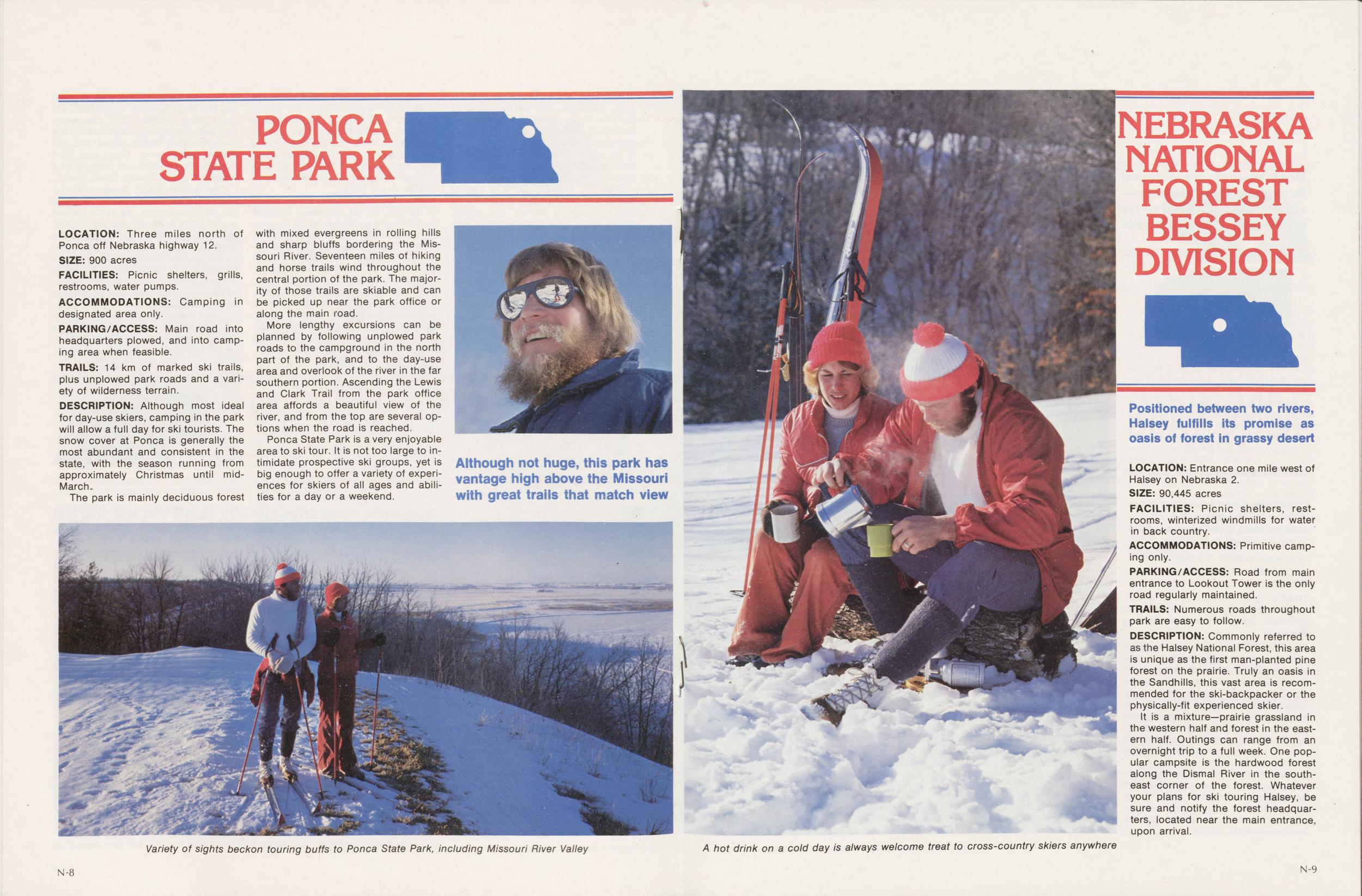 PONCA
STATE PARK
PONCA
STATE PARK
LOCATION: Three miles north of Ponca off Nebraska highway 12.
SIZE: 900 acres
FACILITIES: Picnic shelters, grills, restrooms, water pumps.
ACCOMMODATIONS: Camping in designated area only.
PARKING/ACCESS: Main road into headquarters plowed, and into camping area when feasible.
TRAILS: 14 km of marked ski trails, plus unplowed park roads and a variety of wilderness terrain.
DESCRIPTION: Although most ideal for day-use skiers, camping in the park will allow a full day for ski tourists. The snow cover at Ponca is generally the most abundant and consistent in the state, with the season running from approximately Christmas until mid-March.
The park is mainly deciduous forest with mixed evergreens in rolling hills and sharp bluffs bordering the Missouri River. Seventeen miles of hiking and horse trails wind throughout the central portion of the park. The majority of those trails are skiable and can be picked up near the park office or along the main road.
More lengthy excursions can be planned by following unplowed park roads to the campground in the north part of the park, and to the day-use area and overlook of the river in the far southern portion. Ascending the Lewis and Clark Trail from the park office area affords a beautiful view of the river, and from the top are several options when the road is reached.
Ponca State Park is a very enjoyable area to ski tour. It is not too large to intimidate prospective ski groups, yet is big enough to offer a variety of experiences for skiers of all ages and abilities for a day or a weekend.
LOCATION: Entrance one mile west of Halsey on Nebraska 2.
SIZE: 90,445 acres
FACILITIES: Picnic shelters, restrooms, winterized windmills for water in back country.
ACCOMMODATIONS: Primitive camping only.
PARKING/ACCESS: Road from main entrance to Lookout Tower is the only road regularly maintained.
TRAILS: Numerous roads throughout park are easy to follow.
DESCRIPTION: Commonly referred to as the Halsey National Forest, this area is unique as the first man-planted pine forest on the prairie. Truly an oasis in the Sandhills, this vast area is recommended for the ski-backpacker or the physically-fit experienced skier.
It is a mixture—prairie grassland in the western half and forest in the eastern half. Outings can range from an overnight trip to a full week. One popular campsite is the hardwood forest along the Dismal River in the southeast corner of the forest. Whatever your plans for ski touring Halsey, be sure and notify the forest headquarters, located near the main entrance, upon arrival.
N-9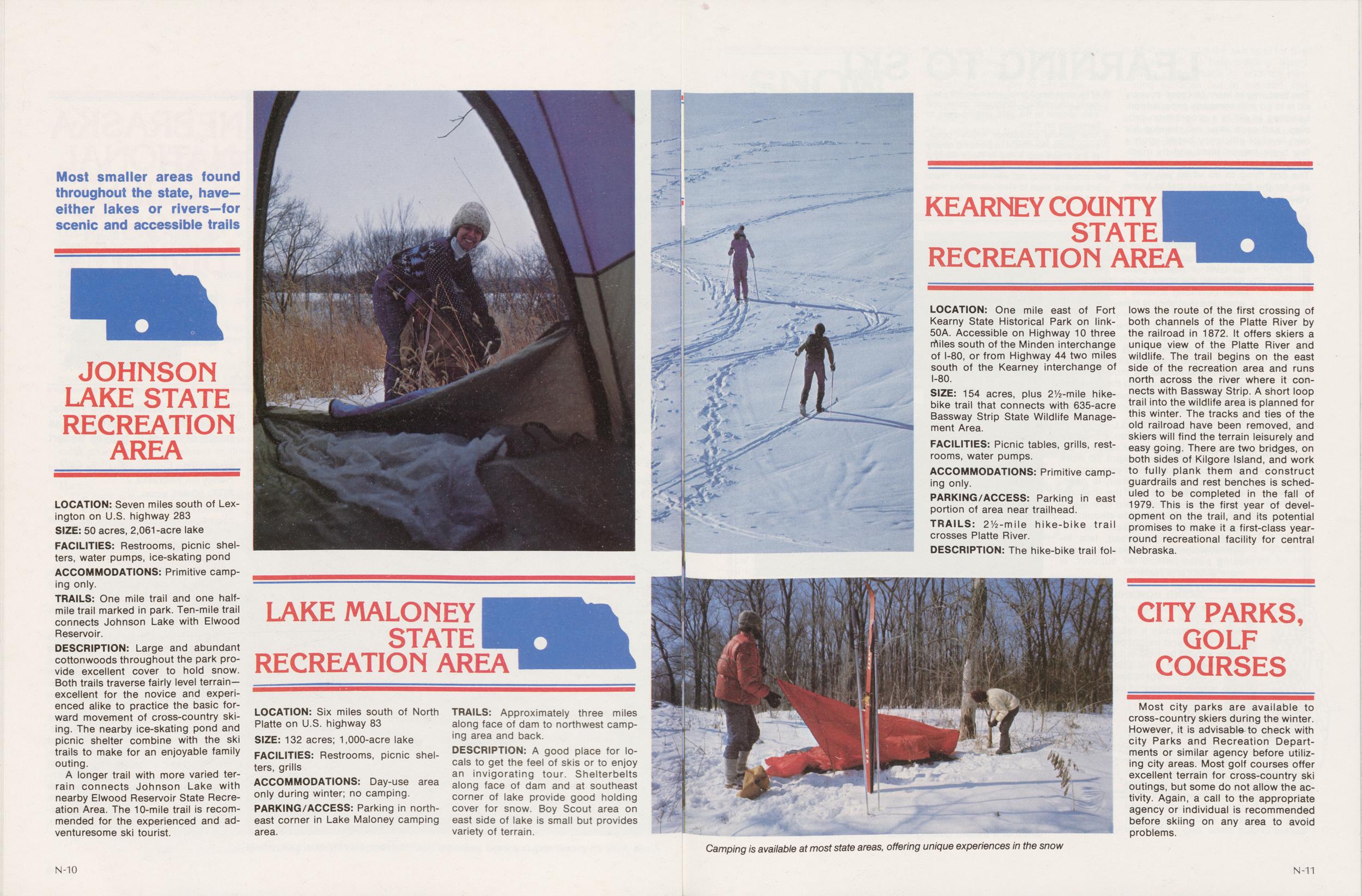
LOCATION: Seven miles south of Lexington on U.S. highway 283
SIZE: 50 acres, 2,061-acre lake
FACILITIES: Restrooms, picnic shelters, water pumps, ice-skating pond ACCOMMODATIONS: Primitive camping only.
TRAILS: One mile trail and one half-mile trail marked in park. Ten-mile trail connects Johnson Lake with Elwood Reservoir.
DESCRIPTION: Large and abundant cottonwoods throughout the park provide excellent cover to hold snow. Both trails traverse fairly level terrain-excellent for the novice and experienced alike to practice the basic forward movement of cross-country skiing. The nearby ice-skating pond and picnic shelter combine with the ski trails to make for an enjoyable family outing.
A longer trail with more varied terrain connects Johnson Lake with nearby Elwood Reservoir State Recreation Area. The 10-mile trail is recommended for the experienced and adventuresome ski tourist.
LAKE MALONEY STATE RECREATION AREALOCATION: Six miles south of North Platte on U.S. highway 83
SIZE: 132 acres; 1,000-acre lake
FACILITIES: Restrooms, picnic shelters, grills
ACCOMMODATIONS: Day-use area only during winter; no camping.
PARKING/ACCESS: Parking in northeast corner in Lake Maloney camping area.
TRAILS: Approximately three miles along face of dam to northwest camping area and back.
DESCRIPTION: A good place for locals to get the feel of skis or to enjoy an invigorating tour. Shelterbelts along face of dam and at southeast corner of lake provide good holding cover for snow. Boy Scout area on east side of lake is small but provides variety of terrain.
N-10LOCATION: One mile east of Fort Kearny State Historical Park on link-50A. Accessible on Highway 10 three miles south of the Minden interchange of I-80, or from Highway 44 two miles south of the Kearney interchange of I-80.
SIZE: 154 acres, plus 2/2-mile hike-bike trail that connects with 635-acre Bassway Strip State Wildlife Management Area.
FACILITIES: Picnic tables, grills, restrooms, water pumps.
ACCOMMODATIONS: Primitive camping only.
PARKING/ACCESS: Parking in east portion of area near trailhead.
TRAILS: 21/2-mile hike-bike trail crosses Platte River.
DESCRIPTION: The hike-bike trail follows the route of the first crossing of both channels of the Platte River by the railroad in 1872. It offers skiers a unique view of the Platte River and wildlife. The trail begins on the east side of the recreation area and runs north across the river where it connects with Bassway Strip. A short loop trail into the wildlife area is planned for this winter. The tracks and ties of the old railroad have been removed, and skiers will find the terrain leisurely and easy going. There are two bridges, on both sides of Kilgore Island, and work to fully plank them and construct guardrails and rest benches is scheduled to be completed in the fall of 1979. This is the first year of development on the trail, and its potential promises to make it a first-class yearround recreational facility for central Nebraska.
CITY PARKS, GOLF COURSESMost city parks are available to cross-country skiers during the winter. However, it is advisable to check with city Parks and Recreation Departments or similar agency before utilizing city areas. Most golf courses offer excellent terrain for cross-country ski outings, but some do not allow the activity. Again, a call to the appropriate agency or individual is recommended before skiing on any area to avoid problems.
 LEARNING TO SKI
The best way to learn to cross-country ski is to go with someone experienced. Learning to ski is a progression process, and each skier will develop his own level of efficiency based upon a few basic helpful hints and by modifying them to what is most comfortable. The first thing to do when you're on skis for the first time is to get to know your equipment.
·At its most basic level, cross-country skiing is like walking. Drop your poles and walk around in the skis, getting used to balancing on them.
·After gaining confidence without poles, exaggerate movement by bending deeply at the knees and trying to move along a little faster.
·Practice getting up after falling. There are several ways to stand up with or without poles.
·Practice turning when stopped. The kick turn is perhaps the simplest. Remember during the kick turn to keep poles out of the way and to shift weight from one ski to another before moving that ski.
·Wagonwheels—step in a complete circle, pivoting on either the tips or tails of the skis and trying not to step on or cross skis.
Once you feel comfortable on skis, you're ready for some basic motions.
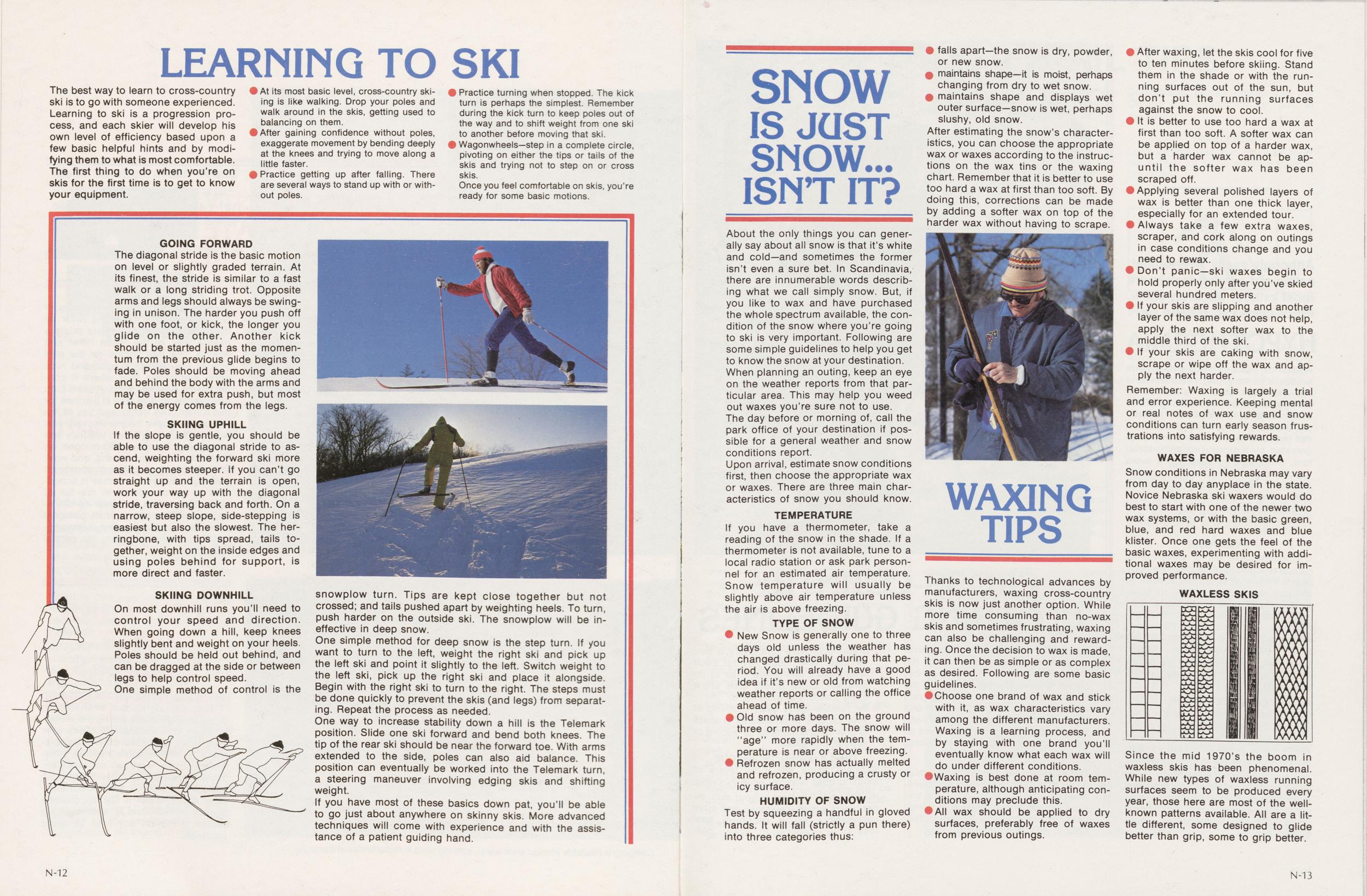
The diagonal stride is the basic motion on level or slightly graded terrain. At its finest, the stride is similar to a fast walk or a long striding trot. Opposite arms and legs should always be swinging in unison. The harder you push off with one foot, or kick, the longer you glide on the other. Another kick should be started just as the momentum from the previous glide begins to fade. Poles should be moving ahead and behind the body with the arms and may be used for extra push, but most of the energy comes from the legs.
SKIING UPHILLIf the slope is gentle, you should be able to use the diagonal stride to ascend, weighting the forward ski more as it becomes steeper. If you can't go straight up and the terrain is open, work your way up with the diagonal stride, traversing back and forth. On a narrow, steep slope, side-stepping is easiest but also the slowest. The herringbone, with tips spread, tails together, weight on the inside edges and using poles behind for support, is more direct and faster.
SKIING DOWNHILLOn most downhill runs you'll need to control your speed and direction. When going down a hill, keep knees slightly bent and weight on your heels Poles should be held out behind, and can be dragged at the side or between legs to help control speed. One simple method of control is the snowplow turn. Tips are kept close together but not crossed; and tails pushed apart by weighting heels. To turn, push harder on the outside ski. The snowplow will be ineffective in deep snow.
One simple method for deep snow is the step turn. If you want to turn to the left, weight the right ski and pick up the left ski and point it slightly to the left. Switch weight to the left ski, pick up the right ski and place it alongside. Begin with the right ski to turn to the right. The steps must be done quickly to prevent the skis (and legs) from separating. Repeat the process as needed.
One way to increase stability down a hill is the Telemark position. Slide one ski forward and bend both knees. The tip of the rear ski should be near the forward toe. With arms extended to the side, poles can also aid balance. This position can eventually be worked into the Telemark turn, a steering maneuver involving edging skis and shifting weight.
If you have most of these basics down pat, you'll be able to go just about anywhere on skinny skis. More advanced techniques will come with experience and with the assistance of a patient guiding hand.
N-12 SNOW IS JUST SNOW... ISNT IT?About the only things you can generally say about all snow is that it's white and cold—and sometimes the former isn't even a sure bet. In Scandinavia, there are innumerable words describing what we call simply snow. But, if you like to wax and have purchased the whole spectrum available, the condition of the snow where you're going to ski is very important. Following are some simple guidelines to help you get to know the snow at your destination. When planning an outing, keep an eye on the weather reports from that particular area. This may help you weed out waxes you're sure not to use. The day before or morning of, call the park office of your destination if possible for a general weather and snow conditions report.
Upon arrival, estimate snow conditions first, then choose the appropriate wax or waxes. There are three main characteristics of snow you should know.
TEMPERATUREIf you have a thermometer, take a reading of the snow in the shade. If a thermometer is not available, tune to a local radio station or ask park personnel for an estimated air temperature. Snow temperature will usually be slightly above air temperature unless the air is above freezing.
TYPE OF SNOW·New Snow is generally one to three days old unless the weather has changed drastically during that period. You will already have a good idea if it's new or old from watching weather reports or calling the office ahead of time.
·Old snow has been on the ground three or more days. The snow will "age" more rapidly when the temperature is near or above freezing.
·Refrozen snow has actually melted and refrozen, producing a crusty or icy surface.
HUMIDITY OF SNOWTest by squeezing a handful in gloved hands. It will fall (strictly a pun there) into three categories thus:
·falls apart—the snow is dry, powder, or new snow.
·maintains shape—it is moist, perhaps changing from dry to wet snow.
·maintains shape and displays wet outer surface—snow is wet, perhaps slushy, old snow.
After estimating the snow's characteristics, you can choose the appropriate wax or waxes according to the instructions on the wax tins or the waxing chart. Remember that it is better to use too hard a wax at first than too soft. By doing this, corrections can be made by adding a softer wax on top of the harder wax without having to scrape.
Thanks to technological advances by manufacturers, waxing cross-country skis is now just another option. While more time consuming than no-wax skis and sometimes frustrating, waxing can also be challenging and rewarding. Once the decision to wax is made, it can then be as simple or as complex as desired. Following are some basic guidelines.
·Choose one brand of wax and stick with it, as wax characteristics vary among the different manufacturers. Waxing is a learning process, and by staying with one brand you'll eventually know what each wax will do under different conditions.
·Waxing is best done at room temperature, although anticipating conditions may preclude this.
·All wax should be applied to dry surfaces, preferably free of waxes from previous outings.
·After waxing, let the skis cool for five to ten minutes before skiing. Stand them in the shade or with the running surfaces out of the sun, but don't put the running surfaces against the snow to cool.
·It is better to use too hard a wax at first than too soft. A softer wax can be applied on top of a harder wax, but a harder wax cannot be applied until the softer wax has been scraped off.
·Applying several polished layers of wax is better than one thick layer, especially for an extended tour.
·Always take a few extra waxes, scraper, and cork along on outings in case conditions change and you need to re wax.
·Don't panic—ski waxes begin to hold properly only after you've skied several hundred meters.
·If your skis are slipping and another layer of the same wax does not help, apply the next softer wax to the middle third of the ski.
·If your skis are caking with snow, scrape or wipe off the wax and apply the next harder.
Remember: Waxing is largely a trial and error experience. Keeping mental or real notes of wax use and snow conditions can turn early season frustrations into satisfying rewards.
WAXES FOR NEBRASKASnow conditions in Nebraska may vary from day to day anyplace in the state. Novice Nebraska ski waxers would do best to start with one of the newer two wax systems, or with the basic green, blue, and red hard waxes and blue klister. Once one gets the feel of the basic waxes, experimenting with additional waxes may be desired for improved performance.
WAXLESS SKISSince the mid 1970's the boom in waxless skis has been phenomenal. While new types of waxless running surfaces seem to be produced every year, those here are most of the well-known patterns available. All are a little different, some designed to glide better than grip, some to grip better.
N-13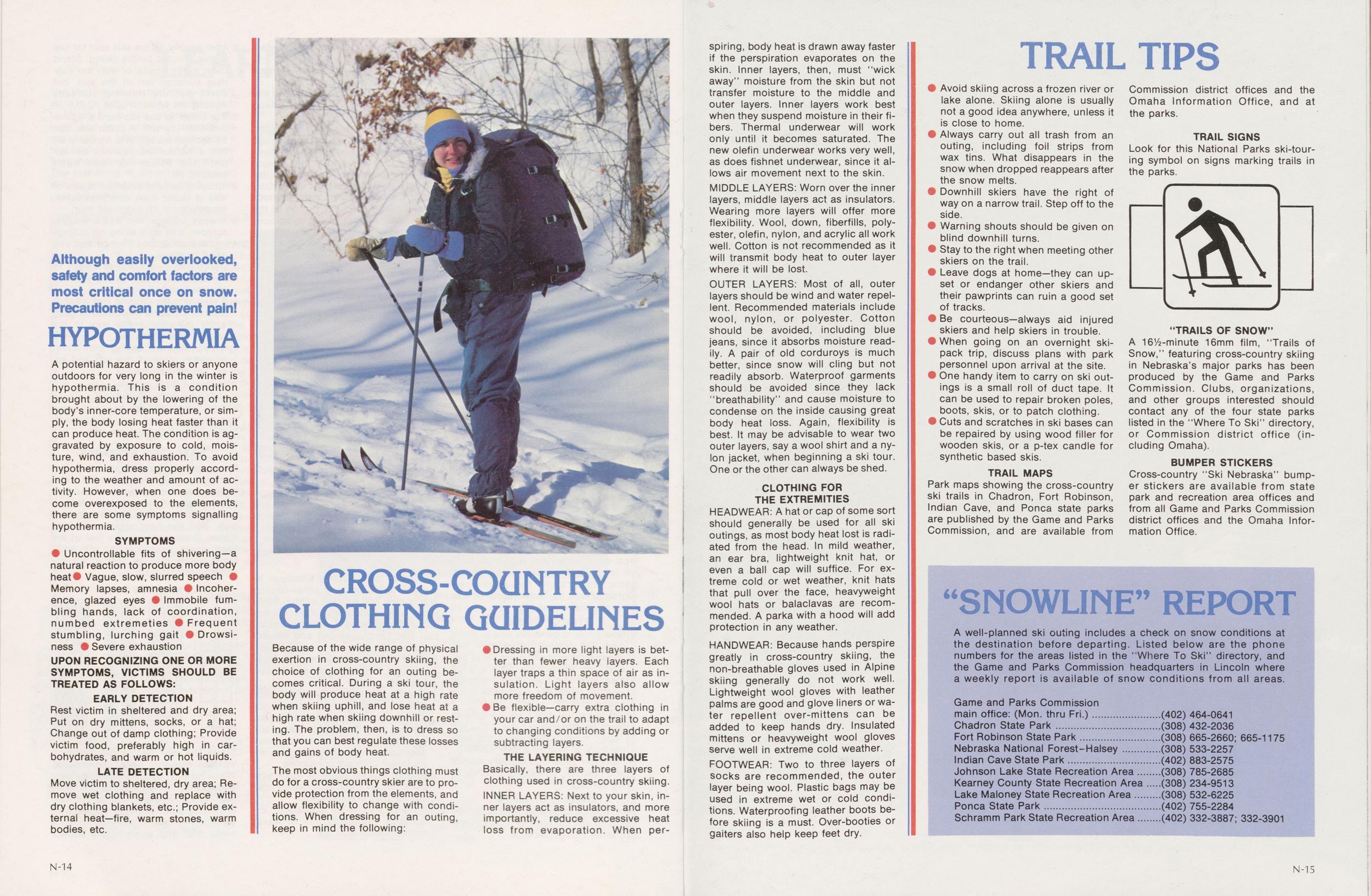 Although easily overlooked,
safety and comfort factors are
most critical once on snow.
Precautions can prevent pain!
HYPOTHERMIA
Although easily overlooked,
safety and comfort factors are
most critical once on snow.
Precautions can prevent pain!
HYPOTHERMIA
A potential hazard to skiers or anyone outdoors for very long in the winter is hypothermia. This is a condition brought about by the lowering of the body's inner-core temperature, or simply, the body losing heat faster than it can produce heat. The condition is aggravated by exposure to cold, moisture, wind, and exhaustion. To avoid hypothermia, dress properly according to the weather and amount of activity. However, when one does become overexposed to the elements, there are some symptoms signalling hypothermia.
SYMPTOMS·Uncontrollable fits of shivering—a natural reaction to produce more body heat ·Vague, slow, slurred speech ·Memory lapses, amnesia ·Incoherence, glazed eyes ·Immobile fumbling hands, lack of coordination, numbed extremeties ·Frequent stumbling, lurching gait ·Drowsiness ·Severe exhaustion
UPON RECOGNIZING ONE OR MORE SYMPTOMS, VICTIMS SHOULD BE TREATED AS FOLLOWS: EARLY DETECTIONRest victim in sheltered and dry area; Put on dry mittens, socks, or a hat; Change out of damp clothing; Provide victim food, preferably high in carbohydrates, and warm or hot liquids.
LATE DETECTIONMove victim to sheltered, dry area; Remove wet clothing and replace with dry clothing blankets, etc.; Provide external heat—fire, warm stones, warm bodies, etc.
Because of the wide range of physical exertion in cross-country skiing, the choice of clothing for an outing becomes critical. During a ski tour, the body will produce heat at a high rate when skiing uphill, and lose heat at a high rate when skiing downhill or resting. The problem, then, is to dress so that you can best regulate these losses and gains of body heat.
The most obvious things clothing must do for a cross-country skier are to provide protection from the elements, and allow flexibility to change with conditions. When dressing for an outing, keep in mind the following:
·Dressing in more light layers is better than fewer heavy layers. Each layer traps a thin space of air as insulation. Light layers also allow more freedom of movement.
·Be flexible—carry extra clothing in your car and/or on the trail to adapt to changing conditions by adding or subtracting layers.
THE LAYERING TECHNIQUEBasically, there are three layers of clothing used in cross-country skiing. INNER LAYERS: Next to your skin, inner layers act as insulators, and more importantly, reduce excessive heat loss from evaporation. When perspiring, N-14 body heat is drawn away faster if the perspiration evaporates on the skin. Inner layers, then, must "wick away" moisture from the skin but not transfer moisture to the middle and outer layers. Inner layers work best when they suspend moisture in their fibers. Thermal underwear will work only until it becomes saturated. The new olefin underwear works very well, as does fishnet underwear, since it allows air movement next to the skin.
MIDDLE LAYERS: Worn over the inner layers, middle layers act as insulators. Wearing more layers will offer more flexibility. Wool, down, fiberfills, polyester, olefin, nylon, and acrylic all work well. Cotton is not recommended as it will transmit body heat to outer layer where it will be lost.
OUTER LAYERS: Most of all, outer layers should be wind and water repellent. Recommended materials include wool, nylon, or polyester. Cotton should be avoided, including blue jeans, since it absorbs moisture readily. A pair of old corduroys is much better, since snow will cling but not readily absorb. Waterproof garments should be avoided since they lack "breathability" and cause moisture to condense on the inside causing great body heat loss. Again, flexibility is best. It may be advisable to wear two outer layers, say a wool shirt and a nylon jacket, when beginning a ski tour. One or the other can always be shed.
CLOTHING FOR THE EXTREMITIESHEADWEAR: A hat or cap of some sort should generally be used for all ski outings, as most body heat lost is radiated from the head. In mild weather, an ear bra, lightweight knit hat, or even a ball cap will suffice. For extreme cold or wet weather, knit hats that pull over the face, heavyweight wool hats or balaclavas are recommended. A parka with a hood will add protection in any weather.
HANDWEAR: Because hands perspire greatly in cross-country skiing, the non-breathable gloves used in Alpine skiing generally do not work well. Lightweight wool gloves with leather palms are good and glove liners or water repellent over-mittens can be added to keep hands dry. Insulated mittens or heavyweight wool gloves serve well in extreme cold weather.
FOOTWEAR: Two to three layers of socks are recommended, the outer layer being wool. Plastic bags may be used in extreme wet or cold conditions. Waterproofing leather boots before skiing is a must. Over-booties or gaiters also help keep feet dry.
TRAIL TIPS·Avoid skiing across a frozen river or lake alone. Skiing alone is usually not a good idea anywhere, unless it is close to home.
·Always carry out all trash from an outing, including foil strips from wax tins. What disappears in the snow when dropped reappears after the snow melts.
·Downhill skiers have the right of way on a narrow trail. Step off to the side.
·Warning shouts should be given on blind downhill turns.
·Stay to the right when meeting other skiers on the trail.
·Leave dogs at home—they can upset or endanger other skiers and their pawprints can ruin a good set of tracks.
·Be courteous—always aid injured skiers and help skiers in trouble.
·When going on an overnight ski-pack trip, discuss plans with park personnel upon arrival at the site.
·One handy item to carry on ski outings is a small roll of duct tape. It can be used to repair broken poles, boots, skis, or to patch clothing.
·Cuts and scratches in ski bases can be repaired by using wood filler for wooden skis, or a p-tex candle for synthetic based skis.
TRAIL MAPSPark maps showing the cross-country ski trails in Chadron, Fort Robinson, Indian Cave, and Ponca state parks are published by the Game and Parks Commission, and are available from Commission district offices and the Omaha Information Office, and at the parks.
TRAIL SIGNSLook for this National Parks ski-touring symbol on signs marking trails in the parks.
A 16/2-minute 16mm film, "Trails of Snow," featuring cross-country skiing in Nebraska's major parks has been produced by the Game and Parks Commission. Clubs, organizations, and other groups interested should contact any of the four state parks listed in the "Where To Ski" directory, or Commission district office (including Omaha).
BUMPER STICKERSCross-country "Ski Nebraska" bumper stickers are available from state park and recreation area offices and from all Game and Parks Commission district offices and the Omaha Information Office.
"SNOWLINE" REPORTA well-planned ski outing includes a check on snow conditions at the destination before departing. Listed below are the phone numbers for the areas listed in the "Where To Ski" directory, and the Game and Parks Commission headquarters in Lincoln where a weekly report is available of snow conditions from all areas.
Game and Parks Commission main office: (Mon. thru Fri.)..(402) Chadron State Park..(308) Fort Robinson State Park..(308) Nebraska National Forest-Halsey..(308) Indian Cave State Park..(402) Johnson Lake State Recreation Area..(308) Kearney County State Recreation Area..(308) Lake Maloney State Recreation Area..(308) Ponca State Park..(402) Schramm Park State Recreation Area..(402) 464-0641 432-2036 665-2660; 665-1175 533-2257 883-2575 785-2685 234-9513 532-6225 755-2284 332-3887; 332-3901 N-15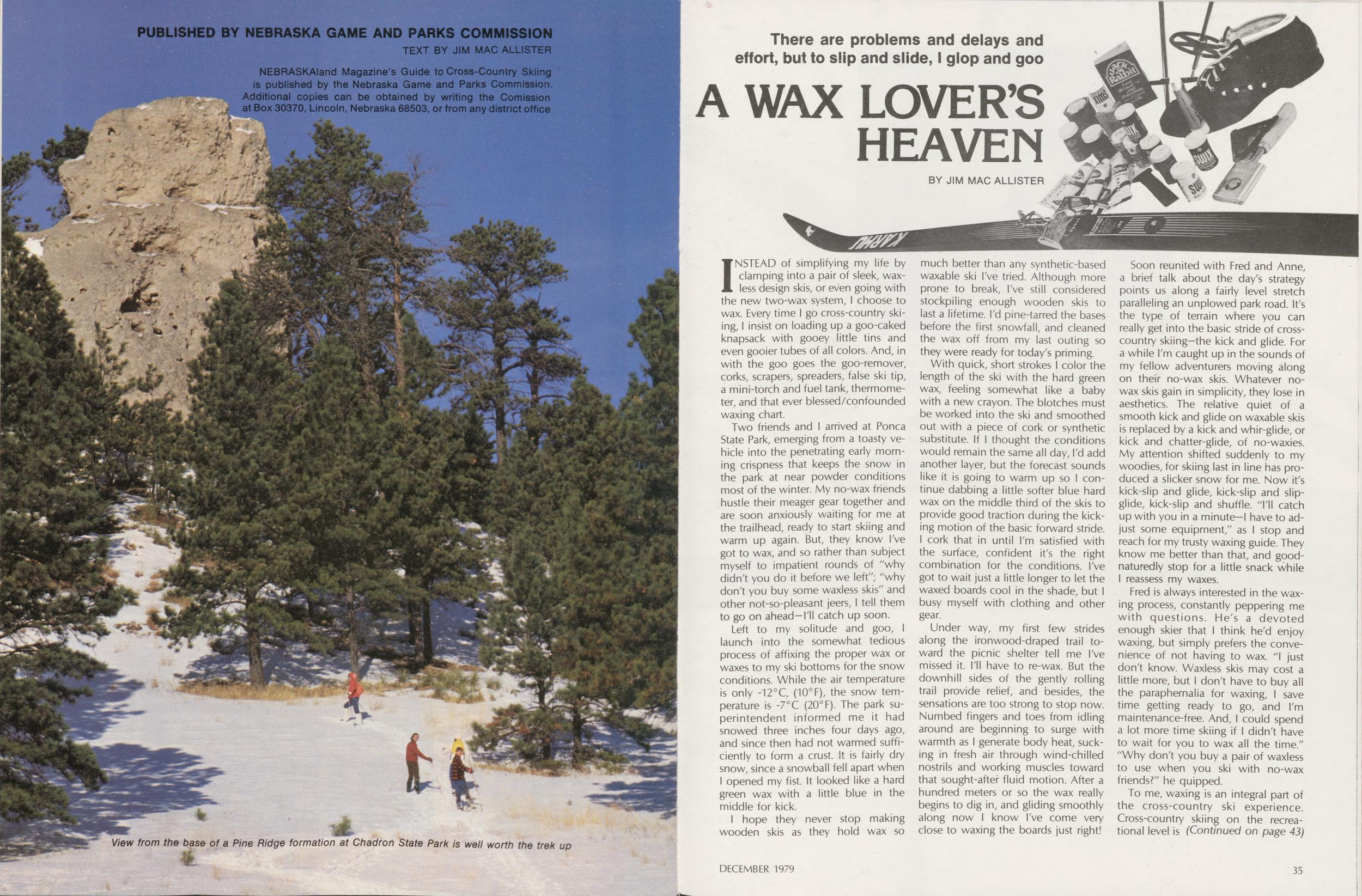
A WAX LOVER'S HEAVEN
INSTEAD of simplifying my life by clamping into a pair of sleek, waxless design skis, or even going with the new two-wax system, I choose to wax. Every time I go cross-country skiing, I insist on loading up a goo-caked knapsack with gooey little tins and even gooier tubes of all colors. And, in with the goo goes the goo-remover, corks, scrapers, spreaders, false ski tip, a mini-torch and fuel tank, thermometer, and that ever blessed/confounded waxing chart.
Two friends and I arrived at Ponca State Park, emerging from a toasty vehicle into the penetrating early morning crispness that keeps the snow in the park at near powder conditions most of the winter. My no-wax friends hustle their meager gear together and are soon anxiously waiting for me at the trailhead, ready to start skiing and warm up again. But, they know IVe got to wax, and so rather than subject myself to impatient rounds of "why didn't you do it before we left"; "why don't you buy some waxless skis" and other not-so-pleasant jeers, I tell them to go on ahead—111 catch up soon.
Left to my solitude and goo, I launch into the somewhat tedious process of affixing the proper wax or waxes to my ski bottoms for the snow conditions. While the air temperature is only -12°C, (10°F), the snow temperature is -7°C (20°F). The park superintendent informed me it had snowed three inches four days ago, and since then had not warmed sufficiently to form a crust. It is fairly dry snow, since a snowball fell apart when I opened my fist. It looked like a hard green wax with a little blue in the middle for kick.
I hope they never stop making wooden skis as they hold wax so much better than any synthetic-based waxable ski I've tried. Although more prone to break, I've still considered stockpiling enough wooden skis to last a lifetime. I'd pine-tarred the bases before the first snowfall, and cleaned the wax off from my last outing so they were ready for today's priming.
With quick, short strokes I color the length of the ski with the hard green wax, feeling somewhat like a baby with a new crayon. The blotches must be worked into the ski and smoothed out with a piece of cork or synthetic substitute. If I thought the conditions would remain the same all day, I'd add another layer, but the forecast sounds like it is going to warm up so I continue dabbing a little softer blue hard wax on the middle third of the skis to provide good traction during the kicking motion of the basic forward stride. I cork that in until I'm satisfied with the surface, confident it's the right combination for the conditions. I've got to wait just a little longer to let the waxed boards cool in the shade, but I busy myself with clothing and other gear.
Under way, my first few strides along the ironwood-draped trail toward the picnic shelter tell me I've missed it. I'll have to re-wax. But the downhill sides of the gently rolling trail provide relief, and besides, the sensations are too strong to stop now. Numbed fingers and toes from idling around are beginning to surge with warmth as I generate body heat, sucking in fresh air through wind-chilled nostrils and working muscles toward that sought-after fluid motion. After a hundred meters or so the wax really begins to dig in, and gliding smoothly along now I know I've come very close to waxing the boards just right!
Soon reunited with Fred and Anne, a brief talk about the day's strategy points us along a fairly level stretch paralleling an unplowed park road. It's the type of terrain where you can really get into the basic stride of cross-country skiing—the kick and glide. For a while I'm caught up in the sounds of my fellow adventurers moving along on their no-wax skis. Whatever no-wax skis gain in simplicity, they lose in aesthetics. The relative quiet of a smooth kick and glide on waxable skis is replaced by a kick and whir-glide, or kick and chatter-glide, of no-waxies. My attention shifted suddenly to my woodies, for skiing last in line has produced a slicker snow for me. Now it's kick-slip and glide, kick-slip and slipglide, kick-slip and shuffle. "I'll catch up with you in a minute—I have to adjust some equipment," as I stop and reach for my trusty waxing guide. They know me better than that, and goodnaturedly stop for a little snack while I reassess my waxes.
Fred is always interested in the waxing process, constantly peppering me with questions. He's a devoted enough skier that I think he'd enjoy waxing, but simply prefers the convenience of not having to wax. "I just don't know. Waxless skis may cost a little more, but I don't have to buy all the paraphernalia for waxing, I save time getting ready to go, and I'm maintenance-free. And, I could spend a lot more time skiing if I didn't have to wait for you to wax all the time." "Why don't you buy a pair of waxless to use when you ski with no-wax friends?" he quipped.
To me, waxing is an integral part of the cross-country ski experience. Cross-country skiing on the recreational level is (Continued on page 43)
DECEMBER 1979 35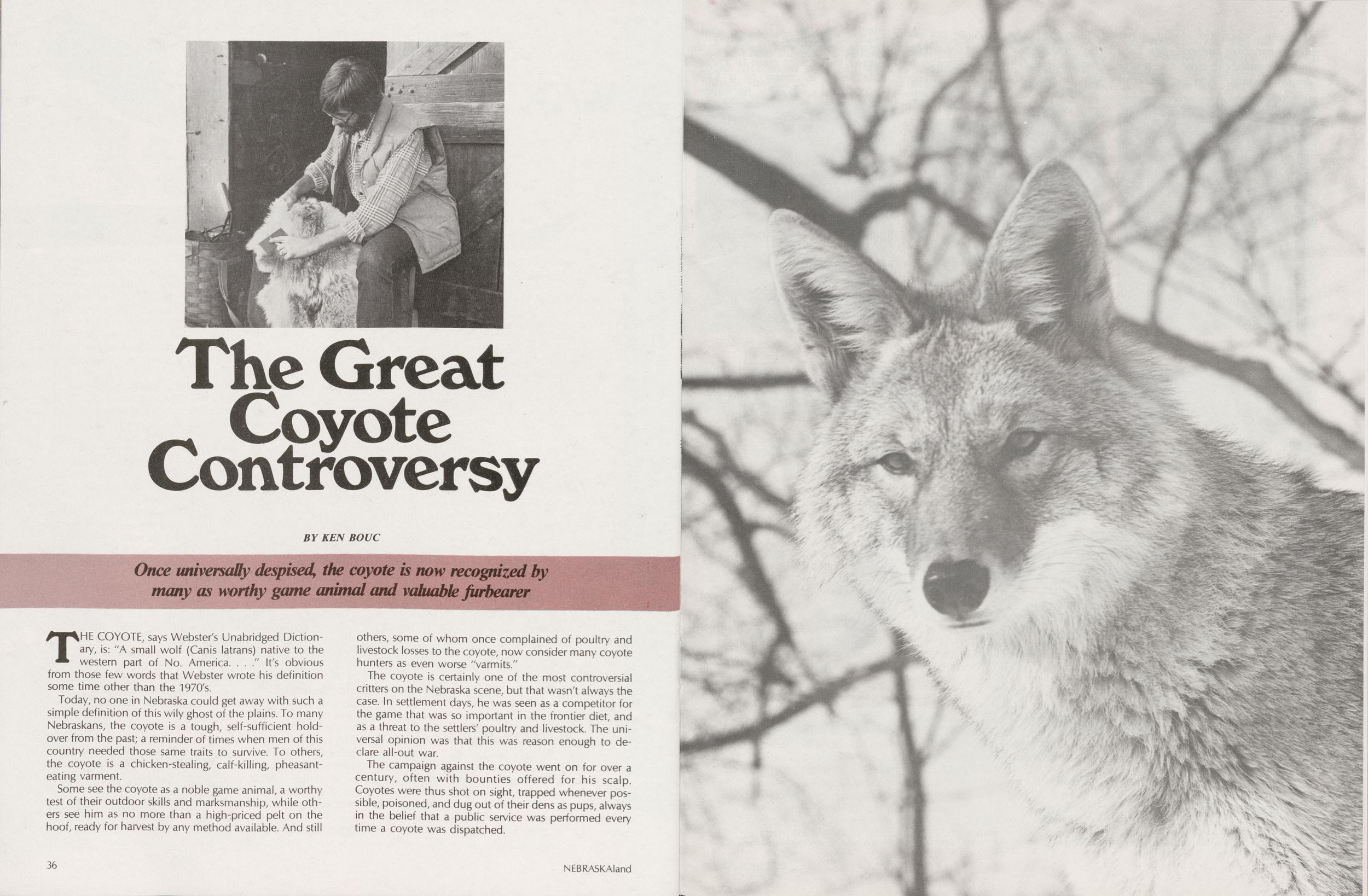
The Great Coyote Controversy
BY KEN BOUC universally despised, the coyote is now recognized by many as worthy game animal and valuable furbearerTHE COYOTE, says Webster's Unabridged Dictionary, is: "A small wolf (Canis latrans) native to the western part of No. America..." It's obvious from those few words that Webster wrote his definition some time other than the 1970's.
Today, no one in Nebraska could get away with such a simple definition of this wily ghost of the plains. To many Nebraskans, the coyote is a tough, self-sufficient hold-over from the past; a reminder of times when men of this country needed those same traits to survive. To others, the coyote is a chicken-stealing, calf-killing, pheasant-eating varment.
Some see the coyote as a noble game animal, a worthy test of their outdoor skills and marksmanship, while others see him as no more than a high-priced pelt on the hoof, ready for ha west by any method available. And still others, some of whom once complained of poultry and livestock losses to the coyote, now consider many coyote hunters as even worse "varmits."
The coyote is certainly one of the most controversial critters on the Nebraska scene, but that wasn't always the case. In settlement days, he was seen as a competitor for the game that was so important in the frontier diet, and as a threat to the settlers' poultry and livestock. The universal opinion was that this was reason enough to declare all-out war.
The campaign against the coyote went on for over a century, often with bounties offered for his scalp. Coyotes were thus shot on sight, trapped whenever possible, poisoned, and dug out of their dens as pups, always in the belief that a public service was performed every time a coyote was dispatched.
36 NEBRASKAland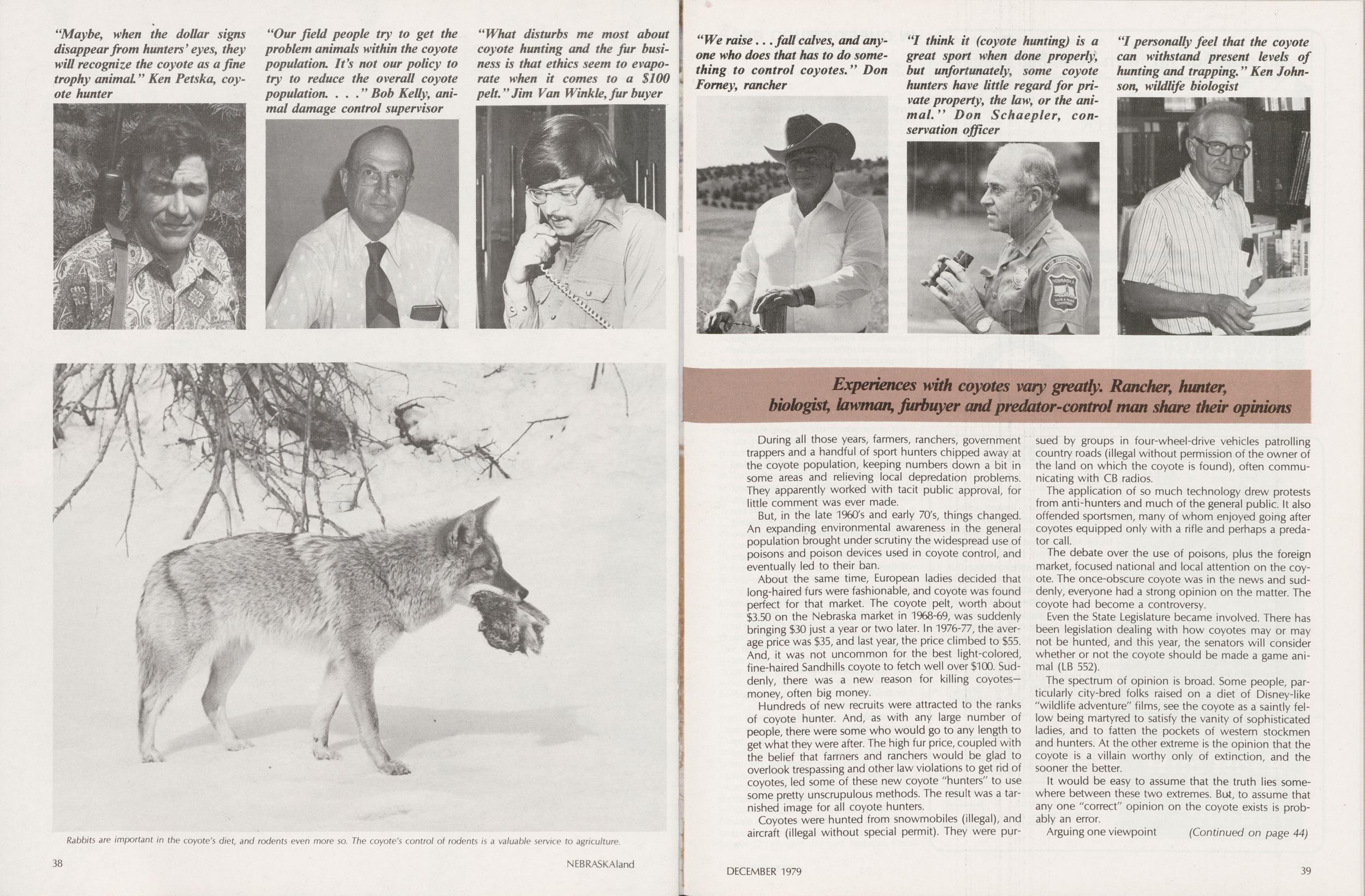
During all those years, farmers, ranchers, government trappers and a handful of sport hunters chipped away at the coyote population, keeping numbers down a bit in some areas and relieving local depredation problems. They apparently worked with tacit public approval, for little comment was ever made.
But, in the late 1960's and early 70's, things changed. An expanding environmental awareness in the general population brought under scrutiny the widespread use of poisons and poison devices used in coyote control, and eventually led to their ban.
About the same time, European ladies decided that long-haired furs were fashionable, and coyote was found perfect for that market. The coyote pelt, worth about $3.50 on the Nebraska market in 1968-69, was suddenly bringing $30 just a year or two later. In 1976-77, the average price was $35, and last year, the price climbed to $55. And, it was not uncommon for the best light-colored, fine-haired Sandhills coyote to fetch well over $100. Suddenly, there was a new reason for killing coyotes-money, often big money.
Hundreds of new recruits were attracted to the ranks of coyote hunter. And, as with any large number of people, there were some who would go to any length to get what they were after. The high fur price, coupled with the belief that farmers and ranchers would be glad to overlook trespassing and other law violations to get rid of coyotes, led some of these new coyote "hunters" to use some pretty unscrupulous methods. The result was a tarnished image for all coyote hunters.
Coyotes were hunted from snowmobiles (illegal), and aircraft (illegal without special permit). They were pursued by groups in four-wheel-drive vehicles patrolling country roads (illegal without permission of the owner of the land on which the coyote is found), often communicating with CB radios.
The application of so much technology drew protests from anti-hunters and much of the general public. It also offended sportsmen, many of whom enjoyed going after coyotes equipped only with a rifle and perhaps a predator call.
The debate over the use of poisons, plus the foreign market, focused national and local attention on the coyote. The once-obscure coyote was in the news and sud- denly, everyone had a strong opinion on the matter. The coyote had become a controversy.
Even the State Legislature became involved. There has been legislation dealing with how coyotes may or may not be hunted, and this year, the senators will consider whether or not the coyote should be made a game animal (LB 552).
The spectrum of opinion is broad. Some people, particularly city-bred folks raised on a diet of Disney-like "wildlife adventure" films, see the coyote as a saintly fellow being martyred to satisfy the vanity of sophisticated ladies, and to fatten the pockets of western stockmen and hunters. At the other extreme is the opinion that the coyote is a villain worthy only of extinction, and the sooner the better.
It would be easy to assume that the truth lies somewhere between these two extremes. But, to assume that any one "correct" opinion on the coyote exists is probably an error.
Arguing one viewpoint (Continued on page 44)
DECEMBER 1979 39
skis still vibrating from the pace and poles flailing for balance, I relaxed a little as I rounded the curve and headed for the flats. No sooner had I exhaled a sigh of relief at not going straight over the edge than I found myself snow-caked and slightly stunned in a heap near the bottom. It would happen to Mark and Brian at nearly the same spot, and only Quinn weathered the force to glide beyond us.
Down in the valley, the sun was no longer in sight, and we knew it would go down fast. None of us had come equipped for the rigors of night skiing, so we would not see the cave this day.
We climbed along a narrow trail to the Adirondack at the far end of Rock Bluff Run. It was so steep and narrow in places that we had to take off our skis. It was one hill we didn't want to ski down. But, we reached the summit as the sun began spreading a purplish-orange hue across the sky. Our decision to take the forest trails had proved costly in time, but exploring the naked jungle of Noyes Hollow, and the beautiful views from Rock Bluff Run had been well worth the trip.
It's amazing how fast the temperature drops in the winter when you're exposed on top of a bluff with a south wind picking up. At the same time, the perspiration generated from our most recent climb was sapping body heat away as it evaporated. We planted our skis in the snow and scrambled for firewood in the dying light. A small blaze finally flickered in the fire ring, and we huddled around it passing the last of the crunchies and cheese as we tried to dry wet socks and gloves before our nocturnal return. As the last bit of light withdrew from the sky, we looked toward the cave, which appeared so close, and vowed to return next year.
We followed the main road to the park entrance in moonless gloom. It was somewhat solemn, maintaining a brisk pace to generate body heat and with little talk amongst us. We fell into the car about 9 p.m., exhausted and numbed with cold yet extremely satisfied with the accomplishments of the outing. We'd left Lincoln about 12 hours before, and had explored at least 12 miles. We couldn't have picked a better day to return to Indian Cave the following year. We could have left a little earlier, but our 11 a.m. arrival wasn't too bad for an impromptu gathering, especially when Quinn and Brian were living in Omaha now. Little did we know that this might be the last get-together for skiing by the four of us for some time, for Quinn would soon take a job in Alaska, a place I envy him for because it must be a year-round skier's paradise
40 NEBRASKAland SAND COUNTRY RINGNECKS (Continued from page 15)performed according to our script, and without exception had dropped into the marsh where they should offer open shots.
Though the birds had dropped into a relatively small area of the marsh, the deep snow hanging over matted marsh plants provided the kind of security that a pheasant abandons grudgingly. Unless a dog or hunter stepped on a barred tail, they sat tight, and since the deep snow discouraged the birds from running, there probably was scant scent for the dogs to home in on. Near the north edge of the marsh one of the Labs started working and forced a rooster up that fell victim to Bill's 20-gauge over-and-under.
The way I had it figured, it was only a matter of time before bird scent started drifting around the marsh and the dogs would methodically pick it up. Incredibly, probably the only other party of pheasant hunters in Cherry County that day decided to hunt that same marsh, Now, most hunters are not particularly fond of crowding, especially in the western half of the state where they are seldom exposed to such situations, but Jim holds some rather extreme views on the subject. Any other hunter within range of 10X binoculars is too close, so we left the pheasants nestled in the marsh and cut southwest to the pickup.
Back at the truck we washed candy bars down with hot coffee to join the cowboy omelets that were for the most part still lumps of inert matter resting on the backsides of our stomachs.
About halfway back to Highway 83 we decided to run the dogs through one of the weedy valley bottoms and avoid any more large marshes. The snow cover was marked with a webwork of tracks, but I think we all suspected that they were made by hens, which seemed more inclined to seek seeds in the tracks of four-wheel-drive pickups. Two roosters flushed out of range and glided down undisturbed only 200 yards away. The complexion of the situation turned more rosy. We shifted over so that the dogs could take better advantage of the wind and closed the distance between the birds and ourselves. Exciting scents wafted on the breeze and quickened the dogs' pace. The first rooster made his bid for escape and like the one earlier in Dewey Marsh, fell to Bill's 20-gauge. We criss-crossed the area knowing that the two birds had dropped down within a few yards of each other. Still no bird. Jim swung back and walked close enough to the rooster hunkered under the snow that he could have poked it with the bead on his shotgun before it flushed. At a deadly, but not destructive, range his 20-gauge Model 12 upended the bird.
The day had broken clear and quite warm for mid December, the temperature somewhere in the mid-20's. By noon the wind had picked up, clouds rolled in from the north and the temperature fell. The dunking in Dewey Lake's springs left us wet as high as pants pockets and the labor of walking soaked us with sweat above the pockets. The attraction of the pickup's heater probably influenced our decision to pass several small marshes and a wooded area that marked the site of an old ranchstead. By the time we hit the Pony Lake area, though, dogs and hunters were mentally up for more snow. Jim had hunted several dense cedar plantings in that area with success in past years.
Bill and I were nearly to the trees and Jim right in the middle of them when a rooster flushed out on the lake side. From where Bill and I stood it looked like a sure bet that the rooster would survive the day but Jim found a hole through the willow branches and dropped him on the ice. The two Labs reached the rooster at precisely the same time, grabbed opposite ends of the bird at precisely the same time and retrieved the bird in tandem.
The remaining strip of shoreline cover produced a rooster and two hens that flushed out of range and disappeared into the cedar plantings. The Pony Lake area, for its small size, had provided some productive hunting, but there just wasn't enough of it. Dewey Lake Marsh, on the other hand, had been equally good in fostering pheasants but a marsh of that size with a heavy cover of snow had proven to be a monumental undertaking. What we needed was something in between. When Jim was fresh out of school he had eked out a living for a couple of years trapping several of the lakes on the Valentine Refuge and knew them in detail. It seemed like the type and size of area we were looking for.
Bill nudged the pickup up to the "trail closed" sign and we trudged over the hills to the west end of the lake. As we walked, the clouds drifted southeast and the sun emerged. The wind dropped and the late afternoon glowed yellow over the marsh. Sharptails were sitting confidently in the trees as we passed by and reluctantly glided off on silvery wings to search for rose hips and poison ivy berries to fuel their internal fire through the approaching night. Regardless of the fact that we drew our first blank of the day, flushed not even a pheasant of the drab gender, it was the finest hunt of the day.
 a binder
designed to get
you out of a bind
binder designed just for NEBRASKAland
Magazine. Easy-to-insert metal
rods hold each issue securely in place.
NEBRASKAland is a keeper. But,
the question is often just where and how.
Here's the answer...a sturdy, tan vinyl
Send order to:
NEBRASKAland Magazine
P.O. Box 30370
Lincoln, Nebr. 68503
Name
Check
Money Order
Street
City.
State
Zip.
SERVICE
63
SKI NEBRASKA
We're enthusiastic about Cross-country skiing because it's good
fun, whatever your age and wherever
you live. And it's great exercise for
downhill skiers.
We have everything you need to enjoy either Cross-Country or Downhill
skiing: dependable quality equipment for all skill levels, the top
brands in ski clothing, helpful ski
advisors, and a professional Service
Center (Downtown) staffed by certified mechanics. Like-new rental
equipment, too.
MH/LORS
GATEWAY 164 GALLERY/VWLL
LINCOLN CENTER 1118 O"
RATHBONE VILLAGE 32 & SOUTH
42
NEBRASKAland
a binder
designed to get
you out of a bind
binder designed just for NEBRASKAland
Magazine. Easy-to-insert metal
rods hold each issue securely in place.
NEBRASKAland is a keeper. But,
the question is often just where and how.
Here's the answer...a sturdy, tan vinyl
Send order to:
NEBRASKAland Magazine
P.O. Box 30370
Lincoln, Nebr. 68503
Name
Check
Money Order
Street
City.
State
Zip.
SERVICE
63
SKI NEBRASKA
We're enthusiastic about Cross-country skiing because it's good
fun, whatever your age and wherever
you live. And it's great exercise for
downhill skiers.
We have everything you need to enjoy either Cross-Country or Downhill
skiing: dependable quality equipment for all skill levels, the top
brands in ski clothing, helpful ski
advisors, and a professional Service
Center (Downtown) staffed by certified mechanics. Like-new rental
equipment, too.
MH/LORS
GATEWAY 164 GALLERY/VWLL
LINCOLN CENTER 1118 O"
RATHBONE VILLAGE 32 & SOUTH
42
NEBRASKAland
As we pulled back onto Highway 83 for Valentine, two roosters raced alongside the pickup before dropping down into the ditch and idly crossing under the fence. A full hour of shooting time remained but the dogs and hunters had apparently had enough of Sandhills ringnecks for one day.
Mentally I had been compiling bits of supporting evidence for my pheasant-hotspot theory all day, and on the way to town I shuffled them around a bit to see if I could support it. We had killed four roosters, should have picked up one or two more in Dewey Marsh had our plan proceeded uninterrupted, and driven by several legal roosters that could just aswell have been in the back of the truck. I thought back to a couple of fruitless eastern Nebraska hunts in recent years where in the early 1960/s it had been no chore to stuff three birds in a game bag in half a morning's hunt. I guess I ended that hunting season thinking my theory had some merit—relative to my pheasant hunting opportunities in the eastern part of the state the last two years, the Sandhills hunting stood out as fairly impressive.
I put my theory aside for the better part of a year and then browsed through some hunter success surveys in the Game Commission files thinking I would find the clincher to my theory; statistical proof that while success had eroded in eastern Nebraska since the early 1960's it had remained fairly stable in the Sandhills. I looked up the statewide pheasant kill for 1960 and 1961. Both years it was hovering right around a million birds. In 1976 it was estimated at slightly less than half a million; in 1977 slightly over half a million and during the 1978 season it climbed over three quarters of a million. Those figures alone surprised me a bit but still I thought my theory had a chance so I checked what percentage of the statewide kill came from the Sandhills region. That's where my balloon burst. In 1978 a little more than two percent of the harvest came from the Sandhills; in 1960 that figure was about two-and-a-half percent and in 1961 four percent. It seemed fairly obvious that pheasant hunting success in the Sandhills fluctuates with the statewide success. So I've revised my theory to more modest proportions. If you've got a big husky dog and go before the snow is deep enough to be troublesome, the Sandhills are as good a place to hunt pheasants as they were 20 years ago.
But I've got this new theory. You know there are quail up along middle and even upper reaches of the Loups and Elkhorn, not as many as in Nemaha County maybe, but some quail, that have seen so few hunting dogs that when one passes by they stick their heads up to see what it is, and if someone with a good pointer were to slip up there.
A WAX LOVER'S HEAVEN (Continued from page 35)a vehicle to (I almost hate to say it but it's true) "get away from it all", to enjoy the elements, the solitude, the beauty of winter. Waxing is a way to come in close contact with those elements; waxing is a challenge; waxing is a goal in itself.
The snow had warmed in the sun to -5°C (23°F), the breaking point between my green and blue hard wax. I can tell it's going to continue warming, so I extend and thicken the blue on the hickory bottoms. I leave the tips and tails in green for easy gliding.
I'm off while Ann is still putting away the cheese, and turn to say "Hey, am I going to have to wait all day for you guys?" Muffled curses are heard and a snowball whizzes past my ear. Wax and snow are working well together, and we break a little sweat striding along the level road in the warming sun. The tracks we've made look tempting, so Fred and I retrace them several times practicing our forward stride and gaining a full head of steam. It's amazing how much fun skiing on flat terrain can be.
After watching a run or two, Ann joined in the seemingly pointless diversion and strode out rather well. "This is what really makes the difference between cross-country and downhill skiing," she said. "It's almost more enjoyable than going downhill on skinny skis for me, because I'm not very stable going downhill on these things yet. However, I'm still not sold on skiing uphill." We hated to ruin her mood, but the stretch before us was a steady uphill climb through trees on a narrow trail.
The rise was gentle at first, yet I could feel some drag on my skis-a bad sign for a wax freak. Being in the shade, the snow along the trail was not as warm as when I last waxed. It was still in the green zone, so the snow was sticking to my blue wax. I had over-waxed.
The summit reached, we broke out the forest into an even warmer sun. It's one of those still late February days where the temperature climbs fast, signaling the beginning of the end for skiing. The snow melts fast in the day and freezes over at night, often making even a wax lover want to make a big bonfire of all the tins and tubes of goo.
The view on top looking over the forested bluffs and out to the Missouri River is too great not to enjoy for a while. It's after noon anyway, and we decide to lunch and recoup. It's also a good time to shed a layer of clothing in the increasing warmth, and—to re-wax.
Every manufacturer of ski waxes publishes its own neat little multicolored wax chart, generally showing a thermometer and showing which of their waxes to use for new-wet-powder-fluffy-falling snow, and for old-soggy-granular-crusty-coarse-icy snow. When you wax right, the chart is secured in the driest part of your outfit. When you wax wrong, the chart makes good kindling for a trailside fire.
We could see other skiers in the valley below, following our trail to the top. just as I reached for my 'waxsack', Fred said: "Well it's all downhill from here. At least you won't have to wax anymore."
The hill was definitely a thrill for all, although minor casualties prevented a second descent. Anne, the lady, was coaxed into going first. She lost control on the curve and injured her ego while dodging trees. I soon found out why she lost control, for after gaining sufficient speed and dropping into the Telemark position to turn, my tip broke through a crust under the most recent snow and I went headfirst for a ways. As I lay in a heap, I could hear the "whir-chatter" of Fred's no-waxies bearing down on me. I rolled out, he leaned and successfully banked around the curve, out of sight and sound.
Cautiously, Anne continued on down the hill while I gathered my wits. Like a pilot checking instruments before flight, I inventoried my gear. Sunglasses snow-caked and mangled, goo-sack lodged in the nape of my neck, snow melting down my back and up my sleeves, and one badly splintered bamboo ski pole. In my knapsack was everything except the roll of duct tape usually used for such emergencies.
The short jaunt down the remainder of the hill was navigated easily. Due to injured pride and equipment, and also from the somewhat exhausted yet satisfied feeling, we decided to call it a day. Striding back to the car was very enjoyable for me, despite the lack of one pole. The red hard wax was just right for the valley. Although I had to wax three times during the outing, I had reached a right combination at trail's end, which was much more gratifying than slipping and shuffling back to the car. The waxing lessons learned all go down as experience; something needed in a state where snow conditions can change so fast it's a wax lover's heaven.
COYOTE CONTROVERSY (Continued from page 39)against another in search of a truth that may not exist could cloud the issue and polarize the extremes. Examination of a range of opinions formed by men who have studied the coyote or shared the countryside with him for many years might provide more insight. Let's consider what a rancher, a wildlife biologist, a conservation officer, a coyote hunter (and farmer), a furbuyer, and an animal damage control man say about the coyote.
Don Forney of Lakeside raises cattle in sandhills and Pine Ridge country. His interest in game birds and wildlife habitat has prompted him to plant thousands of trees in shelterbelts on his land, and to stock as many as 700 pheasants in one year. In 1978, he was named the Lincoln journal-Star Conservationist of the Year. His years of experience as a rancher and his concern for wildlife have helped form his opinions on coyotes. His management of cattle and game on his land includes a vigorous coyote-control program, including aerial hunting (with a special permit) when necessary.
"My family has been ranching here for four generations, and in that time I believe we have come to understand what is happening on our land. We raise spring and fall calves, and anyone who does that has to do something to control coyotes," Forney claims.
He explained that fall calves are more vulnerable to coyotes than those born in the spring. "In the spring, cows are on hay, gathered in groups. Calves born then are protected by the group. But in the fall, the cows are on pasture, scattered all over the hills. A fall calf will eventually have to be left alone for a time while the cow goes to water. It's then that the coyotes make their move," he said.
He disputed some popular contentions that coyotes do very little harm to livestock. "Some people used to say that coyotes didn't kill sheep, but just about all of them are now convinced that they do. It'll be the same with calves. Some still say that coyotes don't kill calves, and they might be right about those born in the spring. But, coyotes definitely kill fall calves—I've seen it time and again. One day you'll see a cow nursing a healthy calf, and the next day the calf will be dead and eaten on by
Most calf losses are due to a few "killer" coyotes within the population, according to Forney. "Most coyotes don't have the ferocious disposition that makes a calf killer, but, all coyotes will kill smaller animals—mice, rabbits and, of course game birds like grouse, pheasants and turkeys.
"Coyotes figure heavily in the status of game bird populations in this area. When you cut the coyote population, sharptail numbers go up. Coyotes were down a bit the past two years and we had lots of grouse both seasons. Grouse nesting in the open have hail and wind and drought to contend with, and if there's one or two coyotes per section, they disturb nests, eat a lot of eggs, and also catch a sharptail now and then.
"It's the same with turkeys. In the days of the 'coyote getter' and coyote poisoning, the turkey population on our Pine Ridge land exploded. Now that those methods are outlawed, the coyotes are getting thicker and the turkeys are declining.
"A Disney movie with a coyote eating bugs and berries and an occasional mouse might make an entertaining program, but we have to face reality. We have a choice-either coyotes or game birds. Pheasants and grouse have the weather to keep them in balance with their habitat, but the only thing to keep the coyote in check is man. It simply boils down to whether you'd like to see coyotes or game."
Don Forney makes it perfectly clear that he'd rather have the game.
Ken Johnson is chief of the Came and Parks Commission's Wildlife Division. He grew up on a South Dakota farm and went to the University of Missouri to earn a B.S. degree in wildlife management, and a master's degree from Western Illinois University. He has been a wildlife biologist with the Came and Parks Commission since 1954, and chief of the Wildlife Division since 1971.
"Biologists, like other scientists, like to deal with facts as much as possible. But, in the case of the coyote, there are considerable gaps in our knowledge. For example, we have no way of knowing for sure how many coyotes there are in Nebraska, nor do we have an accurate method of determining annual change.
"Some things are apparent without a lot of studies. The coyote is a resourceful, highly adaptable animal. No other native animal has adapted so well to what's been done to this country since settlement. Not only has he survived the conquest of the prairie by the plow and the cow, he has weathered, even thrived under many adversities including government trappers, bounties and high fur prices that reduced the populations and ranges of other predators.
"Biologists have learned that coyote populations respond to heavy hunting, trapping and other control or eradication programs with increased reproduction. Studies suggest that when there is little or no pressure, the average litter may be only three or four pups, and not all females in the population will breed every year. But, when the population is reduced through control, litter size may jump to eight or nine pups, the survival of young goes up, and the percentage of females bearing young increases significantly.
"Studies also tell us the coyote will eat an amazing variety of things, but the staples are small mammals such as rabbits, mice, gophers and ground squirrels. They account for 65 to 75 percent of his food. The rest of his menu might include various birds, insects, fruits, and occasional domestic livestock and poultry.
"It's the livestock, poultry, and to a lesser extent the game birds in his diet that gets the coyote into trouble. There are undoubtedly livestock losses to coyotes, but it is pretty generally agreed that only a few animals are the culprits. Identifying and eliminating those animals is generally the solution to that problem.
"As far as game birds are concerned, predation is a factor with a high coyote population and if habitat is scarce and the birds concentrated. But, if habitat is abundant, predation is less important.
"It's my opinion that as long as we have coyotes, we are going to have some livestock losses to problem coyotes. Thus, we will continue to need some form of control directed both at the problem animal and to some degree at the coyote population in general.
"I think it is important to keep the general coyote population in check, because the higher the population, the more coyotes compete for rabbits, rodents and other natural foods. The losers in this competition are likely to seek another source of food, such as domestic animals.
"I would prefer that sport hunting accomplish the necessary control. As long as fur prices remain high, I think hunting will go a long way toward providing control. But no one knows how many of those who took up coyote hunting when the fur prices jumped, will stick with it for sport alone if the prices drop.
"The high fur prices and the resulting surge in coyote hunting has generated the idea among some people that the coyote might be overharvested and should be placed on the game list. Legislation is being considered right now that would make the coyote a game animal. Based on the limited information we have, I feel that the coyote can withstand present levels of hunting and trapping.
"Such legislation would enable us to get better information through surveys, and would provide the Commission with necessary management authority to better deal with the diverse problems associated with coyote hunting. Regardless of what happens to the legislation, the coyote will continue to be a complex and controversial animal," Johnson concluded.
Bob Kelly is supervisor of Nebraska's Animal Damage Control Program, a joint state-federal effort of the U.S. Fish and Wildlife Service and the Nebraska departments of Agriculture and Public Health, plus the University of Nebraska Cooperative Extension Service. Raised on farms and ranches in north Texas, Kelly is familiar with the coyote's role in agriculture. He holds degrees in agriculture, animal husbandry and wildlife. His professional experience includes four years as a big game biologist, and 76 years in animal damage control.
"During fiscal 1978, our field people responded to over $55,000 worth of confirmed coyote damage to cattle, sheep, swine, and poultry. But, that figure represents only what was reported to us, and that's only a fraction of the actual damage," says Kelly.
He called attention to a special report on livestock and chicken losses issued by the Nebraska Department of Agriculture in 1972. That document, prepared with data from a survey of farmers and ranchers, said that in one year, coyotes were responsible for $1.79 million in damages to livestock and poultry.
"Our function is to respond to animal damage. In the case of coyotes, our field people try to get the problem animals within the coyote population. It's not our policy to try to reduce the overall coyote population, but to reduce the farmer or rancher losses," Kelly said.
His program employs 15 district field assistants across the state. During 1978, they took 579 coyotes with traps, 144 by shooting from the ground, 285 by shooting from aircraft, 191 from dens, nine with snares, and 222 with the M-44, which is a special poison device available in Nebraska only to government animal damage-control personnel. They also dealt with damage caused by badgers, raccoons, dogs, skunks and other predators.
 DIMENSIONAL WOOD ART . .
Barns, Hotels, Churches, Schools, General Stores, Saloons, Ghost Towns, . . .
of the rural past, framed in weathered
barn siding. Unique wall hangings for the
home or office in limited editions. From
$50. Will ship anywhere in the continental United States. Write us for our detailed
brochure and price list.
Artists:
D.E. and C. Seger
Box 365
Fairbury, Nebraska 68352
WILDLIFE PRINT OF THE YEAR
Cardinal by James D. McClelland.
1980 NEBRASKA WILDLIFE
FEDERATION ART COMPETITION
WINNER
First in a series of
Special Limited
Editions.
All signed and numbered
by the artist.
THE ARTIST:
James D. McClelland, professor of
art at Union College in Lincoln,
Nebraska, also won the 1980 Habitat
Stamp competition. His work has been
exhibited at galleries and shows
throughout the state.
Image Size Vh x 10
Trim Size 11Vax14
Order Form
NAME
ADDRESS
CITY
ZIP
STATE
Mail to:
NEBRASKA
WILDLIFE FEDERATION
R.R. 1, Box 122
Firth, Nebr. 68358
Print(s) @ $35.00 each. Total print price $
Add $2.50 for handling. Nebraskans add sales tax plus tax for your area.
Total price $
Payment by check or money order Master Charge Visa
Account Number
Expiration Date
Signature (if credit card)
DIMENSIONAL WOOD ART . .
Barns, Hotels, Churches, Schools, General Stores, Saloons, Ghost Towns, . . .
of the rural past, framed in weathered
barn siding. Unique wall hangings for the
home or office in limited editions. From
$50. Will ship anywhere in the continental United States. Write us for our detailed
brochure and price list.
Artists:
D.E. and C. Seger
Box 365
Fairbury, Nebraska 68352
WILDLIFE PRINT OF THE YEAR
Cardinal by James D. McClelland.
1980 NEBRASKA WILDLIFE
FEDERATION ART COMPETITION
WINNER
First in a series of
Special Limited
Editions.
All signed and numbered
by the artist.
THE ARTIST:
James D. McClelland, professor of
art at Union College in Lincoln,
Nebraska, also won the 1980 Habitat
Stamp competition. His work has been
exhibited at galleries and shows
throughout the state.
Image Size Vh x 10
Trim Size 11Vax14
Order Form
NAME
ADDRESS
CITY
ZIP
STATE
Mail to:
NEBRASKA
WILDLIFE FEDERATION
R.R. 1, Box 122
Firth, Nebr. 68358
Print(s) @ $35.00 each. Total print price $
Add $2.50 for handling. Nebraskans add sales tax plus tax for your area.
Total price $
Payment by check or money order Master Charge Visa
Account Number
Expiration Date
Signature (if credit card)
According to Kelly, coyotes keep his men busy year-round. "There are problems during spring and fall calving, during the summer when turkeys are 'on range', and with swine all year," he said.
"There is no question among professional wildlife people that certain coyotes cause livestock damage. Unlike some other wildlife, the coyote generates a great deal of emotion and controversy. With some wildlife, the more the better. On the other hand, not everyone is in favor of having more coyotes."
Jim Van Winkle of Valentine has hunted and trapped coyotes since a lad, and has been involved in the buying and selling of furs nearly all of his business life. He started his fur company in 7977, one year after graduation from high school, and has expanded the operation to cover 15 states. His fur business, plus his gun and hunting equipment shop, give him unique access to the pulse of coyote hunting and the fur trade.
"What disturbs me most about coyote hunting and the fur business is that ethics seem to evaporate when it comes to a $100 pelt. No thought is given to the individual animal, or to the species as a whole," says Van Winkle. "There are a lot of good people in the field hunting coyotes, but there are also people using some pretty barbaric methods.
"The scramble for coyote hides has caused a lot of hard feelings between hunters and landowners in this area. Ranchers are tired of the trespassing by some hunters, and tired of the mercenary attitude. A lot of ranchers have a good deal of respect for the coyote, and the planes, snowmobiles, pickups, and CB radios 'turn off a lot of landowners who feel it's all unfair to the coyote," he said.
Van Winkle also noted that the coyote has evolved into a different animal since the price of his hide went up seven or eight years ago. "The coyote has become more intelligent, more elusive, more aware of the danger posed by men and vehicles. The coyote has to be getting smarter because the dumb ones don't survive long enough to reproduce," he noted.
The high fur price has also brought about a reduction in the Sandhills coyote population, though the decline is not a drastic one, according to Van Winkle. He is not sure what this hunting season will do to the coyote population, but says, "It would be a shame to see it much lower."
Whatever this winter and future winters have in store for the coyote depends heavily on the fur market, Van Winkle believes. "The majority of our furs are shipped overseas, and so much depends on the whims of fashion trend setters. If Continental tastes continue to lean toward long-haired furs, and there is every indication they will, then coyote prices will stay high. If the American dollar continues to decline in value on the overseas market, coyote prices will even go up. Any declines in prices that we see in the near future will 46 NEBRASKAland be small unless there is an abrupt about-face in fashion, or a world-wide economic upheaval," he predicted.
Even though he doesn't foresee it, Van Winkle knows, like others connected with coyote hunting and the fur business, that coyote prices will some day go down. He speculated about the status of coyotes and coyote hunting when that happens.
"I think a lot of people will stick with coyote hunting just for sport. When the dollars are taken out of the picture, they will see the coyote for what he really is—a great game animal, a real challenge for anyone using sporting methods. Perhaps then the coyote will be given the respect due him; something that was denied him when he got mixed up with big money."
Ken Peiska of Ord is a coyote hunter and trapper who also deals with this animal as a farmer and furbuyer. He has hunted coyotes for sport since the 1950% and rates it as one of Nebraska's top trophies. He is a past president of the Nebraska Council of Sportsmen's Clubs, past president of the Nebraska Fur Harvesters Association, and recipient of the Lincoln Journal-Star Conservationist of the Year award.
"The coyote is a fantastic game animal; one of the finest trophies there is," says Petska. "He ranks with the deer or the elk as a challenge to a hunter's skill."
Petska has been hunting coyotes with a rifle since the mid 1950/s and, in more recent years, has also been taking them with traps. "I've seen the hunting pressure on coyotes grow from almost nothing in the '50's, when they were worth $2.50 in bounty, to extremely high levels because of today's high fur prices.
"Back then, just one shot at a coyote, or even a quick glimpse of one, amounted to a pretty good day's hunt. There didn't seem to be many. In more recent years, there seems to be a hunter on every hill and they're all taking coyotes." All this pressure has educated the coyote, according to Petska. "We're dealing with an entirely different critter than I hunted in the 50's. The running coyote has joined the flying pheasant as a relic of the past. Just as the pheasant that flushed at the hunter's feet has been culled from the population, so has the coyote that runs cross-country at the approach of man or vehicle. Today, hunting has changed both into crafty critters that realize the danger of exposing themselves.
"For a long time I have wondered how the coyote copes with such great hunting pressure. For a time in the 1960% I was involved with a group that hunted coyotes with airplanes, but we quit because we worried about hurting the coyote population.
"Since then, high fur prices have increased the coyote harvest in this area to many times what we were taking. With all that pressure, I thought the coyotes would all be dead, and I've been predicting their downfall for 10 years. But, each year they make a liar out of me. This summer and fall, I've seen nearly as many tracks as ever around here, and last winter I thought they'd killed the last coyote in the country", Petska said.
Fur prices not only influence the number of hunters, but the techniques used, he believes. "I know there are some pretty unscrupulous methods used to take coyotes. Maybe, when the dollar signs disappear from hunters' eyes, they will recognize the coyote as a fine trophy animal. I don't like to force my values upon other people, but I don't like to see coyotes harassed and taken in an unsportsmanlike manner. They deserve better.
"That doesn't necessarily mean that I think the coyote should be made a game animal by law. I think we all get a little tired of more regulations and laws, and I don't think it's possible to legislate sportsmanship and ethics, anyway. The coyote has gotten along for a long time without game-animal status, so I wonder if it is necessary. Of course, if such a law does prove necessary some day, then I'll work for it.
Don Schaepler has been around coyotes all his life. He was born and reared on a Nebraska farm, and farmed on his own for 12 years before becoming a conservation officer. He spent 17 years as a "field game warden", most of it patrolling 3,000 square miles in Frontier, Red Willow, Furnas and Cosper counties. For the past three years, he has been assigned to Lincoln, supervising conservation officers in southeast Nebraska and assisting in administration of the Came and Parks Commission's Law Enforcement Division
"It would be a sad day if you could go camping or fishing in Nebraska and not hear a coyote howl in the evening now and then," says Schaepler. "I've always respected the coyote. There isn't an animal in Nebraska as intelligent, as crafty or as adaptable. He deserves a lot of respect.
"I realize that not everyone shares my admiration. I know that a coyote sometimes acquires a taste for livestock or poultry, and I'm sure they take young deer
"I'm also all for coyote hunting. I think it's a great sport when done properly, but unfortunately, some coyote hunters have little regard for private property, the law, or the animal.
"Before coyote pelts became so valuable, coyote hunting was a low-key sport enjoyed by a few predator callers, hound men, and sharp-shooting varment hunters. There wasn't much competition for animals, and less likelihood of taking undue liberties with private property, game laws, or the ethics of fair chase.
"But today, some lose all reason in pursuit of a coyote. They tend to take more liberties because they're often local folks. They'll see a coyote running off, and they go after it without the landowner's per- mission. 'This is Old Joe's pasture. He won't care,' they think to themselves. Well, chances are that Old Joe does care, even though he might not complain of the trespass to the sheriff or conservation officer.
"If coyote hunters are to improve their image, that's the first thing they should work on. They must get permission in advance from a landowner before entering his property. It's the courteous thing to do, and its also the law.
"Riding herd on coyote hunters occupies a big share of our conservation officers' time, even though the sport contributes nothing toward their salaries or expenses. Resident coyote hunters are not required to purchase a hunting permit or habitat stamp, since the coyote is presently a non-game animal.
"It's been suggested that, if the coyote were made a game animal as called for in some proposed legislation, the additional permit sales could pay the costs of policing coyote hunters. However, closer study of the matter tells us that very few additional licenses would be purchased, since most coyote hunters also hunt game species and already have permits.
"If there is any benefit to such a law, I imagine it would be the increased data available for managing the coyote. Legal game status might also help instill more respect for this animal.
"But, I don't think any law is needed to protect the coyote from extinction, as long as extreme methods are not used. I don't think man is smart enough to deplete the coyote population without using airplanes, poison, or snowmobiles. If all the coyote has to face is conventional hunting and trapping, Nebraska outdoorsmen will always be able to listen to an evening coyote serenade."
DECEMBER 1979 47 NU-WAY
Ice Fishing Stove
$19.88
( #ON-129-IFS ) - - NU-WAY Model 965.
Compact, measures only 14" x 12" x 7". Burns
charcoal, wood or coal. Use it in ice fishing
shanties or tents. Fuel door and ash removal door
have stay-cool handles. Uses 3" diameter
chimney pipe ( not furnished ). Shpg. wt. 9 lbs.
Ice Fishing Auger
FIN-BORE II
Clean Cutting — Fast
Swedish Steel Cutting Blade
$33.88
( #ON-129-IFA ) - - Drills 6"
diameter hole in ice quickly, easily
( up to 25" deep in 15-seconds ).
Knocks down to 31" x 12" for
easy transporting. Double offset
handle for high speed cutting.
• Electrically tempered, Swedish steel cutting
blade with two cutting edges. Auger flights push
ice chips out of hole. Overall length ( assembled )
61-1/2". Shpg. wt. 8 lbs.
6 and 12-Volt Automatic
10-Amp. Battery Charger
FOR:
Farm
Home
Garage
Business
$32.95
( #ON-129-ABC ) - - SCHAUER ( CR-612 )
solid state charger charges either 6 or 12-volt
batteries at 10-ampere rate. Shuts off
automatically when full charge is reached, turns
on when additional charge is needed. Equipped
with charge rate ammeter, battery leads with
terminal clamps. Operates from 115-VAC. Shpg.
wt. 14 lbs.
MAIL ORDER CUSTOMERS, PLEASE READ
NEBRASKA CUSTOMERS MUST INCLUDE SALES TAX
30% DEPOSIT REQUIRED ON C.O.D. ORDERS
INCLUDE ENOUGH MONEY TO COVER SHIPPING
COSTS and INSURANCE ( We Refund All Excess
Remittances Promptly )
VISA and MASTERCHARGE CREDIT CARD
ORDERS ACCEPTED ( When Accompanied With
Signature and Required Information )
RETAIL STORE ADDRESS: 1000 West "0" St.
OUR TELEPHONE: ( 402 ) 435-4366
CAMP TRAILS "Dry Sack"
Mummy Sleeping Bag
( #ON 129-DSR )
Regular Size
5'-ll",55oz. fill
( #ON 129-DSL )
Long Size
6-5", 60 oz. fill
$75.98 $77.98
CAMP TRAILS "Dry Sack" mummy style bag
features Polarguard insulation and cold protection
down to 10° F. Double pull YKK zipper allows two
bags to be zipped together.* Weather seal along
zipper shuts out drafts. Shpg. wt. 5 lbs.
CAMP TRAILS "Super Sage"
Mummy Sleeping Bag
( #ON-129-SSR )
Regular Size
5-11 ", 70 oz. fill
( #ON-129-SSL )
Long Size
6-5", 75 oz. fill
$79.98 $82.50
"Super Sage" is CAMP TRAILS warmest bag,
featuring 9 layers of Polarguard insulation.
Designed especially for winter camping. 5 top
layers and 4 layers on bottom. Available with left
or right zippers. Two bags can be zipped
together.* Comfort range down to minus 10° F.
Shpg. wt. 6-1/2 lbs.
The CAMP TRAILS bags shown here are available
with either right or left zippers. To zip two
together a right must be mated with a left. For
individual use we recommend right handed
persons to order left zippers and vice versa.
WHITE STAG "Monterey"
Rectangular Sleeping Bag
( #ON-129-MBA )
2-1/2 lb. Holiofil SI
( tON-129-MBB )
3-1/2 lb. Holiofil II
$26.98 $29.98
The "Monterey" series by WHITE STAG
features Holiofil II, Dacron fiberfill with 35° F.
( 2-1/2 lbs. ) and 20°F. ( 3-1/2 lbs. ) comfort
ratings. Full zipper permits two to be zipped
together. Ripstop nylon shell, nylon taffeta
lining, roll-up straps. Finished size 33" x 81".
Shpg. wt. each 6 lbs.
Shpg. wt. 7 lbs.
( ION-129-BRB )
Model 342, .22 cal.
RIFLE - Single Shot
( #ON-129-BRP )
Model 347,.177 cal.
$51.88 $51.88
Shpg. wt. 2-1/2 lbs.
PISTOL
Single
Shot
( ION-129-BPB ) ( #ON-129-BPP )
Model 132, .22 cal. Model 137, .177 cal.
$42.50 $42.50
• BENJAMIN air rifles and pistols are famed for
accuracy, durability, safety. Time tested action
and other features make them a top choice.
Finest quality materials and workmanship and fair
prices. For target shooting or small game.
BENJAMIN Air Power Guns
COPAL "Mini-Alarm"
Quartz Travel Clock
SUPER
ACCURATE
BEEP
ALARM
$17.49
( #ON-129-QTC ) - - COPAL Model HQ255.
Super-accurate, mini-size travel alarm clock.
Splendid gift for traveling salesmen, for vacation
travel, etc. Operates on a single 1.5-volt "AA"
penlite alkaline cell. ( not furnished ) Quartz
crystal accuracy to within a few seconds per
month. Black case, black face, luminuous hands
and hour dots. Large white numerals, sweep
second hand. Alarm ON-OFF switch. "Beep"
alarm. Battery will last approximately 1-year.
Complete with instructions and vinyl travel case.
2-3/4" x 2-112" x 1-1 /4". Shpg. wt. 12 oz.
50,000 BTU Portable
Forced Air Heater
M50A
$159.95
( #ON-129-KRH ) - - KOEHRING "Reddy
Heater" Model M50A provides 50,000 BTU's of
forced air heat in seconds. Use to heat garages,
workshops, and other unheated areas.
Very economical. Burns kerosene or #1 fuel oil.
Blower and automatic ignition operate from
standard electrical outlet. No special installation
necessary. Just put it where you want heat.
30" x 16" x 11". Shpg. wt. 40 lbs.
TASCO Binoculars
7x50 with "Zip Focus"
• ( #ON-129-ZFB ) - - TASCO Model 306-S
binoculars feature center focus with "zip"
feature that gives you faster focusing to better
follow the quick action of sports, wildlife, etc.
7-power with 50mm objectives, rubber eyecups,
diopter index, interpupilary adjust. Field of view
372 ft. at 1000 yds. Furnished with case and
straps. Shpg. wt. 6 lbs.
FROM THE MANAGEMENT AND STAFF
OF SURPLUS CENTER
SOREL Boot Pacs
The finest cold weather sport and work boots
you can buy. Finest quality materials and
workmanship. Used and tested by the historic
Plaisted North Pole Expedition. SORELS are the
best boot for warmth and comfort in cold and sub
zero cold conditions.
SOREL 10" PREMIUM
The Boot Pac That Sets
The Standard By Which
The Competitors Must
Be Judged
$36.98
( #ON-129-SPP ) - - The standard boot for
Canadian hunters, trappers, woodcutters,
sportsmen, etc. Removeable pure wool felt liner,
premium leather uppers with rolled top and
pull-on loop. Tough, rubber bottoms with long
wearing non-skid soles and heels. Full lace-up
style. Sizes 6 to 14. Shpg. wt. 6 lbs.
SOREL 10" CARIBOU
For Those Who Want
Style Plus All The
Warmth And Comfort
$49.88
( #ON-129-SCP ) - - Premium leather uppers
with the SOREL rubber bottoms plus lug type
rubber soles and heels. Removeable wool felt
liner has shearling top. Speed lacing. Sizes 6 to
14. Shpg. wt. 6 lbs.
Wool-
Nylon
Blankets
$18.98
( #ON-129-JPB ) - - JACK PINE ( Litchfield
Woolen Mills ) 72" x 90" blankets are a blend of
85% wool, 15% nylon. Luxuriously soft. Double
overstitched ends. Ideal camping blanket, for
youngster's rooms, stadium blanket, car robe, for
motels, hotels, etc. Average weight 4 to 4-1/4
lbs. Choice of colors: Tan, green, or blue.
PLANO
Tackle
Box
Reg. Sale
$24.88
$19.88
( ION-129-PTB ) - - PLANO Model 737. 4
worm-proof drawers, 26 basic compartments.
Front panel drops down and slides under bottom
drawer. Deep bottom drawer holds reels, etc.
16-1I A" x 10-5/8" x 8-112". Shpg. wt. 9 lbs.
!£*!
5-Gallon
G.I. Gas Can
( ION-129-GGC )
5-Gal. Gas Can
$14.95
( ION-129-GCN )
Clamp On Nozzle
$2.69
New, 5-gallon gasoline con with
bulit-in carrying handle and loss-proof screw-in type cap. 20-ga.
steel. 18-1/2" x 14" x 6-1/4".
Shpg. wt. 12 lbs. Nozzle is flexible
steel ( clamp-on type ). Shpg. wt. 2
lbs. Use for trucks, jeeps, RV's, etc.
SURPLUS CENTER Dept. ON-129 Lincoln, Ne. 68501
NU-WAY
Ice Fishing Stove
$19.88
( #ON-129-IFS ) - - NU-WAY Model 965.
Compact, measures only 14" x 12" x 7". Burns
charcoal, wood or coal. Use it in ice fishing
shanties or tents. Fuel door and ash removal door
have stay-cool handles. Uses 3" diameter
chimney pipe ( not furnished ). Shpg. wt. 9 lbs.
Ice Fishing Auger
FIN-BORE II
Clean Cutting — Fast
Swedish Steel Cutting Blade
$33.88
( #ON-129-IFA ) - - Drills 6"
diameter hole in ice quickly, easily
( up to 25" deep in 15-seconds ).
Knocks down to 31" x 12" for
easy transporting. Double offset
handle for high speed cutting.
• Electrically tempered, Swedish steel cutting
blade with two cutting edges. Auger flights push
ice chips out of hole. Overall length ( assembled )
61-1/2". Shpg. wt. 8 lbs.
6 and 12-Volt Automatic
10-Amp. Battery Charger
FOR:
Farm
Home
Garage
Business
$32.95
( #ON-129-ABC ) - - SCHAUER ( CR-612 )
solid state charger charges either 6 or 12-volt
batteries at 10-ampere rate. Shuts off
automatically when full charge is reached, turns
on when additional charge is needed. Equipped
with charge rate ammeter, battery leads with
terminal clamps. Operates from 115-VAC. Shpg.
wt. 14 lbs.
MAIL ORDER CUSTOMERS, PLEASE READ
NEBRASKA CUSTOMERS MUST INCLUDE SALES TAX
30% DEPOSIT REQUIRED ON C.O.D. ORDERS
INCLUDE ENOUGH MONEY TO COVER SHIPPING
COSTS and INSURANCE ( We Refund All Excess
Remittances Promptly )
VISA and MASTERCHARGE CREDIT CARD
ORDERS ACCEPTED ( When Accompanied With
Signature and Required Information )
RETAIL STORE ADDRESS: 1000 West "0" St.
OUR TELEPHONE: ( 402 ) 435-4366
CAMP TRAILS "Dry Sack"
Mummy Sleeping Bag
( #ON 129-DSR )
Regular Size
5'-ll",55oz. fill
( #ON 129-DSL )
Long Size
6-5", 60 oz. fill
$75.98 $77.98
CAMP TRAILS "Dry Sack" mummy style bag
features Polarguard insulation and cold protection
down to 10° F. Double pull YKK zipper allows two
bags to be zipped together.* Weather seal along
zipper shuts out drafts. Shpg. wt. 5 lbs.
CAMP TRAILS "Super Sage"
Mummy Sleeping Bag
( #ON-129-SSR )
Regular Size
5-11 ", 70 oz. fill
( #ON-129-SSL )
Long Size
6-5", 75 oz. fill
$79.98 $82.50
"Super Sage" is CAMP TRAILS warmest bag,
featuring 9 layers of Polarguard insulation.
Designed especially for winter camping. 5 top
layers and 4 layers on bottom. Available with left
or right zippers. Two bags can be zipped
together.* Comfort range down to minus 10° F.
Shpg. wt. 6-1/2 lbs.
The CAMP TRAILS bags shown here are available
with either right or left zippers. To zip two
together a right must be mated with a left. For
individual use we recommend right handed
persons to order left zippers and vice versa.
WHITE STAG "Monterey"
Rectangular Sleeping Bag
( #ON-129-MBA )
2-1/2 lb. Holiofil SI
( tON-129-MBB )
3-1/2 lb. Holiofil II
$26.98 $29.98
The "Monterey" series by WHITE STAG
features Holiofil II, Dacron fiberfill with 35° F.
( 2-1/2 lbs. ) and 20°F. ( 3-1/2 lbs. ) comfort
ratings. Full zipper permits two to be zipped
together. Ripstop nylon shell, nylon taffeta
lining, roll-up straps. Finished size 33" x 81".
Shpg. wt. each 6 lbs.
Shpg. wt. 7 lbs.
( ION-129-BRB )
Model 342, .22 cal.
RIFLE - Single Shot
( #ON-129-BRP )
Model 347,.177 cal.
$51.88 $51.88
Shpg. wt. 2-1/2 lbs.
PISTOL
Single
Shot
( ION-129-BPB ) ( #ON-129-BPP )
Model 132, .22 cal. Model 137, .177 cal.
$42.50 $42.50
• BENJAMIN air rifles and pistols are famed for
accuracy, durability, safety. Time tested action
and other features make them a top choice.
Finest quality materials and workmanship and fair
prices. For target shooting or small game.
BENJAMIN Air Power Guns
COPAL "Mini-Alarm"
Quartz Travel Clock
SUPER
ACCURATE
BEEP
ALARM
$17.49
( #ON-129-QTC ) - - COPAL Model HQ255.
Super-accurate, mini-size travel alarm clock.
Splendid gift for traveling salesmen, for vacation
travel, etc. Operates on a single 1.5-volt "AA"
penlite alkaline cell. ( not furnished ) Quartz
crystal accuracy to within a few seconds per
month. Black case, black face, luminuous hands
and hour dots. Large white numerals, sweep
second hand. Alarm ON-OFF switch. "Beep"
alarm. Battery will last approximately 1-year.
Complete with instructions and vinyl travel case.
2-3/4" x 2-112" x 1-1 /4". Shpg. wt. 12 oz.
50,000 BTU Portable
Forced Air Heater
M50A
$159.95
( #ON-129-KRH ) - - KOEHRING "Reddy
Heater" Model M50A provides 50,000 BTU's of
forced air heat in seconds. Use to heat garages,
workshops, and other unheated areas.
Very economical. Burns kerosene or #1 fuel oil.
Blower and automatic ignition operate from
standard electrical outlet. No special installation
necessary. Just put it where you want heat.
30" x 16" x 11". Shpg. wt. 40 lbs.
TASCO Binoculars
7x50 with "Zip Focus"
• ( #ON-129-ZFB ) - - TASCO Model 306-S
binoculars feature center focus with "zip"
feature that gives you faster focusing to better
follow the quick action of sports, wildlife, etc.
7-power with 50mm objectives, rubber eyecups,
diopter index, interpupilary adjust. Field of view
372 ft. at 1000 yds. Furnished with case and
straps. Shpg. wt. 6 lbs.
FROM THE MANAGEMENT AND STAFF
OF SURPLUS CENTER
SOREL Boot Pacs
The finest cold weather sport and work boots
you can buy. Finest quality materials and
workmanship. Used and tested by the historic
Plaisted North Pole Expedition. SORELS are the
best boot for warmth and comfort in cold and sub
zero cold conditions.
SOREL 10" PREMIUM
The Boot Pac That Sets
The Standard By Which
The Competitors Must
Be Judged
$36.98
( #ON-129-SPP ) - - The standard boot for
Canadian hunters, trappers, woodcutters,
sportsmen, etc. Removeable pure wool felt liner,
premium leather uppers with rolled top and
pull-on loop. Tough, rubber bottoms with long
wearing non-skid soles and heels. Full lace-up
style. Sizes 6 to 14. Shpg. wt. 6 lbs.
SOREL 10" CARIBOU
For Those Who Want
Style Plus All The
Warmth And Comfort
$49.88
( #ON-129-SCP ) - - Premium leather uppers
with the SOREL rubber bottoms plus lug type
rubber soles and heels. Removeable wool felt
liner has shearling top. Speed lacing. Sizes 6 to
14. Shpg. wt. 6 lbs.
Wool-
Nylon
Blankets
$18.98
( #ON-129-JPB ) - - JACK PINE ( Litchfield
Woolen Mills ) 72" x 90" blankets are a blend of
85% wool, 15% nylon. Luxuriously soft. Double
overstitched ends. Ideal camping blanket, for
youngster's rooms, stadium blanket, car robe, for
motels, hotels, etc. Average weight 4 to 4-1/4
lbs. Choice of colors: Tan, green, or blue.
PLANO
Tackle
Box
Reg. Sale
$24.88
$19.88
( ION-129-PTB ) - - PLANO Model 737. 4
worm-proof drawers, 26 basic compartments.
Front panel drops down and slides under bottom
drawer. Deep bottom drawer holds reels, etc.
16-1I A" x 10-5/8" x 8-112". Shpg. wt. 9 lbs.
!£*!
5-Gallon
G.I. Gas Can
( ION-129-GGC )
5-Gal. Gas Can
$14.95
( ION-129-GCN )
Clamp On Nozzle
$2.69
New, 5-gallon gasoline con with
bulit-in carrying handle and loss-proof screw-in type cap. 20-ga.
steel. 18-1/2" x 14" x 6-1/4".
Shpg. wt. 12 lbs. Nozzle is flexible
steel ( clamp-on type ). Shpg. wt. 2
lbs. Use for trucks, jeeps, RV's, etc.
SURPLUS CENTER Dept. ON-129 Lincoln, Ne. 68501
Trading Post
DOGS(PR) BLUETICK PUPS-Smoky River breeding. Parents are stay-put tree dogs. Guaranteed at eight months. Jerry Speck, RFD #2, Wahoo NE 68066. (402) 443-5451.
BRirTANY SPANIEL pups-training well started, 6 months old. Marion North, Rt. 1, York, NE 68467. (402) 362-2663.
GERMAN SHORTHAIR pups, 4 months; Black Labs, 7 months; Yellow Labs, 2 months. Also Irish Setters, all ARC. Registered. $40 each. Roland Everett, Atkinson, NE 68713.
MISCELLANEOUSWAX WORMS: 500-$8; 1000-$14, postpaid. Add 3% sales tax. No COD. Harold Malicky, Burwell, NE 68823.
GIVE A UNIQUE GIFT for Christmas' Give land or become a landowner on the Niobrara. You and yours can own an undivided interest in an acre of Niobrara Valley land near Rocky Ford. Your purchase will help protect Nebraska's most scenic river for future generations. Act now! For the balance of 1979, all land purchasers will receive a colorful poster-map of the Niobrara Valley near Valentine. For your registered deed and map send $25 to: Save the Niobrara River Assn., 1329 Dawes, Lincoln, NE 68521.
GUNS-Browning, Winchester, Remington, others, Hi-powers, shotguns, new, used, antiques. Want Pre-1964 Winchesters. Buy-Sell-Trade. Ph. (402) 729-6112. Bedlan's Sporting Goods, Fairbury, NE 68352.
DUCK HUNTERS: learn how to make quality, solid plastic, waterfowl decoys. We're originators of famous system. Send. $1 for colorful catalog. Decoys Unlimited, Clinton, Iowa 52732
HAND-REARED WILD DUCKS: Wood ducks, Mandarins and European Wigeons. Mrs. R. W. Hansen, 3315 Ave L, Kearney, Nebr. 68847
ATTENTION-HUNTERS and fishermen, 1-bedroom home for sale in Lewellen, Nebr. Ideal for summer home, for couple or small family close to good fishing and hunting. Contact Betty Feusner-(308) 284-3452.
Delivered to your home or even your deserted island TAXIDERMYBIG BEAR TAXIDERMY, Rt. 2, Mitchell, Nebraska 69357 We specialize in all big game from Alaska to Nebraska, also birds and fish. Hair on and hair off tanning, 4V2 miles west of Scottsbluff on Highway 26. Phone (308) 635-3013.
KARL SCHWARZ Master Taxidermists. Mounting of game heads-birds —fish- animals—fur rugs- robes — tanning buckskin. Since 1910. 424 South 13th Street, Dept. A, Omaha, Nebraska 68102.
FREEZE-DRY TAXIDERMY Wally Allison's State Record Taxidermy, 2709 Birchwood, North Platte, NE 69101 Phone: (308) 534-2324. Specializing in Fish and Small Game, Snake and Lizard and Novelties. (Nothing too small) Newest of all taxidermy methods employed.
CREATIVE TAXIDERMY-AII types work since 1935 now includes Freeze-Dry processing of approved small specimens. Naturecraft Studio, 925 Fourth Corso, Nebraska City, Nebraska 68410. Phone: (402) 873-5491. Joe Voges-Owner.
"AWARD-WINNING Taxidermist. Trust your trophies to a proven winner. Our complete taxidermy service also books hunts anywhere in the world. Dinges Taxidermy, 2760 South 12th, Omaha, NE 68108 Phone: (402) 342-3718
NABITY'S TAXIDERMY. 28 years' experience. All taxidermy services available. Specializing in natural-grass backgrounds. 5021 Washington, Lincoln, NE 68506. (402) 489-6351.
JOHNSON TAXIDERMY-servicing southwest Nebraska, specializing in big-game mounts, life sized mounts, rug work, fish, birds, tanning hair-on or leather. Brochure and price list on request, lohnson Taxidermy, Rt. 1, Box 78, Lamar, NE.69035. Telephone (308) 882-5555.
WHITETAIL TAXIDERMY-Columbus, Nebr., 2983 Air Vista Drive 68601. Beautiful mounts from experienced taxidermists are your best choice. Reasonable, personal and fast. Phone 402-564-6885.
LIVE-CATCH ALL-PURPOSE TRAPS Writotor FREE CATALOG Traps without injury squirrels, chipmunks, rabbits, mink, fox, raccoons, stray animals, pests, etc. Sizes for every need. Also traps for snakes, sparrows, pigeons, crabs, turtles, quail, etc. Save on our low factory prices. Send no money. Free catalog and trapping secrets. MUSTANG MFG. CO., Dept. N-34, Box 10880, Houston, Tex. 77018 4 miles east, V2 mile south on north side Platte River Lewellen, Nebr. in Garden County COMMERCIAL GOOSE BLINDS Write or Call George O. Rishling, Manager Lewellen, Nebr. 69147 Phone (308) 778-5622 or (308) 432-2519 Browning Our exclusive discount plan on all Browning products will save you up to 20%. This includes guns, knives, archery, clothing, boots & gun cases. Inquire ... it will $ave you $$$. Big discounts on other sporting goods. ALSO FEATURING: WINCHESTER COLT BLACK POWDER RUGER SMITH & WESSON REMINGTON COLT SAUER RIFLES WEATHERBY BLACK POWDER GUNS & ACCESSORIES WE ALSO CARRY A COMPLETE LINE OF RELOADING EQUIPMENT AND COMPONENTS BY PACIFIC, SIERRA AND HORNADY. SEE US FIRST FOR ALL YOUR SHOOTING NEEDS. * fflU CM W tB*M9U SHOP Phone (402) 643-3303 Box 243, Seward, Nebraska 68434 THE NEW POWERED ICE DRILL For faster easier ice fishing use the new lightweight Jiffy Ice Drill. Quick starting gas motor drives bit through ice in seconds. Portable. Safe. Weighs 19 lbs. less bit. Thousands in use. Write for details today $19995 and up, f.o.b. plant FELDMANN Eng. & Mfg. Co. Sheboygan Falls, Wisconsin Nebraska Game and Parks Commission, 2200 No. 33rd St., Lincoln, NE 68503 EDITOR (Noma and Add ram Lowell Johnson, 1945 So. 26th St., Lincoln, NE 68502 MAMAGINO EDITOR (Nam* and Add mm U.S STATEMENT OF OWNERSHIP, MANAGEMENT AND CIRCULATION (fterpnred by 19 U S.C 3685) I. TITER O. PUBLICATION NEBRASKAland 3 F.IQUINCT OF A. PUBLICATION NO Monthly PICINC 79 A NO OP ISSUES PUBLISHED ANNUALLY 4. LOCATION OF known office OF Publication tstratt Ctty. County. Stat* and ZIP Cod.; (Not printer*) 2200 No. 33rd, Lincoln, NE 68503 5. LOCATION OF THE HEADQUARTERS OR GENERAL BUSINESS OFFICES OF THE PUBLISHERS Nebraska Game and Parks Commission ANNuAL SUBSCRIPTION PUBLISHEN f:\amr and NAMES AND COMPLETE ADDRESSES OF PUBLISHER EDITOR. AND MANAGING EDITOR owned by a corporation. in, and addren mull be Hand and alio immedunel, thereunder lb, nami and hold! owning or holding 1 pcrcnl or more of rolal amounl of nock. If not owned by a corpor.non ,h, nam,, and add„n,i ol ,b, indnu owner! mun be nwn. If owned by a partnership o, olhe, unincorporated firm. II. nam, and dddren. a, well as lhal of each individual. I prlng. I) the publxanon u published by a nonprofit organization in name and addren mull be Haled.I ERSRE ADDRESS KNOWN BONDHOLDERS MORTGAGEES, ANO OTHER SECURITY HOLDERS OWNING OR HOLOlNG 1 PERCENT OR MORE C TOTAL AMOUNT Of BONOS. MORTGAGES OR OTHER SECURITIES 9. FOR COMPLETION BY NONPROFIT ORGANZATIONS AUTHORIZED TO MAIL AT SPECIAL RATES (Saction I« j» PSM, function, and nonprofit MM of Thlt oraan nation and tha aaampt MM to- Fadaial HAVE NOT CHANGED DURING HAVE CHANGCO DURING PRECEDING 12 MONTHS PRECEDING 12 MONTHS EXTENT AND NATURE OF CIRCULATION TOTAL NO. COPIES printed (Nat Pram Run) VENDORS ANO COUNTER SALES MAIL SUBSCRIPTIONS TOTAL PAIO CIRCULATION (Sum of 10B1 t TOTAL DISTRIBUTION (Sum of C and Df COPIES NOT OFFICE USE. LEFT OVER. UNACCOUNTED SFO AFTER PRINTING AVERAGE NO COPIES EACH ISSUE DURING PRECEDING 12 MONTHS $1.093. 3.000 51.331 54.331 -2.50Q_ -56.831.. I certify that the statements made by me above are correct and complete. ACTUAL NO COPIES OF SINGLE ISSUE PUBLISHED NEAREST TO PILING DATE 64. 000 58.113 Malii. 1.500 61.613 IS. FOR COMPLETEON BY PUBLISHERS MAILING AT THE REGULAR RATES ISP,ft SIGNATURE ANO TITLE OF EDITOR. PUBLISHER. BUSINESS MANAGE R. or owner Aug 79% 3526 (Page J) (See instructions on reverse) DECEMBER 1979 49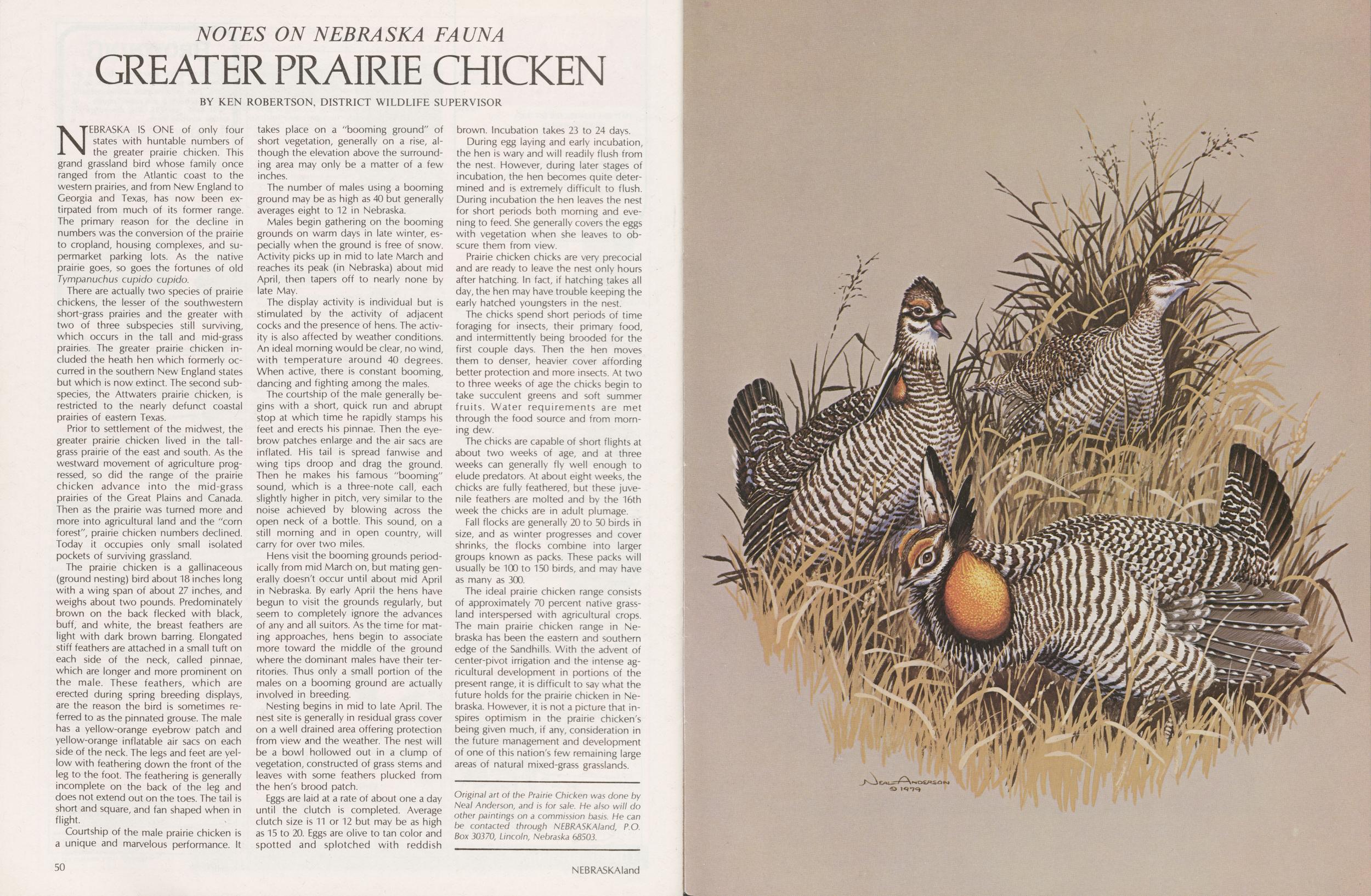
NOTES ON NEBRASKA FAUNA
GREATER PRAIRIE CHICKEN
BY KEN ROBERTSON, DISTRICT WILDLIFE SUPERVISORNEBRASKA IS ONE of only four states with huntable numbers of the greater prairie chicken. This grand grassland bird whose family once ranged from the Atlantic coast to the western prairies, and from New England to Georgia and Texas, has now been extirpated from much of its former range. The primary reason for the decline in numbers was the conversion of the prairie to cropland, housing complexes, and supermarket parking lots. As the native prairie goes, so goes the fortunes of old Tympanuchus cupido cupido.
There are actually two species of prairie chickens, the lesser of the southwestern short-grass prairies and the greater with two of three subspecies still surviving, which occurs in the tall and mid-grass prairies. The greater prairie chicken included the heath hen which formerly occurred in the southern New England states but which is now extinct. The second subspecies, the Attwaters prairie chicken, is restricted to the nearly defunct coastal prairies of eastern Texas.
Prior to settlement of the midwest, the greater prairie chicken lived in the tallgrass prairie of the east and south. As the westward movement of agriculture progressed, so did the range of the prairie chicken advance into the mid-grass prairies of the Great Plains and Canada. Then as the prairie was turned more and more into agricultural land and the "corn forest", prairie chicken numbers declined. Today it occupies only small isolated pockets of surviving grassland.
The prairie chicken is a gallinaceous (ground nesting) bird about 18 inches long with a wing span of about 27 inches, and weighs about two pounds. Predominately brown on the back flecked with black, buff, and white, the breast feathers are light with dark brown barring. Elongated stiff feathers are attached in a small tuft on each side of the neck, called pinnae, which are longer and more prominent on the male. These feathers, which are erected during spring breeding displays, are the reason the bird is sometimes referred to as the pinnated grouse. The male has a yellow-orange eyebrow patch and yellow-orange inflatable air sacs on each side of the neck. The legs and feet are yellow with feathering down the front of the leg to the foot. The feathering is generally incomplete on the back of the leg and does not extend out on the toes. The tail is short and square, and fan shaped when in flight.
Courtship of the male prairie chicken is a unique and marvelous performance. It takes place on a "booming ground" of short vegetation, generally on a rise, although the elevation above the surrounding area may only be a matter of a few inches.
The number of males using a booming ground may be as high as 40 but generally averages eight to 12 in Nebraska.
Males begin gathering on the booming grounds on warm days in late winter, especially when the ground is free of snow. Activity picks up in mid to late March and reaches its peak (in Nebraska) about mid April, then tapers off to nearly none by late May.
The display activity is individual but is stimulated by the activity of adjacent cocks and the presence of hens. The activity is also affected by weather conditions. An ideal morning would be clear, no wind, with temperature around 40 degrees. When active, there is constant booming, dancing and fighting among the males.
The courtship of the male generally begins with a short, quick run and abrupt stop at which time he rapidly stamps his feet and erects his pinnae. Then the eyebrow patches enlarge and the air sacs are inflated. His tail is spread fanwise and wing tips droop and drag the ground. Then he makes his famous "booming" sound, which is a three-note call, each slightly higher in pitch, very similar to the noise achieved by blowing across the open neck of a bottle. This sound, on a still morning and in open country, will carry for over two miles.
Hens visit the booming grounds periodically from mid March on, but mating generally doesn't occur until about mid April in Nebraska. By early April the hens have begun to visit the grounds regularly, but seem to completely ignore the advances of any and all suitors. As the time for mating approaches, hens begin to associate more toward the middle of the ground where the dominant males have their territories. Thus only a small portion of the males on a booming ground are actually involved in breeding.
Nesting begins in mid to late April. The nest site is generally in residual grass cover on a well drained area offering protection from view and the weather. The nest will be a bowl hollowed out in a clump of vegetation, constructed of grass stems and leaves with some feathers plucked from the hen's brood patch.
Eggs are laid at a rate of about one a day until the clutch is completed. Average clutch size is 11 or 12 but may be as high as 15 to 20. Eggs are olive to tan color and spotted and splotched with reddish brown. Incubation takes 23 to 24 days.
During egg laying and early incubation, the hen is wary and will readily flush from the nest. However, during later stages of incubation, the hen becomes quite determined and is extremely difficult to flush. During incubation the hen leaves the nest for short periods both morning and evening to feed. She generally covers the eggs with vegetation when she leaves to obscure them from view.
Prairie chicken chicks are very precocial and are ready to leave the nest only hours after hatching. In fact, if hatching takes all day, the hen may have trouble keeping the early hatched youngsters in the nest.
The chicks spend short periods of time foraging for insects, their primary food, and intermittently being brooded for the first couple days. Then the hen moves them to denser, heavier cover affording better protection and more insects. At two to three weeks of age the chicks begin to take succulent greens and soft summer fruits. Water requirements are met through the food source and from morning dew.
The chicks are capable of short flights at about two weeks of age, and at three weeks can generally fly well enough to elude predators. At about eight weeks, the chicks are fully feathered, but these juvenile feathers are molted and by the 16th week the chicks are in adult plumage.
Fall flocks are generally 20 to 50 birds in size, and as winter progresses and cover shrinks, the flocks combine into larger groups known as packs. These packs will usually be 100 to 150 birds, and may have as many as 300.
The ideal prairie chicken range consists of approximately 70 percent native grassland interspersed with agricultural crops. The main prairie chicken range in Nebraska has been the eastern and southern edge of the Sandhills. With the advent of center-pivot irrigation and the intense agricultural development in portions of the present range, it is difficult to say what the future holds for the prairie chicken in Nebraska. However, it is not a picture that inspires optimism in the prairie chicken's being given much, if any, consideration in the future management and development of one of this nation's few remaining large areas of natural mixed-grass grasslands.
Original art of the Prairie Chicken was done by Neal Anderson, and is for sale. He also will do other paintings on a commission basis. He can be contacted through NEBRASKAland, P.O. Box 30370, Lincoln, Nebraska 68503. 50 NEBRASKAland
Position: 510 (21 views)