Volume 57, Issue 11, 1979
NEBRASKAland
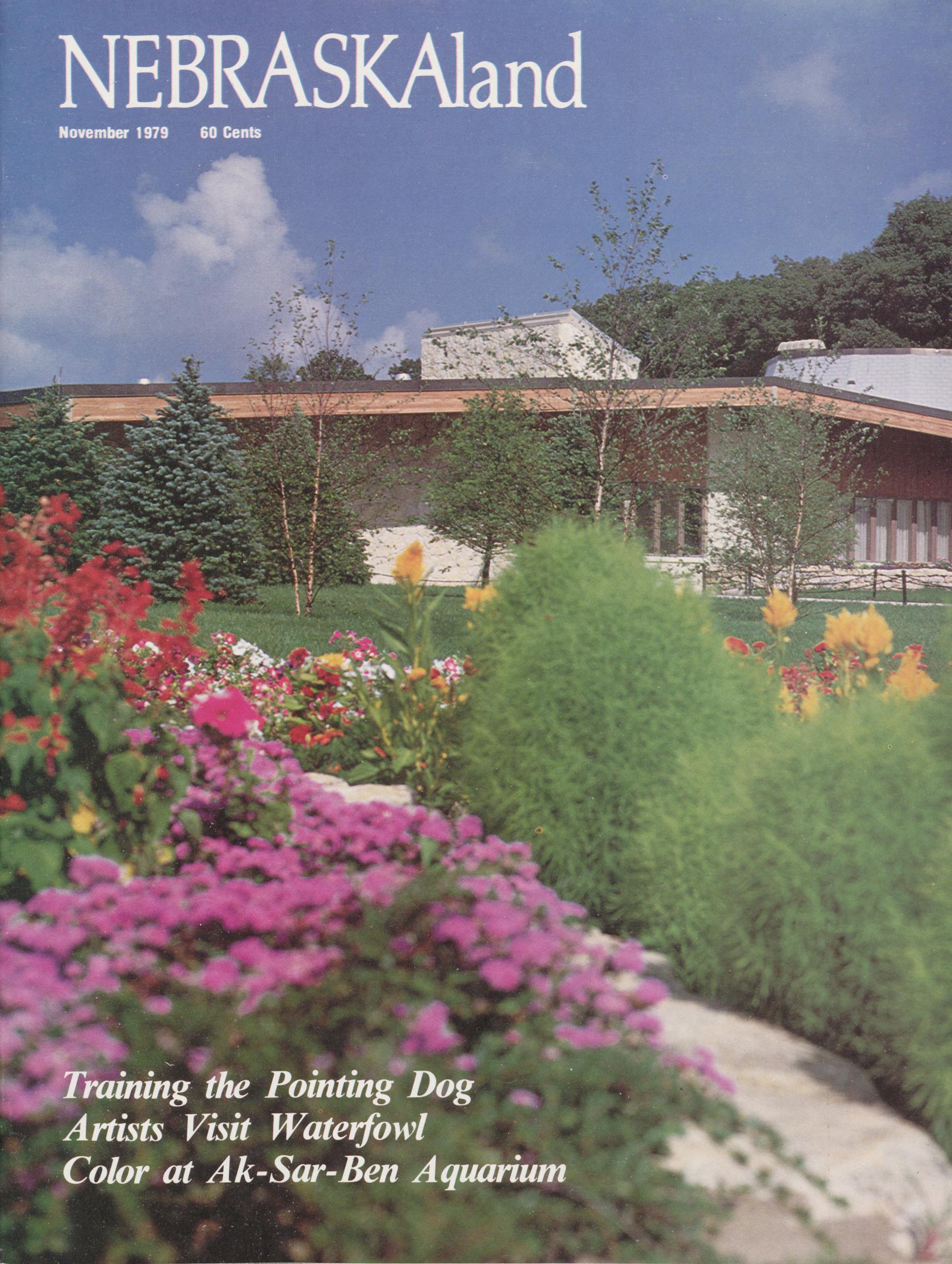
November 1979 60 Cents Training Artists Visit Waterfowl Color at Ak-Sar-Ben Aquarium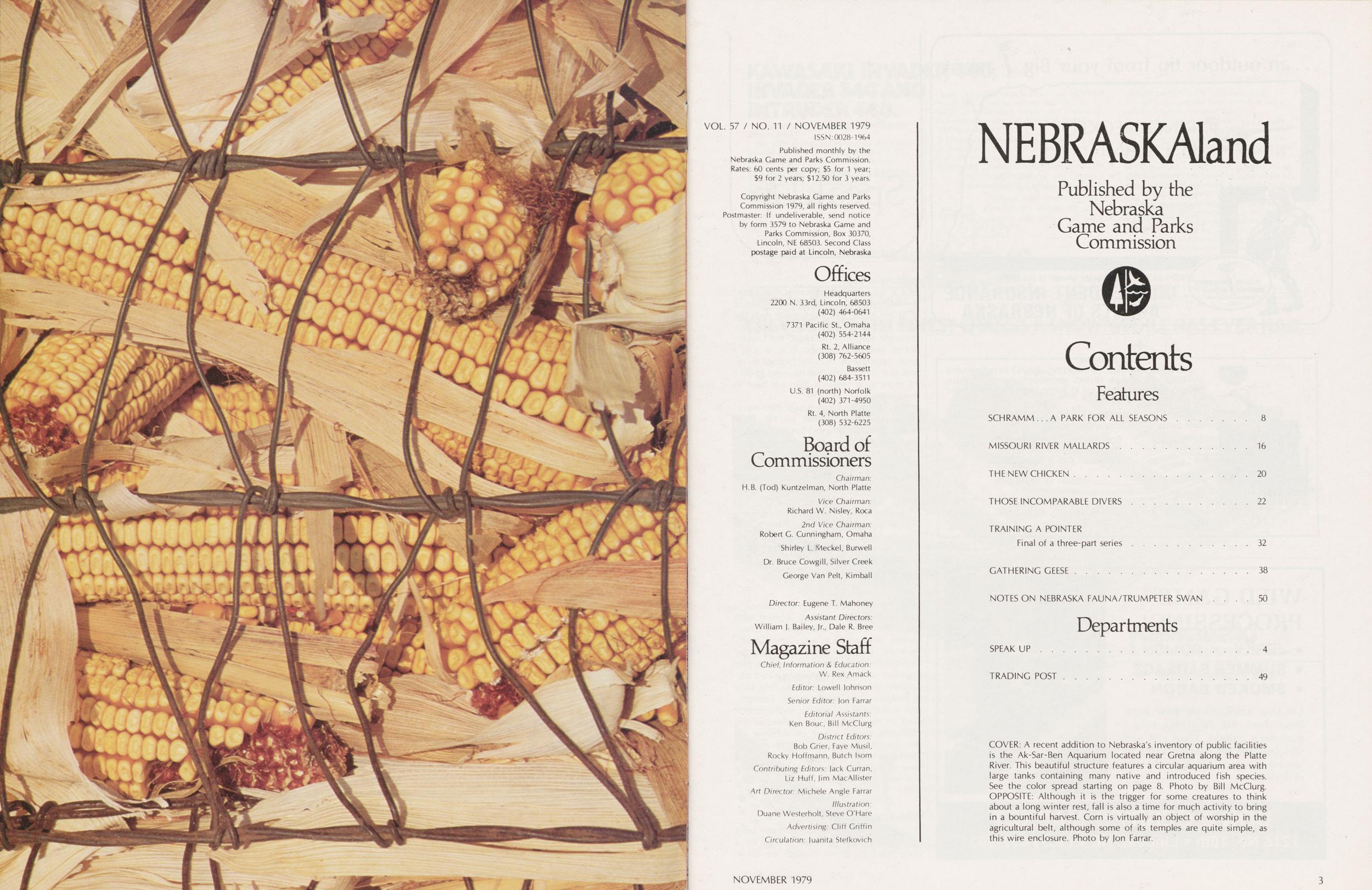
NEBRASKAland
Published by the Nebraska Game and Parks Commission VOL. 57 / NO. 11 / NOVEMBER 1979 ISSN: 0028-1964 Published monthly by the Nebraska Game and Parks Commission. Rates: 60 cents per copy; $5 for 1 year; $9 for 2 years; $12.50 for 3 years. Copyright Nebraska Game and Parks Commission 1979, all rights reserved. Postmaster: If undeliverable, send notice by form 3579 to Nebraska Game and Parks Commission, Box 30370, Lincoln, NE 68503. Second Class postage paid at Lincoln, Nebraska Offices Headquarters 2200 N. 33rd, Lincoln, 68503 (402) 464-0641 7371 Pacific St., Omaha (402) 554-2144 Rt. 2, Alliance (308) 762-5605 Bassett (402) 684-3511 U.S. 81 (north) Norfolk (402) 371-4950 Rt. 4, North Platte (308) 532-6225 Board of Commissioners Chairman: H.B. (Tod) Kuntzelman, North Platte Vice Chairman: Richard W. Nisley, Roca 2nd Vice Chairman: Robert G. Cunningham, Omaha Shirley L. Meckel, Burwell Dr. Bruce Cowgill, Silver Creek George Van Pelt, Kimball Director: Eugene T. Mahoney Assistant Directors: William J. Bailey, Jr., Dale R. Bree Magazine Staff Chief, Information & Education: W. Rex Amack Editor: Lowell Johnson Senior Editor: Ion Farrar Editorial Assistants: Ken Bouc, Bill McClurg District Editors: Bob Grier, Faye Musil, Rocky Hoffmann, Butch Isom Contributing Editors: lack Curran, Liz Huff, |im MacAllister Art Director: Michele Angle Farrar Illustration: Duane Westerholt, Steve O'Hare Advertising: Cliff Griffin Circulation: luanita Stefkovich Contents Features SCHRAMM A PARK FOR ALL SEASONS 8MISSOURI RIVER MALLARDS 16
THE NEW CHICKEN 20
THOSE INCOMPARABLE DIVERS 22
TRAINING A POINTER
Final of a three-part series 32
GATHERING GEESE 38
NOTES ON NEBRASKA FAUNA/TRUMPETER SWAN 50 Departments SPEAK UP TRADING POST COVER: A recent addition to Nebraska's inventory of public facilities is the Ak-Sar-Ben Aquarium located near Gretna along the Platte River. This beautiful structure features a circular aquarium area with large tanks containing many native and introduced fish species. See the color spread starting on page 8. Photo by Bill McClurg. OPPOSITE: Although it is the trigger for some creatures to think about a long winter rest, fall is also a time for much activity to bring in a bountiful harvest. Corn is virtually an object of worship in the agricultural belt, although some of its temples are quite simple, as this wire enclosure. Photo by jon Farrar. NOVEMBER 1979 3
Speak Up
... an outdoor tip from your Big I agentRING-NECKED PHEASANT
An import from the Orient, the pheasant has become Nebraska's most popular game bird. Brilliant color, large size and excellent table quality make this hardy bird ideal for the hunter. He thrives in environments all over the state with only a few basic requirements.
...this message brought to you by the INDEPENDENT INSURANCE AGENTS OF NEBRASKA PRAIRIE STATIONMASTER
From the zenith of railroading in 1917 to retirement in 1963, this book is the recollections of Nathan Bragg's experiences as a Burlington stationmaster in Nebraska. 124 pages-hardbound-seventy photographs-@ $6.50 per copy including shipping. Send order to: Barbara B. Clayburn 7023 Bridgport Circle Stockton, California 95207 Please send Name Address City WILD GAME PROCESSING! JERKY · POLISH & SUMMER SAUSAGE SMOKED BACON Let Don Shuster turn your antelope, deer, elk or moose into a gourmet's delight. Meat cut and wrapped for the freezer. Bring in boned meat or let Don do the skinning. DON & GERRY'S MARKET 1216 No. 10th • Lincoln, NE • (402) 432-8931 Speaking of bugs
Sir / It was with great interest that I read the letter from the Aagards in the August NEBRASKAland, as I am familiar with the place and toured it one time. It is truly unfortunate that the N.R.D. and the University of Nebraska misused it, as it was a great opportunity to do biological research. It is my belief that we need to do a lot more such research than we have in the past.
The insects the Aagards said were working on the musk thistles are the musk thistle weevils (Rhinocyllus conicus). I have had these weevils on my farm since 1972 and they are doing a good job of controlling the thistles. We harvested over one million of these weevils this year and sold them in about 20 counties across the state.
I have been trying to work out some kind of a deal with the the Game Commission for two years now to make releases on state lands around here but so far have had no success.
James Holmes Arcadia, Nebr.Well, the story of the weevils is already a long one, and our agency worked with them, but before results could be determined, the project was "disrupted". Presently, we are cooperating with the University of Nebraska on weevil tests (the locations will remain secret to avoid disruption) but these things take a long time to evaluate. The Came and Parks Commission is not able to carry on such research itself, so must rely on the facilities of the University. Luckily, they are working on the matter, and good results are expected-at least in other locations things have worked well. Thanks for your interest and weevil promotion. (Editor)
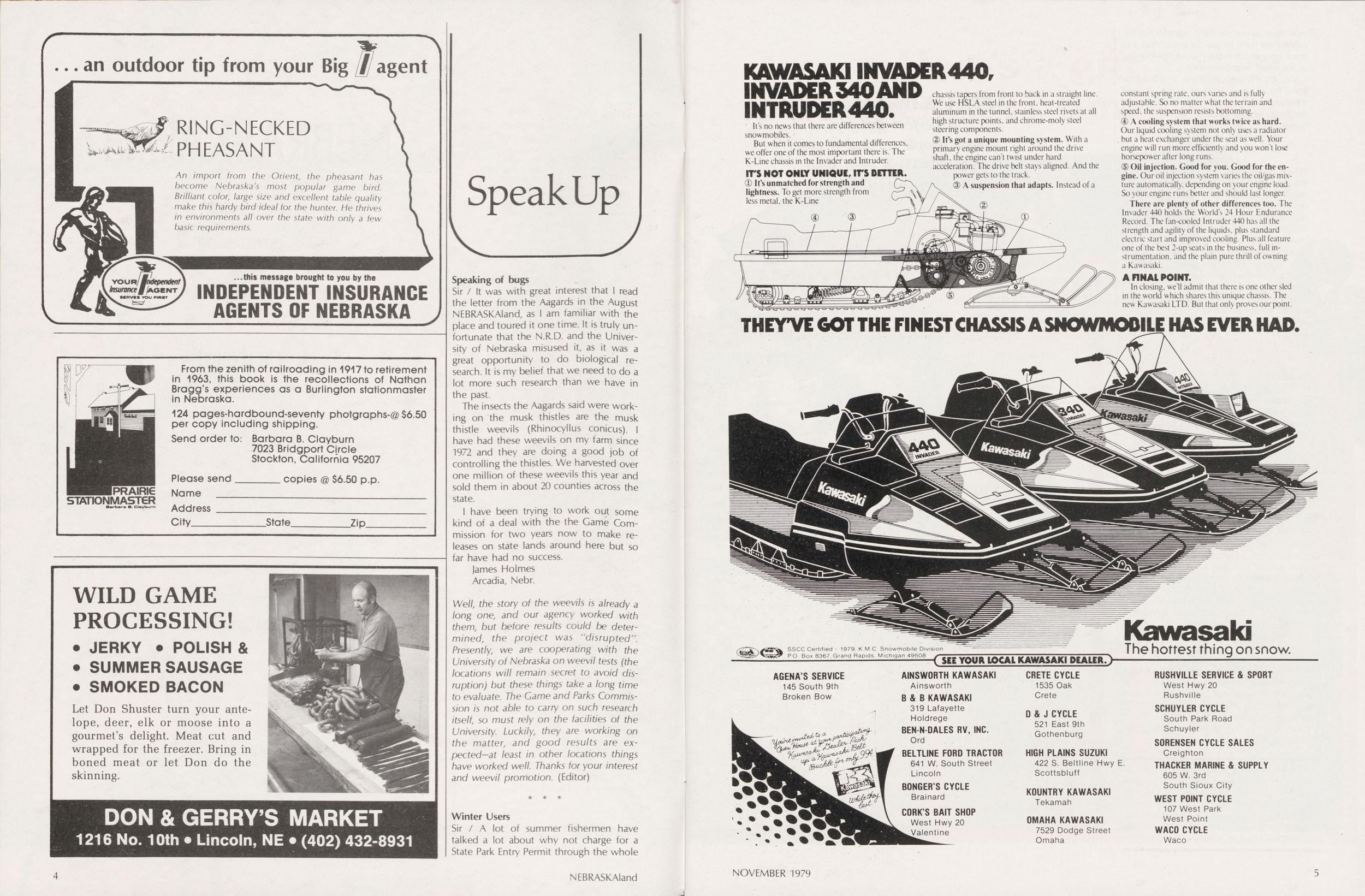
Winter Users 4 NEBRASKAland KAWASAKI INVADER 440 INVADER 340 AND INTRUDER440. Its no news that there are differences between snowmobiles. But when it comes to fundamental differences, we offer one of the most important there is. The K-Line chassis in the Invader and Intruder. NOT ONLY UNIQUE, IT'S BETTER. ( It's unmatched for strength and lightness. To get more strength from less metal, the K-Line chassis tapers from front to back in a straight line. We use HSLA steel in the front, heat-treated aluminum in the tunnel, stainless steel rivets at all high structure points, and chrome-moly steel steering components. (It's got a unique mounting system. With a primary engine mount right around the drive shaft, the engine can't twist under hard acceleration. The drive belt stays aligned. And the power gets to the track. A suspension that adapts. Instead of a constant spring rate, ours varies and is fully adjustable. So no matter what the terrain and speed, the suspension resists bottoming. (A cooling system that works twice as hard. Our liquid cooling system not only uses a radiator but a heat exchanger under the seat as well. Your engine will run more efficiently and you won't lose horsepower after long runs. (Oil injection. Good for you. Good for the engine. Our oil injection system varies the oil/gas mixture automatically, depending on your engine load. So your engine runs better and should last longer. There are plenty of other differences too. The Invader 440 holds the World's 24 Hour Endurance Record. The fan-cooled Intruder 440 has all the strength and agility of the liquids, plus standard electric start and improved cooling, Plus all feature one of the best 2-up seats in the business, full instrumentation, and the plain pure thrill of owning a Kawasaki. A FINAL POINT. In closing, we'll admit that there is one other sled in the world which shares this unique chassis. The new Kawasaki LTD. But that only proves our point. THEYVE GOT THE FINEST CHASSIS A SNOWMOBILE HAS EVER HAD SSCC Certified 1979. K M C Snowmobile Division PO Box 8367. Grand Rapids. Michigan 49508 SEE YOUR LOCAL KAWASAKI DEALER" AGENA'S SERVICE 145 South 9th Broken Bow AINSWORTH KAWASAKI Ainsworth B & B KAWASAKI 319 Lafayette Holdrege BEN-N-DALES RV, INC. Ord BELTLINE FORD TRACTOR 641 W. South Street Lincoln BONGERS CYCLE Brainard CORK'S BAIT SHOP West Hwy 20 Valentine CRETE CYCLE 1535 Oak Crete D & J CYCLE 521 East 9th Gothenburg HIGH PLAINS SUZUKI 422 S. Beltline Hwy Scottsbluff KOUNTRY KAWASAKI Tekamah OMAHA KAWASAKI 7529 Dodge Street Omaha The hottest thing on snow. RUSHVILLE SERVICE & SPORT West Hwy 20 Rushville SCHUYLER CYCLE South Park Road Schuyler SORENSEN CYCLE SALES Creighton THACKER MARINE & SUPPLY 605 W. 3rd South Sioux City WEST POINT CYCLE 107 West Park West Point WACO CYCLE Waco NOVEMBER 1979 5
Sir / A lot of summer fishermen have talked a lot about why not charge for a State Park Entry Permit through the whole year. A lot of people don't want to fish because they have to pay for the sticker, but think how much money would be coming in for more improvements!
We elderly people think it would be good for all of us. Most of us are on fixed incomes, but we enjoy the fishing and camping. And, a place to go away from home for rest and quiet.
Mrs. Florence Heath Lincoln, Nebr.When originating the Park Entry Permit, the Commission considered a year-round permit—naturally. However, the permit is designed primarily to generate funds for park facilities. During winter most of those facilities are not available because they must be shut down. Therefore, it seems unfair to charge an entry fee when there is little to enter for. There is always an element of unfairness about any fee. Unfortunately, it is often the people with $30,000 campers who complain most about the fee, but what can one do? Hope you continue to enjoy the areas, and to have peace and quiet at them. (Editor)
Cookbook fanSir / I would like to order your Wild Game Cookbook. As a matter of fact, I'd like to order six copies. I am so impressed with your publication. The photographs are exquisite and the recipes delicious.
I am from Nebraska so I have been familiar with your magazine for some time.
Vivian Rose Hayes National Sales Manager WTHR-TV Indianapolis, Ind.Sir / I enjoyed the article on the Missouri River in your March (1979) issue very much I went to school in Nebraska the early part of the century. The geography books listed the Missouri River as the longest river in the United States. My 1960 edition of the World Book also lists it as the longest. Did Hawaii come up with a longer river?
Sam Sweeney Springfield, Ore.No, Hawaii was not the area that took the title of longest river away from the Missouri. When we stated in that article that it was the second longest, we meant it came behind the Mississippi, which most sources list as the longest-by about 33 miles. (Editor)
NEBRASKAland Magazine invites all readers to submit their comments, suggestions, and gripes to Speak Up. Each month the magazine will publish as many letters as space permits. Pictures are welcome. NEBRASKAland reserves the right to edit and condense letters. — Editor.
NEBRASKAland Magazine is a perfect gift for special people... and it costs so little. Well even send a greeting card from you! 'Tis the season to be generous 6 NEBRASKAland Here's a gift to be opened 12 times a year
Schramm A Park For All Seasons
BY LIZ HUFF PHOTOS BY BILL McCLURG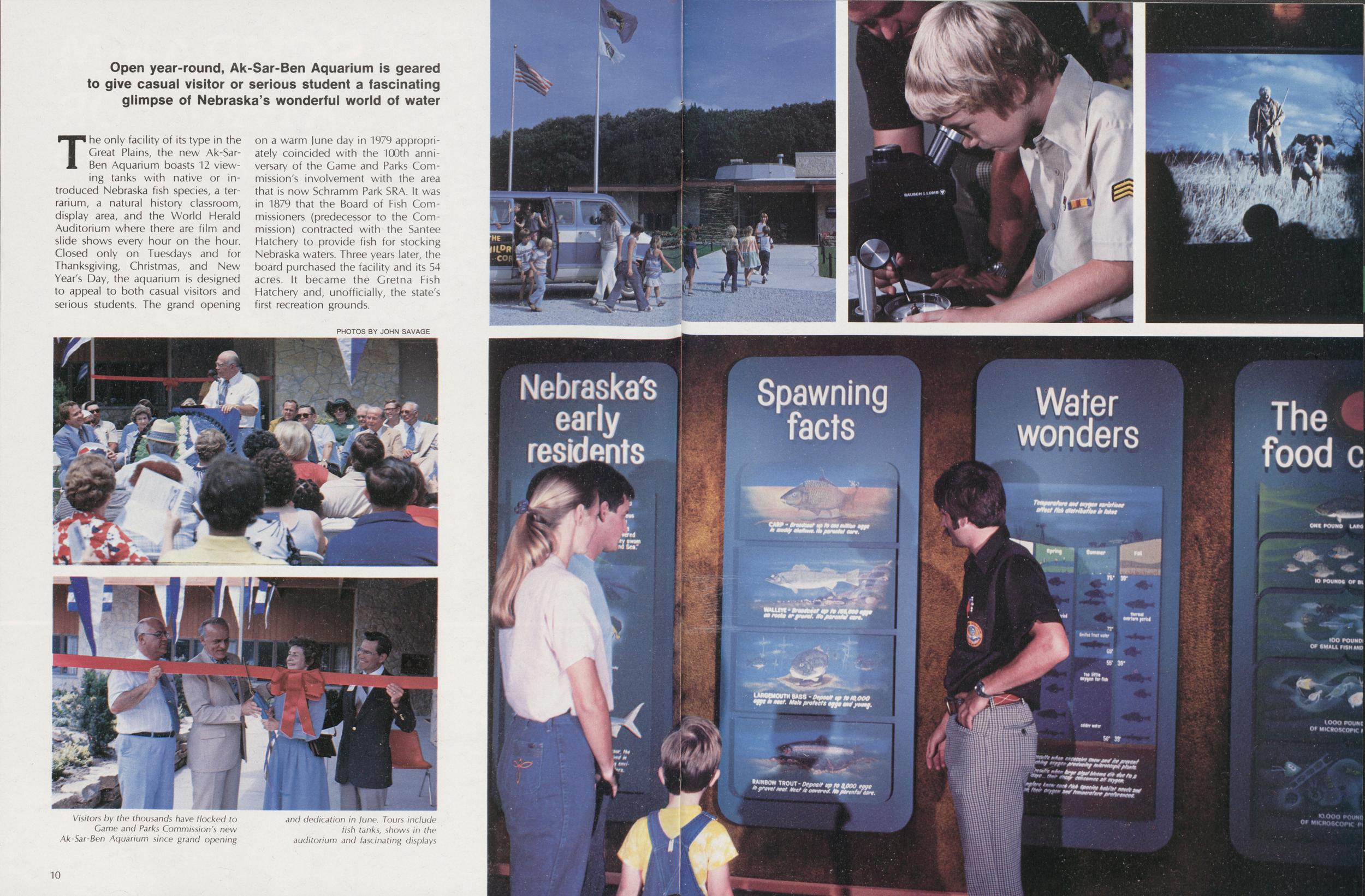 Open year-round, Ak-Sar-Ben Aquarium is geared
to give casual visitor or serious student a fascinating
glimpse of Nebraska's wonderful world of water
Open year-round, Ak-Sar-Ben Aquarium is geared
to give casual visitor or serious student a fascinating
glimpse of Nebraska's wonderful world of water
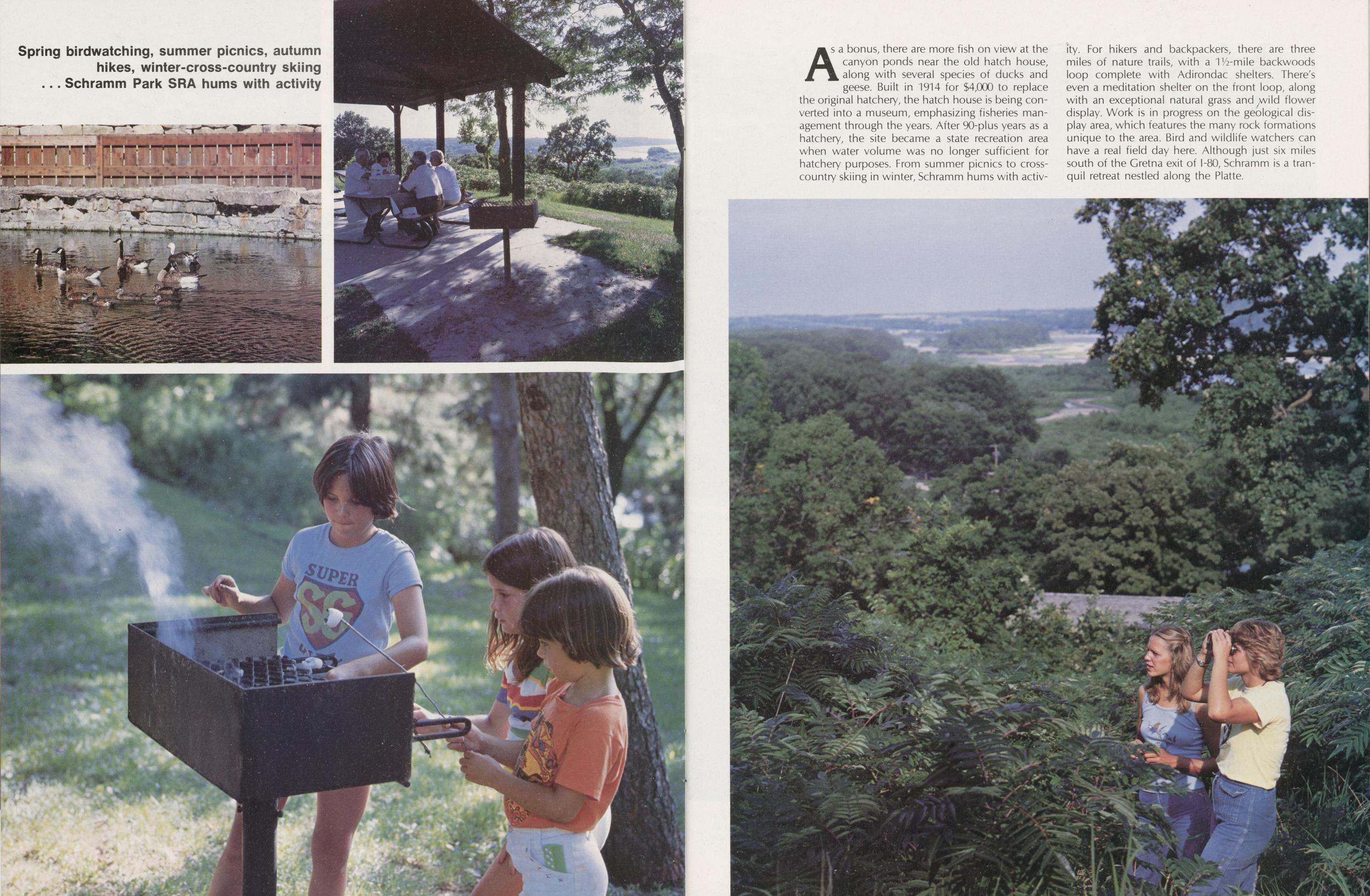
The only facility of its type in the Great Plains, the new Ak-Sar-Ben Aquarium boasts 12 viewing tanks with native or introduced Nebraska fish species, a terrarium, a natural history classroom, display area, and the World Herald Auditorium where there are film and slide shows every hour on the hour. Closed only on Tuesdays and for Thanksgiving, Christmas, and New Year's Day, the aquarium is designed to appeal to both casual visitors and serious students. The grand opening on a warm June day in 1979 appropriately coincided with the 100th anniversary of the Game and Parks Commission's involvement with the area that is now Schramm Park SRA. It was in 1879 that the Board of Fish Commissioners (predecessor to the Commission) contracted with the Santee Hatchery to provide fish for stocking Nebraska waters. Three years later, the board purchased the facility and its 54 acres. It became the Gretna Fish Hatchery and, unofficially, the state's first recreation grounds.
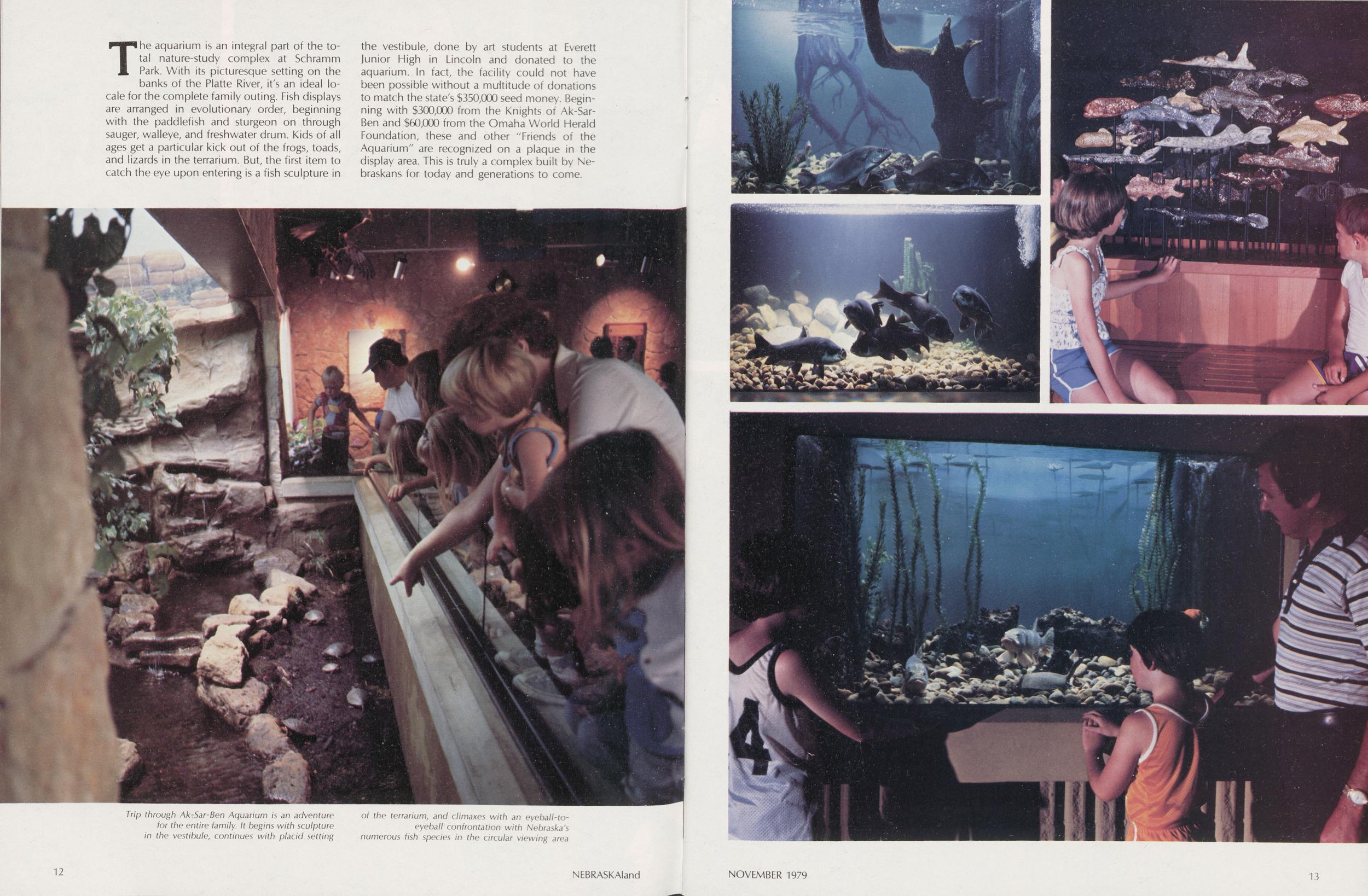
The aquarium is an integral part of the total nature-study complex at Schramm Park. With its picturesque setting on the banks of the Platte River, it's an ideal locale for the complete family outing. Fish displays are arranged in evolutionary order, beginning with the paddlefish and sturgeon on through sauger, walleye, and freshwater drum. Kids of all ages get a particular kick out of the frogs, toads, and lizards in the terrarium. But, the first item to catch the eye upon entering is a fish sculpture in the vestibule, done by art students at Everett Junior High in Lincoln and donated to the aquarium. In fact, the facility could not have been possible without a multitude of donations to match the state's $350,000 seed money. Beginning with $300,000 from the Knights of Ak-Sar-Ben and $60,000 from the Omaha World Herald Foundation, these and other "Friends of the Aquarium" are recognized on a plaque in the display area. This is truly a complex built by Nebraskans for today and generations to come.
 Spring birdwatching, summer picnics, autumn
hikes, winter-cross-country skiing
... Schramm Park SRA hums with activity
Spring birdwatching, summer picnics, autumn
hikes, winter-cross-country skiing
... Schramm Park SRA hums with activity
As a bonus, there are more fish on view at the canyon ponds near the old hatch house, along with several species of ducks and geese. Built in 1914 for $4,000 to replace the original hatchery, the hatch house is being converted into a museum, emphasizing fisheries management through the years. After 90-plus years as a hatchery, the site became a state recreation area when water volume was no longer sufficient for hatchery purposes. From summer picnics to cross-country skiing in winter, Schramm hums with activity. For hikers and backpackers, there are three miles of nature trails, with a 1½-mile backwoods loop complete with Adirondac shelters. There's even a meditation shelter on the front loop, along with an exceptional natural grass and wild flower display. Work is in progress on the geological display area, which features the many rock formations unique to the area. Bird and wildlife watchers can have a real field day here. Although just six miles south of the Gretna exit of I-80, Schramm is a tranquil retreat nestled along the Platte.
Missouri River MALLARDS
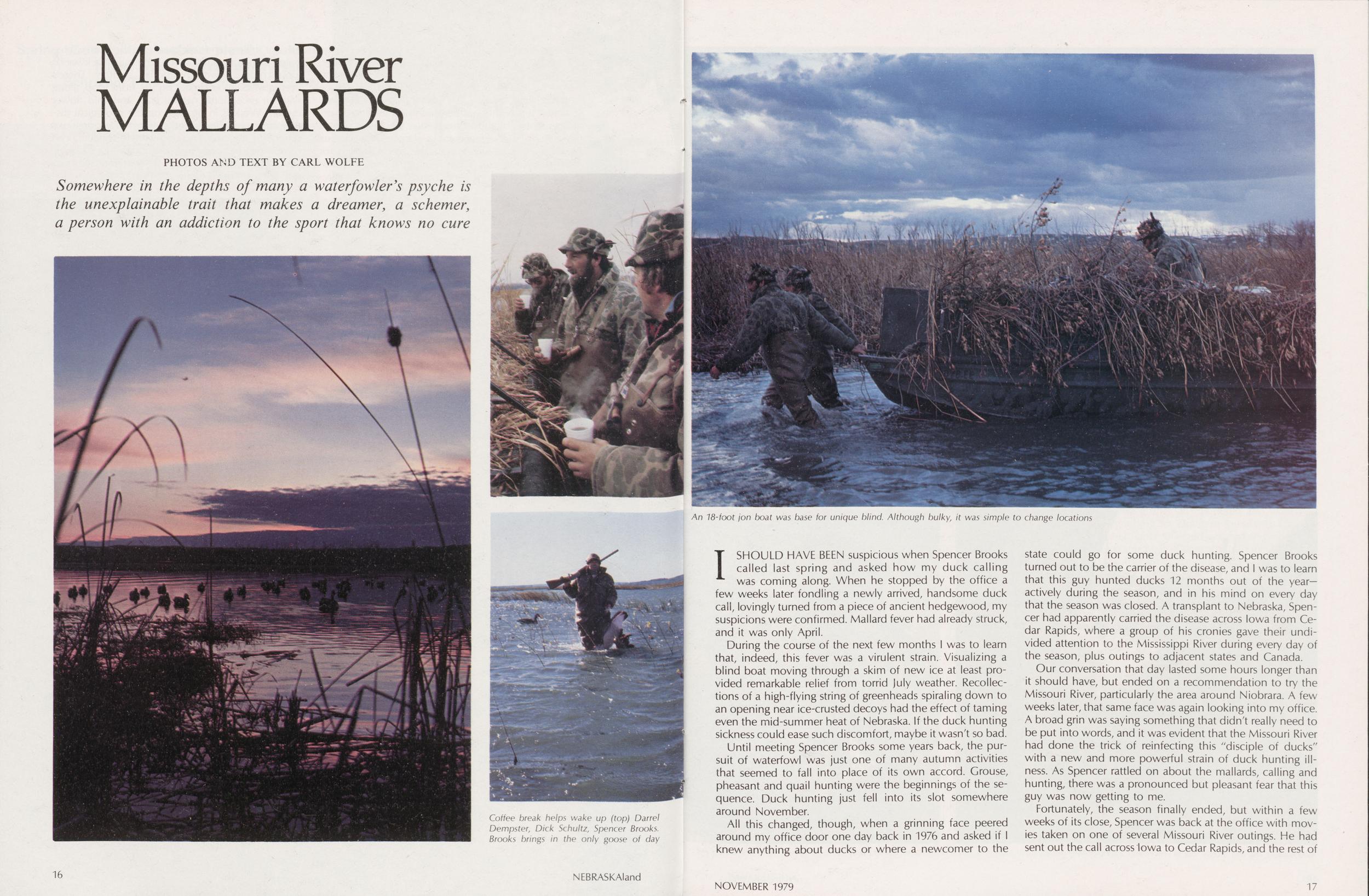
PHOTOS AND TEXT BY CARL WOLFE Somewhere in the depths of many a water fowler's psyche is the unexplainable trait that makes a dreamer, a schemer, a person with an addiction to the sport that knows no cureI SHOULD HAVE BEEN suspicious when Spencer Brooks called last spring and asked how my duck calling was coming along. When he stopped by the office a few weeks later fondling a newly arrived, handsome duck call, lovingly turned from a piece of ancient hedgewood, my suspicions were confirmed. Mallard fever had already struck, and it was only April.
During the course of the next few months I was to learn that, indeed, this fever was a virulent strain. Visualizing a blind boat moving through a skim of new ice at least provided remarkable relief from torrid July weather. Recollections of a high-flying string of greenheads spiraling down to an opening near ice-crusted decoys had the effect of taming even the mid-summer heat of Nebraska. If the duck hunting sickness could ease such discomfort, maybe it wasn't so bad.
Until meeting Spencer Brooks some years back, the pursuit of waterfowl was just one of many autumn activities that seemed to fall into place of its own accord. Grouse, pheasant and quail hunting were the beginnings of the sequence. Duck hunting just fell into its slot somewhere around November.
All this changed, though, when a grinning face peered around my office door one day back in 1976 and asked if I knew anything about ducks or where a newcomer to the state could go for some duck hunting. Spencer Brooks turned out to be the carrier of the disease, and I was to learn that this guy hunted ducks 12 months out of the year-actively during the season, and in his mind on every day that the season was closed. A transplant to Nebraska, Spencer had apparently carried the disease across Iowa from Cedar Rapids, where a group of his cronies gave their undivided attention to the Mississippi River during every day of the season, plus outings to adjacent states and Canada.
Our conversation that day lasted some hours longer than it should have, but ended on a recommendation to try the Missouri River, particularly the area around Niobrara. A few weeks later, that same face was again looking into my office. A broad grin was saying something that didn't really need to be put into words, and it was evident that the Missouri River had done the trick of reinfecting this "disciple of ducks" with a new and more powerful strain of duck hunting illness. As Spencer rattled on about the mallards, calling and hunting, there was a pronounced but pleasant fear that this guy was now getting to me.
Fortunately, the season finally ended, but within a few weeks of its close, Spencer was back at the office with movies taken on one of several Missouri River outings. He had sent out the call across Iowa to Cedar Rapids, and the rest of his afflicted hunting buddies had succumbed to the winding currents and sandbars of the new hunting territory on the Missouri.
NOVEMBER 1979 17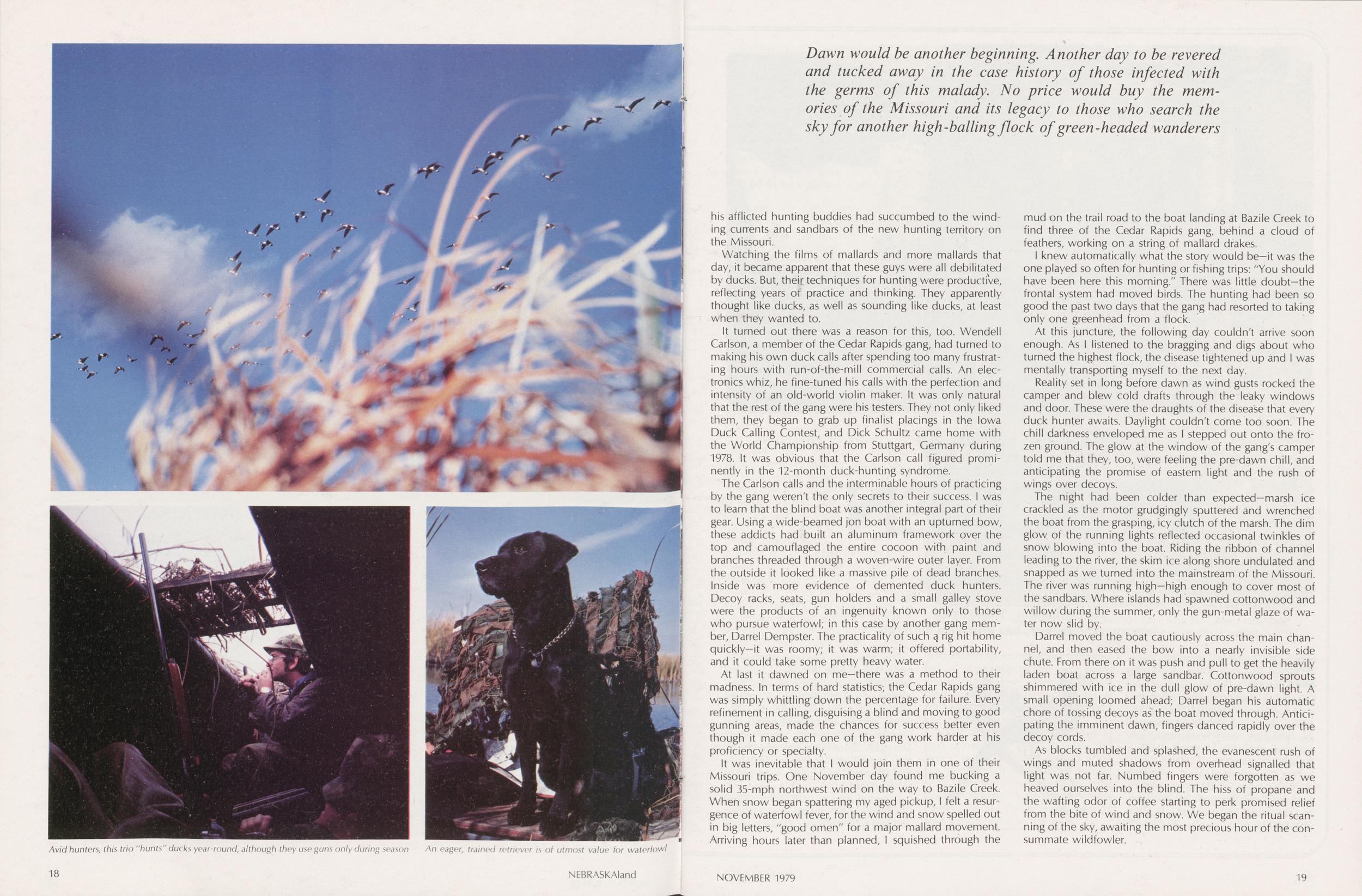
Watching the films of mallards and more mallards that day, it became apparent that these guys were all debilitated by ducks. But, their techniques for hunting were productive, reflecting years or practice and thinking. They apparently thought like ducks, as well as sounding like ducks, at least when they wanted to.
It turned out there was a reason for this, too. Wendell Carlson, a member of the Cedar Rapids gang, had turned to making his own duck calls after spending too many frustrating hours with run-of-the-mill commercial calls. An electronics whiz, he fine-tuned his calls with the perfection and intensity of an old-world violin maker. It was only natural that the rest of the gang were his testers. They not only liked them, they began to grab up finalist placings in the Iowa Duck Calling Contest, and Dick Schultz came home with the World Championship from Stuttgart, Germany during 1978. It was obvious that the Carlson call figured prominently in the 12-month duckhunting syndrome.
The Carlson calls and the interminable hours of practicing by the gang weren't the only secrets to their success. I was to learn that the blind boat was another integral part of their gear. Using a wide-beamed jon boat with an upturned bow, these addicts had built an aluminum framework over the top and camouflaged the entire cocoon with paint and branches threaded through a woven-wire outer layer. From the outside it looked like a massive pile of dead branches. Inside was more evidence of demented duck hunters. Decoy racks, seats, gun holders and a small galley stove were the products of an ingenuity known only to those who pursue waterfowl; in this case by another gang member, Darrel Dempster. The practicality of such a rig hit home quickly-it was roomy; it was warm; it offered portability, and it could take some pretty heavy water.
At last it dawned on me-there was a method to their madness. In terms of hard statistics-, the Cedar Rapids gang was simply whittling down the percentage for failure. Every refinement in calling, disguising a blind and moving to good gunning areas, made the chances for success better even though it made each one of the gang work harder at his proficiency or specialty.
It was inevitable that I would join them in one of their Missouri trips. One November day found me bucking a solid 35-mph northwest wind on the way to Bazile Creek. When snow began spattering my aged pickup, I felt a resurgence of waterfowl fever, for the wind and snow spelled out in big letters, "good omen" for a major mallard movement. Arriving hours later than planned, I squished through the mud on the trail road to the boat landing at Bazile Creek to find three of the Cedar Rapids gang, behind a cloud of feathers, working on a string of mallard drakes.
I knew automatically what the story would be—it was the one played so often for hunting or fishing trips: "You should have been here this morning." There was little doubt—the frontal system had moved birds. The hunting had been so good the past two days that the gang had resorted to taking only one greenhead from a flock.
At this juncture, the following day couldn't arrive soon enough. As I listened to the bragging and digs about who turned the highest flock, the disease tightened up and I was mentally transporting myself to the next day.
Reality set in long before dawn as wind gusts rocked the camper and blew cold drafts through the leaky windows and door. These were the draughts of the disease that every duck hunter awaits. Daylight couldn't come too soon. The chill darkness enveloped me as I stepped out onto the frozen ground. The glow at the window of the gang's camper told me that they, too, were feeling the pre-dawn chill, and anticipating the promise of eastern light and the rush of wings over decoys.
The night had been colder than expected—marsh ice crackled as the motor grudgingly sputtered and wrenched the boat from the grasping, icy clutch of the marsh. The dim glow of the running lights reflected occasional twinkles of snow blowing into the boat. Riding the ribbon of channel leading to the river, the skim ice along shore undulated and snapped as we turned into the mainstream of the Missouri. The river was running high—high enough to cover most of the sandbars. Where islands had spawned cottonwood and willow during the summer, only the gun-metal glaze of water now slid by.
Darrel moved the boat cautiously across the main channel, and then eased the bow into a nearly invisible side chute. From there on it was push and pull to get the heavily laden boat across a large sandbar. Cottonwood sprouts shimmered with ice in the dull glow of pre-dawn light. A small opening loomed ahead; Darrel began his automatic chore of tossing decoys as the boat moved through. Anticipating the imminent dawn, fingers danced rapidly over the decoy cords.
As blocks tumbled and splashed, the evanescent rush of wings and muted shadows from overhead signalled that light was not far. Numbed fingers were forgotten as we heaved ourselves into the blind. The hiss of propane and the wafting odor of coffee starting to perk promised relief from the bite of wind and snow. We began the ritual scanning of the sky, awaiting the most precious hour of the consummate wildfowler.
NOVEMBER 1979 19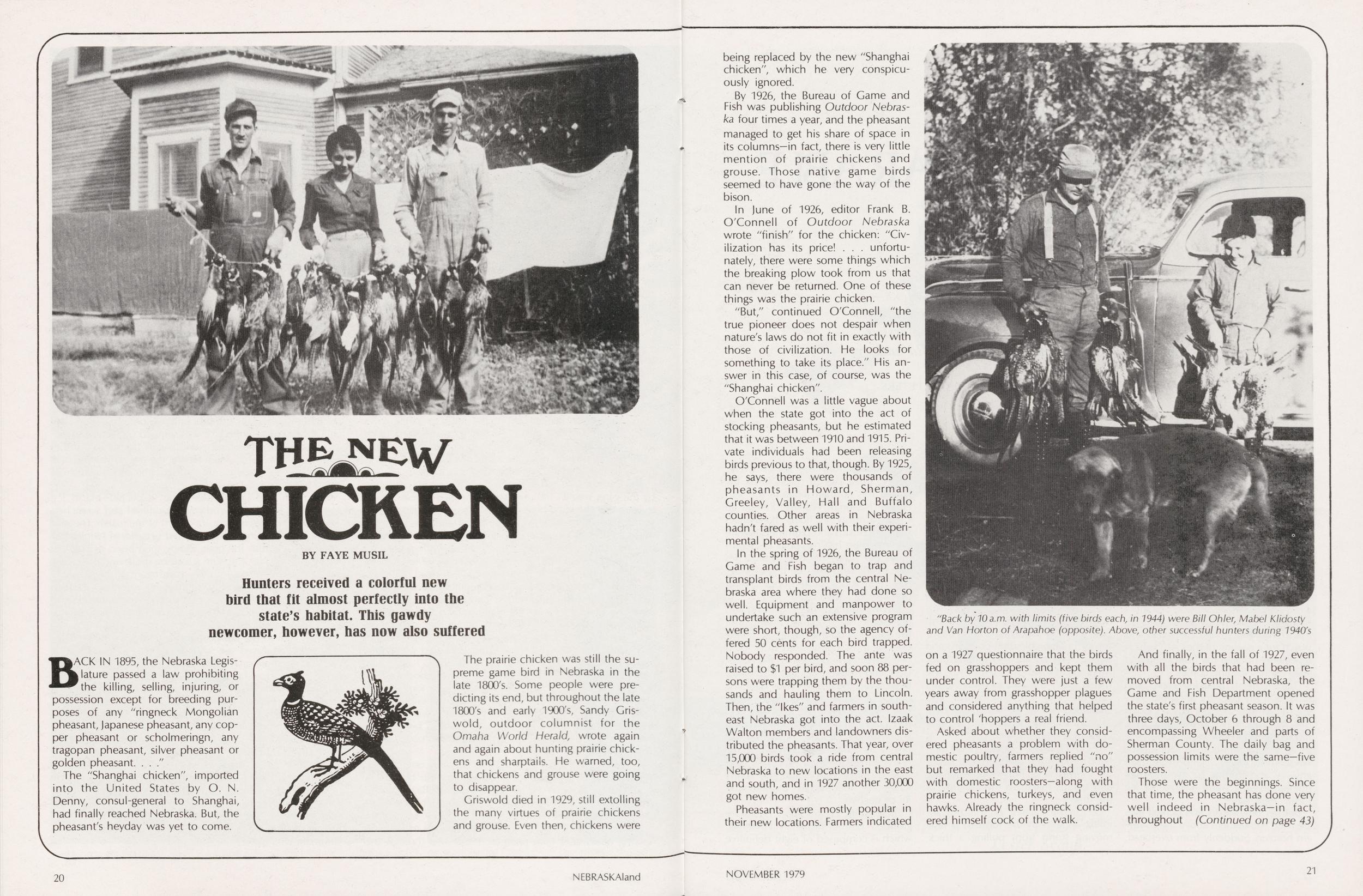
The New Chicken
BY FAYE MUSIL Hunters received a colorful new bird that fit almost perfectly into the state's habitat. This gawdy newcomer, however, has now also sufferedBACK IN 1895, the Nebraska Legislature passed a law prohibiting the killing, selling, injuring, or possession except for breeding purposes of any "ringneck Mongolian pheasant, Japanese pheasant, any copper pheasant or scholmeringn, any tragopan pheasant, silver pheasant or golden pheasant. . . ."
The "Shanghai chicken", imported into the United States by O. N. Denny, consul-general to Shanghai, had finally reached Nebraska. But, the pheasant's heyday was yet to come.
The prairie chicken was still the supreme game bird in Nebraska in the late 1800's. Some people were predicting its end, but throughout the late 1800's and early 1900% Sandy Griswold, outdoor columnist for the Omaha World Herald, wrote again and again about hunting prairie chickens and sharptails. He warned, too, that chickens and grouse were going to disappear.
Griswold died in 1929, still extolling the many virtues of prairie chickens and grouse. Even then, chickens were 20 NEBRASKAland being replaced by the new "Shanghai chicken", which he very conspicuously ignored.
By 1926, the Bureau of Game and Fish was publishing Outdoor Nebraska four times a year, and the pheasant managed to get his share of space in its columns—in fact, there is very little mention of prairie chickens and grouse. Those native game birds seemed to have gone the way of the bison.
In June of 1926, editor Frank B. O'Connell of Outdoor Nebraska wrote "finish" for the chicken: "Civilization has its price! . . . unfortunately, there were some things which the breaking plow took from us that can never be returned. One of these things was the prairie chicken.
"But," continued O'Connell, "the true pioneer does not despair when nature's laws do not fit in exactly with those of civilization. He looks for something to take its place." His answer in this case, of course, was the "Shanghai chicken".
O'Connell was a little vague about when the state got into the act of stocking pheasants, but he estimated that it was between 1910 and 1915. Private individuals had been releasing birds previous to that, though. By 1925, he says, there were thousands of pheasants in Howard, Sherman, Greeley, Valley, Hall and Buffalo counties. Other areas in Nebraska hadn't fared as well with their experimental pheasants.
In the spring of 1926, the Bureau of Game and Fish began to trap and transplant birds from the central Nebraska area where they had done so well. Equipment and manpower to undertake such an extensive program were short, though, so the agency offered 50 cents for each bird trapped. Nobody responded. The ante was raised to $1 per bird, and soon 88 persons were trapping them by the thousands and hauling them to Lincoln. Then, the "Ikes" and farmers in southeast Nebraska got into the act. Izaak Walton members and landowners distributed the pheasants. That year, over 15,000 birds took a ride from central Nebraska to new locations in the east and south, and in 1927 another 30,000 got new homes.
Pheasants were mostly popular in their new locations. Farmers indicated on a 1927 questionnaire that the birds fed on grasshoppers and kept them under control. They were just a few years away from grasshopper plagues and considered anything that helped to control 'hoppers a real friend.
Asked about whether they considered pheasants a problem with domestic poultry, farmers replied "no" but remarked that they had fought with domestic roosters—along with prairie chickens, turkeys, and even hawks. Already the ringneck considered himself cock of the walk.
And finally, in the fall of 1927, even with all the birds that had been removed from central Nebraska, the Game and Fish Department opened the state's first pheasant season. It was three days, October 6 through 8 and encompassing Wheeler and parts of Sherman County. The daily bag and possession limits were the same—five roosters.
Those were the beginnings. Since that time, the pheasant has done very well indeed in Nebraska-in fact, throughout (Continued on page 43)
NOVEMBER 1979 21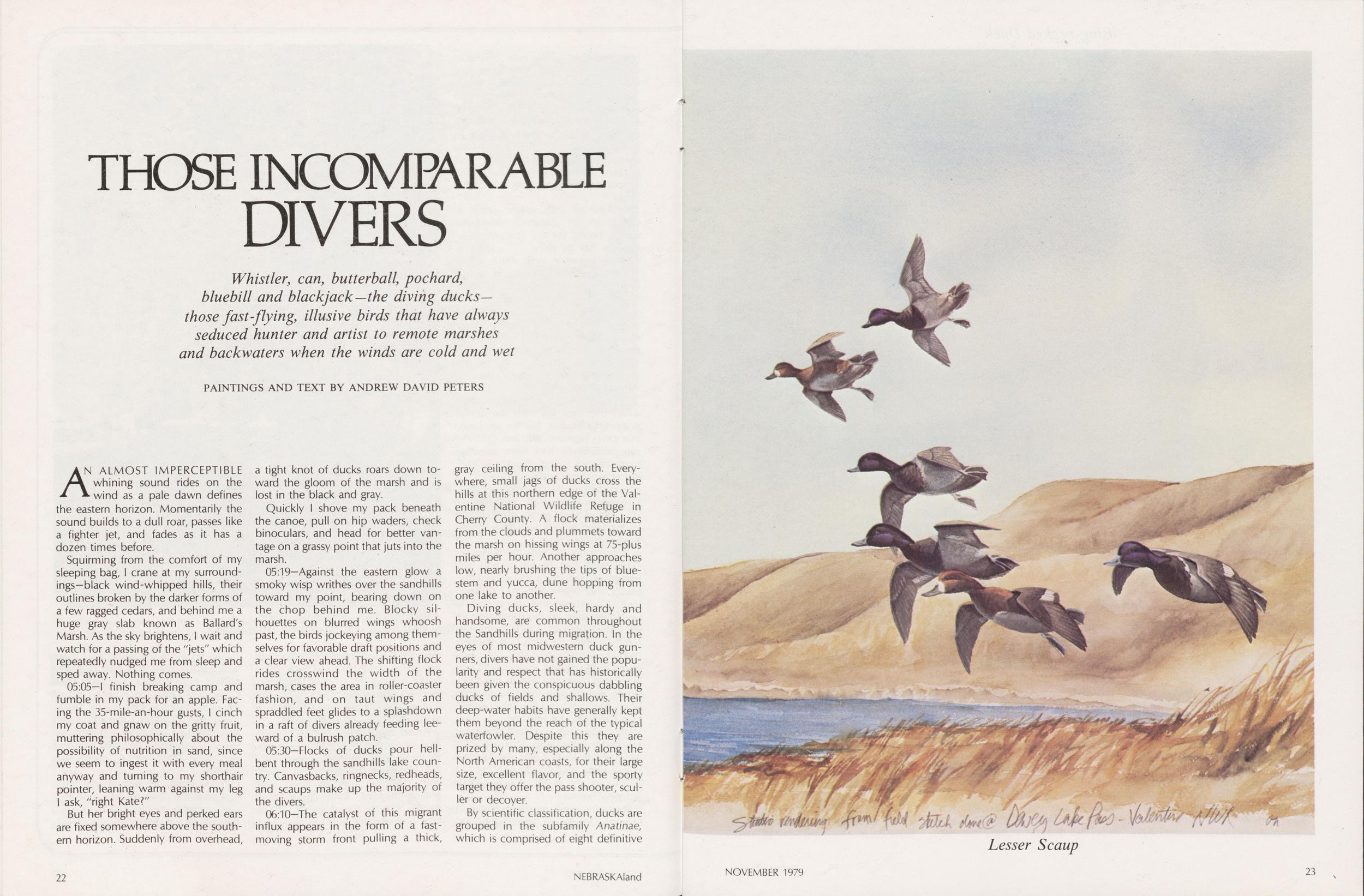
THOSE INCOMBARABLE DIVERS
Whistler, can, butterball, pochard, bluebill and blackjack—the diving ducks—those fast-flying, illusive birds that have always seduced hunter and artist to remote marshes and backwaters when the winds are cold and wet PAINTINGS AND TEXT BY ANDREW DAVID PETERSAN ALMOST IMPERCEPTIBLE whining sound rides on the wind as a pale dawn defines the eastern horizon. Momentarily the sound builds to a dull roar, passes like a fighter jet, and fades as it has a dozen times before.
Squirming from the comfort of my sleeping bag, I crane at my surroundings—black wind-whipped hills, their outlines broken by the darker forms of a few ragged cedars, and behind me a huge gray slab known as Ballard's Marsh. As the sky brightens, I wait and watch for a passing of the "jets" which repeatedly nudged me from sleep and sped away. Nothing comes.
05:05—1 finish breaking camp and fumble in my pack for an apple. Facing the 35-mile-an-hour gusts, I cinch my coat and gnaw on the gritty fruit, muttering philosophically about the possibility of nutrition in sand, since we seem to ingest it with every meal anyway and turning to my shorthair pointer, leaning warm against my leg I ask, "right Kate?"
But her bright eyes and perked ears are fixed somewhere above the southern horizon. Suddenly from overhead, a tight knot of ducks roars down toward the gloom of the marsh and is lost in the black and gray.
Quickly I shove my pack beneath the canoe, pull on hip waders, check binoculars, and head for better vantage on a grassy point that juts into the marsh.
05:19—Against the eastern glow a smoky wisp writhes over the sandhills toward my point, bearing down on the chop behind me. Blocky silhouettes on blurred wings whoosh past, the birds jockeying among themselves for favorable draft positions and a clear view ahead. The shifting flock rides crosswind the width of the marsh, cases the area in roller-coaster fashion, and on taut wings and spraddled feet glides to a splashdown in a raft of divers already feeding leeward of a bulrush patch.
O5:30-Flocks of ducks pour hellbent through the sandhills lake country. Canvasbacks, ringnecks, redheads, and scaups make up the majority of the divers.
06:10-The catalyst of this migrant influx appears in the form of a fast-moving storm front pulling a thick, gray ceiling from the south. Everywhere, small jags of ducks cross the hills at this northern edge of the Valentine National Wildlife Refuge in Cherry' County. A flock materializes from the clouds and plummets toward the marsh on hissing wings at 75-plus miles per hour. Another approaches low, nearly brushing the tips of bluestem and yucca, dune hopping from one lake to another.
Diving ducks, sleek, hardy and handsome, are common throughout the Sandhills during migration. In the eyes of most midwestem duck gunners, divers have not gained the popularity and respect that has historically been given the conspicuous dabbling ducks of fields and shallows. Their deep-water habits have generally kept them beyond the reach of the typical waterfowler. Despite this they are prized by many, especially aiong the North American coasts, for their large size, excellent flavor, and the sporty target they offer the pass shooter, sculler or decoyer.
By scientific classification, ducks are grouped in the subfamily Anatinae, which is comprised of eight definitive 22 NEBRASKAland
The redheads that rocketed over me in the cool, windy dawn of 18 April, 1979, were a typical flock of divers coursing the Sandhills as they have done for centuries. Under normal seasonal progression, most of these birds would have long since migrated to their breeding ponds, which stretch to the Yukon. But ice-out in Cherry County was four weeks late this spring, and the birds were held south until five days ago. Many of the redheads seen here and on other Sand- hills lakes during mid April were traveling in pairs; the drake very close to his hen to insure that other drakes did not mistake her status and try to court her. Pair bond formation begins as early as February along coastal wintering grounds, but northern females often choose a mate on the breeding grounds in June.
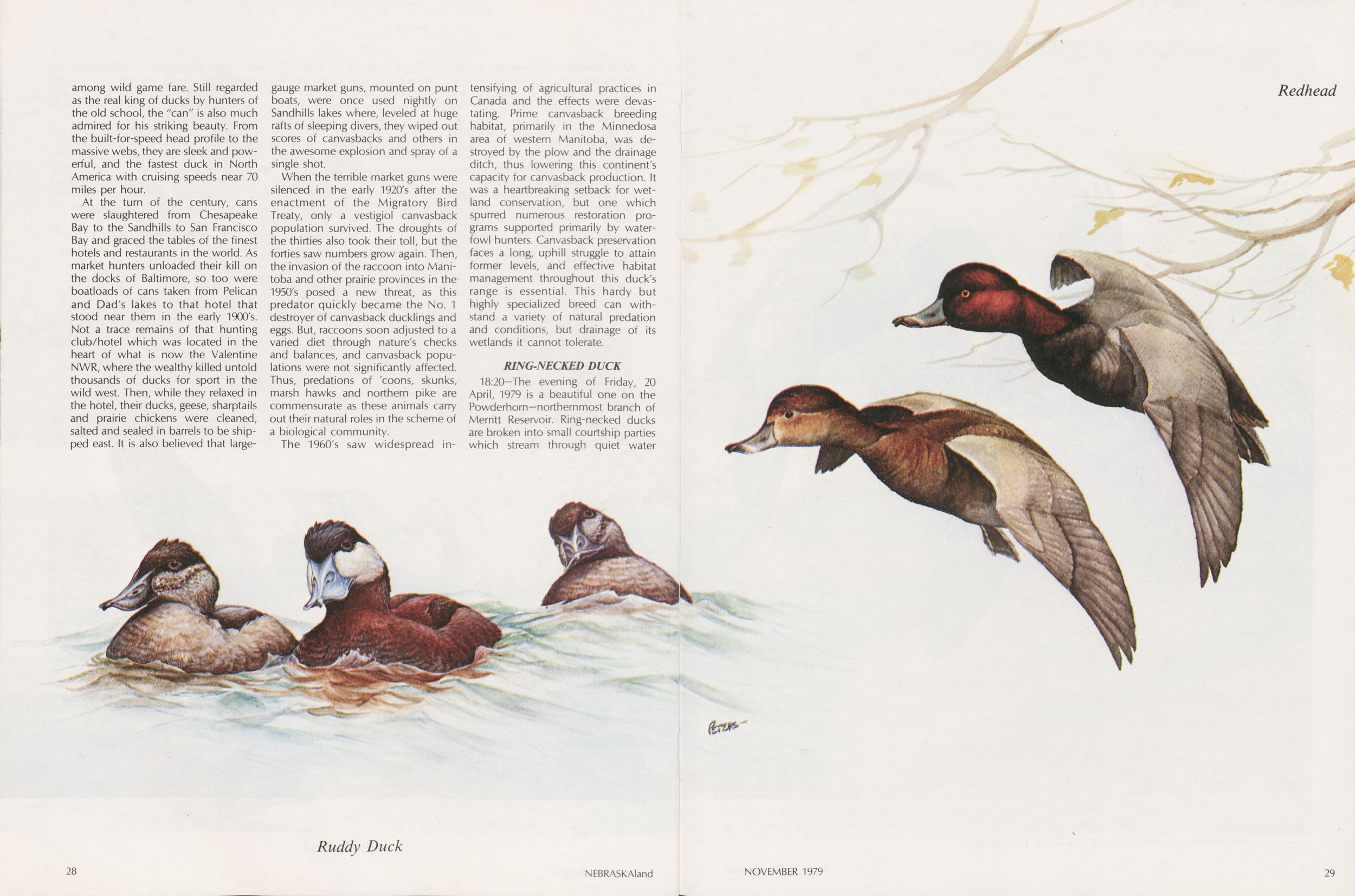
REDHEADThis species suffered unfortunate setbacks in the 1960/s when populations 24 NEBRASKAland declined as drought and drainage claimed hundreds of breeding ponds in the upper Great Plains. Many sexually mature females did not nest and of those that did, some watched their flightless broods perish on cracked lake beds. During the late 60/s, the hunting season on this "American Pochard" was closed with the hope that gene pools would rebuild faster. Another boost came from stepped-up wetlands restoration programs in the prairie provinces, and all concerned were optimistic. Unfortunately, biologists have recorded only gradual or fluctuating increases in redhead populations, and the unanswered question remains: When will the redhead population return to substantial levels?
The answer depends on the redheads themselves, for protection and
projects are only half the story. It appears this species may be its own
worst enemy, stemming from innate
tendencies toward brood parasitism.
Sometimes the hen "fiddler", as redheads are sometimes called, stays on
the nest to incubate her own eggs
plus maybe a few deposited there by
another hen redhead. Fiddlers have
also been known to deposit their eggs
in the nest of a mallard, canvasback or
ruddy, and sometimes will lay in a
community or "dump" nest, and none
will incubate them. One such dump
NOVEMBER 1979
25
While hunting is an important tool of waterfowl management, its effectiveness is lessened by hunters who are not accurate enough to shoot selectively. Easily decoyed, the "fool duck" will often swing through the blocks a second time under fire, some say out of curiosity for fallen companions. Be sure before you shoot, as redheads are relatively nondescript in poor light and this bird all too often falls as a "mistake" birds; causing ethical and perhaps legal disappointments.
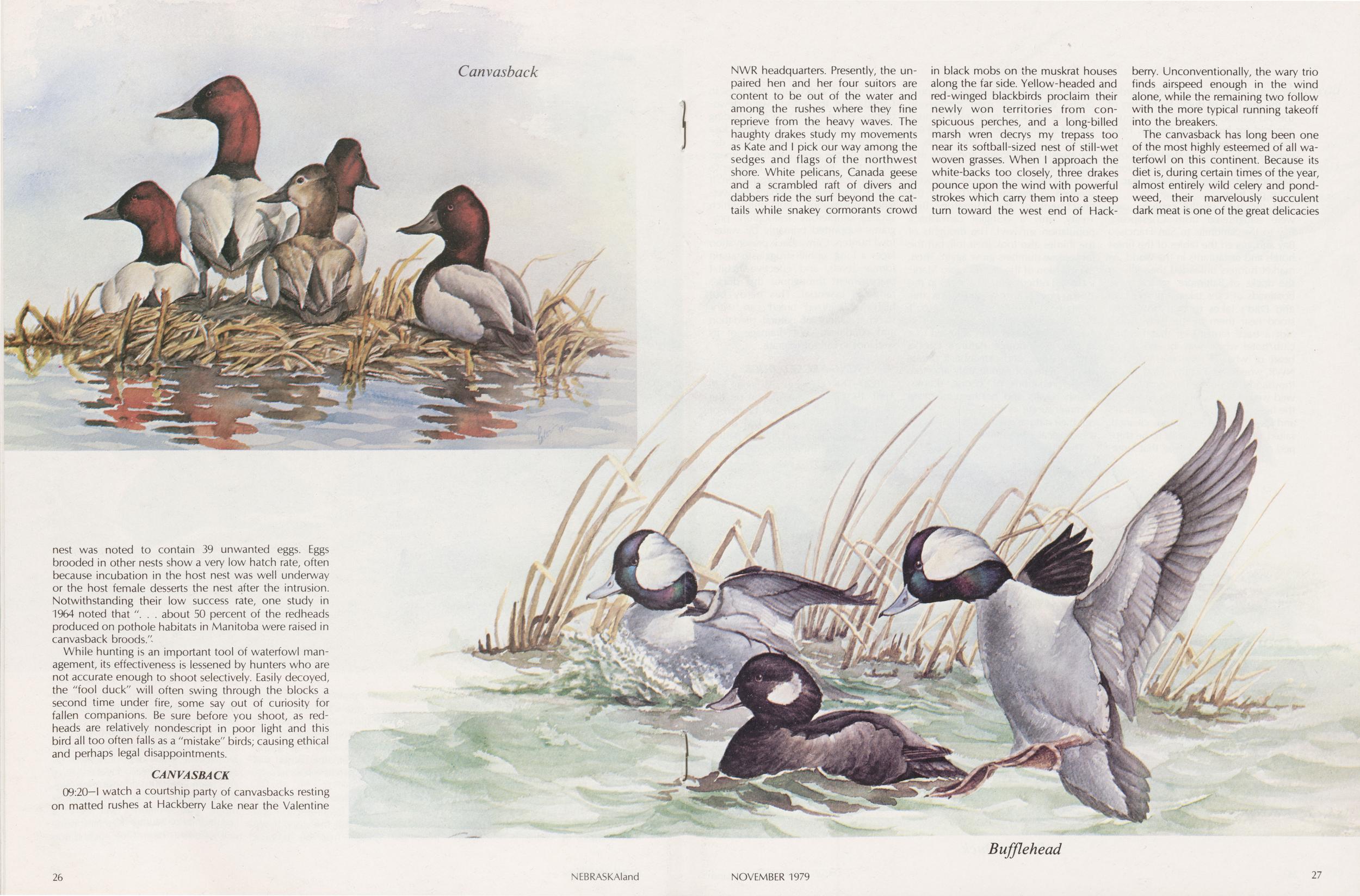
CANVASBACK09:20—1 watch a courtship party of canvasbacks resting on matted rushes at Hackberry Lake near the Valentine 26 NEBRASKAland NWR headquarters. Presently, the unpaired hen and her four suitors are content to be out of the water and among the rushes where they fine reprieve from the heavy waves. The haughty drakes study my movements as Kate and I pick our way among the sedges and flags of the northwest shore. White pelicans, Canada geese and a scrambled raft of divers and dabbers ride the surf beyond the cattails while snakey cormorants crowd in black mobs on the muskrat houses along the far side. Yellow-headed and red-winged blackbirds proclaim their newly won territories from conspicuous perches, and a long-billed marsh wren decoys my trespass too near its softball-sized nest of still-wet woven grasses. When I approach the white-backs too closely, three drakes pounce upon the wind with powerful strokes which carry them into a steep turn toward the west end of Hackberry. Unconventionally, the wary trio finds airspeed enough in the wind alone, while the remaining two follow with the more typical running takeoff into the breakers.
The canvasback has long been one of the most highly esteemed of all waterfowl on this continent. Because its diet is, during certain times of the year, almost entirely wild celery and pondweed, their marvelously succulent dark meat is one of the great delicacies
 among wild game fare. Still regarded
as the real king of ducks by hunters of
the old school, the "can" is also much
admired for his striking beauty. From
the built-for-speed head profile to the
massive webs, they are sleek and powerful, and the fastest duck in North
America with cruising speeds near 70
miles per hour.
among wild game fare. Still regarded
as the real king of ducks by hunters of
the old school, the "can" is also much
admired for his striking beauty. From
the built-for-speed head profile to the
massive webs, they are sleek and powerful, and the fastest duck in North
America with cruising speeds near 70
miles per hour.
At the turn of the century, cans were slaughtered from Chesapeake Bay to the Sandhills to San Francisco Bay and graced the tables of the finest hotels and restaurants in the world. As market hunters unloaded their kill on the docks of Baltimore, so too were boatloads of cans taken from Pelican and Dad's lakes to that hotel that stood near them in the early 1900's. Not a trace remains of that hunting club/hotel which was located in the heart of what is now the Valentine NWR, where the wealthy killed untold thousands of ducks for sport in the wild west. Then, while they relaxed in the hotel, their ducks, geese, sharptails and prairie chickens were cleaned, salted and sealed in barrels to be shipped east. It is also believed that large-gauge market guns, mounted on punt boats, were once used nightly on Sandhills lakes where, leveled at huge rafts of sleeping divers, they wiped out scores of canvasbacks and others in the awesome explosion and spray of a single shot.
When the terrible market guns were silenced in the early 1920's after the enactment of the Migratory Bird Treaty, only a vestigiol canvasback population survived. The droughts of the thirties also took their toll, but the forties saw numbers grow again. Then, the invasion of the raccoon into Manitoba and other prairie provinces in the 1950's posed a new threat, as this predator quickly became the No. 1 destroyer of canvasback ducklings and eggs. But, raccoons soon adjusted to a varied diet through nature's checks and balances, and canvasback populations were not significantly affected. Thus, predations of 'coons, skunks, marsh hawks and northern pike are commensurate as these animals carry out their natural roles in the scheme of a biological community.
The 1960's saw widespread intensifying of agricultural practices in Canada and the effects were devastating. Prime canvasback breeding habitat, primarily in the Minnesota area of western Manitoba, was destroyed by the plow and the drainage ditch, thus lowering this continent's capacity for canvasback production. It was a heartbreaking setback for wetland conservation, but one which spurred numerous restoration programs supported primarily by waterfowl hunters. Canvasback preservation faces a long, uphill struggle to attain former levels, and effective habitat management throughout this duck's range is essential. This hardy but highly specialized breed can withstand a variety of natural predation and conditions, but drainage of its wetlands it cannot tolerate.
RING-NECKED DUCK18:20—The evening of Friday, 20 April, 1979 is a beautiful one on the Powderhorn—northernmost branch of Merritt Reservoir. Ring-necked ducks are broken into small courtship parties which stream through quiet water
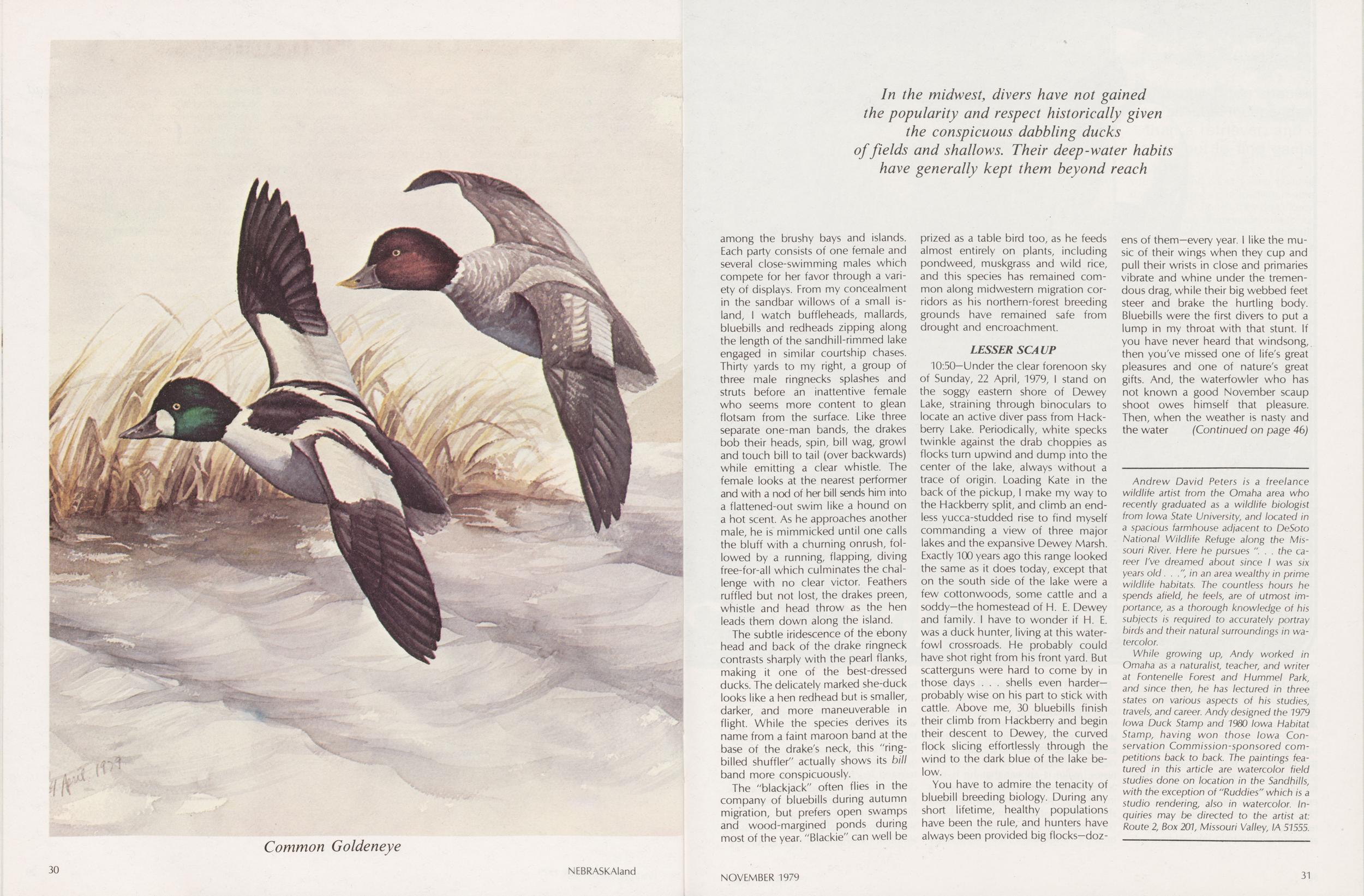
among the brushy bays and islands. Each party consists of one female and several close-swimming males which compete for her favor through a variety of displays. From my concealment in the sandbar willows of a small island, I watch buffleheads, mallards, bluebills and redheads zipping along the length of the sandhill-rimmed lake engaged in similar courtship chases. Thirty yards to my right, a group of three male ringnecks splashes and struts before an inattentive female who seems more content to glean flotsam from the surface. Like three separate one-man bands, the drakes bob their heads, spin, bill wag, growl and touch bill to tail (over backwards) while emitting a clear whistle. The female looks at the nearest performer and with a nod of her bill sends him into a flattened-out swim like a hound on a hot scent. As he approaches another male, he is mimmicked until one calls the bluff with a churning onrush, followed by a running, flapping, diving free-for-all which culminates the challenge with no clear victor. Feathers ruffled but not lost, the drakes preen, whistle and head throw as the hen leads them down along the island.
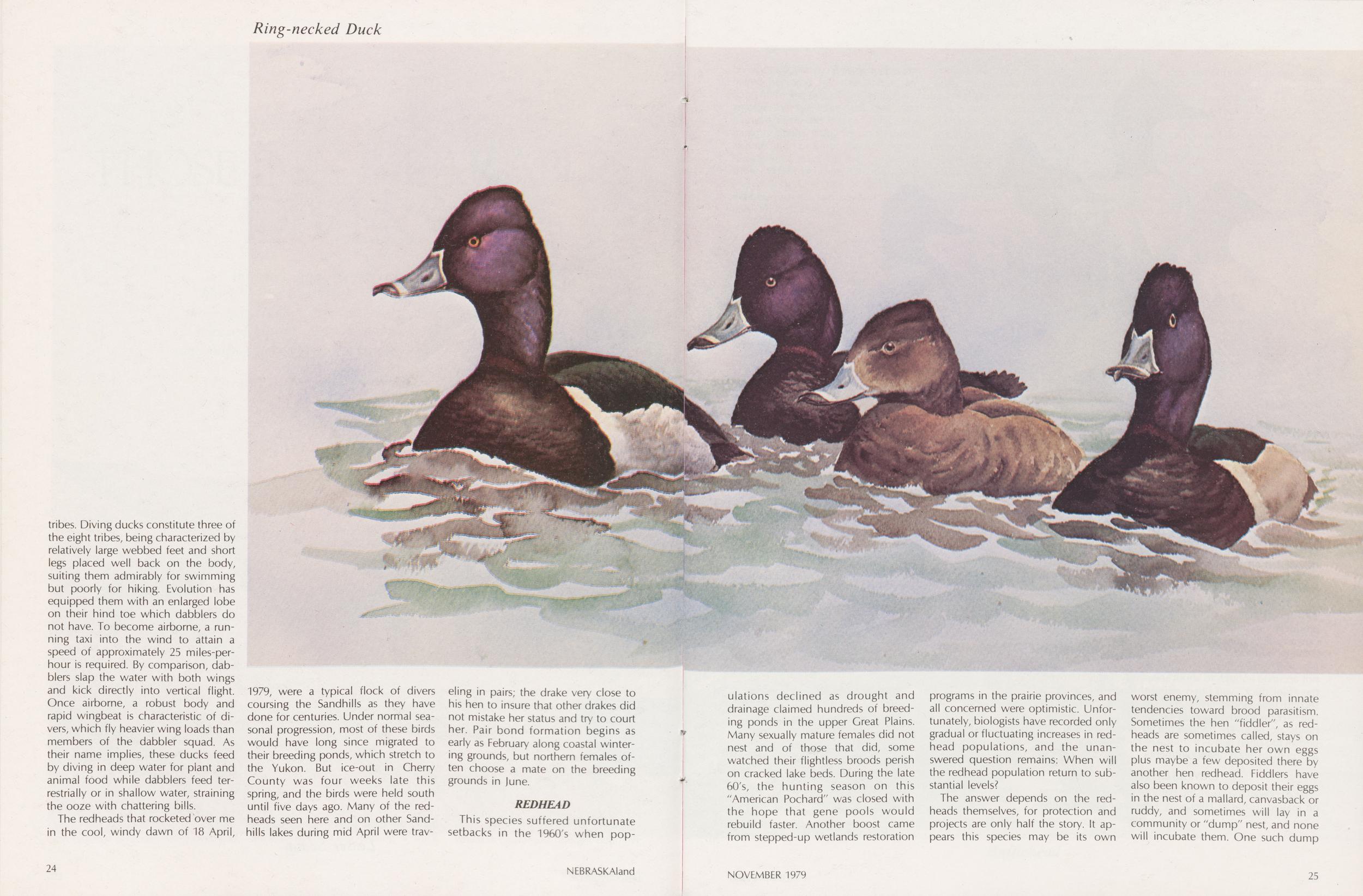
The subtle iridescence of the ebony head and back of the drake ringneck contrasts sharply with the pearl flanks, making it one of the best-dressed ducks. The delicately marked she-duck looks like a hen redhead but is smaller, darker, and more maneuverable in flight. While the species derives its name from a faint maroon band at the base of the drake's neck, this "ring-billed shuffler" actually shows its bill band more conspicuously.
The "blackjack" often flies in the company of bluebills during autumn migration, but prefers open swamps and wood-margined ponds during most of the year. "Blackie" can well be prized as a table bird too, as he feeds almost entirely on plants, including pondweed, muskgrass and wild rice, and this species has remained common along midwestern migration corridors as his northern-forest breeding grounds have remained safe from drought and encroachment.
LESSER SCAUP10:50—Under the clear forenoon sky of Sunday, 22 April, 1979, I stand on the soggy eastern shore of Dewey Lake, straining through binoculars to locate an active diver pass from Hackberry Lake. Periodically, white specks twinkle against the drab choppies as flocks turn upwind and dump into the center of the lake, always without a trace of origin. Loading Kate in the back of the pickup, I make my way to the Hackberry split, and climb an endless yucca-studded rise to find myself-commanding a view of three major lakes and the expansive Dewey Marsh. Exactly 100 years ago this range looked the same as it does today, except that on the south side of the lake were a few cottonwoods, some cattle and a soddy—the homestead of H. E. Dewey and family. I have to wonder if H. E. was a duck hunter, living at this waterfowl crossroads. He probably could have shot right from his front yard. But scatterguns were hard to come by in those days . . . shells even harder—probably wise on his part to stick with cattle. Above me, 30 bluebills finish their climb from Hackberry and begin their descent to Dewey, the curved flock slicing effortlessly through the wind to the dark blue of the lake below.
You have to admire the tenacity of bluebill breeding biology. During any short lifetime, healthy populations have been the rule, and hunters have always been provided big flocks—dozens of them—every year. I like the mu- sic of their wings when they cup and pull their wrists in close and primaries vibrate and whine under the tremendous drag, while their big webbed feet steer and brake the hurtling body. Bluebills were the first divers to put a lump in my throat with that stunt. If you have never heard that windsong, then you've missed one of life's great pleasures and one of nature's great gifts. And, the waterfowler who has not known a good November scaup shoot owes himself that pleasure. Then, when the weather is nasty and the water (Continued on page 46)
Andrew David Peters is a freelance wildlife artist from the Omaha area who recently graduated as a wildlife biologist from Iowa State University, and located in a spacious farmhouse adjacent to DeSoto National Wildlife Refuge along the Missouri River. Here he pursues ". . . the career I've dreamed about since I was six years old . . .", in an area wealthy in prime wildlife habitats. The countless hours he spends afield, he feels, are of utmost importance, as a thorough knowledge of his subjects is required to accurately portray birds and their natural surroundings in watercolor. While growing up, Andy worked in Omaha as a naturalist, teacher, and writer at Fontenelle Forest and Hummel Park, and since then, he has lectured in three states on various aspects of his studies, travels, and career. Andy designed the 1979 Iowa Duck Stamp and 1980 Iowa Habitat Stamp, having won those Iowa Conservation Commission-sponsored competitions back to back. The paintings featured in this article are watercolor field studies done on location in the Sandhills, with the exception of "Ruddies" which is a studio rendering, also in watercolor. Inquiries may be directed to the artist at: Route 2, Box 201, Missouri Valley, IA 51555. NOVEMBER 1979 31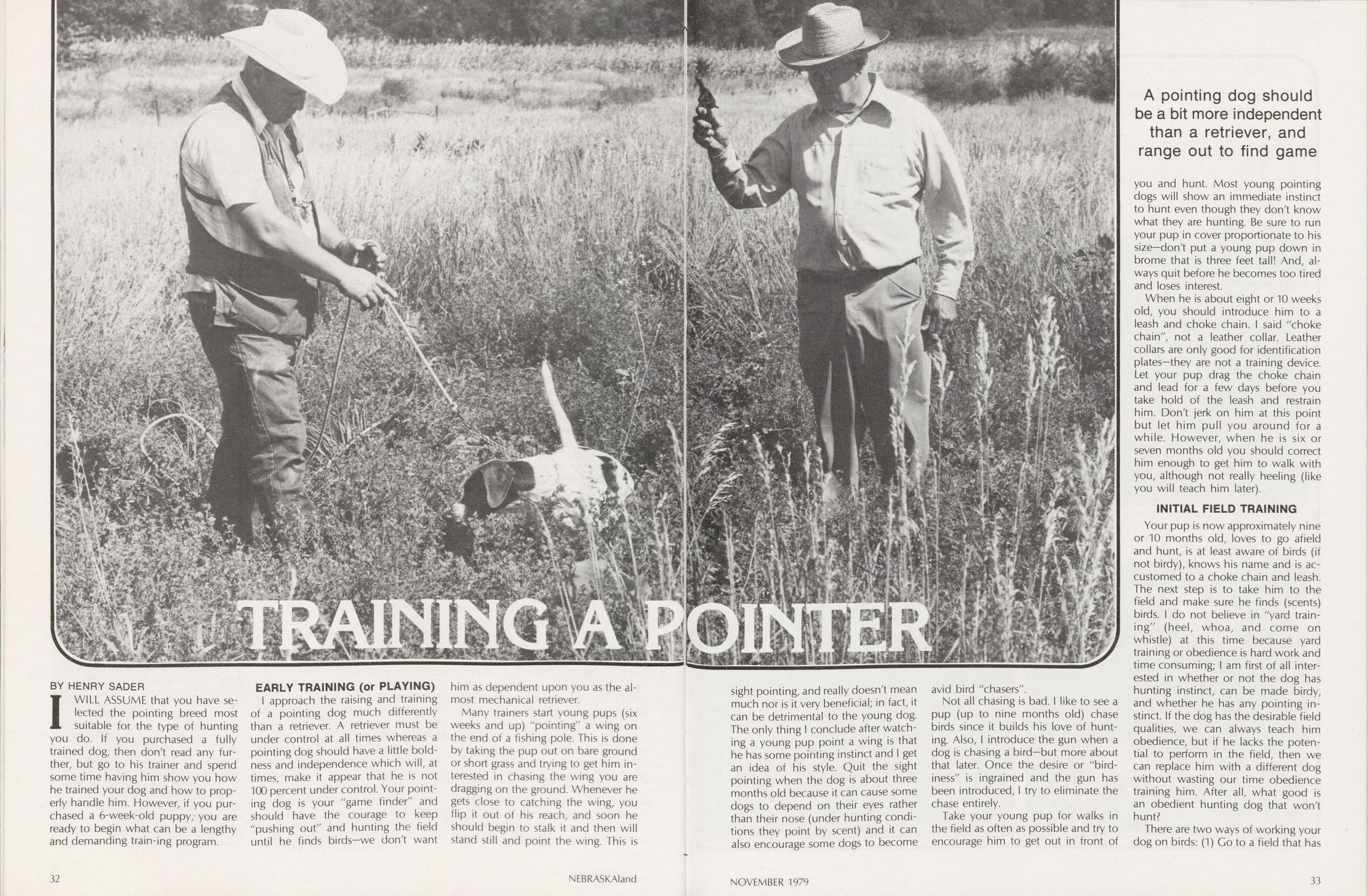
TRAINING A POINTER
BY HENRY SADER A pointing dog should be a bit more independent than a retriever, and range out to find gameI WILL ASSUME that you have selected the pointing breed most suitable for the type of hunting you do. If you purchased a fully trained dog, then don't read any further, but go to his trainer and spend some time having him show you how he trained your dog and how to properly handle him. However, if you purchased a 6-week-old puppy, you are ready to begin what can be a lengthy and demanding train-ing program.
EARLY TRAINING (or PLAYING)I approach the raising and training of a pointing dog much differently than a retriever. A retriever must be under control at all times whereas a pointing dog should have a little boldness and independence which will, at times, make it appear that he is not 100 percent under control. Your pointing dog is your "game finder" and should have the courage to keep "pushing out" and hunting the field until he finds birds-we don't want him as dependent upon you as the almost mechanical retriever.
Many trainers start young pups (six weeks and up) "pointing" a wing on the end of a fishing pole. This is done by taking the pup out on bare ground or short grass and trying to get him interested in chasing the wing you are dragging on the ground. Whenever he gets close to catching the wing, you flip it out of his reach, and soon he should begin to stalk it and then will stand still and point the wing. This is 32 NEBRASKAland sight pointing, and really doesn't mean much nor is it very beneficial; in fact, it can be detrimental to the young dog. The only thing I conclude after watching a young pup point a wing is that he has some pointing instinct and I get an idea of his style. Quit the sight pointing when the dog is about three months old because it can cause some dogs to depend on their eyes rather than their nose (under hunting conditions they point by scent) and it can also encourage some dogs to become avid bird "chasers".
Not all chasing is bad. I like to see a pup (up to nine months old) chase birds since it builds his love of hunting. Also, I introduce the gun when a dog is chasing a bird—but more about that later. Once the desire or "birdiness" is ingrained and the gun has been introduced, I try to eliminate the chase entirely.
Take your young pup for walks in the field as often as possible and try to encourage him to get out in front of you and hunt. Most young pointing dogs will show an immediate instinct to hunt even though they don't know what they are hunting. Be sure to run your pup in cover proportionate to his size—don't put a young pup down in brome that is three feet tall! And, always quit before he becomes too tired and loses interest.
When he is about eight or 10 weeks old, you should introduce him to a leash and choke chain. I said "choke chain", not a leather collar. Leather collars are only good for identification plates-they are not a training device. Let your pup drag the choke chain and lead for a few days before you take hold of the leash and restrain him. Don't jerk on him at this point but let him pull you around for a while. However, when he is six or seven months old you should correct him enough to get him to walk with you, although not really heeling (like you will teach him later).
INITIAL FIELD TRAININGYour pup is now approximately nine or 10 months old, loves to go afield and hunt, is at least aware of birds (if not birdy), knows his name and is accustomed to a choke chain and leash. The next step is to take him to the field and make sure he finds (scents) birds. I do not believe in "yard training" (heel, whoa, and come on whistle) at this time because yard training or obedience is hard work and time consuming; I am first of all interested in whether or not the dog has hunting instinct, can be made birdy, and whether he has any pointing instinct. If the dog has the desirable field qualities, we can always teach him obedience, but if he lacks the potential to perform in the field, then we can replace him with a different dog without wasting our time obedience training him. After all, what good is an obedient hunting dog that won't hunt?
NOVEMBER 1979 33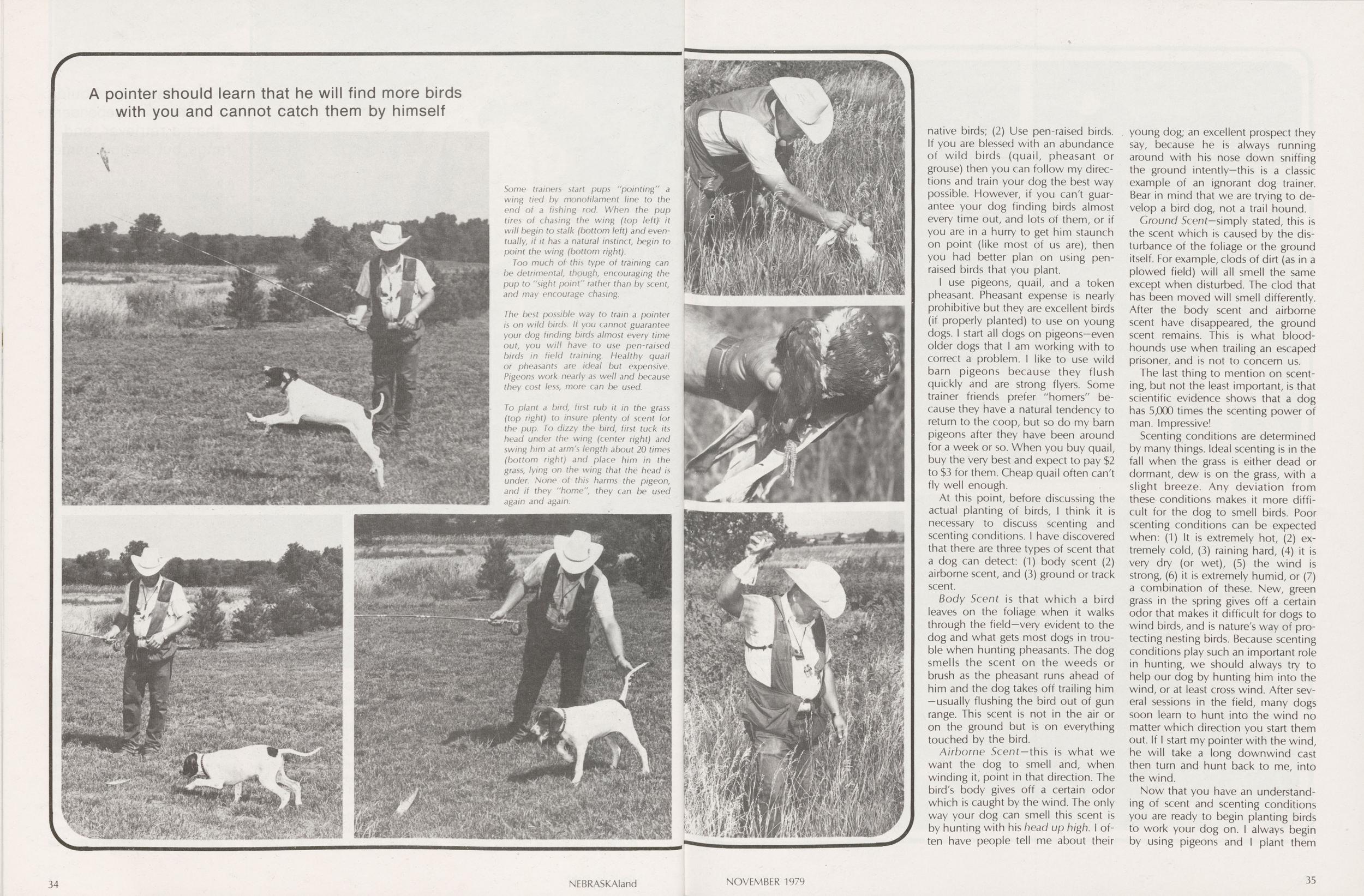 A pointer should learn that he will find more birds
with you and cannot catch them by himself
A pointer should learn that he will find more birds
with you and cannot catch them by himself
Some trainers start pups "pointing" a wing tied by monofilament line to the end of a fishing rod. When the pup tires of chasing the wing (top left) it will begin to stalk (bottom left) and eventually, if it has a natural instinct, begin to point the wing (bottom right). Too much of this type of training can be detrimental, though, encouraging the pup to "sight point" rather than by scent, and may encourage chasing.
The best possible way to train a pointer is on wild birds. If you cannot guarantee your dog finding birds almost every time out, you will have to use pen-raised birds in field training. Healthy quail or pheasants are ideal but expensive. Pigeons work nearly as well and because they cost less, more can be used.
To plant a bird, first rub it in the grass (top right) to insure plenty of scent for the pup. To dizzy the bird, first tuck its head under the wing (center right) and swing him at arm's length about 20 times (bottom right) and place him in the grass, lying on the wing that the head is under. None of this harms the pigeon, and if they "home", they can be used again and again.
34 NEBRASKAlandThere are two ways of working your dog on birds: (1) Go to a field that has native birds; (2) Use pen-raised birds. If you are blessed with an abundance of wild birds (quail, pheasant or grouse) then you can follow my directions and train your dog the best way possible. However, if you can't guarantee your dog finding birds almost every time out, and lots of them, or if you are in a hurry to get him staunch on point (like most of us are), then you had better plan on using pen-raised birds that you plant.
I use pigeons, quail, and a token pheasant. Pheasant expense is nearly prohibitive but they are excellent birds (if properly planted) to use on young dogs. I start all dogs on pigeons-even older dogs that I am working with to correct a problem. I like to use wild barn pigeons because they flush quickly and are strong flyers. Some trainer friends prefer "homers" because they have a natural tendency to return to the coop, but so do my barn pigeons after they have been around for a week or so. When you buy quail, buy the very best and expect to pay $2 to $3 for them. Cheap quail often can't fly well enough.
At this point, before discussing the actual planting of birds, I think it is necessary to discuss scenting and scenting conditions. I have discovered that there are three types of scent that a dog can detect: (1) body scent (2) airborne scent, and (3) ground or track scent.
Body Scent is that which a bird leaves on the foliage when it walks through the field—very evident to the dog and what gets most dogs in trouble when hunting pheasants. The dog smells the scent on the weeds or brush as the pheasant runs ahead of him and the dog takes off trailing him —usually flushing the bird out of gun range. This scent is not in the air or on the ground but is on everything touched by the bird.
Airborne Scent—this is what we want the dog to smell and, when winding it, point in that direction. The bird's body gives off a certain odor which is caught by the wind. The only way your dog can smell this scent is by hunting with his head up high. I often have people tell me about their young dog; an excellent prospect they say, because he is always running around with his nose down sniffing the ground intently—this is a classic example of an ignorant dog trainer. Bear in mind that we are trying to develop a bird dog, not a trail hound. Ground Scent-simply stated, this is the scent which is caused by the disturbance of the foliage or the ground itself. For example, clods of dirt (as in a plowed field) will all smell the same except when disturbed. The clod that has been moved will smell differently. After the body scent and airborne scent have disappeared, the ground scent remains. This is what bloodhounds use when trailing an escaped prisoner, and is not to concern us.
The last thing to mention on scenting, but not the least important, is that scientific evidence shows that a dog has 5,000 times the scenting power of man. Impressive!
Scenting conditions are determined by many things. Ideal scenting is in the fall when the grass is either dead or dormant, dew is on the grass, with a slight breeze. Any deviation from these conditions makes it more difficult for the dog to smell birds. Poor scenting conditions can be expected when: (1) It is extremely hot, (2) extremely cold, (3) raining hard, (4) it is very dry (or wet), (5) the wind is strong, (6) it is extremely humid, or (7) a combination of these. New, green grass in the spring gives off a certain odor that makes it difficult for dogs to wind birds, and is nature's way of protecting nesting birds. Because scenting conditions play such an important role in hunting, we should always try to help our dog by hunting him into the wind, or at least cross wind. After several sessions in the field, many dogs soon learn to hunt into the wind no matter which direction you start them out. If I start my pointer with the wind, he will take a long downwind cast then turn and hunt back to me, into the wind.
NOVEMBER 1979 35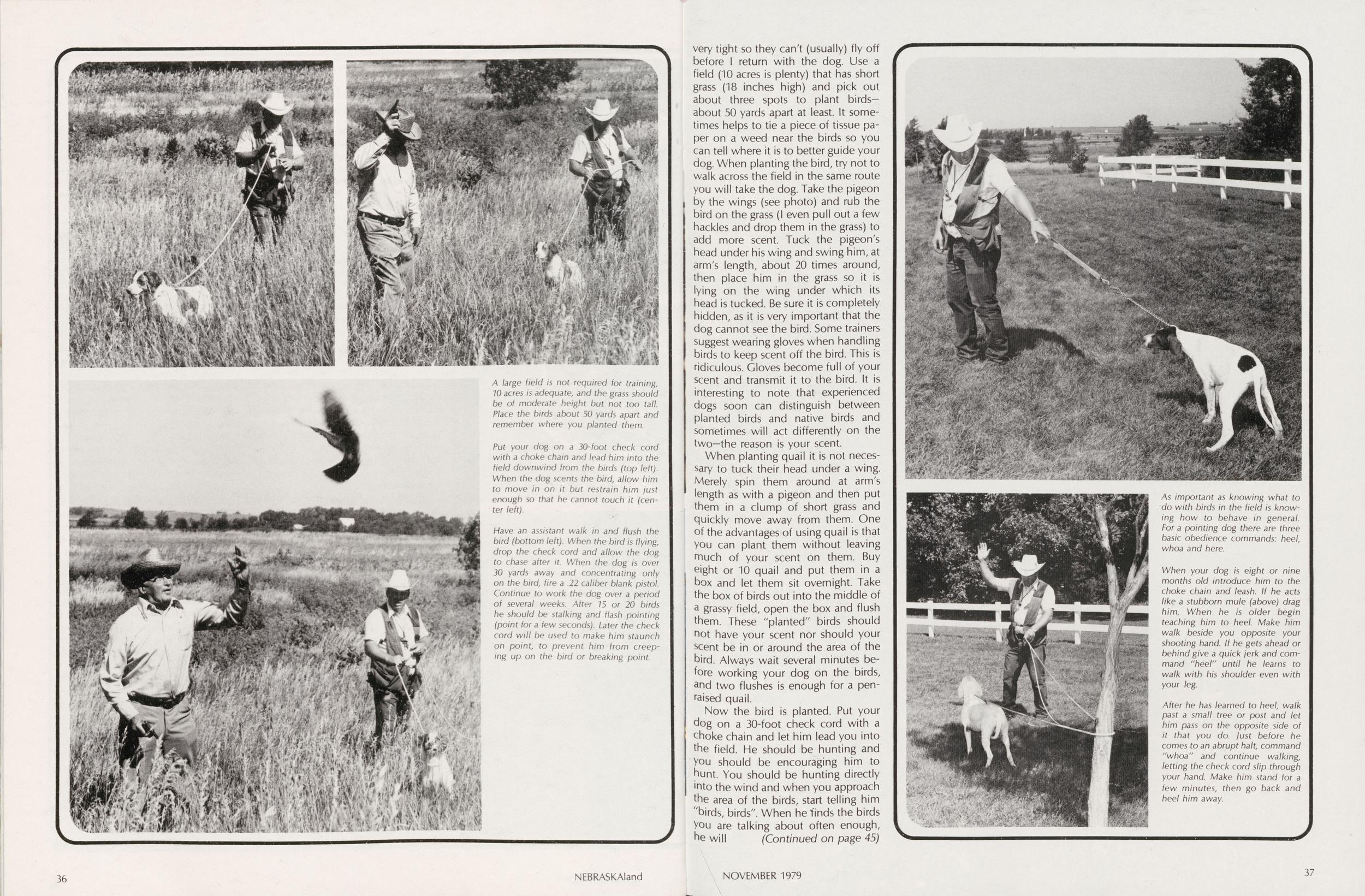
A large field is not required for training, 10 acres is adequate, and the grass should be of moderate height but not too tall. Place the birds about 50 yards apart and remember where you planted them.
Put your dog on a 30-foot check cord with a choke chain and lead him into the field downwind from the birds (top left). When the dog scents the bird, allow him to move in on it but restrain him just enough so that he cannot touch it (center left).
Have an assistant walk in and flush the bird (bottom left). When the bird is flying, drop the check cord and allow the dog to chase after it. When the dog is over 30 yards away and concentrating only on the bird, fire a .22 caliber blank pistol. Continue to work the dog over a period of several weeks. After 15 or 20 birds he should be stalking and flash pointing (point for a few seconds). Later the check cord will be used to make him staunch on point, to prevent him from creeping up on the bird or breaking point.
36 NEBRASKAlandNow that you have an understanding of scent and scenting conditions you are ready to begin planting birds to work your dog on. I always begin by using pigeons and I plant them very tight so they can't (usually) fly off before I return with the dog. Use a field (10 acres is plenty) that has short grass (18 inches high) and pick out about three spots to plant birds—about 50 yards apart at least. It sometimes helps to tie a piece of tissue paper on a weed near the birds so you can tell where it is to better guide your dog. When planting the bird, try not to walk across the field in the same route you will take the dog. Take the pigeon by the wings (see photo) and rub the bird on the grass (I even pull out a few hackles and drop them in the grass) to add more scent. Tuck the pigeon's head under his wing and swing him, at arm's length, about 20 times around, then place him in the grass so it is lying on the wing under which its head is tucked. Be sure it is completely hidden, as it is very important that the dog cannot see the bird. Some trainers suggest wearing gloves when handling birds to keep scent off the bird. This is ridiculous. Gloves become full of your scent and transmit it to the bird. It is interesting to note that experienced dogs soon can distinguish between planted birds and native birds and sometimes will act differently on the two—the reason is your scent.
When planting quail it is not necessary to tuck their head under a wing. Merely spin them around at arm's length as with a pigeon and then put them in a clump of short grass and quickly move away from them. One of the advantages of using quail is that you can plant them without leaving much of your scent on them. Buy eight or 10 quail and put them in a box and let them sit overnight. Take the box of birds out into the middle of a grassy field, open the box and flush them. These "planted" birds should not have your scent nor should your scent be in or around the area of the bird. Always wait several minutes before working your dog on the birds, and two flushes is enough for a penraised quail.
Now the bird is planted. Put your dog on a 30-foot check cord with a choke chain and let him lead you into the field. He should be hunting and You should be encouraging him to hunt. You should be hunting directly into the wind and when you approach the area of the birds, start telling him "birds, birds". When he finds the birds You are talking about often enough, he will (Continued on page 45)
As important as knowing what to do with birds in the field is knowing how to behave in general. For a pointing dog there are three basic obedience commands: heel, whoa and here.
When your dog is eight or nine months old introduce him to the choke chain and leash. If he acts like a stubborn mule (above) drag him. When he is older begin teaching him to heel. Make him walk beside you opposite your shooting hand. If he gets ahead or behind give a quick jerk and command "heel" until he learns to walk with his shoulder even with your leg.
After he has learned to heel, walk past a small tree or post and let him pass on the opposite side of it that you do. just before he comes to an abrupt halt, command "whoa" and continue walking, letting the check cord slip through your hand. Make him stand for a few minutes, then go back and heel him away.
NOVEMBER 1979 37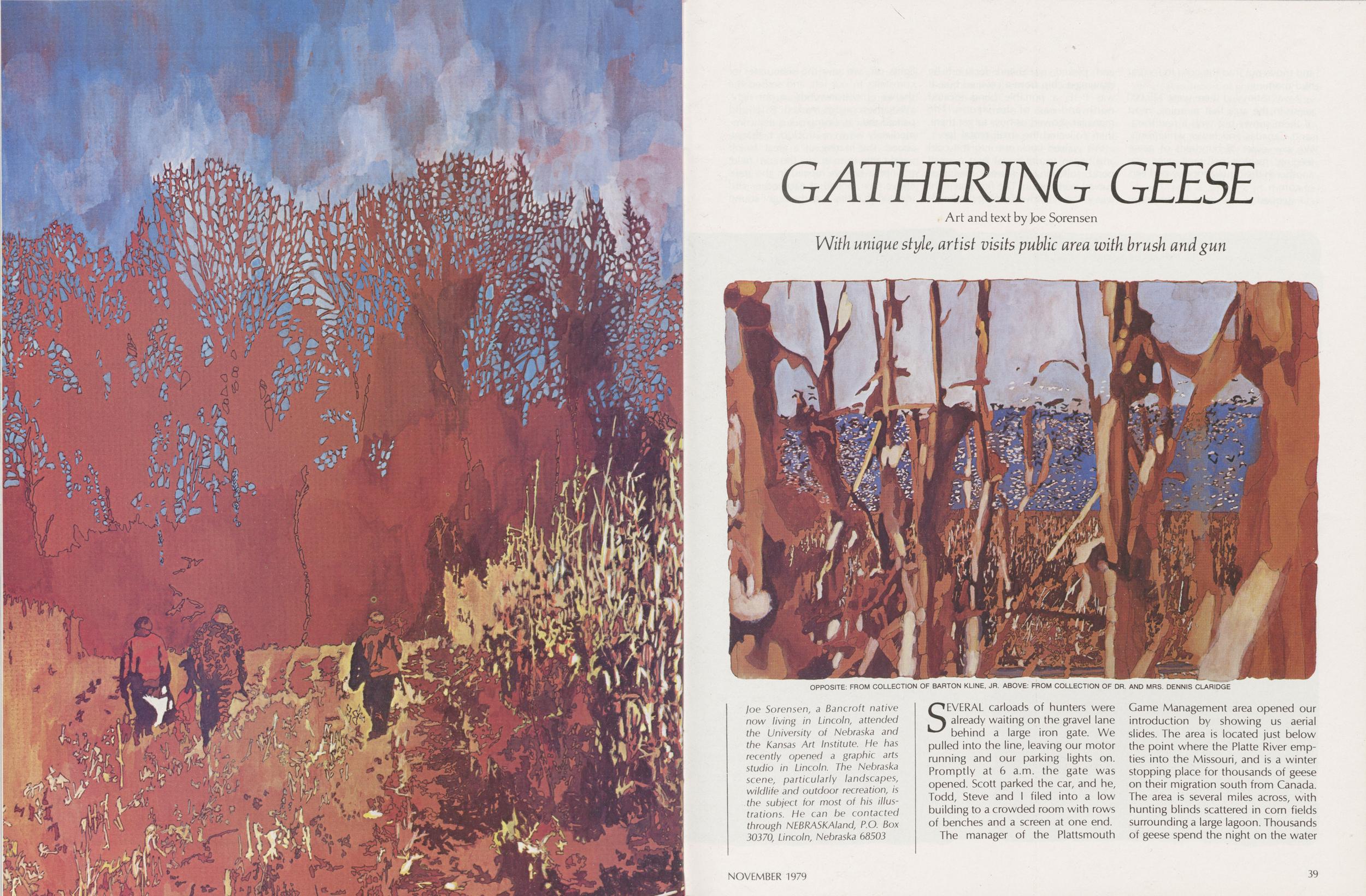
GATHERING GEESE
Art and text by Joe Sorensen With unique style, artist visits public area with brush and gunSEVERAL carloads of hunters were already waiting on the gravel lane behind a large iron gate. We pulled into the line, leaving our motor running and our parking lights on. Promptly at 6 a.m. the gate was opened. Scott parked the car, and he, Todd, Steve and I filed into a low building to a crowded room with rows of benches and a screen at one end.
The manager of the Plattsmouth
Game Management area opened our
introduction by showing us aerial
slides. The area is located just below
the point where the Platte River empties into the Missouri, and is a winter
stopping place for thousands of geese
on their migration south from Canada.
The area is several miles across, with
hunting blinds scattered in corn fields
surrounding a large lagoon. Thousands
of geese spend the night on the water
NOVEMBER 1979
39
 and move out into the corn to feed at
mid-morning.
and move out into the corn to feed at
mid-morning.
It was estimated there were 125,000 geese in the area that morning, most of them snows but with a few thousand Canadas and fewer whitefronts. We saw slides of hundreds of geese feeding, rushing pell-mell over one another in their quest for downed ears of corn.
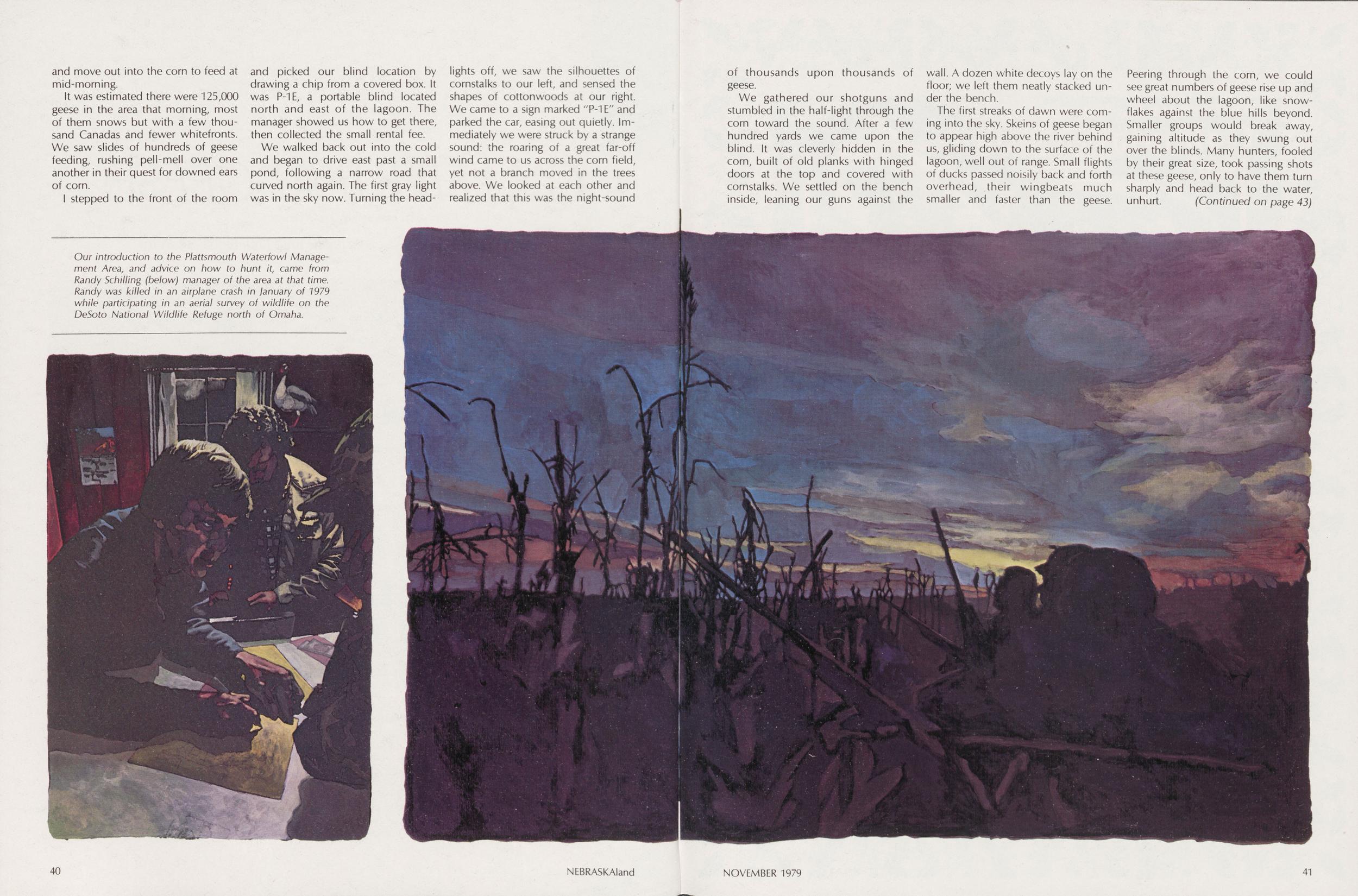
I stepped to the front of the room and picked our blind location by drawing a chip from a covered box. It was P-1E, a portable blind located north and east of the lagoon. The manager showed us how to get there, then collected the small rental fee.
We walked back out into the cold and began to drive east past a small pond, following a narrow road that curved north again. The first gray light was in the sky now. Turning the head-lights off, we saw the silhouettes of cornstalks to our left, and sensed the shapes of cottonwoods at our right. We came to a sign marked "P-1E" and parked the car, easing out quietly. Immediately we were struck by a strange sound: the roaring of a great far-off wind came to us across the corn field, yet not a branch moved in the trees above. We looked at each other and realized that this was the night-sound
We gathered our shotguns and stumbled in the half-light through the corn toward the sound. After a few hundred yards we came upon the blind. It was cleverly hidden in the corn, built of old planks with hinged doors at the top and covered with cornstalks. We settled on the bench inside, leaning our guns against the wall. A dozen white decoys lay on the floor; we left them neatly stacked under the bench.
The first streaks of dawn were coming into the sky. Skeins of geese began to appear high above the river behind us, gliding down to the surface of the lagoon, well out of range. Small flights of ducks passed noisily back and forth overhead, their wingbeats much smaller and faster than the geese. Peering through the corn, we could see great numbers of geese rise up and wheel about the lagoon, like snowflakes against the blue hills beyond. Smaller groups would break away, gaining altitude as they swung out over the blinds. Many hunters, fooled by their great size, took passing shots at these geese, only to have them turn sharply and head back to the water, unhurt. (Continued on page 43)
The sky was filled with geese now, making a tremendous din and clatter. A small group of snows, lower than the rest, seemed to be headed our way. We nervously fingered our guns, moving the safeties to off. The geese were very large, and just overhead. We could see bright orange feet tucked under their white bellies. Throwing open the doors, we jumped up, Todd and Steve firing three times and I, twice. The geese turned gracefully back toward the lagoon, apparently unscathed.
We turned to Scott, who hadn't fired because he was on the opposite side of the blind. His 12-gauge had a special, longer goose barrel, and he used shells with plastic backing material designed to keep the shot in a tighter pattern at long range. Unless the geese came lower, Scott would be our only hope.
By now, the sun was up. Its rays slanted through the blind. Through a crack at the bottom, we watched the shadow of a field mouse as he sniffed the stalks on the ground outside. We poured coffee and began to talk, no longer awed by the spectacle of the geese—having fired on them. No other geese passed above us, and despite scattered gunshots from other blinds, we hadn't seen any geese fall.
But, just then we noticed another band of geese, 25 or 30 of them, swinging over the corn straight for us. Scott readied himself, picked his target, and when they were above us, jumped up and shouldered his gun. A large snow, second behind the leader, dropped one wing and began to roll over. It spiraled downward, the other wing still outstretched, slammed into the ground and bounced. Scott jumped over the side, ran a few yards to the goose, and broke its neck. He carried it back and dropped it into the blind, on the floor next to the decoys.
We marvelled at the shot; a remarkable thing, for the goose had been higher than the first group we had missed. It was far beyond range for the rest of us. We inspected and marveled at Scott's new shells, and he offered some to each of us. We looked again to the lagoon, this time more hopeful. The entire population, in a gigantic, tumultuous wave, rose from one end and swept back toward the other. The flock seemed to have a singular life of its own, more than the sum of its parts; like a vast school of fish, it moved as one mind.
As the sun moved higher, the flock drew more into itself. The birds were above us now, a great surging cloud of commotion. The hunting was over, but we lingered —partly from holdover expectation, but mostly out of interest, even respect, for those noble birds gathered for their own, and for our, benefit.
THE NEW CHICKEN (Continued from page 21)the Midwest. It's had its ups and downs, but is still considered the No. 1 game bird in Nebraska.
By the 1930's, pheasants were off to a tremendous start. Despite the dust storms that hit all but the eastern third of the state in mid decade, pheasant numbers continued to increase. So did hunters. By 1935, there were an estimated 50,000 pheasant hunters in the state.
Pheasants weren't important just for meat in the pot then, or just for sport. In fact, many of Nebraska's 50,000 hunters in 72 counties were forced to forego their favorite sport unless they wanted to travel a bit. Again, the World Herald reported, ". . . because of requests from county boards and farmers, the season was reduced from 72 to 36 counties in 1936 be- cause Nebraska was again in the midst of a grasshopper plague and the pheasants were expected to help control them.
By the late thirties and early forties, the pheasants were really in business. Farmers who had hung on during the drought were beginning to use conservation practices to prevent a dust bowl, like they had just seen, from happening again.
Crop rotation, idle acres, grassed water-ways and farm ponds, along with the shelterbelts, made Nebraska, and many neighboring states, into a'pheasant factory. All that sweet clover growing on soil bank land provided unbelievable pheasant nesting. The birds took advantage of it and flourished.
By 1939 and '40, Nebraskans, including the Game, Forestation and Parks Commission, again had time to think about pheasants. Then, with federal-aid money made available under a newly passed Pittman-Robertson Act, the agency set out to stock thousands of pheasants in cooperation with sportsmen's groups throughout Nebraska.
Those cooperative pheasant-rearing units were to feed and raise the birds, which would be banded and released on game refuges in local areas. Targets for the
Each co-op received about 220 birds to raise, and they did very well with them. Some 51 sportsmen's organizations liberated a total of 13,489 pheasants. According to an article in the fall 1940 issue of Outdoor Nebraska, those birds averaged three pounds—or over 20 tons of pheasants total.
In addition to changed land management practices, pheasant co-ops and strict law enforcement, pheasants were the object of studies across the country. People had started some of the scientific game studies in the late twenties, but the depression had interrupted. In 1939, Outdoor Nebraska was reporting on factors that affect pheasant nesting. The report was from an article written by Dr. Gustav Swanson, University of Minnesota game management expert.
Among other things, Swanson observed: "... a pheasant nest in a hayfield is in a very hazardous position . . . over half the nest failures have been due to the operations of man, and, of course, the destruction during haying ... is by far the most significant."
In the winter of 1941, Outdoor Nebraska was reporting that, "Organizations sponsoring Cooperative Pheasant Rearing Units released 10-week-old pheasants during the 1940 productive season. These same organizations were responsible for creating 30 new refuge areas of 45,000 acres, and for the planting of 36,620 trees and shrubs to supplement existing feed and cover supplies." Habitat was beginning to be recognized as a factor in the continued health of those birds.
Of course the war years had their effect on game management in Nebraska. Yet, the pheasant seemed to weather the neglect with enthusiasm. Most of the conservation practices continued during the war, and on the land that wasn't worked because there wasn't manpower to work it, the pheasants made their homes in the weedy brush and were secure.
The Game, Forestation and Parks Commission didn't do much with pheasants or anything else during the war. Only three members of the agency's professional staff remained after the draft swept through the ranks.
NOVEMBER 1979 43 Seen through a gifted naturalist's
eye, Keith County, Nebraska,
becomes the theatre of an astonishing drama, played out by
swallows, snails, curlews, grasshoppers, and scores of other, "ordinary'' creatures.
"Belongs with
that select group of nature writing
that includes The Sea Around
Us and Lives of a Cell."'
—Publishers Weekly.
Keith
County
Journal
Johnjanovy, Jr.
Illustrated by the author
$8.95 at all bookstores
St. Martin's Press
Paintings with Distinction.
(Featured on pages 38-41, this issue)
Sorensen Graphics
ORIGINAL PAINTINGS, PORTRAITS, ILLUSTRATION
2802 SO. 12th, Lincoln, NE 68502 • 402/423-1393
Sorensen paintings may be viewed at
Famous French Galleries, 4220 So. 33rd, Lincoln
Fritz Gunsmithing and
Supply Co.
Heckler & Koch Dealer
Handfinishing—Hot Blue—Parkerization
Custom Rifles—Antique Restoration
407 S. Harris Wilber, NE
(402) 821-2260
AUTHORS WANTED BY
NEW YORK PUBLISHER
Leading subsidy book publisher seeks manuscripts
of all types: fiction, non-fiction, poetry, scholarly
and juvenile works, etc. New authors welcomed.
Send for free, illustrated 52-page brochure R-70
Vantage Press, 516 W. 34 St., New York, N.Y. 10001
New Prints
From the Wildlife Art Studio of Neal R. Anderson,
commissioned wildlife artist for NEBRASKAland magazine
Autumn Bobwhites
Edition-500, Signed & Numbered. Printed on neutral ph rag
stock. Image Size-12"x 14", Trim Size-16"xl8 1/2". $30.00
per print.
Ringneck Ducks
Edition-1,000, Signed upon request. Printed on neutral ph
stock. Size-8"x6". $8.50 per print. Hand tinted-$25.00.
Please include $2.00 per order to help cover postage and handling. Nebraska residents
add appropriate sales tax. All prints
shipped flat, extremely well protected. Satisfaction or your
money refunded.
Please send me the print(s) indicated:
Print(s) of "Autumn Bobwhites"
Print(s) of "Ringneck Ducks"
Name
Address
State
Zip
Send order to: Neal R. Anderson
819 w. Godfrey
Lincoln, NE 68521
44
NEBRASKAland
Seen through a gifted naturalist's
eye, Keith County, Nebraska,
becomes the theatre of an astonishing drama, played out by
swallows, snails, curlews, grasshoppers, and scores of other, "ordinary'' creatures.
"Belongs with
that select group of nature writing
that includes The Sea Around
Us and Lives of a Cell."'
—Publishers Weekly.
Keith
County
Journal
Johnjanovy, Jr.
Illustrated by the author
$8.95 at all bookstores
St. Martin's Press
Paintings with Distinction.
(Featured on pages 38-41, this issue)
Sorensen Graphics
ORIGINAL PAINTINGS, PORTRAITS, ILLUSTRATION
2802 SO. 12th, Lincoln, NE 68502 • 402/423-1393
Sorensen paintings may be viewed at
Famous French Galleries, 4220 So. 33rd, Lincoln
Fritz Gunsmithing and
Supply Co.
Heckler & Koch Dealer
Handfinishing—Hot Blue—Parkerization
Custom Rifles—Antique Restoration
407 S. Harris Wilber, NE
(402) 821-2260
AUTHORS WANTED BY
NEW YORK PUBLISHER
Leading subsidy book publisher seeks manuscripts
of all types: fiction, non-fiction, poetry, scholarly
and juvenile works, etc. New authors welcomed.
Send for free, illustrated 52-page brochure R-70
Vantage Press, 516 W. 34 St., New York, N.Y. 10001
New Prints
From the Wildlife Art Studio of Neal R. Anderson,
commissioned wildlife artist for NEBRASKAland magazine
Autumn Bobwhites
Edition-500, Signed & Numbered. Printed on neutral ph rag
stock. Image Size-12"x 14", Trim Size-16"xl8 1/2". $30.00
per print.
Ringneck Ducks
Edition-1,000, Signed upon request. Printed on neutral ph
stock. Size-8"x6". $8.50 per print. Hand tinted-$25.00.
Please include $2.00 per order to help cover postage and handling. Nebraska residents
add appropriate sales tax. All prints
shipped flat, extremely well protected. Satisfaction or your
money refunded.
Please send me the print(s) indicated:
Print(s) of "Autumn Bobwhites"
Print(s) of "Ringneck Ducks"
Name
Address
State
Zip
Send order to: Neal R. Anderson
819 w. Godfrey
Lincoln, NE 68521
44
NEBRASKAland
After the war, things settled down a bit—for the game managers. But, the pheasants suffered a serious setback from the blizzard of 1949. Bill Hewett of Rushville tells about it: "Up to the time of the '49 blizzard, we really had pheasants around here—by the thousands. We had the best hunting in the state. We lost them during the blizzard, darn near to a bird. Then we built some pens out in the ball park, in the outfield, and raised pheasants and released them in the fall. The state would give us birds and we would raise them. The state furnished the food, we did the work and took care of them, and they would watch in the fall when we turned them loose. We turned out approximately 1,000 birds each year for nine years."
The Commission was back in the stocking business then much the same as during the pheasant co-op days. But, nothing really big happened to the pheasant until M. O. Steen moved into Nebraska. All of a sudden the brightly colored Shanghai chicken became a star. When M.O. called the pheasant a "million dollar game bird" he meant it literally.
Hunting license sales soared. Here was some money for habitat, some to move game around a little for better distribution, and to bring in some new ones-like the Merriam's wild turkey. Here was the money to study the pheasant and his needs, and to protect him if possible from the agricultural boom that was crowding him and other game species out of their homes.
Non-resident hunters, of course, spent more to hunt pheasants than Nebraskans did-and Nebraskans reaped the benefits. Nebraska gained almost $800,000 in nonresident hunting and fishing license fees in 1966 alone. That went for game management.
Then there were the millions of dollars the non-resident left behind over the years for lodging tabs, and food bills, and gasoline, and incidentals like toothpaste and shotgun shells. And, most of that traffic was attracted by that inscrutible Oriental chicken. His picture was on the cover of every sports or outdoor magazine in the country.
And that represented a long trip for the pheasant-all the way around the horn. Starting with a boat trip from the Orient, the pheasant had been a mere replacement for a more desirable game bird. Then he became desirable in his own right-a "million dollar" prize.
And here he is in 1979-still as colorful as ever. Still as sought-after as ever, but perhaps in a little trouble. Pheasant habitat is declining. With every shelterbelt that falls, with every fencerow removed, with every weedpatch burned or turned under, the pheasant loses a little ground.
The Game and Parks Commission's Habitat Program is helping, holding the line a bit, but there are only so many dollars and so many acres available. And there is so much pressure for more agricultural products.
Perhaps someday in the not-too-distant future we will be looking for a replacement for the Shanghai chicken. But, that might not be an easy task.
TRAINING A POINTER (Continued from page 37)become a believer in you. And this will help keep him in close later on when you are trying to pick up singles out of a covey; also, the fact that you are guiding the dog to these first birds will help convince him to stay with you when hunting. If you dog winds the first bird and goes right in, great—restrain him just enough so that he can't touch it, and at the same time kick the bird into the air. You have to have a short hold on the check cord and react fast You may find it easier to have a helper flush the birds while you handle the dog. When the bird is in the air, drop the check cord and encourage the dog to chase the bird. Now is the time to shoot your .22 caliber blank—when he is chasing the bird with total concentration. If your young dog didn't show any sign of the presence of the bird, then make him stand on the downwind side of the bird while you kick in the weeds trying to get him to take an interest. Sometimes it is necessary to actually push the dog's head down and make him smell it.
Continue working your dog in this manner and he should begin stalking and flash pointing (point for a few seconds) within 15 or 20 birds. Don't try to do this all in one day but take a couple of weeks so you avoid boring him.
After two or three weeks the dog should be pointing pigeons and be pretty staunch on the check cord. The check cord has been used to guide and control the dog to the bird, but its primary function has been to keep the dog from catching the bird. A cardinal principle in training pointing dogs is ALWAYS AVOID LETTING THE DOG CATCH A BIRD. Nobody knows for sure why dogs will point; however, we do know how to develop the pointing instinct. This is accomplished by letting the dog try and catch the bird hoping he will eventually realize that he can't catch it and will begin stalking it and then pointing it. This is why he must never catch a bird.
By now the gun has also been properly introduced and it is at this point I like to begin serious obedience and yard training.
YARD TRAININGPut your pinch collar on the dog and attach the check cord. We are going to teach him the three necessary obedience commands: heel, whoa and here (whistle). Take a short hold (two feet) on the cord and put him in a heeling position at your side (for more detail on heeling refer to Training Retrievers, October 1979, NEBRASKAland) and make him heel.
We welcome stories from readers. If you have a yarn to tell, whether about hunting, fishing or the "good old days", send it to us at NEBRASKAland, Box 30370, Lincoln, NE 68503.After a few days when he is heeling fairly well, walk him up to a tree and let him pass on the opposite side from you. Just before he comes to an abrupt halt, command "whoa", continue walking, and let the check cord slide through your hands. Don't let him move. I like to raise my right arm when commanding "whoa". Make him stand there for a few minutes, then go back to him and heel him away. Never call him from a whoa position—he will soon learn not to move until you return to him.
To teach the "here" command, take the dog out on the check cord with the pinch collar on him. Let him get to the end of the cord and command "here", then simultaneously jerk him into you. After he catches onto the command "here" and is coming in pretty well (on the cord) then supplement the whistle with the command "here". Next step is to just use the whistle, and only use the verbal command if he ignores the whistle.
STAUNCH ON POINT AND FINISHING ON GAMEYour dog should be very obedient, at least when he is on the check cord, and should be ready to "staunch up on point". When I say the dog is "staunch" I mean that when he scents the bird, he immediately points, intensely, and does not move until you have walked past him and flushed the bird. Unless the dog is broke to "wing and shot" I like to have him follow the flushed bird until it is evident that I either didn't shoot at it or missed it.
In staunching up the dog you begin by planting pigeons, putting him on a choke collar (pinch collar if the dog is tough), attach the check cord and head for the field. From now on when you take him to the field, make him heel, and when you get to your starting point make him whoa. Then walk up to him and send him off to hunt by telling him to "find a bird", etc. Bring him in downwind of the bird and get him in a pointing position. If he tries to break point or creep up on the bird, use your check cord to stop him. Usually a young dog will not move until you start to move past him to flush the bird. When you stop him from moving give the command "whoa" and check him. Here again you may find it easier if you have a helper flush the bird. Some dogs have to be checked harder than others. Some dogs are so hard and birdy that you must use a whip or short leash and hit them across the chest in order to whoa them. When you are able to walk by your dog (who is on point) without saying anything to him, can kick the weeds and just generally fool around in close proximity of the bird without him breaking point or creeping, then you are ready to begin work on retrieving and actually killing birds. This is a good time to review your dog's chasing problem-if he has one, which he shouldn't by now. If your dog chases over 20 or 30 yards, he probably has a chasing problem and you better correct it at once.
NOVEMBER 1979 45
When teaching a pointing dog to retrieve, I commit a sin, according to old-time bird dog trainers who believe that a pointing dog should never be allowed to touch a bird until he is staunch on point. I like to take young pups (three to four months of age) and toss them a day-old dead pigeon. I always keep them in a confined area or on a check cord. I believe this gets them to enjoy feathers and retrieving and helps make them natural retrievers as adults. I only do this for a few weeks and never give them any dead birds to retrieve after they are about five months old. The next dead bird they retrieve will be after they are staunch on point.
I like to give a dog his first dead pigeon to retrieve (after he is very staunch) with the check cord on him so I can control the situation. If your dog is not interested in retrieving or is extremely hard mouthed, then you will have to force break him to retrieve.
Once you have your dog retrieving a dead bird you have tossed for him, then start killing some birds over him. Let him point then flush the bird and kill it for him. He should go right to the bird and make the retrieve.
I should mention that when you first take your dog off leash and command "heel", he will probably bolt or dash around as soon as he realizes he is free. So, be prepared to stop him some way.
All the work we have done so far has been controlled and restricted to a small area. You should start working your dog on native birds and, at the same time, develop his hunting pattern. Take him to different areas and try to get him on pheasants. Try to get him to quarter the brome fields and roosting areas, run tree rows, and generally where the birds might be. Being a spanial, Brittanies have a natural tendency to quarter, whereas you will find that your pointers and setters will have a tendency to run more of a straight line then come back and quarter—they easily learn how to hunt the fence lines and tree rows. Once your dog is hunting out in front of you, shut up—don't keep talking, hollering, shouting or blowing the whistle. Let the poor devil hunt—he's doing what he is supposed to do.
I mentioned earlier the term "broke to wing and shot" but didn't elaborate. A dog is broke to wing and shot when he will remain on point after the bird has been flushed and killed. He will not leave point until commanded to do so. Although I have a few customers each year desiring this training, I don't believe it is necessary, and, can be detrimental to the dog when hunting pheasants. The advanced or open-all-age stakes in field trails demand the dogs be completely broke and, although I do not favor this training for a gun-dog, it is a very beautiful sight to see a dog that is broke to wing and shot.
A dog that backs or honors is one who, upon seeing (not scenting the bird) another dog on point, will stop and staunch up in a pointing position. Some dogs are very natural to honor and others (renegades) are bound and determined to steal the other dog's point. To teach your dog to honor, put a dog on point and then bring your dog into the field (upwind of the bird) on a choke chain and check cord. As soon as he sees the pointing dog, tell him to whoa and try to style him up into a pointing position. Some dogs catch on quickly and others never do. Always be sure you do whatever necessary to keep your dog from busting the other dog's point.
CONCLUSIONIt is impossible to expand in detailed fashion on the various subjects discussed in this and the previous two articles. The methods of training that I have outlined have been tried and proven and are used by me daily in my business. These methods work—I guarantee it! However, just because I am able to get results doesn't mean you will too. Some of you will be too "big hearted"; you will have dogs that do not have the inherent qualities necessary to becoming hunting dogs but you will continue trying to make a hunter of them even though you know it is hopeless; others will find they just don't have the time and/or the grounds and birds they need to work their dogs; some people are not capable of training a dog but would be better off having them trained professionally.
Most of my training methods are not new but were learned and have been used by trainers for years. Imagination can also play an important role in training dogs—when everything you try seems to fail, you try to come up with new ideas.
My training methods are not the only way to train your dog and if you do a few things differently than I have suggested, and they work, then by all means continue to use them. Use whatever methods work best for you.
Buying a puppy, raising and training him, and then watching him perform in the field can and should be a rewarding experience to treasure for a lifetime. You will find that your trained companion can become one of your best friends—he will be if there is a common bond of mutual respect and admiration between you. Work hard, and good luck.
deep, and the two-tone blocks buck whitecaps, your chance will come. Move nothing but your eyes under your iced brim, and watch those shufflers tear up the lake on a joyride.
COMMON GOLDENEYEOn the northern edge of Cherry County is a beautiful open marsh called Cody Lake; large enough that its northern reaches extend into South Dakota. Most of its water, however, lies in Nebraska on private land.
08:50 MST—I put in on the eastern edge of Cody Lake, already excited at the variety of birds that I have heard and seen since my arrival. I kneel before the center thwart with Kate riding as unsteady ballast and studying the bird activity intensely. Canada geese, pintails, gadwalis, bluewings, cormorants, night herons, marsh wrens, mergansers and terns all contribute to the frenzied panorama as I move easily from one opening to the next. I notice a flock of stocky, large-headed ducks crowding ahead of me as I drift toward a wall of reeds and bulrush. Their nervous pacing quickens as I approach, and they bolt into the wind—running at first, then rising easily on loud, whistling wings as they split and pass me on both sides. They reach the north edge of the marsh then bank toward a towering sandhill on the east edge and begin a sweeping circle of the lake.
The common goldeneye, though not as common in Nebraska as its name might suggest, is one of the few ducks that remains here throughout the winter. When lakes and reservoirs lock up in late November, these "jinglers" move to the Niobrara and Missouri rivers where many remain contentedly despite ice floes and subzero temperatures. Their diet is comprised of mollusks, crustaceans, aquatic insects, fish, and some plant matter. While such foods are available throughout the winter, this menu makes their flesh barely palatable to humans unless smoked. The short, thick bill of the "cobhead" is adapted to the various chores of food getting, and slight variations in anatomical and physical appearance place this species in the sea-duck tribe. Redheads, canvas-backs, ringnecks and scaups are collectively called "pochards" and are grouped together on the basis of their subtle similarities.
BUFFLEHEAD 46 NEBRASKAland PLANO Tackle Boxes The tackle boxes used by the PROS. Quality built of finest materials to be as rust-proof, dent-proof, and as tough as possible. Designed for convenience in use and make most efficient use of space. PLANO MODEL 8108 Reg. Sale $19.88 $16.88 ( I0N-119-TBB ) - - PLANO Model 8108. Hip roof type with 8 cantilever trays, 51 compartments plus storage under the trays. 16" x 10" x 9-112". Shpg. wt. 7-1 12 lbs. Reg. Sale $24.88 $19.88 ( I0N-119-TBA ) - - PLANO Model 737 has four drawers, 26 basic compartments. Deep bottom drawer accomodates reels and other bulky items. 16-1/4" x 10-5/8" x 8-1/2". Shpg. wt. 9 lbs. MONTGOMERY Traps ( #ON-119-TRM/2 ) ( ION-119TR2 ) ( ION-119-TR3 ) ( #ON-119-TR4 ) MONTGOMERY step-in traps have become the favorite traps of serious trappers over North America. Noted for their fine quality, dependability and reasonable price. Patented adjustable trigger. All traps have 15" anchor chains. ( Figures shown in parenthesis are shipping weight per dozen traps ). Trap size is figure following letters TR. MAIL ORDER CUSTOMERS, PLEASE READ NEBRASKA CUSTOMERS MUST INCLUDE SALES TAX 30% DEPOSIT REQUIRED ON C.O.D. ORDERS INCLUDE ENOUGH MONET TO COVER SHIPPING COSTS wid INSURANCE ( We Refund All Excess Remittances Promptly ) VISA and MASTERCHARGE CREDIT CARD ORDERS ACCEPTED ( When Accompanied With Signature and Required Information ) RETAIL STORE ADDRESS: 1000 West "0" St. OUR TELEPHONE: ( 402 ) 435-4366 DREMEL Hobby Tools SELF-CONTAINED MOTOR TOOLS DREMEL motorized tools allow the craftsman, hobbist, do-it-yourselfer, etc. to turn out precision, intricate work without investing large sums of money. DREMEL tools have been designed to be easy to use, safe and reliable. DREMEL TABLE SAW with TILTING ARBOR $69.95 ( I0N-119-DTS) - - Built-in 2.2-amp. 115-VAC motor, 4" diam. blade, arbor tilts to 45°, mitre gauge adjusts 45° on both sides of zero. Has adjustable, self-aligning rip fence, blade guard and anti-kickback pawls. Table size 12" x 10" Shpg. wt. 13 lbs. DREMEL M0T0-SH0P 15" Throat Capacity $54.95 ( #0N-119-DM$ ) - - A scroll saw that also performs as a disc sander, buffer and flexible shaft drive. Does precision scroll cutting and can even cut standard 2 x 4's. Has tilting table, 15" throat capacity. 1.4-amp. ball bearing motor operates on 115-VAC. Comes with rubber backing pad and adapter, 3-sanding discs and 4-blades. Shpg. wt. 14 lbs. 28-Pc. ACCESSORY KIT $18.95 ( 40N-119-ATK ) ACCESSORY KIT (For Moto-Shop ). Contains 1-flexible shaft, 1-drum sander, 4-sander bands, 5-saw blades, 2-emery wheel points, 1 -high speed cutter, 1-drill bit, 2-collets, 1-wrench, 1-polish compound, 3-sanding discs, 1-wire brush, 1-silicon point, 1-buffing wheel, 1-arbor adapter, 2-bristle brushes. ( 2 lbs. ) MONTGOMERY Traps Stake'n Take EACH $2.39 PER DOZ. $26.50 Per Dozen In 10 Doz. Lots $23.88 • ( I0N-119-MST ) - "Stake-n-Take" body traps are designed for small fur bearers such as mink, muskrat, weasel, skunk. Three stage trigger. Can be used with steel rod stakes ( not furnished ) to raise and lower on rod for best height on water sets. 4-112" square. Very fast acting. NORMARK Lapel Compass ( I0N-U9-NLC ) Liquid filled Luminous dial It floats Dependable Shpg. wt. 8oz. $8.79 Deluxe Comforter WHITE STAG, HOLLOFIL II INSULATED ( #0N 119-SCD ) Double: 78" x 82" ( ION-119 SCQ ) Queen: 84" x 91" ( #0N-U9-SCK ) King: 105" x 86" $38.50 $44-50 $49.50 WHITE STAG deluxe comforters feature Dacron" Hollofil II premier polyester insulation that is cloud-soft, feather-light. You can turn your thermostat down and sleep in warm comfort without the weight of layers of heavy blankets pressing on you. Cover is a unique blend of cotton, polyester and nylon that won't slip or slide off the bed. Three sizes available. Double ( 78" x 82" ) with 2-1/2 lbs. fill; Queen ( 84" x 91" ) with 3 lbs. fill; King ( 105" x86" ) with 3-1/2 lb. fill. Color choices: Gold, Rust, Lt. Blue or Maize/Brown combination. Please state your preference and give a second choice. Shpg. wt. 5 lbs. CAMP TRAILS ''Dry Sack" Sleeping Bags Reg. $75.98 $69.98 Reg. $77.98 $72.50 ( #0N-U9-CTR ) Regular, 5'-11" ( #0N-119-CTL ) Long, 6'-5" CAMP TRAILS "Dry Sack" sleeping bags feature full-cut, high quality construction and materials. Inner lining is a durable fabric blend of cotton, polyester and nylon. Polarguard insulation gives a comfort rating down to 10° F. Double-pull YKK zipper permits two bags to be zipped together if mated right hand bag to left hand bag. Stuff bag is included. ( Note if two bags of same size are ordered we will ship a left and a right ). Specify which you desire on orders for single bag. ( Shpg. wt. 6 lbs. ) WHITE STAG "Jumbo Size Hunters Sleeping Bag Roomy Bag for Big Persons Reg. Sale $49.98 $39.88 ( I0N-U9-JHB ) - - WHITE STAG #15590 jumbo size ( 39" x 79" ) bag has 4 lbs. Dacron II® fiberfill insulation with a comfort rating down to 10° F. Full length weatherseal zipper permits two bags to be zipped together. Durable 100% cotton outer shell, 100% cotton inner lining. Bag has its own roll-in cover, roll-up ties and built-in carrying handle. Washable. Shpg. wt. 7 lbs. Quick Focus Binoculars With Case and Straps $59.50 ( #ON-119-QFB ) - - Quick focus feature permits following fast action in sports, etc. 7-power, 35mm objectives. Genuine prismatic, full feature binoculars. ( 3-1/2 lbs. ) sale! Do Your Shopping The Easy Way BY MAIL YOU CAN USE YOUR VISA OR MASTERCHARGE MIRRO "Smokehouse LARGE CAPACITY ELECTRIC SMOKER Reg. Sale $44.95 $39.88 ( #ON-119-MSH ) - - Will smoke up to 40 lbs. of food at one time — double the capacity of other units being sold. 500-watt heating element, 4 large, removeable shelves give flexible shelf arrangement. Hanging rod permits smoking of long or bulky items such as turkeys, hams, sausages, etc. Unit is made of rust-proof aluminum. Steel shelves, removeable drip pan and pan rack. Operates economically on regular house current. Complete with instructions, 177-page cookbook and 2 lbs. of hickory smoke chips. 25" x 18" x 14". Shpg. wt. 19 lbs. COLEMAN "PEAK-1" Back Packers Stove CPC^EtT Reg. Sale $32.95 $26.88 ( #0N-119-PBS ) - - 8500 BTUH output, no priming required in most cases, will burn up to 1-hr., 15-minutes ( wide open ) or up to 3-hrs., 30-minutes ( on simmer ) on fuel capacity of 10 oz. Pack weight, less fuel 28.5 oz. Fold-out legs give extra stability, shielded burner has extraordinary wind resistance. Up to full heat in less than 2-minutes. Size 6-1/16" x 4-5/8" diam. ( folded ). Shpg wt 2-1/2 lbs. ( 400-499 ) ALADDIN'S/STANLEY Unbreakable Thermos EXCELLENT GIFT CHOICE FOR ALL OUTDOOR SPORTSMEN, CAMPERS, ETC. ALL STEEL, UNBREAKABLE Reg. Sale $23.98 $19.88 ( #0N-119-ATB ) - - ALADDIN'S/STANLEY #A-944-C thermos bottle has 1 -quart capacity. Will hold liquids hot or cold. Vacuum insulated, stainless steel liner, double walled insulated cup/cap. All-steel outer case. It's virtually indestructible and is guaranteed for 5-years. Shpg. wt. 5 lbs. SURPLUS CENTER Dept. ON-119 Lincoln, Ne. 68501 DIAL DIRECT? Yes, because even station calls cost more when they are operator-assisted. Save the operator for a time when you really need help, and save yourself. DIAL DIRECT.
THE LINCOLN TELEPHONE CO.
HUNTERS
Eat and/or
stay overnight
$20.75 per
person per day
J'S OTTER CREEK MARINA
North Side Lake McConaughy
Open 4:30 a.m. till 7 p.m. daily
Hunting permits, Ammunition,
General Hunting Supplies
Phone LEYMOYNE (308) 355-2341
P.O. LEWELLEN, NEBR. 69147
Jay & Julie Peterson
THE NEW
J;
POWERED
ICE DRILL
DIMENSIONAL WOOD ART . .
Barns, Hotels, Churches, Schools, General Stores, Saloons, Ghost Towns,...
of the rural past, framed in weathered
barn siding. Unique wall hangings for the
home or office in limited editions. From
$50. Will ship anywhere in the continental United States.
tailed brochure and price list.
Artists:
D.E. and C. Seger
Box 365
Fairbury, Nebraska 68352
DIAL DIRECT.
THE LINCOLN TELEPHONE CO.
HUNTERS
Eat and/or
stay overnight
$20.75 per
person per day
J'S OTTER CREEK MARINA
North Side Lake McConaughy
Open 4:30 a.m. till 7 p.m. daily
Hunting permits, Ammunition,
General Hunting Supplies
Phone LEYMOYNE (308) 355-2341
P.O. LEWELLEN, NEBR. 69147
Jay & Julie Peterson
THE NEW
J;
POWERED
ICE DRILL
DIMENSIONAL WOOD ART . .
Barns, Hotels, Churches, Schools, General Stores, Saloons, Ghost Towns,...
of the rural past, framed in weathered
barn siding. Unique wall hangings for the
home or office in limited editions. From
$50. Will ship anywhere in the continental United States.
tailed brochure and price list.
Artists:
D.E. and C. Seger
Box 365
Fairbury, Nebraska 68352
While the goldeneye's cousin, the bufflehead, is a common Sandhills migrant, this species is less apt to stick around for the sub-freezing temperatures. The bufflehead is also a sea duck by scientific classification, but does not require the wide ex- Depanses of water that other sea ducks prefer. Perfectly content on ponds and potholes during midwest stopovers, the bufflehead returns to his favored habitat in the northern coniferous forest during breeding season. Buffleheads and goldeneyes are cavity nesters. That is, the female lays her eggs in a hollowed tree trunk much like a woodpecker. But, since she is not equipped with the tools to hew such a home herself, she selects a used site. Her diminutive size (average weight is %-pound) allows her to squeeze into abandoned flicker cavities, and these seem to be the sites most commonly used.
Young "woolheads", like all ducklings, are precocial. They can see, move about and feed themselves shortly after hatching and normally leave the nest within a day after hatching. "Buffie" ducklings are flightless when it comes time to step from the nest, but what they don't know doesn't hurt them. Fuzz doesn't fall too fast.
16:10—On the cold, cloudy afternoon of 26 April, 1979, I sit on a muskrat house in the bulrush margin of South Meadow Marsh on the A. J. Abbott Ranch in southwestern Cherry County. The murky waves are brightened by two drake buffleheads escorting an unpaired hen on a feeding foray along the edge. She suddenly patters into low flight for a short distance with the pied drakes in tow. They splash down again, the drakes coming to rest beside her in upright tail slides, like tiny soldiers at attention. The elaborate courtship display of these "spirit ducks" almost defies description but includes a series of head throws, bobs, tail fans and dives, plus the oft repeated tail slide. These "Scotchmen" give the best show on the marsh; be you hunter, birdwatcher or behaviorist, and are fairly abundant throughout Nebraska at the tag end of the spring waterfowl push.
RUDDY DUCKThe ruddy duck, our seventh and final consideration, is without question the most comical, unusual, and misunderstood duck found on Sandhills lakes. Having the heaviest wing load of any of our waterfowl, this duck prefers to dive rather than fly when alarmed. When a ruddy
I remember the chilly morning in early April at Hill's Lake near my home along the Missouri River when comic relief for the morning's fieldwork was provided by ruddies. That time an entire flock of 20 or more attempted a shortcut to big water by taking off with the wind. Not a single bird became airborne as the entire flock ran away down the lake. Two birds experienced loss of balance after a near collision and pitched forward, skipping across the water amid considerable spray.
The ruddy belongs to the third tribe of divers known as stifftails, and is the only North American representative. Stifftails are characterized by long, stiff tail feathers, chunky bodies, and thickly feathered and waterproofed undersides. The female ruddy, roughly one-third the size of a mama canvasback, is noted in the bird world for her ability to lay huge eggs. Hers are actually larger than those laid by canvasbacks.
The ruddy can only stand when propped on its tail. Their sporadic migrations are a series of short night flights, with daytime layovers for refueling. Surprisingly, the ruddy in autumn can be quite tasty, but because of their tough sheath and unwillingness to provide a sporting target, the congenial "wiretail" is usually cursed by hunters. From the naturalists' viewpoint, however, the ruddy is a lovable clown and a marvelously specialized diver.
While the ruddy winters primarily along the Atlantic and Pacific coasts, a good chunk of the population migrates right through the heart of the Sandhills with the other divers, adding to the variety of the abundant avifauna.
Central Nebraska is the site of the southernmost prairie "duck factory" potholes on the continent, and if national wildlife refuges like Valentine and Crescent Lake are preserved as such, these aquatic jewels are safe. Actually, a trip to the Sandhills is not necessary to watch diving ducks in Nebraska. Seasonally they are found throughout the state wherever open water and submergent vegetation offer a place to rest and feed. Sometimes they are as easily observed from the car window as from a boat or blind, especially on roadside borrow pits. November is always a good diver month, so take your field guide and binoculars and visit your favorite marsh. The varied entertainment you will find there never stops. And, should you be fortunate enough to be in attendance when migration waves peak, those delightful divers will put on a show you'll never forget!
48 NEBRASKAlandTrading Post
DOGSK-HAWK KENNELS; German Short-haired Pointers, Pups and stud service by Field Champions; trained dogs, professional training. Terry Krommenhoek, Route 3, Sioux City, Iowa 51103 Phone: (712) 255-7878.
AKC GERMAN Shorthair pups. Top Bloodlines. D.M. Kennels, Gretna, Nebraska 68028. Phone: (402) 332-3227. FOR SALE-limited number of young hunting dogs-English setters, pointers and Brittanies. Darrell Yentes, 1118 McMillan, Holdrege, Nebraska 68949. Phone: (308) 995-8570 or (308) 995-4797.
MISCELLANEOUSFISH FOR SALE: Channel Catfish, Largemouth Bass, Bluegill, Crappie, Perch, Bullhead, Rainbow Trout and minnows for pond and lake stocking. Contact the Pleasant Valley Fish Farm, Route 1, McCook, Nebraska 69001. Phone (308) 345-6599.
GUNS-Browning, Winchester, Remington, others, Hi-powers, shotguns, new, used, antiques. Want Pre-1964 Winchesters. Buy-Sell-Trade. Ph. (402) 729-6112. Bedlan's Sporting Goods, Fairbury, NE 68352.
DUCK HUNTERS: learn how to make quality, solid plastic, waterfowl decoys. We're originators of famous system. Send, $1 for colorful catalog. Decoys Unlimited, Clinton, Iowa 52732
WANTED FOR 1980 .... Additions to Wilson Outfitters Nebraska (WON) canoe rental network. Need Kearney/ Grand Island area locations for Mid-March to June 1 rentals. Need Platte River locations Columbus to Louisville and on the Loups, Calamus, and Dismal. Campground helpful, but good people . . . not location ... is the main ingredient to success. Best equipment furnished; nice commissions; unique cross-reference system. Write WON, 1329 Dawes, Lincoln, NE 68521.
TREASURE-HUNTING Newspaper. Included is free out- door and camping supply catalog. Send for your copy today. Exanimo, Ames, NE 68621
LIVE-CATCH Trap. Guaranteed Live-Catch Trap; caught 3 coons, 2 minks, 5 possums in one night, one trap. Catch more fur or money back. Easily made from scrap, automatically resets, animal never gets bait. Drawing—Send $2. Hammond 447, R.R. 5, Box 272, Feiser Road, Covington, KY 41015.
HAND-REARED WILD DUCKS: Wood ducks, Mandarins and European Wigeons. Mrs. R. W. Hansen, 3315 Ave' L, Kearney, Nebr. 68847
TROUT FISHING N.E. Nebraska. Big springs, stream and 2 ponds with trout up to 5 lb. New A-frame for rent by the week or weekend. Diamond E Trout Resort, Box B, Orchard, Nebraska 68764. Phone: (402) 893-4745.
TAXIDERMYBIG BEAR TAXIDERMY, Rt. 2, Mitchell, Nebraska 69357 We specialize in all big game from Alaska to Nebraska, also birds and fish. Hair on and hair off tanning, 4Vi miles west of Scottsbluff on Highway 26. Phone (308) 635-3013.
KARL SCHWARZ Master Taxidermists. Mounting of game heads —birds —fish- animals- fur rugs— robes — tanning buckskin. Since 1910. 424 South 13th Street, Dept. A, Omaha, Nebraska 68102. FREEZE-DRY TAXIDERMY Wally Allison's State Record Taxidermy, 2709 Birchwood, North Platte, NE 69101 Phone: (308) 534-2324. Specializing in Fish and Small Game, Snake and Lizard and Novelties. (Nothing too small) Newest of all taxidermy methods employed. CREATIVE TAXIDERMY-AII types work since 1935 now includes Freeze-Dry processing of approved small specimens. Naturecraft Studio, 925 Fourth Corso, Nebraska City, Nebraska 68410. Phone: (402) 873-5491. Joe Voges-Owner. "AWARD-WINNING Taxidermist. Trust your trophies to a proven winner. Our complete taxidermy service also books hunts anywhere in the world. Dinges Taxidermy, 2760 South 12th, Omaha, NE 68108 Phone (402) 342-3718 NABITY'S TAXIDERMY. 28 years' experience. All taxidermy services available. Specializing in natural-grass backgrounds. 6021 Washington, Lincoln, NE 68506. (402) 489- 6351. JOHNSON TAXIDERMY-servicing southwest Nebraska, specializing in big-game mounts, life sized mounts, rug work, fish, birds, tanning hair-on or leather. Brochure and price list on request. Johnson Taxidermy, Rt. 1, Box 78, Lamar, NE 69035. Telephone (308) 882-5555. WHITETAIL TAXIDERMY-Columbus, Nebr., 2983 Air Vista Drive 68601. Beautiful mounts from experienced taxidermists are your best choice. Reasonable, personal and fast. Phone 402-564-6885. Harlan County Dam Vacation Apartments - fully furnished Week or Month of pleasant living One Mile to Harlan Dam Security Deposit Required Sorry —No Pets Dean and Esther Stone Box 145 Ph. (308) 799-3422 Republican City, NE 68971 GUN DOG TRAINING All Sporting Breeds Each dog trained on both native game and pen-reared birds. Ducks for retrievers. All dogs worked individually. Field Champion-sired Labrador pups for sale. Midwest's finest facilities. WILDERNESS KENNELS Henry Sader-Roca. Nb. (402)423-4212 68430 LIVE-CATCH ALL-PURPOSE TRAPS FREE CATALOG Traps without injury squirrels, chipmunks, rabbits, mink, fox, raccoons, stray animals, pests, etc. Sizes for every need. Also traps for snakes, sparrows, pigeons, crabs, turtles, quail, etc. Save on our low factory prices. Send no money. Free catalog and trapping secrets. MUSTANG MFG. CO., Dept. N-34, Box 10880. Houston. Tex. 77018 1,000,000 plus! sportsmen have SAVED You'll Save Tool Discount Prices on all FISHING, HUNTING, OUTDOOR CLOTHING, BOOTS and CAMPING GEAR. To receive catalog Send $1.00 refundable with first order. P.O. BOX 414 Dept.91L244 8942 Lankershim Blvd., Sun Valley, Calif. 91352 NAME ADDRESS CITY STATE ZIP What America if coming home to FREE Question and Answer Folder Please Plans Book with price sheet @ $4.50 send me the following material Address Name City, State, Zip Aurora Log Home Sales Box 186 (402) 694-6585 Aurora, NE 68818 Telephone NOVEMBER 1979 49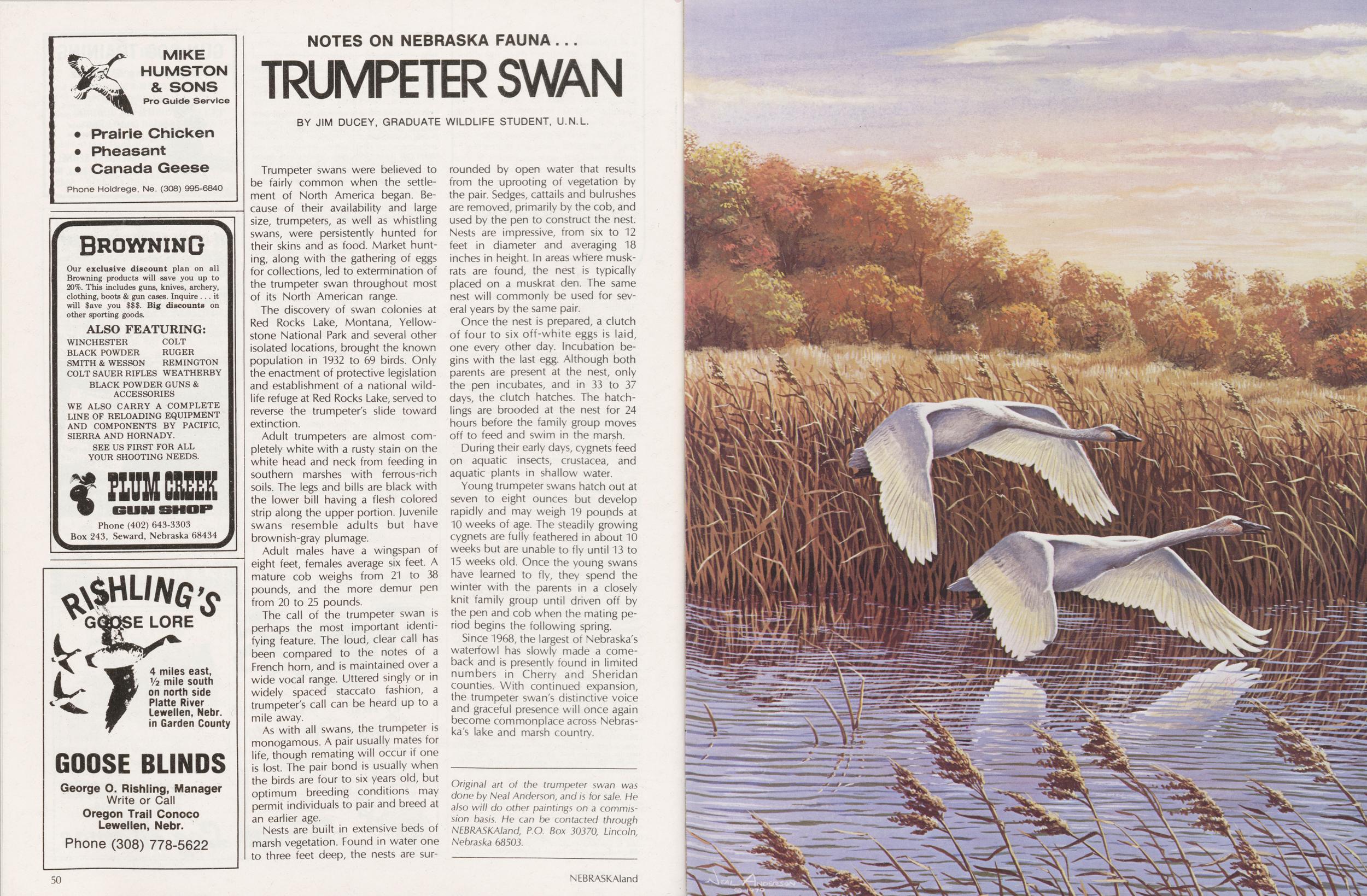
NOTES ON NEBRASKA FAUNA . . . TRUMPETER SWAN
BY JIM DUCEY, GRADUATE WILDLIFE STUDENT, U.N.L. MIKE HUMSTON & SONS Pro Guide Service Prairie Chicken Pheasant Canada Geese Phone Holdrege, Ne. (308) 995-6840 BROWNING Our exclusive discount plan on all Browning products will save you up to 20%. This includes guns, knives, archery, clothing, boots & gun cases. Inquire ... it will $ave you $$$. Big discounts on other sporting goods. ALSO FEATURING: WINCHESTER COLT BLACK POWDER RUGER SMITH & WESSON REMINGTON COLT SAUER RIFLES WEATHERBY BLACK POWDER GUNS & ACCESSORIES WE ALSO CARRY A COMPLETE LINE OF RELOADING EQUIPMENT AND COMPONENTS BY PACIFIC, SIERRA AND HORNADY. SEE US FIRST FOR ALL YOUR SHOOTING NEEDS. COM SHOP Phone (402) 643-3303 Box 243, Seward, Nebraska 68434 4 miles east, 1/2 mile south on north side Platte River Lewellen, Nebr. in Garden County GOOSE BLINDS George O. Rishling, Manager Write or Call Oregon Trail Conoco Lewellen, Nebr. Phone (308) 778-5622Trumpeter swans were believed to be fairly common when the settlement of North America began. Because of their availability and large size, trumpeters, as well as whistling swans, were persistently hunted for their skins and as food. Market hunting, along with the gathering of eggs for collections, led to extermination of the trumpeter swan throughout most of its North American range.
The discovery of swan colonies at Red Rocks Lake, Montana, Yellowstone National Park and several other isolated locations, brought the known population in 1932 to 69 birds. Only the enactment of protective legislation and establishment of a national wildlife refuge at Red Rocks Lake, served to reverse the trumpeter's slide toward extinction.
Adult trumpeters are almost completely white with a rusty stain on the white head and neck from feeding in southern marshes with ferrous-rich soils. The legs and bills are black with the lower bill having a flesh colored strip along the upper portion. Juvenile swans resemble adults but have brownish-gray plumage.
Adult males have a wingspan of eight feet, females average six feet. A mature cob weighs from 21 to 38 pounds, and the more demur pen from 20 to 25 pounds.
The call of the trumpeter swan is perhaps the most important identifying feature. The loud, clear call has been compared to the notes of a French horn, and is maintained over a wide vocal range. Uttered singly or in widely spaced staccato fashion, a trumpeter's call can be heard up to a mile away.
As with all swans, the trumpeter is monogamous. A pair usually mates for life, though remating will occur if one is lost. The pair bond is usually when the birds are four to six years old, but optimum breeding conditions may permit individuals to pair and breed at an earlier age.
Nests are built in extensive beds of marsh vegetation. Found in water one to three feet deep, the nests are surrounded by open water that results from the uprooting of vegetation by the pair. Sedges, cattails and bulrushes are removed, primarily by the cob, and used by the pen to construct the nest. Nests are impressive, from six to 12 feet in diameter and averaging 18 inches in height. In areas where muskrats are found, the nest is typically placed on a muskrat den. The same nest will commonly be used for several years by the same pair.
Once the nest is prepared, a clutch of four to six off-white eggs is laid, one every other day. Incubation begins with the last egg. Although both parents are present at the nest, only the pen incubates, and in 33 to 37 days, the clutch hatches. The hatchlings are brooded at the nest for 24 hours before the family group moves off to feed and swim in the marsh. During their early days, cygnets feed on aquatic insects, Crustacea, and aquatic plants in shallow water.
Young trumpeter swans hatch out at seven to eight ounces but develop rapidly and may weigh 19 pounds at 10 weeks of age. The steadily growing cygnets are fully feathered in about 10 weeks but are unable to fly until 13 to 15 weeks old. Once the young swans have learned to fly, they spend the winter with the parents in a closely knit family group until driven off by the pen and cob when the mating period begins the following spring.
Since 1968, the largest of Nebraska's waterfowl has slowly made a comeback and is presently found in limited numbers in Cherry and Sheridan counties. With continued expansion, the trumpeter swan's distinctive voice and graceful presence will once again become commonplace across Nebraska's lake and marsh country.
Original art of the trumpeter swan was done by Neal Anderson, and is for sale. He also will do other paintings on a commission basis. He can be contacted through NEBRASKAland, P.O. Box 30370, Lincoln, Nebraska 68503. 50 NEBRASKAland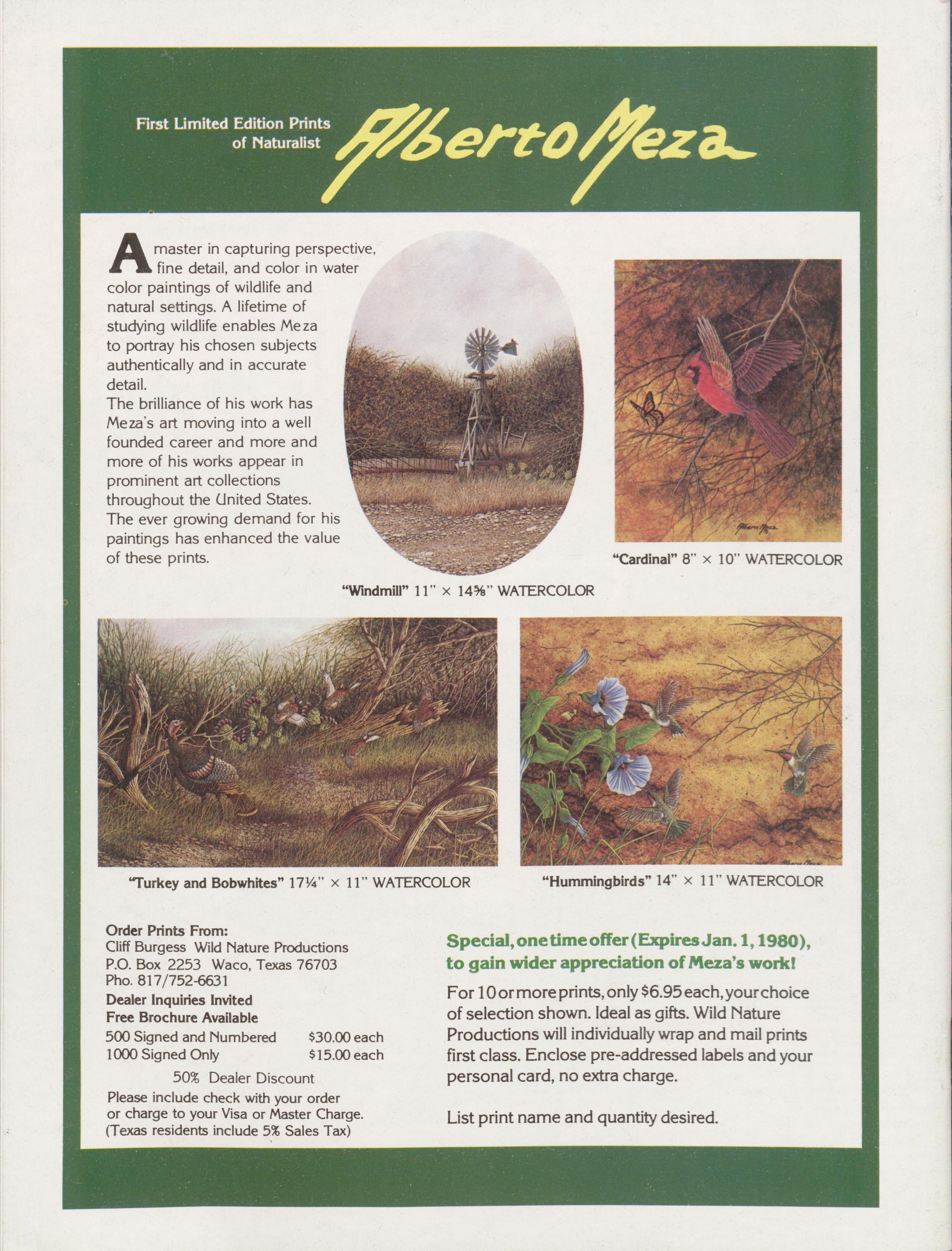
Position: 19 (372 views)