Volume 57, Issue 10, 1979
NEBRASKAland
October 1979 60 Cents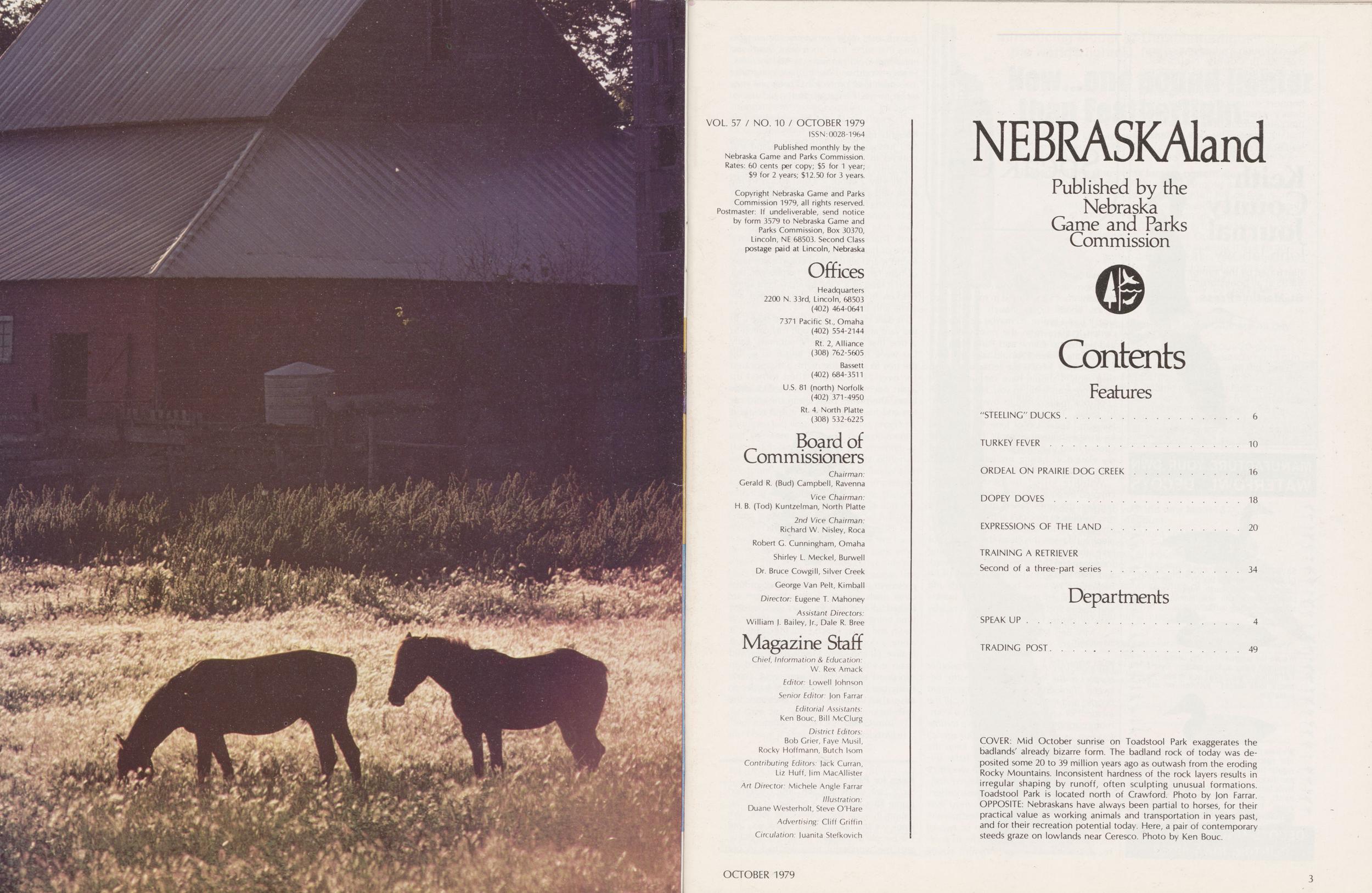
NEBRASKAland
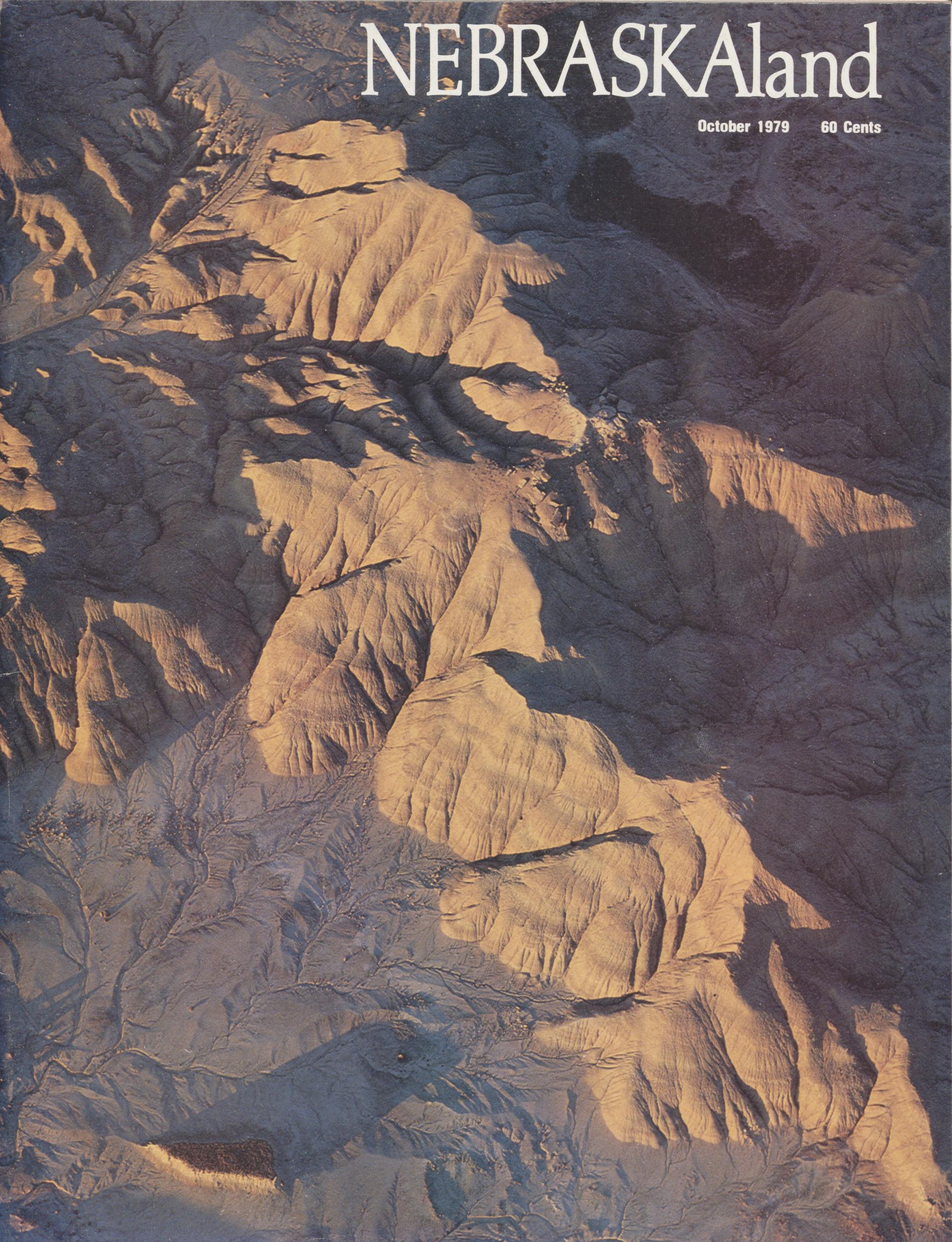
Published by the Nebraska Game and Parks Commission Contents Features "STEELING" DUCKS TURKEY FEVER 10 ORDEAL ON PRAIRIE DOG CREEK 16 DOPEY DOVES 18 EXPRESSIONS OF THE LAND 20 TRAINING A RETRIEVER Second of a three-part series 34 Departments SPEAK UP TRADING POST 49COVER: Mid October sunrise on Toadstool Park exaggerates the badlands' already bizarre form. The badland rock of today was deposited some 20 to 39 million years ago as outwash from the eroding Rocky Mountains. Inconsistent hardness of the rock layers results in irregular shaping by runoff, often sculpting unusual formations. Toadstool Park is located north of Crawford. Photo by Jon Farrar. OPPOSITE: Nebraskans have always been partial to horses, for their practical value as working animals and transportation in years past, and for their recreation potential today. Here, a pair of contemporary steeds graze on lowlands near Ceresco. Photo by Ken Bouc.
Speak Up
Animal SaverSir / Sorry about the response concerning the baby coot I had found in my back yard (Crazy about Coots, March 1979 Speak Up). It had a bruise, so maybe a cat or dog carried it there from the nearby creek. I had written to Game and Parks long before asking where I should take the bird, to set it free. I have the letter here, with their reply. I should have mentioned this in my previous letter to you. However, the coot took matters into its own "wings" so to speak. The response (the "Naughty, Naughty" Speak Up of June 1979 referred to in the following Speak Up by Tom Green) from that biologist sort of crushed my elation in having my letter in Speak Up.
Wildlife killed by pesticides and crippled by guns and other means far out-number the ones raised in captivity. To me, wildlife is precious and any found in my yard will not lack my care, be it coot or elephant! I hope this clears the air. I do not hike through any wilderness. Anything found was on the farm or in my back yard, and that biologist's hair would curl (if he had any) if he knew how many birds and animals I raised and taught to eat insects and berries and were turned out in nearby trees or stream.
Mrs. Ben Mlady Verdigre, Nebr.I suppose this must be considered another chapter in the long, continuing battle between "biologists" and law enforcement people, and the public. You may recall the incident of several years ago with a community-adopted deer fawn. It was a terrible incident, as are many of these. Our agency and others like it, merely try to keep the general public from "adopting" baby animals found "abandoned" in the woods or wherever. To do this, laws are passed making it illegal to take or possess such critters. This is the sorry part-that laws must ever be passed for such things. It is because everybody would gather up one or two of everything that lives-from shrews to gorillas, if it were not illegal. Anyway, young animals that really are in trouble are the ones that suffer from such laws, but those enforcing them cannot make distinctions. Strange world we live in—protecting animals from their protectors. Thank you very much for your letter. (Editor)
Naughty meSir / Just got my June NEBRASKAland and noticed in "Speak Up" a letter entitled "Naughty, Naughty" which affected me. On May 2 about 7 a.m. I found in my front yard a baby grey owl all covered with down which had fallen from its nest. Since I live alone I couldn't find the nest, so I took it to my back porch and went to work. That evening I fed it some fat from a piece of ham. It was only fist high when I found it and all white in color. It got tired of ham fat, so I tried raw hamburger, but soon it tired of it. One Saturday I got some chicken liver (cooked) and the owl ate some and loved it.
At dark every evening I would take it in the yard and set it on a food tray nailed to a tree that I have for the squirrels. Early last week (early June) it began to go up the tree to spend the night. It disappeared for over 24 hours and then turned up again. Seems like it likes cooked chicken livers. The parent owls are in the yard often and have come up to it, but so far it prefers to stay close by. With three or four other owls around, it may become attached to one and fly away. But for the time being it depends on me to feed it at dawn and dusk, which I do. If I had left it alone, a dog or cat would have killed it. It is alive, fat and sassy. Maybe it will go wild again eventually. I successfully raised an orphaned squirrel that went wild eventually but I think that owls are harder to raise than squirrels. Wish me–and the owl—luck.
Tom Green Dundee, Fla. Raves for ParkSir / Last week my son and I returned home after spending a portion of our vacation in your very interesting state. We think we should write and thank you and the people of the state for your hospitality, and the wonderful time we had in our short visit. Next year we hope to make our stay much longer.
We stayed at one of the 2-bedroom cabins in Fort Robinson and were pleasantly surprised at the very neat, clean and reasonably priced quarters. The people in attendance were very courteous, pleasant and accommodating—at all times. The food at the main restaurant was delicious, reasonably priced and served by the most pleasant and courteous of waitresses. It would be possible to spend an entire week or two just availing oneself of all the interesting events offered at the Fort alone, and we hope to do just that next year.
Casimir Mucha Chicago, III.This letter was sent to Gov. Charles Thone in mid August, and was forwarded to the Game and Parks Commission because of the references to Fort Robinson. It is easy to forget that not all places are as pleasant, friendly and "reasonable" as Nebraska, and sometimes such letters help jog us back from our complacency. Thanks. I'm sure you're pleasant guests, too. (Editor)
More RavesSir / We recently (early July) spent two long weekends at Fort Robinson and were so impressed with the staff and programs that we want to pass on our comments. The variety and quality of the interpretive and recreational activities are exceptional. We found the staff unusually friendly and accommodating. We were also impressed with the cooperation between the Historical Society, Chadron State College and the Game and Parks Commission. Such cooperation can be difficult to accomplish, but it looks like it's working. All in all, we have never found a more enjoyable park anywhere. This statement is based not only on visits to state and national parks across the country, but also as a seasonal interpreter for the National Park Service since 1967. You're doing a great job at Fort Robinson! We really enjoyed our visits!
Bob Hirsch Wind Cave National Park Hot Springs, S.D.Well, I hope those staff people won't get big heads and start selling autographs. Certainly they deserve plenty of patting on the back, but we have a hard time keeping them humble. Thanks for your kind words, and I hope it always will be thus. (Editor)
NEBRASKAland Magazine invites all readers to submit their comments, suggestions, and gripes to Speak Up. Each month the magazine will publish as many letters as space permits. Pictures are welcome. NEBRASKAland reserves the right to edit and condense letters. — Editor.
"Steeling" Ducks
SOME FOLKS MIGHT say that last year was a bad one for waterfowl 'hunting in the Rainwater Basin area of south-central Nebraska. Two fairly drastic changes occurred there for the 1978 season that might have put a crimp in some hunters' styles.
The first was a regulation which required the use of steel shot in 12-gauge shotguns, and the second was a quirk of nature that left most of the prime duck areas in the basin area high and dry during the early part of the season.
Hopefully, the drouth in the basins will be short-lived, but the steel shot regulation will apparently be around for a long time to come if Game and Parks and federal biologists have their way. Studies have shown the basins to be among the problem spots for lead poisoning, and the use of steel shot appears to be the only solution to the problem, they say.
The topic of steel shot has been kicked around for a long time by those who would like to see its use expanded and by those who would like to see it abolished. Almost everybody agrees that it has some redeeming qualities as well as some bad ones. Contrary to what you might hear, early tests proved that steel shot killed ducks as well as lead shot at ranges up to 45 yards, which happens to be within the range that most ducks are taken with most scatterguns. The biggest problem encountered was that some shotgun barrels were damaged by steel loads. Shell manufacturers have now eliminated this problem by using protective wads, and steel shot is safe to use in nearly all shotguns with the possible exception of some of the older, soft-steel double guns.
As a writer and an employee of the Nebraska Game and Parks Commission, I can possibly see benefits of the steel shot restrictions more than some folks. On the other hand, the fact that I also like to hunt waterfowl gives me a few doubts about shooting the hard pellets through the barrel of my favorite pump gun.
My first attempt at using steel shot was probably before most hunters ever heard about it. Being a curious sort when I was a kid, I theorized that if lead shot worked well on pheasants, then surely those copper-plated air rifle BB's would be better. So, I replaced the lead shot in a couple of rounds and tried them out the next time I went hunting. They worked just fine. In fact, they worked so well they left me a reminder I could see every time I cleaned the barrel. Three of those pellets left nice deep grooves right through the choke portion of the barrel of my Model 12. Since then I replaced that gun with a similar one, but I still have vivid memories of the damage those pellets did to my barrel. Years later, I vaguely remember reading a warning against using steel BB's in shotguns because the steel is much harder than lead shot and could damage barrels.
They say experience is the best teacher, and I certainly learned a lesson. Armed with first-hand knowledge, I must therefor say I had a few reservations about using steel loads when I heard the regulation would go into effect last year. Even so, I bought a couple boxes and vowed to give them a sporting try.
The first thing that impressed me about steel shot was cost. Most lead duck loads retail at somewhere between three-fifty and six dollars a box, but the cheapest I could buy steel loads was close to eight, with some dealers charging 10 to 12 bucks. It somehow looked as if the oil shieks had control of our steel shot supplies and were holding us up, but an explanation by the salesman assured me that steel shot was more expensive to make than lead and that increased volume would eventually bring the price down.
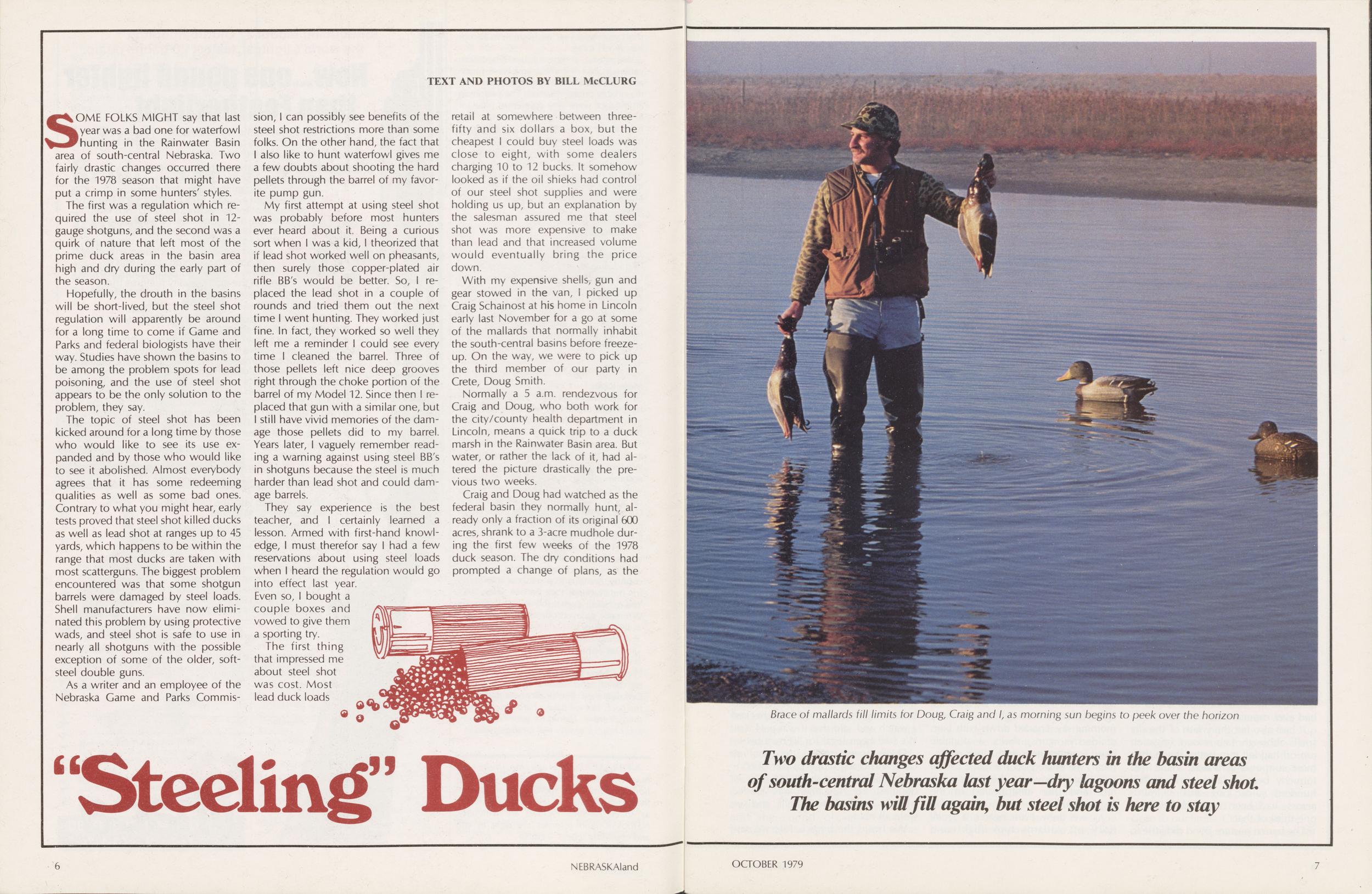
With my expensive shells, gun and gear stowed in the van, I picked up Craig Schainost at his home in Lincoln early last November for a go at some of the mallards that normally inhabit the south-central basins before freeze-up. On the way, we were to pick up the third member of our party in Crete, Doug Smith.
Normally a 5 a.m. rendezvous for Craig and Doug, who both work for the city/county health department in Lincoln, means a quick trip to a duck marsh in the Rainwater Basin area. But water, or rather the lack of it, had altered the picture drastically the previous two weeks.
Craig and Doug had watched as the federal basin they normally hunt, already only a fraction of its original 600 acres, shrank to a 3-acre mudhole during the first few weeks of the 1978 duck season. The dry conditions had prompted a change of plans, as the
Brace of mallards fill limits for Doug, Craig and /, as morning sun begins to peek over the horizon
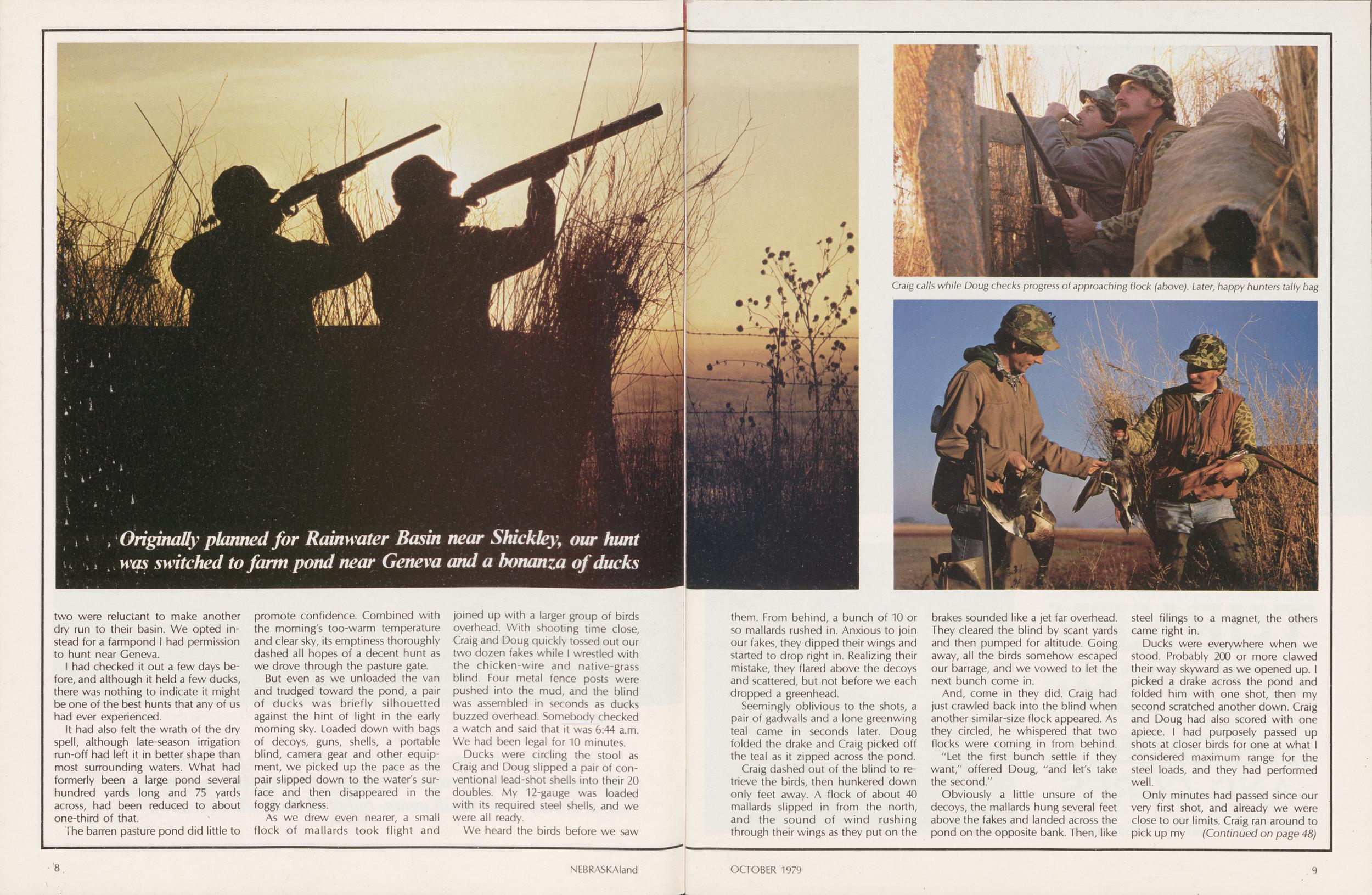
Originally planned for Rainwater Basin near Shickley, our nun I was switched to farm pond near Geneva and a bonanza of ducks
Craig calls while Doug checks progress of approaching flock (above). Later, happy hunters tally bag
two were reluctant to make another dry run to their basin. We opted instead for a farmpond I had permission to hunt near Geneva.
I had checked it out a few days before, and although it held a few ducks, there was nothing to indicate it might be one of the best hunts that any of us had ever experienced.
It had also felt the wrath of the dry spell, although late-season irrigation run-off had left it in better shape than most surrounding waters. What had formerly been a large pond several hundred yards long and 75 yards across, had been reduced to about one-third of that.
The barren pasture pond did little to promote confidence. Combined with the morning's too-warm temperature and clear sky, its emptiness thoroughly dashed all hopes of a decent hunt as we drove through the pasture gate.
But even as we unloaded the van and trudged toward the pond, a pair of ducks was briefly silhouetted against the hint of light in the early morning sky. Loaded down with bags of decoys, guns, shells, a portable blind, camera gear and other equipment, we picked up the pace as the pair slipped down to the water's surface and then disappeared in the foggy darkness.
As we drew even nearer, a small flock of mallards took flight and joined up with a larger group of birds overhead. With shooting time close, Craig and Doug quickly tossed out our two dozen fakes while I wrestled with the chicken-wire and native-grass blind. Four metal fence posts were pushed into the mud, and the blind was assembled in seconds as ducks buzzed overhead. Somebody checked a watch and said that it was 6:44 a.m. We had been legal for 10 minutes.
Ducks were circling the stool as Craig and Doug slipped a pair of conventional lead-shot shells into their 20 doubles. My 12-gauge was loaded with its required steel shells, and we were all ready.
We heard the birds before we saw them. From behind, a bunch of 10 or so mallards rushed in. Anxious to join our fakes, they dipped their wings and started to drop right in. Realizing their mistake, they flared above the decoys and scattered, but not before we each dropped a greenhead.
Seemingly oblivious to the shots, a pair of gadwalls and a lone greenwing teal came in seconds later. Doug folded the drake and Craig picked off the teal as it zipped across the pond.
Craig dashed out of the blind to retrieve the birds, then hunkered down only feet away. A flock of about 40 mallards slipped in from the north, and the sound of wind rushing through their wings as they put on the brakes sounded like a jet far overhead. They cleared the blind by scant yards and then pumped for altitude. Going away, all the birds somehow escaped our barrage, and we vowed to let the next bunch come in.
And, come in they did. Craig had just crawled back into the blind when another similar-size flock appeared. As they circled, he whispered that two flocks were coming in from behind.
"Let the first bunch settle if they want," offered Doug, "and let's take the second."
Obviously a little unsure of the decoys, the mallards hung several feet above the fakes and landed across the pond on the opposite bank. Then, like steel filings to a magnet, the others came right in.
Ducks were everywhere when we stood. Probably 200 or more clawed their way skyward as we opened up. I picked a drake across the pond and folded him with one shot, then my second scratched another down. Craig and Doug had also scored with one apiece. I had purposely passed up shots at closer birds for one at what I considered maximum range for the steel loads, and they had performed well.
Only minutes had passed since our very first shot, and already we were close to our limits. Craig ran around to pick up my (Continued on page 48)
8 NEBRASKAland OCTOBER 1979 9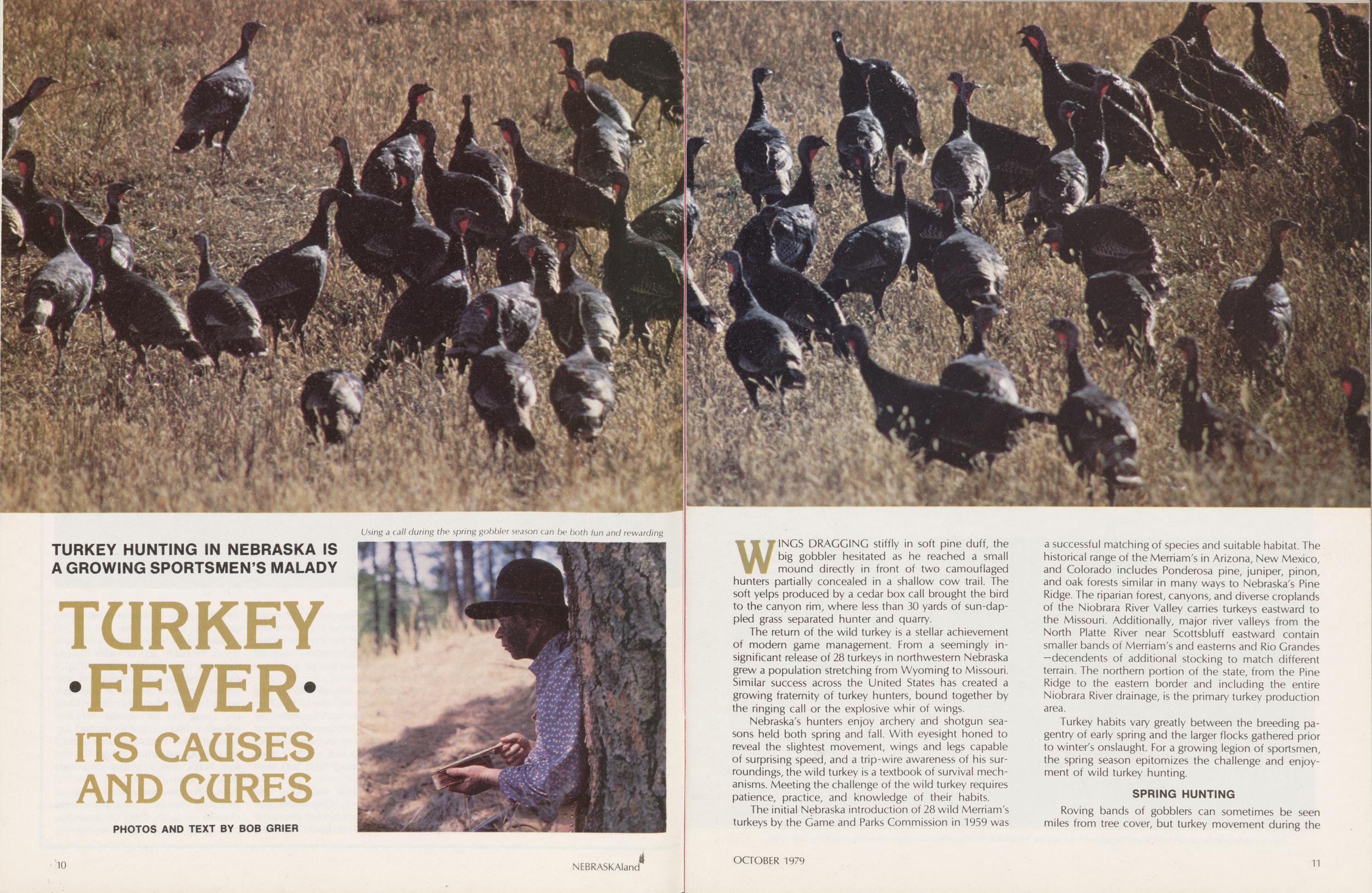
TURKEY FEVER ITS CAUSES AND CURES
Using a call during the spring gobbler season can be both fun and rewarding
TURKEY HUNTING IN NEBRASKA IS A GROWING SPORTSMEN'S MALADY
WINGS DRAGGING stiffly in soft pine duff, the big gobbler hesitated as he reached a small mound directly in front of two camouflaged hunters partially concealed in a shallow cow trail. The soft yelps produced by a cedar box call brought the bird to the canyon rim, where less than 30 yards of sun-dappled grass separated hunter and quarry.
The return of the wild turkey is a stellar achievement of modern game management. From a seemingly insignificant release of 28 turkeys in northwestern Nebraska grew a population stretching from Wyoming to Missouri. Similar success across the United States has created a growing fraternity of turkey hunters, bound together by the ringing call or the explosive whir of wings.
Nebraska's hunters enjoy archery and shotgun seasons held both spring and fall. With eyesight honed to reveal the slightest movement, wings and legs capable of surprising speed, and a trip-wire awareness of his surroundings, the wild turkey is a textbook of survival mechanisms. Meeting the challenge of the wild turkey requires patience, practice, and knowledge of their habits.
The initial Nebraska introduction of 28 wild Merriam's turkeys by the Game and Parks Commission in 1959 was a successful matching of species and suitable habitat. The historical range of the Merriam's in Arizona, New Mexico, and Colorado includes Ponderosa pine, juniper, pinon, and oak forests similar in many ways to Nebraska's Pine Ridge. The riparian forest, canyons, and diverse croplands of the Niobrara River Valley carries turkeys eastward to the Missouri. Additionally, major river valleys from the North Platte River near Scottsbluff eastward contain smaller bands of Merriam's and easterns and Rio Grandes -decendents of additional stocking to match different terrain. The northern portion of the state, from the Pine Ridge to the eastern border and including the entire Niobrara River drainage, is the primary turkey production area.
Turkey habits vary greatly between the breeding pagentry of early spring and the larger flocks gathered prior to winter's onslaught. For a growing legion of sportsmen, the spring season epitomizes the challenge and enjoyment of wild turkey hunting.
SPRING HUNTINGRoving bands of gobblers can sometimes be seen
miles from tree cover, but turkey movement during the
10
NEBRASKAland OCTOBER 1979 11
 spring decreases as birds enter the breeding and nesting
period.
spring decreases as birds enter the breeding and nesting
period.
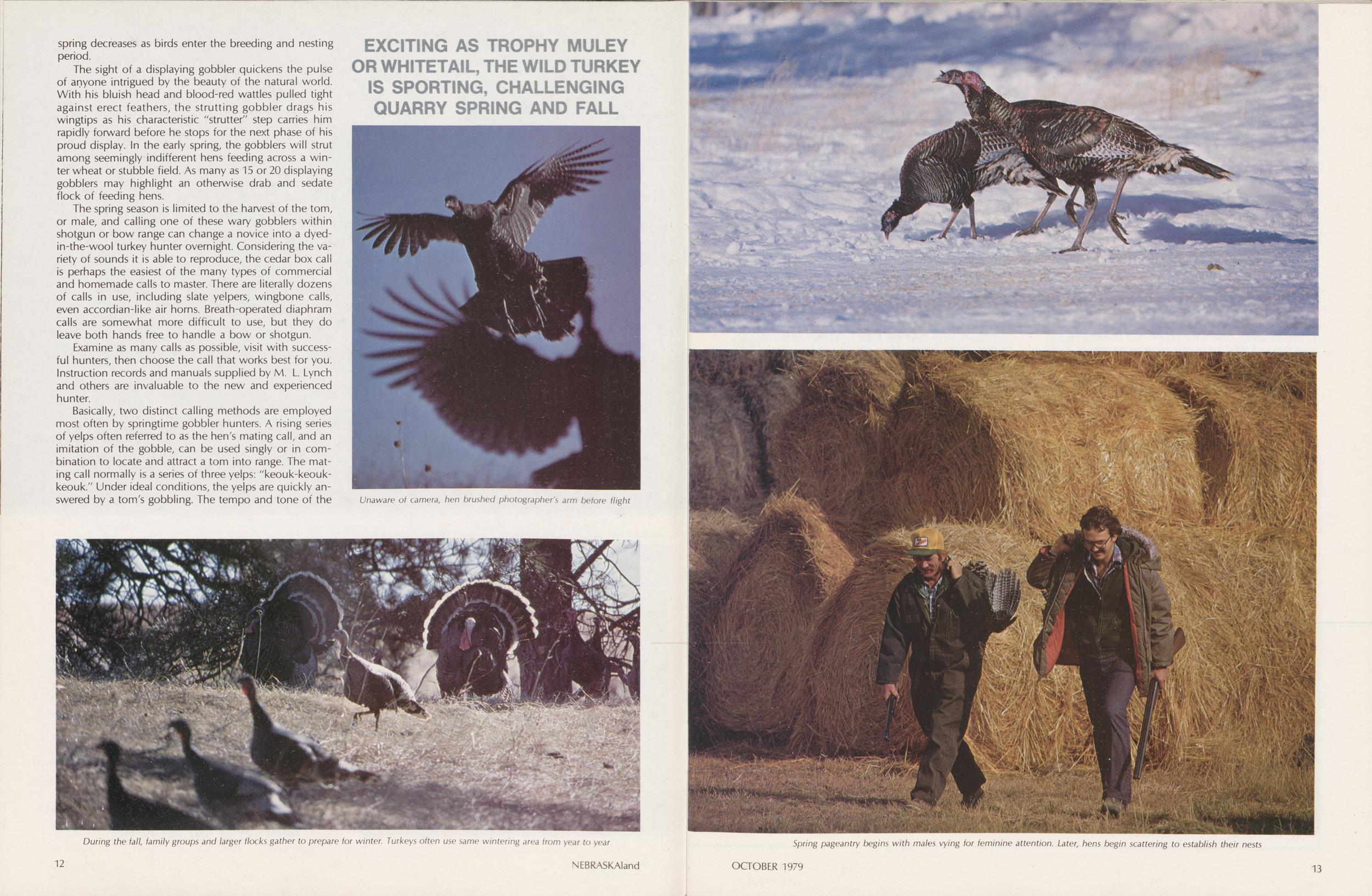
The sight of a displaying gobbler quickens the pulse of anyone intrigued by the beauty of the natural world. With his bluish head and blood-red wattles pulled tight against erect feathers, the strutting gobbler drags his wingtips as his characteristic "strutter" step carries him rapidly forward before he stops for the next phase of his proud display. In the early spring, the gobblers will strut among seemingly indifferent hens feeding across a winter wheat or stubble field. As many as 15 or 20 displaying gobblers may highlight an otherwise drab and sedate flock of feeding hens.
The spring season is limited to the harvest of the torn, or male, and calling one of these wary gobblers within shotgun or bow range can change a novice into a dyed-in-the-wool turkey hunter overnight. Considering the variety of sounds it is able to reproduce, the cedar box call is perhaps the easiest of the many types of commercial and homemade calls to master. There are literally dozens of calls in use, including slate yelpers, wingbone calls, even accordian-like air horns. Breath-operated diaphram calls are somewhat more difficult to use, but they do leave both hands free to handle a bow or shotgun.
Examine as many calls as possible, visit with successful hunters, then choose the call that works best for you. Instruction records and manuals supplied by M. L Lynch and others are invaluable to the new and experienced hunter.
Basically, two distinct calling methods are employed most often by springtime gobbler hunters. A rising series of yelps often referred to as the hen's mating call, and an imitation of the gobble, can be used singly or in combination to locate and attract a torn into range. The mat- ing call normally is a series of three yelps: "keouk-keouk-keouk." Under ideal conditions, the yelps are quickly answered by a tom's gobbling. The tempo and tone of the
EXCITING AS TROPHY MULEY IS SPORTING, CHALLENGING QUARRY SPRING AND FALLUnaware of camera, hen brushed photographer's arm before flight
During the fall, family groups and larger flocks gather to prepare for winter. Turkeys often use same wintering area from year to year
Spring pageantry begins with males vying for feminine attention. Later, hens begin scattering to establish their nests
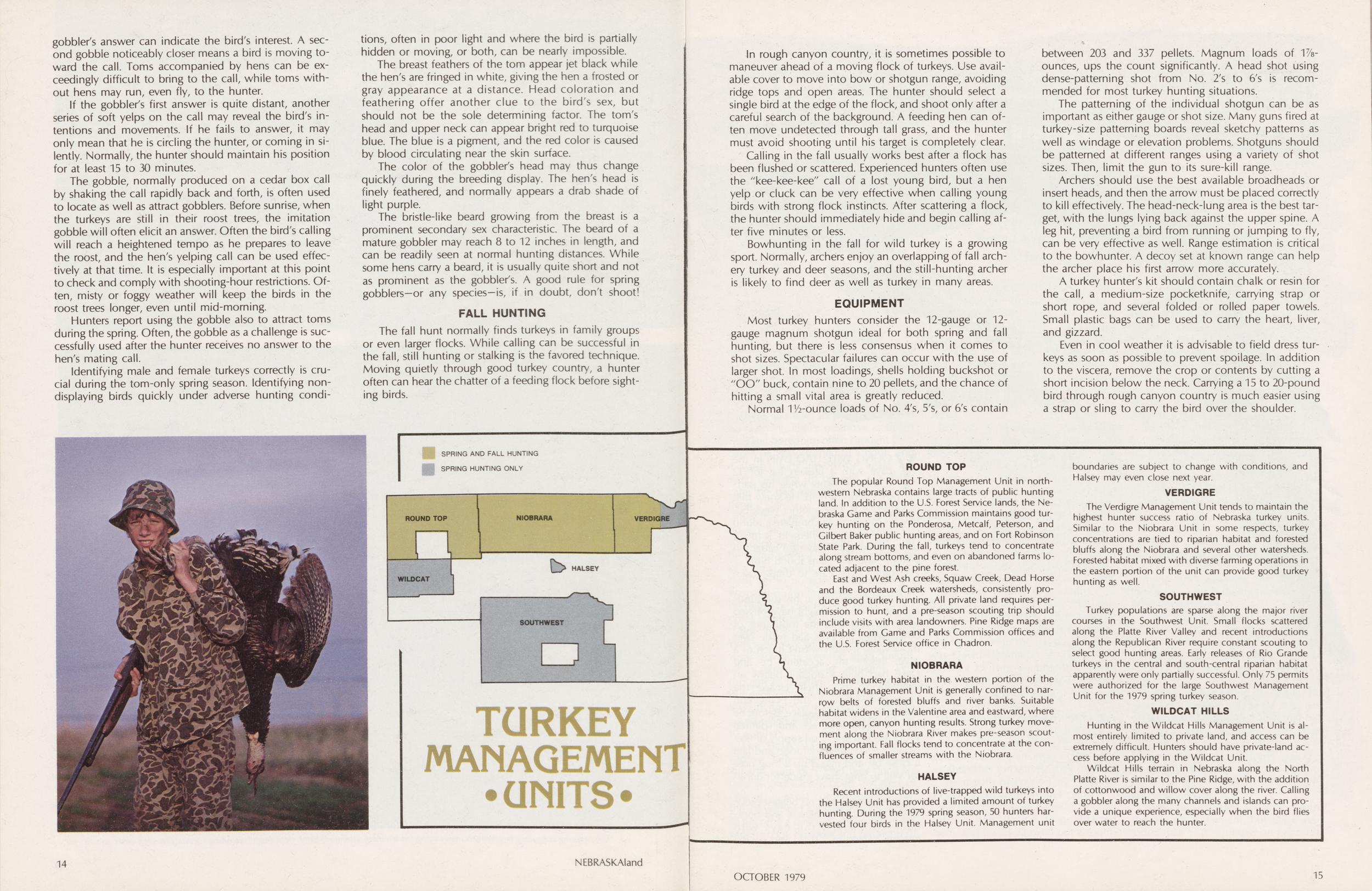
gobbler's answer can indicate the bird's interest. A second gobble noticeably closer means a bird is moving toward the call. Toms accompanied by hens can be exceedingly difficult to bring to the call, while toms without hens may run, even fly, to the hunter.
If the gobbler's first answer is quite distant, another series of soft yelps on the call may reveal the bird's intentions and movements. If he fails to answer, it may only mean that he is circling the hunter, or coming in silently. Normally, the hunter should maintain his position for at least 15 to 30 minutes.
The gobble, normally produced on a cedar box call by shaking the call rapidly back and forth, is often used to locate as well as attract gobblers. Before sunrise, when the turkeys are still in their roost trees, the imitation gobble will often elicit an answer. Often the bird's calling will reach a heightened tempo as he prepares to leave the roost, and the hen's yelping call can be used effectively at that time. It is especially important at this point to check and comply with shooting-hour restrictions. Often, misty or foggy weather will keep the birds in the roost trees longer, even until mid-morning.
Hunters report using the gobble also to attract toms during the spring. Often, the gobble as a challenge is successfully used after the hunter receives no answer to the hen's mating call.
Identifying male and female turkeys correctly is crucial during the tom-only spring season. Identifying nondisplaying birds quickly under adverse hunting conditions, often in poor light and where the bird is partially hidden or moving, or both, can be nearly impossible.
The breast feathers of the torn appear jet black while the hen's are fringed in white, giving the hen a frosted or gray appearance at a distance. Head coloration and feathering offer another clue to the bird's sex, but should not be the sole determining factor. The tom's head and upper neck can appear bright red to turquoise blue. The blue is a pigment, and the red color is caused by blood circulating near the skin surface.
The color of the gobbler's head may thus change quickly during the breeding display. The hen's head is finely feathered, and normally appears a drab shade of light purple.
The bristle-like beard growing from the breast is a prominent secondary sex characteristic. The beard of a mature gobbler may reach 8 to 12 inches in length, and can be readily seen at normal hunting distances. While some hens carry a beard, it is usually quite short and not as prominent as the gobbler's. A good rule for spring gobblers—or any species-is, if in doubt, don't shoot!
FALL HUNTINGThe fall hunt normally finds turkeys in family groups or even larger flocks. While calling can be successful in the fall, still hunting or stalking is the favored technique. Moving quietly through good turkey country, a hunter often can hear the chatter of a feeding flock before sighting birds.
In rough canyon country, it is sometimes possible to maneuver ahead of a moving flock of turkeys. Use available cover to move into bow or shotgun range, avoiding ridge tops and open areas. The hunter should select a single bird at the edge of the flock, and shoot only after a careful search of the background. A feeding hen can often move undetected through tall grass, and the hunter must avoid shooting until his target is completely clear.
Calling in the fall usually works best after a flock has been flushed or scattered. Experienced hunters often use the "kee-kee-kee" call of a lost young bird, but a hen yelp or cluck can be very effective when calling young birds with strong flock instincts. After scattering a flock, the hunter should immediately hide and begin calling after five minutes or less.
Bowhunting in the fall for wild turkey is a growing sport. Normally, archers enjoy an overlapping of fall archery turkey and deer seasons, and the still-hunting archer is likely to find deer as well as turkey in many areas.
EQUIPMENTMost turkey hunters consider the 12-gauge or 12-gauge magnum shotgun ideal for both spring and fall hunting, but there is less consensus when it comes to shot sizes. Spectacular failures can occur with the use of larger shot. In most loadings, shells holding buckshot or "OO" buck, contain nine to 20 pellets, and the chance of hitting a small vital area is greatly reduced.
Normal 1 1/2-ounce loads of No. 4's, 5's, or 6's contain between 203 and 337 pellets. Magnum loads of 1 7/8-ounces, ups the count significantly. A head shot using dense-patterning shot from No. 2's to 6's is recommended for most turkey hunting situations.
The patterning of the individual shotgun can be as important as either gauge or shot size. Many guns fired at turkey-size patterning boards reveal sketchy patterns as well as windage or elevation problems. Shotguns should be patterned at different ranges using a variety of shot sizes. Then, limit the gun to its sure-kill range.
Archers should use the best available broadheads or insert heads, and then the arrow must be placed correctly to kill effectively. The head-neck-lung area is the best target, with the lungs lying back against the upper spine. A leg hit, preventing a bird from running or jumping to fly, can be very effective as well. Range estimation is critical to the bowhunter. A decoy set at known range can help the archer place his first arrow more accurately.
A turkey hunter's kit should contain chalk or resin for the call, a medium-size pocketknife, carrying strap or short rope, and several folded or rolled paper towels. Small plastic bags can be used to carry the heart, liver, and gizzard.
Even in cool weather it is advisable to field dress turkeys as soon as possible to prevent spoilage. In addition to the viscera, remove the crop or contents by cutting a short incision below the neck. Carrying a 15 to 20-pound bird through rough canyon country is much easier using a strap or sling to carry the bird over the shoulder.
SPRING AND FALL HUNTING SPRING HUNTING ONLY ROUND TOP NIOBRARA VERDIGRE WILDCAT HALSEY
TURKEY MANAGEMENT UNITS
ROUND TOPThe popular Round Top Management Unit in northwestern Nebraska contains large tracts of public hunting land. In addition to the U.S. Forest Service lands, the Nebraska Game and Parks Commission maintains good turkey hunting on the Ponderosa, Metcalf, Peterson, and Gilbert Baker public hunting areas, and on Fort Robinson State Park. During the fall, turkeys tend to concentrate along stream bottoms, and even on abandoned farms located adjacent to the pine forest.
East and West Ash creeks, Squaw Creek, Dead Horse and the Bordeaux Creek watersheds, consistently produce good turkey hunting. All private land requires permission to hunt, and a pre-season scouting trip should include visits with area landowners. Pine Ridge maps are available from Game and Parks Commission offices and the U.S. Forest Service office in Chadron.
NIOBRARAPrime turkey habitat in the western portion of the Niobrara Management Unit is generally confined to narrow belts of forested bluffs and river banks. Suitable habitat widens in the Valentine area and eastward, where more open, canyon hunting results. Strong turkey movement along the Niobrara River makes pre-season scouting important. Fall flocks tend to concentrate at the confluences of smaller streams with the Niobrara.
HALSEYRecent introductions of live-trapped wild turkeys into the Halsey Unit has provided a limited amount of turkey hunting. During the 1979 spring season, 50 hunters harvested four birds in the Halsey Unit. Management unit boundaries are subject to change with conditions, and Halsey may even close next year.
VERDIGREThe Verdigre Management Unit tends to maintain the highest hunter success ratio of Nebraska turkey units. Similar to the Niobrara Unit in some respects, turkey concentrations are tied to riparian habitat and forested bluffs along the Niobrara and several other watersheds. Forested habitat mixed with diverse farming operations in the eastern portion of the unit can provide good turkey hunting as well.
SOUTHWESTTurkey populations are sparse along the major river courses in the Southwest Unit. Small flocks scattered along the Platte River Valley and recent introductions along the Republican River require constant scouting to select good hunting areas. Early releases of Rio Grande turkeys in the central and south-central riparian habitat apparently were only partially successful. Only 75 permits were authorized for the large Southwest Management Unit for the 1979 spring turkey season.
WILDCAT HILLSHunting in the Wildcat Hills Management Unit is almost entirely limited to private land, and access can be extremely difficult. Hunters should have private-land access before applying in the Wildcat Unit.
Wildcat Hills terrain in Nebraska along the North Platte River is similar to the Pine Ridge, with the addition of cottonwood and willow cover along the river. Calling a gobbler along the many channels and islands can provide a unique experience, especially when the bird flies over water to reach the hunter.
14 NEBRASKAland OCTOBER 1979 15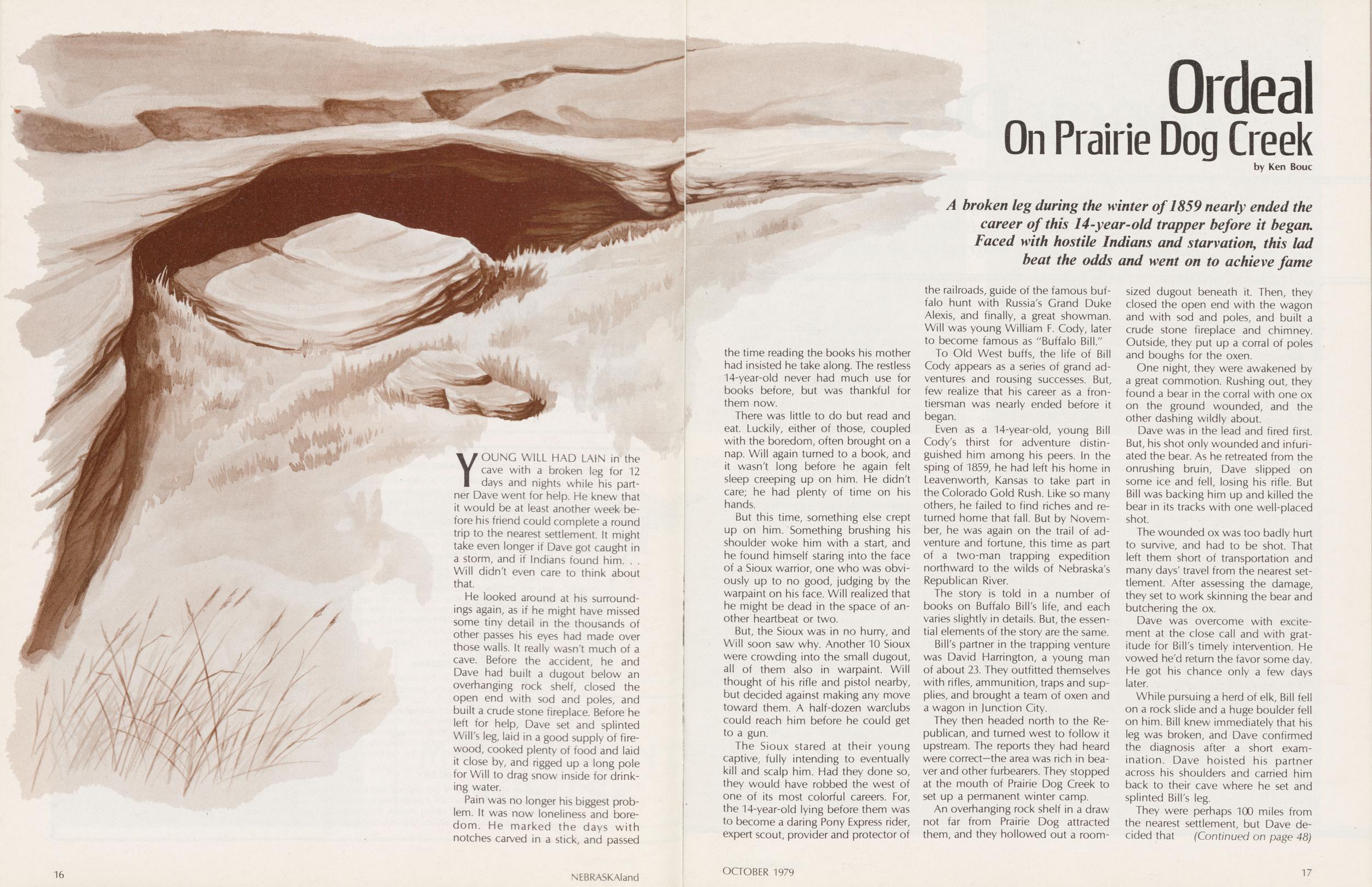
Ordeal On Prairie Dog Creek
A broken leg during the winter of 1859 nearly ended the career of this 14-year-old trapper before it began. Faced with hostile Indians and starvation, this lad beat the odds and went on to achieve fameYOUNG WILL HAD LAIN in the cave with a broken leg for 12 days and nights while his partner Dave went for help. He knew that it would be at least another week before his friend could complete a round trip to the nearest settlement. It might take even longer if Dave got caught in a storm, and if Indians found him. . . Will didn't even care to think about that.
He looked around at his surroundings again, as if he might have missed some tiny detail in the thousands of other passes his eyes had made over those walls. It really wasn't much of a cave. Before the accident, he and Dave had built a dugout below an overhanging rock shelf, closed the open end with sod and poles, and built a crude stone fireplace. Before he left for help, Dave set and splinted Will's leg, laid in a good supply of firewood, cooked plenty of food and laid it close by, and rigged up a long pole for Will to drag snow inside for drinking water.
Pain was no longer his biggest problem. It was now loneliness and boredom. He marked the days with notches carved in a stick, and passed the time reading the books his mother had insisted he take along. The restless 14-year-old never had much use for books before, but was thankful for them now.
There was little to do but read and eat. Luckily, either of those, coupled with the boredom, often brought on a nap. Will again turned to a book, and it wasn't long before he again felt sleep creeping up on him. He didn't care; he had plenty of time on his hands.
But this time, something else crept up on him. Something brushing his shoulder woke him with a start, and he found himself staring into the face of a Sioux warrior, one who was obviously up to no good, judging by the warpaint on his face. Will realized that he might be dead in the space of another heartbeat or two.
But, the Sioux was in no hurry, and Will soon saw why. Another 10 Sioux were crowding into the small dugout, all of them also in warpaint. Will thought of his rifle and pistol nearby, but decided against making any move toward them. A half-dozen warclubs could reach him before he could get to a gun.
The Sioux stared at their young captive, fully intending to eventually kill and scalp him. Had they done so, they would have robbed the west of one of its most colorful careers. For, the 14-year-old lying before them was to become a daring Pony Express rider, expert scout, provider and protector of the railroads, guide of the famous buffalo hunt with Russia's Grand Duke Alexis, and finally, a great showman. Will was young William F. Cody, later to become famous as "Buffalo Bill."
To Old West buffs, the life of Bill Cody appears as a series of grand adventures and rousing successes. But, few realize that his career as a frontiersman was nearly ended before it began.
Even as a 14-year-old, young Bill Cody's thirst for adventure distinguished him among his peers. In the spring of 1859, he had left his home in Leavenworth, Kansas to take part in the Colorado Gold Rush. Like so many others, he failed to find riches and returned home that fall. But by November, he was again on the trail of ad- venture and fortune, this time as part of a two-man trapping expedition northward to the wilds of Nebraska's Republican River.
The story is told in a number of books on Buffalo Bill's life, and each varies slightly in details. But, the essential elements of the story are the same.
Bill's partner in the trapping venture was David Harrington, a young man of about 23. They outfitted themselves with rifles, ammunition, traps and supplies, and brought a team of oxen and a wagon in Junction City.
They then headed north to the Republican, and turned west to follow it upstream. The reports they had heard were correct—the area was rich in beaver and other furbearers. They stopped at the mouth of Prairie Dog Creek to set up a permanent winter camp.
An overhanging rock shelf in a draw not far from Prairie Dog attracted them, and they hollowed out a roomsized dugout beneath it. Then, they closed the open end with the wagon and with sod and poles, and built a crude stone fireplace and chimney. Outside, they put up a corral of poles and boughs for the oxen.
One night, they were awakened by a great commotion. Rushing out, they found a bear in the corral with one ox on the ground wounded, and the other dashing wildly about.
Dave was in the lead and fired first. But, his shot only wounded and infuriated the bear. As he retreated from the onrushing bruin, Dave slipped on some ice and fell, losing his rifle. But Bill was backing him up and killed the bear in its tracks with one well-placed shot.
The wounded ox was too badly hurt to survive, and had to be shot. That left them short of transportation and many days' travel from the nearest settlement. After assessing the damage, they set to work skinning the bear and butchering the ox.
Dave was overcome with excitement at the close call and with gratitude for Bill's timely intervention. He vowed he'd return the favor some day. He got his chance only a few days later.
While pursuing a herd of elk, Bill fell on a rock slide and a huge boulder fell on him. Bill knew immediately that his leg was broken, and Dave confirmed the diagnosis after a short examination. Dave hoisted his partner across his shoulders and carried him back to their cave where he set and splinted Bill's leg.
They were perhaps 100 miles from the nearest settlement, but Dave decided that (Continued on page 48)
16 NEBRASKAland OCTOBER 1979 17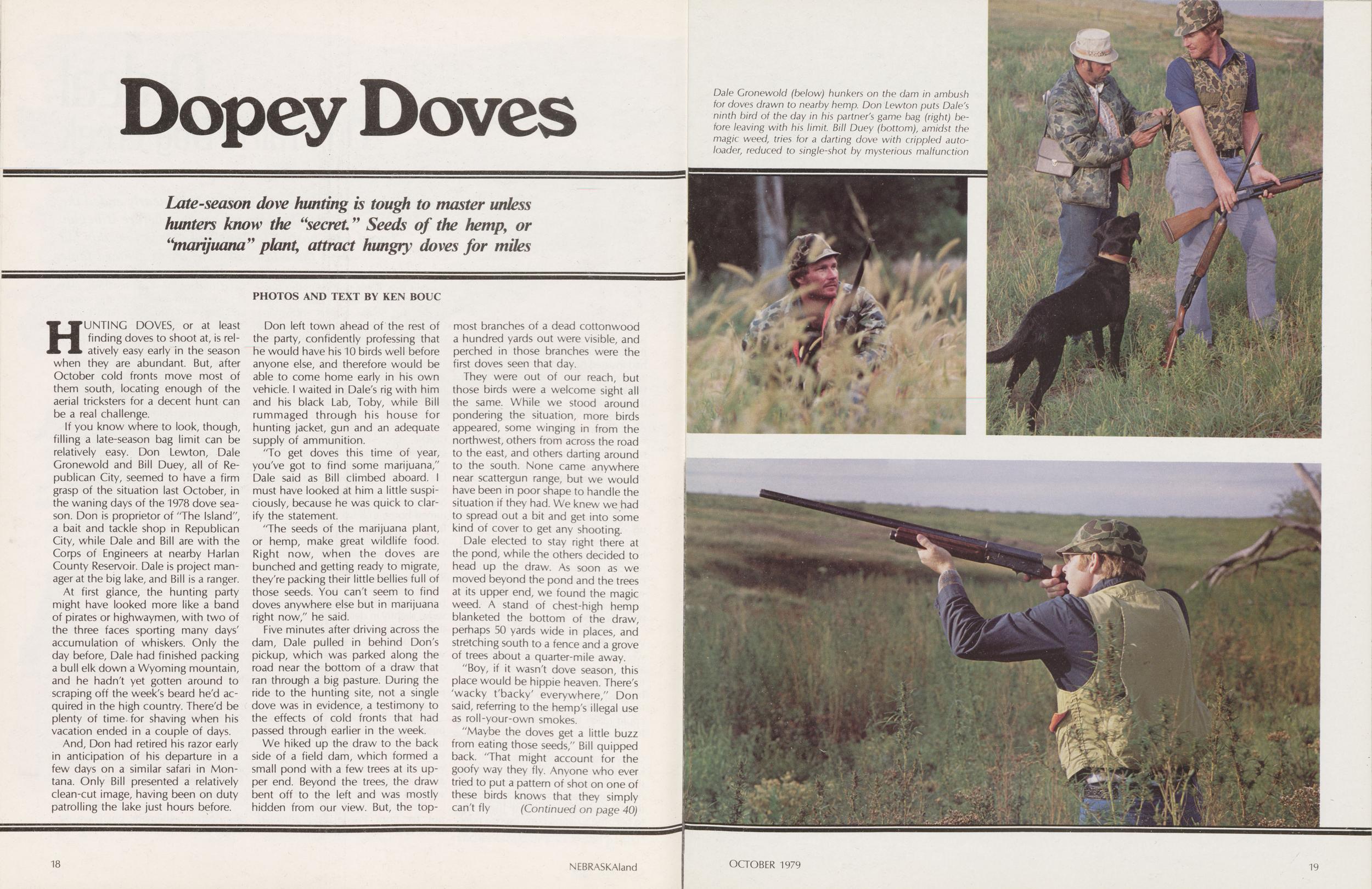
Dopey Doves
Late-season dove hunting is tough to master unless hunters know the "secret". Seeds of the hemp, or 'marijuana" plant, attract hungry doves for milesHUNTING DOVES, or at least finding doves to shoot at, is relatively easy early in the season when they are abundant. But, after October cold fronts move most of them south, locating enough of the aerial tricksters for a decent hunt can be a real challenge.
If you know where to look, though, filling a late-season bag limit can be relatively easy. Don Lewton, Dale Gronewold and Bill Duey, all of Republican City, seemed to have a firm grasp of the situation last October, in the waning days of the 1978 dove season. Don is proprietor of "The Island", a bait and tackle shop in Republican City, while Dale and Bill are with the Corps of Engineers at nearby Harlan County Reservoir. Dale is project manager at the big lake, and Bill is a ranger.
At first glance, the hunting party might have looked more like a band of pirates or highwaymen, with two of the three faces sporting many days' accumulation of whiskers. Only the day before, Dale had finished packing a bull elk down a Wyoming mountain, and he hadn't yet gotten around to scraping off the week's beard he'd acquired in the high country. There'd be plenty of time, for shaving when his vacation ended in a couple of days.
And, Don had retired his razor early in anticipation of his departure in a few days on a similar safari in Montana. Only Bill presented a relatively clean-cut image, having been on duty patrolling the lake just hours before.
Don left town ahead of the rest of the party, confidently professing that would have his 10 birds well before anyone else, and therefore would be able to come home early in his own vehicle. I waited in Dale's rig with him and his black Lab, Toby, while Bill rummaged through his house for hunting jacket, gun and an adequate supply of ammunition.
"To get doves this time of year, you've got to find some marijuana," Dale said as Bill climbed aboard. I must have looked at him a little suspiciously, because he was quick to clarify the statement.
"The seeds of the marijuana plant, or hemp, make great wildlife food. Right now, when the doves are bunched and getting ready to migrate, they're packing their little bellies full of those seeds. You can't seem to find doves anywhere else but in marijuana right now," he said.
Five minutes after driving across the dam, Dale pulled in behind Don's pickup, which was parked along the road near the bottom of a draw that ran through a big pasture. During the ride to the hunting site, not a single dove was in evidence, a testimony to the effects of cold fronts that had passed through earlier in the week.
We hiked up the draw to the back side of a field dam, which formed a small pond with a few trees at its upper end. Beyond the trees, the draw bent off to the left and was mostly hidden from our view. But, the top-most branches of a dead cottonwood a hundred yards out were visible, and perched in those branches were the first doves seen that day.
They were out of our reach, but those birds were a welcome sight all the same. While we stood around pondering the situation, more birds appeared, some winging in from the northwest, others from across the road to the east, and others darting around to the south. None came anywhere near scattergun range, but we would have been in poor shape to handle the situation if they had. We knew we had to spread out a bit and get into some kind of cover to get any shooting.
Dale elected to stay right there at the pond, while the others decided to head up the draw. As soon as we moved beyond the pond and the trees at its upper end, we found the magic weed. A stand of chest-high hemp blanketed the bottom of the draw, perhaps 50 yards wide in places, and stretching south to a fence and a grove of trees about a quarter-mile away.
"Boy, if it wasn't dove season, this place would be hippie heaven. There's 'wacky t'backy' everywhere," Don said, referring to the hemp's illegal use as roll-your-own smokes.
"Maybe the doves get a little buzz from eating those seeds," Bill quipped back. "That might account for the goofy way they fly. Anyone who ever tried to put a pattern of shot on one of these birds knows that they simply can't fly (Continued on page 40)
Dale Gronewold (below) hunkers on the dam in ambush for doves drawn to nearby hemp. Don Lewton puts Dale's ninth bird of the day in his partner's game bag (right) before leaving with his limit. Bill Duey (bottom), amidst the magic weed, tries for a darting dove with crippled autoloader, reduced to single-shot by mysterious malfunction
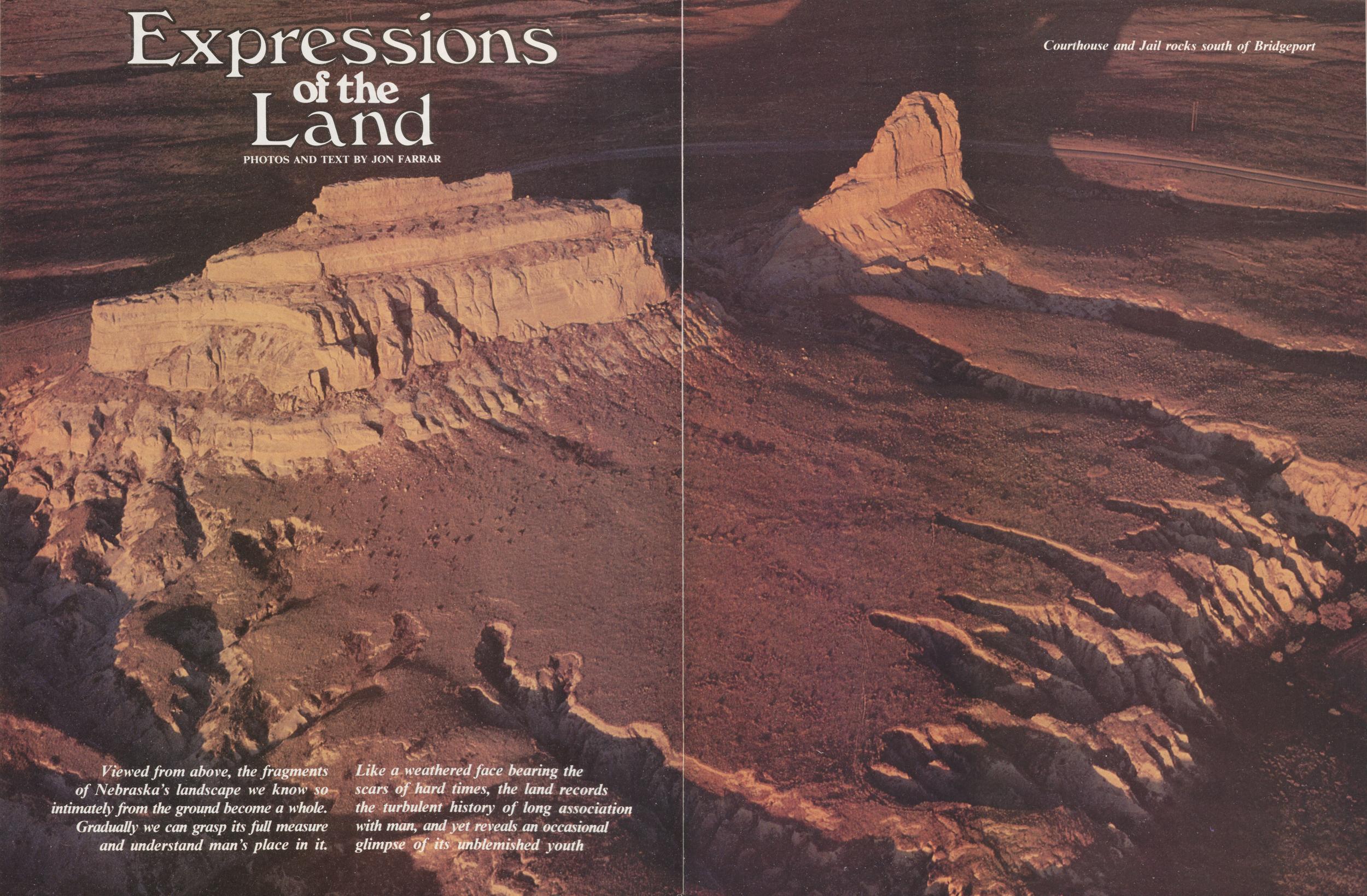
Expressions of the Land
Courthouse and Jail rocks south of Bridgeport
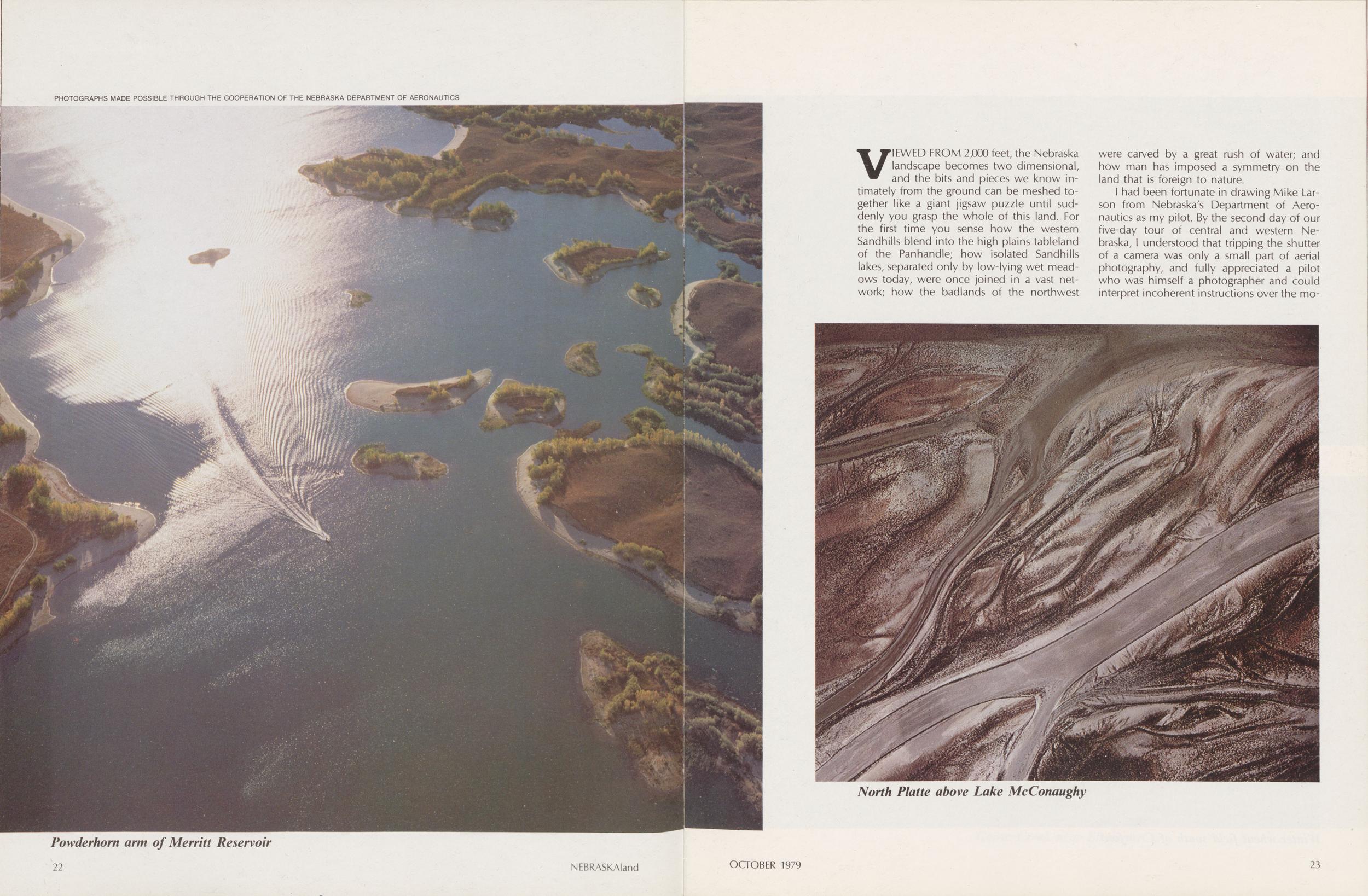
Powderhorn arm of Merritt Reservoir
VIEWED FROM 2,000 feet, the Nebraska landscape becomes two dimensional, and the bits and pieces we know intimately from the ground can be meshed together like a giant jigsaw puzzle until suddenly you grasp the whole of this land.. For the first time you sense how the western Sandhills blend into the high plains tableland of the Panhandle; how isolated Sandhills lakes, separated only by low-lying wet meadows today, were once joined in a vast network; how the badlands of the northwest were carved by a great rush of water; and how man has imposed a symmetry on the land that is foreign to nature.
I had been fortunate in drawing Mike Larson from Nebraska's Department of Aeronautics as my pilot. By the second day of our five-day tour of central and western Nebraska, I understood that tripping the shutter of a camera was only a small part of aerial photography, and fully appreciated a pilot who was himself a photographer and could interpret incoherent instructions over the monotonous
North Platte above Lake McConaughy
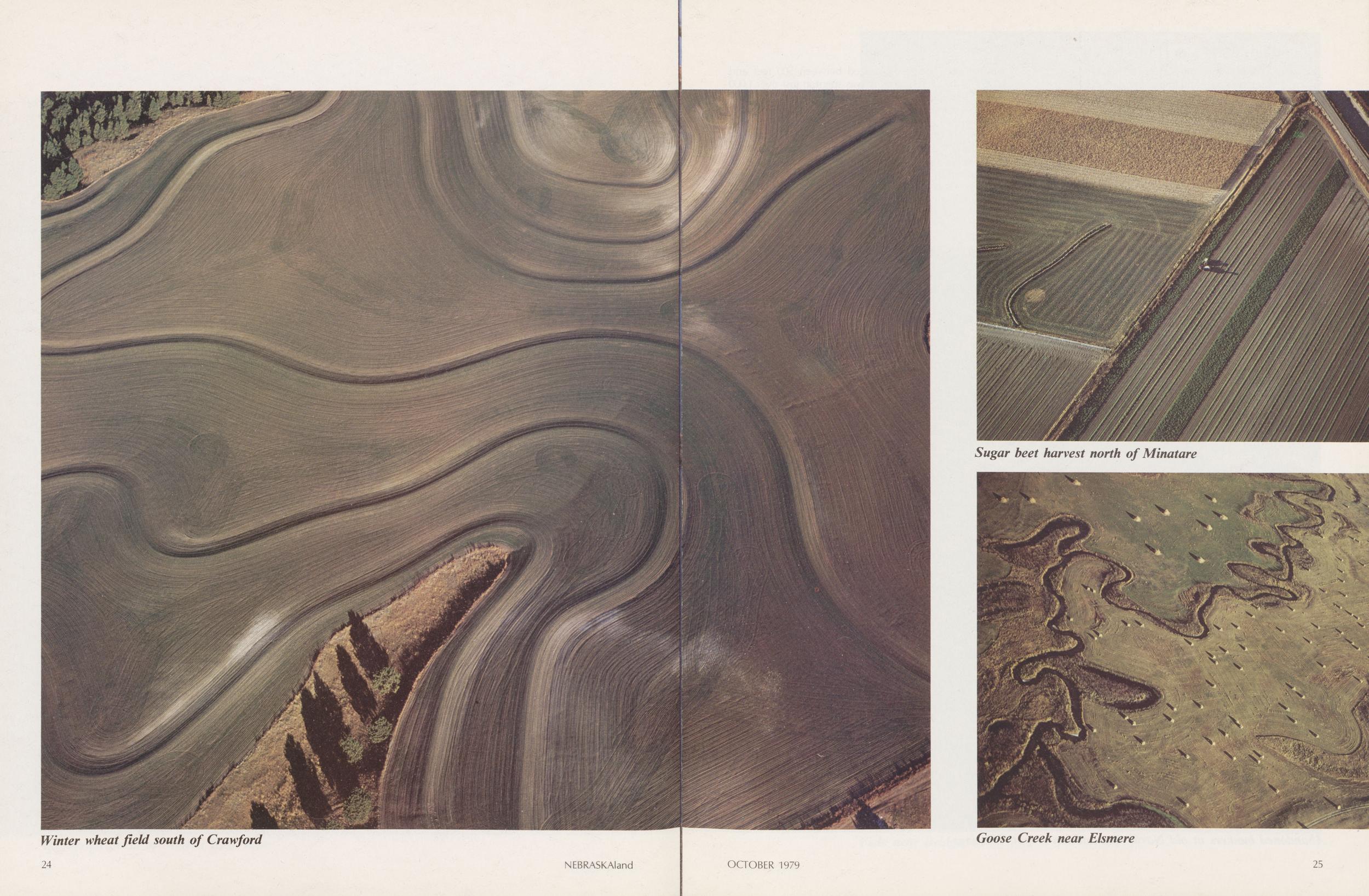
Winter wheat field south of Crawford
Sugar beet harvest north of Minatare
Goose Creek near Elsmere
drone of the little Cessna 172, put me exactly where I wanted to be, and more often than not, spot scenes worth preserving on film before I did. We left Lincoln in mid October with an ambitious itinerary that was regularly abandoned to the lure of meandering rivers, features of the landscape that refused to follow our straight-line course, or to chase spots of sunlight breaking through overcast skies.
Our eyes were immediately captured by the patterns below, not the section and quarter-section patchwork of fields seen vaguely through the haze of high-altitude airline flights, but the intricate patterns designed by man and nature. Though we ranged between 500 feet and 3,000 feet, much of our time was spent at just over 1,000 feet, an altitude that was high enough to grasp the fullness of a scene but low enough to capture the intricacy of details.
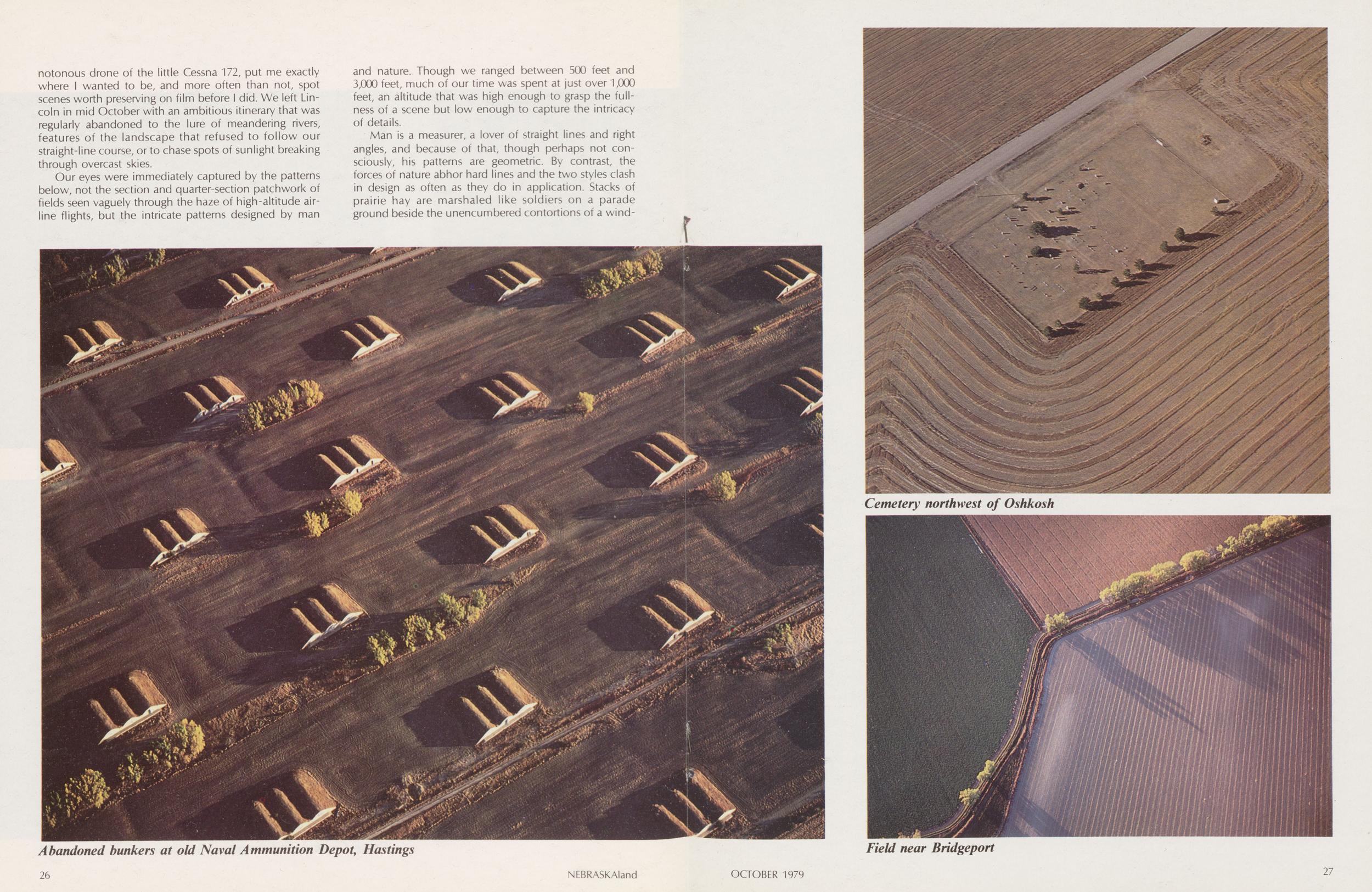
Man is a measurer, a lover of straight lines and right angles, and because of that, though perhaps not consciously, his patterns are geometric. By contrast, the forces of nature abhor hard lines and the two styles clash in design as often as they do in application. Stacks of prairie hay are marshaled like soldiers on a parade ground beside the unencumbered contortions of a winding
Abandoned bunkers at old Naval Ammunition Depot, Hastings
Cemetery northwest of Oshkosh
Field near Bridgeport
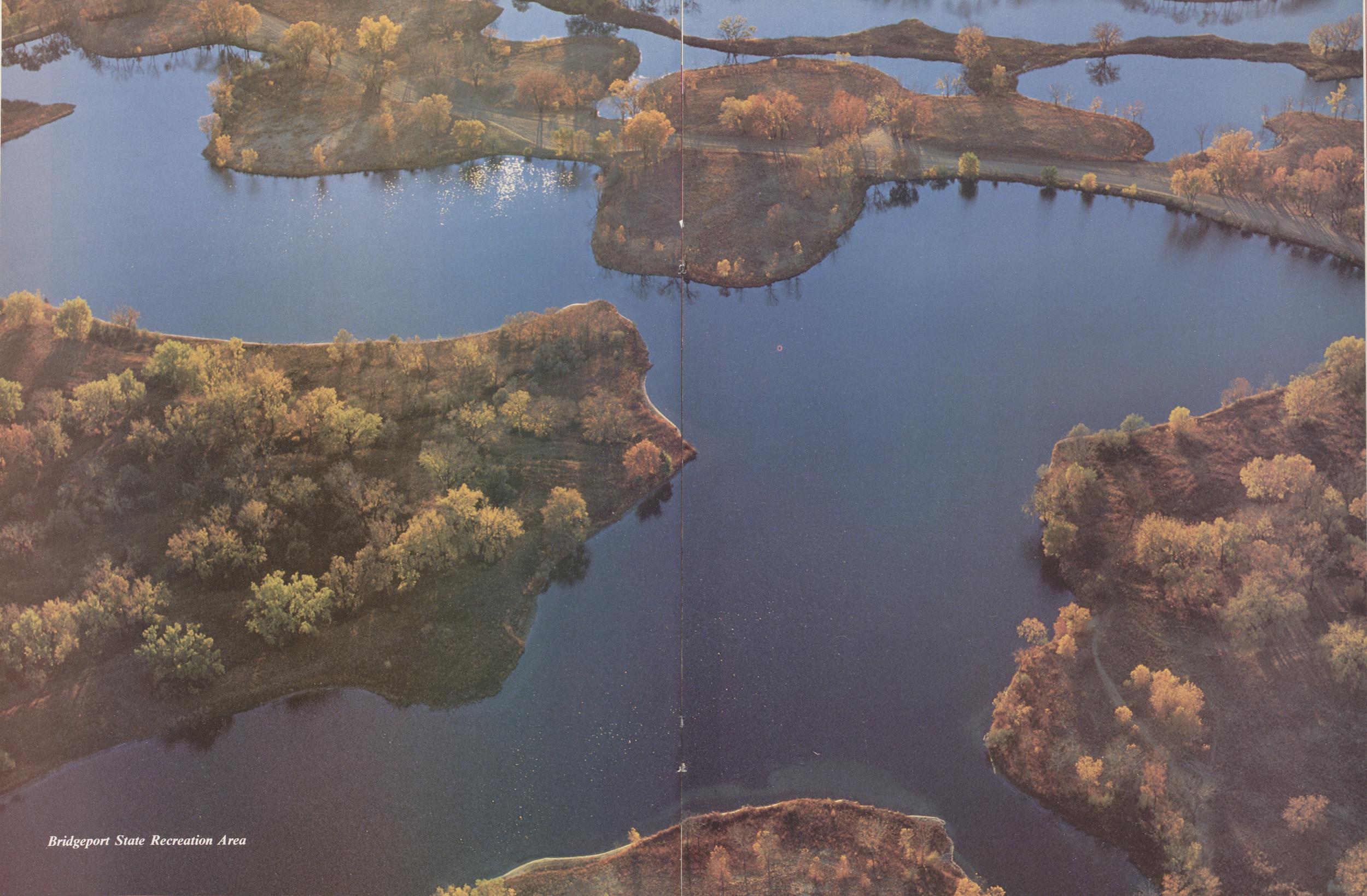
Bridgeport State Recreation Area
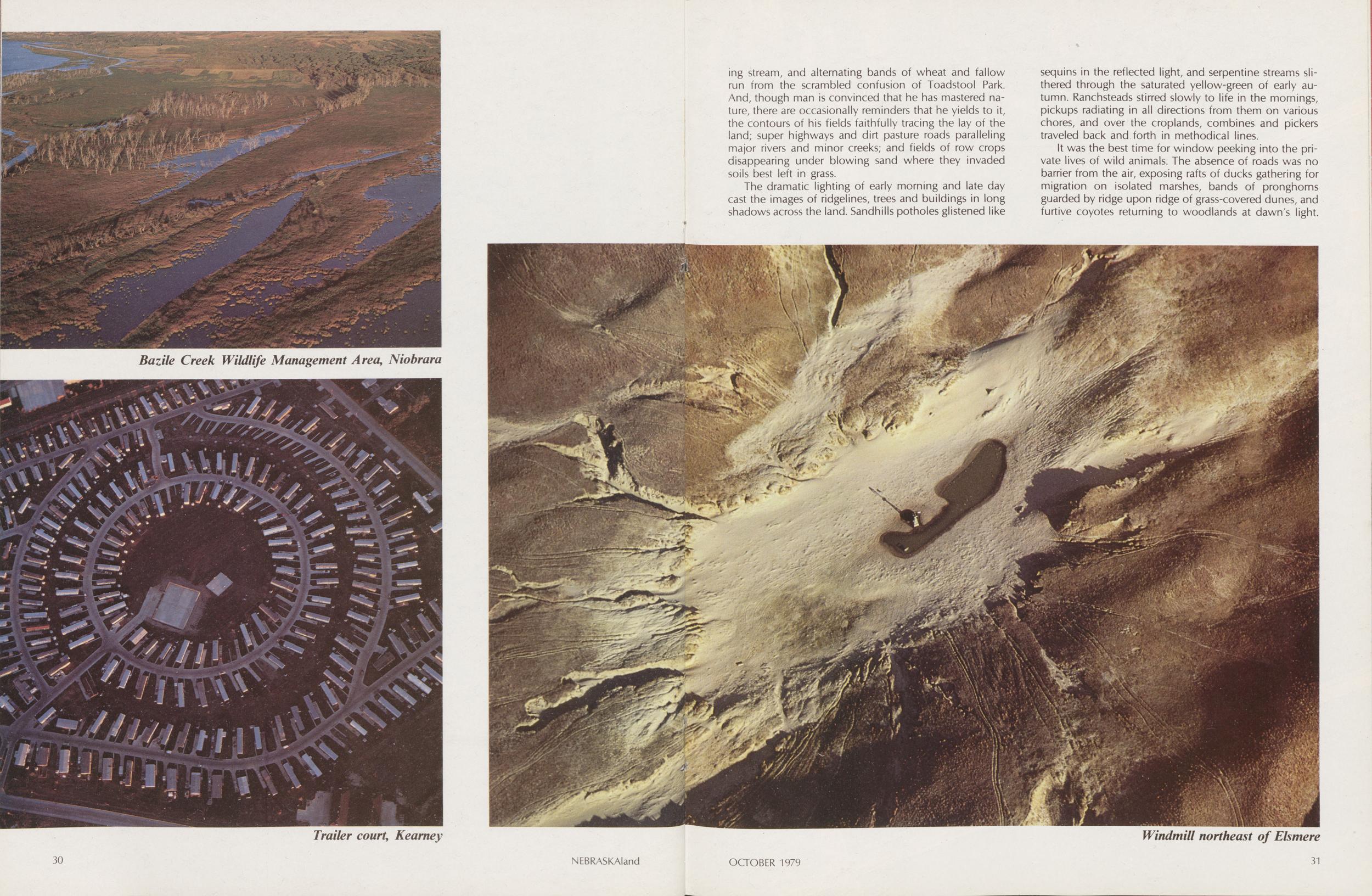
Bazile Creek Wildlife Management Area, Niobrara
Trailer court, Kearney
stream, and alternating bands of wheat and fallow run from the scrambled confusion of Toadstool Park. And, though man is convinced that he has mastered nature, there are occasionally reminders that he yields to it, the contours of his fields faithfully tracing the lay of the land; super highways and dirt pasture roads paralleling major rivers and minor creeks; and fields of row crops disappearing under blowing sand where they invaded soils best left in grass.
The dramatic lighting of early morning and late day cast the images of ridgelines, trees and buildings in long shadows across the land. Sandhills potholes glistened like sequins in the reflected light, and serpentine streams slithered through the saturated yellow-green of early autumn. Ranchsteads stirred slowly to life in the mornings, pickups radiating in all directions from them on various chores, and over the croplands, combines and pickers traveled back and forth in methodical lines.
It was the best time for window peeking into the private lives of wild animals. The absence of roads was no barrier from the air, exposing rafts of ducks gathering for migration on isolated marshes, bands of pronghorns guarded by ridge upon ridge of grass-covered dunes, and furtive coyotes returning to woodlands at dawn's light.
Windmill northeast of Elsmere
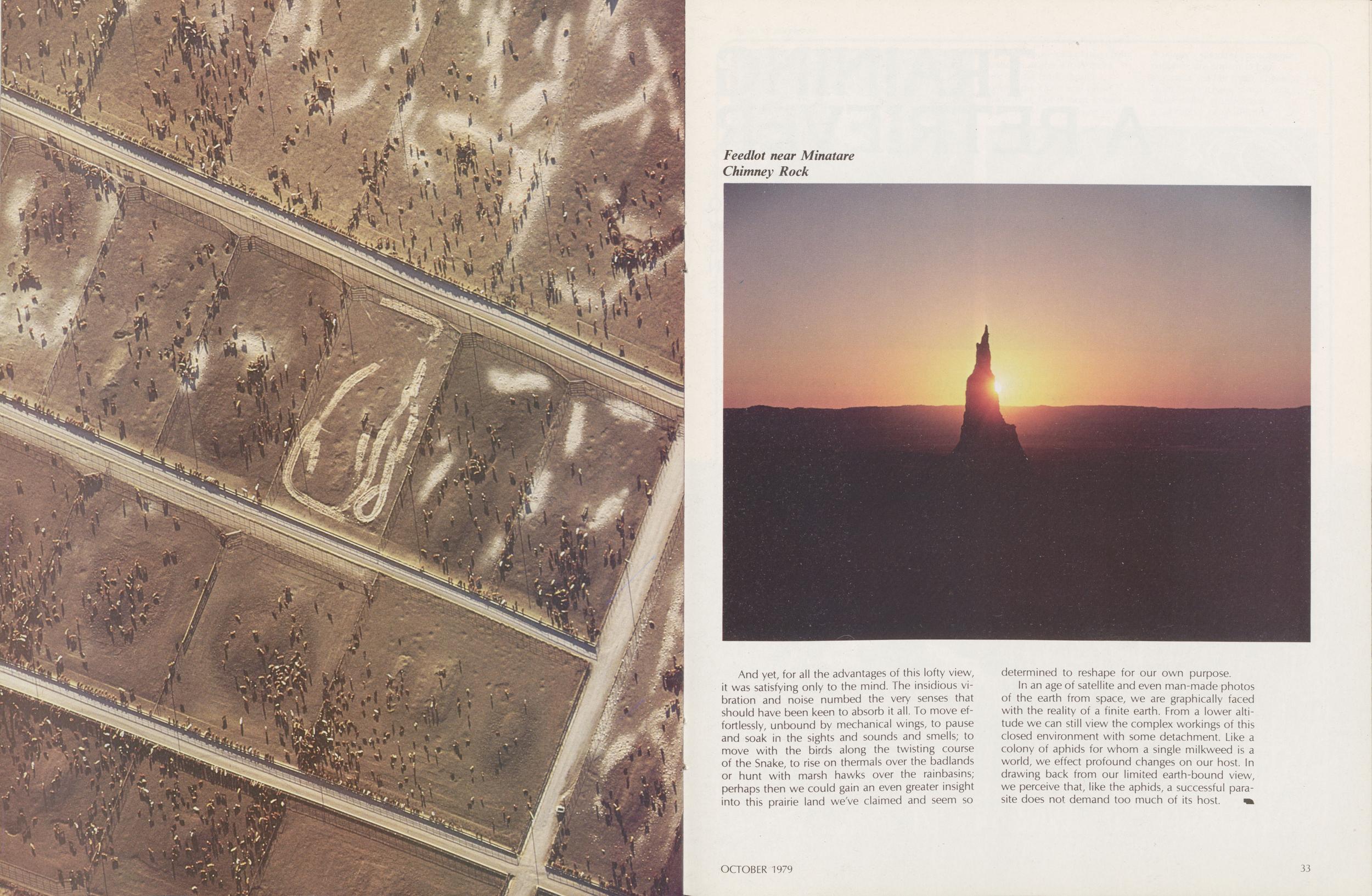
Feedlot near Minatare
Chimney Rock
And yet, for all the advantages of this lofty view, it was satisfying only to the mind. The insidious vibration and noise numbed the very senses that should have been keen to absorb it all. To move effortlessly, unbound by mechanical wings, to pause and soak in the sights and sounds and smells; to move with the birds along the twisting course of the Snake, to rise on thermals over the badlands or hunt with marsh hawks over the rainbasins; perhaps then we could gain an even greater insight into this prairie land we've claimed and seem so determined to reshape for our own purpose.
In an age of satellite and even man-made photos of the earth from space, we are graphically faced with the reality of a finite earth. From a lower altitude we can still view the complex workings of this closed environment with some detachment. Like a colony of aphids for whom a single milkweed is a world, we effect profound changes on our host. In drawing back from our limited earth-bound view, we perceive that, like the aphids, a successful parasite does not demand too much of its host.
OCTOBER 1979 33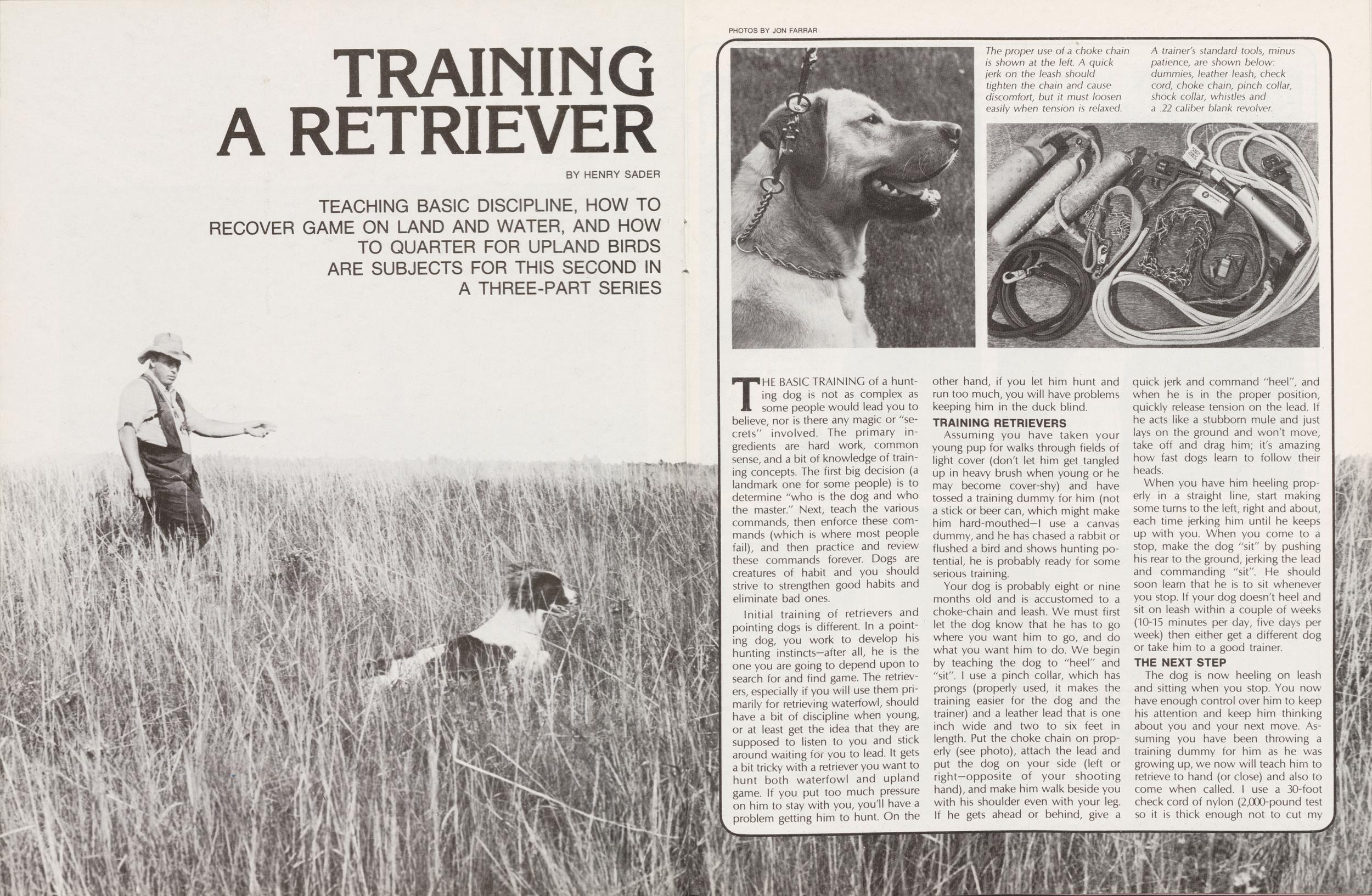
TRAINING A RETRIEVER
TEACHING BASIC DISCIPLINE, HOW TO RECOVER GAME ON LAND AND WATER, AND HOW TO QUARTER FOR UPLAND BIRDS ARE SUBJECTS FOR THIS SECOND IN A THREE-PART SERIESThe proper use of a choke chain is shown at the left. A quick jerk on the leash should tighten the chain and cause discomfort, but it must loosen easily when tension is relaxed.
A trainer's standard tools, minus patience, are shown below: dummies, leather leash, check cord, choke chain, pinch collar, shock collar, whistles and a .22 caliber blank revolver.
THE BASIC TRAINING of a hunting dog is not as complex as some people would lead you to believe, nor is there any magic or "secrets" involved. The primary ingredients are hard work, common sense, and a bit of knowledge of training concepts. The first big decision (a landmark one for some people) is to determine "who is the dog and who the master." Next, teach the various commands, then enforce these commands (which is where most people fail), and then practice and review these commands forever. Dogs are creatures of habit and you should strive to strengthen good habits and eliminate bad ones.
Initial training of retrievers and pointing dogs is different. In a pointing dog, you work to develop his hunting instincts-after all, he is the one you are going to depend upon to search for and find game. The retrievers, especially if you will use them primarily for retrieving waterfowl, should have a bit of discipline when young, or at least get the idea that they are supposed to listen to you and stick around waiting for you to lead. It gets a bit tricky with a retriever you want to hunt both waterfowl and upland game. If you put too much pressure on him to stay with you, you'll have a problem getting him to hunt. On the other hand, if you let him hunt and run too much, you will have problems keeping him in the duck blind.
TRAINING RETRIEVERSAssuming you have taken your young pup for walks through fields of light cover (don't let him get tangled up in heavy brush when young or he may become cover-shy) and have tossed a training dummy for him (not a stick or beer can, which might make him hard-mouthed—I use a canvas dummy, and he has chased a rabbit or flushed a bird and shows hunting potential, he is probably ready for some serious training.
Your dog is probably eight or nine months old and is accustomed to a choke-chain and leash. We must first let the dog know that he has to go where you want him to go, and do what you want him to do. We begin by teaching the dog to "heel" and "sit". I use a pinch collar, which has prongs (properly used, it makes the training easier for the dog and the trainer) and a leather lead that is one inch wide and two to six feet in length. Put the choke chain on properly (see photo), attach the lead and put the dog on your side (left or right—opposite of your shooting hand), and make him walk beside you with his shoulder even with your leg. If he gets ahead or behind, give a quick jerk and command "heel", and when he is in the proper position, quickly release tension on the lead. If he acts like a stubborn mule and just lays on the ground and won't move, take off and drag him; it's amazing how fast dogs learn to follow their heads.
When you have him heeling properly in a straight line, start making some turns to the left, right and about, each time jerking him until he keeps up with you. When you come to a stop, make the dog "sit" by pushing his rear to the ground, jerking the lead and commanding "sit". He should soon learn that he is to sit whenever you stop. If your dog doesn't heel and sit on leash within a couple of weeks (10-15 minutes per day, five days per week) then either get a different dog or take him to a good trainer.
THE NEXT STEPThe dog is now heeling on leash and sitting when you stop. You now have enough control over him to keep his attention and keep him thinking about you and your next move. Assuming you have been throwing a training dummy for him as he was growing up, we now will teach him to retrieve to hand (or close) and also to come when called. I use a 30-foot check cord of nylon (2,000-pound test so it is thick enough not to cut my
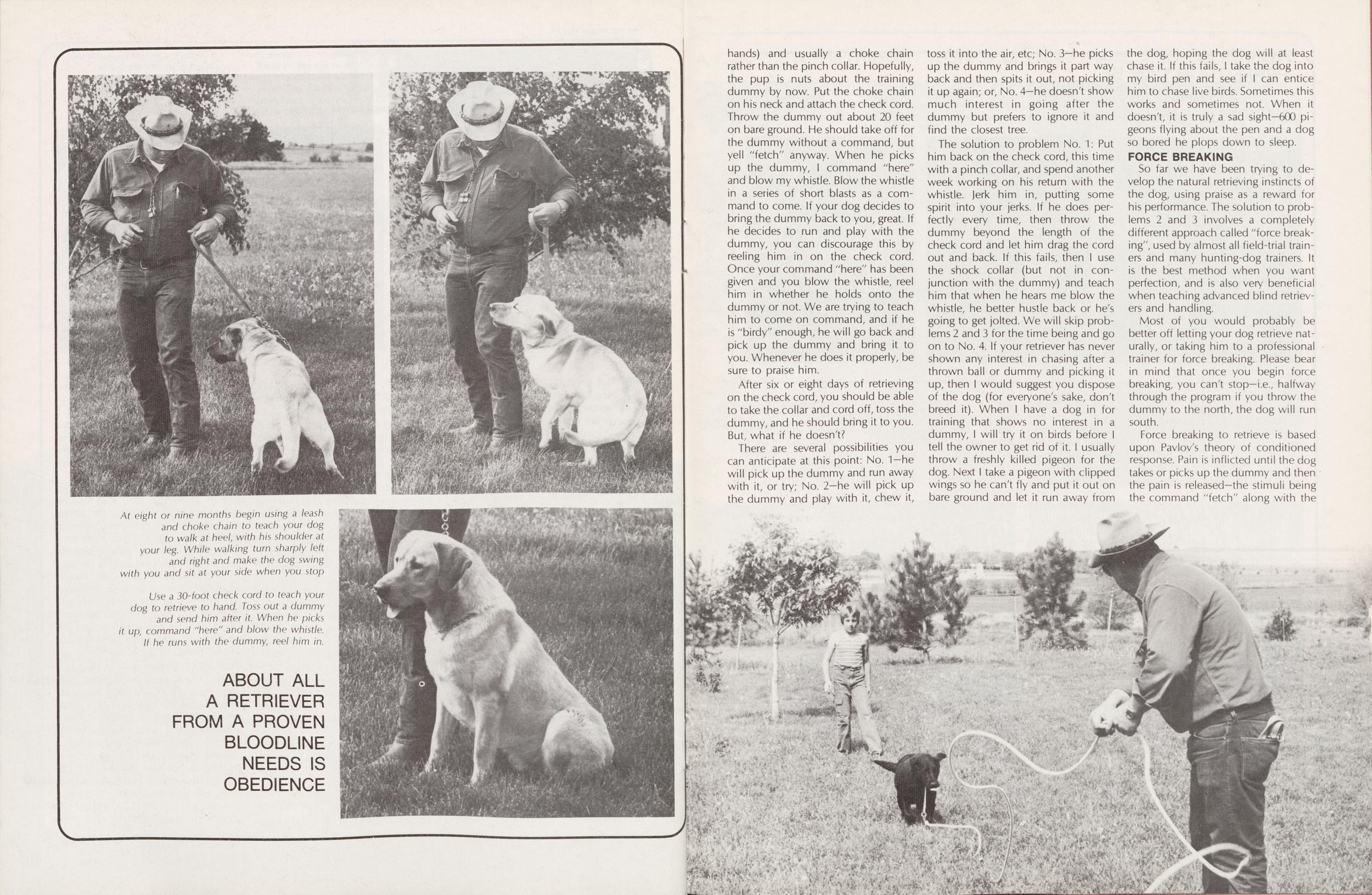
At eight or nine months begin using a leash and choke chain to teach your dog to walk at heel, with his shoulder at your leg. While walking turn sharply left and right and make the dog swing with you and sit at your side when you stop
Use a 30-foot check cord to teach your dog to retrieve to hand. Toss out a dummy and send him after it. When he picks it up, command "here" and blow the whistle. If he runs with the dummy, reel him in.
hands) and usually a choke chain rather than the pinch collar. Hopefully, the pup is nuts about the training dummy by now. Put the choke chain on his neck and attach the check cord. Throw the dummy out about 20 feet on bare ground. He should take off for the dummy without a command, but yell "fetch" anyway. When he picks up the dummy, I command "here" and blow my whistle. Blow the whistle in a series of short blasts as a command to come. If your dog decides to bring the dummy back to you, great. If he decides to run and play with the dummy, you can discourage this by reeling him in on the check cord. Once your command "here" has been given and you blow the whistle, reel him in whether he holds onto the dummy or not. We are trying to teach him to come on command, and if he is "birdy" enough, he will go back and pick up the dummy and bring it to you. Whenever he does it properly, be sure to praise him.
After six or eight days of retrieving on the check cord, you should be able to take the collar and cord off, toss the dummy, and he should bring it to you. But, what if he doesn't?
There are several possibilities you can anticipate at this point: No. 1—he will pick up the dummy and run away with it, or try; No. 2-he will pick up the dummy and play with it, chew it, toss it into the air, etc; No. 3—he picks up the dummy and brings it part way back and then spits it out, not picking it up again; or, No. 4—he doesn't show much interest in going after the dummy but prefers to ignore it and find the closest tree.
The solution to problem No. 1: Put him back on the check cord, this time with a pinch collar, and spend another week working on his return with the whistle. Jerk him in, putting some spirit into your jerks. If he does perfectly every time, then throw the dummy beyond the length of the check cord and let him drag the cord out and back. If this fails, then I use the shock collar (but not in conjunction with the dummy) and teach him that when he hears me blow the whistle, he better hustle back or he's going to get jolted. We will skip problems 2 and 3 for the time being and go on to No. 4. If your retriever has never shown any interest in chasing after a thrown ball or dummy and picking it up, then I would suggest you dispose of the dog (for everyone's sake, don't breed it). When I have a dog in for training that shows no interest in a dummy, I will try it on birds before I tell the owner to get rid of it. I usually throw a freshly killed pigeon for the dog. Next I take a pigeon with clipped wings so he can't fly and put it out on bare ground and let it run away from the dog, hoping the dog will at least chase it. If this fails, I take the dog into my bird pen and see if I can entice him to chase live birds. Sometimes this works and sometimes not. When it doesn't, it is truly a sad sight—600 pigeons flying about the pen and a dog so bored he plops down to sleep.
FORCE BREAKINGSo far we have been trying to develop the natural retrieving instincts of the dog, using praise as a reward for his performance. The solution to problems 2 and 3 involves a completely different approach called "force breaking", used by almost all field-trial trainers and many hunting-dog trainers. It is the best method when you want perfection, and is also very beneficial when teaching advanced blind retrievers and handling.
Most of you would probably be better off letting your dog retrieve naturally, or taking him to a professional trainer for force breaking. Please bear in mind that once you begin force breaking, you can't stop—i.e., halfway through the program if you throw the dummy to the north, the dog will run south.
Force breaking to retrieve is based upon Pavlov's theory of conditioned response. Pain is inflicted until the dog takes or picks up the dummy and then the pain is released—the stimuli being the command "fetch" along with the
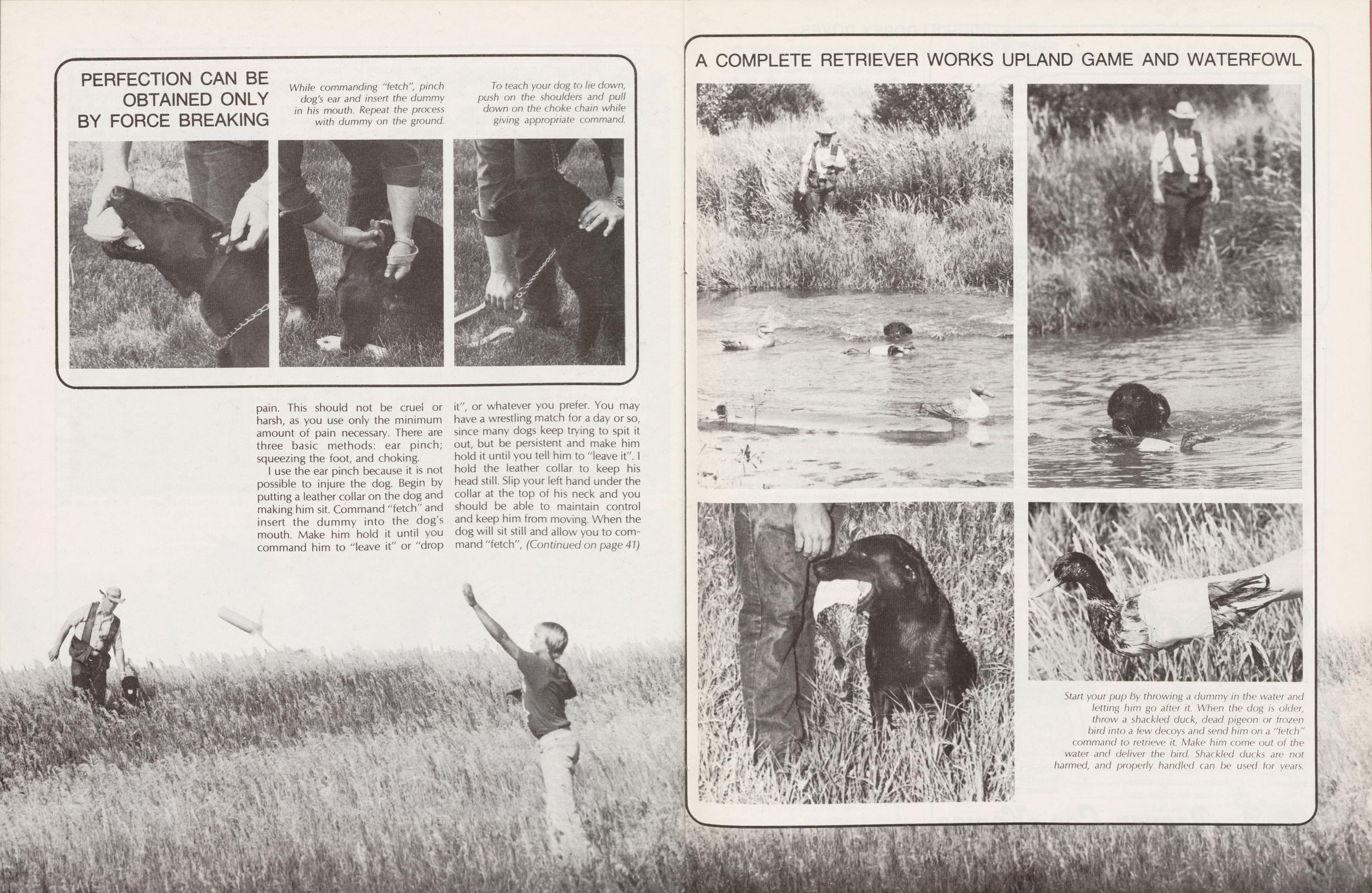 PERFECTION CAN BE
OBTAINED ONLY
BY FORCE BREAKING
PERFECTION CAN BE
OBTAINED ONLY
BY FORCE BREAKING
While commanding "fetch", pinch dog's ear and insert the dummy in his mouth. Repeat the process with dummy on the ground.
To teach your dog to lie down, push on the shoulders and pull down on the choke chain while giving appropriate command.
pain. This should not be cruel or harsh, as you use only the minimum amount of pain necessary. There are three basic methods: ear pinch; squeezing the foot, and choking.
I use the ear pinch because it is not possible to injure the dog. Begin by putting a leather collar on the dog and making him sit. Command "fetch" and insert the dummy into the dog's mouth. Make him hold it until you command him to "leave it" or "drop it", or whatever you prefer. You may have a wrestling match for a day or so, since many dogs keep trying to spit it out, but be persistent and make him hold it until you tell him to "leave it". I hold the leather collar to keep his head still. Slip your left hand under the collar at the top of his neck and you should be able to maintain control and keep him from moving. When the dog will sit still and allow you to command "fetch", (Continued on page 41)
A COMPLETE RETRIEVER WORKS UPLAND GAME AND WATERFOWL
Start your pup by throwing a dummy in the water and letting him go after it. When the dog is older, throw a shackled duck, dead pigeon or frozen bird into a few decoys and send him on a "fetch" command to retrieve it. Make him come out of the water and deliver the bird. Shackled ducks are not harmed, and properly handled can be used for years.
DOPEY DOVES
(Continued from page 18)in a straight line for more than a second or so. Dopey doves", he said, straight-faced, and then followed with: "and they really come out smoking."
Bill had no more than uttered those words when a lone dove proved him correct. The little grey streak darted in from the southwest, relieved Bill of a 12-gauge load, and continued on his way. Seconds later, he drew fire from Dale, just over the hill from us, but we couldn't see the outcome.
After the bird was gone, Bill checked out his auto-loading scattergun with a look of disappointment on his face. "I only got one shot out of it. It didn't eject the spent shell," he complained. Close inspection of the gun showed a crack in the wood of the fore-end, which houses some of the gun's innards that provide the force to work the action. Perhaps the crack was an indicator of the condition of the mechanism inside. At any rate, Bill continued operating with it as a big, heavy single-shot.
We were in a good spot, with single doves and small bunches coming over periodically. Don, perched on the edge of the draw, soon collected about four birds, while Bill, limited to just one shell per flight, had only a couple. A chorus of shotgun music from Dale's direction told us he was getting plenty of action.
But, as good as our location was, Don could see one that appealed to him even more. At the end of the draw, around the little clump of trees, doves came and went by the score, And, there seemed to be another drawing card just over the hill to the west. Don packed up and headed that way, but Bill decided to stay. With his disabled scattergun, he could make no more use of big bunches of doves than he could the singles and small bunches he was getting right where he was.
Don soon disappeared in the weeds and trees to the south, while Dale continued to bang away regularly from the other direction. Bill stuck in there, moving only a few yards up the draw to thicker cover.
"Heads up, Fred!"
By that time, Bill had managed to scratch six birds, having invested considerable time searching for downed birds in the thick cover. We hiked over to see how Dale had fared.
We found him and Toby with eight birds, and Dale connected on another while we stood around debating what to do. We decided to give him a few more minutes to collect his last dove of the day.
That final bird wasn't long in coming. It flew in fast from the south, then darted out over the pond. There, Dale's pattern of No. 8's intercepted the bird, and it pitched into the weeds halfway up the hill on the far side of the pond.
Toby took off after the bird at a dead run, and Dale followed at a fast walk. "OF Tobe is enthusiastic about retrieving game, but he needs a little help with doves. For some reasons, not many bird dogs like to handle them," he said as he departed.
With Dale's last bird on the ground, Don high-tailed it for his pickup and was soon nothing but a cloud of dust pointed toward Republican City. Frustrated with his shotgun, Bill had previously announced that he was through for a while, at least until he could get to a 20-gauge back home that was in good working order.
With a little more than an hour of hunting time left, we started back to town, making it a point to watch for other concentrations of doves along the way. There were none.
We drove by foxtail patches, sunflowers, ragweed and smartweed, all prime dove attractors during the balmier days of September. But during the cooler days of October, when most of the doves had already hightailed it for the south, the stragglers still in Nebraska seemed to headquarter around the hemp patches.
We made a quick stop at Bill's house, where he swapped his ailing 12-gauge auto and shells for the standby 20-gauge equipment, then headed for a time-tested hunting spot just minutes away. There, earlier in the fall, the abundant foxtail and other weeds had served up limit after limit of doves. These last minutes of shooting time, often the best of the day, would be the final test of the marijuana theory—our marijuana connection.
When it was over, there was no doubt. There was no marijuana on the area, and there were no doves.
"Marijuana's definitely the key to a late dove hunt, in my opinion," Dale said. "Every year, a lot of hunters miss out on the last couple weeks of the season just because they can't find the birds. But it's simple—find the marijuana, and you'll find doves."
TRAINING A RETRIEVER
(Continued from page 39)open his mouth, take the dummy without a fight and hold the dummy until you take it from him, then you are ready for the next step. At this point, many dogs will not open their mouths when they see the dummy, even though they have learned what is expected. This is where the ear pinching and pain are used-the dog has to open his mouth in order to whine.
With your dog in a heeling position, sitting, with the leather collar on, put your left hand under the collar as before. Put the tip of his ear between thumb and finder, hold the dummy in front of his mouth, command "fetch", pinch his ear, and when he opens his mouth, insert the dummy and immediately release pressure on the ear. Make him hold the dummy until you take it from him. Repeat this daily, 10 to 15 minutes per day, and your dog will soon begin reaching for the dummy when you pinch his ear. In a week or so, depending upon the dog, he should be reaching for the dummy on the command "fetch" without any pain inflicted. I like to make the dog heel while holding the dummy, and I also tap the dummy to make certain he has a good hold on it.
The next step is to place the dummy in front of the sitting dog and make him pick it up off the ground. Usually you will have to push the dog's head toward the ground while pinching his ear. When he is taking the dummy off the ground on command (without pinching the ear) then toss it out 10 or 15 feet, lead him over to it and make him pick it up, pinching his ear if necessary. Continue this until he goes out to the dummy on his own, picks it up and returns it to you. When he returns to you with the dummy, command "heel" and make him swing his rear around (called a "flip heel") and sit at your side in a heeling position. Reach down, take hold of the dummy, and command him to leave it. 'Where are those big ones you're always talking about?" Wait for him to remove his mouth, don't pull or jerk it away from him as this can develop a bad habit when birds are used.
THE FIRST BIRDYour dog should now be retrieving dummies tossed any distance, and should be doing it with a lot of spirit and desire. Now I like to give the dog his first bird to retrieve. I usually use a pigeon that has been dead for a day. Dogs that I have force broken are made to take the pigeon on command and hold it properly until I take it from them. Then I toss it like I did with the dummy.
If the dog retrieves it perfectly a few times, move onto the next step. However, if he plays with it or bites down too hard, we have to correct him. For handling the bird too rough, I pinch their lip against their canine teeth and command "easy."
If the dog is force broke, it is easy to make him handle the bird properly, but if not, you must be careful not to get too rough with him because he might not want to pick the bird up again. Remember: you can always make a force broke dog pick up the bird by pinching his ears, but a natural retriever cannot be made to pick up anything he doesn't want to.
When the dog is retrieving birds properly, I like to introduce the gun. I begin with a helper standing 50 or 60 yards away. I signal him to throw the bird and to holler when he does. The bird is tossed out onto bare ground so the dog can see it-we are working on the gun, not on his marking ability.
When the helper is about to toss the bird, I tell the dog to "mark" and send him when the bird is in the air. The dog should charge out and pick up the bird, quickly return to me, swing around into a heeling position and sit with the bird in his mouth until I take it from him.
After a few days of this, and when the dog is used to the helper, I have the helper fire a .22 caliber blank when he throws the bird. At this point you should analyze your dog. If he is tough and spirited, good and birdy, don't worry too much about the gun. However, if he is shy and timid, then approach the gun in a more subtle manner. I like to stake the timid dog out well behind (40 yards) a dog that I am working with and let him watch. He will generally get caught up in the excitement of watching the other dog's retrieve and soon learn to ignore the gun.
Normally, retrievers (except some Goldens) take to the gun quickly. When I'm certain the .22 caliber is not bothering the dog at 50 yards, the helper moves to 40 yards, 30 yards, etc., until he is standing almost next when he shoots and throws the bird. Next I send the helper out about 40 yards and have him shoot a 20-gauge with light loads when he throws the birds, moving in closer each day. When we are shooting a 20-gauge over the dog for a few days, I consider that the gun has been properly introduced.
40 NEBRASKAland OCTOBER 1979 41
If the dog is gun-shy, either you or somebody else is at fault. Dogs are not born gun-shy. When I get a dog in for training, I always ask the customer whether he has ever shot around the dog and if so, how did the dog react? Some people are reluctant to tell that they have the dog screwed up, but all this does is cost them more money, since it takes longer for the trainer to figure out the problem. Every year I have some customers who will tell me they shot over their dog "to see if he was gun-shy". Dogs' ears are much more sensitive than humans, and if the dog didn't jump, run or hide at a shotgun fired over his head, I would think he is either deaf or stupid. I'm not going into detail on how to break gun-shy dogs since they are made rather than born that way, and it was a stupid mistake. If your dog is gun-shy, take him to your favorite professional trainer, and don't expect miracles.
HOW VERSATILE?Our dog is now heeling, sitting, coming when we blow the whistle, and will retrieve dummies or dead pigeons. He also likes (or tolerates) the sound of a shotgun. Now we must decide what type of dog we want to make of him. Do we want a versatile gun dog that hunts upland game and waterfowl, or do we want a strictly waterfowl dog?
You want your waterfowl dog to sit quietly in the blind and remain there until sent for the retrieve, or at least until after you shoot the birds (I prefer the latter). This type is easier to train than one you want to do everything. If you want strictly a waterfowl dog, then begin keeping your dog in a heeling position every time you take him out of his kennel. Don't let him get out in front of you and hunt; make him stay beside you.
Teach your dog to lie down and stay by using a leash, even if you have to sit on him. If he gets up, put him back where he was. Make him stay there while you are doing something else such as talking to friends, working another dog, etc. I like to teach a dog to lie down and stay until I come and get him—never calling him from a down position—and he then learns that he isn't going anywhere until I come to him. We want our waterfowl dog very obedient, and the more that obedience is stressed, the better we will be able to handle him.
INTO THE DECOYSNow, we will teach the dog about decoys. Put your dog on a pinch collar and a short lead and send your helper about 40 or 50 yards away (on bare ground) with about six live pigeons and a few duck decoys. Set the decoys out on the ground about where the pigeons will be dropped. While you are restraining the dog, have your helper throw a pigeon toward the decoys and kill it. Send your dog by commanding "fetch" (the dog is by now very familiar with dead pigeons). If the dog picks up a decoy, go out and correct him by using whatever discipline is necessary; if you must beat him with the decoy, then do it by all means. Be sure he loses his taste for decoys. Do this for a few days with emphasis on restraining the dog and his not touching the decoys, and then you are ready to go to the water.
I assume that you have already had your retriever in the water. If you haven't, take him to the lake when the water is warm ()une through August in Nebraska). Start him out in wading water. I like to take four or five, 10 to 16-week-old pups together and throw a dummy out in a few inches of water and let them go after it. As they learn to like the water, I toss the dummy into deeper water until they learn to swim. Puppies almost always begin swimming with their front feet coming out of the water
'And then she threw all my hunting and fishing magazines into the campfire!"
 The joy of sending Christmas cards and keeping
in touch with friends is one of our most
cherished traditions. This spirit of warmth and
friendship is beautifully expressed through
Leanin' Tree cards, with meaningful greetings
perfectly matched to each magnificent scene.
CHRISTMAS CARDS
5" x7" Cards with Warm
of the Outdoor West
and Friendly Greetings
You can choose red, blue or white envelopes.
Order direct from this ad or send for free
sample card and catalog. We can imprint your
name in red to match the greeting, also your
address in black on the envelope flaps.
Fast, IMMEDIATE shipment now 'til Christmas.
I860 CHRISTMAS AT THE LINE CAMP May
Christmas bring Friends to your Fireside, etc.
1874 "...The splendor of Christ's humble birth,
etc." Merry Christmas and a Happy New Year
3025 SLEIGHBELLS IN THE SKY Merry Christmas
and Happy New Year
1656 ...ALL IS CALM, ALL IS BRIGHT May Peace
be your Gift at Christmas and...thro ugh...the Year
3143 FOREST CATHEDRAL May the Peace and Joy
of Christmas be with you through all the Year
1455 May Christmas bring Friends to your Fireside,
Peace...And Good Health throughout the...Year
1692 "...Christ's humble birth, etc." Wishing you
a Blessed Christmas And...New Year
1644 GIFT WRAPPED To wish you a joyous 1869 "...small wonders of the season,
etc." Merry
Christmas and...happiness the New Year can bring Christmas and a Happy New Year
1 ain't muck Rood . and You may not know me. Lord—ain't much seen in where Thy Holy
Word,
observed me out here on the lonely plain
K-ioakin after cattle, feelin' thankful it rains.
1151 "...fair...face of heaven,..." May. happiness 1939 A COWBOY'S CHRISTMAS PRAYER
May the
be yours at Christmas and...the New Year Peace and Good Will of
Christmas...be with you
1880 "We are thinking of you, etc." ...good will to 1612 "...Star in the East,
etc." May the warmth
you is what we mean in...The Spirit of Christmas ...of Christmas fill your heart...the
Coming Year
1873 THE BADLANDS BLUES ...grass is short, .this 1472 A Christmas Surprise May
the miracle of
song ain't clever..."Merry Christmas" same as ever! Christmas fill your hearts
anew...the year through.
1906 "Holiday Greetings" May the Peace and
Happiness of the Holiday Season abide with you...
1140 The Wonder of Christmas... May Christmas
bring Friends...Peace...Health throughout the...Year
1205 A MEMORY OF CHRISTMAS ...May you have 1142 A Christmas...Handout Jo wish
you the
a Merry Christmas in the good old-fashioned way! Merriest Christmas our good
Lord can bestow!
1334 To those we love...And...loved or
...Merry Christmas from the two of us!
1304 "May the...snow fall soft, etc." Merry
Christmas and Best Wishes for a Happy New Year
1899 A COWBOY'S PRAYER May the Peace and
Joy of Christmas be with you through all the Year
3008 The Miracle of Christmas May the Peace and
Joy of Christmas be with you through all the Year
WcM, (Christmas time has come.
A wish you
To worm you. i m your way
we hope the snow is not deep
And that the weather s clear
That luck on you
camp rut the year'
1913 "...A greeting-just to wish you well, etc."
Merry Christmas and Happy New Year
save
SHOP BY MAIL FROM THE LEANIN* TREE • OUR 30TH YEAR
SATISFACTION GUARANTEED OR YOUR MONEY BACK
in you, torn;
1496 "...Merry Christmas to you, too!" May yours 1938 "Cloistering trees touch
the...skies, etc."
be a joyful Christmas and your New Year happy! May the Peace and Joy of Christmas
be with you...
1273 "Blessed are they that have...believed." May 1872 SHARING CHRISTMAS CHORES
May the
the Peace and Joy of Christmas be with you... Christmas Spirit remain
within your hearts...
1856 "...it's time to greet.friends it's nice to 1614 "Christmas is but one more
word for love" 1888 CHRISTMAS THANKS "...My thanks, Lord are 1602 CHRISTMAS
WISHES COME TRUE Merry
know." Merry Christmas and a Happy New Year Wishing you...love and promise...Christmas
brings sincere, etc." Merry Christmas...Happy New Year Christmas and best
wishes for a Happy New Year
1338 May Christmas bring Friends to your Fireside,
Peace...Good Health throughout the New Year
GREETINGS... from our outfit to yours
1903 "GREETINGS..." May there come to you at 1896 ...But here's the proof our hearts
can holler 3164 "..The love of friend for friend." Wishing
this holiday time.the precious things of life... "Merry Christmas" - for
less than a dollar! you a Blessed Christmas And Happiness...New
Year
Christmas Isn't The Same Without Christmas Cards
HOW TO ORDER: Use coupon or letter and mail with payment. Order all of
one design or as many of each as desired. Indicate envelope color choice of
red, blue or white. Only one envelope color choice per order. Include
postage and handling fee in total payment. Colorado residents add 3% sales
tax. California residents add 6% use tax. Canadian customs duty will be
charged at border. No C.O.D.'s, please. Thank you for your order.
leanin' Atree
BOX 9500-R-BD26, BOULDER, CO 80301
SATISFACTION GUARANTEED
OR YOUR MONEY BACK
Postage and Handling Fee $1.40
TOTAL QUANTITY 12 25 37 50 75 100 125 150 200 300 .^ CUT HERE 500
WITHOUT NAME WITH NAME NAME AND BRAND ADDRESS ON ENV. $3.85 5.85 8.60 2.00 $6.50 8.75
11.50 2.20 $9.50 12.00 14.75 2.45 $12.75 15.50 18.25 2.70 $19.00 22.00 24.75 2.95 $24.75
28.00 30.75 3.20 $30.50 34.00 36.75 3.45 $36.25 40.00 42.75 3.70 $48.00 52.25 55.00
4.20 $69.75 75.00 77.75 5.20 $115.00 122.25 125.00 7.20
Fill in the quantity desired of each card number at right. You can mix and assort
at no additional cost 1140 1334 1612 1704 1872 1888 1913 3025 NO C.O.D., PLEASE
Cost of Cards $
1142 1338 1614 1854 1873 1896 1918 3143
1146 1455 1616 1856 1874 1899 1925 3162 Envelope Imprint $
Choose holiday red, powder blue or snowy white envelopes at no extra cost.
Only one color choice per order. If no choice indicated, white will be sent. REDD
BLUED WHITED
1151 1456 1644 1860 1876 1902 1938 3164 Colo. Res. Add 3% Sales Tai Calif. Res. Add
6% Use Ti> $
1205 1472 1655 1861 1880 1903 1939 4192
Postage and Handling Fee (Orders Only) $ 1.40
1273 1496 1656 1864 1882 1906 1941 TOTAL CARDS ORDERED
Total (U.S. Funds) $
1304 1602 1692 1869 1885 1912 3008
Rush free sample
and full-color
catalog
To order envelopes
imprinted, check
here. See price list
tor additional cost.
CARDS (ENCLOSE DRAWING OF BRAND)
SEND CARDS
AND/OR CATALOG TO:
R-BD26
Rte.. St., Box No.
City
State
Zip
SEND ORDER TO LEANIN' TREE, BOX 9500-R-BD26, BOULDER, CO 80301
79
The joy of sending Christmas cards and keeping
in touch with friends is one of our most
cherished traditions. This spirit of warmth and
friendship is beautifully expressed through
Leanin' Tree cards, with meaningful greetings
perfectly matched to each magnificent scene.
CHRISTMAS CARDS
5" x7" Cards with Warm
of the Outdoor West
and Friendly Greetings
You can choose red, blue or white envelopes.
Order direct from this ad or send for free
sample card and catalog. We can imprint your
name in red to match the greeting, also your
address in black on the envelope flaps.
Fast, IMMEDIATE shipment now 'til Christmas.
I860 CHRISTMAS AT THE LINE CAMP May
Christmas bring Friends to your Fireside, etc.
1874 "...The splendor of Christ's humble birth,
etc." Merry Christmas and a Happy New Year
3025 SLEIGHBELLS IN THE SKY Merry Christmas
and Happy New Year
1656 ...ALL IS CALM, ALL IS BRIGHT May Peace
be your Gift at Christmas and...thro ugh...the Year
3143 FOREST CATHEDRAL May the Peace and Joy
of Christmas be with you through all the Year
1455 May Christmas bring Friends to your Fireside,
Peace...And Good Health throughout the...Year
1692 "...Christ's humble birth, etc." Wishing you
a Blessed Christmas And...New Year
1644 GIFT WRAPPED To wish you a joyous 1869 "...small wonders of the season,
etc." Merry
Christmas and...happiness the New Year can bring Christmas and a Happy New Year
1 ain't muck Rood . and You may not know me. Lord—ain't much seen in where Thy Holy
Word,
observed me out here on the lonely plain
K-ioakin after cattle, feelin' thankful it rains.
1151 "...fair...face of heaven,..." May. happiness 1939 A COWBOY'S CHRISTMAS PRAYER
May the
be yours at Christmas and...the New Year Peace and Good Will of
Christmas...be with you
1880 "We are thinking of you, etc." ...good will to 1612 "...Star in the East,
etc." May the warmth
you is what we mean in...The Spirit of Christmas ...of Christmas fill your heart...the
Coming Year
1873 THE BADLANDS BLUES ...grass is short, .this 1472 A Christmas Surprise May
the miracle of
song ain't clever..."Merry Christmas" same as ever! Christmas fill your hearts
anew...the year through.
1906 "Holiday Greetings" May the Peace and
Happiness of the Holiday Season abide with you...
1140 The Wonder of Christmas... May Christmas
bring Friends...Peace...Health throughout the...Year
1205 A MEMORY OF CHRISTMAS ...May you have 1142 A Christmas...Handout Jo wish
you the
a Merry Christmas in the good old-fashioned way! Merriest Christmas our good
Lord can bestow!
1334 To those we love...And...loved or
...Merry Christmas from the two of us!
1304 "May the...snow fall soft, etc." Merry
Christmas and Best Wishes for a Happy New Year
1899 A COWBOY'S PRAYER May the Peace and
Joy of Christmas be with you through all the Year
3008 The Miracle of Christmas May the Peace and
Joy of Christmas be with you through all the Year
WcM, (Christmas time has come.
A wish you
To worm you. i m your way
we hope the snow is not deep
And that the weather s clear
That luck on you
camp rut the year'
1913 "...A greeting-just to wish you well, etc."
Merry Christmas and Happy New Year
save
SHOP BY MAIL FROM THE LEANIN* TREE • OUR 30TH YEAR
SATISFACTION GUARANTEED OR YOUR MONEY BACK
in you, torn;
1496 "...Merry Christmas to you, too!" May yours 1938 "Cloistering trees touch
the...skies, etc."
be a joyful Christmas and your New Year happy! May the Peace and Joy of Christmas
be with you...
1273 "Blessed are they that have...believed." May 1872 SHARING CHRISTMAS CHORES
May the
the Peace and Joy of Christmas be with you... Christmas Spirit remain
within your hearts...
1856 "...it's time to greet.friends it's nice to 1614 "Christmas is but one more
word for love" 1888 CHRISTMAS THANKS "...My thanks, Lord are 1602 CHRISTMAS
WISHES COME TRUE Merry
know." Merry Christmas and a Happy New Year Wishing you...love and promise...Christmas
brings sincere, etc." Merry Christmas...Happy New Year Christmas and best
wishes for a Happy New Year
1338 May Christmas bring Friends to your Fireside,
Peace...Good Health throughout the New Year
GREETINGS... from our outfit to yours
1903 "GREETINGS..." May there come to you at 1896 ...But here's the proof our hearts
can holler 3164 "..The love of friend for friend." Wishing
this holiday time.the precious things of life... "Merry Christmas" - for
less than a dollar! you a Blessed Christmas And Happiness...New
Year
Christmas Isn't The Same Without Christmas Cards
HOW TO ORDER: Use coupon or letter and mail with payment. Order all of
one design or as many of each as desired. Indicate envelope color choice of
red, blue or white. Only one envelope color choice per order. Include
postage and handling fee in total payment. Colorado residents add 3% sales
tax. California residents add 6% use tax. Canadian customs duty will be
charged at border. No C.O.D.'s, please. Thank you for your order.
leanin' Atree
BOX 9500-R-BD26, BOULDER, CO 80301
SATISFACTION GUARANTEED
OR YOUR MONEY BACK
Postage and Handling Fee $1.40
TOTAL QUANTITY 12 25 37 50 75 100 125 150 200 300 .^ CUT HERE 500
WITHOUT NAME WITH NAME NAME AND BRAND ADDRESS ON ENV. $3.85 5.85 8.60 2.00 $6.50 8.75
11.50 2.20 $9.50 12.00 14.75 2.45 $12.75 15.50 18.25 2.70 $19.00 22.00 24.75 2.95 $24.75
28.00 30.75 3.20 $30.50 34.00 36.75 3.45 $36.25 40.00 42.75 3.70 $48.00 52.25 55.00
4.20 $69.75 75.00 77.75 5.20 $115.00 122.25 125.00 7.20
Fill in the quantity desired of each card number at right. You can mix and assort
at no additional cost 1140 1334 1612 1704 1872 1888 1913 3025 NO C.O.D., PLEASE
Cost of Cards $
1142 1338 1614 1854 1873 1896 1918 3143
1146 1455 1616 1856 1874 1899 1925 3162 Envelope Imprint $
Choose holiday red, powder blue or snowy white envelopes at no extra cost.
Only one color choice per order. If no choice indicated, white will be sent. REDD
BLUED WHITED
1151 1456 1644 1860 1876 1902 1938 3164 Colo. Res. Add 3% Sales Tai Calif. Res. Add
6% Use Ti> $
1205 1472 1655 1861 1880 1903 1939 4192
Postage and Handling Fee (Orders Only) $ 1.40
1273 1496 1656 1864 1882 1906 1941 TOTAL CARDS ORDERED
Total (U.S. Funds) $
1304 1602 1692 1869 1885 1912 3008
Rush free sample
and full-color
catalog
To order envelopes
imprinted, check
here. See price list
tor additional cost.
CARDS (ENCLOSE DRAWING OF BRAND)
SEND CARDS
AND/OR CATALOG TO:
R-BD26
Rte.. St., Box No.
City
State
Zip
SEND ORDER TO LEANIN' TREE, BOX 9500-R-BD26, BOULDER, CO 80301
79
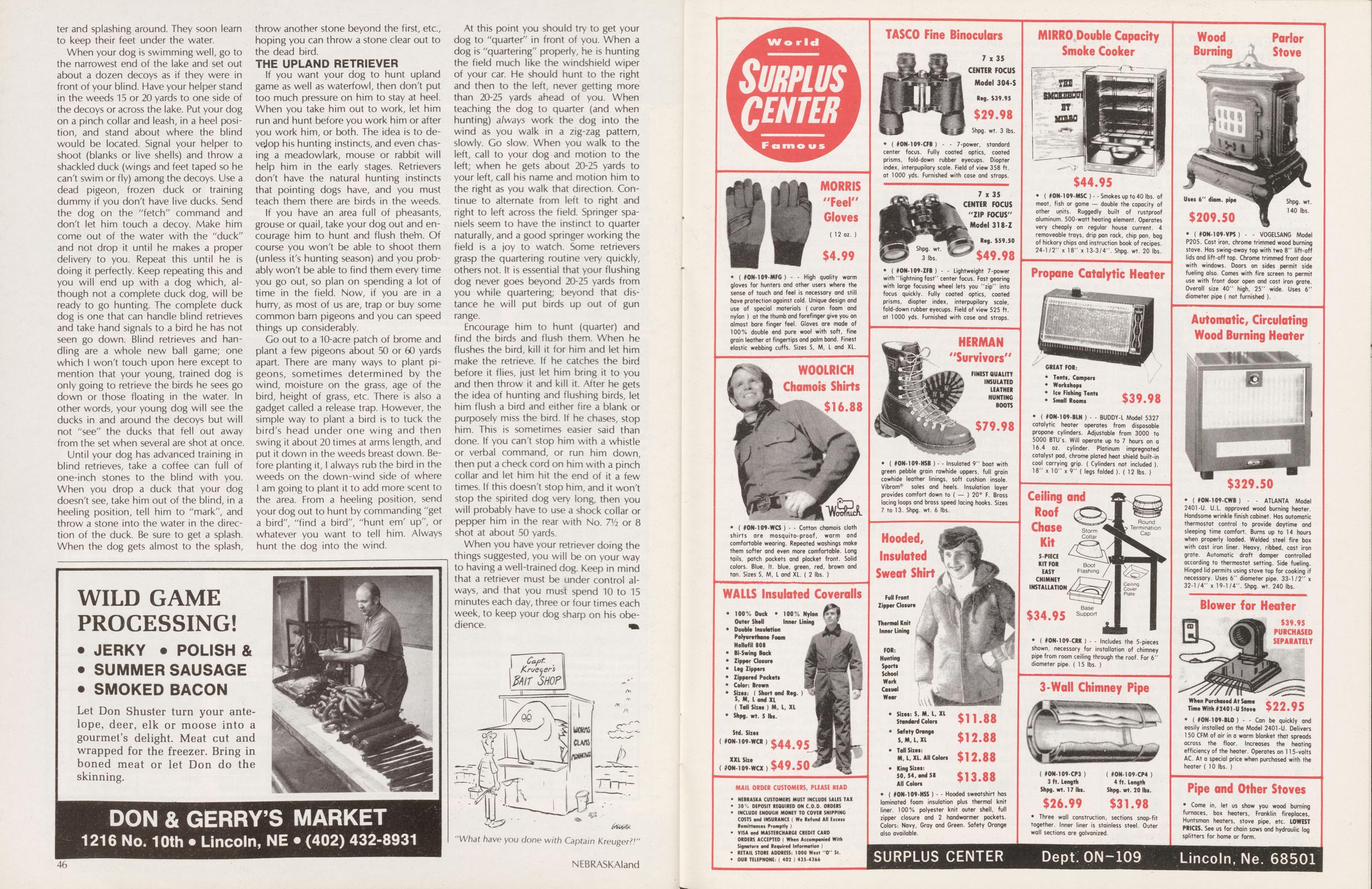
and splashing around. They soon learn to keep their feet under the water.
When your dog is swimming well, go to the narrowest end of the lake and set out about a dozen decoys as if they were in front of your blind. Have your helper stand in the weeds 15 or 20 yards to one side of the decoys or across the lake. Put your dog on a pinch collar and leash, in a heel position, and stand about where the blind would be located. Signal your helper to shoot (blanks or live shells) and throw a shackled duck (wings and feet taped so he can't swim or fly) among the decoys. Use a dead pigeon, frozen duck or training dummy if you don't have live ducks. Send the dog on the "fetch" command and don't let him touch a decoy. Make him come out of the water with the "duck" and not drop it until he makes a proper delivery to you. Repeat this until he is doing it perfectly. Keep repeating this and you will end up with a dog which, although not a complete duck dog, will be ready to go hunting. The complete duck dog is one that can handle blind retrieves and take hand signals to a bird he has not seen go down. Blind retrieves and handling are a whole new ball game; one which I won't touch upon here except to mention that your young, trained dog is only going to retrieve the birds he sees go down or those floating in the water. In other words, your young dog will see the ducks in and around the decoys but will not "see" the ducks that fell out away from the set when several are shot at once.
Until your dog has advanced training in blind retrieves, take a coffee can full of one-inch stones to the blind with you. When you drop a duck that your dog doesn't see, take him out of the blind, in a heeling position, tell him to "mark", and throw a stone into the water in the direction of the duck. Be sure to get a splash. When the dog gets almost to the splash, throw another stone beyond the first, etc., hoping you can throw a stone clear out to the dead bird.
THE UPLAND RETRIEVERIf you want your dog to hunt upland game as well as waterfowl, then don't put too much pressure on him to stay at heel. When you take him out to work, let him run and hunt before you work him or after you work him, or both. The idea is to develop his hunting instincts, and even chasing a meadowlark, mouse or rabbit will help him in the early stages. Retrievers don't have the natural hunting instincts that pointing dogs have, and you must teach them there are birds in the weeds.
If you have an area full of pheasants, grouse or quail, take your dog out and encourage him to hunt and flush them. Of course you won't be able to shoot them (unless it's hunting season) and you probably won't be able to find them every time you go out, so plan on spending a lot of time in the field. Now, if you are in a hurry, as most of us are, trap or buy some common barn pigeons and you can speed things up considerably.
Go out to a 10-acre patch of brome and plant a few pigeons about 50 or 60 yards apart. There are many ways to plant pigeons, sometimes determined by the wind, moisture on the grass, age of the bird, height of grass, etc. There is also a gadget called a release trap. However, the simple way to plant a bird is to tuck the bird's head under one wing and then swing it about 20 times at arms length, and put it down in the weeds breast down. Before planting it, I always rub the bird in the weeds on the down-wind side of where I am going to plant it to add more scent to the area. From a heeling position, send your dog out to hunt by commanding "get a bird", "find a bird", "hunt em' up", or whatever you want to tell him. Always hunt the dog into the wind.
At this point you should try to get your dog to "quarter" in front of you. When a dog is "quartering" properly, he is hunting the field much like the windshield wiper of your car. He should hunt to the right and then to the left, never getting more than 20-25 yards ahead of you. When teaching the dog to quarter (and when hunting) always work the dog into the wind as you walk in a zig-zag pattern, slowly. Go slow. When you walk to the left, call to your dog and motion to the left; when he gets about 20-25 yards to your left, call his name and motion him to the right as you walk that direction. Continue to alternate from left to right and right to left across the field. Springer spaniels seem to have the instinct to quarter naturally, and a good springer working the field is a joy to watch. Some retrievers grasp the quartering routine very quickly, others not. It is essential that your flushing dog never goes beyond 20-25 yards from you while quartering; beyond that distance he will put birds up out of gun range.
Encourage him to hunt (quarter) and find the birds and flush them. When he flushes the bird, kill it for him and let him make the retrieve. If he catches the bird before it flies, just let him bring it to you and then throw it and kill it. After he gets the idea of hunting and flushing birds, let him flush a bird and either fire a blank or purposely miss the bird. If he chases, stop him. This is sometimes easier said than done. If you can't stop him with a whistle or verbal command, or run him down, then put a check cord on him with a pinch collar and let him hit the end of it a few times. If this doesn't stop him, and it won't stop the spirited dog very long, then you will probably have to use a shock collar or pepper him in the rear with No. IVi or 8 shot at about 50 yards.
When you have your retriever doing the things suggested, you will be on your way to having a well-trained dog. Keep in mind that a retriever must be under control always, and that you must spend 10 to 15 minutes each day, three or four times each week, to keep your dog sharp on his obedience.
Capt Cruecer's BAIT SHOF
"What have you done with Captain Kreugerd."
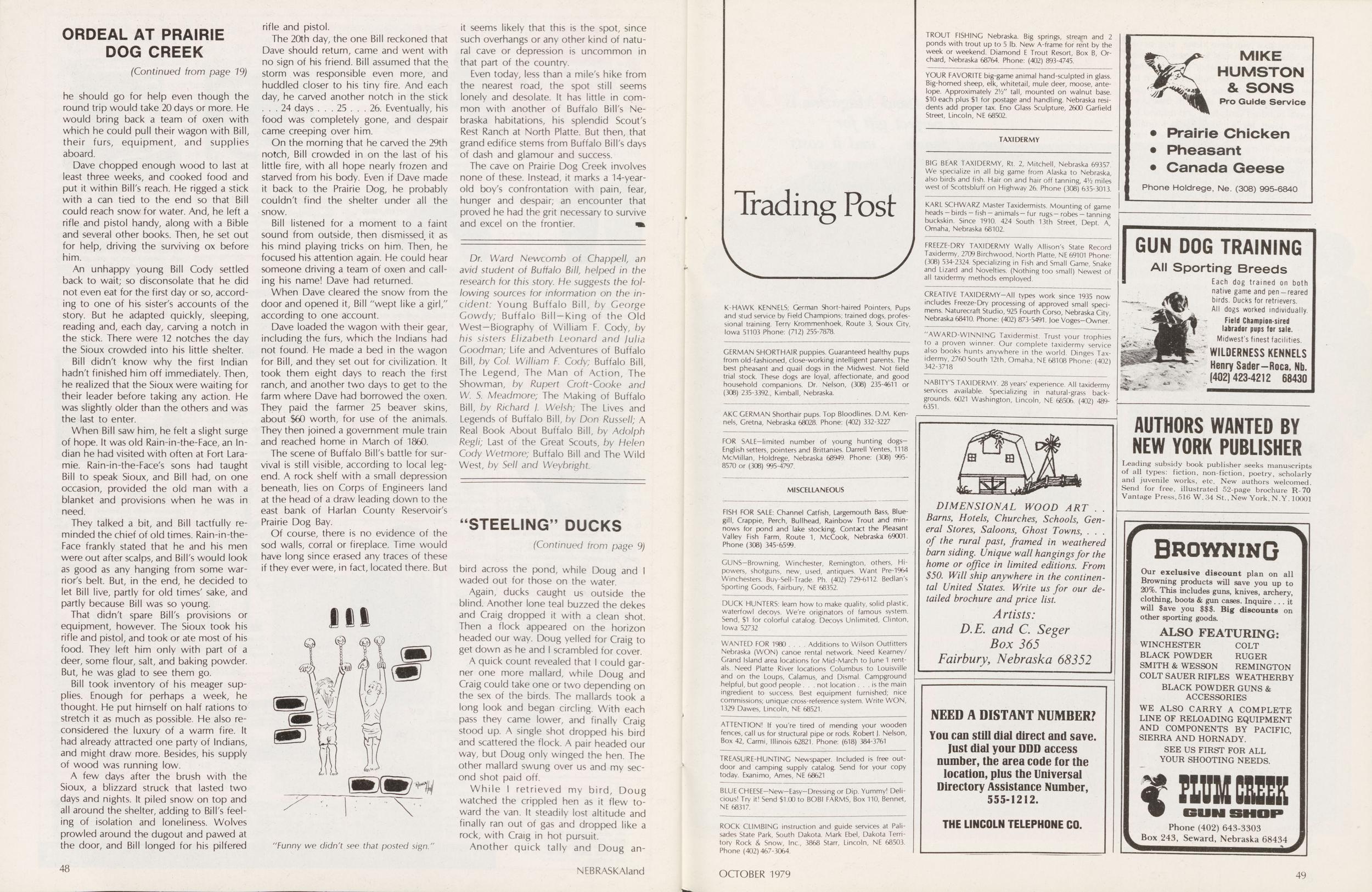
ORDEAL AT PRAIRIE DOG CREEK
(Continued from page 19)he should go for help even though the round trip would take 20 days or more. He would bring back a team of oxen with which he could pull their wagon with Bill, their furs, equipment, and supplies aboard.
Dave chopped enough wood to last at least three weeks, and cooked food and put it within Bill's reach. He rigged a stick with a can tied to the end so that Biil could reach snow for water. And, he left a rifle and pistol handy, along with a Bible and several other books. Then, he set out for help, driving the surviving ox before him.
An unhappy young Bill Cody settled back to wait; so disconsolate that he did not even eat for the first day or so, according to one of his sister's accounts of the story. But he adapted quickly, sleeping, reading and, each day, carving a notch in the stick. There were 12 notches the day the Sioux crowded into his little shelter.
Bill didn't know why the first Indian hadn't finished him off immediately. Then, he realized that the Sioux were waiting for their leader before taking any action. He was slightly older than the others and was the last to enter.
When Bill saw him, he felt a slight surge of hope. It was old Rain-in-the-Face, an Indian he had visited with often at Fort Laramie. Rain-in-the-Face's sons had taught Bill to speak Sioux, and Bill had, on one occasion, provided the old man with a blanket and provisions when he was in need.
They talked a bit, and Bill tactfully reminded the chief of old times. Rain-in-the-Face frankly stated that he and his men were out after scalps, and Bill's would look as good as any hanging from some warrior's belt. But, in the end, he decided to let Bill live, partly for old times' sake, and partly because Bill was so young.
That didn't spare Bill's provisions or equipment, however. The Sioux took his rifle and pistol, and took or ate most of his food. They left him only with part of a deer, some flour, salt, and baking powder. But, he was glad to see them go.
Bill took inventory of his meager supplies. Enough for perhaps a week, he thought. He put himself on half rations to stretch it as much as possible. He also reconsidered the luxury of a warm fire. It had already attracted one party of Indians, and might draw more. Besides, his supply of wood was running low.
A few days after the brush with the Sioux, a blizzard struck that lasted two days and nights. It piled snow on top and all around the shelter, adding to Bill's feeling of isolation and loneliness. Wolves prowled around the dugout and pawed at the door, and Bill longed for his pilfered rifle and pistol.
The 20th day, the one Bill reckoned that Dave should return, came and went with no sign of his friend. Bill assumed that the storm was responsible even more, and huddled closer to his tiny fire. And each day, he carved another notch in the stick ... 24 days ... 25 ... 26. Eventually, his food was completely gone, and despair came creeping over him.
On the morning that he carved the 29th notch, Bill crowded in on the last of his little fire, with all hope nearly frozen and starved from his body. Even if Dave made it back to the Prairie Dog, he probably couldn't find the shelter under all the snow.
Bill listened for a moment to a faint sound from outside, then dismissed, it as his mind playing tricks on him. Then, he focused his attention again. He could hear someone driving a team of oxen and calling his name! Dave had returned.
When Dave cleared the snow from the door and opened it, Bill "wept like a girl," according to one account.
Dave loaded the wagon with their gear, including the furs, which the Indians had not found. He made a bed in the wagon for Bill, and they set out for civilization. It took them eight days to reach the first ranch, and another two days to get to the farm where Dave had borrowed the oxen. They paid the farmer 25 beaver skins, about $60 worth, for use of the animals. They then joined a government mule train and reached home in March of 1860.
The scene of Buffalo Bill's battle for survival is still visible, according to local legend. A rock shelf with a small depression beneath, lies on Corps of Engineers land at the head of a draw leading down to the east bank of Harlan County Reservoir's Prairie Dog Bay.
Of course, there is no evidence of the sod walls, corral or fireplace. Time would have long since erased any traces of these if they ever were, in fact, located there. But it seems likely that this is the spot, since such overhangs or any other kind of natural cave or depression is uncommon in that part of the country.
Even today, less than a mile's hike from the nearest road, the spot still seems lonely and desolate. It has little in common with another of Buffalo Bill's Nebraska habitations, his splendid Scout's Rest Ranch at North Platte. But then, that grand edifice stems from Buffalo Bill's days of dash and glamour and success.
The cave on Prairie Dog Creek involves none of these. Instead, it marks a 14-year-old boy's confrontation with pain, fear, hunger and despair; an encounter that proved he had the grit necessary to survive and excel on the frontier.
Dr. Ward Newcomb of Chapped, an avid student of Buffalo Bill, helped in the research for this story. He suggests the following sources for information on the incident: Young Buffalo Bill, by George Gowdy; Buffalo Bill-King of the Old West—Biography of William F. Cody, by his sisters Elizabeth Leonard and Julia Goodman; Life and Adventures of Buffalo Bill, by Col. William F. Cody; Buffalo Bill, The Legend, The Man of Action, The Showman, by Rupert Croft-Cooke and W. S. Meadmore; The Making of Buffalo Bill, by Richard J. Welsh; The Lives and Legends of Buffalo Bill, by Don Russell; A Real Book About Buffalo Bill, by Aclolph Reg/7; Last of the Great Scouts, by Helen Cody Wetmore; Buffalo Bill and The Wild West, by Sell and Weybright.
"Funny we didn't see that posted sign."
"STEELING" DUCKS
(Continued from page 9)bird across the pond, while Doug and I waded out for those on the water.
Again, ducks caught us outside the blind. Another lone teal buzzed the dekes and Craig dropped it with a clean shot. Then a flock appeared on the horizon headed our way. Doug yelled for Craig to get down as he and I scrambled for cover.
A quick count revealed that I could garner one more mallard, while Doug and Craig could take one or two depending on the sex of the birds. The mallards took a long look and began circling. With each pass they came lower, and finally Craig stood up. A single shot dropped his bird and scattered the flock. A pair headed our way, but Doug only winged the hen. The other mallard swung over us and my second shot paid off.
While I retrieved my bird, Doug watched the crippled hen as it flew toward the van. It steadily lost altitude and finally ran out of gas and dropped like a rock, with Craig in hot pursuit.
Another quick tally and Doug announced
that we were done, and none too soon. The sun was just peeking over the horizon when another flock headed our way. This time we hunkered down to see if they would drop in. With the sun brightening our set-up, the birds flew over several hundred yards high and refused to come down for a closer look. I finally broke out a call, which up 'til then had been idle in my shirt pocket. More birds continued to fly over, but they, too, failed to heed my invitation.
Where we had been well concealed before sunrise, the rising sun and bareness of the surrounding mud flat was now enough to give us away. In just minutes, the flocks seemed to evaporate, evidently having found other ponds to sit upon unmolested.
We were all in a state of shock over the morning's success. In no more than 25 minutes we had bagged our limits—a total of 13 ducks, eight of them mallards. "I've hunted the basins for years and I've never done this well," remarked Craig. "We occasionally shoot our limits, but never have we had this many birds to choose from."
I had been on some good hunts too, but usually good waterfowling means a lot of hard, nasty work. This really made up for many of the unsuccessful hunts.
"Where did all the ducks come from and where did they all go?" asked Doug. "It seemed as if every duck in the country was in the air at the same time and they all wanted to come in."
A later check of area ponds revealed a few ducks, but nothing like the numbers we had seen. With the basins dry, it certainly was confusing. However, a trip back to the pond the following weekend met with similar results, with the birds again disappearing at sunrise.
What made it even more confusing was that I had hunted over the same pond the previous year with fairly poor results. Of course, 1977 was a good year for most of the basins and water was more plentiful across the area.
We concluded that while it's possible that ducks might ignore the pond in a normal or wet year, during a dry spell it's probably highly attractive to them. Or, perhaps they, being creatures of habit, simply came back to the pond because they were seldom bothered.
In any event, the year the basins went dry—1978—will hold a special meaning for at least three hunters in years ahead. For one thing, it proved that a pasture farm pond can occasionally produce more ducks in 20 minutes than a good marsh in a day. And, it proved that steel shot can and does kill ducks efficiently; but unlike lead, it only kills by shooting them, not when they ingest it from marsh bottoms. Now, I have a steel shot success to remember—this time it didn't ruin a shotgun barrel. In fact, this old Model 12 seems to like it just fine, and so do I.
Position: 443 (23 views)