Volume 57, Issue 9, 1979
NEBRASKAland
September 1979 60 Cents The Loup Canal—bringing "fun power" to the people How to select a hunting dog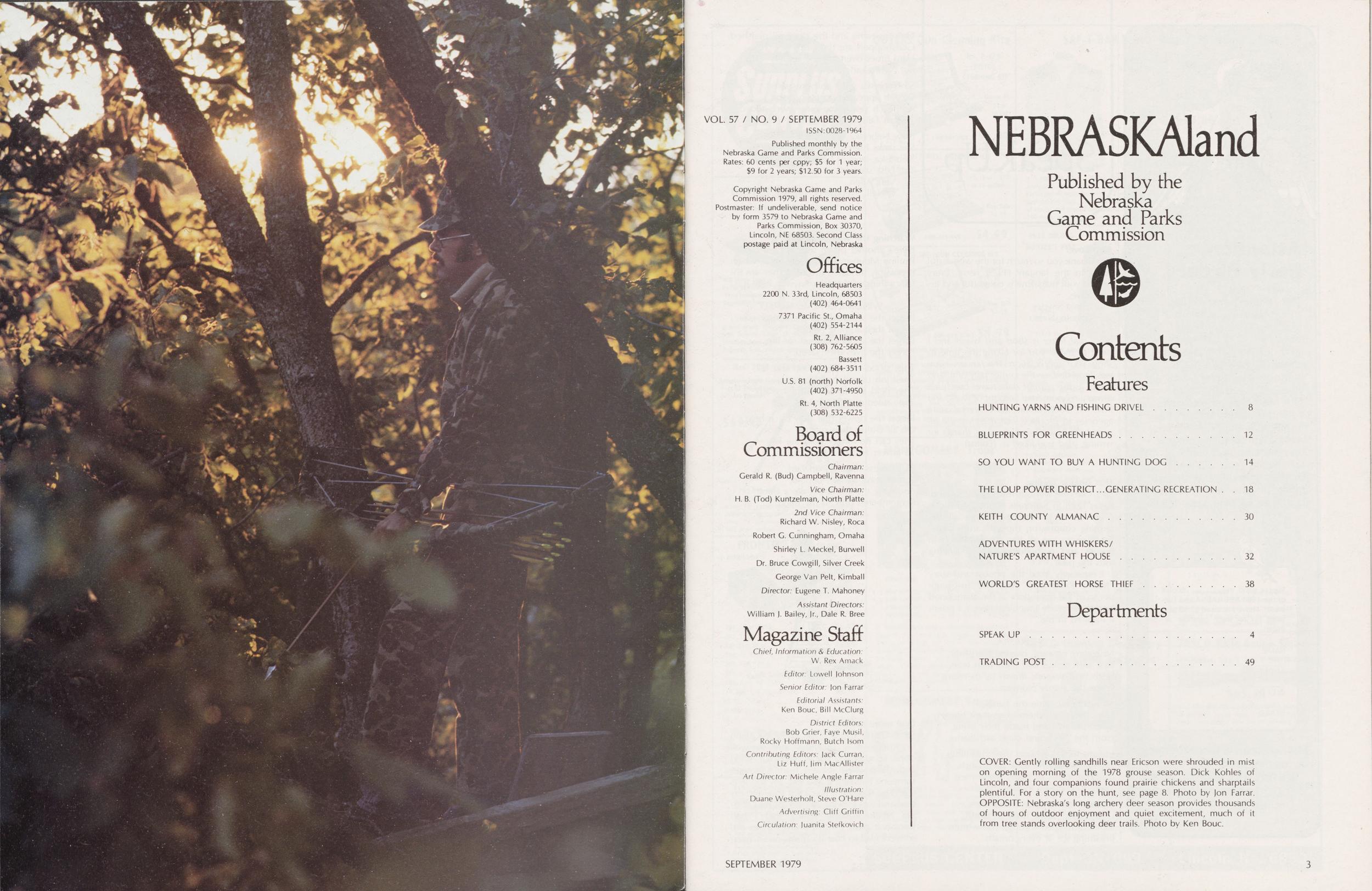
NEBRASKAland
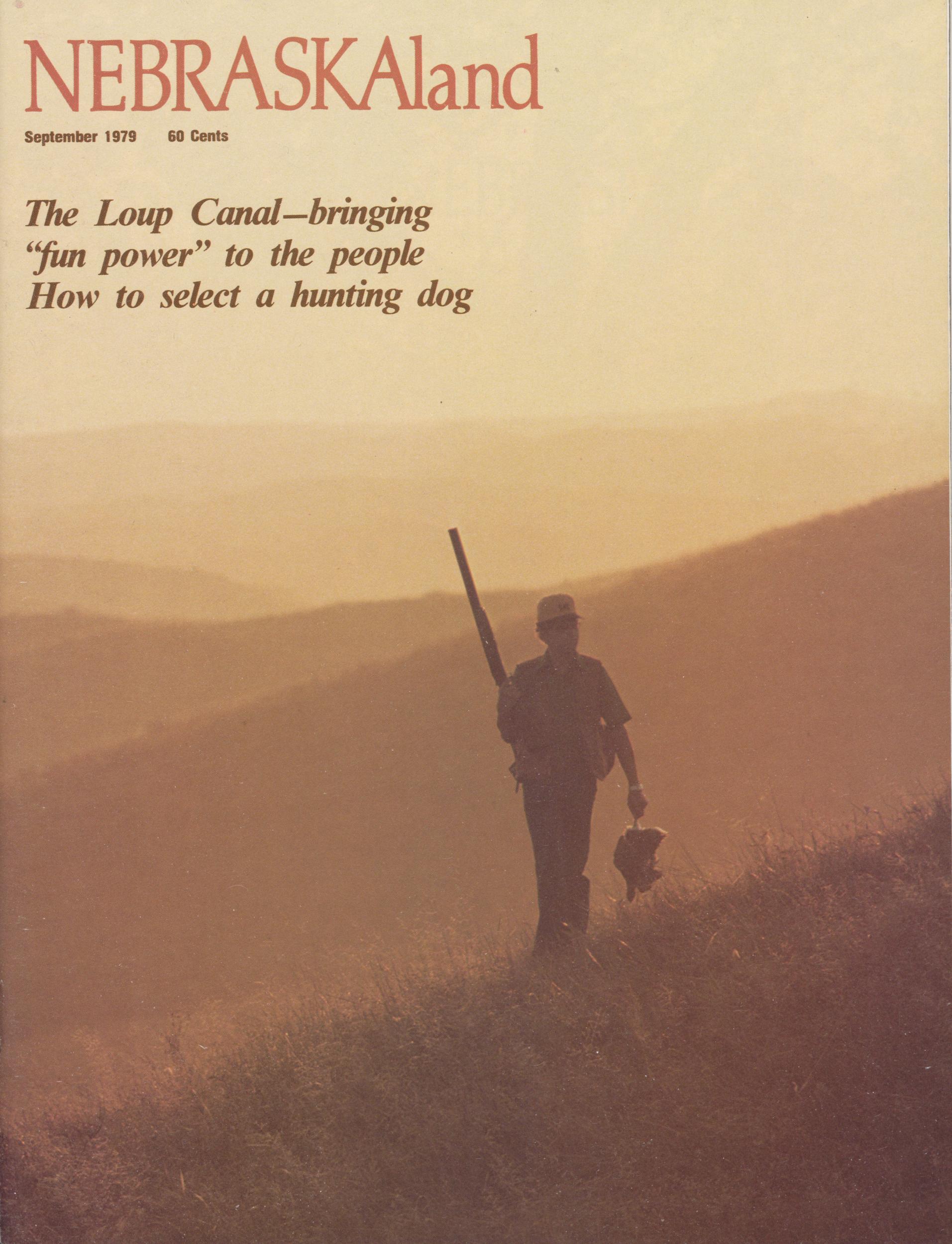
Published by the Nebraska Game and Parks Commission Contents Features HUNTING YARNS AND FISHING DRIVEL 8 BLUEPRINTS FOR GREENHEADS 12 SO YOU WANT TO BUY A HUNTING DOG 14 THE LOUP POWER DISTRICT...GENERATING RECREATION 18 KEITH COUNTY ALMANAC 30 ADVENTURES WITH WHISKERS NATURE'S APARTMENT HOUSE 32 WORLD'S GREATEST HORSE THIEF 38 Departments SPEAK UP 4 TRADING POST 49COVER: Gently rolling sandhills near Ericson were shrouded in mist on opening morning of the 1978 grouse season. Dick Kohles of Lincoln, and four companions found prairie chickens and sharptails plentiful. For a story on the hunt, see page 8. Photo by Jon Farrar. OPPOSITE: Nebraska's long archery deer season provides thousands of hours of outdoor enjoyment and quiet excitement, much of it from tree stands overlooking deer trails. Photo by Ken Bouc.
Speak Up
Map LoverSir / Thank you so much for the wonderful maps in the January (1979) issue. Every month your magazine is delightful and informative.
Emma Snyder Lincoln, Nebr.Now that letter is short and sweet and I want to thank you for taking the time to show your appreciation. The January issue was reprinted, or the center part of it, and serves as the current state travel brochure. It was a monumental amount of work, and involved cooperation from several state agencies to produce, but then we are all used to hard work, etc. Anyway, thanks for writing; glad you liked it. (Editor)
That sinking feelingSir / Can't be without my NEBRASKAland. I was born in Sandhills country and love every bit of it. Driving through all the farming country on trips, it's truly heartbreaking to see all the abandoned farm homes and outbuildings slowly sinking into the past.
I especially liked the photos and story "Man's Remnants" and the full-page photo of the open door at the abandoned home was really touching. Here's a poem it inspired in me.
NEBRASKA Struggling onward, braving hardships, First with smiles and then with tears, With their wagons drawn by ox-teams Came the sturdy pioneers. To Nebraska came the hardy, Here they built themselves their homes, Tilled the soil and made their living From the sands and clays and loams. Indians lurked around their dwellings, Hating those who took their lands, And the scalps of many white men Were torn off by Indians' hands. Blizzards came upon the settlers, Unprepared, some froze to death, Others struggled through the winters Breathing ice at every breath. Drouths came and the crops all perished, Grasshoppers ate the crops one year, Hard times overtook the settlers But Nebraskans knew no fear. So Nebraska grew and prospered, Wealth appeared on every hand, And each year some more were added, To that faithful little band. Now Nebraska is a leader, She ranks high in every test. Nebraska, land of health and plenty, The best state of all the rest. Vera Allen O'Neill, Nebr. Watching the wind Here's another poem sent in by a reader, Pauline Mounsey of Phoenix, Ariz., which is possibly mistaken in saying they are totally a thing of the past. Anyway, here it is WINDMILLS REMEMBERED Forget the windmills in the sun, Forget their turning blades; Forget the water pumped for life, Forget the lives they saved. They stood alone so proud and tall, Their job unmatched by none; They held all life within their grasp, They ruled o'er everyone. Forget the power that they once held, On all within their realm; They can no longer hold the key - To power and health, or doom. As progress marches onward, So old ways are left behind; And now the windmills are a thing Remembered only in my mind.Sir / Thank you for the NEBRASKAland Cookbook—it is beautiful and so well done. So glad you put in Nebraska Afield and Afloat where it came from. I thought someone had sent it as a gift. My son gets it and he thought it was a gift too—and my husband was looking all over for his October NEBRASKAland yelling that I had thrown it away (since he saves them all)! so were glad to hear it's from you-a wonderful
bonus. We love NEBRASKAland- thanks.
Ora Burlingame Bellevue, Nebr.I said we wouldn't use any more letters about the cookbook, but this one came last November and I overlooked it. Anyway, some folks probably still think we never sent their October magazine, and still wonder where the cookbook came from. Hopefully, everyone enjoyed it—that is all that really matters. But, we don't want people mad at us for not sending their magazine, either. Anyway, thanks for writing. (Editor)
Sharing recipesSir / I enjoy your magazine and look forward to each new issue. The cookbook you published last year was the best-received Christmas present I sent. Friends persuaded me to pass on to you the enclosed (and guaranteed) recipe for mallard passed to me and later modified, by way of an old Russian fur trapper. Hope you can use it.
Reid Kenedy Omaha, Nebr.Thank you, and herewith is your special recipe, and I hope that many folks get to try it.
MALLARD SUPREME Breasts from three mallards (skinned)1 cup flour
2 tablespoons flour
2 ounces butter
1 1/2 ounces brandy (optional)
2 egg yolks
1 1/2 cups cottage cheese
1 ounce Parmesian cheese
1 cup finely chopped fresh mushrooms
1 cup finely chopped fresh onions
1 small meat-loaf-type pan
Separately, saute onions and mushrooms, then combine and put aside. Combine lemon pepper and flour. Dredge mallard breasts. Add butter and saute breasts approximately 7 minutes, turning frequently. Remove and slice in half lengthwise. Dredge uncooked sides of breasts in pepper and flour and saute again, uncooked side down for 3 minutes, adding brandy gradually. Remove and let cool. Blend egg yolks and cottage cheese. Alternately place breast (on edge) and a heaping spoon of the combined sauted mushrooms and onions in pan. The 12 slices of breast and mushrooms and onions should fit snugly. Then, pour blended egg yolk and cottage cheese mixture over, sprinkle with parmesian, cover with foil. It can then be frozen, refrigerated, or prepared for serving by baking at 350° for 30 minutes. Serve with wild rice.
That, indeed, sounds like a supreme dish to place before some cherished friends. Thanks for thinking of us, and we will try to use your recipe. (Editor)
Hunting Yarns and Fishing Drivel
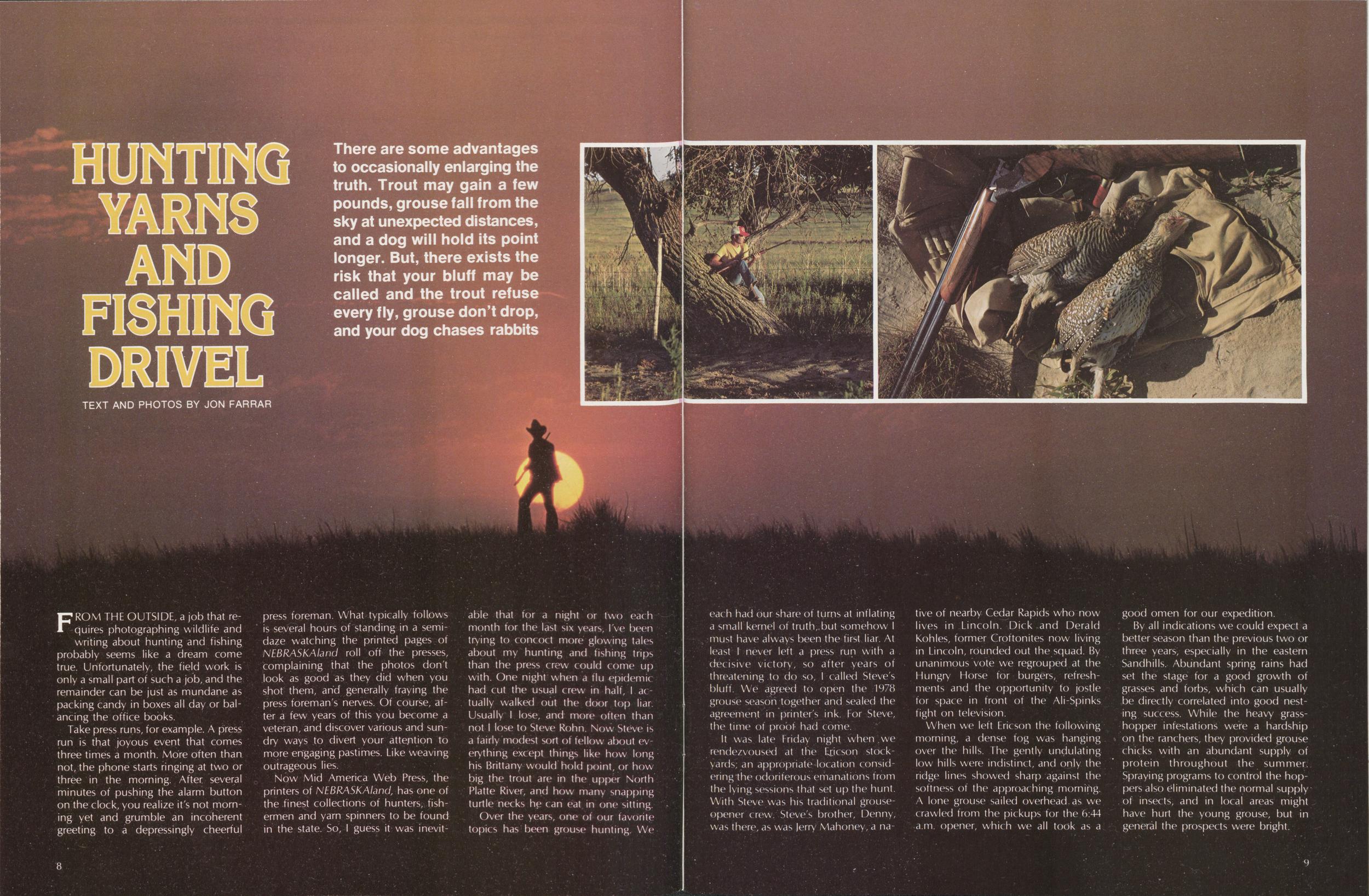
There are some advantages to occasionally enlarging the truth. Trout may gain a few pounds, grouse fall from the sky at unexpected distances, and a dog will hold its point longer. But, there exists the risk that your bluff may be called and the trout refuse every fly, grouse don't drop, and your dog chases rabbits
FROM THE OUTSIDE, a job that requires photographing wildlife and writing about hunting and fishing probably seems like a dream come true. Unfortunately, the field work is only a small part of such a job, and the remainder can be just as mundane as packing candy in boxes all day or balancing the office books.
Take press runs, for example. A press run is that joyous event that comes three times a month. More often than not, the phone starts ringing at two or three in the morning. After several minutes of pushing the alarm button on the clock, you realize it's not morning yet and grumble an incoherent greeting to a depressingly cheerful oreman. What typically follows is several hours of standing in a semi-daze watching the printed pages of NEBRASKAland roll off the presses, complaining that the photos don't look as good as they did when you shot them, and generally fraying the press foreman's nerves. Of course, after a few years of this you become a veteran, and discover various and sundry ways to divert your attention to more engaging pastimes. Like weaving outrageous lies.
Now Mid America Web Press, the printers of NEBRASKAland, has one of the finest collections of hunters, fishermen and yarn spinners to be found in the state. So, I guess it was inevitable that for a night or two each month for the last six years, I've been trying to concoct more glowing tales about my hunting and fishing trips than the press crew could come up with. One night when a flu epidemic had cut the usual crew in half, I actually walked out the door top liar. Usually I lose, and more often than not I lose" to Steve Rohn. Now Steve is a fairly modest sort of fellow about everything except things like how long his Brittany would hold point, or how big the trout arc in the upper North Platte River, and how many snapping turtle necks he can eat in one sitting.
Over the years, one of our favorite topics has been grouse hunting. We c4ac h had our share of turns at inflating a small kernel of truth, but somehow I must have always been the first liar. At least I never left a press run with a decisive victory, so after years of threatening to do so, I called Steve's bluff. We agreed to open the lq78 grouse4 season together and sealed the agreement in printer's ink. Lor Steve, the time of proof had come.
It was late Friday night when we rendezvoused at the Ericson stock-yards; an appropriate location considering the odoriferous emanations from the4 lying sessions that set tip the4 hunt. With Steve was his traditional grouse-opener crew. Steve's brother, Denny, was there, as was lem/ Mahonev, a native of nearby Cedar Rapids who now lives in Lincoln. Dick and Derald Kohles, former Croftonites now living in Lincoln, rounded out the squad. By unanimous vote we regrouped at the Hungry Horse for burgers, refreshments and the opportunity to jostle for space in front of the Ali-Spinks fight on television.
When we left Lricson the following morning, a dense fog was hanging over the hills. The gently undulating low hills were indistinct, and only the ridge lines showed sharp against the4 softness of the approaching morning. A lone4 grouse sailed overhead as we crawled from the pickups tor the4 b:44 a.m. opener, which we all took as a good omen for our expedition.
By all indications we could expect . better season than the previous two or three years, especially in the eastern Sandhills. Abundant spring rains had set the stage for a good growth of grasses and forbs, which can usually be directly correlated into good nesting success. While the heavy grasshopper infestations were a hardship on the ranchers, they provided grouse chicks with an abundant supply of protein throughout the summer. Spraying programs to control the hoppers also eliminated the normal supply of insects; and in local areas might have hurt the young grouse, hut in general the prospects were bright.
8 9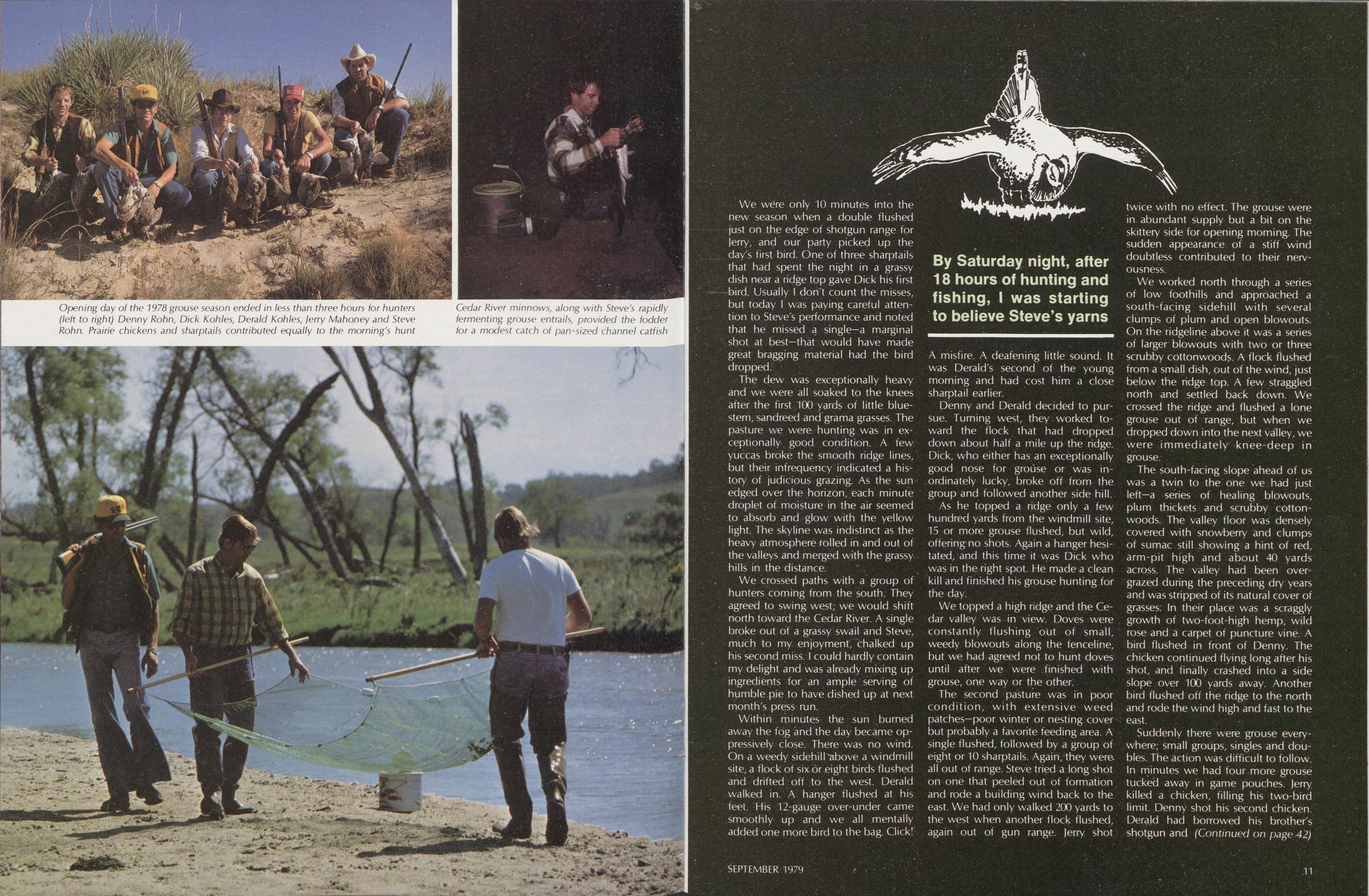
Opening day of the 1978 grouse season ended in less than three hours for hunters (left to right) Denny Rohn, Dick Kohles, Derald Kohles, jerry Mahoney and Steve Rohn. Prairie chickens and sharptails contributed equally to the morning's hunt
Cedar River minnows, along with Steve's rapidly fermenting grouse entrails, provided the fodder for a modest catch of pan-sized channel catfish
We were only 10 minutes into the new season when a double flushed just on the edge of shotgun range for Jerry, and our party picked up the day's first bird. One of three sharptails that had spent the night in a grassy dish near a ridge top gave Dick his first bird. Usually I don't count the misses, but today I was paying careful attention to Steve's performance and noted that he missed a single—a marginal shot at best—that would have made great bragging material had the bird dropped.
The dew was exceptionally heavy and we were all soaked to the knees after the first 100 yards of little bluestem, sandreed and grama grasses. The pasture we were hunting was in exceptionally good condition. A few yuccas broke the smooth ridge lines, but their infrequency indicated a history of judicious grazing. As the sun edged over the horizon, each minute droplet of moisture in the air seemed to absorb and glow with the yellow light. The skyline was indistinct as the heavy atmosphere rolled in and out of the valleys and merged with the grassy hills in the distance.
We crossed paths with a group of hunters coming from the south. They agreed to swing west; we would shift north toward the Cedar River. A single broke out of a grassy swail and Steve, much to my enjoyment, chalked up his second miss. I could hardly contain my delight and was already mixing up ingredients for an ample serving of humble pie to have dished up at next month's press run.
Within minutes the sun burned away the fog and the day became oppressively close. There was no wind. On a weedy sidehill above a windmill site, a flock of six or eight birds flushed and drifted off to the west. Derald walked in. A hanger flushed at his feet. His 12-gauge over-under came smoothly up and we all mentally added one more bird to the bag. Click! A misfire. A deafening little sound. It was Derald's second of the young morning and had cost him a close sharptail earlier.
Denny and Derald decided to pursue. Turning west, they worked toward the flock that had dropped down about half a mile up the ridge. Dick, who either has an exceptionally good nose for grouse or was inordinately lucky, broke off from the group and followed another side hill. As he topped a ridge only a few hundred yards from the windmill site, 15 or more grouse flushed, but wild, offering no shots. Again a hanger hesitated, and this time it was Dick who was in the right spot. He made a clean kill and finished his grouse hunting for the day.
We topped a high ridge and the Cedar valley was in view. Doves were constantly flushing out of small, weedy blowouts along the fenceline, but we had agreed not to hunt doves until after we were finished with grouse, one way or the other.
The second pasture was in poor condition, with extensive weed patches—poor winter or nesting cover but probably a favorite feeding area. A single flushed, followed by a group of eight or 10 sharptails. Again, they were, all out of range. Steve tried a long shot on one that peeled out of formation and rode a building wind back to the east. We had only walked 200 yards to the west when another flock flushed, again out of gun range. Jerry shot twice with no effect. The grouse were in abundant supply but a bit on the skittery side for opening morning. The sudden appearance of a stiff wind doubtless contributed to their nervousness.
We worked north through a series of low foothills and approached a south-facing sidehill with several clumps of plum and open blowouts. On the ridgeline above it was a series of larger blowouts with two or three scrubby cottonwoods. A flock flushed from a small dish, out of the wind, just below the ridge top. A few straggled north and settled back down. We crossed the ridge and flushed a lone grouse out of range, but when we dropped down into the next valley, we were immediately knee-deep in grouse.
The south-facing slope ahead of us was a twin to the one we had just left—a series of healing blowouts, plum thickets and scrubby cottonwoods. The valley floor was densely covered with snowberry and clumps of sumac still showing a hint of red, arm-pit high and about 40 yards across. The valley had been overgrazed during the preceding dry years and was stripped of its natural cover of grasses. In their place was a scraggly growth of two-foot-high hemp, wild rose and a carpet of puncture vine. A bird flushed in front of Denny. The chicken continued flying long after his shot, and finally crashed into a side slope over 100 yards away. Another bird flushed off the ridge to the north and rode the wind high and fast to the east.
Suddenly there were grouse everywhere; small groups, singles and doubles. The action was difficult to follow. In minutes we had four more grouse tucked away in game pouches. Jerry, killed a chicken, filling his two-bird limit. Denny shot his second chicken. Derald had borrowed his brother's shotgun and (Continued on page 42)
SEPTEMBER 1979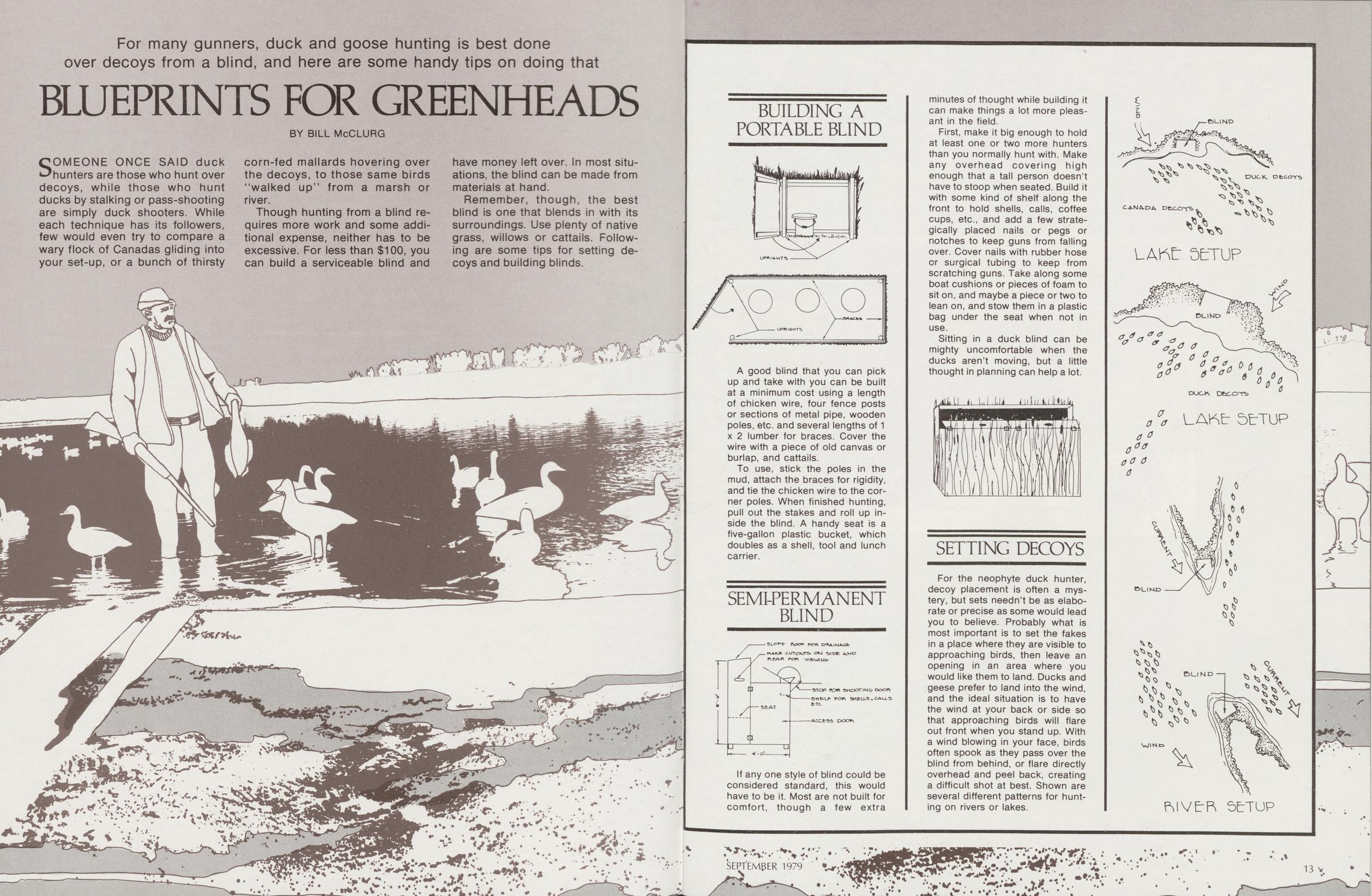
For many gunners, duck and goose hunting is best done over decoys from a blind, and here are some handy tips on doing that
BLUEPRINTS FOR GREENHEADS
SOMEONE ONCE SAID duck hunters are those who hunt over decoys, while those who hunt ducks by stalking or pass-shooting are simply duck shooters. While each technique has its followers, few would even try to compare a wary flock of Canadas gliding into your set-up, or a bunch of thirsty corn-fed mallards hovering over the decoys, to those same birds "walked up" from a marsh or river.
Though hunting from a blind requires more work and some additional expense, neither has to be excessive. For less than $100, you can build a serviceable blind and have money left over. In most situations, the blind can be made from materials at hand.
Remember, though, the best blind is one that blends in with its surroundings. Use plenty of native grass, willows or cattails. Following are some tips for setting decoys and building blinds.
A good blind that you can pick up and take with you can be built at a minimum cost using a length of chicken wire, four fence posts or sections of metal pipe, wooden poles, etc. and several lengths of 1 x 2 lumber for braces. Cover the wire with a piece of old canvas or burlap, and cattails.
To use, stick the poles in the mud, attach the braces for rigidity, and tie the chicken wire to the corner poles. When finished hunting, pull out the stakes and roll up inside the blind. A handy seat is a five-gallon plastic bucket, which doubles as a shell, tool and lunch carrier.
SEMI-PERMANENT BLINDIf any one style of blind could be considered standard, this would have to be it. Most are not built for comfort, though a few extra minutes of thought while building it can make things a lot more pleasant in the field.
First, make it big enough to hold at least one or two more hunters than you normally hunt with. Make any overhead covering high enough that a tall person doesn't have to stoop when seated. Build it with some kind of shelf along the front to hold shells, calls, coffee cups, etc., and add a few strategically placed nails or pegs or notches to keep guns from falling over. Cover nails with rubber hose or surgical tubing to keep from scratching guns. Take along some boat cushions or pieces of foam to sit on, and maybe a piece or two to lean on, and stow them in a plastic bag under the seat when not in use.
Sitting in a duck blind can be mighty uncomfortable when the ducks aren't moving, but a little thought in planning can help a lot.
For the neophyte duck hunter, decoy placement is often a mystery, but sets needn't be as elaborate or precise as some would lead you to believe. Probably what is most important is to set the fakes in a place where they are visible to approaching birds, then leave an opening in an area where you would like them to land. Ducks and geese prefer to land into the wind, and the ideal situation is to have the wind at your back or side so that approaching birds will flare out front when you stand up. With a wind blowing in your face, birds often spook as they pass over the blind from behind, or flare directly overhead and peel back, creating a difficult shot at best. Shown are several different patterns for hunting on rivers or lakes.
SO YOU WANT TO BUY A HUNTING DOG?
A dog introduces new dimensions to hunting, as well as added responsibilitiesTHE TELEPHONE RANG the other day at the kennel and when I answered, a gentleman on the phone inquired about hunting dogs. He had very little knowledge of hunting dogs, as he had never owned one nor had he hunted since childhood, but he was ready to resume the sport. He didn't know where to begin as far as dogs were concerned. I asked him a few questions. Did he really want a hunting dog? Was he willing to spend 10 to 15 minutes each day working and playing with him?... not to mention the five or 10 minutes it takes to clean his kennel and feed and water him? Did he know a coated dog can use brushing and clipping occasionally, while a short-coated pointer needs extra care during our winters? Was he willing to spend the money for necessary veterinarian expenses?
The most important part of my explanation to any novice dog person is actually a question—what type of game are you planning to hunt? Since many of the breeds are specialists on certain types of game, it is essential to buy the breed best suited to handle the game you are hunting—i.e., nobody should purchase an English setter to hunt ducks with!
WHAT ARE THE BREEDSThere are some 24 sporting breeds recognized by the American kennel Club (51 Madison Ave., New York, N.Y. 10010). The AKC is a private organization recording the births and deaths of pure-bred dogs and it also regulates, or sanctions, dog shows and field trials. There are other breeds, primarily recent imports, that are not recognized by the AKC, but which are still used as hunting dogs. The Field Dog Stud Book (American Field Publishing Co., 222 West Adams St., Chicago, III. 60606) is the registry used primarily for English pointers and English setters that are of field trial and hunting dog breeding. Conformation or show pointers and setters are registered with the AKC.
I'm not going to discuss all the sporting breeds, but will focus on the most popular ones used here in the Midwest. There are two distinct classes of hunting dogs: retrievers and pointers. The difference between the two is simple. Retrievers are primarily just that—they are excellent retrievers and don't point; they specialize in waterfowl hunting, retireving from rivers and lakes, and are used as flushing dogs on upland game. Pointing dogs locate and point game. Some retrievers will "point" or learn to hold on game (especially quail) after they have been hunted extensively for a few years, but they don't show class and style "on point" as do the pointing breeds. Some pointing dogs also become excellent retrievers (on land), with the Viszla probably the best and the Brittany and German Shorthair close seconds. The Weimaraner and English pointer have a tendency to be a little hard mouthed, and the English setter normally is hapless when it comes to natural retrieving.
In the retriever group, we commonly see the Labrador, Chesapeake and golden. The English springer spaniel, although (Continued on page 46)
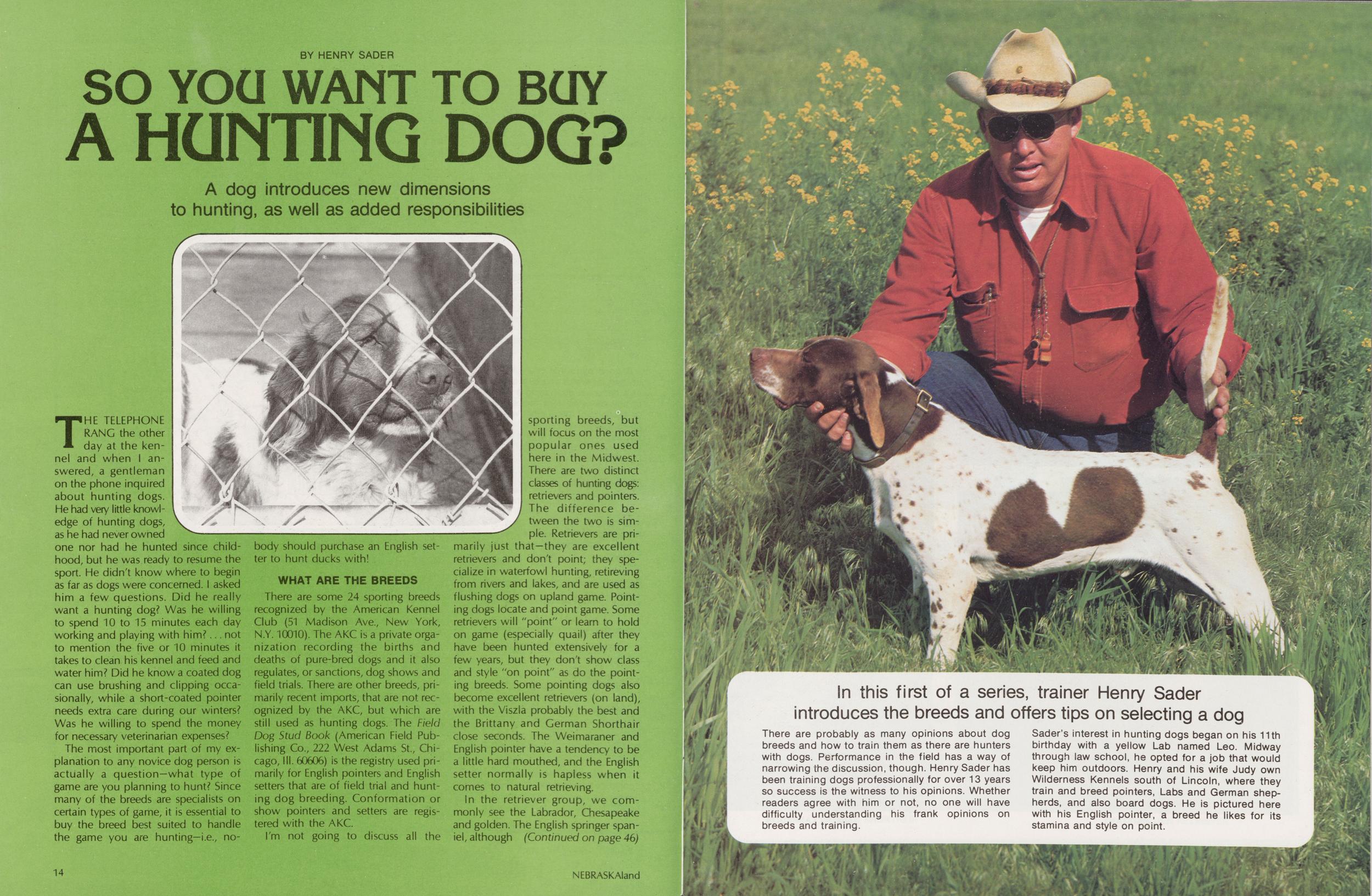
14 NEBRASKAlandThere are probably as many opinions about dog breeds and how to train them as there are hunters with dogs. Performance in the field has a way of narrowing the discussion, though. Henry Sader has been training dogs professionally for over 13 years so success is the witness to his opinions. Whether readers agree with him or not, no one will have difficulty understanding his frank opinions on breeds and training.
Sader's interest in hunting dogs began on his 11th birthday with a yellow Lab named Leo. Midway through law school, he opted for a job that would keep him outdoors. Henry and his wife Judy own Wilderness Kennels south of Lincoln, where they train and breed pointers, Labs and German shepherds, and also board dogs. He is pictured here with his English pointer, a breed he likes for its stamina and style on point.
A dog of the best breeding and training can be completely incompatible with its owner if the breed is not suited to his type of hunting. Each breed is something of a specialist, so an all-important first step toward having a dog that complements you afield is selecting the right breed. If your hunting interests are general, though, there are several versatile breeds.
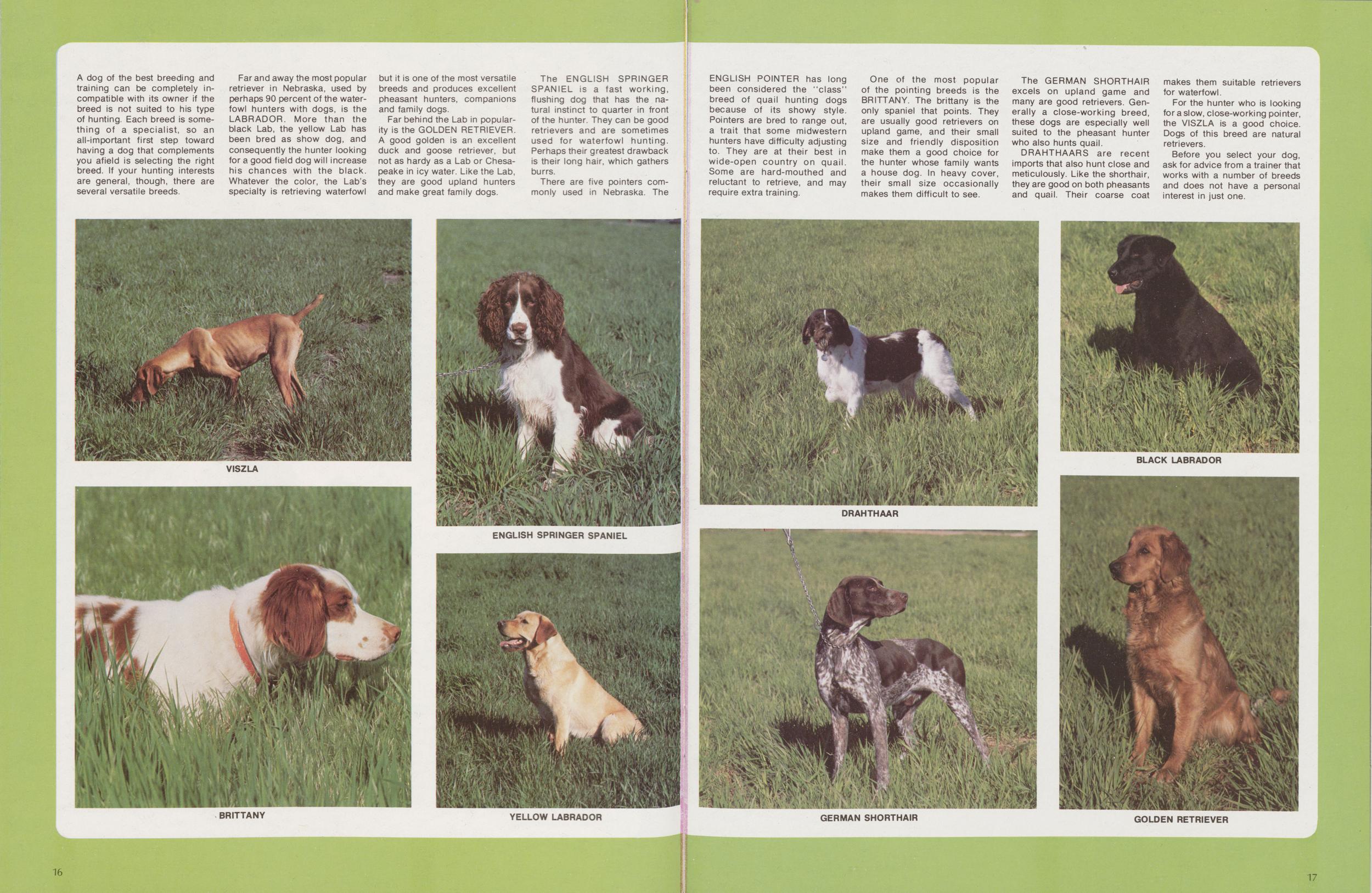
Far and away the most popular retriever in Nebraska, used by perhaps 90 percent of the waterfowl hunters with dogs, is the LABRADOR. More than the black Lab, the yellow Lab has been bred as show dog, and consequently the hunter looking for a good field dog will increase his chances with the black. Whatever the color, the Lab's specialty is retrieving waterfowl but it is one of the most versatile breeds and produces excellent pheasant hunters, companions and family dogs.
Far behind the Lab in popularity is the GOLDEN RETRIEVER. A good golden is an excellent duck and goose retriever, but not as hardy as a Lab or Chesapeake in icy water. Like the Lab, they are good upland hunters and make great family dogs.
The ENGLISH SPRINGER SPANIEL is a fast working, flushing dog that has the natural instinct to quarter in front of the hunter. They can be good retrievers and are sometimes used for waterfowl hunting. Perhaps their greatest drawback is their long hair, which gathers burrs.
There are five pointers commonly used in Nebraska. The ENGLISH POINTER has long been considered the "class" breed of quail hunting dogs because of its showy style. Pointers are bred to range out, a trait that some midwestern hunters have difficulty adjusting to. They are at their best in wide-open country on quail. Some are hard-mouthed and reluctant to retrieve, and may require extra training.
One of the most popular of the pointing breeds is the BRITTANY. The Brittany is the only spaniel that points. They are usually good retrievers on upland game, and their small size and friendly disposition make them a good choice for the hunter whose family wants a house dog. In heavy cover, their small size occasionally makes them difficult to see.
The GERMAN SHORTHAIR excels on upland game and many are good retrievers. Generally a close-working breed, these dogs are especially well suited to the pheasant hunter who also hunts quail.
DRAHTHAARS are recent imports that also hunt close and meticulously. Like the shorthair, they are good on both pheasants and quail. Their coarse coat makes them suitable retrievers for waterfowl.
For the hunter who is looking for a slow, close-working pointer, the VISZLA is a good choice. Dogs of this breed are natural retrievers.
Before you select your dog, ask for advice from a trainer that works with a number of breeds and does not have a personal interest in just one.
VISZLA
BRITTANY
ENGLISH SPRINGER SPANIEL
YELLOW LABRADOR
DRAHTHAAR
GERMAN SHORTHAIR
BLACK LABRADOR
GOLDEN RETRIEVER
The Loup Power District
Generating Recreation
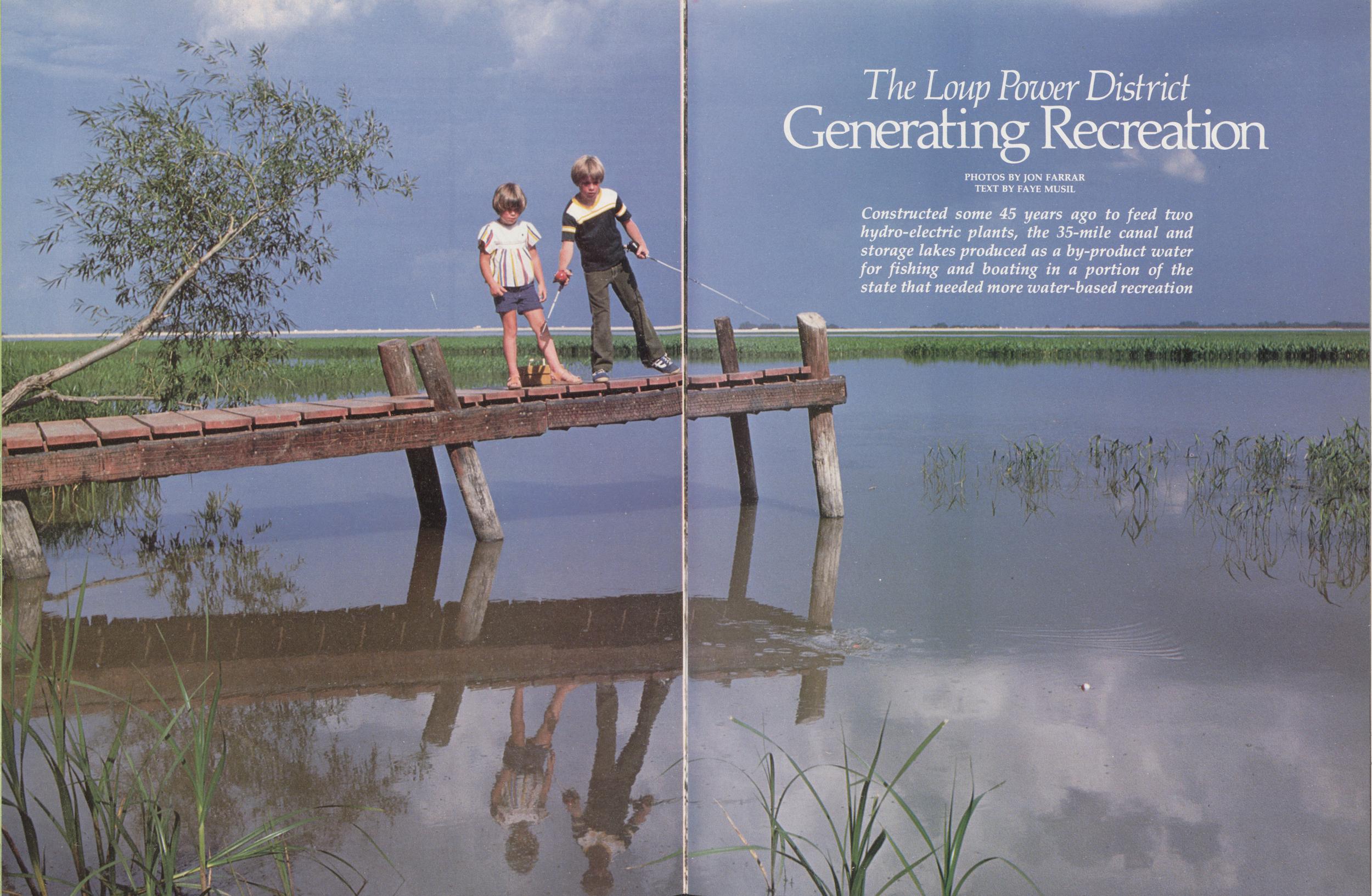
Constructed some 45 years ago to feed two hydro-electric plants, the 35-mile canal and storage lakes produced as a by-product water for fishing and boating in a portion of the state that needed more water-based recreation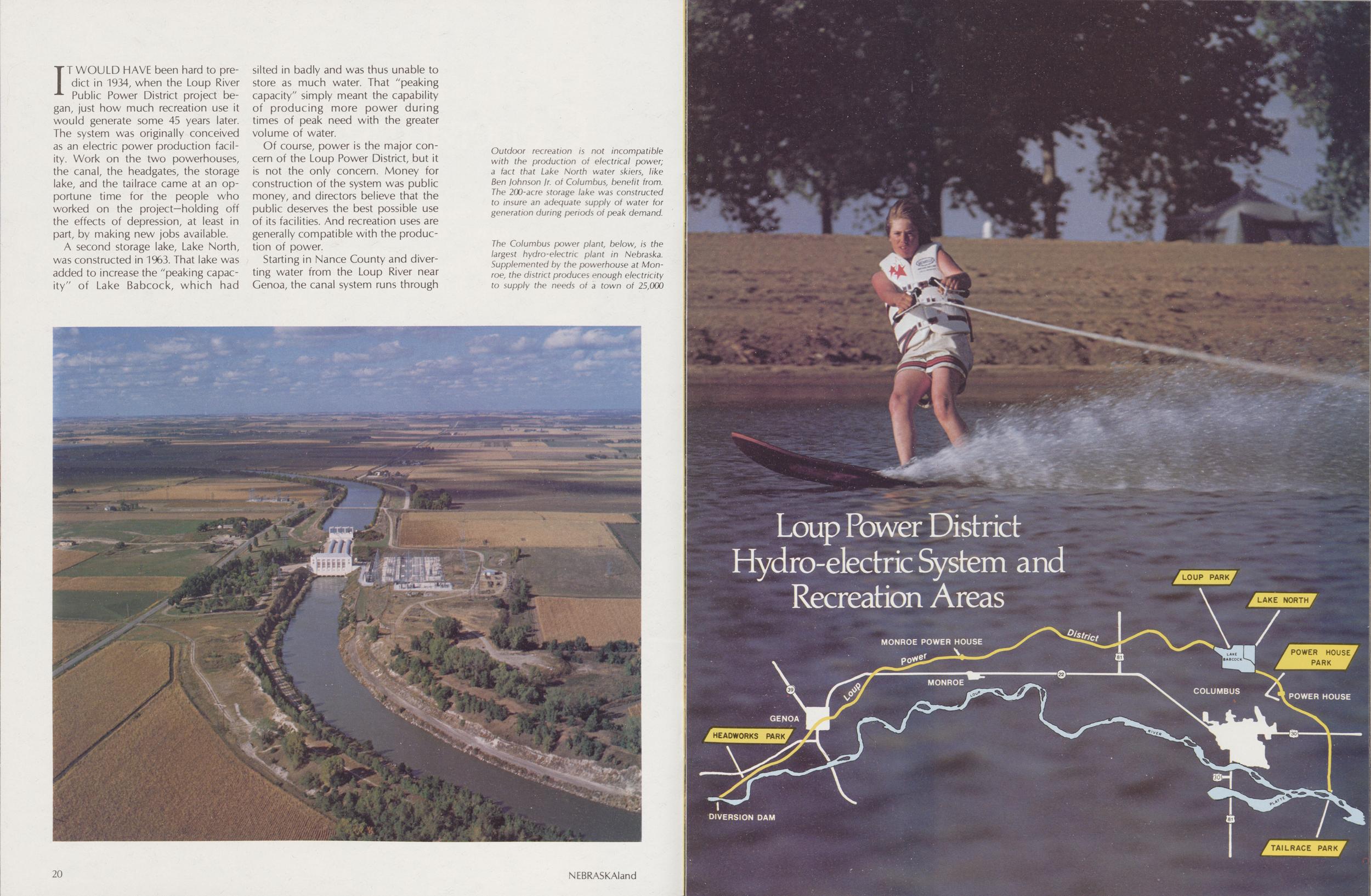
IT WOULD HAVE been hard to predict in 1934, when the Loup River Public Power District project began, just how much recreation use it would generate some 45 years later. The system was originally conceived as an electric power production facility. Work on the two powerhouses, the canal, the headgates, the storage lake, and the tailrace came at an opportune time for the people who worked on the project—holding off the effects of depression, at least in part, by making new jobs available.
A second storage lake, Lake North, was constructed in 1963. That lake was added to increase the "peaking capacity" of Lake Babcock, which had silted in badly and was thus unable to store as much water. That "peaking capacity" simply meant the capability of producing more power during times of peak need with the greater volume of water.
Of course, power is the major concern of the Loup Power District, but it is not the only concern. Money for construction of the system was public money, and directors believe that the public deserves the best possible use of its facilities. And recreation uses are generally compatible with the production of power.
Outdoor recreation is not incompatible with the production of electrical power; a fact that Lake North water skiers, like Ben Johnson jr. of Columbus, benefit from. The 200-acre storage lake was constructed to insure an adequate supply of water for generation during periods of peak demand.
The Columbus power plant, below, is the largest hydro-electric plant in Nebraska. Supplemented by the powerhouse at Monroe, the district produces enough electricity to supply the needs of a town of 25,000
 Platte County, spilling back into the
Platte just below its confluence with
the Loup. Along the way are parks and
recreation opportunities, as well as a
good number of irrigators who draw
needed water out of the canal.
Platte County, spilling back into the
Platte just below its confluence with
the Loup. Along the way are parks and
recreation opportunities, as well as a
good number of irrigators who draw
needed water out of the canal.Visitors to the recreation facilities along the canal are hardly aware of the system's prime purpose, though. There are five parks along the system, and they include such facilities as picnic tables, fire grates, electrical hookups, playground equipment, pit toilets, and boat ramps. All facilities are not available at all sites, but writing the district for a copy of its brochure entitled "Welcome ... to the Out-of-Doors", will give all the details about what can be found where (Loup Power District, Box 988, Columbus, Nebraska 68601).
Nearly a round bowl, ranging to 30 feet in depth, Lake North offers gently sloping gravel beaches around its perimeter, and is a favorite of sunbathers. Boating, waterskiing and swimming are also popular.
North is connected to Lake Babcock by a control structure that, under normal conditions, allows the level of the two lakes to stay the same. The level of Lake North fluctuates with power demands, and the need for water to meet those demands.
Campers by the dozens come to the Loup system, using the parks or just parking camping rigs along the canal to fish. Accessibility is probably one of the most important plusses along the Loup Power Canal. Some old-timers just position their vehicles along the canal banks and fish out of the window. There aren't many other places where they can do that.
To many fishermen, the Loup Power Canal system means just one thing-catfish! In fact, the Loup system does support a very good population of channel catfish. It also can boast of a good population of flathead catfish. It may even hold a flathead catfish that surpasses the state record—even the world record. Several years ago, a mechanical trash collector designed to pull debris out of the water above the Monroe power plant raked in a flathead that exceeded the state record by at least 15 pounds. That fish weighed 79 pounds.
The best time to seek catfish in the Loup Canal is during May and June, but area fishermen aren't terribly particular about when they fish. Catfishermen can be seen along the canal from early spring through late fall. So can catfish.
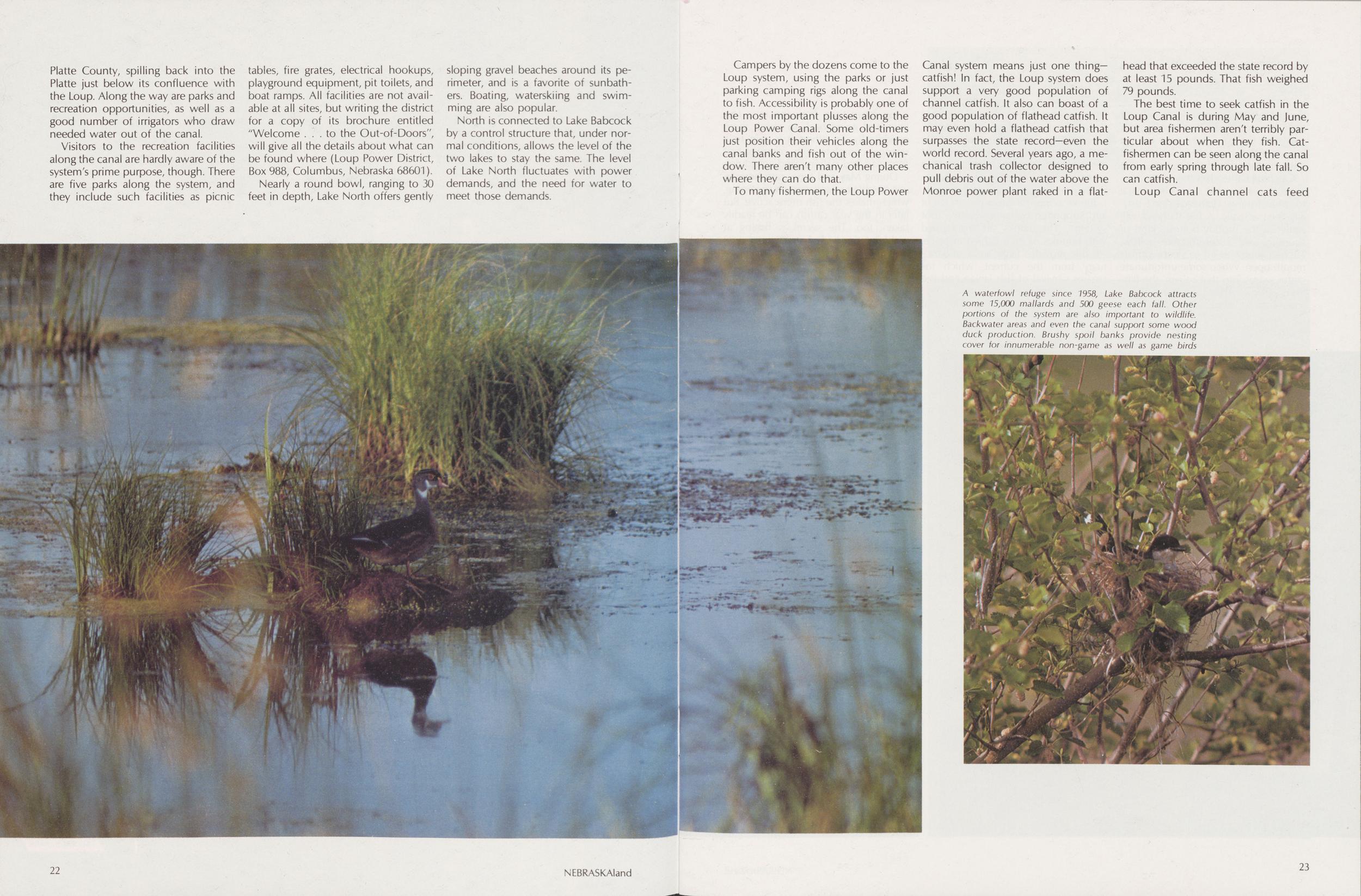
A waterfowl refuge since 1958, Lake Babcock attracts some 15,000 mallards and 500 geese each fall. Other portions of the system are also important to wildlife. Backwater areas and even the canal support some wood duck production. Brushy spoil banks provide nesting cover for innumerable non-game as well as game birds
 throughout the summer and fall, but
their activity drops off gradually from
spawning time on. They seem to feed
in surges that decrease in length and
intensity throughout the season.
throughout the summer and fall, but
their activity drops off gradually from
spawning time on. They seem to feed
in surges that decrease in length and
intensity throughout the season.Catching flatheads is mostly by accident; something that occurs incidental to other fishing. Flatheads don't usually feed actively. A big flathead will settle on the muddy bottom, kind of squishing out a comfortable hollow. There it seems to go to sleep with its mouth open. When some unfortunate critter swims into that cavern, the flathead just closes his mouth, swallows, and waits for another meal. It takes some pretty enticing bait to make a flathead move even a foot to take it.
The Loup Canal is exceptional for catfish. Reproduction and recruitment are excellent, due in large part to a substantial amount of habitat not normally present in streams of this type.
Banks along the canal are undercut and supported by extensive tree root systems. The banks are rip-rapped with bundles of trees cabled in place. All this provides large areas of sanctuary from the current, which increases survival of fish larvae and the organisms that feed them.
For some, catfishing along the canal is no more than throwing in a few lines and going back to check them periodically. To others it is akin to a science, complete with complex bait formulae and patterns and schedules.
During May and June, catfishermen will be able to capitalize on spawning, which makes the fish more active. But later in the year catfish can be readily taken, too. The secret is fishing at night. July is an ideal month, with water low and not so muddy, nights warm and balmy.
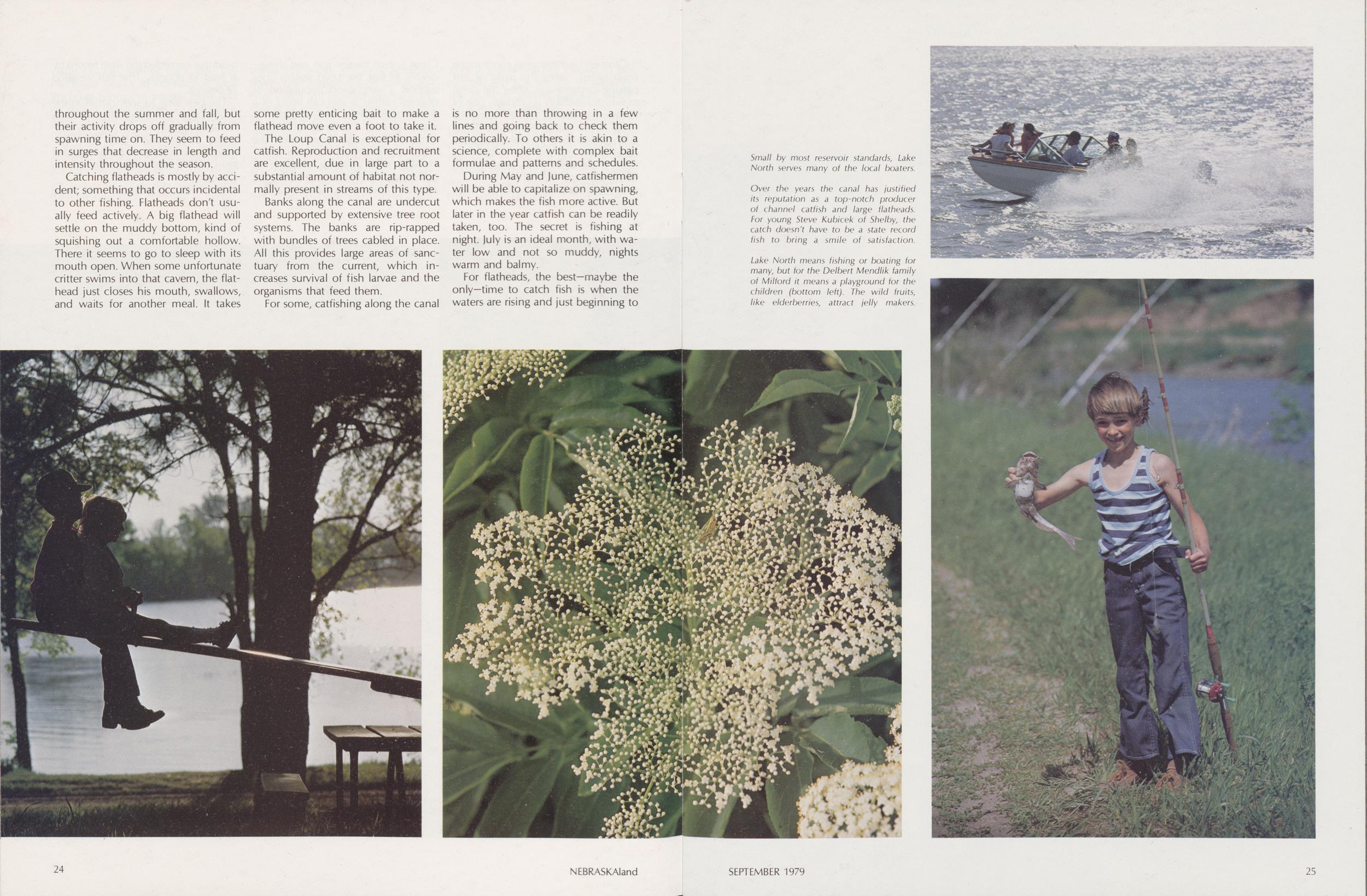
Small by most reservoir standards, Lake North serves many of the local boaters.
Over the years the canal has justified its reputation as a top-notch producer of channel catfish and large flatheads. For young Steve Kubicek of Shelby, the catch doesn't have to be a state record fish to bring a smile of satisfaction.
Lake North means fishing or boating for many, but for the Delbert Mendlik family of Milford it means a playground for the children (bottom left). The wild fruits, like elderberries, attract jelly makers.
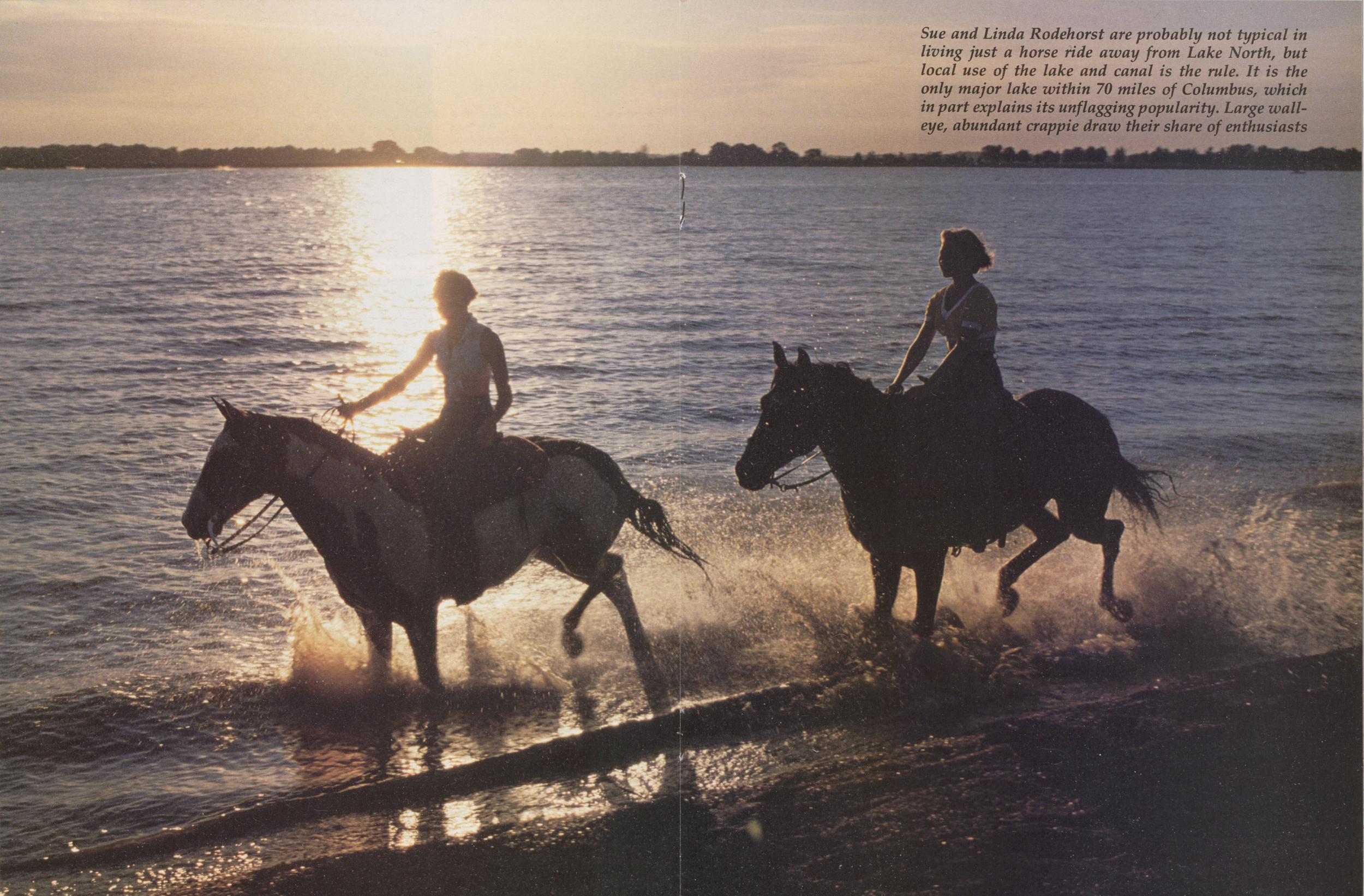
Sue and Linda Rodehorst are probably not typical in living just a horse ride away from Lake North, but local use of the lake and canal is the rule. It is the only major lake within 70 miles of Columbus, which in part explains its unflagging popularity. Large walleye, abundant crappie draw their share of enthusiasts
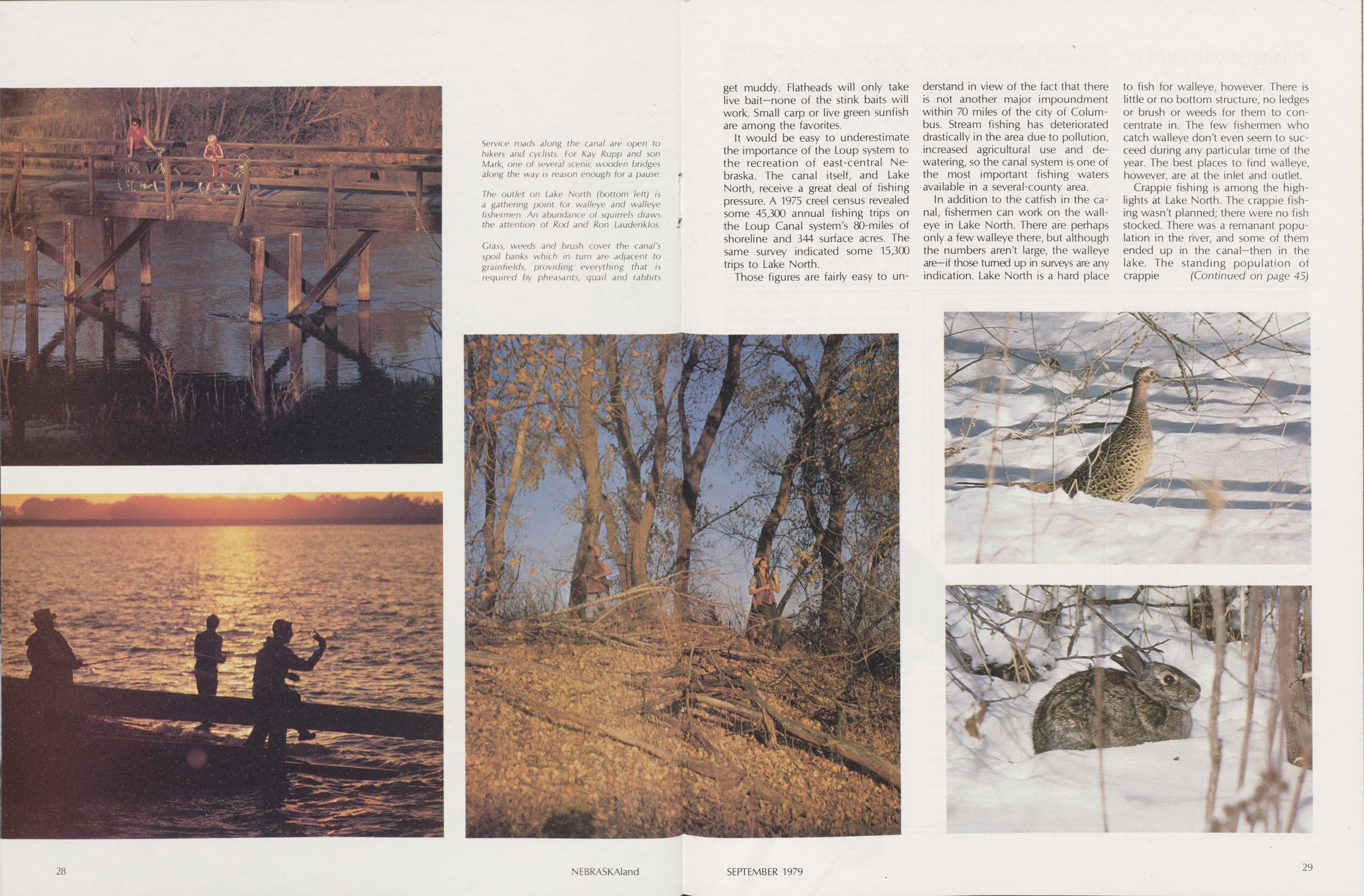
Service roads along the canal are open to hikers and cyclists. For Kay Rupp and son Mark, one of several scenic wooden bridges along the way is reason enough for a pause.
The outlet on Lake North (bottom left) is a gathering point for walleye and walleye fishermen. An abundance of squirrels draws the attention of Rod and Ron Laudenklos.
Grass, weeds and brush cover the canal's spoil banks which in turn are adjacent to grainfields, providing everything that is required by pheasants, quail and rabbits
It would be easy to underestimate the importance of the Loup system to the recreation of east-central Nebraska. The canal itself, and Lake North, receive a great deal of fishing pressure. A 1975 creel census revealed some 45,300 annual fishing trips on the Loup Canal system's 80-miles of shoreline and 344 surface acres. The same survey indicated some 15300 trips to Lake North.
Those figures are fairly easy to understand in view of the fact that there is not another major impoundment within 70 miles of the city of Columbus. Stream fishing has deteriorated drastically in the area due to pollution, increased agricultural use and dewatering, so the canal system is one of the most important fishing waters available in a several-county area.
In addition to the catfish in the canal, fishermen can work on the walleye in Lake North. There are perhaps only a few walleye there, but although the numbers aren't large, the walleye are—if those turned up in surveys are any indication. Lake North is a hard place to fish for walleye, however. There is little or no bottom structure, no ledges or brush or weeds for them to concentrate in. The few fishermen who catch walleye don't even seem to succeed during any particular time of the year. The best places to find walleye, however, are at the inlet and outlet.
Crappie fishing is among the highlights at Lake North. The crappie fishing wasn't planned; there were no fish stocked. There was a remanant population in the river, and some of them ended up in the canal—then in the lake. The standing population of crappie (Continued on page 45)
28 NEBRASKAland SEPTEMBER 1979 29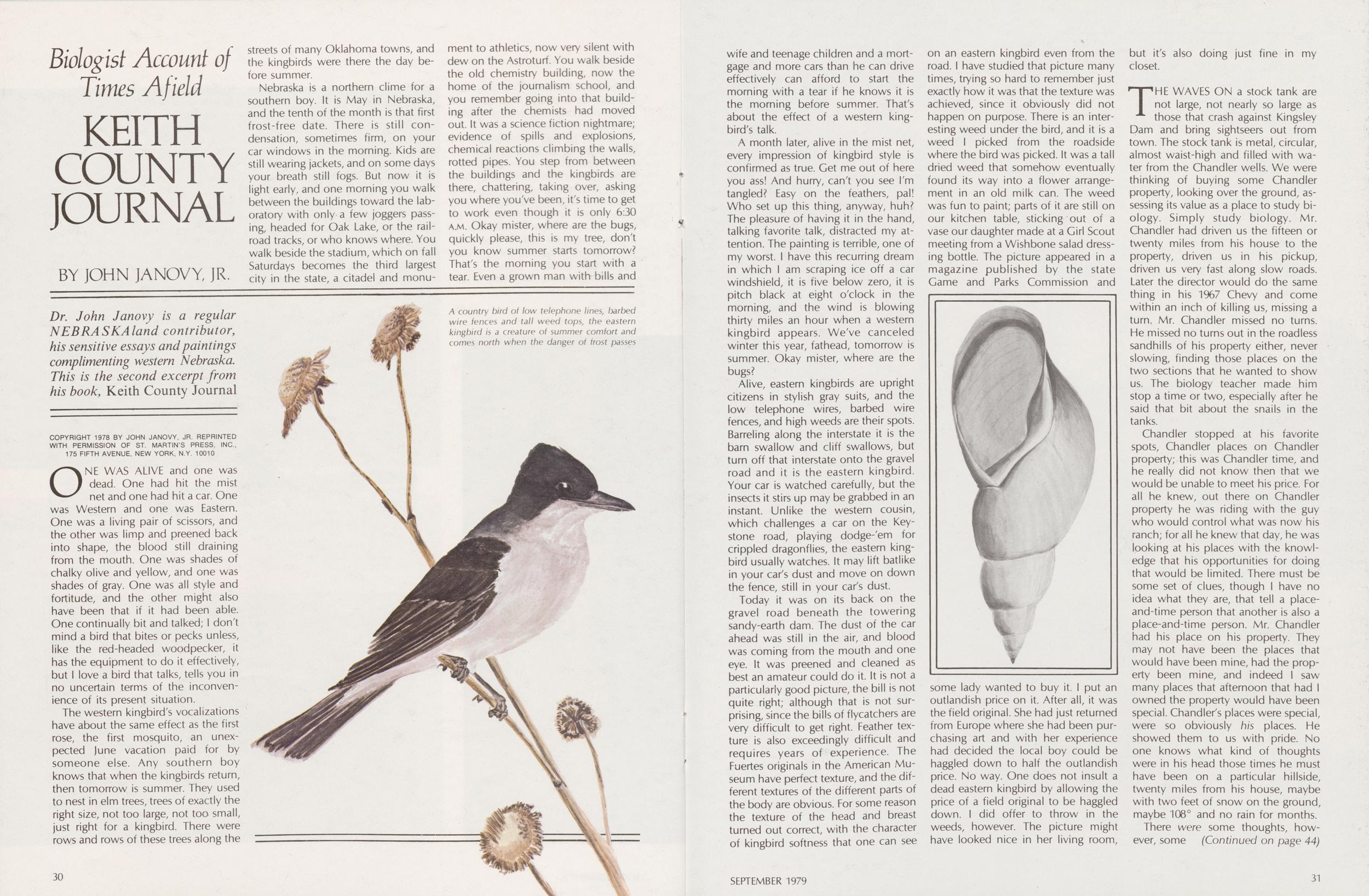
Biologist Account of Times Afield
KEITH COUNTY JOURNAL
Dr. John Janovy is a regular NEBRASKA land contributor, his sensitive essays and paintings complimenting western Nebraska. This is the second excerpt from his book, Keith County Journal COPYRIGHT 1978 BY JOHN JANOVY, JR. REPRINTED WITH PERMISSION OF ST. MARTIN'S PRESS, INC., 175 FIFTH AVENUE, NEW YORK, N.Y. 10010ONE WAS ALIVE and one was dead. One had hit the mist net and one had hit a car. One was Western and one was Eastern. One was a living pair of scissors, and the other was limp and preened back into shape, the blood still draining from the mouth. One was shades of chalky olive and yellow, and one was shades of gray. One was all style and fortitude, and the other might also have been that if it had been able. One continually bit and talked; I don't mind a bird that bites or pecks unless, like the red-headed woodpecker, it has the equipment to do it effectively, but I love a bird that talks, tells you in no uncertain terms of the inconvenience of its present situation.
The western kingbird's vocalizations have about the same effect as the first rose, the first mosquito, an unexpected June vacation paid for by someone else. Any southern boy knows that when the kingbirds return, then tomorrow is summer. They used to nest in elm trees, trees of exactly the right size, not too large, not too small, just right for a kingbird. There were rows and rows of these trees along the streets of many Oklahoma towns, and the kingbirds were there the day before summer.
A country bird of low telephone lines, barbed wire fences and tall weed tops, the eastern kingbird is a creature of summer comfort and comes north when the danger of frost passes
A month later, alive in the mist net, every impression of kingbird style is confirmed as true. Get me out of here you ass! And hurry, can't you see I'm tangled? Easy on the feathers, pal! Who set up this thing, anyway, huh? The pleasure of having it in the hand, talking favorite talk, distracted my attention. The painting is terrible, one of my worst. I have this recurring dream in which I am scraping ice off a car windshield, it is five below zero, it is pitch black at eight o'clock in the morning, and the wind is blowing thirty miles an hour when a western kingbird appears. We've canceled winter this year, fathead, tomorrow is summer. Okay mister, where are the bugs?
Alive, eastern kingbirds are upright citizens in stylish gray suits, and the low telephone wires, barbed wire fences, and high weeds are their spots. Barreling along the interstate it is the barn swallow and cliff swallows, but turn off that interstate onto the gravel road and it is the eastern kingbird. Your car is watched carefully, but the insects it stirs up may be grabbed in an instant. Unlike the western cousin, which challenges a car on the Keystone road, playing dodge-'em for crippled dragonflies, the eastern king-bird usually watches. It may lift batlike in your car's dust and move on down the fence, still in your car's dust.
Today it was on its back on the gravel road beneath the towering sandy-earth dam. The dust of the car ahead was still in the air, and blood was coming from the mouth and one eye. It was preened and cleaned as best an amateur could do it. It is not a particularly good picture, the bill is not quite right; although that is not surprising, since the bills of flycatchers are very difficult to get right. Feather texture is also exceedingly difficult and requires years of experience. The Fuertes originals in the American Museum have perfect texture, and the different textures of the different parts of the body are obvious. For some reason the texture of the head and breast turned out correct, with the character of kingbird softness that one can see on an eastern kingbird even from the road. I have studied that picture many times, trying so hard to remember just exactly how it was that the texture was achieved, since it obviously did not happen on purpose. There is an interesting weed under the bird, and it is a weed I picked from the roadside where the bird was picked. It was a tall dried weed that somehow eventually found its way into a flower arrangement in an old milk can. The weed was fun to paint; parts of it are still on our kitchen table, sticking out of a vase our daughter made at a Girl Scout meeting from a Wishbone salad dressing bottle. The picture appeared in a magazine published by the state Game and Parks Commission and some lady wanted to buy it. I put an outlandish price on it. After all, it was the field original. She had just returned from Europe where she had been purchasing art and with her experience had decided the local boy could be haggled down to half the outlandish price. No way. One does not insult a dead eastern kingbird by allowing the price of a field original to be haggled down. I did offer to throw in the weeds, however. The picture might have looked nice in her living room, but it's also doing just fine in my closet.
THE WAVES ON a stock tank are not large, not nearly so large as those that crash against Kingsley Dam and bring sightseers out from town. The stock tank is metal, circular, almost waist-high and filled with water from the Chandler wells. We were thinking of buying some Chandler property, looking over the ground, assessing its value as a place to study biology. Simply study biology. Mr. Chandler had driven us the fifteen or twenty miles from his house to the property, driven us in his pickup, driven us very fast along slow roads. Later the director would do the same thing in his 1967 Chevy and come within an inch of killing us, missing a turn. Mr. Chandler missed no turns. He missed no turns out in the roadless sandhills of his property either, never slowing, finding those places on the two sections that he wanted to show us. The biology teacher made him stop a time or two, especially after he said that bit about the snails in the tanks.
Chandler stopped at his favorite spots, Chandler places on Chandler property; this was Chandler time, and he really did not know then that we would be unable to meet his price. For all he knew, out there on Chandler property he was riding with the guy who would control what was now his ranch; for all he knew that day, he was looking at his places with the knowledge that his opportunities for doing that would be limited. There must be some set of clues, though I have no idea what they are, that tell a place-and-time person that another is also a place-and-time person. Mr. Chandler had his place on his property. They may not have been the places that would have been mine, had the property been mine, and indeed I saw many places that afternoon that had I owned the property would have been special. Chandler's places were special, were so obviously his places. He showed them to us with pride. No one knows what kind of thoughts were in his head those times he must have been on a particular hillside, twenty miles from his house, maybe with two feet of snow on the ground, maybe 108° and no rain for months.
There were some thoughts, however, some (Continued on page 44)
30 SEPTEMBER 1979 31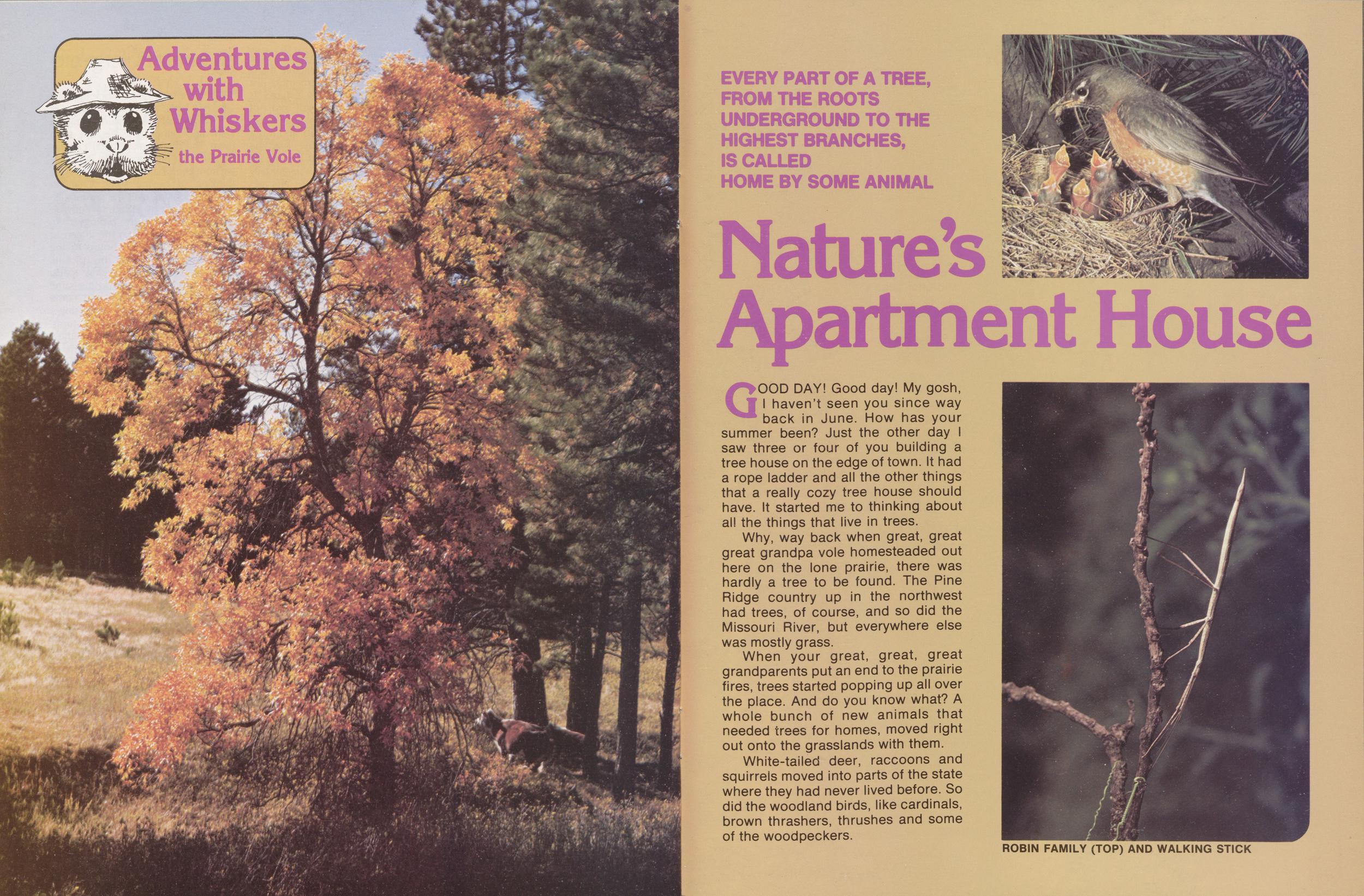
Adventures with Whiskers the Prairie Vole
EVERY PART OF A TREE, FROM THE ROOTS UNDERGROUND TO THE HIGHEST BRANCHES, IS CALLED HOME BY SOME ANIMAL
Nature's Apartment House
GOOD DAY! Good day! My gosh, I haven't seen you since way back in June. How has your summer been? Just the other day I saw three or four of you building a tree house on the edge of town. It had a rope ladder and all the other things that a really cozy tree house should have. It started me to thinking about all the things that live in trees.
Why, way back when great, great great grandpa vole homesteaded out here on the lone prairie, there was hardly a tree to be found. The Pine Ridge country up in the northwest had trees, of course, and so did the Missouri River, but everywhere else was mostly grass.
When your great, great, great grandparents put an end to the prairie fires, trees started popping up all over the place. And do you know what? A whole bunch of new animals that needed trees for homes, moved right out onto the grasslands with them.
White-tailed deer, raccoons and squirrels moved into parts of the state where they had never lived before. So did the woodland birds, like cardinals, brown thrashers, thrushes and some of the woodpeckers.
ROBIN FAMILY (TOP) AND WALKING STICK
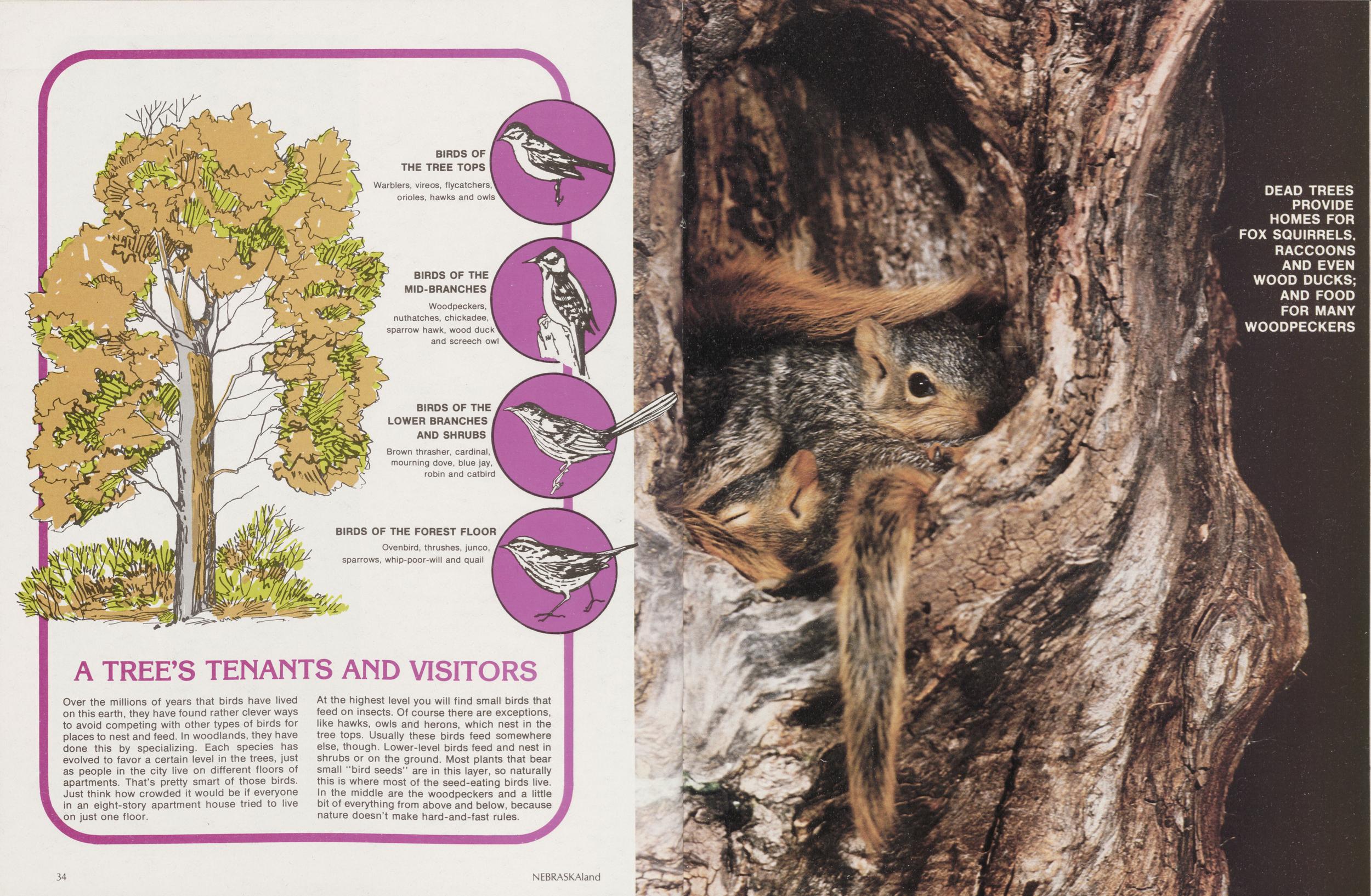
BIRDS OF THE TREE TOPS Warblers, vireos, flycatchers, orioles, hawks and owls
BIRDS OF THE MID-BRANCHES Woodpeckers, nuthatches, chickadee, sparrow hawk, wood duck and screech owl
BIRDS OF THE LOWER BRANCHES AND SHRUBS Brown thrasher, cardinal, mourning dove, blue jay, robin and catbird
BIRDS OF THE FOREST FLOOR Ovenbird, thrushes, junco, sparrows, whip-poor-will and quail
Over the millions of years that birds have lived on this earth, they have found rather clever ways to avoid competing with other types of birds for places to nest and feed. In woodlands, they have done this by specializing. Each species has evolved to favor a certain level in the trees, just as people in the city live on different floors of apartments. That's pretty smart of those birds. Just think how crowded it would be if everyone in an eight-story apartment house tried to live on just one floor.
At the highest level you will find small birds that feed on insects. Of course there are exceptions, like hawks, owls and herons, which nest in the tree tops. Usually these birds feed somewhere else, though. Lower-level birds feed and nest in shrubs or on the ground. Most plants that bear small "bird seeds" are in this layer, so naturally this is where most of the seed-eating birds live. In the middle are the woodpeckers and a little bit of everything from above and below, because nature doesn't make hard-and-fast rules. it
DEAD TREES PROVIDE HOMES FOR FOX SQUIRRELS. RACCOONS AND EVEN WOOD DUCKS; AND FOOD FOR MANY WOODPECKERS
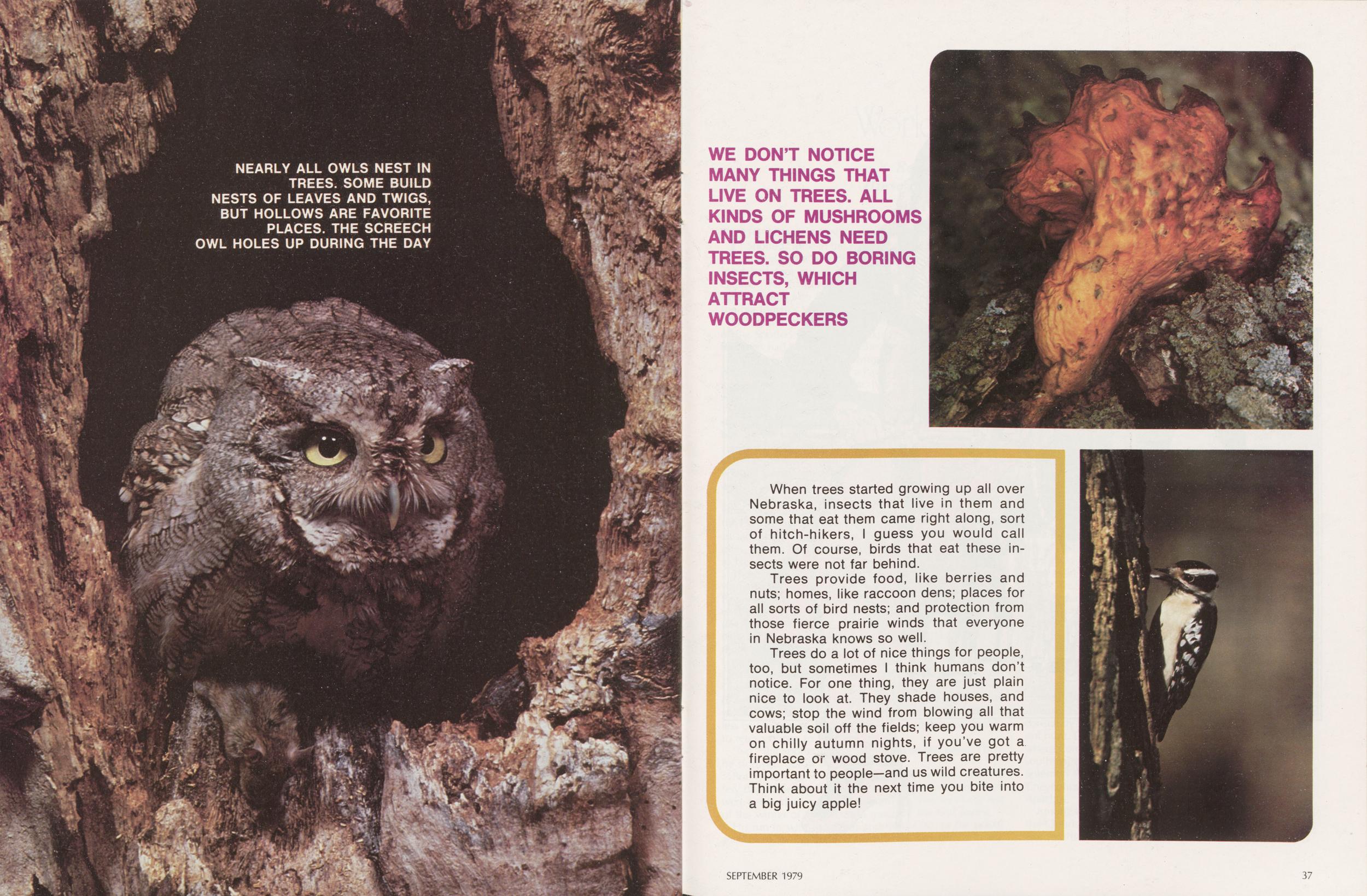
NEARLY ALL OWLS NEST IN TREES. SOME BUILD NESTS OF LEAVES AND TWIGS, BUT HOLLOWS ARE FAVORITE PLACES. THE SCREECH OWL HOLES UP DURING THE DAY
WE DON'T NOTICE MANY THINGS THAT LIVE ON TREES. ALL KINDS OF MUSHROOMS AND LICHENS NEED TREES. SO DO BORING INSECTS, WHICH ATTRACT WOODPECKERS
When trees started growing up all over Nebraska, insects that live in them and some that eat them came right along, sort of hitch-hikers, I guess you would call them. Of course, birds that eat these insects were not far behind.
Trees provide food, like berries and nuts; homes, like raccoon dens; places for all sorts of bird nests; and protection from those fierce prairie winds that everyone in Nebraska knows so well.
Trees do a lot of nice things for people, too, but sometimes I think humans don't notice. For one thing, they are just plain nice to look at. They shade houses, and cows; stop the wind from blowing all that valuable soil off the fields; keep you warm on chilly autumn nights, if you've got a fireplace or wood stove. Trees are pretty important to people—and us wild creatures. Think about it the next time you bite into a big juicy apple!
SEPTEMBER 1979 37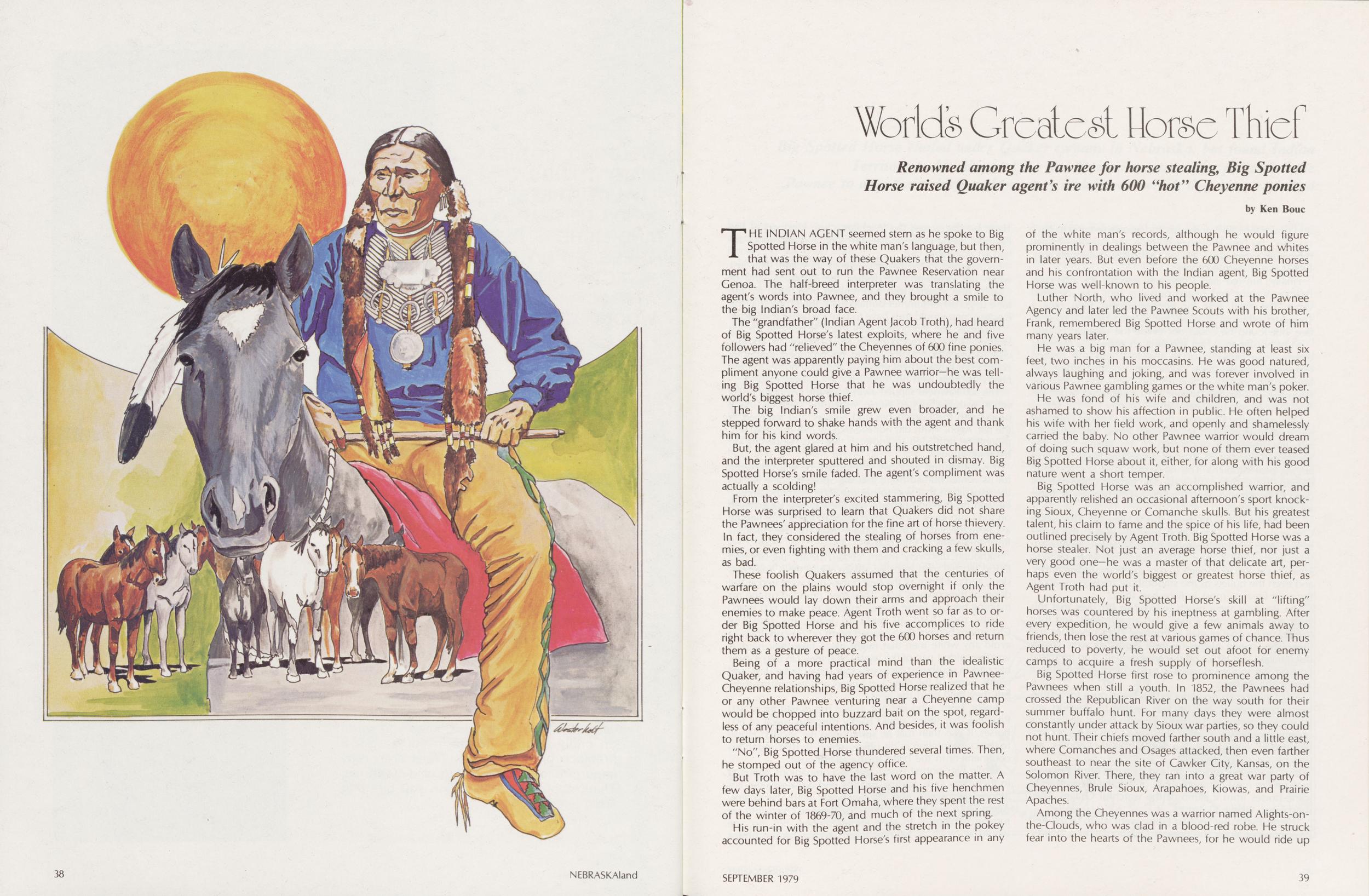
World's Greatest Horse Thief
Renowned among the Pawnee for horse stealing, Big Spotted Horse raised Quaker agent's ire with 600 "hot" Cheyenne ponies
THE INDIAN AGENT seemed stern as he spoke to Big Spotted Horse in the white man's language, but then, that was the way of these Quakers that the government had sent out to run the Pawnee Reservation near Genoa. The half-breed interpreter was translating the agent's words into Pawnee, and they brought a smile to the big Indian's broad face.
The "grandfather" (Indian Agent Jacob Troth), had heard of Big Spotted Horse's latest exploits, where he and five followers had "relieved" the Cheyennes of 600 fine ponies. The agent was apparently paying him about the best compliment anyone could give a Pawnee warrior—he was telling Big Spotted Horse that he was undoubtedly the world's biggest horse thief.
The big Indian's smile grew even broader, and he stepped forward to shake hands with the agent and thank him for his kind words.
But, the agent glared at him and his outstretched hand, and the interpreter sputtered and shouted in dismay. Big Spotted Horse's smile faded. The agent's compliment was actually a scolding!
From the interpreter's excited stammering, Big Spotted Horse was surprised to learn that Quakers did not share the Pawnees' appreciation for the fine art of horse thievery. In fact, they considered the stealing of horses from enemies, or even fighting with them and cracking a few skulls, as bad.
These foolish Quakers assumed that the centuries of warfare on the plains would stop overnight if only the Pawnees would lay down their arms and approach their enemies to make peace. Agent Troth went so far as to order Big Spotted Horse and his five accomplices to ride right back to wherever they got the 600 horses and return them as a gesture of peace.
Being of a more practical mind than the idealistic Quaker, and having had years of experience in Pawnee-Cheyenne relationships, Big Spotted Horse realized that he or any other Pawnee venturing near a Cheyenne camp would be chopped into buzzard bait on the spot, regardless of any peaceful intentions. And besides, it was foolish to return horses to enemies.
"No", Big Spotted Horse thundered several times. Then, he stomped out of the agency office.
But Troth was to have the last word on the matter. A few days later, Big Spotted Horse and his five henchmen were behind bars at Fort Omaha, where they spent the rest of the winter of 1869-70, and much of the next spring.
His run-in with the agent and the stretch in the pokey accounted for Big Spotted Horse's first appearance in any of the white man's records, although he would figure prominently in dealings between the Pawnee and whites in later years. But even before the 600 Cheyenne horses and his confrontation with the Indian agent, Big Spotted Horse was well-known to his people.
Luther North, who lived and worked at the Pawnee Agency and later led the Pawnee Scouts with his brother, Frank, remembered Big Spotted Horse and wrote of him many years later.
He was a big man for a Pawnee, standing at least six feet, two inches in his moccasins. He was good natured, always laughing and joking, and was forever involved in various Pawnee gambling games or the white man's poker.
He was fond of his wife and children, and was not ashamed to show his affection in public. He often helped his wife with her field work, and openly and shamelessly carried the baby. No other Pawnee warrior would dream of doing such squaw work, but none of them ever teased Big Spotted Horse about it, either, for along with his good nature went a short temper.
Big Spotted Horse was an accomplished warrior, and apparently relished an occasional afternoon's sport knocking Sioux, Cheyenne or Comanche skulls. But his greatest talent, his claim to fame and the spice of his life, had been outlined precisely by Agent Troth. Big Spotted Horse was a horse stealer. Not just an average horse thief, nor just a very good one—he was a master of that delicate art, perhaps even the world's biggest or greatest horse thief, as Agent Troth had put it.
Unfortunately, Big Spotted Horse's skill at "lifting" horses was countered by his ineptness at gambling. After every expedition, he would give a few animals away to friends, then lose the rest at various games of chance. Thus reduced to poverty, he would set out afoot for enemy camps to acquire a fresh supply of horseflesh.
Big Spotted Horse first rose to prominence among the Pawnees when still a youth. In 1852, the Pawnees had crossed the Republican River on the way south for their summer buffalo hunt. For many days they were almost constantly under attack by Sioux war parties, so they could not hunt. Their chiefs moved farther south and a little east, where Comanches and Osages attacked, then even farther southeast to near the site of Cawker City, Kansas, on the Solomon River. There, they ran into a great war party of Cheyennes, Brule Sioux, Arapahoes, Kiowas, and Prairie Apaches.
Among the Cheyennes was a warrior named Alights-on-the-Clouds, who was clad in a blood-red
robe. He struck
fear into the hearts of the Pawnees, for he would ride up
38
NEBRASKAland
SEPTEMBER 1979
39
 and down their line, and guns and arrows seemed to have
no effect on him. Wherever he rode, the Pawnees turned
their horses and gave ground, believing that spirits protected this fearsome enemy.
and down their line, and guns and arrows seemed to have
no effect on him. Wherever he rode, the Pawnees turned
their horses and gave ground, believing that spirits protected this fearsome enemy.
Finally, the red-clad Cheyenne selected an individual Pawnee warrior and began pursuing him. His intended victim this time, was Big Spotted Horse, then only a youngster of about 15 years. Big Spotted Horse turned to flee, but found he could not evade the dreaded enemy.
Most horsemen, when shooting an arrow at a pursuing enemy, can only shoot to the left, and the brazen Cheyenne always took advantage of this, riding up behind Big Spotted Horse on the right. The Cheyenne intended to strike the Pawnee with a sheathed sword before killing him, thus earning a "coup".
Only when the Cheyenne drew close to count coup did Big Spotted Horse turn to loose an arrow. And when he did, the Cheyenne discovered to his dismay that Big Spotted Horse was left-handed, something highly unusual among plains Indians. This rarity permitted him to shoot behind, to the right, with ease. The terrible Cheyenne fell dead to the ground, with Big Spotted Horse's arrow sticking from his eye.
The Pawnees charged and captured the slain Cheyenne's body, whereupon they discovered the secret to his earlier immunity—under his red blanket, Alights-on-the-Clouds wore a layer of Spanish armor from neck to knee. It was strong enough to turn aside any Indian arrow, and even the bullets of the smoothbore trade guns, about the only firearms most Indians had then.
The Pawnees were much relieved to discover that this great enemy was only a man with an iron shirt, and they hacked up his coat of mail as trophies. The Cheyennes and their allies, seeing Alights-on-the-Clouds fall, were greatly discouraged and broke off the engagement. And from that time on, Big Spotted Horse was a man of some importance among the Pawnee.
As a young man, he perfected his techniques for acquiring enemy ponies, but he was unable to develop any prowess at gambling. His reputation for skill at abstracting enemy horseflesh was great, though records of his accomplishments, other than the 600 Cheyenne ponies, are sketchy.
It is known that in 1867, he and a couple other Pawnees took on the most dangerous task of helping themselves to some horses from a camp of the watchful Osages. They succeeded, taking 30 head.
The next year, Big Spotted Horse went south to the Red River country along the present Oklahoma-Texas border. There he discovered the Wichitas, close kinsmen of the Pawnees, living in the Indian Territory, and apparently he had an enjoyable visit.
He returned to the Pawnee Agency in March 1869, just when the Pawnees were feeling the dictatorial grip of Quaker rule. Agent Troth had refused permission for the tribe to go on its summer buffalo hunt, theorizing that the Pawnee men would thus have to take up farming, instead.
However, the discontent only made it possible for Big Spotted Horse to recruit some 300 Pawnees for another visit to Wichita country, where he promised that they could hunt buffalo, fight enemies, and steal horses to their hearts' content with no meddlesome Quakers around.
The 300 Pawnees slipped away from the Nebraska reservation with Big Spotted Horse, visited the Wichitas, made peace with the Comanches and Kiowas, and returned in the fall. Agent Troth did not even know that they had left, though he professed to know all that was happening on his reservation.
It was that next October, when the tribe was preparing for its winter buffalo hunt, that Big Spotted Horse left on the expedition that was to net the 600 Cheyenne ponies. He and his five companions left the Pawnee Reservation on the Loup River and traveled afoot to the south, finding a Cheyenne village of 75 lodges south of the Arkansas River in Kansas or Oklahoma.
Although discovery meant certain death, Big Spotted Horse led his men into the village while the Cheyennes slept, and cut loose all the best horses that were tied at the doors of their owners' tipis. They then rounded up the remaining herd of loose horses, making off with 600 head.
They rode hard all night to leave any pursuing Cheyennes behind, then headed north on obscure trails to avoid any white men that might try to take their herd. It was the coldest part of the winter, and they ran into a great blizzard in southwest Nebraska that lasted three days and nights. Some of the party lost fingers and toes to frostbite, but they held onto the herd.
Agent Troth, who did not notice the departure of 300 Pawnees that spring, could hardly miss the arrival of 600 horses. It was then that he summoned Big Spotted Horse to the confrontation in his office, which, in turn, led to his confinement in the Fort Omaha guardhouse.
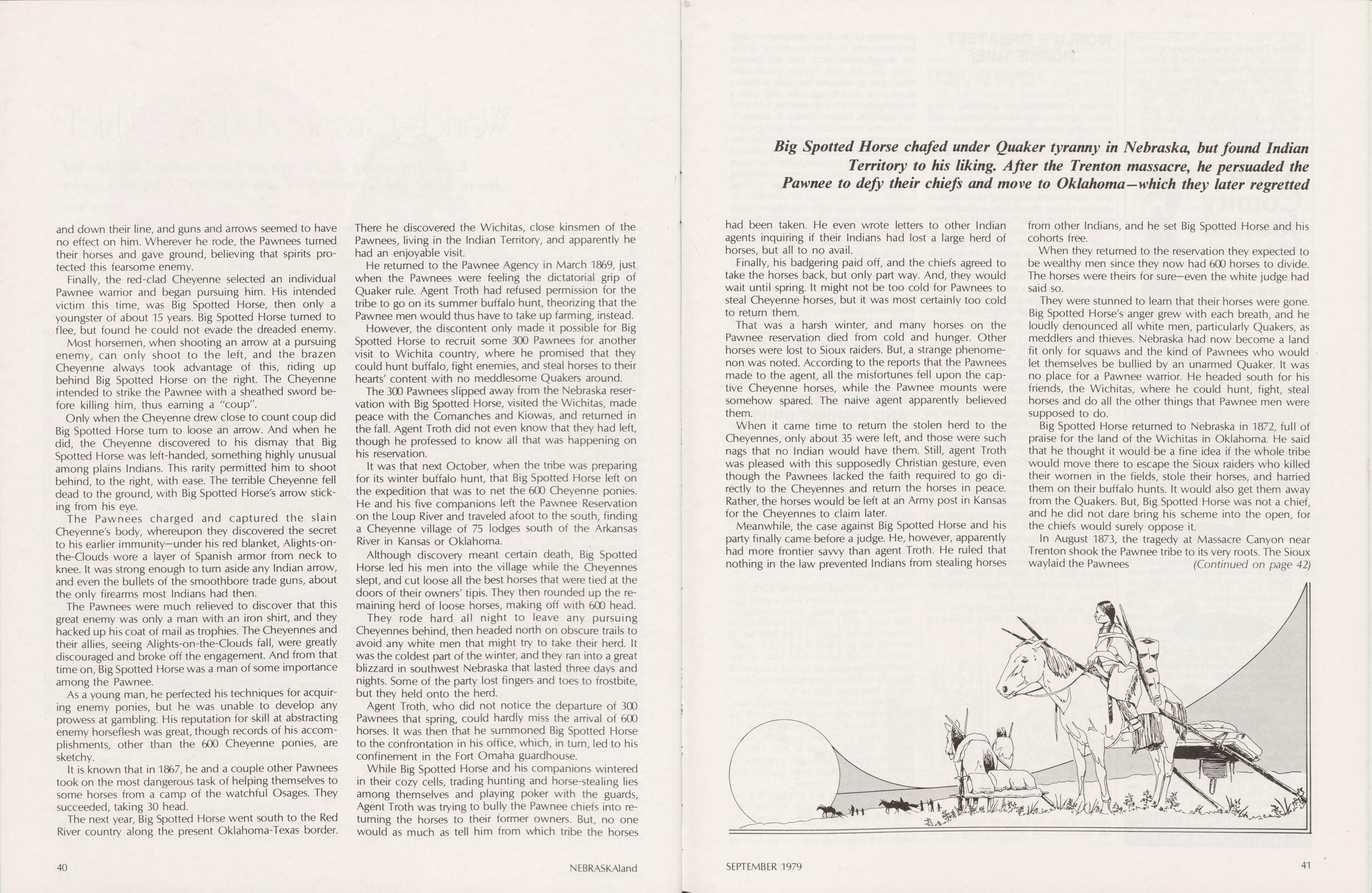
While Big Spotted Horse and his companions wintered in their cozy cells, trading hunting and horse-stealing lies among themselves and playing poker with the guards, Agent Troth was tying to bully the Pawnee chiefs into returning the horses to their former owners. But, no one would as much as tell him from which tribe the horses Big Spotted Horse chafed under Quaker tyranny in Nebraska, but found Indian Territory to his liking. After the Trenton massacre, he persuaded the Pawnee to defy their chiefs and move to Oklahoma—which they later regretted had been taken. He even wrote letters to other Indian agents inquiring if their Indians had lost a large herd of horses, but all to no avail.
Finally, his badgering paid off, and the chiefs agreed to take the horses back, but only part way. And, they would wait until spring. It might not be too cold for Pawnees to steal Cheyenne horses, but it was most certainly too cold to return them.
That was a harsh winter, and many horses on the Pawnee reservation died from cold and hunger. Other horses were lost to Sioux raiders. But, a strange phenomenon was noted. According to the reports that the Pawnees made to the agent, all the misfortunes fell upon the captive Cheyenne horses, while the Pawnee mounts were somehow spared. The naive agent apparently believed them.
When it came time to return the stolen herd to the Cheyennes, only about 35 were left, and those were such nags that no Indian would have them. Still, agent Troth was pleased with this supposedly Christian gesture, even though the Pawnees lacked the faith required to go directly to the Cheyennes and return the horses in peace. Rather, the horses would be left at an Army post in Kansas for the Cheyennes to claim later.
Meanwhile, the case against Big Spotted Horse and his party finally came before a judge. He, however, apparently had more frontier savvy than agent Troth. He ruled that nothing in the law prevented Indians from stealing horses from other Indians, and he set Big Spotted Horse and his cohorts free.
When they returned to the reservation they expected to be wealthy men since they now had 600 horses to divide. The horses were theirs for sure—even the white judge had said so.
They were stunned to learn that their horses were gone. Big Spotted Horse's anger grew with each breath, and he loudly denounced all white men, particularly Quakers, as meddlers and thieves. Nebraska had now become a land fit only for squaws and the kind of Pawnees who would let themselves be bullied by an unarmed Quaker. It was no place for a Pawnee warrior. He headed south for his friends, the Wichitas, where he could hunt, fight, steal horses and do all the other things that Pawnee men were supposed to do.
Big Spotted Horse returned to Nebraska in 1872, full of praise for the land of the Wichitas in Oklahoma. He said that he thought it would be a fine idea if the whole tribe would move there to escape the Sioux raiders who killed their women in the fields, stole their horses, and harried them on their buffalo hunts. It would also get them away from the Quakers. But, Big Spotted Horse was not a chief, and he did not dare bring his scheme into the open, for the chiefs would surely oppose it.
In August 1873, the tragedy at Massacre Canyon near Trenton shook the Pawnee tribe to its very roots. The Sioux waylaid the Pawnees (Continued on page 42)
40 NEBRASK Aland SEPTEMBER 1979 41
WORLD'S GREATEST HORSE THIEF
(Continued from page 41)as they hunted buffalo, ruthlessly killing about 100 men, women and children and wounding many more. All their meat and hides, their equipment and many of their horses, were taken. And, the grasshoppers were devouring their crops on the reservation.
The Pawnees were in a state of despair, and many were criticizing the chiefs. It was the perfect time for Big Spotted Horse to act. Within a few weeks of the massacre, he had won two-thirds of the tribe over to the idea of moving in with the Wichitas, and some actually left that fall. Idealists and schemers in Washington took advantage of the discontent, and of Big Spotted Horse's unwitting assistance, to push for removal of the Pawnees to Oklahoma. In the fall of 1874, more Pawnees made the move, and the rest followed in the fall of 1875.
But, the Pawnees found life in Oklahoma far from what Big Spotted Horse had described. There was no village of comfortable earth lodges, for the Quakers would not permit them to build such "relics of barbarism." They were thus forced to live in drafty canvas tipis. There was no game to hunt, and their horse herd was being eroded by thieves. Rations were poor, and administrative bungling, corruption and neglect delayed the planting of crops.
And fever struck the Pawnees, as it did every northern tribe moved to the Territory. Of the 2,276 Pawnees that had moved from Nebraska by 1875, more than 800 had died by 1880.
Big Spotted Horse had become very unpopular among his people. Because of him, they were forced to idleness, with hunger and fever stalking them. Life had been hard for them in Nebraska, but better there than in Oklahoma.
He was so unpopular among his own people that Big Spotted Horse applied for permission to move in with another tribe. When refused, he simply ran away. There are several stories as to how Big Spotted Horse met his end. Captain North contends that government officials had him done away with because he was such a troublemaker. Another opinion is that he was killed by a town marshal in Kansas.
But the most likely, and perhaps the most fitting story, came from Texas. The news spread through the new Pawnee agency that Big Spotted Horse had been shot dead by Texas cowboys—while trying to steal their horses, of course.
Editor's note: This story was based largely on "The Pawnee Indians" by George Hyde, University of Oklahoma Press, and the writings of Captain Luther North of the Pawnee Scouts. With all historical stories, there may be some question as to the exact names, dates, numbers and places, and this is especially true in dealing with Indians. North, for example, said that the Cheyenne horse herd numbered about 150, not 600. However, Big Spotted-Horse was a real person, and there is good evidence that he did the things outlined in this story.
"Plenty of time. Well eat after he catches that big one. Right now he's just getting into the boat."
HUNTING YARNS AND FISHING DRIVEL
(Continued from page 11)promptly filled out with one sharptail and one chicken. Now, as best as I can recall, Steve was the only one of the group not in position for a decent shot, but after several years of trying to get one up on him, I saw no reason to console him. As we turned to the west I managed to pull up aside and jab him a bit. It was, after all, clearly evident why all his hunts in the past had been so successful—he carefully picked his companions!
Well, my fun was short lived. We passed through another bottom with a good collection of weedy plants, mostly marijuana and wild rose, when four sharptails jumped out of range. A fifth bird sat 30 seconds too long and Steve put it down. We continued west. Steve was in the unenviable position of having a cluster of kibitzing hunters trailing behind him, waiting for that tenth bird to fall.
The wind had grown to hurricane force, and any bird that made it 20 feet off the ground became an impossible target. Finally, Steve's chance came. A single flushed directly in front of him. With all the helpful advice Steve got, it puzzles me to this day why it took three shots to drop that sharptail.
The outcome of our grouse hunt had been an unqualified success, but the planning left something to be desired. We were about two miles from the pickups with a full limit of grouse. We worked the weedy bottoms back and added five doves, and it was only 10 a.m. when we poured the first round of coffee in the camper.
Late in the morning we moved to the Cedar River near Spalding on a farm that Jerry had permission to hunt. We cleaned the birds, washing them in the river and bagged the remains for the next trash barrel we encountered; all the remains, that is, except a pint jar of entrails that Steve secretively salvaged and placed in the sun to ripen.
Steve had made good on his boast to shoot a mess of grouse, and now seemed determined to frost the cake. He extracted an eight-foot sein from the back of the truck, and with the help of Denny, gathered up about four dozen minnows from the drop-offs just below the Cedar's sandbars. Catfish were next on the day's menu.
While Jerry, Derald, Denny and Steve strung out along the Cedar fishing, Dick added two more doves and two cottontails to the cooler. Unlike the grouse hunting, fishing was slow, with dozens of nibbles from small catfish. Steve caught a leopard frog, which discouraged the small fish, and later put a two-pounder on the stringer. An hour and a half of nibbles proved enough for Jerry and Derald, and Dick easily lured them away. The four of us abandoned the Rohn brothers to their September foolishness and drove five or six miles to an abandoned farmstead owned by a friend of Jerry's father.
The farmstead was a natural for doves and not shabby for several other game birds including quail, pheasants and both varieties of grouse. The old house and barn were still in usable shape, as were a scattering of outbuildings. Immediately to the south was a yard of hay stacks. South of the stacks was a runty growth of boxelders. A small, unpicked cornfield was just north and west of the buildings, and north of the corn were several acres of grass, mostly brome. Every now and again there was a snaggy tree or duster of snaggy trees. Filling in the gaps around these major features was a thriving growth of weeds; ragweed, sunflowers and marijuana for the most part. The farmland surrounding the area was a scenic mix of corn, native pasture and hay meadows. All in all, I couldn't see that it lacked anything a sportsman would want except a fastrunning creek with four-pound brown trout.
In a setting like that, dove hunting doesn't require a lot of finesse. While a handful of doves watched suspiciously from an old powerline, three of us spread out on the periphery of the farmstead. Five minutes later, the fourth moved into the center and stirred things up before taking his own post near an abandoned corral. The wind dropped and the day cooled to perfect shirt-sleeve weather. When the empty hulls at our feet reached mid-thigh, we shifted around a bit for the last hour or so of the day. Jerry and I walked to the west and picked up three or four doves around a grubbed-out cottonwood; Dick moved into the hay stacks, and Derald nestled down in a stunted growth of marijuana in a pasture corner near a leaning cottonwood and a pair of boxelders. When the sun went down, we were a couple of birds over 30, which, with the handful we had shot in the morning, put us close enough to our 40-bird limit to call it an above average afternoon shoot.
After dressing the birds at a stock tank, we moseyed back to the Cedar to check on the Rohns. The dove hunters dropped me off at my pickup and headed into Ericson for the night. Under the windshield wiper I found a note. Scratched out was an early message, "Gone to Spalding, back in 30 minutes", followed by "fishing below the power plant at Spalding. Honk when you get there, we'll find you." I drove to the power plant, honked, and sure enough the Rohns found me. They had abandoned the up-river site after keeping a pair of two-pound cats. When I pulled alongside their pickup, the Coleman stove was just cooling off, as was a burger of mammoth proportions and a brace of Polish sausages. Undaunted by an afternoon of fish too small to swallow a minnow, they were ambitiously flogging the surface of the spillway. They had added two more cats to the cooler, one just under two pounds and one that might have made two and a half. At 11:30 p.m. I threatened to cut their lines, and after a run to town for soda pop, we turned in. Shooting time for the second day of grouse season was just half-way around the clock.
Sunday dawned clear but with a rather ominous bank of clouds sweeping in from the west when we met Derald, Dick and Jerry at the same pasture we had hunted the previous morning. Within 45 minutes it was heavily overcast. The temperature must have dropped 10 or 15 degrees and slanting sweeps of showers were spread across the western horizon.
We stayed in the low hills along the Cedar and predictably encountered more prairie chickens than sharptails. Dick killed two birds with one shot at 40 yards. I picked up a single, having traded in my battery of cameras for a shotgun when the clouds rolled in. Everyone was getting good shots. All of the birds were singles or doubles; no flocks like the previous day. And, all the birds were holding unusually tight. Most of the grouse we kicked up had been sitting low—in the valleys or low on sidehills.
Steve had a bird flush on a hillside and dropped it with his second shot. Another jumped up in front of Jerry and folded. Derald had a single flush in front of him. While it was still falling, a second flew and he filled his limit. We swung back toward the trucks confident that we would limit out before reaching them. When we crawled over the last fence we had 11 grouse—only one short of our combined limit.
After coffee, a cooler full of sandwiches and the last of the summer's tomatoes, we returned to the abandoned farmstead and cleaned the birds.
Jerry made a swing west and returned with the 12th grouse, and before the rains finally overtook us we chalked up about 20 doves. By noon we had cleaned the doves, wolfed down the last of the food and struck out for Lincoln.
Jokingly I had dubbed the outing "Ye Olde Grouse Opener and Game Hog Reunion". In fairness, though, I knew it was just a bunch of guys confined to the city for most of the year and starved for all the hunting and fishing they could crowd into a weekend. Heaven help our wildlife if they lived in the country and could sustain their enthusiasm over an entire season.
The worst part, of course, has been that I have had to face Steve at least once a month since then. He had earned his license to build even wilder tales. But, I still don't believe his Brittany would hold point while he drank a cup of coffee.
'All right, dear . . . you can start taking the tent down now."
KEITH COUNTY ALMANAC
(Continued from page 31)Chandler thoughts. I'll bet seven or eight cases of beer, maybe a fifth of Scotch, on it. I would bet an equivalent amount that Mr. Chandler did not search out those places at first. No, the places searched him out. He did his job day after day, and those places struck some kind of chord every time he passed them; and finally after all those attempts to communicate with Mr. Chandler, the sandhills tried it one more time and it worked. The next time, Mr. Chandler stopped at one of those places and thought some thoughts. Many attempts, none active, all passive, many failures, much happenstance and gamble, much fortuitous contact with doing other business, the business of simply staying alive, but those Chandler places finally came to Chandler, at some time in Chandler's life. Chandler places and Chandler times on the Chandler property. He now takes his time at his places. The conclusion may not be true, but it is what I am thinking as I open the gate between sections and look back to see Mr. Chandler, smiling and content and confident, behind the wheel of his pickup.
'The water tanks around those wells are full of snails," he says when I am back in the cab.
"Can we have a look?" The director smiles his own special way, not necessarily a happy smile, nor unhappy, not really a smile at all, just that expression he has for a sense of impending biology. He probably also smiles that way when the Cleveland Indians make a double play. We jolt up to the tank; Chandler nudges the calves away with his pickup, though they never allow themselves to be touched. We are untold miles, at least twenty, from the nearest cattails.
The tank is full of Stagnicola elodes; so is the overflow pond. How did they get from here to there? These are Keystone Lake snails—I conclude they might as well be Keystone snails as Lewellen snails or simply snails from the next well tank down the road. There is something very satisfying about the conclusion that these particular snails came from Keystone. There is no way to prove such a thought, but Keystone Lake is as good a guess as any other Stagnicola place, so we'll go with it. The director and I stand in the mud of the overflow pond and turn over Cottonwood leaves, sticks. Mr. Chandler joins us and we go through the standard biologist-at-the-mudhole routine. We pan up the microcrustacea, the ostracods, and we discuss what they might be. We poke through the pan at the aquatic insects. We note the whirligigs at one end. Biologist-at-the-mudhole routine: it's been done at least seventeen billion times; it's done every time the biologist walks up to a mudhole.
Mr. Chandler asks some questions. It is apparent that he did not really bring us out here to study snails or to pan up water from the overflow pond. He came here to sell us a couple of hundred thousand dollars' worth of sandhills. The director and I rise to have a closer look at the tank itself. Mr. Chandler is still at the mudhole, poking through the water. There is more on the Chandler property than he realized. Mr. Chandler has grown children, although one is still in high school, and we talk about grown children a while. We also talk about things in the water.
"I wish I'd had the chance to study some of these things in school," he says, still looking at the ostracods.
"Come on down to the field station, any time," I say. The director is nodding, but looking in the tank. It is full of Stagnicola elodes. It is also full of some aquatic plant. Just as Stagnicola has found its time and place in the Chandler tanks, so has the plant. The plant is completely submerged; an aquatic plant, and it virtually fills the tank. Any fool, any blithering idiot, can see the plant was not a yucca that had simply moved below the surface. The tank is also a plant time and plant place.
"You ought to see what comes out of these things when we clean them out," he says.
"Lots of stuff, huh?"
"Ever' kind of living thing in the mud down in the bottom of these tanks," says Mr. Chandler. "Really wish I'd had the opportunity to do like you fellas, study some of these things." I look at Mr. Chandler very carefully. There have been many times, very many times, in the last year when I wished oh so strongly for the opportunity to be something other than a university professor. This professor business is my place. There may have been a time when it was not my time, when had the right turn been taken, then I would be the rancher.
"You might find a bunch of professors ready to trade jobs with you, Mr. Chandler," I say.
"Not now'days, cattle business pretty hard to make ends meet." My mind is racing ahead now, way ahead, as the director palms the small Stagnicola. In my mind we have bought the Chandler property and there is a truck with a couple of dozen tanks on it parked just inside the gate.
"Where you want these, mister?" There and there and there and . . . there. We will see, we will, just how long it takes for Stagnicola elodes to return to a stock tank that has been cleaned out. We will see, we will, just how fast 5. elodes can colonize a tiny bit of its place a hundred yards from the Chandler well, five hundred yards, a mile from the nearest Stagnicola population. In my mind racing ahead we will certainly test the ability of this thing to find its place in the world, we will determine Stagnicola time and Stagnicola place, and we wili determine whether it happens every time, whether indeed 5. elodes finds its place in the world every time. Still racing, my mind cancels the experiment; I know the answer. I may not actually know the answer, but I sense, I feel the answer. Stagnicola elodes will indeed find its place in the world every time. Pioneers. Any species that can find a Chandler stock tank can find its place anywhere in the world.
There is an uneasiness about this line of thinking, and it finally dawns on me. Stagnicola places are serene, calm, warm, protected. We think today that maybe there are not so many of these kinds of places, but we are very wrong. There are plenty of these places, and they are full of Stagnicola. The concrete pond between the city buildings. Moreover, the species has some device for finding its place in the world, for occupying its time in the history of the earth. Immediately I am envious of the snail, but I don't want it all. I don't want to be committed to a calm, serene, warm place and a calm, serene, warm time. There are times when I'd play Stagnicola however, times such as sitting on a log looking toward Lewellen.
Now I understand why I am so envious of the snail king. It has nothing to do with being in a serene place, a calm and warm place. It has everything to do with being in your own place, the place that is for you at the time that is for you. It has everything to do with a built-in device, a built-in inherited mechanism, for finding one's place in the world, regardless of how calm or serene, regardless of a maelstrom in the center of that place. I stand up, stretching at the end of the day, taking a last look toward Lewellen in the fading light, looking around, trying to decide whether to simply throw the empty beer can beneath the seat of my car or walk the hundred feet to a trash barrel. I decide on the car. Stagnicola elodes finds its place by being a pioneer. The string of eggs is the species' way of looking, exploring, grabbing every opportunity to hitch a ride to the next outpost, regardless. I will be a pioneer. I will try things I've never tried before. I will gamble some stuff, maybe I don't know just what yet; but if the snail king can gamble trillions of eggs, I also can gamble some things to find my place and time.
"That's quite a hunting dog you have there, Orville."
GENERATING RECREATION
(Continued from page 29)in Lake North has been consistently good for a number of years. It is very cyclic in nature, going from large numbers of smaller fish during years of heavy rainfall and great run-off, to lesser numbers of larger fish in dry years.
Fish attractors made of large cedar trees tied together and weighted in place by power district crews, provide good spawning areas for crappie, as well as being concentration areas for fish and fishermen alike.
Despite the large numbers of crappie, they are not taken by ice fishing. Even the most avid ice fishermen have been unable to locate them in winter.
Besides the crappie and walleye, anglers have an opportunity to take a few white bass. And, an additional attraction will be the sunshine bass introduced just this summer. Sunshine bass, a cross between striped bass males and white bass females, are a fast-growing trophy fish. There won't be many of them, but even a few are expected to provide plenty of excitement for area anglers.
For volume of fish taken and number of angler-hours, the carp probably ranks second only to catfish. Favored methods during the spring spawning run are spearing or using bow and arrow in the shallows of Lake Babcock.
But, fishing is far from the only recreation on the Loup system, although Lake North is probably the most popular facility for fishing and summer relaxation in general. A power district survey shortly after construction of Lake North in 1963 revealed some 150,000 to 200,000 visitations there yearly—numbers that have doubtless increased since. Of course, some of that visitation is chalked up by fishermen, but with 15,300 fishing trips to Lake North yearly, that accounts for only a fraction of annual use.
Canoeists find the 35 miles of canal a nice, relaxing stretch. There won't be any difficult rapids, no fences or fallen trees to navigate. And, if paddling is too much work, just a dip now and then for guidance is probably adequate because the current will do the propelling. The canal does have a number of siphons, and of course the two power plants will require short portages. Canoeists should be familiar with their locations, as powerful undercurrents near them can be extremely dangerous.
Headwaters park and the two storage reservoirs hold a lot of water, and during spring and fall migration, water usually means waterfowl. The Loup system is no exception. Lakes Babcock and North are waterfowl refuges, and hold good numbers of ducks and some geese for several weeks in the fall. Although there is no hunting on the refuge, the availability of sanctuary holds the ducks and geese, which feed off the refuge and offer hunting opportunities that would not otherwise be available on nearby sections of the Loup and Platte rivers, and the area's pits and ponds.
Along much of the canal, the spoil banks are lined with plum brush, which provides cover for an exceptional quail population. Throughout the entire 35 miles of canal, quail hunting is good. In addition, there is some pheasant and squirrel hunting, and rabbits are nothing short of abundant. Archery deer hunting is good at some locations, although firearm hunters will find they have few opportunities. The best deer hunting is near the headgates park, where no high-power rifles are permitted. Doves going to and from water are another tasty denizen for Loup Canal hunters.
Besides the considerable hunting, nature watchers will find many subjects in the non-game animals. Red fox is among the most plentiful. Their dens line the clay canal banks, and foxes are probably as numerous here as anywhere in Nebraska.
In addition to lands managed by the Loup Power District for recreation, such as boating, camping and picnicking, the Game and Parks Commission manages four tracts, totaling 495 acres, as wildlife habitat. Those lands are controlled under an agreement with the District. Practices there include food plots and tree planting and removal.
While planting trees for wildlife is common practice, removal of them deserves some explanation. Thick growth of mature trees blocks light from the "forest floor" and prevents growth of brushy, shrubby cover so necessary to many species of animals—especially quail and deer. By thinning those thick stands, light can reach the earth beneath the trees and thereby encourage the growth of diversified plant life, leading to diversified wildlife.
All in all, the Loup Public Power District offers extensive recreational opportunities in an area where water recreation is in very short supply. Fishing for catfish in the canal provides many, many recreation-days on the system, and Lake North fishing adds a considerable dimension with its Master Angler walleye, good crappie population, carp and white bass. Waterfowl concentrations on the Lake Babcock/Lake North refuge provide hunting in surrounding areas where they go to feed. There is camping, water-skiing, sunbathing, hiking, bicycling, jogging, and swimming, along with a number of other outdoor activities limited only by the imaginations of the participants.
In an area of limited recreation water, the Loup Canal system, with its two storage reservoirs, its canals and its parks, offers a bright spot indeed for boaters and canoeists and all the other people who seek out water for fun.
"I think I'm getting the hang of it now."
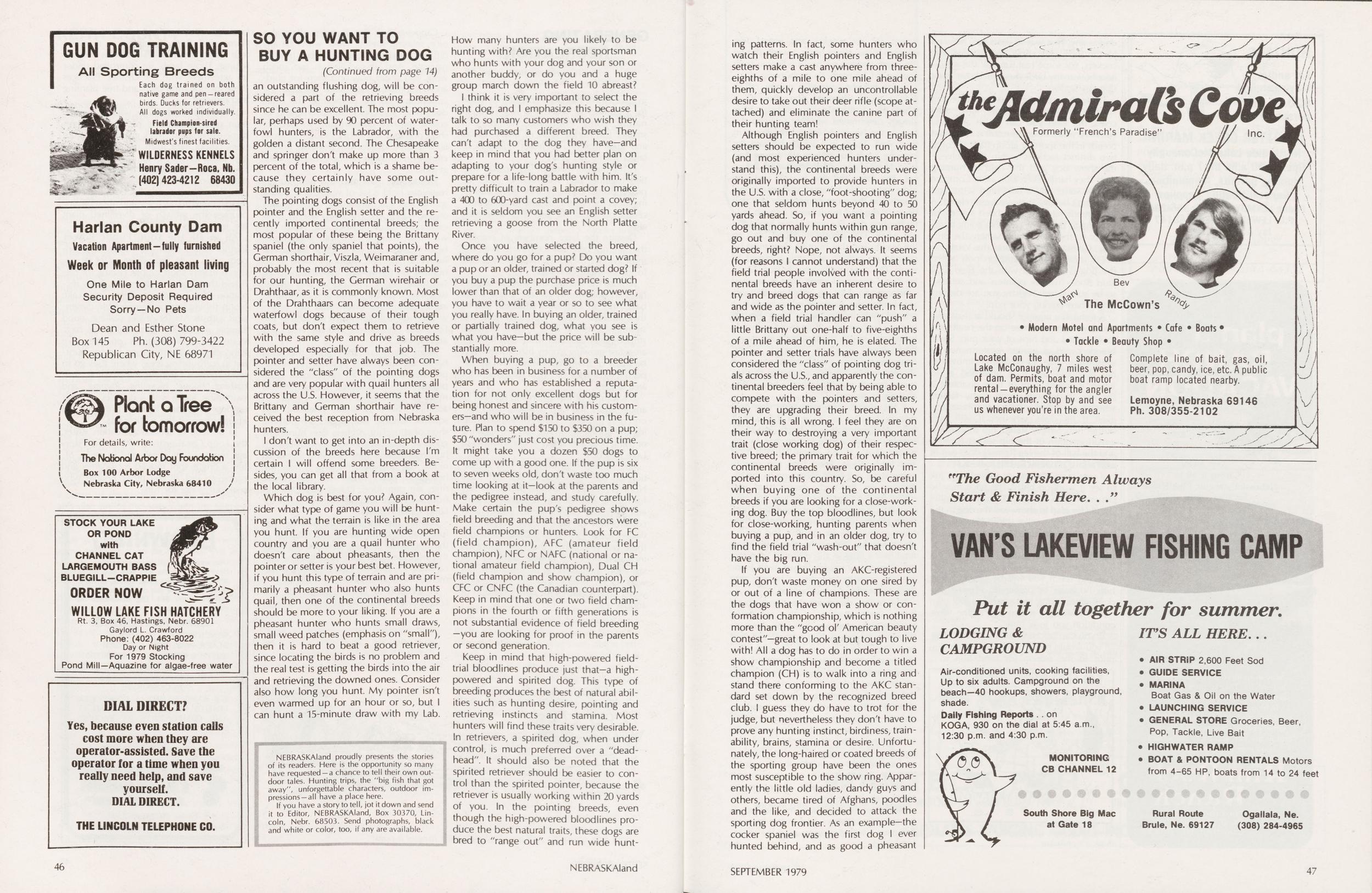
SO YOU WANT TO BUY A HUNTING DOG
(Continued from page 14) an outstanding flushing dog, will be considered a part of the retrieving breeds since he can be excellent. The most popular, perhaps used by 90 percent of waterfowl hunters, is the Labrador, with the golden a distant second. The Chesapeake and springer don't make up more than 3 percent of the total, which is a shame because they certainly have some outstanding qualities.The pointing dogs consist of the English pointer and the English setter and the recently imported continental breeds; the most popular of these being the Brittany spaniel (the only spaniel that points), the German shorthair, Viszla, Weimaraner and, probably the most recent that is suitable for our hunting, the German wirehair or Drahthaar, as it is commonly known. Most of the Drahthaars can become adequate waterfowl dogs because of their tough coats, but don't expect them to retrieve with the same style and drive as breeds developed especially for that job. The pointer and setter have always been considered the "class" of the pointing dogs and are very popular with quail hunters all across the U.S. However, it seems that the Brittany and German shorthair have received the best reception from Nebraska hunters.
I don't want to get into an in-depth discussion of the breeds here because I'm certain I will offend some breeders. Besides, you can get all that from a book at the local library.
Which dog is best for you? Again, consider what type of game you will be hunting and what the terrain is like in the area you hunt. If you are hunting wide open country and you are a quail hunter who doesn't care about pheasants, then the pointer or setter is your best bet. However, if you hunt this type of terrain and are primarily a pheasant hunter who also hunts quail, then one of the continental breeds should be more to your liking. If you are a pheasant hunter who hunts small draws, small weed patches (emphasis on "small"), then it is hard to beat a good retriever, since locating the birds is no problem and the real test is getting the birds into the air and retrieving the downed ones. Consider also how long you hunt. My pointer isn't even warmed up for an hour or so, but I can hunt a 15-minute draw with my Lab. How many hunters are you likely to be hunting with? Are you the real sportsman who hunts with your dog and your son or another buddy, or do you and a huge group march down the field 10 abreast?
I think it is very important to select the right dog, and I emphasize this because I talk to so many customers who wish they had purchased a different breed. They can't adapt to the dog they have-and keep in mind that you had better plan on adapting to your dog's hunting style or prepare for a life-long battle with him. It's pretty difficult to train a Labrador to make a 400 to 600-yard cast and point a covey; and it is seldom you see an English setter retrieving a goose from the North Platte River.
Once you have selected the breed, where do you go for a pup? Do you want a pup or an older, trained or started dog? If you buy a pup the purchase price is much lower than that of an older dog; however, you have to wait a year or so to see what you really have. In buying an older, trained or partially trained dog, what you see is what you have—but the price will be substantially more.
When buying a pup, go to a breeder who has been in business for a number of years and who has established a reputation for not only excellent dogs but for being honest and sincere with his customers—and who will be in business in the future. Plan to spend $150 to $350 on a pup; $50 "wonders" just cost you precious time. It might take you a dozen $50 dogs to come up with a good one. If the pup is six to seven weeks old, don't waste too much time looking at it—look at the parents and the pedigree instead, and study carefully. Make certain the pup's pedigree shows field breeding and that the ancestors were field champions or hunters. Look for FC (field champion), AFC (amateur field champion), NFC or NAFC (national or national amateur field champion), Dual CH (field champion and show champion), or CFC or CNFC (the Canadian counterpart). Keep in mind that one or two field champions in the fourth or fifth generations is not substantial evidence of field breeding —you are looking for proof in the parents or second generation.
Keep in mind that high-powered field-trial bloodlines produce just that-a high- powered and spirited dog. This type of breeding produces the best of natural abilities such as hunting desire, pointing and retrieving instincts and stamina. Most hunters will find these traits very desirable. In retrievers, a spirited dog, when under control, is much preferred over a "deadhead". It should also be noted that the spirited retriever should be easier to control than the spirited pointer, because the retriever is usually working within 20 yards of you. In the pointing breeds, even though the high-powered bloodlines produce the best natural traits, these dogs are bred to "range out" and run wide hunting patterns. In fact, some hunters who watch their English pointers and English setters make a cast anywhere from three-eighths of a mile to one mile ahead of them, quickly develop an uncontrollable desire to take out their deer rifle (scope attached) and eliminate the canine part of their hunting team!
Although English pointers and English setters should be expected to run wide (and most experienced hunters understand this), the continental breeds were originally imported to provide hunters in the U.S. with a close, "foot-shooting" dog; one that seldom hunts beyond 40 to 50 yards ahead. So, if you want a pointing dog that normally hunts within gun range, go out and buy one of the continental breeds, right? Nope, not always. It seems (for reasons I cannot understand) that the field trial people involved with the continental breeds have an inherent desire to try and breed dogs that can range as far and wide as the pointer and setter. In fact, when a field trial handler can "push" a little Brittany out one-half to five-eighths of a mile ahead of him, he is elated. The pointer and setter trials have always been considered the "class" of pointing dog trials across the U.S., and apparently the continental breeders feel that by being able to compete with the pointers and setters, they are upgrading their breed. In my mind, this is all wrong. I feel they are on their way to destroying a very important trait (close working dog) of their respective breed; the primary trait for which the continental breeds were originally imported into this country. So, be careful when buying one of the continental breeds if you are looking for a close-working dog. Buy the top bloodlines, but look for close-working, hunting parents when buying a pup, and in an older dog, try to find the field trial "wash-out" that doesn't have the big run.
If you are buying an AKC-registered pup, don't waste money on one sired by or out of a line of champions. These are the dogs that have won a show or conformation championship, which is nothing more than the "good ol' American beauty contest"-great to look at but tough to live with! All a dog has to do in order to win a show championship and become a titled champion (CH) is to walk into a ring and stand there conforming to the AKC standard set down by the recognized breed club. I guess they do have to trot for the judge, but nevertheless they don't have to prove any hunting instinct, birdiness, train-ability, brains, stamina or desire. Unfortunately, the long-haired or coated breeds of the sporting group have been the ones most susceptible to the show ring. Apparently the little old ladies, dandy guys and others, became tired of Afghans, poodles and the like, and decided to attack the sporting dog frontier. As an example-the cocker spaniel was the first dog I ever hunted behind, and as good a pheasant
NEBRASKAland proudly presents the stories of its readers. Here is the opportunity so many have requested-a chance to tell their own outdoor tales. Hunting trips, the "big fish that got away", unforgettable characters, outdoor impressions-all have a place here. If you have a story to tell, jot it down and send it to Editor, NEBRASKAland, Box 30370, Lincoln, Nebr. 68503. Send photographs, black and white or color, too, if any are available.
dog as any. That was 30 years ago. Now go to the local dog show and observe the cockers. For some real fun, ask the exhibitors how many birds they killed over their dog last season.
These show people have been breeding strictly for looks—especially long, silky coats, the kind you can brush and play with every day. The end result is that most breeds in the sporting group have become two distinct factions within themselves—the show dog and the field or hunting dog! They hardly even look alike. Compare a show setter and a field-bred setter and you won't believe they are even related. A few breeds have thus far been successful in going to the show and also going hunting or to the field trials, namely the Brittany, German shorthair and the Viszla.
CH means field champion only when the dog is registered with the Field Dog Stud Book (usually pointers and setters); so be sure which registry you are dealing with when buying your pup!
A reputable breeder should at least give you a written guarantee on the health (24 to 48 hours) and hips of your pup. Some breeders will guarantee performance or satisfaction. The hip problem is known as hip dysplasia and it is unsettled as to where it comes from or how disabling it can be. It depends upon many factors whether your dog will have dysplasia, and even if he does, whether it will ever bother him. Simply stated, hip dysplasia is a malformation of the hip socket (pelvis); and the ball of the leg (femur) does not fit and rotate properly in the socket.
If you buy a trained or started dog, ask to see it work on birds! The price may be between $750 and $1,500 and the seller should be glad to show you the dog in the field. Also, if the seller thinks you are seriously interested, he will show you how to handle the dog and may let you try to handle it under his guidance. Some sellers will allow you to hunt the dog for a weekend and see if you will be satisfied with him; however, be prepared to pay for the dog before taking him since you will own him if you don't return him in the same condition you took him.
If you can afford to buy a trained dog, all you would have to do is condition him prior to the season (or send him to a trainer for six weeks) and spend five minutes a day, three times a week during the year, working on his obedience; then you would be ready to go hunting.
If you bought yourself a puppy, rather than a more advanced dog, then it's a whole new ball game. You probably have already determined whether to keep the pup in the house or use a kennel run in your yard. There is a lot to be said for keeping a hunting dog in the house and making him your companion and house pet. The more the dog is with you, the more he is able to anticipate your commands and the more compatible you will be, with the end result being a much better hunting dog. For years I have heard the old wives' tale (probably dating back to the Mayflower) that hunting dogs must be penned up outside and only released to work. The opposite is actually true. Don't be like a friend of mine who is an avid outdoorsman with an excellent Brittany. He keeps the Brittany outside and a poodle (which has never been house-broken) in the house. If he could convince his wife to switch the dogs around, everybody would be much better off. Sometimes the pointing breeds tend to be a bit "hyper" in the house, but any of the retriever breeds makes as good a house dog as there is around.
If you decide to kennel your dog outside, be sure he has a shelter that is draft free, dry, and provides ample shade in summer. With a little prairie hay in the winter, that's all he needs besides food and fresh water. Feed him top quality commercial dog food according to the directions on the sack, except that you might have to vary the amount to keep your dog at proper weight. Feed him three times per day up to age four months, then twice a day until six months, and once a day thereafter. When hunting him hard, feed him a little in the morning, at noon, and then give a full feeding at night (contrary to popular opinion, a hungry dog does not make a good hunter).
I hope this discussion has given you a better understanding of the numerous hunting dogs available, how the different breeds can be expected to perform, and how they relate to various hunting situations and conditions. Bear in mind that my discussion of the several breeds in this article refers only to their performance in the field, their hunting abilities and their general utility as sporting dogs. I purposely did not mention breed conformation because our primary concern here was in obtaining a hunting companion; not the length of that companion's coat, shape of its head, height or weight. If you want a dog for hunting, your primary concern should be if it is capable of performing adequately in the field.
Next month I'll explain my techniques for training retrievers, and in the November issue I will discuss training the pointing breeds.
"One thing sure, whatever he scented, I don't think it's pheasant."
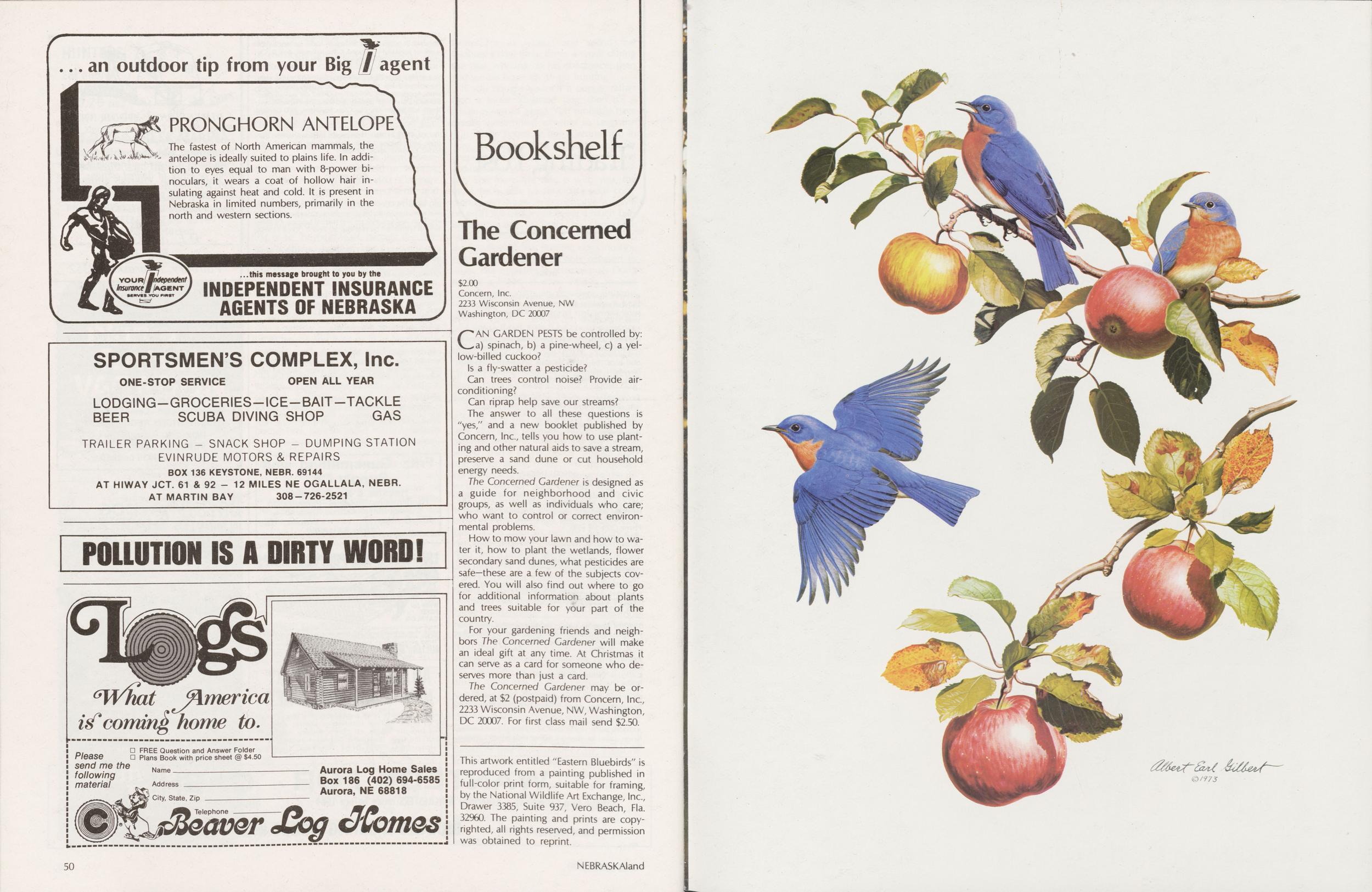
Bookshelf
The Concerned Gardener
$2.00 Concern, Inc. 2233 Wisconsin Avenue, NW Washington, DC 20007CAN GARDEN PESTS be controlled by: a) spinach, b) a pine-wheel, c) a yellow-billed cuckoo?
Is a fly-swatter a pesticide?
Can trees control noise? Provide air-conditioning?
Can riprap help save our streams?
The answer to all these questions is "yes," and a new booklet published by Concern, Inc, tells you how to use planting and other natural aids to save a stream, preserve a sand dune or cut household energy needs.
The Concerned Gardener is designed as a guide for neighborhood and civic groups, as well as individuals who care; who want to control or correct environmental problems.
How to mow your lawn and how to water it, how to plant the wetlands, flower secondary sand dunes, what pesticides are safe-these are a few of the subjects covered. You will also find out where to go for additional information about plants and trees suitable for your part of the country.
For your gardening friends and neighbors The Concerned Gardener will make an ideal gift at any time. At Christmas it can serve as a card for someone who deserves more than just a card.
The Concerned Gardener may be ordered, at $2 (postpaid) from Concern, Inc., 2233 Wisconsin Avenue, NW, Washington, DC 20007. For first class mail send $2.50.
This artwork entitled "Eastern Bluebirds" is reproduced from a painting published in full-color print form, suitable for framing, by the National Wildlife Art Exchange, Inc, Drawer 3385, Suite 937, Vero Beach, Fla. 32960. The painting and prints are copyrighted, all rights reserved, and permission was obtained to reprint.
Position: 341 (27 views)