Volume 57, Issue 8, 1979
NEBRASKAland
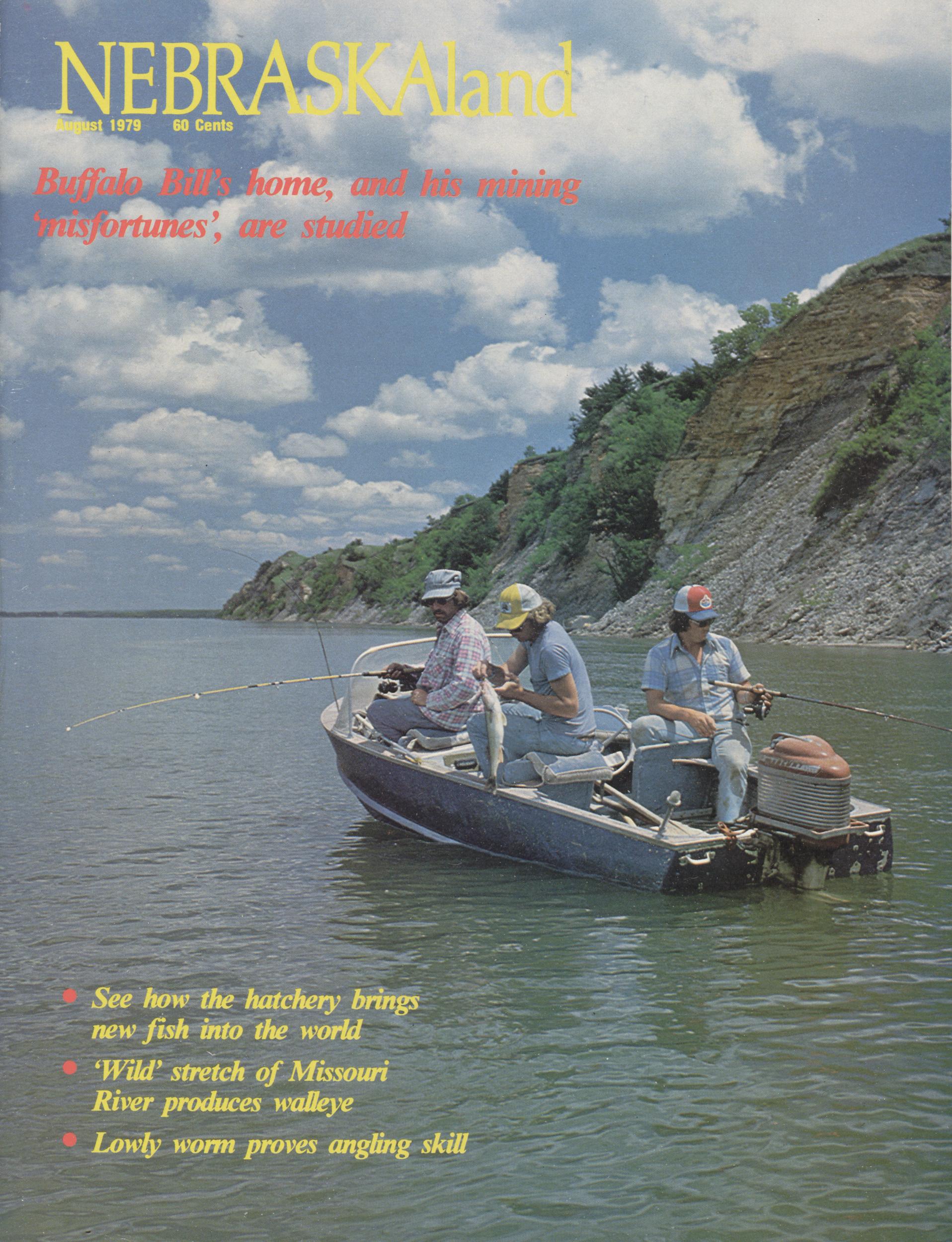
August 1979 60 Cents Buffalo Bill's home, and his mining 'misfortunes', are studied"Wild" stretch of Missouri River produces wakeye
Lowly worm proves angling ski
NEBRASKAland
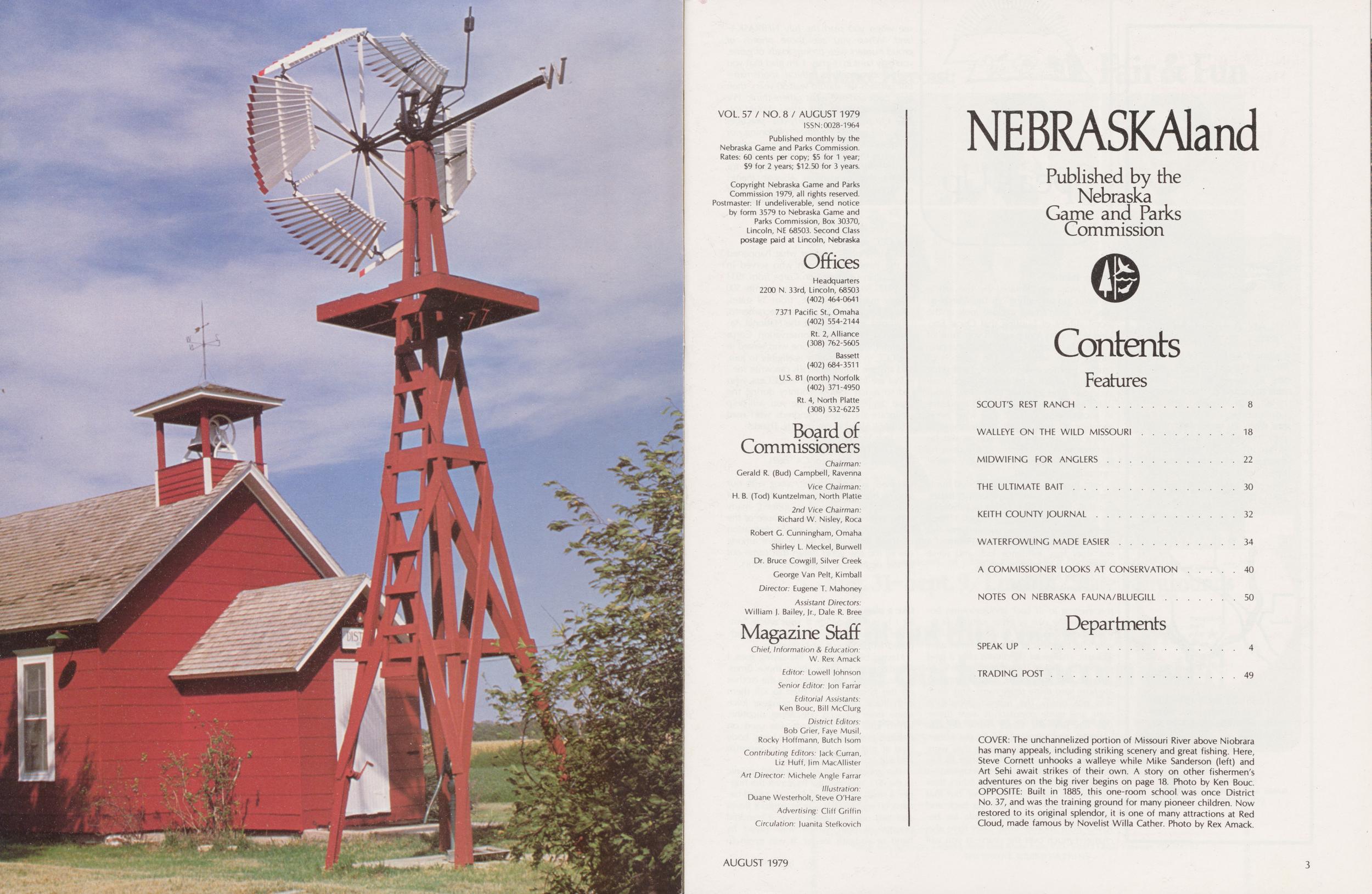
Published by the Nebraska Game and Parks Commission Contents Features SCOUT'S REST RANCH 8 WALLEYE ON THE WILD MISSOURI 18 MIDWIFING FOR ANGLERS 22 THE ULTIMATE BAIT 30 KEITH COUNTY JOURNAL 32 WATERFOWLING MADE EASIER 34 A COMMISSIONER LOOKS AT CONSERVATION 40 NOTES ON NEBRASKA FAUNA/BLUEGILL 50 Departments SPEAK UP 4 TRADING POST 49COVER: The unchanneiized portion of Missouri River above Niobrara has many appeals, including striking scenery and great fishing. Here, Steve Cornett unhooks a walleye while Mike Sanderson (left) and Art Sehi await strikes of their own. A story on other fishermen's adventures on the big river begins on page 18. Photo by Ken Bouc. OPPOSITE: Built in 1885, this one-room school was once District No. 37, and was the training ground for many pioneer children. Now restored to its original splendor, it is one of many attractions at Red Cloud, made famous by Novelist Willa Cather. Photo by Rex Amack.
FINEST FACILITY OF
ITS KIND IN THE
ENTIRE MIDWEST
Ak-Sar-Ben
Aquarium
PLAN A VISIT NOW
FREE ADMISSION
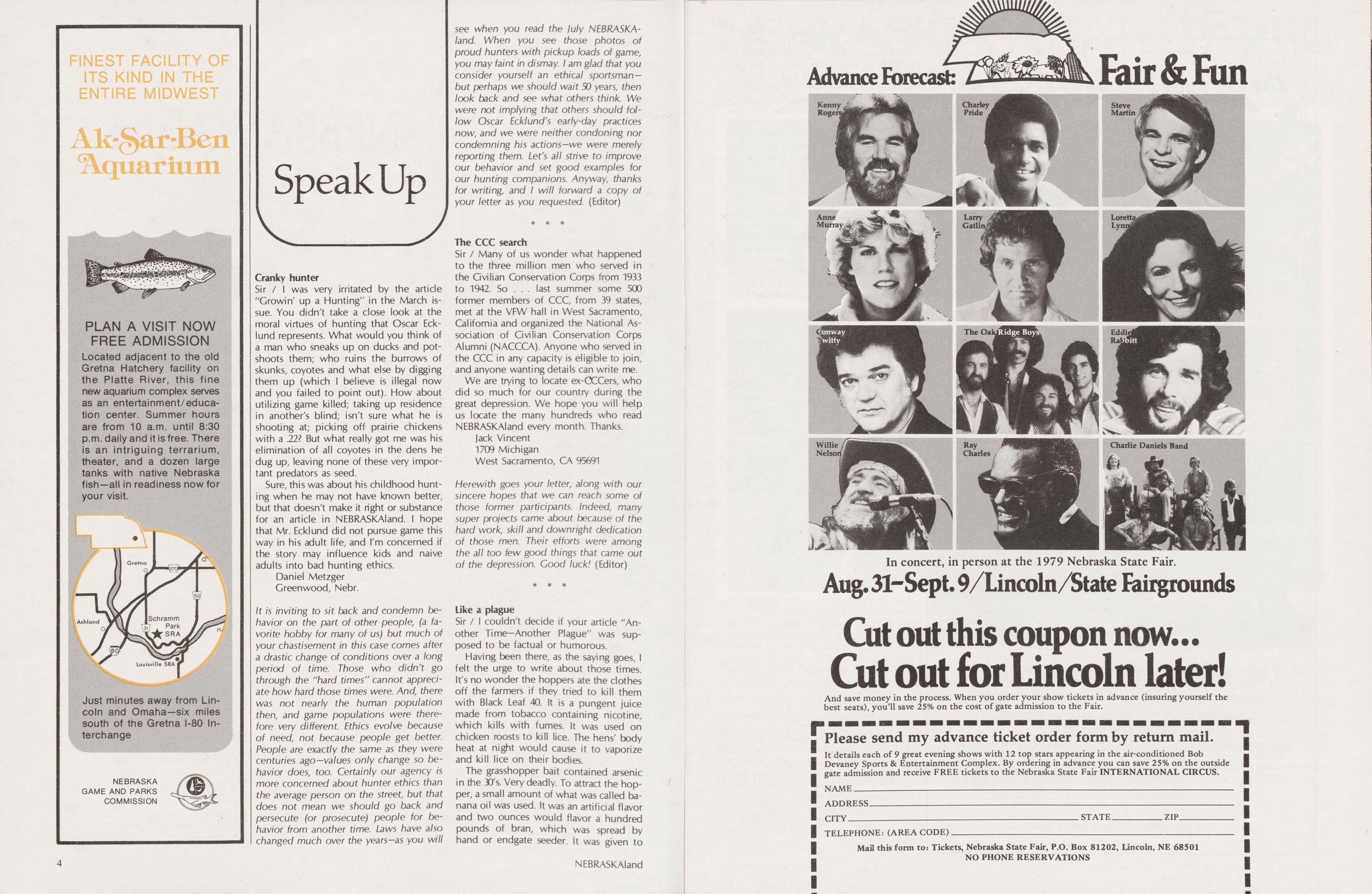
Located adjacent to the old Gretna Hatchery facility on the Platte River, this fine new aquarium complex serves as an entertainment/education center. Summer hours are from 10 a.m. until 8:30 p.m. daily and it is free. There is an intriguing terrarium, theater, and a dozen large tanks with native Nebraska fish—all in readiness now for your visit.
Just minutes away from Lincoln and Omaha—six miles south of the Gretna I-80 Interchange
NEBRASKA GAME AND PARKS COMMISSIONSpeak Up
Cranky hunterSir / I was very irritated by the article "Growing up a Hunting'' in the March issue. You didn't take a close look at the moral virtues of hunting that Oscar Ecklund represents. What would you think of a man who sneaks up on ducks and pot-shoots them; who ruins the burrows of skunks, coyotes and what else by digging them up (which I believe is illegal now and you failed to point out). How about utilizing game killed; taking up residence in another's blind; isn't sure what he is shooting at; picking off prairie chickens with a .22? But what really got me was his elimination of all coyotes in the dens he dug up, leaving none of these very important predators as seed.
Sure, this was about his childhood hunting when he may not have known better, but that doesn't make it right or substance for an article in NEBRASKAland. I hope that Mr. Ecklund did not pursue game this way in his adult life, and I'm concerned if the story may influence kids and naive adults into bad hunting ethics.
Daniel Metzger Greenwood, Nebr.It is inviting to sit back and condemn behavior on the part of other people, (a favorite hobby for many of us) but much of your chastisement in this case comes after a drastic change of conditions over a long period of time. Those who didn't go through the "hard times" cannot appreciate how hard those times were. And, there was not nearly the human population then, and game populations were therefore very different. Ethics evolve because of need, not because people get better. People are exactly the same as they were centuries ago—values only change so behavior does, too. Certainly our agency is more concerned about hunter ethics than the average person on the street, but that does not mean we should go back and persecute (or prosecute) people for behavior from another time. Laws have also changed much over the years—as you will see when you read the July NEBRASKAland. When you see those photos of proud hunters with pickup loads of game, you may faint in dismay. I am glad that you consider yourself an ethical sportsman—but perhaps we should wait 50 years, then look back and see what others think. We were not implying that others should follow Oscar Ecklund's early-day practices now, and we were neither condoning nor condemning his actions—we were merely reporting them. Let's all strive to improve our behavior and set good examples for our hunting companions. Anyway, thanks for writing, and I will forward a copy of your letter as you requested. (Editor)
The CCC searchSir / Many of us wonder what happened to the three million men who served in the Civilian Conservation Corps from 1933 to 1942. So... last summer some 500 former members of CCC, from 39 states, met at the VFW hall in West Sacramento, California and organized the National Association of Civilian Conservation Corps Alumni (NACCCA). Anyone who served in the CCC in any capacity is eligible to join, and anyone wanting details can write me. We are trying to locate ex-CCCers, who did so much for our country during the great depression. We hope you will help us locate the many hundreds who read NEBRASKAland every month. Thanks.
Jack Vincent 1709 Michigan West Sacramento, CA 95691Herewith goes your letter, along with our sincere hopes that we can reach some of those former participants. Indeed, many super projects came about because of the hard work, skill and downright dedication of those men. Their efforts were among the all too few good things that came out of the depression. Good luck! (Editor)
Like a plagueSir / I couldn't decide if your article "Another Time—Another Plague" was supposed to be factual or humorous.
Having been there, as the saying goes, I felt the urge to write about those times. It's no wonder the hoppers ate the clothes off the farmers if they tried to kill them with Black Leaf 40. It is a pungent juice made from tobacco containing nicotine, which kills with fumes. It was used on chicken roosts to kill lice. The hens' body heat at night would cause it to vaporize and kill lice on their bodies.
The grasshopper bait contained arsenic in the 30"s. Very deadly. To attract the hopper, a small amount of what was called banana oil was used. It was an artificial flavor and two ounces would flavor a hundred pounds of bran, which was spread by hand or endgate seeder. It was given to
Advance Forecast: Fair & Fun
Kenny Rogers
farmers free of charge by the government, and dispensed by township boards. It would have helped if gotten to them by early spring, but it was too little too late.
A couple of unrelated side notes. This bait was still killing cows two years ago. A barn blew down at a neighbor's, and a long-forgotten bag stored in the hay mow was eaten by animals. Many horses and cows were killed by discouraged or lazy farmers back then who would get the bait because it was free, take it home and not spread it. They would store it in a shed, and sooner or later some hungry animal would find it and the arsenic would do its job.
I am a farmer and member of the Lewis and Clark board of directors. I have an uneasy feeling I may see this plague once more in my lifetime, and by the way, in my area the hoppers only moved when the wind was in the northwest as they seemed to know they were heading for a higher rainfall area where food would be more abundant.
Donovan Jungclaus Crofton, Nebr.Thanks for the interesting letter. I hope you are wrong about your feeling of impending plague, but it is amazing how most people have forgotten all those bad times, and have erased all the good things that counteracted the drought. It is promising to find more and more interest in non-chemical farming, but tree planting, crop rotation, cover planting, terracing—all those things are a rarity now. And last summer certainly had grasshopper plagues in many areas. Let's keep plugging away, and perhaps things will get better. (Editor)
A kind thanksSir / Thank you for the publication of "Sandhills River Country (November 1978 NEBRASKAland). The Broken Bow Chamber of Commerce had the opportunity to share in the planning of the publication, and now to share the results.
Many area people have asked for the brochure... one for themselves and one to send to a relative or friend in another state or country. What a wonderful way to publicize the "Good Life" in the heart of Nebraska, around the world.
Corrinne Pedersen, exec. vice-president Broken Bow Chamber of CommerceFor those readers not aware of it, the center section of the November 1978 issue contained a spread on the Sandhills which was later left on the press and run as a 16-page brochure used for tourism purposes by Region 26. Hopefully it will serve to bring some attention to this very scenic and productive land of rivers and valleys in central Nebraska. Thank you Corrinne (Editor)
6 NEBRASKAlandNEBRASKAS STATE PARKS TAKE ADVANTAGE OF US THROUGHOUT THE YEAR
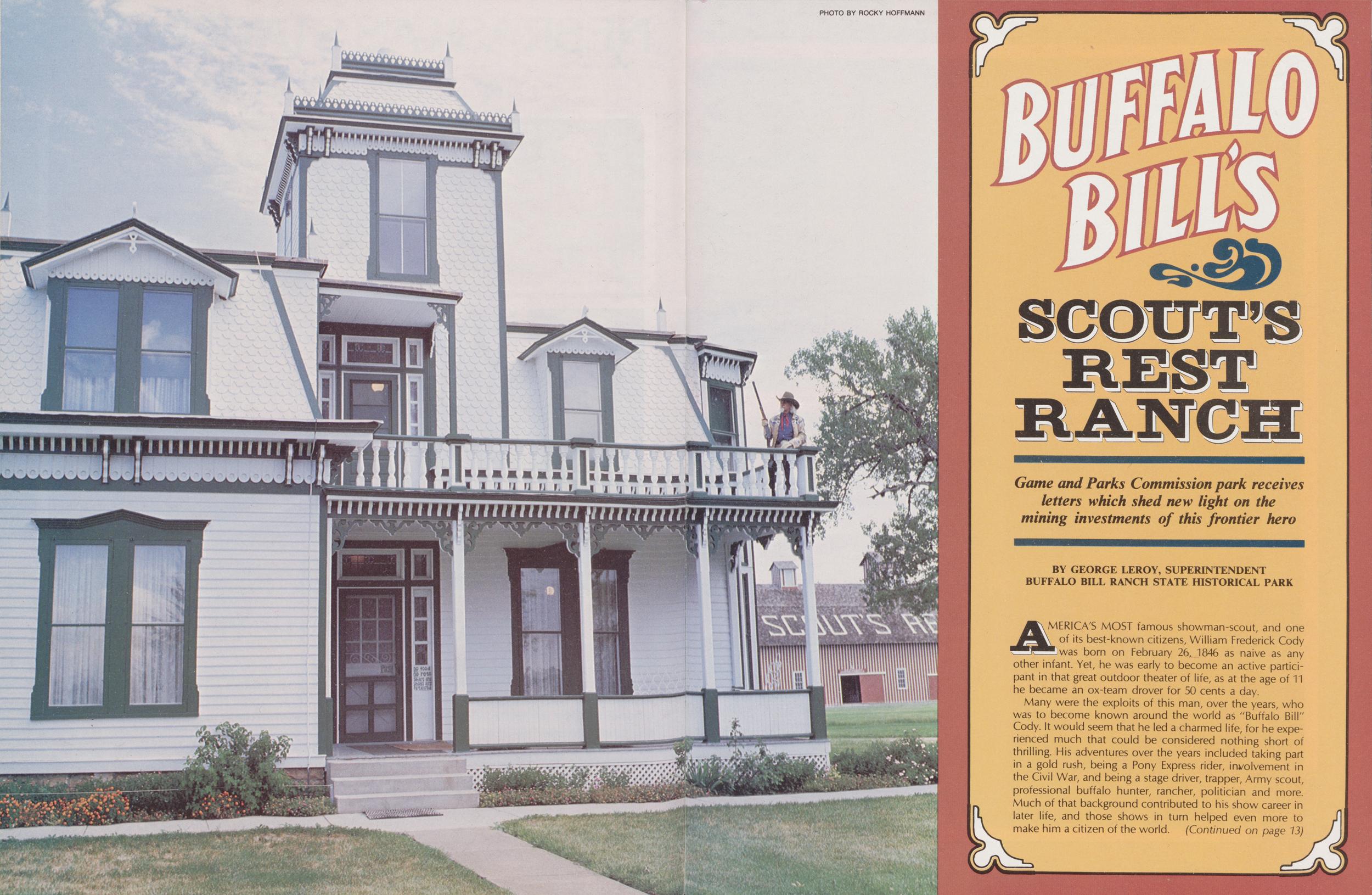
Buffalo Bill's Scout's Rest Ranch
Game and Parks Commission park receives letters which shed new light on the mining investments of this frontier hero
AMERICA'S MOST famous showman-scout, and one of its best-known citizens, William Frederick Cody was born on February 26, 1846 as naive as any other infant. Yet, he was early to become an active participant in that great outdoor theater of life, as at the age of 11 he became an ox-team drover for 50 cents a day.
Many were the exploits of this man, over the years, who was to become known around the world as "Buffalo Bill" Cody. It would seem that he led a charmed life, for he experienced much that could be considered nothing short of thrilling. His adventures over the years included taking part in a gold rush, being a Pony Express rider, involvement in the Civil War, and being a stage driver, trapper, Army scout, professional buffalo hunter, rancher, politician and more. Much of that background contributed to his show career in later life, and those shows in turn helped even more to make him a citizen of the world. (Continued on page 13)
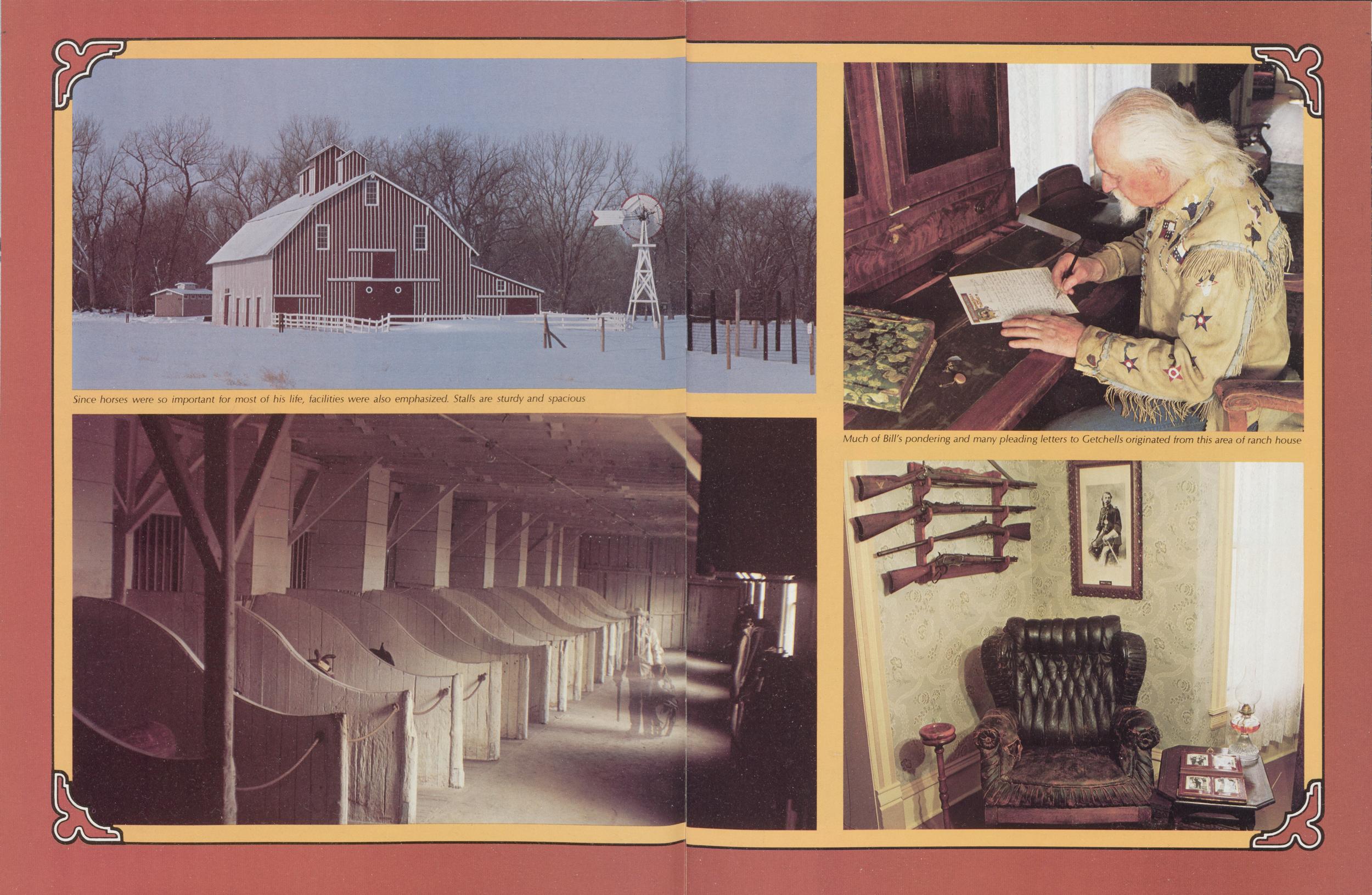
Since horses were so important for most of his life, facilities were also emphasized. Stalls are sturdy and spacious
Much of Bill's pondering and many pleading letters to Getchells originated from this area of ranch house
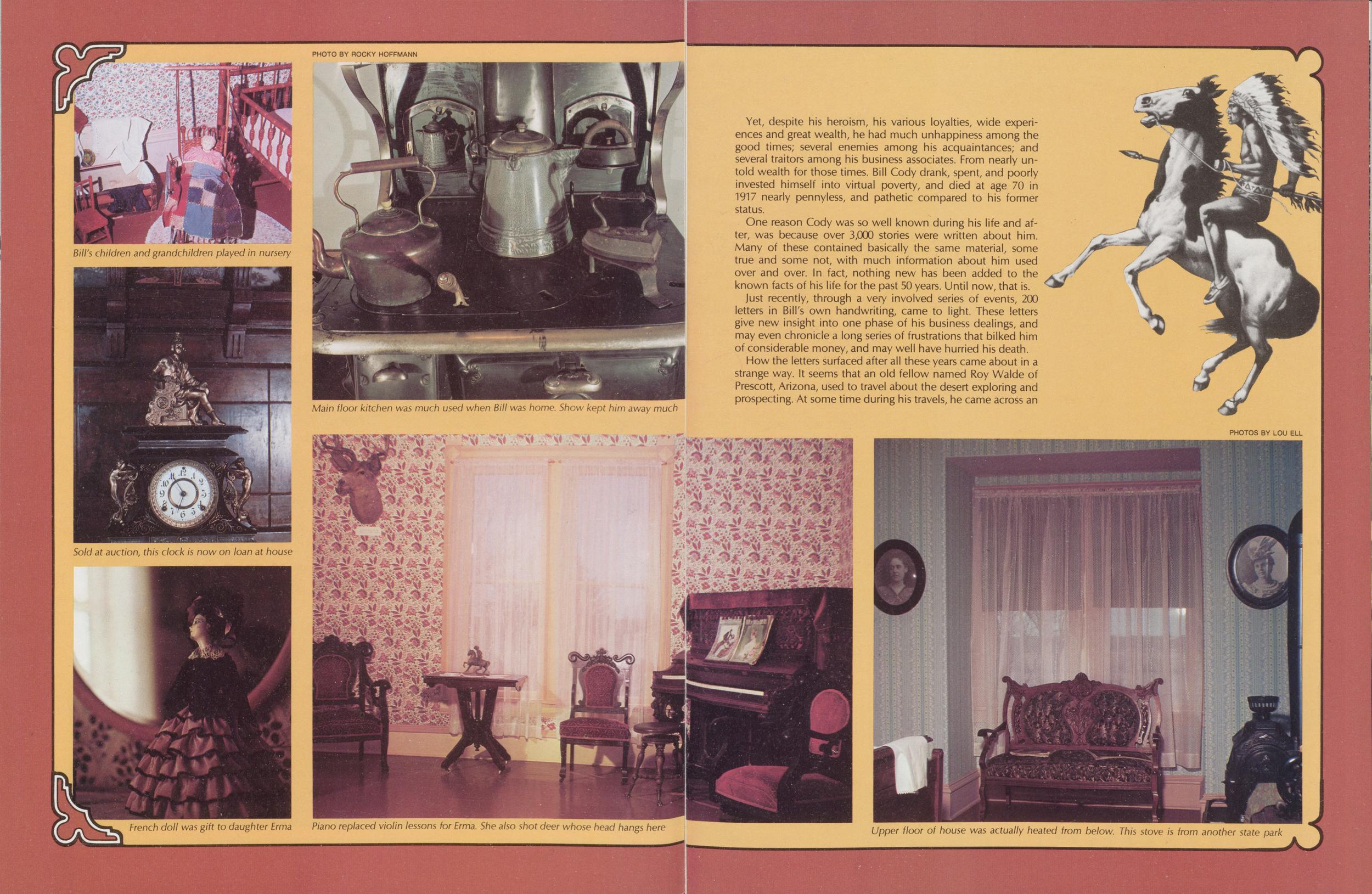
Bills children and grandchildren played in nursery
Sold at auction, this clock is now on loan at house
French doll was gift to daughter Erma
Main floor kitchen was much used when Bill was home. Show kept him away much
Piano replaced violin lessons for Erma. She also shot deer whose head hangs here
Upper floor of house was actually heated from below. This stove is from another state park
Yet, despite his heroism, his various loyalties, wide experiences and great wealth, he had much unhappiness among the good times; several enemies among his acquaintances; and several traitors among his business associates. From nearly untold wealth for those times. Bill Cody drank, spent, and poorly invested himself into virtual poverty, and died at age 70 in 1917 nearly pennyless, and pathetic compared to his former status.
One reason Cody was so well known during his life and after, was because over 3,000 stories were written about him. Many of these contained basically the same material, some true and some not, with much information about him used over and over. In fact, nothing new has been added to the known facts of his life for the past 50 years. Until now, that is.
Just recently, through a very involved series of events, 200 letters in Bill's own handwriting, came to light. These letters give new insight into one phase of his business dealings, and may even chronicle a long series of frustrations that bilked him of considerable money, and may well have hurried his death.
How the letters surfaced after all these years came about in a strange way. It seems that an old fellow named Roy Walde of Prescott, Arizona, used to travel about the desert exploring and prospecting. At some time during his travels, he came across anold mine, apparently once among the many that Bill Cody had financial interests in.
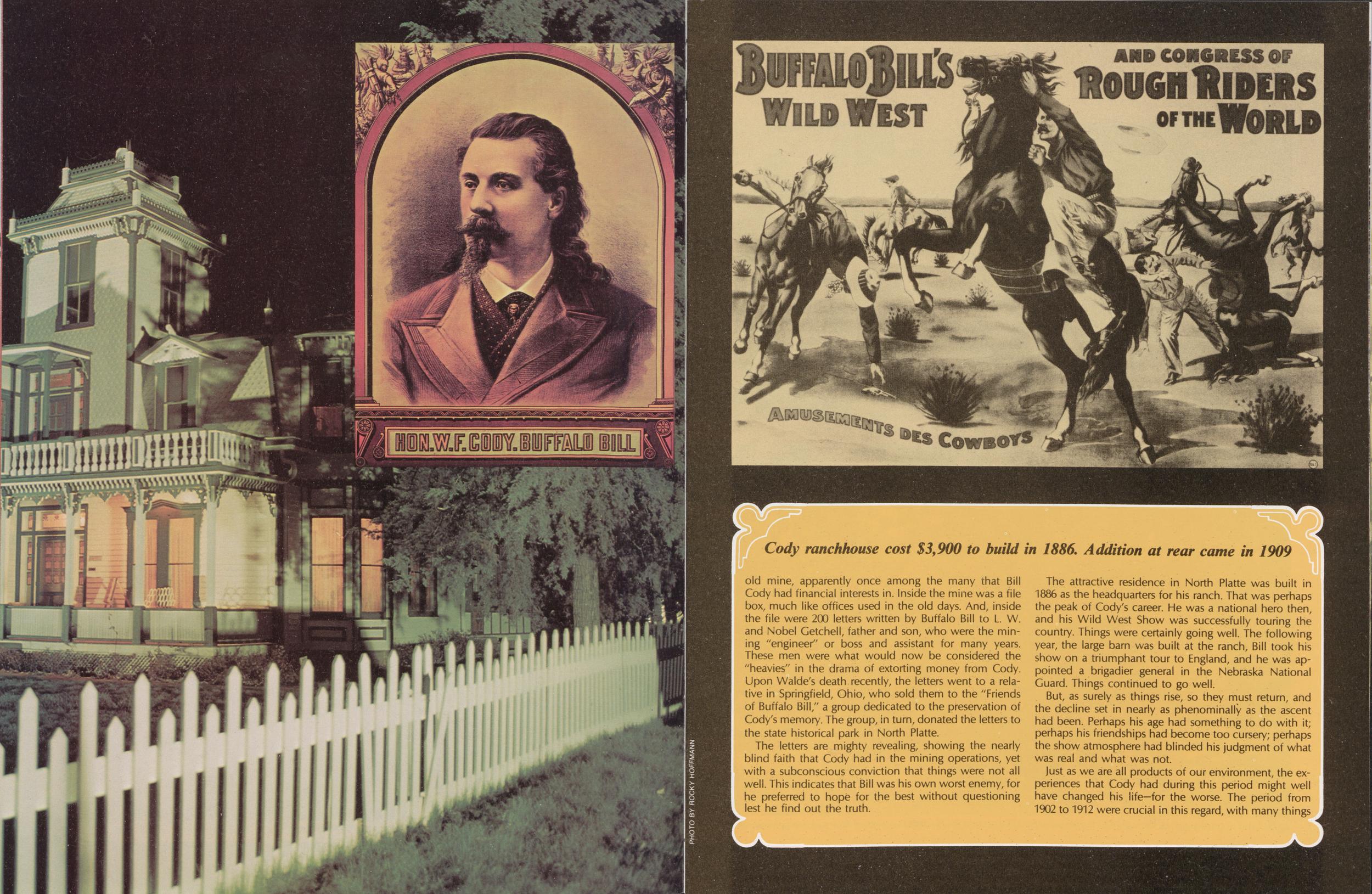
Inside the mine was a file box, much like offices used in the old days. And, inside the file were 200 letters written by Buffalo Bill to L W. and Nobel Getchell, father and son, who were the mining "engineer" or boss and assistant for many years. These men were what would now be considered the "heavies" in the drama of extorting money from Cody. Upon Walde's death recently, the letters went to a relative in Springfield, Ohio, who sold them to the "Friends of Buffalo Bill," a group dedicated to the preservation of Cody's memory. The group, in turn, donated the letters to the state historical park in North Platte.
The letters are mighty revealing, showing the nearly blind faith that Cody had in the mining operations, yet with a subconscious conviction that things were not all well. This indicates that Bill was his own worst enemy, for he preferred to hope for the best without questioning lest he find out the truth.
The attractive residence in North Platte was built in 1886 as the headquarters for his ranch. That was perhaps the peak of Cody's career. He was a national hero then, and his Wild West Show was successfully touring the country. Things were certainly going well. The following year, the large barn was built at the ranch, Bill took his show on a triumphant tour to England, and he was appointed a brigadier general in the Nebraska National Guard. Things continued to go well.
But, as surely as things rise, so they must return, and the decline set in nearly as phenominally as the ascent had been. Perhaps his age had something to do with it; perhaps his friendships had become too cursery; perhaps the show atmosphere had blinded his judgment of what was real and what was not.
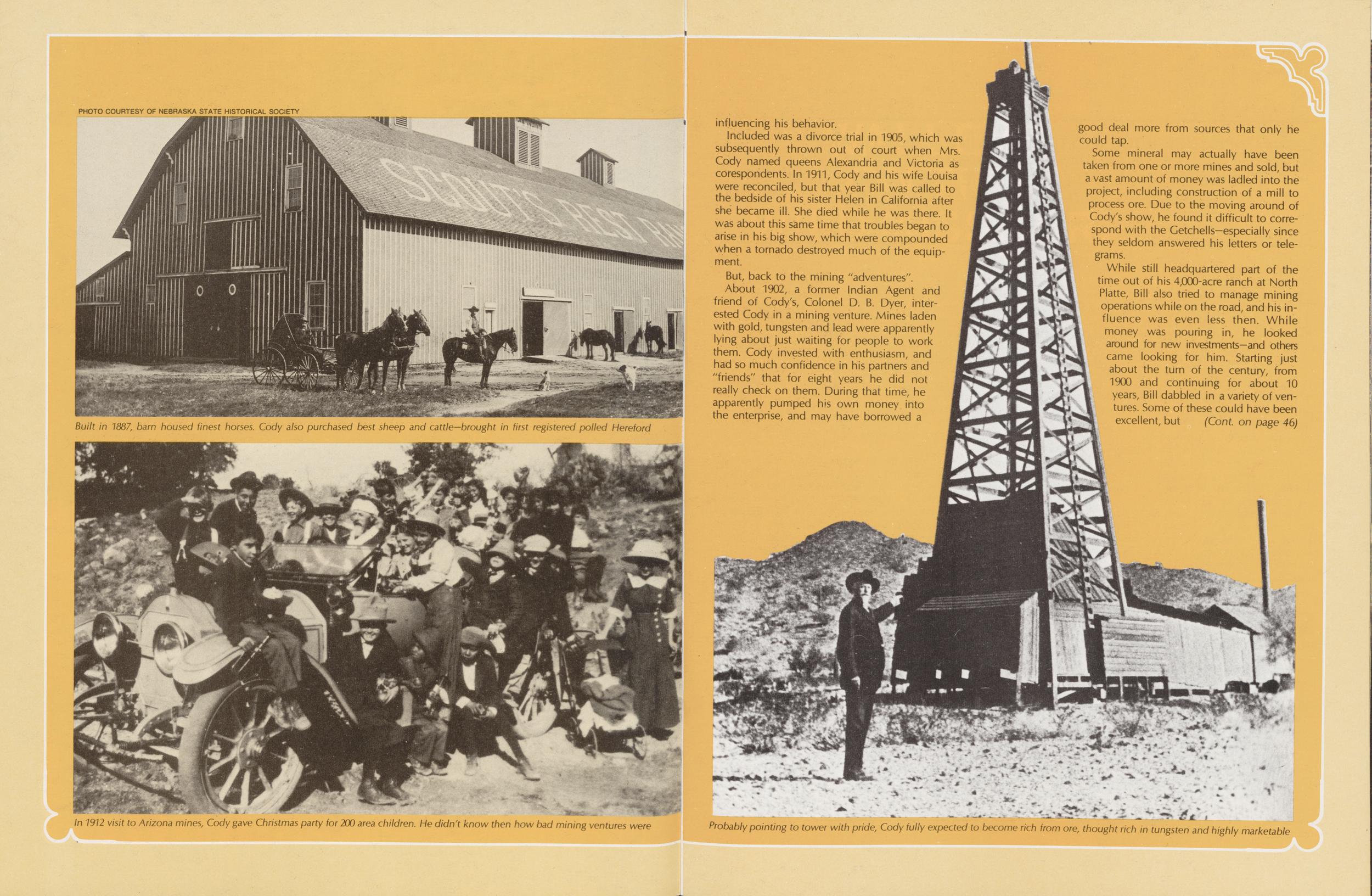
Built in 1887, barn housed finest horses. Cody also purchased best sheep and cattle-brought in first registered polled Hereford
In 1912 visit to Arizona mines, Cody gave Christmas party for 200 area children. He didn't know then how bad mining ventures were
Included was a divorce trial in 1905, which was subsequently thrown out of court when Mrs. Cody named queens Alexandria and Victoria as corespondents. In 1911, Cody and his wife Louisa were reconciled, but that year Bill was called to the bedside of his sister Helen in California after she became ill. She died while he was there. It was about this same time that troubles began to arise in his big show, which were compounded when a tornado destroyed much of the equipment.
But, back to the mining "adventures".
About 1902, a former Indian Agent and friend of Cody's, Colonel D. B. Dyer, interested Cody in a mining venture. Mines laden with gold, tungsten and lead were apparently lying about just waiting for people to work them. Cody invested with enthusiasm, and had so much confidence in his partners and "friends" that for eight years he did not really check on them. During that time, he apparently pumped his own money into the enterprise, and may have borrowed a good deal more from sources that only he could tap.
Some mineral may actually have been taken from one or more mines and sold, but a vast amount of money was ladled into the project, including construction of a mill to process ore. Due to the moving around of Cody's show, he found it difficult to correspond with the Getchells—especially since they seldom answered his letters or telegrams.
While still headquartered part of the time out of his 4,000-acre ranch at North Platte, Bill also tried to manage mining operations while on the road, and his influence was even less then. While money was pouring in, he looked around for new investments—and others came looking for him. Starting just about the turn of the century, from 1900 and continuing for about 10 years, Bill dabbled in a variety of ventures. Some of these could have been excellent, but (Cont. on page 46)
Probably pointing to tower with pride, Cody fully expected to become rich from ore, thought rich in tungsten and highly marketable
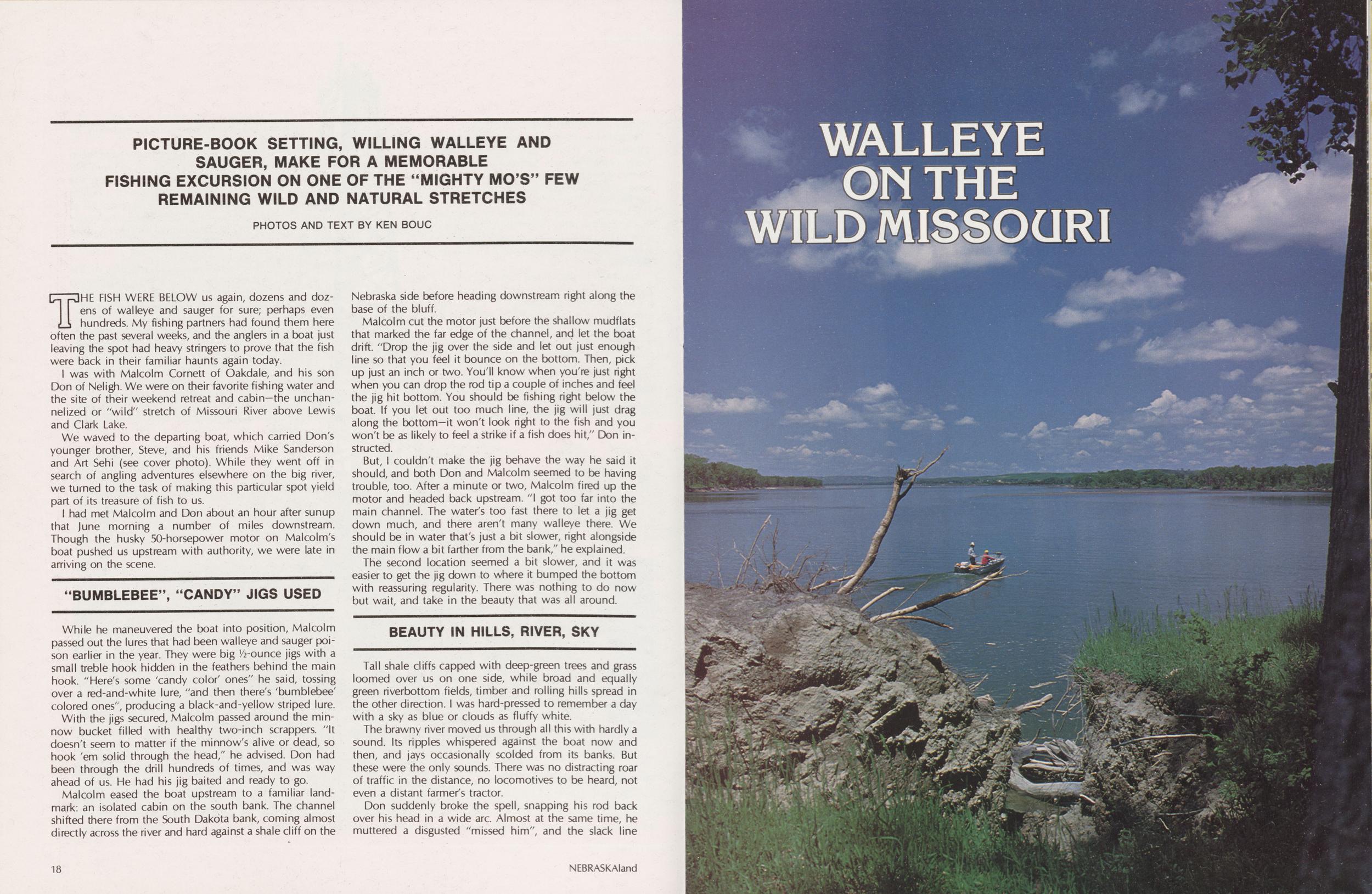
Walleye on the Wild Missouri
PICTURE-BOOK SETTING, WILLING WALLEYE AND SAUGER, MAKE FOR A MEMORABLE FISHING EXCURSION ON ONE OF THE "MIGHTY MO'S" FEW REMAINING WILD AND NATURAL STRETCHES
THE FISH WERE BELOW us again, dozens and dozens of walleye and sauger for sure; perhaps even hundreds. My fishing partners had found them here often the past several weeks, and the anglers in a boat just leaving the spot had heavy stringers to prove that the fish were back in their familiar haunts again today.
I was with Malcolm Cornett of Oakdale, and his son Don of Neligh. We were on their favorite fishing water and the site of their weekend retreat and cabin—the unchannelized or "wild" stretch of Missouri River above Lewis and Clark Lake.
We waved to the departing boat, which carried Don's younger brother, Steve, and his friends Mike Sanderson and Art Sehi (see cover photo). While they went off in search of angling adventures elsewhere on the big river, we turned to the task of making this particular spot yield part of its treasure of fish to us.
I had met Malcolm and Don about an hour after sunup that June morning a number of miles downstream. Though the husky 50-horsepower motor on Malcolm's boat pushed us upstream with authority, we were late in arriving on the scene.
"BUMBLEBEE", "CANDY" JIGS USEDWhile he maneuvered the boat into position, Malcolm passed out the lures that had been walleye and sauger poison earlier in the year. They were big 1/2-ounce jigs with a small treble hook hidden in the feathers behind the main hook. "Here's some 'candy color' ones" he said, tossing over a red-and-white lure, "and then there's 'bumblebee' colored ones", producing a black-and-yellow striped lure.
With the jigs secured, Malcolm passed around the minnow bucket filled with healthy two-inch scrappers. "It doesn't seem to matter if the minnow's alive or dead, so hook 'em solid through the head," he advised. Don had been through the drill hundreds of times, and was way ahead of us. He had his jig baited and ready to go.
Malcolm eased the boat upstream to a familiar landmark: an isolated cabin on the south bank. The channel shifted there from the South Dakota bank, coming almost directly across the river and hard against a shale cliff on the Nebraska side before heading downstream right along the base of the bluff.
Malcolm cut the motor just before the shallow mudflats that marked the far edge of the channel, and let the boat drift. "Drop the jig over the side and let out just enough line so that you feel it bounce on the bottom. Then, pick up just an inch or two. You'll know when you're just right when you can drop the rod tip a couple of inches and feel the jig hit bottom. You should be fishing right below the boat. If you let out too much line, the jig will just drag along the bottom—it won't look right to the fish and you won't be as likely to feel a strike if a fish does hit," Don instructed.
But, I couldn't make the jig behave the way he said it should, and both Don and Malcolm seemed to be having trouble, too. After a minute or two, Malcolm fired up the motor and headed back upstream. "I got too far into the main channel. The water's too fast there to let a jig get down much, and there aren't many walleye there. We should be in water that's just a bit slower, right alongside the main flow a bit farther from the bank," he explained.
The second location seemed a bit slower, and it was easier to get the jig down to where it bumped the bottom with reassuring regularity. There was nothing to do now but wait, and take in the beauty that was all around.
BEAUTY IN HILLS, RIVER, SKYTall shale cliffs capped with deep-green trees and grass loomed over us on one side, while broad and equally green riverbottom fields, timber and rolling hills spread in the other direction. I was hard-pressed to remember a day with a sky as blue or clouds as fluffy white.
The brawny river moved us through all this with hardly a sound. Its ripples whispered against the boat now and then, and jays occasionally scolded from its banks. But these were the only sounds. There was no distracting roar of traffic in the distance, no locomotives to be heard, not even a distant farmer's tractor.
Don suddenly broke the spell, snapping his rod back over his head in a wide arc. Almost at the same time, he muttered a disgusted "missed him", and the slack line drifting down around his shoulders verified a vacant hook.
18 NEBRASKAland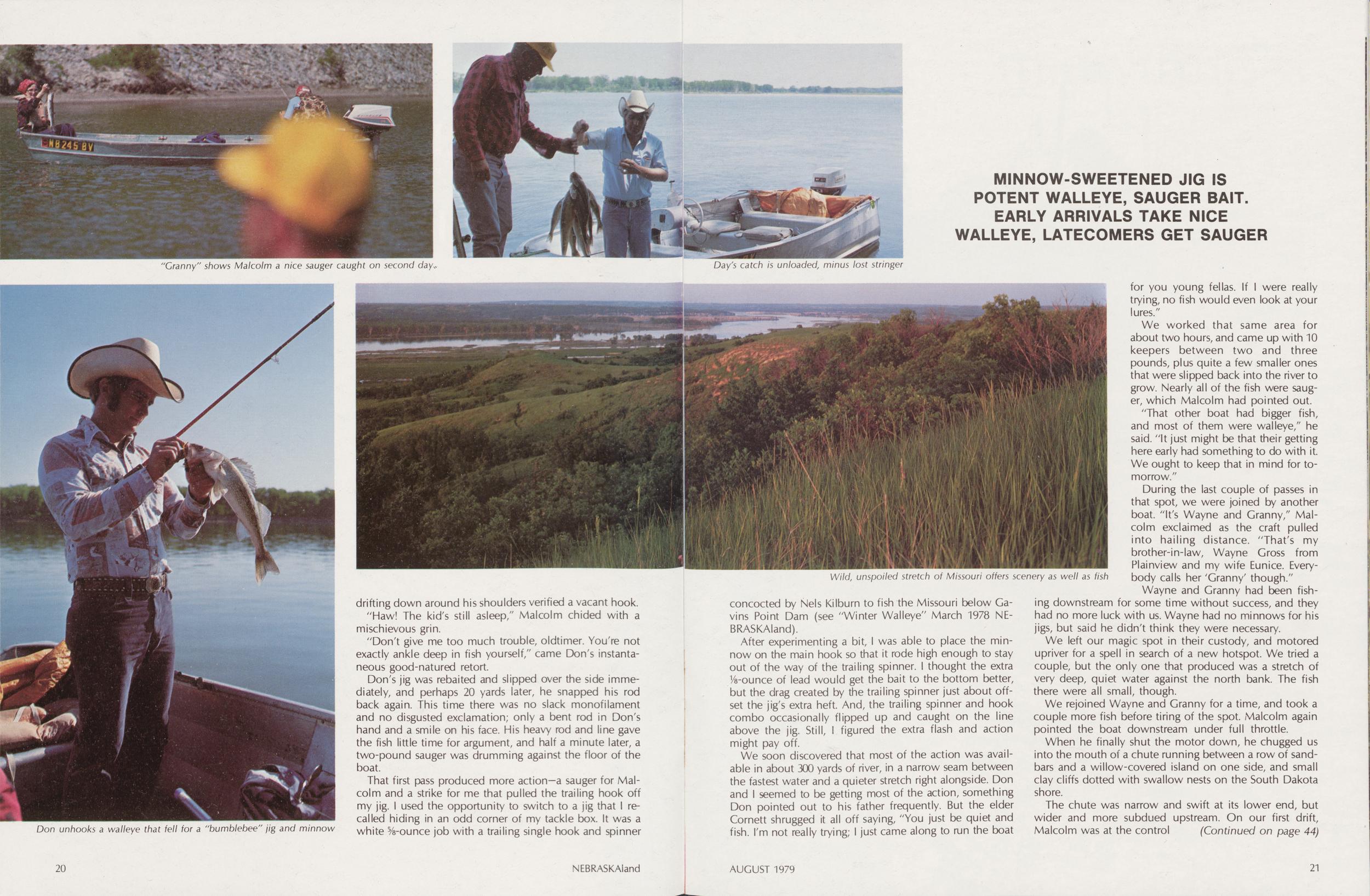 MINNOW-SWEETENED JIG IS
POTENT WALLEYE, SAUGER BAIT.
EARLY ARRIVALS TAKE NICE
WALLEYE, LATECOMERS GET SAUGER
MINNOW-SWEETENED JIG IS
POTENT WALLEYE, SAUGER BAIT.
EARLY ARRIVALS TAKE NICE
WALLEYE, LATECOMERS GET SAUGER
'Granny" shows Malcolm a nice sauger caught on second day,
Day's catch is unloaded, minus lost stringer
Don unhooks a walleye that fell for a "bumblebee" jig and minnow
Wild, unspoiled stretch of Missouri offers scenery as well as fish
"Haw! The kid's still asleep," Malcolm chided with a mischievous grin.
"Don't give me too much trouble, oldtimer. You're not exactly ankle deep in fish yourself," came Don's instantaneous good-natured retort.
Don's jig was rebaited and slipped over the side immediately, and perhaps 20 yards later, he snapped his rod back again. This time there was no slack monofilament and no disgusted exclamation; only a bent rod in Don's hand and a smile on his face. His heavy rod and line gave the fish little time for argument, and half a minute later, a two-pound sauger was drumming against the floor of the boat.
That first pass produced more action—a sauger for Malcolm and a strike for me that pulled the trailing hook off my jig. I used the opportunity to switch to a jig that I recalled hiding in an odd corner of my tackle box. It was a white 5/a-ounce job with a trailing single hook and spinner concocted by Nels Kilburn to fish the Missouri below Gavins Point Dam (see "Winter Walleye" March 1978 NEBRASKAland).
After experimenting a bit, I was able to place the minnow on the main hook so that it rode high enough to stay out of the way of the trailing spinner. I thought the extra 1/s-ounce of lead would get the bait to the bottom better, but the drag created by the trailing spinner just about offset the jig's extra heft. And, the trailing spinner and hook combo occasionally flipped up and caught on the line above the jig. Still, I figured the extra flash and action might pay off.
We soon discovered that most of the action was available in about 300 yards of river, in a narrow seam between the fastest water and a quieter stretch right alongside. Don and I seemed to be getting most of the action, something Don pointed out to his father frequently. But the elder Cornett shrugged it all off saying, "You just be quiet and fish. I'm not really trying; I just came along to run the boat for you young fellas. If I were really trying, no fish would even look at your lures."
We worked that same area for about two hours, and came up with 10 keepers between two and three pounds, plus quite a few smaller ones that were slipped back into the river to grow. Nearly all of the fish were sauger, which Malcolm had pointed out.
"That other boat had bigger fish, and most of them were walleye," he said. "It just might be that their getting here early had something to do with it. We ought to keep that in mind for tomorrow."
During the last couple of passes in that spot, we were joined by another boat. "It's Wayne and Granny," Malcolm exclaimed as the craft pulled into hailing distance. "That's my brother-in-law, Wayne Gross from Plainview and my wife Eunice. Everybody calls her 'Granny' though."
Wayne and Granny had been fishing downstream for some time without success, and they had no more luck with us. Wayne had no minnows for his jigs, but said he didn't think they were necessary.
We left our magic spot in their custody, and motored upriver for a spell in search of a new hotspot. We tried a couple, but the only one that produced was a stretch of very deep, quiet water against the north bank. The fish there were all small, though.
We rejoined Wayne and Granny for a time, and took a couple more fish before tiring of the spot. Malcolm again pointed the boat downstream under full throttle.
When he finally shut the motor down, he chugged us into the mouth of a chute running between a row of sandbars and a willow-covered island on one side, and small clay cliffs dotted with swallow nests on the South Dakota shore.
The chute was narrow and swift at its lower end, but wider and more subdued upstream. On our first drift, Malcolm was at the control (Continued on page 44)
20 NEBRASKAland AUGUST 1979 21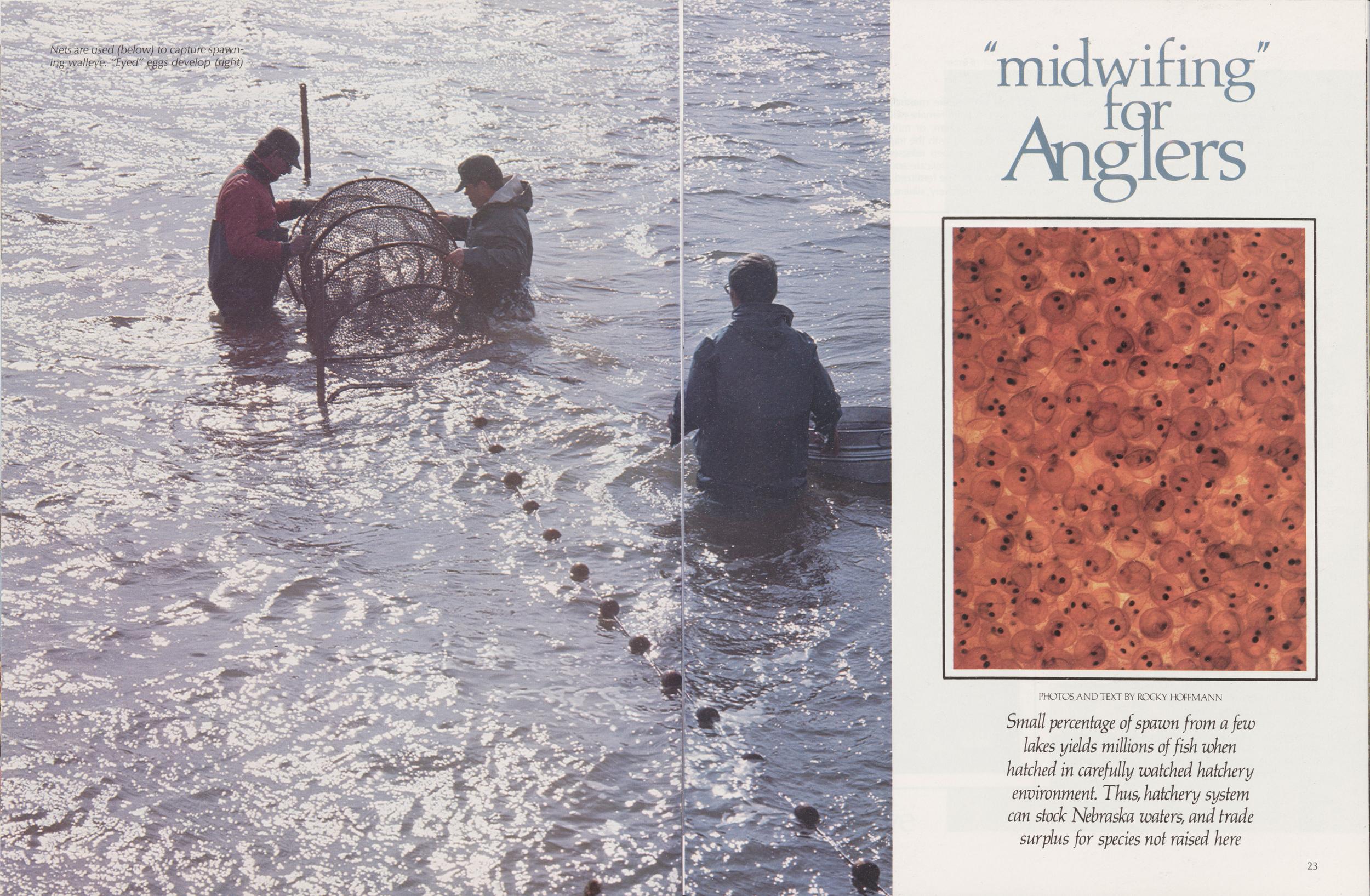
"midwifing" for Anglers
Nets are used (below) to capture spawning walleye. "Eyed" eggs develop (right)
ICE-OUT IN THE lake country of Nebraska's Sandhills has never been a predictable occurrence, but new life to this barren landscape is signaled annually by the groans of old ice and the gradual appearance of crystal water among the rushes.
The annual event is a welcome sight to local ranchers who have hardened a bit, and calloused a bit more, yet have survived the ordeals of winter's demands.
It is the time of year for terrestrial wildlife to replenish their numbers, setting their reproductive timetables by the lengthening hours of sunlight. Aquatic life, too, swings into action, guided solely by rising water temperatures, which transform a frozen lake into a submerged incubator for millions of eggs and fry.
The Sandhills thaw is monitored closely by fish culturists from the Game and Parks Commission's fish hatcheries, as this first sign of spring marks the beginning of a hectic, non-stop production season.
Northern pike are the first order of hatchery business, as their reproductive drive corresponds closely with melting Sandhills' lake ice. The pike must be trapped before they spawn, thus forcing culturists onto partially opened lakes to set nets and gamble with the possibilities of a bad turn in the spring weather, for which the Sandhills is known.
On many occasions, nets have been frozen in or torn up by the sudden return of winter and spring blizzards, but the gamble must be made or the eggs lost.
Such springs have greeted hatchery workers for the past 36 years, since 1943 when construction began on the state's largest fish hatchery, located at North Platte.
Ten one-acre ponds and a small hatch house were put into operation the following year to begin an era of modern fish culture in Nebraska, all for the benefit of anglers across the state.
Last year alone, more than 1,300,000 fingerling game fish were produced at the North Platte Hatchery for introduction into Nebraska waters. The small hatch house, reconstructed in 1948, has since been replaced by a much larger structure which holds the battery of incubators required for producing such large numbers of fish. The original 10 ponds have been increased over the years to 38, and future construction is planned to provide a full-scale effort in the production of channel catfish.
Although northern pike, walleye, and striped bass are the primary production species at North Platte, the hatchery has also perfected techniques for the successful culture of smallmouth bass, muskie, black crappie and channel catfish, among others.
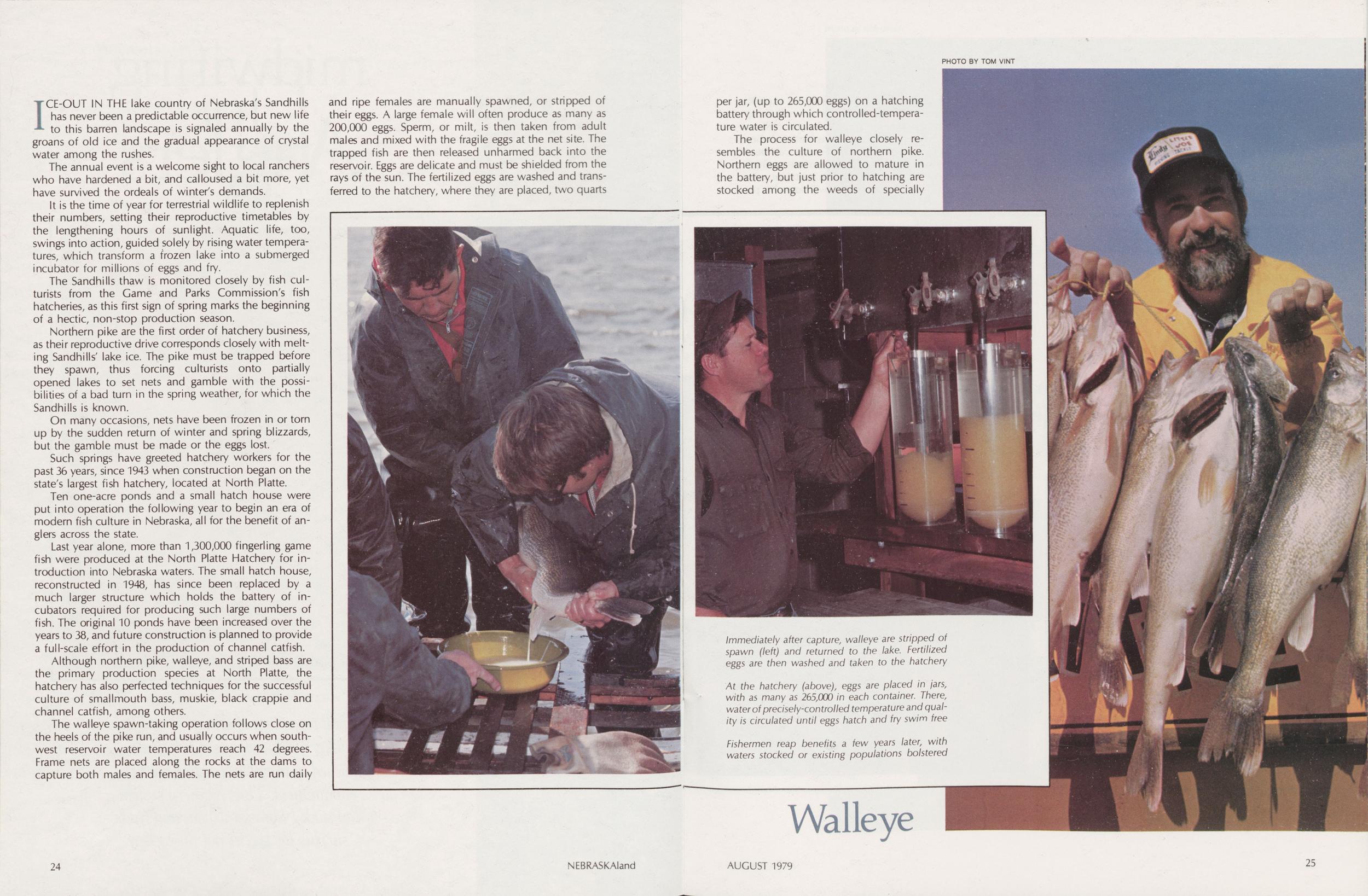
The walleye spawn-taking operation follows close on the heels of the pike run, and usually occurs when southwest reservoir water temperatures reach 42 degrees. Frame nets are placed along the rocks at the dams to capture both males and females. The nets are run daily and ripe females are manually spawned, or stripped of their eggs. A large female will often produce as many as 200,000 eggs. Sperm, or milt, is then taken from adult males and mixed with the fragile eggs at the net site. The trapped fish are then released unharmed back into the reservoir. Eggs are delicate and must be shielded from the rays of the sun. The fertilized eggs are washed and transferred to the hatchery, where they are placed, two quarts per jar, (up to 265,000 eggs) on a hatching battery through which controlled-temperature water is circulated.
Immediately after capture, walleye are stripped of spawn (left) and returned to the lake. Fertilized eggs are then washed and taken to the hatchery
At the hatchery (above), eggs are placed in jars, with as many as 265,000 in each container. There, water of precisely-controlled temperature and quality is circulated until eggs hatch and fry swim free
Fishermen reap benefits a few years later, with waters stocked or existing populations bolstered
Walleye
PHOTO BY TOM VINT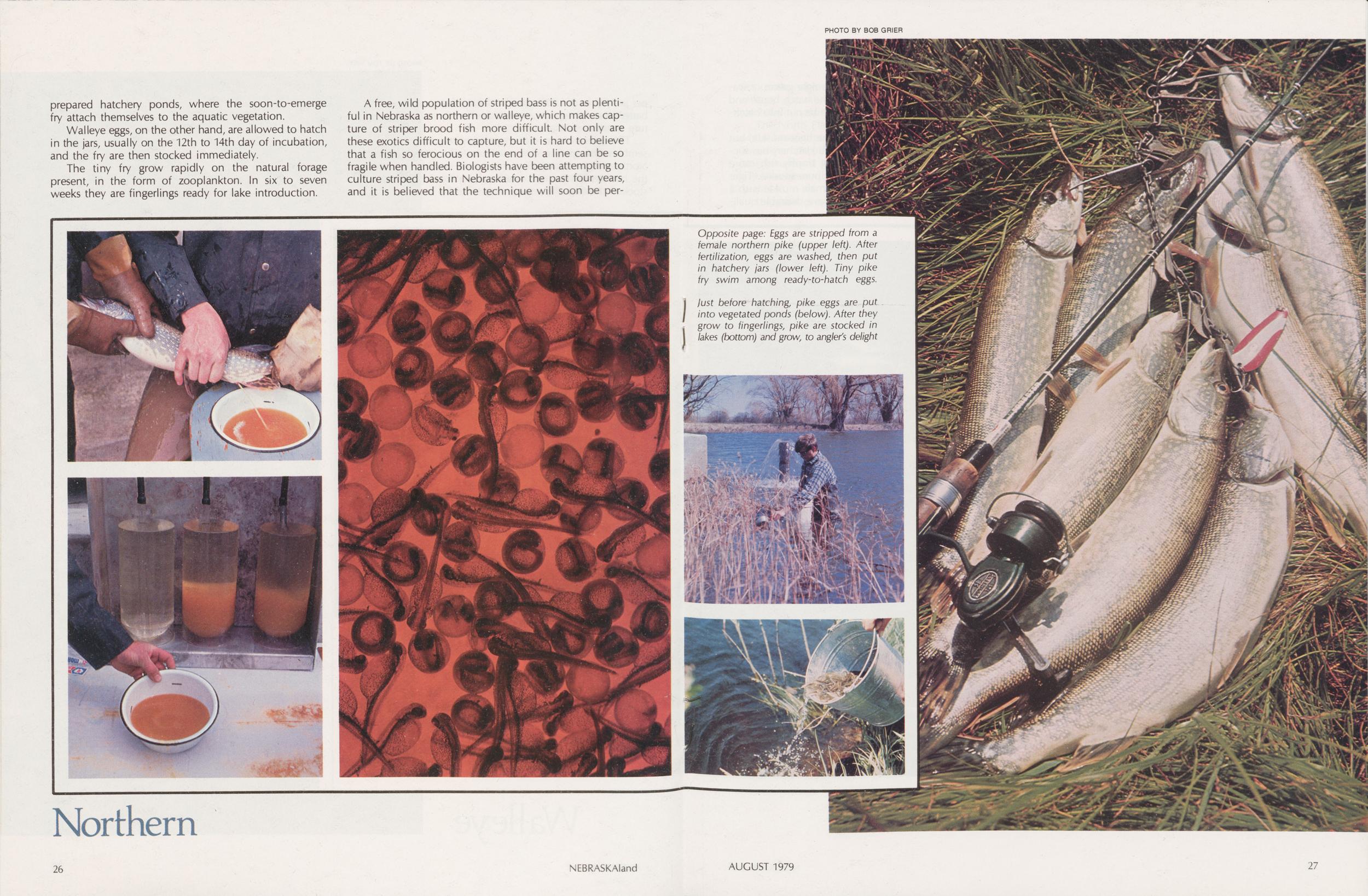 prepared hatchery ponds, where the soon-to-emerge
fry attach themselves to the aquatic vegetation.
prepared hatchery ponds, where the soon-to-emerge
fry attach themselves to the aquatic vegetation.Walleye eggs, on the other hand, are allowed to hatch in the jars, usually on the 12th to 14th day of incubation, and the fry are then stocked immediately.
The tiny fry grow rapidly on the natural forage present, in the form of zooplankton. In six to seven weeks they are fingerlings ready for lake introduction.
Opposite page: Eggs are stripped from a female northern pike (upper left). After fertilization, eggs are washed, then put in hatchery jars (lower left). Tiny pike fry swin among ready-to-hatch eggs.
Just before hatching, pike eggs are put into vegetated ponds (below). After they grow into fingerlings, pike are stocked in lakes (bottom) and grow, to angler's delight
Northern
 It is known, however, that the process for striper
culture is completely different than that employed for
northern pike and walleye, as brood fish must be held in
flowing-water tanks and allowed to spawn naturally.
It is known, however, that the process for striper
culture is completely different than that employed for
northern pike and walleye, as brood fish must be held in
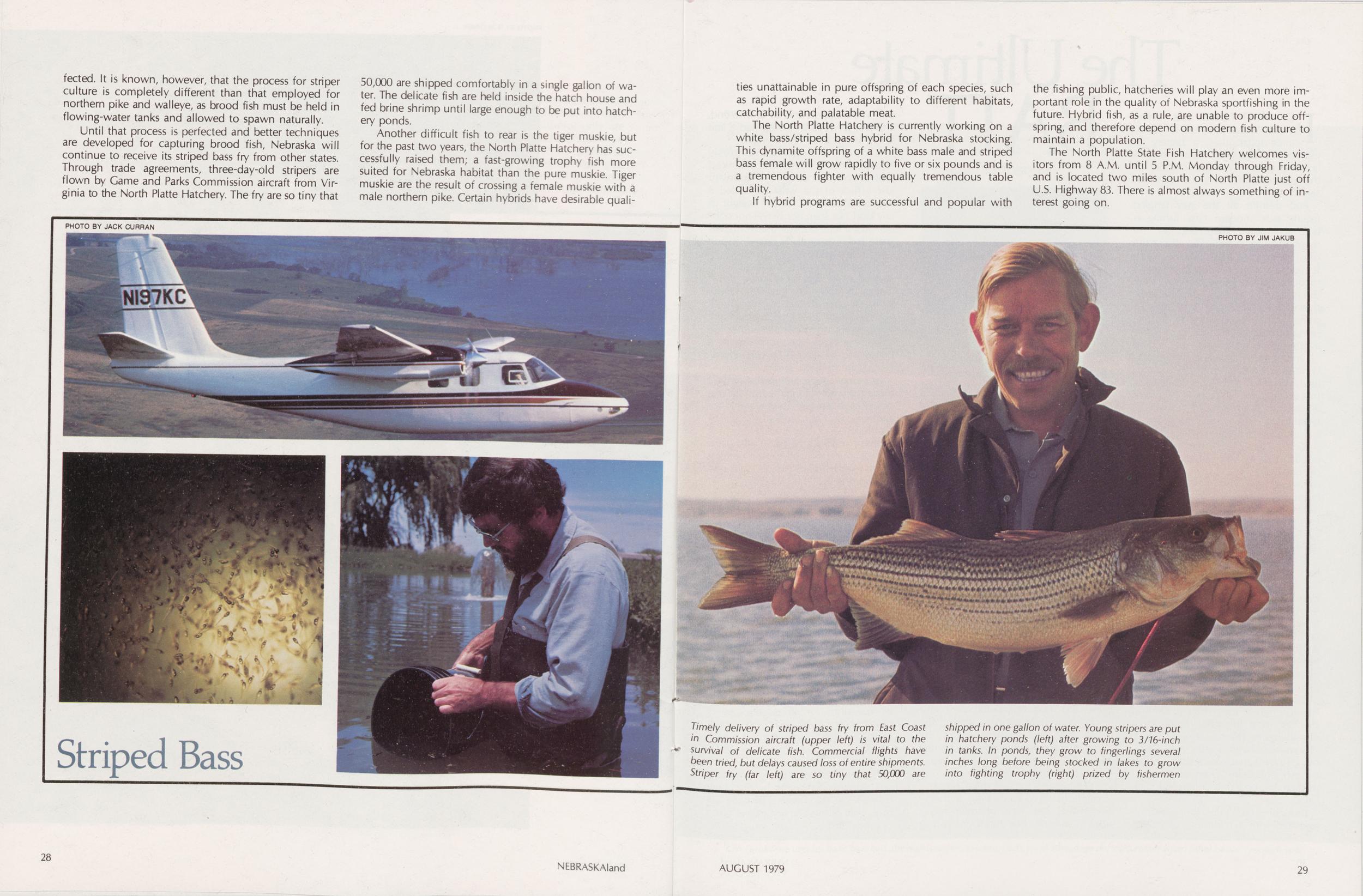
flowing-water tanks and allowed to spawn naturally.Until that process is perfected and better techniques are developed for capturing brood fish, Nebraska will continue to receive its striped bass fry from other states. Through trade agreements, three-day-old stripers are flown by Game and Parks Commission aircraft from Virginia to the North Platte Hatchery. The fry are so tiny that 50,000 are shipped comfortably in a single gallon of water. The delicate fish are held inside the hatch house and fed brine shrimp until large enough to be put into hatchery ponds.
Another difficult fish to rear is the tiger muskie, but for the past two years, the North Platte Hatchery has successfully raised them; a fastgrowing trophy fish more suited for Nebraska habitat than the pure muskie. Tiger muskie are the result of crossing a female muskie with a male northern pike. Certain hybrids have desirable qualities unattainable in pure offspring of each species, such as rapid growth rate, adaptability to different habitats, catchability, and palatable meat.
The North Platte Hatchery is currently working on a white bass/striped bass hybrid for Nebraska stocking. This dynamite offspring of a white bass male and striped bass female will grow rapidly to five or six pounds and is a tremendous fighter with equally tremendous table quality.
If hybrid programs are successful and popular with the fishing public, hatcheries will play an even more important role in the quality of Nebraska sportfishing in the future. Hybrid fish, as a rule, are unable to produce offspring, and therefore depend on modern fish culture to maintain a population.
The North Platte State Fish Hatchery welcomes visitors from 8 A.M. until 5 P.M. Monday through Friday, and is located two miles south of North Platte just off U.S. Highway 83. There is almost always something of interest going on.
Striped Bass
Timely delivery of striped bass fry from East Coast in Commission aircraft (upper left) is vital to the survival of delicate fish. Commercial flights have been tried, but delays caused loss of entire shipments. Striper fry (far left) are so tiny that 50,000 are shipped in one gallon of water. Young stripers are put in hatchery ponds (left) after growing to 3/16-inch in tanks. In ponds, they grow to fingerlings several inches long before being stocked in lakes to grow into fighting trophy (right) prized by fishermen
The Ultimate Bait
FOR MOST FOLKS, bass fishing means a suitcase full of flashy three-dollar lures, a battery of electronic gadgets to analyze the fish's lair, and a brawny barge to scoot all this paraphernalia over the water at slightly sub-sonic speeds.
But, despite all the new-fangled fishing aids, modern bass fishing is hard to master. There are just too many variables to befuddle all but the most diligent students of the sport; things like water temperature, barometric pressure, wind direction, even the phase of the moon. It's fortunate that a few anglers have kept sight of some simple, basic kinds of fishing; some techniques at least as effective as the new-fangled ways.
One of these anglers is Ken Drink-wine of Lincoln, who probes the tangled bass cover of the Salt Valley lakes in a small, open fishing boat devoid of all electronic gadgetry, and flipping his time-tested bass medicine—a juicy, squirming, real nightcrawler.
Ken fishes regularly and well enough that he's known to the cadre of semi-professional bass fishermen in the area, tackle company representatives, field testers, and serious competitors in local bass tournaments. He's become kind of an unofficial yardstick by which they judge their day-to-day efforts.
Most of the time, one of them will have a nice stringer or an exceptional lunker. But, when fishing's tough and everyone gets skunked, they'll ask, "How'd Kenny do?" And, most of the time, the answer is that he's got two, or three, or four bass. He doesn't often get limits of four or five-pounders, nor trophy bass. But, he is consistent, nearly always taking a few respectable fish.
I tagged along with him one July afternoon, right in the middle of a slump that left most fishermen in the area mumbling to themselves in disgust. "Fishing has been a little slow lately, but I suspect that we can find a bass or two out there," Ken said as we pushed his boat into Branched Oak Lake.
Launching didn't take long, since he operated with a minimum of equipment. He had two spincasting rods, a small tackle box, a couple jugs of coffee, and two boxes full of nightcrawlers, all nestled in his end of the boat. My end groaned under the weight of a massive tacklebox jammed with all kinds of gaudy, multi-shaped and multi-sized lures.
We headed for a flooded hedge a couple hundred yards long, a checkpoint that every bass fisherman seems to visit at least once during any fishing day. We dropped anchor at one end, and just seconds later, Ken had a line in the water and was fishing.
His rod had been previously equipped with a short-shanked bronze hook, about a No. 6, and with just a flick of the wrist he added a nightcrawler. There was no weight of any kind, nor snap nor swivel nor bobber—just a little hook and a worm. His spare rod was similarly rigged, with a small hook ready for a crawler.
"I like to cast the worm right up against a tree and let it settle down among the roots. The guys who throw artificials can't do that because they'll lose too many lures. But, getting hung up now and then doesn't bother me because a hook costs only about a penny-and-a-half, and I get the crawlers free in my own yard.
"If I don't get a fish in the roots, I move the worm along the bottom real slowly for a few feet, then reel it in for another cast. I get most of the strikes on the fall, so I keep a fairly tight line so that I can feel the fish. I also get a few just outside the roots, but nothing much ever happens more than a few feet from cover," he explained.
After his initial lesson, the conversation thinned out a bit. There were old fish stories exchanged between casts, along with local gossip, politics, current events and other small talk. But, he said nothing from the moment his worm splashed down next to a tree trunk until it was reeled in for another cast. He was then a picture of concentration, with all his attention focused on what that line and nightcrawler were doing.
While he threw his worms about the area, I dug out my trusty bass stick and tied on a spinnerbait. By the time Ken finished the fourth or fifth cast from his end of the boat, I had worked all of the likely looking cover near my end with a couple dozen casts. After letting the area rest a bit, I pegged a few crankbaits, then exercised a plastic worm.
In the meantime, a fancy white bass boat with two fishermen perched high on pedestal seats, started working the other side of the tree line down at the opposite end. (Cont on page 48)
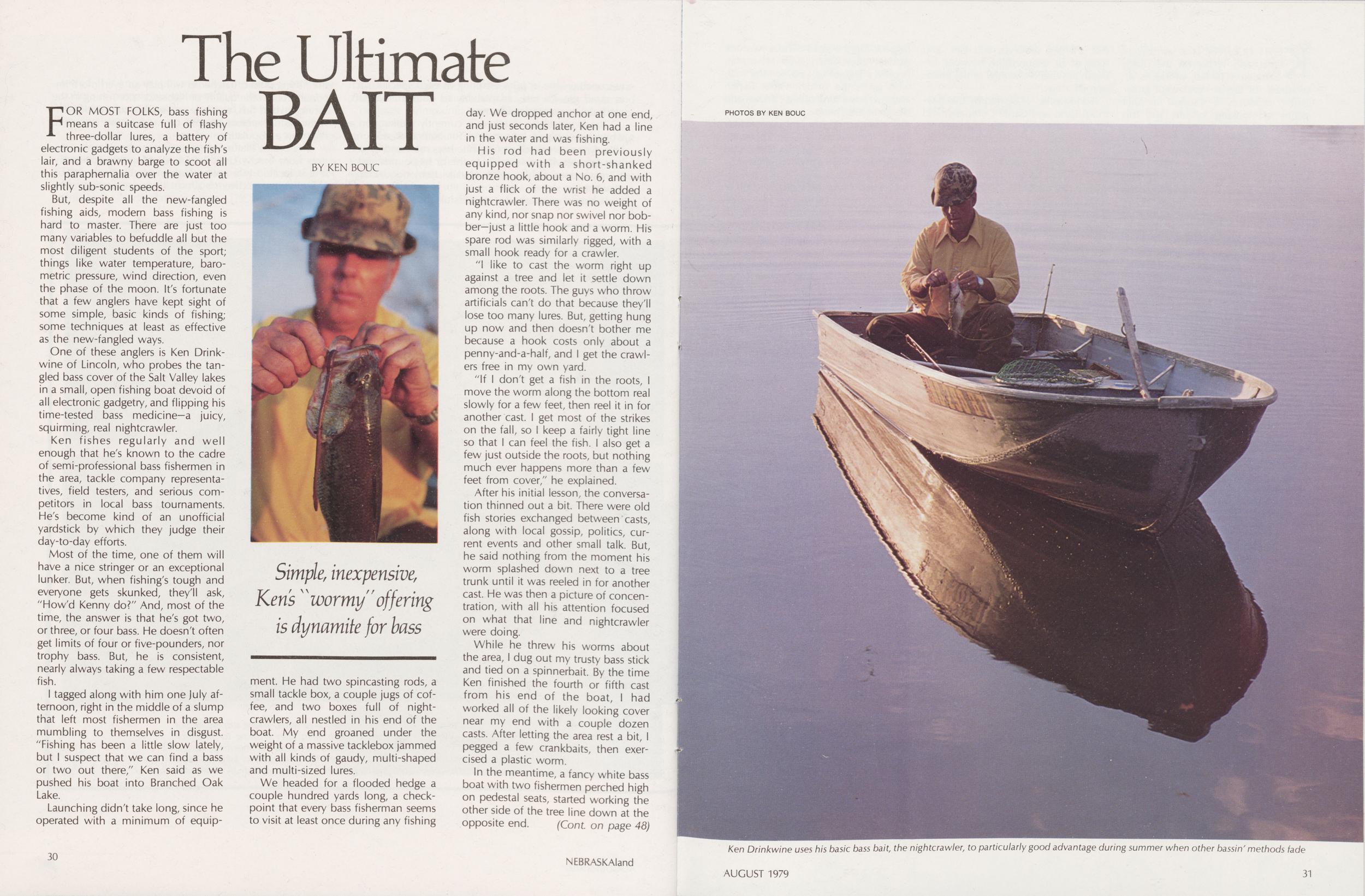
Ken Drinkwine uses his basic bass bait, the nightcrawler, to particularly good advantage during summer when other bassin' methods fade
Biologist Account of Times Afield
KEITH COUNTY JOURNAL
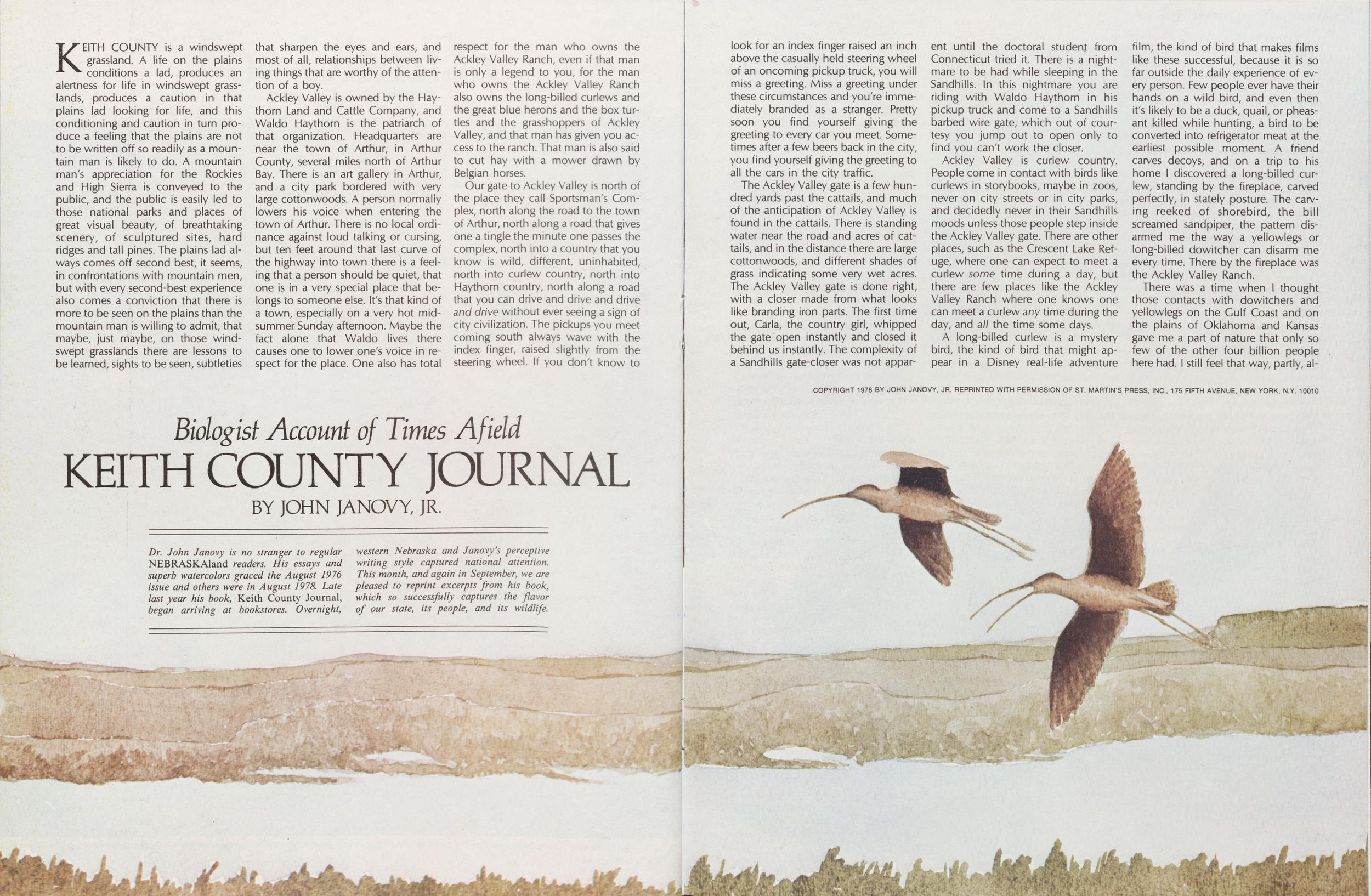
Dr. John Janovy is no stranger to regular NEBRASKAland readers. His essays and superb water colors graced the August 1976 issue and others were in August 1978. Late last year his book, Keith County Journal, began arriving at bookstores. Overnight, western Nebraska and Janovy's perceptive writing style captured national attention. This month, and again in September, we are pleased to reprint excerpts from his book, which so successfully captures the flavor of our state, its people, and its wildlife.
KEITH COUNTY is a windswept grassland. A life on the plains conditions a lad, produces an alertness for life in windswept grasslands, produces a caution in that plains lad looking for life, and this conditioning and caution in turn produce a feeling that the plains are not to be written off so readily as a mountain man is likely to do. A mountain man's appreciation for the Rockies and High Sierra is conveyed to the public, and the public is easily led to those national parks and places of great visual beauty, of breathtaking scenery, of sculptured sites, hard ridges and tall pines. The plains lad always comes off second best, it seems, in confrontations with mountain men, but with every second-best experience also comes a conviction that there is more to be seen on the plains than the mountain man is willing to admit, that maybe, just maybe, on those wind-swept grasslands there are lessons to be learned, sights to be seen, subtleties that sharpen the eyes and ears, and most of all, relationships between living things that are worthy of the attention of a boy.
Ackley Valley is owned by the Haythorn Land and Cattle Company, and Waldo Haythorn is the patriarch of that organization. Headquarters are near the town of Arthur, in Arthur County, several miles north of Arthur Bay. There is an art gallery in Arthur, and a city park bordered with very large cottonwoods. A person normally lowers his voice when entering the town of Arthur. There is no local ordinance against loud talking or cursing, but ten feet around that last curve of the highway into town there is a feeling that a person should be quiet, that one is in a very special place that belongs to someone else. It's that kind of a town, especially on a very hot midsummer Sunday afternoon. Maybe the fact alone that Waldo lives there causes one to lower one's voice in respect for the place. One also has total respect for the man who owns the Ackley Valley Ranch, even if that man is only a legend to you, for the man who owns the Ackley Valley Ranch also owns the long-billed curlews and the great blue herons and the box turtles and the grasshoppers of Ackley Valley, and that man has given you access to the ranch. That man is also said to cut hay with a mower drawn by Belgian horses.
Our gate to Ackley Valley is north of the place they call Sportsman's Complex, north along the road to the town of Arthur, north along a road that gives one a tingle the minute one passes the complex, north into a country that you know is wild, different, uninhabited, north into curlew country, north into Haythorn country, north along a road that you can drive and drive and drive and drive without ever seeing a sign of city civilization. The pickups you meet coming south always wave with the index finger, raised slightly from the steering wheel. If you don't know to look for an index finger raised an inch above the casually held steering wheel of an oncoming pickup truck, you will miss a greeting. Miss a greeting under these circumstances and you're immediately branded as a stranger. Pretty soon you find yourself giving the greeting to every car you meet. Sometimes after a few beers back in the city, you find yourself giving the greeting to all the cars in the city traffic.
The Ackley Valley gate is a few hundred yards past the cattails, and much of the anticipation of Ackley Valley is found in the cattails. There is standing water near the road and acres of cattails, and in the distance there are large cottonwoods, and different shades of grass indicating some very wet acres. The Ackley Valley gate is done right, with a closer made from what looks like branding iron parts. The first time out, Carla, the country girl, whipped the gate open instantly and closed it behind us instantly. The complexity of a Sandhills gate-closer was not apparent until the doctoral student from Connecticut tried it. There is a nightmare to be had while sleeping in the Sandhills. In this nightmare you are riding with Waldo Haythorn in his pickup truck and come to a Sandhills barbed wire gate, which out of courtesy you jump out to open only to find you can't work the closer.
Ackley Valley is curlew country. People come in contact with birds like curlews in storybooks, maybe in zoos, never on city streets or in city parks, and decidedly never in their Sandhills moods unless those people step inside the Ackley Valley gate. There are other places, such as the Crescent Lake Refuge, where one can expect to meet a curlew some time during a day, but there are few places like the Ackley Valley Ranch where one knows one can meet a curlew any time during the day, and all the time some days.
A long-billed curlew is a mystery bird, the kind of bird that might appear in a Disney real-life adventure film, the kind of bird that makes films like these successful, because it is so far outside the daily experience of every person. Few people ever have their hands on a wild bird, and even then it's likely to be a duck, quail, or pheasant killed while hunting, a bird to be converted into refrigerator meat at the earliest possible moment. A friend carves decoys, and on a trip to his home I discovered a long-billed curlew, standing by the fireplace, carved perfectly, in stately posture. The carving reeked of shorebird, the bill screamed sandpiper, the pattern disarmed me the way a yellowlegs or long-billed dowitcher can disarm me every time. There by the fireplace was the Ackley Valley Ranch.
There was a time when I thought those contacts with dowitchers and yellowlegs on the Gulf Coast and on the plains of Oklahoma and Kansas gave me a part of nature that only so few of the other four billion people here had. I still feel that way, partly, although
 the memories of those birds
are fast fading; somehow the mudflats
necessary to supply me with dowitchers and yellowlegs are not here
in time or place. I have a friend, however, who does research on curlews.
We communicate instantly, better
than I do with the decoy carver, and
we communicate without speaking on
many matters that extend far beyond
the biological business at hand. We
can read the academic politics of the
day in each other's tone of voice. It's
because we've both seen the longbilled curlew, although he obviously
has seen it more closely than I. One
step into the Ackley Valley Ranch and
you meet the curlew.
the memories of those birds
are fast fading; somehow the mudflats
necessary to supply me with dowitchers and yellowlegs are not here
in time or place. I have a friend, however, who does research on curlews.
We communicate instantly, better
than I do with the decoy carver, and
we communicate without speaking on
many matters that extend far beyond
the biological business at hand. We
can read the academic politics of the
day in each other's tone of voice. It's
because we've both seen the longbilled curlew, although he obviously
has seen it more closely than I. One
step into the Ackley Valley Ranch and
you meet the curlew.
There is no search, no effort required, only your physical presence. The curlew brings it to you full force. The curlew throws off all the fear and seclusion you think should be a part of the personality of so large, so beautiful, so dramatic, and so oh-so-vulnerable a bird in a world shaped by the. Bureau of Reclamation. The curlew screams at close range, the curlew sets its wings at every angle you've ever seen in the most impressive pictures, the curlew dives, it circles, it comes back for more, and all you have to do is wave your arms and it does everything all over again twice as powerfully. It hardly helps to leave.
The curlew follows you down the highway screaming, the curlew flies in front of your van looking over this shoulder, then that, staying just far enough ahead, as you pick up speed, to scream back at you. Down the highway a couple of miles you discover you've hardly been breathing. There is something special about a place where there are always curlews. Even if you never meet the grasshoppers of Ackley Valley, the curlews have given you far more than you bargained for.
The total lack of fear in an animal that should above all be fearful of what humanity has to offer is an impressive demonstration. It makes one wonder long and hard about what is to be gained by fear, especially what is to be gained by fear of forces that should be great and much beyond our control. I have some very serious doubts that the long-billed curlew would allow an earthen dam to be constructed over fissures upstream from where it nests. I have very serious doubts that the long-billed curlew would allow a nuclear waste disposal facility to be built on the Ackley Valley Ranch, regardless of how much the curlews needed the jobs. I have this almost uncontrollable urge to find every human on this earth who has ever feared to think about and to conclude, speak up and out, and act on environmental issues, and lead that human by the hand to the Ackley Valley Ranch in June. I also have this feeling that the curlews approve of a man who is said to still cut his hay with a mower drawn by Belgian horses.
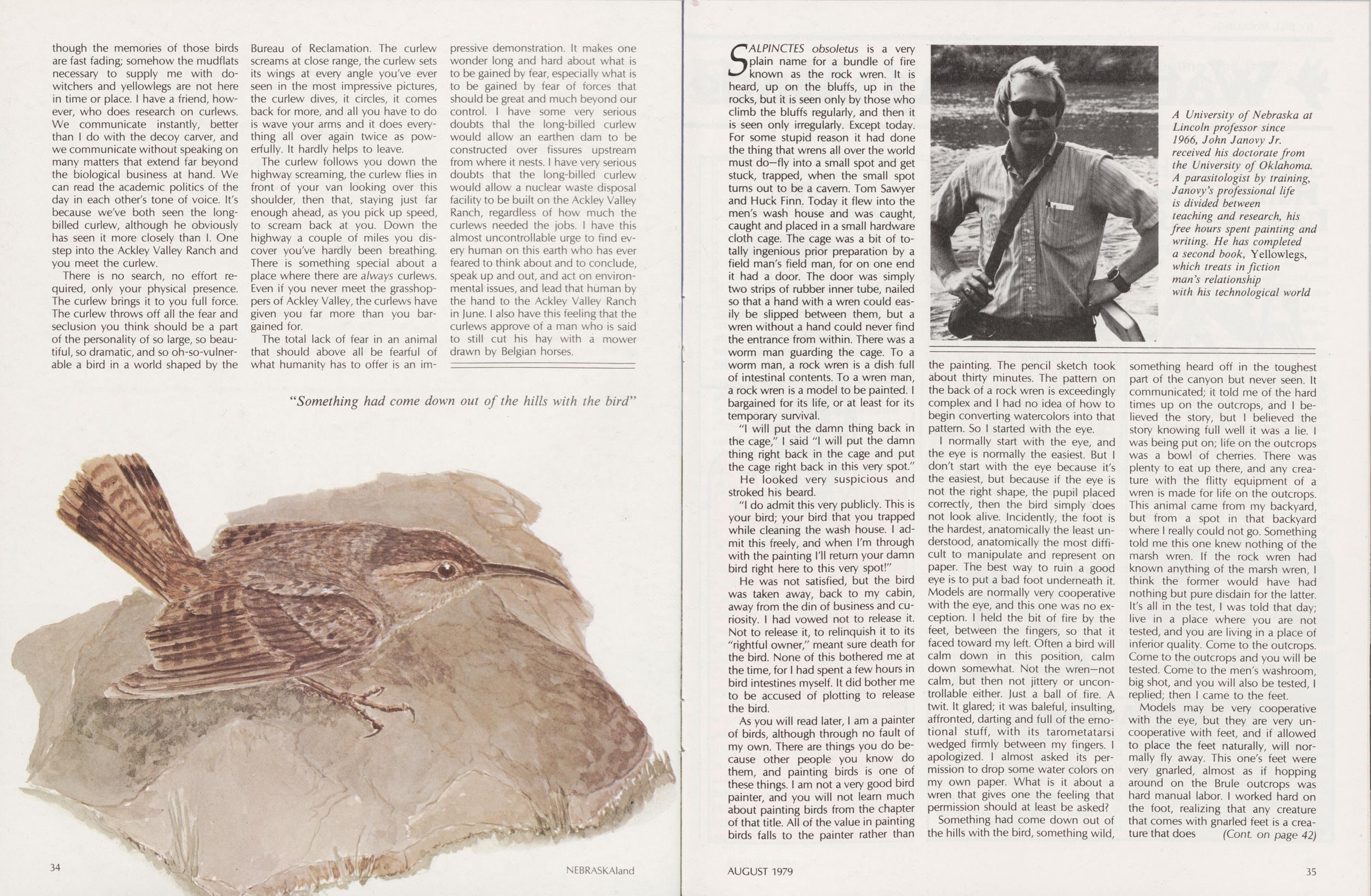
"Something had come down out of the hills with the bird"
SALPINCTES obsoletus is a very plain name for a bundle of fire known as the rock wren. It is heard, up on the bluffs, up in the rocks, but it is seen only by those who climb the bluffs regularly, and then it is seen only irregularly. Except today. For some stupid reason it had done the thing that wrens all over the world must do—fly into a small spot and get stuck, trapped, when the small spot turns out to be a cavern. Tom Sawyer and Huck Finn. Today it flew into the men's wash house and was caught, caught and placed in a small hardware cloth cage. The cage was a bit of totally ingenious prior preparation by a field man's field man, for on one end it had a door. The door was simply two strips of rubber inner tube, nailed so that a hand with a wren could easily be slipped between them, but a wren without a hand could never find the entrance from within. There was a worm man guarding the cage. To a worm man, a rock wren is a dish full of intestinal contents. To a wren man, a rock wren is a model to be painted. I bargained for its life, or at least for its temporary survival.
"I will put the damn thing back in the cage," I said "I will put the damn thing right back in the cage and put the cage right back in this very spot."
He looked very suspicious and stroked his beard.
"I do admit this very publicly. This is your bird; your bird that you trapped while cleaning the wash house. I admit this freely, and when I'm through with the painting I'll return your damn bird right here to this very spot!"
He was not satisfied, but the bird was taken away, back to my cabin, away from the din of business and curiosity. I had vowed not to release it. Not to release it, to relinquish it to its "rightful owner," meant sure death for the bird. None of this bothered me at the time, for I had spent a few hours in bird intestines myself. It did bother me to be accused of plotting to release the bird.
A University of Nebraska at Lincoln professor since 1966, John Janovy Jr. received his doctorate from the University of Oklahoma. A parasitologist by training, J anovy's professional life is divided between teaching and research, his free hours spent painting and writing. He has completed a second book, Yellowlegs, which treats in fiction man's relationship with his technological world
I normally start with the eye, and the eye is normally the easiest. But I don't start with the eye because it's the easiest, but because if the eye is not the right shape, the pupil placed correctly, then the bird simply does not look alive. Incidentally, the foot is the hardest, anatomically the least understood, anatomically the most difficult to manipulate and represent on paper. The best way to ruin a good eye is to put a bad foot underneath it. Models are normally very cooperative with the eye, and this one was no exception. I held the bit of fire by the feet, between the fingers, so that it faced toward my left. Often a bird will calm down in this position, calm down somewhat. Not the wren—not calm, but then not jittery or uncontrollable either. Just a ball of fire. A twit. It glared; it was baleful, insulting, affronted, darting and full of the emotional stuff, with its tarsometatarsi wedged firmly between my fingers. I apologized. I almost asked its permission to drop some water colors on my own paper. What is it about a wren that gives one the feeling that permission should at least be asked?
Something had come down out of the hills with the bird, something wild, something heard off in the toughest part of the canyon but never seen. It communicated; it told me of the hard times up on the outcrops, and I believed the story, but I believed the story knowing full well it was a lie. I was being put on; life on the outcrops was a bowl of cherries. There was plenty to eat up there, and any creature with the flitty equipment of a wren is made for life on the outcrops. This animal came from my backyard, but from a spot in that backyard where I really could not go. Something told me this one knew nothing of the marsh wren. If the rock wren had known anything of the marsh wren, I think the former would have had nothing but pure disdain for the latter. It's all in the test, I was told that day; live in a place where you are not tested, and you are living in a place of inferior quality. Come to the outcrops. Come to the outcrops and you will be tested. Come to the men's washroom, big shot, and you will also be tested, I replied; then I came to the feet.
Models may be very cooperative with the eye, but they are very uncooperative with feet, and if allowed to place the feet naturally, will normally fly away. This one's feet were very gnarled, almost as if hopping around on the Brule outcrops was hard manual labor. I worked hard on the foot, realizing that any creature that comes with gnarled feet is a creature that does (Cont. on page 42)
34 NEBRASKAland AUGUST 1979 35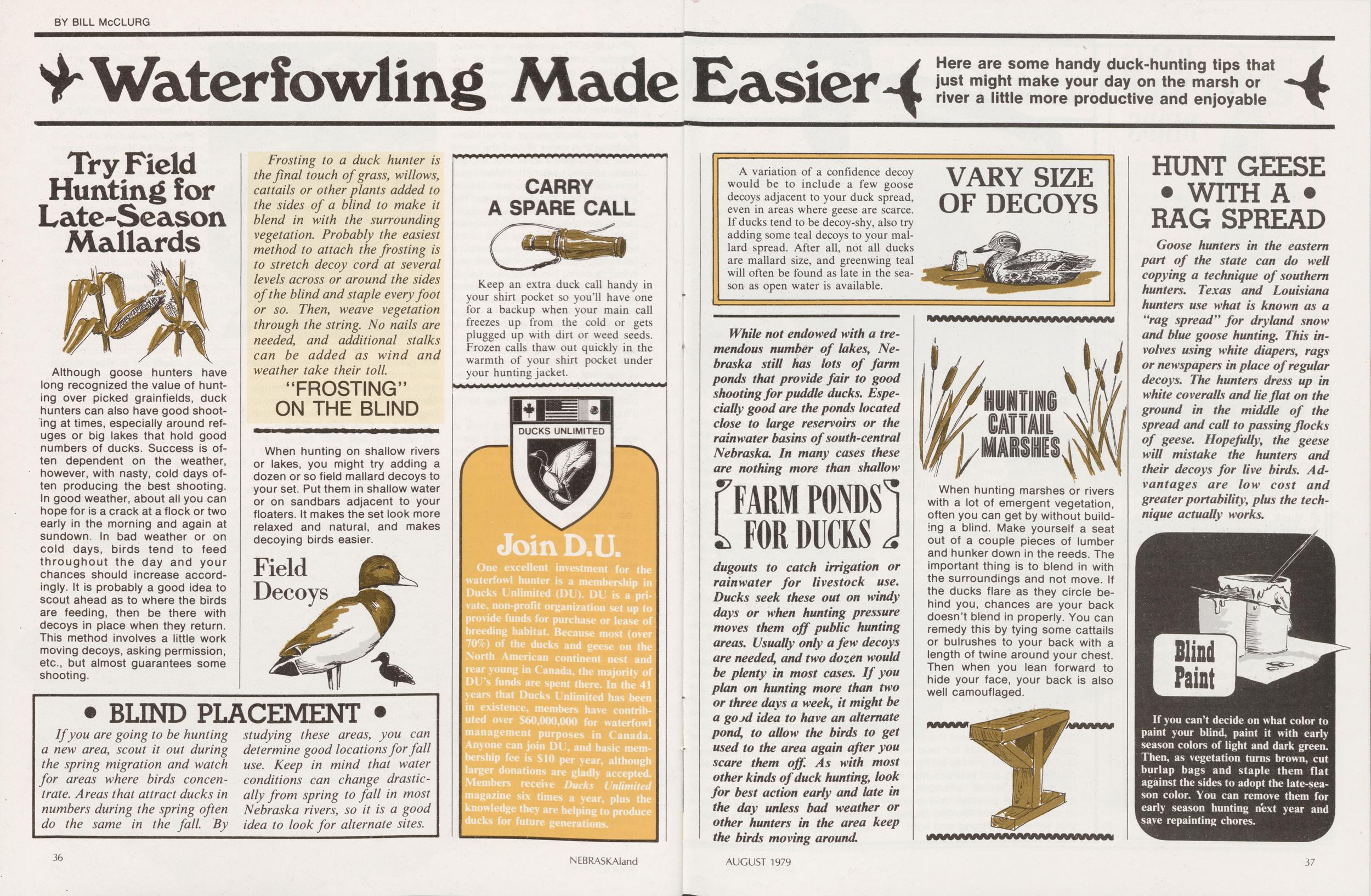
Waterfowling Made Easier
Here are some handy duck-hunting tips that just might make your day on the marsh or river a little more productive and enjoyable
Try Field Hunting for Late-Season MallardsAlthough goose hunters have long recognized the value of hunting over picked grainfields, duck hunters can also have good shooting at times, especially around refuges or big lakes that hold good numbers of ducks. Success is often dependent on the weather, however, with nasty, cold days often producing the best shooting. In good weather, about all you can hope for is a crack at a flock or two early in the morning and again at sundown. In bad weather or on cold days, birds tend to feed throughout the day and your chances should increase accordingly. It is probably a good idea to scout ahead as to where the birds are feeding, then be there with decoys in place when they return. This method involves a little work moving decoys, asking permission, etc., but almost guarantees some shooting.
"FROSTING" ON THE BLINDFrosting to a duck hunter is the final touch of grass, willows, cattails or other plants added to the sides of a blind to make it blend in with the surrounding vegetation. Probably the easiest method to attach the frosting is to stretch decoy cord at several levels across or around the sides of the blind and staple every foot or so. Then, weave vegetation through the string. No nails are needed, and additional stalks can be added as wind and weather take their toll,
Field DecoysWhen hunting on shallow rivers or lakes, you might try adding a dozen or so field mallard decoys to your set. Put them in shallow water or on sandbars adjacent to your floaters. It makes the set look more relaxed and natural, and makes decoying birds easier.
If you are going to be hunting a new area, scout it out during the spring migration and watch for areas where birds concentrate. Areas that attract ducks in numbers during the spring often do the same in the fall. By studying these areas, you can determine good locations for fall use. Keep in mind that water conditions can change drastically from spring to fall in most Nebraska rivers, so it is a good idea to look for alternate sites.
CARRY A SPARE CALLKeep an extra duck call handy in your shirt pocket so you'll have one for a backup when your main call freezes up from the cold or gets plugged up with dirt or weed seeds. Frozen calls thaw out quickly in the warmth of your shirt pocket under your hunting jacket.
DUCKS UNLIMITED
One excellent investment for waterfowl hunter is a membership i Ducks Unlimited (DU). DU is a private, non-profit organization set u provide funds for purchase or lease breeding habitat. Because most (ow 70%) of the ducks and geese on to North American continent nest am rear young in Canada, the majority o DU's funds are spent there. In the 4 years that Ducks Unlimited has bee in existence, members have contributed over $60,000,000 for waterfowl management purposes in Canada Anyone can join DU, and basic membership fee is $10 per year, although larger donations are gladly accepted Members receive Ducks Unlimited magazine six times a year, plus tin knowledge they are helping to produce ducks for future generations.
VARY SIZE OF DECOYSA variation of a confidence decoy would be to include a few goose decoys adjacent to your duck spread, even in areas where geese are scarce. If ducks tend to be decoy-shy, also try adding some teal decoys to your mallard spread. After all, not all ducks are mallard size, and greenwing teal will often be found as late in the season as open water is available.
FARM PONDS FOR DUCKSWhile not endowed with a tremendous number of lakes, Nebraska still has lots of farm ponds that provide fair to good shooting for puddle ducks. Especially good are the ponds located close to large reservoirs or the rainwater basins of south-central Nebraska. In many cases these are nothing more than shallow dugouts to catch irrigation or rainwater for livestock use. Ducks seek these out on windy days or when hunting pressure moves them off public hunting areas. Usually only a few decoys are needed, and two dozen would be plenty in most cases. If you plan on hunting more than two or three days a week, it might be a good idea to have an alternate pond, to allow the birds to get used to the area again after you scare them off. As with most other kinds of duck hunting, look for best action early and late in the day unless bad weather or other hunters in the area keep the birds moving around.
Hunting Cattail MarshesWhen hunting marshes or rivers with a lot of emergent vegetation, often you can get by without building a blind. Make yourself a seat out of a couple pieces of lumber and hunker down in the reeds. The important thing is to blend in with the surroundings and not move. If the ducks flare as they circle behind you, chances are your back doesn't blend in properly. You can remedy this by tying some cattails or bulrushes to your back with a length of twine around your chest. Then when you lean forward to hide your face, your back is also well camouflaged.
Goose hunters in the eastern part of the state can do well copying a technique of southern hunters. Texas and Louisiana hunters use what is known as a "rag spread" for dryland snow and blue goose hunting. This involves using white diapers, rags or newspapers in place of regular decoys. The hunters dress up in white coveralls and lie flat on the ground in the middle of the spread and call to passing flocks of geese. Hopefully, the geese will mistake the hunters and their decoys for live birds. Advantages are low cost and greater portability, plus the technique actually works.
Blind FaintIf you can't decide on what color to paint your blind, paint it with early season colors of light and dark green. Then, as vegetation turns brown, cut burlap bags and staple them flat against the sides to adopt the late-season color. You can remove them for early season hunting next year and save repainting chores.
36 NEBRASKAland AUGUST 1979 37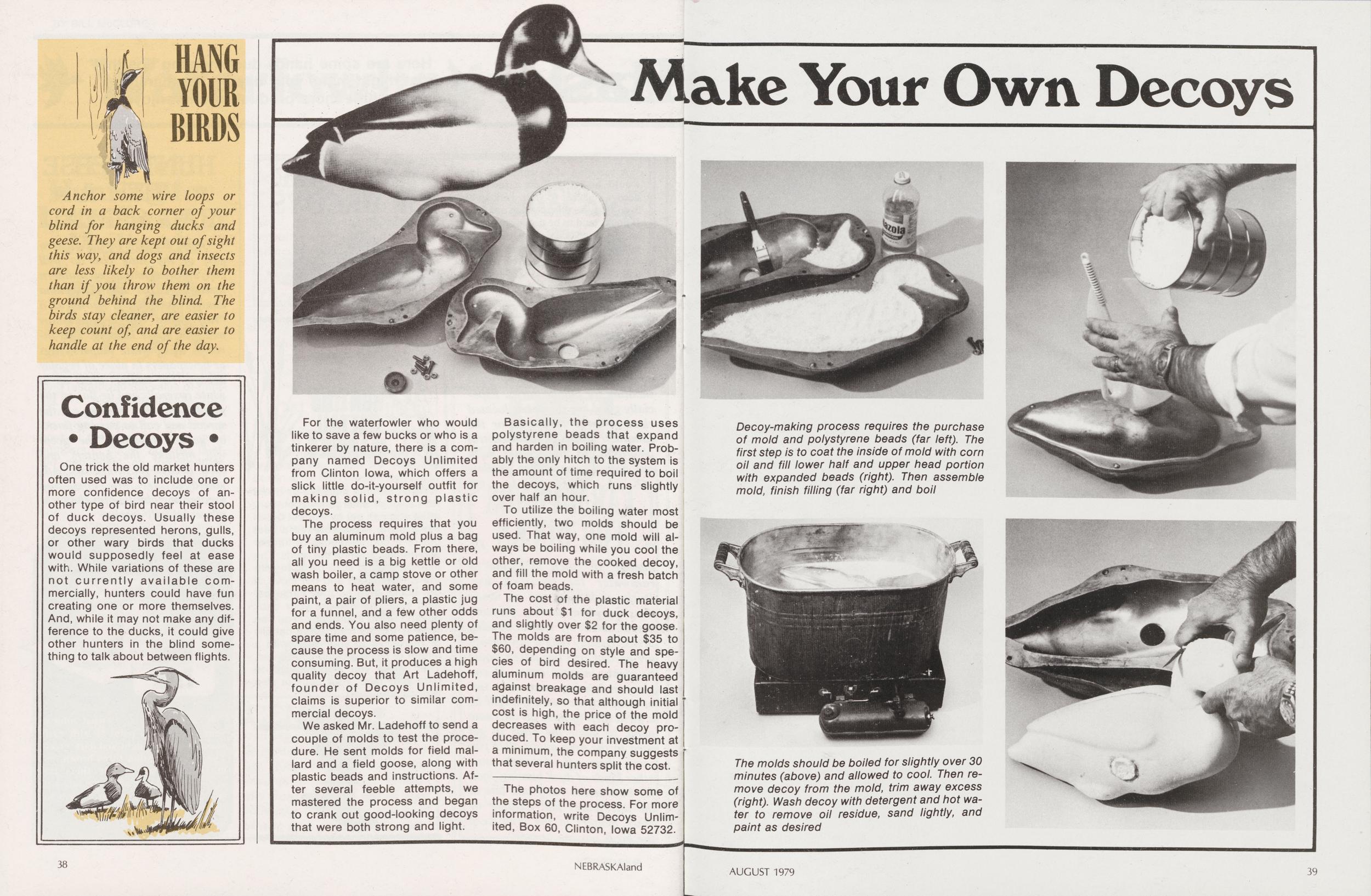 HANG
YOUR
BIRDS
HANG
YOUR
BIRDS
Anchor some wire loops or cord in a back corner of your blind for hanging ducks and geese. They are kept out of sight this way, and dogs and insects are less likely to bother them than if you throw them on the ground behind the blind. The birds stay cleaner, are easier to keep count of and are easier to handle at the end of the day.
Confidence DecoysOne trick the old market hunters often used was to include one or more confidence decoys of another type of bird near their stool of duck decoys. Usually these decoys represented herons, gulls, or other wary birds that ducks would supposedly fee! at ease with. While variations of these are not currently available commercially, hunters could have fun creating one or more themselves. And, while it may not make any difference to the ducks, it could give other hunters in the blind something to talk about between flights.
Make Your Own Decoys
For the waterfowler who would like to save a few bucks or who is a tinkerer by nature, there is a company named Decoys Unlimited from Clinton Iowa, which offers a slick little do-it-yourself outfit for making solid, strong plastic decoys.
The process requires that you buy an aluminum mold plus a bag of tiny plastic beads. From there, all you need is a big kettle or old wash boiler, a camp stove or other means to heat water, and some paint, a pair of pliers, a plastic jug for a funnel, and a few other odds and ends. You also need plenty of spare time and some patience, because the process is slow and time consuming. But, it produces a high quality decoy that Art Ladehoff, founder of Decoys Unlimited, claims is superior to similar commercial decoys.
We asked Mr. Ladehoff to send a couple of molds to test the procedure. He sent molds for field mallard and a field goose, along with plastic beads and instructions. After several feeble attempts, we mastered the process and began to crank out good-looking decoys that were both strong and light.
Basically, the process uses polystyrene beads that expand and harden in boiling water. Probably the only hitch to the system is the amount of time required to boil the decoys, which runs slightly over half an hour.
To utilize the boiling water most efficiently, two molds should be used. That way, one mold will always be boiling while you cool the other, remove the cooked decoy, and fill the mold with a fresh batch of foam beads.
The cost of the plastic material runs about $1 for duck decoys, and slightly over $2 for the goose. The molds are from about $35 to $60, depending on style and species of bird desired. The heavy aluminum molds are guaranteed against breakage and should last indefinitely, so that although initial cost is high, the price of the mold decreases with each decoy produced. To keep your investment at a minimum, the company suggests that several hunters split the cost.
The photos here show some of the steps of the process. For more information, write Decoys Unlimited, Box 60, Clinton, Iowa 52732.
Decoy-making process requires the purchase of mold and polystyrene beads (far left). The first step is to coat the inside of mold with corn oil and fill lower half and upper head portion with expanded beads (right). Then assemble mold, finish filling (far right) and boil
The molds should be boiled for slightly over 30 minutes (above) and allowed to cool. Then remove decoy from the mold, trim away excess (right). Wash decoy with detergent and hot water to remove oil residue, sand lightly, and paint as desired
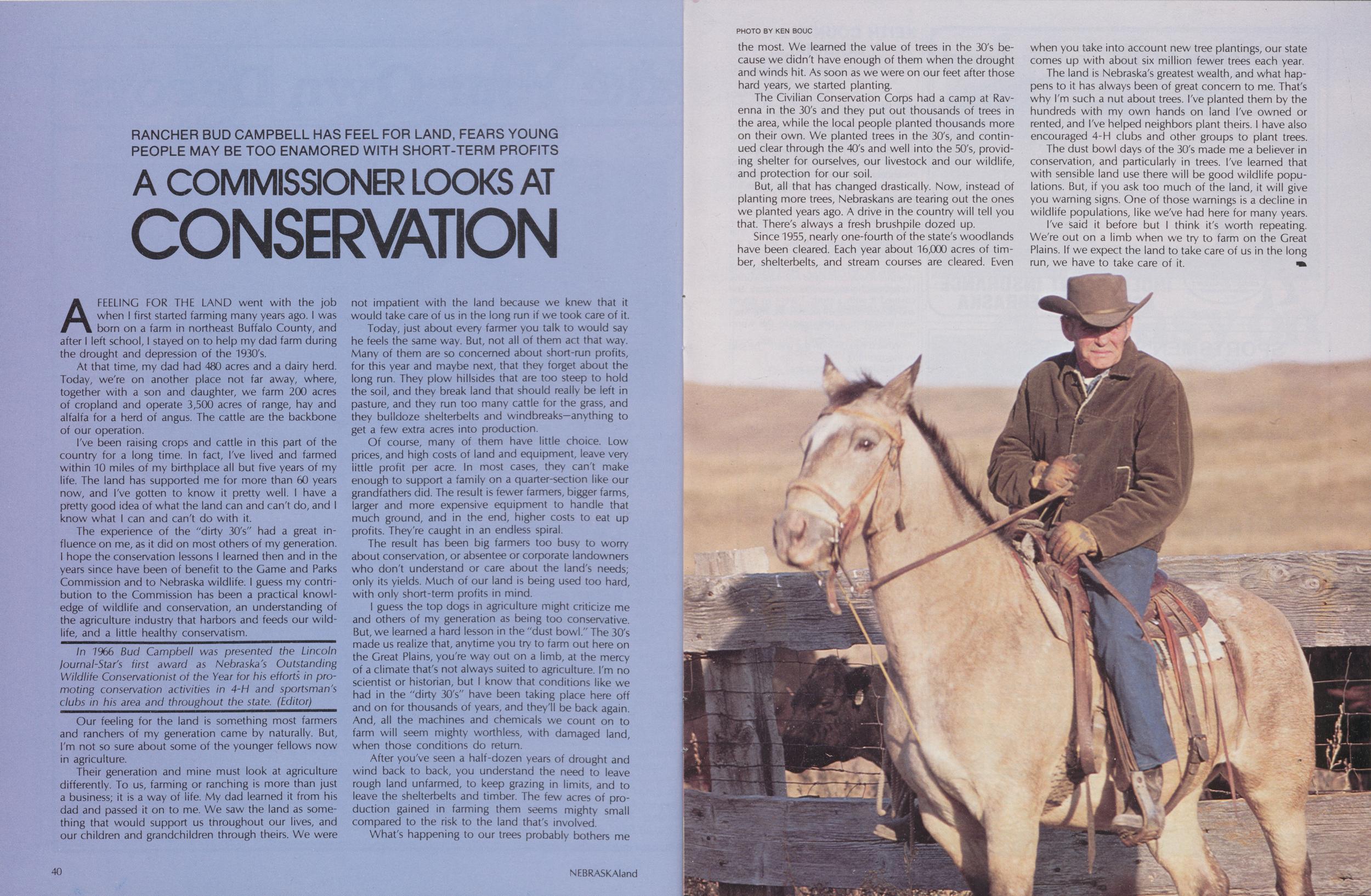
RANCHER BUD CAMPBELL HAS FEEL FOR LAND, FEARS YOUNG PEOPLE MAY BE TOO ENAMORED WITH SHORT-TERM PROFITS
A COMMISSIONER LOOKS AT CONSERVATION
A FEELING FOR THE LAND went with the job when I first started farming many years ago. I was born on a farm in northeast Buffalo County, and after I left school, I stayed on to help my dad farm during the drought and depression of the 1930's.
At that time, my dad had 480 acres and a dairy herd. Today, we're on another place not far away, where, together with a son and daughter, we farm 200 acres of cropland and operate 3,500 acres of range, hay and alfalfa for a herd of angus. The cattle are the backbone of our operation.
I've been raising crops and cattle in this part of the country for a long time. In fact, I've lived and farmed within 10 miles of my birthplace all but five years of my life. The land has supported me for more than 60 years now, and I've gotten to know it pretty well. I have a pretty good idea of what the land can and can't do, and I know what I can and can't do with it.
The experience of the "dirty 30's" had a great influence on me, as it did on most others of my generation. I hope the conservation lessons I learned then and in the years since have been of benefit to the Game and Parks Commission and to Nebraska wildlife; I guess my contribution to the Commission has been a practical knowledge of wildlife and conservation, an understanding of the agriculture industry that harbors and feeds our wildlife, and a little healthy conservatism.
Our feeling for the land is something most farmers and ranchers of my generation came by naturally. But, I'm not so sure about some of the younger fellows now in agriculture.
Their generation and mine must look at agriculture differently. To us, farming or ranching is more than just a business; it is a way of life. My dad learned it from his dad and passed it on to me. We saw the land as something that would support us throughout our lives, and our children and grandchildren through theirs. We were not impatient with the land because we knew that it would take care of us in the long run if we took care of it.
Today, just about every farmer you talk to would say he feels the same way. But, not all of them act that way. Many of them are so concerned about short-run profits, for this year and maybe next, that they forget about the long run. They plow hillsides that are too steep to hold the soil, and they break land that should really be left in pasture, and they run too many cattle for the grass, and they bulldoze shelterbelts and windbreaks—anything to get a few extra acres into production.
Of course, many of them have little choice. Low prices, and high costs of land and equipment, leave very little profit per acre. In most cases, they can't make enough to support a family on a quarter-section like our grandfathers did. The result is fewer farmers, bigger farms, larger and more expensive equipment to handle that much ground, and in the end, higher costs to eat up profits. They're caught in an endless spiral.
The result has been big farmers too busy to worry about conservation, or absentee or corporate landowners who don't understand or care about the land's needs; only its yields. Much of our land is being used too hard, with only short-term profits in mind.
I guess the top dogs in agriculture might criticize me and others of my generation as being too conservative. But, we learned a hard lesson in the "dust bowl." The 30's made us realize that, anytime you try to farm out here on the Great Plains, you're way out on a limb, at the mercy of a climate that's not always suited to agriculture. I'm no scientist or historian, but I know that conditions like we had in the "dirty 30's" have been taking place here off and on for thousands of years, and they'll be back again. And, all the machines and chemicals we count on to farm will seem mighty worthless, with damaged land, when those conditions do return.
After you've seen a half-dozen years of drought and wind back to back, you understand the need to leave rough land unfarmed, to keep grazing in limits, and to leave the shelterbelts and timber. The few acres of production gained in farming them seems mighty small compared to the risk to the land that's involved. What's happening to our trees probably bothers me the most. We learned the value of trees in the 30's because we didn't have enough of them when the drought and winds hit. As soon as we were on our feet after those hard years, we started planting.
The Civilian Conservation Corps had a camp at Ravenna in the 30's and they put out thousands of trees in the area, while the local people planted thousands more on their own. We planted trees in the 30's, and continued clear through the 40's and well into the 50's, providing shelter for ourselves, our livestock and our wildlife, and protection for our soil.
But, all that has changed drastically. Now, instead of planting more trees, Nebraskans are tearing out the ones we planted years ago. A drive in the country will tell you that. There's always a fresh brushpile dozed up.
Since 1955, nearly one-fourth of the state's woodlands have been cleared. Each year about 16,000 acres of timber, shelterbelts, and stream courses are cleared. Even when you take into account new tree plantings, our state comes up with about six million fewer trees each year.
The land is Nebraska's greatest wealth, and what happens to it has always been of great concern to me. That's why I'm such a nut about trees. I've planted them by the hundreds with my own hands on land I've owned or rented, and I've helped neighbors plant theirs. I have also encouraged 4-H clubs and other groups to plant trees.
The dust bowl days of the 30's made me a believer inconseivation, and particularly in trees. I've learned that with sensible land use there will be good wildlife populations. But, if you ask too much of the land, it will give you warning signs. One of those warnings is a decline in wildlife populations, like we've had here for many years.
I've said it before but I think it's worth repeating. We're out on a limb when we try to farm on the Great Plains. If we expect the land to take care of us in the long run, we have to take care of it.
KEITH COUNTY JOURNAL
(Continued from page 35)have, somewhere In Its life, some contact with what is physically tough and hard. The picture was finished now, as best I could manage. The pattern on the back was hopeless. One might have to paint that rock wren fifteen or twenty times to get the feel of how to make the pattern, much less be able to make it. I was glad to finish the picture and rid myself of the hill thing that demeaned my every movement. I see now, after writing this, that I know and feel absolutely nothing about the rock wren aside from what was learned that day painting. I also have this feeling the rock wren prefers it that way. I returned the thing to its cage, not really caring whether it was converted into tapeworms. I returned the cage to the laboratory and covered it with a cloth. I went to dinner and played volleyball afterwards. The wren was forgotten; it belonged to the worm man.
"What'd you do with the wren?" he said in the morning.
I put it back in the cage."
No, you didn't."
"Yes, I did put the wren back in the cage and put the cage back in the lab."
"It's not there now."
"I don't know where your bird is; I put it back in the cage."
'You're sure?"
I'm sure; I told you I would put the bird back in the cage. You're sure it's not hiding in the cage?"
"How in the hell could a bird hide in a cage like that!" (I agreed.)
We checked the lab. Wrens that are loose in the room have a very distinct way of flying about. The animal was gone.
"Could Cindy have let it out?"
"I have no idea." Cindy is my daughter; she will explode when she reads someone thinks she might have done something on the sly like that.
"Sorry, Rich, the wren is gone. I did not let it go."
He grumped for a while.
Later that morning, relaxed now, I climbed the hill in back of our cabin and
"Sometimes I wonder how we ever found each other in the first place."
picked a rock to go under the painted wren. The rock cooperated beautifully, and even seemed to enjoy having its picture made. I still have the rock. It is a wild rock, from the hills on the south of Keystone Lake, but it does all the things a pet rock from Bloomingdale's ever did or ever will do, and it has adapted well to human company.
The wren must be back on the canyon wall now, and I sense an overwhelming lack of knowledge, a lack of familiarity, a lack of introduction, to this creature that entered my life so suddenly and under such quick circumstances. It was here and gone. I go then to the library to find out about the rock wren and I am shocked. After reading even the most elementary writings of the rock wren I am shocked at society's ignorance of this bird. Why has the rock wren not been discussed, over and over, in every textbook that has ever been written? Is it because no one has taken the time to read what is known about the thing? Dawson tells me the rock wren makes its nest in the rocks, in the nooks and crannies; but I knew that. Dawson also tells me the rock wren makes its nest of rocks, and that startles me. Of rocks? They are evidently flat little pebbles, these rocks, selected with the utmost care by the frail bill, and placed carefully in a bed. A bed of rocks? The wren actually makes a bed of carefully selected rocks? Is there a creature like the marsh wren that becomes so at one with its environment that it becomes a busted cattail? The marsh is full of cattails; they are there by the hundreds, the thousands. The marsh wren makes many nests. Is the animal that has become a busted cattail trying to emulate the marsh and become many busted cattails? I accept the fact that it might be.
Dawson tells me the rock wren does the same, makes many nests. Is the animal that has become a rock trying to emulate the Brule outcrops, the very bluffs where it lives? I also accept the fact that it might. Dawson tells me the rock pile of the wren's nest makes a "pleasant tinkling sound" when the wren leaves. I know now what must be done the next endless summer: I must hear the sound of the wren leaving its nest. Oh boy; oh boy, oh boy! This defiant creature with the gnarled feet makes a bed of rocks that tinkles like a wind chime so many times a day for so many times a summer? I know the thoughts that will come when I hear the wren rocks: tens of thousands of years ago people lived in nooks and crannies in the bluffs, even in the bluffs of Keith County, and as they lived there they modified the crannies, making them art museums. I feel now they must have made them also concert halls, those caves in France where they drew the pictures of their bison and rhinos. They must have made some music, must have noted the sound of the wind in the bluffs and arranged something to make a sound, not an imitation, but a sound with the equivalent subtlety. I see Neanderthal now, entering his cave, stepping on the bed of small stones, noting the pleasant sound of crunch and tinkle, assuring himself that after all he was home. Yes, I will climb the bluffs and listen to the wren nest.
WALLEYE ON THE WILD MISSOURI
(Continued from page 21)console of the boat and fishing on the downstream side with his jig under the boat. Don and I were fishing on the upstream side.
Malcolm had a good strike and started cranking the fish in. But the line went slack and he brought up an empty jig. A second or two later, I also got a strike, and was playing the fish as Malcolm put a new minnow on his jig.
"That son-of-a-gun pulled out my trailing hook," Malcolm exclaimed upon close inspection of his lure. But, seconds later, I was able to return his missing equipment.
The walleye I nabbed just seconds after Malcolm lost his turned out to be the same fish. When I brought him aboard, the missing trail hook hung from the corner of his mouth. "This fish must be really starved, or stupid, to get stung by one jig then hit another just a second or two later," I said.
"I'm more concerned about these jigs," Malcolm said. 'They used to come with trail hooks attached to small wires molded right into the lead. But now they're just tied on with heavy mono, and the knots don't seem to hold very well."
We gave the chute a couple more tries, during which I connected with two more walleyes. Malcolm also caught a drum, and Don didn't pass up that opportunity for more good-natured teasing.
We tried another spot, opposite the mouth of Ponca Creek, where the river ran deep. But the water was too muddied by the creek, and the area was so full of snags that it was impossible to fish. It was then that Malcolm offered an opportunity for a change of pace.
'There are some muskrat houses not far away, and I've caught pike, largemouths, and even a smallmouth or two in spots just like that. Let's give it a try."
Don tied on a chartreuse spinnerbait, and I borrowed a white "hogcaller", also a kind of spinnerbait, from Malcolm. We chucked the lures all around the muskrat houses and nearby cattails for some time without results, when suddenly both Don and Malcolm jumped to their feet.
"Did you see that?" Don asked. I confessed that I hadn't. "A big pike, maybe six or seven pounds, followed my lure out of those cattails, but didn't hit it." Don tried a dozen more casts without raising the northern, but I latched onto another sauger while tossing the borrowed bass plug into what should have been bass cover.
That ended our action for that day, but we had already hatched a scheme for the next. I would meet them earlier this time, and hopefully we would hit the "honey hole" upstream in time to intercept the bigger walleye.
Next morning did find us at the magic spot a good hour earlier. We were even ahead of the younger Cornett, Steve, and his henchmen.
And, the early start seemed to pay off. We started catching fish right off, and they seemed to be larger than the ones we had taken the day before. Wayne and Granny showed up before long and also started catching fish.
"Wayne's got minnows today, and he's catching fish. I teased him about it a little yesterday, and showed him the fish we caught. I think we converted him," Malcolm chuckled. We picked up four or five nice walleye and sauger in the first hour or so, before smaller ones started showing up. There were still plenty of keepers, but the fish we caught earlier were the largest. Don was keeping separate stringers to tell the first fish from the rest so that we could compare them later.
As we motored upstream to begin each new drift, Don would lift the stringers so that the fish would ride clear of the water on the outside of the boat. But, as we began one run, he suddenly gave a shout and made a grab for something in the water.
The brass loop on a "cheapie" stringer I had loaned him had opened, dropping the four nicest fish of the morning back into the river. We circled the area for a minute or two on the slim possibility that one or two of them might be stunned and would float long enough for us to recover them. But, it was all in vain.
We fished the rest of the morning, then headed back to the Cornetts' hideaway about 12:30 with nine walleye and sauger aboard. We couldn't help thinking how much better the stringers would have looked with those four lost walleye, which, now that they were gone, we could easily estimate at four pounds each.
Back at their riverside retreat, I joined the Cornetts for a bit of lunch and refreshment before packing up and heading home. Conversation naturally turned to topics concerning the Missouri.
'This is really a fine stretch of river. I've only fished up here four or five years, but I know that it's got plenty of fish-some of them really big ones. I wouldn't doubt that if you could sort through all the fish in this part of the river, you'd find new state records for a lot of species," Malcolm said.
Several potential threats to the river were discussed; things like new dams and fluctuations in the river volume caused by power generation at Fort Randall Dam upstream.
"I understand that raising and lowering the river like they do kills a lot of fish eggs. It's too bad that they had to screw up what little of the Missouri that's left in fairly decent shape," Malcolm said. "I know power generation is pretty important and all that, but I think that it's important that we preserve some fish, wildlife, and wilderness, too."
I know what the sign says, but you're parked in his vegetable garden.''
"We got lost in Fastins Fishing Paradise-nothing to eat for five days but bark, roots and bait."
SCOUT'S REST RANCH
(Continued from page 17)others were total disasters. It was these latter ones which brought about the decline of this great showman.
After several years of fruitless pleading to know what was going on, and sending money to finance whatever was going on, Bill traveled down to the mines in 1910. Although it is not clear in the subsequent letters as to what happened, the news could not have been too good. Yet, Cody continued to send money, and continued to request replies to his letters—all to no avail.
Partly the reason he played along for such a long time was that on March 13, 1903, Cody received a letter stating that the "long-sought-after vein of ore had been struck after seven months of continuous drilling, night and day," and it was predicted that there would be a payoff within four months—as soon as the roads were passable so that wagons could haul ore to the smelter. Then, their own mill could be built at the "Grand Encampment," during the summer, and things would really get humming.
Excerpts, or in some cases the entire letters, will be given here to show the general atmosphere that Cody had to contend with. Here are some:
"Dear Partner L W.:Not a word from you. I simply know nothing about how you are doing or how things are going. For one as deeply interested heart and soul in sweating blood to get money to keep all enterprises going as I am, it's not treating me quite fair to not let me know what's going on. Wishing you success, yours truly, William Frederick Cody."
That letter was dated July 18, 1910. Here's one dated October 5 (1911) which actually acknowledged receiving a reply... it was one of very few:
"Dear Partner: Your telegram just came and found me sick and working in rain and mud. The doctors keep telling me I'm running a fearful risk to my life. But although we are doing no business, should I miss a performance, the newspapers would take it up and no one would come and we're losing enough as it is. I never was so discouraged. Your telegram reads you must have $5,000 the 15th. No monied men can understand why after a year and a half I haven't gotten even one mill running. Men who I have got money from before tell me those mines will break me and they won't loan me another dollar. Unless you can telegraph me that the mill is running day and night and treating at least 30 tons of ore every 24 hours by the 10th of this month, I don't believe I can raise the $5,000 to have it there by the 15th. So it's up to you."
Bill was getting a little bit wise. Here's another letter dated October 18:
"Dear L W.: I've sent you 3 urgent telegrams asking you to telegraph me here today, Sunday. I am showing here today. Had you telegraphed me about when the mill would be started, I could have raised money here. Now I can't get a dollar here. I've told you straight the parties of whom I got money before say that as I have not got to producing in a year and a half, I'll never do it. Getchell, why is it that you don't want to get to producing? And you won't say if you will start mill or not, whether what rails you had on the ground had been laid, you said the spikes arrived there the 30th and all but 4 tons of rails there. It's awful old pard. The Colonel."
And another:
"It grieves me that you positively refuse to answer my letters or telegrams when I'm straining my heart's blood to raise money to make a success of our enterprise. All this delay and many things would have been done if you had consulted me. No answer to three telegrams. Why is it?"
In another letter, Cody said that Getshell must quit working the men when they had no money to pay them. Then, at some time around then, Cody discovered that for all those years he had been making payroll payments for 36 men, yet only a dozen had ever worked.
Cody appears to have been involved in 45 mines and lost at least one million dollars over the years. That couldn't have helped his health. Eventually he was forced to sell out most of his property to pay debts, and he was tragically reduced to a shell of his former self. Greatness can be fleeting. His earlier feats were no less great, however, and his memory is tarnished primarily from bad companions, not from misdeeds. Of many such notables, he probably most deserves the title of frontier hero. Perhaps his human frailties make him, and his accomplishments, all the more admirable.
Buffalo Bill's beloved Scout's Rest Ranch, now a state historical park in the historic town of North Platte, was acquired by the Game and Parks Commission in 1961 and has since had added many of the former furnishings and memorabilia, making it an interesting place to visit.
Open year-round, visitors can see the original house, an addition put on in 1909, the grand barn, plus hundreds of artifacts connected with Buffalo Bill's life and times. Summer hours, which run from May 12 through September 4, are from 10 a.m. until 8 p.m.
THE ULTIMATE BAIT
(Continued from page 30)They came, fished, and left before Ken was satisfied that there were no bass within casting distance of our very first anchorage. Then, he lifted anchor and let us drift down the tree line about 30 yards before dropping it again.
During the drift he explained the evolution of his technique. "We always fished for bass with shiners up in Wisconsin where I come from, but down here, about all you can get is sucker minnows. So, I tried crawlers with a little weight. I soon discovered that the smaller the weight, the less I got snagged, until I abandoned the weight entirely. I also found that smaller hooks actually hook fish better, and they keep a worm in better shape. I use the ones without the little bait-holding barbs on the shank, usually No. 6 Eagle Claws in style 84. Then, to cast such a light bait, I had to go to lighter line."
We went into the same routine that we had used at the first spot, but this time with better results. While I banged hardware all over the place, Ken methodically worked over his alloted territory, and his patience was rewarded with a 14-inch largemouth.
"He didn't hit; he just kind of held onto it. I raised the rod tip and there he was," Ken explained. "They act differently each day. Sometimes they peck at it and you get half a worm back when you set the hook. Or, maybe you've got to let them play with it until they take it and start to move away. Other times, they'll just climb all over it and hook themselves."
About that time, another bass boat started up the opposite side of the tree line, rifling various plugs and spinners amongst the flooded trunks with no apparent success. That boat wasn't long gone before Ken lifted his rod tip and put the steel to another bass, possibly a twin to the one he had taken earlier.
It was obvious now. The secret of Ken's success was patience, concentration, and thorough coverage of the bass's most likely hangouts with a lure in which he had complete confidence. He had two nice fish in the time that five other anglers, including myself, had worked the same water and gotten skunked. His secret was that he covered a lot less water than most bass fishermen, but covered it a lot better. I asked him for the loan of a hook and crawler.
I soon learned that intense concentration on worm and line can be tiring, and that explained Ken's frequent coffee breaks. During one such pause, he pointed out a spot not far away where he had caught a number of walleye using his technique.
"Last year I caught 21 walleye, 11 catfish between seven and 18 pounds, and three muskies. I also take a lot of nice bluegill and crappie. Contrary to what a lot of fishermen might think, a crawler isn't bothered by many pesky little panfish—only nice ones.
"The hot part of the summer is best for crawler fishing, but it works all year long. Over there is where I often put up a duck blind," he added, pointing to another part of the lake. "One year on opening day of duck season, which is well into October, I tossed crawlers from the blind when there weren't any ducks around. That day I got three mallards and five bass."
I stuck with the crawler for some time without much luck, and was about to switch back to my artificials when Ken felt the tug of another fish. It was another bass, smaller than the others but enough to convince me to stick with the bait.
Though I had felt several interesting tugs and taps. I was still fishless when the sun dropped to the western hills. In that twilight, I flipped a well-worn crawler to the upper branches of a fallen oak tree and, a foot or two into the retrieve, felt a good firm strike. Before I could react to set the hook, the fish had done it for me, and a minute later, I at last hoisted a thrashing 16-incher aboard.
That finished our fishing for the day, but not my interest in Ken's brand of crawler fishing. I don't have the patience or concentration to use his method all the time, but I will certainly try it again when fishing gets tough.
We headed for the boat ramp with four fish, and quite predictably, discovered that they made up the best stringer that anyone there had seen that day. We had the boat on the trailer and were headed back to town in a matter of minutes.
On the way, Ken explained some other applications of his crawler lore. "I showed you just one kind of worm fishing today-casting to trees. You can also do quite well on flats inside a bend in the flooded creek channel. And when I fish weed beds, I use a small bobber ahead of the worm. I jerk it along, and the bobber acts like a popper to attract the bass's attention to the worm. Of course there are probably dozens of other ways to cast crawlers that haven't even been discovered yet," he said.
We parted company in Lincoln after agreeing to more worm fishing lessons, and perhaps some research into some of those yet-to-be-discovered crawler techniques.
'Hey, fella
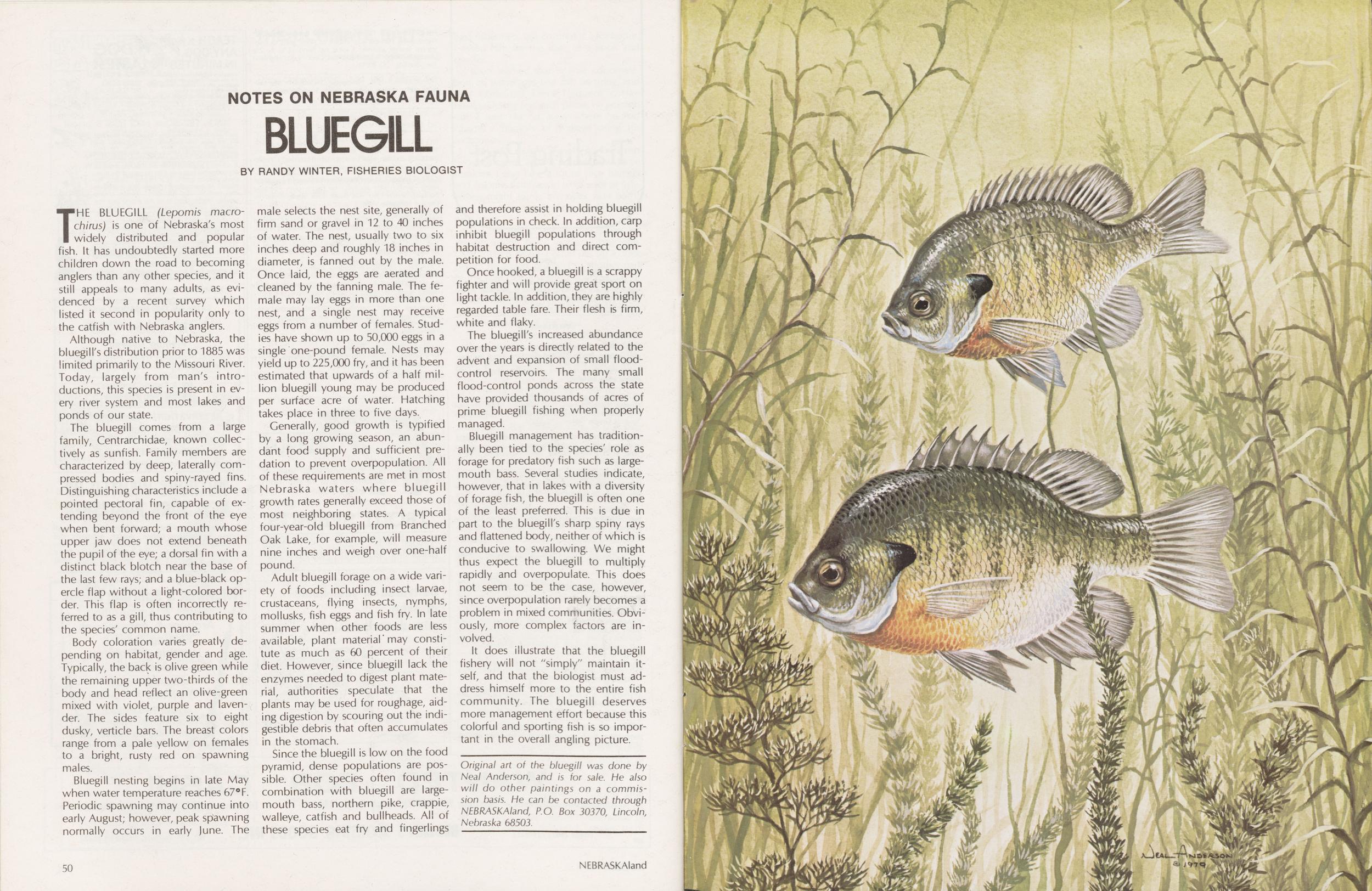
NOTES ON NEBRASKA FAUNA BLUEGILL
THE BLUEGILL (Lepomis macrochirus) is one of Nebraska's most widely distributed and popular fish. It has undoubtedly started more children down the road to becoming anglers than any other species, and it still appeals to many adults, as evidenced by a recent survey which listed it second in popularity only to the catfish with Nebraska anglers.
Although native to Nebraska, the bluegill's distribution prior to 1885 was limited primarily to the Missouri River. Today, largely from man's introductions, this species is present in every river system and most lakes and ponds of our state.
The bluegill comes from a large family, Centrarchidae, known collectively as sunfish. Family members are characterized by deep, laterally compressed bodies and spiny-rayed fins. Distinguishing characteristics include a pointed pectoral fin, capable of extending beyond the front of the eye when bent forward; a mouth whose upper jaw does not extend beneath the pupil of the eye; a dorsal fin with a distinct black blotch near the base of the last few rays; and a blue-black opercle flap without a light-colored border. This flap is often incorrectly referred to as a gill, thus contributing to the species' common name.
Body coloration varies greatly depending on habitat, gender and age. Typically, the back is olive green while the remaining upper two-thirds of the body and head reflect an olive-green mixed with violet, purple and lavender. The sides feature six to eight dusky, verticle bars. The breast colors range from a pale yellow on females to a bright, rusty red on spawning males.
Bluegill nesting begins in late May when water temperature reaches 67°F. Periodic spawning may continue into early August; however, peak spawning normally occurs in early June. The male selects the nest site, generally of firm sand or gravel in 12 to 40 inches of water. The nest, usually two to six inches deep and roughly 18 inches in diameter, is fanned out by the male. Once laid, the eggs are aerated and cleaned by the fanning male. The female may lay eggs in more than one nest, and a single nest may receive eggs from a number of females. Studies have shown up to 50,000 eggs in a single one-pound female. Nests may yield up to 225,000 fry, and it has been estimated that upwards of a half million bluegill young may be produced per surface acre of water. Hatching takes place in three to five days.
Generally, good growth is typified by a long growing season, an abundant food supply and sufficient predation to prevent overpopulation. All of these requirements are met in most Nebraska waters where bluegill growth rates generally exceed those of most neighboring states. A typical four-year-old bluegill from Branched Oak Lake, for example, will measure nine inches and weigh over one-half pound.
Adult bluegill forage on a wide variety of foods including insect larvae, crustaceans, flying insects, nymphs, mollusks, fish eggs and fish fry. In late summer when other foods are less available, plant material may constitute as much as 60 percent of their diet. However, since bluegill lack the enzymes needed to digest plant material, authorities speculate that the plants may be used for roughage, aiding digestion by scouring out the indigestible debris that often accumulates in the stomach.
Since the bluegill is low on the food pyramid, dense populations are possible. Other species often found in combination with bluegill are largemouth bass, northern pike, crappie, walleye, catfish and bullheads. All of these species eat fry and fingerlings and therefore assist in holding bluegill populations in check. In addition, carp inhibit bluegill populations through habitat destruction and direct competition for food.
Once hooked, a bluegill is a scrappy fighter and will provide great sport on light tackle. In addition, they are highly regarded table fare. Their flesh is firm, white and flaky.
The bluegill's increased abundance over the years is directly related to the advent and expansion of small flood-control reservoirs. The many small flood-control ponds across the state have provided thousands of acres of prime bluegill fishing when properly managed.
Bluegill management has traditionally been tied to the species' role as forage for predatory fish such as largemouth bass. Several studies indicate, however, that in lakes with a diversity of forage fish, the bluegill is often one of the least preferred. This is due in part to the bluegill's sharp spiny rays and flattened body, neither of which is conducive to swallowing. We might thus expect the bluegill to multiply rapidly and overpopulate. This does not seem to be the case, however, since overpopulation rarely becomes a problem in mixed communities. Obviously, more complex factors are involved.
It does illustrate that the bluegill fishery will not "simply" maintain itself, and that the biologist must address himself more to the entire fish community. The bluegill deserves more management effort because this colorful and sporting fish is so important in the overall angling picture.
Original art of the bluegill was done by Neal Anderson, and is for sale. He also will do other paintings on a commission basis. He can be contacted through NEBRASKAland, P.O. Box 30370, Lincoln,
Position: 322 (28 views)