Volume 57, Issue 7, 1979
NEBRASKAland MAGAZINE Sportsman's scrapbook
A 100-YEAR HISTORY OF THE OUTDOORS $3.00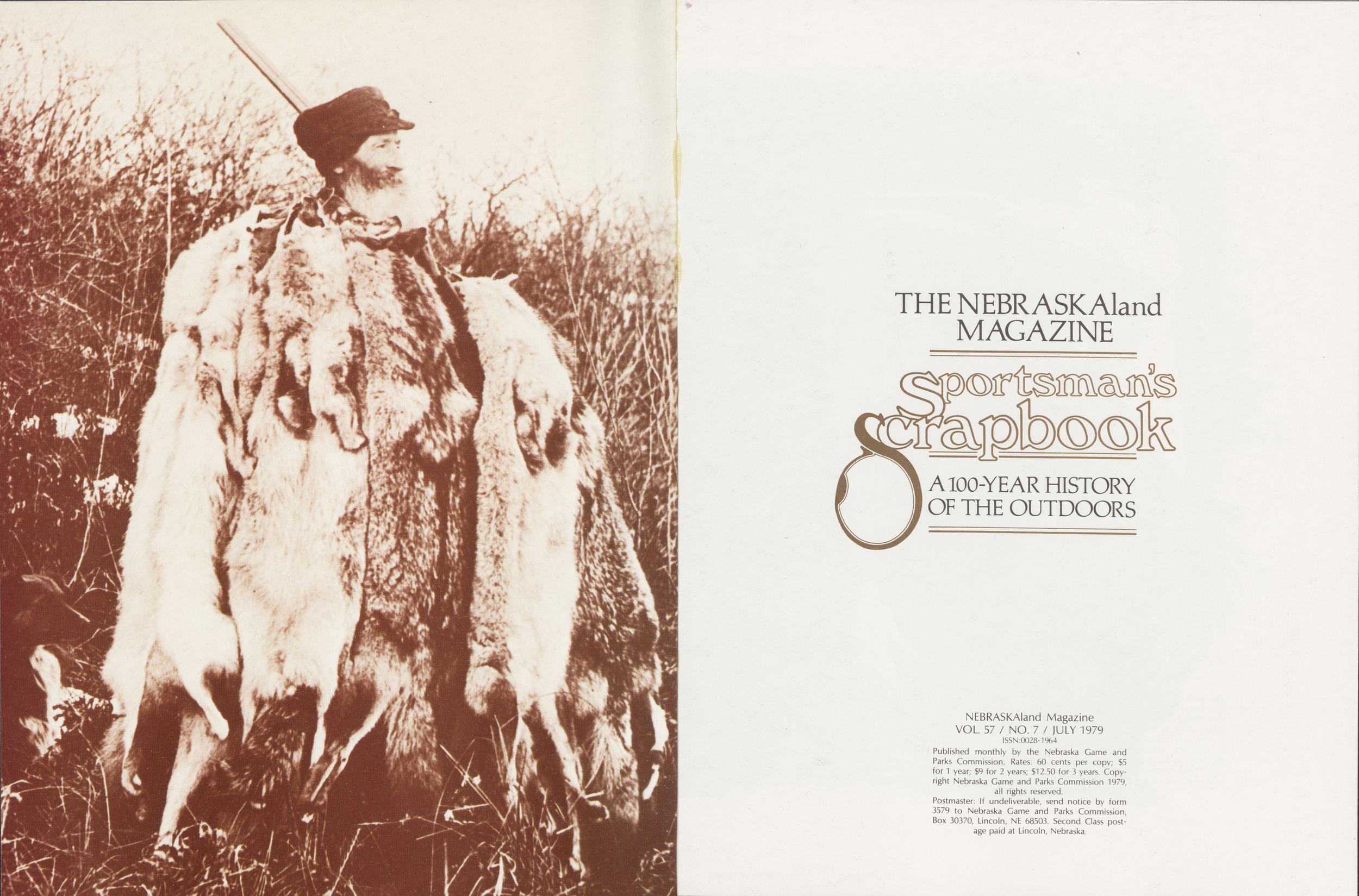
The NEBRASKAland Magazine Sportsman's scrapbook
100-year history of the outdoors NEBRASKAland Magazine VOL 57 / NO. 7 / JULY 1979 ISSN :0028-1964Published monthly by the Nebraska Game and Parks Commission. Rates: 60 cents per copv; $5 for 1 year; $9 for 2 years; $12.50 for 3 years. Copyright Nebraska Game and Parks Commission 1979, all rights reserved.
Postmaster: If undeliverable, send notice by form 3579 to Nebraska Game and Parks Commission, Box 30370, Lincoln, NE 68503. Second Class postage paid at Lincoln, Nebraska.
CONTENTS
AMIDST GREAT ABUNDANCE 6THE VANISHING FRONTIER 1879-1900 8
CHANGING TIMES/RESTRICTING THE EXCESSES 1901-1919 26
GAME MANAGEMENT AND THE MODERN OUTDOORSMAN 1919-1929 44
DROUGHT, DEPRESSION AND THE BIG WAR 1930-1949 58
THE PROGRESSIVE YEARS 1950-1968 74
COMPUTER AGE CONSERVATION 1969-1979 84
THE FUTURE 92
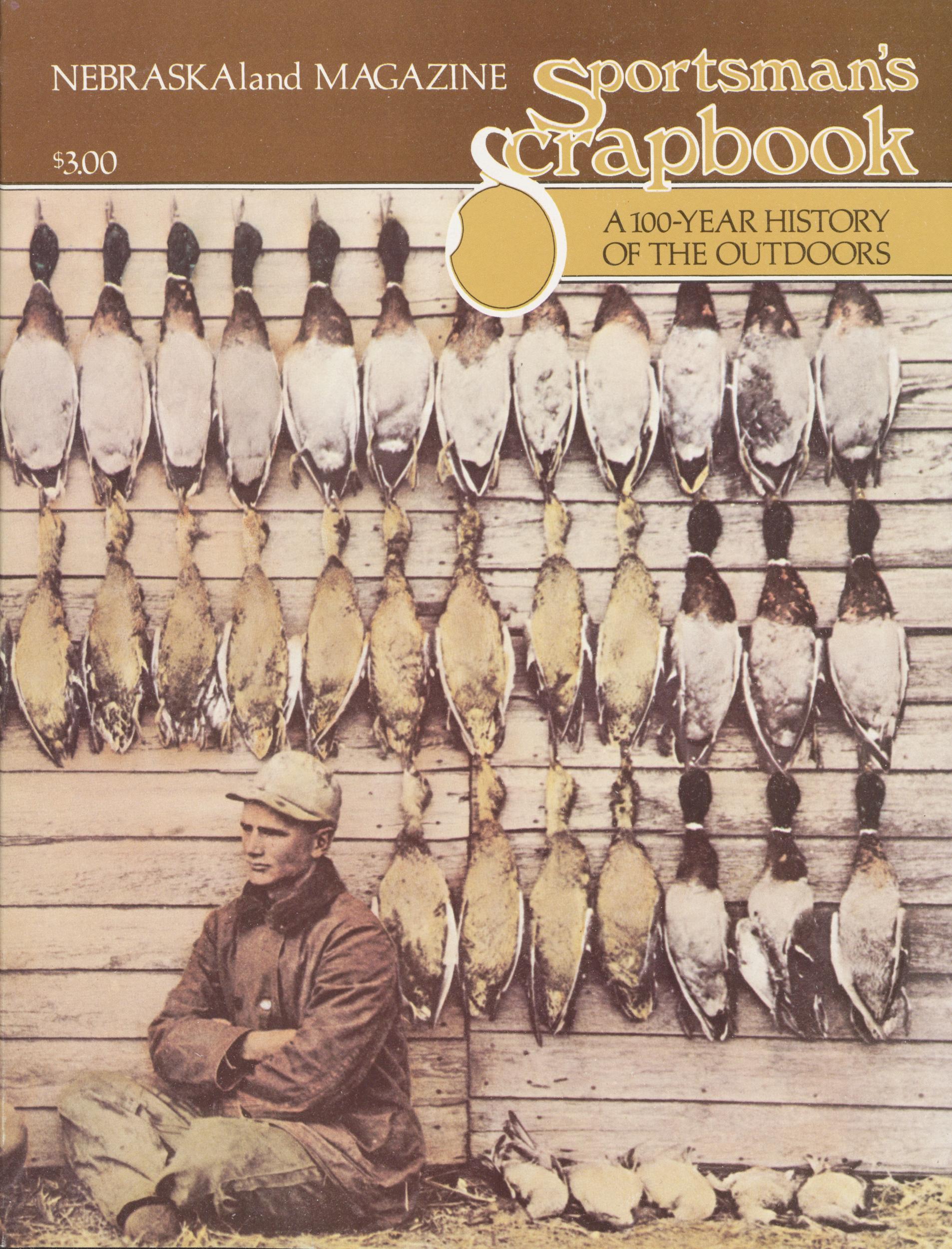
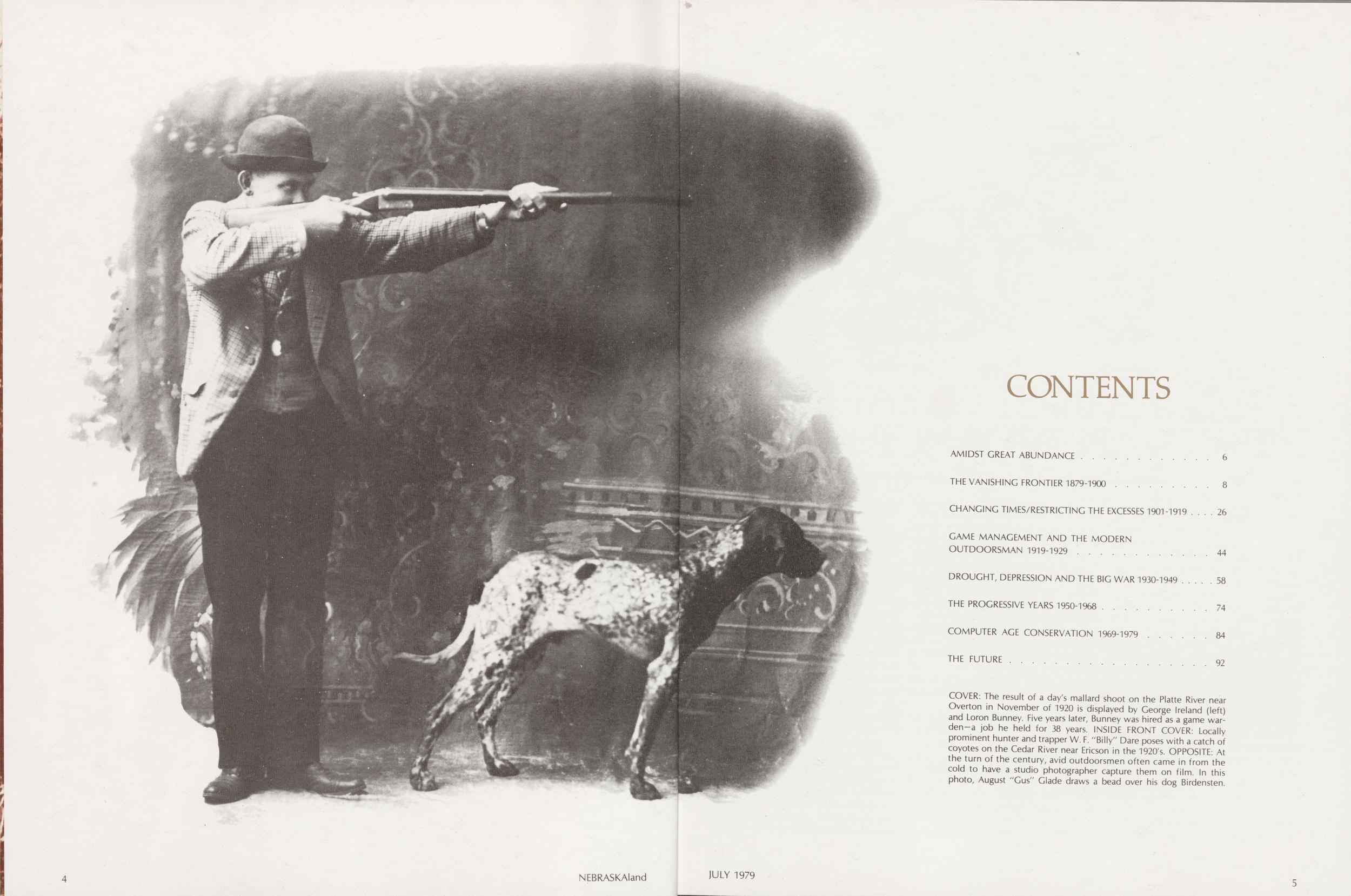
COVER: The result of a day's mallard shoot on the Platte River near Overton in November of 1920 is displayed by George Ireland (left) and Loron Bunney. Five years later, Bunney was hired as a game warden-a job he held for 38 years. INSIDE FRONT COVER: Locally prominent hunter and trapper W. F. "Billy" Dare poses with a catch of coyotes on the Cedar River near Ericson in the 1920's. OPPOSITE: At the turn of the century, avid outdoorsmen often came in from the cold to have a studio photographer capture them on film. In this photo, August "Gus" Glade draws a bead over his dog Birdensten.
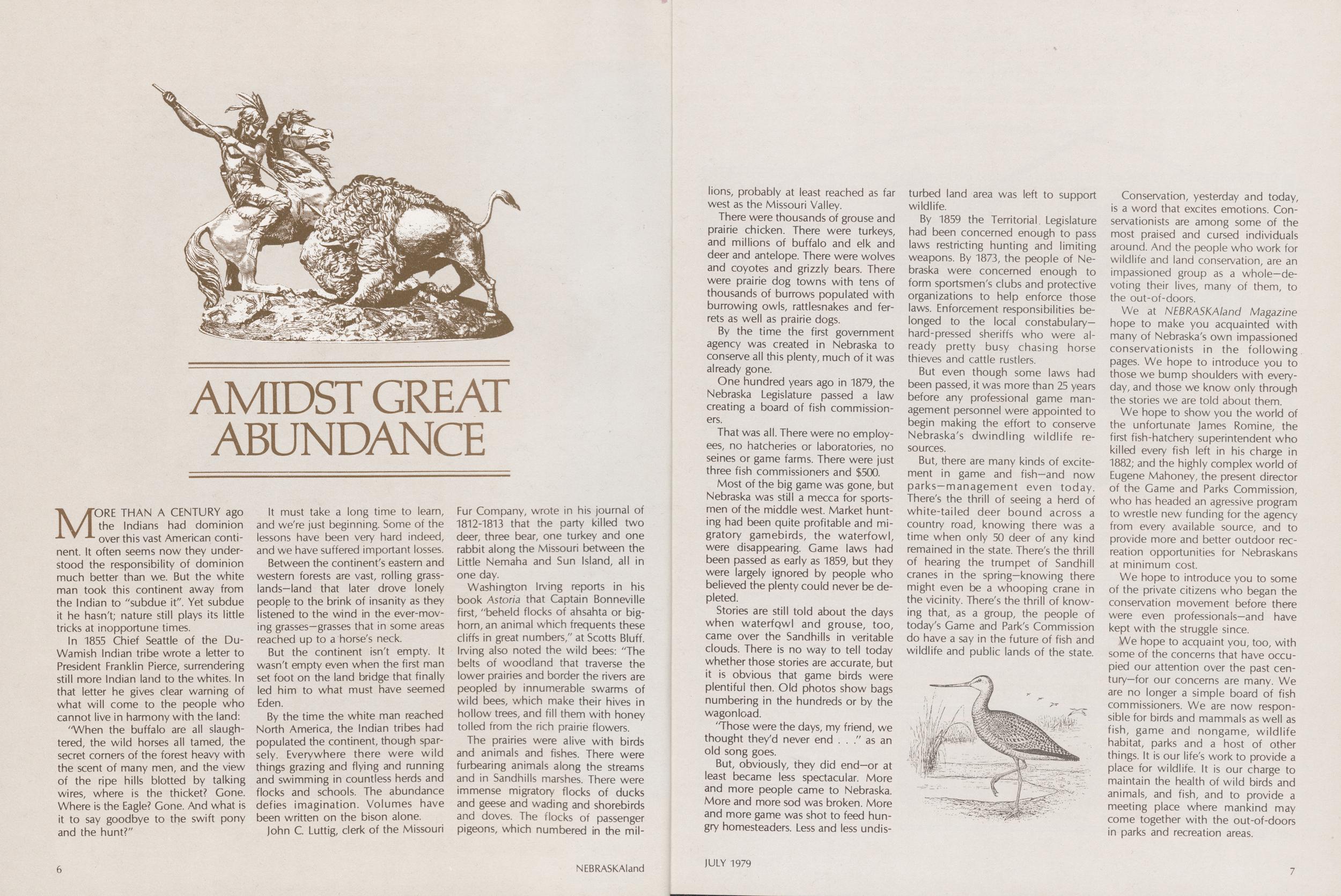
AMIDST GREAT ABUNDANCE
MORE THAN A CENTURY ago the Indians had dominion over this vast American continent. It often seems now they understood the responsibility of dominion much better than we. But the white man took this continent away from the Indian to "subdue it". Yet subdue it he hasn't; nature still plays its little tricks at inopportune times.
In 1855 Chief Seattle of the Du-Wamish Indian tribe wrote a letter to President Franklin Pierce, surrendering still more Indian land to the whites. In that letter he gives clear warning of what will come to the people who cannot live in harmony with the land:
"When the buffalo are all slaughtered, the wild horses all tamed, the secret corners of the forest heavy with the scent of many men, and the view of the ripe hills blotted by talking wires, where is the thicket? Gone. Where is the Eagle? Gone. And what is it to say goodbye to the swift pony and the hunt?"
It must take a long time to learn, and we're just beginning. Some of the lessons have been very hard indeed, and we have suffered important losses.
Between the continent's eastern and western forests are vast, rolling grasslands—land that later drove lonely people to the brink of insanity as they listened to the wind in the ever-moving grasses—grasses that in some areas reached up to a horse's neck.
But the continent isn't empty. It wasn't empty even when the first man set foot on the land bridge that finally led him to what must have seemed Eden.
By the time the white man reached North America, the Indian tribes had populated the continent, though sparsely. Everywhere there were wild things grazing and flying and running and swimming in countless herds and flocks and schools. The abundance defies imagination. Volumes have been written on the bison alone.
John G Luttig, clerk of the Missouri Fur Company, wrote in his journal of 1812-1813 that the party killed two deer, three bear, one turkey and one rabbit along the Missouri between the Little Nemaha and Sun Island, all in one day.
Washington Irving reports in his book Astoria that Captain Bonneville first, "beheld flocks of ahsahta or bighorn, an animal which frequents these cliffs in great numbers," at Scotts Bluff. Irving also noted the wild bees: "The belts of woodland that traverse the lower prairies and border the rivers are peopled by innumerable swarms of wild bees, which make their hives in hollow trees, and fill them with honey tolled from the rich prairie flowers.
The prairies were alive with birds and animals and fishes. There were furbearing animals along the streams and in Sandhills marshes. There were immense migratory flocks of ducks and geese and wading and shorebirds and doves. The flocks of passenger pigeons, which numbered in the millions, probably at least reached as far west as the Missouri Valley.
There were thousands of grouse and prairie chicken. There were turkeys, and millions of buffalo and elk and deer and antelope. There were wolves and coyotes and grizzly bears. There were prairie dog towns with tens of thousands of burrows populated with burrowing owls, rattlesnakes and ferrets as well as prairie dogs.
By the time the first government agency was created in Nebraska to conserve all this plenty, much of it was already gone.
One hundred years ago in 1879, the Nebraska Legislature passed a law creating a board of fish commissioners.
That was all. There were no employees, no hatcheries or laboratories, no seines or game farms. There were just three fish commissioners and $500.
Most of the big game was gone, but Nebraska was still a mecca for sportsmen of the middle west. Market hunting had been quite profitable and migratory gamebirds, the waterfowl, were disappearing. Game laws had been passed as early as 1859, but they were largely ignored by people who believed the plenty could never be depleted.
Stories are still told about the days when waterfowl and grouse, too, came over the Sandhills in veritable clouds. There is no way to tell today whether those stories are accurate, but it is obvious that game birds were plentiful then. Old photos show bags numbering in the hundreds or by the wagonload.
"Those were the days, my friend, we thought they'd never end..." as an old song goes.
But, obviously, they did end—or at least became less spectacular. More and more people came to Nebraska. More and more sod was broken. More and more game was shot to feed hungry homesteaders. Less and less undisturbed land area was left to support wildlife.
By 1859 the Territorial. Legislature had been concerned enough to pass laws restricting hunting and limiting weapons. By 1873, the people of Nebraska were concerned enough to form sportsmen's clubs and protective organizations to help enforce those laws. Enforcement responsibilities belonged to the local constabulary-hard-pressed sheriffs who were already pretty busy chasing horse thieves and cattle rustlers.
But even though some laws had been passed, it was more than 25 years before any professional game management personnel were appointed to begin making the effort to conserve Nebraska's dwindling wildlife resources.
But, there are many kinds of excitement in game and fish—and now parks—management even today. There's the thrill of seeing a herd of white-tailed deer bound across a country road, knowing there was a time when only 50 deer of any kind remained in the state. There's the thrill of hearing the trumpet of Sandhill cranes in the spring—knowing there might even be a whooping crane in the vicinity. There's the thrill of knowing that, as a group, the people of today's Game and Park's Commission do have a say in the future of fish and wildlife and public lands of the state.
Conservation, yesterday and today, is a word that excites emotions. Conservationists are among some of the most praised and cursed individuals around. And the people who work for wildlife and land conservation, are an impassioned group as a whole—devoting their lives, many of them, to the out-of-doors.
We at NEBRASKAland Magazine hope to make you acquainted with many of Nebraska's own impassioned conservationists in the following pages. We hope to introduce you to those we bump shoulders with everyday, and those we know only through the stories we are told about them.
We hope to show you the world of the unfortunate James Romine, the first fish-hatchery superintendent who killed every fish left in his charge in 1882; and the highly complex world of Eugene Mahoney, the present director of the Game and Parks Commission, who has headed an agressive program to wrestle new funding for the agency from every available source, and to provide more and better outdoor recreation opportunities for Nebraskans at minimum cost.
We hope to introduce you to some of the private citizens who began the conservation movement before there were even professionals—and have kept with the struggle since.
We hope to acquaint you, too, with some of the concerns that have occupied our attention over the past century—for our concerns are many. We are no longer a simple board of fish commissioners. We are now responsible for birds and mammals as well as fish, game and nongame, wildlife habitat, parks and a host of other things. It is our life's work to provide a place for wildlife. It is our charge to maintain the health of wild birds and animals, and fish, and to provide a meeting place where mankind may come together with the out-of-doors in parks and recreation areas.
6 NEBRASKAland JULY 1979 7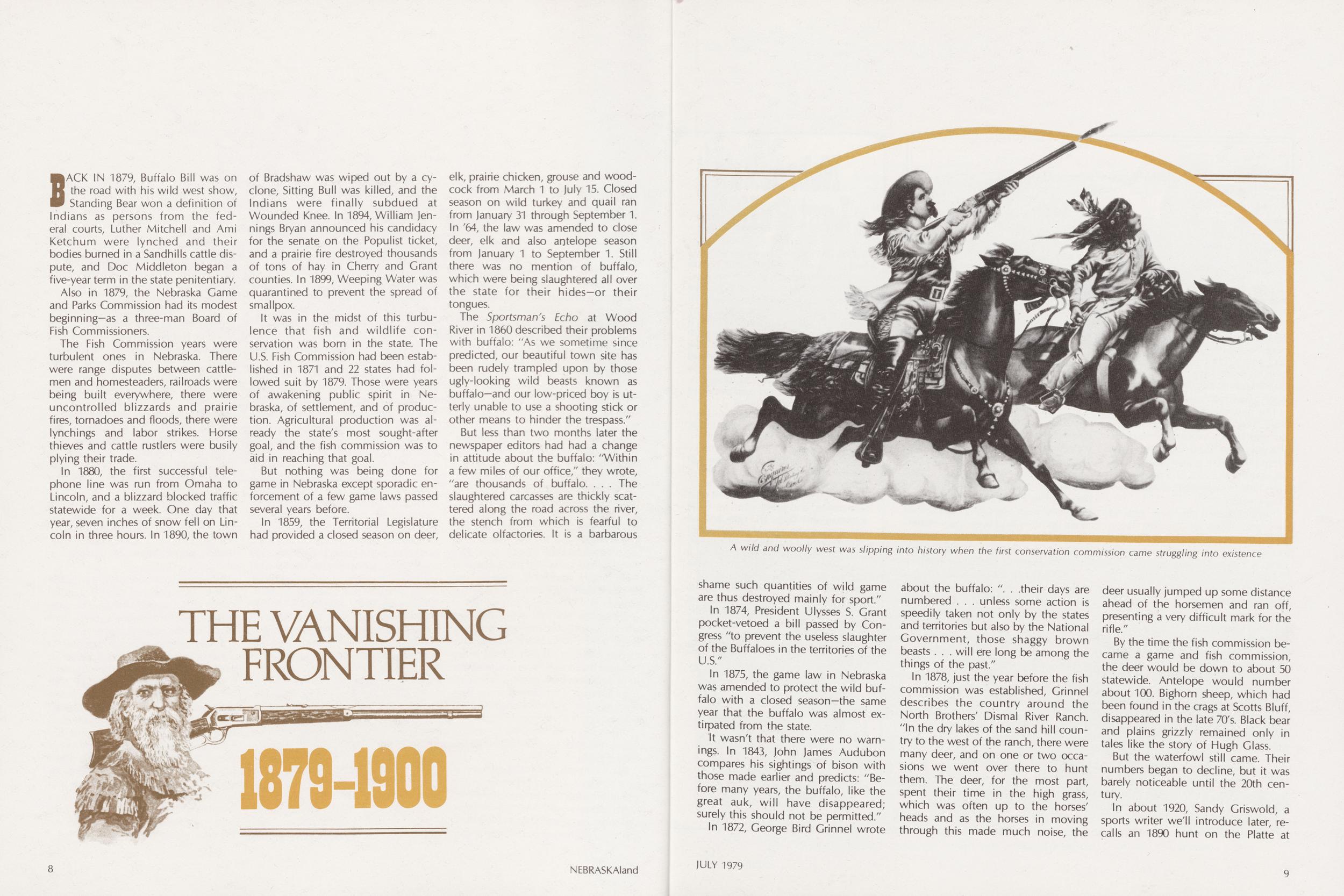
THE VANISHING FRONTIER 1879-1900
BACK IN 1879, Buffalo Bill was on the road with his wild west show, Standing Bear won a definition of Indians as persons from the federal courts, Luther Mitchell and Ami Ketchum were lynched and their bodies burned in a Sandhills cattle dispute, and Doc Middleton began a five-year term in the state penitentiary.
Also in 1879, the Nebraska Game and Parks Commission had its modest beginning—as a three-man Board of Fish Commissioners.
The Fish Commission years were turbulent ones in Nebraska. There were range disputes between cattlemen and homesteaders, railroads were being built everywhere, there were uncontrolled blizzards and prairie fires, tornadoes and floods, there were lynchings and labor strikes. Horse thieves and cattle rustlers were busily plying their trade.
In 1880, the first successful telephone line was run from Omaha to Lincoln, and a blizzard blocked traffic statewide for a week. One day that year, seven inches of snow fell on Lincoln in three hours. In 1890, the town of Bradshaw was wiped out by a cyclone, Sitting Bull was killed, and the Indians were finally subdued at Wounded Knee. In 1894, William Jennings Bryan announced his candidacy for the senate on the Populist ticket, and a prairie fire destroyed thousands of tons of hay in Cherry and Grant counties. In 1899, Weeping Water was quarantined to prevent the spread of smallpox.
It was in the midst of this turbulence that fish and wildlife conservation was born in the state. The U.S. Fish Commission had been established in 1871 and 22 states had followed suit by 1879. Those were years of awakening public spirit in Nebraska, of settlement, and of production. Agricultural production was already the state's most sought-after goal, and the fish commission was to aid in reaching that goal.
But nothing was being done for game in Nebraska except sporadic enforcement of a few game laws passed several years before.
In 1859, the Territorial Legislature had provided a closed season on deer, elk, prairie chicken, grouse and wood-cock from March 1 to July 15. Closed season on wild turkey and quail ran from January 31 through September 1. In '64, the law was amended to close deer, elk and also antelope season from January 1 to September 1. Still there was no mention of buffalo, which were being slaughtered all over the state for their hides—or their tongues.
The Sportsman's Echo at Wood River in 1860 described their problems with buffalo: "As we sometime since predicted, our beautiful town site has been rudely trampled upon by those ugly-looking wild beasts known as buffalo—and our low-priced boy is utterly unable to use a shooting stick or other means to hinder the trespass."
A wild and woolly west was slipping into history when the first conservation commission came struggling into existence
In 1874, President Ulysses S. Grant pocket-vetoed a bill passed by Congress "to prevent the useless slaughter of the Buffaloes in the territories of the U.S."
In 1875, the game law in Nebraska was amended to protect the wild buffalo with a closed season—the same year that the buffalo was almost extirpated from the state.
It wasn't that there were no warnings. In 1843, John James Audubon compares his sightings of bison with those made earlier and predicts: "Before many years, the buffalo, like the great auk, will have disappeared; surely this should not be permitted."
In 1872, George Bird Grinnel wrote about the buffalo: "...their days are numbered...unless some action is speedily taken not only by the states and territories but also by the National Government, those shaggy brown beasts...will ere long be among the things of the past."
In 1878, just the year before the fish commission was established, Grinnel describes the country around the North Brothers' Dismal River Ranch. "In the dry lakes of the sand hill country to the west of the ranch, there were many deer, and on one or two occasions we went over there to hunt them. The deer, for the most part, spent their time in the high grass, which was often up to the horses' heads and as the horses in moving through this made much noise, the deer usually jumped up some distance ahead of the horsemen and ran off, presenting a very difficult mark for the rifle."
By the time the fish commission became a game and fish commission, the deer would be down to about 50 statewide. Antelope would number about 100. Bighorn sheep, which had been found in the crags at Scotts Bluff, disappeared in the late 70's. Black bear and plains grizzly remained only in tales like the story of Hugh Glass. But the waterfowl still came. Their numbers began to decline, but it was barely noticeable until the 20th century.
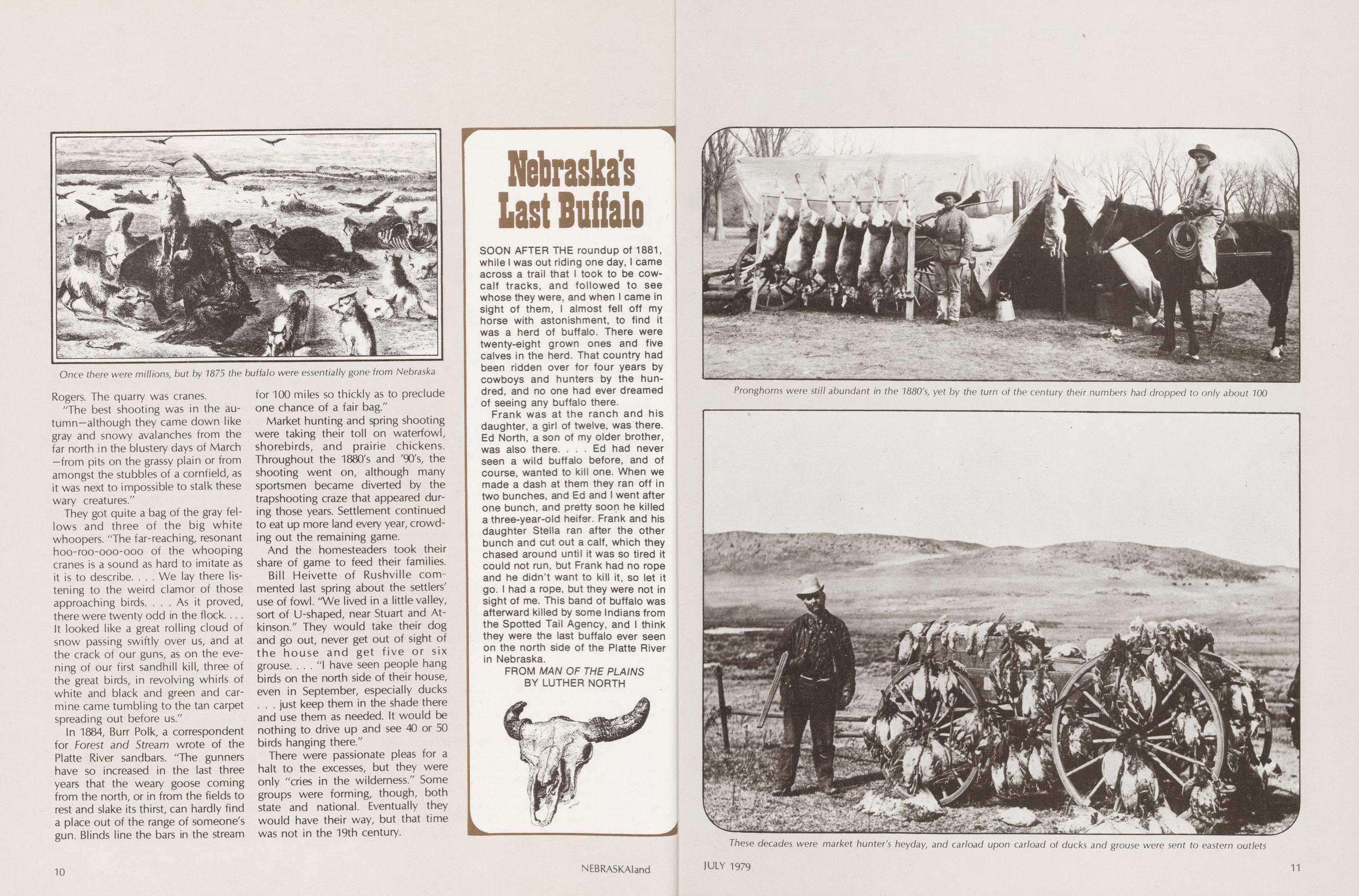
Once there were millions, but by 1875 the buffalo were essentially gone from Nebraska
"The best shooting was in the autumn—although they came down like gray and snowy avalanches from the far north in the blustery days of March —from pits on the grassy plain or from amongst the stubbles of a cornfield, as it was next to impossible to stalk these wary creatures."
They got quite a bag of the gray fellows and three of the big white whoopers. "The far-reaching, resonant hoo-roo-ooo-ooo of the whooping cranes is a sound as hard to imitate as it is to describe...We lay there listening to the weird clamor of those approaching birds... As it proved, there were twenty odd in the flock.... It looked like a great rolling cloud of snow passing swiftly over us, and at the crack of our guns, as on the evening of our first sandhill kill, three of the great birds, in revolving whirls of white and black and green and carmine came tumbling to the tan carpet spreading out before us."
In 1884, Burr Polk, a correspondent for Forest and Stream wrote of the Platte River sandbars. "The gunners have so increased in the last three years that the weary goose coming from the north, or in from the fields to rest and slake its thirst, can hardly find a place out of the range of someone's gun. Blinds line the bars in the stream for 100 miles so thickly as to preclude one chance of a fair bag."
Market hunting and spring shooting were taking their toll on waterfowl, shorebirds, and prairie chickens. Throughout the 1880's and '90's, the shooting went on, although many sportsmen became diverted by the trapshooting craze that appeared during those years. Settlement continued to eat up more land every year, crowding out the remaining game.
And the homesteaders took their share of game to feed their families.
Bill Heivette of Rushville commented last spring about the settlers' use of fowl. "We lived in a little valley, sort of U-shaped, near Stuart and Atkinson." They would take their dog and go out, never get out of sight of the house and get five or six grouse... "I have seen people hang birds on the north side of their house, even in September, especially ducks ...just keep them in the shade there and use them as needed. It would be nothing to drive up and see 40 or 50 birds hanging there."
There were passionate pleas for a halt to the excesses, but they were only "cries in the wilderness." Some groups were forming, though, both state and national. Eventually they would have their way, but that time was not in the 19th century.
Nebraska's Last Buffalo
SOON AFTER THE roundup of 1881, while I was out riding one day, I came across a trail that I took to be cow-calf tracks, and followed to see whose they were, and when I came in sight of them, I almost fell off my horse with astonishment, to find it was a herd of buffalo. There were twenty-eight grown ones and five calves in the herd. That country had been ridden over for four years by cowboys and hunters by the hundred, and no one had ever dreamed of seeing any buffalo there.
Frank was at the ranch and his daughter, a girl of twelve, was there. Ed North, a son of my older brother, was also there... Ed had never seen a wild buffalo before, and of course, wanted to kill one. When we made a dash at them they ran off in two bunches, and Ed and I went after one bunch, and pretty soon he killed a three-year-old heifer. Frank and his daughter Stella ran after the other bunch and cut out a calf, which they chased around until it was so tired it could not run, but Frank had no rope and he didn't want to kill it, so let it go. I had a rope, but they were not in sight of me. This band of buffalo was afterward killed by some Indians from the Spotted Tail Agency, and I think they were the last buffalo ever seen on the north side of the Platte River in Nebraska.
FROM MAN OF THE PLAINS BY LUTHER NORTHPronghorns were still abundant in the 1880% yet by the turn of the century their numbers had dropped to only about 100
These decades were market hunter's heyday, and carload upon carload of ducks and grouse were sent to eastern outlets
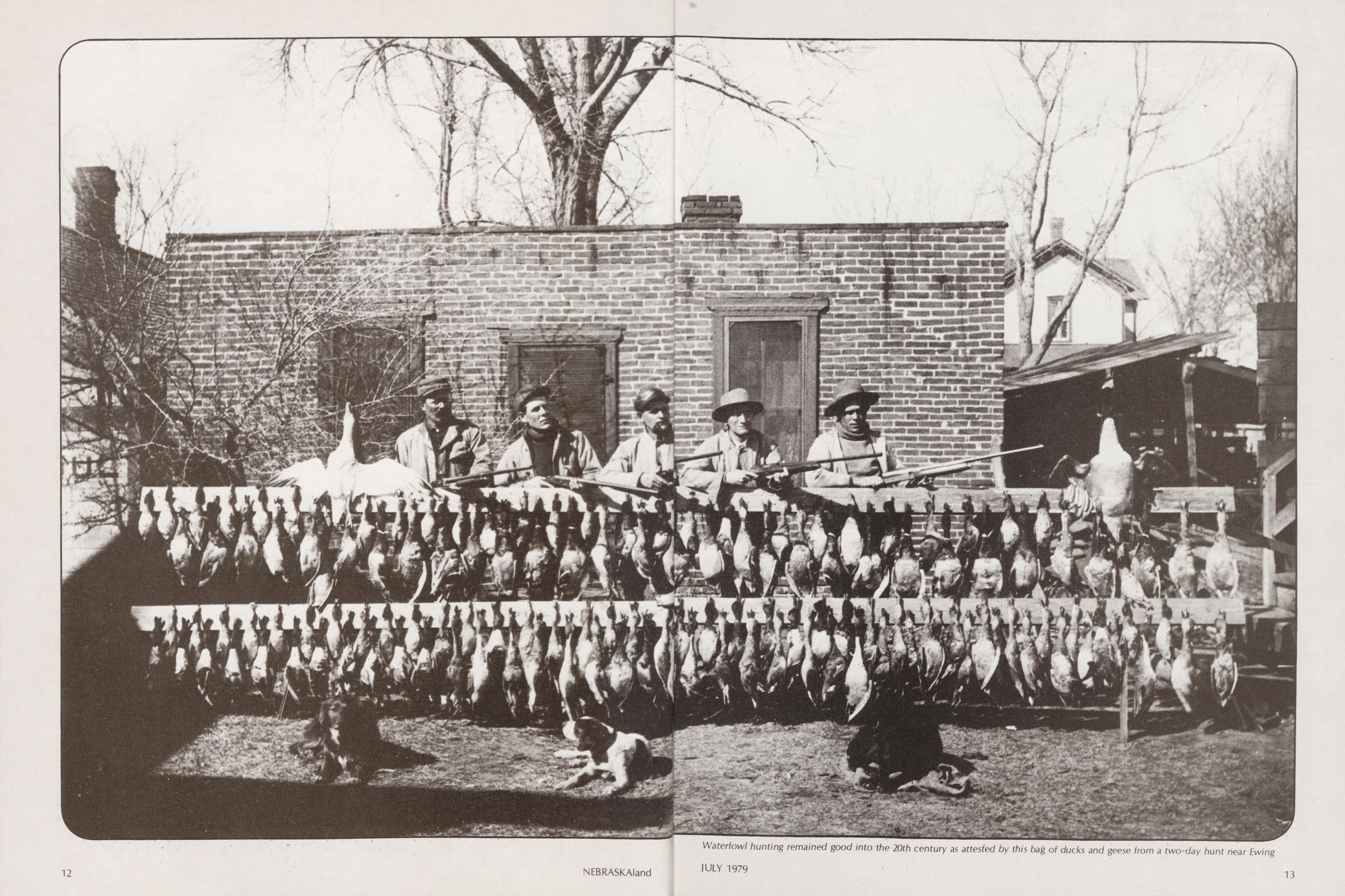
Waterfowl hunting remained good into the 20th century as attested by this bag of ducks and geese from a two-day hunt near Ewing
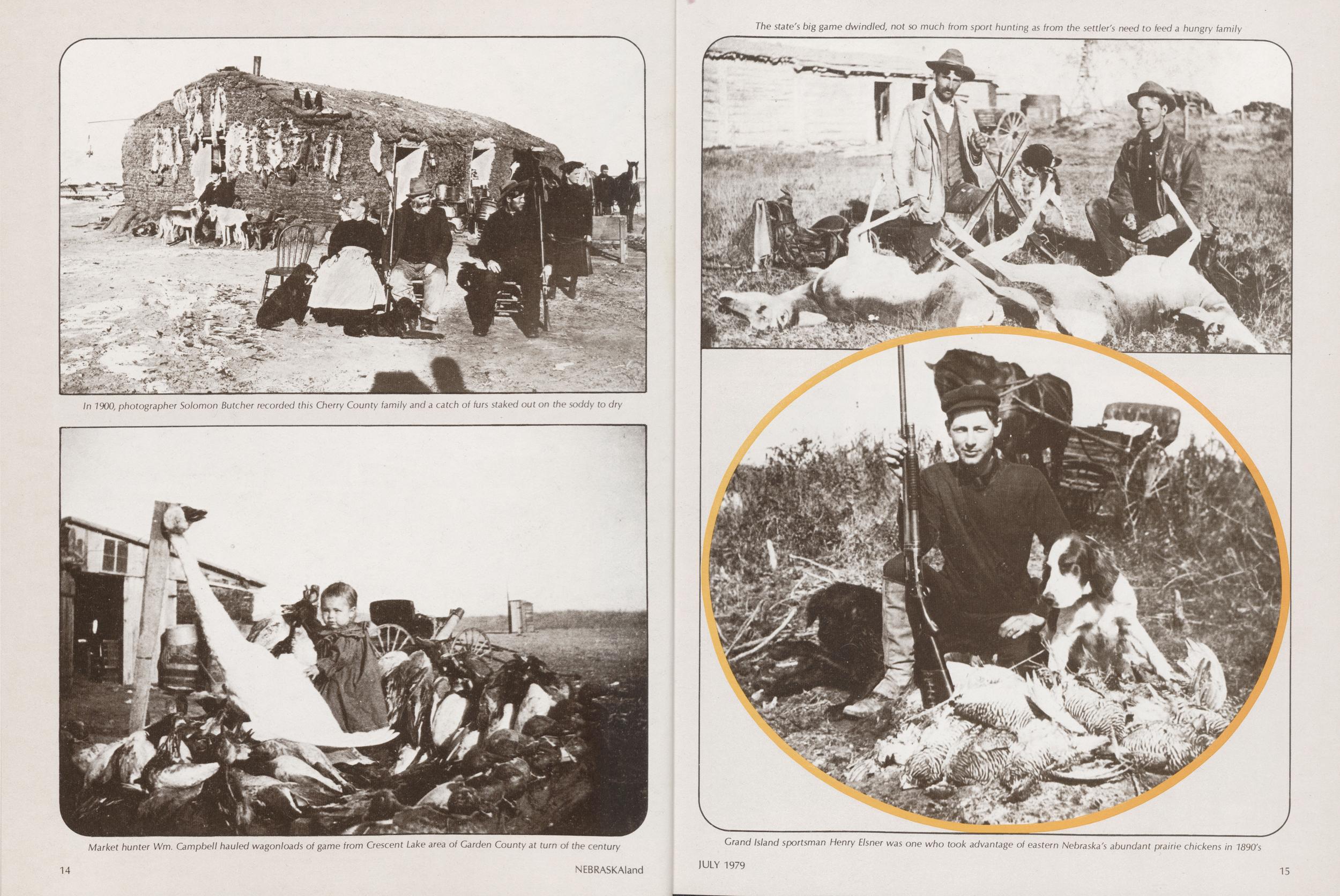
In 1900, photographer Solomon Butcher recorded this Cherry County family and a catch of furs staked out on the soddy to dry
Market hunter Wm. Campbell hauled wagonloads of game from Crescent Lake area of Carden County at turn of the century
The state's big game dwindled, not so much from sport hunting as from the settler's need to feed a hungry family
Grand Island sportsman Henry Eisner was one who took advantage of eastern Nebraska's abundant prairie chickens in 1890's
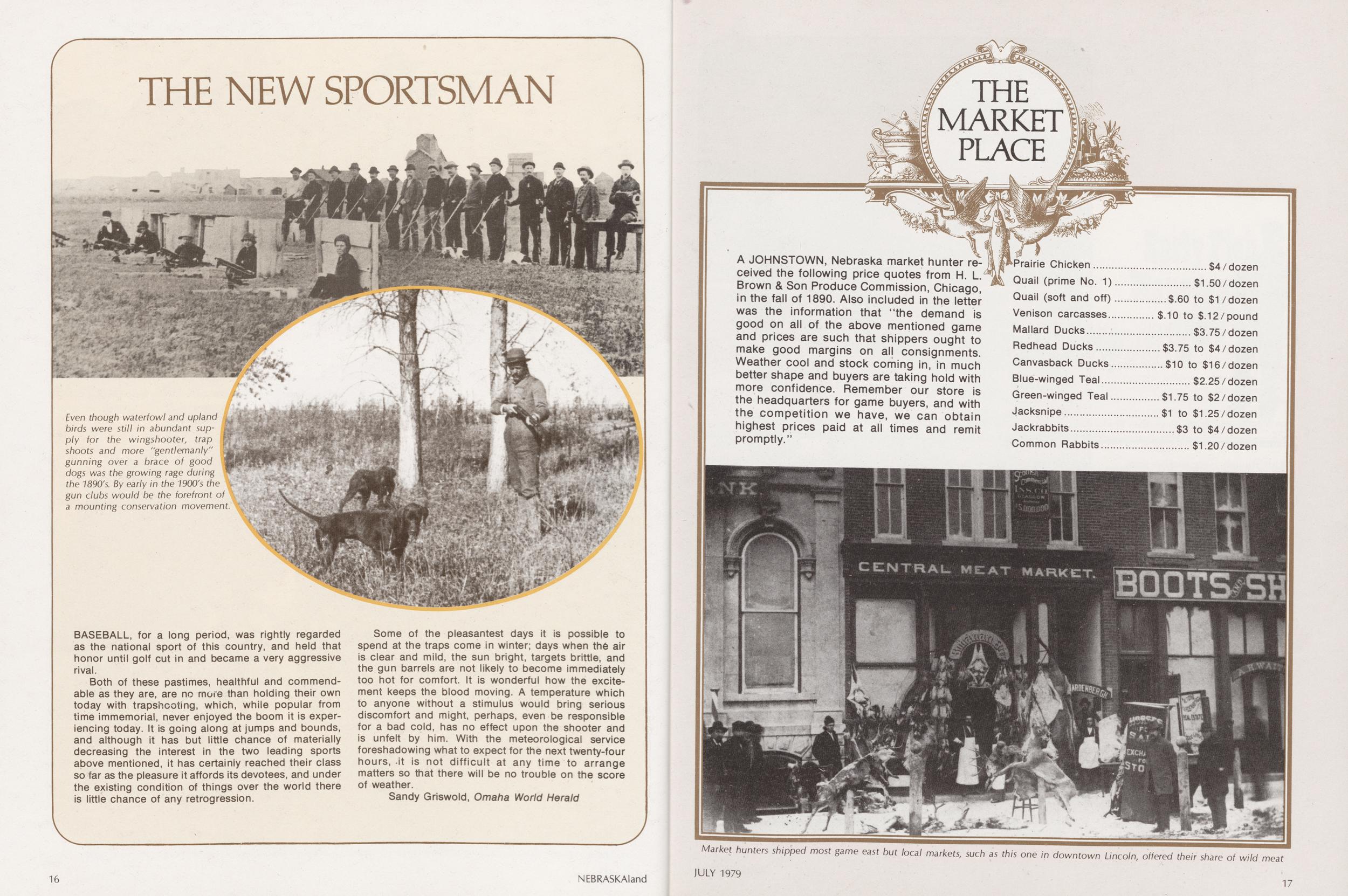
THE NEW SPORTSMAN
Even though waterfowl and upland birds were still in abundant supply for the wingshooter, trap shoots and more "gentlemanly" gunning over a brace of good dogs was the growing rage during the 1890's. By early in the 1900's the gun clubs would be the forefront of a mounting conservation movement.
BASEBALL, for a long period, was rightly regarded as the national sport of this country, and held that honor until golf cut in and became a very aggressive rival.
Both of these pastimes, healthful and commendable as they are, are no mure than holding their own today with trapshcoting, which, while popular from time immemorial, never enjoyed the boom it is experiencing today. It is going along at jumps and bounds, and although it has but little chance of materially decreasing the interest in the two leading sports above mentioned, it has certainly reached their class so far as the pleasure it affords its devotees, and under the existing condition of things over the world there is little chance of any retrogression.
Some of the pleasantest days it is possible to spend at the traps come in winter; days when the air is clear and mild, the sun bright, targets brittle, and the gun barrels are not likely to become immediately too hot for comfort. It is wonderful how the excitement keeps the blood moving. A temperature which to anyone without a stimulus would bring serious discomfort and might, perhaps, even be responsible for a bad cold, has no effect upon the shooter and is unfelt by him. With the meteorological service foreshadowing what to expect for the next twenty-four hours, it is not difficult at any time to arrange matters so that there will be no trouble on the score of weather.
The Market Place
A JOHNSTOWN, Nebraska market hunter received the following price quotes from H. L. Brown & Son Produce Commission, Chicago, in the fall of 1890. Also included in the letter was the information that "the demand is good on all of the above mentioned game and prices are such that shippers ought to make good margins on all consignments. Weather cool and stock coming in, in much better shape and buyers are taking hold with more confidence. Remember our store is the headquarters for game buyers, and with the competition we have, we can obtain highest prices paid at all times and remit promptly."
Prairie Chicken $4/dozenQuail (prime No. 1) $1.50/dozen
Quail (soft and off) $.60 to $1/dozen
Venison carcasses $.10 to $.12/pound
Mallard Ducks $3.75/dozen
Redhead Ducks $3.75 to $4/dozen
Canvasback Ducks $10 to $16/dozen
Blue-winged Teal $2.25/dozen
Green-winged Teal $1.75 to $2/dozen
Jacksnipe $1 to $1.25/dozen
Jackrabbits $3 to $4/dozen
Common Rabbits $1.20/dozen
Market hunters shipped most game east but local markets such as this one in downtown Lincoln, offered their share of wild meat
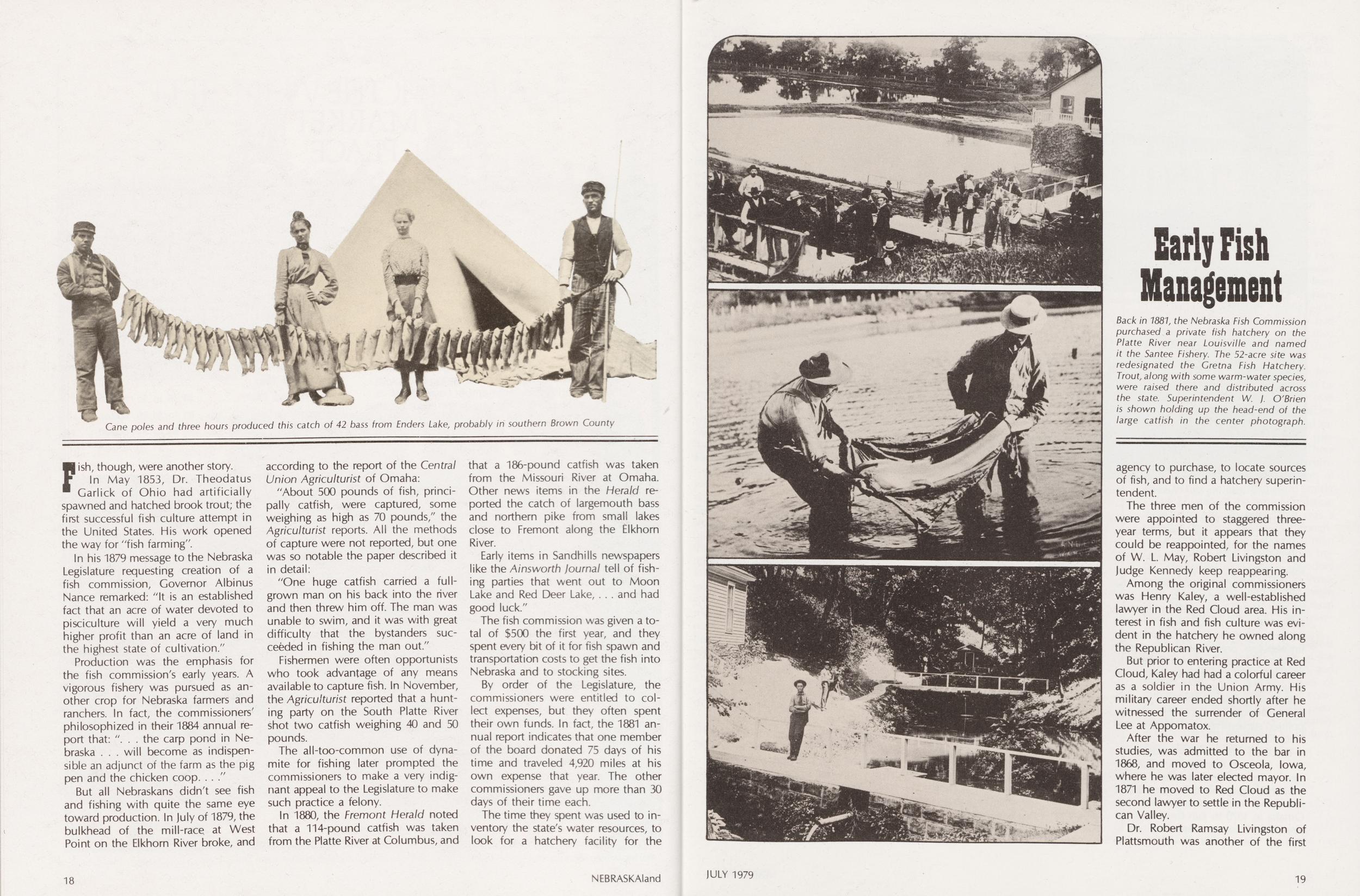
Early Fish Management
Cane poles and three hours produced this catch of 42 bass from Enders Lake, probably in southern Brown County
Fish, though, were another story.
In May 1853, Dr. Theodatus Garlick of Ohio had artificially spawned and hatched brook trout; the first successful fish culture attempt in the United States. His work opened the way for "fish farming".
In his 1879 message to the Nebraska Legislature requesting creation of a fish commission, Governor Albinus Nance remarked: "It is an established fact that an acre of water devoted to pisciculture will yield a very much higher profit than an acre of land in the highest state of cultivation."
Production was the emphasis for the fish commission's early years. A vigorous fishery was pursued as another crop for Nebraska farmers and ranchers. In fact, the commissioners' philosophized in their 1884 annual report that: "...the carp pond in Nebraska...will become as indispensible an adjunct of the farm as the pig pen and the chicken coop..."
But all Nebraskans didn't see fish and fishing with quite the same eye toward production. In July of 1879, the bulkhead of the mill-race at West Point on the Elkhorn River broke, and according to the report of the Central Union Agriculturist of Omaha:
"About 500 pounds of fish, principally catfish, were captured, some weighing as high as 70 pounds," the Agriculturist reports. All the methods of capture were not reported, but one was so notable the paper described it in detail:
"One huge catfish carried a full-grown man on his back into the river and then threw him off. The man was unable to swim, and it was with great difficulty that the bystanders succeeded in fishing the man out."
Fishermen were often opportunists who took advantage of any means available to capture fish. In November, the Agriculturist reported that a hunting party on the South Platte River shot two catfish weighing 40 and 50 pounds.
The all-too-common use of dynamite for fishing later prompted the commissioners to make a very indignant appeal to the Legislature to make such practice a felony.
In 1880, the Fremont Herald noted that a 114-pound catfish was taken from the Platte River at Columbus, and that a 186-pound catfish was taken from the Missouri River at Omaha. Other news items in the Herald reported the catch of largemouth bass and northern pike from small lakes close to Fremont along the Elkhorn River.
Early items in Sandhills newspapers like the Ainsworth Journal tell of fishing parties that went out to Moon Lake and Red Deer Lake,...and had good luck."
The fish commission was given a total of $500 the first year, and they spent every bit of it for fish spawn and transportation costs to get the fish into Nebraska and to stocking sites.
By order of the Legislature, the commissioners were entitled to collect expenses, but they often spent their own funds. In fact, the 1881 annual report indicates that one member of the board donated 75 days of his time and traveled 4,920 miles at his own expense that year. The other commissioners gave up more than 30 days of their time each.
Back in 1881, the Nebraska Fish Commission purchased a private fish hatchery on the Platte River near Louisville and named it the Santee Fishery. The 52-acre site was redesignated the Cretna Fish Hatchery. Trout, along with some warm-water species, were raised there and distributed across the state. Superintendent W. J. O'Brien is shown holding up the head-end of the large catfish in the center photograph.
The three men of the commission were appointed to staggered three-year terms, but it appears that they could be reappointed, for the names of W. L. May, Robert Livingston and Judge Kennedy keep reappearing.
Among the original commissioners was Henry Kaley, a well-established lawyer in the Red Cloud area. His interest in fish and fish culture was evident in the hatchery he owned along the Republican River.
But prior to entering practice at Red Cloud, Kaley had had a colorful career as a soldier in the Union Army. His military career ended shortly after he witnessed the surrender of General Lee at Appomatox.
After the war he returned to his studies, was admitted to the bar in 1868, and moved to Osceola, Iowa, where he was later elected mayor. In 1871 he moved to Red Cloud as the second lawyer to settle in the Republican Valley.
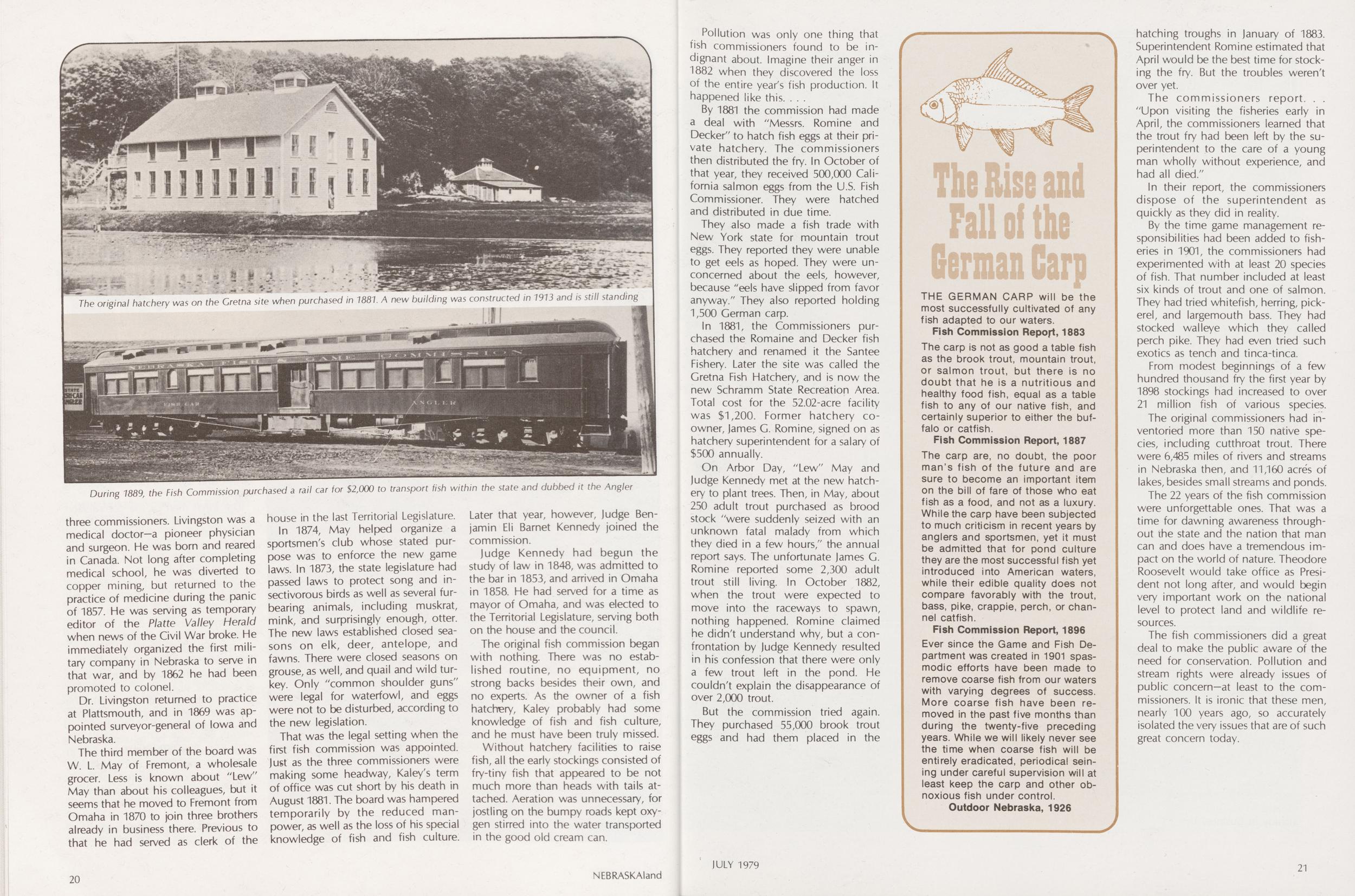
The original hatchery was on the Gretna site when purchased in 1881. A new building was constructed in 1913 and is still standing
During 1889, the Fish Commission purchased a rail car for $2,000 to transport fish within the state and dubbed it the Angler
Dr. Livingston returned to practice at Plattsmouth, and in 1869 was appointed surveyor-general of Iowa and Nebraska.
The third member of the board was W. L. May of Fremont, a wholesale grocer. Less is known about "Lew" May than about his colleagues, but it seems that he moved to Fremont from Omaha in 1870 to join three brothers already in business there. Previous to that he had served as clerk of the house in the last Territorial Legislature.
In 1874, May helped organize a sportsmen's club whose stated purpose was to enforce the new game laws. In 1873, the state legislature had passed laws to protect song and insectivorous birds as well as several furbearing animals, including muskrat, mink, and surprisingly enough, otter. The new laws established closed seasons on elk, deer, antelope, and fawns. There were closed seasons on grouse, as well, and quail and wild turkey. Only "common shoulder guns" were legal for waterfowl, and eggs were not to be disturbed, according to the new legislation.
That was the legal setting when the first fish commission was appointed. Just as the three commissioners were making some headway, Kaley's term of office was cut short by his death in August 1881. The board was hampered temporarily by the reduced manpower, as well as the loss of his special knowledge of fish and fish culture. Later that year, however, Judge Benjamin Eli Barnet Kennedy joined the commission.
Judge Kennedy had begun the study of law in 1848, was admitted to the bar in 1853, and arrived in Omaha in 1858. He had served for a time as mayor of Omaha, and was elected to the Territorial Legislature, serving both on the house and the council.
The original fish commission began with nothing. There was no established routine, no equipment, no strong backs besides their own, and no experts. As the owner of a fish hatchrery, Kaley probably had some knowledge of fish and fish culture, and he must have been truly missed.
Without hatchery facilities to raise fish, all the early stockings consisted of fry-tiny fish that appeared to be not much more than heads with tails attached. Aeration was unnecessary, for jostling on the bumpy roads kept oxygen stirred into the water transported in the good old cream can.
Pollution was only one thing that fish commissioners found to be indignant about. Imagine their anger in 1882 when they discovered the loss of the entire year's fish production. It happened like this...
By 1881 the commission had made a deal with "Messrs. Romine and Decker" to hatch fish eggs at their private hatchery. The commissioners then distributed the fry. In October of that year, they received 500,000 California salmon eggs from the U.S. Fish Commissioner. They were hatched and distributed in due time.
They also made a fish trade with New York state for mountain trout eggs. They reported they were unable to get eels as hoped. They were unconcerned about the eels, however, because "eels have slipped from favor anyway." They also reported holding 1,500 German carp.
In 1881, the Commissioners purchased the Romaine and Decker fish hatchery and renamed it the Santee Fishery. Later the site was called the Gretna Fish Hatchery, and is now the new Schramm State Recreation Area. Total cost for the 52.02-acre facility was $1,200. Former hatchery co-owner, James G. Romine, signed on as hatchery superintendent for a salary of $500 annually.
On Arbor Day, "Lew" May and Judge Kennedy met at the new hatchery to plant trees. Then, in May, about 250 adult trout purchased as brood stock "were suddenly seized with an unknown fatal malady from which they died in a few hours," the annual report says. The unfortunate James G. Romine reported some 2,300 adult trout still living. In October 1882, when the trout were expected to move into the raceways to spawn, nothing happened. Romine claimed he didn't understand why, but a confrontation by Judge Kennedy resulted in his confession that there were only a few trout left in the pond. He couldn't explain the disappearance of over 2,000 trout.
But the commission tried again. They purchased 55,000 brook trout eggs and had them placed in the hatching troughs in January of 1883. Superintendent Romine estimated that April would be the best time for stocking the fry. But the troubles weren't over yet.
The commissioners report... "Upon visiting the fisheries early in April, the commissioners learned that the trout fry had been left by the superintendent to the care of a young man wholly without experience, and had all died."
In their report, the commissioners dispose of the superintendent as quickly as they did in reality.
By the time game management responsibilities had been added to fisheries in 1901, the commissioners had experimented with at least 20 species of fish. That number included at least six kinds of trout and one of salmon. They had tried whitefish, herring, pickerel, and largemouth bass. They had stocked walleye which they called perch pike. They had even tried such exotics as tench and tinca-tinca.
From modest beginnings of a few hundred thousand fry the first year by 1898 stockings had increased to over 21 million fish of various species.
The original commissioners had inventoried more than 150 native species, including cutthroat trout. There were 6,485 miles of rivers and streams in Nebraska then, and 11,160 acres of lakes, besides small streams and ponds.
The 22 years of the fish commission were unforgettable ones. That was a time for dawning awareness throughout the state and the nation that man can and does have a tremendous impact on the world of nature. Theodore Roosevelt would take office as President not long after, and would begin very important work on the national level to protect land and wildlife resources.
The fish commissioners did a great deal to make the public aware of the need for conservation. Pollution and stream rights were already issues of public concern—at least to the commissioners. It is ironic that these men, nearly 100 years ago, so accurately isolated the very issues that are of such great concern today.
The Rise and Fall of the German Carp
THE GERMAN CARP will be the most successfully cultivated of any fish adapted to our waters.
Fish Commission Report, 1883The carp is not as good a table fish as the brook trout, mountain trout, or salmon trout, but there is no doubt that he is a nutritious and healthy food fish, equal as a table fish to any of our native fish, and certainly superior to either the buffalo or catfish.
Fish Commission Report, 1887The carp are, no doubt, the poor man's fish of the future and are sure to become an important item on the bill of fare of those who eat fish as a food, and not as a luxury. While the carp have been subjected to much criticism in recent years by anglers and sportsmen, yet it must be admitted that for pond culture they are the most successful fish yet introduced into American waters, while their edible quality does not compare favorably with the trout, bass, pike, crappie, perch, or channel catfish.
Fish Commission Report, 1896Ever since the Game and Fish Department was created in 1901 spasmodic efforts have been made to remove coarse fish from our waters with varying degrees of success. More coarse fish have been removed in the past five months than during the twenty-five preceding years. While we will likely never see the time when coarse fish will be entirely eradicated, periodica! seining under careful supervision will at least keep the carp and other obnoxious fish under control.
Outdoor Nebraska, 1926 20 NEBRASKAland JULY 1979 21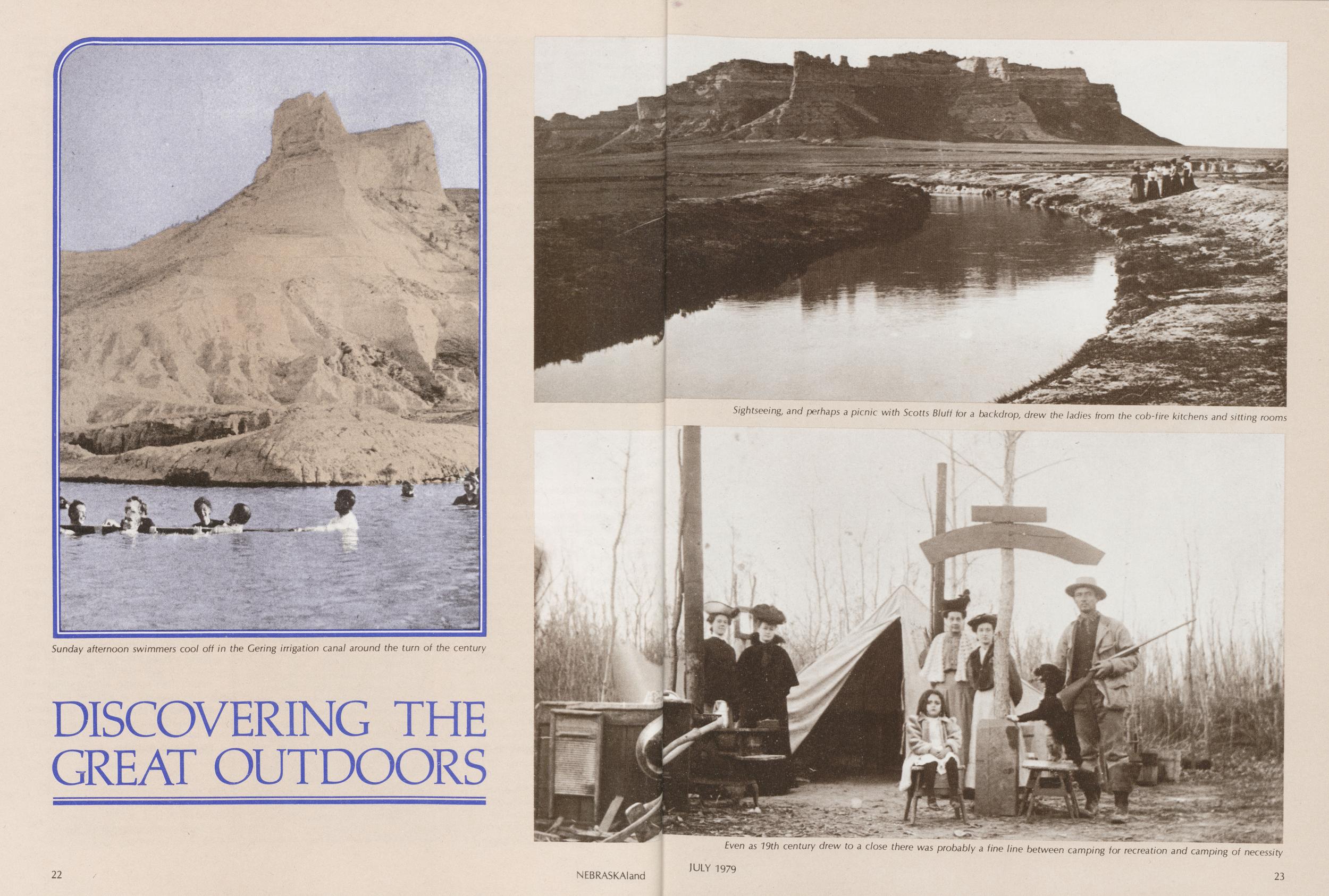
DISCOVERING THE GREAT OUTDOORS
Sunday afternoon swimmers cool off in the Gering irrigation canal around the turn of the century
Sightseeing and perhaps a picnic with Scotts Bluff for a backdrop^ drew the ladies from the cob-fire kitchens and sitting rooms
Even as 19th century drew to a close there was probably a fine line between camping for recreation and camping of necessity
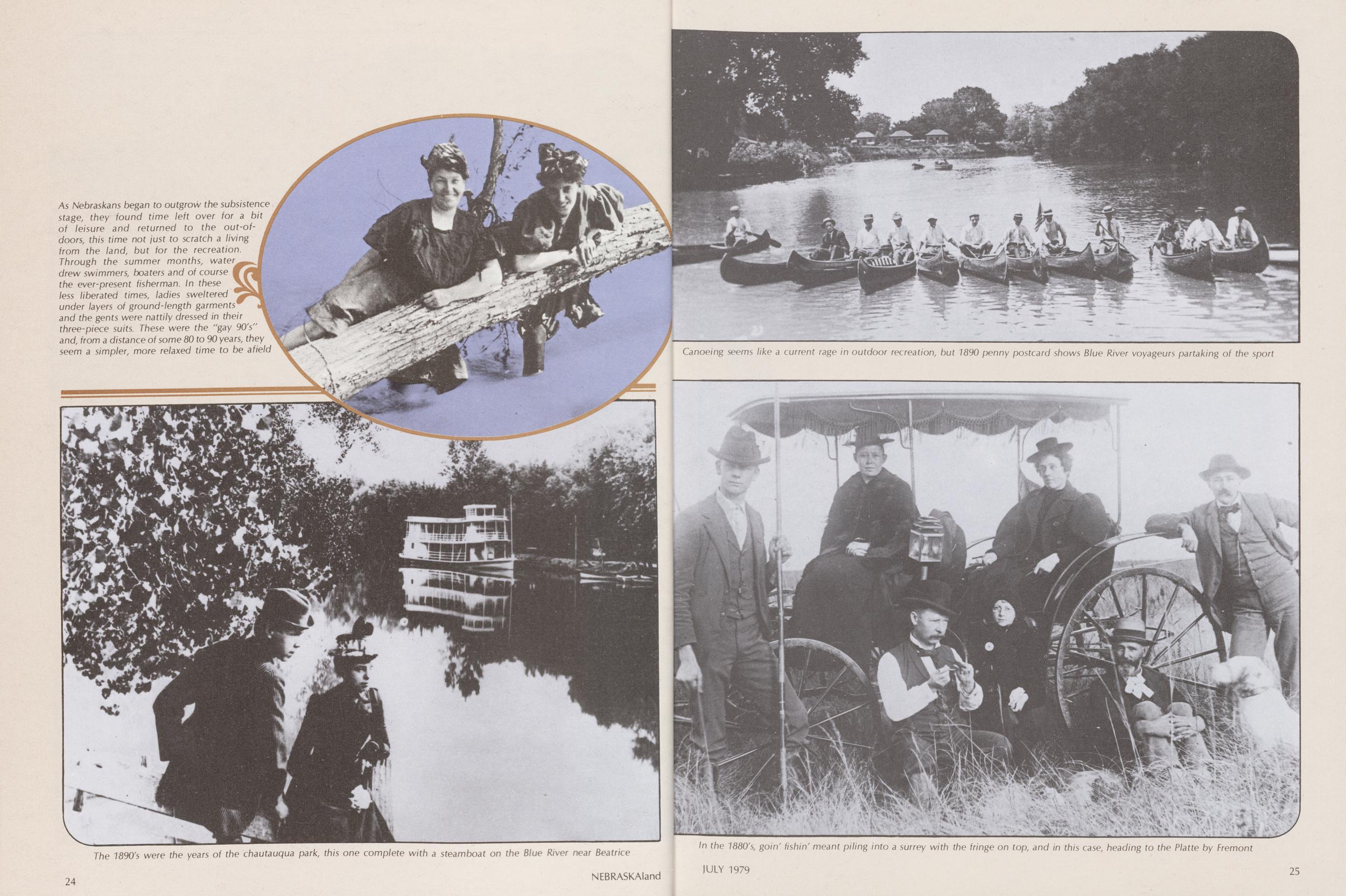
As Nebraskans began to outgrow the subsistence stage, they found time left over for a bit of leisure and returned to the out-of-doors, this time not just to scratch a living from the land, but for the recreation. Through the summer months, water drew swimmers, boaters and of course the ever-present fisherman. In these less liberated times, ladies sweltered under layers of ground-length garments and the gents were nattily dressed in their three-piece suits. These were the "gay 90's and, from a distance of some 80 to 90 years, they seem a simpler, more relaxed time to be afield
The 1890's were the years of the chautauqua park, this one complete with a steamboat on the Blue River near Beatrice
Canoeing seems like a current rage in outdoor recreation, but 1890 penny postcard shows Blue River voyageurs partaking of the sport
In the 1880's, goin' fishin' meant piling into a surrey with the fringe on top, and in this case, heading to the Platte by Fremont
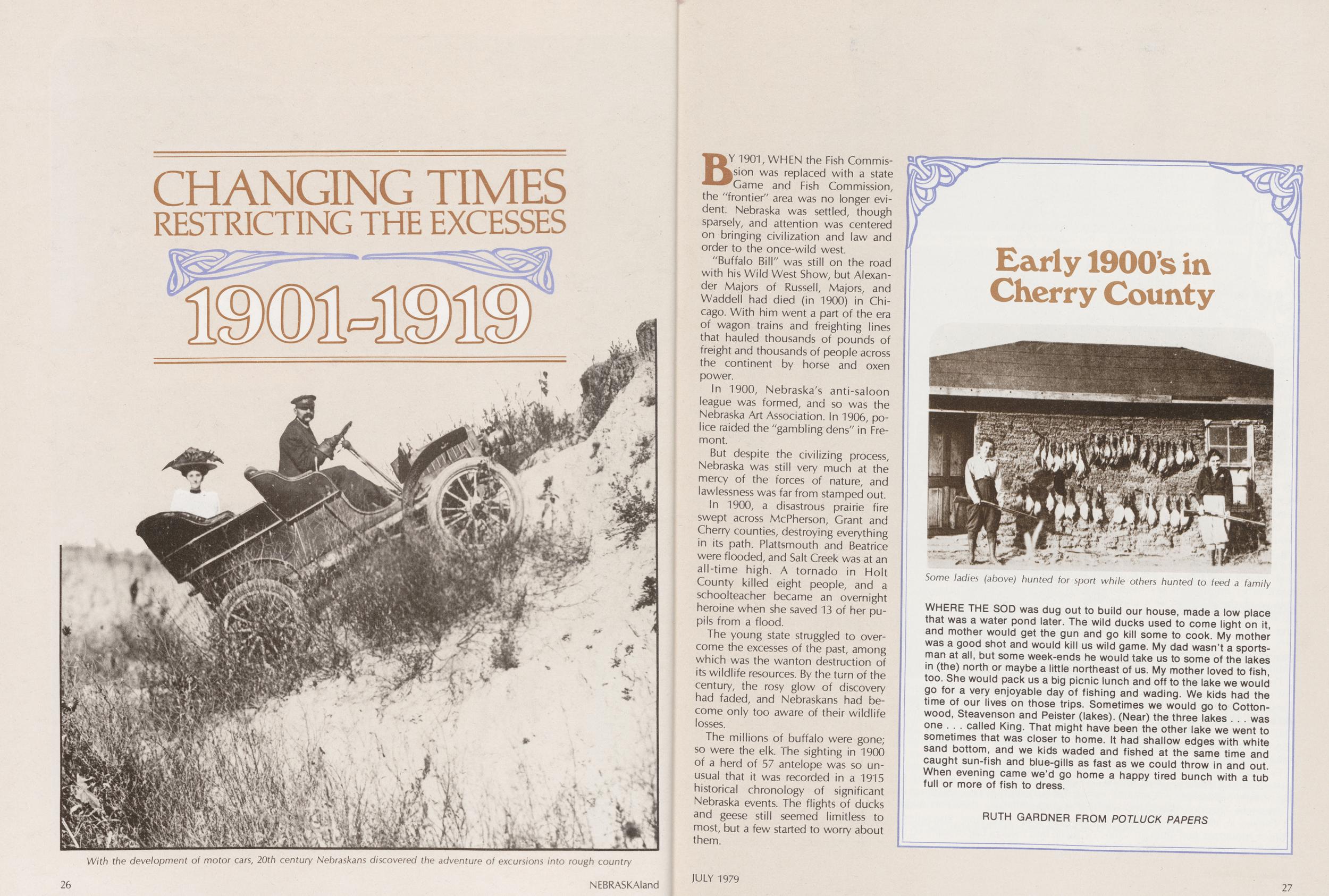
CHANGING TIMES RESTRICTING THE EXCESSES 1901-1919
With the development of motor cars, 20th century Nebraskans discovered the adventure of excursions into rough country
BY 1901, WHEN the Fish Commission was replaced with a state Game and Fish Commission, the "frontier" area was no longer evident. Nebraska was settled, though sparsely, and attention was centered on bringing civilization and law and order to the once-wild west.
"Buffalo Bill" was still on the road with his Wild West Show, but Alexander Majors of Russell, Majors, and Waddell had died (in 1900) in Chicago. With him went a part of the era of wagon trains and freighting lines that hauled thousands of pounds of freight and thousands of people across the continent by horse and oxen power.
In 1900, Nebraska's anti-saloon league was formed, and so was the Nebraska Art Association. In 1906, police raided the "gambling dens" in Fremont. But despite the civilizing process, Nebraska was still very much at the mercy of the forces of nature, and lawlessness was far from stamped out.
In 1900, a disastrous prairie fire swept across McPherson, Grant and Cherry counties, destroying everything in its path. Plattsmouth and Beatrice were flooded, and Salt Creek was at an all-time high. A tornado in Holt County killed eight people, and a schoolteacher became an overnight heroine when she saved 13 of her pupils from a flood.
The young state struggled to overcome the excesses of the past, among which was the wanton destruction of it's wildlife resources. By the turn of the century, the rosy glow of discovery had faded, and Nebraskans had become only too aware of their wildlife losses.
The millions of buffalo were gone; so were the elk. The sighting in 1900 of a herd of 57 antelope was so unusual that it was recorded in a 1915 historical chronology of significant Nebraska events. The flights of ducks and geese still seemed limitless to most, but a few started to worry about them.
Early 1900s in Cherry County
Some ladies (above) hunted for sport while others hunted to feed a family
WHERE THE SOD was dug out to build our house, made a low place that was a water pond later. The wild ducks used to come light on it, and mother would get the gun and go kill some to cook. My mother was a good shot and would kill us wild game. My dad wasn't a sportsman at all, but some week-ends he would take us to some of the lakes in (the) north or maybe a little northeast of us. My mother loved to fish, too. She would pack us a big picnic lunch and off to the lake we would go for a very enjoyable day of fishing and wading. We kids had the time of our lives on those trips. Sometimes we would go to Cottonwood, Steavenson and Peister (lakes). (Near) the three lakes... was one... called King. That might have been the other lake we went to sometimes that was closer to home. It had shallow edges with white sand bottom, and we kids waded and fished at the same time and caught sun-fish and blue-gills as fast as we could throw in and out. When evening came we'd go home a happy tired bunch with a tub full or more of fish to dress.
26 NEBRASKAland JULY 1979 27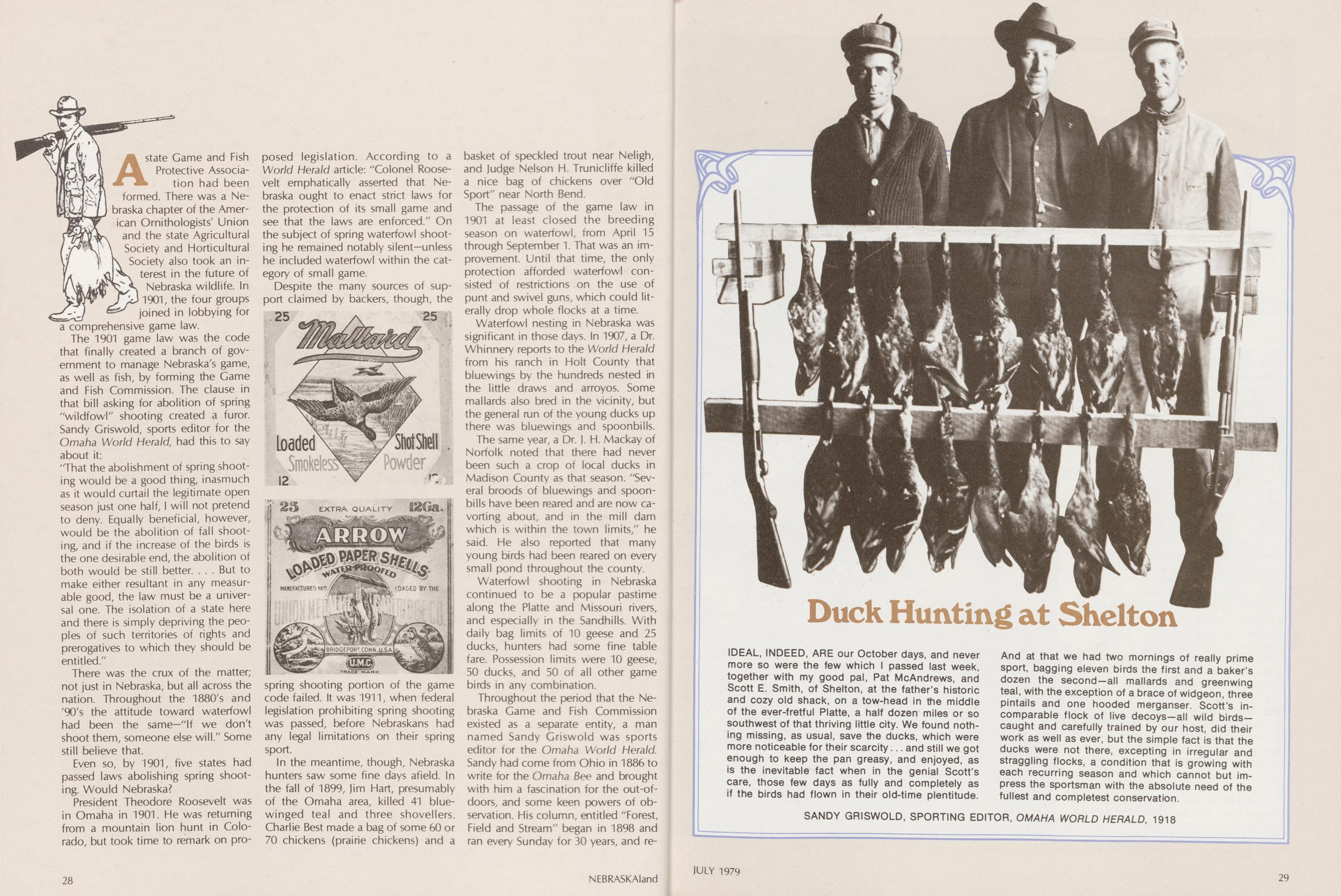
A state Game and Fish Protective Association had been formed. There was a Nebraska chapter of the American Ornithologists' Union and the state Agricultural Society and Horticultural Society also took an interest in the future of Nebraska wildlife. In 1901, the four groups joined in lobbying for "comprehensive game law.
The 1901 game law was the code that finally created a branch of government to manage Nebraska's game, as well as fish, by forming the Game and Fish Commission. The clause in that bill asking for abolition of spring "wildfowl" shooting created a furor. Sandy Griswold, sports editor for the Omaha World Herald, had this to say about it:
That the abolishment of spring shooting would be a good thing, inasmuch as it would curtail the legitimate open season just one half, I will not pretend to deny. Equally beneficial, however, would be the abolition of fall shooting, and if the increase of the birds is the one desirable end, the abolition of both would be still better... But to make either resultant in any measurable good, the law must be a universal one. The isolation of a state here and there is simply depriving the peoples of such territories of rights and prerogatives to which they should be entitled."
There was the crux of the matter; not just in Nebraska, but all across the nation. Throughout the 1880's and '90's the attitude toward waterfowl had been the same-"If we don't shoot them, someone else will." Some still believe that.
Even so, by 1901, five states had passed laws abolishing spring shooting. Would Nebraska?
President Theodore Roosevelt was in Omaha in 1901. He was returning from a mountain lion hunt in Colorado, but took time to remark on proposed legislation. According to a World Herald article: "Colonel Roosevelt emphatically asserted that Nebraska ought to enact strict laws for the protection of its small game and see that the laws are enforced." On the subject of spring waterfowl shooting he remained notably silent—unless he included waterfowl within the category of small game.
Despite the many sources of support claimed by backers, though, the
In the meantime, though, Nebraska hunters saw some fine days afield. In the fall of 1899, Jim Hart, presumably of the Omaha area, killed 41 blue-winged teal and three shovelers. Charlie Best made a bag of some 60 or 70 chickens (prairie chickens) and a basket of speckled trout near Neligh, and Judge Nelson H. Trunicliffe killed a nice bag of chickens over "Old Sport" near North Bend.
The passage of the game law in 1901 at least closed the breeding season on waterfowl, from April 15 through September 1. That was an improvement. Until that time, the only protection afforded waterfowl consisted of restrictions on the use of punt and swivel guns, which could literally drop whole flocks at a time.
Waterfowl nesting in Nebraska was significant in those days. In 1907, a Dr. Whinnery reports to the World Herald from his ranch in Holt County that bluewings by the hundreds nested in the little draws and arroyos. Some mallards also bred in the vicinity, but the general run of the young ducks up there was bluewings and spoonbills.
The same year, a Dr. J. H. Mackay of Norfolk noted that there had never been such a crop of local ducks in Madison County as that season. "Several broods of bluewings and spoon-bills have been reared and are now cavorting about, and in the mil! dam which is within the town limits," he said. He also reported that many young birds had been reared on every small pond throughout the county.
Waterfowl shooting in Nebraska continued to be a popular pastime along the Platte and Missouri rivers, and especially in the Sandhills. With daily bag limits of 10 geese and 25 ducks, hunters had some fine table fare. Possession limits were 10 geese, 50 ducks, and 50 of all other game birds in any combination.
Throughout the period that the Nebraska Game and Fish Commission existed as a separate entity, a man named Sandy Griswold was sports editor for the Omaha World Herald. Sandy had come from Ohio in 1886 to write for the Omaha Bee and brought with him a fascination for the out-of-doors, and some keen powers of observation. His column, entitled "Forest, Field and Stream" began in 1898 and ran every Sunday for 30 years, and reflected
Duck Hunting at Shelton
IDEAL, INDEED, ARE our October days, and never more so were the few which I passed last week, together with my good pal, Pat McAndrews, and Scott E. Smith, of Shelton, at the father's historic and cozy old shack, on a tow-head in the middle of the ever-fretful Platte, a half dozen miles or so southwest of that thriving little city. We found nothing missing, as usual, save the ducks, which were more noticeable for their scarcity... and still we got enough to keep the pan greasy, and enjoyed, as is the inevitable fact when in the genial Scott's care, those few days as fully and completely as if the birds had flown in their old-time plentitude. And at that we had two mornings of really prime sport, bagging eleven birds the first and a baker's dozen the second—all mallards and greenwing teal, with the exception of a brace of widgeon, three pintails and one hooded merganser. Scott's incomparable flock of live decoys—all wild birds-caught and carefully trained by our host, did their work as well as ever, but the simple fact is that the ducks were not there, excepting in irregular and straggling flocks, a condition that is growing with each recurring season and which cannot but impress the sportsman with the absolute need of the fullest and completest conservation.
28 NEBRASKAland JULY 1979 29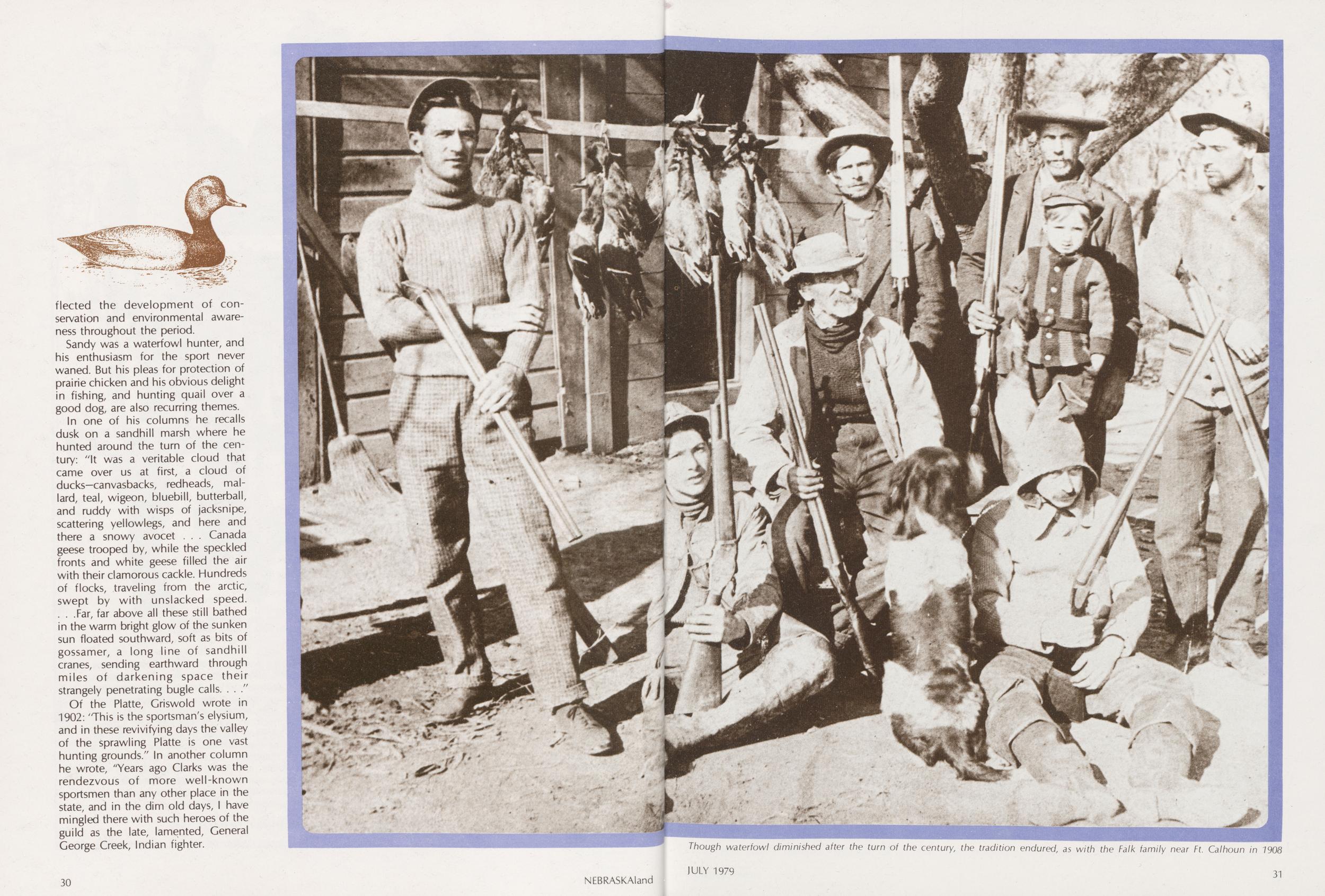
the development of conservation and environmental awareness throughout the period.
Sandy was a waterfowl hunter, and his enthusiasm for the sport never waned. But his pleas for protection of prairie chicken and his obvious delight in fishing, and hunting quail over a good dog, are also recurring themes.
In one of his columns he recalls dusk on a sandhill marsh where he hunted around the turn of the century: "It was a veritable cloud that came over us at first, a cloud of ducks—canvasbacks, redheads, mallard, teal, wigeon, bluebill, butterball, and ruddy with wisps of jacksnipe, scattering yellowlegs, and here and there a snowy avocet ... Canada geese trooped by, while the speckled fronts and white geese filled the air with their clamorous cackle. Hundreds of flocks, traveling from the arctic, swept by with unslacked speed. ...Far, far above all these still bathed in the warm bright glow of the sunken sun floated southward, soft as bits of gossamer, a long line of sandhill cranes, sending earthward through miles of darkening space their strangely penetrating bugle calls. .
Of the Platte, Griswold wrote in 1902: 'This is the sportsman's elysium, and in these revivifying days the valley of the sprawling Platte is one vast hunting grounds." In another column he wrote, "Years ago Clarks was the rendezvous of more well-known sportsmen than any other place in the state, and in the dim old days, I have mingled there with such heroes of the guild as the late, lamented, General George Creek, Indian fighter.
Though waterfowl diminished after the turn of the century, the tradition endured, as with the Falk family near Ft. Calhoun in 1908
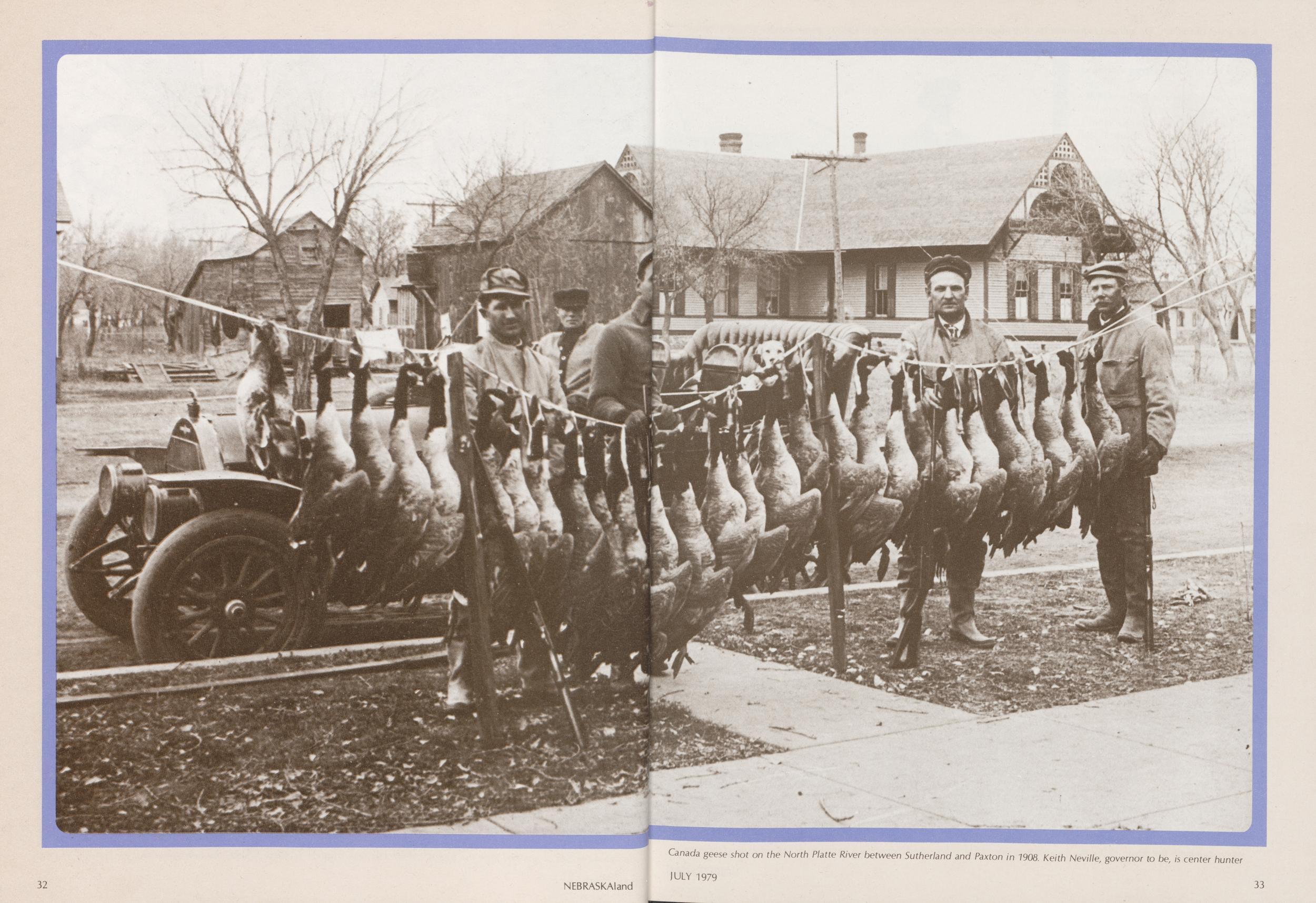
Canada geese shot on the North Platte River between Sutherland and Paxton in 1908. Keith Neville, governor to be, is center hunter
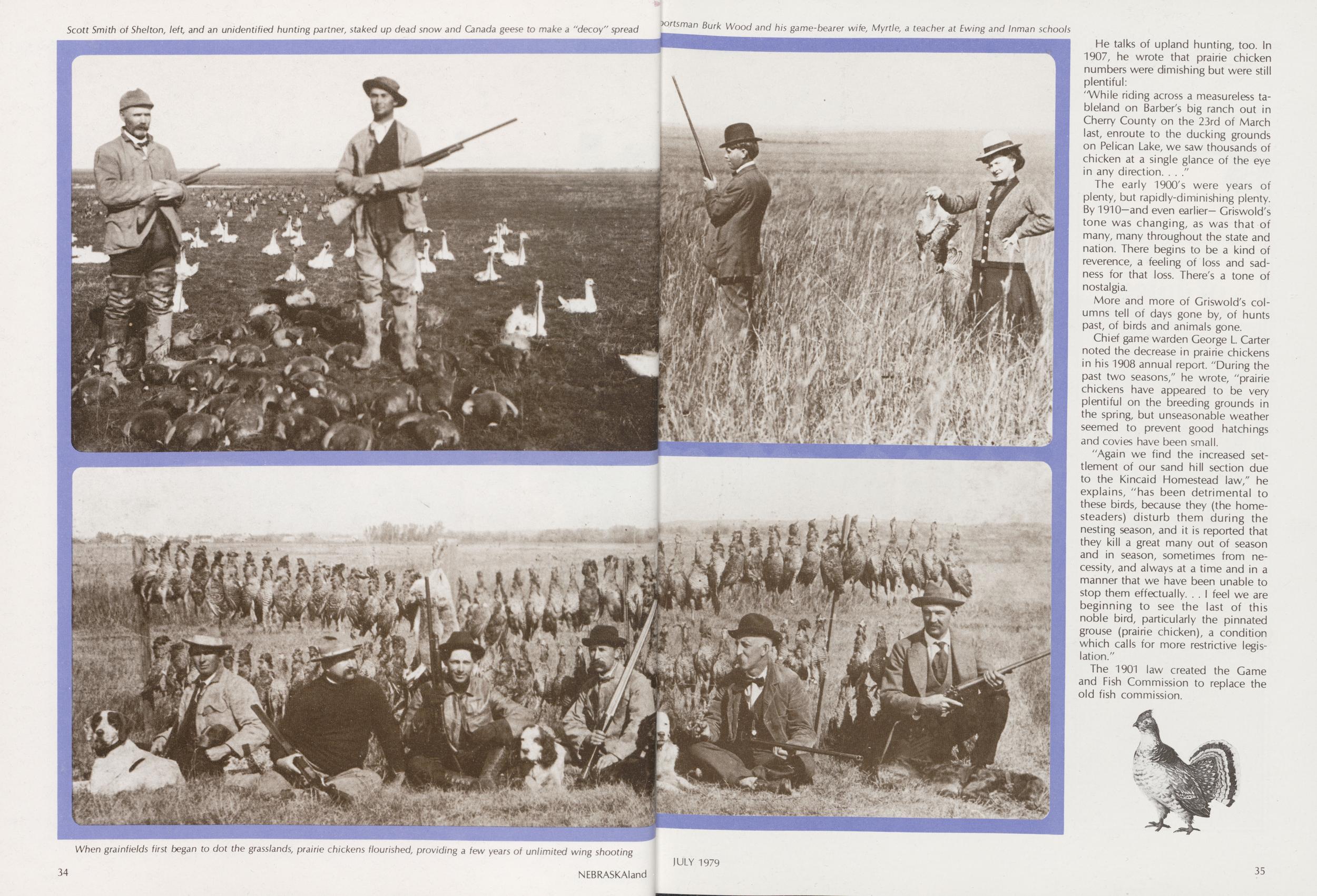
Scott Smith of Shelton, left, and an unidentified hunting partner, staked up dead snow and Canada geese to make a "decoy" spread
When grainfields first began to dot the grasslands, prairie chickens flourished, providing a few years of unlimited wing shooting
Sportsman Burk Wood and his game-bearer wife, Myrtle, a teacher at Ewing and Inman schools
He talks of upland hunting, too. In 1907, he wrote that prairie chicken numbers were dimishing but were still plentiful:
"While riding across a measureless tableland on Barber's big ranch out in Cherry County on the 23rd of March last, enroute to the ducking grounds on Pelican Lake, we saw thousands of chicken at a single glance of the eye in any direction..."
The early 1900's were years of plenty, but rapidly-diminishing plenty. By 1910-and even earlier- Griswold's tone was changing, as was that of many, many throughout the state and nation. There begins to be a kind of reverence, a feeling of loss and sadness for that loss. There's a tone of nostalgia.
More and more of Griswold's columns tell of days gone by, of hunts past, of birds and animals gone.
Chief game warden George L Carter noted the decrease in prairie chickens in his 1908 annual report. "During the past two seasons," he wrote, "prairie chickens have appeared to be very plentiful on the breeding grounds in the spring, but unseasonable weather seemed to prevent good hatchings and covies have been small.
"Again we find the increased settlement of our sand hill section due to the Kincaid Homestead law," he explains, "has been detrimental to these birds, because they (the homesteaders) disturb them during the nesting season, and it is reported that they kill a great many out of season and in season, sometimes from necessity, and always at a time and in a manner that we have been unable to stop them effectually... I feel we are beginning to see the last of this noble bird, particularly the pinnated grouse (prairie chicken), a condition which calls for more restrictive legislation."
The 1901 law created the Game and Fish Commission to replace the old fish commission.
Changing Times of Jules Sandoz
WHILE HE WAS writing to Lincoln, he complained about the new game laws. "Pay to hunt on my land, where I feed the game? Can't kill the grouse and rabbits that eat the buds and bark off my trees! To hell with such laws. I found the country open and free and I don't recognize any restrictions imposed by a bunch of cheap politicians grafting on the taxpayer."
Twenty-two years brought many changes to the land of promise into which Jules drove so confidently in '84. By 1906 the Indians along the Niobrara, the big game—elk, deer, even antelope—were gone.
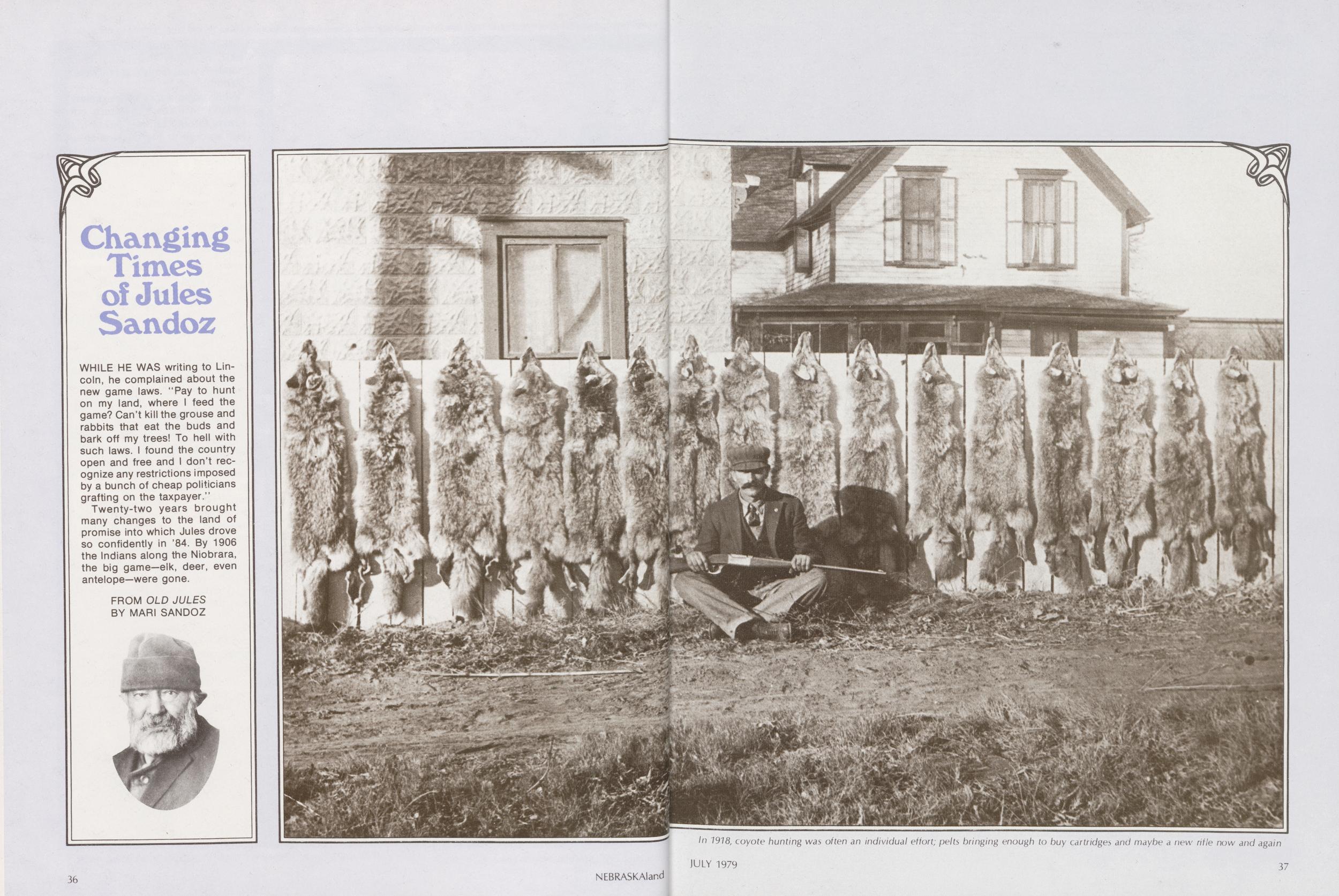
In 1918, coyote hunting was often an individual effort; pelts bringing enough to buy cartridges and maybe a new rifle now and again
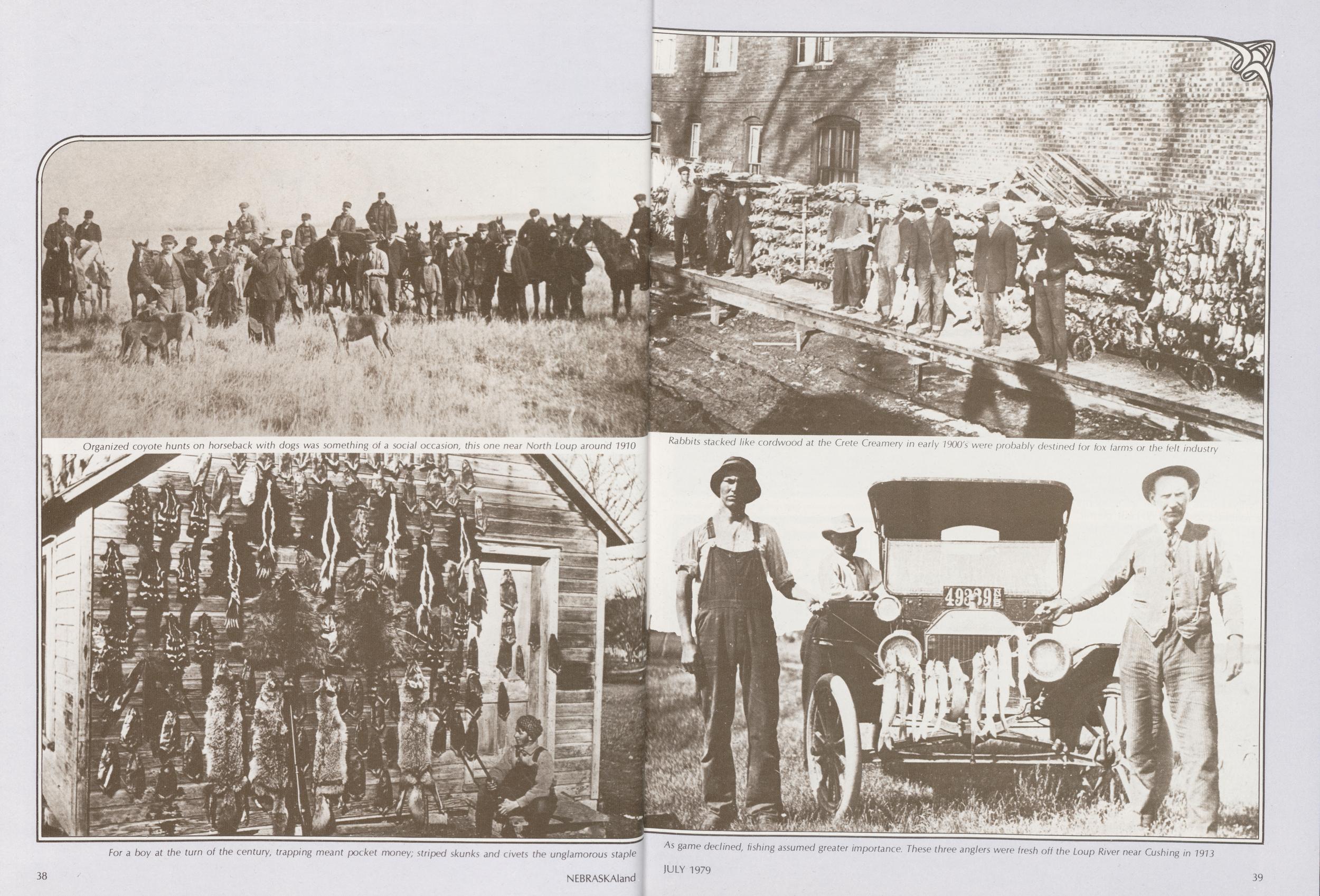
Organized coyote hunts on horseback with dogs was something of a social occasion, this one near North Loup around 1910
For a boy at the turn of the century, trapping meant pocket money; striped skunks and civets the unglamorous staple
Rabbits stacked like cordwood at the Crete Creamery in early 7900's were probably destined for fox farms or the felt industry
As game declined, fishing assumed greater importance. These three anglers were fresh off the Loup River near Cushing in 1913
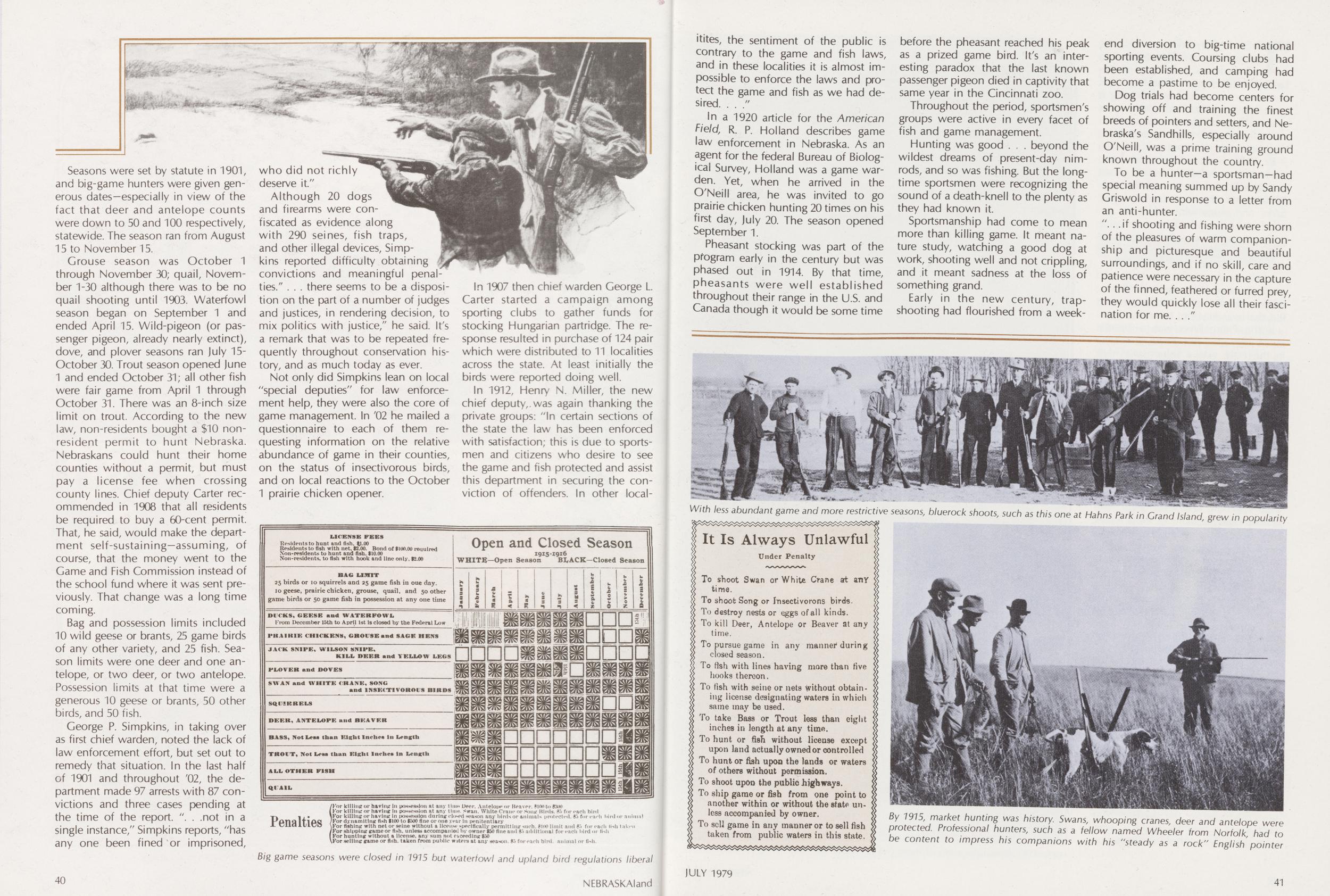
Seasons were set by statute in 1901, and big-game hunters were given generous dates—especially in view of the fact that deer and antelope counts were down to 50 and 100 respectively, statewide. The season ran from August 15 to November 15.
Grouse season was October 1 through November 30; quail, November 1-30 although there was to be no quail shooting until 1903. Waterfowl season began on September 1 and ended April 15. Wild-pigeon (or passenger pigeon, already nearly extinct), dove, and plover seasons ran July 15-October 30. Trout season opened June 1 and ended October 31; all other fish were fair game from April 1 through October 31. There was an 8-inch size limit on trout. According to the new law, non-residents bought a $10 non-resident permit to hunt Nebraska. Nebraskans could hunt their home counties without a permit, but must pay a license fee when crossing county lines. Chief deputy Carter recommended in 1908 that all residents be required to buy a 60-cent permit. That, he said, would make the department self-sustaining—assuming, of course, that the money went to the Game and Fish Commission instead of the school fund where it was sent previously. That change was a long time coming.
Bag and possession limits included 10 wild geese or brants, 25 game birds of any other variety, and 25 fish. Season limits were one deer and one antelope, or two deer, or two antelope. Possession limits at that time were a generous 10 geese or brants, 50 other birds, and 50 fish.
George P. Simpkins, in taking over as first chief warden, noted the lack of law enforcement effort, but set out to remedy that situation. In the last half of 1901 and throughout '02, the department made 97 arrests with 87 convictions and three cases pending at the time of the report. "...not in a single instance," Simpkins reports, "has any one been fined or imprisoned, who did not richly deserve it."
Although 20 dogs and firearms were confiscated as evidence along with 290 seines, fish traps, and other illegal devices, Simpkins reported difficulty obtaining convictions and meaningful penalties." . . . there seems to be a disposition on the part of a number of judges and justices, in rendering decision, to mix politics with justice," he said. It's a remark that was to be repeated frequently throughout conservation history, and as much today as ever.
Not only did Simpkins lean on local "special deputies" for law enforcement help, they were also the core of game management. In '02 he mailed a questionnaire to each of them requesting information on the relative abundance of game in their counties, on the status of insectivorous birds, and on local reactions to the October 1 prairie chicken opener.
In 1907 then chief warden George L Carter started a campaign among sporting clubs to gather funds for stocking Hungarian partridge. The response resulted in purchase of 124 pair which were distributed to 11 localities across the state. At least initially the birds were reported doing well.
In 1912, Henry N. Miller, the new chief deputy,.was again thanking the private groups: "In certain sections of the state the law has been enforced with satisfaction; this is due to sportsmen and citizens who desire to see the game and fish protected and assist this department in securing the conviction of offenders. In other localitites, the sentiment of the public is contrary to the game and fish laws, and in these localities it is almost impossible to enforce the laws and protect the game and fish as we had de- sired..."
In a 1920 article for the American Field, R. P. Holland describes game law enforcement in Nebraska. As an agent for the federal Bureau of Biological Survey, Holland was a game warden. Yet, when he arrived in the O'Neill area, he was invited to go prairie chicken hunting 20 times on his first day, July 20. The season opened September 1.
Pheasant stocking was part of the program early in the century but was phased out in 1914. By that time, pheasants were well established throughout their range in the U.S. and Canada though it would be some time before the pheasant reached his peak as a prized game bird. It's an interesting paradox that the last known passenger pigeon died in captivity that same year in the Cincinnati zoo.
Throughout the period, sportsmen's groups were active in every facet of fish and game management.
Hunting was good ...beyond the wildest dreams of present-day nimrods, and so was fishing. But the longtime sportsmen were recognizing the sound of a death-knell to the plenty as they had known it.
Sportsmanship had come to mean more than killing game. It meant nature study, watching a good dog at work, shooting well and not crippling, and it meant sadness at the loss of something grand.
Early in the new century, trapshooting had flourished from a weekend diversion to big-time national sporting events. Coursing clubs had been established, and camping had become a pastime to be enjoyed.
Dog trials had become centers for showing off and training the finest breeds of pointers and setters, and Nebraska's Sandhills, especially around O'Neill, was a prime training ground known throughout the country.
To be a hunter–a sportsman–had special meaning summed up by Sandy Griswold in response to a letter from an anti-hunter.
"...if shooting and fishing were shorn of the pleasures of warm companionship and picturesque and beautiful surroundings, and if no skill, care and patience were necessary in the capture of the finned, feathered or furred prey, they would quickly lose all their fascination for me..."
LICENSE FEES Residents to hunt and fish, (1.00 Residents to fish with net, 12.00. Bond of $ 100.00 required Non-residents to hunt and fish, 110.00 Non-residents, to fish with hook and line only, (2.00 BAG LIMIT 25 birds or 10 squirrels and 25 game fish in oue day. 10 geese, prairie chicken, grouse, quail, and 50 other game birds or 50 game fish in possession at any one time DUCKS, GEESE aud WATERFOWL From December 15th to April 1st is closed by the Federal Low Open and Closed Season 1915-1916 WHITE—Open Season BEACK—Closed Season PRAIRE CHICKENS, GROUSE and SAGE HENS JACK SNIPE, WILSON SNIPE, KILL DEER and YELLOW LEGS DDQ PLOVER and DOVES SWAN and WHITE CRANE, SONG and BIRDS SQUIRRELS DEER, ANTELOPE aud BEAVER BASS, Not Less than Eight Inches In Length TROUT, Not Less than Eight Inches In Length ALL OTHER FISH QUAIL Penalties killing or having in possession at any limn Deer. Anteloite or Beaver, (too For killing or having in possession at any time. Swan, White Crane or Souk Birds. for each bird iFor killing or having in possession during closed season any birds or animal- protected. S5 for each bird or animal /For dynamiting fish $100 to 1500 fine or one year in penitentiary For fishing with net or seine without a license specifically permitting such, too limit and for each lake For shipping game or fish, unless accompanied by owner $50 fine additional for each bird or fish For hunting without a license, any sum not exceeding $50 (For selling game or fish, taken from public waters at any season. $5 for each bird, animal or fi-h. Big game seasons were closed in 1915 but waterfowl and upland bird regulations liberalWith less abundant game and more restrictive seasons, bluerock shoots, such as this one at Hahns Park in Grand Island, grew in popularity
It Is Always Unlawful
Under Penalty To shoot Swan or White Crane at any time. To shoot Song or Insectivorons birds. To destroy nests or eggs of all kinds. To kill Deer, Antelope or Beaver at any time. To pursue game in any manner during closed season. To fish with lines having more than five hooks thereon. To fish with seine or nets without obtaining license designating waters in which same may be used. To take Bass or Trout less than eight inches in length at any time. To hunt or fish without license except upon land actually owned or controlled To hunt or hah upon the lands or waters of others without permission. To shoot upon the public highways. To ship game or fish from one point to another within or without the state unless accompanied by owner. To sell game in any manner or to sell fish taken from public waters in this state.By 1915, market hunting was history. Swans, whooping cranes, deer and antelope were protected. Professional hunters, such as a fellow named Wheeler from Norfolk had to be content to impress his companions with his Steady as a rock" English pointer
THE EARLY 20TH century was a time of incredible changes in Americans' concepts of the land they lived upon. They were still bent on conquering it and shaping it to their own wishes, but a few voices were asking for the preservation of some things wild; of some of the natural splendor the continent offered.
In 1872, Yellowstone had been made a National Park, but it wasn't until the Roosevelt years of the early 1900's that the country's refuges, parks, and monuments really got going. Fort Niobrara had been set aside during the early years, but Nebraskans wouldn't begin creating state parks and wildlife areas until the 1920s.
In all the furor about hunting and game, it seemed for awhile that fishing in Nebraska had gone by the wayside. But that was far from the case.
If the Platte River was a "sportsmen's elysium", just about anywhere in the state was a fisherman's idyll. Trout streams abounded in northern and western Nebraska, including some tributaries of the Republican. Sandhills lakes supported fantastic black bass fishing, all through the efforts of the Fish Commission. Cut-off and Carter lakes just outside Omaha were producing great catches of bass.
In 1901 and 1902, over Vermillion fish were stocked out of the Gretna Fish Hatchery. Some 99,284 of these were fingerling and yearling fish. Superintendent O'Brien, in those years, was becoming more enthusiastic
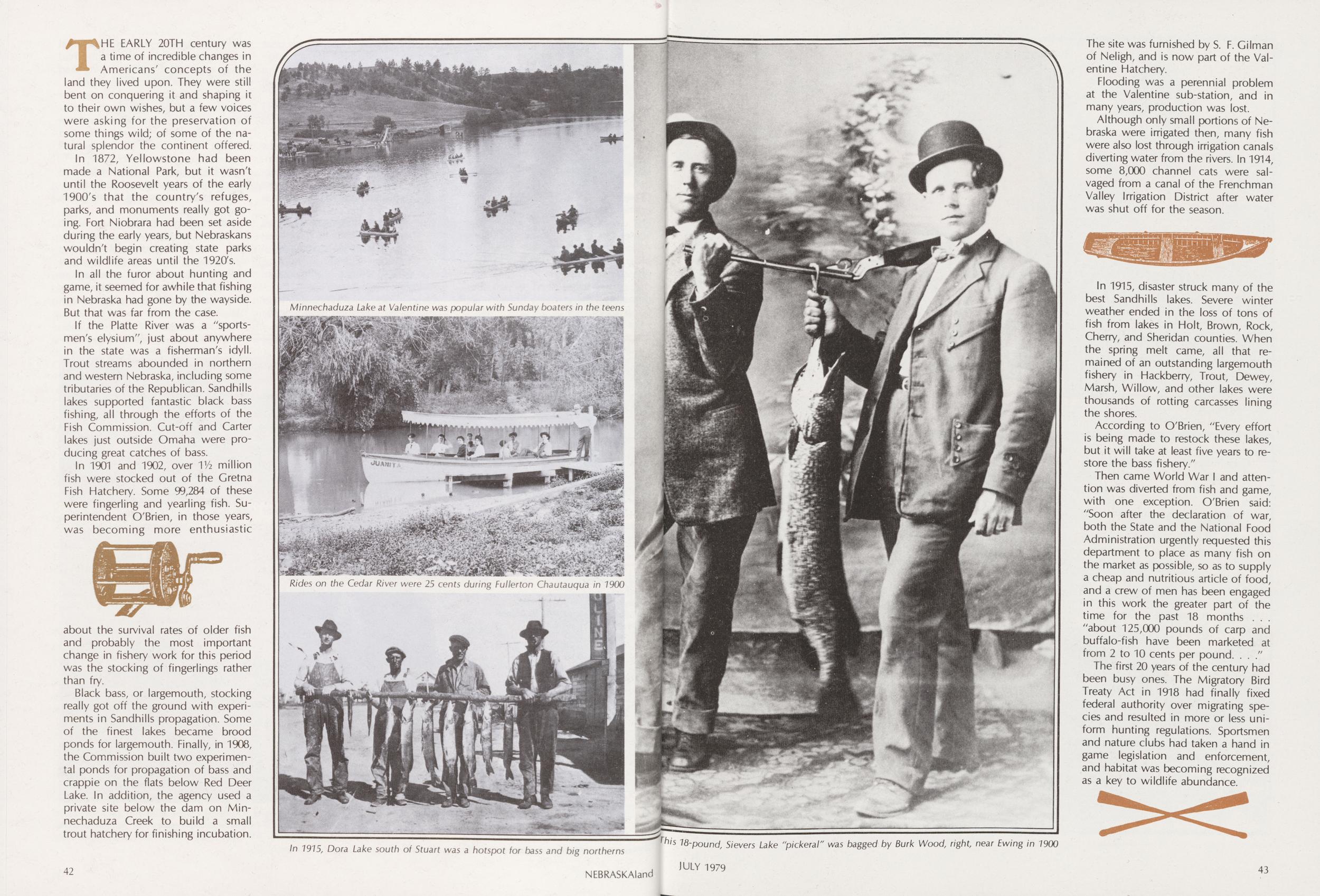
Minnechaduza Lake at Valentine was popular with Sunday boaters in the teens
Rides on the Cedar River were 25 cents during Fullerton Chautauqua in 1900
In 1915, Dora Lake south of Stuart was a hotspot for bass and big northerns
18-pound, Sievers Lake "pickerel" was bagged by Burk Wood, right, near Fwing in 1900
Flooding was a perennial problem at the Valentine sub-station, and in many years, production was lost.
Although only small portions of Nebraska were irrigated then, many fish were also lost through irrigation canals diverting water from the rivers. In 1914, some 8,000 channel cats were salvaged from a canal of the Frenchman Valley Irrigation District after water was shut off for the season.
In 1915, disaster struck many of the best Sandhills lakes. Severe winter weather ended in the loss of tons of fish from lakes in Holt, Brown, Rock, Cherry, and Sheridan counties. When the spring melt came, all that remained of an outstanding largemouth fishery in Hackberry, Trout, Dewey, Marsh, Willow, and other lakes were thousands of rotting carcasses lining the shores.
According to O'Brien, "Every effort is being made to restock these lakes, but it will take at least five years to restore the bass fishery."
Then came World War I and attention was diverted from fish and game, with one exception. O'Brien said: "Soon after the declaration of war, both the State and the National Food Administration urgently requested this department to place as many fish on the market as possible, so as to supply a cheap and nutritious article of food, and a crew of men has been engaged in this work the greater part of the time for the past 18 months ... "about 125,000 pounds of carp and buffalo-fish have been marketed at from 2 to 10 cents per pound..."
The first 20 years of the century had been busy ones. The Migratory Bird Treaty Act in 1918 had finally fixed federal authority over migrating species and resulted in more or less uniform hunting regulations. Sportsmen and nature clubs had taken a hand in game legislation and enforcement, and habitat was becoming recognized as a key to wildlife abundance.
42 NEBRASKAland JULY 1979 43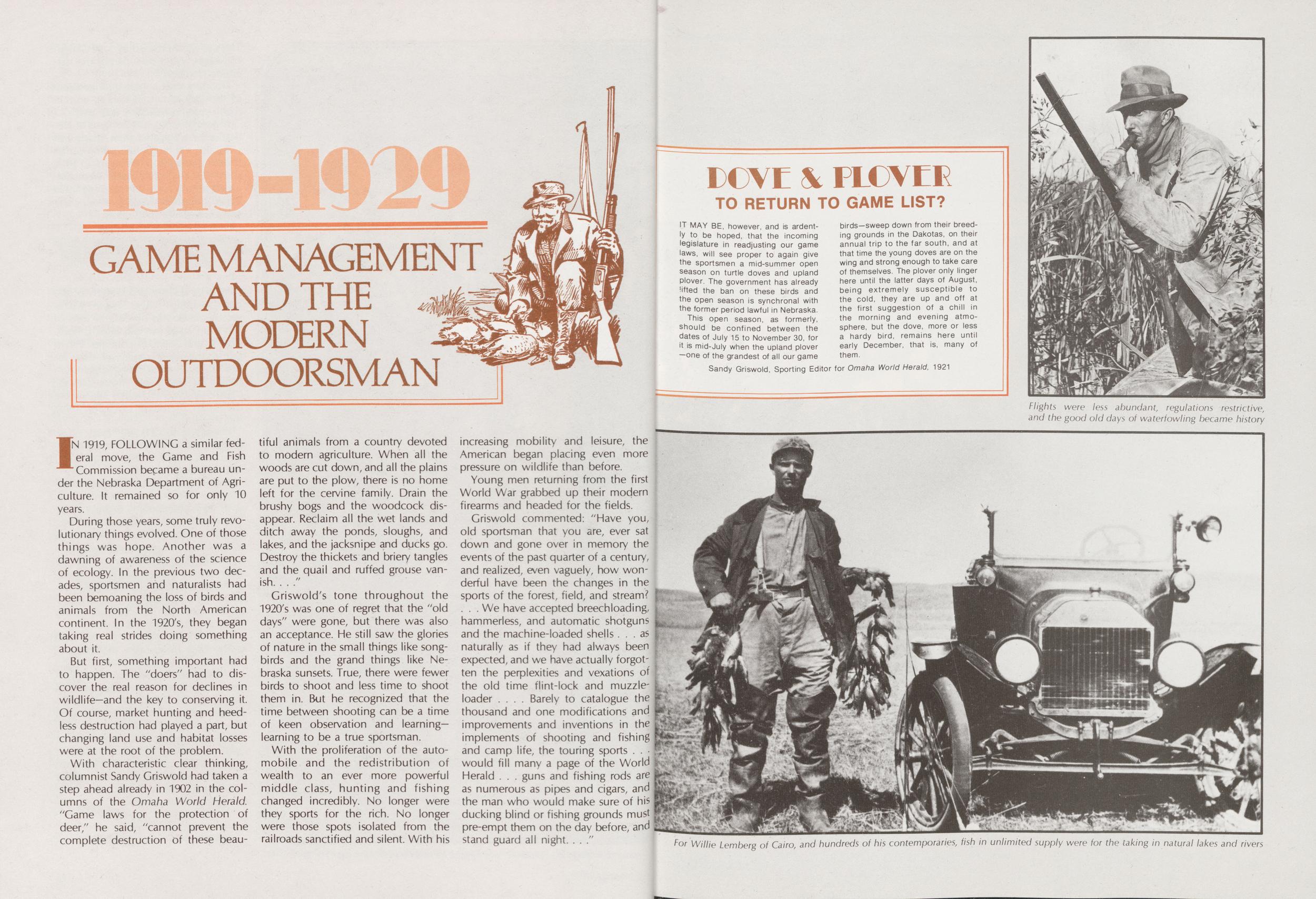
1919-1929 GAME MANAGEMENT AND THE MODERN OUTDOORSMAN
IN 1919, FOLLOWING a similar federal move, the Game and Fish Commission became a bureau under the Nebraska Department of Agriculture. It remained so for only 10 years.
During those years, some truly revolutionary things evolved. One of those things was hope. Another was a dawning of awareness of the science of ecology. In the previous two decades, sportsmen and naturalists had been bemoaning the loss of birds and animals from the North American continent. In the 1920's, they began taking real strides doing something about it.
But first, something important had to happen. The "doers" had to discover the real reason for declines in wildlife—and the key to conserving it. Of course, market hunting and heedless destruction had played a part, but changing land use and habitat losses were at the root of the problem.
With characteristic clear thinking, columnist Sandy Griswold had taken a step ahead already in 1902 in the columns of the Omaha World Herald. "Game laws for the protection of deer," he said, "cannot prevent the complete destruction of these beautiful animals from a country devoted to modern agriculture. When all the woods are cut down, and all the plains are put to the plow, there is no home left for the cervine family. Drain the brushy bogs and the woodcock disappear. Reclaim all the wet lands and ditch away the ponds, sloughs, and lakes, and the jacksnipe and ducks go. Destroy the thickets and briery tangles and the quail and ruffed grouse vanish..."
Griswold's tone throughout the 1920's was one of regret that the "old days" were gone, but there was also an acceptance. He still saw the glories of nature in the small things like songbirds and the grand things like Nebraska sunsets. True, there were fewer birds to shoot and less time to shoot them in. But he recognized that the time between shooting can be a time of keen observation and learning - learning to be a true sportsman.
With the proliferation of the automobile and the redistribution of wealth to an ever more powerful middle class, hunting and fishing changed incredibly. No longer were they sports for the rich. No longer were those spots isolated from the railroads sanctified and silent. With his increasing mobility and leisure, the American began placing even more pressure on wildlife than before.
Young men returning from the first World War grabbed up their modern firearms and headed for the fields.
Griswold commented: "Have you, old sportsman that you are, ever sat down and gone over in memory the events of the past quarter of a century, and realized, even vaguely, how wonderful have been the changes in the sports of the forest, field, and stream? ... We have accepted breech loading, hammerless, and automatic shotguns and the machine-loaded shells ... as naturally as if they had always been expected, and we have actually forgotten the perplexities and vexations of the old time flint-lock and muzzle-loader .... Barely to catalogue the thousand and one modifications and improvements and inventions in the implements of shooting and fishing and camp life, the touring sports.. would fill many a page of the World Herald ... guns and fishing rods are as numerous as pipes and cigars, and the man who would make sure of his ducking blind or fishing grounds must pre-empt them on the day before, and stand guard all night..."
DOVE & PLOVER TO RETURN TO GAME LIST?
IT MAY BE, however, and is ardently to be hoped, that the incoming legislature in readjusting our game laws, will see proper to again give the sportsmen a mid-summer open season on turtle doves and upland plover. The government has already lifted the ban on these birds and the open season is synchronic with the former period lawful in Nebraska. This open season, as formerly, should be confined between the dates of July 15 to November 30, for it is mid-July when the upland plover—one of the grandest of all our game birds—sweep down from their breeding grounds in the Dakotas, on their annual trip to the far south, and at that time the young doves are on the wing and strong enough to take care of themselves. The plover only linger here until the latter days of August, being extremely susceptible to the cold, they are up and off at the first suggestion of a chill in the morning and evening atmosphere, but the dove, more or less a hardy bird, remains here until early December, that is, many of them.
Sandy Griswold, Sporting Editor for Omaha World Herald, 1921Flights were less abundant, regulations restrictive, and the good old days of waterfowling became history
For Willie Lemberg of Cairo, and hundreds of his contemporaries, fish in unlimited supply were for the taking in natural lakes and rivers
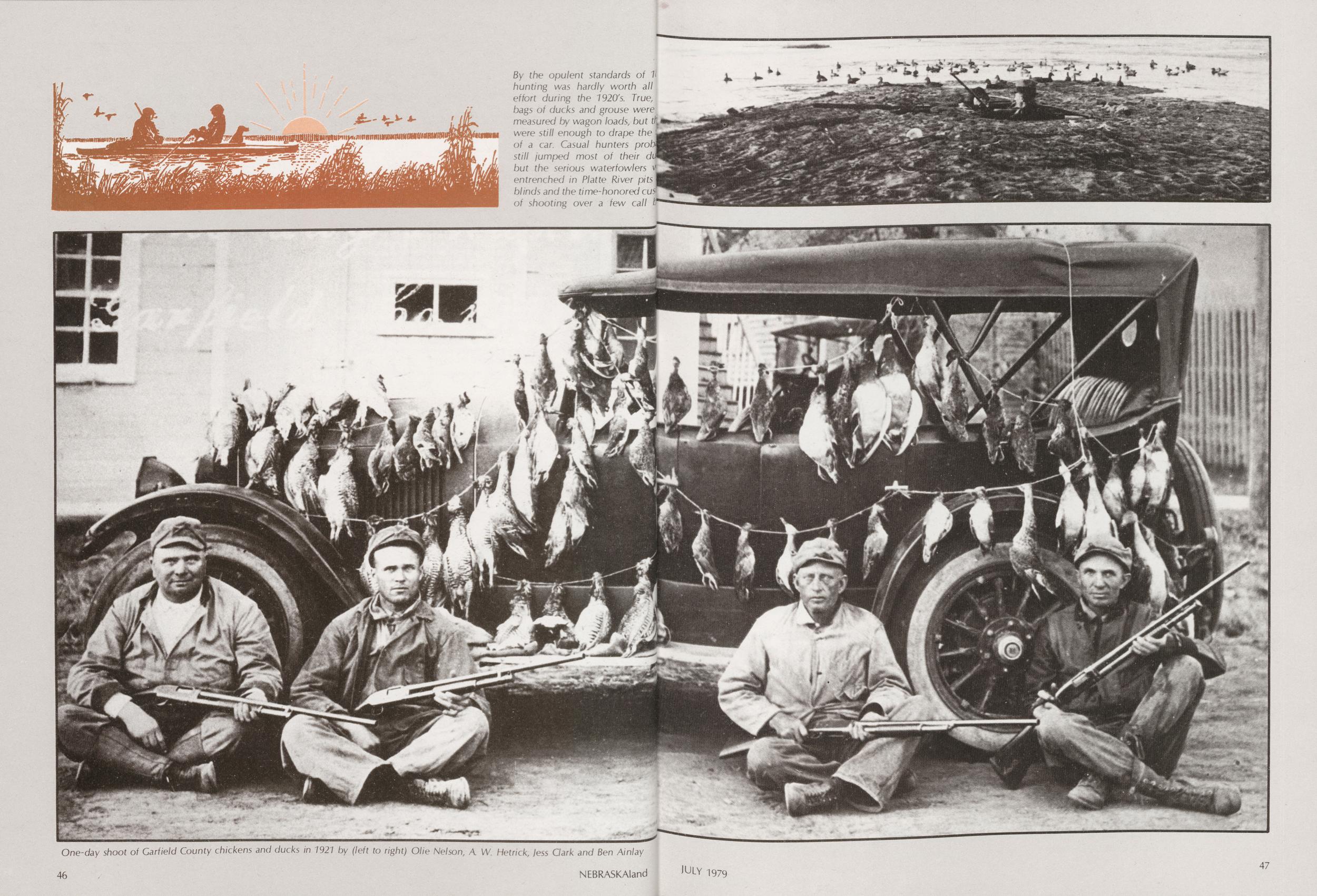
By the opulent standards of hunting was hardly worth all effort during the 1920's. True, bags of ducks and grouse were measured by wagon loads, but t were still enough to drape the of a car. Casual hunters prob still jumped most of their d but the serious waterfowlers I entrenched in Platte River pits blinds and the time-honored cu of shooting over a few call
One-day shoot of Garfield County chickens and ducks in 1921 by (left to right) Olie Nelson, A W. Hetrick, Jess Clark and Ben Ainlay
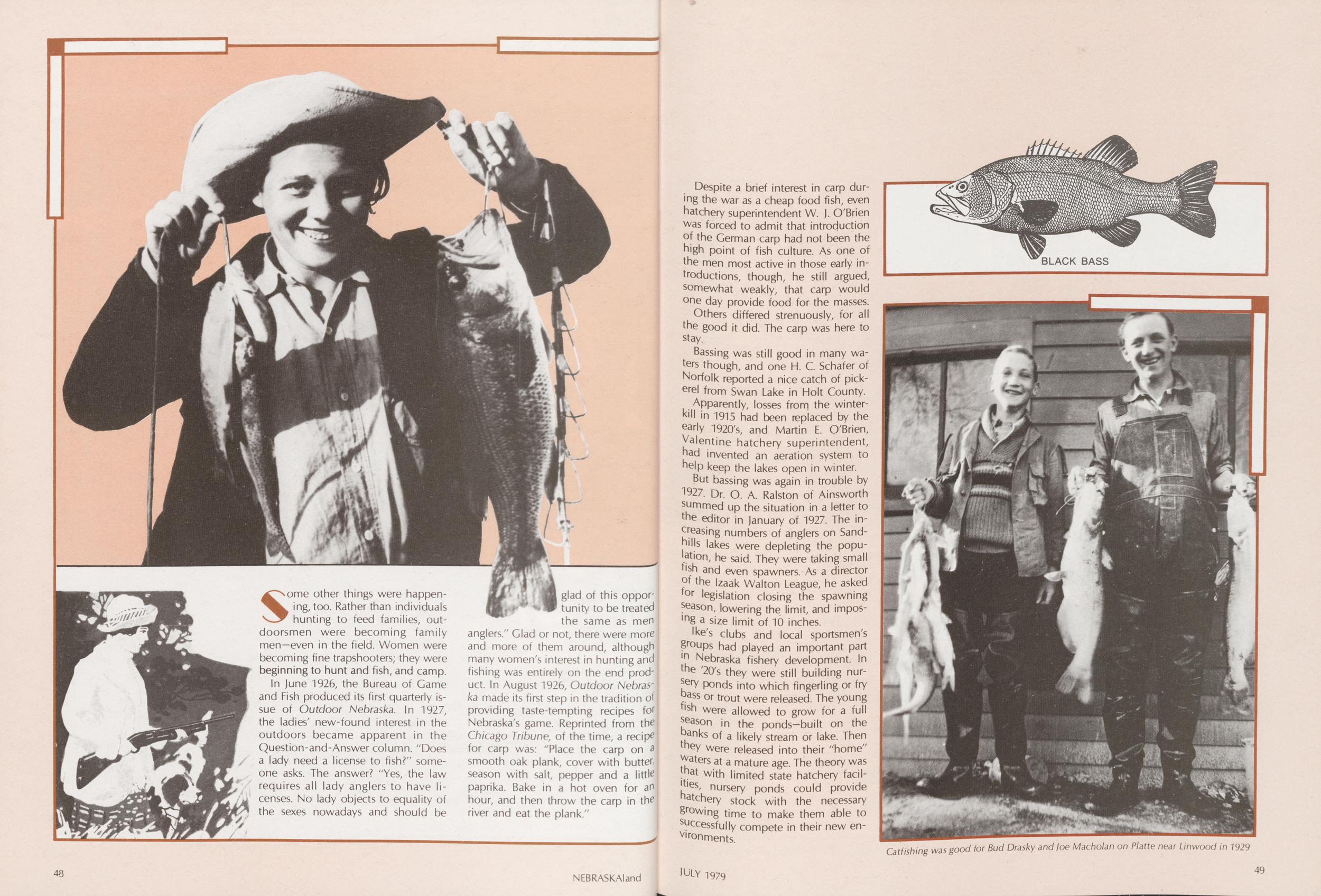
Some other things were happening, too. Rather than individuals hunting to feed families, outdoorsmen were becoming family men—even in the field. Women were becoming fine trapshooters; they were beginning to hunt and fish, and camp.
In June 1926, the Bureau of Game and Fish produced its first quarterly issue of Outdoor Nebraska. In 1927, the ladies' new-found interest in the outdoors became apparent in the Question-and-Answer column. "Does a lady need a license to fish?" someone asks. The answer? "Yes, the law requires all lady anglers to have licenses. No lady objects to equality of the sexes nowadays and should be glad of this opportunity to be treated the same as men anglers." Glad or not, there were more and more of them around, although many women's interest in hunting and fishing was entirely on the end product. In August 1926, Outdoor Nebraska made its first step in the tradition of providing taste-tempting recipes for Nebraska's game. Reprinted from the Chicago Tribune, of the time, a recipe for carp was: "Place the carp on a smooth oak plank, cover with butter season with salt, pepper and a little paprika. Bake in a hot oven for an hour, and then throw the carp in the river and eat the plank."
Despite a brief interest in carp during the war as a cheap food fish, even hatchery superintendent W. J. O'Brien was forced to admit that introduction of the German carp had not been the high point of fish culture. As one of the men most active in those early introductions, though, he still argued, somewhat weakly, that carp would one day provide food for the masses.
Others differed strenuously, for all the good it did. The carp was here to stay.
Bassing was still good in many waters though, and one H. G Schafer of Norfolk reported a nice catch of pickerel from Swan Lake in Holt County.
Apparently, losses from the winter-kill in 1915 had been replaced by the early 1920% and Martin E. O'Brien, valentine hatchery superintendent, had invented an aeration system to help keep the lakes open in winter.
But bassing was again in trouble by 1927. Dr. O. A. Ralston of Ainsworth summed up the situation in a letter to the editor in January of 1927. The increasing numbers of anglers on Sandhills lakes were depleting the population, he said. They were taking small fish and even spawners. As a director °f the Izaak Walton League, he asked for legislation closing the spawning season, lowering the limit, and imposing a size limit of 10 inches.
Ike's clubs and local sportsmen's groups had played an important part 'o Nebraska fishery development. In the '20's they were still building nursery ponds into which fingerling or fry bass or trout were released. The young fish were allowed to grow for a full season in the ponds-built on the hanks of a likely stream or lake. Then they Were released into their "home" waters at a mature age. The theory was that with limited state hatchery facilities, nursery ponds could provide hatchery stock with the necessary Rowing time to make them able to successfully compete in their new environments.
BLACK BASS
Catfishing was good for Bud Drasky and joe Macholan on Platte near Linwood in 1929
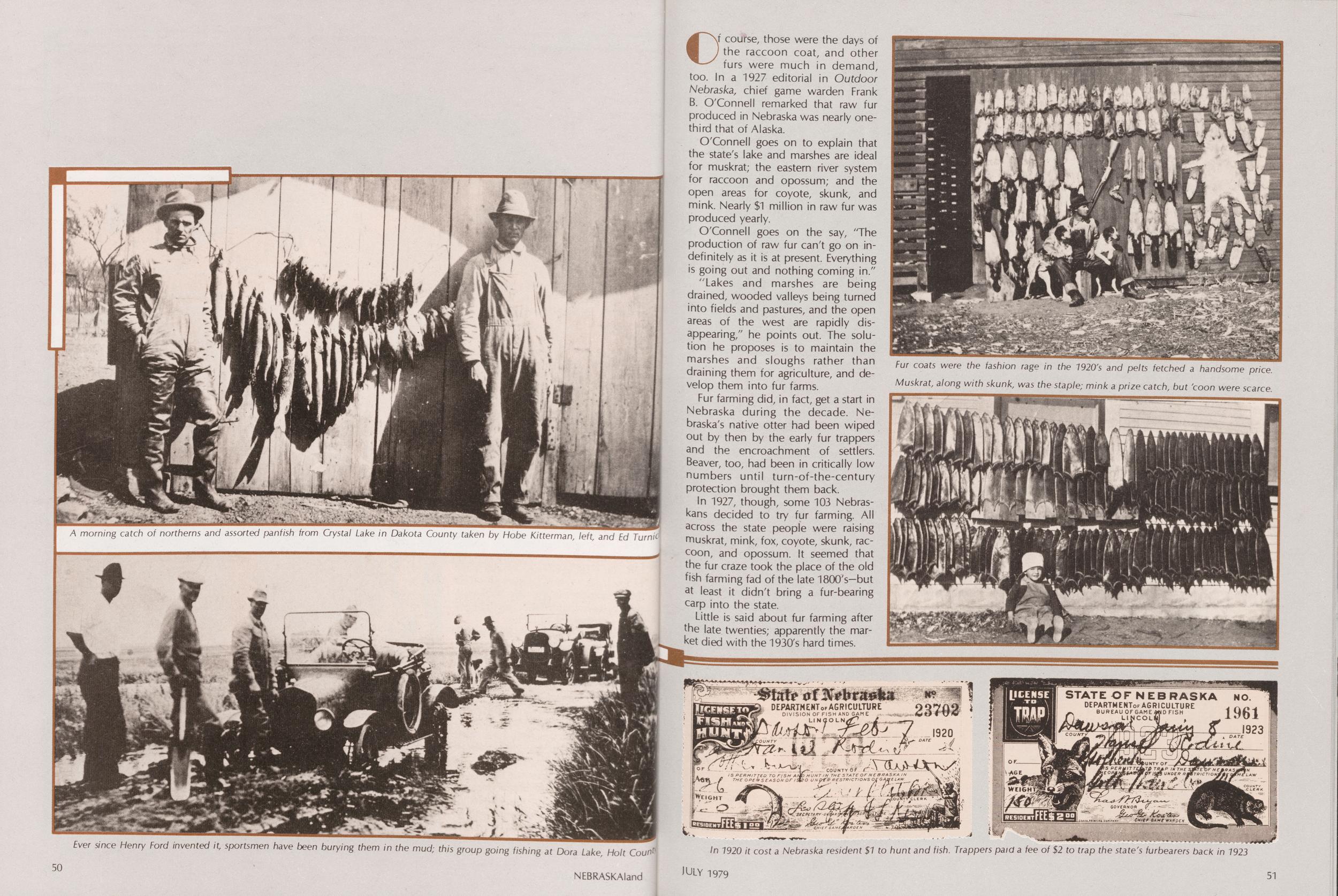
A morning catch of northerns and assorted panfish from Crystal Lake in Dakota County taken by Hobe Kitterman, left, and Ed Tornio
Ever since Henry Ford invented it, sportsmen have been burying them in the mud; this group going fishing at Dora Lake, Holt County
Of course, those were the days of the raccoon coat, and other furs were much in demand, too. In a 1927 editorial in Outdoor Nebraska, chief game warden Frank B. O'Connell remarked that raw fur produced in Nebraska was nearly one-third that of Alaska.
O'Connell goes on to explain that the state's lake and marshes are ideal for muskrat; the eastern river system for raccoon and opossum; and the open areas for coyote, skunk, and mink. Nearly $1 million in raw fur was produced yearly.
O'Connell goes on the say, "The production of raw fur can't go on indefinitely as it is at present. Everything is going out and nothing coming in."
"Lakes and marshes are being drained, wooded valleys being turned into fields and pastures, and the open areas of the west are rapidly disappearing," he points out. The solution he proposes is to maintain the marshes and sloughs rather than draining them for agriculture, and develop them into fur farms.
Fur farming did, in fact, get a start in Nebraska during the decade. Nebraska's native otter had been wiped out by then by the early fur trappers and the encroachment of settlers. Beaver, too, had been in critically low numbers until turn-of-the-century protection brought them back.
In 1927, though, some 103 Nebraskans decided to try fur farming. All across the state people were raising muskrat, mink, fox, coyote, skunk, raccoon, and opossum. It seemed that the fur craze took the place of the old fish farming fad of the late 1800's-but at least it didn't bring a fur-bearing carp into the state.
Little is said about fur farming after the late twenties; apparently the market died with the 1930's hard times.
Fur coats were the fashion rage in the 1920's and pelts fetched a handsome price.
Muskrat, along with skunk, was the staple; mink a prize catch, but 'coon were scarce.
In 1920 it cost a Nebraska resident $1 to hunt and fish. Trappers paid a fee of $2 to trap the state's furbearers back in 1923
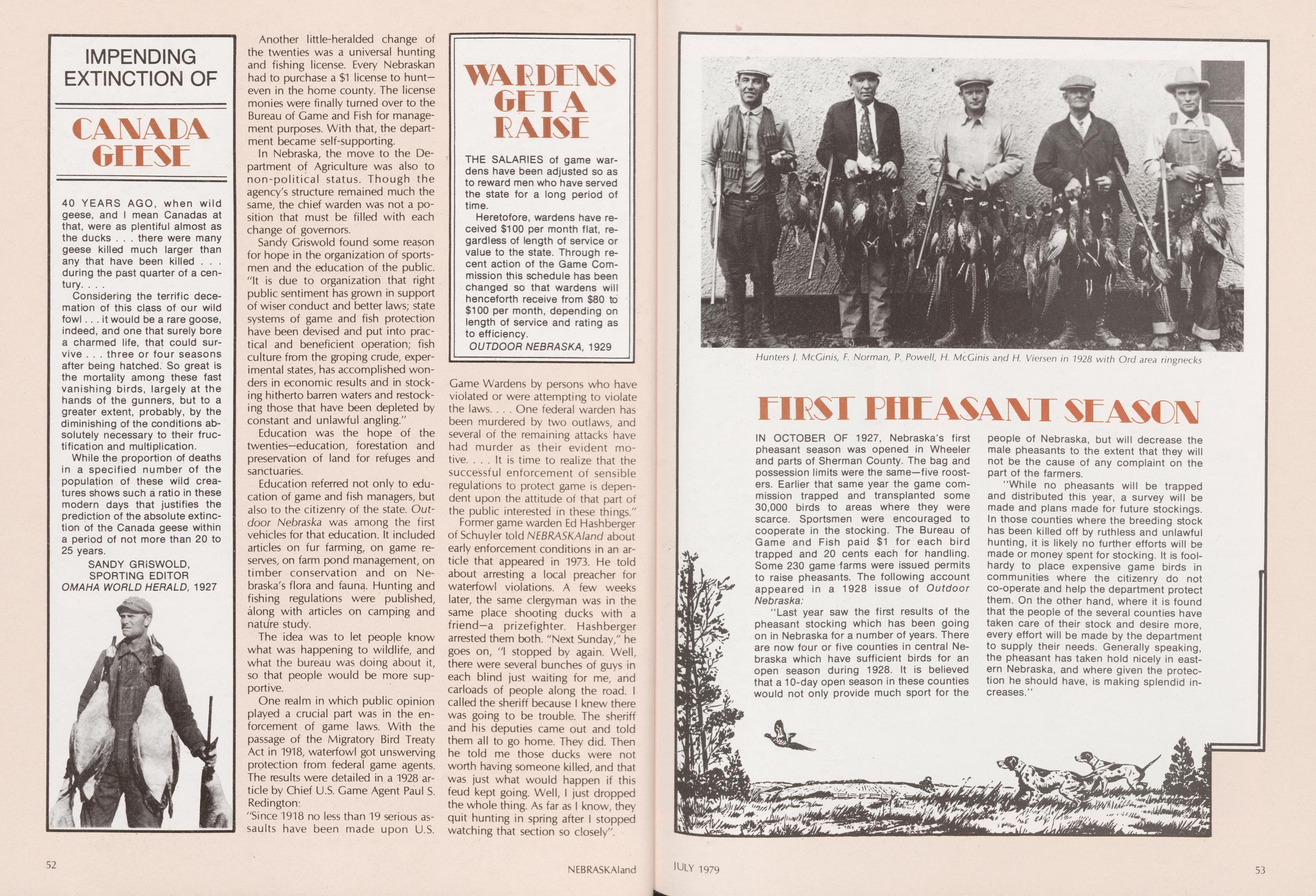
Another little-heralded change of the twenties was a universal hunting and fishing license. Every Nebraskan had to purchase a $1 license to hunt-even in the home county. The license monies were finally turned over to the Bureau of Game and Fish for management purposes. With that, the department became self-supporting.
In Nebraska, the move to the Department of Agriculture was also to non-political status. Though the agency's structure remained much the same, the chief warden was not a position that must be filled with each change of governors.
Sandy Griswold found some reason for hope in the organization of sportsmen and the education of the public. "It is due to organization that right public sentiment has grown in support of wiser conduct and better laws; state systems of game and fish protection have been devised and put into practical and beneficient operation; fish culture from the groping crude, experimental states, has accomplished wonders in economic results and in stocking hitherto barren waters and restocking those that have been depleted by constant and unlawful angling."
Education was the hope of the twenties—education, forestation and preservation of land for refuges and sanctuaries.
Education referred not only to education of game and fish managers, but also to the citizenry of the state. Outdoor Nebraska was among the first vehicles for that education. It included articles on fur farming, on game reserves, on farm pond management, on timber conservation and on Nebraska's flora and fauna. Hunting and fishing regulations were published, along with articles on camping and nature study.
The idea was to let people know what was happening to wildlife, and what the bureau was doing about it, so that people would be more supportive.
One realm in which public opinion played a crucial part was in the enforcement of game laws. With the passage of the Migratory Bird Treaty Act in 1918, waterfowl got unswerving protection from federal game agents. The results were detailed in a 1928 article by Chief U.S. Game Agent Paul S. Redington:
"Since 1918 no less than 19 serious assaults have been made upon U.S. Game Wardens by persons who have violated or were attempting to violate the laws. . . . One federal warden has been murdered by two outlaws, and several of the remaining attacks have had murder as their evident motive. ... It is time to realize that the successful enforcement of sensible regulations to protect game is dependent upon the attitude of that part of the public interested in these things."
Former game warden Ed Hashberger of Schuyler told NEBRASKAland about early enforcement conditions in an article that appeared in 1973. He told about arresting a local preacher for waterfowl violations. A few weeks later, the same clergyman was in the same place shooting ducks with a friend—a prizefighter. Hashberger arrested them both. "Next Sunday," he goes on, "I stopped by again. Well, there were several bunches of guys in each blind just waiting for me, and carloads of people along the road. I called the sheriff because I knew there was going to be trouble. The sheriff and his deputies came out and told them all to go home. They did. Then he told me those ducks were not worth having someone killed, and that was just what would happen if this feud kept going. Well, I just dropped the whole thing. As far as I know, they quit hunting in spring after I stopped watching that section so closely".
IMPENDING EXTINCTION OF CANADA
40 YEARS AGO, when wild geese, and I mean Canadas at that, were as plentiful almost as the ducks ...there were many geese killed much larger than any that have been killed... during the past quarter of a century...
Considering the terrific decemation of this class of our wild fowl... it would be a rare goose, indeed, and one that surely bore a charmed life, that could survive ... three or four seasons after being hatched. So great is the mortality among these fast vanishing birds, largely at the hands of the gunners, but to a greater extent, probably, by the diminishing of the conditions absolutely necessary to their fructification and multiplication.
While the proportion of deaths in a specified number of the population of these wild creatures shows such a ratio in these modern days that justifies the prediction of the absolute extinction of the Canada geese within a period of not more than 20 to 25 years.
SANDY GRISWOLD, SPORTING EDITOR OMAHA WORLD HERALD, 1927WARDENS GET A RAISE
THE SALARIES of game wardens have been adjusted so as to reward men who have served the state for a long period of time.
Heretofore, wardens have received $100 per month flat, regardless of length of service or value to the state. Through recent action of the Game Commission this schedule has been changed so that wardens will henceforth receive from $80 to $100 per month, depending on length of service and rating as to efficiency.
OUTDOOR NEBRASKA, 1929Hunters J. McGinis, F. Norman, P. Powell, H. McGinis and H. Viersen in 1928 with Ord area ringnecks
FIRST PHEASANT SEASON
IN OCTOBER OF 1927, Nebraska's first pheasant season was opened in Wheeler and parts of Sherman County. The bag and possession limits were the same—five roosters. Earlier that same year the game commission trapped and transplanted some 30,000 birds to areas where they were scarce. Sportsmen were encouraged to cooperate in the stocking. The Bureau of Game and Fish paid $1 for each bird trapped and 20 cents each for handling. Some 230 game farms were issued permits to raise pheasants. The following account appeared in a 1928 issue of Outdoor Nebraska:
"Last year saw the first results of the pheasant stocking which has been going on in Nebraska for a number of years. There are now four or five counties in central Nebraska which have sufficient birds for an open season during 1928. It is believed that a 10-day open season in these counties would not only provide much sport for the people of Nebraska, but will decrease the male pheasants to the extent that they will not be the cause of any complaint on the part of the farmers.
"While no pheasants will be trapped and distributed this year, a survey will be made and plans made for future stockings. In those counties where the breeding stock has been killed off by ruthless and unlawful hunting, it is likely no further efforts will be made or money spent for stocking. It is foolhardy to place expensive game birds in communities where the citizenry do not co-operate and help the department protect them. On the other hand, where it is found that the people of the several counties have taken care of their stock and desire more, every effort will be made by the department to supply their needs. Generally speaking, the pheasant has taken hold nicely in eastern Nebraska, and where given the protection he should have, is making splendid increases."
52 NEBRASKAland JULY 1979 53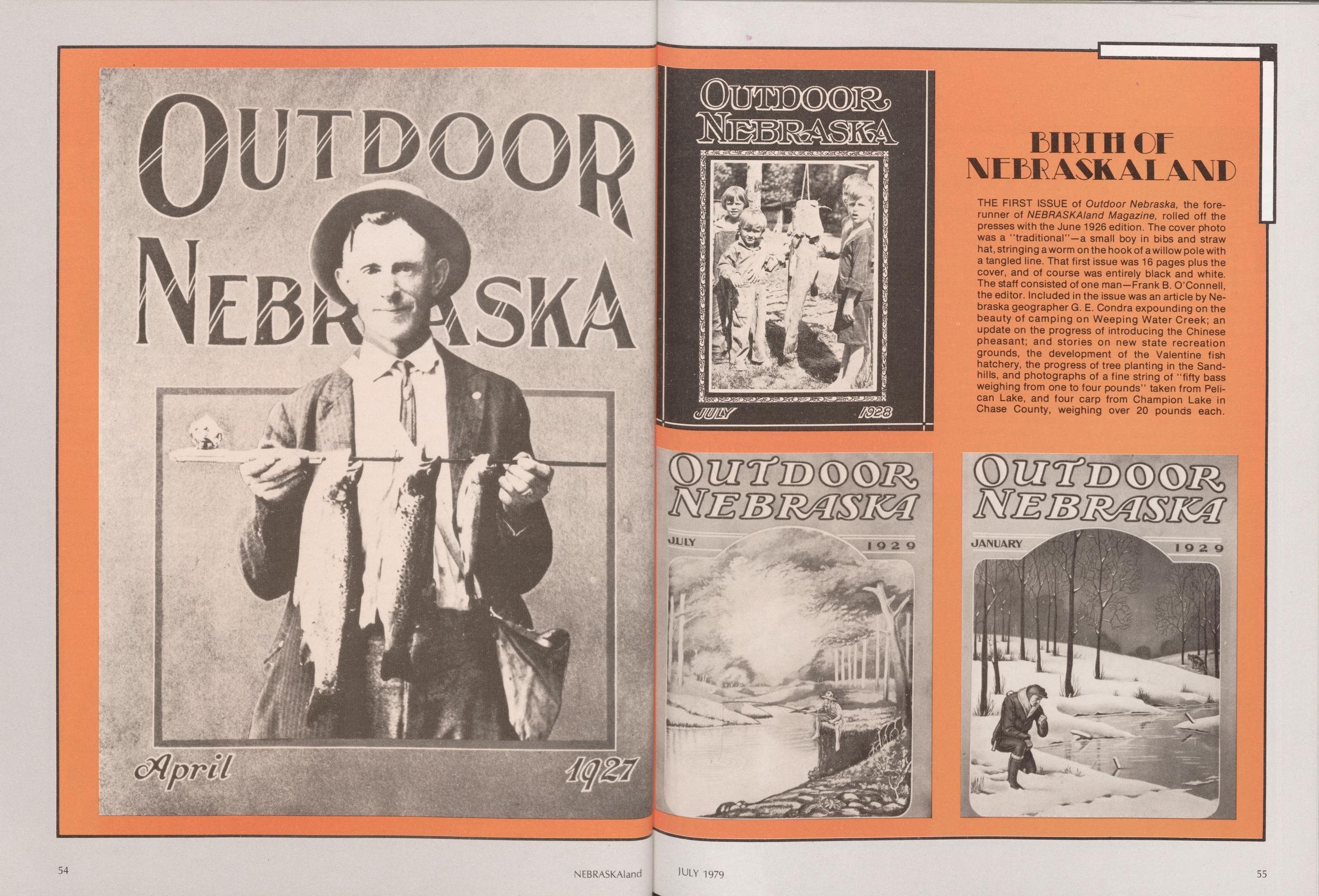
BITRTH OF NEBRASKALAND
THE FIRST ISSUE of Outdoor Nebraska, the forerunner of NEBRASKAland Magazine, rolled off the presses with the June 1926 edition. The cover photo was a "traditional"—a small boy in bibs and straw hat, stringing a worm on the hook of a willow pole with a tangled line. That first issue was 16 pages plus the cover, and of course was entirely black and white. The staff consisted of one man—Frank B. O'Connell, the editor. Included in the issue was an article by Nebraska geographer G. E. Condra expounding on the beauty of camping on Weeping Water Creek; an update on the progress of introducing the Chinese pheasant; and stories on new state recreation grounds, the development of the Valentine fish hatchery, the progress of tree planting in the Sandhills, and photographs of a fine string of "fifty bass weighing from one to four pounds" taken from Pelican Lake, and four carp from Champion Lake in Chase County, weighing over 20 pounds each.
54 NEBRASKAland JULY 1979 55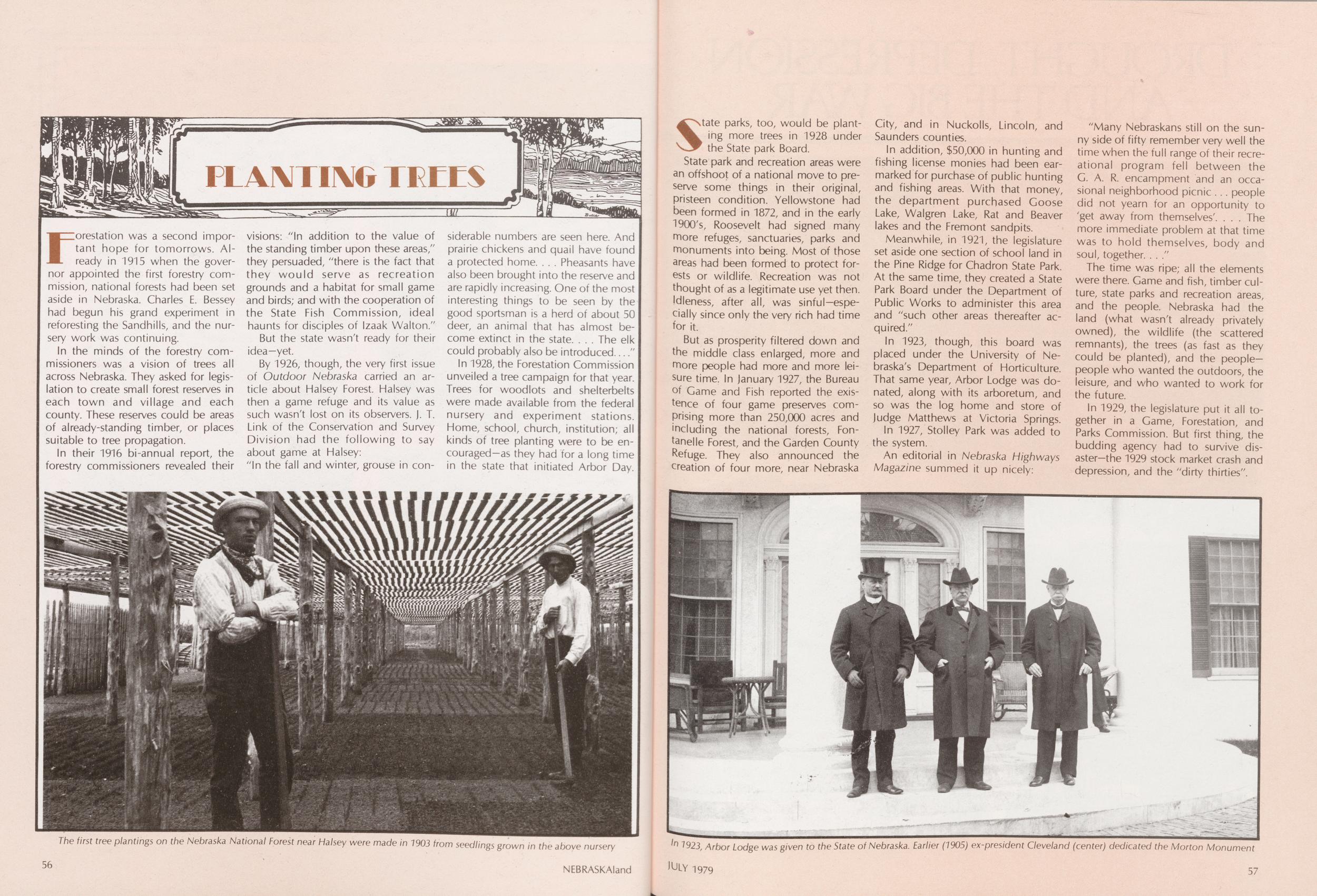
PLANTING TREES
Forestation was a second important hope for tomorrows. Already in 1915 when the governor appointed the first forestry commission, national forests had been set aside in Nebraska. Charles E. Bessey had begun his grand experiment in reforesting the Sandhills, and the nursery work was continuing.
In the minds of the forestry commissioners was a vision of trees all across Nebraska. They asked for legislation to create small forest reserves in each town and village and each county. These reserves could be areas of already-standing timber, or places suitable to tree propagation.
In their 1916 bi-annual report, the forestry commissioners revealed their visions: "In addition to the value of the standing timber upon these areas," they persuaded, "there is the fact that they would serve as recreation grounds and a habitat for small game and birds; and with the cooperation of the State Fish Commission, ideal haunts for disciples of Izaak Walton."
But the state wasn't ready for their idea—yet.
By 1926, though, the very first issue of Outdoor Nebraska carried an article about Halsey Forest. Halsey was then a game refuge and its value as such wasn't lost on its observers. J. T. Link of the Conservation and Survey Division had the following to say about game at Halsey:
"In the fall and winter, grouse in considerable numbers are seen here. And prairie chickens and quail have found a protected home...Pheasants have also been brought into the reserve and are rapidly increasing. One of the most interesting things to be seen by the good sportsman is a herd of about 50 deer, an animal that has almost become extinct in the state...The elk could probably also be introduced"
In 1928, the Forestation Commission unveiled a tree campaign for that year. Trees for wood lots and shelterbelts were made available from the federal nursery and experiment stations. Home, school, church, institution; all kinds of tree planting were to be encouraged—as they had for a long time in the state that initiated Arbor Day.
The first tree plantings on the Nebraska National Forest near Halsey were made in 1903 from seedlings grown in the above nursery
State parks, too, would be planting more trees in 1928 under the State park Board.
State park and recreation areas were an offshoot of a national move to preserve some things in their original, pristeen condition. Yellowstone had been formed in 1872, and in the early 1900's, Roosevelt had signed many more refuges, sanctuaries, parks and monuments into being. Most of those areas had been formed to protect forests or wildlife. Recreation was not thought of as a legitimate use yet then. Idleness, after all, was sinful—especially since only the very rich had time for it.
But as prosperity filtered down and the middle class enlarged, more and more people had more and more leisure time. In January 1927, the Bureau of Game and Fish reported the existence of four game preserves comprising more than 250,000 acres and including the national forests, Fontanels Forest, and the Garden County Refuge. They also announced the creation of four more, near Nebraska City, and in Nuckolls, Lincoln, and Saunders counties.
In addition, $50,000 in hunting and fishing license monies had been ear-marked for purchase of public hunting and fishing areas. With that money, the department purchased Goose Lake, Walgren Lake, Rat and Beaver lakes and the Fremont sandpits.
Meanwhile, in 1921, the legislature set aside one section of school land in the Pine Ridge for Chadron State Park. At the same time, they created a State Park Board under the Department of Public Works to administer this area and "such other areas thereafter acquired."
In 1923, though, this board was placed under the University of Nebraska's Department of Horticulture. That same year, Arbor Lodge was donated, along with its arboretum, and so was the log home and store of Judge Matthews at Victoria Springs.
In 1927, Stolley Park was added to the system.
An editorial in Nebraska Highways Magazine summed it up nicely:
"Many Nebraskans still on the sunny side of fifty remember very well the time when the full range of their recreational program fell between the G. A. R. encampment and an occasional neighborhood picnic ... people did not yearn for an opportunity to 'get away from themselves'...The more immediate problem at that time was to hold themselves, body and soul, together..."
The time was ripe; all the elements were there. Game and fish, timber culture, state parks and recreation areas, and the people. Nebraska had the land (what wasn't already privately owned), the wildlife (the scattered remnants), the trees (as fast as they could be planted), and the people-people who wanted the outdoors, the leisure, and who wanted to work for the future.
In 1929, the legislature put it all together in a Game, Forestation, and Parks Commission. But first thing, the budding agency had to survive disaster—the 1929 stock market crash and depression, and the "dirty thirties".
In 7923, Arbor Lodge was given to the State of Nebraska. Earlier (1905) ex-president Cleveland (center) dedicated the Morton Monument
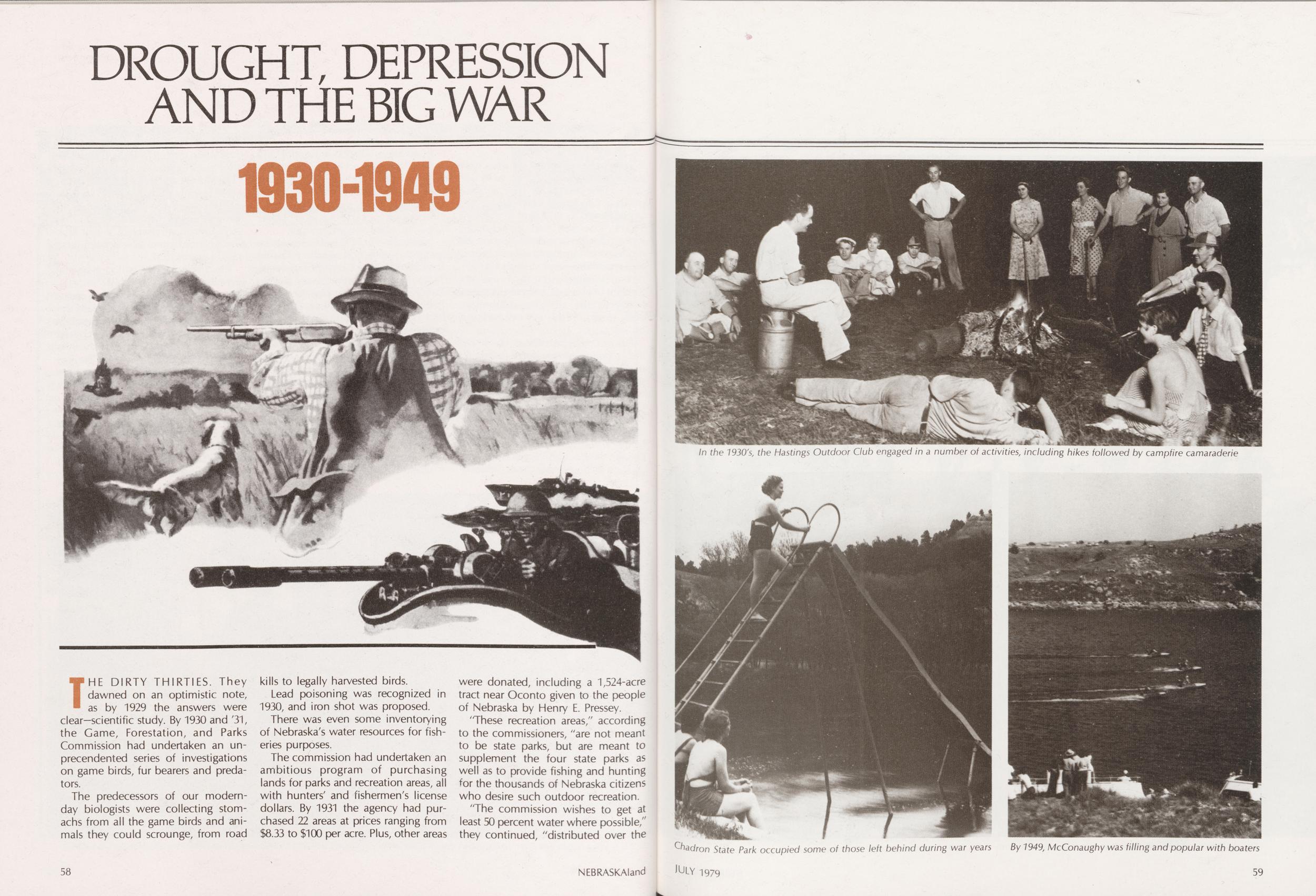
DROUGHT, DEPRESSION AND THE BIG WAR 1930-1949
THE DIRTY THIRTIES. They dawned on an optimistic note, as by 1929 the answers were clear—scientific study. By 1930 and 31, the Game, Forestation, and Parks Commission had undertaken an unprecendented series of investigations on game birds, fur bearers and predators.
The predecessors of our modernday biologists were collecting stomachs from all the game birds and animals they could scrounge, from road kills to legally harvested birds.
Lead poisoning was recognized in 1930, and iron shot was proposed.
There was even some inventorying of Nebraska's water resources for fisheries purposes.
The commission had undertaken an ambitious program of purchasing lands for parks and recreation areas, all with hunters' and fishermen's license dollars. By 1931 the agency had purchased 22 areas at prices ranging from $8.33 to $100 per acre. Plus, other areas were donated, including a 1,524-acre tract near Oconto given to the people of Nebraska by Henry E. Pressey.
These recreation areas," according to the commissioners, "are not meant to be state parks, but are meant to supplement the four state parks as well as to provide fishing and hunting for the thousands of Nebraska citizens who desire such outdoor recreation.
In the 1930's, the Hastings Outdoor Club engaged in a number of activities, including hikes followed by campfire camaraderie
Chadron State Park occupied some of those left behind during war years
By 1949, McConaughy was filling and popular with boaters
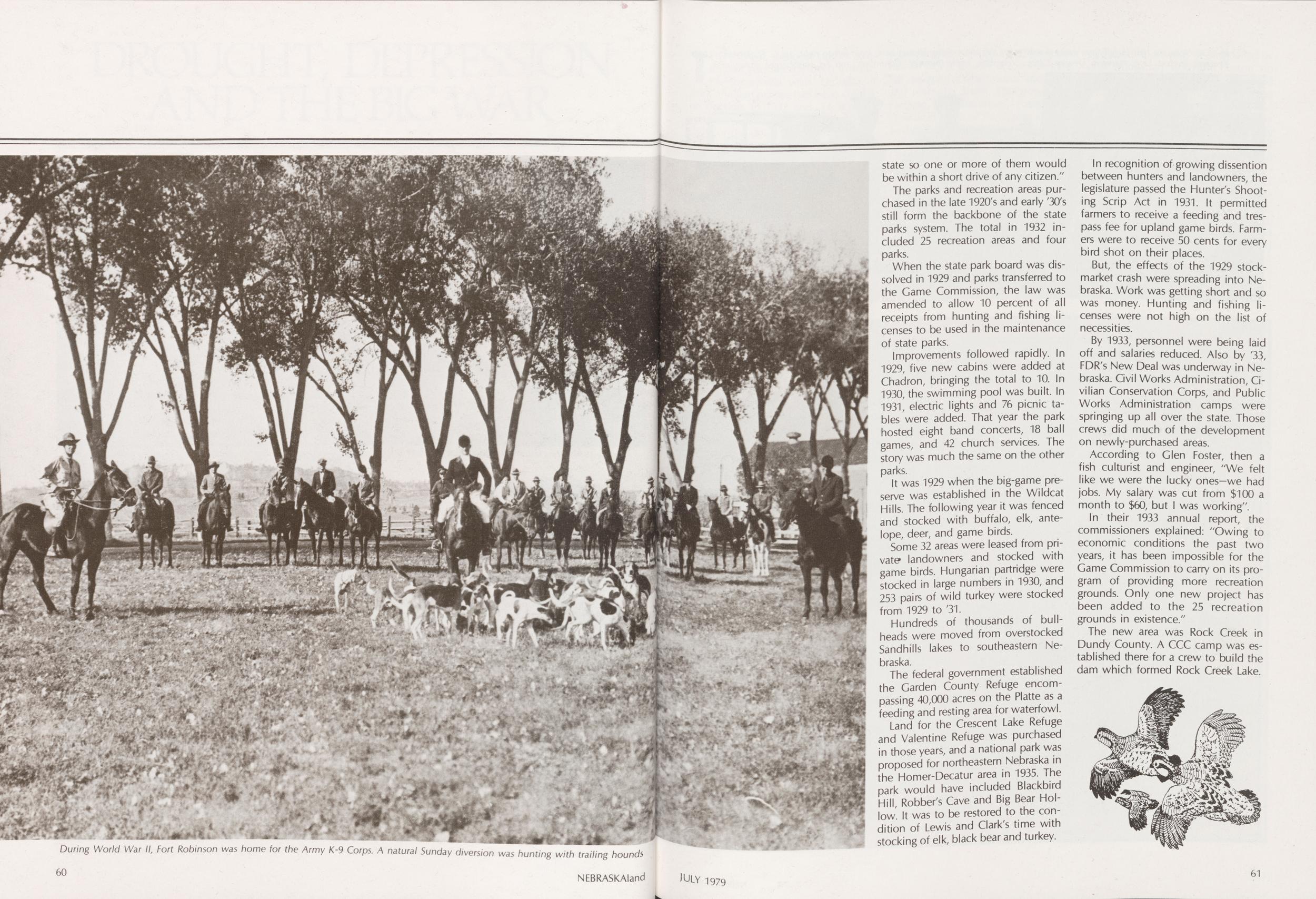
During World War II, Fort Robinson was home for the Army K-9 Corps. A natural Sunday diversion was hunting with trailing hounds
The parks and recreation areas purchased in the late 1920's and early '30's still form the backbone of the state parks system. The total in 1932 included 25 recreation areas and four parks.
When the state park board was dissolved in 1929 and parks transferred to the Game Commission, the law was amended to allow 10 percent of all receipts from hunting and fishing licenses to be used in the maintenance of state parks.
Improvements followed rapidly. In 1929, five new cabins were added at Chadron, bringing the total to 10. In 1930, the swimming pool was built. In 1931, electric lights and 76 picnic tables were added. That year the park hosted eight band concerts, 18 ball games, and 42 church services. The story was much the same on the other parks.
It was 1929 when the big-game preserve was established in the Wildcat Hills. The following year it was fenced and stocked with buffalo, elk, antelope, deer, and game birds.
Some 32 areas were leased from private landowners and stocked with game birds. Hungarian partridge were stocked in large numbers in 1930, and 253 pairs of wild turkey were stocked from 1929 to 31.
Hundreds of thousands of bullheads were moved from overstocked Sandhills lakes to southeastern Nebraska.
The federal government established the Garden County Refuge encompassing 40,000 acres on the Platte as a feeding and resting area for waterfowl.
Land for the Crescent Lake Refuge and Valentine Refuge was purchased in those years, and a national park was proposed for northeastern Nebraska in the Homer-Decatur area in 1935. The park would have included Blackbird Hill, Robber's Cave and Big Bear Hollow. It was to be restored to the condition of Lewis and Clark's time with stocking of elk, black bear and turkey.
In recognition of growing dissension between hunters and landowners, the legislature passed the Hunter's Shooting Scrip Act in 1931. It permitted farmers to receive a feeding and trespass fee for upland game birds. Farmers were to receive 50 cents for every bird shot on their places.
But, the effects of the 1929 stock-market crash were spreading into Nebraska. Work was getting short and so was money. Hunting and fishing licenses were not high on the list of necessities.
By 1933, personnel were being laid off and salaries reduced. Also by 33, FDR's New Deal was underway in Nebraska. Civil Works Administration, Civilian Conservation Corps, and Public Works Administration camps were springing up all over the state. Those crews did much of the development on newly-purchased areas.
According to Glen Foster, then a fish culturist and engineer, "We felt like we were the lucky ones—we had jobs. My salary was cut from $100 a month to $60, but I was working".
In their 1933 annual report, the commissioners explained: "Owing to economic conditions the past two years, it has been impossible for the Game Commission to carry on its program of providing more recreation grounds. Only one new project has been added to the 25 recreation grounds in existence."
The new area was Rock Creek in Dundy County. A CCC camp was established there for a crew to build the dam which formed Rock Creek Lake.
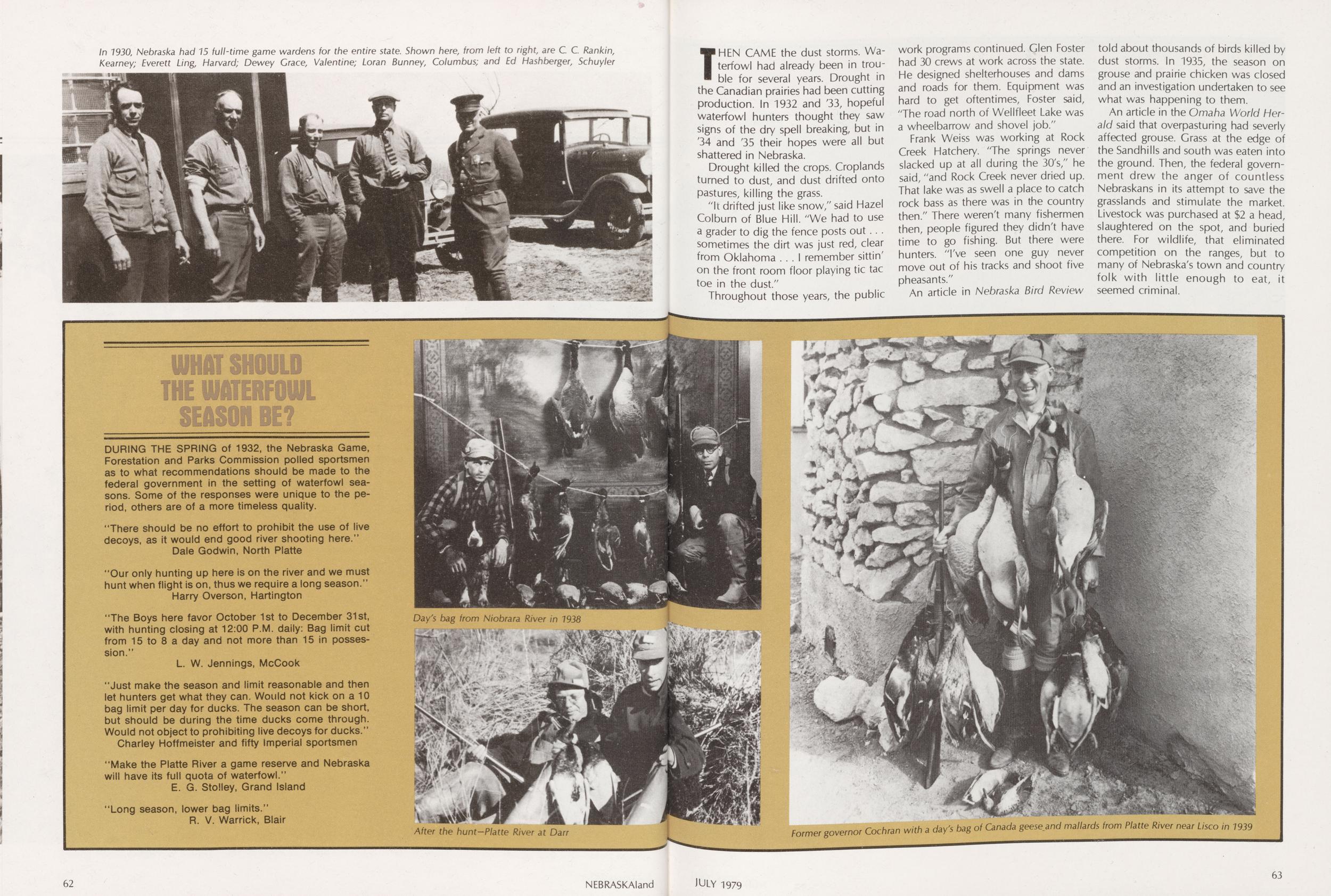
In 1930, Nebraska had 15 full-time game wardens for the entire state. Shown here, from left to right, are C. C. Rankin, Kearney; Everett Ling, Harvard; Dewey Grace, Valentine; Loran Bunney, Columbus; and Ed Hashberger, Schuyler
THEN CAME the dust storms. Waterfowl had already been in trouble for several years. Drought in the Canadian prairies had been cutting production. In 1932 and 33, hopeful waterfowl hunters thought they saw signs of the dry spell breaking, but in 34 and 35 their hopes were all but shattered in Nebraska.
Drought killed the crops. Croplands turned to dust, and dust drifted onto pastures, killing the grass.
"It drifted just like snow," said Hazel Colburn of Blue Hill. "We had to use a grader to dig the fence posts out ... sometimes the dirt was just red, clear from Oklahoma ... I remember sittin' on the front room floor playing tic tac toe in the dust."
Throughout those years, the public work programs continued. Glen Foster had 30 crews at work across the state. He designed shelterhouses and dams and roads for them. Equipment was hard to get oftentimes, Foster said, "The road north of Wellfleet Lake was a wheelbarrow and shovel job."
Frank Weiss was working at Rock Creek Hatchery. "The springs never slacked up at all during the 30's," he said, "and Rock Creek never dried up. That lake was as swell a place to catch rock bass as there was in the country then." There weren't many fishermen then, people figured they didn't have time to go fishing. But there were hunters. "I've seen one guy never move out of his tracks and shoot five pheasants."
An article in Nebraska Bird Review told about thousands of birds killed by dust storms. In 1935, the season on grouse and prairie chicken was closed and an investigation undertaken to see what was happening to them.
An article in the Omaha World Herald said that over-pasturing had severely affected grouse. Grass at the edge of the Sandhills and south was eaten into the ground. Then, the federal government drew the anger of countless Nebraskans in its attempt to save the grasslands and stimulate the market. Livestock was purchased at $2 a head, slaughtered on the spot, and buried there. For wildlife, that eliminated competition on the ranges, but to many of Nebraska's town and country folk with little enough to eat, it seemed criminal.
WHAT SHOULD THE WATERFOWL SEASON BE?
DURING THE SPRING of 1932, the Nebraska Game, Forestation and Parks Commission polled sportsmen as to what recommendations should be made to the federal government in the setting of waterfowl seasons. Some of the responses were unique to the period, others are of a more timeless quality.
"There should be no effort to prohibit the use of live decoys, as it would end good river shooting here." Dale Godwin, North Platte
"Our only hunting up here is on the river and we must hunt when flight is on, thus we require a long season." Harry Overson, Hartington
"The Boys here favor October 1st to December 31st, with hunting closing at 12:00 P.M. daily: Bag limit cut from 15 to 8 a day and not more than 15 in possession." L. W. Jennings, McCook
"Just make the season and limit reasonable and then let hunters get what they can. Would not kick on a 10 bag limit per day for ducks. The season can be short, but should be during the time ducks come through. Would not object to prohibiting live decoys for ducks." Charley Hoffmeister and fifty Imperial sportsmen
"Make the Platte River a game reserve and Nebraska will have its full quota of waterfowl." E. G. Stolley, Grand Island
"Long season, lower bag limits." R. V. Warrick, Blair
Day's bag from Niobrara River in 1938
After the hunt–Platte River at Darr
Former governor Cochran with a day's bag of Canada geese and mallards from Platte River near Eisco in 1939
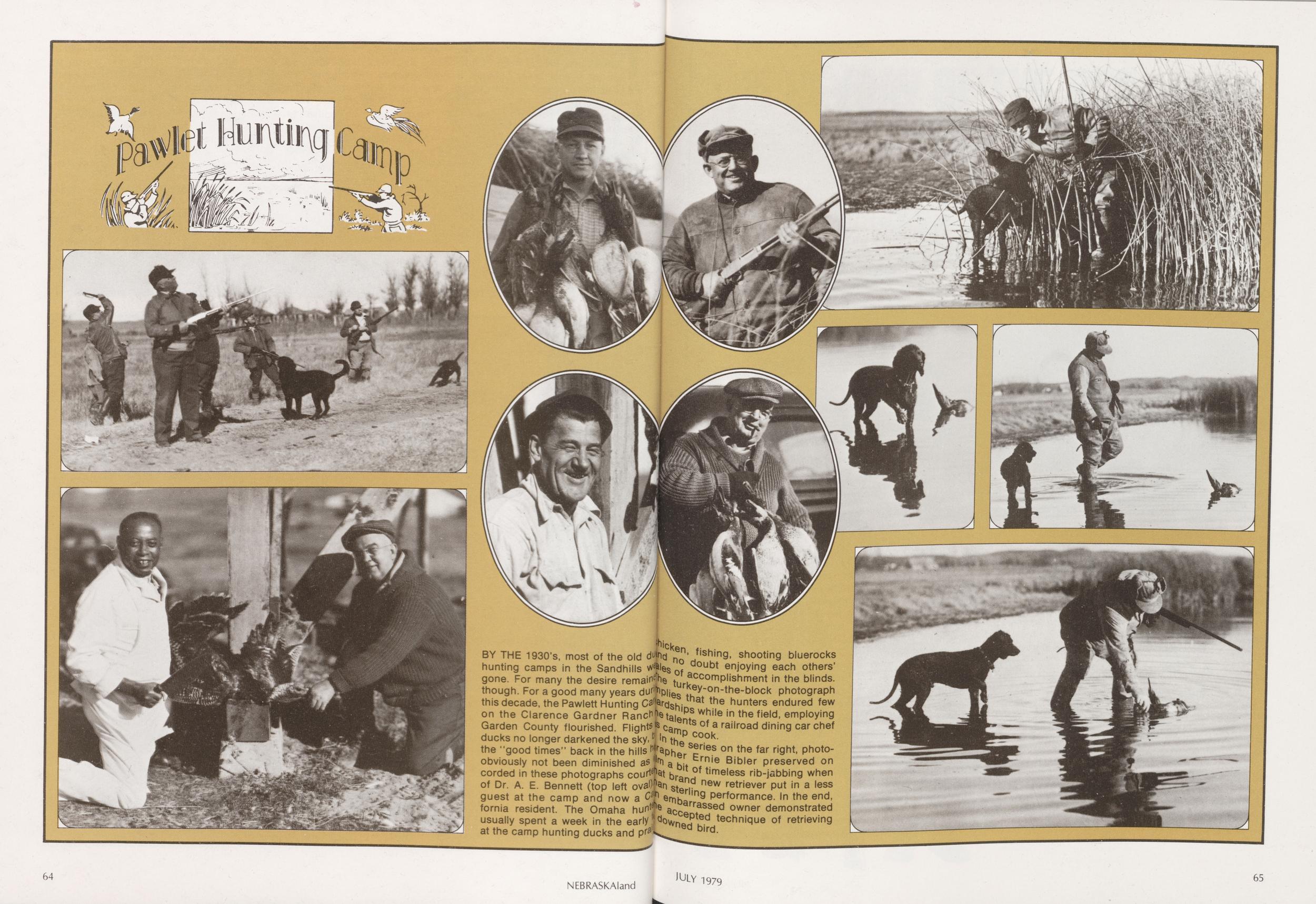
Pawlet Hunting Camp
BY THE 1930's, most of the old hunting camps in the Sandhills gone. For many the desire remains though. For a good many years during this decade, the Pawlett Hunting Camp on the Clarence Gardner Ranch Garden County flourished. Flights ducks no longer darkened the sky, the "good times" back in the hills obviously not been dinished as corded in these photofeaphs courtesy of Dr. A. E. Bennett (top left oval) guest at the camp and now a California resident. The Omaha hunter usually spent a week in the early at the camp hunting ducks and prairie chicken, fishing, shooting bluerocks and no doubt enjoying each others' tales of accomplishment in the blinds. The turkey-on-the-block photograph implies that the hunters endueed dew hardships while in the filed, employing the talents of a railroad dining car chef as camp cook.
In the series on the far right, photographer Ernie Bibler preserved on him a bit of timeless rib-jabbing when that brand new retriever put in a less than sterling performance. In the end, an embarrased owner demonstrated he accepted technique of retrieving a downed bird.
64 NEBRASKAland JULY 1979 65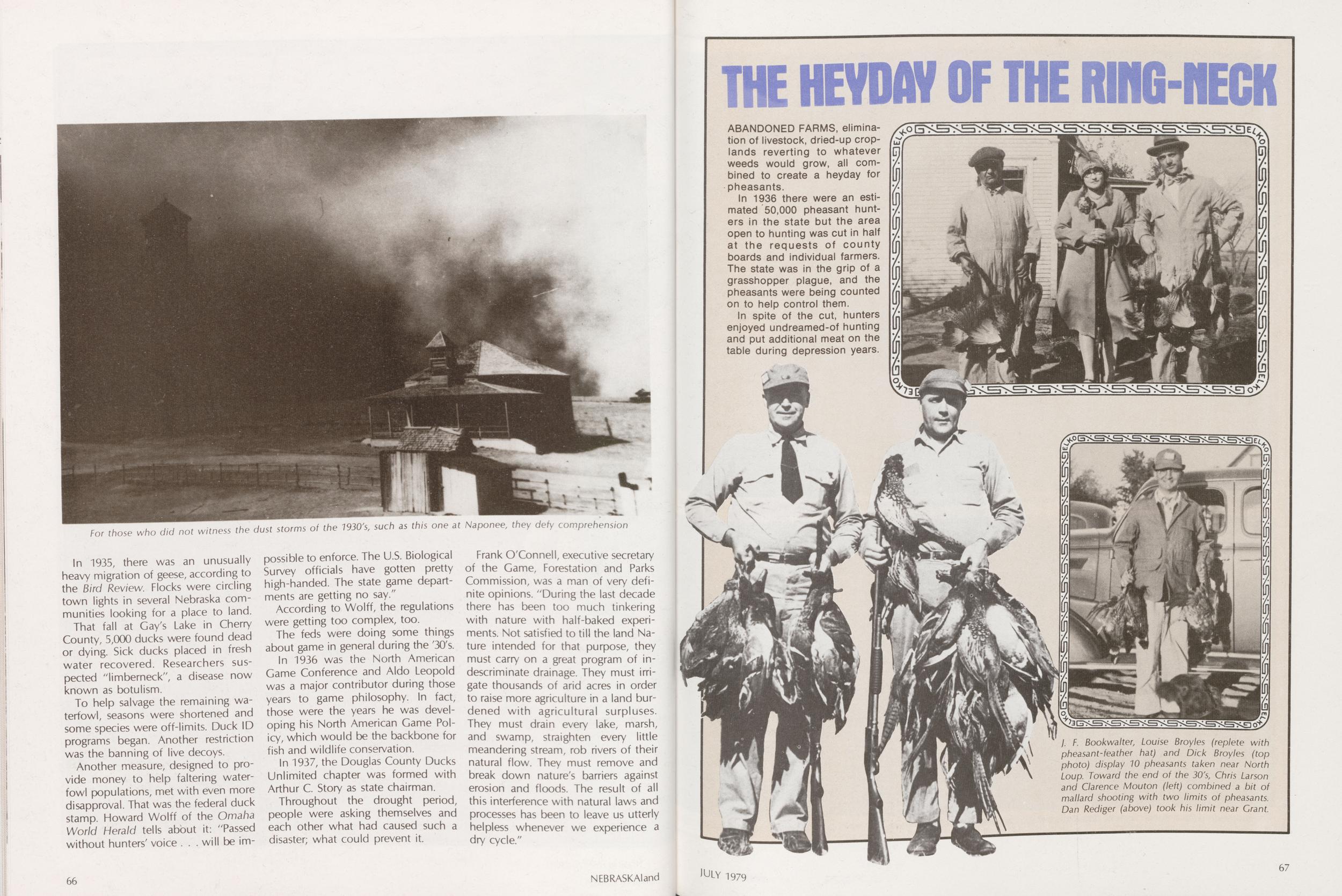
For those who did not witness the dust storms of the 1930's, such as this one at Naponee, they defy comprehension
In 1935, there was an unusually heavy migration of geese, according to the Bird Review. Flocks were circling town lights in several Nebraska communities looking for a place to land.
That fall at Gay's Lake in Cherry County, 5,000 ducks were found dead or dying. Sick ducks placed in fresh water recovered. Researchers suspected "limberneck", a disease now known as botulism.
To help salvage the remaining waterfowl, seasons were shortened and some species were off-limits. Duck ID programs began. Another restriction was the banning of live decoys.
Another measure, designed to provide money to help faltering waterfowl populations, met with even more disapproval. That was the federal duck stamp. Howard Wolff of the Omaha World Herald tells about it: "Passed without hunters' voice ... will be impossible to enforce. The U.S. Biological Survey officials have gotten pretty high-handed. The state game departments are getting no say."
According to Wolff, the regulations were getting too complex, too.
The feds were doing some things about game in general during the '30's.
In 1936 was the North American Game Conference and Aldo Leopold was a major contributor during those years to game philosophy. In fact, those were the years he was developing his North American Game Policy, which would be the backbone for fish and wildlife conservation.
In 1937, the Douglas County Ducks Unlimited chapter was formed with Arthur C. Story as state chairman.
Throughout the drought period, people were asking themselves and each other what had caused such a disaster; what could prevent it.
Frank O'Connell, executive secretary of the Game, Forestation and Parks Commission, was a man of very definite opinions. "During the last decade there has been too much tinkering with nature with half-baked experiments. Not satisfied to till the land Nature intended for that purpose, they must carry on a great program of indiscriminate drainage. They must irrigate thousands of arid acres in order to raise more agriculture in a land burdened with agricultural surpluses. They must drain every lake, marsh, and swamp, straighten every little meandering stream, rob rivers of their natural flow. They must remove and break down nature's barriers against erosion and floods. The result of all this interference with natural laws and processes has been to leave us utterly helpless whenever we experience a dry cycle."
THE HEYDAY OF THE RING-NECK
ABANDONED FARMS, elimination of livestock, dried-up croplands reverting to whatever weeds would grow, all combined to create a heyday for pheasants.
In 1936 there were an estimated 50,000 pheasant hunters in the state but the area open to hunting was cut in half at the requests of county boards and individual farmers. The state was in the grip of a grasshopper plague, and the pheasants were being counted on to help control them.
In spite of the cut, hunters enjoyed undreamed-of hunting and put additional meat on the table during depression years.
J. F. Bookwalter, Louise Broyles (replete with pheasant-feather hat) and Dick Broyles (top photo) display 10 pheasants taken near North Loup. Toward the end of the 30's, Chris Larson and Clarence Mouton (left) combined a bit of mallard shooting with two limits of pheasants. Dan Rediger (above) took his limit near Grant.
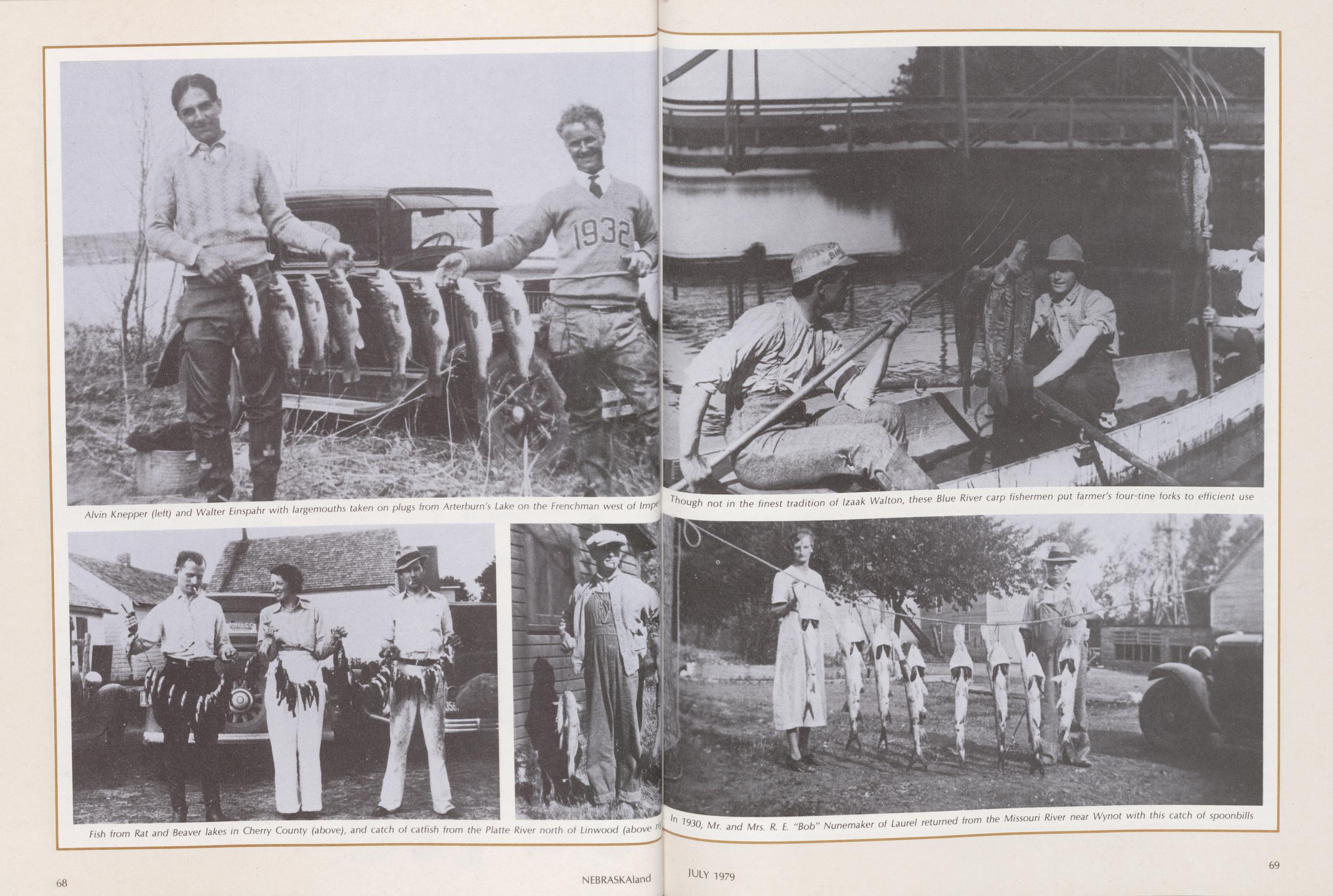
Alvin Knepper (left) and Walter Einspahr with largemouths taken on plugs from Arterbum's Lake on the frenchman west of Imperial
Fish from Rat and Beaver lakes in Cherry County (above), and catch of catfish from the Platte River north of Linwood (above
Though not in the finest tradition of Izaak Walton, these Blue River carp fishermen put farmer's four-tine forks to efficient use
In 1930, Mr. and Mrs. R. E. "Bob" Nunemaker of Laurel returned from the Missouri River near Wynot with this catch of spoonbills
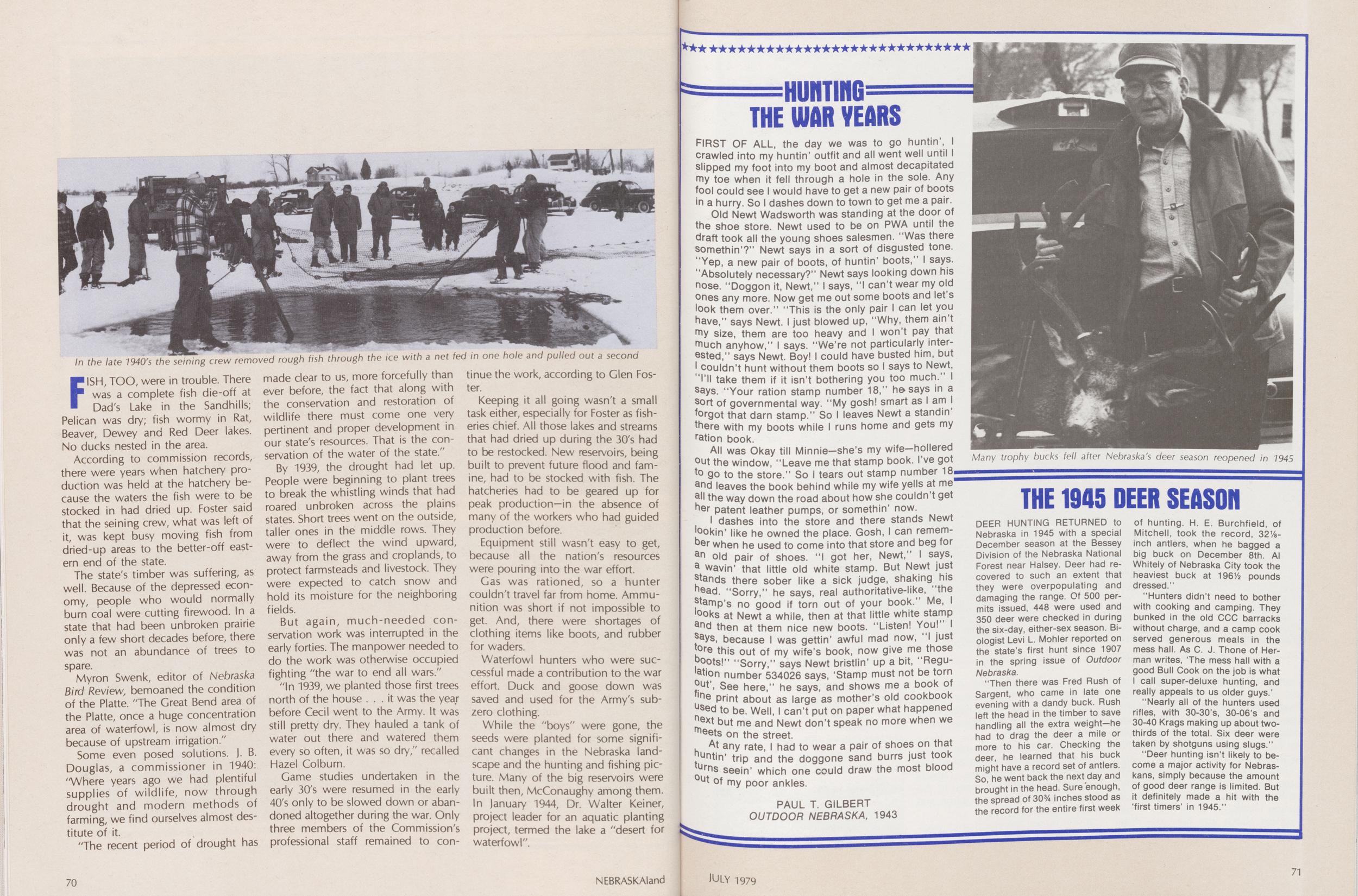
In the late 1940's the seining crew removed rough fish through the ice with a net fed in one hole and pulled out a second
FISH, TOO, were in trouble. There was a complete fish die-off at Dad's Lake in the Sandhills; Pelican was dry; fish wormy in Rat, Beaver, Dewey and Red Deer lakes. No ducks nested in the area.
According to commission records, there were years when hatchery production was held at the hatchery because the waters the fish were to be stocked in had dried up. Foster said that the seining crew, what was left of it, was kept busy moving fish from dried-up areas to the better-off eastern end of the state.
The state's timber was suffering, as well. Because of the depressed economy, people who would normally burn coal were cutting firewood. In a state that had been unbroken prairie only a few short decades before, there was not an abundance of trees to spare.
Myron Swenk, editor of Nebraska Bird Review, bemoaned the condition of the Platte. "The Great Bend area of the Platte, once a huge concentration area of waterfowl, is now almost dry because of upstream irrigation."
Some even posed solutions. J. B. Douglas, a commissioner in 1940: "Where years ago we had plentiful supplies of wildlife, now through drought and modern methods of farming, we find ourselves almost destitute of it.
"The recent period of drought has made clear to us, more forcefully than ever before, the fact that along with the conservation and restoration of wildlife there must come one very pertinent and proper development in our state's resources. That is the conservation of the water of the state."
By 1939, the drought had let up. People were beginning to plant trees to break the whistling winds that had roared unbroken across the plains states. Short trees went on the outside, taller ones in the middle rows. They were to deflect the wind upward, away from the grass and croplands, to protect farmsteads and livestock. They were expected to catch snow and hold its moisture for the neighboring fields.
But again, much-needed conservation work was interrupted in the early forties. The manpower needed to do the work was otherwise occupied fighting "the war to end all wars."
"In 1939, we planted those first trees north of the house ... it was the year before Cecil went to the Army. It was still pretty dry. They hauled a tank of water out there and watered them every so often, it was so dry," recalled Hazel Colburn.
Game studies undertaken in the early 30's were resumed in the early 40's only to be slowed down or abandoned altogether during the war. Only three members of the Commission's professional staff remained to continue the work, according to Glen Foster.
Keeping it all going wasn't a small task either, especially for Foster as fisheries chief. All those lakes and streams that had dried up during the 30's had to be restocked. New reservoirs, being built to prevent future flood and famine, had to be stocked with fish. The hatcheries had to be geared up for peak production—in the absence of many of the workers who had guided production before.
Equipment still wasn't easy to get, because all the nation's resources were pouring into the war effort.
Gas was rationed, so a hunter couldn't travel far from home. Ammunition was short if not impossible to get. And, there were shortages of clothing items like boots, and rubber for waders.
Waterfowl hunters who were successful made a contribution to the war effort. Duck and goose down was saved and used for the Army's sub-zero clothing.
While the "boys" were gone, the seeds were planted for some significant changes in the Nebraska land- scape and the hunting and fishing picture. Many of the big reservoirs were built then, McConaughy among them. In January 1944, Dr. Walter Keiner, project leader for an aquatic planting project, termed the lake a "desert for waterfowl".
HUNTING THE WAR YEARS
FIRST OF ALL, the day we was to go huntin', I crawled into my huntin' outfit and all went well until I slipped my foot into my boot and almost decapitated my toe when it fell through a hole in the sole. Any fool could see I would have to get a new pair of boots in a hurry. So I dashes down to town to get me a pair.
Old Newt Wadsworth was standing at the door of the shoe store. Newt used to be on PWA until the draft took all the young shoes salesmen. "Was there somethin'?" Newt says in a sort of disgusted tone. "Yep, a new pair of boots, of huntin' boots," I says. "Absolutely necessary?" Newt says looking down his nose. "Doggon it, Newt," I says, "I can't wear my old ones any more. Now get me out some boots and let's look them over." "This is the only pair I can let you have," says Newt. I just blowed up, "Why, them ain't my size, them are too heavy and I won't pay that much anyhow," I says. "We're not particularly interested," says Newt. Boy! I could have busted him, but 1 couldn't hunt without them boots so I says to Newt, "I'll take them if it isn't bothering you too much." I says. "Your ration stamp number 18," ha says in a sort of governmental way. "My gosh! smart as I am I forgot that darn stamp." So I leaves Newt a standin' there with my boots while I runs home and gets my nation book.
All was Okay till Minnie-she's my wife-hollered Out the window, "Leave me that stamp book. I've got to go to the store." So i tears out stamp number 18. and leaves the book behind while my wife yells at me all the way down the road about how she couldn't get her patent leather pumps, or somethin' now.
I dashes into the store and there stands Newt Lookin' like he owned the place. Gosh, I can remember when he used to come into that store and beg for an old pair of shoes. "I got her, Newt," I says, a wavin' that little old white stamp. But Newt just stands there sober like a sick judge, shaking his head. "Sorry," he says, real authoritative-like, "the stamp's no good if torn out of your book." Me, I '°oks at Newt a while, then at that little white stamp and then at them nice new boots. "Listen! You!" I ^aVs, because I was gettin' awful mad now, "I just tore this out of my wife's book, now give me those hoots!" "Sorry," says Newt bristlin' up a bit, "Regulation number 534026 says, 'Stamp must not be torn Out\ See here," he says, and shows me a book of flip print about as large as mother's old cookbook Used to be. Well, I can't put on paper what happened next but me and Newt don't speak no more when we writes on the street.
At any rate, I had to wear a pair of shoes on that trip and the doggone sand burrs just took turns seein' which one could draw the most blood Out of my poor ankles.
Many trophy bucks fell after Nebraska's deer season reopened in 1945
THE 1945 DEER SEASON DEER HUNTING RETURNED to Nebraska in 1945 with a special December season at the Bessey Division of the Nebraska National Forest near Halsey. Deer had recovered to such an extent that they were overpopulating and damaging the range. Of 500 permits issued, 448 were used and 350 deer were checked in during the six-day, either-sex season. Biologist Levi L. Mohler reported on the state's first hunt since 1907 in the spring issue of Outdoor Nebraska.
"Then there was Fred Rush of Sargent, who came in late one evening with a dandy buck. Rush left the head in the timber to save handling all the extra weight—he had to drag the deer a mile or more to his car. Checking the deer, he learned that his buck might have a record set of antlers. So, he went back the next day and brought in the head. Sure enough, the spread of 30% inches stood as the record for the entire first week of hunting. H. E. Burchfield, of Mitchell, took the record, 321/8-inch antlers, when he bagged a big buck on December 8th. Al Whitely of Nebraska City took the heaviest buck at 196V2 pounds dressed."
"Hunters didn't need to bother with cooking and camping. They bunked in the old CCC barracks without charge, and a camp cook served generous meals in the mess hall. As C. J. Thone of Herman writes, The mess hall with a good Bull Cook on the job is what I call super-deluxe hunting, and really appeals to us older guys.'
"Nearly all of the hunters used rifles, with 30-30's, 30-06's and 30-40 Krags making up about two-thirds of the total. Six deer were taken by shotguns using slugs."
"Deer hunting isn't likely to become a major activity for Nebraskans, simply because the amount of good deer range is limited. But it definitely made a hit with the first timers' in 1945."
70 NEBRASKAland JULY 1979 71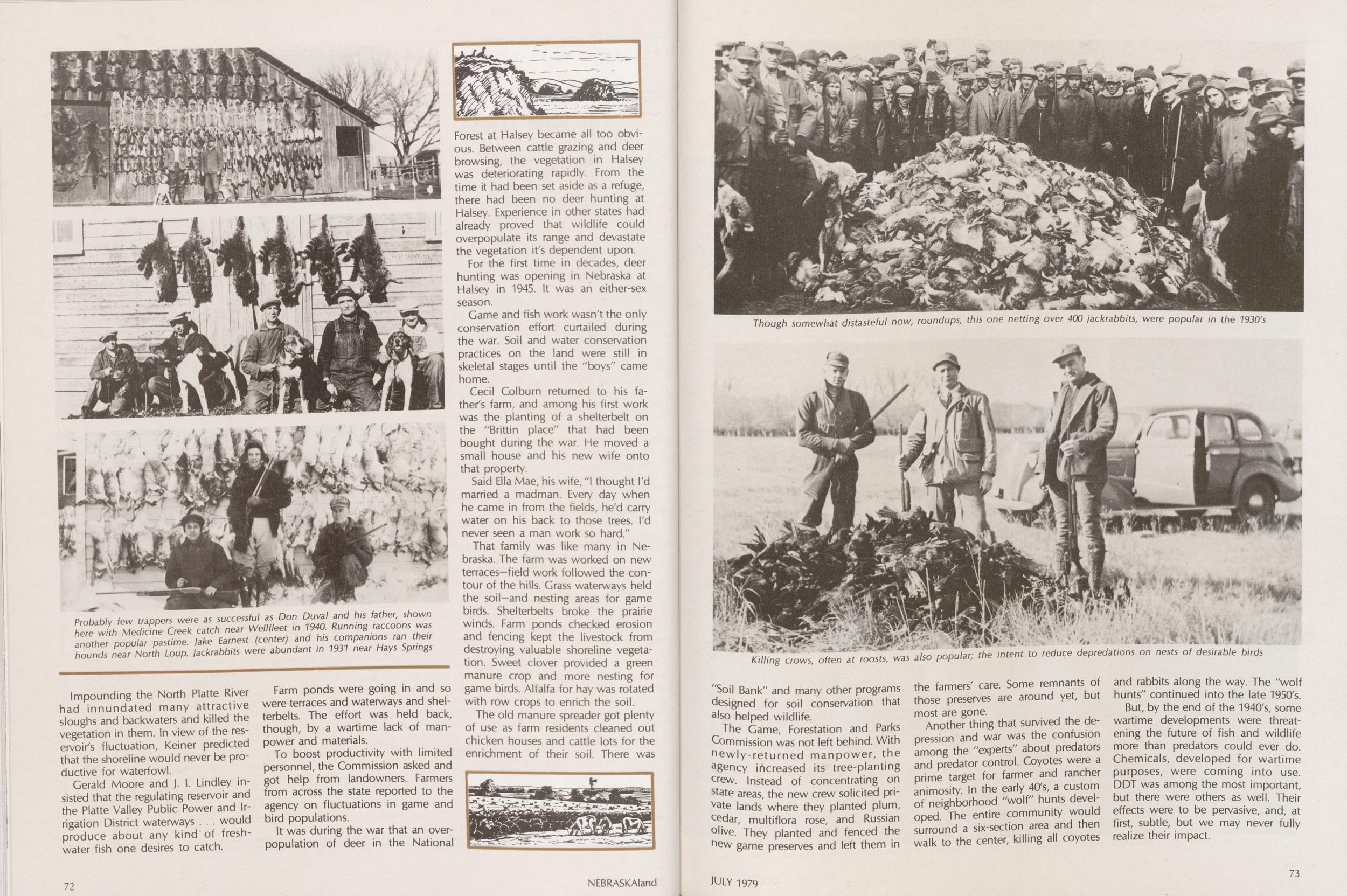
Probably few trappers were as successful as Don Duval and his father, shown here with Medtcme Creek catch near Wellfleet in 7940. Running raccoons was Mother popular pastime, lake Earnest (center) and hounds near North Loup. Jackrabbits were abundant in 1931 near Hays Springs
Impounding the North Platte River had innundated many attractive sloughs and backwaters and killed the vegetation in them. In view of the reservoir's fluctuation, Keiner predicted that the shoreline would never be productive for waterfowl.
Gerald Moore and J. I. Lindley insisted that the regulating reservoir and the Platte Valley Public Power and Irrigation District waterways ... would produce about any kind of fresh-water fish one desires to catch.
Farm ponds were going in and so were terraces and waterways and shelterbelts. The effort was held back, though, by a wartime lack of manpower and materials.
To boost productivity with limited personnel, the Commission asked and got help from landowners. Farmers from across the state reported to the agency on fluctuations in game and bird populations.
It was during the war that an overpopulation of deer in the National Forest at Halsey became all too obvious. Between cattle grazing and deer browsing, the vegetation in Halsey was deteriorating rapidly. From the time it had been set aside as a refuge, there had been no deer hunting at Halsey. Experience in other states had already proved that wildlife could overpopulate its range and devastate the vegetation it's dependent upon.
For the first time in decades, deer hunting was opening in Nebraska at Halsey in 1945. It was an either-sex season.
Game and fish work wasn't the only conservation effort curtailed during the war. Soil and water conservation practices on the land were still in skeletal stages until the "boys" came home.
Cecil Colburn returned to his father's farm, and among his first work was the planting of a shelterbelt on the "Brittin place" that had been bought during the war. He moved a small house and his new wife onto that property.
Said Ella Mae, his wife, "I thought I'd married a madman. Every day when he came in from the fields, he'd carry water on his back to those trees. I'd never seen a man work so hard."
That family was like many in Nebraska. The farm was worked on new terraces-field work followed the contour of the hills. Grass waterways held the soil—and nesting areas for game birds. Shelterbelts broke the prairie winds. Farm ponds checked erosion and fencing kept the livestock from destroying valuable shoreline vegetation. Sweet clover provided a green manure crop and more nesting for game birds. Alfalfa for hay was rotated with row crops to enrich the soil.
Though somewhat distasteful now, roundups, this one netting over 400 jackrabbits, were popular in the 1930's
Killing crows, often at roosts, was a aIso popular; the intent to reduce depredations on nests of desirable birds
The Game, Forestation and Parks Commission was not left behind. With newly-returned manpower, the agency increased its tree-planting crew. Instead of concentrating on state areas, the new crew solicited private lands where they planted plum, cedar, multiflora rose, and Russian olive. They planted and fenced the new game preserves and left them in the farmers' care. Some remnants of those preserves are around yet, but most are gone.
Another thing that survived the depression and war was the confusion among the "experts" about predators and predator control. Coyotes were a prime target for farmer and rancher animosity. In the early 40's, a custom of neighborhood "wolf" hunts developed The entire community would surround a six-section area and then walk to the center, killing all coyotes and rabbits along the way. The "wolf hunts" continued into the late 1950's.
But, by the end of the 1940's, some wartime developments were threatening the future of fish and wildlife more than predators could ever do. Chemicals, developed for wartime purposes, were coming into use. DDT was among the most important, but there were others as well. Their effects were to be pervasive, and, at first, subtle, but we may never fully realize their impact.
72 NEBRASKAland JULY 1979 73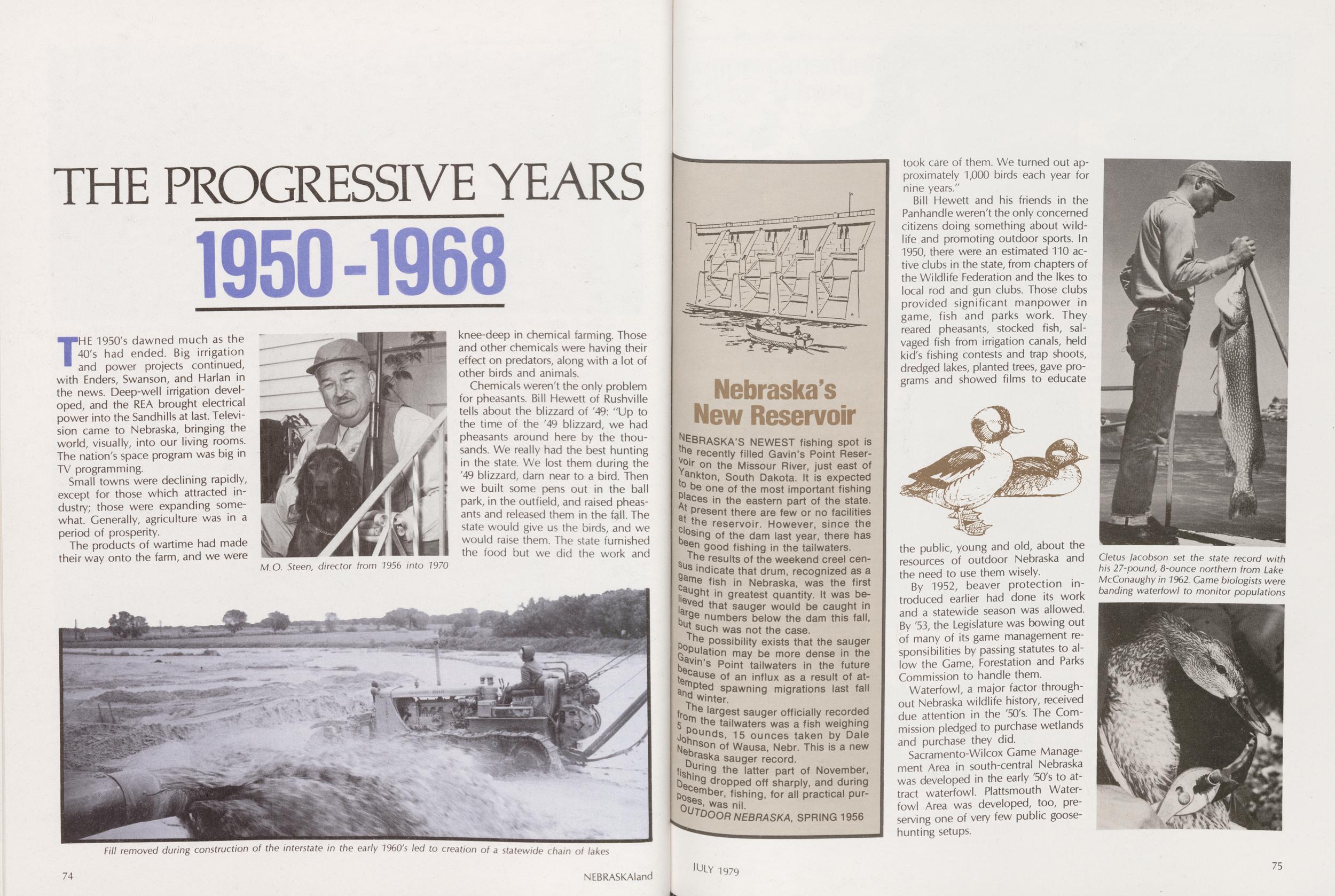
THE PROGRESSIVE YEARS 1950-1968
THE 1950's dawned much as the 40's had ended. Big irrigation and power projects continued, with Enders, Swanson, and Harlan in the news. Deep-well irrigation developed, and the REA brought electrical power into the Sandhills at last. Television came to Nebraska, bringing the world, visually, into our living rooms. The nation's space program was big in TV programming.
Small towns were declining rapidly, except for those which attracted industry; those were expanding somewhat. Generally, agriculture was in a period of prosperity.
M.O. Steen, director from 1956 into 1970
Fill removed during construction of the interstate in the early 1960's led to creation of a statewide chain of lakes
Bill Hewett and his friends in the Panhandle weren't the only concerned citizens doing something about wildlife and promoting outdoor sports. In 1950, there were an estimated 110 active clubs in the state, from chapters of the Wildlife Federation and the Ikes to local rod and gun clubs. Those clubs provided significant manpower in game, fish and parks work. They reared pheasants, stocked fish, salvaged fish from irrigation canals, held kid's fishing contests and trap shoots, dredged lakes, planted trees, gave programs and showed films to educate the public, young and old, about the resources of outdoor Nebraska and the need to use them wisely.
By 1952, beaver protection introduced earlier had done its work and a statewide season was allowed. By '53, the Legislature was bowing out of many of its game management responsibilities by passing statutes to allow the Game, Forestation and Parks Commission to handle them.
Waterfowl, a major factor throughout Nebraska wildlife history, received due attention in the '50's. The Commission pledged to purchase wetlands and purchase they did.
Sacramento-Wilcox Game Management Area in south-central Nebraska was developed in the early '50's to attract waterfowl. Plattsmouth Waterfowl Area was developed, too, preserving one of very few public goose-hunting setups.
Cletus Jacobson set the state record with his 27-pound, 8-ounce northern from Lake McConaughy in 7962. Game biologists were banding waterfowl to monitor populations
Nebraska's New Reservoir
NEBRASKA'S NEWEST fishing spot is recently filled Gavin's Point Reservoir on the Missouri River, just east of Yankton, South Dakota. It is expected to be one of the most important fishing places in the eastern part of the state. At present there are few or no facilities at the reservoir. However, since the closing of the dam last year, there has been good fishing in the tail waters.
The results of the weekend creel cen-Us indicate that drum, recognized as a game fish in Nebraska, was the first caught in greatest quantity. It was believed that sauger would be caught in large numbers below the dam this fall, That was not the case.
The possibility exists that the sauger Population may be more dense in the Gavin's Point tail waters in the future because of an influx as a result of attempted spawning migrations last fall and winter.
The largest sauger officially recorded the tail waters was a fish weighing 5 pounds, 15 ounces taken by Dale Johnson of Wausa, Nebr. This is a new Nebraska sauger record.
During the latter part of November, fishing dropped off sharply, and during December fishing, for all practical was nil.
Outdoor NEBRASKA, SPRING 1956 74 NEBRASKAland JULY 1979 75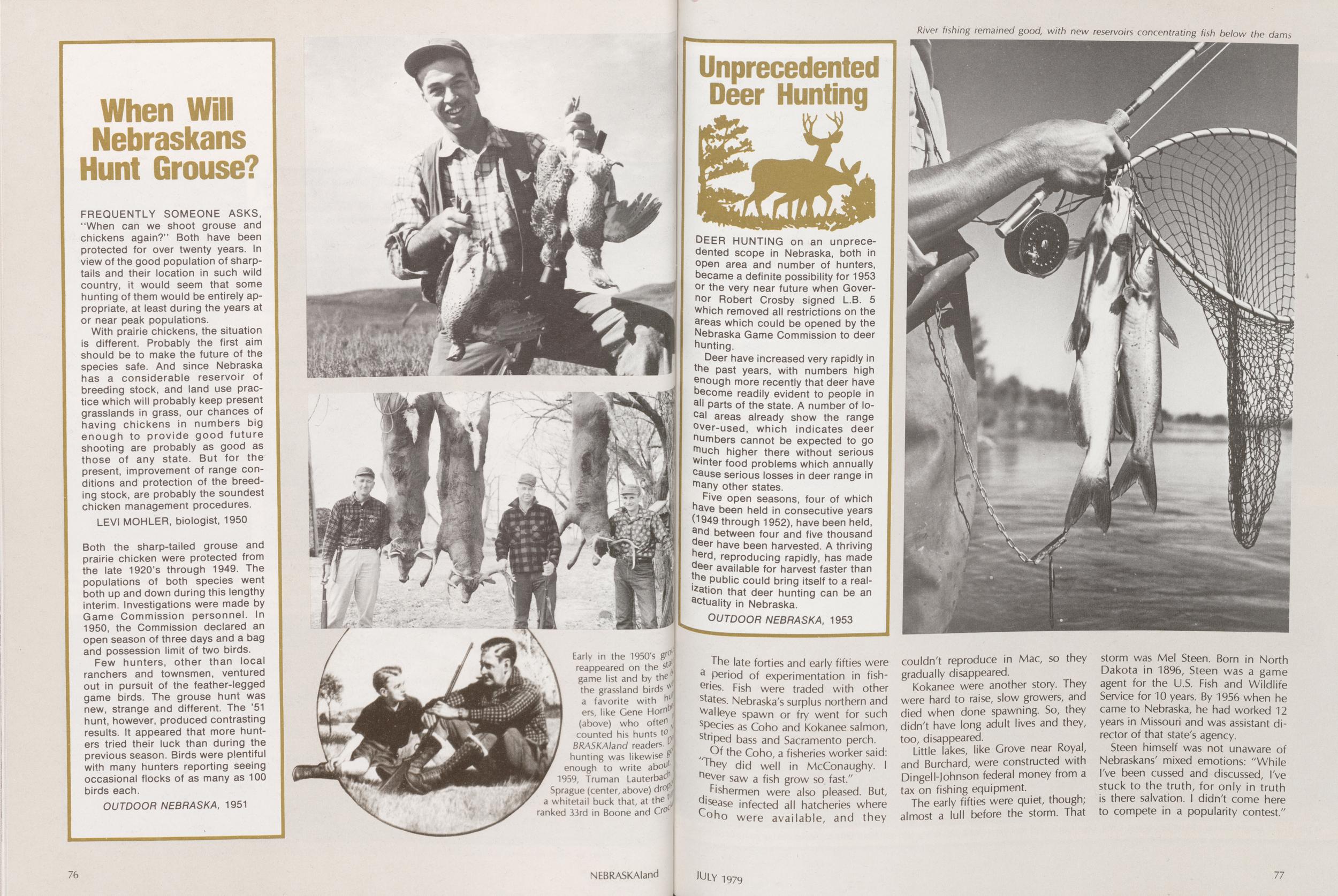
When Will Nebraskans Hunt Grouse?
FREQUENTLY SOMEONE ASKS, "When can we shoot grouse and chickens again?" Both have been protected for over twenty years. In view of the good population of sharp-tails and their location in such wild country, it would seem that some hunting of them would be entirely appropriate, at least during the years at or near peak populations.
With prairie chickens, the situation is different. Probably the first aim should be to make the future of the species safe. And since Nebraska has a considerable reservoir of breeding stock, and land use practice which will probably keep present grasslands in grass, our chances of having chickens in numbers big enough to provide good future shooting are probably as good as those of any state. But for the present, improvement of range conditions and protection of the breed- ing stock, are probably the soundest chicken management procedures.
LEVI MOHLER, biologist, 1950Both the sharp-tailed grouse and prairie chicken were protected from the late 1920's through 1949. The populations of both species went both up and down during this lengthy interim. Investigations were made by Game Commission personnel. In 1950, the Commission declared an open season of three days and a bag and possession limit of two birds.
Few hunters, other than local ranchers and townsmen, ventured out in pursuit of the feather-legged game birds. The grouse hunt was new, strange and different. The '51 hunt, however, produced contrasting results. It appeared that more hunters tried their luck than during the previous season. Birds were plentiful with many hunters reporting seeing occasional flocks of as many as 100 birds each.
OUTDOOR NEBRASKA, 1951Early in the 1950's reappeared on the game list and by the the grassland birds favorite with others, like Gene Horne (above) who often counted his hunts to NEBRASKAland readers hunting was likewise enough to write about 1959, Truman Lauterbad. Sprague (center, above) a whitetail buck that, at the ranked 33rd in Boone and
Unprecedented Deer Hunting
DEER HUNTING on an unprecedented scope in Nebraska, both in open area and number of hunters, became a definite possibility for 1953 or the very near future when Governor Robert Crosby signed L.B. 5 which removed all restrictions on the areas which could be opened by the Nebraska Game Commission to deer hunting.
Deer have increased very rapidly in the past years, with numbers high enough more recently that deer have become readily evident to people in all parts of the state. A number of local areas already show the range over-used, which indicates deer numbers cannot be expected to go much higher there without serious winter food problems which annually cause serious losses in deer range in many other states.
Five open seasons, four of which have been held in consecutive years 0949 through 1952), have been held, and between four and five thousand Deer have been harvested. A thriving hard, reproducing rapidly, has made available for harvest faster than the public could bring itself to a realization that deer hunting can be an duality in Nebraska.
OUTDOOR NEBRASKA, 1953The late forties and early fifties were a period of experimentation in fisheries. Fish were traded with other states. Nebraska's surplus northern and Walleye spawn or fry went for such species as Coho and Kokanee salmon, stiped bass and Sacramento perch.
Of the Coho, a fisheries worker said: They did well in McConaughy. I never saw a fish grow so fast."
Fishermen were also pleased. But, disease infected all hatcheries where Coho were available, and they couldn't reproduce in Mac, so they gradually disappeared.
Kokanee were another story. They were hard to raise, slow growers, and died when done spawning. So, they didn't have long adult lives and they, too, disappeared.
Little lakes, like Grove near Royal, and Burchard, were constructed with Dingell-Johnson federal money from a tax on fishing equipment.
The early fifties were quiet, though; almost a lull before the storm. That storm was Mel Steen. Born in North Dakota in 1896, Steen was a game agent for the U.S. Fish and Wildlife Service for 10 years. By 1956 when he came to Nebraska, he had worked 12 years in Missouri and was assistant director of that state's agency.
Steen himself was not unaware of Nebraskans' mixed emotions: "While I've been cussed and discussed, I've stuck to the truth, for only in truth is there salvation. I didn't come here to compete in a popularity contest."
River fishing remained good, with new reservoirs concentrating fish below the dams
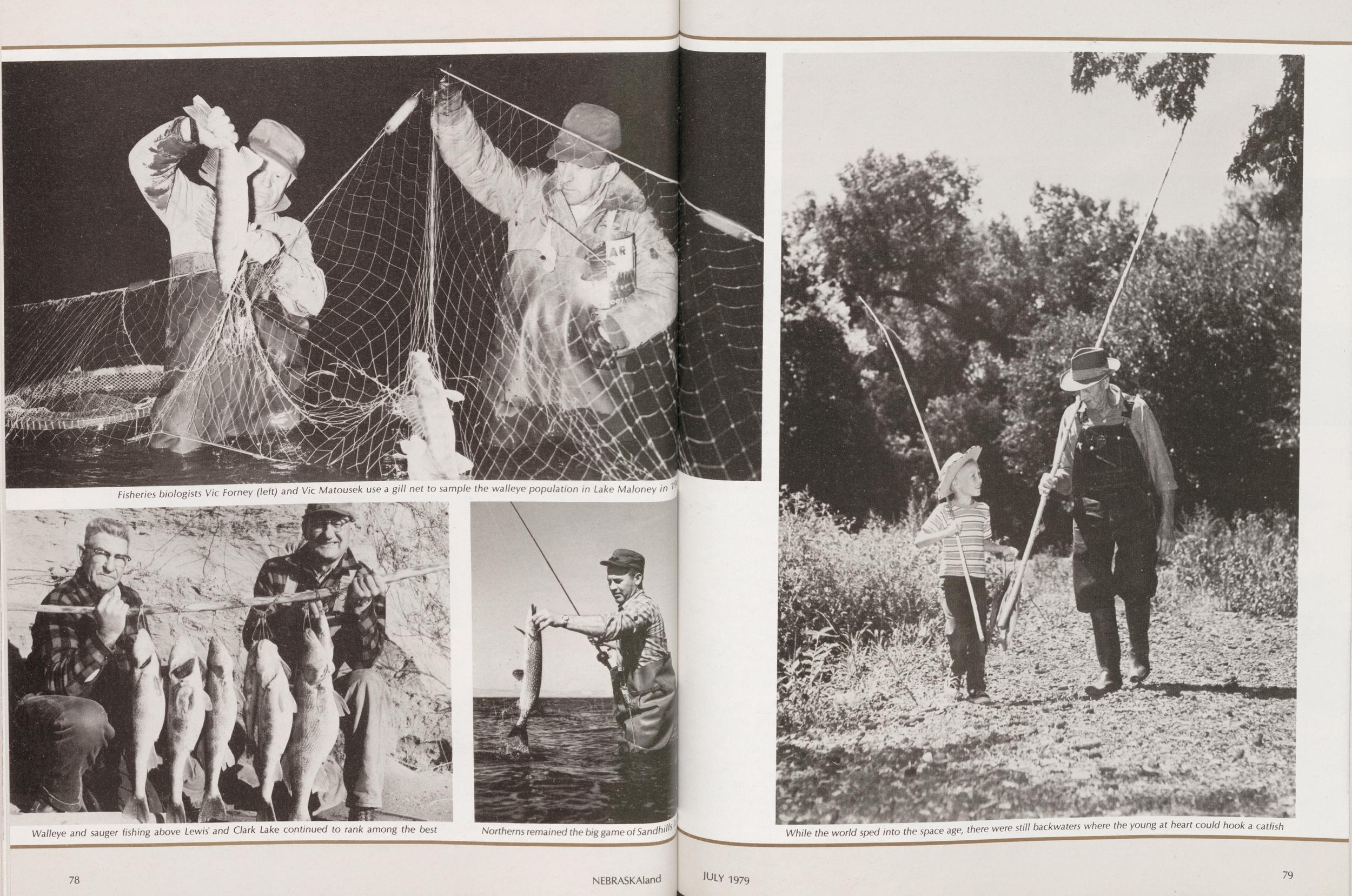
Fisheries biologists Vic Forney (left) and Vic Matousek use a gill net to sample the walleye population in Lake Maloney in
Walleye and sauger fishing above Lewis and Clark Lake continued to rank among the best
Northerns remained the big game of Sandhill.
While the world sped into the space age, there were still backwaters where the young at heart could hook a catfish
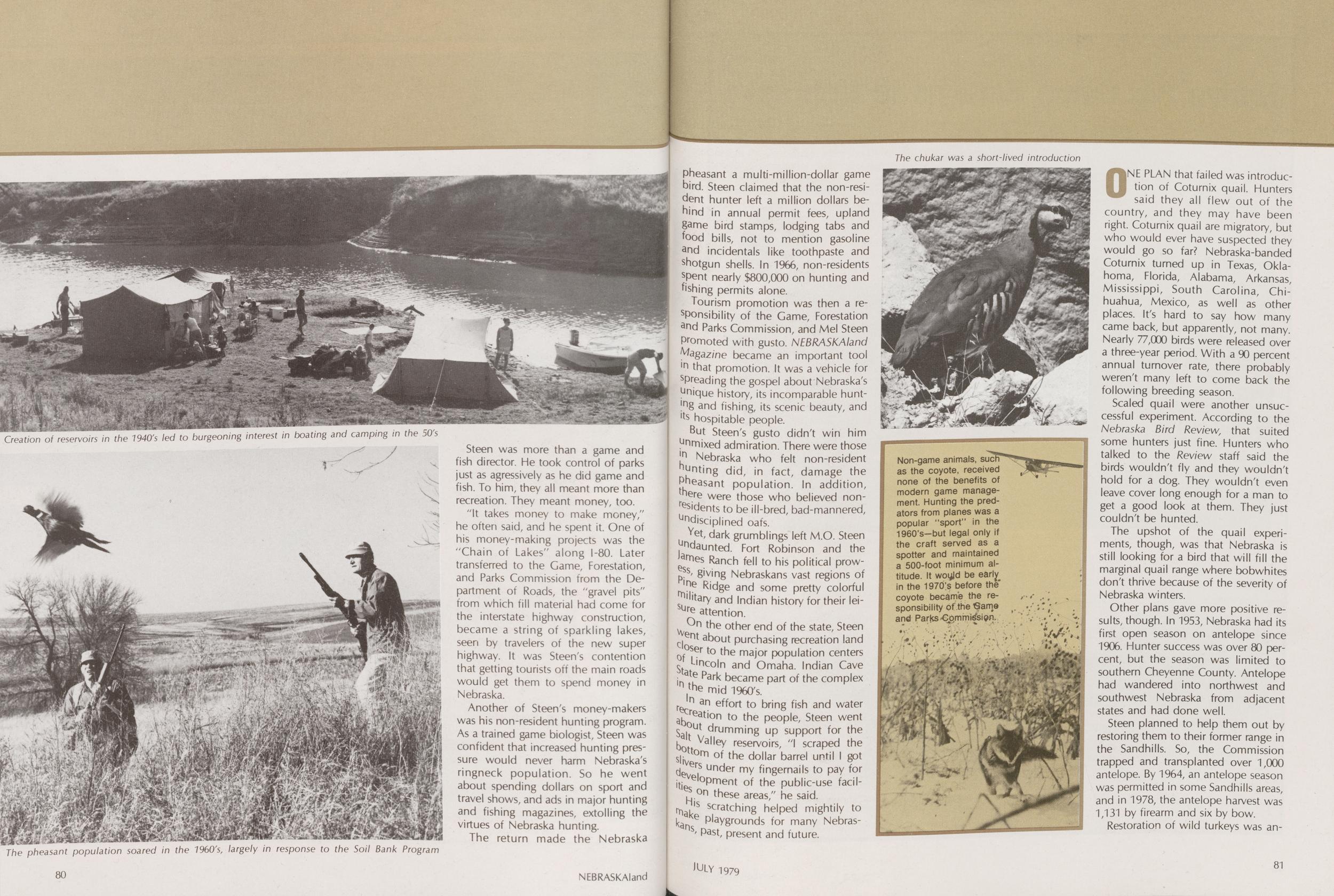
Creation of reservoirs in the 1940's led to burgeoning interest in boating and camping in the 50s
The pheasant population soared in the 1960's, largely in response to the Soil Bank Program
Steen was more than a game and fish director. He took control of parks just as aggressively as he did game and fish. To him, they all meant more than recreation. They meant money, too.
"It takes money to make money," he often said, and he spent it. One of his money-making projects was the "Chain of Lakes" along I-80. Later transferred to the Game, Forestation, and Parks Commission from the Department of Roads, the "gravel pits" from which fill material had come for the interstate highway construction, became a string of sparkling lakes, seen by travelers of the new super highway. It was Steen's contention that getting tourists off the main roads would get them to spend money in Nebraska.
Another of Steen's money-makers was his non-resident hunting program. As a trained game biologist, Steen was confident that increased hunting pressure would never harm Nebraska's ringneck population. So he went about spending dollars on sport and travel shows, and ads in major hunting and fishing magazines, extolling the virtues of Nebraska hunting.
The return made the Nebraska pheasant a multi-million-dollar game bird. Steen claimed that the non-resident hunter left a million dollars behind in annual permit fees, upland game bird stamps, lodging tabs and food bills, not to mention gasoline and incidentals like toothpaste and shotgun shells. In 1966, non-residents spent nearly $800,000 on hunting and fishing permits alone.
Tourism promotion was then a responsibility of the Game, Forestation and Parks Commission, and Mel Steen Promoted with gusto. NEBRASKAland Magazine became an important tool in that promotion. It was a vehicle for spreading the gospel about Nebraska's unique history, its incomparable hunting and fishing, its scenic beauty, and lets hospitable people.
But Steen's gusto didn't win him unrolled admiration. There were those in Nebraska who felt non-resident hunting did, in fact, damage the Pheasant population. In addition, here were those who believed non-residents to be ill-bred, bad-mannered, disciplined oafs.
Yet, dark grumblings left M.O. Steen daunted. Fort Robinson and the hies Ranch fell to his political prowress' giving Nebraskans vast regions of he Ridge and some pretty colorful itary and Indian history for their leisure attention. On the other end of the state, Steen ent about purchasing recreation land oser to the major population centers Lincoln and Omaha. Indian Caveafo Park became part of the complex in the mid1960's.
In an effort to bring fish and water recreation to the people, Steen went about drumming up support for the Salt Valley reservoirs, "I scraped the bottom of the dollar barrel until I got slivers under my fingernails to pay for development of the public-use facilities on these areas," he said.
His scratching helped mightily to make playgrounds for many Nebraskan's past, present and future.
The chukar was a short-lived introduction
Non-game animals, such as the coyote, received none of the benefits of modern game management. Hunting the predators from planes was a popular "sport" in the 1960's—but legal only if the craft served as a spotter and maintained a 500-foot minimum altitude. It would be early in the 1970's before the coyote became the responsibility of the game and Parks Commission
ONE PLAN that failed was introduction of Coturnix quail. Hunters said they all flew out of the country, and they may have been right. Coturnix quail are migratory, but who would ever have suspected they would go so far? Nebraska-banded Coturnix turned up in Texas, Oklahoma, Florida, Alabama, Arkansas, Mississippi, South Carolina, Chihuahua, Mexico, as well as other places. It's hard to say how many came back, but apparently, not many. Nearly 77,000 birds were released over a three-year period. With a 90 percent annual turnover rate, there probably weren't many left to come back the following breeding season.
Scaled quail were another unsuccessful experiment. According to the Nebraska Bird Review, that suited some hunters just fine. Hunters who talked to the Review staff said the birds wouldn't fly and they wouldn't hold for a dog. They wouldn't even leave cover long enough for a man to get a good look at them. They just couldn't be hunted.
The upshot of the quail experiments, though, was that Nebraska is still looking for a bird that will fill the marginal quail range where bobwhites don't thrive because of the severity of Nebraska winters.
Other plans gave more positive results, though. In 1953, Nebraska had its first open season on antelope since 1906. Hunter success was over 80 percent, but the season was limited to southern Cheyenne County. Antelope had wandered into northwest and southwest Nebraska from adjacent states and had done well.
Steen planned to help them out by restoring them to their former range in the Sandhills. So, the Commission trapped and transplanted over 1,000 antelope. By 1964, an antelope season was permitted in some Sandhills areas, and in 1978, the antelope harvest was 1,131 by firearm and six by bow.
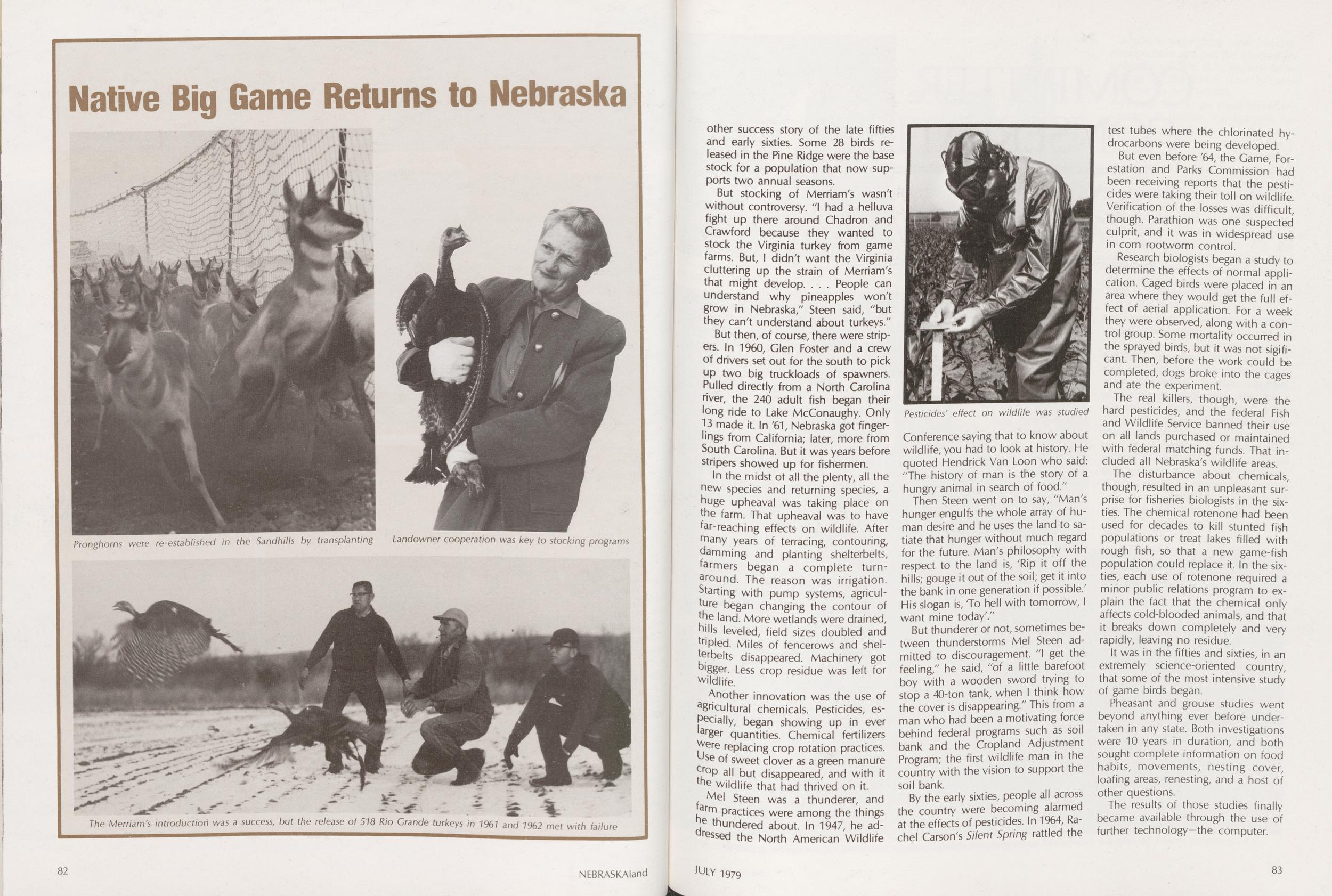
Pronghoms were re-established in the Sandhills by transplanting
Landowner cooperation was key to stocking programs
The Merriam's introduction was a success, but the release of 518 Rio Grande turkeys in 7967 and 7962 met with failure
But stocking of Merriam's wasn't without controversy. "I had a helluva fight up there around Chadron and Crawford because they wanted to stock the Virginia turkey from game farms. But, I didn't want the Virginia cluttering up the strain of Merriam's that might develop... People can understand why pineapples won't grow in Nebraska," Steen said, "but they can't understand about turkeys."
But then, of course, there were stripers. In 1960, Glen Foster and a crew of drivers set out for the south to pick up two big truckloads of spawners. Pulled directly from a North Carolina river, the 240 adult fish began their long ride to Lake McConaughy. Only 13 made it. In '61, Nebraska got fingerlings from California; later, more from South Carolina. But it was years before stripers showed up for fishermen.
In the midst of all the plenty, all the new species and returning species, a huge upheaval was taking place on the farm. That upheaval was to have far-reaching effects on wildlife. After many years of terracing, contouring, damming and planting shelterbelts, farmers began a complete turnaround. The reason was irrigation. Starting with pump systems, agriculture began changing the contour of the land. More wetlands were drained, hills leveled, field sizes doubled and tripled. Miles of fencerows and shelterbelts disappeared. Machinery got hager. Less crop residue was left for wildlife.
Another innovation was the use of agricultural chemicals. Pesticides, especially, began showing up in ever larger quantities. Chemical fertilizers Were replacing crop rotation practices. Use of sweet clover as a green manure crop all but disappeared, and with it the wildlife that had thrived on it.
Mel Steen was a thunderer, and arm practices were among the things thundered about. In 1947, he addressed the North American Wildlife Pesticides' effect on wildlife was studied Conference saying that to know about wildlife, you had to look at history. He quoted Hendrick Van Loon who said: "The history of man is the story of a hungry animal in search of food."
Then Steen went on to say, "Man's hunger engulfs the whole array of human desire and he uses the land to satiate that hunger without much regard for the future. Man's philosophy with respect to the land is, 'Rip it off the hills; gouge it out of the soil; get it into the bank in one generation if possible.' His slogan is, To hell with tomorrow, I want mine today'."
But thunderer or not, sometimes between thunderstorms Mel Steen admitted to discouragement. "I get the feeling," he said, "of a little barefoot boy with a wooden sword trying to stop a 40-ton tank, when I think how the cover is disappearing." This from a man who had been a motivating force behind federal programs such as soil bank and the Cropland Adjustment Program; the first wildlife man in the country with the vision to support the soil bank.
By the early sixties, people all across the country were becoming alarmed at the effects of pesticides. In 1964, Rachel Carson's S/7ent Spring rattled the test tubes where the chlorinated hydrocarbons were being developed.
But even before '64, the Game, Forestation and Parks Commission had been receiving reports that the pesticides were taking their toll on wildlife. Verification of the losses was difficult, though. Parathion was one suspected culprit, and it was in widespread use in corn rootworm control.
Research biologists began a study to determine the effects of normal application. Caged birds were placed in an area where they would get the full effect of aerial application. For a week they were observed, along with a control group. Some mortality occurred in the sprayed birds, but it was not sigificant. Then, before the work could be completed, dogs broke into the cages and ate the experiment.
The real killers, though, were the hard pesticides, and the federal Fish and Wildlife Service banned their use on all lands purchased or maintained with federal matching funds. That included all Nebraska's wildlife areas.
The disturbance about chemicals, though, resulted in an unpleasant surprise for fisheries biologists in the sixties. The chemical rotenone had been used for decades to kill stunted fish populations or treat lakes filled with rough fish, so that a new game-fish population could replace it. In the sixties, each use of rotenone required a minor public relations program to explain the fact that the chemical only affects cold-blooded animals, and that it breaks down completely and very rapidly, leaving no residue.
It was in the fifties and sixties, in an extremely science-oriented country, that some of the most intensive study of game birds began.
Pheasant and grouse studies went beyond anything ever before undertaken in any state. Both investigations were 10 years in duration, and both sought complete information on food habits, movements, nesting cover, loafing areas, renesting, and a host of other questions.
The results of those studies finally became available through the use of further technology-the computer.
82 NEBRASKAland JULY 1979 83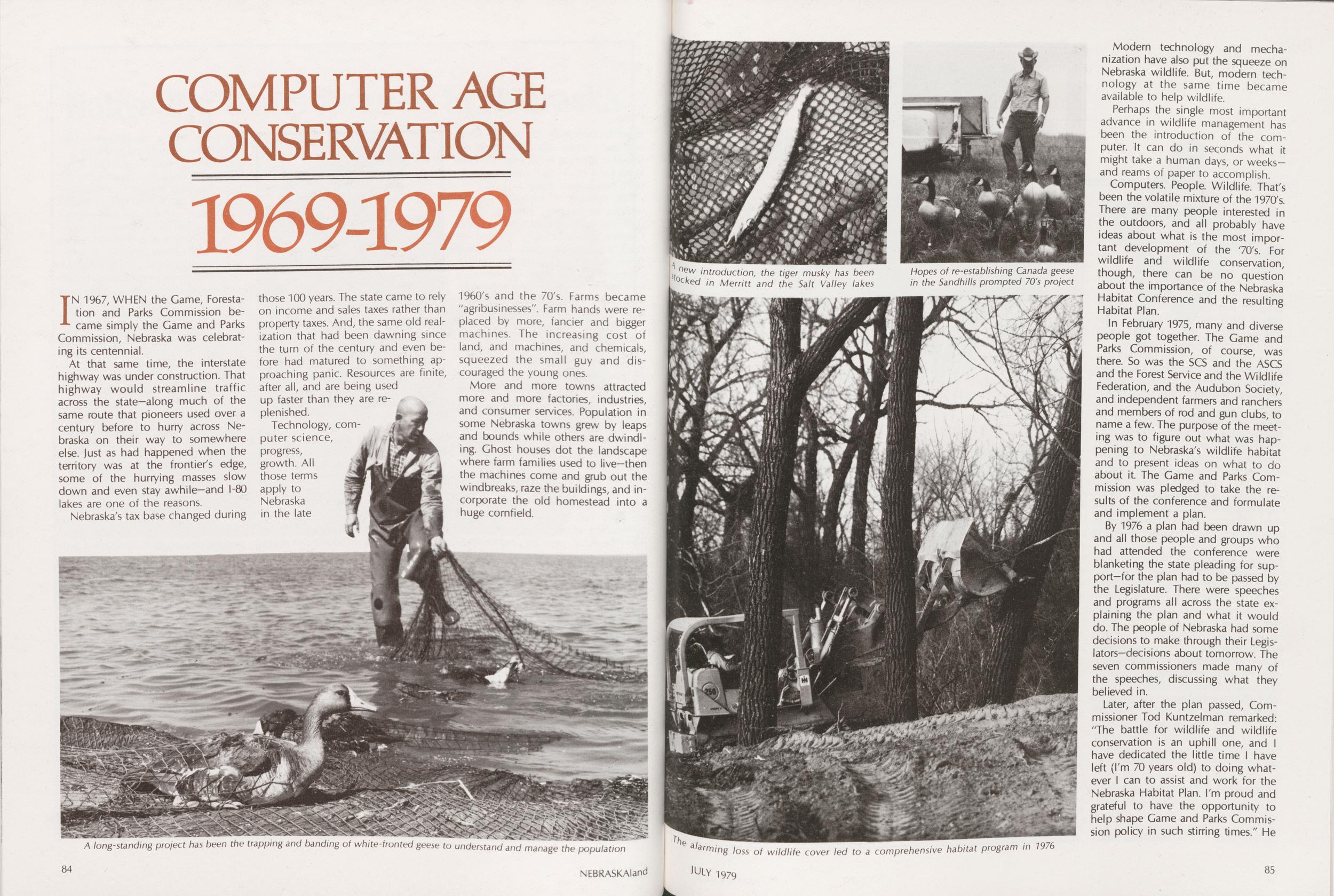
COMPUTER AGE CONSERVATION 1969-1979
IN 1967, WHEN the Game, Forestation and Parks Commission became simply the Game and Parks Commission, Nebraska was celebrating its centennial.
At that same time, the interstate highway was under construction. That highway would streamline traffic across the state—along much of the same route that pioneers used over a century before to hurry across Nebraska on their way to somewhere else. Just as had happened when the territory was at the frontier's edge, some of the hurrying masses slow down and even stay awhile—and I-80 lakes are one of the reasons.
Nebraska's tax base changed during those 100 years. The state came to rely on income and sales taxes rather than property taxes. And, the same old realization that had been dawning since the turn of the century and even before had matured to something approaching panic. Resources are finite, after all, and are being used up faster than they are replenished.
Technology, computer science, progress, growth. All those terms apply to Nebraska in the late 1960's and the 70's. Farms became "agribusinesses". Farm hands were replaced by more, fancier and bigger machines. The increasing cost of land, and machines, and chemicals, squeezed the small guy and discouraged the young ones.
More and more towns attracted more and more factories, industries, and consumer services. Population in some Nebraska towns grew by leaps and bounds while others are dwindling. Ghost houses dot the landscape where farm families used to live—then the machines come and grub out the windbreaks, raze the buildings, and incorporate the old homestead into a huge cornfield.
A long-standing project has been the trapping and banding of white fronted geese to understand and manage the population
A new introduction, the tiger musky has been in Merritt and the Salt Valley lakes
Hopes of re-establishing Canada geese in the Sandhills prompted 70's project
The alarming loss of wildlife cover led to a comprehensive habitat program in 1976
Modern technology and mechanization have also put the squeeze on Nebraska wildlife. But, modern technology at the same time became available to help wildlife.
Perhaps the single most important advance in wildlife management has been the introduction of the computer. It can do in seconds what it might take a human days, or weeks—and reams of paper to accomplish.
Computers. People. Wildlife. That's been the volatile mixture of the 1970's. There are many people interested in the outdoors, and all probably have ideas about what is the most important development of the 70's. For wildlife and wildlife conservation, though, there can be no question about the importance of the Nebraska Habitat Conference and the resulting Habitat Plan.
In February 1975, many and diverse people got together. The Game and Parks Commission, of course, was there. So was the SCS and the ASCS and the Forest Service and the Wildlife Federation, and the Audubon Society, and independent farmers and ranchers and members of rod and gun clubs, to name a few. The purpose of the meeting was to figure out what was happening to Nebraska's wildlife habitat and to present ideas on what to do about it. The Game and Parks Commission was pledged to take the results of the conference and formulate and implement a plan.
By 1976 a plan had been drawn up and all those people and groups who had attended the conference were blanketing the state pleading for support—for the plan had to be passed by the Legislature. There were speeches and programs all across the state explaining the plan and what it would do. The people of Nebraska had some decisions to make through their Legislators—decisions about tomorrow. The seven commissioners made many of the speeches, discussing what they believed in.
Later, after the plan passed, Commissioner Tod Kuntzelman remarked:
The battle for wildlife and wildlife
conservation is an uphill one, and I
have dedicated the little time I have
left (I'm 70 years old) to doing whatever I can to assist and work for the
Nebraska Habitat Plan. I'm proud and
grateful to have the opportunity to
help shape Game and Parks Commission policy in such stirring times." He
NEBRASKAland JULY
1979
85
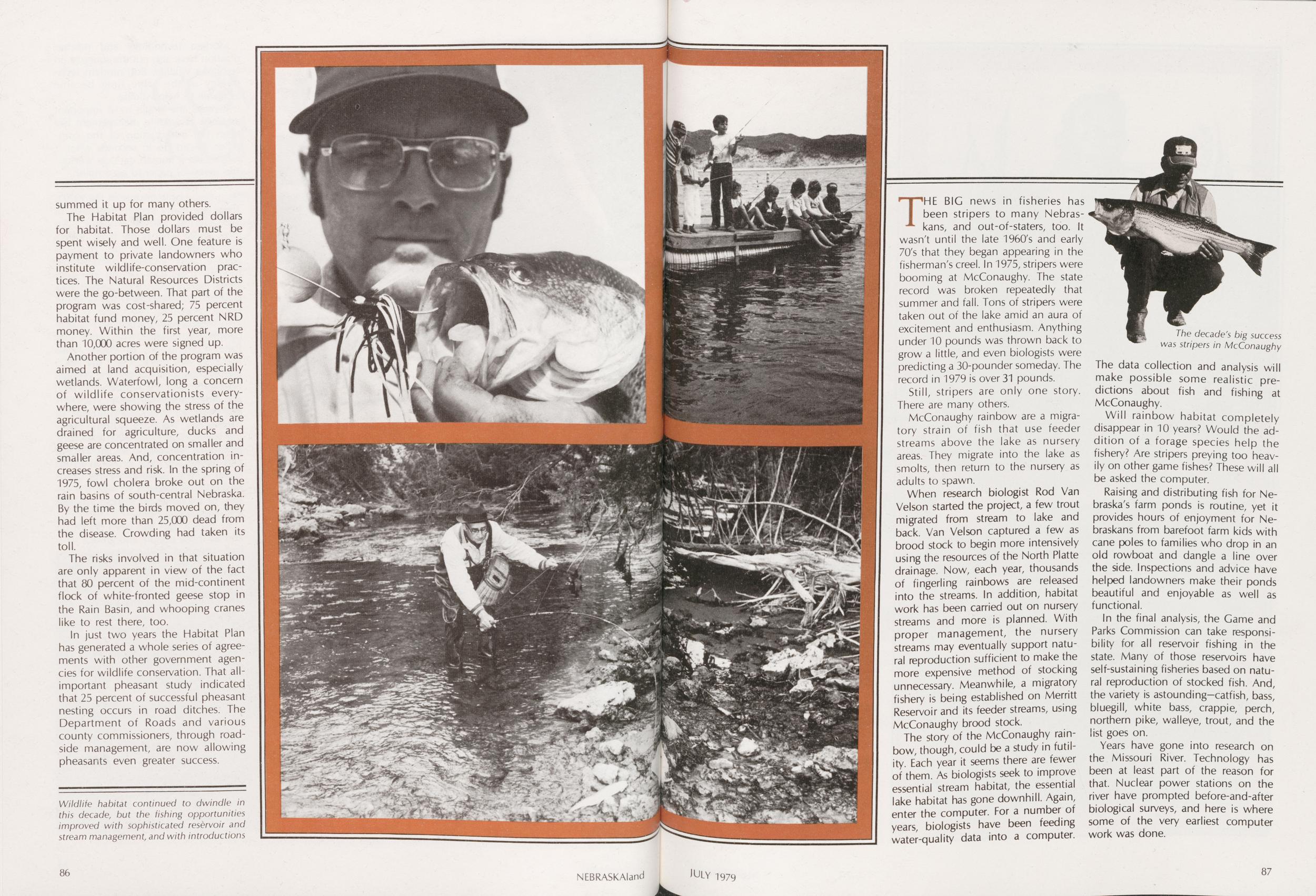 summed it up for many others.
The Habitat Plan provided dollars for habitat. Those dollars must be spent wisely and well. One feature is payment to private landowners who institute wiIdlife-conservation practices. The Natural Resources Districts were the go-between. That part of the program was cost-shared; 75 percent habitat fund money, 25 percent NRD money. Within the first year, more than 10,000 acres were signed up.
Another portion of the program was aimed at land acquisition, especially wetlands. Waterfowl, long a concern of wildlife conservationists everywhere, were showing the stress of the agricultural squeeze. As wetlands are drained for agriculture, ducks and geese are concentrated on smaller and smaller areas. And, concentration increases stress and risk. In the spring of 1975, fowl cholera broke out on the rain basins of south-central Nebraska. By the time the birds moved on, they had left more than 25,000 dead from the disease. Crowding had taken its toll.
The risks involved in that situation are only apparent in view of the fact that 80 percent of the mid-continent flock of white-fronted geese stop in the Rain Basin, and whooping cranes like to rest there, too.
In just two years the Habitat Plan has generated a whole series of agreements with other government agencies for wildlife conservation. That allimportant pheasant study indicated that 25 percent of successful pheasant nesting occurs in road ditches. The Department of Roads and various county commissioners, through roadside management, are now allowing pheasants even greater success.
Wildlife habitat continued to dwindle in this decade, but the fishing opportunities improved with sophisticated reservoir and stream management, and with introductions
THE BIG news in fisheries has been stripers to many Nebraskans, and out-of-staters, too. It wasn't until the late 1960's and early 70's that they began appearing in the fisherman's creel. In 1975, stripers were booming at McConaughy. The state record was broken repeatedly that summer and fall. Tons of stripers were taken out of the lake amid an aura of excitement and enthusiasm. Anything under 10 pounds was thrown back to grow a little, and even biologists were predicting a 30-pounder someday. The record in 1979 is over 31 pounds.
Still, stripers are only one story. There are many others.
McConaughy rainbow are a migratory strain of fish that use feeder streams above the lake as nursery areas. They migrate into the lake as smolts, then return to the nursery as adults to spawn.
When research biologist Rod Van Velson started the project, a few trout migrated from stream to lake and back. Van Velson captured a few as brood stock to begin more intensively using the resources of the North Platte drainage. Now, each year, thousands of fingerling rainbows are released into the streams. In addition, habitat work has been carried out on nursery streams and more is planned. With proper management, the nursery streams may eventually support natural reproduction sufficient to make the more expensive method of stocking unnecessary. Meanwhile, a migratory fishery is being established on Merritt Reservoir and its feeder streams, using McConaughy brood stock.
The decade's big success was stripers in McConaughy
Will rainbow habitat completely disappear in 10 years? Would the addition of a forage species help the fishery? Are stripers preying too heavily on other game fishes? These will all be asked the computer.
Raising and distributing fish for Nebraska's farm ponds is routine, yet it provides hours of enjoyment for Nebraskans from barefoot farm kids with cane poles to families who drop in an old rowboat and dangle a line over the side. Inspections and advice have helped landowners make their ponds beautiful and enjoyable as well as functional.
In the final analysis, the Game and Parks Commission can take responsibility for all reservoir fishing in the state. Many of those reservoirs have self-sustaining fisheries based on natural reproduction of stocked fish. And, the variety is astounding-catfish, bass, bluegill, white bass, crappie, perch, northern pike, walleye, trout, and the list goes on.
Years have gone into research on the Missouri River. Technology has been at least part of the reason for that. Nuclear power stations on the river have prompted before-and-after biological surveys, and here is where some of the very earliest computer work was done.
86 NEBRASKAland JULY 1979 87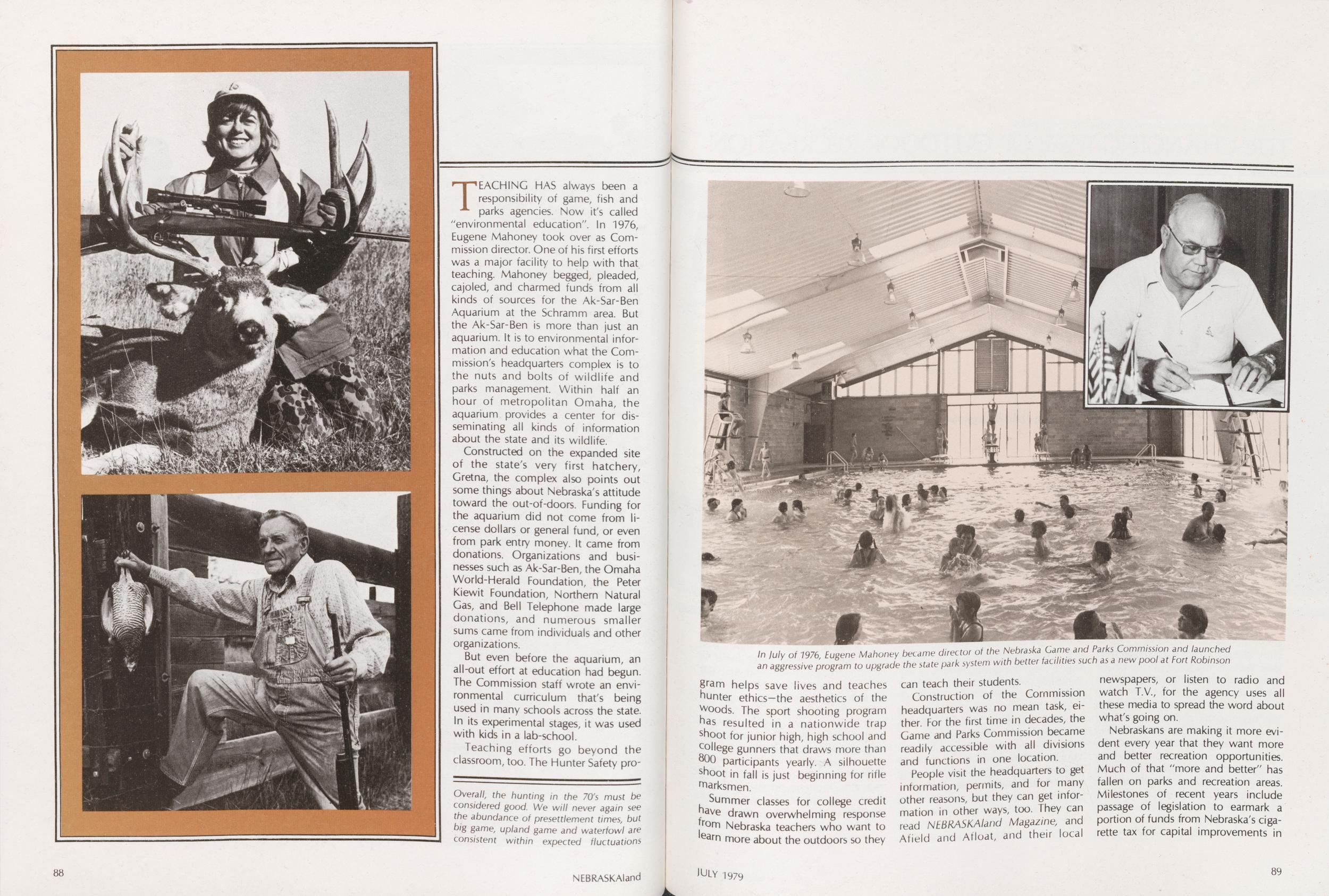
Overall, the hunting in the 70's must be considered good. We will never again see the abundance of presettlement times, but big game, upland game and waterfowl are consistent within expected fluctuations
TEACHING HAS always been a responsibility of game, fish and parks agencies. Now it's called "environmental education". In 1976, Eugene Mahoney took over as Commission director. One of his first efforts was a major facility to help with that teaching. Mahoney begged, pleaded, cajoled, and charmed funds from all kinds of sources for the Ak-Sar-Ben Aquarium at the Schramm area. But the Ak-Sar-Ben is more than just an aquarium. It is to environmental information and education what the Commission's headquarters complex is to the nuts and bolts of wildlife and parks management. Within half an hour of metropolitan Omaha, the aquarium provides a center for disseminating all kinds of information about the state and its wildlife.
Constructed on the expanded site of the state's very first hatchery, Gretna, the complex also points out some things about Nebraska's attitude toward the out-of-doors. Funding for the aquarium did not come from license dollars or general fund, or even from park entry money. It came from donations. Organizations and businesses such as Ak-Sar-Ben, the Omaha World-Herald Foundation, the Peter Kiewit Foundation, Northern Natural Gas, and Bell Telephone made large donations, and numerous smaller sums came from individuals and other organizations.
But even before the aquarium, an all-out effort at education had begun. The Commission staff wrote an envi- ronmental curriculum that's being used in many schools across the state. In its experimental stages, it was used with kids in a lab-school.
Teaching efforts go beyond the classroom, too. The Hunter Safety pro In July of 1976, Eugene Mahon an aggressive program to upgragram helps save lives and teaches hunter ethics-the aesthetics of the woods. The sport shooting program has resulted in a nationwide trap shoot for junior high, high school and college gunners that draws more than 800 participants yearly. A silhouette shoot in fall is just beginning for rifle Marksmen.
In July of 1976, Eugene Mahoney became director of the Nebraska Came and Parks Commission and launched an aggressive program to upgrade the state park system with better facilities such as a new pool at Fort Robinson
Construction of the Commission headquarters was no mean task, either. For the first time in decades, the Game and Parks Commission became readily accessible with all divisions and functions in one location.
People visit the headquarters to get information, permits, and for many other reasons, but they can get information \n other ways, too. They can read NEBKASKAland Magazine, and Afield and Afloat, and their local newspapers, or listen to radio and watch T.V., for the agency uses all these media to spread the word about what's going on.
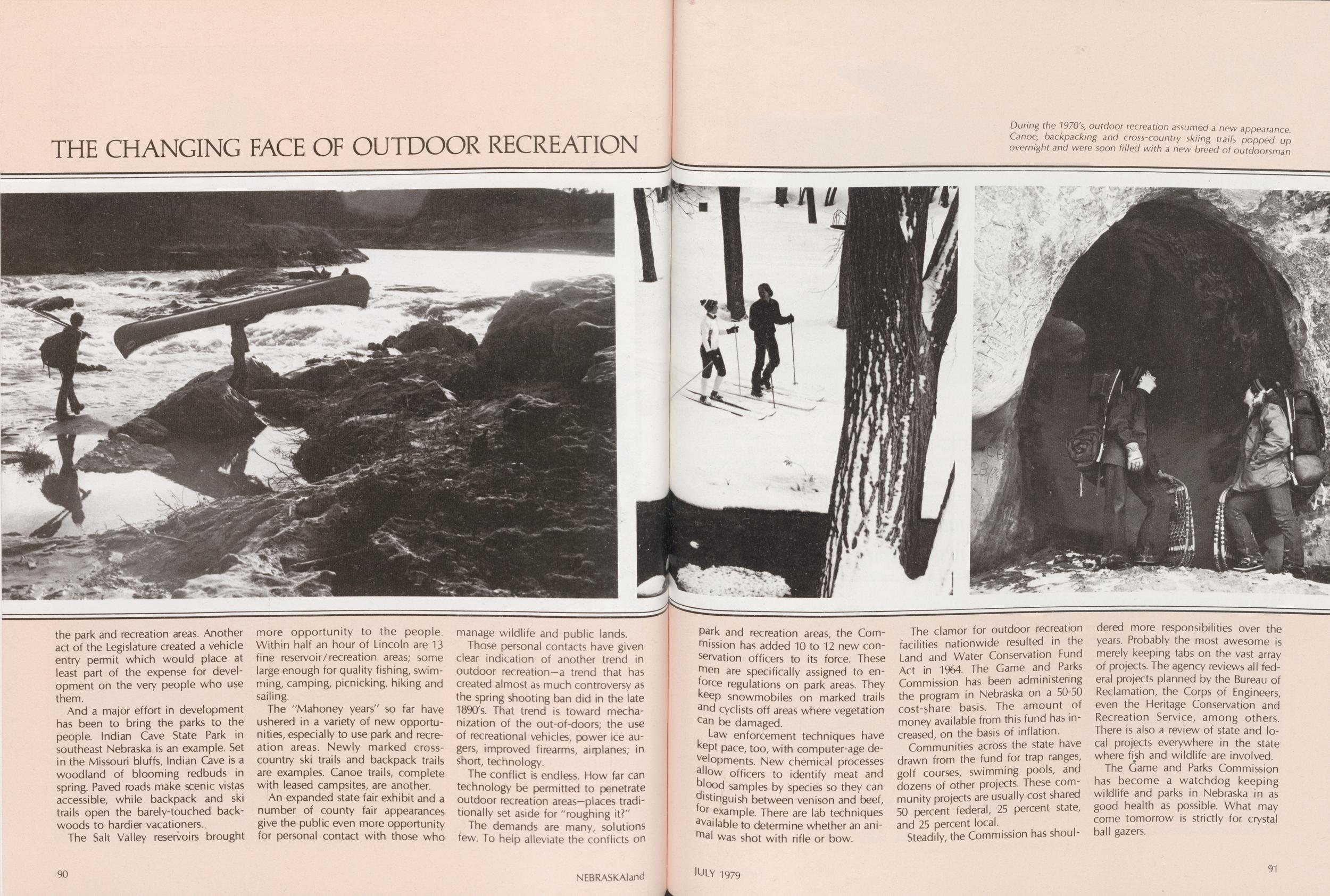
THE CHANGING FACE OF OUTDOOR RECREATION
During the 1970's outdoor recreation assumed a new appearance. Canoe, backpacking and cross-country skiing trails popped up overnight and were soon filled with a new breed of outdoorsman
And a major effort in development has been to bring the parks to the people. Indian Cave State Park in southeast Nebraska is an example. Set in the Missouri bluffs, Indian Cave is a woodland of blooming redbuds in spring. Paved roads make scenic vistas accessible, while backpack and ski trails open the barely-touched backwoods to hardier vacationers.
The Salt Valley reservoirs brought more opportunity to the people. Within half an hour of Lincoln are 13 fine reservoir/recreation areas; some large enough for quality fishing, swimming, camping, picnicking, hiking and sailing.
The "Mahoney years" so far have ushered in a variety of new opportunities, especially to use park and recreation areas. Newly marked cross-country ski trails and backpack trails are examples. Canoe trails, complete with leased campsites, are another.
An expanded state fair exhibit and a number of county fair appearances give the public even more opportunity for personal contact with those who manage wildlife and public lands.
Those personal contacts have given clear indication of another trend in outdoor recreation-a trend that has created almost as much controversy as the spring shooting ban did in the late 1890's. That trend is toward mechanization of the out-of-doors; the use of recreational vehicles, power ice augers, improved firearms, airplanes; in short, technology.
The conflict is endless. How far can technology be permitted to penetrate outdoor recreation areas-places traditionally set aside for "roughing it?"
The demands are many, solutions few. To help alleviate the conflicts on NEBRASKAland Park and recreation areas, the Commission has added 10 to 12 new conservation officers to its force. These men are specifically assigned to enforce regulations on park areas. They keep snowmobiles on marked trails and cyclists off areas where vegetation can be damaged.
Law enforcement techniques have kept pace, too, with computer-age developments. New chemical processes allow officers to identify meat and Blood samples by species so they can distinguish between venison and beef, or example. There are lab techniques available to determine whether an animal was shot with rifle or bow.
The clamor for outdoor recreation facilities nationwide resulted in the Land and Water Conservation Fund Act in 1964. The Game and Parks Commission has been administering the program in Nebraska on a 50-50 cost-share basis. The amount of money available from this fund has increased, on the basis of inflation.
Communities across the state have drawn from the fund for trap ranges, golf courses, swimming pools, and dozens of other projects. These community projects are usually cost shared 50 percent federal, 25 percent state, and 25 percent local.
Steadily, the Commission has shouldered more responsibilities over the years. Probably the most awesome is merely keeping tabs on the vast array of projects. The agency reviews all federal projects planned by the Bureau of Reclamation, the Corps of Engineers, even the Heritage Conservation and Recreation Service, among others. There is also a review of state and local projects everywhere in the state where fi^sh and wildlife are involved.
The Game and Parks Commission has become a watchdog keeping wildlife and parks in Nebraska in as good health as possible. What may come tomorrow is strictly for crystal ball gazers.
90 NEBRASKAland JULY 1979 91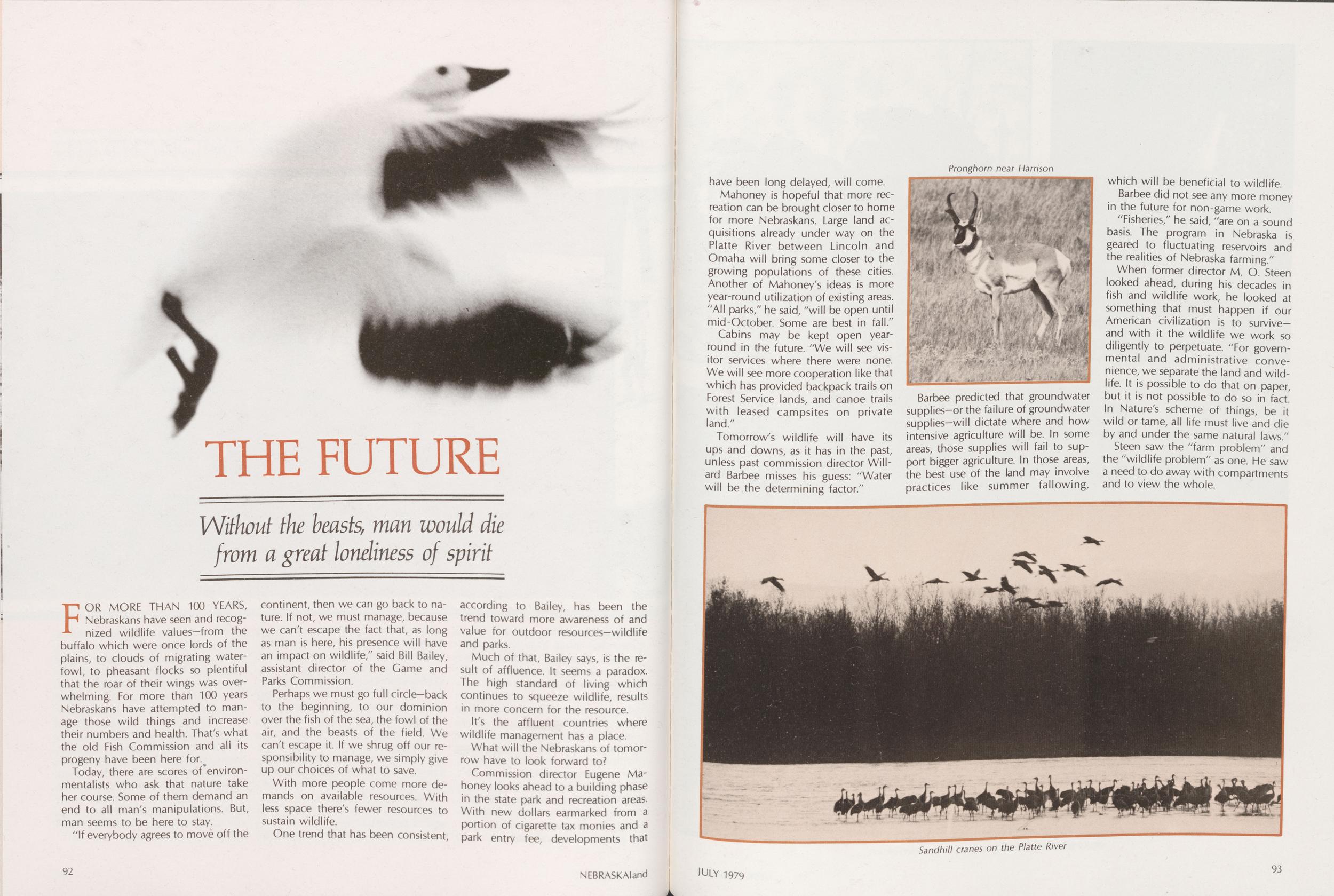
THE FUTURE
Without the beasts, man would die from a great loneliness of spirit
FOR MORE THAN 100 YEARS, Nebraskans have seen and recognized wildlife values-from the buffalo which were once lords of the plains, to clouds of migrating waterfowl, to pheasant flocks so plentiful that the roar of their wings was overwhelming. For more than 100 years Nebraskans have attempted to manage those wild things and increase their numbers and health. That's what the old Fish Commission and ali its progeny have been here for.
Today, there are scores of environmentalists who ask that nature take her course. Some of them demand an end to all man's manipulations. But, man seems to be here to stay.
"If everybody agrees to move off the continent, then we can go back to nature. If not, we must manage, because we can't escape the fact that, as long as man is here, his presence will have an impact on wildlife," said Bill Bailey, assistant director of the Game and Parks Commission.
Perhaps we must go full circle—back to the beginning, to our dominion over the fish of the sea, the fowl of the air, and the beasts of the field. We can't escape it. If we shrug off our responsibility to manage, we simply give up our choices of what to save.
With more people come more demands on available resources. With less space there's fewer resources to sustain wildlife.
One trend that has been consistent according to Bailey, has been the trend toward more awareness of and value for outdoor resources-wildlife and parks.
Much of that, Bailey says, is the result of affluence. It seems a paradox. The high standard of living which continues to squeeze wildlife, results in more concern for the resource.
It's the affluent countries where wildlife management has a place. What will the Nebraskans of tomorrow have to look forward to?
Commission director Eugene Mahoney looks ahead to a building phase in the state park and recreation areas. With new dollars earmarked from a portion of cigarette tax monies and a park entry fee, developments that have been long delayed, will come.
Mahoney is hopeful that more recreation can be brought closer to home for more Nebraskans. Large land acquisitions already under way on the Platte River between Lincoln and Omaha will bring some closer to the growing populations of these cities. Another of Mahoney's ideas is more year-round utilization of existing areas. "All parks," he said, "will be open until mid-October. Some are best in fall."
Cabins may be kept open year-round in the future. "We will see visitor services where there were none. We will see more cooperation like that which has provided backpack trails on Forest Service lands, and canoe trails with leased campsites on private land."
Tomorrow's wildlife will have its ups and downs, as it has in the past, unless past commission director Willard Barbee misses his guess: "Water will be the determining factor."
Pronghorn near Harrison
Barbee predicted that groundwater supplies—or the failure of groundwater supplies—will dictate where and how intensive agriculture will be. In some areas, those supplies will fail to support bigger agriculture. In those areas, the best use of the land may involve practices like summer fallowing, which will be beneficial to wildlife.
Barbee did not see any more money in the future for non-game work.
"Fisheries," he said, "are on a sound basis. The program in Nebraska is geared to fluctuating reservoirs and the realities of Nebraska farming."
When former director M. O. Steen looked ahead, during his decades in fish and wildlife work, he looked at something that must happen if our American civilization is to survive— and with it the wildlife we work so diligently to perpetuate. "For governmental and administrative convenience, we separate the land and wild- life. It is possible to do that on paper, but it is not possible to do so in fact. In Nature's scheme of things, be it wild or tame, all life must live and die by and under the same natural laws."
Steen saw the "farm problem" and the "wildlife problem" as one. He saw a need to do away with compartments and to view the whole.
Sandhill cranes on the Platte River
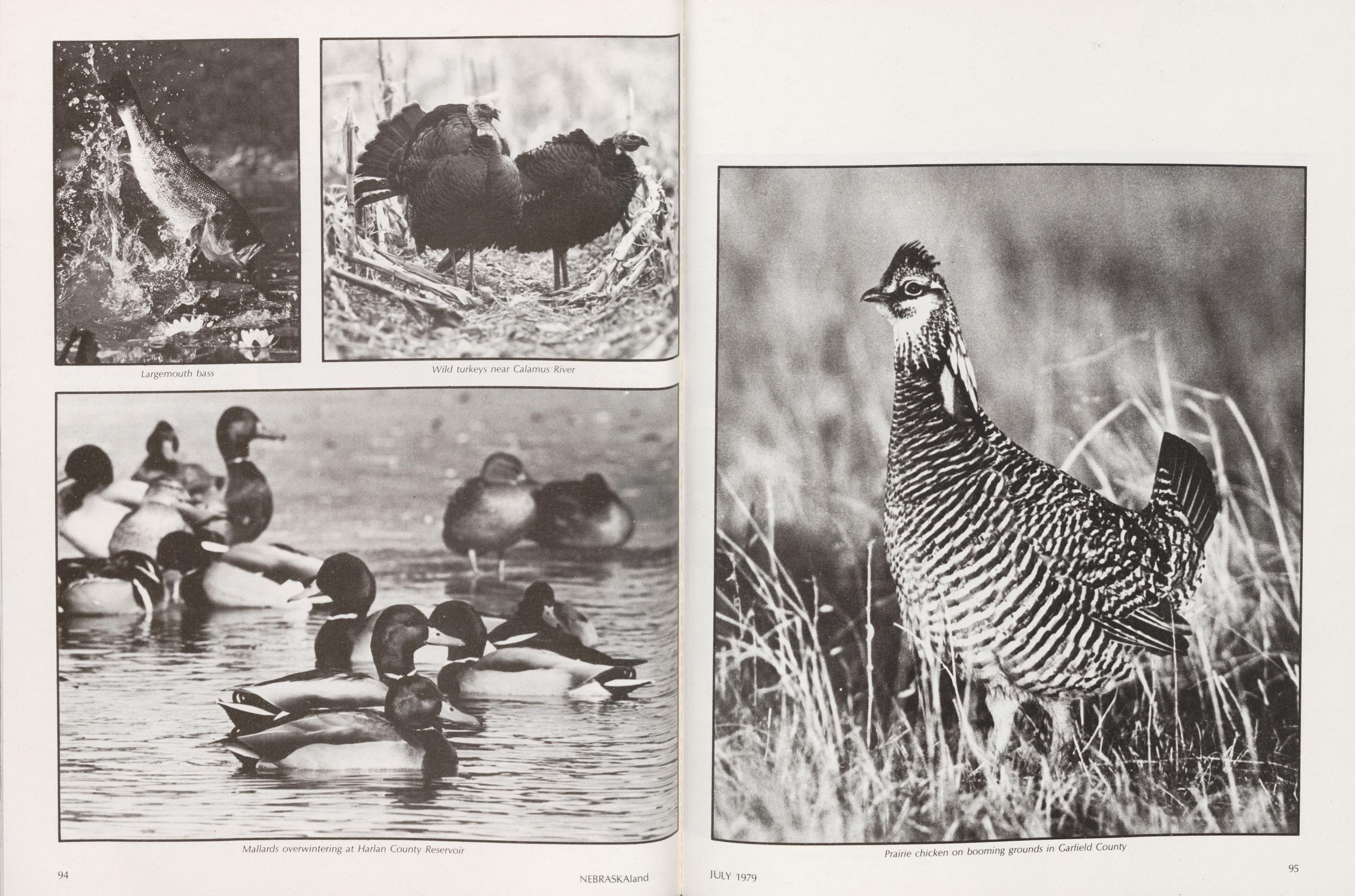
Largemouth bass
Wild turkeys near Calamus River
Mallards overwintering at Harlan County Reservoir
Frame chicken on booming grounds in Garfield County
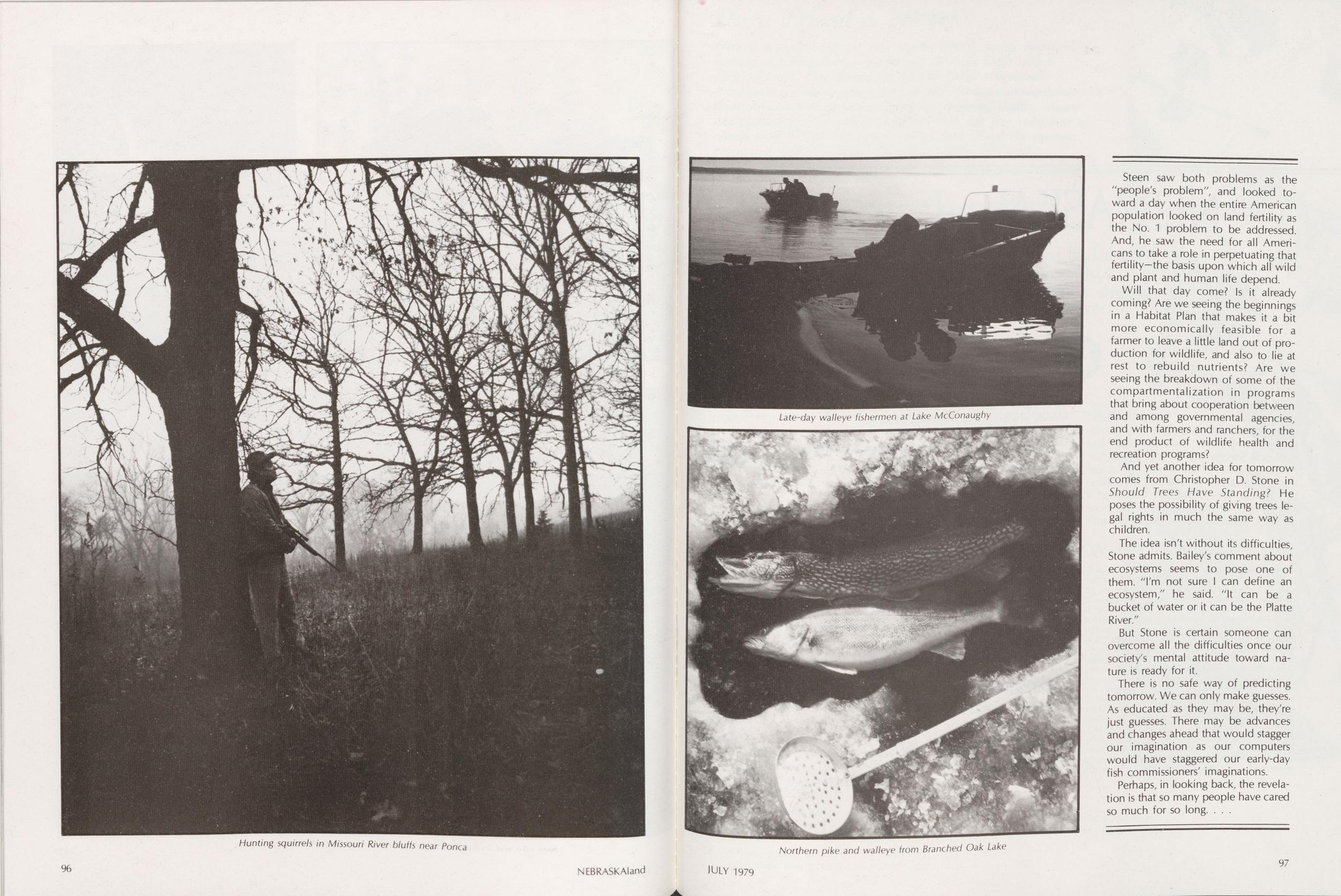
Hunting squirrels in Missouri River bluffs near Ponca
Late-day walleye fishermen at Lake McConaughy
Northern pike and walleye from Branched Oak Lake
Steen saw both problems as the "people's problem", and looked toward a day when the entire American population looked on land fertility as the No. 1 problem to be addressed. And, he saw the need for all Americans to take a role in perpetuating that fertility—the basis upon which all wild and plant and human life depend.
Will that day come? Is it already coming? Are we seeing the beginnings in a Habitat Plan that makes it a bit more economically feasible for a farmer to leave a little land out of production for wildlife, and also to lie at rest to rebuild nutrients? Are we seeing the breakdown of some of the compartmentalization in programs that bring about cooperation between and among governmental agencies, and with farmers and ranchers, for the end product of wildlife health and recreation programs?
And yet another idea for tomorrow comes from Christopher D. Stone in Should Trees Have Standing? He poses the possibility of giving trees legal rights in much the same way as children.
The idea isn't without its difficulties, Stone admits. Bailey's comment about ecosystems seems to pose one of them. "I'm not sure I can define an ecosystem," he said. "It can be a bucket of water or it can be the Platte River."
But Stone is certain someone can overcome all the difficulties once our society's mental attitude toward nature is ready for it.
There is no safe way of predicting tomorrow. We can only make guesses. As educated as they may be, they're just guesses. There may be advances and changes ahead that would stagger our imagination as our computers would have staggered our early-day fish commissioners' imaginations.
Perhaps, in looking back, the revelation is that so many people have cared so much for so long...
96 NEBRASKAland JULY 1979 97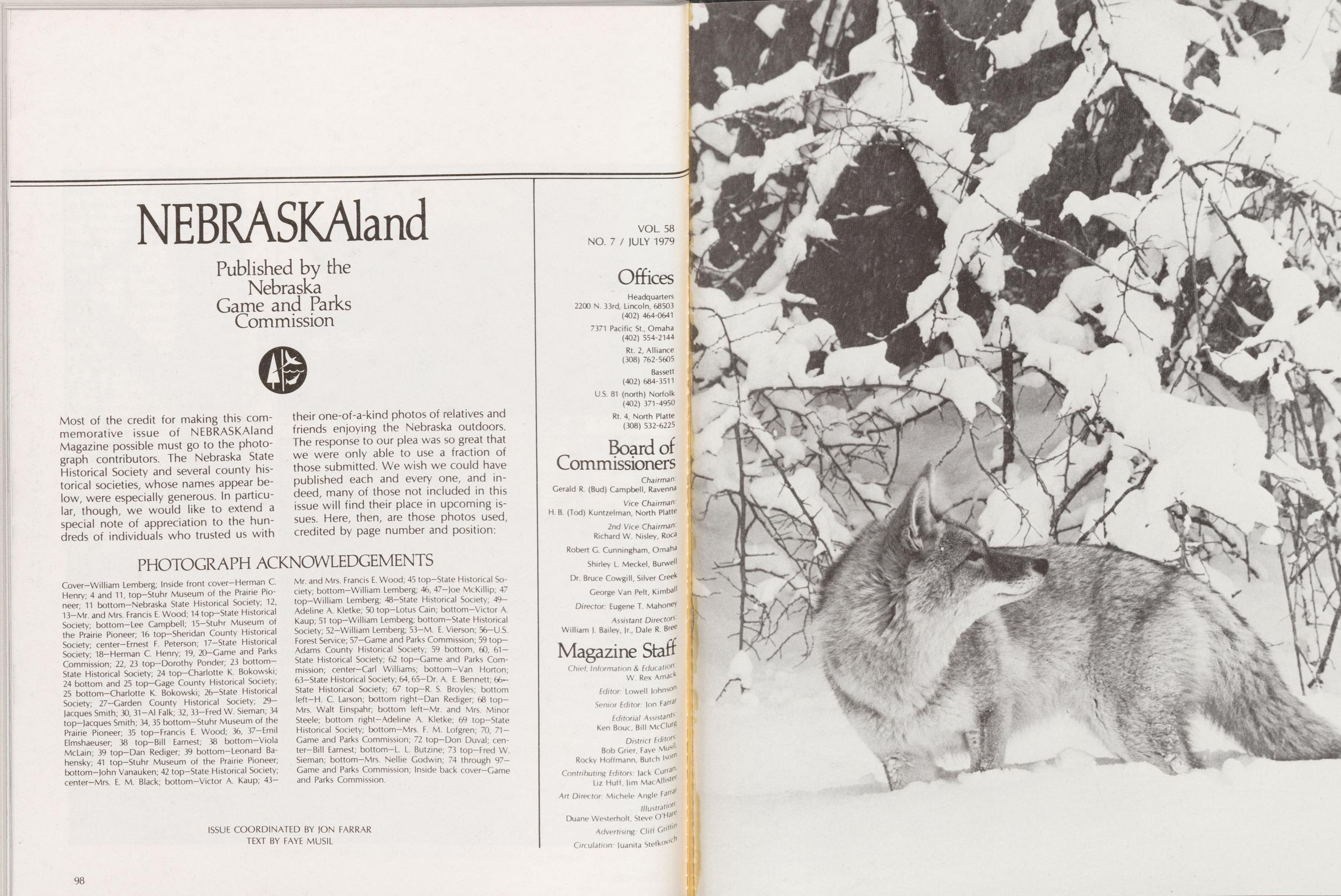
NEBRASKAland
Published by the Nebraska Game and Parks CommissionMost of the credit for making this commemorative issue of NEBRASKland Magazine possible must go to the photograph contributors. The Nebraska State Historical Society and several county historical societies, whose names appear below, were especially generous. In particular, though, we would like to extend a special note of appreciation to the hundreds of individuals who trusted us with their one-of-a-kind photos of relatives and friends enjoying the Nebraska outdoors. The response to our plea was so great that we were only able to use a fraction of those submitted. We wish we could have published each and every one, and indeed, many of those not included in this issue will find their place in upcoming issues. Here, then, are those photos used, credited by page number and position:
PHOTOGRAPH ACKNOWLEDGEMENTSCover-William Lemberg; Inside front cover-Herman C. Henry; 4 and 11, top-Stuhr Museum of the Prairie Pioneer; 11 bottom-Nebraska State Historical Society; 12, 13-Mr. and Mrs. Francis E. Wood; 14 top-State Historical Society; bottom-Lee Campbell; 15-Stuhr Museum of the Prairie Pioneer; 16 top-Sheridan County Historical Society; center-Ernest F. Peterson; 17-State Historical Society; 18-Herman C Henry; 19, 20-Game and Parks Commission; 22, 23 top-Dorothy Ponder; 23 bottom-State Historical Society; 24 top-Charlotte K. Bokowski; 24 bottom and 25 top-Gage County Historical Society; 25 bottom-Charlotte K. Bokowski; 26-State Historical Society; 27-Garden County Historical Society; 29-Jacques Smith; 30, 31-Al Falk; 32, 33-Fred W. Sieman; 34 top-jacques Smith; 34, 35 bottom-Stuhr Museum of the Prairie Pioneer; 35 top-Francis E. Wood; 36, 37-Emil Elmshaeuser; 38 top-Bill Earnest; 38 bottom-Viola McLain; 39 top-Dan Rediger; 39 bottom-Leonard Bahensky; 41 top-Stuhr Museum of the Prairie Pioneer; bottom-John Vanauken; 42 top—State Historical Society; center-Mrs. E. M. Black; bottom-Victor A. Kaup; 43-Mr. and Mrs. Francis E. Wood; 45 top-State Historical Society; bottom-William Lemberg; 46, 47-Joe McKillip; 47 top-William Lemberg; 48-State Historical Society; 49-Adeline A. Kletke; 50 top-Lotus Cain; bottom-Victor A. Kaup; 51 top-William Lemberg; bottom-State Historical Society; 52-William Lemberg; 53-M. E. Vierson; 56-U.S. Forest Service; 57-Game and Parks Commission; 59 top-Adams County Historical Society; 59 bottom, 60, 61- State Historical Society; 62 top-Game and Parks Commission; center-Carl Williams; bottom Van Horton; 63-State Historical Society; 64, 65-Dr. A. E. Bennett; 66-State Historical Society; 67 top-R. S. Broyles; bottom left-H. C. Larson; bottom right-Dan Rediger; 68 top-Mrs. Walt Einspahr; bottom left-Mr. and Mrs. Minor Steele; bottom right-Adeline A. Kletke; 69 top-State Historical Society; bottom-Mrs. F. M. Lofgren, 70, 71-Game and Parks Commission; 72 top Don Duval; center-Bill Earnest; bottom-L. L. Butzine; 73 top-Fred W. Sieman; bottom-Mrs. Nellie Godwin; 74 through 97- Game and Parks Commission; Inside back cover-Game and Parks Commission.
ISSUE COORDINATED BY JON FARRAR TEXT BY FAYE MUSIL VOL. 58 NO. 7 / JULY 1979 Offices Headquarters 2200 N. 33rd, Lincoln, 68503 (402) 464-0641 7371 Pacific St., Omaha (402) 554-2144 Rt. 2, Alliance (308) 762-5605 Bassett (402) 684-3511 U.S. 81 (north) Norfolk (402) 371-4950 Rt. 4, North Platte (308) 532-6225 Board of Commissioners Chairman Gerald R. (Bud) Campbell, Ravenna Vice Chairman H. B. (Tod) Kuntzelman, North Platte 2nd Vice Chairman Richard W. Nisley, Roca Robert G. Cunningham, Omaha Shirley L. Meckel, BurweH Dr. Bruce Cowgill, Silver Creek George Van Pelt, Kimball Director: Eugene T. Mahoney Assistant Directors William J. Bailey, Jr., Dale R. Bree Magazine Staff Chief, Information & Education W. Rex Arnack Editor: Lowell Johnson Sen/or Editor Jon Farrar Editorial Assistant Ken Bouc, Bill McClutt District Editor Bob Grier, Faye Rocky Hoffmann, Butch Contributing Editors: lack Curran Liz Huff Art Director: Michele Angle Farfa Duane Westerholt, Steve Haro Advertising: Cliff Griffin Circulation luanita Stefko 98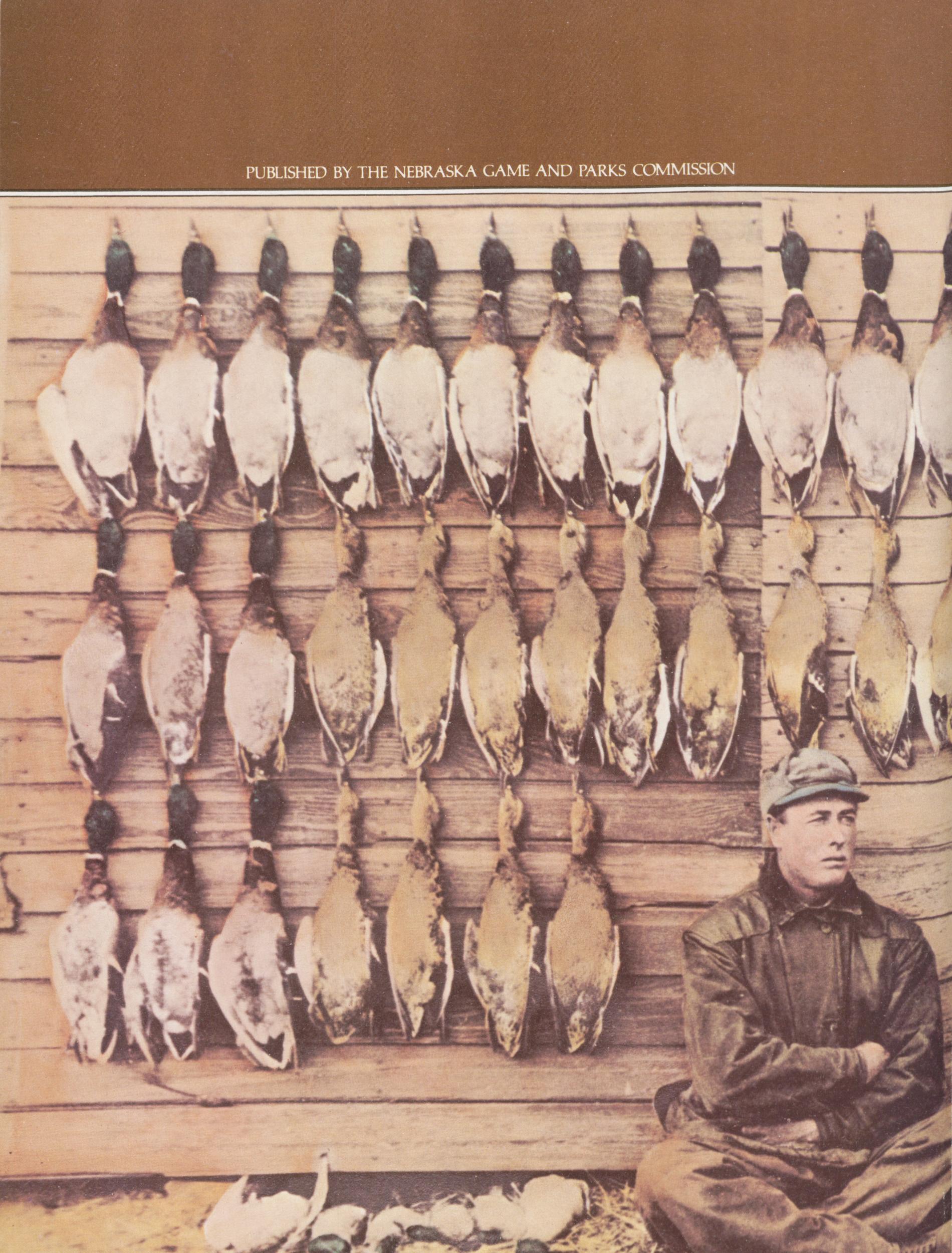
Position: 146 (42 views)