Volume 57, Issue 6, 1979
NEBRASKAland
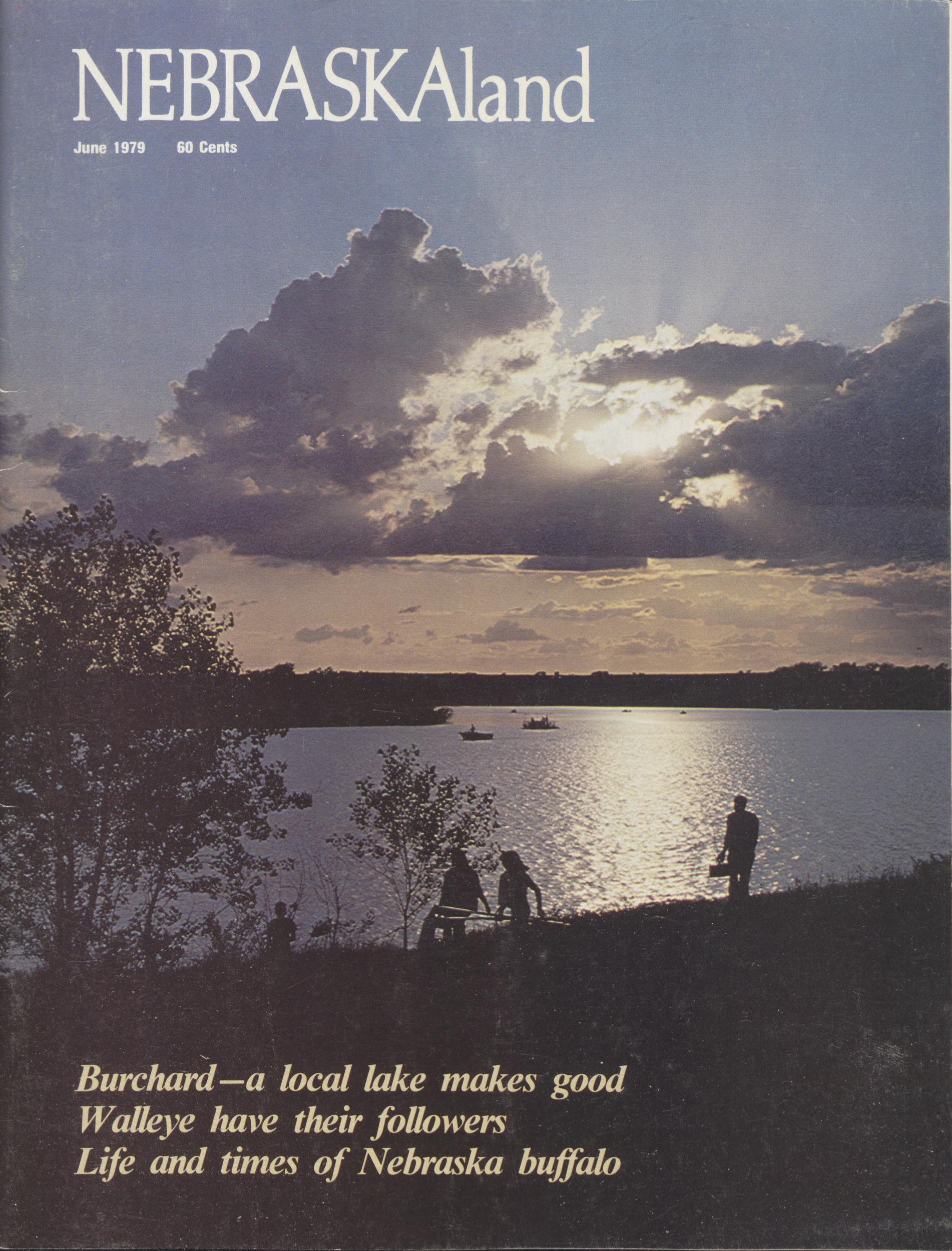
June 1979 60 CentsBurchard—a local lake makes good Walleye have their followers Life and times of Nebraska buffalo
NEBRASKAland
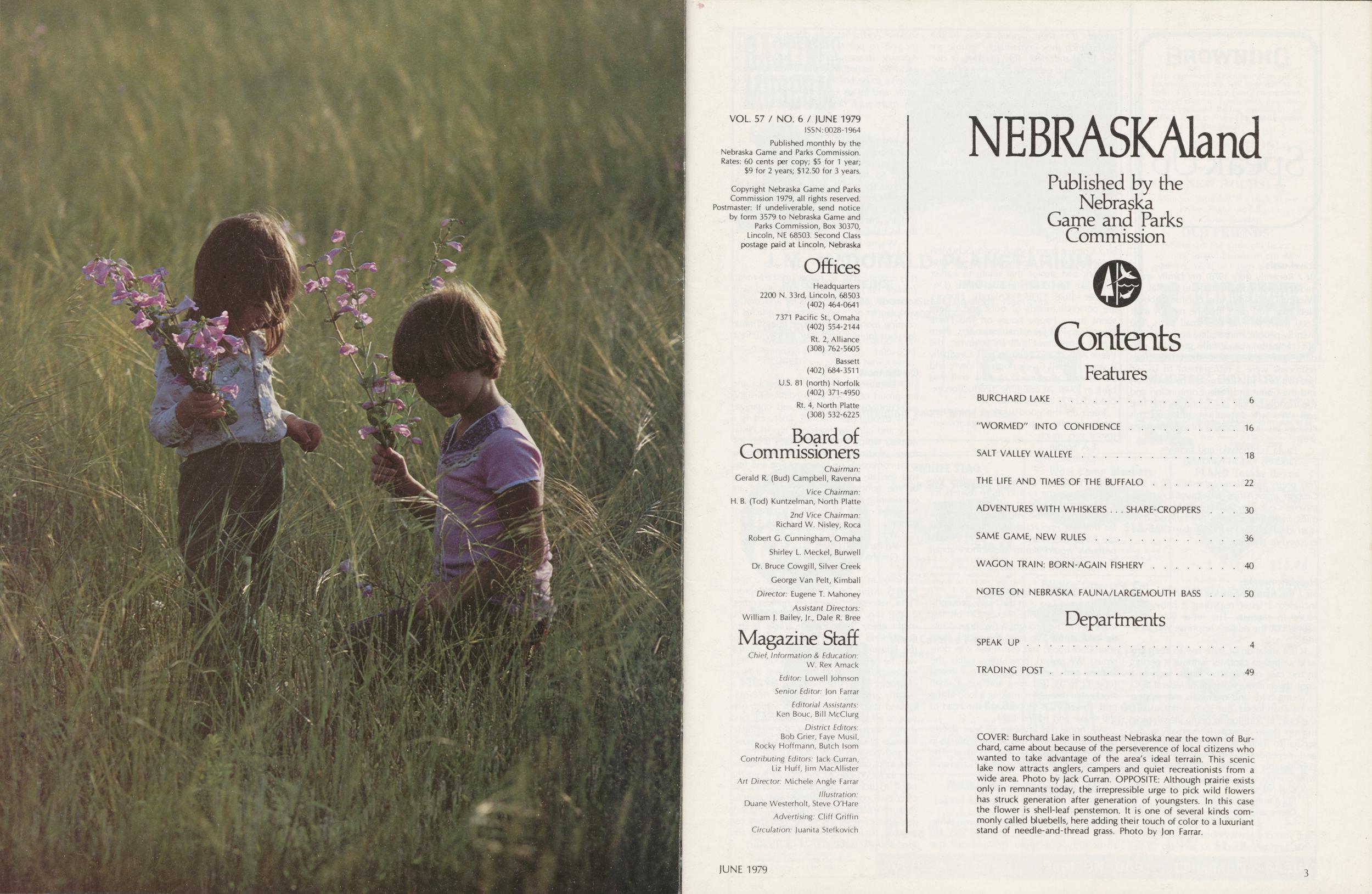
Published by the Nebraska Game and Parks Commission Contents Features BURCHARD LAKE 6 WORMED" INTO CONFIDENCE 16 SALT VALLEY WALLEYE 18 THE LIFE AND TIMES OF THE BUFFALO 22 ADVENTURES WITH WHISKERS...SHARE-CROPPERS 30 SAME GAME, NEW RULES 36 WAGON TRAIN: BORN-AGAIN FISHERY 40 NOTES ON NEBRASKA FAUNA/LARGEMOUTH BASS 50 Departments SPEAK UP 4 TRADING POST 49 COVER: Burchard Lake in southeast Nebraska near the town of Burchard, came about because of the perseverance of local citizens who wanted to take advantage of the area's ideal terrain. This scenic lake now attracts anglers, campers and quiet recreationists from a wide area. Photo by Jack Curran. OPPOSITE: Although prairie exists only in remnants today, the irrepressible urge to pick wild flowers has struck generation after generation of youngsters. In this case the flower is shell-leaf penstemon. It is one of several kinds commonly called bluebells, here adding their touch of color to a luxuriant stand of needle-and-thread grass. Photo by Jon Farrar. JUNE 1979 3
Speak Up
Travel oasisSir / Recently (July 1978) my family and I had the great good fortune to stop at the Windmill Wayside Area outside Gibbon, Nebraska. You can't imagine our joy after 7,500 miles to find this small oasis. The friendly people, immaculate and well laidout campsites, beautifully groomed gardens and flowers, and absolutely clean restrooms were a refreshment to us. I'd like to thank you (letter sent to governor) and the Game and Parks Commission and the friendly people of Gibbon for this fine park. We will certainly recommend this area to all our camping friends heading west.
Paula Tentnowski and family (address lost in handling)This pretty area along Interstate 80 at the Gibbon Interchange has caught many a traveler's eye. The collection of real windmills, including a huge, old railroad mill, is an ideal setting for a brief stay. Glad you enjoyed it (Editor)
Naughty, naughtySir / the March NEBRASKAland Speak Up included a letter regarding a baby coot raised in captivity. The letter was interesting, but the editor's response was lacking.
It is a violation of state law to keep any wild animal in captivity without a permit. In the case of migratory birds, such as a coot, this is also a violation of federal law.
Young birds and mammals may appear to be abandoned, but such is not usually the case. In addition to being illegal, picking up these animals is normally a disservice to them, as their association with and dependency on man makes them considerably less able to survive in the wild.
Karl Menzel Big-game specialist Game and Parks CommissionEach year our agency does send out public pleas, urging folks not to pick up "stray" animals that they happen across in the wild, which they immediately assume are lost or abandoned. This practice is discouraged, and certainly I was remiss in not mentioning it at the time. However, the coot had already been released to the wild at that point, and indeed had not been held captive but had the run of the place, often sitting on the porch roof. However, at this point it is again timely (being hatching time for young wildlife) to again urge people to leave wildlife where they find it. Most zoos can't even handle any more of them. There is also the matter of possible disease, injury, etc. that can accompany "lost" wild animals. (Editor)
Milling aroundSir / Coming from a small town (Schuyler) in Nebraska, I am greatly pleased with the artwork and stories that relate to earlier days, like the duck hunting article (December 1978 NEBRASKAland). Hoppes are personal friends of ours, and I have spent many happy hours on the Platte River. It so happens that years ago, there was a large flour mill in Schuyler; the Wells Abbott and Nieman mill. Originally it was on Shell Creek north of town, and to increase production, a new mill was built in town. At one time, production exceeded 2,000 barrels a day.
Keep up the good work—I know that everyone who receives this magazine enjoys it very much.
F.A. Spidle Kenosha, Wis.I hope you're right about the readers. We have been trying to find more readers for years—so they can start enjoying the magazine. Thanks for the info about the Schuyler mill. As important and interesting as the early mills were, I think most people probably would like to know more about them. (Editor)
How to handle a hungry manSir / Our son Leo is in the Navy, presently stationed at Bee Ville, Texas. On his last leave home, he brought a five-pound rattlesnake along. We used the recipe from your Cookbook, and the snake was delicious. We asked how they catch the snakes, and Leo said they take a metal tube 12 to 15 feet long and run a small steel cable through it, making a loop at the end. This snare is slipped over the head of the snake and pulled tight.
We hope this answers Charles Reeds' question on how to handle the problem in December NEBRASKAland Speakup. The Cookbook is something we will treasure; it's wonderful.
Mr. and Mrs. Al Kreifels Lorton, Nebr.See folks? There's an answer to everything. Now the question is, how do you get somebody out there to look for the snakes? And what if he doesn't stand still for you to put the loop over his head? Anyway, it sounds like a rattlesnake is good for something, and a few of them deserve to be bitten back. Thanks for your letter, and let us know if he brings home any more such delicacies. (Editor)
Smoked rabbitSir / I enjoy the magazine and the cook book, but it didn't tell how to smoke wild rabbit. So, here is my method.
I dress the rabbit, soak in salt brine with Tender Quick overnight. Then I smoke it for two hours with a cool smoke, using hickory and apple wood. It tastes very similar to ham.
Wayne Keichhoff Atlantic, IowaIt is strange that so many smoked meats (turkey, etc.) do taste like ham. And, with so much interest in smoking and drying, we plan to do more "How-to" articles in coming months along those lines. Thanks for your interest and your recipe. (Editor)
On the moveSir / Because we believe in Nebraska and are proud of it, we send NEBRASKAland subscriptions to all our 29 rep organizations throughout the U.S. Enclosed is a note and clipping from our rep in Philadelphia which I thought makes it all the more worthwhile. We have had many great comments on the magazine and feel that you are doing an excellent job. Keep up the good work. By the way, we are considering another 30 or 40 subscriptions for some of our buyers. It is a great door opener.
W.H. Harvey Jr. William H. Harvey Co. Omaha, Nebr.Enclosed in Mr. Harvey's letter was a note from 5. Muir Stroh of Fort Washington, Penn., who said: "Thanks for again sending us this very fine magazine. I thought you might enjoy the enclosed article by my good friend Tom Porch, outdoor editor of the Philadelphia Evening Bulletin. By the way, he has sent for a subscription." Then, enclosed in Mr. Stroh's letter was a large clipping from the newspaper with a lengthy article on the October NEBRASKAland Wild Game Cookbook which was sent to all subscribers. He said many kind things, included some of the "offbeat" subjects of recipes such as raccoon, muskrat and 'possum, then gave our address so that folks could order the book. And, he also included one of the recipes from the book to tide people over until they got their own cookbook. We are very grateful for such interest on the part of our readers, and appreciate all the promotion they can provide. Thanks again to all of you, and glad you liked the cookbook. (Editor)
4 NEBRASKAland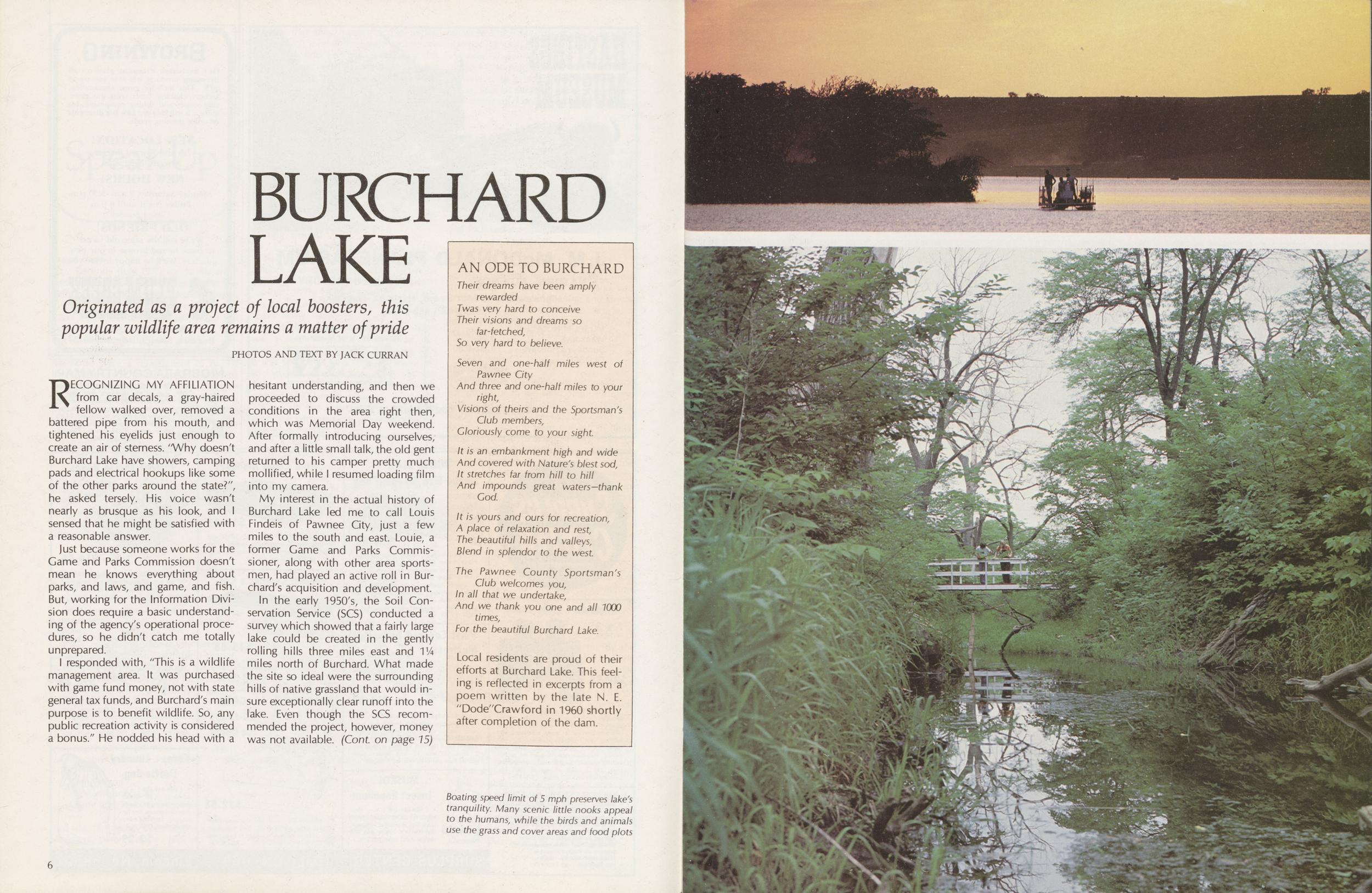
BURCHARD LAKE
Originated as a project of local boosters, this popular wildlife area remains a matter of pride
RECOGNIZING MY AFFILIATION from car decals, a gray-haired fellow walked over, removed a battered pipe from his mouth, and tightened his eyelids just enough to create an air of sterness. "Why doesn't Burchard Lake have showers, camping pads and electrical hookups like some of the other parks around the state?", he asked tersely. His voice wasn't nearly as brusque as his look, and I sensed that he might be satisfied with a reasonable answer.
Just because someone works for the Game and Parks Commission doesn't mean he knows everything about parks, and laws, and game, and fish. But, working for the Information Division does require a basic understanding of the agency's operational procedures, so he didn't catch me totally unprepared.
I responded with, "This is a wildlife management area. It was purchased with game fund money, not with state general tax funds, and Burchard's main purpose is to benefit wildlife. So, any public recreation activity is considered a bonus." He nodded his head with a hesitant understanding, and then we proceeded to discuss the crowded conditions in the area right then, which was Memorial Day weekend. After formally introducing ourselves, and after a little small talk, the old gent returned to his camper pretty much mollified, while I resumed loading film into my camera.
My interest in the actual history of Burchard Lake led me to call Louis Findeis of Pawnee City, just a few miles to the south and east. Louie, a former Game and Parks Commissioner, along with other area sportsmen, had played an active roll in Burchard's acquisition and development.
In the early 1950's, the Soil Conservation Service (SCS) conducted a survey which showed that a fairly large lake could be created in the gently rolling hills three miles east and VA miles north of Burchard. What made the site so ideal were the surrounding hills of native grassland that would insure exceptionally clear runoff into the lake. Even though the SCS recommended the project, however, money was not available. (Cont on page 15)
AN ODE TO BURCHARD Their dreams have been amplyrewarded
Twas very hard to conceive
Their visions and dreams so
far-fetched,
So very hard to believe.
Seven and one-half miles west of
Pawnee City
And three and one-half miles to your
right,
Visions of theirs and the Sportsman's
Club members,
Gloriously come to your sight.
It is an embankment high and wide
And covered with Nature's blest sod,
It stretches far from hill to hill
And impounds great waters—thank
God.
It is yours and ours for recreation,
A place of relaxation and rest,
The beautiful hills and valleys,
Blend in splendor to the west.
The Pawnee County Sportsman's
Club welcomes you,
In all that we undertake,
And we thank you one and all 1000
times,
For the beautiful Burchard Lake.
Local residents are proud of their efforts at Burchard Lake. This feeling is reflected in excerpts from a poem written by the late N. E. "Dode" Crawford in 1960 shortly after completion of the dam.
Boating speed limit of 5 mph preserves lake's tranquility. Many scenic little nooks appeal to the humans, while the birds and animals use the grass and cover areas and food plots
Lush greenery in spring brings enthusiastic response in people
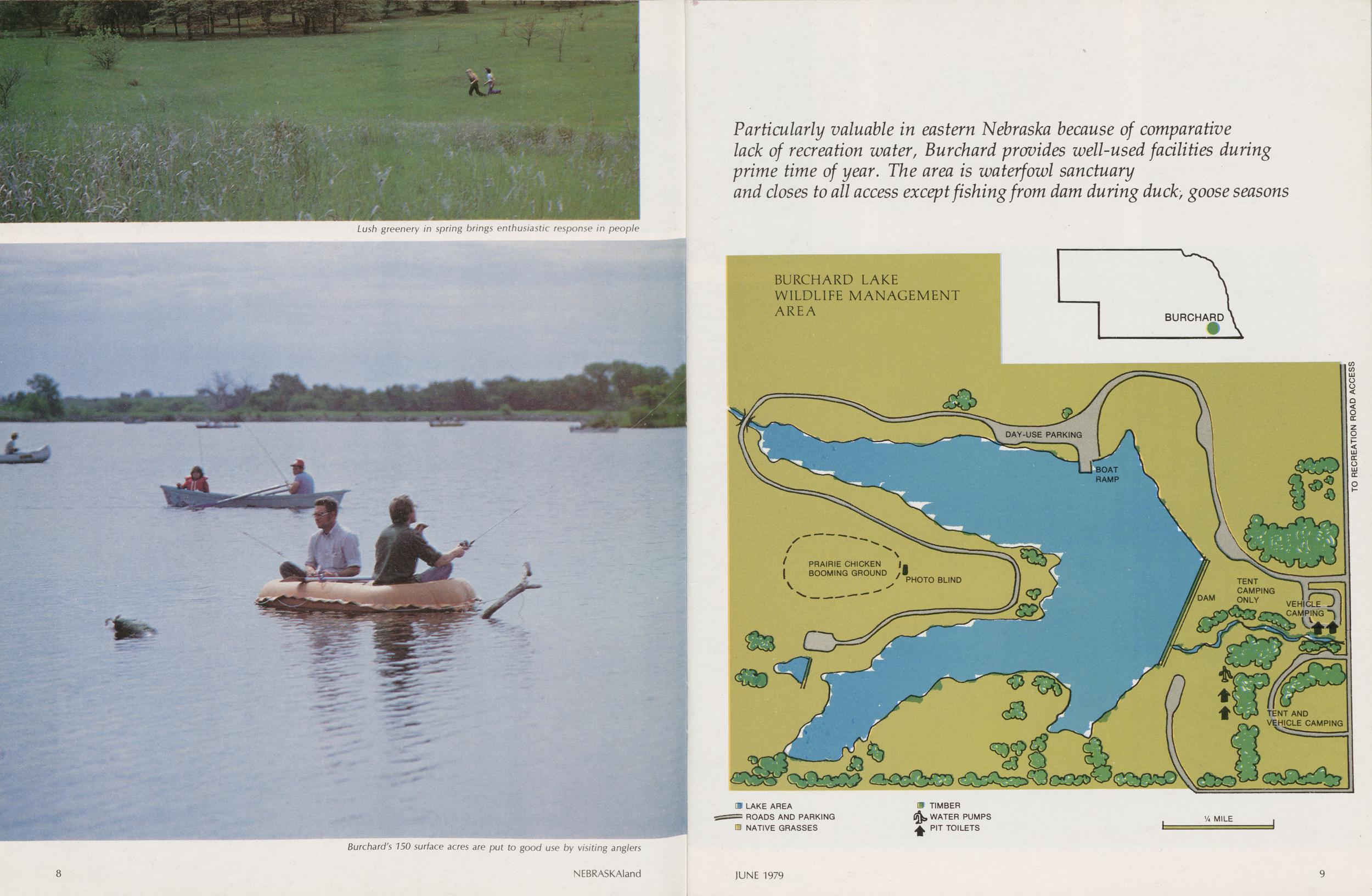
Burchard's 150 surface acres are put to good use by visiting anglers
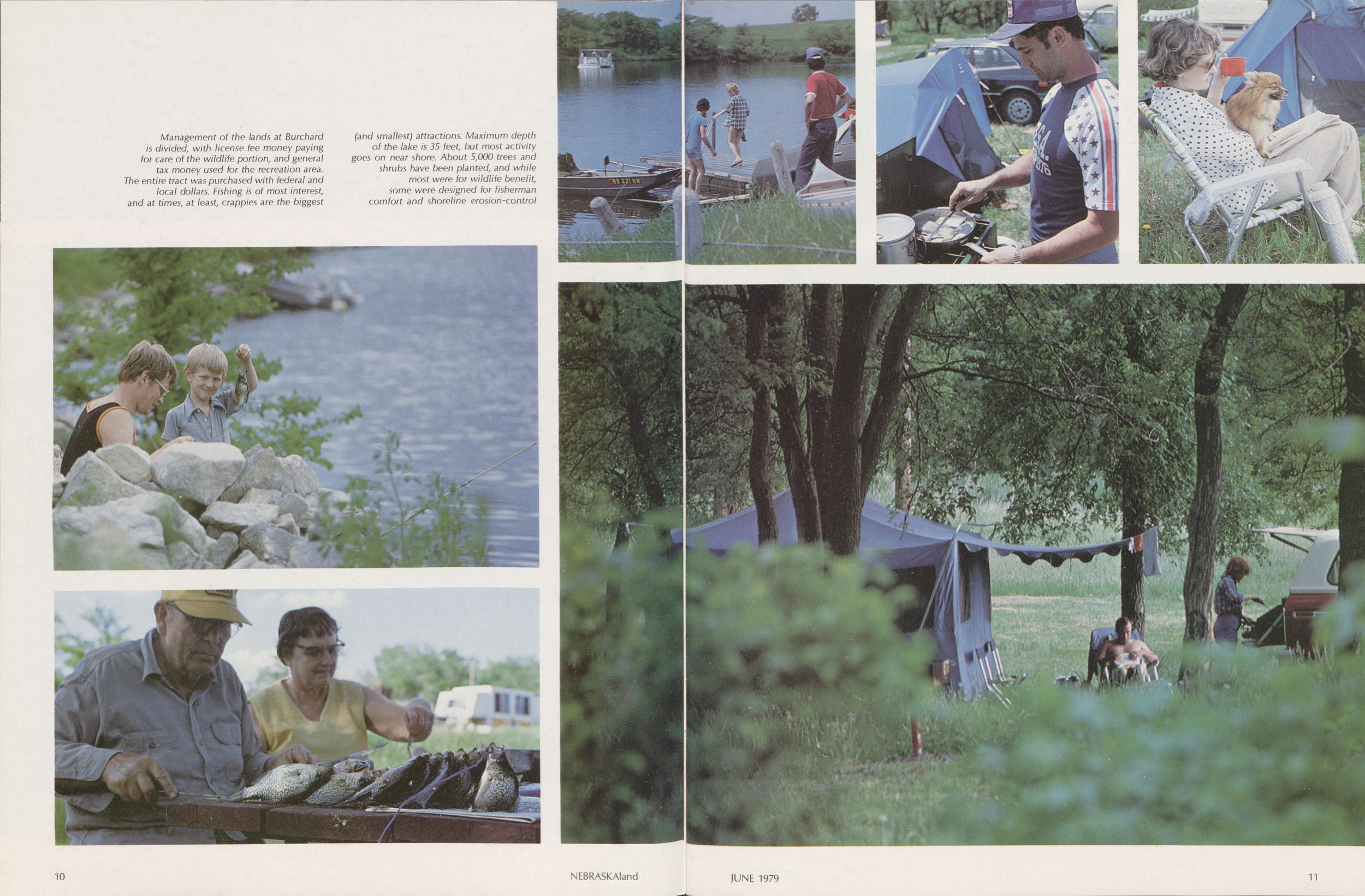
Management of the lands at Burchard is divided, with license fee money paying for care of the wildlife portion, and general tax money used for the recreation area. The entire tract was purchased with federal and local dollars. Fishing is of most interest, and at times, at least, crapples are the biggest (and smallest) attractions. Maximum depth of the lake is 35 feet, but most activity goes on near shore. About 5,000 trees and shrubs have been planted, and while most were for wildlife benefit, some were designed for fisherman comfort and shoreline erosion-control
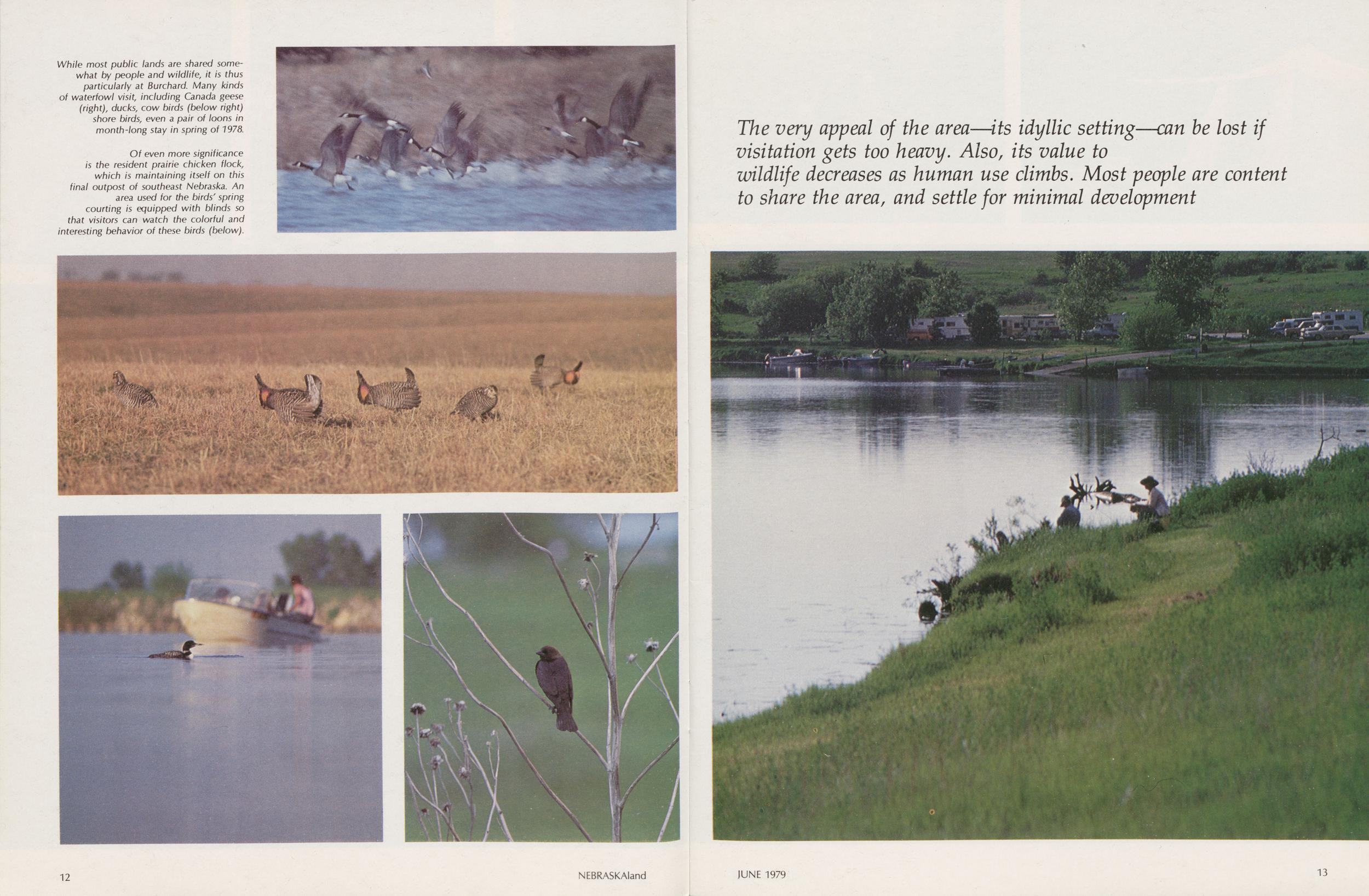
While most public lands are shared somewhat by people and wildlife, it is thus particularly at Burchard. Many kinds of waterfowl visit, including Canada geese (right), ducks, cow birds (below right) shore birds, even a pair of loons in month-long stay in spring of 1978. Of even more significance is the resident prairie chicken flock, which is maintaining itself on this final outpost of southeast Nebraska. An area used for the birds' spring courting is equipped with blinds so that visitors can watch the colorful and interesting behavior of these birds (below).
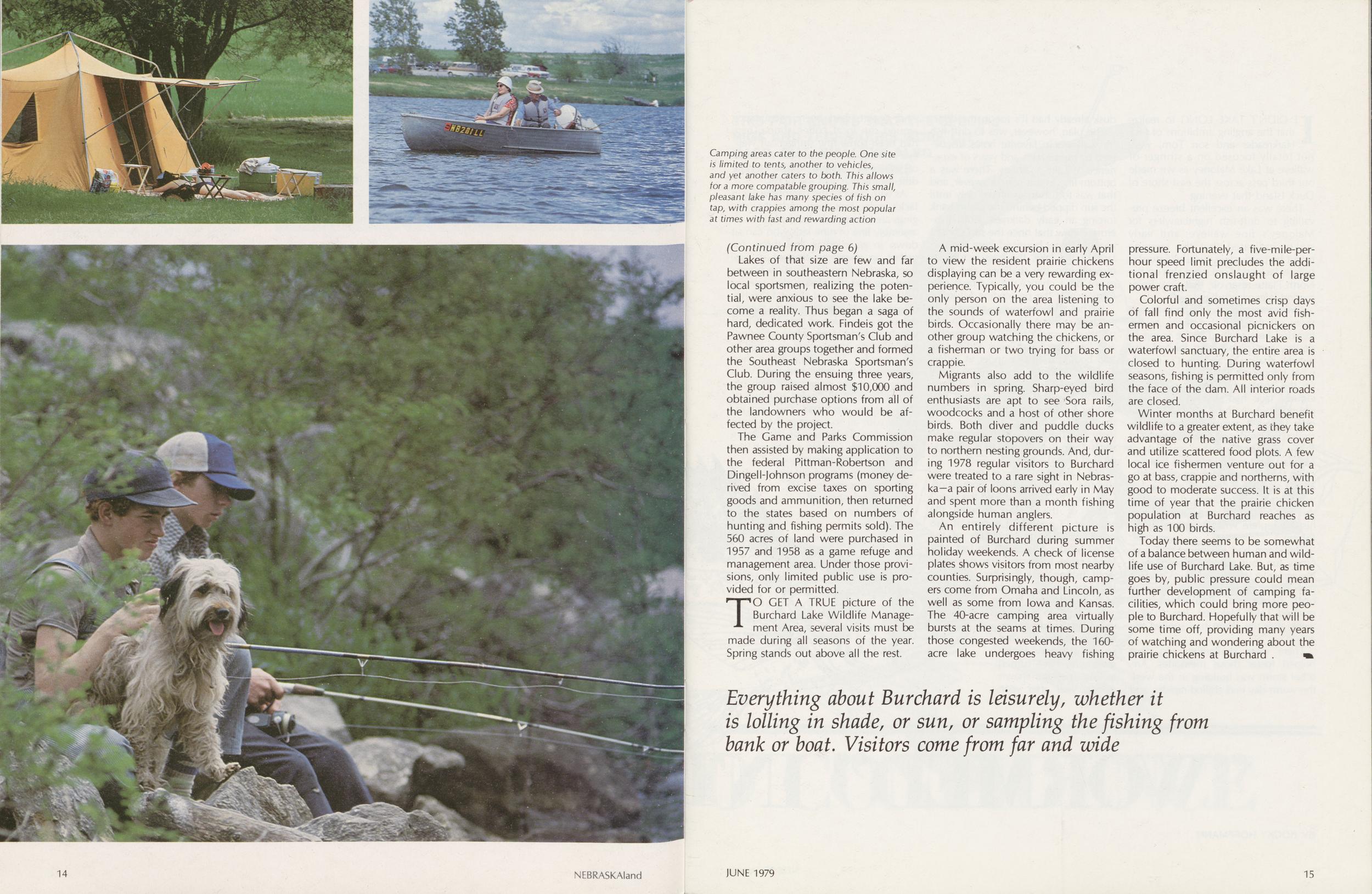
Camping areas cater to the people. One site is limited to tents, another to vehicles, and yet another caters to both. This allows for a more compatible grouping. This small, pleasant lake has many species of fish on tap, with crappies among the most popular at times with fast and rewarding action
Lakes of that size are few and far between in southeastern Nebraska, so local sportsmen, realizing the potential, were anxious to see the lake become a reality. Thus began a saga of hard, dedicated work. Findeis got the Pawnee County Sportsman's Club and other area groups together and formed the Southeast Nebraska Sportsman's Club. During the ensuing three years, the group raised almost $10,000 and obtained purchase options from all of the landowners who would be affected by the project.
The Game and Parks Commission then assisted by making application to the federal Pittman-Robertson and Dingell-Johnson programs (money derived from excise taxes on sporting goods and ammunition, then returned to the states based on numbers of hunting and fishing permits sold). The 560 acres of land were purchased in 1957 and 1958 as a game refuge and management area. Under those provisions, only limited public use is provided for or permitted.
TO GET A TRUE picture of the Burchard Lake Wildlife Management Area, several visits must be made during all seasons of the year. Spring stands out above all the rest.
A mid-week excursion in early April to view the resident prairie chickens displaying can be a very rewarding experience. Typically, you could be the only person on the area listening to the sounds of waterfowl and prairie birds. Occasionally there may be another group watching the chickens, or a fisherman or two trying for bass or crappie.
Migrants also add to the wildlife numbers in spring. Sharp-eyed bird enthusiasts are apt to see Sora rails, woodcocks and a host of other shore birds. Both diver and puddle ducks make regular stopovers on their way to northern nesting grounds. And, during 1978 regular visitors to Burchard were treated to a rare sight in Nebraska—a pair of loons arrived early in May and spent more than a month fishing alongside human anglers.
An entirely different picture is painted of Burchard during summer holiday weekends. A check of license plates shows visitors from most nearby counties. Surprisingly, though, campers come from Omaha and Lincoln, as well as some from Iowa and Kansas. The 40-acre camping area virtually bursts at the seams at times. During those congested weekends, the 160-acre lake undergoes heavy fishing pressure. Fortunately, a five-mile-per-hour speed limit precludes the additional frenzied onslaught of large power craft.
Colorful and sometimes crisp days of fall find only the most avid fishermen and occasional picnickers on the area. Since Burchard Lake is a waterfowl sanctuary, the entire area is closed to hunting. During waterfowl seasons, fishing is permitted only from the face of the dam. All interior roads are closed.
Winter months at Burchard benefit wildlife to a greater extent, as they take advantage of the native grass cover and utilize scattered food plots. A few local ice fishermen venture out for a go at bass, crappie and northerns, with good to moderate success. It is at this time of year that the prairie chicken population at Burchard reaches as high as 100 birds.
Today there seems to be somewhat of a balance between human and wildlife use of Burchard Lake. But, as time goes by, public pressure could mean further development of camping facilities, which could bring more people to Burchard. Hopefully that will be some time off, providing many years of watching and wondering about the prairie chickens at Burchard.
Everything about Burchard is leisurely, whether it is lolling in shade, or sun, or sampling the fishing from bank or boat. Visitors come from far and wide 14 NEBRASKAland JUNE 1979 15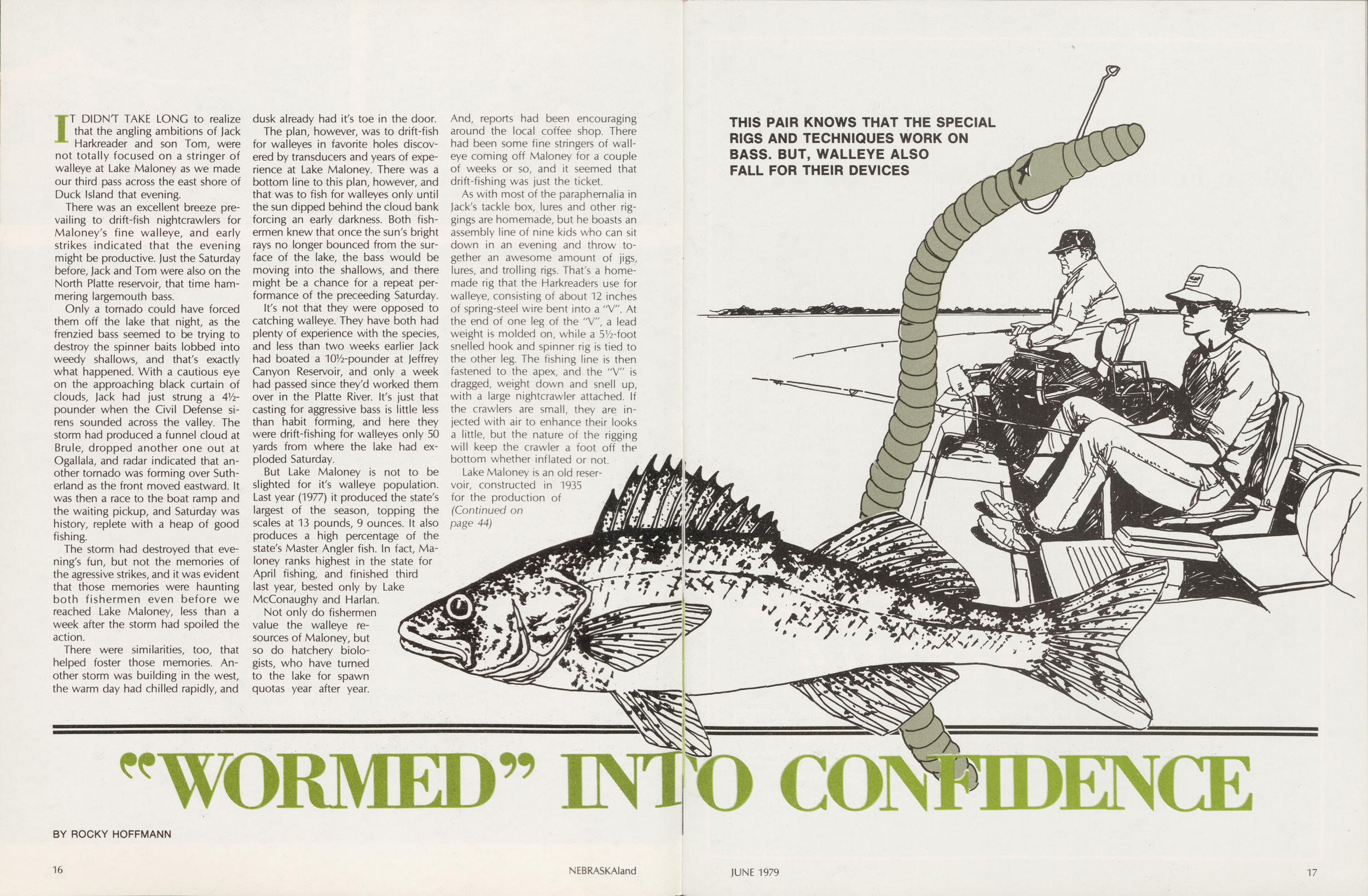
"Wormed" into Confidence
IT DIDNT TAKE LONG to realize that the angling ambitions of Jack Harkreader and son Tom, were not totally focused on a stringer of walleye at Lake Maloney as we made our third pass across the east shore of Duck Island that evening.
There was an excellent breeze prevailing to drift-fish nightcrawlers for Maloney's fine walleye, and early strikes indicated that the evening might be productive. Just the Saturday before, Jack and Tom were also on the North Platte reservoir, that time hammering largemouth bass.
Only a tornado could have forced them off the lake that night, as the frenzied bass seemed to be trying to destroy the spinner baits lobbed into weedy shallows, and that's exactly what happened. With a cautious eye on the approaching black curtain of clouds, Jack had just strung a 4 1/2-pounder when the Civil Defense sirens sounded across the valley. The storm had produced a funnel cloud at Brule, dropped another one out at Ogallala, and radar indicated that another tornado was forming over Sutherland as the front moved eastward. It was then a race to the boat ramp and the waiting pickup, and Saturday was history, replete with a heap of good fishing.
The storm had destroyed that evening's fun, but not the memories of the aggressive strikes, and it was evident that those memories were haunting both fishermen even before we reached Lake Maloney, less than a week after the storm had spoiled the action.
There were similarities, too, that helped foster those memories. Another storm was building in the west, the warm day had chilled rapidly, and dusk already had it's toe in the door.
The plan, however, was to drift-fish for walleyes in favorite holes discovered by transducers and years of experience at Lake Maloney. There was a bottom line to this plan, however, and that was to fish for walleyes only until the sun dipped behind the cloud bank forcing an early darkness. Both fishermen knew that once the sun's bright rays no longer bounced from the surface of the lake, the bass would be moving into the shallows, and there might be a chance for a repeat performance of the preceding Saturday.
It's not that they were opposed to catching walleye. They have both had plenty of experience with the species, and less than two weeks earlier Jack had boated a 10 1/2-pounder at Jeffrey Canyon Reservoir, and only a week had passed since they'd worked them over in the Platte River. It's just that casting for aggressive bass is little less than habit forming, and here they were drift-fishing for walleyes only 50 yards from where the lake had exploded Saturday.
But Lake Maloney is not to be slighted for it's walleye population. Last year (1977) it produced the state's largest of the season, topping the scales at 13 pounds, 9 ounces. It also produces a high percentage of the state's Master Angler fish. In fact, Maloney ranks highest in the state for April fishing, and finished third last year, bested only by Lake McConaughy and Harlan.
Not only do fishermen value the walleye resources of Maloney, but so do hatchery biologists, who have turned to the lake for spawn quotas year after year. And, reports had been encouraging around the local coffee shop. There had been some fine stringers of walleye coming off Maloney for a couple of weeks or so, and it seemed that drift-fishing was just the ticket.
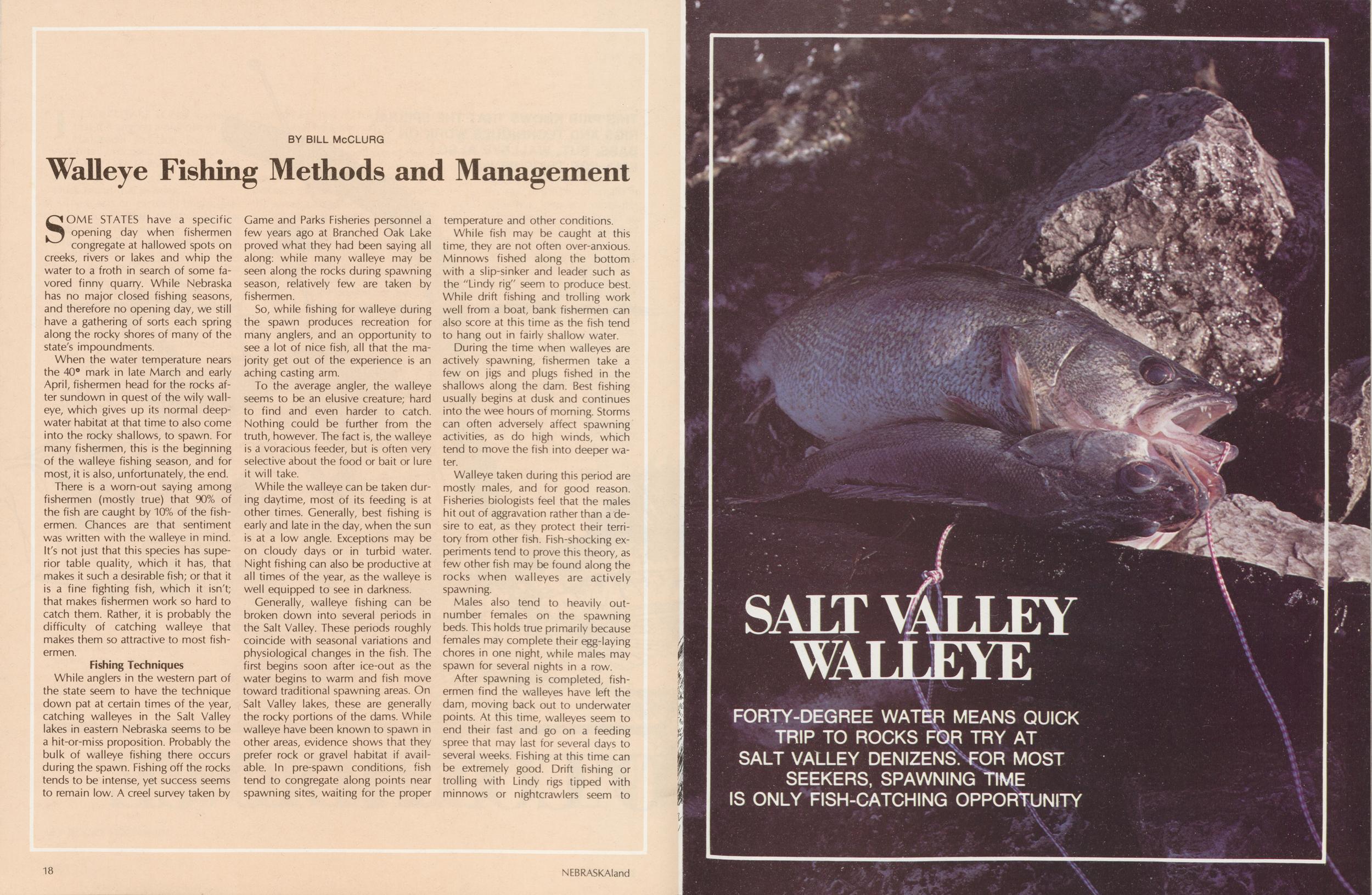
As with most of the paraphernalia in Jack's tackle box, lures and other riggings are homemade, but he boasts an assembly line of nine kids who can sit down in an evening and throw together an awesome amount of jigs, lures, and trolling rigs. That's a homemade rig that the Harkreaders use for walleye, consisting of about 12 inches of spring-steel wire bent into a "V". At the end of one leg of the "V", a lead weight is molded on, while a 51/2-foot snelled hook and spinner rig is tied to the other leg. The fishing line is then fastened to the apex, and the "V" is dragged, weight down and snell up, with a large nightcrawler attached. If the crawlers are small, they are injected with air to enhance their looks a little, but the nature of the rigging will keep the crawler a foot off the bottom whether inflated or not.
Lake Maloney is an old reservoir, constructed in 1935 for the production of
(Continued on page 44)THIS PAIR KNOWS THAT THE SPECIAL RIGS AND TECHNIQUES WORK ON BASS. BUT, WALLEYE ALSO FALL FOR THEIR DEVICES
Walleye Fishing Methods and Management
SOME STATES have a specific opening day when fishermen congregate at hallowed spots on creeks, rivers or lakes and whip the water to a froth in search of some favored finny quarry. While Nebraska has no major closed fishing seasons, and therefore no opening day, we still have a gathering of sorts each spring along the rocky shores of many of the state's impoundments.
When the water temperature nears the 40° mark in late March and early April, fishermen head for the rocks after sundown in quest of the wily walleye, which gives up its normal deep-water habitat at that time to also come into the rocky shallows, to spawn. For many fishermen, this is the beginning of the walleye fishing season, and for most, it is also, unfortunately, the end.
There is a worn-out saying among fishermen (mostly true) that 90% of the fish are caught by 10% of the fishermen. Chances are that sentiment was written with the walleye in mind. It's not just that this species has superior table quality, which it has, that makes it such a desirable fish; or that it is a fine fighting fish, which it isn't; that makes fishermen work so hard to catch them. Rather, it is probably the difficulty of catching walleye that makes them so attractive to most fishermen.
Fishing TechniquesWhile anglers in the western part of the state seem to have the technique down pat at certain times of the year, catching walleyes in the Salt Valley lakes in eastern Nebraska seems to be a hit-or-miss proposition. Probably the bulk of walleye fishing there occurs during the spawn. Fishing off the rocks tends to be intense, yet success seems to remain low. A creel survey taken by Game and Parks Fisheries personnel a few years ago at Branched Oak Lake proved what they had been saying all along: while many walleye may be seen along the rocks during spawning season, relatively few are taken by fishermen.
So, while fishing for walleye during the spawn produces recreation for many anglers, and an opportunity to see a lot of nice fish, all that the majority get out of the experience is an aching casting arm.
To the average angler, the walleye seems to be an elusive creature; hard to find and even harder to catch. Nothing could be further from the truth, however. The fact is, the walleye is a voracious feeder, but is often very selective about the food or bait or lure it will take.
While the walleye can be taken during daytime, most of its feeding is at other times. Generally, best fishing is early and late in the day, when the sun is at a low angle. Exceptions may be on cloudy days or in turbid water. Night fishing can also be productive at all times of the year, as the walleye is well equipped to see in darkness.
Generally, walleye fishing can be broken down into several periods in the Salt Valley. These periods roughly coincide with seasonal variations and physiological changes in the fish. The first begins soon after ice-out as the water begins to warm and fish move toward traditional spawning areas. On Salt Valley lakes, these are generally the rocky portions of the dams. While walleye have been known to spawn in other areas, evidence shows that they prefer rock or gravel habitat if available. In pre-spawn conditions, fish tend to congregate along points near spawning sites, waiting for the proper temperature and other conditions.
While fish may be caught at this time, they are not often over-anxious. Minnows fished along the bottom with a slip-sinker and leader such as the "Lindy rig" seem to produce best. While drift fishing and trolling work well from a boat, bank fishermen can also score at this time as the fish tend to hang out in fairly shallow water.
During the time when walleyes are actively spawning, fishermen take a few on jigs and plugs fished in the shallows along the dam. Best fishing usually begins at dusk and continues into the wee hours of morning. Storms can often adversely affect spawning activities, as do high winds, which tend to move the fish into deeper water.
Walleye taken during this period are mostly males, and for good reason. Fisheries biologists feel that the males hit out of aggravation rather than a desire to eat, as they protect their territory from other fish. Fish-shocking experiments tend to prove this theory, as few other fish may be found along the rocks when walleyes are actively spawning.
Males also tend to heavily outnumber females on the spawning beds. This holds true primarily because females may complete their egg-laying chores in one night, while males may spawn for several nights in a row.
Salt Valley Walleye
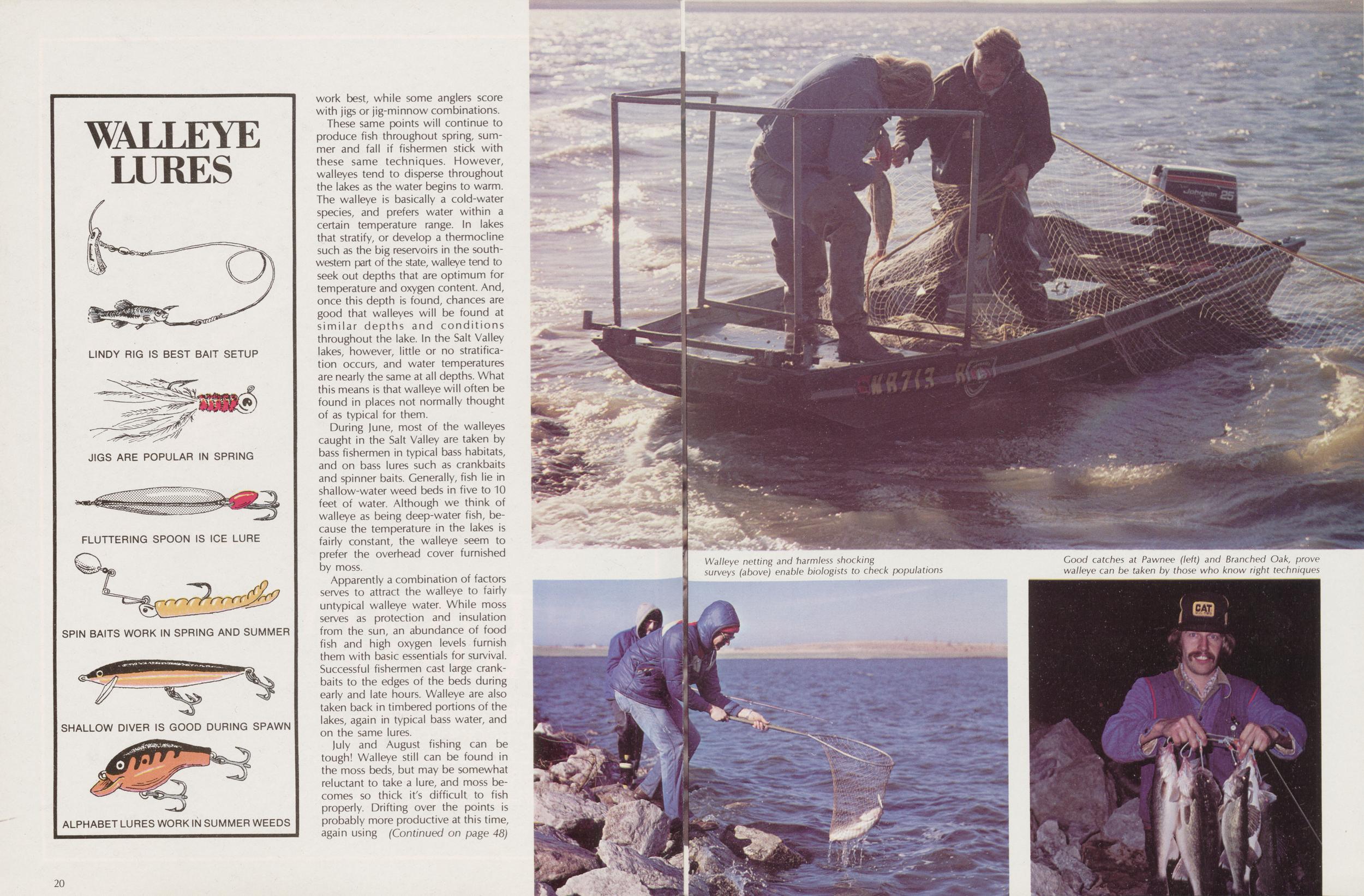
Forty-degree water means quick trip to rocks for try at salt valley denizens. For most seekers, spawing ime is only fish-catching opportunity
These same points will continue to produce fish throughout spring, summer and fall if fishermen stick with these same techniques. However, walleyes tend to disperse throughout the lakes as the water begins to warm. The walleye is basically a cold-water species, and prefers water within a certain temperature range. In lakes that stratify, or develop a thermocline such as the big reservoirs in the southwestern part of the state, walleye tend to seek out depths that are optimum for temperature and oxygen content. And, once this depth is found, chances are good that walleyes will be found at similar depths and conditions throughout the lake. In the Salt Valley lakes, however, little or no stratification occurs, and water temperatures are nearly the same at all depths. What this means is that walleye will often be found in places not normally thought of as typical for them.
During June, most of the walleyes caught in the Salt Valley are taken by bass fishermen in typical bass habitats, and on bass lures such as crankbaits and spinner baits. Generally, fish lie in shallow-water weed beds in five to 10 feet of water. Although we think of walleye as being deep-water fish, because the temperature in the lakes is fairly constant, the walleye seem to prefer the overhead cover furnished by moss.
Apparently a combination of factors serves to attract the walleye to fairly untypical walleye water. While moss serves as protection and insulation from the sun, an abundance of food fish and high oxygen levels furnish them with basic essentials for survival. Successful fishermen cast large crank- baits to the edges of the beds during early and late hours. Walleye are also taken back in timbered portions of the lakes, again in typical bass water, and on the same lures.
July and August fishing can be tough! Walleye still can be found in the moss beds, but may be somewhat reluctant to take a lure, and moss becomes so thick it's difficult to fish properly. Drifting over the points is probably more productive at this time, again using (Continued on page 48)
Walleye netting and harmless shocking surveys (above) enable biologists to check populations
Good catches at Pawnee (left) and Branched Oak, prove walleye can be taken by those who know right techniques
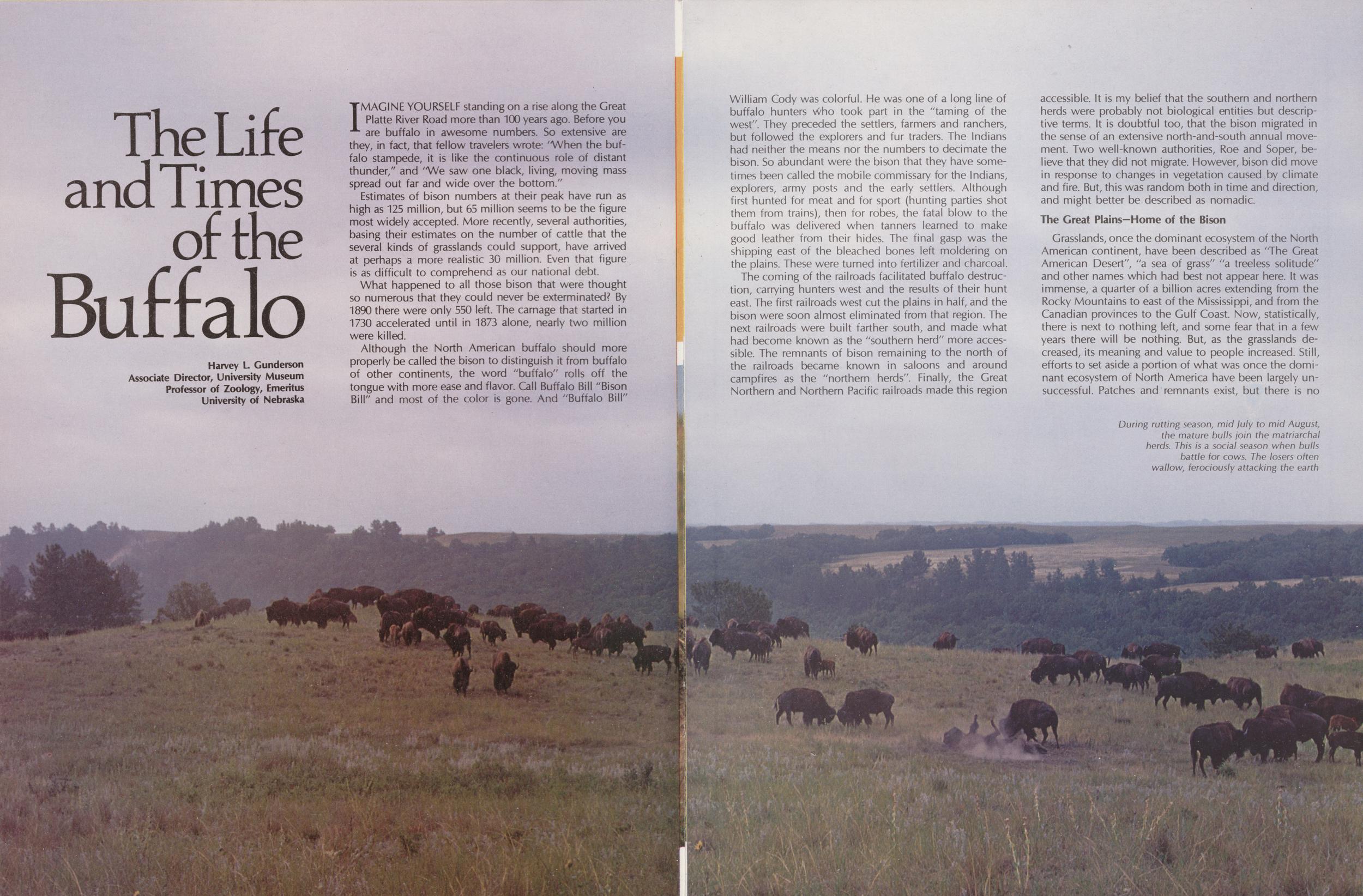
The Life and Times of the Buffalo
IMAGINE YOURSELF standing on a rise along the Great Platte River Road more than 100 years ago. Before you are buffalo in awesome numbers. So extensive are they, in fact, that fellow travelers wrote: "When the buffalo stampede, it is like the continuous role of distant thunder," and "We saw one black, living, moving mass spread out far and wide over the bottom."
Estimates of bison numbers at their peak have run as high as 125 million, but 65 million seems to be the figure most widely accepted. More recently, several authorities, basing their estimates on the number of cattle that the several kinds of grasslands could support, have arrived at perhaps a more realistic 30 million. Even that figure is as difficult to comprehend as our national debt.
What happened to all those bison that were thought so numerous that they could never be exterminated? By 1890 there were only 550 left. The carnage that started in 1730 accelerated until in 1873 alone, nearly two million were killed.
Although the North American buffalo should more properly be called the bison to distinguish it from buffalo of other continents, the word "buffalo" rolls off the tongue with more ease and flavor. Call Buffalo Bill "Bison Bill" and most of the color is gone. And "Buffalo Bill" William Cody was colorful. He was one of a long line of buffalo hunters who took part in the "taming of the west". They preceded the settlers, farmers and ranchers, but followed the explorers and fur traders. The Indians had neither the means nor the numbers to decimate the bison. So abundant were the bison that they have sometimes been called the mobile commissary for the Indians, explorers, army posts and the early settlers. Although first hunted for meat and for sport (hunting parties shot them from trains), then for robes, the fatal blow to the buffalo was delivered when tanners learned to make good leather from their hides. The final gasp was the shipping east of the bleached bones left moldering on the plains. These were turned into fertilizer and charcoal.
The coming of the railroads facilitated buffalo destruction, carrying hunters west and the results of their hunt east. The first railroads west cut the plains in half, and the bison were soon almost eliminated from that region. The next railroads were built farther south, and made what had become known as the "southern herd" more accessible. The remnants of bison remaining to the north of the railroads became known in saloons and around campfires as the "northern herds". Finally, the Great Northern and Northern Pacific railroads made this region accessible. It is my belief that the southern and northern herds were probably not biological entities but descriptive terms. It is doubtful too, that the bison migrated in the sense of an extensive north-and-south annual movement. Two well-known authorities, Roe and Soper, believe that they did not migrate. However, bison did move in response to changes in vegetation caused by climate and fire. But, this was random both in time and direction, and might better be described as nomadic.
The Great Plains—Home of the BisonDuring rutting season, mid July to mid August, the mature bulls join the matriarchal herds. This is a social season when bulls battle for cows. The losers often wallow, ferociously attacking the earth
 such thing as a large Grasslands National Park.
Over millions of years, evolutionary processes tempered the grasslands to the needs of the bison and the other herbivores, just as the bison adapted to the grasslands. They evolved to survive a climate of extreme temperature changes, sparse and erratic rainfall, plus searing winds in summer and biting blizzards in winter.
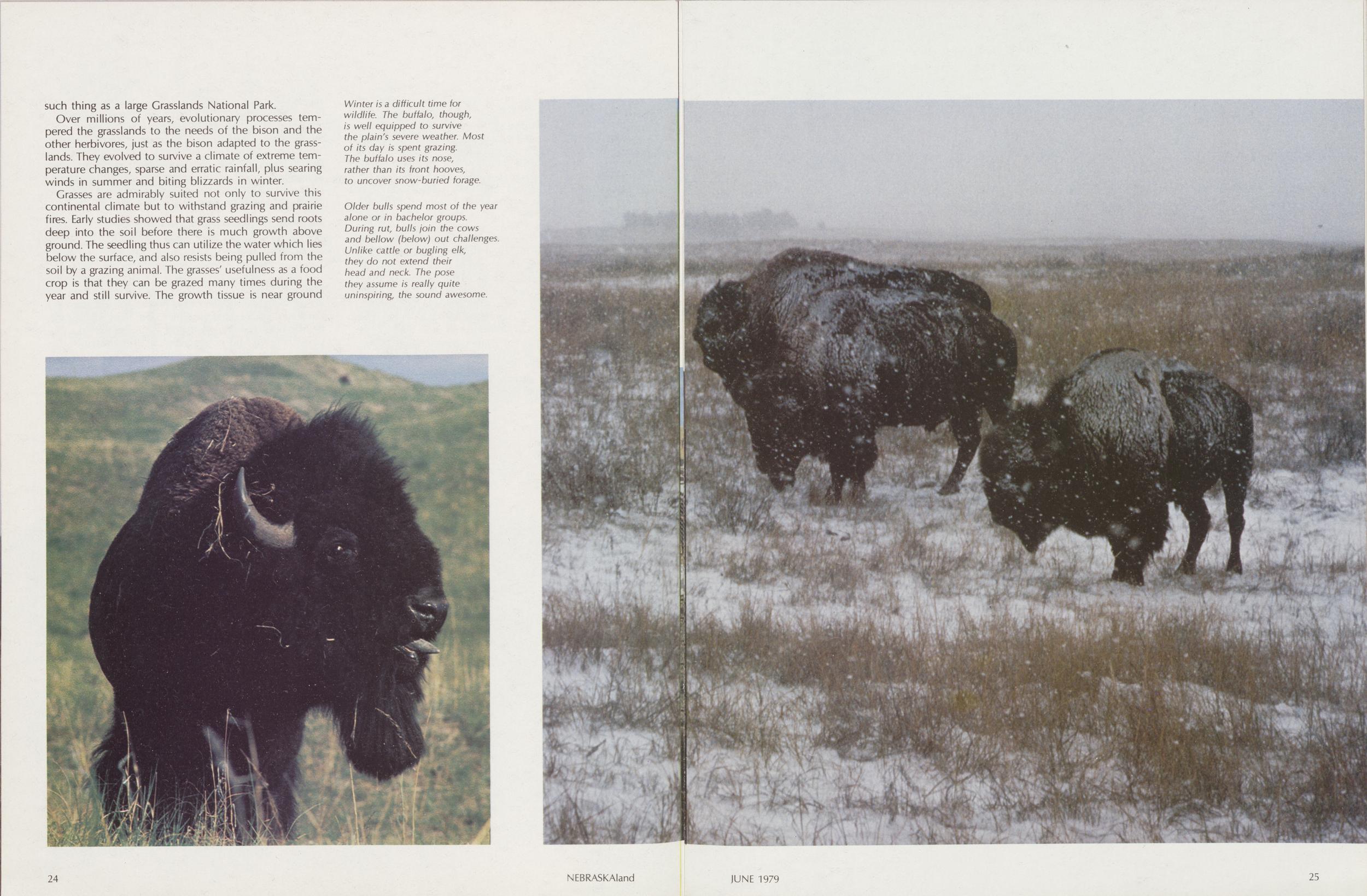
Winter is a difficult time for wildlife. The buffalo, though, is well equipped to survive the plain's severe weather. Most of its day is spent grazing. The buffalo uses its nose, rather than its front hooves, to uncover snow-buried forage.
Older bulls spend most of the year alone or in bachelor groups. During rut, bulls join the cows and bellow (below) out challenges. Unlike cattle or bugling elk, they do not extend their head and neck. The pose they assume is really quite uninspiring, the sound awesome.
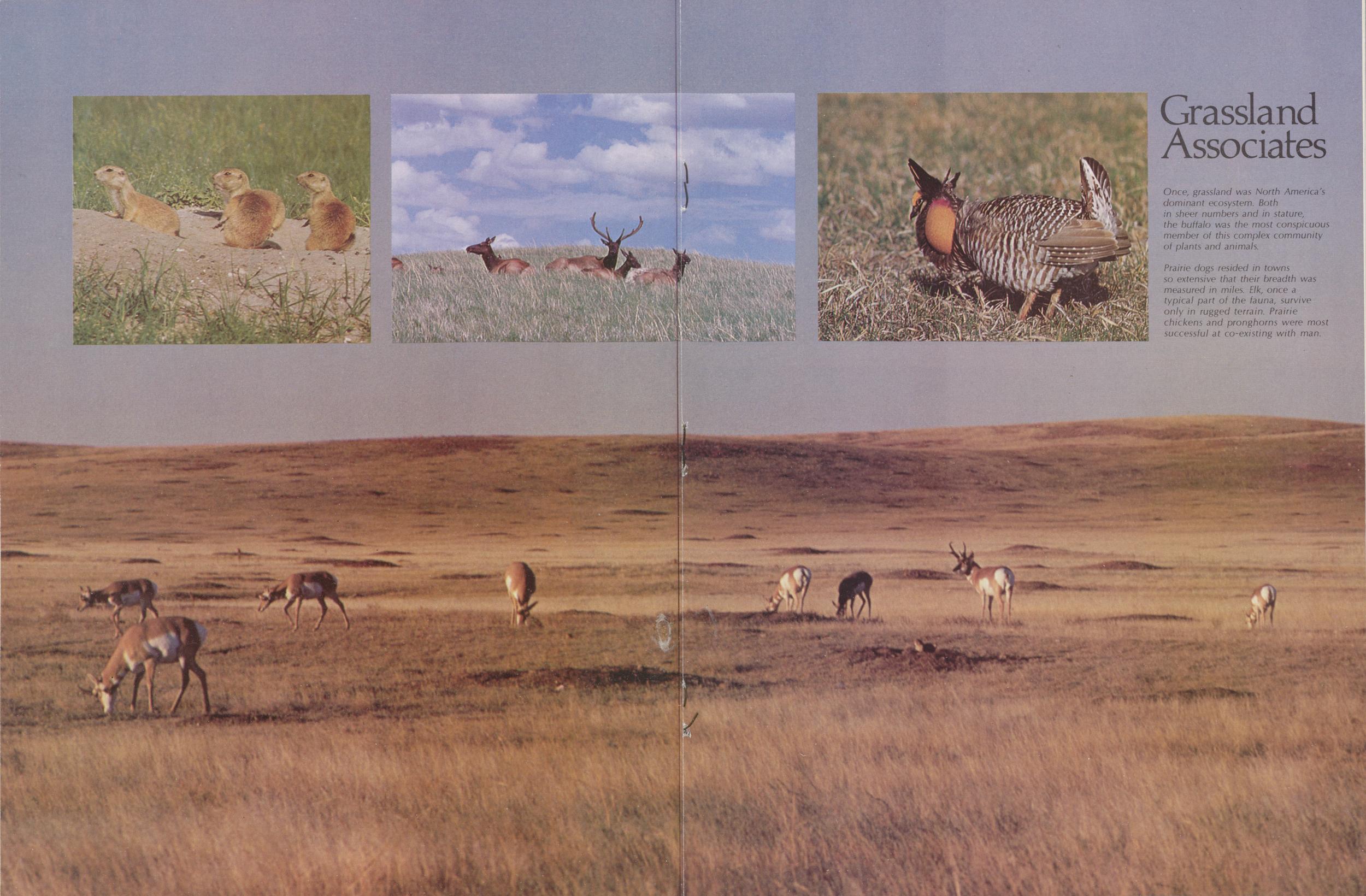
Grassland Associates
Once, grassland was North America's dominant ecosystem. Both in sheer numbers and in stature, the buffalo was the most conspicuous member of this complex community of plants and animals.
Prairie dogs resided in towns so extensive that their breadth was measured in miles. Elk, once a typical part of the fauna, survive only in rugged terrain. Prairie chickens and pronghorns were most successful at co-existing with man.
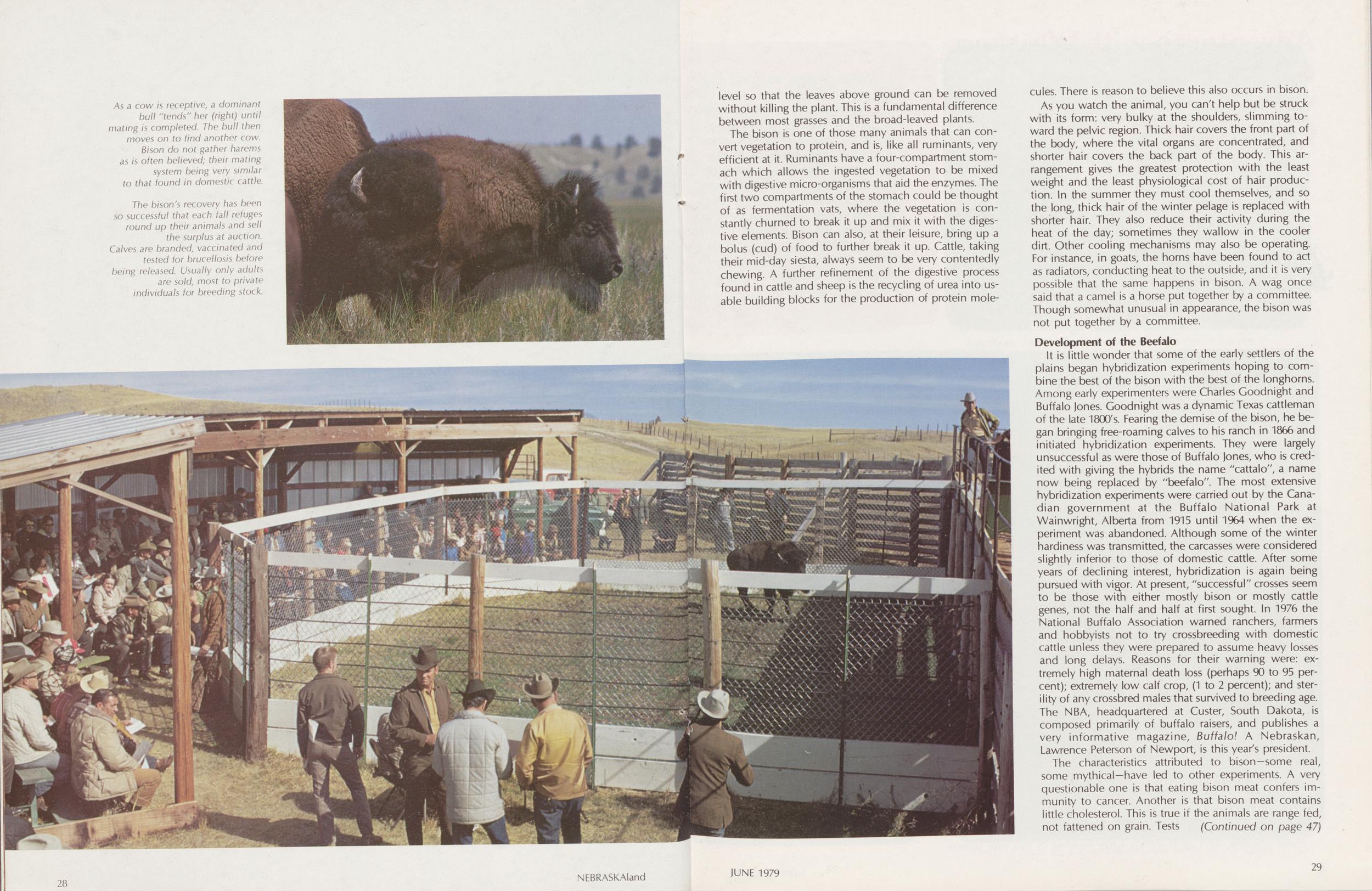
As a cow is receptive, a dominant bull "tends" her (right) until mating is completed. The bull then moves on to find another cow. Bison do not gather harems as is often believed; their mating system being very similar to that found in domestic cattle.
The bison's recovery has been so successful that each fall refuges round up their animals and sell the surplus at auction.
Calves are branded, vaccinated and tested for brucellosis before being released. Usually only adults are sold, most to private individuals for breeding stock.
The bison is one of those many animals that can convert vegetation to protein, and is, like all ruminants, very efficient at it. Ruminants have a four-compartment stomach which allows the ingested vegetation to be mixed with digestive micro-organisms that aid the enzymes. The first two compartments of the stomach could be thought of as fermentation vats, where the vegetation is constantly churned to break it up and mix it with the digestive elements. Bison can also, at their leisure, bring up a bolus (cud) of food to further break it up. Cattle, taking their mid-day siesta, always seem to be very contentedly chewing. A further refinement of the digestive process found in cattle and sheep is the recycling of urea into usable building blocks for the production of protein molecules. There is reason to believe this also occurs in bison.
As you watch the animal, you can't help but be struck with its form: very bulky at the shoulders, slimming toward the pelvic region. Thick hair covers the front part of the body, where the vital organs are concentrated, and shorter hair covers the back part of the body. This arrangement gives the greatest protection with the least weight and the least physiological cost of hair production. In the summer they must cool themselves, and so the long, thick hair of the winter pelage is replaced with shorter hair. They also reduce their activity during the heat of the day; sometimes they wallow in the cooler dirt. Other cooling mechanisms may also be operating. For instance, in goats, the horns have been found to act as radiators, conducting heat to the outside, and it is very possible that the same happens in bison. A wag once said that a camel is a horse put together by a committee. Though somewhat unusual in appearance, the bison was not put together by a committee.
Development of the BeefaloIt is little wonder that some of the early settlers of the plains began hybridization experiments hoping to combine the best of the bison with the best of the longhorns. Among early experimenters were Charles Goodnight and Buffalo Jones. Goodnight was a dynamic Texas cattleman of the late 1800's. Fearing the demise of the bison, he began bringing free-roaming calves to his ranch in 1866 and initiated hybridization experiments. They were largely unsuccessful as were those of Buffalo Jones, who is credited with giving the hybrids the name "cattalo", a name now being replaced by //beefalo,,. The most extensive hybridization experiments were carried out by the Canadian government at the Buffalo National Park at Wainwright, Alberta from 1915 until 1964 when the experiment was abandoned. Although some of the winter hardiness was transmitted, the carcasses were considered slightly inferior to those of domestic cattle. After some years of declining interest, hybridization is again being pursued with vigor. At present, "successful" crosses seem to be those with either mostly bison or mostly cattle genes, not the half and half at first sought. In 1976 the National Buffalo Association warned ranchers, farmers and hobbyists not to try crossbreeding with domestic cattle unless they were prepared to assume heavy losses and long delays. Reasons for their warning were: extremely high maternal death loss (perhaps 90 to 95 percent); extremely low calf crop, (1 to 2 percent); and sterility of any crossbred males that survived to breeding age. The NBA, headquartered at Custer, South Dakota, is composed primarily of buffalo raisers, and publishes a very informative magazine, Buffalo! A Nebraskan, Lawrence Peterson of Newport, is this year's president.
The characteristics attributed to bison—some real, some mythical—have led to other experiments. A very questionable one is that eating bison meat confers immunity to cancer. Another is that bison meat contains little cholesterol. This is true if the animals are range fed, not fattened on grain. Tests (Continued on page 47)
28 NEBRASKAland JUNE 1979 29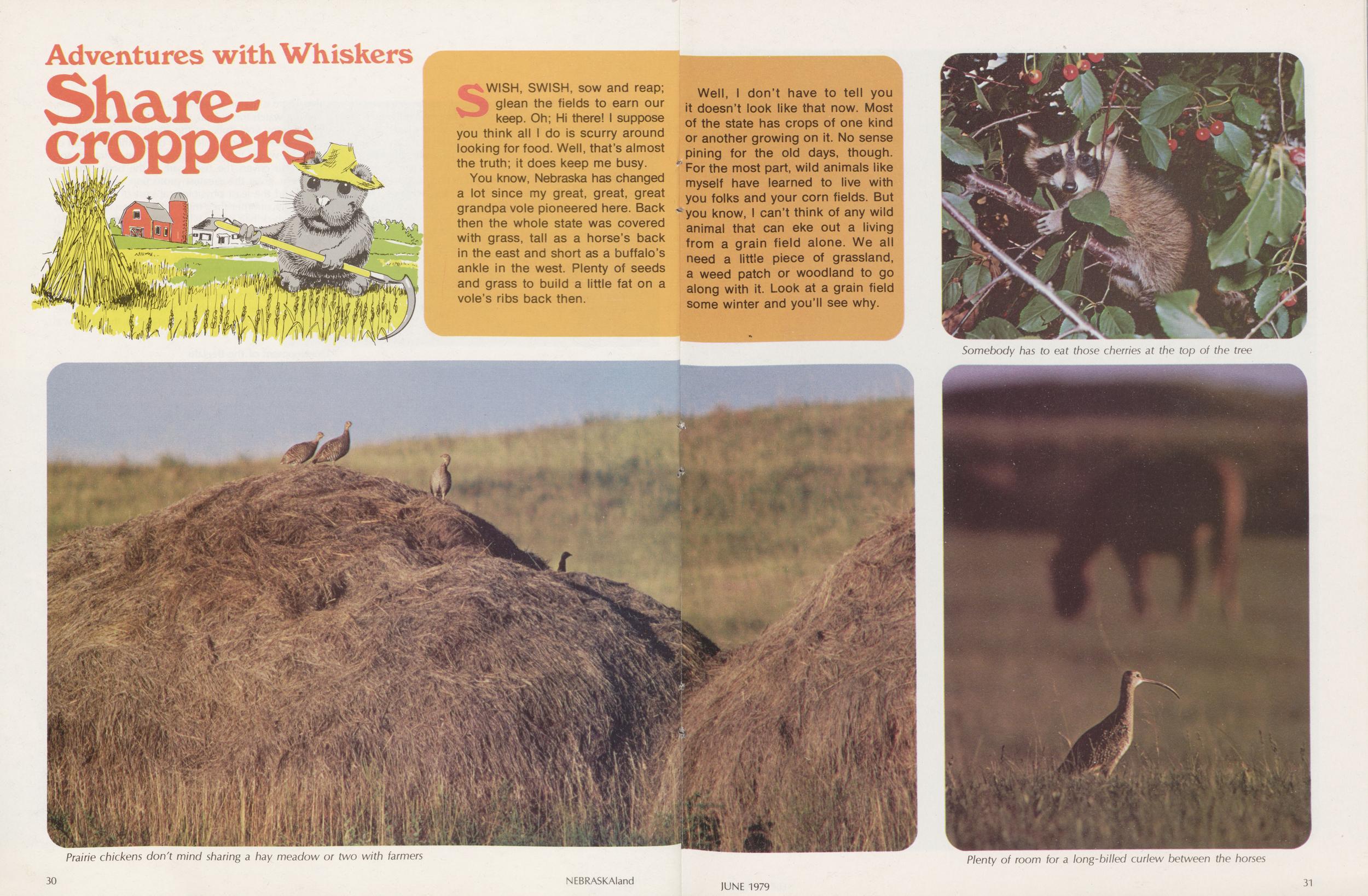
Adventures with Whiskers
Share-croppers
SWISH, SWISH, sow and reap; glean the fields to earn our keep. Oh; Hi there! I suppose you think all I do is scurry around looking for food. Well, that's almost the truth; it does keep me busy.
You know, Nebraska has changed a lot since my great, great, great grandpa vole pioneered here. Back then the whole state was covered with grass, tall as a horse's back in the east and short as a buffalo's ankle in the west. Plenty of seeds and grass to build a little fat on a vole's ribs back then.
Well, I don't have to tell you it doesn't look like that now. Most of the state has crops of one kind or another growing on it. No sense pining for the old days, though. m For the most part, wild animals like myself have learned to live with you folks and your corn fields. But * you know, I can't think of any wild animal that can eke out a living from a grain field alone. We all need a little piece of grassland, a weed patch or woodland to go along with it. Look at a grain field some winter and you'll see why.
Prairie chickens don't mind sharing a hay meadow or two with farmers
Somebody has to eat those cherries at the top of the tree
Plenty of room for a long-billed curlew between the horses
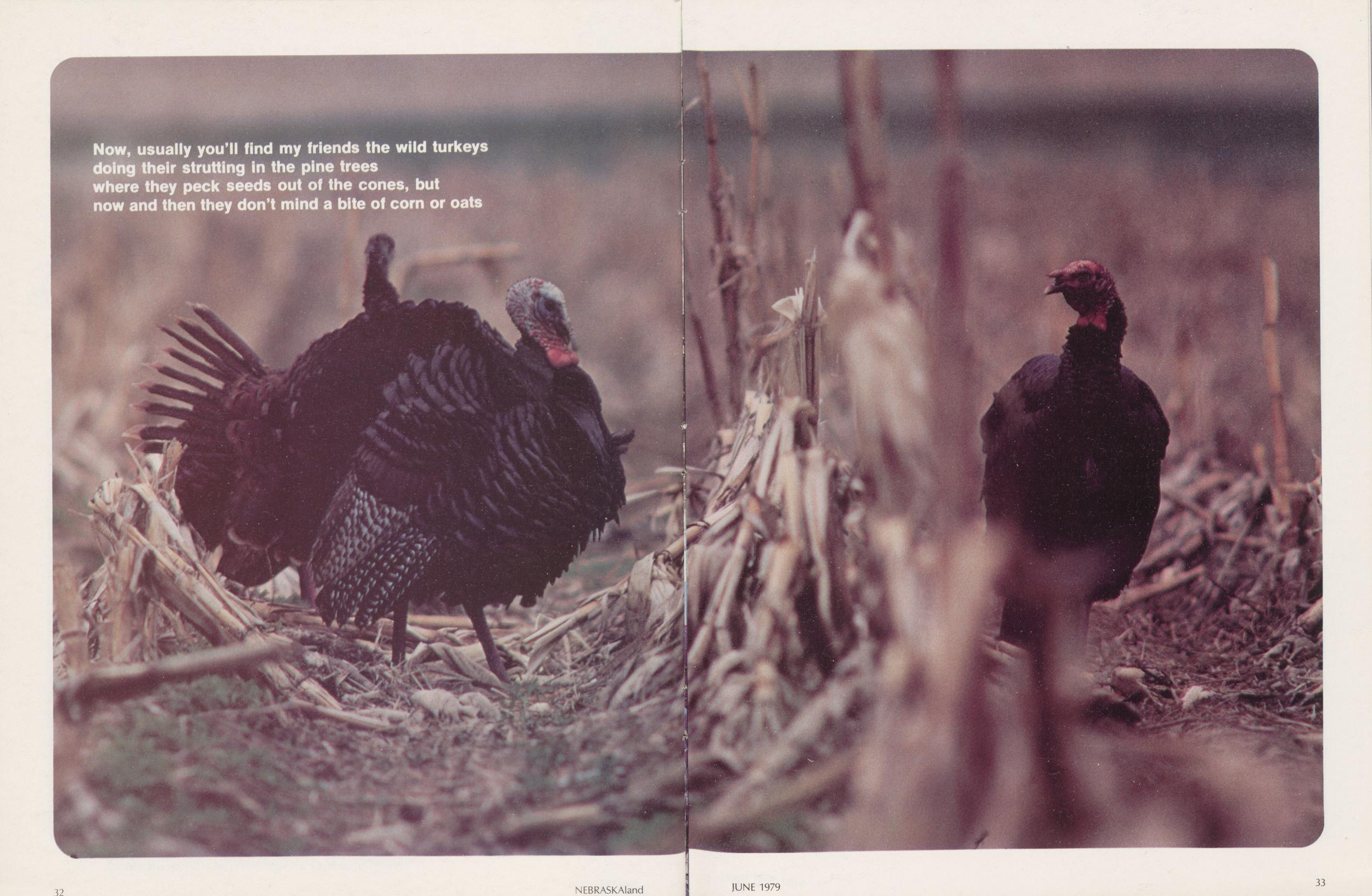
Now, usually you'll find my friends the wild turkeys doing their strutting in the pine trees where they peck seeds out of the cones, but now and then they don't mind a bite of corn or oats
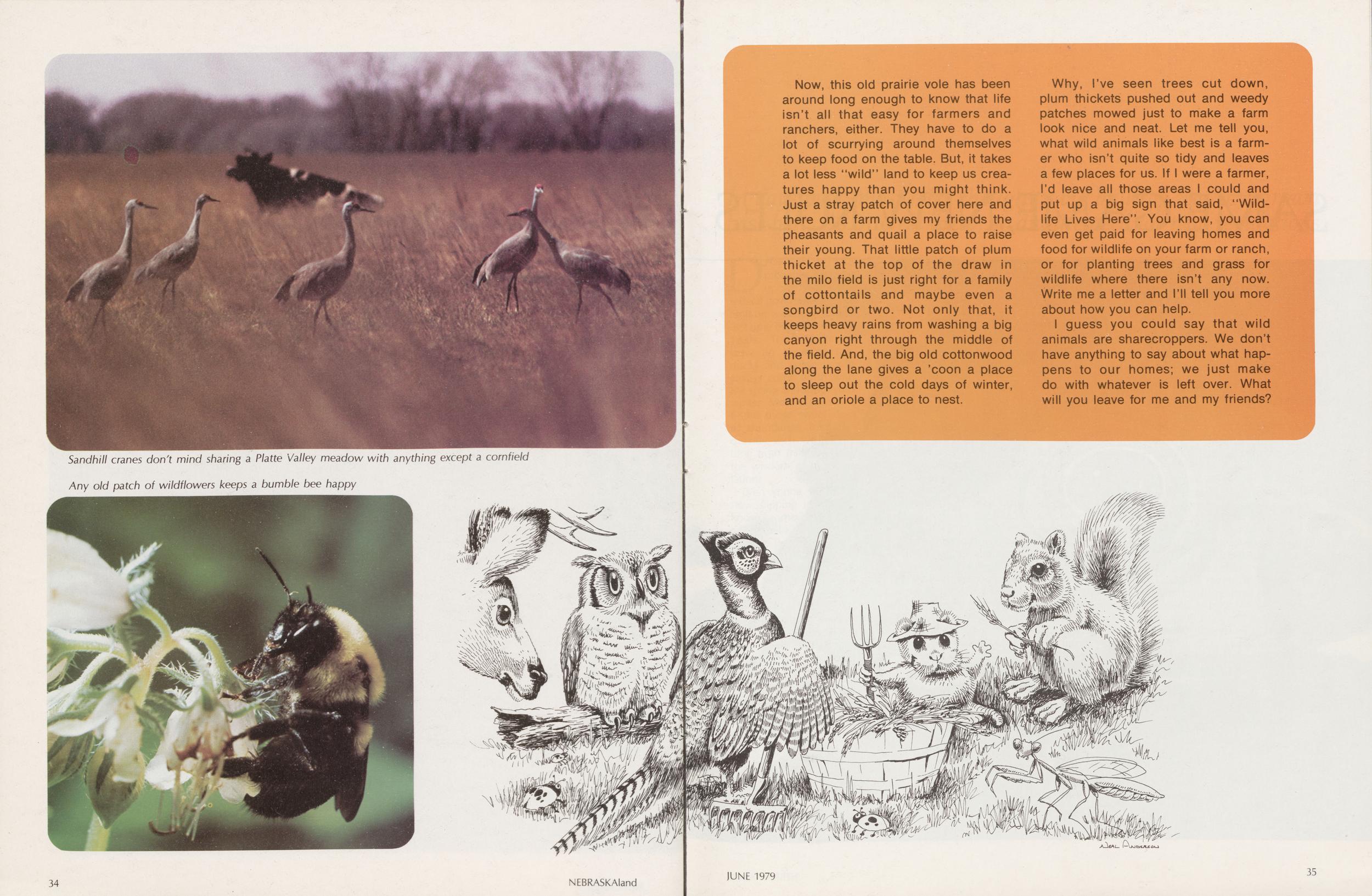
Sandhill cranes don't mind sharing a Platte Valley meadow with anything except a cornfield
Any old patch of wildflowers keeps a bumble bee happy
Now, this old prairie vole has been around long enough to know that life isn't all that easy for farmers and ranchers, either. They have to do a lot of scurrying around themselves to keep food on the table. But, it takes a lot less "wild" land to keep us creatures happy than you might think. Just a stray patch of cover here and there on a farm gives my friends the pheasants and quail a place to raise their young. That little patch of plum thicket at the top of the draw in the milo field is just right for a family of cottontails and maybe even a songbird or two. Not only that, it keeps heavy rains from washing a big canyon right through the middle of the field. And, the big old cottonwood along the lane gives a 'coon a place to sleep out the cold days of winter, and an oriole a place to nest.
Why, I've seen trees cut down, plum thickets pushed out and weedy patches mowed just to make a farm look nice and neat. Let me tell you, what wild animals like best is a farmer who isn't quite so tidy and leaves a few places for us. If I were a farmer, I'd leave all those areas I could and put up a big sign that said, "Wildlife Lives Here". You know, you can even get paid for leaving homes and food for wildlife on your farm or ranch, or for planting trees and grass for wildlife where there isn't any now. Write me a letter and I'll tell you more about how you can help.
I guess you could say that wild animals are sharecroppers. We don't have anything to say about what happens to our homes; we just make do with whatever is left over. What will you leave for me and my friends?
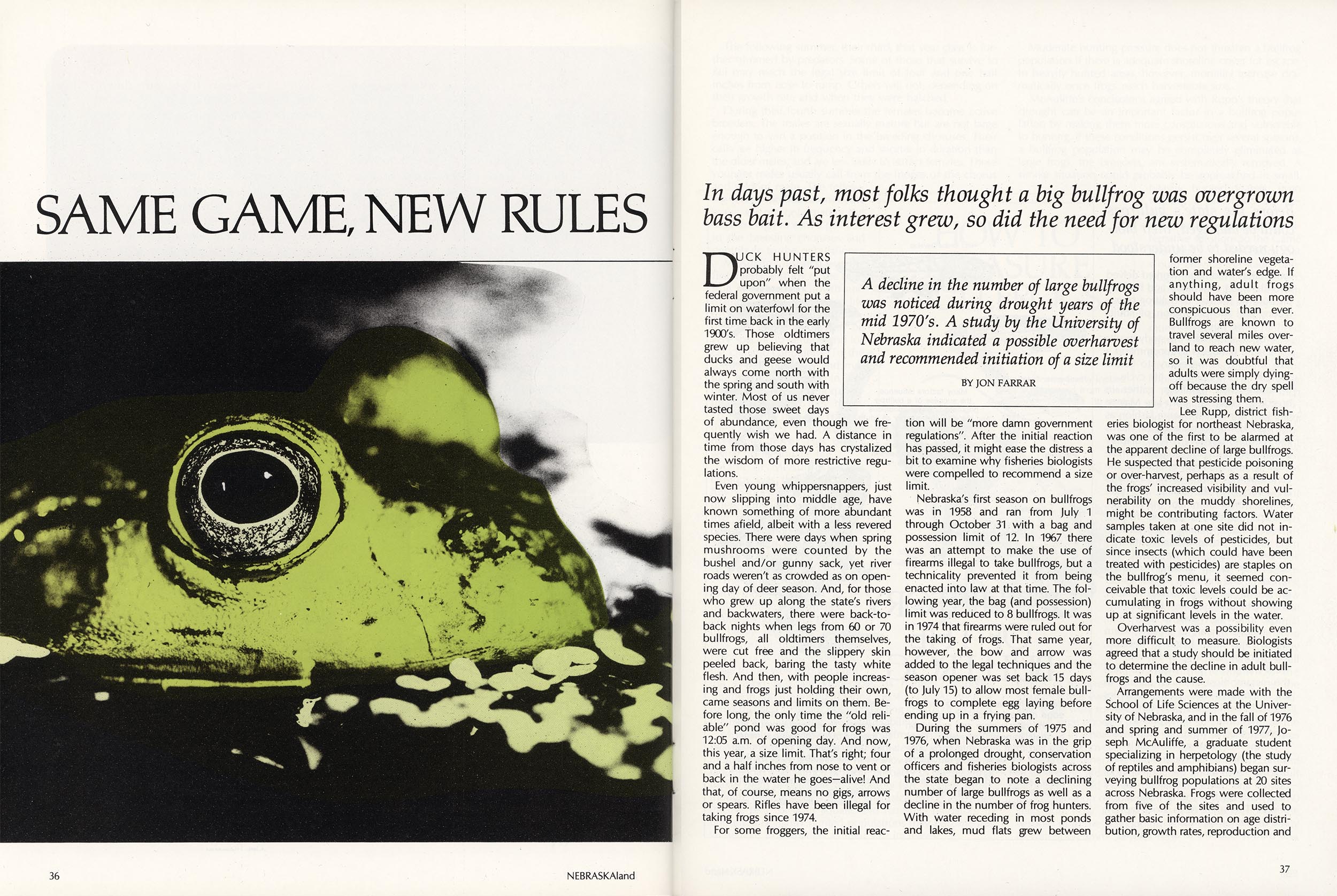
SAME GAME, NEW RULES
In days past, most folks thought a big bullfrog was overgrown bass bait. As interest grew, so did the need for new regulations
DUCK HUNTERS probably felt "put upon" when the federal government put a limit on waterfowl for the first time back in the early 1900's. Those oldtimers grew up believing that ducks and geese would always come north with the spring and south with winter. Most of us never tasted those sweet days of abundance, even though we frequently wish we had. A distance in time from those days has crystalized the wisdom of more restrictive regulations.
Even young whippersnappers, just now slipping into middle age, have known something of more abundant times afield, albeit with il less revered species. There were days when spring mushrooms were counted by the bushel and/or gunny sack, yet river roads weren't as crowded as on opening day of deer season. And, for those who grew up along the state's rivers and backwaters, there were back-to-back nights when legs from 60 or 70 bullfrogs, all oldtimers themselves, were cut free and the slippery skin peeled back, baring the tasty white flesh. And then, with people increasing and frogs just holding their own, came seasons and limits on them. Before long, the only time the "old reliable" pond was good for frogs was 12:05 a.m. of opening day. And now, this year, a size limit. That's right; four and a half inches from nose to vent or back in the water he goes-alive! And that, of course, means no gigs, arrows or spears. Rifles have been illegal for taking frogs since 1974
A decline in the number of large bullfrogs was noticed during drought years of the mid 1970's. A study by the University of Nebraska indicated a possible overharvest and recommended initiation of a size limit BY JON FARRAR
For some froggers, the initial reaction will be "more damn government regulations". After the initial reaction has passed, it might ease the distress a bit to examine why fisheries biologists were compelled to recommend a size limit.
Nebraska's first season on bullfrogs was in 1958 and ran from July 1 through October 31 with a bag and possession limit of 12. In 1%7 there was an attempt to make the use of firearms illegal to take bullfrogs, but a technicality prevented it from being enacted into law at that time. The following year, the bag (and possession) limit was.reduced to 8 bullfrogs. It was in 1974 that firearms were ruled out for the taking of frogs. That same year, however, the bow and arrow was added to the legal techniques and the season opener was set back 15 days (to July 15) to allow most female bullfrogs to complete egg laying before ending up in a frying pan.
During the summers of 1975 and 1976, when Nebraska was in the grip of a prolonged drought, conservation officers and fisheries biologists across the state began to note a declining number of large bullfrogs as well as a decline in the number of frog hunters. With water receding in most ponds and lakes, mud flats grew between former shoreline vegetation and water's edge. If anything, adult frogs should have been more conspicuous than ever. Bullfrogs are known to travel several miles overland to reach new water, so it was doubtful that adults were simply dying off because the dry spell was stressing them.
Lee Rupp, district fisheries biologist for northeast Nebraska, was one of the first to be alarmed at the apparent decline of large bullfrogs. He suspected that pesticide poisoning or over-harvest, perhaps as a result of the frogs' increased visibility and vulnerability on the muddy shorelines, might be contributing factors. Water samples taken at one site did not indicate toxic levels of pesticides, but since insects (which could have been treated with pesticides) are staples on the bullfrog's menu, it seemed conceivable that toxic levels could be accumulating in frogs without showing up at significant levels in the water.
Overharvest was a possibility even more difficult. to measure. Biologists agreed that a study should be initiated to determine the decline in adult bullfrogs and the cause.
Arrangements were made with the School of Life Sciences at the University of Nebraska, and in the fall of 1976 and spring and summer of 1977, Joseph McAuliffe, a graduate student specializing in herpetology (the study of reptiles and amphibians) began surveying bullfrog populations at 20 sites across Nebraska. Frogs were collected from five of the sites and used to gather basic information on age distribution, growth rates, reproduction and
NEBRASKAland 37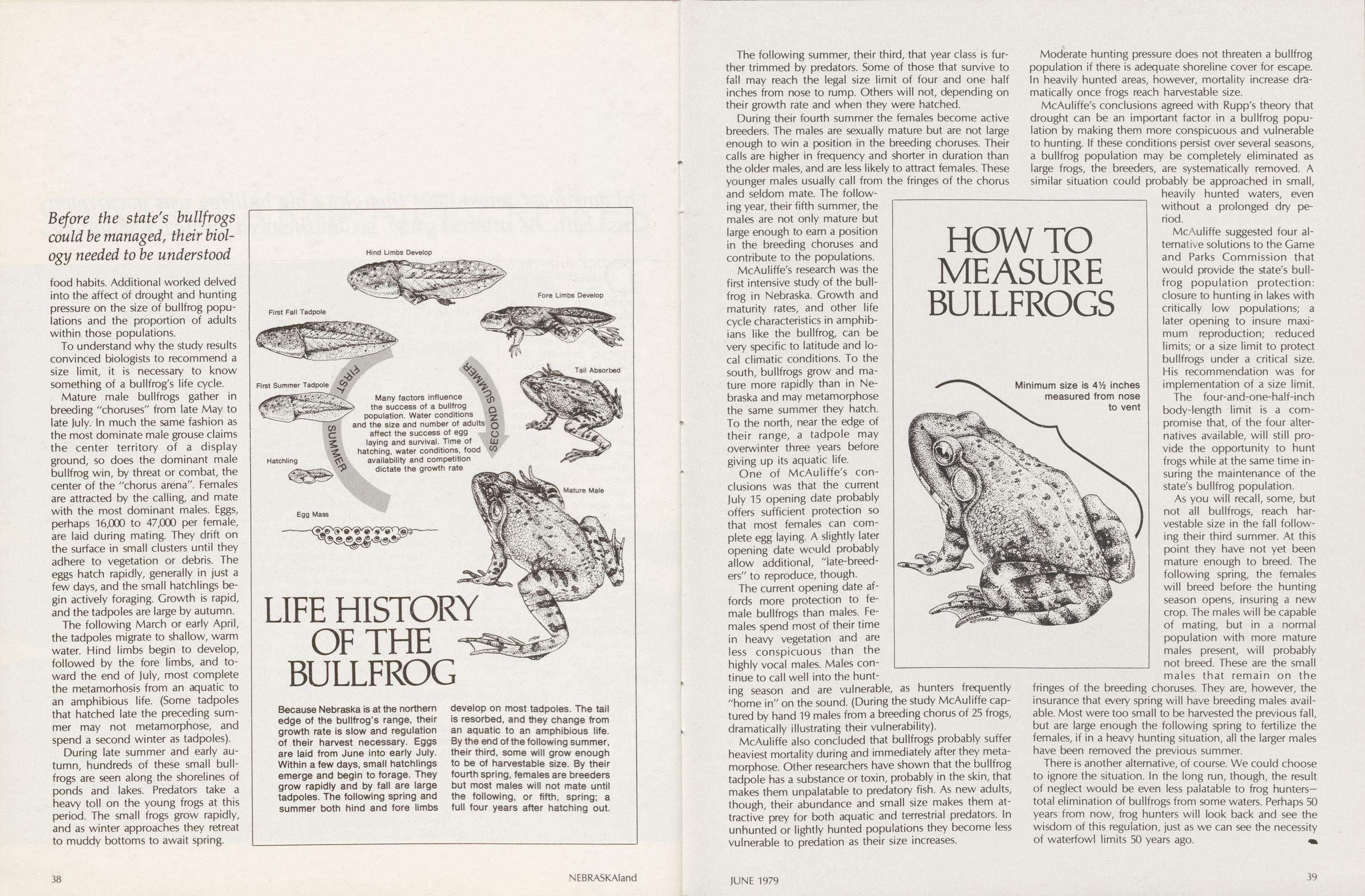 Before the state's bullfrogs could be managed, their biology needed to be understood
food habits. Additional worked delved into the affect of drought and hunting pressure on the size of bullfrog populations and the proportion of adults within those populations.
To understand why the study results convinced biologists to recommend a size limit, it is necessary to know something of a bullfrog's life cycle.
Mature male bullfrogs gather in breeding "choruses" from late May to late July. In much the same fashion as the most dominate male grouse claims the center territory of a display ground, so does the dominant male bullfrog win, by threat or combat, the center of the "chorus arena". Females are attracted by the calling, and mate with the most dominant males. Eggs, perhaps 16,000 to 47,000 per female, are laid during mating. They drift on the surface in small clusters until they adhere to vegetation or debris. The eggs hatch rapidly, generally in just a few days, and the small hatchlings begin actively foraging. Growth is rapid, and the tadpoles are large by autumn.
The following March or early April, the tadpoles migrate to shallow, warm water. Hind limbs begin to develop, followed by the fore limbs, and toward the end of July, most complete the metamorhosis from an aquatic to an amphibious life. (Some tadpoles that hatched late the preceding summer may not metamorphose, and spend a second winter as tadpoles).
During late summer and early autumn, hundreds of these small bullfrogs are seen along the shorelines of ponds and lakes. Predators take a heavy toll on the young frogs at this period. The small frogs grow rapidly, and as winter approaches they retreat to muddy bottoms to await spring.
Many factors influence the success of a bullfrog population. Water conditions and the size and number of adults affect the success of egg laying and survival. Time of hatching, water conditions, food availability and competition dictate the growth rate
LIFE HISTORY OF THE BULLFROGBecause Nebraska is at the northern edge of the bullfrog's range, their growth rate is slow and regulation of their harvest necessary. Eggs are laid from June into early July. Within a few days, small hatchlings emerge and begin to forage. They grow rapidly and by fall are large tadpoles. The following spring and summer both hind and fore limbs develop on most tadpoles. The tail is resorbed, and they change from an aquatic to an amphibious life. By the end of the following summer, their third, some will grow enough to be of harvestable size. By their fourth spring, females are breeders but most males will not mate until the following, or fifth, spring; a full four years after hatching out.
The following summer, their third, that year class is further trimmed by predators. Some of those that survive to fall may reach the legal size limit of four and one half inches from nose to rump. Others will not, depending on their growth rate and when they were hatched.
During their fourth summer the females become active breeders. The males are sexually mature but are not large enough to win a position in the breeding choruses. Their calls are higher in frequency and shorter in duration than the older males, and are less likely to attract females. These younger males usually call from the fringes of the chorus and seldom mate. The following year, their fifth summer, the males are not only mature but large enough to earn a position in the breeding choruses and contribute to the populations.
McAuliffe's research was the first intensive study of the bullfrog in Nebraska. Growth and maturity rates, and other life cycle characteristics in amphibians like the bullfrog, can be very specific to latitude and local climatic conditions. To the south, bullfrogs grow and mature more rapidly than in Nebraska and may metamorphose the same summer they hatch. To the north, near the edge of their range, a tadpole may overwinter three years before giving up its aquatic life.
One of McAuliffe's conclusions was that the current July 15 opening date probably offers sufficient protection so that most females can complete egg laying. A slightly later opening date would probably allow additional, "late-breeders" to reproduce, though.
The current opening date affords more protection to female bullfrogs than males. Females spend most of their time in heavy vegetation and are less conspicuous than the highly vocal males. Males continue to call well into the hunting season and are vulnerable, as hunters frequently "home in" on the sound. (During the study McAuliffe captured by hand 19 males from a breeding chorus of 25 frogs, dramatically illustrating their vulnerability).
McAuliffe also concluded that bullfrogs probably suffer heaviest mortality during and immediately after they metamorphose. Other researchers have shown that the bullfrog tadpole has a substance or toxin, probably in the skin, that makes them unpalatable to predatory fish. As new adults, though, their abundance and small size makes them attractive prey for both aquatic and terrestrial predators. In unhunted or lightly hunted populations they become less vulnerable to predation as their size increases.
HOW TO MEASURE BULLFROGS Minimum size is 4 1/2 inches measured from nose to vent
Moderate hunting pressure does not threaten a bullfrog population if there is adequate shoreline cover for escape. In heavily hunted areas, however, mortality increase dramatically once frogs reach harvestable size.
McAuliffe's conclusions agreed with Rupp's theory that drought can be an important factor in a bullfrog population by making them more conspicuous and vulnerable to hunting. If these conditions persist over several seasons, a bullfrog population may be completely eliminated as large frogs, the breeders, are systematically removed. A similar situation could probably be approached in small, heavily hunted waters, even without a prolonged dry period.
McAuliffe suggested four alternative solutions to the Game and Parks Commission that would provide the state's bullfrog population protection: closure to hunting in lakes with critically low populations; a later opening to insure maximum reproduction; reduced limits; or a size limit to protect bullfrogs under a critical size. His recommendation was for implementation of a size limit.
The four-and-one-half-inch body-length limit is a compromise that, of the four alternatives available, will still provide the opportunity to hunt frogs while at the same time insuring the maintenance of the state's bullfrog population.
As you will recall, some, but not all bullfrogs, reach harvestable size in the fall following their third summer. At this point they have not yet been mature enough to breed. The following spring, the females will breed before the hunting season opens, insuring a new crop. The males will be capable of mating, but in a normal population with more mature males present, will probably not breed. These are the small males that remain on the fringes of the breeding choruses. They are, however, the insurance that every spring will have breeding males available. Most were too small to be harvested the previous fall, but are large enough the following spring to fertilize the females, if in a heavy hunting situation, all the larger males have been removed the previous summer.
There is another alternative, of course. We could choose to ignore the situation. In the long run, though, the result of neglect would be even less palatable to frog hunters - total elimination of bullfrogs from some waters. Perhaps 50 years from now, frog hunters will look back and see the wisdom of this regulation, just as we can see the necessity of waterfowl limits 50 years ago.
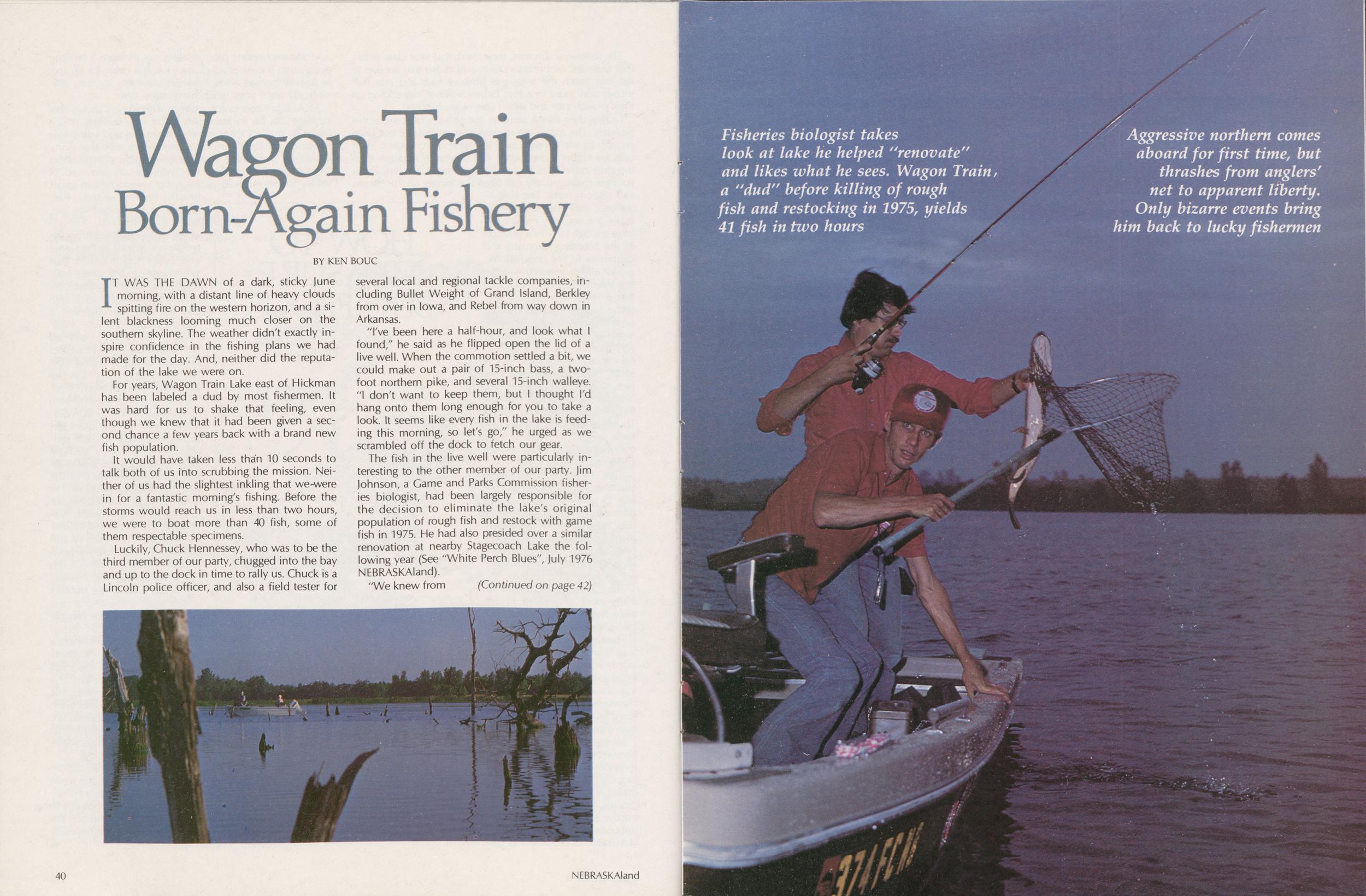
Wagon Train Born-Again Fishery
IT WAS THE DAWN of a dark, sticky June morning, with a distant line of heavy clouds spitting fire on the western horizon, and a silent blackness looming much closer on the southern skyline. The weather didn't exactly inspire confidence in the fishing plans we had made for the day. And, neither did the reputation of the lake we were on.
For years, Wagon Train Lake east of Hickman has been labeled a dud by most fishermen. It was hard for us to shake that feeling, even though we knew that it had been given a second chance a few years back with a brand new fish population.
It would have taken less than 10 seconds to talk both of us into scrubbing the mission. Neither of us had the slightest inkling that we-were in for a fantastic morning's fishing. Before the storms would reach us in less than two hours, we were to boat more than 40 fish, some of them respectable specimens.
Luckily, Chuck Hennessey, who was to be the third member of our party, chugged into the bay and up to the dock in time to rally us. Chuck is a Lincoln police officer, and also a field tester for several local and regional tackle companies, including Bullet Weight of Grand Island, Berkley from over in Iowa, and Rebel from way down in Arkansas.
"I've been here a half-hour, and look what I found," he said as he flipped open the lid of a live well. When the commotion settled a bit, we could make out a pair of 15-inch bass, a two-foot northern pike, and several 15-inch walleye. "I don't want to keep them, but I thought I'd hang onto them long enough for you to take a look. It seems like every fish in the lake is feeding this morning, so let's go," he urged as we scrambled off the dock to fetch our gear.
The fish in the live well were particularly interesting to the other member of our party. Jim Johnson, a Game and Parks Commission fisheries biologist, had been largely responsible for the decision to eliminate the lake's original population of rough fish and restock with game fish in 1975. He had also presided over a similar renovation at nearby Stagecoach Lake the following year (See "White Perch Blues", July 1976 NEBRASKAland). "We knew from (Continued on page 42)
WAGON TRAIN: BORN-AGAIN FISHERY
(Continued from page 40)netting and shocking that the new fish were doing well here, but it is especially satisfying to see fishermen catching them," Jim said as he examined and released Chuck's half-hour's take.
As we chugged toward the dam, where Chuck had caught his fish, he passed out some of the special lures he had been using. In size and shape they were just like a lot of other crankbaits you'd see in the tackle shop, with chubby, pot-bellied bodies and oversized plastic lips to make them dive and wobble. But, their paint jobs were something else.
There were some that had the exact coloration and markings of a perch, down to the finest detail. Others were spittin' images of bass, crappie, and other fish.
'These paint jobs are the very latest thing in fishing lures. Rebel calls them 'naturalized' colors, and I hear that other companies are coming out with similar finishes," Chuck said. He told us that only Rebel Company staff, field testers like himself, and a few outdoor writers had the new, top-secret Rebel lures at that time, but that they would be on the market by the next year.
We started at the east end of the dam, flipping the plugs to the edge of the weedbeds along the rocks. "They seem to be in bunches. Before you showed up, I had 12 straight strikes," Chuck said as Jim made his second cast. Jim started to question the statement, but was cut off in mid-sentence by a fish. A minute later, he cranked aboard a 14-inch walleye; too small to keep but an encouraging omen just the same.
A few minutes later, Jim tied into a 24-inch northern, and a couple of butterball rock bass near the outlet completed our first pass along the dam. Chuck wasn't idle, either, taking a small walleye and a couple of rock bass. The game fish were immediately released, and the rock bass deposited in the live well toward a future fish dinner.
The run back up the dam started about the same—some legal-size walleye, a rock bass here and there, and small bass and pike. About midway along the dam, Jim reared back on a particularly good hit and found himself fast to a respectable fish. It ran with enough authority to strip line from his spinning outfit, and kept Jim busy for a couple of minutes. Then, the fish headed for the surface, rolling and splashing a bit alongside the boat before diving again.
"Why, you no-good cannibal," Jim uttered in mock indignation. "That was a largemouth, and he hit one of your bass-colored plugs," he told Chuck. "He's a nice one, though, maybe three pounds. Get the net ready and scoop up that bass-eating so-and-so the next time he surfaces." But, Chuck never got the chance. Seconds later, the bass pulled loose and was gone.
'That was a doggone nice fish for a 2 1/2-year-old lake," Jim said. "In fact, it was as good a bass as I've caught in a while. I was happy with the number of fish we were seeing, and now I'm impressed with the size of that bass. I'd say this lake is in fine shape."
Chuck nodded agreement. "I've fished this lake since I was 12 years old, practically since it was built. All that time I caught a few big bass, but not many, and what few smaller bass I caught seemed kind of scrawny and stunted. At first, I was against killing those few big fish and starting over, but now I can see that the lake is a lot better off because of it. There'll be big bass here in a year or two, and lots of healthy smaller ones growing up to take their place. It's already a much better lake than it ever was all those years before renovation," Chuck said as he clicked the electric motor back to life.
By that time, the rumbles and flashes from the storm to the west were growing more noticeable, though the fireworks was still many miles distant. As for the cloud bank to the south, the dam masked its approach for a good while. But, just as we turned for our third pass along the dam, it was suddenly upon us. It looked big and black and full of water, but there was no wind or lightning with it. We felt a few sprinkles, but decided to stay just a bit longer. The fish continued hitting; largemouths to two pounds, two-foot pike, 12 to 15-inch walleye. Even chubby little rock bass were climbing all over those fancy-painted plugs. But, the best action of the day was yet to come.
Jim flipped his plug through a gap in the weeds into shallow water right against the rocks. He didn't even have time to begin a retrieve before something big grabbed it and headed for the other end of the dam. "I don't know what it is, but it's big," Jim said. "Maybe its a northern," he speculated as the fish stripped line in a fast run, "or another nice bass. . ." as it bored toward the bottom, "or maybe one of those muskies we stocked..."
After several minutes of suspense, the fish provided the answer. With a single, spectacular leap, he announced that he was the boss pike of these waters, and didn't like the taste of our steel hooks. He bored for the bottom, then sulked under the boat for a spell, and finally surfaced alongside. His sleek 30-inch body was temporarily exhausted, but fiery eyes warned of a still-burning spirit.
Chuck put the net under the fish as best he could and started to hoist him aboard. Just as he was about to clear the side of the boat, the pike made one last violent commotion, flipped out of the net and splashed back into the water. The plug dangled from the lip of the net.
"He's gone," was all that Jim could say. Chuck came up with something a bit more spontaneous.
Then, Jim tensed up, grabbing his spinning outfit in one hand and the plug in the other. "Something's taking line," he announced in disbelief. Cautiously retrieving both ends of the monofilament hand over hand, he peered over the side. In a few seconds, the pike quietly floated to the surface again, his jaws clamped stubbornly around a section of Jim's line. Chuck made another stab with the landing net, and hauled the hapless pike aboard before he could even twitch in protest.
He measured a bit over 31 inches and weighed at least seven pounds by estimates of both fishermen. Then, after all the hassle of getting the pike into the boat, they slipped him back over the side.
The rest of that pass along the dam seemed uneventful by comparison to the battle with the pike, at least until we came to the outlet structure. We saw fish activity there and along some nearby weeds. But, when the plugs couldn't raise a strike, Chuck switched to a rod rigged with a plastic worm.
In short order, the tip of his baitcasting rod was bent halfway to the handle, thanks to a spunky 2 1/2-pound largemouth at the end of the line. That counterfeit worm was also poison for rock bass, as they greedily gulped it down even though it was nearly as long as they were.
Chuck was tiring of playing with those panfish and was about to move on when he felt another fish inhale the worm. He struck hard, and felt something solid. It was another largemouth, a bit better than the one he had caught just minutes before. And, its fight lasted a bit longer. But, the issue was never really in doubt, and after a minute or so Chuck landed and released a fine, fat bass of close to three pounds.
We were sitting there, debating whether to head back up the dam or try another spot, when the answer came from behind us. A big fish was tearing up the surface in a pocket of weeds a hundred yards up the west shoreline of the lake. As the electric motor dragged the boat closer, the fish slashed the surface several more times.
"It could be a muskie," said Jim, a native of Michigan's muskellunge country. 'They act like that sometimes. They set up a territory and defend it against other fish. A pike will cruise a lake and feed at random, but a muskie will stake a claim to a spot and stay there."
Since surface action seemed to be what the fish wanted, Chuck snipped off the diving plug and tied on a big-bladed, shallow-running spinnerbait. His first cast to the pocket triggered an explosion, but Chuck missed on the strike and sent his lure rocketing back to the boat. The second cast got another violent charge from the fish, but the hook again failed to connect. On the third cast, an intimidating wake followed the lure to the edge of the pocket, but nothing touched it. The fourth cast drew a blank, as did the fifth, sixth, and seventh. Whatever that mystery fish
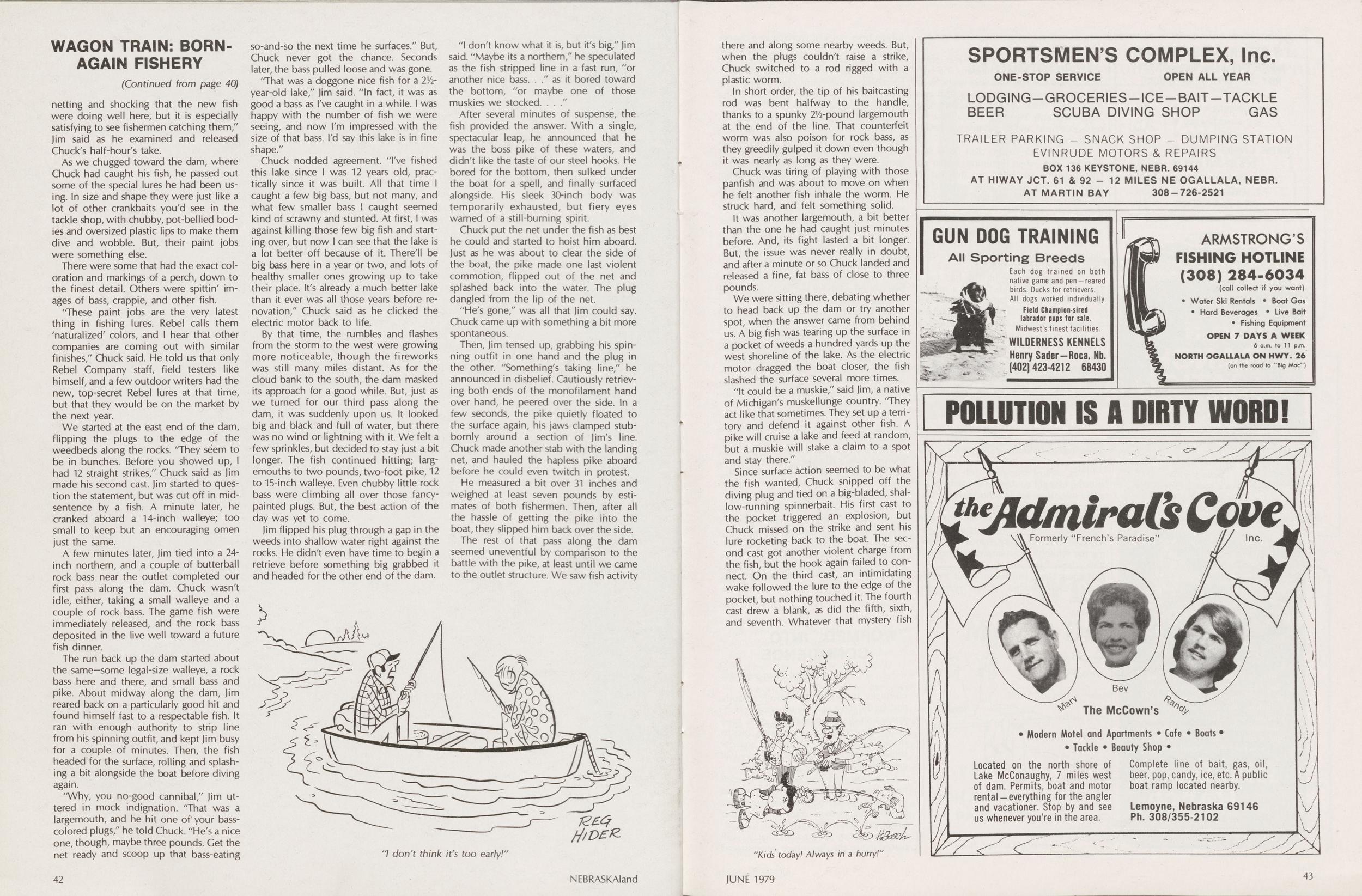
"I don't think it's too early!
Kids today! Always in a hurry!"
was, he was no longer interested in what Chuck had to offer.
By that time, the weather was commanding more of our attention. The barrage of thunder and lightning to the west was moving ever closer, but was still at a respectable distance. The cloud coming from the south, however, was almost directly overhead, and its sprinkle was developing into a light rain.
We went back to the dam for a few minutes, but when lightning began to crackle to the southeast, we decided to head for shore. By the time we reached the dock, the light rain had grown to a downpour, and that lightning to the southeast was hammering hills only a few miles away like artillery. We huddled in the van, attempting to surround two vacuum jugs of coffee while the rain drummed on the tin roof.
'That's the best fishing I've had for a long time," Chuck said. "I kept a mental record, and Jim and I caught 41 fish in less than two hours. I think this is going to be a hot lake for a couple of years. It's already a lot better than it was a few years ago."
Jim shook his head in agreement as he dunked the last of the doughnuts we had picked up for breakfast that morning. "We were sure that we could improve this lake. Before the renovation it was overrun with white perch, shad, carp and bullheads, all of them bottom-feeders. They cleaned up all the insects and other bottom life; the same things that young bass and other game fish eat during most of their first year.
'Thus, almost no game fish survived, and the bluegill couldn't make it because all those bottom-feeders muddied the water, cutting off the light and killing the plankton that their young eat. The lake was a mess with no prospects of correcting itself, but with every chance of spreading the white perch menace to other Salt Valley lakes," Jim said.
"I know what you mean about muddy water," Chuck added. "A few years ago, fishing here was like working in a chocolate malt. About all you'd see in the lake was white perch, and the backwaters held more carp than I'd ever seen in one place before. Now, even after a rain like this, the water will still be in good shape and it'll be clear in a couple of days."
As we talked, the rainstorm picked up in intensity. Just about shouting to overcome the noise of the downpour on the metal roof of the van, Jim continued. "We had some objections to the renovation from a handful of fishermen who specialize in big bass. There were some lunkers here before the renovation, but I don't think anyone realizes how few. We shocked or netted about 20 before we applied the chemical, and we spotted another half-dozen or so belly-up afterwards. That's not much of a fishery for a lake like this, and those fish were serving only an elite few fishermen. With the renovation, we created a lake that will offer fish for just about every kind of angler," Jim concluded.
The storm passed in about 30 minutes, but scattered remnants of rain squalls were still all around. We tried another pass along the dam, staying within easy reach of the parking lot should a threatening storm cell come our way. Later, after the weather cleared a bit, we tried parts of the shoreline and the flooded trees at the upper end of the lake.
But, the storm had put an end to the fishing. Nothing but stumps touched the crankbaits, which had been magic an hour before, and only a few weeds toyed with the spinnerbait that enraged that "mystery fish" just before the storm. We headed for home.
"This trip really makes me feel good," Jim said. "Seeing a lake develop from worse than nothing to a fine fishery is really satisfying to a fisheries biologist. We invested a lot of work in this lake—hundreds of hours netting, planning, even burying tons of dead carp and shad in August heat," he said. "But, it was all worth it."
'You're jerking too hard, Helen'
"WORMED" INTO CONFIDENCE
(Continued from page 16)electricity. It's bottom is relatively smooth, and for the most part the lake can be considered shallow. But Maloney does have some interesting structure, with depths quickly dropping to 15 feet off shallow shelves, and the use of a depth finder will greatly enhance fishing opportunities.
No sooner had we put in and headed for a familiar and often productive hole near Duck Island, than Jack discovered his locator had thrown craps...another count to be levied against fishing for walleyes. However, Jack found that a well placed jolt to the depth box, administered with closed fist and accompanied with a well chosen word, elicited enough signal to find the break line of the hole.
On the upwind side of the hole, a marker was thrown to establish a reference point for the start of the drift. Jack, being more accustomed to the open-bail technique with nightcrawlers, instructed Tom to drift his crawler on the bottom, leaving his bail open and fingering the line until he felt a strike. At that time, Jack pointed out, he should release the line and let the fish suck in the crawler. After about a five count, the bail is closed and the hook set.
The first drift through picked up two definite strikes, two line releases and five counts, two set hooks, but no walleyes. Both nightcrawlers were broken off identically about a half-inch short of the hook. It was then determined that a six or seven count would yield the fish, but a chance to test the theory never came.
It was drift across and troll back, again and again varying the angle with each approach. Other reliable holes were tested and new holes sought. Other fishermen trolled the lake with similar empty stringers. The walleye fishing either completely had turned off, or they simply were not in their old reliable haunts...except for one that caught Tom sleeping with his bail closed and took the worm right on up to the hook.
With a two-pounder finally on the stringer, the storm clouds, now moving in more rapidly, had finally begun to conceal the sun, which triggered a look toward the bays and the lilies by both fishermen. The vote was obviously a unanimous one, as skirted spinner baits were tied on and the boat nudged close to shore.
Jack and Tom had found largemouth seeking the shelter of logs, reeds, and even tumbleweeds on Saturday, in less than a foot of water. But they were seeking shelter for one reason only, and that was to ambush anything that strayed close enough to be gobbled up.
It's hard to imagine what a bass thinks a black-headed, purple-skirted, gangly creature with chartreuse blades is as it actually walks over lilies, climbs reeds, jumps logs, and falls from overhanging branches. But whatever they think, these brightly colored spinner baits often bring out the fish's worst disposition, but for the angler, his best.
According to Jack, what makes bass fishing so exciting is seeing a likely spot in a difficult place to reach, throwing a perfect strike, and hanging a nice bass. In fact, he related a story of fishing a hula popper on Red Willow Reservoir one night with little result. He saw a small opening behind a fallen log that was certain to be harboring a sneaky largemouth. His cast missed the spot completely, and instead of slowly chugging his retrieve across the surface properly, he cranked in the lure as fast as possible to get another shot at the spot
before he drifted away. But, before the retrieve ended, a nice bass made a run on it and tried to devour it. After the attack on the lure being worked completely contrary to it's intended use, he began making all his retrieves that way and ended up with a quick limit of fish.
But, it was a well-placed cast that brought the first black bass of that evening. A respectable largemouth had followed Jack's spinner from close to shore and picked it up right next to the boat. The fish quickly went to the air and spit the lure high over Jack's head. Another well-placed shot brought another boil from a different fish, and the next cast drew a hard bump and then nothing. Tom, with the chartreuse blade, followed through on the irritated bass and came up with him on the next cast. They both believe that if you fail to hook the same bass one or two times with the same lure, he'll lose interest, but often a different colored lure will bring him right back. Tom proved the point of the lesson.
Jack's lure was attacked time after time, but he had difficulty keeping the scrappy fish hooked in the shallow water. Tom was experiencing similar troubles with his success ratio, but finally netted a nice three-pounder just off a sunken log, which he quickly unhooked and released unharmed.
The strikes came at a rapid pace by anybody's standards, and a cast deep into reeds by the elder Harkreader indicated finesse and yielded a wide wave and a bent pole. Jack had tied into a large bass, but the action was short lived, as the big fish refused to be horsed into open water and ungraciously returned the dejected fisherman's lure.
Young Tom nervously glanced at his watch as it was evident that he would be late for his part-time job after school at a local beanery. "Just one more cast" was Jack's rational retort to Tom's concern, and he tossed his tandem spin into about six inches of water. The sandy reef exploded, and this time the fish was hooked solid. Whatever was on the other end of the line charged the boat, passed beneath, and stripped out line as it ran toward the center of the bay. Then suddenly, back it came, returning to the weeds where it was hooked. It broke water, then tried to sound, but jack horsed him to the surface for a look. "It's got to be a Northern", Jack guessed as he squinted through the darkness at the fish now extended on the surface. But the wagon-wheel spikes of it's dorsal fin told the story. It was one of Maloney's fine but unpredictable walleye, weighing nearly six pounds and feeding almost on the beach. The large spinner bait was gone from sight in the fish's mouth. There was no doubt he was on the feed and packed to the gills with dynamite. How to go about fishing for Lake Maloney's walleye is still a good question. The Harkreaders fish for bass.
LIFE AND TIMES OF THE BUFFALO
(Continued from page 29)at the University of Alaska have shown low cholesterol levels in deer, elk, moose and other wild meat. It is a forage, rather than a species, characteristic. A third characteristic of bison is believed to be their greater efficiency as meat producers. They can utilize coarser vegetation than cattle, the calves seem to gain weight faster, but the final answer is not in yet.
The near demise of the bison awakened the conservation conscience of many, among them William Hornaday, chief taxidermist at the National Museum, Theodore Roosevelt, future president, and many ranchers. Refuges were set aside and stocked with nucleus herds. By the 1930/s these herds had increased beyond the carrying capacity of the refuges and it became necessary to harvest the excess. Many were used to stock other refuges and sanctuaries, many were slaughtered, and a few were sold for breeding stock. As time went on, interest in buying live bison increased. There are now an estimated 35,000 to 50,000 bison on refuges and ranches and interest in the animal is booming.
Fall Roundup and AuctionFall is the time when excess individuals from bison refuges and ranches are sold at auction. A bison roundup is an exciting and gruelling event, although every attempt is made to keep it low key.
The routine of the roundups in which I have participated (I can't honestly say I helped, for most of the time I was hanging onto the jeep, my cameras or both) was to move them from open range onto a more confining pasture, then drive smaller groups into a corral where they were separated into calves, cows and bulls. The calves were all branded with the last digit of the year they were born (9 for 1979), vaccinated, tested for brucellosis and released. No calves were sold. The cows were all driven through, those to be sold were kept, tested for brucellosis, tubercolosis and tagged. Tension mounted, and finally the bulls had to be handled. The "squeeze boxes" for the bulls were specially built. The size and weight of these animals, some up to 2,400 pounds, belied their agility. I saw the front hooves of one individual following his massive head above the eight-foot-high corral fence of 4 x 10 planks.
About 10 days later (time for the tuberculin test results must elapse) cars began arriving for the auction. They bore licenses from New York, Indiana, Montana, New Mexico as well as states nearer to Nebraska. Refuge personnel did the bookkeeping, recording for each animal, the age, sex, sales number, price, and person to whom sold. The auctioneer began his chant, and with helpers placed in the audience, 40 bison were sold, all for breeding stock. In an hour the turmoil of the roundup and auction was over and things returned to normal for both participants, men and bison.
Early interest in bison conservation focused on preservation, leading to these wildlife refuge herds that today produce an annual surplus. As the bison recovered from near extinction, emphasis shifted to learning more of their biology, behavior and their role in the grasslands ecosystem. Not until the bison's assured renaissance have detailed observations been made. J. D. Soper in 1941 studied those animals living in Wood Buffalo National Park in the Northwest Territories of Canada. A very thorough study, including bison history, its place in Indian mythology, and its natural history, was published by Tom McHugh in 1958. Since then, studies have proliferated until today we have a great deal of information.
A Year With the BuffaloIf you were visiting Wind Cave National Park in the Black Hills of South Dakota on a beautiful October day, you might wonder why you saw mostly small, isolated groups of bulls. At that time of year the cows and calves, including young bulls up to four years old, are in large herds called matriarchal or core herds. The large core herd may have been in a less accessible area.
Bison are gregarious animals, and the extensive herds of old were made up of many smaller herds. Present-day herds, in the sense of an organized unit, range from 20 to over 100. These groups, while moving, divide and coalesce much like the waters in the tributaries of a braided stream.
Fall is the time of the "good life" for bison as for most wildlife. Food is plentiful and the weather is comfortable. The frenetic activity of insuring the species' continued survival is over for another year. The calves, born in April and May, now grow their darker and heavier pelage, which was a cinnamon brown earlier. The adults' coats also are becoming heavier and more sleek. The activities are now concentrated on acquiring the energy needed for surviving the harsh winters of the Great Plains.
ADDITIONAL READING Dary, D. A. 1975. The buffalo book. Swallow Press, Inc. 811 W. Junior Terrace, Chicago, III., 60613. Hardbound, $15; Avon Paperback, $2.25. The history of the near-extermination of the bison told in journalistic style. McHugh, T 1972. The time of the buffalo. Alfred A. Knopf N. Y. Hardbound, 339 pp. –1979. The time of the buffalo. University of Nebraska Press. 901 N. 17th St., Lincoln, NE., 68588. Paperback, 331 pp. $5.50. Roe, F. G. 1970. The North American buffalo. 2nd. ed, University of Toronto Press. Soper, J. D. 1941. History, range, homelife of the northern bison. Ecological Monographs, 11:347-412.As fall turns to winter, the bisons' main activities are still feeding and resting, but their mid-day siestas get shorter as the day shortens, and soon most of the day is spent in grazing, for the bison is primarily a diurnal animal. Canadian Biologist J. D. Soper wrote: "Much of the drowsy, brilliant midday period is devoted to drinking and dreamy inactivity, interposed with fitful scratching, indolent napping and rolling— However, in winter snow is always at hand and no time is lost from feeding." In winter they utilize snow, as their moisture requirements are less than in summer. They seem to require some form of moisture almost daily.
As the short days of winter begin to lengthen, the lead-colored clouds of winter are replaced by fluffy white cumulus clouds of spring and summer. It is a time for renewal; a reawakening in nature. It is not a haphazard arrangement that lush green vegetation and bison calves arrive at the same time—mid April to mid May for most calves. The calves weigh about 40 pounds at birth and are precocial; able to walk within an hour or two after birth. Quite often the cow leaves the herd for calving and remains isolated for a day or two. This is a "bonding period" when the calf is imprinted upon the mother—a very significant event that promotes survival.
For the first month or so, the calf remains with its mother but gradually begins to join other calves, giving rise to the term "play group." Eventually the calves take their place in the adult group and play seems to be preparation for adulthood.
Bonding appears to be a natural, and for mammals, a somewhat universal process. We are just beginning to learn its importance in humans. Research shows there are many advantages to leaving the human baby with its mother rather than placing it in a nursery with other newborns.
When I was getting my education (and indoctrination) in zoology, one did not attribute (under penalty of flunking exams) human behaviour to non-human animals. But now the race is on for grants to study animal behavior to, among other things, better understand human behavior.
Weaning of the calf is completed during the rutting or running season. At Ft. Niobrara National Wildlife Refuge near Valentine, Nebraska, the rutting season begins in mid July and reaches a peak during the last of July and first part of August. This is the social season for the bison. The bulls, usually wary, now become feisty, challenging other bulls and testing the cows for receptivity. Most challenges result in one of the pair giving in, by signals ranging from submissive behavior (turning its head to the side) to turning tail and "getting the hell out." The loser will often wallow, ferociously attacking the earth. This is a displacement activity, in human terms, relieving frustration by attacking the ground rather than its enemy, or "taking a walk
46 NEBRASKAland JUNE 1979 47
around the block." Fights are short, vicious and dramatic. If you ever have a chance to observe this summer ritual of the high plains, it will be a moment forever engraved on your memory. Fights are head-on pushing matches in an attempt to keep the opponent's head locked between the horns. A flank attack, with an upward thrust of the horns—which seems to be what each is preventing—can be fatal. I once saw a bull make a flank attack and throw his opponent in the air four times before the victim got its feet on the ground to make its getaway. Both were mature bulls, weighing probably near 2,000 pounds. The massive power of the neck muscles was forcefully demonstrated.
As a cow becomes receptive, a dominant bull "tends" her until mating is completed. Bison do not gather harems as is often stated. Their mating system is the same as that of domestic cattle. After the rutting season, the social organization reverts back to that of the matriarchal core herd and the bachelor groups of seemingly lethargic individuals.
The next time you see bison, reflect on their past history, their daily and annual cycle and their place in that great environmental network we call the Great Plains.
Should your curiosity lead you to look for more information, there are many books available. The same cannot be said for technical articles, usually available only in journals or specialized publications found in larger libraries.
SALT VALLEY WALLEYE
(Continued from page 20)the typical Lindy rig/bait combination.
Fall fishermen find walleye in the same areas they have been occupying since spring, and fishing is similar with one small difference. The fish tend to be more receptive as cooler water makes them more active. Crankbaits and live bait can be almost equally effective during this time.
During winter months, ice fishermen take a few walleye along the points on jigging lures and minnows, although action tends to be sporadic. Most walleye are probably taken by accident by crappie or pike fishermen.
Walleye ManagementWalleye management presents a sticky problem for fisheries personnel in the Salt Valley. To most anglers the walleye is a trophy fish, a little something extra in the bag. But, few people specialize in catching walleye, at least in eastern Nebraska.
While bass, bluegill and northern pike appear to be highly susceptible to fishing pressure, the walleye has been and remains a mystery to most anglers. As a consequence, fisheries personnel are starting to take a long look at the walleye to determine whether the fish is capable of taking care of itself without supplemental stockings.
Initially, all of the Salt Valley reservoirs were stocked with walleye, as well as largemouth bass, bluegill, channel catfish and northerns. In some lakes, the bluegill, northern and to a lesser extent the walleye, have been fading out of the picture while a pair of accidental introductions, the crappie and carp, are doing quite well. The stronghold of the Salt Valley walleye is Branched Oak, while Pawnee, Olive Creek and East Twin seem to be holding their own. Apparently, say fisheries biologists, these are the only lakes in the Salt Valley system producing self-sustaining walleye populations. Two other lakes, Stage-coach and Wagon Train, were renovated several years ago and restocked with walleye and other species, but do not appear to have reproducing populations.
Supplemental walleye stocking has been tried with generally limited success in these and other lakes, according to Larry Zadina, District V Fisheries supervisor for the Game and Parks Commission, and he wants to try another approach.
"We are changing our philosophy toward supplemental stocking," says Zadina. "Some people think that if a lake is in short supply of some species of fish, you can just dump in a bunch of fingerlings and expect to catch a lot of those fish down the road. This situation works in a new or renovated lake, but often produces poor results in lakes where other fish are already established. Normally we feel a return of five mature fish out of a hundred fingerlings stocked would be a good return in a newly stocked Salt Valley lake. Mortality is undoubtedly higher yet in lakes with already-established populations of predator fish. Economically, it isn't feasible and we feel the fishermen's dollars could be better spent elsewhere.
"We will be doing a walleye population estimate at Branched Oak during the next two years, "according to Zadina. 'This will involve shocking and tagging fish during the spring spawning run. Hopefully then, when we sample the walleye in the lake at some future date, we jshould be able to make some determination as to numbers present in the lake."
While gut feelings do not hold much weight in scientific fisheries management, they often serve as the basis for conducting fisheries studies.
"If what we suspect is true-that is, if walleye are in fact underharvested in Branched Oak and other reproducing lakes, then I feel we should discontinue supplemental stocking of walleye and shift fishing pressure to those lakes that have naturally-reproducing walleye," he says. This would allow us to manage the other lakes for the species that reproduce in them. We feel total production would stay about the same, but the species composition may change. I believe the end result will be a better fishery, especially in some of our smaller lakes."
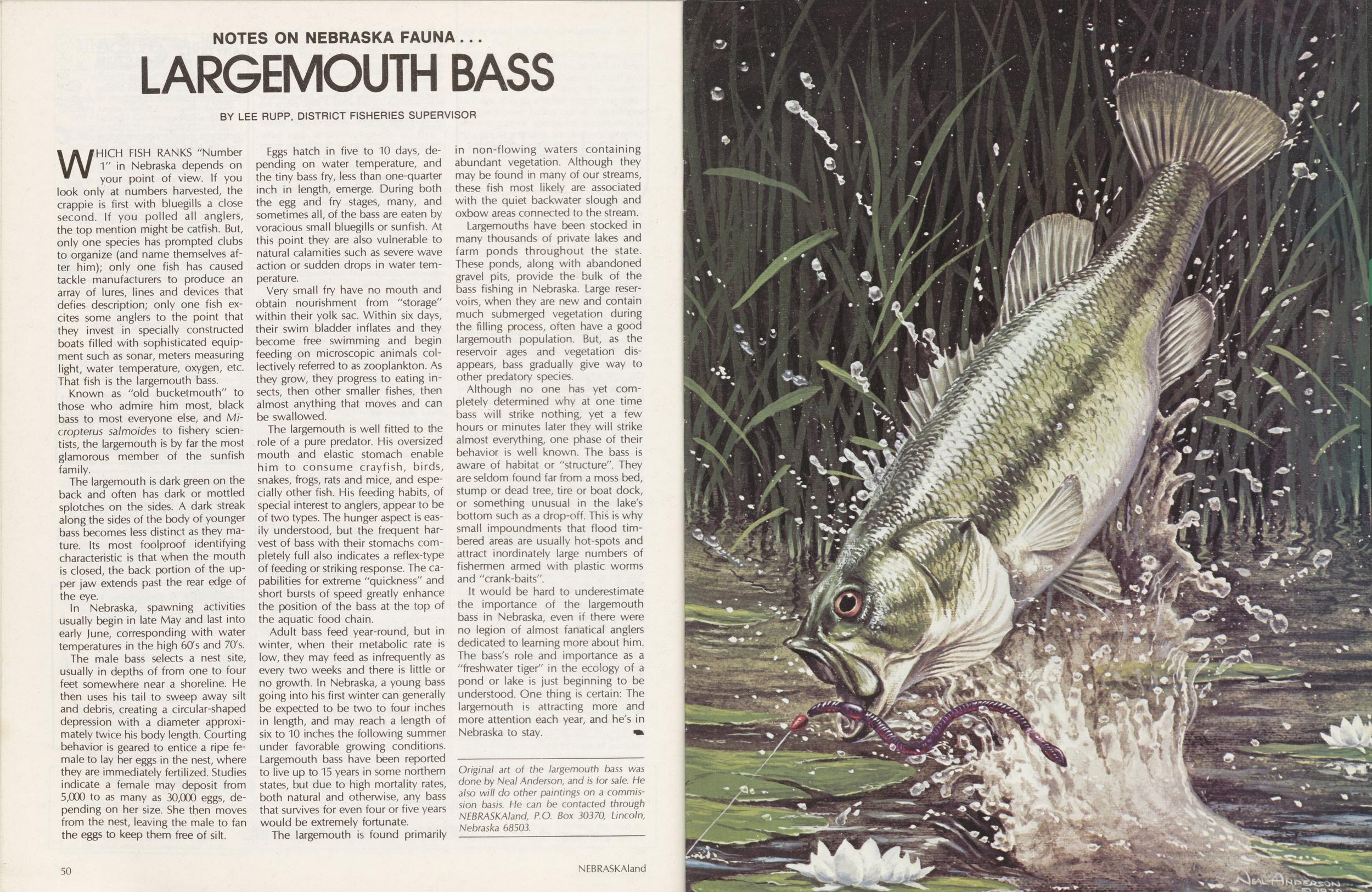
NOTES ON NEBRASKA FAUNA...
LARGEMOUTH BASS
WHICH FISH RANKS "Number 1" in Nebraska depends on your point of view. If you look only at numbers harvested, the crappie is first with bluegills a close second. If you polled all anglers, the top mention might be catfish. But, only one species has prompted clubs to organize (and name themselves after him); only one fish has caused tackle manufacturers to produce an array of lures, lines and devices that defies description; only one fish excites some anglers to the point that they invest in specially constructed boats filled with sophisticated equipment such as sonar, meters measuring light, water temperature, oxygen, etc. That fish is the largemouth bass.
Known as "old bucketmouth" to those who admire him most, black bass to most everyone else, and Micropterus salmoides to fishery scientists, the largemouth is by far the most glamorous member of the sunfish family.
The largemouth is dark green on the back and often has dark or mottled splotches on the sides. A dark streak along the sides of the body of younger bass becomes less distinct as they mature. Its most foolproof identifying characteristic is that when the mouth is closed, the back portion of the upper jaw extends past the rear edge of the eye.
In Nebraska, spawning activities usually begin in late May and last into early June, corresponding with water temperatures in the high 60's and 70's.
The male bass selects a nest site, usually in depths of from one to four feet somewhere near a shoreline. He then uses his tail to sweep away silt and debris, creating a circular-shaped depression with a diameter approximately twice his body length. Courting behavior is geared to entice a ripe female to lay her eggs in the nest, where they are immediately fertilized. Studies indicate a female may deposit from 5,000 to as many as 30,000 eggs, depending on her size. She then moves from the nest, leaving the male to fan the eggs to keep them free of silt.
Eggs hatch in five to 10 days, depending on water temperature, and the tiny bass fry, less than one-quarter inch in length, emerge. During both the egg and fry stages, many, and sometimes all, of the bass are eaten by voracious small bluegills or sunfish. At this point they are also vulnerable to natural calamities such as severe wave action or sudden drops in water temperature.
Very small fry have no mouth and obtain nourishment from "storage" within their yolk sac. Within six days, their swim bladder inflates and they become free swimming and begin feeding on microscopic animals collectively referred to as zooplankton. As they grow, they progress to eating insects, then other smaller fishes, then almost anything that moves and can be swallowed.
The largemouth is well fitted to the role of a pure predator. His oversized mouth and elastic stomach enable him to consume crayfish, birds, snakes, frogs, rats and mice, and especially other fish. His feeding habits, of special interest to anglers, appear to be of two types. The hunger aspect is easily understood, but the frequent harvest of bass with their stomachs completely full also indicates a reflex-type of feeding or striking response. The capabilities for extreme "quickness" and short bursts of speed greatly enhance the position of the bass at the top of the aquatic food chain.
Adult bass feed year-round, but in winter, when their metabolic rate is low, they may feed as infrequently as every two weeks and there is little or no growth. In Nebraska, a young bass going into his first winter can generally be expected to be two to four inches in length, and may reach a length of six to 10 inches the following summer under favorable growing conditions. Largemouth bass have been reported to live up to 15 years in some northern states, but due to high mortality rates, both natural and otherwise, any bass that survives for even four or five years would be extremely fortunate.
The largemouth is found primarily in non-flowing waters containing abundant vegetation. Although they may be found in many of our streams, these fish most likely are associated with the quiet backwater slough and oxbow areas connected to the stream.
Largemouths have been stocked in many thousands of private lakes and farm ponds throughout the state. These ponds, along with abandoned gravel pits, provide the bulk of the bass fishing in Nebraska. Large reservoirs, when they are new and contain much submerged vegetation during the filling process, often have a good largemouth population. But, as the reservoir ages and vegetation disappears, bass gradually give way to other predatory species.
Although no one has yet completely determined why at one time bass will strike nothing, yet a few hours or minutes later they will strike almost everything, one phase of their behavior is well known. The bass is aware of habitat or "structure". They are seldom found far from a moss bed, stump or dead tree, tire or boat dock, or something unusual in the lake's bottom such as a drop-off. This is why small impoundments that flood timbered areas are usually hot-spots and attract inordinately large numbers of fishermen armed with plastic worms and "crank-baits".
It would be hard to underestimate the importance of the largemouth bass in Nebraska, even if there were no legion of almost fanatical anglers dedicated to learning more about him. The bass's role and importance as a "freshwater tiger" in the ecology of a pond or lake is just beginning to be understood. One thing is certain: The largemouth is attracting more and more attention each year, and he's in Nebraska to stay.
Original art of the largemouth bass v/as done by Neal Anderson, and is for sale. He also will do other paintings on a commission basis. He can be contacted through NEBRASKAland, P.O. Box 30370, Lincoln, Nebraska 68503.

Position: 253 (32 views)