Volume 57, Issue 5, 1979
Visiting State Reservoirs
NEBRASKAland
May 1979 60 Cents Tips on when, where and how to fish the 'big waters' Maps show facilities available at the reservoirs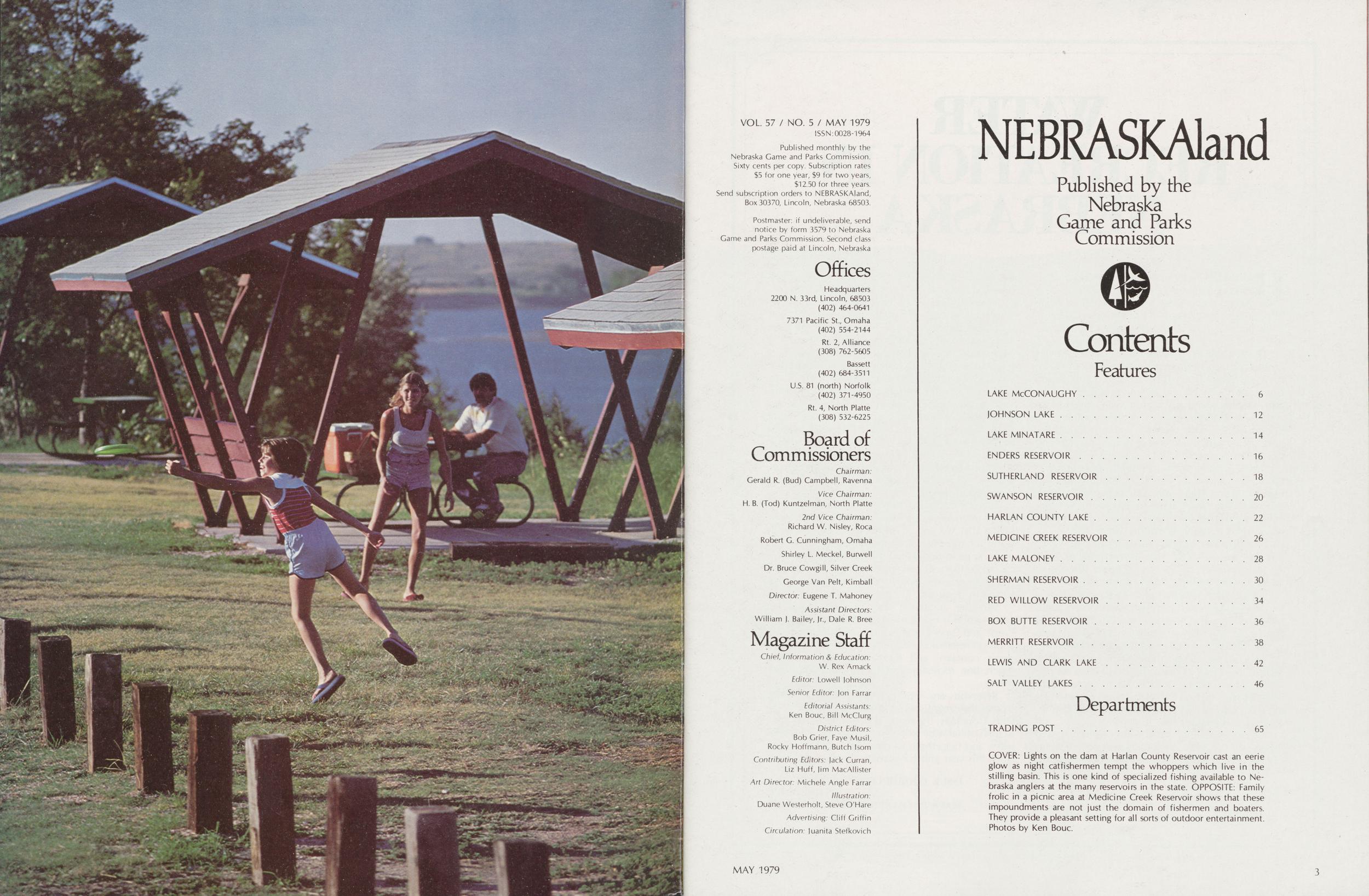
NEBRASKAland
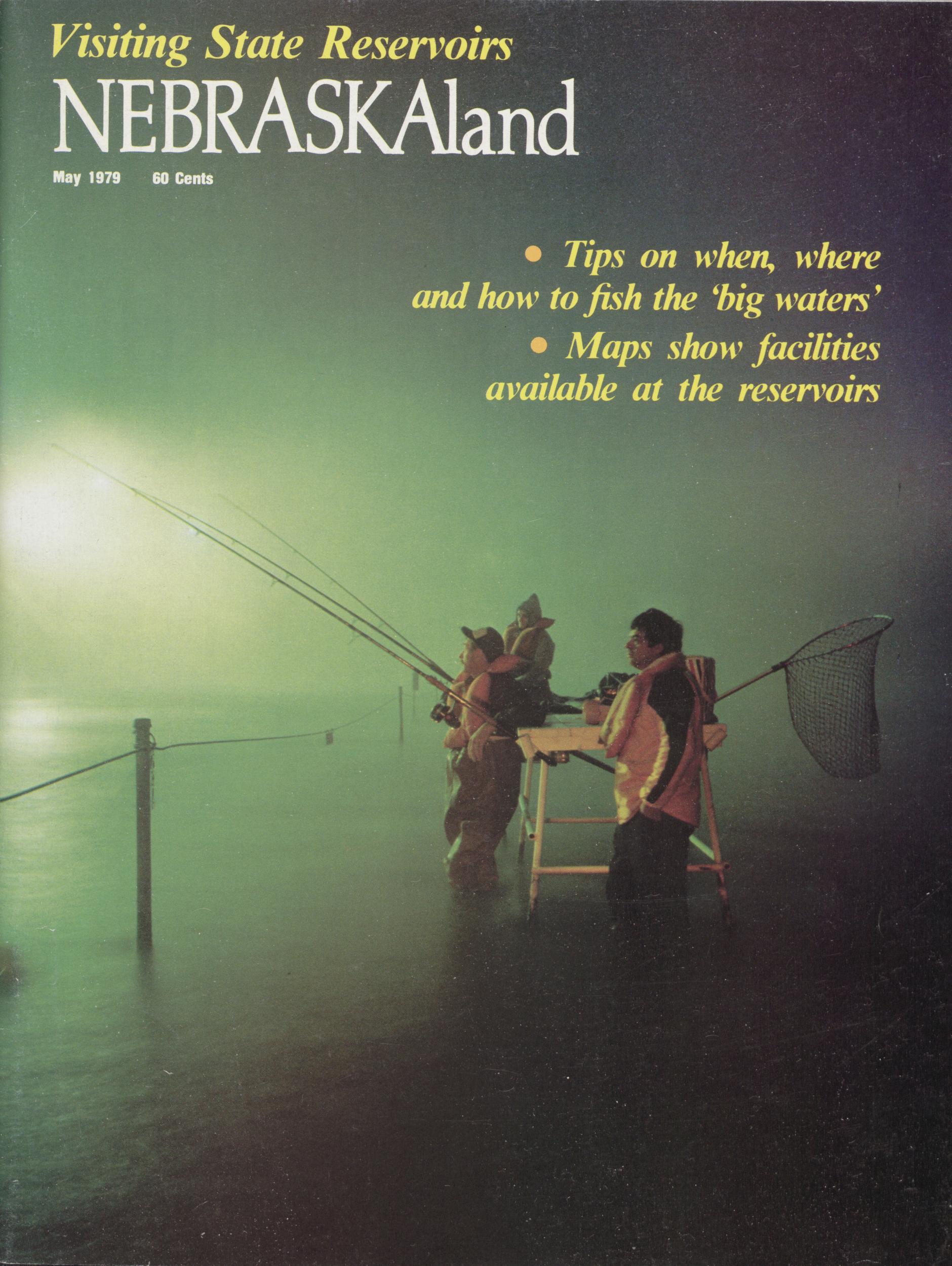
Published by the Nebraska Game and Parks Commission Contents Features LAKE McCONAUGHY 6 JOHNSON LAKE 12 LAKE MINATARE 14 ENDERS RESERVOIR 16 SUTHERLAND RESERVOIR 18 SWANSON RESERVOIR 20 HARLAN COUNTY LAKE 22 MEDICINE CREEK RESERVOIR 26 LAKE MALONEY 28 SHERMAN RESERVOIR 30 RED WILLOW RESERVOIR 34 BOX BUTTE RESERVOIR 36 MERRITT RESERVOIR 38 LEWIS AND CLARK LAKE 42 SALT VALLEY LAKES 46 Departments TRADING POST65COVER: Lights on the dam at Harlan County Reservoir cast an eerie glow as night catfishermen tempt the whoppers which live in the stilling basin. This is one kind of specialized fishing available to Nebraska anglers at the many reservoirs in the state. OPPOSITE: Family frolic in a picnic area at Medicine Creek Reservoir shows that these impoundments are not just the domain of fishermen and boaters. They provide a pleasant setting for all sorts of outdoor entertainment. Photos by Ken Bouc.
WATER RECREATION IN NEBRASKA
HAVING FUN IN and around water is a Nebraska tradition as old as the state itself. It seems that wherever there has been a trickle or puddle, some Nebraskan has conspired to catch a fish out of it, float a boat on it, shoot a duck over it, pitch a tent or cobble up a cabin alongside it.
The first settlers gathered on the banks of rivers for their picnics, while youngsters sought out swimmin' and fishin' holes. Later, as the country developed, people built a few ice-house impoundments and mill ponds, and again, Nebraskans eagerly converged on them for sport. And, they continued to flock to water with the proliferation of sandpits, farm ponds and, most recently, large irrigation and flood-control reservoirs.
Today, most of Nebraska's public recreation water is a bonus, an extra benefit of flood-control and irrigation dams. These reservoirs along the Republican and Platte rivers have turned southwest Nebraska from a land almost devoid of recreational water to an outdoor recreation center.
In southeast Nebraska, lakes in the Salt Valley provided recreation for 1.8 million people in 1977. All these millions of hours of outdoor fun are an added dividend of this flood-control project.
It's the same for other parts of the state—Lewis and Clark Lake in the northeast; Merritt in the Sandhills; McConaughy, Minatare and Box Butte in the Panhandle. Without reservoirs, many Nebraskans would miss a good deal of wholesome recreation.
Nebraskans operate more than 42,000 power boats, three times as many as just 18 years ago. By 1995, power boating is expected to increase another 35 percent, and the related sport of water skiing will boom by 75 percent. Fishing will also increase, up something like 18 percent.
Although boating, water skiing, swimming and fishing are the most obvious recreational benefits of reservoirs, there are others. Nebraska impoundments also provide settings for sightseers, cyclists, hikers, campers and cross-country skiers.
Water is Nebraska's most important public resource for outdoor recreation, and demand for water-based recreation will undoubtedly increase. More water will be needed to handle the crush of Nebraskans who are being forced by high costs of travel to stay closer to home for summer fun. But, will additional water be available?
New reservoir construction no longer enjoys the wide public approval that it had a few decades ago. Taxpayers question the propriety of using public funds to build a project benefiting a relatively few individuals. Landowners protest the condemnation and flooding of their farms and ranches, and they are joined by environmentalists objecting to the inundation of riverside habitat and the drying up of streams and rivers.
Even recreationists' ranks are divided on the issue of more reservoirs. More and more of them are saying that we should sacrifice no more flowing water for the sake of impoundments, though the reservoir recreationists are still more visible and vocal. More than 40 percent of Nebraska's fishing is still done on rivers and streams, and canoeing has surged in popularity the past few years.
Whether additional reservoirs are worthy of construction is not, and has never been, up to the Game and Parks Commission to decide. But, recreation on reservoirs once they exist, is the Commission's concern, and Nebraskans already enjoy much fine recreation on their state's impoundments.
Reservoirs are important to recreation, enough so that they merit special treatment in NEBRASKAland. Hopefully, the maps, photos and information in this special issue will help Nebraskans enjoy their lakes, and help them to plan their outdoor excursions this year and for years to come.
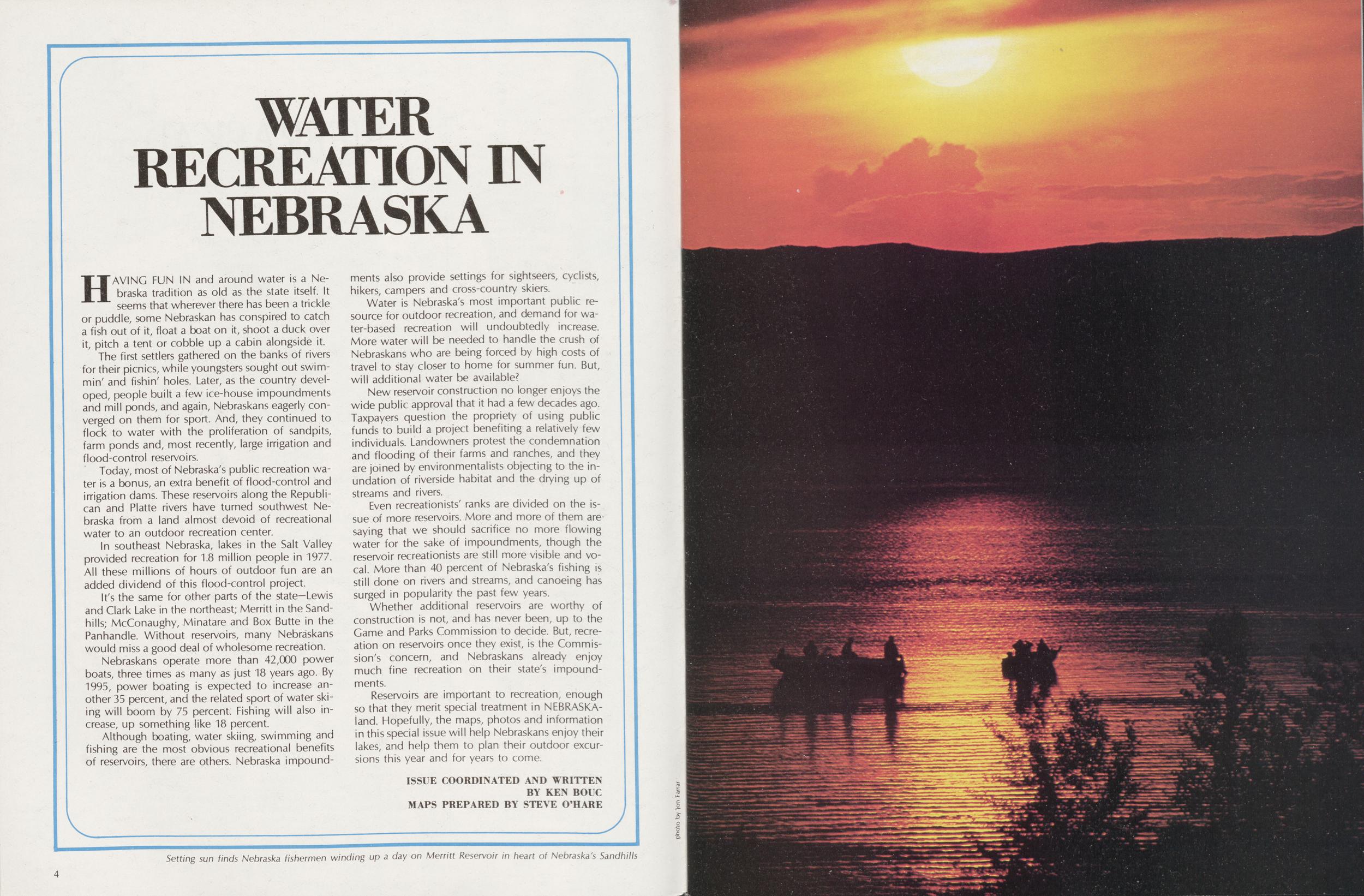
Setting sun finds Nebraska fishermen winding up a day on Merritt Reservoir in heart of Nebraska's Sandhills ment, Big Mac
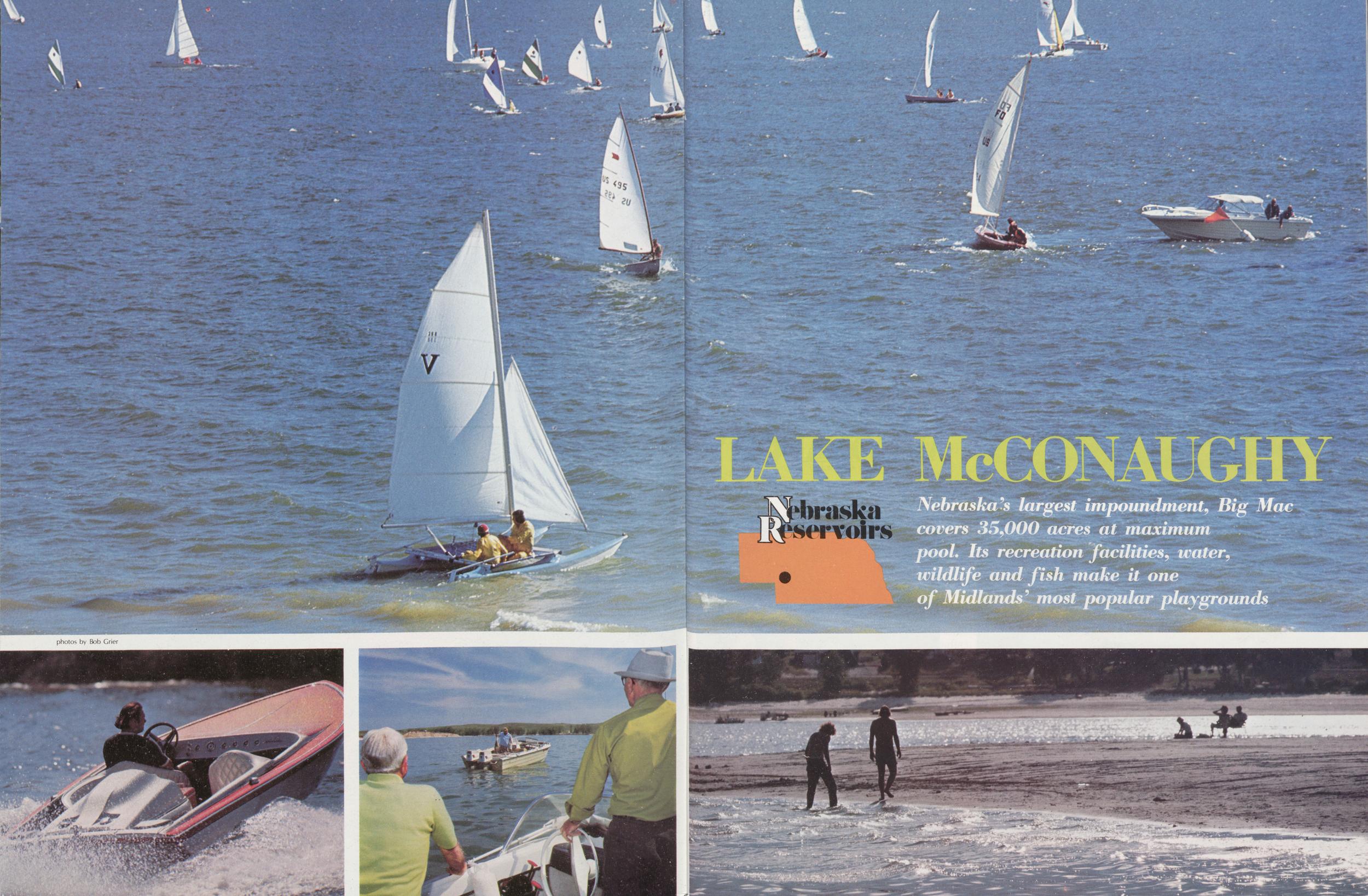
Lake McConaughy
Nebraska Reservoirs Nebraska largest impoundment, Big Mac covers 35,000 acres at maximum pool. Its recreation facilities, water, wildlife and fish make it one of Midlands' most popular playgroundsphotos by Bob Grier
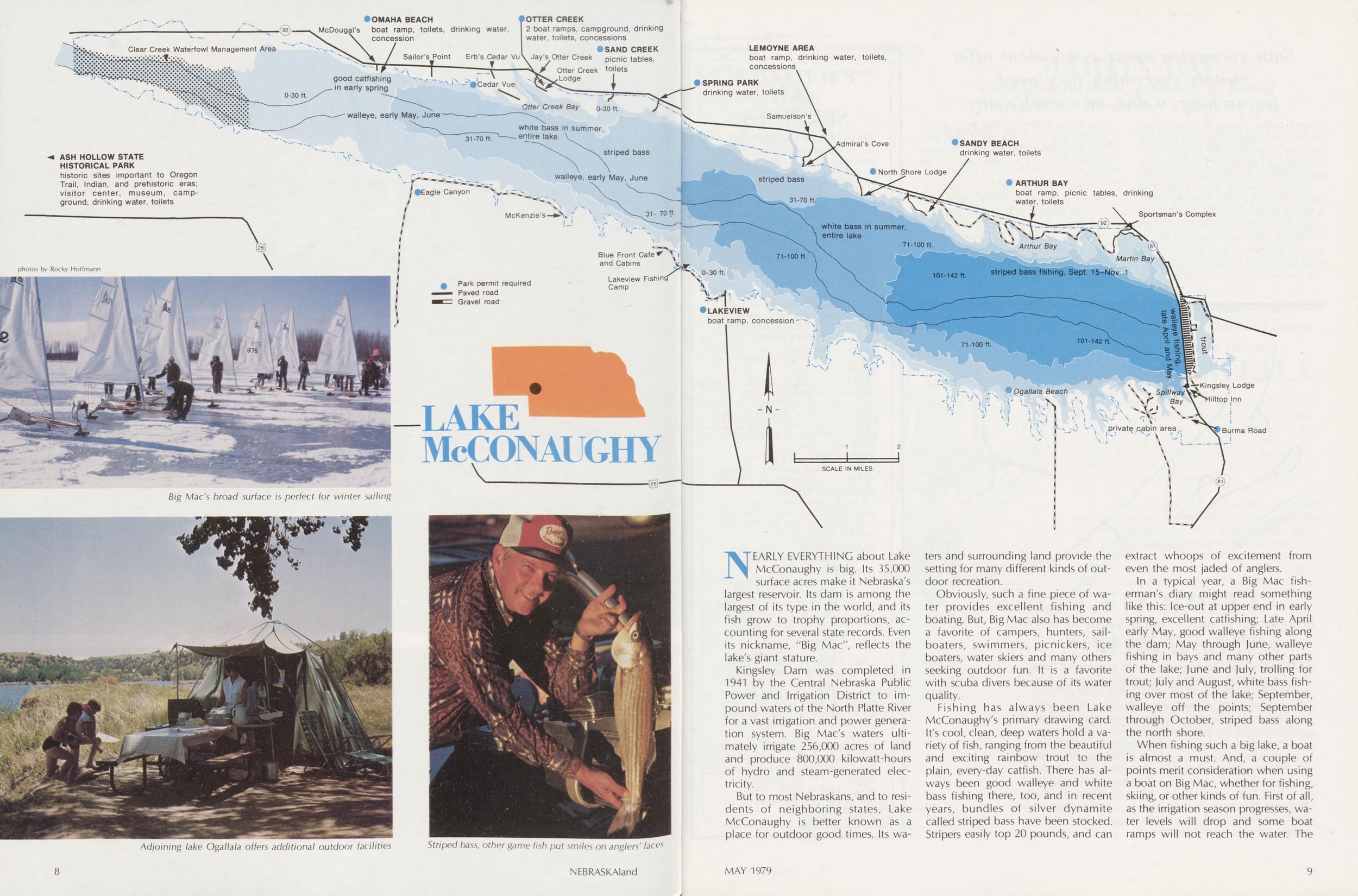
Big Mac's broad surface is perfect for winter sailing
Adjoining lake Ogallala offers additional outdoor facilities
Striped bass, other game fish put smiles on anglers' faces
LAKE McCONAUGHY
NEARLY EVERYTHING about Lake McConaughy is big. Its 35,000 surface acres make it Nebraska's largest reservoir. Its dam is among the largest of its type in the world, and its fish grow to trophy proportions, accounting for several state records. Even its nickname, "Big Mac", reflects the lake's giant stature.
Kingsley Dam was completed in 1941 by the Central Nebraska Public Power and Irrigation District to impound waters of the North Platte River for a vast irrigation and power generation system. Big Mac's waters ultimately irrigate 256,000 acres of land and produce 800,000 kilowatt-hours of hydro and steam-generated electricity.
But to most Nebraskans, and to residents of neighboring states, Lake McConaughy is better known as a place for outdoor good times. Its waters and surrounding land provide the setting for many different kinds of outdoor recreation.
Obviously, such a fine piece of water provides excellent fishing and boating. But, Big Mac also has become a favorite of campers, hunters, sail-boaters, swimmers, picnickers, ice boaters, water skiers and many others seeking outdoor fun. It is a favorite with scuba divers because of its water quality.
Fishing has always been Lake McConaughy's primary drawing card. It's cool, clean, deep waters hold a variety of fish, ranging from the beautiful and exciting rainbow trout to the plain, every-day catfish. There has always been good walleye and white bass fishing there, too, and in recent years, bundles of silver dynamite called striped bass have been stocked. Stripers easily top 20 pounds, and can extract whoops of excitement from even the most jaded of anglers.
In a typical year, a Big Mac fisherman's diary might read something like this: Ice-out at upper end in early spring, excellent catfishing; Late April early May, good walleye fishing along the dam; May through June, walleye fishing in bays and many other parts of the lake; June and July, trolling for trout; July and August, white bass fishing over most of the lake; September, walleye off the points; September through October, striped bass along the north shore.
When fishing such a big lake, a boat
is almost a must. And, a couple of
points merit consideration when using
a boat on Big Mac, whether for fishing,
skiing, or other kinds of fun. First of all,
as the irrigation season progresses, water levels will drop and some boat
ramps will not reach the water. The
8
NEBRASKAland
MAY 1979 9
 longest public ramps at Martin Bay,
Cedar View, Otter Creek, and near the
area headquarters at the south end of
the dam, can get rather busy, so allow
extra time for launching and removing.
longest public ramps at Martin Bay,
Cedar View, Otter Creek, and near the
area headquarters at the south end of
the dam, can get rather busy, so allow
extra time for launching and removing.
Boaters should also keep the weather in mind, particularly the wind. A strong wind can make Big Mac too rough for comfort or safety, so boaters should be ready and able to head ashore if the breeze gets too strong, or if clouds signal an approaching storm.
If the wind's tantrums prevent fishing, skiing, sailing or other water sports on Big Mac, all is not lost. Lake Ogallala, below the dam, is often sheltered from the wind. Or, some bays may be calm.
There's also the option of trips to interesting attractions in the region. Ash Hollow State Historical Park lies near the upper end of the lake along U.S. Highway 26. Prehistoric man lived at Ash Hollow, early Indian fighters campaigned nearby, and the covered wagons of (Continued on page 66)
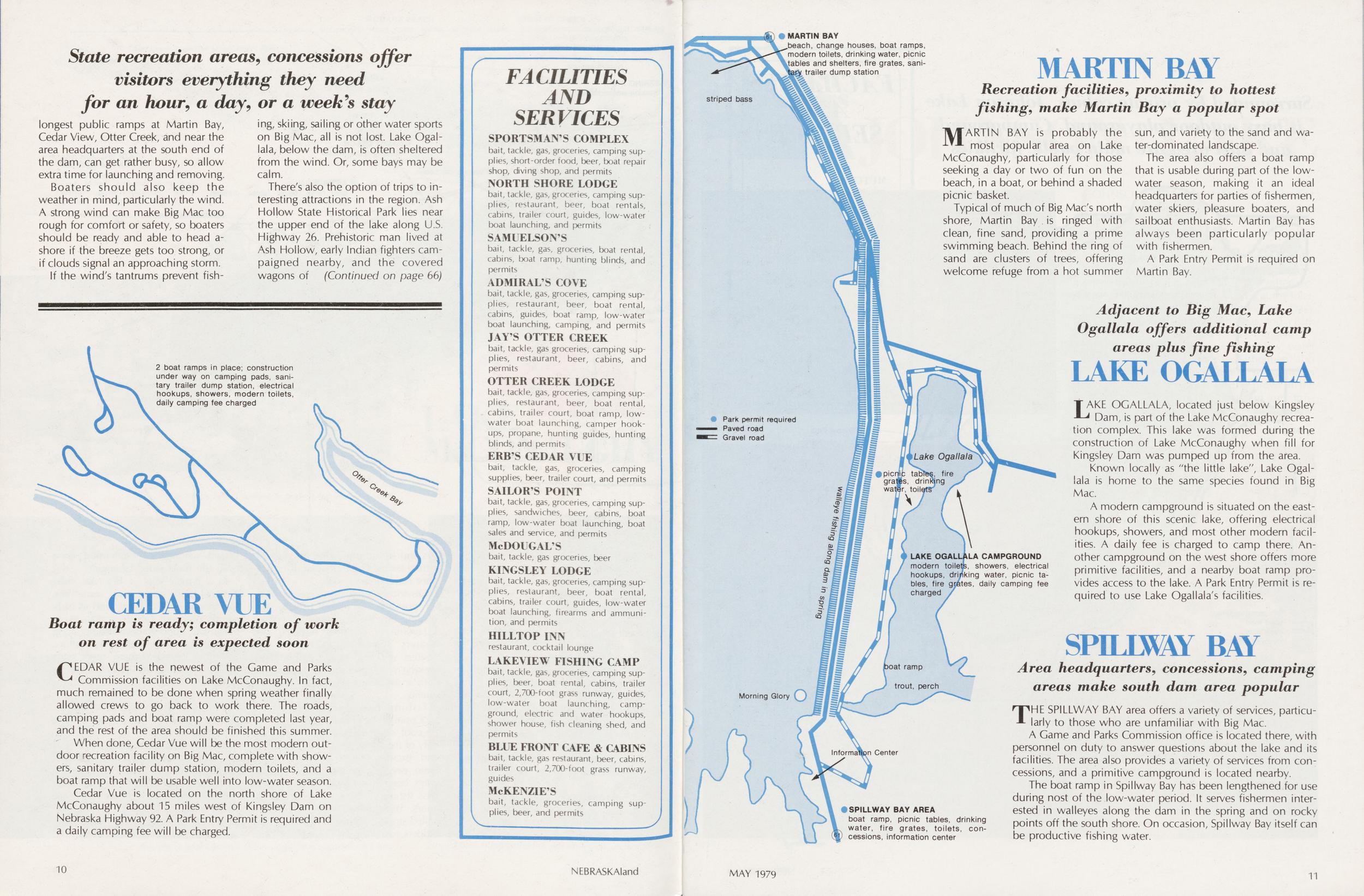
State recreation areas, concessions offer visitors everything they need for an hour, a day, or a week's stay2 boat ramps in place; construction under way on camping pads, sanitary trailer dump station, electrical hookups, showers, modern toilets, daily camping fee charged
CEDAR VUE
Boat ramp is ready; completion of work on rest of area is expected soonCEDAR VUE is the newest of the Game and Parks Commission facilities on Lake McConaughy. In fact, much remained to be done when spring weather finally allowed crews to go back to work there. The roads, camping pads and boat ramp were completed last year, and the rest of the area should be finished this summer.
When done, Cedar Vue will be the most modern outdoor recreation facility on Big Mac, complete with showers, sanitary trailer dump station, modern toilets, and a boat ramp that will be usable well into low-water season.
Cedar Vue is located on the north shore of Lake McConaughy about 15 miles west of Kingsley Dam on Nebraska Highway 92. A Park Entry Permit is required and a daily camping fee will be charged.
FACILITIES AND SERVICES
SPORTSMAN'S COMPLEX bait, tackle, gas, groceries, camping supplies, short-order food, beer, boat repair shop, diving shop, and permits NORTH SHORE LODGE bait, tackle, gas, groceries, camping supplies, restaurant, beer, boat rentals, cabins, trailer court, guides, low-water boat launching, and permits SAMUELSON'S bait, tackle, gas, groceries, boat rental, cabins, boat ramp, hunting blinds, and permits ADMIRAL'S COVE bait, tackle, gas, groceries, camping supplies, restaurant, beer, boat rental, cabins, guides, boat ramp, low-water boat launching, camping, and permits JAY'S OTTER CREEK bait, tackle, gas groceries, camping supplies, restaurant, beer, cabins, and permits OTTER CREEK LODGE bait, tackle, gas, groceries, camping supplies, restaurant, beer, boat rental, cabins, trailer court, boat ramp, lowwater boat launching, camper hook-ups, propane, hunting guides, hunting blinds, and permits ERB'S CEDAR VUE bait, tackle, gas, groceries, camping supplies, beer, trailer court, and permits SAILOR'S POINT bait, tackle, gas, groceries, camping supplies, sandwiches, beer, cabins, boat ramp, low-water boat launching, boat sales and service, and permits McDOUGAL'S bait, tackle, gas groceries, beer KINGSLEY LODGE bait, tackle, gas, groceries, camping supplies, restaurant, beer, boat rental, cabins, trailer court, guides, low-water boat launching, firearms and ammunition, and permits HILLTOP INN restaurant, cocktail lounge LAKEVIEW FISHING CAMP bait, tackle, gas, groceries, camping supplies, beer, boat rental, cabins, trailer court, 2,700-foot grass runway, guides, low-water boat launching, campground, electric and water hookups, shower house, fish cleaning shed, and permits BLUE FRONT CAFE & CABINS bait, tackle, gas restaurant, beer, cabins, trailer court, 2,700-foot grass runway, guides McKENZIE'S bait, tackle, groceries, camping supplies, beer, and permitsMARTIN BAY beach, change houses, boat ramps, modern toilets, drinking water, picnic fables and shelters, fire grates, sanitrailer dump station
SPILLWAY BAY AREA boat ramp, picnic tables, drinking water, fire grates, toilets, concessions, information center
MARTIN BAY
Recreation facilities, proximity to hottest fishing, make Martin Bay a popular spotMARTIN BAY is probably the most popular area on Lake McConaughy, particularly for those seeking a day or two of fun on the beach, in a boat, or behind a shaded picnic basket.
Typical of much of Big Mac's north shore, Martin Bay is ringed with clean, fine sand, providing a prime swimming beach. Behind the ring of sand are clusters of trees, offering welcome refuge from a hot summer sun, and variety to the sand and water-dominated landscape.
The area also offers a boat ramp that is usable during part of the low-water season, making it an ideal headquarters for parties of fishermen, water skiers, pleasure boaters, and sailboat enthusiasts. Martin Bay has always been particularly popular with fishermen.
A Park Entry Permit is required on Martin Bay.
LAKE OGALLALA
Adjacent to Big Mac, Lake Ogallala offers additional camp areas plus fine fishingLAKE OGALLALA, located just below Kingsley Dam, is part of the Lake McConaughy recreation complex. This lake was formed during the construction of Lake McConaughy when fill for Kingsley Dam was pumped up from the area.
Known locally as "the little lake", Lake Ogallala is home to the same species found in Big Mac.
A modern campground is situated on the eastern shore of this scenic lake, offering electrical hookups, showers, and most other modern facilities. A daily fee is charged to camp there. Another campground on the west shore offers more primitive facilities, and a nearby boat ramp provides access to the lake. A Park Entry Permit is required to use Lake Ogallala's facilities.
SPILLWAY BAY
Area headquarters, concessions, camping areas make south dam area popularTHE SPILLWAY BAY area offers a variety of services, particularly to those who are unfamiliar with Big Mac.
A Game and Parks Commission office is located there, with personnel on duty to answer questions about the lake and its facilities. The area also provides a variety of services from concessions, and a primitive campground is located nearby.
The boat ramp in Spillway Bay has been lengthened for use during nost of the low-water period. It serves fishermen interested in walleyes along the dam in the spring and on rocky points off the south shore. On occasion, Spillway Bay itself can be productive fishing water.
10 NEBRASKAland MAY 1979 11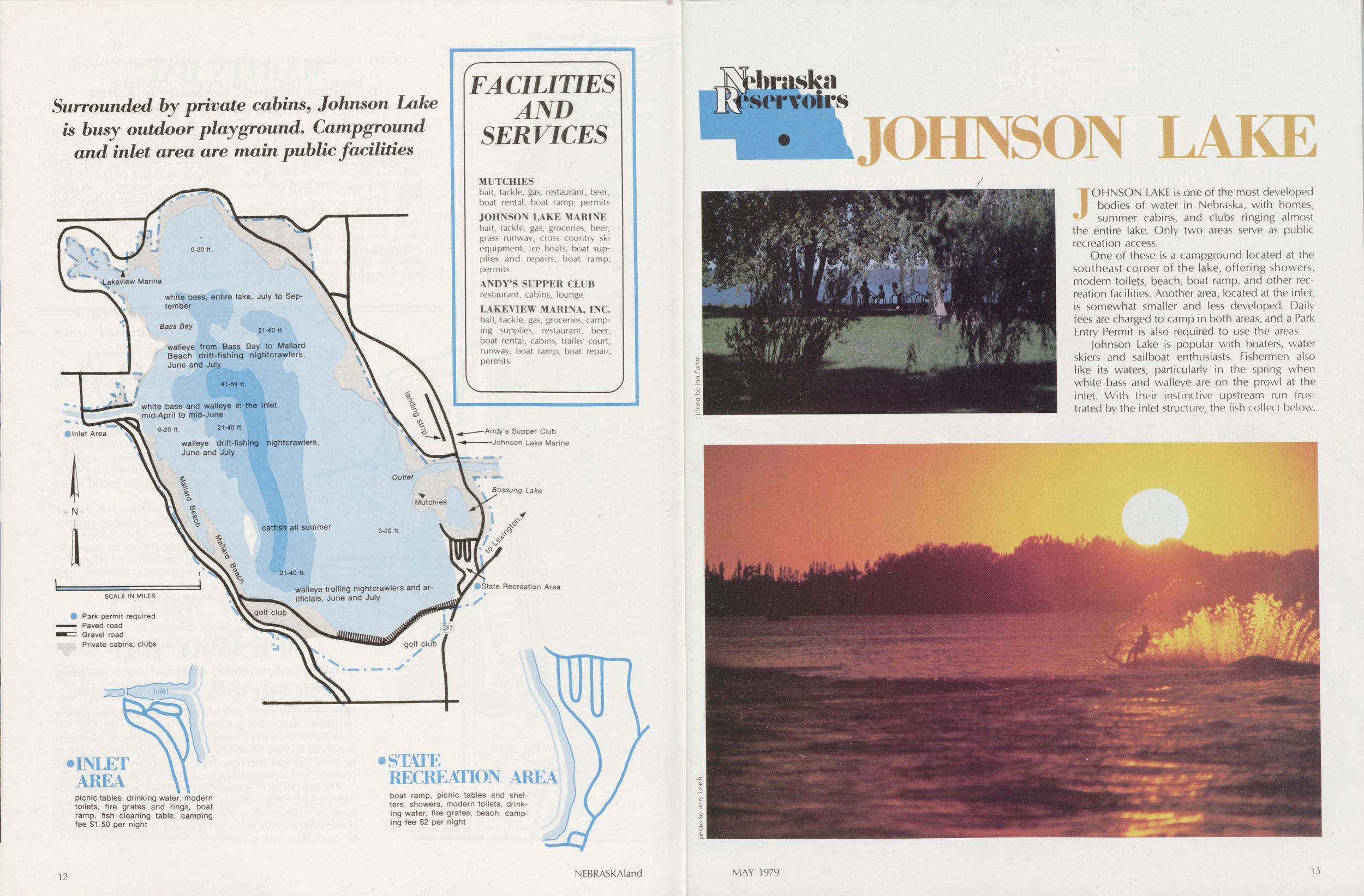
Nebraska Reservoirs
JOHNSON LAKE
Surrounded by private cabins, Johnson Lake is busy outdoor playground. Campground and inlet area are main public facilities FACILITIES AND SERVICES MUTCHIES bait, tackle, gas, restaurant, beer, boat rental, boat ramp, permits JOHNSON LAKE MARINE bait, tackle, gas, groceries, beer, grass runway, cross country ski equipment, ice boats, boat supplies and repairs, boat ramp, permits ANDY'S SUPPER CLUB restaurant, cabins, lounge LAKEVIEW MARINA, INC. bait, tackle, gas, groceries, camping supplies, restaurant, beer, boat rental, cabins, trailer court, runway, boat ramp, boat repair, permitsJOHNSON LAKE is one of the most developed bodies of water in Nebraska, with homes, summer cabins, and clubs ringing almost the entire lake. Only two areas serve as public recreation access.
One of these is a campground located at the southeast corner of the lake, offering showers, modern toilets, beach, boat ramp, and other recreation facilities. Another area, located at the inlet, is somewhat smaller and less developed. Daily fees are charged to camp in both areas, and a Park Entry Permit is also required to use the areas.
Johnson Lake is popular with boaters, water skiers and sailboat enthusiasts. Fishermen also like its waters, particularly in the spring when white bass and walleye are on the prowl at the inlet. With their instinctive upstream run frustrated by the inlet structure, the fish collect below.
Nebraska Reservoirs
Lake Minatare
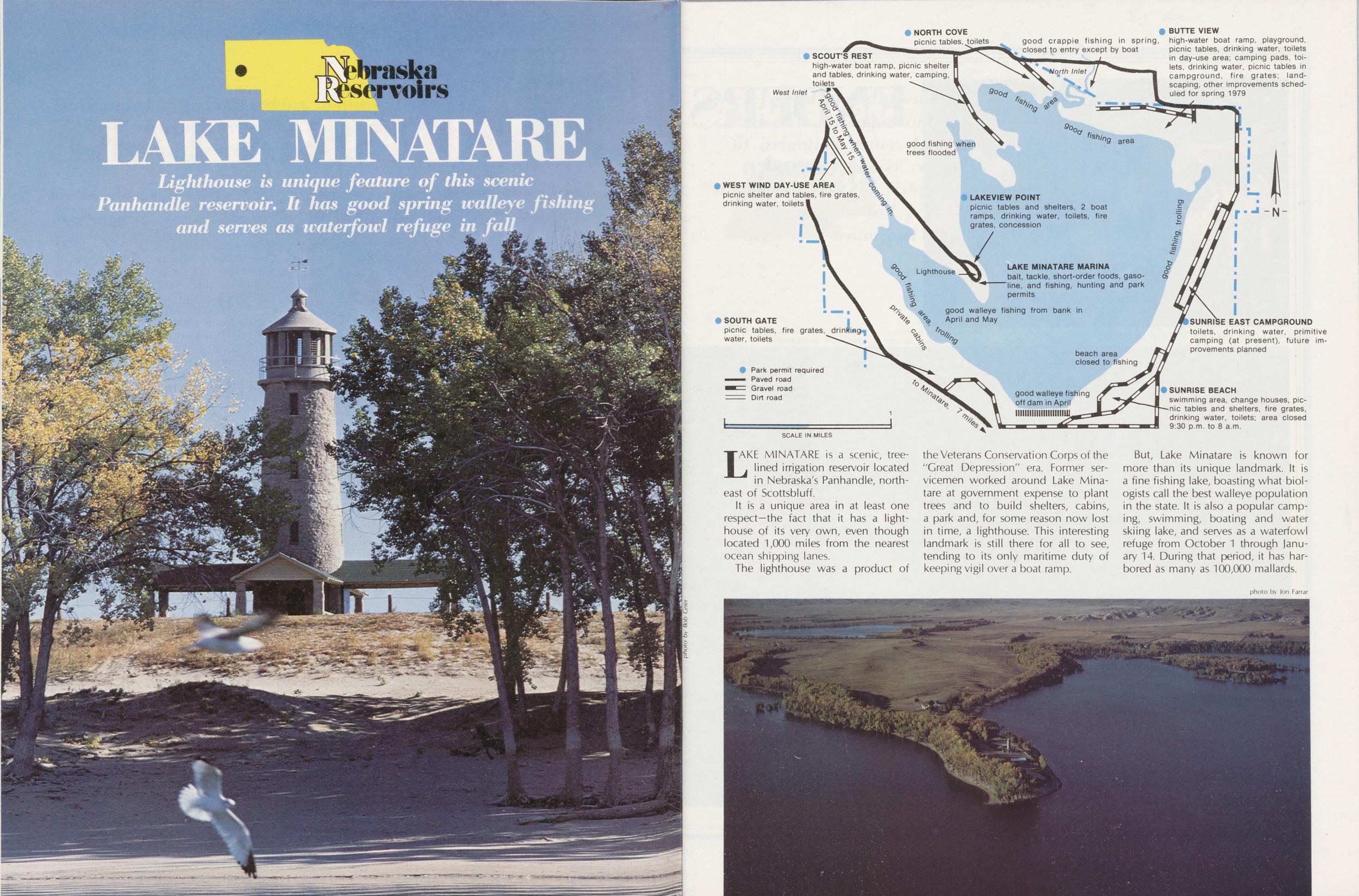
Lighthouse is unique feature of this scene Panhandle reservoir. It has good spring walleye fishing and serves as waterfowl refuge in fallLAKE MINATARE is a scenic, tree-lined irrigation reservoir located in Nebraska's Panhandle, northeast of Scottsbluff.
It is a unique area in at least one respect—the fact that it has a lighthouse of its very own, even though located 1,000 miles from the nearest ocean shipping lanes.
The lighthouse was a product of the Veterans Conservation Corps of the "Great Depression" era. Former servicemen worked around Lake Minatare at government expense to plant trees and to build shelters, cabins, a park and, for some reason now lost in time, a lighthouse. This interesting landmark is still there for all to see, tending to its only maritime duty of keeping vigil over a boat ramp.
But, Lake Minatare is known for more than its unique landmark. It is a fine fishing lake, boasting what biologists call the best walleye population in the state. It is also a popular camping, swimming, boating and water skiing lake, and serves as a waterfowl refuge from October 1 through January 14. During that period, it has harbored as many as 100,000 mallards.
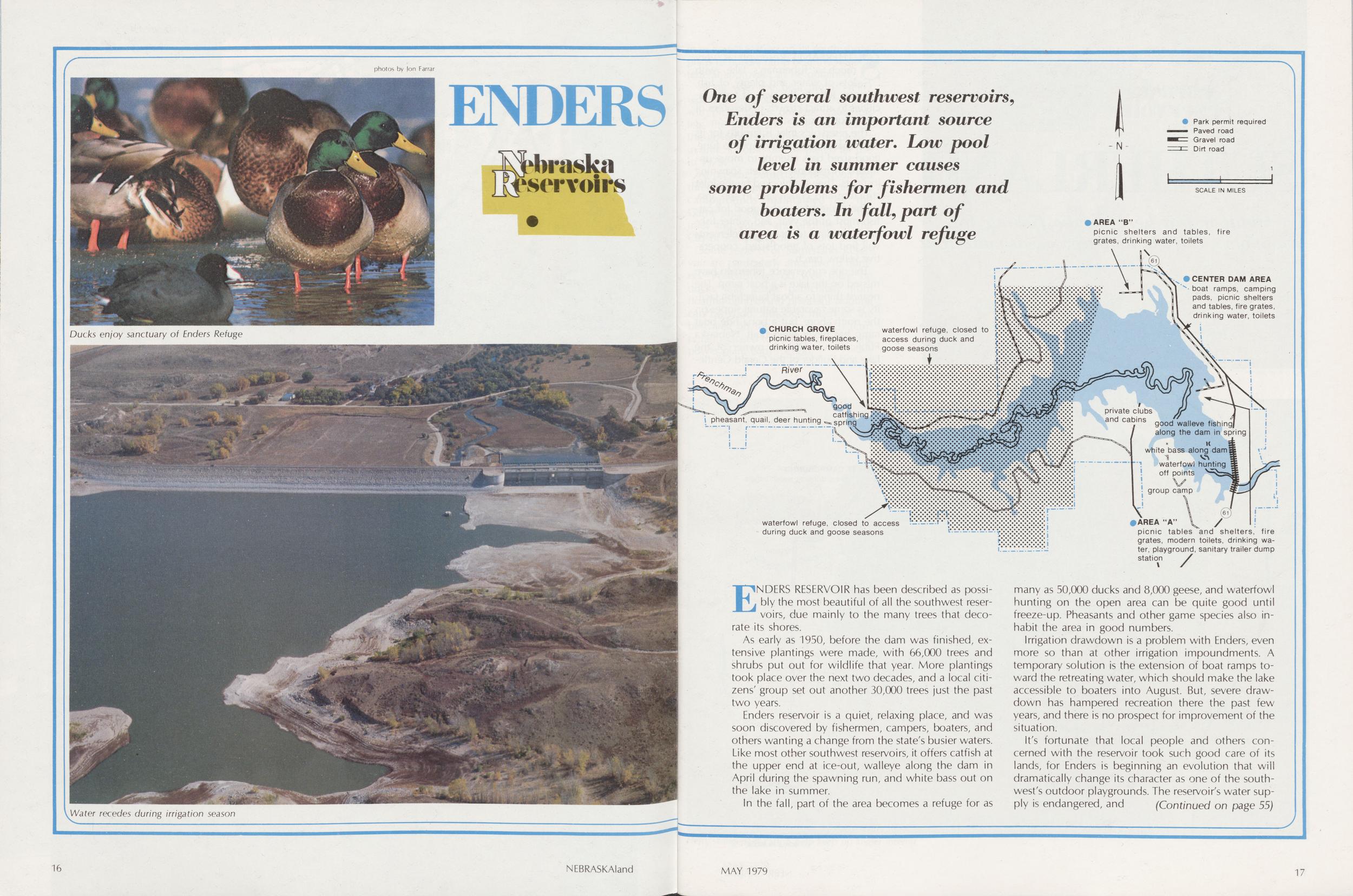
Ducks enjoy sanctuary of Enders Refuge
Water recedes during irrigation season
ENDERS
Nebraska Reservoirs
One of several southwest reservoirs, Enders is an important source of irrigation water. Low pool level in summer causes some problems for fishermen and boaters. In fall, part of area is a waterfowl refugeENDERS RESERVOIR has been described as possibly the most beautiful of all the southwest reservoirs, due mainly to the many trees that decorate its shores.
As early as 1950, before the dam was finished, extensive plantings were made, with 66,000 trees and shrubs put out for wildlife that year. More plantings took place over the next two decades, and a local citizens' group set out another 30,000 trees just the past two years.
Enders reservoir is a quiet, relaxing place, and was soon discovered by fishermen, campers, boaters, and others wanting a change from the state's busier waters. Like most other southwest reservoirs, it offers catfish at the upper end at ice-out, walleye along the dam in April during the spawning run, and white bass out on the lake in summer.
In the fall, part of the area becomes a refuge for as many as 50,000 ducks and 8,000 geese, and waterfowl hunting on the open area can be quite good until freeze-up. Pheasants and other game species also inhabit the area in good numbers.
Irrigation drawdown is a problem with Enders, even more so than at other irrigation impoundments. A temporary solution is the extension of boat ramps toward the retreating water, which should make the lake accessible to boaters into August. But, severe draw-down has hampered recreation there the past few years, and there is no prospect for improvement of the situation.
It's fortunate that local people and others concerned with the reservoir took such good care of its lands, for Enders is beginning an evolution that will dramatically change its character as one of the southwest's outdoor playgrounds. The reservoir's water sup ply is endangered, and (Continued on page 55)
16 NEBRASKAland MAY 1979 17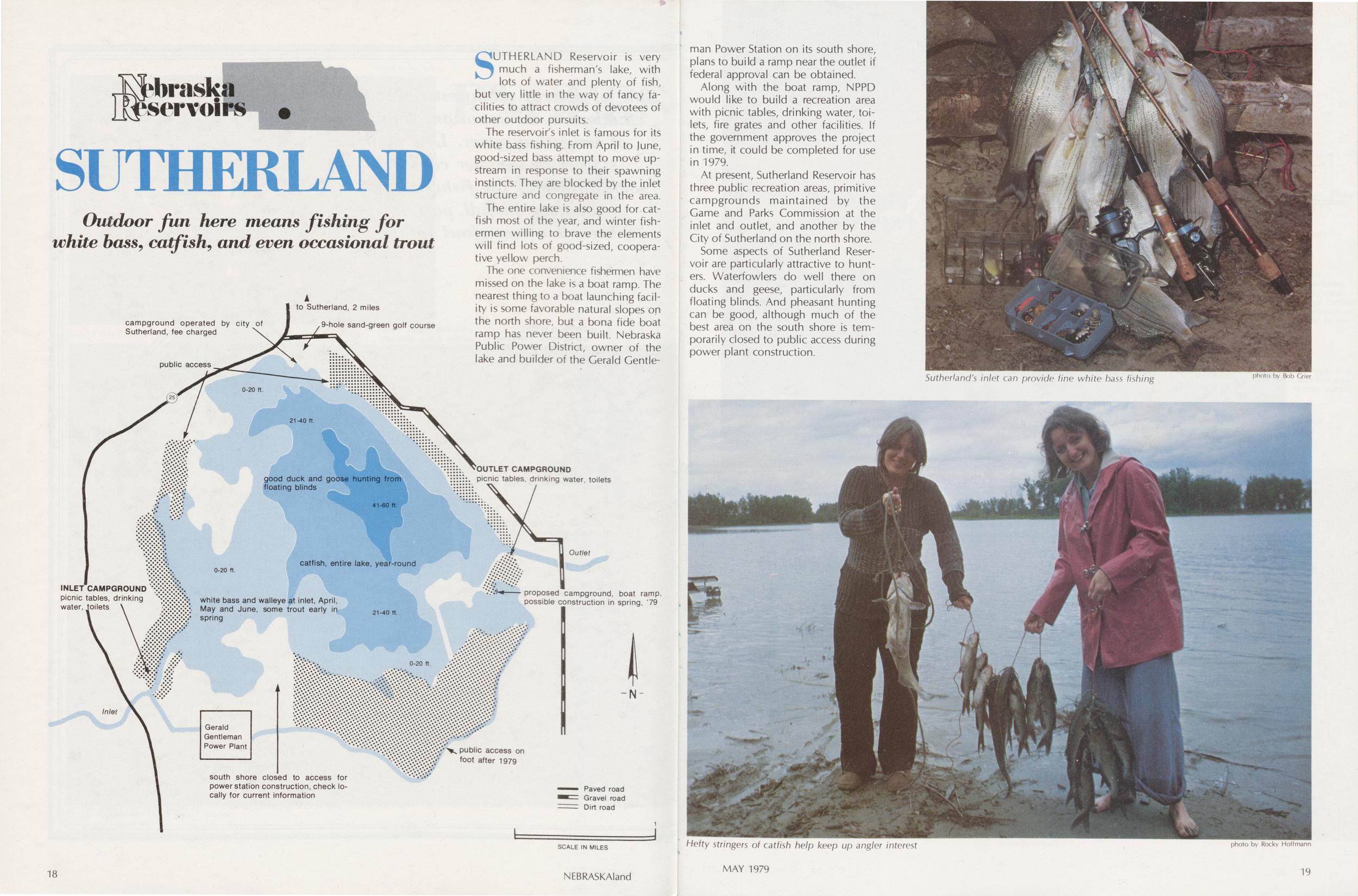
Nebraska Reservoirs
SUTHERLAND
Outdoor fun here means fishing for white bass, catfish, and even occasional troutSUTHERLAND Reservoir is very much a fisherman's lake, with lots of water and plenty of fish, but very little in the way of fancy facilities to attract crowds of devotees of other outdoor pursuits.
The reservoir's inlet is famous for its white bass fishing. From April to June, good-sized bass attempt to move upstream in response to their spawning instincts. They are blocked by the inlet structure and congregate in the area.
The entire lake is also good for catfish most of the year, and winter fishermen willing to brave the elements will find lots of good-sized, cooperative yellow perch.
The one convenience fishermen have missed on the lake is a boat ramp. The nearest thing to a boat launching facility is some favorable natural slopes on the north shore, but a bona fide boat ramp has never been built. Nebraska Public Power District, owner of the lake and builder of the Gerald Gentle man Power Station on its south shore, plans to build a ramp near the outlet if federal approval can be obtained.
Along with the boat ramp, NPPD would like to build a recreation area with picnic tables, drinking water, toilets, fire grates and other facilities. If the government approves the project in time, it could be completed for use in 1979.
At present, Sutherland Reservoir has three public recreation areas, primitive campgrounds maintained by the Game and Parks Commission at the inlet and outlet, and another by the City of Sutherland on the north shore.
Some aspects of Sutherland Reservoir are particularly attractive to hunters. Waterfowlers do well there on ducks and geese, particularly from floating blinds. And pheasant hunting can be good, although much of the best area on the south shore is temporarily closed to public access during power plant construction.
Sutherland's inlet can provide fine white bass fishing
photo by Bob GrierHefty stringers of catfish help keep up angler interest
photo by Rocky Hoffmann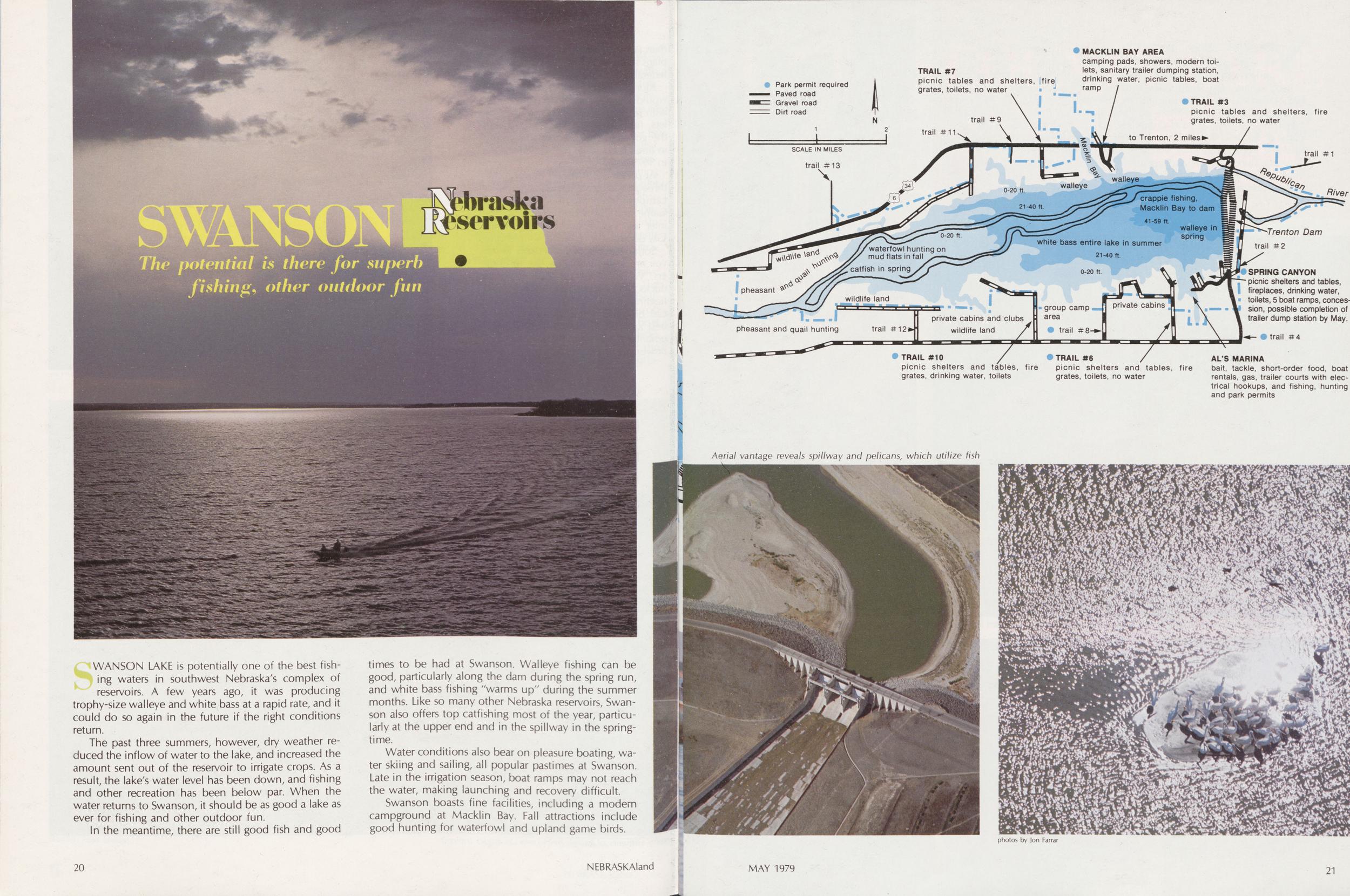
Nebraska Reservoirs
Swanson
The potential is there for superb fishing, other outdoor funSWANSON LAKE is potentially one of the best fishing waters in southwest Nebraska's complex of reservoirs. A few years ago, it was producing trophy-size walleye and white bass at a rapid rate, and it could do so again in the future if the right conditions return.
The past three summers, however, dry weather reduced the inflow of water to the lake, and increased the amount sent out of the reservoir to irrigate crops. As a result, the lake's water level has been down, and fishing and other recreation has been below par. When the water returns to Swanson, it should be as good a lake as ever for fishing and other outdoor fun.
In the meantime, there are still good fish and good times to be had at Swanson. Walleye fishing can be good, particularly along the dam during the spring run, and white bass fishing "warms up" during the summer months. Like so many other Nebraska reservoirs, Swanson also offers top catfishing most of the year, particularly at the upper end and in the spillway in the springtime.
Water conditions also bear on pleasure boating, water skiing and sailing, all popular pastimes at Swanson. Late in the irrigation season, boat ramps may not reach the water, making launching and recovery difficult.
Swanson boasts fine facilities, including a modern campground at Macklin Bay. Fall attractions include good hunting for waterfowl and upland game birds.
TRAIL #7 picnic tables and shelters, fire, grates, toilets,no water
MACKLIN BAY AREA camping pads, showers, modern toilets, sanitary trailer dumping station, drinking water, picnic tables, boat ramp
TRAIL #3 picnic tables and shelters, fire grates, toilets, no water
trail #1 River TRAIL #10 picnic shelters and tables, fire grates, drinking water, toilets TRAIL #6 picnic shelters and tables, fire grates, toilets, no water SPRING CANYON picnic shelters and tables, fireplaces, drinking water, toilets, 5 boat ramps, concession, possible completion of trailer dump station by May. trail #4 AL'S MARINA bait, tackle, short-order food, boat rentals, gas, trailer courts with electrical hookups, and fishing, hunting and park permits
Aerial vantage reveals spillway and pelicans, which utilize fish
Nebraska Reservoirs
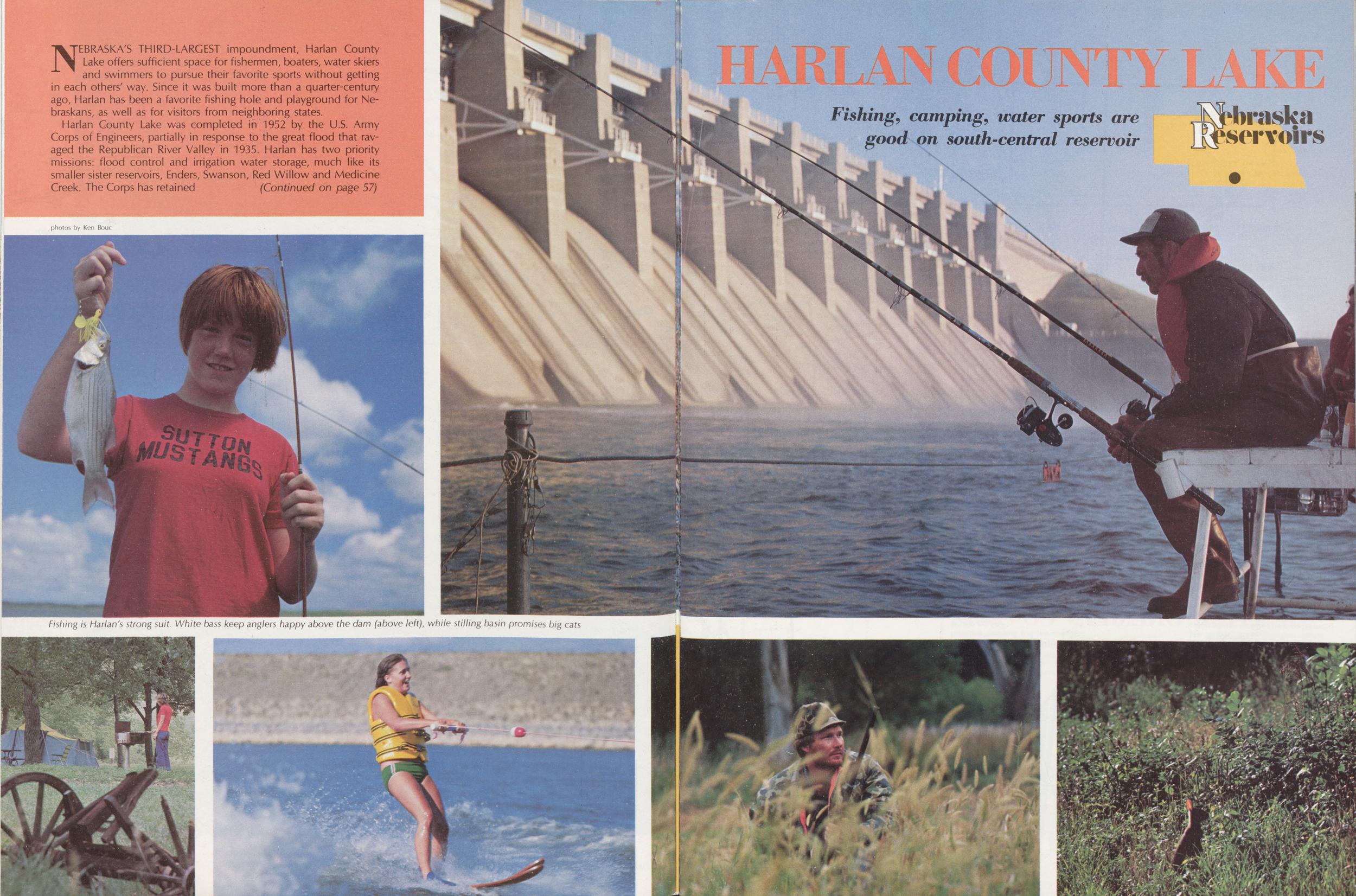
HARLAN COUNTY LAKE
Fishing, camping, water sports are good on south-central reservoir
NEBRASKA'S THIRD-LARGEST impoundment, Harlan County Lake offers sufficient space for fishermen, boaters, water skiers and swimmers to pursue their favorite sports without getting in each others' way. Since it was built more than a quarter-century ago, Harlan has been a favorite fishing hole and playground for Nebraskans, as well as for visitors from neighboring states.
Harlan County Lake was completed in 1952 by the U.S. Army Corps of Engineers, partially in response to the great flood that ravaged the Republican River Valley in 1935. Harlan has two priority missions: flood control and irrigation water storage, much like its smaller sister reservoirs, Enders, Swanson, Red Willow and Medicine Creek. The Corps has retained (Continued on page 57)
Fishing is Harlan's strong suit. White bass keep anglers happy above the dam (above left), while stilling basin promises big cats
MEDICINE CREEK RESERVOIR
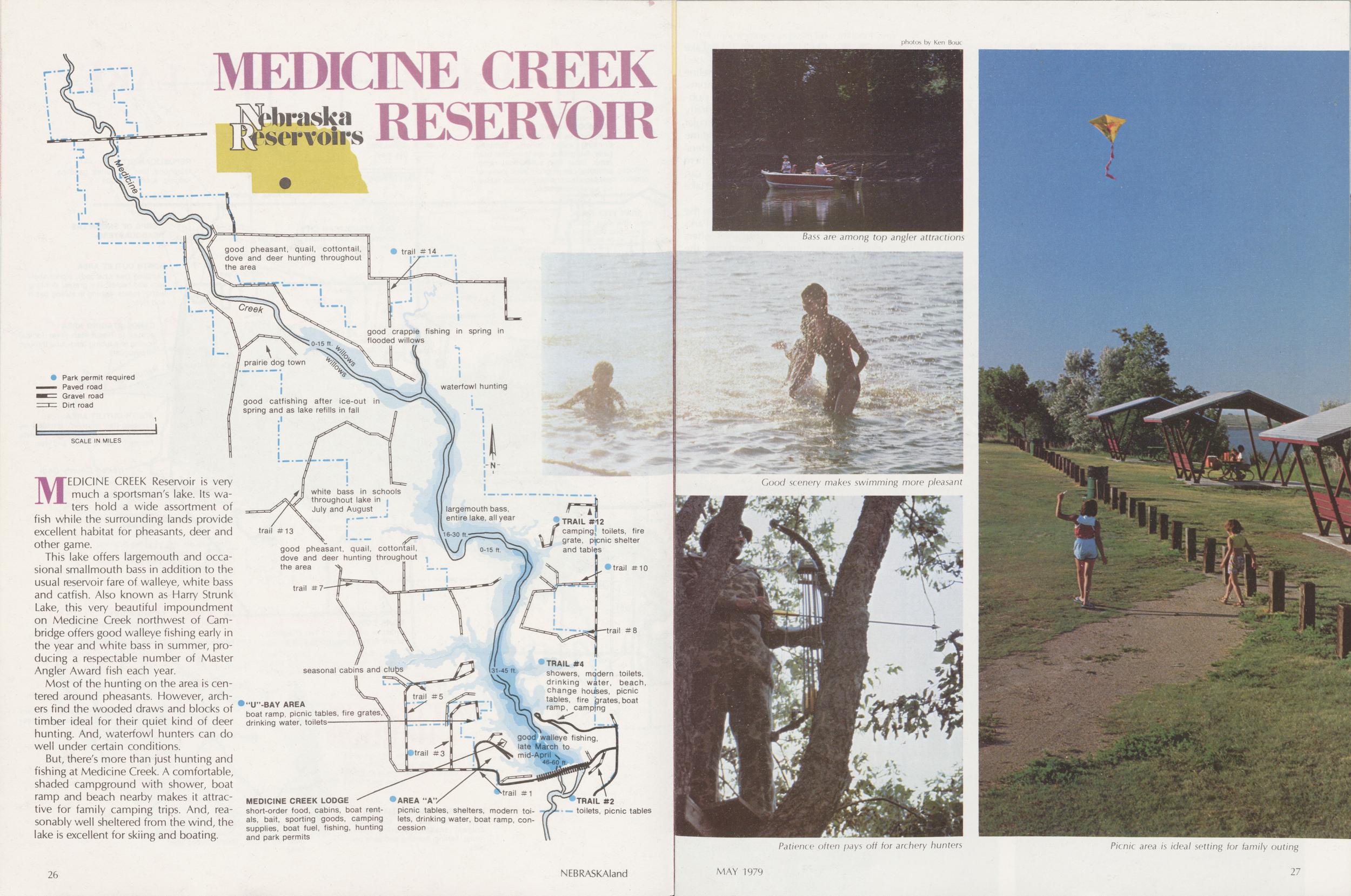
MEDICINE CREEK Reservoir is very much a sportsman's lake. Its waters hold a wide assortment of fish while the surrounding lands provide excellent habitat for pheasants, deer and other game.
This lake offers largemouth and occasional smallmouth bass in addition to the usual reservoir fare of walleye, white bass and catfish. Also known as Harry Strunk Lake, this very beautiful impoundment on Medicine Creek northwest of Cambridge offers good walleye fishing early in the year and white bass in summer, producing a respectable number of Master Angler Award fish each year.
Most of the hunting on the area is centered around pheasants. However, archers find the wooded draws and blocks of timber ideal for their quiet kind of deer hunting. And, waterfowl hunters can do well under certain conditions.
But, there's more than just hunting and fishing at Medicine Creek. A comfortable, shaded campground with shower, boat ramp and beach nearby makes it attractive for family camping trips. And, reasonably well sheltered from the wind, the lake is excellent for skiing and boating.
Bass are among top angler attractions
Good scenery makes swimming more pleasant
Patience often pays off for archery hunters
Picnic area is ideal setting for family outing
LAKE MALONEY
Nebraska Reservoirs
Located south of North Platte, Maloney provides water for hydro power plant, state fish hatchery
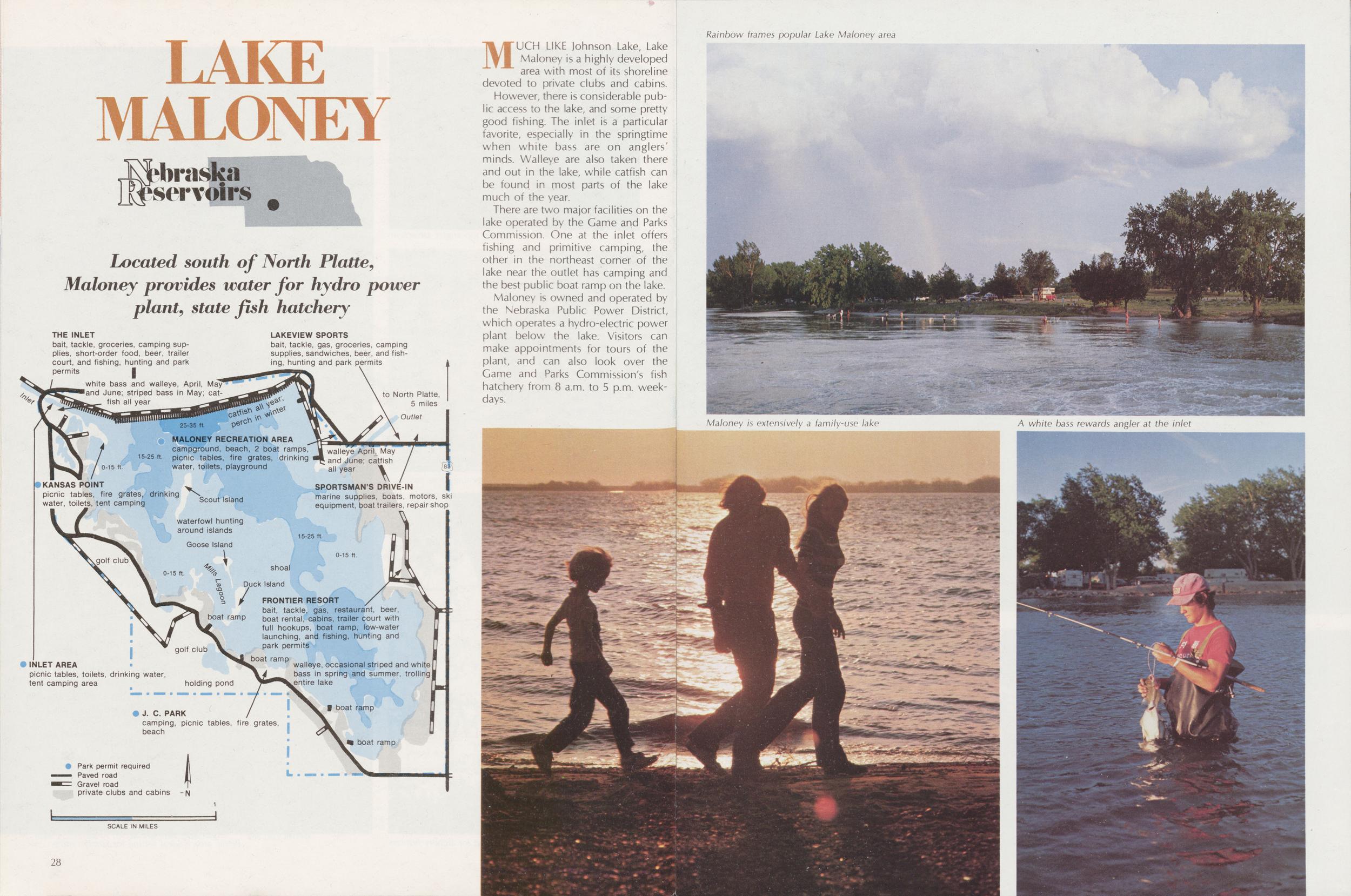
MUCH LIKE Johnson Lake, Lake Maloney is a highly developed area with most of its shoreline devoted to private clubs and cabins.
However, there is considerable public access to the lake, and some pretty good fishing. The inlet is a particular favorite, especially in the springtime when white bass are on anglers' minds. Walleye are also taken there and out in the lake, while catfish can be found in most parts of the lake much of the year.
There are two major facilities on the lake operated by the Game and Parks Commission. One at the inlet offers fishing and primitive camping, the other in the northeast corner of the lake near the outlet has camping and the best public boat ramp on the lake.
Maloney is owned and operated by the Nebraska Public Power District, which operates a hydro-electric power plant below the lake. Visitors can make appointments for tours of the plant, and can also look over the Game and Parks Commission's fish hatchery from 8 a.m. to 5 p.m. weekdays.
Rainbow frames popular Lake Maloney area
Maloney is extensively a family-use lake
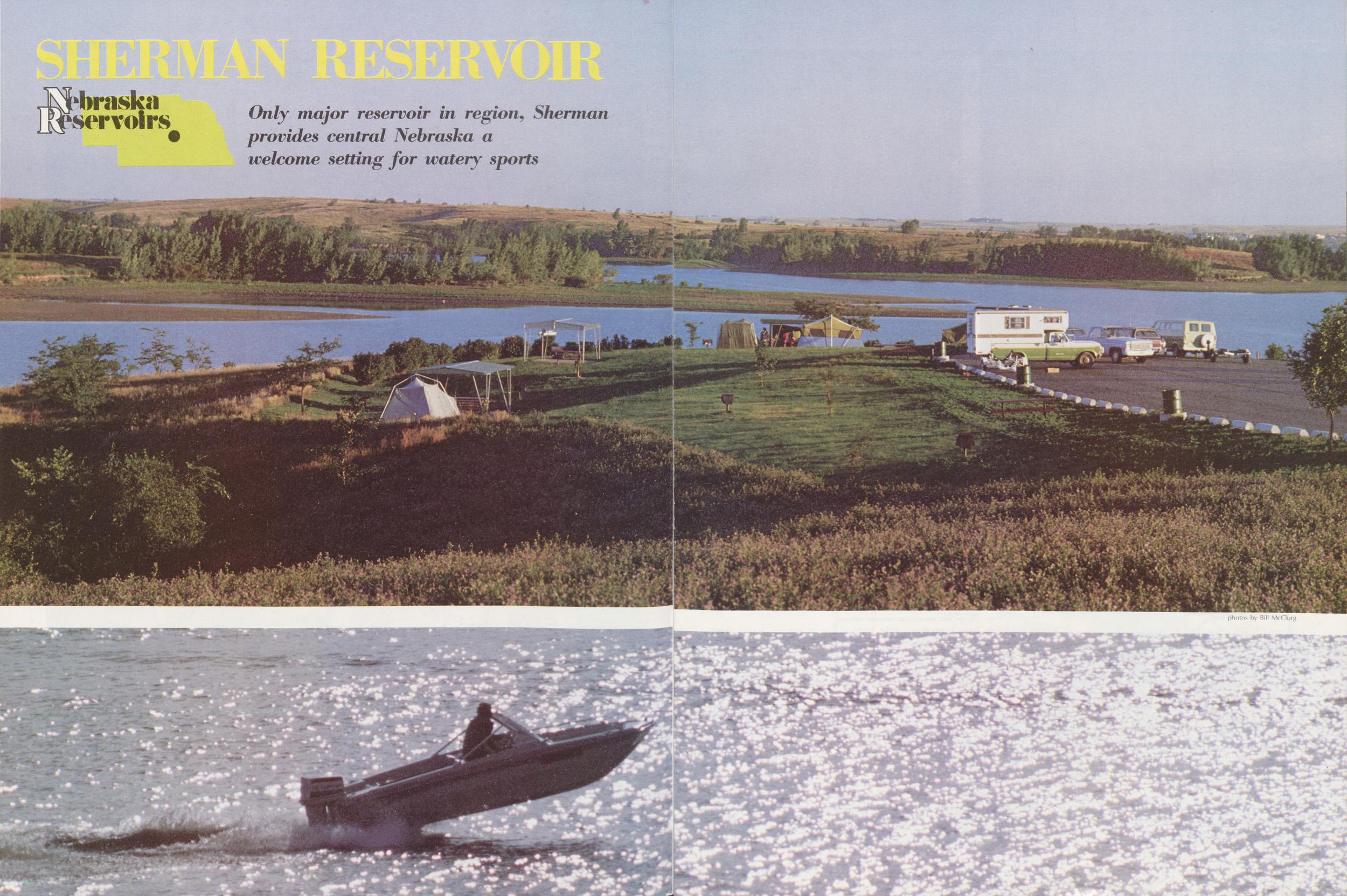
Nebraska Reservoir
SHERMAN RESERVOIR
Only major reservoir in region, Sherman provides central Nebraska a welcome setting for watery sports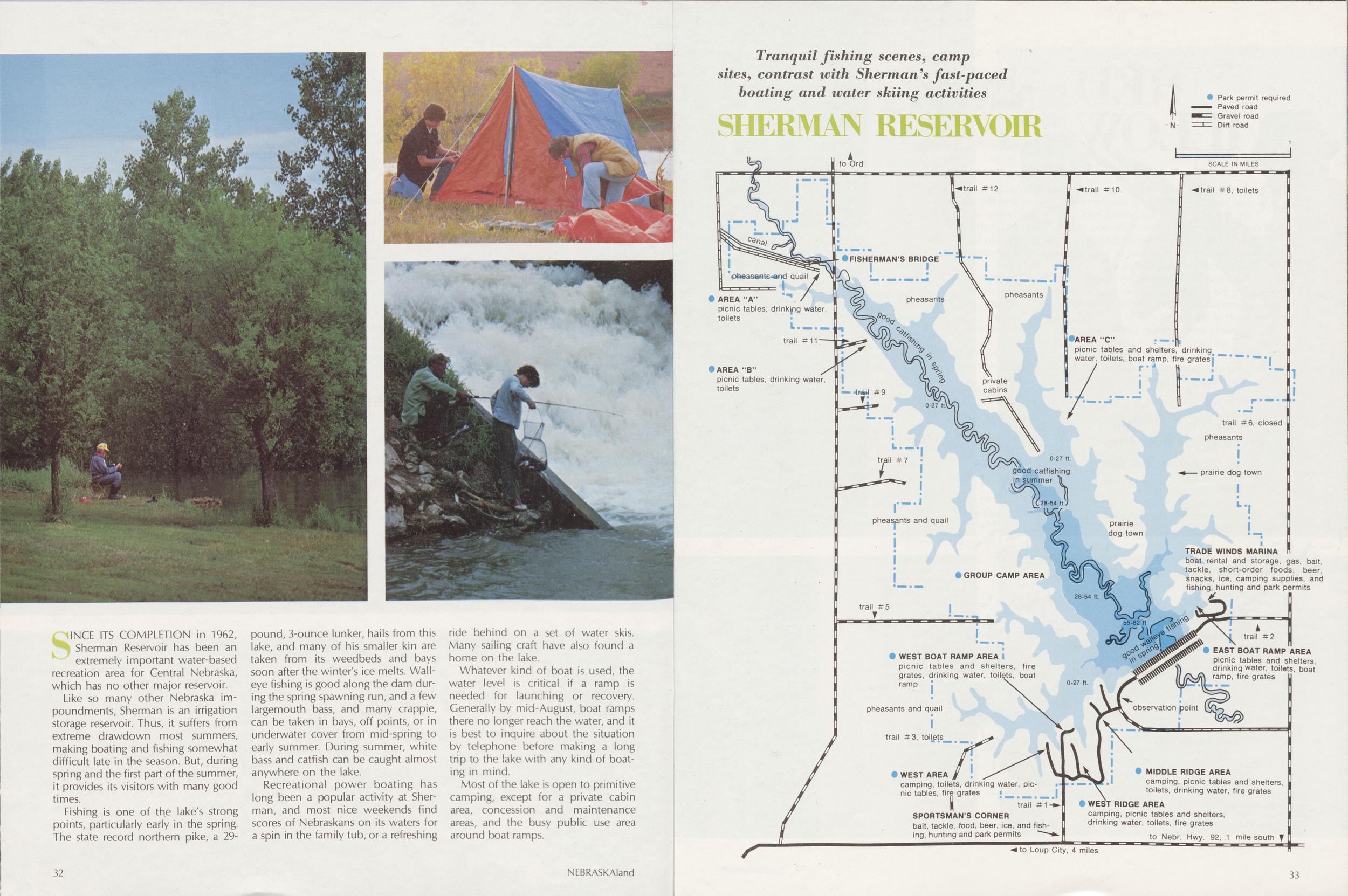 SHERMAN RESERVOIR
Tranquil fishing scenes, camp
sites, contrast with Sherman's fast-paced
boating and water skiing activities
SHERMAN RESERVOIR
Tranquil fishing scenes, camp
sites, contrast with Sherman's fast-paced
boating and water skiing activities
SINCE ITS COMPLETION in 1962, Sherman Reservoir has been an extremely important water-based recreation area for Central Nebraska, which has no other major reservoir.
Like so many other Nebraska impoundments, Sherman is an irrigation storage reservoir. Thus, it suffers from extreme drawdown most summers, making boating and fishing somewhat difficult late in the season. But, during spring and the first part of the summer, it provides its visitors with many good times.
Fishing is one of the lake's strong points, particularly early in the spring. The state record northern pike, a 29- pound, 3-ounce lunker, hails from this lake, and many of his smaller kin are taken from its weedbeds and bays soon after the winter's ice melts. Walleye fishing is good along the dam during the spring spawning run, and a few largemouth bass, and many crappie, can be taken in bays, off points, or in underwater cover from mid-spring to early summer. During summer, white bass and catfish can be caught almost anywhere on the lake.
Recreational power boating has long been a popular activity at Sherman, and most nice weekends find scores of Nebraskans on its waters for a spin in the family tub, or a refreshing ride behind on a set of water skis. Many sailing craft have also found a home on the lake.
Whatever kind of boat is used, the water level is critical if a ramp is needed for launching or recovery. Generally by mid-August, boat ramps there no longer reach the water, and it is best to inquire about the situation by telephone before making a long trip to the lake with any kind of boating in mind.
Most of the lake is open to primitive camping, except for a private cabin area, concession and maintenance areas, and the busy public use area around boat ramps.
Nebraska Reservoirs
RED WILLOW
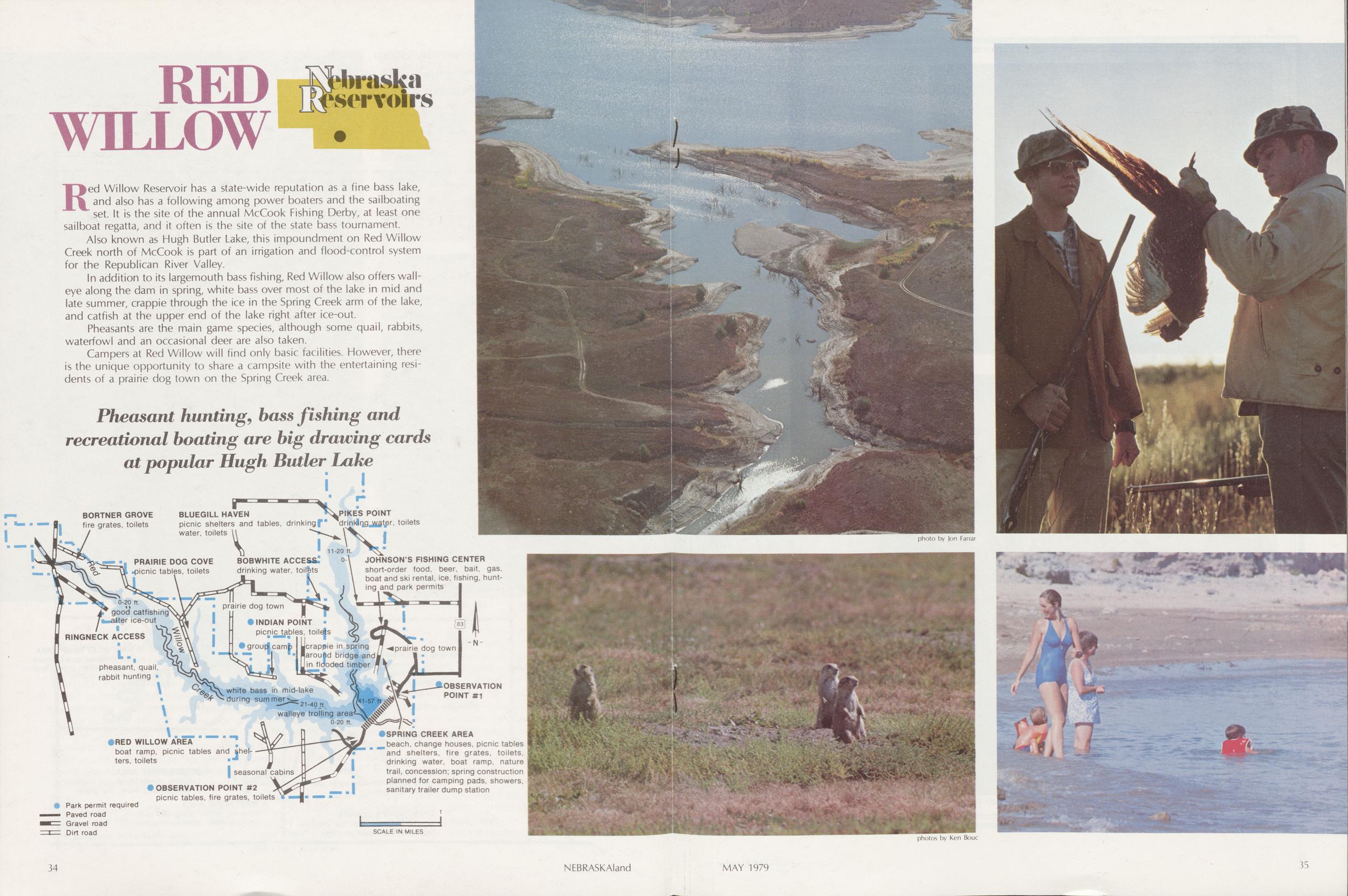
Pheasant hunting, bass fishing and recreational boating are big drawing cards at popular Hugh Butler Lake
Red Willow Reservoir has a state-wide reputation as a fine bass lake, and also has a following among power boaters and the sailboating set. It is the site of the annual McCook Fishing Derby, at least one sailboat regatta, and it often is the site of the state bass tournament.
Also known as Hugh Butler Lake, this impoundment on Red Willow Creek north of McCook is part of an irrigation and flood-control system for the Republican River Valley.
In addition to its largemouth bass fishing, Red Willow also offers walleye along the dam in spring, white bass over most of the lake in mid and late summer, crappie through the ice in the Spring Creek arm of the lake, and catfish at the upper end of the lake right after ice-out.
Pheasants are the main game species, although some quail, rabbits, waterfowl and an occasional deer are also taken.
Campers at Red Willow will find only basic facilities. However, there is the unique opportunity to share a campsite with the entertaining residents of a prairie dog town on the Spring Creek area.
Box Butte
Nebraska Reservoirs
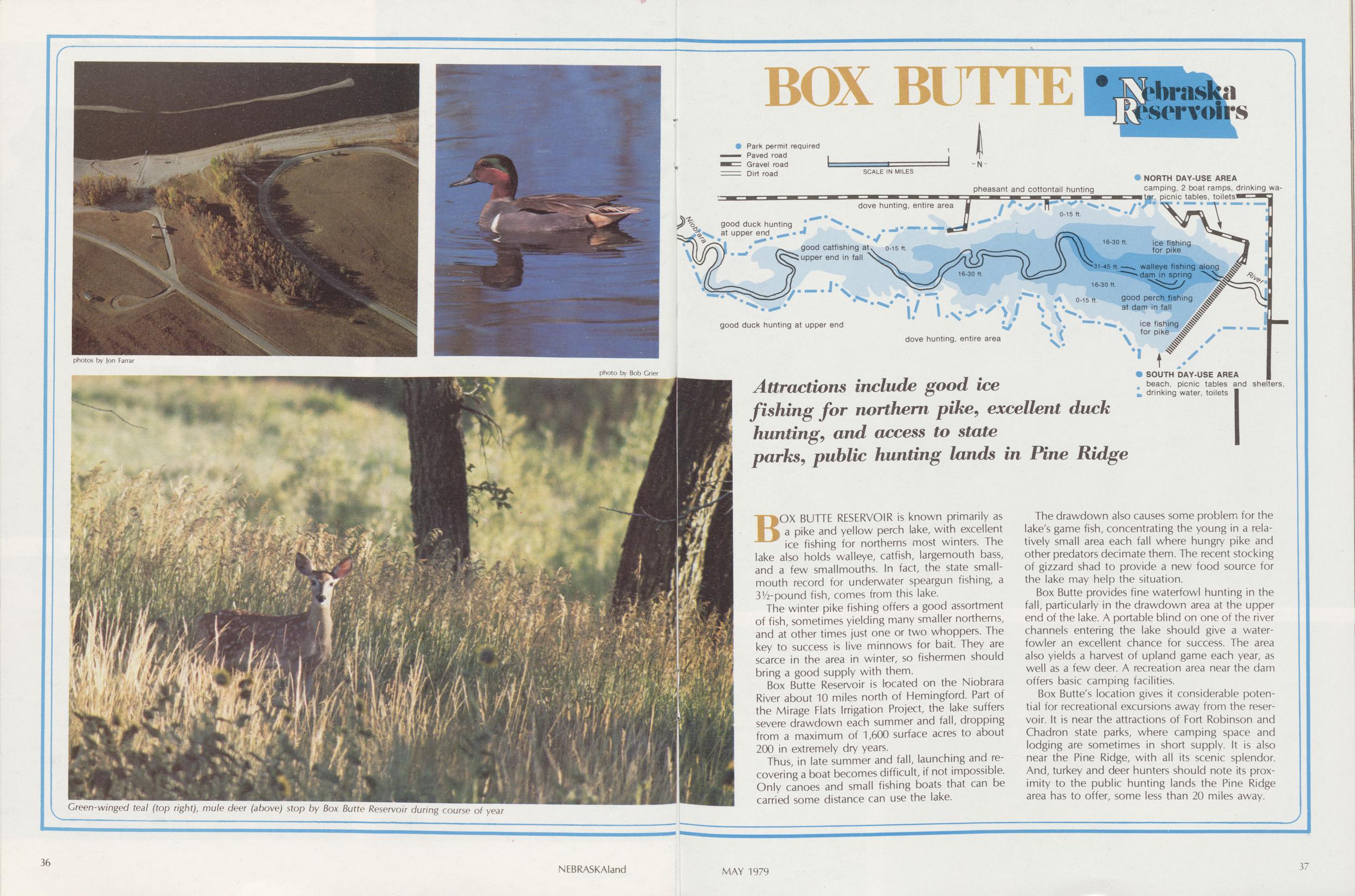
Attractions include good ice fishing for northern pike, excellent duck hunting, and access to state parks, public hunting lands in Pine Ridge
BOX BUTTE RESERVOIR is known primarily as a pike and yellow perch lake, with excellent ice fishing for northerns most winters. The lake also holds walleye, catfish, largemouth bass, and a few smallmouths. In fact, the state smallmouth record for underwater speargun fishing, a 3 1/2-pound fish, comes from this lake.
The winter pike fishing offers a good assortment of fish, sometimes yielding many smaller northerns, and at other times just one or two whoppers. The key to success is live minnows for bait. They are scarce in the area in winter, so fishermen should bring a good supply with them.
Box Butte Reservoir is located on the Niobrara River about 10 miles north of Hemingford. Part of the Mirage Flats Irrigation Project, the lake suffers severe drawdown each summer and fall, dropping from a maximum of 1,600 surface acres to about 200 in extremely dry years.
Thus, in late summer and fall, launching and recovering a boat becomes difficult, if not impossible. Only canoes and small fishing boats that can be carried some distance can use the lake.
The drawdown also causes some problem for the lake's game fish, concentrating the young in a relatively small area each fall where hungry pike and other predators decimate them. The recent stocking of gizzard shad to provide a new food source for the lake may help the situation.
Box Butte provides fine waterfowl hunting in the fall, particularly in the drawdown area at the upper end of the lake. A portable blind on one of the river channels entering the lake should give a waterfowler an excellent chance for success. The area also yields a harvest of upland game each year, as well as a few deer. A recreation area near the dam offers basic camping facilities.
Box Butte's location gives it considerable potential for recreational excursions away from the reservoir. It is near the attractions of Fort Robinson and Chadron state parks, where camping space and lodging are sometimes in short supply. It is also near the Pine Ridge, with all its scenic splendor. And, turkey and deer hunters should note its proximity to the public hunting lands the Pine Ridge area has to offer, some less than 20 miles away.
36 NEBRASKAland MAY 1979 37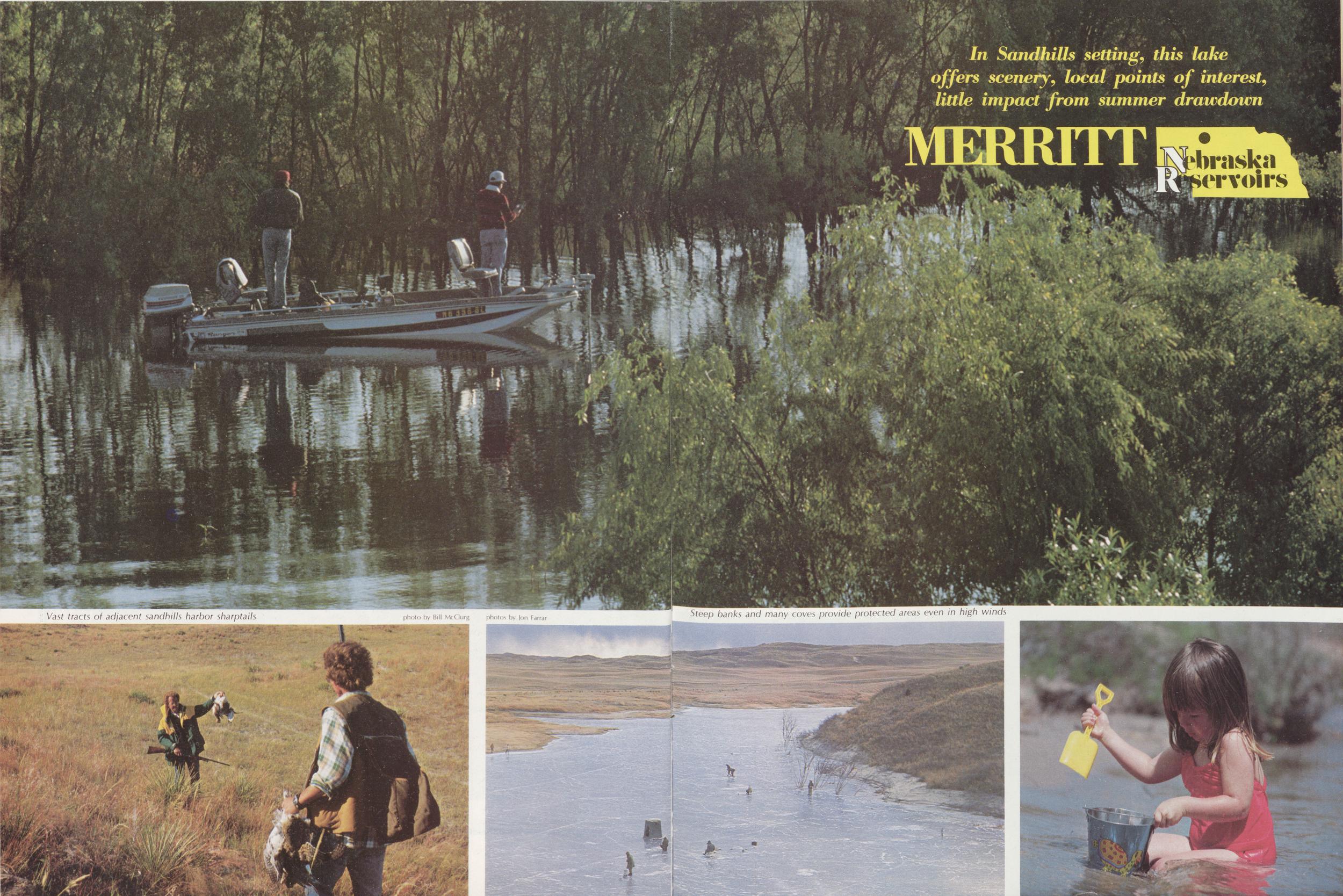
Merritt
Nebraska Reservoirs
In Sandhills setting, this lake offers scenery, local points of interest, little impact from summer drawdownVast tracts of adjacent sandhills harbor sharptails
Photo by Bill McGurgSteep banks and many coves provide protected areas even in high winds
 MERRTTT RESERVOIR
Much character and beauty await visitors
MERRITT RESERVOIR is the only major Nebraska impoundment in true Sandhills country, and as such, it is somewhat unique among Nebraska waters.
The Snake River and Boardman Creek fill the lake with their clear, cool waters, and a wild expanse of grassy hills flanks it on all sides. Mule deer, sharp-tailed grouse, box turtles, yucca, cactus, wildflowers, native grasses and all the flora and fauna of the Sandhills abound here.
Merritt is a deep lake, with a clean, sand bottom and little problem with extensive irrigation drawdown. Thus, it has the potential to be an excellent fishing lake; a potential that it fulfills. It boasts perhaps the best yellow perch population in the state, good numbers of walleye and crappie, and some jumbo white bass. Merritt also offers good black bass fishing, and is often picked as the site of the state bass tournament.
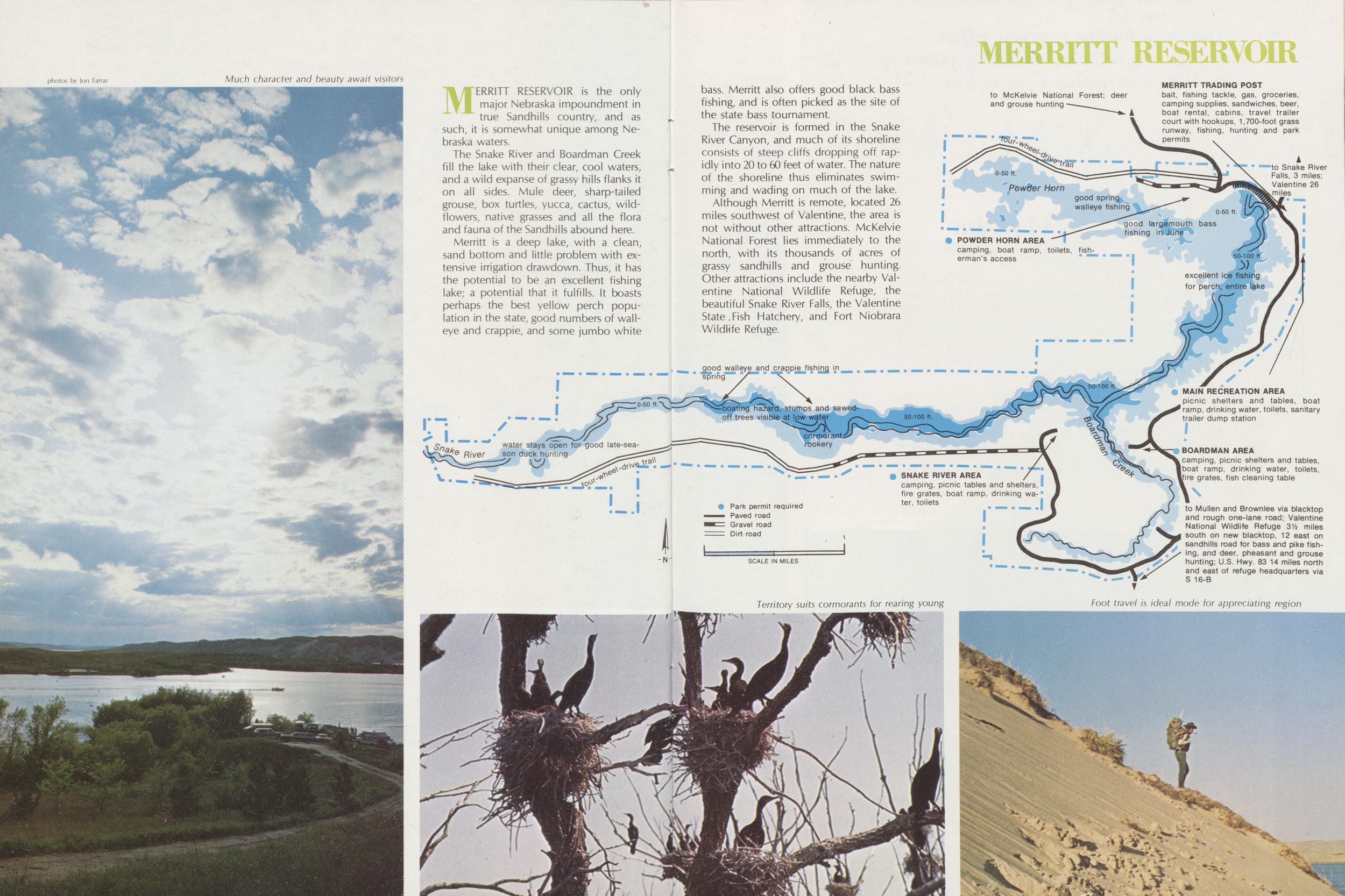
The reservoir is formed in the Snake River Canyon, and much of its shoreline consists of steep cliffs dropping off rapidly into 20 to 60 feet of water. The nature of the shoreline thus eliminates swimming and wading on much of the lake.
Although Merritt is remote, located 26 miles southwest of Valentine, the area is not without other attractions. McKelvie National Forest lies immediately to the north, with its thousands of acres of grassy sandhills and grouse hunting. Other attractions include the nearby Valentine National Wildlife Refuge, the beautiful Snake River Falls, the Valentine State,Fish Hatchery, and Fort Niobrara Wildlife Refuge.
MERRITT TRADING POST bait, fishing tackle, gas, groceries, camping supplies, sandwiches, beer, boat rental, cabins, travel trailer court with hookups, 1,700-foot grass runway, fishing, hunting and park permits
Powder Horn good spring walleye fishing to Snake River Falls, 3 miles; Valentine 26 miles 0-50 n.
POWDER HORN AREA camping, boat ramp, toilets, fisherman's access good largemouth bass fishing in June 50-100 ft excellent ice fishing for perch, entire lake 0-50 ft. water stays open for good late-season duck hunting good walleye and fishing spring boating hazard, stumps and sawed-off trees visible at low water cormorant; rookery 50-100 tt. 50-100 ft. Park permit required Paved road Gravel road Dirt road SNAKE RIVER AREA camping, picnic tables and shelters, fire grates, boat ramp, drinking water, toilets SCALE IN MILES MAIN RECREATION AREA picnic shelters and tables, boat ramp, drinking water, toilets, sanitary trailer dump station BOARDMAN AREA camping, picnic shelters and tables, boat ramp, drinking water, toilets, fire grates, fish cleaning table to Mullen and Brownlee via blacktop and rough one-lane road; Valentine National Wildlife Refuge 31/2 miles south on new blacktop, 12 east on sandhills road for bass and pike fishing, and deer, pheasant and grouse hunting; U.S. Hwy. 83 14 miles north and east of refuge headquarters via S 16-BTerritory suits cormorants for rearing young
Foot travel is ideal mode for appreciating region
Nebraska Reservoir
Lewis and Clark Lake
This long border reservoir offers a wide range of facilities, including points of interest attracting area tours
AN IMPOUNDMENT of the mighty Missouri River, Lewis and Clark Lake is unique among Nebraska reservoirs in at least one respect. In addition to controlling floods and generating power, it also regulates downstream water flows for navigation on the river.
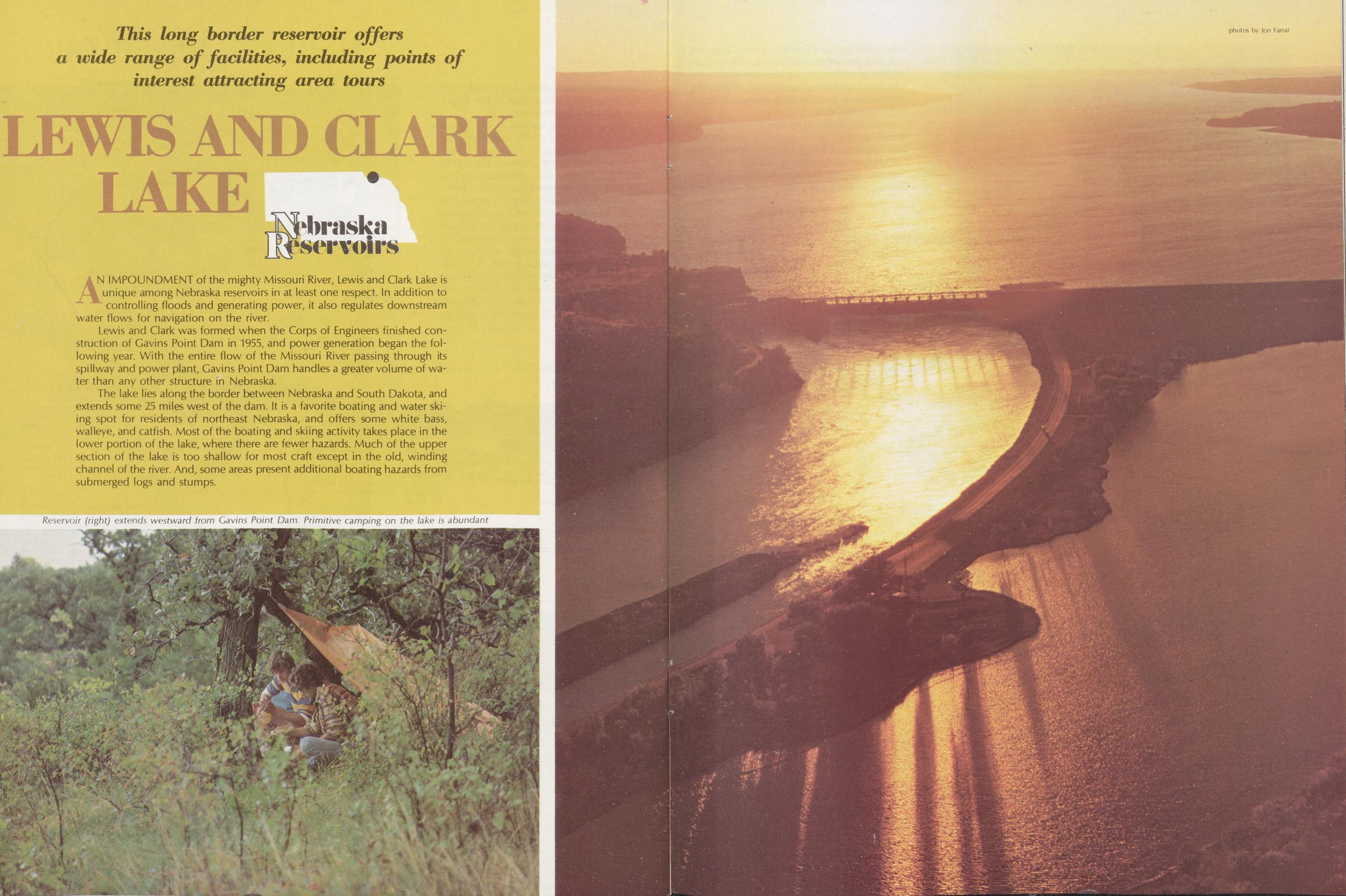
Lewis and Clark was formed when the Corps of Engineers finished construction of Gavins Point Dam in 1955, and power generation began the following year. With the entire flow of the Missouri River passing through its spillway and power plant, Gavins Point Dam handles a greater volume of water than any other structure in Nebraska.
The lake lies along the border between Nebraska and South Dakota, and extends some 25 miles west of the dam. It is a favorite boating and water skiing spot for residents of northeast Nebraska, and offers some white bass, walleye, and catfish. Most of the boating and skiing activity takes place in the lower portion of the lake, where there are fewer hazards. Much of the upper section of the lake is too shallow for most craft except in the old, winding channel of the river. And, some areas present additional boating hazards from submerged logs and stumps.
Reservoir (right) extends westward from Gavins Point Dam. Primitive camping on the lake is abundant
 LEWIS
AND CLARK
LAKE
LEWIS
AND CLARK
LAKE
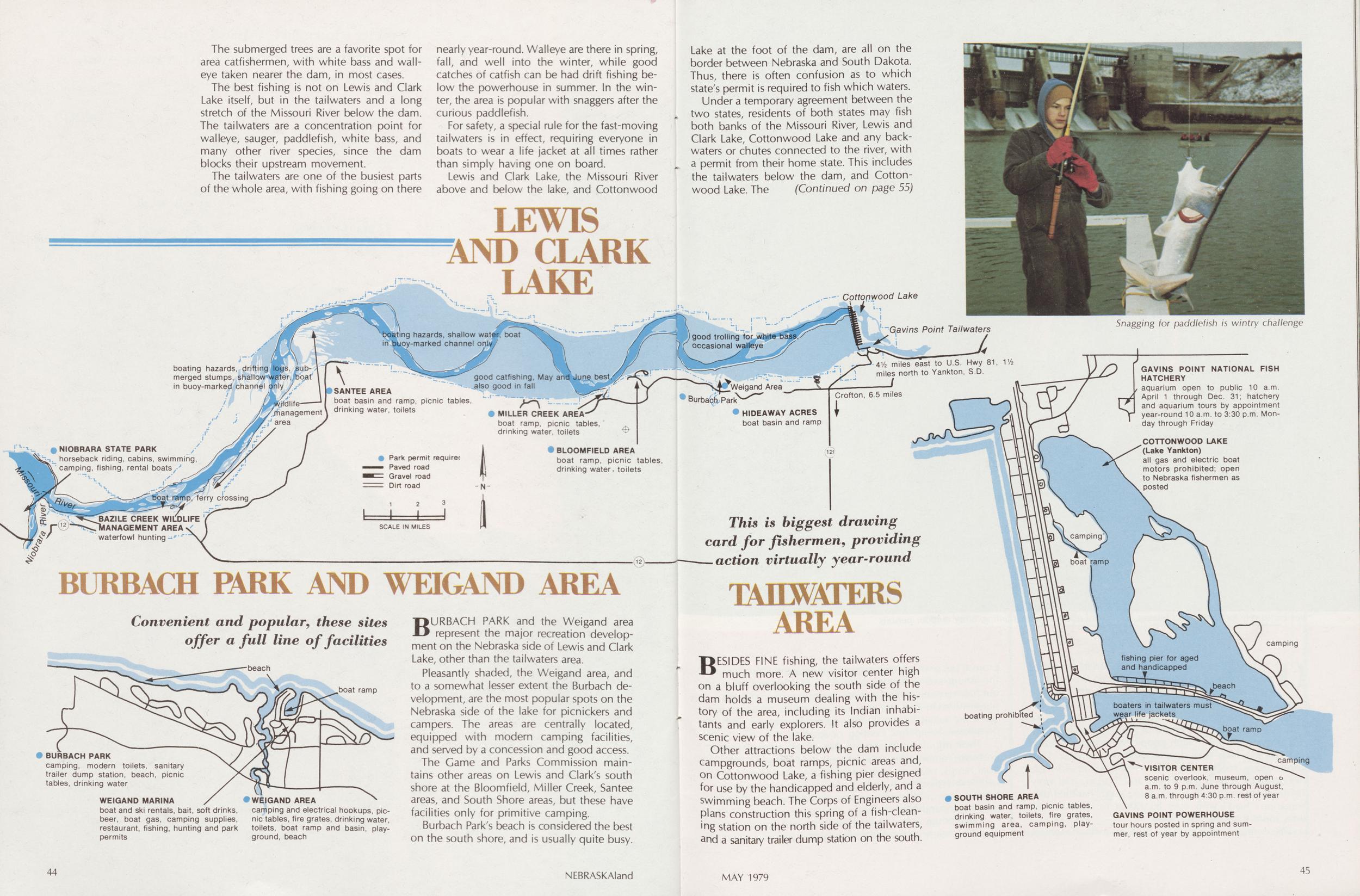
The submerged trees are a favorite spot for area catfishermen, with white bass and walleye taken nearer the dam, in most cases.
The best fishing is not on Lewis and Clark Lake itself, but in the tailwaters and a long stretch of the Missouri River below the dam. The tailwaters are a concentration point for walleye, sauger, paddlefish, white bass, and many other river species, since the dam blocks their upstream movement.
The tailwaters are one of the busiest parts of the whole area, with fishing going on there nearly year-round. Walleye are there in spring, fall, and well into the winter, while good catches of catfish can be had drift fishing below the powerhouse in summer. In the winter, the area is popular with snaggers after the curious paddlefish.
For safety, a special rule for the fast-moving tailwaters is in effect, requiring everyone in boats to wear a life jacket at all times rather than simply having one on board.
Lewis and Clark Lake, the Missouri River above and below the lake, and Cottonwood Lake at the foot of the dam, are all on the border between Nebraska and South Dakota. Thus, there is often confusion as to which state's permit is required to fish which waters.
Under a temporary agreement between the two states, residents of both states may fish both banks of the Missouri River, Lewis and Clark Lake, Cottonwood Lake and any back-waters or chutes connected to the river, with a permit from their home state. This includes the tailwaters below the dam, and Cottonwood Lake. (Continued on page 55)
BURBACH PARK AND WEIGAND AREA
Convenient and popular, these sites offer a full line of facilities
BURBACH PARK and the Weigand area represent the major recreation development on the Nebraska side of Lewis and Clark Lake, other than the tailwaters area.
Pleasantly shaded, the Weigand area, and to a somewhat lesser extent the Burbach development, are the most popular spots on the Nebraska side of the lake for picnickers and campers. The areas are centrally located, equipped with modern camping facilities, and sewed by a concession and good access.
The Game and Parks Commission maintains other areas on Lewis and Clark's south shore at the Bloomfield, Miller Creek, Santee areas, and South Shore areas, but these have facilities only for primitive camping.
Burbach Park's beach is considered the best on the south shore, and is usually quite busy.
TARWATERS AREA
This is biggest drawing card for fishermen, providing action virtually year-round
BESIDES FINE fishing, the tailwaters offers much more. A new visitor center high on a bluff overlooking the south side of the dam holds a museum dealing with the history of the area, including its Indian inhabitants and early explorers. It also provides a scenic view of the lake.
Other attractions below the dam include campgrounds, boat ramps, picnic areas and, on Cottonwood Lake, a fishing pier designed for use by the handicapped and elderly, and a swimming beach. The Corps of Engineers also plans construction this spring of a fish-cleaning station on the north side of the tailwaters, and a sanitary trailer dump station on the south.
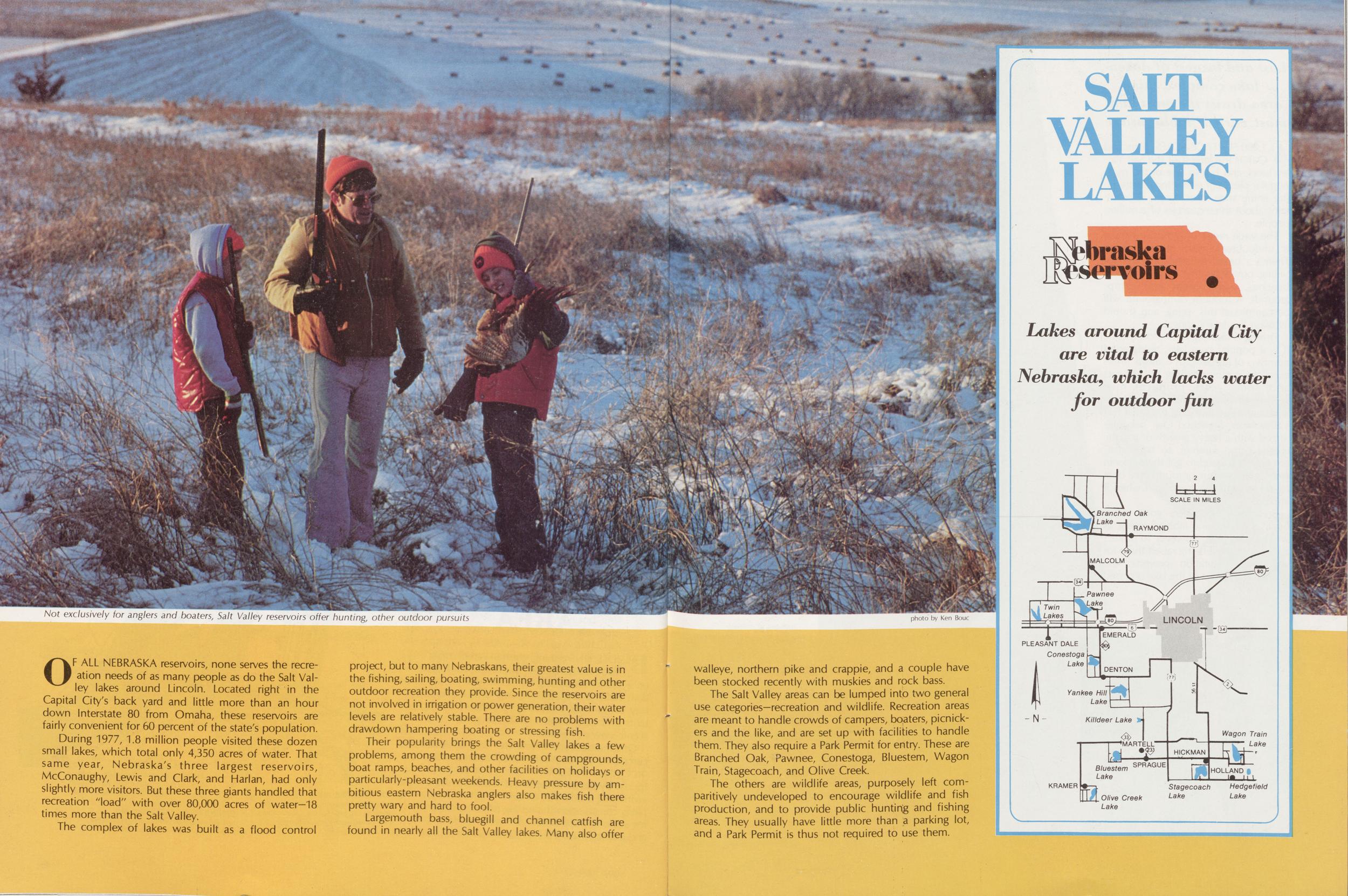
SALT VALLEY LAKES
Nebraska Reservoirs
Lakes around Capital City are vital to eastern Nebraska, which lacks water for outdoor fun
Not exclusively for anglers and boaters, Salt Valley reservoirs offer hunting, other outdoor pursuits
photo by Ken BoucOF ALL NEBRASKA reservoirs, none serves the recreation needs of as many people as do the Salt Valley lakes around Lincoln. Located right in the Capital City's back yard and little more than an hour down Interstate 80 from Omaha, these reservoirs are fairly convenient for 60 percent of the state's population.
During 1977, 1.8 million people visited these dozen small lakes, which total only 4,350 acres of water. That same year, Nebraska's three largest reservoirs, McConaughy, Lewis and Clark, and Harlan, had only slightly more visitors. But these three giants handled that recreation "load" with over 80,000 acres of water-18 times more than the Salt Valley.
The complex of lakes was built as a flood control project, but to many Nebraskans, their greatest value is in the fishing, sailing, boating, swimming, hunting and other outdoor recreation they provide. Since the reservoirs are not involved in irrigation or power generation, their water levels are relatively stable. There are no problems with drawdown hampering boating or stressing fish.
Their popularity brings the Salt Valley lakes a few problems, among them the crowding of campgrounds, boat ramps, beaches, and other facilities on holidays or particularly-pleasant weekends. Heavy pressure by ambitious eastern Nebraska anglers also makes fish there pretty wary and hard to fool.
Largemouth bass, bluegill and channel catfish are found in nearly all the Salt Valley lakes. Many also offer walleye, northern pike and crappie, and a couple have been stocked recently with muskies and rock bass.
The Salt Valley areas can be lumped into two general use categories-recreation and wildlife. Recreation areas are meant to handle crowds of campers, boaters, picnickers and the like, and are set up with facilities to handle them. They also require a Park Permit for entry. These are Branched Oak, Pawnee, Conestoga, Bluestem, Wagon Train, Stagecoach, and Olive Creek.
The others are wildlife areas, purposely left comparitively undeveloped to encourage wildlife and fish production, and to provide public hunting and fishing areas. They usually have little more than a parking lot, and a Park Permit is thus not required to use them.
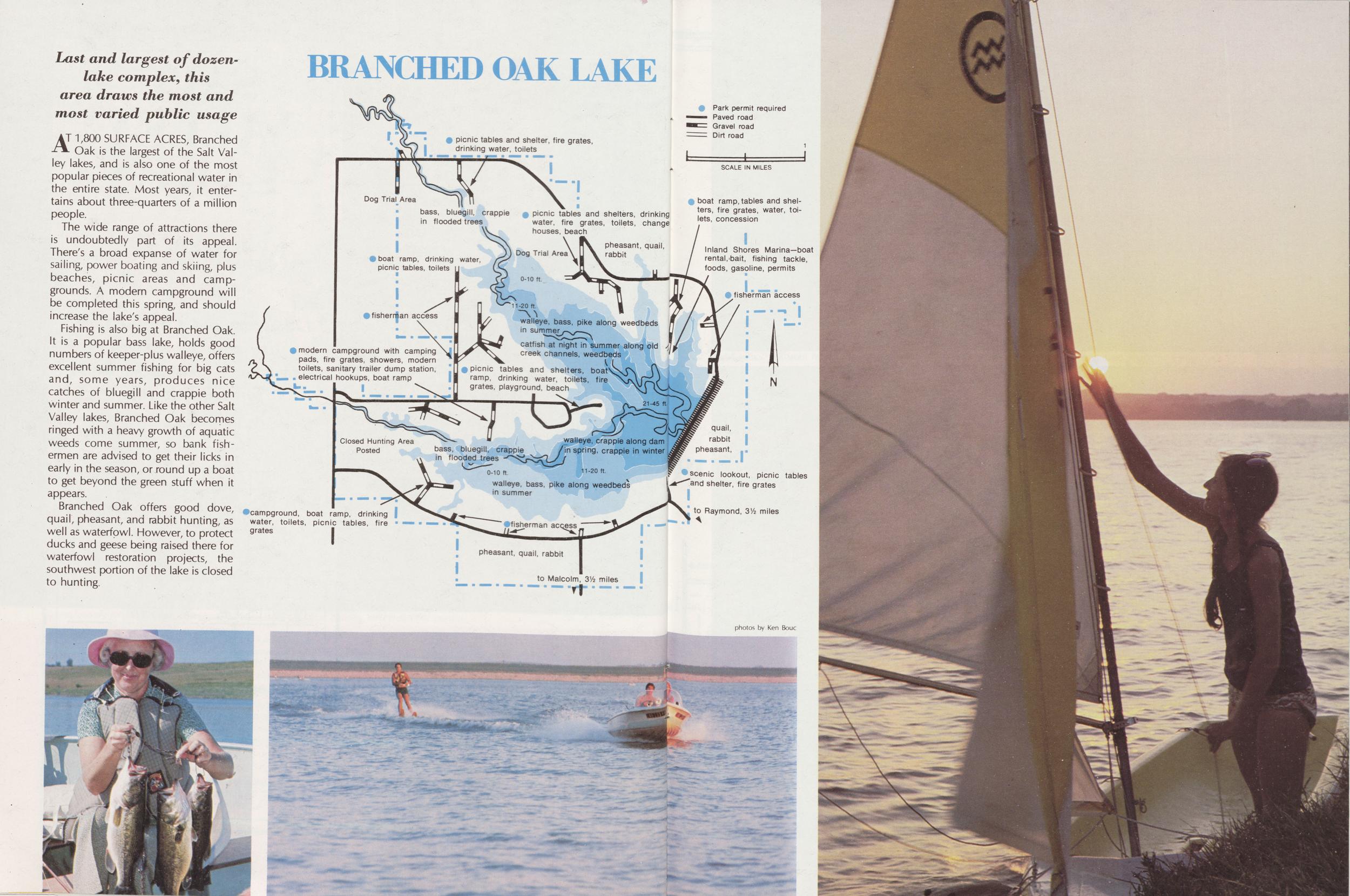
BRANCHED OAK LAKE
Last and largest of dozen-lake complex, this area draws the most and most varied public usage
AT 1,800 SURFACE ACRES, Branched Oak is the largest of the Salt Valley lakes, and is also one of the most popular pieces of recreational water in the entire state. Most years, it entertains about three-quarters of a million people.
The wide range of attractions there is undoubtedly part of its appeal. There's a broad expanse of water for sailing, power boating and skiing, plus beaches, picnic areas and campgrounds. A modern campground will be completed this spring, and should increase the lake's appeal.
Fishing is also big at Branched Oak. It is a popular bass lake, holds good numbers of keeper-plus walleye, offers excellent summer fishing for big cats and, some years, produces nice catches of bluegill and crappie both winter and summer. Like the other Salt Valley lakes, Branched Oak becomes ringed with a heavy growth of aquatic weeds come summer, so bank fishermen are advised to get their licks in early in the season, or round up a boat to get beyond the green stuff when it appears.
Branched Oak offers good dove, quail, pheasant, and rabbit hunting, as well as waterfowl. However, to protect ducks and geese being raised there for waterfowl restoration projects, the southwest portion of the lake is closed to hunting.
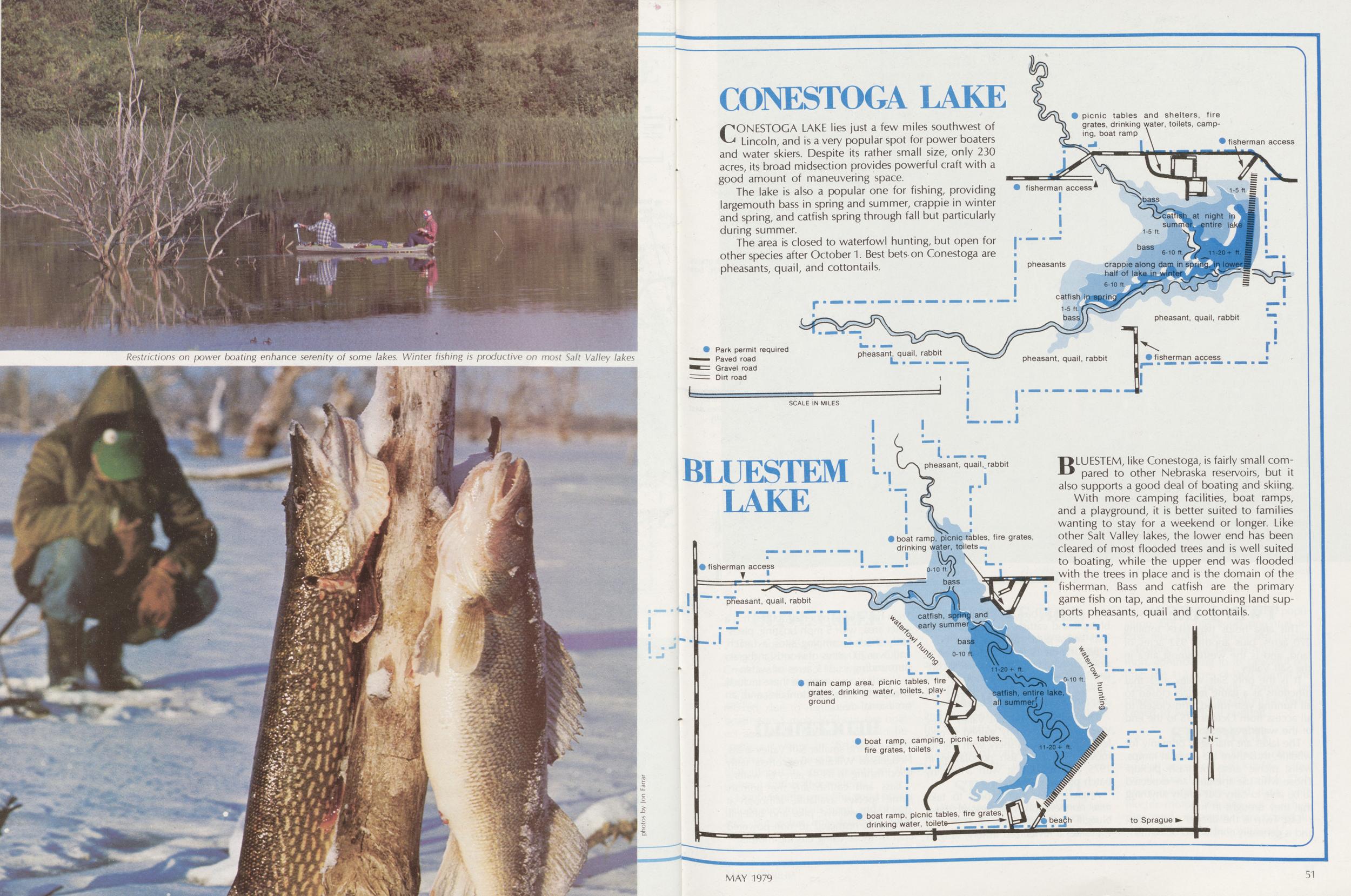
Restrictions on power boating enhance serenity of some lakes. Winter fishing is productive on most Salt Valley lakes
CONESTOGA LAKE
CONESTOGA LAKE lies just a few miles southwest of Lincoln, and is a very popular spot for power boaters and water skiers. Despite its rather small size, only 230 acres, its broad midsection provides powerful craft with a good amount of maneuvering space.
The lake is also a popular one for fishing, providing largemouth bass in spring and summer, crappie in winter and spring, and catfish spring through fall but particularly during summer.
The area is closed to waterfowl hunting, but open for other species after October 1. Best bets on Conestoga are pheasants, quail, and cottontails.
BLUESTEM LAKE
BLUESTEM, like Conestoga, is fairly small compared to other Nebraska reservoirs, but it also supports a good deal of boating and skiing.
With more camping facilities, boat ramps, and a playground, it is better suited to families wanting to stay for a weekend or longer. Like other Salt Valley lakes, the lower end has been cleared of most flooded trees and is well suited to boating, while the upper end was flooded with the trees in place and is the domain of the fisherman. Bass and catfish are the primary game fish on tap, and the surrounding land supports pheasants, quail and cottontails.
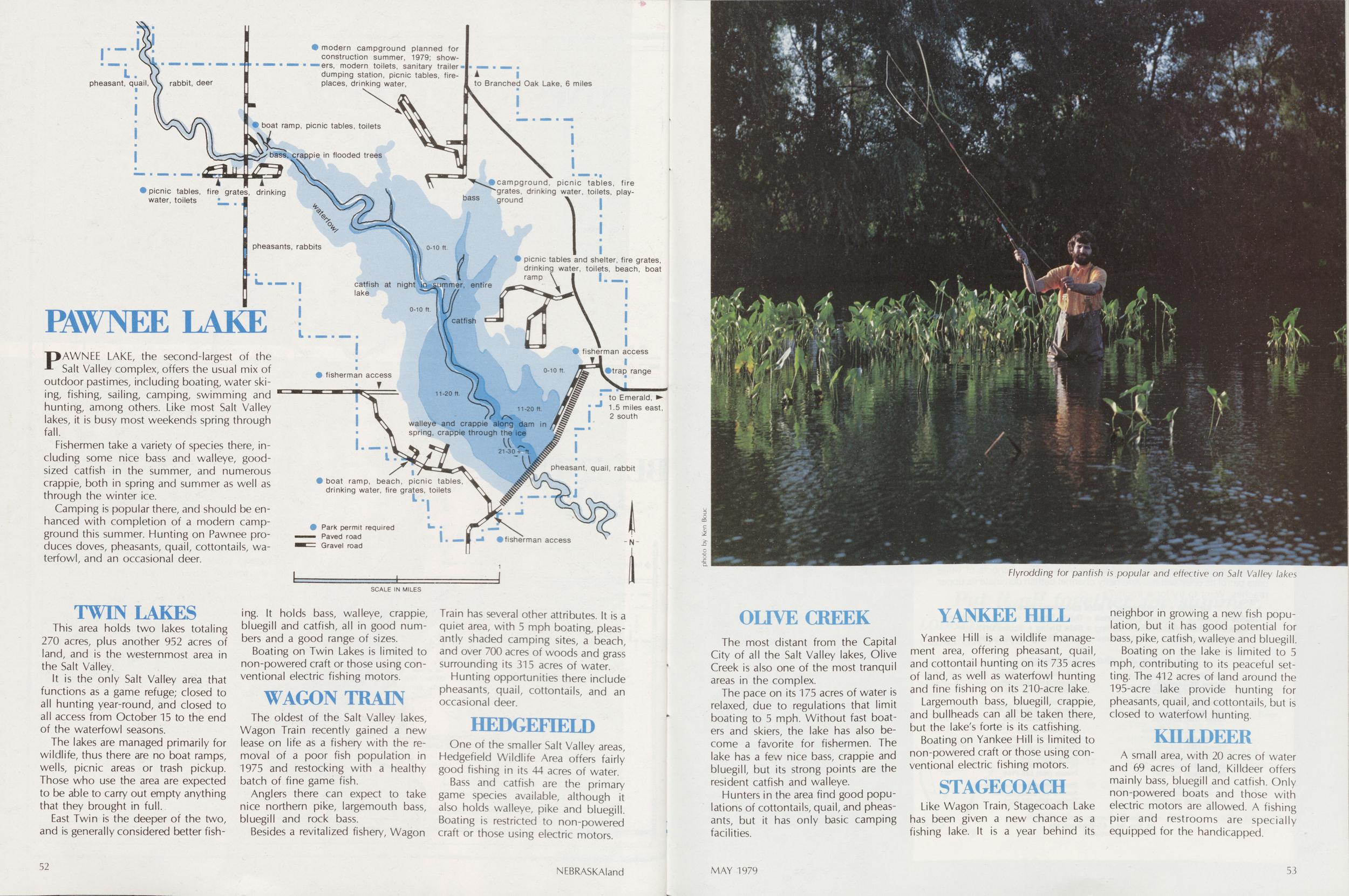
Pawnee Lake
PAWNEE LAKE, the second-largest of the Salt Valley complex, offers the usual mix of outdoor pastimes, including boating, water skiing, fishing, sailing, camping, swimming and hunting, among others. Like most Salt Valley lakes, it is busy most weekends spring through fall.
Fishermen take a variety of species there, including some nice bass and walleye, good- sized catfish in the summer, and numerous crappie, both in spring and summer as well as through the winter ice.
Camping is popular there, and should be enhanced with completion of a modern campground this summer. Hunting on Pawnee produces doves, pheasants, quail, cottontails, waterfowl, and an occasional deer.
TWIN LAKES
This area holds two lakes totaling 270 acres, plus another 952 acres of land, and is the westernmost area in the Salt Valley.
It is the only Salt Valley area that functions as a game refuge; closed to all hunting year-round, and closed to all access from October 15 to the end of the waterfowl seasons.
The lakes are managed primarily for wildlife, thus there are no boat ramps, wells, picnic areas or trash pickup. Those who use the area are expected to be able to carry out empty anything that they brought in full.
East Twin is the deeper of the two, and is generally considered better fishing. It holds bass, walleye, crappie, bluegill and catfish, all in good numbers and a good range of sizes.
Boating on Twin Lakes is limited to non-powered craft or those using conventional electric fishing motors.
WAGON TRAIN
The oldest of the Salt Valley lakes, Wagon Train recently gained a new lease on life as a fishery with the removal of a poor fish population in 1975 and restocking with a healthy batch of fine game fish.
Anglers there can expect to take nice northern pike, largemouth bass, bluegill and rock bass.
Besides a revitalized fishery, Wagon Train has several other attributes. It is a quiet area, with 5 mph boating, pleasantly shaded camping sites, a beach, and over 700 acres of woods and grass surrounding its 315 acres of water.
Hunting opportunities there include pheasants, quail, cottontails, and an occasional deer.
HEDGEFIELD
One of the smaller Salt Valley areas, Hedgefield Wildlife Area offers fairly good fishing in its 44 acres of water.
Bass and catfish are the primary game species available, although it also holds walleye, pike and bluegill. Boating is restricted to non-powered craft or those using electric motors.
Flyrodding for panfish is popular and effective on Salt Valley lakes
OLIVE CREEK
The most distant from the Capital City of all the Salt Valley lakes, Olive Creek is also one of the most tranquil areas in the complex.
The pace on its 175 acres of water is relaxed, due to regulations that limit boating to 5 mph. Without fast boaters and skiers, the lake has also become a favorite for fishermen. The lake has a few nice bass, crappie and bluegill, but its strong points are the resident catfish and walleye.
Hunters in the area find good populations of cottontails, quail, and pheasants, but it has only basic camping facilities.
YANKEE HILL
Yankee Hill is a wildlife managment area, offering pheasant, quail, and cottontail hunting on its 735 acres of land, as well as waterfowl hunting and fine fishing on its 210-acre lake.
Largemouth bass, bluegill, crappie, and bullheads can all be taken there, but the lake's forte is its catfishing.
Boating on Yankee Hill is limited to non-powered craft or those using conventional electric fishing motors.
STAGECOACH
Like Wagon Train, Stagecoach Lake has been given a new chance as a fishing lake. It is a year behind its neighbor in growing a new fish population, but it has good potential for bass, pike, catfish, walleye and bluegill.
Boating on the lake is limited to 5 mph, contributing to its peaceful setting. The 412 acres of land around the 195-acre lake provide hunting for pheasants, quail, and cottontails, but is closed to waterfowl hunting.
KILLDEER
A small area, with 20 acres of water and 69 acres of land, Killdeer offers mainly bass, bluegill and catfish. Only non-powered boats and those with electric motors are allowed. A fishing pier and restrooms are specially equipped for the handicapped.
52 NEBRASKAland MAY 1979 53
ENDERS RESERVOIR
(Continued from page 17)its recreation will gradually be forced to shift from water-oriented sports to landbased fun.
The Bureau of Reclamation, which built the dam on the Frenchman River in 1951, has predicted that irrigation pumping in its watershed will nearly dry up the river by 1990. And, whatever becomes the fate of the river is also the fate of the reservoir.
Of course, everyone would prefer that the lake would once again be full of water, fish, swimmers and boaters. But, if that is not to be, reasonable people will look for whatever good can be gleaned from the situation. And, there are some benefits.
One will be increased wildlife production. Grasses and trees will gradually take over the rich soils at the upper end of the reservoir, providing excellent habitat for pheasant, quail, deer, and dozens of other species. Continued management of the rest of the lands will also increase wildlife numbers.
Even if the dire prediction should prove true, Enders Reservoir will still have its 3,700+ acres of land, it will have its wildlife, and it will have its beauty. And, the locality's colorful historic tradition will be intact, including old Indian villages, the Texas-Ogallala cattle trail, and the old flour mill at Champion. With these resources, perhaps people will be able to find a new recipe for outdoor fun that does not require a large body of water.
LEWIS AND CLARK LAKE
(Continued from page 45)agreement expires on July 31, 1979, however, unless renewed by the fish and game agencies of the two states.
The area below the dam offers much besides fishing. There are excellent recreational facilities, a visitor center, and a museum.
Each spring, numerous eagles congregate at the area, primarily because ducks also congregate there and provide easy meals for them. Visitors are able to view eagles in several areas near the dam.
The powerhouse at the dam is another point of interest, as is the Gavins Point National Fish Hatchery on the South Dakota side. Both of these facilities offer scheduled tours during summer months, and will handle group tours by appointment the rest of the year.
Attractions at the upper end of the lake include Bazile Creek Wildlife area, a marsh with excellent duck hunting. Sandbars where the Missouri enters the lake are good spots for goose hunting.
Niobrara State Park is also near the upper end of the lake, offering cabins, trail rides, swimming, fishing, and other entertainment.

HARLAN COUNTY RESERVOIR
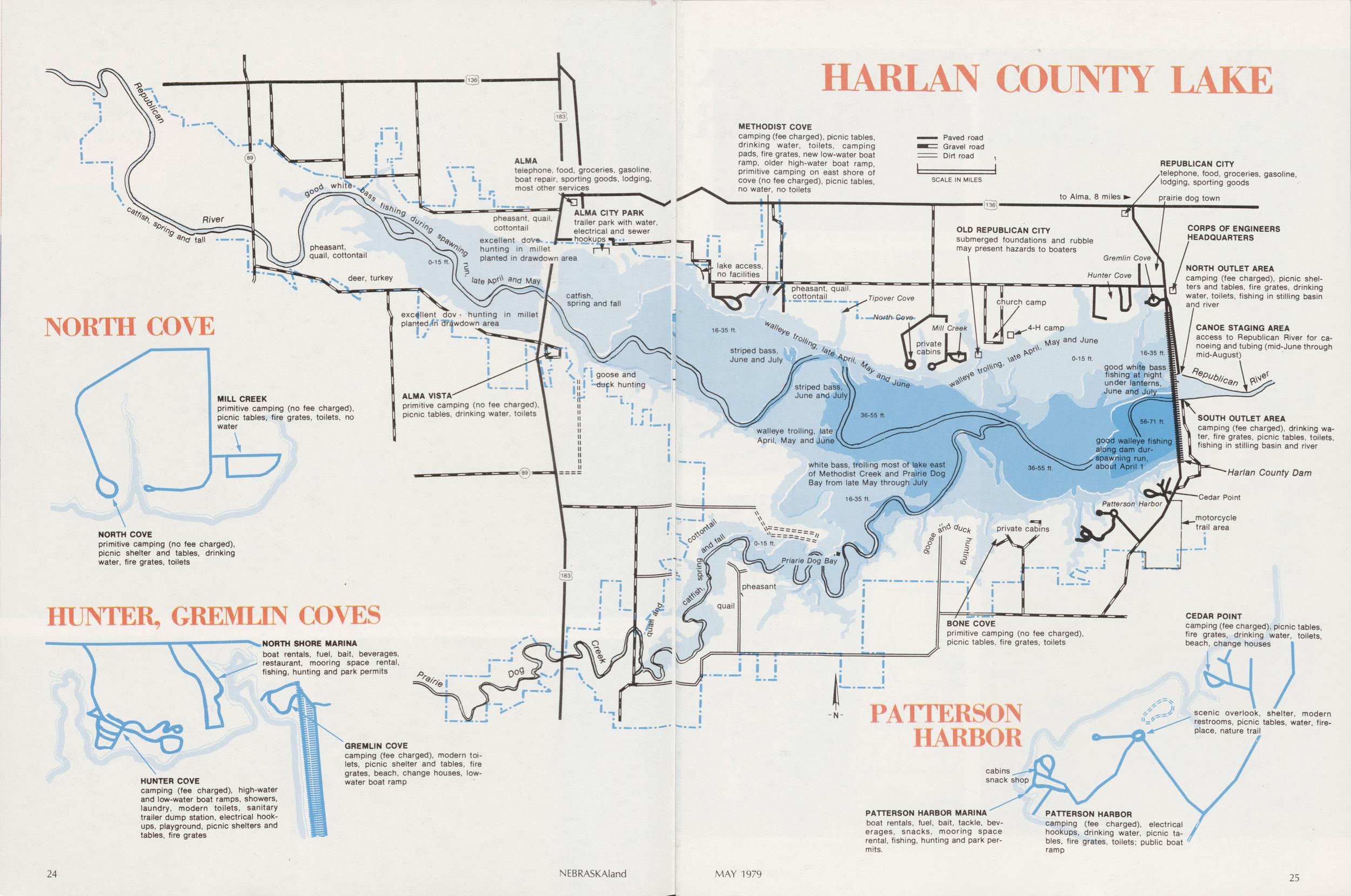
(Continued from page 25)control of the lake, manipulating the dam for irrigation and flood control, and managing the rest of the reservoir and surrounding land for recreation, wildlife, and agricultural purposes.
Since the Corps of Engineers has jurisdiction rather than the Game and Parks Commission, there are some minor differences in rules governing outdoor activities there. The Nebraska Park Entry Permit is not required, for example, but the Corps charges daily fees to camp in some areas.
Harlan's chief claim to fame has always been its fishing. In its early days, it was a crappie hotspot. In more recent years, the reservoir has earned a reputation as one of the better walleye lakes in Nebraska, and dependable white bass water, too.
Catfish are also in pretty good supply, and striped bass were stocked there a few years ago in hopes that they might duplicate their performance at Lake McConaughy. Some stripers to 15 pounds have been taken by anglers the last few years, although it's too early to tell if they will reach the size of those in Big Mac.
The fishing calendar at Harlan always opens with the spring walleye run, usually in early April. The fish gather near the dam to spawn, and can be taken for 10 days to
two weeks with cast or trolled plugs or jigs. Often, the best fishing is at night.
After the spawning run, its trolling for walleye in 10 to 20 feet of water for the rest of April, through May and into June. During June and July, fishing for white bass at night is popular. Gas lanterns are suspended over the side of an anchored or slowly drifting boat to attract baitfish and bass, and minnows are then lowered over the side. During May, June and July, white bass can also be taken during the daytime by trolling artificials almost anywhere in the eastern two-thirds of the lake. Catfishing is good in spring and fall in the upper end of the lake and in most of Prairie Dog Bay.
Another good fishing opportunity is found in the stilling basin below the dam. The turbulence of water pouring through the spillway into the Republican River is quieted in a deep concrete basin that is a haven for many fish, including bragging-size catfish.
A cable suspended over the water marks the dropoff into the violent waters of the stilling basin, and fishermen equipped with waders, life jacket and heavy tackle can do well there. The life jacket is a must, since a spill into the basin without one could tragically end a fishing excursion.
Other items of note at the eastern end of the reservoir include the Corps of Engineers Headquarters and Information Center, a prairie dog town, a trail-bike area for cyclists, and a launching site for canoeists and inner-tube riders heading down the Republican River. Floating down-river is usually possible only from mid-June to mid-August, when the reservoir is discharging water for irrigation.
Camping facilities on the lake range from the elaborate Hunter Cove facility, with its showers, laundry, hookups and playground, to primitive sites with no more than a water pump and latrine.
When the summer's boaters and swimmers disappear, and only diehard fall-fishermen are left on the water, Harlan County Lake becomes the domain of the hunter. Dove hunting is excellent on many parts of the area, particularly in the draws and canyons with stands of hemp.
A little later, when pheasant and quail seasons open, the land surrounding the lake offers good game populations. Deer and wild turkey live in the wooded tracts along the river above the lake, and ducks and geese make the reservoir their headquarters, providing waterfowl hunters plenty of sport. Each fall, the Corps holds drawings for permits to build blinds on the shore of the lake.
For those unfamiliar with what Harlan County Lake has to offer, a visit to the Corps of Engineers Headquarters at the north end of the dam is in order. A ranger is on duty there to answer questions from 7:30 a.m. to 4:30 p.m. year-round, and a museum provides interesting displays on the area and dam construction.

RESERVOIRS... A NEED FOR BOATING SAFETY, KNOW HOW
ALONG WITH THE very considerable recreation provided by Nebraska's reservoirs have come some problems. Inherent with any large body of water and the accompanying boating activity comes some danger— from the weather, faulty equipment, poor behavior or judgment, and water hazards. Most of these dangers can be provided for or avoided, and following are some suggestions to help keep the boater (and passengers) out of trouble.
Weather is a major factor, and it is difficult even for professionals to predict. Always watch for signs of change, however, and keep an ear out for any forecasts available.
Bad weather usually comes from the west, but not always. A storm evident in the west will usually hit soon and seldom passes by. Storms from the north or east may pass over, but keep alert. Watch for wind shifts, which usually mean weather changes. Check the barometer, as pressure changes with the weather. A rising barometer means fair weather; a high barometer also means that clouds will be high in the sky.
These signs mean that dangerous weather is ahead:
Dark, threatening clouds, which mean a shower or thunderstorm; a steady increase in wind or waves; heavy static on the radio usually indicates a thunderstorm nearby.
If caught out in bad weather, there are still steps which can be taken to prevent disaster. Boaters should put on life preservers, now more commonly referred to as "personal flotation devices"(PFD). If heavy waves develop, it is best to nearly head into them, quartering to nearest shore. If without power, quickly rig a sea anchor and tie to the bow. The drag of this anchor will keep the boat into the wind, which may mean a rough ride, but is much safer than rolling.
It is advisable to know your boat's capabilities, except the only way to learn is by having the boat out under bad weather conditions. At least it can be learned over shallower water.
Put briefly, foul weather advice might be to reduce speed; head for nearest shore if possible; head bow into waves at slight angle; secure loose items and have emergency gear ready; keep the boat bailed out; seat passengers

in the bottom near centerline, wearing life jackets; and rig a sea anchor if motor fails—this can be a tackle box, bucket, or shirt with neck and sleeves knotted—from the bow. If a boat capsizes, it usually stays afloat, and it is best to stay with it in that case; try to get back in or climb upon it if possible.
For many boaters, the worse moments don't come on the water, but trying to get into it. For many, backing down a steep and busy boat ramp is a nightmare. Partly that is because of lack of confidence in backing a trailer, which should not be the case. If you are not adept at backing, use a deserted parking lot for practice. Set up a system of boxes and maneuver through them, either using the rearview mirror or opening the car door and watching directly. Once you learn the technique, backing becomes fun rather than a challenge. With the steering hand on the bottom of the wheel, turn in the direction you want the trailer to go.
Also involved in launching is a matter of consideration. The boat should be prepared for launching away from the ramp-gear loaded, motor tilted up, drain plug in, etc. everything ready so that the ramp is tied up a minimum time. It is also advisable to check on foot before launching to make certain there are no hidden obstacles, drop-offs or other problems. The same is true of retrieving. Make all preparations beforehand, either taking gear out at the dock or unloading it after the boat is on the trailer. When all is ready, then back down, load the boat and winch it up, and drive away so that others can use the ramp. Securing and maintenance can be done in the parking lot.
When underway, keep the load distributed; don't stand up in a small boat; do not permit passengers to ride on parts of the boat not designed for such use; keep alert lookout, as many accidents occur merely because the
This looks like as good a spot as any.

operator is not watching where he is going; be especially careful in swimming and diving areas; watch your wake—you are responsible for any accidents or damage from your boat; always have children and non-swimmers wear PFD's; be careful of your footing as water makes decks and floors slippery; and generally know and obey the Rules of the Road.
With proper training, equipment and attitude, boating can be safe and enjoyable for everyone involved.
LAKE McCONAUGHY
(Continued from page 10)westbound immigrants followed the Oregon Trail through the area. Ruts of the wagons are still visible at Ash Hollow, a prehistoric cave dwelling has been restored, and a visitor center offers displays and information on the area's history.
The neighboring Sandhills provide interesting scenery for a drive, perhaps to Arthur, just a half-hour to the north, or to Crescent Lake National Wildlife Refuge north of Oshkosh, about 90 minutes away. Interesting things to see and do can also be found in Ogallala and other nearby communities.
Come fall, when campers, water skiers, swimmers, sailboaters and most fishermen have abandoned the lake, Big Mac becomes waterfowl hunting territory. Clear Creek Waterfowl Management Area at the west end of the lake attracts a substantial flock of Canada geese, which are hunted on a controlled-shooting area, as well as on much of the rest of the lake. And, winter sees ice boaters on the lake, and skaters, and skiers and backpackers, so its role as a recreation area is pretty much year-round. In fact, this and other southwest reservoirs now commonly have anglers when the first snow flies, with white bass still hitting well in November.
66 NEBRASKAland
Position: 511 (21 views)