Volume 57, Issue 3, 1979
NEBRASKAland
March 1979 60 Cents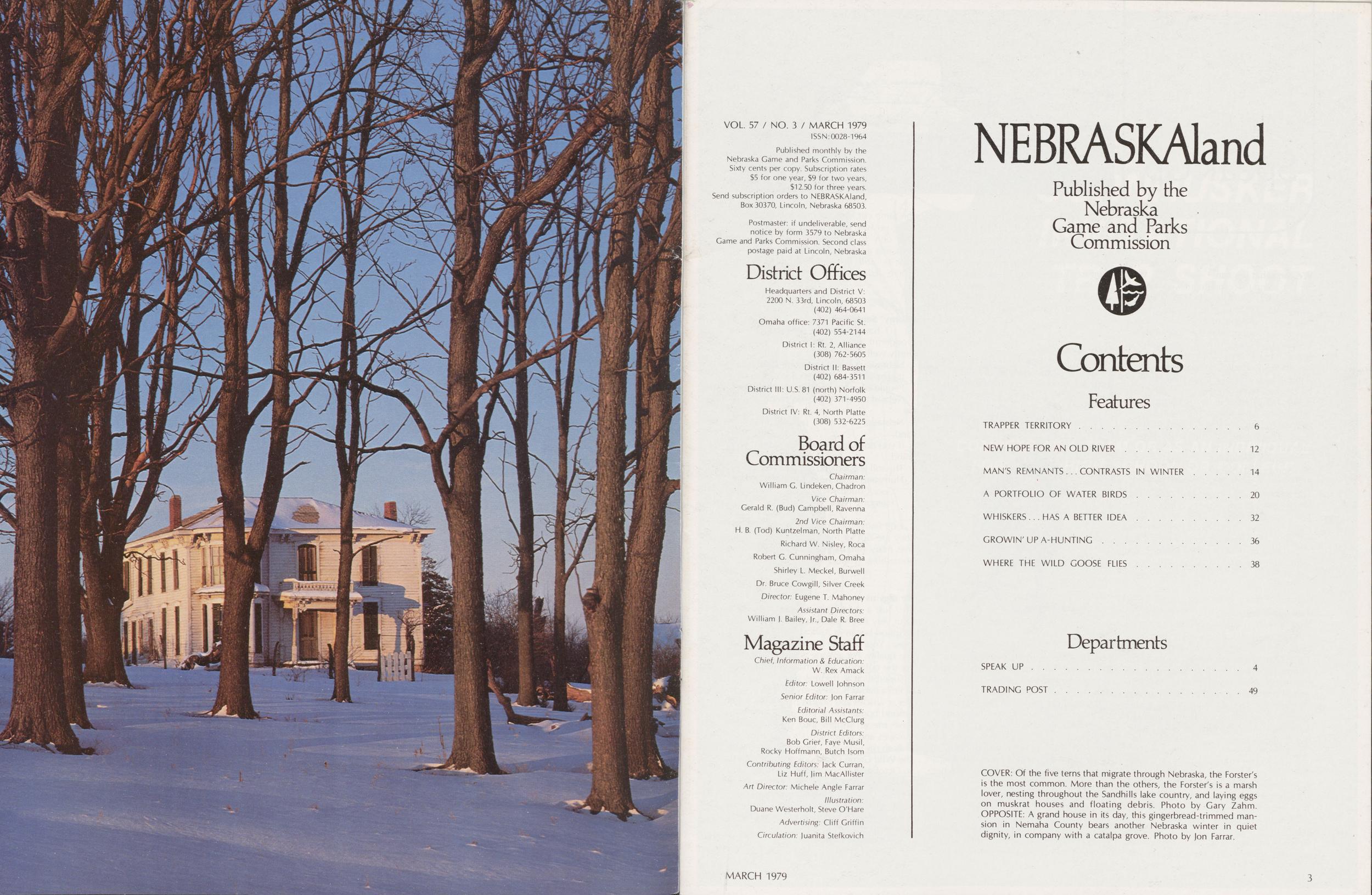
NEBRASKAland
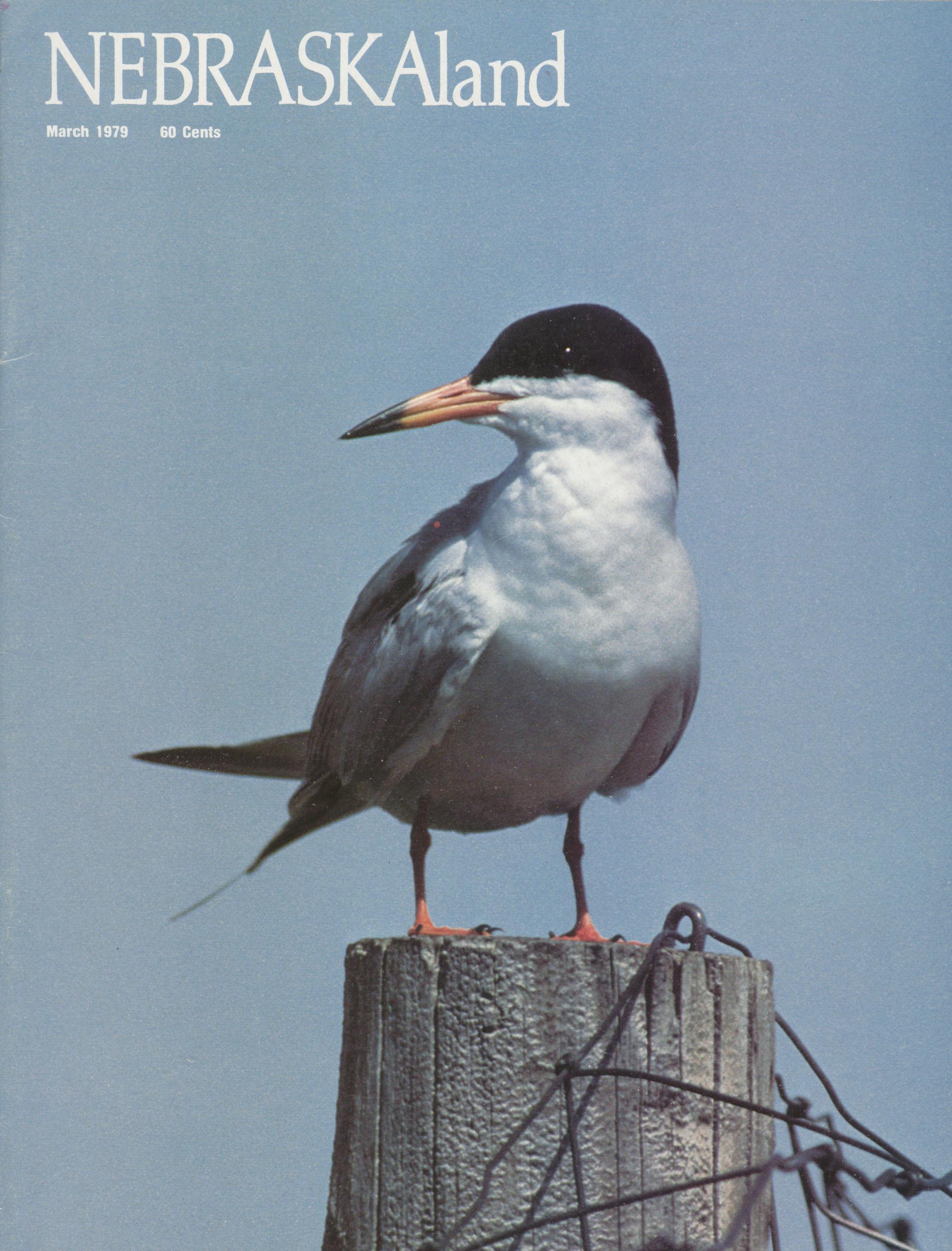
Published by the Nebraska Game and Parks Commission Contents Features TRAPPER TERRITORY 6 NEW HOPE FOR AN OLD RIVER 12 MAN'S REMNANTS...CONTRASTS IN WINTER 14 A PORTFOLIO OF WATER BIRDS 20 WHISKERS...HAS A BETTER IDEA 32 GROWIN'UPA-HUNTING 36 WHERE THE WILD GOOSE FLIES 38 Departments SPEAK UP TRADING POST 49COVER: Of the five terns that migrate through Nebraska, the Forster's is the most common. More than the others, the Forster's is a marsh lover, nesting throughout the Sandhills lake country, and laying eggs on muskrat houses and floating debris. Photo by Gary Zahm. OPPOSITE: A grand house in its day, this gingerbread-trimmed mansion in Nemaha County bears another Nebraska winter in quiet dignity, in company with a catalpa grove. Photo by Jon Farrar.
Speak Up
We can what we canSir / I want to compliment you on the great cookbook you sent out (October 1978). We really enjoy it. I do fix venison one way you don't have in your book. I can it, just about like the folks canned beef and pork when I was a youngster at home. It makes a delicious quick meal and on a bed of noodles or potatoes, is really good. It also makes a great stew and can be used so many ways.
Our family does a lot of hunting and fishing, so I have already tried some of the recipes and am looking forward to using more. Thank you very much for such a nice book.
Normal Reinmiller Staplehurst, Nebr.You are very welcome, and I'm certain that all the people who have recipes in the book are delighted to have others share them. You are right about canned venison—it is convenient to have on hand, and is certainly tasty over noodles. Hope you enjoy all the recipes, and thanks for writing. (Editor)
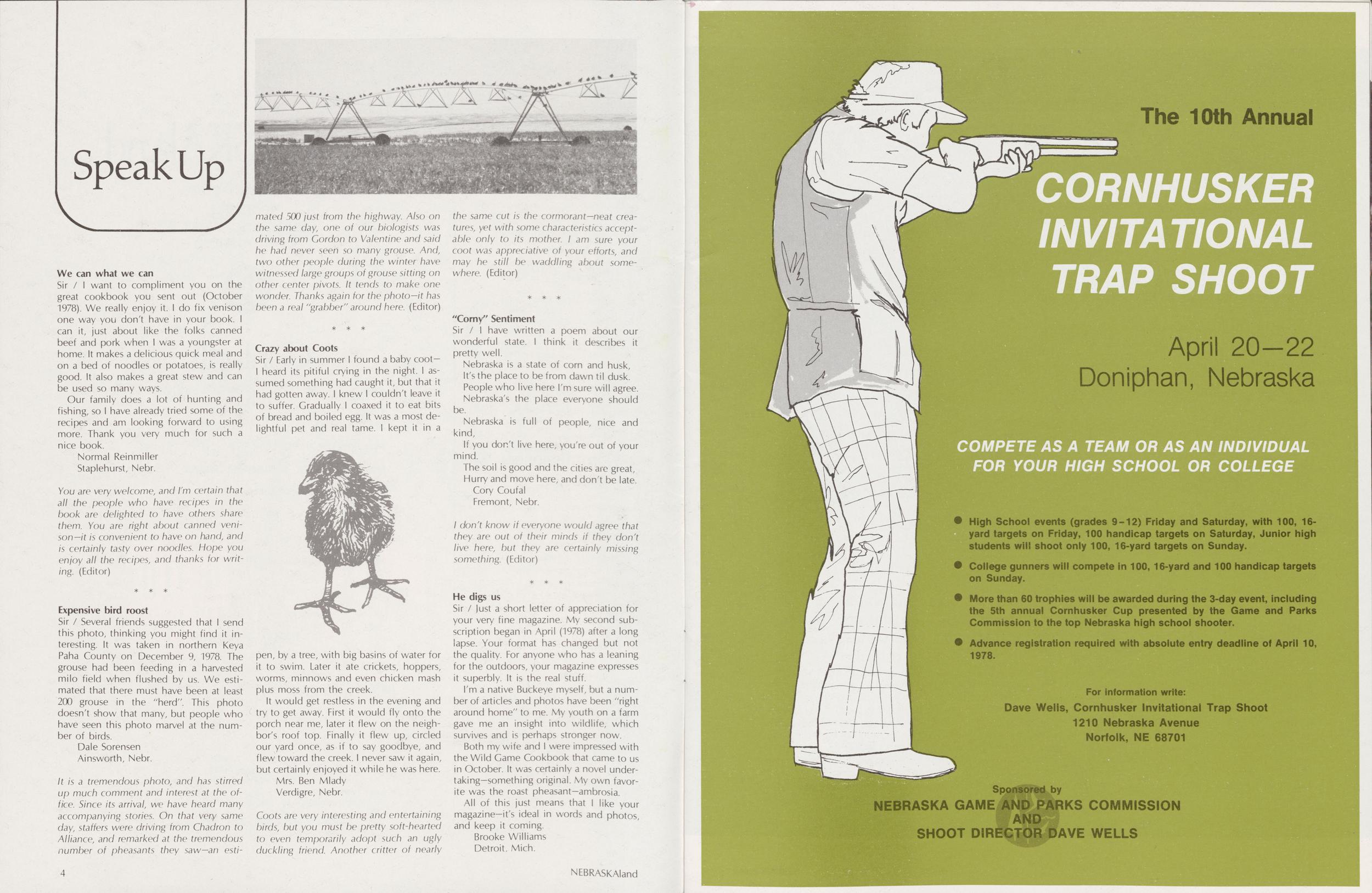
Expensive bird roostSir / Several friends suggested that I send this photo, thinking you might find it interesting. It was taken in northern Keya Paha County on December 9, 1978. The grouse had been feeding in a harvested milo field when flushed by us. We estimated that there must have been at least 200 grouse in the "herd". This photo doesn't show that many, but people who have seen this photo marvel at the number of birds.
Dale Sorensen Ainsworth, Nebr.It is a tremendous photo, and has stirred up much comment and interest at the office. Since its arrival, we have heard many accompanying stories. On that very same day, staffers were driving from Chadron to Alliance, and remarked at the tremendous number of pheasants they saw—an estimated 500 just from the highway. Also on the same day, one of our biologists was driving from Gordon to Valentine and said he had never seen so many grouse. And, two other people during the winter have witnessed large groups of grouse sitting on other center pivots. It tends to make one wonder. Thanks again for the photo—it has been a real "grabber" around here. (Editor)
Crazy about CootsSir / Early in summer I found a baby coot— I heard its pitiful crying in the night. I assumed something had caught it, but that it had gotten away. I knew I couldn't leave it to suffer. Gradually I coaxed it to eat bits of bread and boiled egg. It was a most delightful pet and real tame. I kept it in a
It would get restless in the evening and try to get away. First it would fly onto the porch near me, later it flew on the neighbor's roof top. Finally it flew up, circled our yard once, as if to say goodbye, and flew toward the creek. I never saw it again, but certainly enjoyed it while he was here.
Mrs. Ben Mlady Verdigre, Nebr.Coots are very interesting and entertaining birds, but you must be pretty soft-hearted to even temporarily adopt such an ugly duckling friend. Another critter of nearly the same cut is the cormorant—neat creatures, yet with some characteristics acceptable only to its mother. I am sure your coot was appreciative of your efforts, and may he still be waddling about somewhere. (Editor)
"Corny" SentimentSir / I have written a poem about our wonderful state. I think it describes it pretty well.
Nebraska is a state of corn and husk,It's the place to be from dawn til dusk.
People who live here I'm sure will agree.
Nebraska's the place everyone should be.
Nebraska is full of people, nice and kind,
If you don't live here, you're out of your mind.
The soil is good and the cities are great,
Hurry and move here, and don't be late. Cory Coufal Fremont, Nebr.
I don't know if everyone would agree that they are out of their minds if they don't live here, but they are certainly missing something. (Editor)
He digs usSir / Just a short letter of appreciation for your ven/ fine magazine. My second subscription began in April (1978) after a long lapse. Your format has changed but not the quality. For anyone who has a leaning for the outdoors, your magazine expresses it superbly. It is the real stuff.
I'm a native Buckeye myself, but a number of articles and photos have been "right around home" to me. My youth on a farm gave me an insight into wildlife, which survives and is perhaps stronger now.
Both my wife and I were impressed with the Wild Game Cookbook that came to us in October. It was certainly a novel undertaking—something original. My own favorite was the roast pheasant—ambrosia.
All of this just means that I like your magazine—it's ideal in words and photos, and keep it coming.
Brooke Williams Detroit. Mich. 4 NEBRASKAland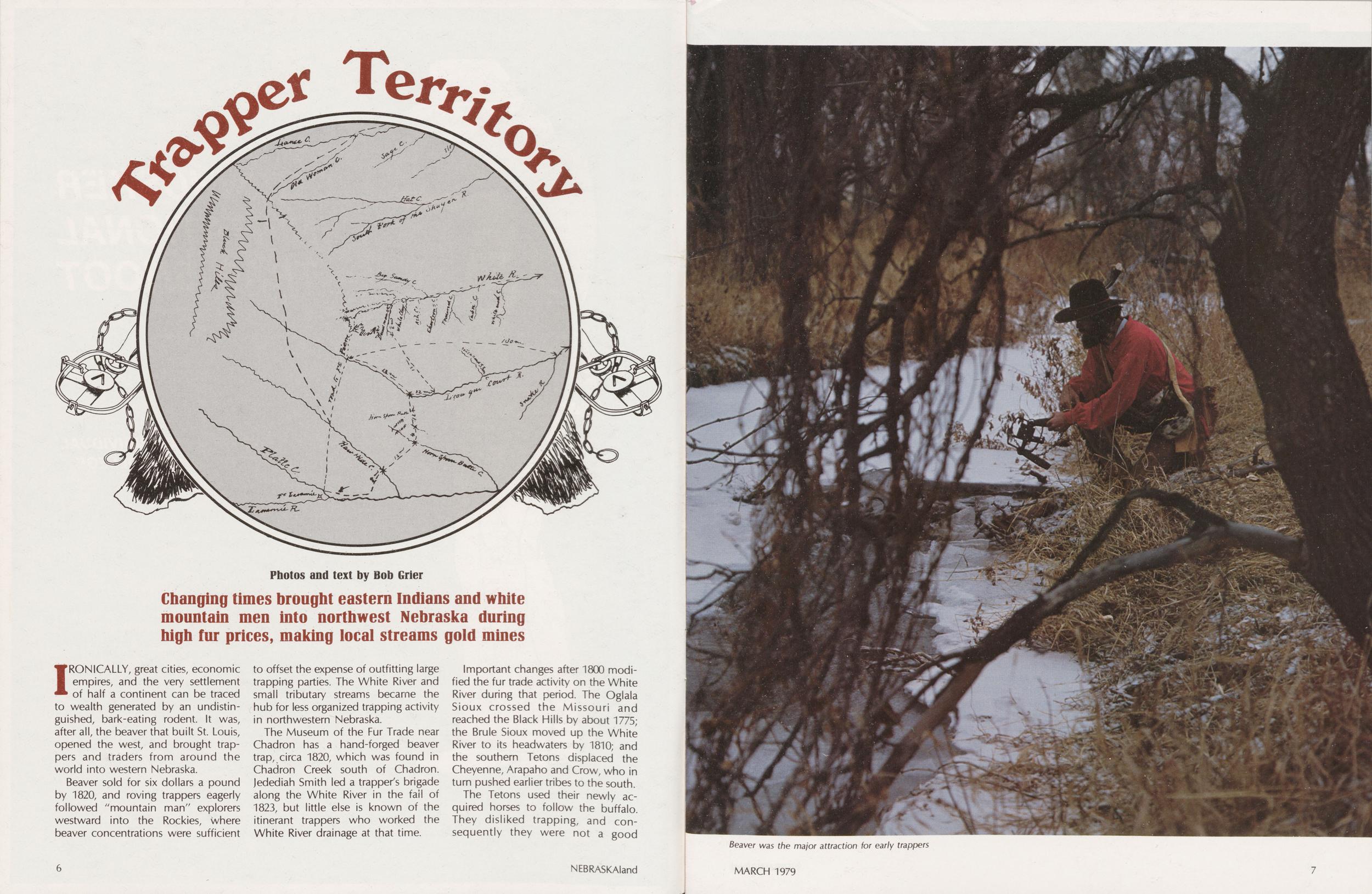
Trapper Territory
IRONICALLY, great cities, economic empires, and the very settlement of half a continent can be traced to wealth generated by an undistinguished, bark-eating rodent. It was, after all, the beaver that built St. Louis, opened the west, and brought trappers and traders from around the world into western Nebraska.
Beaver sold for six dollars a pound by 1820, and roving trappers eagerly followed "mountain man" explorers westward into the Rockies, where beaver concentrations were sufficient to offset the expense of outfitting large trapping parties. The White River and small tributary streams became the hub for less organized trapping activity in northwestern Nebraska.
The Museum of the Fur Trade near Chadron has a hand-forged beaver trap, circa 1820, which was found in Chadron Creek south of Chadron. Jedediah Smith led a trapper's brigade along the White River in the fail of 1823, but little else is known of the itinerant trappers who worked the White River drainage at that time.
Important changes after 1800 modified the fur trade activity on the White River during that period. The Oglala Sioux crossed the Missouri and reached the Black Hills by about 1775; the Brule Sioux moved up the White River to its headwaters by 1810; and the southern Tetons displaced the Cheyenne, Arapaho and Crow, who in turn pushed earlier tribes to the south.
Beaver was the major attraction for early trappers
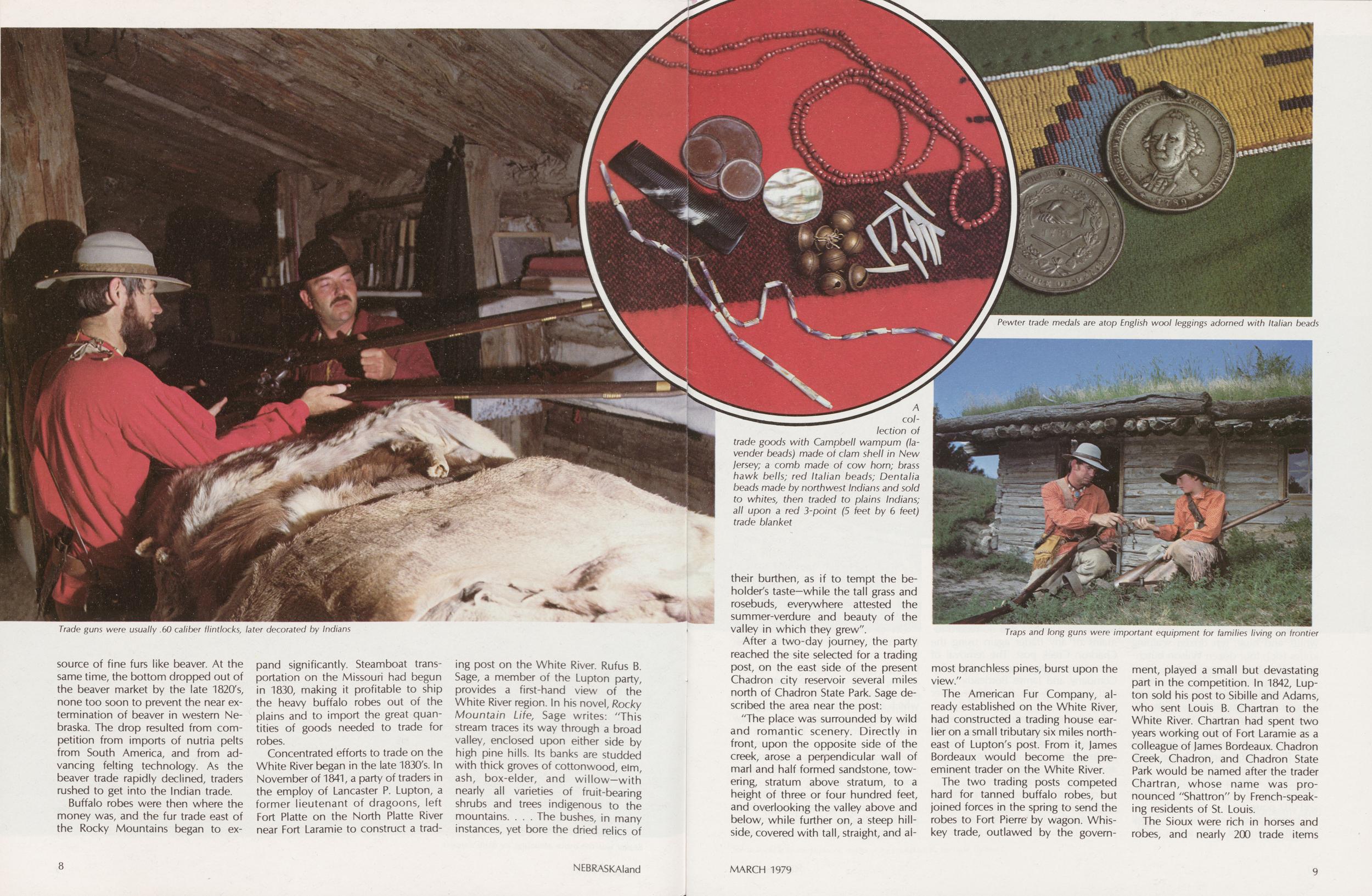
Trade guns were usually .60 caliber flintlocks, later decorated by Indians
Buffalo robes were then where the money was, and the fur trade east of the Rocky Mountains began to expand significantly. Steamboat transportation on the Missouri had begun in 1830, making it profitable to ship the heavy buffalo robes out of the plains and to import the great quantities of goods needed to trade for robes.
Concentrated efforts to trade on the White River began in the late 1830's. In November of 1841, a party of traders in the employ of Lancaster P. Lupton, a former lieutenant of dragoons, left Fort Platte on the North Platte River near Fort Laramie to construct a trading post on the White River. Rufus B. Sage, a member of the Lupton party, provides a first-hand view of the White River region. In his novel, Rocky Mountain Life, Sage writes: "This stream traces its way through a broad valley, enclosed upon either side by high pine hills. Its banks are studded with thick groves of Cottonwood, elm, ash, box-elder, and willow—with nearly all varieties of fruit-bearing shrubs and trees indigenous to the mountains....The bushes, in many instances, yet bore the dried relics of their burthen, as if to tempt the beholder's taste—while the tall grass and rosebuds, everywhere attested the summer-verdure and beauty of the valley in which they grew".
Traps and long guns were important equipment for families living on frontier
A collection of trade goods with Campbell wampum (lavender beads) made of clam shell in New Jersey; a comb made of cow horn; brass hawk bells; red Italian beads; Dentalia beads made by northwest Indians and sold to whites, then traded to plains Indians; all upon a red 3-point (5 feet by 6 feet) trade blanket
Pewter trade medals are atop English wool leggings adorned with Italian beads
After a two-day journey, the party reached the site selected for a trading post, on the east side of the present Chadron city reservoir several miles north of Chadron State Park. Sage described the area near the post:
"The place was surrounded by wild and romantic scenery. Directly in front, upon the opposite side of the creek, arose a perpendicular wall of marl and half formed sandstone, towering, stratum above stratum, to a height of three or four hundred feet, and overlooking the valley above and below, while further on, a steep hillside, covered with tall, straight, and almost branchless pines, burst upon the view."
The American Fur Company, already established on the White River, had constructed a trading house earlier on a small tributary six miles northeast of Lupton's post. From it, James Bordeaux would become the preeminent trader on the White River.
The two trading posts competed hard for tanned buffalo robes, but joined forces in the spring to send the robes to Fort Pierre by wagon. Whiskey trade, outlawed by the government, played a small but devastating part in the competition. In 1842, Lupton sold his post to Sibille and Adams, who sent Louis B. Chartran to the White River. Chartran had spent two years working out of Fort Laramie as a colleague of James Bordeaux. Chadron Creek, Chadron, and Chadron State Park would be named after the trader Chartran, whose name was pronounced "Shattron" by French-speaking residents of St. Louis.
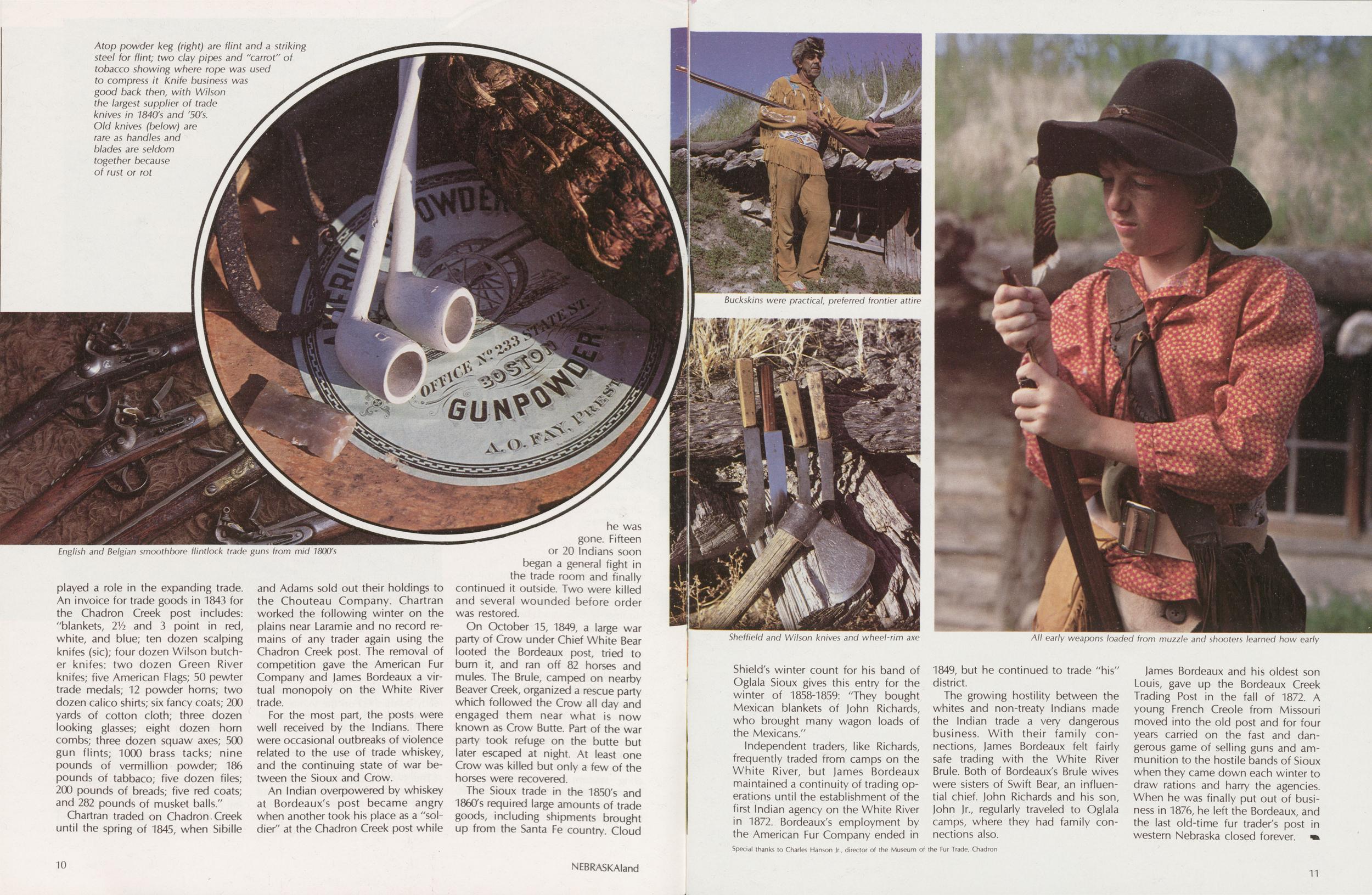
Atop powder keg (right) are flint and a striking steel for flint; two clay pipes and "carrot" of tobacco showing where rope was used to compress it Knife business was good back then, with Wilson the largest supplier of trade knives in 1840's and '50's. Old knives (below) are rare as handles and blades are seldom together because of rust or rot
English and Belgian smoothbore flintlock trade guns from mid 1800's
Chartran traded on Chadron Creek until the spring of 1845, when Sibille and Adams sold out their holdings to the Chouteau Company. Chartran worked the following winter on the plains near Laramie and no record remains of any trader again using the Chadron Creek post. The removal of competition gave the American Fur Company and James Bordeaux a virtual monopoly on the White River trade.
For the most part, the posts were well received by the Indians. There were occasional outbreaks of violence related to the use of trade whiskey, and the continuing state of war between the Sioux and Crow.
An Indian overpowered by whiskey at Bordeaux's post became angry when another took his place as a "soldier" at the Chadron Creek post while he was gone. Fifteen or 20 Indians soon began a general fight in the trade room and finally continued it outside. Two were killed and several wounded before order was restored.
On October 15, 1849, a large war party of Crow under Chief White Bear looted the Bordeaux post, tried to burn it, and ran off 82 horses and mules. The Brule, camped on nearby Beaver Creek, organized a rescue party which followed the Crow all day and engaged them near what is now known as Crow Butte. Part of the war party took refuge on the butte but later escaped at night. At least one Crow was killed but only a few of the horses were recovered.
Buckskins were practical, preferred frontier attire
Sheffield and Wilson knives and wheel-rim axe
All early weapons loaded from muzzle and shooters learned how early
The growing hostility between the whites and non-treaty Indians made the Indian trade a very dangerous business. With their family connections, James Bordeaux felt fairly safe trading with the White River Brule. Both of Bordeaux's Brule wives were sisters of Swift Bear, an influential chief. John Richards and his son, John Jr., regularly traveled to Oglala camps, where they had family connections also.
James Bordeaux and his oldest son Louis, gave up the Bordeaux Creek Trading Post in the fall of 1872. A young French Creole from Missouri moved into the old post and for four years carried on the fast and dangerous game of selling guns and ammunition to the hostile bands of Sioux when they came down each winter to draw rations and harry the agencies. When he was finally put out of business in 1876, he left the Bordeaux, and the last old-time fur trader's post in western Nebraska closed forever.
Special thanks to Charles Hanson Jr., director of the Museum of the Fur Trade, Chadron 10 NEBRASKAland 11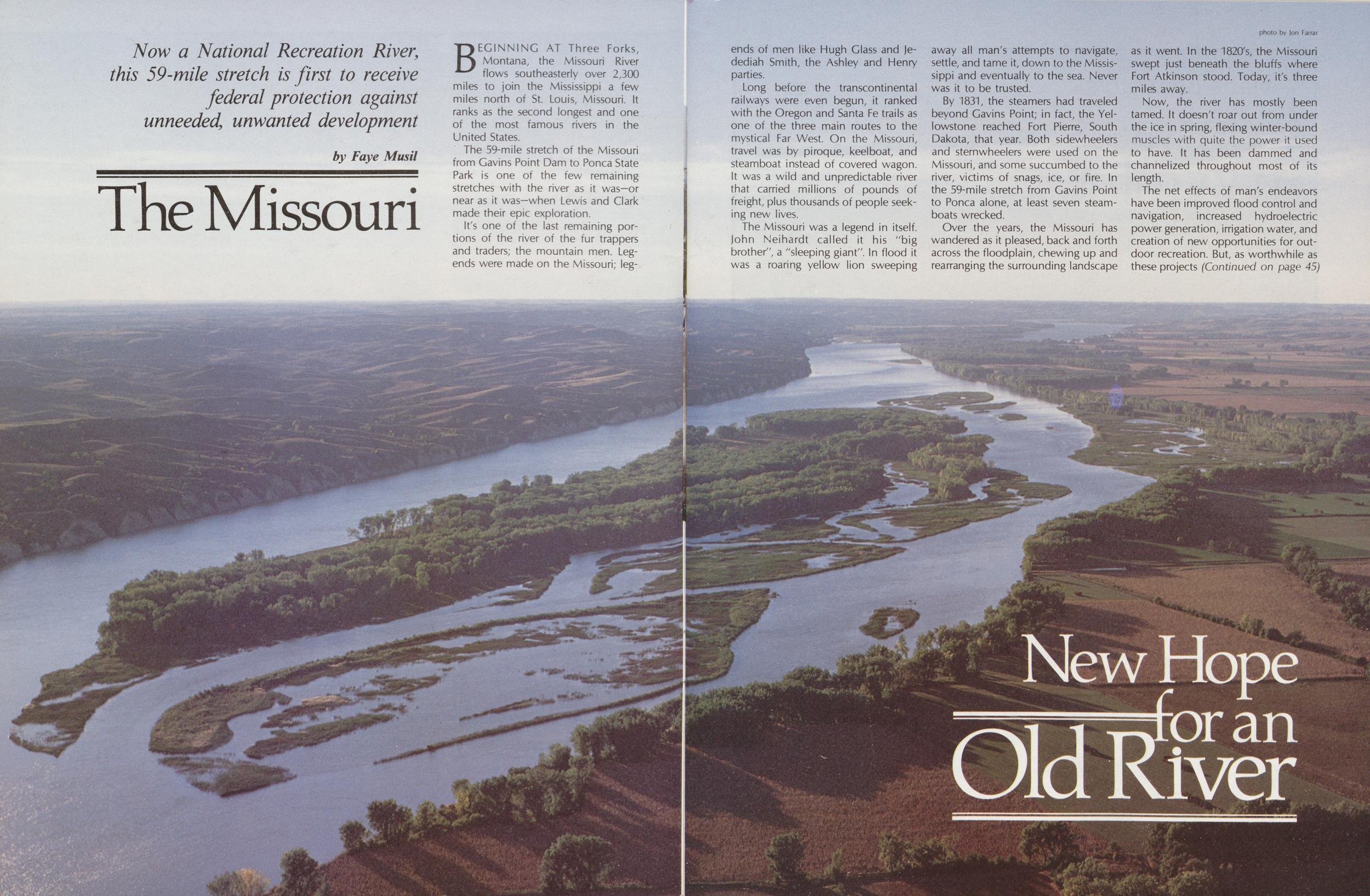
New Hope for an Old River
The Missouri
Now a National Recreation River, this 59-mile stretch is first to receive federal protection against unneeded, unwanted development
BEGINNING AT Three Forks, Montana, the Missouri River flows southeasterly over 2,300 miles to join the Mississippi a few miles north of St. Louis, Missouri. It ranks as the second longest and one of the most famous rivers in the United States.
The 59-mile stretch of the Missouri from Gavins Point Dam to Ponca State Park is one of the few remaining stretches with the river as it was—or near as it was-when Lewis and Clark made their epic exploration.
It's one of the last remaining portions of the river of the fur trappers and traders; the mountain men. Legends were made on the Missouri; legends of men like Hugh Glass and Jedediah Smith, the Ashley and Henry parties.
Long before the transcontinental railways were even begun, it ranked with the Oregon and Santa Fe trails as one of the three main routes to the mystical Far West. On the Missouri, travel was by piroque, keelboat, and steamboat instead of covered wagon. It was a wild and unpredictable river that carried millions of pounds of freight, plus thousands of people seeking new lives.
The Missouri was a legend in itself. John Neihardt called it his "big brother", a "sleeping giant". In flood it was a roaring yellow lion sweeping away all man's attempts to navigate, settle, and tame it, down to the Mississippi and eventually to the sea. Never was it to be trusted.
By 1831, the steamers had traveled beyond Gavins Point; in fact, the Yellowstone reached Fort Pierre, South Dakota, that year. Both sidewheelers and stemwheelers were used on the Missouri, and some succumbed to the river, victims of snags, ice, or fire. In the 59-mile stretch from Gavins Point to Ponca alone, at least seven steamboats wrecked.
Over the years, the Missouri has wandered as it pleased, back and forth across the floodplain, chewing up and rearranging the surrounding landscape as it went. In the 1820's, the Missouri swept just beneath the bluffs where Fort Atkinson stood. Today, it's three miles away.
Now, the river has mostly been tamed. It doesn't roar out from under the ice in spring, flexing winter-bound muscles with quite the power it used to have. It has been clammed and channelized throughout most of its length.
The net effects of man's endeavors have been improved flood control and navigation, increased hydroelectric power generation, irrigation water, and creation of new opportunities for outdoor recreation. But, as worthwhile as these projects (Continued on page 45)
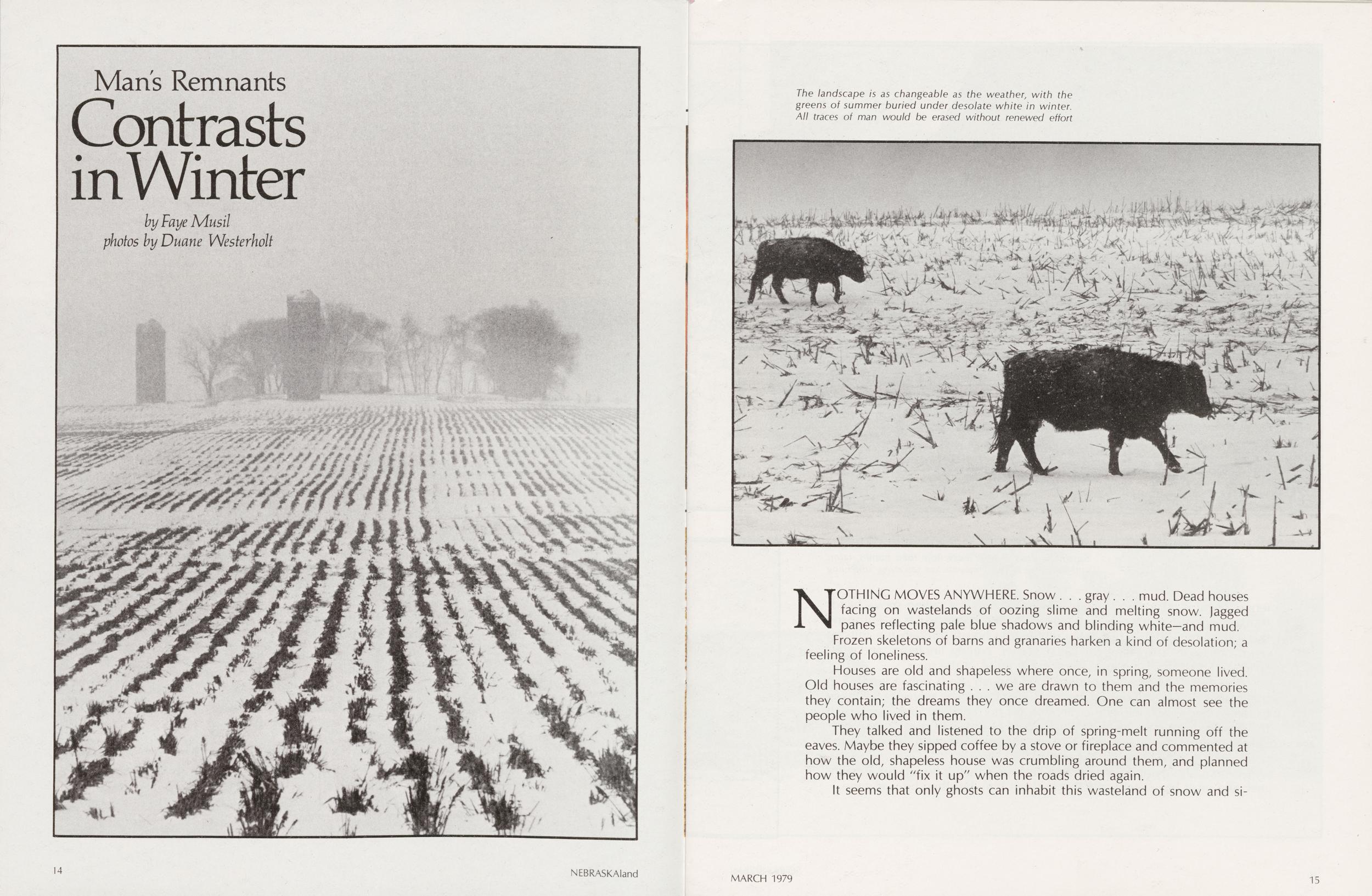
Mans Remnants
Contrasts in Winter
The landscape is as changeable as the weather, with the greens of summer buried under desolate white in winter. All traces of man would be erased without renewed effort
NOTHING MOVES ANYWHERE. Snow... gray... mud. Dead houses facing on wastelands of oozing slime and melting snow, jagged panes reflecting pale blue shadows and blinding white—and mud.
Frozen skeletons of barns and granaries harken a kind of desolation; a feeling of loneliness.
Houses are old and shapeless where once, in spring, someone lived. Old houses are fascinating... we are drawn to them and the memories they contain; the dreams they once dreamed. One can almost see the people who lived in them.
They talked and listened to the drip of spring-melt running off the eaves. Maybe they sipped coffee by a stove or fireplace and commented at how the old, shapeless house was crumbling around them, and planned how they would "fix it up" when the roads dried again.
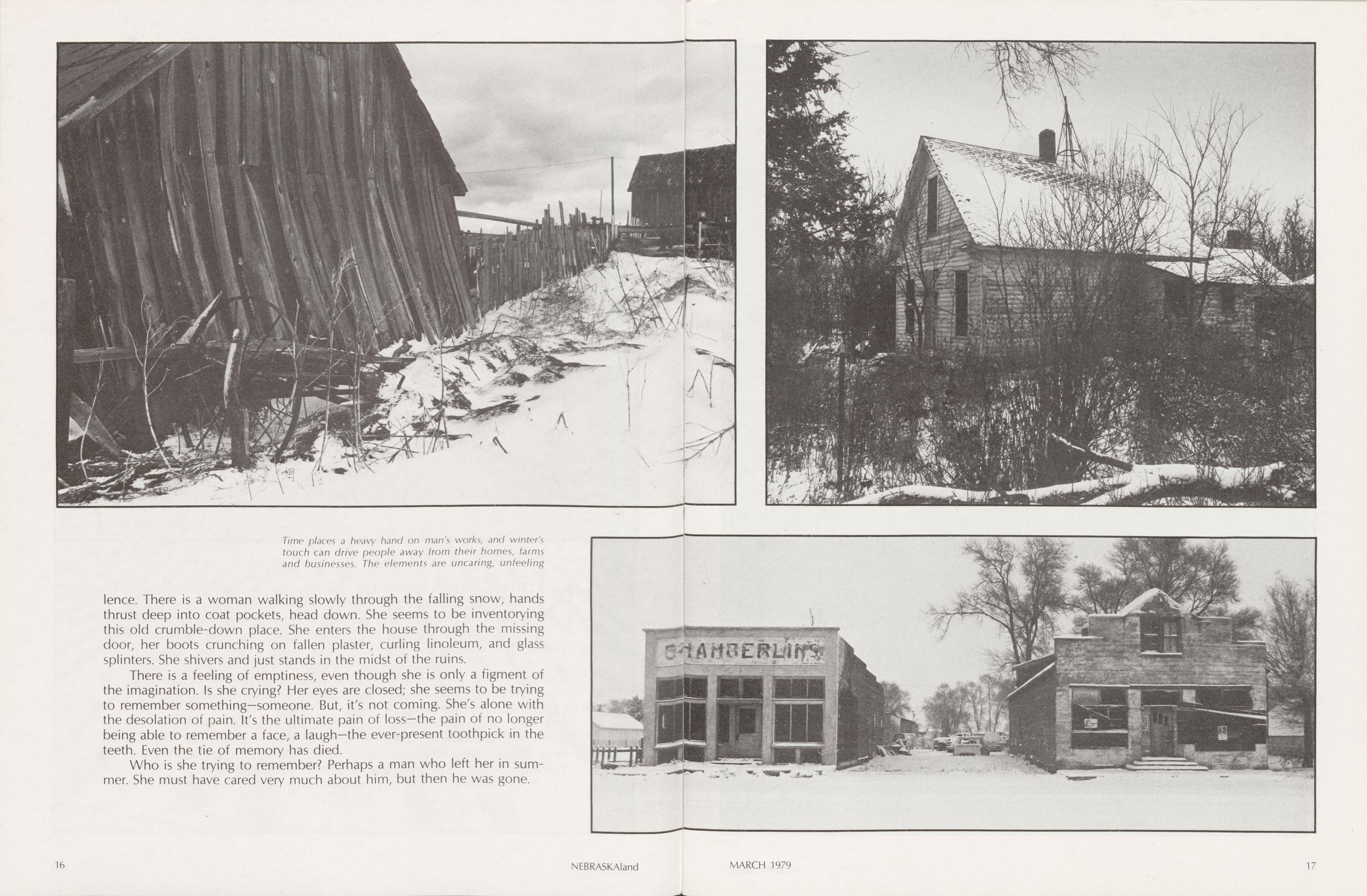
Time places a heavy hand on man's works, and winter's touch can drive people away from their homes, farms and businesses. The elements are uncaring, unfeeling
There is a feeling of emptiness, even though she is only a figment of the imagination. Is she crying? Her eyes are closed; she seems to be trying to remember something-someone. But, it's not coming. She's alone with the desolation of pain. It's the ultimate pain of loss-the pain of no longer being able to remember a face, a laugh-the ever-present toothpick in the teeth. Even the tie of memory has died.
Who is she trying to remember? Perhaps a man who left her in summer. She must have cared very much about him, but then he was gone.
16 NEBRASKAland MARCH 1979 17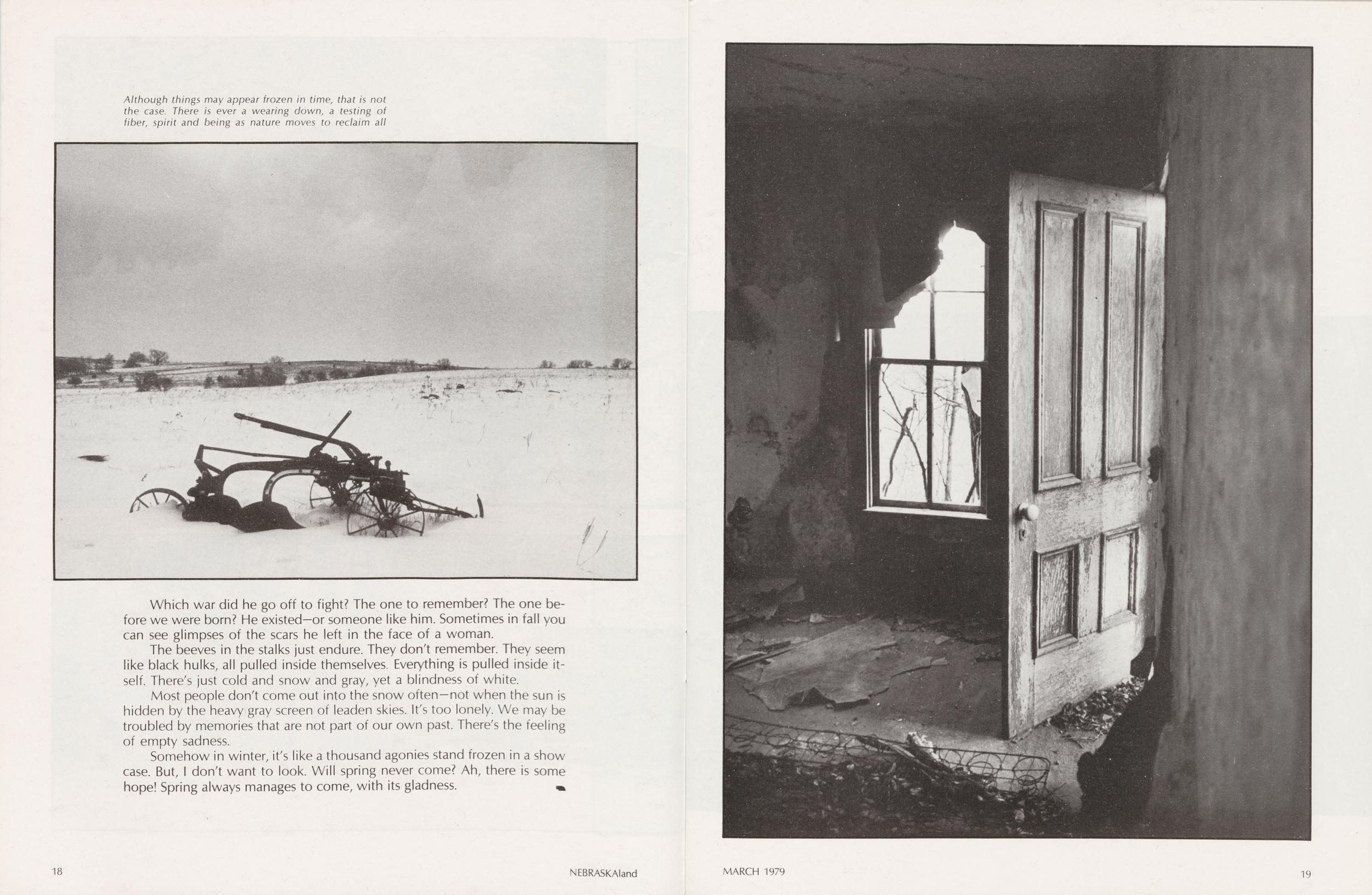
Although things may appear frozen in time, that is not the case. There is ever a wearing down, a testing of fiber, spirit and being as nature moves to reclaim all
Which war did he go off to fight? The one to remember? The one before we were born? He existed—or someone like him. Sometimes in fall you can see glimpses of the scars he left in the face of a woman.
The beeves in the stalks just endure. They don't remember. They seem like black hulks, all pulled inside themselves. Everything is pulled inside itself. There's just cold and snow and gray, yet a blindness of white.
Most people don't come out into the snow often—not when the sun is hidden by the heavy gray screen of leaden skies. It's too lonely. We may be troubled by memories that are not part of our own past. There's the feeling of empty sadness.
Somehow in winter, it's like a thousand agonies stand frozen in a show case. But, I don't want to look. Will spring never come? Ah, there is some hope! Spring always manages to come, with its gladness.
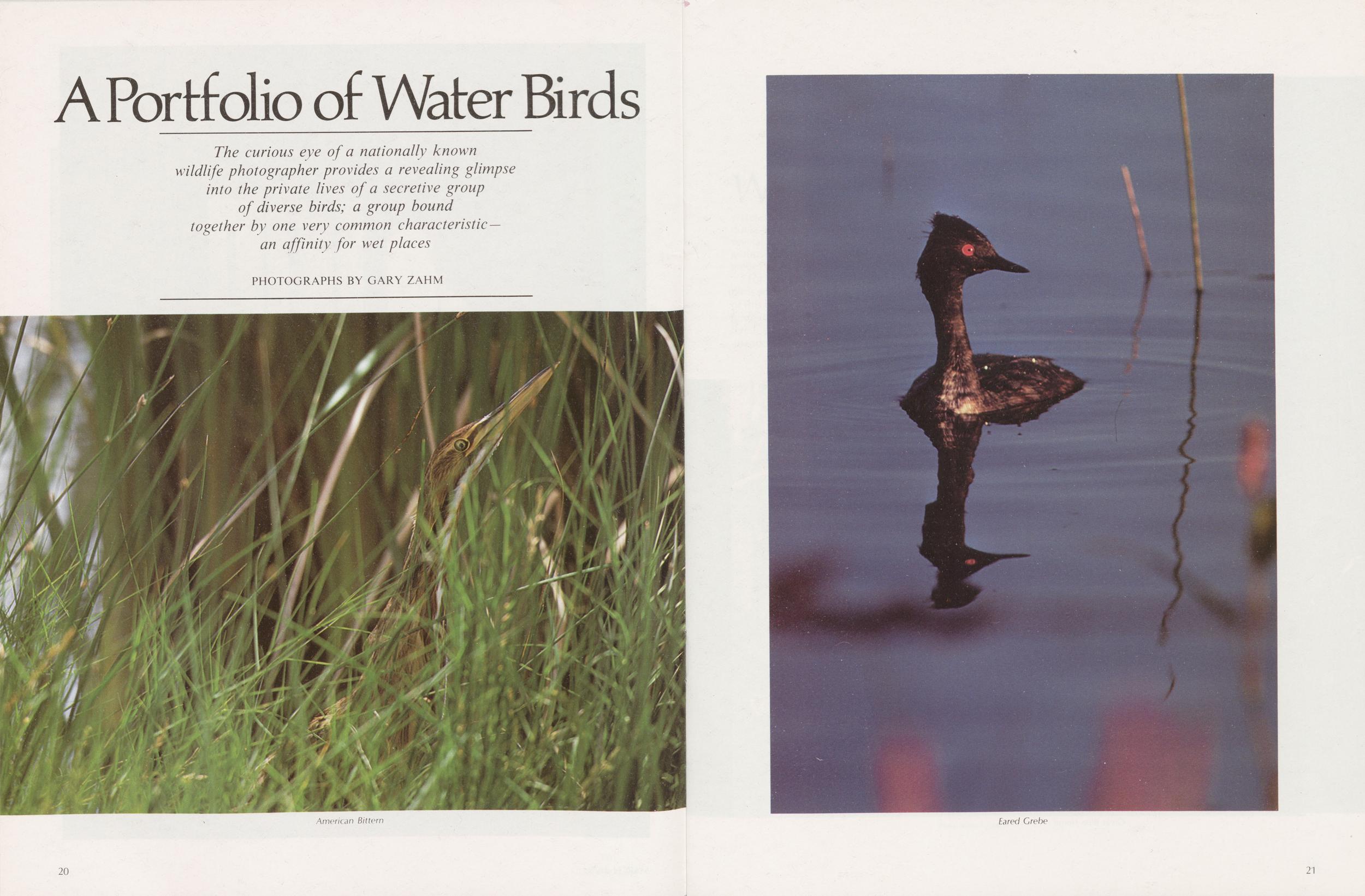
A Portfolio of Water Birds
The curious eye of a nationally known wildlife photographer provides a revealing glimpse into the private lives of a secretive group of diverse birds; a group bound together by one very common characteristic — an affinity for wet placesAmerican Bittern
Eared Grebe
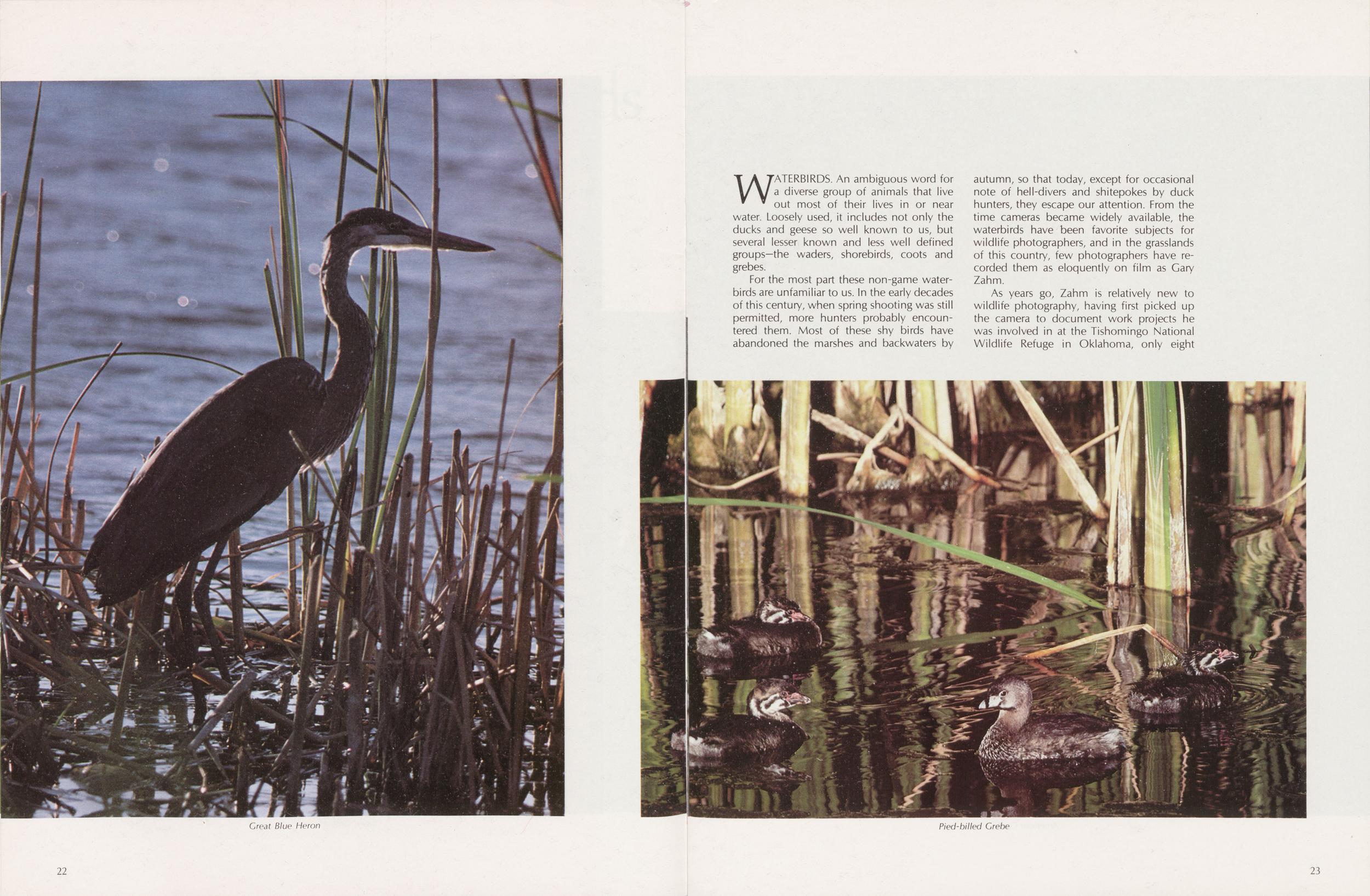
Great Blue Heron
WATERBIRDS. An ambiguous word for a diverse group of animals that live out most of their lives in or near water. Loosely used, it includes not only the ducks and geese so well known to us, but several lesser known and less well defined groups—the waders, shorebirds, coots and grebes.
For the most part these non-game waterbirds are unfamiliar to us. In the early decades of this century, when spring shooting was still permitted, more hunters probably encountered them. Most of these shy birds have abandoned the marshes and backwaters by autumn, so that today, except for occasional note of hell-divers and shitepokes by duck hunters, they escape our attention. From the time cameras became widely available, the waterbirds have been favorite subjects for wildlife photographers, and in the grasslands of this country, few photographers have recorded them as eloquently on film as Gary Zahm.
Pied-billed Grebe
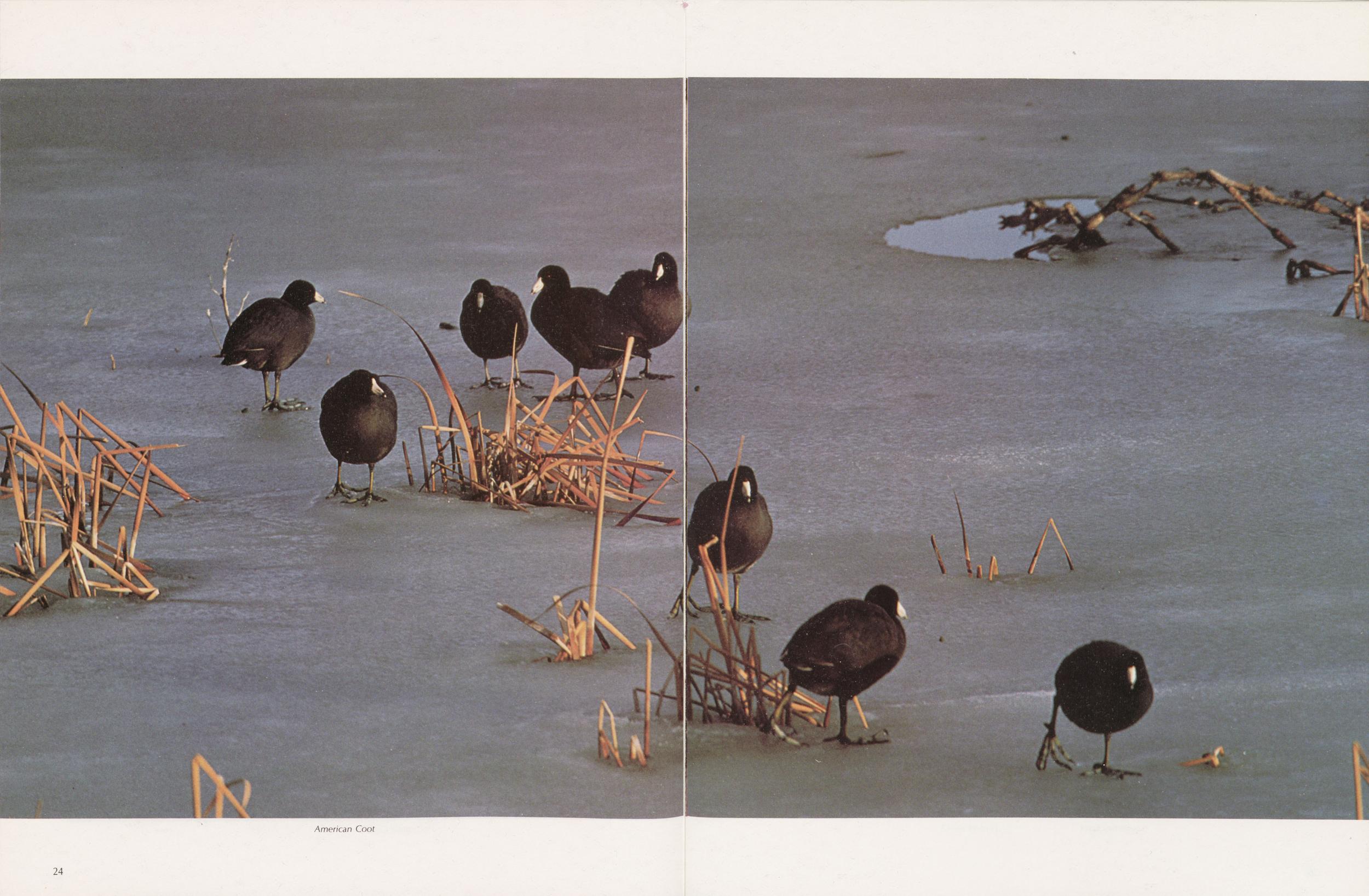
American Coot
 years ago. But as experience goes, he has been around a long time,
applying his educational background in wildlife and field experience
as a hunter to the more passive pursuit of animals with a camera and
long lens. From Oklahoma he moved to the Bosque del Apache refuge in New Mexico and
currently is refuge manager at Lake Andes
National Wildlife Refuge just across Nebraska's northern border in
South Dakota. From there he ranges out on vacations and weekends
to photograph wildlife. His photograghs have appeared in Audubon,
National Wildlife, Sierra Club, Field and Stream, Outdoor Life, Sports
Afield, The American Hunter, Ranger Rick's Nature Magazine and
others.
years ago. But as experience goes, he has been around a long time,
applying his educational background in wildlife and field experience
as a hunter to the more passive pursuit of animals with a camera and
long lens. From Oklahoma he moved to the Bosque del Apache refuge in New Mexico and
currently is refuge manager at Lake Andes
National Wildlife Refuge just across Nebraska's northern border in
South Dakota. From there he ranges out on vacations and weekends
to photograph wildlife. His photograghs have appeared in Audubon,
National Wildlife, Sierra Club, Field and Stream, Outdoor Life, Sports
Afield, The American Hunter, Ranger Rick's Nature Magazine and
others.Zahm customarily works close to home and emphasizes the importance of a photographer knowing his quarry.
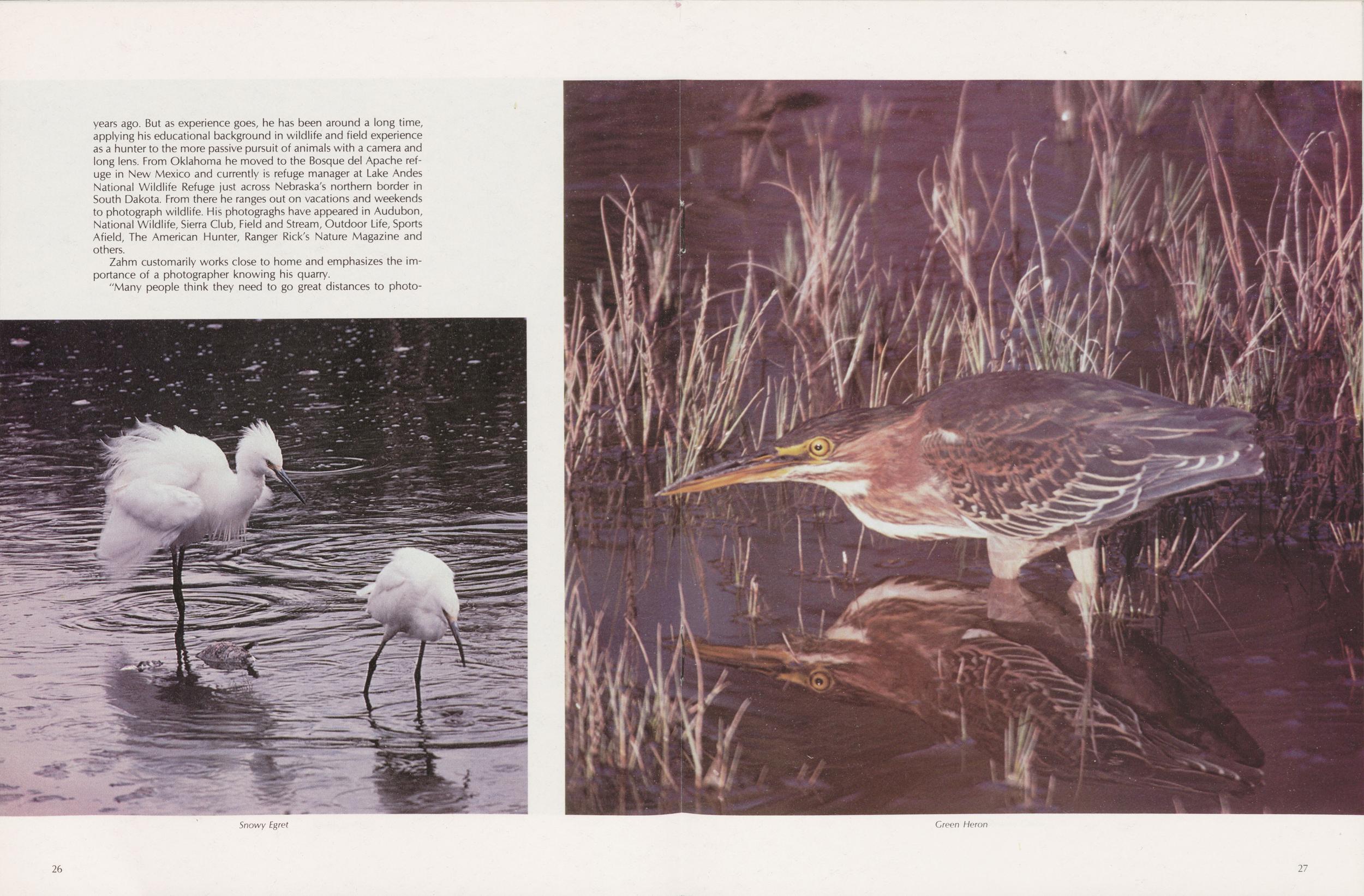
Snowy Egret
Green Heron
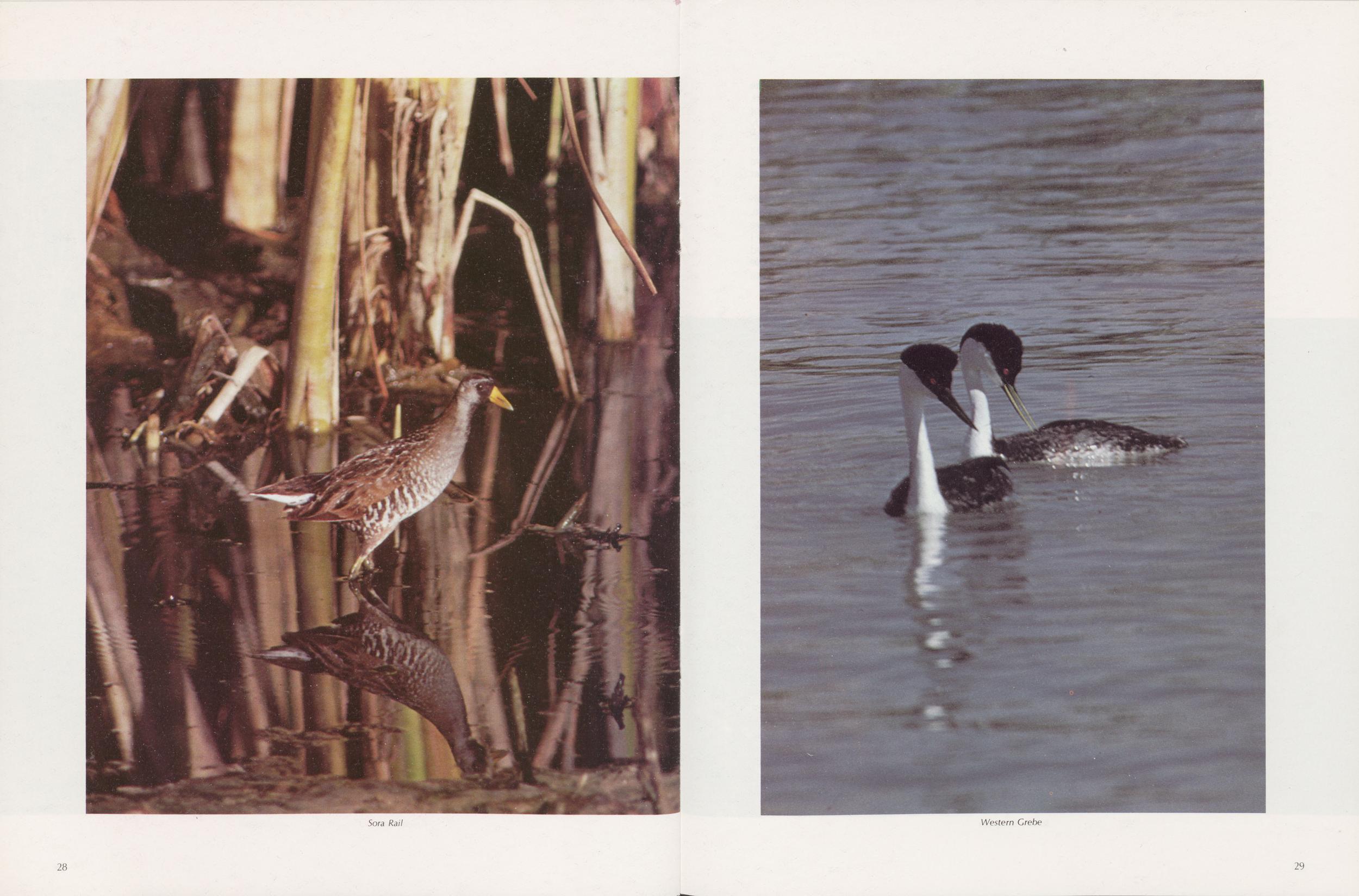
Sora Rail
Western Grebe
 wildlife," Zahm said, "but there are so many
subjects nearby, regardless of where you live. I prefer to spend my time photographing,
not traveling.
wildlife," Zahm said, "but there are so many
subjects nearby, regardless of where you live. I prefer to spend my time photographing,
not traveling."Before you can take good wildlife photos you have to learn the habits of the animal, where they are going to be found and when. Then you have to actually train your eyes to see wildlife."
Like most wildlife photographers, Zahm uses a 35mm, single-lens-reflex camera, picks up what photos he can from a vehicle or by stalking, and works from a blind when the situation demands it.
"When I first started photographing wildlife I purchased a Canon and a 300mm telephoto," Zahm continued. "I followed that with a 500mm lens that I still use for most of my wildlife photos. I'm still using Canon equipment and shoot Kodachrome 64 exclusively. I use a gunstock with the 500mm and 300mm to pan with moving subjects. When shooting from the gunstock I try to shoot nothing slower than 1/250 of a second. Recently I've been using a motor drive, which lets me keep my hand on the focusing knob and my eye never has to leave the viewfinder. Without a motor drive it is like using a single-shot gun—you wait for that one good shot.
"With an extension tube between the 500mm telephoto and the camera, I can work in close, about the same as with the 300mm, only I have greater magnification. That was the equipment I used to make the American bittern photo. The bird was hidden in heavy vegetation along the roadside and I just caught a glimpse of movement. He froze and I had time to put on the extension tube and make four or five exposures. I would guess the bittern was only 14 feet away."
When shooting from a vehicle, Zahm stresses the importance of having a firm support for the lens. He lays a pillow across the window and wedges his equipment and himself in place, often wrapping an arm around the steering wheel.
"A little 75-cent item that most people have never heard of is a big help cutting down camera movement," Zahm added. "It's a soft-release button that screws into the shutter release and works just like a hair trigger on a rifle. I've shot photos at 1/60 of a second that were sharp as a tack. I stop down as much as possible for maximum depth of field and do not shoot faster than 1/125 of a second unless I have a moving subject."
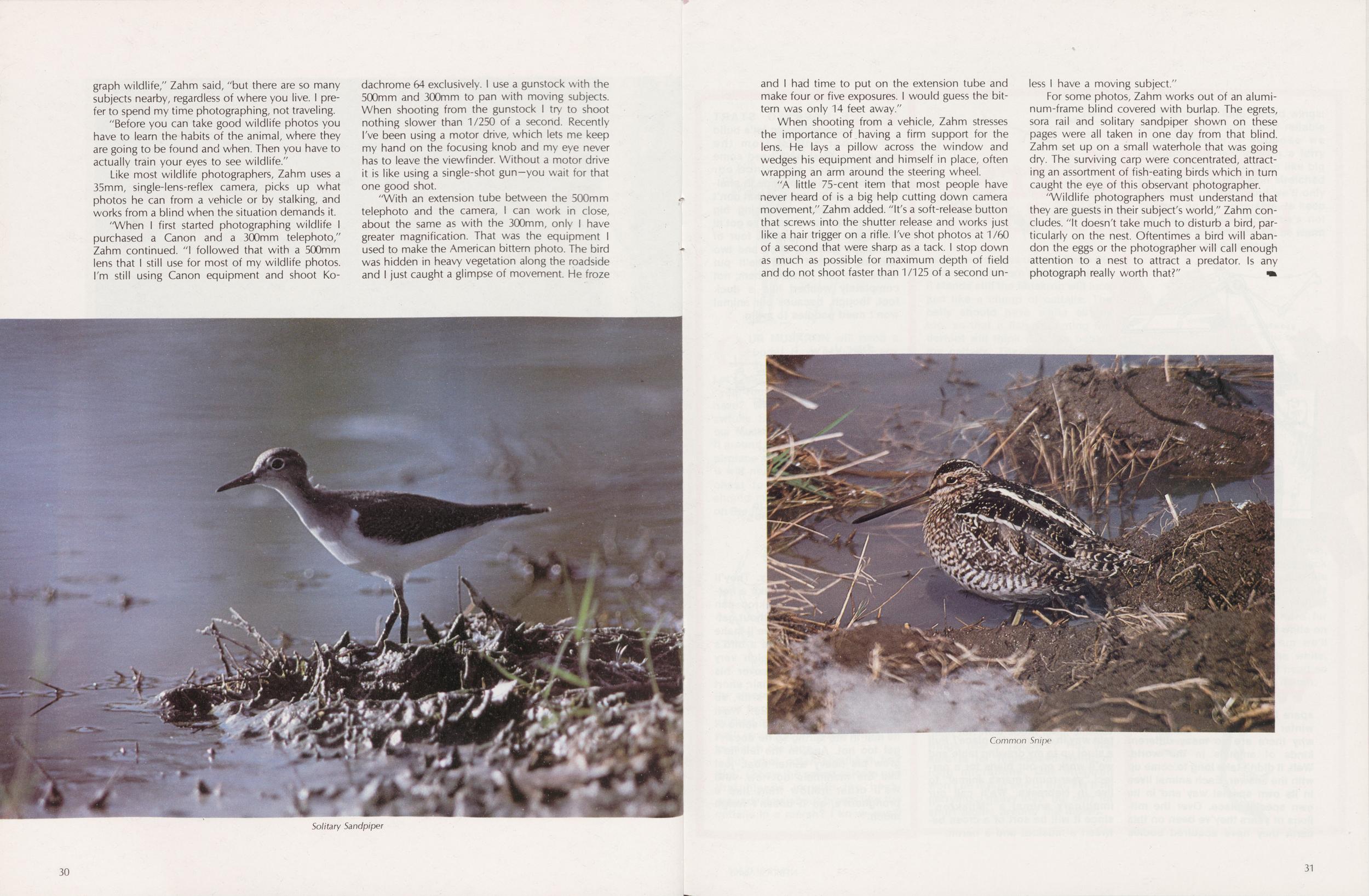
For some photos, Zahm works out of an aluminum-frame blind covered with burlap. The egrets, sora rail and solitary sandpiper shown on these pages were all taken in one day from that blind. Zahm set up on a small waterhole that was going dry. The surviving carp were concentrated, attracting an assortment of fish-eating birds which in turn caught the eye of this observant photographer.
"Wildlife photographers must understand that they are guests in their subject's world," Zahm concludes. "It doesn't take much to disturb a bird, particularly on the nest. Oftentimes a bird will abandon the eggs or the photographer will call enough attention to a nest to attract a predator. Is any photograph really worth that?"
Common Snipe
Solitary Sandpiper
Whiskers Has a Better Idea?
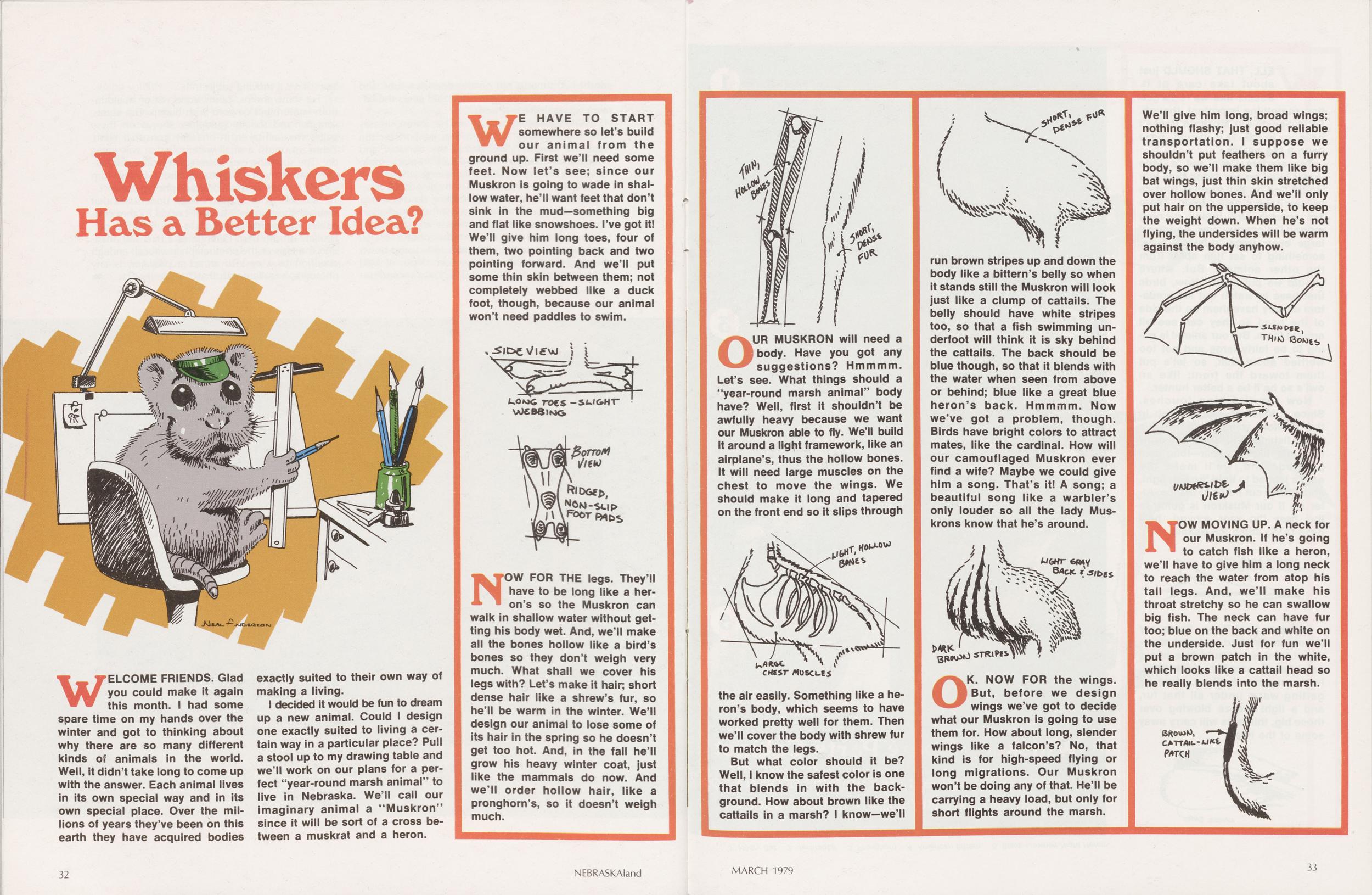
WELCOME FRIENDS. Glad you could make it again this month. I had some spare time on my hands over the winter and got to thinking about why there are so many different kinds of animals in the world. Well, it didn't take long to come up with the answer. Each animal lives in its own special way and in its own special place. Over the millions of years they've been on this earth they have acquired bodies exactly suited to their own way of making a living.
I decided it would be fun to dream up a new animal. Could I design one exactly suited to living a certain way in a particular place? Pull a stool up to my drawing table and we'll work on our plans for a perfect "year-round marsh animal" to live in Nebraska. We'll call our imaginary animal a "Muskron" since it will be sort of a cross between a muskrat and a heron.
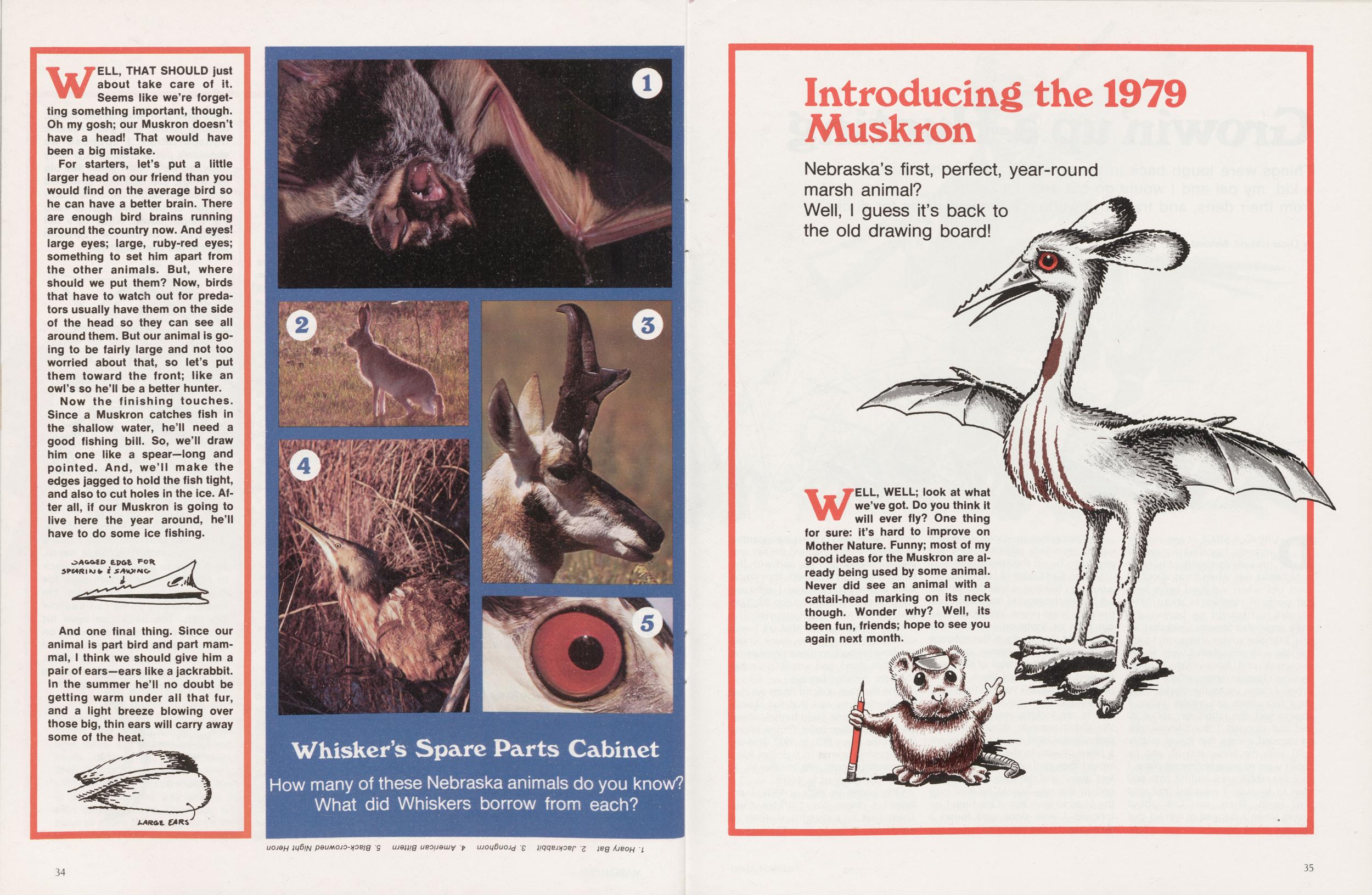
WE HAVE TO START somewhere so let's build our animal from the ground up. First we'll need some feet. Now let's see; since our Muskron is going to wade in shallow water, he'll want feet that don't sink in the mud—something big and flat like snowshoes. I've got it! We'll give him long toes, four of them, two pointing back and two pointing forward. And we'll put some thin skin between them; not completely webbed like a duck foot, though, because our animal won't need paddles to swim.
NOW FOR THE legs. They'll have to be long like a heron's so the Muskron can walk in shallow water without getting his body wet. And, we'll make all the bones hollow like a bird's bones so they don't weigh very much. What shall we cover his legs with? Let's make it hair; short dense hair like a shrew's fur, so he'll be warm in the winter. We'll design our animal to lose some of its hair in the spring so he doesn't get too hot. And, in the fall he'll grow his heavy winter coat, just like the mammals do now. And we'll order hollow hair, like a pronghorn's, so it doesn't weigh much.
OUR MUSKRON will need a body. Have you got any suggestions? Hmmmm. Let's see. What things should a "year-round marsh animal" body have? Well, first it shouldn't be awfully heavy because we want our Muskron able to fly. We'll build it around a light framework, like an airplane's, thus the hollow bones. It will need large muscles on the chest to move the wings. We should make it long and tapered on the front end so it slips through
But what color should it be? Well, I know the safest color is one that blends in with the background. How about brown like the cattails in a marsh? I know—we'll
OK. NOW FOR the wings. But, before we design wings we've got to decide what our Muskron is going to use them for. How about long, slender wings like a falcon's? No, that kind is for high-speed flying or long migrations. Our Muskron won't be doing any of that. He'll be carrying a heavy load, but only for short flights around the marsh. We'll give him long, broad wings; nothing flashy; just good reliable transportation. I suppose we shouldn't put feathers on a furry body, so we'll make them like big bat wings, just thin skin stretched over hollow bones. And we'll only put hair on the upperside, to keep the weight down. When he's not flying, the undersides will be warm against the body anyhow.
NOW MOVING UP. A neck for our Muskron. If he's going to catch fish like a heron, we'll have to give him a long neck to reach the water from atop his tall legs. And, we'll make his throat stretchy so he can swallow big fish. The neck can have fur too; blue on the back and white on the underside. Just for fun we'll put a brown patch in the white, which looks like a cattail head so he really blends into the marsh.
WELL, THAT SHOULD just about take care of it. Seems like we're forgetting something important, though. Oh my gosh; our Muskron doesn't have a head! That would have been a big mistake.
For starters, let's put a little larger head on our friend than you would find on the average bird so he can have a better brain. There are enough bird brains running around the country now. And eyes! large eyes; large, ruby-red eyes; something to set him apart from the other animals. But, where should we put them? Now, birds that have to watch out for predators usually have them on the side of the head so they can see all around them. But our animal is going to be fairly large and not too worried about that, so let's put them toward the front; like an owl's so he'll be a better hunter.
Now the finishing touches. Since a Muskron catches fish in the shallow water, he'll need a good fishing bill. So, we'll draw him one like a spear—long and pointed. And, we'll make the edges jagged to hold the fish tight, and also to cut holes in the ice. After all, if our Muskron is going to live here the year around, he'll have to do some ice fishing.
And one final thing. Since our animal is part bird and part mammal, I think we should give him a pair of ears—ears like a jackrabbit. In the summer he'll no doubt be getting warm under all that fur, and a light breeze blowing over those big, thin ears will carry away some of the heat.
1
2
3
4
5
WELL, WELL; look at what we've got. Do you think it will ever fly? One thing for sure: it's hard to improve on Mother Nature. Funny; most of my good ideas for the Muskron are already being used by some animal. Never did see an animal with a cattail-head marking on its neck though. Wonder why? Well, its been fun, friends; hope to see you again next month.
34 35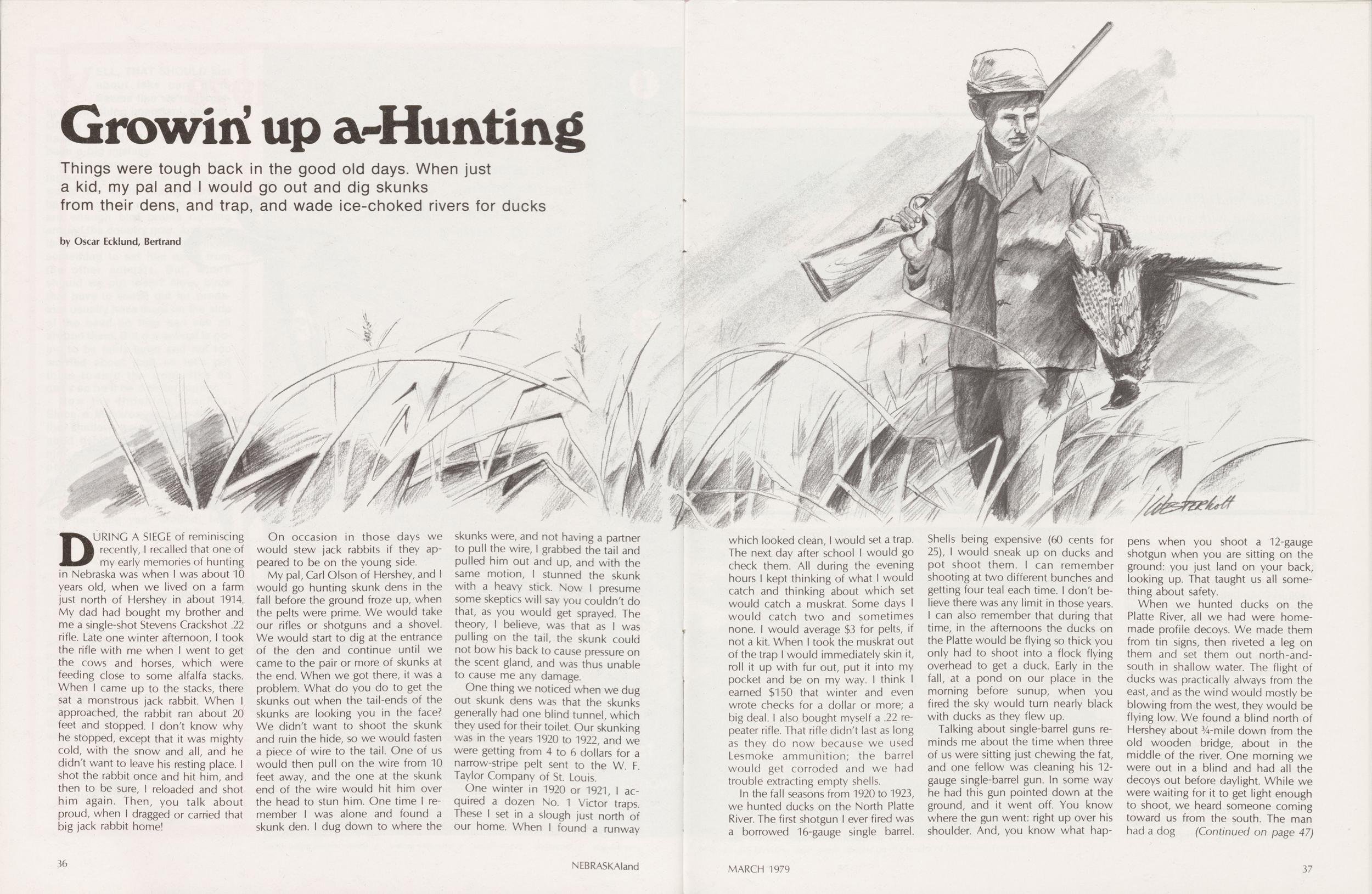
Growin' up a-Hunting
Things were tough back in the good old days. When just a kid, my pal and I would go out and dig skunks from their dens, and trap, and wade ice-choked rivers for ducksDURING A SIEGE of reminiscing I recently, I recalled that one of my early memories of hunting in Nebraska was when I was about 10 years old, when we lived on a farm just north of Hershey in about 1914. My dad had bought my brother and me a single-shot Stevens Crackshot .22 rifle. Late one winter afternoon, I took the rifle with me when I went to get the cows and horses, which were feeding close to some alfalfa stacks. When I came up to the stacks, there sat a monstrous jack rabbit. When I approached, the rabbit ran about 20 feet and stopped. I don't know why he stopped, except that it was mighty cold, with the snow and all, and he didn't want to leave his resting place. I shot the rabbit once and hit him, and then to be sure, I reloaded and shot him again. Then, you talk about proud, when I dragged or carried that big jack rabbit home!
On occasion in those days we would stew jack rabbits if they appeared to be on the young side.
My pal, Carl Olson of Hershey, and I would go hunting skunk dens in the fall before the ground froze up, when the pelts were prime. We would take our rifles or shotguns and a shovel. We would start to dig at the entrance of the den and continue until we came to the pair or more of skunks at the end. When we got there, it was a problem. What do you do to get the skunks out when the tail-ends of the skunks are looking you in the face? We didn't want to shoot the skunk and ruin the hide, so we would fasten a piece of wire to the tail. One of us would then pull on the wire from 10 feet away, and the one at the skunk end of the wire would hit him over the head to stun him. One time I remember I was alone and found a skunk den. I dug down to where the skunks were, and not having a partner to pull the wire, I grabbed the tail and pulled him out and up, and with the same motion, I stunned the skunk with a heavy stick. Now I presume some skeptics will say you couldn't do that, as you would get sprayed. The theory, I believe, was that as I was pulling on the tail, the skunk could not bow his back to cause pressure on the scent gland, and was thus unable to cause me any damage.
One thing we noticed when we dug out skunk dens was that the skunks generally had one blind tunnel, which they used for their toilet. Our skunking was in the years 1920 to 1922, and we were getting from 4 to 6 dollars for a narrow-stripe pelt sent to the W. F. Taylor Company of St. Louis.
One winter in 1920 or 1921, I acquired a dozen No. 1 Victor' traps. These I set in a slough just north of our home. When I found a runway which looked clean, I would set a trap. The next day after school I would go check them. All during the evening hours I kept thinking of what I would catch and thinking about which set would catch a muskrat. Some days I would catch two and sometimes none. I would average $3 for pelts, if not a kit. When I took the muskrat out of the trap I would immediately skin it, roll it up with fur out, put it into my pocket and be on my way. I think I earned $150 that winter and even wrote checks for a dollar or more; a big deal. I also bought myself a .22 repeater rifle. That rifle didn't last as long as they do now because we used Lesmoke ammunition; the barrel would get corroded and we had trouble extracting empty shells.
In the fall seasons from 1920 to 1923, we hunted ducks on the North Platte River. The first shotgun I ever fired was a borrowed 16-gauge single barrel. Shells being expensive (60 cents for 25), I would sneak up on ducks and pot shoot them. I can remember shooting at two different bunches and getting four teal each time. I don't believe there was any limit in those years. I can also remember that during that time, in the afternoons the ducks on the Platte would be flying so thick you only had to shoot into a flock flying overhead to get a duck. Early in the fall, at a pond on our place in the morning before sunup, when you fired the sky would turn nearly black with ducks as they flew up.
Talking about single-barrel guns reminds me about the time when three of us were sitting just chewing the fat, and one fellow was cleaning his 12-gauge single-barrel gun. In some way he had this gun pointed down at the ground, and it went off. You know where the gun went: right up over his shoulder. And, you know what happens when you shoot a 12-gauge shotgun when you are sitting on the ground: you just land on your back, looking up. That taught us all something about safety.
When we hunted ducks on the Platte River, all we had were homemade profile decoys. We made them from tin signs, then riveted a leg on them and set them out north-and-south in shallow water. The flight of ducks was practically always from the east, and as the wind would mostly be blowing from the west, they would be flying low. We found a blind north of Hershey about 3/4-mile down from the old wooden bridge, about in the middle of the river. One morning we were out in a blind and had all the decoys out before daylight. While we were waiting for it to get light enough to shoot, we heard someone coming toward us from the south. The man had a dog (Continued on page 47)
36 NEBRASKAland MARCH 1979 37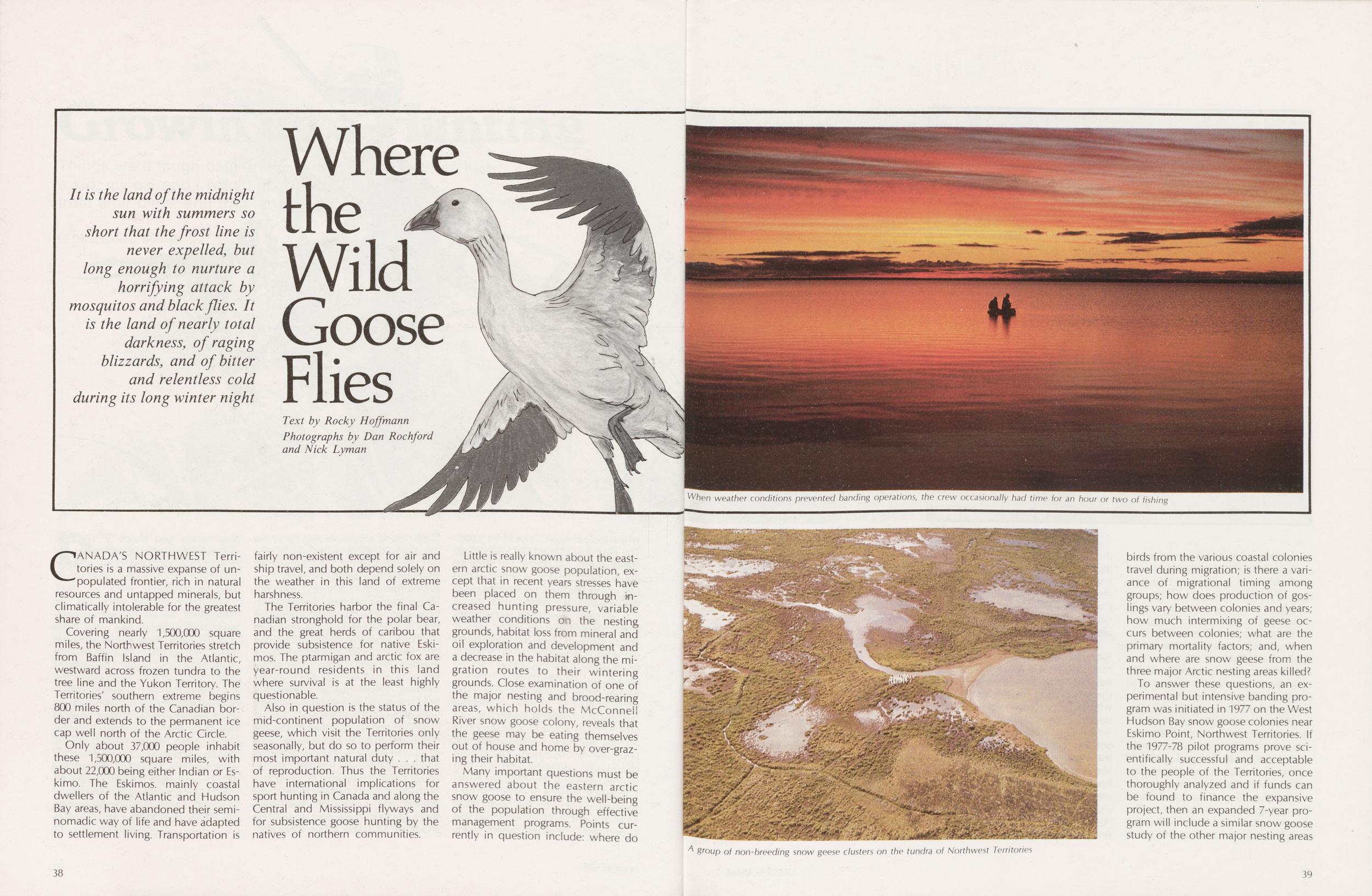
Where the Wild Goose Flies
It is the land of the midnight sun with summers so short that the frost line is never expelled, but long enough to nurture a horrifying attack by mosquitos and black flies. It is the land of nearly total darkness, of raging blizzards, and of bitter and relentless cold during its long winter nightWhen weather conditions prevented banding operations, the crew occasionally had time for an hour or two of fishing
CANADA'S NORTHWEST Territories is a massive expanse of unpopulated frontier, rich in natural resources and untapped minerals, but climatically intolerable for the greatest share of mankind.
Covering nearly 1,500,000 square miles, the Northwest Territories stretch from Baffin Island in the Atlantic, westward across frozen tundra to the tree line and the Yukon Territory. The Territories' southern extreme begins 800 miles north of the Canadian border and extends to the permanent ice cap well north of the Arctic Circle.
Only about 37,000 people inhabit these 1,500,000 square miles, with about 22,000 being either Indian or Eskimo. The Eskimos, mainly coastal dwellers of the Atlantic and Hudson Bay areas, have abandoned their semi-nomadic way of life and have adapted to settlement living. Transportation is fairly non-existent except for air and ship travel, and both depend solely on the weather in this land of extreme harshness.
The Territories harbor the final Canadian stronghold for the polar bear, and the great herds of caribou that provide subsistence for native Eskimos. The ptarmigan and arctic fox are year-round residents in this land where survival is at the least highly questionable.
Also in question is the status of the mid-continent population of snow geese, which visit the Territories only seasonally, but do so to perform their most important natural duty...that of reproduction. Thus the Territories have international implications for sport hunting in Canada and along the Central and Mississippi flyways and for subsistence goose hunting by the natives of northern communities.
Little is really known about the eastern arctic snow goose population, except that in recent years stresses have been placed on them through increased hunting pressure, variable weather conditions on the nesting grounds, habitat loss from mineral and oil exploration and development and a decrease in the habitat along the migration routes to their wintering grounds. Close examination of one of the major nesting and brood-rearing areas, which holds the McConneii River snow goose colony, reveals that the geese may be eating themselves out of house and home by over-grazing their habitat.
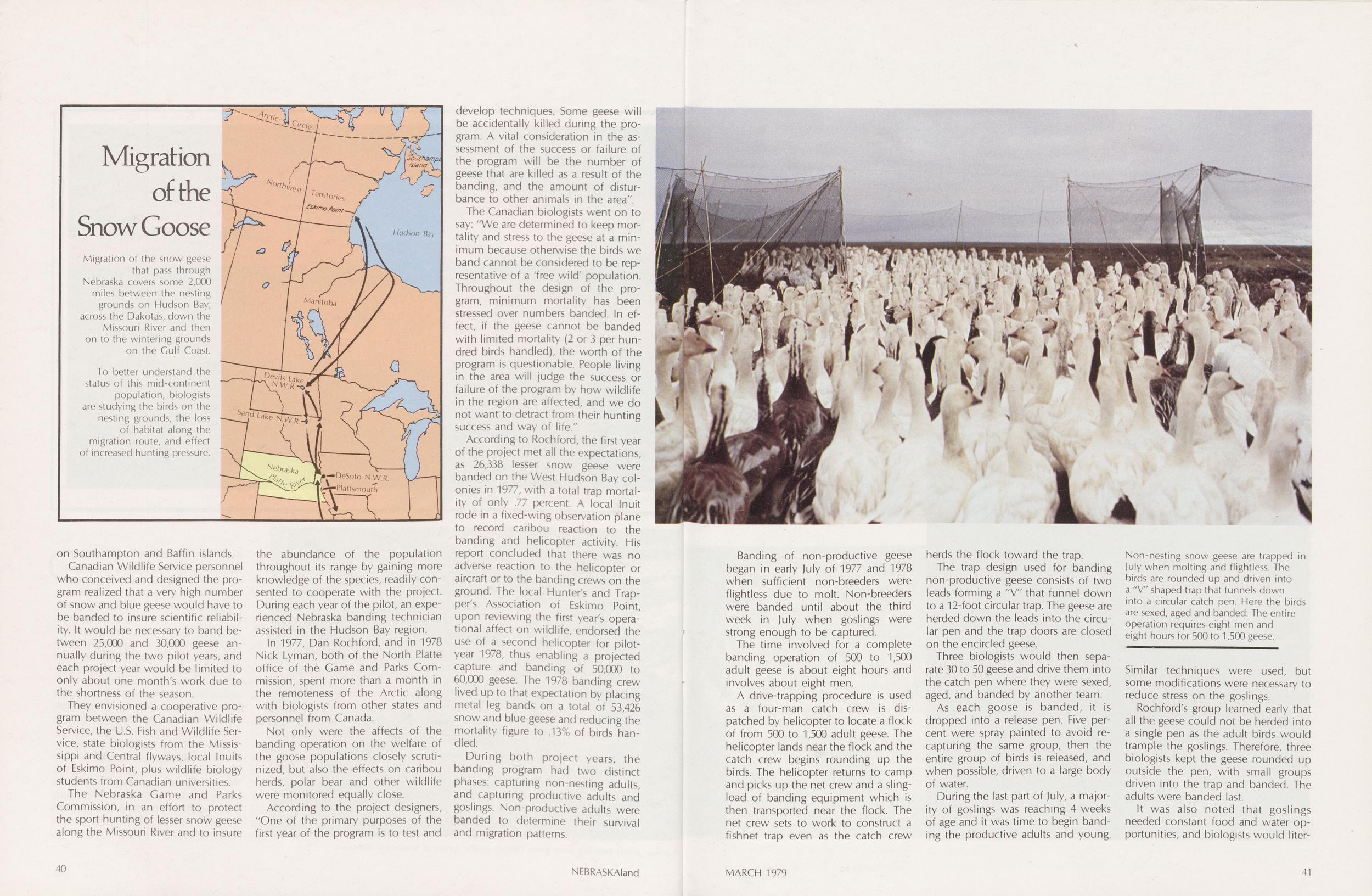
A group of non-breeding snow geese clusters on the tundra of Northwest Territories
To answer these questions, an experimental but intensive banding program was initiated
in 1977 on the West
Hudson Bay snow goose colonies near
Eskimo Point, Northwest Territories. If
the 1977-78 pilot programs prove scientifically successful and acceptable
to the people of the Territories, once
thoroughly analyzed and if funds can
be found to finance the expansive
project, then an expanded 7-year program will include a similar snow goose
study of the other major nesting areas
38 39
Canadian Wildlife Service personnel who conceived and designed the program realized that a very high number of snow and blue geese would have to be banded to insure scientific reliability. It would be necessary to band between 25,000 and 30,000 geese annually during the two pilot years, and each project year would be limited to only about one month's work due to the shortness of the season.
They envisioned a cooperative program between the Canadian Wildlife Service, the U.S. Fish and Wildlife Service, state biologists from the Mississippi and Central flyways, local Inuits of Eskimo Point, plus wildlife biology students from Canadian universities.
The Nebraska Game and Parks Commission, in an effort to protect the sport hunting of lesser snow geese along the Missouri River and to insure the abundance of the population throughout its range by gaining more knowledge of the species, readily consented to cooperate with the project. During each year of the pilot, an experienced Nebraska banding technician assisted in the Hudson Bay region.
In 1977, Dan Rochford, and in 1978 Nick Lyman, both of the North Platte office of the Game and Parks Commission, spent more than a month in the remoteness of the Arctic along with biologists from other states and personnel from Canada.
Not only were the affects of the banding operation on the welfare of the goose populations closely scrutinized, but also the effects on caribou herds, polar bear and other wildlife were monitored equally close.
According to the project designers, "One of the primary purposes of the first year of the program is to test and develop techniques. Some geese will be accidentally killed during the program. A vital consideration in the assessment of the success or failure of the program will be the number of geese that are killed as a result of the banding, and the amount of disturbance to other animals in the area".
The Canadian biologists went on to say: "We are determined to keep mortality and stress to the geese at a minimum because otherwise the birds we band cannot be considered to be representative of a Tree wild' population. Throughout the design of the program, minimum mortality has been stressed over numbers banded. In effect, if the geese cannot be banded with limited mortality (2 or 3 per hundred birds handled), the worth of the program is questionable. People living in the area will judge the success or failure of the program by how wildlife in the region are affected, and we do not want to detract from their hunting success and way of life."
According to Rochford, the first year of the project met all the expectations, as 26,338 lesser snow geese were banded on the West Hudson Bay colonies in 1977, with a total trap mortality of only 77 percent. A local Inuit rode in a fixed-wing observation plane to record caribou reaction to the banding and helicopter activity. His report concluded that there was no adverse reaction to the helicopter or aircraft or to the banding crews on the ground. The local Hunter's and Trapper's Association of Eskimo Point, upon reviewing the first year's operational affect on wildlife, endorsed the use of a second helicopter for pilot-year 1978, thus enabling a projected capture and banding of 50,000 to 60,000 geese. The 1978 banding crew lived up to that expectation by placing metal leg bands on a total of 53,426 snow and blue geese and reducing the mortality figure to .13% of birds handled.
During both project years, the banding program had two distinct phases: capturing non-nesting adults, and capturing productive adults and goslings. Non-productive adults were banded to determine their survival and migration patterns.
Banding of non-productive geese began in early July of 1977 and 1978 when sufficient non-breeders were flightless due to molt. Non-breeders were banded until about the third week in July when goslings were strong enough to be captured.
The time involved for a complete banding operation of 500 to 1,500 adult geese is about eight hours and involves about eight men.
A drive-trapping procedure is used as a four-man catch crew is dispatched by helicopter to locate a flock of from 500 to 1,500 adult geese. The helicopter lands near the flock and the catch crew begins rounding up the birds. The helicopter returns to camp and picks up the net crew and a slingload of banding equipment which is then transported near the flock. The net crew sets to work to construct a fishnet trap even as the catch crew herds the flock toward the trap.
The trap design used for banding non-productive geese consists of two leads forming a "V" that funnel down to a 12-foot circular trap. The geese are herded down the leads into the circular pen and the trap doors are closed on the encircled geese.
Three biologists would then separate 30 to 50 geese and drive them into the catch pen where they were sexed, aged, and banded by another team.
As each goose is banded, it is dropped into a release pen. Five percent were spray painted to avoid recapturing the same group, then the entire group of birds is released, and when possible, driven to a large body of water.
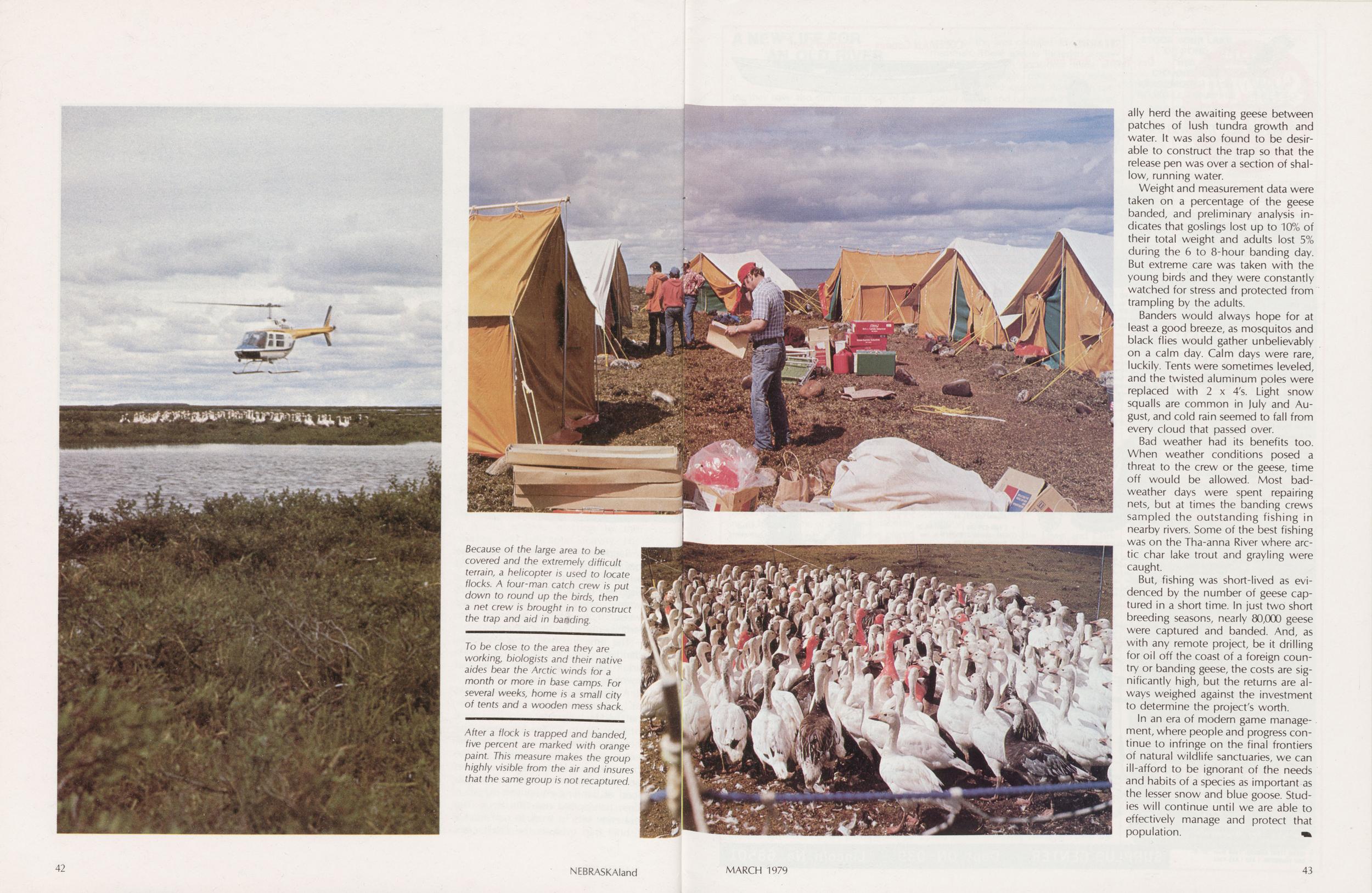
Non-nesting snow geese are trapped in July when molting and flightless. The birds are rounded up and driven into a "V" shaped trap that funnels down into a circular catch pen. Here the birds are sexed, aged and banded. The entire operation requires eight men and eight hours for 500 to 1,500 geese.
Rochford's group learned early that all the geese could not be herded into a single pen as the adult birds would trample the goslings. Therefore, three biologists kept the geese rounded up outside the pen, with small groups driven into the trap and banded. The adults were banded last.
Because of the large area to be covered and the extremely difficult terrain, a helicopter is used to locate flocks. A four-man catch crew is put down to round up the birds, then a net crew is brought in to construct the trap and aid in banding.
To be close to the area they are working, biologists and their native aides bear the Arctic winds for a month or more in base camps. For several weeks, home is a small city of tents and a wooden mess shack.
After a flock is trapped and banded, five percent are marked with orange paint. This measure makes the group highly visible from the air and insures that the same group is not recaptured.
Weight and measurement data were taken on a percentage of the geese banded, and preliminary analysis indicates that goslings lost up to 10% of their total weight and adults lost 5% during the 6 to 8-hour banding day. But extreme care was taken with the young birds and they were constantly watched for stress and protected from trampling by the adults.
Banders would always hope for at least a good breeze, as mosquitos and black flies would gather unbelievably on a calm day. Calm days were rare, luckily. Tents were sometimes leveled, and the twisted aluminum poles were replaced with 2 x 4's. Light snow squalls are common in July and August, and cold rain seemed to fall from every cloud that passed over.
Bad weather had its benefits too. When weather conditions posed a threat to the crew or the geese, time off would be allowed. Most bad-weather days were spent repairing nets, but at times the banding crews sampled the outstanding fishing in nearby rivers. Some of the best fishing was on the Tha-anna River where arctic char lake trout and grayling were caught.
But, fishing was short-lived as evidenced by the number of geese captured in a short time. In just two short breeding seasons, nearly 80,000 geese were captured and banded. And, as with any remote project, be it drilling for oil off the coast of a foreign country or banding geese, the costs are significantly high, but the returns are always weighed against the investment to determine the project's worth.
In an era of modern game management, where people and progress continue to infringe on the final frontiers of natural wildlife sanctuaries, we can ill-afford to be ignorant of the needs and habits of a species as important as the lesser snow and blue goose. Studies will continue until we are able to effectively manage and protect that population.
42 NEBRASKAland MARCH 1979 43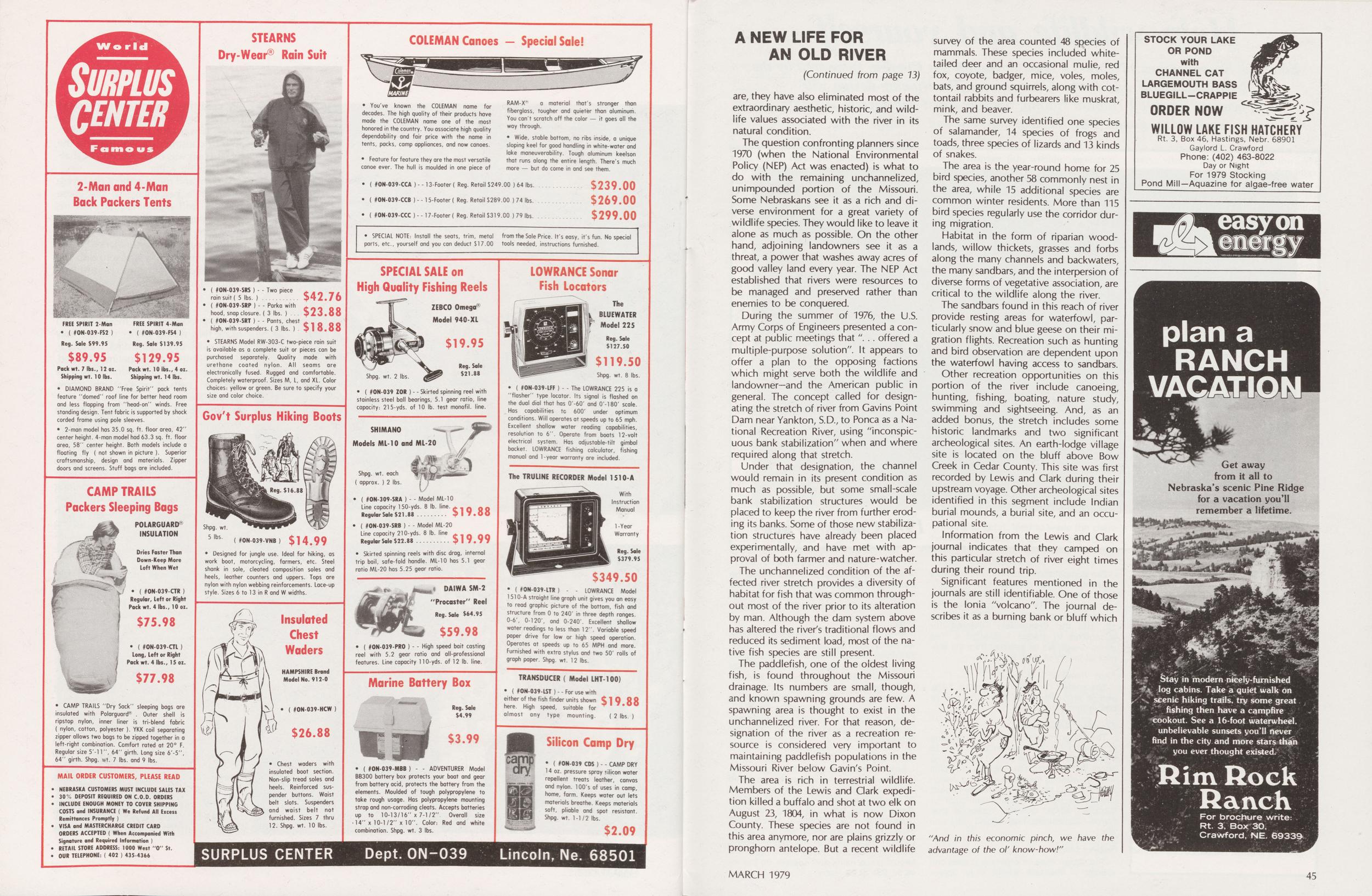
A NEW LIFE FOR AN OLD RIVER
(Continued from page 13)are, they have also eliminated most of the extraordinary aesthetic, historic, and wildlife values associated with the river in its natural condition.
The question confronting planners since 1970 (when the National Environmental Policy (NEP) Act was enacted) is what to do with the remaining unchannelized, unimpounded portion of the Missouri. Some Nebraskans see it as a rich and diverse environment for a great variety of wildlife species. They would like to leave it alone as much as possible. On the other hand, adjoining landowners see it as a threat, a power that washes away acres of good valley land every year. The NEP Act established that rivers were resources to be managed and preserved rather than enemies to be conquered.
During the summer of 1976, the U.S. Army Corps of Engineers presented a concept at public meetings that... offered a multiple-purpose solution". It appears to offer a plan to the opposing factions which might serve both the wildlife and landowner-and the American public in general. The concept called for designating the stretch of river from Gavins Point Dam near Yankton, S.D., to Ponca as a National Recreation River, using "inconspicuous bank stabilization" when and where required along that stretch.
Under that designation, the channel would remain in its present condition as much as possible, but some small-scale bank stabilization structures would be placed to keep the river from further eroding its banks. Some of those new stabilization structures have already been placed experimentally, and have met with approval of both farmer and nature-watcher.
The unchannelized condition of the affected river stretch provides a diversity of habitat for fish that was common throughout most of the river prior to its alteration by man. Although the dam system above has altered the river's traditional flows and reduced its sediment load, most of the native fish species are still present.
The paddlefish, one of the oldest living fish, is found throughout the Missouri drainage. Its numbers are small, though, and known spawning grounds are few. A spawning area is thought to exist in the unchannelized river. For that reason, designation of the river as a recreation resource is considered very important to maintaining paddlefish populations in the Missouri River below Gavin's Point.
The area is rich in terrestrial wildlife. Members of the Lewis and Clark expedition killed a buffalo and shot at two elk on August 23, 1804, in what is now Dixon County. These species are not found in this area anymore, nor are plains grizzly or pronghorn antelope. But a recent wildlife survey of the area counted 48 species of mammals. These species included white-tailed deer and an occasional mulie, red fox, coyote, badger, mice, voles, moles, bats, and ground squirrels, along with cottontail rabbits and furbearers like muskrat, mink, and beaver.
The same survey identified one species of salamander, 14 species of frogs and toads, three species of lizards and 13 kinds of snakes.
The area is the year-round home for 25 bird species, another 58 commonly nest in the area, while 15 additional species are common winter residents. More than 115 bird species regularly use the corridor during migration.
Habitat in the form of riparian woodlands, willow thickets, grasses and forbs along the many channels and backwaters, the many sandbars, and the interpersion of diverse forms of vegetative association, are critical to the wildlife along the river.
The sandbars found in this reach of river provide resting areas for waterfowl, particularly snow and blue geese on their migration flights. Recreation such as hunting and bird observation are dependent upon the waterfowl having access to sandbars.
Other recreation opportunities on this portion of the river include canoeing, hunting, fishing, boating, nature study, swimming and sightseeing. And, as an added bonus, the stretch includes some historic landmarks and two significant archeological sites. An earth-lodge village site is located on the bluff above Bow Creek in Cedar County. This site was first recorded by Lewis and Clark during their upstream voyage. Other archeological sites identified in this segment include Indian burial mounds, a burial site, and an occupational site.
Information from the Lewis and Clark journal indicates that they camped on this particular stretch of river eight times during their round trip.
Significant features mentioned in the journals are still identifiable. One of those is the Ionia "volcano". The journal describes it as a burning bank or bluff which
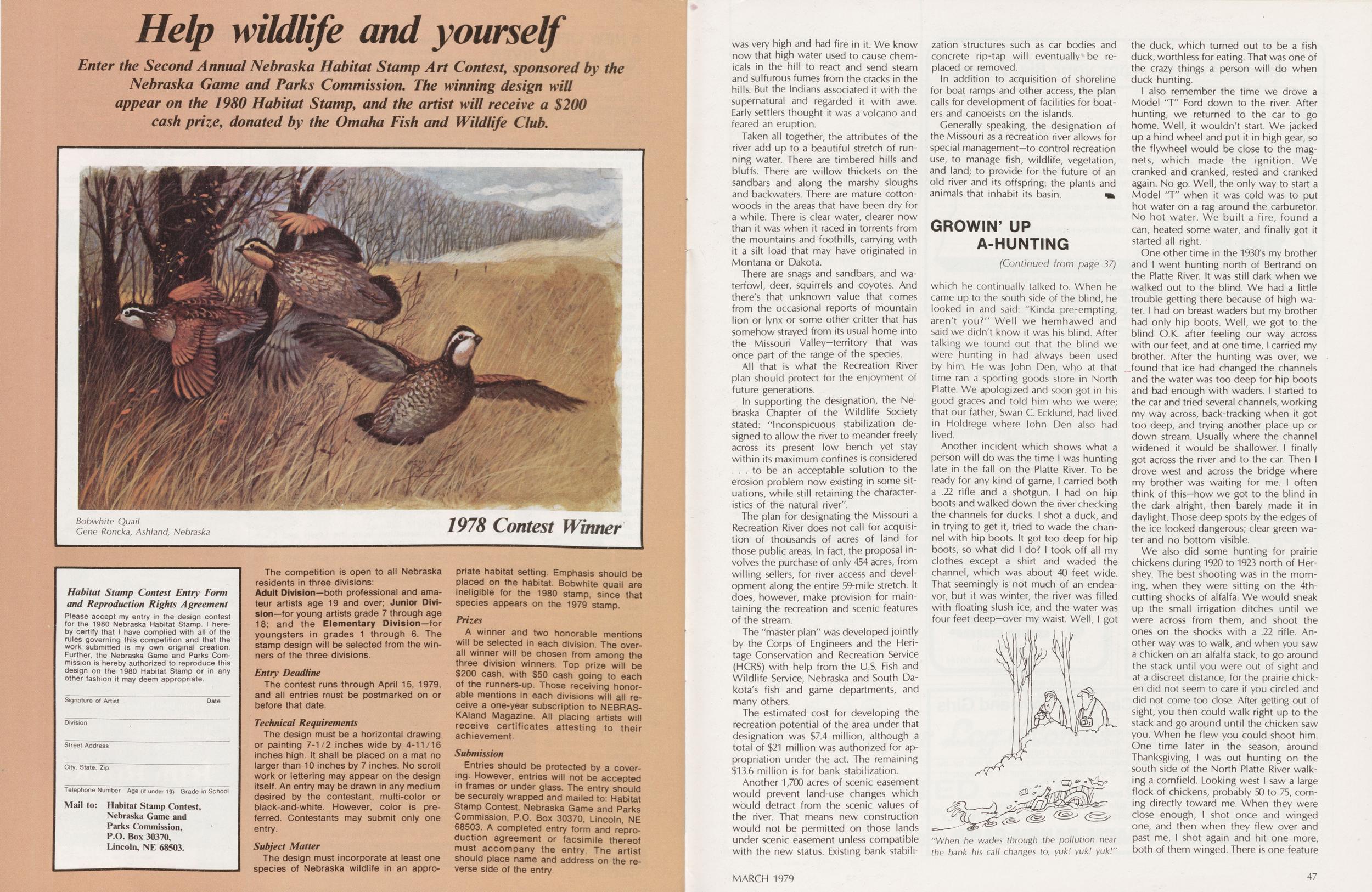
"And in this economic pinch, we have the advantage of the oh know-how!"
was very high and had fire in it. We know now that high water used to cause chemicals in the hill to react and send steam and sulfurous fumes from the cracks in the hills. But the Indians associated it with the supernatural and regarded it with awe. Early settlers thought it was a volcano and feared an eruption.
Taken all together, the attributes of the river add up to a beautiful stretch of running water. There are timbered hills and bluffs. There are willow thickets on the sandbars and along the marshy sloughs and backwaters. There are mature cottonwoods in the areas that have been dry for a while. There is clear water, clearer now than it was when it raced in torrents from the mountains and foothills, carrying with it a silt load that may have originated in Montana or Dakota.
There are snags and sandbars, and waterfowl, deer, squirrels and coyotes. And there's that unknown value that comes from the occasional reports of mountain lion or lynx or some other critter that has somehow strayed from its usual home into the Missouri Valley-territory that was once part of the range of the species.
All that is what the Recreation River plan should protect for the enjoyment of future generations.
In supporting the designation, the Nebraska Chapter of the Wildlife Society stated: "Inconspicuous stabilization designed to allow the river to meander freely across its present low bench yet stay within its maximum confines is considered ...to be an acceptable solution to the erosion problem now existing in some situations, while still retaining the characteristics of the natural river".
The plan for designating the Missouri a Recreation River does not call for acquisition of thousands of acres of land for those public areas. In fact, the proposal involves the purchase of only 454 acres, from willing sellers, for river access and development along the entire 59-mile stretch. It does, however, make provision for maintaining the recreation and scenic features of the stream.
The "master pian" was developed jointly by the Corps of Engineers and the Heritage Conservation and Recreation Service (HCRS) with help from the U.S. Fish and Wildlife Service, Nebraska and South Dakota's fish and game departments, and many others.
The estimated cost for developing the recreation potential of the area under that designation was $7.4 million, although a total of $21 million was authorized for appropriation under the act. The remaining $13.6 million is for bank stabilization.
Another 1,700 acres of scenic easement would prevent land-use changes which would detract from the scenic values of the river. That means new construction would not be permitted on those lands under scenic easement unless compatible with the new status. Existing bank stabilization structures such as car bodies and concrete rip-tap will eventually be replaced or removed.
In addition to acquisition of shoreline for boat ramps and other access, the plan calls for development of facilities for boaters and canoeists on the islands.
Generally speaking, the designation of the Missouri as a recreation river allows for special management—to control recreation use, to manage fish, wildlife, vegetation, and land; to provide for the future of an old river and its offspring: the plants and animals that inhabit its basin.
GROWIN' UP A-HUNTING
(Continued from page 37)which he continually talked to. When he came up to the south side of the blind, he looked in and said: "Kinda pre-empting, aren't you?" Well we hemhawed and said we didn't know it was his blind. After talking we found out that the blind we were hunting in had always been used by him. He was John Den, who at that time ran a sporting goods store in North Platte. We apologized and soon got in his good graces and told him who we were; that our father, Swan C. Ecklund, had lived in Holdrege where John Den also had lived.
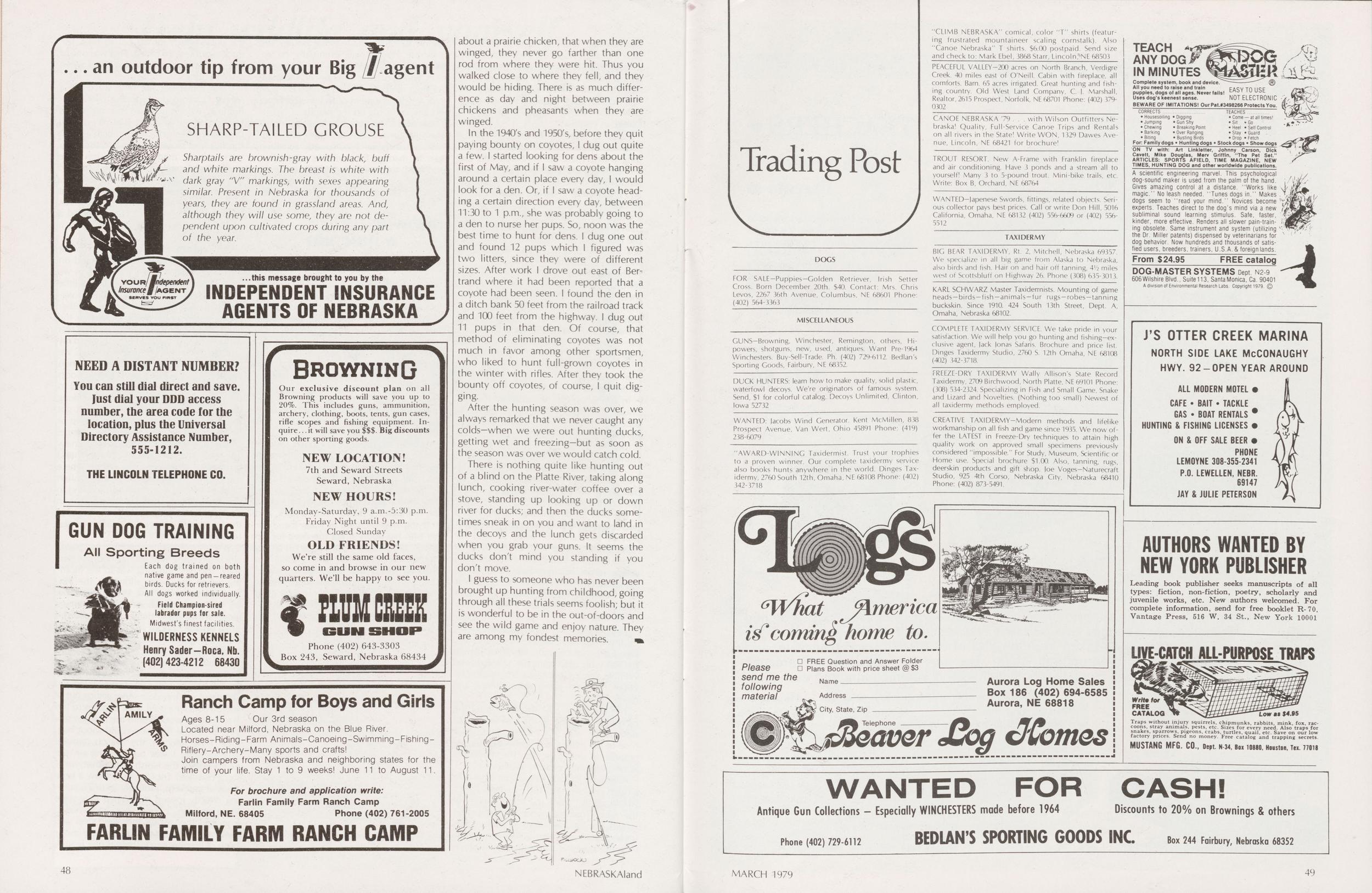
"When he wades through the pollution near the bank his call changes to, yuk! yuk' yuk!"
I also remember the time we drove a Model "T" Ford down to the river. After hunting, we returned to the car to go home. Well, it wouldn't start. We jacked up a hind wheel and put it in high gear, so the flywheel would be close to the magnets, which made the ignition. We cranked and cranked, rested and cranked again. No go. Well, the only way to start a Model "T" when it was cold was to put hot water on a rag around the carburetor. No hot water. We built a fire, found a can, heated some water, and finally got it started all right.
One other time in the 1930's my brother and I went hunting north of Bertrand on the Platte River. It was still dark when we walked out to the blind. We had a little trouble getting there because of high water. I had on breast waders but my brother had only hip boots. Well, we got to the blind O.K. after feeling our way across with our feet, and at one time, I carried my brother. After the hunting was over, we Tound that ice had changed the channels and the water was too deep for hip boots and bad enough with waders. I started to the car and tried several channels, working my way across, back-tracking when it got too deep, and trying another place up or down stream. Usually where the channel widened it would be shallower. I finally got across the river and to the car. Then I drove west and across the bridge where my brother was waiting for me. I often think of this—how we got to the blind in the dark alright, then barely made it in daylight. Those deep spots by the edges of the ice looked dangerous; clear green water and no bottom visible.
We also did some hunting for prairie
chickens during 1920 to 1923 north of Hershey. The best shooting was in the morning,
when they were sitting on the 4th-cutting shocks of alfalfa. We would sneak
up the small irrigation ditches until we
were across from them, and shoot the
ones on the shocks with a .22 rifle. Another way was to walk, and when you saw
a chicken on an alfalfa stack, to go around
the stack until you were out of sight and
at a discreet distance, for the prairie chicken did not seem to care if you circled
and
did not come too close. After getting out of
sight, you then could walk right up to the
stack and go around until the chicken saw
you. When he flew you could shoot him.
One time later in the season, around
Thanksgiving, I was out hunting on the
south side of the North Platte River walking a cornfield. Looking west I saw a large
flock of chickens, probably 50 to 75, coming directly toward me. When they were
close enough, I shot once and winged
one, and then when they flew over and
past me, I shot again and hit one more,
both of them winged. There is one feature
MARCH 1979
47
 about a prairie chicken, that when they are
winged, they never go farther than one
rod from where they were hit. Thus you
walked close to where they fell, and they
would be hiding. There is as much difference as day and night between prairie
chickens and pheasants when they are
winged.
about a prairie chicken, that when they are
winged, they never go farther than one
rod from where they were hit. Thus you
walked close to where they fell, and they
would be hiding. There is as much difference as day and night between prairie
chickens and pheasants when they are
winged.
In the 1940's and 1950's, before they quit paying bounty on coyotes, I dug out quite a few. I started looking for dens about the first of May, and if I saw a coyote hanging around a certain place every day, I would look for a den. Or, if I saw a coyote heading a certain direction every day, between 11:30 to 1 p.m., she was probably going to a den to nurse her pups. So, noon was the best time to hunt for dens. I dug one out and found 12 pups which I figured was two litters, since they were of different sizes. After work I drove out east of Bertrand where it had been reported that a coyote had been seen. I found the den in a ditch bank 50 feet from the railroad track and 100 feet from the highway. I dug out 11 pups in that den. Of course, that method of eliminating coyotes was not much in favor among other sportsmen, who liked to hunt full-grown coyotes in the winter with rifles. After they took the bounty off coyotes, of course, I quit digging
After the hunting season was over, we always remarked that we never caught any colds-when we were out hunting ducks, getting wet and freezing-but as soon as the season was over we would catch cold. There is nothing quite like hunting out of a blind on the Platte River, taking along lunch, cooking river-water coffee over a stove, standing up looking up or down river for ducks; and then the ducks sometimes sneak in on you and want to land in the decoys and the lunch gets discarded when you grab your guns. It seems the ducks don't mind you standing if you don't move.
I guess to someone who has never been brought up hunting from childhood, going through all these trials seems foolish; but it is wonderful to be in the out-of-doors and see the wild game and enjoy nature. They are among my fondest memories.
Position: 341 (27 views)