Volume 57, Issue 2, 1979
NEBRASKAland
February 1979 60 Cents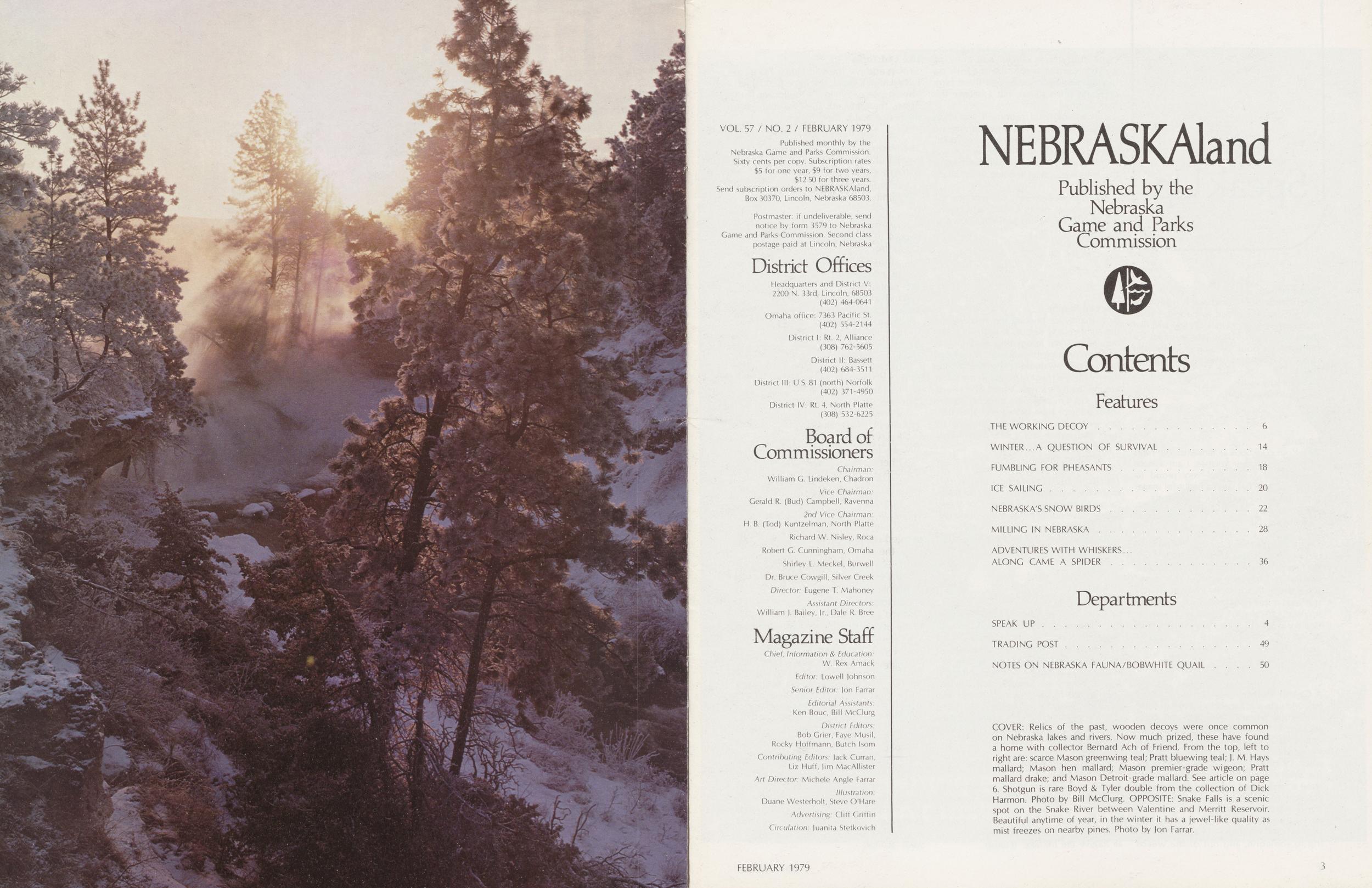
NEBRASKAIand
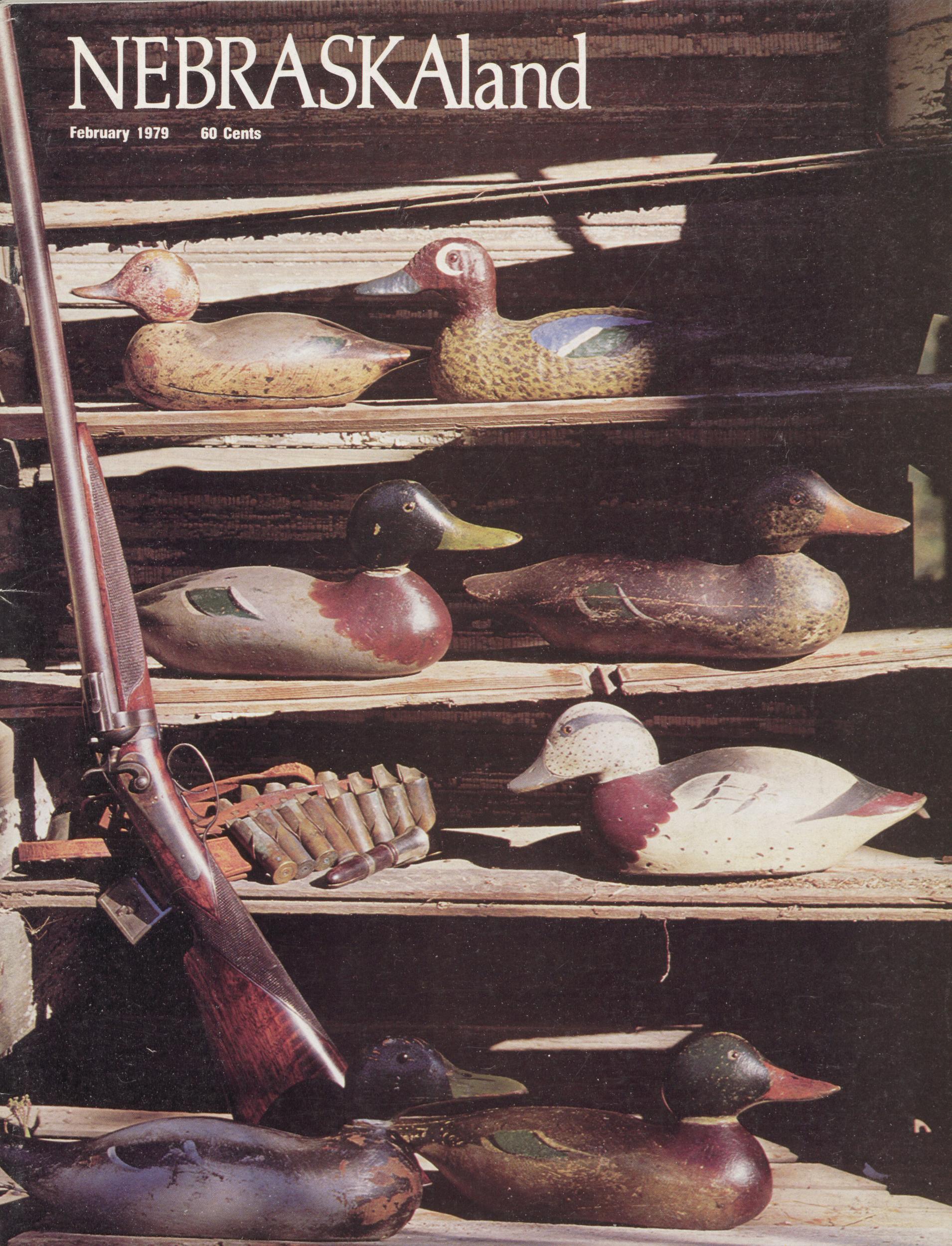
Published by the Nebraska Game and Parks Commission Contents Features THE WORKING DECOY 6 WINTER...A QUESTION OF SURVIVAL 14 FUMBLING FOR PHEASANTS 18 ICE SAILING 20 NEBRASKA'S SNOW BIRDS 22 MILLING IN NEBRASKA 28 ADVENTURES WITH WHISKERS... ALONG CAME A SPIDER 36 Departments SPEAK UP 4 TRADING POST 9 NOTES ON NEBRASKA FAUNA/BOBWHITE QUAIL 50COVER: Relics of the past, wooden decoys were once common on Nebraska lakes and rivers. Now much prized, these have found a home with collector Bernard Ach of Friend. From the top, left to right are: scarce Mason greenwing teal; Pratt bluewing teal; J. M. Hays mallard; Mason hen mallard; Mason premier-grade wigeon; Pratt mallard drake; and Mason Detroit-grade mallard. See article on page 6. Shotgun is rare Boyd & Tyler double from the collection of Dick Harmon. Photo by Bill McClurg. OPPOSITE: Snake Falls is a scenic spot on the Snake River between Valentine and Merritt Reservoir. Beautiful anytime of year, in the winter it has a jewel-like quality as mist freezes on nearby pines. Photo by Jon Farrar.
Speak Up
Suits herSir / The October Cookbook is really nice and we are very proud to have it. I have used some of the recipes already and like them very much. Thank you so much for compiling a book of recipes especially suited to preparing wildlife for luscious eating.
Dorothy Hall Hutchinson, Kan. FantasticSir / Your cookbook is fantastic. We have all been trying new recipes. I am a state employee also, and feel very proud to know our state has such a beautiful magazine. Thanks for your time and efforts.
Betty Kerst Lincoln, NE Thank you both for taking the time to drop us a line, just about everything we do here is for the benefit of our readers, and it is certainly nice to know that sometimes we hit the mark. By the way, we will still send a free cookbook with a gift subscription, so anyone needing a suggestion for a special something for a special friend, etc., here is your hint. Thanks again. (Editor) A Careful MotherSir / My wife and I spend a lot of our summer in the Johnson Lake area and commute from Cozad. This past summer on a gravel road I spotted a hen pheasant on the edge of the road so slowed down to a crawl. I then saw that she was trying to get five small chicks across the road. She hesitated a while, then started across with the chicks. I then drove by, watching her in the mirror. She took the chicks into the ditch, then returned to the other side, stopped, and moved her head as if speaking to someone, and out of the weeds came four more chicks and they all walked together across the road. In my hunting experience, I've seen these birds do some smart things, but I believe this tops them all.
This is wonderful country if you enjoy seeing wild game. Also one morning, we saw two rooster pheasarus, three quail, one rabbit and a blue heron which was standing in a puddle in a field, and across the field was a deer feeding in an alfalfa patch.
Yes, this western part of Nebraska still contains a lot of its natural beauty and wildlife if one would just slow down to look for it.
Jim Vohal Omaha, NE Peaceful RespiteSir / Thanks for printing the article about the eight-county Region 26 in the November issue. Very informative and factual. Also for printing the pictures of "Happy jack's Peak" overlooking the North Loup River with the town of Scotia in the background, and the Chalk Mines. The reason being that I'm originally from Scotia and spent a lot of time before and after military service atop the peak just thinking. It's quiet and serene and a nice place to be.
Jim Bonsall Hastings, NEThat is indeed a fantastic valley with a magnificent view from that hill. Like all local points of interest I suppose a lot of area people have not been up there, but it certainly is more than worth the climb necessary to get there. Thanks for writing. (Editor)
"Clerical" errorSir / I am writing in regard to the article in the November NEBRASKAland on the "Sandhills River Country Yesterday". One paragraph ends with the statement, "A colony of Seventh-Day Adventists followed close behind". This is incorrect. It was a colony of Seventh-Day Baptists! They settled in the North Loup area and there is a church in that community yet. In fact, it is growing and very active. My family and I are members of that church and would appreciate a correction.
Merlyn Williams North Loup, Nebr.I don't know where the error originated, but I must confess that I never heard of this church until your letter (we also got a letter from Mrs. George Maxson correcting us) arrived. Sorry about that, and hope you all forgive the mistake. (Editor)
Like Old TimesSir / The story "The Old Home Place" in July NEBRASKAland stirred me to do a follow-up poem. While the bulldozer tears down the outward signs of our past, memory rebuilds them for us.
The Bulldozer PausesThe boss says "There, John, knock
her down;
Make room for progress, more
farm ground."
Somehow, against his flagstaked print,
My hands rebel to do
this stint.
Below me, empty house,
the land;
The dream, the vision; some
man's plan.
Fate has a quirk, a
malign twist.
What do I see there in
the mist?
'Tis Jim and Jane, again
to see,
The lilacs and the old
oak tree.
Softly she whispers, just
to him,
"You see, I told you they'd
grow, Jim!"
Sunbonnet, straw hat, field
toil done;
They fade from sight with the
setting sun.
A vision? A spirit? This fact
I face;
True farmers never desert
their place.
Though moved to town, the house,
barn, tree
In their memory stay like they
used to be. Helen E. Ruyle Holmesville, NE A Great Place
Sir / This summer I attended a class in Colorado and spent much time outdoors since the class was in Outdoor Education. I also stayed nearly a week in Idaho and two days in and around Yellowstone Park, but the most enjoyable part of my trip was the two days at Fort Robinson State Park. The many activities to participate in and scenery of the area made a believer out of me that Nebraska is truly the Good Life. My next vacation will surely be spent in Nebraska. Thanks.
Ron Svacina Omaha, NEDiscovering Fort Robinson is a thrill, and wandering around the Pine Ridge makes for a memorable time. We hope that more Nebraskans will visit this area to see what is available to them right in their back yards. (Editor)
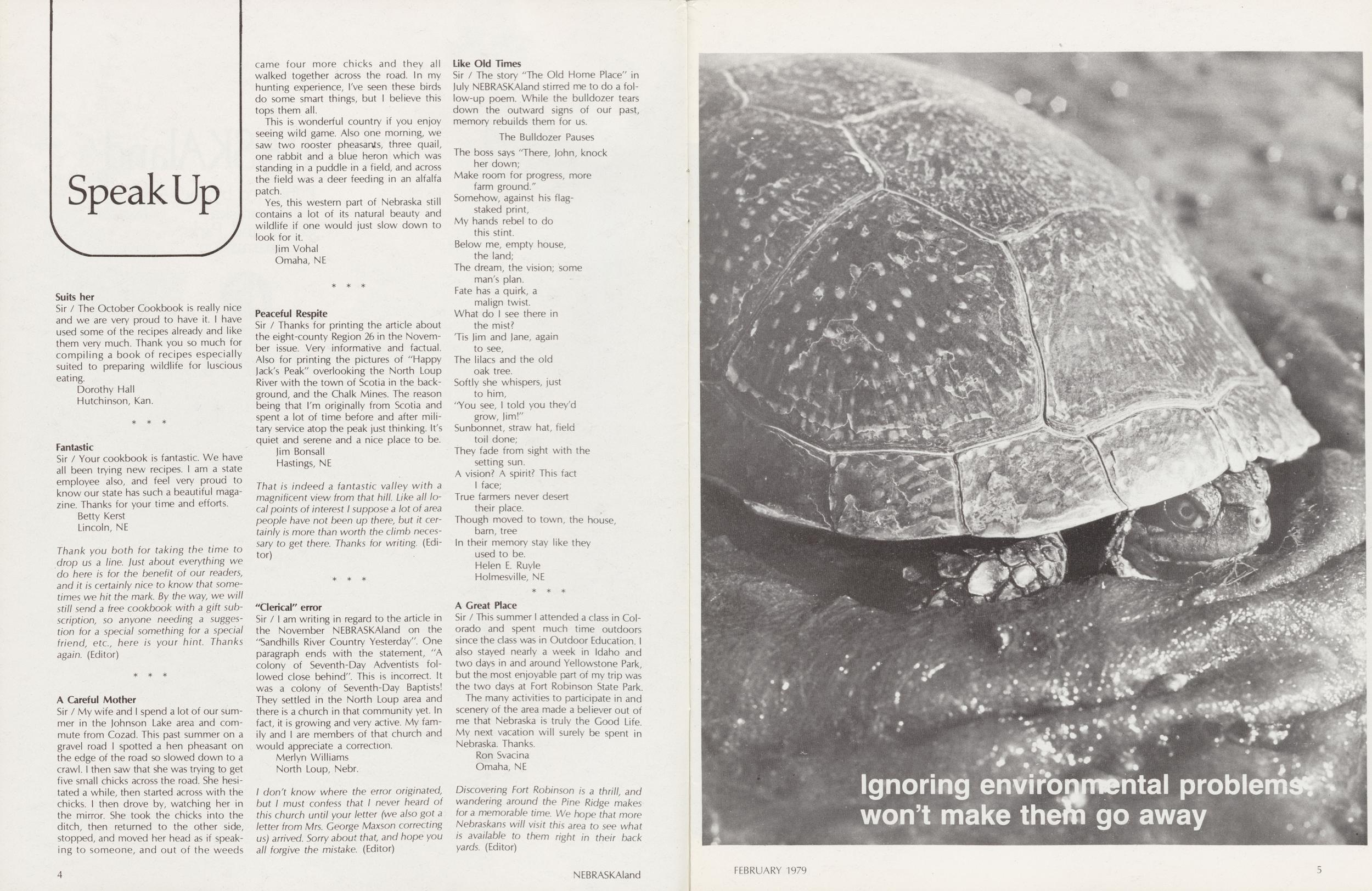
Ignoring environmental problems won't make them go away
The Working Decoy
Widely recognized as a form of folk art, wooden decoy relics of earlier days now reside on mantels of appreciative collectors, replaced in old haunts of river, marsh and lake by realistic yet cold plastic counterpartsWE CALL THEM folk art today, these battered antiquities of an era long past. The working decoys of the 1800's and early 1900's were a true interpretation of their maker's eye. Inspired by the grace and form of live birds, these wooden blocks have a charm that today's more realistic plastic and styrofoam fakes can never achieve.
Now retired to the mantel place, wooden decoys were tools of the trade for the American market hunter and sportsman, even long before live decoys were outlawed.
Though by no means an exclusively American phenonmenon, the use of the wooden blocks in our country achieved a popularity unequalled at any other time in recorded history. We know that decoys of wood, reed and stuffed skins were used at least several thousand years ago, but it took guns, gunpowder and a little Yankee ingenuity to make them really effective as a means of taking waterfowl.
Shotgunning ducks began along the east coast of our continent as the new country, rapidly expanding and hungry for fresh meat, created a market for the seemingly limitless supply of waterfowl.
Early techniques of taking ducks utilized the bird's gregarious nature and fairly predictable feeding habits. Most birds were shot for sale rather than for sport, and the idea was to take as many as possible with the least outlay of expensive shot and powder. Often the preferred method was to sneak up on a large raft of birds and pot shoot as many as possible while they were still on the water. Wingshooting came later, and this is where the decoy came into widespread use. Hunting ducks along the coast was hard work, often requiring the use of several boats and two or more people.
Pre-dawn hours were spent putting out several hundred decoys, then the gunner situated himself in a boat or sinkbox in the midst of the spread. Two breech-loading double shotguns were normally used, with the gunner alternating guns as the barrels became too hot to handle. Normally a second boat was stationed downwind to pick up the dead birds. Cripples were often ignored, and the use of a retrieving dog was unheard of. On a good day, a gunner on the prime duck areas of Chesapeake Bay and other favored spots could easily take upwards of 100 ducks. Canvasbacks and redheads were the preferred species, but vast numbers of scaup and other divers were also taken. Most of the decoys were made to simulate these species, but shorebirds, geese, swans and puddle duck fakes were also produced.
Early, all of the decoys were hand-carved. Most were presumably made during the off-season by hunters for their own or friends' use. However, as the demand increased, some carvers began to produce birds for resale. White pine and cedar were the preferred woods for carving, with nearly all the early decoys being of solid construction. Hollow decoys were a later innovation to reduce weight.
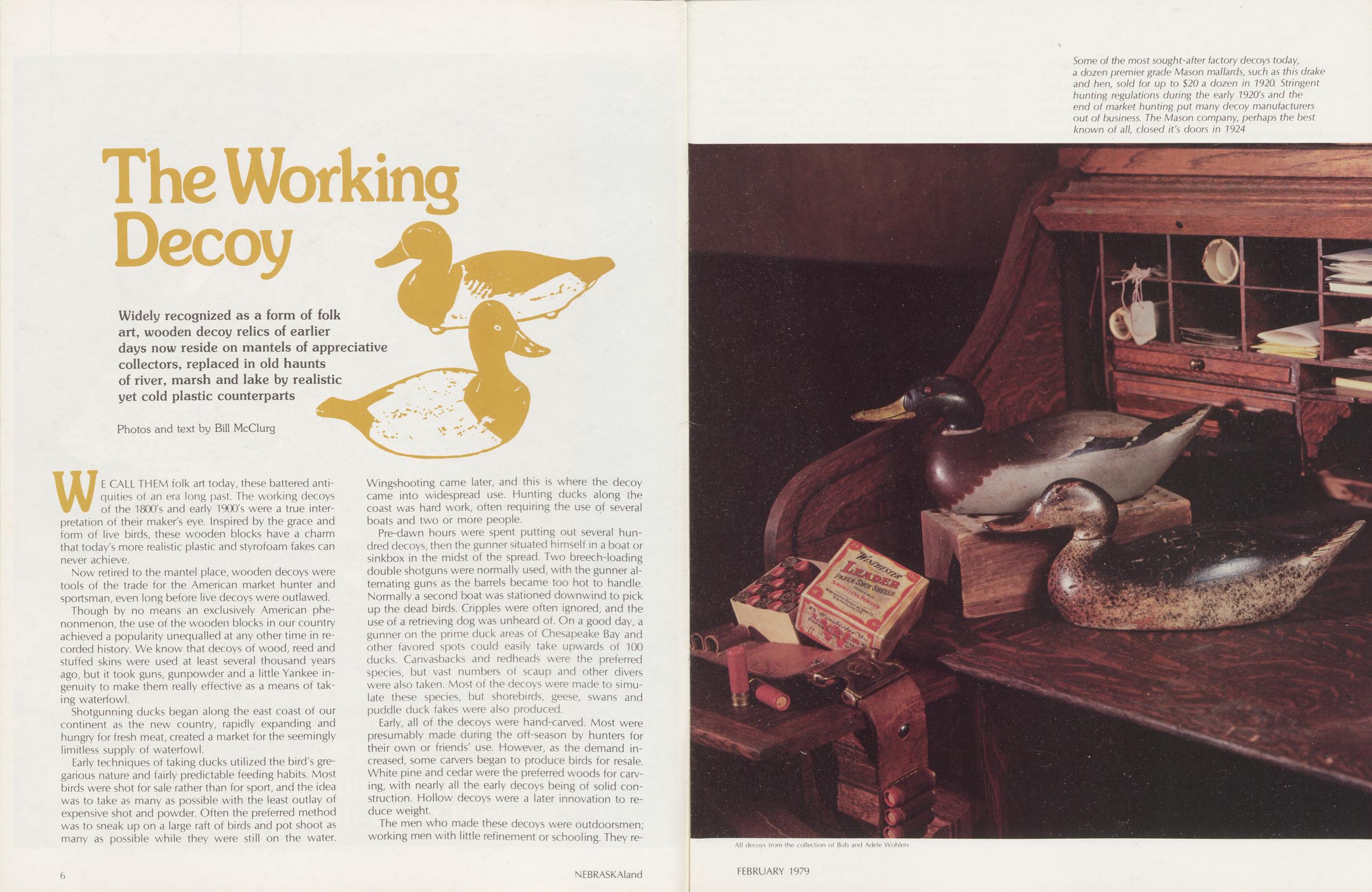
Some of the most sought-after factory decoys today, a dozen premier grade Mason mallards, such as this drake and hen, sold for up to $20 a dozen in 7920. Stringent hunting regulations during the early 1920's and the end of market hunting put many decoy manufacturers out of business. The Mason company, perhaps the best known of all, closed it's doors in 1924
Alll decoys from the collection of Bob and Adele Wohlers
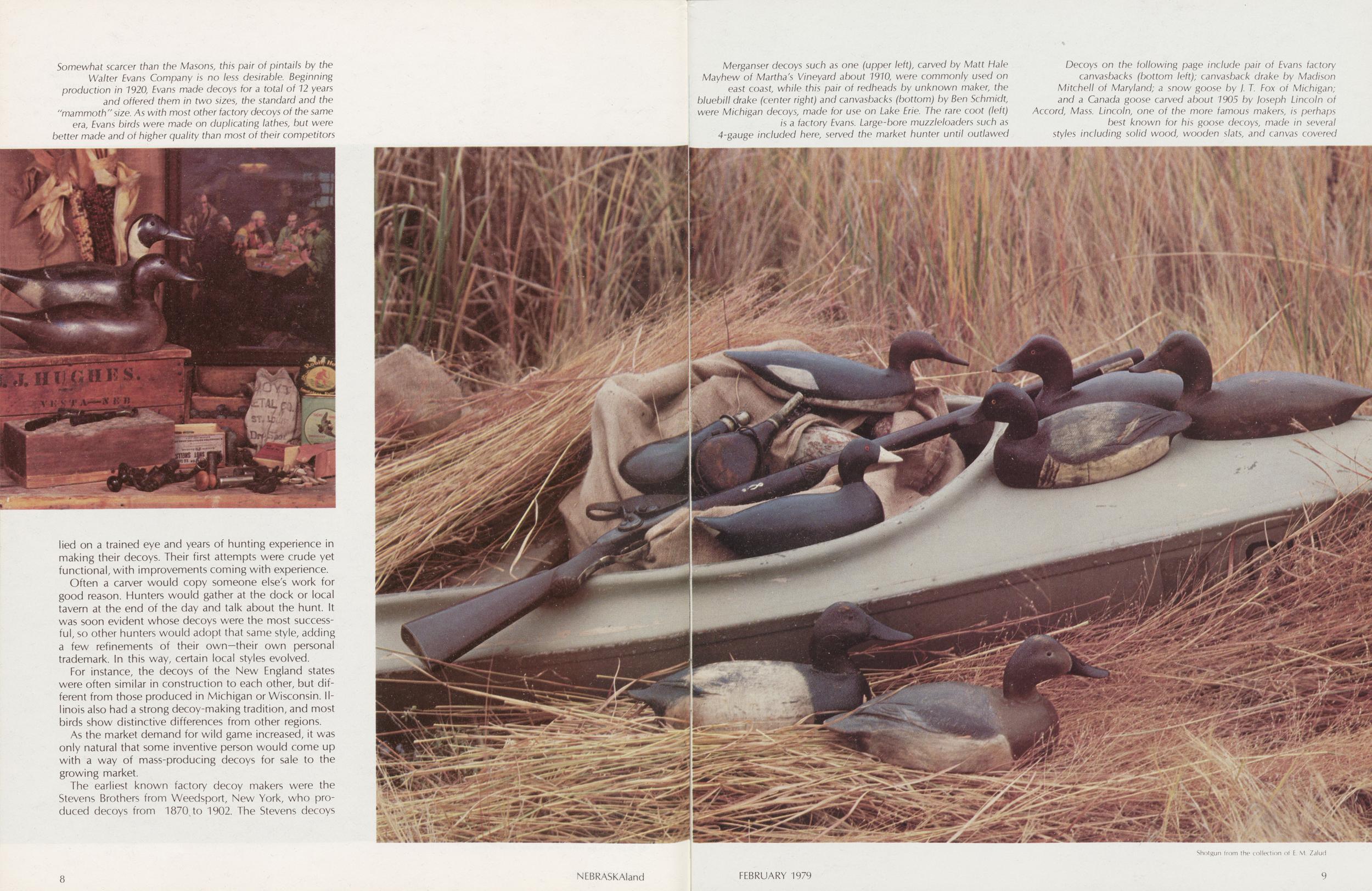
Somewhat scarcer than the Masons, this pair of pintails by the Walter Evans Company is no less desirable. Beginning production in 1920, Evans made decoys for a total of 12 years and offered them in two sizes, the standard and the "mammoth"size. As with most other factory decoys of the same era, Evans birds were made on duplicating lathes, but were better made and of higher quality than most of their competitors
Often a carver would copy someone else's work for good reason. Hunters would gather at the dock or local tavern at the end of the day and talk about the hunt. It was soon evident whose decoys were the most successful, so other hunters would adopt that same style, adding a few refinements of their own—their own personal trademark. In this way, certain local styles evolved.
For instance, the decoys of the New England states were often similar in construction to each other, but different from those produced in Michigan or Wisconsin. Illinois also had a strong decoy-making tradition, and most birds show distinctive differences from other regions.
As the market demand for wild game increased, it was only natural that some inventive person would come up with a way of mass-producing decoys for sale to the growing market.
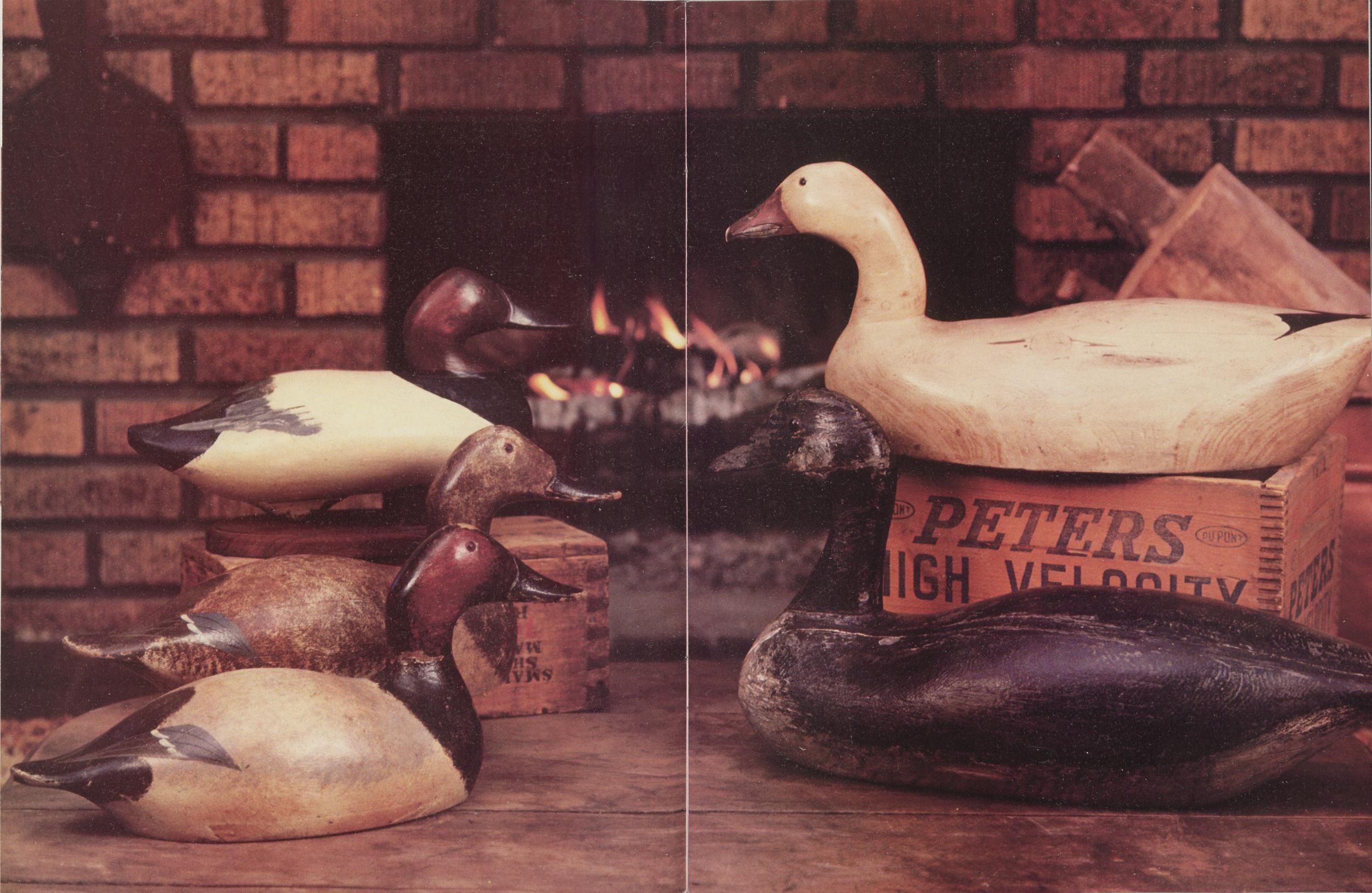
Merganser decoys such as one (upper left), carved by Matt Hale Mayhew of Martha's Vineyard about 1910, were commonly used on east coast, while this pair of redheads by unknown maker, the bluebill drake (center right) and canvasbacks (bottom) by Ben Schmidt, were Michigan decoys, made for use on Lake Erie. The rare coot (left) is a factory Evans. Large-bore muzzleloaders such as 4-gauge included here, served the market hunter until outlawed
Decoys on the following page include pair of Evans factory canvasbacks (bottom left); canvasback drake by Madison Mitchell of Maryland; a snow goose by J. T. Fox of Michigan; and a Canada goose carved about 1905 by Joseph Lincoln of Accord, Mass. Lincoln, one of the more famous makers, is perhaps best known for his goose decoys, made in several styles including solid wood, wooden slats, and canvas covered
Shotgun from the collection of E. M Zalud
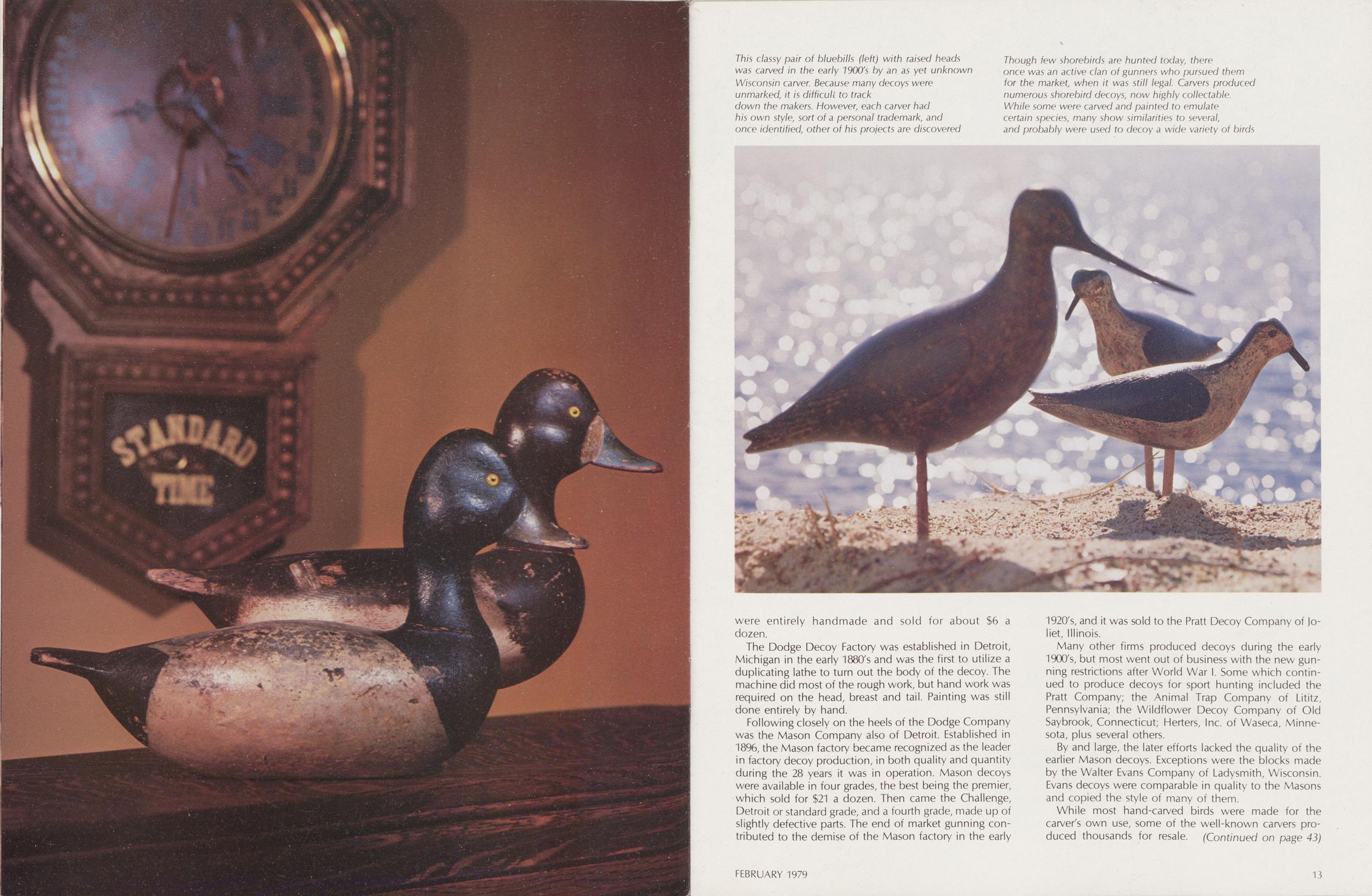
This classy pair of bluebills (left) with raised heads was carved in the early 1900's by an as yet unknown Wisconsin carver. Because many decoys were unmarked, it is difficult to track down the makers. However, each carver had his own style, sort of a personal trademark, and once identified, other of his proiects are discovered
Though few shorebirds are hunted today, there once was an active clan of gunners who pursued them for the market, when it was still legal. Carvers produced numerous shorebird decoys, now highly collectable. While some were carved and painted to emulate certain species, many show similarities to several, and probably were used to decoy a wide variety of birds
The Dodge Decoy Factory was established in Detroit, Michigan in the early 1880's and was the first to utilize a duplicating lathe to turn out the body of the decoy. The machine did most of the rough work, but hand work was required on the head, breast and tail. Painting was still done entirely by hand.
Following closely on the heels of the Dodge Company was the Mason Company also of Detroit. Established in 1896, the Mason factory became recognized as the leader in factory decoy production, in both quality and quantity during the 28 years it was in operation. Mason decoys were available in four grades, the best being the premier, which sold for $21 a dozen. Then came the Challenge, Detroit or standard grade, and a fourth grade, made up of slightly defective parts. The end of market gunning contributed to the demise of the Mason factory in the early 1920's, and it was sold to the Pratt Decoy Company of Joliet, Illinois.
Many other firms produced decoys during the early 1900's, but most went out of business with the new gunning restrictions after World War I. Some which continued to produce decoys for sport hunting included the Pratt Company; the Animal Trap Company of Fititz, Pennsylvania; the Wildflower Decoy Company of Old Saybrook, Connecticut; Herters, Inc. of Waseca, Minnesota, plus several others.
By and large, the later efforts lacked the quality of the earlier Mason decoys. Exceptions were the blocks made by the Walter Evans Company of Ladysmith, Wisconsin. Evans decoys were comparable in quality to the Masons and copied the style of many of them.
While most hand-carved birds were made for the carver's own use, some of the well-known carvers produced thousands for resale. (Continued on page 43)
FEBRUARY 1979 13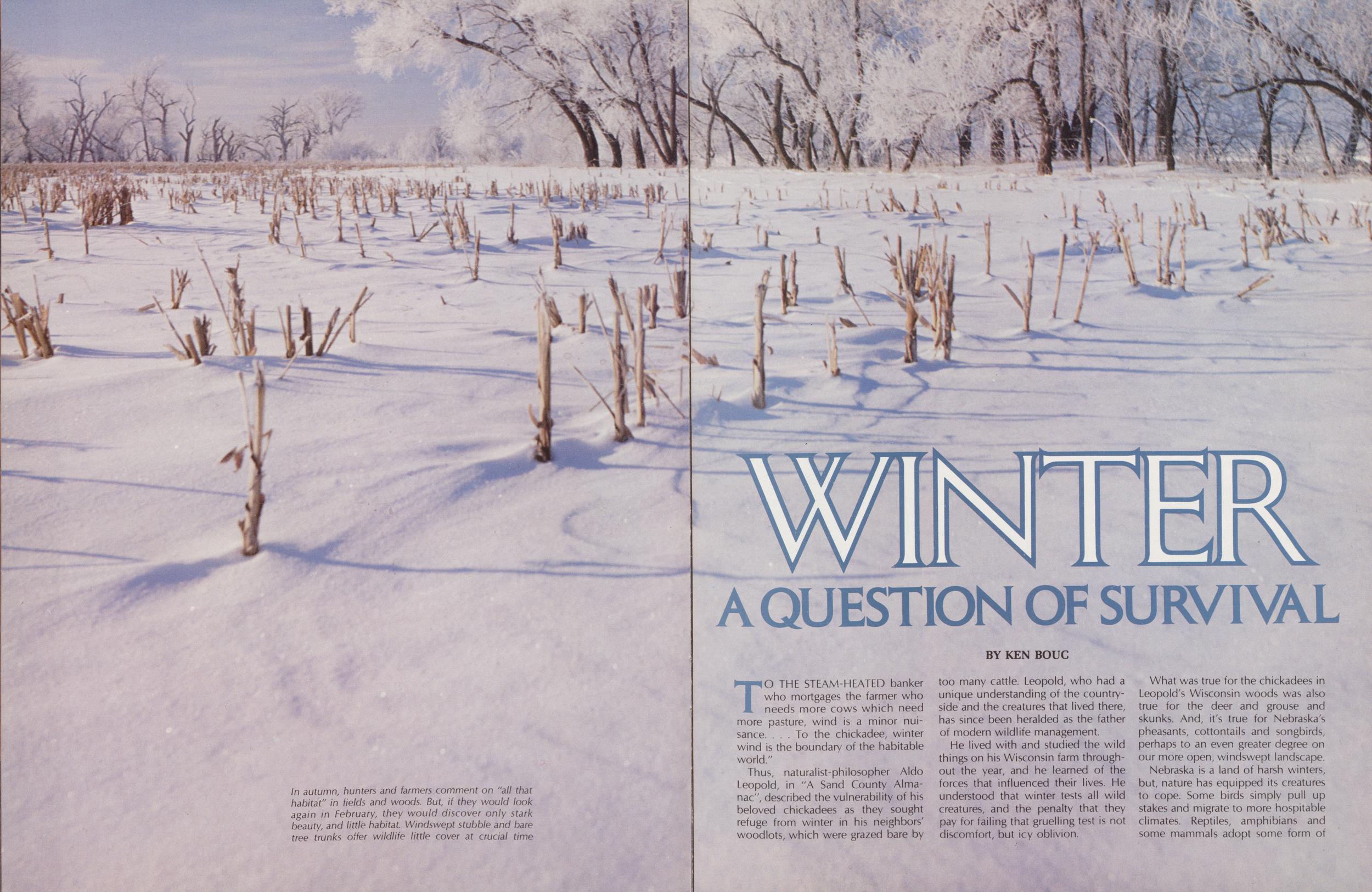
In autumn, hunters and farmers comment on "all that habitat" in fields and woods. But, if they would look again in February, they would discover only stark beauty, and little habitat. Windswept stubble and bare tree trunks offer wildlife little cover at crucial time
Winter
A QUESTION OF SURVIVAL
TO THE STEAM-HEATED banker who mortgages the farmer who needs more cows which need more pasture, wind is a minor nuisance...To the chickadee, winter wind is the boundary of the habitable world."
Thus, naturalist-philosopher Aldo Leopold, in "A Sand County Almanac", described the vulnerability of his beloved chickadees as they sought refuge from winter in his neighbors' woodlots, which were grazed bare by too many cattle. Leopold, who had a unique understanding of the countryside and the creatures that lived there, has since been heralded as the father of modern wildlife management.
He lived with and studied the wild things on his Wisconsin farm throughout the year, and he learned of the forces that influenced their lives. He understood that winter tests all wild creatures, and the penalty that they pay for failing that gruelling test is not discomfort, but icy oblivion.
What was true for the chickadees in Leopold's Wisconsin woods was also true for the deer and grouse and skunks. And, it's true for Nebraska's pheasants, cottontails and songbirds, perhaps to an even greater degree on our more open, windswept landscape.
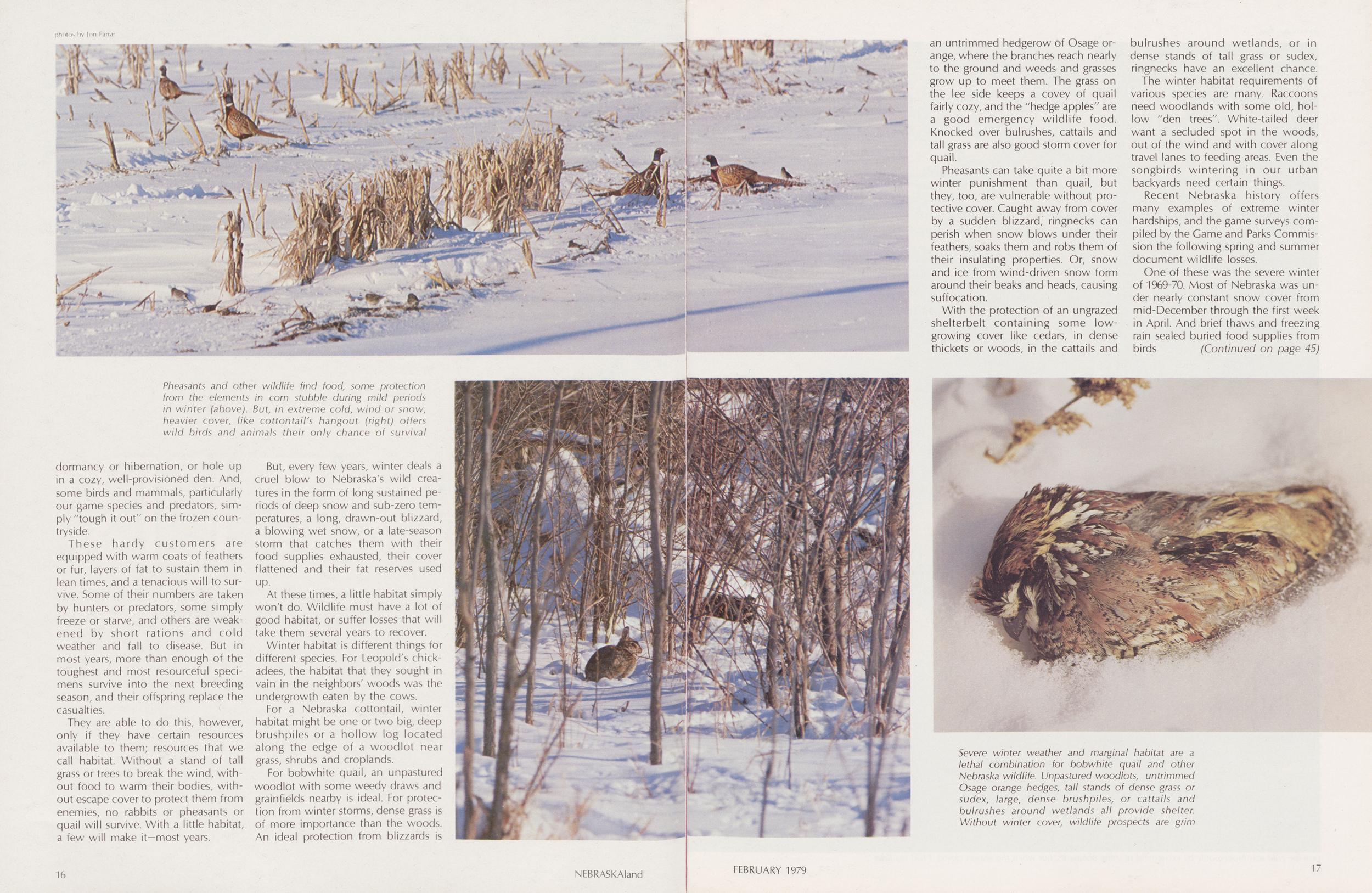
Pheasants and other wildlife find food, some protection from the elements in corn stubble during mild periods in winter (above). But, in extreme cold, wind or snow, heavier cover, like cottontail's hangout (right) offers wild birds and animals their only chance of survival
These hardy customers are equipped with warm coats of feathers or fur, layers of fat to sustain them in lean times, and a tenacious will to survive. Some of their numbers are taken by hunters or predators, some simply freeze or starve, and others are weakened by short rations and cold weather and fall to disease. But in most years, more than enough of the toughest and most resourceful specimens survive into the next breeding season, and their offspring replace the casualties.
They are able to do this, however, only if they have certain resources available to them; resources that we call habitat. Without a stand of tall grass or trees to break the wind, without food to warm their bodies, without escape cover to protect them from enemies, no rabbits or pheasants or quail will survive. With a little habitat, a few will make it—most years.
But, every few years, winter deals a cruel blow to Nebraska's wild creatures in the form of long sustained periods of deep snow and sub-zero temperatures, a long, drawn-out blizzard, a blowing wet snow, or a late-season storm that catches them with their food supplies exhausted, their cover flattened and their fat reserves used up.
At these times, a little habitat simply won't do. Wildlife must have a lot of good habitat, or suffer losses that will take them several years to recover.
Winter habitat is different things for different species. For Leopold's chickadees, the habitat that they sought in vain in the neighbors' woods was the undergrowth eaten by the cows.
For a Nebraska cottontail, winter habitat might be one or two big, deep brushpiles or a hollow log located along the edge of a woodlot near grass, shrubs and croplands.
For bobwhite quail, an unpastured woodlot with some weedy draws and grainfields nearby is ideal. For protection from winter storms, dense grass is of more importance than the woods. An ideal protection from blizzards is an untrimmed hedgerow of Osage orange, where the branches reach nearly to the ground and weeds and grasses grow up to meet them. The grass on the lee side keeps a covey of quail fairly cozy, and the "hedge apples" are a good emergency wildlife food. Knocked over bulrushes, cattails and tall grass are also good storm cover for quail.
Pheasants can take quite a bit more winter punishment than quail, but they, too, are vulnerable without protective cover. Caught away from cover by a sudden blizzard, ringnecks can perish when snow blows under their feathers, soaks them and robs them of their insulating properties. Or, snow and ice from wind-driven snow form around their beaks and heads, causing suffocation.
With the protection of an ungrazed shelterbelt containing some low-growing cover like cedars, in dense thickets or woods, in the cattails and bulrushes around wetlands, or in dense stands of tall grass or sudex, ringnecks have an excellent chance.
The winter habitat requirements of various species are many. Raccoons need woodlands with some old, hollow "den trees". White-tailed deer want a secluded spot in the woods, out of the wind and with cover along travel lanes to feeding areas. Even the songbirds wintering in our urban backyards need certain things.
Recent Nebraska history offers many examples of extreme winter hardships, and the game surveys compiled by the Game and Parks Commission the following spring and summer document wildlife losses.
One of these was the severe winter of 1969-70. Most of Nebraska was under nearly constant snow cover from mid-December through the first week in April. And brief thaws and freezing rain sealed buried food supplies from birds (Continued on page 45)
Severe winter weather and marginal habitat are a lethal combination for bobwhite quail and other Nebraska wildlife. Unpastured woodiots, untrimmed Osage orange hedges, tall stands of dense grass or sudex, large, dense brushpiles, or cattails and bulrushes around wetlands all provide shelter. Without winter cover, wildlife prospects are grim
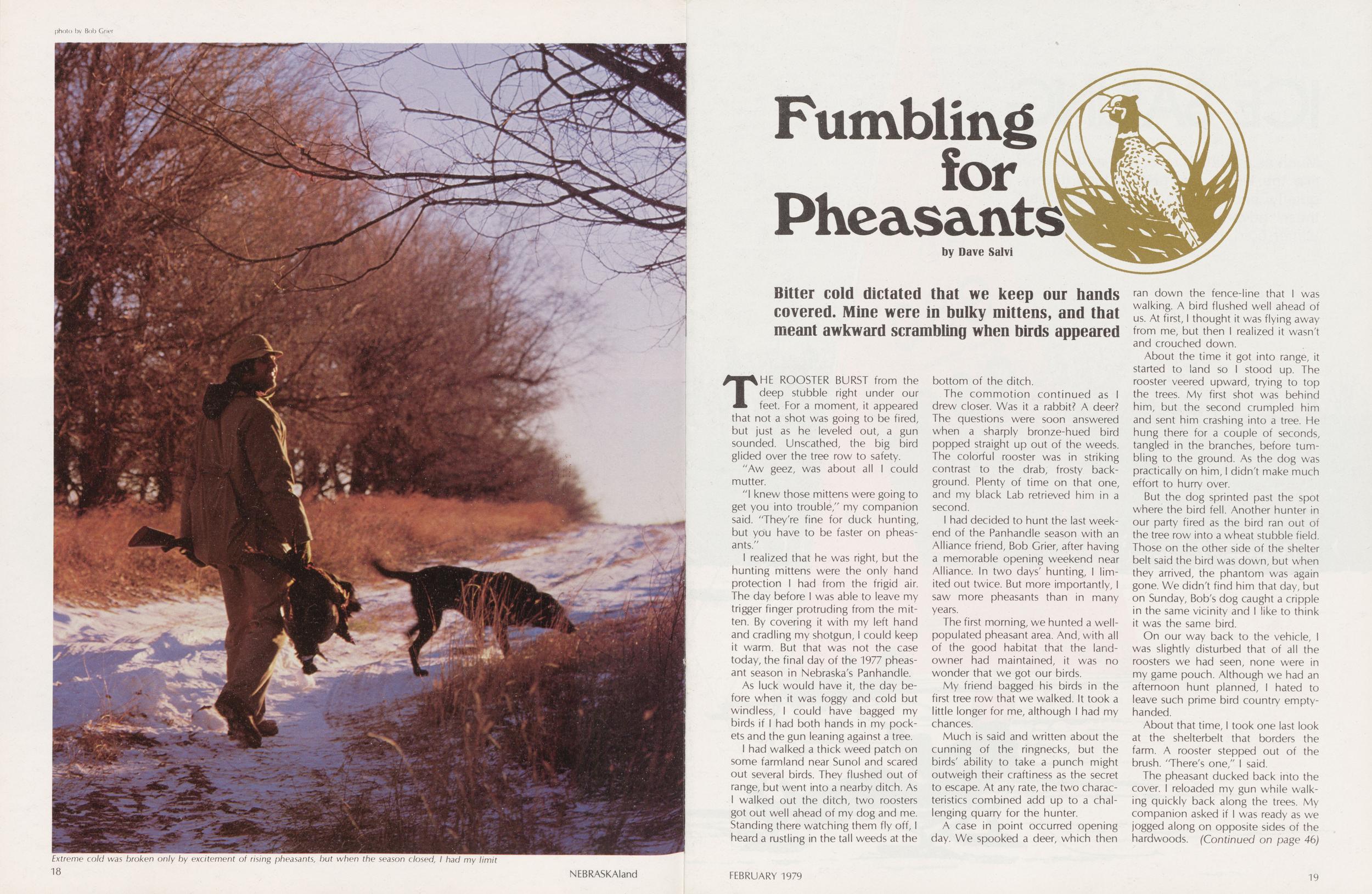
Extreme cold was broken only by excitement of rising pheasants, but when the season closed, I had my limit
Fumbling for Pheasants
Bitter cold dictated that we keep our hands covered. Mine were in bulky mittens, and that meant awkward scrambling when birds appearedTHE ROOSTER BURST from the deep stubble right under our feet. For a moment, it appeared that not a shot was going to be fired, but just as he leveled out, a gun sounded. Unscathed, the big bird glided over the tree row to safety.
"Aw geez, was about all I could mutter.
"I knew those mittens were going to get you into trouble," my companion said. "They're fine for duck hunting, but you have to be faster on pheasants."
I realized that he was right, but the hunting mittens were the only hand protection I had from the frigid air. The day before I was able to leave my trigger finger protruding from the mitten. By covering it with my left hand and cradling my shotgun, I could keep it warm. But that was not the case today, the final day of the 1977 pheasant season in Nebraska's Panhandle.
As luck would have it, the day before when it was foggy and cold but windless, I could have bagged my birds if I had both hands in my pockets and the gun leaning against a tree.
I had walked a thick weed patch on some farmland near Sunol and scared out several birds. They flushed out of range, but went into a nearby ditch. As I walked out the ditch, two roosters got out well ahead of my dog and me. Standing there watching them fly off, I heard a rustling in the tall weeds at the bottom of the ditch.
The commotion continued as I drew closer. Was it a rabbit? A deer? The questions were soon answered when a sharply bronze-hued bird popped straight up out of the weeds. The colorful rooster was in striking contrast to the drab, frosty background. Plenty of time on that one, and my black Lab retrieved him in a second.
I had decided to hunt the last weekend of the Panhandle season with an Alliance friend, Bob Grier, after having a memorable opening weekend near Alliance. In two days' hunting, I limited out twice. But more importantly, I saw more pheasants than in many years.
The first morning, we hunted a well-populated pheasant area. And, with all of the good habitat that the landowner had maintained, it was no wonder that we got our birds.
My friend bagged his birds in the first tree row that we walked. It took a little longer for me, although I had my chances.
Much is said and written about the cunning of the ringnecks, but the birds' ability to take a punch might outweigh their craftiness as the secret to escape. At any rate, the two characteristics combined add up to a challenging quarry for the hunter.
A case in point occurred opening day. We spooked a deer, which then ran down the fence-line that I was walking. A bird flushed well ahead of us. At first, I thought it was flying away from me, but then I realized it wasn't and crouched down.
About the time it got into range, it started to land so I stood up. The rooster veered upward, trying to top the trees. My first shot was behind him, but the second crumpled him and sent him crashing into a tree. He hung there for a couple of seconds, tangled in the branches, before tumbling to the ground. As the dog was practically on him, I didn't make much effort to hurry over.
But the dog sprinted past the spot where the bird fell. Another hunter in our party fired as the bird ran out of the tree row into a wheat stubble field. Those on the other side of the shelter belt said the bird was down, but when they arrived, the phantom was again gone. We didn't find him that day, but on Sunday, Bob's dog caught a cripple in the same vicinity and I like to think it was the same bird.
On our way back to the vehicle, I was slightly disturbed that of all the roosters we had seen, none were in my game pouch. Although we had an afternoon hunt planned, I hated to leave such prime bird country empty-handed.
About that time, I took one last look at the shelterbelt that borders the farm. A rooster stepped out of the brush. 'There's one," I said.
The pheasant ducked back into the cover. I reloaded my gun while walking quickly back along the trees. My companion asked if I was ready as we jogged along on opposite sides of the hardwoods. (Continued on page 46)
18 NEBRASKAland FEBRUARY 1979 19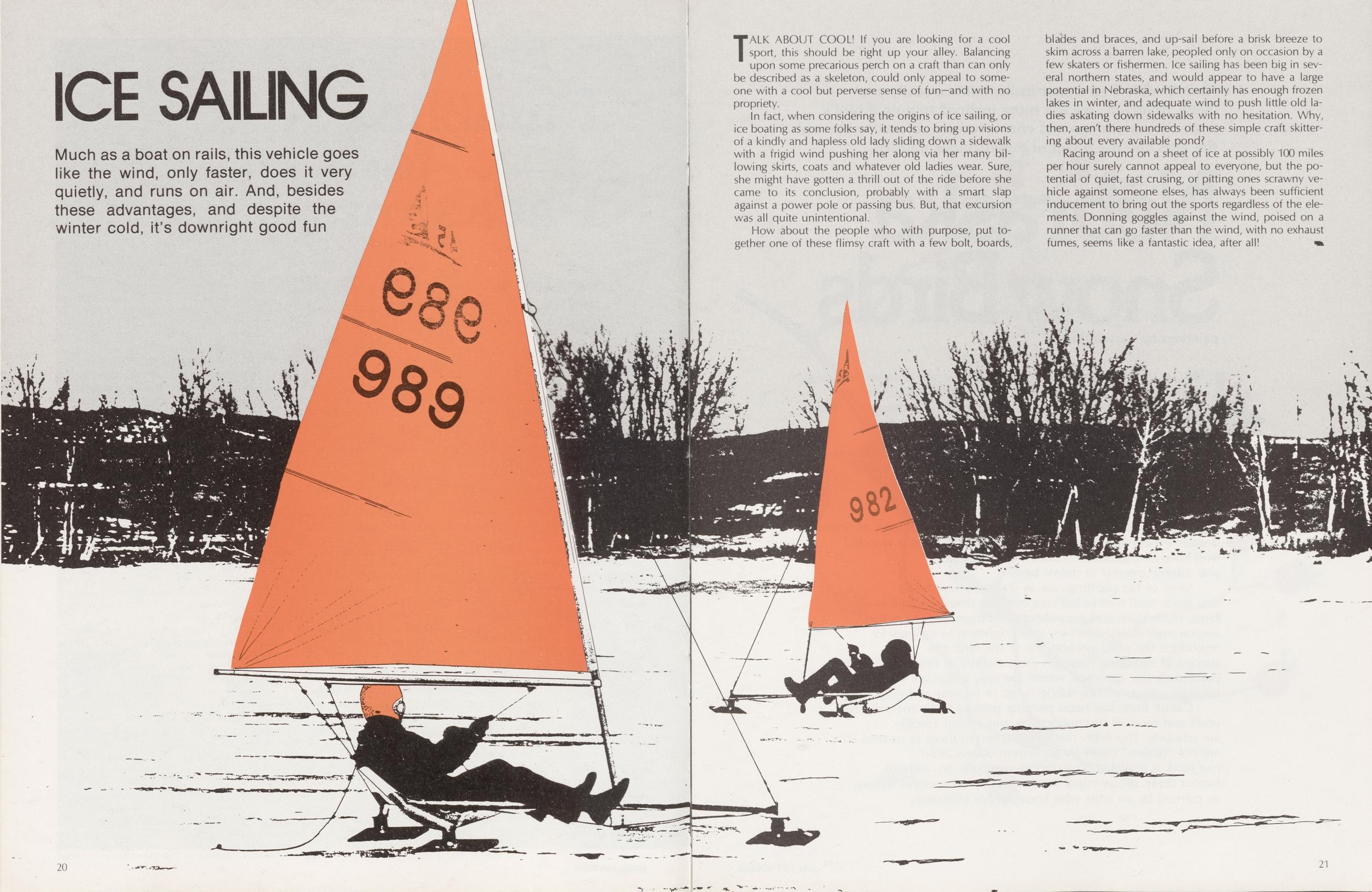
ICE SAILING
Much as a boat on rails, this vehicle goes like the wind, only faster, does it very quietly, and runs on air. And, besides these advantages, and despite the winter cold, it's downright good funTALK ABOUT COOL! If you are looking for a cool sport, this should be right up your alley. Balancing upon some precarious perch on a craft than can only be described as a skeleton, could only appeal to someone with a cool but perverse sense of fun—and with no propriety.
In fact, when considering the origins of ice sailing, or ice boating as some folks say, it tends to bring up visions of a kindly and hapless old lady sliding down a sidewalk with a frigid wind pushing her along via her many billowing skirts, coats and whatever old ladies wear. Sure, she might have gotten a thrill out of the ride before she came to its conclusion, probably with a smart slap against a power pole or passing bus. But, that excursion was all quite unintentional.
How about the people who with purpose, put together one of these flimsy craft with a few bolt, boards, blades and braces, and up-sail before a brisk breeze to skim across a barren lake, peopled only on occasion by a few skaters or fishermen. Ice sailing has been big in several northern states, and would appear to have a large potential in Nebraska, which certainly has enough frozen lakes in winter, and adequate wind to push little old ladies askating down sidewalks with no hesitation. Why, then, aren't there hundreds of these simple craft skittering about every available pond?
Racing around on a sheet of ice at possibly 100 miles per hour surely cannot appeal to everyone, but the potential of quiet, fast crusing, or pitting ones scrawny vehicle against someone elses, has always been sufficient inducement to bring out the sports regardless of the elements. Donning goggles against the wind, poised on a runner that can go faster than the wind, with no exhaust fumes, seems like a fantastic idea, after all!
Nebraska Snow Birds
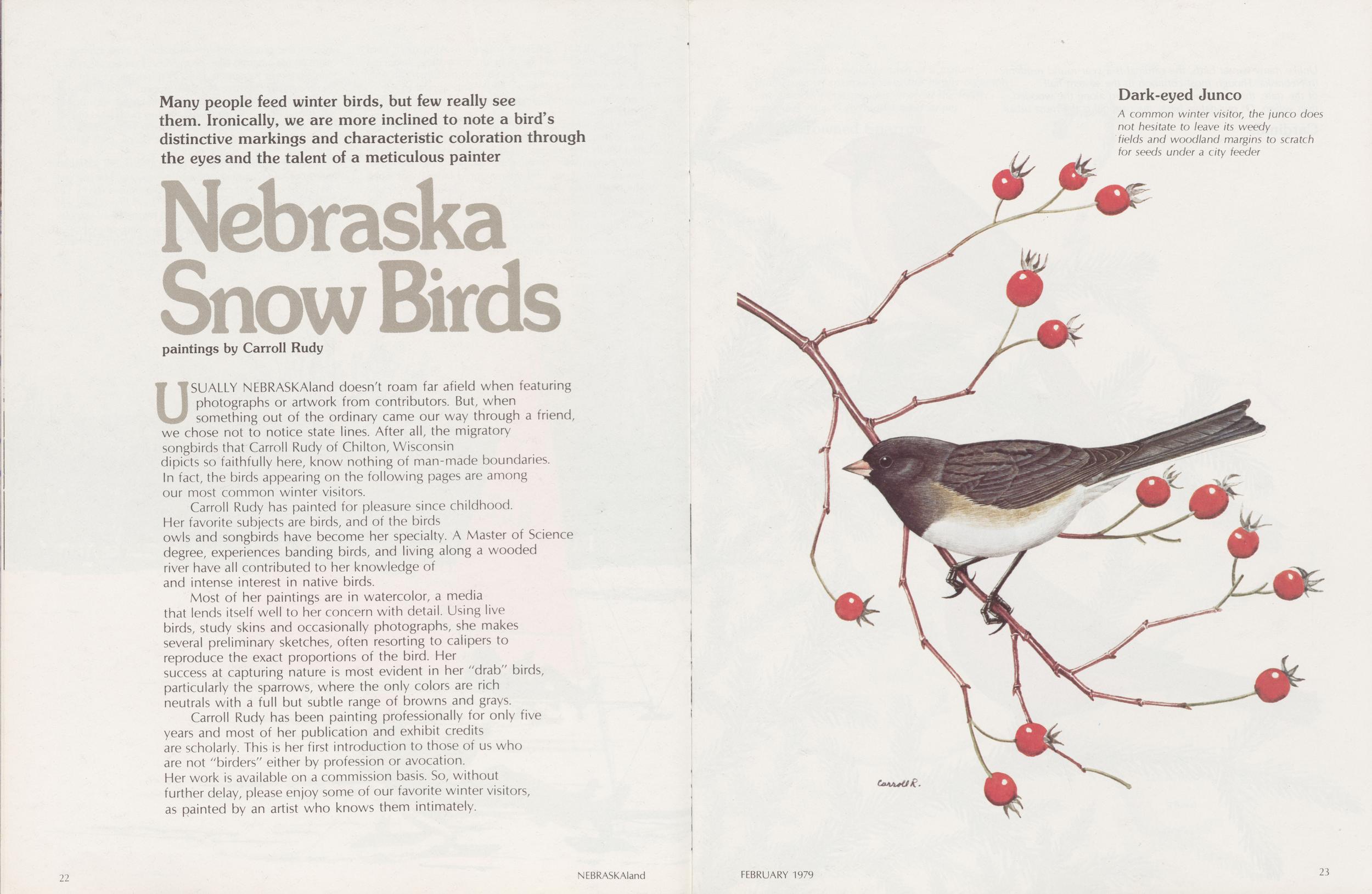
Many people feed winter birds, but few really see them. Ironically, we are more inclined to note a bird's distinctive markings and characteristic coloration through the eyes and the talent of a meticulous painterUSUALLY NEBRASKAland doesn't roam far afield when featuring photographs or artwork from contributors. But, when something out of the ordinary came our way through a friend, we chose not to notice state lines. After all, the migratory songbirds that Carroll Rudy of Chilton, Wisconsin dipicts so faithfully here, know nothing of man-made boundaries. In fact, the birds appearing on the following pages are among our most common winter visitors.
Carroll Rudy has painted for pleasure since childhood. Her favorite subjects are birds, and of the birds owls and songbirds have become her specialty. A Master of Science degree, experiences banding birds, and living along a wooded river have all contributed to her knowledge of and intense interest in native birds.
Most of her paintings are in watercolor, a media that lends itself well to her concern with detail. Using live birds, study skins and occasionally photographs, she makes several preliminary sketches, often resorting to calipers to reproduce the exact proportions of the bird. Her success at capturing nature is most evident in her "drab" birds, particularly the sparrows, where the only colors are rich neutrals with a full but subtle range of browns and grays.
Carroll Rudy has been painting professionally for only five years and most of her publication and exhibit credits are scholarly. This is her first introduction to those of us who are not "birders" either by profession or avocation. Her work is available on a commission basis. So, without further delay, please enjoy some of our favorite winter visitors, as painted by an artist who knows them intimately.
A common winter visitor, the junco does not hesitate to leave its weedy fields and woodland margins to scratch for seeds under a city feeder
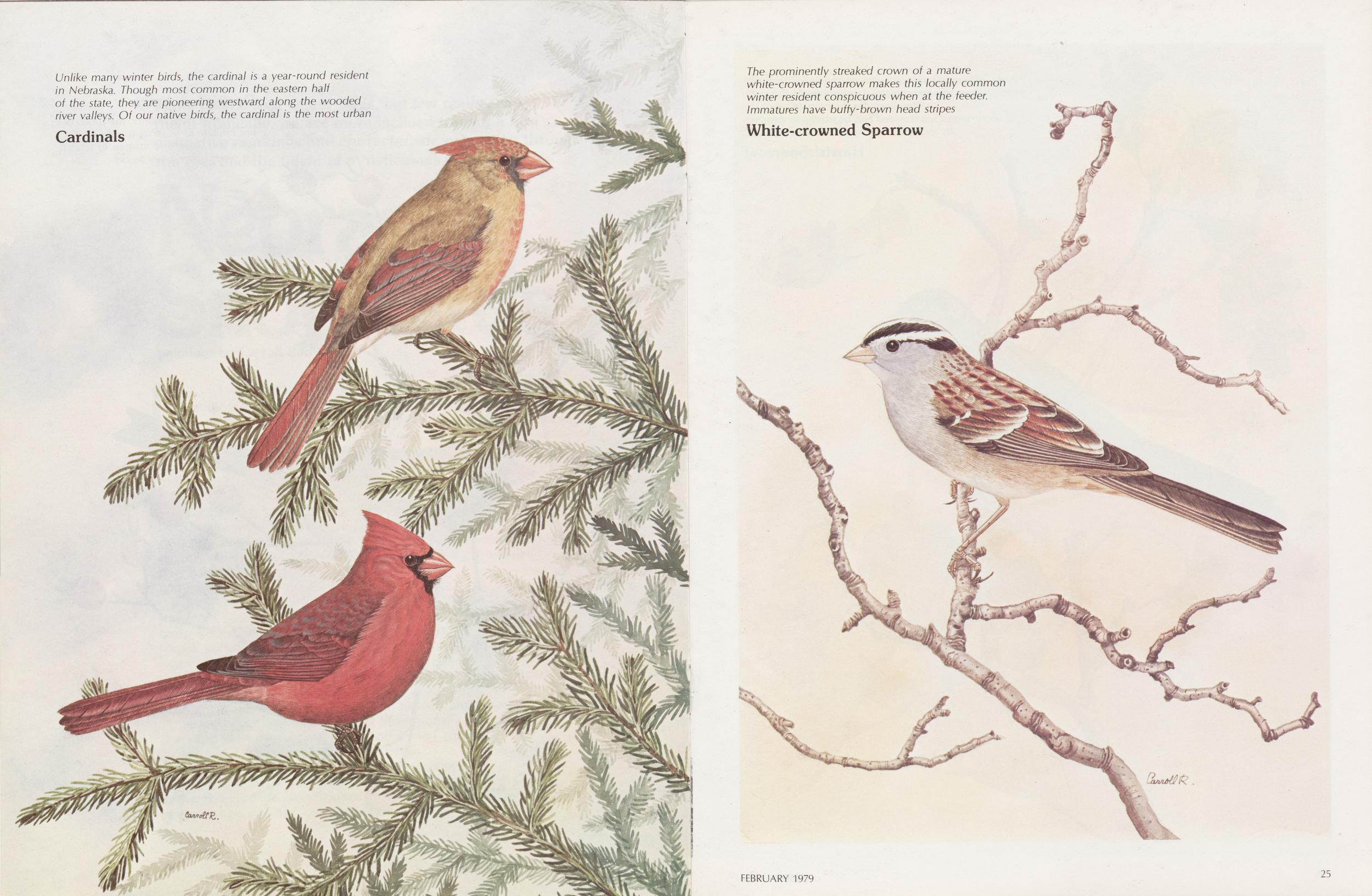
Unlike many winter birds, the cardinal is a year-round resident in Nebraska. Though most common in the eastern half of the state, they are pioneering westward along the wooded river valleys. Of our native birds, the cardinal is the most urban
CardinalsThe prominently streaked crown of a mature white-crowned sparrow makes this locally common winter resident conspicuous when at the feeder. Immatures have buffy-brown head stripes
White-crowned Sparrow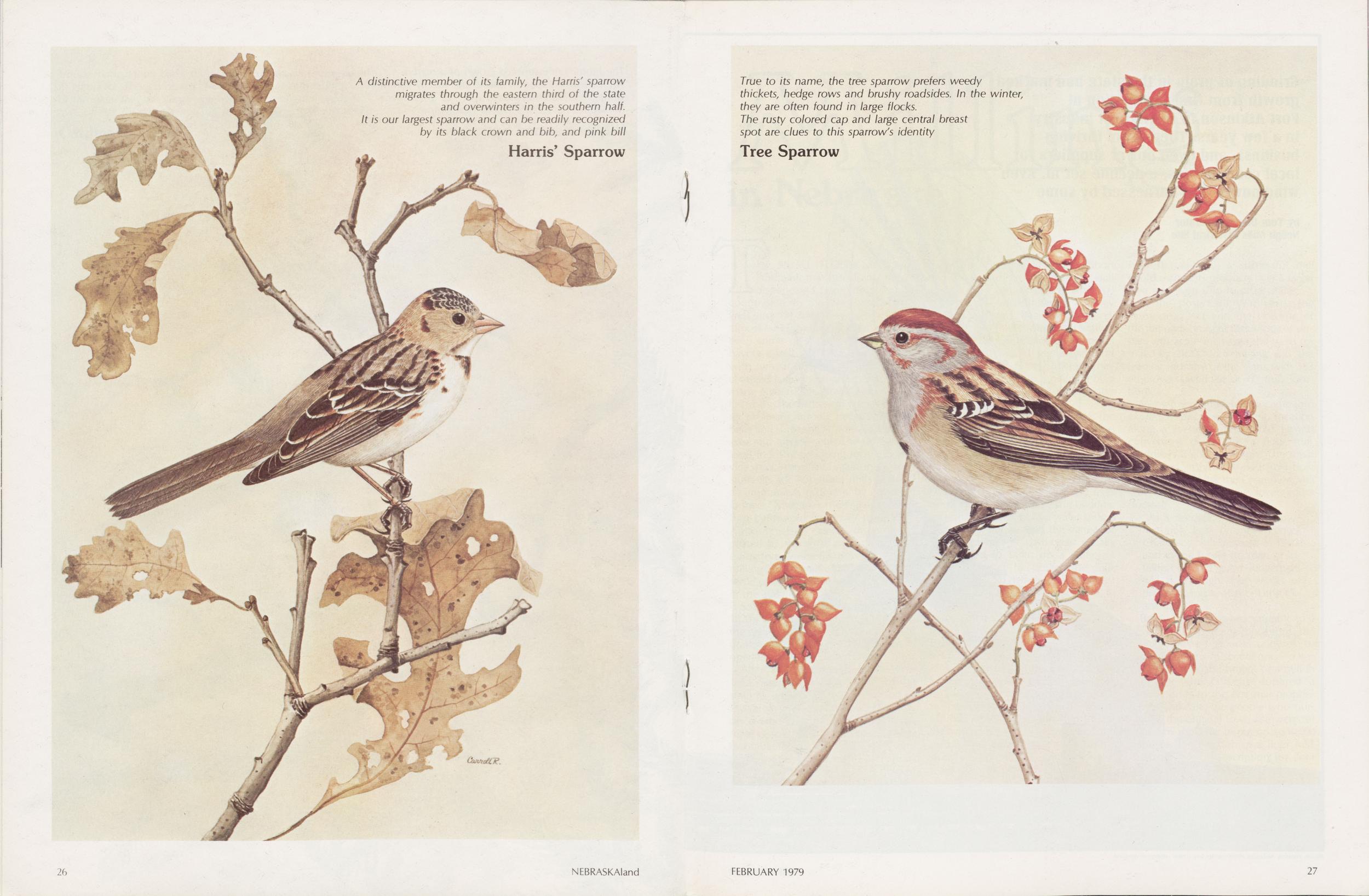
A distinctive member of its family, the Harris' sparrow migrates through the eastern third of the state and overwinters in the southern half. It is our largest sparrow and can be readily recognized by its black crown and bib, and pink bill
Harris' SparrowTrue to its name, the tree sparrow prefers weed) thickets, hedge rows and brushy roadsides. In the winter, they are often found in large flocks. The rusty colored cap and large central breast spot are clues to this sparrow's identity
Tree Sparrow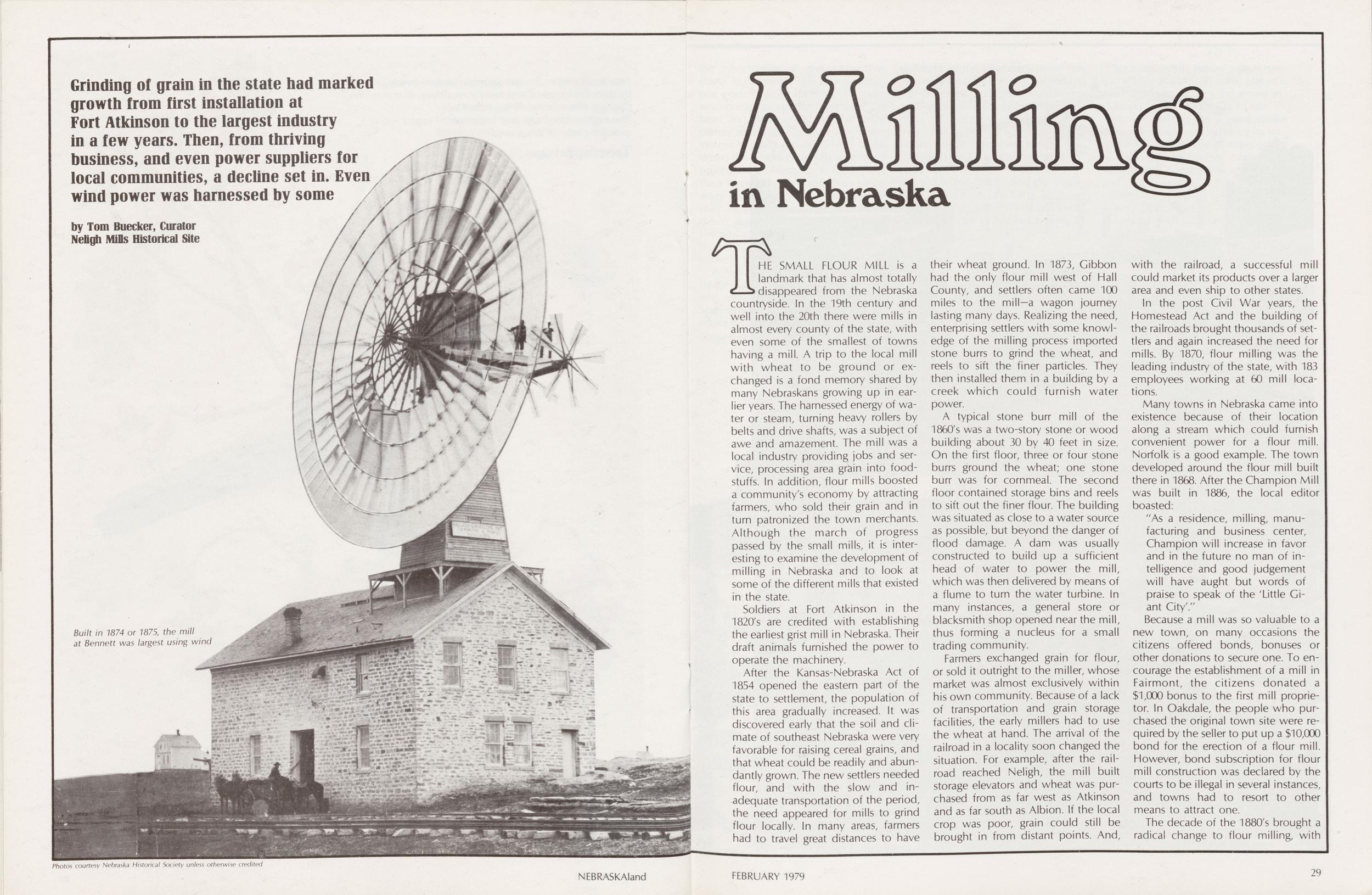
Milling in Nebraska
Grinding of grain in the state had marked growth from first installation at Fort Atkinson to the largest industry in a few years. Then, from thriving business, and even power suppliers for local communities, a decline set in. Even wind power was harnessed by some
Built in 1874 or 1875, the mill at Bennett was largest using wind
Photos courtesy Nebraska Historical Society unless otherwise creditedTHE SMALL FLOUR MILL is a landmark that has almost totally disappeared from the Nebraska countryside. In the 19th century and well into the 20th there were mills in almost every county of the state, with even some of the smallest of towns having a mill. A trip to the local mill with wheat to be ground or exchanged is a fond memory shared by many Nebraskans growing up in earlier years. The harnessed energy of water or steam, turning heavy rollers by belts and drive shafts, was a subject of awe and amazement. The mill was a local industry providing jobs and service, processing area grain into food-stuffs. In addition, flour mills boosted a community's economy by attracting farmers, who sold their grain and in turn patronized the town merchants. Although the march of progress passed by the small mills, it is interesting to examine the development of milling in Nebraska and to look at some of the different mills that existed in the state.
Soldiers at Fort Atkinson in the 1820's are credited with establishing the earliest grist mill in Nebraska. Their draft animals furnished the power to operate the machinery.
After the Kansas-Nebraska Act of 1854 opened the eastern part of the state to settlement, the population of this area gradually increased. It was discovered early that the soil and climate of southeast Nebraska were very favorable for raising cereal grains, and that wheat could be readily and abundantly grown. The new settlers needed flour, and with the slow and inadequate transportation of the period, the need appeared for mills to grind flour locally. In many areas, farmers had to travel great distances to have their wheat ground. In 1873, Gibbon had the only flour mill west of Hall County, and settlers often came 100 miles to the mill—a wagon journey lasting many days. Realizing the need, enterprising settlers with some knowledge of the milling process imported stone burrs to grind the wheat, and reels to sift the finer particles. They then installed them in a building by a creek which could furnish water power.
A typical stone burr mill of the 1860's was a two-story stone or wood building about 30 by 40 feet in size. On the first floor, three or four stone burrs ground the wheat; one stone burr was for cornmeal. The second floor contained storage bins and reels to sift out the finer flour. The building was situated as close to a water source as possible, but beyond the danger of flood damage. A dam was usually constructed to build up a sufficient head of water to power the mill, which was then delivered by means of a flume to turn the water turbine. In many instances, a general store or blacksmith shop opened near the mill, thus forming a nucleus for a small trading community.
Farmers exchanged grain for flour, or sold it outright to the miller, whose market was almost exclusively within his own community. Because of a lack of transportation and grain storage facilities, the early millers had to use the wheat at hand. The arrival of the railroad in a locality soon changed the situation. For example, after the railroad reached Neligh, the mill built storage elevators and wheat was purchased from as far west as Atkinson and as far south as Albion. If the local crop was poor, grain could still be brought in from distant points. And, with the railroad, a successful mill could market its products over a larger area and even ship to other states.
In the post Civil War years, the Homestead Act and the building of the railroads brought thousands of settlers and again increased the need for mills. By 1870, flour milling was the leading industry of the state, with 183 employees working at 60 mill locations.
Many towns in Nebraska came into existence because of their location along a stream which could furnish convenient power for a flour mill. Norfolk is a good example. The town developed around the flour mill built there in 1868. After the Champion Mill was built in 1886, the local editor boasted:
"As a residence, milling, manufacturing and business center, Champion will increase in favor and in the future no man of intelligence and good judgement will have aught but words of praise to speak of the 'Little Giant City'."
Because a mill was so valuable to a new town, on many occasions the citizens offered bonds, bonuses or other donations to secure one. To encourage the establishment of a mill in Fairmont, the citizens donated a $1,000 bonus to the first mill proprietor. In Oakdale, the people who purchased the original town site were required by the seller to put up a $10,000 bond for the erection of a flour mill. However, bond subscription for flour mill construction was declared by the courts to be illegal in several instances, and towns had to resort to other means to attract one.
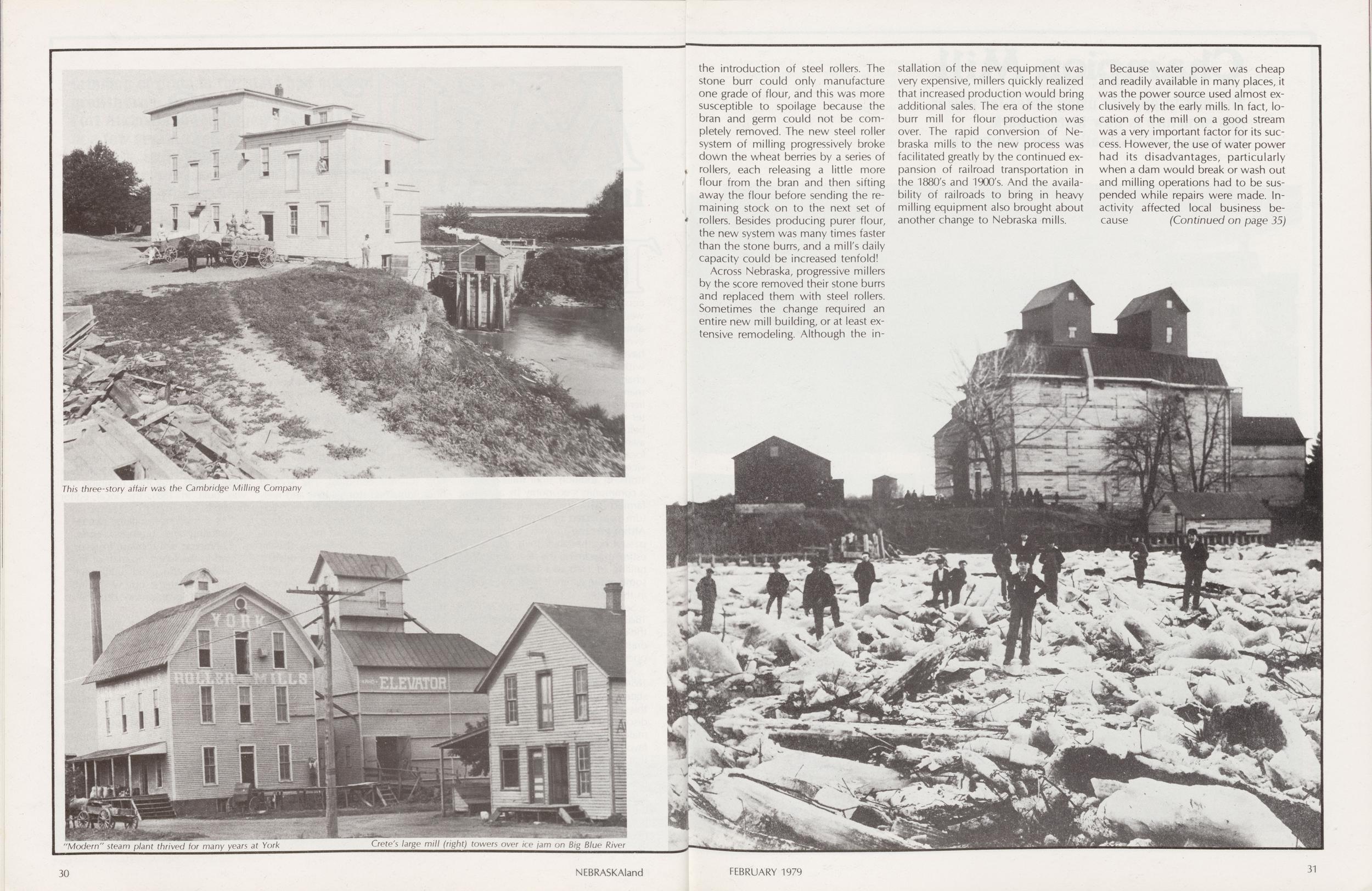
This three-story affair was the Cambridge Milling Company
"Modern" steam plant thrived for many years at York
Across Nebraska, progressive millers by the score removed their stone burrs and replaced them with steel rollers. Sometimes the change required an entire new mill building, or at least extensive remodeling. Although the installation of the new equipment was very expensive, millers quickly realized that increased production would bring additional sales. The era of the stone burr mill for flour production was over. The rapid conversion of Nebraska mills to the new process was facilitated greatly by the continued expansion of railroad transportation in the 1880's and 1900's. And the availability of railroads to bring in heavy milling equipment also brought about another change to Nebraska mills.
Because water power was cheap and readily available in many places, it was the power source used almost exclusively by the early mills. In fact, location of the mil! on a good stream was a very important factor for its success. However, the use of water power had its disadvantages, particularly when a dam would break or wash out and milling operations had to be suspended while repairs were made. Inactivity affected local business because (Continued on page 35)
Crete's large mill (right) towers over ice jam on Big Blue River
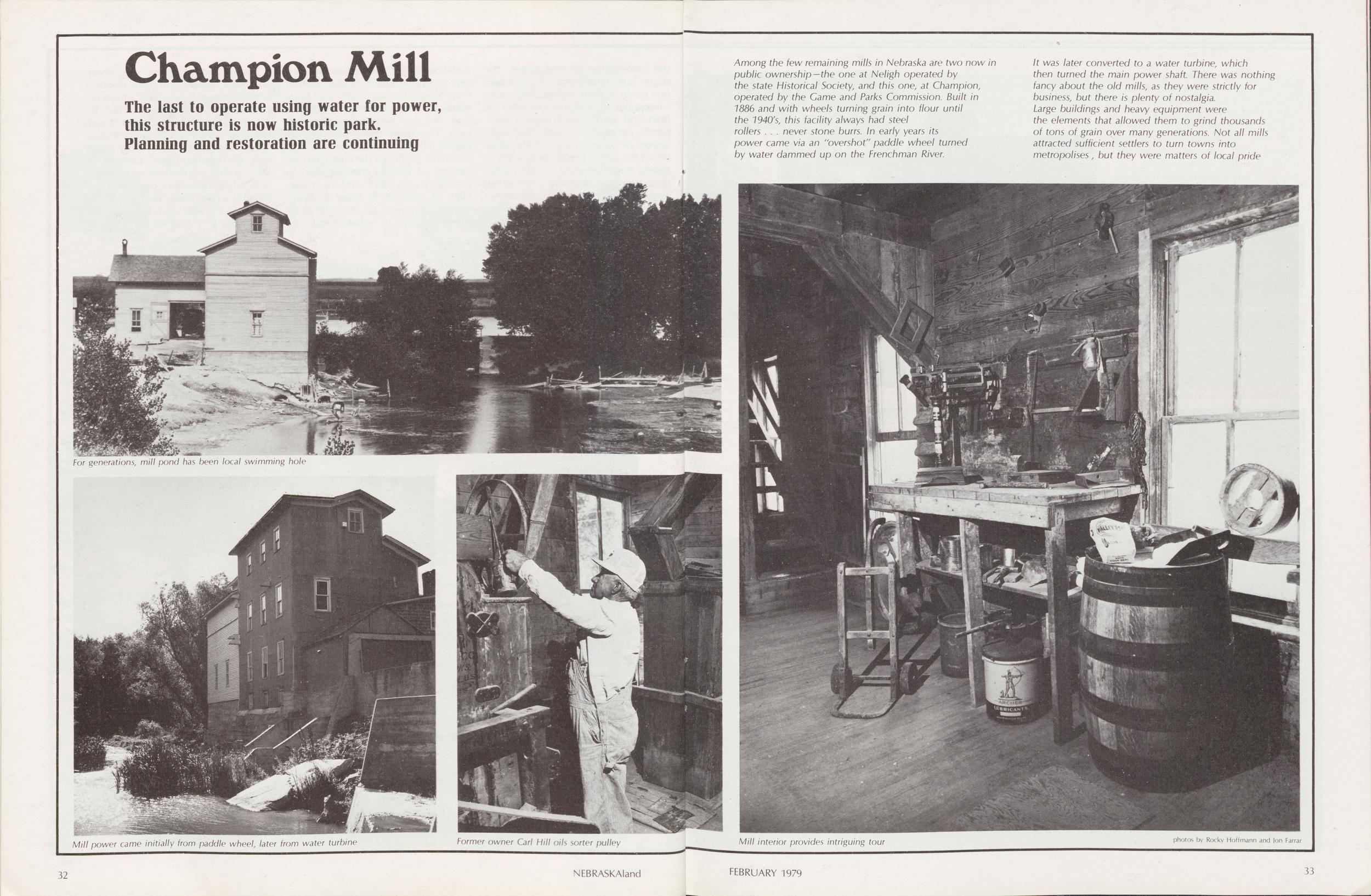
Champion Mill
The last to operate using water for power, this structure is now historic park. Planning and restoration are continuingFor generations, mill pond has been local swimming hole
Mill power came initially from paddle wheel, later from water turbine
Former owner Carl Hill oils sorter pulley
Among the few remaining mills in Nebraska are two now in public ownership—the one at Neligh operated by the state Historical Society, and this one, at Champion, operated by the Came and Parks Commission. Built in 1886 and with wheels turning grain into flour until the 1940's, this facility always had steel rollers...never stone burrs. In early years its power came via an "overshot" paddle wheel turned by water dammed up on the Frenchman River. It was later converted to a water turbine, which then turned the main power shaft. There was nothing fancy about the old mills, as they were strictly for business, but there is plenty of nostalgia. Large buildings and heavy equipment were the elements that allowed them to grind thousands of tons of grain over many generations. Not all mills attracted sufficient settlers to turn towns into metropolises, but they were matters of local pride
Mill interior provides intriguing tour
photos by Rocky Hoffmann and Jon Farrar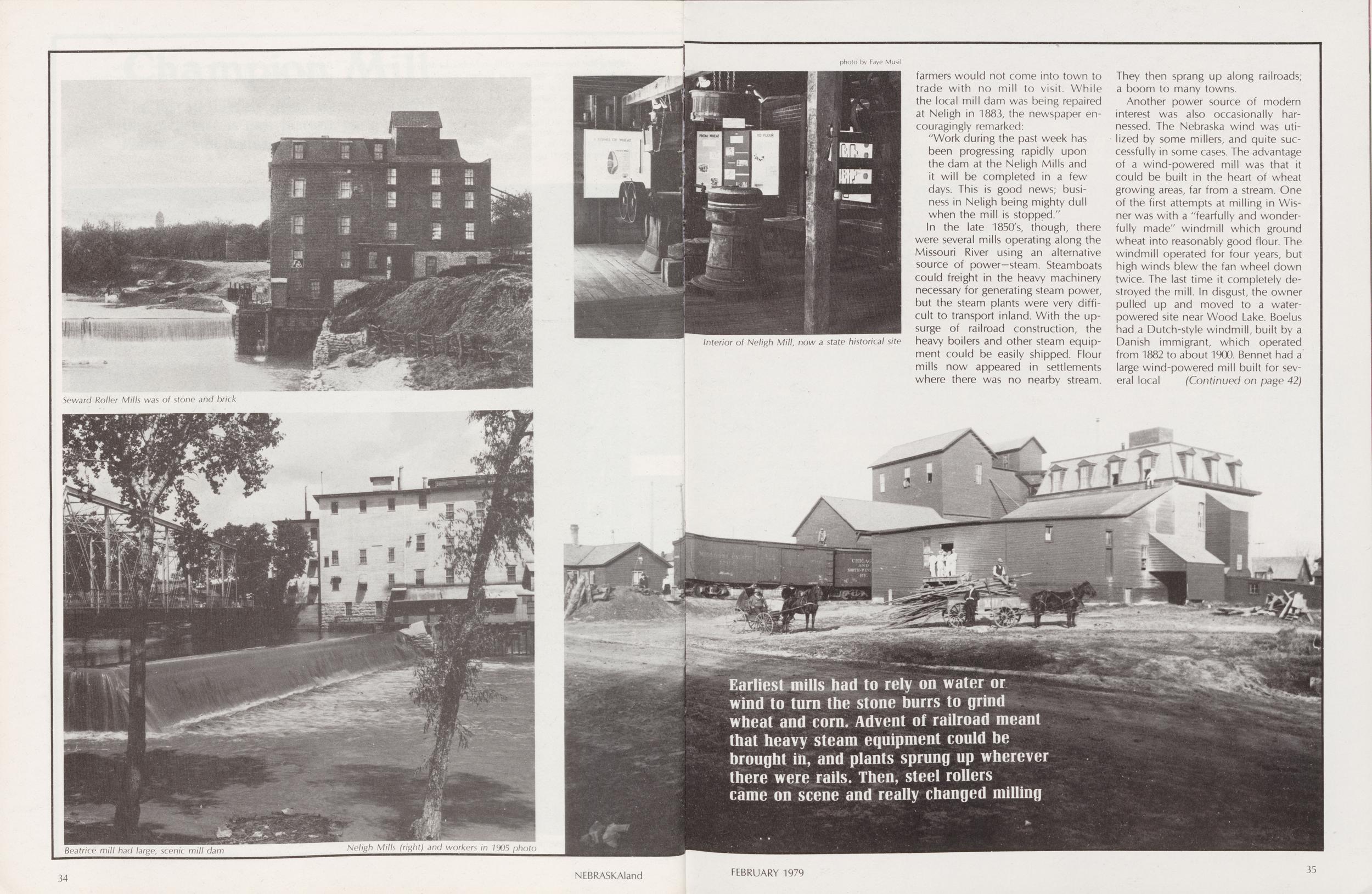
Seward Roller Mills was of stone and brick
Beatrice mill had large, scenic mill dam
Interior of Neligh Mill, now a state historical site
farmers would not come into town to trade with no mill to visit. While the local mill dam was being repaired at Neligh in 1883, the newspaper encouragingly remarked:
"Work during the past week has been progressing rapidly upon the dam at the Neligh Mills and it will be completed in a few days. This is good news; business in Neligh being mighty dull when the mill is stopped."
In the late 1850's, though, there were several mills operating along the Missouri River using an alternative source of power—steam. Steamboats could freight in the heavy machinery necessary for generating steam power, but the steam plants were very difficult to transport inland. With the upsurge of railroad construction, the heavy boilers and other steam equipment could be easily shipped. Flour mills now appeared in settlements where there was no nearby stream. They then sprang up along railroads; a boom to many towns.
Another power source of modern interest was also occasionally harnessed. The Nebraska wind was utilized by some millers, and quite successfully in some cases. The advantage of a wind-powered mill was that it could be built in the heart of wheat growing areas, far from a stream. One of the first attempts at milling in Wisner was with a "fearfully and wonderfully made" windmill which ground wheat into reasonably good flour. The windmill operated for four years, but high winds blew the fan wheel down twice. The last time it completely destroyed the mill. In disgust, the owner pulled up and moved to a water-powered site near Wood Lake. Boelus had a Dutch-style windmill, built by a Danish immigrant, which operated from 1882 to about 1900. Bennet had a large wind-powered mill built for several local (Continued on page 42)
Neligh Mills (right) and workers in 1905 photo
Along Came a Spider
HELLO FRIENDS! It's been a long time since we got together...about three months. All this snowy cold weather has kept me scuttling about for food. Every fall I think I have enough seeds and roots stored away to last the winter, but by February I'm always running short. I remember one year, the Easter of 1975,1 think it was. That was the year I spent the winter in the Panhandle. It was a terrible storm for so late in the year and all my food was gone. For five days I had to live on nothing but tree bark. Voles get a lot of bad publicity for eating bark from fruit trees and such, but believe me, when I eat bark it's a last choice.
Ah, but here I go again jabbering off in all directions. There is always so much I have to tell you and never enough space. And this month I had something special to talk about: Spiders!
You've probably noticed over the couple of years that we've been meeting here that some of my favorite topics are animals that most folks don't like—frogs, snakes, lizards, porcupines and all sorts of strange insects.
Sure, I think that mom robin feeding her little ones is cute, and fuzzy baby bunnies would be fun to hold. Everyone loves them. I just think the world would be better off if more people could say, "Oh, isn't he darling. I'd love to cuddle him," when they see a furry little spider in the grass or a wee garter snake just learning to swim at the pond. Now I know that is a pretty tall order, but do your best to keep an open mind about all these under-privileged animals while I tell you a few things about my spider friends.
You may not have noticed, but Nebraska is chock full of spiders. Remember last summer when we were talking about voles? I told you that sometimes there were as many as 140 voles living in just one acre. Well, that's nothing compared to spiders. There are at least 2,000 kinds of spiders in Nebraska, and one biologist guessed that there may be 64,000 in just one acre of meadow grass Think of all the extra flies and mosquitoes you'd be swatting if it weren't for all those hungry spiders.
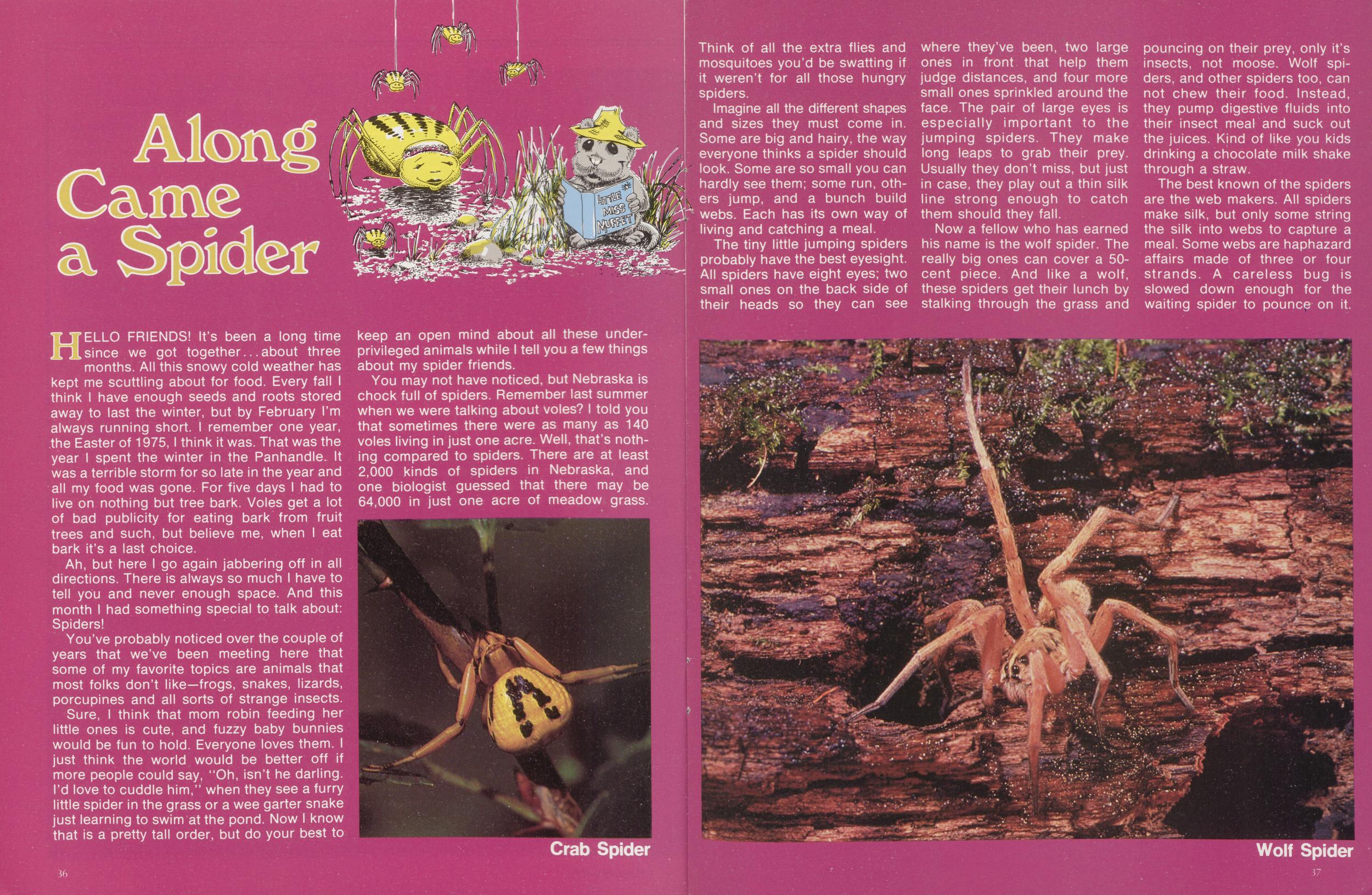
Crab Spider
Imagine all the different shapes and sizes they must come in. Some are big and hairy, the way everyone thinks a spider should look. Some are so small you can hardly see them; some run, others jump, and a bunch build webs. Each has its own way of living and catching a meal.
The tiny little jumping spiders probably have the best eyesight. All spiders have eight eyes; two small ones on the back side of their heads so they can see where they've been, two large ones in front that help them judge distances, and four more small ones sprinkled around the face. The pair of large eyes is especially important to the jumping spiders. They make long leaps to grab their prey. Usually they don't miss, but just in case, they play out a thin silk line strong enough to catch them should they fall.
Now a fellow who has earned his name is the wolf spider. The really big ones can cover a 50-cent piece. And like a wolf, these spiders get their lunch by stalking through the grass and pouncing on their prey, only it's insects, not moose. Wolf spiders, and other spiders too, can not chew their food. Instead, they pump digestive fluids into their insect meal and suck out the juices. Kind of like you kids drinking a chocolate milk shake through a straw.
The best known of the spiders are the web makers. All spiders make silk, but only some string the silk into webs to capture a meal. Some webs are haphazard affairs made of three or four strands. A careless bug is slowed down enough for the waiting spider to pounce on it.
Wolf Spider
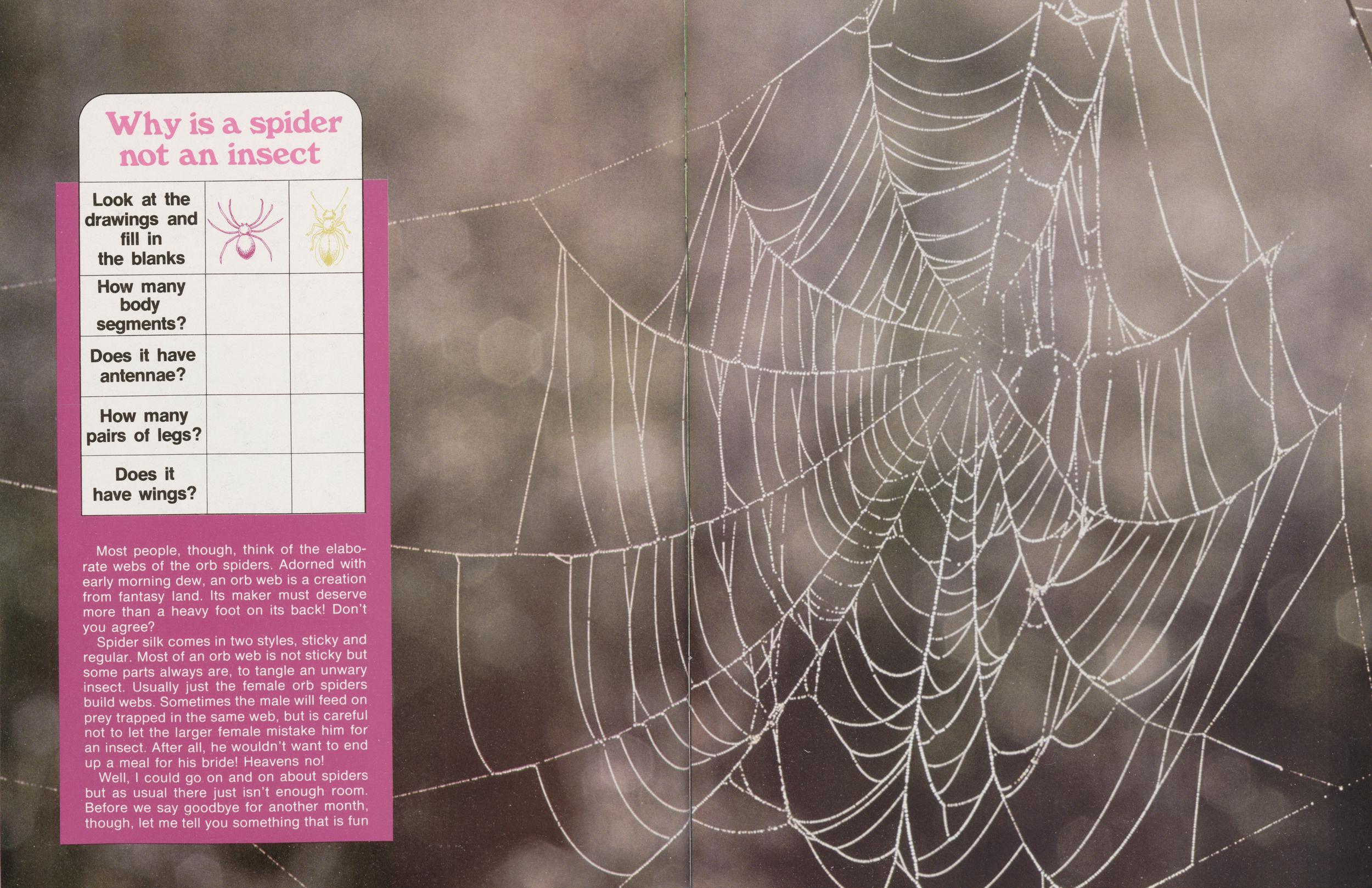
Most people, though, think of the elaborate webs of the orb spiders. Adorned with early morning dew, an orb web is a creation from fantasy land. Its maker must deserve more than a heavy foot on its back! Don't you agree?
Spider silk comes in two styles, sticky and regular. Most of an orb web is not sticky but some parts always are, to tangle an unwary insect. Usually just the female orb spiders build webs. Sometimes the male will feed on prey trapped in the same web, but is careful not to let the larger female mistake him for an insect. After all, he wouldn't want to end up a meal for his bride! Heavens no!
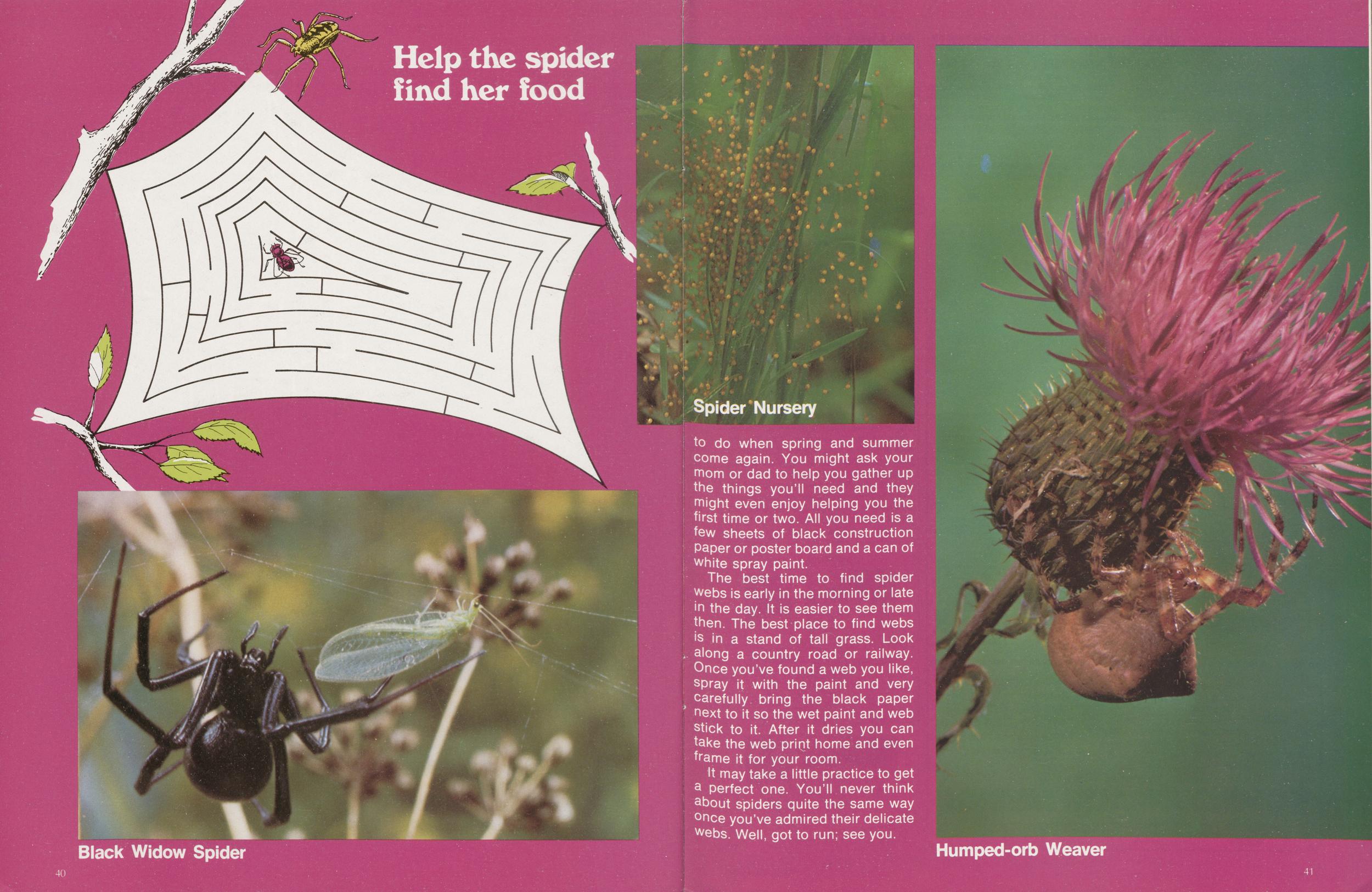
Help the spider find her food
Black Widow Spider
Spider Nursery
The best time to find spider webs is early in the morning or late in the day. It is easier to see them then. The best place to find webs is in a stand of tall grass. Look along a country road or railway. Once you've found a web you like, spray it with the paint and very carefully bring the black paper next to it so the wet paint and web stick to it. After it dries you can take the web print home and even frame it for your room.
It may take a little practice to get a perfect one. You'll never think about spiders quite the same way Once you've admired their delicate webs. Well, got to run; see you.
Humped-orb Weaver
MILLING IN NEBRASKA
(Continued from page 35)businessmen in 1874-75 by A. G. Strang of Omaha. A 60-foot Halladay windmill, which generated 40 horsepower in a 12-mile wind, provided sufficient power to run three stone burrs. Despite successful operation for several years, the plant was converted to steam power in 1888. Ironically, the source of power for these mills-wind-could also destroy them, and, thus, this type of mill was rarely seen in the state.
After experience proved that Nebraska soil and climate were conducive to high yields of bread grains, there were several decades of mill building activity. The number of mills in the state grew from 127 in 1879 to 229 in 1890, and to a high of 254 in 1907.
Besides creating a grain market for local farmers, grinding flour and other cereal grains, and producing livestock feeds, the flour mills also brought the first electricity to some Nebraska communities. With local water power harnessed by many of the mills, a number of proprietors installed dynamos and began limited production of electricity. Contracts were signed with the city councils for providing lighting service to the towns. Mill employees began stringing electrical lines and wiring houses, stores, and streets for lights. At the DeWitt Mill in 1919, a small hydroelectric power plant was constructed to supply power for its own use as well as to the town of DeWitt, one-half mile away. Many local mills also pumped water for the city waterworks. As a result, early in the 20th century, flour mills doubled as the city utilities for many Nebraskan towns.
Twentieth century progress brought another trend to Nebraska mills. The more successful ones grew while the smaller mills, unable to compete, gradually went out of business. With improved transportation, most of the wheat produced in the state began to be shipped to out-of-state mills. This, plus the consolidation of the larger mills and the business depression of the 1930% brought the decline of the small flour mill. The number of operating flour mills dropped rapidly from about 100 in the 1930's to 20 in 1958. Today, Nebraska has only four operating flour mills, and three of them are large-scale plants with production equalling dozens of 19th century mills.
The small mill was an important part of the Nebraska scene that has virtually disappeared. After operations ceased, most mills were eventually torn down. The mill sites often were completely leveled for farming purposes, other city buildings, or destroyed by flooding. Surviving structures are a rarity today, but along many streams in the state, concrete and stone mill foundations and basements can still be discerned among the brush and weeds. Abandoned and crumbling remains of headgates, dams and millraces can also be found at dozens of old sites; silent vestiges reminding us of their once busy past. Very few standing mill buildings can be found, and most of those are completely neglected. Two mills are designated as historical sites. At Champion, the last mill to operate by water power is today maintained by the Nebraska Game and Parks Commission as a State Historical Park. And, at the Neligh Mills Historical Site in Neligh, the old plant with all its milling machinery intact is preserved by the Nebraska State Historical Society. These old mills are relics saved from a bygone era; an era marked by changing times and progress.
"How was your wild goose chase?"
THE WORKING DECOY
(Continued from page 13)What differentiates these carvers from the so-called "factory" decoys is the method of manufacture and the use of advertising to sell the decoys. While most factories advertised in sporting magazines of the times, most carvers relied on word of mouth to sell their wares.
Space limitations prevent more than a passing mention of a few of the hundreds of decoy carvers. The east coast, produced more hand-carved birds than any other region, and some of the better known carvers were Elmer Crowell and Joe Lincoln of Massachusetts, Harry Shourdes of New Jersey, Albert Laing of Connecticut and Ira Hudson and Nathan Cobb of Virginia. Hudson was perhaps one of the most prolific carvers, having produced nearly 25,000 decoys over 50 years.
Michigan had Benjamin Schmidt, Thomas Chambers, Nate Quillen, and a host of others, while Illinois carvers were paced by Charles Perdew, Robert Elliston, and G. Bert Graves.
Nebraska and many other mid western states had few of the duck hunting traditions of the big-water, eastern states. Here, hunters seldom used decoys, most preferring to jump-shoot waterfowl, and the few wooden blocks found are mostly factory models. Some hunters made their own decoys, but most were fairly crude imitations of the factory birds.
There is a great deal of interest today in the old wooden decoy as a form of folk art, with a growing army of collectors searching for birds. Some decoys are quite valuable, while others scarcely make good paperweights. What makes a decoy collectible? George Ross Starr, Jr. one of the country's leading collectors, says: "They (decoys) represent the efforts over many lifetimes to produce a replica of a living waterfowl. Some men came very close, and some missed by a mile. The glorious thing about any decoy is that it is the best that any man could fashion toward this ultimate goal."
To a collector, condition of the bird is important, coupled with scarcity and quality of workmanship. Collectors prefer decoys in the best original condition they can find. Because decoys were a utility item, many will have been repainted over the years. This in itself is not necessarily bad, but a new paint job often lowers the value, as does stripping of the old paint. Most collectors prefer to leave the decoys in the condition they acquire them. If any painting is done, it is usually just a careful retouching of worn areas followed by application of a good paste wax.
The question often arises as to how much these decoys are worth, or how much should be spent for a particular bird? A few are quite valuable, worth in excess of $1,000 while the vast majority fall far short of that figure, ranging from $5 to $50. Because hand-made decoys are often scarcer and generally better made than factory birds, they often command a higher price, but usually only from serious collectors. The old factory decoys are often available for under $20, with the exception of certain types such as higher grade Masons and Evans.
Undoubtedly hundreds of thousands or even millions of wooden decoys were made over the years, but probably only a fraction of the total remain today, the others having rotted away or been burned for firewood. How many more exist in attics or lofts? Only time will tell.
Surely with interest in early Americana at an all-time high, those that do come to light will eventually find their way to a collector's mantel or bookshelf; a richly deserved tribute to the dedicated craftsmen who made them.
Several good publications have been written on the history of waterfowl hunting and collecting of wooden decoys. Some are available at local libraries, others may be purchased from bookstores.
Some suggestions are:
Wildfowl Decoys by Joel Barber; Decoys of the Atlantic Flyway, George Ross Starr, Jr.; Mason Decoys, Hillcrest Publications; Decoys and Decoy Carvers of Illinois, Parmalee & Loomis; The Art of the Decoy, Adele Earnest; American Bird Decoys, William F. Mackey, Jr; The Bird Decoy, Paul A. Johnsgard; The American Sporting Collector's Handbook, Allan J. Liu; and The Out- law Gunner, Harry M. Walsh.
42 NEBRASKAland FEBRUARY 1979 43
WINTER-A QUESTION OF SURVIVAL
(Continued from page 17)and animals under an icy crust.
Conditions in the Panhandle, extreme southeast, and extreme southwest were not quite so severe, but central and northeast Nebraska suffered a constant wintery onslaught. And, when quail populations were surveyed after spring finally came, it was found that both these areas had lost about two-thirds of their bobwhites.
Another of winter's dirty tricks came on Easter weekend of 1975, when a blizzard of giant proportions even for Nebraska steamrollered its way across the Panhandle. A day and a night of heavy snow and high wind left the area a moonscape of stalled vehicles, dead livestock, and endless snowdrifts. And, beneath those snowdrifts lay two-thirds of the Panhandle's pheasants.
The blizzard's severity undoubtedly accounted for much of the mortality, but at least as important was its timing. It hit when winter is normally relaxing it's siege on wildlife. By that time, most weed patches have been knocked flat by repeated fits of wind, shrubs and thickets are filled by snowdrifts, the supply of weed seeds and waste grain is about used up, and the birds have exhausted the reserves of body fat that give them the stamina to survive.
There have been many other examples of winter losses in Nebraska—the blizzard of '49, the heavy snows of '59 and '60, a series of heavy snows in the northeast in the early 70's. And, to be sure, there will be more in years to come.
Each time one of these winter hardships has hit Nebraska, it has found the state's wild critters more vulnerable. And winter's storms and snow will have even more drastic effects in years to come. Why? Because Nebraska is running out of the things that wildlife needs to cope with winter—habitat.
A University of Nebraska Department of Forestry study shows that since 1955, Nebraska has lost 22 percent of its wooded areas. The study included only woods over one acre in size and more than 120 feet wide, so the loss of windbreaks, shelterbelts, and trees along streams was not included. However, a General Accounting Office study of the Great Plains shows the destruction of shelterbelts and windbreaks to be proceeding at about the same rate. The loss of woodlands since 1955 has been about 215,000 acres, and there is no figure available on shelterbelts and the like. Something in excess of 10,000 acres of woodlands fall to the saw and bulldozer each year, and only a few hundred acres are replanted in trees. The yearly destruction of shelterbelts and windbreaks comes to another 6,000 acres. In all, "The Tree Planter State" suffers a net loss of about six million trees each year.
This "woody habitat" serves as cover to nearly all species of wildlife during a winter crisis, and it is also home much of the rest of the year for quail, squirrels, deer, raccoon, songbirds and a host of others. There is important winter habitat in Nebraska other than trees, but these, too, are becoming harder to find. Wetlands offer an excellent sanctuary from winter wind and cold. Cattails and bulrushes bent over by wind and covered with snow form a maze of cozy little tunnels, tailor made for a chilly cottontail or pheasant trying to escape a storm. Similar labyrinths are found in patches of sudex, in tall grasses like switchgrass and big bluestem, and even in the tall, dense stubble of milo.
But even these are becoming harder for critters to find. New farming techniques call for milo stubble to be disced or plowed in the fall, and economic pressures are driving landowners to tear out other habitat areas and put them into crop production.
Two decades ago, the average price of Nebraska agricultural land, including pasture and hay meadows, was $73 per acre, and the farmer was paying his mortgage and taxes on that land and his other expenses with corn he sold for $1.36 per bushel. By 1978, land prices had jumped more than 500 percent to $385, and equipment and other costs had gone out of sight. Yet prices for his last corn crop were up over 1955 prices by only 43 percent.
Caught in this situation, many farmers feel compelled to use every square foot of land they own for crop production. Forest and shelterbelts, marshes, grass and weed patches all occupy land they now feel they need to farm. That means less winter habitat, and in the face of severe winter weather, more wildlife mortality.
No easy solutions to the problems of agriculture or wildlife seem near. And, while agriculture is under pressure, wildlife habitat will also be under attack.
There are, however, several programs that help landowners bear part of the burden of providing wildlife habitat. The Game and Parks Commission and most natural resources districts (NRDs) will pay landowners up to $27.50 per acre for wildlife habitat practices. About 22,000 acres have been enrolled in this program, and another 9,000 are signed up in the Nebraska Acres for Wildlife program.
Among others available to landowners are programs of the Soil Conservation Service, (SCS) and the Agricultural Stabilization and Conservation Service (ASC). Landowners interested in planting trees or other cover on their land might find assistance through their local SCS office.
Owners of wetlands in Clay, Lincoln, Fillmore, Logan, Hamilton, Merrick, Kearney, Nance, Keith and Phelps counties should check with ASC on the Water Bank Program. Landowners are offered payments for protecting their wetlands for a 10-year period, with an option to renew for another 10 years.
There is also the Clarke-McNary program, which offers high quality tree seedlings at bargain prices for planting on rural lands. These trees can be used in conjunction with a Game and Parks Commission or SCS program or a landowner can get them through his county agent without participating in any formal program.
These programs, either individually or in combination, cannot solve the habitat dilema. In an agricultural state like Nebraska, with 98 percent of the land privately owned, only the farmer and rancher can do that. State or federal programs can only help once the landowner decides to do something about habitat.
"Your guide will be available, gentlemen, just as soon as the search party finds him."
FUMBLING FOR PHEASANTS
(Continued from page 79)Right at that instant, a cock flushed and with another right on his tail. I pulled up and shot the one farther from me, and then dropped the other—a rather marvelous event for an erratic wingshot like myself.
So, as the last weekend of the 15-day season approached, I couldn't resist the call of Panhandle gunning. Despite threatening weather reports, Saturday morning found me hunting in Cheyenne County. If the predicted blizzard materialized, I could return to Denver; if not, I planned on hunting near Alliance again.
As mentioned, Saturday was dreary and cold. I awoke in Sidney to find that only 50 per cent of the blizzard had come about: a hard, driving wind. The thermometer read five degrees as I left town going north.
The temperature had risen to nine degrees when I got to Alliance and rousted Bob and his family.
"This'll give us a good chance to prove that we're really crazy," I said. That I was there seemed proof enough.
The wind rattled the tree branches as we walked through the first shelterbelt. I soon discovered that sticking my trigger finger through the slit in my shooting mittens wasn't going to make it today. After all, what good would it do to have the finger exposed and ready if it were too frozen to function?
Some mule deer walked out of the trees and my dog eyed them curiously. The cold wind was at our backs and I was beginning to wonder if pheasant hunting was worth the risk of frostbite. Luckily a repeat of the first day's action was not long in coming.
Thirty yards or so down a tree row, my dog Dolly flushed a rooster. The bird made the mistake of flying straight into the nasty wind. I fumbled momentarily to get my finger out of the mitten, but the bird's ill-chosen flight gave me adequate time to put a bead on him. After only 20 minutes, I had half my limit. At that rate, I figured I could stand the cold.
Unfortunately, what followed was a long, bitterly cold walk around an irrigated
"Did I drive anything by?"
cornfield. We hunted the corners, which were overgrown with weeds. Two large flocks of sharp-tailed grouse broke cover to brave the frigid west wind, by now pushing 40 miles per hour.
We both figured that the birds would be hunkered down in heavy vegetation to escape the chilling wind. We knew of a dense patch of ragweed on the leeward side of a shelterbelt that seemed a likely spot.
I guess you can do all of the figuring you want to, but when it comes down to facts, pheasants are where you find them. Our next one was in a practically open field. What cover there was had been covered by snow. This fellow flushed from a spot where a sparrow would have been hard put to hide.
I was walking backwards at the time to save my delicate face from the biting gusts. My partner gunned the bird methodically, and after our two Labs engaged in a brief tug-o-war, we each had a bird.
No account of a pheasant hunt would be complete without the classic "incredibly easy shots missed" episodes. On both my hunts this year I chalked up one of the humbling feats.
The history of my failure to down birds any self-respecting rock thrower would make routinely is a long and embarrassing one. Generally, a miss is a miss and not much more can be said about it. I had one of this variety the first weekend.
Some of them, however, will stick in my mind always. Like the one when I was just a high school senior. We had walked for seeming miles in the San Luis Valley of Colorado when we had finally cornered a few pheasants in a weed patch. Not more than 30 yards from me, a rooster flushed, but in his haste to flee my shot pattern, he flew right into a barbed wire fence and got hung up.
Young sportsman that I was, I declined the chance at the stationary target as the bird flapped wildly trying to free himself. But, as the first glimpse of air space appeared between the fowl and the wire, I pulled down on him and fired three quick shots. The pheasant pumped away, unhurt except by the fence, and I stomped, cussed, yelled at my dog, and drove home swearing that I'd never hunt pheasants again.
The circumstances of my latest foley were much the same. We had walked a good deal on the last day of the Panhandle season. Although warmed and bolstered by a delicious lunch, a short time in the freezing wind had me tightening up in the joints. As we walked out a thick patch of stubble, though, several pheasants starting flushing at the end of the field. Judging from the fresh tracks in the snow, we had several birds running ahead of us.
But, there was not a sign of my second rooster. We reached the end of the strip without seeing a cock, and when there, decided to take a break.
Altogether, I guess we stood in that general vicinity about five minutes, the dogs running about smelling where the pheasants had been. Rested and regrouped, we called the dogs over and started walking toward the next tree row.
On about the second step, a bird jumped up and with some difficulty got airborn. Because of his apparent struggle to fly, my first thought was that he was wounded. Once he got in the air, however, I assumed his slow take-off was due to the fact that someone was standing on his tail feather.
As Bob yelled encouragement, I fumbled around like a bear cub taking knitting lessons, trying to get my right finger into the open. The rooster bore straight away, quickly putting distance between himself and the frying pan; my partner's voice reached a crescendo and my frozen trigger finger flicked off the safety. The 12-gauge only boomed a farewell salute.
I was disgusted that I had blown the chance, and dejected at the thought that it might be my last. As the end of shooting hours neared, I heard the terse lecture on the advantages of gloves over mittens when upland game hunting. I kept one eye on the dogs, who seemed to be sizing up the seat of my pants. Then, the princess of bird hunters smiled down on her lowliest son.
A set of very fresh tracks led across a lane bordering the wheat stubble and into a ditch. Bob warned me to be ready this time, and it wasn't long until "Bo" and "Dolly" pushed the bird into the air. I swung on him well, I thought, but my first shot went unnoticed. The second saw him shudder a little, and on the third, the cock's wings missed a beat and then he glided down into the trees. Both dogs were close behind.
My dog returned without the bird, but the younger "Bo" soon followed, lugging the rooster.
A brilliant retrieve by the young Lab capped a great hunt in the Nebraska Panhandle. As we walked back to the truck, the spiteful wind halted and I tucked those big mittens deep into my duck hunting jacket, where they'll stay.
"From the looks of your targets I'd suggest this model"
NOTES ON NEBRASKA FAUNA
BOBWHITE QUAIL
WHEN YOU MENTION "bird hunting" to a Nebraskan, he will first think of the pheasant. Say "bird hunting" to a southerner and he will immediately know you are talking about bobwhite quail. The quail has never achieved prominence in this state, mainly because of his limited distribution. While the bob-white is a native bird, he did not attain the abundance of the prairie chicken that was so well adapted to a grassland ecosystem. Before the white man arrived in what would be Nebraska, woody vegetation was suppressed by prairie wildfires and quail range was limited to sparsely wooded waterways.
With the arrival of early settlers the face of the land began to change, and with it the wildlife. Grassland became farmland, trees were planted, fires were controlled and the habitat became diversified. This diversity opened vast new areas for colonization by the bobwhite. The mix of cropland, grassland, weeds and woody cover created an interspersion of habitat types that led to quail abundance.
The bobwhite has an extensive range reaching into most of the eastern half of the United States. Nebraska lies on the northwest corner with a line running south into Texas and Mexico and east across Wisconsin to Maine. The northern limit fluctuates with weather severity so that much of Nebraska's quail range has an unstable population. The southeastern part of the state has the greatest number of birds and conditions are more favorable for a stable population. Other areas along the Republican, Platte and Elkhorn rivers will at times have populations that rival southeast counties.
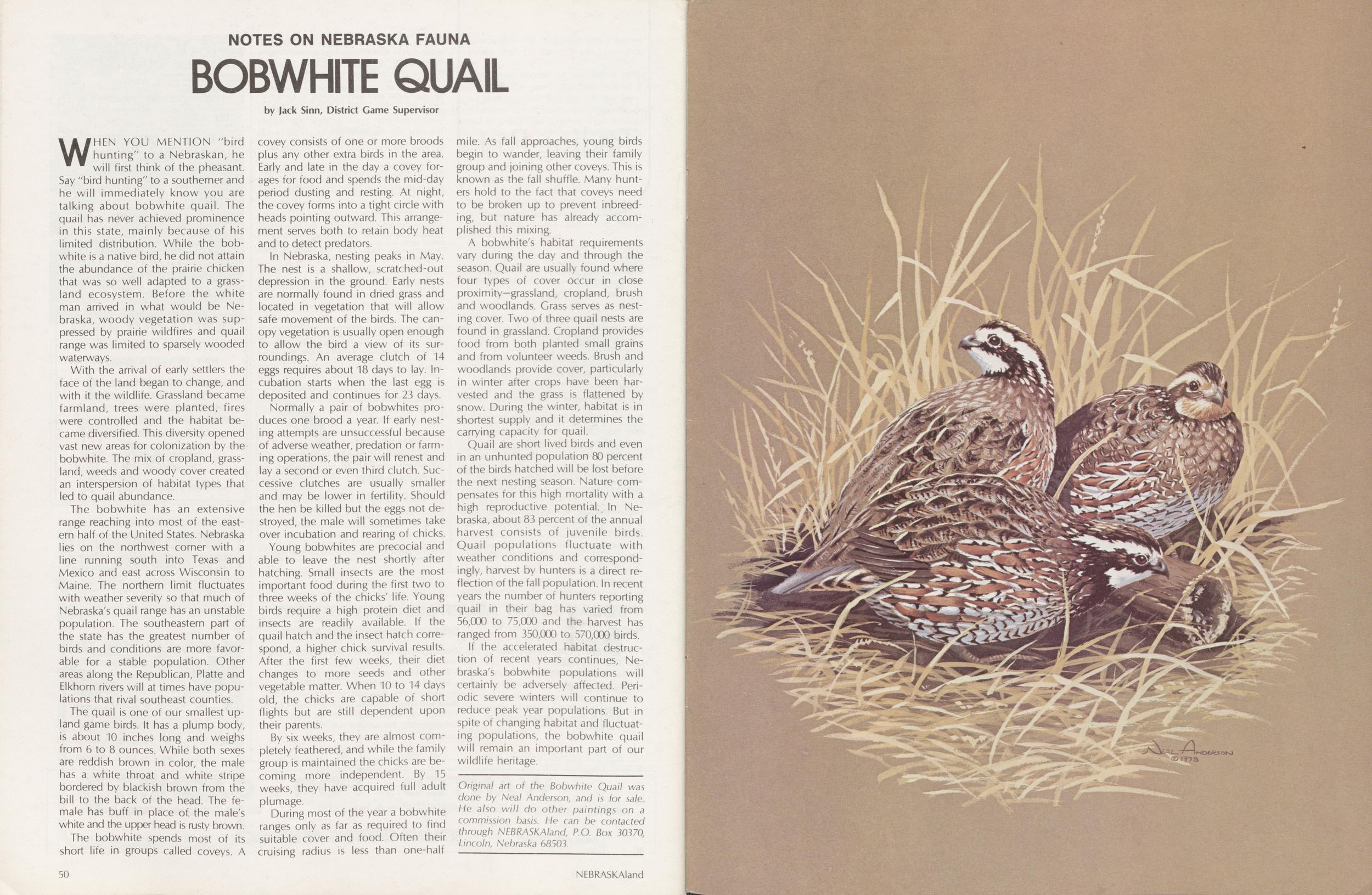
The quail is one of our smallest upland game birds. It has a plump body, is about 10 inches long and weighs from 6 to 8 ounces. While both sexes are reddish brown in color, the male has a white throat and white stripe bordered by blackish brown from the bill to the back of the head. The female has buff in place of the male's white and the upper head is rusty brown.
The bobwhite spends most of its short life in groups called coveys. A covey consists of one or more broods plus any other extra birds in the area. Early and late in the day a covey forages for food and spends the mid-day period dusting and resting. At night, the covey forms into a tight circle with heads pointing outward. This arrangement serves both to retain body heat and to detect predators.
In Nebraska, nesting peaks in May. The nest is a shallow, scratched-out depression in the ground. Early nests are normally found in dried grass and located in vegetation that will allow safe movement of the birds. The canopy vegetation is usually open enough to allow the bird a view of its surroundings. An average clutch of 14 eggs requires about 18 days to lay. Incubation starts when the last egg is deposited and continues for 23 days.
Normally a pair of bobwhites produces one brood a year. If early nesting attempts are unsuccessful because of adverse weather, predation or farming operations, the pair will renest and lay a second or even third clutch. Successive clutches are usually smaller and may be lower in fertility. Should the hen be killed but the eggs not destroyed, the male will sometimes take over incubation and rearing of chicks.
Young bobwhites are precocial and able to leave the nest shortly after hatching. Small insects are the most important food during the first two to three weeks of the chicks' life. Young birds require a high protein diet and insects are readily available. If the quail hatch and the insect hatch correspond, a higher chick survival results. After the first few weeks, their diet changes to more seeds and other vegetable matter. When 10 to 14 days old, the chicks are capable of short flights but are still dependent upon their parents.
By six weeks, they are almost completely feathered, and while the family group is maintained the chicks are becoming more independent. By 15 weeks, they have acquired full adult plumage.
During most of the year a bobwhite ranges only as far as required to find suitable cover and food. Often their cruising radius is less than one-half mile. As fall approaches, young birds begin to wander, leaving their family group and joining other coveys. This is known as the fall shuffle. Many hunters hold to the fact that coveys need to be broken up to prevent inbreeding, but nature has already accomplished this mixing.
A bobwhite's habitat requirements vary during the day and through the season. Quail are usually found where four types of cover occur in close proximity—grassland, cropland, brush and woodlands. Grass serves as nesting cover. Two of three quail nests are found in grassland. Cropland provides food from both planted small grains and from volunteer weeds. Brush and woodlands provide cover, particularly in winter after crops have been harvested and the grass is flattened by snow. During the winter, habitat is in shortest supply and it determines the carrying capacity for quail.
Quail are short lived birds and even in an unhunted population 80 percent of the birds hatched will be lost before the next nesting season. Nature compensates for this high mortality with a high reproductive potential. In Nebraska, about 83 percent of the annual harvest consists of juvenile birds. Quail populations fluctuate with weather conditions and correspondingly, harvest by hunters is a direct reflection of the fall population. In recent years the number of hunters reporting quail in their bag has varied from 56,000 to 75,000 and the harvest has ranged from 350,000 to 570,000 birds.
If the accelerated habitat destruction of recent years continues, Nebraska's bobwhite populations will certainly be adversely affected. Periodic severe winters will continue to reduce peak year populations. But in spite of changing habitat and fluctuating populations, the bobwhite quail will remain an important part of our wildlife heritage.
Original art of the Bobwhite Quail was done by Neal Anderson, and is for sale. He also will do other paintings on a commission basis. He can be contacted through NEBRASKAland, P.O. Box 30370, Lincoln, Nebraska 68503.
Position: 584 (19 views)