Volume 57, Issue 1, 1979
Now is the time to Explore Nebraska!
NEBRASKAland
January 1979 60 cents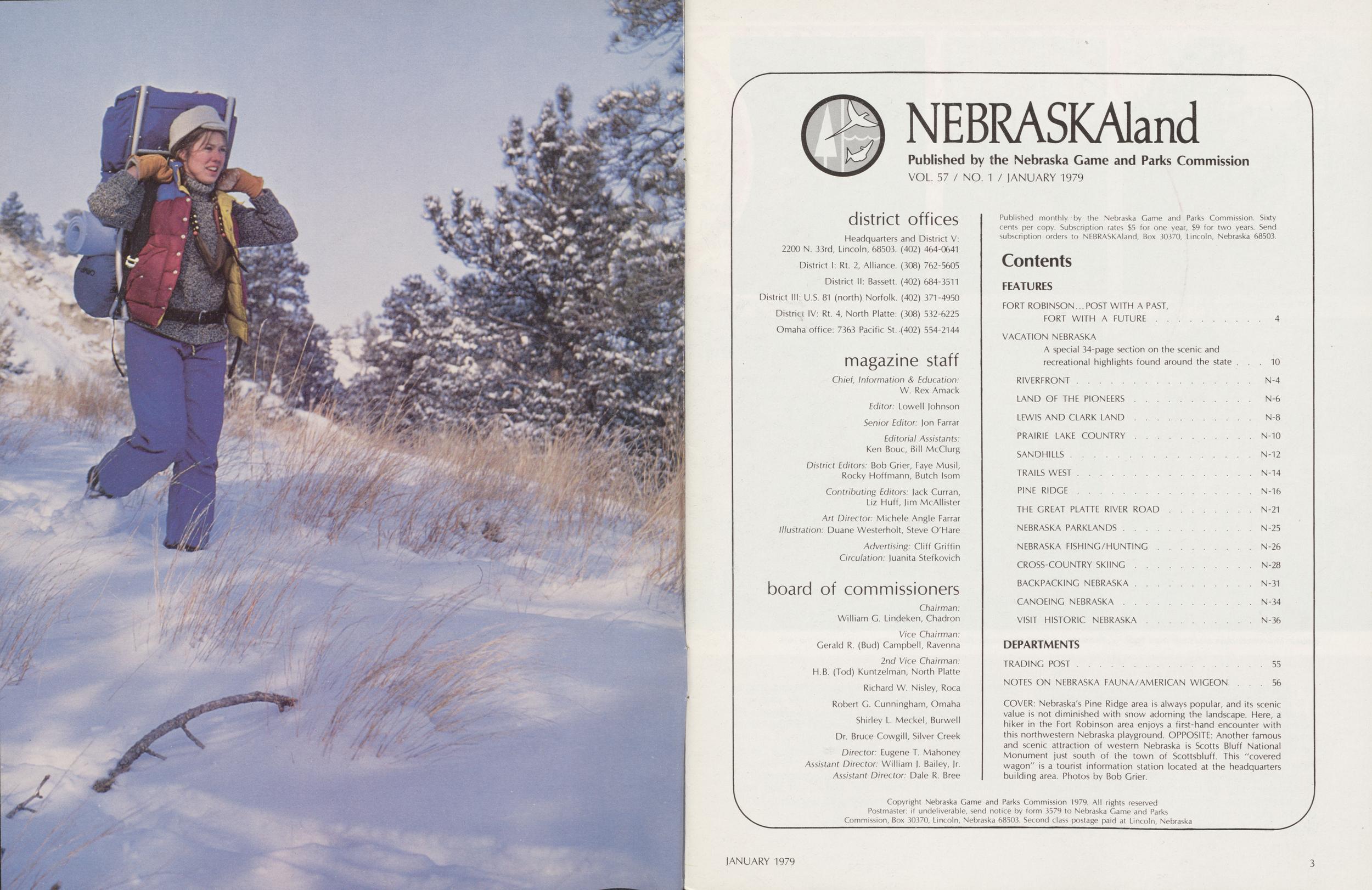
NEBRASKland
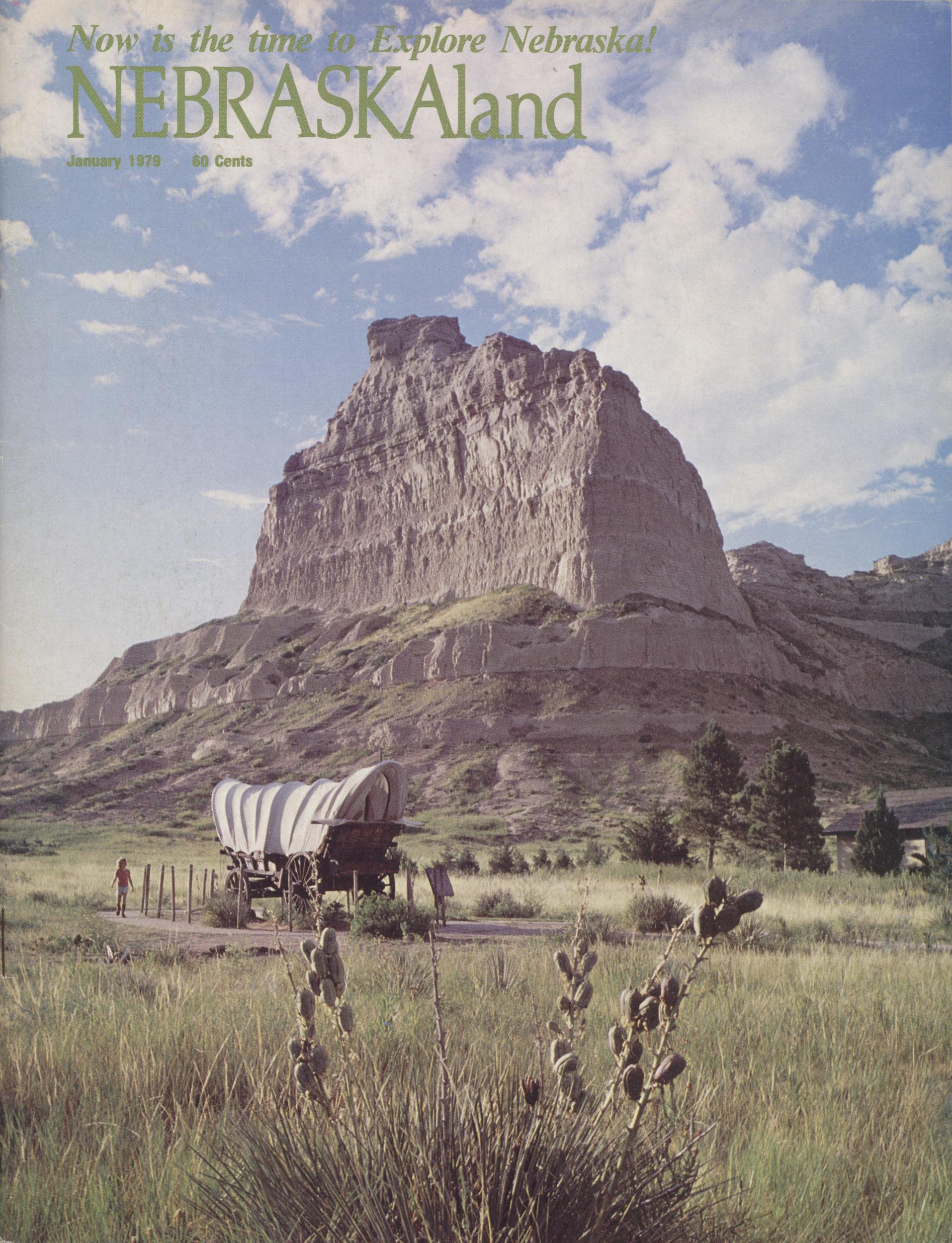
Published by the Nebraska Game and Parks Commission VOL 57 / NO. 1 / JANUARY 1979 district offices Headquarters and District V: 2200 N. 33rd, Lincoln, 68503. (402) 464-0641 District I: Rt. 2, Alliance. (308) 762-5605 District II: Bassett. (402) 684-3511 District III: U.S. 81 (north) Norfolk. (402) 371-4950 District IV: Rt. 4, North Platte: (308) 532-6225 Omaha office: 7363 Pacific St. (402) 554-2144 magazine staff Chief, Information & Education: W. Rex Amack Editor: Lowell Johnson Senior Editor: Jon Farrar Editorial Assistants: Ken Bouc, Bill McClurg District Editors: Bob Grier, Faye Musi I, Rocky Hoffmann, Butch Isom Contributing Editors: Jack Curran, Liz Huff, Jim McAllister Art Director: Michele Angle Farrar Illustration: Duane Westerholt, Steve O'Hare Advertising: Cliff Griffin Circulation: Juanita Stefkovich board of commissioners Chairman: William G. Lindeken, Chadron Vice Chairman: Gerald R. (Bud) Campbell, Ravenna 2nd Vice Chairman: H.B. (Tod) Kuntzelman, North Platte Richard W. Nisley, Roca Robert G. Cunningham, Omaha Shirley L. Meckel, Burwell Dr. Bruce Cowgill, Silver Creek Director: Eugene T. Mahoney Assistant Director: William J. Bailey, Jr. Assistant Director: Dale R. Bree Published monthly by the Nebraska Game and Parks Commission. Sixty cents per copy. Subscription rates $5 for one year, $9 for two years. Send subscription orders to NEBRASKAIand, Box 30370, Lincoln, Nebraska 68503. Contents FEATURES FORT ROBINSON POST WITH A PAST, FORT WITH A FUTURE 4 VACATION NEBRASKA A special 34-page section on the scenic and recreational highlights found around the state 10 RIVERFRONT N-4 LAND OF THE PIONEERS N-6 LEWIS AND CLARK LAND N-8 PRAIRIE LAKE COUNTRY N-10 SANDHILLS N-12 TRAILS WEST N-14 PINE RIDGE N-16 THE GREAT PLATTE RIVER ROAD N-21 NEBRASKA PARKLANDS N-25 NEBRASKA FISHING/HUNTING N-26 CROSS-COUNTRY SKIING N-28 BACKPACKING NEBRASKA N-31 CANOEING NEBRASKA N-34 VISIT HISTORIC NEBRASKA N-36 DEPARTMENTS TRADING POST 55 NOTES ON NEBRASKA FAUNA/AMERICAN WIGEON 56 COVER: Nebraska's Pine Ridge area is always popular, and its scenic value is not diminished with snow adorning the landscape. Here, a hiker in the Fort Robinson area enjoys a first-hand encounter with this northwestern Nebraska playground. OPPOSITE: Another famous and scenic attraction of western Nebraska is Scotts Bluff National Monument just south of the town of Scottsbluff. This "covered wagon" is a tourist information station located at the headquarters building area. Photos by Bob Grier. Copyright Nebraska Game and Parks Commission 1979. All rights reserved Postmaster: if undeliverable, send notice by form 3579 to Nebraska Game and Parks Commission, Box 30370, Lincoln, Nebraska 68503. Second class postage paid at Lincoln, Nebraska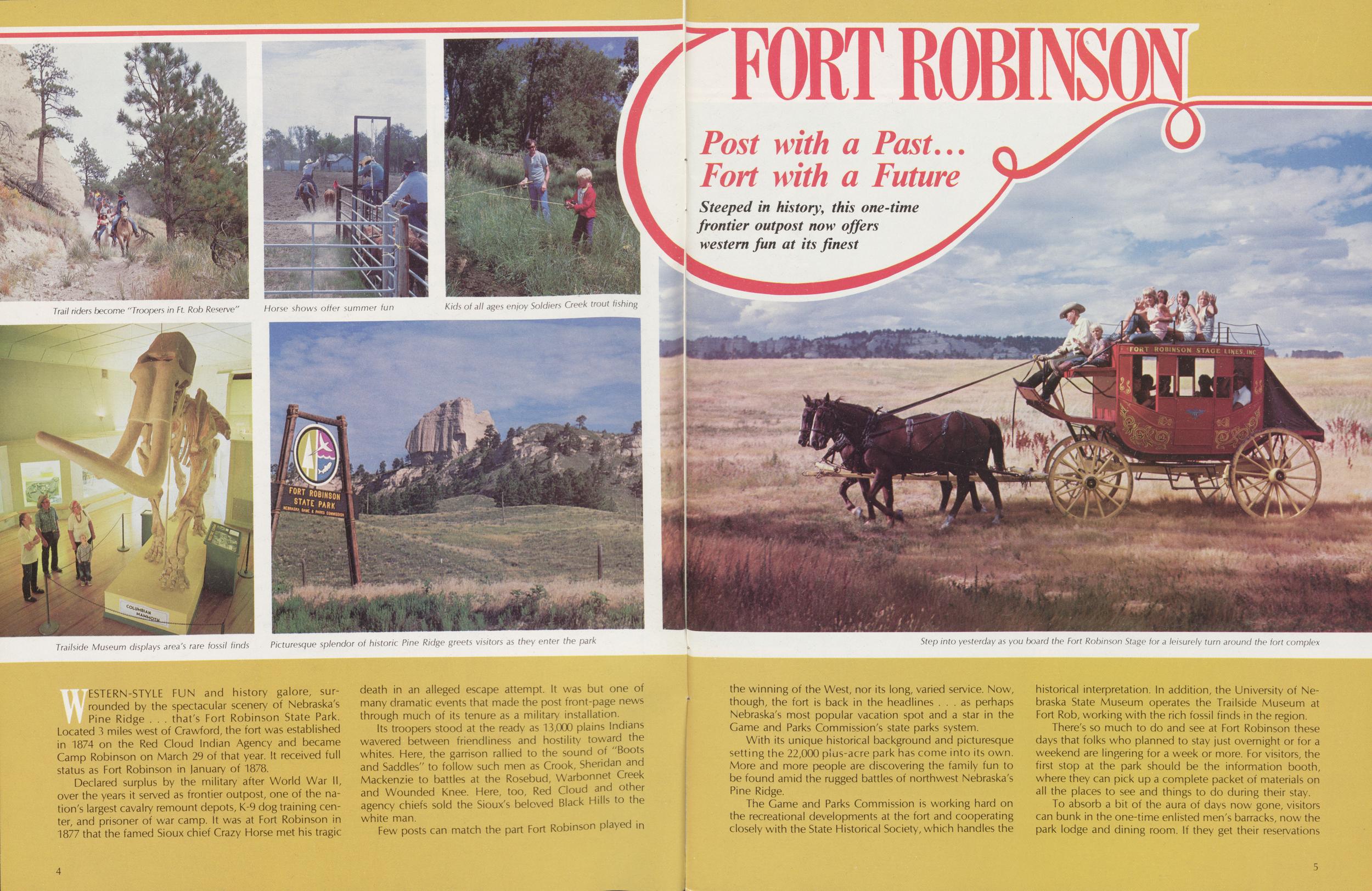
Fort Robinson
Post with a Past... Fort with a Future
Steeped in history, this one-time frontier outpost now offers western fun at its finest
Trail riders become "Troopers in Ft Rob Reserve"
Horse shows offer summer fun
Kids of all ages enjoy Soldiers Creek trout fishing
Trailside Museum displays area's rare fossil finds
Picturesque splendor of historic Pine Ridge greets visitors as they enter the park
Step into yesterday as you board the Fort Robinson Stage for a leisurely turn around the fort complex
WESTERN-STYLE FUN and history galore, surrounded by the spectacular scenery of Nebraska's Pine Ridge...that's Fort Robinson State Park. Located 3 miles west of Crawford, the fort was established in 1874 on the Red Cloud Indian Agency and became Camp Robinson on March 29 of that year. It received full status as Fort Robinson in January of 1878.
Declared surplus by the military after World War II, over the years it served as frontier outpost, one of the nation's largest cavalry remount depots, K-9 dog training center, and prisoner of war camp. It was at Fort Robinson in 1877 that the famed Sioux chief Crazy Horse met his tragic death in an alleged escape attempt. It was but one of many dramatic events that made the post front-page news through much of its tenure as a military installation.
Its troopers stood at the ready as 13,000 plains Indians wavered between friendliness and hostility toward the whites. Here, the garrison rallied to the sound of "Boots and Saddles" to follow such men as Crook, Sheridan and Mackenzie to battles at the Rosebud, Warbonnet Creek and Wounded Knee. Here, too, Red Cloud and other agency chiefs sold the Sioux's beloved Black Hills to the white man.
Few posts can match the part Fort Robinson played in the winning of the West, nor its long, varied service. Now, though, the fort is back in the headlines...as perhaps Nebraska's most popular vacation spot and a star in the Game and Parks Commission's state parks system.
With its unique historical background and picturesque setting the 22,000 plus-acre park has come into its own. More and more people are discovering the family fun to be found amid the rugged battles of northwest Nebraska's Pine Ridge.
The Game and Parks Commission is working hard on the recreational developments at the fort and cooperating closely with the State Historical Society, which handles the historical interpretation. In addition, the University of Nebraska State Museum operates the Trailside Museum at Fort Rob, working with the rich fossil finds in the region.
There's so much to do and see at Fort Robinson these days that folks who planned to stay just overnight or for a weekend are lingering for a week or more. For visitors, the first stop at the park should be the information booth, where they can pick up a complete packet of materials on all the places to see and things to do during their stay.
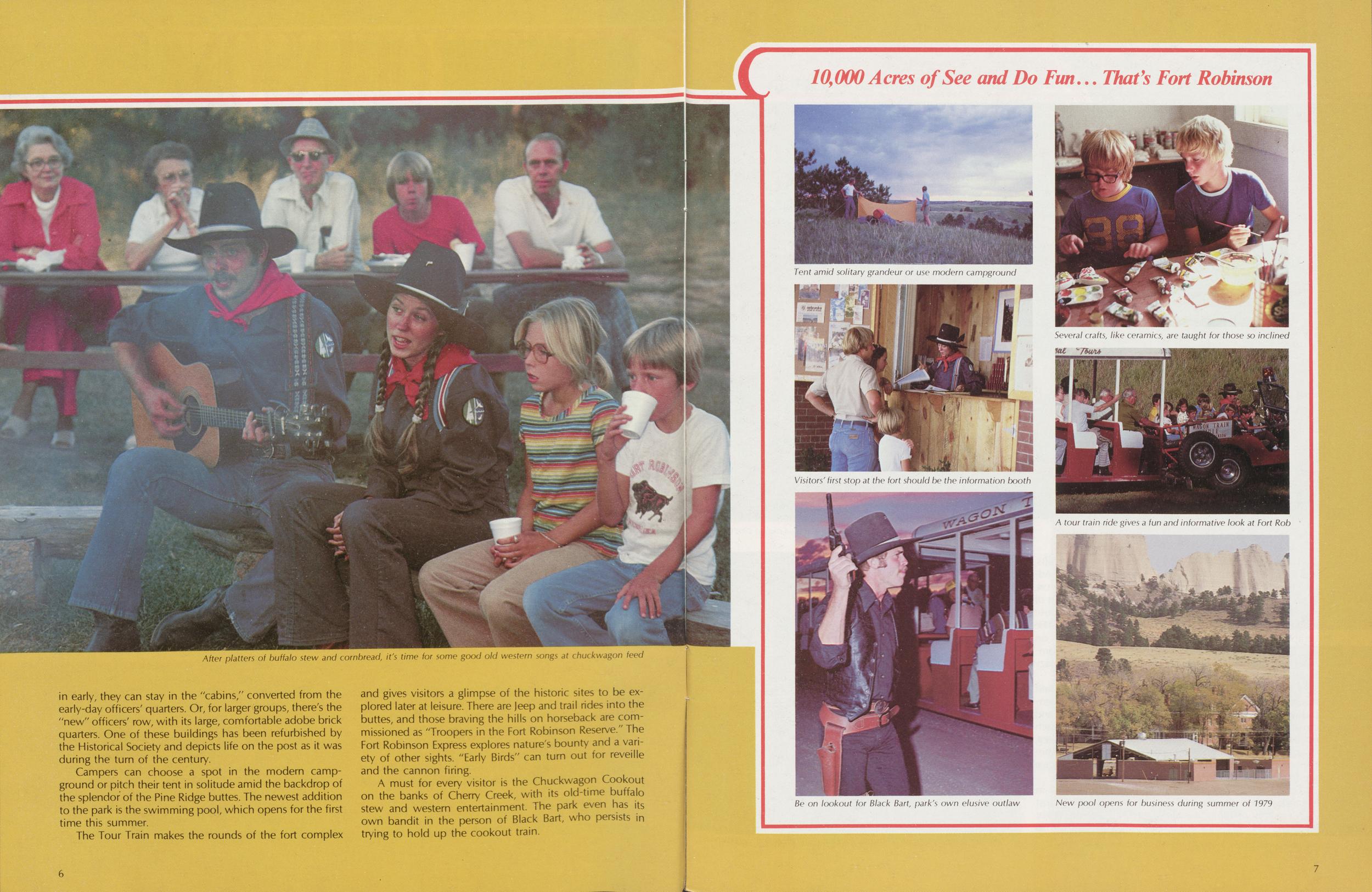
After platters of buffalo stew and cornbread, it's time for some good old western songs at chuckwagon feed
Campers can choose a spot in the modern campground or pitch their tent in solitude amid the backdrop of the splendor of the Pine Ridge buttes. The newest addition to the park is the swimming pool, which opens for the first time this summer.
The Tour Train makes the rounds of the fort complex and gives visitors a glimpse of the historic sites to be explored later at leisure. There are Jeep and trail rides into the buttes, and those braving the hills on horseback are commissioned as "Troopers in the Fort Robinson Reserve." The Fort Robinson Express explores nature's bounty and a variety of other sights. "Early Birds" can turn out for reveille and the cannon firing.
A must for every visitor is the Chuckwagon Cookout on the banks of Cherry Creek, with its old-time buffalo stew and western entertainment. The park even has its own bandit in the person of Black Bart, who persists in trying to hold up the cookout train.
10,000 Acres of See and Do Fun... That's Fort RobinsonTent amid solitary grandeur or use modern campground
Several crafts, like ceramics, are taught for those so inclined
Visitors' first stop at the fort should be the information booth
A tour train ride gives a fun and informative look at Fort Rob
Be on lookout for Black Bart, park's own elusive outlaw
New pool opens for business during summer of 1979
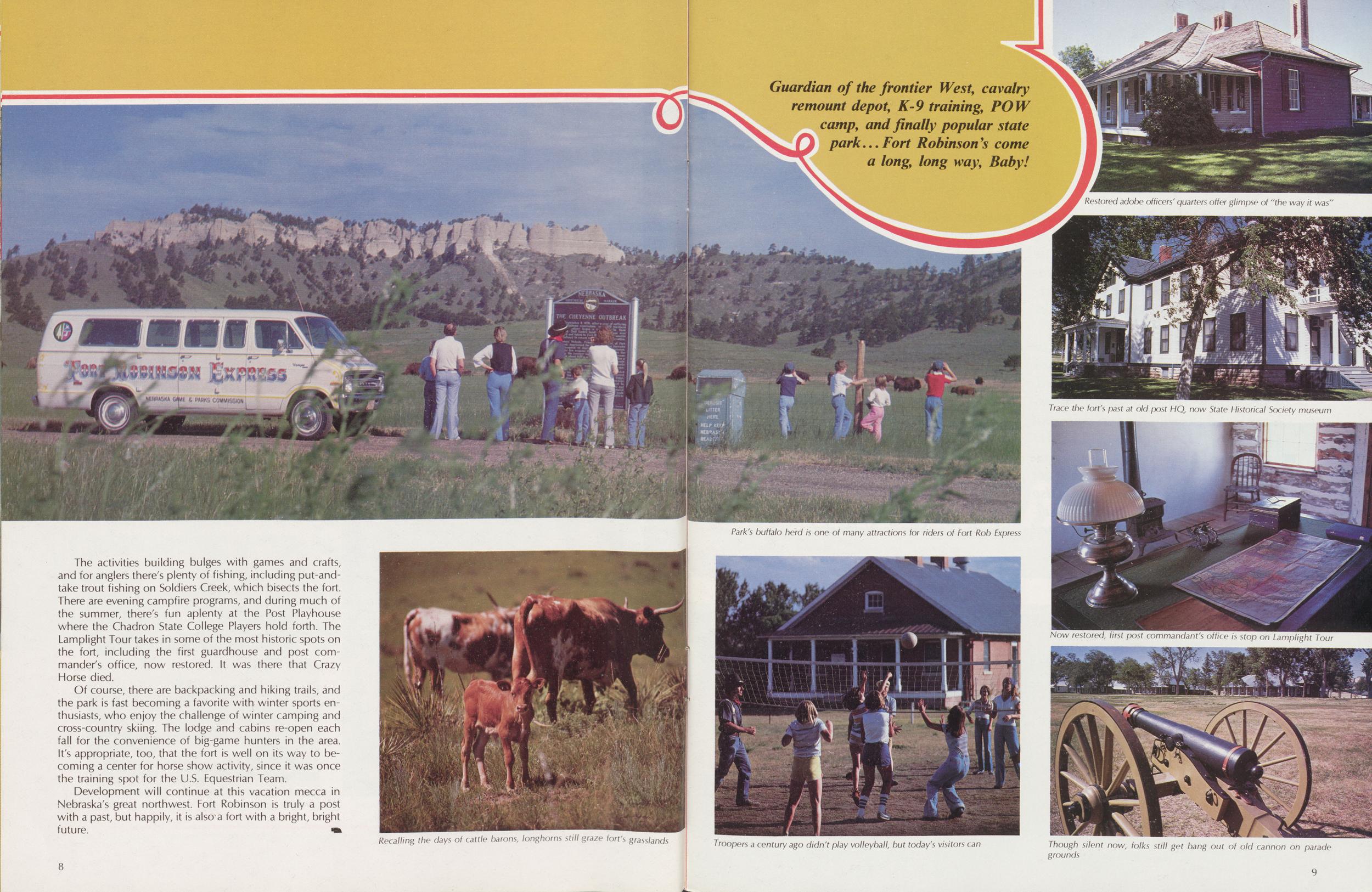
The activities building bulges with games and crafts, and for anglers there's plenty of fishing, including put-and-take trout fishing on Soldiers Creek, which bisects the fort. There are evening campfire programs, and during much of the summer, there's fun aplenty at the Post Playhouse where the Chadron State College Players hold forth. The Lamplight Tour takes in some of the most historic spots on the fort, including the first guardhouse and post commander's office, now restored. It was there that Crazy Horse died.
Of course, there are backpacking and hiking trails, and the park is fast becoming a favorite with winter sports enthusiasts, who enjoy the challenge of winter camping and cross-country skiing. The lodge and cabins re-open each fall for the convenience of big-game hunters in the area. It's appropriate, too, that the fort is well on its way to becoming a center for horse show activity, since it was once the training spot for the U.S. Equestrian Team.
Development will continue at this vacation mecca in Nebraska's great northwest. Fort Robinson is truly a post with a past, but happily, it is also a fort with a bright, bright future.
Guardian of the frontier West, cavalry remount depot, K-9 training, POW camp, and finally popular state park...Fort Robinson's come a long, long way, Baby!Park's buffalo herd is one of many attractions for riders of Fort Rob Express
Restored adobe officers' quarters offer glimpse of "the way it was'
Trace the fort's past at old post HQ now State Historical Society museum
Now restored, first post commandant's office is stop on Lamplight Tour
Recalling the days of cattle barons, longhorns still graze fort's grasslands
Troopers a century ago didn't play volleyball, but today's visitors can
Though silent now, folks still get bang out of old cannon on parade grounds
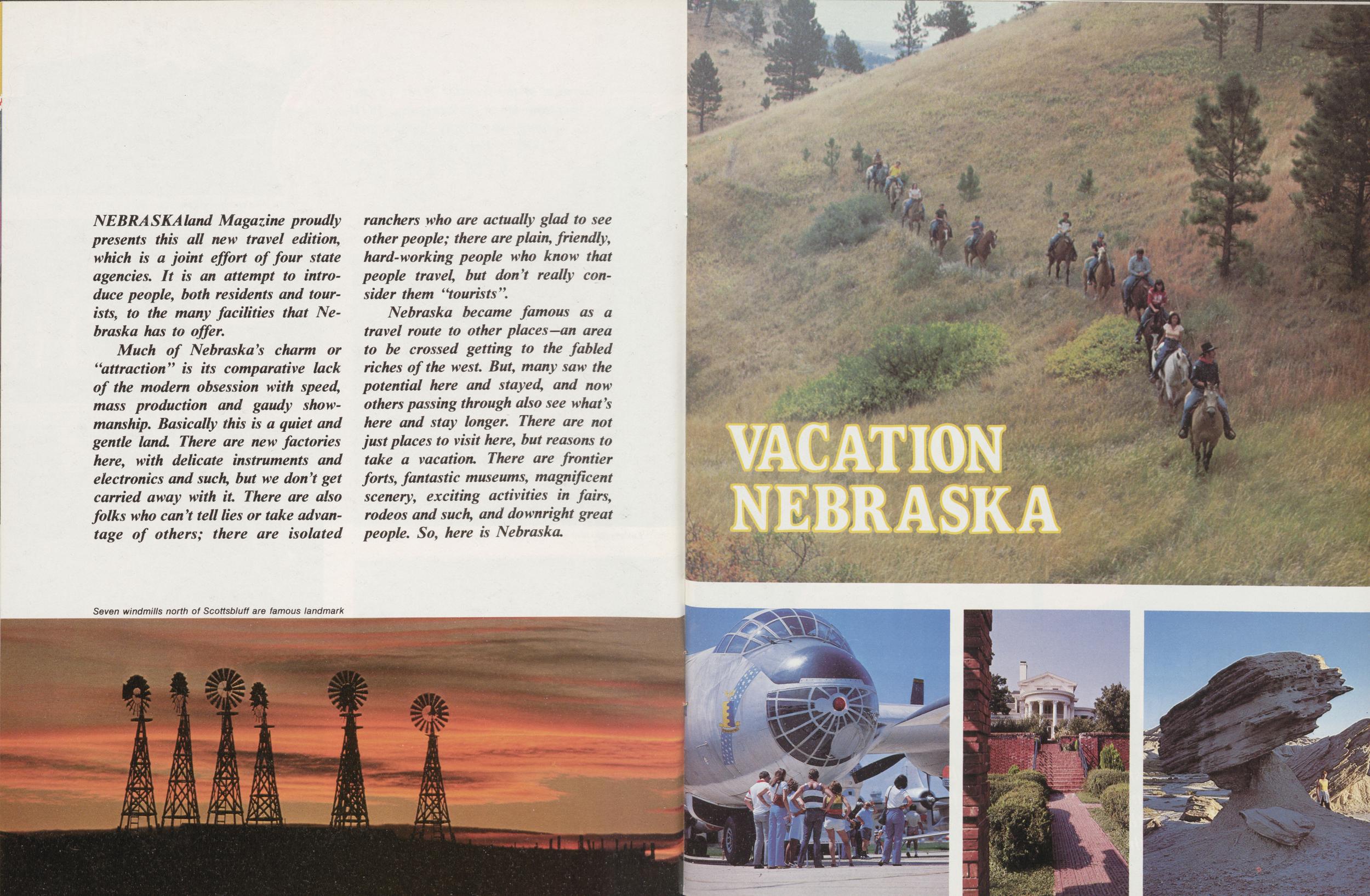
Vacation Nebraska
NEBRASKA land Magazine proudly presents this all new travel edition, which is a joint effort of four state agencies. It is an attempt to introduce people, both residents and tourists, to the many facilities that Nebraska has to offer.
Much of Nebraska's charm or "attraction" is its comparative lack of the modern obsession with speed, mass production and gaudy showmanship. Basically this is a quiet and gentle land There are new factories here, with delicate instruments and electronics and such, but we don't get carried away with it. There are also folks who can't tell lies or take advantage of others; there are isolated ranchers who are actually glad to see other people; there are plain, friendly, hard-working people who know that people travel, but don't really consider them "tourists".
Nebraska became famous as a travel route to other places—an area to be crossed getting to the fabled riches of the west. But, many saw the potential here and stayed, and now others passing through also see what's here and stay longer. There are not just places to visit here, but reasons to take a vacation. There are frontier forts, fantastic museums, magnificent scenery, exciting activities in fairs, rodeos and such, and downright great people. So, here is Nebraska.
Seven windmills north of Scottsbluff are famous landmark
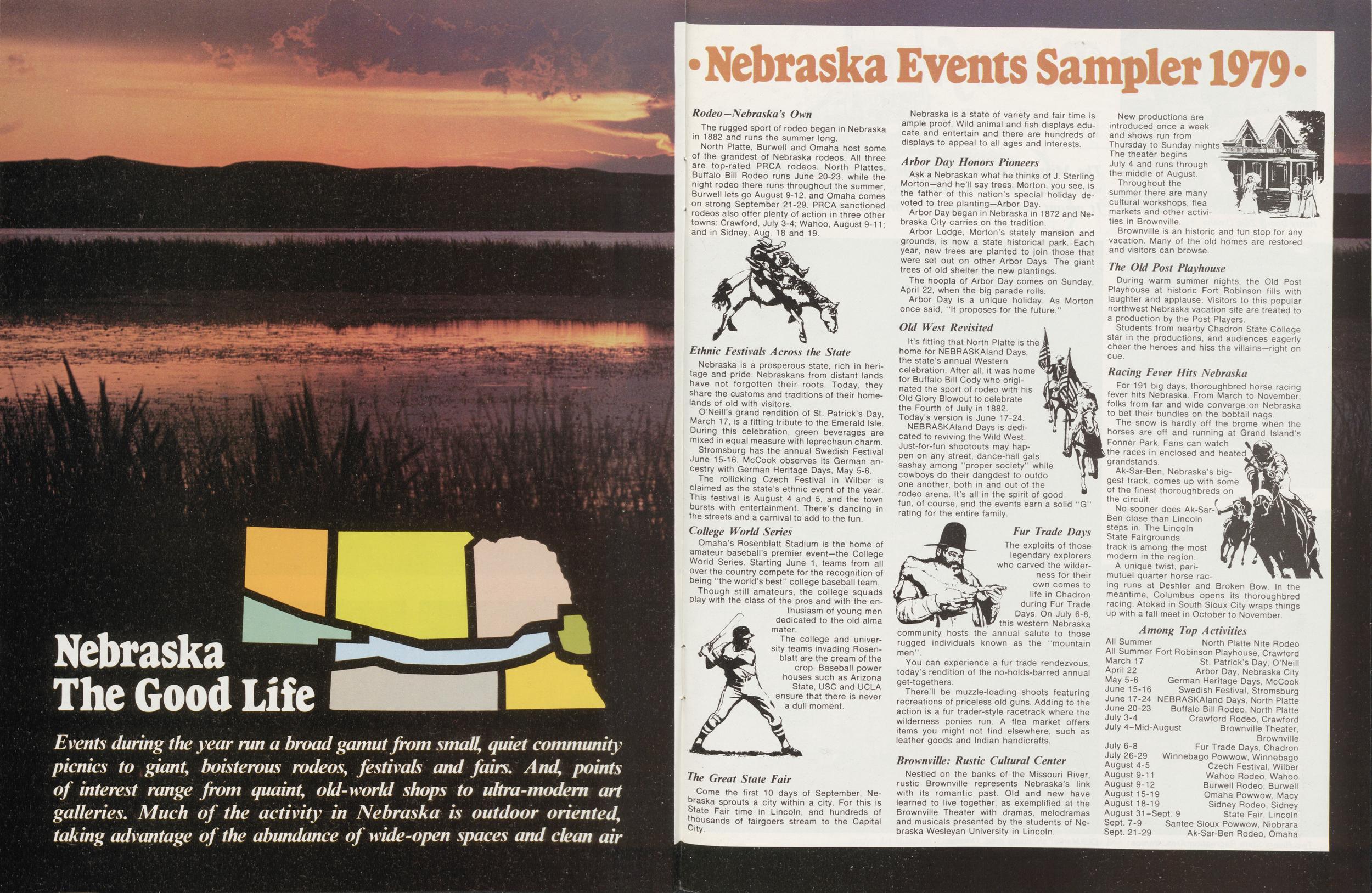
Nebraska The Good Life
Events during the year run a broad gamut from small, quiet community picnics to giant, boisterous rodeos, festivals and fairs. And, points of interest range from quaint, old-world shops to ultra-modern art galleries. Much of the activity in Nebraska is outdoor oriented, taking advantage of the abundance of wide-open spaces and clean air
Nebraska Events Sampler 1979 Rodeo—Nebraska's OwnThe rugged sport of rodeo began in Nebraska
in 1882 and runs the summer long.
North Platte, Burwell and Omaha host some
of the grandest of Nebraska rodeos. All three
are top-rated PRCA rodeos. North Plattes,
Buffalo Bill Rodeo runs June 20-23, while the
night rodeo there runs throughout the summer,
Burwell lets go August 9-12, and Omaha comes
on strong September 21-29. PRCA sanctioned
rodeos also offer plenty of action in three other
towns: Crawford, July 3-4; Wahoo, August 9-11;
and in Sidney, Aug. 18 and 19.
Nebraska is a prosperous state, rich in heritage and pride. Nebraskans from distant
lands
have not forgotten their roots Today, they
share the customs and traditions of their homelands of old with visitors.
O'Neill's grand rendition of St. Patrick's Day,
March 17, is a fitting tribute to the Emerald Isle.
During this celebration, green beverages are
mixed in equal measure with leprechaun charm.
Stromsburg has the annual Swedish Festival
June 15-16. McCook observes its German ancestry with German Heritage Days, May 5-6.
The rollicking Czech Festival in Wilber is
claimed as the state's ethnic event of the year.
This festival is August 4 and 5, and the town
bursts with entertainment. There's dancing in
the streets and a carnival to add to the fun.
Omaha's Rosenblatt Stadium is the home of amateur baseball's premier event—the College World Series. Starting June 1, teams from all over the country compete for the recognition of being "the world's best" college baseball team.
Though still amateurs, the college squads play with the class of the pros and with the enthusiasm of young men dedicated to the old alma mater.
The college and university teams invading Rosenblatt are the cream of the crop. Baseball power houses such as Arizona State, USC and UCLA ensure that there is never a dull moment.
Come the first 10 days of September, Nebraska sprouts a city within a city. For this is State Fair time in Lincoln, and hundreds of thousands of fairgoers stream to the Capital City.
Nebraska is a state of variety and fair time is ample proof. Wild animal and fish displays educate and entertain and there are hundreds of displays to appeal to all ages and interests.
Arbor Day Honors PioneersAsk a Nebraskan what he thinks of J. Sterling Morton—and he'll say trees. Morton, you see, is the father of this nation's special holiday devoted to tree planting—Arbor Day.
Arbor Day began in Nebraska in 1872 and Nebraska City carries on the tradition.
Arbor Lodge, Morton's stately mansion and grounds, is now a state historical park. Each year, new trees are planted to join those that were set out on other Arbor Days. The giant trees of old shelter the new plantings.
The hoopla of Arbor Day comes on Sunday, April 22, when the big parade rolls.
Arbor Day is a unique holiday. As Morton once said, "It proposes for the future."
Old West RevisitedIt's fitting that North Platte is the home for NEBRASKAland Days, the state's annual Western celebration. After all, it was home for Buffalo Bill Cody who originated the sport of rodeo with his Old Glory Blowout to celebrate the Fourth of July in 1882. Today's version is June 17-24.
NEBRASKAland Days is dedicated to reviving the Wild West. Just-for-fun shootouts may happen on any street, dance-hall gals sashay among "proper society" while cowboys do their dangdest to outdo one another, both in and out of the rodeo arena. It's all in the spirit of good fun, of course, and the events earn a solid "G" rating for the entire family.
Fur Trade DaysThe exploits of those legendary explorers who carved the wilderness for their own comes to life in Chadron during Fur Trade Days. On July 6-8, this western Nebraska community hosts the annual salute to those rugged individuals known as the "mountain men".
You can experience a fur trade rendezvous, today's rendition of the no-holds-barred annual get-togethers.
There'll be muzzle-loading shoots featuring recreations of priceless old guns. Adding to the action is a fur trader-style racetrack where the wilderness ponies run. A flea market offers items you might not find elsewhere, such as leather goods and Indian handicrafts.
Brownville: Rustic Cultural CenterNestled on the banks of the Missouri River, rustic Brownville represents Nebraska's link with its romantic past. Old and new have learned to live together, as exemplified at the Brownville Theater with dramas, melodramas and musicals presented by the students of Nebraska Wesleyan University in Lincoln.
New productions are introduced once a week and shows run from Thursday to Sunday nights The theater begins July 4 and runs through the middle of August.
Throughout the summer there are many cultural workshops, flea markets and other activities in Brownville.
Brownville is an historic and fun stop for any vacation. Many of the old homes are restored and visitors can browse.
The Old Post PlayhouseDuring warm summer nights, the Old Post Playhouse at historic Fort Robinson fills with laughter and applause. Visitors to this popular northwest Nebraska vacation site are treated to a production by the Post Players.
Students from nearby Chadron State College star in the productions, and audiences eagerly cheer the heroes and hiss the villains—right on cue.
Racing Fever Hits NebraskaFor 191 big days, thoroughbred horse racing fever hits Nebraska. From March to November, folks from far and wide converge on Nebraska to bet their bundles on the bobtail nags.
The snow is hardly off the brome when the horses are off and running at Grand Island's Fonner Park. Fans can watch the races in enclosed and heated grandstands.
Ak-Sar-Ben, Nebraska's biggest track, comes up with some of the finest thoroughbreds on the circuit.
No sooner does Ak-Sar-Ben close than Lincoln steps in. The Lincoln State Fairgrounds track is among the most modern in the region.
A unique twist, parimutuel quarter horse racing runs at Deshler and Broken Bow. In the meantime, Columbus opens its thoroughbred racing. Atokad in South Sioux City wraps things up with a fall meet in October to November.
Among Top Activities All Summer North Platte Nite Rodeo All Summer Fort Robinson Playhouse, Crawford March 17 St. Patrick's Day, O'Neill April 22 Arbor Day, Nebraska City May 5-6 German Heritage Days, McCook June 15-16 Swedish Festival, Stromsburg June 17-24 NEBRASKAland Days, North Platte June 20-23 Buffalo Bill Rodeo, North Platte July 3-4 Crawford Rodeo, Crawford July 4-Mid-August Brownville Theater, Brownville July 6-8 Fur Trade Days, Chadron July 26-29 Winnebago Powwow, Winnebago August 4-5 Czech Festival, Wilber August 9-11 Wahoo Rodeo, Wahoo August 9-12 Burwell Rodeo, Burwell August 15-19 Omaha Powwow, Macy August 18-19 Sidney Rodeo, Sidney August 31-Sept. 9 State Fair, Lincoln Sept. 7-9 Santee Sioux Powwow, Niobrara Sept. 21-29 Ak-Sar-Ben Rodeo, Omaha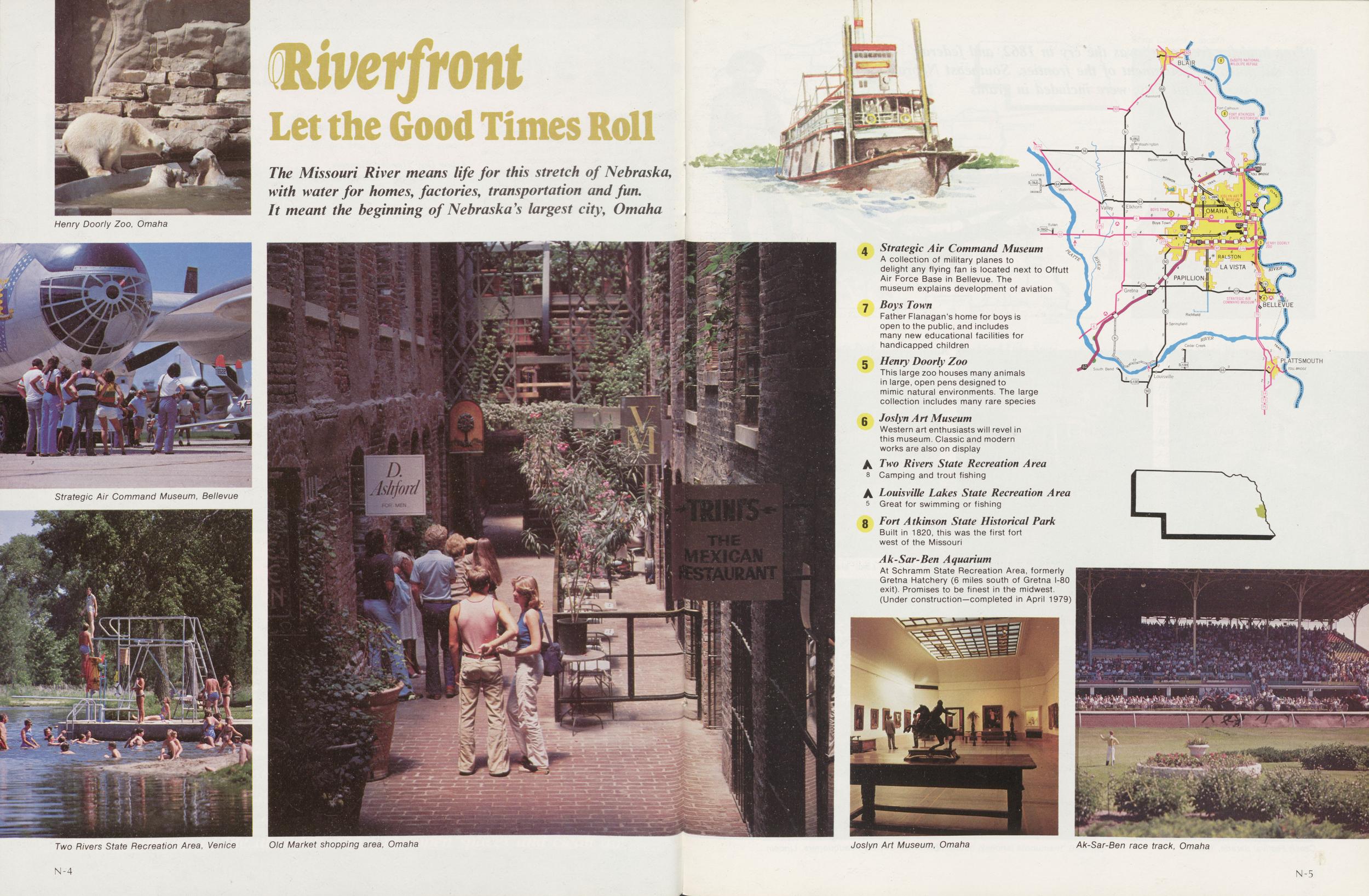
Riverfront
Let the Good Times Roll
The Missouri River means life for this stretch of Nebraska, with water for homes, factories, transportation and fun. It meant the beginning of Nebraska's largest city, OmahaHenry Doorly Zoo, Omaha
Strategic Air Command Museum, Bellevue
Two Rivers State Recreation Area, Venice
Old Market shopping area, Omaha
A collection of military planes to delight any flying fan is located next to Offutt Air Force Base in Bellevue. The museum explains development of aviation
Boys TownFather Flanagan's home for boys is open to the public, and includes many new educational facilities for handicapped children
Henry Doorly ZooThis large zoo houses many animals in large, open pens designed to mimic natural environments. The large collection includes many rare species
Joslyn Art MuseumWestern art enthusiasts will revel in this museum. Classic and modern works are also on display
Two Rivers State Recreation AreaCamping and trout fishing
Louisville Lakes State Recreation AreaGreat for swimming or fishing
Fort Atkinson State Historical ParkBuilt in 1820, this was the first fort west of the Missouri
Ak-Sar-Ben AquariumAt Schramm State Recreation Area, formerly Gretna Hatchery (6 miles south of Gretna I-80 exit). Promises to be finest in the midwest. (Under construction—completed in April 1979)
Joslyn Art Museum, Omaha
Ak-Sar-Ben race track, Omaha
Land of the Pioneer
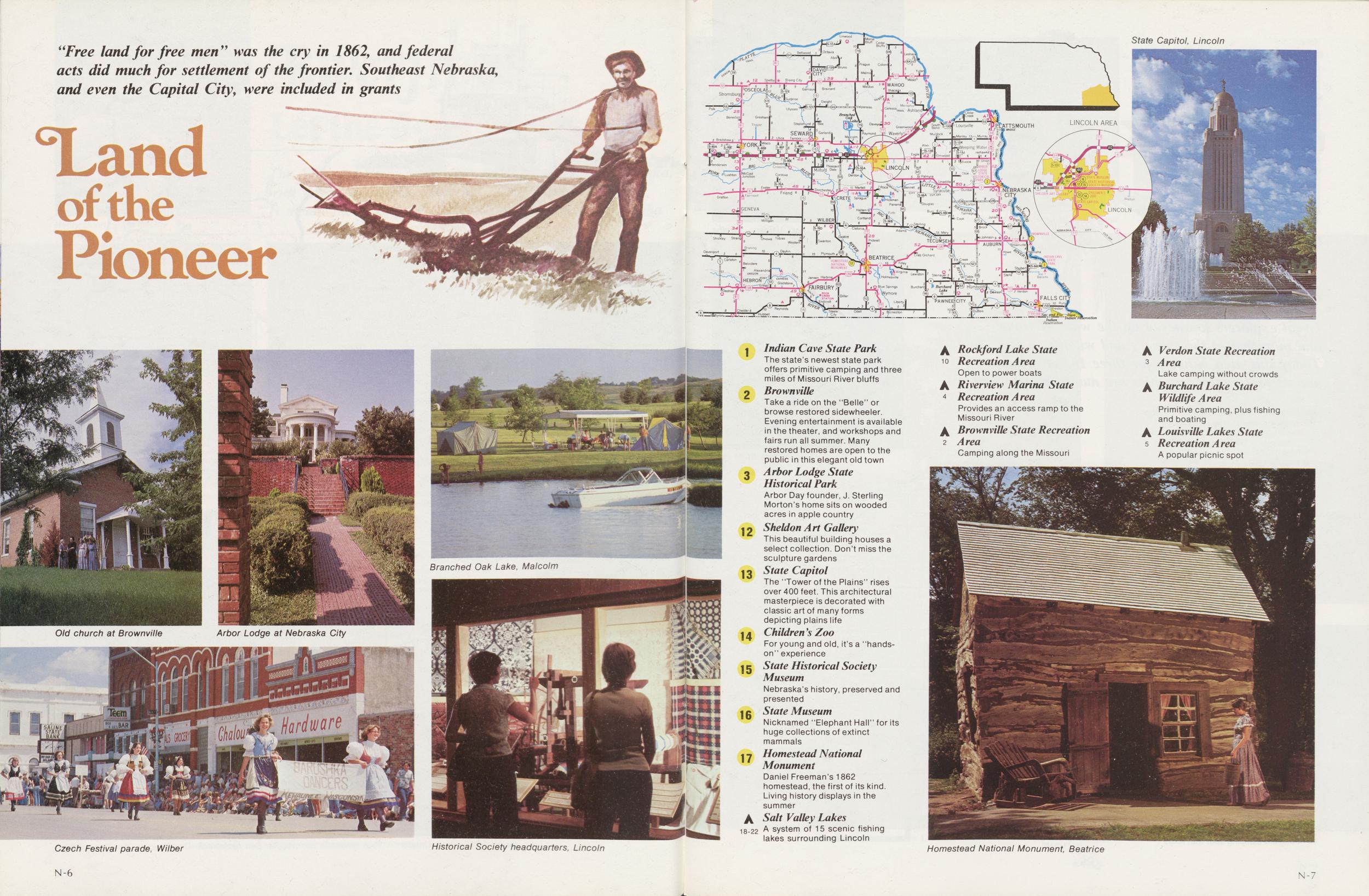
"Free land for free men" was the cry in 1862, and federal acts did much for settlement of the frontier. Southeast Nebraska, and even the Capital City, were included in grantsOld church at Brownville
Arbor Lodge at Nebraska City
Branched Oak Lake, Malcolm
Czech Festival parade, Wilber
Historical Society headquarters, Lincoln
State Capitol, Lincoln
The state's newest state park offers primitive camping and three miles of Missouri River bluffs
BrownvilleTake a ride on the "Belle" or browse restored sidewheeler. Evening entertainment is available in the theater, and workshops and fairs run all summer. Many restored homes are open to the public in this elegant old town
Arbor Lodge State Historical ParkArbor Day founder, J. Sterling Morton's home sits on wooded acres in apple country
Sheldon Art GalleryThis beautiful building houses a select collection. Don't miss the sculpture gardens
State CapitolThe "Tower of the Plains" rises over 400 feet. This architectural masterpiece is decorated with classic art of many forms depicting plains life
Children's ZooFor young and old, it's a "hands-on" experience
State Historical Society MuseumNebraska's history, preserved and presented
State MuseumNicknamed "Elephant Hall" for its huge collections of extinct mammals
Homestead National MonumentDaniel Freeman's 1862 homestead, the first of its kind. Living history displays in the summer
Salt Valley LakesA system of 15 scenic fishing lakes surrounding Lincoln
Rockford Lake State Recreation AreaOpen to power boats
A Riverview Marina State Recreation AreaProvides an access ramp to the Missouri River
Brownville State Recreation AreaCamping along the Missouri
Verdon State Recreation AreaLake camping without crowds
Burchard Lake State Wildlife AreaPrimitive camping, plus fishing and boating
A Louisville Lakes State Recreation AreaA popular picnic spot
Homestead National Monument, Beatrice
Lewis & Clark Land
The Great Adventure
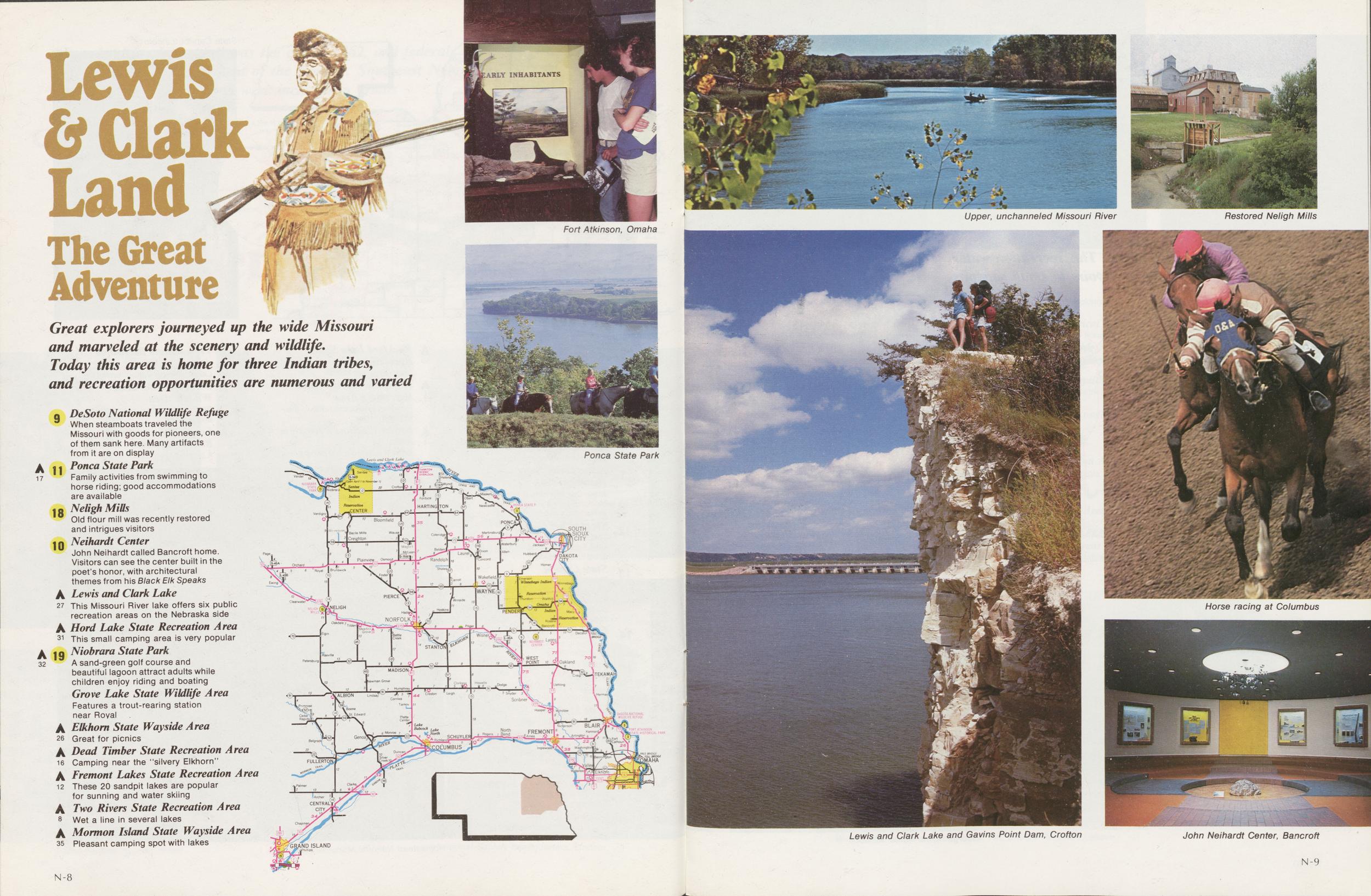
Great explorers journeyed up the wide Missouri and marveled at the scenery and wildlife. Today this area is home for three Indian tribes and recreation opportunities are numerous and variedFort Atkinson, Omaha
Ponca State Park
When steamboats traveled the Missouri with goods for pioneers, one of them sank here Many artifacts from it are on display
Ponca State ParkFamily activities from swimming to horse riding; good accommodations are available
Neligh MillsOld flour mill was recently restored and intrigues visitors
Neihardt CenterJohn Neihardt called Bancroft home. Visitors can see the center built in the poet's honor, with architectural themes from his Black Elk Speaks
Lewis and Clark LakeThis Missouri River lake offers six public recreation areas on the Nebraska side
Hord Lake State Recreation AreaThis small camping area is very popular
Niobrara State ParkA sand-green golf course and beautiful lagoon attract adults while children enjoy riding and boating
Grove Lake State Wildlife AreaFeatures a trout-rearing station near Royal
Elkhorn State Wayside AreaGreat for picnics
Dead Timber State Recreation AreaCamping near the "silvery Elkhorn"
Fremont Lakes State Recreation AreaThese 20 sandpit lakes are popular for sunning and water skiing
Two Rivers State Recreation AreaWet a line in several lakes
Mormon Island State Wayside AreaPleasant camping spot with lakes
Upper, unchanneled Missouri River
Restored Neligh Mills
Horse racing at Columbus
Lewis and Clark Lake and Gavins Point Dam, Crofton
John Neihardt Center, Bancroft
Prairie Lake Country
Water playground
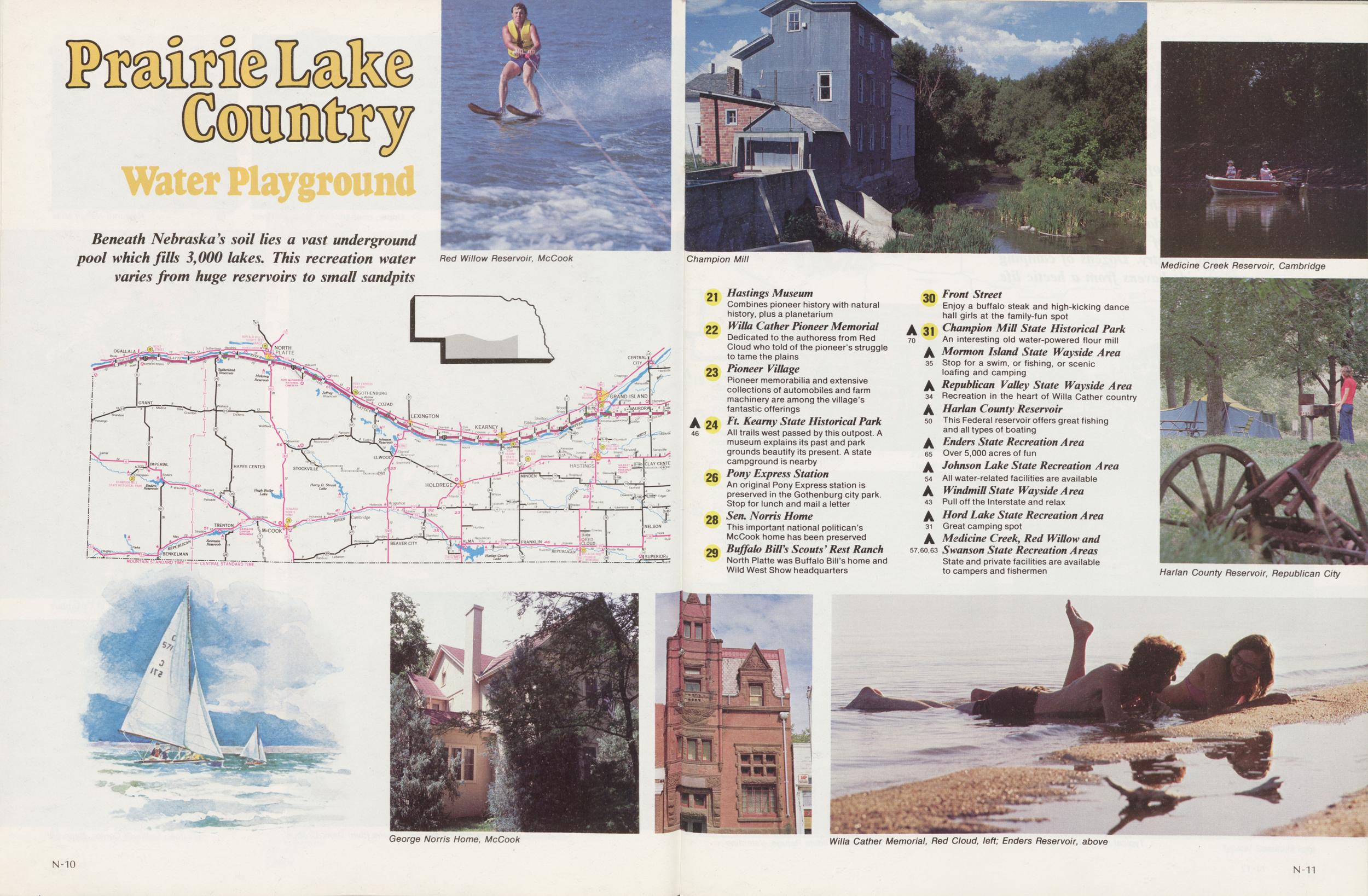
Beneath Nebraska's soil lies a vast underground pool which fills 3,000 lakes. This recreation water varies from huge reservoirs to small sandpitsRed Willow Reservoir, McCook
George Norris Home, McCook
Champion Mill
Combines pioneer history with natural history, plus a planetarium
Willa Cather Pioneer MemorialDedicated to the authoress from Red Cloud who told of the pioneer's struggle to tame the plains
Pioneer VillagePioneer memorabilia and extensive collections of automobiles and farm machinery are among the village's fantastic offerings
Kearny State Historical ParkAll trails west passed by this outpost. A museum explains its past and park grounds beautify its present. A state campground is nearby
Pony Express StationAn original Pony Express station is preserved in the Gothenburg city park. Stop for lunch and mail a letter
Sen. Norris HomeThis important national politican's McCook home has been preserved
Buffalo Bill's Scouts' Rest RanchNorth Platte was Buffalo Bill's home and Wild West Show headquarters
Front StreetEnjoy a buffalo steak and high-kicking dance hall girls at the family-fun spot
Champion Mill State Historical ParkAn interesting old water-powered flour mill
Mormon Island State Wayside AreaStop for a swim, or fishing, or scenic loafing and camping
Republican Valley State Wayside AreaRecreation in the heart of Willa Cather country
Harlan County ReservoirThis Federal reservoir offers great fishing and all types of boating
Enders State Recreation AreaOver 5,000 acres of fun
Johnson Lake State Recreation AreaAll water-related facilities are available
Windmill State Wayside AreaPull off the Interstate and relax
Hord Lake State Recreation AreaGreat camping spot
Medicine Creek, Red Willow and 57,60,63 Swanson State Recreation AreasState and private facilities are available to campers and fishermen
Medicine Creek Reservoir, Cambridge
Harlan County Reservoir, Republican City
Willa Cather Memorial, Red Cloud, left; Enders Reservoir, above
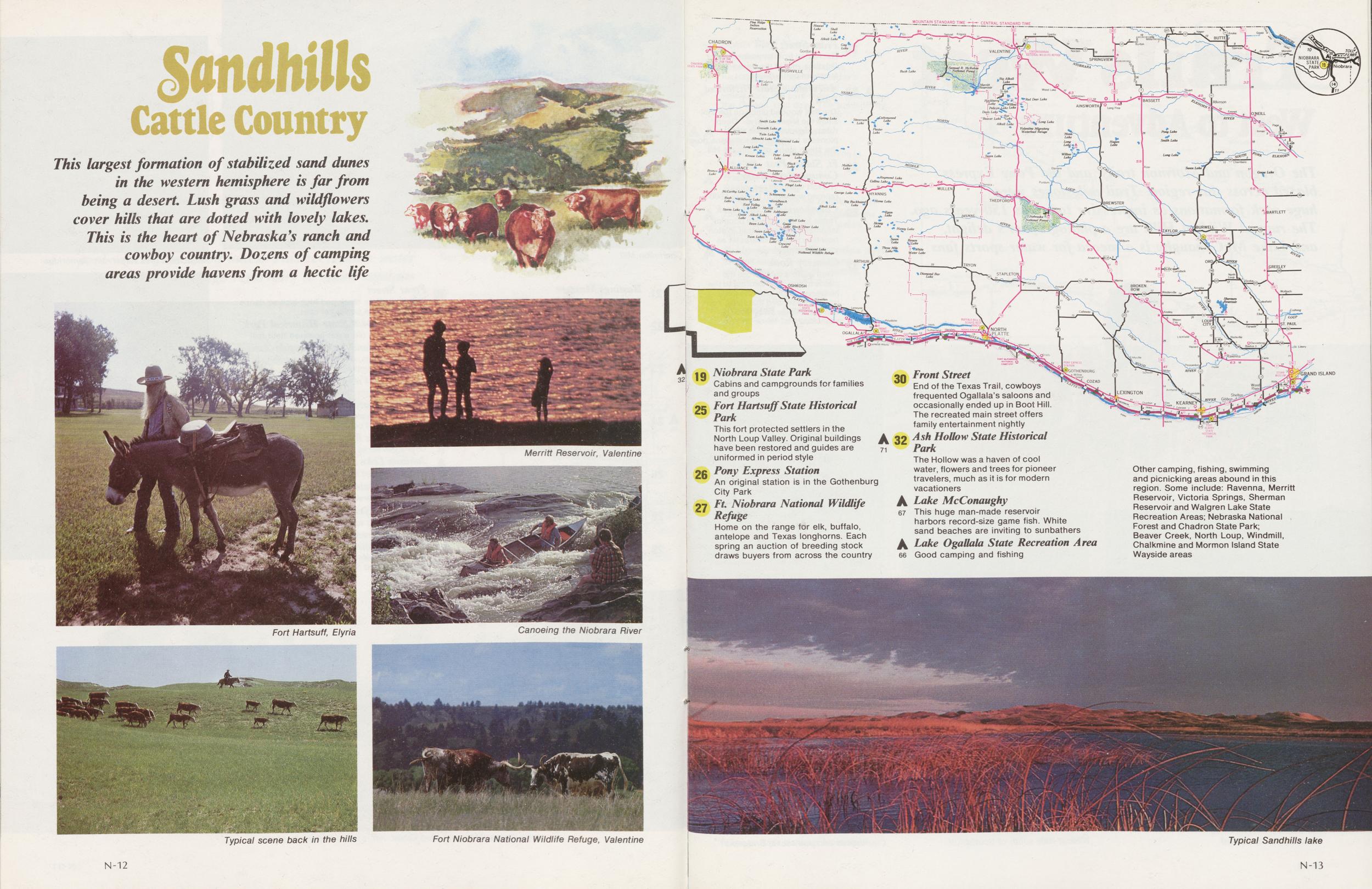
Sandhills
Cattle Country
This largest formation of stabilized sand dunes in the western hemisphere is far from being a desert. Lush grass and wildflowers cover hills that are dotted with lovely lakes. This is the heart of Nebraska's ranch and cowboy country. Dozens of camping areas provide havens from a hectic lifeMerritt Reservoir, Valentine
Fort Hartsuff, Elyria
Canoeing the Niobrara River
Typical scene back in the hills
Fort Niobrara National Wildlife Refuge, Valentine
Cabins and campgrounds for families and groups
Fort Hartsuff State Historical ParkThis fort protected settlers in the North Loup Valley. Original buildings have been restored and guides are uniformed in period style
Pony Express StationAn original station is in the Gothenburg City Park
Ft. Niobrara National Wildlife RefugeHome on the range for elk, buffalo, antelope and Texas longhorns. Each spring an auction of breeding stock draws buyers from across the country
Front StreetRecreated frontier main street of Ogallala, end of the Texas Trail's longhorn cattle drives
Ash Hollow State Historical ParkThe Hollow was a haven of cool water, flowers and trees for pioneer travelers, much as it is for modern vacationers
Lake McConaughyThis huge man-made reservoir harbors record-size game fish. White sand beaches are inviting to sunbathers Lake Ogallala State Recreation Area Good camping and fishing
Other camping, fishing, swimming and picnicking areas abound in this region. Some include: Ravenna, Merritt Reservoir, Victoria Springs, Sherman Reservoir and Walgren Lake State Recreation Areas; Nebraska National Forest and Chadron State Park; Beaver Creek, North Loup, Windmill, Chalkmine and Mormon Island State Wayside areas
Typical Sandhills lake
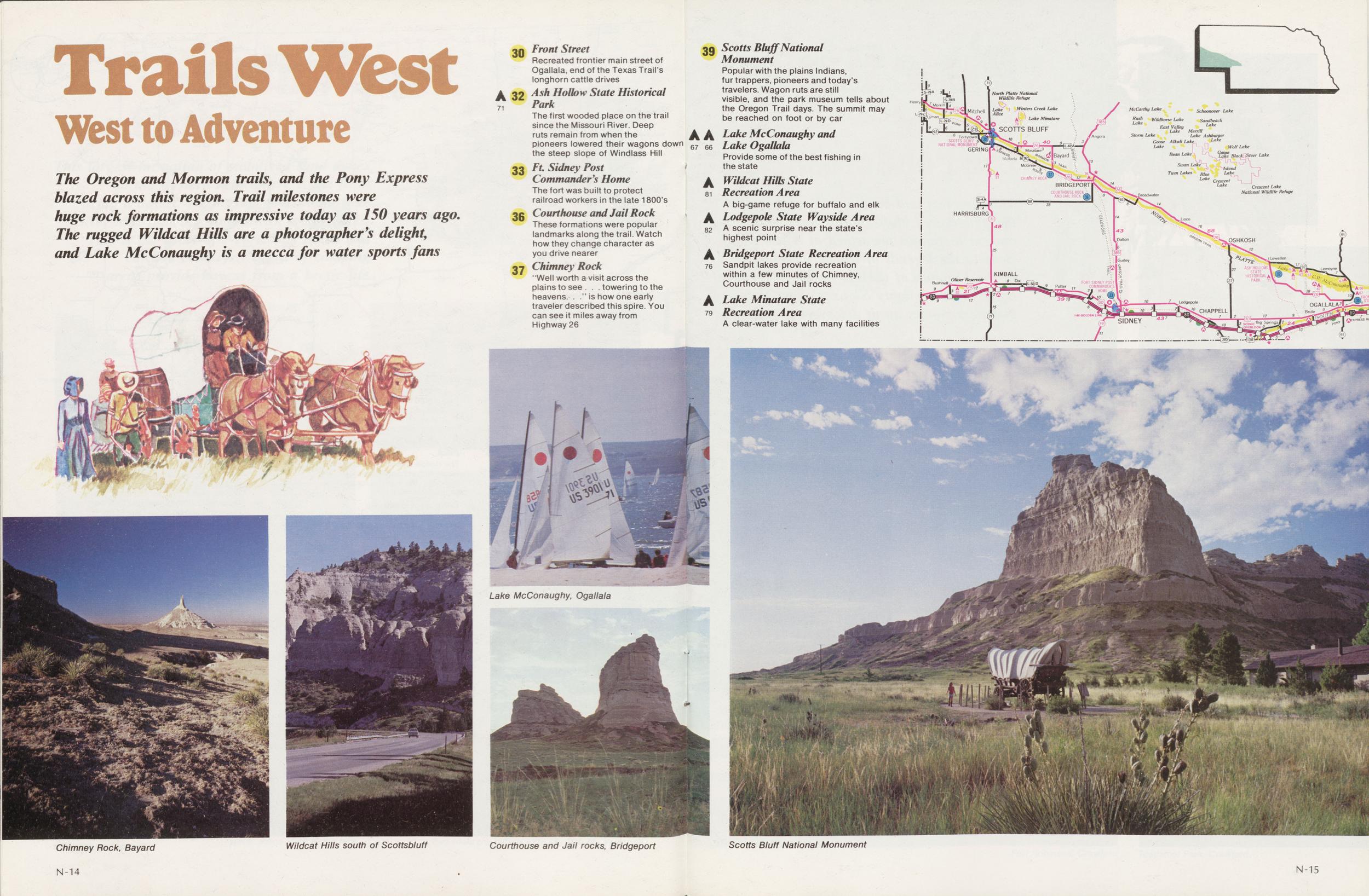
Trails West
West to Adventure
The Oregon and Mormon trails, and the Pony Express blazed across this region. Trail milestones were huge rock formations as impressive today as 150 years ago. The rugged Wildcat Hills are a photographer's delight, and Lake McConaughy is a mecca for water sports fansChimney Rock, Bayard
Wildcat Hills south of Scottsbluff
The first wooded place on the trail since the Missouri River. Deep ruts remain from when the pioneers lowered their wagons down the steep slope of Windlass Hill
Ft Sidney Post Commander's HomeThe fort was built to protect railroad workers in the late 1800's
Courthouse and Jail RockThese formations were popular landmarks along the trail. Watch how they change character as you drive nearer
Chimney Rock"Well worth a visit across the plains to see...towering to the heavens..." is how one early traveler described this spire. You can see it miles away from Highway 26
Lake McConaughy, Ogallala
Courthouse and Jail rocks, Bridgeport
Popular with the plains Indians, fur trappers, pioneers and today's travelers. Wagon ruts are still visible, and the park museum tells about the Oregon Trail days. The summit may be reached on foot or by car
Lake McConaughy and Lake OgallalaProvide some of the best fishing in the state
Wildcat Hills State Recreation AreaA big-game refuge for buffalo and elk
Lodgepole State Wayside AreaA scenic surprise near the state's highest point
Bridgeport State Recreation AreaSandpit lakes provide recreation within a few minutes of Chimney, Courthouse and Jail rocks
Lake Minatare State Recreation AreaA clear-water lake with many facilities
Scotts Bluff National Monument
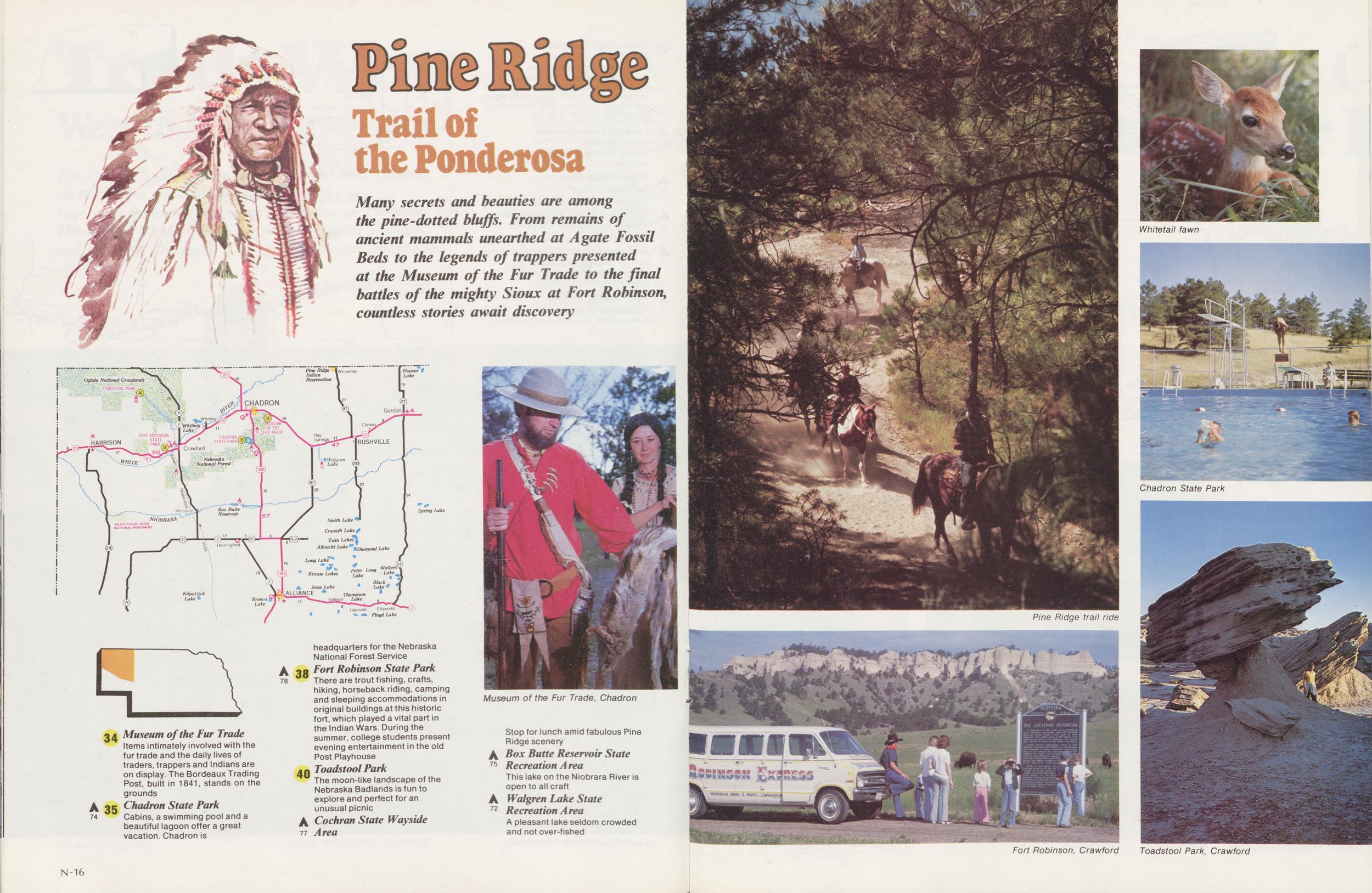
Pine Ridge
Trail of the Ponderosa
Many secrets and beauties are among the pine-dotted bluffs. From remains of ancient mammals unearthed at Agate Fossil Beds to the legends of trappers presented at the Museum of the Fur Trade to the final battles of the mighty Sioux at Fort Robinson, countless stories await discoveryMuseum of the Fur Trade, Chadron
Items intimately involved with the fur trade and the daily lives of traders, trappers and Indians are on display. The Bordeaux Trading Post, built in 1841, stands on the grounds
Chadron State ParkCabins, a swimming pool and a beautiful lagoon offer a great vacation. Chadron is headquarters for the Nebraska National Forest Service
Fort Robinson State ParkThere are trout fishing, crafts, hiking, horseback riding, camping and sleeping accommodations in original buildings at this historic fort, which played a vital part in the Indian Wars. During the summer, college students present evening entertainment in the old Post Playhouse
Toadstool ParkThe moon-like landscape of the Nebraska Badlands is fun to explore and perfect for an unusual picnic
Cochran State Wayside AreaStop for lunch amid fabulous Pine Ridge scenery
A Box Butte Reservoir State Recreation AreaThis lake on the Niobrara River is open to all craft
A Walgren Lake State Recreation AreaA pleasant lake seldom crowded and not over-fished
Whitetail fawn
Chadron State Park
Pine Ridge trail ride
Fort Robinson, Crawford
Toadstool Park, Crawford
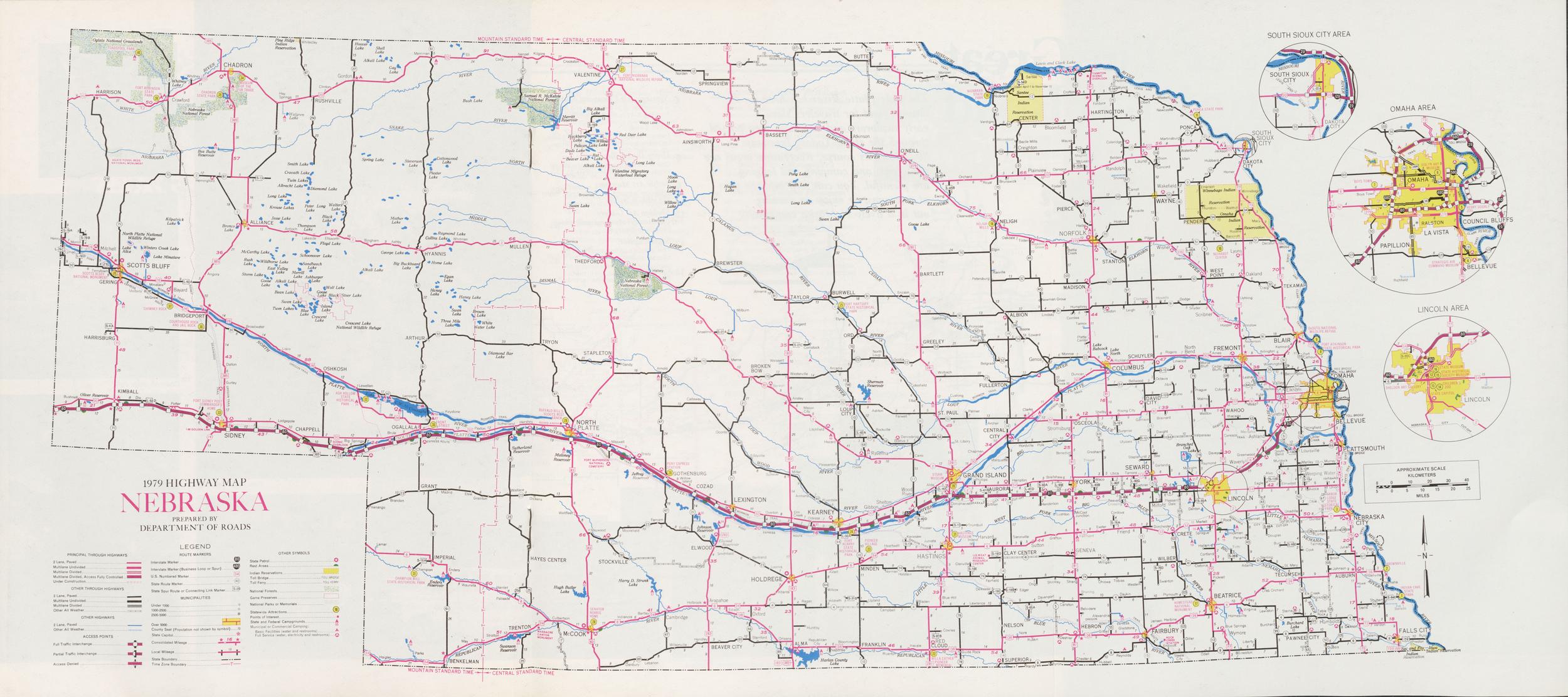
1979 Highway Map Nebraska
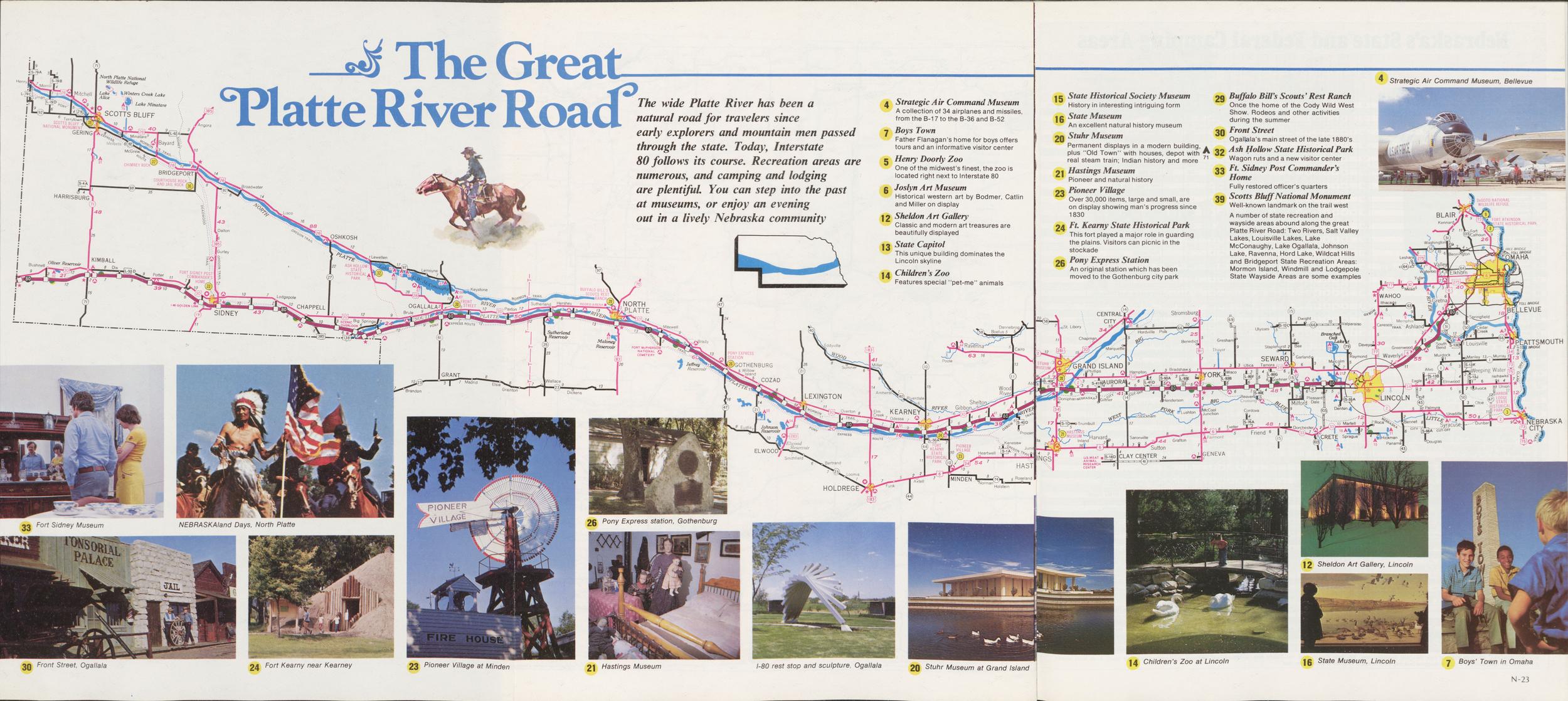
The Great Platte River Road
The wide Platte River has been a natural road for travelers since early explorers and mountain men passed through the state. Today, Interstate 80 follows its course. Recreation areas are numerous, and camping and lodging are plentiful. You can step into the past at museums, or enjoy and evening out in alively Nebraska community. Strategic Air Command MuseumA collection of 34 airplanes and missiles from the B-17 to the B-36 and B-52
Boys TownFather Flanagan's home for boys offers tours and an informative visitor center
Henry Doorly ZooOne of the midwest's finest, the zoo is located right next to Interstate 80
Joslyn Art MuseumHistorical western art by Bodmer, Caitlin and Miller on display
Sheldon Art GalleryClassic and modern treasures are beautifully displayed
State CapitolThis unique building dominated the Lincoln skyline
Children's ZooFeatures special "pet-me" animals
State Historical Society MuseumHistory in interesting intriguing form
State MuseumAn ecellent natural history museum
Stuhr MuseumPermanent displays in a modern building plus "Old Town" with houses, depot with real stead train; Indian history and more
Hasting MuseumPioneer and natural history
Pioneer VillageOver 30,000 items, large and small, are on display showing man's progress since 1830
Ft. Kearny State Historical ParkThis fort played a major role in guarding the plains. Visitors can picnic in the stockage
Pony Express StationAn original station which has been moved to the Gothenburg city park
Buffalo Bill's Scout's Rest RanchOnce the home of the Cody Wild West Sow. Rodeos and other activities during the summer
Front StreetOgallala;s main street of the late 1880's
Ash Hollow State Historical ParkWagon ruts and a new visitor center
Ft. Sidney Post Commander's HomeFully restored officer's quarters
Scotts Bluff National MonumentWell Known landmark on the trail west
A number of state recreation and wayside areas abound along the great Platte River Road: Two Rivers, Salt Valley Lakes, Lousiville Lakes, Lake McConaughy, Lake Ogallala, Johnson Lake, Ravenna, Hord Lake, Wilcat Hills and Bridgeport State Recreation Areas: Mormon Island, Windmill and Lodgepole State Wayside Areas are some examples
Fort Sidney Museum
NEBRASKAland Days, North Platte
Front Street, Ogallala
Fort Kearny near Kearney
Pioneer Village at Minden
Pony Express station, Gothenburg
Hastings Museum
1-80 rest stop and sculpture, Ogallala
Stuhr Museum at Grand Island
Children's Zoo at Lincoln
Strategic Air Command Museum, Bellevue
Sheldon Art Gallery, Lincoln
State Museum, Lincoln
Boys' Town in Omaha
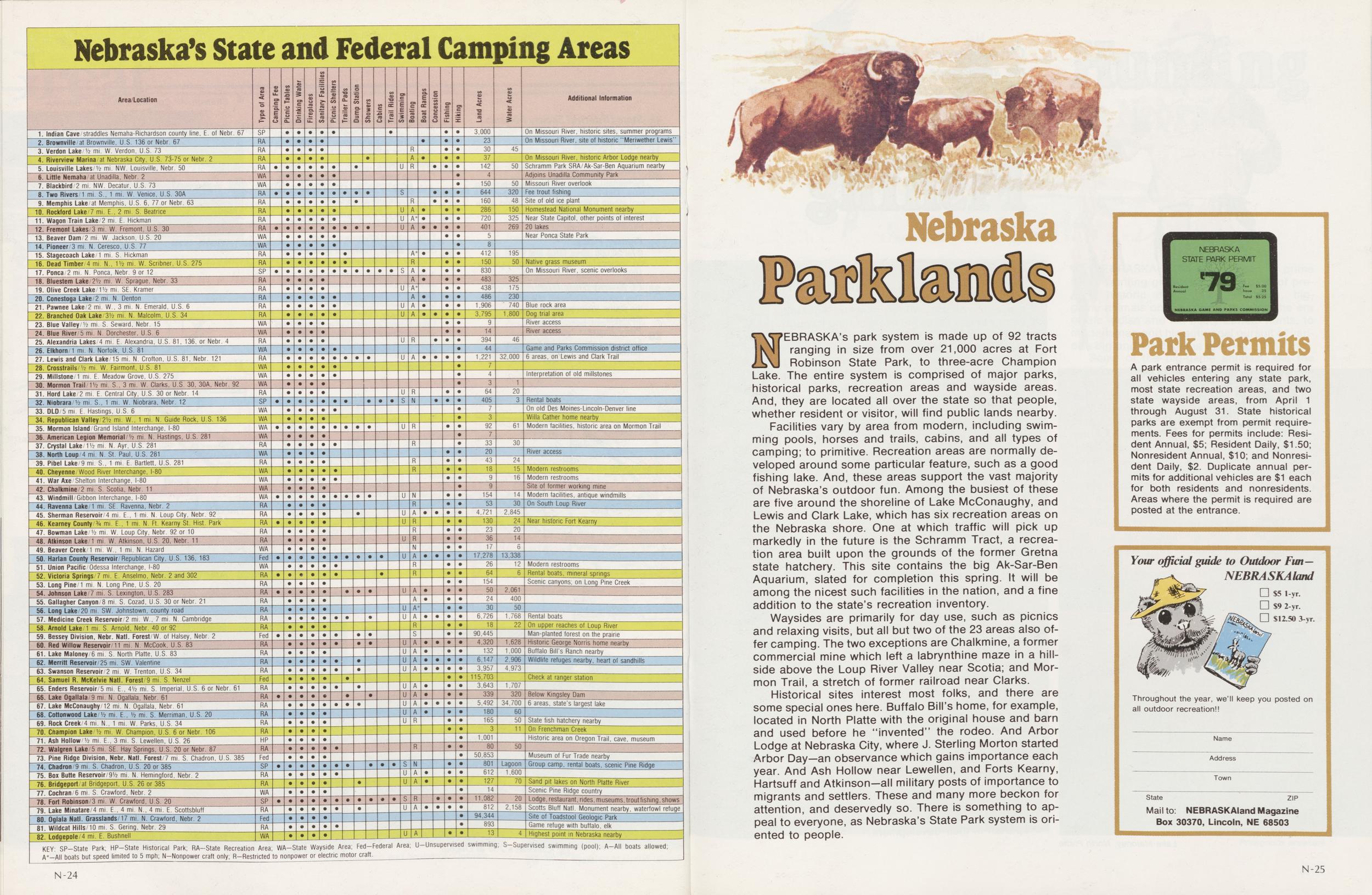
Nebraska's State and Federal Camping Areas
Nebraska Parklands
NEBRASKA's park system is made up of 92 tracts ranging in size from over 21,000 acres at Fort Robinson State Park, to three-acre Champion Lake. The entire system is comprised of major parks, historical parks, recreation areas and wayside areas. And, they are located all over the state so that people, whether resident or visitor, will find public lands nearby.
Facilities vary by area from modern, including swim.ming pools, horses and trails, cabins, and all types of camping; to primitive. Recreation areas are normally de.veloped around some particular feature, such as a good fishing lake. And, these areas support the vast majority of Nebraska's outdoor fun. Among the busiest of these are five around the shoreline of Lake Mcconaughy, and Lewis and Clark Lake, which has six recreation areas on the Nebraska shore. One at which traffic will pick up markedly in the future is the Schramm Tract, a recrea.tion area built upon the grounds of the former Gretna state hatchery. This site contains the big Ak-Sar-Ben Aquarium, slated for completion this spring. It will be among the nicest such facilities in the nation, and a fine addition to the state's recreation inventory.
Waysides are primarily for day use, such as picnics and relaxing visits, but all but two of the 23 areas also of.fer camping. The two exceptions are Chalkmine, a former commercial mine which left a labrynthine maze in a hill.side above the Loup River Valley near Scotia; and Mor.mon Trail, a stretch of former railroad near Clarks.
Historical sites interest most folks, and there are some special ones here. Buffalo Bill's home, for example, located in North Platte with the original house and barn and used before he "invented" the rodeo. And Arbor Lodge at Nebraska City, where J. Sterling Morton started Arbor Day-an observance which gains importance each year. And Ash Hollow near Lewellen, and Forts Kearny, Hartsuff and Atkinson-all military posts of importance to migrants and settlers. These and many more beckon for attention, and deservedly so. There is something to ap.peal to everyone, as Nebraska's State Park system is oriented to people.
Park Permits
A park entrance permit is required for all vehicles entering any state park, most state recreation areas, and two state wayside areas, from April 1 through August 31. State historical parks are exempt from permit require.ments. Fees for permits include: Resi.dent Annual, $5; Resident Daily, $1.50; Nonresident Annual, $10; and Nonresi.dent Daily, $2. Duplicate annual per.mits for additional vehicles are $1 each for both residents and nonresidents. Areas where the permit is required are posted at the entrance.
Your official guide to Outdoor Fun – Nebraskaland
$5 1-yr $9 2-yr. $12.50 3-yr. Throughout the year, we'll keep you posted on all outdoor recreation!! Name Address Town State ZIP Mail to: NEBRASKAland Magazine Box 30370, Lincoln, NE 68503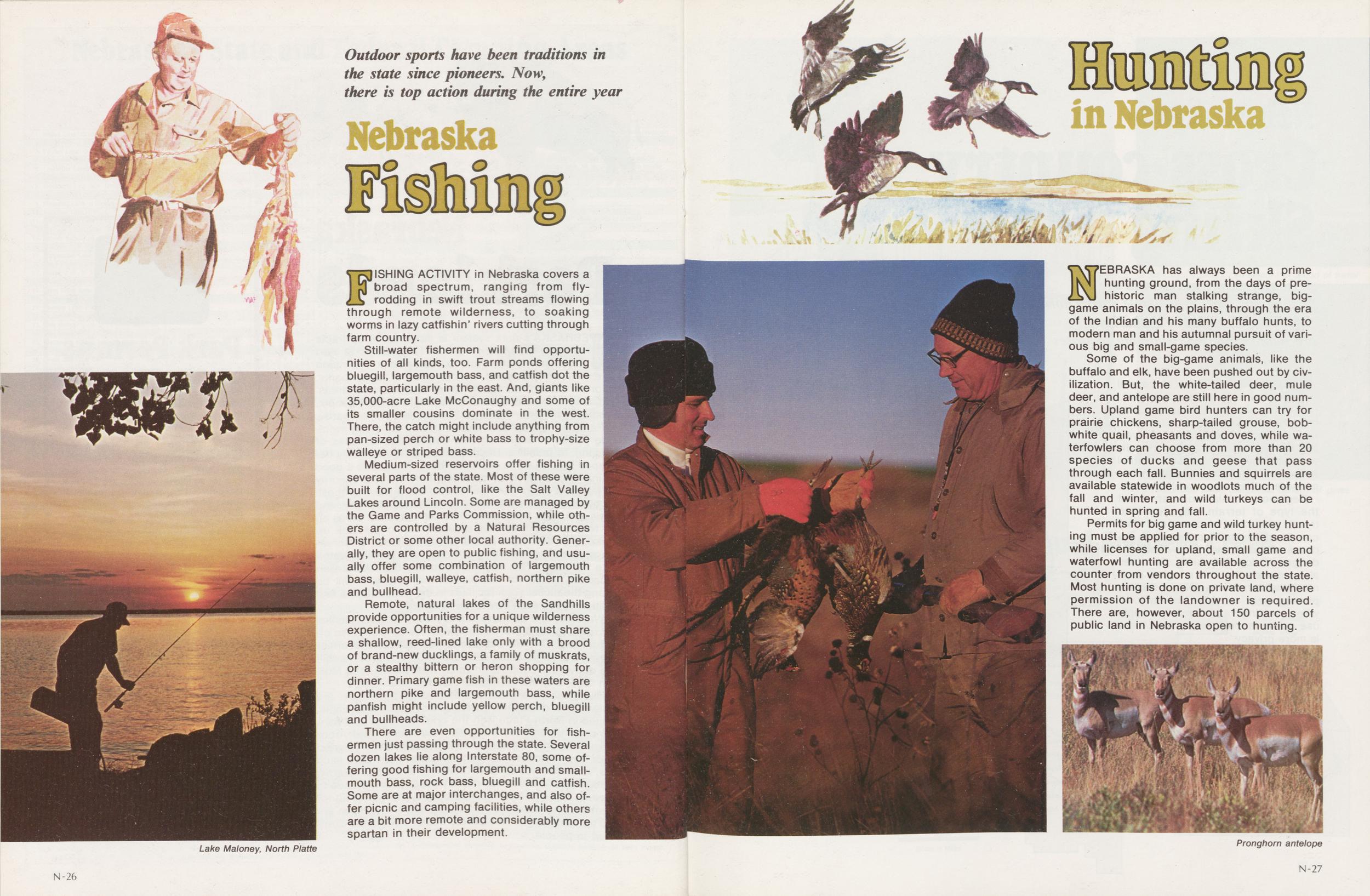
Nebraska Fishing
Outdoor sports have been traditions in the state since pioneers. Now, there is top action during the entire year
Lake Maloney, North Platte
FISHING ACTIVITY in Nebraska covers a broad spectrum, ranging from fly. rodding in swift trout streams flowing through remote wilderness, to soaking worms in lazy catfishin' rivers cutting through farm country.
Still-water fishermen will find opportunities of all kinds, too. Farm ponds offering bluegill, largemouth bass, and catfish dot the state, particularly in the east. And, giants like 35,000-acre Lake Mcconaughy and some of its smaller cousins dominate in the west. There, the catch might include anything from pan-sized perch or white bass to trophy-size walleye or striped bass.
Medium-sized reservoirs offer fishing in several parts of the state. Most of these were built for flood control, like the Salt Valley Lakes around Lincoln. Some are managed by the Game and Parks Commission, while others are controlled by a Natural Resources District or some other local authority. Gener.ally, they are open to public fishing, and usu.ally offer some combination of largemouth bass, bluegill, walleye, catfish, northern pike and bullhead.
Remote, natural lakes of the Sandhills provide opportunities for a unique wilderness experience. Often, the fisherman must share a shallow, reed-lined lake only with a brood of brand-new ducklings, a family of muskrats, or a stealthy bittern or heron shopping for dinner. Primary game fish in these waters are northern pike and largemouth bass, while panfish might include yellow perch, bluegill and bullheads.
There are even opportunities for fishermen just passing through the state. Several dozen lakes lie along Interstate 80, some of.fering good fishing for largemouth and smallmouth bass, rock bass, bluegill and catfish. Some are at major interchanges, and also offer picnic and camping facilities, while others are a bit more remote and considerably more spartan in their development.
Hunting in Nebraska
NEBRASKA has always been a prime hunting ground, from the days of prehistoric man stalking strange, big-game animals on the plains, through the era of the Indian and his many buffalo hunts, to modern man and his autumnal pursuit of various big and small-game species.
Some of the big-game animals, like the buffalo and elk, have been pushed out by civilization. But, the white-tailed deer, mule deer, and antelope are still here in good numbers. Upland game bird hunters can try for prairie chickens, sharp-tailed grouse, bobwhite quail, pheasants and doves, while waterfowlers can choose from more than 20 species of ducks and geese that pass through each fall. Bunnies and squirrels are available statewide in woodlots much of the fall and winter, and wild turkeys can be hunted in spring and fall.
Permits for big game and wild turkey hunting must be applied for prior to the season, while licenses for upland, small game and waterfowl hunting are available across the counter from vendors throughout the state. Most hunting is done on private land, where permission of the landowner is required. There are, however, about 150 parcels of public land in Nebraska open to hunting.
Pronghorn antelope
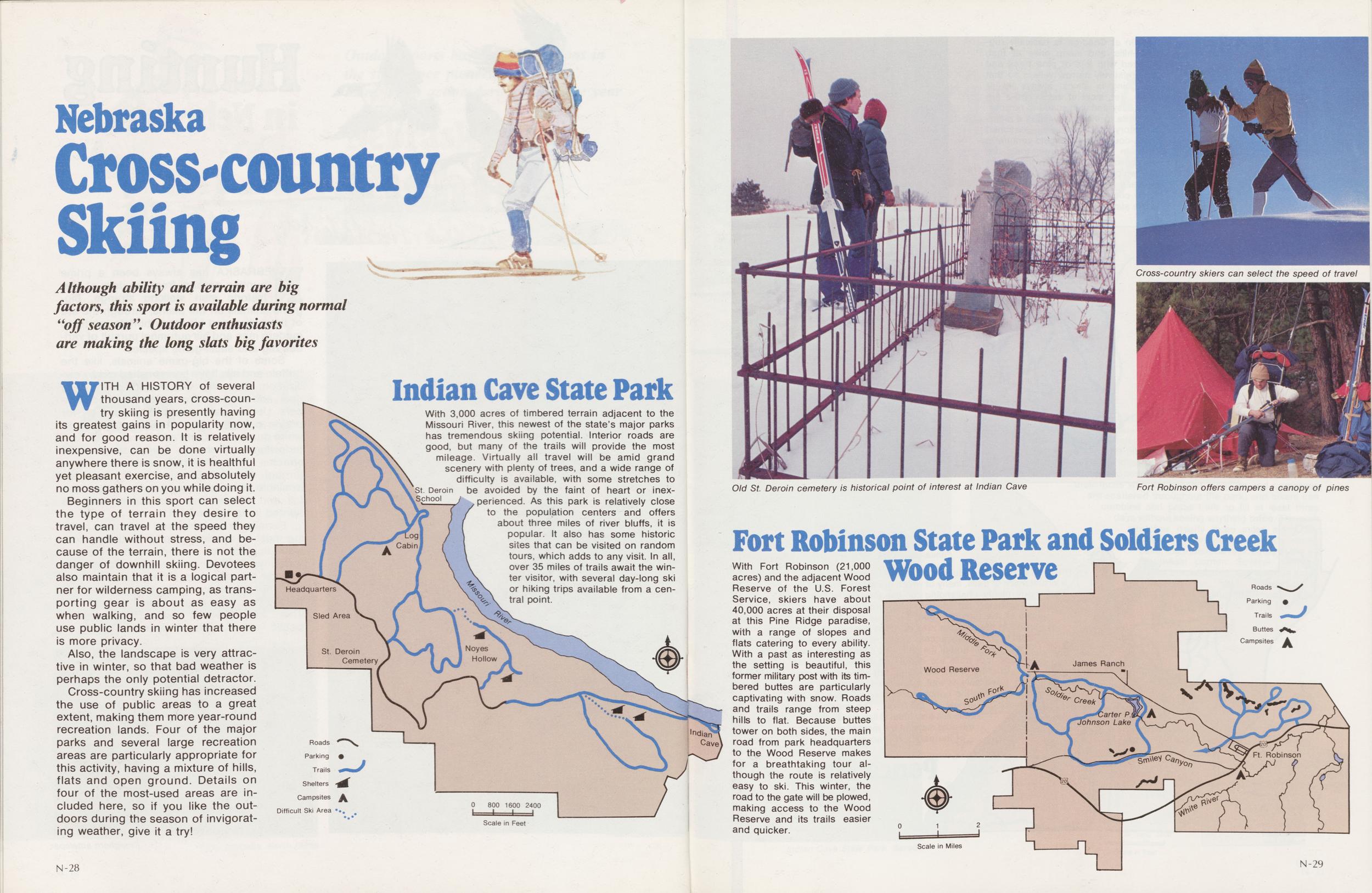
Nebraska Cross-country Skiing
Although ability and terrain are big factors, this sport is available during normal "off season". Outdoor enthusiasts are making the long slats big favoritesWITH A HISTORY of several thousand years, cross-country skiing is presently having the its greatest gains in popularity now, and for good reason. It is relatively inexpensive, can done but many of trails will provide the most be virtually good, the mileage. Virtually all travel will be amid grand anywhere there is snow, it is healthful yet pleasant exervise, and absolutely no moss gathers on you while doing it.
Beginners in this sport can select the type of terrain they desire to travel, can travel at the speed they can handle without stress, and because of the terrain, there is not the danger of downhill skiing. Devotees also maintain that it is a logical partner for wilderness camping, as transporting gear is about as easy as when walking, and so few people use public lands in winter that there is more privacy.
Also, the landscape is very attractive in winter, so that bad weather is perhaps the only potential detractor.
Cross-country skiing has increased the use of public areas to a great extent, making them more year-round recreation lands. Four of the major parks and several large recreation Roads areas are particularly appropriate for this activity, having a mixture of hills, flats and open ground. Details on Shelters four of the most-used areas are included here, so if you like the outdoors during the season of invigorating weather, give it a try!
Indian Cave State ParkWith 3,000 acres of timbered terrain adjacent to Missouri River, this newest of the state's major parks has tremendous skiing potential. Interior roads are good, but many of the trails will provide the most mileage. Vitually all travel will be amid grand scenery with plenty of trees, and a wide range of difficulty is available, with some stretches to be avoided by the faint of heart or inexperienced. As this park is relatively close to the population centers and other about three miles of river bluffs, it is popular. It also has some historic sites that can be visited on random tours, which adds to any visit. In all, over 35 miles of trails await the winter visitor, with several day-long ski or hiking trips available from a central point.
Old St. Deroin cemetery is historical point of interest at Indian Cave
Cross-country skiiers can select the speed of travel
Fort Robinson offers campers a canopy of pines
With Fort Robinson (21,000 acres) and the adjacent Wood Reserve of the U.S. Forest Service, skiers have about 40,000 acres at their disposal at this Pine Ridge paradise, with a range of slopes and flats catering to every ability. With a past as interesting as the setting is beautiful, this former military post with its timbered buttes are particularly captivating with snow. Roads and trails range from steep hills to flat. Because buttes tower on both sides, the main road from park headquarters to the Wood Reserve makes for a breathtaking tour although the route is relatively easy to ski. This winter, the road to the gate will be plowed, Terrain at Chadron is basically rugged-hills, and steep ones at that, covered with lots of pine trees and only relatively narrow valleys so that making access to the Wood Reserve and its trails easier and quicker.
N-28 N-29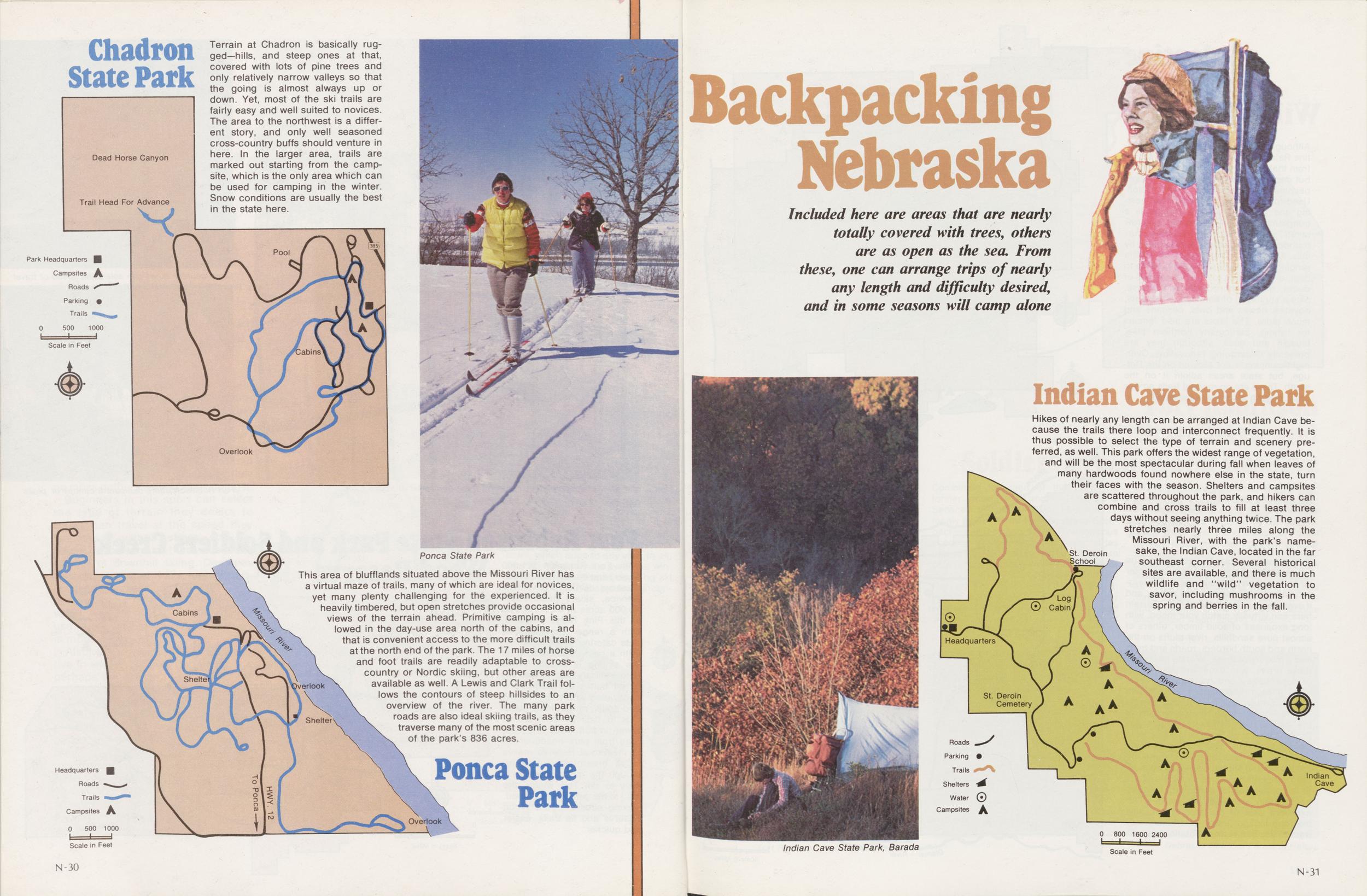 Chadron
State Park
Chadron
State Park
Terrain at Chadron is basically rugged–hills, and steep ones at that, covered with lots of pine trees and only relatively narrow valleys so that the going is almost always up or down. Yet, most of the ski trails are fairly easy and well suited to novices. The area to the northwest is a different story, and only well seasoned cross-country buffs should venture in here. In the larger area, trails are marked out starting from the campsite, which is the only area which can be used for camping in the winter. Snow conditions are usually the best in the state here.
Ponca State Park
This area of blufflands situated above the Missouri River has a virtual maze of trails, many of which are ideal for novices, yet many plenty challenging for the experienced. It is heavily timbered, but open stretches provide occasional views of the terrain ahead. Primitive camping is allowed in the day-use area north of the cabins, and that is convenient access to the more difficult trails at the north end of the park. The 17 miles of horse and foot trails are readily adaptable to cross-country or Nordic skiing, but other areas are available as well. A Lewis and Clark Trail follows the contours of steep hillsides to an overview of the river. The many park roads are also ideal skiing trails, as they traverse many of the most scenic areas of the park's 836 acres.
Backpacking Nebraska
Included here are areas that are nearly totally covered with trees, others are as open as the sea. From these, one can arrange trips of nearly any length and difficulty desired, and in some seasons will camp aloneHikes of nearly any length can be arranged at Indian Cave because the trails there loop and interconnect frequently. It is thus possible to select the type of terrain and scenery preferred, as well. This park offers the widest range of vegetation, and will be the most spectacular during fall when leaves of many hardwoods found nowhere else in the state, turn their faces with the season. Shelters and campsites are scattered throughout the park, and hikers can combine and cross trails to fill at least three A days without seeing anything twice. The park stretches nearly three miles along the Missouri River, with the park's namesake, the Indian Cave, located in the far southeast corner. Several historical sites are available, and there is much wildlife and "wild" vegetation to savor, including mushrooms in the spring and berries in the fall.
Indian Cave State Park, Barada
 Valentine National Wildlife Refuge
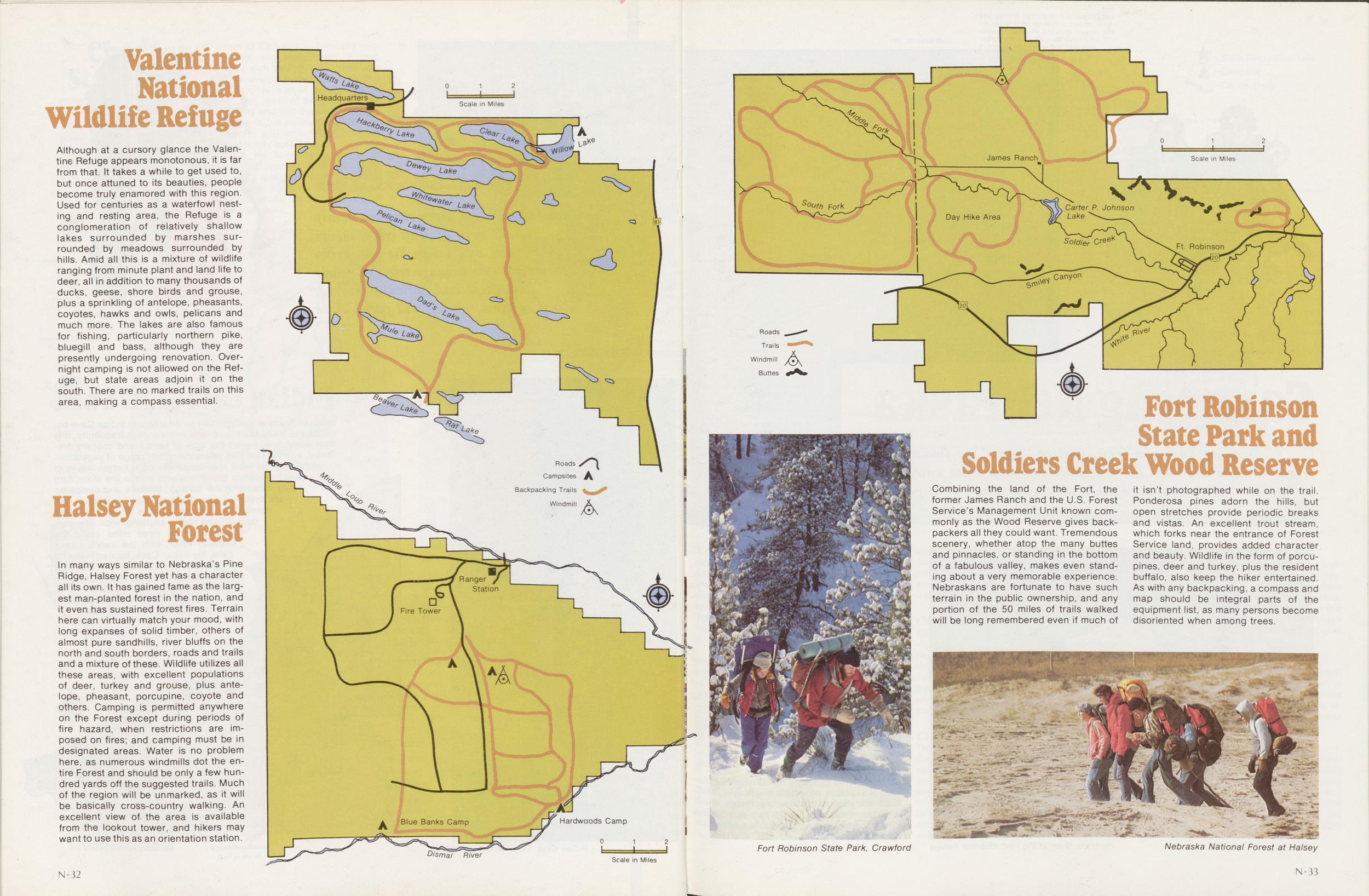
Although at a cursory glance the Valentine Refuge appears monotonous, it is far from that. It takes a while to get used to, but once attuned to its beauties, people become truly enamored with this region. Used for centuries as a waterfowl nesting and resting area, the Refuge is a conglomeration of relatively shallow lakes surrounded by marshes surrounded by meadows surrounded by hills. Amid all this is a mixture of wildlife ranging from minute plant and land life to deer, all in addition to many thousands of ducks, geese, shore birds and grouse, plus a sprinkling of antelope, pheasants, coyotes, hawks and owls, pelicans and much more. The lakes are also famous for fishing, particularly northern pike, bluegill and bass, although they are presently undergoing renovation. Overnight camping is not allowed on the Refuge, but state areas adjoin it on the south. There are no marked trails on this area, making a compass essential.
In many ways similar to Nebraska's Pine Ridge, Halsey Forest yet has a character all its own. It has gained fame as the largest man-planted forest in the nation, and it even has sustained forest fires. Terrain here can virtually match your mood, with long expanses of solid timber, others of almost pure sandhills, river bluffs on the north and south borders, roads and trails and a mixture of these. Wildlife utilizes all these areas, with excellent populations of deer, turkey and grouse, plus antelope, pheasant, porcupine, coyote and others. Camping is permitted anywhere on the Forest except during periods of fire hazard, when restrictions are imposed on fires; and camping must be in designated areas. Water is no problem here, as numerous windmills dot the entire Forest and should be only a few hundred yards off the suggested trails. Much of the region will be unmarked, as it will be basically cross-country walking. An excellent view of, the area is available from the lookout tower, and hikers may want to use this as an orientation station.
Combining the land of the Fort, the former James Ranch and the U.S. Forest Service's Management Unit known commonly as the Wood Reserve gives backpackers all they could want. Tremendous scenery, whether atop the many buttes and pinnacles, or standing in the bottom of a fabulous valley, makes even standing about a very memorable experience. Nebraskans are fortunate to have such terrain in the public ownership, and any portion of the 50 miles of trails walked will be long remembered even if much of it isn't photographed while on the trail. Ponderosa pines adorn the hills, but open stretches provide periodic breaks and vistas. An excellent trout stream, which forks near the entrance of Forest Service land, provides added character and beauty. Wildlife in the form of porcupines, deer and turkey, plus the resident buffalo, also keep the hiker entertained. As with any backpacking, a compass and map should be integral parts of the equipment list, as many persons become disoriented when among trees.
Fort Robinson State Park, Crawford
Nebraska National Forest at Halsey
Canoeing Nebraska
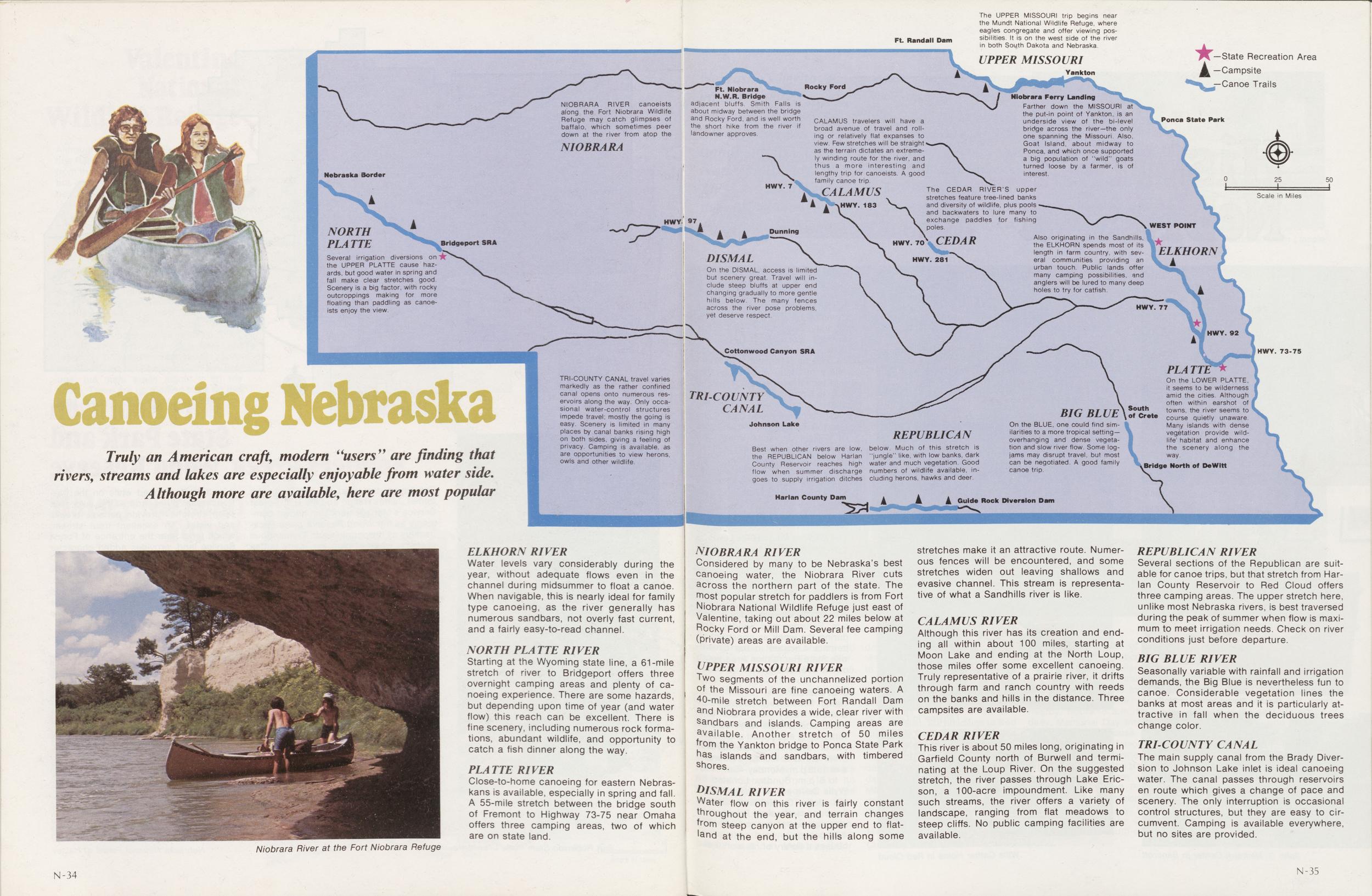
Truly an American craft, modern "users" are finding that rivers, streams and lakes are especially enjoyable from water side. Although more are available, here are most popular
The UPPER MISSOURI trip begins near the Mundt National Wildlife Refuge, where eagles congregate and offer viewing pos. sibilities. It is on the west side of the river in both South Dakota and Nebraska.
Ft. Randall Dam
UPPER MISSOURI
Yankton
Rocky Ford
N.W.R. Bridge Niobrara Ferry Landing NIOBRARA RIVER canoeists adjacent bluffs Smith Falls 1s Farther down the MISSOURI atalong the Fort Niobrara Wildlife about midway between the bridge the put-in point of Yankton, is an Refuge may catch glimpses of and Rocky Ford, and is well worth CALAMUS travelers will have a underside view of the bilevelbaffalo, which sometimes peer the short hike from the river if broad avenue of travel and rollbridge across the river-the only down at the river from atop the landowner approves. ing or relatively flat expanses to one spanning the Missouri. Also, view .. Few stretches will be straight Goat Island,· about midway to
NIOBRARA
as the terrain dictates an extreme-Ponca, and which once supported ly winding route for the river. and a big population of "wild" goats thus a more interesting and turned loose by a farmer, is of Nebraska Border lengthy trip for canoeists. A good interest. mily canoe trip. Several irrigation diversions on* the UPPER PLATTE cause haz.ards, but good water in spring and fall make clear stretches good Scenery is a big factor, with rocky outcroppings making for more floating than paddling as canoe.ists enjoy the view. Nebraska TRI-COUNTY CANAL travel varies markedly as the rather confined canal opens onto numerous res.ervoirs along the way. Only occa.s1onal water-control structures impede travel; mostly the going is Canoeing easy. Scenery is limited in many places by canal banks rrs1ng high on both sides, giving a feeling of privacy Camping is available. as are opportunities to view herons, owls and other wildlife.
DISMAL On the DISMAL, access is limited but scenery great. Travel will in. clude steep bluffs at upper end changing gradually to more gentle hills below. The many fences across the river pose problems, yet deserve respect.
Johnson Lake silarities to a more tropical setting.
REPUBLICAN overhanging and dense vegeta.Best when other rivers are low, below. Much of this stretch is tion and slow nver flow. Some log.the REPUBLICAN below Harlan "jungle" like, with low banks, dark jams may disrupt travel. but most County Reservoir reaches higt.water and much vegetation. Good can be negotiated. A good family flow when summer discharge numbers of wildlife available, in.canoe trip. goes to supply irrigation ditches cluding herons. hawks and deer. Harlan County Dam A Gulde Rock Diversion Dam
The CEDAR RIVER'S upper stretches feature tree-lined banks and diversity of wildlife, plus pools and backwaters to lure many to exchange paddles for fishing poles. R Also originating in the Sandhi the ELKHORN spends most of length in farm country, with s eral communities providing urban touch. Public lands of On the BLUE, one could find sim.
On the LOWER PLATTE, it seems to be wilderness amid the cities. Although often within earshot of towns, the river seems to course quietly unaware. Many islands with dense ve9,8tation provide wild.life· habitat and enhance the scenery along the way
Bridge North of DeWitt
Niobrara River at the Fort Niobrara Refuge
Water levels vary considerably during the year, without adequate flows even in the channel during midsummer to float a canoe. When navigable, this is nearly ideal for family type canoeing, as the river generally has numerous sandbars, not overly fast current, and a fairly easy-to-read channel.
NORTH PLATTE RIVERStarting at the Wyoming state line, a 61-mile stretch of river to Bridgeport offers three overnight camping areas and plenty of canoeing experience. There are some hazards, but depending upon time of year (and water flow) this reach can be excellent. There is fine scenery, including numerous rock formations, abundant wildlife, and opportunity to catch a fish dinner along the way.
PLATTE RIVERClose-to-home canoeing for eastern Nebraskans is available, especially in spring and fall. A 55-mile stretch between the bridge south of Fremont to Highway 73-75 near Omaha offers three camping areas, two of which are on state land.
NIOBRARA RIVERConsidered by many to be Nebraska's best canoeing water, the Niobrara River cuts across the northern part of the state. The most popular stretch for paddlers is from Fort Niobrara National Wildlife Refuge just east of Valentine, taking out about 22 miles below at Rocky Ford or Mill Dam. Several fee camping (private) areas are available.
UPPER MISSOURI RIVERTwo segments of the unchannelized portion of the Missouri are fine canoeing waters. A 40-mile stretch between Fort Randall Dam and Niobrara provides a wide, clear river with sandbars and islands. Camping areas are available. Another stretch of 50 miles from the Yankton bridge to Ponca State Park has islands and sandbars, with timbered Shores.
DISMAL RIVERWater flow on this river is fairly constant throughout the year, and terrain changes from steep canyon at the upper end to flatland at the end, but the hills along some stretches make it an attractive route. Numerous fences will be encountered, and some stretches widen out leaving shallows and evasive channel. This stream is representative of what a Sandhills river is like.
CALAMUS RIVERAlthough this river has its creation and ending all within about 100 miles, starting at Moon Lake and ending at the North Loup, those miles offer some excellent canoeing. Truly representative of a prairie river, it drifts through farm and ranch country with reeds on the banks and hills in the distance. Three campsites are available.
CEDAR RIVERThis river is about 50 miles long, originating in Garfield County north of Burwell and terminating at the Loup River. On the suggested stretch, the river passes through Lake Ericson, a 100-acre impoundment. Like many such streams, the river offers a variety of landscape, ranging from flat meadows to steep cliffs. No public camping facilities are available.
REPUBLICAN RIVERSeveral sections of the Republican are suitable for canoe trips, but that stretch from Harlan County Reservoir to Red Cloud offers three camping areas. The upper stretch here, unlike most Nebraska rivers, is best traversed during the peak of summer when flow is maximum to meet irrigation needs. Check on river conditions just before departure.
BIG BLUE RIVERSeasonally variable with rainfall and irrigation demands, the Big Blue is nevertheless fun to canoe. Considerable vegetation lines the banks at most areas and it is particularly attractive in fall when the deciduous trees change color.
TRI-COUNTY CANALThe main supply canal from the Brady Diversion to Johnson Lake inlet is ideal canoeing water. The canal passes through reservoirs en route which gives a change of pace and scenery. The only interruption is occasional control structures, but they are easy to circumvent. Camping is available everywhere, but no sites are provided.
Visit Historic Nebraska
Kennard House in Lincoln
Captain Meriwether Lewis in Brownville
George Norris Home in McCook
Fairview in Lincoln
John G. Neihardt Center in Bancroft
Willa Cather Home in Red Cloud
Historical Society Headquarters in Lincoln
Fort Robinson at Crawford
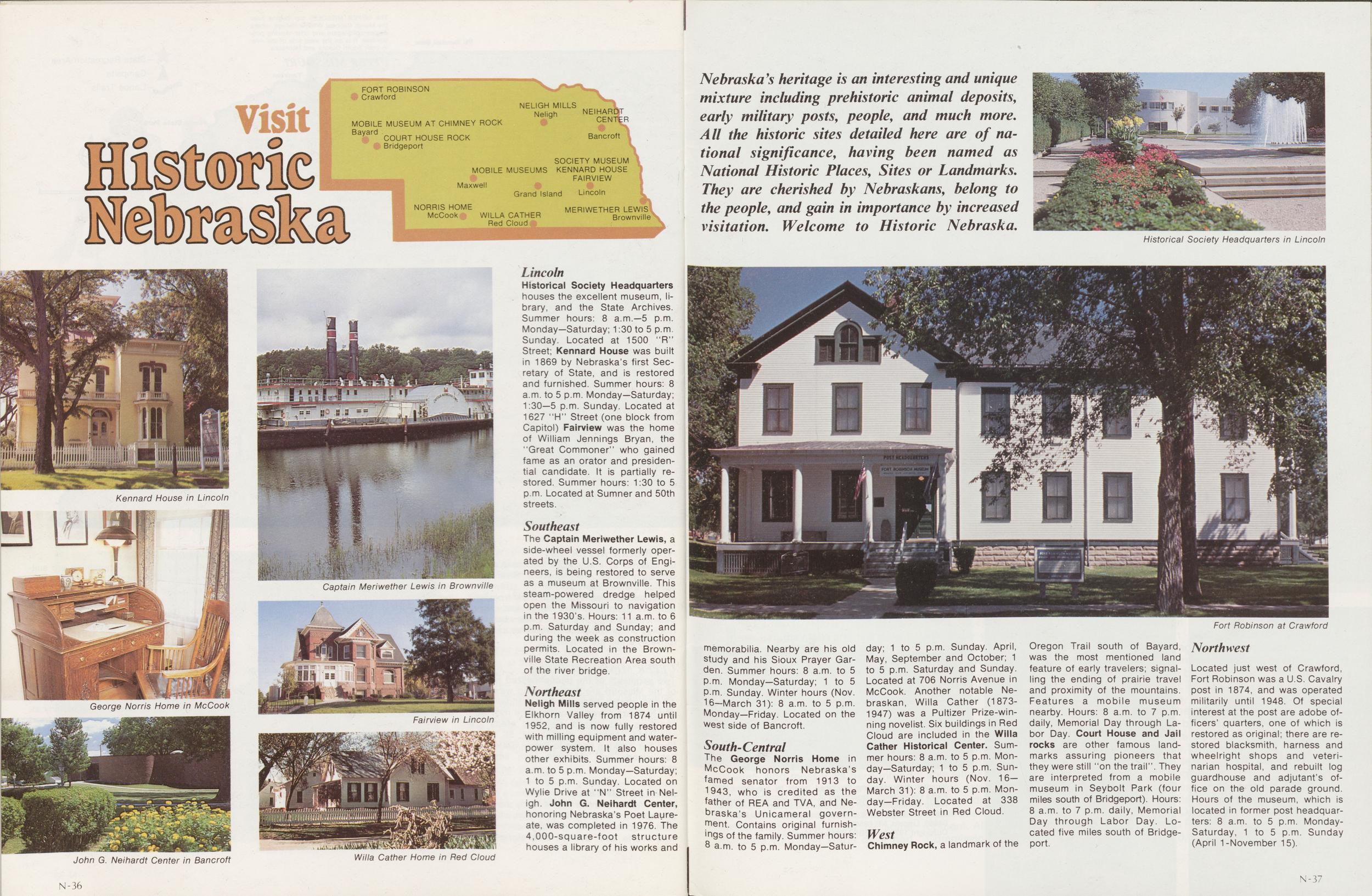
Historical Society Headquarters houses the excellent museum, library, and the State Archives. Summer hours: 8 a.m.-5 p.m. Monday-Saturday; 1 :30 to 5 p.m. Sunday. Located at 1500 "R" Street; Kennard House was built in 1869 by Nebraska's first Secretary of State, and is restored and furnished. Summer hours: 8 a.m. to 5 p.m. Monday-Saturday; 1 :30-5 p.m. Sunday. Located at 1627 "H" Street (one block from Capitol) Fairview was the home of William Jennings Bryan, the "Great Commoner" who gained fame as an orator and presidential candidate. It is partially re.stored. Summer hours: 1 :30 to 5 p.m. Located at Sumner and 50th streets.
SoutheastThe Captain Meriwether Lewis, a side-wheel vessel formerly operated by the U.S. Corps of Engineers, is being restored to serve as a museum at Brownville. This steam-powered dredge helped open the Missouri to navigation in the 1930's. Hours: 11 a.m. to 6 p.m. Saturday and Sunday; and Fort Robinson at Crawford during the week as construction permits. Located in the Brownville State Recreation Area south of the river bridge.
NortheastNeligh Mills served people in the Ekhorn Valley from 1874 until 1952 and is now fully restored with milling equipment and waterpower system. It also houses other exhibits. Summer hours: 8 a.m. to 5 p.m. Monday – Saturday; 1 to 5 p.m. Sunday. Located on Wylie Drive at "N" Street in Neligh. John G. Neihard Center, honoring Nebraska's Poet Laureate, was complete in 1976. The 4,000-square-foot structure houses a library of his works and memorabilia. Nearby are his old study and his sioux Prayer Garden. Summer hours: 8. a.m. to 5 p.m. Monday-Saturday; 1 to 5 p.m. Sunday. Winter hours (Nov.16-March 31) 8 a.m. to 5 p.m. Monday-Friday. Located on the west side of Bancroft.
South-CentalThe George Norris home in McCook honors Nebraska's famed senator from 1913 to 1943, who is credited as the father of REA and TVA, and Nebraska's Unicameral government. Contains original furnishings of the family. Summer hour: 8.am to 5 p.m. Monday-Saturday; 1 to 5 p.m. Sunday. April, May, September and Octorb; 1 p.m. to 5 p.m. Saturday and Sunday. Located at 706 Norris Avenue in McCook. Another notable Nebraska, Willa Cather (1873-1947) was a Pulitzer Price-winning novelist. Six buildings in Red Cloud are included in the Willa Cather Historical Center. Summer hours 8 a.m. to 5 p.m. Monday-Saturday; 1 to 5 p.m. Sunday. Winter hours (Nov. 16-March 31) 8 a.m. to 5 p.m. Monday–Friday. Located at 338 Webster Street in Red Cloud.
WestChimney Rock, a landmark of the Oregon Trail south of Bayard, was the most mentioned land feature of early travelers; signaling the ending of prairie travel and proximity of the mountains. Feature a mobile museum nearby. Hours: 8 a.m. to 7 p.,. daily. Memorial Day through Labor Day. Court House and Jail rocks are other famous landmarks assuring pioneers that they were still "on the trail". They are interpreted from a mobile museum in Seybolt Park (fout miles south of Bridgeport). Hours; 8 .am. to 7 p.m. daily. Memorial Day through Labor Day. Located five miles south of Bridgeport.
NorthwestLocated just west of Crawford, Fort Robinson was a U.S. Cavalry post in 1874, and was operated militarily until 1948. Of special interest at the post are adobe officers' quarters, one of which is restored as original; there are resrored blacksmith, harness and wheelright shops and veterinarian hospital, rebuilt log guardhouse and adjuntant's office on the old parade ground. House of the museum, which is located in former post headquarters: 8 a.m. to 5 p.m. Monday-Saturday, 1 to 5 p.m. Sunday (April 1-November 15).
N-36 N-37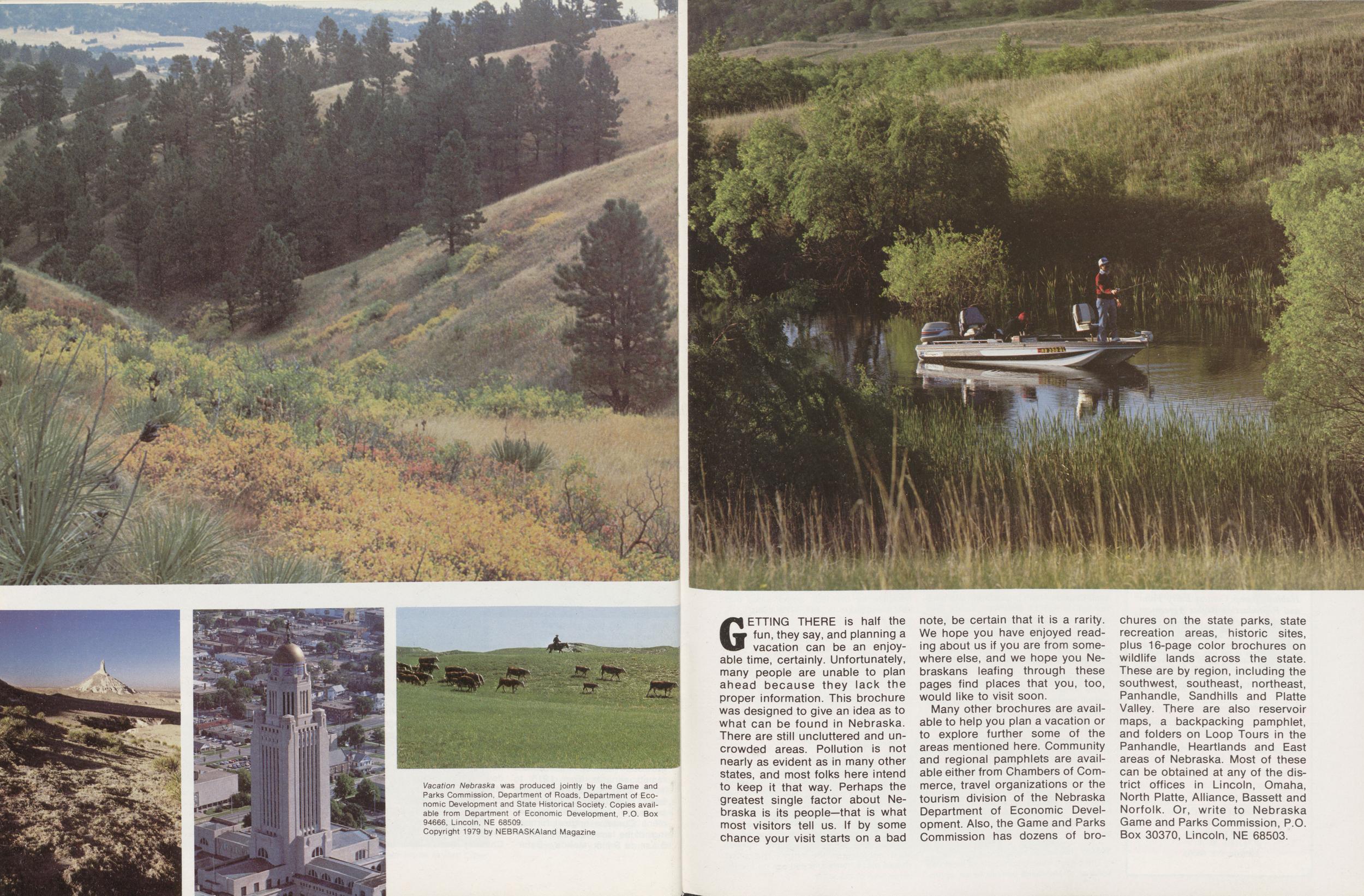
Vacation Nebraska was produced jointly by the Game and Parks Commission, Department of Roads, Department of Eco.nomic Development and State Historical Society. Copies avail.able from Department of Economic Development, P.O. Box 94666, Lincoln, NE 68509. Copyright 1979 by NEBRASKAland Magazine
GETTING THERE is half the fun, they say, and planning a vacation can be an enjoyable time, certainly. Unfortunately, many people are unable to plan ahead because they lack the proper information. This brochure was designed to give an idea as to what can be found in Nebraska. There are still uncluttered and uncrowded areas. Pollution is not nearly as evident as in many other states, and most folks here intend to keep it that way. Perhaps the greatest single factor about Nebraska is its people-that is what most visitors tell us. If by some chance your visit starts on a bad note, be certain that it is a rarity. We hope you have enjoyed reading about us if you are from some.where else, and we hope you Nebraskans leafing through these pages find places that you, too, would like to visit soon.
Many other brochures are available to help you plan a vacation or to explore further some of the areas mentioned here. Community and regional pamphlets are avail.able either from Chambers of Commerce, travel organizations or the tourism division of the Nebraska Department of Economic Development. Also, the Game and Parks Commission has dozens of brochures on the state parks, state recreation areas, historic sites, plus 16-page color brochures on wildlife lands across the state. These are by region, including the southwest, southeast, northeast, Panhandle, Sandhills and Platte Valley. There are also reservoir maps, a backpacking pamphlet, and folders on Loop Tours in the Panhandle, Heartlands and East areas of Nebraska. Most of these can be obtained at any of the district offices in Lincoln, Omaha, North Platte, Alliance, Bassett and Norfolk. Or, write to Nebraska Game and Parks Commission, P.O. Box 30370, Lincoln, NE 68503.
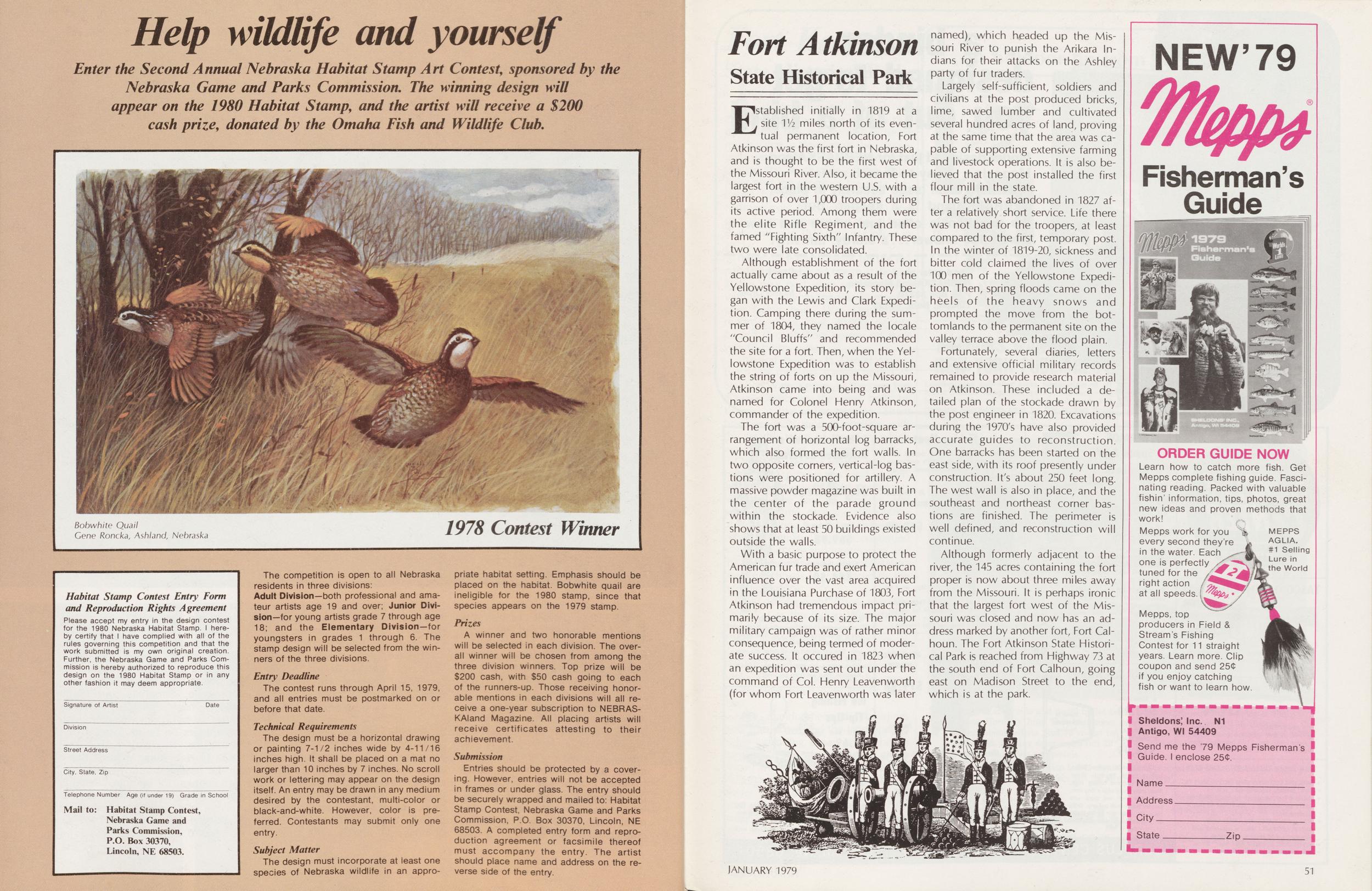
Fort Atkinson State Historical Park
Established initially in 1819 at a site 1 1/2 miles north of its eventual permanent location, Fort Atkinson was the first fort in Nebraska, and is thought to be the first west of the Missouri River. Also, it became the largest fort in the western U.S. with a garrison of over 1,000 troopers during its active period. Among them were the elite Rifle Regiment, and the famed "Fighting Sixth" Infantry. These two were late consolidated.
Although establishment of the fort actually came about as a result of the Yellowstone Expedition, its story began with the Lewis and Clark Expedition. Camping there during the summer of 1804, they named the locale "Council Bluffs" and recommended the site for a fort. Then, when the Yellowstone Expedition was to establish the string of forts on up the Missouri, Atkinson came into being and was named for Colonel Henry Atkinson, commander of the expedition.
The fort was a 500-foot-square arrangement of horizontal log barracks, which also formed the fort walls. In two opposite corners, vertical-log bastions were positioned for artillery. A massive powder magazine was built in the center of the parade ground within the stockade. Evidence also shows that at least 50 buildings existed outside the walls.
With a basic purpose to protect the American fur trade and exert American influence over the vast area acquired in the Louisiana Purchase of 1803, Fort Atkinson had tremendous impact primari!y because of its size. The major military campaign was of rather minor consequence, being termed of moderate success. It occured in 1823 when an expedition was sent out under the command of Col. Henry Leavenworth (for whom Fort Leavenworth was later named), which headed up the Mis.souri River to punish the Arikara Indians for their attacks on the Ashley party of fur traders.
Largely self-sufficient, soldiers and civilians at the post produced bricks, lime, sawed lumber and cultivated several hundred acres of land, proving at the same time that the area was capable of supporting extensive farming and livestock operations. It is also beIieved that the post installed the first flour mill in the state.
The fort was abandoned in 1827 after a relatively short service. Life there was not bad for the troopers, at least compared to the first, temporary post. In the winter of 1819-20, sickness and bitter cold claimed the lives of over 100 men of the Yellowstone Expedition. Then, spring floods came on the heels of the heavy snows and prompted the move from the bottomlands to the permanent site on the valley terrace above the flood plain.
Fortunately, several diaries, letters and extensive official military records remained to provide research material on Atkinson. These included a detailed plan of the stockade drawn by the post engineer in 1820. Excavations during the 1970's have also provided accurate guides to reconstruction. One barracks has been started on the east side, with its roof presently under construction. It's about 250 feet long. The west wall is also in place, and the southeast and northeast corner bastions are finished. The perimeter is well defined, and reconstruction will continue.
Although formerly adjacent to the river, the 145 acres containing the fort proper is now about three miles away from the Missouri. It is perhaps ironic that the largest fort west of the Missouri was closed and now has an address marked by another fort, Fort Calhoun. The Fort Atkinson State Historical Park is reached from Highway 73 at the south end of Fort Calhoun, going east on Madison Street to the end, which is at the park.
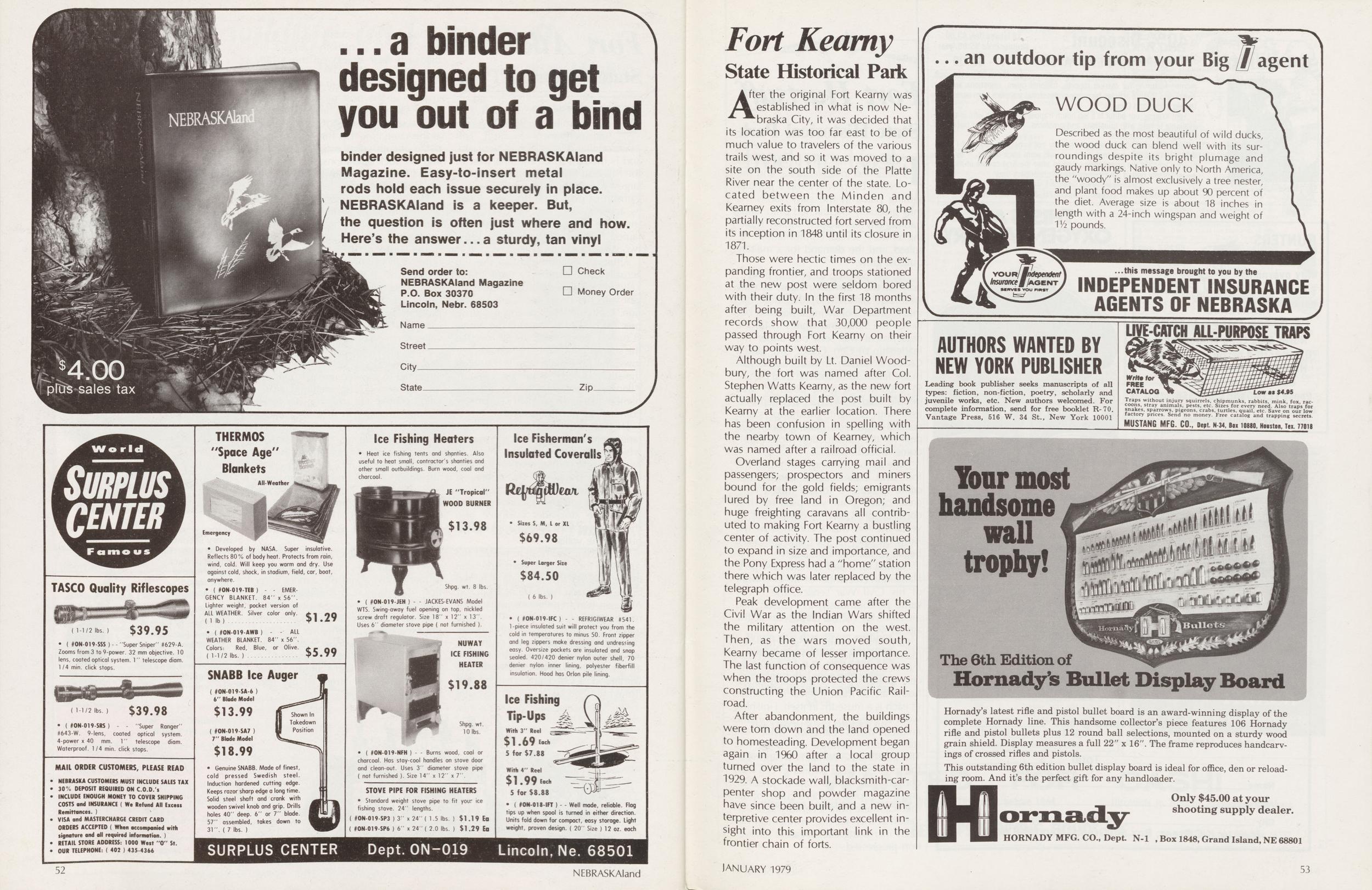
Fort Kearny
State Historical Park
After the original Fort Kearny was established in what is now Nebraska City, it was decided that its location was too far east to be of much value to travelers of the various trails west, and so it was moved to a site on the south side of the Platte River near the center of the state. Located between the Minden and Kearney exits from Interstate 80, the partially reconstructed fort served from its inception in 1848 until its closure in 1871.
Those were hectic times on the expanding frontier, and troops stationed at the new post were seldom bored with their duty. In the first 18 months after being built, War Department records show that 30,000 people passed through Fort Kearny on their way to points west.
Although built by Lt. Daniel Woodbury, the fort was named after Col. Stephen Watts Kearny, as the new fort actually replaced the post built by Kearny at the earlier location. There has been confusion in spelling with the nearby town of Kearney, which was named after a railroad official.
Overland stages carrying maiI and passengers; prospectors and miners bound for the gold fields; emigrants lured by free land in Oregon; and huge freighting caravans all contributed to making Fort Kearny a bustling center of activity. The post continued to expand in size and importance, and the Pony Express had a "home" station there which was later replaced by the telegraph office.
Peak development came after the Civil War as the Indian Wars shifted the military attention on the west. Then, as the wars moved south, Kearny became of lesser importance. The last function of consequence was when the troops protected the crews constructing the Union Pacific Railroad.
After abandonment, the buildings were torn down and the land opened to homesteading. Development began again in 1960 after a local group turned over the land to the state in 1929. A stockade wall, blacksmith-carpenter shop and powder magazine have since been built, and a new interpretive center provides excellent insight into this important link in the frontier chain of forts.
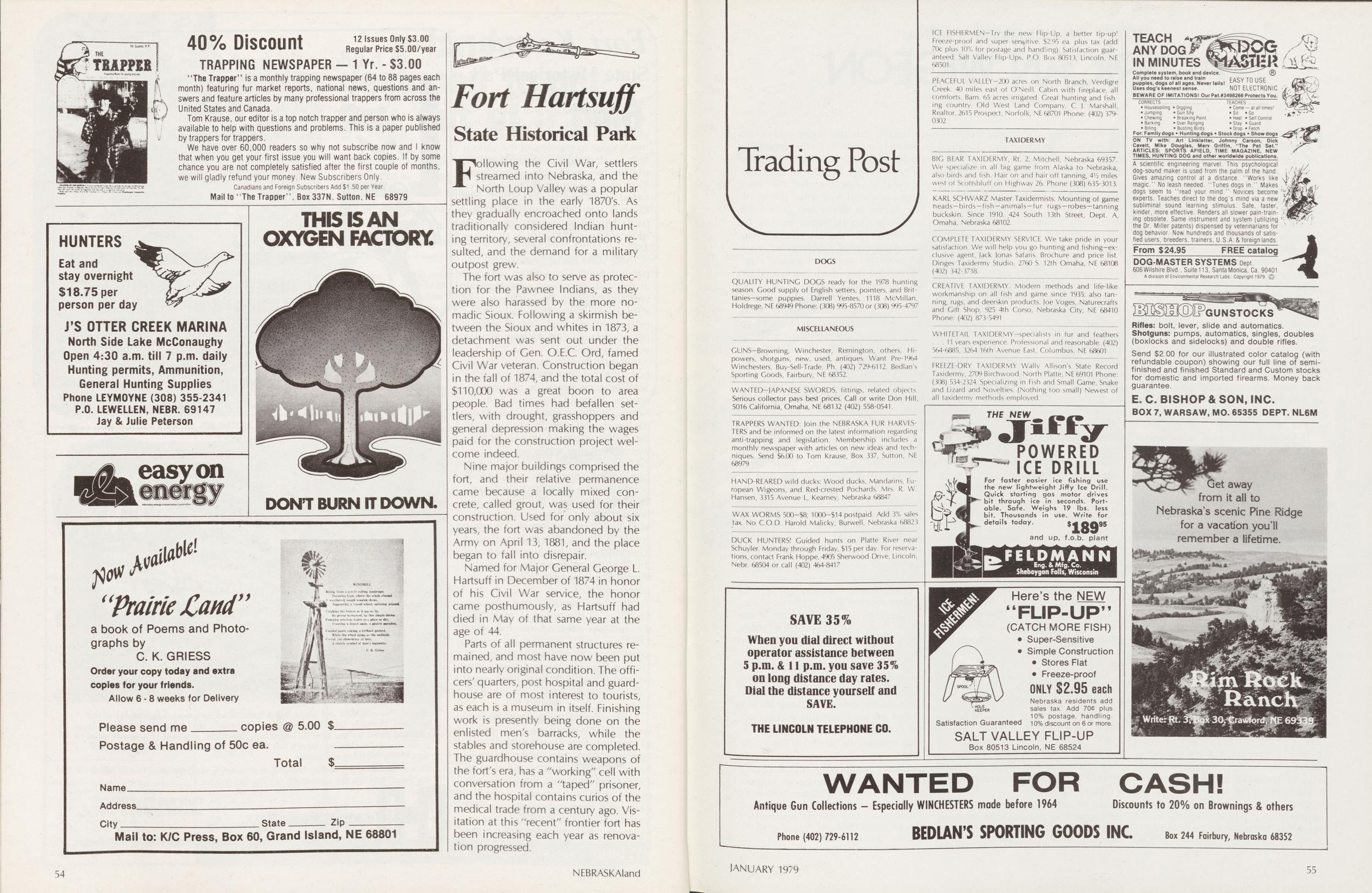
Fort Hartsuff
State Historical Park
Following the Civil War, settlers streamed into Nebraska, and the North Loup area was a popular settling place in the early 1870's. As they gradually encroached onto lands traditionally considered Indian hunting territory, several confrontations resulted, and the demand for a military outpost grew.
The fort was also to serve as protection for the Pawnee Indians, as they were also harassed by the more nomadic Sioux. Following a skirmish between the Sioux and whites in 1873, a detachment was sent out under the leadership of Gen. O.E.C. Ord, famed Civil War veteran. Construction began in the fall of 1874, and the total cost of $110,000 was a great boon to area people. Bad times had befallen settlers, with drought, grasshoppers and general depression making the wages paid for the construction project wel.come indeed.
Nine major buildings comprised the fort, and their relative permanence came because a locally mixed concrete, called grout, was used for their construction. Used for only about six years, the fort was abandoned by the Army on April 13, 1881, and the place began to fall into disrepair.
Named for Major General George L. came posthumously, as Hartsuff had died in May of that same year at the age of 44.
Parts of all permanent structures remained, and most have now been put into nearly original condition. The officers' quarters, post hospital and guardhouse are of most interest to tourists as each is a museum in itself. Finishing work is presently being done on the enlisted men's barracks, while the stables and storehouse are completed. The guardhouse contains weapons of the fort's era, has a "working" cell with conversation from a "taped" prisoner, and the hospital contains curios of the medical trade from a century ago. Visitation at this "recent" frontier fort has been increasing each year as renovation progressed.
54 NEBRASKAland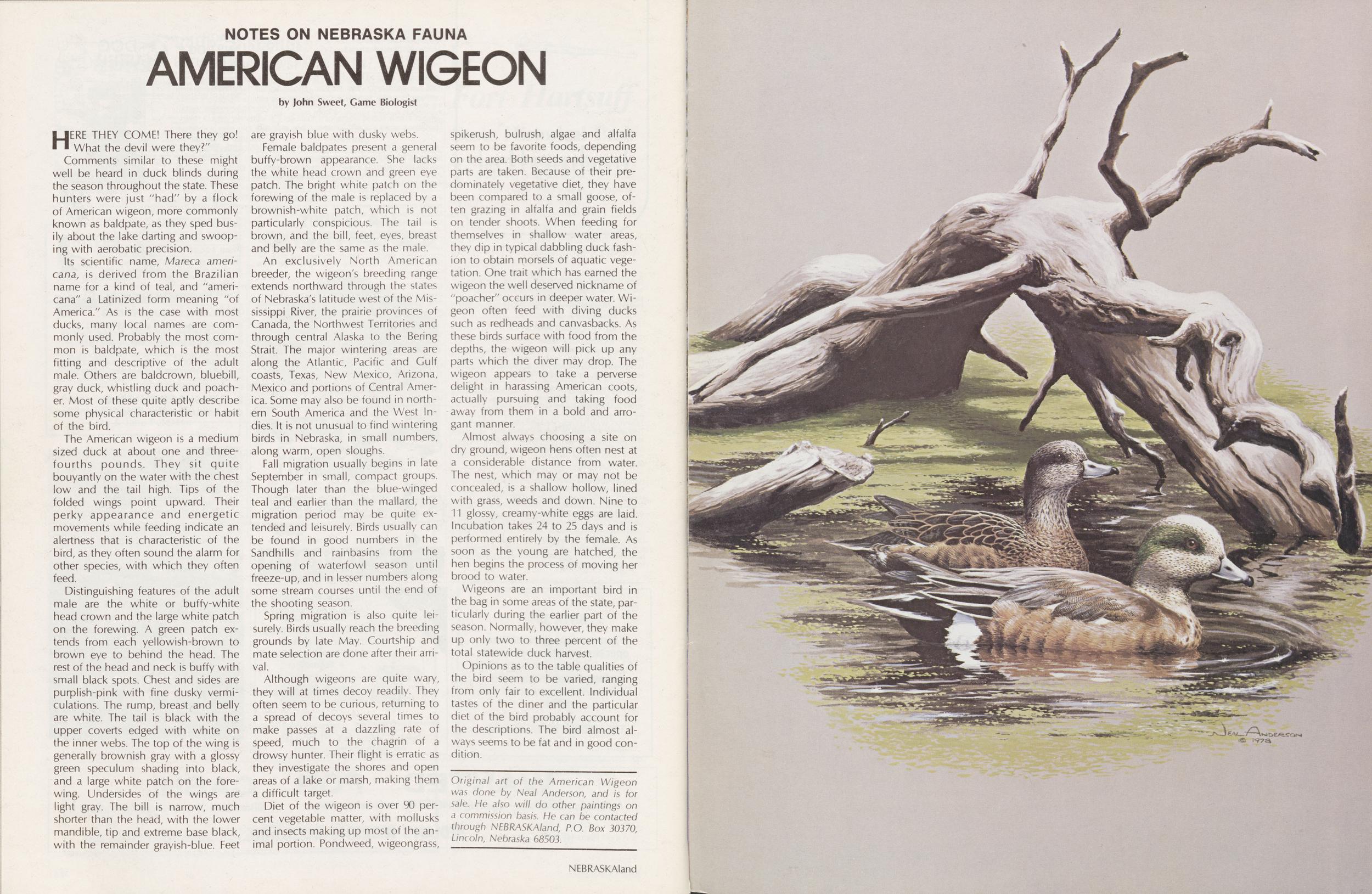
NOTES ON NEBRASKA FAUNA
AMERICAN WIGEON
HERE THEY COME! There they go! What the devil were they?"
Comments similar to these might well be heard in duck blinds during the season throughout the state. These hunters were just "had" by a flock of American wigeon, more commonly known as baldpate, as they sped busily about the lake darting and swooping with aerobatic precision.
Its scientific name, Mareca americana, is derived from the Brazilian name for a kind of teal, and "americana" a Latinized form meaning "of America." As is the case with most ducks, many local names are commonly used. Probably the most common is baldpate, which is the most fitting and descriptive of the adult male. Others are baldcrown, bluebill, gray duck, whistling duck and poacher. Most of these quite aptly describe some physical characteristic or habit of the bird.
The American wigeon is a medium sized duck at about one and three-fourths pounds. They sit quite bouyantly on the water with the chest low and the tail high. Tips of the folded wings point upward. Their perky appearance and energetic movements while feeding indicate an alertness that is characteristic of the bird, as they often sound the alarm for other species, with which they often feed.
Distinguishing features of the adult male are the white or buffy-white head crown and the large white patch on the forewing. A green patch extends from each yellowish-brown to brown eye to behind the head. The rest of the head and neck is buffy with small black spots. Chest and sides are purplish-pink with fine dusky vermiculations. The rump, breast and belly are white. The tail is black with the upper coverts edged with white on the inner webs. The top of the wing is generally brownish gray with a glossy green speculum shading into black, and a large white patch on the forewing. Undersides of the wings are light gray. The bill is narrow, much shorter than the head, with the lower mandible, tip and extreme base black, with the remainder grayish-blue. Feet are grayish blue with dusky webs.
Female baldpates present a general buffy-brown appearance. She lacks the white head crown and green eye patch. The bright white patch on the forewing of the male is replaced by a brownish-white patch, which is not particularly conspicious. The tail is brown, and the bill, feet, eyes, breast and belly are the same as the male.
An exclusively North American breeder, the wigeon's breeding range extends northward through the states of Nebraska's latitude west of the Mississippi River, the prairie provinces of Canada, the Northwest Territories and through central Alaska to the Bering Strait. The major wintering areas are along the Atlantic, Pacific and Gulf coasts, Texas, New Mexico, Arizona, Mexico and portions of Central America. Some may also be found in northern South America and the West Indies. It is not unusual to find wintering birds in Nebraska, in small numbers, along warm, open sloughs.
Fall migration usually begins in late September in small, compact groups. Though later than the blue-winged teal and earlier than the mallard, the migration period may be quite extended and leisurely. Birds usually can be found in good numbers in the Sandhills and rainbasins from the opening of waterfowl season until freeze-up, and in lesser numbers along some stream courses until the end of the shooting season.
Spring migration is also quite leisurely. Birds usually reach the breeding grounds by late May. Courtship and mate selection are done after their arrival.
Although wigeons are quite wary, they will at times decoy readily. They often seem to be curious, returning to a spread of decoys several times to make passes at a dazzling rate of speed, much to the chagrin of a drowsy hunter. Their flight is erratic as they investigate the shores and open areas of a lake or marsh, making them a difficult target.
Diet of the wigeon is over 90 percent vegetable matter, with mollusks and insects making up most of the animal portion. Pondweed, wigeongrass, spikerush, bulrush, algae and alfalfa seem to be favorite foods, depending on the area. Both seeds and vegetative parts are taken. Because of their predominately vegetative diet, they have been compared to a small goose, often grazing in alfalfa and grain fields on tender shoots. When feeding for themselves in shallow water areas, they dip in typical dabbling duck fashion to obtain morsels of aquatic vegetation. One trait which has earned the wigeon the well deserved nickname of "poacher" occurs in deeper water. Wigeon often feed with diving ducks such as redheads and canvasbacks. As these birds surface with food from the depths, the wigeon will pick up any parts which the diver may drop. The wigeon appears to take a perverse delight in harassing American coots, actually pursuing and taking food away from them in a bold and arrogant manner.
Almost always choosing a site on dry ground, wigeon hens often nest at a considerable distance from water. The nest, which may or may not be concealed, is a shallow hollow, lined with grass, weeds and down. Nine to 11 glossy, creamy-white eggs are laid. Incubation takes 24 to 25 days and is performed entirely by the female. As soon as the young are hatched, the hen begins the process of moving her brood to water.
Wigeons are an important bird in the bag in some areas of the state, particularly during the earlier part of the season. Normally, however, they make up only two to three percent of the total statewide duck harvest.
Opinions as to the table qualities of the bird seem to be varied, ranging from only fair to excellent. Individual tastes of the diner and the particular diet of the bird probably account for the descriptions. The bird almost always seems to be fat and in good condition.
Original art of the American Wigeon was done by Neal Anderson, and is for sale. He also will do other paintings on a commission basis. He can be contacted through NEBRASKA/and, P.O. Box 30370, Lincoln, Nebraska 68503.
NEBRASKAland
Position: 704 (16 views)