Volume 56, Issue 12, 1978
NEBRASKAland
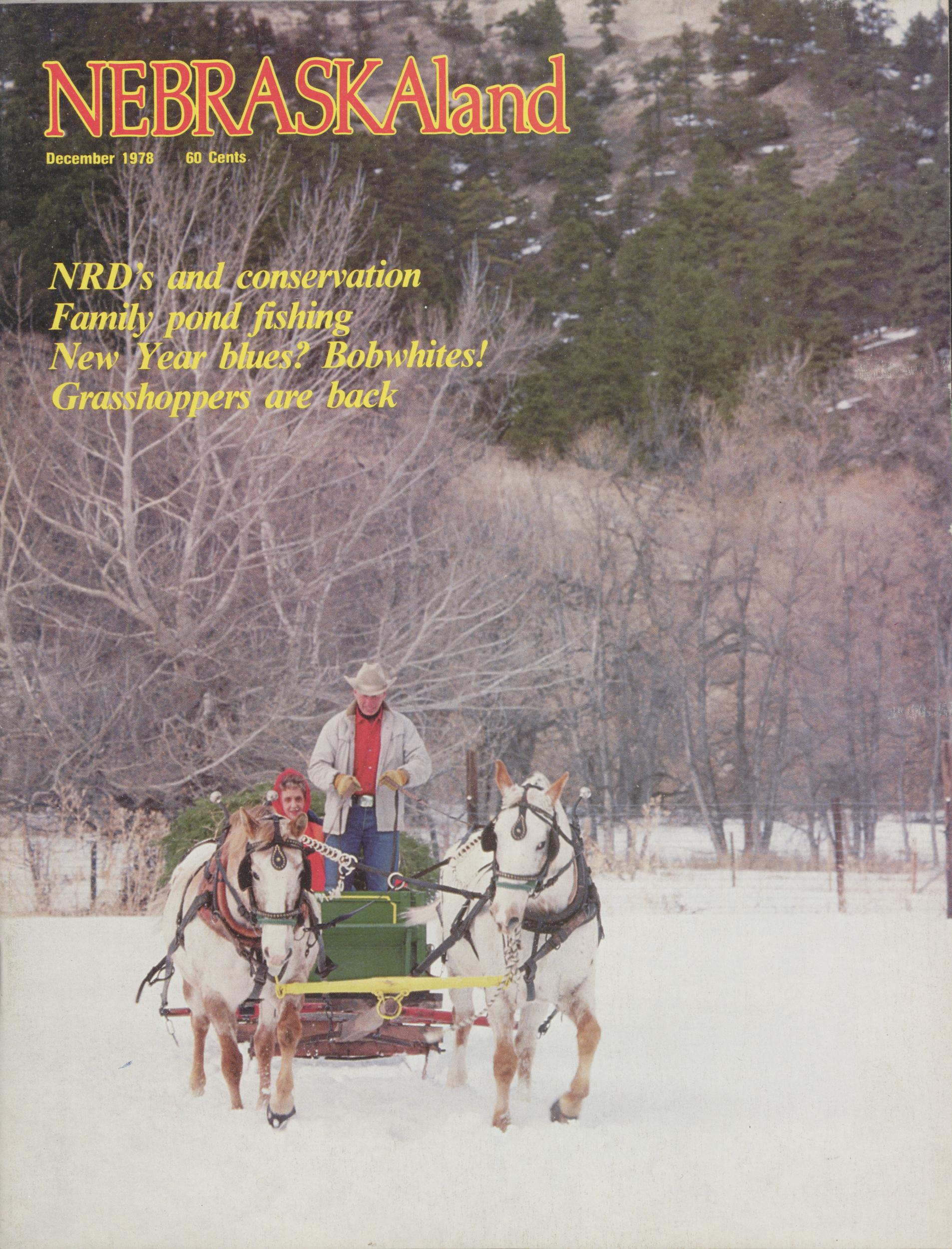
Deceber 1978 60 Cents NRD's and conservationFamily pond fishing
New Year blues? Bobwhites!
Grasshoppers are back
NEBRASKAland
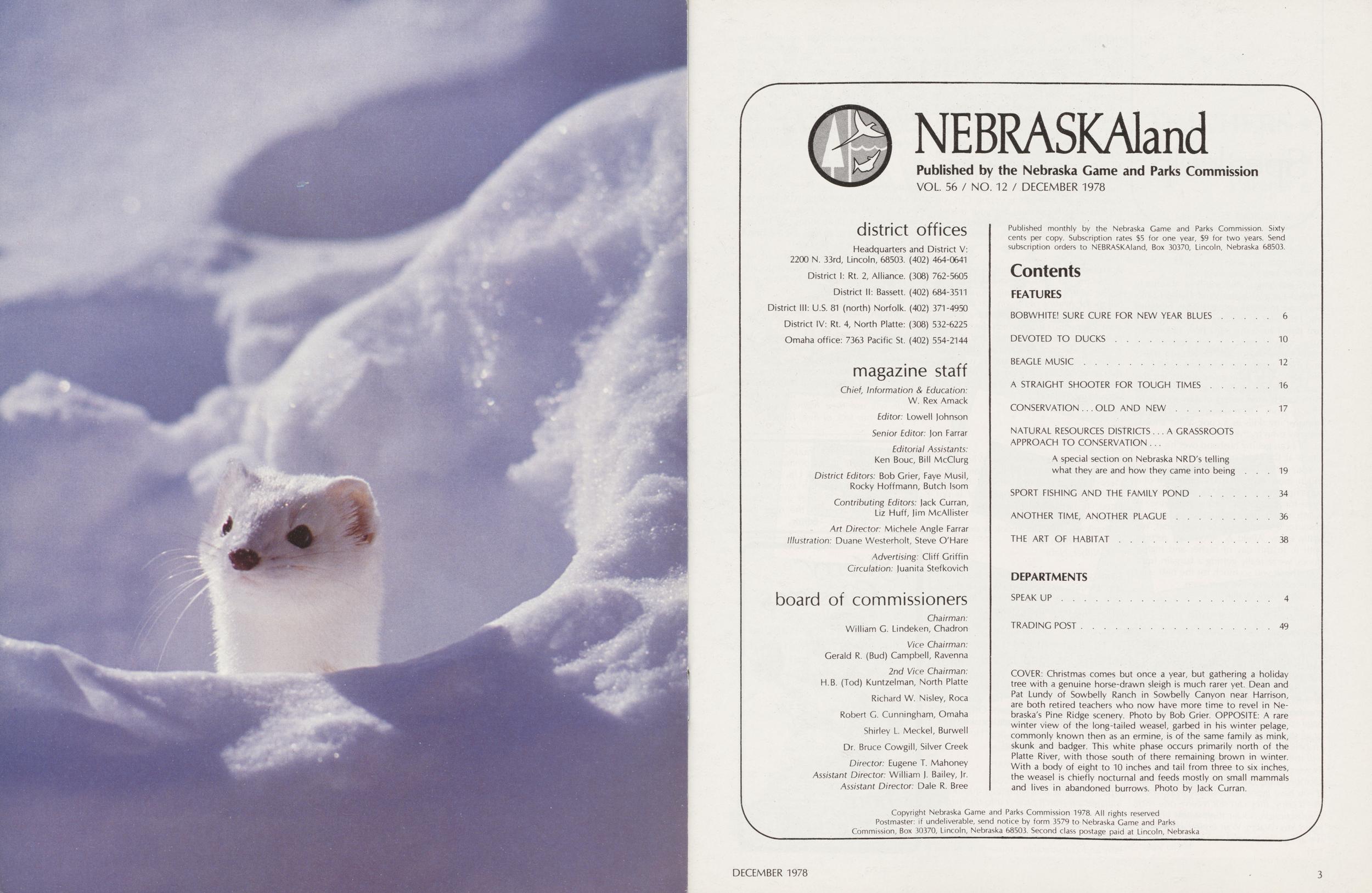
Published by the Nebraska Game and Parks Commission VOL 56 / NO. 12 / DECEMBER 1978 district offices Headquarters and District V: 2200 N. 33rd, Lincoln, 68503. (402) 464-0641 District I: Rt. 2, Alliance. (308) 762-5605 District II: Bassett. (402) 684-3511 District III: U.S. 81 (north) Norfolk. (402) 371-4950 District IV: Rt. 4, North Platte: (308) 532-6225 Omaha office: 7363 Pacific St. (402) 554-2144 magazine staff Chief, Information & Education: W. Rex Amack Editor: Lowell Johnson Senior Editor: Jon Farrar Editorial Assistants: Ken Bouc, Bill McClurg District Editors: Bob Grier, Faye MusiI, Rocky Hoffmann, Butch Isom Contributing Editors: Jack Curran, Liz Huff, Jim McAllister Art Director: Michele Angle Farrar Illustration: Duane Westerholt, Steve O'Hare Advertising: Cliff Griffin Circulation: Juanita Stefkovich board of commissioners Chairman: William G. Lindeken, Chadron Vice Chairman: Gerald R. (Bud) Campbell, Ravenna 2nd Vice Chairman: H.B. (Tod) Kuntzelman, North Platte Richard W. Nisley, Roca Robert G. Cunningham, Omaha Shirley L. Meckel, Burwell Dr. Bruce Cowgill, Silver Creek Director: Eugene T. Mahoney Assistant Director: William J. Bailey, Jr. Assistant Director: Dale R. Bree Published monthly by the Nebraska Game and Parks Commission. Sixty cents per copy. Subscription rates $5 for one year, $9 for two years. Send subscription orders to NEBRASKAland, Box 30370, Lincoln, Nebraska 68503. Contents FEATURES BOBWHITE! SURE CURE FOR NEW YEAR BLUES DEVOTED TO DUCKS 10 BEAGLE MUSIC 12 A STRAIGHT SHOOTER FOR TOUGH TIMES 16 CONSERVATION... OLD AND NEW 17 NATURAL RESOURCES DISTRICTS ... A GRASSROOTS APPROACH TO CONSERVATION A special section on Nebraska NRD's telling what they are and how they came into being 19 SPORT FISHING AND THE FAMILY POND 34 ANOTHER TIME, ANOTHER PLAGUE 36 THE ART OF HABITAT 38 DEPARTMENTS SPEAK UP TRADING POST 49 COVER: Christmas comes but once a year, but gathering a holiday tree with a genuine horse-drawn sleigh is much rarer yet. Dean and Pat Lundy of Sowbelly Ranch in Sowbelly Canyon near Harrison, are both retired teachers who now have more time to revel in Nebraska's Pine Ridge scenery. Photo by Bob Grier. OPPOSITE: A rare winter view of the long-tailed weasel, garbed in his winter pelage, commonly known then as an ermine, is of the same family as mink, skunk and badger. This white phase occurs primarily north of the Platte River, with those south of there remaining brown in winter. With a body of eight to 10 inches and tail from three to six inches, the weasel is chiefly nocturnal and feeds mostly on small mammals and lives in abandoned burrows. Photo by Jack Curran. Copyright Nebraska Game and Parks Commission 1978. All rights reserved Postmaster: if undeliverable, send notice by form 3579 to Nebraska Game and Parks Commission, Box 30370, Lincoln, Nebraska 68503. Second class postage paid at Lincoln, Nebraska DECEMBER 1978 3
Speak Up
The Best EverSir / I just have to tell you how absolutely thrilled I am with the Wild Game Cookbook we received yesterday! My husband and I do a lot of hunting and fishing but I just didn't have any idea how to prepare many cuts of meat, etc. For instance, we never cared too much for venison roasts and used mostly the deer steaks and burger. Also, when fishing, we always left the carp and snapping turtle as "trash". Now, with such a wide variety of easy recipes to choose from, I'm really anxious to try to improve my skills as a cook. Who knows, we may even try "velvet-tailed rattlesnake" ... if I can get my husband over his queasiness at the sight of a snake!
Your Wild Game Cookbook is worth much, much more than the mere cost of a subscription to NEBRASKAIand Magazine-for that matter, the magazine is worth much more than the mere $5 it costs for a whole year! Not only that, we really enjoy Afield & Afloat we receive with it. In this day of higher and higher prices, we're really getting a bargain from you. Thank you so much for the best wild game cookbook I've ever seen.
Mrs. Merv Wallin Lamar, Nebr.Goodness, do we ever need more people like you around. We all got such swelled heads after reading your letter that they had to butter us before they could slip us out the doorway. Thanks indeed for all your nice comments. And, for the benefit of anyone who is not familiar with the cookbook, let me say that we sent a 100-page cookbook to all subscribers in place, or as, the October issue of NEBRASKAIand. Hopefully, most people appreciated and will use it. There may be some confusion, as we didn't really explain that it was the October issue, but they are figuring it out. If you have friends or relatives who would like a copy, they can still receive one with a subscription, so let them know. Thanks again Mrs. Wallin. Wait until you see what we are going to send you next year! (Editor)
Hot StuffSir / Thank you very much for the NEBRASKAIand Wild Game Cookbook. I'm sure we are going to enjoy using it.
However (isn't there always a catch?) on page 68, the "Pan Fried Carp" recipe ... it calls for using vinegar in the shortening. I cannot recommend this. We had company and wanted to see how this worked, but as soon as the shortening heated, we had a tremendous mess—shortening splattered all over the kitchen. We tried three times with lard and shortening, and the same thing happened. So, I don't feel it was something we were doing wrong. Can you explain what happened? Let your readers hear about this before someone is burned.
Mrs. Oscar Vosler Ashland, Nebr.Apparently this recipe meant to use liquid shortening, as you are exactly right in saying a rather disconcerting eruption will follow the heating of the vinegar and solid shortening. The same is true of a microwave oven-the rate at which the two elements heat is not compatible, and there is a violent reaction. Maybe a lot of people know about this, maybe others will have the same trouble. I hope this will warn some people as you intended. Thanks for your letter. (Editor)
Missing LinkSir / On page 86 of your new Wild Game Cookbook, I find that in the Homemade Deer Balogna recipe submitted by Mrs. Milton Janda, that one ingredient is not listed. It is: V/i tablespoon of Tender Quick.
Thank you, the Cookbook is excellent.
Mrs. Milton janda Wilber, Nebr.Thank you for bringing this to our attention. Despite all our efforts to make things right, we make mistakes. Hopefully, the omission is not serious enough to damage the end product. (Editor)
Handling the ProblemSir / I recently received the fine cookbook which the Commission has published. There is one question I have-On page 78 the recipe for "velvet tail rattlesnake" is interesting. My question is: "How long should the axe handle be?"
Charles H. Reed, Fremont, Nebr.Upon receiving your intriguing question, I initiated a research project into the matter. After numerous close calls and a considerable amount of high-jumping maneuvers (which supplied some much-needed exercise and considerable amusement to everyone who was fortunate enough to be on hand to witness the rather lengthy event) I have come up with the following formula: the axe handle should be the square of the length of the rattlesnake in question, plus the cube of the slope of the hill upon which encountered (if applicable) times the width of the reptile's head divided by the speed of the axe times the total girth of the snake. Good luck! (Editor)
Beauty SeekerSir / I enjoy NEBRASKAIand Magazine very much. It is delightful to look at and most informative. The illustrations are tremendous and remind us to look for the beauty around us in our great state.
A good map of Nebraska would have been helpful in the May issue in locating the places mentioned. The sectional maps were excellent.
Emma Snyder Lincoln, Nebr.We probably have more trouble with maps than anything else we do, as there are many times we should use them, but they are difficult to put together for special purposes. And a big, useful map takes up too much space. So, we always hope people will use their highway map and not notice our lack of one. (Editor)
NEBRASKAIand Magazine invites all readers to submit their comments, suggestions, and gripes to Speak Up. Each month the magazine will publish as many letters as space permits. Pictures are welcome. NEBRASKAIand reserves the right to edit and condense letters. — Editor.
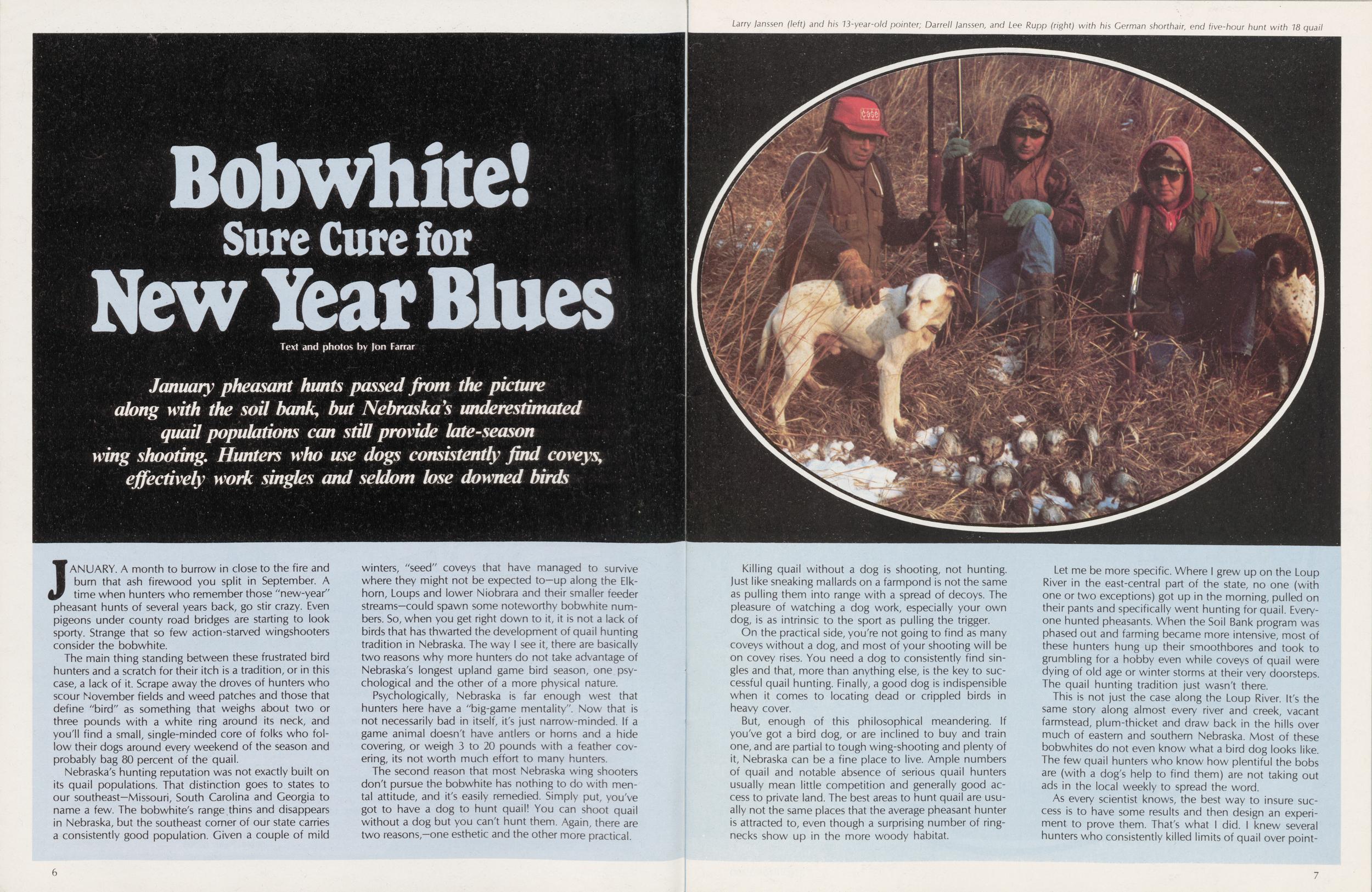
Bobwhite Sure Cure for New Years Blues
Text and photos by Jon Farrar January pheasant hunts passed from the picture along with the soil bank, but Nebraskas underestimated quail populations can still provide late-season wing shooting. Hunters who use dogs consistently find coveys, effectively work singles and seldom lose downed birdsJANUARY. A month to burrow in close to the fire and burn that ash firewood you split in September. A time when hunters who remember those "new-year" pheasant hunts of several years back, go stir crazy. Even pigeons under county road bridges are starting to look sporty. Strange that so few action-starved wingshooters consider the bobwhite.
The main thing standing between these frustrated bird hunters and a scratch for their itch is a tradition, or in this case, a lack of it. Scrape away the droves of hunters who scour November fields and weed patches and those that define "bird" as something that weighs about two or three pounds with a white ring around its neck, and you'll find a small, single-minded core of folks who follow their dogs around every weekend of the season and probably bag 80 percent of the quail.
Nebraska's hunting reputation was not exactly built on its quail populations. That distinction goes to states to our southeast—Missouri, South Carolina and Georgia to name a few. The bobwhite's range thins and disappears in Nebraska, but the southeast corner of our state carries a consistently good population. Given a couple of mild winters, "seed" coveys that have managed to survive where they might not be expected to—up along the Elkhorn, Loups and lower Niobrara and their smaller feeder streams—could spawn some noteworthy bobwhite numbers. So, when you get right down to it, it is not a lack of birds that has thwarted the development of quail hunting tradition in Nebraska. The way I see it, there are basically two reasons why more hunters do not take advantage of Nebraska's longest upland game bird season, one psychological and the other of a more physical nature.
Psychologically, Nebraska is far enough west that hunters here have a "big-game mentality". Now that is not necessarily bad in itself, it's just narrow-minded. If a game animal doesn't have antlers or horns and a hide covering, or weigh 3 to 20 pounds with a feather covering, its not worth much effort to many hunters.
The second reason that most Nebraska wing shooters don't pursue the bobwhite has nothing to do with mental attitude, and it's easily remedied. Simply put, you've got to have a dog to hunt quail! You can shoot quail without a dog but you can't hunt them. Again, there are two reasons-one esthetic and the other more practical.
6Killing quail without a dog is shooting, not hunting. Just like sneaking mallards on a farmpond is not the same as pulling them into range with a spread of decoys. The pleasure of watching a dog work, especially your own dog, is as intrinsic to the sport as pulling the trigger.
On the practical side, you're not going to find as many coveys without a dog, and most of your shooting will be on covey rises. You need a dog to consistently find singles and that, more than anything else, is the key to successful quail hunting. Finally, a good dog is indispensible when it comes to locating dead or crippled birds in heavy cover.
But, enough of this philosophical meandering. If you've got a bird dog, or are inclined to buy and train one, and are partial to tough wing-shooting and plenty of it, Nebraska can be a fine place to live. Ample numbers of quail and notable absence of serious quail hunters usually mean little competition and generally good access to private land. The best areas to hunt quail are usually not the same places that the average pheasant hunter is attracted to, even though a surprising number of ringnecks show up in the more woody habitat.
Let me be more specific. Where I grew up on the Loup River in the east-central part of the state, no one (with one or two exceptions) got up in the morning, pulled on their pants and specifically went hunting for quail. Everyone hunted pheasants. When the Soil Bank program was phased out and farming became more intensive, most of these hunters hung up their smoothbores and took to grumbling for a hobby even while coveys of quail were dying of old age or winter storms at their very doorsteps. The quail hunting tradition just wasn't there.
This is not just the case along the Loup River. It's the same story along almost every river and creek, vacant farmstead, plum-thicket and draw back in the hills over much of eastern and southern Nebraska. Most of these bobwhites do not even know what a bird dog looks like. The few quail hunters who know how plentiful the bobs are (with a dog's help to find them) are not taking out ads in the local weekly to spread the word.
As every scientist knows, the best way to insure success is to have some results and then design an experiment to prove them. That's what I did. I knew several hunters who consistently killed limits of quail over pointers in areas that would normally be considered marginal bobwhite habitat.
7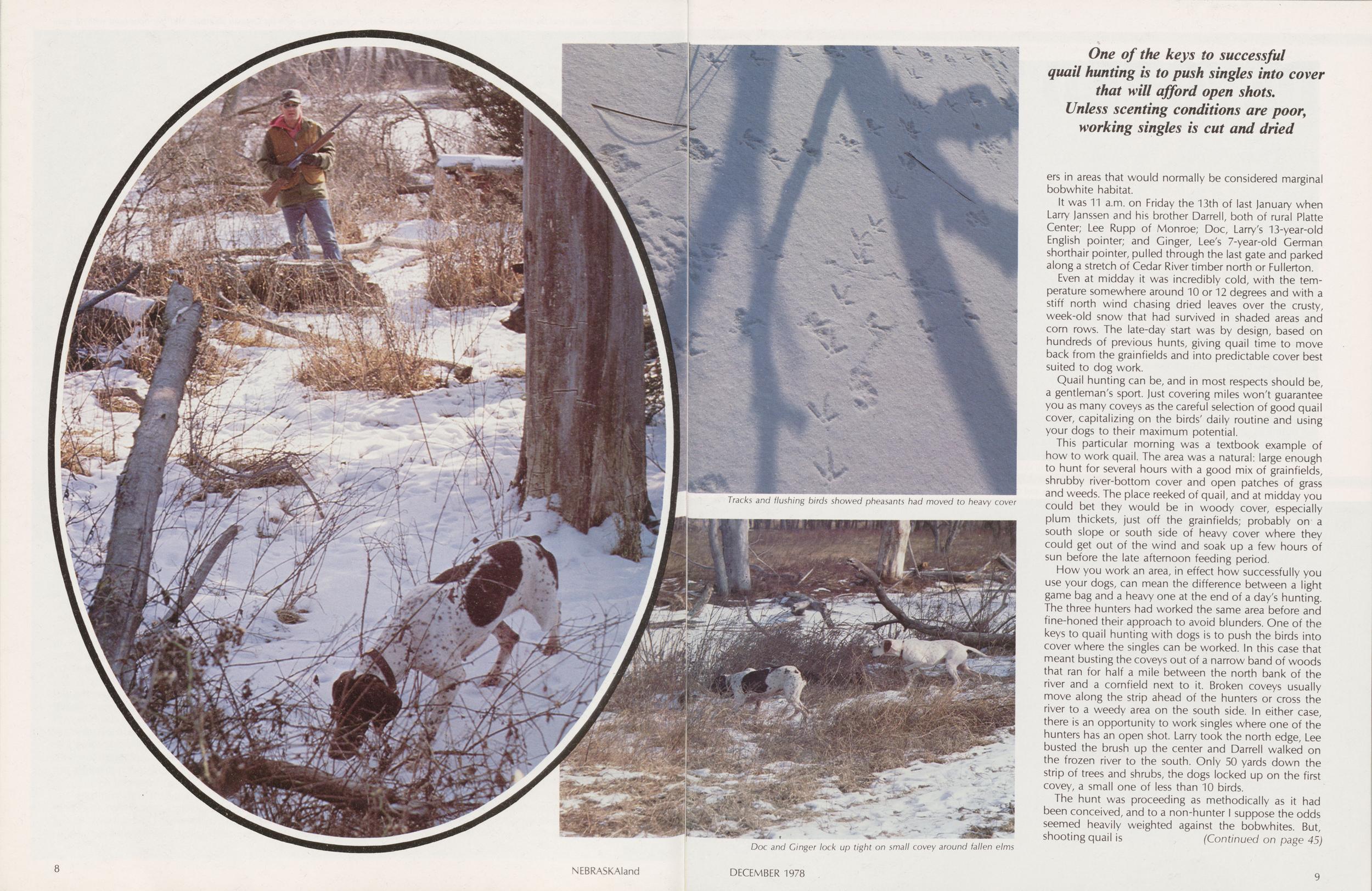
One of the keys to successful quail hunting is to push singles into cover that will afford open shots. Unless scenting conditions are poor9 working singles is cut and dried
It was 11 a.m. on Friday the 13th of last January when Larry Janssen and his brother Darrell, both of rural Platte Center; Lee Rupp of Monroe; Doc, Larry's 13-year-old English pointer; and Ginger, Lee's 7-year-old German shorthair pointer, pulled through the last gate and parked along a stretch of Cedar River timber north or Fullerton.
Even at midday it was incredibly cold, with the temperature somewhere around 10 or 12 degrees and with a stiff north wind chasing dried leaves over the crusty, week-old snow that had survived in shaded areas and corn rows. The late-day start was by design, based on hundreds of previous hunts, giving quail time to move back from the grainfields and into predictable cover best suited to dog work.
Quail hunting can be, and in most respects should be, a gentleman's sport. Just covering miles won't guarantee you as many coveys as the careful selection of good quail cover, capitalizing on the birds' daily routine and using your dogs to their maximum potential.
This particular morning was a textbook example of how to work quail. The area was a natural: large enough to hunt for several hours with a good mix of grainfields, shrubby river-bottom cover and open patches of grass and weeds. The place reeked of quail, and at midday you could bet they would be in woody cover, especially plum thickets, just off the grainfields; probably on a south slope or south side of heavy cover where they could get out of the wind and soak up a few hours of sun before the late afternoon feeding period.
How you work an area, in effect how successfully you use your dogs, can mean the difference between a light game bag and a heavy one at the end of a day's hunting. The three hunters had worked the same area before and fine-honed their approach to avoid blunders. One of the keys to quail hunting with dogs is to push the birds into cover where the singles can be worked. In this case that meant busting the coveys out of a narrow band of woods that ran for half a mile between the north bank of the river and a cornfield next to it. Broken coveys usually move along the strip ahead of the hunters or cross the river to a weedy area on the south side. In either case, there is an opportunity to work singles where one of the hunters has an open shot. Larry took the north edge, Lee busted the brush up the center and Darrell walked on the frozen river to the south. Only 50 yards down the strip of trees and shrubs, the dogs locked up on the first covey, a small one of less than 10 birds.
The hunt was proceeding as methodically as it had been conceived, and to a non-hunter I suppose the odds seemed heavily weighted against the bobwhites. But, shooting quail is (Continued on page 45)
DECEMBER 1978 9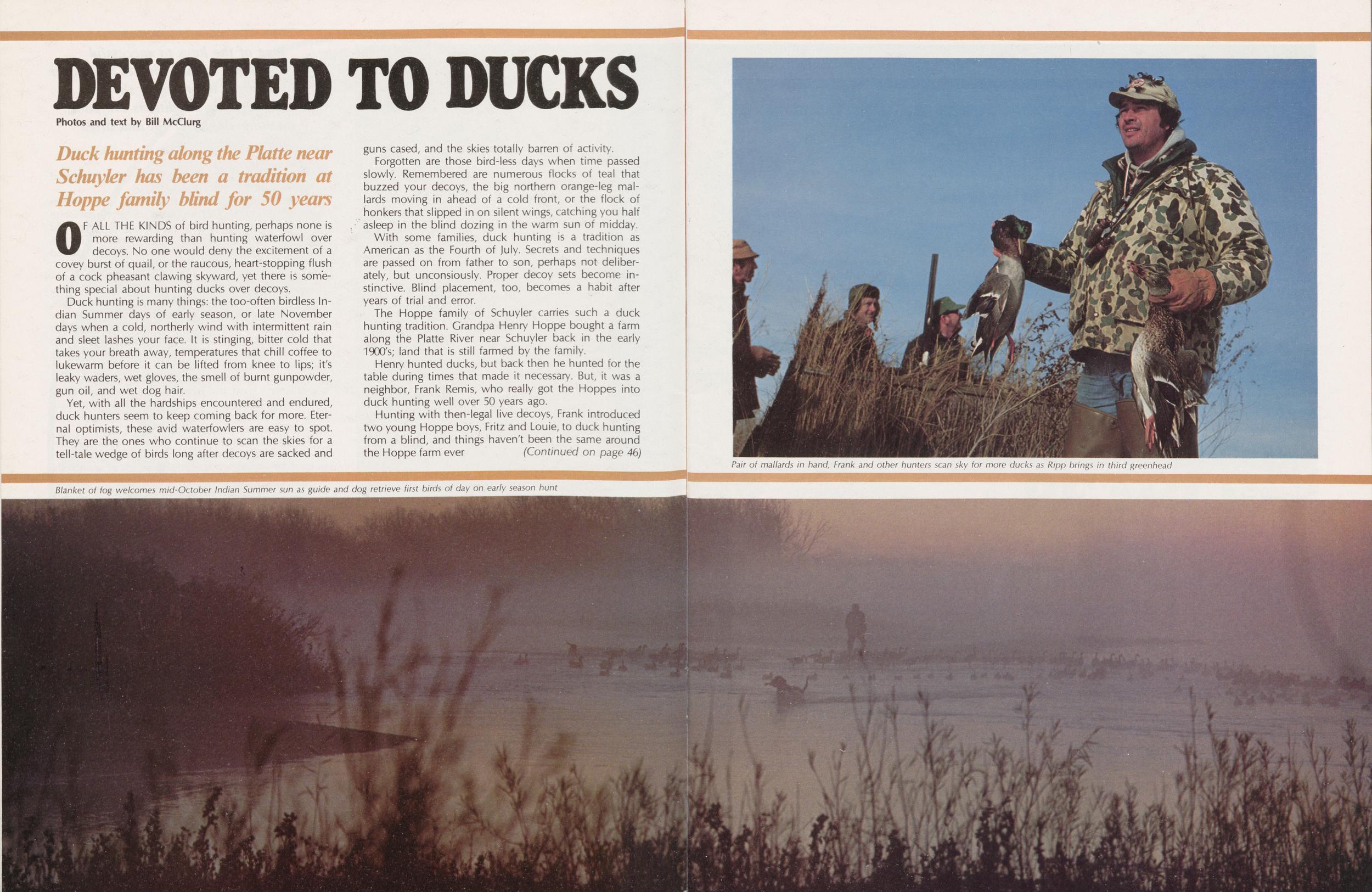
DEVOTED TO DUCKS
Duck hunting along the Platte near Schuyler has been a tradition at Hoppe family blind for 50 yearsOF ALL THE KINDS of bird hunting, perhaps none is more rewarding than hunting waterfowl over decoys. No one would deny the excitement of a covey burst of quail, or the raucous, heart-stopping flush of a cock pheasant clawing skyward, yet there is something special about hunting ducks over decoys.
Duck hunting is many things: the too-often birdless Indian Summer days of early season, or late November days when a cold, northerly wind with intermittent rain and sleet lashes your face. It is stinging, bitter cold that takes your breath away, temperatures that chill coffee to lukewarm before it can be lifted from knee to lips; it's leaky waders, wet gloves, the smell of burnt gunpowder, gun oil, and wet dog hair.
Yet, with all the hardships encountered and endured, duck hunters seem to keep coming back for more. Eternal optimists, these avid waterfowlers are easy to spot. They are the ones who continue to scan the skies for a tell-tale wedge of birds long after decoys are sacked and guns cased, and the skies totally barren of activity.
Forgotten are those bird-less days when time passed slowly. Remembered are numerous flocks of teal that buzzed your decoys, the big northern orange-leg mallards moving in ahead of a cold front, or the flock of honkers that slipped in on silent wings, catching you half asleep in the blind dozing in the warm sun of midday.
With some families, duck hunting is a tradition as American as the Fourth of July. Secrets and techniques are passed on from father to son, perhaps not deliberately, but unconsiously. Proper decoy sets become instinctive. Blind placement, too, becomes a habit after years of trial and error.
The Hoppe family of Schuyler carries such a duck hunting tradition. Grandpa Henry Hoppe bought a farm along the Platte River near Schuyler back in the early 1900's; land that is still farmed by the family.
Henry hunted ducks, but back then he hunted for the table during times that made it necessary. But, it was a neighbor, Frank Remis, who really got the Hoppes into duck hunting well over 50 years ago.
Hunting with then-legal live decoys, Frank introduced two young Hoppe boys, Fritz and Louie, to duck hunting from a blind, and things haven't been the same around the Hoppe farm ever (Continued on page 46)
BEAGLE MUSIC
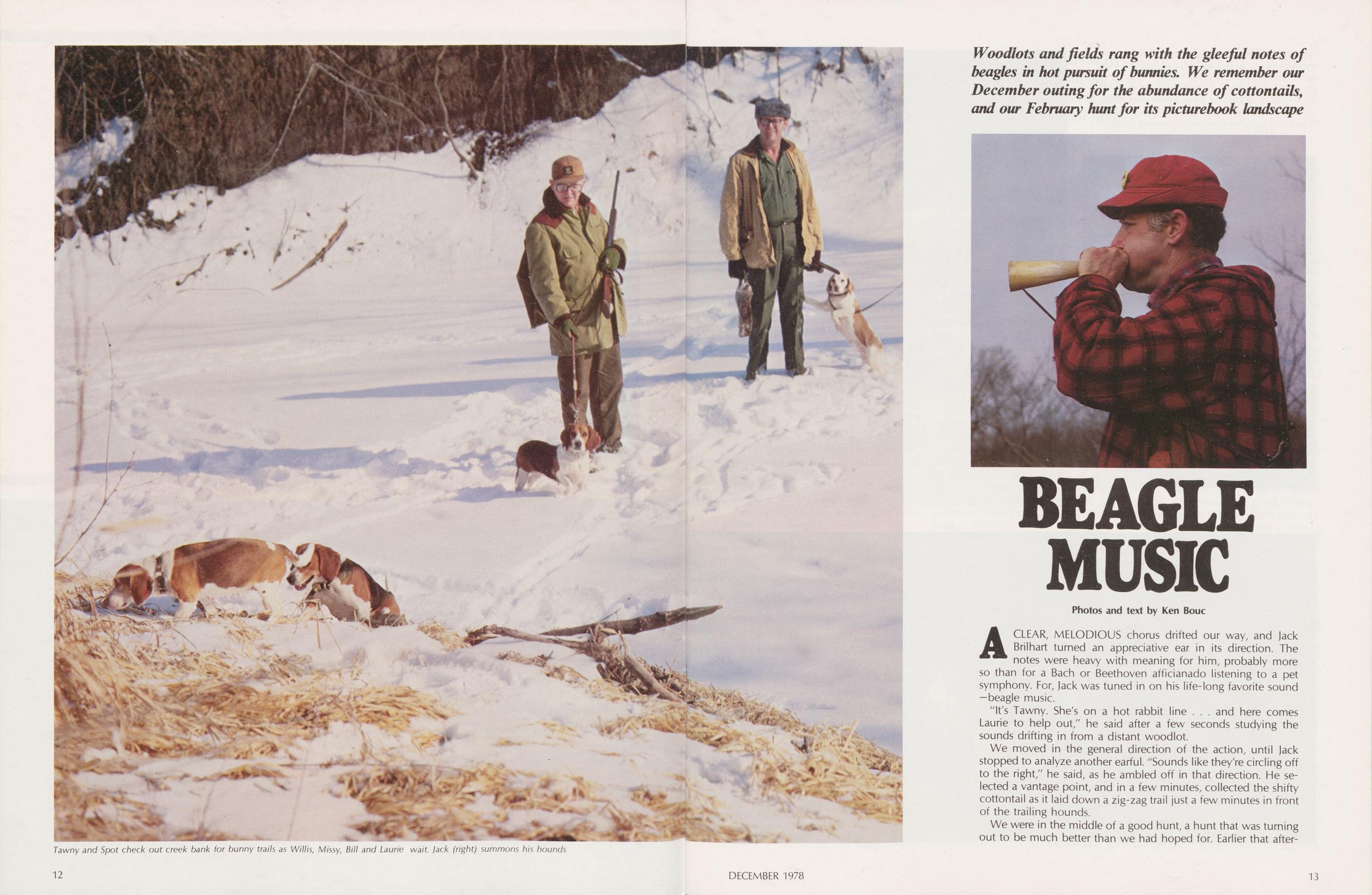
A CLEAR, MELODIOUS chorus drifted our way, and Jack Brilhart turned an appreciative ear in its direction. The notes were heavy with meaning for him, probably more so than for a Bach or Beethoven afficianado listening to a pet symphony. For, Jack was tuned in on his life-long favorite sound—beagle music.
"It's Tawny. She's on a hot rabbit line . . . and here comes Laurie to help out," he said after a few seconds studying the sounds drifting in from a distant woodlot.
We moved in the general direction of the action, until Jack stopped to analyze another earful. "Sounds like they're circling off to the right," he said, as he ambled off in that direction. He selected a vantage point, and in a few minutes, collected the shifty cottontail as it laid down a zig-zag trail just a few minutes in front of the trailing hounds.
We were in the middle of a good hunt, a hunt that was turning out to be much better than we had hoped for. Earlier that afternoon noon, when I met my hunting partners at Branched Oak Lake, it looked as if the weather would be against us.
DECEMBER 1978 13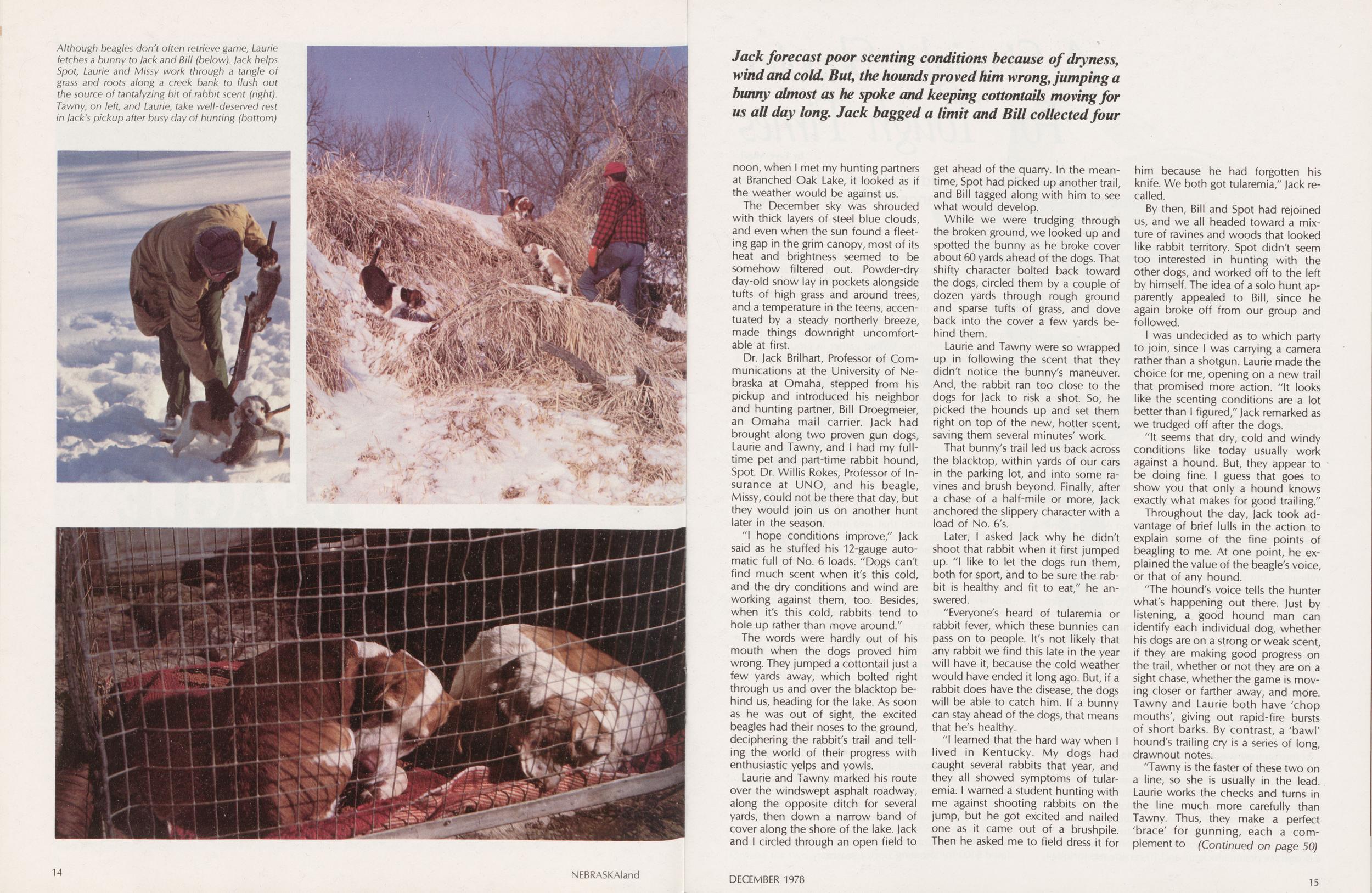
The December sky was shrouded with thick layers of steel blue clouds, and even when the sun found a fleeting gap in the grim canopy, most of its heat and brightness seemed to be somehow filtered out. Powder-dry day-old snow lay in pockets alongside tufts of high grass and around trees, and a temperature in the teens, accentuated by a steady northerly breeze, made things downright uncomfortable at first.
Dr. Jack Brilhart, Professor of Communications at the University of Nebraska at Omaha, stepped from his pickup and introduced his neighbor and hunting partner, Bill Droegmeier, an Omaha mail carrier. Jack had brought along two proven gun dogs, Laurie and Tawny, and i had my fulltime pet and part-time rabbit hound, Spot. Dr. Willis Rokes, Professor of Insurance at UNO, and his beagle, Missy, could not be there that day, but they would join us on another hunt later in the season.
"I hope conditions improve," Jack said as he stuffed his 12-gauge automatic full of No. 6 loads. "Dogs can't find much scent when it's this cold, and the dry conditions and wind are working against them, too. Besides, when it's this cold, rabbits tend to hole up rather than move around."
The words were hardly out of his mouth when the dogs proved him wrong. They jumped a cottontail just a few yards away, which bolted right through us and over the blacktop behind us, heading for the lake. As soon as he was out of sight, the excited beagles had their noses to the ground, deciphering the rabbit's trail and telling the world of their progress with enthusiastic yelps and yowls.
Laurie and Tawny marked his route over the windswept asphalt roadway, along the opposite ditch for several yards, then down a narrow band of cover along the shore of the lake. Jack and I circled through an open field to get ahead of the quarry. In the meantime, Spot had picked up another trail, and Bill tagged along with him to see what would develop.
While we were trudging through the broken ground, we looked up and spotted the bunny as he broke cover about 60 yards ahead of the dogs. That shifty character bolted back toward the dogs, circled them by a couple of dozen yards through rough ground and sparse tufts of grass, and dove back into the cover a few yards behind them.
Laurie and Tawny were so wrapped up in following the scent that they didn't notice the bunny's maneuver. And, the rabbit ran too close to the dogs for Jack to risk a shot. So, he picked the hounds up and set them right on top of the new, hotter scent, saving them several minutes' work.
That bunny's trail led us back across the blacktop, within yards of our cars in the parking lot, and into some ravines and brush beyond. Finally, after a chase of a half-mile or more, Jack anchored the slippery character with a load of No. 6's.
Later, I asked Jack why he didn't shoot that rabbit when it first jumped up. "I like to let the dogs run them, both for sport, and to be sure the rabbit is healthy and fit to eat," he answered.
"Everyone's heard of tularemia or rabbit fever, which these bunnies can pass on to people. It's not likely that any rabbit we find this late in the year will have it, because the cold weather would have ended it long ago. But, if a rabbit does have the disease, the dogs will be able to catch him. If a bunny can stay ahead of the dogs, that means that he's healthy.
"I learned that the hard way when I lived in Kentucky. My dogs had caught several rabbits that year, and they all showed symptoms of tularemia. I warned a student hunting with me against shooting rabbits on the jump, but he got excited and nailed one as it came out of a brushpile. Then he asked me to field dress it for him because he had forgotten his knife. We both got tularemia," Jack recalled.
By then, Bill and Spot had rejoined us, and we all headed toward a mixture of ravines and woods that looked like rabbit territory. Spot didn't seem too interested in hunting with the other dogs, and worked off to the left by himself. The idea of a solo hunt apparently appealed to Bill, since he again broke off from our group and followed.
I was undecided as to which party to join, since I was carrying a camera rather than a shotgun. Laurie made the choice for me, opening on a new trail that promised more action. "It looks like the scenting conditions are a lot better than I figured," Jack remarked as we trudged off after the dogs.
"It seems that dry, cold and windy conditions like today usually work against a hound. But, they appear to be doing fine. I guess that goes to show you that only a hound knows exactly what makes for good trailing."
Throughout the day, Jack took advantage of brief lulls in the action to explain some of the fine points of beagling to me. At one point, he explained the value of the beagle's voice, or that of any hound.
"The hound's voice tells the hunter what's happening out there. Just by listening, a good hound man can identify each individual dog, whether his dogs are on a strong or weak scent, if they are making good progress on the trail, whether or not they are on a sight chase, whether the game is moving closer or farther away, and more. Tawny and Laurie both have 'chop mouths', giving out rapid-fire bursts of short barks. By contrast, a 'bawl' hound's trailing cry is a series of long, drawnout notes.
"Tawny is the faster of these two on a line, so she is usually in the lead. Laurie works the checks and turns in the line much more carefully than Tawny. Thus, they make a perfect 'brace' for gunning, each a complement to (Continued on page 50)
DECEMBER 1978 15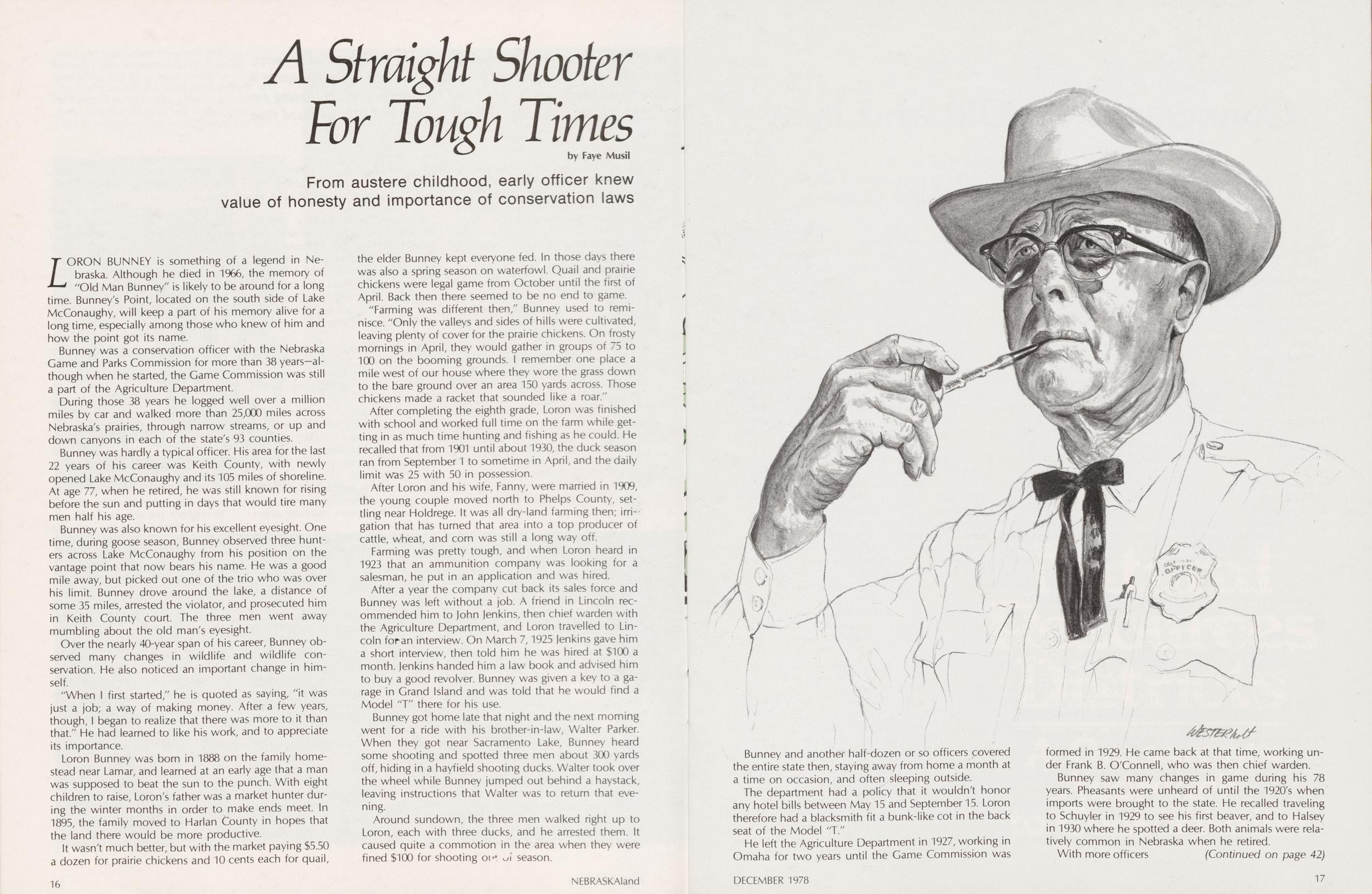
A Straight Shooter For Tough Times
From austere childhood, early officer knew value of honesty and importance of conservation lawsLORON BUNNEY is something of a legend in Nebraska. Although he died in 1966, the memory of "Old Man Bunney" is likely to be around for a long time. Bunney's Point, located on the south side of Lake McConaughy, will keep a part of his memory alive for a long time, especially among those who knew of him and how the point got its name.
Bunney was a conservation officer with the Nebraska Game and Parks Commission for more than 38 years—although when he started, the Game Commission was still a part of the Agriculture Department.
During those 38 years he logged well over a million miles by car and walked more than 25,000 miles across Nebraska's prairies, through narrow streams, or up and down canyons in each of the state's 93 counties.
Bunney was hardly a typical officer. His area for the last 22 years of his career was Keith County, with newly opened Lake McConaughy and its 105 miles of shoreline. At age 77', when he retired, he was still known for rising before the sun and putting in days that would tire many men half his age.
Bunney was also known for his excellent eyesight. One time, during goose season, Bunney observed three hunters across Lake McConaughy from his position on the vantage point that now bears his name. He was a good mile away, but picked out one of the trio who was over his limit. Bunney drove around the lake, a distance of some 35 miles, arrested the violator, and prosecuted him in Keith County court. The three men went away mumbling about the old man's eyesight.
Over the nearly 40-year span of his career, Bunney observed many changes in wildlife and wildlife conservation. He also noticed an important change in himself.
"When I first started," he is quoted as saying, "it was just a job; a way of making money. After a few years, though, I began to realize that there was more to it than that." He had learned to like his work, and to appreciate its importance.
Loron Bunney was born in 1888 on the family homestead near Lamar, and learned at an early age that a man was supposed to beat the sun to the punch. With eight children to raise, Loron's father was a market hunter during the winter months in order to make ends meet. In 1895, the family moved to Harlan County in hopes that the land there would be more productive.
It wasn't much better, but with the market paying $5.50 a dozen for prairie chickens and 10 cents each for quail, the elder Bunney kept everyone fed. In those days there was also a spring season on waterfowl. Quail and prairie chickens were legal game from October until the first of April. Back then there seemed to be no end to game.
"Farming was different then," Bunney used to reminisce. "Only the valleys and sides of hills were cultivated, leaving plenty of cover for the prairie chickens. On frosty mornings in April, they would gather in groups of 75 to 100 on the booming grounds. I remember one place a mile west of our house where they wore the grass down to the bare ground over an area 150 yards across. Those chickens made a racket that sounded like a roar."
After completing the eighth grade, Loron was finished with school and worked full time on the farm while getting in as much time hunting and fishing as he could. He recalled that from 1901 until about 1930, the duck season ran from September 1 to sometime in April, and the daily limit was 25 with 50 in possession.
After Loron and his wife, Fanny, were married in 1909, the young couple moved north to Phelps County, settling near Holdrege. It was all dry-land farming then; irrigation that has turned that area into a top producer of cattle, wheat, and corn was still a long way off.
Farming was pretty tough, and when Loron heard in 1923 that an ammunition company was looking for a salesman, he put in an application and was hired.
After a year the company cut back its sales force and Bunney was left without a job. A friend in Lincoln recommended him to John Jenkins, then chief warden with the Agriculture Department, and Loron travelled to Lincoln foran interview. On March 7,1925 Jenkins gave him a short interview, then told him he was hired at $100 a month. Jenkins handed him a law book and advised him to buy a good revolver. Bunney was given a key to a garage in Grand Island and was told that he would find a Model "T" there for his use.
Bunney got home late that night and the next morning went for a ride with his brother-in-law, Walter Parker. When they got near Sacramento Lake, Bunney heard some shooting and spotted three men about 300 yards off, hiding in a hayfield shooting ducks. Walter took over the wheel while Bunney jumped out behind a haystack, leaving instructions that Walter was to return that evening.
Around sundown, the three men walked right up to Loron, each with three ducks, and he arrested them. It caused quite a commotion in the area when they were fined $100 for shooting out of season.
16 NEBRASKAIandBunney and another half-dozen or so officers covered the entire state then, staying away from home a month at a time on occasion, and often sleeping outside.
The department had a policy that it wouldn't honor any hotel bills between May 15 and September 15. Loron therefore had a blacksmith fit a bunk-like cot in the back seat of the Model "T."
He left the Agriculture Department in 1927, working in Omaha for two years until the Game Commission was formed in 1929. He came back at that time, working under Frank B. O'Connell, who was then chief warden.
Bunney saw many changes in game during his 78 years. Pheasants were unheard of until the 1920's when imports were brought to the state. He recalled traveling to Schuyler in 1929 to see his first beaver, and to Halsey in 1930 where he spotted a deer. Both animals were relatively common in Nebraska when he retired. With more officers (Continued on page 42)
DECEMBER 1978 17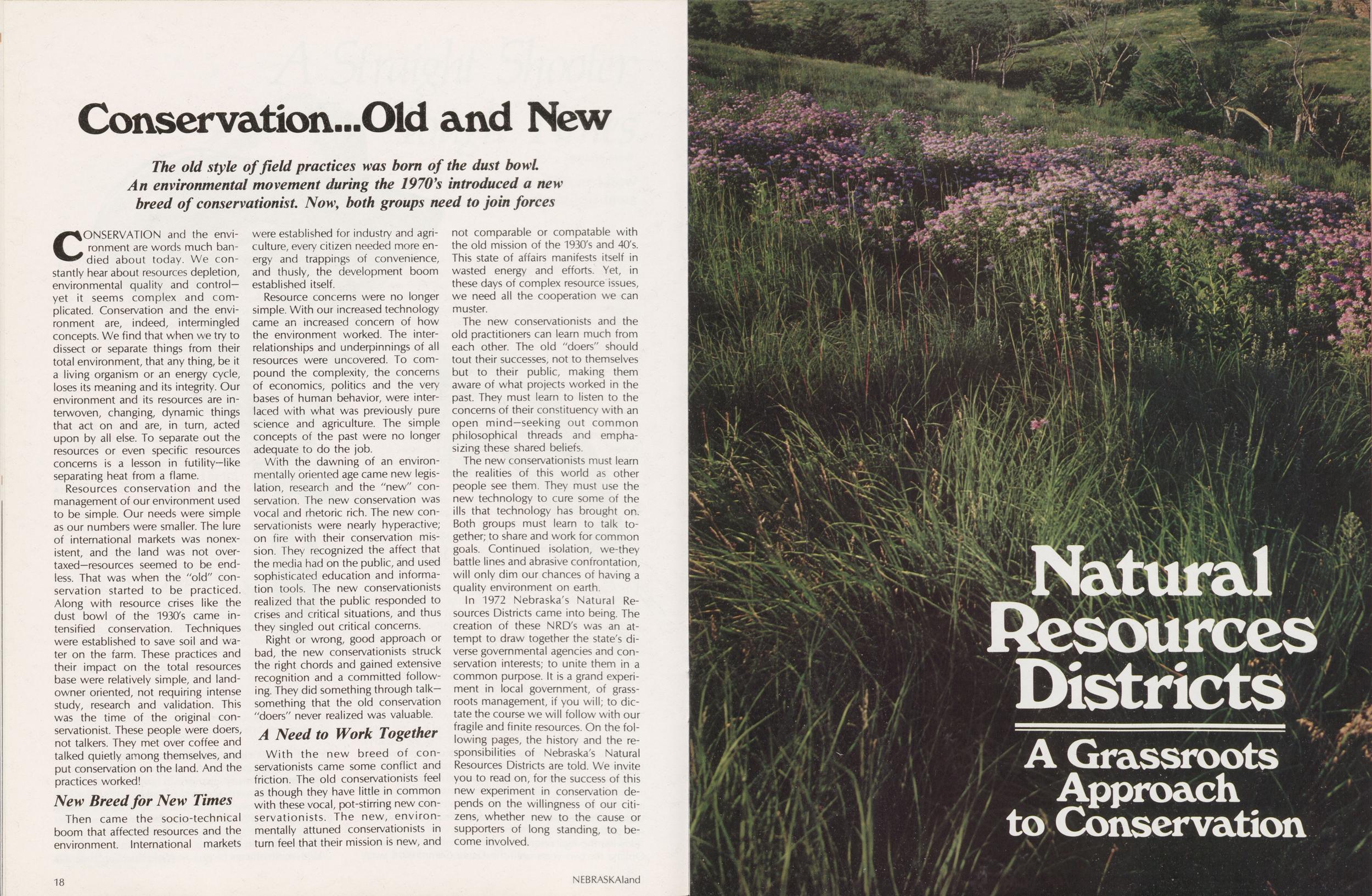
Conservation...Old and New
The old style of field practices was born of the dust bowl An environmental movement during the 1970's introduced a new breed of conservationist. Now, both groups need to join forcesCONSERVATION and the environment are words much bandied about today. We constantly hear about resources depletion, environmental quality and control—yet it seems complex and complicated. Conservation and the environment are, indeed, intermingled concepts. We find that when we try to dissect or separate things from their total environment, that any thing, be it a living organism or an energy cycle, loses its meaning and its integrity. Our environment and its resources are interwoven, changing, dynamic things that act on and are, in turn, acted upon by all else. To separate out the resources or even specific resources concerns is a lesson in futility—like separating heat from a flame.
Resources conservation and the management of our environment used to be simple. Our needs were simple as our numbers were smaller. The lure of international markets was nonexistent, and the land was not overtaxed—resources seemed to be endless. That was when the "old" conservation started to be practiced. Along with resource crises like the dust bowl of the 1930's came intensified conservation. Techniques were established to save soil and water on the farm. These practices and their impact on the total resources base were relatively simple, and landowner oriented, not requiring intense study, research and validation. This was the time of the original conservationist. These people were doers, not talkers. They met over coffee and talked quietly among themselves, and put conservation on the land. And the practices worked!
New Breed for New TimesThen came the socio-technical boom that affected resources and the environment. International markets were established for industry and agriculture, every citizen needed more energy and trappings of convenience, and thusly, the development boom established itself.
Resource concerns were no longer simple. With our increased technology came an increased concern of how the environment worked. The interrelationships and underpinnings of all resources were uncovered. To compound the complexity, the concerns of economics, politics and the very bases of human behavior, were interlaced with what was previously pure science and agriculture. The simple concepts of the past were no longer adequate to do the job.
With the dawning of an environmentally oriented age came new legislation, research and the "new" conservation. The new conservation was vocal and rhetoric rich. The new conservationists were nearly hyperactive; on fire with their conservation mission. They recognized the affect that the media had on the public, and used sophisticated education and information tools. The new conservationists realized that the public responded to crises and critical situations, and thus they singled out critical concerns.
Right or wrong, good approach or bad, the new conservationists struck the right chords and gained extensive recognition and a committed following. They did something through talk something that the old conservation "doers" never realized was valuable.
A Need to Work TogetherWith the new breed of conservationists came some conflict and friction. The old conservationists feel as though they have little in common with these vocal, pot-stirring new conservationists. The new, environmentally attuned conservationists in turn feel that their mission is new, and not comparable or compatable with the old mission of the 1930's and 40's. This state of affairs manifests itself in wasted energy and efforts. Yet, in these days of complex resource issues, we need all the cooperation we can muster.
The new conservationists and the old practitioners can learn much from each other. The old "doers" should tout their successes, not to themselves but to their public, making them aware of what projects worked in the past. They must learn to listen to the concerns of their constituency with an open mind—seeking out common philosophical threads and emphasizing these shared beliefs.
The new conservationists must learn the realities of this world as other people see them. They must use the new technology to cure some of the ills that technology has brought on. Both groups must learn to talk together; to share and work for common goals. Continued isolation, we-they battle lines and abrasive confrontation, will only dim our chances of having a quality environment on earth.
In 1972 Nebraska's Natural Resources Districts came into being. The creation of these NRD's was an attempt to draw together the state's diverse governmental agencies and conservation interests; to unite them in a common purpose. It is a grand experiment in local government, of grassroots management, if you will; to dictate the course we will follow with our fragile and finite resources. On the following pages, the history and the responsibilities of Nebraska's Natural Resources Districts are told. We invite you to read on, for the success of this new experiment in conservation depends on the willingness of our citizens, whether new to the cause or supporters of long standing, to become involved.
18 NEBRASKAIandNatural Resources Districts
A Grassroots Approach to Conservation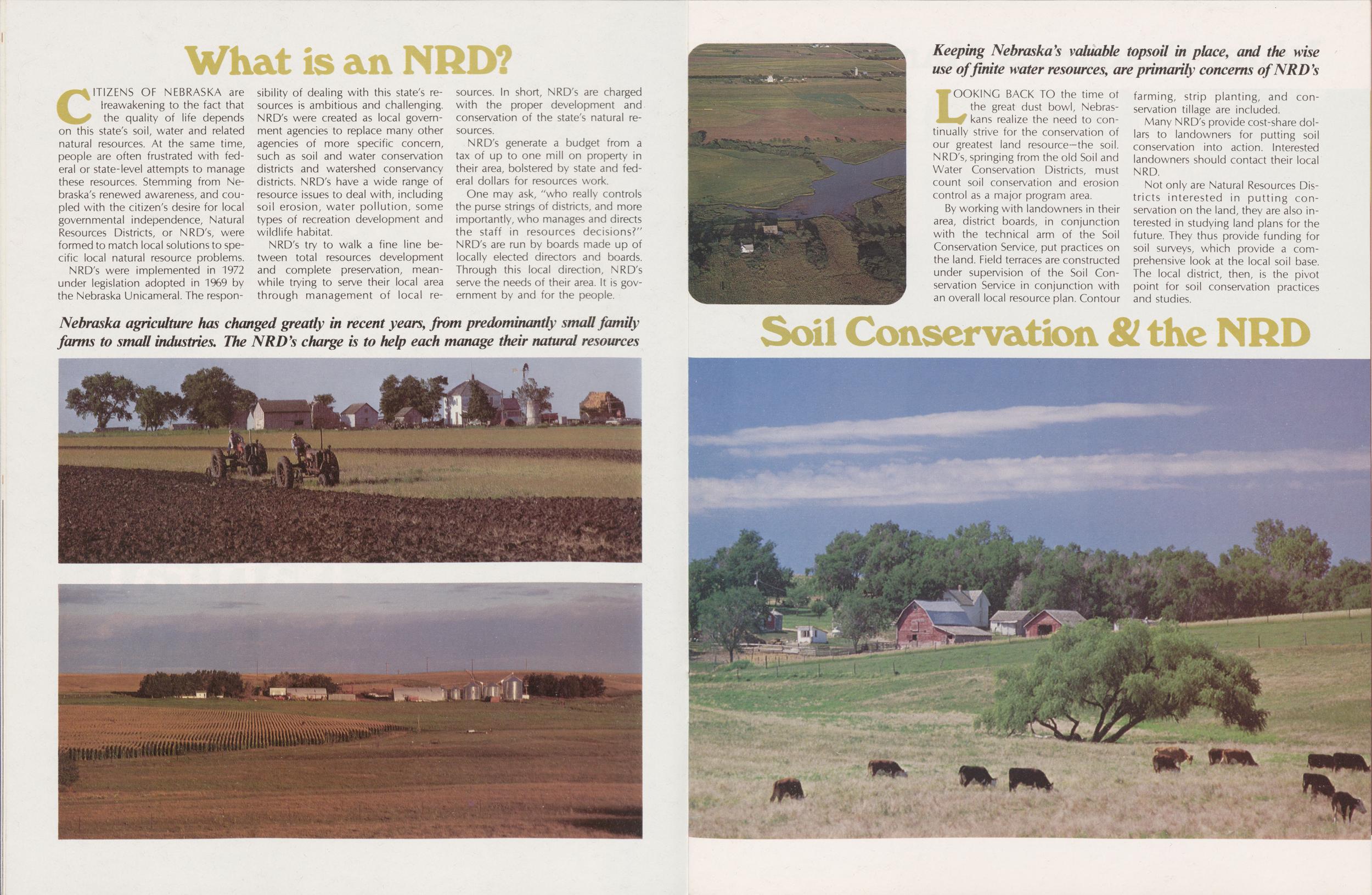 What is an NRD?
CITIZENS OF NEBRASKA are reawakening to the fact that the quality of life depends on this state's soil, water and related natural resources. At the same time, people are often frustrated with federal or state-level attempts to manage these resources. Stemming from Nebraska's renewed awareness, and coupled with the citizen's desire for local governmental independence, Natural Resources Districts, or NRD's, were formed to match local solutions to specific local natural resource problems.
NRD's were implemented in 1972 under legislation adopted in 1969 by the Nebraska Unicameral. The responsibility of dealing with this state's resources is ambitious and challenging. NRD's were created as local government agencies to replace many other agencies of more specific concern, such as soil and water conservation districts and watershed conservancy districts. NRD's have a wide range of resource issues to deal with, including soil erosion, water pollution, some types of recreation development and wildlife habitat.
NRD's try to walk a fine line between total resources development and complete preservation, meanwhile trying to serve their local area through management of local resources. In short, NRD's are charged with the proper development and conservation of the state's natural resources.
NRD's generate a budget from a tax of up to one mill on property in their area, bolstered by state and federal dollars for resources work.
One may ask, "who really controls the purse strings of districts, and more importantly, who manages and directs the staff in resources decisions?" NRD's are run by boards made up of locally elected directors and boards. Through this local direction, NRD's serve the needs of their area. It is government by and for the people.
LOOKING BACK TO the time of the great dust bowl, Nebraskans realize the need to continually strive for the conservation of our greatest land resource—the soil. NRD's, springing from the old Soil and Water Conservation Districts, must count soil conservation and erosion control as a major program area.
By working with landowners in their area, district boards, in conjunction with the technical arm of the Soil Conservation Service, put practices on the land. Field terraces are constructed under supervision of the Soil Conservation Service in conjunction with an overall local resource plan. Contour farming, strip planting, and conservation tillage are included.
Many NRD's provide cost-share dollars to landowners for putting soil conservation into action. Interested landowners should contact their local NRD.
Not only are Natural Resources Districts interested in putting conservation on the land, they are also interested in studying land plans for the future. They thus provide funding for soil surveys, which provide a comprehensive look at the local soil base. The local district, then, is the pivot point for soil conservation practices and studies.
Soil Conservation & the NRD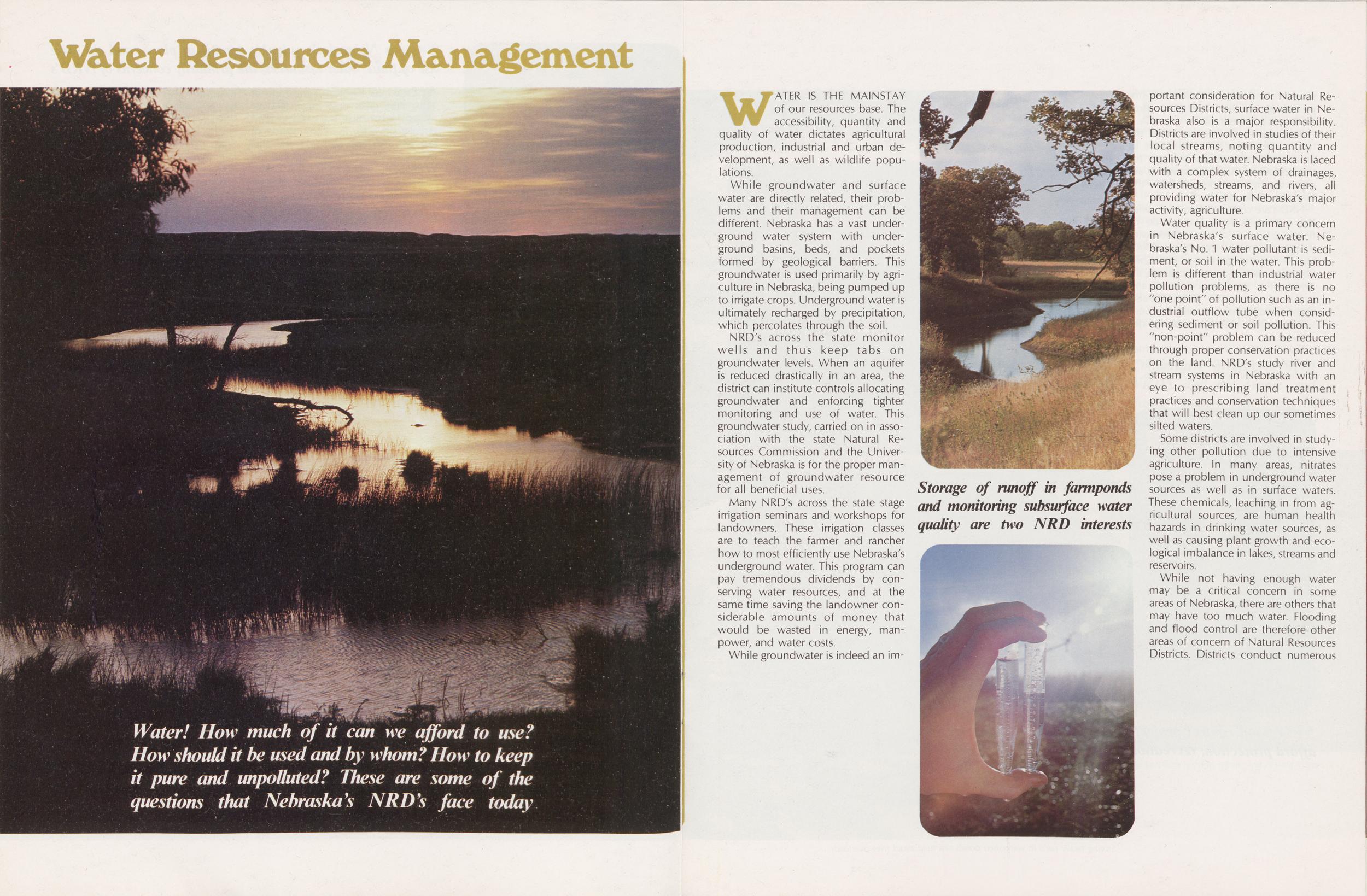 Water Resources Management
WATER IS THE MAINSTAY of our resources base. The accessibility, quantity and quality of water dictates agricultural production, industrial and urban development, as well as wildlife populations.
While groundwater and surface water are directly related, their problems and their management can be different. Nebraska has a vast underground water system with underground basins, beds, and pockets formed by geological barriers. This groundwater is used primarily by agriculture in Nebraska, being pumped up to irrigate crops. Underground water is ultimately recharged by precipitation, which percolates through the soil.
NRD's across the state monitor wells and thus keep tabs on groundwater levels. When an aquifer is reduced drastically in an area, the district can institute controls allocating groundwater and enforcing tighter monitoring and use of water. This groundwater study, carried on in association with the state Natural Resources Commission and the University of Nebraska is for the proper management of groundwater resource for all beneficial uses.
Many NRD's across the state stage irrigation seminars and workshops for landowners. These irrigation classes are to teach the farmer and rancher how to most efficiently use Nebraska's underground water. This program can pay tremendous dividends by conserving water resources, and at the same time saving the landowner considerable amounts of money that would be wasted in energy, manpower, and water costs.
While groundwater is indeed an important
Water quality is a primary concern in Nebraska's surface water. Nebraska's No. 1 water pollutant is sediment, or soil in the water. This problem is different than industrial water pollution problems, as there is no "one point" of pollution such as an industrial outflow tube when considering sediment or soil pollution. This "non-point" problem can be reduced through proper conservation practices on the land. NRD's study river and stream systems in Nebraska with an eye to prescribing land treatment practices and conservation techniques that will best clean up our sometimes silted waters.
Some districts are involved in studying other pollution due to intensive agriculture. In many areas, nitrates pose a problem in underground water sources as well as in surface waters. These chemicals, leaching in from agricultural sources, are human health hazards in drinking water sources, as well as causing plant growth and ecological imbalance in lakes, streams and reservoirs.
While not having enough water
may be a critical concern in some
areas of Nebraska, there are others that
may have too much water. Flooding
and flood control are therefore other
areas of concern of Natural Resources
Districts. Districts conduct numerous
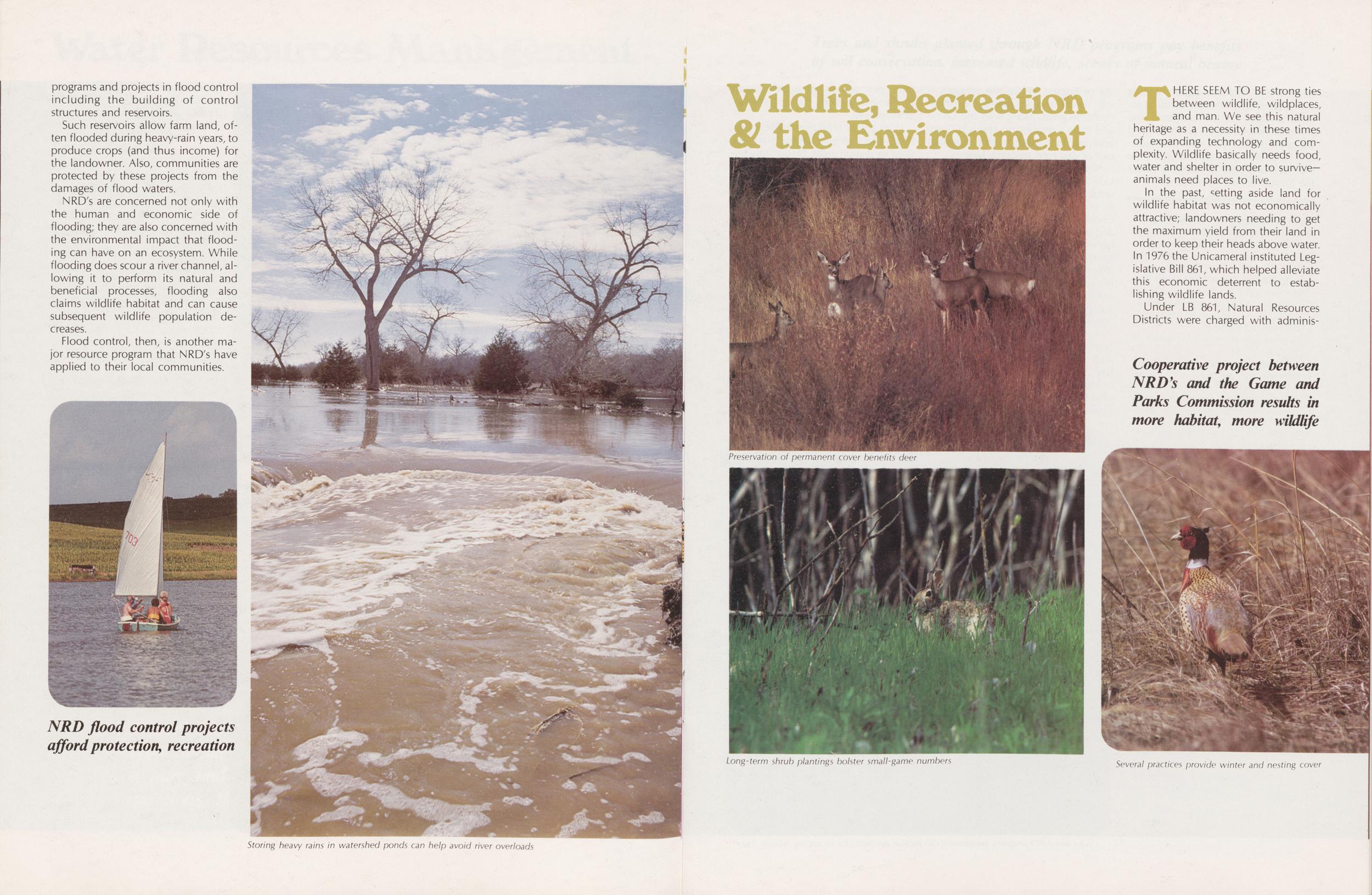 programs and projects in flood control
including the building of control
structures and reservoirs.
programs and projects in flood control
including the building of control
structures and reservoirs.
Such reservoirs allow farm land, often flooded during heavy-rain years, to produce crops (and thus income) for the landowner. Also, communities are protected by these projects from the damages of flood waters.
NRD's are concerned not only with the human and economic side of flooding; they are also concerned with the environmental impact that flooding can have on an ecosystem. While flooding does scour a river channel, allowing it to perform its natural and beneficial processes, flooding also claims wildlife habitat and can cause subsequent wildlife population decreases.
Flood control, then, is another major resource program that NRD's have applied to their local communities.
THERE SEEM TO BE strong ties between wildlife, wildplaces, and man. We see this natural heritage as a necessity in these times of expanding technology and complexity. Wildlife basically needs food, water and shelter in order to survive—animals need places to live.
In the past, netting aside land for wildlife habitat was not economically attractive; landowners needing to get the maximum yield from their land in order to keep their heads above water. In 1976 the Unicameral instituted Legislative Bill 861, which helped alleviate this economic deterrent to establishing wildlife lands.
Under LB 861, Natural Resources Districts were charged with administering
Cooperative project between NRD's and the Game and Parks Commission results in more habitat, more wildlife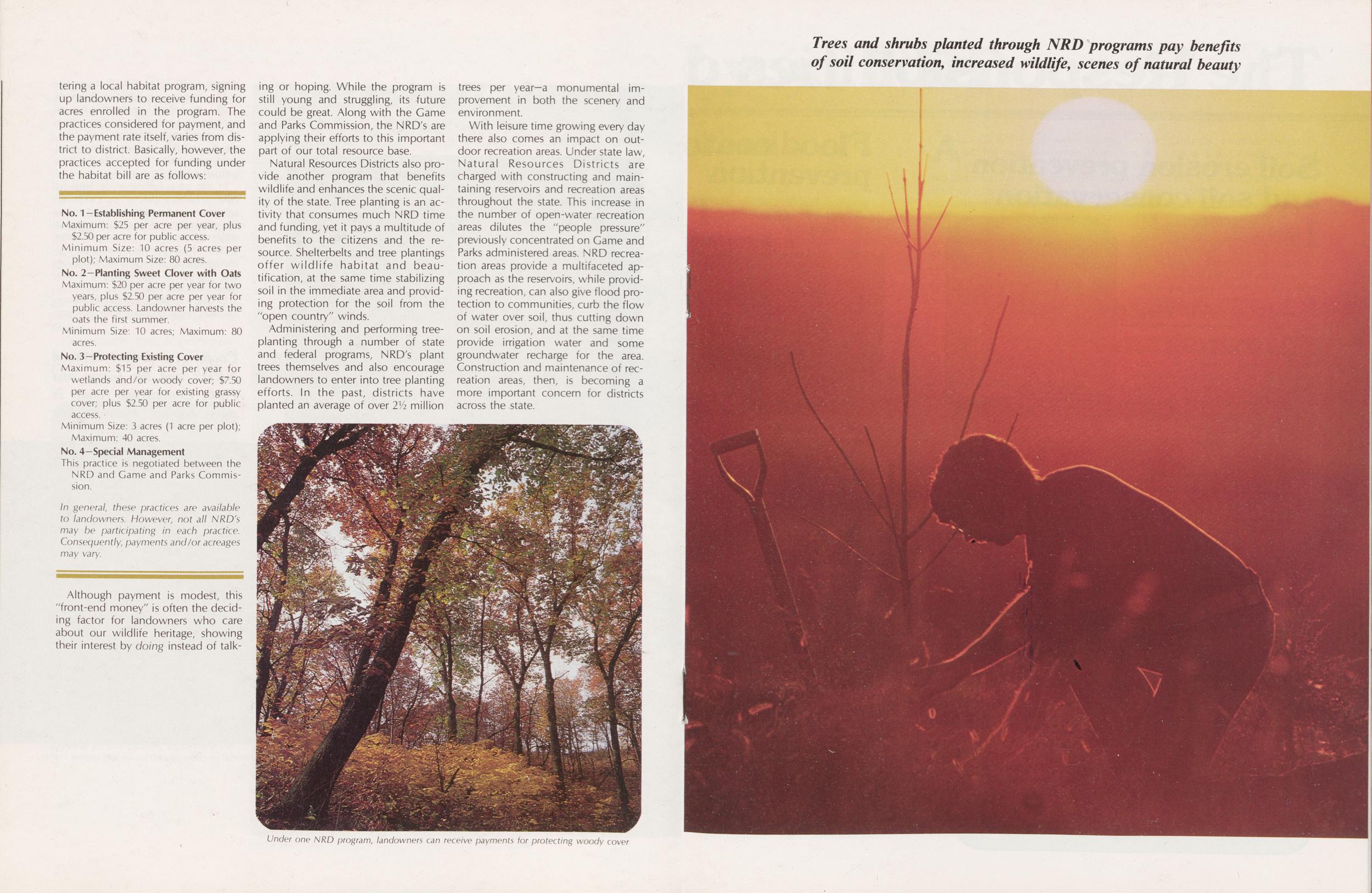
a local habitat program, signing up landowners to receive funding for acres enrolled in the program. The practices considered for payment, and the payment rate itself, varies from district to district. Basically, however, the practices accepted for funding under the habitat bill are as follows:
No. 1—Establishing Permanent Cover Maximum: $25 per acre per year, plus $2.50 per acre for public access. Minimum Size: 10 acres (5 acres per plot); Maximum Size: 80 acres.No. 2—Planting Sweet Clover with Oats Maximum: $20 per acre per year for two years, plus $2.50 per acre per year for public access. Landowner harvests the oats the first summer. Minimum Size: 10 acres; Maximum: 80 acres.
No. 3—Protecting Existing Cover Maximum: $15 per acre per year for wetlands and/or woody cover; $7.50 per acre per year for existing grassy cover; plus $2.50 per acre for public access. Minimum Size: 3 acres (1 acre per plot); Maximum: 40 acres.
No. 4—Special Management This practice is negotiated between the NRD and Game and Parks Commission.
In general, these practices are available to landowners. However, not all NRD's may be participating in each practice. Consequently, payments and lor acreages may vary.
Although payment is modest, this "front-end money" is often the deciding factor for landowners who care about our wildlife heritage, showing their interest by doing instead of talking or hoping. While the program is still young and struggling, its future could be great. Along with the Game and Parks Commission, the NRD's are applying their efforts to this important part of our total resource base.
Natural Resources Districts also provide another program that benefits wildlife and enhances the scenic quality of the state. Tree planting is an activity that consumes much NRD time and funding, yet it pays a multitude of benefits to the citizens and the resource. Shelterbelts and tree plantings offer wildlife habitat and beautification, at the same time stabilizing soil in the immediate area and providing protection for the soil from the "open country" winds.
Administering and performing tree-planting through a number of state and federal programs, NRD's plant trees themselves and also encourage landowners to enter into tree planting efforts. In the past, districts have planted an average of over 21/2 million trees per year—a monumental improvement in both the scenery and environment.
With leisure time growing every day there also comes an impact on outdoor recreation areas. Under state law, Natural Resources Districts are charged with constructing and maintaining reservoirs and recreation areas throughout the state. This increase in the number of open-water recreation areas dilutes the "people pressure" previously concentrated on Game and Parks administered areas. NRD recreation areas provide a multifaceted approach as the reservoirs, while providing recreation, can also give flood protection to communities, curb the flow of water over soil, thus cutting down on soil erosion, and at the same time provide irrigation water and some groundwater recharge for the area. Construction and maintenance of recreation areas, then, is becoming a more important concern for districts across the state.
 The Responsibilities of your NRD
Soil erosion prevention
and soil conservation
The Responsibilities of your NRD
Soil erosion prevention
and soil conservation
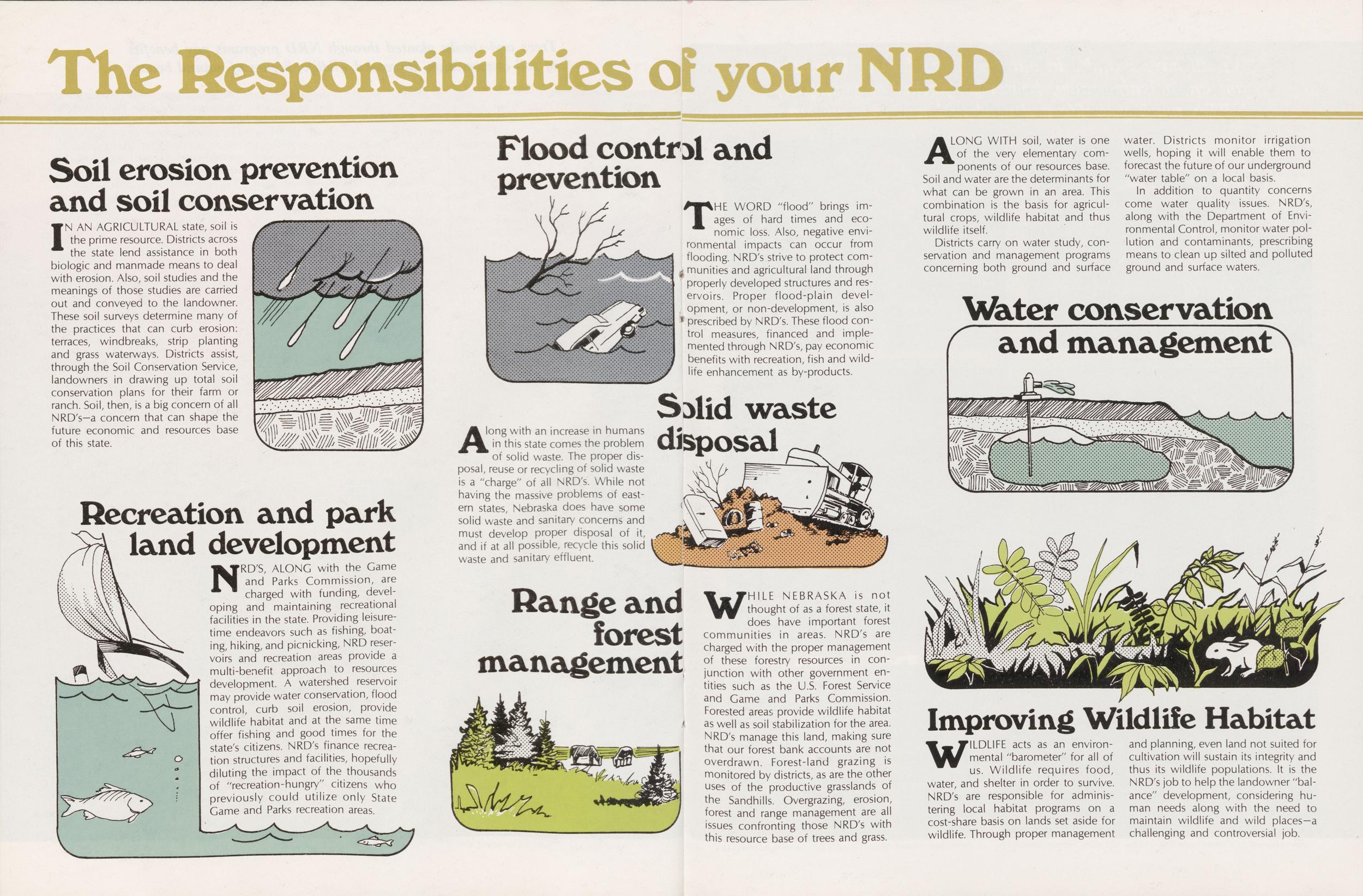
IN AN AGRICULTURAL state, soil is the prime resource. Districts across the state lend assistance in both biologic and manmade means to deal with erosion. Also, soil studies and the meanings of those studies are carried out and conveyed to the landowner. These soil surveys determine many of the practices that can curb erosion: terraces, windbreaks, strip planting and grass waterways. Districts assist, through the Soil Conservation Service, landowners in drawing up total soil conservation plans for their farm or ranch. Soil, then, is a big concern of all NRD's—a concern that can shape the future economic and resources base of this state.
NRD'S, ALONG with the Game and Parks Commission, are charged with funding, developing and maintaining recreational facilities in the state. Providing leisure-time endeavors such as fishing, boating, hiking, and picnicking, NRD reservoirs and recreation areas provide a multi-benefit approach to resources development. A watershed reservoir may provide water conservation, flood control, curb soil erosion, provide wildlife habitat and at the same time offer fishing and good times for the state's citizens. NRD's finance recreation structures and facilities, hopefully diluting the impact of the thousands of "recreation-hungry" citizens who previously could utilize only State Game and Parks recreation areas.
Solid waste disposalAong with an increase in humans in this state comes the problem of solid waste. The proper disposal, reuse or recycling of solid waste is a "charge" of all NRD's. While not having the massive problems of eastern states, Nebraska does have some solid waste and sanitary concerns and must develop proper disposal of it, and if at all possible, recycle this solid waste and sanitary effluent.
Flood control and preventionTHE WORD "flood" brings images of hard times and economic loss. Also, negative environmental impacts can occur from flooding. NRD's strive to protect cormmunities and agricultural land through properly developed structures and reservoirs. Proper flood-plain development, or non-development, is also 1 prescribed by NRD's. These flood control measures, financed and implemented through NRD's, pay economic benefits with recreation, fish and wildlife enhancement as by-products.
Range and forest managementWHILE NEBRASKA is not thought of as a forest state, it does have important forest communities in areas. NRD's are charged with the proper management of these forestry resources in conjunction with other government entities such as the U.S. Forest Service and Game and Parks Commission. Forested areas provide wildlife habitat as well as soil stabilization for the area. NRD's manage this land, making sure that our forest bank accounts are not overdrawn. Forest-land grazing is monitored by districts, as are the other uses of the productive grasslands of the Sandhills. Overgrazing, erosion, forest and range management are all issues confronting those NRD's with this resource base of trees and grass.
ALONG WITH soil, water is one of the very elementary components of our resources base. Soil and water are the determinants for what can be grown in an area. This combination is the basis for agricultural crops, wildlife habitat and thus wildlife itself.
Districts carry on water study, conservation and management programs concerning both ground and surface water. Districts monitor irrigation wells, hoping it will enable them to forecast the future of our underground "water table" on a local basis.
In addition to quantity concerns come water quality issues. NRD's, along with the Department of Environmental Control, monitor water pollution and contaminants, prescribing means to clean up silted and polluted ground and surface waters.
Waiter conservation and management^WILDLIFE acts as an environmental "barometer" for all of us. Wildlife requires food, water, and shelter in order to survive. NRD's are responsible for administering local habitat programs on a cost-share basis on lands set aside for wildlife. Through proper management and planning, even land not suited for cultivation will sustain its integrity and thus its wildlife populations. It is the NRD's job to help the landowner "balance" development, considering human needs along with the need to maintain wildlife and wild places—a challenging and controversial job.
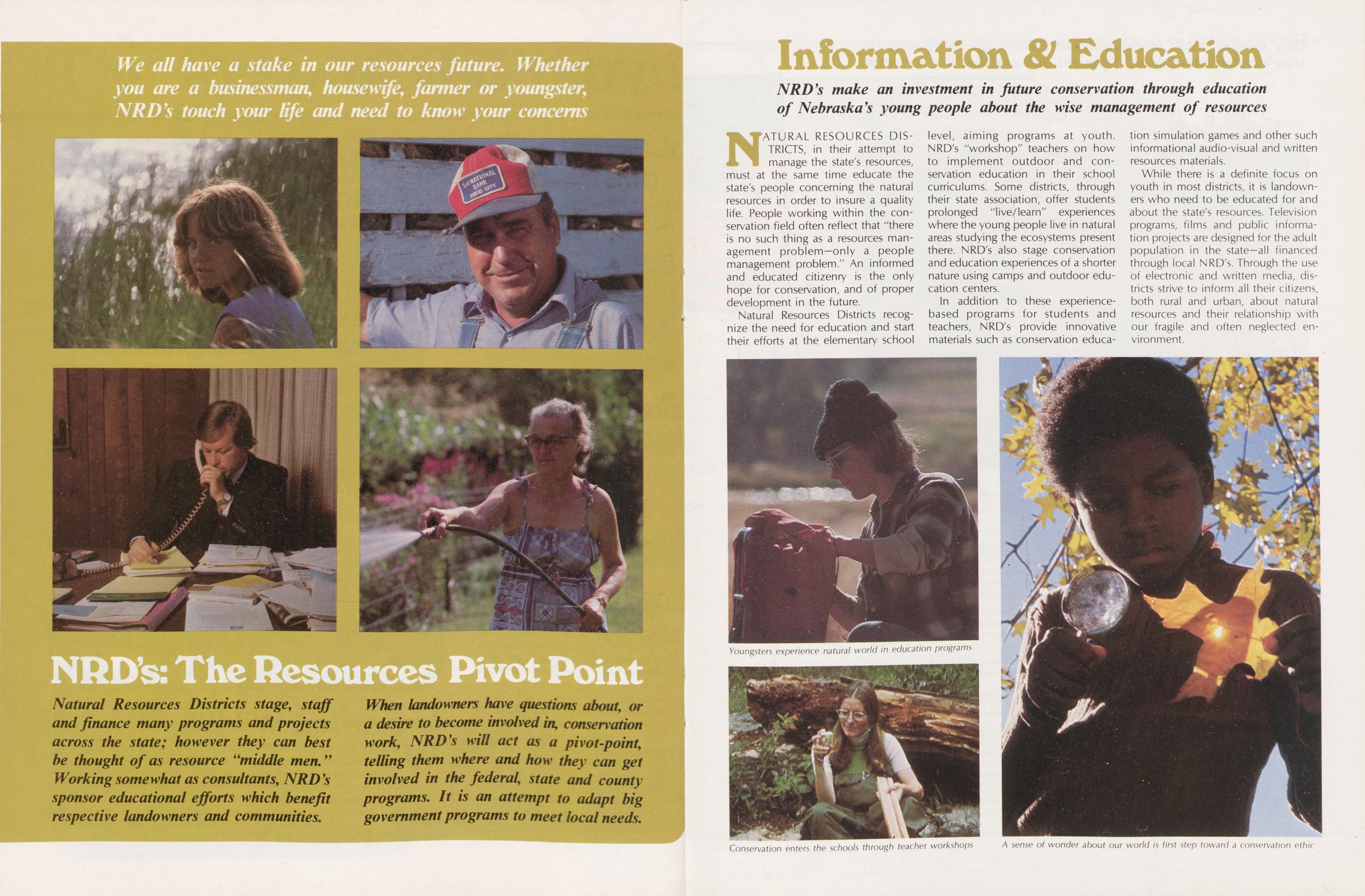 We all have a stake in our resources future. Whether
you are a businessman, housewife, farmer or youngster,
NRD's touch your hfe and need to know your concerns
We all have a stake in our resources future. Whether
you are a businessman, housewife, farmer or youngster,
NRD's touch your hfe and need to know your concerns
Natural Resources Districts stage, staff and finance many programs and projects across the state; however they can best be thought of as resource "middle men." Working somewhat as consultants, NRD's sponsor educational efforts which benefit respective landowners and communities. When landowners have questions aboutm or a desire to become involved in, conservation work, NRD's will act as a pivot-point, telling them where and how they can get involved in the federal, state and county programs. It is an attempt to adapt big government programs to meet local needs.
Information & Education NRD's make an investment in future conservation through education of Nebraska's young people about the wise management of resourcesNATURAL RESOURCES DISTRICTS, in their attempt to manage the state's resources, must at the same time educate the state's people concerning the natural resources in order to insure a quality life. People working within the conservation field often reflect that 'There is no such thing as a resources management problem—only a people management problem." An informed and educated citizenry is the only hope for conservation, and of proper development in the future.
Natural Resources Districts recognize the need for education and start their efforts at the elementary school level, aiming programs at youth. NRD's "workshop" teachers on how to implement outdoor and conservation education in their school curriculums. Some districts, through their state association, offer students prolonged "live/learn" experiences where the young people live in natural areas studying the ecosystems present there. NRD's also stage conservation and education experiences of a shorter nature using camps and outdoor education centers.
In addition to these experience-based programs for students and teachers, NRD's provide innovative materials such as conservation education simulation games and other such informational audio-visual and written resources materials.
While there is a definite focus on youth in most districts, it is landowners who need to be educated for and about the state's resources. Television programs, films and public information projects are designed for the adult population in the state—all financed through local NRD's. Through the use of electronic and written media, districts strive to inform all their citizens, both rural and urban, about natural resources and their relationship with our fragile and often neglected environment.
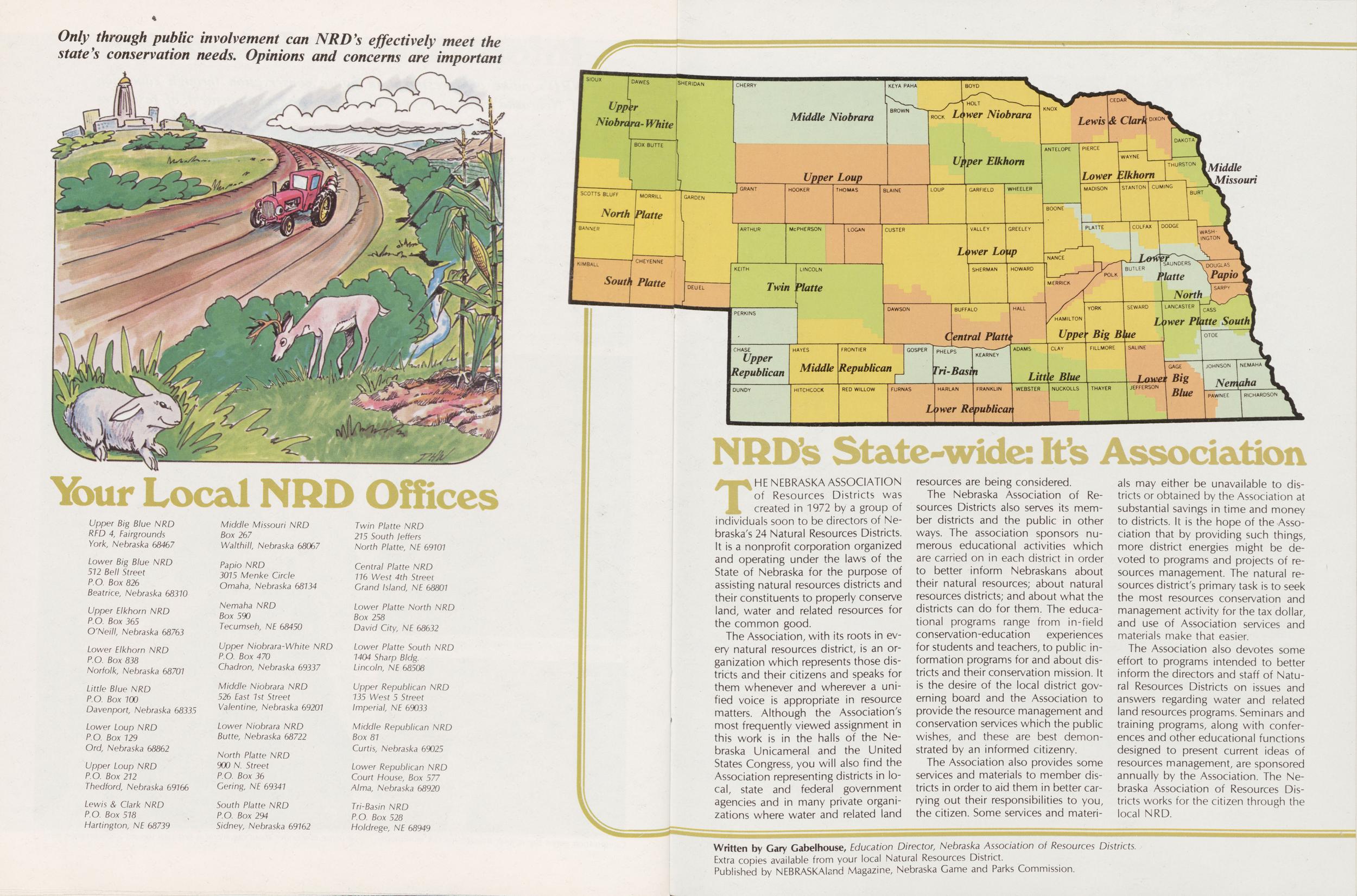 Only through public involvement can NRD's effectively meet the
state's conservation needs. Opinions and concerns are important
Only through public involvement can NRD's effectively meet the
state's conservation needs. Opinions and concerns are important
THE NEBRASKA ASSOCIATION of Resources Districts was created in 1972 by a group of individuals soon to be directors of Nebraska's 24 Natural Resources Districts. It is a nonprofit corporation organized and operating under the laws of the State of Nebraska for the purpose of assisting natural resources districts and their constituents to properly conserve land, water and related resources for the common good.
The Association, with its roots in every natural resources district, is an organization which represents those districts and their citizens and speaks for them whenever and wherever a unified voice is appropriate in resource matters. Although the Association's most frequently viewed assignment in this work is in the halls of the Nebraska Unicameral and the United States Congress, you will also find the Association representing districts in local, state and federal government agencies and in many private organizations where water and related land resources are being considered.
The Nebraska Association of Resources Districts also serves its member districts and the public in other ways. The association sponsors numerous educational activities which are carried on in each district in order to better inform Nebraskans about their natural resources; about natural resources districts; and about what the districts can do for them. The educational programs range from in-field conservation-education experiences for students and teachers, to public information programs for and about districts and their conservation mission. It is the desire of the local district governing board and the Association to provide the resource management and conservation services which the public wishes, and these are best demonstrated by an informed citizenry.
The Association also provides some services and materials to member districts in order to aid them in better carrying out their responsibilities to you, the citizen. Some services and materials may either be unavailable to districts or obtained by the Association at substantial savings in time and money to districts. It is the hope of the Association that by providing such things, more district energies might be devoted to programs and projects of resources management. The natural resources district's primary task is to seek the most resources conservation and management activity for the tax dollar, and use of Association services and materials make that easier.
The Association also devotes some effort to programs intended to better inform the directors and staff of Natural Resources Districts on issues and answers regarding water and related land resources programs. Seminars and training programs, along with conferences and other educational functions designed to present current ideas of resources management, are sponsored annually by the Association. The Nebraska Association of Resources Districts works for the citizen through the local NRD.
Written by Gary Gabelhouse, Education Director, Nebraska Association of Resources Districts. Extra copies available from your local Natural Resources District. Published by NEBRASKAland Magazine, Nebraska Game and Parks Commission.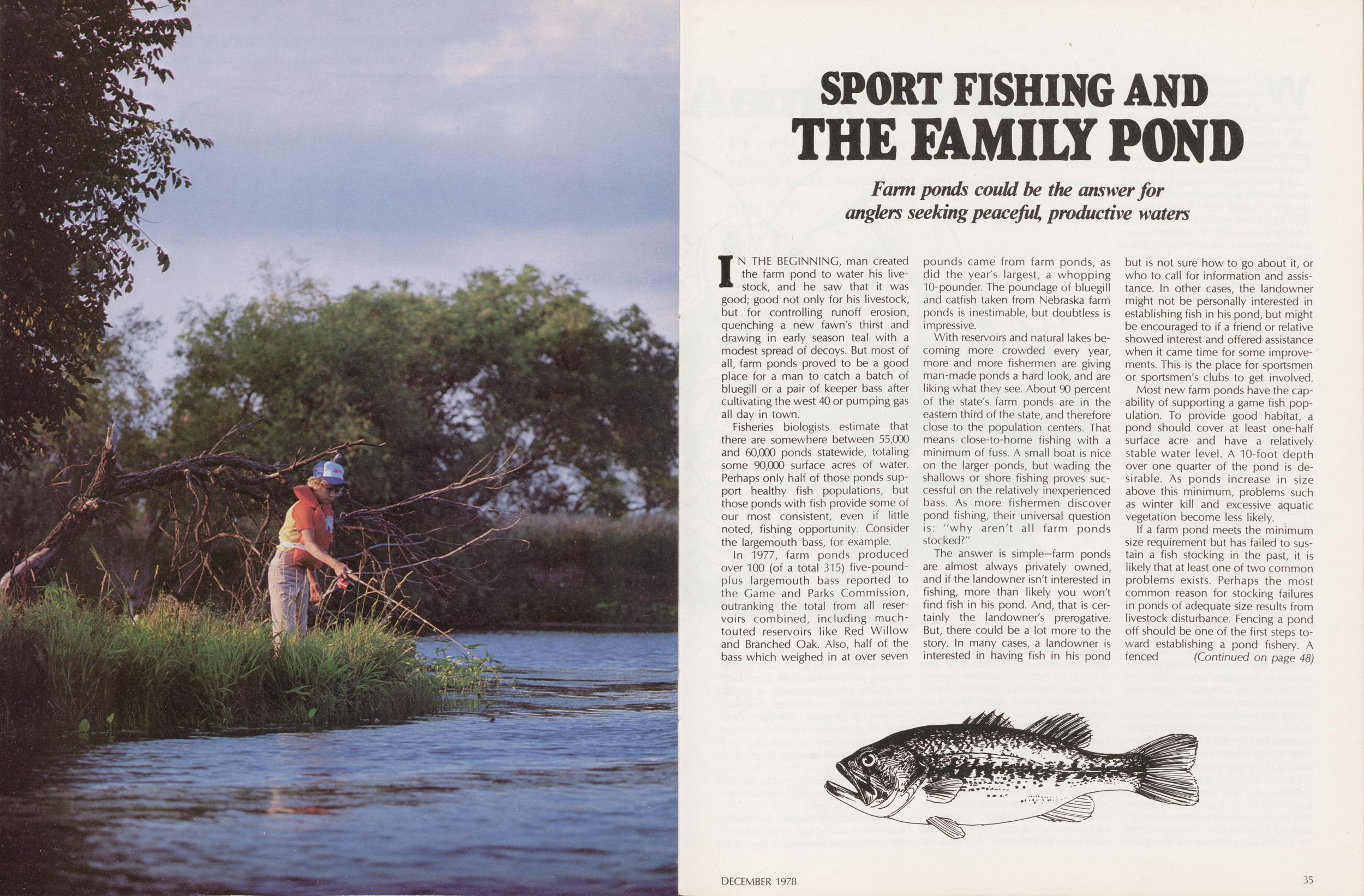
SPORT FISHING AND THE FAMILY POND
Farm ponds could be the answer for anglers seeking peaceful, productive watersIN THE BEGINNING, man created the farm pond to water his livestock, and he saw that it was good; good not only for his livestock, but for controlling runoff erosion, quenching a new fawn's thirst and drawing in early season teal with a modest spread of decoys. But most of all, farm ponds proved to be a good place for a man to catch a batch of bluegill or a pair of keeper bass after cultivating the west 40 or pumping gas all day in town.
Fisheries biologists estimate that there are somewhere between 55,000 and 60,000 ponds statewide, totaling some 90,000 surface acres of water. Perhaps only half of those ponds support healthy fish populations, but those ponds with fish provide some of our most consistent, even if little noted, fishing opportunity. Consider the largemouth bass, for example.
In 1977, farm ponds produced over 100 (of a total 315) five-pound-plus largemouth bass reported to the Game and Parks Commission, outranking the total from all reservoirs combined, including much-touted reservoirs like Red Willow and Branched Oak. Also, half of the bass which weighed in at over seven pounds came from farm ponds, as did the year's largest, a whopping 10-pounder. The poundage of bluegill and catfish taken from Nebraska farm ponds is inestimable, but doubtless is impressive.
With reservoirs and natural lakes becoming more crowded every year, more and more fishermen are giving man-made ponds a hard look, and are liking what they see. About 90 percent of the state's farm ponds are in the eastern third of the state, and therefore close to the population centers. That means close-to-home fishing with a minimum of fuss. A small boat is nice on the larger ponds, but wading the shallows or shore fishing proves successful on the relatively inexperienced bass. As more fishermen discover pond fishing, their universal question is: "why aren't all farm ponds stocked?"
The answer is simple—farm ponds are almost always privately owned, and if the landowner isn't interested in fishing, more than likely you won't find fish in his pond. And, that is certainly the landowner's prerogative. But, there could be a lot more to the story. In many cases, a landowner is interested in having fish in his pond but is not sure how to go about it, or who to call for information and assistance. In other cases, the landowner might not be personally interested in establishing fish in his pond, but might be encouraged to if a friend or relative showed interest and offered assistance when it came time for some improvements. This is the place for sportsmen or sportsmen's clubs to get involved.
Most new farm ponds have the capability of supporting a game fish population. To provide good habitat, a pond should cover at least one-half surface acre and have a relatively stable water level. A 10-foot depth over one quarter of the pond is desirable. As ponds increase in size above this minimum, problems such as winter kill and excessive aquatic vegetation become less likely. If a farm pond meets the minimum size requirement but has failed to sustain a fish stocking in the past, it is likely that at least one of two common problems exists. Perhaps the most common reason for stocking failures in ponds of adequate size results from livestock disturbance. Fencing a pond off should be one of the first steps toward establishing a pond fishery. A fenced (Continued on page 48)
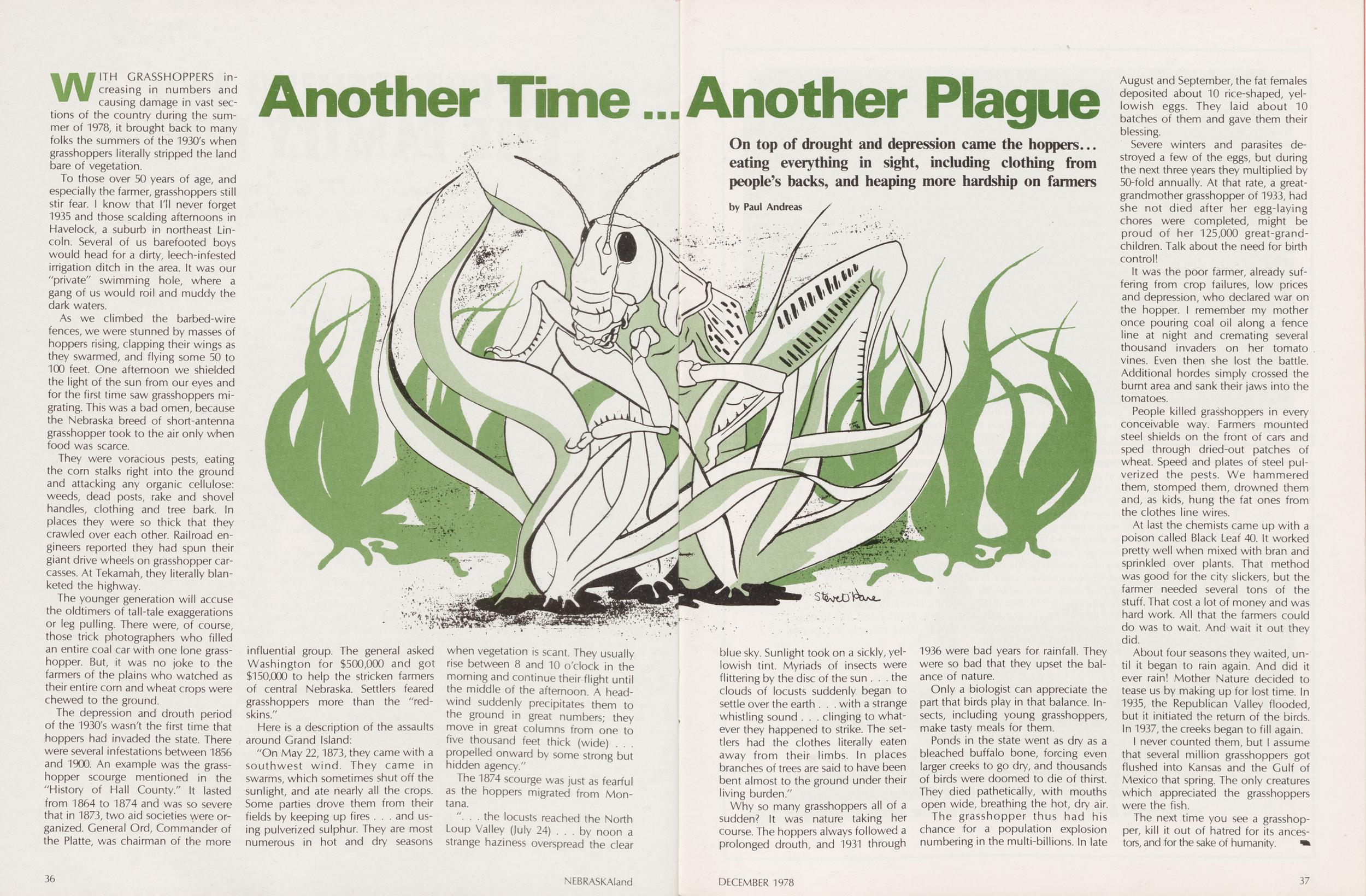
Another Time...Another Plague
On top of drought and depression came the hoppers... eating everything in sight, including clothing from people's backs, and heaping more hardship on farmers by Paul AndreasWITH GRASSHOPPERS increasing in numbers and causing damage in vast sections of the country during the summer of 1978, it brought back to many folks the summers of the 1930's when grasshoppers literally stripped the land bare of vegetation.
To those over 50 years of age, and especially the farmer, grasshoppers still stir fear. I know that HI never forget 1935 and those scalding afternoons in Havelock, a suburb in northeast Lincoln. Several of us barefooted boys would head for a dirty, leech-infested irrigation ditch in the area. It was our "private" swimming hole, where a gang of us would roil and muddy the dark waters.
As we climbed the barbed-wire fences, we were stunned by masses of hoppers rising, clapping their wings as they swarmed, and flying some 50 to 100 feet. One afternoon we shielded the light of the sun from our eyes and for the first time saw grasshoppers migrating. This was a bad omen, because the Nebraska breed of short-antenna grasshopper took to the air only when food was scarce.
They were voracious pests, eating the corn stalks right into the ground and attacking any organic cellulose: weeds, dead posts, rake and shovel handles, clothing and tree bark. In places they were so thick that they crawled over each other. Railroad engineers reported they had spun their giant drive wheels on grasshopper carcasses. At Tekamah, they literally blanketed the highway.
The younger generation will accuse the oldtimers of tall-tale exaggerations or leg pulling. There were, of course, those trick photographers who filled an entire coal car with one lone grasshopper. But, it was no joke to the farmers of the plains who watched as their entire corn and wheat crops were chewed to the ground.
The depression and drouth period of the 1930's wasn't the first time that hoppers had invaded the state. There were several infestations between 1856 and 1900. An example was the grasshopper scourge mentioned in the "History of Hall County." It lasted from 1864 to 1874 and was so severe that in 1873, two aid societies were organized. General Ord, Commander of the Platte, was chairman of the more Another Time ...Another Plague On top of drought and depression came the hoppers... eating everything in sight, including clothing from people's backs, and heaping more hardship on farmers influential group. The general asked Washington for $500,000 and got $150,000 to help the stricken farmers of central Nebraska. Settlers feared grasshoppers more than the "redskins."
Here is a description of the assaults around Grand Island:
"On May 22,1873, they came with a southwest wind. They came in swarms, which sometimes shut off the sunlight, and ate nearly all the crops. Some parties drove them from their fields by keeping up fires . . . and using pulverized sulphur. They are most numerous in hot and dry seasons when vegetation is scant. They usually rise between 8 and 10 o'clock in the morning and continue their flight until the middle of the afternoon. A headwind suddenly precipitates them to the ground in great numbers; they move in great columns from one to five thousand feet thick (wide) propelled onward by some strong but hidden agency."
The 1874 scourge was just as fearful as the hoppers migrated from Montana.
". . . the locusts reached the North Loup Valley (July 24) . . . by noon a strange haziness overspread the clear 36 NEBRASKAIand blue sky. Sunlight took on a sickly, yellowish tint. Myriads of insects were flittering by the disc of the sun ... the clouds of locusts suddenly began to settle over the earth . . . with a strange whistling sound . . . clinging to whatever they happened to strike. The settlers had the clothes literally eaten away from their limbs. In places branches of trees are said to have been bent almost to the ground under their living burden."
Why so many grasshoppers all of a sudden? It was nature taking her course. The hoppers always followed a prolonged drouth, and 1931 through 1936 were bad years for rainfall. They were so bad that they upset the balance of nature.
Only a biologist can appreciate the part that birds play in that balance. Insects, including young grasshoppers, make tasty meals for them.
Ponds in the state went as dry as a bleached buffalo bone, forcing even larger creeks to go dry, and thousands of birds were doomed to die of thirst. They died pathetically, with mouths open wide, breathing the hot, dry air.
The grasshopper thus had his chance for a population explosion numbering in the multi-billions. In late August and September, the fat females deposited about 10 rice-shaped, yellowish eggs. They laid about 10 batches of them and gave them their blessing.
Severe winters and parasites destroyed a few of the eggs, but during the next three years they multiplied by 50-fold annually. At that rate, a greatgrandmother grasshopper of 1933, had she not died after her egg-laying chores were completed, might be proud of her 125,000 great-grandchildren. Talk about the need for birth control!
It was the poor farmer, already suffering from crop failures, low prices and depression, who declared war on the hopper. I remember my mother once pouring coal oil along a fence line at night and cremating several thousand invaders on her tomato vines. Even then she lost the battle. Additional hordes simply crossed the burnt area and sank their jaws into the tomatoes.
People killed grasshoppers in every conceivable way. Farmers mounted steel shields on the front of cars and sped through dried-out patches of wheat. Speed and plates of steel pulverized the pests. We hammered them, stomped them, drowned them and, as kids, hung the fat ones from the clothes line wires.
At last the chemists came up with a poison called Black Leaf 40. It worked pretty well when mixed with bran and sprinkled over plants. That method was good for the city slickers, but the farmer needed several tons of the stuff. That cost a lot of money and was hard work. All that the farmers could do was to wait. And wait it out they did.
About four seasons they waited, until it began to rain again. And did it ever rain! Mother Nature decided to tease us by making up for lost time. In 1935, the Republican Valley flooded, but it initiated the return of the birds. In 1937, the creeks began to fill again.
I never counted them, but I assume that several million grasshoppers got flushed into Kansas and the Gulf of Mexico that spring. The only creatures which appreciated the grasshoppers were the fish.
The next time you see a grasshopper, kill it out of hatred for its ancestors, and for the sake of humanity.
DECEMBER 1978 37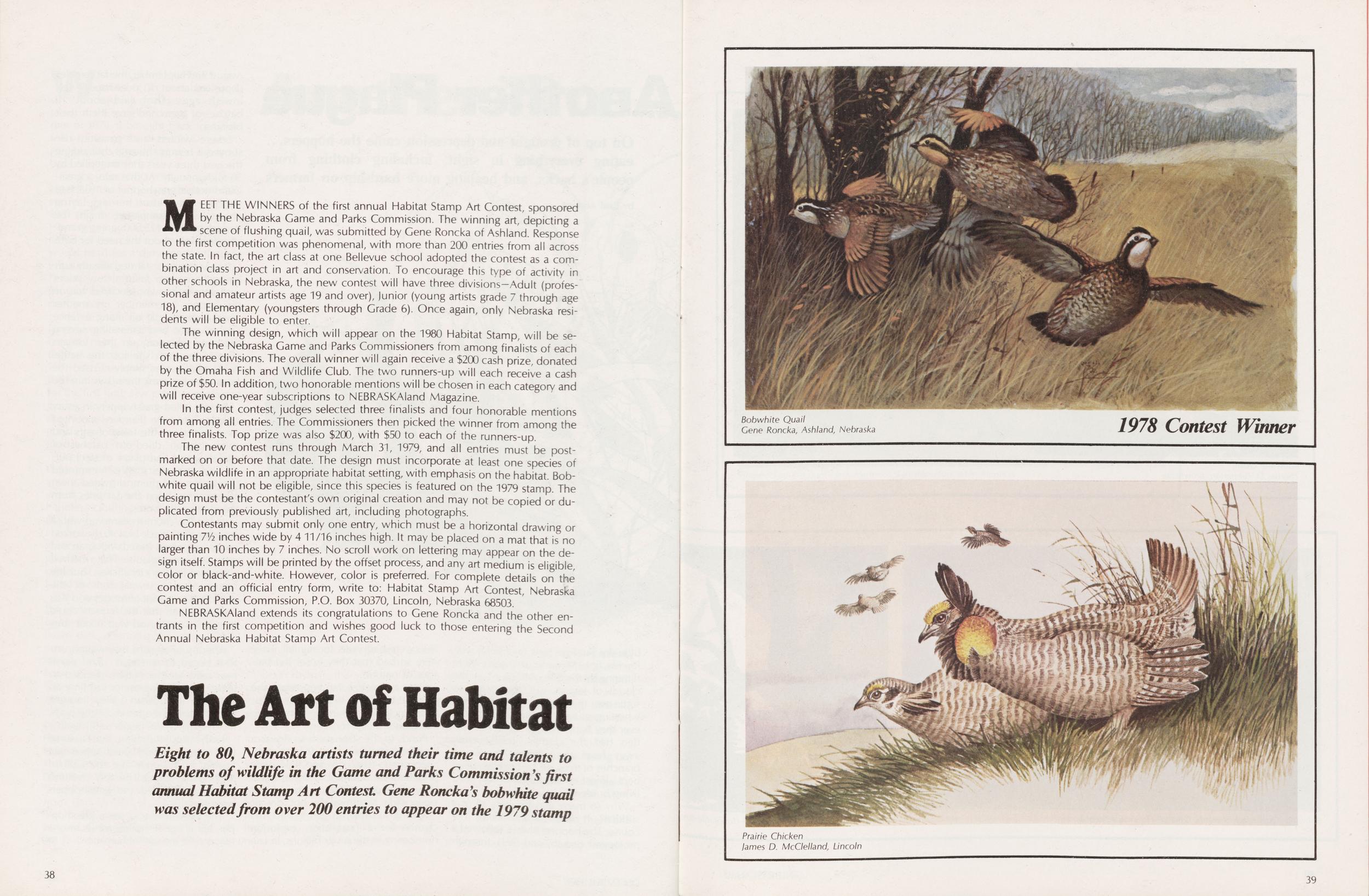
The Art of Habitat
Eight to 80, Nebraska artists turned their time and talents to problems of wildlife in the Game and Parks Commission's first annual Habitat Stamp Art Contest Gene Roncka's bobwhite quail was selected from over 200 entries to appear on the 1979 stampMEET THE WINNERS of the first annual Habitat Stamp Art Contest, sponsored by the Nebraska Game and Parks Commission. The winning art, depicting a scene of flushing quail, was submitted by Gene Roncka of Ashland. Response to the first competition was phenomenal, with more than 200 entries from all across the state. In fact, the art class at one Bellevue school adopted the contest as a combination class project in art and conservation. To encourage this type of activity in other schools in Nebraska, the new contest will have three divisions—Adult (professional and amateur artists age 19 and over), Junior (young artists grade 7 through age 18), and Elementary (youngsters through Grade 6). Once again, only Nebraska residents will be eligible to enter.
The winning design, which will appear on the 1980 Habitat Stamp, will be selected by the Nebraska Game and Parks Commissioners from among finalists of each of the three divisions. The overall winner will again receive a $200 cash prize, donated by the Omaha Fish and Wildlife Club. The two runners-up will each receive a cash prize of $50. In addition, two honorable mentions will be chosen in each category and will receive one-year subscriptions to NEBRASKAIand Magazine.
In the first contest, judges selected three finalists and four honorable mentions from among all entries. The Commissioners then picked the winner from among the three finalists. Top prize was also $200, with $50 to each of the runners-up.
The new contest runs through March 31, 1979, and all entries must be postmarked on or before that date. The design must incorporate at least one species of Nebraska wildlife in an appropriate habitat setting, with emphasis on the habitat. Bobwhite quail will not be eligible, since this species is featured on the 1979 stamp. The design must be the contestant's own original creation and may not be copied or duplicated from previously published art, including photographs.
Contestants may submit only one entry, which must be a horizontal drawing or painting 7Vi inches wide by 4 11/16 inches high. It may be placed on a mat that is no larger than 10 inches by 7 inches. No scroll work on lettering may appear on the design itself. Stamps will be printed by the offset process, and any art medium is eligible, color or black-and-white. However, color is preferred. For complete details on the contest and an official entry form, write to: Habitat Stamp Art Contest, Nebraska Game and Parks Commission, P.O. Box 30370, Lincoln, Nebraska 68503.
NEBRASKAIand extends its congratulations to Gene Roncka and the other entrants in the first competition and wishes good luck to those entering the Second Annual Nebraska Habitat Stamp Art Contest.
38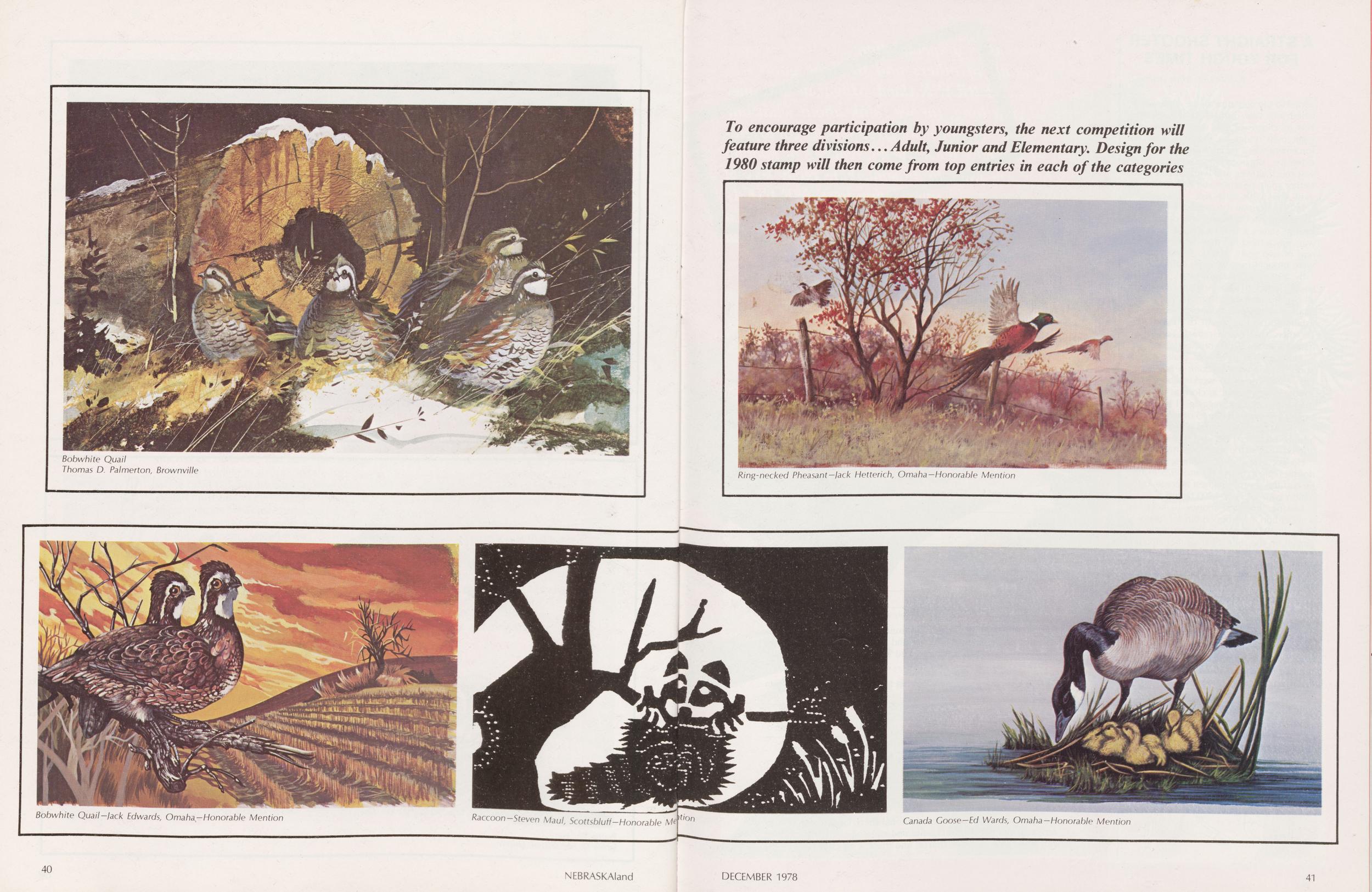
To encourage participation by youngsters, the next competition will feature three divisions... Adult, Junior and Elementary. Design for the 1980 stamp will then come from top entries in each of the categories

added to the department, the state was divided into two districts in 1936. Bunney was in charge of the eastern half, with eight men under his direction. Law enforcement was a far cry from today's more extensive organization. Communication was much slower, and with officers much farther apart, poachers still had a relatively easy time with little risk.
In 1943, Bunney was transferred to Ogallala where McConaughy was destined to be the state's top fishing spot. The lake was only a third full then, and over a period of two years, 16,000 carloads of rock were brought in to face the dam.
By 1945, McConaughy was producing good catches of fish. Anglers came from all over to take advantage of "Big Mac's" fabulous potential. Bunney checked 475 fishermen on the Fourth of July in 1951. For then, that was a crowd. Today, visitation reaches 30,000 on holidays.
Although he never got really serious about it, Bunney was quite a marksman. His remarks to a co-worker about trapshooting were about as close as the quiet man ever came to bragging. "I had heard how trapshooters broke 95 or more targets out of 100 and wondered what it was all about," he said. "I decided to give it a go and broke 93 in the state meet my first try."
He got even better, winning the state doubles title in both 1923 and 1926. In 1925 he had the seventh highest average in the nation with .9754 of 1,100 targets.
Lacking time and money to keep up competition, he dropped out for nearly 12 years. In 1942, he got in the act again and picked up the state all-around championship before giving up competition for good in 1956.
". . . You have to enjoy and believe in what you're doing. If you don't you'd better quit and go into something else."
That's about as close as anyone ever got to hearing a sermon from Bunney. Neither hero nor fool, Loron Bunney was what he was—a man doing his job. About the only distinction he had was that he was doing a job that was as much a part of his being as breathing. Many people search their whole lives for such a dream as Loron Bunney's, but far too few ever find it.
BOBWHITE! CURE FOR THE BLUES
(Continued from page 9)not like buying cornish hens in the supermarket, which probably explains why so many hunters spend their Saturdays chasing birds and so few shopping. Once you've reached this point of the hunt, all the advantages shift over to the quail. They are fast, erratic flyers and not at all averse to weaving a tortuous path through a bit of timber before flushing into the open.
The small covey flushed straight ahead and never left the woody cover until well beyond shotgun range. A second covey of 20 birds did the same before canting over the river. Larry dropped two singles that broke off to the north, while Lee and Darrell maintained their perfect record—0 for 0. Several cock pheasants also clawed their way out of the trees, but since that season was history, they might as well have watched the hunters pass. While success on the push was low, the plan was proceeding as anticipated—most of the quail had dropped into an open woodland south of the river.
Larry's philosophy is that the best thing to do with a busted covey is stay after it. Give the birds too much time to settle down and regroup and more than likely that is the last you'll see of them. The singles were widely scattered in a grove of dying elms choked with low-growing weeds, cedars and gooseberry bushes which hugged the branches of fallen trees. It should have been like a field trial. It wasn't! After two sweeps through the area, only four or five birds were kicked up, and of those, only two offered open shots and ended up in a game pouch.
In heavy cover where the only shot you get may be close, open chokes and spreading loads are a decided advantage. Darrell, Larry and Lee all shoot improved cylinder 12-gauges with No. 8 shot. It doesn't take a lot of lead to bring down a bobwhite, but an even, wide pattern cuts down on those holes which quail are notorious for flying through.
We crossed back to the north side of the river to an open stand of young cottonwoods growing in a low, wet area choked with rank growth of marsh grass. The sweep produced a frozen cock pheasant, found where he had huddled against last week's snow storm. At the fenceline, where the trees butted against a cornfield, Doc and Ginger came to point, a scene fit for one of those old barber-shop calendars. Larry walked in, anticipating a covey rise. Instead, a brace of long-tailed pheasants broke noisily from a small grass clump just under the dog's noses. Doc and Ginger watched in disbelief at the birds disappearing without so much as a shot.
While the hunters planned the next leg of the hunt, Doc moseyed toward a plum thicket that fingered out from the cotton woods on a south-facing bank dividing the Cedar River floodplain from the highland cornfields. Again he locked on point. Another pheasant? Before the hunters could make their way over the fence and to the plum thicket, Doc started to creep ahead. The bird, or birds, were moving. While the hunters watched, a covey of 25 to 30 quail flushed and dropped into the grassy slope to the west. A second covey, of maybe 15 birds, flushed only 20 yards from the first and minus three birds, dropped in with the first covey.
The side slope was grass covered with an occasional clump of scraggly sumac, two plum thickets and an ancient cottonwood about a third of a mile down. Most of the birds had dropped in near the Cottonwood. Picking up the singles, and in this case small groups of three and four, was fairly cut and dried. The dogs worked down the side slope, locked on point; one of the hunters walked in to flush the birds and within five minutes, another four quail were slipped into game pouches. Most of the remaining birds glided south to the woody cover along the north side of the river, several spread out in the cornfield, and several more dropped into a small grassy area with several fallen willows, indicating an area that was probably marshy on warmer days. But the singles that chose the small marsh sat tight, their scent eluding the dogs as Larry, Darrell and Lee made a swing through it on the way back to the pickup. The vote was unanimous to adjourn the hunt to town for homemade soup and coffee at the local cafe. It was 1 p.m. In less than two hours, the three hunters were one quail short of two limits.
But the morning's hunt ended with a bonus. At the last gate, while Lee strained with the all-too-snug wire hoop, another covey busted from a plum thicket at the edge of a corn-stubble field. By the time shotguns were uncased, both dogs were on point on different birds. Two birds up, two birds down and the hunters again turned their attention to vegetable soup.
It would have been an easy trick to return to the same area after lunch and pick up the remaining five birds needed to fill out, but a more unlikely afternoon hunt followed. I've sworn on a book of game regulations never to reveal the exact location of the next spot we hunted, but we left the bottoms for the uplands, and even if I drew you a map you'd drive right by it thinking the area fit only for corn rootworms and anemic grasshoppers. It was so unlikely a looking quail spot that I began to seriously question if the January weather had numbed the hunters' common sense. The terrain was high, rolling pastureland interspersed with what once must have been 20-bushel corn. Fences were few and far between and for the most part as nude as the streaker who reportedly entertained a nearby town the previous summer. As I tagged along in disbelief, we trudged up a wind-swept hill with nothing but freeze-dried clay around our feet.
The other side of the hill was something else. Completely hidden from view was a weedy, woody draw with corn butting up on one side. Another eroded draw ran to the west and petered out as a crippled hedge row bordering on a thriving nativegrass pasture. This was a likely enough looking spot for quail, but still I was skeptical. What self respecting, brush-loving bobwhite would tolerate all the nothingness to get there? About that time, Larry, who had disappeared with Doc around the east side of the draw, shot and yelled "four to go". The rest was anticlimactic. Coveys, some three in all as I recall, flushed from the weedy draws; singles drifted out to the points or into the native grass; Doc and Ginger made picture-pretty points and within 45 minutes we were warming out hands under the pickup's heater with the other four birds in the back. It was not yet 4 p.m.; some five hours after we had unlocked that first gate and with time out for lunch, a couple of warm-up sessions in the pickup, and a good 45 minutes of road time. The last coveys we'd busted still had a good hour to regroup against the frigid night and the foreboding storm sweeping in from the west. As we drove back, no one but me noticed the pigeons flushing from under the county road bridges!
DEVOTED TO DUCKS
(Continued from page 10)since. Decoys of foam and plastic have now replaced the tin silhouettes and wooden blocks that succeeded the live decoys when they were outlawed in the 1930% and a large modern cabin stands next to the old one-room log cabin that served as a second home for hunters for over 40 years.
Time has failed to diminish the fervor with which the Hoppes hunt ducks. If anything, it has increased over the years. Fritz and Louie may not hunt as much as they did in earlier days, but the third generation of Hoppes has more than made up for it. Fritz' two sons, Frank and Fred, have kept the hunting fire burning at the old Platte River blind. Other than newer style decoys and the addition of several portable blinds to cope with changing river channels, little has changed since the Hoppes shot their first duck decades ago.
Hunting seldom provides a livelihood for folks, however, and the Hoppes are no exception. While Louie still tends the land, Fritz works for a car dealer in Schuyler, and Fred has a gun and taxidermy shop. Frank divides his time between law school in Lincoln, carving decorative waterfowl, traveling the summer trapshooting circuit, and hunting ducks, with the latter getting most of his attention during the season.
Weekends are normally reserved for 46 NEBRASKAIand "family" at the blind, but Frank occasionally guides for other hunters during the week, when he can slip away from school, and fees collected go toward maintenance of the cabin and blinds.
I joined Frank and his friends at the family's riverside cabin one morning in the fall of 1977. Ripp, Frank's 8-year-old Lab, met me at the gate, ready for a day in the cold, icy waters of the Platte. The sky was beginning to turn light in the east when we donned waders for the trip to the blind. A swinging footbridge crossed the first channel; a refinement added a few years ago.
A well-worn trail through the willows stood out like a highway in the early light. Somewhere in the distance a mailard hen called to an as yet unseen flight of ducks returning to the river after feeding in surrounding cornfields. The whistle of wings and chuckling of mallards could be heard high overhead, and then the flock was seen winging downriver against the pink glow of pre-dawn light. The air was crisp and clear, the river slush ice clattering its way downstream.
Decoys needed to be set out, but floating ice and strong current made use of floaters out of the question, at least until the water warmed. Several dozen stakeout mallards were set on the ice, along with an equal number of Canadas. Over 100 floaters lay unused on the bank, waiting for the slush ice to thaw.
Rising and falling water levels from an upstream power plant make hunting somewhat difficult for the Hoppes. Even in the best weather, decoys must be pulled each night lest they be carried downstream by rising water.
Even now, ice had blocked the bank around the favored blind. Undaunted, the Hoppes had moved two portable blinds onto a towhead near the main channel. In earlier days, water fluctuations and freeze-up would have signaled an end to the day's shooting, when the family hunted from the big blind on the bank. Now, with the portables, the Hoppes can change locations as conditions change, often from day to day.
Predictably, the cold snap that had covered the river with ice two days before had moved thousands of mallards into the area, but many had moved out again ahead of the front, and the near-zero temperatures had sent the stragglers searching for open water. Across the river, mallards were piling into a warm-water creek, it's location given away by tell-tale fog.
Flight after flight of ducks passed quickly overhead amid the growing light of the dawn. Mallards and mergansers, with a sprinkling of other ducks, made their way up and down the valley, trading between an upstream refuge at Lake Babcock and the Dodge-Saunders Refuge.
Frank seldom has trouble finding someone to join him in the blind, and this Thursday morning was no exception. Even with the bitter cold, both blinds were full of hopeful hunters.
I was sharing a blind with Doug Cowgill, originally from Silver Creek who is now a surgeon in Los Angeles, and Gene Frankforter and Harry Johnston, who are in the auto repair business in Lincoln.
Five more hunters and Frank shared the other, larger blind. Typically, hunting had been nothing short of fantastic only two days before, but few birds were interested in our meager spread with the competition from real birds across the river. A lone greenwing drake floated into the decoys in the morning, but by mid-day when the flights stopped, no other birds had come in. The only bright spot was the sun which, even with the cold air, had melted enough river slush that we could set out several dozen floating decoys. It was several hours later when ducks began moving again—at first just a few
birds, then larger flocks. From the east, a flock of what appeared to be small ducks accompanied by a single, larger bird, headed straight for the setup. A quick check through glasses showed the ducks to be mallards and the larger bird to be a Canada goose. Already low enough, a few quacks from Frank's call turned the birds as they passed behind the blind, and they came right into the fakes. All nine hunters fired at the goose, and one hunter recovered in time to shoot a single mallard hen while the rest flew away unscathed.
The dog was retrieving the goose when a single scaup buzzed the decoys. Doug threw an ineffective shot in the direction of the loner, but collected the bird when it swung around and came back.
A flock of five mallards landed in mid-river, about 150 yards below the blind, apparently content to park for a while. Frank's lonesome hen call finally got the best of the flock, and they lifted off the water and came straight to the decoys. Three of the five stayed behind. Another larger group of mallards was saved by a trio of dive-bombing green-winged teal. About 30 birds were circling the dekes, and Frank was about ready to call the shot when the three teal slipped in from the opposite direction and flared the mallards. The greenheads then slipped over 20 yards and landed just out of effective gun range. The temptation to take a crack at the birds would have been too much for most hunters, but Frank opted to see if the birds might get tired of fighting the current. That opportunity never materialized, however, and the birds finally flushed and headed upriver.
Ironically, the same three teal that had spooked the mallards provided the final action of the day. They continued to buzz the decoys and finally put "flaps down" to land when Frank gave the order to take them. Two dropped among the decoys, while the third fell well out in the river. Ripp finally got a good workout, as the bird was obviously only crippled and floating downstream fast. Frank gave the dog a line, commanded it to retrieve, and watched as Ripp headed right for the bird, now nearly 100 yards away. The bird dove twice, with the dog right after it the second time. When Ripp came up, he had the bird in a firm grip and completed the retrieve with the dash and style of a dog half his age.
It has been a good day; not by all standards perhaps, but success at the Hoppe blind isn't measured in limits taken. Frank stresses that the quality of the hunt is more important. Quality as expressed in the companionship of good friends and relatives, having birds come to the call and a fine spread of decoys, watching good dog work, and finally, shooting ducks. As everywhere, there are days when they don't fire a shot, and days when limits come easy. The Hoppes take their share of birds, and their setup produced over 800 ducks and 26 geese last season.
Frank attributes this to a good location, a large spread of decoys, and good retrieving dogs. Undoubtedly, years of experience also add to the effectiveness of the spread.
Little has changed in the years that the Hoppes have hunted the Platte, and each fall brings a new hunting season, with unbridled optimism that this one will somehow be better than past years. And chances are it will be.
strip with good vegetative cover extending 20 to 50 feet beyond high water mark serves as a silt filter for water draining into the pond from farmland. Game fish simply cannot survive in silt-laden water. Fencing also keeps cattle from wading through fish spawning areas.
Complete fencing with a tank below the dam for watering livestock is the ideal solution but an alternate plan is to fence the pond and dam except for a small drinking area. Fencing a pond is an excellent project for the sportsman to help a landowner with and one that is sure to provide access for years to follow.
Even fenced farmponds can be plagued by a second problem that actually is an extension of the first. Runoff from over-grazed pasture or poorly managed row-crop land in the watershed above the pond will lower the water quality. Grass waterways leading into the pond, and terraces will reduce silt and chemical runoff that adversely affect fish. Information on how to manage the land around a farm pond is available from local Soil Conservation Service or Natural Resources District offices.
If these requirements have been met, most ponds can sustain a good sport fish population with proper management techniques. Fish for stocking Nebraska ponds are available most years from the Game and Parks Commission or may be obtained privately. Even if fish are provided by the state the landowner has the right not to allow public access. However, a balanced annual harvest of fish is strongly encouraged to sustain a high quality fish population. Panfish can become too numerous resulting in a stunted population if not harvested heavily.
Natural reproduction can be enhanced in a farm pond by providing spawning habitat. Again, this a good way for a fisherman in search of a fishing pond to make friends with a landowner.
Channel catfish must have an enclosed place or chamber for nest building. Sewer tile, 6 to 8 inches in diameter with one end plugged, or 10-gallon cream cans placed horizontal to the bottom in 2 to 6 feet of water, make excellent artificial spawning chambers.
Both bluegill and bass benefit from the anchoring of cedar trees or other brushy structures in shallow water. The best time to do this is in the winter. Trees can be tied to blocks and positioned on the ice. When thaw comes, the cover sinks into place on the bottom.
With an ever increasing demand for sport fishing on our finite water resources, farm ponds are receiving more attention from anglers and fisheries biologists alike. Since most ponds are on private land, the initiative to utilize them efficiently must come from the landowners. Fishermen should not wait impatiently in the wings for the landowners to do them a favor, though. With a little encouragement and a willingness to pitch in on some of the work, our fishing opportunity could be doubled from farm ponds.
48 NEBRASKAIandTrading Post
DOGSBEAGLES. Puppy love for sale. We have the perfect family companion or hunting partner for you. Champion dams and/or sire. Tux Beagles, Route 1, Box 152, Raymond, NE 68428 (402) 475-3713.
QUALITY HUNTING DOGS ready for the 1978 hunting season. Good supply of English setters, pointers, and Brittanies—some puppies. Darrell Yentes, 1118 McMillan, Holdrege, NE 68949 Phone: (308) 995-8570 or (308) 995-4797
MISCELLANEOUSGUNS-Browning, Winchester, Remington, others, Hi-powers, shotguns, new, used, antiques. Want Pre-1964 Winchesters. Buy-Sell-Trade. Ph. (402) 729-6112. Bedlan's Sporting Goods, Fairbury, NE 68352.
WANTED-JAPANESE SWORDS, fittings, related objects. Serious collector pays best prices. Call or write Don Hill, 5016 California, Omaha, NE 68132 (402) 558-0541.
TRAPPERS WANTED: )oin the NEBRASKA FUR HARVESTERS and be informed on the latest information regarding anti-trapping and legislation. Membership includes a monthly newspaper with articles on new ideas and techniques. Send $6.00 to Tom Krause, Box 337, Sutton, NE 68979
HAND-REARED wild ducks: Wood ducks, Mandarins, European Wigeons, and Red-crested Pochards. Mrs. R. W. Hansen, 3315 Avenue L, Kearney, Nebraska 68847
WANTED FOR 1979!......Persons interested in joining the Wilson Outfitters team in our state-wide canoe rental service. Locations and persons desired on the Missouri River (Niobrara-Santee and Yankton-Ponca areas ; Platte (Columbus to Louisville); Dismal; Loups; Calamus; Republican; Tri-County Canal; and on Kansas River below Milford and Tuttle Creek Reservoirs. Generous commission basis and great referral system. Requirements; Integrity; great desire to serve people; assertiveness; and, a strong belief in Nebraska Tourism and its future. Primitive campground on the river helpful. Write Wilson Outfitters, 1329 Dawes, Lincoln, Nebr. 68521
WAX WORMS 500-$8; 1CXD0-$14 postpaid. Add 3% sales tax. No COD. Harold Malicky, Burwell, Nebraska 68823
LIVE-CATCH TRAP. Guaranteed LIVE-Catch Trap, caught 3 coons, 2 mink, 5 possums in one night, one trap. Catch more fur or money back. Easily made from scrap, automatically resets, animal never gets bait. Drawing-Send $2, HAMMOND, RR 5, Box 319, Covington, KY 41015
DUCK HUNTERS! Guided hunts on Platte River near Schuyler. Monday through Friday, $15 per day. For reservations, contact Frank Hoppe, 4905 Sherwood Drive, Lincoln, Nebr. 68504 or call (402) 464-8417
ICE FISHERMEN-Try the new Flip-Up, a better tip-up! Freeze-proof and super sensitive. $2.95 ea. plus tax (add 70\t plus 10% for postage and handling). Satisfaction guaranteed Salt Valley Flip-Ups, P.O. Box 80513, Lincoln, NE 68501.
TAXIDERMYBIG BEAR TAXIDERMY, Rt. 2, Mitchell, Nebraska 69357. We specialize in all big game from Alaska to Nebraska, also birds and fish. Hair on and hair off tanning, 41/2 miles west of Scottsbluff on Highway 26. Phone (308) 635-3013.
KARL SCHWARZ Master Taxidermists. Mounting of game heads—birds-fish-animals—fur rugs—robes-tanning buckskin. Since 1910. 424 South 13th Street, Dept. A, Omaha, Nebraska 68102.
FISH MOUNTING Service. Specialize in all fresh-water fish. Visitors welcome. Wally Allison, 2709 Birchwood North Platte, NE 69101, (308) 534-2324.
COMPLETE TAXIDERMY SERVICE. We take pride in your satisfaction. We will help you go hunting and fishing—exclusive agent, Jack Jonas Safaris. Brochure and price list. Dinges Taxidermy Studio, 2760 S. 12th Omaha, NE 68108 (402) 342-3718.
CREATIVE TAXIDERMY. Modern methods and life-like workmanship on all fish and game since 1935; also tanning, rugs, and deerskin products. Joe Voges, Naturecrafts and Gift Shop, 925 4th Corso, Nebraska City, NE 68410 Phone: (402) 873-5491
WHITETAIL TAXIDERMY-specialists in fur and feathers ... 11 years experience. Professional and reasonable. (402) 564-6885, 3264 16th Avenue East, Columbus, NE 68601
FREEZE-DRY TAXIDERMY Wally Allison's State Record Taxidermy, 2709 Birchwood, North Platte, NE 69101 Phone: (308) 534-2324. Specializing in Fish and Small Game, Snake and Lizard and Novelties. (Nothing too small) Newest of all taxidermy methods employed.
BROWNING Our exclusive discount plan on all Browning products will save you up to 20%. This includes guns, ammunition, archery, clothing, boots, tents, gun cases, rifle scopes and fishing equipment. In- quire ... it will save you $$$. Big discounts on other sporting goods. NEW LOCATION! 7th and Seward Streets Seward, Nebraska NEW HOURS! Monday-Saturday, 9 a.m.-6 p.m. Friday, 9 a.m.-9 p.m. Sunday, 1-6 p.m. OLD FRIENDS! We're still the same old faces, so come in and browse in our new quarters. We'll be happy to see you. $ an QBE W I3E1N SHOP Phone (402) 643-3303 Box 243, Seward, Nebraska 68434 TEACH ANY DOG r IN MINUTES Complete system, book and device. " ® All you need to raise and train puppies, dogs of all ages. Never falls! Uses dog's keenest sense. NOT ELECTRONIC BEWARE OF IMITATIONS! Our Pat.#3498266 Protects You. CORRECTS ..... • Housesoiling • Jumping • Chewing • Barking Biting • Digging •Gun Shy • Breaking Point • Over Ranging Busting Birds TEACHES • Come —at all times' • Sit • Go • Heel • Self Control • Stay • Guard • Drop • Fetch For Family dogs * Hunting dogs » Stock dogs • Show dogs ON TV with: Art Linkletter, Johnny Carson, Dick Cavett, Mike Douglas, Merv Griffin, "The Pet Set." ARTICLES: SPORTS AFIELD, TIME MAGAZINE, NEW TIMES, HUNTING DOG and other worldwide publications. A scientific engineering marvel. This psychological dog-sound maker is used from the palm of the hand. Gives amazing control at a distance. "Works like magic." No leash needed. "Tunes dogs in." Makes dogs seem to "read your mind." Novices become experts. Teaches direct to the dog's mind via a new subliminal sound learning stimulus. Sate, faster, kinder, more effective. Renders all slower pain-training obsolete. Same instrument and system (utilizing the Dr. Miller patents) dispensed by veterinarians for dog behavior. Now hundreds and thousands of satisfied users, breeders, trainers, U.S.A. & foreign lands. From $24.95 FREE catalog DOG-MASTER SYSTEMS Dept.N12-8 606 Wilshire Blvd., Suite113, Santa Monica, Ca. 90401 A division of Environmental Research Labs Copyright 1979 © rterr niitsg GUNSTOCKS Rifles: bolt, lever, slide and automatics. Shotguns: pumps, automatics, singles, doubles (boxlocks and sidelocks) and double rifles. Send $2.00 for our illustrated color catalog (with refundable coupon) showing our full line of semifinished and finished Standard and Custom stocks for domestic and imported firearms. Money back guarantee. E.C. BISHOP & SON, INC. BOX 7, WARSAW, MO. 65355 DEPT. NL6M E LORE $ 4 miles east, 1/2 mile south on north side Platte River Lewellen, Nebr. in Garden County GOOSE BLINDS George O. Rishling, Manager Write or Call Oregon Trail Conoco Lewellen, Nebr. Phone (308) 778-5577 WANTED FOR Antique Gun Collections - Especially WINCHESTERS made before 1964 CASH! Discounts to 20% on Brownings & others Phone (402) 729-6112 BEDLAN'S SPORTING GOODS INC Box 244 Fairbury, Nebraska 68352 DECEMBER 1978 49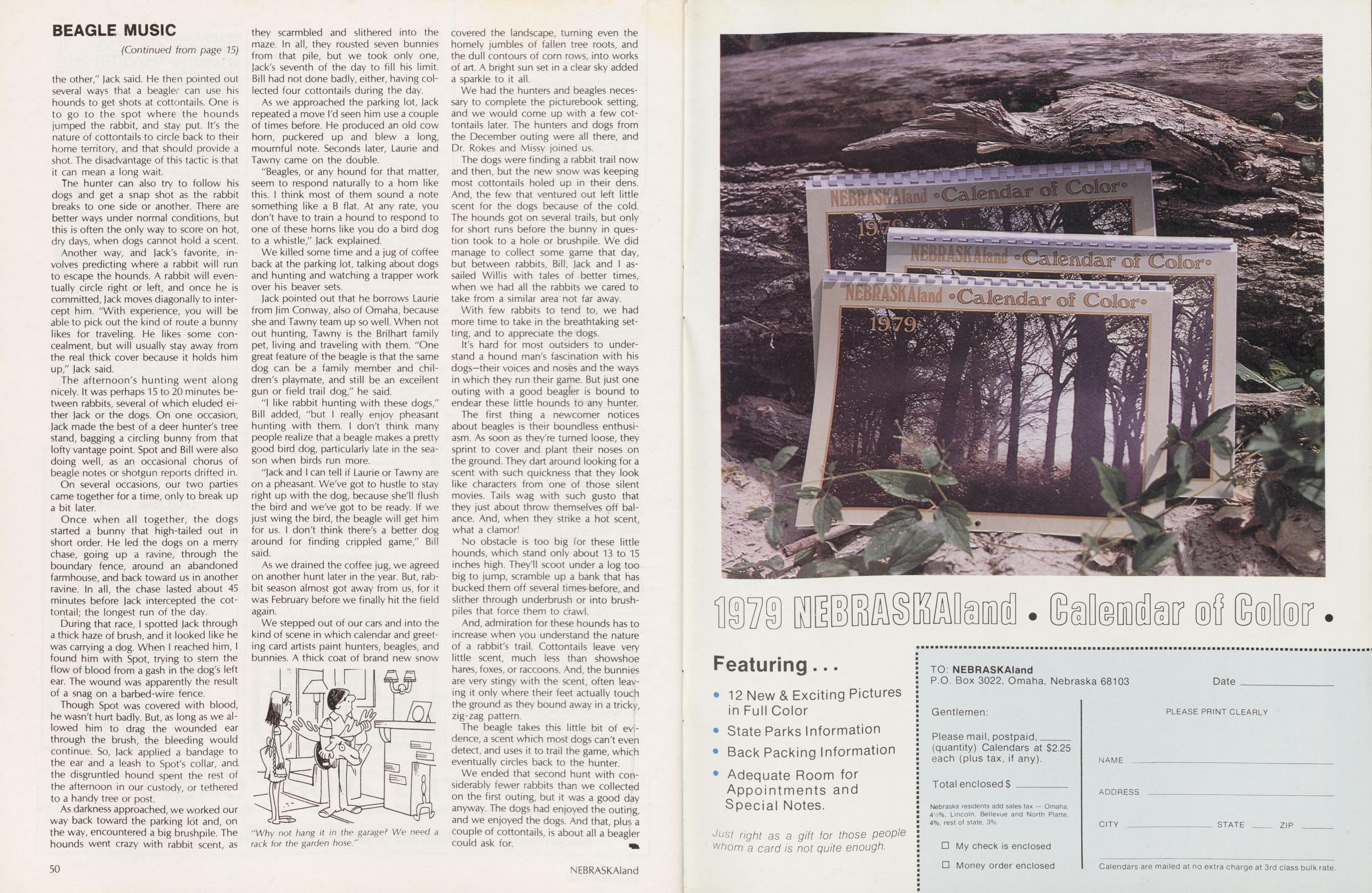
the other," Jack said. He then pointed out several ways that a beagler can use his hounds to get shots at cottontails. One is to go to the spot where the hounds jumped the rabbit, and stay put. It's the nature of cottontails to circle back to their home territory, and that should provide a shot. The disadvantage of this tactic is that it can mean a long wait.
The hunter can also try to follow his dogs and get a snap shot as the rabbit breaks to one side or another. There are better ways under normal conditions, but this is often the only way to score on hot, dry days, when dogs cannot hold a scent.
Another way, and Jack's favorite, involves predicting where a rabbit will run to escape the hounds. A rabbit will eventually circle right or left, and once he is committed, Jack moves diagonally to intercept him. "With experience, you will be able to pick out the kind of route a bunny likes for traveling. He likes some concealment, but will usually stay away from the real thick cover because it holds him up," Jack said.
The afternoon's hunting went along nicely. It was perhaps 15 to 20 minutes between rabbits, several of which eluded either Jack or the dogs. On one occasion, Jack made the best of a deer hunter's tree stand, bagging a circling bunny from that lofty vantage point. Spot and Bill were also doing well, as an occasional chorus of beagle notes or shotgun reports drifted in.
On several occasions, our two parties came together for a time, only to break up a bit later.
Once when all together, the dogs started a bunny that high-tailed out in short order. He led the dogs on a merry chase, going up a ravine, through the boundary fence, around an abandoned farmhouse, and back toward us in another ravine. In all, the chase lasted about 45 minutes before Jack intercepted the cottontail; the longest run of the day.
During that race, I spotted Jack through a thick haze of brush, and it looked like he was carrying a dog. When I reached him, I found him with Spot, trying to stem the flow of blood from a gash in the dog's left ear. The wound was apparently the result of a snag on a barbed-wire fence.
Though Spot was covered with blood, he wasn't hurt badly. But, as long as we allowed him to drag the wounded ear through the brush, the bleeding would continue. So, Jack applied a bandage to the ear and a leash to Spot's collar, and the disgruntled hound spent the rest of the afternoon in our custody, or tethered to a handy tree or post.
As darkness approached, we worked our way back toward the parking lot and, on the way, encountered a big brushpile. The hounds went crazy with rabbit scent, as they scarmbled and slithered into the maze. In all, they rousted seven bunnies from that pile, but we took only one, Jack's seventh of the day to fill his limit. Bill had not done badly, either, having collected four cottontails during the day.
As we approached the parking lot, Jack repeated a move I'd seen him use a couple of times before. He produced an old cow horn, puckered up and blew a long, mournful note. Seconds later, Laurie and Tawny came on the double.
"Beagles, or any hound for that matter, seem to respond naturally to a horn like this. I think most of them sound a note something like a B flat. At any rate, you don't have to train a hound to respond to one of these horns like you do a bird dog to a whistle," Jack explained.
We killed some time and a jug of coffee back at the parking lot, talking about dogs and hunting and watching a trapper work over his beaver sets.
Jack pointed out that he borrows Laurie from Jim Conway, also of Omaha, because she and Tawny team up so well. When not out hunting, Tawny is the Brilhart family pet, living and traveling with them. "One great feature of the beagle is that the same dog can be a family member and children's playmate, and still be an excellent gun or field trail dog," he said.
"I like rabbit hunting with these dogs," Bill added, "but I really enjoy pheasant hunting with them. I don't think many people realize that a beagle makes a pretty good bird dog, particularly late in the season when birds run more.
"Jack and I can tell if Laurie or Tawny are on a pheasant. We've got to hustle to stay right up with the dog, because she'll flush the bird and we've got to be ready. If we just wing the bird, the beagle will get him for us. I don't think there's a better dog around for finding crippled game," Bill said.
As we drained the coffee jug, we agreed on another hunt later in the year. But, rabbit season almost got away from us, for it was February before we finally hit the field again.
We stepped out of our cars and into the kind of scene in which calendar and greeting card artists paint hunters, beagles, and bunnies. A thick coat of brand new snow
We had the hunters and beagles necessary to complete the picturebook setting, and we would come up with a few cottontails later. The hunters and dogs from the December outing were all there, and Dr. Rokes and Missy joined us.
The dogs were finding a rabbit trail now and then, but the new snow was keeping most cottontails holed up in their dens. And, the few that ventured out left little scent for the dogs because of the cold. The hounds got on several trails, but only for short runs before the bunny in question took to a hole or brushpile. We did manage to collect some game that day, but between rabbits, Bill, Jack and I assailed Willis with tales of better times, when we had all the rabbits we cared to take from a similar area not far away.
With few rabbits to tend to, we had more time to take in the breathtaking setting, and to appreciate the dogs.
It's hard for most outsiders to understand a hound man's fascination with his dogs—their voices and noses and the ways in which they run their game. But just one outing with a good beagler is bound to endear these little hounds to any hunter.
The first thing a newcomer notices about beagles is their boundless enthusiasm. As soon as they're turned loose, they sprint to cover and plant their noses on the ground. They dart around looking for a scent with such quickness that they look like characters from one of those silent movies. Tails wag with such gusto that they just about throw themselves off balance. And, when they strike a hot scent, what a clamor!
No obstacle is too big for these little hounds, which stand only about 13 to 15 inches high. They'll scoot under a log too big to jump, scramble up a bank that has bucked them off several times before, and slither through underbrush or into brush-piles that force them to crawl.
And, admiration for these hounds has to increase when you understand the nature of a rabbit's trail. Cottontails leave very little scent, much less than showshoe hares, foxes, or raccoons. And, the bunnies are very stingy with the scent, often leaving it only where their feet actually touch the ground as they bound away in a tricky, zig-zag pattern.
The beagle takes this little bit of evdence, a scent which most dogs can't even detect, and uses it to trail the game, which eventually circles back to the hunter.
We ended that second hunt with considerably fewer rabbits than we collected on the first outing, but it was a good day anyway. The dogs had enjoyed the outing, and we enjoyed the dogs. And that, plus a couple of cottontails, is about all a beagler could ask for.
50 NEBRASKAIand
OUTDOOR
NEBRASKA
Every Thursday Evening
8:00p.m.
On your local NETV Network
... A weekly presentation of the Nebraska Game and Parks Commission covering Nebraska wildlife, scenic places and outdoor recreation plus much much more.
Brought to you by the...
NEBRASKA GAME AND PARKS COMMISSION
Position: 305 (29 views)