Volume 56, Issue 11, 1978
NEBRASKAland
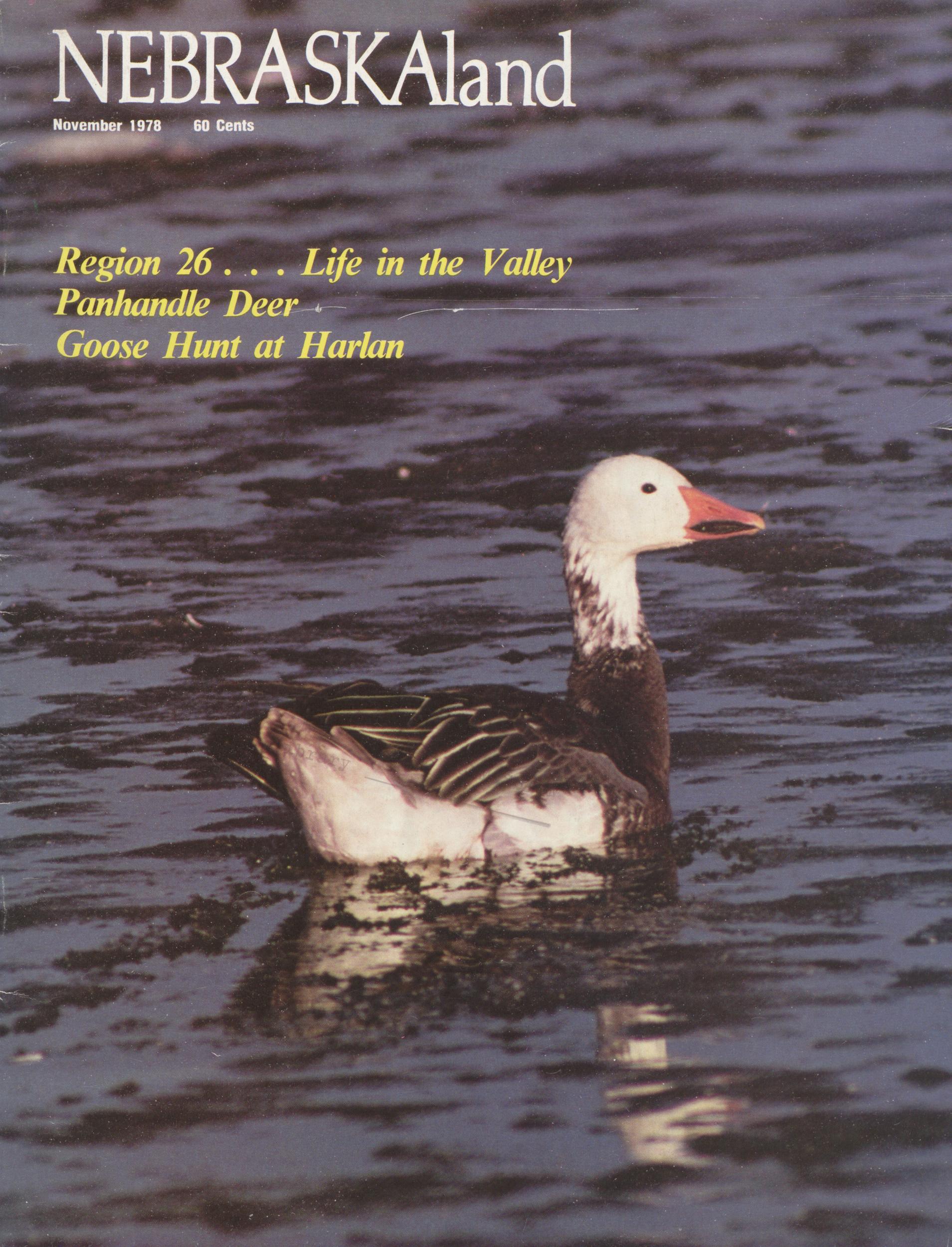
November 1978 60 Cents Region 26...Life in the Valley Panhandle Deer Goose Hunt at Harlan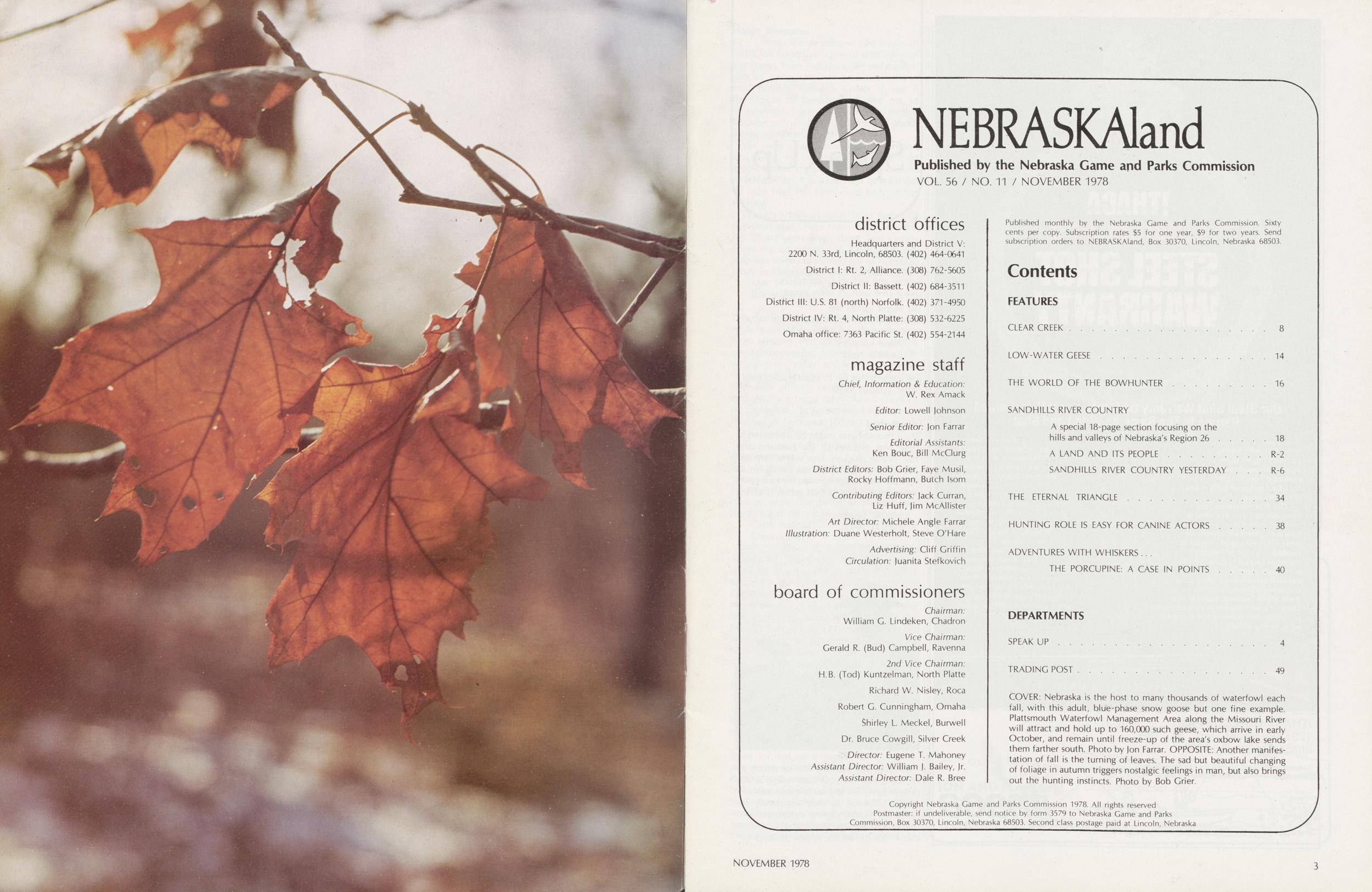
NEBRASKAland
Published by the Nebraska Game and Parks Commission VOL. 56 / NO. 11 / NOVEMBER 1978 district offices Headquarters and District V: 2200 N. 33rd, Lincoln, 68503. (402) 464-0641 District I: Rt. 2, Alliance. (308) 762-5605 District II: Bassett. (402) 684-3511 District III: U.S. 81 (north) Norfolk. (402) 371-4950 District IV: Rt. 4, North Platte: (308) 532-6225 Omaha office: 7363 Pacific St. (402) 554-2144 magazine staff Chief, Information and Education: W. Rex Amack Editor: Lowell Johnson 5en/or Editor: Jon Farrar Editorial Assistants: Ken Bouc, Bill McClurg District Editors: Bob Grier, Faye MusiI, Rocky Hoffmann, Butch Isom Contributing Editors: Jack Curran, Liz Huff, jim McAllister Art Director: Michele Angle Farrar Illustration: Duane Westerholt, Steve O'Hare Advertising: Cliff Griffin Circulation: Juanita Stefkovich board of commissioners Chairman: William G. Lindeken, Chadron Vice Chairman: Gerald R. (Bud) Campbell, Ravenna 2nd Vice Chairman: H.B. (Tod) Kuntzelman, North Platte Richard W. Nisley, Roca Robert G. Cunningham, Omaha Shirley L. Meckel, Burwell Dr. Bruce Cowgill, Silver Creek Director: Eugene T. Mahoney Assistant Director: William J. Bailey, Jr. Assistant Director: Dale R. Bree Published monthly by the Nebraska Game and Parks Commission. Sixty cents per copy. Subscription rates $5 for one year, $9 for two years. Send subscription orders to NEBRASKAland, Box 30370, Lincoln, Nebraska 68503. Contents FEATURES CLEAR CREEK 8 LOW-WATER GEESE 14 THE WORLD OF THE BOWHUNTER 16 SANDHILLS RIVER COUNTRY A special 18-page section focusing on the hills and valleys of Nebraska's Region 26 A LAND AND ITS PEOPLE R-2 SANDHILLS RIVER COUNTRY YESTERDAY R-6 THE ETERNAL TRIANGLE 34 HUNTING ROLE IS EASY FOR CANINE ACTORS 38 ADVENTURES WITH WHISKERS THE PORCUPINE: A CASE IN POINTS 40 DEPARTMENTS SPEAK UP 4 TRADING POST 49 COVER: Nebraska is the host to many thousands of waterfowl each fall, with this adult, blue-phase snow goose but one fine example. Plattsmouth Waterfowl Management Area along the Missouri River will attract and hold up to 160,000 such geese, which arrive in early October, and remain until freeze-up of the area's oxbow lake sends them farther south. Photo by Jon Farrar. OPPOSITE: Another manifestation of fall is the turning of leaves. The sad but beautiful changing of foliage in autumn triggers nostalgic feelings in man, but also brings out the hunting instincts. Photo by Bob Grier. Copyright Nebraska Game and Parks Commission 1978. All rights reserved Postmaster: if undeliverable, send notice by form 3579 to Nebraska Game and Parks Commission, Box 30370, Lincoln, Nebraska 68503. Second class postage paid at Lincoln, Nebraska NOVEMBER 1978 3
ITHACA ANNOUNCES A STEEL SHOT WARRANTY
Speak Up
The Painted Turtle I sleep below the sun,Yellow and red; my own colors,
Like a tree with its own leaves.
The Platte carries me.
I carry the river in my veins.
I live in my own wilderness. Anne Knowles Omaha, Nebr. Just a poem that we thought readers might enjoy. (Editor) Friendly bird Sir / I thought you might be interested in these two pictures of my husband and "his" prairie chicken. This was a very unusual bird, as it adopted our family on its own. It made us spring visits for two years. We missed it very much when it didn't come back. Mrs. C Laseke Ericson, Nebr.
We have a farm in southern Maryland and there we have seen a pair of bald eagles which apparently nest somewhere near the water. It is a real treat to see them fly right over the farmhouse early in the evening!
Though I moved away from Nebraska five years ago, I have many happy memories of my years spent there, and I really enjoy my subscription to NEBRASKAIand. It always seems to remind me of my good times in Nebraska as a Girl Scout leader! Mrs. T.P. (Anne) Krush Baltimore, Md. Whooping cranes do seem to be somewhat better off recently, but their situation is so tenuous that they must be almost constantly guarded. Severe weather at the wrong time, other accidents or vandals could really threaten their status. But, an optimistic attitude certainly doesn't hurt, and steps are being taken which seem to be paying off. I hope we can keep you interested in Nebraska. (Editor) Winning ways Sir / Winning the 1979 Nebraska Habitat Stamp Contest was a great honor and privilege for me. I am pleased to be a part of a program that helps to preserve the wildlife and natural beauty of Nebraska. Gene Roncka Omaha, Nebr. Thanks for your letter, and thanks even more for entering the art contest. A short article on the contest will appear in the December NEBRASKAIand, including several of the pieces of art entered in that, the first contest to select illustration for the Habitat Stamp. Your bobwhite art was selected from over 200 entries, and you are to be congratulated. (Editor) Pioneer Land Sir / We find NEBRASKAIand most refreshing and look forward to its arrival each month. It helps us feel like we are in touch with home. Actually, we feel very at home here in Israel, for that same rugged, mixed-ethnic, pioneering spirit that turned plains wilderness, a little over 100 years ago, into the Nebraska of today as one of the nation's leading agricultural states, has transformed Israel from nearly desert waste just 30 years ago into lush, fertile garden lands; a leader among the world's small nations in
CLIMB THE SPIRAL STAIRCASE and step into the 1880's
SHUSTER'S JACK and JILL Your Wild Game Processing Headquarters
Have your wild game processed into delicious Sausage, Jerky and Summer Sausage, all with that "BIG DADDY" Homemade touch. Shuster's Jack and Jill 140 Capital Beach Blvd. Phone: (402) 474-5349 Lincoln, Nebr. 68525 Paul Shuster, OwnerWELCOME to Merritt Dam Trading Post 26 Miles So. Of Valentine On Hwy. 16C Phone 402/376-3437
Bait* Tackle* Ammunition0 Groceries* Gas* Beer* Ice Cabins with Kitchen Facilities* Floating Marina Campground Hook-ups* Boat and Motor Rental — Your Hosts — JON AND MARIAN DAVENPORT
This year our trip was highlighted by our visit to Nebraska. It was a pleasure camping in many of the state parks, which were very well maintained and inviting. By sheer luck, we discovered Fort Robinson State Park. Our schedule originally called for a few hours at this site, which ultimately lasted three days. We enjoyed youth activities, horse-back riding and stagecoach rides. Our stay was climaxed by an old-fashioned chuck-wagon dinner.
Traveling with children can become very expensive, and we found that the state of Nebraska attempted to provide outstanding facilities at a very reasonable cost, which truly says to the traveler: "welcome to Nebraska." We only hope in this day of double-digit inflation, that you are always able to keep the people's interests first and foremost.
The hospitality of your state was truly overwhelming. We just wanted to express our thanks.
Saul and Carol Cohen Freehold, N.J. Thanks for your letter. We appreciate it when people take the trouble to tell us the nice things that happen to them. Fort Robinson is indeed a special kind of park, and proves to be a "grabber" to folks who happen by to take a peek. And, you are right about holding down prices. The chuck wagon feed features buffalo stew, a novelty in itself, but mainly to hold down cost. Other pleasant changes are due for our parks in the future, so you may want to come again. (Editor) NEBRASKAland Magazine invites all readers to submit their comments, suggestions, and gripes to Speak Up. Each month the magazine will publish as many letters as space permits. Pictures are welcome. NEBRASKAland reserves the right to edit and condense letters. — Editor.
CLEAR CREEK
This controlled-hunting area brought reason where bedlam reigned. Now, more waterfowlers have "sporting" hunts
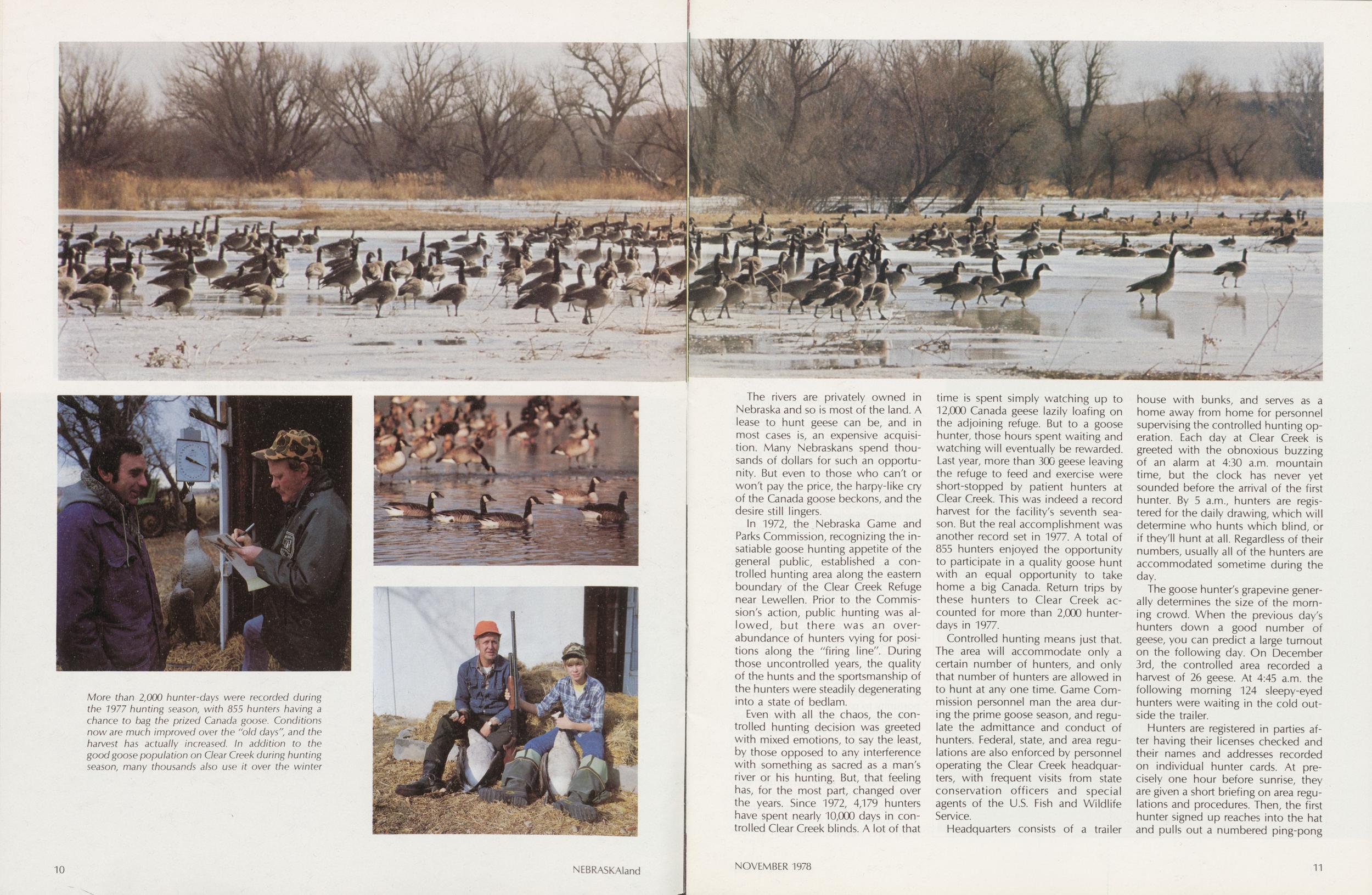
PERHAPS IT'S THE YARNS still spun or the cracked and yellowed photographs of giant gray geese hanging on barn doors or piled deep in horse-drawn buckboards. Or, perhaps it's the childhood memories of times when neighbors came and geese were plucked into the wee hours of the morning. The strong fragrance of wet down stays in a youngster's mind. Or, perhaps it's simply the mystique of the bird, . . . the night fliers . . . sometimes quiet but more often clamorous . . . their broken, eerie cry turning faces skyward. That's Photos and text by Rocky Hoffmann when the memories return of cold feet and iced moustaches, and of large feathers anchored stubbornly to breasts that will soon press against the roaster's lid. Whatever the attraction, we only know that there is one.
The Canada goose has become a premium commodity, but not because the goose itself is scarce, but rather, places to hunt it have become a rarity. And there is something magnetic about the North Platte River and Lake McConaughy's mud flats which annually attract both the geese and an endless supply of hunters.
During the summer months, the river silently passes fields abandoned by both hunter and hunted. But, with the first breath of semi-arctic air, accompanied by shortened days, bottom land becomes active with anticipation.
A pickup truck, piled high with plywood and chicken wire, winds cautiously across wet meadows. Rushes and prairie hay will form the camouflage after a blind is constructed. Hunters are testing their spring-loaded blind covers and their communication systems. These are the fortunate, often wealthy, sportsmen of today.
The rivers are privately owned in Nebraska and so is most of the land. A lease to hunt geese can be, and in most cases is, an expensive acquisition. Many Nebraskans spend thousands of dollars for such an opportunity. But even to those who can't or won't pay the price, the harpy-like cry of the Canada goose beckons, and the desire still lingers.
In 1972, the Nebraska Game and Parks Commission, recognizing the insatiable goose hunting appetite of the general public, established a controlled hunting area along the eastern boundary of the Clear Creek Refuge near Lewellen. Prior to the Commission's action, public hunting was allowed, but there was an over abundance of hunters vying for positions along the "firing line". During those uncontrolled years, the quality of the hunts and the sportsmanship of the hunters were steadily degenerating into a state of bedlam.
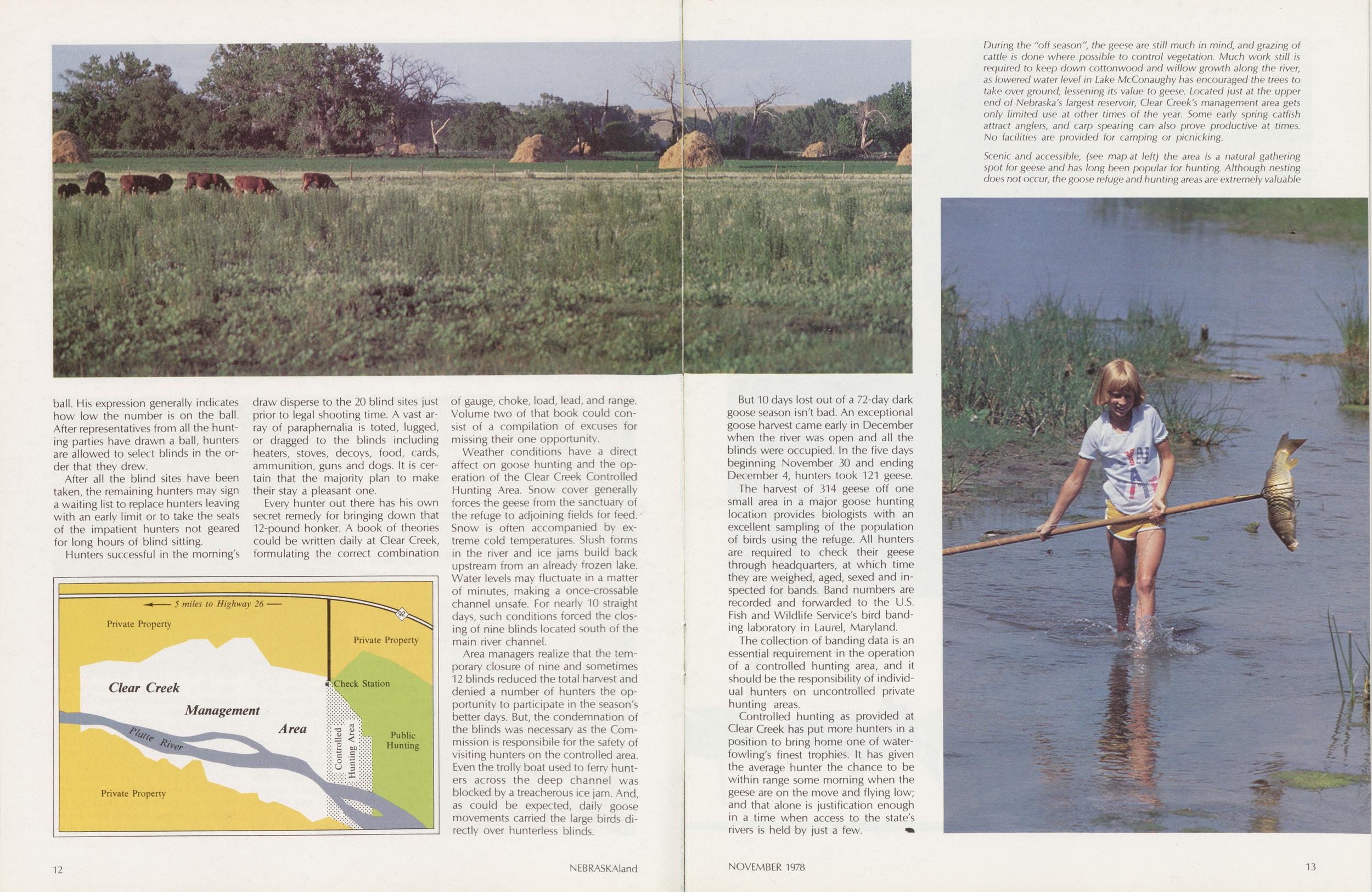
Even with all the chaos, the controlled hunting decision was greeted with mixed emotions, to say the least, by those opposed to any interference with something as sacred as a man's river or his hunting. But, that feeling has, for the most part, changed over the years. Since 1972, 4,179 hunters have spent nearly 10,000 days in controlled Clear Creek blinds. A lot of that time is spent simply watching up to 12,000 Canada geese lazily loafing on the adjoining refuge. But to a goose hunter, those hours spent waiting and watching will eventually be rewarded. Last year, more than 300 geese leaving the refuge to feed and exercise were short-stopped by patient hunters at Clear Creek. This was indeed a record harvest for the facility's seventh season. But the real accomplishment was another record set in 1977. A total of 855 hunters enjoyed the opportunity to participate in a quality goose hunt with an equal opportunity to take home a big Canada. Return trips by these hunters to Clear Creek accounted for more than 2,000 hunter-days in 1977.
Controlled hunting means just that. The area will accommodate only a certain number of hunters, and only that number of hunters are allowed in to hunt at any one time. Game Commission personnel man the area during the prime goose season, and regulate the admittance and conduct of hunters. Federal, state, and area regulations are also enforced by personnel operating the Clear Creek headquarters, with frequent visits from state conservation officers and special agents of the U.S. Fish and Wildlife Service.
Headquarters consists of a trailer house with bunks, and serves as a home away from home for personnel supervising the controlled hunting operation. Each day at Clear Creek is greeted with the obnoxious buzzing of an alarm at 4:30 a.m. mountain time, but the clock has never yet sounded before the arrival of the first hunter. By 5 a.m., hunters are registered for the daily drawing, which will determine who hunts which blind, or if they'll hunt at all. Regardless of their numbers, usually all of the hunters are accommodated sometime during the day.
The goose hunter's grapevine generally determines the size of the morning crowd. When the previous day's hunters down a good number of geese, you can predict a large turnout on the following day. On December 3rd, the controlled area recorded a harvest of 26 geese. At 4:45 a.m. the following morning 124 sleepy-eyed hunters were waiting in the cold outside the trailer.
Hunters are registered in parties after having their licenses checked and
their names and addresses recorded
on individual hunter cards. At precisely one hour before sunrise, they
are given a short briefing on area regulations and procedures. Then, the first
hunter signed up reaches into the hat
and pulls out a numbered ping-pong
NOVEMBER 1978
11
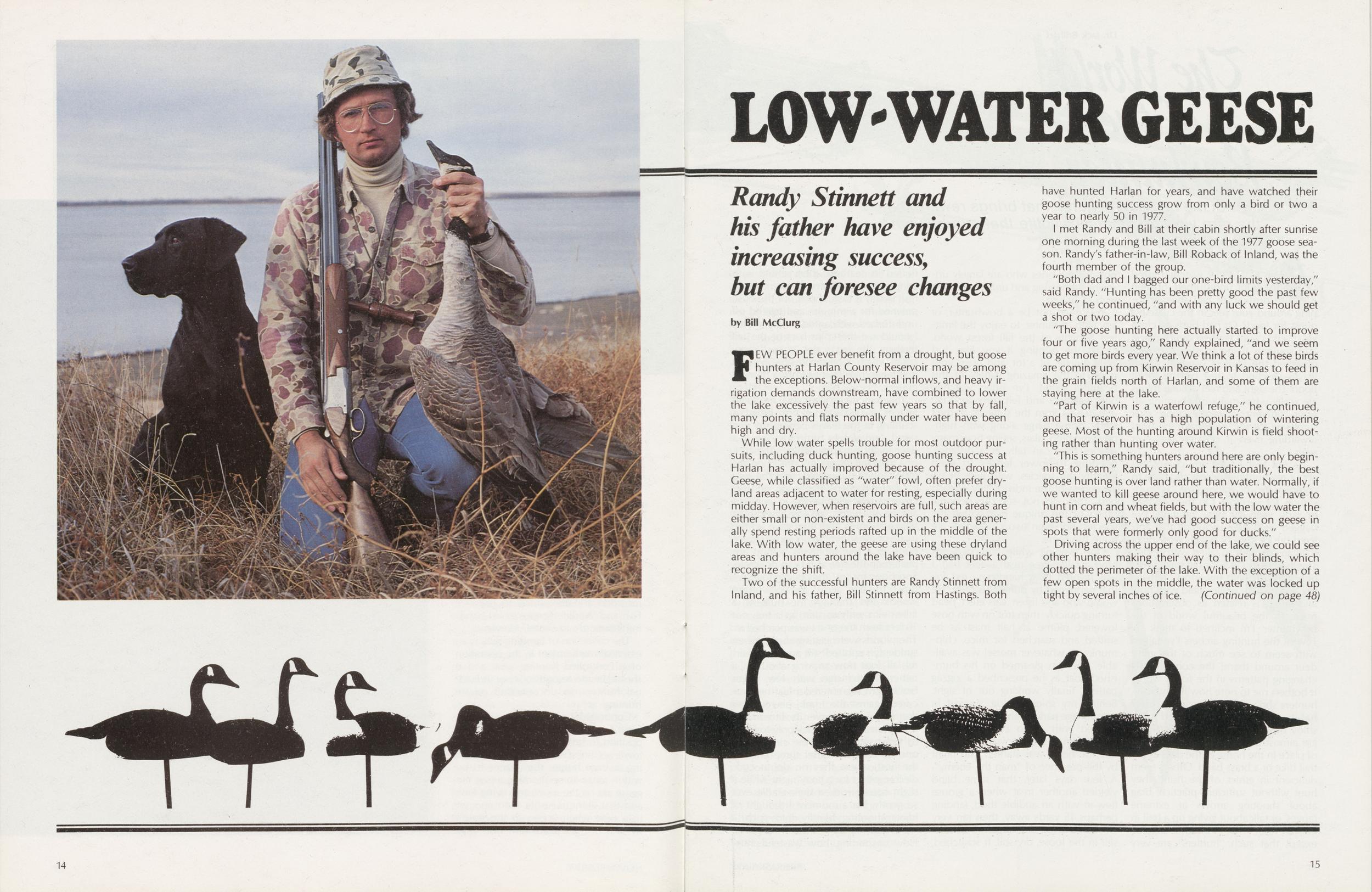
After all the blind sites have been taken, the remaining hunters may sign a waiting list to replace hunters leaving with an early limit or to take the seats of the impatient hunters not geared for long hours of blind sitting.
Hunters successful in the morning's draw disperse to the 20 blind sites just prior to legal shooting time. A vast array of paraphernalia is toted, lugged, or dragged to the blinds including heaters, stoves, decoys, food, cards, ammunition, guns and dogs. It is certain that the majority plan to make their stay a pleasant one.
Every hunter out there has his own secret remedy for bringing down that 12-pound honker. A book of theories could be written daily at Clear Creek, formulating the correct combination of gauge, choke, load, lead, and range. Volume two of that book could consist of a compilation of excuses for missing their one opportunity.
Weather conditions have a direct affect on goose hunting and the operation of the Clear Creek Controlled Hunting Area. Snow cover generally forces the geese from the sanctuary of the refuge to adjoining fields for feed. Snow is often accompanied by extreme cold temperatures. Slush forms in the river and ice jams build back upstream from an already frozen lake. Water levels may fluctuate in a matter of minutes, making a once-crossable channel unsafe. For nearly 10 straight days, such conditions forced the closing of nine blinds located south of the main river channel.
Area managers realize that the temporary closure of nine and sometimes 12 blinds reduced the total harvest and denied a number of hunters the opportunity to participate in the season's better days. But, the condemnation of the blinds was necessary as the Commission is responsibile for the safety of visiting hunters on the controlled area. Even the trolly boat used to ferry hunters across the deep channel was blocked by a treacherous ice jam. And, as could be expected, daily goose movements carried the large birds directly over hunterless blinds.
But 10 days lost out of a 72-day dark goose season isn't bad. An exceptional goose harvest came early in December when the river was open and all the blinds were occupied. In the five days beginning November 30 and ending December 4, hunters took 121 geese.
The harvest of 314 geese off one small area in a major goose hunting location provides biologists with an excellent sampling of the population of birds using the refuge. All hunters are required to check their geese through headquarters, at which time they are weighed, aged, sexed and inspected for bands. Band numbers are recorded and forwarded to the U.S. Fish and Wildlife Service's bird banding laboratory in Laurel, Maryland.
The collection of banding data is an essential requirement in the operation of a controlled hunting area, and it should be the responsibility of individual hunters on uncontrolled private hunting areas.
Controlled hunting as provided at Clear Creek has put more hunters in a position to bring home one of waterfowling's finest trophies. It has given the average hunter the chance to be within range some morning when the geese are on the move and flying low; and that alone is justification enough in a time when access to the state's rivers is held by just a few.
LOW-WATER GEESE
Randy Stinnett and his father have enjoyed increasing success, but can foresee changes
FEW PEOPLE ever benefit from a drought, but goose hunters at Harlan County Reservoir may be among the exceptions. Below-normal inflows, and heavy irrigation demands downstream, have combined to lower the lake excessively the past few years so that by fall, many points and flats normally under water have been high and dry.
While low water spells trouble for most outdoor pursuits, including duck hunting, goose hunting success at Elarlan has actually improved because of the drought. Geese, while classified as "water" fowl, often prefer dryland areas adjacent to water for resting, especially during midday. However, when reservoirs are full, such areas are either small or non-existent and birds on the area generally spend resting periods rafted up in the middle of the lake. With low water, the geese are using these dryland areas and hunters around the lake have been quick to recognize the shift.
Two of the successful hunters are Randy Stinnett from Inland, and his father, Bill Stinnett from Hastings. Both have hunted Harlan for years, and have watched their goose hunting success grow from only a bird or two a year to nearly 50 in 1977.
I met Randy and Bill at their cabin shortly after sunrise one morning during the last week of the 1977 goose season. Randy's father-in-law, Bill Roback of Inland, was the fourth member of the group.
"Both dad and I bagged our one-bird limits yesterday," said Randy. "Hunting has been pretty good the past few weeks," he continued, "and with any luck we should get a shot or two today.
"The goose hunting here actually started to improve four or five years ago," Randy explained, "and we seem to get more birds every year. We think a lot of these birds are coming up from Kirwin Reservoir in Kansas to feed in the grain fields north of Harlan, and some of them are staying here at the lake.
"Part of Kirwin is a waterfowl refuge," he continued, and that reservoir has a high population of wintering geese. Most of the hunting around Kirwin is field shooting rather than hunting over water.
This is something hunters around here are only beginning to learn," Randy said, "but traditionally, the best goose hunting is over land rather than water. Normally, if we wanted to kill geese around here, we would have to hunt in corn and wheat fields, but with the low water the past several years, we've had good success on geese in spots that were formerly only good for ducks."
Driving across the upper end of the lake, we could see other hunters making their way to their blinds, which dotted the perimeter of the lake. With the exception of a few open spots in the middle, the water was locked up tight by several inches of ice. (Continued on page 48)
15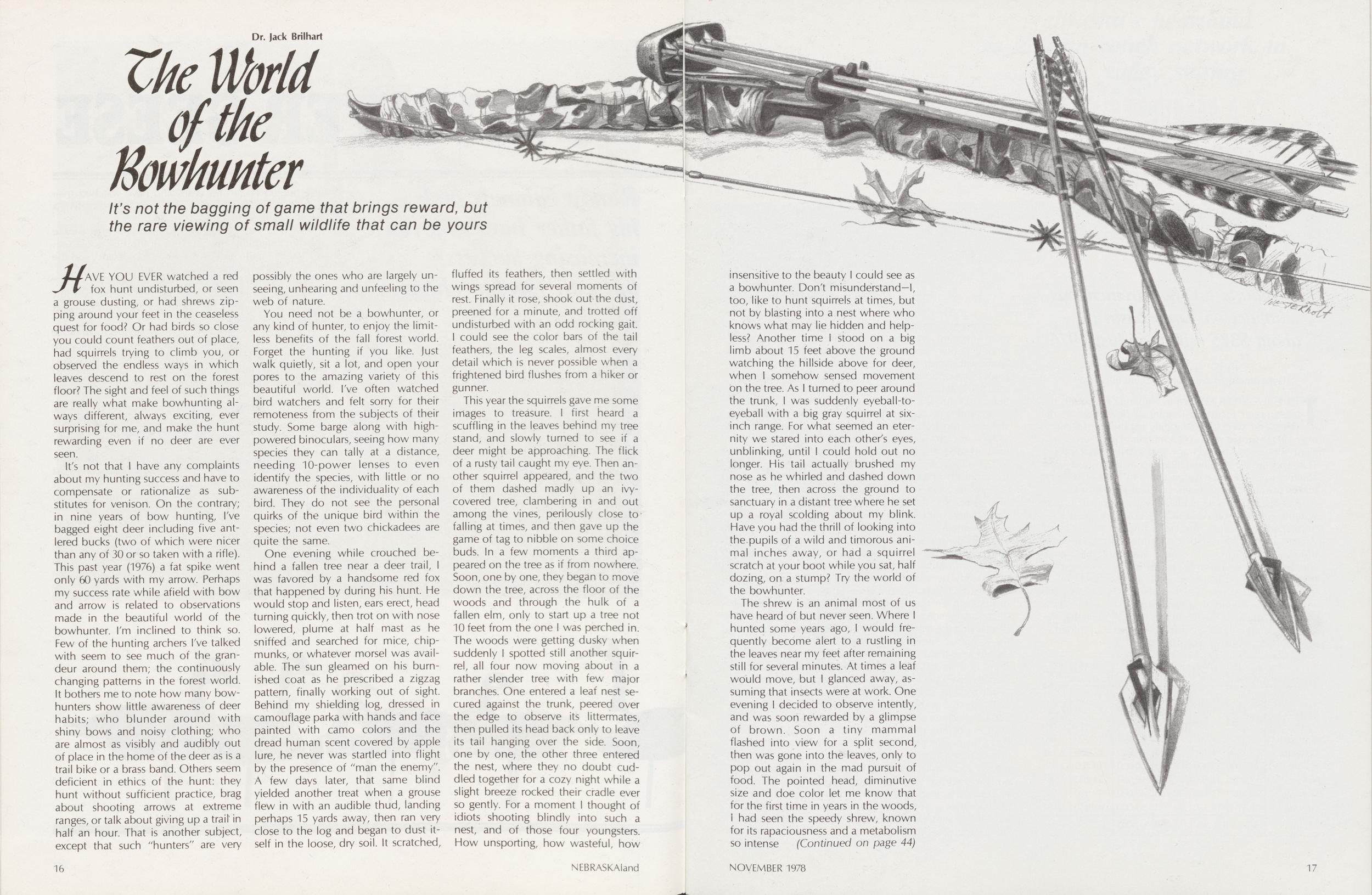
The World of the Bowhunter
Its not the bagging of game that brings reward, but the rare viewing of small wildlife that can be yoursHAVE YOU EVER watched a red fox hunt undisturbed, or seen a grouse dusting, or had shrews zipping around your feet in the ceaseless quest for food? Or had birds so close you could count feathers out of place, had squirrels trying to climb you, or observed the endless ways in which leaves descend to rest on the forest floor? The sight and feel of such things are really what make bowhunting always different, always exciting, ever surprising for me, and make the hunt rewarding even if no deer are ever seen.
It's not that I have any complaints about my hunting success and have to compensate or rationalize as substitutes for venison. On the contrary; in nine years of bow hunting, Eve bagged eight deer including five antlered bucks (two of which were nicer than any of 30 or so taken with a rifle). This past year (1976) a fat spike went only 60 yards with my arrow. Perhaps my success rate while afield with bow and arrow is related to observations made in the beautiful world of the bowhunter. I'm inclined to think so. Few of the hunting archers Eve talked with seem to see much of the grandeur around them; the continuously changing patterns in the forest world. It bothers me to note how many bowhunters show little awareness of deer habits; who blunder around with shiny bows and noisy clothing; who are almost as visibly and audibly out of place in the home of the deer as is a trail bike or a brass band. Others seem deficient in ethics of the hunt: they hunt without sufficient practice, brag about shooting arrows at extreme ranges, or talk about giving up a trail in half an hour. That is another subject, except that such "hunters" are very possibly the ones who are largely unseeing, unhearing and unfeeling to the web of nature.
You need not be a bowhunter, or any kind of hunter, to enjoy the limitless benefits of the fall forest world. Forget the hunting if you like, just walk quietly, sit a lot, and open your pores to the amazing variety of this beautiful world. Eve often watched bird watchers and felt sorry for their remoteness from the subjects of their study. Some barge along with highpowered binoculars, seeing how many species they can tally at a distance, needing 10-power lenses to even identify the species, with little or no awareness of the individuality of each bird. They do not see the personal quirks of the unique bird within the species; not even two chickadees are quite the same.
One evening while crouched behind a fallen tree near a deer trail, I was favored by a handsome red fox that happened by during his hunt. He would stop and listen, ears erect, head turning quickly, then trot on with nose lowered, plume at half mast as he sniffed and searched for mice, chipmunks, or whatever morsel was available. The sun gleamed on his burnished coat as he prescribed a zigzag pattern, finally working out of sight. Behind my shielding log, dressed in camouflage parka with hands and face painted with camo colors and the dread human scent covered by apple lure, he never was startled into flight by the presence of "man the enemy". A few days later, that same blind yielded another treat when a grouse flew in with an audible thud, landing perhaps 15 yards away, then ran very close to the log and began to dust itself in the loose, dry soil. It scratched, fluffed its feathers, then settled with wings spread for several moments of rest. Finally it rose, shook out the dust, preened for a minute, and trotted off undisturbed with an odd rocking gait. I could see the color bars of the tail feathers, the leg scales, almost every detail which is never possible when a frightened bird flushes from a hiker or gunner.
This year the squirrels gave me some images to treasure. I first heard a scuffling in the leaves behind my tree stand, and slowly turned to see if a deer might be approaching. The flick of a rusty tail caught my eye. Then another squirrel appeared, and the two of them dashed madly up an ivy-covered tree, clambering in and out among the vines, perilously close to falling at times, and then gave up the game of tag to nibble on some choice buds. In a few moments a third appeared on the tree as if from nowhere. Soon, one by one, they began to move down the tree, across the floor of the woods and through the hulk of a fallen elm, only to start up a tree not 10 feet from the one I was perched in. The woods were getting dusky when suddenly I spotted still another squirrel, all four now moving about in a rather slender tree with few major branches. One entered a leaf nest secured against the trunk, peered over the edge to observe its littermates, then pulled its head back only to leave its tail hanging over the side. Soon, one by one, the other three entered the nest, where they no doubt cuddled together for a cozy night while a slight breeze rocked their cradle ever so gently. For a moment I thought of idiots shooting blindly into such a nest, and of those four youngsters. How unsporting, how wasteful, how 16 NEBRASKAland insensitive to the beauty I could see as a bowhunter. Don't misunderstand—I, too, like to hunt squirrels at times, but not by blasting into a nest where who knows what may lie hidden and helpless? Another time I stood on a big limb about 15 feet above the ground watching the hillside above for deer, when I somehow sensed movement on the tree. As I turned to peer around the trunk, I was suddenly eyeball-to-eyeball with a big gray squirrel at six-inch range. For what seemed an eternity we stared into each other's eyes, unblinking, until I could hold out no longer. His tail actually brushed my nose as he whirled and dashed down the tree, then across the ground to sanctuary in a distant tree where he set up a royal scolding about my blink. Have you had the thrill of looking into the.pupils of a wild and timorous animal inches away, or had a squirrel scratch at your boot while you sat, half dozing, on a stump? Try the world of the bowhunter.
The shrew is an animal most of us have heard of but never seen. Where I hunted some years ago, I would frequently become alert to a rustling in the leaves near my feet after remaining still for several minutes. At times a leaf would move, but I glanced away, assuming that insects were at work. One evening I decided to observe intently, and was soon rewarded by a glimpse of brown. Soon a tiny mammal flashed into view for a split second, then was gone into the leaves, only to pop out again in the mad pursuit of food. The pointed head, diminutive size and doe color let me know that for the first time in years in the woods, I had seen the speedy shrew, known for its rapaciousness and a metabolism so intense (Continued on page 44)
Irrigation has had tremendous impact on Loup basin . . . about $325 million in just 1976
THE LOUP RIVER SYSTEM in Nebraska's Sandhills has been noted for its uniformity of flow, both in dry years and wet. The Sandhills region, consisting of over 19,000 square miles (12.3 million acres), serves as a giant sponge to soak up any precipitation that occurs. This, and the close interrelationship of its ground-water aquifers to the surface waters flows in its river systems, makes possible the relatively constant river flows.
As a result of this dependable water supply in its river systems, valley farmers and ranchers over the years have developed irrigation on the lands adjacent to the rivers. While some of the resulting irrigation utilized diversion structures in the rivers to supply water through canals and laterals to valley lands, much of the development from the 1950's on has been wells and pumps.
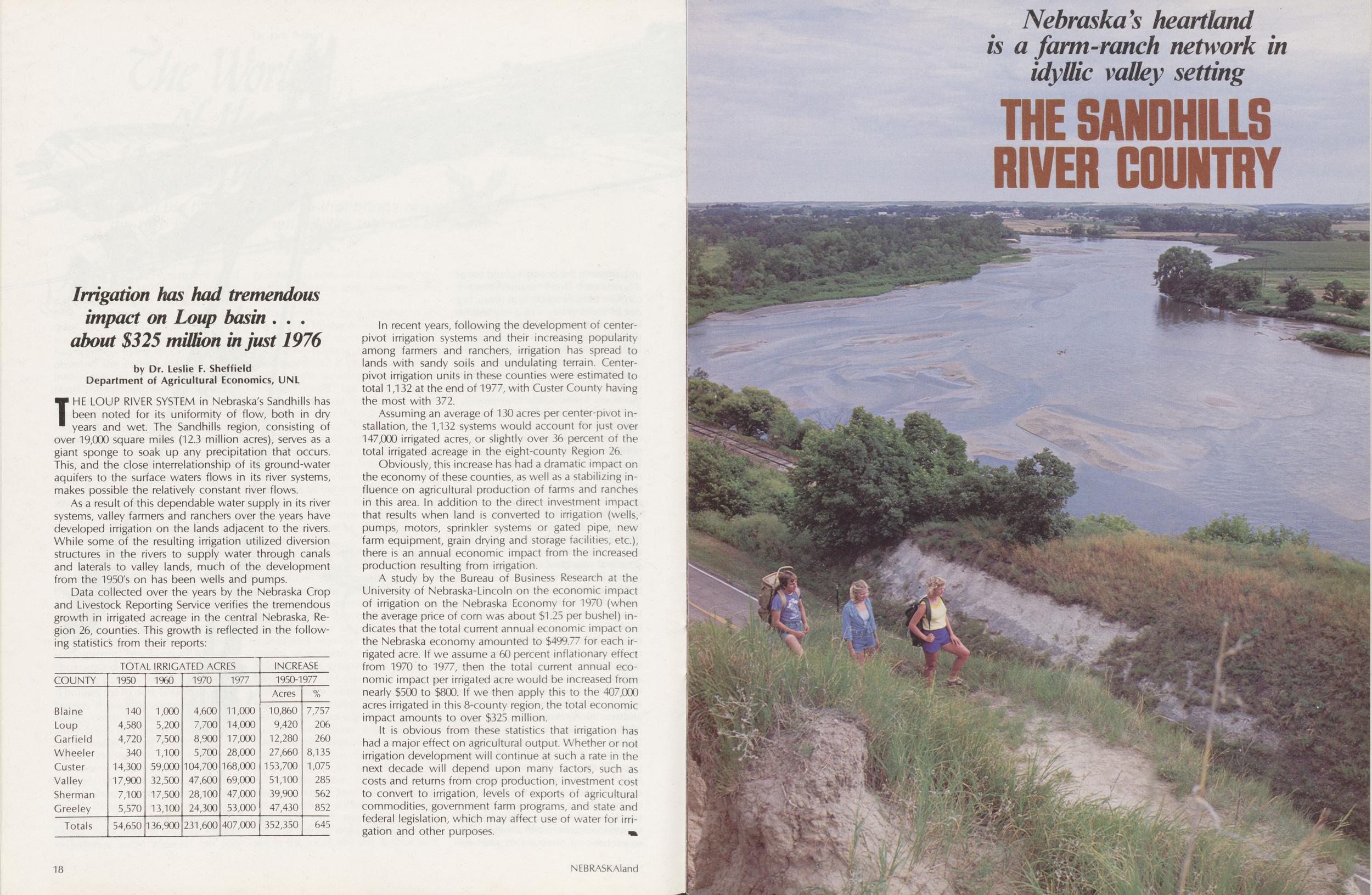
Data collected over the years by the Nebraska Crop and Livestock Reporting Service verifies the tremendous growth in irrigated acreage in the central Nebraska, Region 26, counties. This growth is reflected in the following statistics from their reports:
COUNTY 1950 1960 1970 1977 1950-1977
Acres %
Blaine 140 1,000 4,600 11,000 10,860 7,757
Loup 4,580 5,200 7,700 14,000 9,420 206
Garfield 4,720 7,500 8,900 17,000 12,280 260
Wheeler 340 1,100 5,700 28,000 27,660 8,135
Custer 14,300 59,000 104,700 168,000 153,700 1,075
Valley 17,900 32,500 47,600 69,000 51,100 285
Sherman 7,100 17,500 28,100 47,000 39,900 562
Greeley 5,570 13,100 24,300 53,000 47,430 852
Totals 54,650 136,900 231,600 407,000 352,350 645
In recent years, following the development of centerpivot irrigation systems and their increasing popularity among farmers and ranchers, irrigation has spread to lands with sandy soils and undulating terrain. Centerpivot irrigation units in these counties were estimated to total 1,132 at the end of 1977, with Custer County having the most with 372.
Assuming an average of 130 acres per center-pivot installation, the 1,132 systems would account for just over 147,000 irrigated acres, or slightly over 36 percent of the total irrigated acreage in the eight-county Region 26.
Obviously, this increase has had a dramatic impact on the economy of these counties, as well as a stabilizing influence on agricultural production of farms and ranches in this area. In addition to the direct investment impact that results when land is converted to irrigation (wells, pumps, motors, sprinkler systems or gated pipe, new farm equipment, grain drying and storage facilities, etc.), there is an annual economic impact from the increased production resulting from irrigation.
A study by the Bureau of Business Research at the University of Nebraska-Lincoln on the economic impact of irrigation on the Nebraska Economy for 1970 (when the average price of corn was about $1.25 per bushel) indicates that the total current annual economic impact on the Nebraska economy amounted to $499.77 for each irrigated acre. If we assume a 60 percent inflationary effect from 1970 to 1977, then the total current annual economic impact per irrigated acre would be increased from nearly $500 to $800. If we then apply this to the 407,000 acres irrigated in this 8-county region, the total economic impact amounts to over $325 million.
It is obvious from these statistics that irrigation has had a major effect on agricultural output. Whether or not irrigation development will continue at such a rate in the next decade will depend upon many factors, such as costs and returns from crop production, investment cost to convert to irrigation, levels of exports of agricultural commodities, government farm programs, and state and federal legislation, which may affect use of water for irrigation and other purposes.
18 NEBRASKAlandTHE SANDHILLS RIVER COUNTRY
Nebraska's heartland is a farm-ranch network m idyllic valley setting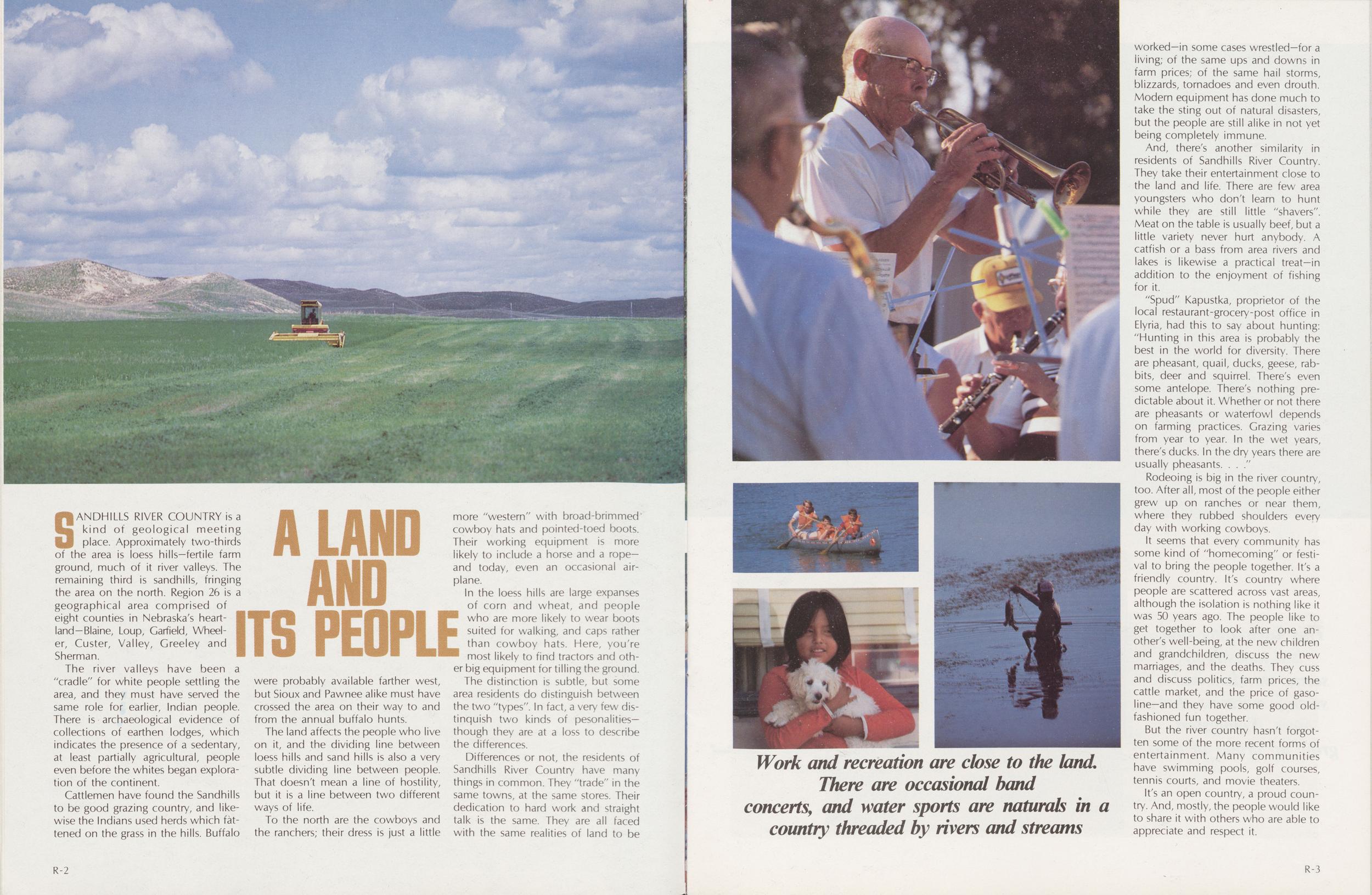
A LAND AND ITS PEOPLE
SANDHILLS RIVER COUNTRY is a kind of geological meeting place. Approximately two-thirds of the area is loess hills-fertile farm ground, much of it river valleys. The remaining third is sandhills, fringing the area on the north. Region 26 is a geographical area comprised of eight counties in Nebraska's heartland-Blaine, Loup, Garfield, Wheeler, Custer, Valley, Greeley and Sherman.
The river valleys have been a "cradle" for white people settling the area, and they must have served the same role for earlier, Indian people. There is archaeological evidence of collections of earthen lodges, which indicates the presence of a sedentary, at least partially agricultural, people even before the whites began exploration of the continent.
Cattlemen have found the Sandhills to be good grazing country, and likewise the Indians used herds which fattened on the grass in the hills. Buffalo were probably available farther west, but Sioux and Pawnee alike must have crossed the area on their way to and from the annual buffalo hunts.
The land affects the people who live on it, and the dividing line between loess hills and sand hills is also a very subtle dividing line between people. That doesn't mean a line of hostility, but it is a line between two different ways of life.
To the north are the cowboys and the ranchers; their dress is just a little more "western" with broad-brimmed cowboy hats and pointed-toed boots. Their working equipment is more likely to include a horse and a rope and today, even an occasional airplane.
In the loess hills are large expanses of corn and wheat, and people who are more likely to wear boots suited for walking, and caps rather than cowboy hats. Here, you're most likely to find tractors and other big equipment for tilling the ground. The distinction is subtle, but some area residents do distinguish between the two "types". In fact, a very few distinquish two kinds of pesonalities— though they are at a loss to describe the differences.
Differences or not, the residents of Sandhills River Country have many things in common. They "trade" in the same towns, at the same stores. Their dedication to hard work and straight talk is the same. They are all faced with the same realities of land to be
And, there's another similarity in residents of Sandhills River Country. They take their entertainment close to the land and life. There are few area youngsters who don't learn to hunt while they are still little "shavers". Meat on the table is usually beef, but a little variety never hurt anybody. A catfish or a bass from area rivers and lakes is likewise a practical treat—in addition to the enjoyment of fishing for it.
"Spud" Kapustka, proprietor of the local restaurant-grocery-post office in Elyria, had this to say about hunting: "Hunting in this area is probably the best in the world for diversity. There are pheasant, quail, ducks, geese, rabbits, deer and squirrel. There's even some antelope. There's nothing predictable about it. Whether or not there are pheasants or waterfowl depends on farming practices. Grazing varies from year to year. In the wet years, there's ducks. In the dry years there are usually pheasants. . . ."
Rodeoing is big in the river country, too. After all, most of the people either grew up on ranches or near them, where they rubbed shoulders every day with working cowboys.
It seems that every community has some kind of "homecoming" or festival to bring the people together. It's a friendly country. It's country where people are scattered across vast areas, although the isolation is nothing like it was 50 years ago. The people like to get together to look after one another's well-being, at the new children and grandchildren, discuss the new marriages, and the deaths. They cuss and discuss politics, farm prices, the cattle market, and the price of gasoline—and they have some good old-fashioned fun together.
But the river country hasn't forgotten some of the more recent forms of entertainment. Many communities have swimming pools, golf courses, tennis courts, and movie theaters.
It's an open country, a proud country. And, mostly, the people would like to share it with others who are able to appreciate and respect it.
R-3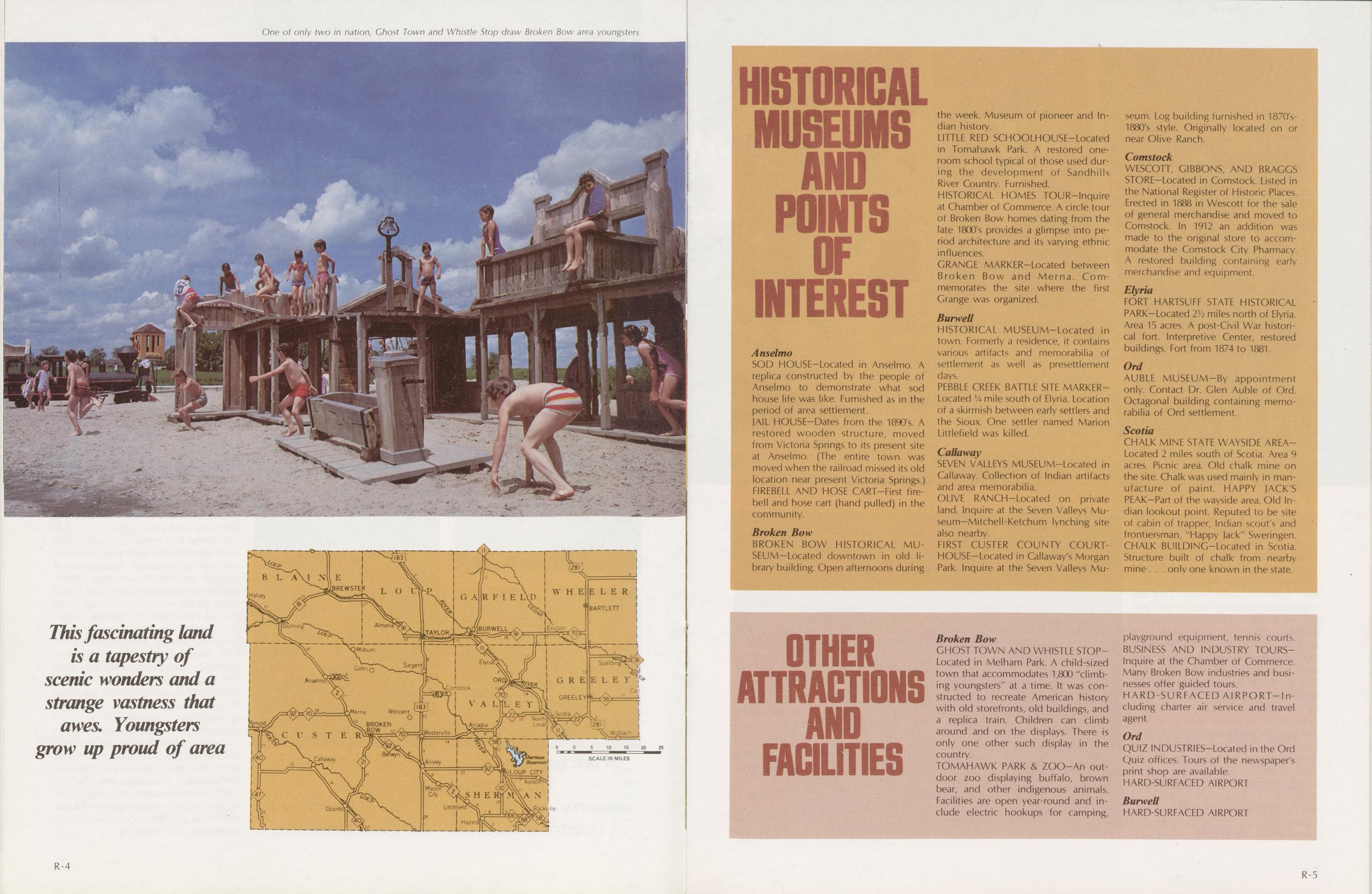
HISTORICAL MUSEUMS AND POINTS OF INTERST
Anselmo SOD HOUSE-Located in Anselmo. A replica constructed by the people of Anselmo to demonstrate what sod house life was like. Furnished as in the period of area settlement. JAIL HOUSE-Dates from the 1890's. A restored wooden structure, moved from Victoria Springs to its present site at Anselmo. (The entire town was moved when the railroad missed its old location near present Victoria Springs.) FIREBELL AND HOSE CART-First firebell and hose cart (hand pulled) in the community. Broken Bow BROKEN BOW HISTORICAL MUSEUM—Located downtown in old library building. Open afternoons during FACILITIE the week. Museum of pioneer and Indian history. LITTLE RED SCHOOLHOUSE-Located in Tomahawk Park. A restored one room school typical of those used during the development of Sandhills River Country. Furnished. HISTORICAL HOMES TOUR-lnquire at Chamber of Commerce. A circle tour of Broken Bow homes dating from the late 1800/s provides a glimpse into period architecture and its varying ethnic influences. GRANGE MARKER-Located between Broken Bow and Merna. Commemorates the site where the first Grange was organized. Burwell HISTORICAL MUSEUM-Located in town. Formerly a residence, it contains various artifacts and memorabilia of settlement as well as presettlement days. PEBBLE CREEK BATTLE SITE MARKER- Located 14 mile south of Elyria. Location of a skirmish between early settlers and the Sioux. One settler named Marion Littlefield was killed. Callaway SEVEN VALLEYS MUSEUM-Located in Callaway. Collection of Indian artifacts and area memorabilia. OLIVE RANCH-Located on private land. Inquire at the Seven Valleys Museum— Mitchell-Ketchum lynching site also nearby. FIRST CUSTER COUNTY COURT- HOUSE—Located in Callaway's Morgan Park. Inquire at the Seven Valleys Museum. Log building furnished in 1870/s- 1880/s style. Originally located on or near Olive Ranch. Comstock WESCOTT, GIBBONS, AND BRAGGS STORE—Located in Comstock. Listed in the National Register of Historic Places. Erected in 1888 in Wescott for the sale of general merchandise and moved to Comstock. In 1912 an addition was made to the original store to accommodate the Comstock City Pharmacy. A restored building containing early merchandise and equipment. Elyria FORT HARTSUFF STATE HISTORICAL PARK-Located 2Vi miles north of Elyria. Area 15 acres. A post-Civil War historical fort. Interpretive Center, restored buildings. Fort from 1874 to 1881. Ord AUBLE MUSEUM-By appointment only. Contact Dr. Glen Auble of Ord. Octagonal building containing memorabilia of Ord settlement. Scotia CHALK MINE STATE WAYSIDE AREA- Located 2 miles south of Scotia. Area 9 acres. Picnic area. Old chalk mine on the site. Chalk was used mainly in manufacture of paint. HAPPY |ACK'S PEAK—Part of the wayside area. Old Indian lookout point. Reputed to be site of cabin of trapper, Indian scout's and frontiersman, "Happy Jack" Sweringen. CHALK BUILDING-Located in Scotia. Structure built of chalk from nearby mine . . . only one known in the state.OTHER ATTRACTIONS AND FACILITIES
Broken Bow GHOST TOWN AND WHISTLE STOP- Located in Melham Park. A child-sized town that accomodates 1,8000 "climbing youngsters" at a time. It was constructed to recreate American history with old storefronts, old buildings, and a replica train. Children can climb around and on the displays. There is only one other such display in the country. TOMAHAWK PARK and ZOO-An outdoor zoo displaying buffalo, brown bear, and other indigenous animals. Facilities are open year-round and include electric hookups for camping, playground equipment, tennis courts. BUSINESS AND INDUSTRY TOURS- Inquire at the Chamber of Commerce. Many Broken Bow industries and businesses offer guided tours. HARD-SURFACED AIRPORT-In- cluding charter air service and travel agent. Ord QUIZ INDUSTRIES-Located in the Ord Quiz offices. Tours of the newspaper's print shop are available. HARD-SURFACED AIRPORT Burwell HARD-SURFACED AIRPORT R-5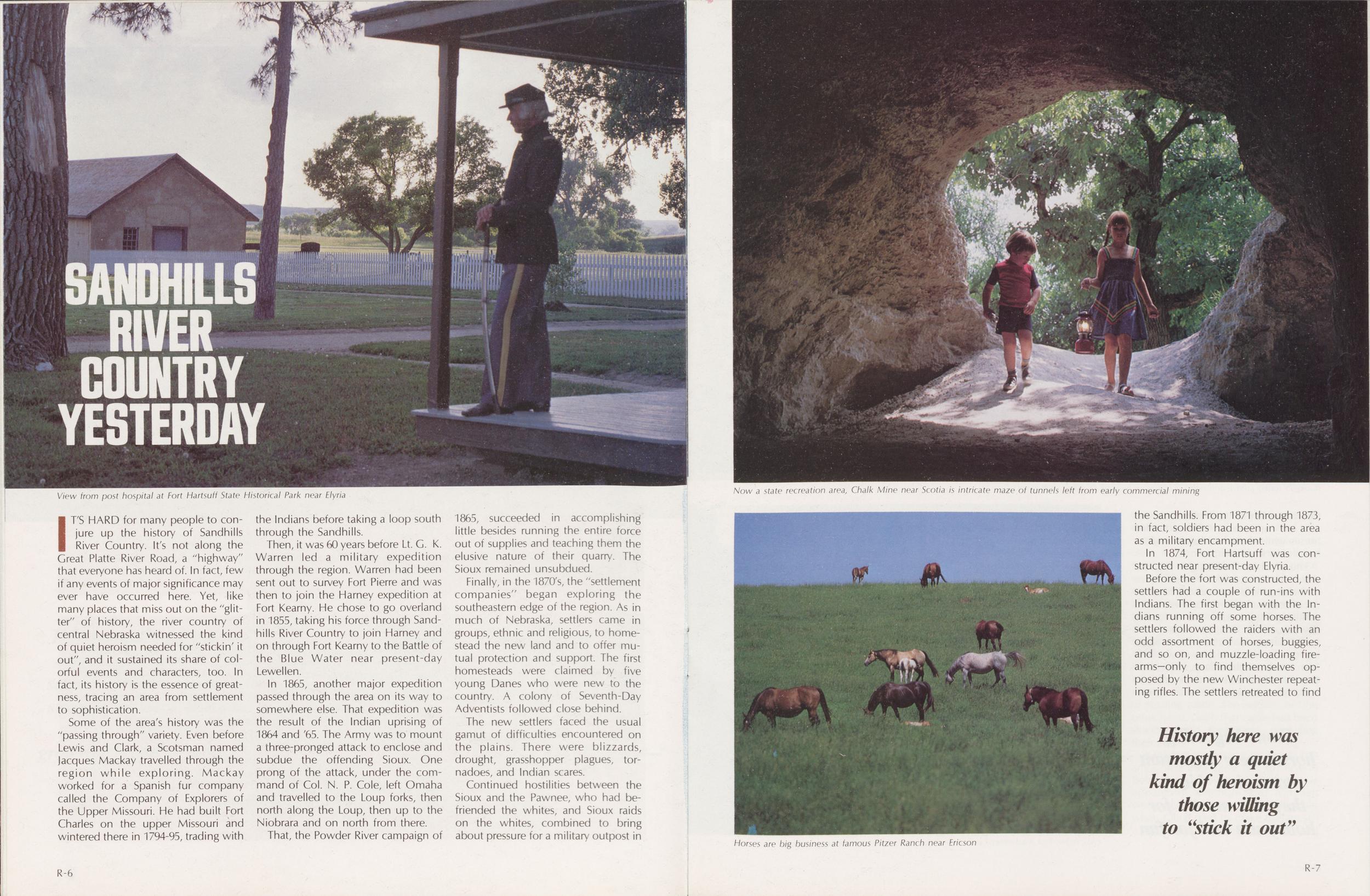
SANDHILLS RIVER COUNTRY YESTERDAY
IT'S HARD for many people to conjure up the history of Sandhills River Country. It's not along the Great Platte River Road, a "highway" that everyone has heard of. In fact, few if any events of major significance may ever have occurred here. Yet, like many places that miss out on the "glitter" of history, the river country of central Nebraska witnessed the kind of quiet heroism needed for "stickin' it out", and it sustained its share of colorful events and characters, too. In fact, its history is the essence of greatness, tracing an area from settlement to sophistication.
Some of the area's history was the "passing through" variety. Even before Lewis and Clark, a Scotsman named Jacques Mackay travelled through the region while exploring. Mackay worked for a Spanish fur company called the Company of Explorers of the Upper Missouri. He had built Fort Charles on the upper Missouri and wintered there in 1794-95, trading with the Indians before taking a loop south through the Sandhills.
Then, it was 60 years before Lt. G. K. Warren led a military expedition through the region. Warren had been sent out to survey Fort Pierre and was then to join the Harney expedition at Fort Kearny. He chose to go overland in 1855, taking his force through Sandhills River Country to join Harney and on through Fort Kearny to the Battle of the Blue Water near present-day Lewellen.
In 1865, another major expedition passed through the area on its way to somewhere else. That expedition was the result of the Indian uprising of 1864 and '65. The Army was to mount a three-pronged attack to enclose and subdue the offending Sioux. One prong of the attack, under the command of Col. N. P. Cole, left Omaha and travelled to the Loup forks, then north along the Loup, then up to the Niobrara and on north from there.
That, the Powder River campaign of 1865, succeeded in accomplishing little besides running the entire force out of supplies and teaching them the elusive nature of their quarry. The Sioux remained unsubdued.
Finally, in the 1870's, the "settlement companies" began exploring the southeastern edge of the region. As in much of Nebraska, settlers came in groups, ethnic and religious, to homestead the new land and to offer mutual protection and support. The first homesteads were claimed by five young Danes who were new to the country. A colony of Seventh-Day Adventists followed close behind.
The new settlers faced the usual gamut of difficulties encountered on the plains. There were blizzards, drought, grasshopper plagues, tornadoes, and Indian scares.
Continued hostilities between the Sioux and the Pawnee, who had befriended the whites, and Sioux raids on the whites, combined to bring about pressure for a military outpost in
In 1874, Fort Hartsuff was constructed near present-day Elyria.
Before the fort was constructed, the settlers had a couple of run-ins with Indians. The first began with the Indians running off some horses. The settlers followed the raiders with an odd assortment of horses, buggies, and so on, and muzzle-loading firearms—only to find themselves opposed by the new Winchester repeating rifles. The settlers retreated to find
History here was mostly a quiet kind of heroism by those willing to "stick it out" R-7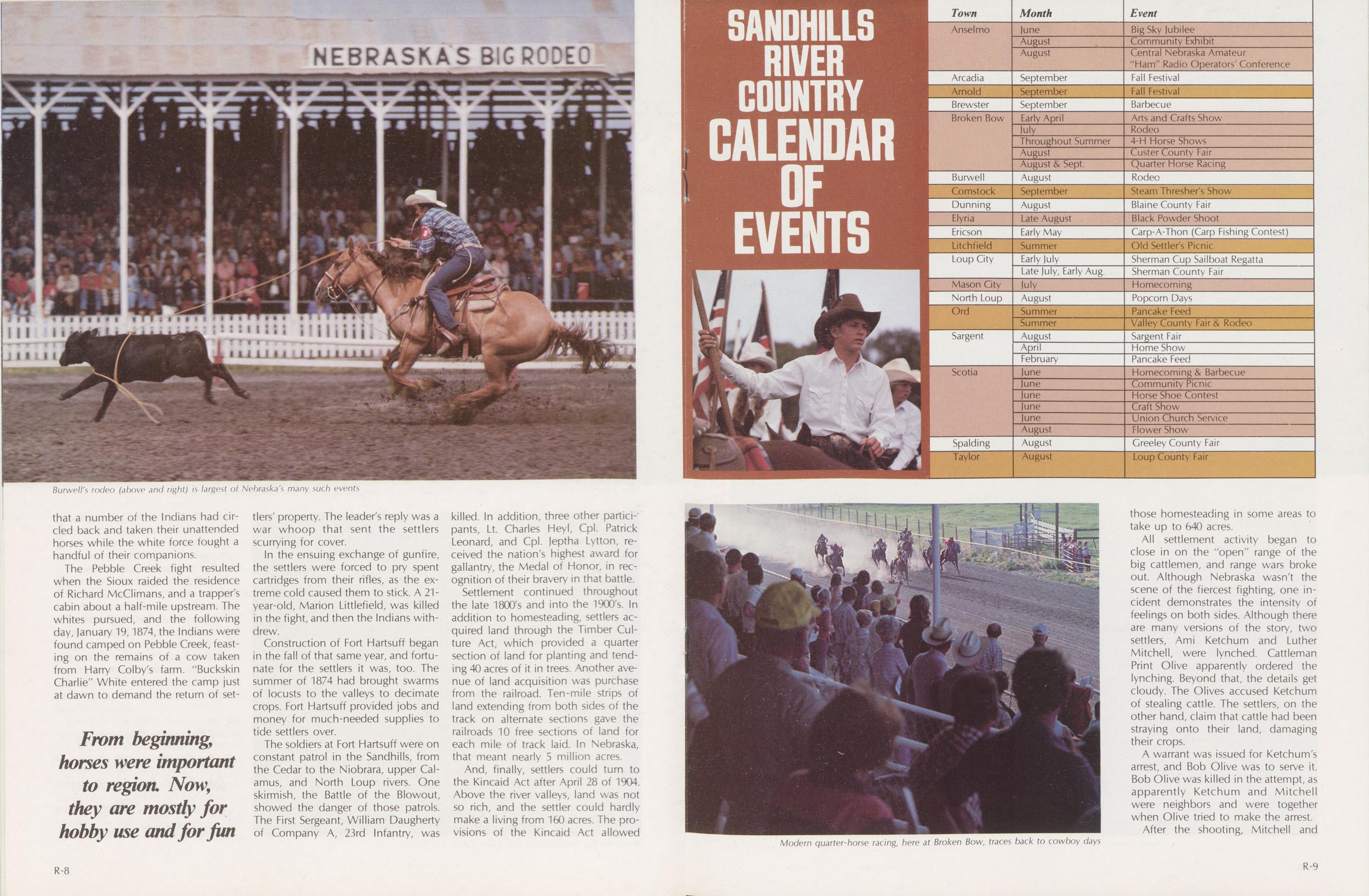
that a number of the Indians had circled back and taken their unattended horses while the white force fought a handful of their companions.
The Pebble Creek fight resulted when the Sioux raided the residence of Richard McClimans, and a trapper's cabin about a half-mile upstream. The whites pursued, and the following day, January 19,1874, the Indians were found camped on Pebble Creek, feasting on the remains of a cow taken from Harry Colby's farm. "Buckskin Charlie" White entered the camp just at dawn to demand the return of settiers' property. The leader's reply was a war whoop that sent the settlers scurrying for cover.
From beginning, horses were important to region. Now, they are mostly for hobby use and for funIn the ensuing exchange of gunfire, the settlers were forced to pry spent cartridges from their rifles, as the extreme cold caused them to stick. A 21-year-old, Marion Littlefield, was killed in the fight, and then the Indians withdrew.
Construction of Fort Hartsuff began in the fall of that same year, and fortunate for the settlers it was, too. The summer of 1874 had brought swarms of locusts to the valleys to decimate crops. Fort Hartsuff provided jobs and money for much-needed supplies to tide settlers over.
The soldiers at Fort Hartsuff were on constant patrol in the Sandhills, from the Cedar to the Niobrara, upper Calamus, and North Loup rivers. One skirmish, the Battle of the Blowout, showed the danger of those patrols. The First Sergeant, William Daugherty of Company A, 23rd Infantry, was killed. In addition, three other participants, Lt. Charles Heyl, Cpl. Patrick Leonard, and Cpl. Jeptha Lytton, received the nation's highest award for gallantry, the Medal of Honor, in recognition of their bravery in that battle.
Settlement continued throughout the late 1800's and into the 1900's. In addition to homesteading, settlers acquired land through the Timber Culture Act, which provided a quarter section of land for planting and tending 40 acres of it in trees. Another avenue of land acquisition was purchase from the railroad. Ten-mile strips of land extending from both sides of the track on alternate sections gave the railroads 10 free sections of land for each mile of track laid. In Nebraska, that meant nearly 5 million acres.
And, finally, settlers could turn to the Kincaid Act after April 28 of 1904. Above the river valleys, land was not so rich, and the settler could hardly make a living from 160 acres. The provisions of the Kincaid Act allowed
R-8those homesteading in some areas to take up to 640 acres.
All settlement activity began to close in on the "open" range of the big cattlemen, and range wars broke out. Although Nebraska wasn't the scene of the fiercest fighting, one in- cident demonstrates the intensitv of feelings on both sides. Although there are many versions of the story, two settlers, Ami Ketchum and Luther Mitchell, were lynched. Cattleman Print Olive apparently ordered the lynching. Beyond that, the details get cloudy. The Olives accused Ketchum of stealing cattle. The settlers, on the other hand, claim that cattle had been straying onto their land, damaging their crops.
A warrant was issued for Ketchum's arrest, and Bob Olive was to serve it. Bob Olive was killed in the attempt, as apparently Ketchum and Mitchell were neighbors and were together when Olive tried to make the arrest.
After the shooting, Mitchell and
R-9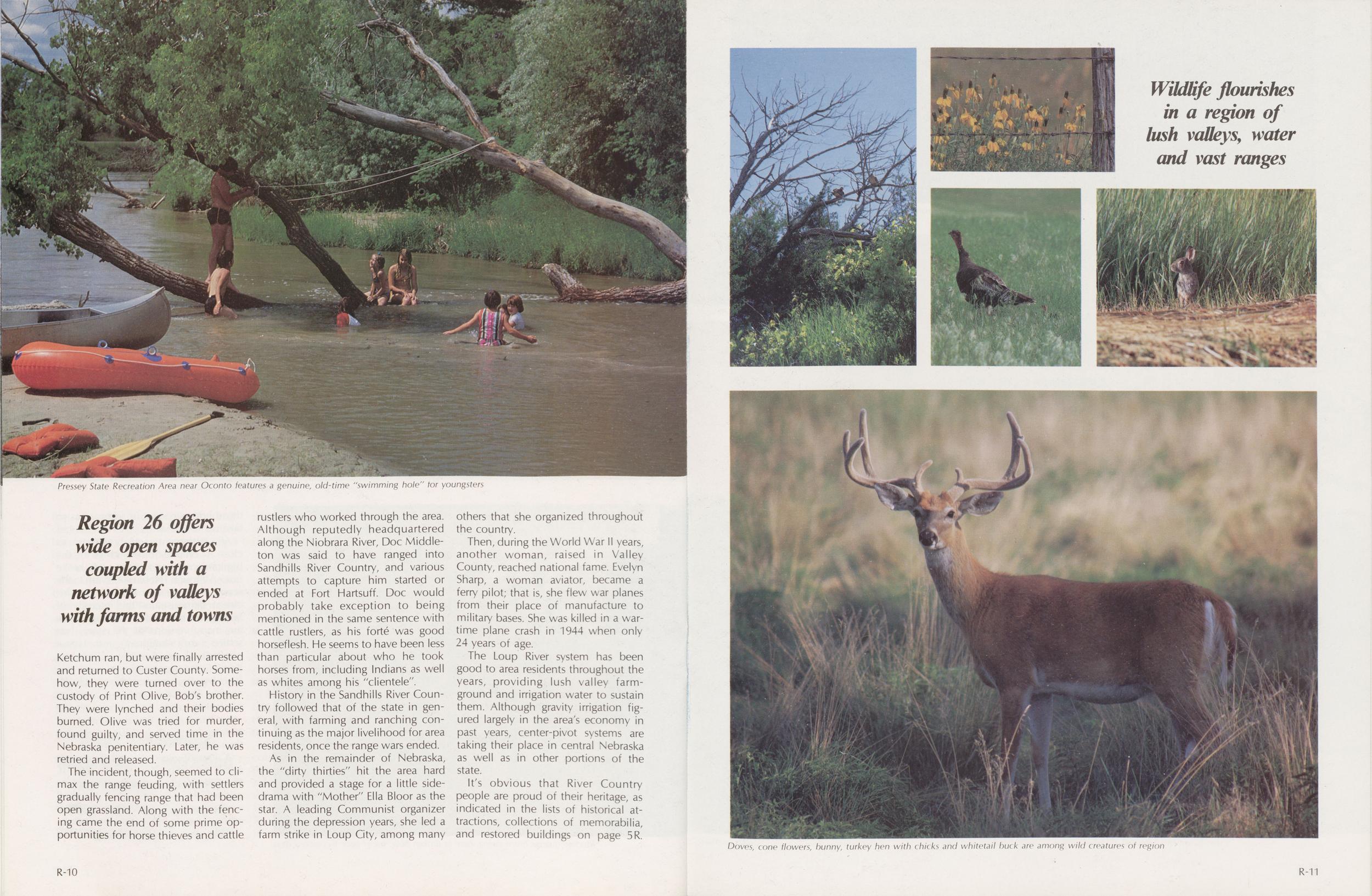
Ketchum ran, but were finally arrested and returned to Custer County. Somehow, they were turned over to the custody of Print Olive, Bob's brother. They were lynched and their bodies burned. Olive was tried for murder, found guilty, and served time in the Nebraska penitentiary. Later, he was retried and released.
The incident, though, seemed to climax the range feuding, with settlers gradually fencing range that had been open grassland. Along with the fencing came the end of some prime opportunities for horse thieves and cattle rustlers who worked through the area. Although reputedly headquartered along the Niobrara River, Doc Middleton was said to have ranged into Sandhills River Country, and various attempts to capture him started or ended at Fort Hartsuff. Doc would probably take exception to being mentioned in the same sentence with cattle rustlers, as his forte was good horseflesh. He seems to have been less than particular about who he took horses from, including Indians as well as whites among his "clientele".
History in the Sandhills River Country followed that of the state in general, with farming and ranching continuing as the major livelihood for area residents, once the range wars ended.
As in the remainder of Nebraska, the "dirty thirties" hit the area hard and provided a stage for a little side drama with "Mother" Ella Bloor as the star. A leading Communist organizer during the depression years, she led a farm strike in Loup City, among many others that she organized throughout the country.
Then, during the World War II years, another woman, raised in Valley County, reached national fame. Evelyn Sharp, a woman aviator, became a ferry pilot; that is, she flew war planes from their place of manufacture to military bases. She was killed in a wartime plane crash in 1944 when only 24 years of age.
The Loup River system has been good to area residents throughout the years, providing lush valley farmground and irrigation water to sustain them. Although gravity irrigation figured largely in the area's economy in past years, center-pivot systems are taking their place in central Nebraska as well as in other portions of the state.
It's obvious that River Country people are proud of their heritage, as indicated in the lists of historical attractions, collections of memorabilia, and restored buildings on page 5R.
R-10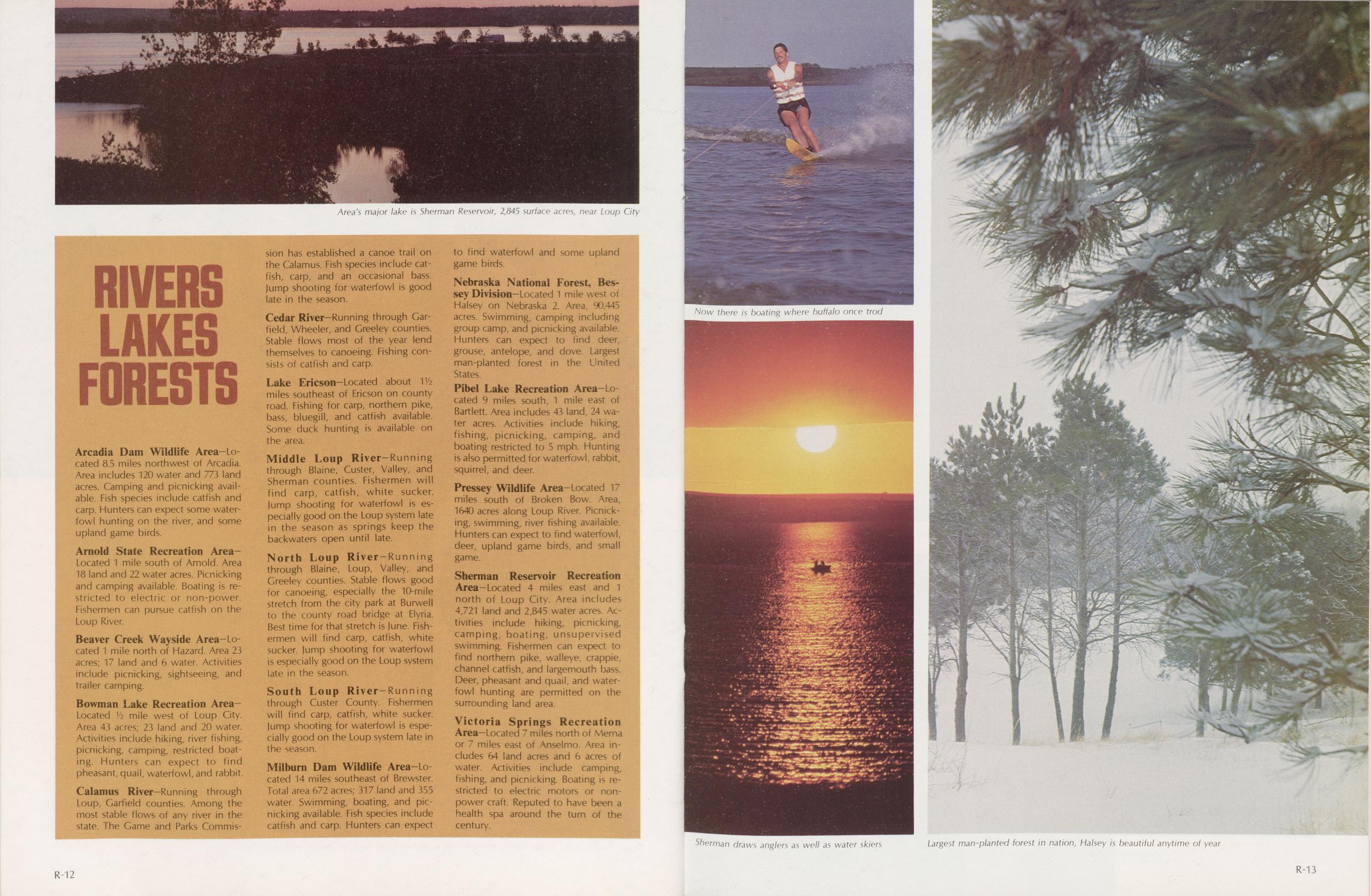
RIVERS LAKES FORESTS
Arcadia Dam Wildlife Area-Located 8.5 miles northwest of Arcadia. Area includes 120 water and 773 land acres. Camping and picnicking available. Fish species include catfish and carp. Hunters can expect some waterfowl hunting on the river, and some upland game birds. Arnold State Recreation Area- Located 1 mile south of Arnold. Area 18 land and 22 water acres. Picnicking and camping available. Boating is restricted to electric or non-power. Fishermen can pursue catfish on the Loup River. Beaver Creek Wayside Area-Located 1 mile north of Hazard. Area 23 acres; 17 land and 6 water. Activities include picnicking, sightseeing, and trailer camping. Bowman Lake Recreation Area- Located 1/2 mile west of Loup City. Area 43 acres; 23 land and 20 water. Activities include hiking, river fishing, picnicking, camping, restricted boating. Hunters can expect to find pheasant, quail, waterfowl, and rabbit. Calamus River-Running through Loup, Garfield counties. Among the most stable flows of any river in the state. The Game and Parks Commission has established a canoe trail on the Calamus. Fish species include catfish, carp, and an occasional bass, lump shooting for waterfowl is good late in the season. Cedar River-Running through Garfield, Wheeler, and Greeley counties. Stable flows most of the year lend themselves to canoeing. Fishing consists of catfish and carp. Lake Ericson-Located about Vh miles southeast of Ericson on county road. Fishing for carp, northern pike, bass, bluegill, and catfish available. Some duck hunting is available on the area. Middle Loup River-Running through Blaine, Custer, Valley, and Sherman counties. Fishermen will find carp, catfish, white sucker, lump shooting for waterfowl is especially good on the Loup system late in the season as springs keep the backwaters open until late. North Loup River-Running through Blaine, Loup, Valley, and Greeley counties. Stable flows good for canoeing, especially the 10-mile stretch from the city park at Burwell to the county road bridge at Elyria. Best time for that stretch is June. Fishermen will find carp, catfish, white sucker, lump shooting for waterfowl is especially good on the Loup system late in the season. South Loup River-Running through Custer County. Fishermen will find carp, catfish, white sucker. Jump shooting for waterfowl is especially good on the Loup system late in the season. Milbuni Dam Wildlife Area-Located 14 miles southeast of Brewster. Total area 672 acres; 317 land and 355 water. Swimming, boating, and picnicking available. Fish species include catfish and carp. Hunters can expect to find waterfowl and some upland game birds. Nebraska National Forest, Bessey Division-Located 1 mile west o Halsey on Nebraska 2. Area, 90,445 acres. Swimming, camping including group camp, and picnicking available. Hunters can expect to find deer, grouse, antelope, and dove. Largest man-planted forest in the United States. Pibel Lake Recreation Area- Located 9 miles south, 1 mile east of Bartlett. Area includes 43 land, 24 water acres. Activities include hiking, fishing, picnicking, camping, and boating restricted to 5 mph. Hunting is also permitted for waterfowl, rabbit, squirrel, and deer. Pressey Wildlife Area-Located 17 miles south of Broken Bow. Area, 1640 acres along Loup River. Picnicking, swimming, river fishing available. Hunters can expect to find waterfowl, deer, upland game birds, and small game. Sherman Reservoir Recreation Area—Located 4 miles east and 1 north of Loup City. Area includes 4,721 land and 2,845 water acres. Activities include hiking, picnicking, camping, boating, unsupervised swimming. Fishermen can expect to find northern pike, walleye, crappie, channel catfish, and largemouth bass. Deer, pheasant and quail, and waterfowl hunting are permitted on the surrounding land area. Victoria Springs Recreation Area—Located 7 miles north of Merna or 7 miles east of Anselmo. Area includes 64 land acres and 6 acres of water. Activities include camping, fishing, and picnicking. Boating is restricted to electric motors or non-power craft. Reputed to have been a health spa around the turn of the century. R-12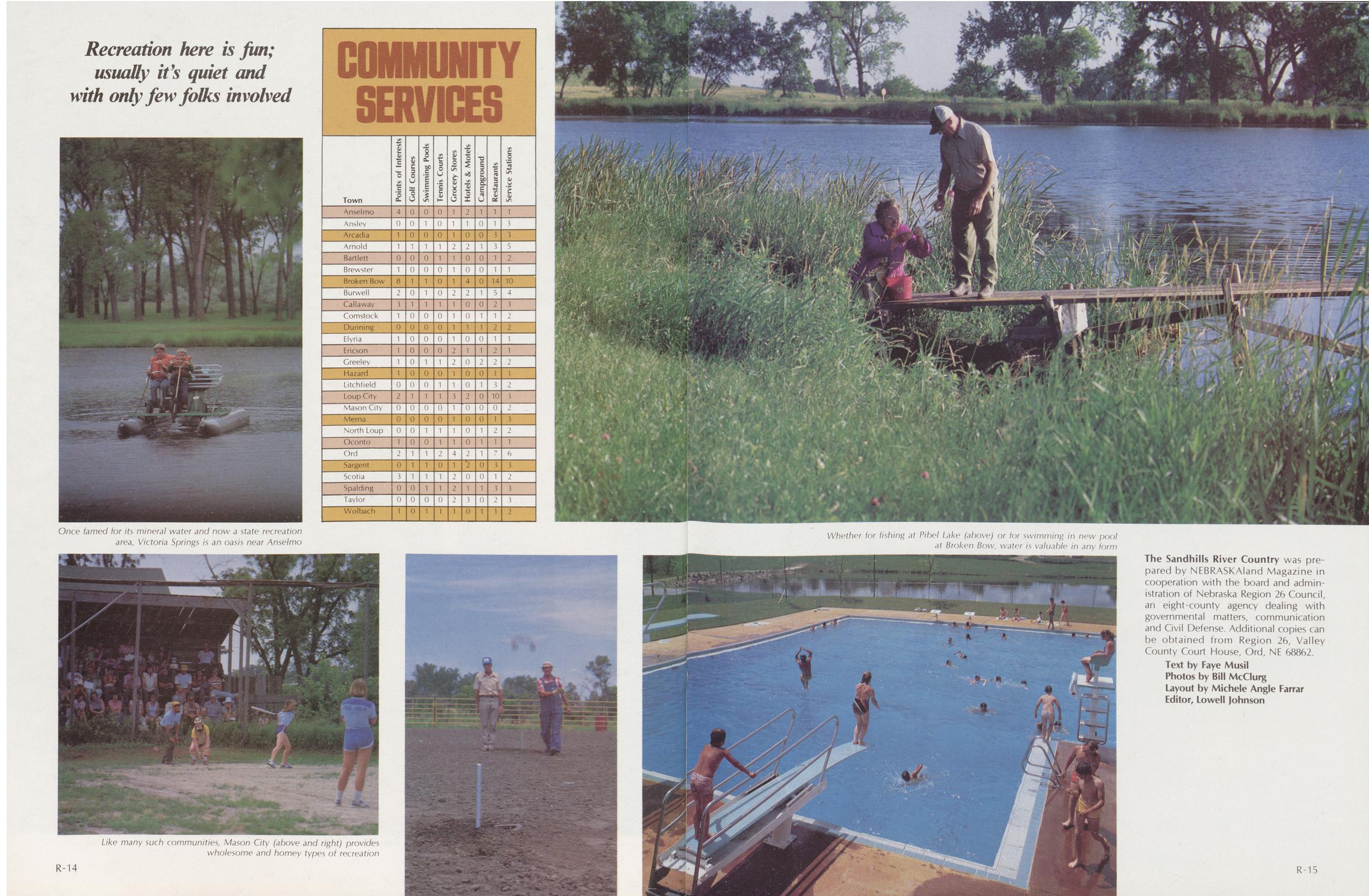
Recreation here is fim; usually ifs quiet and with only few folks involved
Anselmo 4 0 0 0 1 2 1 1 1 Ansley 0 0 1 0 1 1 0 1 3 Arcadia 1 0 0 0 1 0 0 3 3 Arnold 1 1 1 1 2 2 1 3 5 Bartlett 0 0 0 1 1 0 0 1 2 Brewster 1 0 0 0 1 0 0 1 1 Broken Bow 8 1 1 0 1 4 0 14 10 Burwell 2 0 1 0 2 2 1 3 4 Callaway 3 1 1 1 1 0 0 2 3 Comstock 1 0 0 0 1 0 1 1 2 Dunning 0 0 0 0 1 1 1 2 2 Elyria 1 0 0 0 1 0 0 1 1 Ericson 1 0 0 0 2 1 1 2 1 Greeley 1 0 1 1 2 0 2 2 2 Hazard 1 0 0 0 1 0 0 1 1 Litchfield 0 0 0 1 1 0 1 3 2 Loup City 2 1 1 1 3 2 0 10 3 Mason City 0 0 0 0 1 0 0 0 2 Merna 0 0 0 0 1 0 0 1 3 North Loup 0 0 1 1 1 0 1 2 2 Oconto 1 0 0 1 1 0 1 1 1 Ord 2 1 1 1 4 2 1 7 6 Sargent 0 1 1 0 1 2 0 3 3 Scotia 3 1 1 1 2 0 0 1 2 Spalding 0 0 1 1 2 1 1 3 3 Taylor 0 0 0 0 2 3 0 2 3 Wolbach 1 0 I 1 1 0 1 1 2
THE ETERNAL TRIANGLE
Even under normal circumstances, it is a giant juggling act each year with deer, hunters and landowners. With fourth factor, there's trouble
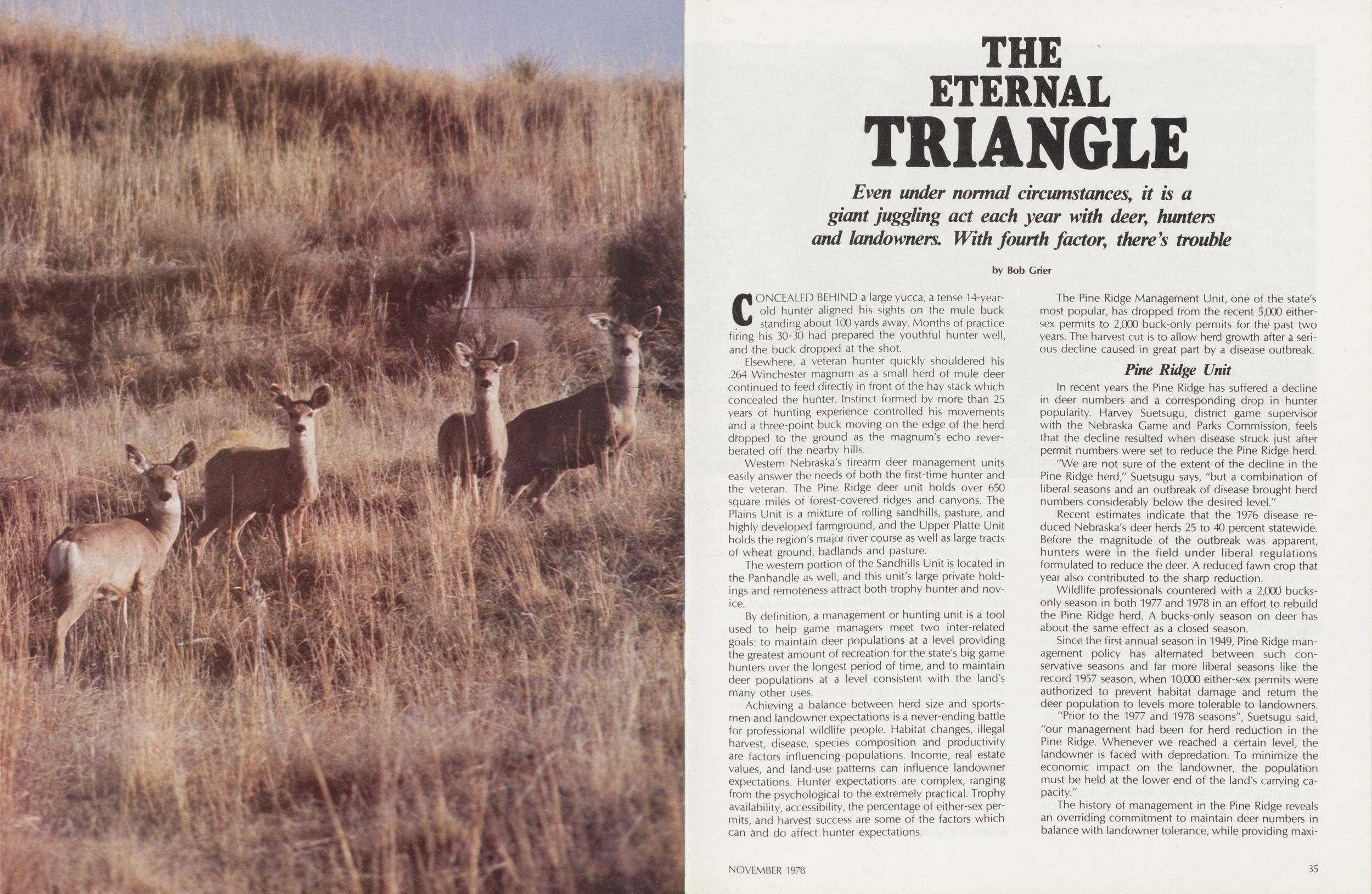
CONCEALED BEHIND a large yucca, a tense 14-year-old hunter aligned his sights on the mule buck standing about 100 yards away. Months of practice firing his 30-30 had prepared the youthful hunter well, and the buck dropped at the shot.
Elsewhere, a veteran hunter quickly shouldered his .264 Winchester magnum as a small herd of mule deer continued to feed directiy in front of the hay stack which concealed the hunter. Instinct formed by more than 25 years of hunting experience controlled his movements and a three-point buck moving on the edge of the herd dropped to the ground as the magnum's echo reverberated off the nearby hills.
Western Nebraska's firearm deer management units easily answer the needs of both the first-time hunter and the veteran. The Pine Ridge deer unit holds over 650 square miles of forest-covered ridges and canyons. The Plains Unit is a mixture of rolling sandhills, pasture, and highly developed farmground, and the Upper Platte Unit holds the region's major river course as well as large tracts of wheat ground, badlands and pasture.
The western portion of the Sandhills Unit is located in the Panhandle as well, and this unit's large private holdings and remoteness attract both trophy hunter and novice.
By definition, a management or hunting unit is a tool used to help game managers meet two interrelated goals: to maintain deer populations at a level providing the greatest amount of recreation for the state's big game hunters over the longest period of time, and to maintain deer populations at a level consistent with the land's many other uses.
Achieving a balance between herd size and sportsmen and landowner expectations is a never-ending battle for professional wildlife people. Habitat changes, illegal harvest, disease, species composition and productivity are factors influencing populations. Income, real estate values, and land-use patterns can influence landowner expectations. Hunter expectations are complex, ranging from the psychological to the extremely practical. Trophy availability, accessibility, the percentage of either-sex permits, and harvest success are some of the factors which can and do affect hunter expectations.
The Pine Ridge Management Unit, one of the state's most popular, has dropped from the recent 5,000 either-sex permits to 2,000 buck-only permits for the past two years. The harvest cut is to allow herd growth after a serious decline caused in great part by a disease outbreak.
Pine Ridge UnitIn recent years the Pine Ridge has suffered a decline in deer numbers and a corresponding drop in hunter popularity. Harvey Suetsugu, district game supervisor with the Nebraska Game and Parks Commission, feels that the decline resulted when disease struck just after permit numbers were set to reduce the Pine Ridge herd.
"We are not sure of the extent of the decline in the Pine Ridge herd," Suetsugu says, "but a combination of liberal seasons and an outbreak of disease brought herd numbers considerably below the desired level."
Recent estimates indicate that the 1976 disease reduced Nebraska's deer herds 25 to 40 percent statewide. Before the magnitude of the outbreak was apparent, hunters were in the field under liberal regulations formulated to reduce the deer. A reduced fawn crop that year also contributed to the sharp reduction.
Wildlife professionals countered with a 2,000 bucks only season in both 1977 and 1978 in an effort to rebuild the Pine Ridge herd. A bucks-only season on deer has about the same effect as a closed season.
Since the first annual season in 1949, Pine Ridge management policy has alternated between such conservative seasons and far more liberal seasons like the record 1957 season, when 10,000 either-sex permits were authorized to prevent habitat damage and return the deer population to levels more tolerable to landowners.
"Prior to the 1977 and 1978 seasons", Suetsugu said, "our management had been for herd reduction in the Pine Ridge. Whenever we reached a certain level, the landowner is faced with depredation. To minimize the economic impact on the landowner, the population must be held at the lower end of the land's carrying capacity."
The history of management in the Pine Ridge reveals an overriding commitment to maintain deer numbers in balance with landowner tolerance, while providing maximum
NOVEMBER 1978 35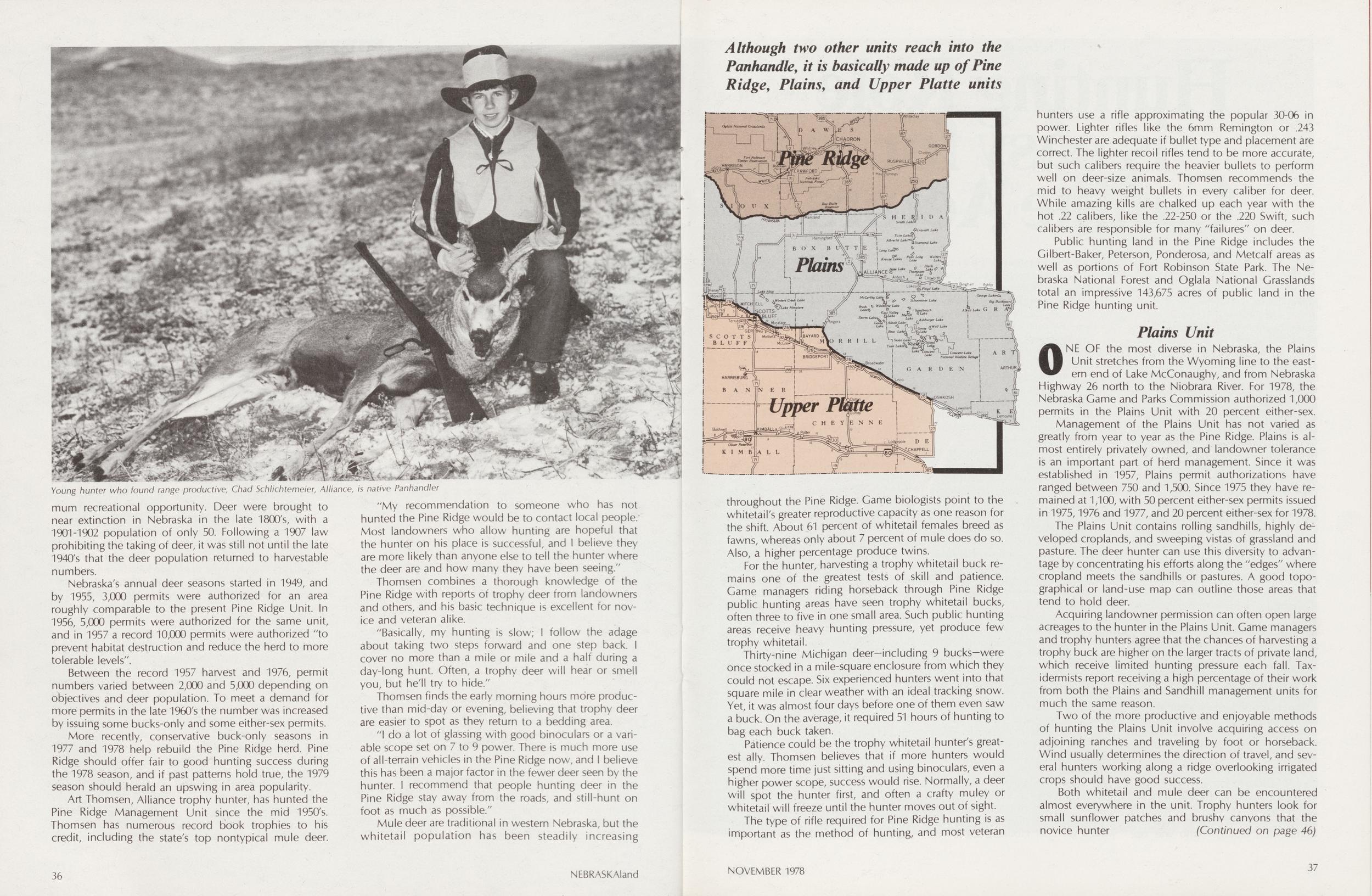
recreational opportunity. Deer were brought to near extinction in Nebraska in the late 1800's with a 1901-1902 population of only 50. Following a 1907 law prohibiting the taking of deer, it was still not until the late 1940's that the deer population returned to harvestable numbers.
Nebraska's annual deer seasons started in 1949, and by 1955, 3,000 permits were authorized for an area roughly comparable to the present Pine Ridge Unit. In 1956, 5,000 permits were authorized for the same unit, and in 1957 a record 10,000 permits were authorized "to prevent habitat destruction and reduce the herd to more tolerable levels".
Between the record 1957 harvest and 1976, permit numbers varied between 2,000 and 5,000 depending on objectives and deer population. To meet a demand for more permits in the late 1960's the number was increased by issuing some bucks-only and some either-sex permits.
More recently, conservative buck-only seasons in 1977 and 1978 help rebuild the Pine Ridge herd. Pine Ridge should offer fair to good hunting success during the 1978 season, and if past patterns hold true, the 1979 season should herald an upswing in area popularity.
Art Thomsen, Alliance trophy hunter, has hunted the Pine Ridge Management Unit since the mid 1950's. Thomsen has numerous record book trophies to his credit, including the state's top nontypical mule deer.
"My recommendation to someone who has not hunted the Pine Ridge would be to contact local people. Most landowners who allow hunting are hopeful that the hunter on his place is successful, and I believe they are more likely than anyone else to tell the hunter where the deer are and how many they have been seeing."
Thomsen combines a thorough knowledge of the Pine Ridge with reports of trophy deer from landowners and others, and his basic technique is excellent for novice and veteran alike.
"Basically, my hunting is slow; I follow the adage about taking two steps forward and one step back. I cover no more than a mile or mile and a half during a day-long hunt. Often, a trophy deer will hear or smell you, but he'll try to hide."
Thomsen finds the early morning hours more productive than mid-day or evening, believing that trophy deer are easier to spot as they return to a bedding area.
"I do a lot of glassing with good binoculars or a variable scope set on 7 to 9 power. There is much more use of all-terrain vehicles in the Pine Ridge now, and I believe this has been a major factor in the fewer deer seen by the hunter. I recommend that people hunting deer in the Pine Ridge stay away from the roads, and still-hunt on foot as much as possible."
Mule deer are traditional in western Nebraska, but the whitetail population has been steadily increasing
36 NEBRASKAlandthroughout the Pine Ridge. Game biologists point to the whitetail's greater reproductive capacity as one reason for the shift. About 61 percent of whitetail females breed as fawns, whereas only about 7 percent of mule does do so. Also, a higher percentage produce twins.
For the hunter, harvesting a trophy whitetail buck remains one of the greatest tests of skill and patience. Game managers riding horseback through Pine Ridge public hunting areas have seen trophy whitetail bucks, often three to five in one small area. Such public hunting areas receive heavy hunting pressure, yet produce few trophy whitetail.
Thirty-nine Michigan deer-including 9 bucks-were once stocked in a mile-square enclosure from which they could not escape. Six experienced hunters went into that square mile in clear weather with an ideal tracking snow. Yet, it was almost four days before one of them even saw a buck. On the average, it required 51 hours of hunting to bag each buck taken.
Patience could be the trophy whitetail hunter's greatest ally. Thomsen believes that if more hunters would spend more time just sitting and using binoculars, even a higher power scope, success would rise. Normally, a deer will spot the hunter first, and often a crafty muley or whitetail will freeze until the hunter moves out of sight.
The type of rifle required for Pine Ridge hunting is as important as the method of hunting, and most veteran hunters use a rifle approximating the popular 30-06 in power. Lighter rifles like the 6mm Remington or .243 Winchester are adequate if bullet type and placement are correct. The lighter recoil rifles tend to be more accurate, but such calibers require the heavier bullets to perform well on deer-size animals. Thomsen recommends the mid to heavy weight bullets in every caliber for deer. While amazing kills are chalked up each year with the hot .22 calibers, like the .22-250 or the .220 Swift, such calibers are responsible for many "failures" on deer.
Public hunting land in the Pine Ridge includes the Gilbert-Baker, Peterson, Ponderosa, and Metcalf areas as well as portions of Fort Robinson State Park. The Nebraska National Forest and Oglala National Grasslands total an impressive 143,675 acres of public land in the Pine Ridge hunting unit.
Plains UnitONE OF the most diverse in Nebraska, the Plains Unit stretches from the Wyoming line to the eastern end of Lake McConaughy, and from Nebraska Highway 26 north to the Niobrara River. For 1978, the Nebraska Game and Parks Commission authorized 1,000 permits in the Plains Unit with 20 percent either-sex.
Management of the Plains Unit has not varied as greatly from year to year as the Pine Ridge. Plains is almost entirely privately owned, and landowner tolerance is an important part of herd management. Since it was established in 1957, Plains permit authorizations have ranged between 750 and 1,500. Since 1975 they have remained at 1,100, with 50 percent either-sex permits issued in 1975,1976 and 1977, and 20 percent either-sex for 1978.
The Plains Unit contains rolling sandhills, highly developed croplands, and sweeping vistas of grassland and pasture. The deer hunter can use this diversity to advantage by concentrating his efforts along the "edges" where cropland meets the sandhills or pastures. A good topographical or land-use map can outline those areas that tend to hold deer.
Acquiring landowner permission can often open large acreages to the hunter in the Plains Unit. Game managers and trophy hunters agree that the chances of harvesting a trophy buck are higher on the larger tracts of private land, which receive limited hunting pressure each fall. Taxidermists report receiving a high percentage of their work from both the Plains and Sandhill management units for much the same reason.
Two of the more productive and enjoyable methods of hunting the Plains Unit involve acquiring access on adjoining ranches and traveling by foot or horseback. Wind usually determines the direction of travel, and several hunters working along a ridge overlooking irrigated crops should have good success.
Both whitetail and mule deer can be encountered almost everywhere in the unit. Trophy hunters look for small sunflower patches and brushv canyons that the novice hunter (Continued on page 46)
NOVEMBER 1978 37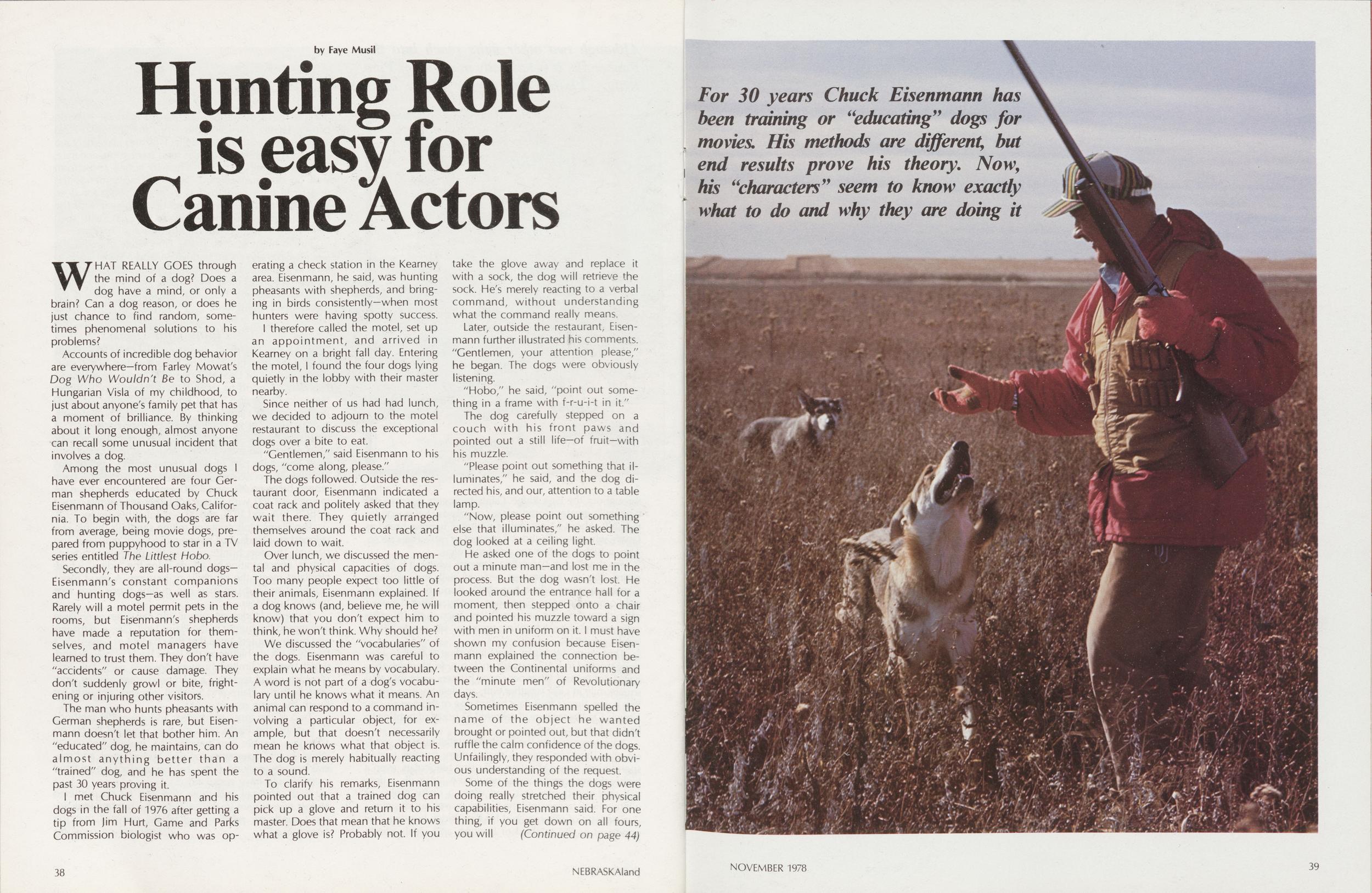
Hunting Role is easy for Caine Actors
WHAT REALLY GOES through the mind of a dog? Does a dog have a mind, or only a brain? Can a dog reason, or does he just chance to find random, sometimes phenomenal solutions to his problems?
Accounts of incredible dog behavior are everywhere—from Farley Mowat's Dog Who Wouldn't Be to Shod, a Hungarian Visla of my childhood, to just about anyone's family pet that has a moment of brilliance. By thinking about it long enough, almost anyone can recall some unusual incident that involves a dog.
Among the most unusual dogs I have ever encountered are four German shepherds educated by Chuck Eisenmann of Thousand Oaks, California. To begin with, the dogs are far from average, being movie dogs, prepared from puppy hood to star in a TV series entitled The Littlest Hobo.
Secondly, they are all-round dogs— Eisenmann's constant companions and hunting dogs-as well as stars. Rarely will a motel permit pets in the rooms, but Eisenmann's shepherds have made a reputation for themselves, and motel managers have learned to trust them. They don't have "accidents" or cause damage. They don't suddenly growl or bite, frightening or injuring other visitors.
The man who hunts pheasants with German shepherds is rare, but Eisenmann doesn't let that bother him. An "educated" dog, he maintains, can do almost anything better than a "trained" dog, and he has spent the past 30 years proving it.
I met Chuck Eisenmann and his dogs in the fall of 1976 after getting a tip from Jim Hurt, Game and Parks Commission biologist who was operating a check station in the Kearney area. Eisenmann, he said, was hunting pheasants with shepherds, and bringing in birds consistently—when most hunters were having spotty success.
I therefore called the motel, set up an appointment, and arrived in Kearney on a bright fall day. Entering the motel, I found the four dogs lying quietly in the lobby with their master nearby.
Since neither of us had had lunch, we decided to adjourn to the motel restaurant to discuss the exceptional dogs over a bite to eat.
"Gentlemen," said Eisenmann to his dogs, "come along, please."
The dogs followed. Outside the restaurant door, Eisenmann indicated a coat rack and politely asked that they wait there. They quietly arranged themselves around the coat rack and laid down to wait.
Over lunch, we discussed the mental and physical capacities of dogs. Too many people expect too little of their animals, Eisenmann explained. If a dog knows (and, believe me, he will know) that you don't expect him to think, he won't think. Why should he?
We discussed the "vocabularies" of the dogs. Eisenmann was careful to explain what he means by vocabulary. A word is not part of a dog's vocabulary until he knows what it means. An animal can respond to a command involving a particular object, for example, but that doesn't necessarily mean he knows what that object is. The dog is merely habitually reacting to a sound.
To clarify his remarks, Eisenmann pointed out that a trained dog can pick up a glove and return it to his master. Does that mean that he knows what a glove is? Probably not. If you take the glove away and replace it with a sock, the dog will retrieve the sock. He's merely reacting to a verbal command, without understanding what the command really means.
Later, outside the restaurant, Eisenmann further illustrated his comments. "Gentlemen, your attention please," he began. The dogs were obviously listening.
"Hobo," he said, "point out something in a frame with f-r-u-i-t in it."
The dog carefully stepped on a couch with his front paws and pointed out a still life—of fruit—with his muzzle.
"Please point out something that illuminates," he said, and the dog directed his, and our, attention to a table lamp.
"Now, please point out something else that illuminates," he asked. The dog looked at a ceiling light.
He asked one of the dogs to point out a minute man—and lost me in the process. But the dog wasn't lost. He looked around the entrance hall for a moment, then stepped onto a chair and pointed his muzzle toward a sign with men in uniform on it. I must have shown my confusion because Eisenmann explained the connection between the Continental uniforms and the "minute men" of Revolutionary days.
Sometimes Eisenmann spelled the name of the object he wanted brought or pointed out, but that didn't ruffle the calm confidence of the dogs. Unfailingly, they responded with obvious understanding of the request.
Some of the things the dogs were doing really stretched their physical capabilities, Eisenmann said. For one thing, if you get down on all fours, you will (Continued on page 44)
38 NEBRASKAland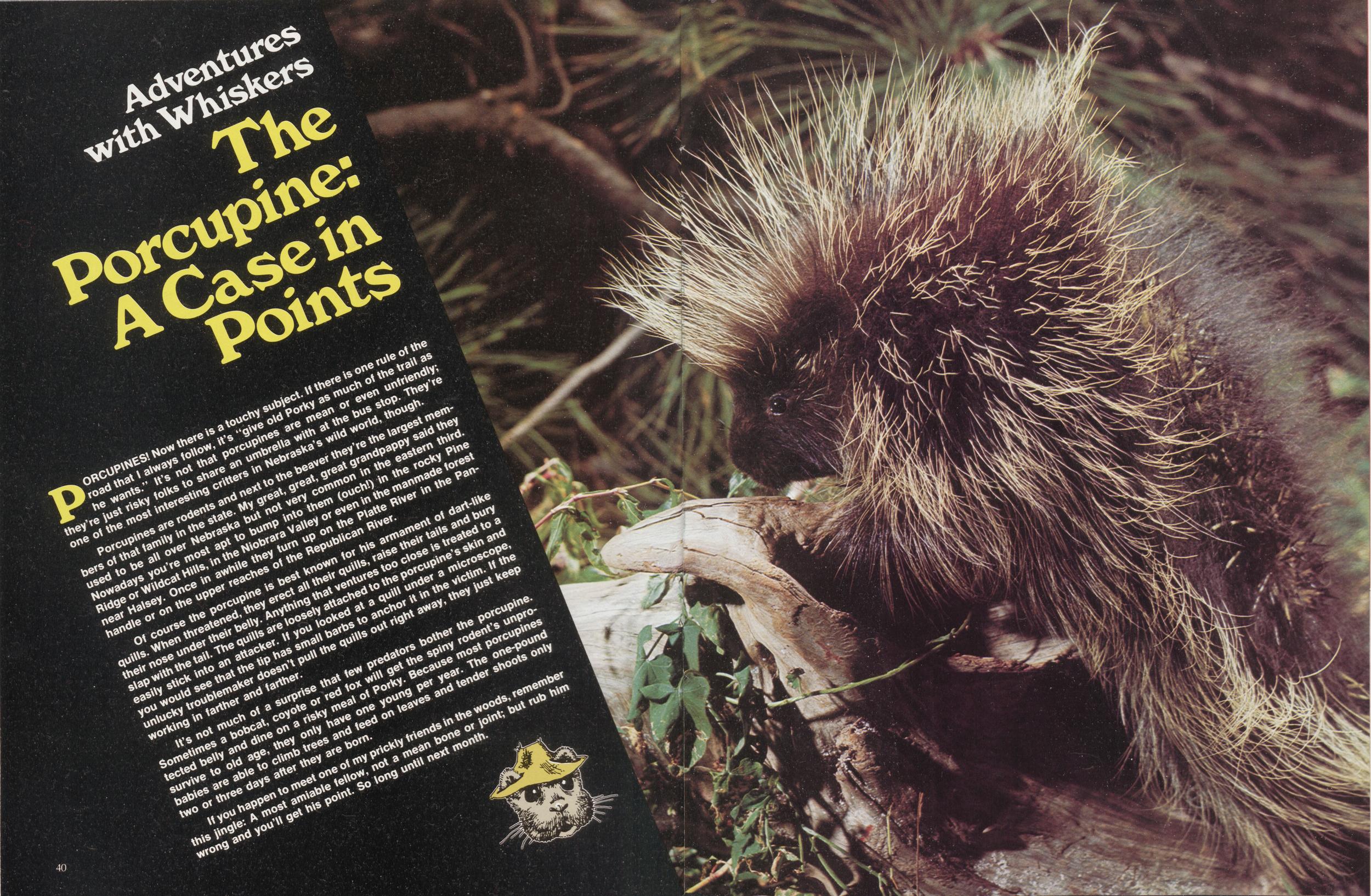
Adventures with Whiskers
The Porcupine: A Case in Points
PORCUPINES! Now there is a touchy subject. If there is one rule of the road that I always follow, it's "give old Porky as much of the trail as he wants". It's not that porcupines are mean or even unfriedly; they're just risky folds to share an umbrealla with at the bust stip. They're one of the most intersting criters in Nebraska's wild world , though.
Porcupines are rodents and next to the beaver they're the largest members of that family in the state. My great, great, great grandpappy said they used to be all over Nebraska but not very common in the eastern third. Nowadays you're most apt to bump into them (ouch!) in the rocky Pine Ridge or Wildcat Hills, in the Niobrara Valley or even in the manmade forest near Halsey. Once in awhile they turn up on the Platte River in the Panhandle or on the upper reaches of the Republican River.
Of course the porcupine is best known for his armament of dart-like quills. When threatedned, they erect all their quills, raise their tails and bury slap with the tail. The quills are loosely attached ot the procupine's skin and easily stick into an attacker. If yiou looked at a quil under a microscope, you would see that the tip has small barbs to anchor it in the victim. If the unlucky troublemaker doesn't pull the quills out right away, they just keep working in farther and farther.
It's not much of a surpise that few predators bother the procupine. SOmetimes a bobcat, coyote or red fox will get the spiny roden'ts unprotected belly and dine of a risky meal of Porky. Because most porcupines sruvive to old age, they onlhy have one young per year. The one-pound babies are able to climb trees and feed on leaves and tender shoots only two or three days after they are born.
If you happen to meet one of my prickly frieamiable fellow, not mean bone or joint; but rub him in the woods, remmber this jimgle: A most wrong and you'' get his point, So long until next month.
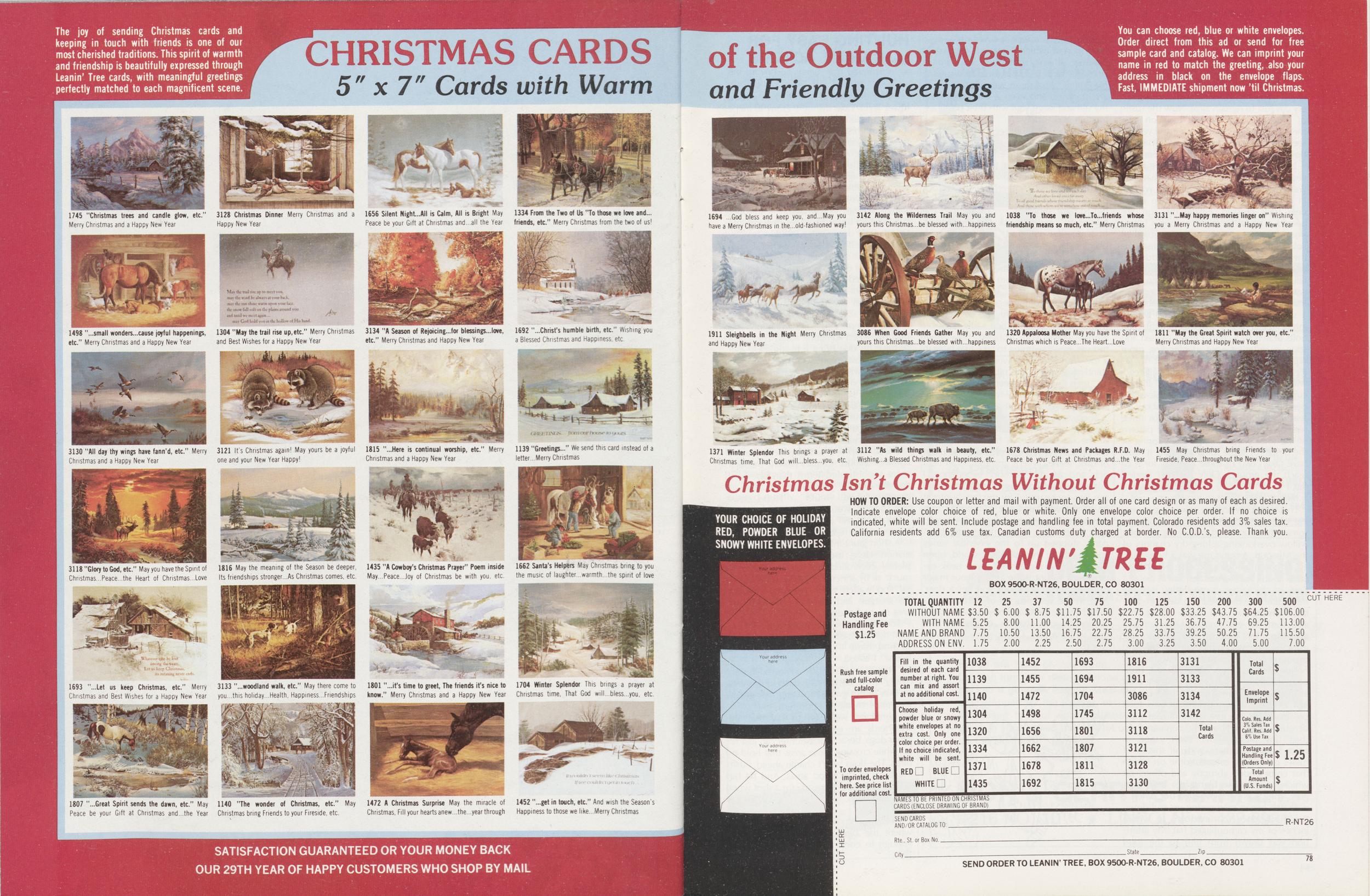
CHRISTMAS CARDS of the Outdoor West
5' x 7' Cards with Warm and Freiendly Greetings
The joy of sending Christmas cards and keeping in touch with friends is one of our most cherished traditions. This spirit of warmth and friendship is beautifully expressed through Leanin' Tree cards, with meaningful greetings perfectly matched to each magnificent scene.
WORLD OF THE BOWHUNTER
(Continued from page 17)that it must eat several times its weight every day just to remain alive. Now the rustle of leaves around my feet took on new meaning: shrews at work, plentiful yet unseen by all but a very few. Only when bowhunting have I seen these animals.
In mid October this past fall, we had a very heavy frost. Long before it thawed I was crouched along the Missouri, waiting in a clump of nettles where two active deer trails crossed. Finally the sun appeared; a signal for leaves to begin falling from the giant cottonwoods. I thought of Solomon's words about man being like the grass of the field, and then suddenly I began to notice the many ways that leaves fall. No two came down in quite the same way. Some would slip to one side, then the other, then back again, thus describing a series of gentle arcs which combined into a jagged pattern like that of lightening bolts drawn by a child. Others twirled and spun in differing ways, descending more rapidly. One leaf especially caught my attention. It was areodynamically balanced, with the stem leading and the slightly cupped blade serving as wings. Slowly it descended in graceful spirals of about 10 feet in diameter, dropping perhaps three feet on each complete circle, the pattern of the total descent like a giant spring or the design of some spiral staircase. It must have taken two or three minutes for it to reach the ground. Only when it landed did I become aware that my knees were aching from pressing so long in one spot.
That was a particularly rewarding morning. I left those trails shortly to climb into some other hunter's stand on the side of a willow overlooking a long-dry channel of the Missouri. Around me was a heavy forest of cottonwood, hackberry, oak, maple and various lesser trees and brush. Soon a flock of chickadees came flitting into my tree. Like me, they seemed delighted by the warming sun, and began calling back and forth to each other. One perched about four feet from my face, occasionally glancing my way, twitching his tail, and exposing a smudge on the white feathers beside his eye. Then came a wren, hopping about, jerking this tail, scolding a bit at this strange growth on the tree. He left just as a flight of migrating robins took possession of the tree. They moved ponderously and deliberately compared to their tiny predecessors. Each varied in color from the others, with all shades of russet on various breasts, some on which that color ended abruptly and others on which it seemed to blend into buff, then gray. They had hardly moved out when a nuthatch began scampering up and down the trunk, once to run down to within inches of my camouflaged hat. My attention was drawn from him to the loud hammering of a woodpecker on a dead limb against which I leaned. He would hammer at one spot, then skip almost sideways to a new spot, quickly resuming his drilling. And these were not all-flickers, starlings, and even a cardinal graced my still and silent vigil with their color, animation and variety.
Deer, too, can be seen in new ways while bowhunting, for they are unaware of any foreign presence to disturb them. Have you ever noticed the odd, rocking gait that a whitetail displays when trotting, tail high, to greet another? It seems to rock diagonally, right hip to left shoulder, left hip to right shoulder ... or, noticed the bumps on a button buck; the smoothness of a doe fawn's head . . . how large a deer's eyes can seem when it stares into yours from six feet . . . had a doe walk past you, then return to give this strange stump a sizing up before snorting, stamping, and dashing off. . . seen an orphaned fawn approach older deer, maybe looking for companionship, only to be ignored, maybe snubbed, and then sadly walk off alone? Have you noticed how deer browse, never seeming to take two bites in a row from the same weed or bush, constantly wandering and nibbling as they go . . . seen how long a deer can remain motionless except for swivelling the great ears, straining to sift out sounds of danger?
Then, too, there is the entire world of plants to observe; how different each tree of the same species is from another, for example. The textures that you can explore of bark, leaves, weeds and stems can be a rich and exciting sensory experience. I hope I have made my point. The world can be very beautiful for the bowhunter if he or she will but let it, by coming into contact with each new facet, slowly and with pores open. If your pores have been partly stopped up to the essential variey and beauty of the fall forest world, open them for new dimensions, even peak experiences. Count these among your major trophies, whether or not you get a deer. And, in the very process of becoming attuned to the here-and-now world of the outdoors, your chances of getting that deer will magnify. Come, share my lovely world!
HUNTING EASY FOR CANINE ACTORS
(Continued from page 39)see that their world is limited to a much lower level. Take eyesight. From 18 inches above the floor, the dog must consciously look over his head to see some of the things he was asked to see.
Yet these dogs had obviously been asked to stretch their worlds into that physically higher level, and they did it without visible strain.
"When you ask a dog to do something, though," Eisenmann cautioned, "you should be aware of his physical limitations, and don't give him tasks he can't perform. He'll develop an inferiority complex just like a human child might.
"I think of the dogs as children, perhaps handicapped children," he explained. "They are not dumb animals, but they can never do all the things a human being can."
One example of a dog's limitations is an incident when someone asked Eisenmann to have his dog bring a toothpick.
I was most impressed throughout the entire visit with the calm confidence both of dogs and owner. Even with four dogs to be attented to, there was no sign of confusion or strain. All commands were made in the form of requests, and not once did I hear Eisenmann talk "down" to the dogs. There was not a single, "Sit!" or "Stay!".
The atmosphere was one of intellectual communication. Requests were made in more sophisticated terms than one-word commands . . . "Gentlemen, I would appreciate it if you would . . . Hobo, please . . . London, would you consider. . . ."
But I was still interested in their capabilities in the field.
A short jaunt into the country was a revelation. Here, too, the dogs were completely controlled—not by command so much as by inner discipline. They merely sat and waited while Eisenmann loaded his shotgun and started into the brushy area he had chosen.
Then they stayed right at his heels. I was a bit non-plussed. "But how are they going to find birds if they are right at your heels?" I asked.
"They're not," Chuck answered briefly. "They know there are no birds in this area, so they're not going to waste their energy and mine trying to find them."
Eisenmann went on to say that the shepherds are easier to hunt over than other dogs, because the hunter can just relax while crossing those areas that hold no birds. The dogs won't charge ahead, flushing birds in the good areas. And he has plenty of time to get ready for a shot when there are birds, for the dogs show excitement then.
The dogs know better than the man where the birds are, and they're smart enough to control themselves instead of 44 NEBRASKAland running around helter skelter trying to find something that isn't there.
As we came upon a shelterbelt, the dogs did move out ahead, and Eisenmann got ready for a shot, still talking about the dogs. "I'd stack these dogs against the average hunting dog any day in those situations where birds hold tight or double back. These dogs have been expected to think since they were puppies, and they will. If the birds don't behave according to the rules, the dogs will still find them for me, instead of running right over them."
I had the opportunity during the afternoon to watch the dogs retrieve-that is, one of them did-and to work as a team. There was none of the "professional jealousy" so often exhibited when several dogs are working. The work at hand was done with what seemed to me to be a philosophic calm.
It wasn't hard to see why Eisenmann and his dogs had been finding pheasants when other hunters were complaining of working hard, walking long, and finding little.
One of the "impossible" situations for a dog to handle in the field, Eisenmann said, happens on a duck hunt. The duck is wounded, drops into the water, and disappears. According to all hunters I have ever talked to, the dog wili never find it. The duck will find a submerged log or piece of brush to cling to, and it will stay there. The dog can't see it or smell it-so, to him, it doesn't exist.
"Can these dogs do better?" I asked, with Eisenmann's comments about physical limitations in mind.
"One of them has proved it," he answered quietly. "In just that situation, he scanned the surface where he had seen the duck land. Since the duck wasn't there, he must have reasoned that it was under the water. I watched the dog "duck" under the water, and it wasn't long before he came back to the blind, a bit triumphantly, with the missing bird."
"So you think shepherds are better hunting dogs than any of the hunting breeds?" I asked.
"No," was Eisenmann's surprising reply; "not necessarily. I concede most retrievers have a better nose, but I'm stacking an educated dog against the trained dog."
In his 30 years with dogs, Eisenmann has learned a few things no one else is likely to discover in any great hurry. And, anyone interested in his methods and philosophies can pick up one of his books on educating dogs.
GUN DOG TRAINING All Sporting Breeds
Each dog trained on both native game and pen-reared birds Ducks for retrievers. All dogs worked individually. Field Champion-sired labrador pups for sale. Midwest's finest facilities. WILDERNESS KENNELS Henry Sader-Roca. Nb. (402)423-4212 68430DEER PROCESSING BY NEBRASKA'S # 1 SAUSAGE MAKER!
Each year, Don Shuster takes top honors in statewide competition. His Summer Sausage, Jerky and Smoked Bacon are "Out of this World." Let Don turn your deer, antelope or elk into a gourmet delight. Meat cut and wrapped for the freezer, or processed to your specifications. Bring in your boned meat or let us do the skinning.
THE ETERNAL TRIANGLE
(Continued from page 37)normally passes without a glance. Ranges tend to be longer in the Plains, and a 4 to 6-power scope is recommended.
The Crescent Lake National Waterfowl Refuge north of Oshkosh is the largest tract of public land in the unit. The refuge offers approximately 40,000 acres of land open to the deer hunter, with a 5,000-acre closed area clearly marked with signs. Almost all of the refuge east of Crane Lake requires a four-wheel-drive vehicle, and vehicle travel is limited to the roads only. Additionally, there is no overnight camping or open fires permitted on the refuge.
According to refuge personnel, most hunting occurs in the hills and meadows along the numerous lakes. Walking the choppy hills into the wind is perhaps the most successful technique, while whitetail hunters should concentrate their efforts on the bulrushes and marsh along the lakes.
Crescent Lake records indicate that hunters harvested 11 whitetail and 26 mule deer during the 1977 season, with approximately 80 hunters for the opening weekend. Almost the entire kill was recorded by hunters willing to leave their vehicles and walk.
Regardless of the hunting area chosen, Thomsen suggests acquiring access on adjoining property whenever possible. "If you have advance permission, you can then enter the neighboring property after a wounded deer. If you don't have permission, this often can be a very touchy situation".
Acquiring permission on several alternate areas can increase the flexibility of the hunter. Wind conditions, prior hunting by other parties, even the time of day are factors that could make a change of location desirable.
Upper Platte UniteEncompassing the southern one-third of Nebraska's Panhandle, the Upper Platte is divided from the Plains Management Unit by U.S. 26 between the Wyoming line and Oshkosh, while Nebraska 27 and U.S. 385 form the eastern boundary.
The fertile North Platte Valley winds along the northern portion of the unit, and whitetail trophy hunters should find the river the best area for success in the Panhandle. Al Hanson has hunted the river since moving to western Nebraska from his family home in Concord. He typifies the growing number of younger hunters who, by hard work and study, have enjoyed good hunting success.
"I hunt the river bottom primarily because of the whitetail. I see deer each year in areas where ycu find corn and pasture near the river. There is a mixture of mule
deer and whitetail toward the east end of the unit, but larger whitetail can be almost anywhere along the river.
"In 1977, several friends and I hunted in the Upper Platte Unit, and daybreak found us hunting cornfields along the river, where we saw a number of deer moving. We crawled down an irrigation ditch, but other hunters working toward the deer spooked them, and we backed off to see which direction the deer would move. Normally, whitetail will run for the heaviest cover, and I was able to kill a large buck as he crossed a pasture toward the river."
Hunters often check the cornfields early. "If you can see which direction the deer are feeding, it is sometimes possible to work around to a favorable position," Hanson said.
Access to the river is highly prized and hard to come by. Areas of bottomland that have not been heavily grazed are best, but often a glimpse of white as a buck bounds through heavy cover will be the hunter's only reward.
A tree stand is one way to successfully hunt such areas; however, construction should be cleared with the landowner. Avoid spikes or nails by using wire, rope, or one of the commercially fabricated stands that do not damage the tree.
Archery hunters have used tree stands successfully for years, and an experienced bowhunter is constantly looking for an area where two or more well-used trails converge. Look for scrapes and small broken trees or brush that reveal the presence of a buck preparing for the rut.
Hanson believes that good whitetail hunting can be found miles from the river, in corn and other crops.
"They often say that a whitetail's range is limited, but I've seen whitetail bucks following does several miles from the river. When spooked, they tend to move back toward the river bottom, which makes me think that the rut is responsible for pulling the whitetail bucks away from cover."
A good area for success in the Upper Platte Unit might contain corn, alfalfa, and wooded draws. Wildcat Hills is an area similar to the forested Pine Ridge, although the pine and cedar cover is typical of a more arid terrain. In isolated areas, the Wildcat Hills can hold a surprising number of deer, although access can be nearly impossible for a new hunter to obtain.
South of the Wildcat Hills, the Upper Platte Unit consists of wheat ground and prairie pasture. In the western regions, the hunter will find a badlands-pasture mix that is inhabited primarily by mule deer.
Ray Frandsen, Sidney-based conservation officer, recommends that anyone interested in hunting the Upper Platte Unit contact as many landowners as possible.
"Prime deer areas, especially in the southern half of the unit, are quite popular and tend to draw hunters like magnets," Frandsen said. Sportsmen with as many backup areas as possible will have better success under such conditions.
PANHANDLE FUTUREThe future of deer hunting opportunity in Nebraska's Panhandle is largely dependent on changing agricultural and land-use practices. Barring a return of the 1976 disease outbreak, hunters should see an increase in deer numbers in the Pine Ridge. Elsewhere, the deer population should remain basically stable. A growing human population, as well as a trend toward lumbering operations in the Pine Ridge, may gradually affect wildlife populations.
For the hunter looking to next year, the Pine Ridge should provide improved success if past trends continue. Both the Plains and Upper Platte units will continue to provide excellent opportunity for the sportsman.
LOW-WATER GEESE
(Continued from page 15)The mid-December sun had been up for over an hour when we finally got to our spot in Prairie Dog Bay, on the reservoir's south side. The blind was located on a point several hundred yards from the nearest cover. Randy and his dad went to work freeing the "floating" decoys from their frozen moorings and facing them into the wind, while Bill and I moved the stake-out decoys on the bar.
We could hear the clamor of hundreds of geese on the north arm of the lake behind us, but thus far, none were leaving to feed.
"Keep an eye out," warned Bill. "They should start moving pretty soon. Most of the time we don't get any shots until they come back from feeding, but every now and then we get lucky."
Shortly after, a few flocks began leaving, but they chose to ignore our calls. Hunting for geese is a lot different than duck hunting, with good days the exception rather than the rule. Most hunters feel lucky if they get a flock within range each day, and that is the case with hunting at Harlan.
Our quiet conversation was interrupted by calling from the first blind to the west of us. A flock of about 20 geese was working one of the decoy spreads farther west. Twice they circled the spread, dropping lower each time. By the third pass, they were low enough, and Randy predicted that the gunners would take them. Through binoculars we saw two birds fall even before the sound of the shots reached us. Then we watched the doubtless elated hunters out on the ice retrieving the birds. Behind us we could hear more shooting as other hunters got into the action.
Bill Roback was the first to spot birds coming our way. A pair of Canadas was working in from the east, about 200 yards
NEBRASKAIandTrading Post
DOGS BEAGLES. Puppy love for sale. We have the perfect family companion or hunting partner for you. Champion dams and/or sire. Tux Beagles, Route 1, Box 152, Raymond, NE 68428 (402) 475-3713. QUALITY HUNTING DOGS ready for the 1978 hunting season. Good supply of English setters, pointers, and BritTanies-some puppies. Darrell Yentes, 1118 McMillan, Holdrege, NE 68949 Phone: (308) 995-8570 or (308) 995-4797 MISCELLANEOUS GUNS-Browning, Winchester, Remington, others, Hipowers, shotguns, new, used, antiques. Want Pre-1964 Winchesters. Buy-Sell-Trade. Ph. (402) 729-6112. Bedlan's Sporting Goods, Fairbury, NE 68352. WANTED-IAPANESE SWORDS, fittings, related objects. Serious collector pays best prices. Call or write Don Hill, 5016 California, Omaha, NE 68132 (402) 558-0541. TRAPPERS WANTED: join the NEBRASKA FUR HARVESTERS and be informed on the latest information regarding anti-trapping and legislation. Membership includes a monthly newspaper with articles on new ideas and techniques. Send $6.00 to Tom Krause, Box 337, Sutton, NE 68979 HAND-REARED wild ducks: Wood ducks, Mandarins, European Wigeons, and Red-crested Pochards. Mrs. R. W. Hansen, 3315 Avenue L, Kearney, Nebraska 68847 GOOSE HUNTERS! For sale, 100 decoys-plastic heads, fiberglass bodies. They have fooled many an old gander-$6 each. Write Dale Clements, 711 Prospect, Red Oak, Iowa 51566 DUCK HUNTERS! Guided hunts on Platte River near Schuyler. Monday through Friday, $15 per day. For reservations, contact Frank Hoppe,4905 Sherwood Drive, Lincoln, Nebr. 68504 or call (402) 464-8417 SAVE YOUR LURES with Leroy's Unsnagger, 3840 North 14th Street, Lincoln, Nebraska 68521 WANTED FOR 1979!......Persons inteiested in joining the Wilson Outfitters team in our state-wide canoe rental service. Locations and persons desired on the Missouri River (Niobrara-Santee and Yankton-Ponca areas); Platte (Columbus to Louisville); Dismal; Loups; Calamus; Republican; Tri-County Canal; and on Kansas River below Milford and Tuttle Creek Reservoirs. Generous commission basis and great referral system. Requirements; Integrity; great desire to serve people; assertiveness; and, a strong belief in Nebraska Tourism and its future. Primitive campground on the river helpful. Write Wilson Outfitters, 1329 Dawes, Lincoln. Nebr. 68521 "I LIKE IT WILD. . ." is the theme of coiorful posters depicting wilderness, wildlife and wildflowers. Enjoy, promote conservation awareness, and/or raise funds for your favorite organization. Request details. Send SASE to: Wilderness Dreams, Box 4455, Shawnee Mission, KS 66204 DUCK HUNTERS: learn how, make quality, solid plastic, waterfowl decoys. We're originators of famous system. Send $.50, colorful catalog. Decoys Unlimited, Clinton, Iowa 52732. TAXIDERMY BIG BEAR TAXIDERMY, Rt. 2, Mitchell, Nebraska 69357. We specialize in all big game from Alaska to Nebraska, also birds and fish. Hair on and hair off tanning, 4'/2 miles west of Scottsbluff on Highway 26. Phone (308) 635-3013. KARL SCHWARZ Master Taxidermists. Mounting of game heads-birds-fish-animals-fur rugs-robes-tanning buckskin. Since 1910. 424 South 13th Street, Dept. A, Omaha, Nebraska 68102. FISH MOUNTING Service. Specialize in all fresh-water fish. Visitors welcome. Wally Allison, 2709 Birchwood North Platte, NE 69101, (308) 534-2324. COMPLETE TAXIDERMY SERVICE. We take pride in your satisfaction. We will help you go hunting and fishing-exclusive agent, Jack Jonas Safaris. Brochure and price list. Dinges Taxidermy Studio, 2760 S. 12th Omaha, NE 68108 (402) 342-3718. CREATIVE TAXIDERMY. Modern methods and life-like workmanship on all fish and game since 1935; also tanning, rugs, and deerskin products. Joe Voges, Naturecrafts and Gift Shop, 925 4th Corso, Nebraska City, NE 68410 Phone: (402) 873-5491 WHITETAIL TAXIDERMY-specialists in fur and feathers . . . 11 years experience. Professional and reasonable. (402) 564-6885, 3264 16th Avenue East, Columbus, NE 68601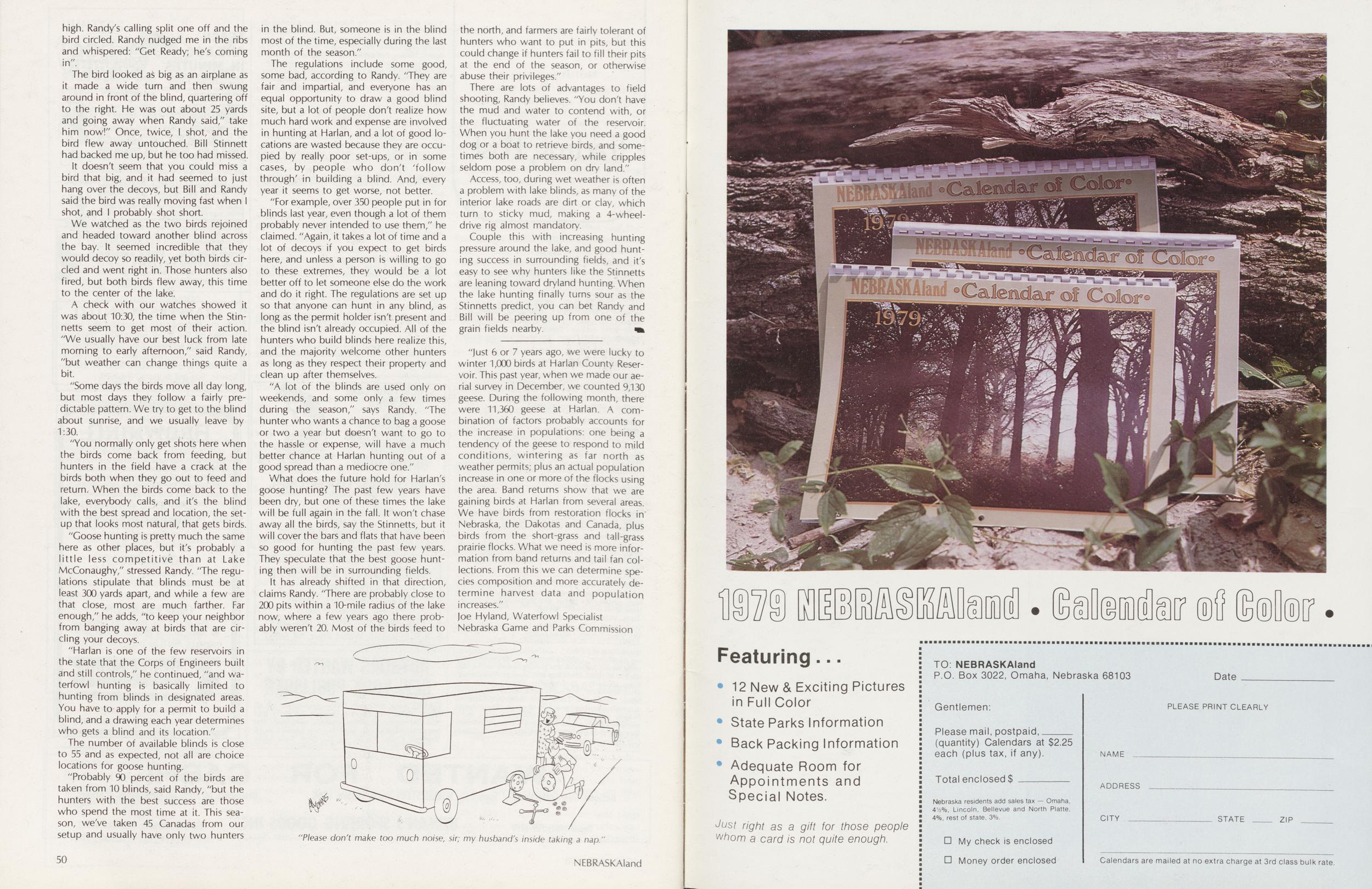
high. Randy's calling split one off and the bird circled. Randy nudged me in the ribs and whispered: "Get Ready; he's coming in".
The bird looked as big as an airplane as it made a wide turn and then swung around in front of the blind, quartering off to the right. He was out about 25 yards and going away when Randy said," take him now!" Once, twice, I shot, and the bird flew away untouched. Bill Stinnett had backed me up, but he too had missed.
It doesn't seem that you could miss a bird that big, and it had seemed to just hang over the decoys, but Bill and Randy said the bird was really moving fast when I shot, and I probably shot short.
We watched as the two birds rejoined and headed toward another blind across the bay. It seemed incredible that they would decoy so readily, yet both birds circled and went right in. Those hunters also fired, but both birds flew away, this time to the center of the lake.
A check with our watches showed it was about 10:30, the time when the Stinnetts seem to get most of their action. "We usually have our best luck from late morning to early afternoon," said Randy, "but weather can change things quite a bit.
"Some days the birds move all day long, but most days they follow a fairly predictable pattern. We try to get to the blind about sunrise, and we usually leave by 1:30.
"You normally only get shots here when the birds come back from feeding, but hunters in the field have a crack at the birds both when they go out to feed and return. When the birds come back to the lake, everybody calls, and it's the blind with the best spread and location, the set-up that looks most natural, that gets birds.
"Goose hunting is pretty much the same here as other places, but it's probably a little less competitive than at Lake McConaughy," stressed Randy. "The regulations stipulate that blinds must be at least 300 yards apart, and while a few are that close, most are much farther. Far enough," he adds, "to keep your neighbor from banging away at birds that are circling your decoys.
"Harlan is one of the few reservoirs in the state that the Corps of Engineers built and still controls," he continued, "and waterfowl hunting is basically limited to hunting from blinds in designated areas. You have to apply for a permit to build a blind, and a drawing each year determines who gets a blind and its location."
The number of available blinds is close to 55 and as expected, not all are choice locations for goose hunting.
"Probably 90 percent of the birds are taken from 10 blinds, said Randy, "but the hunters with the best success are those who spend the most time at it. This season, we've taken 45 Canadas from our setup and usually have only two hunters in the blind. But, someone is in the blind most of the time, especially during the last month of the season."
The regulations include some good, some bad, according to Randy. "They are fair and impartial, and everyone has an equal opportunity to draw a good blind site, but a lot of people don't realize how much hard work and expense are involved in hunting at Harlan, and a lot of good locations are wasted because they are occupied by really poor set-ups, or in some cases, by people who don't 'follow through' in building a blind. And, every year it seems to get worse, not better.
"For example, over 350 people put in for blinds last year, even though a lot of them probably never intended to use them," he claimed. "Again, it takes a lot of time and a lot of decoys if you expect to get birds here, and unless a person is willing to go to these extremes, they would be a lot better off to let someone else do the work and do it right. The regulations are set up so that anyone can hunt in any blind, as long as the permit holder isn't present and the blind isn't already occupied. All of the hunters who build blinds here realize this, and the majority welcome other hunters as long as they respect their property and clean up after themselves.
"A lot of the blinds are used only on weekends, and some only a few times during the season," says Randy. "The hunter who wants a chance to bag a goose or two a year but doesn't want to go to the hassle or expense, will have a much better chance at Harlan hunting out of a good spread than a mediocre one."
What does the future hold for Harlan's goose hunting? The past few years have been dry, but one of these times the lake will be full again in the fall. It won't chase away all the birds, say the Stinnetts, but it will cover the bars and flats that have been so good for hunting the past few years. They speculate that the best goose hunting then will be in surrounding fields.
It has already shifted in that direction, claims Randy. "There are probably close to 200 pits within a 10-mile radius of the lake now, where a few years ago there probably weren't 20. Most of the birds feed to the north, and farmers are fairly tolerant of hunters who want to put in pits, but this could change if hunters fail to fill their pits at the end of the season, or otherwise abuse their privileges."
There are lots of advantages to field shooting, Randy believes. "You don't have the mud and water to contend with, or the fluctuating water of the reservoir. When you hunt the lake you need a good dog or a boat to retrieve birds, and sometimes both are necessary, while cripples seldom pose a problem on dry land." Access, too, during wet weather is often a problem with lake blinds, as many of the interior lake roads are dirt or clay, which turn to sticky mud, making a 4-wheel-drive rig almost mandatory.
Couple this with increasing hunting pressure around the lake, and good hunt- ing success in surrounding fields, and it's easy to see why hunters like the Stinnetts are leaning toward dryland hunting. When the lake hunting finally turns sour as the Stinnetts predict, you can bet Randy and Bill will be peering up from one of the grain fields nearby.
"Just 6 or 7 years ago, we were lucky to winter 1,000 birds at Harlan County Reservoir. This past year, when we made our aerial survey in December, we counted 9,130 geese. During the following month, there were 11,360 geese at Harlan. A combination of factors probably accounts for the increase in populations: one being a tendency of the geese to respond to mild conditions, wintering as far north as weather permits; plus an actual population increase in one or more of the flocks using the area. Band returns show that we are gaining birds at Harlan from several areas. We have birds from restoration flocks in Nebraska, the Dakotas and Canada, plus birds from the short-grass and tall-grass prairie flocks. What we need is more information from band returns and tail fan collections. From this we can determine species composition and more accurately determine harvest data and population increases."
'Please don't make too much noise, sir; my husband's inside taking a nap."
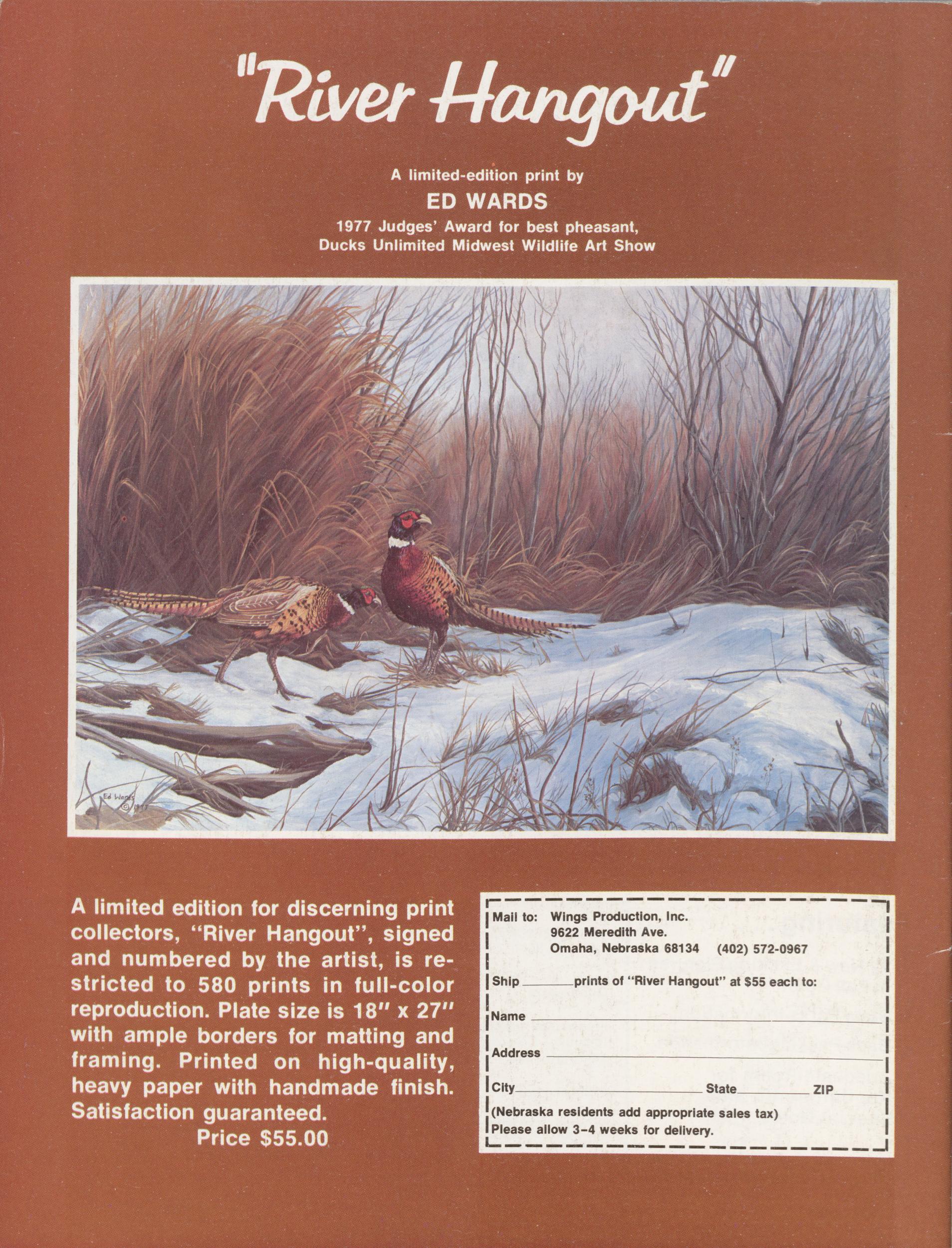
"River Hangout"
A limited-edition print by ED WARDS 1977 Judges' Award for best pheasant, Ducks Unlimited Midwest Wildlife Art Show A limited edition for discerning print collectors, "River Hangout", signed and numbered by the artist, is restricted to 580 prints in full-color reproduction. Plate size is 18" x 27" with ample borders for matting and framing. Printed on high-quality, heavy paper with handmade finish. Satisfaction guaranteed. Price $55.00 Mail to: Wings Production, Inc. 9622 Meredith Ave. Omaha, Nebraska 68134 (402) 572-0967 Ship prints of "River Hangout" at $55 each to: Name Address City State ZIP (Nebraska residents add appropriate sales tax) Please allow 3-4 weeks for delivery.Position: 704 (16 views)