Volume 56, Issue 9, 1978
NEBRASKAland
Finding Fall Mushrooms
Latest Word on Early Seasons
Colorful Look at Field Dogs
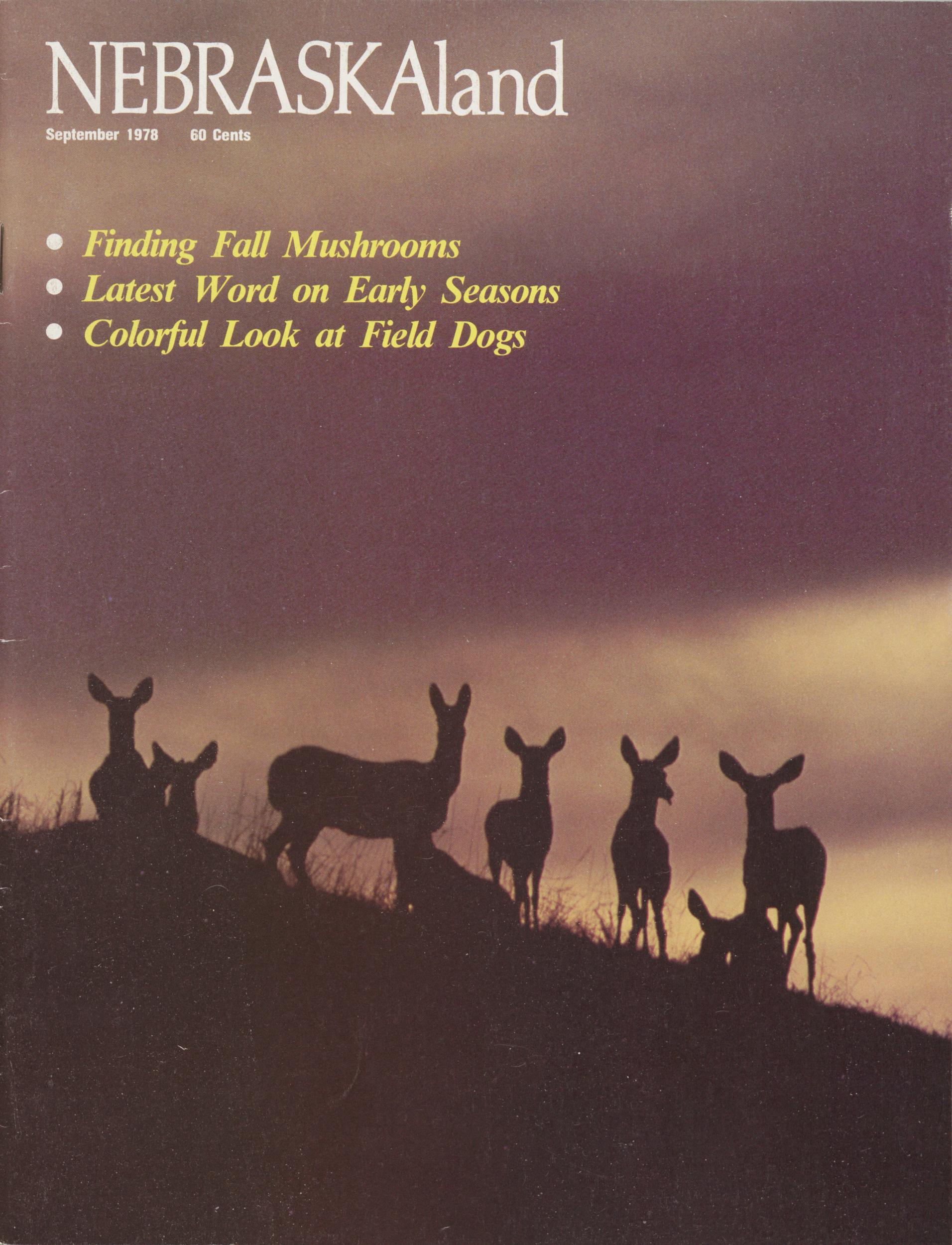
September 1978 60 Cents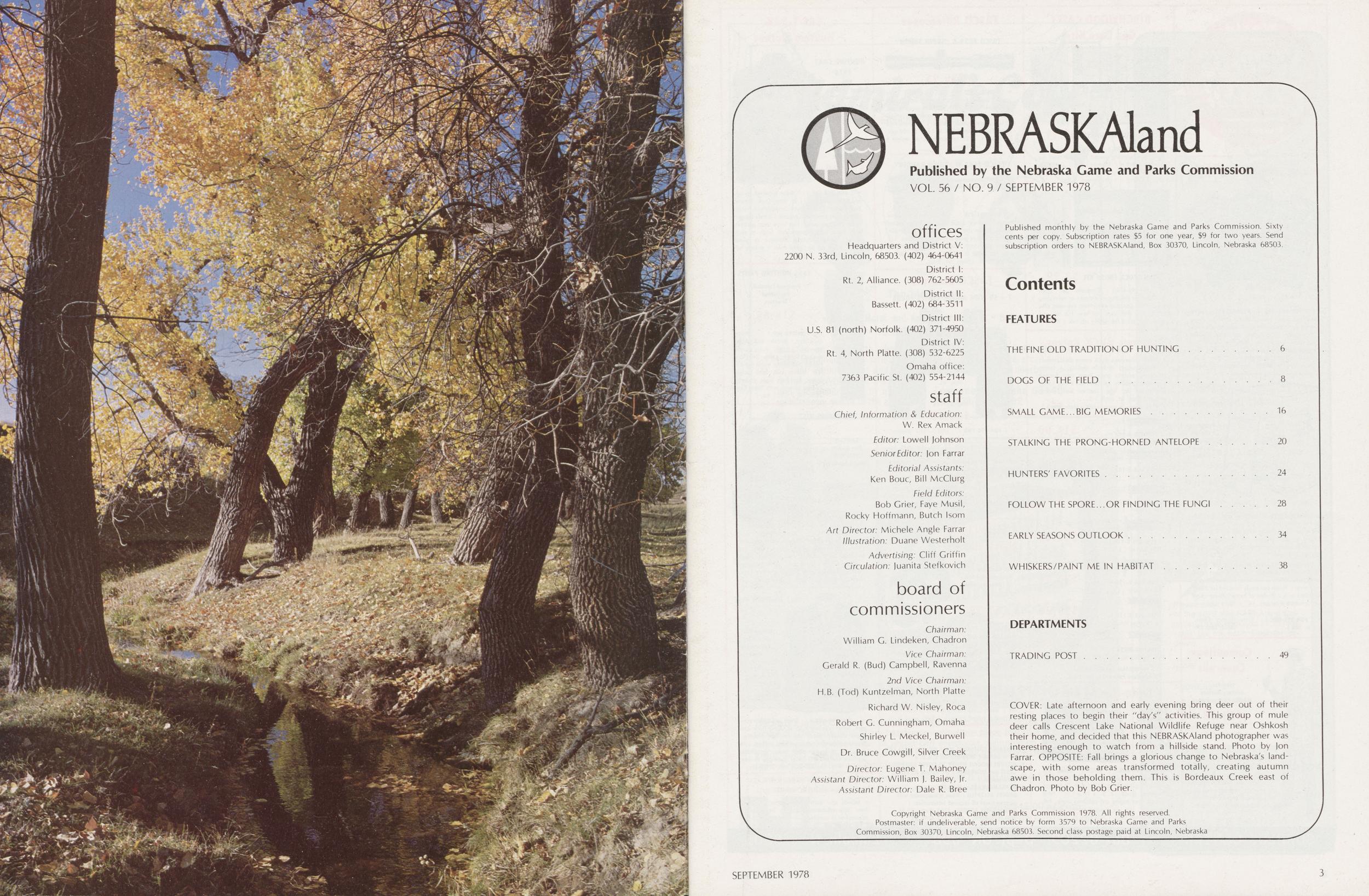
NEBRASKAland
Published by the Nebraska Game and Parks Commission VOL 56 / NO. 9 / SEPTEMBER 1978 offices Headquarters and District V: 2200 N. 33rd, Lincoln, 68503. (402) 464-0641 District I: Rt. 2, Alliance. (308) 762-5605 District II: Bassett. (402) 684-3511 District III: U.S. 81 (north) Norfolk. (402) 371-4950 District IV: Rt. 4, North Platte. (308) 532-6225 Omaha office: 7363 Pacific St. (402) 554-2144 staff Chief, Information and Education: W. Rex Amack Editor: Lowell Johnson Senior Editor: Ion Farrar Editorial Assistants: Ken Bouc, Bill McClurg Field Editors: Bob Grier, Faye Musil, Rocky Hoffmann, Butch Isom Art Director: Michele Angle Farrar Illustration: Duane Westerholt Advertising: Cliff Griffin Circulation: Juanita Stefkovich board of commissioners Chairman: William G. Lindeken, Chadron Vice Chairman: Gerald R. (Bud) Campbell, Ravenna 2nd Vice Chairman: H.B. (Tod) Kuntzelman, North Platte Richard W. Nisley, Roca Robert G. Cunningham, Omaha Shirley L. Meckel, Burwell Dr. Bruce Cowgill, Silver Creek Director: Eugene T. Mahoney Assistant Director: William J. Bailey, Jr. Assistant Director: Dale R. Bree Published monthly by the Nebraska Game and Parks Commission. Sixty cents per copy. Subscription rates $5 for one year, $9 for two years. Send subscription orders to NEBRASKAland, Box 30370, Lincoln, Nebraska 68503. Contents FEATURES THE FINE OLD TRADITION OF HUNTING 6 DOGS OF THE FIELD 8 SMALL GAME... BIG MEMORIES 16 STALKING THE PRONG-HORNED ANTELOPE 20 HUNTERS' FAVORITES 24 FOLLOW THE SPORE...OR FINDING THE FUNGI 28 EARLY SEASONS OUTLOOK 34 WHISKERS/PAINT ME IN HABITAT 38 DEPARTMENTS TRADING POST 49 COVER: Late afternoon and early evening bring deer out of their resting places to begin their "day's" activities. This group of mule deer calls Crescent Lake National Wildlife Refuge near Oshkosh their home, and decided that this NEBRASKAland photographer was interesting enough to watch from a hillside stand. Photo by Jon Farrar. OPPOSITE: Fall brings a glorious change to Nebraska's landscape, with some areas transformed totally, creating autumn awe in those beholding them. This is Bordeaux Creek east of Chadron. Photo by Bob Grier. Copyright Nebraska Game and Parks Commission 1978. All rights reserved. Postmaster: if undeliverable, send notice by form 3579 to Nebraska Game and Parks Commission, Box 30370, Lincoln, Nebraska 68503. Second class postage paid at Lincoln, Nebraska SEPTEMBER 1978 3
World Surplus Center FAMOUS
WRANGLER Flannel Shirts Reg. Sale ( 1-1/2 lbs. ) $6.88 $5.99the Admiral's Cove Inc.
Formerly "French's Paradise"
Attention, Early Birds!
The 1979 version of the NEBRASKAIand Calendar is ready to send your way. The supply of 1978 calendars was sold out, so don't take any chances. You can get a jump on the crowd if you get your order in right away. The full-color, all-Nebraska calendar again features pic- turesque scenery, intriguing wildlife shots, plus sections on canoeing and planting for wildlife. You will want one for yourself and several more for gifts. And, the price is still just $2.25 plus sales tax. Please send me copies of the 1979 NEBRASKAIand Calendar. I have enclosed $2.25 plus sales tax for each calendar ordered. NAME address CITY STATE ZIP Mail coupon with your check or money order to: NEBRASKAIand Calendar P.O. Box 3022 Omaha, NE 68101 SEPTEMBER 1978 5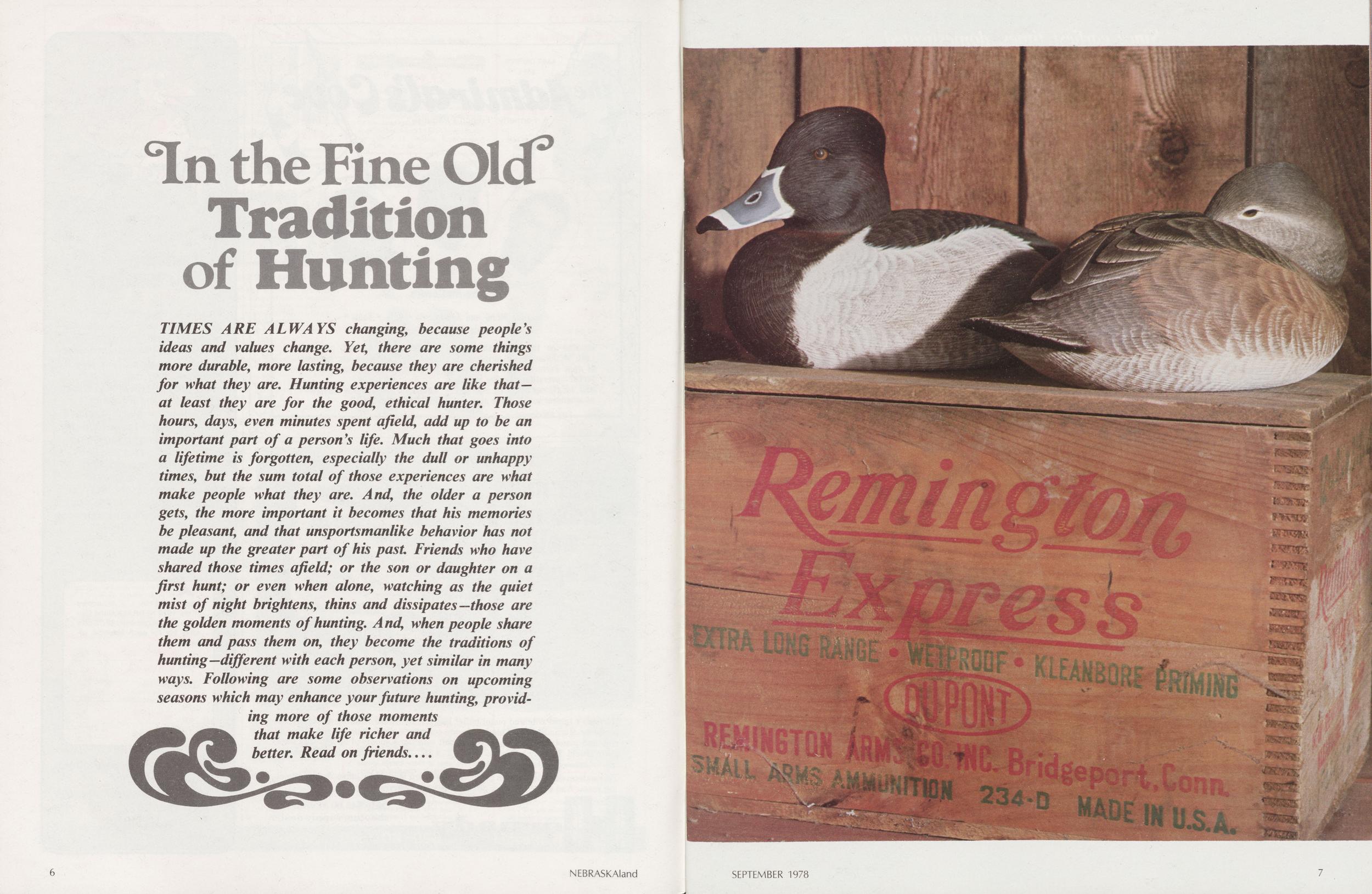
In the Fine Old Tradition of Hunting
TIMES ARE ALWAYS changing, because people's ideas and values change. Yet, there are some things more durable, more lasting, because they are cherished for what they are. Hunting experiences are like that— at least they are for the good, ethical hunter. Those hours, days, even minutes spent afield, add up to be an important part of a person 9s life. Much that goes into a lifetime is forgotten, especially the dull or unhappy times, but the sum total of those experiences are what make people what they are. And, the older a person gets, the more important it becomes that his memories be pleasant, and that unsportsmanlike behavior has not made up the greater part of his past Friends who have shared those times afield; or the son or daughter on a first hunt; or even when alone, watching as the quiet mist of night brightens, thins and dissipates —those are the golden moments of hunting. And, when people share them and pass them on, they become the traditions of hunting—different with each person, yet similar in many ways. Following are some observations on upcoming seasons which may enhance your future hunting, provid- ing more of those moments that make life richer and better. Read on friends.... 6 NEBRASKAIand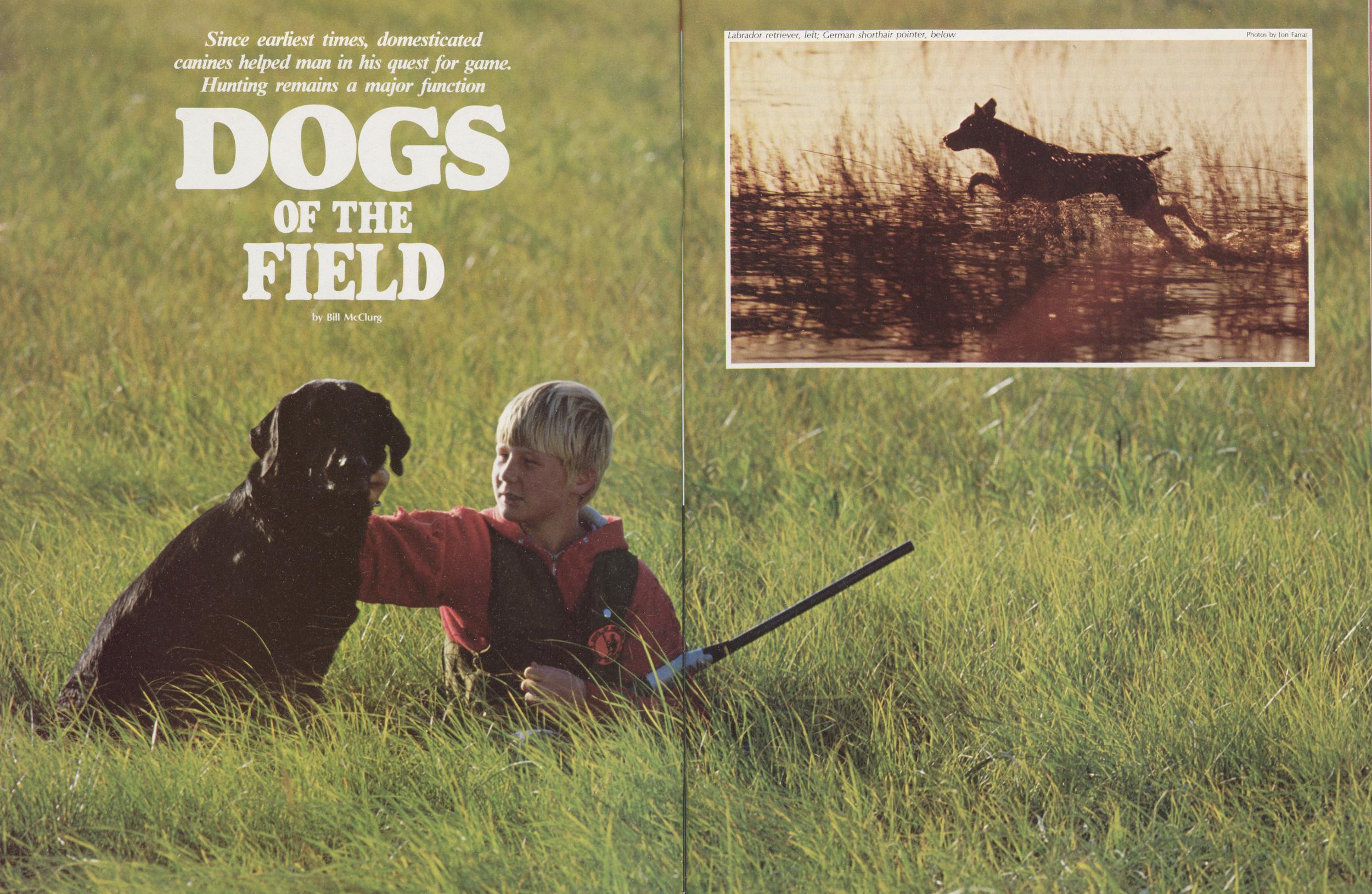
DOGS OF THE FIELD
Since earliest times, domesticated canines helped man in his quest for game. Hunting remains a major function by Bill McClurg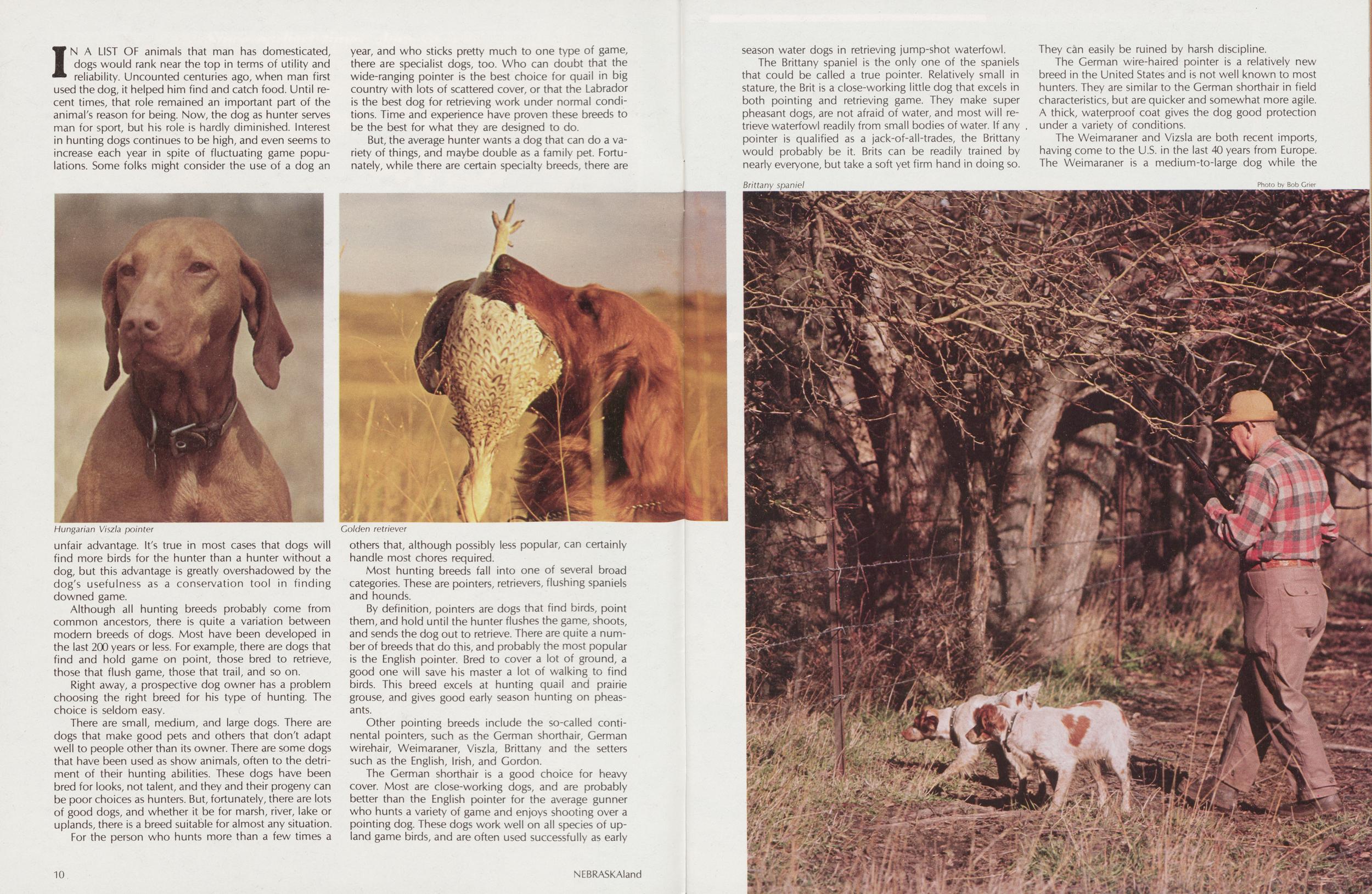
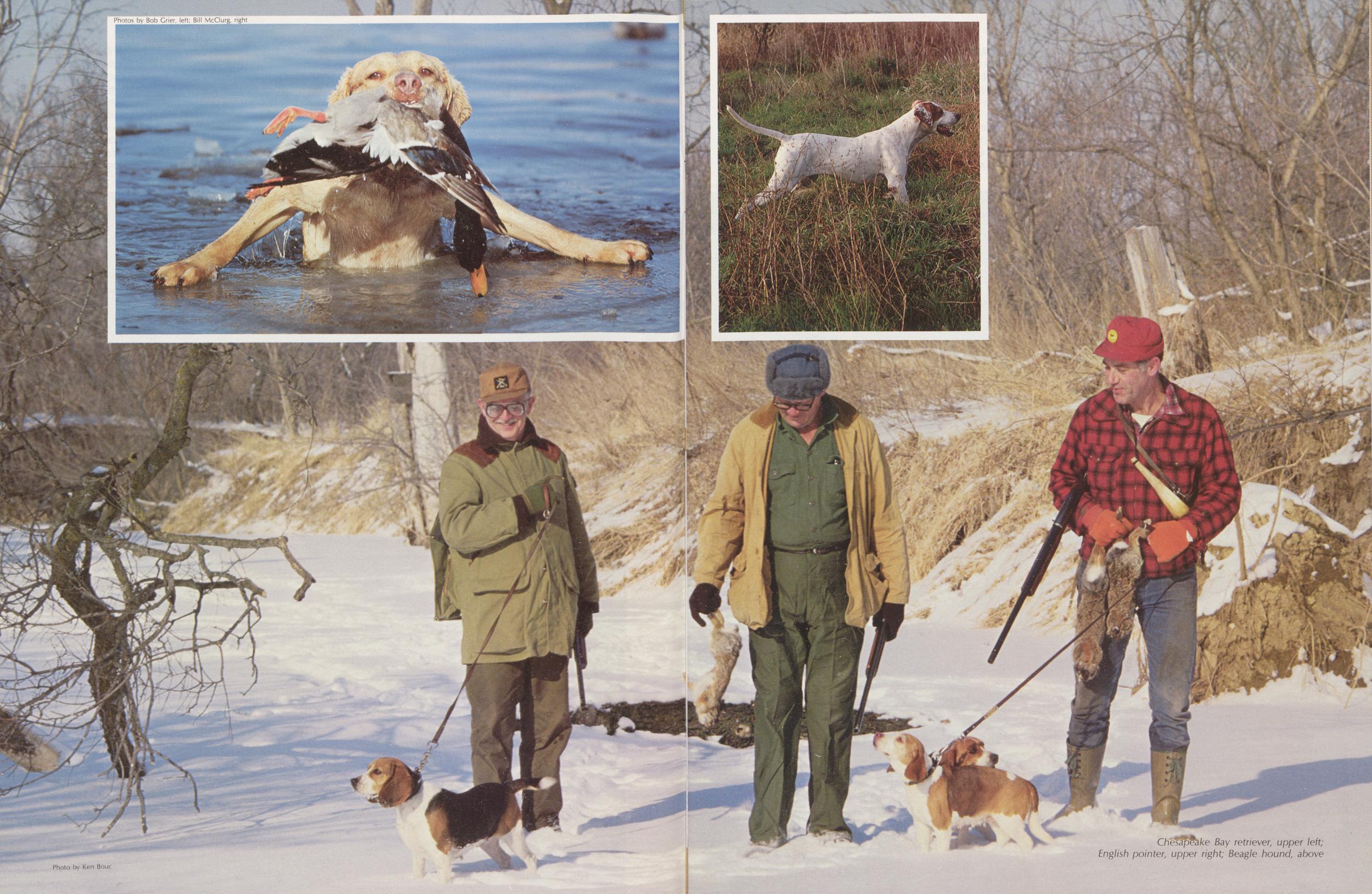
Hungarian Viszla pointer
Although all hunting breeds probably come from common ancestors, there is quite a variation between modern breeds of dogs. Most have been developed in the last 200 years or less. For example, there are dogs that find and hold game on point, those bred to retrieve, those that flush game, those that trail, and so on.
Right away, a prospective dog owner has a problem choosing the right breed for his type of hunting. The choice is seldom easy.
There are small, medium, and large dogs. There are dogs that make good pets and others that don't adapt well to people other than its owner. There are some dogs that have been used as show animals, often to the detriment of their hunting abilities. These dogs have been bred for looks, not talent, and they and their progeny can be poor choices as hunters. But, fortunately, there are lots of good dogs, and whether it be for marsh, river, lake or uplands, there is a breed suitable for almost any situation.
For the person who hunts more than a few times a year, and who sticks pretty much to one type of game, there are specialist dogs, too. Who can doubt that the wide-ranging pointer is the best choice for quail in big country with lots of scattered cover, or that the Labrador is the best dog for retrieving work under normal conditions. Time and experience have proven these breeds to be the best for what they are designed to do.
But, the average hunter wants a dog that can do a variety of things, and maybe double as a family pet. Fortunately, while there are certain specialty breeds, there are others that, although possibly less popular, can certainly handle most chores required.
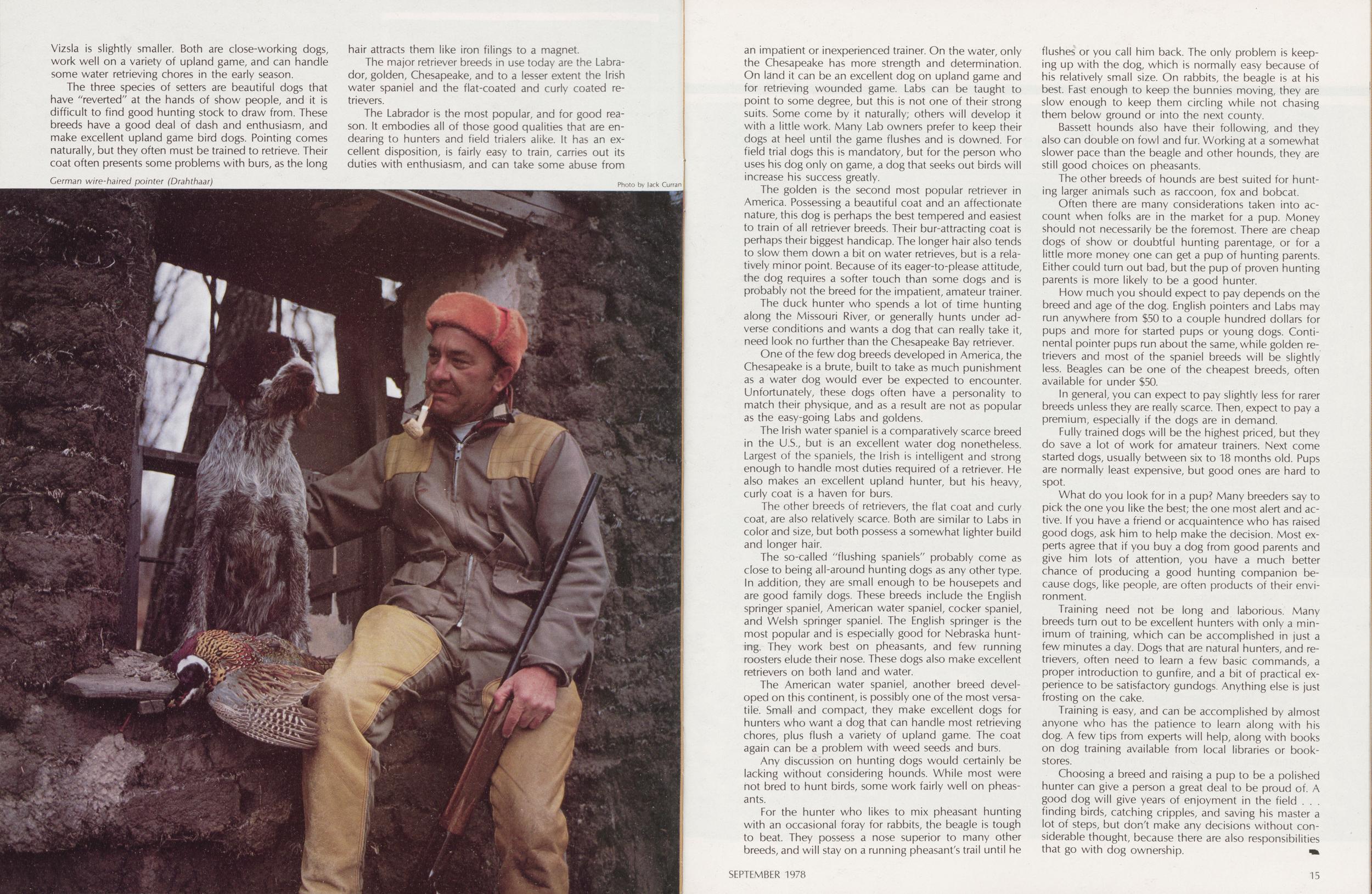
Golden retriever
Most hunting breeds fall into one of several broad categories. These are pointers, retrievers, flushing spaniels and hounds.
By definition, pointers are dogs that find birds, point them, and hold until the hunter flushes the game, shoots, and sends the dog out to retrieve. There are quite a number of breeds that do this, and probably the most popular is the English pointer. Bred to cover a lot of ground, a good one will save his master a lot of walking to find birds. This breed excels at hunting quail and prairie grouse, and gives good early season hunting on pheasants.
Other pointing breeds include the so-called continental pointers, such as the German shorthair, German wirehair, Weimaraner, Viszla, Brittany and the setters such as the English, Irish, and Gordon.
The German shorthair is a good choice for heavy cover. Most are close-working dogs, and are probably better than the English pointer for the average gunner who hunts a variety of game and enjoys shooting over a pointing dog. These dogs work well on all species of upland game birds, and are often used successfully as early NEBRASKAIand 10 season water dogs in retrieving jump-shot waterfowl.
The Brittany spaniel is the only one of the spaniels that could be called a true pointer. Relatively small in stature, the Brit is a close-working little dog that excels in both pointing and retrieving game. They make super pheasant dogs, are not afraid of water, and most will retrieve waterfowl readily from small bodies of water. If any pointer is qualified as a jack-of-all-trades, the Brittany would probably be it. Brits can be readily trained by nearly everyone, but take a soft yet firm hand in doing so. They can easily be ruined by harsh discipline.
The German wire-haired pointer is a relatively new breed in the United States and is not well known to most hunters. They are similar to the German shorthair in field characteristics, but are quicker and somewhat more agile. A thick, waterproof coat gives the dog good protection under a variety of conditions.
The Weimaraner and Vizsla are both recent imports, having come to the U.S. in the last 40 years from Europe. The Weimaraner is a medium-to-large dog while the
Vizsla is slightly smaller. Both are close-working dogs, work well on a variety of upland game, and can handle some water retrieving chores in the early season.
The three species of setters are beautiful dogs that have "reverted" at the hands of show people, and it is difficult to find good hunting stock to draw from. These breeds have a good deal of dash and enthusiasm, and make excellent upland game bird dogs. Pointing comes naturally, but they often must be trained to retrieve. Their coat often presents some problems with burs, as the long hair attracts them like iron filings to a magnet.
The major retriever breeds in use today are the Labrador, golden, Chesapeake, and to a lesser extent the Irish water spaniel and the flat-coated and curly coated retrievers.
The Labrador is the most popular, and for good reason. It embodies all of those good qualities that are endearing to hunters and field trialers alike. It has an excellent disposition, is fairly easy to train, carries out its duties with enthusiasm, and can take some abuse from
The golden is the second most popular retriever in America. Possessing a beautiful coat and an affectionate nature, this dog is perhaps the best tempered and easiest to train of all retriever breeds. Their bur-attracting coat is perhaps their biggest handicap. The longer hair also tends to slow them down a bit on water retrieves, but is a relatively minor point. Because of its eager-to-please attitude, the dog requires a softer touch than some dogs and is probably not the breed for the impatient, amateur trainer.
The duck hunter who spends a lot of time hunting along the Missouri River, or generally hunts under adverse conditions and wants a dog that can really take it, need look no further than the Chesapeake Bay retriever.
One of the few dog breeds developed in America, the Chesapeake is a brute, built to take as much punishment as a water dog would ever be expected to encounter. Unfortunately, these dogs often have a personality to match their physique, and as a result are not as popular as the easy-going Labs and goldens.
The Irish water spaniel is a comparatively scarce breed in the U.S., but is an excellent water dog nonetheless. Largest of the spaniels, the Irish is intelligent and strong enough to handle most duties required of a retriever. He also makes an excellent upland hunter, but his heavy, curly coat is a haven for burs.
The other breeds of retrievers, the flat coat and curly coat, are also relatively scarce. Both are similar to Labs in color and size, but both possess a somewhat lighter build and longer hair.
The so-called "flushing spaniels" probably come as dose to being all-around hunting dogs as any other type. In addition, they are small enough to be housepets and are good family dogs. These breeds include the English springer spaniel, American water spaniel, cocker spaniel, and Welsh springer spaniel. The English springer is the most popular and is especially good for Nebraska hunting. They work best on pheasants, and few running roosters elude their nose. These dogs also make excellent retrievers on both land and water.
The American water spaniel, another breed developed on this continent, is possibly one of the most versatile. Small and compact, they make excellent dogs for hunters who want a dog that can handle most retrieving chores, plus flush a variety of upland game. The coat again can be a problem with weed seeds and burs. Any discussion on hunting dogs would certainly be lacking without considering hounds. While most were not bred to hunt birds, some work fairly well on pheasants.
For the hunter who likes to mix pheasant hunting with an occasional foray for rabbits, the beagle is tough to beat. They possess a nose superior to many other breeds, and will stay on a running pheasant's trail until he flushes or you call him back. The only problem is keeping up with the dog, which is normally easy because of his relatively small size. On rabbits, the beagle is at his best. Fast enough to keep the bunnies moving, they are slow enough to keep them circling while not chasing them below ground or into the next county.
Bassett hounds also have their following, and they also can double on fowl and fur. Working at a somewhat slower pace than the beagle and other hounds, they are still good choices on pheasants.
The other breeds of hounds are best suited for hunting larger animals such as raccoon, fox and bobcat.
Often there are many considerations taken into account when folks are in the market for a pup. Money should not necessarily be the foremost. There are cheap dogs of show or doubtful hunting parentage, or for a little more money one can get a pup of hunting parents. Either could turn out bad, but the pup of proven hunting parents is more likely to be a good hunter.
How much you should expect to pay depends on the breed and age of the dog. English pointers and Labs may run anywhere from $50 to a couple hundred dollars for pups and more for started pups or young dogs. Continental pointer pups run about the same, while golden retrievers and most of the spaniel breeds will be slightly less. Beagles can be one of the cheapest breeds, often available for under $50.
In general, you can expect to pay slightly less for rarer breeds unless they are really scarce. Then, expect to pay a premium, especially if the dogs are in demand.
Fully trained dogs will be the highest priced, but they do save a lot of work for amateur trainers. Next come started dogs, usually between six to 18 months old. Pups are normally least expensive, but good ones are hard to spot.
What do you look for in a pup? Many breeders say to pick the one you like the best; the one most alert and active. If you have a friend or acquaintence who has raised good dogs, ask him to help make the decision. Most experts agree that if you buy a dog from good parents and give him lots of attention, you have a much better chance of producing a good hunting companion because dogs, like people, are often products of their environment.
Training need not be long and laborious. Many breeds turn out to be excellent hunters with only a minimum of training, which can be accomplished in just a few minutes a day. Dogs that are natural hunters, and retrievers, often need to learn a few basic commands, a proper introduction to gunfire, and a bit of practical experience to be satisfactory gundogs. Anything else is just frosting on the cake.
Training is easy, and can be accomplished by almost anyone who has the patience to learn along with his dog. A few tips from experts will help, along with books on dog training available from local libraries or bookstores.
Choosing a breed and raising a pup to be a polished hunter can give a person a great deal to be proud of. A good dog will give years of enjoyment in the field . . . finding birds, catching cripples, and saving his master a lot of steps, but don't make any decisions without considerable thought, because there are also responsibilities that go with dog ownership.
SEPTEMBER 1978 15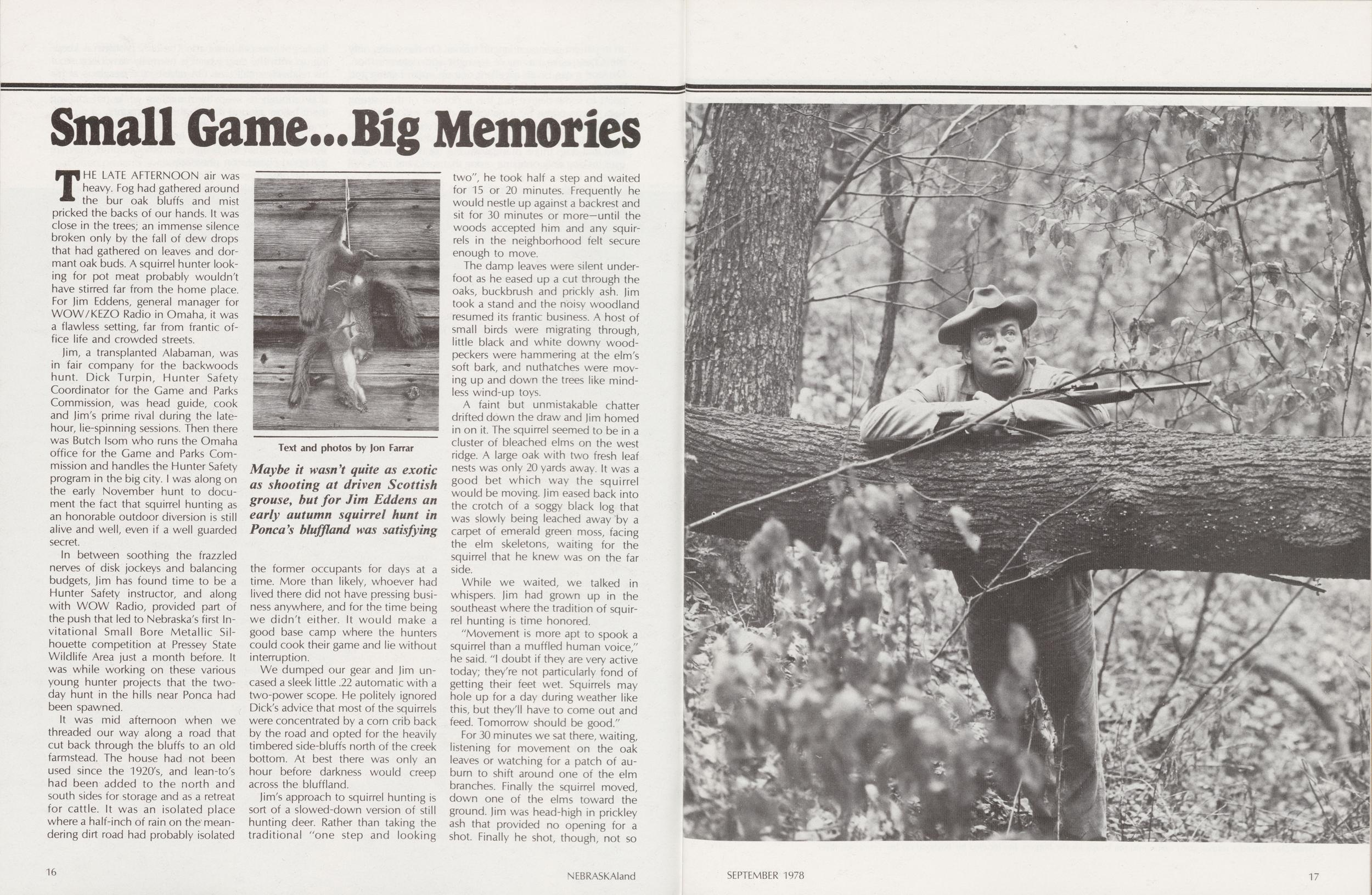
Small Game...Big Memories
THE LATE AFTERNOON air was heavy. Fog had gathered around the bur oak bluffs and mist pricked the backs of our hands. It was close in the trees; an immense silence broken only by the fall of dew drops that had gathered on leaves and dormant oak buds. A squirrel hunter looking for pot meat probably wouldn't have stirred far from the home place. For Jim Eddens, general manager for WOW/KEZO Radio in Omaha, it was a flawless setting, far from frantic office life and crowded streets.
Jim, a transplanted Alabaman, was in fair company for the backwoods hunt. Dick Turpin, Hunter Safety Coordinator for the Game and Parks Commission, was head guide, cook and Jim's prime rival during the latehour, lie-spinning sessions. Then there was Butch Isom who runs the Omaha office for the Game and Parks Commission and handles the Hunter Safety program in the big city. I was along on the early November hunt to document the fact that squirrel hunting as an honorable outdoor diversion is still alive and well, even if a well guarded secret.
In between soothing the frazzled nerves of disk jockeys and balancing budgets, Jim has found time to be a Hunter Safety instructor, and along with WOW Radio, provided part of the push that led to Nebraska's first Invitational Small Bore Metallic Silhouette competition at Pressey State Wildlife Area just a month before. It was while working on these various young hunter projects that the two- day hunt in the hills near Ponca had been spawned.
It was mid afternoon when we threaded our way along a road that cut back through the bluffs to an old farmstead. The house had not been used since the 1920's, and lean-to's had been added to the north and south sides for storage and as a retreat for cattle. It was an isolated place where a half-inch of rain on the meandering dirt road had probably isolated the former occupants for days at a time. More than likely, whoever had lived there did not have pressing business anywhere, and for the time being we didn't either. It would make a good base camp where the hunters could cook their game and lie without interruption.
We dumped our gear and Jim uncased a sleek little .22 automatic with a two-power scope. He politely ignored Dick's advice that most of the squirrels were concentrated by a corn crib back by the road and opted for the heavily timbered side-bluffs north of the creek bottom. At best there was only an hour before darkness would creep across the bluffland.
Jim's approach to squirrel hunting is sort of a slowed-down version of still hunting deer. Rather than taking the traditional "one step and looking two", he took half a step and waited for 15 or 20 minutes. Frequently he would nestle up against a backrest and sit for 30 minutes or more—until the woods accepted him and any squirrels in the neighborhood felt secure enough to move.
The damp leaves were silent underfoot as he eased up a cut through the oaks, buckbrush and prickly ash. Jim took a stand and the noisy woodland resumed its frantic business. A host of small birds were migrating through, little black and white downy woodpeckers were hammering at the elm's soft bark, and nuthatches were moving up and down the trees like mind- less wind-up toys.
A faint but unmistakable chatter drifted down the draw and Jim homed in on it. The squirrel seemed to be in a cluster of bleached elms on the west ridge. A large oak with two fresh leaf nests was only 20 yards away. It was a good bet which way the squirrel would be moving. Jim eased back into the crotch of a soggy black log that was slowly being leached away by a carpet of emerald green moss, facing the elm skeletons, waiting for the squirrel that he knew was on the far side.
While we waited, we talked in whispers. Jim had grown up in the southeast where the tradition of squirrel hunting is time honored.
Movement is more apt to spook a squirrel than a muffled human voice," he said. "I doubt if they are very active today; they're not particularly fond of getting their feet wet. Squirrels may hole up for a day during weather like this, but they'll have to come out and feed. Tomorrow should be good."
For 30 minutes we sat there, waiting, listening for movement on the oak leaves or watching for a patch of auburn to shift around one of the elm branches. Finally the squirrel moved, down one of the elms toward the ground. Jim was head-high in prickley ash that provided no opening for a shot. Finally he shot, though, not so
16 NEBRASKAIand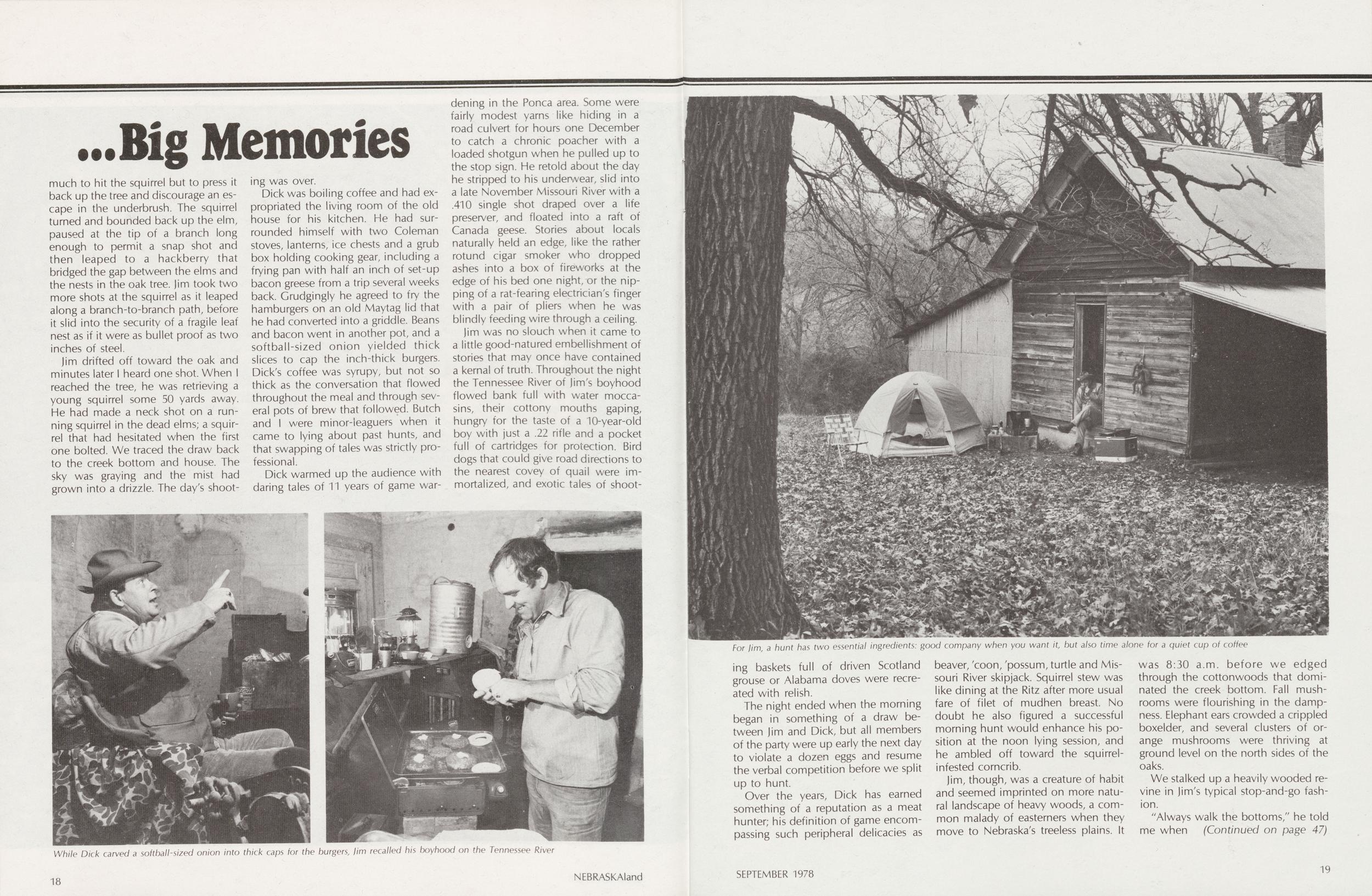
Big Memories
much to hit the squirrel but to press it back up the tree and discourage an escape in the underbrush. The squirre turned and bounded back up the elm, paused at the tip of a branch long enough to permit a snap shot and then leaped to a hackberry that bridged the gap between the elms and the nests in the oak tree. Jim took two more shots at the squirrel as it leaped along a branch-to-branch path, before it slid into the security of a fragile leaf nest as if it were as bullet proof as two inches of steel.
Jim drifted off toward the oak and minutes later I heard one shot. When I reached the tree, he was retrieving a young squirrel some 50 yards away. He had made a neck shot on a running squirrel in the dead elms; a squirrel that had hesitated when the first one bolted. We traced the draw back to the creek bottom and house. The sky was graying and the mist had grown into a drizzle. The day's shooting was over.
Dick was boiling coffee and had expropriated the living room of the old house for his kitchen. He had surrounded himself with two Coleman stoves, lanterns, ice chests and a grub box holding cooking gear, including a frying pan with half an inch of set-up bacon greese from a trip several weeks back. Grudgingly he agreed to fry the hamburgers on an old Maytag lid that he had converted into a griddle. Beans and bacon went in another pot, and a softball-sized onion yielded thick slices to cap the inch-thick burgers. Dick's coffee was syrupy, but not so thick as the conversation that flowed throughout the meal and through several pots of brew that followed. Butch and I were minor-leaguers when it came to lying about past hunts, and that swapping of tales was strictly professional.
Dick warmed up the audience with daring tales of 11 years of game wardening in the Ponca area. Some were fairly modest yarns like hiding in a road culvert for hours one December to catch a chronic poacher with a loaded shotgun when he pulled up to the stop sign. He retold about the day he stripped to his underwear, slid into a late November Missouri River with a .410 single shot draped over a life preserver, and floated into a raft of Canada geese. Stories about locals naturally held an edge, like the rather rotund cigar smoker who dropped ashes into a box of fireworks at the edge of his bed one night, or the nipping of a rat-fearing electrician's finger with a pair of pliers when he was blindly feeding wire through a ceiling.
Jim was no slouch when it came to a little good-natured embellishment of stories that may once have contained a kernal of truth. Throughout the night the Tennessee River of Jim's boyhood flowed bank full with water moccasins, their cottony mouths gaping, hungry for the taste of a 10-year-old boy with just a .22 rifle and a pocket full of cartridges for protection. Bird dogs that could give road directions to the nearest covey of quail were immortalized, and exotic tales of shooting
baskets full of driven Scotland grouse or Alabama doves were recreated with relish.
The night ended when the morning began in something of a draw between Jim and Dick, but all members of the party were up early the next day to violate a dozen eggs and resume the verbal competition before we split up to hunt.
Over the years, Dick has earned something of a reputation as a meat hunter; his definition of game encompassing such peripheral delicacies as beaver, 'coon, 'possum, turtle and Missouri River skipjack. Squirrel stew was like dining at the Ritz after more usual fare of filet of mudhen breast. No doubt he also figured a successful morning hunt would enhance his position at the noon lying session, and he ambled off toward the squirrelinfested corncrib.
Jim, though, was a creature of habit and seemed imprinted on more natural landscape of heavy woods, a common malady of easterners when they move to Nebraska's treeless plains. It While Dick carved a softball-sized onion into thick caps for the burgers, Jim recalled his boyhood on the Tennessee River was 8:30 a.m. before we edged through the cottonwoods that dominated the creek bottom. Fall mush- rooms were flourishing in the dampness. Elephant ears crowded a crippled boxelder, and several clusters of orange mushrooms were thriving at ground level on the north sides of the oaks.
We stalked up a heavily wooded revine in Jim's typical stop-and-go fashion.
"Always walk the bottoms," he told me when (Continued on page 47)
SEPTEMBER 1978 19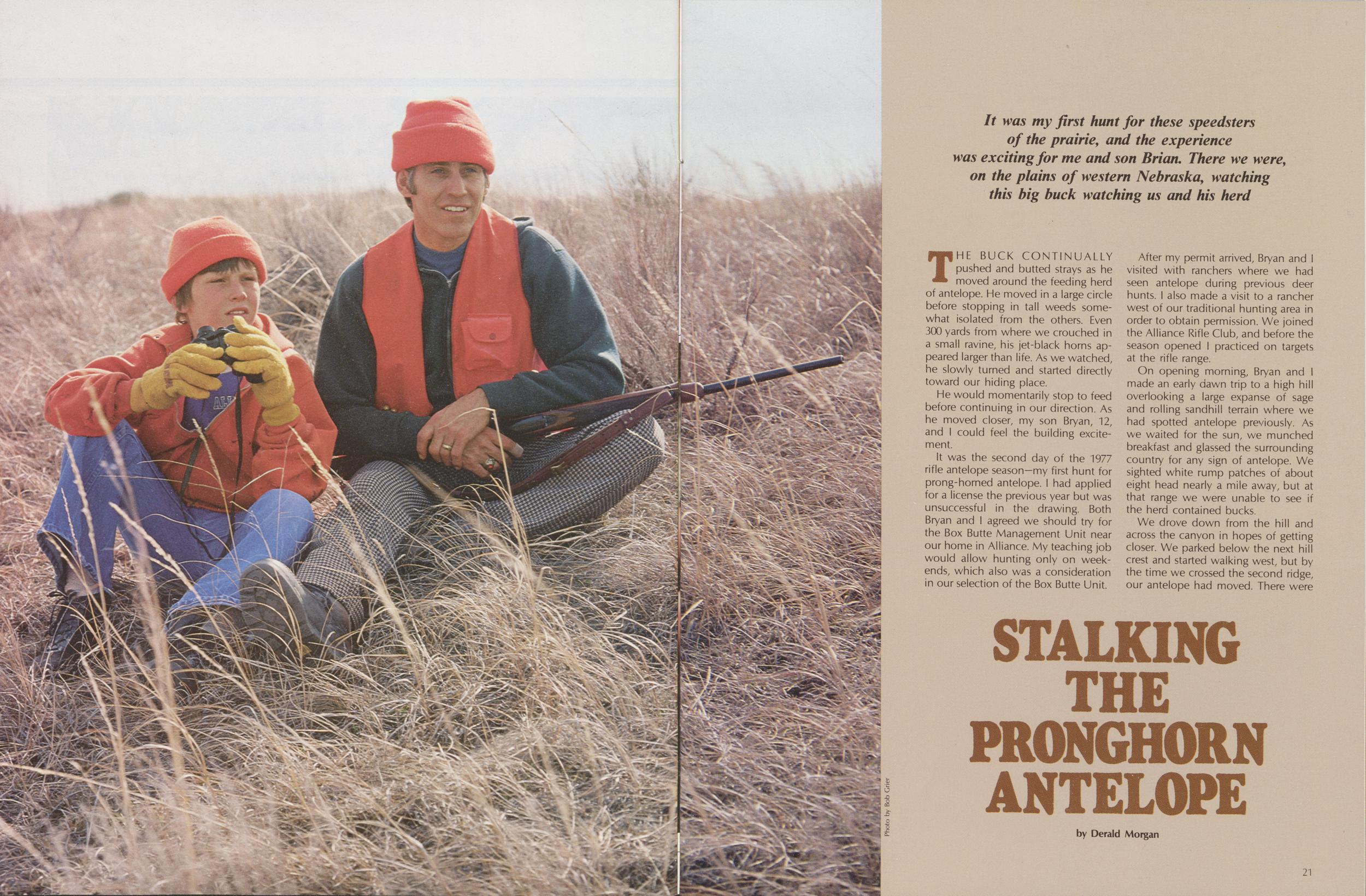
STALKING THE PRONGHORN ANTELOPE
It was my first hunt for these speedsters of the prairie, and the experience was exciting for me and son Brian. There we were, on the plains of western Nebraska, watching this big buck watching us and his herd
THE BUCK CONTINUALLY pushed and butted strays as he moved around the feeding herd of antelope. He moved in a large circle before stopping in tall weeds some what isolated from the others. Even 300 yards from where we crouched in a small ravine, his jet-black horns appeared larger than life. As we watched, he slowly turned and started directly toward our hiding place.
He would momentarily stop to feed before continuing in our direction. As he moved closer, my son Bryan, 12, and I could feel the building excitement.
It was the second day of the 1977 rifle antelope season—my first hunt for prong-horned antelope. I had applied for a license the previous year but was unsuccessful in the drawing. Both Bryan and I agreed we should try for the Box Butte Management Unit near our home in Alliance. My teaching job would allow hunting only on weekends, which also was a consideration in our selection of the Box Butte Unit.
After my permit arrived, Bryan and I visited with ranchers where we had seen antelope during previous deer hunts. I also made a visit to a rancher west of our traditional hunting area in order to obtain permission. We joined the Alliance Rifle Club, and before the season opened I practiced on targets at the rifle range.
On opening morning, Bryan and I made an early dawn trip to a high hill overlooking a large expanse of sage and rolling sandhill terrain where we had spotted antelope previously. As we waited for the sun, we munched breakfast and glassed the surrounding country for any sign of antelope. We sighted white rump patches of about eight head nearly a mile away, but at that range we were unable to see if the herd contained bucks.
We drove down from the hill and
across the canyon in hopes of getting
closer. We parked below the next hill
crest and started walking west, but by
the time we crossed the second ridge,
our antelope had moved. There were
21
 no other hunters in the area that we
could see at that time, so we continued west. But, we couldn't find them.
no other hunters in the area that we
could see at that time, so we continued west. But, we couldn't find them.
Bryan and I reached a fencerow that was the boundary of the land we had permission on. To the west were about 10 head of antelope moving fast across an alfalfa field, and as we sat down to watch, we noticed several more coming at us from the south.
The wind was blowing toward them, and they apparently caught our scent. As I reached up to spread the grass and weeds for a possible shot, they started looking our way and their snorting indicated that they sensed something wrong. I didn't want to shoot from a standing position, and I still was unable to glass them to determine if they were bucks or does. Finally they spooked, and as they began running, I fired, but the shot merely kicked up dirt behind the speedsters.
We tried to spot the same herd from atop another high hill, but by that time the antelope were on another land-owner's place so we made no attempt to stalk them. We waited until dark to see if perhaps they would return, but that evening, somewhat disappointed in my shooting, we turned in empty handed. As it turned out, we would be glad that our first day's hunt had ended in disappointment.
That evening I called another landowner who had earlier given us permission to hunt, and he invited me out the next day to look for a herd that was on his place. Bryan and I were out of bed early and had met the landowner by about 6 a.m. We soon spotted a herd of at least 18 antelope moving out of a feeding area, and in that bunch we could see many fawns and females, and one large buck.
He was some distance behind the herd, watching us, even though he was about a mile or more away. We didn't attempt to move in their direction then but we climbed a hill to watch. As we did, the herd turned and moved slowly west.
It was a bright sunny morning, with a little snow on the ground in places, and the temperature quite chilly. As we watched from the crest, the antelope continued west into the wind, working along a low ridge of rolling hills overlooked by an even higher range of sandhills.
We moved back, planning to swing around from the side where we would be out of sight. We parked the pickup about three-quarters of a mile from where we calculated they would be, and started walking.
They had moved even farther west by that time, so we continued walking behind the cover of the ridge, every few minutes checking to see where the antelope were heading. They seemed to be moving steadily, but at a slow pace, and we came within 300 yards of the group several times. We continued for about an hour that same way. Finally, the antelope stopped to graze on an open flat.
We could approach closer by going around the back of the hill and slipping along a deep ravine. They stayed in that area for a while, and by the time we moved over and around the hill and into the deep ravine, we were completely out of sight and down-wind.
By then they had grazed for some time, and some of the does had bedded down. The younger members were still romping, and the large buck was watching them. We could raise up through the weeds and put the glasses on him, still about 300 yards away.
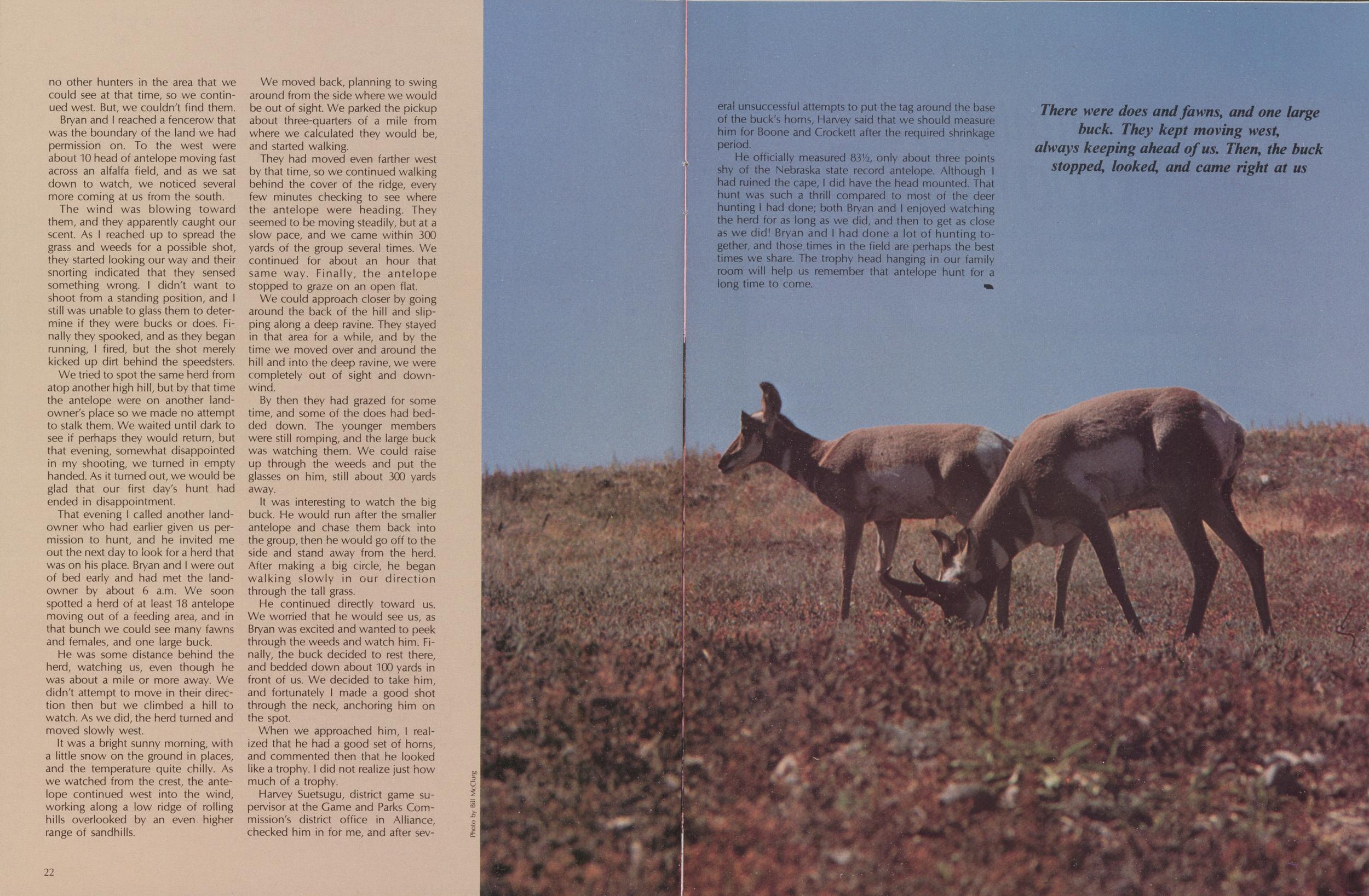
It was interesting to watch the big buck. He would run after the smaller antelope and chase them back into the group, then he would go off to the side and stand away from the herd. After making a big circle, he began walking slowly in our direction through the tall grass.
He continued directly toward us. We worried that he would see us, as Bryan was excited and wanted to peek through the weeds and watch him. Finally, the buck decided to rest there, and bedded down about 100 yards in front of us. We decided to take him, and fortunately I made a good shot through the neck, anchoring him on the spot.
When we approached him, I realized that he had a good set of horns, and commented then that he looked like a trophy. I did not realize just how much of a trophy.
Harvey Suetsugu, district game supervisor at the Game and Parks Commission's district office in Alliance, checked him in for me, and after several unsuccessful attempts to put the tag around the base of the buck's horns, Harvey said that we should measure him for Boone and Crockett after the required shrinkage period.
He officially measured 831/2, only about three points shy of the Nebraska state record antelope. Although I had ruined the cape, I did have the head mounted. That hunt was such a thrill compared to most of the deer hunting I had done; both Bryan and I enjoyed watching the herd for as long as we did, and then to get as close as we did! Bryan and I had done a lot of hunting together, and those times in the field are perhaps the best times we share. The trophy head hanging in our family room will help us remember that antelope hunt for a long time to come.
There were does and fawns, and one large buck. They kept moving west, always keeping ahead of us. Then, the buck stopped, looked, and came right at us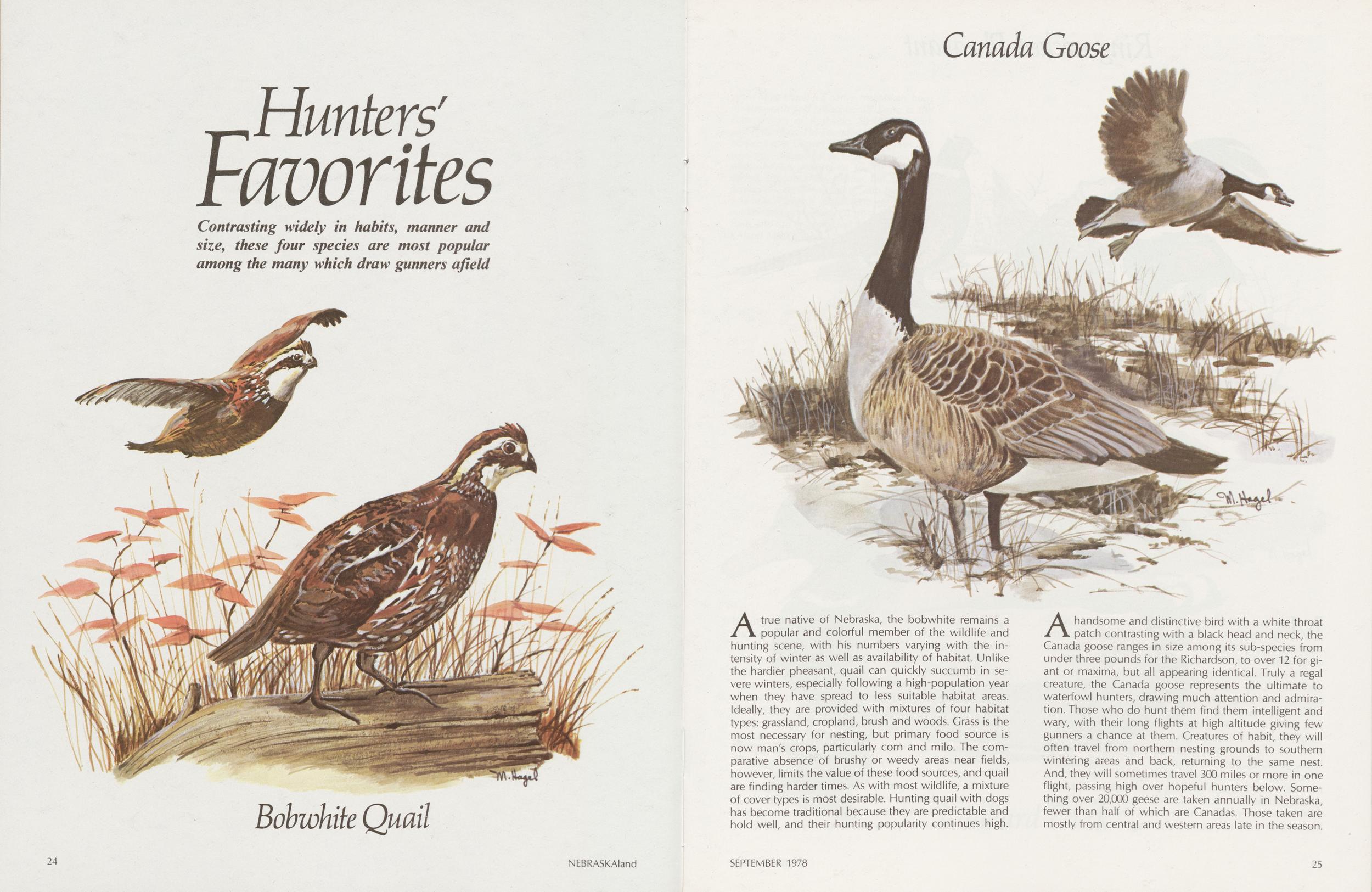
Hunters' Favorites
Contrasting widely in habits, manner and size, these four species are most popular among the many which draw gunners afield
A true native of Nebraska, the bobwhite remains a popular and colorful member of the wildlife and hunting scene, with his numbers varying with the intensity of winter as well as availability of habitat. Unlike the hardier pheasant, quail can quickly succumb in severe winters, especially following a high-population year when they have spread to less suitable habitat areas. Ideally, they are provided with mixtures of four habitat types: grassland, cropland, brush and woods. Grass is the most necessary for nesting, but primary food source is now man's crops, particularly corn and milo. The comparative absence of brushy or weedy areas near fields, however, limits the value of these food sources, and quail are finding harder times. As with most wildlife, a mixture of cover types is most desirable. Hunting quail with dogs has become traditional because they are predictable and hold well, and their hunting popularity continues high.
A handsome and distinctive bird with a white throat patch contrasting with a black head and neck, the Canada goose ranges in size among its sub-species from under three pounds for the Richardson, to over 12 for giant or maxima, but all appearing identical. Truly a regal creature, the Canada goose represents the ultimate to waterfowl hunters, drawing much attention and admiration. Those who do hunt them find them intelligent and wary, with their long flights at high altitude giving few gunners a chance at them. Creatures of habit, they will often travel from northern nesting grounds to southern wintering areas and back, returning to the same nest. And, they will sometimes travel 300 miles or more in one flight, passing high over hopeful hunters below. Something over 20,000 geese are taken annually in Nebraska, fewer than half of which are Canadas. Those taken are mostly from central and western areas late in the season.
SEPTEMBER 1978 25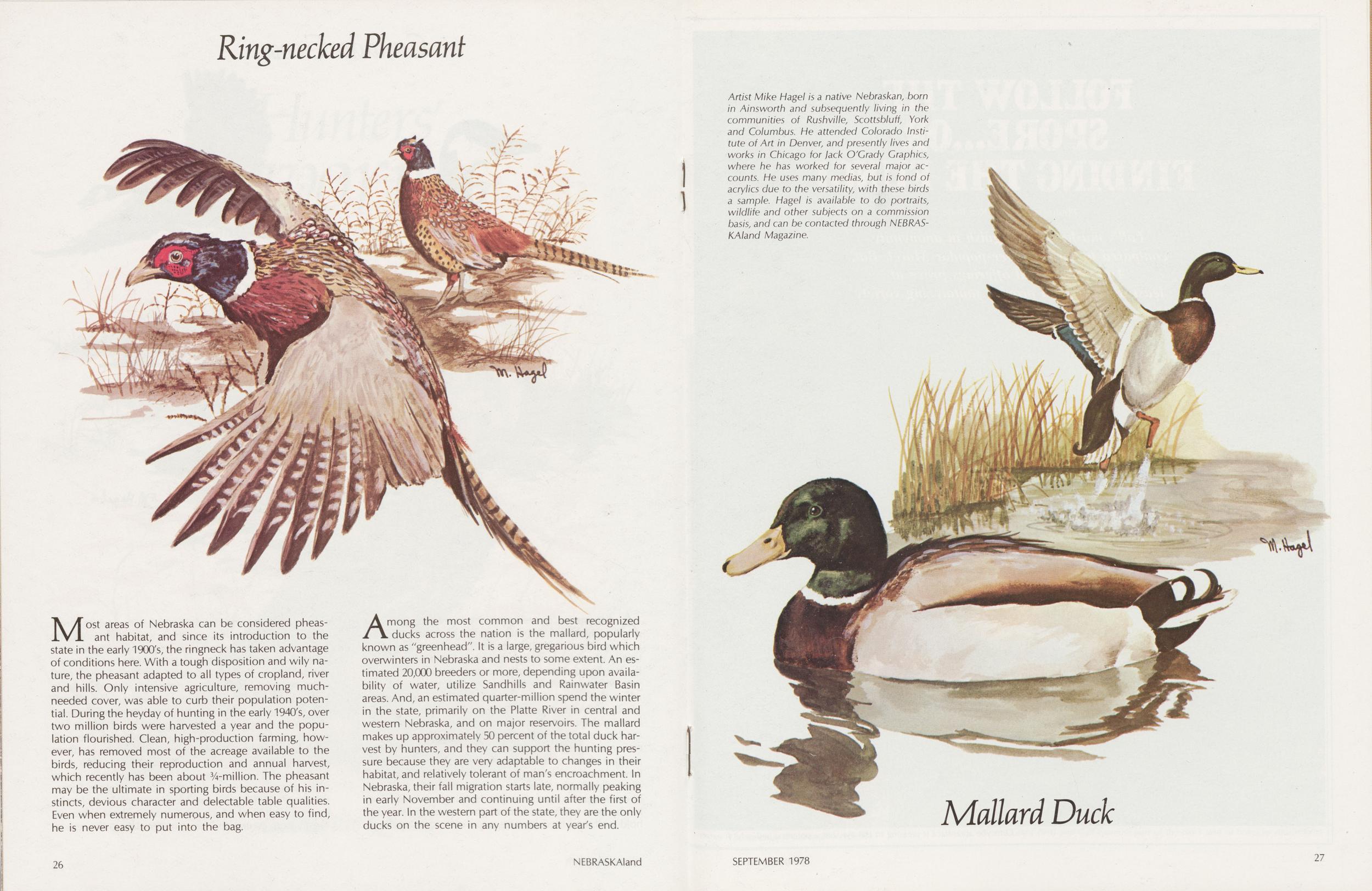
Most areas of Nebraska can be considered pheasant habitat, and since its introduction to the state in the early 1900's, the ringneck has taken advantage of conditions here. With a tough disposition and wily nature, the pheasant adapted to all types of cropland, river and hills. Only intensive agriculture, removing much- needed cover, was able to curb their population potential. During the heyday of hunting in the early 1940's, over two million birds were harvested a year and the population flourished. Clean, high-production farming, however, has removed most of the acreage available to the birds, reducing their reproduction and annual harvest, which recently has been about Vermillion. The pheasant may be the ultimate in sporting birds because of his instincts, devious character and delectable table qualities. Even when extremely numerous, and when easy to find, he is never easy to put into the bag.
Among the most common and best recognized , ducks across the nation is the mallard, popularly known as "greenhead". It is a large, gregarious bird which overwinters in Nebraska and nests to some extent. An estimated 20,000 breeders or more, depending upon availability of water, utilize Sandhills and Rainwater Basin areas. And, an estimated quarter-million spend the winter in the state, primarily on the Platte River in central and western Nebraska, and on major reservoirs. The mallard makes up approximately 50 percent of the total duck harvest by hunters, and they can support the hunting pressure because they are very adaptable to changes in their habitat, and relatively tolerant of man's encroachment. In Nebraska, their fall migration starts late, normally peaking in early November and continuing until after the first of the year. In the western part of the state, they are the only ducks on the scene in any numbers at year's end.
26 NEBRASKAland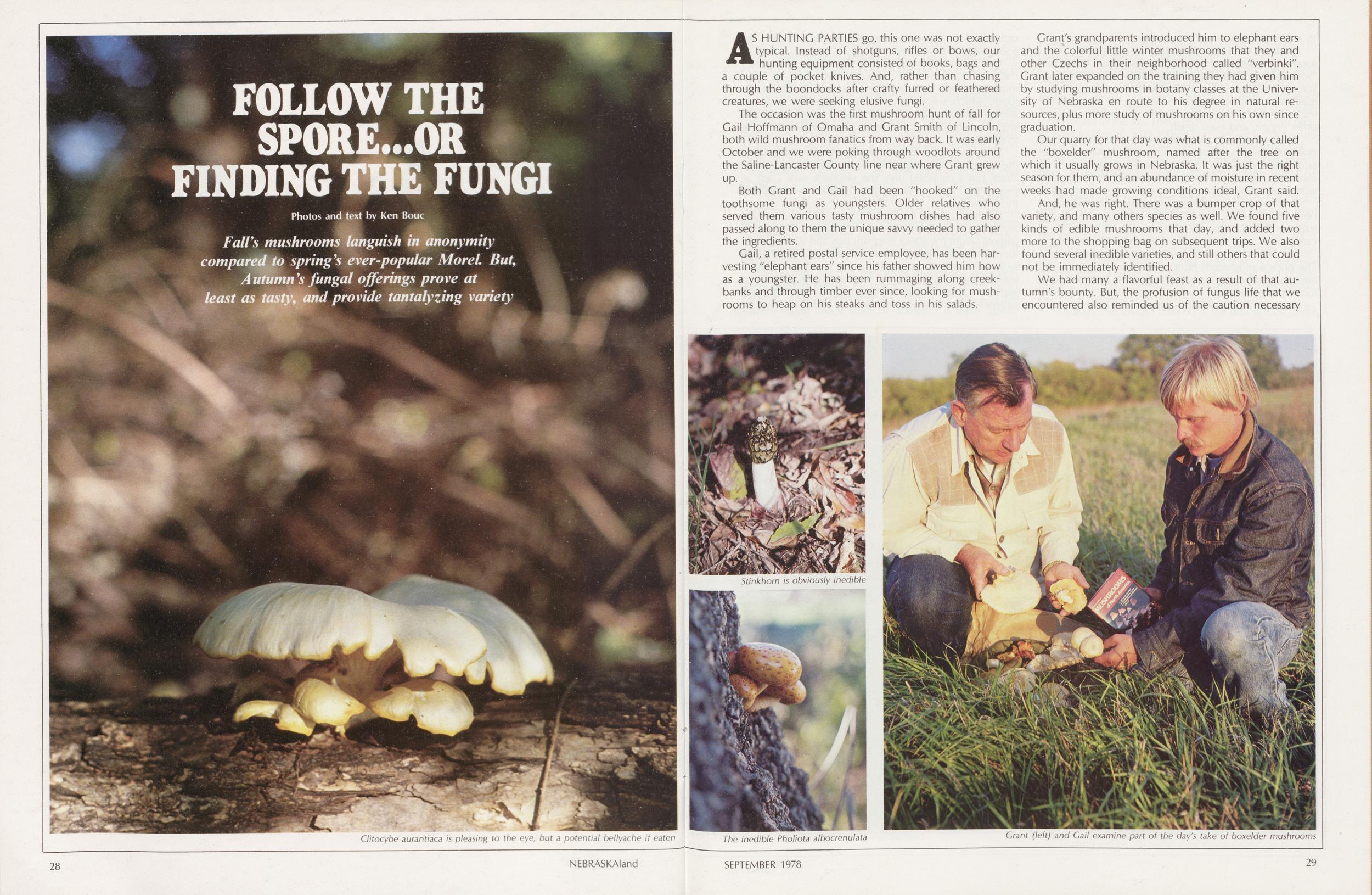
FOLLOW THE SPORE... OR FINDING THE FUNGI
Fall's mushrooms languish in anonymity compared to spring's ever-popular Morel Bui Autumn's fungal offerings prove at least as tasty, and provide tantalyzing variety
AS HUNTING PARTIES go, this one was not exactly typical. Instead of shotguns, rifles or bows, our * hunting equipment consisted of books, bags and a couple of pocket knives. And, rather than chasing through the boondocks after crafty furred or feathered creatures, we were seeking elusive fungi.
The occasion was the first mushroom hunt of fall for Gail Hoffmann of Omaha and Grant Smith of Lincoln, both wild mushroom fanatics from way back. It was early October and we were poking through woodlots around the Saline-Lancaster County line near where Grant grew up.
Both Grant and Gail had been "hooked" on the toothsome fungi as youngsters. Older relatives who served them various tasty mushroom dishes had also passed along to them the unique savvy needed to gather the ingredients.
Gail, a retired postal service employee, has been harvesting "elephant ears" since his father showed him how as a youngster. He has been rummaging along creekbanks and through timber ever since, looking for mushrooms to heap on his steaks and toss in his salads.
Grant's grandparents introduced him to elephant ears and the colorful little winter mushrooms that they and other Czechs in their neighborhood called "verbinki". Grant later expanded on the training they had given him by studying mushrooms in botany classes at the University of Nebraska en route to his degree in natural resources, plus more study of mushrooms on his own since graduation.
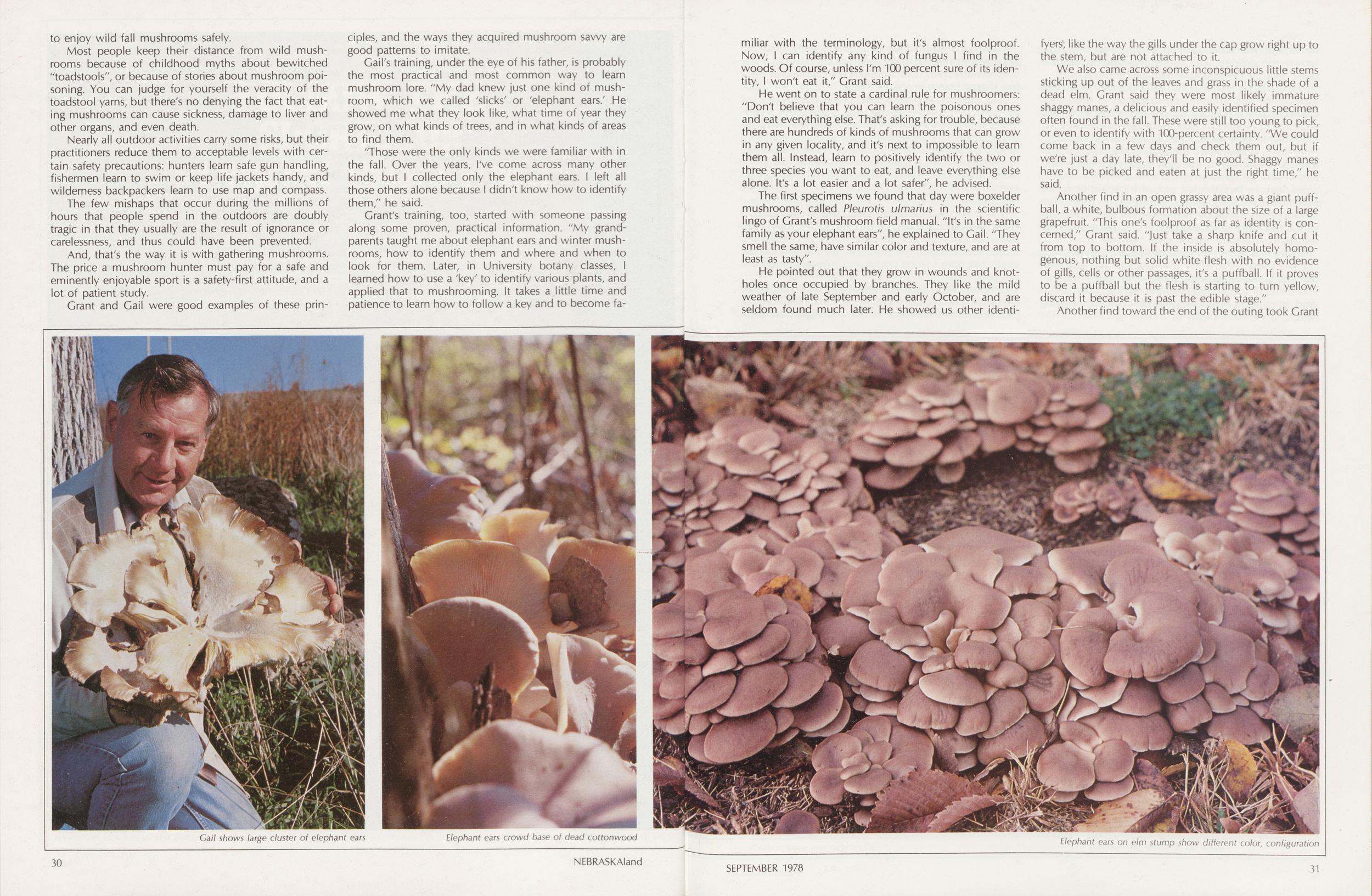
Our quarry for that day was what is commonly called the "boxelder" mushroom, named after the tree on which it usually grows in Nebraska. It was just the right season for them, and an abundance of moisture in recent weeks had made growing conditions ideal, Grant said.
And, he was right. There was a bumper crop of that variety, and many others species as well. We found five kinds of edible mushrooms that day, and added two more to the shopping bag on subsequent trips. We also found several inedible varieties, and still others that could not be immediately identified.
We had many a flavorful feast as a result of that autumn's bounty. But, the profusion of fungus life that we encountered also reminded us of the caution necessary
to enjoy wild fall mushrooms safely.
Most people keep their distance from wild mushrooms because of childhood myths about bewitched "toadstools", or because of stories about mushroom poisoning. You can judge for yourself the veracity of the toadstool yarns, but there's no denying the fact that eating mushrooms can cause sickness, damage to liver and other organs, and even death.
Nearly all outdoor activities carry some risks, but their practitioners reduce them to acceptable levels with certain safety precautions: hunters learn safe gun handling, fishermen learn to swim or keep life jackets handy, and wilderness backpackers learn to use map and compass.
The few mishaps that occur during the millions of hours that people spend in the outdoors are doubly tragic in that they usually are the result of ignorance or carelessness, and thus could have been prevented.
And, that's the way it is with gathering mushrooms. The price a mushroom hunter must pay for a safe and eminently enjoyable sport is a safety-first attitude, and a lot of patient study.
Grant and Gail were good examples of these principles, and the ways they acquired mushroom savvy are good patterns to imitate.
Gail's training, under the eye of his father, is probably the most practical and most common way to learn mushroom lore. "My dad knew just one kind of mushroom, which we called 'slicks' or 'elephant ears.' He showed me what they look like, what time of year they grow, on what kinds of trees, and in what kinds of areas to find them.
"Those were the only kinds we were familiar with in the fall. Over the years, I've come across many other kinds, but I collected only the elephant ears. I left all those others alone because I didn't know how to identify them," he said.
Grant's training, too, started with someone passing along some proven, practical information. "My grandparents taught me about elephant ears and winter mushrooms, how to identify them and where and when to look for them. Later, in University botany classes, I learned how to use a 'key' to identify various plants, and applied that to mushrooming. It takes a little time and patience to learn how to follow a key and to become familiar
with the terminology, but it's almost foolproof. Now, I can identify any kind of fungus I find in the woods. Of course, unless I'm 100 percent sure of its identity, I won't eat it," Grant said.
He went on to state a cardinal rule for mushroomers: "Don't believe that you can learn the poisonous ones and eat everything else. That's asking for trouble, because there are hundreds of kinds of mushrooms that can grow in any given locality, and it's next to impossible to learn them all. Instead, learn to positively identify the two or three species you want to eat, and leave everything else alone. It's a lot easier and a lot safer", he advised.
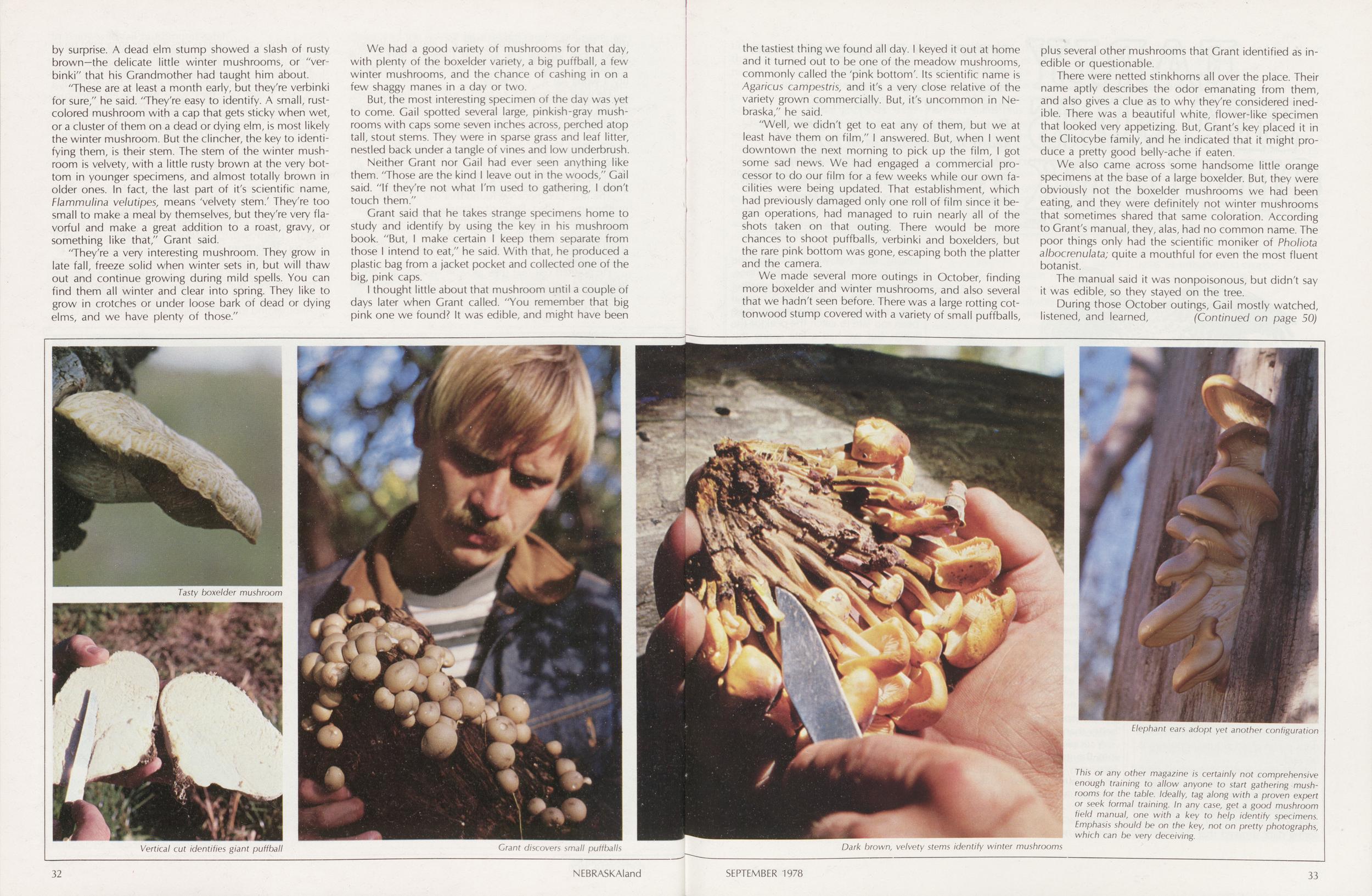
The first specimens we found that day were boxelder mushrooms, called Pleurotis ulmarius in the scientific lingo of Grant's mushroom field manual. "It's in the same family as your elephant ears", he explained to Gail. "They smell the same, have similar color and texture, and are at least as tasty".
He pointed out that they grow in wounds and knotholes once occupied by branches. They like the mild weather of late September and early October, and are seldom found much later. He showed us other identifyers, like the way the gills under the cap grow right up to the stem, but are not attached to it.
We also came across some inconspicuous little stems sticking up out of the leaves and grass in the shade of a dead elm. Grant said they were most likely immature shaggy manes, a delicious and easily identified specimen often found in the fall. These were still too young to pick, or even to identify with 100-percent certainty. "We could come back in a few days and check them out, but if we're just a day late, they'll be no good. Shaggy manes have to be picked and eaten at just the right time," he said.
Another find in an open grassy area was a giant puffball, a white, bulbous formation about the size of a large grapefruit. "This one's foolproof as far as identity is concerned," Grant said, "just take a sharp knife and cut it from top to bottom. If the inside is absolutely homogenous, nothing but solid white flesh with no evidence of gills, cells or other passages, it's a puffball. If it proves to be a puffball but the flesh is starting to turn yellow, discard it because it is past the edible stage."
Another find toward the end of the outing took Grant
 by surprise. A dead elm stump showed a slash of rusty
brown—the delicate little winter mushrooms, or "verbinki" that his Grandmother had
taught him about.
by surprise. A dead elm stump showed a slash of rusty
brown—the delicate little winter mushrooms, or "verbinki" that his Grandmother had
taught him about.
"These are at least a month early, but they're verbinki for sure," he said. 'They're easy to identify. A small, rustcolored mushroom with a cap that gets sticky when wet, or a cluster of them on a dead or dying elm, is most likely the winter mushroom. But the clincher, the key to identifying them, is their stem. The stem of the winter mushroom is velvety, with a little rusty brown at the very bottom in younger specimens, and almost totally brown in older ones. In fact, the last part of it's scientific name, Flammulina velutipes, means 'velvety stem.' They're too small to make a meal by themselves, but they're very flavorful and make a great addition to a roast, gravy, or something like that," Grant said.
They're a very interesting mushroom. They grow in late fall, freeze solid when winter sets in, but will thaw out and continue growing during mild spells. You can find them all winter and clear into spring. They like to grow in crotches or under loose bark of dead or dying elms, and we have plenty of those."
We had a good variety of mushrooms for that day, with plenty of the boxelder variety, a big puffball, a few winter mushrooms, and the chance of cashing in on a few shaggy manes in a day or two.
But, the most interesting specimen of the day was yet to come. Gail spotted several large, pinkish-gray mushrooms with caps some seven inches across, perched atop tall, stout stems. They were in sparse grass and leaf litter, nestled back under a tangle of vines and low underbrush.
Neither Grant nor Gail had ever seen anything like them. "Those are the kind I leave out in the woods," Gail said. "If they're not what I'm used to gathering, I don't touch them."
Grant said that he takes strange specimens home to study and identify by using the key in his mushroom book. "But, I make certain I keep them separate from those I intend to eat," he said. With that, he produced a plastic bag from a jacket pocket and collected one of the big, pink caps.
I thought little about that mushroom until a couple of days later when Grant called. "You remember that big pink one we found? It was edible, and might have been
"Well, we didn't get to eat any of them, but we at least have them on film," I answered. But, when I went downtown the next morning to pick up the film, I got some sad news. We had engaged a commercial processor to do our film for a few weeks while our own facilities were being updated. That establishment, which had previously damaged only one roll of film since it began operations, had managed to ruin nearly all of the shots taken on that outing. There would be more chances to shoot puffballs, verbinki and boxelders, but the rare pink bottom was gone, escaping both the platter and the camera.
We made several more outings in October, finding more boxelder and winter mushrooms, and also several that we hadn't seen before. There was a large rotting Cottonwood stump covered with a variety of small puffballs, plus several other mushrooms that Grant identified as inedible or questionable.
There were netted stinkhoms all over the place. Their name aptly describes the odor emanating from them, and also gives a clue as to why they're considered inedible. There was a beautiful white, flower-like specimen that looked very appetizing. But, Grant's key placed it in the Clitocybe family, and he indicated that it might produce a pretty good belly-ache if eaten.
We also came across some handsome little orange specimens at the base of a large boxelder. But, they were obviously not the boxelder mushrooms we had been eating, and they were definitely not winter mushrooms that sometimes shared that same coloration. According to Grant's manual, they, alas, had no common name. The poor things only had the scientific moniker of Pholiota albocrenulata; quite a mouthful for even the most fluent botanist.
The manual said it was nonpoisonous, but didn't say it was edible, so they stayed on the tree.
During those October outings, Gail mostly watched, listened, and learned, (Continued on page 50)
EARLY SEASONS OUTLOOK
PROSPECTS FOR early fall seasons appear good, with grouse hunters in line for better than average bird populations. Dove hunters can expect to find birds nearly as abundant as in 1977, which was a 10-year high. Prospects for antelope hunters are also good with herds remaining at a stable level
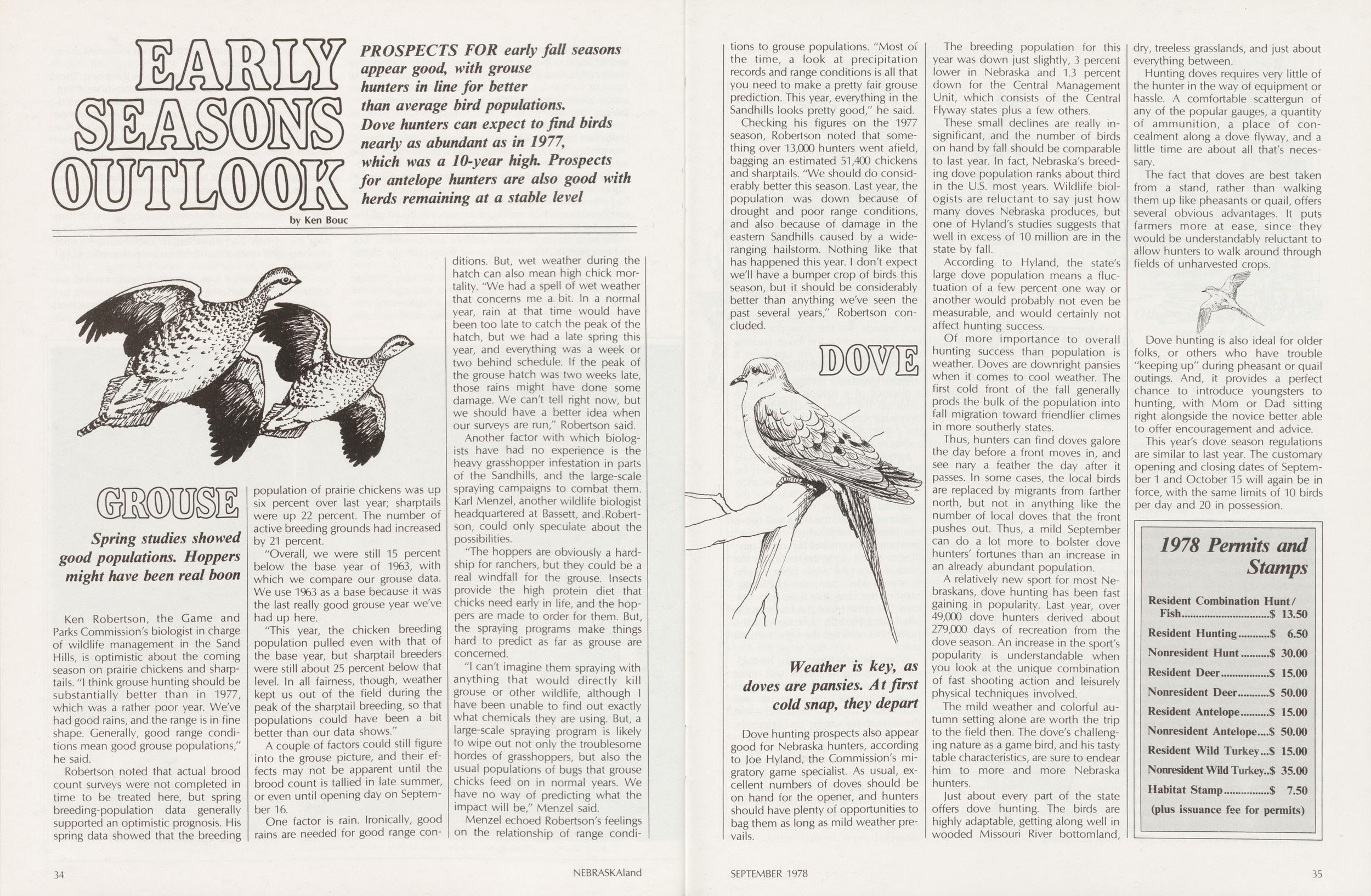
Ken Robertson, the Game and Parks Commission's biologist in charge of wildlife management in the Sand Hills, is optimistic about the coming season on prairie chickens and sharptails. "I think grouse hunting should be substantially better than in 1977, which was a rather poor year. We've had good rains, and the range is in fine shape. Generally, good range conditions mean good grouse populations," he said.
Robertson noted that actual brood count surveys were not completed in time to be treated here, but spring breeding-population data generally supported an optimistic prognosis. His spring data showed that the breeding population of prairie chickens was up six percent over last year; sharptails were up 22 percent. The number of active breeding grounds had increased by 21 percent.
"Overall, we were still 15 percent below the base year of 1963, with which we compare our grouse data. We use 1963 as a base because it was the last really good grouse year we've had up here.
"This year, the chicken breeding population pulled even with that of the base year, but sharptail breeders were still about 25 percent below that level. In all fairness, though, weather kept us out of the field during the peak of the sharptail breeding, so that populations could have been a bit better than our data shows."
A couple of factors could still figure into the grouse picture, and their effects may not be apparent until the brood count is tallied in late summer, or even until opening day on September 16.
One factor is rain. Ironically, good rains are needed for good range conditions. But, wet weather during the hatch can also mean high chick mortality. "We had a spell of wet weather that concerns me a bit. In a normal year, rain at that time would have been too late to catch the peak of the hatch, but we had a late spring this year, and everything was a week or two behind schedule. If the peak of the grouse hatch was two weeks late, those rains might have done some damage. We can't tell right now, but we should have a better idea when our surveys are run," Robertson said.
Another factor with which biologists have had no experience is theheavy grasshopper infestation in parts of the Sandhills, and the large-scale spraying campaigns to combat them. Karl Menzel, another wildlife biologist headquartered at Bassett, and Robertson, could only speculate about the possibilities.
"The hoppers are obviously a hardship for ranchers, but they could be a real windfall for the grouse. Insects provide the high protein diet that chicks need early in life, and the hoppers are made to order for them. But, the spraying programs make things hard to predict as far as grouse are concerned.
"I can't imagine them spraying with anything that would directly kill grouse or other wildlife, although I have been unable to find out exactly what chemicals they are using. But, a large-scale spraying program is likely to wipe out not only the troublesome hordes of grasshoppers, but also the usual populations of bugs that grouse chicks feed on in normal years. We have no way of predicting what the impact will be," Menzel said.
Menzel echoed Robertson's feelings on the relationship of range conditions 34 NEBRASKAland to grouse populations. "Most of the time, a look at precipitation records and range conditions is all that you need to make a pretty fair grouse prediction. This year, everything in the Sandhills looks pretty good," he said.
Checking his figures on the 1977 season, Robertson noted that something over 13,000 hunters went afield, bagging an estimated 51,400 chickens and sharptails. "We should do considerably better this season. Last year, the population was down because of drought and poor range conditions, and also because of damage in the eastern Sandhills caused by a wideranging hailstorm. Nothing like that has happened this year. I don't expect we'll have a bumper crop of birds this season, but it should be considerably better than anything we've seen the past several years," Robertson concluded.
Dove hunting prospects also appear good for Nebraska hunters, according to Joe Hyland, the Commission's migratory game specialist. As usual, excellent numbers of doves should be on hand for the opener, and hunters should have plenty of opportunities to bag them as long as mild weather prevails.
The breeding population for this year was down just slightly, 3 percent lower in Nebraska and 1.3 percent down for the Central Management Unit, which consists of the Central Flyway states plus a few others.
These small declines are really insignificant, and the number of birds on hand by fall should be comparable to last year. In fact, Nebraska's breeding dove population ranks about third in the U.S. most years. Wildlife biologists are reluctant to say just how many doves Nebraska produces, but one of Hyland's studies suggests that well in excess of 10 million are in the state by fall.
According to Hyland, the state's large dove population means a fluctuation of a few percent one way or another would probably not even be measurable, and would certainly not affect hunting success.
Of more importance to overall hunting success than population is weather. Doves are downright pansies when it comes to cool weather. The first cold front of the fall generally prods the bulk of the population into fall migration toward friendlier climes in more southerly states.
Thus, hunters can find doves galore the day before a front moves in, and see nary a feather the day after it passes. In some cases, the local birds are replaced by migrants from farther north, but not in anything like the number of local doves that the front pushes out. Thus, a mild September can do a lot more to bolster dove hunters' fortunes than an increase in an already abundant population.
A relatively new sport for most Nebraskans, dove hunting has been fast gaining in popularity. Last year, over 49,000 dove hunters derived about 279,000 days of recreation from the dove season. An increase in the sport's popularity is understandable when you look at the unique combination of fast shooting action and leisurely physical techniques involved.
The mild weather and colorful autumn setting alone are worth the trip to the field then. The dove's challenging nature as a game bird, and his tasty table characteristics, are sure to endear him to more and more Nebraska hunters.
Just about every part of the state offers dove hunting. The birds are highly adaptable, getting along well in wooded Missouri River bottomland, dry, treeless grasslands, and just about everything between.
Hunting doves requires very little of the hunter in the way of equipment or hassle. A comfortable scattergun of any of the popular gauges, a quantity of ammunition, a place of concealment along a dove flyway, and a little time are about all that's necessary.
The fact that doves are best taken from a stand, rather than walking them up like pheasants or quail, offers several obvious advantages. It puts farmers more at ease, since they would be understandably reluctant to allow hunters to walk around through fields of unharvested crops.
Dove hunting is also ideal for older folks, or others who have trouble "keeping up" during pheasant or quail outings. And, it provides a perfect chance to introduce youngsters to hunting, with Mom or Dad sitting right alongside the novice better able to offer encouragement and advice.
This year's dove season regulations are similar to last year. The customary opening and closing dates of September 1 and October 15 will again be in force, with the same limits of 10 birds per day and 20 in possession.
1978 Permits and Stamps
Resident Combination Hunt/ Fish $ 13.50 Resident Hunting $ 6.50 Nonresident Hunt $ 30.00 Resident Deer $ 15.00 Nonresident Deer $ 50.00 Resident Antelope $ 15.00 Nonresident Antelope $ 50.00 Resident Wild Turkey $ 15.00 Nonresident Wild Turkey $ 35.00 Habitat Stamp $ 7.50 (plus issuance fee for permits) SEPTEMBER 1978 35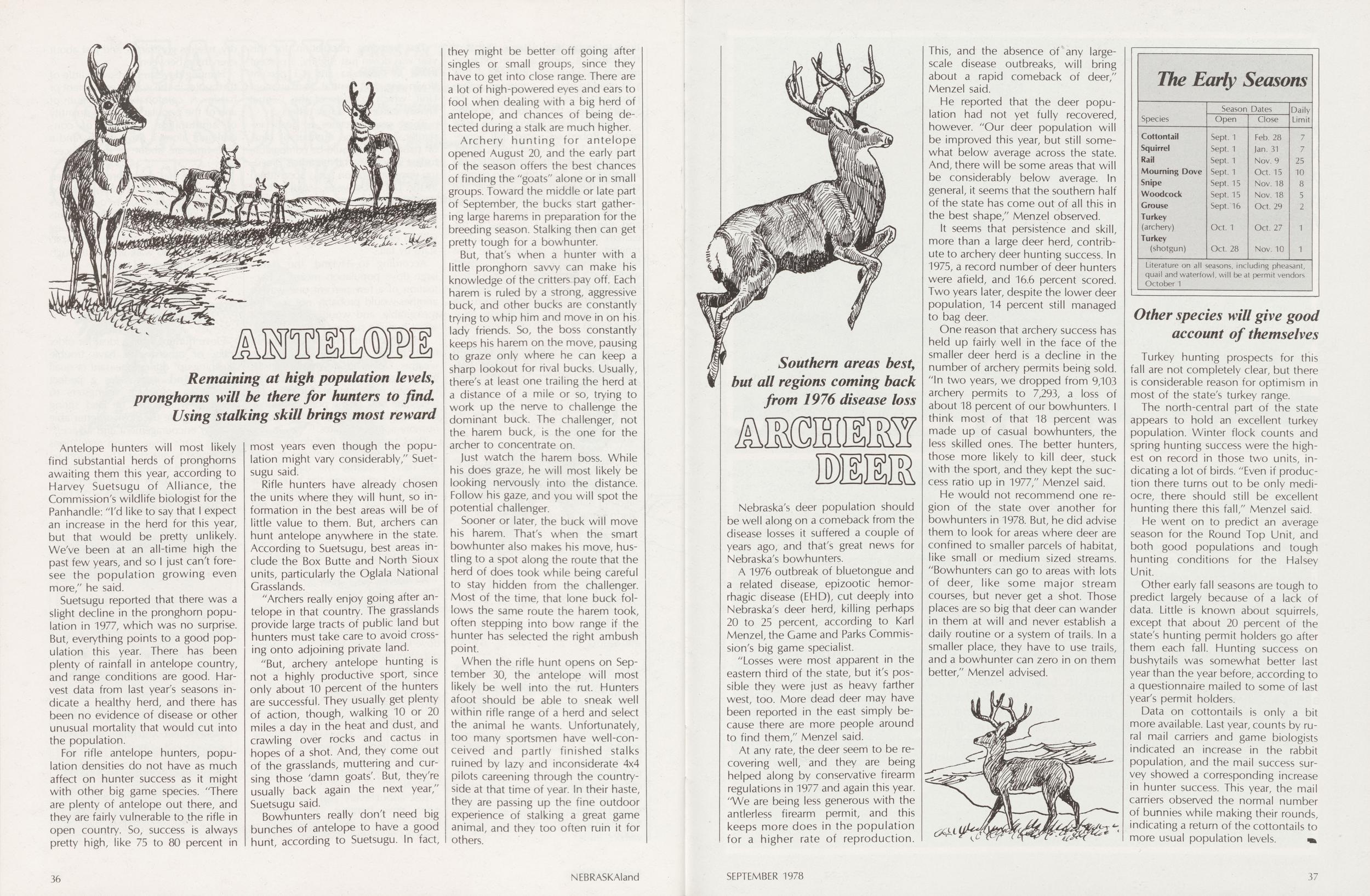
Antelope hunters will most likely find substantial herds of pronghorns awaiting them this year, according to Harvey Suetsugu of Alliance, the Commission's wildlife biologist for the Panhandle: "I'd like to say that I expect an increase in the herd for this year, but that would be pretty unlikely. We've been at an all-time high the past few years, and so I just can't foresee the population growing even more," he said.
Suetsugu reported that there was a slight decline in the pronghorn population in 1977, which was no surprise. But, everything points to a good population this year. There has been plenty of rainfall in antelope country, and range conditions are good. Harvest data from last year's seasons indicate a healthy herd, and there has been no evidence of disease or other unusual mortality that would cut into the population.
For rifle antelope hunters, population densities do not have as much affect on hunter success as it might with other big game species. "There are plenty of antelope out there, and they are fairly vulnerable to the rifle in open country. So, success is always pretty high, like 75 to 80 percent in most years even though the population might vary considerably," Suetsugu said.
Rifle hunters have already chosen the units where they will hunt, so information in the best areas will be of little value to them. But, archers can hunt antelope anywhere in the state. According to Suetsugu, best areas include the Box Butte and North Sioux units, particularly the Oglala National Grasslands.
"Archers really enjoy going after antelope in that country. The grasslands provide large tracts of public land but hunters must take care to avoid crossing onto adjoining private land.
"But, archery antelope hunting is not a highly productive sport, since only about 10 percent of the hunters are successful. They usually get plenty of action, though, walking 10 or 20 miles a day in the heat and dust, and crawling over rocks and cactus in hopes of a shot. And, they come out of the grasslands, muttering and cursing those 'damn goats'. But, they're usually back again the next year," Suetsugu said.
Bowhunters really don't need big bunches of antelope to have a good hunt, according to Suetsugu. In fact, they might be better off going after singles or small groups, since they have to get into close range. There are a lot of high-powered eyes and ears to fool when dealing with a big herd of antelope, and chances of being detected during a stalk are much higher.
Archery hunting for antelope opened August 20, and the early part of the season offers the best chances of finding the "goats" alone or in small groups. Toward the middle or late part of September, the bucks start gathering large harems in preparation for the breeding season. Stalking then can get pretty tough for a bowhunter.
But, that's when a hunter with a little pronghorn savvy can make his knowledge of the critters pay off. Each harem is ruled by a strong, aggressive buck, and other bucks are constantly trying to whip him and move in on his lady friends. So, the boss constantly keeps his harem on the move, pausing to graze only where he can keep a sharp lookout for rival bucks. Usually, there's at least one trailing the herd at a distance of a mile or so, trying to work up the nerve to challenge the dominant buck. The challenger, not the harem buck, is the one for the archer to concentrate on.
Just watch the harem boss. While his does graze, he will most likely be looking nervously into the distance. Follow his gaze, and you will spot the potential challenger.
Sooner or later, the buck will move his harem. That's when the smart bowhunter also makes his move, hustling to a spot along the route that the herd of does took while being careful to stay hidden from the challenger. Most of the time, that lone buck follows the same route the harem took, often stepping into bow range if the hunter has selected the right ambush point.
When the rifle hunt opens on September 30, the antelope will most likely be well into the rut. Hunters afoot should be able to sneak well within rifle range of a herd and select the animal he wants. Unfortunately, too many sportsmen have well-conceived and partly finished stalks ruined by lazy and inconsiderate 4x4 pilots careening through the countryside at that time of year. In their haste, they are passing up the fine outdoor experience of stalking a great game animal, and they too often ruin it for others.
Nebraska's deer population should be well along on a comeback from the disease losses it suffered a couple of years ago, and that's great news for Nebraska's bowhunters.
A 1976 outbreak of bluetongue and a related disease, epizootic hemorrhagic disease (EHD), cut deeply into Nebraska's deer herd, killing perhaps 20 to 25 percent, according to Karl Menzel, the Game and Parks Commission's big game specialist.
"Losses were most apparent in the eastern third of the state, but it's possible they were just as heavy farther west, too. More dead deer may have been reported in the east simply because there are more people around to find them," Menzel said.
At any rate, the deer seem to be recovering well, and they are being helped along by conservative firearm regulations in 1977 and again this year. "We are being less generous with the antlerless firearm permit, and this keeps more does in the population for a higher rate of reproduction. This, and the absence of any large-scale disease outbreaks, will bring about a rapid comeback of deer," Menzel said.
He reported that the deer population had not yet fully recovered however. "Our deer population will be improved this year, but still somewhat below average across the state. And, there will be some areas that will be considerably below average. In general, it seems that the southern half of the state has come out of all this in the best shape," Menzel observed.
It seems that persistence and skill, more than a large deer herd, contribute to archery deer hunting success. In 1975, a record number of deer hunters were afield, and 16.6 percent scored. Two years later, despite the lower deer population, 14 percent still managed to bag deer.
One reason that archery success has held up fairly well in the face of the smaller deer herd is a decline in the number of archery permits being sold. "In two years, we dropped from 9,103 archery permits to 7,293, a loss of about 18 percent of our bowhunters. I think most of that 18 percent was made up of casual bowhunters, the less skilled ones. The better hunters, those more likely to kill deer, stuck with the sport, and they kept the success ratio up in 1977," Menzel said.
He would not recommend one region of the state over another for bowhunters in 1978. But, he did advise them to look for areas where deer are confined to smaller parcels of habitat, like small or medium sized streams. "Bowhunters can go to areas with lots of deer, like some major stream courses, but never get a shot. Those places are so big that deer can wander in them at will and never establish a daily routine or a system of trails. In a smaller place, they have to use trails, and a bowhunter can zero in on them better," Menzel advised.
Turkey hunting prospects for this fall are not completely clear, but there is considerable reason for optimism in most of the state's turkey range.
The north-central part of the state appears to hold an excellent turkey population. Winter flock counts and spring hunting success were the highest on record in those two units, indicating a lot of birds. "Even if production there turns out to be only mediocre, there should still be excellent hunting there this fall," Menzel said.
He went on to predict an average season for the Round Top Unit, and both good populations and tough hunting conditions for the Halsey Unit.
Other early fall seasons are tough to predict largely because of a lack of data. Little is known about squirrels, except that about 20 percent of the state's hunting permit holders go after them each fall. Hunting success on bushytails was somewhat better last year than the year before, according to a questionnaire mailed to some of last year's permit holders.
Data on cottontails is only a bit more available. Last year, counts by rural mail carriers and game biologists indicated an increase in the rabbit population, and the mail success survey showed a corresponding increase in hunter success. This year, the mail carriers observed the normal number of bunnies while making their rounds, indicating a return of the cottontails to more usual population levels.
SEPTEMBER 1978 37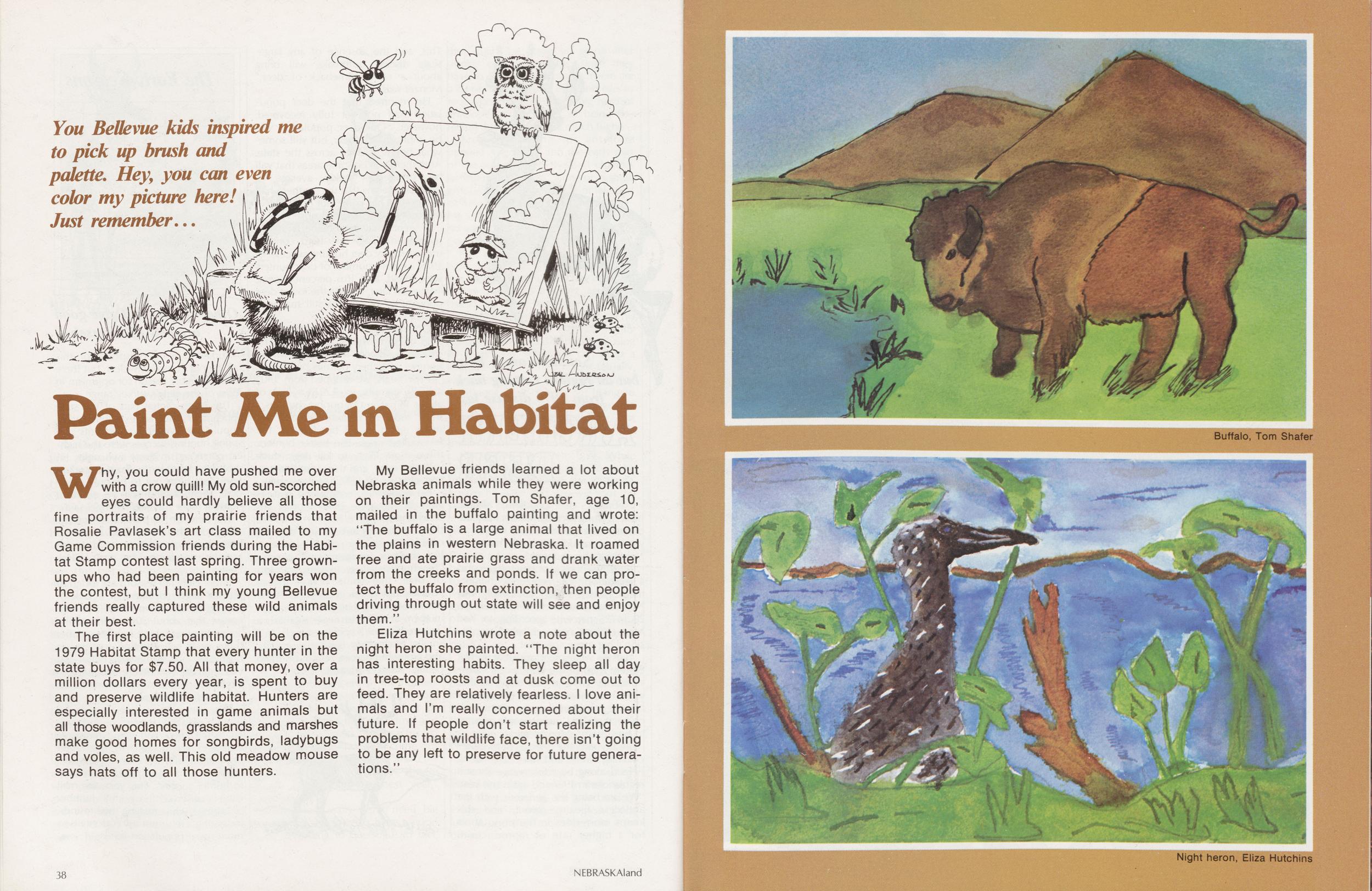
Paint Me in Habitat
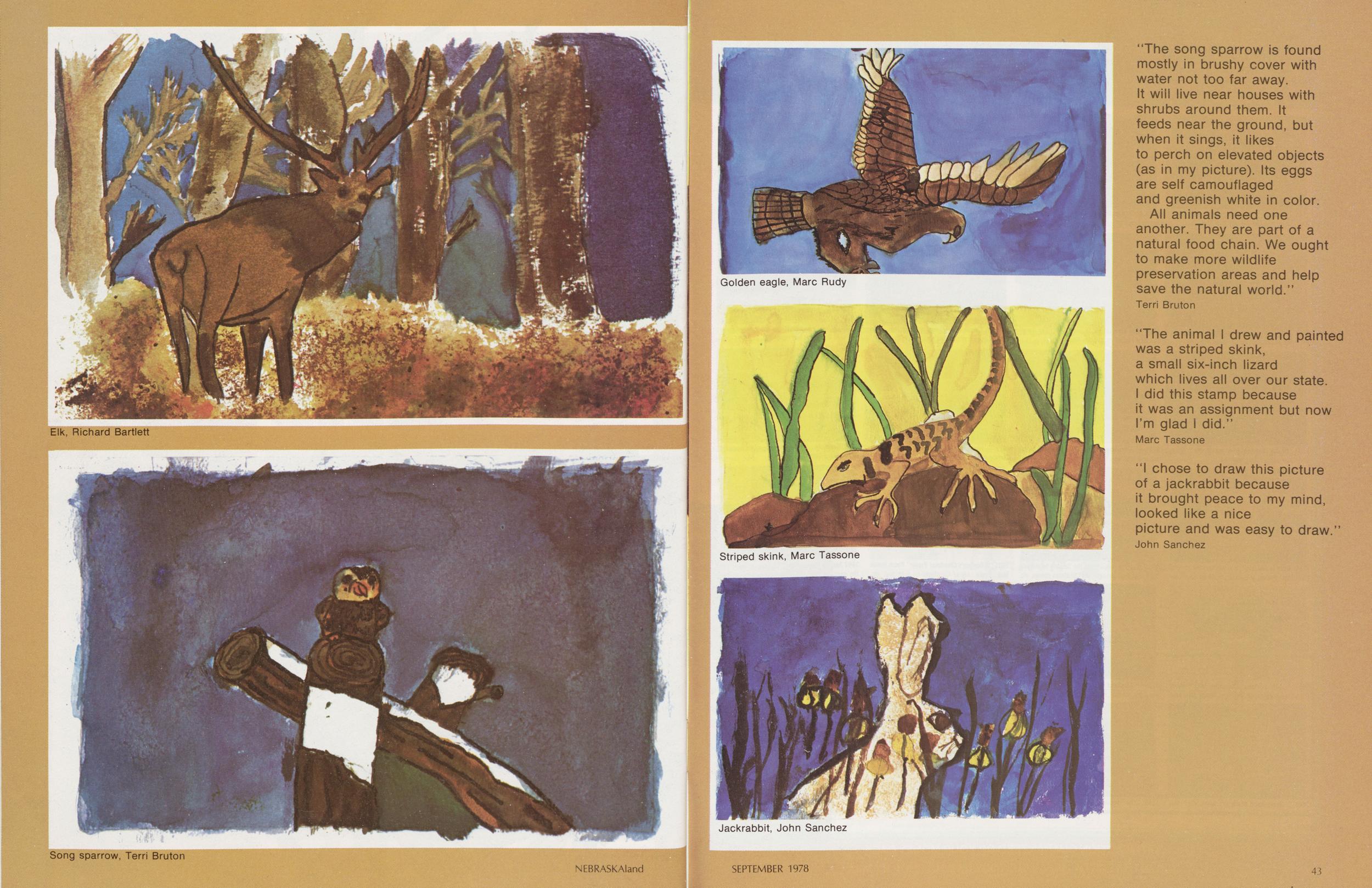
You Bellevue kids inspired me to pick up brush and palette. Hey, you can even color my picture here! Just remember...
Why, you could have pushed me over with a crow quill! My old sun-scorched eyes could hardly believe all those fine portraits of my prairie friends that Rosalie Pavlasek's art class mailed to my Game Commission friends during the Habitat Stamp contest last spring. Three grownups who had been painting for years won the contest, but I think my young Bellevue friends really captured these wild animals at their best.
The first place painting will be on the 1979 Habitat Stamp that every hunter in the state buys for $7.50. All that money, over a million dollars every year, is spent to buy and preserve wildlife habitat. Hunters are especially interested in game animals but all those woodlands, grasslands and marshes make good homes for songbirds, ladybugs and voles, as well. This old meadow mouse says hats off to all those hunters.
My Bellevue friends learned a lot about Nebraska animals while they were working on their paintings. Tom Shafer, age 10, mailed in the buffalo painting and wrote: 'The buffalo is a large animal that lived on the plains in western Nebraska. It roamed free and ate prairie grass and drank water from the creeks and ponds. If we can protect the buffalo from extinction, then people driving through out state will see and enjoy them."
Eliza Hutchins wrote a note about the night heron she painted. "The night heron has interesting habits. They sleep all day in tree-top roosts and at dusk come out to feed. They are relatively fearless. I love animals and I'm really concerned about their future. If people don't start realizing the problems that wildlife face, there isn't going to be any left to preserve for future generations."
38 NEBRASKAland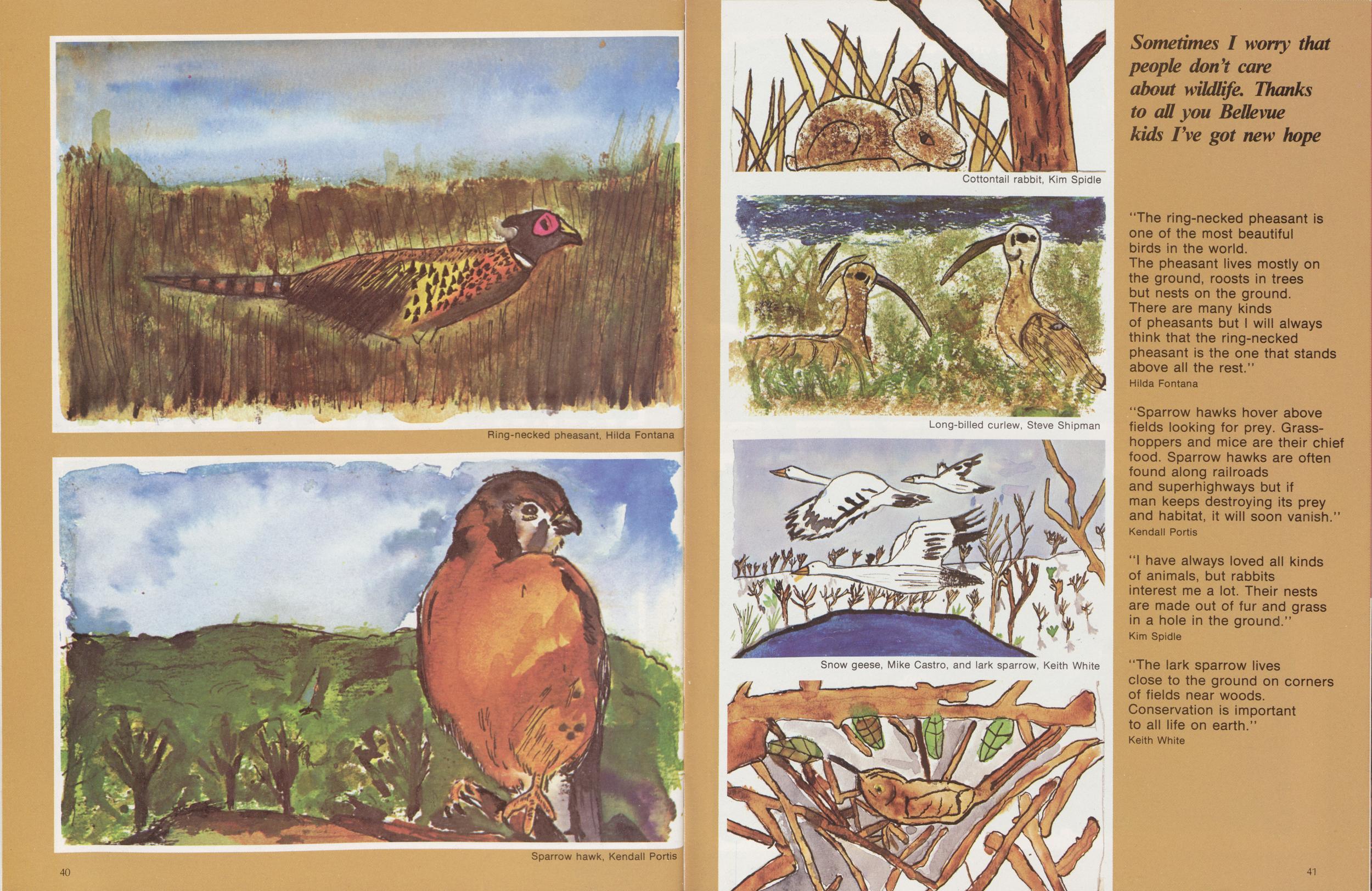

CHRISTMAS CARDS of the Outdoor West and Friendly Greetings
The joy of sending Christmas cards and keeping in touch with friends is one of our most cherished traditions. This spirit of warmth and friendship is beautifully expressed through Leanin' Tree cards, with meaningful greetings perfectly matched to each magnificent scene. You can choose red, blue or white envelopes. Order direct from this ad or send for free sample card and catalog. We can imprint your name in red to match the greeting, also your address in black on the envelope flaps. Fast, IMMEDIATE shipment now 'til Christmas. 5" x 7" Cards with Warm
MUTCHIE'S Johnson Lake RESORT
Upstairs Anchor Room Lounge Cold Beer-On/Off Sale Lakefront cabins with swimming beach • Fishing tackle • Boats and motors • Free boat ramp • Fishing • Swimming • Cafe and ice • Boating and . skiing • Gas and oil • 9-hole golf course just around the corner • Live and frozen bait • Pontoon, boat and motor rentals. Overnight Campers-full hookups WRITE FOR FREE BROCHURE or phone reservations 785-2298 Elwood, NebraskaStroped Bass Tournament
40 Winners $2,500 in Prizes
Entrants also invited to attend a Striper-fishing seminar on Friday, Sept. 22 at the Holiday Inn in Ogallala starting at 7 p.m. Speaker will be Stu Tinney, president of STRIPER, who knows whereof he speaks, having caught over 50,000 stripers. He will discuss techniques as yet untried here—surface fishing, etc.
Memberships to STRIPERS are optional, but available. Top prize of $1,000 will go only to STRIPER member! Contest sponsored by STRIPER (national Striper fishing organization) in cooperation with Admiral's Cove Marina For details, call or write Admiral's Cove, Lake McConaughy, Lemoyne, NE 69146 Phone: (308) 355-2102 or call other marinas at Lake McConaughy 46 NEBRASKAlandSMALL GAME . . . BIG MEMORIES
(Continued from page 19)we stopped. 'The trees are silhouetted against the sky and the slightest movement is detectable. Your own form is lost against the dark, shadowy ground. Patience is the key to hunting squirrels, but moving from stand to stand without showing yourself will spook fewer squirrels and make your waits shorter, as a rule."
We had only taken up a stand for a few minutes when jim caught a glimpse of two squirrels moving a quarter of a mile up the draw in a pair of oaks near the top of the west rim. We worked within range and waited. And waited. It was overcast but dry; one of those days when the cloud cover is so low and uniform that everything appears a gray-white.
We waited a reasonable time and then worked over the main ridge, through a grassy bald spot fringed with sumac, and down the north-facing slope to a dense band of cedars thick with cottontails. During the next hour we continued north along a draw of bur oak, dead elms and a stand of 20-foot-high young elms that still clung to their soggy brown leaves. The ground was a mat of mottled bur oak leaves, grayish on the undersides and cowhide-brown on the upper.
At the bottom of the draw we waited. When Jim finally stood up to move, he spotted a squirrel about the same time it saw him. One quick shot and he was gone.
"He was moving; probably feeding," Jim said 'This wasn't his area. Squirrels seem to like to move through trees just below the rims."
We worked back in a broad circle. Occasionally we would hear a squirrel chatter, but they just weren't out in the numbers we had expected. A sunny day following two damp, cloudy days probably would have brought them out in droves.
As the morning wore on, it became evident that Jim was not particularly concerned. Had there been only one squirrel in a five-mile area he probably would have hunted with as much enthusiasm. The cover he had chosen to hunt was taking the squirrels on in their own element; everything was in their favor; unlike hunting a narrow band of riparian woodlands where they are constantly moving into the
CLIMB THE SPIRAL STAIRCASE and step into the 1880's
GUN DOG TRAINING All Sporting Breeds
STOCK YOUR LAKE OR POND with CHANNEL CAT LARGEM0UTH BASS BLUEGILL
ORDER NOW WILLOW LAKE FISH HATCHERY Rt. 3, Box 46, Hastings, Nebr. 68901 Gaylord L. Crawford Phone: (402) 463-8022 Day or Night For April to October 15 stocking Pond Mill-Aquazine for algae-free waterRustic Living the Modern Way!
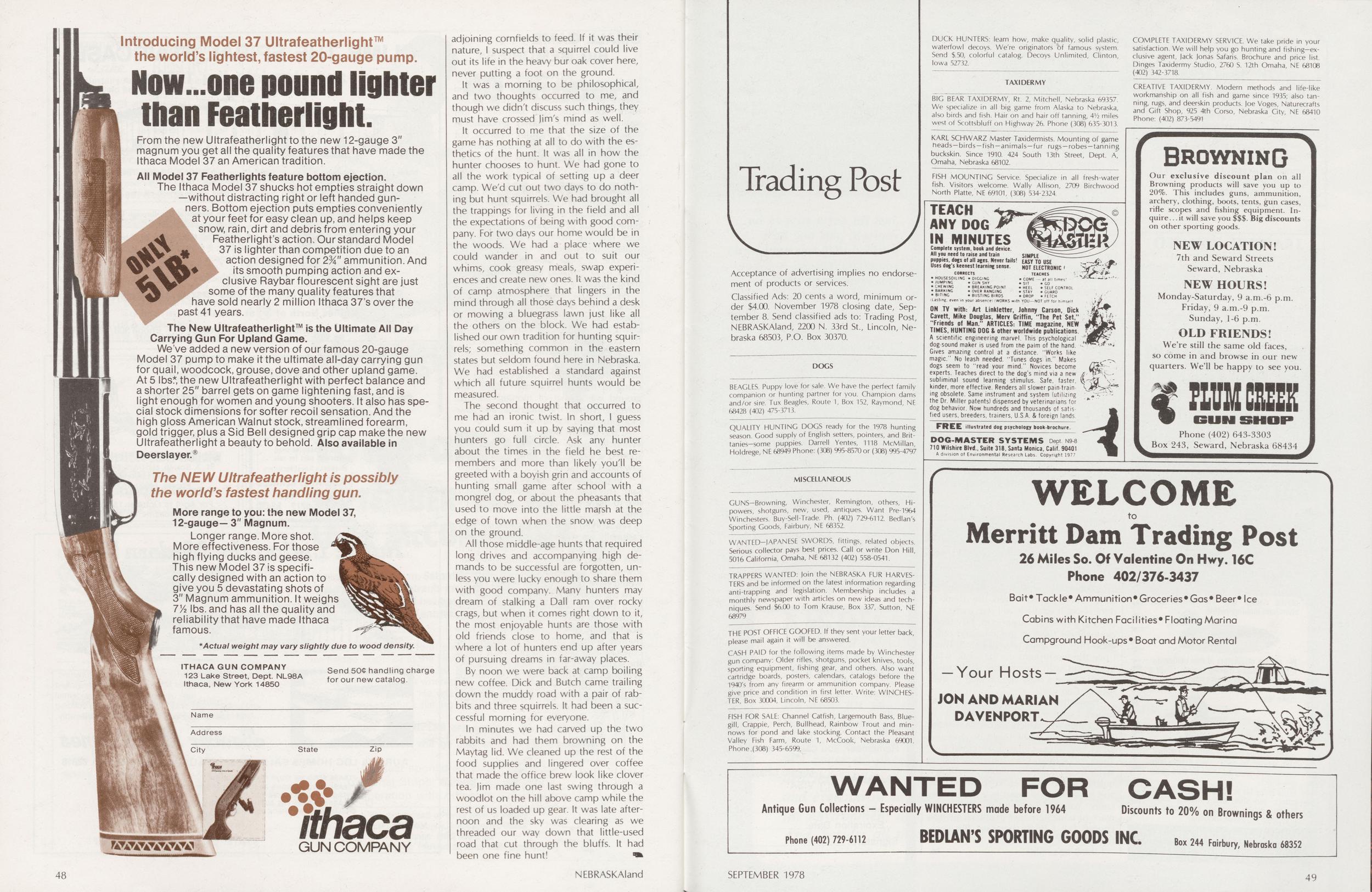
Introducing Model 37 Ultrafeatherlight™ the world's lightest, fastest 20-gauge pump. Now.onc pound lighter than Featherlight.
From the new Ultrafeatherlight to the new 12-gauge 3" magnum you get all the quality features that have made the Ithaca Model 37 an American tradition. All Model 37 Featherlights feature bottom ejection. The Ithaca Model 37 shucks hot empties straight down —without distracting right or left handed gun- ners. Bottom ejection puts empties conveniently at your feet for easy clean up, and helps keep snow, rain, dirt and debris from entering your Featherlight's action. Our standard Model 37 is lighter than competition due to an action designed for 2%" ammunition. And its smooth pumping action and exlusive Raybar flourescent sight are just some of the many quality features that have sold nearly 2 million Ithaca 37's over the past 41 years. The New Ultrafeatherlight™ is the Ultimate All Day Carrying Gun For Upland Game. We've added a new version of our famous 20-gauge Model 37 pump to make it the ultimate all-day carrying gun for quail, woodcock, grouse, dove and other upland game. At 5 lbs* the new Ultrafeatherlight with perfect balance and a shorter 25" barrel gets on game lightening fast, and is light enough for women and young shooters. It also has spe- cial stock dimensions for softer recoil sensation. And the high gloss American Walnut stock, streamlined forearm, gold trigger, plus a Sid Bell designed grip cap make the new Ultrafeatherlight a beauty to behold. Also available in Deerslayer.® The NEW Ultrafeatherlight is possibly the world's fastest handling gun. More range to you: the new Model 37, 12-gauge— 3" Magnum. Longer range. More shot. More effectiveness. For those high flying ducks and geese. This new Model 37 is specifi- cally designed with an action to give you 5 devastating shots of 3" Magnum ammunition. It weighs VA lbs. and has all the quality and reliability that have made Ithaca famous.adjoining cornfields to feed. If it was their nature, I suspect that a squirrel could live out its life in the heavy bur oak cover here, never putting a foot on the ground.
It was a morning to be philosophical, and two thoughts occurred to me, and though we didn't discuss such things, they must have crossed Jim's mind as well.
It occurred to me that the size of the game has nothing at all to do with the esthetics of the hunt. It was all in how the hunter chooses to hunt. We had gone to all the work typical of setting up a deer camp. We'd cut out two days to do nothing but hunt squirrels. We had brought all the trappings for living in the field and all the expectations of being with good company. For two days our home would be in the woods. We had a place where we could wander in and out to suit our whims, cook greasy meals, swap experiences and create new ones. It was the kind of camp atmosphere that lingers in the mind through all those days behind a desk or mowing a bluegrass lawn just like all the others on the block. We had established our own tradition for hunting squirrels; something common in the eastern states but seldom found here in Nebraska. We had established a standard against which all future squirrel hunts would be measured.
The second thought that occurred to me had an ironic twist. In short, I guess you could sum it up by saying that most hunters go full circle. Ask any hunter about the times in the field he best remembers and more than likely you'll be greeted with a boyish grin and accounts of hunting smail game after school with a mongrel dog, or about the pheasants that used to move into the little marsh at the edge of town when the snow was deep on the ground.
All those middle-age hunts that required long drives and accompanying high demands to be successful are forgotten, unless you were lucky enough to share them with good company. Many hunters may dream of stalking a Dall ram over rocky crags, but when it comes right down to it, the most enjoyable hunts are those with old friends close to home, and that is where a lot of hunters end up after years of pursuing dreams in far-away places.
By noon we were back at camp boiling new coffee. Dick and Butch came trailing down the muddy road with a pair of rabbits and three squirrels. It had been a successful morning for everyone.
In minutes we had carved up the two rabbits and had them browning on the Maytag lid. We cleaned up the rest of the food supplies and lingered over coffee that made the office brew look like clover tea. Jim made one last swing through a woodlot on the hill above camp while the rest of us loaded up gear. It was late afternoon and the sky was clearing as we threaded our way down that little-used road that cut through the bluffs. It had been one fine hunt!
48 NEBRASKAlandTrading Post
Acceptance of advertising implies no endorsement of products or services.
Classified Ads: 20 cents a word, minimum order $4.00. November 1978 closing date, September 8. Send classified ads to: Trading Post, NEBRASKAland, 2200 N. 33rd St., Lincoln, Nebraska 68503, P.O. Box 30370.
DOGS BEAGLES. Puppy love for sale. We have the perfect family companion or hunting partner for you. Champion dams and/or sire. Tux Beagles, Route 1, Box 152, Raymond, NE 68428 (402) 475-3713. QUALITY HUNTING DOGS ready for the 1978 hunting season. Good supply of English setters, pointers, and Brittanies-some puppies. Darrell Yentes, 1118 McMillan, Holdrege, NE 68949 Phone: (308) 995-8570 or (308) 995-4797 MISCELLANEOUS GUNS-Browning, Winchester, Remington, others, Hipowers shotguns, new, used, antiques. Want Pre-1964 Winchesters. Buy-Sell-Trade. Ph. (402) 729-6112. Bedlan's Sporting Goods, Fairbury, NE 68352. WANTED-JAPANESE SWORDS, fittings, related objects. Serious collector pays best prices. Call or write Don Hill, 5016 California, Omaha, NE 68132 (402) 558-0541. TRAPPERS WANTED: join the NEBRASKA FUR HARVESTERS and be informed on the latest information regarding anti-trapping and legislation. Membership includes a monthly newspaper with articles on new ideas and techniques. Send $6.00 to Tom Krause, Box 337, Sutton, NE 68979 THE POST OFFICE GOOFED. If they sent your letter back, please mail again it will be answered. CASH PAID for the following items made by Winchester gun company: Older rifles, shotguns, pocket knives, tools, sporting equipment, fishing gear, and others. Also want cartridge boards, posters, calendars, catalogs before the 1940's from any firearm or ammunition company. Please give price and condition in first letter. Write: WINCHESTER, Box 30TJ04, Lincoln, NE 68503. FISH FOR SALE: Channel Catfish, Largemouth Bass, Bluegill, Crappie, Perch, Bullhead, Rainbow Trout and minnows for pond and lake stocking. Contact the Pleasant Valley Fish Farm, Route 1, McCook, Nebraska 69001. Phone.(308) 345-6599. DUCK HUNTERS: learn how, make quality, solid plastic, waterfowl decoys. We're originators of famous system. Send $.50, colorful catalog. Decoys Unlimited, Clinton, Iowa 52732. TAXIDERMY BIG "BEAR TAxTe^TrMY, Rt. 2, Mitchell, Nebraska 69357 We specialize in all big game from Alaska to Nebraska, also birds and fish. Hair on and hair off tanning, 4'/2 miles west of Scottsbluff on Highway 26. Phone (308) 635-3013. COMPLETE TAXIDERMY SERVICE. We take pride in your satisfaction. We will help you go hunting and fishing—exclusive agent, lack )onas Safaris. Brochure and price list. Dinges Taxidermy Studio, 2760 S. 12th Omaha, NE 68108 (402) 342-3718. CREATIVE TAXIDERMY. Modern methods and life-like workmanship on all fish and game since 1935; also tanning, rugs, and deerskin products. )oe Voges, Naturecrafts and Gift Shop, 925 4th Corso, Nebraska City, NE 68410 Phone: (402) 873-5491 KARL SCHWARZ Master Taxidermists. Mounting of game heads —birds —fish —animals —fur rugs —robes —tanning buckskin. Since 1910. 424 South 13th Street, Dept. A~ Omaha, Nebraska 68102. FISH MOUNTING Service. Specialize in all fresh-water fish. Visitors welcome. Wally Allison, 2709 Birchwood North Platte, NE 69101, (308) 534-2324.TEACH ANY DOG IN MINUTES
Browning
Our exclusive discount plan on all Browning products will save you up to 20%. This includes guns, ammunition, archery, clothing, boots, tents, gun cases, rifle scopes and Ashing equipment. Inquire.. . it will save you $$$. Big discounts on other sporting goods. NEW LOCATION! 7th and Seward Streets Seward, Nebraska NEW HOURS! Monday-Saturday, 9 a.m.-6 p.m. Friday, 9 a.m.-9 p.m. Sunday, 1-6 p.m. OLD FRIENDS! We're still the same old faces, so come in and browse in our new quarters. We'll be happy to see you. Phone (402) 643-3303 Box 243, Seward, Nebraska 68434WELCOME to Merritt Dam Trading Post
26 Miles So. Of Valentine On Hwy. 16 Phone 402/376-3437 Bait0 Tackle* Ammunition* Groceries* Gas* Beer* Ice Cabins with Kitchen Facilities* Floating Marina Campground Hook-ups* Boat and Motor Rental — Your Hosts — JON AND MARIAN DAVENPORTWANTED FOR CASH
Antique Gun Collections - Especially WINCHESTERS made before 1964 Discounts to 20% on Brownings and others BEDLAN'S SPORTING GOODS INC Phone (402) 729-6112 Box 244 Fairbury, Nebraska 68352 SEPTEMBER 1978 49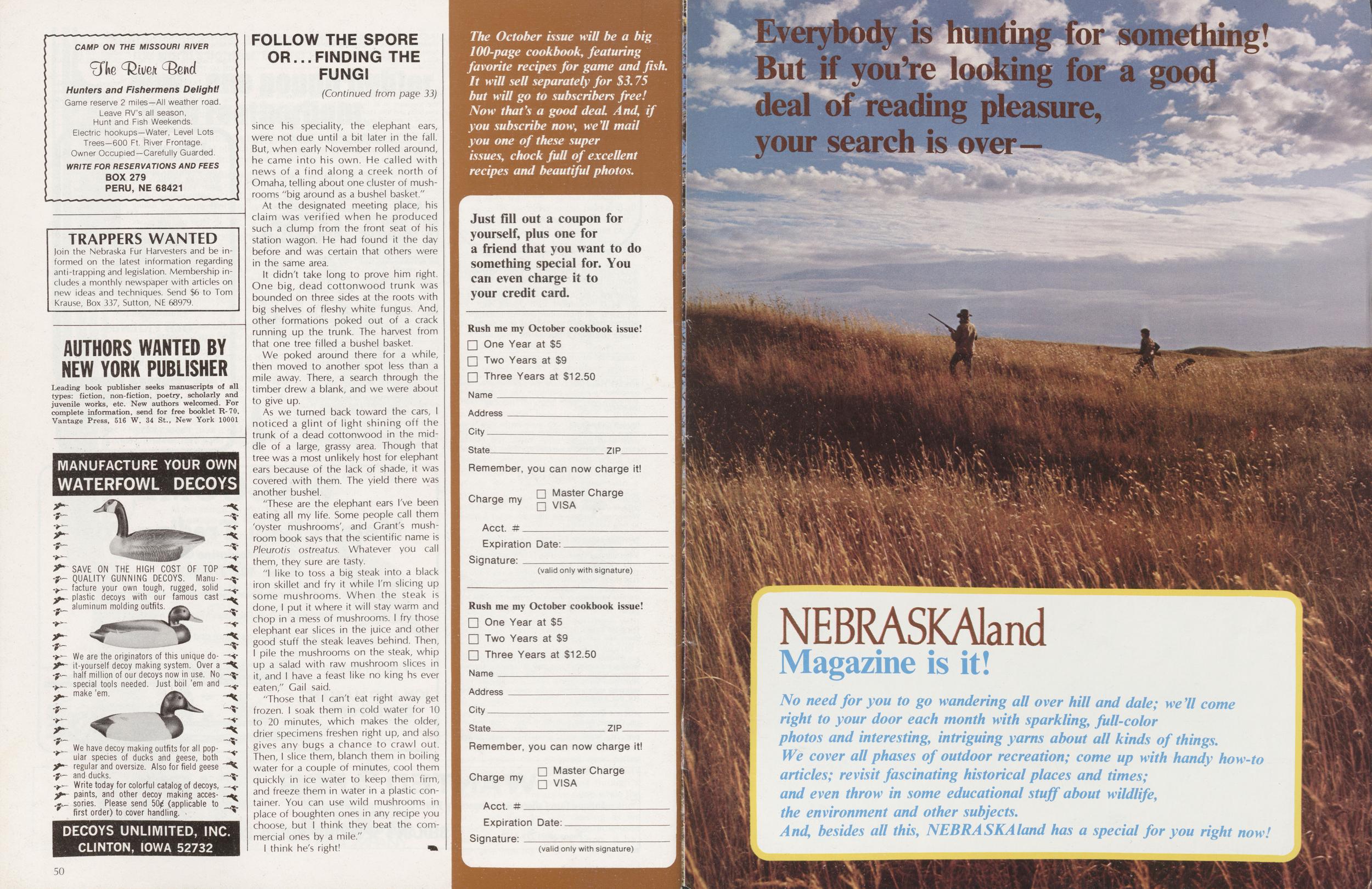
CAMP ON THE MISSOURI RIVER Hunters and Fishermens Delight!
Game reserve 2 miles—All weather road. Leave RV's all season, Hunt and Fish Weekends. Electric hookups—Water, Level Lots Trees—600 Ft. River Frontage. Owner Occupied—Carefully Guarded. WRITE FOR RESERVATIONS AND FEES BOX 279 PERU, NE 68421TRAPPERS WANTED
Join the Nebraska Fur Harvesters and be informed on the latest information regarding anti-trapping and legislation. Membership includes a monthly newspaper with articles on new ideas and techniques. Send $6 to Tom Krause, Box 337, Sutton, NE 68979.AUTHORS WANTED BY NEW YORK PUBLISHER
Leading book publisher seeks manuscripts of all types: fiction, non-fiction, poetry, scholarly and juvenile works, etc. New authors welcomed. For complete information, send for free booklet R-70. Vantage Press, 516 W. 34 St., New York 10001MANUFACTURE YOUR OWN WATERFOWL DECOYS
FOLLOW THE SPORE OR...FINDING THE FUNGI
(Continued from page 33)since his speciality, the elephant ears, were not due until a bit later in the fall. But, when early November rolled around, he came into his own. He called with news of a find along a creek north of Omaha, telling about one cluster of mushrooms "big around as a bushel basket."
At the designated meeting place, his claim was verified when he produced such a clump from the front seat of his station wagon. He had found it the day before and was certain that others were in the same area.
It didn't take long to prove him right. One big, dead cottonwood trunk was bounded on three sides at the roots with big shelves of fleshy white fungus. And, other formations poked out of a crack running up the trunk. The harvest from that one tree filled a bushel basket.
We poked around there for a while, then moved to another spot less than a mile away. There, a search through the timber drew a blank, and we were about to give up.
As we turned back toward the cars, I noticed a glint of light shining off the trunk of a dead cottonwood in the middle of a large, grassy area. Though that tree was a most unlikely host for elephant ears because of the lack of shade, it was covered with them. The yield there was another bushel.
"These are the elephant ears I've been eating all my life. Some people call them 'oyster mushrooms', and Grant's mushroom book says that the scientific name is Pleurotis ostreatus. Whatever you call them, they sure are tasty.
"I like to toss a big steak into a black iron skillet and fry it while I'm slicing up some mushrooms. When the steak is done, I put it where it will stay warm and chop in a mess of mushrooms. I fry those elephant ear slices in the juice and other good stuff the steak leaves behind. Then, I pile the mushrooms on the steak, whip up a salad with raw mushroom slices in it, and I have a feast like no king hs ever eaten," Gail said.
"Those that I can't eat right away get frozen. I soak them in cold water for 10 to 20 minutes, which makes the older, drier specimens freshen right up, and also gives any bugs a chance to crawl out. Then, I slice them, blanch them in boiling water for a couple of minutes, cool them quickly in ice water to keep them firm, and freeze them in water in a plastic container. You can use wild mushrooms in place of boughten ones in any recipe you choose, but I think they beat the commercial ones by a mile."
I think he's right!
50NEBRASKAland
Magazine is it!
No need for you to go wandering all over hill and dale; we'll come right to your door each month with sparkling, full-color photos and interesting, intriguing yarns about all kinds of things. We cover all phases of outdoor recreation; come up with handy how-to articles; revisit fascinating historical places and times; and even throw in some educational stuff about wildlife, the environment and other subjects. And, besides all this, NEBRASKAland has a special for you right now! Everybody is junting for something But if you're looking for a good deal of reading pleasure, your search is over--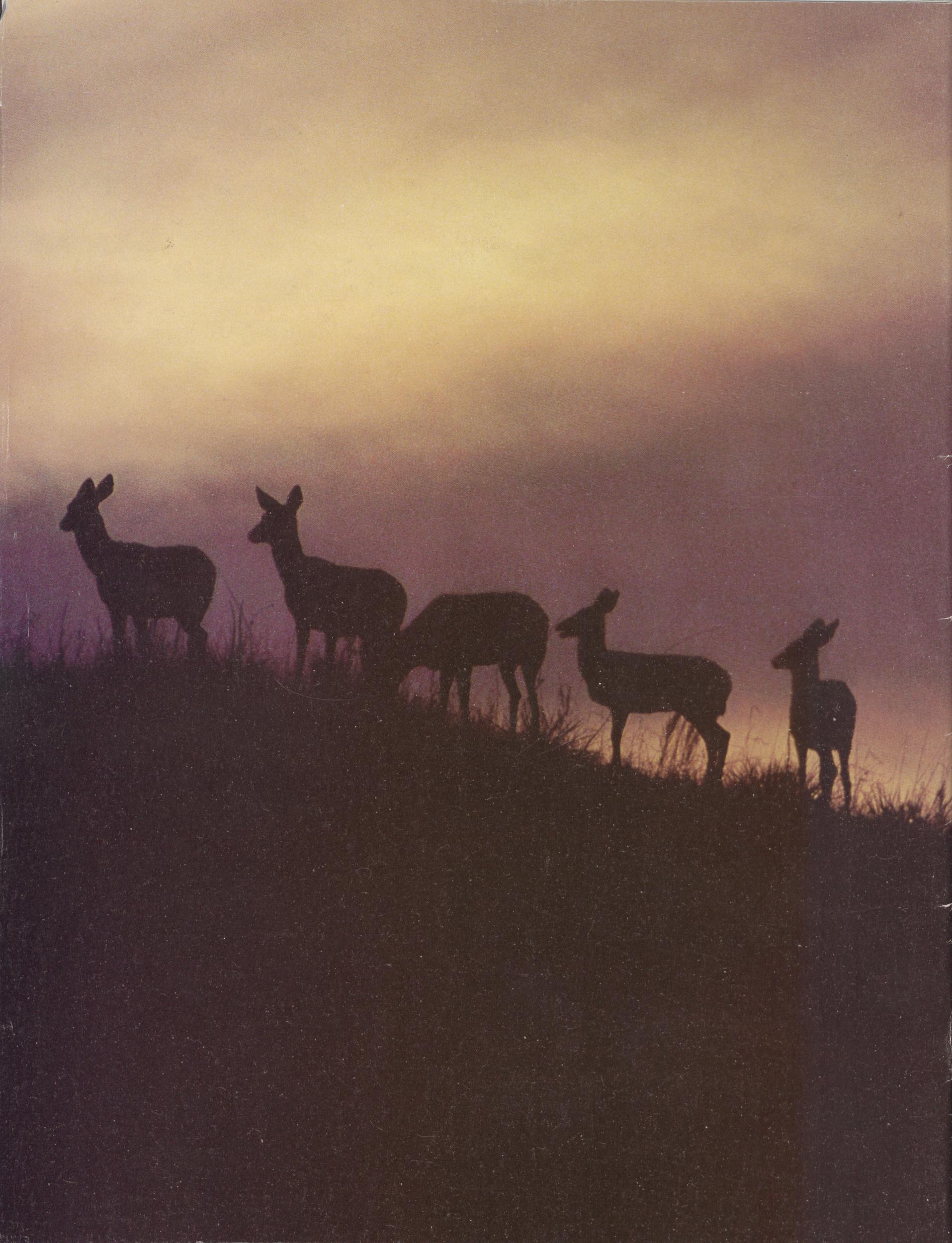
Position: 584 (19 views)