Volume 56, Issue 8, 1978
NEBRASKAland
August 1978 60 Cents
NEBRASKAland
Published by the Nebraska Game and Parks Commission
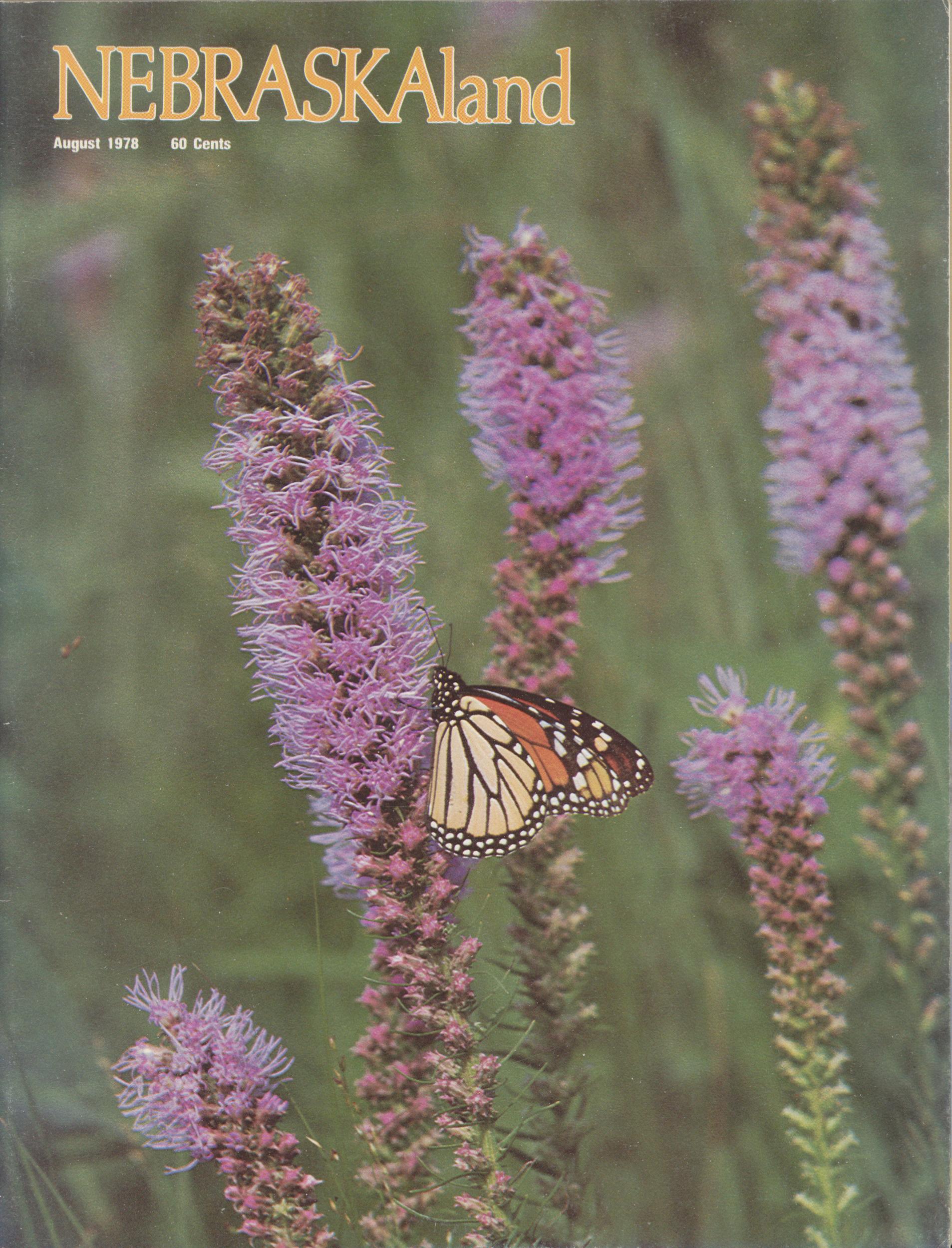
VOL. 56 / NO. 8 / AUGUST 1978 offices Headquarters and District V: 2200 N. 33rd, Lincoln, 68503. (402) 464-0641 District I: Rt. 2, Alliance. (308) 762-5605 District II: Bassett. (402) 684-3511 District III: U.S. 81 (north) Norfolk. (402) 371-4950 District IV: Rt. 4, North Platte. (308) 532-6225 Omaha office: 7363 Pacific St. (402) 554-2144 staff Chief, Information & Education: W. Rex Amack Editor: Lowell Johnson Senior Editor: Jon Farrar Editorial Assistants: Ken Bouc, Bill McClurg Field Editors: Bob Grier, Faye Musil, I Rocky Hoffmann, Butch Isom Art Director: Michele Angle Farrar Illustration: Duane Westerholt Advertising: Cliff Griffin Circulation: Juanita Stefkovich board of commissioners Chairman: William G. Lindeken, Chadron Vice Chairman: Gerald R. (Bud) Campbell, Ravenna 2nd Vice Chairman: H.B. (Tod) Kuntzelman, North Platte Richard W. Nisley, Roca Robert G. Cunningham, Omaha Shirley L. Meckel, Burwell Dr. Bruce Cowgill, Silver Creek Director: Eugene T. Mahoney Assistant Director: William J. Bailey, Jr. Assistant Director: Dale R. Bree Published monthly by the Nebraska Game and Parks Commission. Sixty cents per copy. Subscription rates $5 for one year, $9 for two years. Send subscription orders to NEBRASKAland, Box 30370, Lincoln, Nebraska 68503. Contents FEATURES A PARK FOR THE PEOPLE...PONCA.................8 DOVES ARE THE ANSWER.........................18 CROOKED HAND THE WARRIOR.....................20 A BIRD IN THE HAND...........................22 EVERYTHING BUT STRIPERS......................26 FISHING UPDATE...WALGREN LAKE................30 FISHING UPDATE...ELWOOD RESERVOIR............32 WHIPSAW......................................34 WHISKER'S FLEA CIRCUS........................36 NOTES ON NEBRASKA FAUNA/GRAY TREEFROG........50 DEPARTMENTS SPEAK UP......................................4 TRADING POST.................................49 COVER: Attracting butterflies as well as the eyes of passersby, the tall gayfeather is a remnant of the tail-grass prairie, and is now found blooming in July and August along roads and railroads. Attempts are being made to domesticate it for roadside planting. Photo by Jon Farrar. OPPOSITE: Most Nebraskans enjoy an outing in the great outdoors during a summer weekend, and this girl is no exception. She and a small friend are shown during a short walk while visiting at Burchard Lake State Special Use Area in southeast Nebraska, a popular fishing and picnicking spot. Photo by Jack Curran. Copyright Nebraska Game and Parks Commission 1978. All rights reserved. Postmaster: if undeliverable, send notice by form 3579 to Nebraska Game and Parks Commission, Box 30370, Lincoln, Nebraska 68503. Second class postage paid at Lincoln, Nebraska AUGUST 1978 3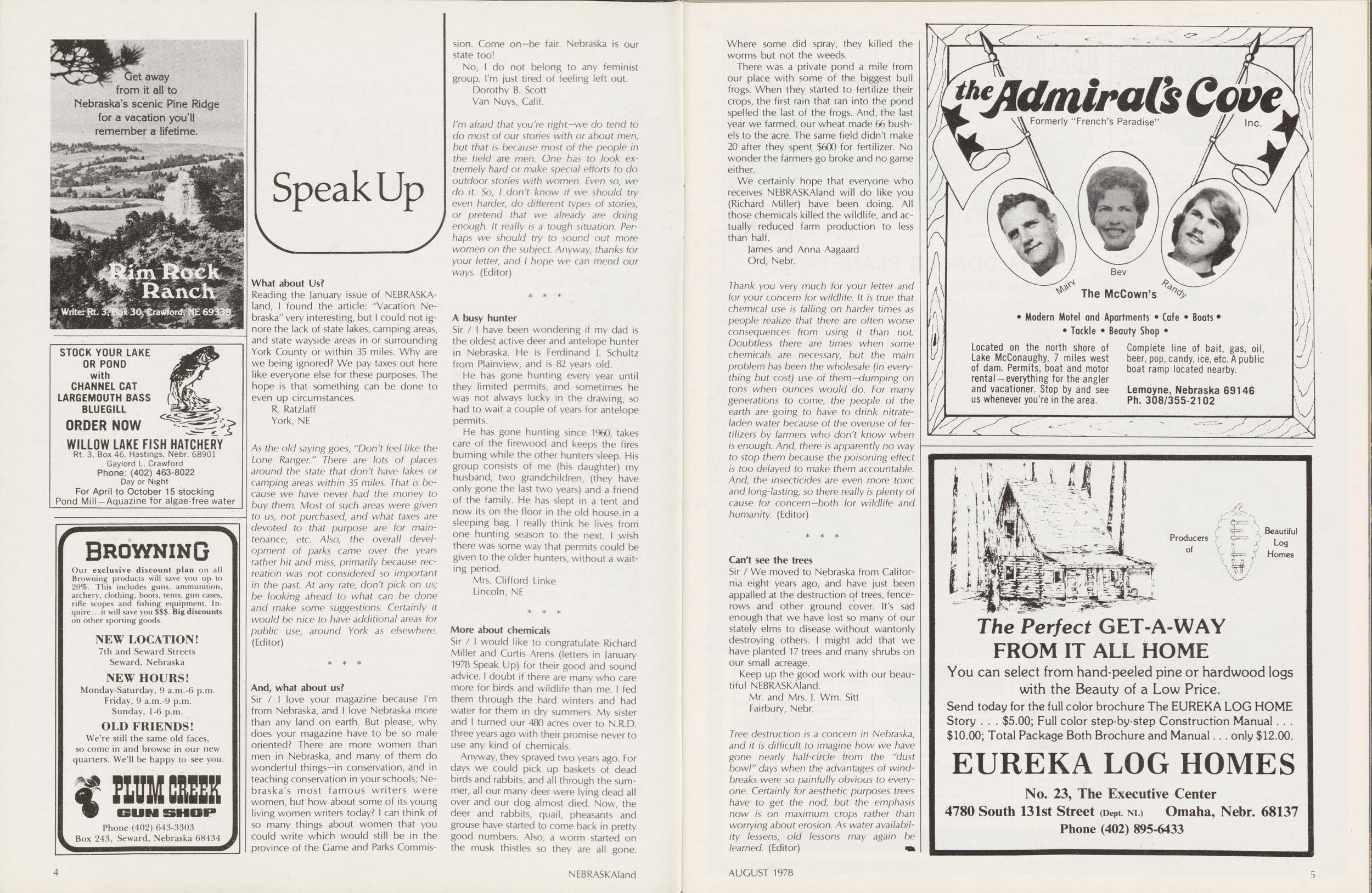
Speak Up
What about Us?Reading the January issue of NEBRASKAland, I found the article: Vacation Nebraska" very interesting, but I could nnot ignore the lack of state lakes, camping areas, and state waysiide areas in or surrounding York County or within 35 miles. Why are we being ignored? We pay taxes out here like everyone else for these purposes. The hope is that something can be done to even up circumstances.
R. Ratzlaff York, NEAs the old saying goes, "Don't fell like the Lone Ranger." There are lots of places around the state that don't have lakes or camping areas within 35 miles. That is because we have never had the money to buy them. Most of such areas were given to us, not purchased, and what taxes are devoted to that purpose are for maintenance, etc. Also, the overall development of parks came over the years rather hit and miss, primarily beacause recreation was not considered so important in the past. At any rate, don't pick on us; be looking ahead to what can be done and make some suggestions. Certainly it would be nice to have additional areas for public use, around York as elsewhere. (Editor)
And, what about us?Sir / I love your magazine because I'm from Nebraska, and I love Nebraska more than any land on earth. But please, why does your magazine have to be so male oriented? There are more women than men in Nebraska, and many of them do wonderful things-in conservation, and in teaching conservation in your schools; Nebraska's most famous writers were women, but how about some of its young living women writers today? I can think of so many things about women that you could write which would still be in the province of the Games and Parks Commission. Come on-be fair. Nebraska is our state too!
No, I do not belong to any feminist group. I'm just tired of feeling left out.
Dorothy B. Scoot Van Nuys, Calif.I'm afraid that you're right-we do tend to do most of our stories with or about men, but that is because most of the people in the field are men. One has to look extremely hard or make special efforts to do outdoor stories with women. Even so, we do it. So, I don't know if we should try even harder, do different types of stories, or pretend that we already are doing enough. It really is a tough situation. Perhaps we should try to sound out more women on the subject. Anyway, thanks for your letter, and I hope we can mend our ways. (Editor)
A busy hunterSir / I have been wondering if my dad is the oldest active deer and antelope hunter in Nebraska. He is Ferdinand J. Schults from Plainview, and is 82 years old.
He has gone hunting every year until they limited permits, and sometimes he was not always lucky in the drawing, so had to wait a couple of years for antelope permits.
He has gone hunting since 1960, takes care of the firewood and keeps the fires burning while the other hunters sleep. His group consists of me (his daughter) my husband, two grandchildren, (they have only gone the last two years) and a friend of the family. He has slept in a tent and now its on the floor in the old house in a sleeping bag. I really think he lives from one hunting season to the next. I wish there was some way that permits could be given to the older hunters, without a waiting period.
Mrs. Clifford Linke Lincoln, NE More about chemicalsSir / I would like to congratulate Richard Miller and Curtis Arens (letters in January 1978 Speak Up) for their good and sound advice. I doubt if there are many who care more for birds and wildlife than me. I fed them through the hard winters and had water for them in dry summers. My sister and I turned our 480 acres over to N.R.D. three years ago with their promise never to use any kind of chemicals.
Anyway, they sprayed two years ago. For days we could pick up baskets of dead birds and rabbits, and all through the summer, all our many deer were lying dead all over and our dog almost died. Now, the deer and rabbits, quail, pheasants and grouse have started to come back in pretty good numbers. Also, a worm started on the musk thistles so they are all gone. 4 NEBRASKAland Where some did spray, they killed the worms but not the weeds.
There was a private pond a mile from our plave with some of the biggest bull frogs. When they started to fertilize their crops, the first rain that ran into the pond spelled the last of the frogs. And, the last year we farmed, our wheat made 66-bushels to the acre. The same field didn't make 2- after they spent $600 for fertillizer. No wonder the farmers go broke and no game eiither
We certainly hope that everyone who recieves NEBRASKAland willl do like you (Richard Miller) have been doing. All those chemicals killd the wildllife, and actually reduced farm production to less than half.
James and Anna Aagaard Ord, Nebr.Thank you very much for your letter and for your concern for wildlife. It is true that chemical use is failling on harder times as people realize that ther eare often worse consequences from using it than not. Doubtless there are times when some chemicals are necessary, but the main problem has been the wholesale (in everything but cost) use of them-dumping on tons when ounces would do. For many generations to come, the people of the earth are going to have to drink nitrateladen water becuase of the overuse of fertilizers by farmers who don't know when is enough. And, there is apparently no way to stop them because the poisoning effect is too delayed to make them accountable. And, the insecticides are even more toxic and long-lasting, so there really is plenty of cause for concern-both for wildlife and humanity. (Editor)
Can't see the treesSir / We moved to Nebraska from California eight years ago, and have just been appalled at the destruction of trees, fencerows and other ground cover. It's sad enough that we have lost so many of our stetely elms to disease without wantonly destroying others. I might add that we have planted 17 trees and many shrubs on our small acreage.
Keep up the good work with our beautiful NEBRASKAland.
Mr. and Mrs. J. Wm. Sitt Fairbury, NebrTree destruction is a concern in Nebraska, and it is difficult to imagine how we have gone nearly half-circle from the "dust bowl" days when the advantages of windbreaks were so painfully obvious to everyone. Certainly for aesthetic purposes trees have to get the nod, but the emphasis now is on maximum crops rather than worrying about erosion. As water availability lessens, old lessons may again be learned. (Editor)
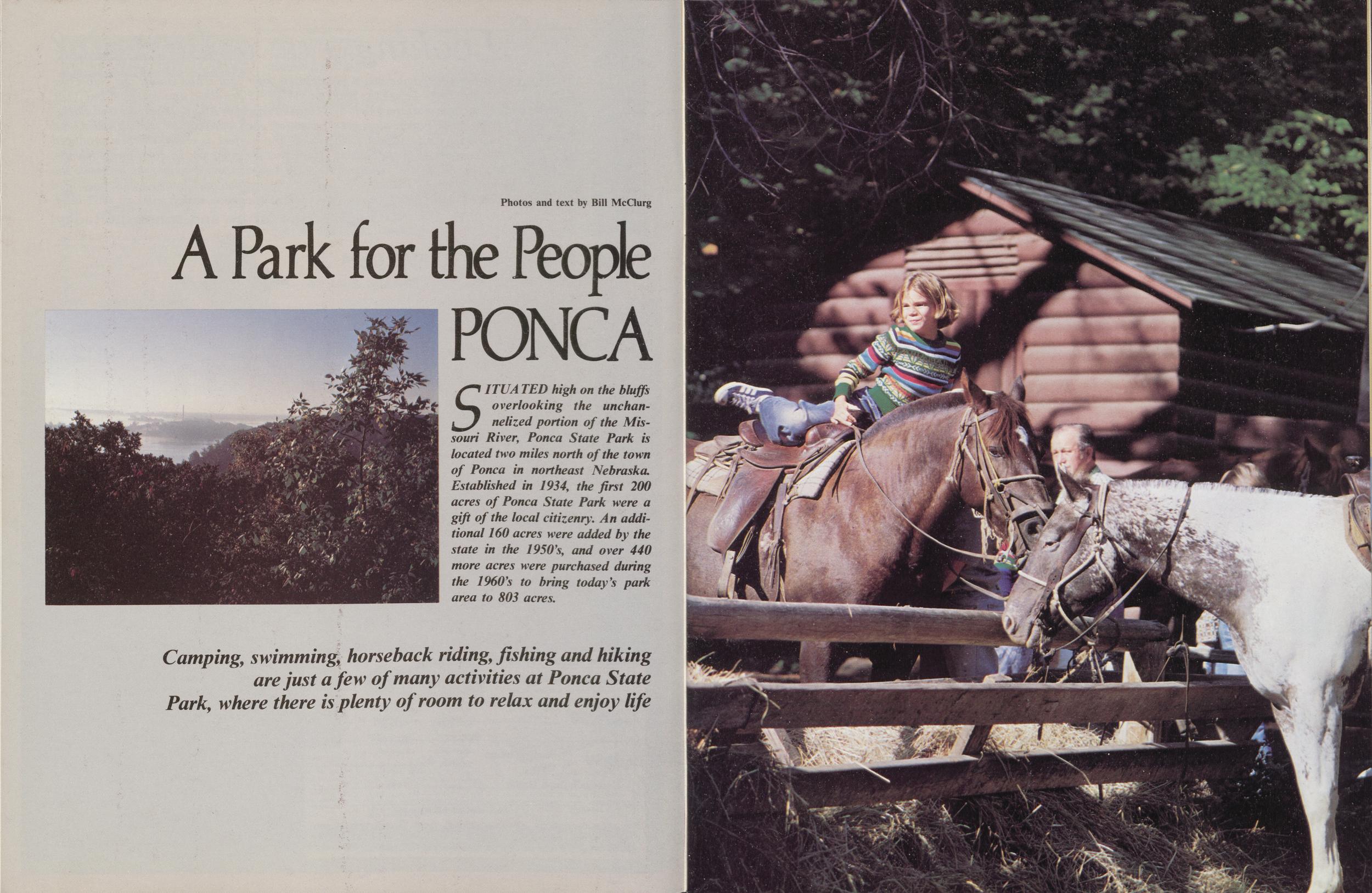
A Park for the People PONCA
SITUATED high on the bluffs overlooking the unchannelized portion of the Missouri River, Ponca State Park is located two miles north of the town of Ponca in northeast Nebraska. Established in 1934, the first 200 acres of Ponca State Park were a gift of the local citizenry. An additional 160 acres were purchased during the 1960's to bring today's park area to 803 acres.
Camping, swimming, horseback riding, fishing and hiking are just a few of many activities at Ponca State Park, where there is plenty of room to relax and enjoy life956_08/nela.1978)956_08_010_011.jpg)
The park, while not the largest in the state, is perhaps the heaviest used of the five major state parks, but one seldom feels crowded at Ponca. A 10-mile system of all-weather asphalt roads laces the park, yet you can walk for several miles before crossing one of the roads. In the winter and early spring, the roads are readily apparent, but a heavy canopy of foliage shields them from view during the remainder of the year.
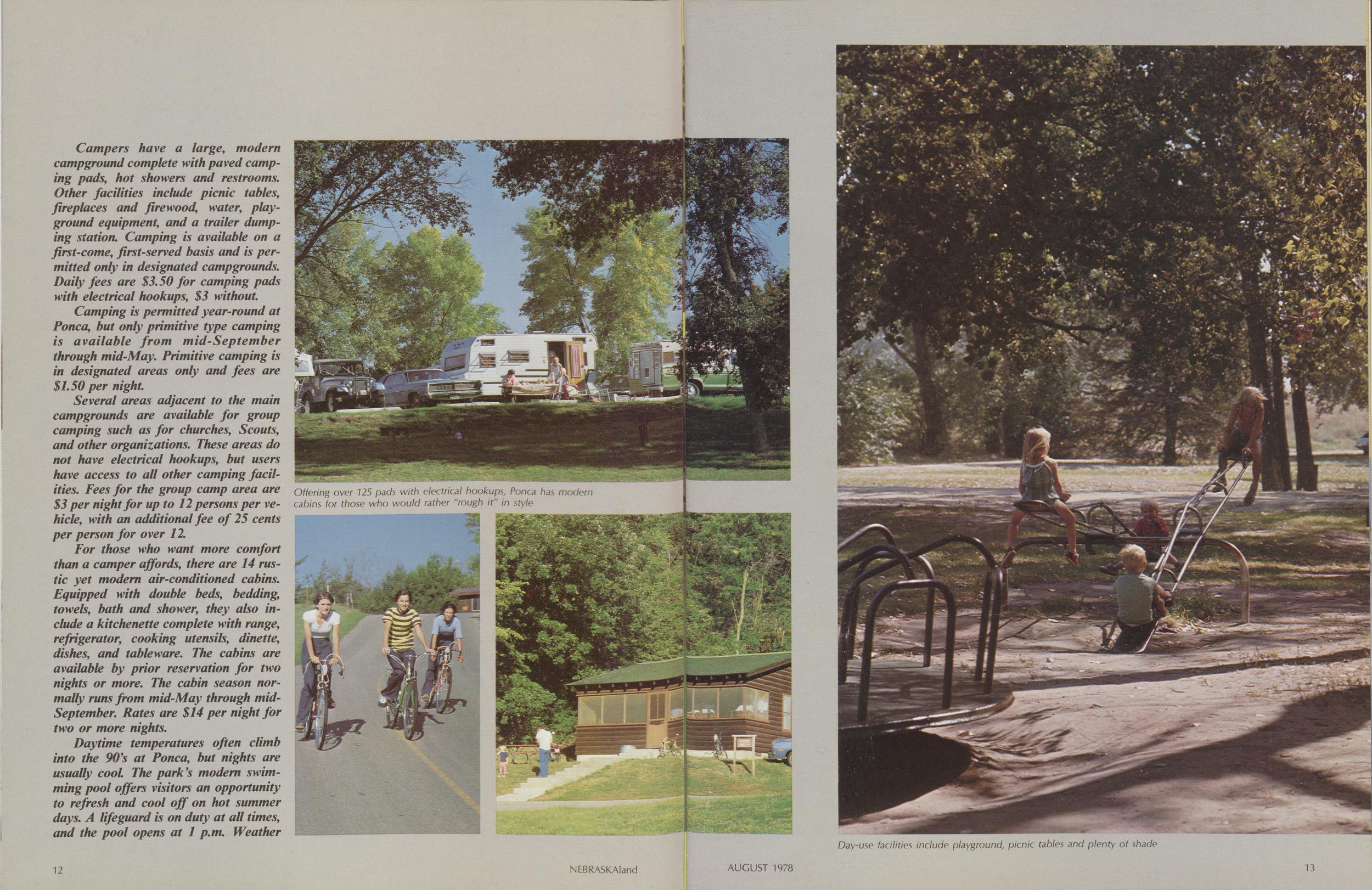
Campers have a large, modern campground complete with paved camping pads, hot showers and restrooms. Other facilities include picnic tables, fireplaces and firewood, water, playground equipment, and a trailer dumping station. Camping is available on a first-come, first-served basis and is permitted only in designated campgrounds. Daily fees are $3.50 for camping pads with electrical hookups, $3 without
Camping is permitted year-round at Ponca, but only primitive type camping is available from mid-September through mid-May. Primitive camping is in designated areas only and fees are $1.50 per night.
Several areas adjacent to the main campgrounds are available for group camping such as for churches, Scouts, and other organizations. These areas do not have electrical hookups, but users have acess to all other facilities. Fees for the group camp area are $3 per night for up to 12 persons per vehicle, with an additional fee of 25 cents per person for over 12.
For those who want more comfort than a camper affords, ther are 14 rustic yet modern air-conditioned cabins. Equipped with double beds, bedding, towels, bath and shower, they also include a kitchenette complete with range, refrigerator, cooking utensils, dinette, dishes, and tableware. The cabins are available by prior reservation for two nights or more. The cabin season normally runs from mid-May through mid-September. Rates are $14 per night for two or more nights.
Daytime temperatures often climb into the 90's at Ponca, but nights are usually cool. The park's modern swimming pool offers visitors and opportunity to refresh and cool off on hot summer days. A lifeguard is on duty at all times, and the pool opens at 1 p.m. Weather
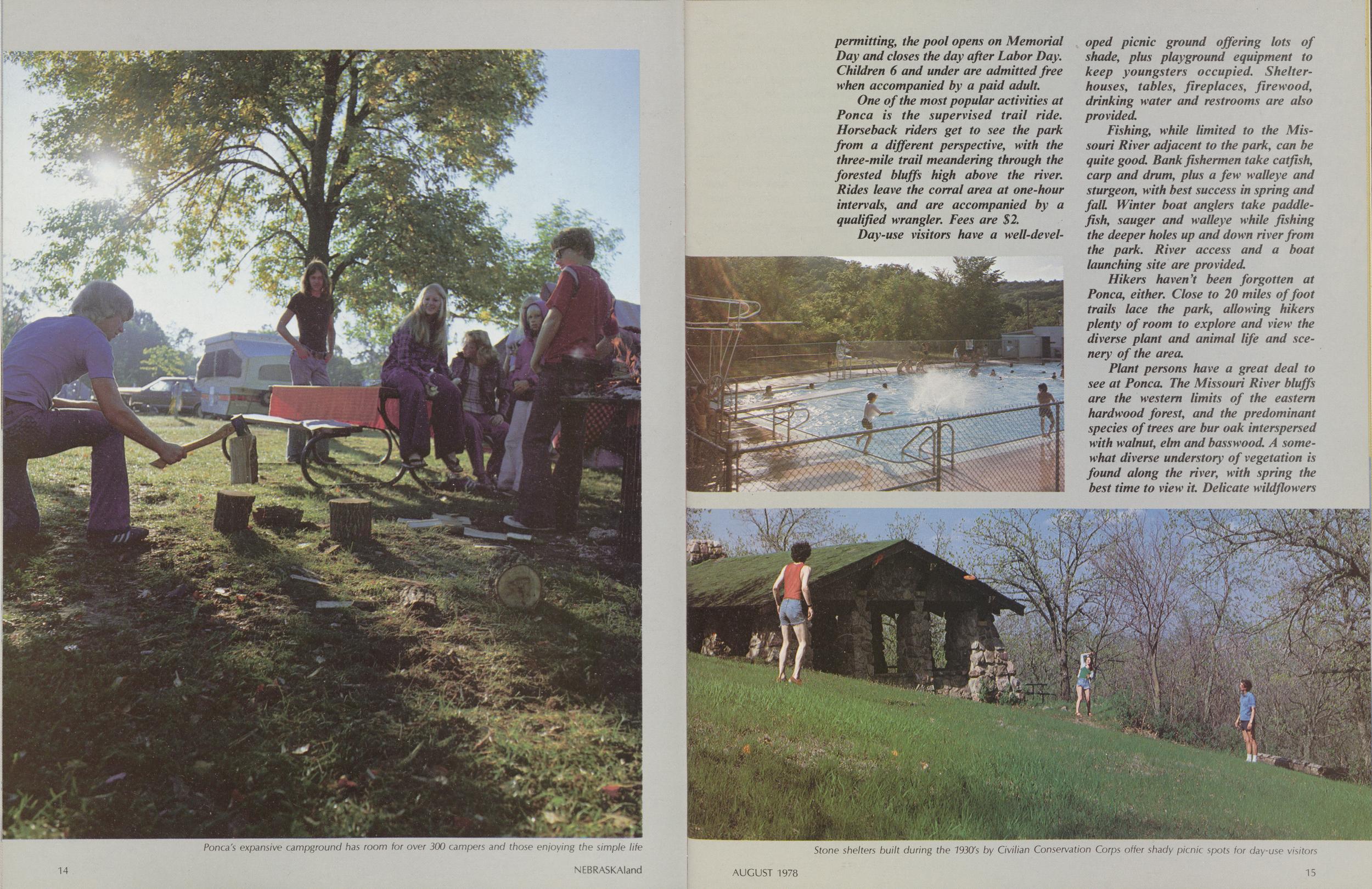
One of the most popular activities at Ponca is the supervised trail ride. Horseback riders get to see the park from a different perspective, with the three-mile trail meandering through the forested bluffs high above the river. Rides leave the corral area at one-hour intervals, and are accompanied by a qualified wrangler. Fees are $2.
Day-use visitors have a well-developed picnic ground offering lots of shade, plus playground equipment to keep youngsters occupied. Shelterhouses, tables, fireplaces, firewood, drinking water and restrooms are also provided.
Fishing, while limited to the Missouri River adjacent to the park, can be quite good. Bank fishermen take catfish, car and drum, plus a few walleye and sturgeon, with best success in spring and fall. Winter boat anglers take paddlefish, sauger and walleye while fishing the deeper holes up and down river from the park. River access and a boat launching site are provided.
Hikers haven't been forgotten at Ponca, either. Close to 20 miles of foot trails lace the park, allowing hikers plenty of room to explore and view the diverse plant and animal life and scenery of the area.
Plant persons have a great deal to see at Ponca. The Missouri River bluffs are the western limits of the eastern hardwood forest, and the predominant species of trees are bur oak interspersed with walnut, elm and basswood. A somewhat diverse understory of vegetation is found along the river, with spring the best time to view it. Delicate wildflowers
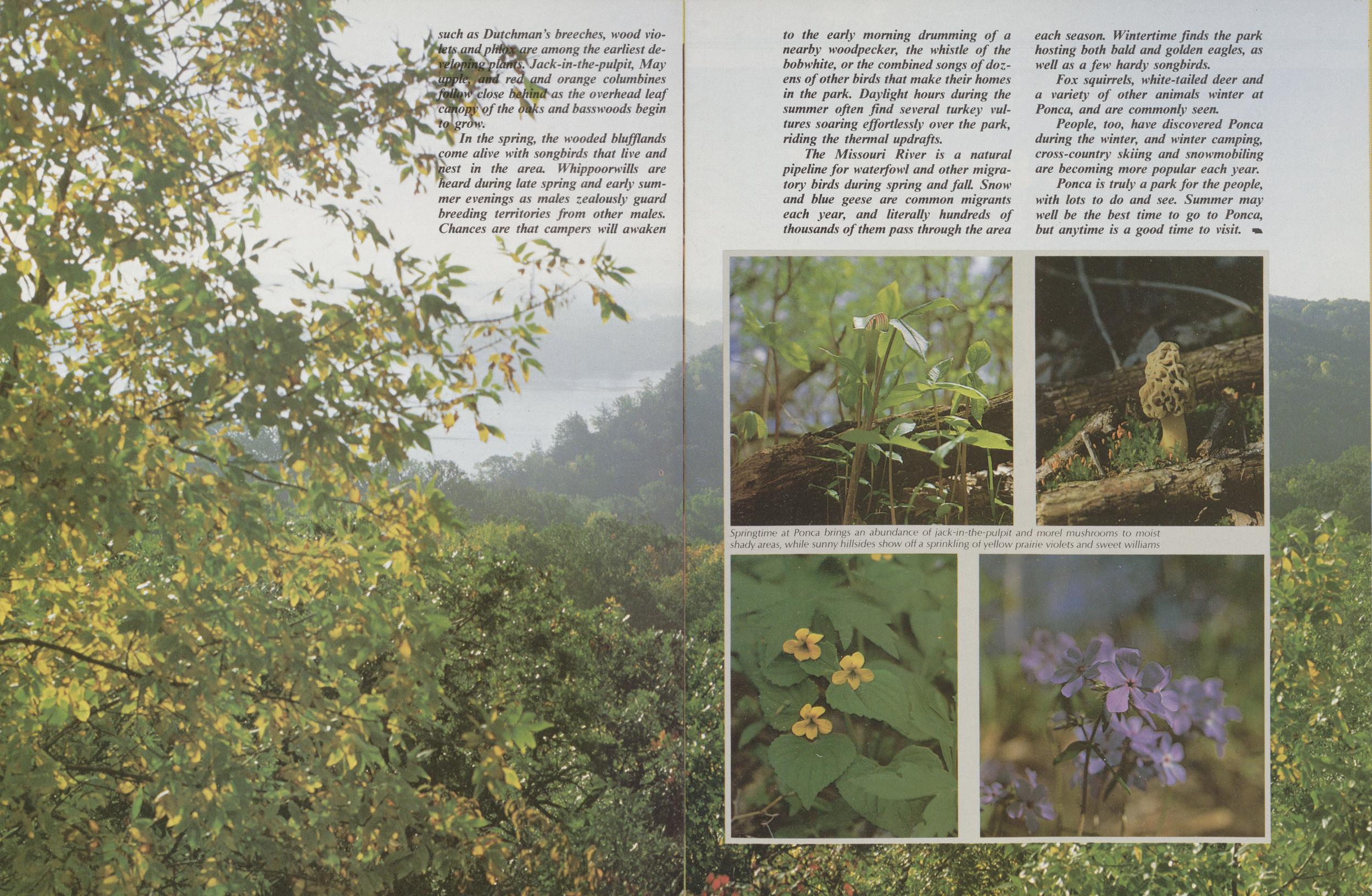
In the spring, the wooded blufflands come alive with songbirds that live and nest in the area. Whippoorwills are heard during late spring and early summer evenings as males zealously guard breeding territories from other males. Chances are that campers will awaken to the early morning drumming of a nearby woodpecker, the whistle of the bobwhite, or the combined songs of dozens of other birds that make their homes in the park. Daylight hours during the summer often find several turkey vultures soaring effortlessly over the park, riding the thermal updrafts.
The Missouri River is a natural pipeline for waterfowl and other migratory birds during spring and fall Snow and blue geese are common migrants each year, and literally hundreds of thousands of them pass through the area each season. Wintertime finds the park hosting both bald and golden eagles, as well as a few hardy songbirds.
Fox squirrels, white-tailed deer and a variety of other animals winter at Ponca, and are commonly seen.
People, too, have discovered Ponca during the winter, and winter camping, cross-country skiing and snowmobiling are becoming more popular each year.
Ponca is truly a park for the people, with lots to do and see. Summer may well be the best time to go to Ponca, but anytime is a good time to visit.
DOVES are the answer
Early, challenging hunt fills the bill for this old gunner, who was removed from the strenuous activity by an accident
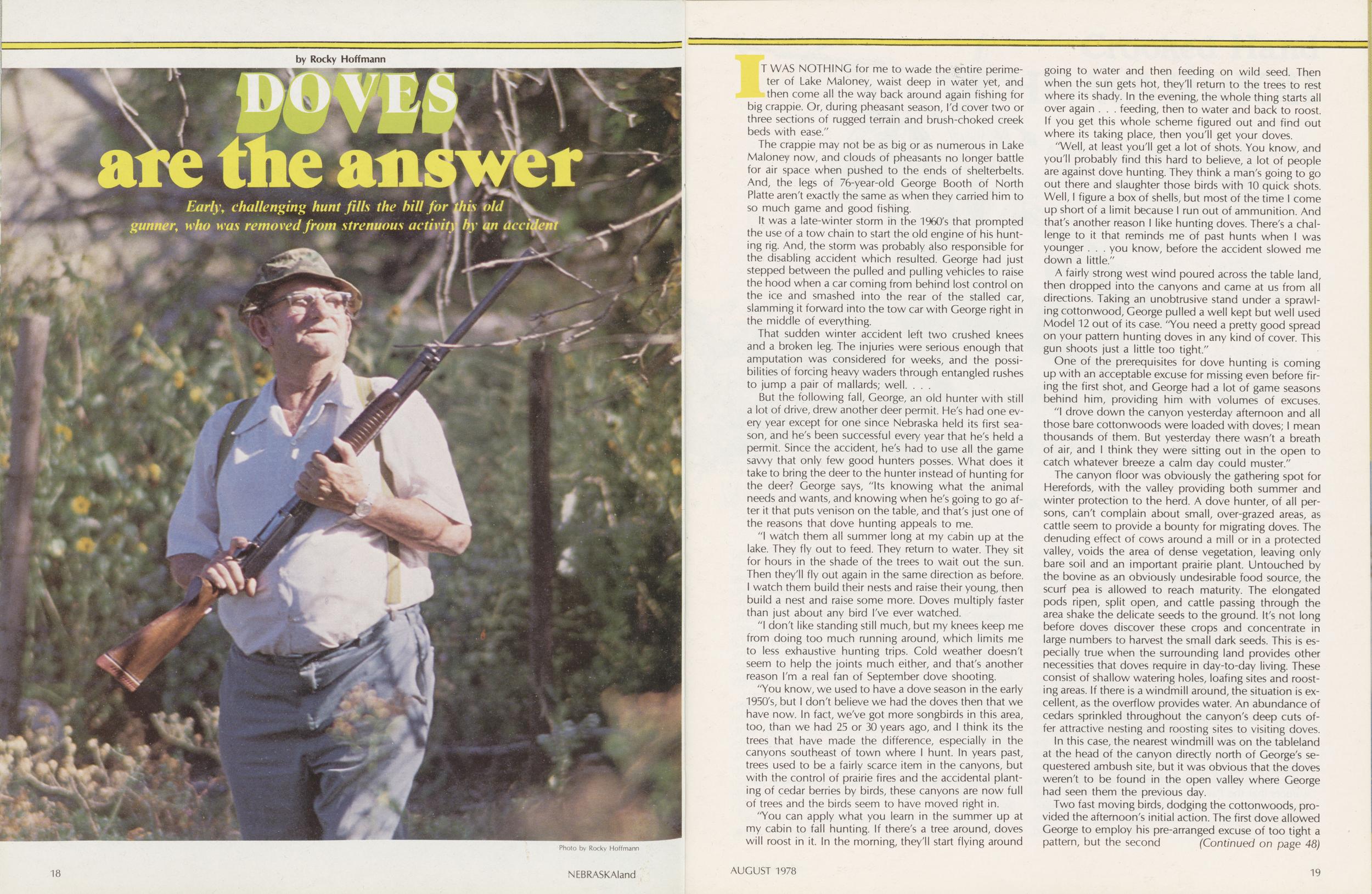
IT WAS NOTHING for me to wade the entire perimeter of Lake Maloney, waist deep in water yet, and then come all the way back around again fishing for big crappie. Or, during pheasant season, I'd cover two or three sections of rugged terrain and brush-choked creek beds with ease."
The crappie may not be as big or as numerous in Lake Maloney now, and clouds of pheasants no longer battle for air space when pushed to the ends of shelterbelts. And, the legs of 76-year-old George Booth of North Platte aren't exactly the same as when they carried him to so much game and good fishing.
It was a late-winter storm in the 1960's that prompted the use of a tow chain to start the old engine of his hunting rig. And, the storm was probably also responsible for the disabling accident which resulted. George had just stepped between the pulled and pulling vehicles to raise the hood when a car coming from behind lost control on the ice and smashed into the rear of the stalled car, slamming it forward into the tow car with George right in the middle of everything.
That sudden winter accident left two crushed knees and a broken leg. The injuries were serious enough that amputation was considered for weeks, and the possibilities of forcing heavy waders through entangled rushes to jump a pair of mallards; well. . . .
But the following fall, George, an old hunter with still a lot of drive, drew another deer permit. He's had one every year except for one since Nebraska held its first season, and he's been successful every year that he's held a permit. Since the accident, he's had to use all the game savvy that only few good hunters posses. What does it take to bring the deer to the hunter instead of hunting for the deer? George says, "Its knowing what the animal needs and wants, and knowing when he's going to go after it that puts venison on the table, and that's just one of the reasons that dove hunting appeals to me.
"I watch them all summer long at my cabin up at the lake. They fly out to feed. They return to water. They sit for hours in the shade of the trees to wait out the sun. Then they'll fly out again in the same direction as before. I watch them build their nests and raise their young, then build a nest and raise some more. Doves multiply faster than just about any bird I've ever watched.
"I don't like standing still much, but my knees keep me from doing too much running around, which limits me to less exhaustive hunting trips. Cold weather doesn't seem to help the joints much either, and that's another reason I'm a real fan of September dove shooting.
"You know, we used to have a dove season in the early 1950's, but I don't believe we had the doves then that we have now. In fact, we've got more songbirds in this area, too, than we had 25 or 30 years ago, and I think its the trees that have made the difference, especially in the canyons southeast of town where I hunt. In years past, trees used to be a fairly scarce item in the canyons, but with the control of prairie fires and the accidental planting of cedar berries by birds, these canyons are now full of trees and the birds seem to have moved right in.
"You can apply what you learn in the summer up at my cabin to fall hunting. If there's a tree around, doves will roost in it. In the morning, they'll start flying around going to water and then feeding on wild seed. Then when the sun gets hot, they'll return to the trees to rest where its shady. In the evening, the whole thing starts all over again . . . feeding, then to water and back to roost. If you get this whole scheme figured out and find out where its taking place, then you'll get your doves.
"Well, at least you'll get a lot of shots. You know, and you'll probably find this hard to believe, a lot of people are against dove hunting. They think a man's going to go out there and slaughter those birds with 10 quick shots. Well, I figure a box of shells, but most of the time I come up short of a limit because I run out of ammunition. And that's another reason I like hunting doves. There's a challenge to it that reminds me of past hunts when I was younger . . . you know, before the accident slowed me down a little."
A fairly strong west wind poured across the table land, then dropped into the canyons and came at us from all directions. Taking an unobtrusive stand under a sprawling cottonwood, George pulled a well kept but well used Model 12 out of its case. "You need a pretty good spread on your pattern hunting doves in any kind of cover. This gun shoots just a little too tight."
One of the prerequisites for dove hunting is coming up with an acceptable excuse for missing even before firing the first shot, and George had a lot of game seasons behind him, providing him with volumes of excuses.
"I drove down the canyon yesterday afternoon and all those bare cottonwoods were loaded with doves; I mean thousands of them. But yesterday there wasn't a breath of air, and I think they were sitting out in the open to catch whatever breeze a calm day could muster."
The canyon floor was obviously the gathering spot for Herefords, with the valley providing both summer and winter protection to the herd. A dove hunter, of all persons, can't complain about small, over-grazed areas, as cattle seem to provide a bounty for migrating doves. The denuding effect of cows around a mill or in a protected valley, voids the area of dense vegetation, leaving only bare soil and an important prairie plant. Untouched by the bovine as an obviously undesirable food source, the scurf pea is allowed to reach maturity. The elongated pods ripen, split open, and cattle passing through the area shake the delicate seeds to the ground. It's not long before doves discover these crops and concentrate in large numbers to harvest the small dark seeds. This is especially true when the surrounding land provides other necessities that doves require in day-to-day living. These consist of shallow watering holes, loafing sites and roosting areas. If there is a windmill around, the situation is excellent, as the overflow provides water. An abundance of cedars sprinkled throughout the canyon's deep cuts offer attractive nesting and roosting sites to visiting doves.
In this case, the nearest windmill was on the tableland at the head of the canyon directly north of George's sequestered ambush site, but it was obvious that the doves weren't to be found in the open valley where George had seen them the previous day.
Two fast moving birds, dodging the cottonwoods, provided the afternoon's initial action. The first dove allowed George to employ his pre-arranged excuse of too tight a pattern, but the second
(Continued on page 48) 18 NEBRASKAIand AUGUST 1978 19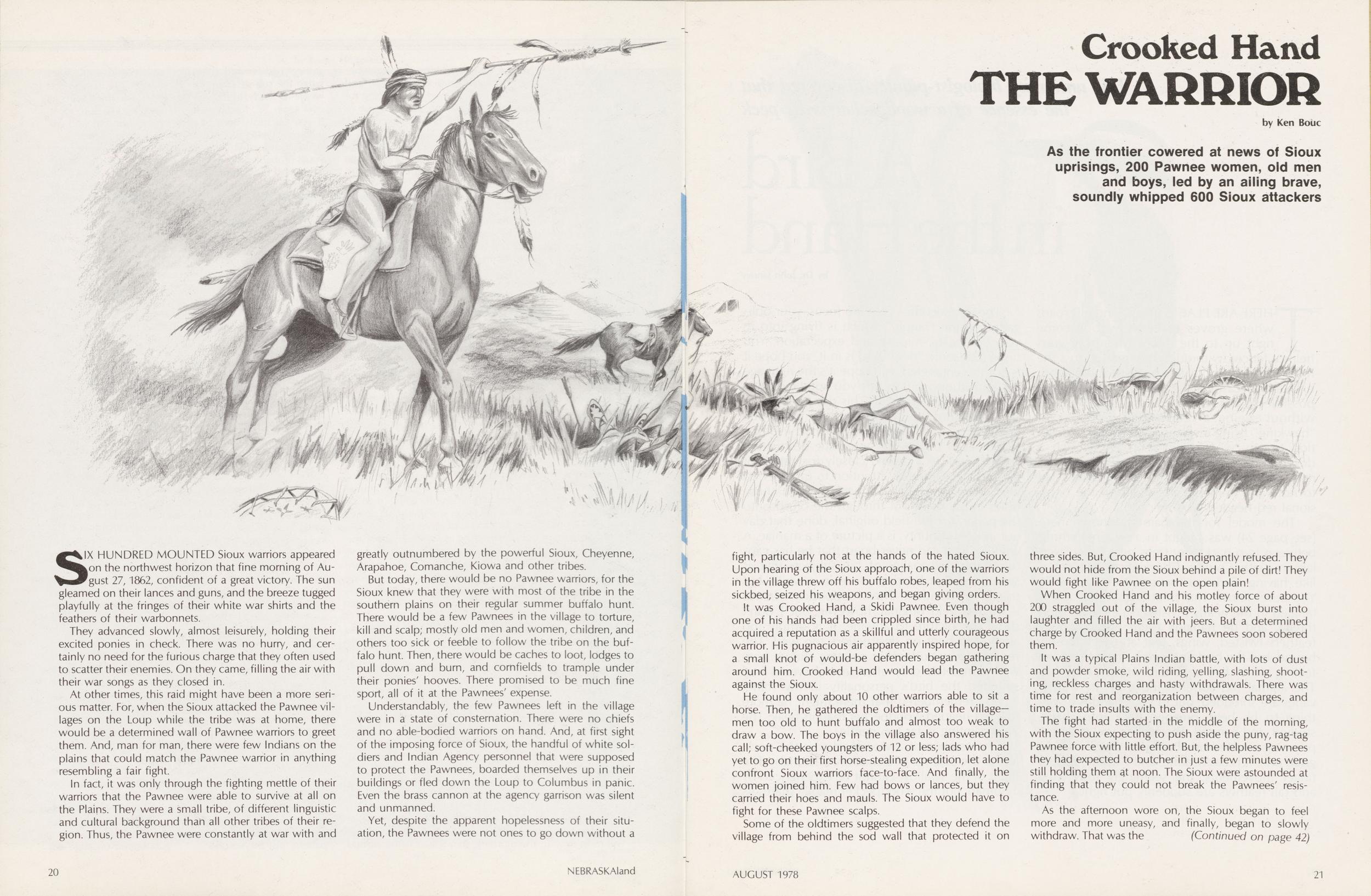
Crooked Hand THE WARRIOR
As the frontier cowered at news of Sioux uprisings, 200 Pawnee women, old men and boys, led by an ailing brave, soundly whipped 600 Sioux attackers
SIX HUNDRED MOUNTED Sioux warriors appeared kon the northwest horizon that fine morning of August 27,1862, confident of a great victory. The sun gleamed on their lances and guns, and the breeze tugged playfully at the fringes of their white war shirts and the feathers of their warbonnets.
They advanced slowly, almost leisurely, holding their excited ponies in check. There was no hurry, and certainly no need for the furious charge that they often used to scatter their enemies. On they came, filling the air with their war songs as they closed in.
At other times, this raid might have been a more serious matter. For, when the Sioux attacked the Pawnee villages on the Loup while the tribe was at home, there would be a determined wall of Pawnee warriors to greet them. And, man for man, there were few Indians on the plains that could match the Pawnee warrior in anything resembling a fair fight.
In fact, it was only through the fighting mettle of their warriors that the Pawnee were able to survive at all on the Plains. They were a small tribe, of different linguistic and cultural background than all other tribes of their region. Thus, the Pawnee were constantly at war with and greatly outnumbered by the powerful Sioux, Cheyenne, Arapahoe, Comanche, Kiowa and other tribes.
But today, there would be no Pawnee warriors, for the Sioux knew that they were with most of the tribe in the southern plains on their regular summer buffalo hunt. There would be a few Pawnees in the village to torture, kill and scalp; mostly old men and women, children, and others too sick or feeble to follow the tribe on the buffalo hunt. Then, there would be caches to loot, lodges to pull down and burn, and cornfields to trample under their ponies' hooves. There promised to be much fine sport, all of it at the Pawnees' expense.
Understandably, the few Pawnees left in the village were in a state of consternation. There were no chiefs and no able-bodied warriors on hand. And, at first sight of the imposing force of Sioux, the handful of white soldiers and Indian Agency personnel that were supposed to protect the Pawnees, boarded themselves up in their buildings or fled down the Loup to Columbus in panic. Even the brass cannon at the agency garrison was silent and unmanned.
Yet, despite the apparent hopelessness of their situation, the Pawnees were not ones to go down without a fight, particularly not at the hands of the hated Sioux. Upon hearing of the Sioux approach, one of the warriors in the village threw off his buffalo robes, leaped from his sickbed, seized his weapons, and began giving orders.
It was Crooked Hand, a Skidi Pawnee. Even though one of his hands had been crippled since birth, he had acquired a reputation as a skillful and utterly courageous warrior. His pugnacious air apparently inspired hope, for a small knot of would-be defenders began gathering around him. Crooked Hand would lead the Pawnee against the Sioux.
He found only about 10 other warriors able to sit a horse. Then, he gathered the oldtimers of the villagemen too old to hunt buffalo and almost too weak to draw a bow. The boys in the village also answered his call; soft-cheeked youngsters of 12 or less; lads who had yet to go on their first horse-stealing expedition, let alone confront Sioux warriors face-to-face. And finally, the women joined him. Few had bows or lances, but they carried their hoes and mauls. The Sioux would have to fight for these Pawnee scalps.
Some of the oldtimers suggested that they defend the village from behind the sod wall that protected it on three sides. But, Crooked Hand indignantly refused. They would not hide from the Sioux behind a pile of dirt! They would fight like Pawnee on the open plain!
When Crooked Hand and his motley force of about 200 straggled out of the village, the Sioux burst into laughter and filled the air with jeers. But a determined charge by Crooked Hand and the Pawnees soon sobered them.
It was a typical Plains Indian battle, with lots of dust and powder smoke, wild riding, yelling, slashing, shooting, reckless charges and hasty withdrawals. There was time for rest and reorganization between charges, and time to trade insults with the enemy.
The fight had started in the middle of the morning, with the Sioux expecting to push aside the puny, rag-tag Pawnee force with little effort. But, the helpless Pawnees they had expected to butcher in just a few minutes were still holding them at noon. The Sioux were astounded at finding that they could not break the Pawnees' resistance.
As the afternoon wore on, the Sioux began to feel more and more uneasy, and finally, began to slowly withdraw. That was the
(Continued on page 42) 20 NEBRASKAIand AUGUST 1978 21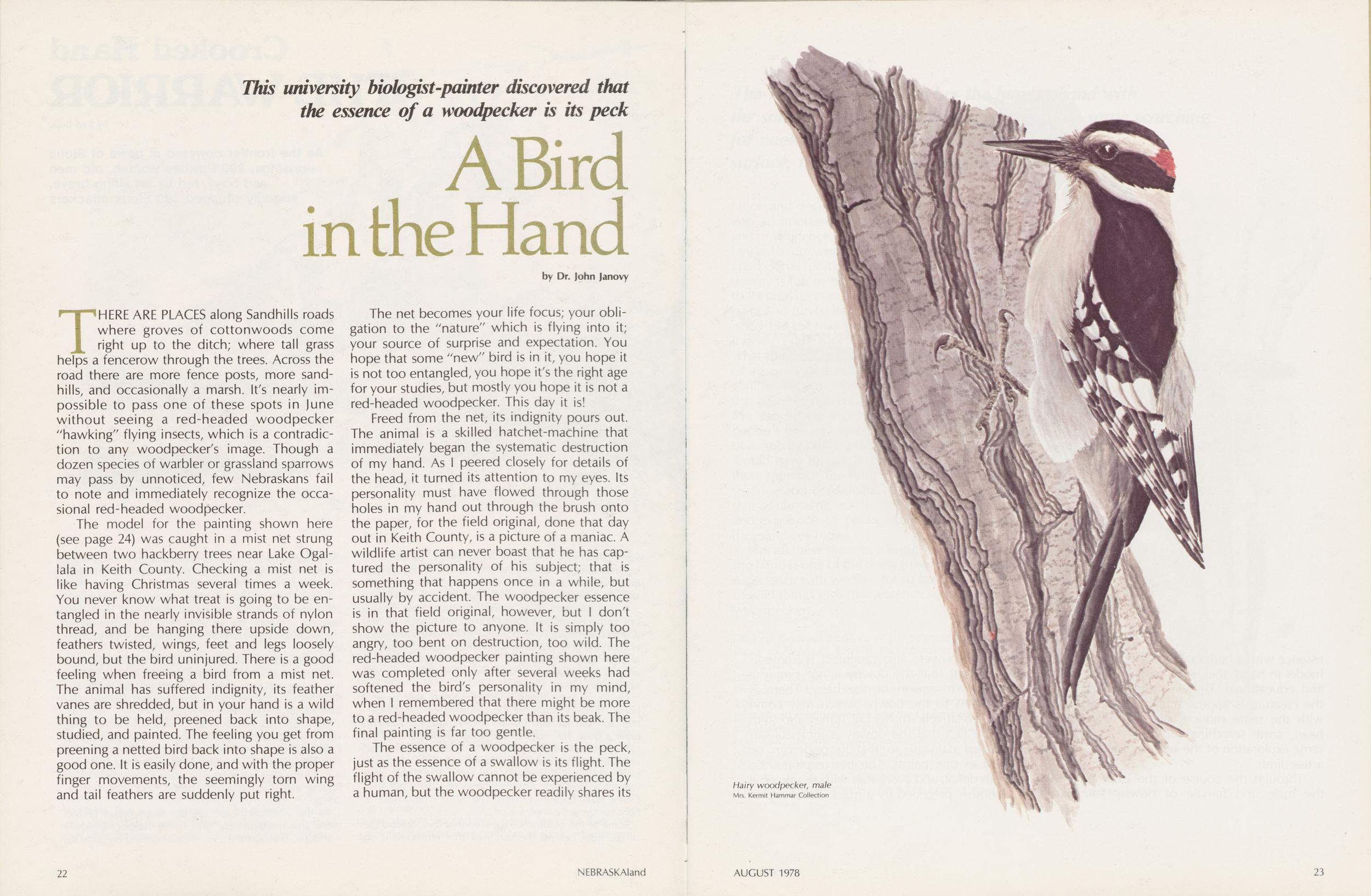
This university biologist-painter discovered that the essence of a woodpecker is its peck
A Bird in the Hand
THERE ARE PLACES along Sandhills roads where groves of cottonwoods come right up to the ditch; where tall grass helps a fencerow through the trees. Across the road there are more fence posts, more sandhills, and occasionally a marsh. It's nearly impossible to pass one of these spots in June without seeing a red-headed woodpecker "hawking" flying insects, which is a contradiction to any woodpecker's image. Though a dozen species of warbler or grassland sparrows may pass by unnoticed, few Nebraskans fail to note and immediately recognize the occasional red-headed woodpecker.
The model for the painting shown here (see page 24) was caught in a mist net strung between two hackberry trees near Lake Ogallala in Keith County. Checking a mist net is like having Christmas several times a week. You never know what treat is going to be entangled in the nearly invisible strands of nylon thread, and be hanging there upside down, feathers twisted, wings, feet and legs loosely bound, but the bird uninjured. There is a good feeling when freeing a bird from a mist net. The animal has suffered indignity, its feather vanes are shredded, but in your hand is a wild thing to be held, preened back into shape, studied, and painted. The feeling you get from preening a netted bird back into shape is also a good one. It is easily done, and with the proper finger movements, the seemingly torn wing and tail feathers are suddenly put right.
The net becomes your life focus; your obligation to the "nature" which is flying into it; your source of surprise and expectation. You hope that some "new" bird is in it, you hope it is not too entangled, you hope it's the right age for your studies, but mostly you hope it is not a red-headed woodpecker. This day it is!
Freed from the net, its indignity pours out. The animal is a skilled hatchet-machine that immediately began the systematic destruction of my hand. As I peered closely for details of the head, it turned its attention to my eyes. Its personality must have flowed through those holes in my hand out through the brush onto the paper, for the field original, done that day out in Keith County, is a picture of a maniac. A wildlife artist can never boast that he has captured the personality of his subject; that is something that happens once in a while, but usually by accident. The woodpecker essence is in that field original, however, but I don't show the picture to anyone. It is simply too angry, too bent on destruction, too wild. The red-headed woodpecker painting shown here was completed only after several weeks had softened the bird's personality in my mind, when I remembered that there might be more to a red-headed woodpecker than its beak. The final painting is far too gentle.
The essence of a woodpecker is the peck, just as the essence of a swallow is its flight. The flight of the swallow cannot be experienced by a human, but the woodpecker readily shares its 22 NEBRASKAIand

Through the course of the summer, both the male and female of downy and hairy woodpeckers were also caught. It is immediately evident that the downy is not simply a scaled down version of the hairy. There is a petiteness to the downy which may come from the relatively smaller bill. It may also stem from the fact that the downy is incapable of much real damage, so that its peck can be studied as one paints. The bird explores the hand in detail, and every stab with the tiny bill is obviously preceded by a quick visual exploration and decision about where to peck. One gets an impression of confidence, knowledge and intelligence, but the bird may only be trying to do what it does best, namely take apart some portion of its environment. The downy is fun to hold and fun to paint and fun to let go when finished. The hairy is also fun to paint and fun to let go when the picture is finished, but the major lesson to be learned is that it doesn't take much woodpecker to teach you what the peck is basically like. We don't think of a hairy woodpecker as a large bird, but his abilities become obvious when one considers the bill. Assume you were given a small tool the size, shape and texture of a hairy woodpecker's bill, and asked to dig a nest hole out of a limb by holding the tool in your hand. You would have to give it some thought, perhaps, then approach the limb with dedication, persistence and consumate athletic skill . . . the skill of choosing exactly the right force, angle, and sequence of pecks for hundreds if not thousands of blows.
For all these reasons, a living woodpecker in the hand is one of the rarest treats a person can experience with wildlife, for so few other kinds of wild things give their essence so readily as a woodpecker.
Dr. lohn janovy is Professor of Life Sciences at the University of Nebraska, Lincoln. Though trained as a parasitologist, he has admired and painted birds since childhood, and has successfully combined his vocation with his avocation. His doctoral research explored the occurrence of malaria in birds. During the summer months he teaches and conducts research at the Cedar Point Biological Station on the bluffs south of Lake Ogallala, below Lake McConaughy. A selection of Dr. /anovy's watercolors appeared in Birds of the Field in the August 1976 NEBRASKALAND. Keith County Journal, his impressions as a biologist working in Nebraska's Sandhills, will be published in book form this fall by St. Martin's Press.
everything but Stripers
A pair of Lincoln anglers promises hot fishing action in October, but fish elude our best efforts
IF YOU WANT to catch a big striper, go to Lake McConaughy in October, select a day when the wind isn't blowing, drift a chub through Theis Bay, North Shore or off the dam, and hang on."
Such was the advice of my companions, Maury Oswald and Jim Jakub of Lincoln, and here we were on a calm, early October day, fishing with chubs in 40 feet of water off the North end of the dam. The only action I had was from the lively eight-inch chub that I was dragging along the bottom. True, he might have put up a good fight on light tackle, but not on the heavy rod and reel I was hunched over.
Normally I couldn't resist taking a jab at Maury's sense of humor, but after three days of futile fishing, it really wasn't funny anymore. We just weren't catching fish; at least not the ones we were after.
This was only the second time in four days that we were having relatively good weather—good in that the wind wasn't blowing a gale. Although it seems otherwise sometimes, even at Lake McConaughy the wind occasionally dies down. But when the wind blows, and especially out of the west, all but the biggest boats and hardiest skippers get off the lake in a hurry. More often than not, my visits to big Mac have been on the windy side, and I've spent more time on shore than in a boat.
It had been discouraging. The big stripers that my companions had forecast were not hitting, even though we knew they were there. The fourth fisherman in our group had been Tom Vint, outdoor editor for the Lincoln Journal. Tom had left two days earlier, taking with him a Vexilar graph, which he claims can tell everything about a fish except what it's hitting. That was the problem. We had found the stripers, and occasionally would get a pickup, but always the fish would
 drop the bait almost immediately.
Even the large walleyes that we had
caught on a similar outing the previous year were not hitting.
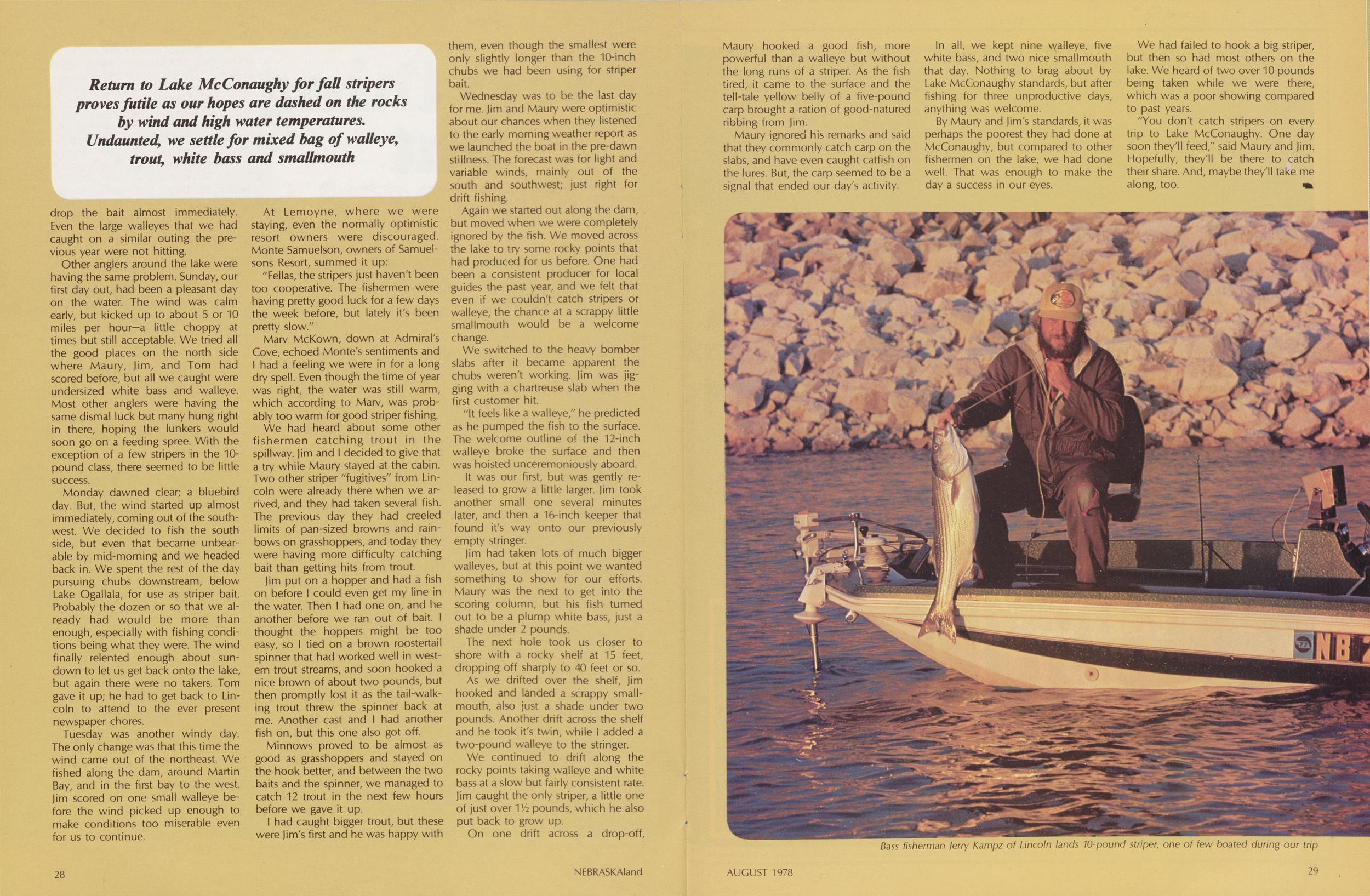
Return to Lake McConaughy for fall stripers
proves futile as our hopes are dashed on the rocks
by wind and high water temperatures.
Undaunted we settle for mixed bag of walleye,
trout, white bass and smallmouth
drop the bait almost immediately.
Even the large walleyes that we had
caught on a similar outing the previous year were not hitting.
Return to Lake McConaughy for fall stripers
proves futile as our hopes are dashed on the rocks
by wind and high water temperatures.
Undaunted we settle for mixed bag of walleye,
trout, white bass and smallmouth
Other anglers around the lake were having the same problem. Sunday, our first day out, had been a pleasant day on the water. The wind was calm early, but kicked up to about 5 or 10 miles per hour—a little choppy at times but still acceptable. We tried all the good places on the north side where Maury, Jim, and Tom had scored before, but all we caught were undersized white bass and walleye. Most other anglers were having the same dismal luck but many hung right in there, hoping the lunkers would soon go on a feeding spree. With the exception of a few stripers in the 10pound class, there seemed to be little success.
Monday dawned clear; a bluebird day. But, the wind started up almost immediately, coming out of the southwest. We decided to fish the south side, but even that became unbearable by mid-morning and we headed back in. We spent the rest of the day pursuing chubs downstream, below Lake Ogallala, for use as striper bait. Probably the dozen or so that we already had would be more than enough, especially with fishing conditions being what they were. The wind finally relented enough about sundown to let us get back onto the lake, but again there were no takers. Tom gave it up; he had to get back to Lincoln to attend to the ever present newspaper chores.
Tuesday was another windy day. The only change was that this time the wind came out of the northeast. We fished along the dam, around Martin Bay, and in the first bay to the west. Jim scored on one small walleye before the wind picked up enough to make conditions too miserable even for us to continue.
At Lemoyne, where we were staying, even the normally optimistic resort owners were discouraged. Monte Samuelson, owners of Samuelsons Resort, summed it up:
Fellas, the stripers just haven't been too cooperative. The fishermen were having pretty good luck for a few days the week before, but lately it's been pretty slow."
Marv McKown, down at Admiral's Cove, echoed Monte's sentiments and I had a feeling we were in for a long dry spell. Even though the time of year was right, the water was still warm, which according to Marv, was probably too warm for good striper fishing.
We had heard about some other fishermen catching trout in the spillway. Jim and I decided to give that a try while Maury stayed at the cabin. Two other striper "fugitives" from Lincoln were already there when we arrived, and they had taken several fish. The previous day they had creeled limits of pan-sized browns and rainbows on grasshoppers, and today they were having more difficulty catching bait than getting hits from trout.
Jim put on a hopper and had a fish on before I could even get my line in the water. Then I had one on, and he another before we ran out of bait. I thought the hoppers might be too easy, so I tied on a brown roostertail spinner that had worked well in western trout streams, and soon hooked a nice brown of about two pounds, but then promptly lost it as the tail-walking trout threw the spinner back at me. Another cast and I had another fish on, but this one also got off.
Minnows proved to be almost as good as grasshoppers and stayed on the hook better, and between the two baits and the spinner, we managed to catch 12 trout in the next few hours before we gave it up.
I had caught bigger trout, but these were Jim's first and he was happy with them, even though the smallest were only slightly longer than the 10-inch chubs we had been using for striper bait.
Wednesday was to be the last day for me. Jim and Maury were optimistic about our chances when they listened to the early morning weather report as we launched the boat in the pre-dawn stillness. The forecast was for light and variable winds, mainly out of the south and southwest; just right for drift fishing.
Again we started out along the dam, but moved when we were completely ignored by the fish. We moved across the lake to try some rocky points that had produced for us before. One had been a consistent producer for local guides the past year, and we felt that even if we couldn't catch stripers or walleye, the chance at a scrappy little smallmouth would be a welcome change.
We switched to the heavy bomber slabs after it became apparent the chubs weren't working. Jim was jig- ging with a chartreuse slab when the first customer hit.
"It feels like a walleye," he predicted as he pumped the fish to the surface. The welcome outline of the 12-inch walleye broke the surface and then was hoisted unceremoniously aboard.
It was our first, but was gently released to grow a little larger. Jim took another small one several minutes later, and then a 16-inch keeper that found it's way onto our previously empty stringer.
Jim had taken lots of much bigger walleyes, but at this point we wanted something to show for our efforts. Maury was the next to get into the scoring column, but his fish turned out to be a plump white bass, just a shade under 2 pounds.
The next hole took us closer to shore with a rocky shelf at 15 feet, dropping off sharply to 40 feet or so.
As we drifted over the shelf, Jim hooked and landed a scrappy smallmouth, also just a shade under two pounds. Another drift across the shelf and he took it's twin, while I added a two-pound walleye to the stringer.
We continued to drift along the rocky points taking walleye and white bass at a slow but fairly consistent rate. Jim caught the only striper, a little one of just over 1½ pounds, which he also put back to grow up.
On one drift across a drop-off, Maury hooked a good fish, more powerful than a walleye but without the long runs of a striper. As the fish tired, it came to the surface and the tell-tale yellow belly of a five-pound carp brought a ration of good-natured ribbing from Jim.
Maury ignored his remarks and said that they commonly catch carp on the slabs, and have even caught catfish on the lures. But, the carp seemed to be a signal that ended our day's activity.
In all, we kept nine walleye, five white bass, and two nice smallmouth that day. Nothing to brag about by Lake McConaughy standards, but after fishing for three unproductive days, anything was welcome.
By Maury and Jim's standards, it was perhaps the poorest they had done at McConaughy, but compared to other fishermen on the lake, we had done well. That was enough to make the day a success in our eyes.
We had failed to hook a big striper, but then so had most others on t e lake. We heard of two over 10 pounds being taken while we were there, which was a poor showing compare to past years.
"You don't catch stripers on every trip to Lake McConaughy. One ay soon they'll feed," said Maury and Jim. Hopefully, they'll be there to catch their share. And, maybe they'll take me along, too.
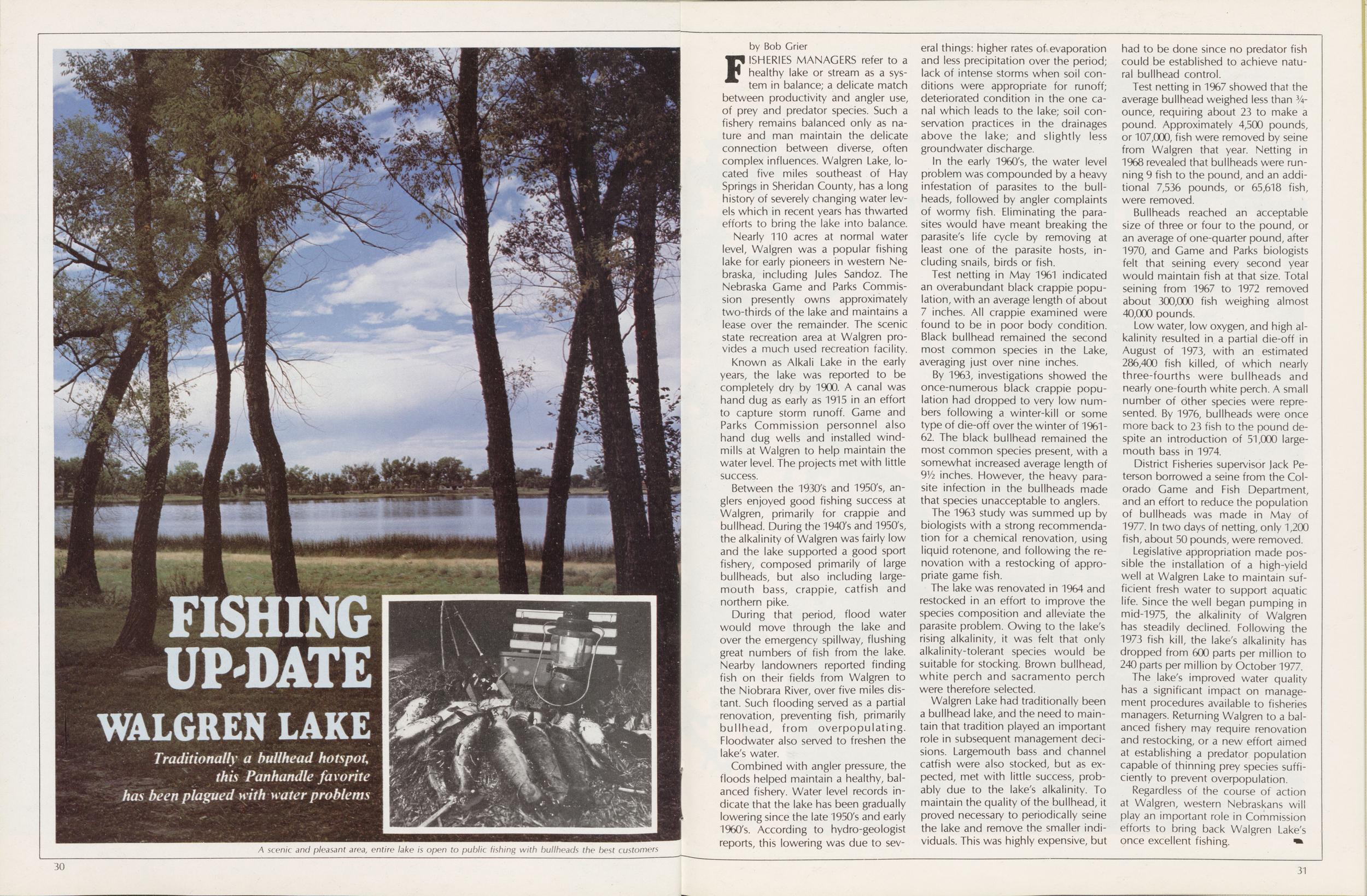
FISHING UP-DATE
WALGREN LAKE
Traditionally a bullhead hotspot, this Panhandle favorite has been plagued with water problems
Fisheries managers refer to a healthy lake or stream as a system in balance; a delicate match between productivity and angler use, of prey and predator species. Such a fishery remains balanced only as nature and man maintain the delicate connection between diverse, often complex influences. Walgren Lake, located five miles southeast of Hay Springs in Sheridan County, has a long history of severely changing water levels which in recent years has thwarted efforts to bring the lake into balance.
Nearly 110 acres at normal water level, Walgren was a popular fishing lake for early pioneers in western Nebraska, including Jules Sandoz. The Nebraska Game and Parks Commission presently owns approximately two-thirds of the lake and maintains a lease over the remainder. The scenic state recreation area at Walgren provides a much used recreation facility.
Known as Alkali Lake in the early years, the lake was reported to be completely dry by 1900. A canal was hand dug as early as 1915 in an effort to capture storm runoff. Game and Parks Commission personnel also hand dug wells and installed windmills at Walgren to help maintain the water level. The projects met with little success.
Between the 1930's and 1950's, an- glers enjoyed good fishing success at Walgren, primarily for crappie and bullhead. During the 1940's and 1950's, the alkalinity of Walgren was fairly low and the lake supported a good sport fishery, composed primarily of large bullheads, but also including large- mouth bass, crappie, catfish and northern pike.
During that period, flood water would move through the lake and over the emergency spillway, flushing great numbers of fish from the lake. Nearby landowners reported finding fish on their fields from Walgren to the Niobrara River, over five miles distant. Such flooding served as a partial renovation, preventing fish, primarily bullhead, from overpopulating. Floodwater also served to freshen the lake's water.
Combined with angler pressure, the floods helped maintain a healthy, balanced fishery. Water level records in- dicate that the lake has been gradually lowering since the late 1950's and early 1960's. According to hydro-geologist reports, this lowering was due to several things: higher rates of evaporation and less precipitation over the period; lack of intense storms when soil conditions were appropriate for runoff; deteriorated condition in the one canal which leads to the lake; soil conservation practices in the drainages above the lake; and slightly less groundwater discharge.
In the early 1960's, the water level problem was compounded by a heavy infestation of parasites to the bullheads, followed by angler complaints of wormy fish. Eliminating the parasites would have meant breaking the parasite's life cycle by removing at least one of the parasite hosts, including snails, birds or fish.
Test netting in May 1961 indicated an overabundant black crappie popu-ation, with an average length of about 7 inches. All crappie examined were found to be in poor body condition. Black bullhead remained the second most common species in the Lake, averaging just over nine inches.
By 1963, investigations showed the once-numerous black crappie population had dropped to very low num- bers following a winter-kill or some type of die-off over the winter of 1961- 62. The black bullhead remained the most common species present, with a somewhat increased average length of 9½ inches. However, the heavy parasite infection in the bullheads made that species unacceptable to anglers.
The 1963 study was summed up by biologists with a strong recommendation for a chemical renovation, using liquid rotenone, and following the renovation with a restocking of appropriate game fish.
The lake was renovated in 1964 and restocked in an effort to improve the species composition and alleviate the parasite problem. Owing to the lake's rising alkalinity, it was felt that only alkalinity-tolerant species would be suitable for stocking. Brown bullhead, white perch and sacramento perch were therefore selected.
Walgren Lake had traditionally been a bullhead lake, and the need to maintain that tradition played an important role in subsequent management decisions. Largemouth bass and channel catfish were also stocked, but as expected, met with little success, probably due to the lake's alkalinity. To maintain the quality of the bullhead, it proved necessary to periodically seine the lake and remove the smaller individuals. This was highly expensive, but had to be done since no predator fish could be established to achieve natural bullhead control.
Test netting in 1967 showed that the average bullhead weighed less than ¾-ounce, requiring about 23 to make a pound. Approximately 4,500 pounds, or 107,000, fish were removed by seine from Walgren that year. Netting in 1968 revealed that bullheads were running 9 fish to the pound, and an additional 7,536 pounds, or 65,618 fish, were removed.
Bullheads reached an acceptable size of three or four to the pound, or an average of one-quarter pound, after 1970, and Game and Parks biologists felt that seining every second year would maintain fish at that size. Total seining from 1967 to 1972 removed about 300,000 fish weighing almost 40,000 pounds.
Low water, low oxygen, and high alkalinity resulted in a partial die-off in August of 1973, with an estimated 286,400 fish killed, of which nearly three-fourths were bullheads and nearly one-fourth white perch. A small number of other species were represented. By 1976, bullheads were once more back to 23 fish to the pound despite an introduction of 51,000 largemouth bass in 1974.
District Fisheries supervisor Jack Peterson borrowed a seine from the Colorado Game and Fish Department, and an effort to reduce the population of bullheads was made in May of 1977. In two days of netting, only 1,200 fish, about 50 pounds, were removed.
Legislative appropriation made possible the installation of a high-yield well at Walgren Lake to maintain sufficient fresh water to support aquatic life. Since the well began pumping in mid-1975, the alkalinity of Walgren has steadily declined. Following the 1973 fish kill, the lake's alkalinity has dropped from 600 parts per million to 240 parts per million by October 1977.
The lake's improved water quality has a significant impact on management procedures available to fisheries managers. Returning Walgren to a balanced fishery may require renovation and restocking, or a new effort aimed at establishing a predator population capable of thinning prey species sufficiently to prevent overpopulation.
Regardless of the course of action at Walgren, western Nebraskans will play an important role in Commission efforts to bring back Walgren Lake's once excellent fishing.
30 31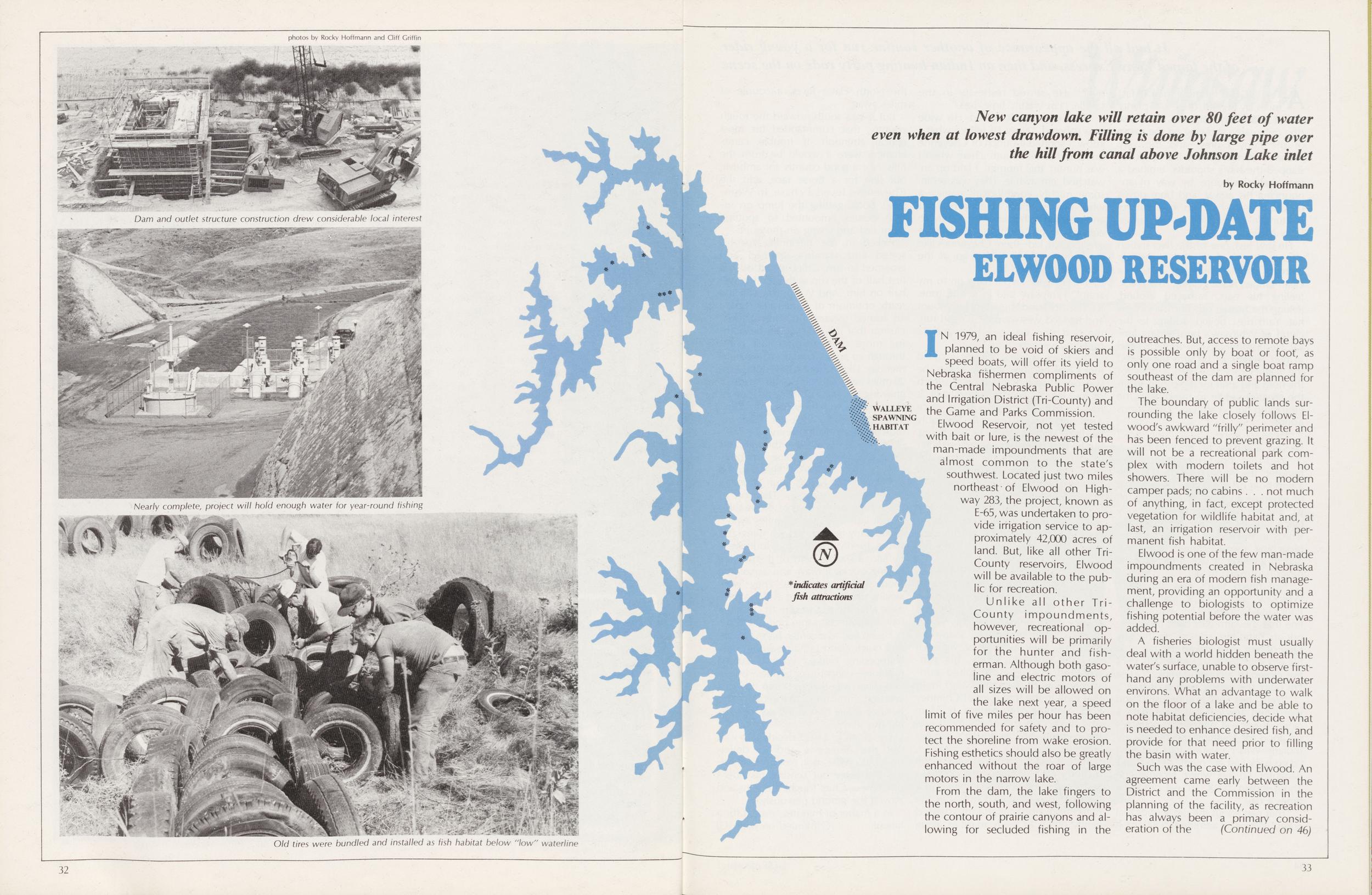
FISHING UP-DATE ELWOOD RESERVOIR
New canyon lake will retain over 80 feet of water even when at lowest drawdown. Filling is done by large pipe over the hill from canal above Johnson Lake inlet
IN 1979, an ideal fishing reservoir, planned to be void of skiers and speed boats, will offer its yield to Nebraska fishermen compliments of the Central Nebraska Public Power and Irrigation District (Tri-County) and the Game and Parks Commission.
Elwood Reservoir, not yet tested with bait or lure, is the newest of the man-made impoundments that are almost common to the state's southwest. Located just two miles northeast-of Elwood on Highway 283, the project, known as E-65, was undertaken to pro- vide irrigation service to ap- proximately 42,000 acres of land. But, like all other Tri-County reservoirs, Elwood will be available to the public for recreation.
Unlike all other Tri-County impoundments, however, recreational opportunities will be primarily for the hunter and fish- erman. Although both gasoline and electric motors of all sizes will be allowed on the lake next year, a speed limit of five miles per hour has been recommended for safety and to protect the shoreline from wake erosion. Fishing esthetics should also be greatly enhanced without the roar of large motors in the narrow lake.
From the dam, the lake fingers to the north, south, and west, following the contour of prairie canyons and al- lowing for secluded fishing in the outreaches. But, access to remote bays is possible only by boat or foot, as only one road and a single boat ramp southeast of the dam are planned for the lake.
The boundary of public lands surrounding the lake closely follows Elwood's awkward "frilly" perimeter and has been fenced to prevent grazing. It will not be a recreational park complex with modern toilets and hot showers. There will be no modern camper pads; no cabins . . . not much of anything, in fact, except protected vegetation for wildlife habitat and, at last, an irrigation reservoir with permanent fish habitat.
Elwood is one of the few man-made impoundments created in Nebraska during an era of modern fish management, providing an opportunity and a challenge to biologists to optimize fishing potential before the water was added.
A fisheries biologist must usually deal with a world hidden beneath the water's surface, unable to observe firsthand any problems with underwater environs. What an advantage to walk on the floor of a lake and be able to note habitat deficiencies, decide what is needed to enhance desired fish, and provide for that need prior to filling the basin with water.
Such was the case with Elwood. An agreement came early between the District and the Commission in the planning of the facility, as recreation has always been a primary consid- eration of the
(Continued on 46) 32 33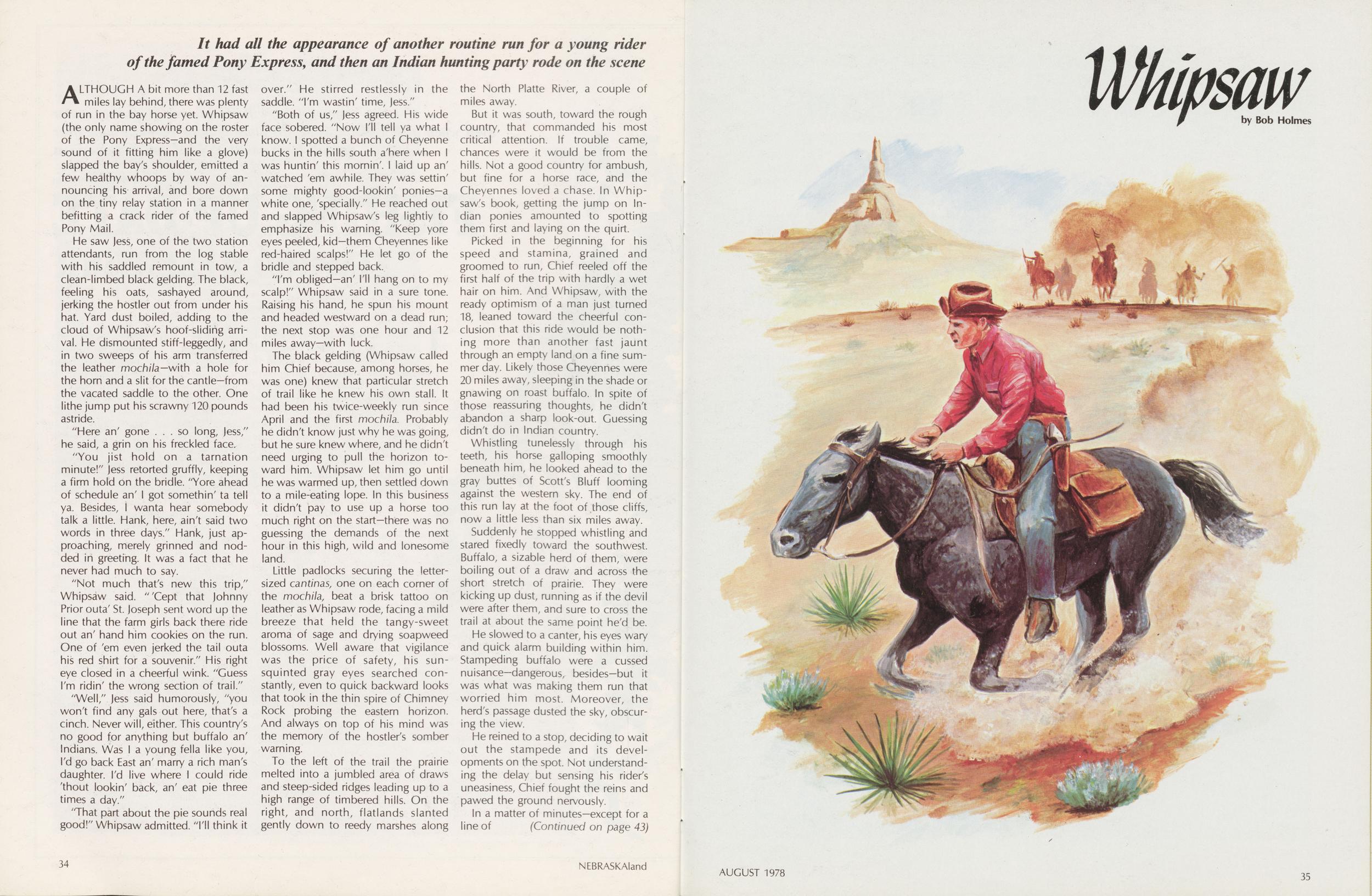
Whipsaw
It had all the appearance of another routine run for a young rider of the famed Pony Express, and then an Indian hunting party rode on the scene
ALTHOUGH a bit more than 12 fast miles lay behind, there was plenty of run in the bay horse yet. Whipsaw (the only name showing on the roster of the Pony Express—and the very sound of it fitting him like a glove) slapped the bay's shoulder, emitted a few healthy whoops by way of announcing his arrival, and bore down on the tiny relay station in a manner befitting a crack rider of the famed Pony Mail.
He saw Jess, one of the two station attendants, run from the log stable with his saddled remount in tow, a clean-limbed black gelding. The black, feeling his oats, sashayed around, jerking the hostler out from under his hat. Yard dust boiled, adding to the cloud of Whipsaw's hoof-sliding arrival. He dismounted stiff-leggedly, and in two sweeps of his arm transferred the leather mochila—with a hole for the horn and a slit for the cantie—from the vacated saddle to the other. One lithe jump put his scrawny 120 pounds astride.
"Here an' gone ... so long, Jess," he said, a grin on his freckled face.
"You jist hold on a tarnation minute!" Jess retorted gruffly, keeping a firm hold on the bridle. "Yore ahead of schedule an' I got somethin' ta tell ya. Besides, I wanta hear somebody talk a little. Hank, here, ain't said two words in three days." Hank, just approaching, merely grinned and nodded in greeting. It was a fact that he never had much to say.
"Not much that's new this trip," Whipsaw said. "'Cept that Johnny Prior outa' St. Joseph sent word up the line that the farm girls back there ride out an' hand him cookies on the run. One of 'em even jerked the tail outa his red shirt for a souvenir." His right eye closed in a cheerful wink. "Guess I'm ridin' the wrong section of trail."
"Well," Jess said humorously, "you won't find any gals out here, that's a cinch. Never will, either. This country's no good for anything but buffalo an' Indians. Was I a young fella like you, I'd go back East an' marry a rich man's daughter. I'd live where I could ride 'thout lookin' back, an' eat pie three times a day."
"That part about the pie sounds real good!" Whipsaw admitted. "I'll think it over." He stirred restlessly in the saddle. "I'm wastin' time, Jess."
"Both of us," Jess agreed. His wide face sobered. "Now I'll tell ya what I know. I spotted a bunch of Cheyenne bucks in the hills south a'here when I was huntin' this mornin'. I laid up an' watched 'em awhile. They was settin' some mighty good-lookin' ponies—a white one, 'specially." He reached out and slapped Whipsaw's leg lightly to emphasize his warning. "Keep yore eyes peeled, kid—them Cheyennes like red-haired scalps!" He let go of the bridle and stepped back.
"I'm obliged—an' I'll hang on to my scalp!" Whipsaw said in a sure tone. Raising his hand, he spun his mount and headed westward on a dead run; the next stop was one hour and 12 miles away—with luck.
The black gelding (Whipsaw called him Chief because, among horses, he was one) knew that particular stretch of trail like he knew his own stall. It had been his twice-weekly run since April and the first mochila. Probably he didn't know just why he was going, but he sure knew where, and he didn't need urging to pull the horizon toward him. Whipsaw let him go until he was warmed up, then settled down to a mile-eating lope. In this business it didn't pay to use up a horse too much right on the start—there was no guessing the demands of the next hour in this high, wild and lonesome land.
Little padlocks securing the lettersized cantinas, one on each corner of the mochila, beat a brisk tattoo on leather as Whipsaw rode, facing a mild breeze that held the tangy-sweet aroma of sage and drying soapweed blossoms. Well aware that vigilance was the price of safety, his sunsquinted gray eyes searched constantly, even to quick backward looks that took in the thin spire of Chimney Rock probing the eastern horizon. And always on top of his mind was the memory of the hostler's somber warning.
To the left of the trail the prairie melted into a jumbled area of draws and steep-sided ridges leading up to a high range of timbered hills. On the right, and north, flatlands slanted gently down to reedy marshes along the North Platte River, a couple of miles away.
But it was south, toward the rough country, that commanded his most critical attention. If trouble came, chances were it would be from the hills. Not a good country for ambush, but fine for a horse race, and the Cheyennes loved a chase. In Whipsaw's book, getting the jump on Indian ponies amounted to spotting them first and laying on the quirt.
Picked in the beginning for his speed and stamina, grained and groomed to run, Chief reeled off the first half of the trip with hardly a wet hair on him. And Whipsaw, with the ready optimism of a man just turned 18, leaned toward the cheerful conclusion that this ride would be nothing more than another fast jaunt through an empty land on a fine summer day. Likely those Cheyennes were 20 miles away, sleeping in the shade or gnawing on roast buffalo. In spite of those reassuring thoughts, he didn't abandon a sharp look-out. Guessing didn't do in Indian country.
Whistling tunelessly through his teeth, his horse galloping smoothly beneath him, he looked ahead to the gray buttes of Scott's Bluff looming against the western sky. The end of this run lay at the foot of those cliffs, now a little less than six miles away.
Suddenly he stopped whistling and stared fixedly toward the southwest. Buffalo, a sizable herd of them, were boiling out of a draw and across the short stretch of prairie. They were kicking up dust, running as if the devil were after them, and sure to cross the trail at about the same point he'd be.
He slowed to a canter, his eyes wary and quick alarm building within him. Stampeding buffalo were a cussed nuisance-dangerous, besides-but it was what was making them run that worried him most. Moreover, the herd's passage dusted the sky, obscuring the view.
He reined to a stop, deciding to wait out the stampede and its developments on the spot. Not understanding the delay but sensing his rider's uneasiness, Chief fought the reins and pawed the ground nervously.
In a matter of minutes—except for a line of
(Continued on page 43) 34 NEBRASKAIand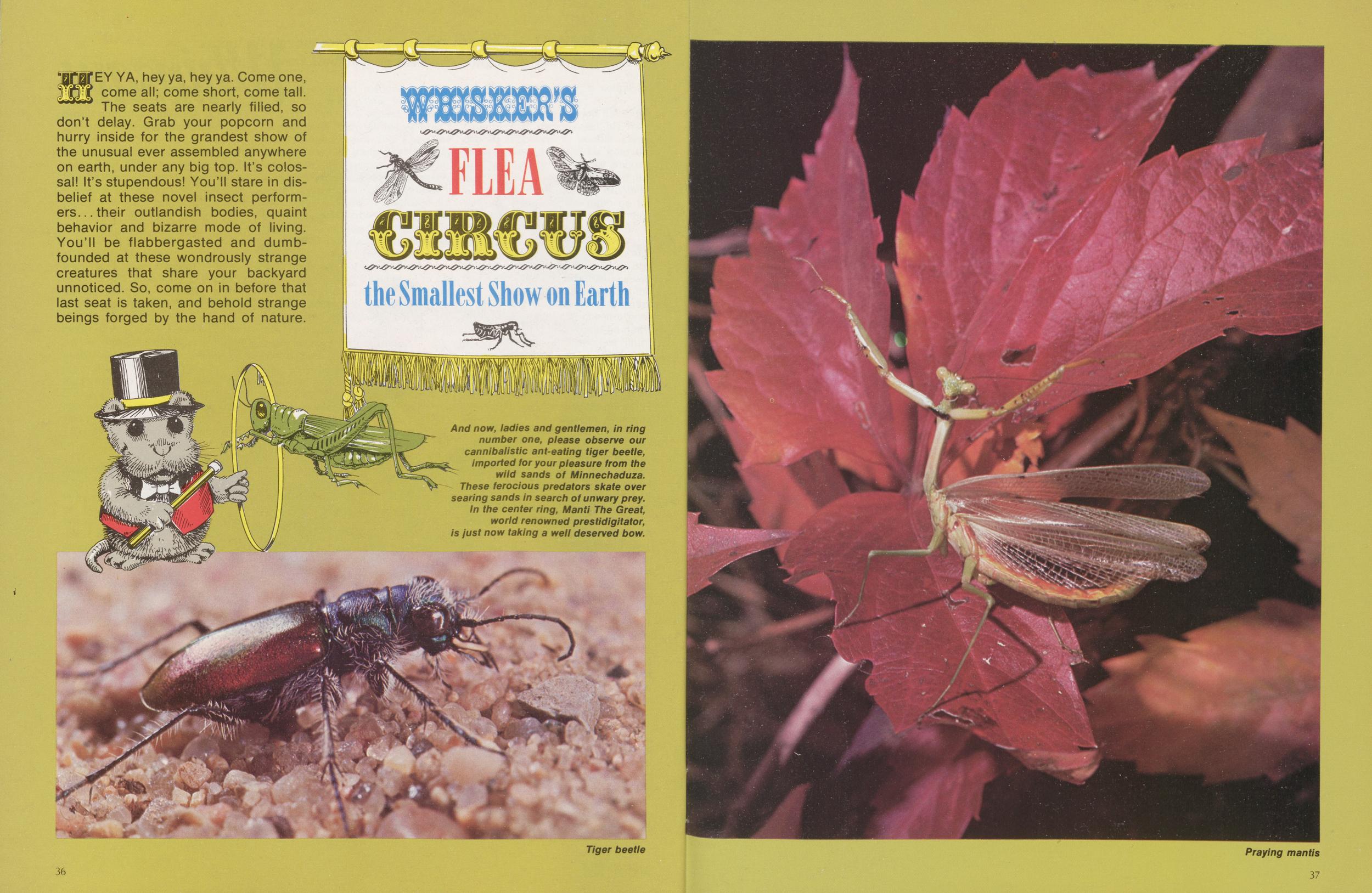
WHISKER'S
FLEA CIRCUS
the Smallest Show on Earth
HEY YA, hey ya, hey ya. Come one, come all; come short, come tall. The seats are nearly filled, so don’t delay. Grab your popcorn and hurry inside for the grandest show of the unusual ever assembled anywhere on earth, under any big top. It’s colossal! It’s stupendous! You’ll stare in disbelief at these novel insect performers... their outlandish bodies, quaint behavior and bizarre mode of living. You’ll be flabbergasted and dumbfounded at these wondrously strange creatures that share your backyard unnoticed. So, come on in before that last seat is taken, and behold strange beings forged by the hand of nature.
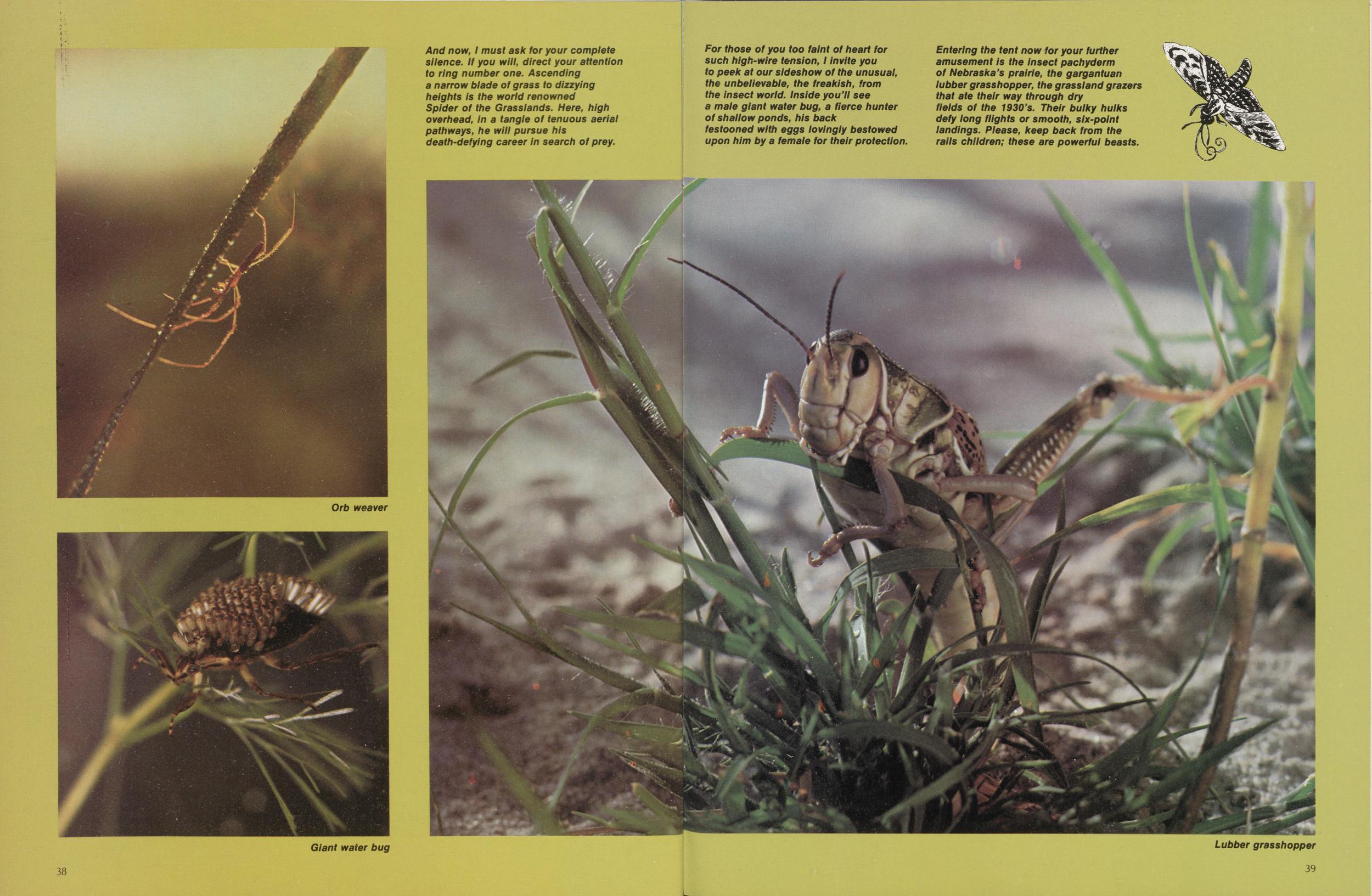
And now, I must asl for your complete silence, If you will, direct your attention to ring number one. Ascending a narrow blade of grass to dizzying heights is the world renowned Spider of the Grasslands. Here, high overhead, in a tangle of tenuous aerial pathways, he will pursue his death-defying career in search of prey.
For those of you too faint of heart for such high-wire tension, I invite you to peel at our sideshow of the unusual, the unbelievable, the freakish, from the insect world. Inside you'll see a male giant water bug, a fierce hunter of shallow ponds, his back festooned with eggs lovingly bestowed upon him by a female for their protectio.
Entering the tent now for your further amusement is the insect pachyderm of Nebraska's prairie, the gargantuan lubber grasshopper, the grassland grazers that ate their way through dry fields of the 1930's. Their bulky hulks defy long flights or smooth, six-point landings. Please, keep back from the rails children; these are powerful beasts.
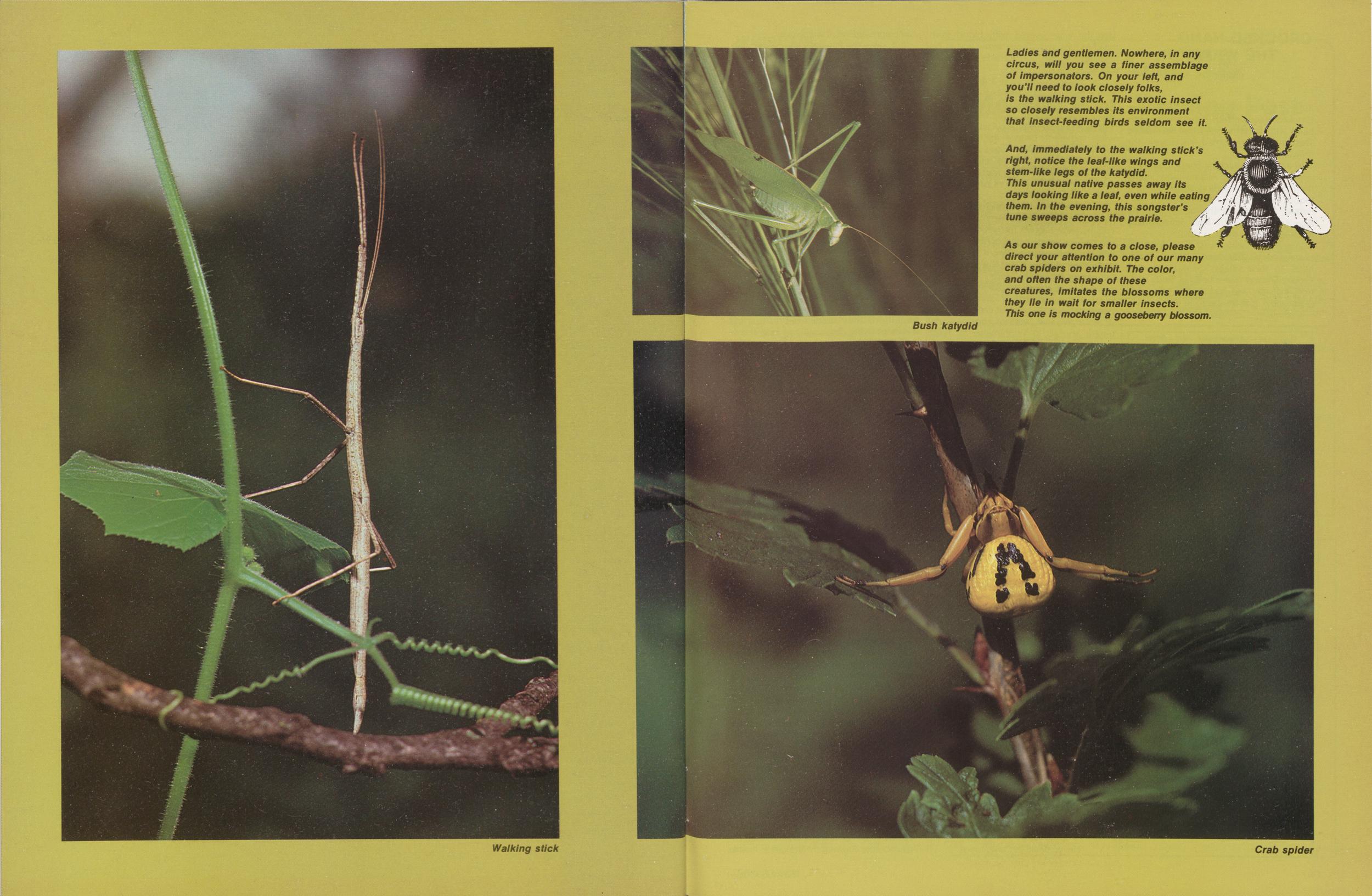
Ladies and gentlemen. Nowhere, in any circus, will you see a finer assemblage of impersonators. On your left, and you'll need to look closely folks, is the walking stick. This exotic insect so closely resembles its environment that insect-feeding birds seldom see it.
And, immediately to the walking stick's right, notice the leaf-like wings and stem-like legs of the katydid. This unusual native passes away its days looking like a leaf, even while eating them. In the evening, this songster's tune sweeps across the prairie.
s our show comes to a close, please direct your attention to one of our many crab spiders on exhibit. The color, and often the shape 01 these creatures, imitates the blossoms where they lie in wait for smaller insects. This one is mocking a gooseberry blossom.
CROOKED HAND THE WARRIOR
(Continued from page 21)turning point, for at about that time, Crooked Hand and his fighters were supplied with fresh horses from the village. Their next charge turned the Sioux withdrawal into a rout.
In a state of panic, the Sioux took flight with their intended victims now riding them down from behind and exacting a bloody vengeance. No white men witnessed that part of the battle, but the Pawnees claimed to have killed many Sioux and taken many scalps.
When the battle was over, Crooked Hand and his followers returned, victorious, to their villages. Sick as he was, Crooked Hand had killed six Sioux warriors that day and had three horses shot from under him. As he rode into the village, he was covered with blood from head to foot and a Sioux arrow was in his throat, with the iron arrowhead sticking out the back of his neck.
GAS -OIL - LAUNDROMAT - ICE - BEER TACKLE-LICENSES-BAIT-GUIDE SERVICE BLUE FRONT Cafe and Cabins CABINS WITH COOKING FACILITIES TRAILER, CAMPER AND TENT PARKING SPACE EVERYTHING FOR THE FISHERMAN LYLE AND DEE NIELSEN FOR RESERVATIONS WRITE — BRULE NEBRASKA 69127 OR TELEPHONE 308 284-4504 MUTCHIE'S johnson lake RESORT Upstairs Anchor Room Lounge Cold Beer-On/Off Sale Lakefront cabins with swimming beach • Fishing tackle • Boats & motors • Free boat ramp • Fishing • Swimming • Cafe and ice • Boating & skiing • Gas and oil • 9-hole golf course just around the corner • Live and frozen bait • Pontoon, boat & motor rentals. Overnight Campers—full hookups WRITE FOR FREE BROCHURE or phone reservations 785-2298 Elwood, Nebraska NEED A DISTANT NUMBER? You can still dial direct and save.l Just dial your DDD access number, the area code for the location, plus the Universal Directory Assistance Number, 555-1212. THE LINCOLN TELEPHONE CO.The pawnees had won a great victory, killing many Sioux enemies that day. Despite the long ordeal, their losses were small, only 16 killed.
Their triumph was especially hard for white settlers to believe. For, at the very moment that Crooked Hand and his 200 Pawnee women, children and old men were whipping (A) Sioux warriors, the entire frontier was in a state of panic because of Sioux uprisings.
The Sioux had just massacred settlers in Minnesota, and rumors were out that the culprits were headed for Nebraska. Naturally, when word spread of the Sioux attack on the Pawnee agency, it was erroneously assumed that it was the work of the rampaging Minnesota Sioux.
Farms were abandoned, towns were fortified, and a regiment of cavalry was ordered to Nebraska. And, at each fresh sign of Sioux mischief, western governors sent urgent appeals to Washington for more troops.
The Pawnee tribe returned from the summer hunt to find their villages populated by heroes. Grandfathers claimed yet another coup earned in battle, young sons carried Sioux scalps even before going on their first war party, and women had earned and adopted warrior names. Despite the victory, the chiefs were upset.
The whites had promised protection to the Pawnees when they agreed to come to the agency on the Loup, and they were not keeping that promise. Pawnee warriors could defend the villages when they were at home, but they had to be gone much of the year hunting buffalo. Sick men, old men, women and children should not havé to fight hundreds of Sioux warriors for survival. The plight of the Pawnees was grim, and the chiefs saw that their days in Nebraska were numbered. The Sioux had grown more powerful, numerous and well-armed, thanks to trading posts and agencies that had attracted them from the northern plains to camps near Pawnee country. There, the government bought peace with the Sioux with gifts of guns and supplies, which they then used in
But, since the Pawnees had always pursued a course of peace with the white man, the government saw no need to "buy" them or give them much, The Pawnee got little in the way of supplies, and certainly no guns with which to answer the government rifles that the Sioux were using against them.
Thus, Crooked Hand's victory over the Sioux was a bitter-sweet one. The Sioux continued raiding Pawnee villages and riding down Pawnee women working in the cornfields while the U.S. Cavalry at the agency watched. And, on the buffalo plains, Sioux, Cheyenne and Arapaho war parties were in such force that the Pawnees dared not spread out to hunt.
After the hostilities of the lt1860's were settled, the Sioux went back to their "comfortable" routine. With government rations to fall back on, the hunt was no longer a life-or-death matter for the Sioux. So, with spare time on their hands and a good supply of government guns and ammunition, they were able to harrass Pawnees trying desperately to feed themselves by hunting buffalo.
Crooked Hand's victory buoyed the spirits of the Pawnees during those hard times, and they told the story often. Crooked Hand survived his nasty arrow wound, though it troubled him for the rest of his days, and he continued as a fiesty and courageous defender of his people to the end. The Sioux finally overcame Crooked Hand's fierce courage in the butchery of Massacre Canyon near Trenton on August 5, 1873.
There, nearly 1,000 Brule and Oglala Sioux warriors, with tacit approval of two government agents accompanying them, rode down on about 500 Pawnee men, women and children as they hunted buffalo. Crooked Hand was with the small band of Pawnee warriors that went out to meet the Sioux and held them at bay while the women and children huddled in a ravine. But finally, by sheer weight of numbers, the Sioux crushed the defenders and rained death on the Pawnees as they fled down the canyon toward the Republican River.
Crooked Hand lay dead with other Pawnee warriors who formed first defense, and about 100 slain Pawnee men, women and children were scattered along the 10-mile path of their flight down the ravine and along the Republican River.
For years, the Sioux had been killing Pawnee women as they worked in cornfields on the agency on the Loup, and attacking their hunting parties on the buf- falo plains. Now, this latest tragedy proved too much for the Pawnees to bear. Sick with grief over Massacre Canyon, they left their Nebraska homes for an uncertain future in the Indian Territory of Oklahoma. Thus, the mounted hordes of their enemies had finally snuffed out Crooked Hand's great fighting spirit, and ended the days of the Pawnee in Nebraska.
42 NEBRASKAlandWHIPSAW
(Continued from page 34)stragglers, galloping ponderously—the herd went on across the trail, taking their dust with them. Whipsaw pulled his hat lower to shade his eyes. Outside of buffalo, there wasn't another living thing within sight.
Just the same, complacence had vanished, displaced by the sure knowledge of danger lurking somewhere out there in the draws and hollows. He'd bet a month's pay he knew what had spooked those buffalo. It had to be Cheyenne braves out on a hunt, and not 20 miles away, either— not by a long shot!
He started on again, riding straight through the scattered tag-ends of wildeyed buffalo. At the sight of a horseman suddenly among them, they lunged aside, plowed up the earth and cut back to cross behind him. A three-month-old calf, separated from its mother and blind with panic, blundered squarely into the running horse and was knocked sprawling over a soapweed. Chief stumbled; for one heartstopping second Whipsaw was sure he'd go down. But the black, cat-like, caught his stride and with a terrified snort went away from there on a stampede of his own.
Whipsaw let him go, staring back over his shoulder at the calf going the other way with its tail over its back. "You dumb ninn he muttered shakily.
A little cajolery and Chief quickly gave up his run-away notions, leaving Whipsaw still as jittery as a flea on a wet wolf. He had a horror of being set afoot, and if that mix-up had resulted in a fall and a broken-legged horse. . . .! Thoughtfully, he patted the little Bible tucked in the pocket of his buckskin shirt
The buffalo were left behind, out of sight; the whole vast country serene and empty again. Still, that pesky premonition rode with him, and his concerned gaze sifted the landscape. It was only four miles to the station—not far in terms of time or distance, yet plenty of both for howling trouble on painted ponies.
A little farther on he saw them, finally, and felt a queer detached relief at the sight. The dread of surprise was over—he knew now where they were. A dozen or so of them; mounted Indians suddenly breaking the sky-line above a ridge a half-mile to his left and slightly ahead. That they had seen him was evident by the way they were bringing their horses off the ridge in long, jackrabbit jumps, plainly bent on heading him off.
Whipsaw, with one assaying look, knew that now was the time to push on the reins or some high-stepping brave would brag over a red-haired scalp. Leaning low over the saddlehorn, he gave Chief the spurs and some urgent words of advice.
"Now you'd better run, you black oat-eater! Show 'em what a real horse can do!"
WELCOME to Merritt Dam Trading Post 26 Miles so. Of Valentine On Hwy. 16C Phone 402/376-3437 Bait• Tackle• Ammunition• Groceries • Gas• Beer• Ice Cabins with Kitchen Faci lities• Floating Marina Campground Hook-ups • Boat and Motor Rental rus — Your Hosts — JON AND MARIAN DAVENPORT SPORTSMEN'S COMPLEX, Inc. ONE-STOP SERVICE OPEN ALL YEAR BEER SCUBA DIVING SHOP GAS TRAILER PARKING - SNACK SHOP - DUMPING STATION EVINRUDE MOTORS & REPAIRS BOX 136 KEYSTONE, NEBR. 69144 AT HIWAY JCT. 61 & 92 — 12 MILES NE OGALLALA, NEBR. AT MARTIN BAY 308—726-2521 Rustic Living the Modern Way! The Beaver Log is a perfectly round, smooth-finished, double-tongued and grooved, saddle-notched log designed for use in residential and commercial construction. The new log building system speeds log wall construction considerably. Zaver Cog clComes AURORA LOG HOMES SALES BOX 186 AURORA, NEBRASKA 68818 O PLEASE SEND ME YOUR FREE BROCHURE. PLEASE SEND ME YOUR BEAVER LOG STOCK HOME PLANS BOOK. ENCLOSED IS MY CHECK FOR $3.n PLEASE SEND ME THE CURRENT EDITION OF THE LOG HOMES GUIDE. NAME CITY ENCLOSED IS MY CHECK FOR $5.X). STREET.. STATE.. ZIP . AUGUST 1978 43 TEACH
ANY DOG
IN MINUTES
C"'lete System. MP
All need t' train
puppets. •vs. EASY TO USE
uses ittNSt sense.
en•tcrs
NOT ELECTRONIC
routs
• Sit
• sug
• POINT
• cuago
For: Family dogs • Hunting dogs • Stoc* dogs • Show dogs Ä
ON TV with: Art Linkletter. Johnny Carson. Dick
Cavett Mike Douglas. Merv Griffin, "The Pet Set,"
"Friends of Man." ARTICLES: TIME magazine. NEW
TIMES. HUNTING DOG L other worldwide publications.
A scientific marvel. This psychological
dog-sound maker is used from the palm ot the hand, /
Gives amazing control at a distance. "Works like
magic." No leash needed. "Tunes dogs in." Makes
dogs seem to "read your mind." Novices become
experts. leaches d•rect to the dog's mind via a new
subliminal sound learning stimulus, Safe, faster.
kinder, more effective. Renders all slower pain-train-
ing obsolete. Same instrument and system (utilizvng
the Dr. Miller patents) dispensed by veterinarians for
dog behavior. Now hundreds and thousands of satis-
tied users. breeders. trainers. U.SA. & foreign lands.
From $24.95 FREE catalog
DOG-MASTER SYSTEMS
710 Wilshire Blvd.. suite 318, Santa Monica, calif. n401
A of Environmental Research t abs. Copyright 19",
J'S OTTER CREEK MARINA
NORTH SIDE LAKE McCONAUGHY
HWY. 92—0PEN YEAR AROUND
ALL MODERN MOTEL e
CAFE • BAIT • TACKLE
GAS • BOAT RENTALS
HUNTING & FISHING LICENSES .
ON & OFF SALE BEER e
PHONE
LEMOYNE 308-355-2341
P.o. LEWELLEN, NEBR.
69141
JAY & JULIE PETERSON
GUN DOG TRAINING
All Sporting Breeds
Each dog trained on both
native game and pen —reared
birds. Ducks for retrievers.
All dogs worked Individually.
Field Champion-sired
labrador pups for sale.
Midwest's finest facilities.
WILDERNESS KENNELS
Henry Sader—Roca. Nb.
(4021 423-4212 68430
ARMSTRONG'S
FISHING HOTLINE
(308) 284-6034
(call collect if you want)
• Water Ski Rentals • Bcxfl Gas
• Hard • Live E t
• Fishing
OPEN 7 DAYS A WEEK
6 to p.m.
NORTH OGALLALA ON HWY. 26
(on • •Big
TEACH
ANY DOG
IN MINUTES
C"'lete System. MP
All need t' train
puppets. •vs. EASY TO USE
uses ittNSt sense.
en•tcrs
NOT ELECTRONIC
routs
• Sit
• sug
• POINT
• cuago
For: Family dogs • Hunting dogs • Stoc* dogs • Show dogs Ä
ON TV with: Art Linkletter. Johnny Carson. Dick
Cavett Mike Douglas. Merv Griffin, "The Pet Set,"
"Friends of Man." ARTICLES: TIME magazine. NEW
TIMES. HUNTING DOG L other worldwide publications.
A scientific marvel. This psychological
dog-sound maker is used from the palm ot the hand, /
Gives amazing control at a distance. "Works like
magic." No leash needed. "Tunes dogs in." Makes
dogs seem to "read your mind." Novices become
experts. leaches d•rect to the dog's mind via a new
subliminal sound learning stimulus, Safe, faster.
kinder, more effective. Renders all slower pain-train-
ing obsolete. Same instrument and system (utilizvng
the Dr. Miller patents) dispensed by veterinarians for
dog behavior. Now hundreds and thousands of satis-
tied users. breeders. trainers. U.SA. & foreign lands.
From $24.95 FREE catalog
DOG-MASTER SYSTEMS
710 Wilshire Blvd.. suite 318, Santa Monica, calif. n401
A of Environmental Research t abs. Copyright 19",
J'S OTTER CREEK MARINA
NORTH SIDE LAKE McCONAUGHY
HWY. 92—0PEN YEAR AROUND
ALL MODERN MOTEL e
CAFE • BAIT • TACKLE
GAS • BOAT RENTALS
HUNTING & FISHING LICENSES .
ON & OFF SALE BEER e
PHONE
LEMOYNE 308-355-2341
P.o. LEWELLEN, NEBR.
69141
JAY & JULIE PETERSON
GUN DOG TRAINING
All Sporting Breeds
Each dog trained on both
native game and pen —reared
birds. Ducks for retrievers.
All dogs worked Individually.
Field Champion-sired
labrador pups for sale.
Midwest's finest facilities.
WILDERNESS KENNELS
Henry Sader—Roca. Nb.
(4021 423-4212 68430
ARMSTRONG'S
FISHING HOTLINE
(308) 284-6034
(call collect if you want)
• Water Ski Rentals • Bcxfl Gas
• Hard • Live E t
• Fishing
OPEN 7 DAYS A WEEK
6 to p.m.
NORTH OGALLALA ON HWY. 26
(on • •Big
And, Chief split the wind until the trail was a blur beneath his polished hooves just as if he knew that the chips were down in a desperate race that would demand his all.
The Indians, none of whom seemed rich enough to own a rifle, were a good yards beyond arrow-shot when Whipsaw pulled even and past them. He couldn't be headed now! They'd have to catch him. He felt a quick, heady surge of elation. No Indian pony that ever chewed prairie grass could outrun ol' Chief!
Looking back, he saw the Indians flogging their ponies but steadily losing ground. One hit a hole and spilled in a sliding cloud of dust. Chuckling gleefully, Whipsaw swung his glance around. The chuckle died in his throat and his heart jolted. Barely 100 yards out, jumping soapweeds and sagebrush—running like a scared antelope—was a white horse. A Cheyenne warrior, riding as if he were molded there, lay along his neck. He was veering in, dropping back just a little, cannily closing for the position that would let him put his flint-tipped arrows where he wanted them. Whipsaw, for sure, had let an Indian on a fast white pony get the jump on him.
Hunching stil lower to cut wind resistance, a thin tremor of fear lancing his innards, he added the quirt to the spurs—futiley. The black was already putting out all that was in him. His nostrils flared and foam flew back against Whipsaw in a straining effort. And still the white pony matched him, beautifully, stride for stride.
The breath of the first arrow, swishing past, made Whipsaw cringe. There'll be feathers in this rooster's tail if I don't stop that Indian! he thought wildly. Letting the quirt dangle, he reached for his Navy Colt. He brought the pistol up and flourished it in plain sight in a forlorn hope that the lndian would not have the stomach for a running fight against bullets.
But the Cheyenne's medicine was strong; he was out to catch one of the Pony Mail and see for himself what they carried that made them ride so fast. He ignored the gun and brought his pony closer, fitting another arrow to his bow.
Still trying to bluff it out, Whipsaw shot twice, deliberately sending his bullets as close as he dared without a hit. A wisp of flying white mane drifted away as he watched the arrow arc toward him, and in a split-second of realization, frantical!y bunched his body into as small a target as possibie. There was a "thwack" against the cantle and a tearin ain in his hip.
Whipsaw gritted his teeth and lined his pistol again. Out-foxed, outrun, and shot in the backside! He was fighting mad— ready to put a bullet into live meat. He held the sights on the Cheyenne's slim upper body and pulled the trigger twice, as fast as he could shoot.
The Indian let out a screech of rage and astonishment; only a quick hand to the pony's mane kept him from being unhorsed. He threw his bullet-shattered bow from him and angled away. Whipsaw had another shot aimed before he realized that the fight was over—his bullets hadn't touched an Indian, but they had sure clobbered a good buffalo bow. The Cheyenne was out of it, harmless as a prairie chicken.
Whipsaw sent a quick look back. The rest of the Indians had long given up. Their mounts had been as Indian ponies were supposed to be—too slow. He eased the tired Chief down to a wind-catching lope, thankful that the slower gait took some of the painful bounce out of the arrow-shaft sticking from his hip.
Looking around for his late adversary, he saw that the warrior had raced ahead and was boldly sitting his horse on a knoll a few rods to the side of the trail. When Whipsaw came even, the Cheyenne raised his hand and gave a long, high-pitched yell. It was a cry that held little of anger; more a note of admiration and respect—it took a mighty warrior to shoot the bow from an enemy's hand!
Whipsaw, slightly ill from the constant throbbing of his wound, nonetheless raised his right hand high, palm out. Then, out of pure cussedness, brought it down and thumbed his nose derisively at the Cheyenne. That the gesture was seen and understood was attested by a squall of rage that could have been heard a mile.
"For that arrow in my behind, you featherhead!" Whipsaw said aloud, and watched the Indian whirl his pony and ride off. Strangely, and in spite of his hurt, he was a little glad that the wild Cheyenne and his superb white pony were both going away without a scratch—barring a small nick in the warrior's dignity.
The relay station was close now; he could see men with rifles moving hurriedly around the rough log buildings—evidence that they had heard the shots and yells and were preparing for a stand-off.
The remount was out in front, ready for him; but this time there would be some delay. That arrow would have to be dug out and raw turpentine poured into the wound. Both operations would hurt like the devil. Afterward, sore backside or no, he had another two hours of riding and two more stations to make before calling it a day.
But then, these things were only incidental to something vastly more important: the mochila was coming in, on schedule, to the familiar drum-beat of flying hooves.
Whipsaw tipped his head back and gave voice to a long, exultant yell that echoed from the bluffs and down the bright pages of history.
NEBRASKAland proudly presents the stories of its readers. Here is the opportunity so many have requested — a chance to tell their own outdoor tales. Hunting trtps, the • 'big fish that got away". unforgettable characters, outdoor impressions—all have a place here. If you have a story to tell. jot it down and send it to Editor. NEBRASKAland. Box 30370. Lin. coin. Nebr. 68303. Send photographs. black and white or color, if any are available. 44 NEBRASKAland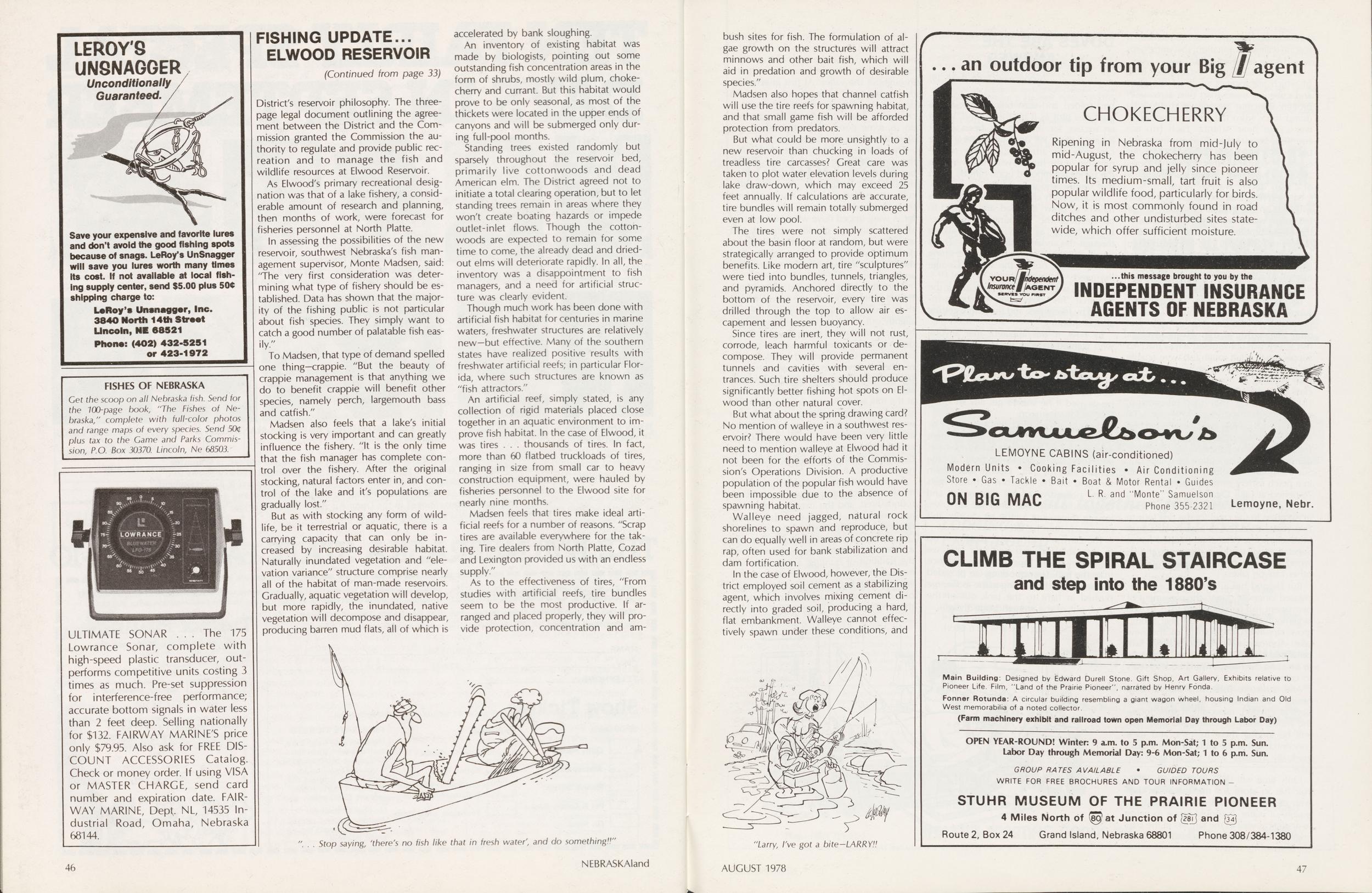
FISHING UPDATE ELWOOD RESERVOIR
(Continued from page 33District's reservoir phiIosopy. The three-page legal document outlining the agreement between the District and the Commission granted the Commission the authority to regulate and provide public recreation and to manage the fish and wildlife resources at Elwood Reservoir
As Elwood's primary recreational designation was that of a lake fishery, a considerable amount of research and planning, then months of work, were forecast for fisheries personnel at North Platte.
In assessing the possibilities of the new reservoir, southwest Nebraska's fish management supervisor, Monte Madsen, said: "The very first consideration was determining what type of fishery should be established. Data has shown that the majority of the fishing public is not particular about fish species. They simply want to catch a good number of palatable fish easily."
To Madsen, that type of demand spelled one thing—crappie. "But the beauty of crappie management is that anything we do to benefit crappie will benefit other species, namely perch, largemouth bass and catfish."
Madsen also feels t at a a es Initia stocking is very important and can greatly influence the fishery. "It is the only time that the fish manager has complete control over the fishery. After the original stocking, natural factors enter in, and control of the lake and it's populations are gradually lost."
But as with stocking any form of wildlife, be it terrestrial or aquatic, there is a carrying capacity that can only be increased by increasing desirable habitat. Naturally inundated vegetation and "elevation variance" structure comprise nearly all of the habitat of man-made reservoirs. Gradually, aquatic vegetation will develop, but more rapidly, the inundated, native vegetation will decompose and disappear, producing barren mud flats, all of which is accelerated by bank sloughing.
An inventory of existing habitat was made by biologists, pointing out some outstanding fish concentration areas in the form of shrubs, mostly wild plum, chokecherry and currant. But this habitat would prove to be only seasonal, as most of the thickets were located in the upper ends of canyons and will be submerged only during full-pool months.
Standing trees existed randomly but sparsely throughout the reservoir bed, primarily live cottonwoods and dead American elm. The District agreed not to initiate a total clearing operation, but to let standing trees remain in areas where they won't create boating hazards or impede outlet-inlet flows. Though the cottonwoods are expected to remain for some time to come, the already dead and driedout elms will deteriorate rapidly. In all, the inventory was a disappointment to fish managers, and a need for artificial structure was clearly evident.
Though much work has been done with artificial fish habitat for centuries in marine waters, freshwater structures are relatively new—but effective. Many of the southern states have realized positive results with freshwater artificial reefs; in particular Florida, where such structures are known as "fish attractors."
An artificial reef, simply stated, is any collection of rigid materials placed close together in an aquatic environment to improve fish habitat. In the case of Elwood, it was tires . . . thousands of tires. In fact, more than 60 flatbed truckloads of tires, ranging in size from small car to heavy construction equipment, were hauled by fisheries personnel to the Elwood site for nearly nine months.
Madsen feels that tires make ideal artificial reefs for a number of reasons. "Scrap tires are available everywhere for the taking. Tire dealers from North Platte, Cozad and Lexington provided us with an endless supply."
As to the effectiveness of tires, "From studies with artificial reefs, tire bundles seem to be the most productive. If arranged and placed properly, they will provide protection, concentration and ambush sites for fish. The formulation of algae growth on the structures will attract
Madsen also hopes that channel catfish will use the tire reefs for spawning habitat, and that small game fish will be afforded protection from predators.
But what could be more unsightly to a new reservoir than chucking in loads of treadless tire carcasses? Great care was taken to plot water elevation levels during lake draw-down, which may exceed 25 feet annually. If calculations are accurate, tire bundles will remain totally submerged even at low pool.
The tires were not simply scattered about the basin floor at random, but were strategically arranged to provide optimum benefits. Like modern art, tire "sculptures" were tied into bundles, tunnels, triangles, and pyramids. Anchored directly to the bottom of the reservoir, every tire was drilled through the top to allow air escapement and lessen buoyancy.
Since tires are inert, they will not rust, corrode, leach harmful toxicants or decompose. They will provide permanent tunnels and cavities with several entrances. Such tire shelters should produce significantly better fishing hot spots on Elwood than other natural cover.
But what about the spring drawing card? No mention of walleye in a southwest reservoir? There would have been very little need to mention walleye at Elwood had it not been for the efforts of the Commission's Operations Division. A productive population of the popular fish would have been impossible due to the absence of spawning habitat.
Walleye need jagged, natural rock shorelines to spawn and reproduce, but can do equally well in areas of concrete rip rap, often used for bank stabilization and dam fortification.
In the case of Elwood, however, the District employed soil cement as a stabilizing agent, which involves mixing cement directly into graded soil, producing a hard, flat embankment. Walleye cannot effectively spawn under these conditions, and
... an outdoor tip from your Big I agent CHOKECHERRY Ripening in Nebraska from mid-July to mid-August, the chokecherry has been popular for syrup and jelly since pioneer times. Its medium-small, tart fruit is also popular wildlife food, particularly for birds. Now, it is most commonly found in road ditches and other undisturbed sites state- wide, which offer sufficient moisture. YOUR Independent Insurance AGENT ...this message brought to you by the INDEPENDENT INSURANCE AGENTS OF NEBRASKA LEMOYNE CABINS (air-conditioned) Modern Units • Cooking Facilities • Air Conditioning Store • Gas • Tackle • Bait • Boat & Motor Rental • Guides L. R. and "Monte" Samuelson ON BIG MAC Phone 355-2321 Lemoyne, Nebr. CLIMB THE SPIRAL STAIRCASE and step into the 1880's Main Building: Designed by Edward Durell Stone. Gift Shop, Art Gallery, Exhibits relative to Pioneer Life. Film. "Land of the Prairie Pioneer". narrated by Henry Fonda. Fonner Rotunda: A circular building resembling a giant wagon wheel. housing Indian and Old West memorabilia of a noted collector. (Farm machinery exhibit and railroad town open Memorial Day through Labor Day) OPEN YEAR-ROUND! Winter: 9 a.m. to 5 p.m. Mon-Sat; 1 to 5 p.m. Sun. Day through Memorial Day: 9-6 Mon-Sat; I to 6 p.m. Sun. GROUP RATES AVAILABLE • GUIDED TOURS WRITE FOR FREE BROCHURES AND TOUR INFORMATION STUHR MUSEUM OF THE PRAIRIE PIONEER 4 Miles North of e at Junction of and Route 2, Box 24 Grand Island, Nebraska Phone 308/384-1380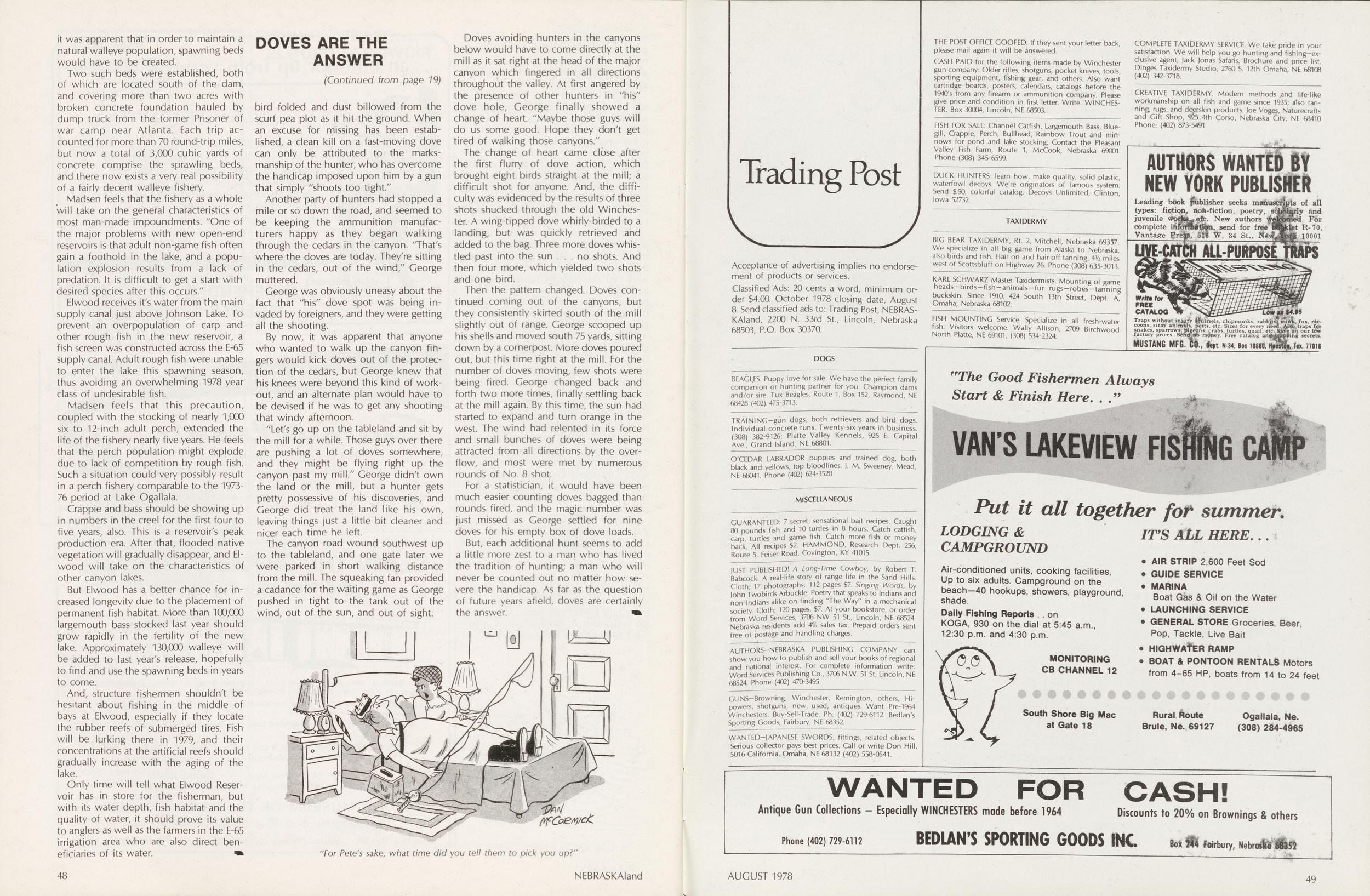
it was apparent that in order to maintain a natural walleye population, spawning beds would have to be created.
Two such beds were established, both of which are located south of the dam, and covering more than two acres with broken concrete foundation hauled by dump truck from the former Prisoner of war camp near Atlanta. Each trip accounted for more than 70 round-trip miles, but now a total of 3,000 cubic yards of concrete comprise the sprawling beds, and there now exists a very real possibility of a fairly decent walleye fishery.
Madsen feels that the fishery as a whole will take on the general characteristics of most man-made impoundments. "One of the major problems with new open-end reservoirs is that adult non-game fish often gain a foothold in the lake, and a population explosion results from a lack of predation. It is difficult to get a start with desired species after this occurs."
Elwood receives it's water from the main supply canal just above Johnson Lake. To prevent an overpopulation of carp and other rough fish in the new reservoir, a fish screen was constructed across the E-65 supply canal. Adult rough fish were unable to enter the lake this spawning season, thus avoiding an overwhelming 1978 year class of undesirable fish.
Madsen feels that this precaution, coupled with the stocking of nearly 1,000 six to 12-inch adult perch, extended the life of the fishery nearly five years. He feels that the perch population might explode due to lack of competition by rough fish. Such a situation could very possibly result in a perch fishery comparable to the 1973-76 period at Lake Ogallala.
Crappie and bass should be showing up in numbers in the creel for the first four to five years, also. This is a reservoir's peak production era. After that, flooded native vegetation will gradually disappear, and Elwood will take on the characteristics of other canyon lakes.
But Elwood has a better chance for increased longevity due to the placement of permanent fish habitat. More than 100,000 largemouth bass stocked last year should grow rapidly in the fertility of the new lake. Approximately 130,000 walleye will be added to last year's release, hopefully to find and use the spawning beds in years to come.
And, structure fishermen shouldn't be hesitant about fishing in the middle of bays at Elwood, especially if they locate the rubber reefs of submerged tires. Fish will be lurking there in 1979, and their concentrations at the artificial reefs should gradually increase with the aging of the lake.
Only time will tell what Elwood Reservoir has in store for the fisherman, but with its water depth, fish habitat and the quality of water, it should prove its value to anglers as well as the farmers in the E-65 irrigation area who are also direct beneficiaries of its water.
DOVES ARE THE ANSWER
(Continued from page 19)bird folded and dust billowed from the scurf pea plot as it hit the ground. When an excuse for missing has been established, a clean kill on a fast-moving dove can only be attributed to the marksmanship of the hunter, who has overcome the handicap imposed upon him by a gun that simply "shoots too tight."
Another party of hunters had stopped a mile or so down the road, and seemed to be keeping the ammunition manufacturers happy as they began walking through the cedars in the canyon. "That's where the doves are today. They're sitting in the cedars, out of the wind," George muttered.
George was obviously uneasy about the fact that "his" dove spot was being invaded by foreigners, and they were getting all the shooting.
By now, it was apparent that anyone who wanted to walk up the canyon fingers would kick doves out of the protection of the cedars, but George knew that his knees were beyond this kind of workout, and an alternate plan would have to be devised if he was to get any shooting that windy afternoon.
"Let's go up on the tableland and sit by the mill for a while. Those guys over there are pushing a lot of doves somewhere, and they might be flying right up the canyon past my mill." George didn't own the land or the mill, but a hunter gets pretty possessive of his discoveries, and George did treat the land like his own, leaving things just a little bit cleaner and nicer each time he left.
The canyon road wound southwest up to the tableland, and one gate later we were parked in short walking distance from the mill. The squeaking fan provided a cadance for the waiting game as George pushed in tight to the tank out of the wind, out of the sun, and out of sight.
Doves avoiding hunters in the canyons below would have to come directly at the mill as it sat right at the head of the major canyon which fingered in all directions throughout the valley. At first angered by the presence of other hunters in "his" dove hole, George finally showed a change of heart. "Maybe those guys will do us some good. Hope they don't get tired of walking those canyons."
The change of heart came close after the first flurry of dove action, which brought eight birds straight at the mill; a difficult shot for anyone. And, the difficulty was evidenced by the results of three shots shucked through the old Winchester. A wing-tipped dove whirly-birded to a landing, but was quickly retrieved and added to the bag. Three more doves whistled past into the sun ... no shots. And then four more, which yielded two shots and one bird.
Then the pattern changed. Doves continued coming out of the canyons, but they consistently skirted south of the mill slightly out of range. George scooped up his shells and moved south 75 yards, sitting down by a cornerpost. More doves poured out, but this time right at the mill. For the number of doves moving, few shots were being fired. George changed back and forth two more times, finally settling back at the mill again. By this time, the sun had started to expand and turn orange in the west. The wind had relented in its force and small bunches of doves were being attracted from all directions by the overflow, and most were met by numerous rounds of No. 8 shot.
For a statistician, it would have been much easier counting doves bagged than rounds fired, and the magic number was just missed as George settled for nine doves for his empty box of dove loads.
But, each additional hunt seems to add a little more zest to a man who has lived the tradition of hunting; a man who will never be counted out no matter how severe the handicap. As far as the question of future years afield, doves are certainly the answer.
Trading Post
Acceptance of advertising implies no endorse- ment of products or services. Classified Ads: 20 cents a word, minimum or- der $4.00. October 1978 closing date, August 8. Send classified ads to: Trading Post, NEBRAS- KAIand, 2200 N. 33rd St., Lincoln, Nebraska 68503, P.O. Box 30370. DOGS BEAGLES. Puppy love for sale. We have the perfect family companion or hunting partner for you. Champion dams and/or sire. Tux Beagles, Route 1, Box 152, Raymond, NE 68428 (402) 475-3713. TRAINING—gun dogs, both retrievers and bird dogs. Individual concrete runs. Twenty-six years in business. (308) 382-9126, Platte Valley Kennels, 925 E. Capital Ave., Grand Island, NE 68801. O'CEDAR LABRADOR puppies and trained dog, both black and yellows, top bloodlines. J. M. Sweeney, Mead, NE 68041. Phone (402) 624-3520 MISCELLANEOUS GUARANTEED: 7 secret, sensational bait recipes. Caught 80 pounds fish and 10 turtles in 8 hours. Catch catfish, carp, turtles and game fish. Catch more fish or money back. All recipes $2. HAMMOND, Research Dept. 256, Route 5, Feiser Road, Covington, KY 41015 JUST PUBLISHED! A Long-Time Cowboy, by Robert T. Babcock. A real-life story of range life in the Sand Hills. Cloth; 17 photographs; 112 pages $7. Singing Words, by John Twobirds Arbuckle. Poetry that speaks to Indians and non-lndians alike on finding "The Way" in a mechanical society. Cloth; 120 pages. $7. At your bookstore, or order from Word Services, 3706 NW 51 St., Lincoln, NE 68524. Nebraska residents add 4% sales tax. Prepaid orders sent free of postage and handling charges. AUTHORS-NEBRASKA PUBLISHING COMPANY can show you how to publish and sell your books of regional and national interest. For complete information write: Word Services Publishing Co., 3706 N.W. 51 St, Lincoln, NE 68524. Phone (402) 470-3495 GUNS—Browning, Winchester, Remington, others, Em- powers, shotguns, new, used, antiques. Want Pre-1964 Winchesters. Buy-Sell-Trade. Ph. (402) 729-6112. Bed Ian's Sporting Goods, Fairbury, NE 68352. WANTED-JAPANESE SWORDS, fittings, related objects. Serious collector pays best prices. Call or write Don Hill, 5016 California, Omaha, NE 68132 (402) 558-0541. WANTED FOR CASH! Antique Gun Collections - Especially WINCHESTERS made before 1964 Discounts to 20% on Brownings & others Phone (402) 729-6112 BEDLAN’S SPORTING GOODS INC >., ft Fairbury, Nebraska 68352 ____________________________________________________________-- THE POST OFFICE GOOFED. If they sent your letter back, please mail again it will be answered. CASH PAID for the following items made by Winchester gun company: Older rifles, shotguns, pocket knives, tools, sporting equipment, fishing gear, and others. Also want cartridge boards, posters, calendars, catalogs before the 1940's from any firearm or ammunition company. Please give price and condition in first letter. Write: WINCHES- TER, Box 30004, Lincoln, NE 68503. FISH FOR SALE: Channel Catfish, Largemouth Bass, Blue- gill, Crappie, Perch, Bullhead, Rainbow Trout and min- nows for pond and lake stocking. Contact the Pleasant Valley Fish Farm, Route 1, McCook, Nebraska 69001. Phone (308) 345-6599. DUCK HUNTERS: learn how, make quality, solid plastic, waterfowl decoys. We're originators of famous system. Send $.50, colorful catalog. Decoys Unlimited, Clinton, Iowa 52732. TAXIDERMY rrThe Good Fishermen Always Start & Finish Here. . ." VAN’S LAKEVIEW FIsftllG CAMP Put it all together for summer. LODGING & ITS ALL HERE... CAMPGROUND Air-conditioned units, cooking facilities, Up to six adults. Campground on the beach—40 hookups, showers, playground, shade. Daily Fishing Reports . . on KOGA, 930 on the dial at 5:45 a.m., 12:30 p.m. and 4:30 p.m. MONITORING CB CHANNEL 12 •••••••• South Shore Big Mac at Gate 18 COMPLETE TAXIDERMY SERVICE. We take pride in your satisfaction. We will help you go hunting and fishing—ex- clusive agent, lack Jonas Safaris. Brochure and price list. Dinges Taxidermy Studio, 2760 S. 12th Omaha, NE 68108 (402) 342-3718. CREATIVE TAXIDERMY. Modern methods and life-like workmanship on all fish and game since 1935; also tan- ning, rugs, and deerskin products. Joe Voges, Naturecrafts and Gift Shop, 925 4th Corso, Nebraska City, NE 68410 Phone: (402) 873-5491 AUTHORS WANTED BY NEW YORK PUBLISHER BIG BEAR TAXIDERMY, Rt. 2, Mitchell, Nebraska 69357. We specialize in all big game from Alaska to Nebraska, also birds and fish. Hair on and hair off tanning, 4Vi miles west of Scottsbluff on Highway 26. Phone (308) 635-3013. KARL SCHWARZ Master Taxidermists. Mounting of game heads—birds—fish—animals—fur rugs—robes—tanning buckskin. Since 1910. 424 South 13th Street, Dept. A, Omaha, Nebraska 68102. FISH MOUNTING Service. Specialize in all fresh-water fish. Visitors welcome. Wally Allison, 2709 Birchwood North Platte, NE 69101, (308) 534-2324. Leading book publisher seeks types: juvenile complete Vantage of all and . For K-70. Ek, fox, rikc- S> pn our low ini secrets. . tex. 77818 chipmunks, rabbjfsj etc. Sizes for every nee crabs, turtles, quail, etc. I nowey Free catalog rut MM Sept N 34, Box 10880, Hoi Wrltotor FREE CATALOG factory’ prices. MUSTANG MEG. • AIR STRIP 2,600 Feet Sod • GUIDE SERVICE • MARINA Boat Gas & Oil on the Water • LAUNCHING SERVICE • GENERAL STORE Groceries, Beer, Pop, Tackle, Live Bait • HIGHWAtER RAMP • BOAT & PONTOON RENTALS Motors from 4-65 HP, boats from 14 to 24 feet • ••••••••••• Rural Route Ogallala, Ne. Brule, Ne. 69127 (308) 284-4965 48 NEBRASKAIand AUGUST 1978 49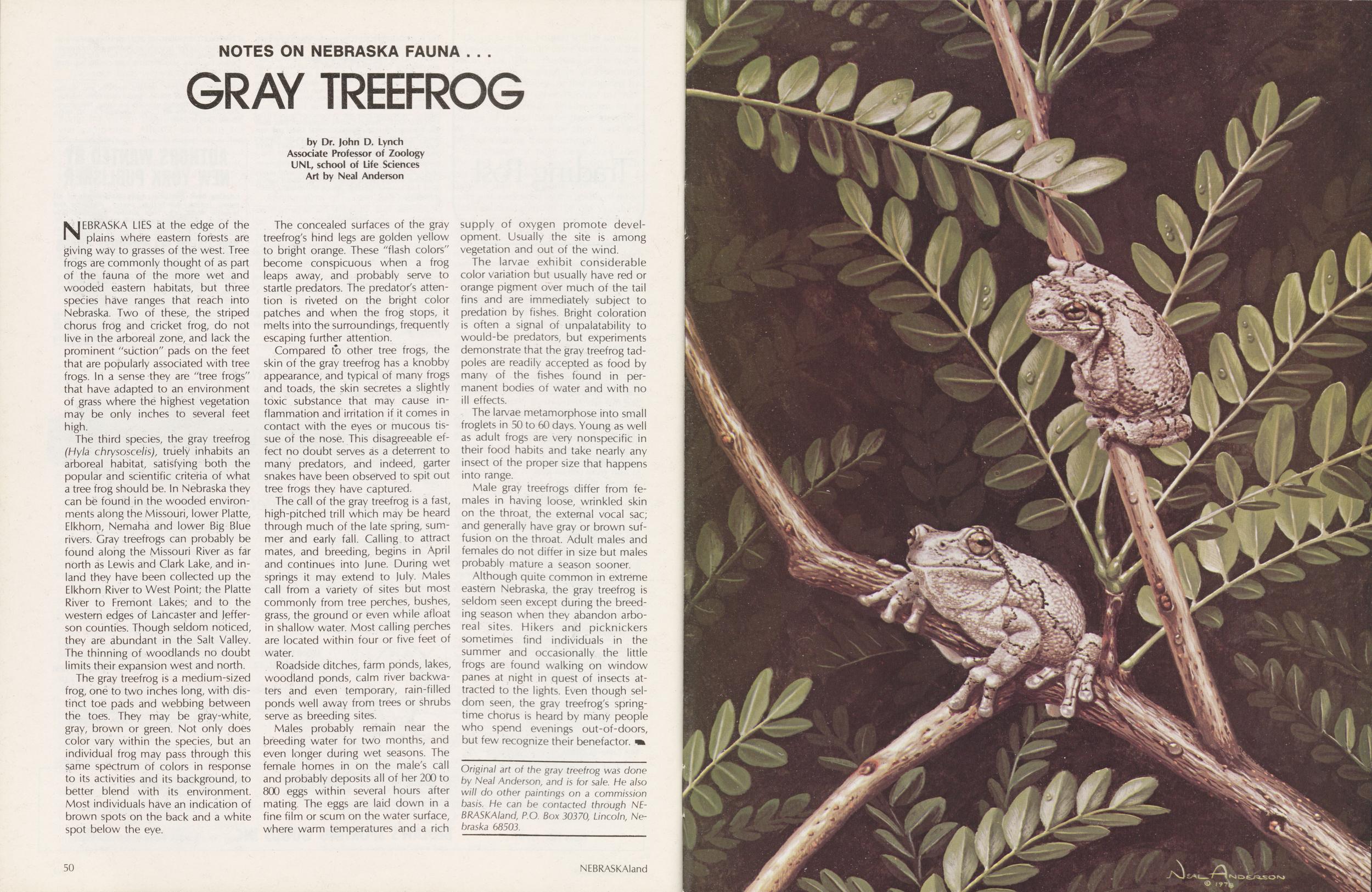
Notes on Nebraska Fauna . . .
GRAY TREEFROG
NEBRASKA LIES at the edge of the plains where eastern forests are giving way to grasses of the west. Tree frogs are commonly thought of as part of the fauna of the more wet and wooded eastern habitats, but three species have ranges that reach into Nebraska. Two of these, the striped chorus frog and cricket frog, do not live in the arboreal zone, and lack the prominent "suction" pads on the feet that are popularly associated with tree frogs. In a sense •they are "tree frogs" that have adapted to an environment of grass where the highest vegetation may be only inches to several feet high.
The third species, the gray treefrog (Hyla chrysoscelis), truely inhabits an arboreal habitat, satisfying both the popular and scientific criteria of what a tree frog should be. In Nebraska they can be found in the wooded environments along the Missouri, lower Platte, Elkhorn, Nemaha and lower Big Blue rivers. Gray treefrogs can probably be found along the Missouri River as far north as Lewis and Clark Lake, and inland they have been collected up the Elkhorn River to West Point; the Platte River to Fremont Lakes; and to the western edges of Lancaster and Jefferson counties. Though seldom noticed, they are abundant in the Salt Valley. The thinning of woodlands no doubt limits their expansion west and north.
The gray treefrog is a medium-sized frog, one to two inches long, with distinct toe pads and webbing between the toes. They may be gray-white, gray, brown or green. Not only does color vary within the species, but an individual frog may pass through this same spectrum of colors in response to its activities and its background, to better blend with its environment. Most individuals have an indication of brown spots on the back and a white spot below the eye.
The concealed surfaces o t e gray treefrog's hind legs are golden yellow to bright orange. These "flash colors" become conspicuous when a frog leaps away, and probably serve to startle predators. The predatods attention is riveted on the bright color patches and when the frog stops, it melts into the surroundings, frequently escaping further attention.
Compared to other tree frogs, the skin of the gray treefrog has a knobby appearance, and typical of many frogs and toads, the skin secretes a slightly toxic substance that may cause inflammation and irritation if it comes in contact with the eyes or mucous tissue of the nose. This disagreeable effect no doubt serves as a deterrent to many predators, and indeed, garter snakes have been observed to spit out tree frogs they have captured.
The call of the gray treefrog is a fast, high-pitched trill which may be heard through much of the late spring, summer and early fall. Calling to attract mates, and breeding, begins in April and continues into June. During wet springs it may extend to July. Males call from a variety of sites but most commonly from tree perches, bushes, grass, the ground or even while afloat in shallow water. Most calling perches are located within four or five feet of water.
Roadside ditches, farm ponds, lakes, woodland ponds, calm river backwaters and even temporary, rain-filled ponds well away from trees or shrubs serve as breeding sites.
Males probably remain near the breeding water for two months, and even longer during wet seasons. The female homes in on the male's call and probably deposits all of her 200 to 800 eggs within several hours after mating. The eggs are laid down in a fine film or scum on the water surface, where warm temperatures and a rich supply of oxygen promote development. Usually the site is among vegetation and out of the wind.
The larvae exhibit considerable color variation but usually have red or orange pigment over much of the tail fins and are immediately subject to predation by fishes. Bright coloration is often a signal of unpalatability to would-be predators, but experiments demonstrate that the gray treefrog tadpoles are readily accepted as food by many of the fishes found in permanent bodies of water and with no ill effects.
The larvae metamorphose into small froglets in 50 to 60 days. Young as well as adult frogs are very nonspecific in their food habits and take nearly any insect of the proper size that happens into range.
Male gray treefrogs differ from females in having loose, wrinkled skin on the throat, the external vocal sac; and generally have gray or brown suffusion on the throat. Adult males and females do not differ in size but males probably mature a season sooner.
Although quite common in extreme eastern Nebraska, the gray treefrog is seldom seen except during the breeding season when they abandon arboreal sites. Hikers and picknickers sometimes find individuals in the summer and occasionally the little frogs are found walking on window panes at night in quest of insects attracted to the lights. Even though seldom seen, the gray treefrog's spring-time chorus is heard by many people who spend evenings out-of-doors, but few recognize their benefactor.
Original art of the gray treefrog was done by Neal Anderson, and is for sale. He also will do other paintings on a commission basis. He can be contacted through NEBRASKAland, P.o Box 30370 Lincoln, Nebraska 68503.
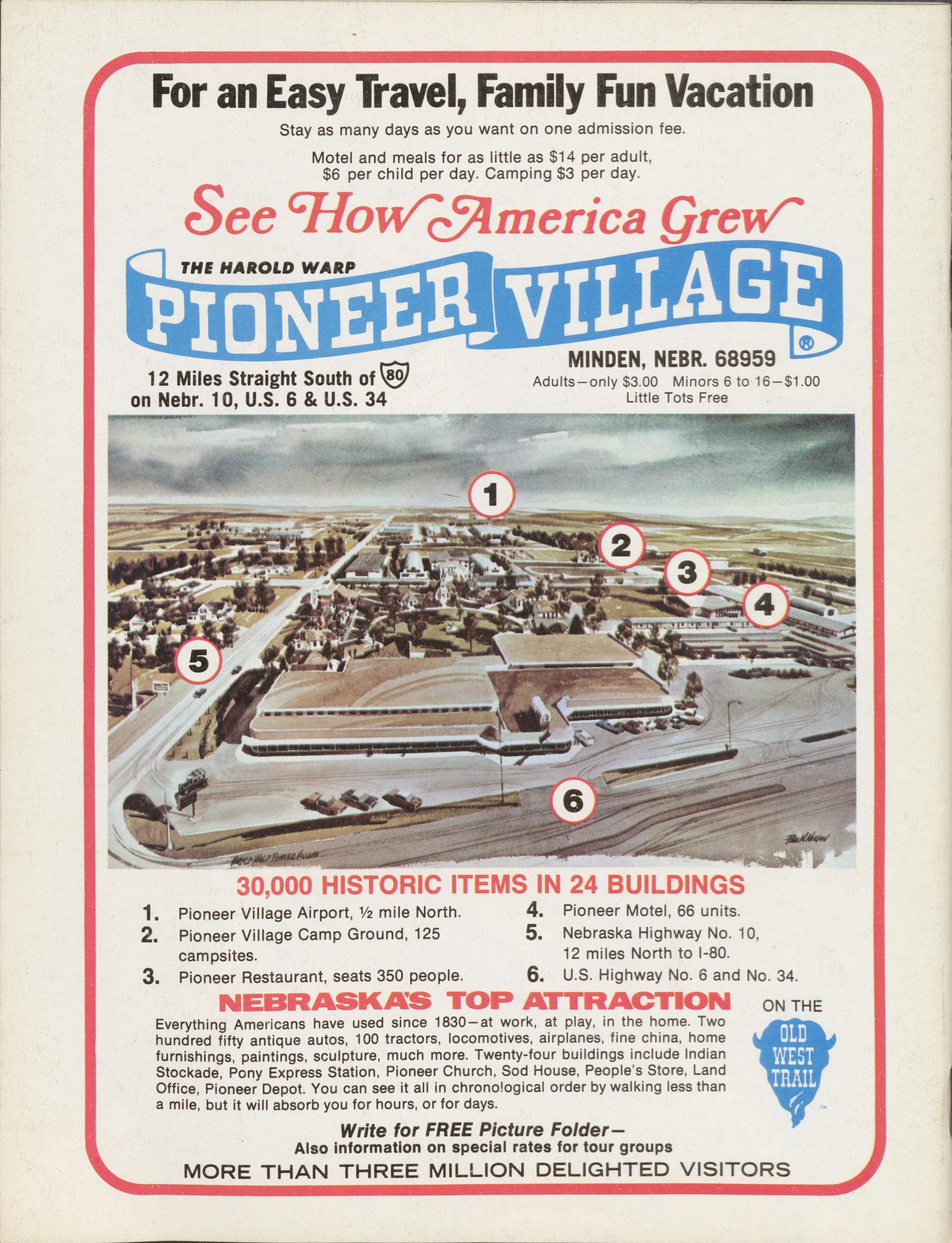
Position: 116 (51 views)