Volume 56, Issue 7, 1978
NEBRASKAland
July 1978 60 Cents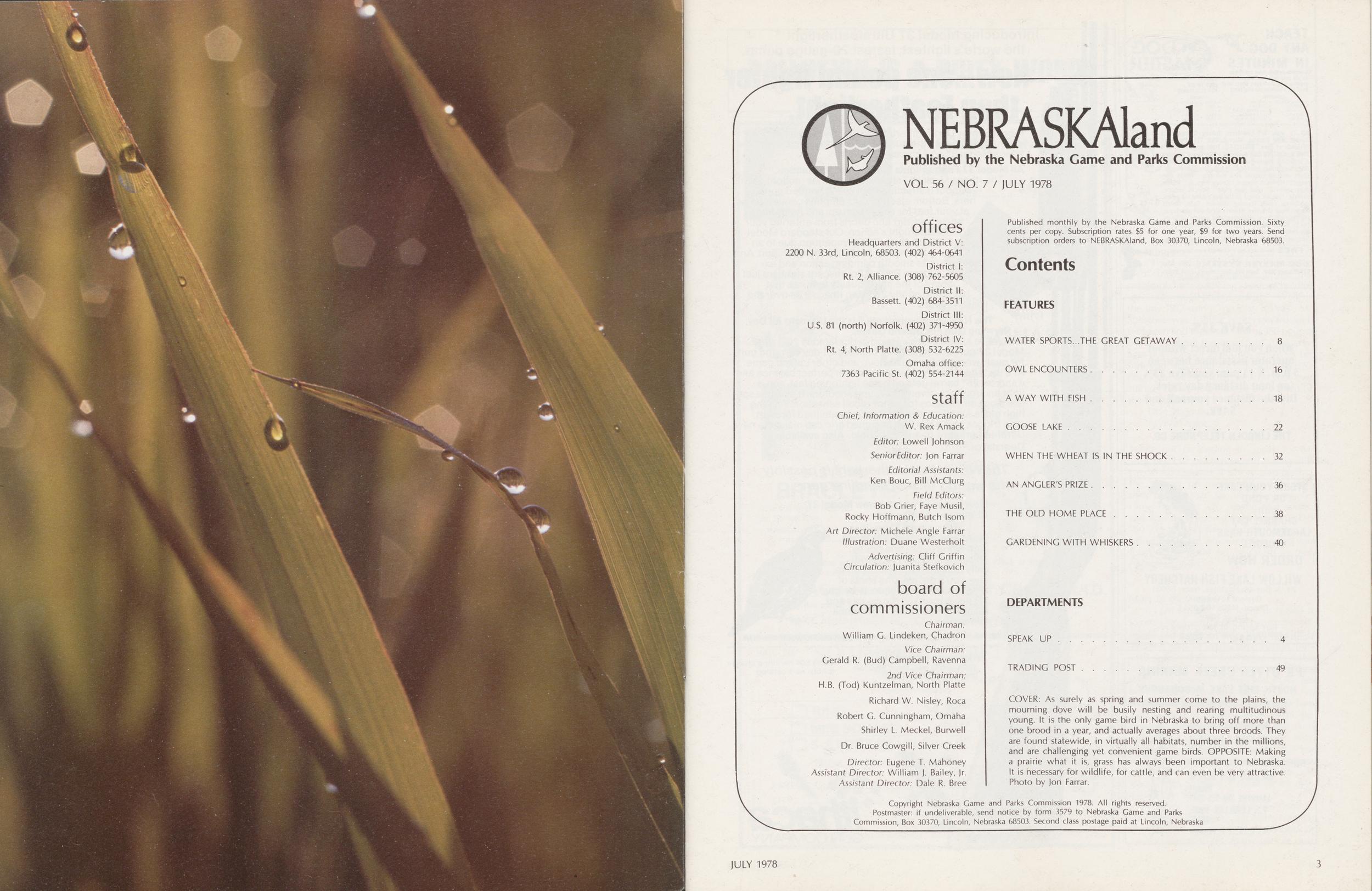
NEBRASKAland
Published by the Nebraska Game and Parks Commission
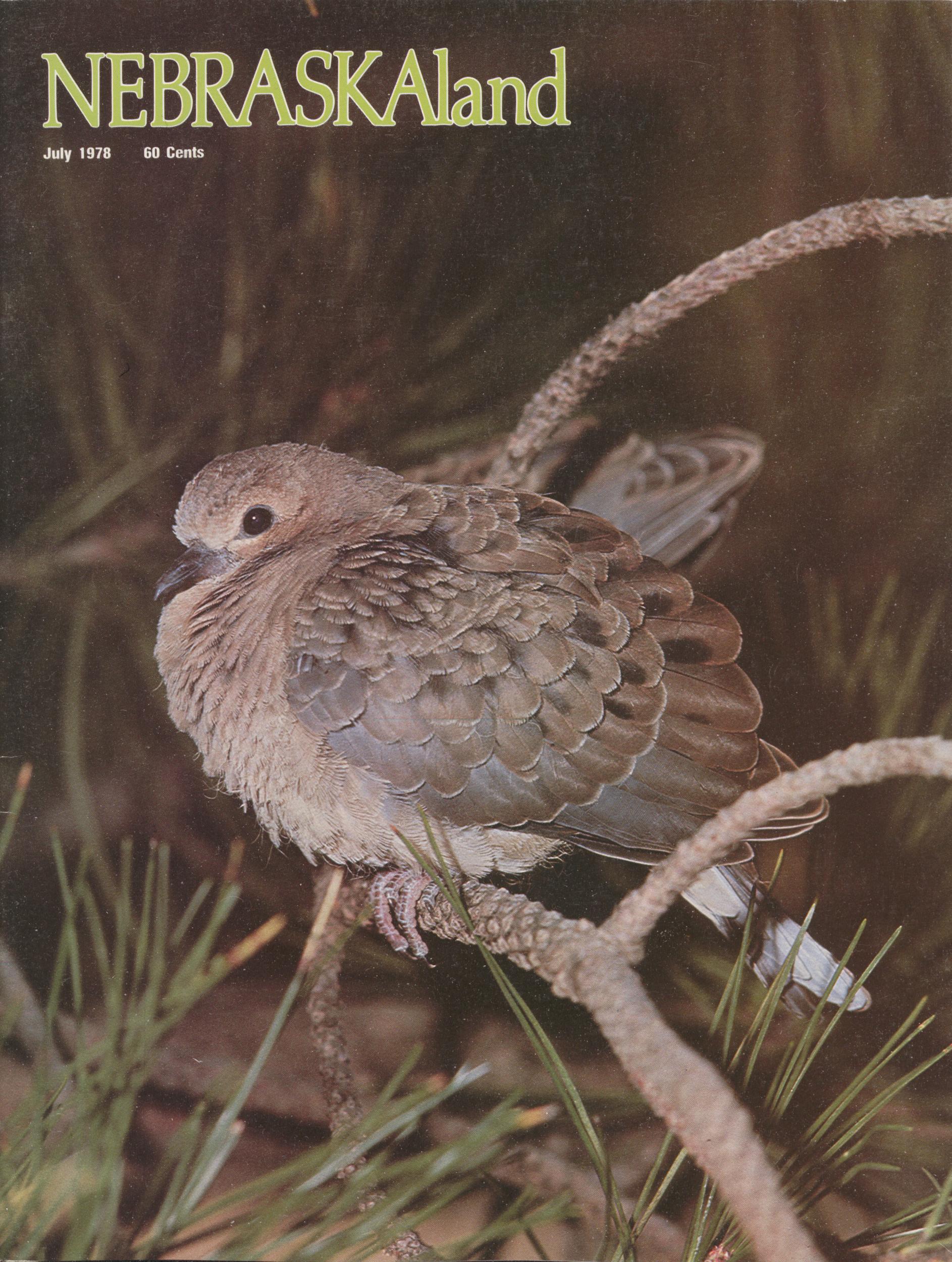
VOL. 56 / NO. 7 / JULY 1978 offices Headquarters and District V: 2200 N. 33rd, Lincoln, 68503. (402) 464-0641 District I: Rt. 2, Alliance. (308) 762-5605 District II: Bassett. (402) 684-3511 District III: US. 81 (north) Norfolk. (402) 371-4950 District IV: Rt. 4, North Platte. (308) 532-6225 Omaha office: 7363 Pacific St. (402) 554-2144 staff Chief, Information & Education: W. Rex Amack Editor: Lowell Johnson Senior Editor: Jon Farrar Editorial Assistants: Ken Bouc, Bill McClurg Field Editors: Bob Grier, Faye Musil, Rocky Hoffmann, Butch Isom Art Director: Michele Angle Farrar Illustration: Duane Westerholt Advertising: Cliff Griffin Circulation: Juanita Stefkovich board of commissioners Chairman: William G. Lindeken, Chadron Vice Chairman: Gerald R. (Bud) Campbell, Ravenna 2nd Vice Chairman: H.B. (Tod) Kuntzelman, North Platte Richard W. Nisley, Roca Robert G. Cunningham, Omaha Shirley L. Meckel, Burwell Dr. Bruce Cowgill, Silver Creek Director: Eugene T. Mahoney Assistant Director: William J. Bailey, Jr. Assistant Director: Dale R. Bree Published monthly by the Nebraska Game and Parks Commission. Sixty cents per copy. Subscription rates $5 for one year, $9 for two years. Send subscription orders to NEBRASKAland, Box 30370, Lincoln, Nebraska 68503. Contents FEATURES WATER SPORTS...THE GREAT GETAWAY........8 OWL ENCOUNTERS.............. 16 A WAY WITH FISH 18 GOOSE LAKE.............. 22 WHEN THE WHEAT IS IN THE SHOCK.........32 AN ANGLER'S PRIZE THE OLD HOME PLACE 36 . . 38 GARDENING WITH WHISKERS............40 DEPARTMENTS SPEAK UP................. 4 TRADING POST............. 49 COVER: As surely as spring and summer come to the plains, the mourning dove will be busily nesting and rearing multitudinous young. It is the only game bird in Nebraska to bring off more than one brood in a year, and actually averages about three broods. They are found statewide, in virtually all habitats, number in the millions, and are challenging yet convenient game birds. OPPOSITE: Making a prairie what it is, grass has always been important to Nebraska. It is necessary for wildlife, for cattle, and can even be very attractive. Photo by Jon Farrar. Copyright Nebraska Game and Parks Commission 1978. All rights reserved. Postmaster: if undeliverable, send notice by form 3579 to Nebraska Game and Parks Commission, Box 30370, Lincoln, Nebraska 68503. Second class postage paid at Lincoln, Nebraska JULY 1978 3
Speak Up
No Whoppers!Sir / I just read 'The Way It Was, Letter Two" by Ananias Stretcher. In the first paragraph he was talking about us holding up "scrawny 50-pound catfish". Well, in the July 1977 story 'The Way it Was", Mr. Stretcher was fishing with Howard Steffenhagen and they had "100 or 150 pounds of catfish, about five or six fish". That averages out to about 25 pounds a fish! So, before you make fun of our "scrawny" 50-pounders, Mr. Stretcher, look on your own stringer before you criticize ours. Keep up the good work!
Don Thompson LaVista, Nebr.While not pretending to speak for Mr. Stretcher, I would like to put in a word or two in his defense. It is very possible that the stringer he mentioned was actually their bait for that day and he merely became confused. Or, maybe that weight was actually supposed to have been 500 or 750 pounds. There must be some explanation. I have, however, forwarded your letter to him, and he mav wish to reply himself. (Editor)
More of the PictureSir / I am sending this letter in regard to Cynthia jacobsen's letter in November NEBRASKAIand against coon hunting. First of all, i will say that I am a coon hunter, hunt with dogs and do it by the law. I feel that you, Cynthia, should do more thinking and more research before you make any kind of judgement against any sport. Any form of competition can be cruel, and any form of animal death can be cruel—beheading chickens, hammering cattle. And, what about the game of football? Many things can be called inhumane, but you have to draw the line someplace. No real sportsman likes to see anything suffer, and always tries to prevent suffering by making a clean kill.
Why not speak up for stiffer fines for
poaching, spotlighting and other forms of
illegal "hunting", or for people to speak up
against wrong-doing? Many people overlook such behavior because they don't
4 NEBRASKAland
JULY 1978 5
 want to get involved, or don't want to turn
in a friend or neighbor, or don't want to
cause trouble. But, those are the bad
guys—they deserve to be called cruel and
senseless, not the ones who buy permits
and hunt legally. If some of us don't like
something, that doesn't give us the right to
call the next person cruel because he does
like it, even if we do have freedom of
speech. True sportsmen are preserving
wildlife by hunting according to the law.
want to get involved, or don't want to turn
in a friend or neighbor, or don't want to
cause trouble. But, those are the bad
guys—they deserve to be called cruel and
senseless, not the ones who buy permits
and hunt legally. If some of us don't like
something, that doesn't give us the right to
call the next person cruel because he does
like it, even if we do have freedom of
speech. True sportsmen are preserving
wildlife by hunting according to the law.
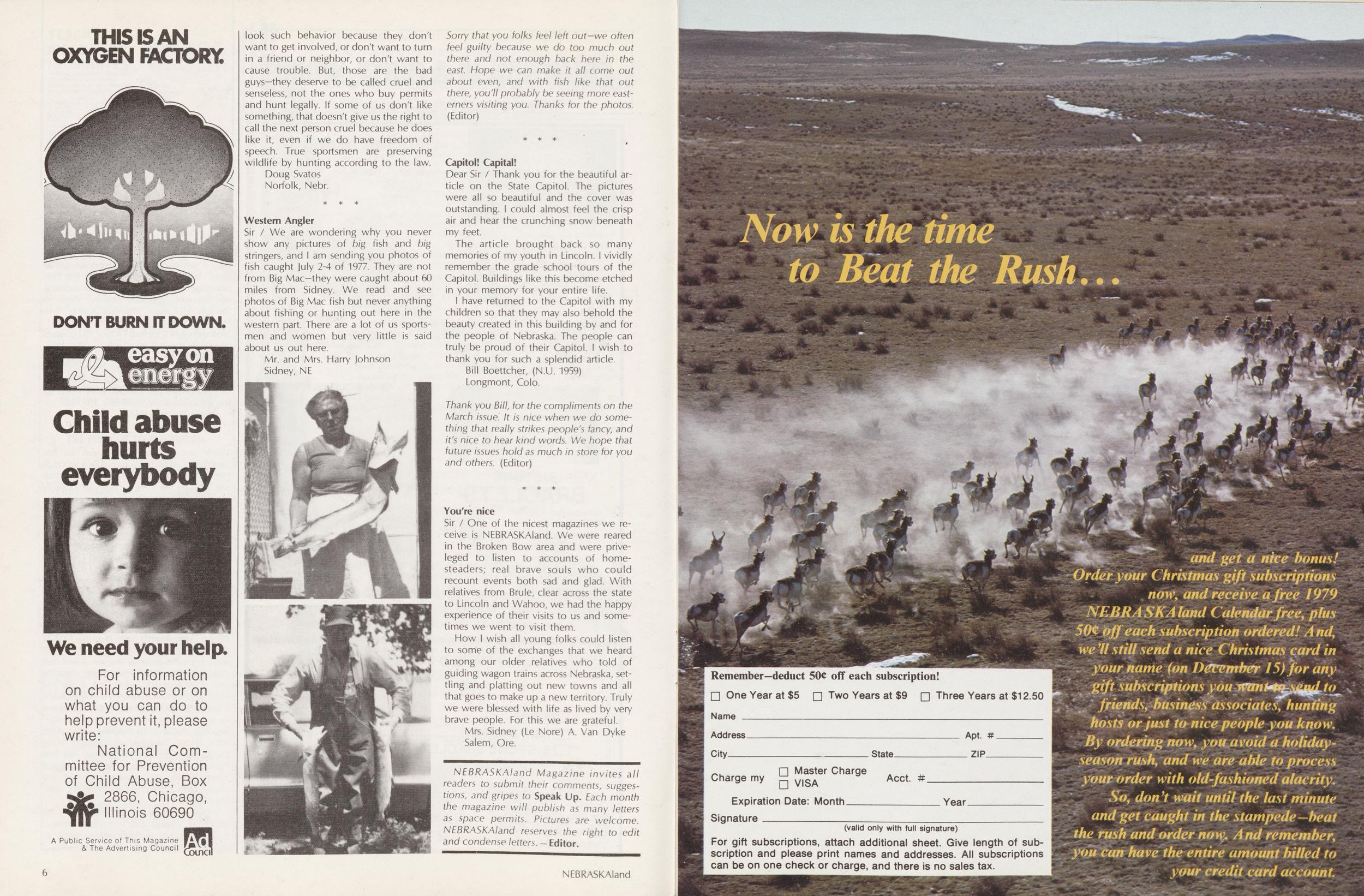
Sir / We are wondering why you never show any pictures of big fish and big stringers, and I am sending you photos of fish caught July 2-4 of 1977. They are not from Big Mac—they were caught about 60 miies from Sidney. We read and see photos of Big Mac fish but never anything about fishing or hunting out here in the western part. There are a lot of us sportsmen and women but very little is said about us out here.
Mr. and Mrs. Harry Johnson Sidney, NESorry that you folks feel left out—we often feel guilty because we do too much out there and not enough back here in the east. Hope we can make it all come out about even, and with fish like that out there, you'll probably be seeing more easterners visiting you. Thanks for the photos. (Editor)
Capitol! Capital!Dear Sir / Thank you for the beautiful article on the State Capitol. The pictures were all so beautiful and the cover was outstanding. I could almost feel the crisp air and hear the crunching snow beneath my feet.
The article brought back so many memories of my youth in Lincoln. I vividly remember the grade school tours of the Capitol. Buildings like this become etched in your memory for your entire life.
I have returned to the Capitol with my children so that they may also behold the beauty created in this building by and for the people of Nebraska. The people can truly be proud of their Capitol. I wish to thank you for such a splendid article.
Bill Boettcher, (N.U. 1959) Longmont, Colo.Thank you Bill, for the compliments on the March issue. It is nice when we do something that really strikes people's fancy, and it's nice to hear kind words. We hope that future issues hold as much in store for you and others. (Editor)
You're niceSir / One of the nicest magazines we receive is NEBRASKAIand. We were reared in the Broken Bow area and were priveleged to listen to accounts of homesteaders; real brave souls who could recount events both sad and glad. With relatives from Brule, clear across the state to Lincoln and Wahoo, we had the happy experience of their visits to us and sometimes we went to visit them.
How I wish all young folks could listen to some of the exchanges that we heard among our older relatives who told of guiding wagon trains across Nebraska, settling and platting out new towns and all that goes to make up a new territory. Truly we were blessed with life as lived by very brave people. For this we are grateful.
Mrs. Sidney (Le Nore) A. Van Dyke Salem, Ore. NEBRASKAIand Magazine invites all readers to submit their comments, suggestions, and gripes to Speak Up. Each month the magazine will publish as many letters as space permits. Pictures are welcome. NEBRASKAIand reserves the right to edit and condense letters. - Editor. 6 NEBRASKAIand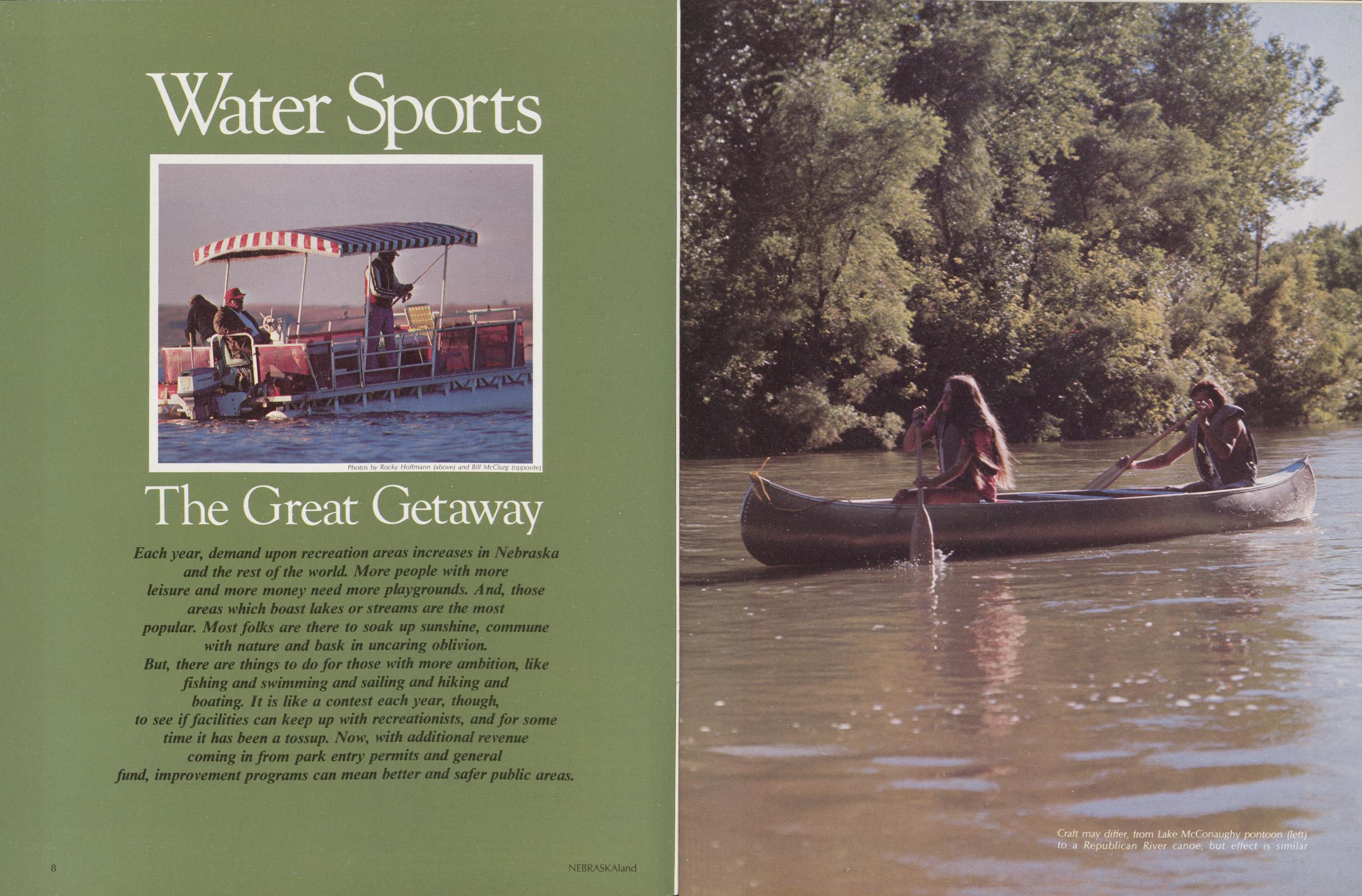
Water Sports
The Great Getaway
Each year, demand upon recreation areas increases in Nebraska and the rest of the world More people with more leisure and more money need more playgrounds. And, those areas which boast lakes or streams are the most popular. Most folks are there to soak up sunshine, commune with nature and bask in uncaring oblivion. But, there are things to do for those with more ambition, like fishing and swimming and sailing and hiking and boating. It is like a contest each year, though, to see if facilities can keep up with recreationists, and for some time it has been a tossup. Now, with additional revenue coming in from park entry permits and general fund, improvement programs can mean better and safer public areas.
8 NEBRASKAIand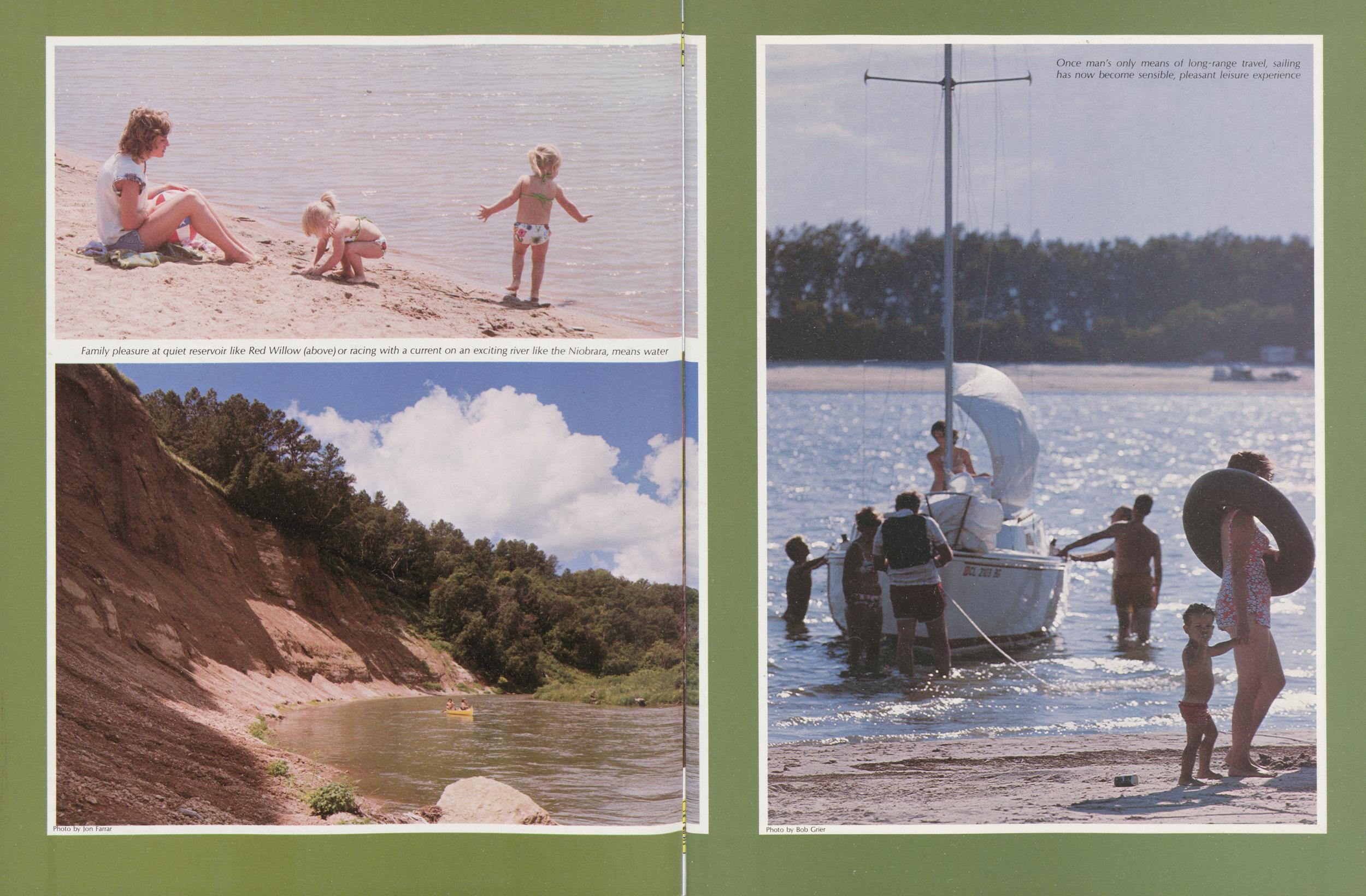
People have utilized water in many ways, both practically and in fun. And, those uses do not end with any season, as the frozen stuff brings out kids with skates, anglers with warm duds and others with various plans. Summer, though, is boom time
Water Sports
The Great Getaway
THE WATER'S EDGE. The meeting place of water and land. It's the place where hunter stalks hunted; a gathering place for all animals.
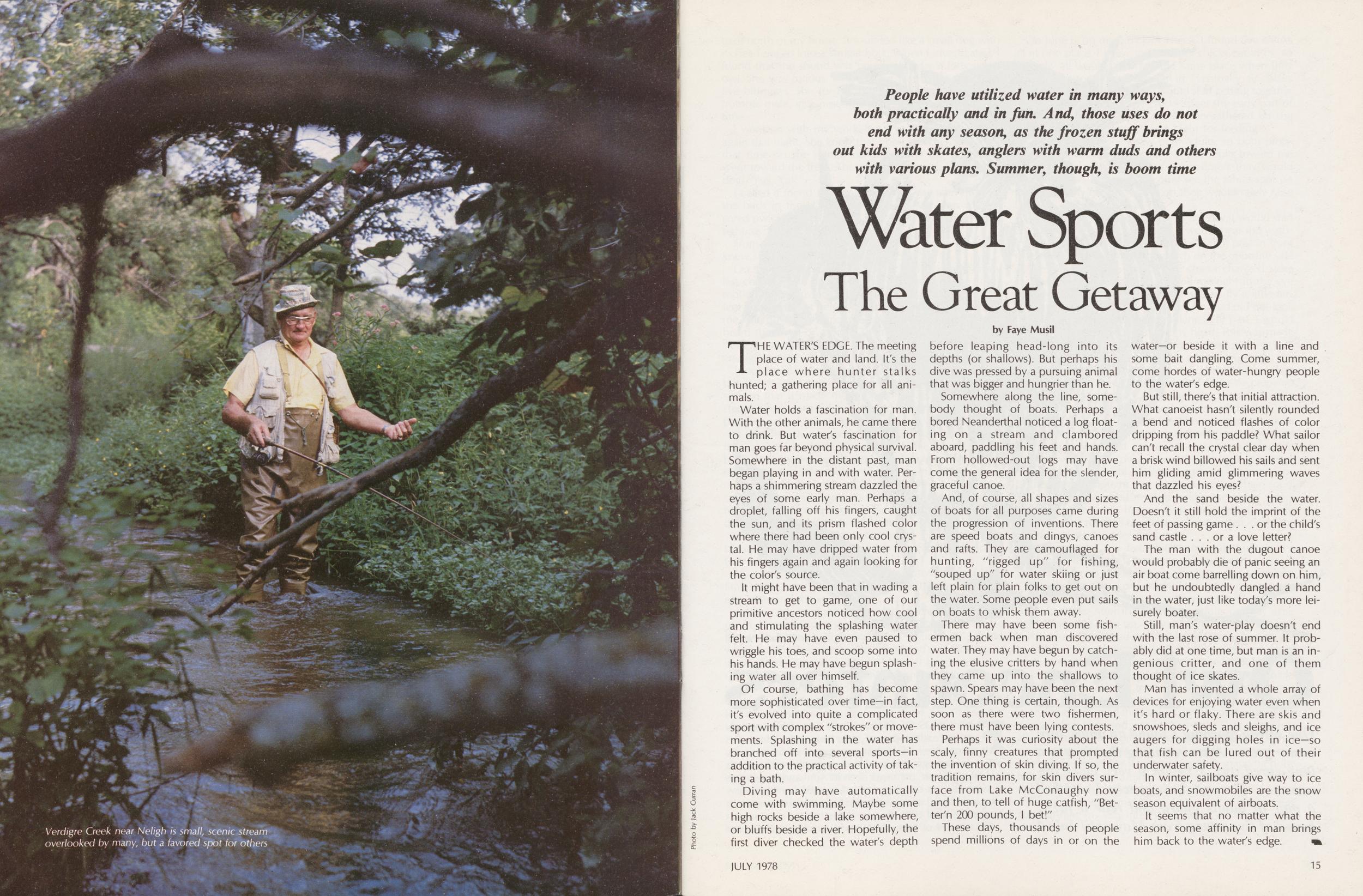
Water holds a fascination for man. With the other animals, he came there to drink. But water's fascination for man goes far beyond physical survival. Somewhere in the distant past, man began playing in and with water. Perhaps a shimmering stream dazzled the eyes of some early man. Perhaps a droplet, falling off his fingers, caught the sun, and its prism flashed color where there had been only cool crystal. He may have dripped water from his fingers again and again looking for the color's source.
It might have been that in wading a stream to get to game, one of our primitive ancestors noticed how cool and stimulating the splashing water felt. He may have even paused to wriggle his toes, and scoop some into his hands. He may have begun splashing water all over himself.
Of course, bathing has become more sophisticated over time—in fact, it's evolved into quite a complicated sport with complex "strokes" or movements. Splashing in the water has branched off into several sports—in addition to the practical activity of taking a bath.
Diving may have automatically come with swimming. Maybe some high rocks beside a lake somewhere, or bluffs beside a river. Hopefully, the first diver checked the water's depth before leaping head-long into its depths (or shallows). But perhaps his dive was pressed by a pursuing animal that was bigger and hungrier than he.
Somewhere along the line, somebody thought of boats. Perhaps a bored Neanderthal noticed a log floating on a stream and clambored aboard, paddling his feet and hands. From hollowed-out logs may have come the general idea for the slender, graceful canoe.
And, of course, all shapes and sizes of boats for all purposes came during the progression of inventions. There are speed boats and dingys, canoes and rafts. They are camouflaged for hunting, "rigged up" for fishing, "souped up" for water skiing or just left plain for plain folks to get out on the water. Some people even put sails on boats to whisk them away.
There may have been some fishermen back when man discovered water. They may have begun by catching the elusive critters by hand when they came up into the shallows to spawn. Spears may have been the next step. One thing is certain, though. As soon as there were two fishermen, there must have been lying contests.
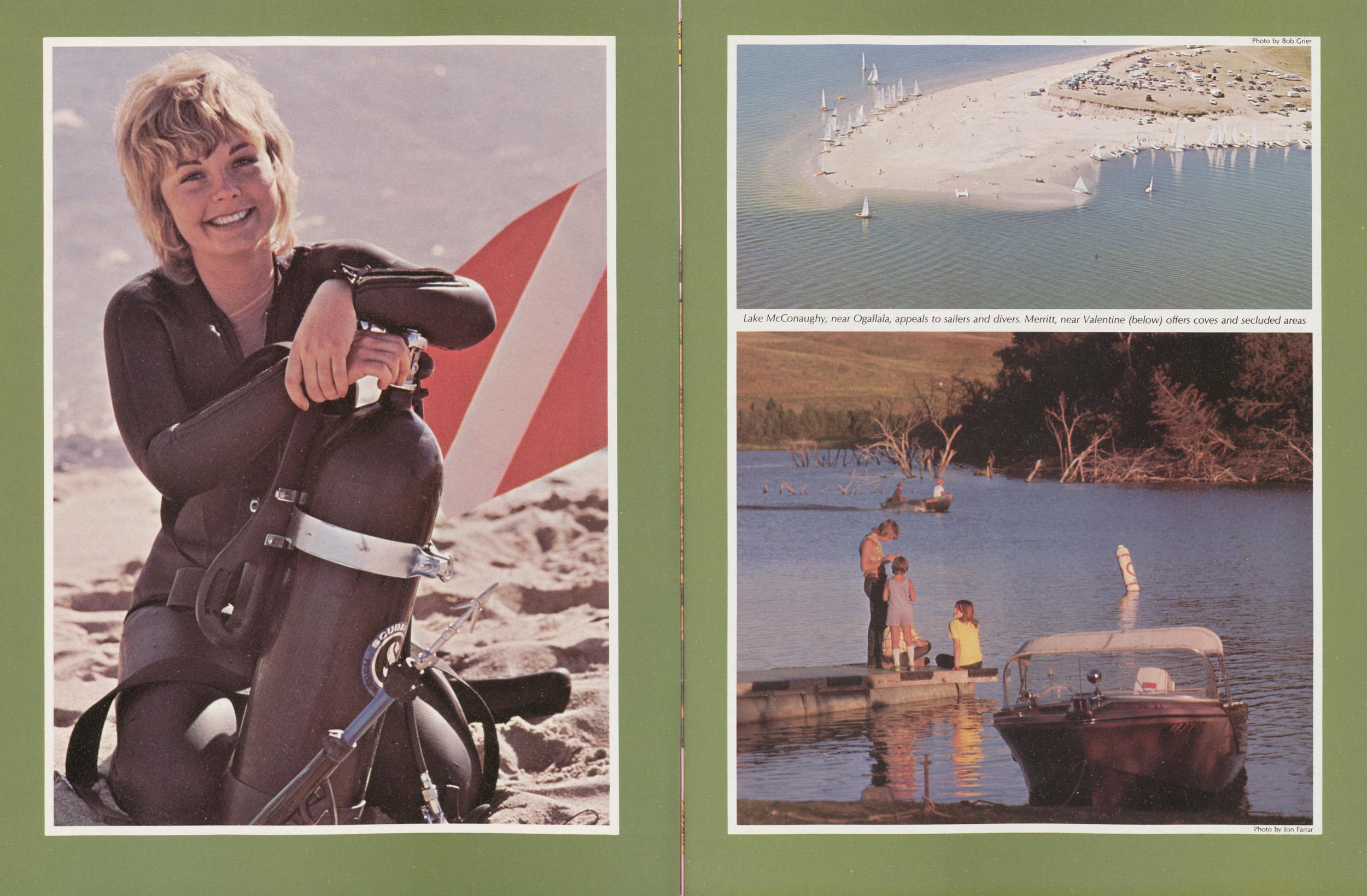
Perhaps it was curiosity about the scaly, finny creatures that prompted the invention of skin diving. If so, the tradition remains, for skin divers surface from Lake McConaughy now and then, to tell of huge catfish, "Better'n 200 pounds, I bet!"
These days, thousands of people spend millions of days in or on the water—or beside it with a line and some bait dangling. Come summer, come hordes of water-hungry people to the water's edge.
But still, there's that initial attraction. What canoeist hasn't silently rounded a bend and noticed flashes of color dripping from his paddle? What sailor can't recall the crystal clear day when a brisk wind billowed his sails and sent him gliding amid glimmering waves that dazzled his eyes?
And the sand beside the water. Doesn't it still hold the imprint of the feet of passing game ... or the child's sand castle ... or a love letter?
The man with the dugout canoe would probably die of panic seeing an air boat come barrelling down on him, but he undoubtedly dangled a hand in the water, just like today's more leisurely boater.
Still, man's water-play doesn't end with the last rose of summer. It probably did at one time, but man is an ingenious critter, and one of them thought of ice skates.
Man has invented a whole array of devices for enjoying water even when it's hard or flaky. There are skis and snowshoes, sleds and sleighs, and ice augers for digging holes in ice—so that fish can be lured out of their underwater safety.
In winter, sailboats give way to ice boats, and snowmobiles are the snow season equivalent of airboats.
It seems that no matter what the season, some affinity in man brings him back to the water's edge.
JULY 1978 15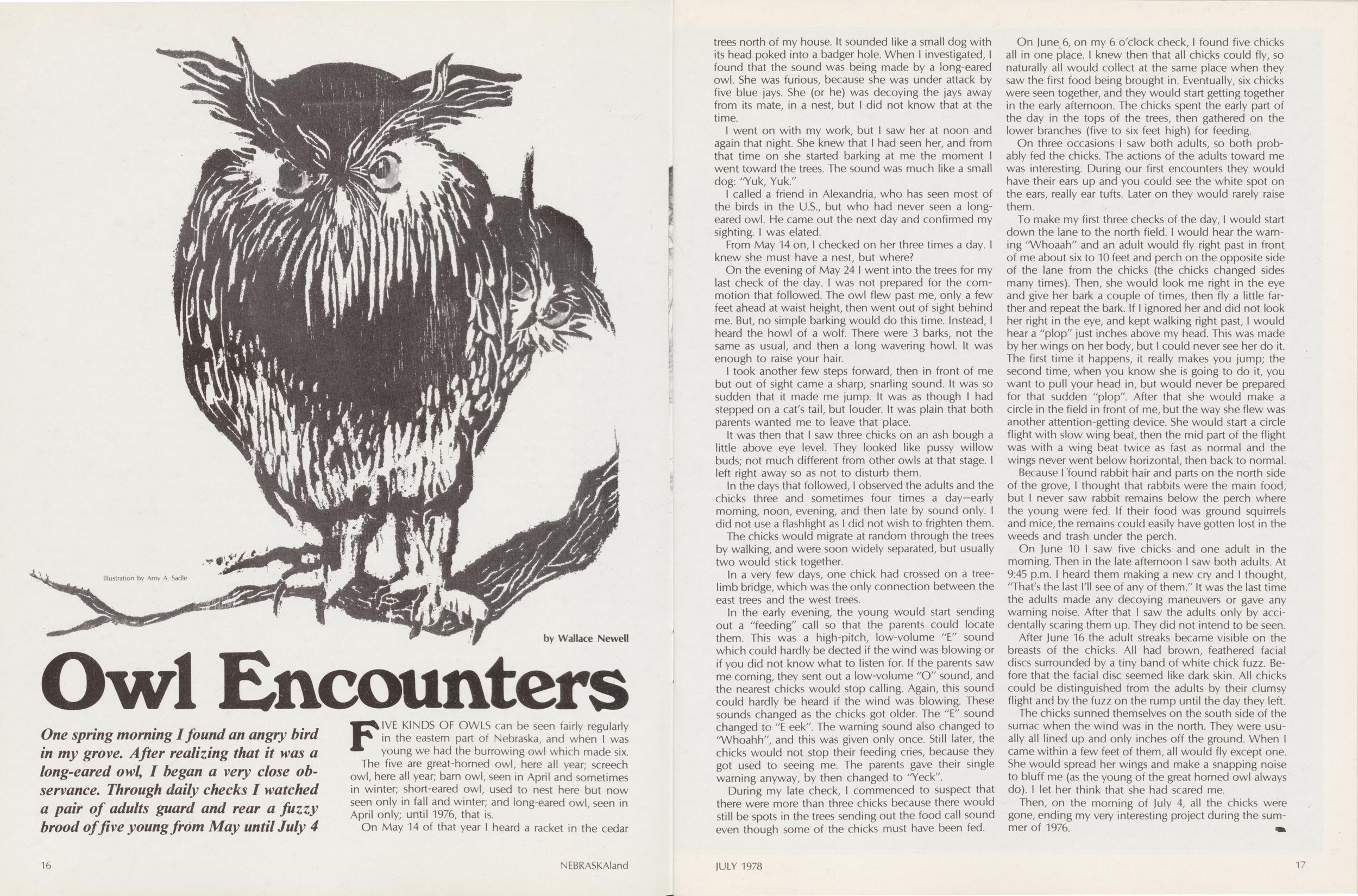
Owl Encounters
One spring morning I found an angry bird in my grove. After realizing that it was a long-eared owl9 I began a very close observance. Through daily checks I watched a pair of adults guard and rear a fuzzy brood of five young from May until July 4
FIVE KINDS OF OWLS can be seen fairly regularly in the eastern part of Nebraska, and when I was young we had the burrowing owl which made six. The five are great-horned owl, here all year; screech owl, here all year; barn owl, seen in April and sometimes in winter; short-eared owl, used to nest here but now seen only in fall and winter; and iong-eared owl, seen in April only; until 1976, that is.
On May 14 of that year I heard a racket in the cedar trees north of my house. It sounded like a small dog with its head poked into a badger hole. When I investigated, I found that the sound was being made by a long-eared owl. She was furious, because she was under attack by five blue jays. She (or he) was decoying the jays away from its mate, in a nest, but I did not know that at the time.
I went on with my work, but I saw her at noon and again that night. She knew that I had seen her, and from that time on she started barking at me the moment I went toward the trees. The sound was much like a small dog: "Yuk, Yuk."
I called a friend in Alexandria, who has seen most of the birds in the U.S., but who had never seen a longeared owl. He came out the next day and confirmed my sighting. I was elated.
From May 14 on, I checked on her three times a day. I knew she must have a nest, but where?
On the evening of May 24 I went into the trees for my last check of the day. I was not prepared for the commotion that followed. The owl flew past me, only a few feet ahead at waist height, then went out of sight behind me. But, no simple barking would do this time. Instead, I heard the howl of a wolf. There were 3 barks, not the same as usual, and then a long wavering howl. It was enough to raise your hair.
I took another few steps forward, then in front of me but out of sight came a sharp, snarling sound. It was so sudden that it made me jump. It was as though I had stepped on a cat's tail, but louder. It was plain that both parents wanted me to leave that place.
It was then that I saw three chicks on an ash bough a little above eye level. They looked like pussy willow buds; not much different from other owls at that stage. I left right away so as not to disturb them.
In the days that followed, I observed the adults and the chicks three and sometimes four times a day—early morning, noon, evening, and then late by sound only. I did not use a flashlight as I did not wish to frighten them. The chicks would migrate at random through the trees by walking, and were soon widely separated, but usually two would stick together.
In a very few days, one chick had crossed on a treelimb bridge, which was the only connection between the east trees and the west trees.
In the early evening, the young would start sending out a "feeding" call so that the parents could locate them. This was a high-pitch, low-volume "E" sound which could hardly be dected if the wind was blowing or if you did not know what to listen for. If the parents saw me coming, they sent out a low-volume "O" sound, and the nearest chicks would stop calling. Again, this sound could hardly be heard if the wind was blowing. These sounds changed as the chicks got older. The "E" sound changed to "E eek". The warning sound also changed to "Whoahh", and this was given only once. Still later, the chicks would not stop their feeding cries, because they got used to seeing me. The parents gave their single warning anyway, by then changed to "Yeck".
During my late check, I commenced to suspect that there were more than three chicks because there would still be spots in the trees sending out the food call sound even though some of the chicks must have been fed.
On June 6, on my 6 o'clock check, I found five chicks all in one place. I knew then that all chicks could fly, so naturally all would collect at the same place when they saw the first food being brought in. Eventually, six chicks were seen together, and they would start getting together in the early afternoon. The chicks spent the early part of the day in the tops of the trees, then gathered on the lower branches (five to six feet high) for feeding.
On three occasions I saw both adults, so both probably fed the chicks. The actions of the adults toward me was interesting. During our first encounters they would have their ears up and you could see the white spot on the ears, really ear tufts. Later on they would rarely raise them.
To make my first three checks of the day, I would start down the lane to the north field. I would hear the warning "Whoaah" and an adult would fly right past in front of me about six to 10 feet and perch on the opposite side of the lane from the chicks (the chicks changed sides many times). Then, she would look me right in the eye and give her bark a couple of times, then fly a little farther and repeat the bark. If I ignored her and did not look her right in the eye, and kept walking right past, I would hear a "plop" just inches above my head. This was made by her wings on her body, but I could never see her do it. The first time it happens, it really makes you jump; the second time, when you know she is going to do it, you want to pull your head in, but would never be prepared for that sudden "plop". After that she would make a circle in the field in front of me, but the way she flew was another attention-getting device. She would start a circle flight with slow wing beat, then the mid part of the flight was with a wing beat twice as fast as normal and the wings never went below horizontal, then back to normal.
Because I 'found rabbit hair and parts on the north side of the grove, I thought that rabbits were the main food, but I never saw rabbit remains below the perch where the young were fed. If their food was ground squirrels and mice, the remains could easily have gotten lost in the weeds and trash under the perch.
On June 10 I saw five chicks and one adult in the morning. Then in the late afternoon I saw both adults. At 9:45 p.m. I heard them making a new cry and I thought, 'That's the last I'll see of any of them." It was the last time the adults made any decoying maneuvers or gave any warning noise. After that I saw the adults only by accidentally scaring them up. They did not intend to be seen.
After June 16 the adult streaks became visible on the breasts of the chicks. All had brown, feathered facial discs surrounded by a tiny band of white chick fuzz. Before that the facial disc seemed like dark skin. All chicks could be distinguished from the adults by their clumsy flight and by the fuzz on the rump until the day they left.
The chicks sunned themselves on the south side of the sumac when the wind was in the north. They were usually all lined up and only inches off the ground. When I came within a few feet of them, all would fly except one. She would spread her wings and make a snapping noise to bluff me (as the young of the great horned owl always do). I let her think that she had scared me.
Then, on the morning of July 4, all the chicks were gone, ending my very interesting project during the summer of 1976.
16 NEBRASKAIand JULY 1978 17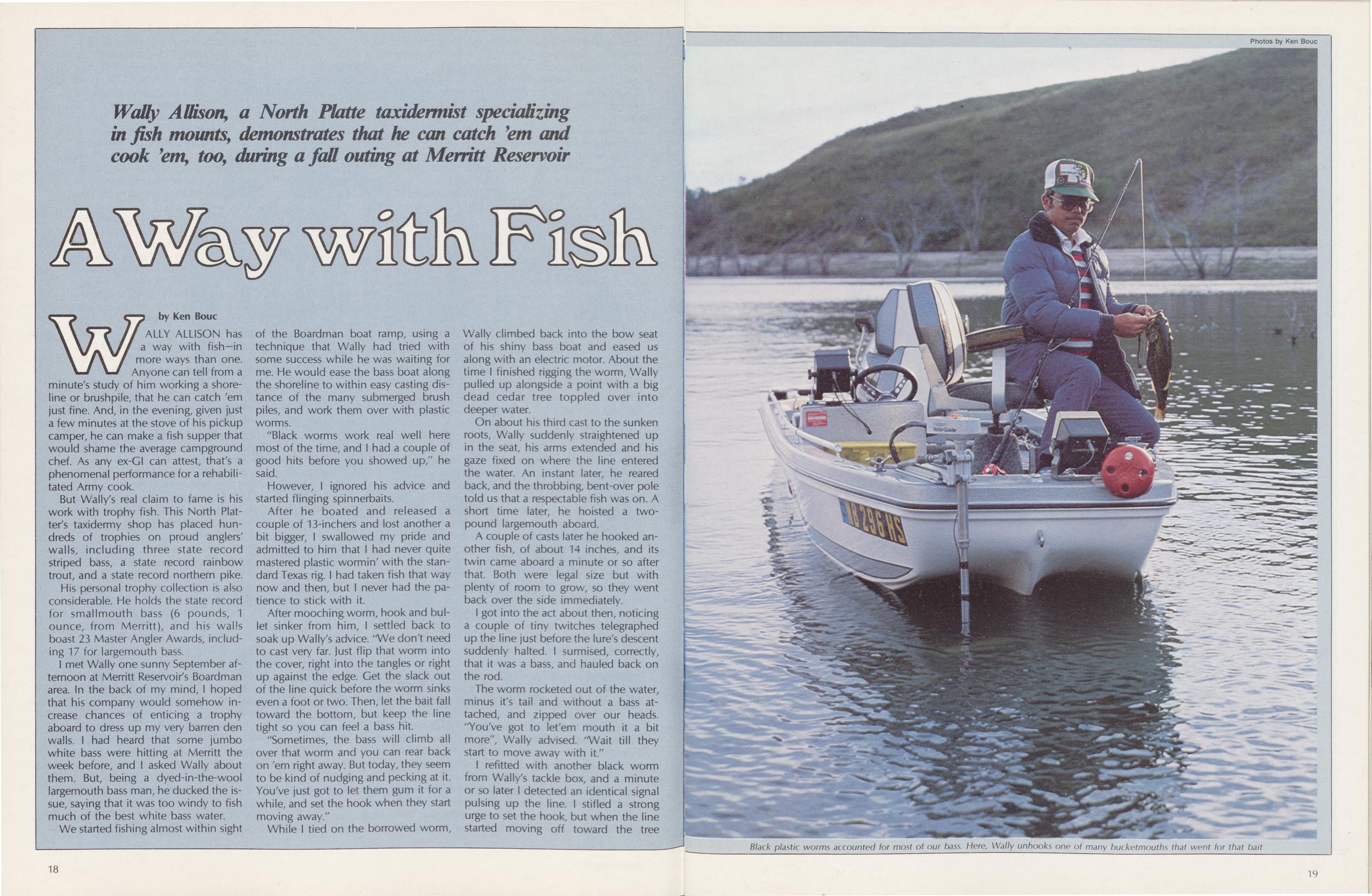
A Way With Fish
Wally Allison, a North Platte taxidermist specializing in fish mounts, demonstrates that he can catch 9em and cook fem, too, during a fall outing at Merritt Reservoir
WALLY ALLISON has way with fish—in more ways than one. Anyone can tell from a minute's study of him working a shoreline or brushpile, that he can catch 'em just fine. And, in the evening, given just a few minutes at the stove of his pickup camper, he can make a fish supper that would shame the average campground chef. As any ex-GI can attest, that's a phenomenal performance for a rehabilitated Army cook.
But Wally's real claim to fame is his work with trophy fish. This North Platter's taxidermy shop has placed hundreds of trophies on proud anglers' walls, including three state record striped bass, a state record rainbow trout, and a state record northern pike.
His personal trophy collection is also considerable. He holds the state record for smallmouth bass (6 pounds, 1 ounce, from Merritt), and his walls boast 23 Master Angler Awards, including 17 for largemouth bass.
I met Wally one sunny September afternoon at Merritt Reservoir's Boardman area. In the back of my mind, I hoped that his company would somehow increase chances of enticing a trophy aboard to dress up my very barren den walls. I had heard that some jumbo white bass were hitting at Merritt the week before, and I asked Wally about them. But, being a dyed-in-the-wool largemouth bass man, he ducked the issue, saying that it was too windy to fish much of the best white bass water.
We started fishing almost within sight of the Boardman boat ramp, using a technique that Wally had tried with some success while he was waiting for me. He would ease the bass boat along the shoreline to within easy casting distance of the many submerged brush piles, and work them over with plastic worms.
"Black worms work real well here most of the time, and I had a couple of good hits before you showed up," he said.
However, I ignored his advice and started flinging spinnerbaits.
After he boated and released a couple of 13-inchers and lost another a bit bigger, I swallowed my pride and admitted to him that I had never quite mastered plastic wormin' with the standard Texas rig. I had taken fish that way now and then, but I never had the patience to stick with it.
After mooching worm, hook and bullet sinker from him, I settled back to soak up Wally's advice. "We don't need to cast very far. Just flip that worm into the cover, right into the tangles or right up against the edge. Get the slack out of the line quick before the worm sinks even a foot or two. Then, let the bait fall toward the bottom, but keep the line tight so you can feel a bass hit.
"Sometimes, the bass will climb all over that worm and you can rear back on 'em right away. But today, they seem to be kind of nudging and pecking at it. You've just got to let them gum it for a while, and set the hook when they start moving away."
While I tied on the borrowed worm, Wally climbed back into the bow seat of his shiny bass boat and eased us along with an electric motor. About the time I finished rigging the worm, Wally pulled up alongside a point with a big dead cedar tree toppled over into deeper water.
On about his third cast to the sunken roots, Wally suddenly straightened up in the seat, his arms extended and his gaze fixed on where the line entered the water. An instant later, he reared back, and the throbbing, bent-over pole told us that a respectable fish was on. A short time later, he hoisted a twopound largemouth aboard.
A couple of casts later he hooked another fish, of about 14 inches, and its twin came aboard a minute or so after that. Both were legal size but with plenty of room to grow, so they went back over the side immediately.
I got into the act about then, noticing a couple of tiny twitches telegraphed up the line just before the lure's descent suddenly halted. I surmised, correctly, that it was a bass, and hauled back on the rod.
The worm rocketed out of the water, minus it's tail and without a bass attached, and zipped over our heads. "You've got to let'em mouth it a bit more", Wally advised. "Wait till they start to move away with it."
I refitted with another black worm from Wally's tackle box, and a minute or so later I detected an identical signal pulsing up the line. I stifled a strong urge to set the hook, but when the line started moving off toward the tree
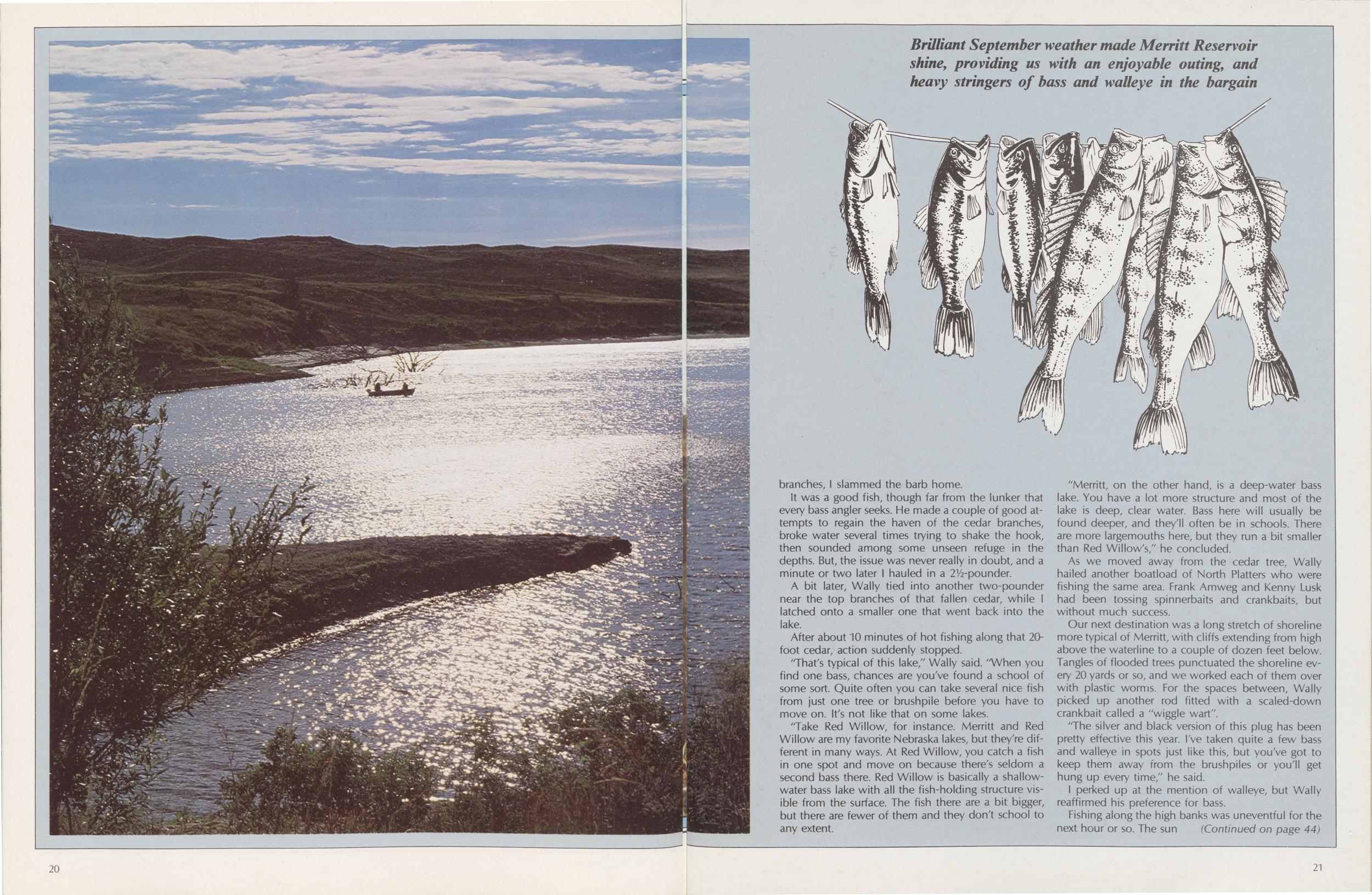
it was a good fish, though far from the lunker that every bass angler seeks. He made a couple of good attempts to regain the haven of the cedar branches, broke water several times trying to shake the hook, then sounded among some unseen refuge in the depths. But, the issue was never really in doubt, and a minute or two later I hauled in a 2½-pounder.
A bit later, Wally tied into another two-pounder near the top branches of that fallen cedar, while I latched onto a smaller one that went back into the lake.
After about 10 minutes of hot fishing along that 20-foot cedar, action suddenly stopped.
"That's typical of this lake," Wally said. "When you find one bass, chances are you've found a school of some sort. Quite often you can take several nice fish from just one tree or brushpile before you have to move on. It's not like that on some lakes.
"Take Red Willow, for instance. Merritt and Red Willow are my favorite Nebraska lakes, but they're different in many ways. At Red Willow, you catch a fish in one spot and move on because there's seldom a second bass there. Red Willow is basically a shallow-water bass lake with all the fish-holding structure visible from the surface. The fish there are a bit bigger, but there are fewer of them and they don't school to any extent.
"Merritt, on the other hand, is a deep-water bass lake. You have a lot more structure and most of the lake is deep, clear water. Bass here will usually be found deeper, and they'll often be in schools. There are more largemouths here, but they run a bit smaller than Red Willow's," he concluded.
As we moved away from the cedar tree, Wally hailed another boatload of North Platters who were fishing the same area. Frank Amweg and Kenny Lusk had been tossing spinnerbaits and crankbaits, but without much success.
Our next destination was a long stretch of shoreline more typical of Merritt, with cliffs extending from high above the waterline to a couple of dozen feet below. Tangles of flooded trees punctuated the shoreline every 20 yards or so, and we worked each of them over with plastic worms. For the spaces between, Wally picked up another rod fitted with a scaled-down crankbait called a "wiggle wart".
"The silver and black version of this plug has been pretty effective this year. I've taken quite a few bass and walleye in spots just like this, but you've got to keep them away from the brushpiles or you'll get hung up every time," he said.
I perked up at the mention of walleye, but Wally reaffirmed his preference for bass.
Fishing along the high banks was uneventful for the next hour or so. The sun (Continued on page 44)
20 21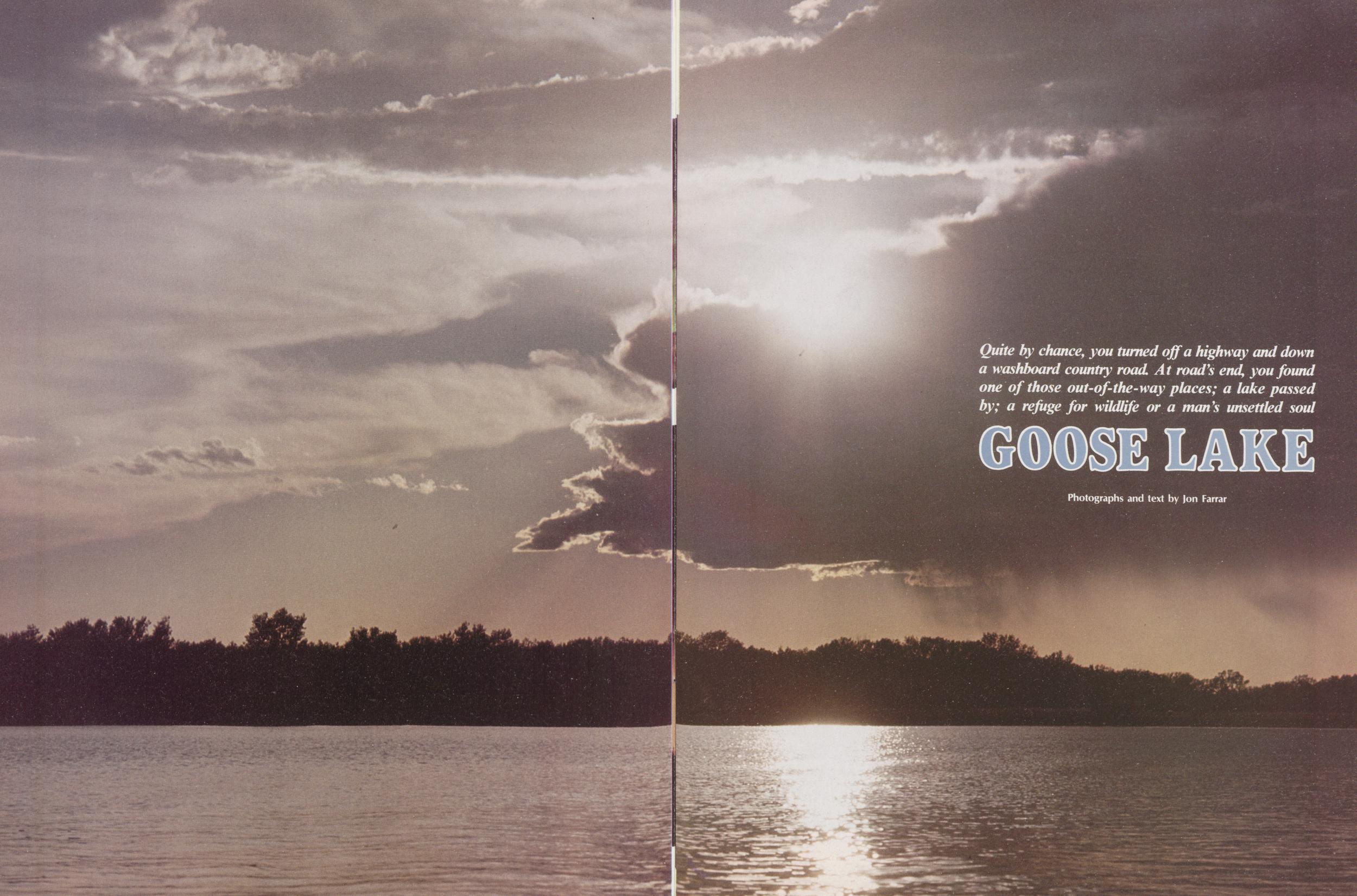
GOOSE Lake
Quite by chance, you turned off a highway and down a washboard country road. At road's end, you found one of those out-of-the-way places; a lake passed by; a refuge for wildlife or a man's unsettled soul
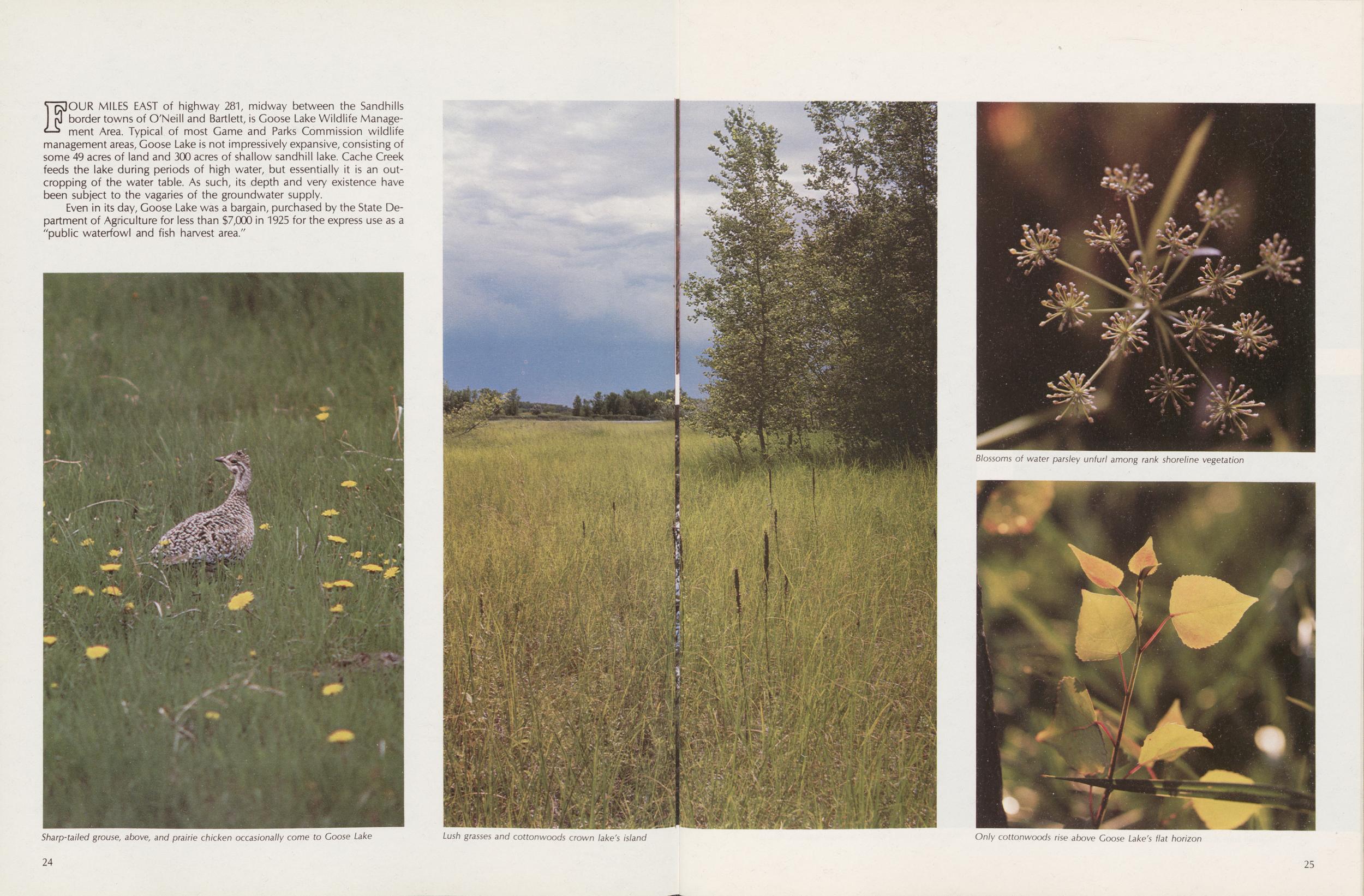
FOUR MILES EAST of highway 281, midway between the Sandhills border towns of O'Neill and Bartlett, is Goose Lake Wildlife Management Area. Typical of most Game and Parks Commission wildlife management areas, Goose Lake is not impressively expansive, consisting of some 49 acres of land and 300 acres of shallow sandhill lake. Cache Creek feeds the lake during periods of high water, but essentially it is an outcropping of the water table. As such, its depth and very existence have been subject to the vagaries of the groundwater supply.
Even in its day, Goose Lake was a bargain, purchased by the State Department of Agriculture for less than $7,000 in 1925 for the express use as a "public waterfowl and fish harvest area."
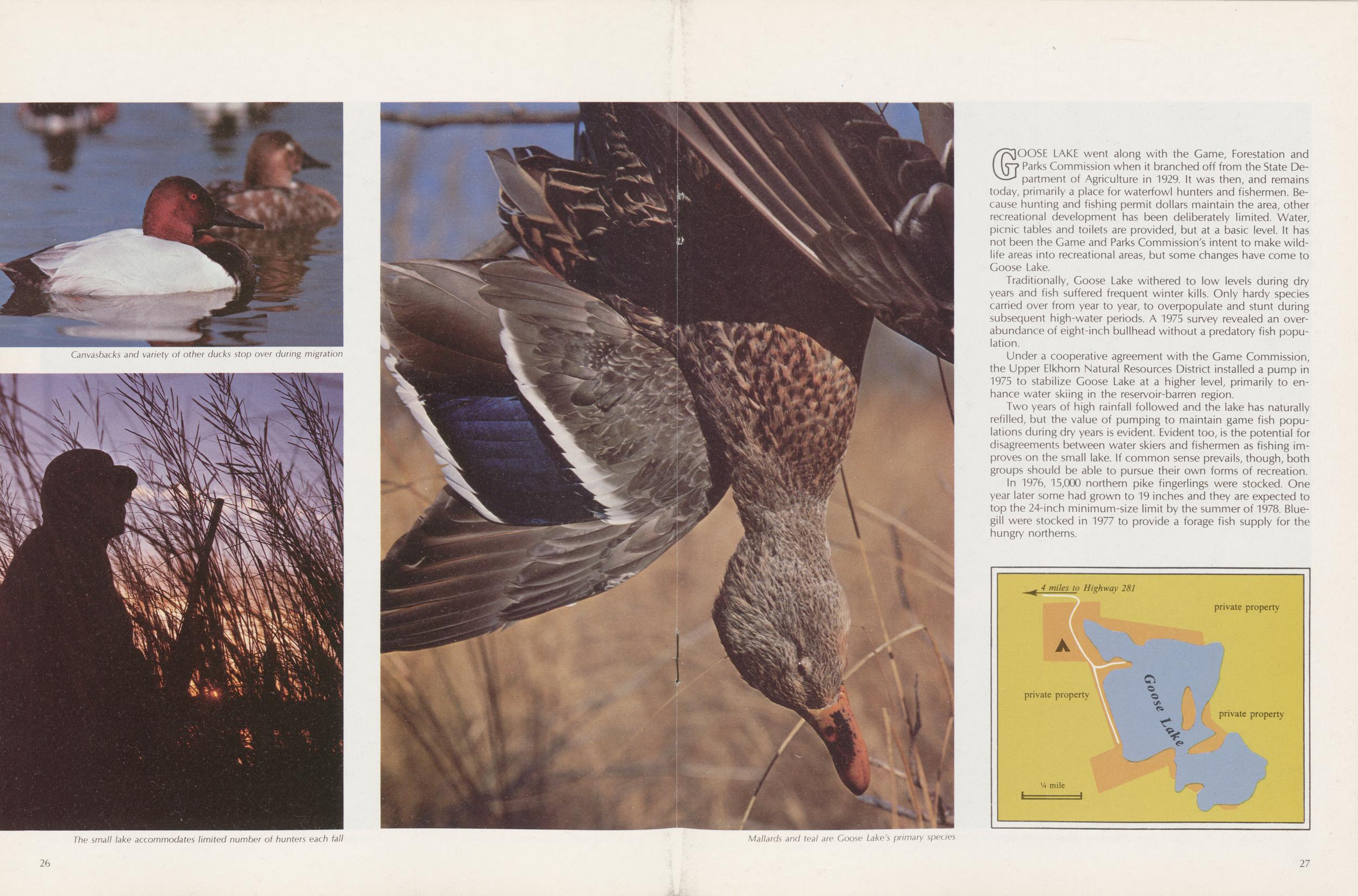
GOOSE LAKE went along with the Game, Forestation and Parks Commission when it branched off from the State Department of Agriculture in 1929. It was then, and remains today, primarily a place for waterfowl hunters and fishermen. Because hunting and fishing permit dollars maintain the area, other recreational development has been deliberately limited. Water, picnic tables and toilets are provided, but at a basic level. It has not been the Game and Parks Commission's intent to make wildlife areas into recreational areas, but some changes have come to Goose Lake.
Traditionally, Goose Lake withered to low levels during dry years and fish suffered frequent winter kills. Only hardy species carried over from year to year, to overpopulate and stunt during subsequent high-water periods. A 1975 survey revealed an overabundance of eight-inch bullhead without a predatory fish population.
Under a cooperative agreement with the Game Commission, the Upper Elkhorn Natural Resources District installed a pump in 1975 to stabilize Goose Lake at a higher level, primarily to enhance water skiing in the reservoir-barren region.
Two years of high rainfall followed and the lake has naturally refilled, but the value of pumping to maintain game fish populations during dry years is evident. Evident too, is the potential for disagreements between water skiers and fishermen as fishing improves on the small lake. If common sense prevails, though, both groups should be able to pursue their own forms of recreation.
In 1976, 15,000 northern pike fingerlings were stocked. One year later some had grown to 19 inches and they are expected to top the 24-inch minimum-size limit by the summer of 1978. Bluegill were stocked in 1977 to provide a forage fish supply for the hungry northerns.
private property
private property
private property
Goose Lake
¼ mile
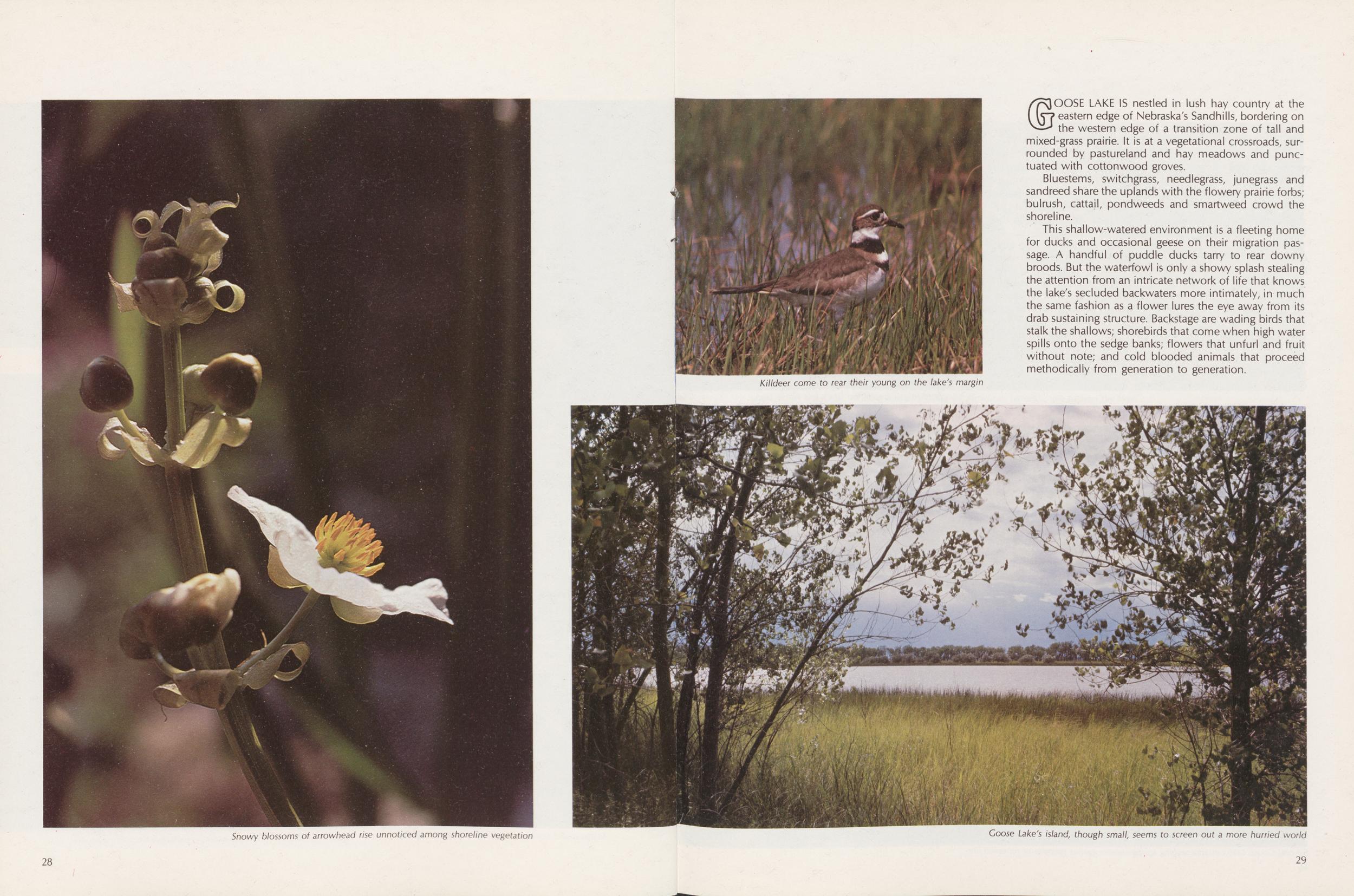
GOOSE LAKE IS nestled in lush hay country at the eastern edge of Nebraska's Sandhills, bordering on the western edge of a transition zone of tall and mixed-grass prairie. It is at a vegetational crossroads, surrounded by pastureland and hay meadows and punctuated with cottonwood groves.
Bluestems, switchgrass, needlegrass, junegrass and sandreed share the uplands with the flowery prairie forbs; bulrush, cattail, pondweeds and smartweed crowd the shoreline.
This shallow-watered environment is a fleeting home for ducks and occasional geese on their migration passage. A handful of puddle ducks tarry to rear downy broods. But the waterfowl is only a showy splash stealing the attention from an intricate network of life that knows the lake's secluded backwaters more intimately, in much the same fashion as a flower lures the eye away from its drab sustaining structure. Backstage are wading birds that stalk the shallows; shorebirds that come when high water spills onto the sedge banks; flowers that unfurl and fruit without note; and cold blooded animals that proceed methodically from generation to generation.
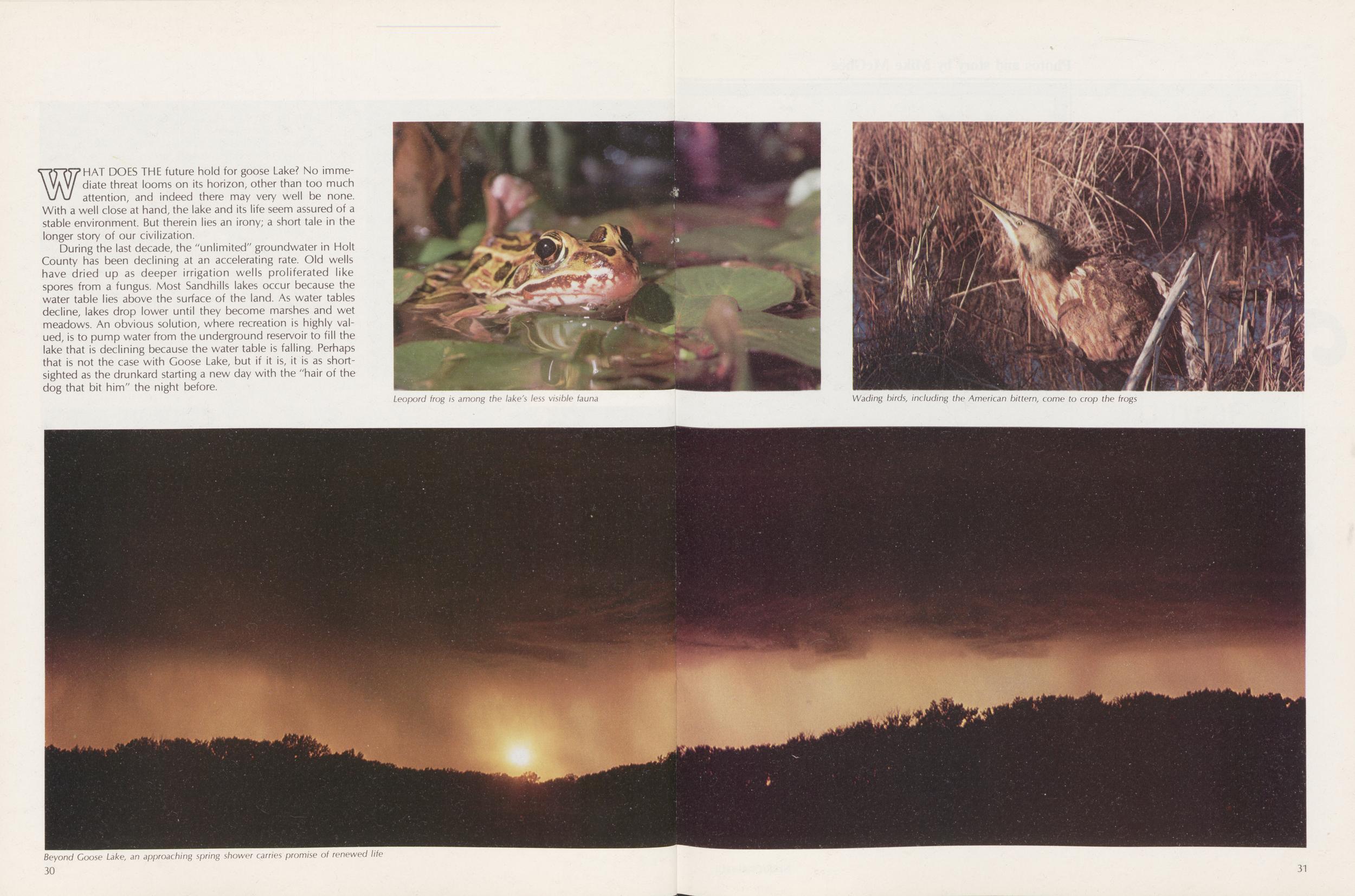
WHAT DOES THE future hold for goose Lake? No immediate threat looms on its horizon, other than too much attention, and indeed there may very well be none. With a well close at hand, the lake and its life seem assured of a stable environment. But therein lies an irony; a short tale in the longer story of our civilization.
During the last decade, the "unlimited" groundwater in Holt County has been declining at an accelerating rate. Old wells have dried up as deeper irrigation wells proliferated like spores from a fungus. Most Sandhills lakes occur because the water table lies above the surface of the land. As water tables decline, lakes drop lower until they become marshes and wet meadows. An obvious solution, where recreation is highly valued, is to pump water from the underground reservoir to fill the lake that is declining because the water table is falling. Perhaps that is not the case with Goose Lake, but if it is, it is as shortsighted as the drunkard starting a new day with the "hair of the dog that bit him" the night before.
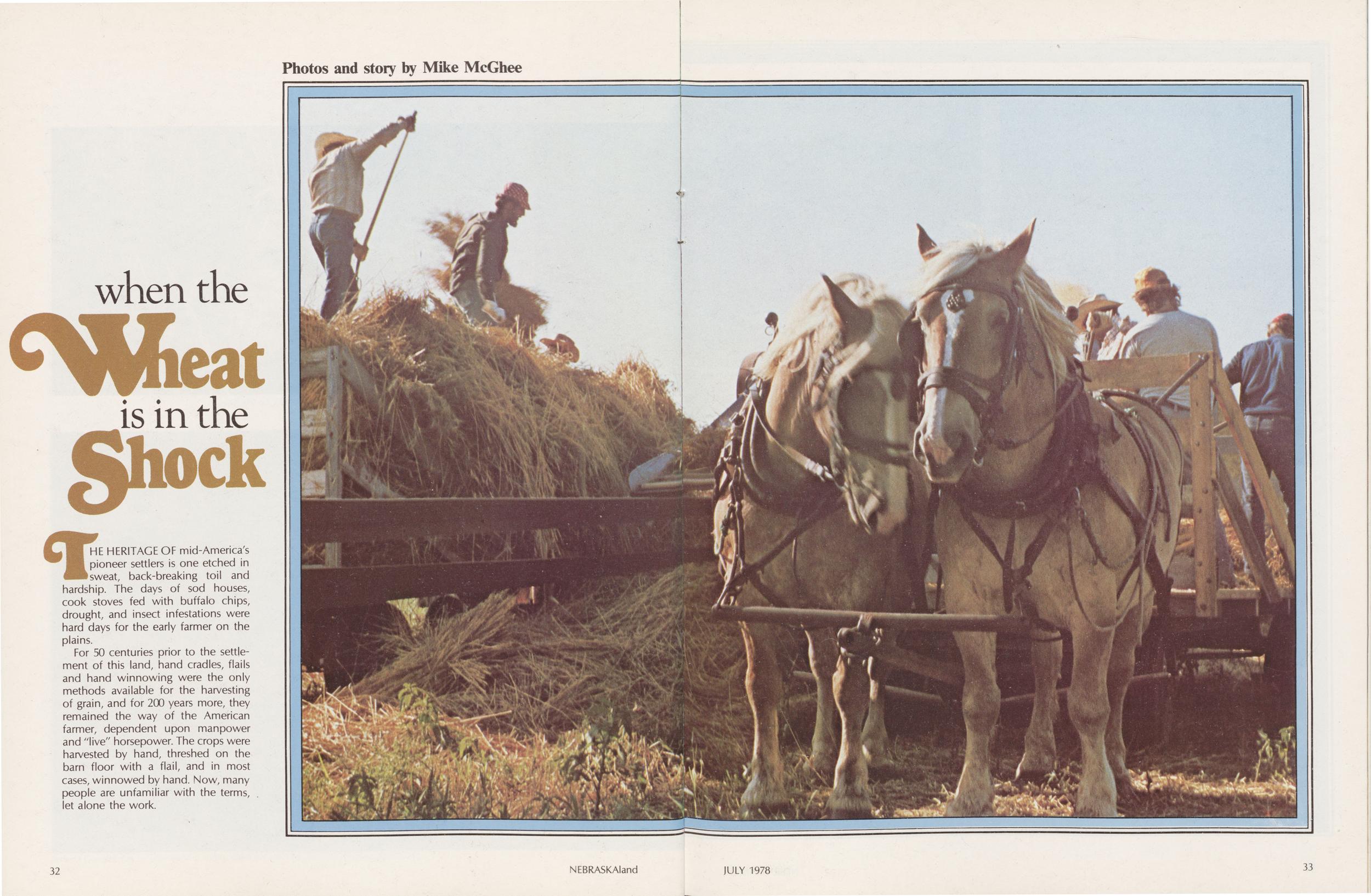
when the Wheat is in the Shock
THE HERITAGE OF mid-America's pioneer settlers is one etched in sweat, back-breaking toil and hardship. The days of sod houses, cook stoves fed with buffalo chips, drought, and insect infestations were hard days for the early farmer on the plains.
For 50 centuries prior to the settlement of this land, hand cradles, flails and hand winnowing were the only methods available for the harvesting of grain, and for 200 years more, they remained the way of the American farmer, dependent upon manpower and "live" horsepower. The crops were harvested by hand, threshed on the barn floor with a flail, and in most cases, winnowed by hand. Now, many people are unfamiliar with the terms, let alone the work.
32 NEBRASKAIand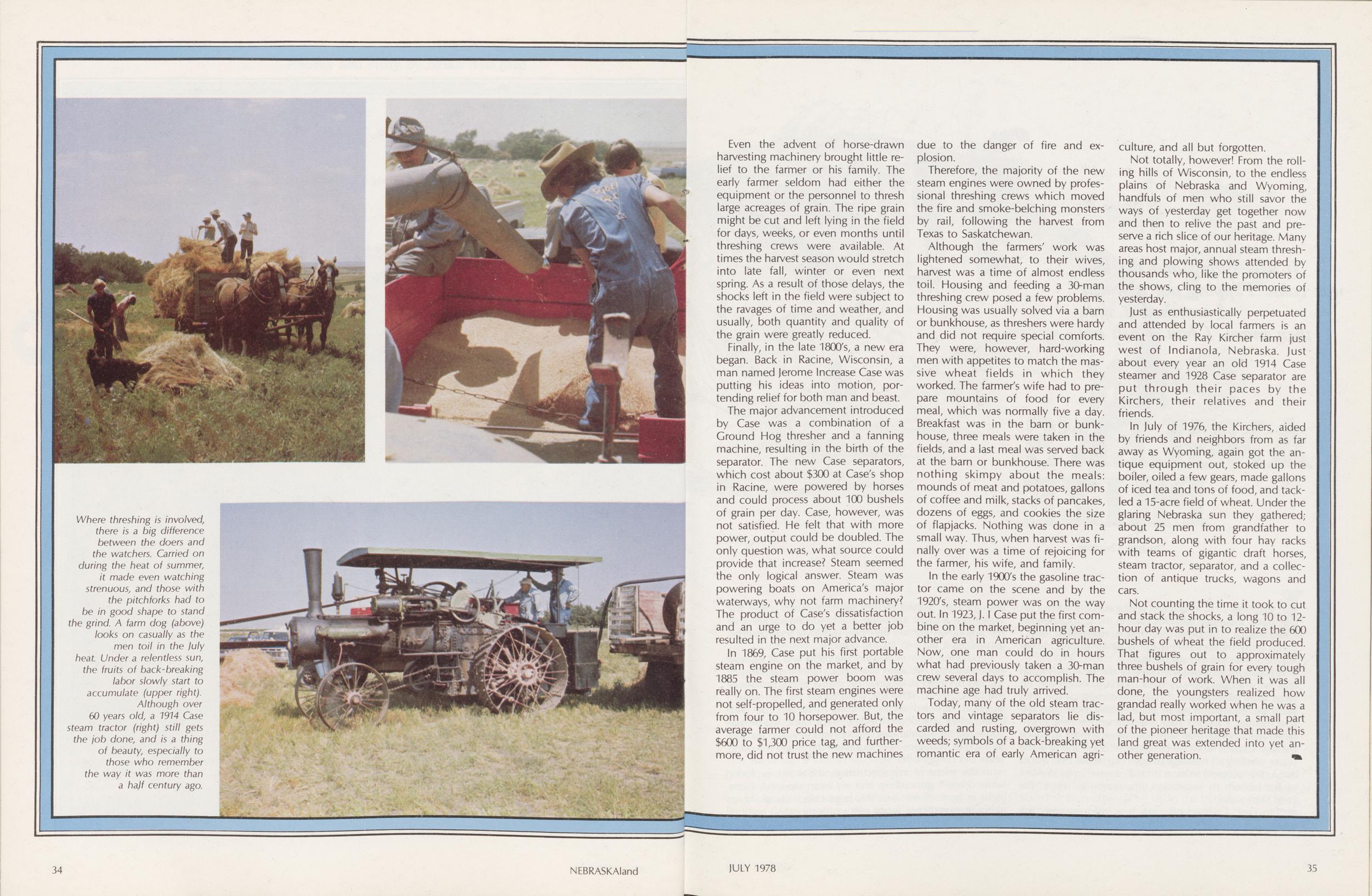
Even the advent of horse-drawn harvesting machinery brought little relief to the farmer or his family. The early farmer seldom had either the equipment or the personnel to thresh large acreages of grain. The ripe grain might be cut and left lying in the field for days, weeks, or even months until threshing crews were available. At times the harvest season would stretch into late fall, winter or even next spring. As a result of those delays, the shocks left in the field were subject to the ravages of time and weather, and usually, both quantity and quality of the grain were greatly reduced.
Finally, in the late 1800% a new era began. Back in Racine, Wisconsin, a man named Jerome Increase Case was putting his ideas into motion, portending relief for both man and beast.
The major advancement introduced by Case was a combination of a Ground Hog thresher and a fanning machine, resulting in the birth of the separator. The new Case separators, which cost about $300 at Case's shop in Racine, were powered by horses and could process about 100 bushels of grain per day. Case, however, was not satisfied. He felt that with more power, output could be doubled. The only question was, what source could provide that increase? Steam seemed the only logical answer. Steam was powering boats on America's major waterways, why not farm machinery? The product of Case's dissatisfaction and an urge to do yet a better job resulted in the next major advance.
In 1869, Case put his first portable steam engine on the market, and by 1885 the steam power boom was really on. The first steam engines were not self-propelled, and generated only from four to 10 horsepower. But, the average farmer could not afford the $600 to $1,300 price tag, and furthermore, did not trust the new machines due to the danger of fire and explosion.
Therefore, the majority of the new steam engines were owned by professional threshing crews which moved the fire and smoke-belching monsters by rail, following the harvest from Texas to Saskatchewan.
Although the farmers' work was lightened somewhat, to their wives, harvest was a time of almost endless toil. Housing and feeding a 30-man threshing crew posed a few problems. Housing was usually solved via a barn or bunkhouse, as threshers were hardy and did not require special comforts. They were, however, hard-working men with appetites to match the massive wheat fields in which they worked. The farmer's wife had to prepare mountains of food for every meal, which was normally five a day. Breakfast was in the barn or bunkhouse, three meals were taken in the fields, and a last meal was served back at the barn or bunkhouse. There was nothing skimpy about the meals: mounds of meat and potatoes, gallons of coffee and milk, stacks of pancakes, dozens of eggs, and cookies the size of flapjacks. Nothing was done in a small way. Thus, when harvest was finally over was a time of rejoicing for the farmer, his wife, and family.
In the early 1900's the gasoline tractor came on the scene and by the 1920's, steam power was on the way out. In 1923, J. I Case put the first combine on the market, beginning yet another era in American agriculture. Now, one man could do in hours what had previously taken a 30-man crew several days to accomplish. The machine age had truly arrived.
Today, many of the old steam tractors and vintage separators lie discarded and rusting, overgrown with weeds; symbols of a back-breaking yet romantic era of early American agri- culture, and all but forgotten.
Not totally, however! From the rolling hills of Wisconsin, to the endless plains of Nebraska and Wyoming, handfuls of men who still savor the ways of yesterday get together now and then to relive the past and preserve a rich slice of our heritage. Many areas host major, annual steam threshing and plowing shows attended by thousands who, like the promoters of the shows, cling to the memories of yesterday.
Just as enthusiastically perpetuated and attended by local farmers is an event on the Ray Kircher farm just west of Indianola, Nebraska. Just about every year an old 1914 Case steamer and 1928 Case separator are put through their paces by the Kirchers, their relatives and their friends.
In July of 1976, the Kirchers, aided by friends and neighbors from as far away as Wyoming, again got the antique equipment out, stoked up the boiler, oiled a few gears, made gallons of iced tea and tons of food, and tackled a 15-acre field of wheat. Under the glaring Nebraska sun they gathered; about 25 men from grandfather to grandson, along with four hay racks with teams of gigantic draft horses, steam tractor, separator, and a collection of antique trucks, wagons and cars.
Not counting the time it took to cut and stack the shocks, a long 10 to 12-hour day was put in to realize the 600 bushels of wheat the field produced. That figures out to approximately three bushels of grain for every tough man-hour of work. When it was all done, the youngsters realized how grandad really worked when he was a lad, but most important, a small part of the pioneer heritage that made this land great was extended into yet another generation.
34 NEBRASKAIand JULY 1978 35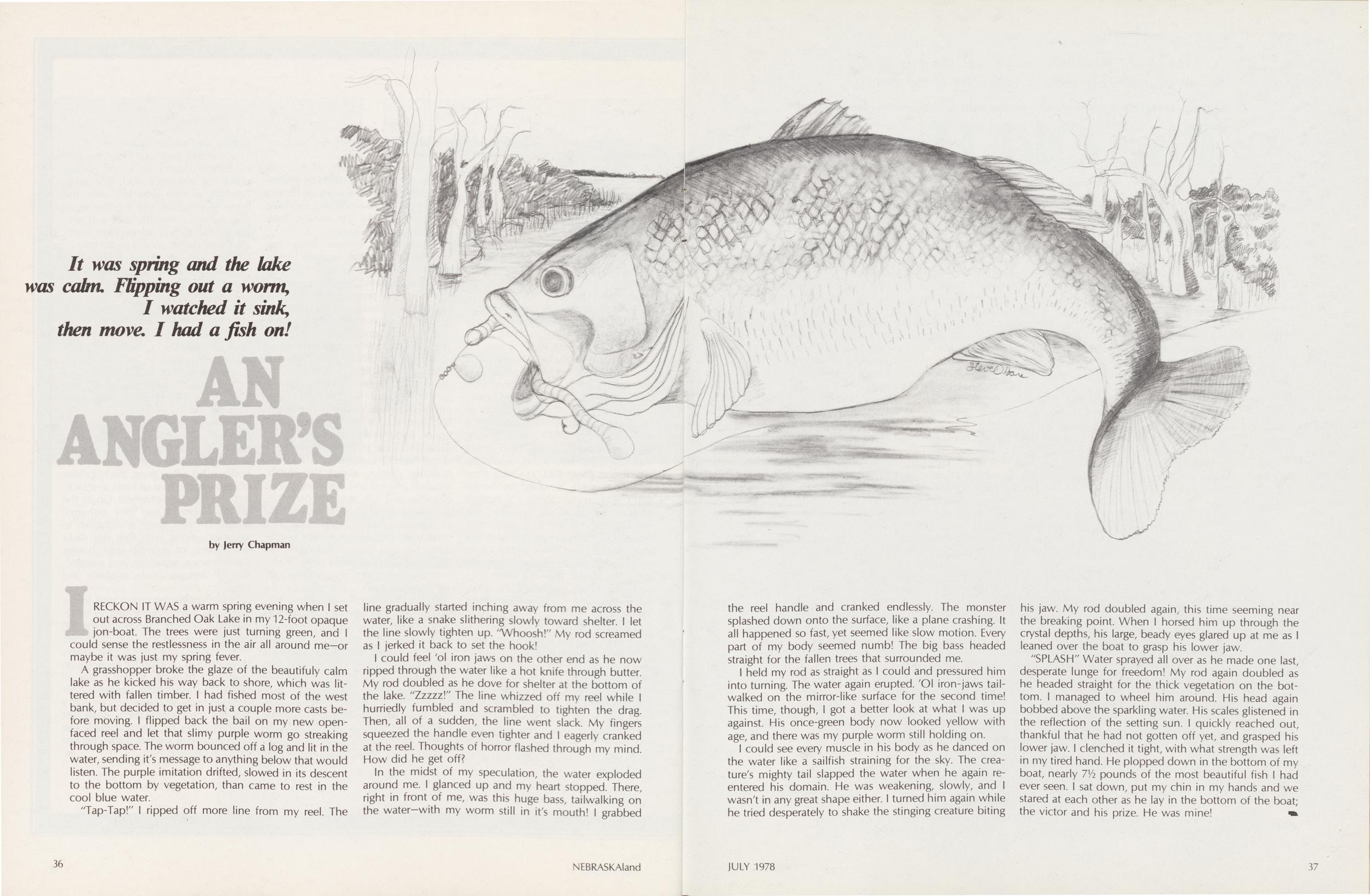
It was spring and the lake was calm. Flipping out a worm, I watched it sink, then move. I had a fish on!
AN ANGLER'S PRIZE
RECKON IT WAS a warm spring evening when I set out across Branched Oak Lake in my 12-foot opaque jon-boat. The trees were just turning green, and I could sense the restlessness in the air all around me—or maybe it was just my spring fever.
A grasshopper broke the glaze of the beautifuly calm lake as he kicked his way back to shore, which was littered with fallen timber. I had fished most of the west bank, but decided to get in just a couple more casts before moving. I flipped back the bail on my new openfaced reel and let that slimy purple worm go streaking through space. The worm bounced off a log and lit in the water, sending it's message to anything below that would listen. The purple imitation drifted, slowed in its descent to the bottom by vegetation, than came to rest in the cool blue water.
"Tap-Tap!" I ripped off more line from my reel. The line gradually started inching away from me across the water, like a snake slithering slowly toward shelter. I let the line slowly tighten up. "Whoosh!" My rod screamed as I jerked it back to set the hook!
I could feel 'ol iron jaws on the other end as he now ripped through the water like a hot knife through butter. My rod doubled as he dove for shelter at the bottom of the lake. "Zzzzz!" The line whizzed off my reel while I hurriedly fumbled and scrambled to tighten the drag. Then, all of a sudden, the line went slack. My fingers squeezed the handle even tighter and I eagerly cranked at the reel. Thoughts of horror flashed through my mind. How did he get off?
In the midst of my speculation, the water exploded around me. I glanced up and my heart stopped. There, right in front of me, was this huge bass, tailwalking on the water-with my worm still in it's mouth! I grabbed the reel handle and cranked endlessly. The monster splashed down onto the surface, like a plane crashing. It all happened so fast, yet seemed like slow motion. Every part of my body seemed numb! The big bass headed straight for the fallen trees that surrounded me.
I held my rod as straight as I could and pressured him into turning. The water again erupted. 'Ol iron-jaws tailwalked on the mirror-like surface for the second time! This time, though, I got a better look at what I was up against. His once-green body now looked yellow with age, and there was my purple worm still holding on.
I could see every muscle in his body as he danced on the water like a sailfish straining for the sky. The creature's mighty tail slapped the water when he again re-entered his domain. He was weakening, slowly, and I wasn't in any great shape either. I turned him again while he tried desperately to shake the stinging creature biting his jaw. My rod doubled again, this time seeming near the breaking point. When I horsed him up through the crystal depths, his large, beady eyes glared up at me as I leaned over the boat to grasp his lower jaw.
"SPLASH" Water sprayed all over as he made one last, desperate lunge for freedom! My rod again doubled as he headed straight for the thick vegetation on the bottom. I managed to wheel him around. His head again bobbed above the sparkling water. His scales glistened in the reflection of the setting sun. I quickly reached out, thankful that he had not gotten off yet, and grasped his lower jaw. I clenched it tight, with what strength was left in my tired hand. He plopped down in the bottom of my boat, nearly Th pounds of the most beautiful fish I had ever seen. I sat down, put my chin in my hands and we stared at each other as he lay in the bottom of the boat; the victor and his prize. He was mine!
36 NEBRASKAIand JULY 1978 37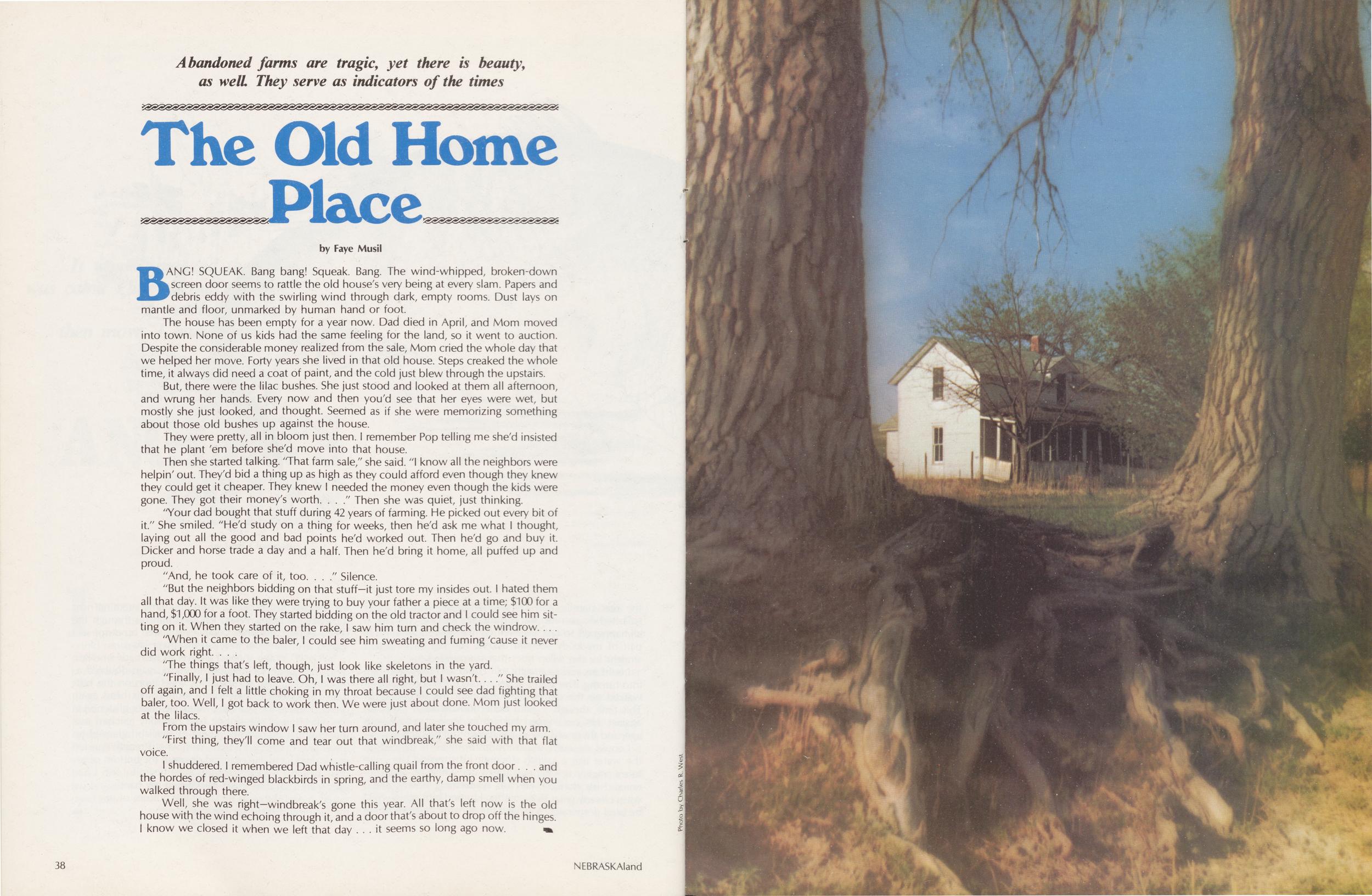
Abandoned farms are tragic, yet there is beauty, as well They serve as indicators of the times
The Old Home Place
BANG! SQUEAK. Bang bang! Squeak. Bang. The wind-whipped, broken-down k screen door seems to rattle the old house's very being at every slam. Papers and "debris eddy with the swirling wind through dark, empty rooms. Dust lays on mantle and floor, unmarked by human hand or foot.
The house has been empty for a year now. Dad died in April, and Mom moved into town. None of us kids had the same feeling for the land, so it went to auction. Despite the considerable money realized from the sale, Mom cried the whole day that we helped her move. Forty years she lived in that old house. Steps creaked the whole time, it always did need a coat of paint, and the cold just blew through the upstairs.
But, there were the lilac bushes. She just stood and looked at them all afternoon, and wrung her hands. Every now and then you'd see that her eyes were wet, but mostly she just looked, and thought. Seemed as if she were memorizing something about those old bushes up against the house.
They were pretty, all in bloom just then. I remember Pop telling me she'd insisted that he plant 'em before she'd move into that house.
Then she started talking. 'That farm sale," she said. "I know all the neighbors were helpin' out. They'd bid a thing up as high as they could afford even though they knew they could get it cheaper. They knew I needed the money even though the kids were gone. They got their money's worth. . . ." Then she was quiet, just thinking.
"Your dad bought that stuff during 42 years of farming. He picked out every bit of it." She smiled. "He'd study on a thing for weeks, then he'd ask me what I thought, laying out all the good and bad points he'd worked out. Then he'd go and buy it. Dicker and horse trade a day and a half. Then he'd bring it home, all puffed up and proud.
"And, he took care of it, too. . . ." Silence.
But the neighbors bidding on that stuff-it just tore my insides out. I hated them all that day. It was like they were trying to buy your father a piece at a time; $100 for a hand, $1,000 for a foot. They started bidding on the old tractor and I could see him sitting on it. When they started on the rake, I saw him turn and check the windrow. . . .
"When it came to the baler, I could see him sweating and fuming 'cause it never did work right. ...
"The things that's left, though, just look like skeletons in the yard.
"Finally, I just had to leave. Oh, I was there all right, but I wasn't-----" She trailed off again, and I felt a little choking in my throat because I could see dad fighting that baler, too. Well, I got back to work then. We were just about done. Mom just looked at the lilacs.
From the upstairs window I saw her turn around, and later she touched my arm.
"First thing, they'll come and tear out that windbreak," she said with that flat voice.
I shuddered. I remembered Dad whistle-calling quail from the front door. . . and the hordes of red-winged blackbirds in spring, and the earthy, damp smell when you walked through there.
Well, she was right-windbreak's gone this year. All that's left now is the old house with the wind echoing through it, and a door that's about to drop off the hinges. I know we closed it when we left that day ... it seems so long ago now.
38 NEBRASKAIand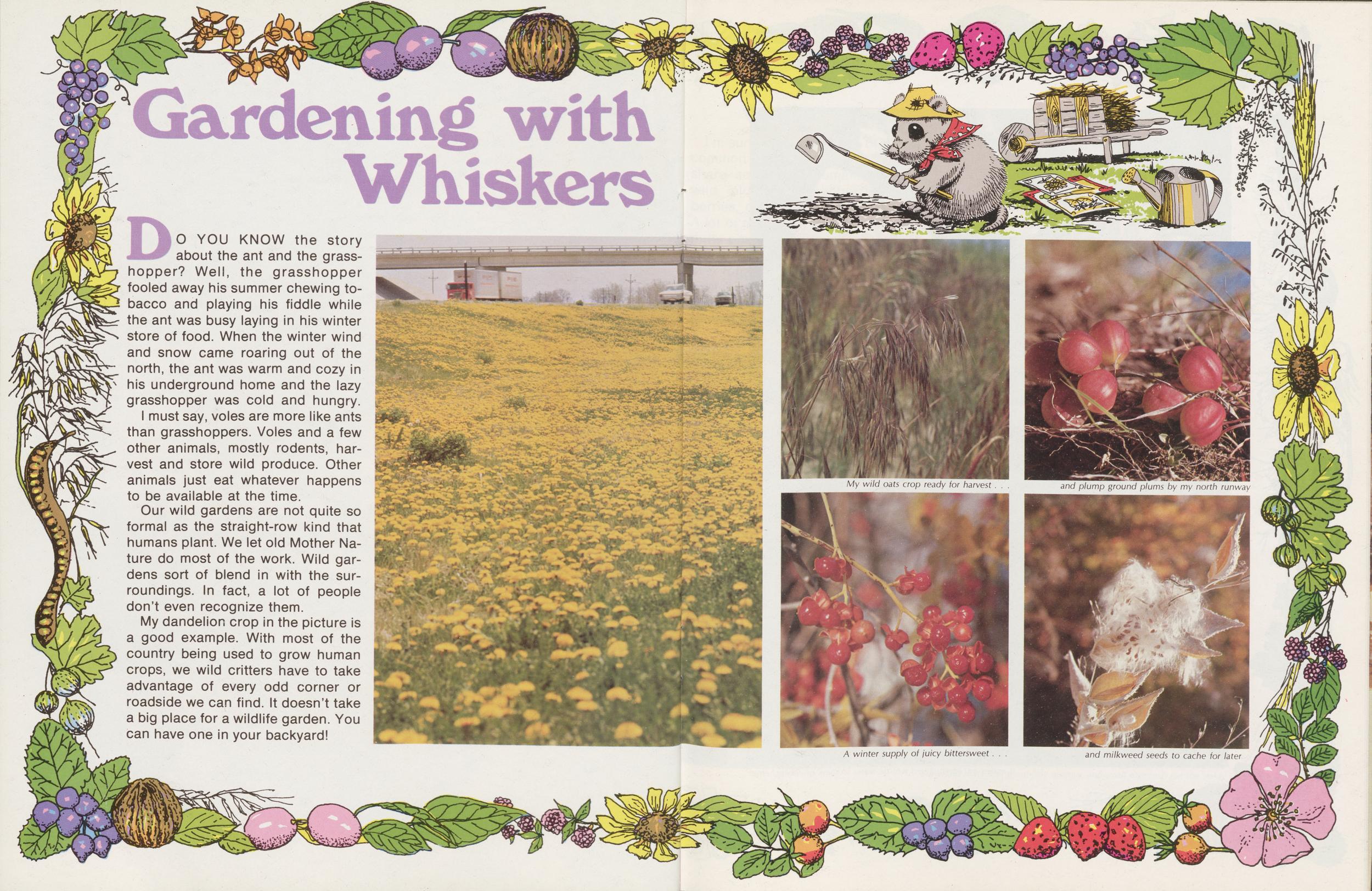
Gardening with Whiskers
DO YOU KNOW the story about the ant and the grasshopper? Well, the grasshopper fooled away his summer chewing tobacco and playing his fiddle while the ant was busy laying in his winter store of food. When the winter wind and snow came roaring out of the north, the ant was warm and cozy in his underground home and the lazy grasshopper was cold and hungry.
I must say, voles are more like ants than grasshoppers. Voles and a few other animals, mostly rodents, harvest and store wild produce. Other animals just eat whatever happens to be available at the time.
Our wild gardens are not quite so formal as the straight-row kind that humans plant. We let old Mother Nature do most of the work. Wild gardens sort of blend in with the surroundings. In fact, a lot of people don't even recognize them.
My dandelion crop in the picture is a good example. With most of the country being used to grow human crops, we wild critters have to take advantage of every odd corner or roadside we can find. It doesn't take a big place for a wildlife garden. You can have one in your backyard!
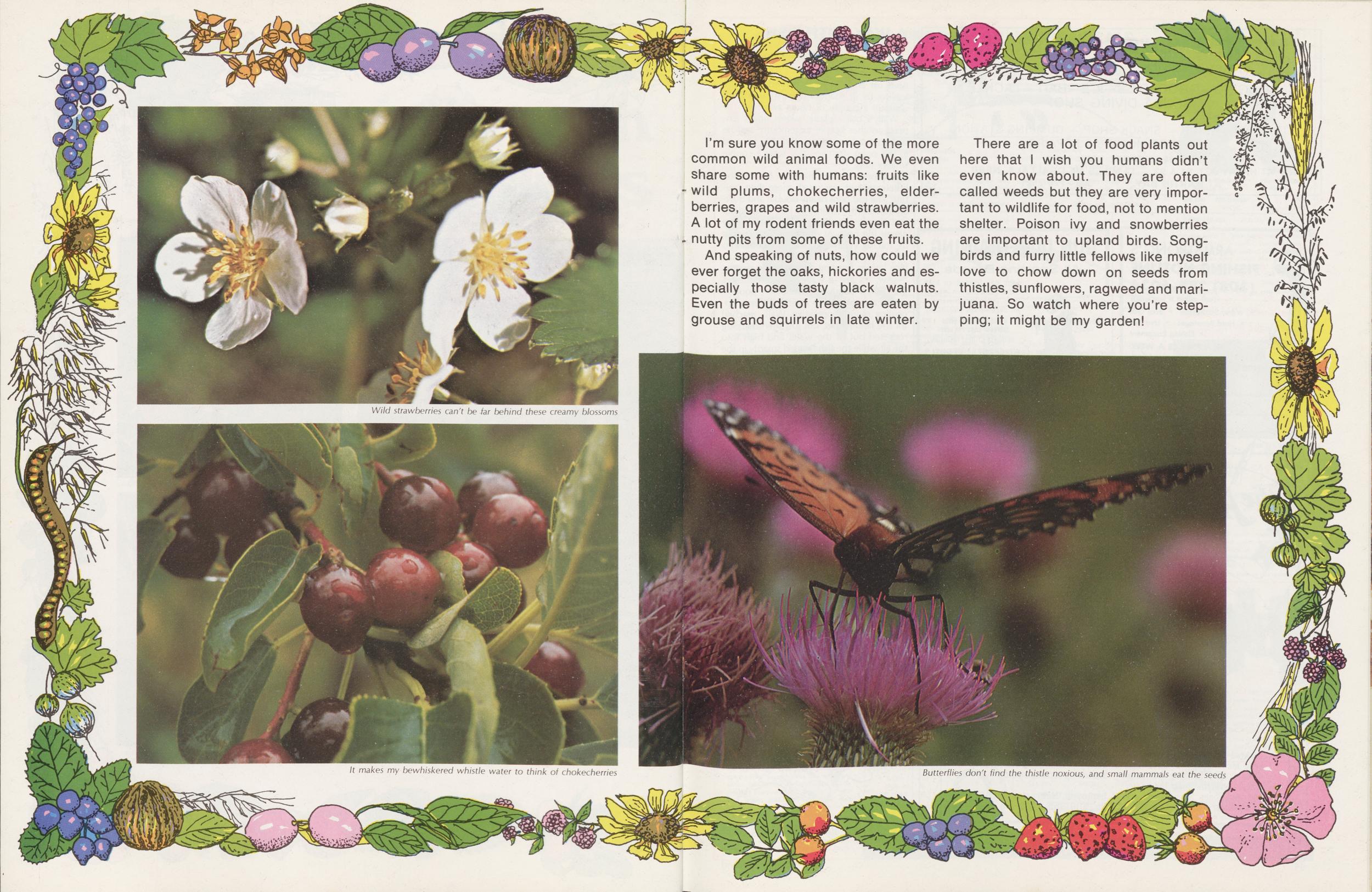
I'm sure you know some of the more common wild animal foods. We even share some with humans: fruits like wild plums, chokecherries, elderberries, grapes and wild strawberries. A lot of my rodent friends even eat the nutty pits from some of these fruits.
And speaking of nuts, how could we ever forget the oaks, hickories and especially those tasty black walnuts. Even the buds of trees are eaten by grouse and squirrels in late winter.
There are a lot of food plants out here that I wish you humans didn't even know about. They are often called weeds but they are very important to wildlife for food, not to mention shelter. Poison ivy and snowberries are important to upland birds. Songbirds and furry little fellows like myself love to chow down on seeds from thistles, sunflowers, ragweed and marijuana. So watch where you're stepping; it might be my garden!
Wally's black plastic worm finally enticed another keeper largemouth, and he boated it rather casually. The plug he used in the open stretches also took a couple smaller bass.
But, one of the strikes he felt on the little crankbait was much more than routine. The rod bent nearly double and quivered under the strain. The fish stayed deep and gave line grudgingly, but finally came nearer the boat. At one time it ran under us, forcing Wally to poke his rod tip into the water. Then, it rolled briefly at the surface before heading again for the depths.
"Aw, it's just a walleye," he muttered. The fish, a dandy of at least six pounds, soon came alongside again, this time appearing more cooperative. Wally reached for the landing net, but just then the plug rocketed out of the water and high into the air while the fish headed smartly in the opposite direction. Wally nonchalantly tucked the net away and shook the tangled hooks of the lure into order. "Losing a walleye doesn't bother me much, but I'd be mad if that had been a big bass," he said.
I went to work immediately with a similar plug, and it wasn't long before I had a walleye. It was only about half the size of the one Wally had lost, but it would make a welcome addition to supper.
As we continued to work the brushpiles and shoreline, another boatload of North Platters approached. Wally began swap- ping yarns with Jerry Journey and Jack Viersen, while I sailed a long cast down the shoreline. As always, the diving lip of the lure bit heartily into the water and dragged the plug quickly toward the
 CLIMB THE SPIRAL STAIRCASE
and step into the 1880's
Main Building: Designed by Edward Durell Stone. Gift Shop, Art Gallery, Exhibits
relative to
Pioneer Life. Film, "Land of the Prairie Pioneer", narrated by Henry Fonda.
Fonner Rotunda: A circular building resembling a giant wagon wheel, housing Indian
and Old
West memorabilia of a noted collector.
(Farm machinery exhibit and railroad town open Memorial Day through Labor Day)
OPEN YEAR-ROUND! Winter: 9 a.m. to 5 p.m. Mon-Sat; 1 to 5 p.m. Sun.
Labor Day through Memorial Day: 9-6 Mon-Sat; 1 to 6 p.m. Sun.
GROUP RATES AVAILABLE • GUIDED TOURS
WRITE FOR FREE BROCHURES AND TOUR INFORMATION -
STUHR MUSEUM OF THE PRAIRIE PIONEER
4 Miles North of ^ at Junction of (STJ and (34)
Route 2, Box 24 Grand Island, Nebraska 68801 Phone 308/384-1380
LEMOYNE CABINS (air-conditioned)
Modern Units • Cooking Facilities • Air Conditioning
Store • Gas • Tackle • Bait • Boat & Motor Rental • Guides
Aa. r%if\ mm*** L. R. and "Monte" Samuelson
ON BIG MAC Phone 355 2321
Lemoyne, Nebr.
... an outdoor tip from your Big JJ agent
BLUEGILL
Probably the most sought-after fish in Nebras-
ka, the bluegill is found in nearly every county
because of its adaptability to many watery
habitats. Colored light to dark olive with a
luster of lavender on the sides, his common
name comes from the gill covers, which are
bright blue. The state record is two pounds,
13 ounces.
...this message brought to you by the
INDEPENDENT INSURANCE
AGENTS OF NEBRASKA
CLIMB THE SPIRAL STAIRCASE
and step into the 1880's
Main Building: Designed by Edward Durell Stone. Gift Shop, Art Gallery, Exhibits
relative to
Pioneer Life. Film, "Land of the Prairie Pioneer", narrated by Henry Fonda.
Fonner Rotunda: A circular building resembling a giant wagon wheel, housing Indian
and Old
West memorabilia of a noted collector.
(Farm machinery exhibit and railroad town open Memorial Day through Labor Day)
OPEN YEAR-ROUND! Winter: 9 a.m. to 5 p.m. Mon-Sat; 1 to 5 p.m. Sun.
Labor Day through Memorial Day: 9-6 Mon-Sat; 1 to 6 p.m. Sun.
GROUP RATES AVAILABLE • GUIDED TOURS
WRITE FOR FREE BROCHURES AND TOUR INFORMATION -
STUHR MUSEUM OF THE PRAIRIE PIONEER
4 Miles North of ^ at Junction of (STJ and (34)
Route 2, Box 24 Grand Island, Nebraska 68801 Phone 308/384-1380
LEMOYNE CABINS (air-conditioned)
Modern Units • Cooking Facilities • Air Conditioning
Store • Gas • Tackle • Bait • Boat & Motor Rental • Guides
Aa. r%if\ mm*** L. R. and "Monte" Samuelson
ON BIG MAC Phone 355 2321
Lemoyne, Nebr.
... an outdoor tip from your Big JJ agent
BLUEGILL
Probably the most sought-after fish in Nebras-
ka, the bluegill is found in nearly every county
because of its adaptability to many watery
habitats. Colored light to dark olive with a
luster of lavender on the sides, his common
name comes from the gill covers, which are
bright blue. The state record is two pounds,
13 ounces.
...this message brought to you by the
INDEPENDENT INSURANCE
AGENTS OF NEBRASKA
depths, sending a reassuring pulse up the line all the while.
I wasn't a quarter of the way through the retrieve when the drag screamed and the rod tip bent toward the water. "It's Jaws" I informed Wally as I turned the fish away from a dead tree and back toward open water.
It wasn't exactly the great white shark of Hollywood fame, but it was a nice walleye about the same size as the one Wally had lost earlier. I dragged it away from brushpiles at the bow and stern and kept it on a tight tether in relatively clear water alongside the boat. Wally had the net in hand, and when the fish bellied up amidship, I gave him the go-ahead.
Just as the lip of the net neared his head, the fish exploded. The lure, hanging out of the side of his mouth, immediately snagged in the net, and with the added leverage, the fish was able to extract the hook and make for the depths. All we had to show for the effort was an incredibly fouled up combination of hooks, lure, line and net.
That was about all the action we had for that afternoon. With daylight fading fast, we searched out a cleaning board, then headed for the stove in Wally's camper. While the filets browned, Wally offered some observations on fish taxidermy.
"The job of mounting a fish really starts with the fisherman. The more he does to keep a fish in good shape, the better job a taxidermist can do. Fish kept on a stringer can be a problem. They get pretty beat up dragged alongside the boat all day, and sometimes there's a good-sized hoie in the lower jaw that's hard to patch. A live well or a cooler works much better than a stringer.
"If you can't get to the taxidermist that same day, wrap the fish in a layer of wet newspapers, followed by another layer of dry newspaper. Then, freeze it in a flat position, but don't put it in a frost-free freezer. They dry fish out terribly. A guy once brought a bass to me after it had been in one of those frost-free jobs just three days, and every scale on that fish had fallen off and was rattling around in the bottom of the plastic bag."
We got a reasonably early start the next day, again working over the Boardman area. It wasn't long before I detected a customer examining the plastic worm,
 j.m. Mcdonald planetarium
NATURAL SCIENCE PIONEER HISTORY
Highway 281 At 14th Street, Hastings, Nebraska
Phone: (402) 463-7126
MUSEUM HOURS:
Weekdays............8:00-5:00
Sundays & Holidays.....1:00-5:00
CLOSED...........New Years
Thanksgiving
Christmas
Accredited by the American
Association of Museums
An Attraction You'll Want to See!
"The Good Fishermen Always
Start & Finish Here. . ."
VAN'S LAKEVIEW FISHING CAMP
Put it all together for summer.
LODGING &
CAMPGROUND
Air-conditioned units, cooking facilities,
Up to six adults. Campground on the
beach—40 hookups, showers, playground,
shade.
Daily Fishing Reports . . on
KOGA, 930 on the dial at 5:45 a.m.,
12:30 p.m. and 4:30 p.m.
MONITORING
CB CHANNEL 12
ITS ALL HERE...
• AIR STRIP 2,600 Feet Sod
• GUIDE SERVICE
• MARINA
Boat Gas & Oil on the Water
• LAUNCHING SERVICE
• GENERAL STORE Groceries, Beer,
Pop, Tackle, Live Bait
• HIGHWATER RAMP
• BOAT & PONTOON RENTALS Motors
from 4-65 HP, boats from 14 to 24 feet
South Shore Big Mac
at Gate 18
Rural Route
Brule, Ne. 69127
Ogaliala, Ne.
(308) 284-4965
j.m. Mcdonald planetarium
NATURAL SCIENCE PIONEER HISTORY
Highway 281 At 14th Street, Hastings, Nebraska
Phone: (402) 463-7126
MUSEUM HOURS:
Weekdays............8:00-5:00
Sundays & Holidays.....1:00-5:00
CLOSED...........New Years
Thanksgiving
Christmas
Accredited by the American
Association of Museums
An Attraction You'll Want to See!
"The Good Fishermen Always
Start & Finish Here. . ."
VAN'S LAKEVIEW FISHING CAMP
Put it all together for summer.
LODGING &
CAMPGROUND
Air-conditioned units, cooking facilities,
Up to six adults. Campground on the
beach—40 hookups, showers, playground,
shade.
Daily Fishing Reports . . on
KOGA, 930 on the dial at 5:45 a.m.,
12:30 p.m. and 4:30 p.m.
MONITORING
CB CHANNEL 12
ITS ALL HERE...
• AIR STRIP 2,600 Feet Sod
• GUIDE SERVICE
• MARINA
Boat Gas & Oil on the Water
• LAUNCHING SERVICE
• GENERAL STORE Groceries, Beer,
Pop, Tackle, Live Bait
• HIGHWATER RAMP
• BOAT & PONTOON RENTALS Motors
from 4-65 HP, boats from 14 to 24 feet
South Shore Big Mac
at Gate 18
Rural Route
Brule, Ne. 69127
Ogaliala, Ne.
(308) 284-4965
sending little pluses and twitches up the line. A minute or two later I swung him aboard—a nice 2½-pounder.
We didn't find a concentration of bass, but there were enough to keep things interesting. I nabbed another two-pounder, caught and released a couple of 13-inchers, and nailed one of nearly 3 pounds. Wally, meanwhile, went fishless.
I called that fact to his attention when I brought in my fourth fish. 'Wally, you've got to flip that worm right into the cover. . ." I told him, imitating as best I could the very instructions he had used to initiate me to worm fishing the day before. "Get the slack out quick . . . keep a tight line . . . let'em gum it a while . . . don't set the hook too soon, etc. etc. etc."
He pleaded for relief from the verbal assault, but didn't get any respite until he hooked his first bass about mid-morning, and he was never able to overcome the head start I had on him.
We moved around the lake that afternoon, trying a couple of former hotspots up the Snake River arm and out on the main part of the lake. None of them panned out, and mid-afternoon found us heading back into Boardman. We stuck with the pattern that had paid off the day before, tossing worms to the brush and wiggle warts in the open areas.
When the shadows of the high banks hit the water, the walleye seemed to perk up. I latched onto a three-pounder and another just a shade bigger.
Wally made up for his slow bass fishing with a couple of nice walleye. When the fish were weighed that evening, his walleye tipped the scales at 6 pounds, 11 ounces, and 5 pounds, 14 ounces.
When we beached the boat at day's end, the live wells held a fine mess of fish. There were nine bass between two and three pounds, four walleye, and a jumbo white bass.
As we loaded his boat and secured it to its trailer, I told Wally of my ambition of putting a trophy bass or walleye on the wall, and of my scheme for catching the fish in his presence so that he could haul it directly to his taxidermy shop. "Sounds good to me," he said. "What are you doing next week?"
Trading Post
Acceptance of advertising implies no endorsement of products or services. Classified Ads: 20 cents a word, minimum order $4.00. August 1978 closing date, June 8. Send classified ads to: Trading Post, NEBRASKAIand, 2200 N. 33rd St., Lincoln, Nebraska 68503, P.O. Box 30370. DOGS BEAGLES. Puppy love for sale. We have the perfect family companion or hunting partner for you. Champion dams and/or sire. Tux Beagles, Route 1, Box 152, Raymond, NE 68428 (402) 475-3713. TRAINING-gun dogs, both retrievers and bird dogs. Individual concrete runs. Twenty-six years in business. (308) 382-9126; Platte Valley Kennels, 925 E. capital Ave., Grand Island, NE 68801. MISCELLANEOUS DUCK HUNTERS: learn how, make quality, solid plastic, waterfowl decoys. We're originators of famous system. Send $.50, colorful catalog. Decoys Unlimited, Clinton, Iowa 52732. GUNS-Browning, Winchester, Remington, others, Hi- powers, shotguns, new, used, antiques. Want Pre-1964 Winchesters. Buy-Sell-Trade. Ph. (402) 729-6112. Bedlan's Sporting Goods, Fairbury, NE 68352. WANTED-IAPANESE SWORDS, fittings, related objects. Serious collector pays best prices. Call or write Don Hill, 5016 California, Omaha, NE 68132 (402) 558-0541. CANOE TRIPS. Canoes for rent. WE DO IT YOUR WAY! Dryland Aquatics, 1832 Park, Fremont, Nebraska 68025 (402) 721-5801 or (402) 721-1749. THE POST OFFICE GOOFED. If they sent your letter back, please mail again it will be answered. CASH PAID for the following items made by Winchester gun company: Older rifles, shotguns, pocket knives, tools, sporting equipment, fishing gear, and others. Aiso want cartridge boards, posters, calendars, catalogs before the 1940s from any firearm or ammunition company. Please give price and condition in first letter. Write: WINCHES- TER. Box 3CXJ04, Lincoln, NE 68503. FISH FOR SALE: Channel Catfish, Largemouth Bass, Blue- gill, Crappie, Perch, Bullhead, Rainbow Trout and min- nows for pond and lake stocking. Contact the Pleasant Valley Fish Farm, Route 1, McCook, Nebraska 69001. Phone (308) 345-6599. NIOBRARA CANYON CANOE TRIPS. The River is up, ca- noeing is great. Canoe the Niobrara, before its too late. Make reservations for canoe rentals and camping. Sunny- Brook Camp, Roy Breuklander, Sparks, NE 69220. Camp (402) 376-1887, Ranch (402) 376-3219. TAKING A VACATION? Spend some time along the Nio- brara River. We have the campground with room to roam, Canoe rental service, hiking areas, birds and trees. River canoeable all summer. Reservations helpful. 18 miles north of Johnstown, NE. Fairfield Campground, Loring & Beryl Kuhre, Route 1, Johnstown, NE 69214 Phone (402) 497-3555. ATTENTION BIG-GAME HUNTERS! Hunt one of Africa's famous game areas with private guide! All species available except giraffe and rhino. For further information please contact: W. Kosnopfl, 623 S. 18th, #3, Lincoln, Nebraska 68508 Phone: (402) 477-5911. TAXIDERMY BIG BEAR TAXIDERMY, Rt. 2, Mitchell, Nebraska 69357. We specialize in all big game from Alaska to Nebraska, also birds and fish. Hair on and hair off tanning, 41/2 miles west of Scottsbluff on Highway 26. Phone (308) 635-3013. KARL SCHWARZ Master Taxidermists. Mounting of game heads—birds—fish—animals—fur rugs —robes—tanning buckskin. Since 1910. 424 South 13th Street, Dept. A', Omaha, Nebraska 68102. FISH MOUNTING Service. Specialize in all fresh-water fish. Visitors welcome. Wally Allison, 2709 Birchwood North Platte, NE 69101, (308) 534-2324. COMPLETE TAXIDERMY SERVICE. We take pride in your satisfaction. We will help you go hunting and fishing-ex- clusive agent, Jack Jonas Safaris. Brochure and price list. Dinges Taxidermy Studio, 2760 S. 12th Omaha, NE 68108 (402) 342-3718. LIVE-CATCH ALL-PURPOSE TRAPS Writ • for FREE CATALOG Low as $4.95 Traps without injury squirrels, chipmunks, rabbits, mink, fox, rac- coons, stray animals, pests, etc. Sizes for every need. Also traps for snakes, sparrows, pigeons, crabs, turtles, quail, etc. Save on our low factory prices. Send no money. Free catalog and trapping secrets. MUSTANG MFG. CO., Dept. N 34, Box 10880, Houston, Tex. 77018 NEBRASKAland Magazine Order Form "We//, if that was your best fly, why did you use it?" Please send me a subscription to NEBRASKAland, with a free bonus subscription to Afield & Afloat. □ One-year $5 LJ Two-year $9 □ Three-year $12.50 STATE NAME___ ADDRESS CITY____ ZIP Ma/7 to: NEBRASKAland, Box 30370, Lincoln, NE 68503 BROWNINQ Our exclusive discount plan on all Browning products will save you up to 20%. This includes guns, ammunition, archery, clothing, boots, tents, gun cases, rifle scopes and fishing equipment. Inquire ... it will save you $$$. Big discounts on other sporting goods. NEW LOCATION! 7th and Seward Streets Seward, Nebraska NEW HOURS! Monday-Saturday, 9 a.m.-6 p.m. Friday, 9 a.m.-9 p.m. Sunday, 1-6 p.m. OLD FRIENDS! We're still the same old faces, so come in and browse in our new quarters. We'll be happy to see you. Phone (402) 643-3303 Box 243, Seward, Nebraska 68434 AUTHORS WANTED BY NEW YORK PUBLISHER Leading book publisher seeks manuscripts of all types: fiction, non-fiction, poetry, scholarly and juvenile works, etc. New authors welcomed. For complete information, send for free booklet R-70. Vantage Press, 516 W. 34 St., New York 10001 ULTIMATE SONAR ... The 175 Lowrance Sonar, complete with high-speed plastic transducer, outperforms competitive units costing 3 times as much. Pre-set suppression for interference-free performance; accurate bottom signals in water less than 2 feet deep. Selling nationally for $132. FAIRWAY MARINE'S price only $79.95. Also ask for FREE DISCOUNT ACCESSORIES Catalog. Check or money order. If using VISA or MASTER CHARGE, send card number and expiration date. FAIRWAY MARINE, Dept. NL, 14535 Industrial Road, Omaha, Nebraska 68144. 48 NEBRASKAland JULY 1978 49
NOTES ON NEBRASKA FAUNA BLACK-FOOTED FERRET
THE BLACK-FOOTED FERRET (Mustela nigripes) may truly be the Lone Ranger of the animal world. Since 1851, when this animal was first described as a separate species, by naturalists John J. Audubon and John Bachman, it has remained hidden behind its mask. Never numerous, ferrets formerly inhabited 12 western states and two Canadian provinces. Now, their numbers have diminished to a point that defies even modern census techniques. In fact, the black-footed ferret may be extinct throughout much of its former range. The ferret is now on both the U.S. and the Nebraska lists of endangered species. As a result, it is completely protected.
Although the ferret has always been a mystery to white men, it played a significant role in Indian lore. The Sioux named the ferret "pispiza etopta sapa," which means "black-faced prairie dog." Blackfoot Indians in Montana used the ferret's tawny hides as pendants on their headdresses. Known as "medicine weasels," ferrets also played an important part in Crow rituals. Indians in the Sandhills of Nebraska supposedly fashioned ferret skins into tobacco pouches. Several other tribes considered ferret meat a delicacy.
The Pawnees of Nebraska believed that if a ferret stood up and looked at a person and worked his jaws as if chewing, the entrails of that person would immediately be cut into pieces. Some Sioux believed that anyone shooting a ferret would be hypnotized or have bad luck for the rest of his life.
The most obvious identifying feature is the black mask across the face. The forehead, muzzle and throat are nearly white. Most of the body is a pale yellow-buff color except that the feet, legs to the shoulders, and the terminal fourth of the tail, are black. The middle of the back and top of the head are brown. Its long, sleek, shortlegged profile is characteristic of most members of the weasel family. The fur is short, about one-half an inch, on the back.
Ferrets are similar in size and weight to the mink. Adult male ferrets are 21 to 23 inches in length and weigh two to three pounds. Weight of females may average one to two pounds.
The native black-footed ferret should not be confused with the domestic European ferret, which is a descendant of the European polecat. The domestic ferret has longer and darker hair on the back and an entirely black tail.
The historical range of the blackfooted ferret coincides very closely with the range of the prairie dog, from Alberta, Canada to Arizona and Texas. Although ferrets have been found living in hay stacks, under buildings, and in ground squirrel colonies, evidence indicates that their principal habitat is prairie dog towns. The historical range in Nebraska possibly covered the western three-fourths of the state.
Many authorities feel that the ferret depends totally on the prairie dog for its livelihood. Studies in South Dakota have shown that ferrets do rely on prairie dogs for food and on their burrows for living quarters. It appears that ferrets may be at least partly responsible for depopulation of some prairie dog towns.
Ferrets take other prey if it becomes available. Alternate food sources include ground squirrels, cottontails, jackrabbits, western meadowlarks, snakes and various insects.
Most litters observed in South Dakota contained three to five young. First observations of young occurred during late June and early July. Rearing of young seems to be left completely to the female. Young ferrets are apparently weaned in July when about onehalf adult size. In late August and early September, the young are probably full size and the close-knit family unit disperses.
Ferrets are noted for their nocturnal and secretive habits. Although they are certainly more active during darkness than daylight, there have been many daytime observations. The primary hours of activity seem to be from twilight to midnight and from 4 a.m. to an hour after sunrise.
Ferrets are seldom observed without special effort, which puts the species in potential danger. Destruction of a prairie dog town can be disastrous to ferrets that might be present.
Because of its nocturnal habits, the ferret must be well adapted to seeing in poor light. Ferrets also seem to rely on their sense of smell when nosing about openings of prairie dog burrows. In addition, the relatively large ears of the ferret suggest that its hearing is well developed.
Observations indicate the ferret may have several important enemies, such as badgers, hawks and owls, coyotes, and domestic dogs and cats. Man, however, is the greatest threat to the ferret. Because the prairie dog may compete with livestock for vegetation, man has conducted widespread and intensive poisoning programs. In addition to the secondary poisoning from chemicals used in prairie dog control programs, the ferret has suffered from loss of food and shelter brought on by the elimination of prairie dog towns through poisoning and the tillage of grasslands.
Efforts in Nebraska on behalf of the ferret in the last few years have been very limited because the presence of the ferret cannot be verified. Although there have been approximately 12 possible sightings over the last eight or nine years, follow-up investigations by the Game and Parks Commission to locate the animals have thus far been unsuccessful. The Commission strongly encourages prompt and accurate reporting of any black-footed ferret. To provide protection for the ferret and its habitat, the ferret must be located.
The dismai situation of the blackfooted ferret typifies the plight of nearly every other endangered species: loss of essential habitat by some action of man.
Original art of the black-footed ferret was done by Neal Anderson, and is for sale. He also will do other paintings on a commis- sion basis. He can be contacted through NEBRASKAIand, P.O. Box 30370, Lincoln, Nebraska 68503. 50 NEBRASKAIand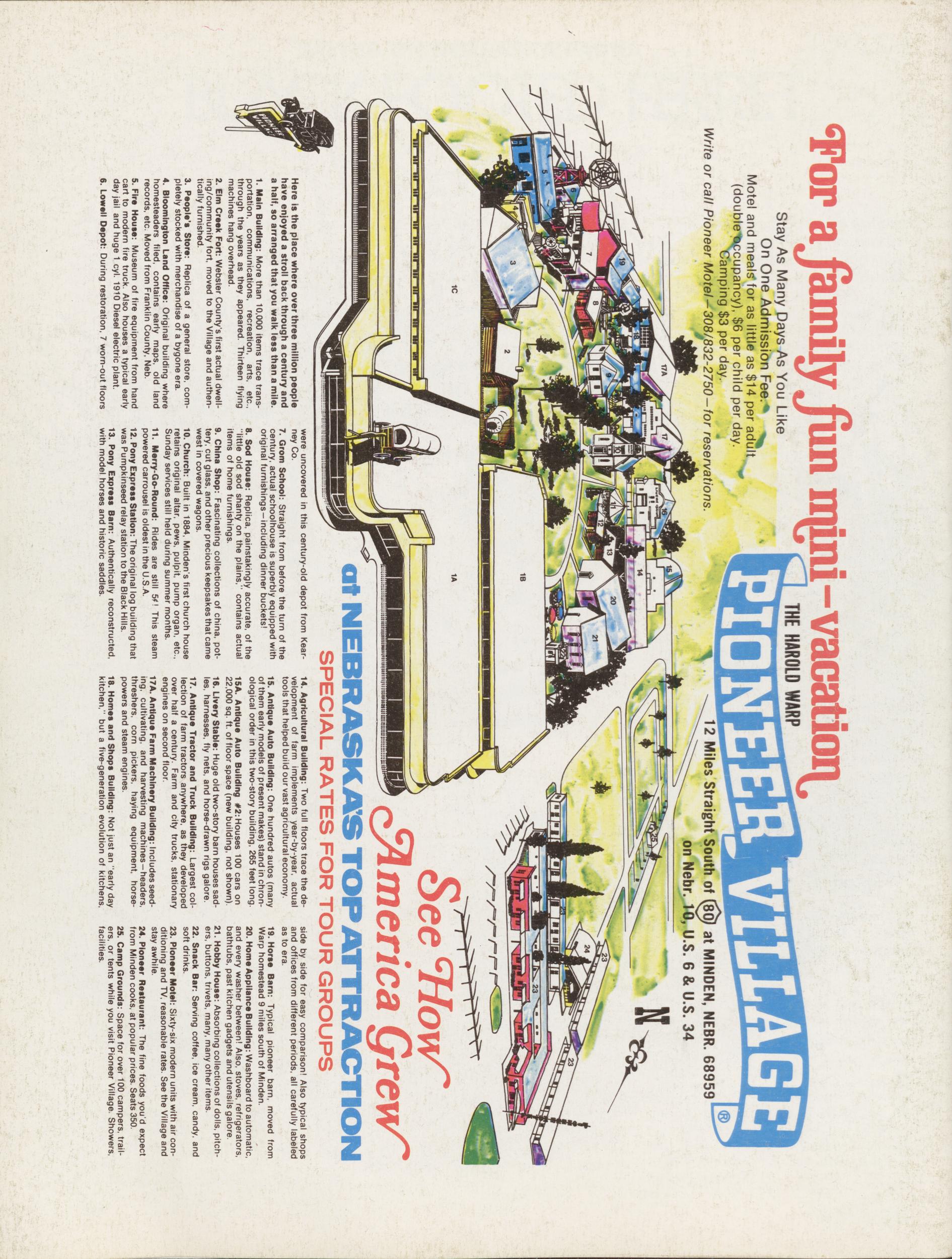
For a family fun mini-vacation
Stay As Many Days As You Like On One Admission Fee.* ^ Motel and meals* for as little as $14 per adult (double*ACCupancy), $6 per child per day. Camping $3 per day. Write or call Pioneer Motel-308/832-2750-for reservations y ^J 2 Miles Straight South of (80) at MINDEN, NEBR. 68959 " on Nebr. 10, U.S. 6 & U.S. 34 dee ^HoW* (America QreW* TOP ATTRACTION RATES FOR TOUR GROUPS Here is the place where over three million people have enjoyed a stroll back through a century and a half, so arranged that you walk less than a mile. 1. Main Building: More than 10,000 items trace transportation, communications, recreation, arts, etc., through the years as they appeared. Thirteen flying machines hang overhead. 2. Elm Creek Fort: Webster County's first actual dwelling/community fort, moved to the Village and authentically furnished. 3. People's Store: Replica of a general store, completely stocked with merchandise of a bygone era. 4. Bloomington Land Office: Original building where homesteaders filed, contains early maps, old land records, etc. Moved from Franklin County, Neb. 5. Fire House: Museum of fire equipment from hand cart to modern fire truck. Also houses a typical early day jail and huge 1 cyl. 1910 Diesel electric plant. 6. Lowell Depot: During restoration, 7 worn-out floors were uncovered in this century-old depot from Kearney Co. 7. Grom School: Straight from before the turn of the century, actual schoolhouse is superbly equipped with original furnishings —including dinner buckets! 8. Sod House: Replica, painstakingly accurate, of the "little old sod shanty on the plains,'' contains actual items of home furnishings. 9. China Shop: Fascinating collections of china, pottery, cut glass, and other precious keepsakes that came west in covered wagons. 10. Church: Built in 1884, Minden's first church house retains original altar, pews, pulpit, pump organ, etc., Sunday services still held during summer months. 11. Merry Go-Round: Rides are still 51! This steam powered carrousel is oldest in the U.S.A. 12. Pony Express Station: The original log building that was Pumpkinseed relay station to the Black Hills. 13. Pony Express Barn: Authentically reconstructed, with model horses and historic saddles. 14. Agricultural Building: Two full floors trace the development of farm implements year-by-year, actual tools that helped build our vast agricultural economy. 15. Antique Auto Building: One hundred autos (many of them early models of present makes) stand in chronological order in this two-story building, 265 feet long. 15A. Antique Auto Building #2: Houses 100 cars on 22,000 sq. ft. of floor space (new building, not shown). 16. Livery Stable: Huge old two-story barn houses sadles, harnesses, fly nets, and horse-drawn rigs galore. 17. Antique Tractor and Truck Building: Largest collection of farm tractors anywhere, as they developed over half a century. Farm and city trucks, stationary engines on second floor. 17A. Antique Farm Machinery Building: Includes seeding, cultivating, and harvesting machines —headers, threshers, corn pickers, haying equipment, horsepowers and steam engines. 18. Homes and Shops Building: Not just an "early day kitchen," but a five-generation evolution of kitchens, side by side for easy comparison! Also typical shops and offices from different periods, all carefully labeled as to era. 19. Horse Barn: Typical pioneer barn, moved from Warp homestead 9 miles south of Minden. 20. Home Appliance Building: Washboard to automatic, and every washer between! Also, stoves, refrigerators, bathtubs, past kitchen gadgets and utensils galore. 21. Hobby House: Absorbing collections of dolls, pitchers, buttons, trivets, many, many other items. 22. Snack Bar: Serving coffee, ice cream, candy, and soft drinks. 23. Pioneer Motel: Sixty-six modern units with air conditioning and TV, reasonable rates. See the Village and stay awhile. 24. Pioneer Restaurant: The fine foods you'd expect from Minden cooks, at popular prices. Seats 350. 25. Camp Grounds: Space for over 100 campers, trailers, or tents while you visit Pioneer Village. Showers, facilities.Position: 737 (15 views)