Volume 56, Issue 6, 1978
NEBRASKAland
June 1978 60 Cents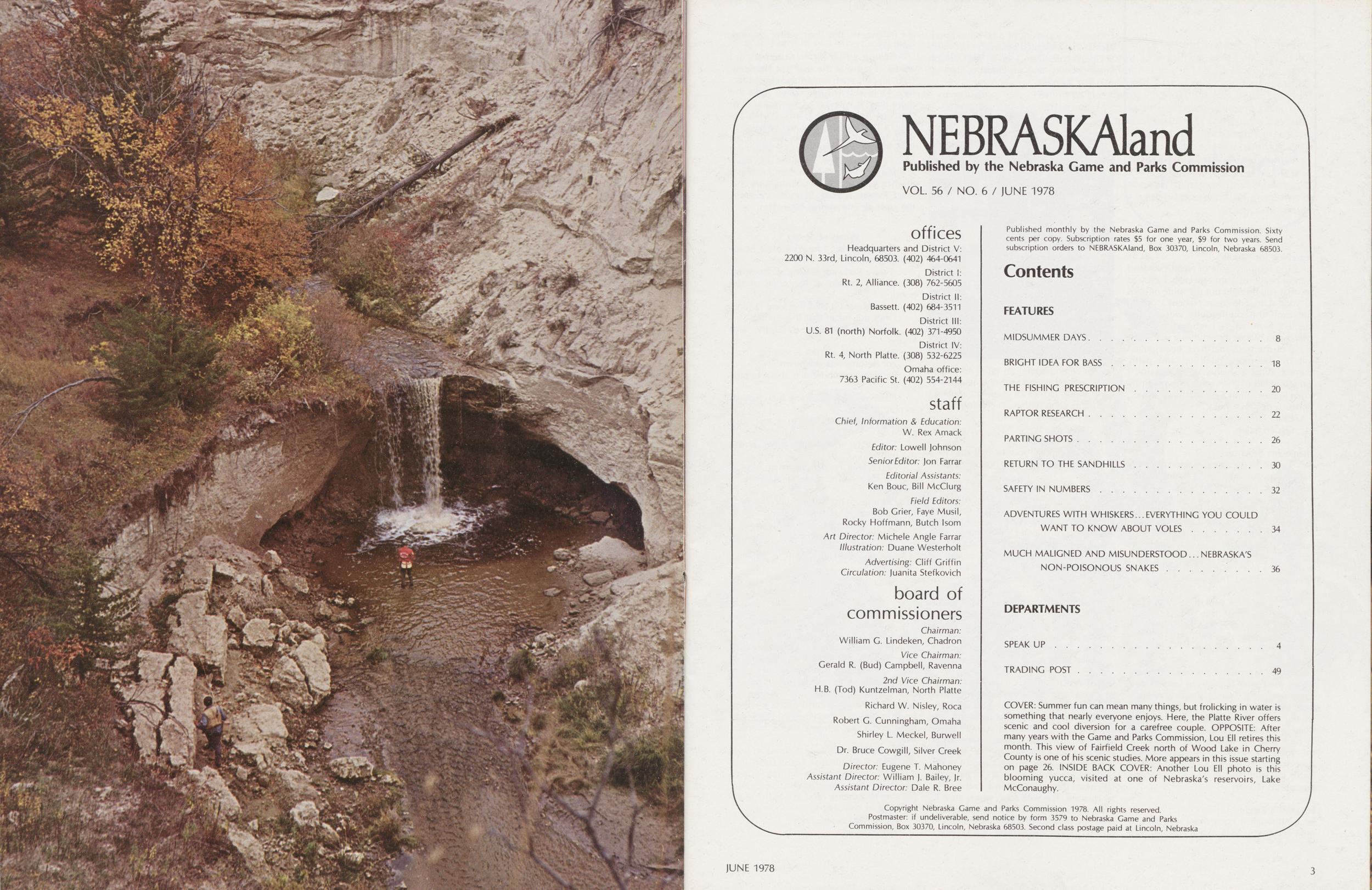
NEBRASKAland
Published by the Nebraskaland Game and Parks Commison
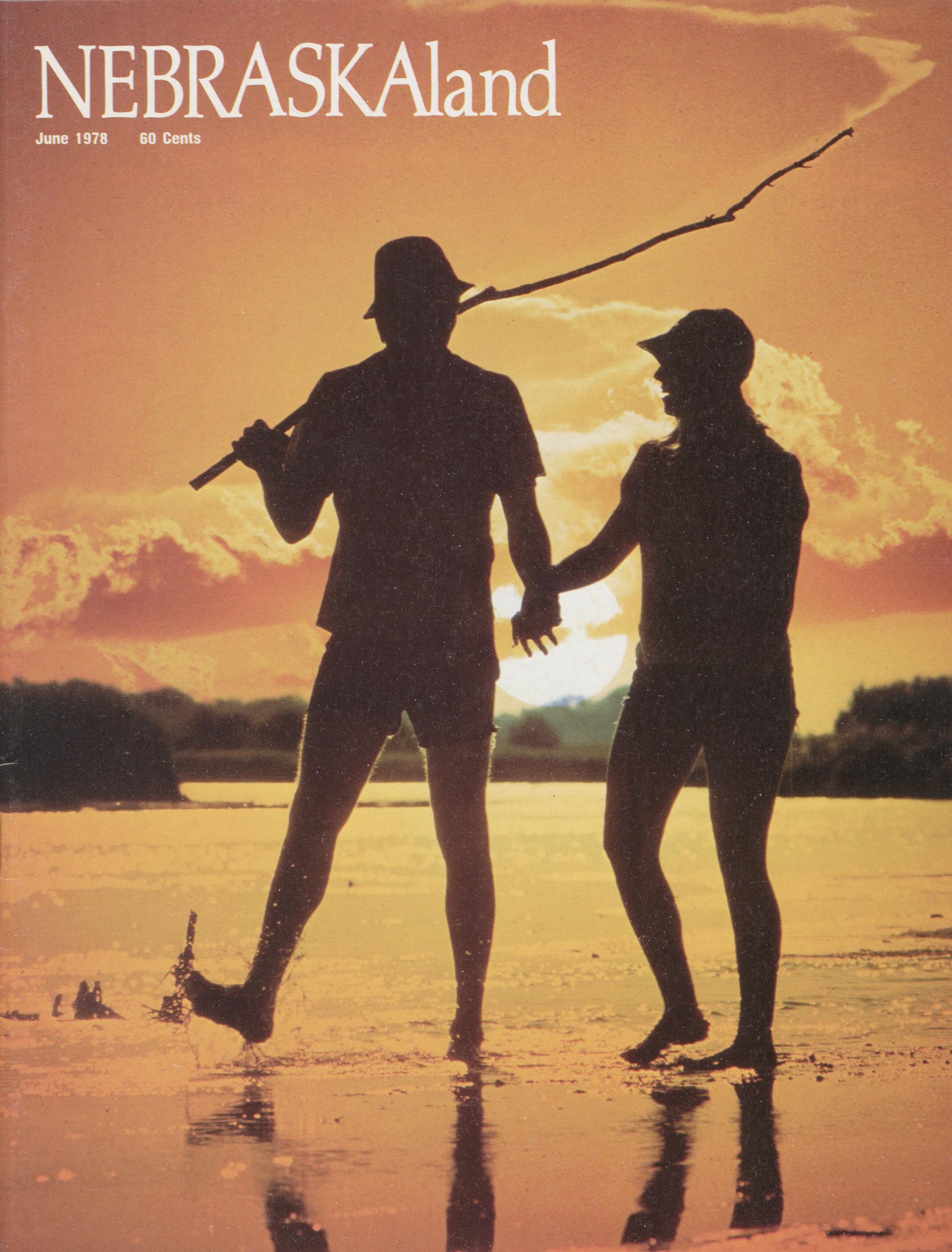
VOL 56 / NO. 6 / JUNE 1978 offices Headquarters and District V: 2200 N. 33rd, Lincoln, 68503. (402) 464-0641 District I: Rt. 2, Alliance. (308) 762-5605 District II: Bassett. (402) 684-3511 District III: U.S. 81 (north) Norfolk. (402) 371-4950 District IV: Rt. 4, North Platte. (308) 532-6225 Omaha office: 7363 Pacific St. (402) 554-2144 staff Chief, Information and Education: W. Rex Amack Editor: Lowell Johnson Senior Editor: Jon Farrar Editorial Assistants: Ken Bouc, Bill McClurg Field Editors: Bob Grier, Faye Musil, Rocky Hoffmann, Butch Isom Art Director: Michele Angle Farrar Illustration: Duane Westerholt Advertising: Cliff Griffin Circulation: Juanita Stefkovich board of commissioners Chairman: William G. Lindeken, Chadron Vice Chairman: Gerald R. (Bud) Campbell, Ravenna 2nd Vice Chairman: H.B. (Tod) Kuntzelman, North Platte Richard W. Nisley, Roca Robert G. Cunningham, Omaha Shirley L Meckel, Burwell Dr. Bruce Cowgill, Silver Creek Director: Eugene T. Mahoney Assistant Director: William J. Bailey, Jr. Assistant Director: Dale R. Bree Published monthly by the Nebraska Game and Parks Commission. Sixty cents per copy. Subscription rates $5 for one year, $9 for two years. Send subscription orders to NEBRASKAland, Box 30370, Lincoln, Nebraska 68503. Contents FEATURES MIDSUMMER DAYS 8 BRIGHT IDEA FOR BASS 18 THE FISHING PRESCRIPTION 20 RAPTOR RESEARCH 22 PARTING SHOTS 26 RETURN TO THE SANDHILLS 30 SAFETY IN NUMBERS 32 ADVENTURES WITH WHISKERS EVERYTHING YOU COULD WANT TO KNOW ABOUT VOLES 34 MUCH MALIGNED AND MISUNDERSTOOD NEBRASKA'S NON-POISONOUS SNAKES 36 DEPARTMENTS SPEAK UP 4 TRADING POST 49 COVER: Summer fun can mean many things, but frolicking in water is something that nearly everyone enjoys. Here, the Platte River offers scenic and cool diversion for a carefree couple. OPPOSITE: After many years with the Game and Parks Commission, Lou Ell retires this month. This view of Fairfield Creek north of Wood Lake in Cherry County is one of his scenic studies. More appears in this issue starting on page 26. INSIDE BACK COVER: Another Lou Ell photo is this blooming yucca, visited at one of Nebraska's reservoirs, Lake McConaughy. Copyright Nebraska Game and Parks Commission 1978. All rights reserved. Postmaster: if undeliverable, send notice by form 3579 to Nebraska Game and Parks Commission, Box 30370, Lincoln, Nebraska 68503. Second class postage paid at Lincoln, Nebraska JUNE 1978 3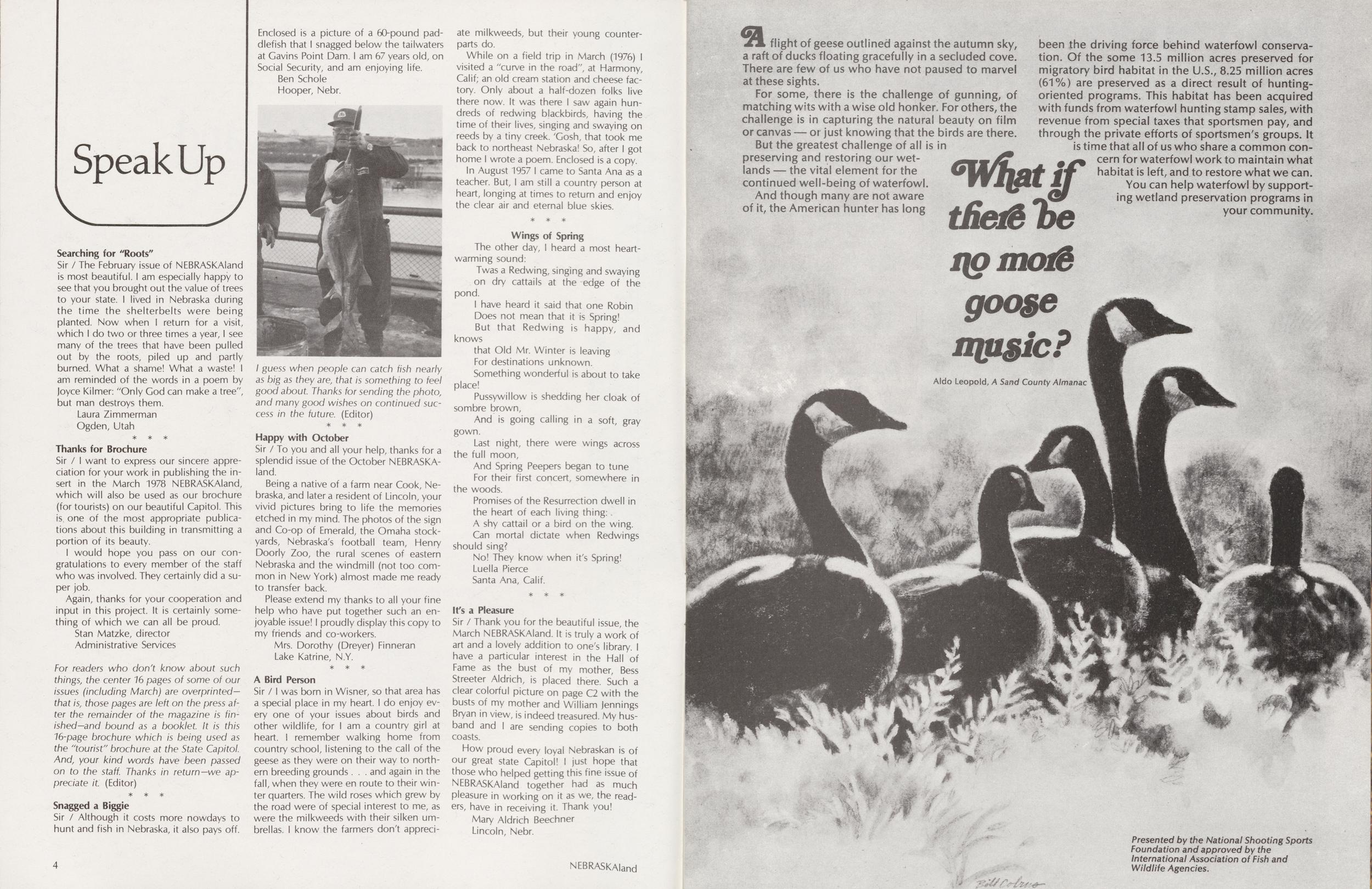
Speak Up
Searching for "Roots" Sir / The February issue of NEBRASKAIand is most beautiful. I am especially happy to see that you brought out the value of trees to your state. I lived in Nebraska during the time the shelterbelts were being planted. Now when I return for a visit, which I do two or three times a year, I see many of the trees that have been pulled out by the roots, piled up and partly burned. What a shame! What a waste! I am reminded of the words in a poem by Joyce Kilmer: "Only God can make a tree", but man destroys them. Laura Zimmerman Ogden, Utah Thanks for Brochure Sir / I want to express our sincere appreciation for your work in publishing the insert in the March 1978 NEBRASKAIand, which will also be used as our brochure (for tourists) on our beautiful Capitol. This is, one of the most appropriate publications about this building in transmitting a portion of its beauty. I would hope you pass on our congratulations to every member of the staff who was involved. They certainly did a super job. Again, thanks for your cooperation and input in this project. It is certainly something of which we can all be proud. Stan Matzke, director Administrative Services For readers who don't know about such things, the center 76 pages of some of our issues (including March) are overprinted— that is, those pages are left on the press after the remainder of the magazine is finished—and bound as a booklet. It is this 16-page brochure which is being used as the "tourist" brochure at the State Capitol. And, your kind words have been passed on to the staff. Thanks in return—we appreciate it. (Editor) Snagged a Biggie Sir / Although it costs more nowdays to hunt and fish in Nebraska, it also pays off. Enclosed is a picture of a 60-pound paddlefish that I snagged below the tailwaters at Gavins Point Dam. I am 67 years old, on Social Security, and am enjoying life. Ben Schole Hooper, Nebr. I guess when people can catch fish nearly as big as they are, that is something to feel good about. Thanks for sending the photo, and many good wishes on continued success in the future. (Editor) Happy with October Sir / To you and all your help, thanks for a splendid issue of the October NEBRASKAIand. Being a native of a farm near Cook, Nebraska, and later a resident of Lincoln, your vivid pictures bring to life the memories etched in my mind. The photos of the sign and Co-op of Emerald, the Omaha stockyards, Nebraska's football team, Henry Doorly Zoo, the rural scenes of eastern Nebraska and the windmill (not too common in New York) almost made me ready to transfer back. Please extend my thanks to all your fine help who have put together such an enjoyable issue! I proudly display this copy to my friends and co-workers. Mrs. Dorothy (Dreyer) Finneran Lake Katrine, N.Y. A Bird Person Sir / I was born in Wisner, so that area has a special place in my heart. I do enjoy every one of your issues about birds and other wildlife, for I am a country girl at heart. I remember walking home from country school, listening to the call of the geese as they were on their way to northern breeding grounds . . . and again in the fall, when they were en route to their winter quarters. The wild roses which grew by the road were of special interest to me, as were the milkweeds with their silken umbrellas. I know the farmers don't appreciate milkweeds, but their young counterparts do. While on a field trip in March (1976) I visited a "curve in the road", at Harmony, Calif; an old cream station and cheese factory. Only about a half-dozen folks live there now. It was there I saw again hundreds of redwing blackbirds, having the time of their lives, singing and swaying on reeds by a tiny creek. 'Gosh, that took me back to northeast Nebraska! So, after I got home I wrote a poem. Enclosed is a copy. In August 1957 I came to Santa Ana as a teacher. But, I am still a country person at heart, longing at times to return and enjoy the clear air and eternal blue skies. Wings of Spring The other day, I heard a most heartwarming sound: Twas a Redwing, singing and swaying on dry cattails at the edge of the pond. I have heard it said that one Robin Does not mean that it is Spring! But that Redwing is happy, and knows that Old Mr. Winter is leaving For destinations unknown. Something wonderful is about to take place! Pussywillow is shedding her cloak of sombre brown, And is going calling in a soft, gray gown. Last night, there were wings across the full moon, And Spring Peepers began to tune For their first concert, somewhere in the woods. Promises of the Resurrection dwell in the heart of each living thing: A shy cattail or a bird on the wing. Can mortal dictate when Redwings should sing? No! They know when it's Spring! Luella Pierce Santa Ana, Calif. It's a PleasureSir / Thank you for the beautiful issue, the March NEBRASKAIand. It is truly a work of art and a lovely addition to one's library. I have a particular interest in the Hall of Fame as the bust of my mother, Bess Streeter Aldrich, is placed there. Such a clear colorful picture on page C2 with the busts of my mother and William Jennings Bryan in view, is indeed treasured. My husband and I are sending copies to both coasts.
How proud every loyal Nebraskan is of our great state Capitol! I just hope that those who helped getting this fine issue of NEBRASKAIand together had as much pleasure in working on it as we, the readers, have in receiving it. Thank you!
Mary Aldrich Beechner Lincoln, Nebr. 4 NEBRASKAIandWhat if there be no goose music?
A flight of geese outlined against the autumn sky, a raft of ducks floating gracefully in a secluded cove. There are few of us who have not paused to marvel at these sights.
For some, there is the challenge of gunning, of matching wits with a wise old honker. For others, the challenge is in capturing the natural beauty on film or canvas — or just knowing that the birds are there.
But the greatest challenge of all is in preserving and restoring our wetlands — the vital element for the continued well-being of waterfowl.
And though many are not aware of it, the American hunter has long been the driving force behind waterfowl conservation. Of the some 13.5 million acres preserved for migratory bird habitat in the U.S., 8.25 million acres (61%) are preserved as a direct result of hunting- oriented programs. This habitat has been acquired with funds from waterfowl hunting stamp sales, with revenue from special taxes that sportsmen pay, and through the private efforts of sportsmen's groups. It is time that all of us who share a common concern for waterfowl work to maintain what habitat is left, and to restore what we can. You can help waterfowl by supporting wetland preservation programs in your community.
Presented by the National Shooting Sports Foundation and approved by the International Association of Fish and Wildlife Agencies.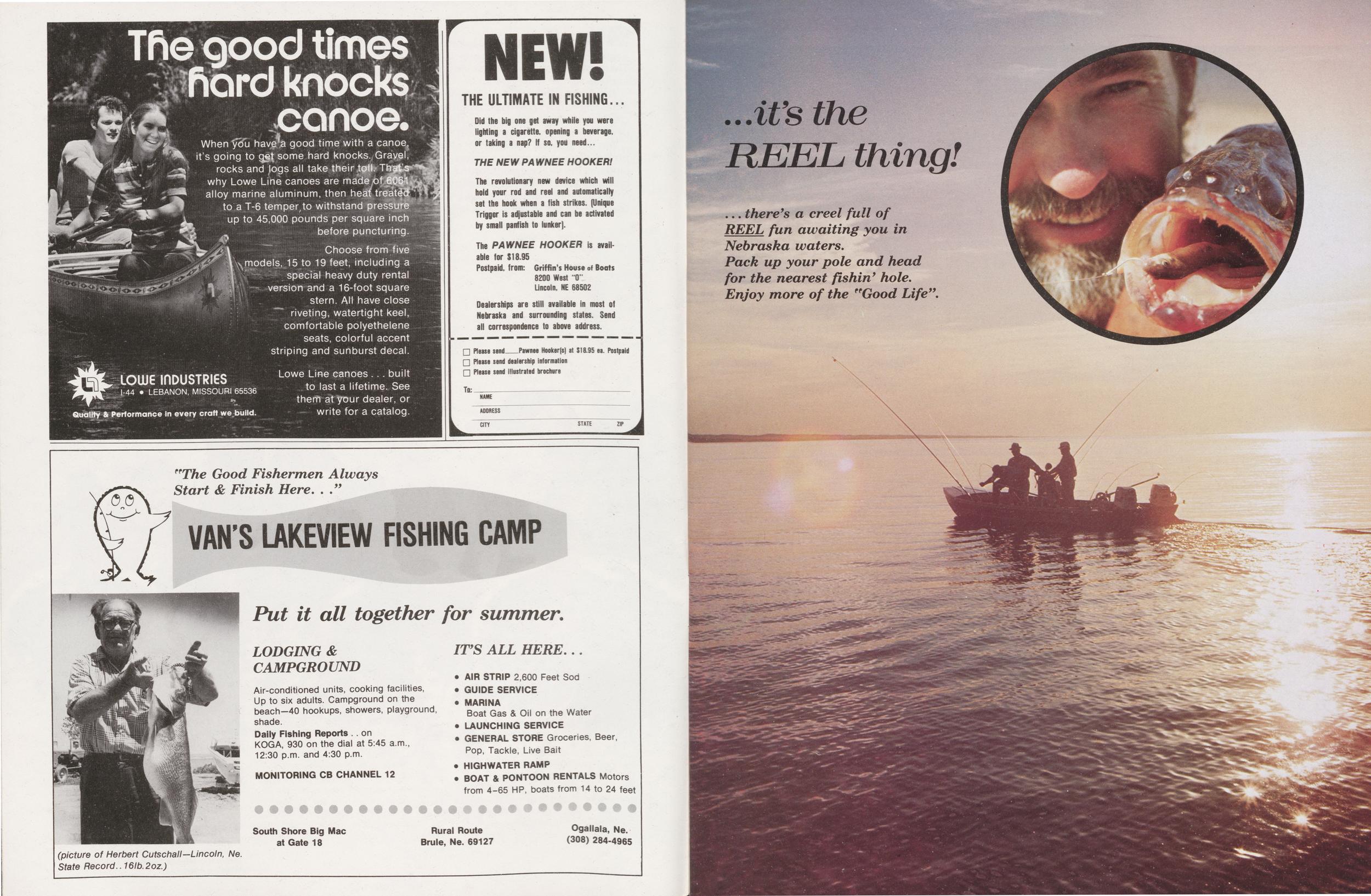
The good times hard knocks conoe
"The Good Fishermen Always Start and Finish Here. . ." VAN'S LAKEVIEW FISHING CAMP
Put it all together for summer. LODGING and CAMPGROUND Air-conditioned units, cooking facilities, Up to six adults. Campground on the beach—40 hookups, showers, playground, shade. Daily Fishing Reports .. on KOGA, 930 on the dial at 5:45 a.m., 12:30 p.m. and 4:30 p.m. MONITORING CB CHANNEL 12 ITS ALL HERE... • AIR STRIP 2,600 Feet Sod • GUIDE SERVICE • MARINA Boat Gas and Oil on the Water • LAUNCHING SERVICE • GENERAL STORE Groceries, Beer, Pop, Tackle, Live Bait • HIGHWATER RAMP • BOAT and PONTOON RENTALS Motors from 4-65 HP, boats from 14 to 24 feet South Shore Big Mac at Gate 18 Rural Route Brule, Ne. 69127 Ogallala, Ne. (308) 284-4965... it's the REEL thing!
... there's a creel full of REEL fun awaiting you in Nebraska waters. Pack up your pole and head for the nearest fishin' hole. Enjoy more of the "Good Life".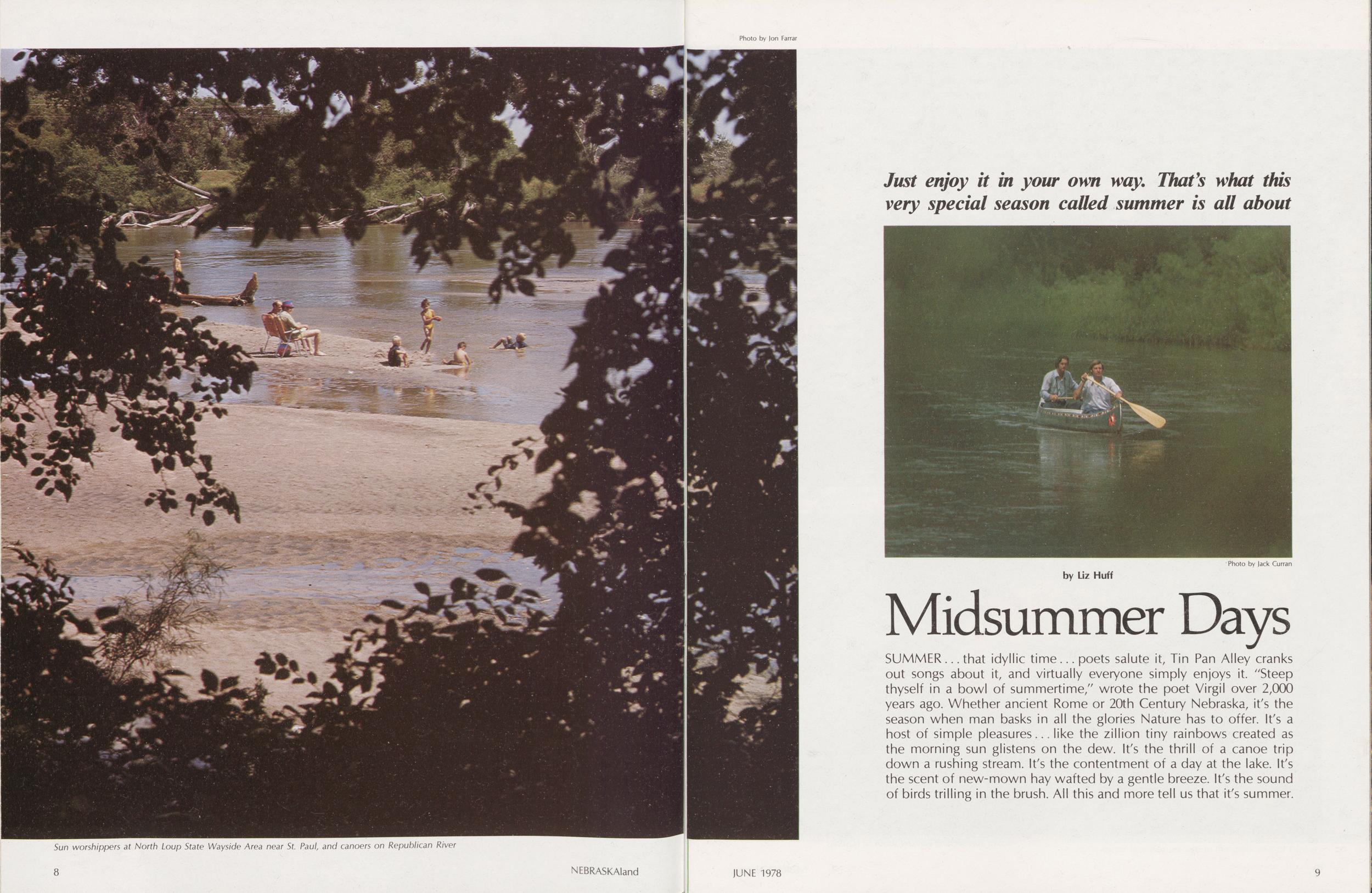
Midsummer Days
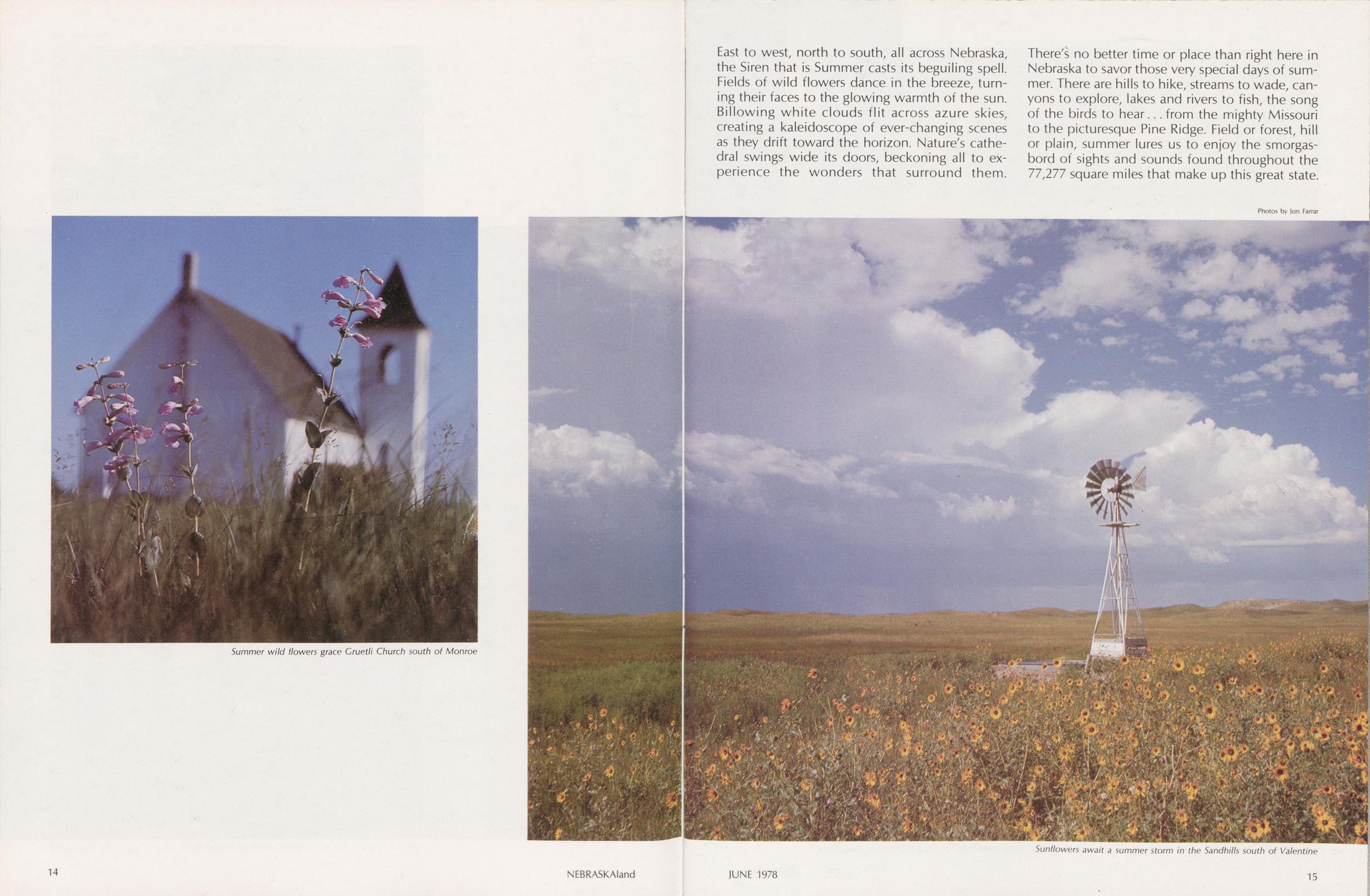
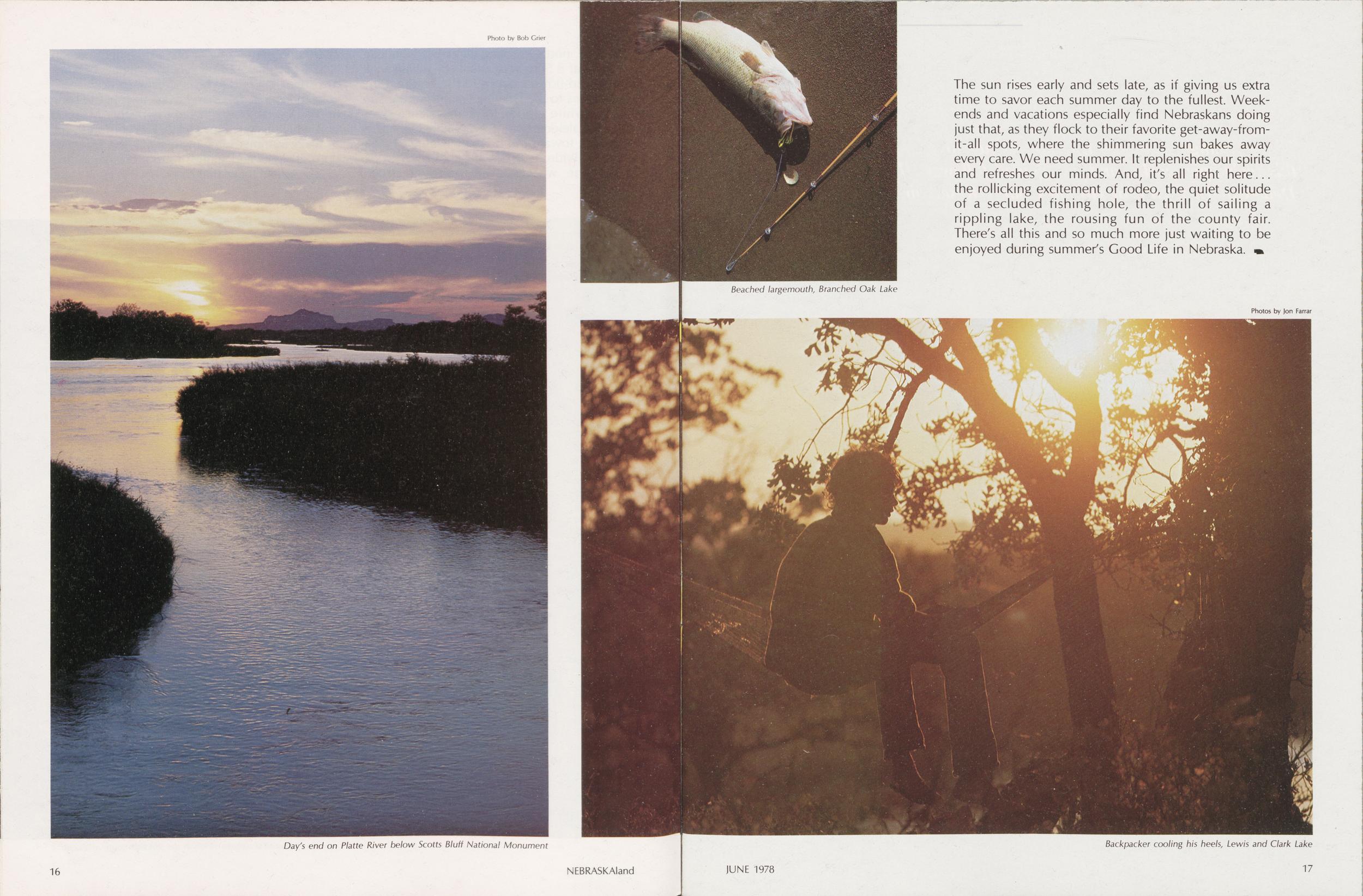
SUMMER... that idyllic time... poets salute it, Tin Pan Alley cranks out songs about it, and virtually everyone simply enjoys it. "Steep thyself in a bowl of summertime," wrote the poet Virgil over 2,000 years ago. Whether ancient Rome or 20th Century Nebraska, it's the season when man basks in all the glories Nature has to offer. It's a host of simple pleasures... like the zillion tiny rainbows created as the morning sun glistens on the dew. It's the thrill of a canoe trip down a rushing stream. It's the contentment of a day at the lake. It's the scent of new-mown hay wafted by a gentle breeze. It's the sound of birds trilling in the brush. All this and more tell us that it's summer.
JUNE 1978 9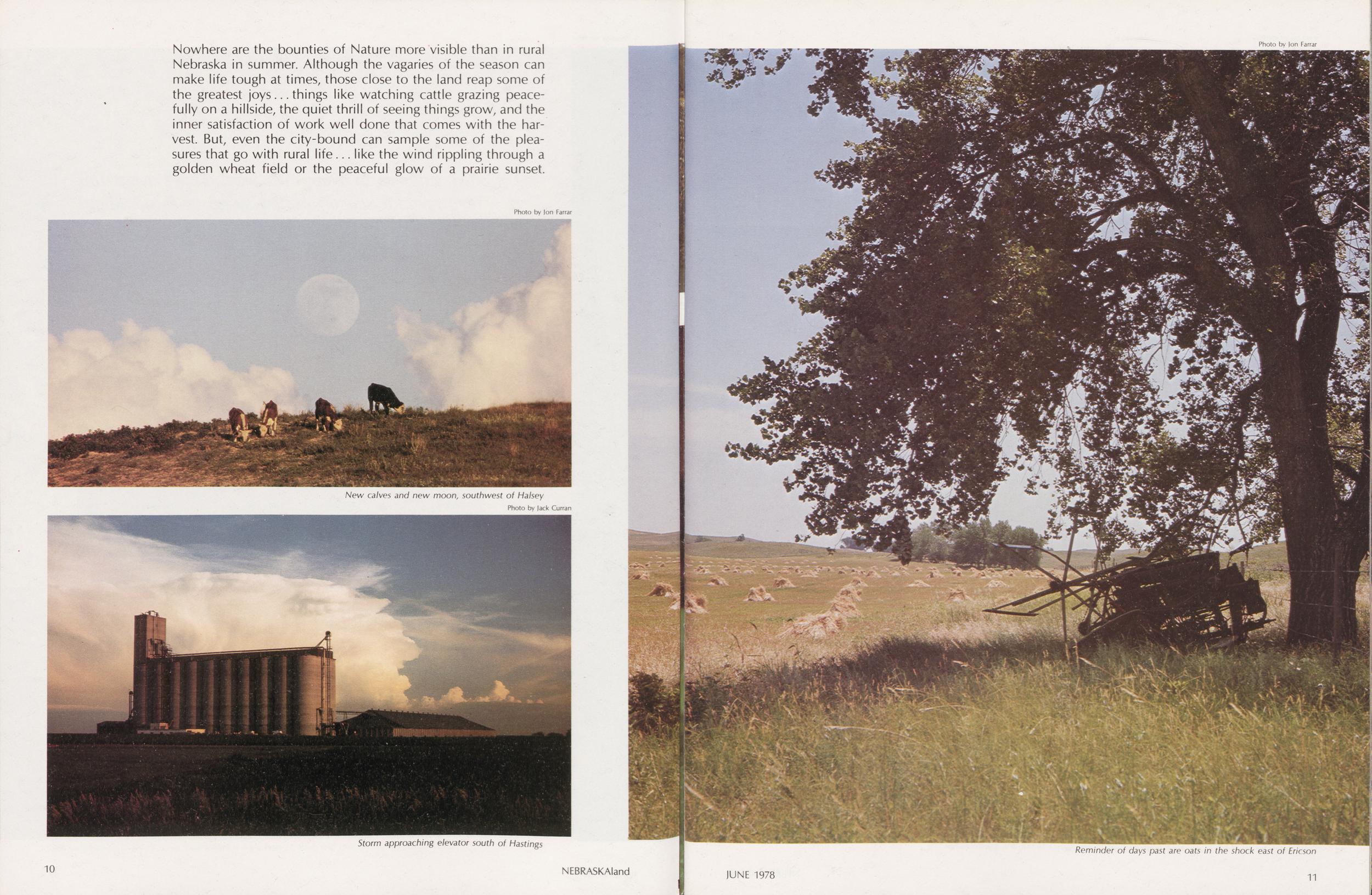
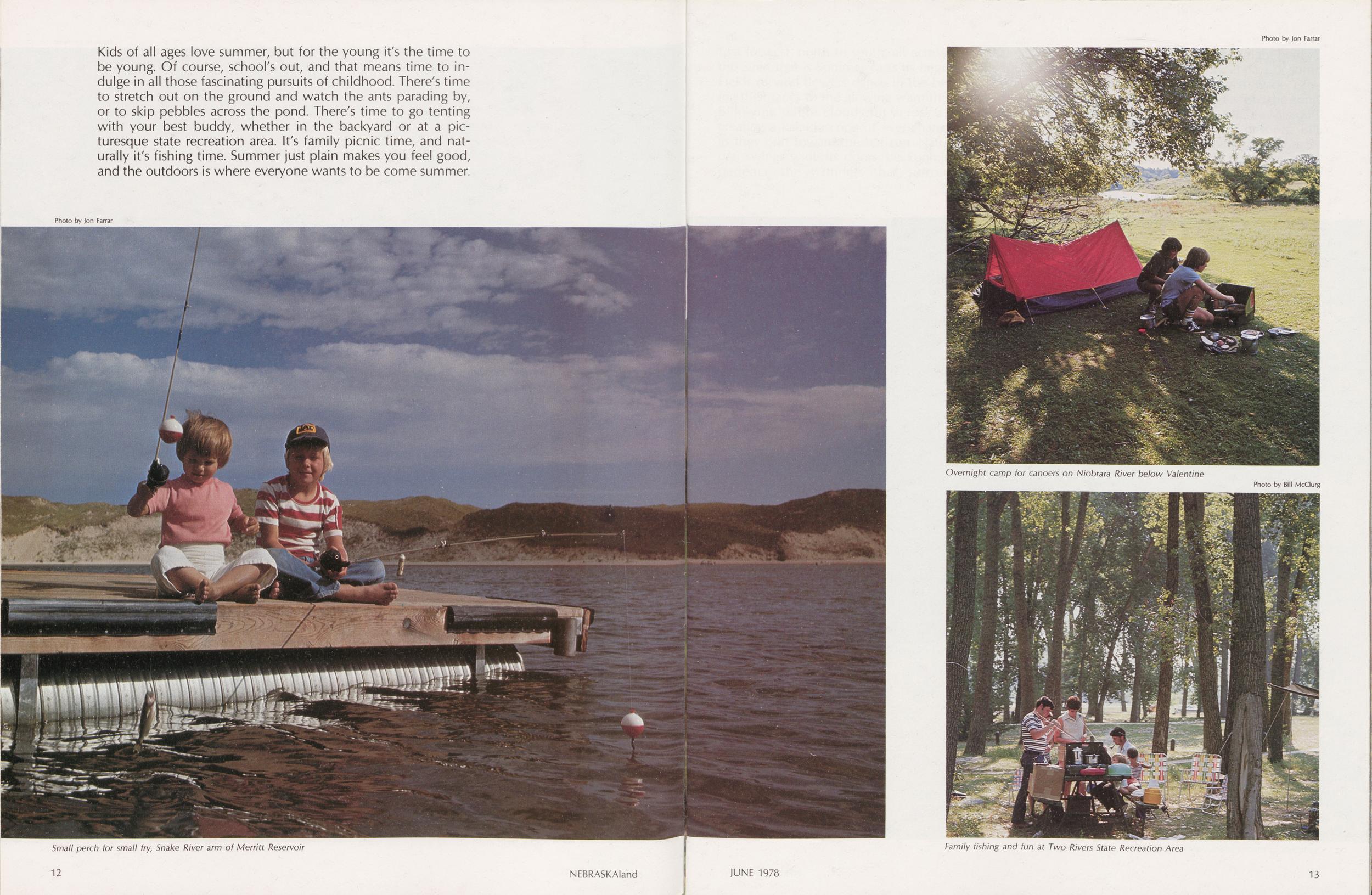
Nowhere are the bounties of Nature more visible than in rural Nebraska in summer. Although the vagaries of the season can make life tough at times, those close to the land reap some of the greatest joys... things like watching cattle grazing peacefully on a hillside, the quiet thrill of seeing things grow, and the inner satisfaction of work well done that comes with the harvest. But, even the city-bound can sample some of the pleasures that go with rural life... like the wind rippling through a golden wheat field or the peaceful glow of a prairie sunset.
 Kids of all ages love summer, but for the young it's the time to
be young. Of course, school's out, and that means time to indulge in all those fascinating
pursuits of childhood. There's time
to stretch out on the ground and watch the ants parading by,
or to skip pebbles across the pond. There's time to go tenting
with your best buddy, whether in the backyard or at a picturesque state recreation
area. It's family picnic time, and naturally it's fishing time. Summer just plain
makes you fee! good,
and the outdoors is where everyone wants to be come summer.
Kids of all ages love summer, but for the young it's the time to
be young. Of course, school's out, and that means time to indulge in all those fascinating
pursuits of childhood. There's time
to stretch out on the ground and watch the ants parading by,
or to skip pebbles across the pond. There's time to go tenting
with your best buddy, whether in the backyard or at a picturesque state recreation
area. It's family picnic time, and naturally it's fishing time. Summer just plain
makes you fee! good,
and the outdoors is where everyone wants to be come summer.
Bright Idea for Bass
WHITE BASS FISHING the traditional way, in fast boats and with flashy lures chasing fish all over a big lake, has a certain exciting appeal. But, it can also be a bit hectic, and the pace of that daytime activity tends to focus the angler's mind on just one thing—a full limit.
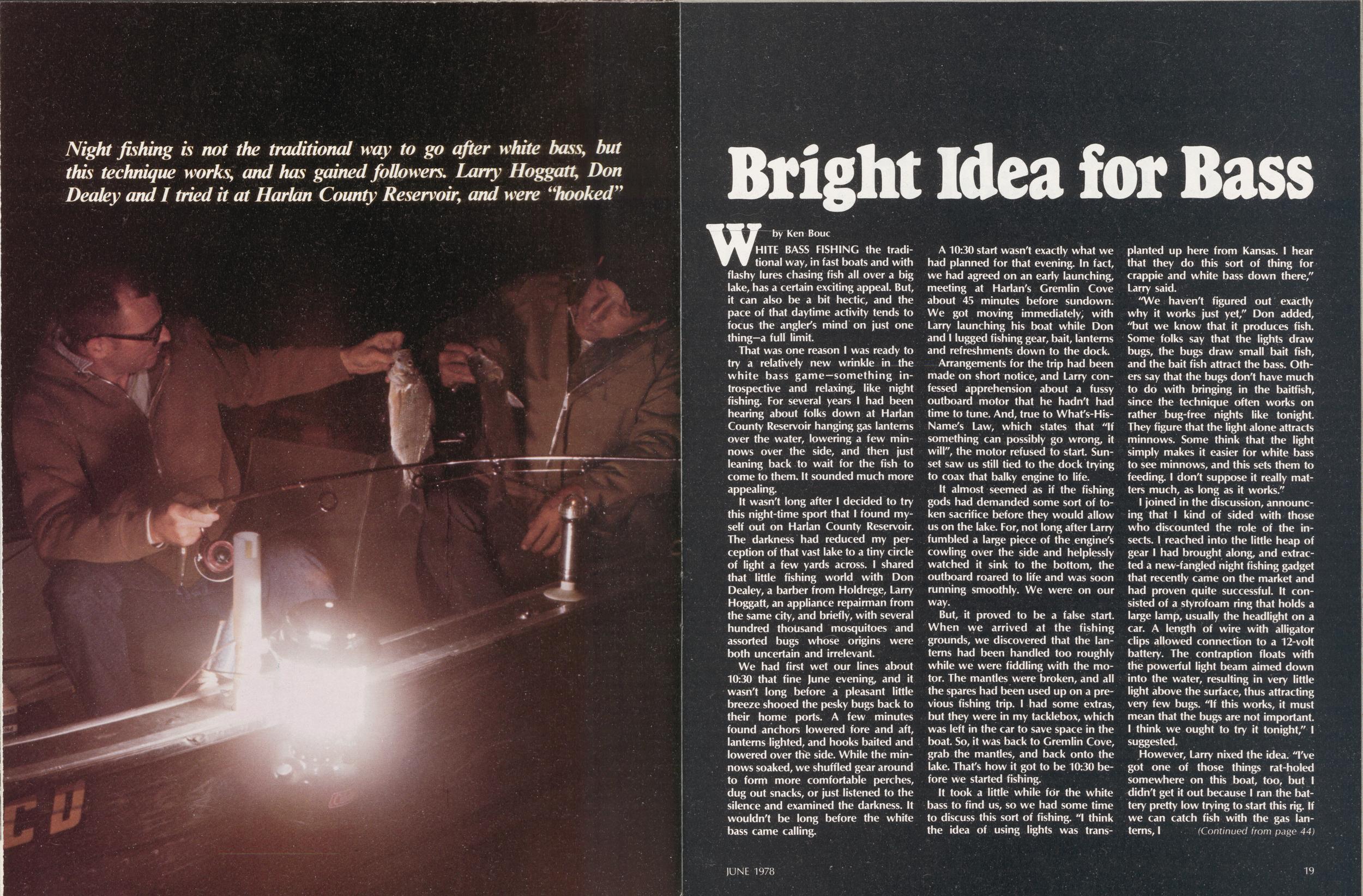
That was one reason I was ready to try a relatively new wrinkle In the white bass game—something introspective and relaxing, like night fishing. For several years I had been hearing about folks down at Harlan County Reservoir hanging gas lanterns over the water, lowering a few minnows over the side, and then just leaning back to wait for the fish to come to them. It sounded much more appealing.
It wasn't long after I decided to try this night-time sport that I found myself out on Harlan County Reservoir. The darkness had reduced my perception of that vast lake to a tiny circle of light a few yards across. I shared that little fishing world with Don Dealey, a barber from Holdrege, Larry Hoggatt, an appliance repairman from the same city, and briefly, with several hundred thousand mosquitoes and assorted bugs whose origins were both uncertain and irrelevant.
We had first wet our lines about 10:30 that fine June evening, and it wasn't long before a pleasant little breeze shooed the pesky bugs back to their home ports. A few minutes found anchors lowered fore and aft, lanterns lighted, and hooks baited and lowered over th£ side. While the minnows soaked, we shuffled gear around to form more comfortable perches, dug out snacks, or just listened to the silence and examined the darkness. It wouldn't be long before the white bass came calling.
A 10:30 start wasn't exactly what we had planned for that evening. In fact, we had agreed on an early launching, meeting at Harlan's Gremlin Cove about 45 minutes before sundown. We got moving immediately, with Larry launching his boat while Don and I lugged fishing gear, bait, lanterns and refreshments down to the dock.
Arrangements for the trip had been made on short notice, and Larry confessed apprehension about a fussy outboard motor that he hadn't had time to tune. And, true to What's-His-Name's Law, which states that "if something can possibly go wrong, it will", the motor refused to start. Sunset saw us still stied to the dock trying to coax that balky engine to life.
It almost seemed as if the fishing gods had demanded some sort of token sacrifice before they would allow us on the lake. For, not long after Larry fumbled a large piece of the engine's cowling over the side and helplessly watched it sink to the bottom, the outboard roared to life and was soon running smoothly. We were on our way.
But, it proved to be a false start. When we arrived at the fishing grounds, we discovered that the lanterns had been handled too roughly while we were fiddling with the motor. The mantles were broken, and all the spares had been used up on a previous fishing trip. I had some extras, but they were in my tacklebox, which was left in the car to save space in the boat. So, it was back to Gremlin Cove, grab the mantles, and back onto the lake. That's how it got to be 10:30 before we started fishing.
It took a little while for the white bass to find us, so we had some time to discuss this sort of fishing. "I think the idea of using lights was transplanted up here from Kansas. I hear that they do this sort of thing for crappie and white bass down there," Larry said.
"We haven't figured out exactly why it works just yet," Don added, "but we know that it produces fish. Some folks say that the lights draw bugs, the bugs draw small bait fish, and the bait fish attract the bass. Others say that the bugs don't have much to do with bringing in the baitfish, since the technique often works on rather bug-free nights like tonight. They figure that the light alone attracts minnows. Some think that the light simply makes it easier for white bass to see minnows, and this sets them to feeding. I don't suppose it really matters much, as long as it works."
I joined in the discussion, announcing that I kind of sided with those who discounted the role of the insects. I reached into the little heap of gear I had brought along, and extracted a new-fangled night fishing gadget that recently came on the market and had proven quite successful. It consisted of a styrofoam ring that holds a large lamp, usually the headlight on a car. A length of wire with alligator clips allowed connection to a 12-volt battery. The contraption floats with the powerful light beam aimed down into the water, resulting in very little light above the surface, thus attracting very few bugs. "If this works, it must mean that the bugs are not important. I think we ought to try it tonight," I suggested.
However, Larry nixed the idea. "I've got one of those things rat-holed somewhere on this boat, too, but I didn't get it out because I ran the battery pretty low trying to start this rig. If we can catch fish with the gas lanterns, I (Continued from page 44)
JUNE 1978 19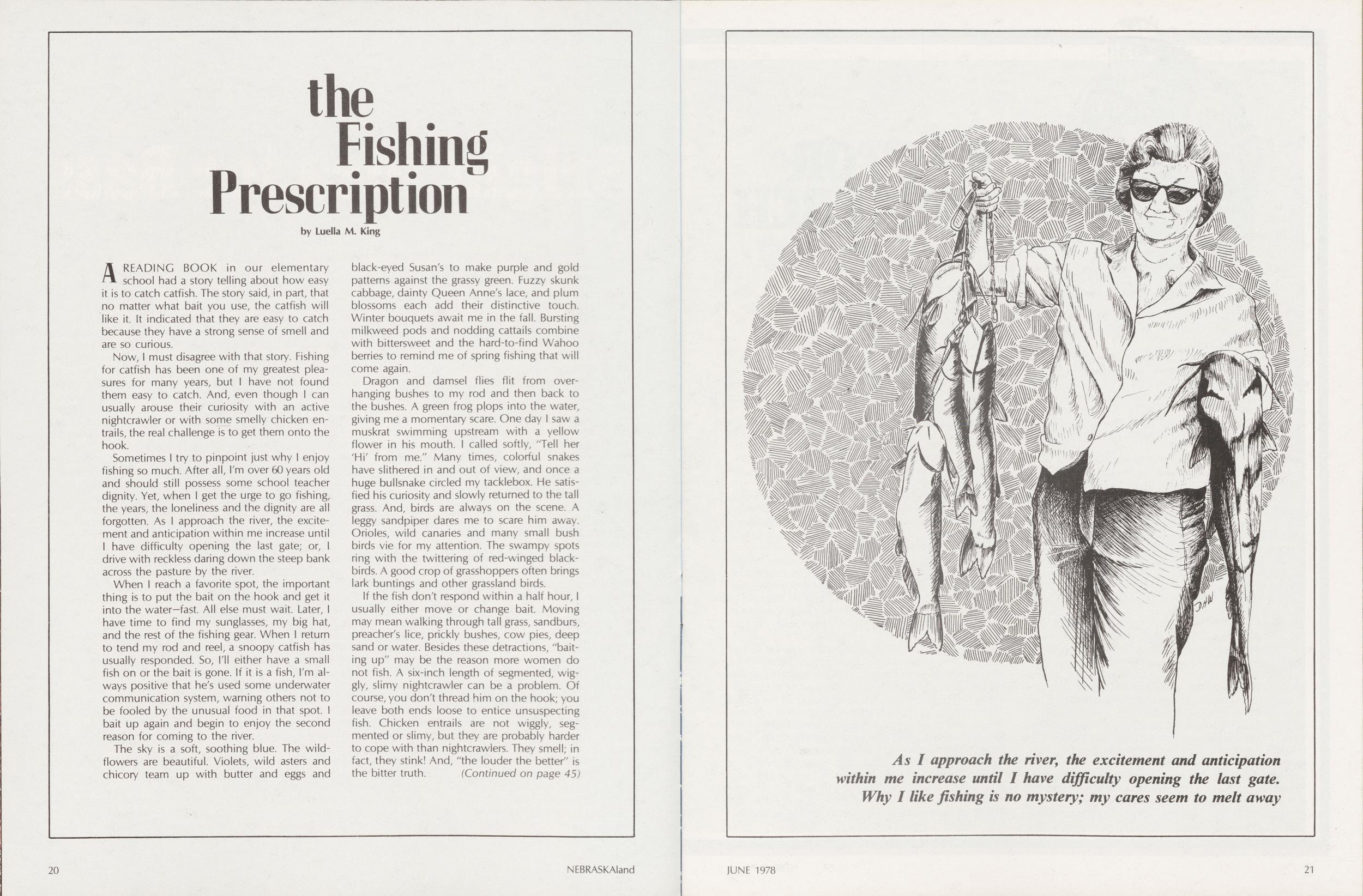
the Fishing Prescription
A READING BOOK in our elementary school had a story telling about how easy it is to catch catfish. The story said, in part, that no matter what bait you use, the catfish will like it. It indicated that they are easy to catch because they have a strong sense of smell and are so curious.
Now, I must disagree with that story. Fishing for catfish has been one of my greatest pleasures for many years, but I have not found them easy to catch. And, even though I can usually arouse their curiosity with an active nightcrawler or with some smelly chicken entrails, the real challenge is to get them onto the hook.
Sometimes I try to pinpoint just why I enjoy fishing so much. After all, I'm over 60 years old and should still possess some school teacher dignity. Yet, when I get the urge to go fishing, the years, the loneliness and the dignity are all forgotten. As I approach the river, the excitement and anticipation within me increase until I have difficulty opening the last gate; or, I drive with reckless daring down the steep bank across the pasture by the river.
When I reach a favorite spot, the important thing is to put the bait on the hook and get it into the water-fast. All else must wait. Later, I have time to find my sunglasses, my big hat, and the rest of the fishing gear. When I return to tend my rod and reel, a snoopy catfish has usually responded. So, I'll either have a small fish on or the bait is gone. If it is a fish, I'm always positive that he's used some underwater communication system, warning others not to be fooled by the unusual food in that spot. I bait up again and begin to enjoy the second reason for coming to the river.
The sky is a soft, soothing blue. The wildflowers are beautiful. Violets, wild asters and chicory team up with butter and eggs and black-eyed Susan's to make purple and gold patterns against the grassy green. Fuzzy skunk cabbage, dainty Queen Anne's lace, and plum blossoms each add their distinctive touch. Winter bouquets await me in the fall. Bursting milkweed pods and nodding cattails combine with bittersweet and the hard-to-find Wahoo berries to remind me of spring fishing that will come again.
Dragon and damsel flies flit from overhanging bushes to my rod and then back to the bushes. A green frog plops into the water, giving me a momentary scare. One day I saw a muskrat swimming upstream with a yellow flower in his mouth. I called softly, "Tell her 'Hi' from me." Many times, colorful snakes have slithered in and out of view, and once a huge bullsnake circled my tacklebox. He satisfied his curiosity and slowly returned to the tall grass. And, birds are always on the scene. A leggy sandpiper dares me to scare him away. Orioles, wild canaries and many small bush birds vie for my attention. The swampy spots ring with the twittering of red-winged blackbirds. A good crop of grasshoppers often brings lark buntings and other grassland birds.
If the fish don't respond within a half hour, I usually either move or change bait. Moving may mean walking through tall grass, sandburs, preacher's lice, prickly bushes, cow pies, deep sand or water. Besides these detractions, "baiting up" may be the reason more women do not fish. A six-inch length of segmented, wiggly, slimy nightcrawler can be a problem. Of course, you don't thread him on the hook; you leave both ends loose to entice unsuspecting fish. Chicken entrails are not wiggly, segmented or slimy, but they are probably harder to cope with than nightcrawiers. They smell; in fact, they stink! And, "the louder the better" is the bitter truth. (Continued on page 45)
20 NEBRASKAIand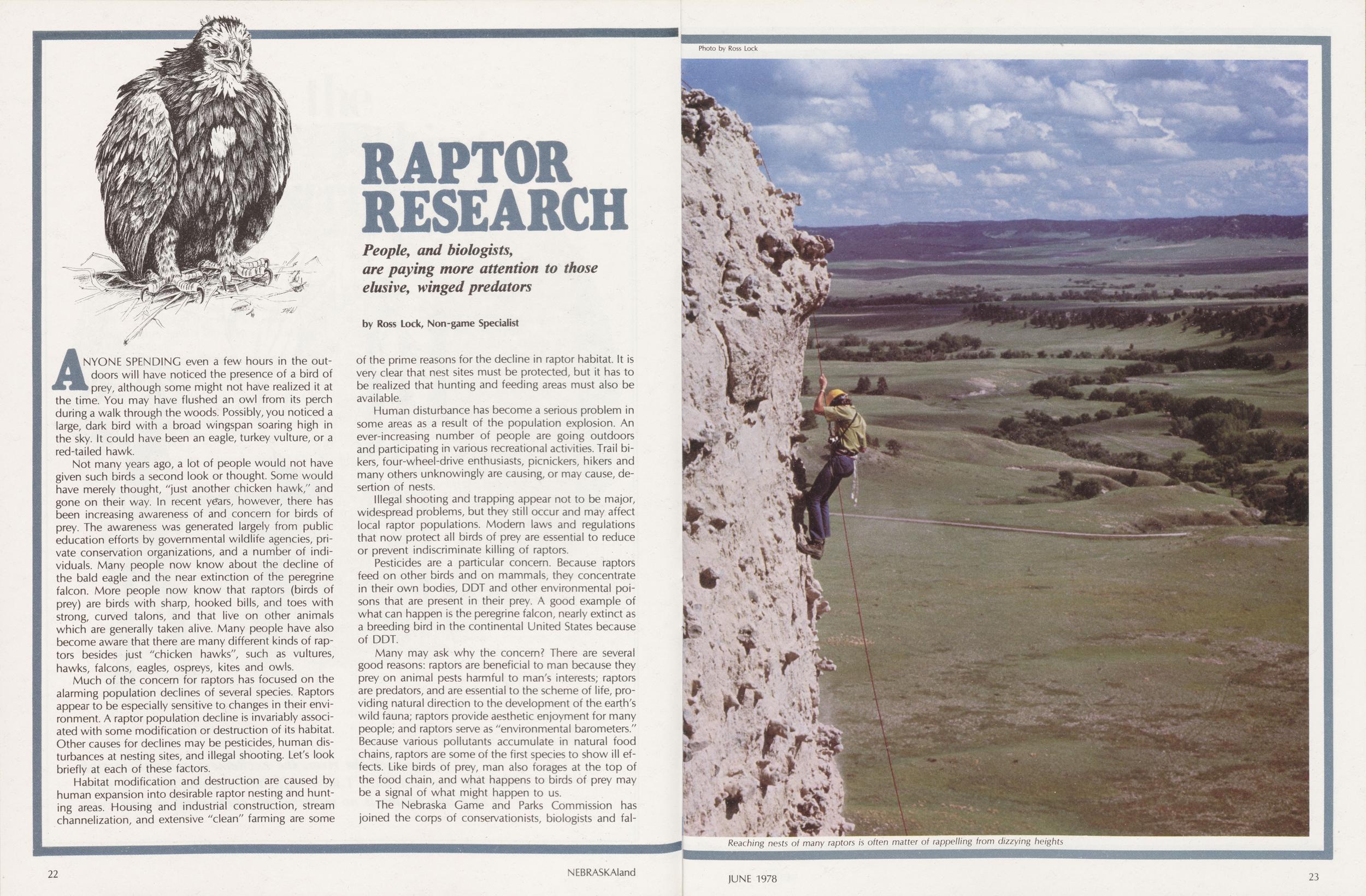
RAPTOR RESEARCH
People, and bioligists, are paying more attention to those elusive, winged predators
ANYONE SPENDING even a few hours in the outdoors will have noticed the presence of a bird of prey, although some might not have realized it at the time. You may have flushed an owl from its perch during a walk through the woods. Possibly, you noticed a large, dark bird with a broad wingspan soaring high in the sky. It could have been an eagle, turkey vulture, or a red-tailed hawk.
Not many years ago, a lot of people would not have given such birds a second look or thought. Some would have merely thought, "just another chicken hawk," and gone on their way. In recent years, however, there has been increasing awareness of and concern for birds of prey. The awareness was generated largely from public education efforts by governmental wildlife agencies, private conservation organizations, and a number of individuals. Many people now know about the decline of the bald eagle and the near extinction of the peregrine falcon. More people now know that raptors (birds of prey) are birds with sharp, hooked bills, and toes with strong, curved talons, and that live on other animals which are generally taken alive. Many people have also become aware that there are many different kinds of raptors besides just "chicken hawks", such as vultures, hawks, falcons, eagles, ospreys, kites and owls.
Much of the concern for raptors has focused on the alarming population declines of several species. Raptors appear to be especially sensitive to changes in their environment. A raptor population decline is invariably associated with some modification or destruction of its habitat. Other causes for declines may be pesticides, human disturbances at nesting sites, and illegal shooting. Let's look briefly at each of these factors.
Habitat modification and destruction are caused by human expansion into desirable raptor nesting and hunting areas. Housing and industrial construction, stream channelization, and extensive "clean" farming are some of the prime reasons for the decline in raptor habitat. It is very clear that nest sites must be protected, but it has to be realized that hunting and feeding areas must also be available.
Human disturbance has become a serious problem in some areas as a result of the population explosion. An ever-increasing number of people are going outdoors and participating in various recreational activities. Trail bikers, four-wheel-drive enthusiasts, picnickers, hikers and many others unknowingly are causing, or may cause, desertion of nests.
Illegal shooting and trapping appear not to be major, widespread problems, but they still occur and may affect local raptor populations. Modern laws and regulations that now protect all birds of prey are essential to reduce or prevent indiscriminate killing of raptors.
Pesticides are a particular concern. Because raptors feed on other birds and on mammals, they concentrate in their own bodies, DDT and other environmental poisons that are present in their prey. A good example of what can happen is the peregrine falcon, nearly extinct as a breeding bird in the continental United States because of DDT.
Many may ask why the concern? There are several good reasons: raptors are beneficial to man because they prey on animal pests harmful to man's interests; raptors are predators, and are essential to the scheme of life, providing natural direction to the development of the earth's wild fauna; raptors provide aesthetic enjoyment for many people; and raptors serve as "environmental barometers." Because various pollutants accumulate in natural food chains, raptors are some of the first species to show ill effects. Like birds of prey, man also forages at the top of the food chain, and what happens to birds of prey may be a signal of what might happen to us.
The Nebraska Game and Parks Commission has joined the corps of conservationists, biologists and 22 NEBRASKAland
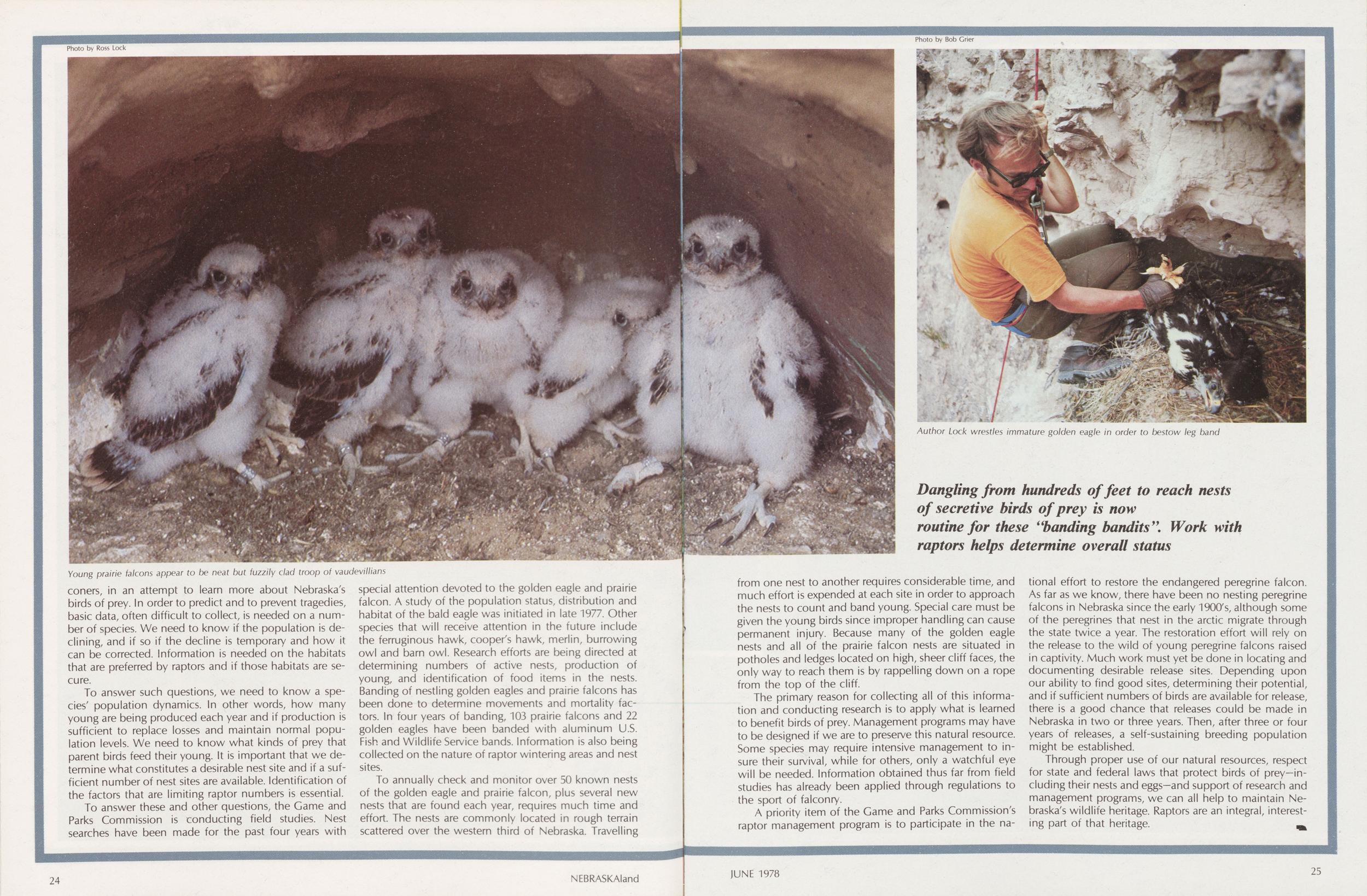
To answer such questions, we need to know a species' population dynamics. In other words, how many young are being produced each year and if production is sufficient to replace losses and maintain normal population levels. We need to know what kinds of prey that parent birds feed their young. It is important that we determine what constitutes a desirable nest site and if a sufficient number of nest sites are available. Identification of the factors that are limiting raptor numbers is essential.
To answer these and other questions, the Game and Parks Commission is conducting field studies. Nest searches have been made for the past four years with special attention devoted to the golden eagle and prairie falcon. A study of the population status, distribution and habitat of the bald eagle was initiated in late 1977. Other species that will receive attention in the future include the ferruginous hawk, cooper's hawk, merlin, burrowing owl and barn owl. Research efforts are being directed at determining numbers of active nests, production of young, and identification of food items in the nests. Banding of nestling golden eagles and prairie falcons has been done to determine movements and mortality factors. In four years of banding, 103 prairie falcons and 22 golden eagles have been banded with aluminum U.S. Fish and Wildlife Service bands. Information is also being collected on the nature of raptor wintering areas and nest sites.
To annually check and monitor over 50 known nests of the golden eagle and prairie falcon, plus several new nests that are found each year, requires much time and effort. The nests are commonly located in rough terrain scattered over the western third of Nebraska. Travelling 24 NEBRASKAIand
The primary reason for collecting all of this information and conducting research is to apply what is learned to benefit birds of prey. Management programs may have to be designed if we are to preserve this natural resource. Some species may require intensive management to insure their survival, while for others, only a watchful eye will be needed. Information obtained thus far from field studies has already been applied through regulations to the sport of falconry.
A priority item of the Game and Parks Commission's raptor management program is to participate in the national effort to restore the endangered peregrine falcon. As far as we know, there have been no nesting peregrine falcons in Nebraska since the early 1900's, although some of the peregrines that nest in the arctic migrate through the state twice a year. The restoration effort will reiy on the release to the wild of young peregrine falcons raised in captivity. Much work must yet be done in locating and documenting desirable release sites. Depending upon our ability to find good sites, determining their potential, and if sufficient numbers of birds are available for release, there is a good chance that releases could be made in Nebraska in two or three years. Then, after three or four years of releases, a self-sustaining breeding population might be established.
Through proper use of our natural resources, respect for state and federal laws that protect birds of prey-including their nests and eggs-and support of research and management programs, we can all help to maintain Nebraska's wildlife heritage. Raptors are an integral, interesting part of that heritage.
JUNE 1978 25
PARTING SHOTS
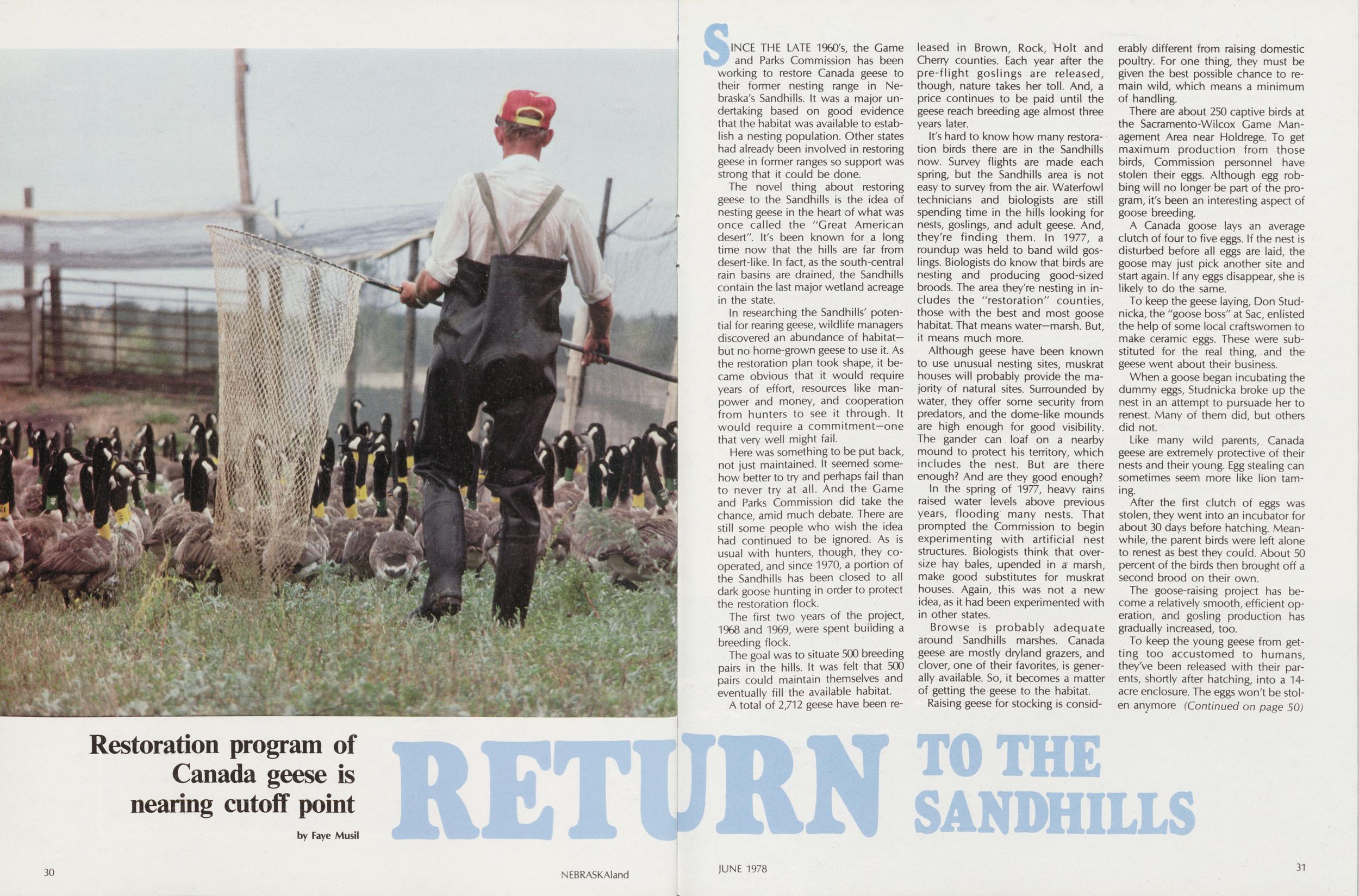
RETURN TO THE SANDHILLS
Restoration program of Canada geese is nearing cutoff point
SINCE THE LATE 1960's the Game and Parks Commission has been working to restore Canada geese to their former nesting range in Nebraska's Sandhills. It was a major undertaking based on good evidence that the habitat was available to establish a nesting population. Other states had already been involved in restoring geese in former ranges so support was strong that it could be done.
The novel thing about restoring geese to the Sandhills is the idea of nesting geese in the heart of what was once called the "Great American desert". It's been known for a long time now that the hills are far from desert-like. In fact, as the south-central rain basins are drained, the Sandhills contain the last major wetland acreage in the state.
In researching the Sandhills' potential for rearing geese, wildlife managers discovered an abundance of habitat— but no home-grown geese to use it. As the restoration plan took shape, it became obvious that it would require years of effort, resources like manpower and money, and cooperation from hunters to see it through. It would require a commitment—one that very well might fail.
Here was something to be put back, not just maintained. It seemed somehow better to try and perhaps fail than to never try at all. And the Game and Parks Commission did take the chance, amid much debate. There are still some people who wish the idea had continued to be ignored. As is usual with hunters, though, they cooperated, and since 1970, a portion of the Sandhills has been closed to all dark goose hunting in order to protect the restoration flock.
The first two years of the project, 1968 and 1969, were spent building a breeding flock.
The goal was to situate 500 breeding pairs in the hills. It was felt that 500 pairs could maintain themselves and eventually fill the available habitat.
A total of 2,712 geese have been released in Brown, Rock, Holt and Cherry counties. Each year after the pre-flight goslings are released, though, nature takes her toll. And, a price continues to be paid until the geese reach breeding age almost three years later.
It's hard to know how many restoration birds there are in the Sandhills now. Survey flights are made each spring, but the Sandhills area is not easy to survey from the air. Waterfowl technicians and biologists are still spending time in the hills looking for nests, goslings, and adult geese. And, they're finding them. In 1977, a roundup was held to band wild goslings. Biologists do know that birds are nesting and producing good-sized broods. The area they're nesting in includes the "restoration" counties, those with the best and most goose habitat. That means water—marsh. But, it means much more.
Although geese have been known to use unusual nesting sites, muskrat houses will probably provide the majority of natural sites. Surrounded by water, they offer some security from predators, and the dome-like mounds are high enough for good visibility. The gander can loaf on a nearby mound to protect his territory, which includes the nest. But are there enough? And are they good enough?
In the spring of 1977, heavy rains raised water levels above previous years, flooding many nests. That prompted the Commission to begin experimenting with artificial nest structures. Biologists think that oversize hay bales, upended in a marsh, make good substitutes for muskrat houses. Again, this was not a new idea, as it had been experimented with in other states.
Browse is probably adequate around Sandhills marshes. Canada geese are mostly dryland grazers, and clover, one of their favorites, is generally available. So, it becomes a matter of getting the geese to the habitat.
Raising geese for stocking is considerably different from raising domestic poultry. For one thing, they must be given the best possible chance to remain wild, which means a minimum of handling.
There are about 250 captive birds at the Sacramento-Wilcox Game Management Area near Holdrege. To get maximum production from those birds, Commission personnel have stolen their eggs. Although egg robbing will no longer be part of the program, it's been an interesting aspect of goose breeding.
A Canada goose lays an average clutch of four to five eggs. If the nest is disturbed before all eggs are laid, the goose may just pick another site and start again. If any eggs disappear, she is likely to do the same.
To keep the geese laying, Don Studnicka, the "goose boss" at Sac, enlisted the help of some local craftswomen to make ceramic eggs. These were substituted for the real thing, and the geese went about their business.
When a goose began incubating the dummy eggs, Studnicka broke up the nest in an attempt to pursuade her to renest. Many of them did, but others did not.
Like many wild parents, Canada geese are extremely protective of their nests and their young. Egg stealing can sometimes seem more like lion taming.
After the first clutch of eggs was stolen, they went into an incubator for about 30 days before hatching. Meanwhile, the parent birds were left alone to renest as best they could. About 50 percent of the birds then brought off a second brood on their own.
The goose-raising project has become a relatively smooth, efficient operation, and gosling production has gradually increased, too.
To keep the young geese from getting too accustomed to humans, they've been released with their parents, shortly after hatching, into a 14-acre enclosure. The eggs won't be stolen anymore (Continued on page 50)
JUNE 1978 31
Boating Safety in Numbers
WITHIN THE LAST few years, a common, clear, colorless liquid has created more controversy and demanded more nationwide focus than almost any other single topic. Its uses in agriculture, industry, households, recreation and the natural environment have forced a choosing of sides to decide who gets to use how much, for what and when. That simple liquid is water.
Nebraska, with its many miles of rivers and streams, has its share of water-related problems. Streams dry up, domestic stock suffers, and the water levels of private wells drop, burning up both pumps and their owners. One problem related to water and its use attracts only limited attention, however. And, those creating the problem seldom realize that one exists. When faced with the often-tragic aftermath of a recreational boating accident, however, many suffer irreparable physical and emotional damage.
Boating in all its forms has become one of the most popular recreational activities in Nebraska. Thousands of water enthusiasts recreate daily on their favorite stretch of lake, river or stream during the soft-water season. Canoeing, sailing and skiing have increased in popularity of late, while the immense ranks of fishermen and pleasure boaters continue to swarm over available launching facilities. Available surface acres become more and more crowded and boaters continue to demand more suitable areas for their activity.
As the number of vessels increases on Nebraska waters, the need for safety becomes more evident. In order to decrease the number of accidents, recreational boaters should learn from the past experiences of others and apply this knowledge to all their future boating.
Boating accidents generally involve property damage, personal injury, and, in many cases, fatalities. Recent reports from the U.S. Coast Guard allow us to examine each of these categories and determine the type and condition of the boater involved and other valuable accident-related information.
Statistics reveal that property damage and injuries result from fires (and explosions) collisions, and flooding.
Fires and explosions occur almost exclusively in boats with inboard engines and in those with enclosed or covered fuel spaces. Leaks around fuel tanks and tubing are caused by corrosion, poor maintenance, vibration, and old age. The leakage of fuel and vapor provides the necessary ingredient for an explosion, and when exposed to spark-producing electrical equipment, can severely damage the vessel and its occupants. Occurring during or immediately following fueling, these explosions can be prevented by properly venting all fuel storage compartments and checking fuel lines and equipment regularly.
The main contributor to collision-type accidents is operator error. Large craft, 16 feet and longer, are generally involved. In addition to visual impairment at high speed, many larger vessels may have structural or design aspects which tend to hide or obscure areas from the operator's view. Many accidents occur during the time the hull is rising to plane, such as boats pulling skiers which may collide with smaller non-powered vessels moving slowly near the bank.
Flooding occurs mainly as a result of one vessel puncturing another during a collision. It also occurs, however, when through-hull fittings below the waterline fail due to the absence of pre-trip vessel inspections.
Accidents resulting in personal injuries generally involve craft 16 feet and longer and result from a collision with an object on or under the water or with another boat. These collisions are virtually always caused by operator error or inattention, especially when moving at high speeds. Operator vision and reaction time are impaired drastically by increased speed and by stress such as vibration, glare, heat, noise, and exposure to wind and weather. This is often compounded when the operator has trailered a boat for several hours before a day of boating. Those involved in personal injury accidents are very seldom thrown from the craft; however, they are thrown about inside the boat and often are struck by the other craft. Alcohol is a major contributor to collision-type accidents.
Boating fatalities generally involve experienced, freshwater boaters in small—less than 16 feet—low-powered craft. The victim frequently does not know how to swim, has no personal flotation device (PFD) available or chooses to sit on the one he should wear. The victim in most instances has consumed some alcoholic beverages or other drug shortly before, or while engaging in a water-related activity. Victims are generally males in their mid to upper 30's, possessing adequate experience in their type of activity, be it hunting, fishing, canoeing, waterskiing or other form of water recreation. Only 40% of all boating fatalities occur during the most active boating season: Memorial Day to Labor Day. The majority occur during the so-called "off season" when water areas are presumably less crowded and the water is colder.
Boating fatalities result from five major causes.
Massive heart attacks are frequently induced by sudden immersion in cold water. This is usually in older non- swimmers in poor physical condition who are afraid of water.
"Dry" drownings result when the victim's throat closes due to muscle spasms, causing the person to suffocate. These individuals are frequently found floating on the surface and, if recovered in time, may be revived.
Wet drownings occur when the victim actually inhales water into the lungs which is usually fatal.
Hypothermia, the reduction of internal body temperature due to transfer of body heat to cold air or water, can also be fatal. One-third of all boating fatalities fall into this catagory.
Unmanned, circling boats take lives every year as they turn and strike individuals who were thrown from the boat. This is generally caused by operator error combining excessive speed and turbulent surface conditions.
Many boaters prepare for an outing correctly: required equipment is on board, lights work, vent open, etc. Many, however, leave safety on the dock when heading out on the lake. PFD's remain on the floor of the boat while everyone toasts the beautiful lake, the beautiful day and other deserving attractions. Alcohol, vibration, speed, glare, fatigue and many distractions can turn a wonderful outing into an event too tragic to forget.
By preparing a defense against accidents, boaters can experience a safe trip every trip. Boaters must insist on quality equipment, as their life and the lives of their family depend on it. They should know the techniques and procedures involved in handling, operating and maintaining their craft in a safe, efficient and lawful manner; boaters should beware of alcohol; they should know the effect of cold water on the body and how to survive in it if necessary. Boaters must also realize the value of a PFD, the types available and how to properly use them. Of all reasons, perhaps a good attitude, being careful and considerate, is most important of all.
Being aware of the causes of most boating accidents will help operators prepare to prevent accidents in the future. Boating accidents don't just happen. We set up and participate in the chain of events which lead up to a collision, an explosion, or other types of accidents. By mentally preparing for the unexpected, boaters can substantially reduce the number of accidents on Nebraska waters, and make boating a more pleasant experience for everyone involved.
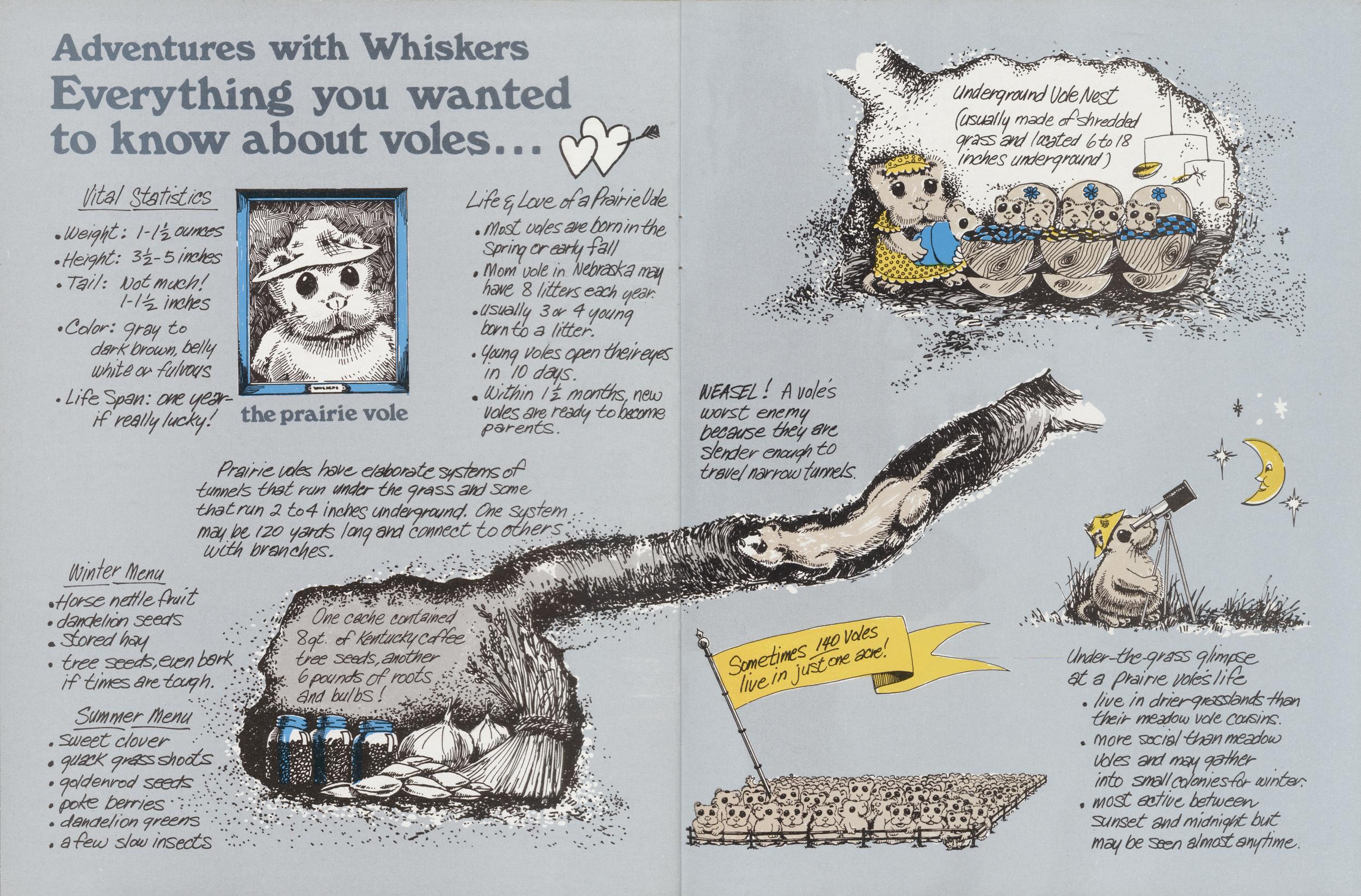
Adventures with Whiskers Everthing you wanted to know about voles...
Vital Statistics Weight: Height: 1-1 1/2 ounces Tail: 3 1/2-5 Inches Color: Not much 1- 1 1 /2 inches Life Span: one year- if really lucky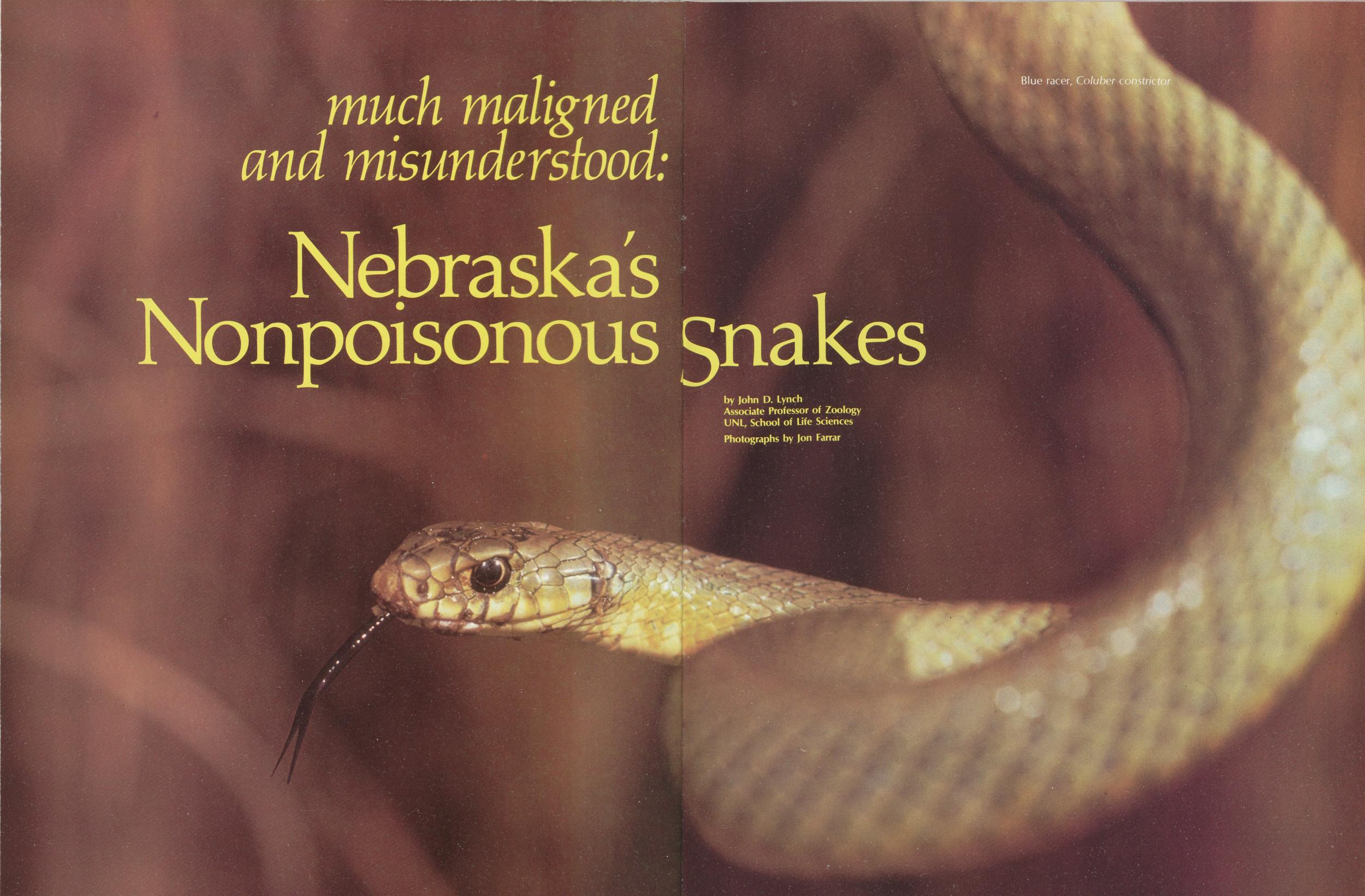
Nebraska's Nonpoisonous Snakes
much maligned and misunderstood:
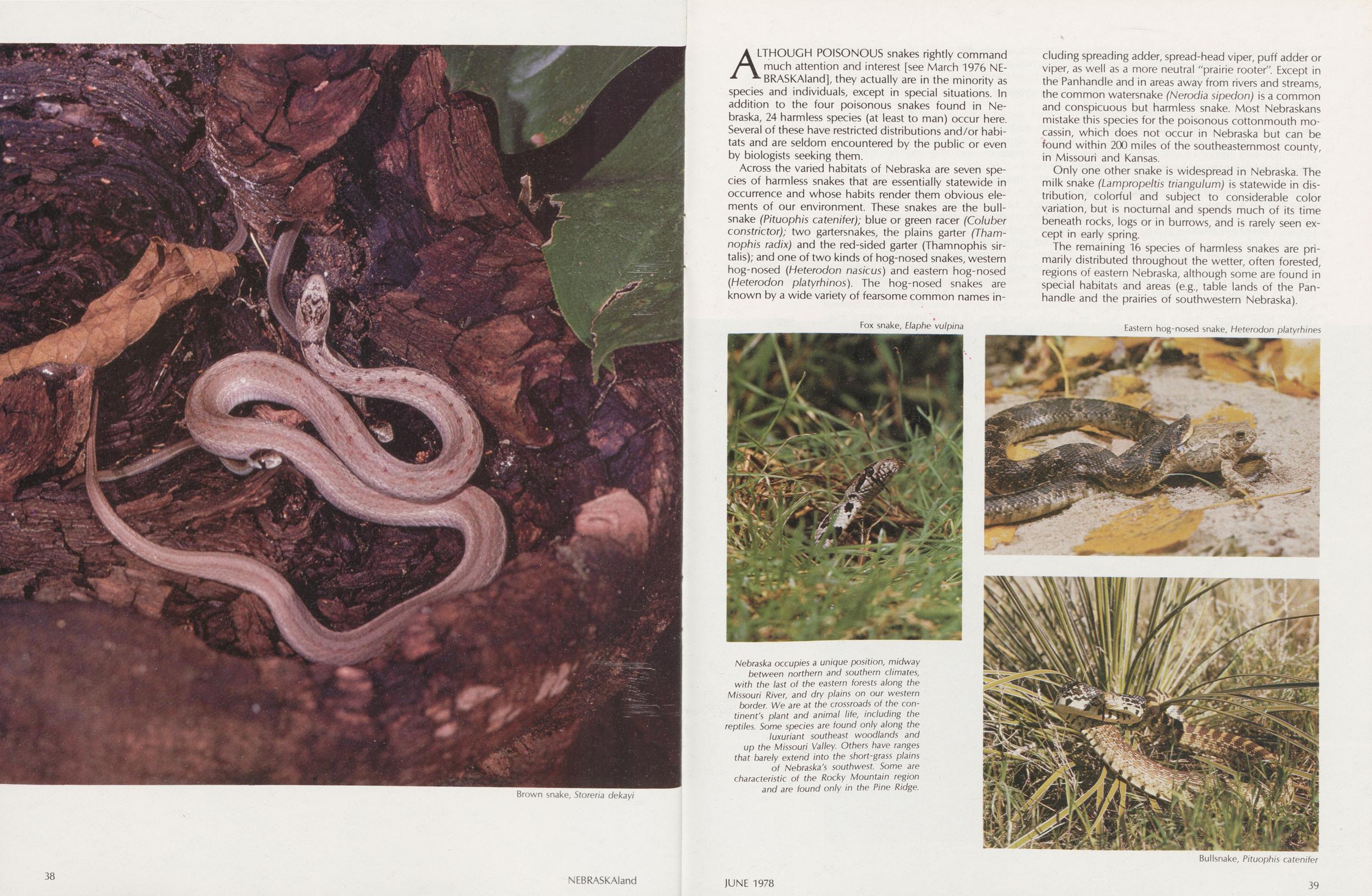
ALTHOUGH POISONOUS snakes rightly command much attention and interest [see March 1976 NEBRASKAIand], they actually are in the minority a species and individuals, except in special situations. In addition to the four poisonous snakes found in Nebraska, 24 harmless species (at least to man) occur here. Several of these have restricted distributions and/or habitats and are seldom encountered by the public or even by biologists seeking them.
Across the varied habitats of Nebraska are seven species of harmless snakes that are essentially statewide in occurrence and whose habits render them obvious elements of our environment. These snakes are the bullsnake (Pituophis catenifer); blue or green racer (Coluber constrictor); two gartersnakes, the plains garter (Thamnophis radix) and the red-sided garter (Thamnophis sirtalis); and one of two kinds of hog-nosed snakes, western hog-nosed (Heterodon nasicus) and eastern hog-nosed (Heterodon platyrhinos). The hog-nosed snakes are known by a wide variety of fearsome common names ineluding spreading adder, spread-head viper, puff adder or viper, as well as a more neutral "prairie rooter". Except in the Panhandle and in areas away from rivers and streams, the common watersnake (Nerodia sipedon) is a common and conspicuous but harmless snake. Most Nebraskans mistake this species for the poisonous cottonmouth mocassin, which does not occur in Nebraska but can be found within 200 miles of the southeastemmost county, in Missouri and Kansas.
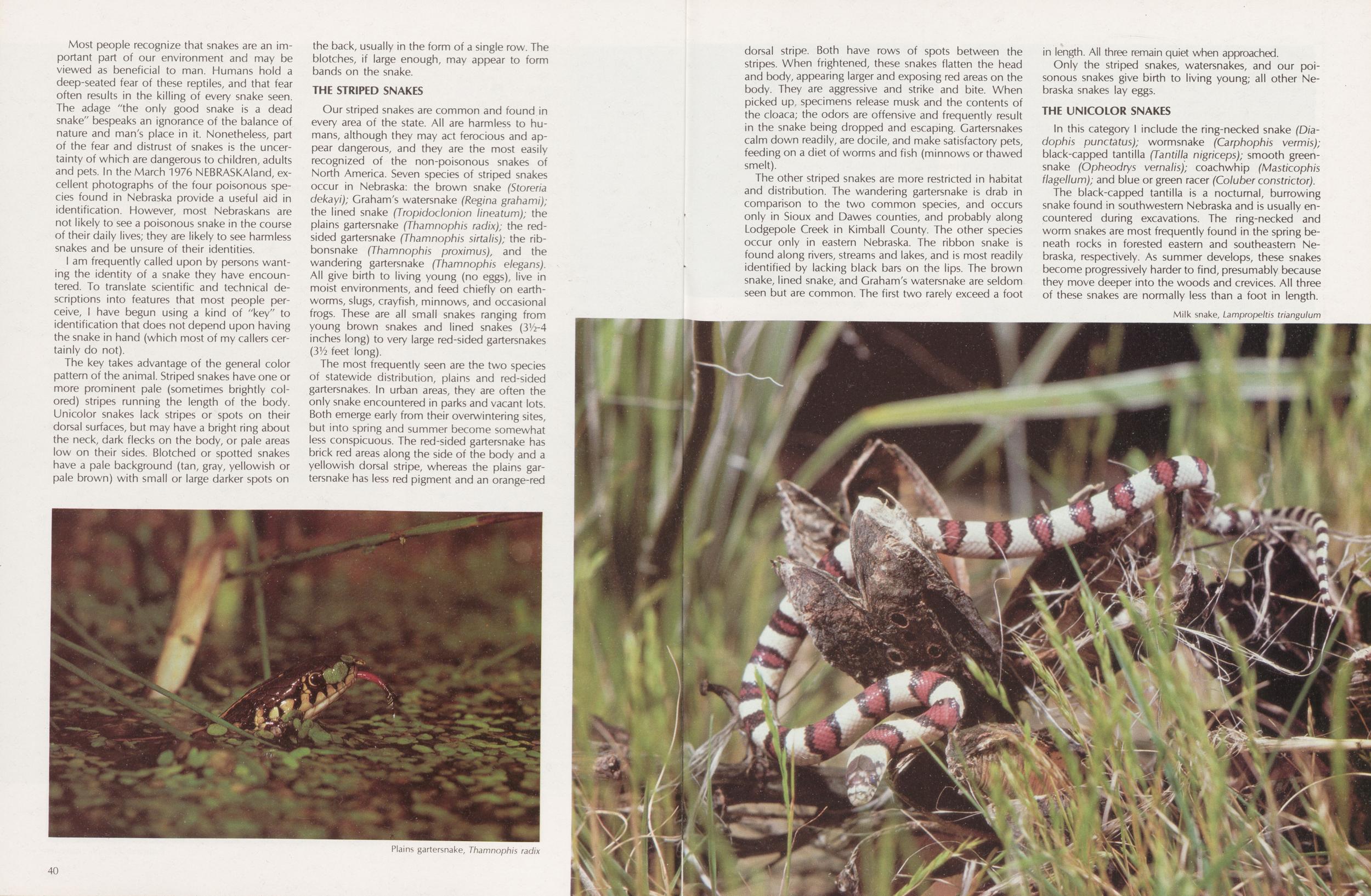
Only one other snake is widespread in Nebraska. The milk snake (Lampropeltis triangulum) is statewide in distribution, colorful and subject to considerable color variation, but is nocturnal and spends much of its time beneath rocks, logs or in burrows, and is rarely seen except in early spring.
The remaining 16 species of harmless snakes are primarily distributed throughout the wetter, often forested, regions of eastern Nebraska, although some are found in special habitats and areas (e.g., table lands of the Panhandle and the prairies of southwestern Nebraska).
Most people recognize that snakes are an important part of our environment and may be viewed as beneficial to man. Humans hold a deep-seated fear of these reptiles, and that fear often results in the killing of every snake seen. The adage "the only good snake is a dead snake" bespeaks an ignorance of the balance of nature and man's place in it. Nonetheless, part of the fear and distrust of snakes is the uncertainty of which are dangerous to children, adults and pets. In the March 1976 NEBRASKAIand, excellent photographs of the four poisonous spe- cies found in Nebraska provide a useful aid in identification. However, most Nebraskans are not likelv to see a ooisonous snake in the course of their daily lives; they are likely to see harmless snakes and be unsure of their identities.
I am frequently called upon by persons wanting the identity of a snake they have encountered. To translate scientific and technical descriptions into features that most people perceive, I have begun using a kind of "key" to identification that does not depend upon having the snake in hand (which most of my callers certainly do not).
The key takes advantage of the general color pattern of the animal. Striped snakes have one or more prominent pale (sometimes brightly colored) stripes running the length of the body. Unicolor snakes lack stripes or spots on their dorsal surfaces, but may have a bright ring about the neck, dark flecks on the body, or pale areas low on their sides. Blotched or spotted snakes have a pale background (tan, gray, yellowish or pale brown) with small or large darker spots on the back, usually in the form of a single row. The blotches, if large enough, may appear to form bands on the snake.
THE STRIPED SNAKESOur striped snakes are common and found in every area of the state. All are harmless to humans, although they may act ferocious and appear dangerous, and they are the most easily recognized of the non-poisonous snakes of North America. Seven species of striped snakes occur in Nebraska: the brown snake (Storeria dekayi); Graham's watersnake (Regina grahami); the lined snake (Tropidoclonion lineatum); the plains gartersnake (Thamnophis radix); the redsided gartersnake (Thamnophis sirtalis); the ribbonsnake (Thamnophis proximus), and the wandering gartersnake (Thamnophis elegans). All give birth to living young (no eggs), live in moist environments, and feed chiefly on earthworms, slugs, crayfish, minnows, and occasional frogs. These are all small snakes ranging from young brown snakes and lined snakes (3 1/2-4 inches long) to very large red-sided gartersnakes (3 1/2 feet long).
The most frequently seen are the two species of statewide distribution, plains and red-sided gartersnakes. In urban areas, they are often the only snake encountered in parks and vacant lots. Both emerge early from their overwintering sites, but into spring and summer become somewhat less conspicuous. The red-sided gartersnake has brick red areas along the side of the body and a yellowish dorsal stripe, whereas the plains gartersnake has less red pigment and an orange-red
The other striped snakes are more restricted in habitat and distribution. The wandering gartersnake is drab in comparison to the two common species, and occurs only in Sioux and Dawes counties, and probably along Lodgepole Creek in Kimball County. The other species occur only in eastern Nebraska. The ribbon snake is found along rivers, streams and lakes, and is most readily identified by lacking black bars on the lips. The brown snake, lined snake, and Graham's watersnake are seldom seen but are common. The first two rarely exceed a foot in length. All three remain quiet when approached.
Only the striped snakes, watersnakes, and our poisonous snakes give birth to living young; all other Nebraska snakes lay eggs.
THE UNICOLOR SNAKESIn this category I include the ring-necked snake (Diadophis punctatus); wormsnake (Carphophis vermis); black-capped tantilla (Tantilla nigriceps); smooth greensnake (Opheodrys vernalis); coachwhip (Masticophis flagellum); and blue or green racer (Coluber constrictor).
The black-capped tantilla is a nocturnal, burrowing snake found in southwestern Nebraska and is usually encountered during excavations. The ring-necked and worm snakes are most frequently found in the spring beneath rocks in forested eastern and southeastern Nebraska, respectively. As summer develops, these snakes become progressively harder to find, presumably because they move deeper into the woods and crevices. All three of these snakes are normally less than a foot in length.
The smooth greensnake is pea-green in color and 14 to 20 inches in length. These snakes have been seen only seldom in Nebraska and are thought to reflect a time when eastern woodlands extended farther west.
The coachwhip and racer are larger, diurnal snakes. The coachwhip occurs only in southwestern Nebraska, is usually 42 to 60 inches long and is tan or pale brown with black flecks.
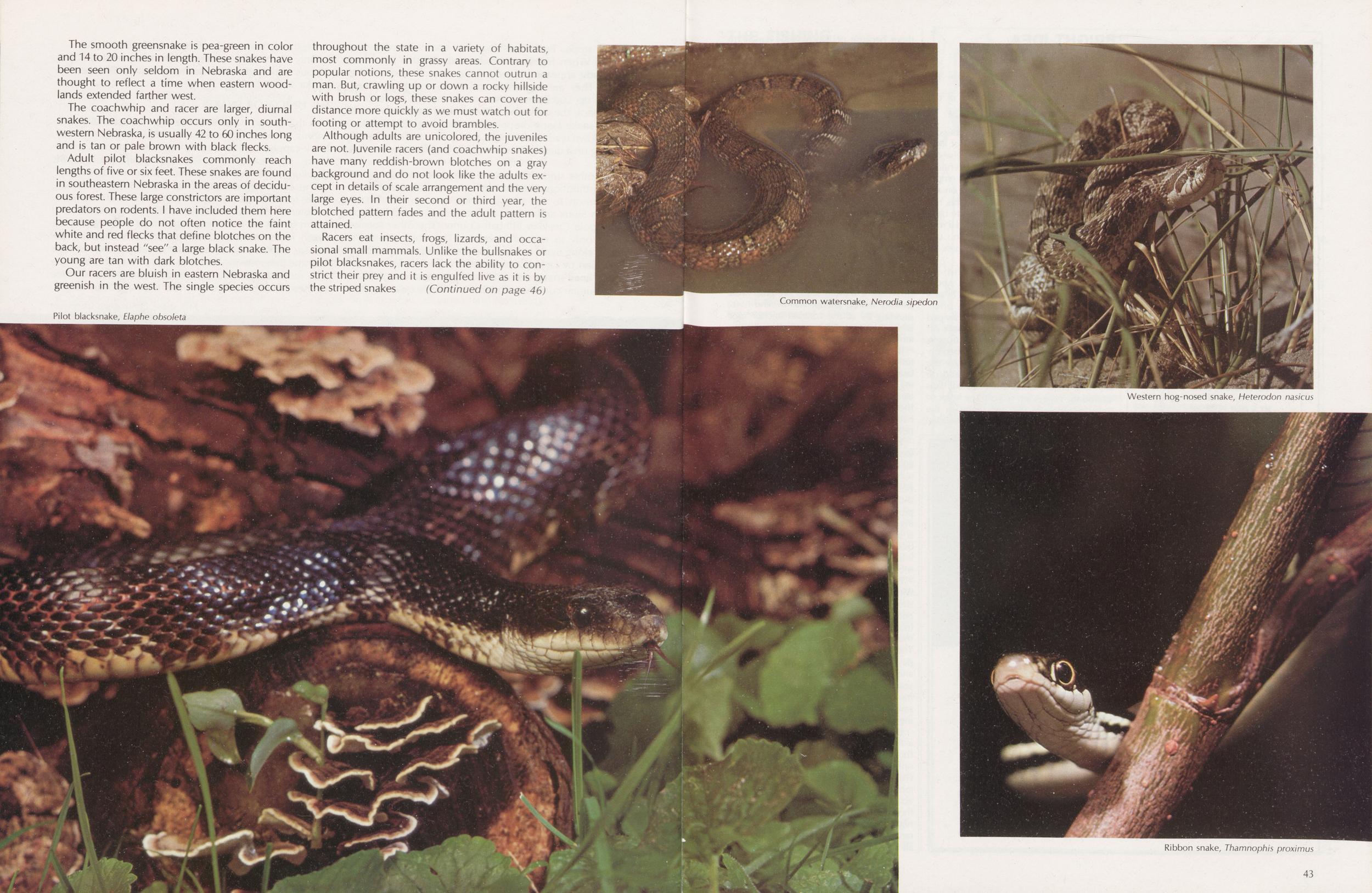
Adult pilot blacksnakes commonly reach lengths of five or six feet. These snakes are found in southeastern Nebraska in the areas of deciduous forest. These large constrictors are important predators on rodents. I have included them here because people do not often notice the faint white and red flecks that define blotches on the back, but instead "see" a large black snake. The young are tan with dark blotches.
Our racers are bluish in eastern Nebraska and greenish in the west. The single species occurs Pilot blacksnake, Elaphe obsoieta throughout the state in a variety of habitats, most commonly in grassy areas. Contrary to popular notions, these snakes cannot outrun a man. But, crawling up or down a rocky hillside with brush or logs, these snakes can cover the distance more quickly as we must watch out for footing or attempt to avoid brambles.
Although adults are unicolored, the juveniles are not. Juvenile racers (and coachwhip snakes) have many reddish-brown blotches on a gray background and do not look like the adults except in details of scale arrangement and the very large eyes. In their second or third year, the blotched pattern fades and the adult pattern is attained.
Racers eat insects, frogs, lizards, and occasional small mammals. Unlike the bullsnakes or pilot blacksnakes, racers lack the ability to constrict their prey and it is engulfed live as it is by the striped snakes (Continued on page 46)
MUTCHIE'S Johnson
Lake RESORT Upstairs Anchor Room Lounge Cold Beer-On/Off Sale Lakefront cabins with swimming beach • Fishing tackle • Boats and motors • Free boat ramp • Fishing • Swimming • Cafe and ice • Boating and skiing • Gas and oil • 9-hole golf course just around the corner • Live and frozen bait • Pontoon, boat and motor rentals. WRITE FOR FREE BROCHURE or phone reservations 785-2298 Elwood, NebraskaJ'S OTTER CREEK MARINA
NORTH SIDE LAKE McCONAUGHY HWY. 92-OPEN YEAR AROUND ALL MODERN MOTEL • CAFE * BAIT • TACKLE GAS • BOAT RENTALS • HUNTING and FISHING LICENSES • ON and OFF SALE BEER • PHONE LEMOYNE 308-355-2341 P.O. LEWELLEN, NEBR. 69147 JAY and JULIE PETERSONHASTING MUSEUM
BRIGHT IDEA FOR BASS
(Continued from page 19)figure we should save what's left of the battery to start the outboard when it's time to go home".
There were a couple more bouts of gossip and philosophizing, most of it of little relevance to fishing or to anything else, for that matter. Then, Larry jerked to attention. "I had a hit," he said as he reeled an empty hook aboard. While he was putting on another minnow, Don snatched up his rod and found it hooked to a wild white bass.
A minute or so later, he deposited a nice 1 1/2-pounder in the fish basket. "You can catch some pretty nice white bass at night," Don said.
The fish came steadily after that, although not with any great rapidity. About every five minutes, someone would hoist a white bass aboard, and about as often, someone would have a minnow swiped by a larcenous fish or have one shake off the hook after a few seconds of struggle.
One particularly pesky bass grabbed my minnow and immediately headed for the forward anchor rope. Before I could do anything about it, he took several laps around the rope, then spit out the hook so that I could bury the barb deep in the rope. I couldn't leave the hook embedded there because of the obvious danger to the next person handling the anchor, so I had to waste a good deal of fishing time working that hook free.
When I raised the anchor, we noticed that the wind had increased quite a bit since our arrival. And, a few minutes later, the telltale orange flashes of distant lightning flickered on the southwest horizon. We all noticed them, but no one said anything for some time.
The storm was still some distance away when we acknowledged its presence. "Looks like its moving pretty slow," Larry observed. "It probably won't reach Prairie Dog Bay at the other end of the lake for another 45 minutes, and we can be off the lake long before that."
But, 15 minutes later, flashes suddenly appeared much closer, behind Patterson Harbor.
"Time to go," Larry said as he reeled in. Less than a minute later, the lines were stowed, the aft anchor was in, and I was standing by at the forward anchor rope while Larry turned his attention to that temperamental outboard.
It sputtered once, coughed a couple of times, then roared to life. Ten minutes later, we negotiated the breakwater guarding the mouth of Gremlin Cove and tied up at the dock. By the time we had loaded the cars and trailered the boat, the wind had picked up and lightning and rain were not far behind.
We killed a little time in conversation as we watched the storm's approach and cleaned about 1/2 dozen fish.
We didn't do exceptionally well, but we didn't do badly considering the short time we actually fished. But, we're probably on the tail end of the night fishing for this summer. It seems like the lake is a couple of weeks ahead of schedule this year for some reason. We ought to try it again next June," Don said. Of course, I accepted the invitation.
But, What's-His-Name's Law caught up with us again the next year, too. Larry showed up with a great big, shiny new boat, so mechanical troubles didn't plague us. But, winds blew so strong at night that three anchors wouldn't hold the boat. Then, a cold front and heavy fog the next day sent us scrounging under the seats and behind the spare tires of our cars in search of any warm clothing that might have been forgotten there. Needless to say, such weather in mid-june turned fishing clear off.
It would have been nice to load up with a limit of white bass on at least one of those outings. But, catching fish is not the only worthwhile thing about the sport. Fishing offers also solitude and companionship, peace and excitement, rest and activity. We had experienced them all on those outings. I had logged a good time night fishing for white bass, plus learning a new technique, and that's what fishing's all about.
44 NEBRASKAlandTHE FISHING PRESCRIPTION
(Continued from page 20)Sometimes I have to wear rubber gloves and use strong soap as the odor has a way of lingering on the hands. Some experts have advised me to loop the entrails in a big gob to appeal to the "big ones." Others have shown me how to fashion them into a braid using my line as a third strand. This is to make it impossible for the catfish to suck off the bait as they can do expertly.
All that advice and all my hours of fishing have rarely resulted in a "big" catch. Usually I get five to seven fish about 12 to 15 inches long. A favorite place of mine I call "Number Seven." It seems that whenever I go to that spot, the result is seven nice catfish.
Last year, after having fished along the Loup River for over 10 years, I got a big one. It started out when I woke up one hot August morning with the fishing urge. I drove out to one place and noticed that the water in the river was low. The fish always have to hole-up when this happens. I cast my smelly bait into a spot under an overhanging tree. Immediately, I felt solid resistance. "Now," I thought. "I'm caught on that underwater log." But just then the "log" gave a jerk. I started to reel in and he pulled and I reeled and pulled. I maneuvered upstream a bit away from snags and bushes, keeping my line tight. Soon a big, ugly head appeared. I almost fainted but kept reeling. Finally, by pulling hand over hand on my line, I dragged him out of the water and right up into the grass and bushes. Wow! He looked big to me. No argument about whose hook he had in his mouth, so I cut the line and let him have it. My knees were weak and my heart was pounding so hard that I just sat down and stared at him. Soon I recovered enough to get a new hook and bait up again. Within 20 minutes, three more slightly smaller fish joined the "biggie" on the bank. I actually struggled back to the car with my catch and headed for town.
But, you guessed it! I didn't go straight home' but drove up town to show off my catch. A friend at the local hardware store
the Admirals Cove Formerly "French's Paradise"
Located on the north shore of Lake McConaughy, 7 miles west of dam. Permits, boat and motor rental-everything for the angler and vacationer. Stop by and see us whenever you're in the area.
Complete line of bait, gas, oil, beer, pop, candy, ice, etc. A public boat ramp located nearby.
Lemoyne, Nebraska 69146 Ph. 308/355-2102NEBRASKALAND'S VACATIONLAND
SPORTSMEN'S COMPLEX, Inc ONE-STOP SERVICE OPEN ALL YEAR
LODGING-GROCERIES-ICE-BAIT-TACKLE BEER SCUBA DIVING SHOP GAS TRAILER PARKING - SNACK SHOP - DUMPING STATION EVINRUDE MOTORS and REPAIRS BOX 136 KEYSTONE, NEBR. 69144 AT HIWAY JCT. 61 and 92 - 12 MILES NE OGALLALA, NEBR. AT MARTIN BAY 308-726-2521NEED A DISTANT NUMBER?
You can still dial direct and save. lust dial your DDD access number, the area code (or the location, plus the Universal Directory Assistance Number, 555-1212. THE LINCOLN TELEPHONE CO.LEROY'S UNSNAGGER Unconditionally Guaranteed.
WELCOME to Merritt Dam Trading Post
26 Miles So. Of Volentine On Hwy. 16C Phone 402/376-3437 Bait* Tackle* Ammunition* Groceries* Gas* Beer* Ice Cabins with Kitchen Facilities0 Floating Marina Campground Hook-ups • Boat and Motor Rental — Your Hosts JON AND MARIAN DAVENPORTvouched for the big one's weight—five and three-quarter pounds. Then, a fishing friend dragged out her camera and took my picture, and then I drifted toward home.
Finding places to fish poses no problem for me. Old neighbors, former students, school board members and relatives are among the farmers with land along the Loup River. Here I ask permission to wander along the river to fish and enjoy the summer days. One time, one of them even mowed a path through his hay meadow so that I could drive safely to the river. Several times another, a youngster on his motorbike, escorted me through his parents' pasture, opening gates and wishing me luck.
So, the mystery of why fishing holds such fascination for me is really no mystery at all. My cares seem to melt away while I'm at the river ... no thought of the insurance that's due next week, no worries of how my grandsons will cope with modern temptations, and no concern about stretching my Social Security check. Sure, I get sunburned, my legs ache, and I pick up a tick now and then. But, I believe that is a very small price to pay for all the many hours of enjoyment I have and all the friends I keep in touch with. So, when your doctor says, "Relax, find a hobby"; try catfishing. It's a prescription that works wonders
NEBRASKA'S NON-POISONOUS SNAKES
(Continued from page 42)and most unicolor snakes. Adult racers are normally two to 3 1/2 feet in length; examples four feet or longer are quite rare in Nebraska.
The speckled kingsnake (Lampropeltis getulus) is found in southeastern Nebraska. This handsome snake is black with yellow flecks on its scales. A pattern is evident (especially in juveniles) when the snake is in hand, but most people would think it was unicolor from a brief glimpse. These snakes are usually two to four feet and are nocturnal.
THE BLOTCHED SNAKESIn addition to the pilot blacksnake, young coachwhips and racers and the speckled kingsnake, the following harmless, blotched snakes are found in Nebraska: bullsnake (Pituophis catenifer); common watersnake (Nerodia sipedon); eastern hog-nose (Heterodon pi aty rhinos); faded snake (Arizona elegans); fox snake (Elaphe vulpina); milk snake (Lampropeltis triangulum); prairie cornsnake (Elaphe guttata); prairie kingsnake (Lampropeltis calligaster); and western hog-nose (Heterodon nasicus). In addition, all four of the poisonous snakes in the state are blotched (or banded).
One or both kinds of hog-nosed snakes occur in every part of Nebraska, although 46 NEBRASKAIand the eastern hog-nose is usually found near sandy spots in wooded areas (cottonwood or willow groves) where it searches for toads. Their name is taken from their upturned snouts. The eastern hog-nose puts on an elaborate display, striking, puffing up and hissing, appearing very dangerous when disturbed. In spite of their behavior, they do not bite. If the 'bluff is ineffective, the snake goes into convulsions and eventually ends up on its back, mouth agape with the tongue trailing into the dirt—appearing as dead as can be. If you turn the snake over on its belly, it will slowly turn over on its back—evidently convinced that a dead snake ought to lie on its back. Occasional examples are black with little indication of the blotched pattern. Eastern hog-nosed snakes rarely exceed 30 inches.
The western hog-nose also has the bluff, but in my experience requires more provocation. Unlike his eastern cousin, the western species ranges much farther from water, rarely eats toads, and is afield more often at night (possibly in response to the temperatures in non-forested areas). The western hog-nose eats lizards, lizard and snake eggs, and small mammals. Neither species uses constriction, and each is provided with "fangs" in the back of the mouth. The western hog-nose is smaller, usually being 16 to 24 inches in length and more slender.
The bullsnake is our largest snake. Specimens usually are 36 to 60 inches in length, but occasionally may reach 6 1/2 feet or more. The snout is pointed or keeled and presumably functions in gaining access to rodent burrows. These snakes eat large and small rodents as well as occasional birds, killing by constriction. Few Nebraska snakes are large enough and sufficiently frequent denizens of human habitation to be effective predators of rats, but the bullsnake is valued in an agricultural state.
They have brown blotches (or saddles) across the body, becoming black on the tail, on a yellowish background. When disturbed, the bullsnake can appear fearsome. Individuals hiss loudly, elevate the fore part of the body, open the mouth, and frequently vibrate the tail. If molested they will strike, and because they are not small, can inflict a painful bite. Bullsnakes lay eggs in late spring which hatch in late summer. The 12-inch-long young are colored as adults and feed on small rodents.
The faded snake is small, 27 to 36 inches, looking very much like a dull-colored bullsnake. It is found in extreme southwestern Nebraska.
The milk snake is a seldom-seen burrowing snake, usually 16 to 24 inches long, and appearing banded. Depending on where in Nebraska you have found the snake, the colors are cream, tan or gray, with reddish-brown markings edged with black. Its common name is derived from a myth wherein these snakes "milk" cows. It is difficult to imagine a cow tolerating the many small, sharp teeth possessed by
CLIMB THE SPIRAL STAIRCASE and step into the 1880's
... an outdoor tip from your Big I agent
Ranch Camp for Boys and Girls
TEACH ANY DOG IN MINUTES
GUN DOG TRAINING All Sporting Breeds
Each dog trained on both native game and pen-reared birds. Ducks for retrievers. All dogs worked individually. Field Champion-sired labrador pups for sale. Midwest's finest facilities. WILDERNESS KENNELS Henry Sader-Roca. Nb. (402)423-4212 68430LIVE-CATCH ALL-PURPOSE TRAPS
BROWNING
Our exclusive discount plan on all Browning products will save you up to 20%. This includes guns, ammunition, archery, clothing, boots, tents, gun cases, rifle scopes and fishing equipment. Inquire ... it will save you $$$. Big discounts on other sporting goods. NEW LOCATION! 7th and Seward Streets Seward, Nebraska NEW HOURS! Monday-Saturday, 9 a.m.-6 p.m. Friday, 9 a.m.-9 p.m. Sunday, 1-6 p.m. OLD FRIENDS! We're still the same old faces, so come in and browse in our new quarters. We'll be happy to see you. PLUM CREEK GUN SHOP Phone (402) 643-3303 Box 243, Seward, Nebraska 68434these snakes, which actually eat lizards, snakes and rodents.
The common watersnake is closely related to the striped snakes, but is banded or blotched with brown to reddish-brown markings on a gray background. The color pattern fades with age, and large individuals (3 to 3 1/2 feet long) may appear uniformly dark brown or black. The belly is creamy white spotted with brown and black, sometimes marked with red or orange. Most examples are 18 to 30 inches in length. When disturbed, these snakes normally dive into the water, but if no avenue of escape is available, will flatten the head and body and strike repeatedly. They possess musk and will release the contents of the cloaca if picked up. These snakes are diurnal and are frequently seen sunning on branches beside water. They eat primarily small fish and frogs, usually minnows, but occasionally bullheads and sunfish. Like gartersnakes, watersnakes eat their prey live, having no means to kill it prior to eating.
The remaining blotched snakes—fox snake, prairie comsnake and prairie kingsnake—are not readily distinguished. All occur in eastern Nebraska. The fox snake inhabits wet areas north of the Platte River and similar environments in Saunders, Seward, and northern Lancaster counties. The prairie kingsnake is found south and east of the range of the fox snake. The color patterns of the two are nearly identical, but the prairie kingsnake appears greenish and has slightly smaller spots. The prairie cornsnake occurs only along the southern border of Nebraska from Gage to Nuckolls counties. All three commonly reach three to four feet in length and feed primarily on small mammals and birds.
These snakes are frequently mistaken for rattlesnakes because their color patterns approximate that of the Massasagua.
SNAKES AND MANAll 28 snakes found in Nebraska contribute to the ecosystem, and have adapted to the climate and conditions. And, once animals are eliminated, they cannot be "reseeded" or a replacement found. Many motives converge and conflict in arguments for the preservation of fauna and flora. The fact that some of these animals are offensive and dangerous is insufficient reason not to protect them. No rational reason can be offered to justify destruction of harmless varieties. Poisonous snakes sometimes should be regulated where they pose a danger, but Nebraska's laws are inadequate, as protection of snakes is not assured even on public lands. Many of these snakes (or their ancestors) are known to have lived in Nebraska tens and hundreds of thousands of years before the first men reached the plains. Man rules the plains today in a tentative and tenuous contract with nature; it does not speak well of our civilization to add snakes to that list of organisms that we have driven into history and fading memory.
Trading Post
Acceptance of advertising implies no endorsement of products or services. Classified Ads: 20 cents a word, minimum order $4.00. August 1978 closing date, June 8. Send classified ads to: Trading Post, NEBRASKAIand, 2200 N. 33rd St., Lincoln, Nebraska 68503, P.O. Box 30370. DOGS BEAGLES. Puppy love for sale. We have the perfect family companion or hunting partner for you. Champion dam and/or sire. Tux Beagles, Route 1, Box 152, Raymond, NE 68428 (402) 475-3713. TRAINING-gun dogs, both retrievers and bird dogs. Individual concrete runs. Twenty-six years in business. (308) 382-9126; Platte Valley Kennels, 925 E. Capital Ave., Grand Island, NE 68801. MISCELLANEOUS DUCK HUNTERS- learn how, make quality, solid plastic, waterfowl decoys. We're originators of famous system. Send $.50, colorful catalog. Decoys Unlimited, Clinton, Iowa 52732. GUNS-Browning, Winchester, Remington others Hipowers, shotguns, new, used, antiques^ Want Pre-19 Winchesters. Buy-Sell-Trade. Ph. (402) 729-6112. Bedlan's Sporting Goods, Fairbury, NE 68352. WANTED-JAPAN^SeTvORDS, fittings, related objects. Serious collector pays best prices. ™0L£r'teDon Hl11' 5016 California, Q^^a^^^m 558-05^. CANOE TRuTcar^oes for rent. WE DO IT YOUR WAY! Dryland Aquatics, 1832 Park, Fremont, Nebraska 68025 (402) 721-5801 or (402) 721-1749. CANOE NEBRASKA . . . WITH WILSON OUTFITTERS! Quality Full-service Canoe-Camping Trips! Statewide Ca- noe Rental Network (15 locations)! Canoe Specialty Shop in Lincoln at 14th and Cornhusker! For 1978 Brochure . . . Write Wilson Outfitters, 6211 Sunrise Road, Lincoln, Nebraska 68510. FISH FOR SALE: Channel Catfish, Largemouth Bass, Blue- gill, Crappie, Perch, Bullhead, Rainbow Trout and min- nows for pond and lake stocking. Contact the Pleasant Valley Fish Farm, Route 1, McCook, Nebraska 69001. Phone.(308) 345-6599. NIOBRARA CANYON CANOE TRIPS. The River is up, ca- noeing is great. Canoe the Niobrara, before its too late. Make reservations for canoe rentals and camping. Sunny- Brook Camp, Roy Breuklander, Sparks, NE 69220. Camp (402) 376-1887, Ranch (402) 376-3219. GRANDPA'S WOODS: "The Quiet Campground". For a quiet, relaxing experience, camp, fish and golf at Grandpa's Woods. Located two miles north, one mile east and one-half mile north of Elmwood, NE. CASH PAID for the following items made by Winchester gun company: Older rifles, shotguns, pocket knives, tools, sporting equipment, fishing gear, and others. Also want cartridge boards, posters, calendars, catalogs before the 1940's from any firearm or ammunition company. Please give price and condition in first letter. Write: WINCHESTER, Box 30004, Lincoln, NE 68503. FOR SALE: "Canoe Nebraska" T shirts, blue or gold. Sizes, S, M, L, and XL. Send $6 to Wilson Outfitters,. 1329 Dawes, Lincoln, NE 68521. GUARANTEED 7 Sensational Bait Recipes. Caught 80 pounds of fish and 10 turtles in 6 hours. Catch more fish or money back. All 7 recipes, $2. Hammond, Research Dept. 189, Feiser Road, Covington, KY 41015. TAXIDERMY BIG BEAR TAXIDERMY, Rt. 2, Mitchell, Nebraska 69357. We specialize in all big game from Alaska to Nebraska, also birds and fish. Hair on and hair off tanning, 416 miles west of Scottsbluff on Highway 26. Phone (308) 635-3013. KARL SCHWARZ Master Taxidermists. Mounting of game heads-birds-fish—animals—fur rugs—robes-tanning buckskin. Since 1910. 424 South 13th Street, Dept. A, Omaha, Nebraska 68102. FISH MOUNTING Service. Specialize in all fresh-water fish. Visitors welcome. Wally Allison, 2709 Birchwood North Platte, NE 69101, (308) 534-2324. COMPLETE TAXIDERMY SERVICE. We take pride in your satisfaction. We will help you go hunting and fishing—exclusive agent, Jack Jonas Safaris. Brochure and price list. Dinges Taxidermy Studio, 2760 S. 12th Omaha, NE 68108 (402) 342-3718.THE BUCKBOARD
Guns and Ammunition Archery and Accessories Fishing Gear and Bait Hunting and Fishing Licenses Ruana Knives We Swap and Trade South Hiway 283 Lexington, Nebr. Ph. (308) 324-2408LIMITED FIRST EDITION First Time Offered BIG MAC
Complete structure fishing book for when, where, how to find the big ones in Lake McConaughy. Includes aerial and over 40 photos showing Hot Spots all over lake. Written and photographed by Jay S. Warburton, nationally known outdoorsman, and photo-journalist. With this book you can locate every underwater structure. Send only $2.50 to: Big Mac, Stephens Press, 1414 Evans, Sterling, Colo. 80751 (For autographed copy, send only $3.50 and address in care of author)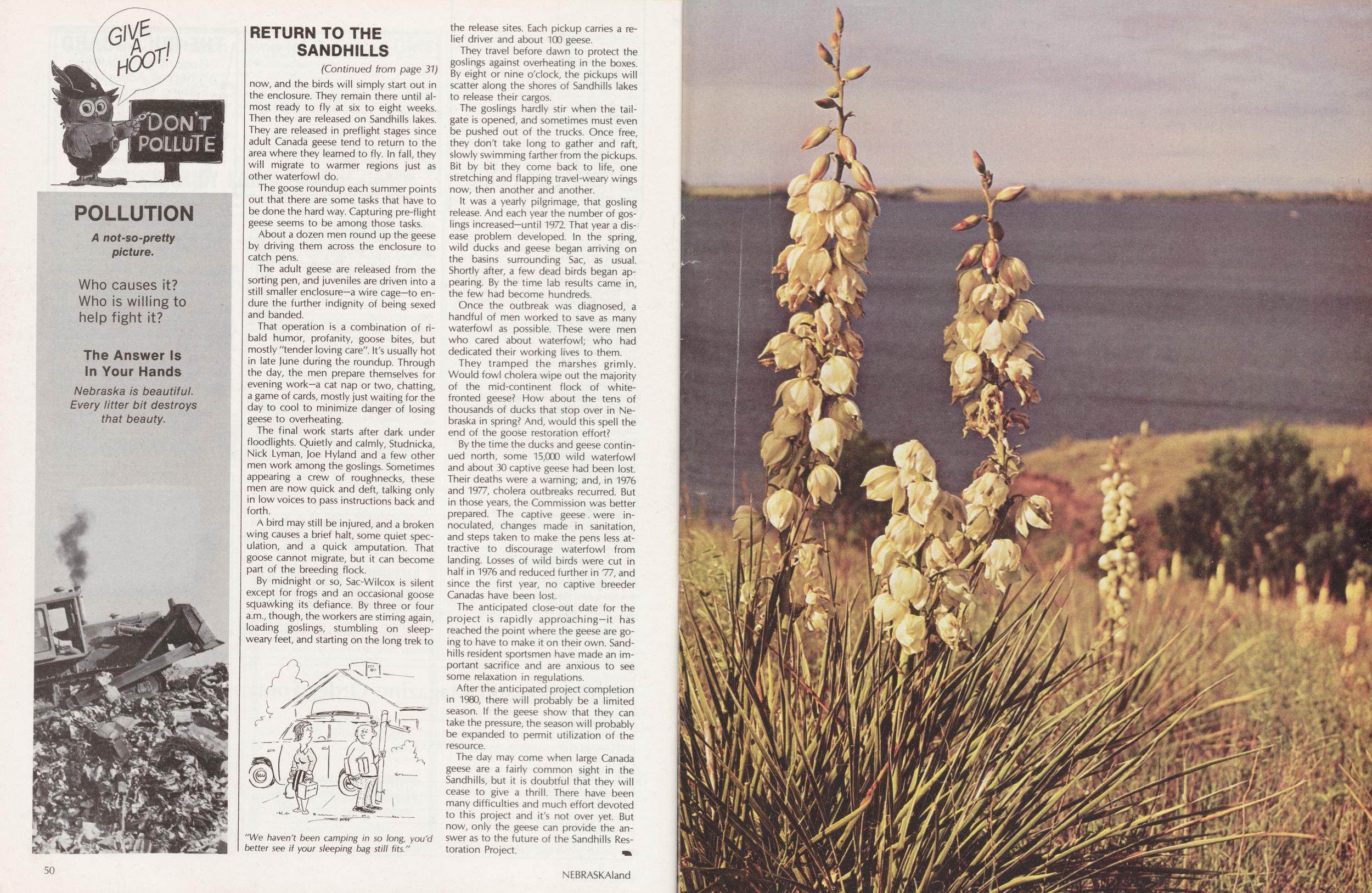
POLLUTION
A not-so-pretty picture. Who causes it? Who is willing to help fight it? The Answer Is In Your Hands Nebraska is beautiful. Every litter bit destroys that beauty.RETURN TO THE SANDHILLS
(Continued from page 31)now, and the birds will simply start out in the enclosure. They remain there until almost ready to fly at six to eight weeks. Then they are released on Sandhills lakes. They are released in preflight stages since adult Canada geese tend to return to the area where they learned to fly. In fall, they will migrate to warmer regions just as other waterfowl do.
The goose roundup each summer points out that there are some tasks that have to be done the hard way. Capturing pre-flight geese seems to be among those tasks.
About a dozen men round up the geese by driving them across the enclosure to catch pens.
The adult geese are released from the sorting pen, and juveniles are driven into a still smaller enclosure—a wire cage—to endure the further indignity of being sexed and banded.
That operation is a combination of ribald humor, profanity, goose bites, but mostly "tender loving care". It's usually hot in late June during the roundup. Through the day, the men prepare themselves for evening work—a cat nap or two, chatting, a game of cards, mostly just waiting for the day to cool to minimize danger of losing geese to overheating.
The final work starts after dark under floodlights. Quietly and calmly, Studnicka, Nick Lyman, Joe Hyland and a few other men work among the goslings. Sometimes appearing a crew of roughnecks, these men are now quick and deft, talking only in low voices to pass instructions back and forth.
a bird may still be injured, and a broken wing causes a brief halt, some quiet speculation, and a quick amputation. That goose cannot migrate, but it can become part of the breeding flock.
By midnight or so, Sac-Wilcox is silent except for frogs and an occasional goose squawking its defiance. By three or four a.m., though, the workers are stirring again, loading goslings, stumbling on sleepweary feet, and starting on the long trek to the release sites. Each pickup carries a relief driver and about 100 geese.
They travel before dawn to protect the goslings against overheating in the boxes. By eight or nine o'clock, the pickups will scatter along the shores of Sandhills lakes to release their cargos.
The goslings hardly stir when the tailgate is opened, and sometimes must even be pushed out of the trucks. Once free, they don't take long to gather and raft, slowly swimming farther from the pickups. Bit by bit they come back to life, one stretching and flapping travel-weary wings now, then another and another.
It was a yearly pilgrimage, that gosling release. And each year the number of goslings increased—until 1972. That year a disease problem developed. In the spring, wild clucks and geese began arriving on the basins surrounding Sac, as usual. Shortly after, a few dead birds began appearing. By the time lab results came in, the few had become hundreds.
Once the outbreak was diagnosed, a handful of men worked to save as many waterfowl as possible. These were men who cared about waterfowl; who had dedicated their working lives to them.
They tramped the marshes grimly. Would fowl cholera wipe out the majority of the mid-continent flock of white- fronted geese? How about the tens of thousands of ducks that stop over in Nebraska in spring? And, would this spell the end of the goose restoration effort?
By the time the ducks and geese continued north, some 15,000 wild waterfowl and about 30 captive geese had been lost. Their deaths were a warning; and, in 1975 and 1977, cholera outbreaks recurred. But in those years, the Commission was better prepared. The captive geese were innoculated, changes made in sanitation, and steps taken to make the pens less attractive to discourage waterfowl from landing. Losses of wild birds were cut in half in 1976 and reduced further in '77, and since the first year, no captive breeder Canadas have been lost.
The anticipated close-out date for the project is rapidly approaching—it has reached the point where the geese are going to have to make it on their own. Sandhills resident sportsmen have made an important sacrifice and are anxious to se some relaxation in regulations.
After the anticipated project completion in 1980, there will probably be a limited season. If the geese show that they can take the pressure, the season will probably be expanded to permit utilization of the resource.
The day may come when large Canada geese are a fairly common sight in the Sandhills, but it is doubtful that they will cease to give a thrill. There have been many difficulties and much effort devoted to this project and it's not over yet. But now, only the geese can provide the answer as to the future of the Sandhills Restoration Project.
50 NEBRASKAIand
For an Easy Travel, Family Fun Vacation
Stay as many days as you want on one admission fee.Motel and meals for as little as $14 per adult (double occupancy), $6 per child per day. Camping $3 per day. For room reservations at Pioneer Motel, write or phone 308/832-2750. See How America Grew THE HAROLD WARP PIONEER VILLAGE 12 Miles Straight South of Sao) on Nebr. 10, U.S. 6 and U.S. 34 MINDEN, NEBR. 68959 Adults-only $3.00 Minors 6 to 16-$1.00 Little Tots FreePosition: 2 (3480 views)