Volume 56, Issue 5, 1978
NEBRASKAland
Special Backpacking Issue
May 1978 60 Cents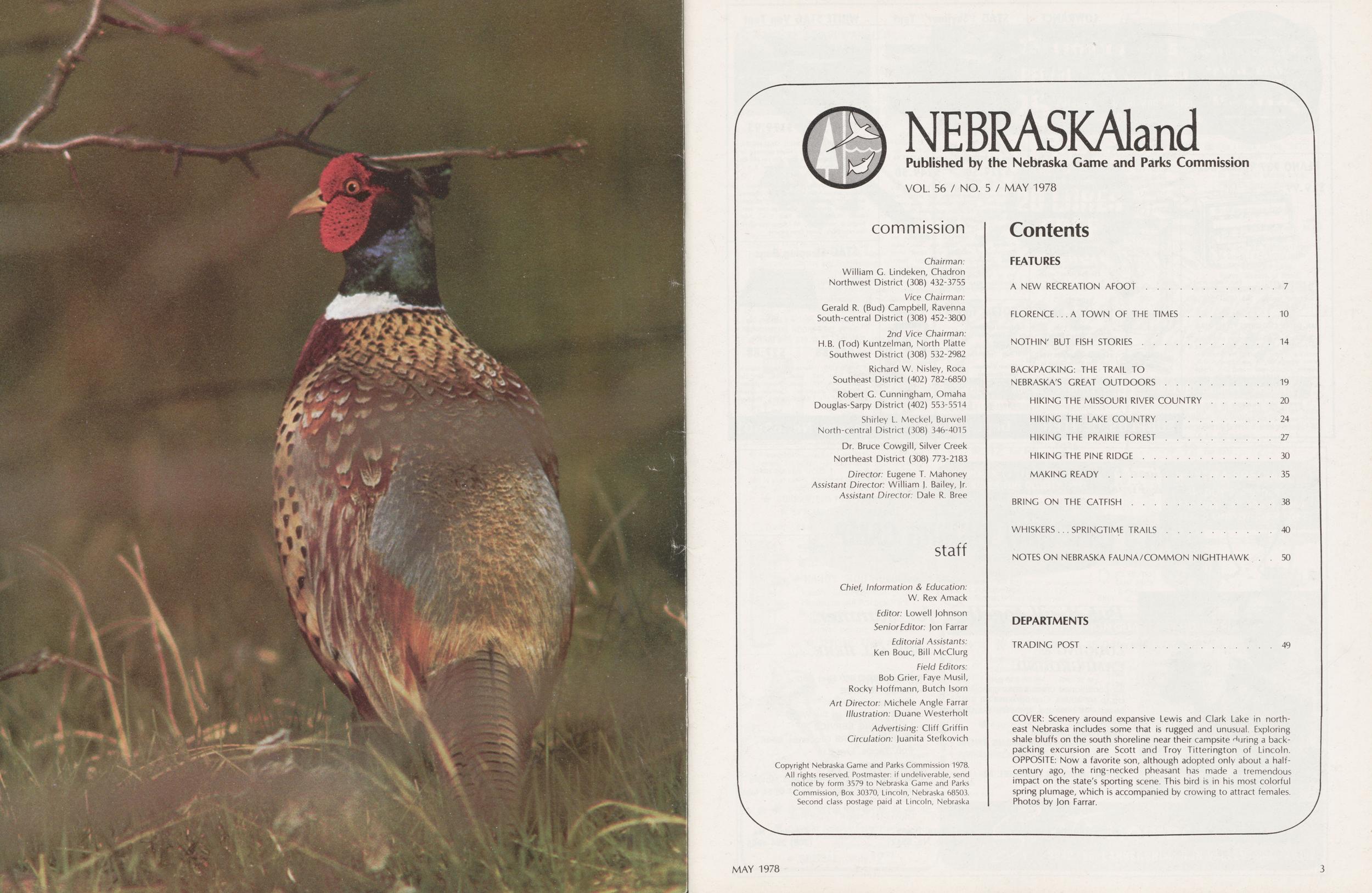
NEBRASKAland
Published by the Nebraska Game and Parks Commission
VOL 56 / NO. 5 / MAY 1978 commission Chairman: William G. Lindeken, Chadron Northwest District (308) 432-3755 Vice Chairman: Gerald R. (Bud) Campbell, Ravenna South-central District (308) 452-3800 2nd Vice Chairman: H.B. (Tod) Kuntzelman, North Platte Southwest District (308) 532-2982 Richard W. Nisley, Roca Southeast District (402) 782-6850 Robert G. Cunningham, Omaha Douglas-Sarpy District (402) 553-5514 Shirley L. Meckel, Burwell North-central District (308) 346-4015 Dr. Bruce Cowgill, Silver Creek Northeast District (308) 773-2183 Director: Eugene T. Mahoney Assistant Director: William J. Bailey, Jr. Assistant Director: Dale R. Bree staff Chief, Information and Education: W. Rex Amack Editor: Lowell Johnson Senior Editor: Jon Farrar Editorial Assistants: Ken Bouc, Bill McClurg Field Editors: Bob Grier, Faye Musil, Rocky Hoffmann, Butch Isorn Art Director: Michele Angle Farrar Illustration: Duane Westerholt Advertising: Cliff Griffin Circulation: Juanita StefkovichCopyright Nebraska Game and Parks Commission 1978. All rights reserved. Postmaster: if undeliverable, send notice by form 3579 to Nebraska Game and Parks Commission, Box 30370, Lincoln, Nebraska 68503. Second class postage paid at Lincoln, Nebraska
Contents FEATURES A NEW RECREATION AFOOT 7 FLORENCE ... A TOWN OF THE TIMES 10 NOTHIN' BUT FISH STORIES 14 BACKPACKING: THE TRAIL TO NEBRASKA'S GREAT OUTDOORS 19 HIKING THE MISSOURI RIVER COUNTRY 20 HIKING THE LAKE COUNTRY 24 HIKING THE PRAIRIE FOREST 27 HIKING THE PINE RIDGE 30 MAKING READY 35 BRING ON THE CATFISH 8 WHISKERS . . . SPRINGTIME TRAILS 40 NOTES ON NEBRASKA FAUNA/COMMON NIGHTHAWK 50
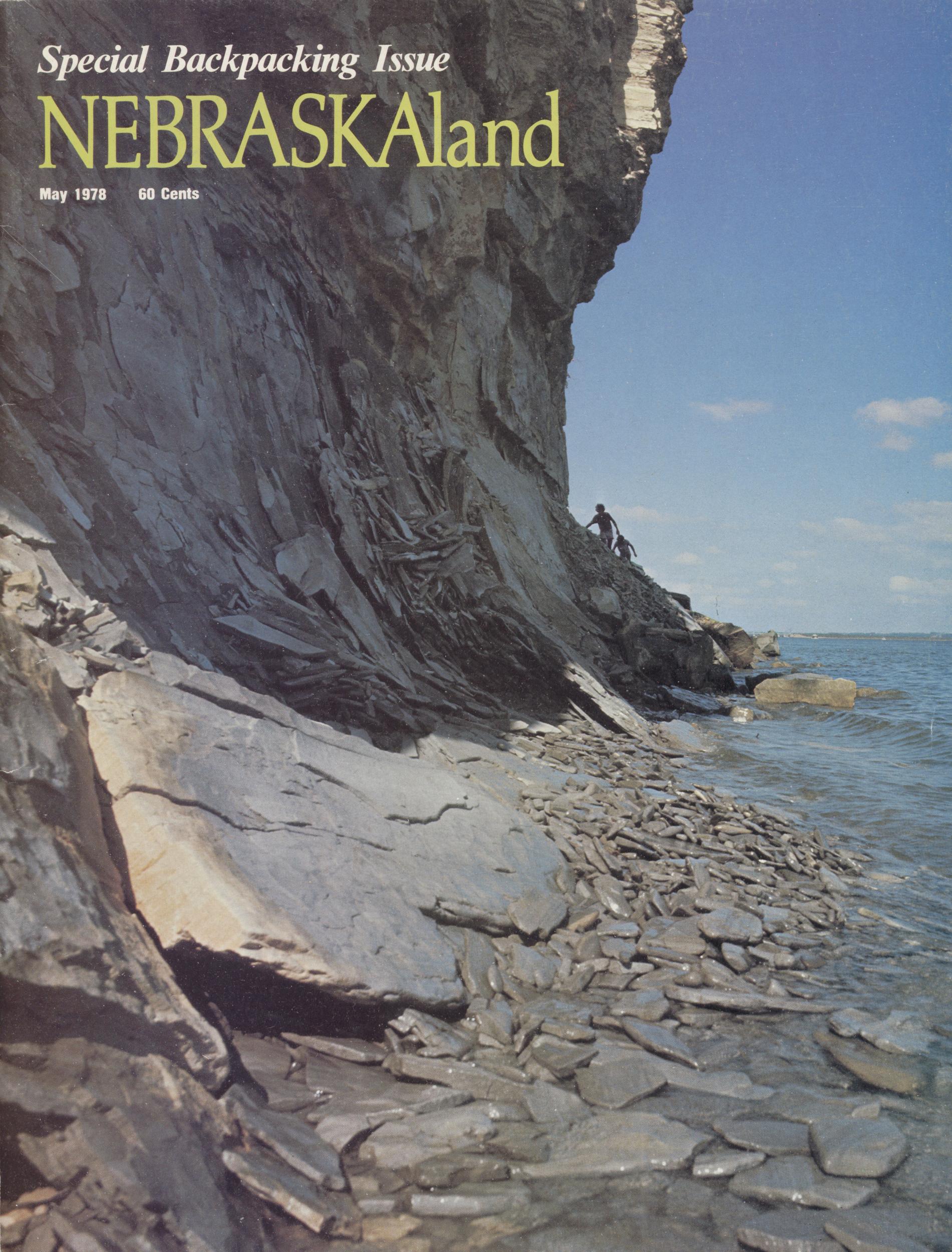
DEPARTMENTS TRADING POST 49COVER: Scenery around expansive Lewis and Clark Lake in northeast Nebraska includes some that is rugged and unusual. Exploring shale bluffs on the south shoreline near their campsite during a backpacking excursion are Scott and Troy Titterington of Lincoln. OPPOSITE: Now a favorite son, although adopted only about a half-century ago, the ring-necked pheasant has made a tremendous impact on the state's sporting scene. This bird is in his most colorful spring plumage, which is accompanied by crowing to attract females. Photos by Jon Farrar.
MAY 1978 3
World SURPLUS CENTER Famous
PLANO 737 Tackle Box $19.99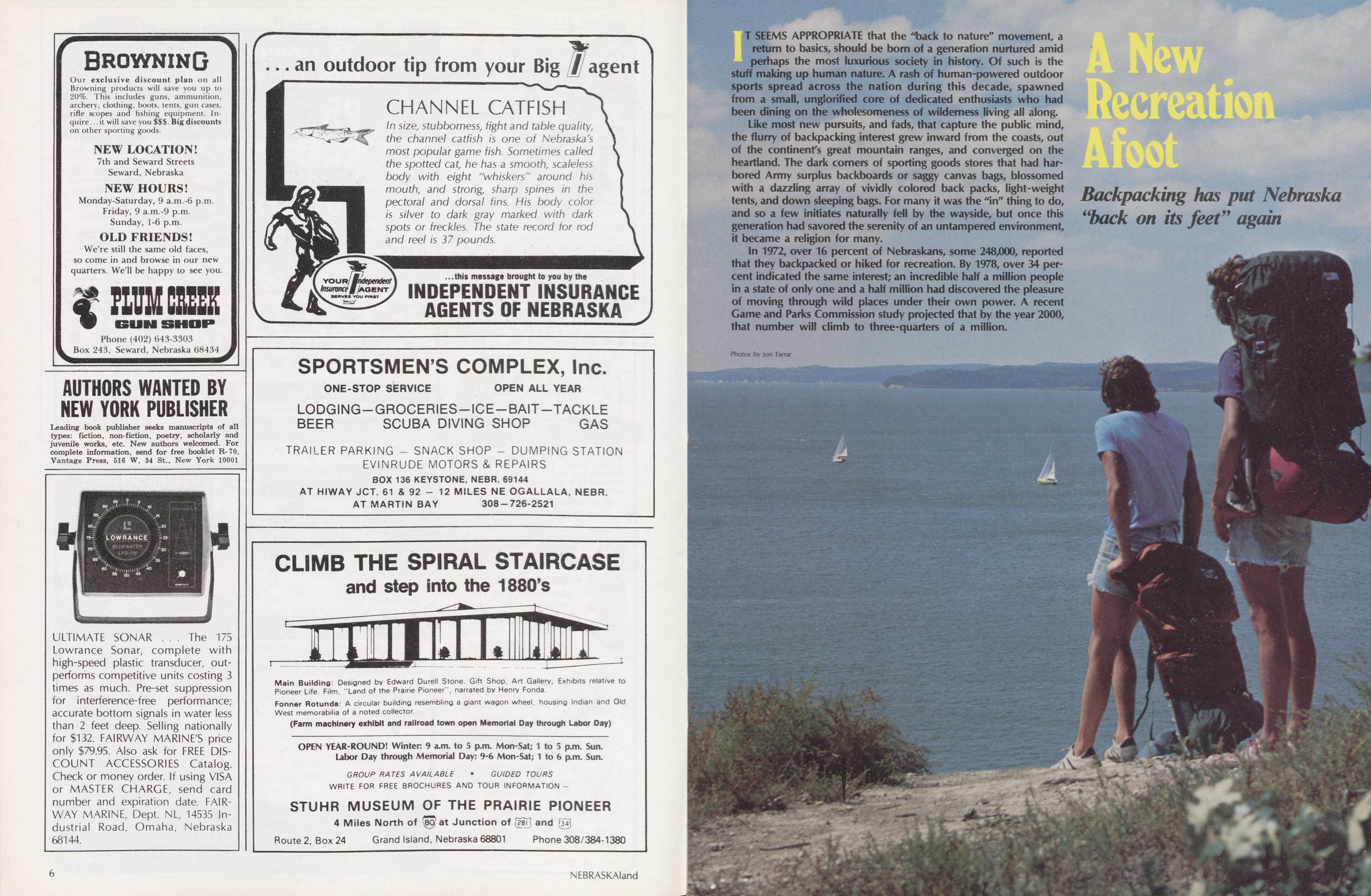
A New Recreation Afoot
Backpacking has put Nebraska "back" on its feet again"
IT SEEMS APPROPRIATE that the back to nature" movement a return to basics, should be born of a generation nurtured amid perhaps the most luxurious society in history. Of such is the stuff making up human nature. A rash of human-powered outdoor sports spread across the nation during this decade, spawned from a smalt unglorified core of dedicated enthusiasts who had been dining on the wholesomeness of wilderness living all along.
Like most new pursuits, and fads, that capture the public mind, the flurry of backpacking interest grew inward from the coasts, out of the continent's great mountain ranges, and converged on the heartland. The dark corners of sporting goods stores that had harbored Army surplus backboards or saggy canvas bags, blossomed with a dazzling array of vividly colored back packs, light-weight tents, and down sleeping bags. For many it was the "in" thing to do, and so a few initiates naturally fell by the wayside, but once this generation had savored the serenity of an untampered environment, it became a religion for many.
In 1972, over 16 percent of Nebraskans, some 248,000, reported that they backpacked or hiked for recreation. By 1978, over 34 percent indicated the same interest; an incredible half a million people in a state of only one and a half million had discovered the pleasure of moving through wild places under their own power. A recent Game and Parks Commission study projected that by the year 2000, that number will climb to three-quarters of a million.
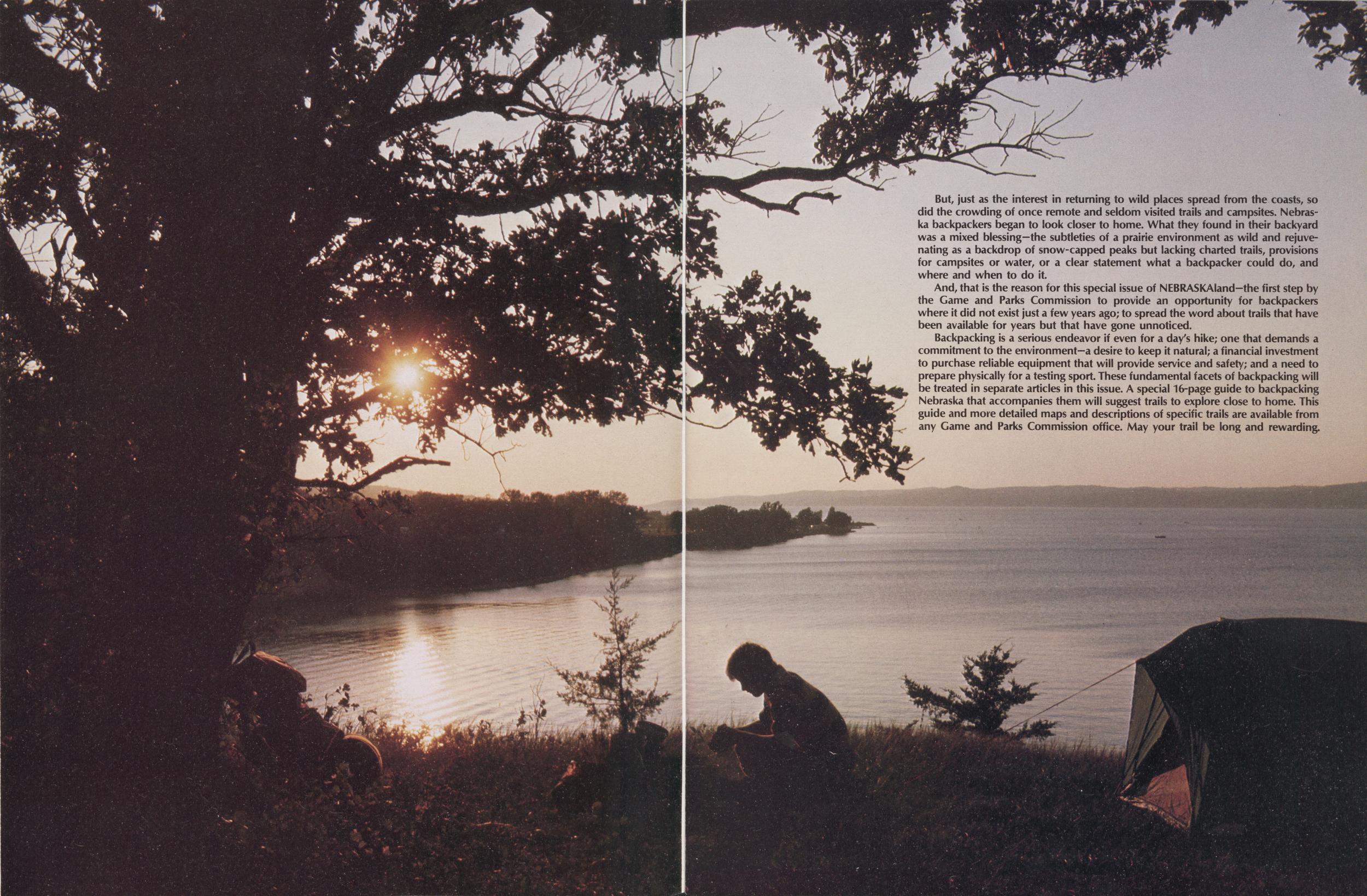
But, just as the interest in returning to wild places spread from the coasts, so did the crowding of once remote and seldom visited trails and campsites. Nebraska backpackers began to look closer to home. What they found in their backyard was a mixed blessing—the subtleties of a prairie environment as wild and rejuvenating as a backdrop of snow-capped peaks but lacking charted trails, provisions for campsites or water, or a clear statement what a backpacker could do, and where and when to do it.
And, that is the reason for this special issue of NEBRASKAIand—the first step by the Game and Parks Commission to provide an opportunity for backpackers where it did not exist just a few years ago; to spread the word about trails that have been available for years but that have gone unnoticed.
Backpacking is a serious endeavor if even for a day's hike; one that demands a commitment to the environment—a desire to keep it natural; a financial investment to purchase reliable equipment that will provide service and safety; and a need to prepare physically for a testing sport. These fundamental facets of backpacking will be treated in separate articles in this issue. A special 16-page guide to backpacking Nebraska that accompanies them will suggest trails to explore close to home. This guide and more detailed maps and descriptions of specific trails are available from any Game and Parks Commission office. May your trail be long and rewarding.
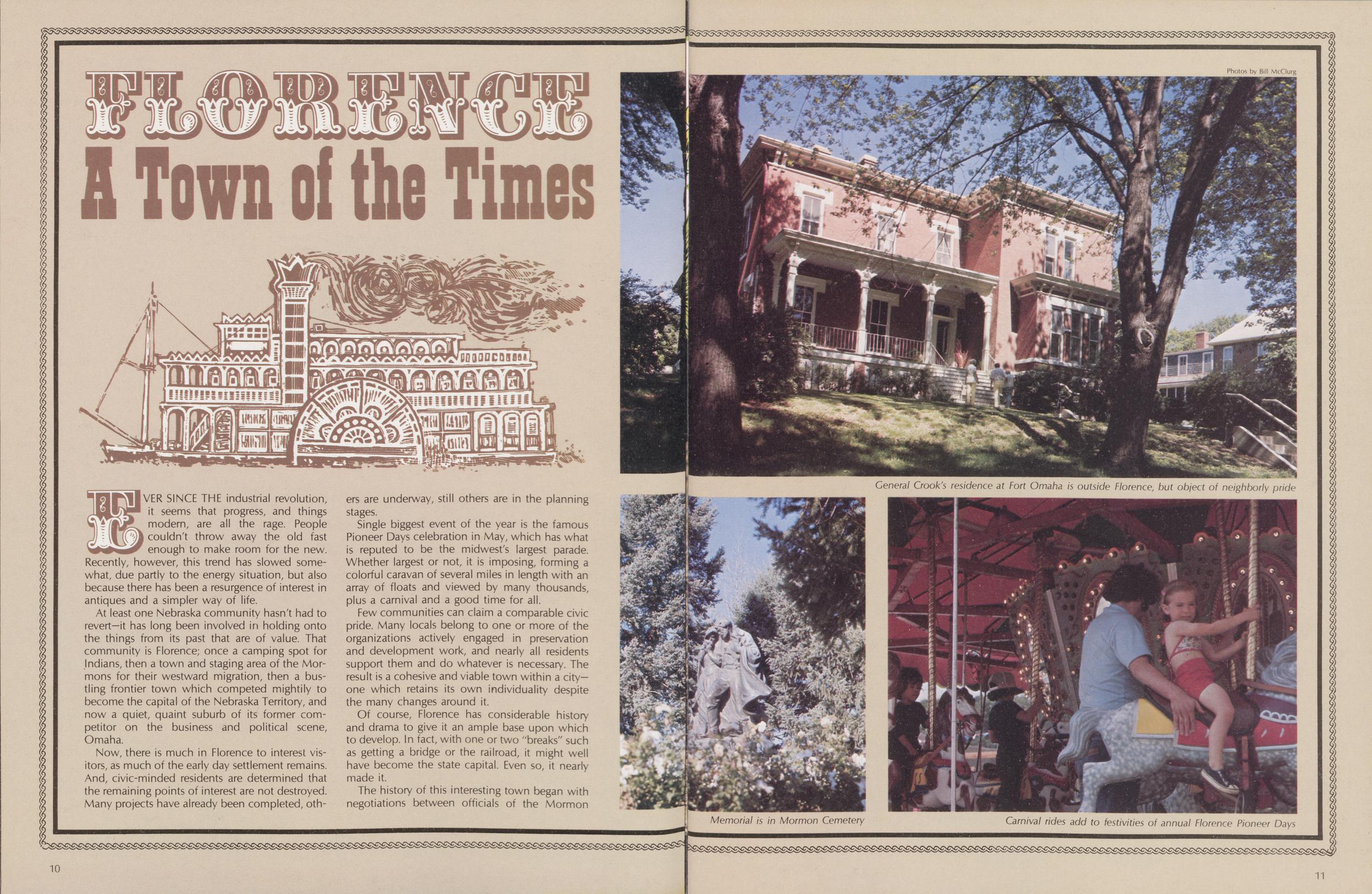
FLORENCE Town of the Times
EVER SINCE THE industrial revolution, it seems that progress, and things modern, are all the rage. People couldn't throw away the old fast enough to make room for the new. Recently, however, this trend has slowed somewhat, due partly to the energy situation, but also because there has been a resurgence of interest in antiques and a simpler way of life.
At least one Nebraska community hasn't had to revert—it has long been involved in holding onto the things from its past that are of value. That community is Florence; once a camping spot for Indians, then a town and staging area of the Mormons for their westward migration, then a bustling frontier town which competed mightily to become the capital of the Nebraska Territory, and now a quiet, quaint suburb of its former competitor on the business and political scene, Omaha.
Now, there is much in Florence to interest visitors, as much of the early day settlement remains. And, civic-minded residents are determined that the remaining points of interest are not destroyed. Many projects have already been completed, others are underway, still others are in the planning stages.
Single biggest event of the year is the famous Pioneer Days celebration in May, which has what is reputed to be the midwest's largest parade. Whether largest or not, it is imposing, forming a colorfui caravan of several miles in length with an array of floats and viewed by many thousands, plus a carnival and a good time for all.
Few communities can claim a comparable civic pride. Many locals belong to one or more of the organizations actively engaged in preservation and development work, and nearly all residents support them and do whatever is necessary. The result is a cohesive and viable town within a city — one which retains its own individuality despite the many changes around it.
Of course, Florence has considerable history and drama to give it an ample base upon which to develop. In fact, with one or two "breaks" such as getting a bridge or the railroad, it might well have become the state capital. Even so, it nearly made it.
The history of this interesting town began with negotiations between officials of the Mormon
FLORENCE
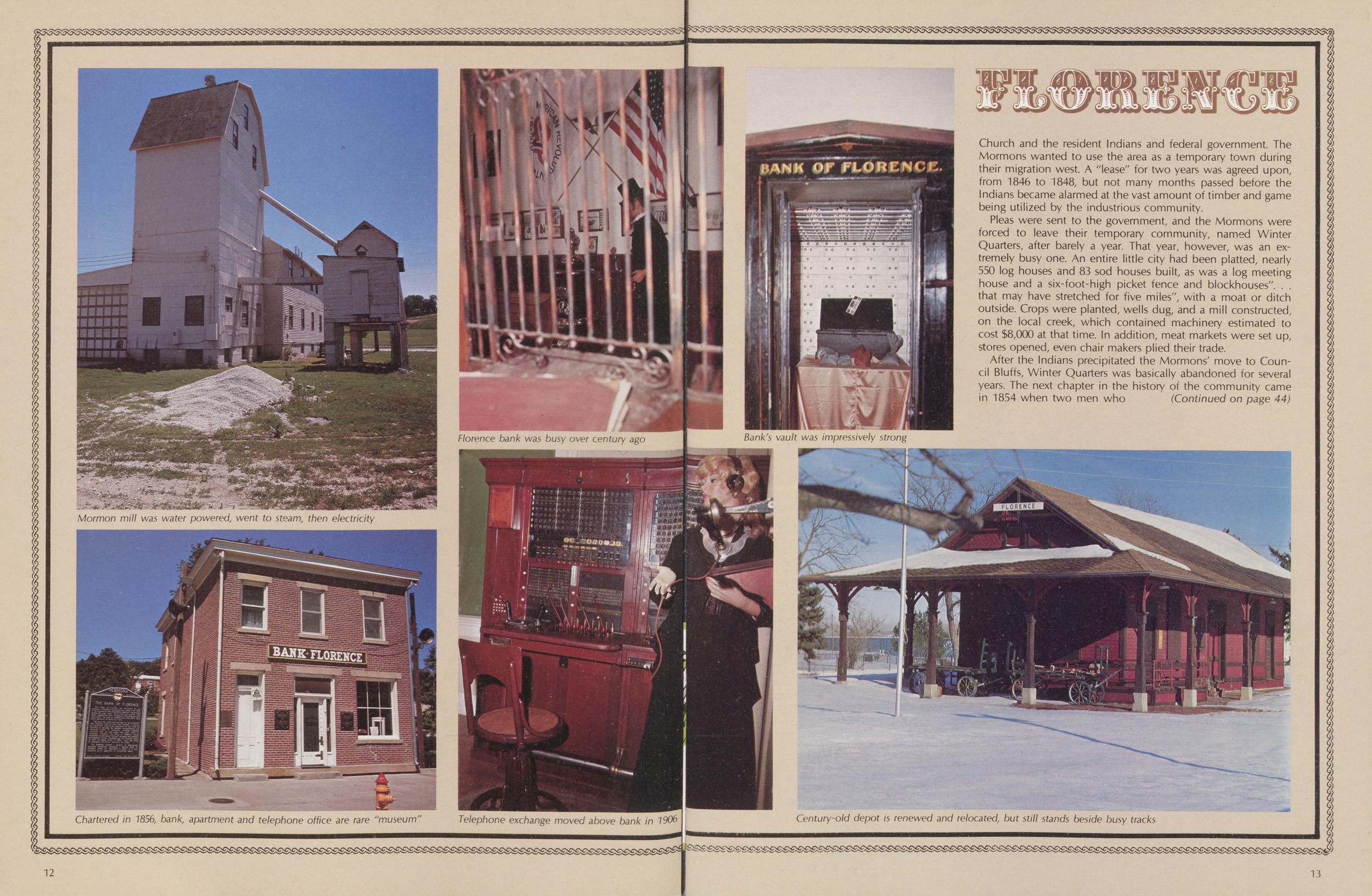
Church and the resident Indians and federal government. The Mormons wanted to use the area as a temporary town during their migration west. A "lease" for two years was agreed upon, from 1846 to 1848, but not many months passed before the Indians became alarmed at the vast amount of timber and game being utilized by the industrious community.
Pleas were sent to the government, and the Mormons were forced to leave their temporary community, named Winter Quarters, after barely a year. That year, however, was an ex- tremely busy one. An entire little city had been platted, nearly 550 log houses and 83 sod houses built, as was a log meeting house and a six-foot-high picket fence and blockhouses". . . that may have stretched for five miles", with a moat or ditch outside. Crops were planted, wells dug, and a mill constructed, on the local creek, which contained machinery estimated to cost $8,000 at that time. In addition, meat markets were set up, stores opened, even chair makers plied their trade.
After the Indians precipitated the Mormons' move to Council Bluffs, Winter Quarters was basically abandoned for several years. The next chapter in the history of the community came in 1854 when two men who (Continued on page 44)
Nothin' but Fish Stories
An important part of a fishing trip9 sometimes as important as the fish itself is the fish "story." Thanks to a well-spun fishing yarn, the angler can share with us the sights, sounds and emotions of his big moment in the outdoors, either with or without embellishment.
In the cases of the following fishing yarns, the exaggeration is unnecessary, since all the fish involved turned out to be state records. Nevertheless, the stories behind these lunkers are also important, so they are being told again via the pages of NEBRASKAland.
Nebraska's hook-and-line records contain 36 entries, each representing a unique and fascinating incident that will stay vividly in the minds of their tellers all their lives.
Space permits the telling of only a few of these yarns, with a few pictures and sketches. The following are thus just a sample of the exciting stories behind the rather impersonal statistics of Nebraska's list of fishing records.
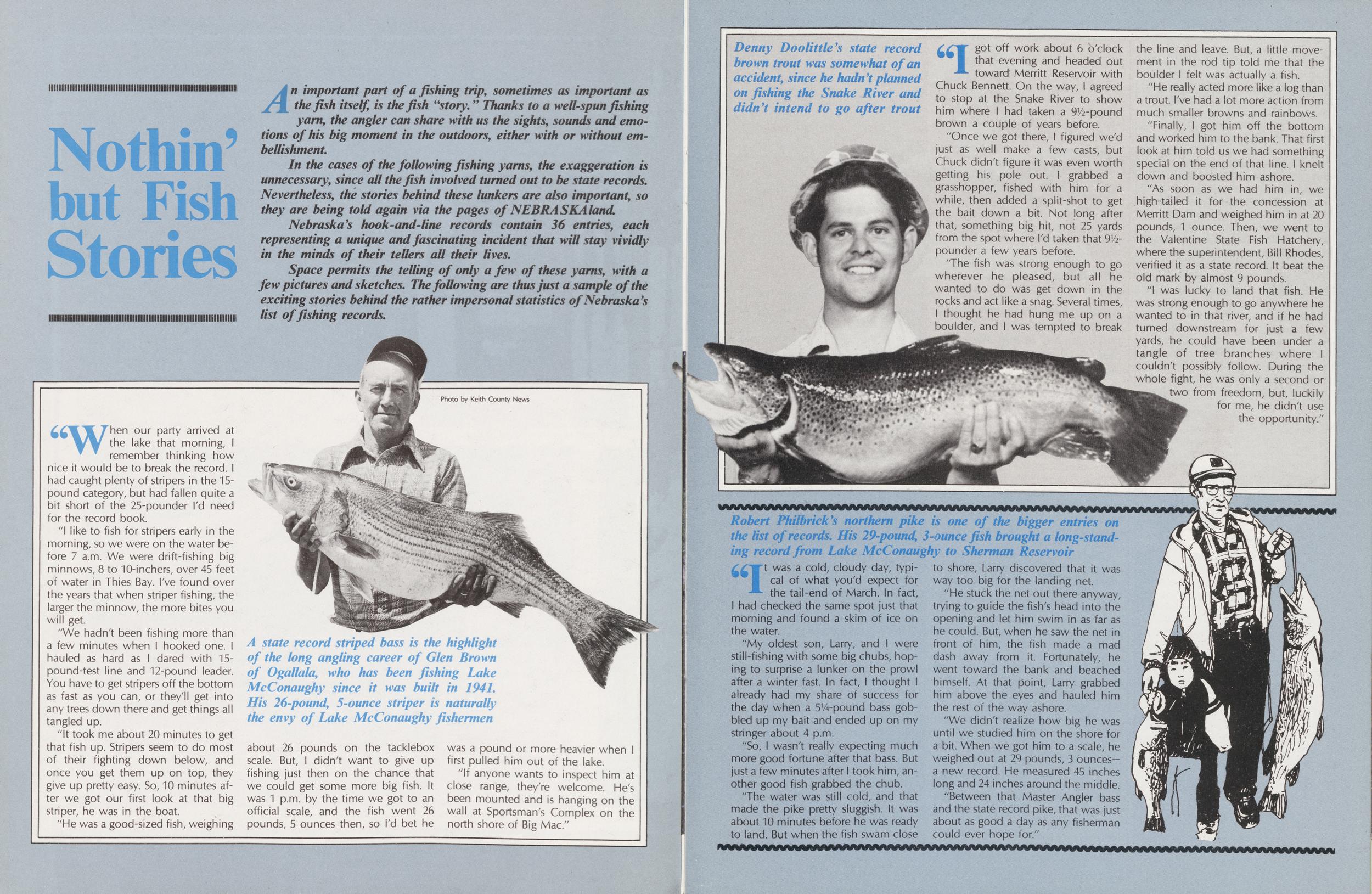
Photo by Keith County NewsWhen our party arrived at the lake that morning, I remember thinking how nice it would be to break the record. I had caught plenty of stripers in the 15-pound category, but had fallen quite a bit short of the 25-pounder I'd need for the record book.
"I like to fish for stripers early in the morning, so we were on the water before 7 a.m. We were drift-fishing big minnows, 8 to 10-inchers, over 45 feet of water in Thies Bay. I've found over the years that when striper fishing, the larger the minnow, the more bites you will get.
We hadn't been fishing more than a few minutes when I hooked one. I hauled as hard as I dared with 15-pound-test line and 12-pound leader. You have to get stripers off the bottom as fast as you can, or they'll get into any trees down there and get things all tangled up.
It took me about 20 minutes to get that fish up. Stripers seem to do most of their fighting down below, and once you get them up on top, they give up pretty easy. So, 10 minutes after we got our first look at that big striper, he was in the boat.
"He was a good-sized fish, weighing
"If anyone wants to inspect him at close range, they're welcome. He's been mounted and is hanging on the wall at Sportsman's Complex on the north shore of Big Mac."
"I got off work about 6 o'clock I that evening and headed out toward Merritt Reservoir with Chuck Bennett. On the way, I agreed to stop at the Snake River to show him where I had taken a 91/2-pound brown a couple of years before.
"Once we got there, I figured we'd just as well make a few casts, but Chuck didn't figure it was even worth getting his pole out. I grabbed a grasshopper, fished with him for a while, then added a split-shot to get the bait down a bit. Not long after that, something big hit, not 25 yards from the spot where I'd taken that 91/2-pounder a few years before.
The fish was strong enough to go wherever he pleased, but all he wanted to do was get down in the rocks and act like a snag. Several times, I thought he had hung me up on a boulder, and I was tempted to break the line and leave. But, a little movement in the rod tip told me that the boulder I felt was actually a fish.
He really acted more like a log than a trout. I've had a lot more action from much smaller browns and rainbows.
"Finally, I got him off the bottom and worked him to the bank. That first look at him told us we had something special on the end of that line. I knelt down and boosted him ashore.
"As soon as we had him in, we high-tailed it for the concession at Merritt Dam and weighed him in at 20 pounds, 1 ounce. Then, we went to the Valentine State Fish Hatchery, where the superintendent, Bill Rhodes, verified it as a state record. It beat the old mark by almost 9 pounds.
"I was lucky to land that fish. He was strong enough to go anywhere he wanted to in that river, and if he had turned downstream for just a few yards, he could have been under a tangle of tree branches where I couldn't possibly follow. During the whole fight, he was only a second or two from freedom, but, luckily for me, he didn't use the opportunity."
"It was a cold, cloudy day, typical of what you'd expect for the tail-end of March. In fact, I had checked the same spot just that morning and found a skim of ice on the water.
"My oldest son, Larry, and I were still-fishing with some big chubs, hoping to surprise a lunker on the prowl after a winter fast. In fact, I thought I already had my share of success for the day when a 51A-pound bass gobbled up my bait and ended up on my stringer about 4 p.m.
So, I wasn't really expecting much more good fortune after that bass. But just a few minutes after I took him, another good fish grabbed the chub.
"The water was stilt cold, and that made the pike pretty sluggish. It was about 10 minutes before he was ready to land. But when the fish swam close to shore, Larry discovered that it was way too big for the landing net.
He stuck the net out there anyway, trying to guide the fish's head into the opening and let him swim in as far as he could. But, when he saw the net in front of him, the fish made a mad dash away from it. Fortunately, he went toward the bank and beached himself. At that point, Larry grabbed him above the eyes and hauled him the rest of the way ashore.
"We didn't realize how big he was until we studied him on the shore for a bit. When we got him to a scale, he weighed out at 29 pounds, 3 ounces — a new record. He measured 45 inches long and 24 inches around the middle.
"Between that Master Angler bass and the state record pike, that was just about as good a day as any fisherman could ever hope for."
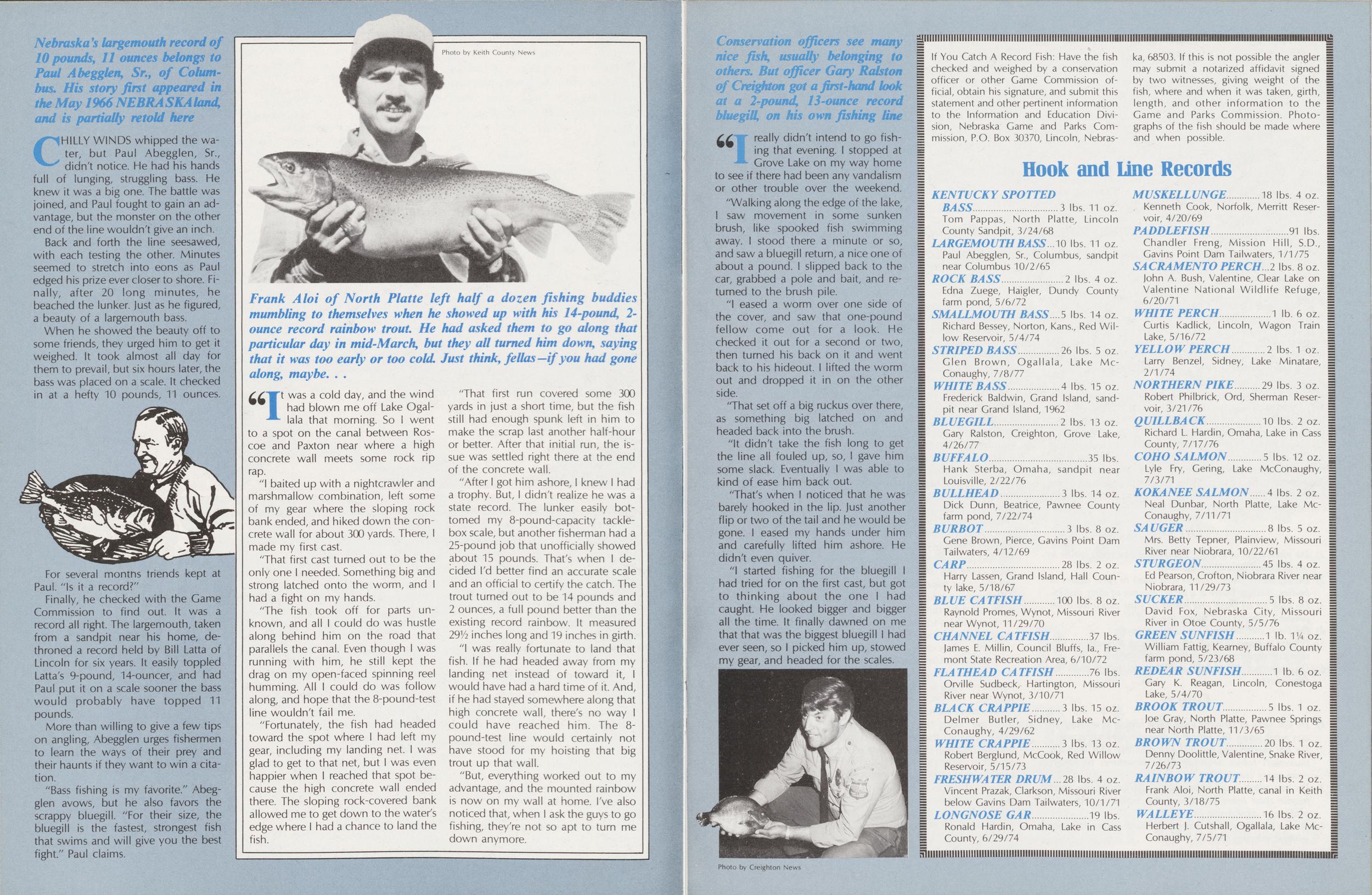
CHILLY WINDS whipped the water, but Paul Abegglen, Sr., didn't notice. He had his hands full of lunging, struggling bass. He knew it was a big one. The battle was joined, and Paul fought to gain an advantage, but the monster on the other end of the line wouldn't give an inch.
Back and forth the line seesawed, with each testing the other. Minutes seemed to stretch into eons as Paul edged his prize ever closer to shore. Finally, after 20 long minutes, he beached the lunker. just as he figured, a beauty of a largemouth bass.
When he showed the beauty off to some friends, they urged him to get it weighed. It took almost all day for them to prevail, but six hours later, the bass was placed on a scale. It checked in at a hefty 10 pounds, 11 ounces.
For several montns friends kept at Paul. "Is it a record?"
Finally, he checked with the Came Commission to find out. It was a record all right. The largemouth, taken from a sandpit near his home, dethroned a record held by Bill Latta of Lincoln for six years. It easily toppled Latta's 9-pound, 14-ouncer, and had Paul put it on a scale sooner the bass would probably have topped 11 pounds.
More than willing to give a few tips on angling, Abegglen urges fishermen to learn the ways of their prey and their haunts if they want to win a citation.
"Bass fishing is my favorite." Abegglen avows, but he also favors the scrappy bluegill. "For their size, the bluegill is the fastest, strongest fish that swims and will give you the best fight." Paul claims.
It was a cold day, and the wind had blown me off Lake Ogallala that morning. So I went to a spot on the canal between Roscoe and Paxton near where a high concrete wall meets some rock rip rap.
"I baited up with a nightcrawler and marshmallow combination, left some of my gear where the sloping rock bank ended, and hiked down the concrete wall for about 300 yards. There, I made my first cast.
That first cast turned out to be the only one I needed. Something big and strong latched onto the worm, and I had a fight on my hands.
"The fish took off for parts unknown, and all I could do was hustle along behind him on the road that parallels the canal. Even though I was running with him, he still kept the drag on my open-faced spinning reel humming. All I could do was follow along, and hope that the 8-pound-test line wouldn't fail me.
"Fortunately, the fish had headed toward the spot where I had left my gear, including my landing net. I was glad to get to that net, but I was even happier when I reached that spot because the high concrete wall ended there. The sloping rock-covered bank allowed me to get down to the water's edge where I had a chance to land the fish.
"That first run covered some 300 yards in just a short time, but the fish still had enough spunk left in him to make the scrap last another half-hour or better. After that initial run, the issue was settled right there at the end of the concrete wall.
"After I got him ashore, I knew I had a trophy. But, I didn't realize he was a state record. The lunker easily bottomed my 8-pound-capacity tackle-box scale, but another fisherman had a 25-pound job that unofficially showed about 15 pounds. That's when I decided I'd better find an accurate scale and an official to certify the catch. The trout turned out to be 14 pounds and 2 ounces, a full pound better than the existing record rainbow. It measured 291/2 inches long and 19 inches in girth.
"I was really fortunate to land that fish. If he had headed away from my landing net instead of toward it, I would have had a hard time of it. And, if he had stayed somewhere along that high concrete wall, there's no way I could have reached him. The 8-pound-test line would certainly not have stood for my hoisting that big trout up that wall.
"But, everything worked out to my advantage, and the mounted rainbow is now on my wall at home. I've also noticed that, when I ask the guys to go fishing, they're not so apt to turn me down anymore.
Conservation officers see many nice fish, usually belonging to others. But officer Gary Ralston of Creighton got a fist-hand look at a 2-pound, 13 ounce record bulegill on his own fishing line.I really didn't intend to go fishing that evening. I stopped at Grove Lake on my way home to see if there had been any vandalism or other trouble over the weekend.
"Walking along the edge of the lake, I saw movement in some sunken brush, like spooked fish swimming away. I stood there a minute or so, and saw a bluegill return, a nice one of about a pound. I slipped back to the car, grabbed a pole and bait, and returned to the brush pile.
"I eased a worm over one side of the cover, and saw that one-pound fellow come out for a look. He checked it out for a second or two, then turned his back on it and went back to his hideout I lifted the worm out and dropped it in on the other side.
'That set off a big ruckus over there, as something big latched on and headed back into the brush.
"It didn't take the fish long to get the line all fouled up, so, I gave him some slack. Eventually I was able to kind of ease him back out.
"That's when I noticed that he was barely hooked in the lip. Just another flip or two of the tail and he would be gone. I eased my hands under him and carefully lifted him ashore. He didn't even quiver.
"I started fishing for the bluegill I had tried for on the first cast, but got to thinking about the one I had caught. He looked bigger and bigger all the time. It finally dawned on me that that was the biggest bluegill I had ever seen, so I picked him up, stowed my gear, and headed for the scales.
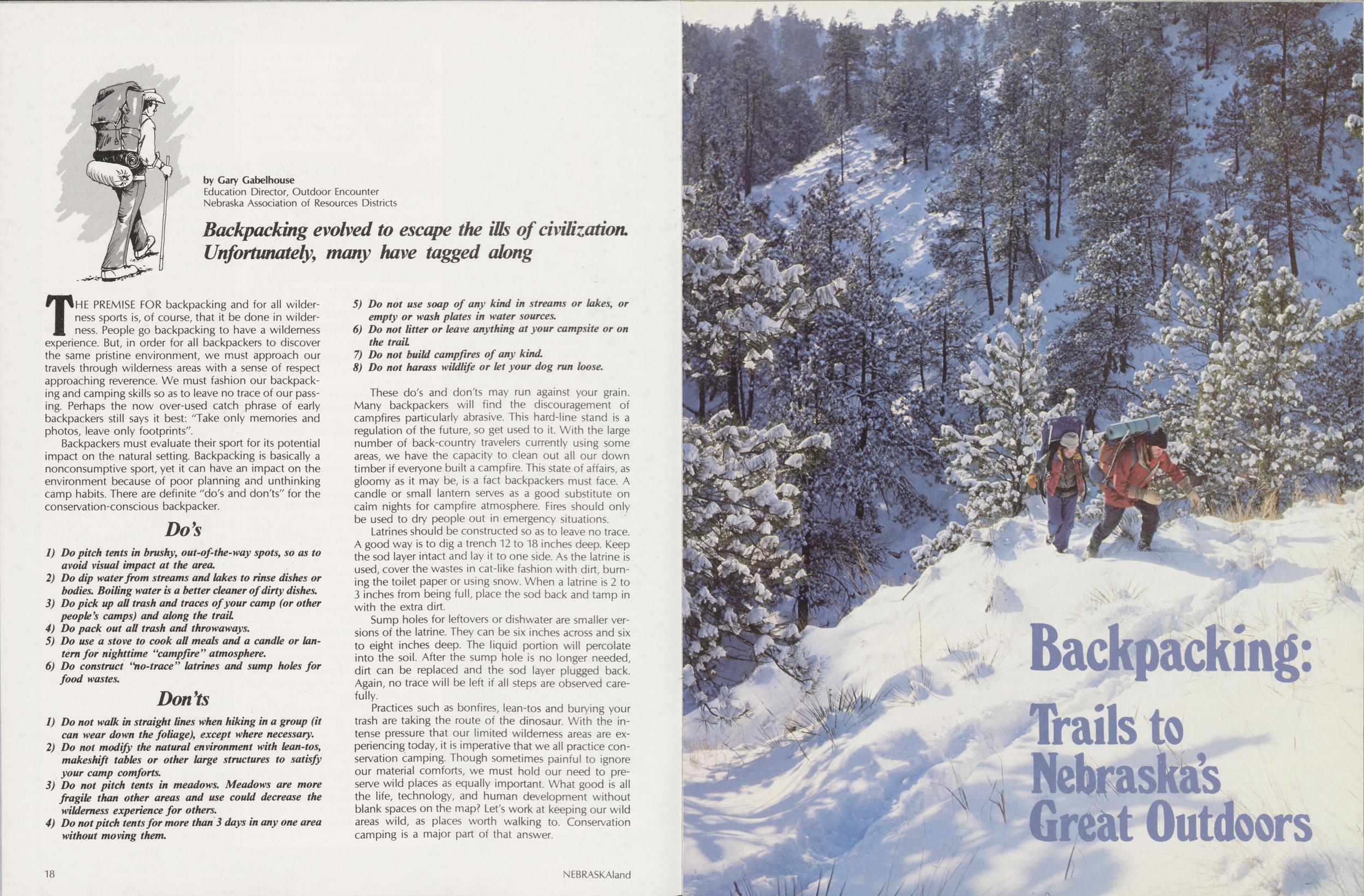
Backpacking: Trails to Nebraska's Great Outdoors
Backpacking evolved to escape the ills of civilization. Unfortunately, many have tagged along
THE PREMISE FOR backpacking and for all wilderness sports is, of course, that it be done in wilderness. People go backpacking to have a wilderness experience. But, in order for all backpackers to discover the same pristine environment, we must approach our travels through wilderness areas with a sense of respect approaching reverence. We must fashion our backpacking and camping skills so as to leave no trace of our passing. Perhaps the now over-used catch phrase of early backpackers still says it best: "Take only memories and photos, leave only footprints".
Backpackers must evaluate their sport for its potential impact on the natural setting. Backpacking is basically a nonconsumptive sport, yet it can have an impact on the environment because of poor planning and unthinking camp habits. There are definite "do's and don'ts" for the conservation-conscious backpacker.
Do's 1) Do pitch tents in brushy, out-of-the-way spots, so as to avoid visual impact at the area, 2) Do dip water from streams and lakes to rinse dishes or bodies. Boiling water is a better cleaner of dirty dishes. 3) Do pick up all trash and traces of your camp (or other people's camps) and along the trail 4) Do pack out all trash and throwaways. 5) Do use a stove to cook all meals and a candle or lantern for nighttime "campfire" atmosphere. 6) Do construct 'iio-trace" latrines and sump holes for food wastes. Don'ts 1) Do not walk in straight lines when hiking in a group (it can wear down the foliage), except where necessary. 2) Do not modify the natural environment with lean-tos, makeshift tables or other large structures to satisfy your camp comforts. 3) Do not pitch tents in meadows. Meadows are more fragile than other areas and use could decrease the wilderness experience for others. 4) Do not pitch tents for more than 3 days in any one area without moving them. 5) Do not use soap of any kind in streams or lakes, or empty or wash plates in water sources. 6) Do not litter or leave anything at your campsite or on the trail 7) Do not build camp fires of any kind. 8) Do not harass wildlife or let your dog run loose.These do's and don'ts may run against your grain. Many backpackers will find the discouragement of campfires particularly abrasive. This hard-line stand is a regulation of the future, so get used to it. With the large number of back-country travelers currently using some areas, we have the capacity to clean out all our down timber if everyone built a campfire. This state of affairs, as gloomy as it may be, is a fact backpackers must face. A candle or small lantern serves as a good substitute on cairn nights for campfire atmosphere. Fires should only be used to dry people out in emergency situations.
Latrines should be constructed so as to leave no trace. A good way is to dig a trench 12 to 18 inches deep. Keep the sod layer intact and lay it to one side. As the latrine is used, cover the wastes in cat-like fashion with dirt, burning the toilet paper or using snow. When a latrine is 2 to 3 inches from being full, place the sod back and tamp in with the extra dirt.
Sump holes for leftovers or dishwater are smaller versions of the latrine. They can be six inches across and six to eight inches deep. The liquid portion will percolate into the soil. After the sump hole is no longer needed, dirt can be replaced and the sod layer plugged back. Again, no trace will be left if all steps are observed carefully.
Practices such as bonfires, lean-tos and burying your trash are taking the route of the dinosaur. With the intense pressure that our limited wilderness areas are experiencing today, it is imperative that we all practice conservation camping. Though sometimes painful to ignore our material comforts, we must hold our need to preserve wild places as equally important. What good is all the life, technology, and human development without blank spaces on the map? Let's work at keeping our wild areas wild, as places worth walking to. Conservation camping is a major part of that answer.
NEBRASKAIand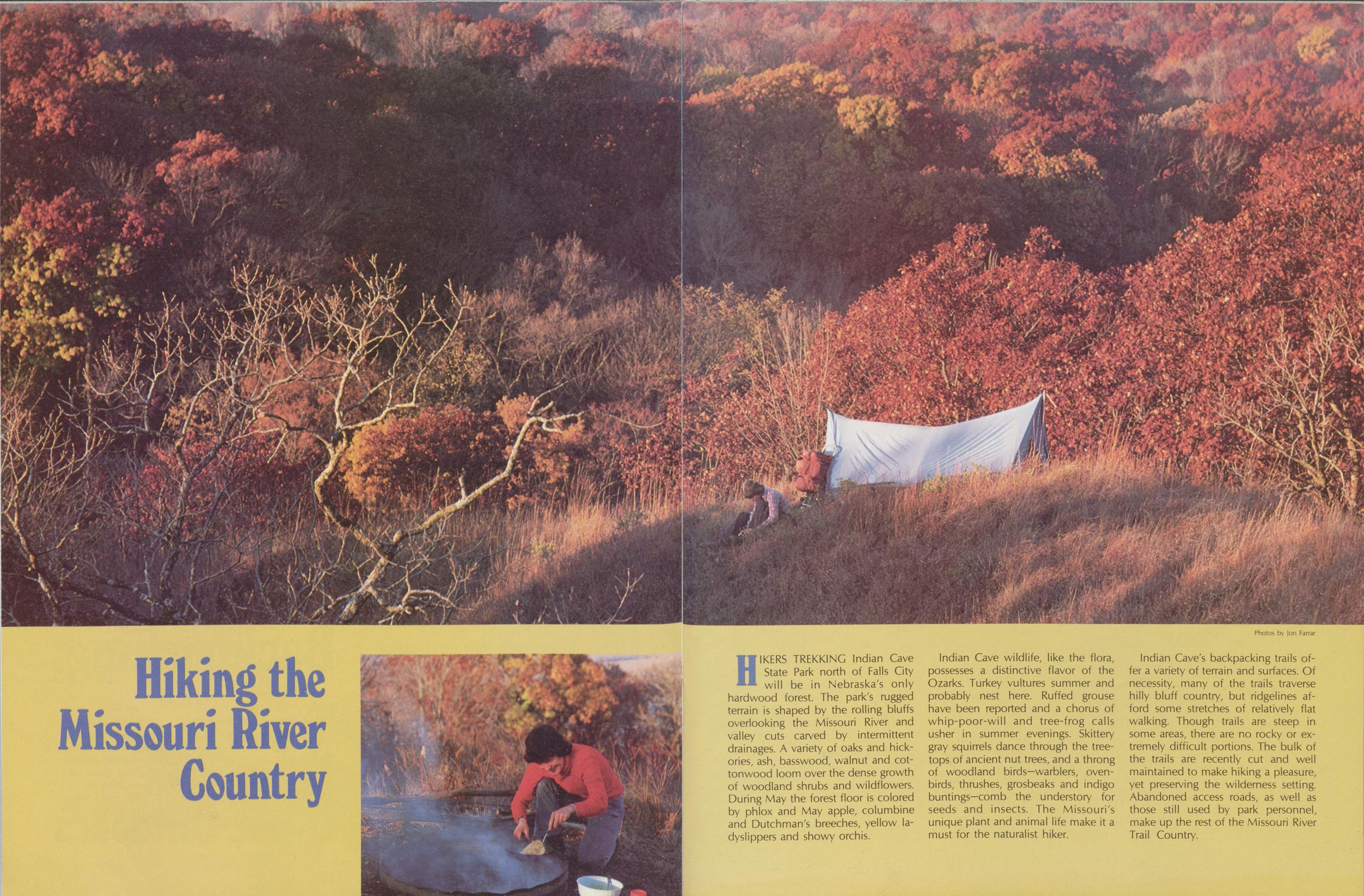
Hiking the Missouri River Country
HIKERS TREKKING Indian Cave State Park north of Falls City will be in Nebraska's only hardwood forest. The park's rugged terrain is shaped by the rolling bluffs overlooking the Missouri River and valley cuts carved by intermittent drainages. A variety of oaks and hickories, ash, basswood, walnut and Cottonwood loom over the dense growth of woodland shrubs and wildflowers. During May the forest floor is colored by phlox and May apple, columbine and Dutchman's breeches, yellow ladyslippers and showy orchis.
Indian Cave wildlife, like the flora, possesses a distinctive flavor of the Ozarks. Turkey vultures summer and probably nest here. Ruffed grouse have been reported and a chorus of whip-poor-will and tree-frog calls usher in summer evenings. Skittery gray squirrels dance through the treetops of ancient nut trees, and a throng of woodland birds—warblers, ovenbirds, thrushes, grosbeaks and indigo buntings—comb the understory for seeds and insects. The Missouri's unique plant and animal life make it a must for the naturalist hiker.
Indian Cave's backpacking trails offer a variety of terrain and surfaces. Of necessity, many of the trails traverse hilly bluff country, but ridgelines afford some stretches of relatively flat walking. Though trails are steep in some areas, there are no rocky or extremely difficult portions. The bulk of the trails are recently cut and well maintained to make hiking a pleasure, yet preserving the wilderness setting. Abandoned access roads, as well as those still used by park personnel, make up the rest of the Missouri River Trail Country.
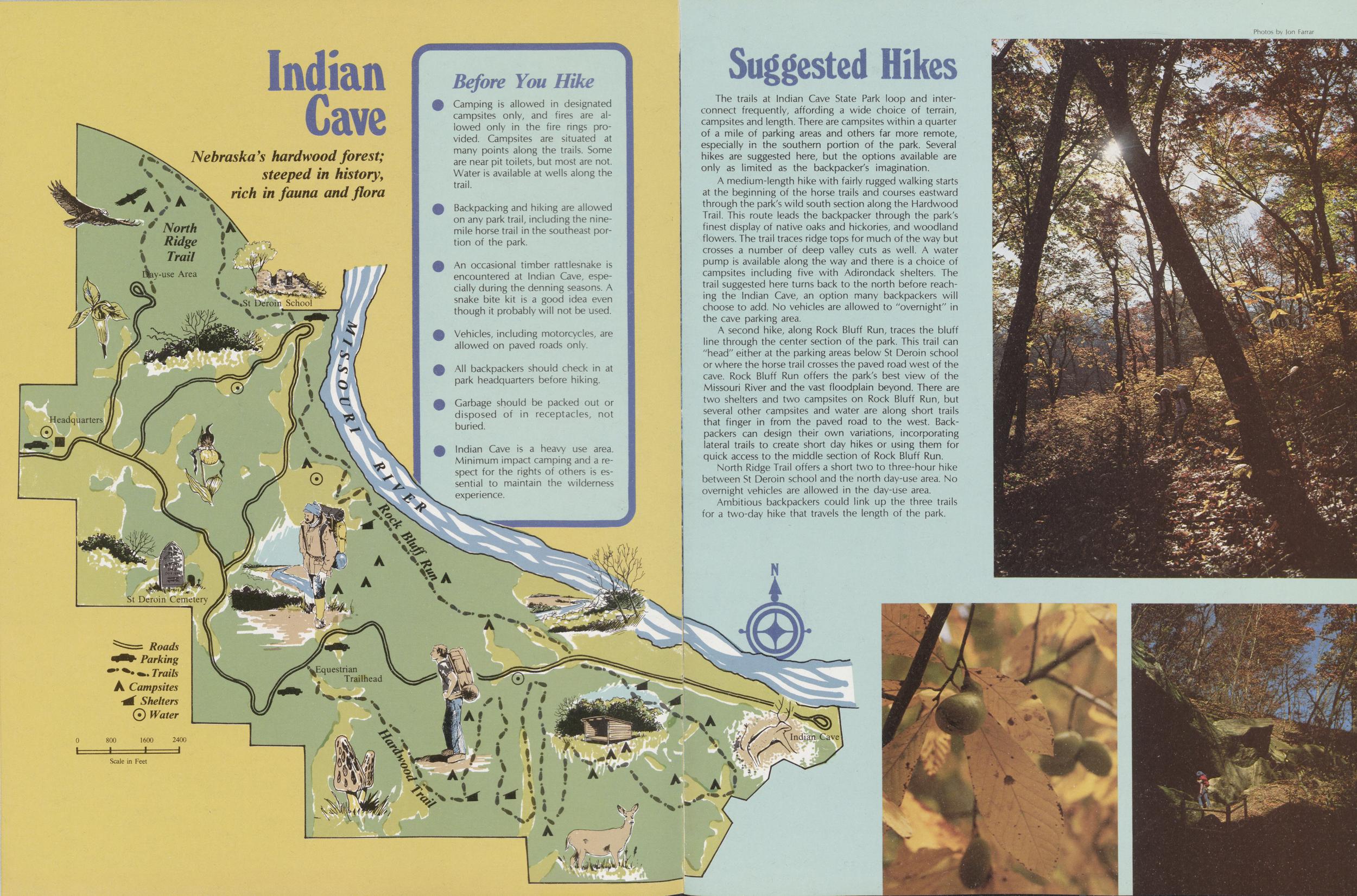
Indian Cave
Nebraska's hardwood forest; steeped in history, rich in fauna and flora Before You Hike Camping is allowed in designated campsites only, and fires are allowed only in the fire rings provided. Campsites are situated at many points along the trails. Some are near pit toilets, but most are not. Water is available at wells along the trail. Backpacking and hiking are allowed on any park trail, including the nine-mile horse trail in the southeast portion of the park. An occasional timber rattlesnake is encountered at Indian Cave, especially during the denning seasons. A snake bite kit is a good idea even though it probably will not be used. Vehicles, including motorcycles, are allowed on paved roads only. All backpackers should check in at park headquarters before hiking. Garbage should be packed out or disposed of in receptacles, not buried. Indian Cave is a heavy use area. Minimum impact camping and a respect for the rights of others is essential to maintain the wilderness experience.Suggested Hikes
The trails at Indian Cave State Park loop and interconnect frequently, affording a wide choice of terrain, campsites and length. There are campsites within a quarter of a mile of parking areas and others far more remote, especially in the southern portion of the park. Several hikes are suggested here, but the options available are only as limited as the backpacker's imagination.
A medium-length hike with fairly rugged walking starts at the beginning of the horse trails and courses eastward through the park's wild south section along the Hardwood Trail. This route leads the backpacker through the park's finest display of native oaks and hickories, and woodland flowers. The trail traces ridge tops for much of the way but crosses a number of deep valley cuts as well. A water pump is available along the way and there is a choice of campsites including five with Adirondack shelters. The trail suggested here turns back to the north before reaching the Indian Cave, an option many backpackers will choose to add. No vehicles are allowed to "overnight" in the cave parking area.
A second hike, along Rock Bluff Run, traces the bluff line through the center section of the park. This trail can "head" either at the parking areas below St Deroin school or where the horse trail crosses the paved road west of the cave. Rock Bluff Run offers the park's best view of the Missouri River and the vast floodplain beyond. There are two shelters and two campsites on Rock Bluff Run, but several other campsites and water are along short trails that finger in from the paved road to the west. Backpackers can design their own variations, incorporating lateral trails to create short day hikes or using them for quick access to the middle section of Rock Bluff Run.
North Ridge Trail offers a short two to three-hour hike between St Deroin school and the north day-use area. No overnight vehicles are allowed in the day-use area.
Ambitious backpackers could link up the three trails for a two-day hike that travels the length of the park.
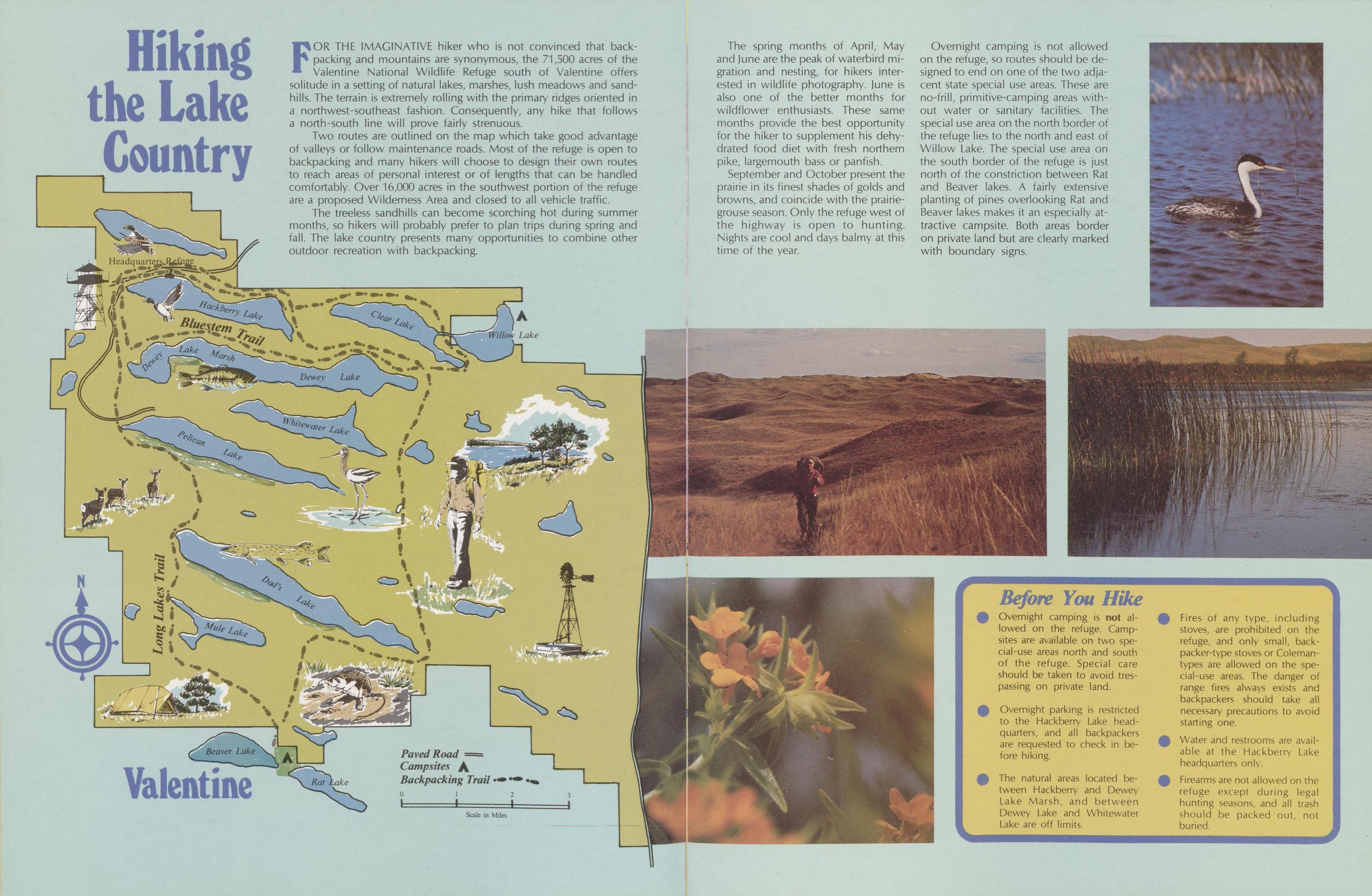
Hiking the Lake Country
FOR THE IMAGINATIVE hiker who is not convinced that backpacking and mountains are synonymous, the 71,500 acres of the Valentine National Wildlife Refuge south of Valentine offers solitude in a setting of natural lakes, marshes, lush meadows and sandhills. The terrain is extremely rolling with the primary ridges oriented in a northwest-southeast fashion. Consequently, any hike that follows a north-south line will prove fairly strenuous.
Two routes are outlined on the map which take good advantage of valleys or follow maintenance roads. Most of the refuge is open to backpacking and many hikers will choose to design their own routes to reach areas of personal interest or of lengths that can be handled comfortably. Over 16,000 acres in the southwest portion of the refuge are a proposed Wilderness Area and closed to all vehicle traffic.
The treeless sandhills can become scorching hot during summer months, so hikers will probably prefer to plan trips during spring and fall. The lake country presents many opportunities to combine other outdoor recreation with backpacking.
The spring months of April, May and June are the peak of waterbird migration and nesting, for hikers interested in wildlife photography. June is also one of the better months for wildflower enthusiasts. These same months provide the best opportunity for the hiker to supplement his dehydrated food diet with fresh northern pike, largemouth bass or panfish.
September and October present the prairie in its finest shades of golds and browns, and coincide with the prairie grouse season. Only the refuge west of the highway is open to hunting. Nights are cool and days balmy at this time of the year.
Overnight camping is not allowed on the refuge, so routes should be designed to end on one of the two adjacent state special use areas. These are no-frill, primitive-camping areas without water or sanitary facilities. The special use area on the north border of the refuge lies to the north and east of Willow Lake. The special use area on the south border of the refuge is just north of the constriction between Rat and Beaver lakes. A fairly extensive planting of pines overlooking Rat and Beaver lakes makes it an especially attractive campsite. Both areas border on private land but are clearly marked with boundary signs.
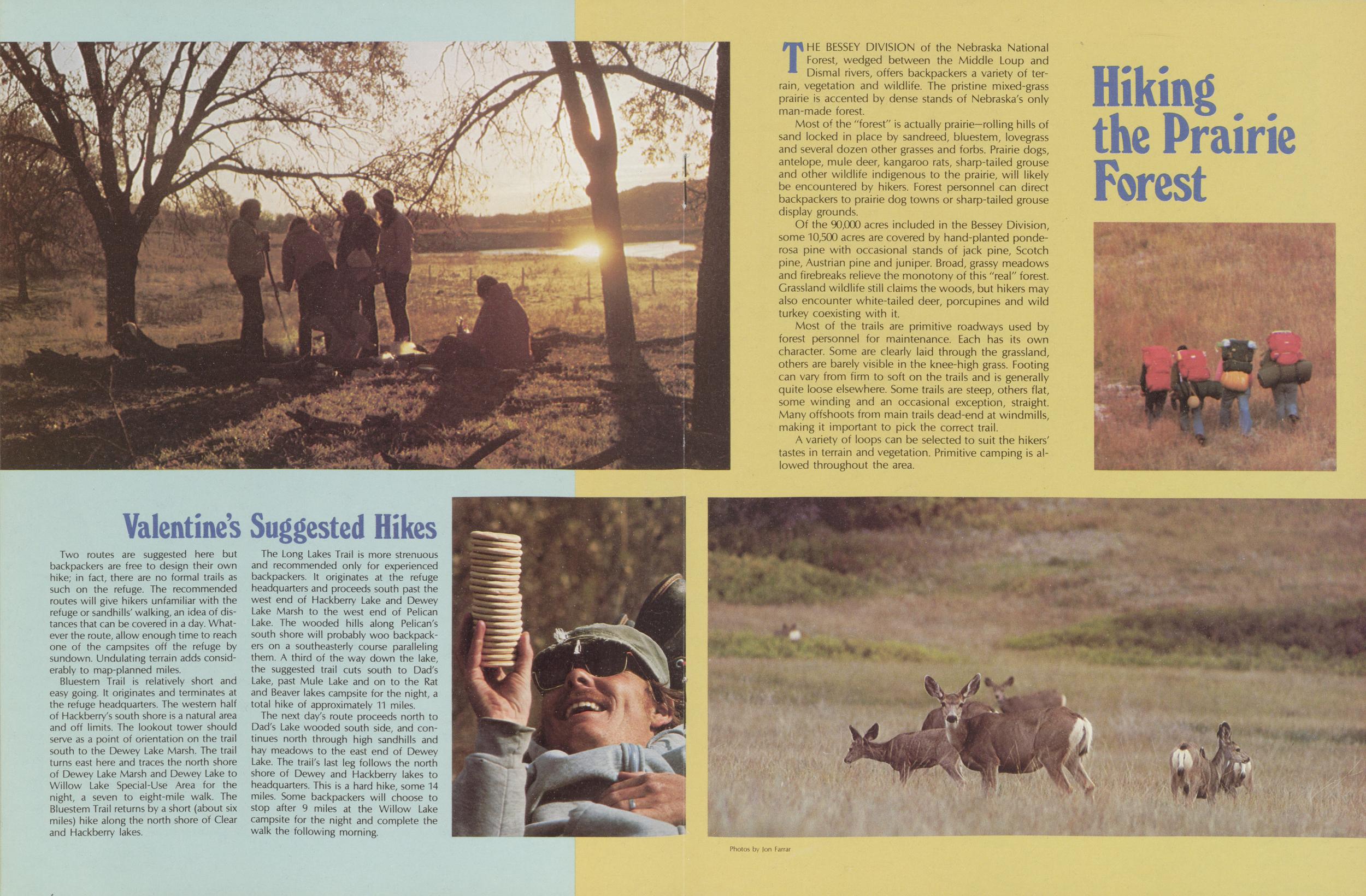
Valentine's Suggested Hikes
Two routes are suggested here but backpackers are free to design their own hike; in fact, there are no formal trails as such on the refuge. The recommended routes will give hikers unfamiliar with the refuge or sandhills' walking, an idea of distances that can be covered in a day. Whatever the route, allow enough time to reach one of the campsites off the refuge by sundown. Undulating terrain adds considerably to map-planned miles.
Bluestem Trail is relatively short and easy going. It originates and terminates at the refuge headquarters. The western half of Hackberry's south shore is a natural area and off limits. The lookout tower should serve as a point of orientation on the trail south to the Dewey Lake Marsh. The trail turns east here and traces the north shore of Dewey Lake Marsh and Dewey Lake to Willow Lake Special-Use Area for the night, a seven to eight-mile walk. The Bluestem Trail returns by a short (about six miles) hike along the north shore of Clear and Hackberry lakes.
The Long Lakes Trail is more strenuous and recommended only for experienced backpackers. It originates at the refuge headquarters and proceeds south past the west end of Hackberry Lake and Dewey Lake Marsh to the west end of Pelican Lake. The wooded hills along Pelican's south shore will probably woo backpackers on a southeasterly course paralleling them. A third of the way down the lake, the suggested trail cuts south to Dad's Lake, past Mule Lake and on to the Rat and Beaver lakes campsite for the night, a total hike of approximately 11 miles.
The next day's route proceeds north to Dad's Lake wooded south side, and continues north through high sandhills and hay meadows to the east end of Dewey Lake. The trail's last leg follows the north shore of Dewey and Hackberry lakes to headquarters. This is a hard hike, some 14 miles. Some backpackers will choose to stop after 9 miles at the Willow Lake campsite for the night and complete the walk the following morning.
Hiking the Praire Forest
THE BESSEY DIVISION of the Nebraska National Forest, wedged between the Middle Loup and Dismal rivers, offers backpackers a variety of terrain, vegetation and wildlife. The pristine mixed-grass prairie is accented by dense stands of Nebraska's only man-made forest.
Most of the "forest" is actually prairie—rolling hills of sand locked in place by sandreed, bluestem, lovegrass and several dozen other grasses and forbs. Prairie dogs, antelope, mule deer, kangaroo rats, sharp-tailed grouse and other wildlife indigenous to the prairie, will likely be encountered by hikers. Forest personnel can direct backpackers to prairie dog towns or sharp-tailed grouse display grounds.
Of the 90,000 acres included in the Bessey Division, some 10,500 acres are covered by hand-planted ponde rosa pine with occasional stands of jack pine, Scotch pine, Austrian pine and juniper. Broad, grassy meadows and firebreaks relieve the monotony of this "real" forest. Grassland wildlife still claims the woods, but hikers may also encounter white-tailed deer, porcupines and wild turkey coexisting with it.
Most of the trails are primitive roadways used by forest personnel for maintenance. Each has its own character. Some are clearly laid through the grassland, others are barely visible in the knee-high grass. Footing can vary from firm to soft on the trails and is generally quite loose elsewhere. Some trails are steep, others flat, some winding and an occasional exception, straight. Many offshoots from main trails dead-end at windmills, making it important to pick the correct trail.
A variety of loops can be selected to suit the hikers' tastes in terrain and vegetation. Primitive camping is alowed throughout the area.
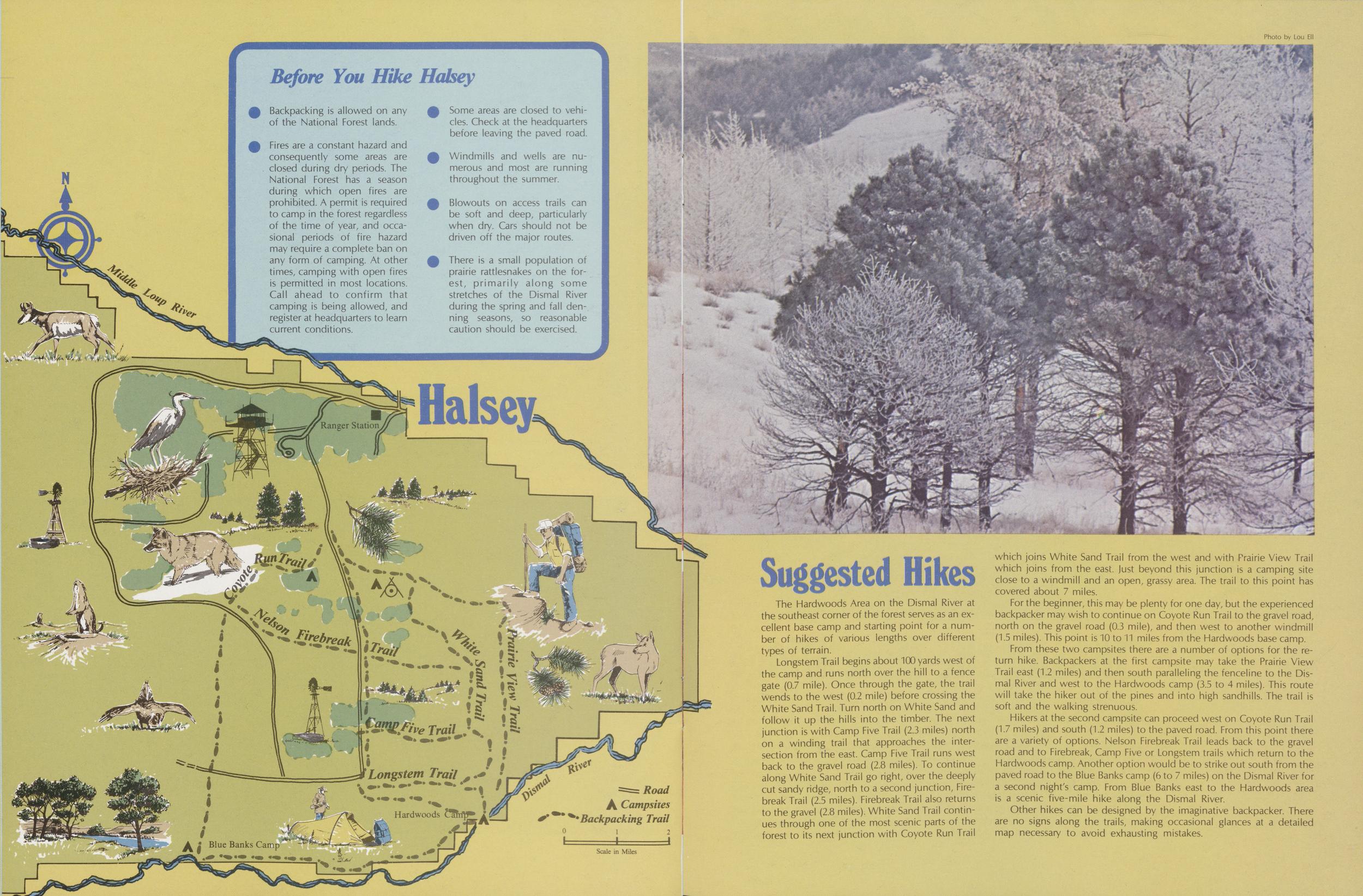
Suggested Hikes
The Hardwoods Area on the Dismal River at the southeast corner of the forest serves as an excellent base camp and starting point for a number of hikes of various lengths over different types of terrain.
Longstem Trail begins about 100 yards west of the camp and runs north over the hill to a fence gate (0.7 mile). Once through the gate, the trail wends to the west (0.2 mile) before crossing the White Sand Trail. Turn north on White Sand and follow it up the hills into the timber. The next junction is with Camp Five Trail (2.3 miles) north on a winding trail that approaches the intersection from the east. Camp Five Trail runs west back to the gravel road (2.8 miles). To continue along White Sand Trail go right, over the deeply cut sandy ridge, north to a second junction, Firebreak Trail (2.5 miles). Firebreak Trail also returns to the gravel (2.8 miles). White Sand Trail continues through one of the most scenic parts of the forest to its next junction with Coyote Run Trail which joins White Sand Trail from the west and with Prairie View Trail which joins from the east, just beyond this junction is a camping site close to a windmill and an open, grassy area. The trail to this point has covered about 7 miles.
For the beginner, this may be plenty for one day, but the experienced backpacker may wish to continue on Coyote Run Trail to the gravel road, north on the gravel road (0.3 mile), and then west to another windmill (1.5 miles). This point is 10 to 11 miles from the Hardwoods base camp.
From these two campsites there are a number of options for the return hike. Backpackers at the first campsite may take the Prairie View Trail east (1.2 miles) and then south paralleling the fenceline to the Dismal River and west to the Hardwoods camp (3.5 to 4 miles). This route will take the hiker out of the pines and into high sandhills. The trail is soft and the walking strenuous.
Hikers at the second campsite can proceed west on Coyote Run Trail (1.7 miles) and south (1.2 miles) to the paved road. From this point there are a variety of options. Nelson Firebreak Trail leads back to the gravel road and to Firebreak, Camp Five or Longstem trails which return to the Hardwoods camp. Another option would be to strike out south from the paved road to the Blue Banks camp (6 to 7 miles) on the Dismal River for a second night's camp. From Blue Banks east to the Hardwoods area is a scenic five-mile hike along the Dismal River.
Other hikes can be designed by the imaginative backpacker. There are no signs along the trails, making occasional glances at a detailed map necessary to avoid exhausting mistakes.
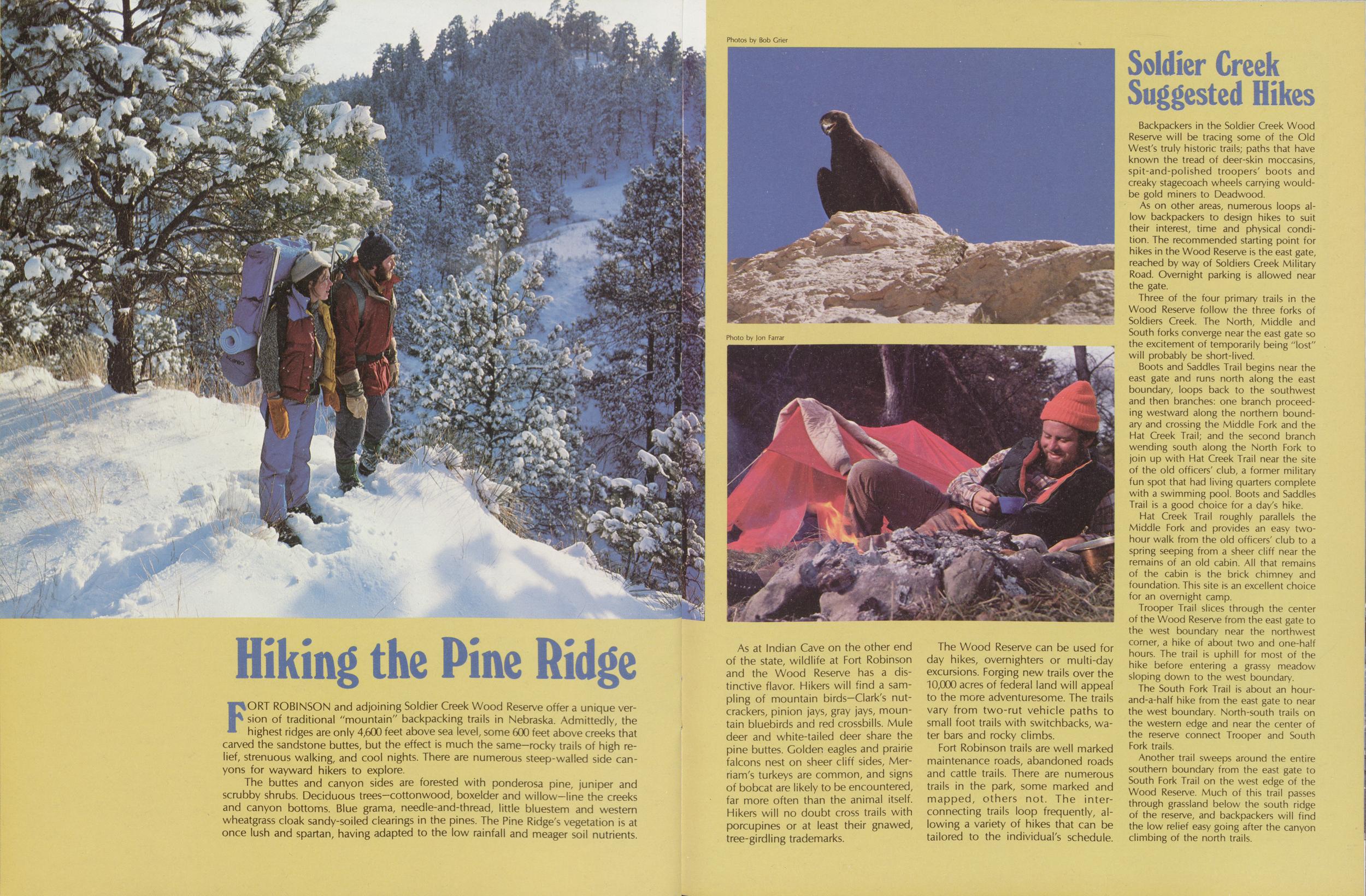
Hiking the Pine Ridge
FORT ROBINSON and adjoining Soldier Creek Wood Reserve offer a unique version of traditional "mountain" backpacking trails in Nebraska. Admittedly, the highest ridges are only 4,600 feet above sea level, some 600 feet above creeks that carved the sandstone buttes, but the effect is much the same-rocky trails of high relief, strenuous walking, and cool nights. There are numerous steep-walled side canyons for wayward hikers to explore.
The buttes and canyon sides are forested with ponderosa pine, juniper and scrubby shrubs. Deciduous trees-cottonwood, boxelder and willow-line the creeks and canyon bottoms. Blue grama, needle-and-thread, little bluestem and western wheatgrass cloak sandy-soiled clearings in the pines. The Pine Ridge's vegetation is once lush and spartan, having adapted to the low rainfall and meager soil nutrients.
As at Indian Cave on the other end of the state, wildlife at Fort Robinson and the Wood Reserve has a distinctive flavor. Hikers will find a sam-pling of mountain birds-Clark's nutcrackers, pinion jays, gray jays, mountain bluebirds and red crossbills. Mule deer and white-tailed deer share the pine buttes. Golden eagles and prairie falcons nest on sheer cliff sides, Merriam's turkeys are common, and signs of bobcat are likely to be encountered, far more often than the animal itself. Hikers will no doubt cross trails with porcupines or at least their gnawed, tree-girdling trademarks.
The Wood Reserve can be used for day hikes, overnighters or multi-day excursions. Forging new trails over the 10,000 acres of federal land will appeal to the more adventuresome. The trails vary from two-rut vehicle paths to small foot trails with switchbacks, water bars and rocky climbs.
Fort Robinson trails are well marked maintenance roads, abandoned roads and cattle trails. There are numerous trails in the park, some marked and mapped, others not. The interconnecting trails loop frequently, allowing a variety of hikes that can be tailored to the individual's schedule.
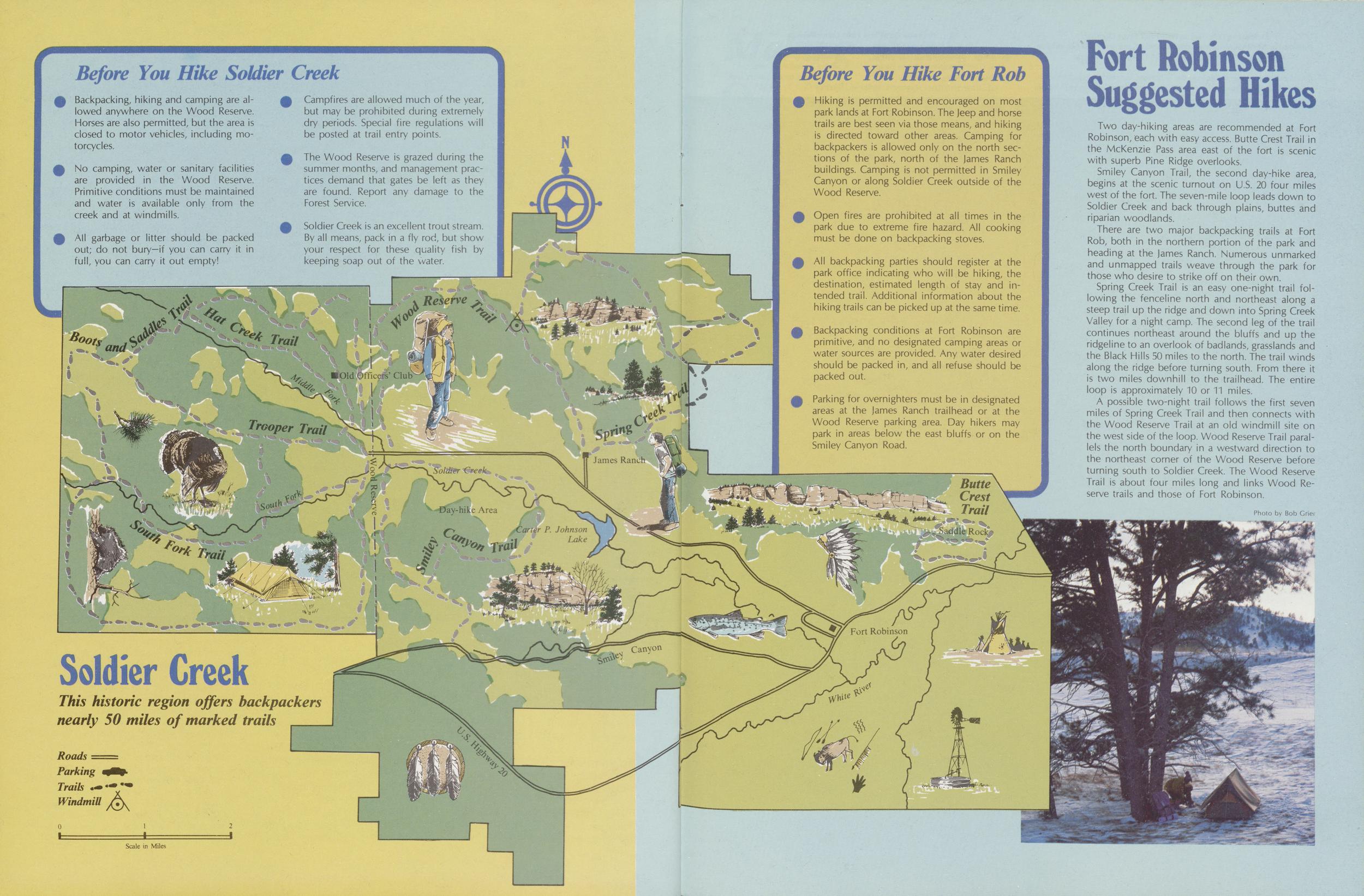
Soldier Creek Suggested Hikes
Backpackers in the Soldier Creek Wood Reserve will be tracing some of the Old West's truly historic trails; paths that have known the tread of deer-skin moccasins, spit-and-polished troopers' boots and creaky stagecoach wheels carrying would-be gold miners to Dead wood.
As on other areas, numerous loops allow backpackers to design hikes to suit their interest, time and physical condition. The recommended starting point for hikes in the Wood Reserve is the east gate, reached by way of Soldiers Creek Military Road. Overnight parking is allowed near the gate.
Three of the four primary trails in the Wood Reserve follow the three forks of Soldiers Creek. The North, Middle and South forks converge near the east gate so the excitement of temporarily being "lost" will probably be short-lived.
Boots and Saddles Trail begins near the east gate and runs north along the east boundary, loops back to the southwest and then branches: one branch proceeding westward along the northern boundary and crossing the Middle Fork and the Hat Creek Trail; and the second branch wending south along the North Fork to join up with Hat Creek Trail near the site of the old officers' club, a former military fun spot that had living quarters complete with a swimming pool. Boots and Saddles Trail is a good choice for a day's hike.
Hat Creek Trail roughly parallels the Middle Fork and provides an easy two-hour walk from the old officers' club to a spring seeping from a sheer cliff near the remains of an old cabin. All that remains of the cabin is the brick chimney and foundation. This site is an excellent choice for an overnight camp.
Trooper Trail slices through the center of the Wood Reserve from the east gate to the west boundary near the northwest corner, a hike of about two and one-half hours. The trail is uphill for most of the hike before entering a grassy meadow sloping down to the west boundary.
The South Fork Trail is about an hour-and-a-half hike from the east gate to near the west boundary. North-south trails on the western edge and near the center of the reserve connect Trooper and South Fork trails.
Another trail sweeps around the entire southern boundary from the east gate to South Fork Trail on the west edge of the Wood Reserve. Much of this trail passes through grassland below the south ridge of the reserve, and backpackers will find the low relief easy going after the canyon climbing of the north trails.
Fort Robinson Suggested Hikes
Two day-hiking areas are recommended at Fort Robinson, each with easy access. Butte Crest Trail in the McKenzie Pass area east of the fort is scenic with superb Pine Ridge overlooks.
Smiley Canyon Trail, the second day-hike area, begins at the scenic turnout on U.S. 20 four miles west of the fort. The seven-mile loop leads down to Soldier Creek and back through plains, buttes and riparian woodlands.
There are two major backpacking trails at Fort Rob, both in the northern portion of the park and heading at the James Ranch. Numerous unmarked and unmapped trails weave through the park for those who desire to strike off on their own.
Spring Creek Trail is an easy one-night trail following the fenceline north and northeast along a steep trail up the ridge and down into Spring Creek Valley for a night camp. The second leg of the trail continues northeast around the bluffs and up the ridgeline to an overlook of badlands, grasslands and the Black Flills 50 miles to the north. The trail winds along the ridge before turning south. From there it is two miles downhill to the trailhead. The entire loop is approximately 10 or 11 miles.
A possible two-night trail follows the first seven miles of Spring Creek Trail and then connects with the Wood Reserve Trail at an old windmill site on the west side of the loop. Wood Reserve Trail parallels the north boundary in a westward direction to the northeast corner of the Wood Reserve before turning south to Soldier Creek. The Wood Reserve Trail is about four miles long and links Wood Reserve trails and those of Fort Robinson.
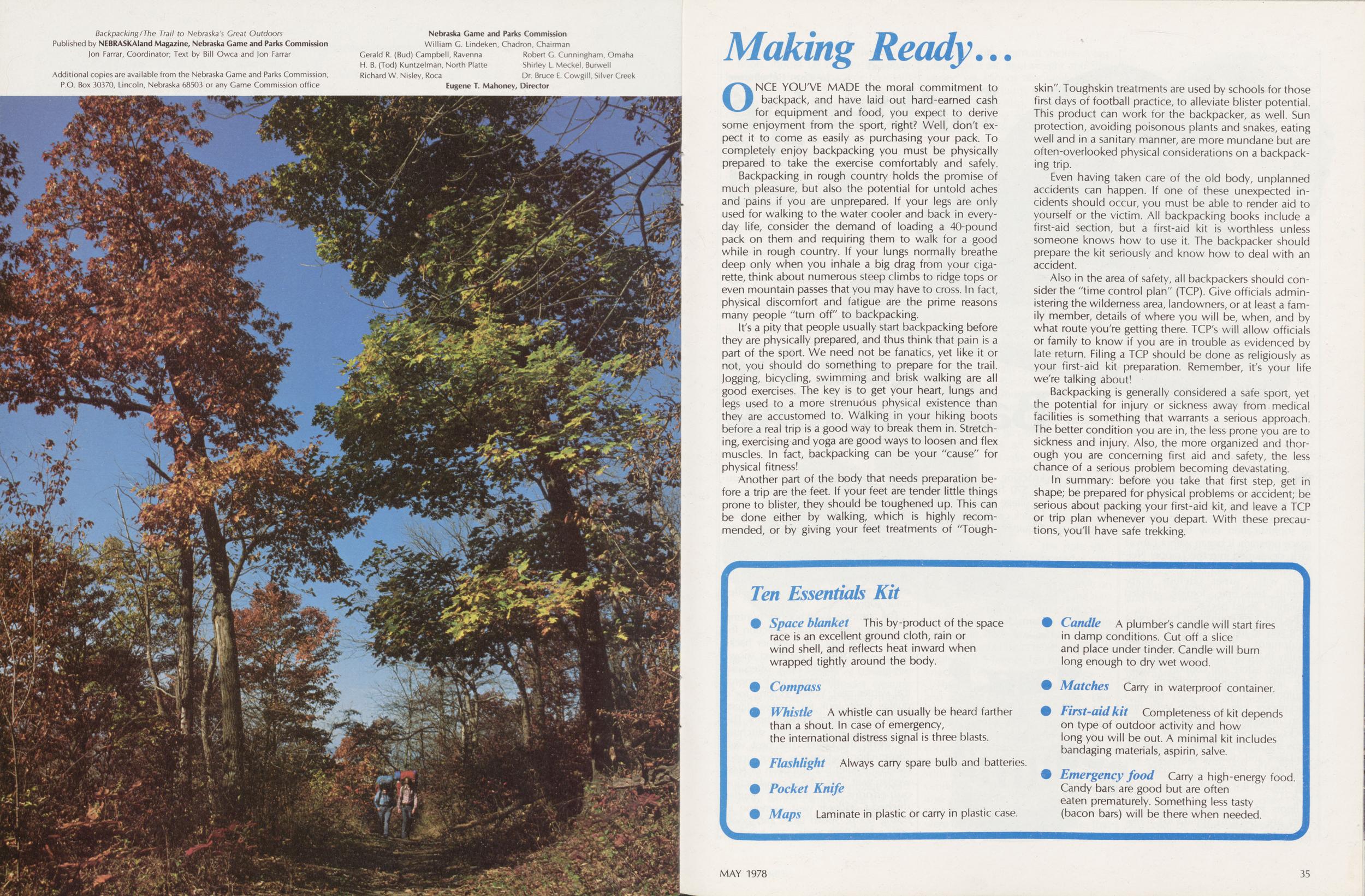
Making Ready. . .
ONCE YOU'VE MADE the moral commitment to backpack, and have laid out hard-earned cash for equipment and food, you expect to derive some enjoyment from the sport, right? Well, don't expect it to come as easily as purchasing your pack. To completely enjoy backpacking you must be physically prepared to take the exercise comfortably and safely.
Backpacking in rough country holds the promise of much pleasure, but also the potential for untold aches and pains if you are unprepared. If your legs are only used for walking to the water cooler and back in everyday life, consider the demand of loading a 40-pound pack on them and requiring them to walk for a good while in rough country. If your lungs normally breathe deep only when you inhale a big drag from your cigarette, think about numerous steep climbs to ridge tops or even mountain passes that you may have to cross. In fact, physical discomfort and fatigue are the prime reasons many people "turn off" to backpacking.
It's a pity that people usually start backpacking before they are physically prepared, and thus think that pain is a part of the sport. We need not be fanatics, yet like it or not, you should do something to prepare for the trail. Jogging, bicycling, swimming and brisk walking are all good exercises. The key is to get your heart, lungs and legs used to a more strenuous physical existence than they are accustomed to. Walking in your hiking boots before a real trip is a good way to break them in. Stretching, exercising and yoga are good ways to loosen and flex muscles. In fact, backpacking can be your "cause" for physical fitness!
Another part of the body that needs preparation before a trip are the feet. If your feet are tender little things prone to blister, they should be toughened up. This can be done either by walking, which is highly recommended, or by giving your feet treatments of "Tough skin". Toughskin treatments are used by schools for those first days of football practice, to alleviate blister potential. This product can work for the backpacker, as well. Sun protection, avoiding poisonous plants and snakes, eating well and in a sanitary manner, are more mundane but are often-overlooked physical considerations on a backpacking trip.
Even having taken care of the old body, unplanned accidents can happen. If one of these unexpected incidents should occur, you must be able to render aid to yourself or the victim. All backpacking books include a first-aid section, but a first-aid kit is worthless unless someone knows how to use it. The backpacker should prepare the kit seriously and know how to deal with an accident.
Also in the area of safety, all backpackers should consider the "time control plan" (TCP). Give officials administering the wilderness area, landowners, or at least a family member, details of where you will be, when, and by what route you're getting there. TCP's will allow officials or family to know if you are in trouble as evidenced by late return. Filing a TCP should be done as religiously as your first-aid kit preparation. Remember, it's your life we're talking about!
Backpacking is generally considered a safe sport, yet the potential for injury or sickness away from medical facilities is something that warrants a serious approach. The better condition you are in, the less prone you are to sickness and injury. Also, the more organized and thorough you are concerning first aid and safety, the less chance of a serious problem becoming devastating.
In summary: before you take that first step, get in shape; be prepared for physical problems or accident; be serious about packing your first-aid kit, and leave a TCP or trip plan whenever you depart. With these precautions, you'll have safe trekking.
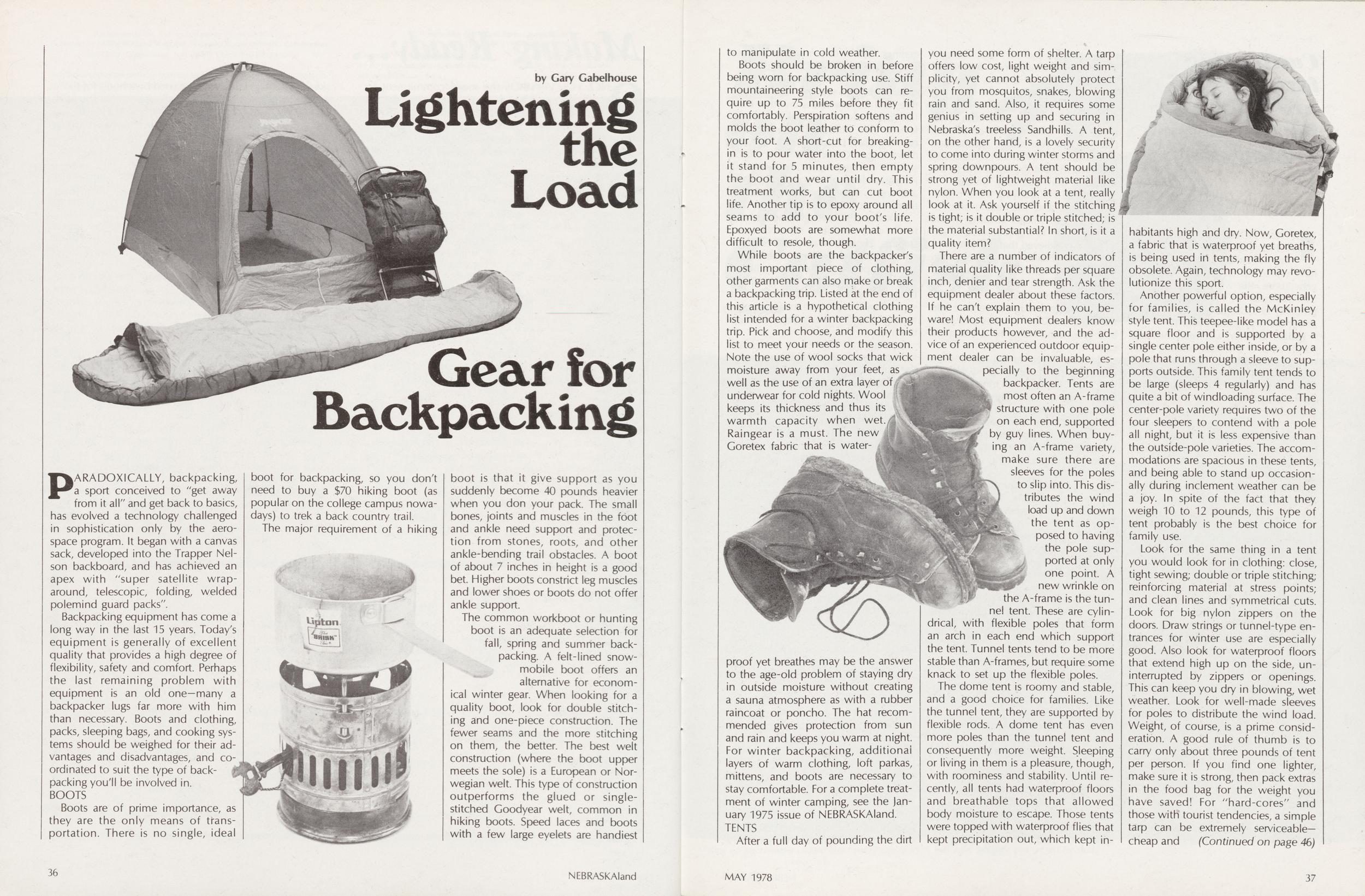
Lightening the Load Gear for Backpacking
PARADOXICALLY, backpacking, a sport conceived to "get away from it all" and get back to basics, has evolved a technology challenged in sophistication only by the aerospace program. It began with a canvas sack, developed into the Trapper Nelson backboard, and has achieved an apex with "super satellite wrap-around, telescopic, folding, welded polemind guard packs".
Backpacking equipment has come a long way in the last 15 years. Today's equipment is generally of excellent quality that provides a high degree of flexibility, safety and comfort. Perhaps the last remaining problem with equipment is an old one—many a backpacker lugs far more with him than necessary. Boots and clothing, packs, sleeping bags, and cooking systems should be weighed for their advantages and disadvantages, and coordinated to suit the type of backpacking you'll be involved in.
BOOTS
Boots are of prime importance, as they are the only means of transportation. There is no single, ideal boot for backpacking, so you don't need to buy a $70 hiking boot (as popular on the college campus nowadays) to trek a back country trail.
The major requirement of a hiking boot is that it give support as you suddenly become 40 pounds heavier when you don your pack. The small bones, joints and muscles in the foot and ankle need support and protection from stones, roots, and other ankle-bending trail obstacles. A boot of about 7 inches in height is a good bet. Higher boots constrict leg muscles and lower shoes or boots do not offer ankle support.
The common workboot or hunting boot is an adequate selection for fall, spring and summer backpacking. A felt-lined snowmobile boot offers an alternative for economical winter gear. When looking for a quality boot, look for double stitching and one-piece construction. The fewer seams and the more stitching on them, the better. The best welt construction (where the boot upper meets the sole) is a European or Norwegian welt. This type of construction outperforms the glued or single-stitched Goodyear welt, common in hiking boots. Speed laces and boots with a few large eyelets are handiest 36 NEBRASKAland to manipulate in cold weather.
Boots should be broken in before being worn for backpacking use. Stiff mountaineering style boots can require up to 75 miles before they fit comfortably. Perspiration softens and molds the boot leather to conform to your foot. A short-cut for breaking-in is to pour water into the boot, let it stand for 5 minutes, then empty the boot and wear until dry. This treatment works, but can cut boot life. Another tip is to epoxy around all seams to add to your boot's life. Epoxyed boots are somewhat more difficult to resole, though.
While boots are the backpacker's most important piece of clothing, other garments can also make or break a backpacking trip. Listed at the end of this article is a hypothetical clothing list intended for a winter backpacking trip. Pick and choose, and modify this list to meet your needs or the season. Note the use of wool socks that wick moisture away from your feet, as well as the use of an extra layer of underwear for cold nights. Wool keeps its thickness and thus its warmth capacity when wet. Raingear is a must. The new Goretex fabric that is waterproof yet breathes may be the answer to the age-old problem of staying dry in outside moisture without creating a sauna atmosphere as with a rubber raincoat or poncho. The hat recommended gives protection from sun and rain and keeps you warm at night. For winter backpacking, additional layers of warm clothing, loft parkas, mittens, and boots are necessary to stay comfortable. For a complete treatment of winter camping, see the January 1975 issue of NEBRASKAIand.
TENTS
After a full day of pounding the dirt you need some form of shelter. A tarp offers low cost, light weight and simplicity, yet cannot absolutely protect you from mosquitos, snakes, blowing rain and sand. Also, it requires some genius in setting up and securing in Nebraska's treeless Sandhills. A tent, on the other hand, is a lovely security to come into during winter storms and spring downpours. A tent should be strong yet of lightweight material like nylon. When you look at a tent, really look at it. Ask yourself if the stitching is tight; is it double or triple stitched; is the material substantial? In short, is it a quality item?
There are a number of indicators of material quality like threads per square inch, denier and tear strength. Ask the equipment dealer about these factors. If he can't explain them to you, beware! Most equipment dealers know their products however, and the advice of an experienced outdoor equip- ment dealer can be invaluable, especially to the beginning backpacker. Tents are most often an A-frame structure with one pole on each end, supported by guy lines. When buying an A-frame variety, make sure there are sleeves for the poles to slip into. This distributes the wind load up and down the tent as opposed to having the pole supported at only one point. A new wrinkle on the A-frame is the tunnel tent. These are cylindrical, with flexible poles that for an arch in each end which support the tent. Tunnel tents tend to be more stable than A-frames, but require some knack to set up the flexible poles.
The dome tent is roomy and stable, and a good choice for families. Like the tunnel tent, they are supported by flexible rods. A dome tent has even more poles than the tunnel tent and consequently more weight. Sleeping or living in them is a pleasure, though, with roominess and stability. Until recently, all tents had waterproof floors and breathable tops that allowed body moisture to escape. Those tents were topped with waterproof flies that kept precipitation out, which kept inhabitants high and dry. Now, Goretex,
Another powerful option, especially for families, is called the McKinley style tent. This teepee-like model has a square floor and is supported by a single center pole either inside, or by a pole that runs through a sleeve to supports outside. This family tent tends to be large (sleeps 4 regularly) and has quite a bit of windloading surface. The center-pole variety requires two of the four sleepers to contend with a pole all night, but it is less expensive than the outside-pole varieties. The accommodations are spacious in these tents, and being able to stand up occasionally during inclement weather can be a joy. In spite of the fact that they weigh 10 to 12 pounds, this type of tent probably is the best choice for family use.
Look for the same thing in a tent you would look for in clothing: close, tight sewing; double or triple stitching; reinforcing material at stress points; and clean lines and symmetrical cuts. Look for big nylon zippers on the doors. Draw strings or tunnel-type entrances for winter use are especially good. Also look for waterproof floors that extend high up on the side, uninterrupted by zippers or openings. This can keep you dry in blowing, wet weather. Look for well-made sleeves for poles to distribute the wind load. Weight, of course, is a prime consideration. A good rule of thumb is to carry only about three pounds of tent per person. If you find one lighter, make sure it is strong, then pack extras in the food bag for the weight you have saved! For "hard-cores" and those with tourist tendencies, a simple tarp can be extremely serviceable cheap and (Continued on page 46)
MAY 1978 37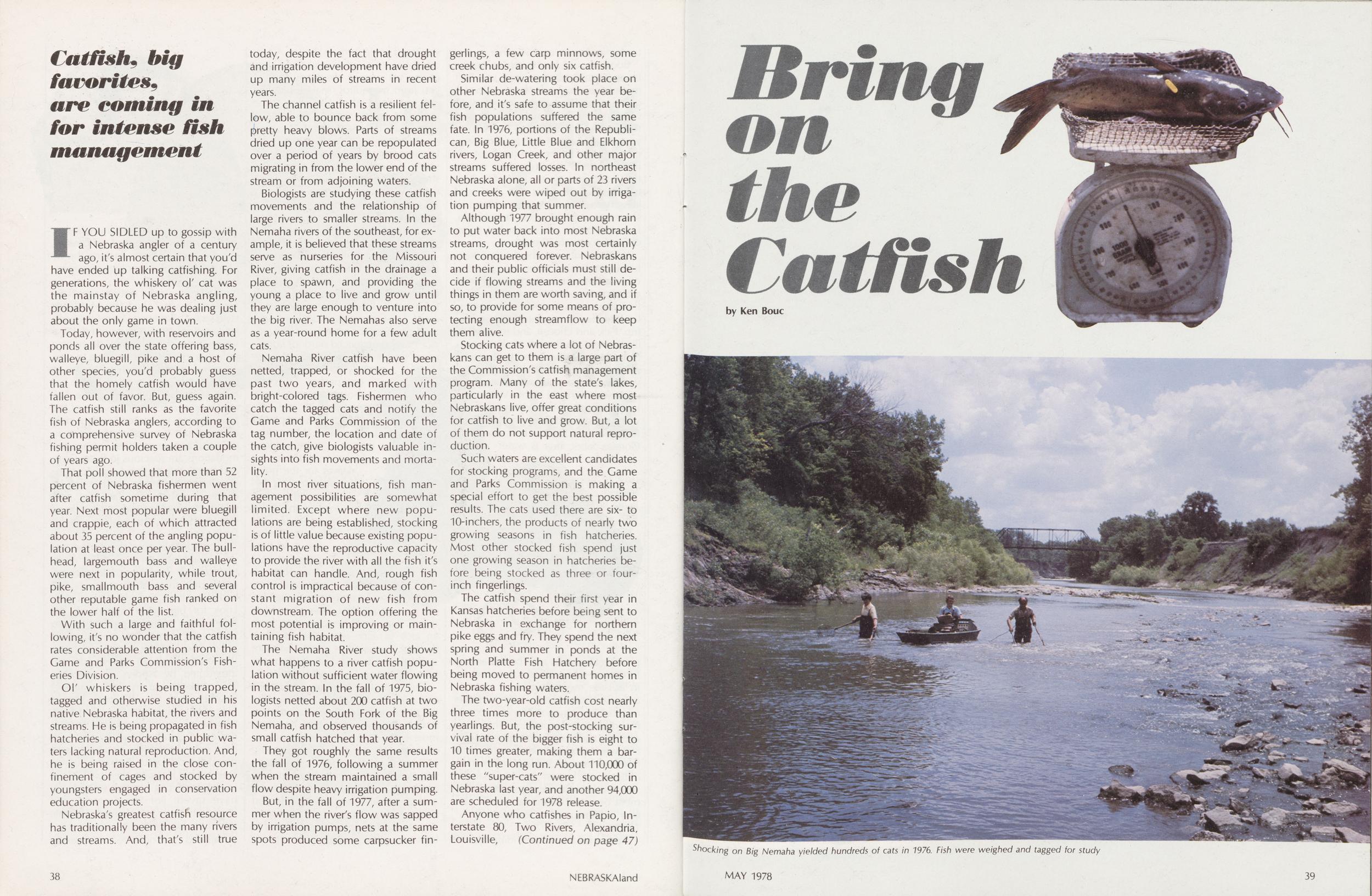
Catfish, big favorites, are coming in for intense fish management
Bring on the Catfish
by Ken BoucIF YOU SIDLED up to gossip with a Nebraska angler of a century ago, it's almost certain that you'd have ended up talking catfishing. For generations, the whiskery ol' cat was the mainstay of Nebraska angling, probably because he was dealing just about the only game in town.
Today, however, with reservoirs and ponds all over the state offering bass, walleye, bluegill, pike and a host of other species, you'd probably guess that the homely catfish would have fallen out of favor. But, guess again. The catfish still ranks as the favorite fish of Nebraska anglers, according to a comprehensive survey of Nebraska fishing permit holders taken a couple of years ago.
That poll showed that more than 52 percent of Nebraska fishermen went after catfish sometime during that year. Next most popular were bluegill and crappie, each of which attracted about 35 percent of the angling population at least once per year. The bullhead, largemouth bass and walleye were next in popularity, while trout, pike, smallmouth bass and several other reputable game fish ranked on the lower half of the list.
With such a large and faithful following, it's no wonder that the catfish rates considerable attention from the Game and Parks Commission's Fisheries Division.
Ol' whiskers is being trapped, tagged and otherwise studied in his native Nebraska habitat, the rivers and streams. He is being propagated in fish hatcheries and stocked in public waters lacking natural reproduction. And, he is being raised in the close confinement of cages and stocked by youngsters engaged in conservation education projects.
Nebraska's greatest catfish resource has traditionally been the many rivers and streams. And, that's still true today, despite the fact that drought and irrigation development have dried up many miles of streams in recent years.
The channel catfish is a resilient fellow, able to bounce back from some pretty heavy blows. Parts of streams dried up one year can be repopulated over a period of years by brood cats migrating in from the lower end of the stream or from adjoining waters.
Biologists are studying these catfish movements and the relationship of large rivers to smaller streams. In the Nemaha rivers of the southeast, for example, it is believed that these streams serve as nurseries for the Missouri River, giving catfish in the drainage a place to spawn, and providing the young a place to live and grow until they are large enough to venture into the big river. The Nemahas also serve as a year-round home for a few adult cats.
Nemaha River catfish have been netted, trapped, or shocked for the past two years, and marked with bright-colored tags. Fishermen who catch the tagged cats and notify the Game and Parks Commission of the tag number, the location and date of the catch, give biologists valuable insights into fish movements and mortality.
In most river situations, fish management possibilities are somewhat limited. Except where new populations are being established, stocking is of little value because existing populations have the reproductive capacity to provide the river with all the fish it's habitat can handle. And, rough fish control is impractical because of constant migration of new fish from downstream. The option offering the most potential is improving or maintaining fish habitat.
The Nemaha River study shows what happens to a river catfish population without sufficient water flowing in the stream. In the fall of 1975, biologists netted about 200 catfish at two points on the South Fork of the Big Nemaha, and observed thousands of small catfish hatched that year.
They got roughly the same results the fall of 1976, following a summer when the stream maintained a small flow despite heavy irrigation pumping.
But, in the fall of 1977, after a summer when the river's flow was sapped by irrigation pumps, nets at the same spots produced some carpsucker fingerlings, a few carp minnows, some creek chubs, and only six catfish.
Similar de-watering took place on other Nebraska streams the year before, and it's safe to assume that their fish populations suffered the same fate. In 1976, portions of the Republican, Big Blue, Little Blue and Elkhorn rivers, Logan Creek, and other major streams suffered losses. In northeast Nebraska alone, all or parts of 23 rivers and creeks were wiped out by irrigation pumping that summer.
Although 1977 brought enough rain to put water back into most Nebraska streams, drought was most certainly not conquered forever. Nebraskans and their public officials must still decide if flowing streams and the living things in them are worth saving, and if so, to provide for some means of protecting enough streamflow to keep them alive.
Stocking cats where a lot of Nebraskans can get to them is a large part of the Commission's catfish management program. Many of the state's lakes, particularly in the east where most Nebraskans live, offer great conditions for catfish to live and grow. But, a lot of them do not support natural reproduction.
Such waters are excellent candidates for stocking programs, and the Game and Parks Commission is making a special effort to get the best possible results. The cats used there are six- to 10-inchers, the products of nearly two growing seasons in fish hatcheries. Most other stocked fish spend just one growing season in hatcheries before being stocked as three or four-inch fingerlings.
The catfish spend their first year in Kansas hatcheries before being sent to Nebraska in exchange for northern pike eggs and fry. They spend the next spring and summer in ponds at the North Platte Fish Hatchery before being moved to permanent homes in Nebraska fishing waters.
The two-year-old catfish cost nearly three times more to produce than yearlings. But, the post-stocking survival rate of the bigger fish is eight to 10 times greater, making them a bargain in the long run. About 110,000 of these "super-cats" were stocked in Nebraska last year, and another 94,000 are scheduled for 1978 release.
Anyone who catfishes in Papio, Interstate 80, Two Rivers, Alexandria, Louisville, (Continued on page 47)
38 NEBRASKAland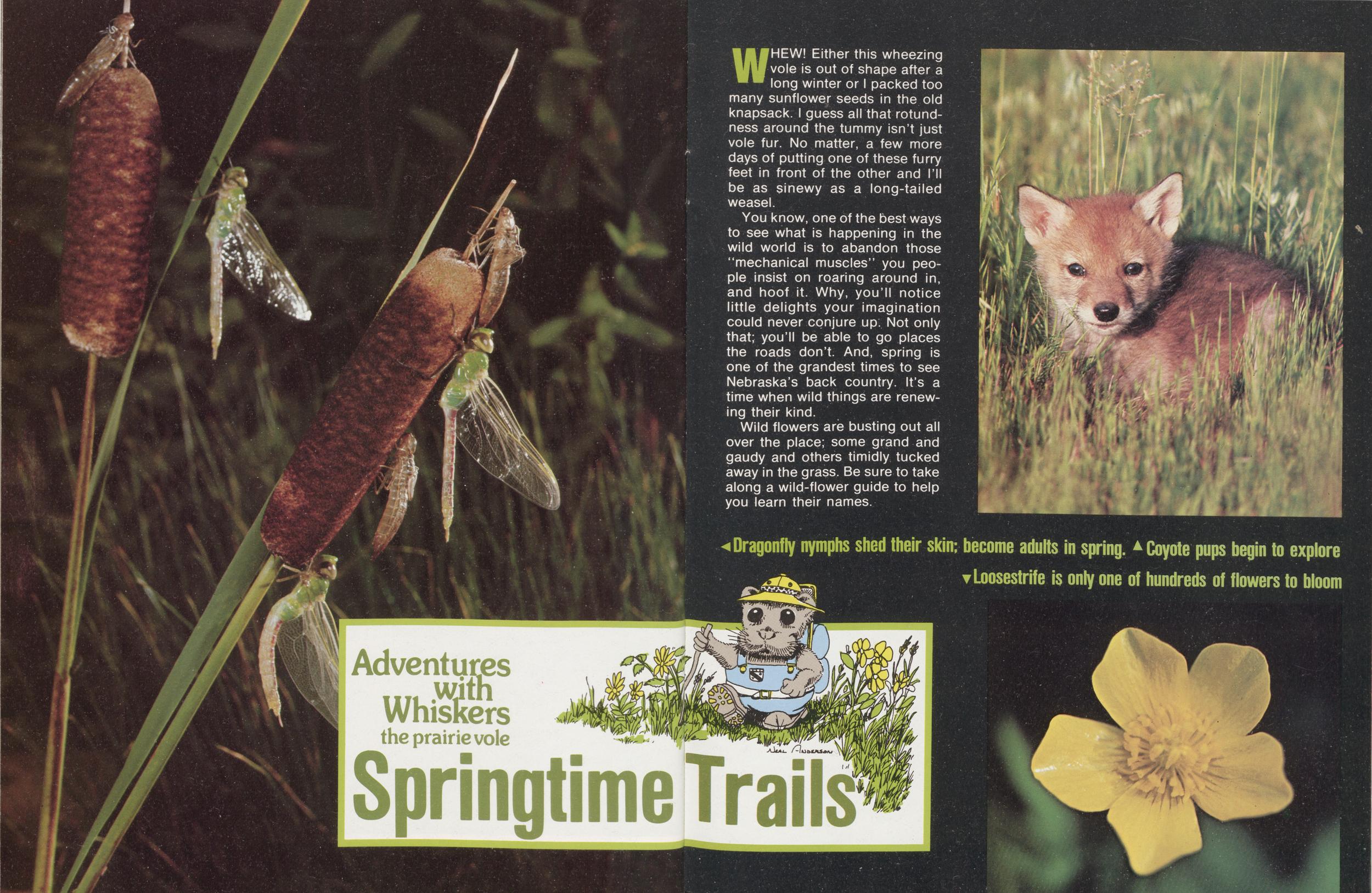
Adventures Whiskers the prairie vole Springtime Trails
WHEW! Either this wheezing vole is out of shape after a long winter or I packed too many sunflower seeds in the old knapsack. I guess all that rotundness around the tummy isn't just vole fur. No matter, a few more days of putting one of these furry feet in front of the other and I'll be as sinewy as a long-tailed weasel.
You know, one of the best ways to see what is happening in the wild world is to abandon those "mechanical muscles" you people insist on roaring around in, and hoof it. Why, you'll notice little delights your imagination could never conjure up. Not only that; you'll be able to go places the roads don't. And, spring is one of the grandest times to see Nebraska's back country. It's a time when wild things are renewing their kind.
Wild flowers are busting out all over the place; some grand and gaudy and others timidly tucked away in the grass. Be sure to take along a wild-flower guide to help you learn their names.
Dragonfly nymphs shed their skim become adults in spring.
Coyote pups begin to explore
Loosestrife is only one of hundreds of flowers to bloom
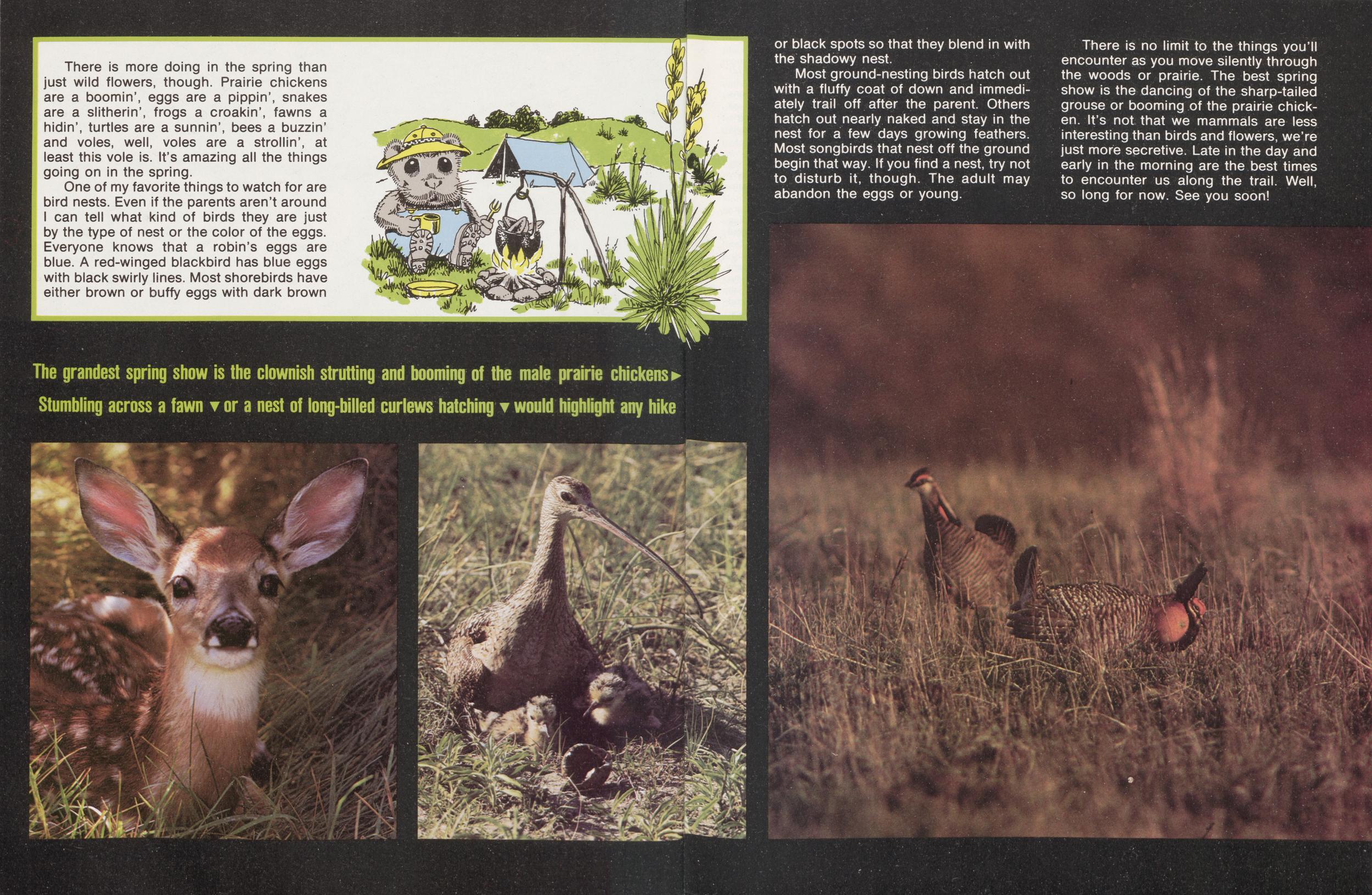
There is more doing in the spring than just wild flowers, though. Prairie chickens are a boomin' eggs are a pippin', snakes are a slitherin', frogs a croakin', fawns a hidin', turtles are a sunnin', bees a buzzin' and voles, well, voles are a strollin', at least this vole is. It's amazing all the things going on in the spring.
One of my favorite things to watch for are bird nests. Even if the parents aren't around I can tell what kind of birds they are just by the type of nest or the color of the eggs. Everyone knows that a robin's eggs are blue. A red-winged blackbird has blue eggs with black swirly lines. Most shorebirds have either brown or buffy eggs with dark brown
or black spots so that they blend in with the shadowy nest.
Most ground-nesting birds hatch out with a fluffy coat of down and immediately trail off after the parent. Others hatch out nearly naked and stay in the nest for a few days growing feathers. Most songbirds that nest off the ground begin that way. If you find a nest, try not to disturb it, though. The adult may abandon the eggs or young.
There is no limit to the things you'll encounter as you move silently through the woods or prairie. The best spring show is the dancing of the sharp-tailed grouse or booming of the prairie chicken. It's not that we mammals are less interesting than birds and flowers, we're just more secretive. Late in the day and early in the morning are the best times to encounter us along the trail. Well, so long for now. See you soon!
FLORENCE...A TOWN OF THE TIMES
(Continued from page 13)had been left in charge of the Mormons on the Iowa side of the river, relinquished their interests there and set up business in Winter Quarters, and soon changed its name to Florence in honor of James C. Mitchell's adopted daughter.
Mitchell, one of the two men, went on to become a leading citizen in the new community, both politically and financially.
Mormon settlement and subsequent activity was a great influence on the budding community. Its location was about ideal for settlement, and business prospered because of the many people needing supplies for the journey west. Among them were many thousands of Mormons, who continued to outfit expeditions to Salt Lake City from there. In fact, the first and nearly last of the famous "hand-cart" expeditions started from Florence, with 10 originating from there between 1856 and 1858. These came about because of the prohibitive expense of horses, oxen and wagons, so people merely loaded their basic belongings into handcarts and walked away. The first three groups in 1856 made the journey successfully in about 10 weeks, but the fourth and fifth expeditions that year did not fare so well. They left too late in the season, one in mid August and the other two weeks later.
Poorly equipped, worn down from physical exertion and met by severe storms in Wyoming, both late groups suffered heavy losses. Approximately 20 percent of both, over 215 persons in all, died along the trail.
But, death was no stranger to the Mormon movement. During that first winter in Winter Quarters, an estimated 600 persons died. Another 600 went off to fight in the Mexican War, putting an extra burden on those left behind.
Burial of those lost in the first winter was in a spot now preserved as the Mormon Pioneer Cemetery at 33rd and State streets. This site had previously been a burial place for Indians. Records show that hundreds were buried there after a three- day battle between the Sioux and Omahas.
It may well be the most fortunate fact of humanity that time heals all wounds, and even the most grievous events may become matters or pride when those directly affected are no longer around to suffer.
Much of Florence's history is tragic, but all is interesting. Now, that history is heritage for a community which appreciates its past, but knows how to deal with it in practical and interesting ways.
The mill established in 1846, for example, is still there. It is not in its original location, nor is it operating, but it could be restored with work and money. Certainly 44 NEBRASKAIand there is interest, but there are many other places, many projects, also requiring money.
As evidence of what can be done, and without excessive expenditure, is the Florence Depot. Reputed by some to be the oldest depot in the state, the depot served for 86 years at 28th and Grebe streets. The depot's ancestry is long and involved, with ownership passing from possibly the first owner, the Omaha and North Western Railroad, which operated between Omaha and Blair in 1870. At any rate, what eventually became the Chicago and Northwestern depot was taken out of use by that railroad in 1966, and was sold to the Florence Pioneer Days Association in 1970. Since then, $12,000 was spent the first year for moving, setting up and fencing. Later, nearly $6,000 went for new roof, shutters, paint, and grounds work, and another $10,000 was needed to renovate the interior. A major project was replacing the original bricks around the building.
Now, however, the depot is as good as new, and certainly it would warm the heart of any turn-of-the-century trainman. Even the signal arm is again in place. The entire project is a major and commendable accomplishment, but only yards away is another vast project that must stand and wait. It is the "Steamboat" house, located on the grounds of the Florence Pumping Station. Built in 1887 as a residence for the chief engineer of the American Water Works Company, it is a modest mansion originally heated by three fine fireplaces. Later it was converted to utilize steam piped from the nearby power plant. While requiring sizable funds for repairs and furnishing, its value for tourist purposes would be considerable. And, although that house would be a tremendous attraction, it is just one of dozens of projects and points of interest that community boosters could boast about if they so desired. And, many locals are not shy about bragging up their town. The Florence Bank is a major source of pride, as it is completed and is "downtown" where it can be easily displayed.
With a history almost as old as the town itself, the bank was chartered in 1856 by the Territorial Legislature, and the two- story brick office was built that same year. Upstairs was an apartment for the president. The original vault, with its thick concrete walls and steel plate, is intact. In the back room is a collection of miscellaneous antique material.
Also refurnished in period style is the apartment upstairs, part of which was converted into the locai telephone exchange in 1906. This small office, with its switchboard and other early equipment, is quaint and interesting. So is the apartment, including the kitchen.
The bank project was undertaken by the Florence Historical Foundation, the second major group vitally interested in the local history. Some people are members of MAY 1978 both it and the Pioneer Days organization, but there is some measure of competition. Perhaps that is healthy, for much has been and is being done there.
For the outsider, there is nothing to mar the pleasure of visiting the community. Discovering the old mill, knowing that its gears and wheels turned at one time to grind grain which was subsequently trundled across the continent to a new home in Utah, or Oregon, or California, is marvelous. Certainly a number of people would gladly donate money to renovate and restore the old mill.
Some sources say the mill originally was used to saw lumber, but others claim it was to grind grain. There were several remodeling and modernizing projects over the years, with the original water wheel replaced by steam, apparently in 1880. Then, in the early 1920's, electricity went in.
While most folks see and appreciate the various landmarks in and around Florence only during the annual Pioneer Days celebration in May, there are many who seem to think of little else all during the year. Various committees and organizations and individuals seem totally devoted to preserving Florence's facilities and to promoting its attractions. Certainly the Mormon Cemetery draws a great number of visitors, but there is much else to see and ponder. Florence is nearly midway between Fort Omaha and Fort Atkinson, and looks upon both yet as valued neighbors as it did in the old days-although not now for protection.
Recently, one of the original water wells at Winter Quarters was thought to be discovered. Those wells were built to rather exacting specifications, approximately 30 feet deep and stone lined. It is thought that other wells can now be located, which in turn will help determine the exact location of other structures.
It is interesting to note that as early as the summer of 1846, an ordinance was passed in Winter Quarters involving dogs. There must have been numerous complaints, so it was ordered that "all dogs shall be chained from sundown until 7 a.m." Open burning was also prohibited due to the tall grass in the area.
Things really don't change much. And, the people of Florence will continue to work on their history for their own and others' benefit, and will keep changes to a minimum. They feel there are so many projects yet to be done. There is the cobbler's building, now serving as a business office. There is the old library, now owned by locals and refurbished to continue serving as part of the town's heritage. And, there are many projects that may eventually find the community of Winter Quarters or early Florence again on the maps; a place to be discovered by modern explorers or settlers. It is a romantic and stirring thing to contemplate, and doubtless is challenging to work on for those indominatable residents of Florence.
LIGHTENING THE LOAD
(Continued from page 37)light. With a little ingenuity you can construct a wilderness palace.
BACKPACKS
You are accumulating quite a bit of gear and you need a way to carry it. Packs and pack frames have come a long way in the past 15 years. When considering a pack, first look at the support frame. The simple, straight metal frame was a revolution some years ago. Today's models are simple, strong and well-made. Actually, the "straight frame" is usually S-shaped to conform to the human spine.
When looking for a straight-frame pack, look for a well constructed frame that fits you. Basically, there are two types: the welded frames and more recent designs that have metal "block receptacles" to join the tubing. They are probably comparable in strength.
Whatever frame you choose, it should have a hip belt that is well padded and shifts the load off your shoulders onto your hips and legs, which are stronger. Shoulder straps should also be well padded. Look for a solid structure and reinforcement at the grommets where the straps attach to the frame. The clevis pin construction is best for a frame attachment whether it be the strap or the pack bag itself. Be a little leary of bags and straps that attach by sewn pockets or loops. The metal bolt-like clevis pin and steel ring is the best option. Frames that are attached to pack bags or are held together with nuts and bolts are a constant hassle. Losing a nut that holds on a shoulder strap, for example, can have disatrous consequences. If you buy a bag with nut and bolt construction, carry along extras.
The wrap-around frame has come into its own in recent years. This style extends and wraps the lower frame around, thus forming a sort of open-ended cage. The suspension is designed to load the legs more effectively. Proponents claim it a shoulder-saving breakthrough; opponents term it a shoulder backdrag. Best advice is probably that if a frame fits you and is comfortable, buy it. Simplicity in outdoor gear is essential. The wrap-around gear is more complex, thus a potential weakness. An internal frame is another option. This type of frame has a fiberglass or metal backbone that is sewn in and supports the pack bag. This "frameless' style is excellent for climbing and skiing.
As you can see, frames are varied. The best advice is choose carefully and buy the frame that fits you. If its a little uncomfortable at first, it will be unbearable 5 miles and 40 pounds later.
Buying a packbag, thankfully, is a bit more straightforward. The packbag should be of substantial material with tight double and triple stitching throughout. Look for lots of pockets and leather patches and loops for lashing. Buy a pack designed for the things you will put into them. Don't buy a packbag with 23 small pockets when you carry only a big stove or a 3,000 mm lens for your camera. If you plan to backpack in winter, consider a single cavity packbag to accommodate bulky clothing and gear. If you plan to hike weekends during spring, summer or fall, a two-compartment bag can be good for organization.
Look for big nylon zippers throughout with flaps over the zippers to keep precip- itation out. Sewn loops, unless reinforced and super stitched, will tend to pull out with time. Stick with a single, well con- structed nylon packbag with nylon zippers and zipper flaps, lots of pockets with few or no sewn loops. Buy the packbag keep- ing in mind the things you will be doing with it.
SLEEPING BAGS
After a hard trek, a warm, comfortable place to sleep is a must. A sleeping bag can be a real delight. When buying a bag, keep to nylon, always considering the weight factor. I feel that the mummy style, which encloses the head (remember 85% of your body heat leaves through your head) is superior to the rectangular ver- sion. Look for tight stitching and quality construction and features, like inside flaps to cover zippers, thus providing a warm seal for the bag. There are many factors to consider when buying a bag, but of prime concern is the type of filling.
Until recently there was only one super effective insulating material used for fill in sleeping bags—good old goose down. Down, gathered from select geese, offered quality insulation and was not only light and compact but warm. Down is indeed an excellent choice under good condi- tions. Good conditions are usually hard to come by in the wilds, however, and rain, snow and condensation render down worthless.
"Okay, you made 35 cents-but I wouldn't give up your paper route yet."
Down, once wet, retains moisture and loses its insulating properties. It mats and may take several days to dry out. If your down bag gets wet, you're thus without warmth for several days. That can be a serious situation.
Alternative materials have recently appeared on the market in the form of syn- thetic fibers. Fiberfill II (also Dacron II and Polar Guard), are admittedly heavier than down (10% more), and bulkier (25% more), but they have qualities worth considering. When wet, even soaking wet, the fiber will not mat, but will retain loft and warmth. The synthetic materials dry extremely fast and they are much more rugged than down.
These two fills are basically the same except that Polar Guard has longer fibers, thus it doesn't seem to shift and clump quite as much as the Fiber Fill II. Both offer good insulation under all environmental conditions. Couple this with their lower costs and ease of cleaning (bathtub with mild soap) and you will probably decide that your next bag should be one with a synthetic fiber fill.
STOVES AND COOKING SYSTEMS
Any pots that are light weight will do for backpacking, but round, easily cleaned pots are best. The most useful sizes are one, two and three quarts.
Stoves are many and varied. Development of the light-weight backpacking stove has blossomed recently. Almost all backpacking stoves require priming, generating a pressure within the fuel tank which in turn pushes fuel up to the nozzle, providing you with a flame to cook. There is also the option of bottled butane or propane gas stoves. These stoves tend to perform poorly in cold weather, plus you must tote around the full and expended containers.
Among the small backpackers stoves, the pump-type is probably the top choice. Pump stoves develop their own pressure, and eliminate the hassle of priming and preheating. As in purchasing all outdoor gear, look for simplicity. Try to keep in mind those cold mornings when you might be trying to get your stove started. The complex stove is apt to give a bigger ration of grief.
Here is the equipment list that I mentioned earlier. But remember, it's flexible.
Equipment List (Summer) 1 pair hiking boots (well broken in) 4 pair wool socks (2 inner, 2 outer) 1 pair boxer shorts 1 T-shirt (fishnet works well) 1 long-sleeved shirt (flannel) 1 pair long pants (loose and baggy) 1 pair walking pants 1 swim suit (optional) 1 hat (wide brimmed for sun protection) 1 pair tennis shoes or moccasins (for camp wear) 1 vest 1 windbreaker or 60/40 shell parka 1 pair gloves (for handling pots) 1 light-weight parka 1 small towel 2 bandannas 1 poncho 1 water bottle or canteen 1 bowl, cup, spoon 1 bar soap 1 roll toilet paper sunscreen hand lotion chapstick toothbrush and paste insect repellent sunglasses Equipment List (Winter) 1 pair felt-lined boots (well broken in and waterproof) 4 pair wool socks (2 outer, 2 inner) 2 pair long underwear (wool, wool blend) 1 pair boxer shorts 1 pair wool pants 1 long-sleeved shirt, wool 1 wool sweater 1 undershirt (fishnet works best) 1 wool stocking cap 1 pair wool mittens with overmitts or wind shell 1 pair wool gloves 1 vest (down or synthetic fiber) 1 windbreaker or 60/40 shell parka 1 warm parka with hood 1 poncho (rain protection, emergency shelter and ground cloth) 1 pair gaitors 2 bandannas 1 pair camp boots (down or fiberfill booties with overboots) 1 water bottle or canteen 1 bowl, cup, spoon 1 bar soap 1 roll toilet paper sunscreen sunglasses toothbrush and tooth powder chapstick necessary toiletries and medications "Ten Essentials" Kit (all seasons) compass maps matches in waterproof container candle flashlight with extra batteries and bulb pocket knife first-aid kit whistle emergency food space blanketBRING ON THE CATFISH
(Continued from page 38)Fremont, Dead Timber or Hord lakes, is benefitting from these stocked catfish. It's the same story for Carter, Burchard, Verdon, and many of the Salt Valley lakes around Lincoln. In all, 38 bodies of water are being stocked with cats.
Most of Nebraska's other major reservoirs support naturally reproducing catfish populations. Between these lakes and stocked waters, the most is being made of Nebraska's catfishing potential.
Though many of these specially raised catfish are stocked in eastern Nebraska lakes, the western part of the state also gets a good percentage of them. Some 25,000 will be stocked in the North Platte River next August, joining the 33,000 study fish placed there over the past two years.
Normally, it would not be necessary to stock channel catfish in any part of the Platte River in Nebraska. However, the Belmont Diversion a few miles above Bridgeport blocks upstream movements of catfish and all other gamefish except rainbow trout.
Young catfish hatched above the diversion mostly migrate downstream over the diversion, and are unable to return as adults. Many other small catfish hatched in the stream are diverted into irrigation systems and die there. Fish screens to keep fish out of irrigation systems would be very costly, and they would also be very
TEACH ANY DOG IN MINUTES W±f Complete system, book and device. All you need to raise and train puppies, dof s of all af.es Never fails! Uses dot's keenest learninf sense. CORRECTS • HOUSE SOILING • JUMPING • CHEWING • BARKING • BITING DIGGING • GUN SHY • BREAKING POINT • OVER RANGING • BUSTING BIROS SIMPLE EASY TO USE NOT ELECTRONIC ' TEACHES > COME - at all times' ' SIT • GO HEEL • SELF CONTROL STAY • GUARD ' DROP •FETCH (Lasting, even in your absence1 'WORKS with YOU—NOT off for himself ON TV with: Art Linkletter, Johnny Carson, Dick Cavett, Mike Douglas, Merv Griffin, "The Pet Set," "Friends of Man." ARTICLES: TIME magazine, NEW TIMES, HUNTING DOG and other worldwide publications A scientific engineering marvel. This psychological dog sound maker is used from the palm of the hand. Gives amazing control at a distance. "Works like magic.'' No leash needed. "Tunes dogs in." Makes dogs seem to "read your mind." Novices become experts. Teaches direct to the dog's mind via a new subliminal sound learning stimulus. Safe, faster, kinder, more effective. Renders all slower pain-train ing obsolete. Same instrument and system (utilizing the Dr. Miller patents) dispensed by veterinarians for dog behavior. Now hundreds and thousands of satisfied users, breeders, trainers, USA. and foreign lands iilustrated doc psychology book-brochure. DOG-MASTER SYSTEMS Dept.NU-7 710 Wilshire Blvd., Suite 318, Santa Monica. Calif. 90401 A division of Environmental Research Labs. Copyright 1977
". . . Now there's a tragic sight. . . he just heard the bass were biting at the lake and he can't get his car started." Tullers Medicine Creek Lodge Air-Conditioned Cabins, $75 per week and up. Rented by week only. Make Reservations Early Cafe • Boats • Motors • Gas • Oil Bait • Guide Service • Fish and Hunt Supplies and Permits. Ideal Hunting 1,768 Acres of Water 5,526 Acres of Public Hunting Land BOX 88, R.D. 2 CAMBRIDGE, NEB. 69022 PHONE 697-3774
LEROY'S UNSNAGGER Unconditionally Guaranteed. Save your expensive and favorite lures and don't avoid the good fishing spots because of snags. LeRoy's UnSnagger will save you lures worth many times its cost. If not available at local fishing supply center, send $5.00 plus 50c shipping charge to: LeRoy's Unsnagger, Inc. 3840 North 14th Street Lincoln, NE 68521 Phone: (402) 432-5251 or 423-1972
NEBRASKAIand MAY 1978
the Admiral's Cove
Formerly "French's Paradise"
troublesome because of the small mesh size needed. With these heavy losses, it's questionable if the catfish population can sustain itself there with natural reproduction. Thus, the 54 miles of river from the structure to the Wyoming line is nearly devoid of cats, even though there is excellent habitat.
The potential offered by that stretch of the North Platte was not known until floods in 1971 and 1973 allowed catfish and other game fish to get past the diversion. For a time after those floods, anglers reported good catfishing. But, without reproduction and repopulation from downstream, fishing pressure and natural mortality apparently depleted those populations.
At six to 10 inches, the two-year-old catfish now being stocked by the Game and Parks Commission along those 54 miles of river should do quite well. Biologists hope that these older fish will not move downstream to the extent that yearlings do, and will therefore maintain a fishable population in that area. The stocking program is being monitored closely with tagging, fishing success surveys and other studies.
Another operation being performed on a limited scale is the culture of catfish in submerged cages in various waters, with large numbers of yearlings placed in the cages and fed regularly. The ideal diet and temperature make for rapid growth in a relatively short time. At the end of the summer, the fish are released into the lake.
So far, this concept has been used by schools tending cages at Papio lakes near Omaha, the lakes of Kearney County State Recreation Area, and Windmill and Mormon Island state wayside areas. Other state waters will be added in the future under the supervision of the Fisheries Division.
The cage culture, the work on Nebraska's rivers, and the intense stocking program all point to one fact that Game and Parks Commission fisheries biologists have come to understand over the years: to keep Nebraska fishermen happy, keep 'em in catfish. The Commission's hatcheries and fish management people plan to do just that.
Trading Post
DOGS BEAGLES Puppy love for sale. We have the perfect family companion or hunting partner for you. Champion dams and/or sire. Tux Beagles, Route 1, Box 152, Raymond, NE 68428 (402) 475-3713. GOLDEN RETRIEVERS: Potential Champions-Sire and Dam X-Rayed-Hips Normal. Results of 25 years of careful, selected breeding. Over 25 Amtr. Fid., Fid. Champions and Champions including National Field Champions-Beautywood's Tamarack and Ready Always of Marianhill in the pedigrees. Litters due early May. Call or write: Darrell Smejkal, 2402 Fairview Drive, Norfolk, NE 68701 Phone: (402) 371-9633. MISCELLANEOUS DUCK HUNTERS: learn how, make quality, solid plastic, waterfowl decoys. We're originators of famous system. Send $.50, colorful catalog. Decoys Unlimited, Clinton, Iowa 52732. GUNS-Browning, Winchester, Remington, others, Hipowers, shotguns, new, used, antiques. Want Pre-1964 Winchesters. Buy-Sell-Trade. Ph. (402) 729-6112. Bedlan's Sporting Goods, Fairbury, NE 68352. WANTED-)APANESE SWORDS, fittings, related objects. Serious collector pays'best prices. Call or write Don Hill, 5016 California, Omaha, NE 68132 (402) 558-054G______ CANOE TRIPS. Canoes for rent. WE DO IT YOUR WAY! Dryland Aquatics, 1832 Park, Fremont, Nebraska 68025 (402) 721-5801 or (402) 721-1749. CANOE NEBRASKA . . . WITH WILSON OUTFITTERS! Quality Full-service Canoe-Camping Trips! Statewide Canoe Rental Network (15 locations)! Canoe Specialty Shop in Lincoln at 14th and Cornhusker! For 1978 Brochure . . . Write Wilson Outfitters, 6211 Sunrise Road, Lincoln, Nebraska 68510. FISH FOR SALE: Channel Catfish, Largemouth Bass, Blue- gill, Crappie, Perch, Bullhead, Rainbow Trout and min- nows for pond and lake stocking. Contact the Pleasant Valley Fish Farm, Route 1, McCook, Nebraska 69001. Phone (308) 345-6599. TROUT FISHING-fumished cabin on private lake and stream-up to 5-pound trout taken in 1977. Write Box B, Orchard, NE 68764. NIOBRARA CANYON CANOE TRIPS. The River is up, canoeing is great. Canoe the Niobrara, before its too late. Make reservations for canoe rentals and camping. SunnyBrook Camp, Roy Breuklander, Sparks, NE 69220. Camp (402) 376-1887, Ranch (402) 376-3219. GRANDPA'S WOODS: "The Quiet Campground". For a quiet, relaxing experience, camp, fish and golf at Grandpa's Woods. Located two miles north, one mile east and one-half mile north of Elmwood, NE. CASH PAID for the following items made by Winchester gun company: Older rifles, shotguns, pocket knives, tools, sporting equipment, fishing gear, and others. Also want cartridge boards, posters, calendars, catalogs before the 1940's from any firearm or ammunition company. Please give price and condition in first letter. Write: WINCHES- TER, Box 30004, Lincoln, NE 68503. SPORTSMAN'S CORNER. Located next to Sherman Dam. This business is a large enterprise and shows excellent profit. Consists of cafe, on- and off-sale of beer, grocery corner, fishing equipment supplies, gas pumps and large recreation room. Also has 3 rental mobile homes plus ap- proximately 4 acres for more expansion. A very good in- vestment. Clara Smith Realty, 3119 2nd Avenue, Kearney, NE 68847 Phone (308) 236-5451. INVESTMENT PROPERTY. All brick building. This unit consists of 22 bedrooms, 4 bathrooms, a large reception area plus 2 large live-in apartments on main floor. This unit would make someone a very good income invest- ment. (In Ravenna, NE.) Call this office for information. Clara Smith Realty, 3119 2nd Avenue, Kearney, NE 68847 Phone (308) 236-5451. CAFE. Located in Ansley, NE. This unit seats 60 people, also has a game room with pinball machines, pool table, juke box, electronic game, etc. The building is in excellent shape and has a very profitable, going business. Ideal fam- ily-operation business. Call for more information. Clara Smith Realty, 3119 2nd Avenue, Kearney, NE 68847 Phone (308) 236-5451. BUILD YOUR OWN home smoker!!! Inexpensive ... My own tried and proven brine recipe and instructions for smoking fish, etc. Send $1.00 to R. E. Woods, 625 Navajo, Council Bluffs, Iowa 51501. TAXIDERMY BIG BEAR TAXIDERMY, Rt. 2, Mitchell, Nebraska 69357. We specialize in all big game from Alaska to Nebraska, also birds and fish. Hair on and hair off tanning, 4 1/2 miles west of Scottsbluff on Highway 26. Phone (308) 635-3013. KARL SCHWARZ Master Taxidermists. Mounting of game heads-birds-fish—animals—fur rugs-robes—tanning buckskin. Since 1910. 424 South 13th Street, Dept. A, Omaha, Nebraska 68102. FISH MOUNTING Service. Specialize in all fresh-water fish. Visitors welcome. Wally Allison, 2709 Birchwood North Platte, NE 69101, (308) 534-2324. CREATIVE TAXIDERMY. Modern methods and life-like workmanship on all fish and game since 1935, also tanning, rugs, and deerskin products. Joe Voges, Naturecrafts and Gift Shop, 925 4th Corso, Nebraska Citv, NE 68410. Phone (402) 873-5491 COMPLETE TAXIDERMY SERVICE. We take pride in your satisfaction. We will help you go hunting and fishing—exclusive agent, Jack Jonas Safaris. Brochure and price list. Dinges Taxidermy Studio, 2760 S. 12th Omaha, NE 68108 (402) 342-3718.NEBRASKAIand Magazine Order Form
Please send me a subscription to NEBRASKAIand, with a free bonus subscription to Afield and Afloat. □ One-year $5 □ Two-year $9 □ Three-year $12.50 STATE____ NAME___ ADDRESS_____ CITY_____ ZIP____ Ma/7 to: NEBRASKAIand, Box 30370, Lincoln, NE 68503GUN DOG TRAINING
All Sporting Breeds
Each dog trained on both native game and pen-reared birds. Ducks for retrievers. All dogs worked individually. Field Champion-sired labrador pups for sale. Midwest's finest facilities. WILDERNESS KENNELS Henry Sader-Roca. Nb. (402)423-4212 68430J'S OTTER CREEK MARINA
NORTH SIDE LAKE McCONAUGHY HWY. 92-OPEN YEAR AROUND ALL MODERN MOTEL • CAFE • BAIT • TACKLE GAS • BOAT RENTALS # HUNTING and FISHING LICENSES • ON and OFF SALE BEER • PHONE LEMOYNE 308-355-2341 P.O. LEWELLEN, NEBR. 69147 JAY and JULIE PETERSONLIMITED FIRST EDITION First Time Offered BIG MAC
Complete structure fishing book for when, where, how to find the big ones in Lake McConaughy. Includes aerial and over 40 photos showing Hot Spots all over lake. Written and photographed by Jay S. Warburton, nationally known outdoorsman, and photo-journalist. With this book you can locate every underwater structure. Send only $2.50 to: Big Mac, Stephens Press, 1414 Evans, Sterling, Colo. 80751 (For autographed copy, send only $3.50 and address in care of author)MUTCHIE'S frhfiMn. ZnksL RESORT Upstairs Anchor Room Lounge Cold Beer-On/Off Sale
Lakefront cabins with swimming beach • Fishing tackle • Boats and motors • Free boat ramp • Fishing • Swimming • Cafe and ice • Boating and skiing • Gas and oil • 9-hole golf course just around the corner • Live and frozen bait • Pontoon, boat and motor rentals. WRITE FOR FREE BROCHURE or phone reservations 785-2298 Elwood, Nebraska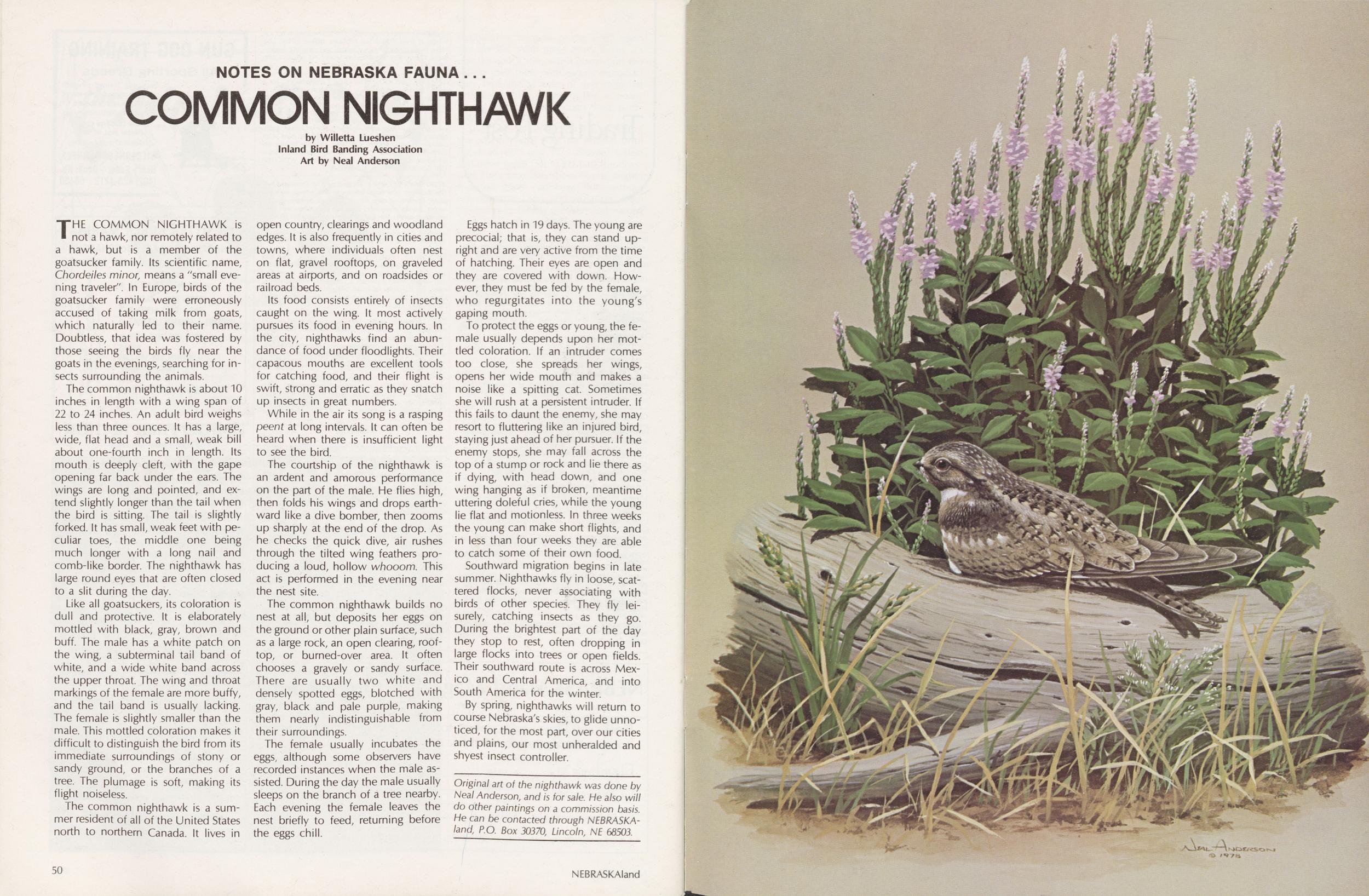
NOTES ON NEBRASKA FAUNA.. . COMMON NIGHTHAWK
THE COMMON NIGHTHAWK is not a hawk, nor remotely related to a hawk, but is a member of the goatsucker family. Its scientific name, Chordeiles minor, means a "small evening traveler" In Europe, birds of the goatsucker family were erroneously accused of taking milk from goats, which naturally led to their name. Doubtless, that idea was fostered by those seeing the birds fly near the goats in the evenings, searching for insects surrounding the animals.
The common nighthawk is about 10 inches in length with a wing span of 22 to 24 inches. An adult bird weighs less than three ounces. It has a large, wide, flat head and a small, weak bill about one-fourth inch in length. Its mouth is deeply cleft, with the gape opening far back under the ears. The wings are long and pointed, and extend slightly longer than the tail whe the bird is sitting. The tail is slightly forked. It has small, weak feet with peculiar toes, the middle one being much longer with a long nail and comb-like border. The nighthawk has large round eyes that are often closed to a slit during the day.
Like all goatsuckers, its coloration is dull and protective. It is elaborately mottled with black, gray, brown and buff. The male has a white patch on the wing, a subterminal tail band of white, and a wide white band across the upper throat. The wing and throat markings of the female are more buffy, and the tail band is usually lacking. The female is slightly smaller than the male. This mottled coloration makes it difficult to distinguish the bird from its immediate surroundings of stony or sandy ground, or the branches of a tree. The plumage is soft, making its flight noiseless.
The common nighthawk is a summer resident of all of the United States north to northern Canada. It lives in open country, clearings and woodland edges. It is also frequently in cities and towns, where individuals often nest on flat, gravel rooftops, on graveled areas at airports, and on roadsides or railroad beds.
Its food consists entirely of insects caught on the wing. It most actively pursues its food in evening hours. In the city, nighthawks find an abundance of food under floodlights. Their capacous mouths are excellent tools for catching food, and their flight is swift, strong and erratic as they snatch up insects in great numbers.
While in the air its song is a rasping peent at long intervals. It can often be heard when there is insufficient light to see the bird.
The courtship of the nighthawk is an ardent and amorous performance on the part of the male. He flies high, then folds his wings and drops earthward like a dive bomber, then zoom up sharply at the end of the drop. As he checks the quick dive, air rushes through the tilted wing feathers producing a loud, hollow whooom. This act is performed in the evening near the nest site.
The common nighthawk builds no nest at all, but deposits her eggs on the ground or other plain surface, such as a large rock, an open clearing, rooftop, or burned-over area. It often chooses a gravely or sandy surface. There are usually two white and densely spotted eggs, blotched with gray, black and pale purple, making them nearly indistinguishable from their surroundings.
The female usually incubates the eggs, although some observers have recorded instances when the male assisted. During the day the male usually sleeps on the branch of a tree nearby. Each evening the female leaves the nest briefly to feed, returning before the eggs chill.
Eggs hatch in 19 days. The young are precocial; that is, they can stand upright and are very active from the time of hatching. Their eyes are open and they are covered with down. However, they must be fed by the female, who regurgitates into the young's gaping mouth.
To protect the eggs or young, the female usually depends upon her mottled coloration. If an intruder comes too close, she spreads her wings, opens her wide mouth and makes a noise like a spitting cat. Sometimes she will rush at a persistent intruder. If this fails to daunt the enemy, she may resort to fluttering like an injured bird, staying just ahead of her pursuer. If the enemy stops, she may fall across the top of a stump or rock and lie there as if dying, with head down, and one wing hanging as if broken, meantime uttering doleful cries, while the young lie flat and motionless. In three weeks the young can make short flights, and in less than four weeks they are able to catch some of their own food.
Southward migration begins in late summer. Nighthawks fly in loose, scattered flocks, never associating with birds of other species. They fly leisurely, catching insects as they go. During the brightest part of the day they stop to rest, often dropping in large flocks into trees or open fields. Their southward route is across Mexico and Central America, and into South America for the winter.
By spring, nighthawks will return to course Nebraska's skies, to glide unnoticed, for the most part, over our cities and plains, our most unheralded and shyest insect controller.
Original art of the nighthawk was done by Neal Anderson, and is for sale. He also will do other paintings on a commission basis. He can be contacted through NEBRASKAland, P.O. Box 30370, Lincoln, NE 68503. 50 NEBRASKAIand
Catch! a Coke!
Registered Trademark (§) of Coca-Cola Co. ...a FREE 8-pack to master anglersAnyone catching a fish large enough to qualify for a Nebraska Game and Parks Commission "MASTER ANGLER AWARD" will also receive a coupon good for a carton of Coke®, compliments of the NEBRASKA Coca-Cola BOTTLERS!
Fishing's the REEL Thing In cooperation with the Nebraska Game and Parks Commission Offer expires September 1.Position: 15 (429 views)