Volume 56, Issue 4, 1978
NEBRASKAland
April 1978 60 Cents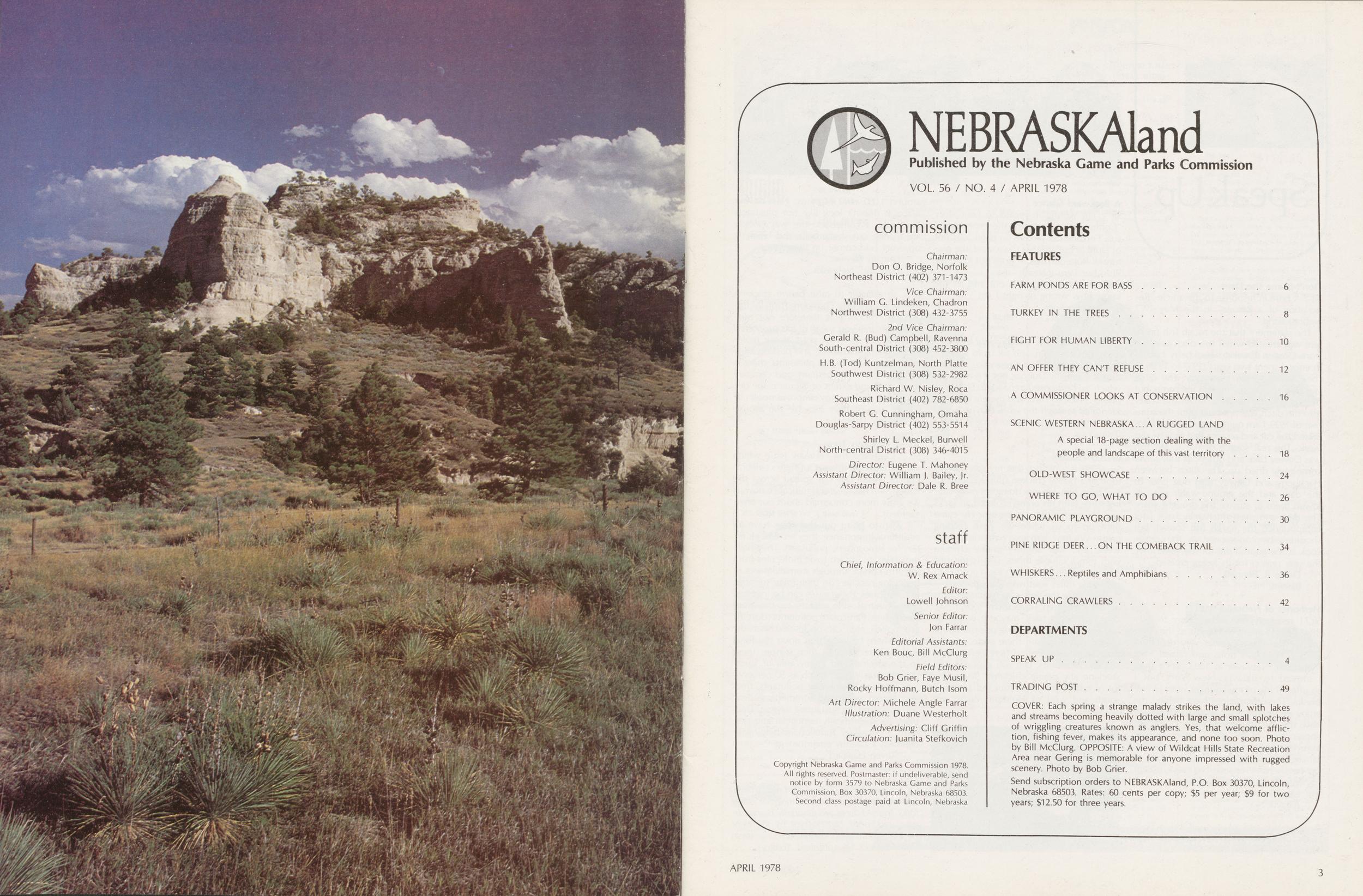
NEBRASKAland
Published by the Nebraska Game and Parks Commission
VOL 56 / NO. 4 / APRIL 1978 commission Chairman: Don O. Bridge, Norfolk Northeast District (402) 371-1473 Vice Chairman: William G. Lindeken, Chadron Northwest District (308) 432-3755 2nd Vice Chairman: Gerald R. (Bud) Campbell, Ravenna South-central District (308) 452-3800 H.B. (Tod) Kuntzelman, North Platte Southwest District (308) 532-2982 Richard W. Nisley, Roca Southeast District (402) 782-6850 Robert G. Cunningham, Omaha Douglas-Sarpy District (402) 553-5514 Shirley L Meckel, Burwell North-central District (308) 346-4015 Director: Eugene T. Mahoney Assistant Director: William J. Bailey, Jr. Assistant Director: Dale R. Bree staff Chief, Information and Education: W. Rex Amack Editor: Lowell Johnson Senior Editor: Jon Farrar Editorial Assistants: Ken Bouc, Bill McClurg Field Editors: Bob Grier, Faye Musil, Rocky Hoffmann, Butch Isom Art Director: Michele Angle Farrar Illustration: Duane Westerholt Advertising: Cliff Griffin Circulation: Juanita StefkovichCopyright Nebraska Game and Parks Commission 1978. All rights reserved. Postmaster: if undeliverable, send notice by form 3579 to Nebraska Game and Parks Commission, Box 30370, Lincoln, Nebraska 68503. Second class postage paid at Lincoln, Nebraska
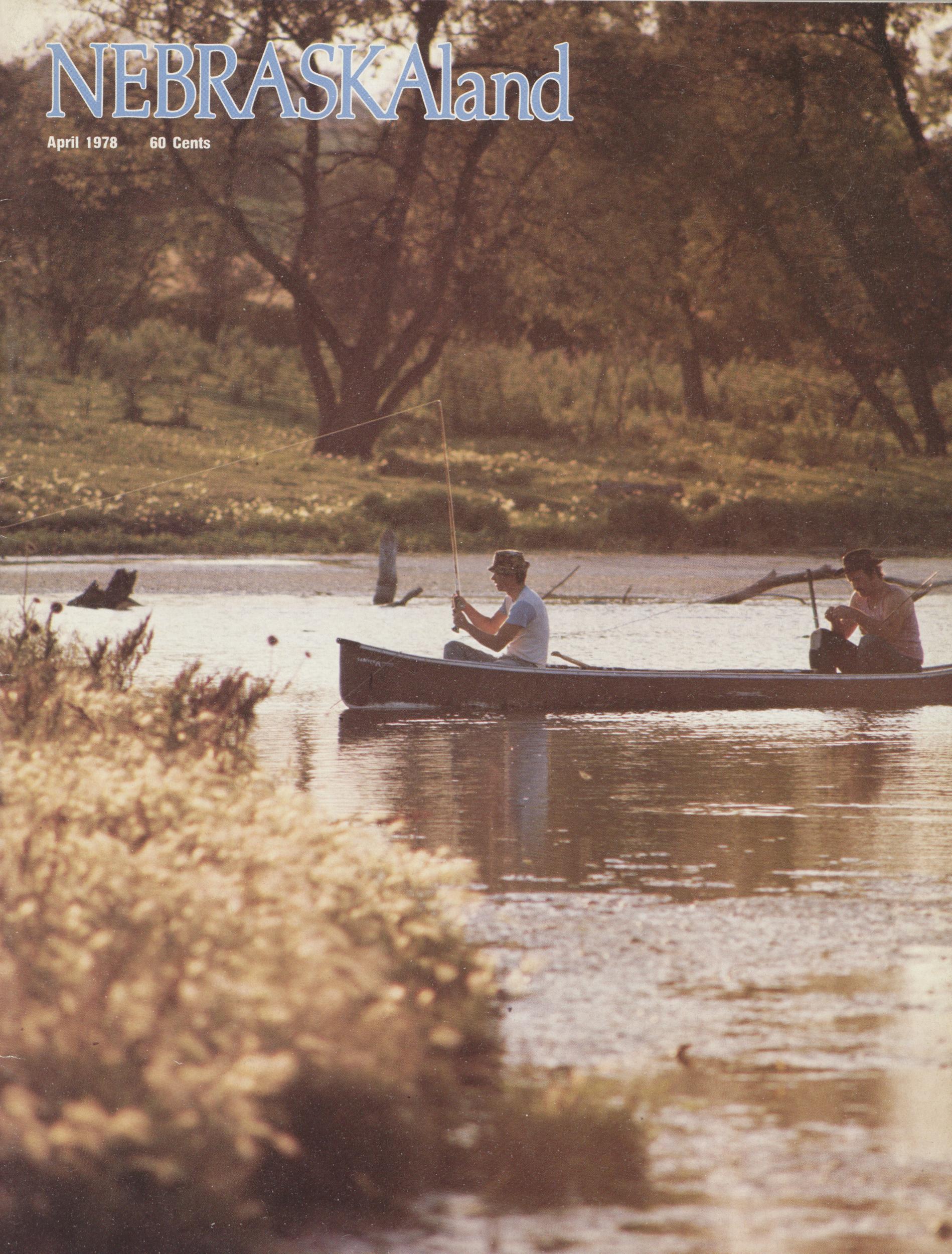
Contents FEATURES FARM PONDS ARE FOR BASS 6 TURKEY IN THE TREES 8 FIGHT FOR HUMAN LIBERTY 10 AN OFFER THEY CANT REFUSE 12 A COMMISSIONER LOOKS AT CONSERVATION 16 SCENIC WESTERN NEBRASKA...A RUGGED LAND A special 18-page section dealing with the people and landscape of this vast territory 18 OLD-WEST SHOWCASE 24 WHERE TO GO, WHAT TO DO 26 PANORAMIC PLAYGROUND 30 PINE RIDGE DEER... ON THE COMEBACK TRAIL 34 WHISKERS... Reptiles and Amphibians 36 CORRALING CRAWLERS 42 DEPARTMENTS SPEAK UP 4 TRADING POST 49 COVER: Each spring a strange malady strikes the land, with lakes and streams becoming heavily dotted with large and small splotches of wriggling creatures known as anglers. Yes, that welcome affliction, fishing fever, makes its appearance, and none too soon. Photo by Bill McClurg. OPPOSITE: A view of Wildcat Hills State Recreation Area near Gering is memorable for anyone impressed with rugged scenery. Photo by Bob Grier. Send subscription orders to NEBRASKAland, P.O. Box 30370, Lincoln, Nebraska 68503. Rates: 60 cents per copy; $5 per year; $9 for two years; $12.50 for three years. APRIL 1978 3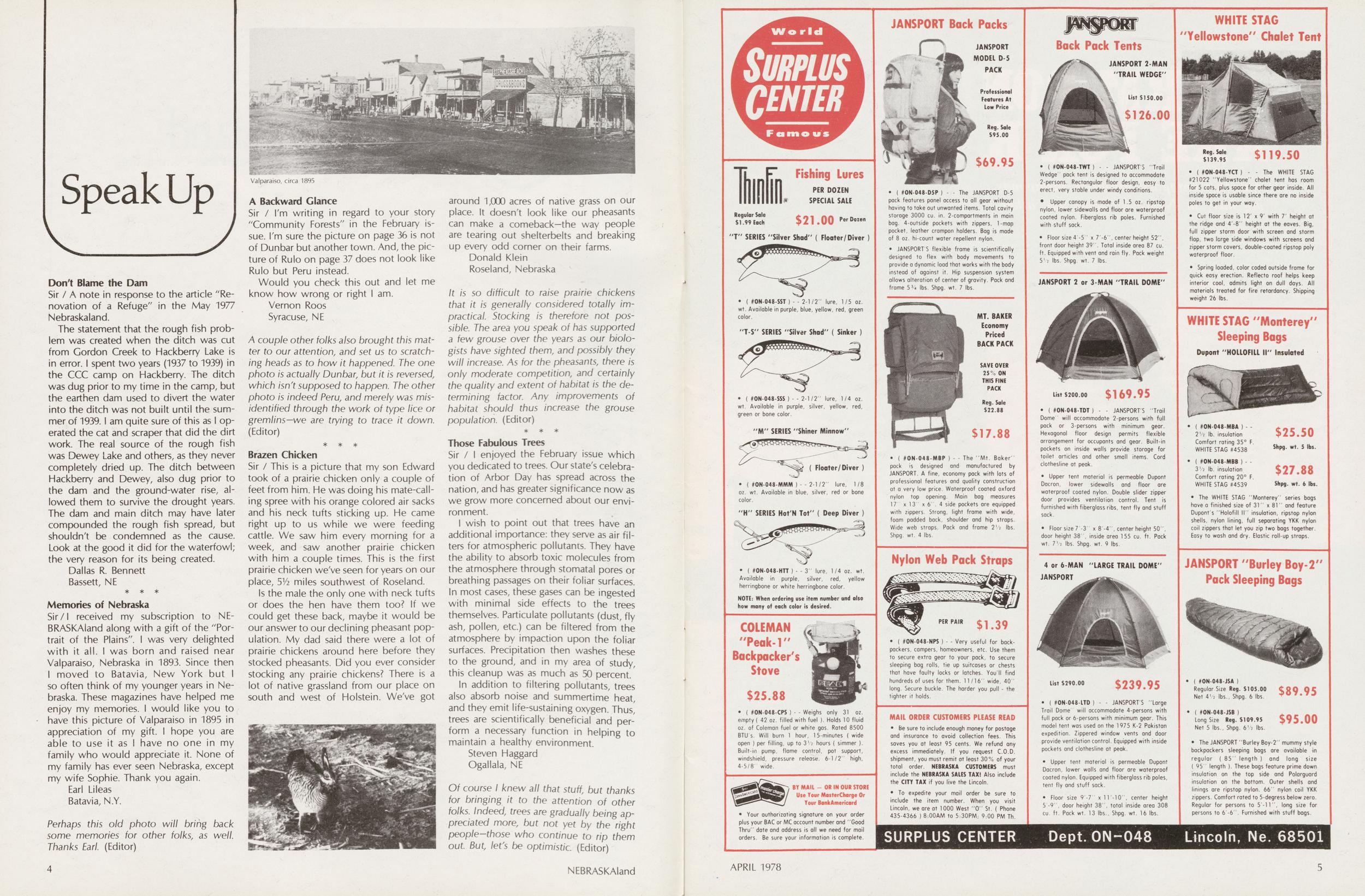
Speak Up
Don't Blame the Dam Sir / A note in response to the article "Renovation of a Refuge" in the May 1977 Nebraskaland. The statement that the rough fish problem was created when the ditch was cut from Gordon Creek to Hackberry Lake is in error. I spent two years (1937 to 1939) in the CCC camp on Hackberry. The ditch was dug prior to my time in the camp, but the earthen dam used to divert the water into the ditch was not built until the summer of 1939. I am quite sure of this as I operated the cat and scraper that did the dirt work. The real source of the rough fish was Dewey Lake and others, as they never completely dried up. The ditch between Hackberry and Dewey, also dug prior to the dam and the ground-water rise, allowed them to survive the drought years. The dam and main ditch may have later compounded the rough fish spread, but shouldn't be condemned as the cause. Look at the good it did for the waterfowl; the very reason for its being created. Dallas R. Bennett Bassett, NE Memories of Nebraska Sir/I received my subscription to NEBRASKAIand along with a gift of the "Portrait of the Plains". I was very delighted with it all. I was born and raised near Valparaiso, Nebraska in 1893. Since then I moved to Batavia, New York but I so often think of my younger years in Nebraska. These magazines have helped me enjoy my memories. I would like you to have this picture of Valparaiso in 1895 in appreciation of my gift. I hope you are able to use it as I have no one in my family who would appreciate it. None of my family has ever seen Nebraska, except my wife Sophie. Thank you again. Earl Lileas Batavia, N.Y.
FARM PONDS ARE FOR BASS
An often untapped resource, farmponds produce more big bass in Nebraska than any othe rtype of water
IF MINNESOTA is the land of 10,000 lakes, perhaps Nebraska should be called the land of 50,000 farmponds. A somewhat dubious distinction, perhaps, and you may never see a bumper sticker proclaiming the fact, but it's true that Nebraska has over 50,000 farmponds. And, probably half that number hold fair to excellent populations of fish, many of which see little if any fishing activity any time of the year.
If this sounds like a gimmick to sell Nebraska fishermen on farmpond fishing, well, maybe it is. With larger reservoirs taking the brunt of fishing activity, and with many anglers, especially in the east, complaining about poor success or over-crowded lakes, maybe they should take a look at some of the best bass angling in the state- in farmponds.
Every year the Game and Parks Commission conducts a survey of sorts, called the Master Angler Award program. In the case of largemouth bass, the fish has to be 5 pounds or better to qualify. Now then, guess what type of water produced the most Master Angler-size bass in 1977! And where did anglers catch most of the real lunker bass (7 pounds or better) last year? Big impoundments like the Salt Valley, Red Willow, Merritt and the like? Nope! Sandpits? Nope! Farmponds, that's where.
Farmponds produced at least 100 of the 315 Master Angler bass, while big impoundments produced 90, sandpits over 65, and waters such as Sandhills lakes, backwaters, creeks and others, produced the rest. Half of the bass over 7 pounds caught last year, plus the largest, a whopping 10-pounder, were taken from farmponds.
What's the reason these waters give up so many big fish? Well, it goes back quite a few years when someone found that they could control erosion by throwing a dam across a gully to catch runoff water. Farmponds were the result. Then, after the waters cleared, someone got the bright idea to stock them with fish. It was found that some species, notably bass, bluegill and catfish, can do very well in small bodies of water as long as they are deep enough to prevent winter-kill and maintain adequate water and temperatures in the summer.
Most ponds back up water that drains from surrounding fields. As the water runs off, a certain amount of dissolved nutrients flows into the ponds, creating a fertile environment for fish and the organisms on which they feed.
The result? Fast growing and good populations in many cases; but unfortunately, not all. Sometimes things just don't work out and fish don't grow. For example, some lakes are too shallow or too muddy, both of which can affect fish welfare. If the ponds aren't fished enough, or are overfished, a population imbalance can occur and the fish become stunted, offering little if any recreational value.
"Well," you ask, "why haven't I heard about this farm pond fishing before if it's so hot?" It's a fact that man fishermen, especially bass fishermen, are very tight-lipped about their hotspots. It's also a fact that many, perhaps most, fishermen won't even take the time to learn about fishing that is practically (Continued on page 45)
7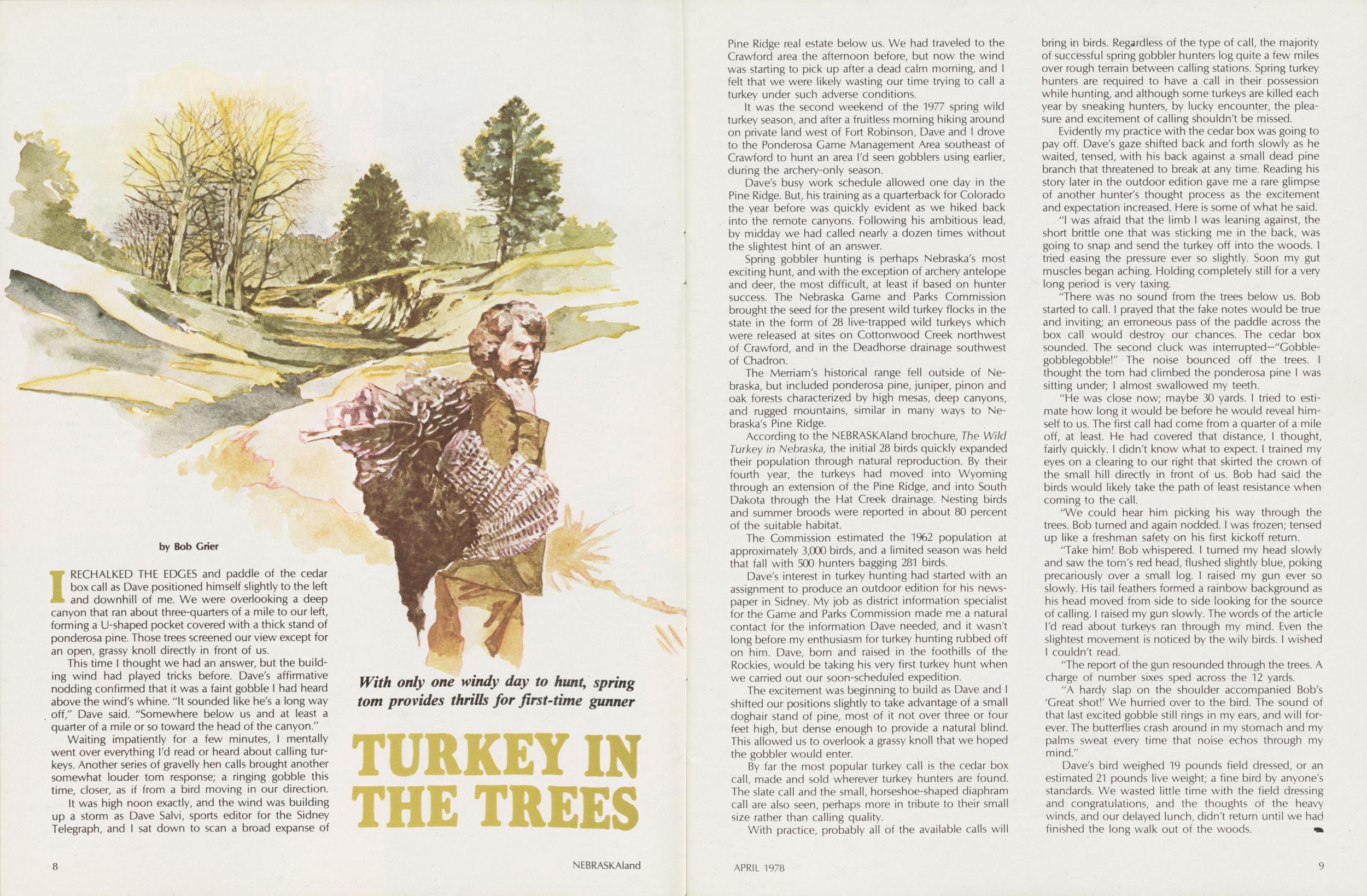
TURKEY IN THE TREES
With only one windy day to hunt, spring tom provides thrills for first-time gunner
I RECHALKED THE EDGES and paddle of the cedar box call as Dave positioned himself slightly to the left and downhill of me. We were overlooking a deep canyon that ran about three-quarters of a mile to our left, forming a U-shaped pocket covered with a thick stand of ponderosa pine. Those trees screened our view except for an open, grassy knoll directly in front of us.
This time I thought we had an answer, but the building wind had played tricks before. Dave's affirmative nodding confirmed that it was a faint gobble I had heard above the wind's whine. "It sounded like he's a long way off," Dave said. "Somewhere below us and at least a quarter of a mile or so toward the head of the canyon."
Waiting impatiently for a few minutes, I mentally went over everything I'd read or heard about calling turkeys. Another series of gravelly hen calls brought another somewhat louder torn response; a ringing gobble this time, closer, as if from a bird moving in our direction.
It was high noon exactly, and the wind was building up a storm as Dave Salvi, sports editor for the Sidney Telegraph, and I sat down to scan a broad expanse of 8 NEBRASKAland Pine Ridge real estate below us. We had traveled to the Crawford area the afternoon before, but now the wind was starting to pick up after a dead calm morning, and I felt that we were likely wasting our time trying to call a turkey under such adverse conditions.
It was the second weekend of the 1977 spring wild turkey season, and after a fruitless morning hiking around on private land west of Fort Robinson, Dave and I drove to the Ponderosa Game Management Area southeast of Crawford to hunt an area I'd seen gobblers using earlier, during the archery-only season.
Dave's busy work schedule allowed one day in the Pine Ridge. But, his training as a quarterback for Colorado the year before was quickly evident as we hiked back into the remote canyons. Following his ambitious lead, by midday we had called nearly a dozen times without the slightest hint of an answer.
Spring gobbler hunting is perhaps Nebraska's most exciting hunt, and with the exception of archery antelope and deer, the most difficult, at least if based on hunter success. The Nebraska Game and Parks Commission brought the seed for the present wild turkey flocks in the state in the form of 28 live-trapped wild turkeys which were released at sites on Cottonwood Creek northwest of Crawford, and in the Deadhorse drainage southwest of Chadron.
The Merriam's historical range fell outside of Nebraska, but included ponderosa pine, juniper, pinon and oak forests characterized by high mesas, deep canyons, and rugged mountains, similar in many ways to Nebraska's Pine Ridge.
According to the NEBRASKAIand brochure, The Wild Turkey in Nebraska, the initial 28 birds quickly expanded their population through natural reproduction. By their fourth year, the turkeys had moved into Wyoming through an extension of the Pine Ridge, and into South Dakota through the Hat Creek drainage. Nesting birds and summer broods were reported in about 80 percent of the suitable habitat.
The Commission estimated the 1962 population at approximately 3,000 birds, and a limited season was held that fall with 500 hunters bagging 281 birds.
Dave's interest in turkey hunting had started with an assignment to produce an outdoor edition for his newspaper in Sidney. My job as district information specialist for the Game and Parks Commission made me a natural contact for the information Dave needed, and it wasn't long before my enthusiasm for turkey hunting rubbed off on him. Dave, born and raised in the foothills of the Rockies, would be taking his very first turkey hunt when we carried out our soon-scheduled expedition.
The excitement was beginning to build as Dave and I shifted our positions slightly to take advantage of a small doghair stand of pine, most of it not over three or four feet high, but dense enough to provide a natural blind. This allowed us to overlook a grassy knoll that we hoped the gobbler would enter.
By far the most popular turkey call is the cedar box call, made and sold wherever turkey hunters are found. The slate call and the small, horseshoe-shaped diaphram call are also seen, perhaps more in tribute to their small size rather than calling quality.
With practice, probably all of the available calls will bring in birds. Regardless of the type of call, the majority of successful spring gobbler hunters log quite a few miles over rough terrain between calling stations. Spring turkey hunters are required to have a call in their possession while hunting, and although some turkeys are killed each year by sneaking hunters, by lucky encounter, the pleasure and excitement of calling shouldn't be missed.
Evidently my practice with the cedar box was going to pay off. Dave's gaze shifted back and forth slowly as he waited, tensed, with his back against a small dead pine branch that threatened to break at any time. Reading his story later in the outdoor edition gave me a rare glimpse of another hunter's thought process as the excitement and expectation increased. Here is some of what he said.
"I was afraid that the limb i was 'leaning against, the short brittle one that was sticking me in the back, was going to snap and send the turkey off into the woods. I tried easing the pressure ever so slightly. Soon my gut muscles began aching. Holding completely still for a very long period is very taxing.
"There was no sound from the trees below us. Bob started to call. I prayed that the fake notes would be true and inviting; an erroneous pass of the paddle across the box call would destroy our chances. The cedar box sounded. The second cluck was interrupted—"Gobblegobblegobble!" The noise bounced off the trees. I thought the torn had climbed the ponderosa pine I was sitting under; I almost swallowed my teeth.
"He was close now; maybe 30 yards. I tried to estimate how long it would be before he would reveal himself to us. The first call had come from a quarter of a mile off, at least. He had covered that distance, I thought, fairly quickly. I didn't know what to expect. I trained my eyes on a clearing to our right that skirted the crown of the small hill directly in front of us. Bob had said the birds would likely take the path of least resistance when coming to the call.
"We could hear him picking his way through the trees. Bob turned and again nodded. I was frozen; tensed up like a freshman safety on his first kickoff return.
"Take him! Bob whispered. I turned my head slowly and saw the tom's red head, flushed slightly blue, poking precariously over a small log. I raised my gun ever so slowly. His tail feathers formed a rainbow background as his head moved from side to side looking for the source of calling. I raised my gun slowly. The words of the article I'd read about turkeys ran through my mind. Even the slightest movement is noticed by the wily birds. I wished I couldn't read.
"The report of the gun resounded through the trees. A charge of number sixes sped across the 12 yards.
"A hardy slap on the shoulder accompanied Bob's 'Great shot!' We hurried over to the bird. The sound of that last excited gobble still rings in my ears, and will forever. The butterflies crash around in my stomach and my palms sweat every time that noise echos through my mind."
Dave's bird weighed 19 pounds field dressed, or an estimated 21 pounds live weight; a fine bird by anyone's standards. We wasted little time with the field dressing and congratulations, and the thoughts of the heavy winds, and our delayed lunch, didn't return until we had finished the long walk out of the woods.
APRIL 1978 9
Fight for Human Liberty
Major battle was in courtroom
ON MAY 1,1879, the case known as United States v. Crook came before the Eighth Circuit Court in Omaha. Though the direct question to be decided seemed relatively innocent—whether a writ of habeas corpus would be granted—the underlying issue was much more volatile. The court was being called upon to answer the critical question of whether an Indian was a person within the meaning of the law. The story of the Ponca chief Standing Bear's fight for his land and his dignity is a fascinating link in the struggle for civil rights in America.
The Poncas were, in the words of the Indian commissioner's report in 1878, "good Indians. In mental endowment, moral character, physical strength and cleanliness of person they are superior to any tribe I have ever met." They dwelt near the mouth of the Niobrara River. The Poncas signed a treaty with the United States in 1858 which guaranteed them protection from their enemies, and land along the Niobrara. They were also to receive cash annuities over a period of 30 years totatling^375,000 to gcrioward schools and the development of industry. In return, they ceded to the United States all other lands they had previously claimed, and pledged their peace and friendship.
In 1865 they signed a new treaty with the United States, voluntarily giving up part of the reservation they had received in 1858 in exchange for land closer to the mouth of the Niobrara. The wording of the treaty gives important insight into the character of the Poncas, for it speaks of rewarding them for their fidelity to the government and citizens of the United States. In 1868, however, through bureaucratic oversight, officials included the Ponca land in a tract set aside for the Sioux. The two tribes were traditional enemies and, with the added problem of disputed land, the Poncas increasingly suffered from their attacks.
Nevertheless, the Poncas flourished. By 1875 the tribe numbered about 730, and crops improved each year. More children were attending school, industry was growing, and the tribe was becoming more self-reliant.
In early 1877, however, an event occurred which threatened the Poncas' prosperity. Indian Inspector Edward C Kemble arrived from Washington and told the Indians that they were to be 10 NEBRASKAland moved to Indian Territory, a large tract of land in Oklahoma. The Poncas adamantly refused to leave their homes. Standing Bear said, "This land is ours. . . . We do not wish to sell our land, and we think no man has a right to take it from us. Here we will live, and here we will die."
Kemble told the Poncas that the new land was good. The Indians still refused. Finally, Kemble proposed that 10 of the Poncas journey to the territory to see for themselves.
The Poncas agreed on condition that they would be able to return to their old land if they didn't like the land in Oklahoma, and 10 chiefs rode the train to Indian Territory. The Indians, however, were unaccustomed to the warm climate and sickened. Nor, was the land as good as Kemble had claimed. The Indians were dissatisfied. Kemble wanted them to look
The eight Poncas began their long journey (over 500 miles) back to their home, it was winter, and they had no interpreter. They lived on what little corn they could garner from fields, cracking it between stones. They slept in haystacks. Finally, after 50 days of walking, they reached the Otoe Agency in southern Nebraska. There they received horses and provisions, and shortly afterward arrived at their reservation.
They were met by Kemble, who told them they were no longer to have any choice; they must go to the Indian Territory. The Poncas protested vehemently, and after further fruitless effort on Kemble's part, a new agent, E. A. Howard, was brought it. Soldiers accompanied him to enforce his authority. Faced with no alternative, the Poncas loaded their wagons.
The long journey began on May 21, 1877. The Poncas began to fall sick, and many died. Standing Bear's daughter, Prairie Flower, died on June 6 and was buried at Milford.
On July 9 they reached their new land. Agent Howard wrote: "I am of the opinion that the removal of the Poncas from the northern climate . . . will prove a mistake, and that a great mortality will surely follow. . . ." His prediction proved accurate—by the end of the first year, 158 of the 730 Indians who had left the Niobrara, were dead. Standing Bear's son died, and on his deathbed made his father promise to bury him along the Niobrara.
At last Standing Bear could endure no more. Taking the body of his son and 30 of his people, he began the journey back on January 2,1879. After 10 weeks the party arrived at the Omaha Agency. The Omahas gave them land and tools to begin farming and the poncas went to work immediately, hoping to be able to grow enough food to sustain themselves.
As soon as their departure from Indian Territory was noted, the War Department was ordered to arrest and return them. When their whereabouts was learned, General George Crook, commander of the Department of the Platte, dispatched soldiers to arrest the Poncas. The Indians were described as being "in a pitiable condition from the effects of chills and fever." Standing Bear himself said: "My efforts to save their lives had failed."
But he had not reckoned with his white friends. General Crook, though a long-time Indian fighter, had become more and more sympathetic to the Indian cause. He was outraged at the treatment the Poncas had received.
Crook turned to Thomas Henry Tibbies, assistant editor of the Omaha
Tibbies started immediately. He telegraphed the details of the Poncas' arrest to the major newspapers around the nation and soon had raised great public support for the Poncas. Next he began to consider what strategy to employ in the defense of the Poncas. He finally concluded that the case should be centered around the Fourteenth Amendment, which states in part, ". . . nor shall any State deprive any person of life, liberty, or property, without due process of law;" which clearly stated that no person could be held under arrest as Standing Bear and his clan were, without having committed a crime. There was, however, a question of whether Indians were considered persons. The Fourteenth Amendment specifically excluded Indians from Congressional representation; did this also mean that they were not persons under the meaning of the law? Tibbies proposed to bring this question, never before tested in an American courtroom, to the nation's attention.
Tibbies enlisted the aid of Omaha attorney John L. Webster, and Webster turned to A. J. Poppleton, chief attorney of the Union Pacific Railroad, for help.
The case began on May 1,1879 and lasted two (Continued on page 47)
APRIL 1978 11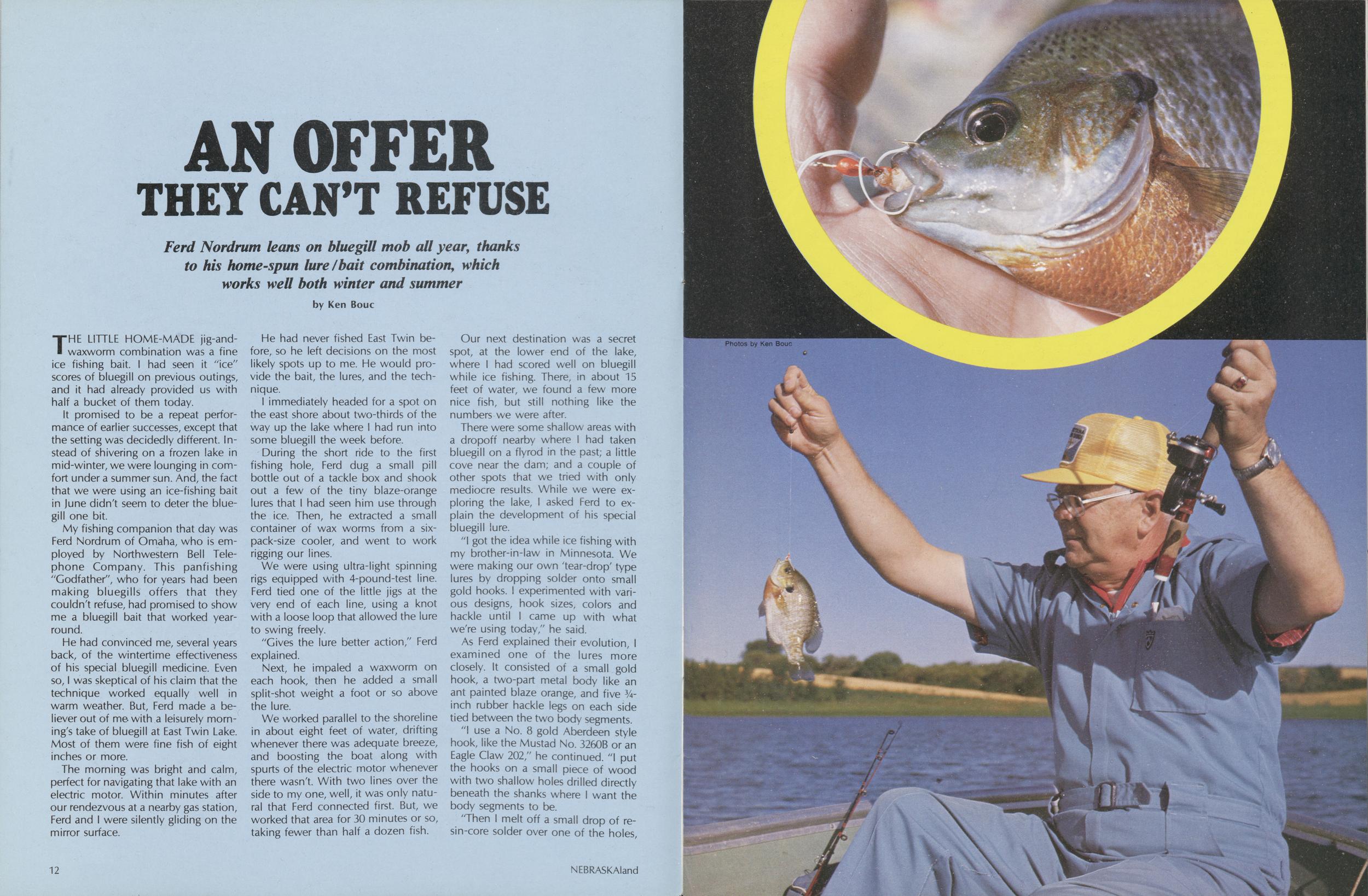
AN OFFER THEY CAN'T REFUSE
Ferd Nordrum leans on bluegill mob all year, thanks to his home-spun lure I bait combination, which works well both winter and summer
THE LITTLE HOME-MADE jig-and-waxworm combination was a fine ice fishing bait. I had seen it "ice" scores of bluegill on previous outings, and it had already provided us with half a bucket of them today.
It promised to be a repeat performance of earlier successes, except that the setting was decidedly different. Instead of shivering on a frozen lake in mid-winter, we were lounging in comfort under a summer sun. And, the fact that we were using an ice-fishing bait in June didn't seem to deter the bluegill one bit
My fishing companion that day was Ferd Nordrum of Omaha, who is employed by Northwestern Bell Telephone Company. This panfishing "Godfather", who for years had been making bluegills offers that they couldn't refuse, had promised to show me a bluegill bait that worked year round.
He had convinced me, several years back, of the wintertime effectiveness of his special bluegill medicine. Even so, I was skeptical of his claim that the technique worked equally well in warm weather. But, Ferd made a believer out of me with a leisurely morning's take of bluegill at East Twin Lake. Most of them were fine fish of eight inches or more.
The morning was bright and calm, perfect for navigating that lake with an electric motor. Within minutes after our rendezvous at a nearby gas station, Ferd and I were silently gliding on the mirror surface.
He had never fished East Twin before, so he left decisions on the most likely spots up to me. He would provide the bait, the lures, and the technique.
I immediately headed for a spot on the east shore about two-thirds of the way up the lake where I had run into some bluegill the week before.
During the short ride to the first fishing hole, Ferd dug a small pill bottle out of a tackle box and shook out a few of the tiny blaze-orange lures that I had seen him use through the ice. Then, he extracted a small container of wax worms from a six- pack-size cooler, and went to work rigging our lines.
We were using ultra-light spinning rigs equipped with 4-pound-test line. Ferd tied one of the little jigs at the very end of each line, using a knot with a loose loop that allowed the lure to swing freely.
"Gives the lure better action," Ferd explained.
Next, he impaled a waxworm on each hook, then he added a small split-shot weight a foot or so above the lure.
We worked parallel to the shoreline in about eight feet of water, drifting whenever there was adequate breeze, and boosting the boat along with spurts of the electric motor whenever there wasn't. With two lines over the side to my one, well, it was only natural that Ferd connected first. But, we worked that area for 30 minutes or so, taking fewer than half a dozen fish.
Our next destination was a secret spot, at the lower end of the lake, where I had scored well on bluegill while ice fishing. There, in about 15 feet of water, we found a few more nice fish, but still nothing like the numbers we were after.
There were some shallow areas with a dropoff nearby where I had taken bluegill on a flyrod in the past; a little cove near the dam; and a couple of other spots that we tried with only mediocre results. While we were exploring the lake, I asked Ferd to explain the development of his special bluegill lure.
"I got the idea while ice fishing with my brother-in-law in Minnesota. We were making our own 'tear-drop' type lures by dropping solder onto small gold hooks. I experimented with various designs, hook sizes, colors and hackle until I came up with what we're using today," he said.
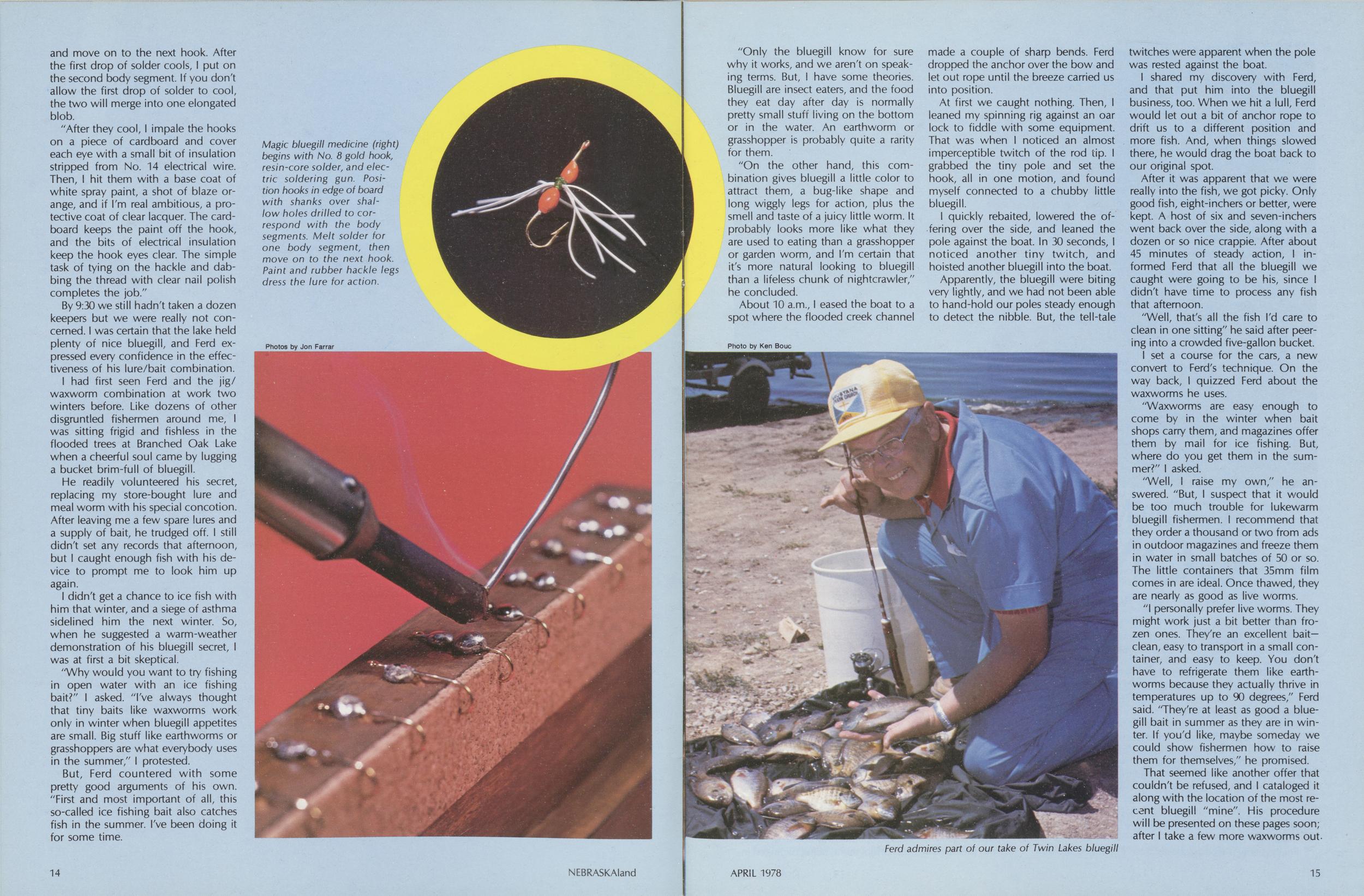
As Ferd explained their evolution, I examined one of the lures more closely. It consisted of a small gold hook, a two-part metal body like an ant painted blaze orange, and five 3Ainch rubber hackle legs on each side tied between the two body segments. "I use a No. 8 gold Aberdeen style hook, like the Mustad No. 3260B or an Eagle Claw 202," he continued. "I put the hooks on a small piece of wood with two shallow holes drilled directly beneath the shanks where I want the body segments to be.
"Then I melt off a small drop of resin-core solder over one of the holes, 12 NEBRASKAIand
 and move on to the next hook. After
the first drop of solder cools, I put on
the second body segment. If you don't
allow the first drop of solder to cool,
the two will merge into one elongated
blob.
and move on to the next hook. After
the first drop of solder cools, I put on
the second body segment. If you don't
allow the first drop of solder to cool,
the two will merge into one elongated
blob.
"After they cool, I impale the hooks on a piece of cardboard and cover each eye with a small bit of insulation stripped from No. 14 electrical wire. Then, I hit them with a base coat of white spray paint, a shot of blaze orange, and if I'm real ambitious, a protective coat of clear lacquer. The cardboard keeps the paint off the hook, and the bits of electrical insulation keep the hook eyes clear. The simple task of tying on the hackle and dabbing the thread with clear nail polish completes the job."
By 9:30 we still hadn't taken a dozen keepers but we were really not concerned. I was certain that the lake held plenty of nice bluegill, and Ferd expressed every confidence in the effectiveness of his lure/bait combination.
I had first seen Ferd and the jig/waxworm combination at work two winters before. Like dozens of other disgruntled fishermen around me, I was sitting frigid and fishless in the flooded trees at Branched Oak Lake when a cheerful soul came by lugging a bucket brim-full of bluegill.
He readily volunteered his secret, replacing my store-bought lure and meal worm with his special concotion. After leaving me a few spare lures and a supply of bait, he trudged off. I still didn't set any records that afternoon, but I caught enough fish with his device to prompt me to look him up again.
I didn't get a chance to ice fish with him that winter, and a siege of asthma sidelined him the next winter. So, when he suggested a warm-weather demonstration of his bluegill secret, I was at first a bit skeptical.
"Why would you want to try fishing in open water with an ice fishing bait?" I asked. "I've always thought that tiny baits like waxworms work only in winter when bluegill appetites are small. Big stuff like earthworms or grasshoppers are what everybody uses in the summer," I protested.
But, Ferd countered with some pretty good arguments of his own. "First and most important of all, this so-called ice fishing bait also catches fish in the summer. I've been doing it for some time.
Only the bluegill know for sure why it works, and we aren't on speaking terms. But, I have some theories. Bluegill are insect eaters, and the food they eat day after day is normally pretty small stuff living on the bottom or in the water. An earthworm or grasshopper is probably quite a rarity for them.
"On the other hand, this combination gives bluegill a little color to attract them, a bug-like shape and long wiggly legs for action, plus the smell and taste of a juicy little worm. It probably looks more like what they are used to eating than a grasshopper or garden worm, and I'm certain that it's more natural looking to bluegill than a lifeless chunk of nightcrawler," he concluded.
About 10 a.m., I eased the boat to a spot where the flooded creek channel made a couple of sharp bends. Ferd dropped the anchor over the bow and let out rope until the breeze carried us into position.
At first we caught nothing. Then, I leaned my spinning rig against an oar lock to fiddle with some equipment. That was when I noticed an almost imperceptible twitch of the rod tip. I grabbed the tiny pole and set the hook, all in one motion, and found myself connected to a chubby little bluegill.
I quickly rebaited, lowered the offering over the side, and leaned the pole against the boat. In 30 seconds, I noticed another tiny twitch, and hoisted another bluegill into the boat.
Apparently, the bluegill were biting very lightly, and we had not been able to hand-hold our poles steady enough to detect the nibble. But, the tell-tale Ferd admires part of our take of Twin Lakes bluegill twitches were apparent when the pole was rested against the boat.
I shared my discovery with Ferd, and that put him into the bluegill business, too. When we hit a lull, Ferd would let out a bit of anchor rope to drift us to a different position and more fish. And, when things slowed there, he would drag the boat back to our original spot.
After it was apparent that we were really into the fish, we got picky. Only good fish, eight-inchers or better, were kept. A host of six and seven-inchers went back over the side, along with a dozen or so nice crappie. After about 45 minutes of steady action, I informed Ferd that all the bluegill we caught were going to be his, since I didn't have time to process any fish that afternoon.
"Well, that's all the fish I'd care to clean in one sitting" he said after peering into a crowded five-gallon bucket. I set a course for the cars, a new convert to Ferd's technique. On the way back, I quizzed Ferd about the waxworms he uses.
"Waxworms are easy enough to come by in the winter when bait shops carry them, and magazines offer them by mail for ice fishing. But, where do you get them in the summer?" I asked.
"Well, I raise my own," he answered. "But, I suspect that it would be too much trouble for lukewarm bluegill fishermen. I recommend that they order a thousand or two from ads in outdoor magazines and freeze them in water in small batches of 50 or so. The little containers that 35mm film comes in are ideal. Once thawed, they are nearly as good as live worms.
"I personally prefer live worms. They might work just a bit better than frozen ones. They're an excellent bait- clean, easy to transport in a small container, and easy to keep. You don't have to refrigerate them like earthworms because they actually thrive in temperatures up to 90 degrees," Ferd said. 'They're at least as good a bluegill bait in summer as they are in winter. If you'd like, maybe someday we could show fishermen how to raise them for themselves," he promised.
That seemed like another offer that couldn't be refused, and I cataloged it along with the location of the most recent bluegill "mine". His procedure will be presented on these pages soon; after I take a few more waxworms out
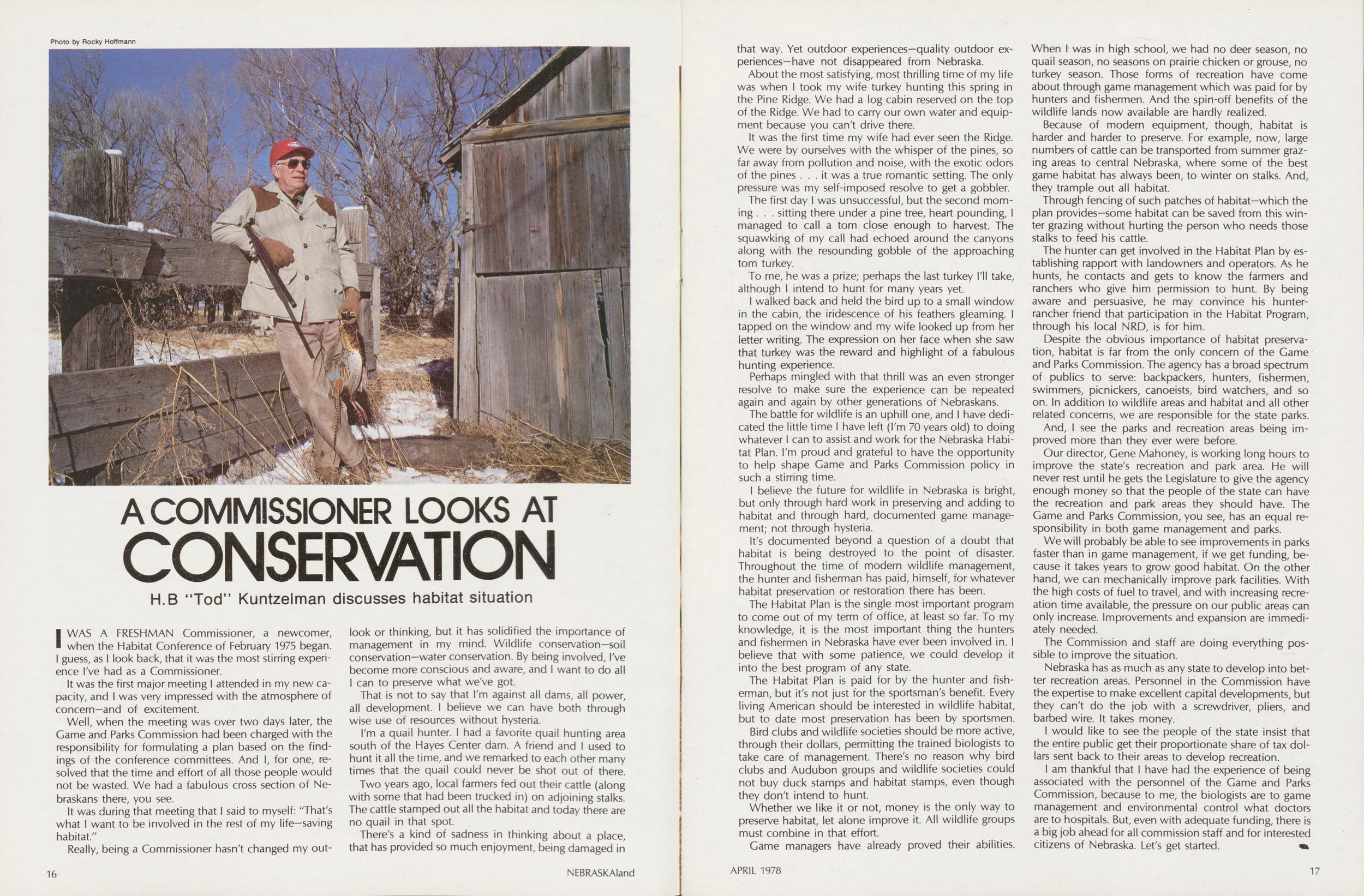
A COMMISSIONER LOOKS AT CONSERVATION
H.B "Tod" Kuntzelman discusses habitat situation
I WAS A FRESHMAN Commissioner, a newcomer, when the Habitat Conference of February 1975 began. I guess, as I look back, that it was the most stirring experience I've had as a Commissioner.
It was the first major meeting I attended in my new capacity, and I was very impressed with the atmosphere of concern—and of excitement.
Well, when the meeting was over two days later, the Game and Parks Commission had been charged with the responsibility for formulating a plan based on the findings of the conference committees. And I, for one, resolved that the time and effort of all those people would not be wasted. We had a fabulous cross section of Nebraskans there, you see.
It was during that meeting that I said to myself: "That's what I want to be involved in the rest of my life—saving habitat."
Really, being a Commissioner hasn't changed my outlook or thinking, but it has solidified the importance of management in my mind. Wildlife conservation—soil conservation—water conservation. By being involved, I've become more conscious and aware, and I want to do all I can to preserve what we've got.
That is not to say that I'm against all dams, all power, all development. I believe we can have both through wise use of resources without hysteria.
I'm a quail hunter. I had a favorite quail hunting area south of the Hayes Center dam. A friend and I used to hunt it all the time, and we remarked to each other many times that the quail could never be shot out of there.
Two years ago, local farmers fed out their cattle (along with some that had been trucked in) on adjoining stalks. The cattle stamped out all the habitat and today there are no quail in that spot.
There's a kind of sadness in thinking about a place, that has provided so much enjoyment, being damaged in 16 NEBRASKAIand that way. Yet outdoor experiences—quality outdoor experiences—have not disappeared from Nebraska.
About the most satisfying, most thrilling time of my life was when I took my wife turkey hunting this spring in the Pine Ridge. We had a log cabin reserved on the top of the Ridge. We had to carry our own water and equipment because you can't drive there.
It was the first time my wife had ever seen the Ridge. We were by ourselves with the whisper of the pines, so far away from pollution and noise, with the exotic odors of the pines ... it was a true romantic setting. The only pressure was my self-imposed resolve to get a gobbler.
The first day I was unsuccessful, but the second morning .. . sitting there under a pine tree, heart pounding, I managed to call a torn close enough to harvest. The squawking of my call had echoed around the canyons along with the resounding gobble of the approaching torn turkey.
To me, he was a prize; perhaps the last turkey I'll take, although I intend to hunt for many years yet.
I walked back and held the bird up to a small window in the cabin, the iridescence of his feathers gleaming. I tapped on the window and my wife looked up from her letter writing. The expression on her face when she saw that turkey was the reward and highlight of a fabulous hunting experience.
Perhaps mingled with that thrill was an even stronger resolve to make sure the experience can be repeated again and again by other generations of Nebraskans.
The battle for wildlife is an uphill one, and I have dedicated the little time I have left (I'm 70 years old) to doing whatever I can to assist and work for the Nebraska Habitat Plan. I'm proud and grateful to have the opportunity to help shape Game and Parks Commission policy in such a stirring time.
I believe the future for wildlife in Nebraska is bright, but only through hard work in preserving and adding to habitat and through hard, documented game management; not through hysteria.
It's documented beyond a question of a doubt that habitat is being destroyed to the point of disaster. Throughout the time of modern wildlife management, the hunter and fisherman has paid, himself, for whatever habitat preservation or restoration there has been.
The Habitat Plan is the single most important program to come out of my term of office, at least so far. To my knowledge, it is the most important thing the hunters and fishermen in Nebraska have ever been involved in. I believe that with some patience, we could develop it into the best program of any state.
The Habitat Plan is paid for by the hunter and fisherman, but it's not just for the sportsman's benefit. Every living American should be interested in wildlife habitat, but to date most preservation has been by sportsmen.
Bird clubs and wildlife societies should be more active, through their dollars, permitting the trained biologists to take care of management. There's no reason why bird clubs and Audubon groups and wildlife societies could not buy duck stamps and habitat stamps, even though they don't intend to hunt.
Whether we like it or not, money is the only way to preserve habitat, let alone improve it. All wildlife groups must combine in that effort.
Game managers have already proved their abilities. When I was in high school, we had no deer season, no quail season, no seasons on prairie chicken or grouse, no turkey season. Those forms of recreation have come about through game management which was paid for by hunters and fishermen. And the spin-off benefits of the wildlife lands now available are hardly realized.
Because of modern equipment, though, habitat is harder and harder to preserve. For example, now, large numbers of cattle can be transported from summer grazing areas to central Nebraska, where some of the best game habitat has always been, to winter on stalks. And, they trample out all habitat.
Through fencing of such patches of habitat—which the plan provides—some habitat can be saved from this winter grazing without hurting the person who needs those stalks to feed his cattle.
The hunter can get involved in the Habitat Plan by establishing rapport with landowners and operators. As he hunts, he contacts and gets to know the farmers and ranchers who give him permission to hunt. By being aware and persuasive, he may convince his hunter-rancher friend that participation in the Habitat Program, through his local NRD, is for him.
Despite the obvious importance of habitat preservation, habitat is far from the only concern of the Game and Parks Commission. The agency has a broad spectrum of publics to serve: backpackers, hunters, fishermen, swimmers, picnickers, canoeists, bird watchers, and so on. In addition to wildlife areas and habitat and all other related concerns, we are responsible for the state parks. And, I see the parks and recreation areas being improved more than they ever were before.
Our director, Gene Mahoney, is working long hours to improve the state's recreation and park area. He will never rest until he gets the Legislature to give the agency enough money so that the people of the state can have the recreation and park areas they should have. The Game and Parks Commission, you see, has an equal responsibility in both game management and parks.
We will probably be able to see improvements in parks faster than in game management, if we get funding, because it takes years to grow good habitat. On the other hand, we can mechanically improve park facilities. With the high costs of fuel to travel, and with increasing recreation time available, the pressure on our public areas can only increase. Improvements and expansion are immediately needed.
The Commission and staff are doing everything possible to improve the situation.
Nebraska has as much as any state to develop into betdter recreation areas. Personnel in the Commission have the expertise to make excellent capital developments, but they can't do the job with a screwdriver, pliers, and barbed wire. It takes money.
I would like to see the people of the state insist that the entire public get their proportionate share of tax dollars sent back to their areas to develop recreation.
I am thankful that I have had the experience of being associated with the personnel of the Game and Parks Commission, because to me, the biologists are to game management and environmental control what doctors are to hospitals. But, even with adequate funding, there is a big job ahead for all commission staff and for interested citizens of Nebraska. Let's get started.
APRIL 1978 17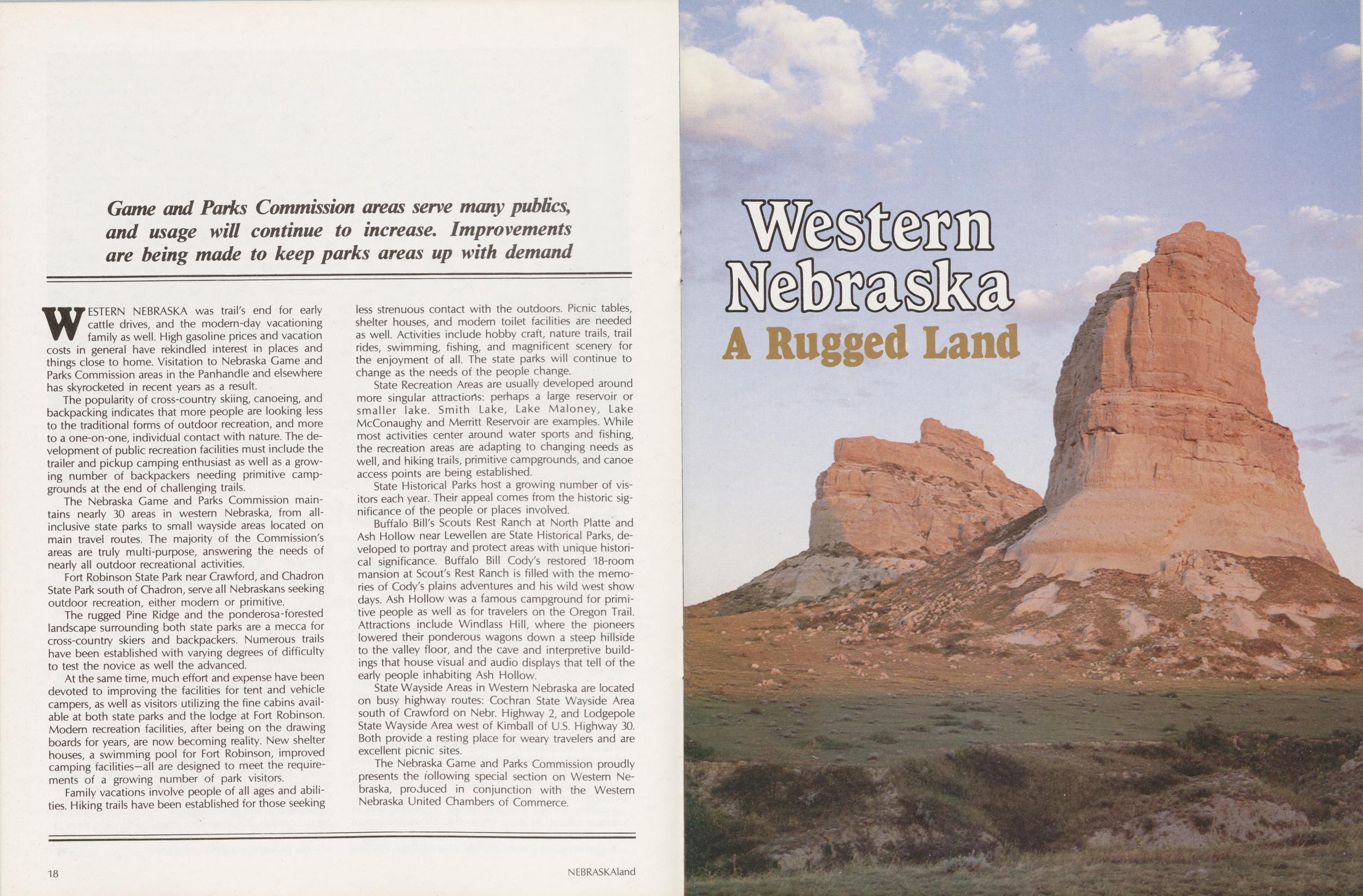
Western Nebraska A Rugged Land
Game and Parks Commission areas serve many publics, and usage will continue to increase. Improvements are being made to keep parks areas up with demand
WESTERN NEBRASKA was trail's end for early cattle drives, and the modern-day vacationing family as well. High gasoline prices and vacation costs in general have rekindled interest in places and things close to home. Visitation to Nebraska Game and Parks Commission areas in the Panhandle and elsewhere has skyrocketed in recent years as a result.
The popularity of cross-country skiing, canoeing, and backpacking indicates that more people are looking less to the traditional forms of outdoor recreation, and more to a one-on-one, individual contact with nature. The development of public recreation facilities must include the trailer and pickup camping enthusiast as well as a growing number of backpackers needing primitive campgrounds at the end of challenging trails.
The Nebraska Game and Parks Commission maintains nearly 30 areas in western Nebraska, from all- inclusive state parks to small wayside areas located on main travel routes. The majority of the Commission's areas are truly multi-purpose, answering the needs of nearly all outdoor recreational activities.
Fort Robinson State Park near Crawford, and Chadron State Park south of Chadron, serve all Nebraskans seeking outdoor recreation, either modern or primitive.
The rugged Pine Ridge and the ponderosa-forested landscape surrounding both state parks are a mecca for cross-country skiers and backpackers. Numerous trails have been established with varying degrees of difficulty to test the novice as well the advanced.
At the same time, much effort and expense have been devoted to improving the facilities for tent and vehicle campers, as well as visitors utilizing the fine cabins available at both state parks and the lodge at Fort Robinson. Modern recreation facilities, after being on the drawing boards for years, are now becoming reality. New shelter houses, a swimming pool for Fort Robinson, improved camping facilities—all are designed to meet the requirements of a growing number of park visitors.
Family vacations involve people of all ages and abilities. Hiking trails have been established for those seeking less strenuous contact with the outdoors. Picnic tables, shelter houses, and modern toilet facilities are needed as well. Activities include hobby craft, nature trails, trail rides, swimming, fishing, and magnificent scenery for the enjoyment of all. The state parks will continue to change as the needs of the people change.
State Recreation Areas are usually developed around more singular attractions: perhaps a large reservoir or smaller lake. Smith Lake, Lake Maloney, Lake McConaughy and Merritt Reservoir are examples. While most activities center around water sports and fishing, the recreation areas are adapting to changing needs as well, and hiking trails, primitive campgrounds, and canoe access points are being established.
State Historical Parks host a growing number of visitors each year. Their appeal comes from the historic significance of the people or places involved.
Buffalo Bill's Scouts Rest Ranch at North Platte and Ash Hollow near Lewellen are State Historical Parks, developed to portray and protect areas with unique historical significance. Buffalo Bill Cody's restored 18-room mansion at Scout's Rest Ranch is filled with the memories of Cody's plains adventures and his wild west show days. Ash Hollow was a famous campground for primitive people as well as for travelers on the Oregon Trail. Attractions include Windlass Hill, where the pioneers lowered their ponderous wagons down a steep hillside to the valley floor, and the cave and interpretive buildings that house visual and audio displays that tell of the early people inhabiting Ash Hollow.
State Wayside Areas in Western Nebraska are located on busy highway routes: Cochran State Wayside Area south of Crawford on Nebr. Highway 2, and Lodgepole State Wayside Area west of Kimball of U.S. Highway 30. Both provide a resting place for weary travelers and are excellent picnic sites.
The Nebraska Game and Parks Commission proudly presents the following special section on Western Nebraska, produced in conjunction with the Western Nebraska United Chambers of Commerce.
18 NEBRASKAland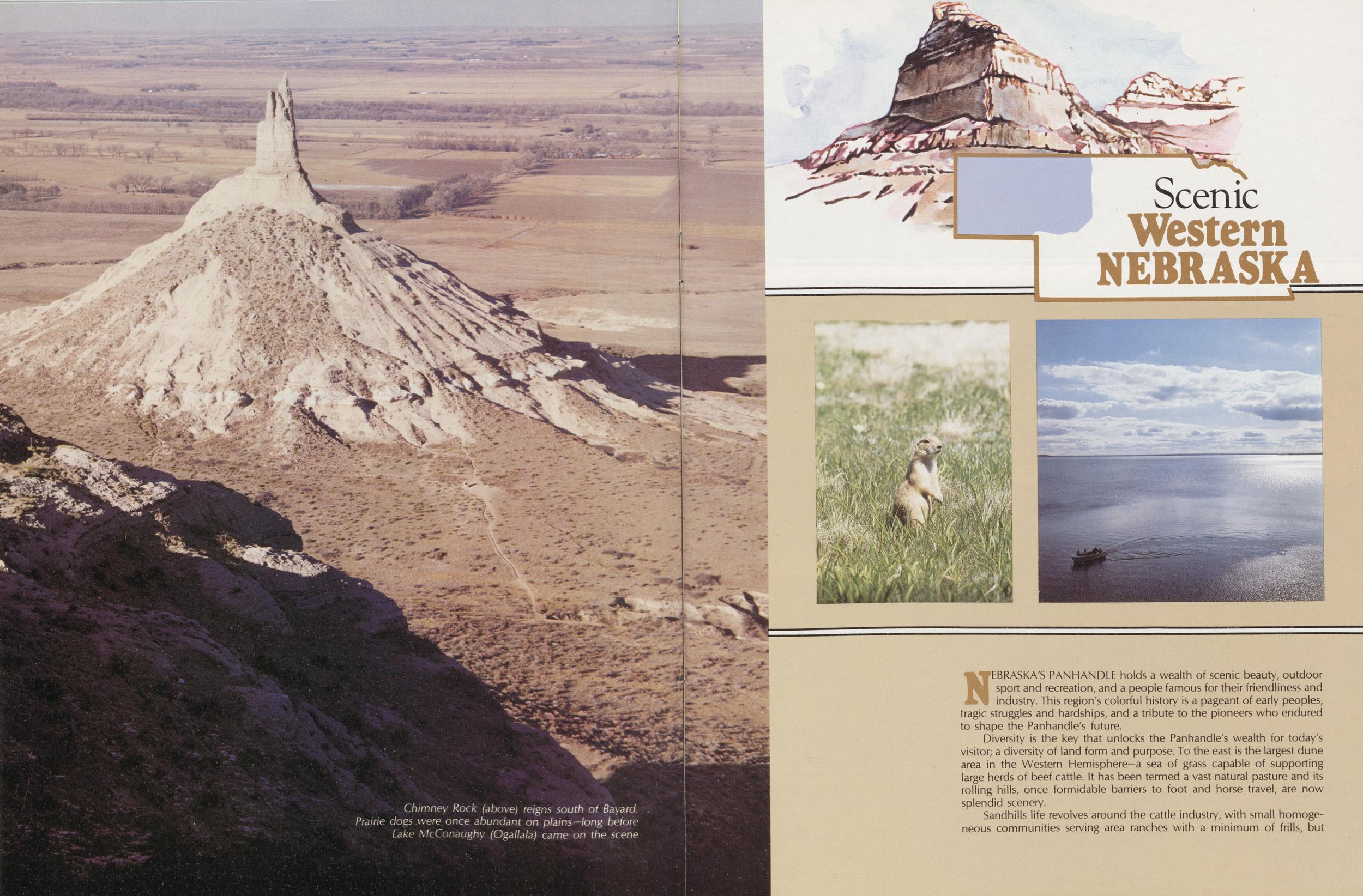
Chimney Rock (above) reigns south of Bayard. Prairie dogs were once adundant on plains — long before Lake McConaughy (Ogallala) came on the scene
Scenic Western Nebraska
NEBRASKA'S PANHANDLE holds a wealth of scenic beauty, outdoor sport and recreation, and a people famous for their friendliness and industry. This region's colorful history is a pageant of early peoples, tragic struggles and hardships, and a tribute to the pioneers who endured to shape the Panhandle's future.
Diversity is the key that unlocks the Panhandle's wealth for today's visitor; a diversity of land form and purpose. To the east is the largest dune area in the Western Hemisphere—a sea of grass capable of supporting large herds of beef cattle. It has been termed a vast natural pasture and its rolling hills, once formidable barriers to foot and horse travel, are now splendid scenery.
Sandhills life revolves around the cattle industry, with small homogeneous communities
serving area ranches with a minimum of frills, but
 with a friendliness born of long association and respect. Sparkling Sandhills lakes
and marshes are a naturalist's paradise, with parading shorebirds,
nesting waterfowl, and uncounted other wildlife species. Many also produce excellent
largemouth bass, bullhead, bluegill, and other angling.
with a friendliness born of long association and respect. Sparkling Sandhills lakes
and marshes are a naturalist's paradise, with parading shorebirds,
nesting waterfowl, and uncounted other wildlife species. Many also produce excellent
largemouth bass, bullhead, bluegill, and other angling.
The rugged Pine Ridge and the badlands of northwestern Nebraska lack the softness of the grass-covered Sandhills. Recreation, scenery and outdoor sports are strong attractions in this deeply etched landscape. The history buff can stroll in the steps of great Indian tribes, early mountain men and trappers, and better appreciate the arduous life of the frontier.
Agriculture is king in much of western Nebraska. The Box Butte tableland, the Cheyenne plains, and the fertile North Platte Valley are nearly as level and true as a billiard table. Wheat, corn, sugar beets, potatoes and beans are primary crops. Numerous irrigation reservoirs make watersports and fishing summer-long pursuits in the Panhandle.
The Panhandle is nearly bisected by the Oregon Trail, and visitors can
The boom-town atmosphere of the California gold rush is evident in western Nebraska today with the expansion of the rail industry and related support facilities which are tied to the need for black gold—the vast reserves of coal from Wyoming, Montana, and other western states. Western Nebraska is still a natural corridor east for much of this coal.
The Panhandle is all of this and much more. Visit its unique attractions, witness for yourself its living history, enjoy its scenic beauty, and meet this region's people.
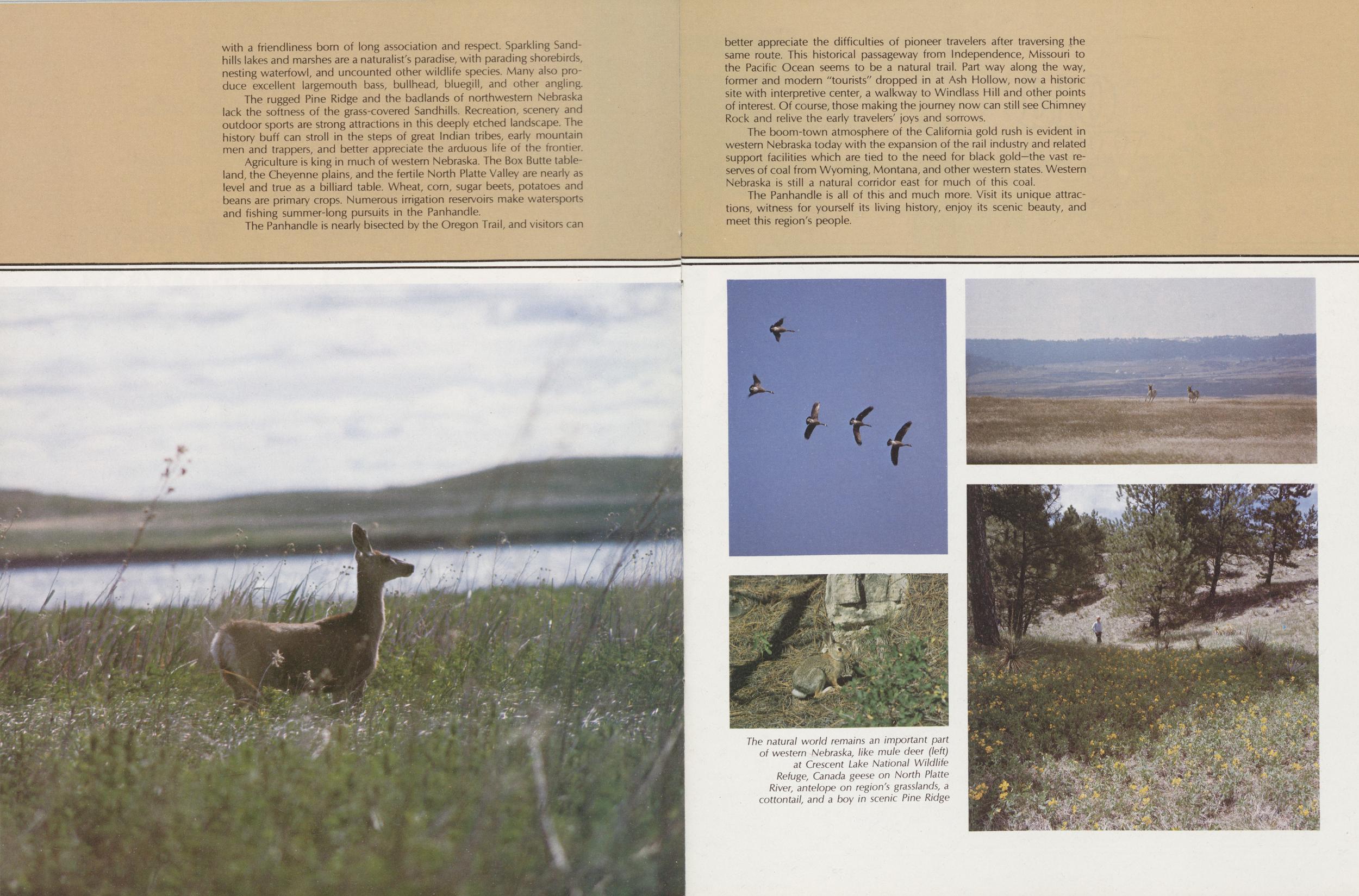
The natural world remains an important part of western Nebraska, like mule deer (left) at Crescent Lake National Wildlife Refuge, Canada geese on North Platte River, antelope on region's grasslands, a cottontail, and a boy in scenic Pine Ridge
Old West Showcase
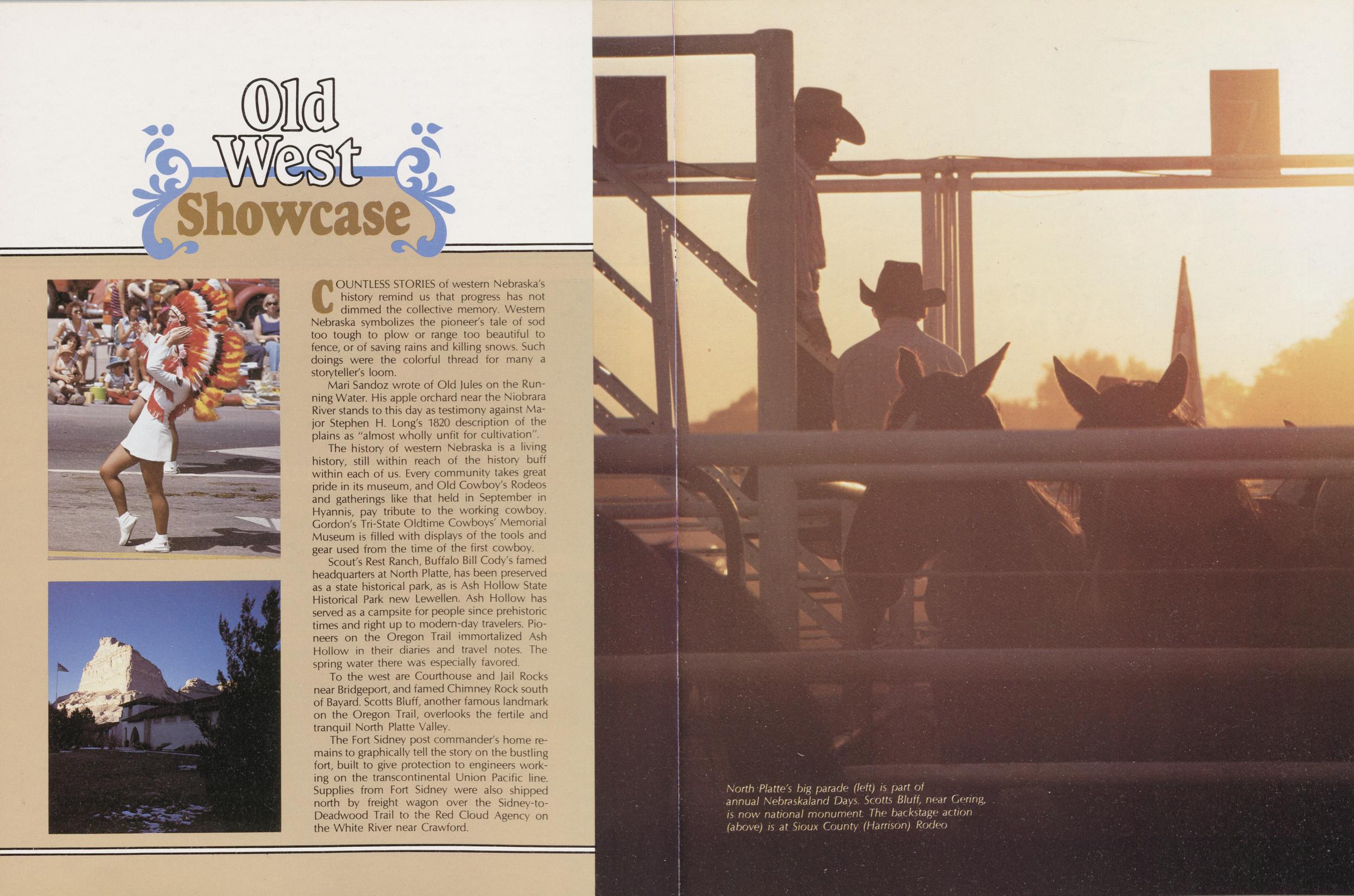
COUNTLESS STORIES of western Nebraska's history remind us that progress has not dimmed the collective memory. Western Nebraska symbolizes the pioneer's tale of sod too tough to plow or range too beautiful to fence, or of saving rains and killing snows. Such doings were the colorful thread for many a storyteller's loom.
Mari Sandoz wrote of Old Jules on the Running Water. His apple orchard near the Niobrara River stands to this day as testimony against Ma- jor Stephen H. Long's 1820 description of the plains as "almost wholly unfit for cultivation".
The history of western Nebraska is a living history, still within reach of the history buff within each of us. Every community takes great pride in its museum, and Old Cowboy's Rodeos and gatherings like that held in September in Hyannis, pay tribute to the working cowboy. Gordon's Tri-State Oldtime Cowboys' Memorial Museum is filled with displays of the tools and gear used from the time of the first cowboy.
Scout's Rest Ranch, Buffalo Bill Cody's famed headquarters at North Platte, has been preserved as a state historical park, as is Ash Hollow State Historical Park new Lewellen. Ash Hollow has served as a campsite for people since prehistoric times and right up to modern-day travelers. Pioneers on the Oregon Trail immortalized Ash Hollow in their diaries and travel notes. The spring water there was especially favored.
To the west are Courthouse and Jail Rocks near Bridgeport, and famed Chimney Rock south of Bayard. Scotts Bluff, another famous landmark on the Oregon Trail, overlooks the fertile and tranquil North Platte Valley.
The Fort Sidney post commander's home remains to graphically tell the story on the bustling fort, built to give protection to engineers working on the transcontinental Union Pacific line. Supplies from Fort Sidney were also shipped north by freight wagon over the Sidney-to-Deadwood Trail to the Red Cloud Agency on the White River near Crawford.
North Platte's big parade (left) is part of annual Nebraskaland Days. Scotts Bluff, near Gering, is now national monument. The backstage action (above) is at Sioux County (Harrison) Rodeo
Scenic Western Nebraska
Where to Go What to Do
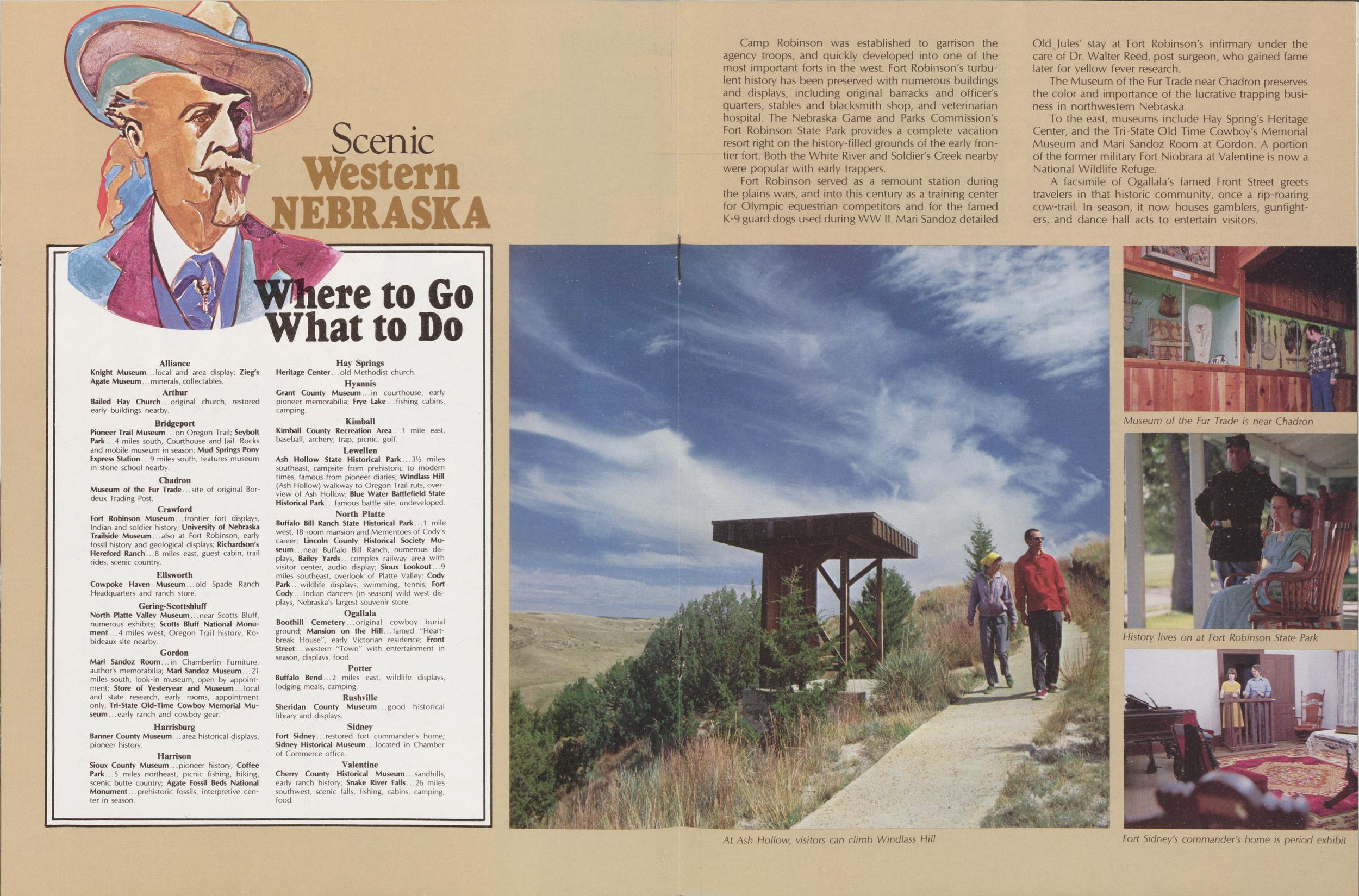
Camp Robinson was established to garrison the agency troops, and quickly developed into one of the most important forts in the west. Fort Robinson's turbulent history has been preserved with numerous buildings and displays, including original barracks and officer's quarters, stables and blacksmith shop, and veterinarian hospital. The Nebraska Game and Parks Commission's Fort Robinson State Park provides a complete vacation resort right on the history-filled grounds of the early frontier fort. Both the White River and Soldier's Creek nearby were popular with early trappers.
Fort Robinson served as a remount station during the plains wars, and into this century as a training center for Olympic equestrian competitors and for the famed K-9 guard dogs used during WW II. Mari Sandoz detailed Old Jules' stay at Fort Robinson's infirmary under the care of Dr. Walter Reed, post surgeon, who gained fame later for yellow fever research.
The Museum of the Fur Trade near Chadron preserves the color and importance of the lucrative trapping business in northwestern Nebraska.
To the east, museums include Hay Spring's Heritage Center, and the Tri-State Old Time Cowboy's Memorial Museum and Mari Sandoz Room at Gordon. A portion of the former military Fort Niobrara at Valentine is now a National Wildlife Refuge.
A facsimile of Ogallala's famed Front Street greets travelers in that historic community, once a rip-roaring cow-trail. In season, it now houses gamblers, gunfighters, and dance hall acts to entertain visitors.
Museum of the Fur Trade is near Chadron
History lives on at Fort Robinson State Park
At Ash Hollow, visitors can climb Windlass Hill
Fort Sidney's commander's home is period exhibit
PANHANDLE PEOPLE possess all the vitality, good humor, and indus- try that sustained and enriched their forefathers. Western Nebraskans wouldn't think of driving past a farm or ranch house without stop- ping to renew acquaintances from time to time, and western Nebraska communities seem filled with people who know everyone by first names.
And, when a project is of broad enough interest, it doesn't take long to accomplish it, as these hard-working people pull together for the common good. Faced with losing the only lake in the southwest section of the Panhandle, Kimball, population 3,700, raised well over $125,000 from town and area people, to rebuild Oliver Reservoir. Panhandle people are like that.
While such qualities may be old-fashioned, the folks in western Ne- braska are not standing still. There has been industrial development, which has meant new lifestyles for some of the local people. This has brought in outsiders, broadening their outlook without disrupting the "old" values.
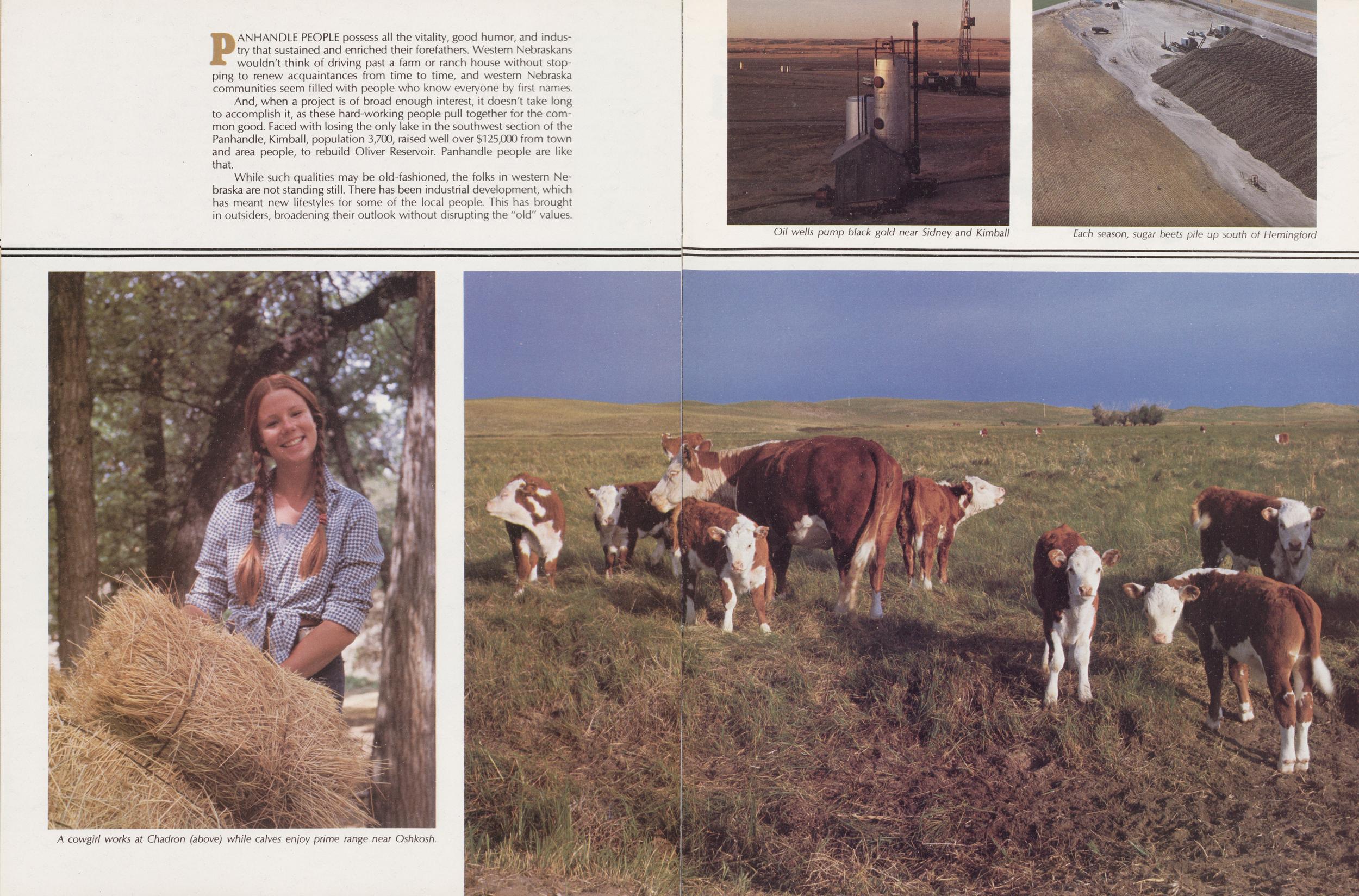
A cowgirl works at Chadron (above) while calves enjoy prime range near Oshkosh
Oil wells pump black gold near Sidney and Kimball
Each season, sugar beets pile up south of Hemingford
Panoramic Playground
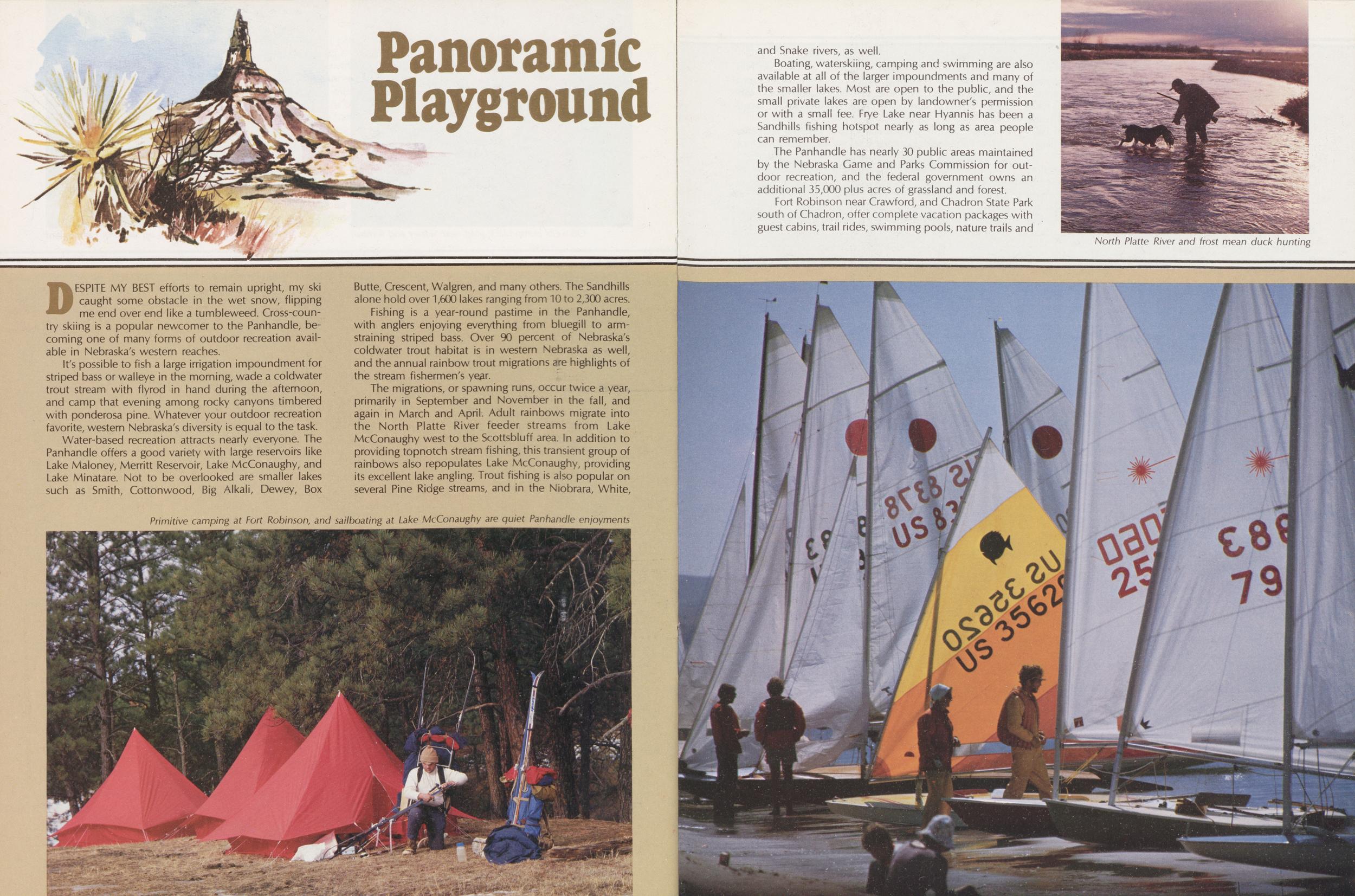
DESPITE MY BEST efforts to remain upright, my ski caught some obstacle in the wet snow, flipping me end over end like a tumbleweed. Cross-country skiing is a popular newcomer to the Panhandle, becoming one of many forms of outdoor recreation available in Nebraska's western reaches.
It's possible to fish a large irrigation impoundment for striped bass or walleye in the morning, wade a coldwater trout stream with flyrod in hand during the afternoon, and camp that evening among rocky canyons timbered with ponderosa pine. Whatever your outdoor recreation favorite, western Nebraska's diversity is equal to the task.
Water-based recreation attracts nearly everyone. The Panhandle offers a good variety with large reservoirs like Lake Maloney, Merritt Reservoir, Lake McConaughy, and Lake Minatare. Not to be overlooked are smaller lakes such as Smith, Cottonwood, Big Alkali, Dewey, Box Butte, Crescent, Walgren, and many others. The Sandhills alone hold over 1,600 lakes ranging from 10 to 2,300 acres.
Fishing is a year-round pastime in the Panhandle, with anglers enjoying everything from bluegill to arm- straining striped bass. Over 90 percent of Nebraska's coldwater trout habitat is in western Nebraska as well, and the annual rainbow trout migrations are highlights of the stream fishermen's year.
Primitive camping at Fort Robinson, and sailboating at Lake McConaughy are quiet Panhandle enjoyments
Boating, waterskiing, camping and swimming are also available at all of the larger impoundments and many of the smaller lakes. Most are open to the public, and the small private lakes are open by landowner's permission or with a small fee. Frye Lake near Hyannis has been a Sandhills fishing hotspot nearly as long as area people can remember.
The Panhandle has nearly 30 public areas maintained by the Nebraska Game and Parks Commission for outdoor recreation, and the federal government owns an additional 35,000 plus acres of grassland and forest.
North Platte River and frost mean duck hunting
 much more. Both are located on main access routes to
the Black Hills and other vacation areas, serving as ideal
base camps for short visits to those popular tourist areas.
much more. Both are located on main access routes to
the Black Hills and other vacation areas, serving as ideal
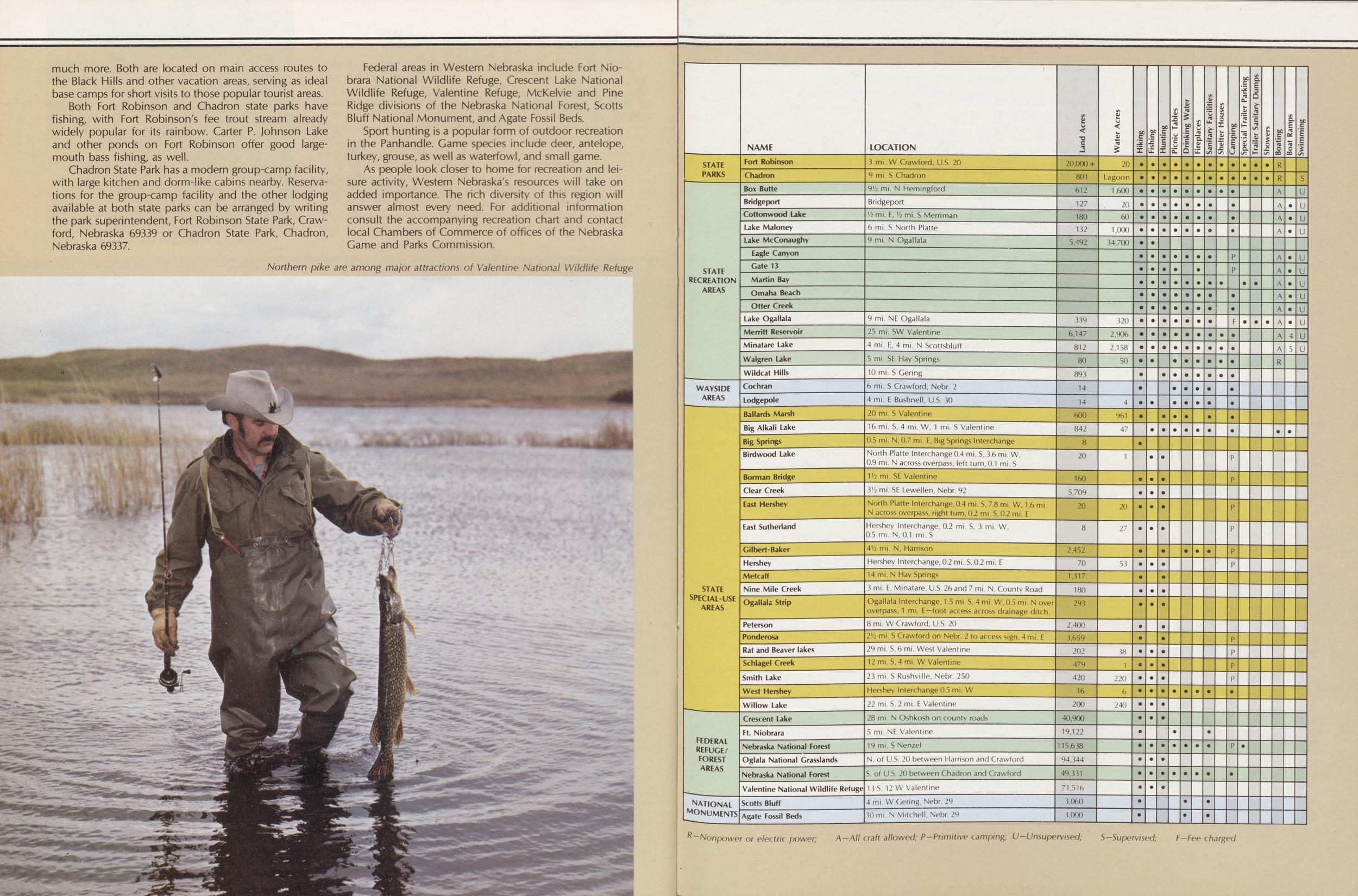
base camps for short visits to those popular tourist areas.Both Fort Robinson and Chadron state parks have fishing, with Fort Robinson's fee trout stream already widely popular for its rainbow. Carter P. Johnson Lake and other ponds on Fort Robinson offer good large-mouth bass fishing, as well.
Chadron State Park has a modern group-camp facility, with large kitchen and dorm-like cabins nearby. Reservations for the group-camp facility and the other lodging available at both state parks can be arranged by writing the park superintendent, Fort Robinson State Park, Crawford, Nebraska 69339 or Chadron State Park, Chadron, Nebraska 69337.
Federal areas in Western Nebraska include Fort Niobrara National Wildlife Refuge, Crescent Lake National Wildlife Refuge, Valentine Refuge, McKelvie and Pine Ridge divisions of the Nebraska National Forest, Scotts Bluff National Monument, and Agate Fossil Beds.
Sport hunting is a popular form of outdoor recreation in the Panhandle. Game species include deer, antelope, turkey, grouse, as well as waterfowl, and small game.
As people look closer to home for recreation and leisure activity, Western Nebraska's resources will take on added importance. The rich diversity of this region will answer almost every need. For additional information consult the accompanying recreation chart and contact local Chambers of Commerce of offices of the Nebraska Game and Parks Commission.
Northern pike are among major attractions of Valentine National Wildlife Refuge
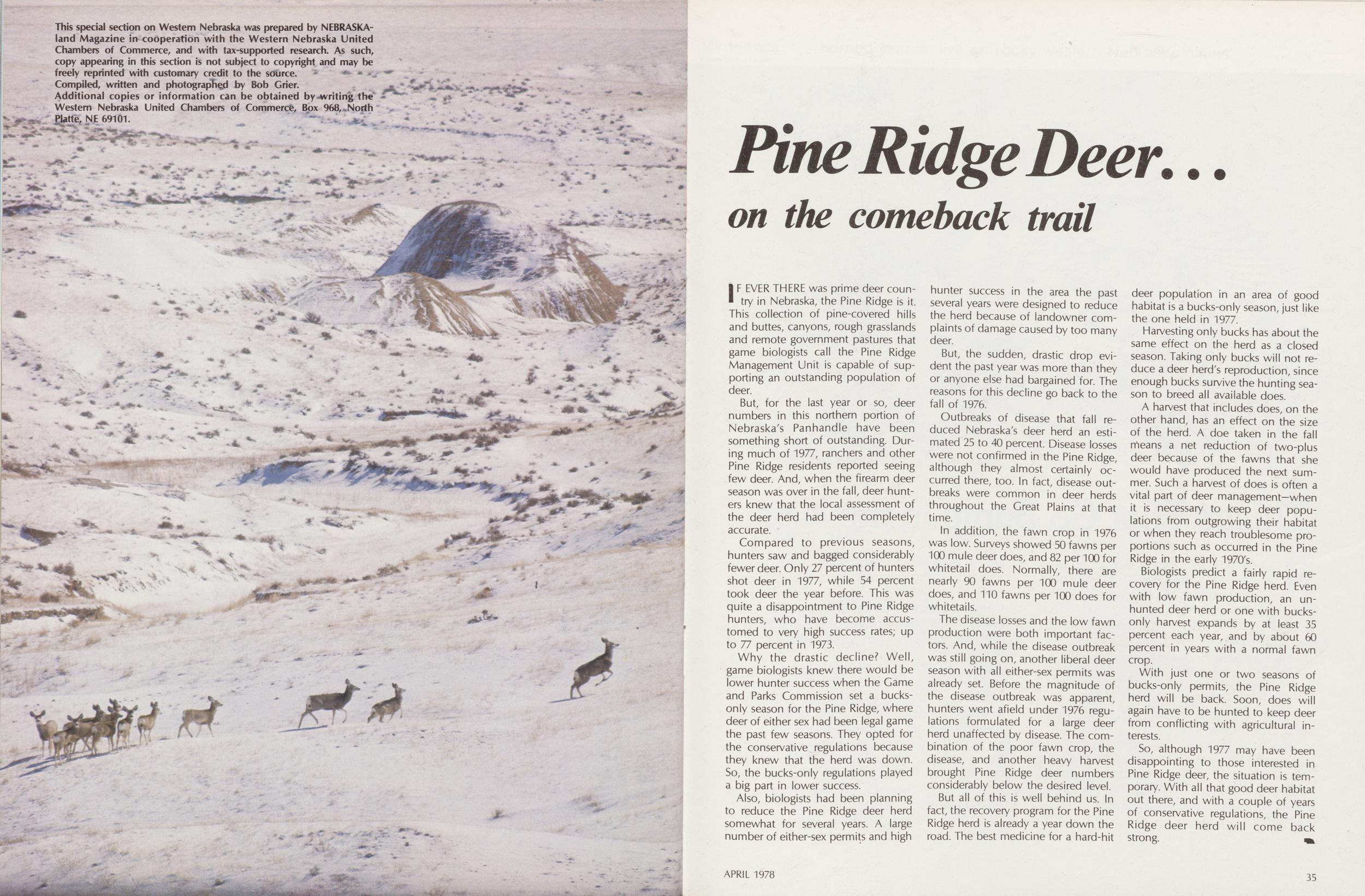
This special section on Western Nebraska was prepared by NEBRASKA- land Magazine in cooperation with the Western Nebraska United Chambers of Commerce, and with tax-supported research. As such, copy appearing in this section is not subject to copyright and may be freely reprinted with customary credit to the sdurce. Compiled, written and photographed by Bob Grier. Additional copies or information can be obtained by writing the Western Nebraska United Chambers of Commerce, Box 968,*North Platte, NE 69101.
Pine Ridge Deer... on the comeback trail
IF EVER THERE was prime deer country in Nebraska, the Pine Ridge is it. This collection of pine-covered hills and buttes, canyons, rough grasslands and remote government pastures that game biologists call the Pine Ridge Management Unit is capable of supporting an outstanding population of deer.
But, for the last year or so, deer numbers in this northern portion of Nebraska's Panhandle have been something short of outstanding. During much of 1977, ranchers and other Pine Ridge residents reported seeing few deer. And, when the firearm deer season was over in the fall, deer hunters knew that the local assessment of the deer herd had been completely accurate.
Compared to previous seasons, hunters saw and bagged considerably fewer deer. Only 27 percent of hunters shot deer in 1977, while 54 percent took deer the year before. This was quite a disappointment to Pine Ridge hunters, who have become accustomed to very high success rates; up to 77 percent in 1973.
Why the drastic decline? Well, game biologists knew there would be lower hunter success when the Game and Parks Commission set a bucks-only season for the Pine Ridge, where deer of either sex had been legal game the past few seasons. They opted for the conservative regulations because they knew that the herd was down. So, the bucks-only regulations played a big part in lower success.
Also, biologists had been planning to reduce the Pine Ridge deer herd somewhat for several years. A large number of either-sex permits and high hunter success in the area the past several years were designed to reduce the herd because of landowner complaints of damage caused by too many deer.
But, the sudden, drastic drop evident the past year was more than they or anyone else had bargained for. The reasons for this decline go back to the fall of 1976.
Outbreaks of disease that fall reduced Nebraska's deer herd an estimated 25 to 40 percent. Disease losses were not confirmed in the Pine Ridge, although they almost certainly occurred there, too. In fact, disease outbreaks were common in deer herds throughout the Great Plains at that time.
In addition, the fawn crop in 1976 was low. Surveys showed 50 fawns per 100 mule deer does, and 82 per 100 for whitetail does. Normally, there are nearly 90 fawns per 100 mule deer does, and 110 fawns per 100 does for whitetails.
The disease losses and the low fawn production were both important factors. And, while the disease outbreak was still going on, another liberal deer season with all either-sex permits was already set. Before the magnitude of the disease outbreak was apparent, hunters went afield under 1976 regulations formulated for a large deer herd unaffected by disease. The combination of the poor fawn crop, the disease, and another heavy harvest brought Pine Ridge deer numbers considerably below the desired level.
But all of this is well behind us. In fact, the recovery program for the Pine Ridge herd is already a year down the road. The best medicine for a hard-hit deer population in an area of good habitat is a bucks-only season, just like the one held in 1977.
Harvesting only bucks has about the same effect on the herd as a closed season. Taking only bucks will not reduce a deer herd's reproduction, since enough bucks survive the hunting sea- son to breed all available does.
A harvest that includes does, on the other hand, has an effect on the size of the herd. A doe taken in the fall means a net reduction of two-plus deer because of the fawns that she would have produced the next summer. Such a harvest of does is often a vital part of deer management—when it is necessary to keep deer populations from outgrowing their habitat or when they reach troublesome proportions such as occurred in the Pine Ridge in the early 1970's.
Biologists predict a fairly rapid recovery for the Pine Ridge herd. Even with low fawn production, an unhunted deer herd or one with bucks-only harvest expands by at least 35 percent each year, and by about 60 percent in years with a normal fawn crop.
With just one or two seasons of bucks-only permits, the Pine Ridge herd will be back. Soon, does will again have to be hunted to keep deer from conflicting with agricultural interests.
So, although 1977 may have been disappointing to those interested in Pine Ridge deer, the situation is temporary. With all that good deer habitat out there, and with a couple of years of conservative regulations, the Pine Ridge deer herd will come back strong.
APRIL 1978 35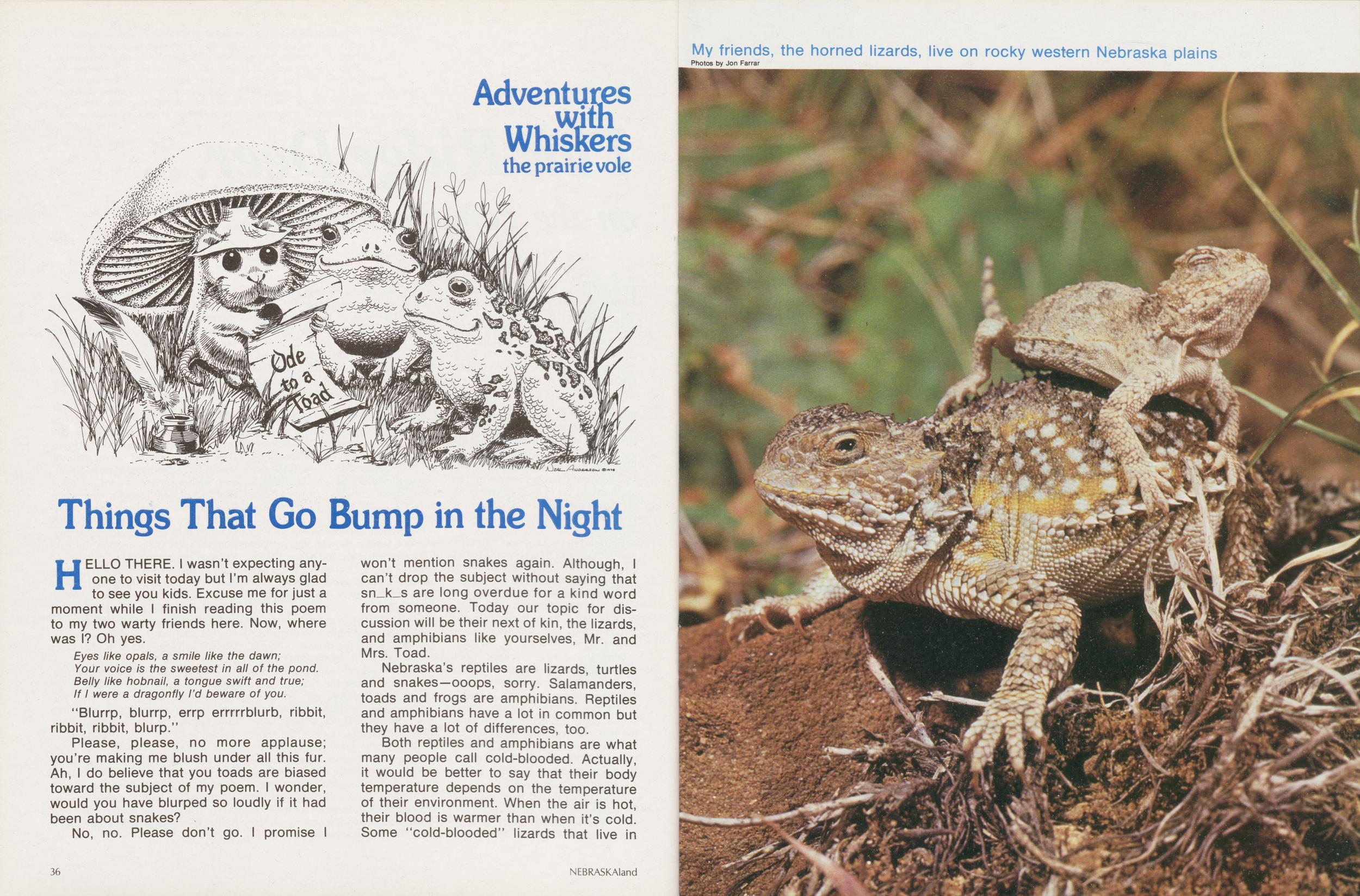
Adventures Whiskers the prairie vole
Things That Go Bump in the Night
HELLO THERE. I wasn't expecting anyone to visit today but I'm always glad to see you kids. Excuse me for just a moment while I finish reading this poem to my two warty friends here. Now, where was I? Oh yes.
Eyes like opals, a smile like the dawn; Your voice is the sweetest in all of the pond. Belly like hobnail, a tongue swift and true; If I were a dragonfly I'd beware of you.
"Blurrp, blurrp, errp errrrrblurb, ribbit, ribbit, ribbit, blurp."
Please, please, no more applause; you're making me blush under all this fur. Ah, I do believe that you toads are biased toward the subject of my poem. I wonder, would you have blurped so loudly if it had been about snakes?
No, no. Please don't go. I promise I won't mention snakes again. Although, I can't drop the subject without saying that sn_k_s are long overdue for a kind word from someone. Today our topic for discussion will be their next of kin, the lizards, and amphibians like yourselves, Mr. and Mrs. Toad.
Nebraska's reptiles are lizards, turtles and snakes—ooops, sorry. Salamanders, toads and frogs are amphibians. Reptiles and amphibians have a lot in common but they have a lot of differences, too.
My friends, the horned lizards, live on rocky western Nebraska plains
Photos by Jon Farrar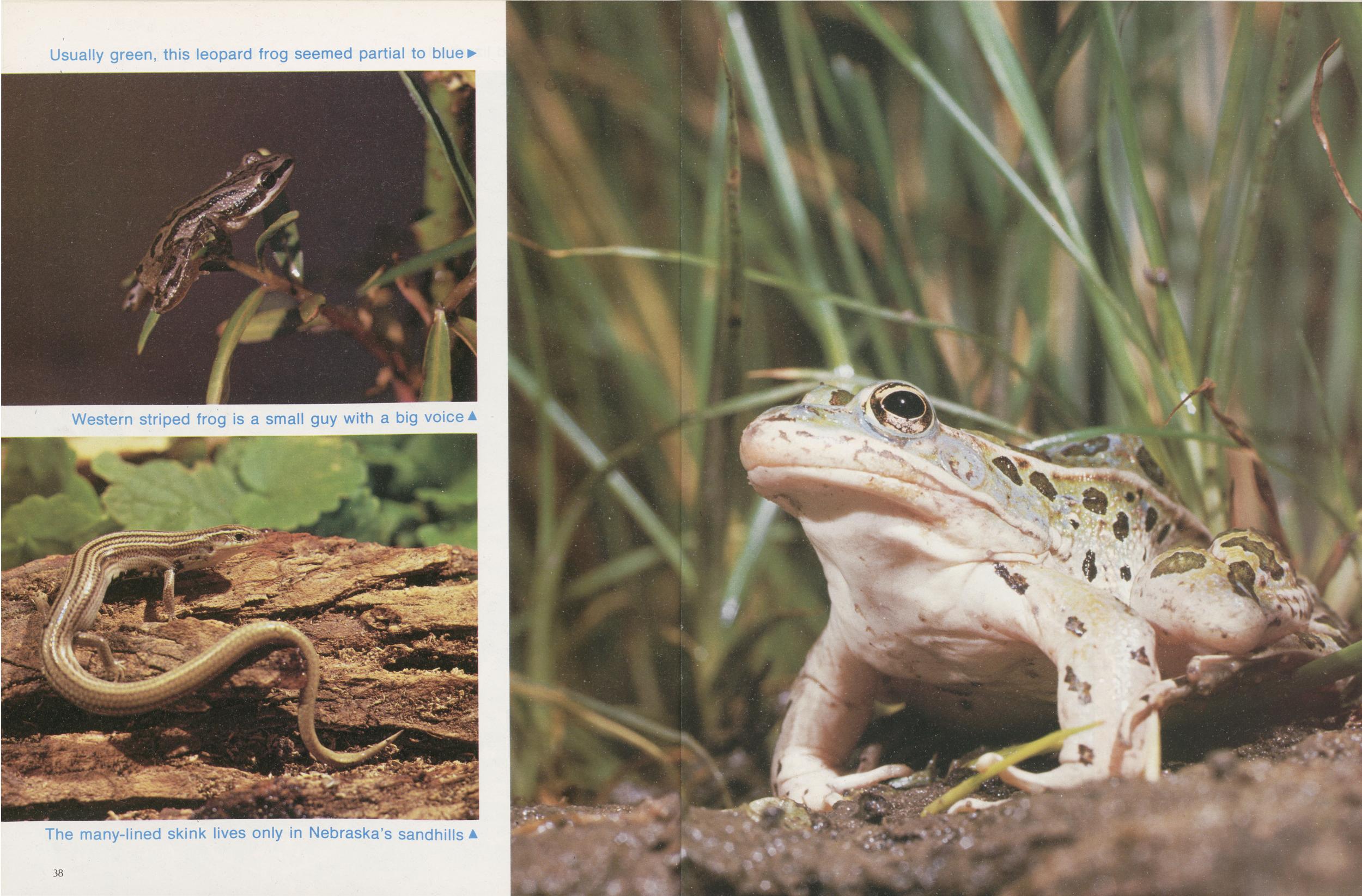
Usually green, this leopard frog seemed partial to blue
Western striped frog is a small guy with a big voice
The many-lined skink lives only in Nebraska's sandhills
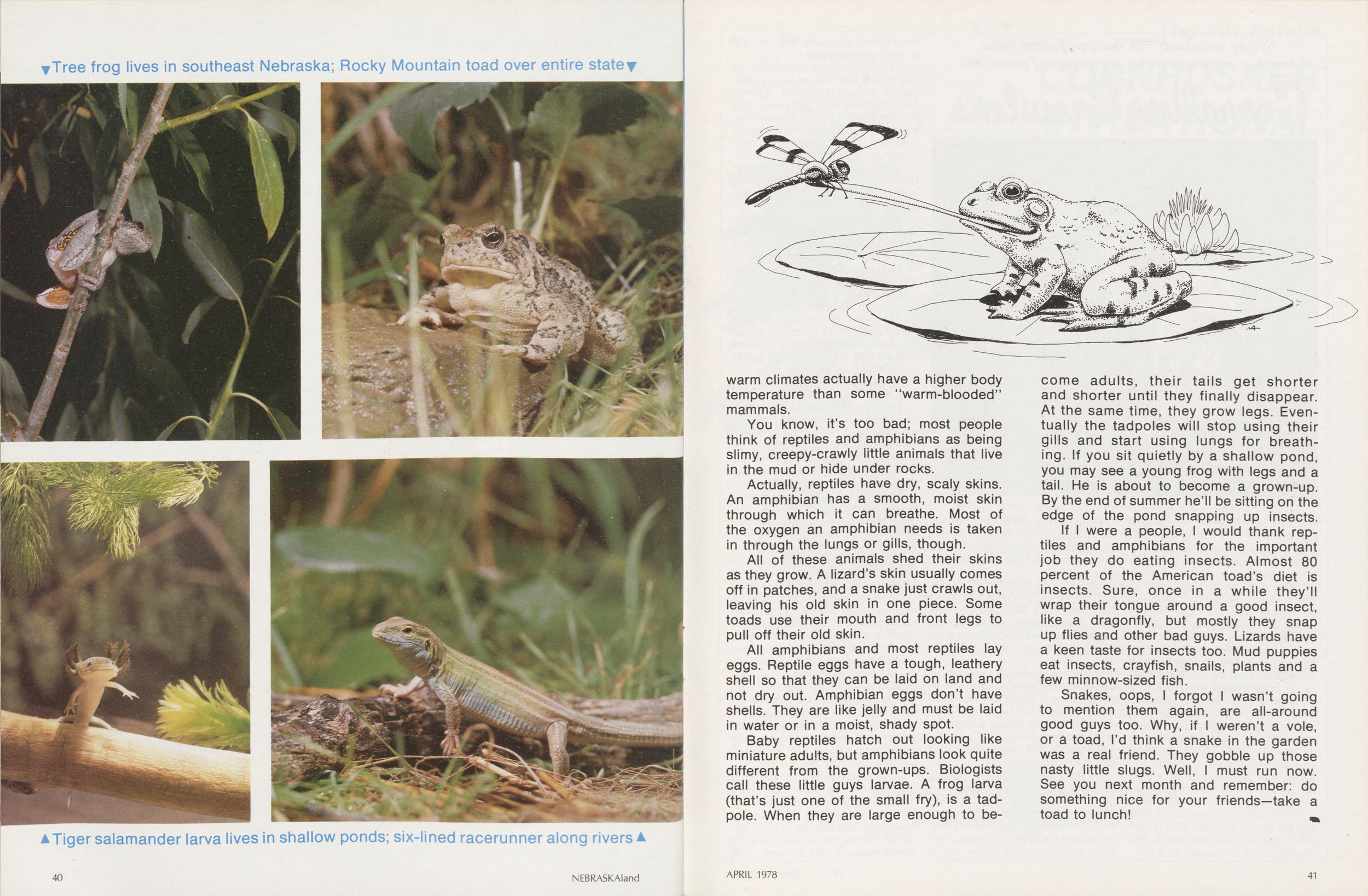
Tree frog lives in southeast Nebraska; Rocky Mountain toad over entire state
Tiger salamander larva lives in shallow ponds; six-lined racerunner along rivers
You know, it's too bad; most people think of reptiles and amphibians as being slimy, creepy-crawly little animals that live in the mud or hide under rocks.
Actually, reptiles have dry, scaly skins. An amphibian has a smooth, moist skin through which it can breathe. Most of the oxygen an amphibian needs is taken in through the lungs or gills, though.
All of these animals shed their skins as they grow. A lizard's skin usually comes off in patches, and a snake just crawls out, leaving his old skin in one piece. Some toads use their mouth and front legs to pull off their old skin.
All amphibians and most reptiles lay eggs. Reptile eggs have a tough, leathery shell so that they can be laid on land and not dry out. Amphibian eggs don't have shells. They are like jelly and must be laid in water or in a moist, shady spot.
Baby reptiles hatch out looking like miniature adults, but amphibians look quite different from the grown-ups. Biologists call these little guys larvae. A frog larva (that's just one of the small fry), is a tadpole. When they are large enough to become adults, their tails get shorter and shorter until they finally disappear. At the same time, they grow legs. Eventually the tadpoles will stop using their gills and start using lungs for breathing. If you sit quietly by a shallow pond, you may see a young frog with legs and a tail. He is about to become a grown-up. By the end of summer he'll be sitting on the edge of the pond snapping up insects.
If I were a people, I would thank reptiles and amphibians for the important job they do eating insects. Almost 80 percent of the American toad's diet is insects. Sure, once in a while they'll wrap their tongue around a good insect, like a dragonfly, but mostly they snap up flies and other bad guys. Lizards have a keen taste for insects too. Mud puppies eat insects, crayfish, snails, plants and a few minnow-sized fish.
Snakes, oops, I forgot I wasn't going to mention them again, are all-around good guys too. Why, if I weren't a vole, or a toad, I'd think a snake in the garden was a real friend. They gobble up those nasty little slugs. Well, I must run now. See you next month and remember: do something nice for your friends—take a toad to lunch!
APRIL 1978 41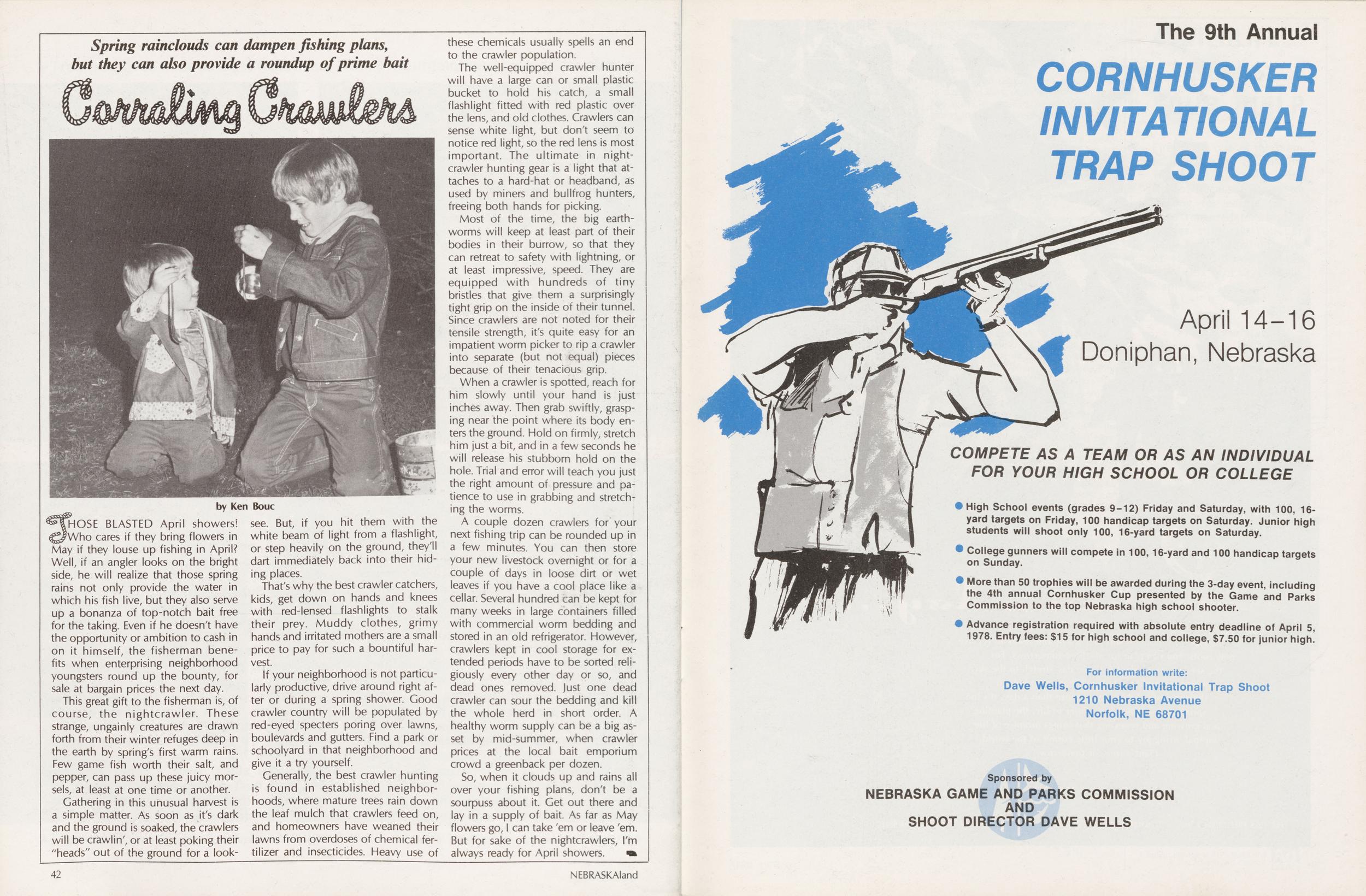
Spring rainclouds can dampen fishing plans, but they can also provide a roundup of prime bait
Corraling Crawlers
THOSE BLASTED April showers! Who cares if they bring flowers in May if they louse up fishing in April? Well, if an angler looks on the bright side, he will realize that those spring rains not only provide the water in which his fish live, but they also serve up a bonanza of top-notch bait free for the taking. Even if he doesn't have the opportunity or ambition to cash in on it himself, the fisherman benefits when enterprising neighborhood youngsters round up the bounty, for sale at bargain prices the next day.
This great gift to the fisherman is, of course, the nightcrawler. These strange, ungainly creatures are drawn forth from their winter refuges deep in the earth by spring's first warm rains. Few game fish worth their salt, and pepper, can pass up these juicy morsels, at least at one time or another.
Gathering in this unusual harvest is a simple matter. As soon as it's dark and the ground is soaked, the crawlers will be crawlin', or at least poking their "heads" out of the ground for a look-see. But, if you hit them with the white beam of light from a flashlight, or step heavily on the ground, they'll dart immediately back into their hiding places.
That's why the best crawler catchers, kids, get down on hands and knees with red-lensed flashlights to stalk their prey. Muddy clothes, grimy hands and irritated mothers are a small price to pay for such a bountiful harvest.
If your neighborhood is not particularly productive, drive around right after or during a spring shower. Good crawler country will be populated by red-eyed specters poring over lawns, boulevards and gutters. Find a park or schoolyard in that neighborhood and give it a try yourself.
Generally, the best crawler hunting is found in established neighborhoods, where mature trees rain down the leaf mulch that crawlers feed on, and homeowners have weaned their lawns from overdoses of chemical fertilizer and insecticides. Heavy use of these chemicals usually spells an end to the crawler population.
The well-equipped crawler hunter will have a large can or small plastic bucket to hold his catch, a small flashlight fitted with red plastic over the lens, and old clothes. Crawlers can sense white light, but don't seem to notice red light, so the red lens is most important. The ultimate in nightcrawler hunting gear is a light that attaches to a hard-hat or headband, as used by miners and bullfrog hunters, freeing both hands for picking.
Most of the time, the big earth- worms will keep at least part of their bodies in their burrow, so that they can retreat to safety with lightning, or at least impressive, speed. They are equipped with hundreds of tiny bristles that give them a surprisingly tight grip on the inside of their tunnel. Since crawlers are not noted for their tensile strength, it's quite easy for an impatient worm picker to rip a crawler into separate (but not equal) pieces because of their tenacious grip.
When a crawler is spotted, reach for him slowly until your hand is just inches away. Then grab swiftly, grasping near the point where its body enters the ground. Hold on firmly, stretch him just a bit, and in a few seconds he will release his stubborn hold on the hole. Trial and error will teach you just the right amount of pressure and patience to use in grabbing and stretching the worms.
A couple dozen crawlers for your next fishing trip can be rounded up in a few minutes. You can then store your new livestock overnight or for a couple of days in loose dirt or wet leaves if you have a cool place like a cellar. Several hundred can be kept for many weeks in large containers filled with commercial worm bedding and stored in an old refrigerator. However, crawlers kept in cool storage for extended periods have to be sorted religiously every other day or so, and dead ones removed. Just one dead crawler can sour the bedding and kill the whole herd in short order. A healthy worm supply can be a big set by mid-summer, when crawler prices at the local bait emporium crowd a greenback per dozen.
So, when it clouds up and rains all over your fishing plans, don't be a sourpuss about it. Get out there and lay in a supply of bait. As far as May flowers go, I can take 'em or leave 'em. But for sake of the nightcrawlers, I'm always ready for April showers.
42 NEBRASKAIandThe 9th Annual CORNHUSKER INVITATIONAL TRAP SHOOT
April 14-16 Doniphan, Nebraska COMPETE AS A TEAM OR AS AN INDIVIDUAL FOR YOUR HIGH SCHOOL OR COLLEGE • High School events (grades 9-12) Friday and Saturday, with 100, 16- yard targets on Friday, 100 handicap targets on Saturday. Junior high students will shoot only 100, 16-yard targets on Saturday. • College gunners will compete in 100, 16-yard and 100 handicap targets on Sunday. • More than 50 trophies will be awarded during the 3-day event, including the 4th annual Cornhusker Cup presented by the Game and Parks Commission to the top Nebraska high school shooter. • Advance registration required with absolute entry deadline of April 5, 1978. Entry fees: $15 for high school and college, $7.50 for junior high. For information write: Dave Wells, Cornhusker Invitational Trap Shoot 1210 Nebraska Avenue Norfolk, NE 68701 Sponsored by NEBRASKA GAME AND PARKS COMMISSION AND SHOOT DIRECTOR DAVE WELLS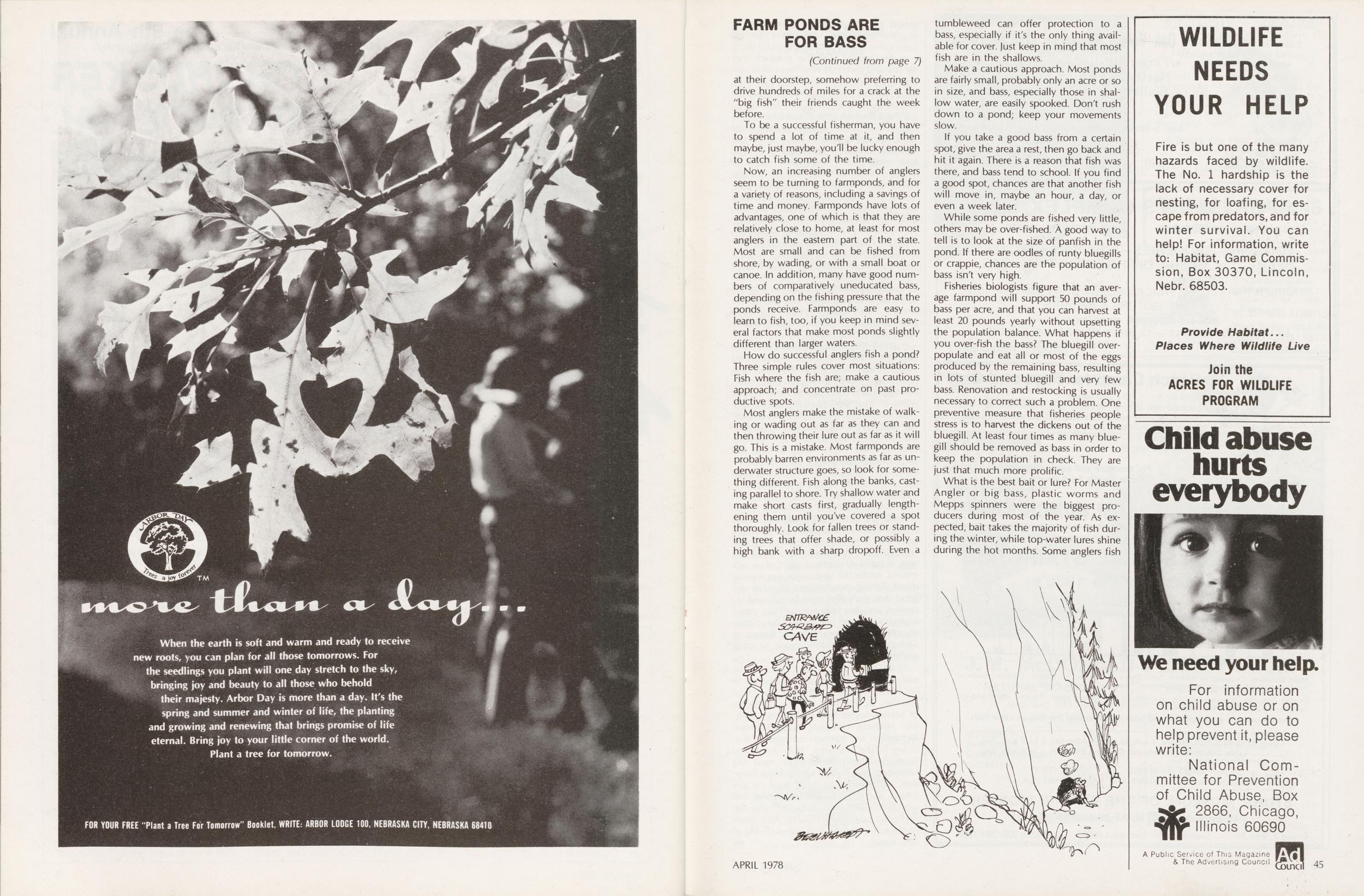
more than a day . . .
When the earth is soft and warm and ready to receive new roots, you can plan for all those tomorrows. For the seedlings you plant will one day stretch to the sky, bringing joy and beauty to all those who behold their majesty. Arbor Day is more than a day. It's the spring and summer and winter of life, the planting and growing and renewing that brings promise of life eternal. Bring joy to your little corner of the world. Plant a tree for tomorrow. FOR YOUR FREE "Plant a Tree For Tomorrow" Booklet, WRITE: ARBOR LODGE 100, NEBRASKA CITY, NEBRASKA 68410FARM PONDS ARE FOR BASS
(Continued from page 7)at their doorstep, somehow preferring to drive hundreds of miles for a crack at the "big fish" their friends caught the week before.
To be a successful fisherman, you have to spend a lot of time at it, and then maybe, just maybe, you'll be lucky enough to catch fish some of the time.
Now, an increasing number of anglers seem to be turning to farmponds, and for a variety of reasons, including a savings of time and money. Farmponds have lots of advantages, one of which is that they are relatively close to home, at least for most anglers in the eastern part of the state. Most are small and can be fished from shore, by wading, or with a small boat or canoe. In addition, many have good numbers of comparatively uneducated bass, depending on the fishing pressure that the ponds receive. Farmponds are easy to learn to fish, too, if you keep in mind several factors that make most ponds slightly different than larger waters.
How do successful anglers fish a pond? Three simple rules cover most situations: Fish where the fish are; make a cautious approach; and concentrate on past productive spots.
Most anglers make the mistake of walking or wading out as far as they can and then throwing their lure out as far as it will go. This is a mistake. Most farmponds are probably barren environments as far as underwater structure goes, so look for something different. Fish along the banks, casting parallel to shore. Try shallow water and make short casts first, gradually lengthening them until you've covered a spot thoroughly. Look for fallen trees or standing trees that offer shade, or possibly a high bank with a sharp dropoff. Even a tumbleweed can offer protection to a bass, especially if it's the only thing available for cover. Just keep in mind that most fish are in the shallows.
Make a cautious approach. Most ponds are fairly small, probably only an acre or so in size, and bass, especially those in shallow water, are easily spooked. Don't rush down to a pond; keep your movements slow.
If you take a good bass from a certain spot, give the area a rest, then go back and hit it again. There is a reason that fish was there, and bass tend to school. If you find a good spot, chances are that another fish will move in, maybe an hour, a day, or even a week later.
While some ponds are fished very little, others may be over-fished. A good way to tell is to look at the size of panfish in the pond. If there are oodles of runty bluegills or crappie, chances are the population of bass isn't very high.
Fisheries biologists figure that an average farmpond will support 50 pounds of bass per acre, and that you can harvest at least 20 pounds yearly without upsetting the population balance. What happens if you over-fish the bass? The bluegill over-populate and eat all or most of the eggs produced by the remaining bass, resulting in lots of stunted bluegill and very few bass. Renovation and restocking is usually necessary to correct such a problem. One preventive measure that fisheries people stress is to harvest the dickens out of the bluegill. At least four times as many bluegill should be removed as bass in order to keep the population in check. They are just that much more prolific.
What is the best bait or lure? For Master Angler or big bass, plastic worms and Mepps spinners were the biggest producers during most of the year. As expected, bait takes the majority of fish during the winter, while top-water lures shine during the hot months. Some anglers fish
Entrance Scarbad Cave
Fire is but one of the many hazards faced by wildlife. The No. 1 hardship is the lack of necessary cover for nesting, for loafing, for es- cape from predators, and for winter survival. You can help! For information, write to: Habitat, Game Commis- sion, Box 30370, Lincoln, Nebr. 68503.
Provide Habitat... Places Where Wildlife Live Join the ACRES FOR WILDLIFE PROGRAM
We need your help. For information on child abuse or on what you can do to help prevent it, please write: National Com- mittee for Prevention of Child Abuse, Box 2866, Chicago, -TO" Illinois 60690 A Public Service of This Magazine & The Advertising Council
APRIL 1978 45
almost exclusively with rubber frogs or frog-like imitations, with good success from spring to fall, but the important thing is to find several lures that produce well for you and then fish with them until you find one you have confidence in. Chances are good that the lure which produces in one pond will also produce in the next.
What's the best time of year? Farmpond bass can be taken almost anytime with some success, as long as the weather cooperates. Winter is perhaps the slowest bass season, with most then taken in deeper water near the dam, on tip-ups baited with minnows or waxworms. Early spring, late March and April, is probably the very best time to catch bass, with May, June and July close behind. The majority of the seven-pound and over bass were taken in April, with May and June then producing nearly all of the rest.
Now, just because you are fishing a small pond doesn't mean you shouldn't have good equipment, especially when a quick, hook-setting strike with artificials is needed. Most anglers prefer a rod with good backbone to drive the hook solidly into a bass's hard mouth.
A good reel is equally important. Use one that is relatively quick handling and backlash free. With most farmpond bass fishing in shallow water, you find many hits coming soon after the lure hits the water, so it's important to be ready. Many experienced anglers prefer free-spooling baitcasting reels, but these take a little getting used to. The proper line is important, too, especially when fishing bass. In the fairly clear ponds where fish are in shallow water, 10 to 12-pound test might be best, while around brush or in murky water, stouter line can be used.
How do you find farmponds? For someone who hunts during the fall, the answer is obvious; you may already have several in mind that you saw while afield. Otherwise, take a drive in the country until you spot a pond or earthen dam, then ask around; locate the landowner and inquire about fishing possibilities. Chances are good that you'll find most landowners receptive, and they may even tell you about a neighbor's pond that's full of fish. Other sources are the local Natural Resources District, Soil Conservation office, or other anglers.
Again, most ponds are located in the east, with the majority of good ponds to be found in the south and southeast counties. In that area, the top producers of Master Angler bass were Otoe, Webster, Nemaha, Lancaster, Gage, Fillmore, Richardson and Johnson counties, in that order. In the northeast, Holt, Knox and Boyd counties produced the most big farmpond bass. Good bass fishing, however, isn't limited to these areas by any means, and chances are fairly good that wherever you live in Nebraska, you can find good bass fishing close by. And, much of the fun of fishing is in the exploring of new water.
46 NEBRASKAIandFIGHT FOR HUMAN FREEDOM
(Continued from page 11)days. The testimony was short, with only three witnesses being called. When called to the stand, Standing Bear repeated the story of the tribe's dislocation, their hard life in Indian Territory, and their return journey. At the end of his testimony, while looking directly at the judge, he held out his hand in front of him and said: "That hand is not the color of yours, but if I pierce it, I shall feel pain. If you pierce your hand, you also feel pain. The blood that will flow from mine will be of the same color as yours. I am a man. The same God made us both.
"I seem to stand on the bank of a river. My wife and little girl are beside me . . . we will return to the Swift Running Water [the Niobrara] that pours down between the green islands. There are the graves of my fathers. There again we will pitch our tepee and build our fires.
"But a man bars the passage. He is a thousand times more powerful than I. Behind him I see soldiers as numerous as the leaves of the trees. They will obey that man's orders. If he says that I cannot pass, I cannot. The long struggle will have been in vain. My wife and child and I must return and sink beneath the flood. We are weak and faint and sick. I cannot fight."
Turning to the judge and looking directly into his eyes, he said softly, "You are that man."
John Webster argued that the rights of Indians had been acknowledged since the time whites first set foot on the continent. He delved into the question of whether Indian tribes were separate and independent nations. He noted that the government had made treaties with them as such and quoted past precedents. Concluding that Indian tribes were in fact independent nations, he claimed that they had rights and privileges as such.
When tribal relations were dissolved, Webster claimed, an Indian became a citizen of the United States by the Fourteenth Amendment. He concluded that Indians are either a part of a separate and independent nation, or, if they have renounced their tribal ties, citizens of the
I'm glad that one got away!
United States. Consequently, Indians had rights which could not be infringed upon by the government.
Webster was followed by the government attorney, G. M. Lambertson. He argued that an Indian could not appear in court and was not entitled to a writ of habeas corpus. He claimed that Indian tribes were not separate and independent nations and hence did not have rights as such. He based his argument on the Dred Scott case, which found that Negroes did not possess the rights of citizenship and hence could not bring suit in a federal court.
On May 12 judge Dundy ruled that an Indian is a person within the meaning of the habeas corpus act, and as such is entitled to sue in the federal courts.
Dundy sidestepped the question of Indian citizenship, but still his conclusions were far-reaching in their implications. He ruled that no rightful authority existed for removing the Poncas to Indian Territory, and that Standing Bear and his clan should be discharged from custody.
But Standing Bear's fight was not over. When the 530 Poncas remaining in Indian Territory learned of judge Dundy's decision, most began preparations to move back. The Indian Bureau realized that the decision was a threat to the Indian system. If the remaining Poncas left Indian Territory, Secretary Schurz feared, the entire reservation system would be destroyed.
Tibbles, realizing the problems the Poncas still faced, decided to enter the fray full time. He went on a speaking tour in the east to drum up support for the Poncas. Bright Eyes, an Omaha Indian woman soon to become Mrs. Tibbies, and Standing Bear, accompanied him. The public support they gained eventually led to a commission appointed by President Hayes to investigate the situation. Finally the commission decided that the Poncas could elect to stay or return. In either case, 160-acre plots of land were to be issued to each Indian. By this time, many had become acclimatized and many stayed there.
Standing Bear stayed on the Niobrara until the plots of land were finally allocated in 1890, and he lived quietly until his death in 1908. His long struggle for a place to live and die brought all Indians closer to their natural rights.
'Talk about a captive audience!'
Trading Post
DOGS BEAGLES. Puppy love for sale. We have the perfect family companion or hunting partner for you. Champion dams and/or sire. Tux Beagles, Route 1, Box 152, Raymond, NE 68428 (402) 475-3713. AKC Draathaars, German wire-haired pointers, year-old dogs for sale, lames O'Donnell, Box C, Lexington, NE 68850. (308) 324-3656. MISCELLANEOUS DUCK HUNTERS: learn how, make quality, solid plastic, waterfowl decoys. We're originators of famous system. Send $.50, colorful catalog. Decoys Unlimited, Clinton, Iowa 52732. GUNS-Browning, Winchester, Remington, others, Hi- powers, shotguns, new, used, antiques. Want Pre-1964 Winchesters. Buy-Sell-Trade. Ph. (402) 729-6112. Bedlan's Sporting Goods, Fairbury, NE 68352. WANTED-JAPANESE SWORDS, fittings, related objects. Serious collector pays best prices. Call or write Don Hill, 5016 California, Omaha, NE 68132 (402) 558-0541. CANOE TRIPS. Canoes for rent. WE DO IT YOUR WAY! Dryland Aquatics, 1832 Park, Fremont, Nebraska 68025 (402) 721-5801 or (402) 721-1749. CANOE NEBRASKA . . . WITH WILSON OUTFITTERS' Quality Full-service Canoe-Camping Trips! Statewide Ca- noe Rental Network (15 locations)! Canoe Specialty Shop in Lincoln at 14th & Cornhusker! For 1978 Brochure . . . Write Wilson Outfitters, 6211 Sunrise Road, Lincoln, Ne- braska 68510. NEBRASKA SONGS. "The Nebraska Polka", "Down on the Niobrara", "If you don't like our weather". $1.25 each, please add Nebraska Sales Tax. Ray's Pub. 1117% North Main, Fremont, NE 68025. #576-Long Pine, Nebraska; 3-bedroom, A-frame home located in beautiful setting of pine trees overlooking Long Pine Creek, near Long Pine, Nebraska. Has separate dining room, family room; extras include fireplace, 2 outdoor decks, and a greenhouse. Gateway Realty of Grand Island, Inc., Gateway Plaza, 3307 West Capital Avenue, Grand Is- land, NE 68801; Phone (308) 382-7800. GRANDPA'S WOODS. "The Quiet Campground". For a quiet, relaxing experience, camp, fish and golf at Grandpa's Woods. Located two miles north, one mile east and one-half mile north of Elmwood, NE. CASH PAID for the following items made by Winchester gun company: Older rifles, shotguns, pocket knives, tools, sporting equipment, fishing gear, and others. Also want cartridge boards, posters, calendars, catalogs before the 1940/5 from any firearm or ammunition company. Please give price and condition in first letter. Write: WINCHES- TER, Box 30004, Lincoln, NE 68503. GUARANTEED LIVE-catch trap; caught 3 coon, 2 mink, 5 possums in one trap one night. Catch more fur or money back. Automatically resets, animal never gets bait. Send $2 for drawing. Hammond, Route 5, Box 49, Feiser Road, Cov- ington, Kentucky 41015. BUY DIRECT! Grow worms-For sale, bait, gardening, gar- bage disposal. Beds, bedding, feed available. Hybrid red stock by the dozen or million. Send stamp for price lists, details. M-j Baits & Boats, Box 365-A, Hartington, NE 68739 APRIL 1978 REFINISH WOOD FURNITURE-2 easy steps, inexpensive. Make old furniture look new again! $2 SASE. S. Nicholas, Palmer, Nebraska 68864. TAXIDERMY BIG BEAR TAXIDERMY, Rt. 2, Mitchell, Nebraska 69357. We specialize in all big game from Alaska to Nebraska, also birds and fish. Hair on and hair off tanning, 4/2 miles west of Scottsbluff on Highway 26. Phone (308) 635-3013. KARL SCHWARZ Master Taxidermists. Mounting of game heads-birds-fish-animals-fur rugs-robes-tanning buckskin. Since 1910. 424 South 13th Street, Dept. A, Omaha, Nebraska 68102. FISH MOUNTING Service. Specialize in all fresh-water fish. Visitors welcome. Wally Allison, 2709 Birchwood North Platte, NE 69101, (308) 534-2324. GREAT PLAINS TAXIDERMY, Creative and realistic mounts of Fish, Birds, Game heads, full mounts, and novelty. Pat Garvey, 3015 NW 52nd, Lincoln, Nebraska 68524. Phone 470-2280, Lincoln; 571-5630, Omaha. CREATIVE TAXIDERMY. Modern methods and life-like workmanship on all fish and game since 1935, also tan- ning, rugs, and deerskin products. Joe Voges, Naturecrafts and Gift Shop, 925 4th Corso, Nebraska City, NE 68410. Phone (402) 873-5491 COMPLETE TAXIDERMY SERVICE. We take pride in your satisfaction. We will help you go hunting and fishing—ex- clusive agent, Jack Jonas Safaris. Brochure and price list. Dinges Taxidermy Studio, 2760 S. 12th Omaha, NE 68108 (402) 342-3718.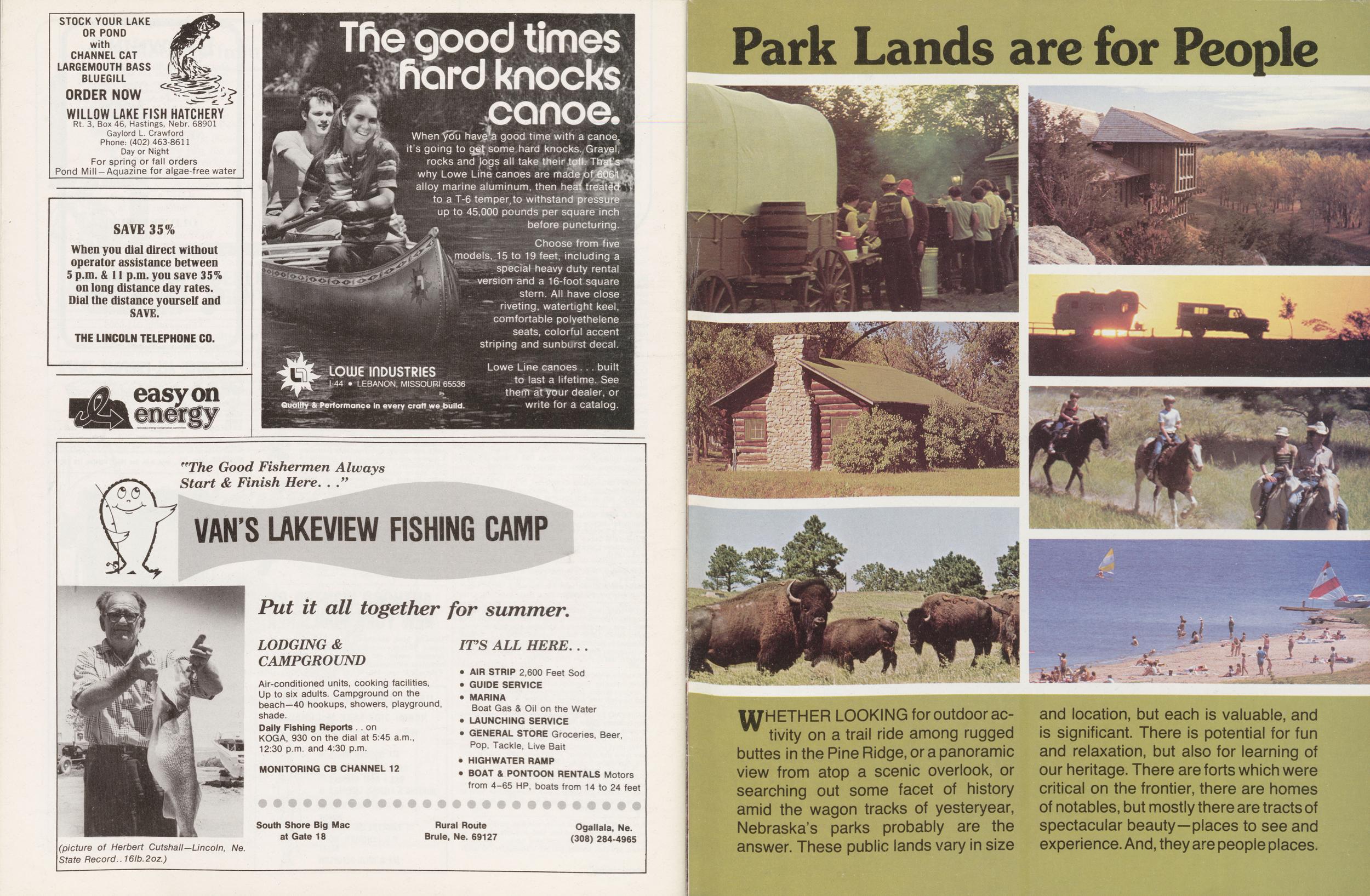
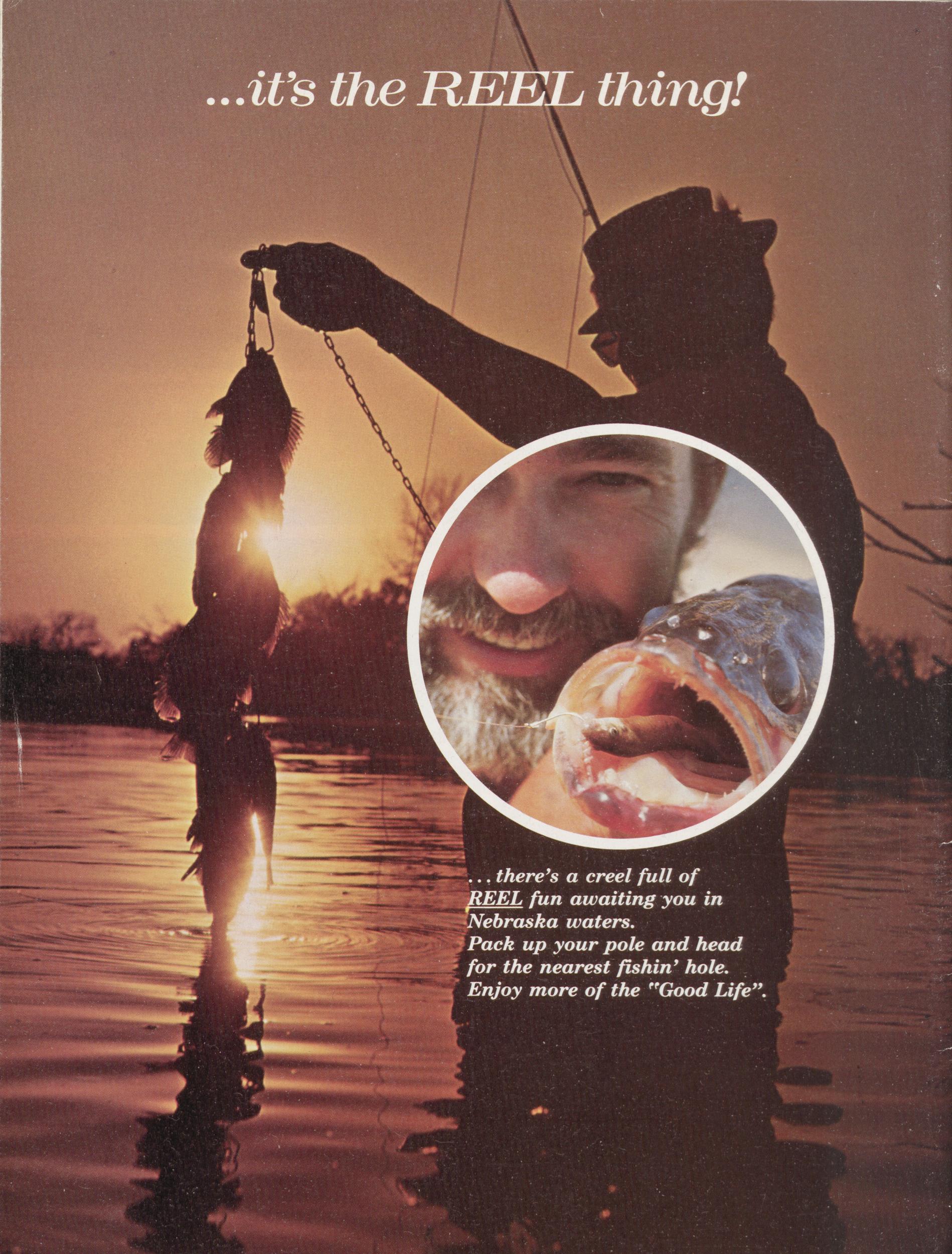
Position: 583 (19 views)