Volume 56, Issue 3, 1978
·Winter is a challenging time for the state's wildlife
·This duo has learned how to catch walleye in winter
NEBRASKAland
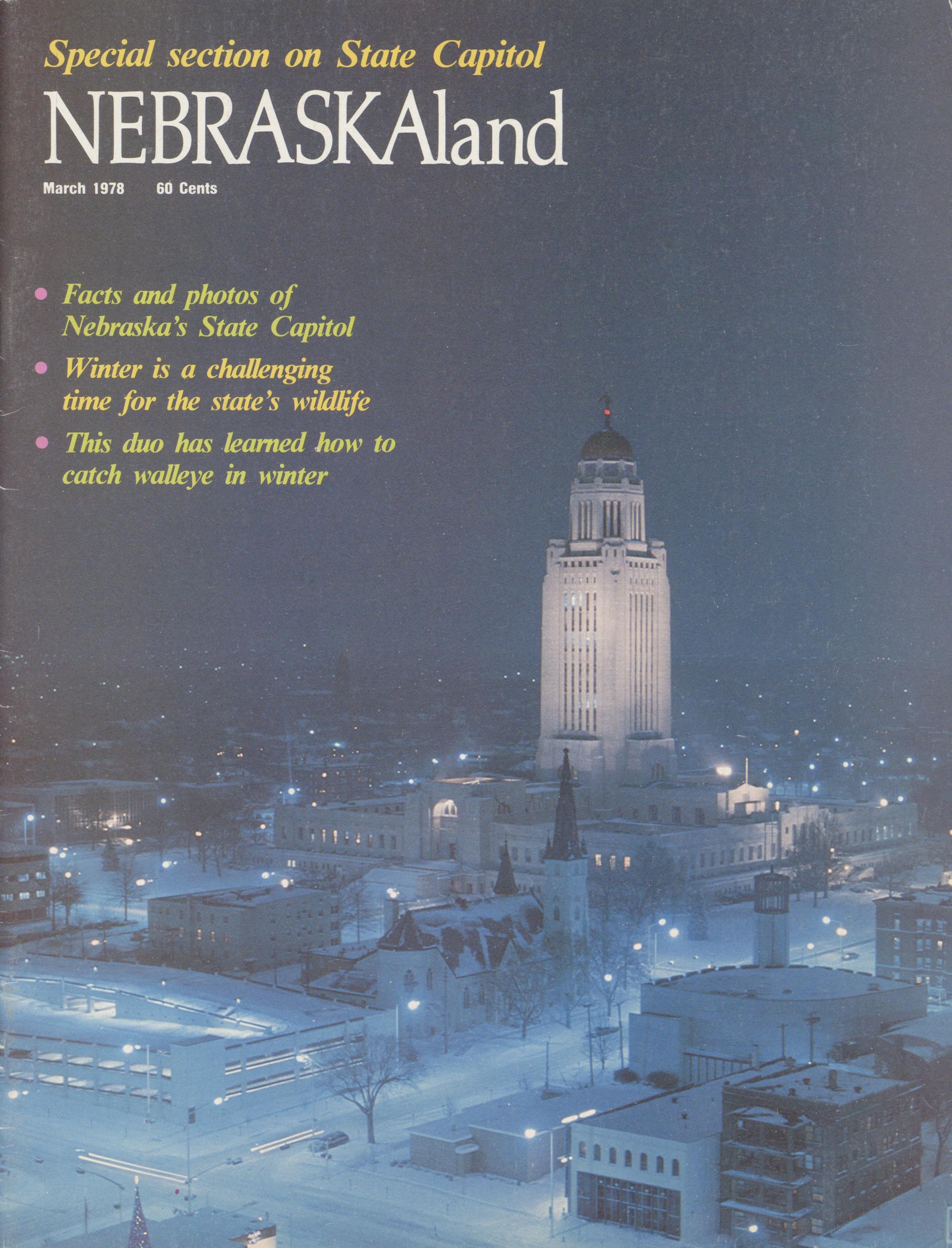
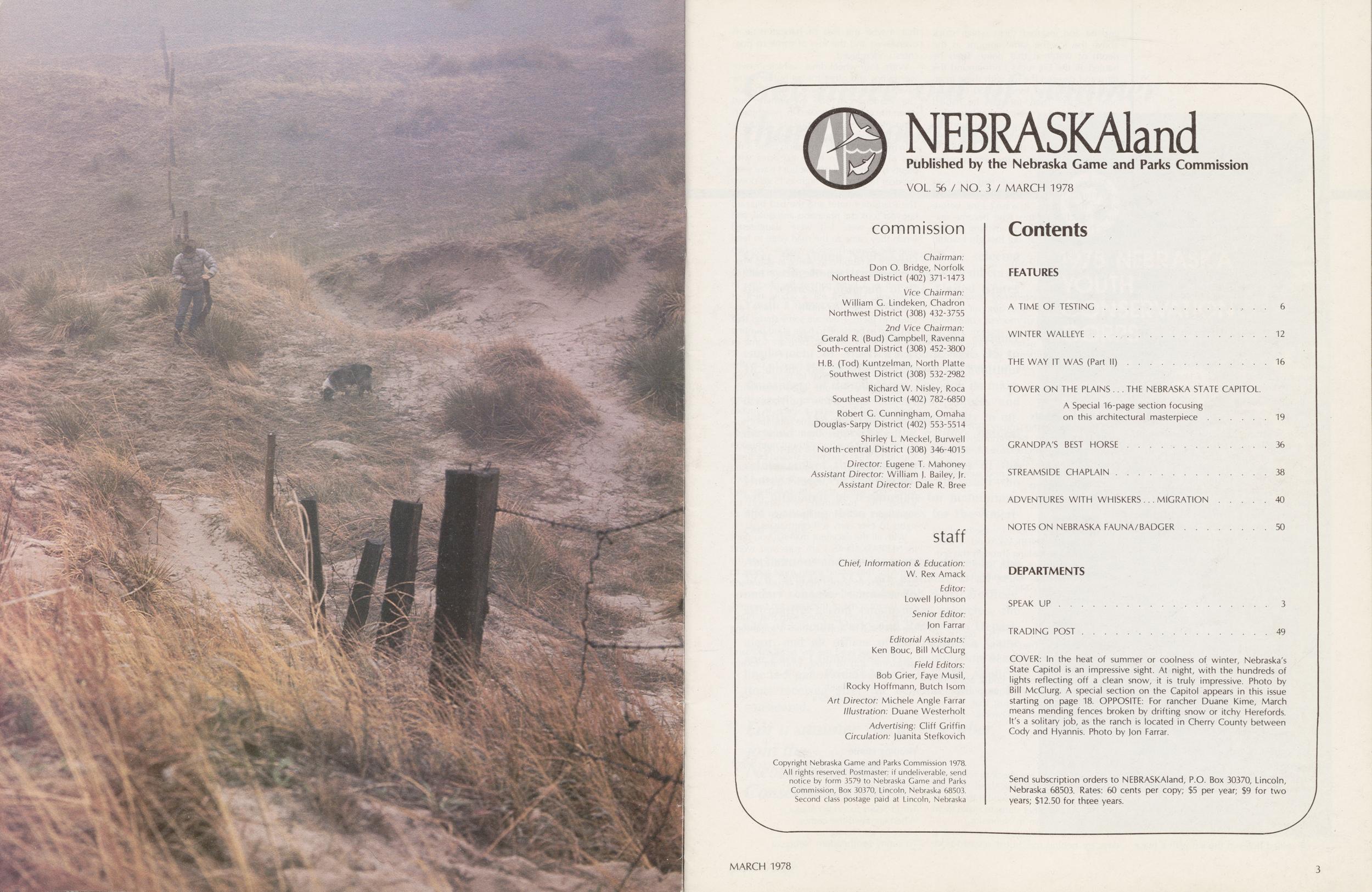
Published by the Nebraska Game and Parks Commission VOL 56 / NO. 3 / MARCH 1978 commission Chairman: Don O. Bridge, Norfolk Northeast District (402) 371-1473 Vice Chairman: William G. Lindeken, Chadron Northwest District (308) 432-3755 2nd Vice Chairman: Gerald R. (Bud) Campbell, Ravenna South-central District (308) 452-3800 H.B. (Tod) Kuntzelman, North Platte Southwest District (308) 532-2982 Richard W. Nisley, Roca Southeast District (402) 782-6850 Robert G. Cunningham, Omaha Douglas-Sarpy District (402) 553-5514 Shirley L. Meckel, Burwell North-central District (308) 346-4015 Director: Eugene T. Mahoney Assistant Director: William J. Bailey, Jr. Assistant Director: Dale R. Bree staff Chief, Information & Education: W. Rex Amack Editor: Lowell Johnson Senior Editor: Jon Farrar Editorial Assistants: Ken Bouc, Bill McClurg Field Editors: Bob Grier, Faye Musil, Rocky Hoffmann, Butch Isom Art Director: Michele Angle Farrar Illustration: Duane Westerholt Advertising: Cliff Griffin Circulation: Juanita Stefkovich Copyright Nebraska Game and Parks Commission 1978. All rights reserved. Postmaster: if undeliverable, send notice by form 3579 to Nebraska Game and Parks Commission, Box 30370, Lincoln, Nebraska 68503. Second class postage paid at Lincoln, Nebraska Contents FEATURES A TIME OF TESTING................6 WINTER WALLEYE................12 THE WAY IT WAS (Part II).............16 TOWER ON THE PLAINS ... THE NEBRASKA STATE CAPITOL. A Special 16-page section focusing on this architectural masterpiece......19 GRANDPA'S BEST HORSE.............36 STREAMSIDE CHAPLAIN.............38 ADVENTURES WITH WHISKERS . . . MIGRATION.............40 NOTES ON NEBRASKA FAUNA/BADGER.............50 DEPARTMENTS SPEAK UP.............3 TRADING POST.............49 COVER: In the heat of summer or coolness of winter, Nebraska's State Capitol is an impressive sight. At night, with the hundreds of lights reflecting off a clean snow, it is truly impressive. Photo by Bill McClurg. A special section on the Capitol appears in this issue starting on page 18. OPPOSITE: For rancher Duane Kime, March means mending fences broken by drifting snow or itchy Herefords. It's a solitary job, as the ranch is located in Cherry County between Cody and Hyannis. Photo by Jon Farrar. Send subscription orders to NEBRASKAland, P.O. Box 30370, Lincoln, Nebraska 68503. Rates: 60 cents per copy; $5 per year; $9 for two years; $12.50 for three years. MARCH 1978 3
Speak Up
Habitat BoosterSir / I would like to commend the Game and Parks Commission for its excellent publication. I have enjoyed reading your magazine and have found numerous articles useful personally and in my classroom as a science teacher in New York. During the spring—Easter vacation—I completed a fishing tour of Nebraska with my brother who lives in Malcolm. We used your April fishing issue and went on a 1½-week fishing spree from Lincoln to Valentine.
As I have much family in Nebraska, I have been enjoying the Nebraska outdoors for all of my 30 years. Much of my Christmas vacation has been spent hunting pheasants with relatives around Fairbury. This of course has changed in the past few years with the shortening of your season, but my visits still continue.
I would like to mention that I am somewhat disturbed with the changes I have seen in Nebraska in terms of wildlife habitat and farming methods. I certainly hope the people of Nebraska realize the severity of the situation and begin in earnest to preserve wildlife habitat. The Nebraska outdoors has been very important to me as I am sure it is for many concerned Nebraskans.
James DeLellis Williamsville, N.Y. Fine Old Swimming HoleSir / I would like to pass along one of my father's ideas. We had an old farm pond, and the shore was slick and slimy with mud. We would have to wade through about 20 feet of it when coming out from swimming—then had to wash off in the horse tank.
During the winter of 1920 the pond had about a foot of ice . . . this is when Dad went to work. He received an awful kidding from townspeople, but his reward came with the spring thaws. Here is what he did:
He drilled holes in the ice with a brace and bit and inserted sticks which stuck above the ice the same amount as the depth of water at that point. Then he hauled all the big rocks from around the farm and covered the ice with these in an area about 60 feet long and 50 feet out onto the ice. Then, for days he hauled loads of gravel, covering the big rocks completely, and putting more around the tallest sticks, which indicated an uneven bottom. On top of that went loads and loads of sand, covering the area two feet thick.
As you can guess, we had the best swimming hole in the territory when spring thaw came. It wasn't long before other beaches of this type became evident. I have never seen anything on this . . . maybe its old hat, but thought I would pass it along.
R.P. "Cal" Callahan Omaha, NEThanks for the interesting formula. It sounds like a tremendous amount of work if done by hand, but modern equipment should simplify the task. I imagine you remember that old swimming hole fondly, as well as the gentleman who undertook that monumental task to provide it for you. (Editor)
* * * Kind Reader WordsSir / Really found the January 1978 issue of NEBRASKAIand to be informative, pertinent, and entertaining, plus having some great photos. We hope to make use of some of the information next summer.
R.N. Thompson Papillion, NE . . . And MoreSir / Thank you so much for the beautiful issue of January NEBRASKAIand. I thoroughly enjoyed looking through the scenic pictures of our great state. Thanks again; I certainly do appreciate it.
Senator Shirley Marsh Lincoln, NE . . . And More Sir / Thank you for the issue of NEBRASKAIand. The Game and Parks Commission has really outdone itself. In an area where excellence is the rule, it is difficult to imagine they could come out with an outstanding, unique publication, but the January issue is just that. Senator Donald N. Dworak Columbus, NE The Way It IsSir / Enclosed find my check to renew my subscription to NEBRASKAIand. I enjoy looking it over and then send it to my old army buddies in other states to make them sorry they don't live in Nebraska.
I have a bad shoulder so my hunting days are behind me, but it seems to me that maybe the loss of habitat issue is overplayed and the loss of game to poachers underplayed.
With four-wheel-drive vehicles, two-way radios and other means hunters now have, game doesn't have much chance. The wardens can't be everywhere, and when the roads are snowed in, poaching is rampant. My estimate would be that only one hunter in five asks permission.
In my own farming operation there is no loss of habitat. We have 480 acres with plenty of very good habitat but I have seen the deer herd once as high as 15 go down to where I don't see a deer all summer. The roadside hunter and the bad blizzard last year took the pheasants and quail, and what few were left were slaughtered when they came to the road edge to feed after the storm. This year we saw one hen pheasant. A rabbit is as scarce as gold nuggets here, and I blame the raccoon for that as well as a large part of the decline in pheasants. He will eat a whole nest of pheasant eggs, especially if there are chicks in them. There are some things that will have to be done to have good hunting again. From where I sit, here are some of them.
The hunter is going to have to pay the farmer for the privilege to hunt. Farmers simply cannot afford grass headlands, waste lands or idle acres. The guy who shells out 10 bucks for a space 16 inches wide to see a football game shouldn't holler about 5 dollars to hunt on 160 acres!
The fine for hunting without permission should be $100. And there should be more of them picked up. The farmer doesn't dare turn them in. That just leads to down gates, cut wires, shot up buildings and worse. The "marksman" who shoots up road signs and windmills should lose all rights to ever carry a firearm again.
With all the excellent material you print in NEBRASKAIand, I am sure you won't put any of this in. If you do, don't use my name for that would mean more fences to fix and acts of spite. I never refuse anyone permission to hunt that asks. I tell everyone I want some of the game left for seed, and if they don't go along with that, hunting will have to stop till there is something again.
Anyway, send me my NEBRASKAIand magazine, and to those who are sportsmen as well as hunters, my best!
Name withheld Holstein, Nebraska Heading HomeHere is an anonymous poem which might be of interest to some readers. Although you may wander all over the world!
Torrid Spain to Arctic Alaska, When summertime comes I love to go "home" To sunny southeastern Nebraska 4 NEBRASKAIand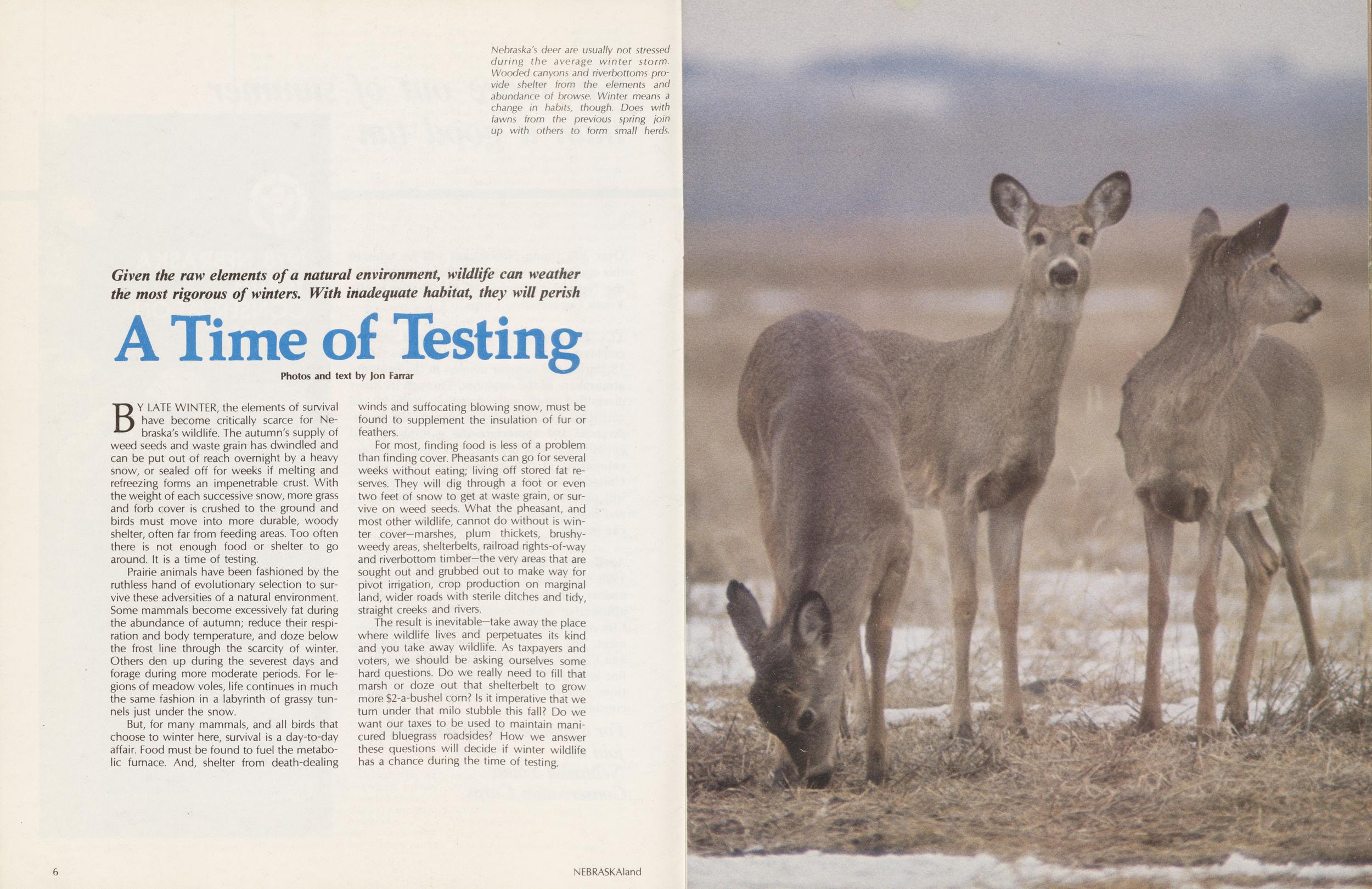
A Time of Testing
Given the raw elements of a natural environment, wildlife can weather the most rigorous of winters. With inadequate habitat, they will perish
BY LATE WINTER, the elements of survival have become critically scarce for Nebraska's wildlife. The autumn's supply of weed seeds and waste grain has dwindled and can be put out of reach overnight by a heavy snow, or sealed off for weeks if melting and refreezing forms an impenetrable crust. With the weight of each successive snow, more grass and forb cover is crushed to the ground and birds must move into more durable, woody shelter, often far from feeding areas. Too often there is not enough food or shelter to go around. It is a time of testing.
Prairie animals have been fashioned by the ruthless hand of evolutionary selection to survive these adversities of a natural environment. Some mammals become excessively fat during the abundance of autumn; reduce their respiration and body temperature, and doze below the frost line through the scarcity of winter. Others den up during the severest days and forage during more moderate periods. For legions of meadow voles, life continues in much the same fashion in a labyrinth of grassy tunnels just under the snow.
But, for many mammals, and all birds that choose to winter here, survival is a day-to-day affair. Food must be found to fuel the metabolic furnace. And, shelter from death-dealing winds and suffocating blowing snow, must be found to supplement the insulation of fur or feathers.
For most, finding food is less of a problem than finding cover. Pheasants can go for several weeks without eating; living off stored fat reserves. They will dig through a foot or even two feet of snow to get at waste grain, or survive on weed seeds. What the pheasant, and most other wildlife, cannot do without is winter cover—marshes, plum thickets, brushy-weedy areas, shelterbelts, railroad rights-of-way and riverbottom timber-the very areas that are sought out and grubbed out to make way for pivot irrigation, crop production on marginal land, wider roads with sterile ditches and tidy, straight creeks and rivers.
The result is inevitable—take away the place where wildlife lives and perpetuates its kind and you take away wildlife. As taxpayers and voters, we should be asking ourselves some hard questions. Do we really need to fill that marsh or doze out that shelterbelt to grow more $2-a-bushel corn? Is it imperative that we turn under that milo stubble this fall? Do we want our taxes to be used to maintain manicured bluegrass roadsides? How we answer these questions will decide if winter wildlife has a chance during the time of testing.
6 NEBRASKAIand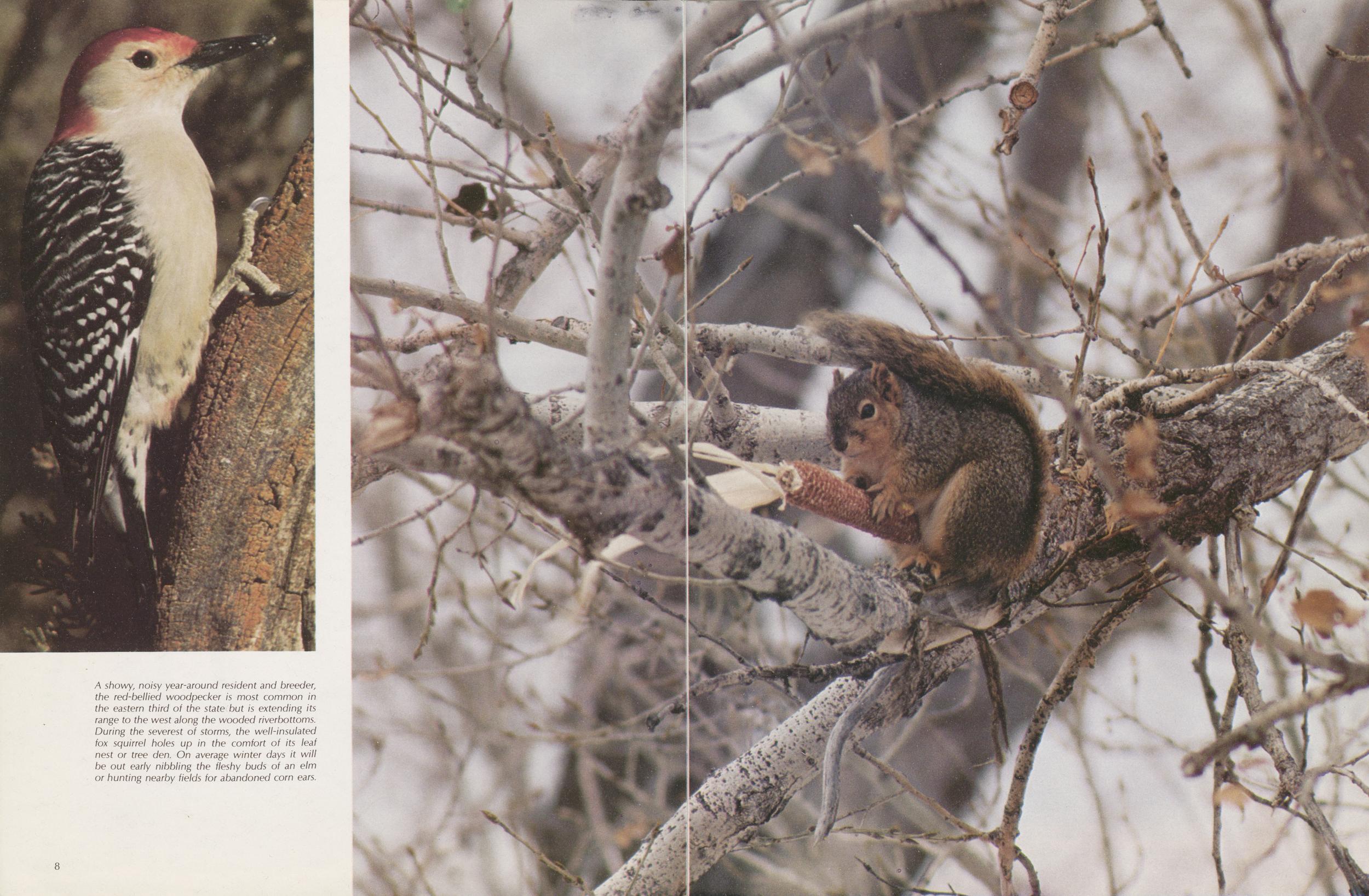
Winter Walleye
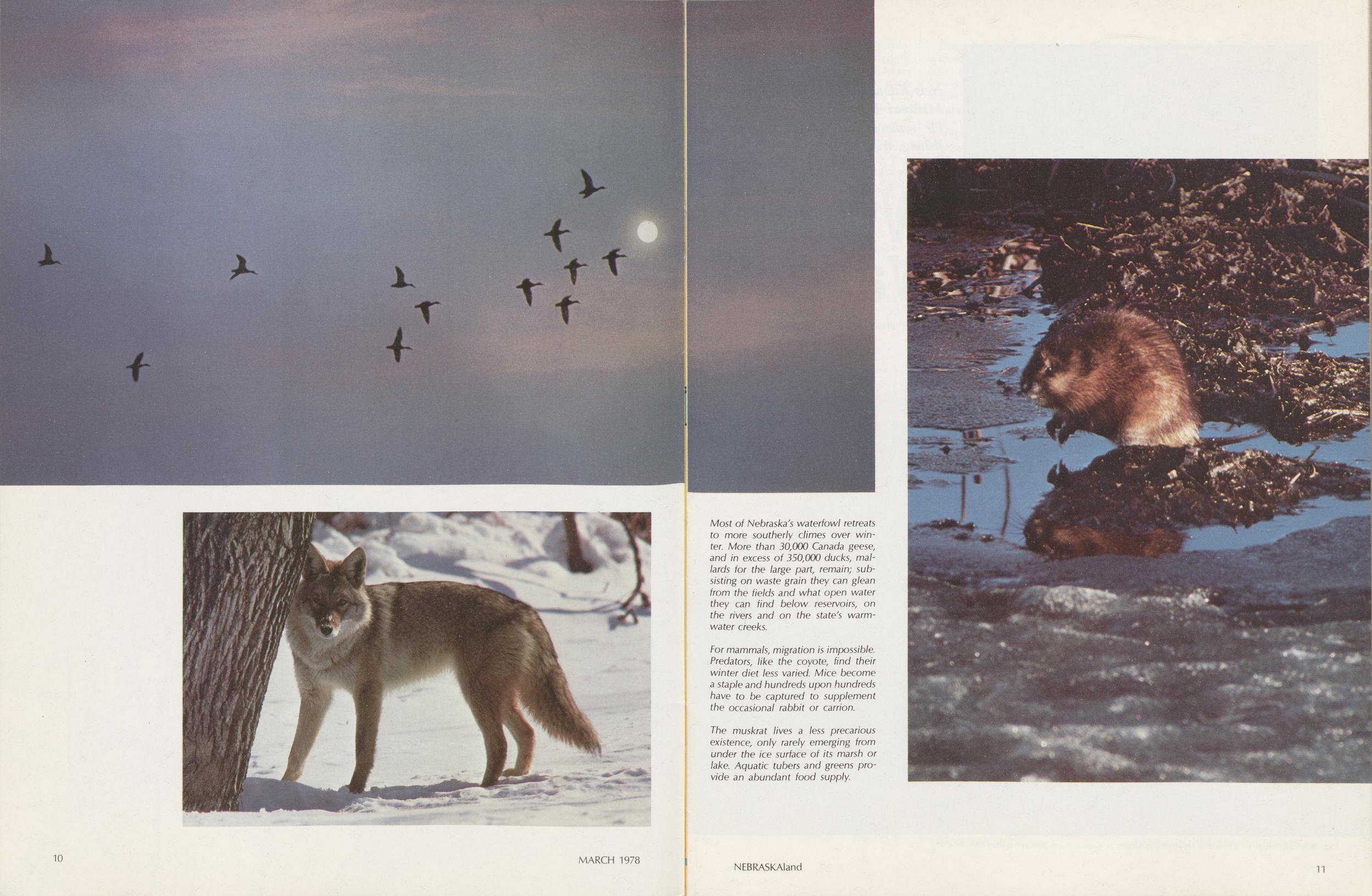
Nek Kilburn, Arnie Johnson probe Missouri River waters year-round for walleye and sauger. February fishing trip proves their prowess
WE WERE ADEQUATELY bundled up for winter fishing, with insulated coveralls, heavy coats, fur hats and heavy pak boots all snugly lashed up. Our angling garb looked fairly typical for February—until we dropped life jackets.
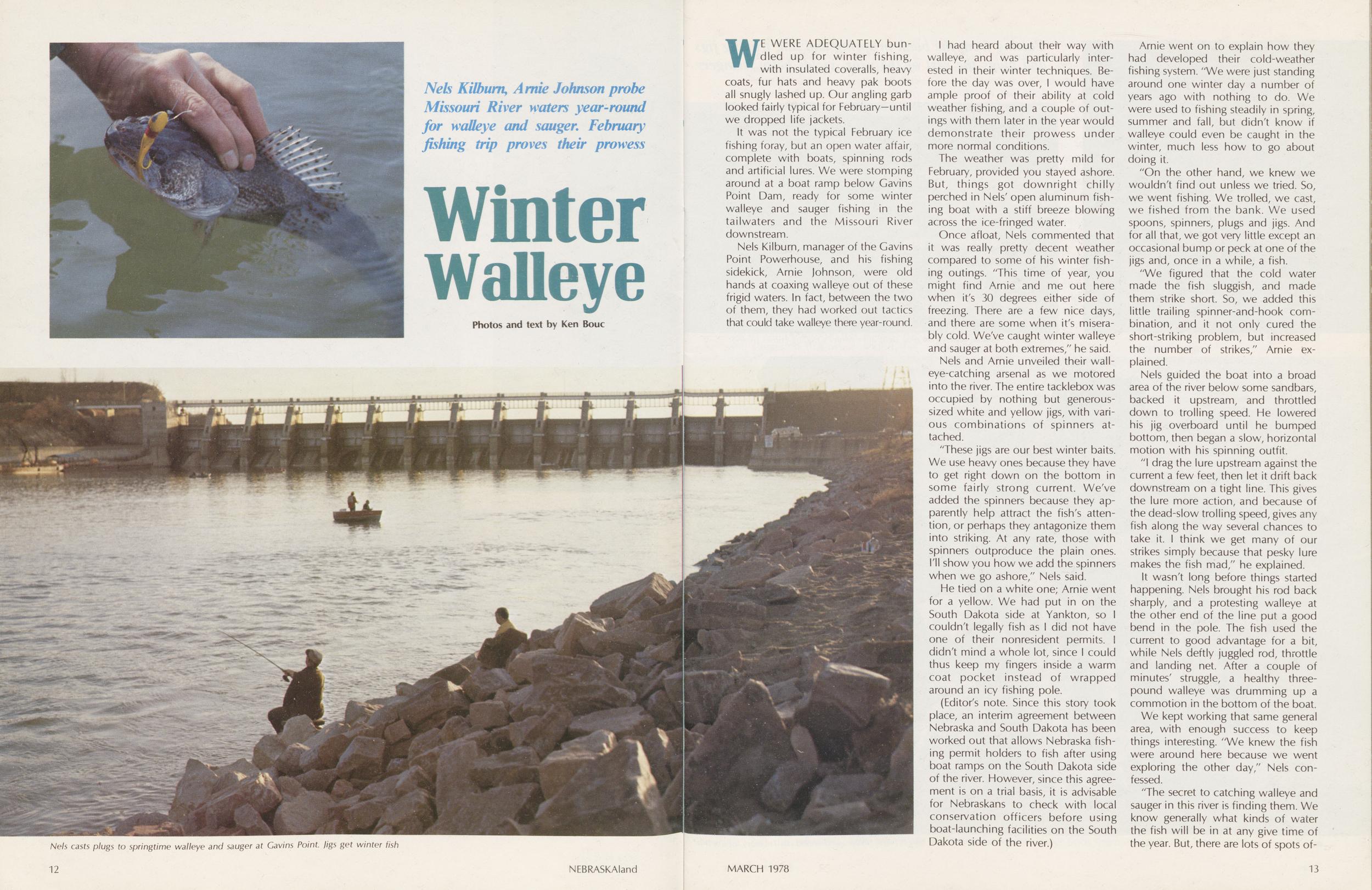
It was not the typical February ice fishing foray, but an open water affair, complete with boats, spinning rods and artificial lures. We were stomping around at a boat ramp below Gavins Point Dam, ready for some winter walleye and sauger fishing in the tailwaters and the Missouri River downstream.
Nels Kilburn, manager of the Gavins Point Powerhouse, and his fishing sidekick, Arnie Johnson, were old hands at coaxing walleye out of these frigid waters. In fact, between the two of them, they had worked out tactics that could take walleye there year-round.
I had heard about their way with walleye, and was particularly interested in their winter techniques. Before the day was over, I would have ample proof of their ability at cold weather fishing, and a couple of outings with them later in the year would demonstrate their prowess under more normal conditions.
The weather was pretty mild for February, provided you stayed ashore. But, things got downright chilly perched in Nels' open aluminum fishing boat with a stiff breeze blowing across the ice-fringed water.
Once afloat, Nels commented that it was really pretty decent weather compared to some of his winter fishing outings. "This time of year, you might find Arnie and me out here when it's 30 degrees either side of freezing. There are a few nice days, and there are some when it's miserably cold. We've caught winter walleye and sauger at both extremes," he said.
Nels and Arnie unveiled their wall-eye-catching arsenal as we motored into the river. The entire tacklebox was occupied by nothing but generous-sized white and yellow jigs, with various combinations of spinners attached.
"These jigs are our best winter baits. We use heavy ones because they have to get right down on the bottom in some fairly strong current. We've added the spinners because they apparently help attract the fish's attention, or perhaps they antagonize them into striking. At any rate, those with spinners outproduce the plain ones. I'll show you how we add the spinners when we go ashore," Nels said.
He tied on a white one; Arnie went for a yellow. We had put in on the South Dakota side at Yankton, so I couldn't legally fish as I did not have one of their nonresident permits. I didn't mind a whole lot, since I could thus keep my fingers inside a warm coat pocket instead of wrapped around an icy fishing pole.
(Editor's note. Since this story took place, an interim agreement between Nebraska and South Dakota has been worked out that allows Nebraska fishing permit holders to fish after using boat ramps on the South Dakota side of the river. However, since this agreement is on a trial basis, it is advisable for Nebraskans to check with local conservation officers before using boat-launching facilities on the South Dakota side of the river.)Arnie went on to explain how they had developed their cold-weather fishing system. "We were just standing around one winter day a number of years ago with nothing to do. We were used to fishing steadily in spring, summer and fall, but didn't know if walleye could even be caught in the winter, much less how to go about doing it.
"On the other hand, we knew we wouldn't find out unless we tried. So, we went fishing. We trolled, we cast, we fished from the bank. We used spoons, spinners, plugs and jigs. And for all that, we got very little except an occasional bump or peck at one of the jigs and, once in a while, a fish.
"We figured that the cold water made the fish sluggish, and made them strike short. So, we added this little trailing spinner-and-hook combination, and it not only cured the short-striking problem, but increased the number of strikes," Arnie explained.
Nels guided the boat into a broad area of the river below some sandbars, backed it upstream, and throttled down to trolling speed. He lowered his jig overboard until he bumped bottom, then began a slow, horizontal motion with his spinning outfit.
"I drag the lure upstream against the current a few feet, then let it drift back downstream on a tight line. This gives the lure more action, and because of the dead-slow trolling speed, gives any fish along the way several chances to take it. I think we get many of our strikes simply because that pesky lure makes the fish mad," he explained.
It wasn't long before things started happening. Nels brought his rod back sharply, and a protesting walleye at the other end of the line put a good bend in the pole. The fish used the current to good advantage for a bit, while Nels deftly juggled rod, throttle and landing net. After a couple of minutes' struggle, a healthy three-pound walleye was drumming up a commotion in the bottom of the boat.
We kept working that same general area, with enough success to keep things interesting. "We knew the fish were around here because we went exploring the other day," Nels confessed.
"The secret to catching walleye and sauger in this river is finding them. We know generally what kinds of water the fish will be in at any give time of the year. But, there are lots of spots offering the right conditions, yet not all MARCH 1978 13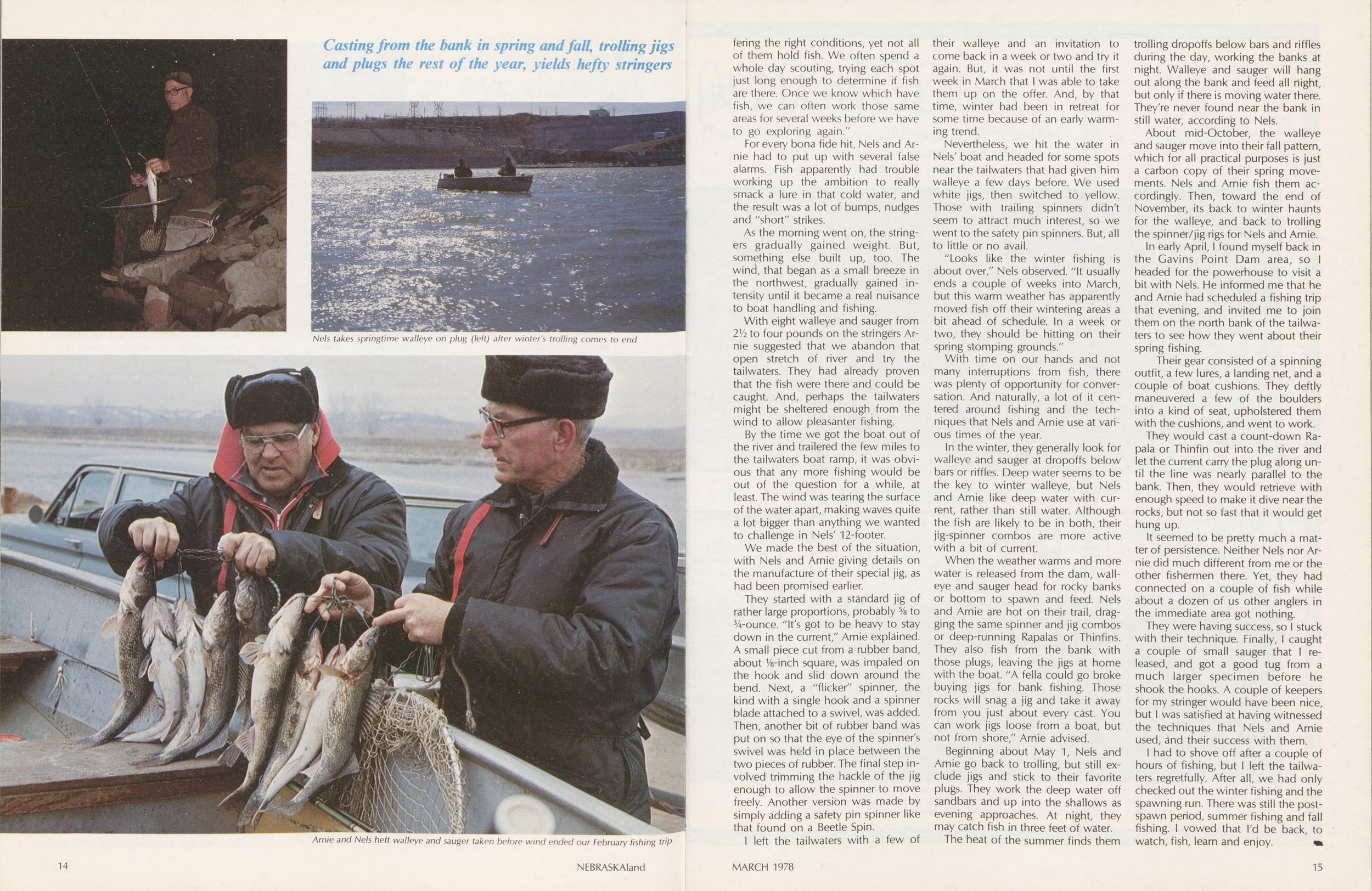
For every bona fide hit, Nels and Arnie had to put up with several false alarms. Fish apparently had trouble working up the ambition to really smack a lure in that cold water, and the result was a lot of bumps, nudges and "short" strikes.
As the morning went on, the stringers gradually gained weight. But, something else built up, too. The wind, that began as a small breeze in the northwest, gradually gained intensity until it became a real nuisance to boat handling and fishing.
With eight walleye and sauger from 2½ to four pounds on the stringers Arnie suggested that we abandon that open stretch of river and try the tailwaters. They had already proven that the fish were there and could be caught. And, perhaps the tailwaters might be sheltered enough from the wind to allow pleasanter fishing.
By the time we got the boat out of the river and trailered the few miles to the tailwaters boat ramp, it was obvious that any more fishing would be out of the question for a while, at least. The wind was tearing the surface of the water apart, making waves quite a lot bigger than anything we wanted to challenge in Nels' 12-footer.
We made the best of the situation, with Nels and Arnie giving details on the manufacture of their special jig, as had been promised earlier.
They started with a standard jig of rather large proportions, probably ⅝ to ¾-ounce. "It's got to be heavy to stay down in the current," Arnie explained. A small piece cut from a rubber band, about ⅛-inch square, was impaled on the hook and slid down around the bend. Next, a "flicker" spinner, the kind with a single hook and a spinner blade attached to a swivel, was added. Then, another bit of rubber band was put on so that the eye of the spinner's swivel was held in place between the two pieces of rubber. The final step involved trimming the hackle of the jig enough to allow the spinner to move freely. Another version was made by simply adding a safety pin spinner like that found on a Beetle Spin.
I left the tailwaters with a few of their walleye and an invitation to come back in a week or two and try it again. But, it was not until the first week in March that I was able to take them up on the offer. And, by that time, winter had been in retreat for some time because of an early warming trend.
Nevertheless, we hit the water in Nels' boat and headed for some spots near the tailwaters that had given him walleye a few days before. We used white jigs, then switched to yellow. Those with trailing spinners didn't seem to attract much interest, so we went to the safety pin spinners. But, all to little or no avail.
"Looks like the winter fishing is about over," Nels observed. "It usually ends a couple of weeks into March, but this warm weather has apparently moved fish off their wintering areas a bit ahead of schedule. In a week or two, they should be hitting on their spring stomping grounds."
With time on our hands and not many interruptions from fish, there was plenty of opportunity for conversation. And naturally, a lot of it centered around fishing and the tech- niques that Nels and Arnie use at various times of the year.
In the winter, they generally look for walleye and sauger at dropoffs below bars or riffles. Deep water seems to be the key to winter walleye, but Nels and Arnie like deep water with current, rather than still water. Although the fish are likely to be in both, their jig-spinner combos are more active with a bit of current.
When the weather warms and more water is released from the dam, walleye and sauger head for rocky banks or bottom to spawn and feed. Nels and Arnie are hot on their trail, dragging the same spinner and jig combos or deep-running Rapalas or Thinfins. They also fish from the bank with those plugs, leaving the jigs at home with the boat. "A fella could go broke buying jigs for bank fishing. Those rocks will snag a jig and take it away from you just about every cast. You can work jigs loose from a boat, but not from shore," Arnie advised.
Beginning about May 1, Nels and Arnie go back to trolling, but still exclude jigs and stick to their favorite plugs. They work the deep water off sandbars and up into the shallows as evening approaches. At night, they may catch fish in three feet of water.
The heat of the summer finds them trolling dropoffs below bars and riffles during the day, working the banks at night. Walleye and sauger will hang out along the bank and feed all night, but only if there is moving water there. They're never found near the bank in still water, according to Nels.
About mid-October, the walleye and sauger move into their fall pattern, which for all practical purposes is just a carbon copy of their spring movements. Nels and Arnie fish them accordingly. Then, toward the end of November, its back to winter haunts for the walleye, and back to trolling the spinner/jig rigs for Nels and Arnie.
In early April, I found myself back in the Gavins Point Dam area, so I headed for the powerhouse to visit a bit with Nels. He informed me that he and Arnie had scheduled a fishing trip that evening, and invited me to join them on the north bank of the tailwaters to see how they went about their spring fishing.
Their gear consisted of a spinning outfit, a few lures, a landing net, and a couple of boat cushions. They deftly maneuvered a few of the boulders into a kind of seat, upholstered them with the cushions, and went to work.
They would cast a count-down Rapaia or Thinfin out into the river and let the current carry the plug along until the line was nearly parallel to the bank. Then, they would retrieve with enough speed to make it dive near the rocks, but not so fast that it would get hung up.
It seemed to be pretty much a matter of persistence; Neither Nels nor Arnie did much different from me or the other fishermen there. Yet, they had connected on a couple of fish while about a dozen of us other anglers in the immediate area got nothing.
They were having success, so I stuck with their technique. Finally, I caught a couple of small sauger that I released, and got a good tug from a much larger specimen before he shook the hooks. A couple of keepers for my stringer would have been nice, but I was satisfied at having witnessed the techniques that Nels and Arnie used, and their success with them.
I had to shove off after a couple of hours of fishing, but I left the tailwaters regretfully. After all, we had only checked out the winter fishing and the spawning run. There was still the postspawn period, summer fishing and fall fishing. I vowed that I'd be back, to watch, fish, learn and enjoy.
14 NEBRASKAIand MARCH 1978 15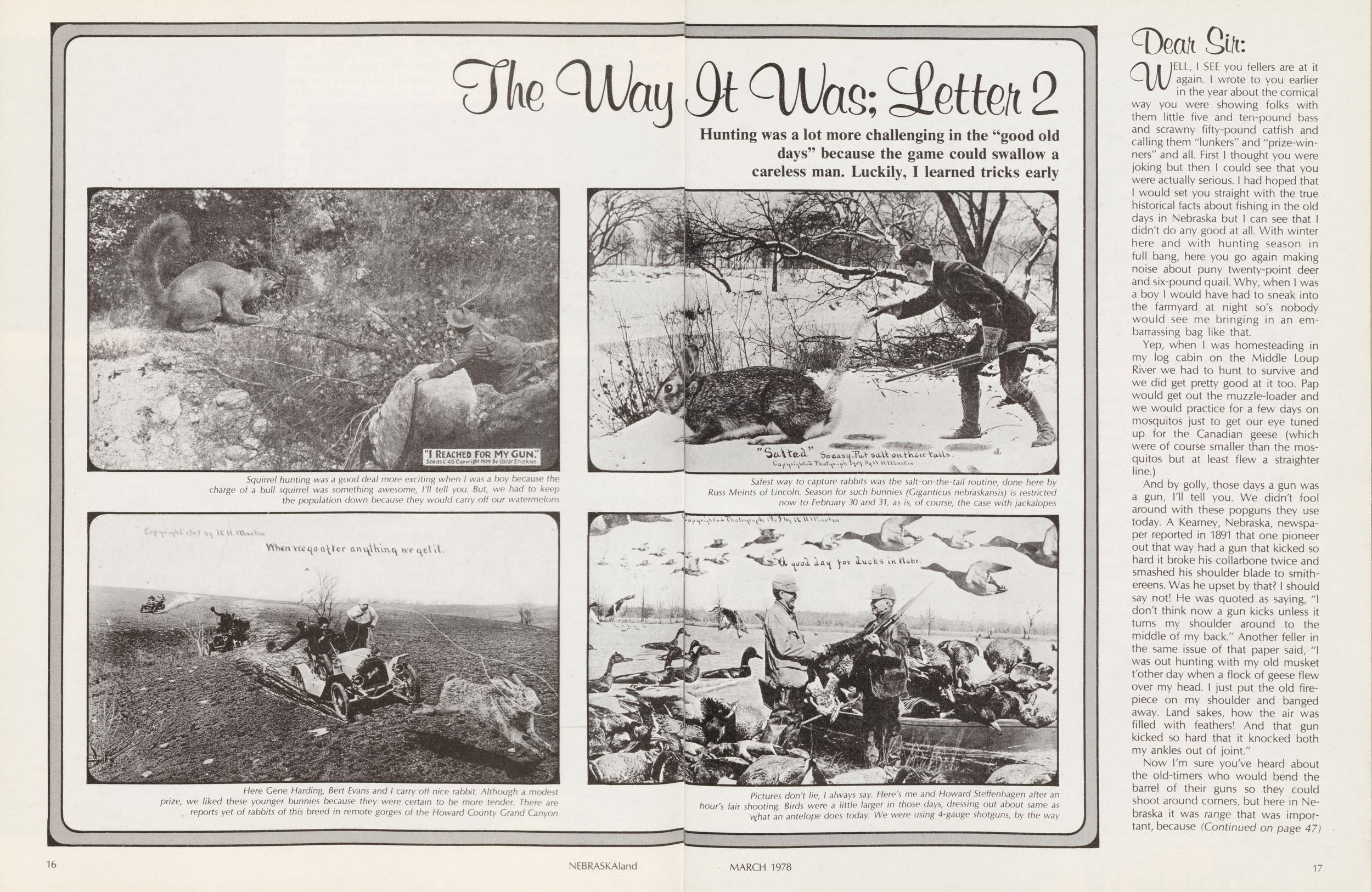
The Way It Was; Letter 2
Hunting was a lot more challenging in the "good old days" because the game could swallow a careless man. Luckily, I learned tricks early
WELL, I SEE you fellers are at it again. I wrote to you earlier in the year about the comical way you were showing folks with them little five and ten-pound bass and scrawny fifty-pound catfish and calling them "lunkers" and "prize-winners" and all. First I thought you were joking but then I could see that you were actually serious. I had hoped that I would set you straight with the true historical facts about fishing in the old days in Nebraska but I can see that I didn't do any good at all. With winter here and with hunting season in full bang, here you go again making noise about puny twenty-point deer and six-pound quail. Why, when I was a boy I would have had to sneak into the farmyard at night so's nobody would see me bringing in an embarrassing bag like that.
Yep, when I was homesteading in my log cabin on the Middle Loup River we had to hunt to survive and we did get pretty good at it too. Pap would get out the muzzle-loader and we would practice for a few days on mosquitos just to get our eye tuned up for the Canadian geese (which were of course smaller than the mosquitos but at least flew a straighter line.)
And by golly, those days a gun was a gun, I'll tell you. We didn't fool around with these popguns they use today. A Kearney, Nebraska, newspaper reported in 1891 that one pioneer out that way had a gun that kicked so hard it broke his collarbone twice and smashed his shoulder blade to smithereens. Was he upset by that? I should say not! He was quoted as saying, "I don't think now a gun kicks unless it turns my shoulder around to the middle of my back." Another feller in the same issue of that paper said, "I was out hunting with my old musket t'other day when a flock of geese flew over my head. I just put the old fire-piece on my shoulder and banged away. Land sakes, how the air was filled with feathers! And that gun kicked so hard that it knocked both my ankles out of joint."
Now I'm sure you've heard about the old-timers who would bend the barrel of their guns so they could shoot around corners, but here in Nebraska it was range that was important, because (Continued on page 47)
16 NEBRASKAIand
MARCH 1978 17
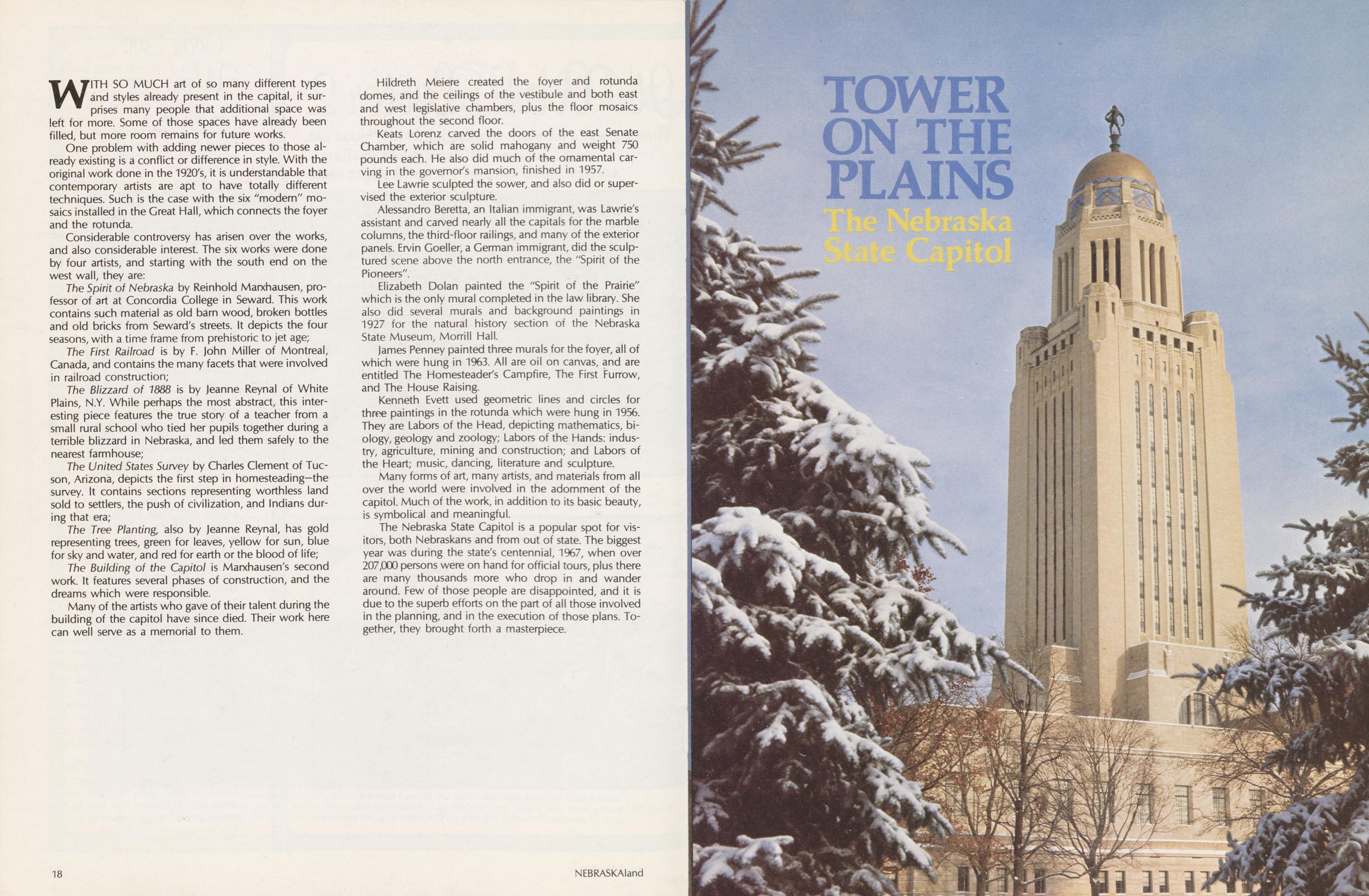
TOWER ON THE PLAINS
The Nebraska State Capitol
WITH SO MUCH art of so many different types and styles already present in the capital, it surprises many people that additional space was left for more. Some of those spaces have already been filled, but more room remains for future works.
One problem with adding newer pieces to those already existing is a conflict or difference in style. With the original work done in the 1920's, it is understandable that contemporary artists are apt to have totally different techniques. Such is the case with the six "modern" mosaics installed in the Great Hall, which connects the foyer and the rotunda.
Considerable controversy has arisen over the works, and also considerable interest. The six works were done by four artists, and starting with the south end on the west wall, they are: The Spirit of Nebraska by Reinhold Marxhausen, professor of art at Concordia College in Seward. This work contains such material as old barn wood, broken bottles and old bricks from Seward's streets. It depicts the four seasons, with a time frame from prehistoric to jet age; The First Railroad is by F. John Miller of Montreal, Canada, and contains the many facets that were involved in railroad construction; The Blizzard of 1888 is by Jeanne Reynal of White Plains, N.Y. While perhaps the most abstract, this interesting piece features the true story of a teacher from a small rural school who tied her pupils together during a terrible blizzard in Nebraska, and led them safely to the nearest farmhouse; The United States Survey by Charles Clement of Tucson, Arizona, depicts the first step in homesteading—the survey. It contains sections representing worthless land sold to settlers, the push of civilization, and Indians during that era; The Tree Planting, also by Jeanne Reynal, has gold representing trees, green for leaves, yellow for sun, blue for sky and water, and red for earth or the blood of life; The Building of the Capitol is Marxhausen's second work. It features several phases of construction, and the dreams which were responsible.Many of the artists who gave of their talent during the building of the capitol have since died. Their work here can well serve as a memorial to them.
Hildreth Meiere created the foyer and rotunda domes, and the ceilings of the vestibule and both east and west legislative chambers, plus the floor mosaics throughout the second floor.
Keats Lorenz carved the doors of the east Senate Chamber, which are solid mahogany and weight 750 pounds each. He also did much of the ornamental carving in the governor's mansion, finished in 1957.
Lee Lawrie sculpted the sower, and also did or supervised the exterior sculpture.
Alessandro Beretta, an Italian immigrant, was Lawrie's assistant and carved nearly all the capitals for the marble columns, the third-floor railings, and many of the exterior panels. Ervin Goeller, a German immigrant, did the sculptured scene above the north entrance, the "Spirit of the Pioneers".
Elizabeth Dolan painted the "Spirit of the Prairie" which is the only mural completed in the law library. She also did several murals and background paintings in 1927 for the natural history section of the Nebraska State Museum, Morrill Hall.
James Penney painted three murals for the foyer, all of which were hung in 1963. All are oil on canvas, and are entitled The Homesteader's Campfire, The First Furrow, and The House Raising.
Kenneth Evett used geometric lines and circles for three paintings in the rotunda which were hung in 1956. They are Labors of the Head, depicting mathematics, biology, geology and zoology; Labors of the Hands: indus- try, agriculture, mining and construction; and Labors of the Heart; music, dancing, literature and sculpture.
Many forms of art, many artists, and materials from all over the world were involved in the adornment of the capitol. Much of the work, in addition to its basic beauty, is symbolical and meaningful.
The Nebraska State Capitol is a popular spot for visitors, both Nebraskans and from out of state. The biggest year was during the state's centennial, 1967, when over 207,000 persons were on hand for official tours, plus there are many thousands more who drop in and wander around. Few of those people are disappointed, and it is due to the superb efforts on the part of all those involved in the planning, and in the execution of those plans. Together, they brought forth a masterpiece.
18 NEBRASKAIand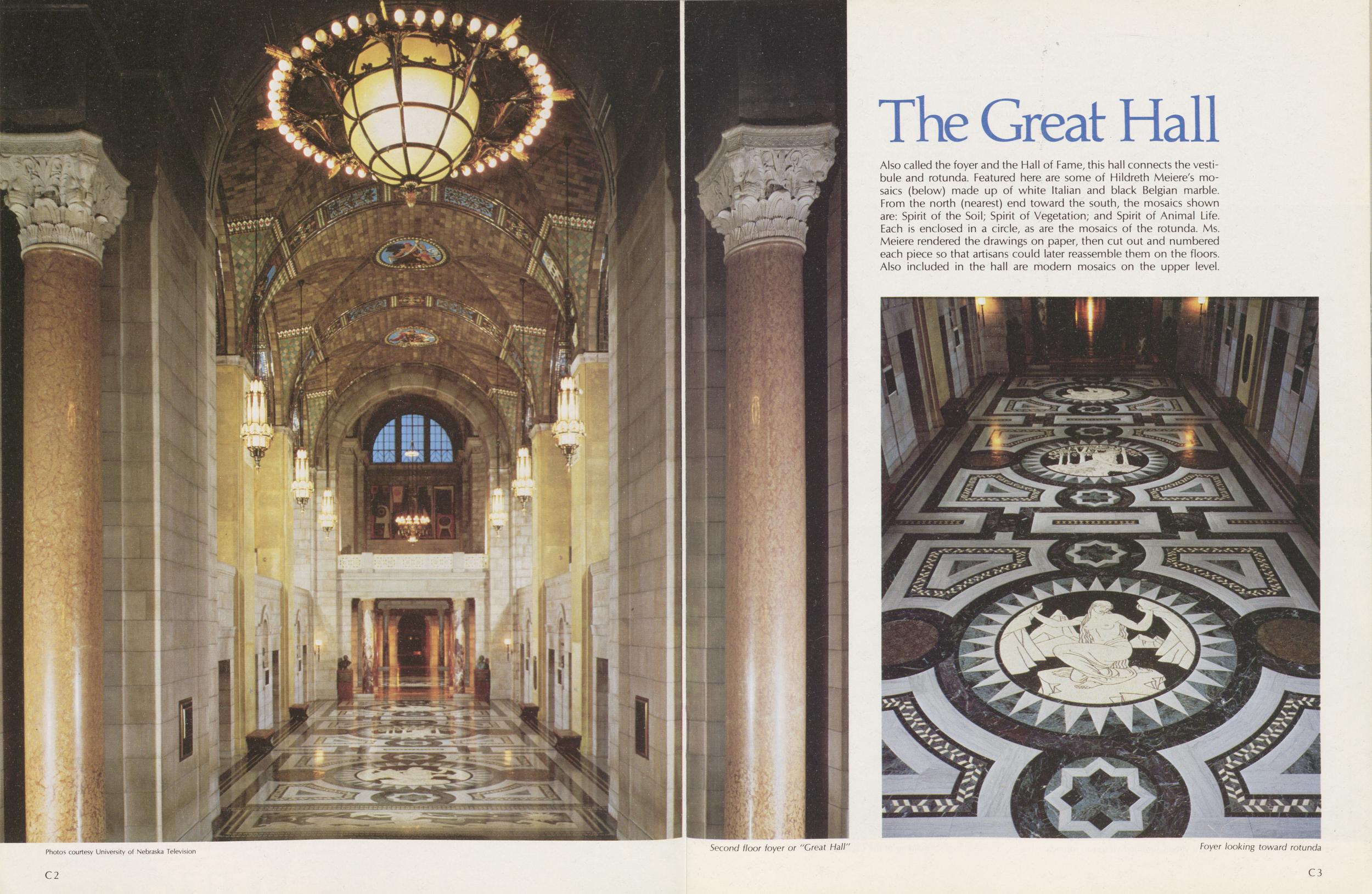
Also called the foyer and the Hall of Fame, this hall connects the vestibule and rotunda. Featured here are some of Hildreth Meiere's mo- saics (below) made up of white Italian and black Belgian marble. From the north (nearest) end toward the south, the mosaics shown are: Spirit of the Soil; Spirit of Vegetation; and Spirit of Animal Life. Each is enclosed in a circle, as are the mosaics of the rotunda. Ms. Meiere rendered the drawings on paper, then cut out and numbered each piece so that artisans could later reassemble them on the floors. Also included in the hall are modern mosaics on the upper level.
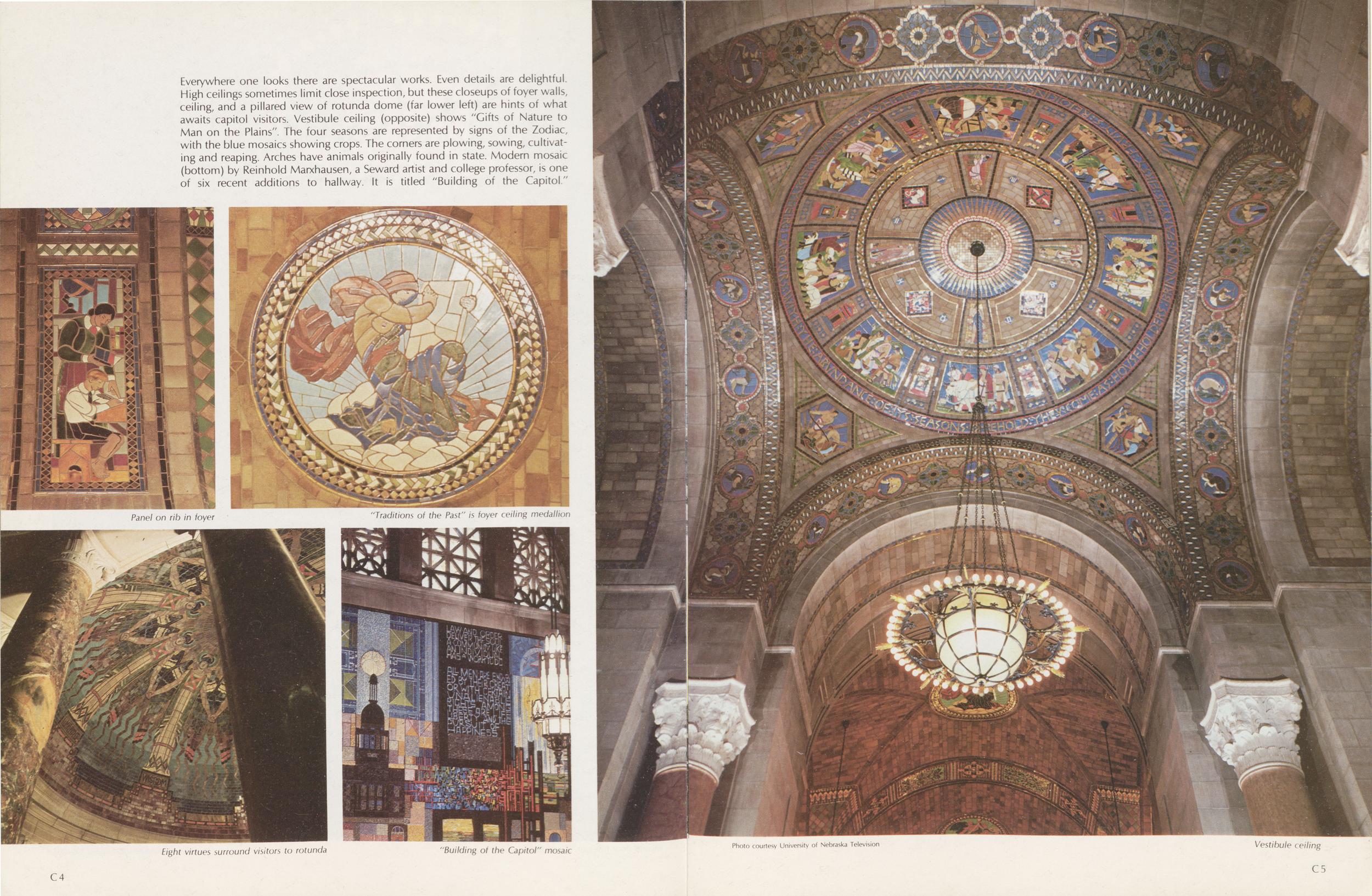
Everywhere one looks there are spectacular works. Even details are delightful. High ceilings sometimes limit close inspection, but these closeups of foyer walls, ceiling, and a pillared view of rotunda dome (far lower left) are hints of what awaits capitol visitors. Vestibule ceiling (opposite) shows "Gifts of Nature to Man on the Plains". The four seasons are represented by signs of the Zodiac, with the blue mosaics showing crops. The corners are plowing, sowing, cultivating and reaping. Arches have animals originally found in state. Modern mosaic (bottom) by Reinhold Marxhausen, a Seward artist and college professor, is one of six recent additions to hallway. It is titled "Building of the Capitol."
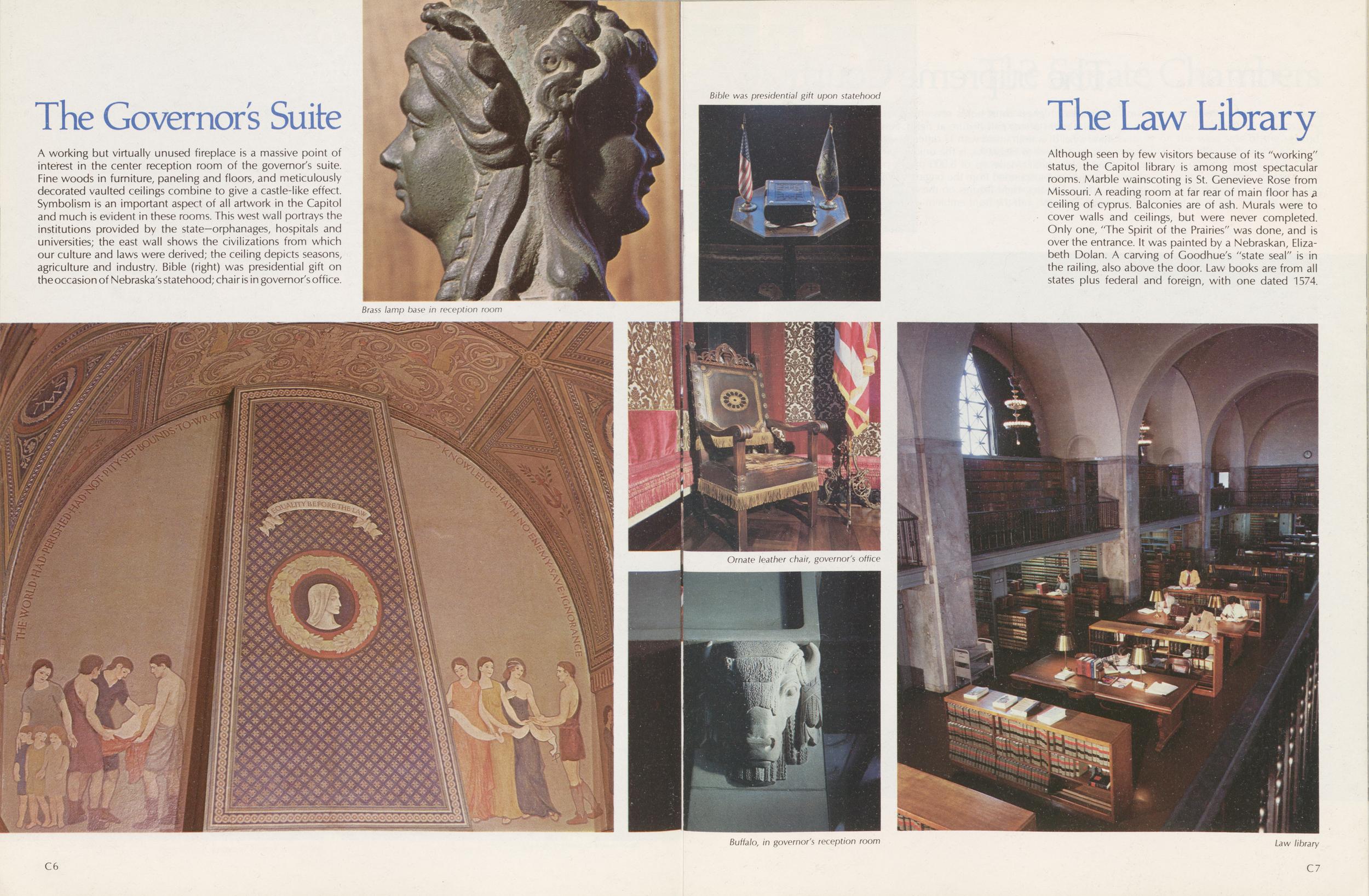 The Governor's Suite
A working but virtually unused fireplace is a massive point of interest in the center reception room of the governor's suite. Fine woods in furniture, paneling and floors, and meticulously decorated vaulted ceilings combine to give a castle-like effect. Symbolism is an important aspect of all artwork in the Capitol and much is evident in these rooms. This west wall portrays the institutions provided by the state—orphanages, hospitals and universities; the east wall shows the civilizations from which our culture and laws were derived; the ceiling depicts seasons, agriculture and industry. Bible (right) was presidential gift on the occasion of Nebraska's statehood; chair is in governor's office.
Although seen by few visitors because of its "working" status, the Capitol library is among most spectacular rooms. Marble wainscoting is St. Genevieve Rose from Missouri. A reading room at far rear of main floor has 3 ceiling of Cyprus. Balconies are of ash. Murals were to cover walls and ceilings, but were never completed. Only one, "The Spirit of the Prairies" was done, and is over the entrance. It was painted by a Nebraskan, Elizabeth Dolan. A carving of Goodhue's "state seal" is in the railing, also above the door. Law books are from all states plus federal and foreign, with one dated 1574.
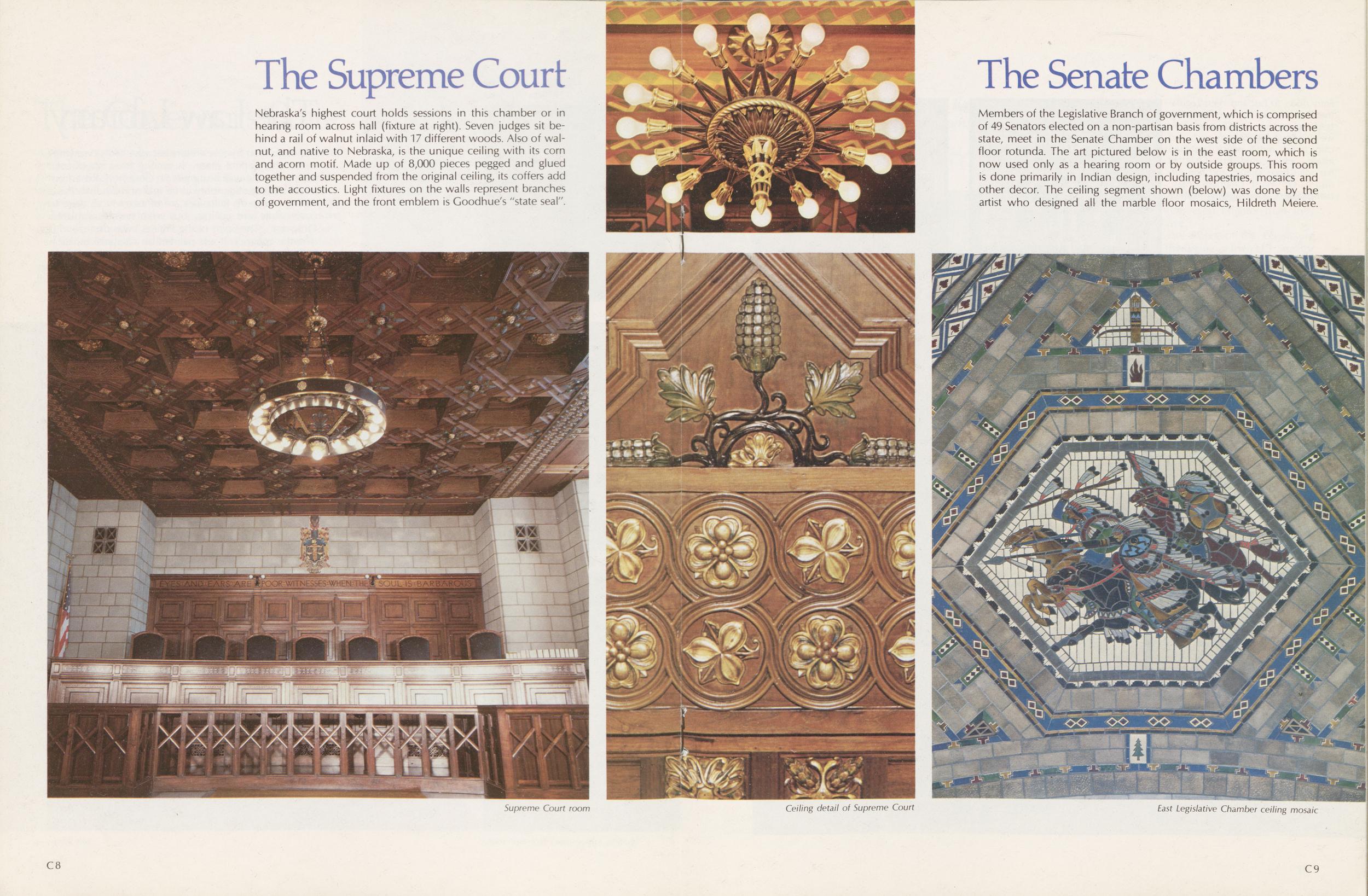 The Supreme Court
Nebraska's highest court holds sessions in this chamber or in
hearing room across hall (fixture at right). Seven judges sit behind a rail of walnut
inlaid with 17 different woods. Also of walnut, and native to Nebraska, is the unique
ceiling with its corn
and acorn motif. Made up of 8,000 pieces pegged and glued
together and suspended from the original ceiling, its coffers add
to the accoustics. Light fixtures on the walls represent branches
of government, and the front emblem is Goodhue's "state seal".
The Supreme Court
Nebraska's highest court holds sessions in this chamber or in
hearing room across hall (fixture at right). Seven judges sit behind a rail of walnut
inlaid with 17 different woods. Also of walnut, and native to Nebraska, is the unique
ceiling with its corn
and acorn motif. Made up of 8,000 pieces pegged and glued
together and suspended from the original ceiling, its coffers add
to the accoustics. Light fixtures on the walls represent branches
of government, and the front emblem is Goodhue's "state seal".
Members of the Legislative Branch of government, which is comprised of 49 Senators elected on a non-partisan basis from districts across the state, meet in the Senate Chamber on the west side of the second floor rotunda. The art pictured below is in the east room, which is now used only as a hearing room or by outside groups. This room is done primarily in Indian design, including tapestries, mosaics and other decor. The ceiling segment shown (below) was done by the artist who designed all the marble floor mosaics, Hildreth Meiere.
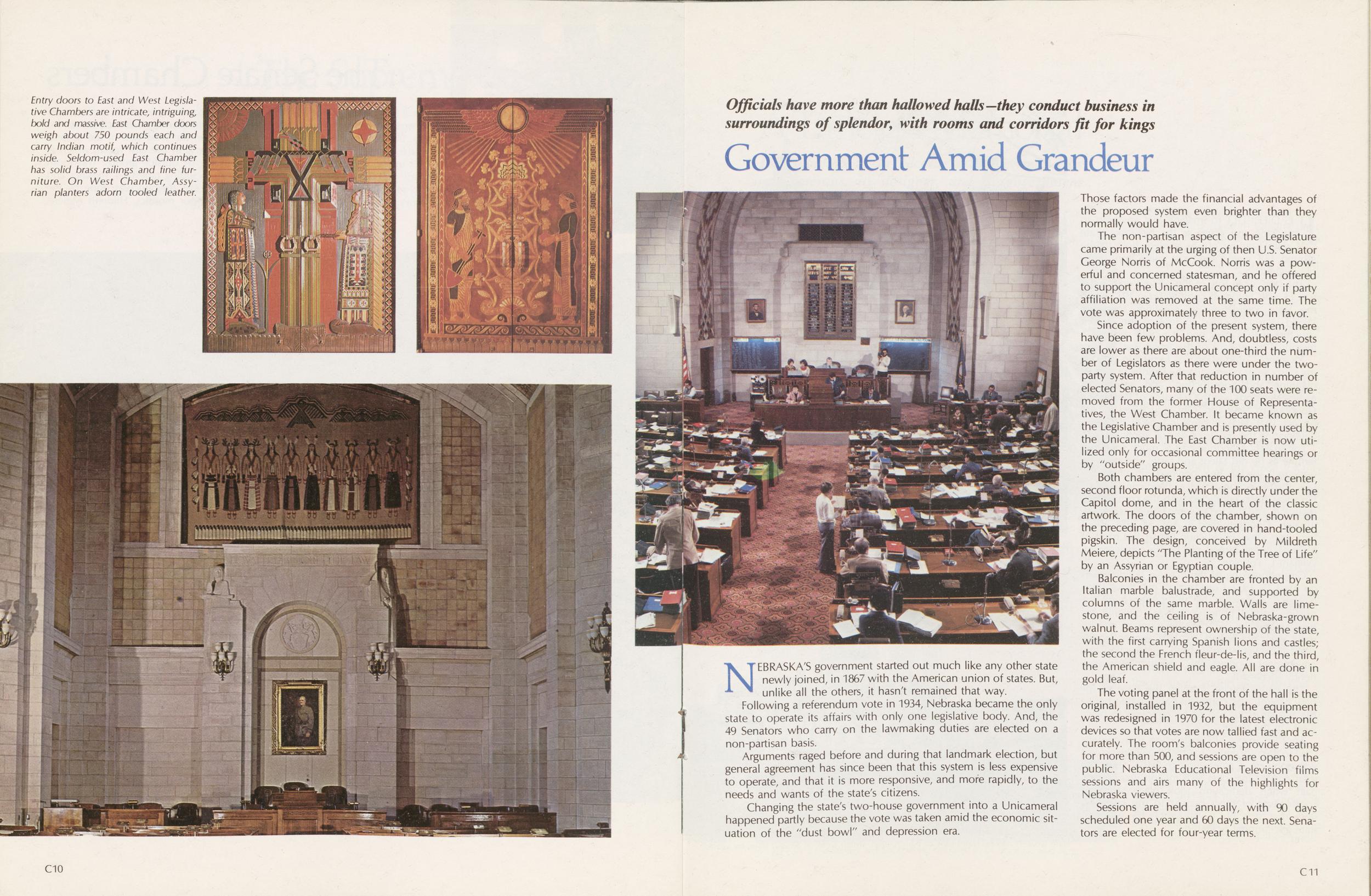
Entry doors to East and West Legislative Chambers are intricate, intriguing, bold and massive. East Chamber doors weigh about 750 pounds each and carry Indian motif, which continues inside. Seldom-used East Chamber has solid brass railings and fine furniture. On West Chamber, Assyrian planters adorn tooled leather.
NEBRASKA'S government started out much like any other state newly joined, in 1867 with the American union of states. But, unlike all the others, it hasn't remained that way.
Following a referendum vote in 1934, Nebraska became the only state to operate its affairs with only one legislative body. And, the 49 Senators who carry on the lawmaking duties are elected on a non-partisan basis.
Arguments raged before and during that landmark election, but general agreement has since been that this system is less expensive to operate, and that it is more responsive, and more rapidly, to the needs and wants of the state's citizens.
Changing the state's two-house government into a Unicameral happened partly because the vote was taken amid the economic situation of the "dust bowl" and depression era.
Those factors made the financial advantages of the proposed system even brighter than they normally would have.
The non-partisan aspect of the Legislature came primarily at the urging of then U.S. Senator George Norris of McCook. Norris was a powerful and concerned statesman, and he offered to support the Unicameral concept only if party affiliation was removed at the same time. The vote was approximately three to two in favor.
Since adoption of the present system, there have been few problems. And, doubtless, costs are lower as there are about one-third the number of Legislators as there were under the two-party system. After that reduction in number of elected Senators, many of the 100 seats were removed from the former House of Representatives, the West Chamber. It became known as the Legislative Chamber and is presently used by the Unicameral. The East Chamber is now utilized only for occasional committee hearings or by "outside" groups.
Both chambers are entered from the center, second floor rotunda, which is directly under the Capitol dome, and in the heart of the classic artwork. The doors of the chamber, shown on the preceding page, are covered in hand-tooled pigskin. The design, conceived by Mildreth Meiere, depicts "The Planting of the Tree of Life" by an Assyrian or Egyptian couple.
Balconies in the chamber are fronted by an Italian marble balustrade, and supported by columns of the same marble. Walls are limestone, and the ceiling is of Nebraska-grown walnut. Beams represent ownership of the state, with the first carrying Spanish lions and castles; the second the French fleur-de-lis, and the third, the American shield and eagle. All are done in gold leaf.
The voting panel at the front of the hall is the original, installed in 1932, but the equipment was redesigned in 1970 for the latest electronic devices so that votes are now tallied fast and accurately. The room's balconies provide seating for more than 500, and sessions are open to the public. Nebraska Educational Television films sessions and airs many of the highlights for Nebraska viewers.
Sessions are held annually, with 90 days scheduled one year and 60 days the next. Senators are elected for four-year terms.
C10 C11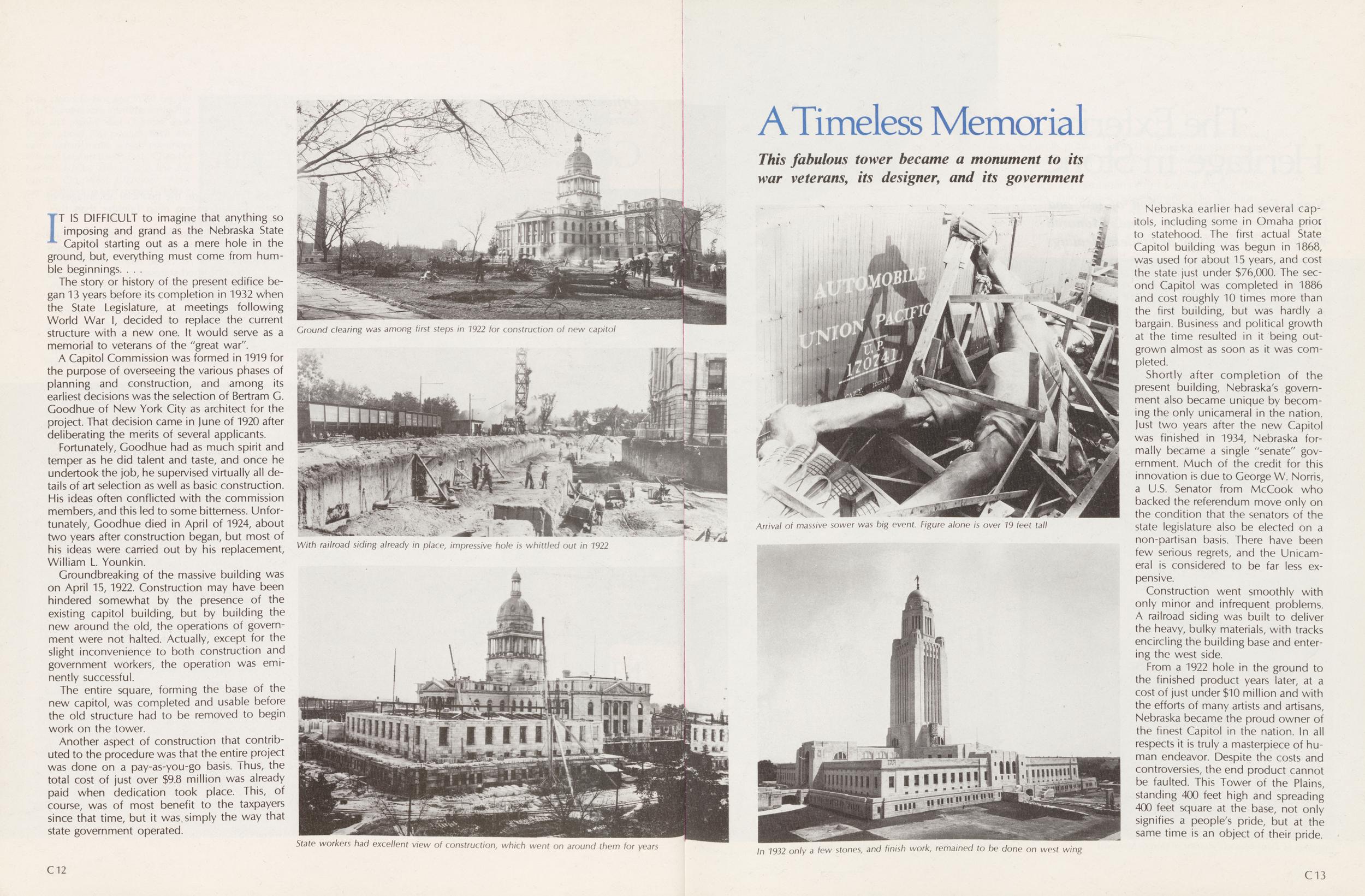 A Timeless Memorial
This fabulous tower became a monument to its
war veterans, its designer, and its government
A Timeless Memorial
This fabulous tower became a monument to its
war veterans, its designer, and its government
IT IS DIFFICULT to imagine that anything so imposing and grand as the Nebraska State Capitol starting out as a mere hole in the ground, but, everything must come from humble beginnings. . . .
The story or history of the present edifice began 13 years before its completion in 1932 when the State Legislature, at meetings following World War I, decided to replace the current structure with a new one. It would serve as a memorial to veterans of the "great war".
A Capitol Commission was formed in 1919 for the purpose of overseeing the various phases of planning and construction, and among its earliest decisions was the selection of Bertram G. Goodhue of New York City as architect for the project. That decision came in June of 1920 after deliberating the merits of several applicants.
Fortunately, Goodhue had as much spirit and temper as he did talent and taste, and once he undertook the job, he supervised virtually all details of art selection as well as basic construction. His ideas often conflicted with the commission members, and this led to some bitterness. Unfortunately, Goodhue died in April of 1924, about two years after construction began, but most of his ideas were carried out by his replacement, William L. Younkin.
Groundbreaking of the massive building was on April 15, 1922. Construction may have been hindered somewhat by the presence of the existing capitol building, but by building the new around the old, the operations of government were not halted. Actually, except for the slight inconvenience to both construction and government workers, the operation was eminently successful.
The entire square, forming the base of the new capitol, was completed and usable before the old structure had to be removed to begin work on the tower.
Another aspect of construction that contributed to the procedure was that the entire project was done on a pay-as-you-go basis. Thus, the total cost of just over $9.8 million was already paid when dedication took place. This, of course, was of most benefit to the taxpayers since that time, but it was simply the way that state government operated.
Nebraska earlier had several capitols, including some in Omaha prior to statehood. The first actual State Capitol building was begun in 1868, was used for about 15 years, and cost the state just under $76,000. The second Capitol was completed in 1886 and cost roughly 10 times more than the first building, but was hardly a bargain. Business and political growth at the time resulted in it being outgrown almost as soon as it was com- pleted.
Shortly after completion of the present building, Nebraska's government also became unique by becoming the only unicameral in the nation. Just two years after the new Capitol was finished in 1934, Nebraska formally became a single "senate" government. Much of the credit for this innovation is due to George W. Norris, a U.S. Senator from McCook who backed the referendum move only on the condition that the senators of the state legislature also be elected on a non-partisan basis. There have been few serious regrets, and the Unicameral is considered to be far less expensive.
Construction went smoothly with only minor and infrequent problems. A railroad siding was built to deliver the heavy, bulky materials, with tracks encircling the building base and entering the west side.
From a 1922 hole in the ground to the finished product years later, at a cost of just under $10 million and with the efforts of many artists and artisans, Nebraska became the proud owner of the finest Capitol in the nation. In all respects it is truly a masterpiece of human endeavor. Despite the costs and controversies, the end product cannot be faulted. This Tower of the Plains, standing 400 feet high and spreading 400 feet square at the base, not only signifies a people's pride, but at the same time is an object of their pride.
C13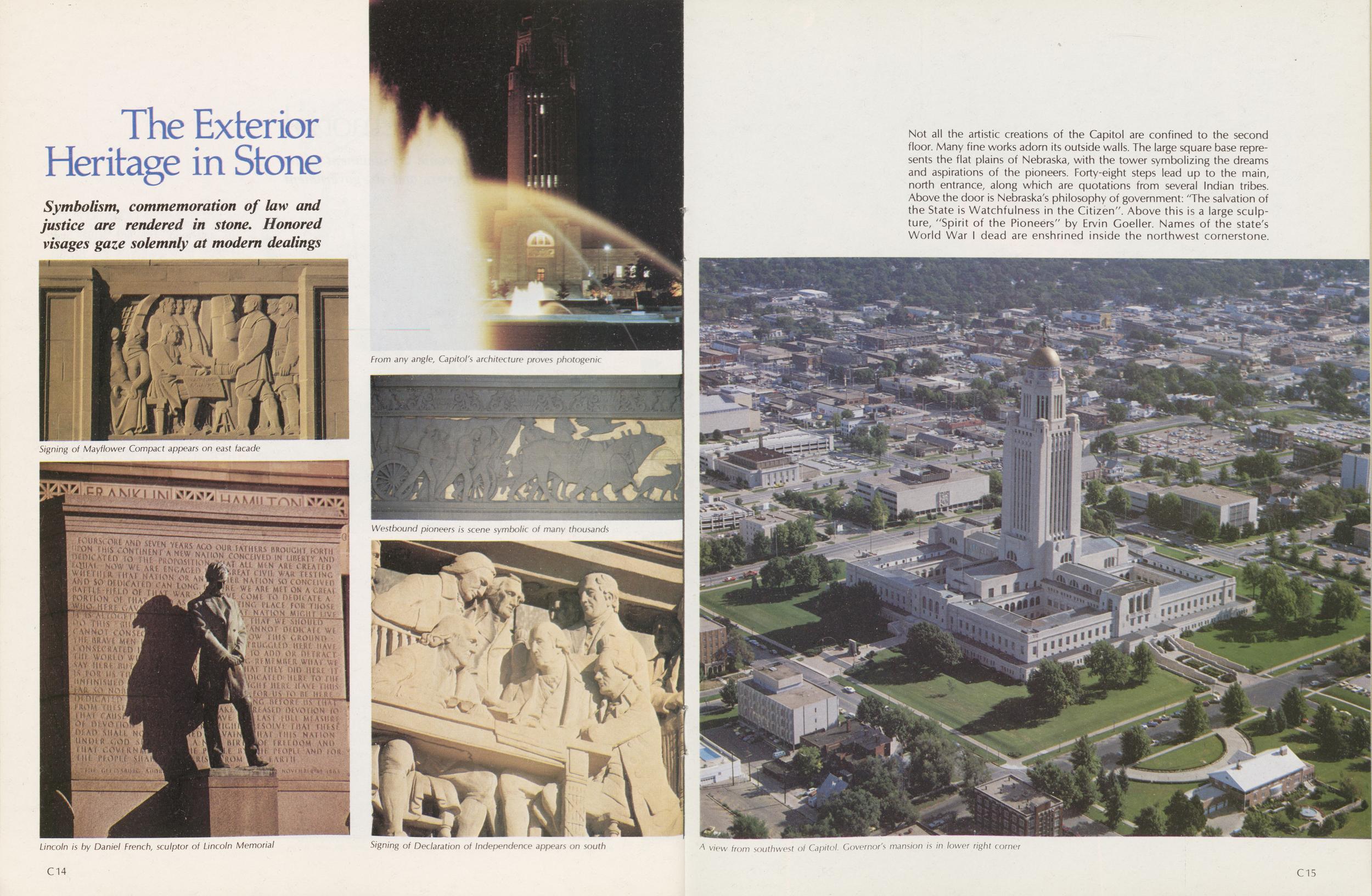 The Exterior
Heritage in Stone
Symbolism, commemoration of law and
justice are rendered in stone. Honored
visages gaze solemnly at modern dealings
The Exterior
Heritage in Stone
Symbolism, commemoration of law and
justice are rendered in stone. Honored
visages gaze solemnly at modern dealings
Not all the artistic creations of the Capitol are confined to the second floor. Many fine works adorn its outside walls. The large square base represents the flat plains of Nebraska, with the tower symbolizing the dreams and aspirations of the pioneers. Forty-eight steps lead up to the main, north entrance, along which are quotations from several Indian tribes. Above the door is Nebraska's philosophy of government: "The salvation of the State is Watchfulness in the Citizen". Above this is a large sculpture, "Spirit of the Pioneers" by Ervin Goeller. Names of the state's World War I dead are enshrined inside the northwest cornerstone.
Grandpa's Best Horse
This big, strong and stubborn Percheron loved work, but breaking to harness was not for kids
MY MATERNAL grandfather, Peter C. Peterson, had a great love for horses. He owned a number of them, used them for farming, and took great pride in raising them. In 1909 when my mother was seven years old, Grandpa moved his family to a farm 21/2 miles east of Cedar Rapids, Nebraska. The man from whom Grandpa purchased the farm owned a yearling bay colt. Grandpa liked the looks of that young colt so much that he bought it. A typical Percheron, it was of blocky build with broad head, wide shoulders and rump. The colt was not pretty nor was he gentle. He was, in fact, unusually high-spirited. Probably that was one reason that Grandpa wanted him, for he always liked his horses to have plenty of zip and energy.
Grandpa was a stalwart Dane, so was a good match for Royal. He was five foot eight, which was not exceptionally tall, but he had large Scandinavian bones and broad shoulders. His big hands were very strong and he often boasted that no horse had ever run away with him when he held the lines.
Runaway horses in the days of the early 1900's were not unusual. Often-times there were some very serious results in runaways, both to the teams and the drivers. Once Grandpa very nearly had a runaway when he was driving a team of ponies on a spring wagon. However, that was not due to his lack of strength but because of carelessness on the part of one of his sons. Somehow, one line was not securely fastened and came unsnapped.
When there was any lifting to be done, and there were plenty of heavy things to move and lift in those days, Grandpa Peterson was not to be outdone. He had little regard for his back and was more concerned with a job well done. Although he took good care of his horses, he more or less expected them to match his style and strength.
After he had purchased young Royal, my grandfather worked very hard at making friends with the colt. But, it was a long, slow process before he was able to get near enough to lay hands on the burly animal. Grandpa was patient, though, and in due time he broke Royal to halter. Then it became easier to lead him around and tie him to a stall in the barn.
The fall before Royal was 3, Grandpa decided to make a trip to his native Denmark. My mother's 19-year-old brother and sisters, aged 21 and 13, plus two other brothers, 11 and 7, were to keep the farm in order. Mother was just 9 at the time. Grandpa and another daughter made the trip to Denmark. When they returned, a distant cousin of Grandpa's, Jense Jensen, 17, came home with them.
Shortly after Jense came to visit, mother's 19-year-old brother Jake became impatient with Grandpa, wanting him to break Royal. The horse was still shy and aloof to anyone but my grandfather. And, even Grandpa approached him in slow motion. First he introduced the animal to a collar, which he wore for short periods. Next a harness was gently eased onto his back. Surprisingly, the big Percheron never tried to kick, strike or bite as many horses are inclined to do. But, now and then he would snort, making it plain that he wasn't happy with the harness. After letting him stand in the stall with the harness on for some time, Grandpa walked Royal outside with it on, gradually getting him used to the new trappings. But, Grandpa still wasn't ready to hitch him to a wagon.
Following Royal's introduction to the harness, Grandpa left the farm for a few days to visit relatives. This gave Jake the opportunity he had been waiting for. He contacted a neighbor friend and asked him to help hitch Royal and break him to the wagon. Now, Grandpa owned another bay work-horse named Major. Major matched Royal in color, but he was of opposite build and disposition. Major was tall, more sparsely built, older, and quite gentle.
After Grandpa left, Jake and his friend motioned to Jense. "C'mon down to the barn with us. We're gonna have some fun breaking horses today." Jense followed, and the three boys got Major and Royal out of their stalls. They took down the harness from the racks and slowly began to ease it on the pair of bays. They chuckled and visited as they went about their task. "We'll surprise everyone, especially Dad,"
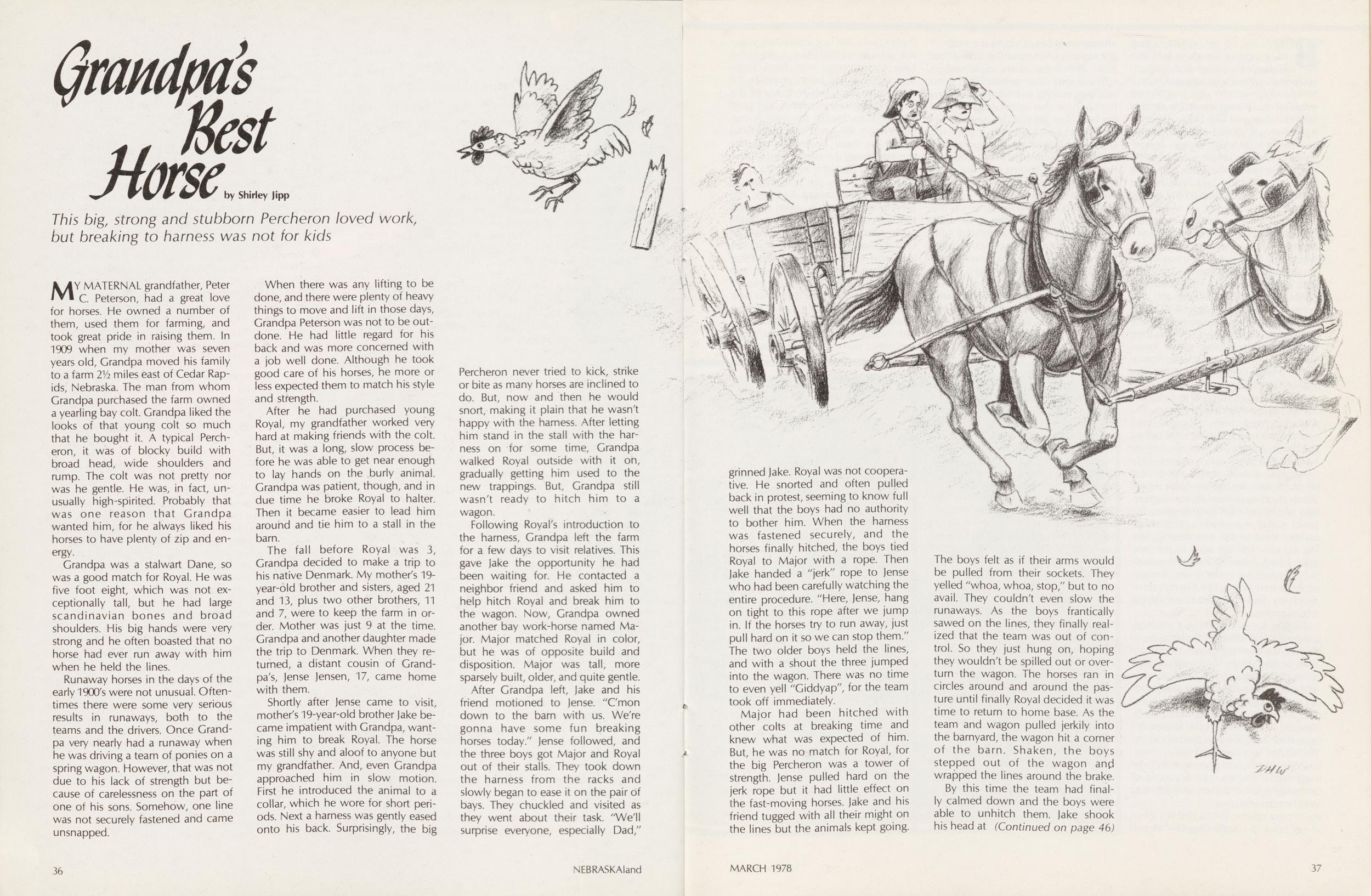
Major had been hitched with other colts at breaking time and knew what was expected of him. But, he was no match for Royal, for the big Percheron was a tower of strength. Jense pulled hard on the jerk rope but it had little effect on the fast-moving horses. Jake and his friend tugged with all their might on the lines but the animals kept going. The boys felt as if their arms would be pulled from their sockets. They yelled "whoa, whoa, stop," but to no avail. They couldn't even slow the runaways. As the boys frantically sawed on the lines, they finally realized that the team was out of control. So they just hung on, hoping they wouldn't be spilled out or overturn the wagon. The horses ran in circles around and around the pasture until finally Royal decided it was time to return to home base. As the team and wagon pulled jerkily into the barnyard, the wagon hit a corner of the barn. Shaken, the boys stepped out of the wagon and wrapped the lines around the brake.
By this time the team had finally calmed down and the boys were able to unhitch them. Jake shook his head at (Continued on page 46)
36 NEBRASKAIand MARCH 1978 37
Streamside Chaplain
Mid-week excursions in fall and winter months have furnished creek-side therapy for ChappelVs "Fishing Father" during his 30-odd years of fishing Panhandle feeder streams
BELOW ME lay the rushing waters of a spring-nourished North Platte Valley "feeder" stream. Spawned upstream by seepage from a vast sandhills aquifer, the tiny stream tumbled and turned toward its destiny with the river and lake below. Nearby, a fallen tree sprawled across the creek as if trying to block its escape. The restricted flow of current scoured out a deep hole below the tree's spreading limbs, possibly the best hole on the small stream, according to my fishing partner.
Not exactly a pristine mountain trout stream, with no Rockies in Nebraska, the fish here are a different breed, too. We were fishing one of the dozen or so feeder streams that provide nurseries for Lake McConaughy's rainbow trout population, and we weren't fishing for the typical 10 to 12-inch trout that usually inhabit streams of this size. During the fall and winter months, tackle-busting giants move up from Lake McConaughy to spawn in the creeks. These were the fish that Father Cletus Semper and I were after.
Father Semper, dubbed the "Fishing Father" by his friends and cohorts, is a Catholic priest from Chappell, and spends much of his spare time fishing for the migrating trout. Now, a priest named "Semper" who resides in a "chappell" should conjur up dozens of puns, but he has probably heard them all. Having lived in the western part of the state for over 30 years, the good father has had a chance to sample most of the area streams, taking hundreds of big trout in the process. I had fished this stream several times before so I wasn't any stranger to it's waters either, but I hadn't done much to dent the population of the big rainbows.
Fishing for big trout is a chancey proposition at best—partly because of the limited time they are in the stream and accessible to fishermen. Father Semper had been fishing now for several hours, with me tagging along with a camera hoping to get some shots of him in action with a big rainbow. Either the fish weren't in the stream or I was bad luck for my partner, as he hadn't had any takers so far.
"Why don't you give it a try," he suggested. "There's only a couple of good holes left and then we'll move to another stream."
I strung up my flyrod, tied on a No. 4 egg hook, a couple of split shot and an egg sack. Easing up to the edge of the stream, I surveyed the fabled tree hole. The limbs of the dead willow spread out like tentacles of an octopus, waiting to offer refuge to any big rainbow that might deign to take my bait. How do you fish such a hole? Drift an egg sack into the guts of the snag and hope for the best? Or, maybe just dabble the bait in front of the obstruction hoping to entice a fish to the lip of the hole where you have a chance to land it.
I had already tried the latter, drifting the roe sack to the edge of the snag and slightly under, hoping that if a big trout did hit, my line would hold. "Mind if I give it a try?" my partner asked as I gave up and moved downstream to the next hole.
I returned and watched as he eased up to the hole, flipped the bait into the current and began stripping line from the fly reel, guiding the line with the rod tip, probing the depths of the hole below the limbs, feeling with his fingers for the slightest hint of a strike. Suddenly, he raised the rod tip sharply and a big rainbow broke water. I dropped my rod, grabbed the camera, and ran back to watch the fight. Using the leverage of the long fly rod, he masterfully guided the lunker back through the tangle of limbs to the shallow water at the head of the pool where he could play it properly.
The fish was a typical lake-run rainbow—heavy bodied and powerfully built—but he was no match for Father Semper's skill and experience. Keeping pressure on the fish, it finally came into the bank where he beached it with the side of his boot.
"How big?" I asked.
"About 4½ pounds," he replied. "It's a spawned-out female, so we'll keep her."
My partner was a veteran of many such fish, and many such landings. The son of a Spalding butcher, Father Semper went to North Platte in 1946 fresh out of seminary school, and then several years later, moved to Bridgeport, Dalton, and finally to Chappell. At each location he fished as often as he could break away from his clerical duties. His move to Bridgeport was the beginning of a long association with the big rainbows that run upstream from Lake McConaughy to spawn during the fall and winter months.
Trout haven't always traveled up these creeks. No one knows when the run actually started, but it was after Lake McConaughy was filled. Rainbow stocking had been carried on for some time previously in many of the North Platte Valley streams, and later, fish were stocked in the lake. Sometime during the late 1940's, large trout started to show up in the tributary streams during the winter, and anglers have fished for them ever since.
Generally now, the trout begin to migrate in fall, during October and November, and then again in early spring from February until early April.
Most fish that make the run are at least three years old, roughly 20 inches long, and four or more pounds. Biologists have surveyed the streams and monitored the run through the electrical fish trap across the Platte River near Lewellen. Their results show that over 70 percent of the fish are three-year-olds, 23 percent are four years old, and only 2 percent are five or older.
Fisheries biologists have greatly increased the number of fish making the spawning run. Ten years ago, only four streams in the drainage supported natural reproduction. At the present time, 12 streams have been improved so they either have natural reproduction or serve as nursery streams for small stocked trout that then eventually move down to Lake McConaughy.
Each winter, biologists catch enough mature trout at the Lewellen fish trap to provide 200,000 eggs for subsequent hatching and release. This involves taking about 60 females and enough males to handle fertilization. The young fish are released in the headwaters of the streams where they live and grow for one year before moving down to the lake.
Now, Lake McConaughy's trout population is almost completely self-supporting, and both creek and lake anglers benefit by taking surplus fish from the population.
Most of the trout that Father Semper catches are in the three to five-pound category, but he occasionally gets larger fish. His biggest to date is a 9½-pounder, and he has seen bigger fish in the streams.
His standard trouting gear for big rainbows is a long flyrod, a fly reel loaded with 10 to 17-pound monofilament, and a size 4 to 6 steelhead egg hook. For bait he uses a ¾-inch ball of trout eggs, held by a sack of thin nylon hose or cheesecloth, and tied at the top with cotton thread. On the line he attaches up to four large split shot, depending on the amount of current in the stream.
In fishing the creeks, he ignores most of the water but heads for the undercut banks and deep holes formed by trees, as past experience has shown these to be the best.
Standing just upstream of the hole, he lets out only a few feet of line, holding the rod tip close to the surface and feeling the structure by bouncing the shot along the bottom. He probes the undercut banks and pays out line as necessary while standing back away from the stream.
With the rod in one hand, he holds the line with the fingertips of the other, carefully feeling the line as it bumps along its route. At any pause or jerk, he sets the hook immediately. Many times the hook will catch on an underwater snag, but occasionally he is rewarded by the initial run and fight of a large rainbow as it stretches his equipment to the limits.
Most of the creeks are on private land, with only a few exceptions, and access can often be a problem, according to Father Semper. Most of the problems stem from the actions of a few, he says. Evidently a few anglers don't want to take the time to learn how to catch the big fish legally, and he has seen people try to net fish and even shoot them with high-power rifles. These actions have hurt the honest fishermen, he feels, because he has seen many of the best stretches closed off to all access.
In recent years, Nine Mile was the victim of a vicious act of vandalism, where poachers dumped bleach into the stream, destroying many adult spawners plus most of a whole year's young fish. Otter Creek is almost entirely closed, except for a few hundred yards of public property close to the lake. Portions of Nine Mile and Red Willow offer easy access, where channelized portions of the stream follow roadways. Most of the rest of the streams are on private property and permission to fish is required.
Stream fishing is pretty much feast or famine. If the fish are in the creek, you have at least a fair chance of hooking one, but nothing is guaranteed. Persistence is the key, according to Father Semper, and it often pays off in a trout of trophy proportions.
If persistence is the secret, then Father Semper should be a success. Almost every Tuesday and Wednesday during the winter are fishing days, and more often than not, he will be found carefully drifting an egg sack through the crystal-clear depths of his favorite stream. Aspiring anglers would do well to stop and take a lesson or two from the "Fishing Father" at such times, for here is one fisherman whose stories, and advice, will contain no fisherman's "exaggeration".
38 NEBRASKAIand MARCH 1978 39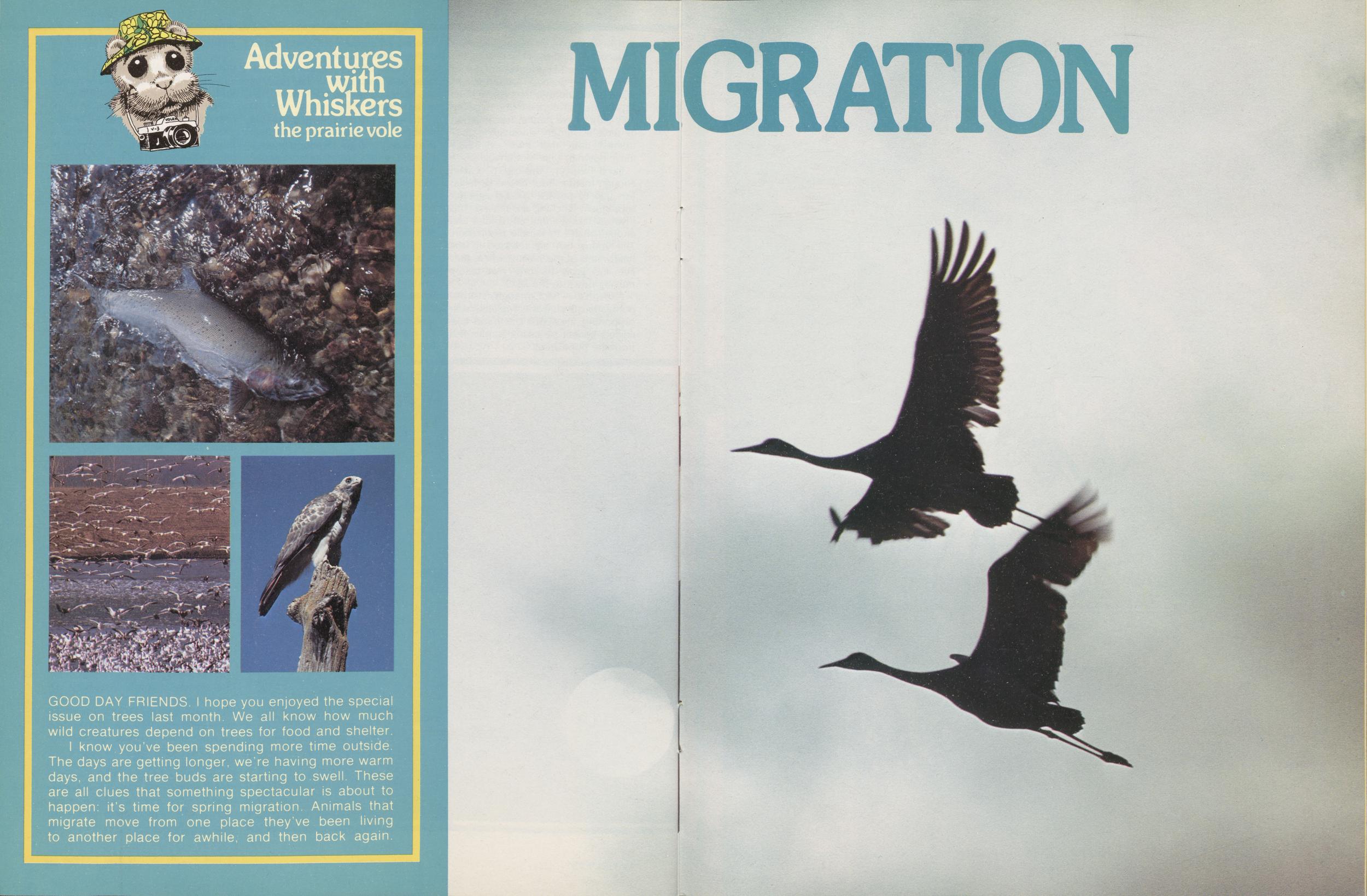
Adventures with Whiskers the prairie vole
MIGRATION
GOOD DAY FRIENDS. I hope you enjoyed the special issue on trees last month. We all know how much wild creatures depend on trees for food and shelter.
I know you've been spending more time outside. The days are getting longer, we're having more warm days, and the tree buds are starting to.swell. These are all clues that something spectacular is about to happen: it's time for spring migration. Animals that migrate move from one place they've been living to another place for awhile, and then back again.

3. Season when birds move south
5. Butterflies that migrate
8. Look hard
9. Article
11. Duck that winters in Nebraska
13. Long-legged bird that stops on Platte River
16. Migration path CLUES DOWN
1. Cute little mammals that do not migrate
2. Month when many cranes and geese stop in Nebraska
3. Cavalryman's stockade
4. Scornful smile
5. Same as 11 across
6. Conjunction
7. Pronoun
8. Shelled animal that moves too slow to migrate
10. Some birds migrate in the dark of________
12. Female deer
14. Direction that birds migrate in spring
15. Birds may tell directions by location of the________
Birds, like ducks, geese, sandhill cranes
and all the hawks, are the best known migrators. They usually fly south every fall
when the winter turns nasty, and north in
spring when it's warm enough to nest and
raise young. Watching those strings of
ducks and geese wing north is enough to
make this old vole wish he had feathers.
But don't misunderstand me; it's not just
birds that migrate.
Nebraska's rainbow trout migrate, too. During the fall and again in March they leave Lake McConaughy and swim up the North Platte River to spawn in gravel-bottomed streams around the town of Scottsbluff. Once eggs are laid and fertilized, the adult trout return to the lake. The newly hatched trout, called fry, stay in the stream for the first year of their lives before swimming downstream to the lake. When three years old, they return to their hatching streams and they, in turn, spawn.
Among the insects, only the orange and black monarch butterfly is a true migrator. Each fall, Nebraska's winter forces them south. Their journey does not end until they reach winter roosts in the mountain jungles of Mexico and Central America. Millions of monarchs have gathered on the same handful of trees every winter for hundreds of years. When spring comes, they fly north. Along the way they mate, lay eggs and die. The young monarchs complete the migration, returning north to their parents' summering grounds.
So you see, you don't need feathers to migrate. Well, I've got to fly, if you'll excuse the expression. See you in April.
Answers Across
3. Fall
5. Monarchs
8. Stare
9. The
11. Mallard
13. Sandhill Crane
16. Route
Answers Down
1. Voles 2. March
3. Fort
4. Sneer
5. Mallard
6. Or
7. He
8. Snail
10. Night
12. Doe
14. North
15. Sun Photo Credits For This Issue Cover—Bill McClurg; Inside cover—Jon Farrar; pages 7 through 11-Jon Farrar; pages 12 and 14—Ken Bouc; page 19—Lou Ell; C2, C3 and C5-University of Nebraska Television, photos by Bill Ganzel and Don Tremain; C4—lower right, Bill McClurg; C6-bottom Lou Ell; C7—right Bill Mc- Clurg; C8—Bill McClurg; C10-bottom Lou Ell; C11-Bill McClurg; C14-top right, Jerry Ingram; C15 and page 39-Bill McClurg; page 40-top left, Bob Grier, lower left and right, Jon Farrar; page 41-Jon Farrar.
the hole in the barn. "Boys, we're sure not gonna tell Dad what happened."
No one ever reported the runaway that day, and Grandpa often wondered how that big hole came to be in the corner of the barn.
The next spring Grandpa patiently broke Royal to harness, wagon, plow and any machinery that required strong horse power. Since he weighed some 1,800 pounds, the great Percheron proved to be the most powerful horse Grandpa had ever owned. And, later he actually tolerated the Peterson sons to work him.
When Royal was 10 years old, Grandpa bought a ranch in the sandhills of Wheeler County, just north of Pibel Lake. Two of the children trucked Major and Royal to the ranch in August to do some fall work. The remaining livestock and other belongings were to be moved the next spring. One evening the horses were turned out to pasture for the night. Perhaps this was the chance they had been waiting for. At any rate, they got out and took off for their former home at Cedar Rapids, some 40 miles away. The horses were over half-way home before anyone caught up with them and returned them.
That winter and during following years, neighborhood men from around Pibel Lake gathered to cut huge chunks of ice when the lake was well frozen. Then it was stored in straw and sawdust in an icehouse along the shore, plus individual ice houses on nearby farms, to be used the following summer. The first winter that the family lived on the ranch, Grandpa planned to assist in putting up ice, so he had Royal's hooves shod and took him along to help. Royal proved to he a great
Once the men were cutting ice with a team of mules. After several hours the mules balked and either couldn't or wouldn't continue to work. They sat down and refused to budge. So, Royal was hitched with them. With a mighty groan, the enormous horse began pulling the load, mules and all. He easily cut the ice while the mules slid along helplessly behind.
Royal loved to work, whether it was summer plowing or moving ice in winter. If another team bogged down with a heavy load, he never failed to pull them out. After Grandpa retired, his son Alfred took over the ranch and turned Royal out to pasture. By that time the faithful work-horse was quite old, so he grazed and took life easy during his remaining days.
One evening the horses had all been turned out to pasture for the night. The next morning when Alfred went out to do the chores, he was astounded to find Royal in his old stall. Somehow the big animal had gotten through several fences and into the barn yard. How he was able to so forever remained a mystery, for he had been grazing over a mile away. But there he was, at 26, quite dead in his stall. That fine old horse had come home to die. Alfred sadly removed the old horse from the barn and laid him to rest in a more appropriate place, but he is still remembered fondly by the family as the biggest, and best horse that Grandpa ever had.
there was nothing to hide behind. If you couldn't hit a deer in the eye at two miles, then you were probably going to go hungry because you couldn't hardly sneak up any closer to them than that. Of course that caused some problems too. Old Leo Grim out at Dannebrog was a dead shot and had a gun with a range of several miles but the problem was that the range was so long that the game he shot was often spoiled before he could arrive to retrieve it.
Of course a good part of the pioneers' success at hunting was more than a good gun and a good eye. They had good dogs and good transportation too. You don't have to believe me if you don't want to. It'll just quote the following report that was sent into the Nebraska Farmer in 1925. Now they surely wouldn't have printed it if'n it wasn't true as blue:
"This dog was half water spaniel and Irish setter. One day I was fishing, my dog was sitting by my side looking into the water. All at once he dived into the creek and out of sight. I thought he was drowned. About fifteen minutes later I heard a dog barking a quarter of a mile down the stream and to my surprise there were ten catfish and eight bass which my dog had treed.
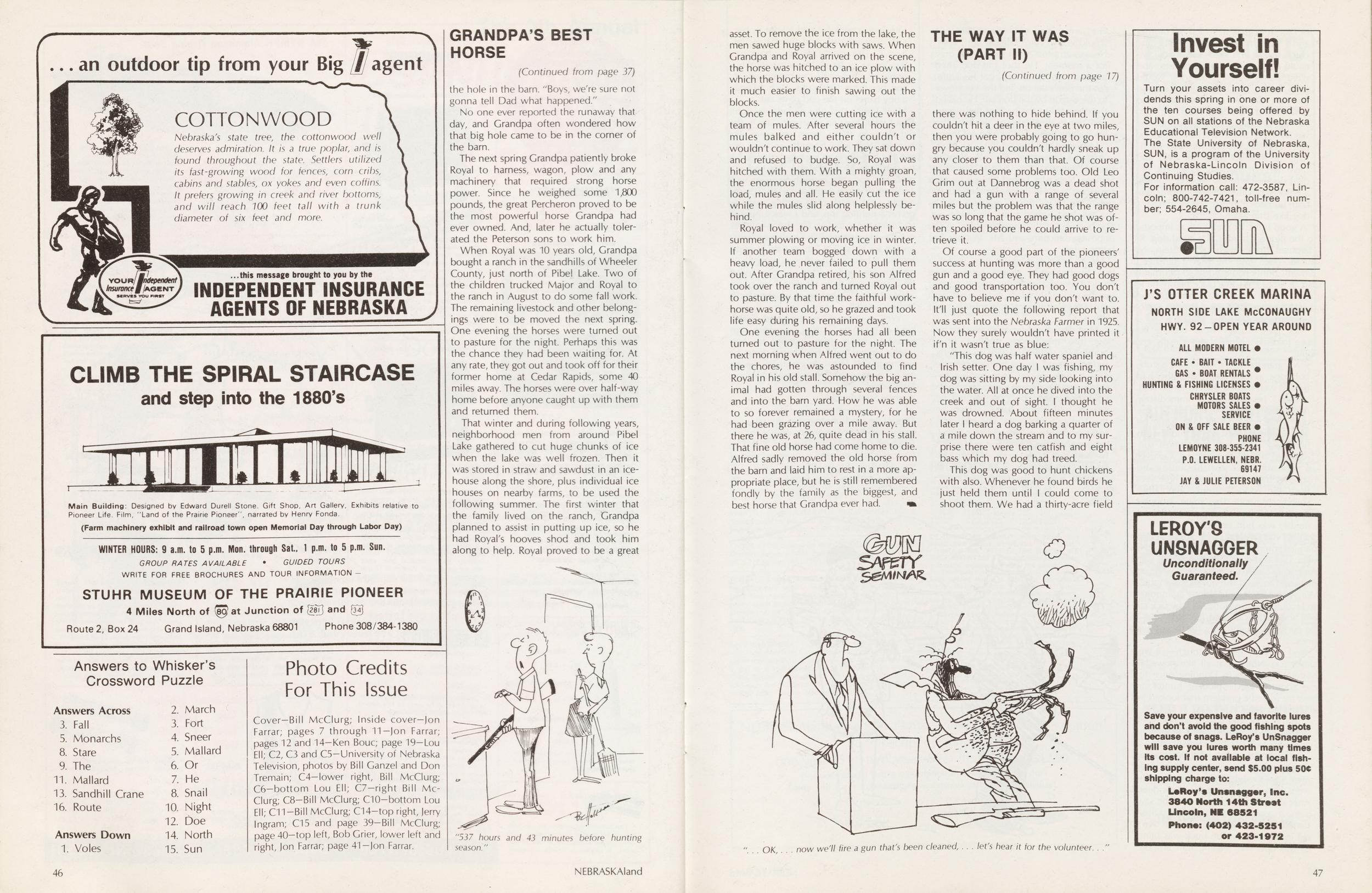
This dog was good to hunt chickens with also. Whenever he found birds he just held them until I could come to shoot them. We had a thirty-acre fieldOK, . . . now well fire a gun that's been cleaned, . . . let's hear it for the volunteer. .."
Turn your assets into career dividends this spring in one or more of the ten courses being offered by SUN on all stations of the Nebraska Educational Television Network. The State University of Nebraska, SUN, is a program of the University of Nebraska-Lincoln Division of Continuing Studies. For information call: 472-3587, Lincoln; 800-742-7421, toll-free number; 554-2645, Omaha. J'S OTTER CREEK MARINA
NORTH SIDE LAKE McCONAUGHY HWY. 92-OPEN YEAR AROUND ALL MODERN MOTEL • CAFE • BAIT • TACKLE GAS • BOAT RENTALS # HUNTING & FISHING LICENSES • CHRYSLER BOATS MOTORS SALES • SERVICE ON & OFF SALE BEER • PHONE LEMOYNE 308-355-2341 P.O. LEWELLEN, NEBR. 69147 JAY & JULIE PETERSON LEROYS UNQNAGGER
Unconditionally Guaranteed. Save your expensive and favorite lures and don't avoid the good fishing spots because of snags. LeRoy's UnSnagger will save you lures worth many times its cost. If not available at local fishing supply center, send $5.00 plus 50* shipping charge to: LeRoy's Unsnagger, Inc. 3840 North 14th Street Lincoln, NE 68521 Phono: (402) 432-5251 or 423-1972 47
 of bluestem grass in which my brother
and I were hunting. My dog set some
chickens but the grass was so tall we
could not find him. We gave it up and
went home thinking the dog would
soon follow. He didn't come, and so
the next day we decided we would
have to find the dog to keep him from
starving to death, because we knew he
would hold those chickens until he
died. We couldn't find him and we finally decided to burn the field and
drive him out that way. When the fire
died down there was my dog, holding
a chicken about thirty feet from him,
both burned to a crisp. I'd like to have a
dog like that again.
of bluestem grass in which my brother
and I were hunting. My dog set some
chickens but the grass was so tall we
could not find him. We gave it up and
went home thinking the dog would
soon follow. He didn't come, and so
the next day we decided we would
have to find the dog to keep him from
starving to death, because we knew he
would hold those chickens until he
died. We couldn't find him and we finally decided to burn the field and
drive him out that way. When the fire
died down there was my dog, holding
a chicken about thirty feet from him,
both burned to a crisp. I'd like to have a
dog like that again.
A good horse or mule was as important to the pioneer hunter as a good dog. Ray Harpham from down by Holstein, Nebraska, once told me that a rancher in Brown County had a horse so fast that he lots of times got some place before he left home and he was such a good cattle horse that he sometimes found cows before they were lost.
Mrs. Dale Cooley from Broken Bow once told me a story about a really great mule:
My grandfather's mule wasn't a stubborn one, as most are. Grandfather had him so well trained that when he said, "Whoa," he would stop immediately no matter how fast he was going. One day while out hunting wild game he was suddenly pursued by Indians on horseback. They had him almost surrounded and his only escape was over a very high cliff. Not hesitating, he spurred the mule on over. Three feet from the rocky bottom Grandfather yelled, "Whoa!" The mule stopped dead still. Grandfather jumped off and neither was hurt one bit.
Why, you modern day hunters are such pansies compared to the tough customers who pioneered out here on the Great American Desert! I remember when my pap used to send me out to hunt rabbits. We were too poor to afford ammunition so I would just run along side the jack rabbits and cottontails and feel their ribs to be sure we caught only the nice plump ones.
And we were not only tough—we were clever too. Nothing at all like nowadays. Mamie Collier up in Dunning once told me about a clever pioneer hunter and how he solved a problem that looked just about impossible:
In the good old days a farmer went out to look over his pasture. In looking around he saw a big buck deer up on a tall hill. "I'll wait until fall when deer season opens. Then I'll have some deer meat," he thought. When fall came he went back to look for the buck deer. After driving over much prairie, he saw a doe in a grove of trees; looking a little farther he saw the buck with the doe's tail in his mouth. The buck was blind so the doe was leading him around. The farmer had only one bullet but would like to have bagged both deer. He was at. a loss what to do—but only for a moment. He shot the doe, then reached into his pocket, got his knife, cut the doe's tail off, led the buck over to the wagon by the doe tail. He nailed the doe's tail to the back of the wagon and drove slowly home, leading the buck along behind. When he got there, he reloaded and bagged the buck too.
And the December 20, 1924, Nebraska Farmer reported that Ernest Witmer of Stanton, Nebraska, found himself facing a ferocious bear. He simply rammed his arm down the bear's throat, grabbed him by the tail, and turned him wrongside out. The bear kept right on running but in the opposite direction and Mr. Witmer got home safely.
Mr. McKillip of Milburn used to tell a true hunting story that I have always thought emphasized the pioneer spirit that you youngsters lack today, what with your fancy guns, calls, campers, and clothes:
One day an old-timer decided to go out into the woods hunting. After hunting for some time with no avail, he turned around to go home when he saw a huge grizzly bear coming towards him at a great speed. Afraid he could not make it up a tree in time, he saw an old empty barrel, which he thankfully crawled into. The old bear, realizing there was a long winter ahead, sat down on the barrel and proceeded to wait him out. Lucky for him, he spied the old bear's tail sticking through a small hole in the barrel. Quick as a wink he tied a knot in her tail, crawled out, and went happily home. The next spring when he happened to be in the same locality, to his amazement he saw momma bear and her three little cubs, each having a tiny barrel on the end of its tail.
Well, I hope that I have made my point about what hunting was really like in the old days. In those times we were real hunters. Well, in all honesty—and you can bet that honesty is an important thing with us pioneers—in all honesty, we had our problems too. Not everything went well and not all of us were so clever. For example, I can recall once getting ready to go on a hunting trip, and I was supposed to bring the supplies for the two-week outing. My partner Bill Kloefkorn, better known for his skill at fishing than hunting, looked a bit startled when I showed up carrying one modest-sized tote bag. "What do you have in there for grub?" he asked, and I replied, "Six bottles of whiskey and a loaf of bread."
"Well, good grief," he exploded, "What kind of planning is that? you were supposed to bring along supplies for two weeks! I knew that I should have done the buying myself. What do you think we are going to do with all that bread?"
Truly yours, Ananias Stretcher These tales and photographs are taken in part from Roger Welsch's Shingling the Fog and Other Plains Lies and Tall Tale Postcards and are used with permission of the Shallow Press, Chicago, and A.S. Barnes, Cranbury, New jersey.Trading Post
Acceptance of advertising implies no endorsement of products or services. Classified Ads: 20 cents a word, minimum order $4.00. May 1978 closing date, March 8. Send classified ads to: Trading Post, NEBRASKAIand, P.O. Box 30370, Lincoln, Nebraska 68503. DOGS BEAGLES. Puppy love for sale. We have the perfect family companion or hunting partner for you. Champion dams and/or sire. Tux Beagles, Route 1, Box 152. Raymond, NE 68428 (402) 475-3713. MISCELLANEOUS DUCK HUNTERS, learn how, make quality, solid plastic, waterfowl decoys. We're originators of famous system. Send $.50, colorful catalog. Decoys Unlimited, Clinton, Iowa 52732. GUNS-Browning, Winchester, Remington, others, Hi-powers shotguns, new, used, antiques. Want Pre-1964 Winchesters. Buy-Sell-Trade. Ph. (402) 729-6112. Bedlan's Sporting Goods, Fairbury, NE 68352. WANTED-JAPANESE SWORDS, fittings, related objects. Serious collector pays best prices. Call or write Don Hill, 5016 California, Omaha, NE 68132 (402) 558-0541 CANOE TRIPS. Canoes for rent. WE DO IT YOUR WAY! Dryland Aquatics, 1832 Park, Fremont, Nebraska 68025 (402) 721-5801 or (402) 721-1749. FOR SALE: 3-bedroom. A-frame home located in beautiful setting of pine trees overlooking Long Pine Creek, near Long Pine, Nebraska. Has separate dining room, family room; extras include a fireplace, 2 outdoor decks, and a greenhouse. (#576) $48,000. Gateway Realty of Grand Island, Gateway Plaza, 3307 W. Capital Avenue. (308) 382-7800. CANOE NEBRASKA . . . with Wilson Outfitters! Full Ser- vice Trips; Statewide Canoe Rental Network; and, a new canoe specialty shop outlet with Grand Opening March 8, 9, and 10, at 1329 Dawes (14th & Cornhusker) in Lincoln! Giant, 72 used canoe sale, one per family, running $125 to $265 each. For 1978 brochure, write Wilson Outfitters, 6211 Sunrise Road, Lincoln, Nebraska 68510. GUARANTEED LIVE-catch trap; caught 3 coon, 2 mink, 5 possums in one trap one night. Catch more fur or money back. Automatically resets, animal never gets bait. Send $2 for drawing. Hammond, Route 5, Box 49, Feiser Road, Covington, Kentucky 41015. BUY DIRECT! Grow worms—For sale, bait, gardening, garbage disposal Beds, bedding, feed available. Hybrid red stock by the dozen or million. Send stamp for price lists, details. M-) Baits & Boats, Box 365-A, Hartington, NE 68739 TAXIDERMY BIG BEAR TAXIDERMY. Rt 2, Mitchell, Nebraska 69357. We specialize in all big game from Alaska to Nebraska, also birds and fish Hair on and hair off tanning, 4½ miles west of Scottsbluff on Highway 26. Phone (308) 635-3013. KARL SCHWARZ Master Taxidermists. Mounting of game heads-birds-fish-animals-fur rugs-robes-tanning buckskin. Since 1910. 424 South 13th Street, Dept. A, Omaha, Nebraska 68102. THE HOUSE OF BIRDS-Licensed taxidermist, 10 years experience in the art of all taxidermy. Larry Nave, 1323 North 10th, Beatrice, NE 68310. Phone (402) 228-3959. FISH MOUNTING Service. Specialize in all fresh-water fish. Visitors welcome. Wally Allison, 2709 Birchwood North Platte, NE 69101, (308) 534-2324 GREAT PLAINS TAXIDERMY, Creative and realistic mounts of Fish, Birds, Game heads, full mounts, and novelty. Pat Garvey, 3015 NW 52nd, Lincoln, Nebraska 68524. Phone 470-2280, Lincoln; 571-5630, Omaha. CREATIVE TAXIDERMY. Modern methods and life-like workmanship on all fish and game since 1935, also tanning, rugs, and deerskin products, joe Voges, Naturecrafts and Gift Shop, 925 4th Corso, Nebraska City, NE 68410. Phone (402) 873-5491 "COMPLETE TAXIDERMY STUDIO" We can help you go hunting and fishing. Largest Whitetail by Boone & Crockett standards, mounted free. Dinges Taxidermy Studio, 2760 South 12th St., Omaha, NE 68108, (402) 342-3718 TEACH ANY DOG IN MINUTES Complete system, book and device. All you need to raise and train puppies, dogs of all ages. Never fails! Uses dog's keenest learning sense. CORRECTS • H0USFS0ILING •DIGGING • JUMPING • GUN SHY • CHEWING • BREAKING POINT • BARKING • OVER RANGING • BITING • BUSTING BIROS SIMPLE EASY TO USE NOT ELECTRONIC TEACHES • COME - »t all times' • SIT • GO • HEEL • SELF CONTROL • STAY • GUARD • DROP • FETCH Lasting, even in your absence' WORKS with YOU—NOT o'f tor himself ON TV with: Art Linkletter, Johnny Carson, Dick Cavett, Mike Douglas, Merv Griffin, "The Pet Set," "Friends of Man." ARTICLES: TIME magazine, NEW TIMES, HUNTING DOG & other worldwide publications. A scientific engineering marvel. This psychological dog sound maker is used from the palm of the hand. Gives amazing control at a distance. "Works like magic." No leash needed. "Tunes dogs in." Makes dogs seem to "read your mind." Novices become experts. Teaches direct to the dog's mind via a new subliminal sound learning stimulus. Safe, faster, kinder, more effective. Renders all slower pain-train ing obsolete. Same instrument and system (utilizing the Dr. Miller patents) dispensed by veterinarians for dog behavior. Now hundreds and thousands of satisfied users, breeders, trainers, USA. & foreign lands. illustrated dog psychology book-brochure. DOG-MASTER SYSTEMS Dept Nil 7 710 Wilshire Blvd., Suite 318, Santa Monica, Calif. 90401 A division of Environmental Research Labs. Copyright 1977 NEBRASKAIand-Nebraska's magazine of Outdoor Recreation Subscription Rates one year $5 two years $9 three years $12.50 (Includes special bonus subscription to Afield & Afloat, the Game and Parks Commission's newspaper of outdoor activities) Send subscriptions to: NFBRASKAIand Magazine Nebraska Game and Parks Commission, P.O. Box 30370 Lincoln, Nebraska 68503 Browning Our EXCLUSIVE DISCOUNT PLAN on all BROWNING products will save you up to 20%. This includes guns, ammunition, archery, clothing, boots, tents, gun cases, rifle scopes and fishing equipment. Inquire ... it will save you $$$. Big discounts on other sporting goods. NEW LOCATION! 7th and Seward Streets Seward, Nebraska NEW HOURS! Tuesday-Saturday 9 a.m.-6 p.m. Friday 9 a.m.-9 p.m. Sunday 1-6 p.m. Closed Mondays OLD FRIENDS! We're still the same old faces, so come In and browse in our new quarters. We'll be happy to see you. PLUM CREEK GUN SHOP Phone: (402) 643-3303 P.O. Box 243-Seward, Nebraska 68434 AUTHORS WANTED BY NEW YORK PUBLISHER Leading book publisher seeks manuscripts of all types: fiction, non-fiction, poetry, scholarly and juvenile works, etc. New authors welcomed. For complete information, send for free booklet Ft-70. Vantage Press, 516 W. 34 St., New York 10001 LIVE-CATCH ALL-PURPOSE TRAPS Writafor FREE CATALOG Lour as $4.95 Traps without injury squirrels, chipmunks, rabbits, mink, fox, rac- coons, stray animals, pests, etc. Sizes for every need. Also traps for snakes, sparrows, pigeons, crabs, turtles, quail, etc. Save on our low factory prices. Send no money Free catalog and trapping secrets. MUSTANG MFG. CO., Dept. H 34, Box 10880, Houston, Tex. 77018 NEED A DISTANT NUMBER? You can still dial direct and save. Just dial your DDD access number, the area code for the location, plus the Universal Directory Assistance Number, 555-1212. THE LINCOLN TELEPHONE CO. MARCH 1978 49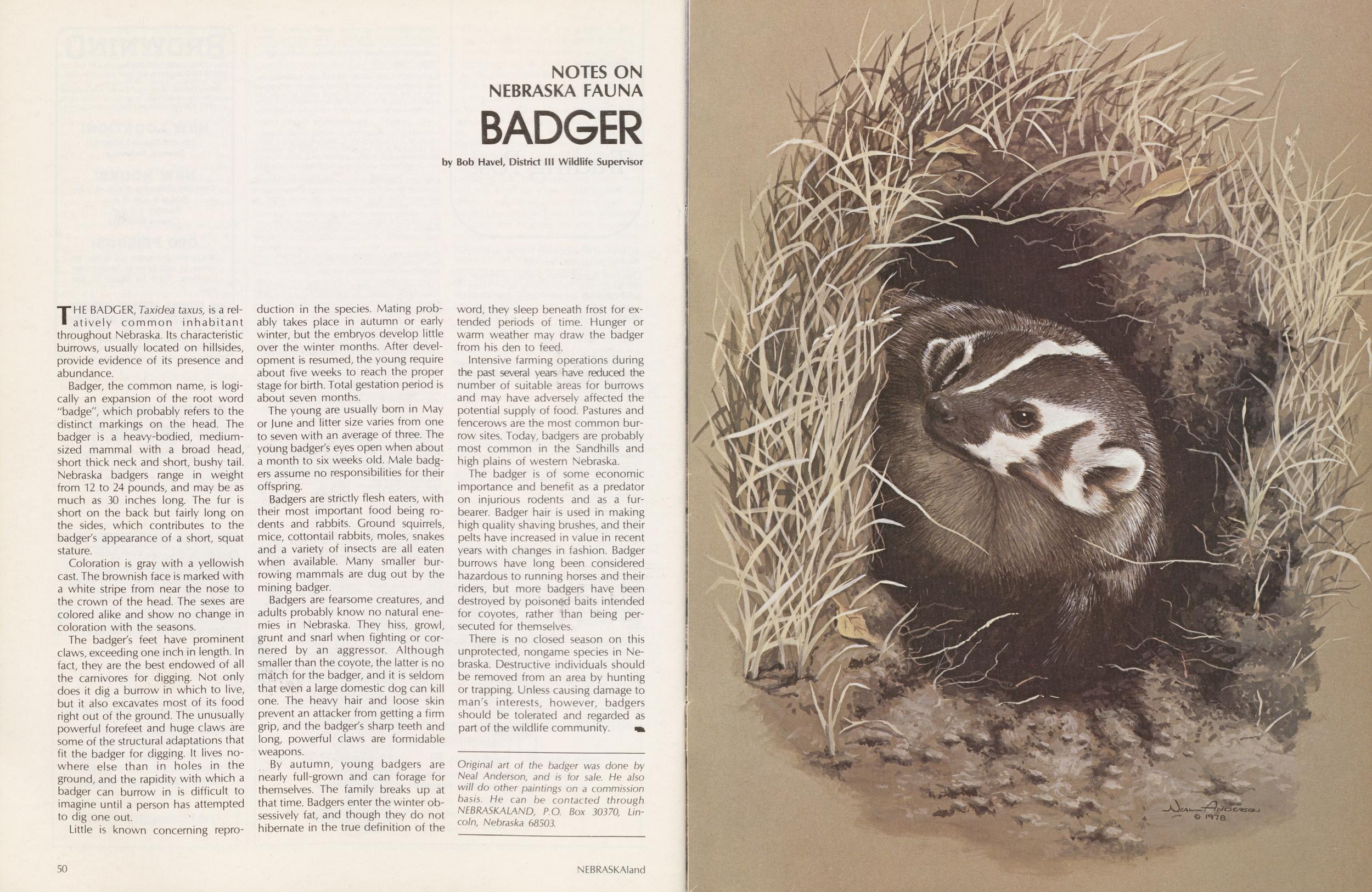
NOTES ON NEBRAKSA FAUNA BADGER
THE BADGER, Tax idea taxus, is a relatively common inhabitant throughout Nebraska. Its characteristic burrows, usually located on hillsides, provide evidence of its presence and abundance.
Badger, the common name, is logically an expansion of the root word "badge", which probably refers to the distinct markings on the head. The badger is a heavy-bodied, medium-sized mammal with a broad head, short thick neck and short, bushy tail. Nebraska badgers range in weight from 12 to 24 pounds, and may be as much as 30 inches long. The fur is short on the back but fairly long on the sides, which contributes to the badger's appearance of a short, squat stature.
Coloration is gray with a yellowish cast. The brownish face is marked with a white stripe from near the nose to the crown of the head. The sexes are colored alike and show no change in coloration with the seasons.
The badger's feet have prominent claws, exceeding one inch in length, in fact, they are the best endowed of all the carnivores for digging. Not only does it dig a burrow in which to live, but it also excavates most of its food right out of the ground. The unusually powerful forefeet and huge claws are some of the structural adaptations that fit the badger for digging. It lives nowhere else than in holes in the ground, and the rapidity with which a badger can burrow in is difficult to imagine until a person has attempted to dig one out.
Little is known concerning reproduction in the species. Mating probably takes place in autumn or early winter, but the embryos develop little over the winter months. After development is resumed, the young require about five weeks to reach the proper stage for birth. Total gestation period is about seven months.
The young are usually born in May or June and litter size varies from one to seven with an average of three. The young badger's eyes open when about a month to six weeks old. Male badgers assume no responsibilities for their offspring.
Badgers are strictly flesh eaters, with their most important food being rodents and rabbits. Ground squirrels, mice, cottontail rabbits, moles, snakes and a variety of insects are all eaten when available. Many smaller burrowing mammals are dug out by the mining badger.
Badgers are fearsome creatures, and adults probably know no natural enemies in Nebraska. They hiss, growl, grunt and snarl when fighting or cornered by an aggressor. Although smaller than the coyote, the latter is no match for the badger, and it is seldom that even a large domestic dog can kill one. The heavy hair and loose skin prevent an attacker from getting a firm grip, and the badger's sharp teeth and long, powerful claws are formidable weapons.
By autumn, young badgers are nearly full-grown and can forage for themselves. The family breaks up at that time. Badgers enter the winter obsessively fat, and though they do not hibernate in the true definition of the word, they sleep beneath frost for extended periods of time. Hunger or warm weather may draw the badger from his den to feed.
Intensive farming operations during the past several years have reduced the number of suitable areas for burrows and may have adversely affected the potential supply of food. Pastures and fencerows are the most common burrow sites. Today, badgers are probably most common in the Sandhills and high plains of western Nebraska.
The badger is of some economic importance and benefit as a predator on injurious rodents and as a furbearer. Badger hair is used in making high quality shaving brushes, and their pelts have increased in value in recent years with changes in fashion. Badger burrows have long been considered hazardous to running horses and their riders, but more badgers have been destroyed by poisoned baits intended for coyotes, rather than being persecuted for themselves.
There is no closed season on this unprotected, nongame species in Ne- braska. Destructive individuals should be removed from an area by hunting or trapping. Unless causing damage to man's interests, however, badgers should be tolerated and regarded as part of the wildlife community.
Original art of the badger was done by Neal Anderson, and is for sale. He also will do other paintings on a commission basis. He can be contacted through NEBRASKALAND, P.O. Box 30370, Lincoln, Nebraska 68503. 50 NEBRASKAland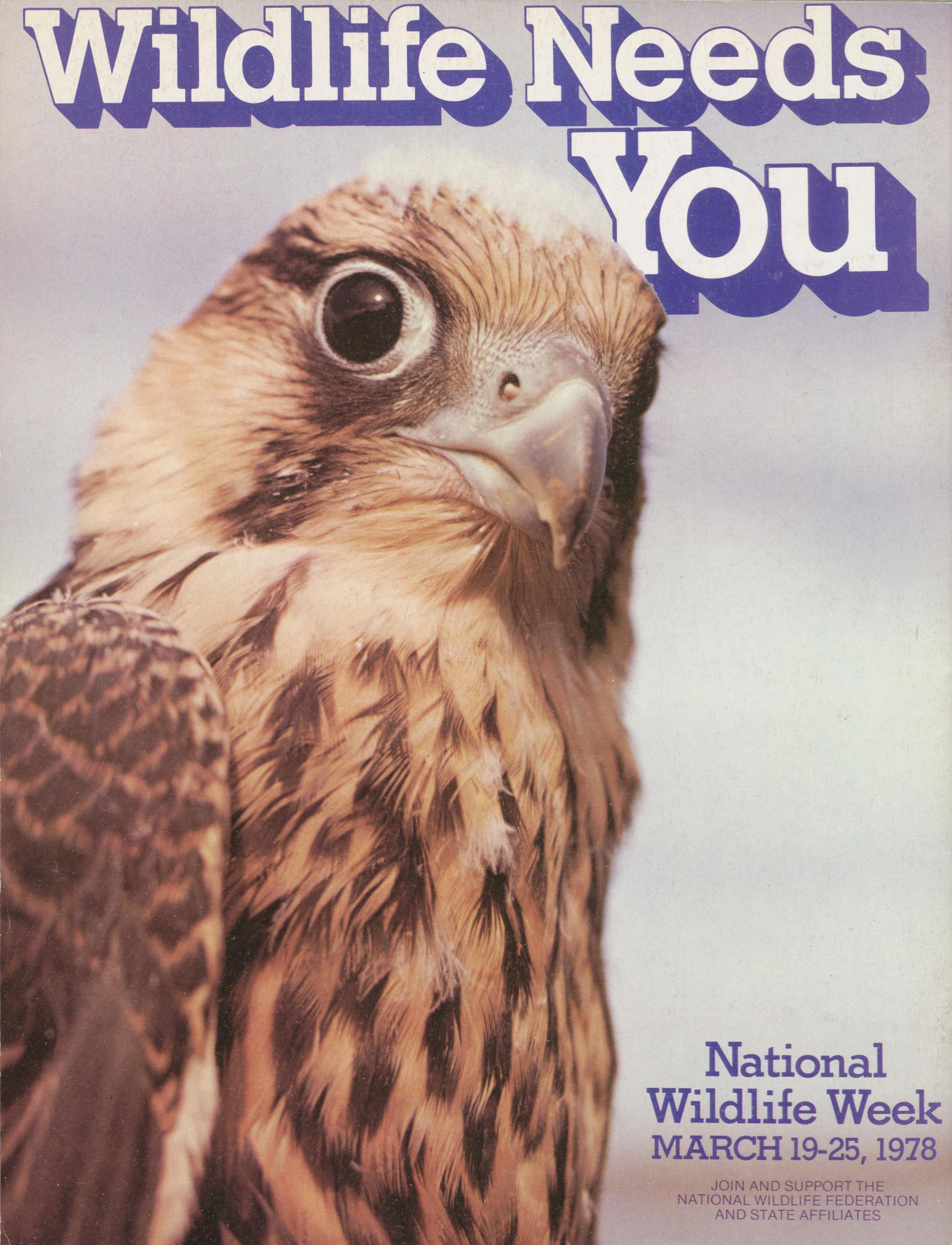
Wildlife Needs You
National Wildlife Week MARCH 19-25,1978 JOIN AND SUPPORT THE NATIONAL WILDLIFE FEDERATION AND STATE AFFILIATESPosition: 704 (16 views)