Volume 56, Issue 2, 1978
NEBRASKAland
Published by the Nebraska Game and Parks Commission VOL 56 / NO. 2 / FEBRUARY 1978 commission Chairman: Don O. Bridge, Norfolk Northeast District (402) 371-1473 Vice Chairman: William G. Lindeken, Chadron Northwest District (308) 432-3755 2nd Vice Chairman: Gerald R. (Bud) Campbell, Ravenna South-central District (308) 452-3800 H.B. (Tod) Kuntzelman, North Platte Southwest District (308) 532-2982 Richard W. Nisley, Roca Southeast District (402) 782-6850 Robert G. Cunningham, Omaha Douglas-Sarpy District (402) 553-5514 Shirley L Meckel, Burwell North-central District (308) 346-4015 Director: Eugene T. Mahoney Assistant Director: William J. Bailey, jr. Assistant Director: Dale R. Bree staff Chief, Information anad Education: W. Rex Amack Editor: Lowell Johnson Senior Editor: jon Farrar Editorial Assistants: Ken Bouc, Bill McClurg Field Editors: Bob Grier, Faye Musii, Rocky Hoffmann, Butch Isom Art Director: Michele Angle Farrar Illustration: Duane Westerholt Advertising: Cliff Griffin Circulation: Juanita StefkovichCopyright NebCraska Game and Parks Commission 1978. All rights reserved. Postmaster: if undeliverable, send notice by form 3579 to Nebraska Game and Parks Commission, Box 30370, Lincoln, Nebraska 68503. Second class postage paid at Lincoln, Nebraska
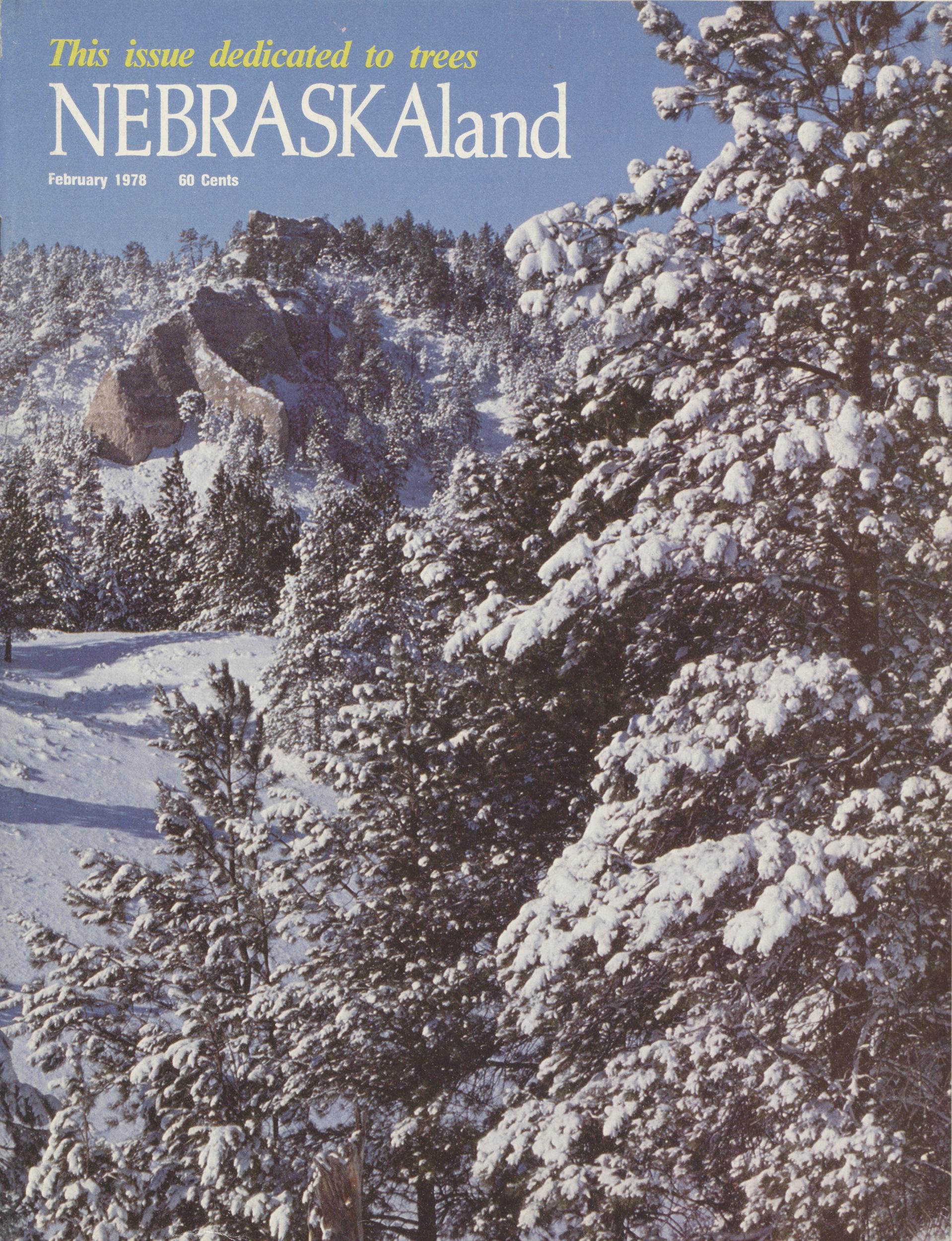
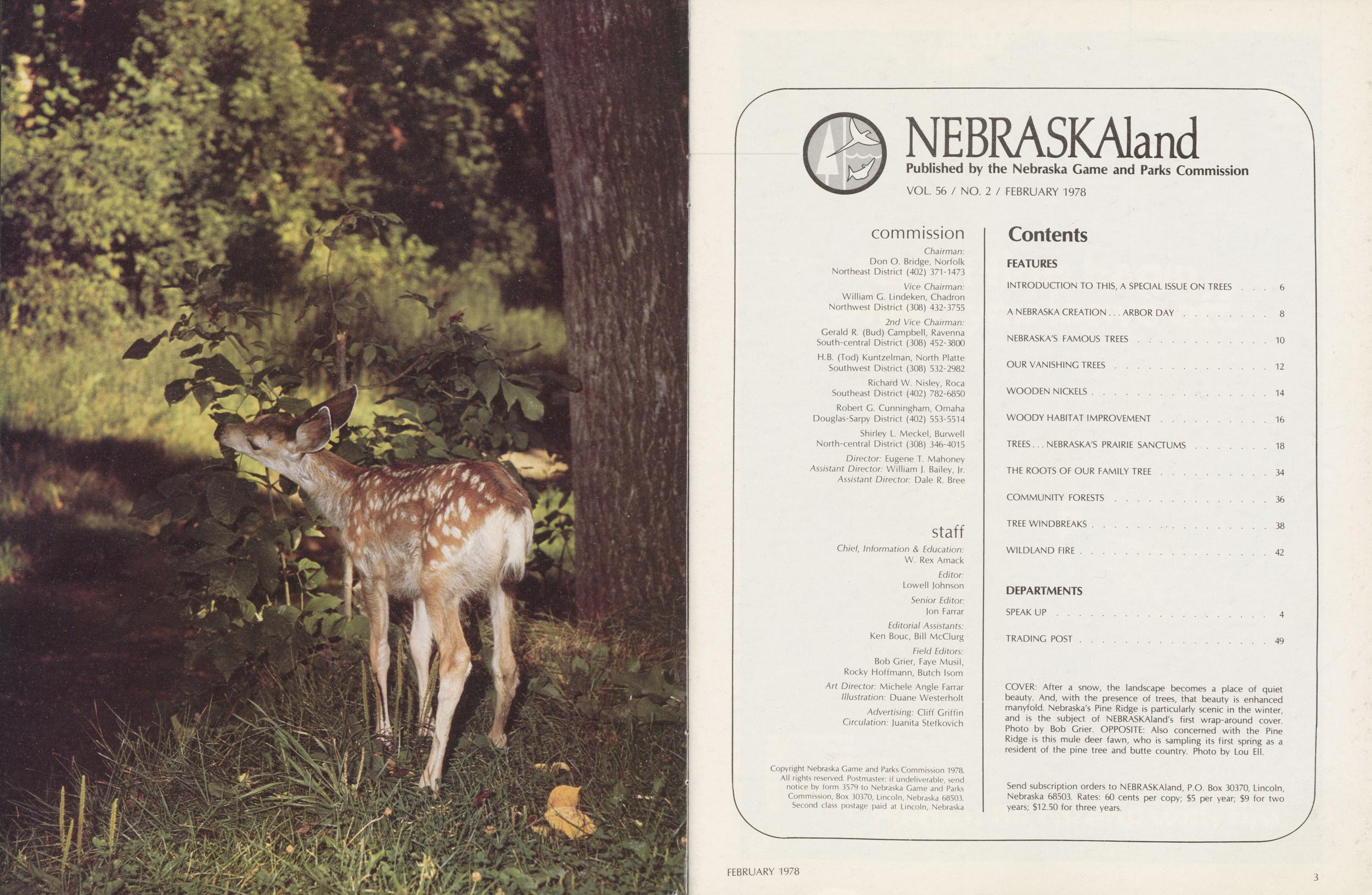
Contents FEATURES INTRODUCTION TO THIS, A SPECIAL ISSUE ON TREES 6 A NEBRASKA CREATION... ARBOR DAY 8 NEBRASKA'S FAMOUS TREES 10 OUR VANISHING TREES 12 WOODEN NICKELS 14 WOODY HABITAT IMPROVEMENT 16 TREES... NEBRASKA'S PRAIRIE SANCTUMS 18 THE ROOTS OF OUR FAMILY TREE 34 COMMUNITY FORESTS 36 TREE WINDBREAKS 38 WILDLAND FIRE 42 DEPARTMENTS SPEAK UP 4 TRADING POST 49 COVER: After a snow, the landscape becomes a place of quiet beauty. And, with the presence of trees, that beauty is enhanced manyfold. Nebraska's Pine Ridge is particularly scenic in the winter, and is the subject of NEBRASKAIand's first wrap-around cover. Photo by Bob Grier. OPPOSITE: Also concerned with the Pine Ridge is this mule deer fawn, who is sampling its first spring as a resident of the pine tree and butte country. Photo by Lou Ell. Send subscription orders to NEBRASKAland, P.O. Box 30370, Lincoln, Nebraska 68503. Rates: 60 cents per copy; $5 per year; $9 for two years; $12.50 for three years. FEBRUARY 1978 3
Speak Up
In observance of this special issue on trees in Nebraska, we thought it appropriate to run this poem, submitted by a reader.
THE HEART OF A TREE What does he plant who plants a tree? He plants the friend of sun and sky; He plants the flag of breezes free' The shaft of beauty, towering high; He plants a home to heaven aneigh For song a mother-croon of bird In hushed and happy twilight heard, The treble of heaven's harmony— These things he plants who plants a tree. What does he plant who plants a tree? He plants cool shade and tender rain, And seed and bud of days to be, And years that fade and flush again; He plants the glory of the plain; He plants the forest's heritage; The harvest of a coming age; The joy that unborn eyes shall see— These things he plants who plants a tree. What does he plant who plants a tree? He plants, in sap and leaf and wood In love of home and loyalty His blessing on the neighborhood. Who in the hollow of His Hand Holds all the growth of all our land. A nation's growth from sea to sea Stirs in his heart who plants a tree. —Author Unknown Another Dismal TripSir / I have been a subscriber to NEBRASKAland for several years and I enjoy it very much. I was born in Poole, Nebraska in 1905 and lived in the state until 1936.
In going through some old files, I came across a letter written to me by my brother-in-law, Ernest L. Clayton, who lives in Snohomish, Washington. It tells of a trip he and his cousin took down the Dismal River 65 years ago. Here it is just as he wrote it five years ago, and he was over 80 then.
"I want to tell you about a trip, since you are an outdoor man. While you are in Nebraska, pick up a copy of NEBRASKAland, Oct. 1971; a story on Dismal trip; three days down the river in a boat. Jack Ewer and I took the trip some 60 years ago; the country was a little on the wild order at that time, no roads or bridges. We spent a little over six weeks and went the full length and into the Middle Loup. Our experience was almost identical, only more of it. Our boat was about 15 feet long and we had a tent, blankets, sheet-iron stove with oven, bucket, pans and so on; a double-barrel shotgun, a 30/30 rifle, two .22 rifles, one handgun, 80 steel traps, two suitcases, so we were, you might say, loaded. We didn't have much trouble with falls and rapids. A lot of rain that fall, and we traveled when the river was up. We got wet a few times and took one good ducking. There was plenty of grouse and ducks, and lots of beaver. We were not allowed to trap them at that time. They caused us a lot of trouble with their dams. We camped in a nice grove of trees for a few days and at night we could hear them working, and a couple of trees came down while we were there, and it was on that trip that we filled a cigar box with rattle snake rattles, and also cut out a few fangs, and that was the dumbest thing anybody could do and live to tell about it. There were a few tense moments but it was a trip I will never forget. Maybe if I get to see you sometime I can tell you more about it."
I thought it interesting-the same trip so many years apart. Mr. Ewer, a veteran of World War I, is now dead. Do keep up the good work on your wonderfully interesting magazine. Homer J. McConnell Washington D.C Happy LandownerSir / The issue on the Nebraska Sandhills (August 1977) was especially good. It made me very happy indeed to be a landowner— 80 some odd acres along the Platte River in Nebraska—and while not a native, an adopted Cornhusker.
I remember once telling someone in the press that if we all died and went to Heaven, it would be Nebraska. Over the years in some of my poems, I've hinted at my love for Nebraska, and I'm presently in the middle of writing a long poem about the state and its beauty.
Rod McKuen Beverly Hills, CA Good Reading!Sir / We, at the Florida Wildlife Sanctuary, thoroughly enjoy your publications and wish more people would read this type of magazine.
The Florida Wildlife Sanctuary, which is the first wildlife hospital in the nation open 24 hours a day, is also an environmental clearing house to answer questions on any living creature for various organizations. As part of our environmental library, we subscribe to practically all Game and Fish Commission and conservation magazines. In fact, we receive these publications from most of the 48 state Game and Fish Commissions, in addition to Mainstream from the Animal Protection Institute, Zoo Reviews, and Wilderness Reports.
We would like to compliment you on your magazine and its beautiful stories to better educate the public, especially the young people, as well as the beautiful pictures on wildlife in its natural habitat. If more people would read publications such as yours, they would learn more about their neighbor next door.
Carlton O. Teate, Florida Wildlife sanctuary Melbourne, Florida Enjoys Good LifeSir / I have just returned from a week's vacation at Ponca State Park. My wife, two children and I all agreed that it was a fantastic vacation and that the park, its attractions, and the staff were all superb. I especially wish to compliment your staff at the park who were friendly, efficient and who unquestionably took pride in their work.
One can certainly be proud of Nebraska after visiting Ponca. It is one of the good parts of the "good life" in Nebraska.
Jerry Fennell Lincoln, NE Thank you, and I hope you continue to enjoy the many points of interest and scenic expanses that are such an important part of that very good life. (Editor) See Our StateSir / Your special issue on the Panhandle prompts me to write. I am a native of eastern Nebraska now living in Kearney. Like many residents of the eastern part of the state, I used to think of everything west of me as just somewhere "out there." During my last year at UNL I took a course in Nebraska geography, which really opened my eyes about the rest of the state.
Now I frequently travel on business through the Panhandle, the Sandhills, and the southwest part of the state, and I think I appreciate our whole state more with each trip. The variety of terrain, flora and fauna in Nebraska, I feel, is second to none.
I would certainly encourage Nebraskans to travel their state and see how vast it is! Thank you for the fine Panhandle issue. I'll be looking forward to your issues on the other parts of the state. Larry Fiehn Kearney, NE 4 NEBRASKAIandForest Fires begin where you leave off.
Please: Be careful with fire.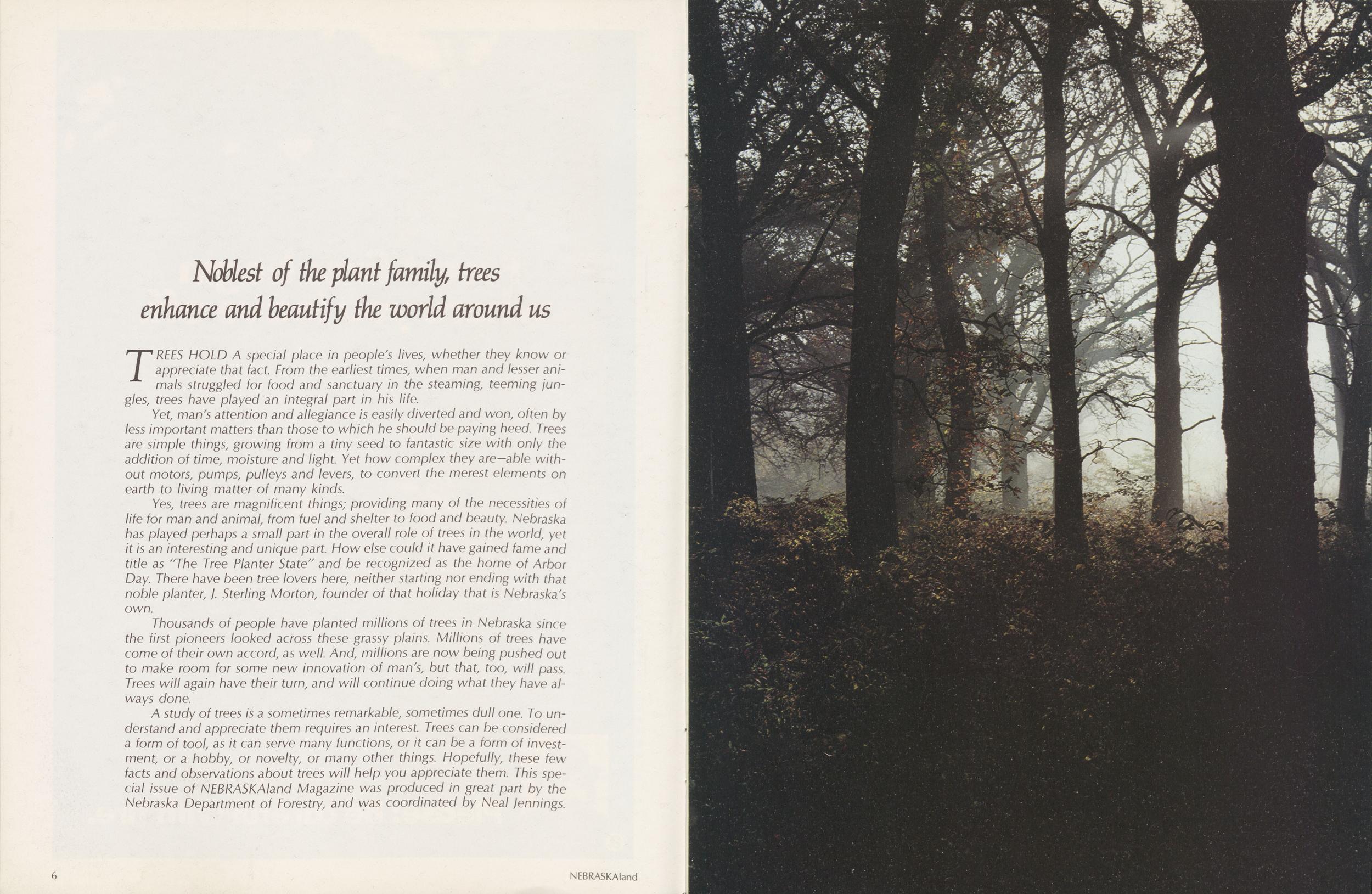
Noblest of the plant family, trees enhance and beautify the world around us
TREES HOLD A special place in people's lives, whether they know or appreciate that fact. From the earliest times, when man and lesser animals struggled for food and sanctuary in the steaming, teeming jungles, trees have played an integral part in his life.
Yet, man's attention and allegiance is easily diverted and won, often by less important matters than those to which he should be paying heed. Trees are simple things, growing from a tiny seed to fantastic size with only the addition of time, moisture and light. Yet how complex they are—able without motors, pumps, pulleys and levers, to convert the merest elements on earth to living matter of many kinds.
Yes, trees are magnificent things; providing many of the necessities of life for man and animal, from fuel and shelter to food and beauty. Nebraska has played perhaps a small part in the overall role of trees in the world, yet it is an interesting and unique part. How else could it have gained fame and title as "The Tree Planter State" and be recognized as the home of Arbor Day. There have been tree lovers here, neither starting nor ending with that noble planter, J. Sterling Morton, founder of that holiday that is Nebraska's own.
Thousands of people have planted millions of trees in Nebraska since the first pioneers looked across these grassy plains. Millions of trees have come of their own accord, as well. And, millions are now being pushed out to make room for some new innovation of man's, but that, too, will pass. Trees will again have their turn, and will continue doing what they have always done.
A study of trees is a sometimes remarkable, sometimes dull one. To understand and appreciate them requires an interest. Trees can be considered a form of tool, as it can serve many functions, or it can be a form of investment, or a hobby, or novelty, or many other things. Hopefully, these few facts and observations about trees will help you appreciate them. This special issue of NEBRASKAIand Magazine was produced in great part by the Nebraska Department of Forestry, and was coordinated by Neal Jennings.
NEBRASKAland 6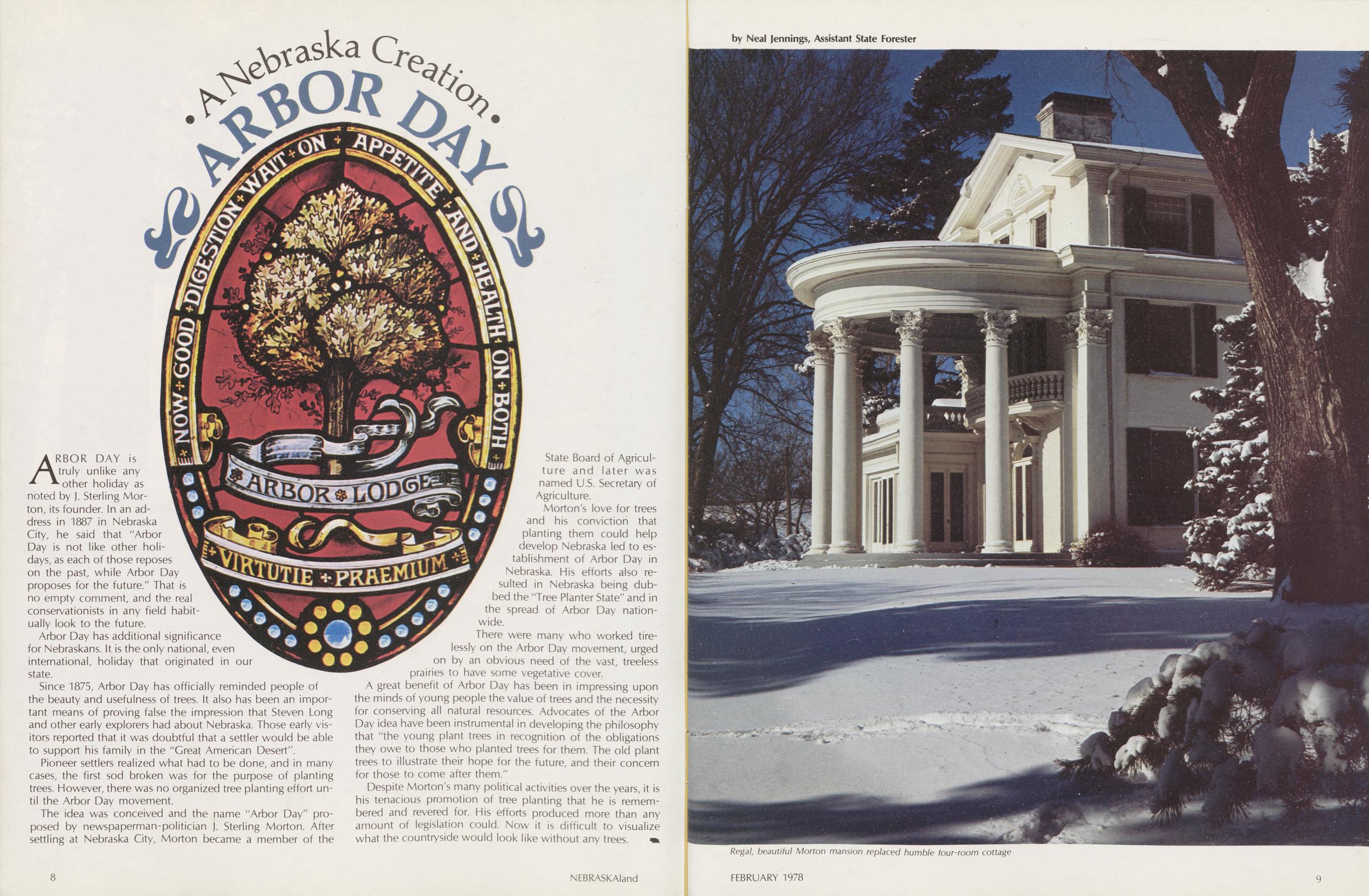
A Nebraska Creation. ARBOR DAY
ARBOR DAY is A truly unlike any other holiday as noted by J. Sterling Morton, its founder. In an address in 1887 in Nebraska City, he said that "Arbor Day is not like other holi- days, as each of those reposes on the past, while Arbor Day proposes for the future." That is no empty comment, and the real conservationists in any field habitually look to the future.
Arbor Day has additional significance for Nebraskans. It is the only national, even international, holiday that originated in our state.
Since 1875, Arbor Day has officially reminded people of the beauty and usefulness of trees. It also has been an important means of proving false the impression that Steven Long and other early explorers had about Nebraska. Those early visitors reported that it was doubtful that a settler would be able to support his family in the "Great American Desert".
Pioneer settlers realized what had to be done, and in many cases, the first sod broken was for the purpose of planting trees. However, there was no organized tree planting effort until the Arbor Day movement.
The idea was conceived and the name "Arbor Day" proposed by newspaperman-politician ). Sterling Morton. After settling at Nebraska City, Morton became a member of the State Board of Agriculture and later was named U.S. Secretary of Agriculture.
Morton's love for trees and his conviction that planting them could help develop Nebraska led to establishment of Arbor Day in Nebraska. His efforts also resulted in Nebraska being dubbed the "Tree Planter State" and in the spread of Arbor Day nationwide.
There were many who worked tirelessly on the Arbor Day movement, urged on by an obvious need of the vast, treeless prairies to have some vegetative cover.
A great benefit of Arbor Day has been in impressing upon the minds of young people the value of trees and the necessity for conserving all natural resources. Advocates of the Arbor Day idea have been instrumental in developing the philosophy that "the young plant trees in recognition of the obligations they owe to those who planted trees for them. The old plant trees to illustrate their hope for the future, and their concern for those to come after them."
Despite Morton's many political activities over the years, it is his tenacious promotion of tree planting that he is remembered and revered for. His efforts produced more than any amount of legislation could. Now it is difficult to visualize what the countryside would look like without any trees.
8 NEBRASKAland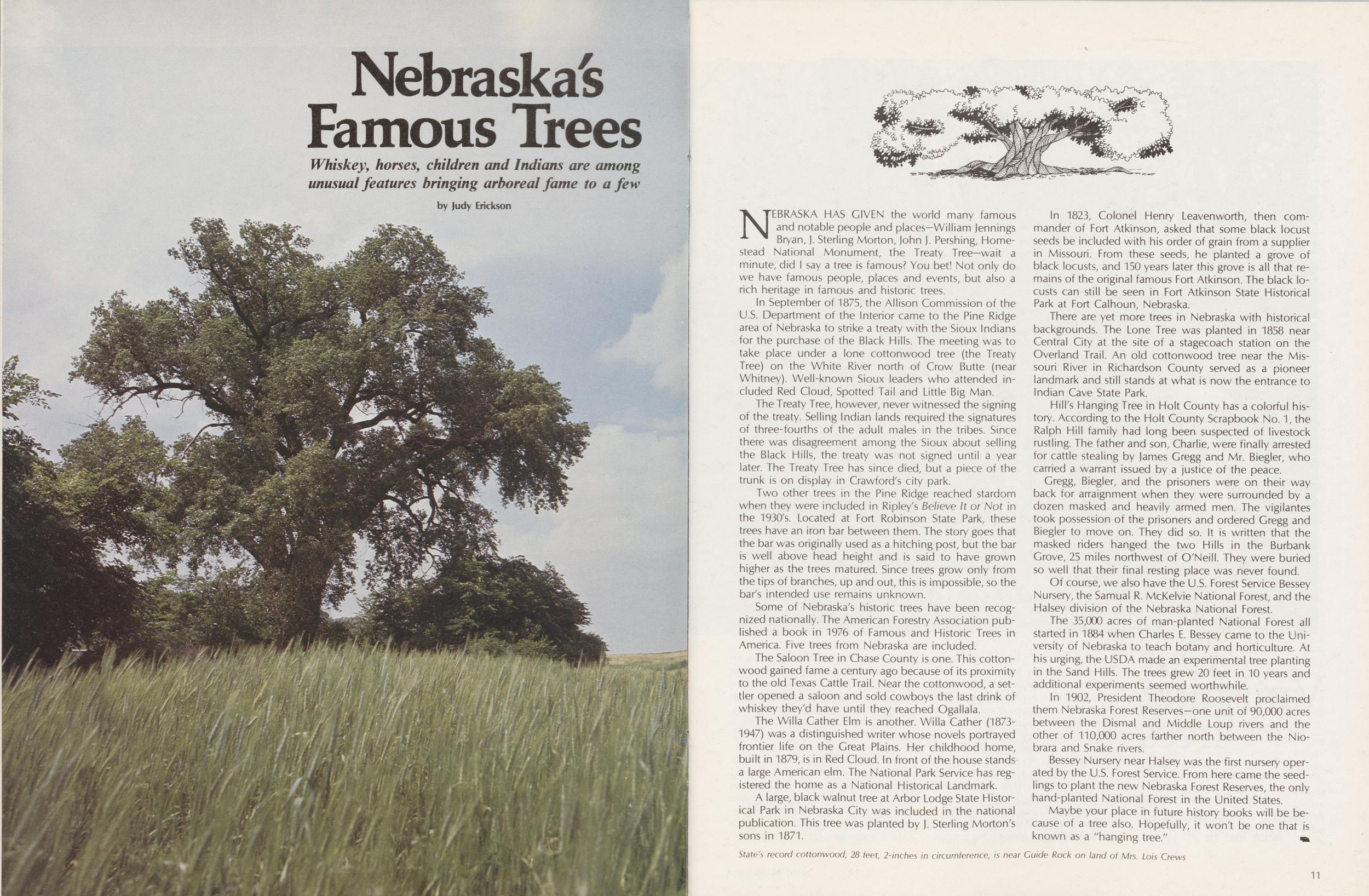
Nebraska's Famous Trees
Whiskey, horses, children and Indians are among unusual features bringing arboreal fame to a few
NEBRASKA HAS GIVEN the world many famous and notable people and places—William Jennings Bryan, J. Sterling Morton, John J. Pershing, Homestead National Monument, the Treaty Tree—wait a minute, did I say a tree is famous? You bet! Not only do we have famous people, places and events, but also a rich heritage in famous and historic trees.
In September of 1875, the Allison Commission of the U.S. Department of the Interior came to the Pine Ridge area of Nebraska to strike a treaty with the Sioux Indians for the purchase of the Black Hills. The meeting was to take place under a lone cottonwood tree (the Treaty Tree) on the White River north of Crow Butte (near Whitney). Well-known Sioux leaders who attended included Red Cloud, Spotted Tail and Little Big Man.
The Treaty Tree, however, never witnessed the signing of the treaty. Selling Indian lands required the signatures of three-fourths of the adult males in the tribes. Since there was disagreement among the Sioux about selling the Black Hills, the treaty was not signed until a year later. The Treaty Tree has since died, but a piece of the trunk is on display in Crawford's city park.
Two other trees in the Pine Ridge reached stardom when they were included in Ripley's Believe It or Not in the 1930's. Located at Fort Robinson State Park, these trees have an iron bar between them. The story goes that the bar was originally used as a hitching post, but the bar is well above head height and is said to have grown higher as the trees matured. Since trees grow only from the tips of branches, up and out, this is impossible, so the bar's intended use remains unknown.
Some of Nebraska's historic trees have been recognized nationally. The American Forestry Association published a book in 1976 of Famous and Historic Trees in America. Five trees from Nebraska are included.
The Saloon Tree in Chase County is one. This cottonwood gained fame a century ago because of its proximity to the old Texas Cattle Trail. Near the cottonwood, a settler opened a saloon and sold cowboys the last drink of whiskey they'd have until they reached Ogallala.
The Willa Cather Elm is another. Willa Cather (1873-1947) was a distinguished writer whose novels portrayed frontier life on the Great Plains. Her childhood home, built in 1879, is in Red Cloud. In front of the house stands a large American elm. The National Park Service has registered the home as a National Historical Landmark.
A large, black walnut tree at Arbor Lodge State Historical Park in Nebraska City was included in the national publication. This tree was planted by J. Sterling Morton's sons in 1871.
In 1823, Colonel Henry Leavenworth, then commander of Fort Atkinson, asked that some black locust seeds be included with his order of grain from a supplier in Missouri. From these seeds, he planted a grove of black locusts, and 150 years later this grove is all that remains of the original famous Fort Atkinson. The black locusts can still be seen in Fort Atkinson State Historical Park at Fort Calhoun, Nebraska.
There are yet more trees in Nebraska with historical backgrounds. The Lone Tree was planted in 1858 near Central City at the site of a stagecoach station on the Overland Trail. An old cottonwood tree near the Missouri River in Richardson County served as a pioneer landmark and still stands at what is now the entrance to Indian Cave State Park.
Hill's Hanging Tree in Holt County has a colorful history. According to the Holt County Scrapbook No. 1, the Ralph Hill family had long been suspected of livestock rustling. The father and son, Charlie, were finally arrested for cattle stealing by James Gregg and Mr. Biegler, who carried a warrant issued by a justice of the peace.
Gregg, Biegler, and the prisoners were on their way back for arraignment when they were surrounded by a dozen masked and heavily armed men. The vigilantes took possession of the prisoners and ordered Gregg and Biegler to move on. They did so. It is written that the masked riders hanged the two Hills in the Burbank Grove, 25 miles northwest of O'Neill. They were buried so well that their final resting place was never found.
Of course, we also have the U.S. Forest Service Bessey Nursery, the Samual R. McKelvie National Forest, and the Halsey division of the Nebraska National Forest.
The 35,000 acres of man-planted National Forest all started in 1884 when Charles E. Bessey came to the University of Nebraska to teach botany and horticulture. At his urging, the USDA made an experimental tree planting in the Sand Hills. The trees grew 20 feet in 10 years and additional experiments seemed worthwhile.
In 1902, President Theodore Roosevelt proclaimed them Nebraska Forest Reserves—one unit of 90,000 acres between the Dismal and Middle Loup rivers and the other of 110,000 acres farther north between the Niobrara and Snake rivers.
Bessey Nursery near Halsey was the first nursery operated by the U.S. Forest Service. From here came the seedlings to plant the new Nebraska Forest Reserves, the only hand-planted National Forest in the United States.
State's record cottonwood, 28 feet, 2-inches in circumference, is near Guide Rock on land of Mrs. Lois CrewsMaybe your place in future history books will be because of a tree also. Hopefully, it won't be one that is known as a "hanging tree."
11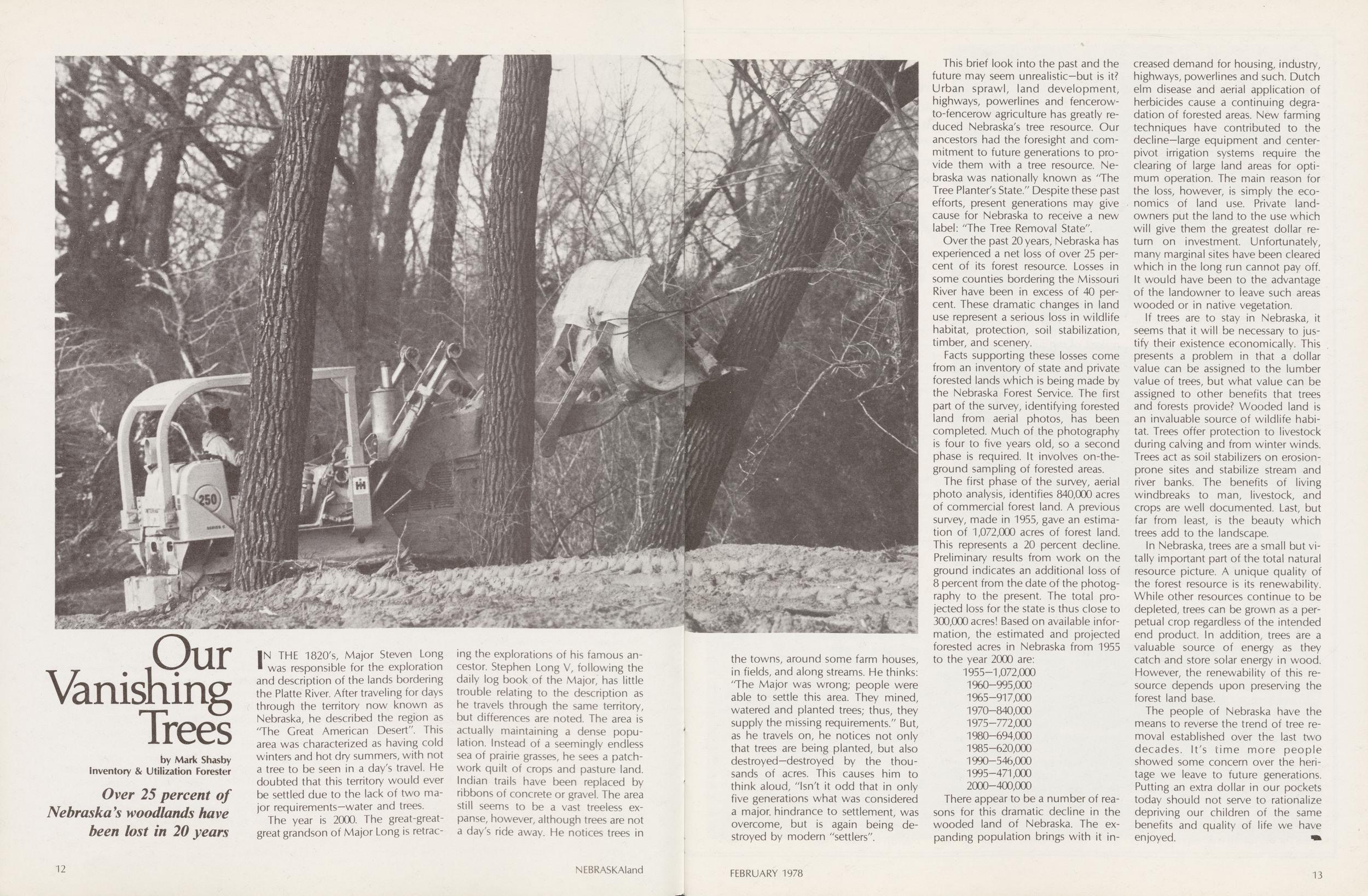
Our vanishing Trees
Over 25 percent of Nebraska's woodlands have been lost in 20 years
IN THE 1820's, Major Steven Long was responsible for the exploration and description of the lands bordering the Platte River. After traveling for days through the territory now known as Nebraska, he described the region as 'The Great American Desert". This area was characterized as having cold winters and hot dry summers, with not a tree to be seen in a day's travel. He doubted that this territory would ever be settled due to the lack of two major requirements-water and trees.
The year is 2000. The great-great-great grandson of Major Long is retracing the explorations of his famous ancestor. Stephen Long V, following the daily log book of the Major, has little trouble relating to the description as he travels through the same territory, but differences are noted. The area is actually maintaining a dense population. Instead of a seemingly endless sea of prairie grasses, he sees a patchwork quilt of crops and pasture land. Indian trails have been replaced by ribbons of concrete or gravel. The area still seems to be a vast treeless expanse, however, although trees are not a day's ride away. He notices trees in the towns, around some farm houses, in fields, and along streams. He thinks: 'The Major was wrong; people were able to settle this area. They mined, watered and planted trees; thus, they supply the missing requirements." But, as he travels on, he notices not only that trees are being planted, but also destroyed—destroyed by the thousands of acres. This causes him to think aloud, "Isn't it odd that in only five generations what was considered a major, hindrance to settlement, was overcome, but is again being destroyed by modern "settlers".
This brief look into the past and the future may seem unrealistic—but is it? Urban sprawl, land development, highways, powerlines and fencerow-to-fencerow agriculture has greatly reduced Nebraska's tree resource. Our ancestors had the foresight and commitment to future generations to provide them with a tree resource. Nebraska was nationally known as 'The Tree Planter's State." Despite these past efforts, present generations may give cause for Nebraska to receive a new label: "The Tree Removal State".
Over the past 20 years, Nebraska has experienced a net loss of over 25 percent of its forest resource. Losses in some counties bordering the Missouri River have been in excess of 40 percent. These dramatic changes in land use represent a serious loss in wildlife habitat, protection, soil stabilization, timber, and scenery.
Facts supporting these losses come from an inventory of state and private forested lands which is being made by the Nebraska Forest Service. The first part of the survey, identifying forested land from aerial photos, has been completed. Much of the photography is four to five years old, so a second phase is required. It involves on-the- ground sampling of forested areas.
The first phase of the survey, aerial photo analysis, identifies 840,000 acres of commercial forest land. A previous survey, made in 1955, gave an estima- tion of 1,072,000 acres of forest land. This represents a 20 percent decline. Preliminary results from work on the ground indicates an additional loss of 8 percent from the date of the photography to the present. The total projected loss for the state is thus close to 300,000 acres! Based on available information, the estimated and projected forested acres in Nebraska from 1955 to the year 2000 are:
1955-1,072,000 1960-995,000 1965-917,000 1970-840,000 1975-772,000 1980-694,000 1985-620,000 1990-546,000 1995-471,000 2000-400,000There appear to be a number of reasons for this dramatic decline in the wooded land of Nebraska. The expanding population brings with it increased demand for housing, industry, highways, powerlines and such. Dutch elm disease and aerial application of herbicides cause a continuing degradation of forested areas. New farming techniques have contributed to the decline—large equipment and centerpivot irrigation systems require the clearing of large land areas for optimum operation. The main reason for the loss, however, is simply the economics of land use. Private landowners put the land to the use which will give them the greatest dollar return on investment. Unfortunately, many marginal sites have been cleared which in the long run cannot pay off. It would have been to the advantage of the landowner to leave such areas wooded or in native vegetation.
If trees are to stay in Nebraska, it seems that it will be necessary to justify their existence economically. This presents a problem in that a dollar value can be assigned to the lumber value of trees, but what value can be assigned to other benefits that trees and forests provide? Wooded land is an invaluable source of wildlife habitat. Trees offer protection to livestock during calving and from winter winds. Trees act as soil stabilizers on erosionprone sites and stabilize stream and river banks. The benefits of living windbreaks to man, livestock, and crops are well documented. Last, but far from least, is the beauty which trees add to the landscape.
In Nebraska, trees are a small but vitally important part of the total natural resource picture. A unique quality of the forest resource is its renewability. While other resources continue to be depleted, trees can be grown as a perpetual crop regardless of the intended end product. In addition, trees are a valuable source of energy as they catch and store solar energy in wood. However, the renewability of this resource depends upon preserving the forest land base.
The people of Nebraska have the means to reverse the trend of tree removal established over the last two decades. It's time more people showed some concern over the heritage we leave to future generations. Putting an extra dollar in our pockets today should not serve to rationalize depriving our children of the same benefits and quality of life we have enjoyed.
FEBRUARY 1978 13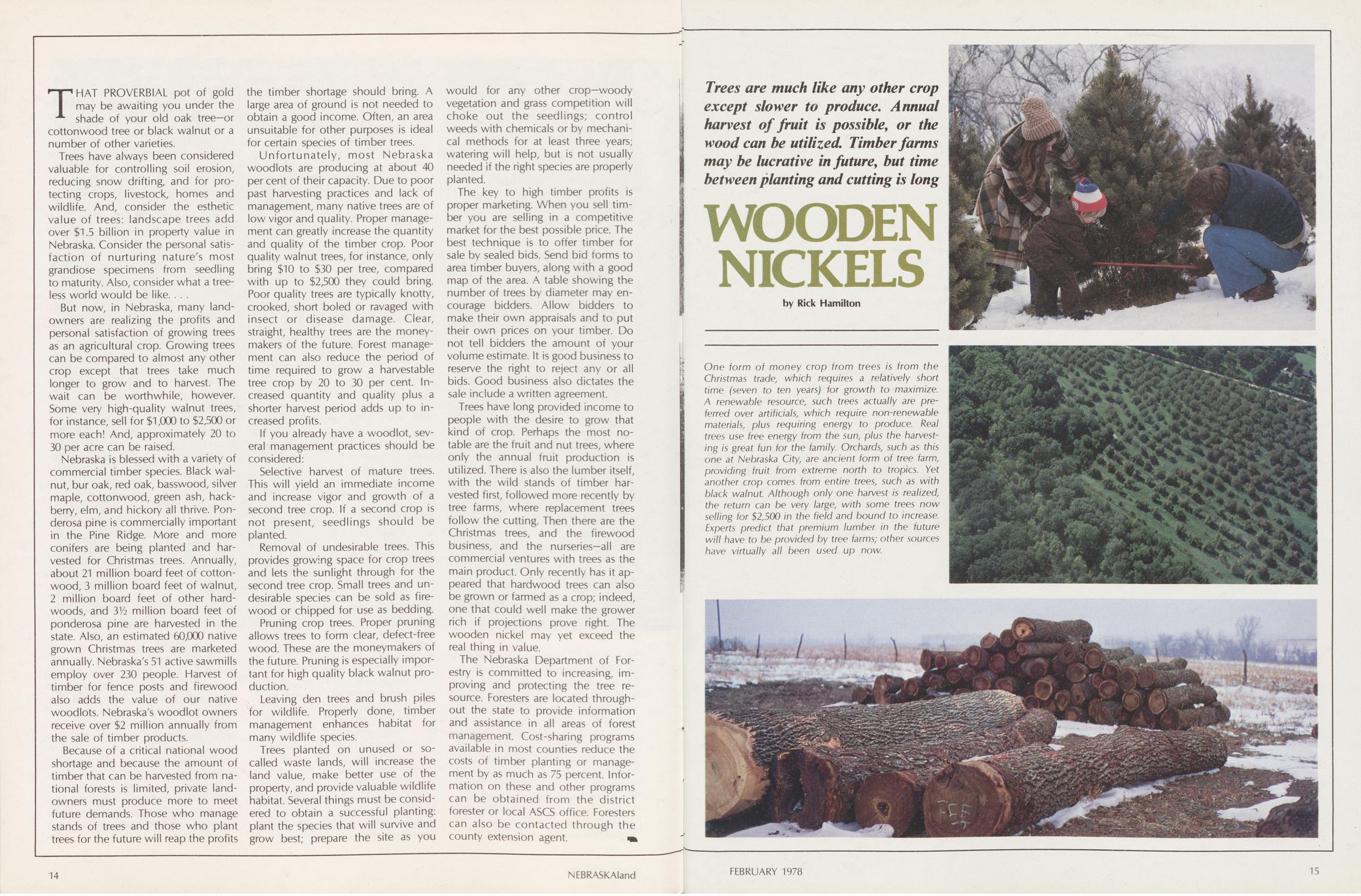
WOODEN NCKELS
Trees are much like any other crop except slower to produce. Annual harvest of fruit is possible, or the wood can be utilized. Timber farms may be lucrative in future, but time between planting and cutting is long
THAT PROVERBIAL pot of gold may be awaiting you under the shade of your old oak tree—or Cottonwood tree or black walnut or a number of other varieties.
Trees have always been considered valuable for controlling soil erosion, reducing snow drifting, and for protecting crops, livestock, homes and wildlife. And, consider the esthetic value of trees: landscape trees add over $1.5 billion in property value in Nebraska. Consider the personal satisfaction of nurturing nature's most grandiose specimens from seedling to maturity. Also, consider what a treeless world would be like. . . .
But now, in Nebraska, many landowners are realizing the profits and personal satisfaction of growing trees as an agricultural crop. Growing trees can be compared to almost any other crop except that trees take much longer to grow and to harvest. The wait can be worthwhile, however. Some very high-quality walnut trees, for instance, sell for $1,000 to $2,500 or more each! And, approximately 20 to 30 per acre can be raised.
Nebraska is blessed with a variety of commercial timber species. Black walnut, bur oak, red oak, basswood, silver maple, cottonwood, green ash, hack- berry, elm, and hickory all thrive. Ponderosa pine is commercially important in the Pine Ridge. More and more conifers are being planted and harvested for Christmas trees. Annually, about 21 million board feet of cottonwood, 3 million board feet of walnut, 2 million board feet of other hardwoods, and 317 million board feet of ponderosa pine are harvested in the state. Also, an estimated 60,000 native grown Christmas trees are marketed annually. Nebraska's 51 active sawmills employ over 230 people. Harvest of timber for fence posts and firewood also adds the value of our native woodlots. Nebraska's woodlot owners receive over $2 million annually from the sale of timber products.
Because of a critical national wood shortage and because the amount of timber that can be harvested from national forests is limited, private landowners must produce more to meet future demands. Those who manage stands of trees and those who plant trees for the future will reap the profits the timber shortage should bring. A large area of ground is not needed to obtain a good income. Often, an area unsuitable for other purposes is ideal for certain species of timber trees.
Unfortunately, most Nebraska woodlots are producing at about 40 per cent of their capacity. Due to poor past harvesting practices and lack of management, many native trees are of low vigor and quality. Proper management can greatly increase the quantity and quality of the timber crop. Poor quality walnut trees, for instance, only bring $10 to $30 per tree, compared with up to $2,500 they could bring. Poor quality trees are typically knotty, crooked, short boled or ravaged with insect or disease damage. Clear, straight, healthy trees are the moneymakers of the future. Forest management can also reduce the period of time required to grow a harvestable tree crop by 20 to 30 per cent. Increased quantity and quality plus a shorter harvest period adds up to increased profits.
If you already have a woodlot, several management practices should be considered:
Selective harvest of mature trees. This will yield an immediate income and increase vigor and growth of a second tree crop. If a second crop is not present, seedlings should be planted.
Removal of undesirable trees. This provides growing space for crop trees and lets the sunlight through for the second tree crop. Small trees and undesirable species can be sold as firewood or chipped for use as bedding.
Pruning crop trees. Proper pruning allows trees to form clear, defect-free wood. These are the moneymakers of the future. Pruning is especially important for high quality black walnut production.
Leaving den trees and brush piles for wildlife. Properly done, timber management enhances habitat for many wildlife species.
Trees planted on unused or so- called waste lands, will increase the land value, make better use of the property, and provide valuable wildlife habitat. Several things must be considered to obtain a successful planting: plant the species that will survive and grow best; prepare the site as you would for any other crop—woody vegetation and grass competition wild choke out the seedlings; control weeds with chemicals or by mechanical methods for at least three years; watering will help, but is not usually needed if the right species are properly planted.
The key to high timber profits is proper marketing. When you sell timber you are selling in a competitive market for the best possible price. The best technique is to offer timber for sale by sealed bids. Send bid forms to area timber buyers, along with a good map of the area. A table showing the number of trees by diameter may encourage bidders. Allow bidders to make their own appraisals and to put their own prices on your timber. Do not tell bidders the amount of your volume estimate. It is good business to reserve the right to reject any or all bids. Good business also dictates the sale include a written agreement.
Trees have long provided income to people with the desire to grow that kind of crop. Perhaps the most notable are the fruit and nut trees, where only the annual fruit production is utilized. There is also the lumber itself, with the wild stands of timber harvested first, followed more recently by tree farms, where replacement trees follow the cutting. Then there are the Christmas trees, and the firewood business, and the nurseries-all are commercial ventures with trees as the main product. Only recently has it appeared that hardwood trees can also be grown or farmed as a crop; indeed, one that could well make the grower rich if projections prove right. The wooden nickel may yet exceed the real thing in value.
The Nebraska Department of Forestry is committed to increasing, improving and protecting the tree resource. Foresters are located throughout the state to provide information and assistance in all areas of forest management. Cost-sharing programs available in most counties reduce the costs of timber planting or management by as much as 75 percent. Information on these and other programs can be obtained from the district forester or local ASCS office. Foresters can also be contacted through the county extension agent.
14 NEBRASKAland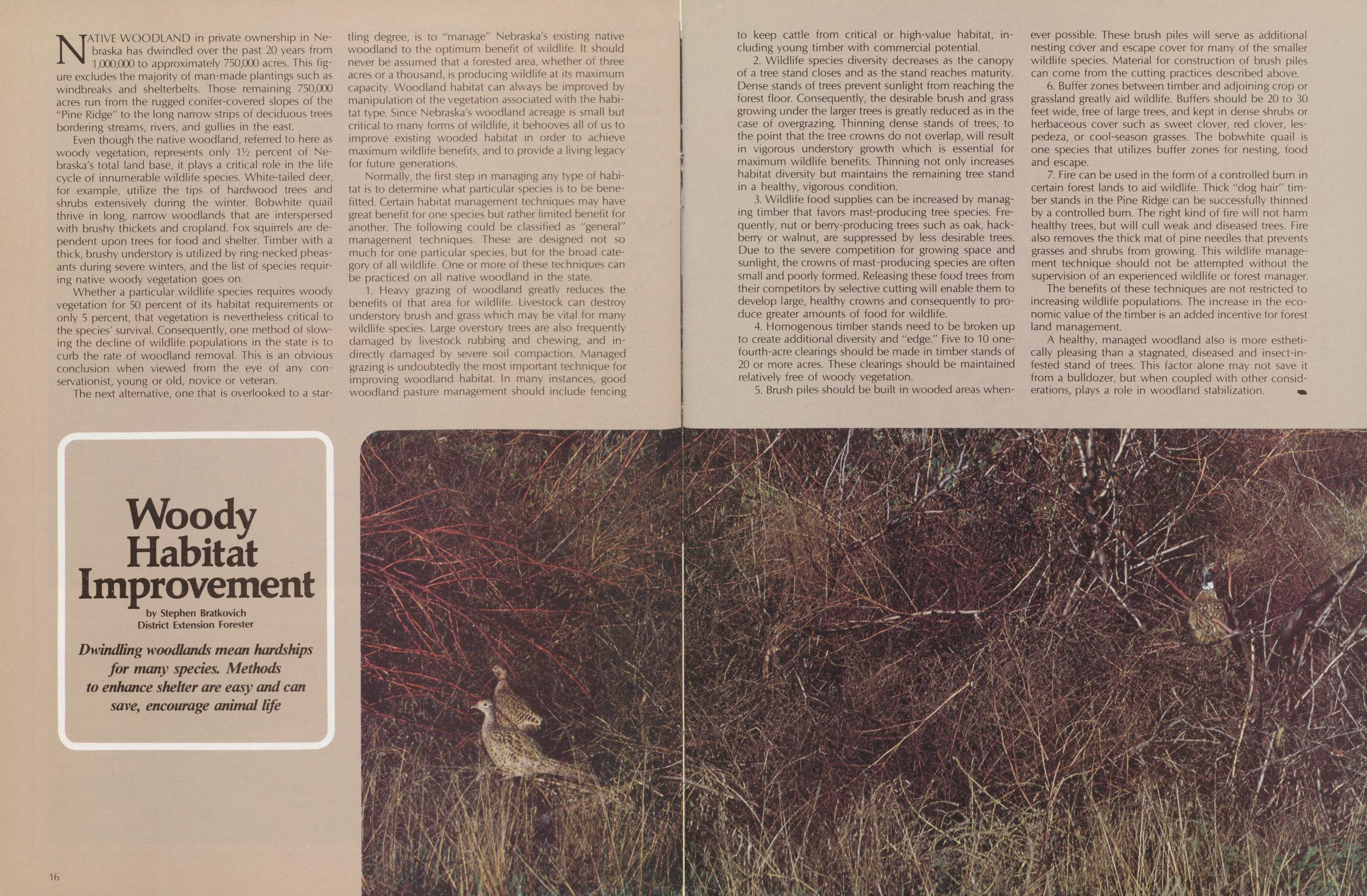
Woody Habitat Improvement
Dwindling woodlands mean hardships for many species. Methods to enhance shelter are easy and can save, encourage animal life
NATIVE WOODLAND in private ownership in Nebraska has dwindled over the past 20 years from 1,000,000 to approximately 750,000 acres. This figure excludes the majority of man-made plantings such as windbreaks and shelterbelts. Those remaining 750,000 acres run from the rugged conifer-covered slopes of the "Pine Ridge" to the long narrow strips of deciduous trees bordering streams, rivers, and gullies in the east.
Even though the native woodland, referred to here as woody vegetation, represents only 1/2 percent of Nebraska's total land base, it plays a critical role in the life cycle of innumerable wildlife species. White-tailed deer, for example, utilize the tips of hardwood trees and shrubs extensively during the winter. Bobwhite quail thrive in long, narrow woodlands that are interspersed with brushy thickets and cropland. Fox squirrels are dependent upon trees for food and shelter. Timber with a thick, brushy understory is utilized by ring-necked pheasants during severe winters, and the list of species requiring native woody vegetation goes on.
Whether a particular wildlife species requires woody vegetation for 50 percent of its habitat requirements or only 5 percent, that vegetation is nevertheless critical to the species' survival. Consequently, one method of slowing the decline of wildlife populations in the state is to curb the rate of woodland removal. This is an obvious conclusion when viewed from the eye of any conservationist, young or old, novice or veteran.
The next alternative, one that is overlooked to a startling degree, is to "manage" Nebraska's existing native woodland to the optimum benefit of wildlife. It should never be assumed that a forested area, whether of three acres or a thousand, is producing wildlife at its maximum capacity. Woodland habitat can always be improved by manipulation of the vegetation associated with the habitat type. Since Nebraska's woodland acreage is small but critical to many forms of wildlife, it behooves all of us to improve existing wooded habitat in order to achieve maximum wildlife benefits, and to provide a living legacy for future generations.
Normally, the first step in managing any type of habitat is to determine what particular species is to be benefitted. Certain habitat management techniques may have great benefit for one species but rather Limited benefit for another. The following could be classified as "general" management techniques. These are designed not so much for one particular species, but for the broad category of all wildlife. One or more of these techniques can be practiced on all native woodland in the state.
1. Heavy grazing of woodland greatly reduces the benefits of that area for wildlife. Livestock can destroy understory brush and grass which may be vital for many wildlife species. Large overstory trees are also frequently damaged by livestock rubbing and chewing, and indirectly damaged by severe soil compaction. Managed grazing is undoubtedly the most important technique for improving woodland habitat. In many instances, good woodland pasture management should include fencing
2. Wildlife species diversity decreases as the canopy of a tree stand closes and as the stand reaches maturity. Dense stands of trees prevent sunlight from reaching the forest floor. Consequently, the desirable brush and grass growing under the larger trees is greatly reduced as in the case of overgrazing. Thinning dense stands of trees, to the point that the tree crowns do not overlap, will result in vigorous understory growth which is essential for maximum wildlife benefits. Thinning not only increases habitat diversity but maintains the remaining tree stand in a healthy, vigorous condition.
3. Wildlife food supplies can be increased by managing timber that favors mast-producing tree species. Frequently, nut or berry-producing trees such as oak, hackberry or walnut, are suppressed by less desirable trees. Due to the severe competition for growing space and sunlight, the crowns of mast-producing species are often small and poorly formed. Releasing these food trees from their competitors by selective cutting will enable them to develop large, healthy crowns and consequently to produce greater amounts of food for wildlife.
4. Homogenous timber stands need to be broken up to create additional diversity and "edge." Five to 10 one- fourth-acre clearings should be made in timber stands of 20 or more acres. These clearings should be maintained relatively free of woody vegetation.
5. Brush piles should be built in wooded areas whenever possible. These brush piles will serve as additional nesting cover and escape cover for many of the smaller wildlife species. Material for construction of brush piles can come from the cutting practices described above.
6. Buffer zones between timber and adjoining crop or grassland greatly aid wildlife. Buffers should be 20 to 30 feet wide, free of large trees, and kept in dense shrubs or herbaceous cover such as sweet clover, red clover, lespedeza, or cool-season grasses. The bobwhite quail is one species that utilizes buffer zones for nesting, food and escape.
7. Fire can be used in the form of a controlled burn in certain forest lands to aid wildlife. Thick "dog hair" timber stands in the Pine Ridge can be successfully thinned by a controlled burn. The right kind of fire will not harm healthy trees, but will cull weak and diseased trees. Fire also removes the thick mat of pine needles that prevents grasses and shrubs from growing. This wildlife management technique should not be attempted without the supervision of an experienced wildlife or forest manager.
The benefits of these techniques are not restricted to increasing wildlife populations. The increase in the economic value of the timber is an added incentive for forest land management.
A healthy, managed woodland also is more esthetically pleasing than a stagnated, diseased and insect-infested stand of trees. This factor alone may not save it from a bulldozer, but when coupled with other considerations, plays a role in woodland stabilization.
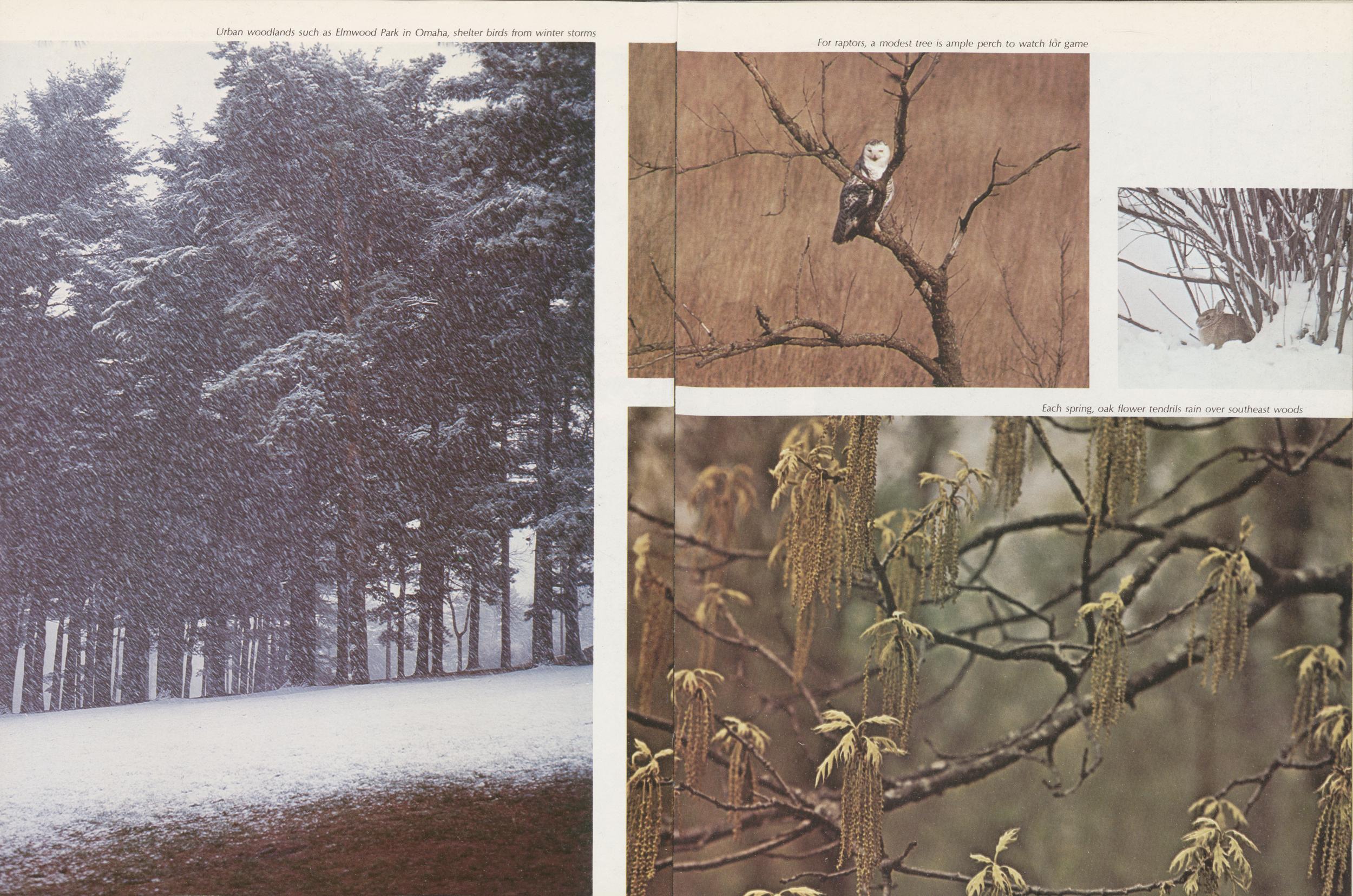
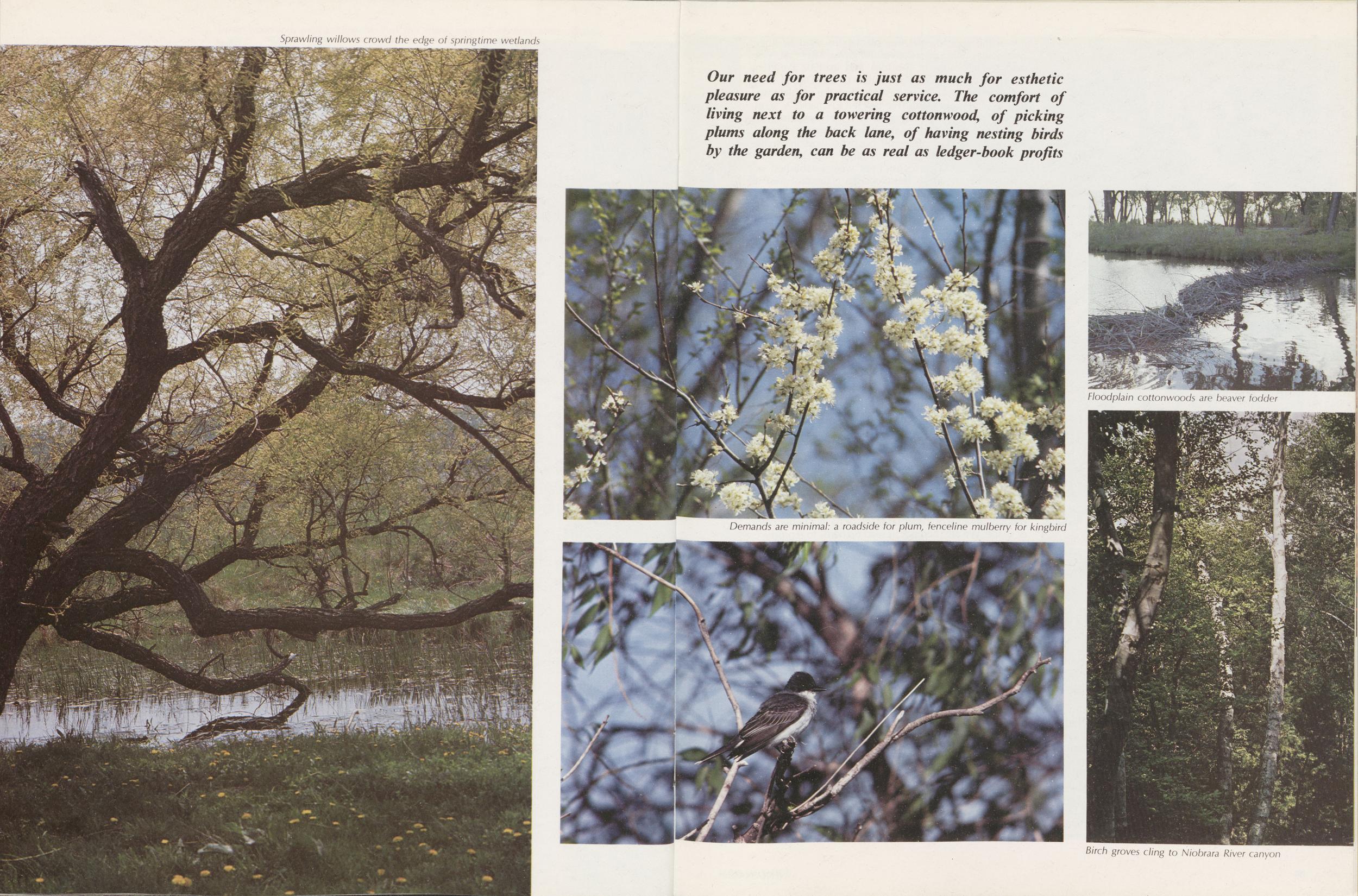
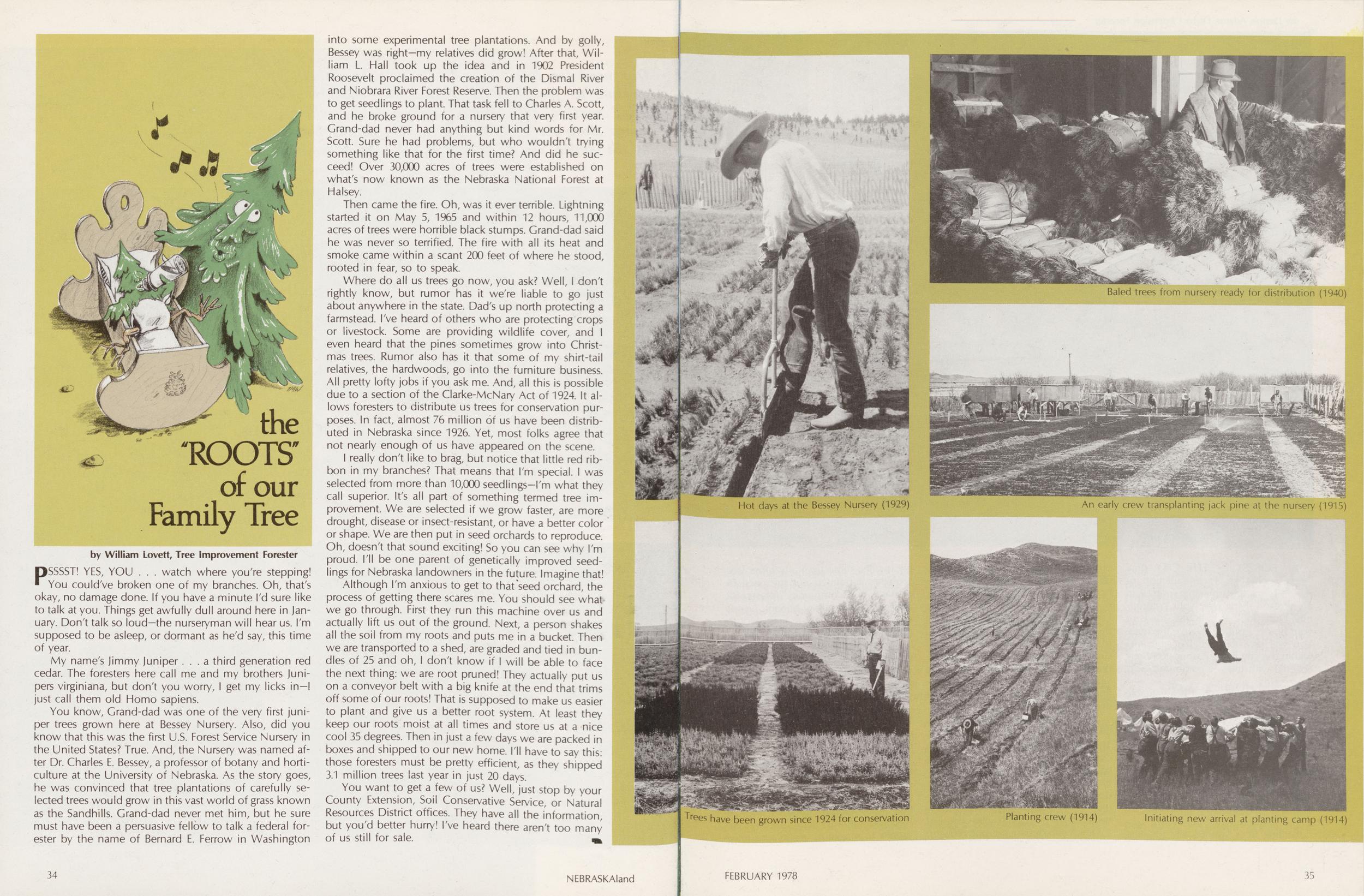
TREES Nebraska's Prairie Sanctums
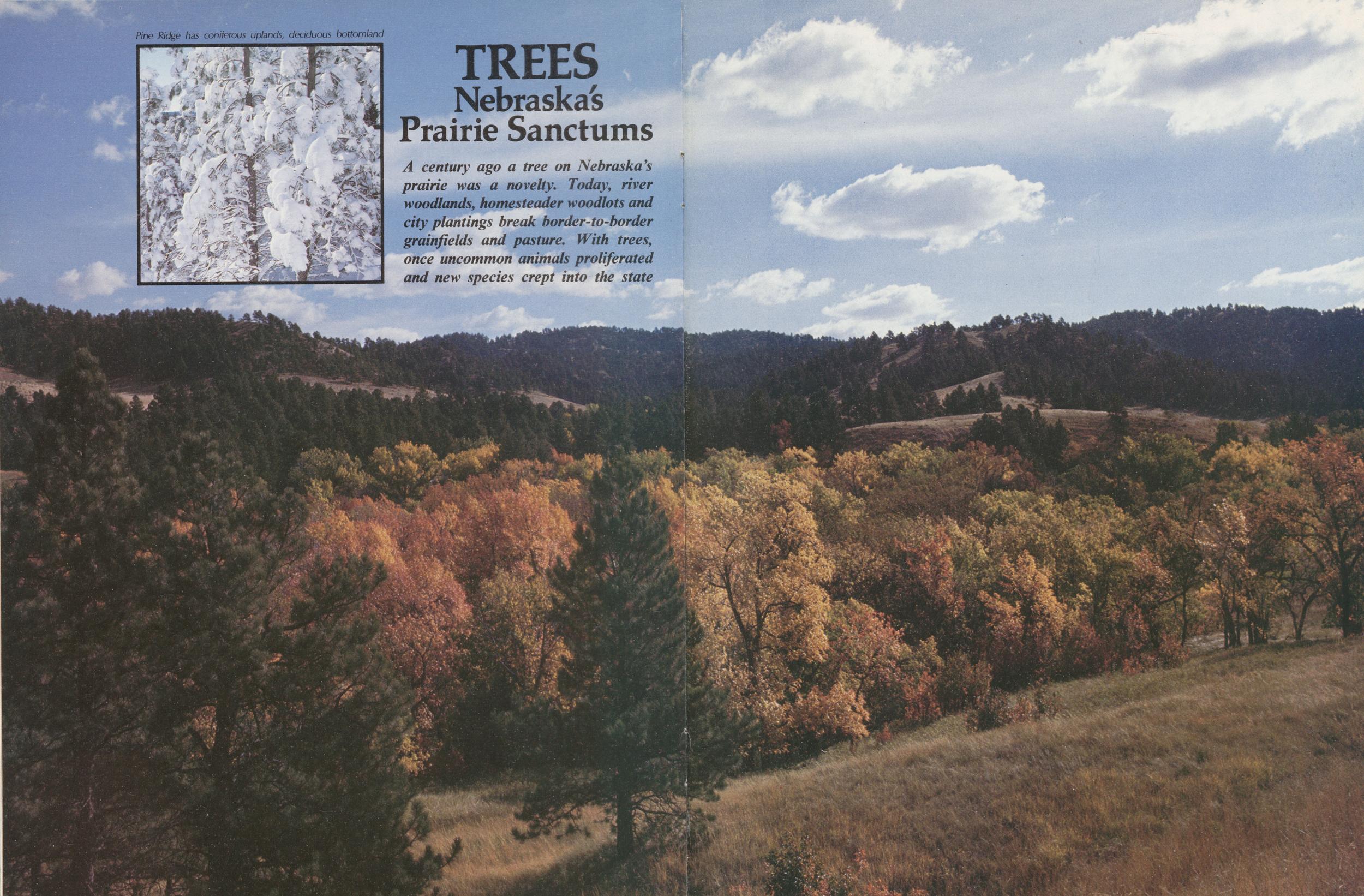
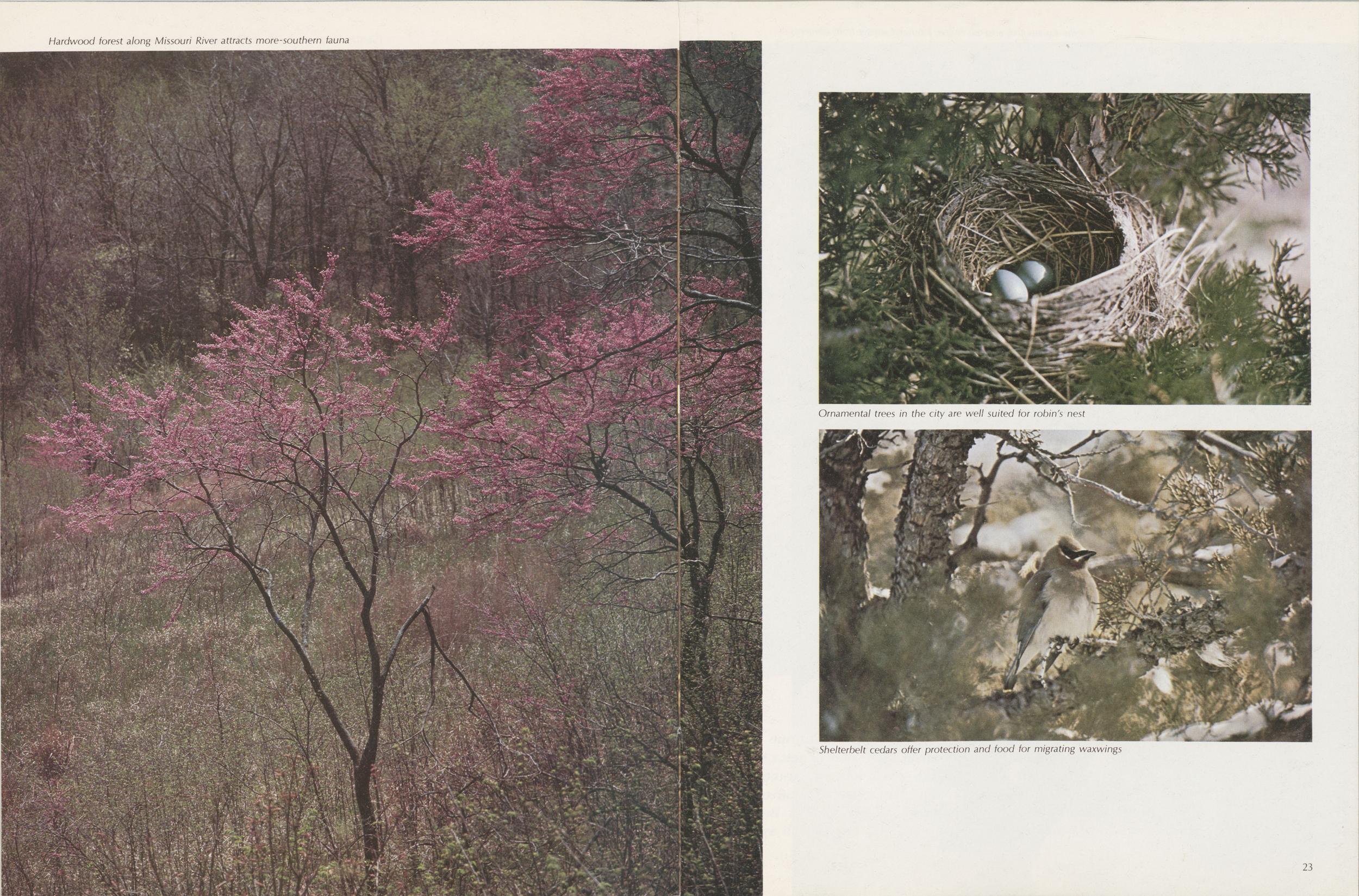
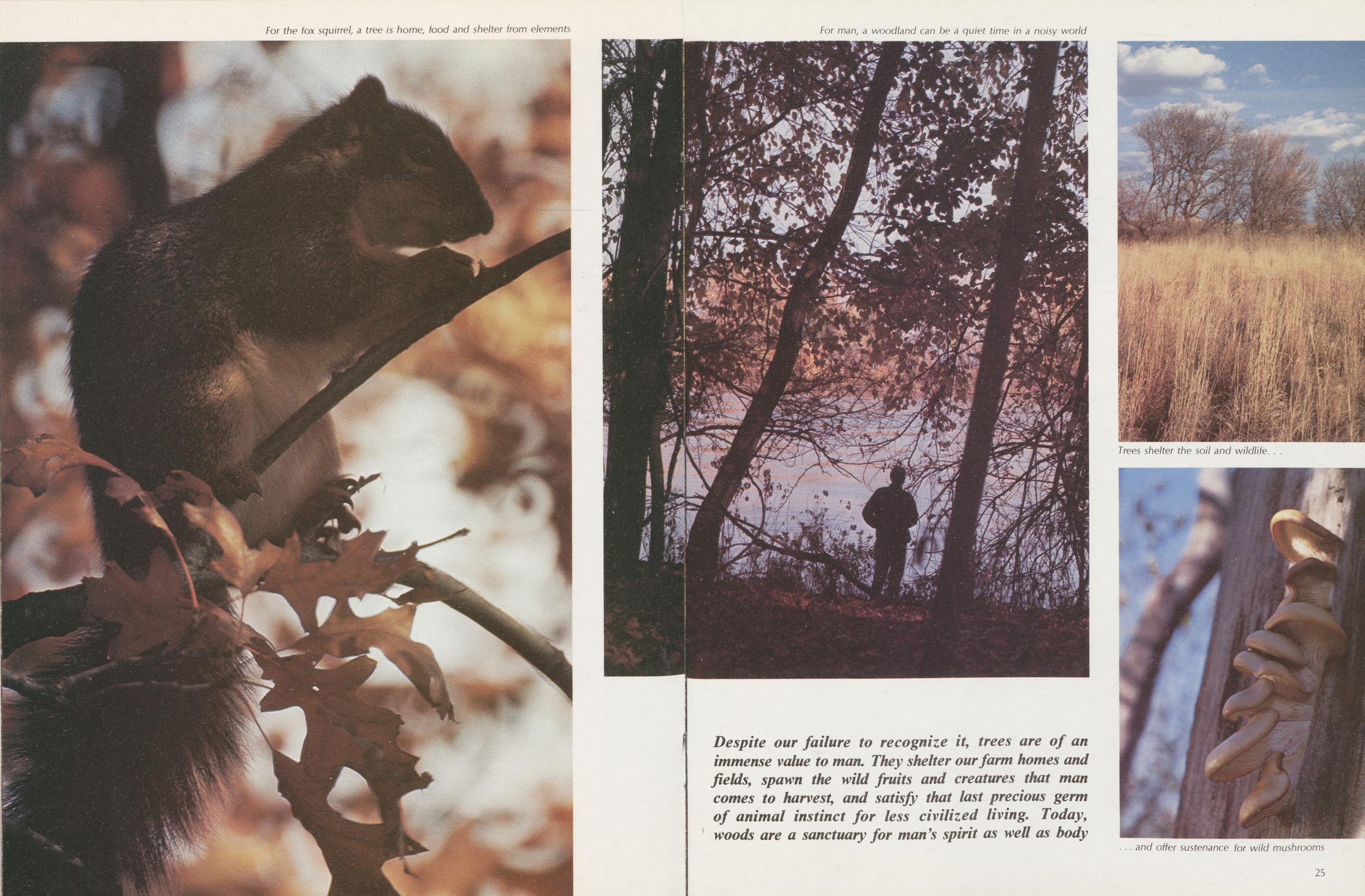
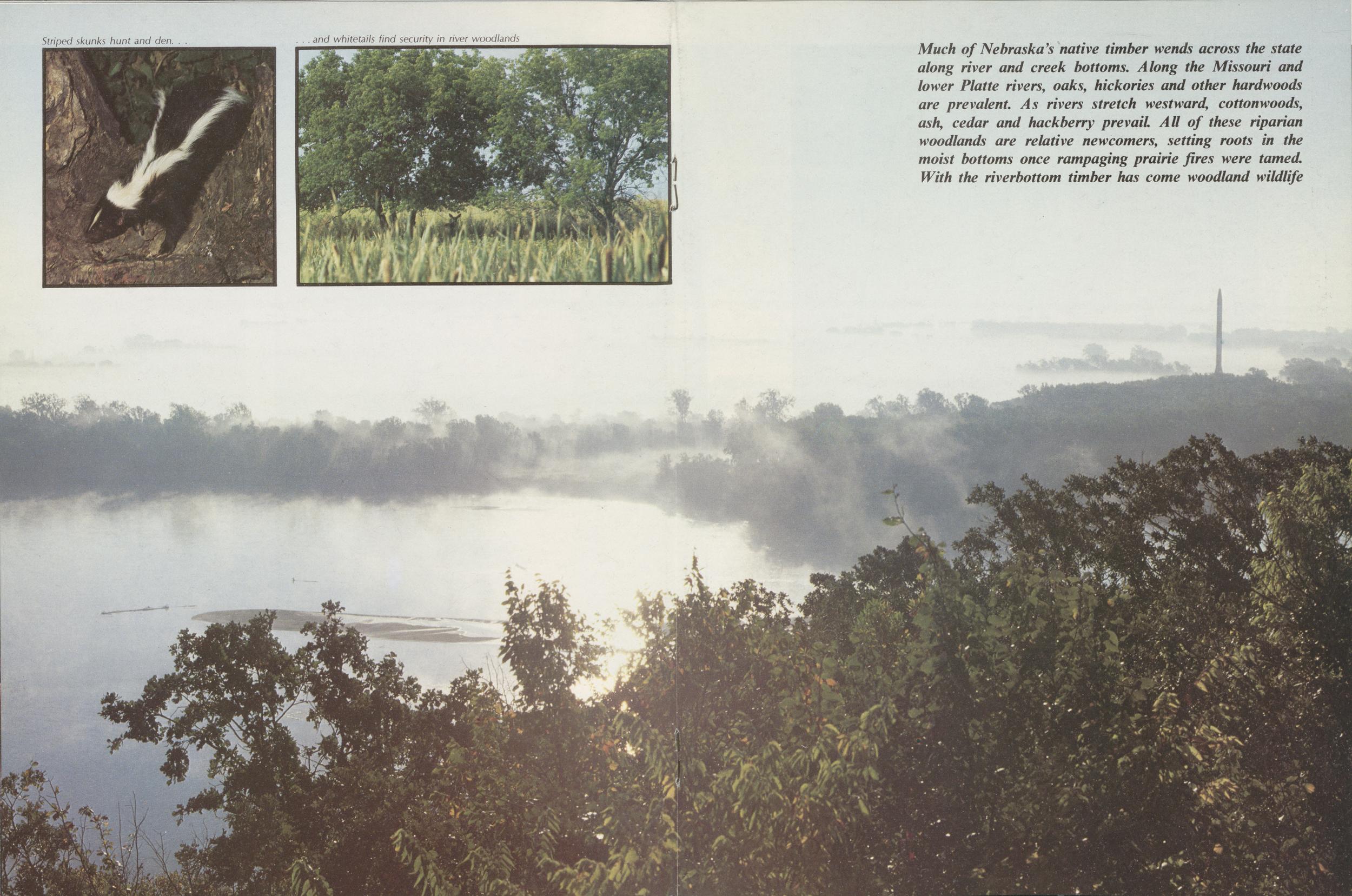
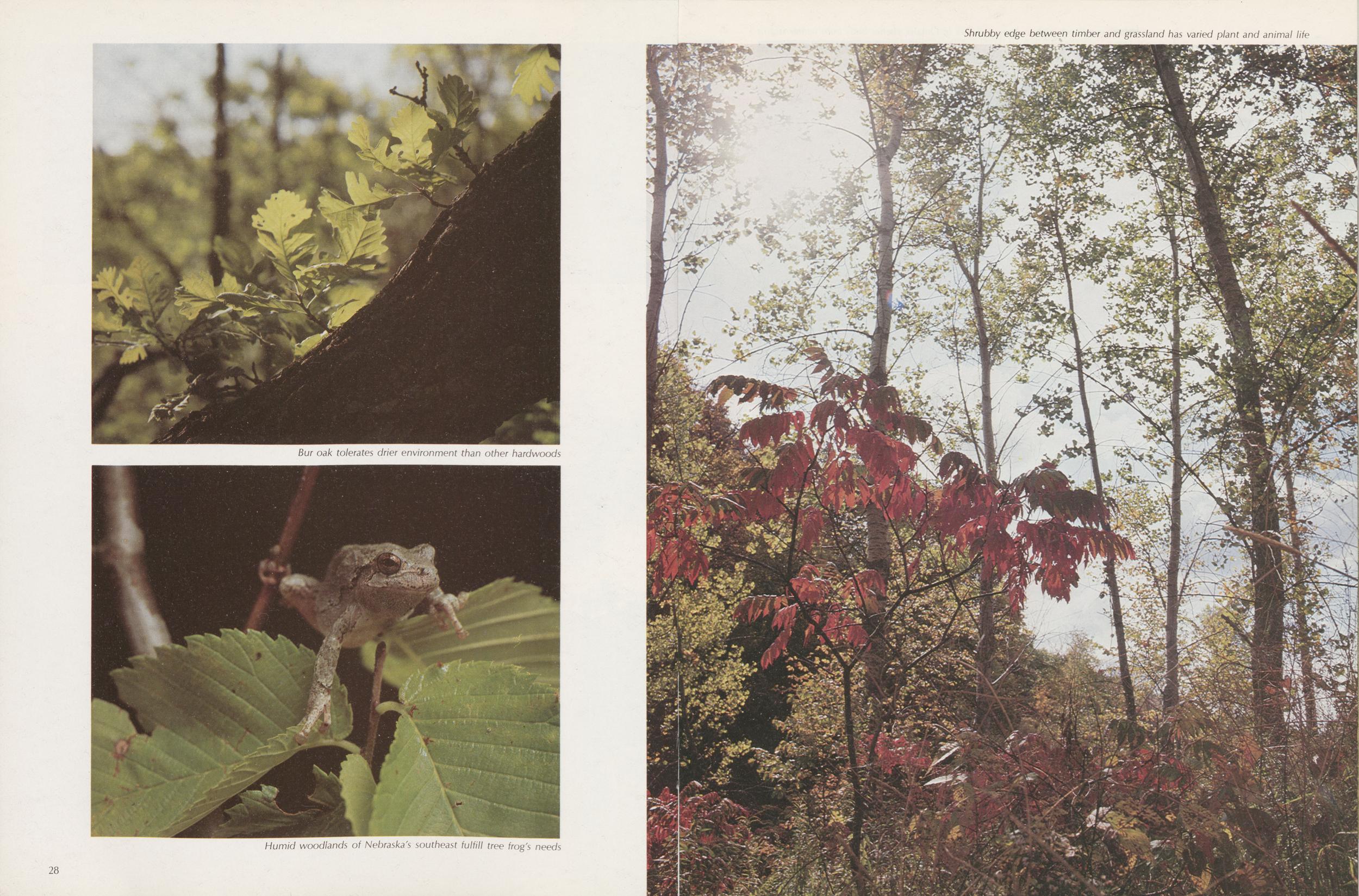
A century ago a tree on Nebraska's prairie was a novelty. Today, river woodlands, homesteader woodlots and city plantings break border-to-border grainfields and pasture. With trees, once uncommon animals proliferated and new species crept into the state
the "ROOTS" of our Family Tree
PSSSST! YES, YOU . . . watch where you're stepping! You could've broken one of my branches. Oh, that's okay, no damage done. If you have a minute I'd sure like to talk at you. Things get awfully dull around here in January. Don't talk so loud—the nurseryman will hear us. I'm supposed to be asleep, or dormant as he'd say, this time of year.
My name's Jimmy Juniper ... a third generation red cedar. The foresters here call me and my brothers Junipers virginiana, but don't you worry, I get my licks in—I just call them old Homo sapiens.
You know, Granddad was one of the very first juniper trees grown here at Bessey Nursery. Also, did you know that this was the first U.S. Forest Service Nursery in the United States? True. And, the Nursery was named after Dr. Charles E. Bessey, a professor of botany and horti- culture at the University of Nebraska. As the story goes, he was convinced that tree plantations of carefully selected trees would grow in this vast world of grass known as the Sandhills. Grand-dad never met him, but he sure must have been a persuasive fellow to talk a federal forester by the name of Bernard E. Ferrow in Washington into some experimental tree plantations. And by golly, Bessey was right—my relatives did grow! After that, William L Hall took up the idea and in 1902 President Roosevelt proclaimed the creation of the Dismal River and Niobrara River Forest Reserve. Then the problem was to get seedlings to plant. That task fell to Charles A. Scott, and he broke ground for a nursery that very first year. Grand-dad never had anything but kind words for Mr. Scott. Sure he had problems, but who wouldn't trying something like that for the first time? And did he succeed! Over 30,000 acres of trees were established on what's now known as the Nebraska National Forest at Halsey.
Then came the fire. Oh, was it ever terrible. Lightning started it on May 5, 1965 and within 12 hours, 11,000 acres of trees were horrible black stumps. Grand-dad said he was never so terrified. The fire with all its heat and smoke came within a scant 200 feet of where he stood, rooted in fear, so to speak.
Where do all us trees go now, you ask? Well, I don't rightly know, but rumor has it we're liable to go just about anywhere in the state. Dad's up north protecting a farmstead. I've heard of others who are protecting crops or livestock. Some are providing wildlife cover, and I even heard that the pines sometimes grow into Christ- mas trees. Rumor also has it that some of my shirt-tail relatives, the hardwoods, go into the furniture business. All pretty lofty jobs if you ask me. And, all this is possible due to a section of the Clarke-McNary Act of 1924. It alows foresters to distribute us trees for conservation purposes. In fact, almost 76 million of us have been distributed in Nebraska since 1926. Yet, most folks agree that not nearly enough of us have appeared on the scene.
I really don't like to brag, but notice that little red ribbon in my branches? That means that I'm special. I was selected from more than 10,000 seedlings-I'm what they call superior. It's all part of something termed tree improvement. We are selected if we grow faster, are more drought, disease or insect-resistant, or have a better color or shape. We are then put in seed orchards to reproduce. Oh, doesn't that sound exciting! So you can see why I'm proud. I'll be one parent of genetically improved seedlings for Nebraska landowners in the future. Imagine that!
Although I'm anxious to get to that'seed orchard, the process of getting there scares me. You should see what we go through. First they run this machine over us and actually lift us out of the ground. Next, a person shakes all the soil from my roots and puts me in a bucket. Then we are transported to a shed, are graded and tied in bundles of 25 and oh, I don't know if I will be able to face the next thing: we are root pruned! They actually put us on a conveyor belt with a big knife at the end that trims off some of our roots! That is supposed to make us easier to plant and give us a better root system. At least they keep our roots moist at all times and store us at a nice cool 35 degrees. Then in just a few days we are packed in boxes and shipped to our new home. I'll have to say this: those foresters must be pretty efficient, as they shipped 3.1 million trees last year in just 20 days.
You want to get a few of us? Well, just stop by your County Extension, Soil Conservative Service, or Natural Resources District offices. They have all the information, but you'd better hurry! I've heard there aren't too many of us still for sale.]
34 NEBRASKAland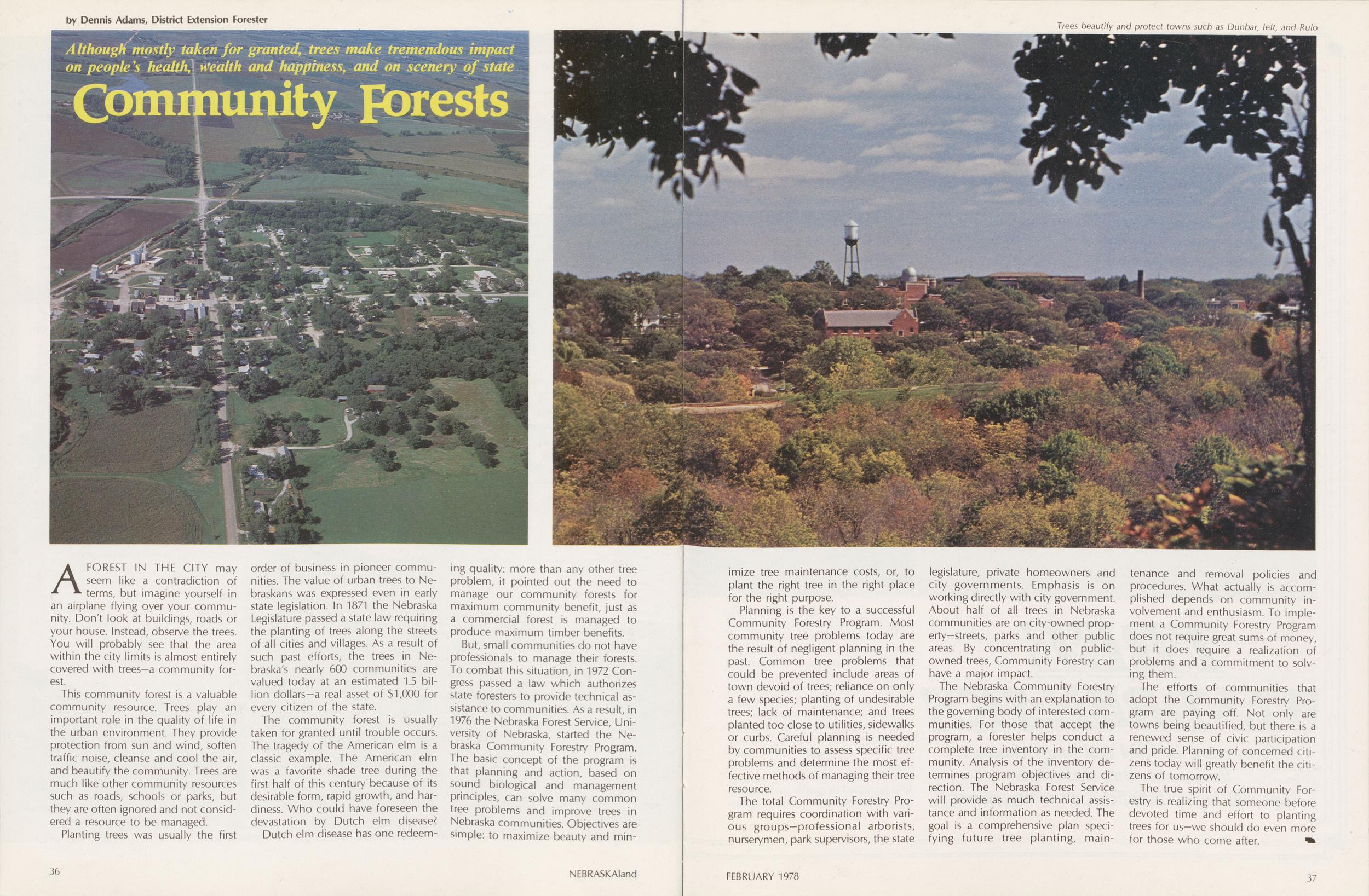
Community Forest
Although mostly taken for granted trees make tremendous impact on people's health, wealth and happiness, and on scenery of state
by Dennis Adams, District Extension ForesterA FOREST IN THE CITY may seem like a contradiction of terms, but imagine yourself in an airplane flying oyer your community. Don't look at buildings, roads or your house. Instead, observe the trees. You will probably see that the area within the city limits is almost entirely covered with trees—a community forest.
This community forest is a valuable community resource. Trees play an important role in the quality of life in the urban environment. They provide protection from sun and wind, soften traffic noise, cleanse and cool the air, and beautify the community. Trees are much like other community resources such as roads, schools or parks, but they are often ignored and not considered a resource to be managed.
Planting trees was usually the first order of business in pioneer communities. The value of urban trees to Nebraskans was expressed even in early state legislation. In 1871 the Nebraska Legislature passed a state law requiring the planting of trees along the streets of all cities and villages. As a result of such past efforts, the trees in Nebraska's nearly 600 communities are valued today at an estimated 1.5 billion dollars-a real asset of $1,000 for every citizen of the state.
The community forest is usually taken for granted until trouble occurs. The tragedy of the American elm is a classic example. The American elm was a favorite shade tree during the first half of this century because of it desirable form, rapid growth, and hardiness. Who could have foreseen the devastation by Dutch elm disease?
Dutch elm disease has one redeeming quality: more than any other tree problem, it pointed out the need to manage our community forests for maximum community benefit, just as a commercial forest is managed to produce maximum timber benefits.
But, small communities do not have professionals to manage their forests. To combat this situation, in 1972 Congress passed a law which authorizes state foresters to provide technical assistance to communities. As a result, in 1976 the Nebraska Forest Service, University of Nebraska, started the Nebraska Community Forestry Program. The basic concept of the program is that planning and action, based on sound biological and management principles, can solve many common tree problems and improve trees in Nebraska communities. Objectives are simple: to maximize beauty and minimize 36 NEBRASKAland
Planning is the key to a successful Community Forestry Program. Most community tree problems today are the result of negligent planning in the past. Common tree problems that could be prevented include areas of town devoid of trees; reliance on only a few species; planting of undesirable trees; lack of maintenance; and trees planted too close to utilities, sidewalks or curbs. Careful planning is needed by communities to assess specific tree problems and determine the most effective methods of managing their tree resource.
The total Community Forestry Program requires coordination with various groups—professional arborists, nurserymen, park supervisors, the state legislature, private homeowners and city governments. Emphasis is on working directly with city government. About half of all trees in Nebraska communities are on city-owned property—streets, parks and other public areas. By concentrating on public- owned trees, Community Forestry can have a major impact.
The Nebraska Community Forestry Program begins with an explanation to the governing body of interested communities. For those that accept the program, a forester helps conduct a complete tree inventory in the community. Analysis of the inventory determines program objectives and direction. The Nebraska Forest Service will provide as much technical assistance and information as needed. The goal is a comprehensive plan specifying future tree planting, maintenance and removal policies and procedures. What actually is accomplished depends on community involvement and enthusiasm. To implement a Community Forestry Program does not require great sums of money, but it does require a realization of problems and a commitment to solving them.
The efforts of communities that adopt the Community Forestry Program are paying off. Not only are towns being beautified, but there is a renewed sense of civic participation and pride. Planning of concerned citizens today will greatly benefit the citizens of tomorrow.
The true spirit of Community Forestry is realizing that someone before devoted time and effort to planting trees for us—we should do even more for those who come after.
FEBRUARY 1978 37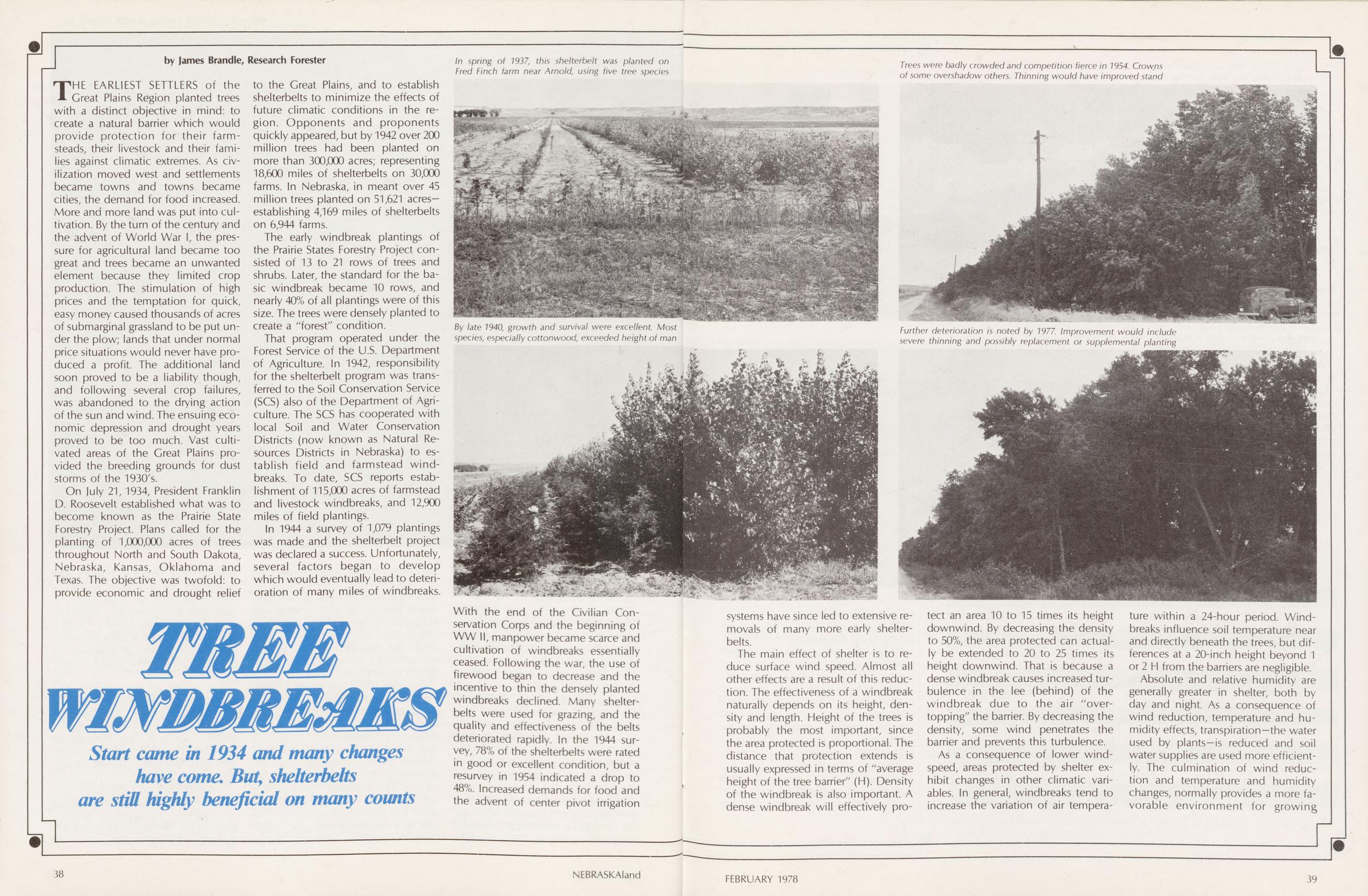
TREE WINDBREAKS
Start came in 1934 and many changes have come. But, shelterbelts are still highly beneficial on many counts
THE EARLIEST SETTLERS of the Great Plains Region planted trees with a distinct objective in mind: to create a natural barrier which would provide protection for their farmsteads, their livestock and their families against climatic extremes. As civilization moved west and settlements became towns and towns became cities, the demand for food increased. More and more land was put into cultivation. By the turn of the century and the advent of World War I, the pressure for agricultural land became too great and trees became an unwanted element because they limited crop production. The stimulation of high prices and the temptation for quick, easy money caused thousands of acres of submarginal grassland to be put under the plow; lands that under normal price situations would never have produced a profit. The additional land soon proved to be a liability though, and following several crop failures, was abandoned to the drying action of the sun and wind. The ensuing economic depression and drought years proved to be too much. Vast cultivated areas of the Great Plains provided the breeding grounds for dust storms of the 1930's.
On July 21, 1934, President Franklin D. Roosevelt established what was to become known as the Prairie State Forestry Project. Plans called for the planting of 1,000,000 acres of trees throughout North and South Dakota, Nebraska, Kansas, Oklahoma and Texas. The objective was twofold: to provide economic and drought relief to the Great Plains, and to establish shelterbelts to minimize the effects of future climatic conditions in the region. Opponents and proponents quickly appeared, but by 1942 over 200 million trees had been planted on more than 300,000 acres; representing 18,600 miles of shelterbelts on 30,000 farms. In Nebraska, in meant over 45 million trees planted on 51,621 acres- establishing 4,169 miles of shelterbelts on 6,944 farms.
The early windbreak plantings of the Prairie States Forestry Project consisted of 13 to 21 rows of trees and shrubs. Later, the standard for the basic windbreak became 10 rows, and nearly 40% of all plantings were of this size. The trees were densely planted to create a "forest" condition.
That program operated under the Forest Service of the U.S. Department of Agriculture. In 1942, responsibility for the shelterbelt program was transferred to the Soil Conservation Service (SCS) also of the Department of Agriculture. The SCS has cooperated with local Soil and Water Conservation Districts (now known as Natural Resources Districts in Nebraska) to establish field and farmstead windbreaks. To date, SCS reports establishment of 115,000 acres of farmstead and livestock windbreaks, and 12,900 miles of field plantings.
In 1944 a survey of 1,079 plantings was made and the shelterbelt project was declared a success. Unfortunately, several factors began to develop which would eventually lead to deterioration of many miles of windbreaks.
With the end of the Civilian Conservation Corps and the beginning of WW II, manpower became scarce and cultivation of windbreaks essentially ceased. Following the war, the use of firewood began to decrease and the incentive to thin the densely planted windbreaks declined. Many shelterbelts were used for grazing, and the quality and effectiveness of the belts deteriorated rapidly. In the 1944 survey, 78% of the shelterbelts were rated in good or excellent condition, but a resurvey in 1954 indicated a drop to 48%. Increased demands for food and the advent of center pivot irrigation 38 NEBRASKAland
The main effect of shelter is to reduce surface wind speed. Almost all other effects are a result of this reduction. The effectiveness of a windbreak naturally depends on its height, density and length. Height of the trees is probably the most important, since the area protected is proportional. The distance that protection extends is usually expressed in terms of "average height of the tree barrier" (H). Density of the windbreak is also important. A dense windbreak will effectively protect an area 10 to 15 times its height downwind. By decreasing the density to 50%, the area protected can actually be extended to 20 to 25 times its height downwind. That is because a dense windbreak causes increased turbulence in the lee (behind) of the windbreak due to the air "over-topping" the barrier. By decreasing the density, some wind penetrates the barrier and prevents this turbulence.
As a consequence of lower windspeed, areas protected by shelter exhibit changes in other climatic variables. In general, windbreaks tend to increase the variation of air temperature within a 24-hour period. Windbreaks influence soil temperature near and directly beneath the trees, but differences at a 20-inch height beyond 1 or 2 H from the barriers are negligible.
Absolute and relative humidity are
generally greater in shelter, both by
day and night. As a consequence of
wind reduction, temperature and humidity effects, transpiration-the water
used by plants-is reduced and soil
water supplies are used more efficiently. The culmination of wind reduction and temperature
and humidity
changes, normally provides a more favorable environment for growing
FEBRUARY 1978
39
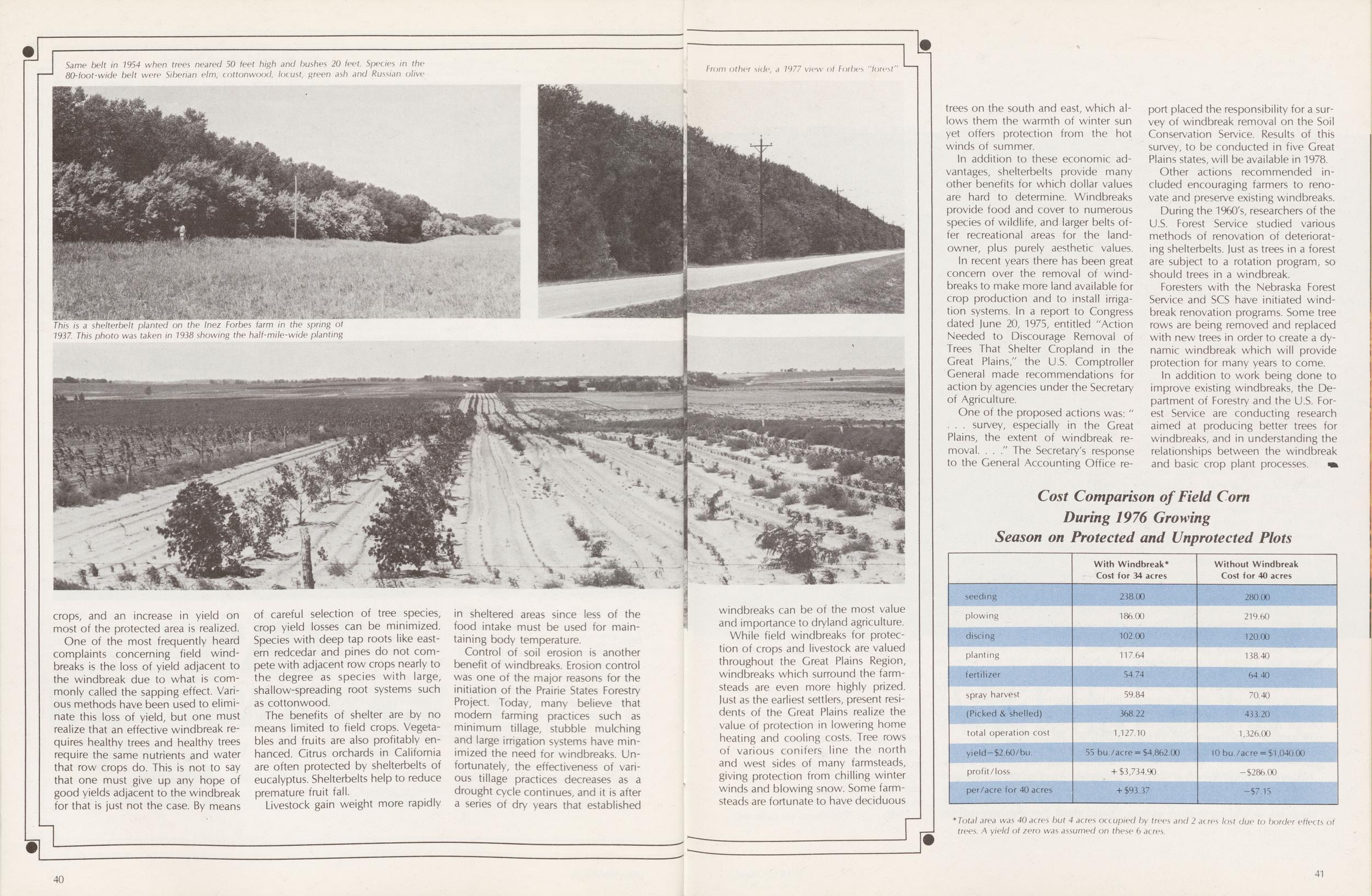
One of the most frequently heard complaints concerning field windbreaks is the loss of yield adjacent to the windbreak due to what is commonly called the sapping effect. Various methods have been used to eliminate this loss of yield, but one must realize that an effective windbreak requires healthy trees and healthy trees require the same nutrients and water that row crops do. This is not to say that one must give up any hope of good yields adjacent to the windbreak for that is just not the case. By means of careful selection of tree species, crop yield losses can be minimized. Species with deep tap roots like eastern redcedar and pines do not compete with adjacent row crops nearly to the degree as species with large, shallow-spreading root systems such as cottonwood.
The benefits of shelter are by no means limited to field crops. Vegetables and fruits are also profitably enhanced. Citrus orchards in California are often protected by shelterbelts of eucalyptus. Shelterbelts help to reduce premature fruit fall.
Livestock gain weight more rapidly in sheltered areas since less of the food intake must be used for maintaining body temperature.
Control of soil erosion is another benefit of windbreaks. Erosion control was one of the major reasons for the initiation of the Prairie States Forestry Project. Today, many believe that modern farming practices such as minimum tillage, stubble mulching and large irrigation systems have minimized the need for windbreaks. Unfortunately, the effectiveness of various tillage practices decreases as a drought cycle continues, and it is after a series of dry years that established 40 windbreaks can be of the most value and importance to dryland agriculture.
While field windbreaks for protection of crops and livestock are valued throughout the Great Plains Region, windbreaks which surround the farmsteads are even more highly prized, just as the earliest settlers, present residents of the Great Plains realize the value of protection in lowering home heating and cooling costs. Tree rows of various conifers line the north and west sides of many farmsteads, giving protection from chilling winter winds and blowing snow. Some farmsteads are fortunate to have deciduous trees on the south and east, which allows them the warmth of winter sun yet offers protection from the hot winds of summer.
In addition to these economic advantages, shelterbelts provide many other benefits for which dollar values are hard to determine. Windbreaks provide food and cover to numerous species of wildlife, and larger belts offer recreational areas for the landowner, plus purely aesthetic values.
In recent years there has been great concern over the removal of wind-breaks to make more land available for crop production and to install irrigation systems. In a report to Congress dated June 20, 1975, entitled "Action Needed to Discourage Removal of Trees That Shelter Cropland in the Great Plains," the U.S. Comptroller General made recommendations for action by agencies under the Secretary of Agriculture.
One of the proposed actions was: " . . . survey, especially in the Great Plains, the extent of windbreak removal. . . ." The Secretary's response to the General Accounting Office report placed the responsibility for a survey of windbreak removal on the Soil Conservation Service. Results of this survey, to be conducted in five Great Plains states, will be available in 1978.
Other actions recommended included encouraging farmers to renovate and preserve existing windbreaks.
During the 1960's, researchers of the U.S. Forest Service studied various methods of renovation of deteriorating shelterbelts. just as trees in a forest are subject to a rotation program, so should trees in a windbreak.
Foresters with the Nebraska Forest Service and SCS have initiated windbreak renovation programs. Some tree rows are being removed and replaced with new trees in order to create a dynamic windbreak which will provide protection for many years to come.
In addition to work being done to improve existing windbreaks, the Department of Forestry and the U.S. Forest Service are conducting research aimed at producing better trees for windbreaks, and in understanding the relationships between the windbreak and basic crop plant processes.
Wildland Fire
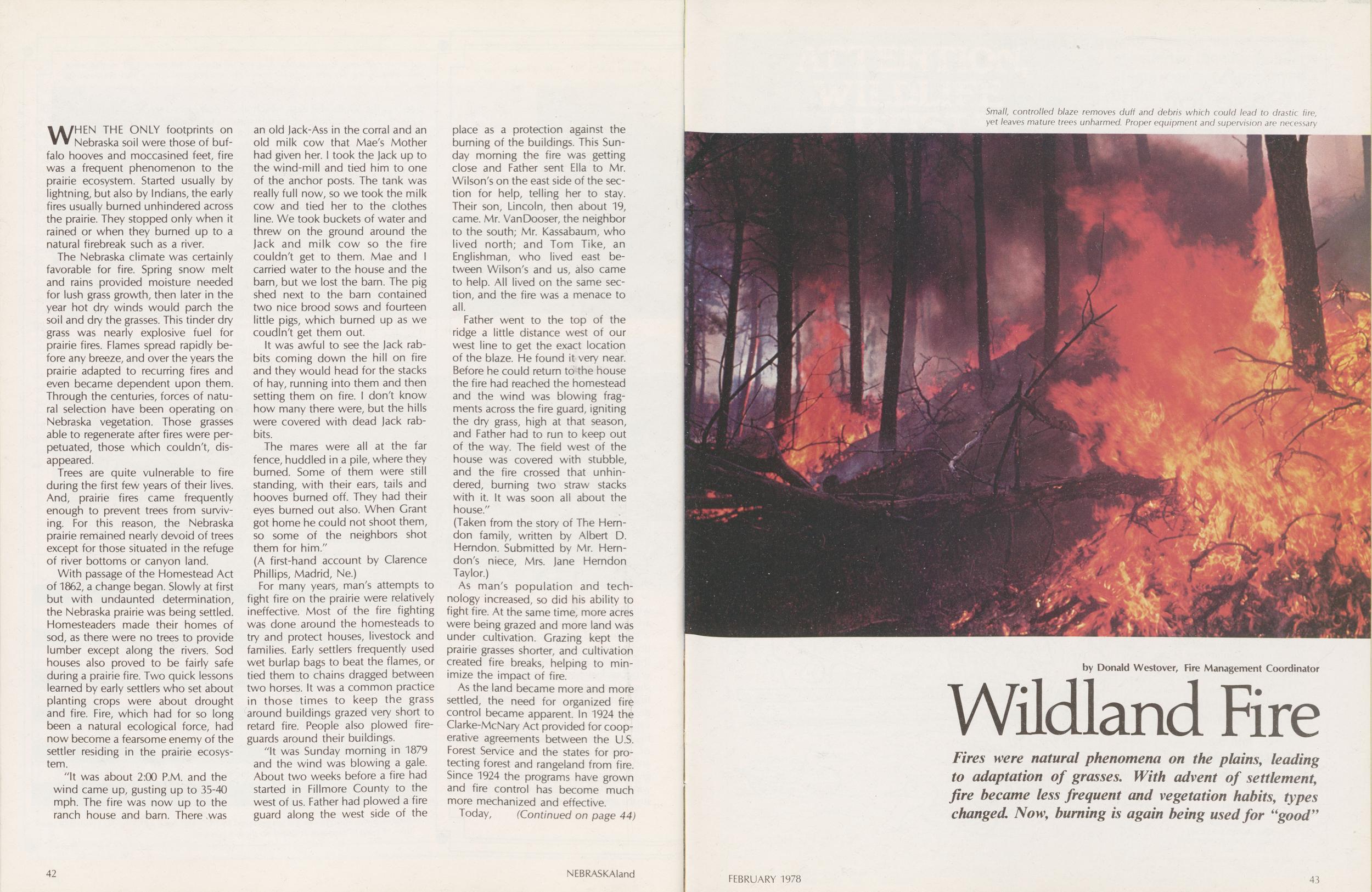
Fires were natural phenomena on the plains, leading to adaptation of grasses. With advent of settlement, fire became less frequent and vegetation habits, types changed. Now, burning is again being used for "good"
WHEN THE ONLY footprints on Nebraska soil were those of buffalo hooves and moccasined feet, fire was a frequent phenomenon to the prairie ecosystem. Started usually by lightning, but also by Indians, the early fires usually burned unhindered across the prairie. They stopped only when it rained or when they burned up to a natural firebreak such as a river.
The Nebraska climate was certainly favorable for fire. Spring snow melt and rains provided moisture needed for lush grass growth, then later in the year hot dry winds would parch the soil and dry the grasses. This tinder dry grass was nearly explosive fuel for prairie fires. Flames spread rapidly before any breeze, and over the years the prairie adapted to recurring fires and even became dependent upon them. Through the centuries, forces of natural selection have been operating on Nebraska vegetation. Those grasses able to regenerate after fires were perpetuated, those which couldn't, disappeared.
Trees are quite vulnerable to fire during the first few years of their lives. And, prairie fires came frequently enough to prevent trees from surviving. For this reason, the Nebraska prairie remained nearly devoid of trees except for those situated in the refuge of river bottoms or canyon land.
With passage of the Homestead Act of 1862, a change began. Slowly at first but with undaunted determination, the Nebraska prairie was being settled. Homesteaders made their homes of sod, as there were no trees to provide lumber except along the rivers. Sod houses also proved to be fairly safe during a prairie fire. Two quick lessons learned by early settlers who set about planting crops were about drought and fire. Fire, which had for so long been a natural ecological force, had now become a fearsome enemy of the settler residing in the prairie ecosystem.
"It was about 2:00 P.M. and the wind came up, gusting up to 35-40 mph. The fire was now up to the ranch house and barn. There was an old Jack-Ass in the corral and an old milk cow that Mae's Mother had given her. I took the Jack up to the wind-mill and tied him to one of the anchor posts. The tank was really full now, so we took the milk cow and tied her to the clothes line. We took buckets of water and threw on the ground around the Jack and milk cow so the fire couldn't get to them. Mae and I carried water to the house and the barn, but we lost the barn. The pig shed next to the barn contained two nice brood sows and fourteen little pigs, which burned up as we coudln't get them out.
It was awful to see the Jack rabbits coming down the hill on fire and they would head for the stacks of hay, running into them and then setting them on fire. I don't know how many there were, but the hills were covered with dead Jack rabbits.
The mares were all at the far fence, huddled in a pile, where they burned. Some of them were still standing, with their ears, tails and hooves burned off. They had their eyes burned out also. When Grant got home he could not shoot them, so some of the neighbors shot them for him."
(A first-hand account by Clarence Phillips, Madrid, Ne.)
For many years, man's attempts to fight fire on the prairie were relatively ineffective. Most of the fire fighting was done around the homesteads to try and protect houses, livestock and families. Early settlers frequently used wet burlap bags to beat the flames, or tied them to chains dragged between two horses. It was a common practice in those times to keep the grass around buildings grazed very short to retard fire. People also plowed fireguards around their buildings.
"It was Sunday morning in 1879 and the wind was blowing a gale. About two weeks before a fire had started in Fillmore County to the west of us. Father had plowed a fire guard along the west side of the place as a protection against the burning of the buildings. This Sunday morning the fire was getting close and Father sent Ella to Mr. Wilson's on the east side of the section for help, telling her to stay. Their son, Lincoln, then about 19, came. Mr. VanDooser, the neighbor to the south; Mr. Kassabaum, who lived north; and Tom Tike, an Englishman, who lived east between Wilson's and us, also came to help. All lived on the same section, and the fire was a menace to all.
Father went to the top of the ridge a little distance west of our west line to get the exact location of the blaze. He found it very near. Before he could return to the house the fire had reached the homestead and the wind was blowing fragments across the fire guard, igniting the dry grass, high at that season, and Father had to run to keep out of the way. The field west of the house was covered with stubble, and the fire crossed that unhindered, burning two straw stacks with it. It was soon ali about the house."
(Taken from the story of The Herndon family, written by Albert D. Herndon. Submitted by Mr. Herndon's niece, Mrs. Jane Herndon Taylor.)
As man's population and technology increased, so did his ability to fight fire. At the same time, more acres were being grazed and more land was under cultivation. Grazing kept the prairie grasses shorter, and cultivation created fire breaks, helping to minimize the impact of fire.
As the land became more and more settled, the need for organized fire control became apparent. In 1924 the Clarke-McNary Act provided for coop-erative agreements between the U.S. Forest Service and the states for protecting forest and rangeland from fire. Since 1924 the programs have grown and fire control has become much more mechanized and effective.
Today, (Continued on page 44)
42 NEBRASKAIand NEBRASKAIand 43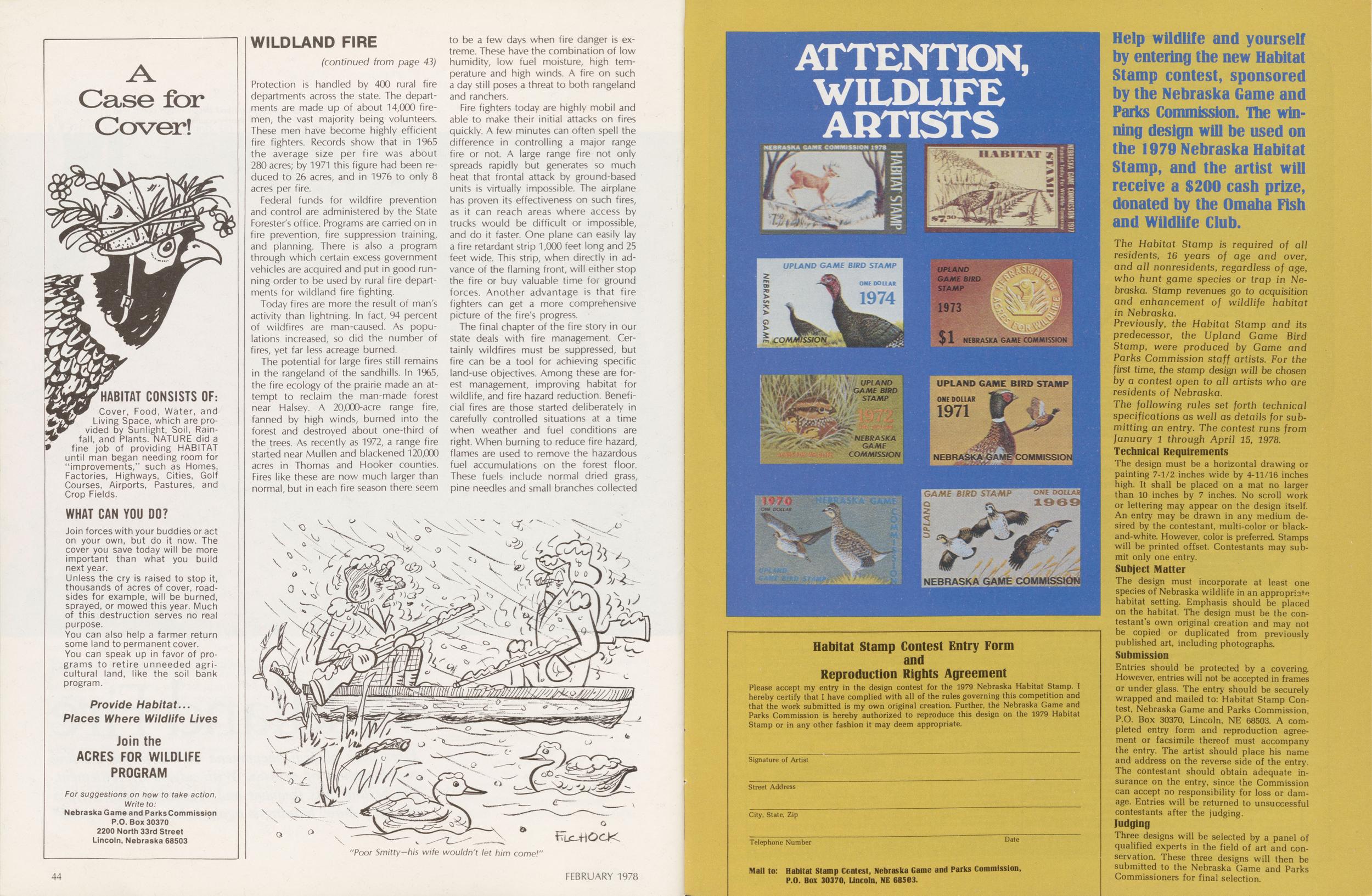
HABITAT CONSISTS OF: Cover, Food, Water, and Living Space, which are provided by Sunlight, Soil, Rainfall, and Plants. NATURE did a fine job of providing HABITAT until man began needing room for "improvements," such as Homes, Factories, Highways, Cities, Golf Courses, Airports, Pastures, and Crop Fields.
WHAT CAN YOU DO? Join forces with your buddies or act on your own, but do it now. The cover you save today will be more important than what you build next year. Unless the cry is raised to stop it, thousands of acres of cover, roadsides for example, will be burned, sprayed, or mowed this year. Much of this destruction serves no real purpose. You can also help a farmer return some land to permanent cover. You can speak up in favor of programs to retire unneeded agri- cultural land, like the soil bank program.
Provide Habitat... Places Where Wildlife Lives
Join the ACRES FOR WILDLIFE PROGRAM
For suggestions on how to take action,
Write to: Nebraska Game and ParksCommission P.O. Box 30370 2200 North 33rd Street Lincoln, Nebraska 68503
WILDLAND FIRE
(continued from page 43)Protection is handled by 400 rural fire departments across the state. The departments are made up of about 14,000 firemen, the vast majority being volunteers. These men have become highly efficient fire fighters. Records show that in 1965 the average size per fire was about 280 acres; by 1971 this figure had been reduced to 26 acres, and in 1976 to only 8 acres per fire.
Federal funds for wildfire prevention and control are administered by the State Forester's office. Programs are carried on in fire prevention, fire suppression training, and planning. There is also a program through which certain excess government vehicles are acquired and put in good running order to be used by rural fire departments for wildland fire fighting.
Today fires are more the result of man's activity than lightning. In fact, 94 percent of wildfires are man-caused. As populations increased, so did the number of fires, yet far less acreage burned.
The potential for large fires still remains in the rangeland of the sandhills. In 1965, the fire ecology of the prairie made an attempt to reclaim the man-made forest near Halsey. A 20,000-acre range fire, fanned by high winds, burned into the forest and destroyed about one-third of the trees. As recently as 1972, a range fire started near Mullen and blackened 120,000 acres in Thomas and Hooker counties. Fires like these are now much larger than normal, but in each fire season there seem to be a few days when fire danger is extreme. These have the combination of low humidity, low fuel moisture, high temperature and high winds. A fire on such a day still poses a threat to both rangeland and ranchers.
Fire fighters today are highly mobil and able to make their initial attacks on fires quickly. A few minutes can often spell the difference in controlling a major range fire or not. A large range fire not only spreads rapidly but generates so much heat that frontal attack by ground-based units is virtually impossible. The airplane has proven its effectiveness on such fires, as it can reach areas where access by trucks would be difficult or impossible, and do it faster. One plane can easily lay a fire retardant strip 1,000 feet long and 25 feet wide. This strip, when directly in advance of the flaming front, will either stop the fire or buy valuable time for ground forces. Another advantage is that fire fighters can get a more comprehensive picture of the fire's progress.
The final chapter of the fire story in our state deals with fire management. Certainly wildfires must be suppressed, but fire can be a tool for achieving specific land-use objectives. Among these are forest management, improving habitat for wildlife, and fire hazard reduction. Beneficial fires are those started deliberately in carefully controlled situations at a time when weather and fuel conditions are right. When burning to reduce fire hazard, flames are used to remove the hazardous fuel accumulations on the forest floor. These fuels include normal dried grass, pine needles and small branches collected
ATTENTION WILDLIFE ARTISTS
The Habitat Stamp is required of all residents, 16 years of age and over, and all nonresidents, regardless of age, who hunt game species or trap in Nebraska. Stamp revenues go to acquisition and enhancement of wildlife habitat in Nebraska. Previously, the Habitat Stamp and its predecessor, the Upland Game Bird Stamp, were produced by Game and Parks Commission staff artists. For the first time, the stamp design will be chosen by a contest open to all artists who are residents of Nebraska. The following rules set forth technical specifications as well as details for submitting an entry. The contest runs from January 1 through April 15, 1978.
Technical Requirements The design must be a horizontal drawing or painting 7-1/2 inches wide by 4-11/16 inches high. It shall be placed on a mat no larger than 10 inches by 7 inches. No scroll work or lettering may appear on the design itself. An entry may be drawn in any medium desired by the contestant, multi-color or black- and-white. However, color is preferred. Stamps will be printed offset. Contestants may submit only one entry.
Subject Matter The design must incorporate at least one species of Nebraska wildlife in an appropriate habitat setting. Emphasis should be placed on the habitat. The design must be the contestant's own original creation and may not be copied or duplicated from previously published art, including photographs.
Submission Entries should be protected by a covering. However, entries will not be accepted in frames or under glass. The entry should be securely wrapped and mailed to: Habitat Stamp Contest, Nebraska Game and Parks Commission, P.O. Box 30370, Lincoln, NE 68503. A completed entry form and reproduction agreement or facsimile thereof must accompany the entry. The artist should place his name and address on the reverse side of the entry. The contestant should obtain adequate insurance on the entry, since the Commission can accept no responsibility for loss or damage. Entries will be returned to unsuccessful contestants after the judging.
Judging Three designs will be selected by a panel of qualified experts in the field of art and conservation. These three designs will then be submitted to the Nebraska Game and Parks Commissioners for final selection.

...a binder designed to get you out of a bind
NEBRASKAIand is a keeper. But, the question is often just where and how. Here's the answer...a sturdy, red vinyl binder designed just for NEBRASKAIand Magazine. Easy-to-insert metal rods hold each issue securely in place.through the years. These potentially hazardous fuels can be safely removed by fire at the right time. Such action is often taken by land managers to reduce the likelihood of a fire during the fire season, when small fires quickly become large crown fires, which are difficult to control and a threat to the entire forest. A controlled ground fire in the forest will not harm the trees. The ponderosa pines of the Pine Ridge have adapted to fire through the years. Their thick bark insulates them from the heat. This means that frequent small fires burning along the forest floor can remove the fuel without harming the mature trees. In many areas, man has intervened in natural processes and totally suppressed fire from forested areas. At the same time he has failed to remove the accumulations of logging slash and natural debris. Therefore, the stage has been set for a disaster fire, with enough heat produced to ignite the crowns of the trees. Prescribed fires have the added advantage of killing small trees and brush which compete with larger trees for water and nutrients. Nutrients tied up in the plant material on the forest floor are thus released to the soil for use by the big trees.
Man has come full circle: like the prairie, he is coming to use fire. We have learned to recognize the ecological significance of fire in the prairie and forest ecosystems. We have seen the importance of fire in shaping the flora and fauna of our state. We have come to realize that while wildfire can be destructive, controlled fire can also be a very beneficial tool. A tool, certainly, that will take a long time to master, and one which must always be handled with care.
Cover—Bob Grier; Inside cover—Lou Ell; 7-Steve O'Hare; 9-Lou Ell; 10—Bill McClurg; 13—Jon Farrar; 15 top and center—Bill McClurg, bottom—Neal Jennings; 16-Bill McClurg; 18,19-Bob Grier, 20, 21-Greg Beaumont; 24-Bob Grier; 25 left—Greg Beaumont, top right—Jim Ducey, bottom right—Ken Bouc; 26 top left-Lou Ell, top right- Bob Grier; 26, 27-Bill McClurg; 28, 29-Jon Farrar; 30-Jim Ducey; 31 top left-Jon Farrar, top right-Lou Ell, bot- tom-Greg Beaumont; 32-Jon Farrar; 33 top left-Jon Farrar, top right-Butch Isom, bottom left-Jon Farrar, bottom right Lou Ell; 35—U.S. Forest Service; 36, 37—Bill McClurg; 38-U.S. Forest Service; 43—Judy Erickson.
TAKE A DEEP BREATH. NOW THANK A TREE.
Did you know that trees supply a great deal of the oxygen we breathe? That they actually purify the air?
And that's not all trees do for us.They supply us with lumber, and paper, and thousands of things we use every day.
They help prevent soil erosion. And they provide shelter for our animal friends.
When you think about it, trees do a lot for us. So the next time you're in the forest, return the favor. Take an extra minute to be careful with fire.
You may save a trees life. ' Then, the next time it takes a deep breath, it can thank you.
48 NEBRASKAlandTrading Post
Acceptance of advertising implies no endorsement of products or services. Classified Ads: 20 cents a word, minimum order $4.00. April 1978 closing date, February 8. Send classified ads to: Trading Post, NEBRASKAland, P.O. Box 30370, Lincoln, Nebraska 68503.
DOGS BEAGLES GALORE. Puppy love for sale. Our kennel runs over and we have the perfect family companion or hunting partner for you. Champion dams and/or sire. Tux Beagles, Route 1, Box 152, Raymond, NE 68428 (402) 435- 1407. MISCELLANEOUS DUCK HUNTERS: learn how, make quality, solid plastic, waterfowl decoys. We're originators of famous system. Send $.50, colorful catalog. Decoys Unlimited, Clinton, Iowa 52732. GUNS—Browning, Winchester, Remington, others, Hipowers, shotguns, new, used, antiques. Want Pre-1%4 Winchesters. Buy-Sell-Trade. Ph. (402) 729-6112. Bedlan's Sporting Goods, Fairbury, NE 68352. WANTED FOR 1978. . . . additional locations for Wilson Outfitters Canoe Rental liveries. Prefer landowners with choice riverfront property 10 to 15 miles downstream from prime put-in points. Others considered. Wilson Outfitters provides canoes, paddles, jackets, canoe trailers, advertising, referrals, and know how. We have the track record! Opportunities for campground and car shuttle income, too! Locations wanted on Republican, Blues, Loups, Calamus, Dismal, Missouri, Platte, Elkhorn, Frenchman, and Snake rivers. Write Wilson Outfitters, 6211 Sunrise Road, Lincoln, Nebraska 68510. WANTED-Older Winchester pump, double, and lever shotguns in working condition, any gauge. Write Winchester, Box 30004, Lincoln, NE 68503. WAX WORMS, 500-$8, 1000-$14, Postpaid, Add 372% sales tax. No. C.O.D. Harold Maiicky, Burwell, Nebraska 68823. SAVE ON HOME COOKING. Recipes for chilies, soups and budget-saver meals, 6/$2.00. Homemaker's, P.O. Box 218, McCook, NE 69001 "JUMBO WISCONSIN and northern bobwhites, Gambles, California Valley, chukars and golden pheasants. Taking orders now for 1978 day-oid and started chicks. Frank Roy, Box 231, Chapman, NE 68827. Phone (308) 986-2410 BUY DIRECT! Grow worms-For sale, bait, gardening, garbage disposal. Beds, bedding, feed available. Hybrid red stock by the dozen or million. Send stamp for price lists, details. M-J Baits and Boats, Box 365-A, Hartington, NE 68739 TAXIDERMY BIG BEAR TAXIDERMY, Rt. 2, Mitchell, Nebraska 69357. We specialize in all big game from Alaska to Nebraska, also birds and fish. Hair on and hair off tanning, 41/2 miles west of Scottsbluff on Highway 26. Phone (308) 635-3013. KARL SCHWARZ Master Taxidermists. Mounting of game heads-birds-fish-animals-fur rugs-robes-tanning buckskin. Since 1910. 424 South 13th Street, Dept. A, Omaha, Nebraska 68102. THE HOUSE OF BIRDS-Licensed taxidermist, 10 years experience in the art of all taxidermy. Larry Nave, 1323 North 10th, Beatrice, NE 68310. Phone (402) 228-3959. FISH MOUNTING Service. Specialize in all fresh-water fish. Visitors welcome. Wally Allison, 2709 Birchwood North Platte, NE 69101, (308) 534-2324. GREAT PLAINS TAXIDERMY, Creative and realistic mounts of Fish, Birds, Game heads, full mounts, and novelty. Pat Garvey, 3015 NW 52nd, Lincoln, Nebraska 68524. Phone 470-2280, Lincoln; 571-5630, Omaha. CREATIVE TAXIDERMY. Modern methods and life-like workmanship on all fish and game since 1935, also tanning, rugs, and deerskin products. Joe Voges, Naturecrafts and Gift Shop, 925 4th Corso, Nebraska City, NE 68410. Phone (402) 873-5491 "COMPLETE TAXIDERMY STUDIO" We can help you go hunting and fishing. Largest Whitetail by Boone and Crockett standards, mounted free. Dinges Taxidermy Studio, 2760 South 12th St., Omaha, NE 68108, (402) 342-3718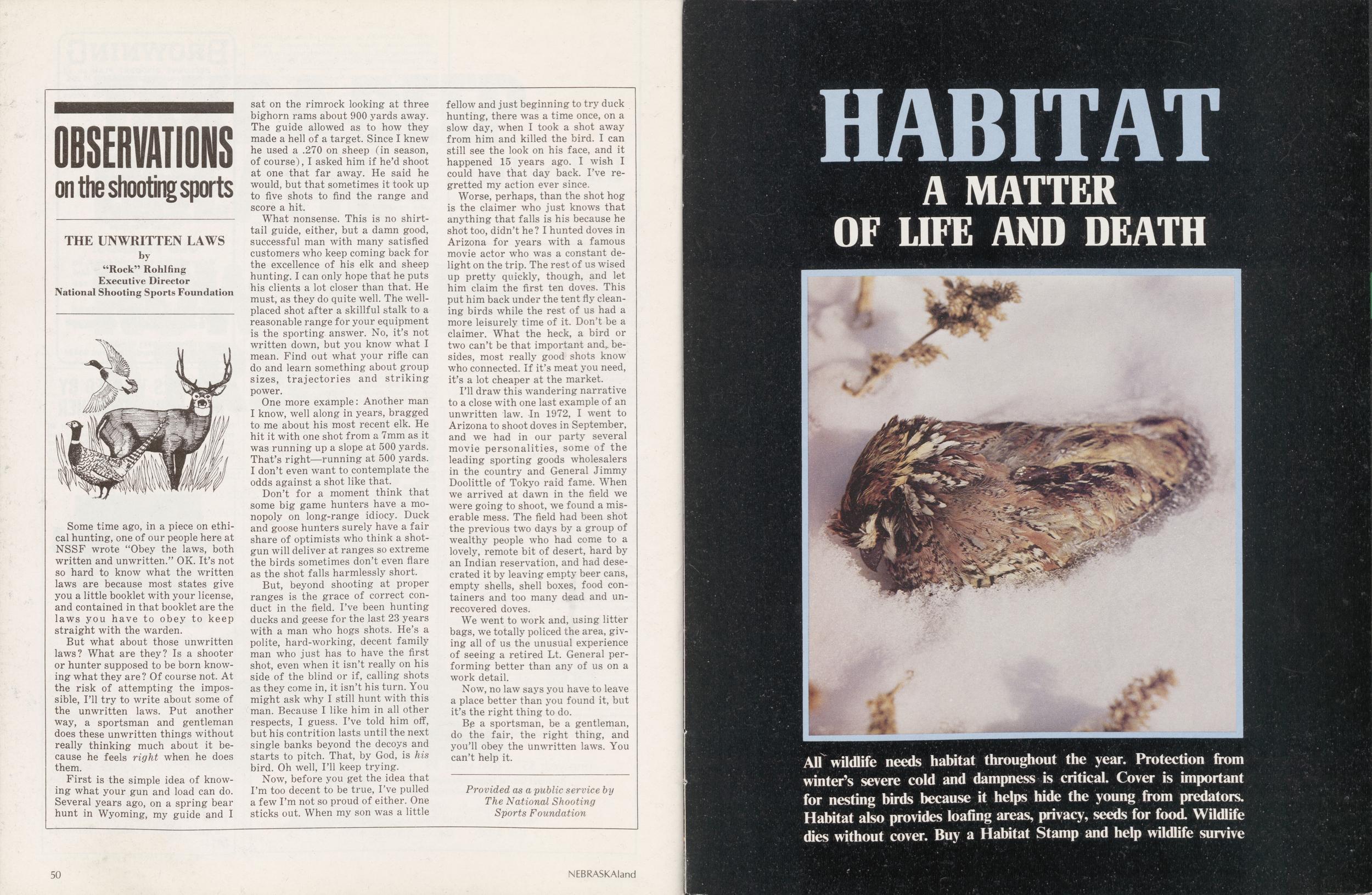
OBSERVATIONS on the shooting sports
THE UNWRITTEN LAWS
Some time ago, in a piece on ethical hunting, one of our people here at NSSF wrote "Obey the laws, both written and unwritten." OK. It's not so hard to know what the written laws are because most states give you a little booklet with your license, and contained in that booklet are the laws you have to obey to keep straight with the warden.
But what about those unwritten laws? What are they? Is a shooter or hunter supposed to be born knowing what they are? Of course not. At the risk of attempting the impossible, I'll try to write about some of the unwritten laws. Put another way, a sportsman and gentleman does these unwritten things without really thinking much about it because he feels right when he does them.
First is the simple idea of knowing what your gun and load can do. Several years ago, on a spring bear hunt in Wyoming, my guide and I sat on the rimrock looking at three bighorn rams about 900 yards away. The guide allowed as to how they made a hell of a target. Since I knew he used a .270 on sheep fin season, of course), I asked him if he'd shoot at one that far away. He said he would, but that sometimes it took up to five shots to find the range and score a hit.
What nonsense. This is no shirttail guide, either, but a damn good, successful man with many satisfied customers who keep coming back for the excellence of his elk and sheep hunting. I can only hope that he puts his clients a lot closer than that. He must, as they do quite well. The well- placed shot after a skillful stalk to a reasonable range for your equipment is the sporting answer. No, it's not written down, but you know what I mean. Find out what your rifle can do and learn something about group sizes, trajectories and striking power.
One more example: Another man I know, well along in years, bragged to me about his most recent elk. He hit it with one shot from a 7mm as it was running up a slope at 500 yards. That's right—running at 500 yards. I don't even want to contemplate the odds against a shot like that.
Don't for a moment think that some big game hunters have a monopoly on long-range idiocy. Duck and goose hunters surely have a fair share of optimists who think a shotgun will deliver at ranges so extreme the birds sometimes don't even flare as the shot falls harmlessly short.
But, beyond shooting at proper ranges is the grace of correct conduct in the field. I've been hunting ducks and geese for the last 23 years with a man who hogs shots. He's a polite, hard-working, decent family man who just has to have the first shot, even when it isn't really on his side of the blind or if, calling shots as they come in, it isn't his turn. You might ask wThy I still hunt with this man. Because I like him in all other respects, I guess. I've told him off, but his contrition lasts until the next single banks beyond the decoys and starts to pitch. That, by God, is his bird. Oh well, I'll keep trying.
Now, before you get the idea that I'm too decent to be true, I've pulled a few I'm not so proud of either. One sticks out. When my son was a little fellow and just beginning to try duck hunting, there was a time once, on a slow day, when I took a shot away from him and killed the bird. I can still see the look on his face, and it happened 15 years ago. I wish I could have that day back. I've regretted my action ever since.
Worse, perhaps, than the shot hog is the claimer who just knows that anything that falls is his because he shot too, didn't he? I hunted doves in Arizona for years with a famous movie actor who was a constant delight on the trip. The rest of us wised up pretty quickly, though, and let him claim the first ten doves. This put him back under the tent fly cleaning birds while the rest of us had a more leisurely time of it. Don't be a claimer. What the heck, a bird or two can't be that important and besides, most really good shots know who connected. If it's meat you need, it's a lot cheaper at the market.
I'll draw this wandering narrative to a close with one last example of an unwritten law. In 1972, I went to Arizona to shoot doves in September, and we had in our party several movie personalities, some of the leading sporting goods wholesalers in the country and General Jimmy Doolittle of Tokyo raid fame. When we arrived at dawn in the field we were going to shoot, we found a miserable mess. The field had been shot the previous two days by a group of wealthy people who had come to a lovely, remote bit of desert, hard by an Indian reservation, and had desecrated it by leaving empty beer cans, empty shells, shell boxes, food containers and too many dead and unrecovered doves.
We went to work and, using litter bags, we totally policed the area, giving all of us the unusual experience of seeing a retired Lt. General performing better than any of us on a work detail.
Now, no law says you have to leave a place better than you found it, but it's the right thing to do. Be a sportsman, be a gentleman, do the fair, the right thing, and you'll obey the unwritten laws. You can't help it.
Provided as a public service by The National Shooting Sports Foundation 50 NEBRASKAlandHABITAT A MATTER OF LIFE AND DEATH
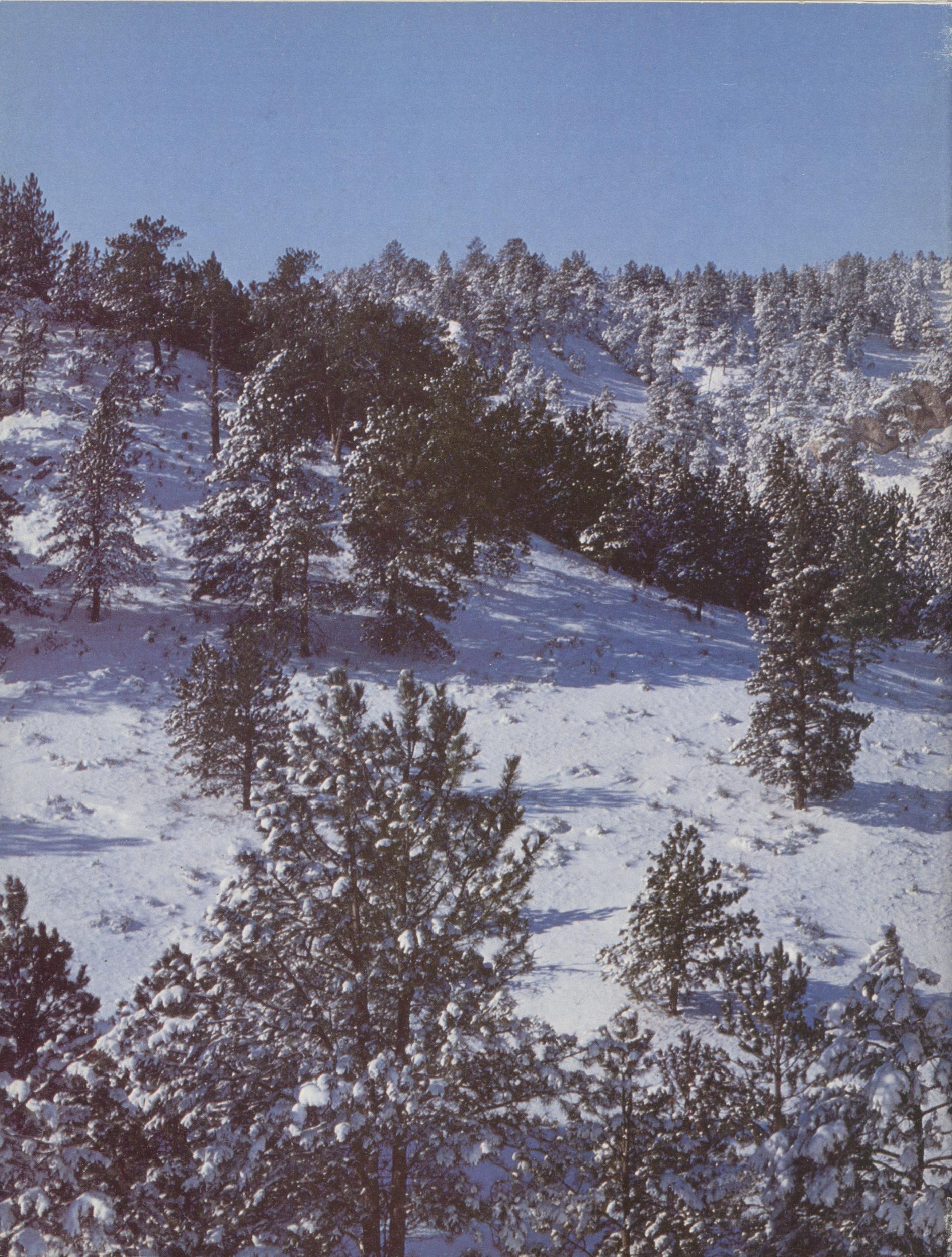
Position: 664 (17 views)