Volume 56, Issue 1, 1978
NEBRASKAland
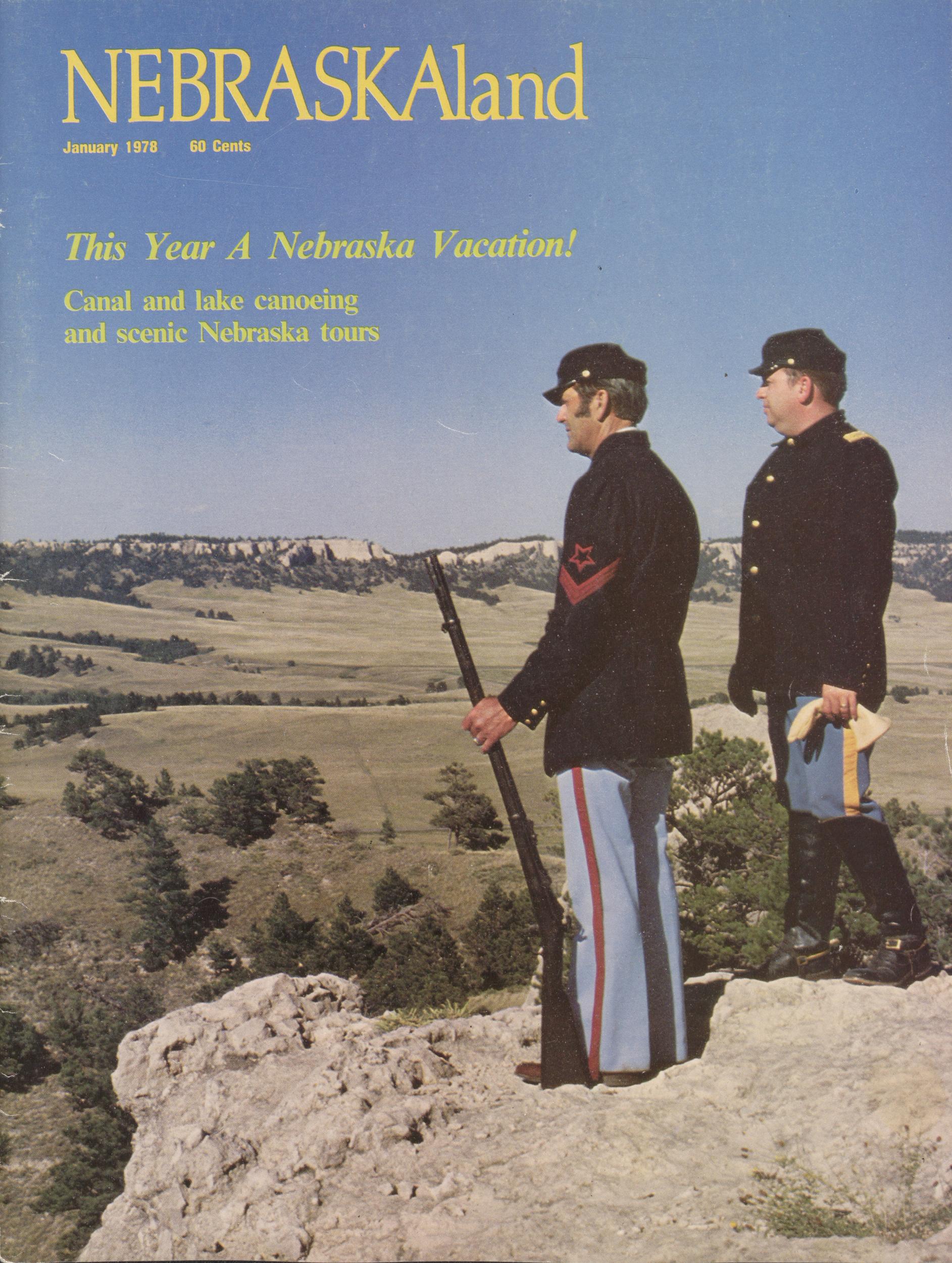
January 1978 60 Cents This Year a Nebraska Vacation! Canal and lake canoeing and scenic Nebraska tours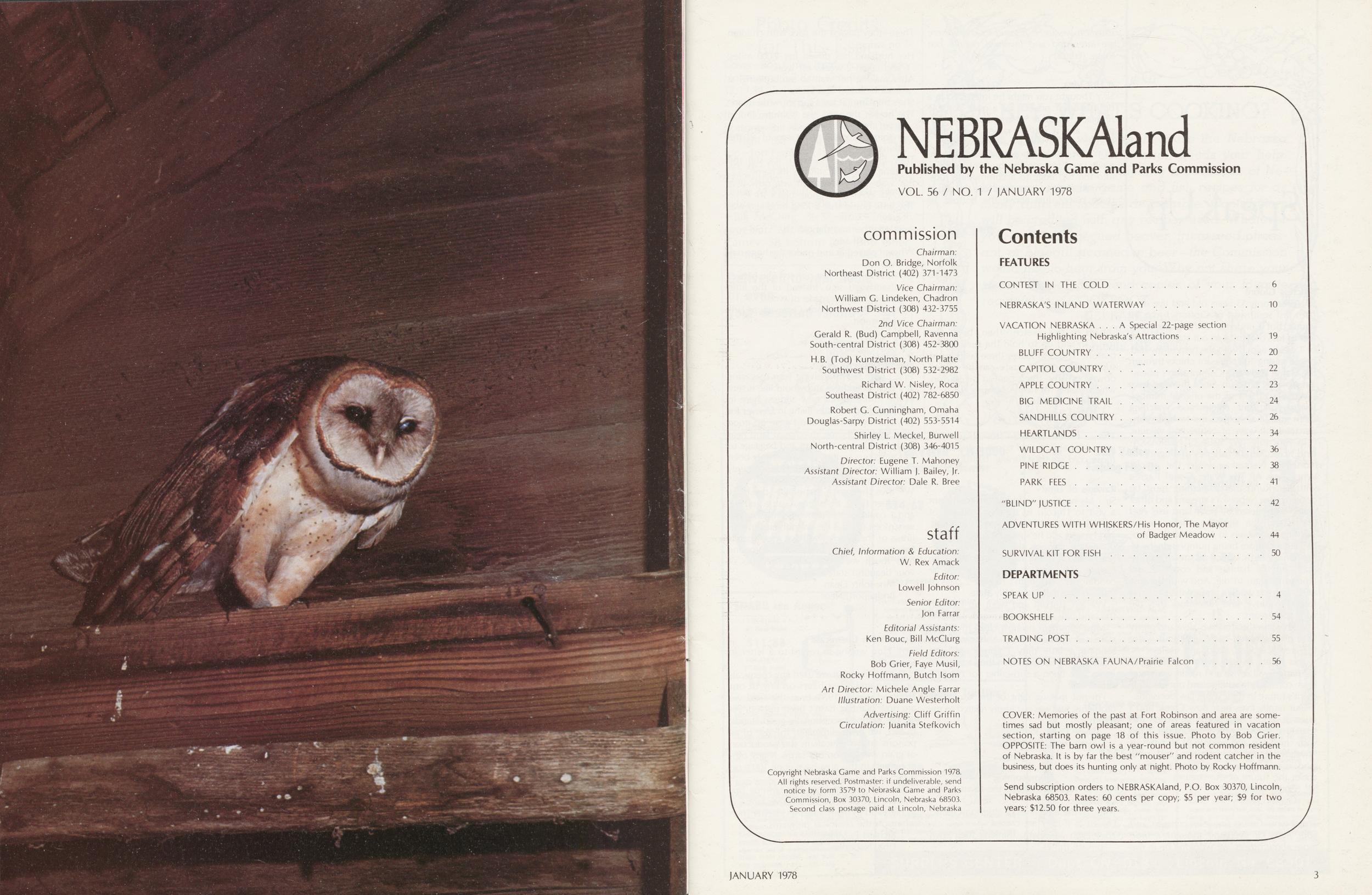
NEBRASKAland
Published by the Nebraska Game and Parks Commission VOL. 56 / NO. 1 / JANUARY 1978 commission Chairman: Don O. Bridge, Norfolk Northeast District (402) 371-1473 Vice Chairman: William G. Lindeken, Chadron Northwest District (308) 432-3755 2nd Vice Chairman: Gerald R. (Bud) Campbell, Ravenna South-central District (308) 452-3800 H.B. (Tod) Kuntzelman, North Platte Southwest District (308) 532-2982 Richard W. Nisley, Roca Southeast District (402) 782-6850 Robert G. Cunningham, Omaha Douglas-Sarpy District (402) 553-5514 Shirley L. Meckel, Burwell North-central District (308) 346-4015 Director: Eugene T. Mahoney Assistant Director: William J. Bailey, Jr. Assistant Director: Dale R. Bree staff Chief; Information & Education: W. Rex Amack Editor: Lowell Johnson Senior Editor: Jon Farrar Editorial Assistants: Ken Bouc, Bill McClurg Field Editors: Bob Grier, Faye Musil, Rocky Hoffmann, Butch Isom Art Director: Michele Angle Farrar Illustration: Duane Westerholt Advertising: Cliff Griffin Circulation: Juanita Stefkovich Copyright Nebraska Game and Parks Commission 1978. All rights reserved. Postmaster: if undeliverable, send notice by form 3579 to Nebraska Game and Parks Commission, Box 30370, Lincoln, Nebraska 68503. Second class postage paid at Lincoln, Nebraska Contents FEATURES CONTEST IN THE COLD 6 NEBRASKA'S INLAND WATERWAY 10 VACATION NEBRASKA ... A Special 22-page section Highlighting Nebraska's Attractions 19 BLUFF COUNTRY 20 CAPITOL COUNTRY 22 APPLE COUNTRY 23 BIG MEDICINE TRAIL 24 SANDHILLS COUNTRY 26 HEARTLANDS 34 WILDCAT COUNTRY 36 PINE RIDGE 38 PARK FEES 41 "BLIND" JUSTICE 42 ADVENTURES WITH WHISKERS/His Honor, The Mayor of Badger Meadow 44 SURVIVAL KIT FOR FISH 50 DEPARTMENTS SPEAK UP 4 BOOKSHELF 54 TRADING POST 55 NOTES ON NEBRASKA FAUNA/Prairie Falcon 56 COVER: Memories of the past at Fort Robinson and area are sometimes sad but mostly pleasant; one of areas featured in vacation section, starting on page 18 of this issue. Photo by Bob Grier. OPPOSITE: The barn owl is a year-round but not common resident of Nebraska. It is by far the best "mouser" and rodent catcher in the business, but does its hunting only at night. Photo by Rocky Hoffmann. Send subscription orders to NEBRASKAland, P.O. Box 30370, Lincoln, Nebraska 68503. Rates: 60 cents per copy; $5 per year; $9 for two years; $12.50 for three years. JANUARY 1978 3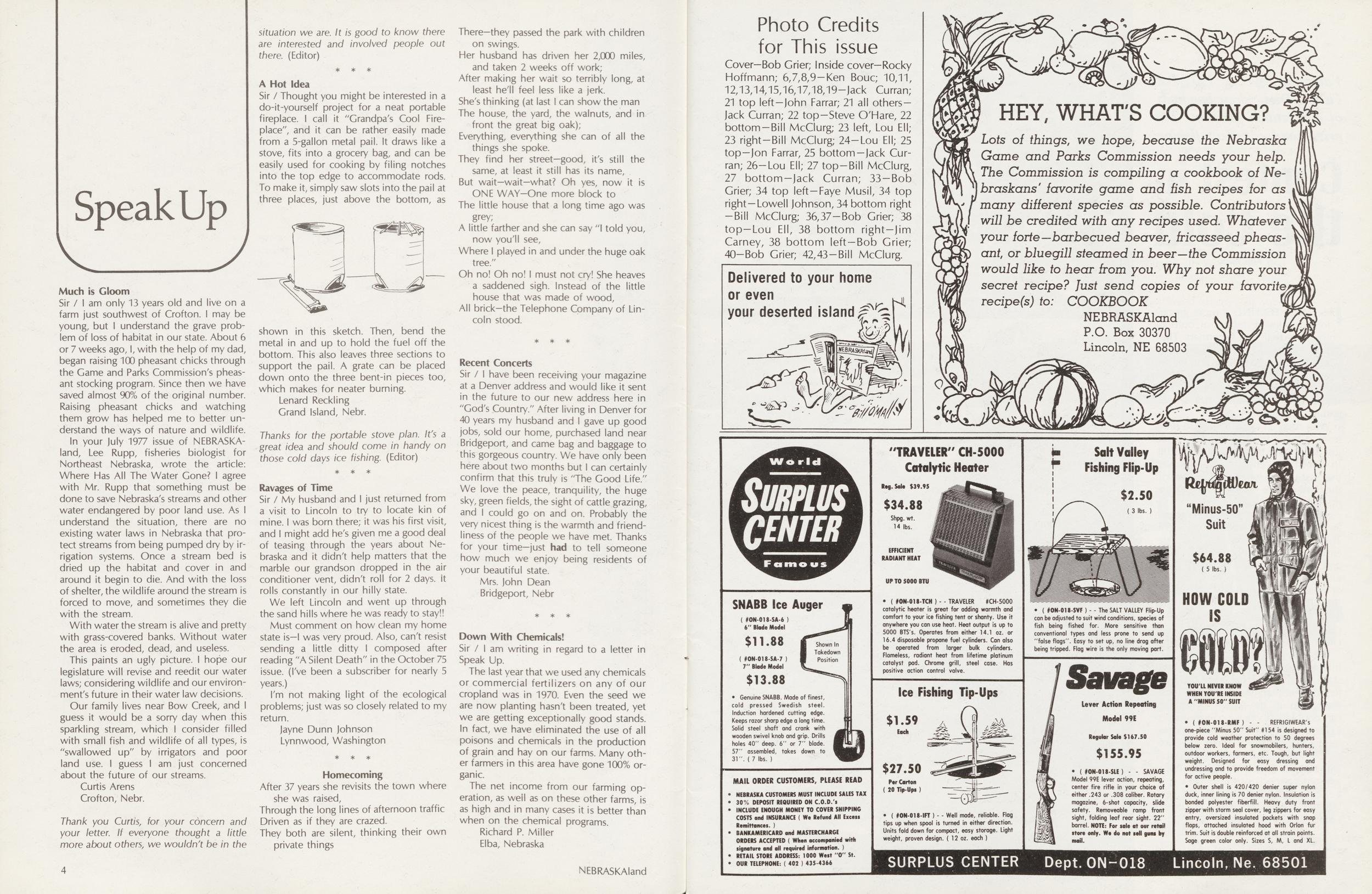
Speak Up
Much is GloomSir / I am only 13 years old and live on a farm just southwest of Crofton. I may be young, but I understand the grave problem of loss of habitat in our state. About 6 or 7 weeks ago, I, with the help of my dad, began raising 100 pheasant chicks through the Game and Parks Commission's pheaant stocking program. Since then we have saved almost 90% of the original number. Raising pheasant chicks and watching them grow has helped me to better understand the ways of nature and wildlife.
In your July 1977 issue of NEBRASKAland, Lee Rupp, fisheries biologist for Northeast Nebraska, wrote the article: Where Has All The Water Gone? I agree with Mr. Rupp that something must be done to save Nebraska's streams and other water endangered by poor land use. As I understand the situation, there are no existing water laws in Nebraska that protect streams from being pumped dry by irrigation systems. Once a stream bed is dried up the habitat and cover in and around it begin to die. And with the loss of shelter, the wildlife around the stream is forced to move, and sometimes they die with the stream.
With water the stream is alive and pretty with grass-covered banks. Without water the area is eroded, dead, and useless.
This paints an ugly picture. I hope our legislature will revise and reedit our water laws; considering wildlife and our environment's future in their water law decisions.
Our family lives near Bow Creek, and I guess it would be a sorry day when this sparkling stream, which I consider filled with small fish and wildlife of all types, is "swallowed up" by irrigators and poor land use. I guess I am just concerned about the future of our streams.
Curtis Arens Crofton, Nebr.Thank you Curtis, for your concern and your letter. If everyone thought a little more about others, we wouldn't be in the situation we are. It is good to know there are interested and involved people out there. (Editor)
A Hot IdeaSir / Thought you might be interested in a do-it-yourself project for a neat portable fireplace. I call it "Grandpa's Cool Fireplace", and it can be rather easily made from a 5-gallon metal pail. It draws like a stove, fits into a grocery bag, and can be easily used for cooking by filing notches into the top edge to accommodate rods. To make it, simply saw slots into the pail at three places, just above the bottom, as shown in this sketch. Then, bend the metal in and up to hold the fuel off the bottom. This also leaves three sections to support the pail. A grate can be placed down onto the three bent-in pieces too, which makes for neater burning.
Thanks for the portable stove plan. It's a great idea and should come in handy on those cold days ice fishing. (Editor)
Ravages of TimeSir / My husband and I just returned from a visit to Lincoln to try to locate kin of mine. I was born there; it was his first visit, and I might add he's given me a good deal of teasing through the years about Nebraska and it didn't help matters that the marble our grandson dropped in the air conditioner vent, didn't roll for 2 days, it rolls constantly in our hilly state.
We left Lincoln and went up through the sand hills where he was ready to stay!!
Must comment on how clean my home state is—I was very proud. Also, can't resist sending a little ditty I composed after reading "A Silent Death" in the October 75 issue. (I've been a subscriber for nearly 5 years.)
I'm not making light of the ecological problems; just was so closely related to my return.
Jayne Dunn Johnson Lynnwood, Washington Homecoming After 37 years she revisits the town where she was raised, Through the long lines of afternoon traffic Driven as if they are crazed. They both are silent, thinking their own private things There—they passed the park with children on swings. Her husband has driven her 2,000 miles, and taken 2 weeks off work; After making her wait so terribly long, at least he'll feel less like a jerk. She's thinking (at last I can show the man The house, the yard, the walnuts, and in front the great big oak); Everything, everything she can of all the things she spoke. They find her street—good, it's still the same, at least it still has its name, But wait—wait—what? Oh yes, now it is ONE WAY—One more block to The little house that a long time ago was grey; A little farther and she can say "I told you, now you'll see, Where I played in and under the huge oak tree." Oh no! Oh no! I must not cry! She heaves a saddened sigh. Instead of the little house that was made of wood, All brick-the Telephone Company of Lincoln stood. Recent ConcertsSir / I have been receiving your magazine at a Denver address and would like it sent in the future to our new address here in "God's Country." After living in Denver for 40 years my husband and I gave up good jobs, sold our home, purchased land near Bridgeport, and came bag and baggage to this gorgeous country. We have only been here about two months but I can certainly confirm that this truly is "The Good Life." We love the peace, tranquility, the huge sky, green fields, the sight of cattle grazing, and I could go on and on. Probably the very nicest thing is the warmth and friend- liness of the people we have met. Thanks for your time—just had to tell someone how much we enjoy being residents of your beautiful state.
Mrs. John Dean Bridgeport, Nebr Down With Chemicals!Sir / I am writing in regard to a letter in Speak Up.
The last year that we used any chemicals or commercial fertilizers on any of our cropland was in 1970. Even the seed we are now planting hasn't been treated, yet we are getting exceptionally good stands. In fact, we have eliminated the use of all poisons and chemicals in the production of grain and hay on our farms. Many other farmers in this area have gone 100% organic.
The net income from our farming operation, as well as on these other farms, is as high and in many cases it is better than when on the chemical programs.
Richard P. Miller Elba, Nebraska 4 NEBRASKAland Photo Credits for This issue Cover—Bob Grier; Inside cover—Rocky Hoffmann; 6,7,8,9—Ken Bouc; 10,11, 12,13,14,15,16,17,18,19—Jack Curran; 21 top left-John Farrar; 21 all others- Jack Curran; 22 top—Steve O'Hare, 22 bottom —Bill McClurg; 23 left, Lou Ell; 23 right —Bill McClurg; 24—Lou Ell; 25 top—Jon Farrar, 25 bottom—Jack Curran; 26—Lou Ell; 27 top—Bill McClurg, 27 bottom—Jack Curran; 33 —Bob Grier; 34 top left-Faye Musil, 34 top right —Lowell Johnson, 34 bottom right -Bill McClurg; 36,37-Bob Grier; 38 top—Lou Ell, 38 bottom right—Jim Carney, 38 bottom left—Bob Grier; 40—Bob Grier; 42,43—Bill McClurg.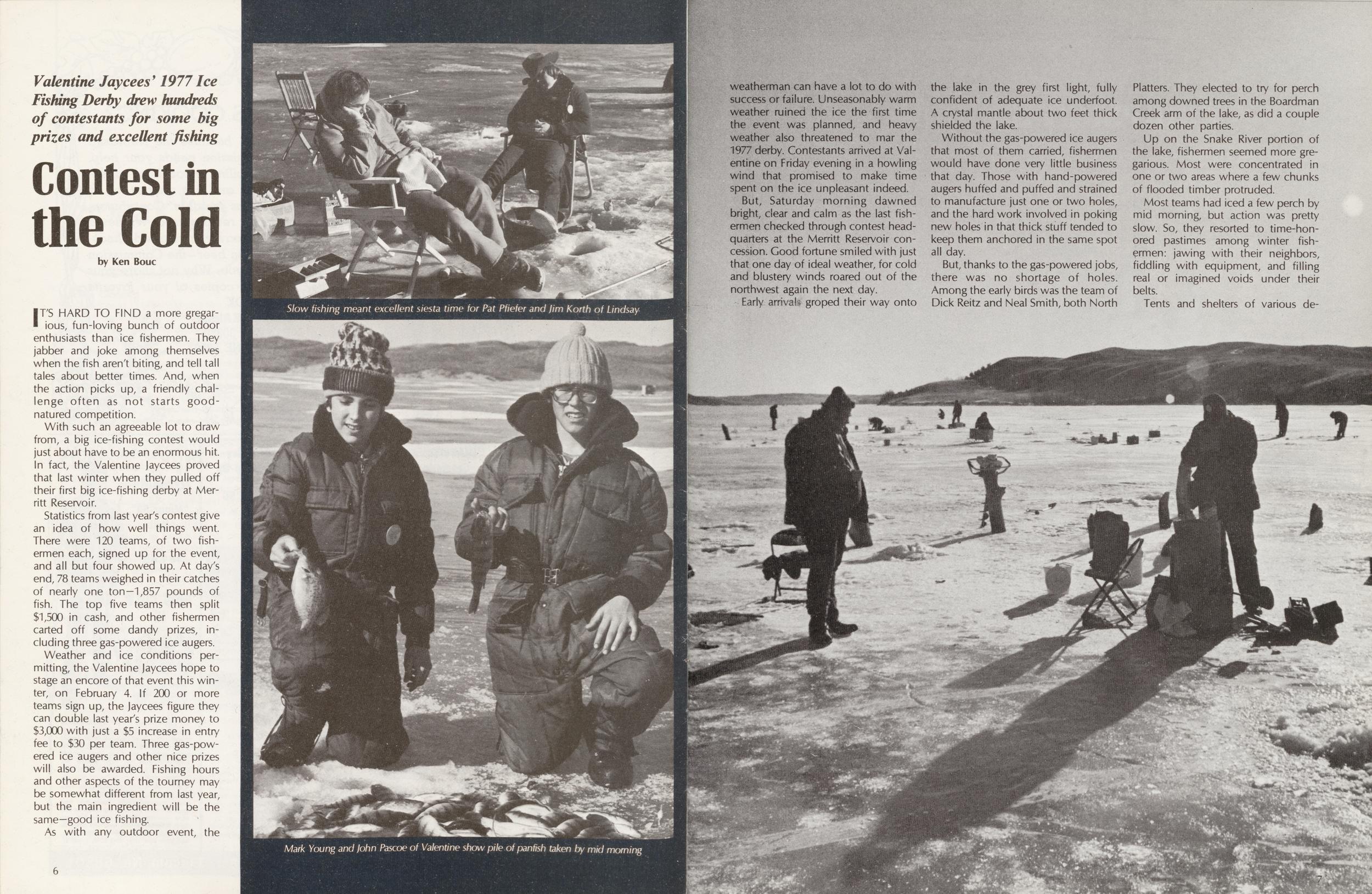
Contest in the Cold
Valentine Jaycees’ 1977 Ice Fishing Derby drew hundreds of contestants for some big prizes and excellent fishing by Ken BoucIT'S HARD TO FIND a more gregarious, fun-loving bunch of outdoor enthusiasts than ice fishermen. They jabber and joke among themselves when the fish aren't biting, and tell tall tales about better times. And, when the action picks up, a friendly challenge often as not starts good-natured competition.
With such an agreeable lot to draw from, a big ice-fishing contest would just about have to be an enormous hit. In fact, the Valentine Jaycees proved that last winter when they pulled off their first big ice-fishing derby at Merritt Reservoir.
Statistics from last year's contest give an idea of how well things went. There were 120 teams, of two fishermen each, signed up for the event, and all but four showed up. At day's end, 78 teams weighed in their catches of nearly one ton—1,857 pounds of fish. The top five teams then split $1,500 in cash, and other fishermen carted off some dandy prizes, including three gas-powered ice augers.
Weather and ice conditions permitting, the Valentine Jaycees hope to stage an encore of that event this winter, on February 4. If 200 or more teams sign up, the Jaycees figure they can double last year's prize money to $3,000 with just a $5 increase in entry fee to $30 per team. Three gas-powered ice augers and other nice prizes will also be awarded. Fishing hours and other aspects of the tourney may be somewhat different from last year, but the main ingredient will be the same-good ice fishing.
As with any outdoor event, the weatherman can have a lot to do with success or failure. Unseasonably warm weather ruinea the ice the first time the event was planned, and heavy weather also threatened to mar the 1977 derby. Contestants arrived at Valentine on Friday evening in a howling wind that promised to make time spent on the ice unpleasant indeed.
But, Saturday morning dawned bright, clear and calm as the last fishermen checked through contest headquarters at the Merritt Reservoir concession. Good fortune smiled with just that one day of ideal weather, for cold and blustery winds roared out of the northwest again the next day.
Early arrivals groped their way onto the lake in the grey first light, fully confident of adequate ice underfoot. A crystal mantle about two feet thick shielded the lake.
Without the gas-powered ice augers that most of them carried, fishermen would have done very little business that day. Those with hand-powered augers huffed and puffed and strained to manufacture just one or two holes, and the hard work involved in poking new holes in that thick stuff tended to keep them anchored in the same spot all day.
But, thanks to the gas-powered jobs, there was no shortage of holes. Among the early birds was the team of Dick Reitz and Neal Smith, both North Platters. They elected to try for perch among downed trees in the Boardman Creek arm of the lake, as did a couple dozen other parties.
Up on the Snake River portion of the lake, fishermen seemed more gregarious. Most were concentrated in one or two areas where a few chunks of flooded timber protruded.
Most teams had iced a few perch by mid morning, but action was pretty slow. So, they resorted to time-honored pastimes among winter fishermen: jawing with their neighbors, fiddling with equipment, and filling real or imagined voids under their belts.
Tents and shelters of various description
 Contest in the Cold
Ice fishermen from all over Nebraska enjoyed the
outing, whether fish cooperated or not. Weather
permitting, the Valentine Jaycees intend to make
1978 Ice Fishing Derby even bigger than last year’s
Contest in the Cold
Ice fishermen from all over Nebraska enjoyed the
outing, whether fish cooperated or not. Weather
permitting, the Valentine Jaycees intend to make
1978 Ice Fishing Derby even bigger than last year’s
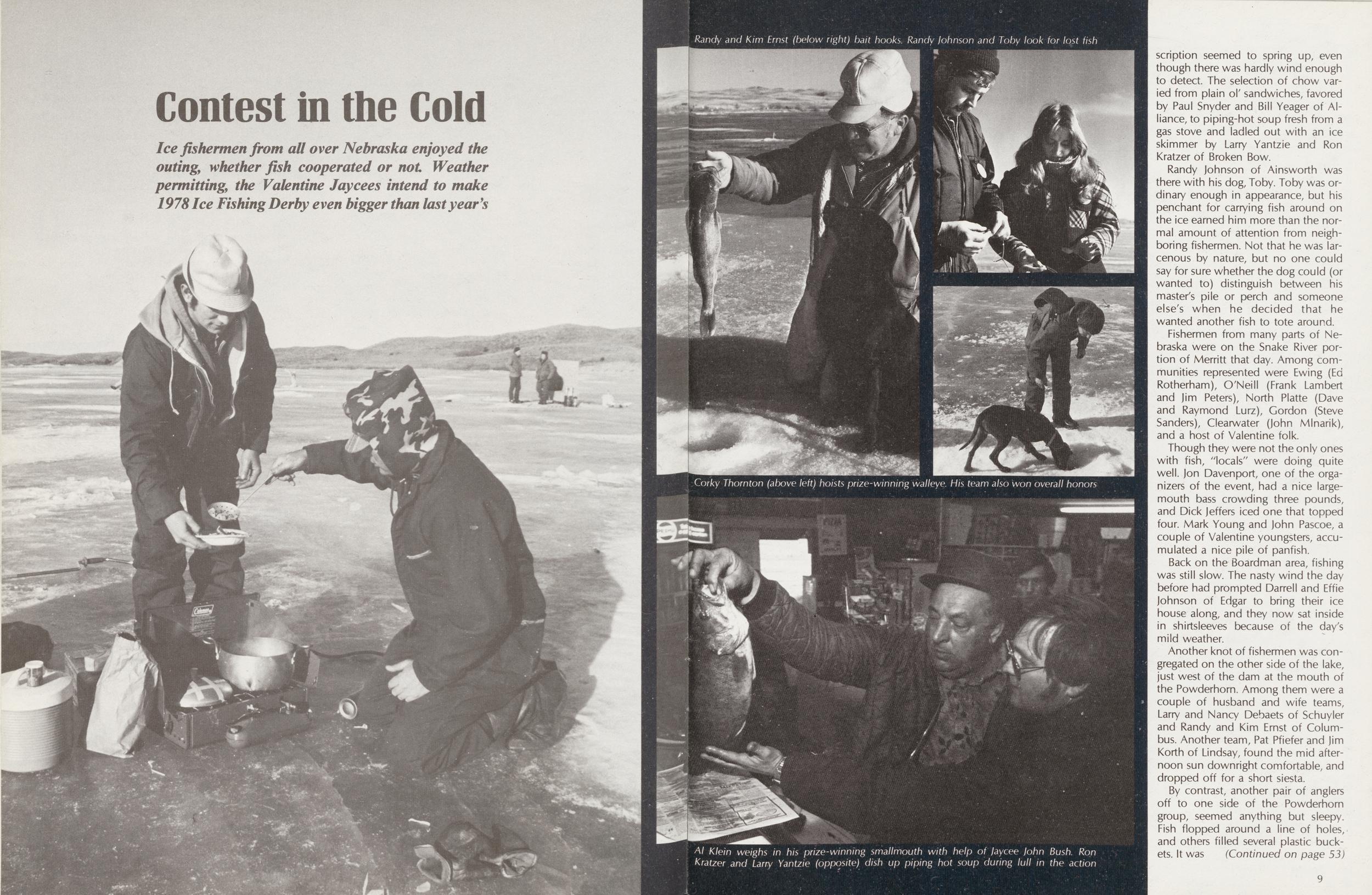
Randy Johnson of Ainsworth was there with his dog, Toby. Toby was ordinary enough in appearance, but his penchant for carrying fish around on the ice earned him more than the normal amount of attention from neighboring fishermen. Not that he was larcenous by nature, but no one could say for sure whether the dog could (or wanted to) distinguish between his master's pile or perch and someone else's when he decided that he wanted another fish to tote around.
Fishermen from many parts of Nebraska were on the Snake River portion of Merritt that day. Among communities represented were Ewing (Ed Rotherham), O'Neill (Frank Lambert and Jim Peters), North Platte (Dave and Raymond Lurz), Gordon (Steve Sanders), Clearwater (John Mlnarik), and a host of Valentine folk.
Though they were not the only ones with fish, "locals" were doing quite well. Jon Davenport, one of the organizers of the event, had a nice largemouth bass crowding three pounds, and Dick Jeffers iced one that topped four. Mark Young and John Pascoe, a couple of Valentine youngsters, accumulated a nice pile of panfish.
Back on the Boardman area, fishing was still slow. The nasty wind the day before had prompted Darrell and Effie Johnson of Edgar to bring their ice house along, and they now sat inside in shirtsleeves because of the day's mild weather.
Another knot of fishermen was congregated on the other side of the lake, just west of the dam at the mouth of the Powderhorn. Among them were a couple of husband and wife teams, Larry and Nancy Debaets of Schuyler and Randy and Kim Ernst of Columbus. Another team, Pat Pfiefer and Jim Korth of Lindsay, found the mid afternoon sun downright comfortable, and dropped off for a short siesta.
By contrast, another pair of anglers off to one side of the Powderhorn group, seemed anything but sleepy. Fish flopped around a line of holes, and others filled several plastic buckets. It was (Continued on page 53)
9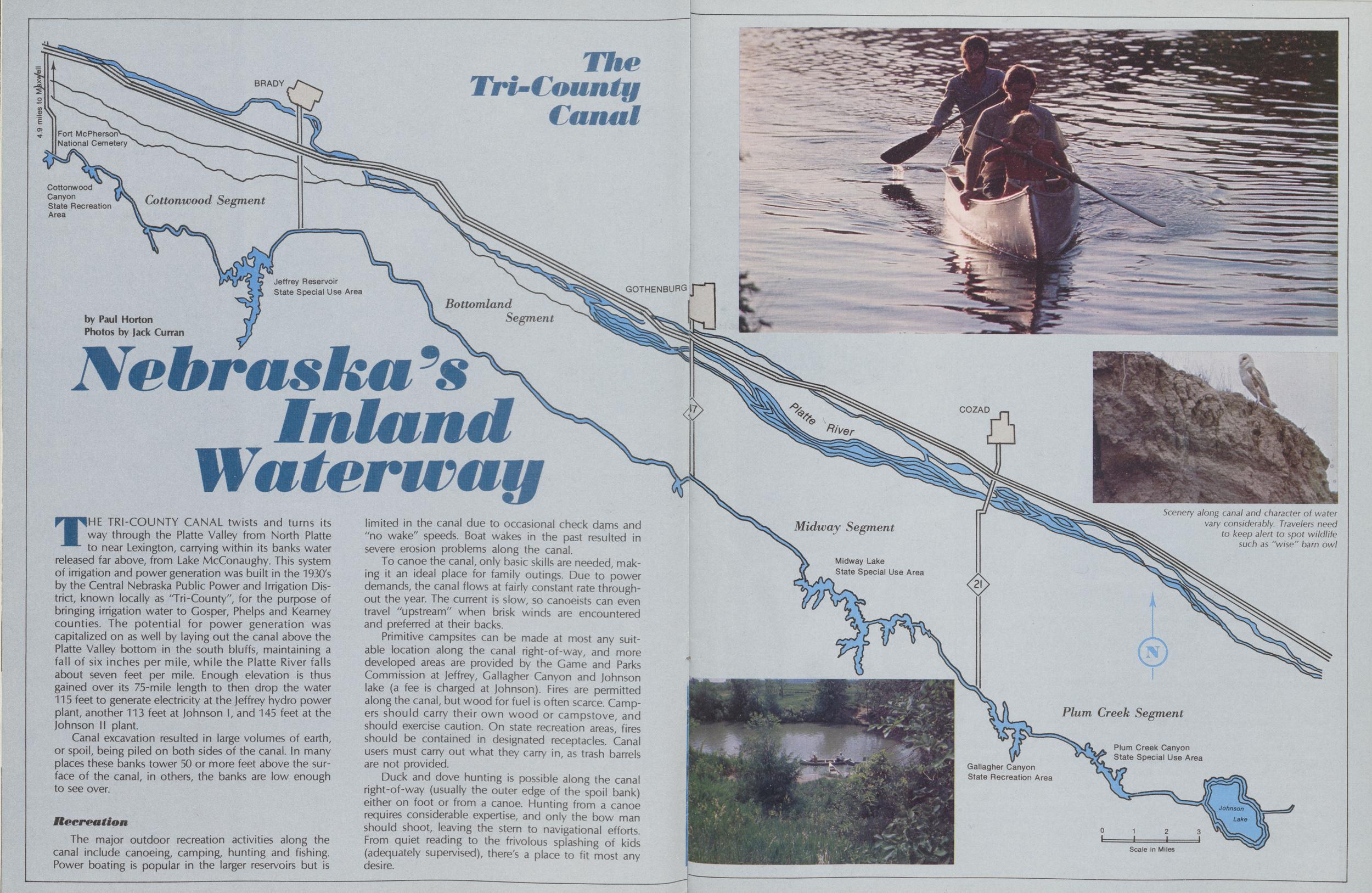
Nebraska's Inland Waterway
THE TRI-COUNTY CANAL twists and turns its way through the Platte Valley from North Platte to near Lexington, carrying within its banks water released far above, from Lake McConaughy. This system of irrigation and power generation was built in the 1930's by the Central Nebraska Public Power and Irrigation District, known locally as 'Tri-County", for the purpose of bringing irrigation water to Gosper, Phelps and Kearney counties. The potential for power generation was capitalized on as well by laying out the canal above the Platte Valley bottom in the south bluffs, maintaining a fall of six inches per mile, while the Platte River falls about seven feet per mile. Enough elevation is thus gained over its 75-mile length to then drop the water 115 feet to generate electricity at the Jeffrey hydro power plant, another 113 feet at Johnson I, and 145 feet at the Johnson II plant.
Canal excavation resulted in large volumes of earth, or spoil, being piled on both sides of the canal. In many places these banks tower 50 or more feet above the surface of the canal, in others, the banks are low enough to see over.
RecreationThe major outdoor recreation activities along the canal include canoeing, camping, hunting and fishing. Power boating is popular in the larger reservoirs but is limited in the canal due to occasional check dams and "no wake" speeds. Boat wakes in the past resulted in severe erosion problems along the canal.
To canoe the canal, only basic skills are needed, making it an ideal place for family outings. Due to power demands, the canal flows at fairly constant rate throughout the year. The current is slow, so canoeists can even travel "upstream" when brisk winds are encountered and preferred at their backs.
Primitive campsites can be made at most any suitable location along the canal right-of-way, and more developed areas are provided by the Game and Parks Commission at Jeffrey, Gallagher Canyon and Johnson lake (a fee is charged at Johnson). Fires are permitted along the canal, but wood for fuel is often scarce. Campers should carry their own wood or campstove, and should exercise caution. On state recreation areas, fires should be contained in designated receptacles. Canal users must carry out what they carry in, as trash barrels are not provided.
Duck and dove hunting is possible along the canal right-of-way (usually the outer edge of the spoil bank) either on foot or from a canoe. Hunting from a canoe requires considerable expertise, and only the bow man should shoot, leaving the stern to navigational efforts. From quiet reading to the frivolous splashing of kids (adequately supervised), there's a place to fit most any desire.
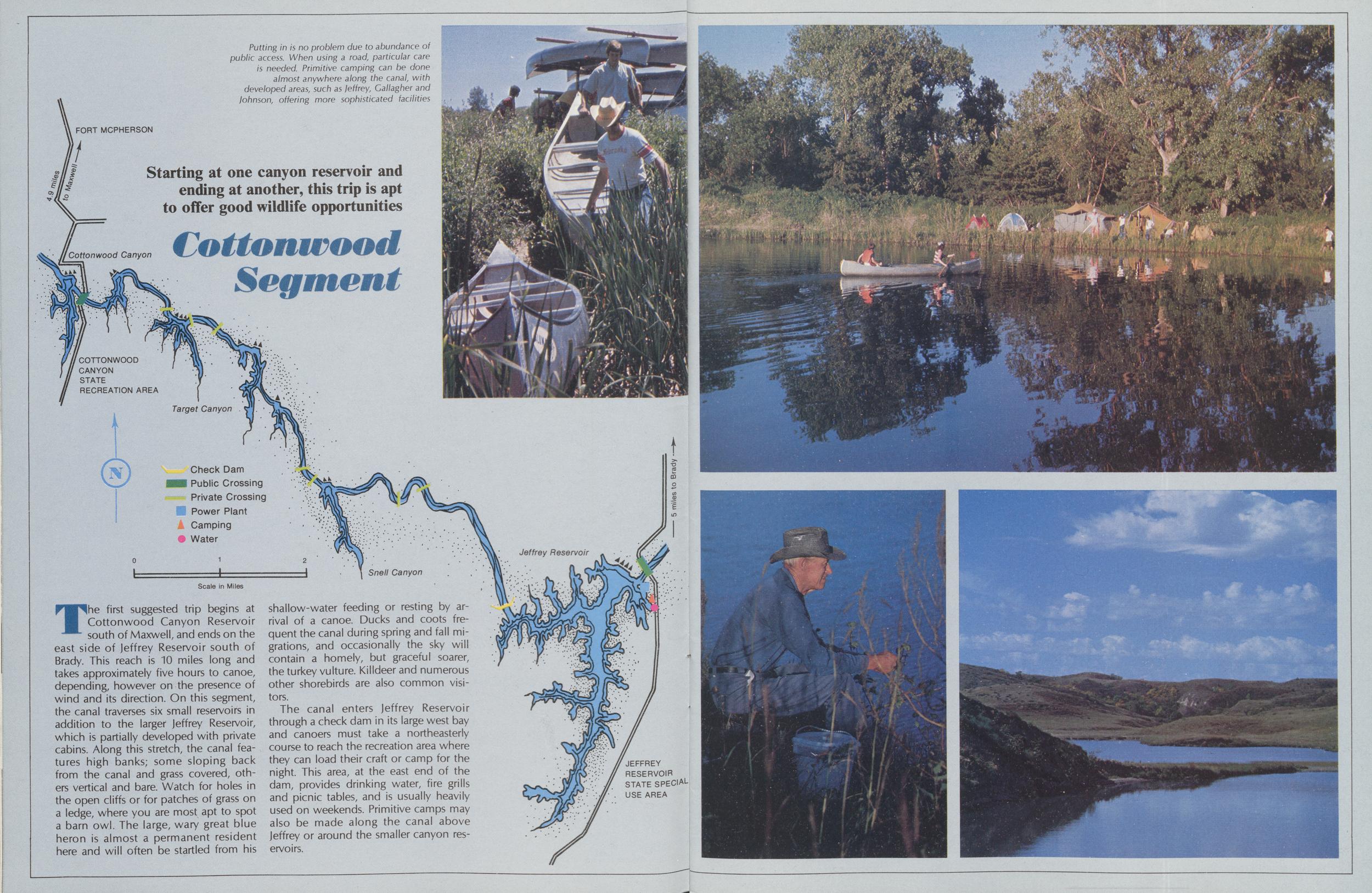
The first suggested trip begins at Cottonwood Canyon Reservoir south of Maxwell, and ends on the east side of Jeffrey Reservoir south of Brady. This reach is 10 miles long and takes approximately five hours to canoe, depending, however on the presence of wind and its direction. On this segment, the canal traverses six small reservoirs in addition to the larger Jeffrey Reservoir, which is partially developed with private cabins. Along this stretch, the canal fetures high banks; some sloping back from the canal and grass covered, others vertical and bare. Watch for holes in the open cliffs or for patches of grass on a ledge, where you are most apt to spot a barn owl. The large, wary great blue heron is almost a permanent resident here and will often be startled from his shallow-water feeding or resting by arrival of a canoe. Ducks and coots frequent the canal during spring and fall migrations, and occasionally the sky will contain a homely, but graceful soarer, the turkey vulture. Killdeer and numerous other shorebirds are also common visitors.
The canal enters Jeffrey Reservoir through a check dam in its large west bay and canoers must take a northeasterly course to reach the recreation area where they can load their craft or camp for the night. This area, at the east end of the dam, provides drinking water, fire grills and picnic tables, and is usually heavily used on weekends. Primitive camps may also be made along the canal above Jeffrey or around the smaller canyon reservoirs.
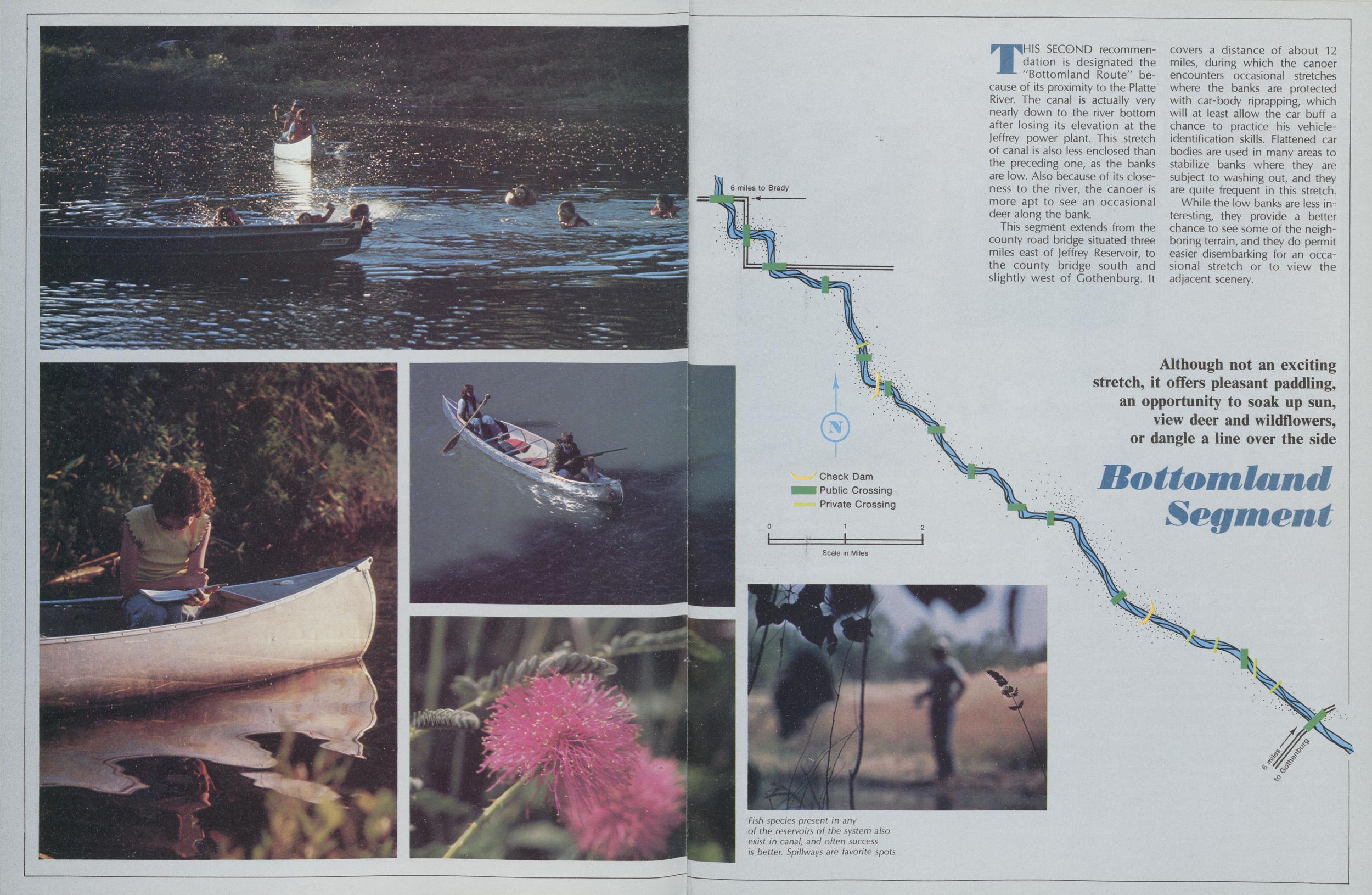
THIS SECOND recommendation is designated the "Bottomland Route" because of its proximity to the Platte River. The canal is actually very nearly down to the river bottom after losing its elevation at the Jeffrey power plant. This stretch of canal is also less enclosed than the preceding one, as the banks are low. Also because of its closeness to the river, the canoer is more apt to see an occasional deer along the bank.
This segment extends from the county road bridge situated three miles east of Jeffrey Reservoir, to the county bridge south and slightly west of Gothenburg. It covers a distance of about 12 miles, during which the canoer encounters occasional stretches where the banks are protected with car-body riprapping, which will at least allow the car buff a chance to practice his vehicle-identification skills. Flattened car bodies are used in many areas to stabilize banks where they are subject to washing out, and they are quite frequent in this stretch.
While the low banks are less interesting, they provide a better chance to see some of the neighboring terrain, and they do permit easier disembarking for an occasional stretch or to view the adjacent scenery.
Although not an exciting stretch, it offers pleasant paddling, an opportunity to soak up sun, view deer and wildflowers, or dangle a line over the side Bottomland Segment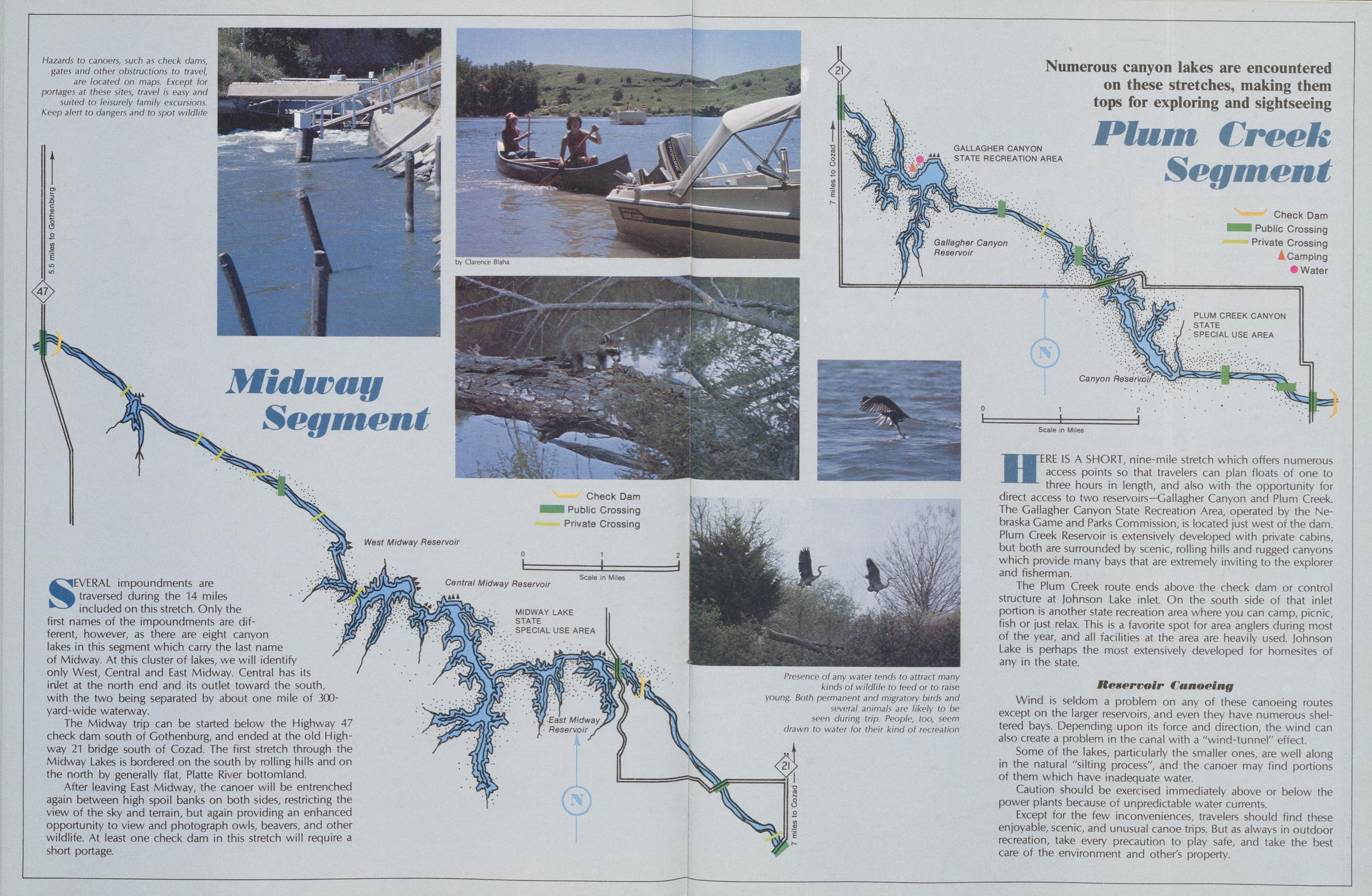 Midway
Segment
Midway
Segment
SEVERAL impoundments are I traversed during the 14 miles included on this stretch. Only the first names of the impoundments are different, however, as there are eight canyon lakes in this segment which carry the last name of Midway. At this cluster of lakes, we will identify only West, Central and East Midway. Central has its inlet at the north end and its outlet toward the south, with the two being separated by about one mile of 300-yard-wide waterway.
The Midway trip can be started below the Highway 47 check dam south of Gothenburg, and ended at the old Highway 21 bridge south of Cozad. The first stretch through the Midway Lakes is bordered on the south by rolling hills and on the north by generally flat, Platte River bottomland.
After leaving East Midway, the canoer will be entrenched again between high spoil banks on both sides, restricting the view of the sky and terrain, but again providing an enhanced opportunity to view and photograph owls, beavers, and other wildlife. At least one check dam in this stretch will require a short portage.
HERE IS A SHORT, nine-mile stretch which offers numerous access points so that travelers can plan floats of one to three hours in length, and also with the opportunity for direct access to two reservoirs—Gallagher Canyon and Plum Creek. The Gallagher Canyon State Recreation Area, operated by the Nebraska Game and Parks Commission, is located just west of the dam. Plum Creek Reservoir is extensively developed with private cabins, but both are surrounded by scenic, rolling hills and rugged canyons which provide many bays that are extremely inviting to the explorer and fisherman.
The Plum Creek route ends above the check dam or control structure at Johnson Lake inlet. On the south side of that inlet portion is another state recreation area where you can camp, picnic, fish or just relax. This is a favorite spot for area anglers during most of the year, and all facilities at the area are heavily used. Johnson Lake is perhaps the most extensively developed for homesites of any in the state.
Reservoir CanoeingWind is seldom a problem on any of these canoeing routes except on the larger reservoirs, and even they have numerous sheltered bays. Depending upon its force and direction, the wind can also create a problem in the canal with a "wind-tunnel" effect.
Some of the lakes, particularly the smaller ones, are well along in the natural "silting process", and the canoer may find portions of them which have inadequate water.
Caution should be exercised immediately above or below the power plants because of unpredictable water currents.
Except for the few inconveniences, travelers should find these enjoyable, scenic, and unusual canoe trips. But as always in outdoor recreation, take every precaution to play safe, and take the best care of the environment and other's property.
Vacation Nebraska
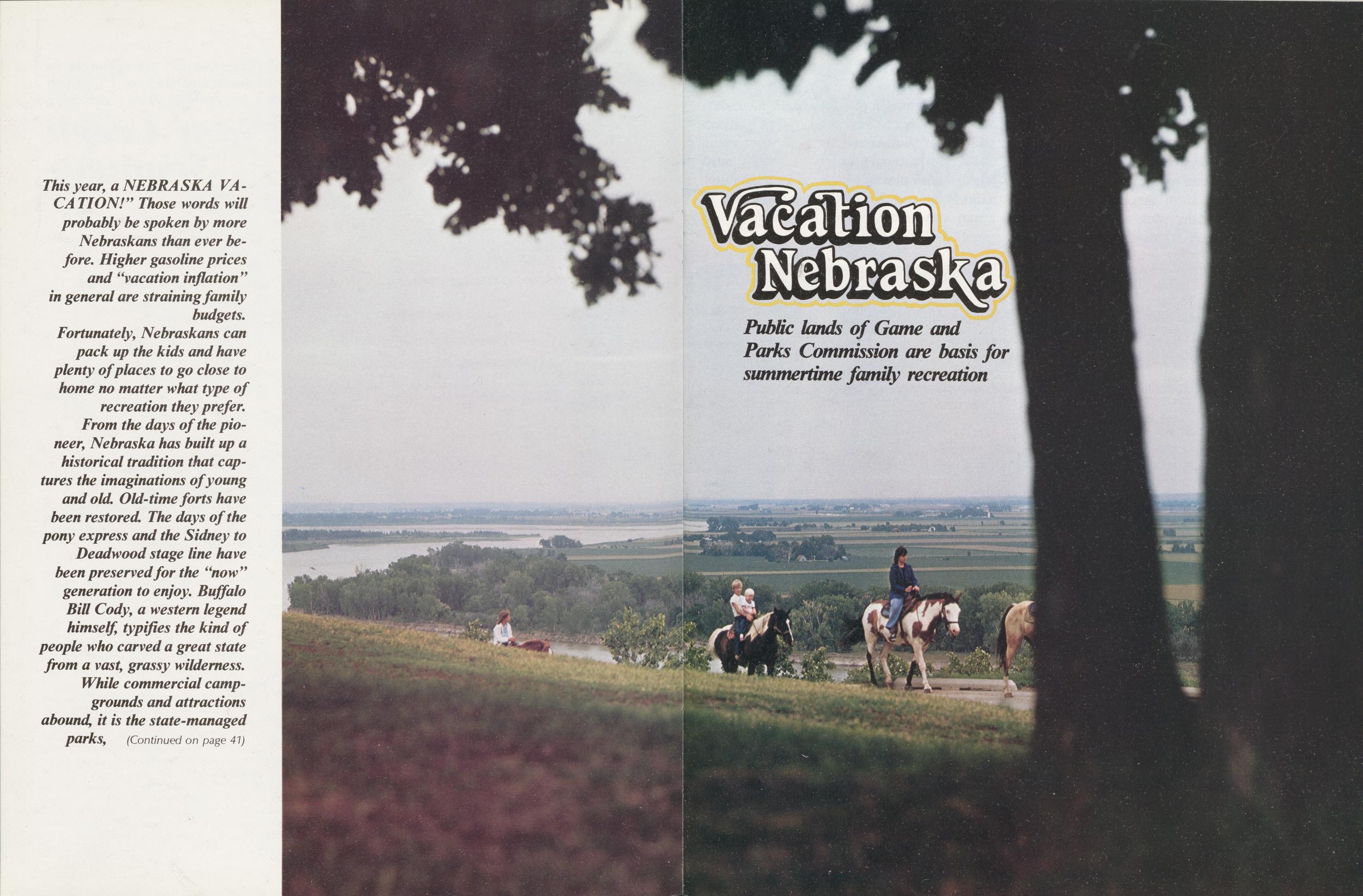
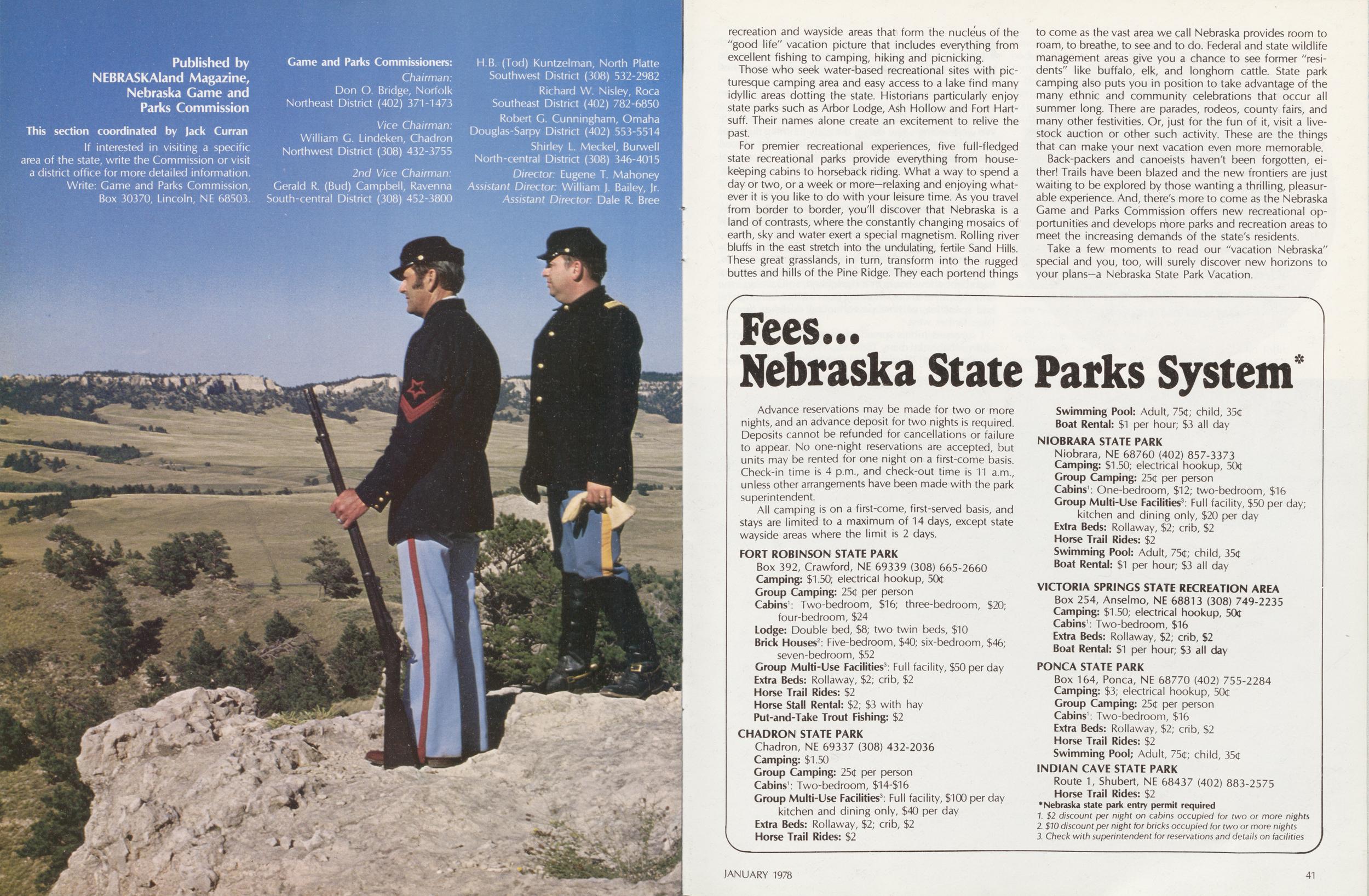
Public lands of Game and Parks Commission are basis for summertime family recreationThis year, a NEBRASKA VACATION!” Those words will probably be spoken by more Nebraskans than ever before. Higher gasoline prices and “vacation inflation” in general are straining family budgets.
Fortunately, Nebraskans can pack up the kids and have plenty of places to go close to home no matter what type of recreation they prefer.
From the days of the pioneer, Nebraska has built up a historical tradition that captures the imaginations of young and old. Old-time forts have been restored The days of the pony express and the Sidney to Deadwood stage line have been preserved for the “now” generation to enjoy. Buffalo Bill Cody, a western legend himself, typifies the kind of people who carved a great state from a vast, grassy wilderness.
While commercial campgrounds and attractions abound, it is the state-managed parks, (Continued on page 41)
 Vacation Nebraska
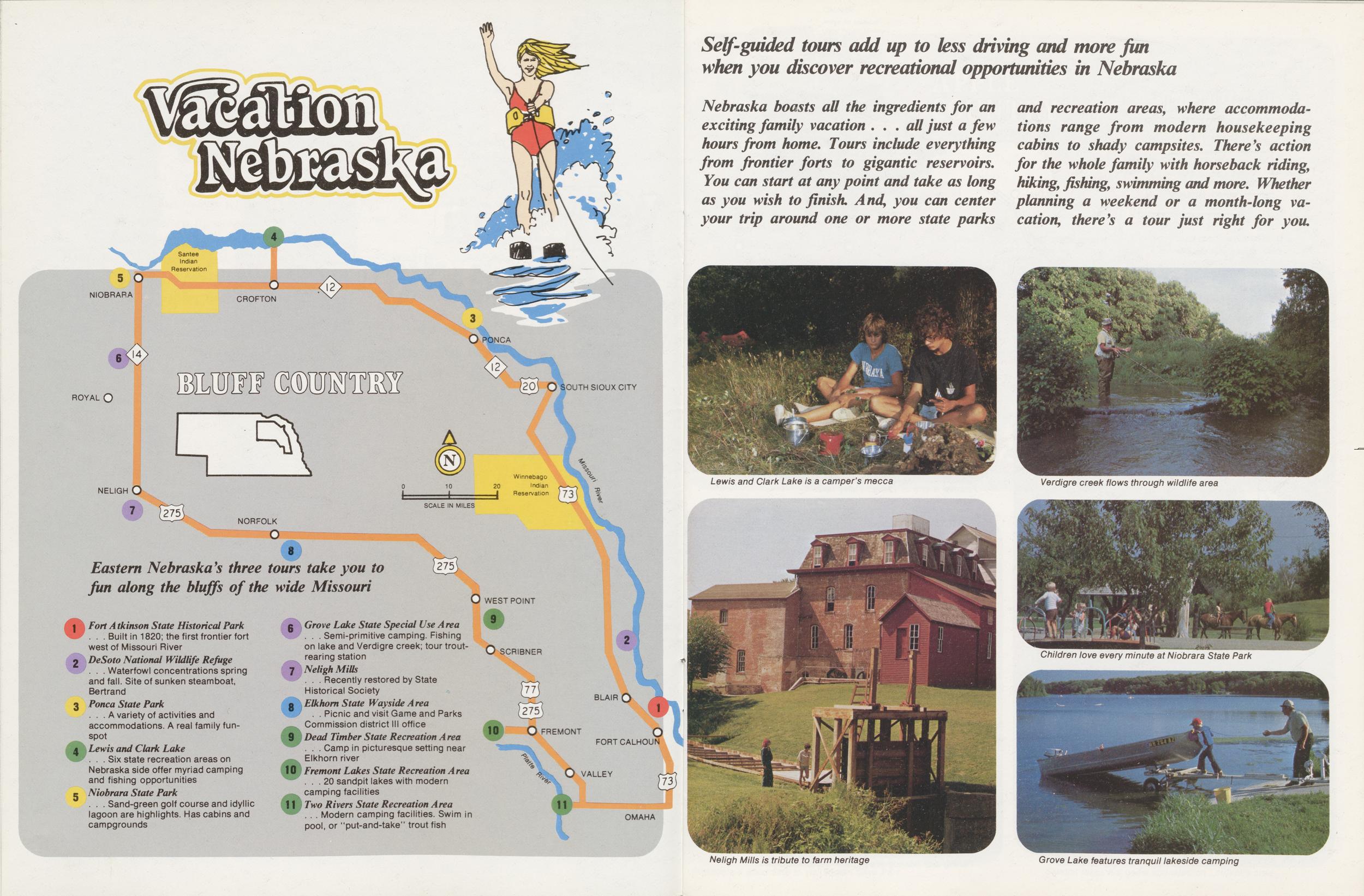
Nebraska boasts all the ingredients for an exciting family vacation ... all just a few hours from home. Tours include everything from frontier forts to gigantic reservoirs. You can start at any point and take as long as you wish to finish. And, you can center your trip around one or more state parks and recreation areas, where accommodations range from modern housekeeping cabins to shady campsites. There’s action for the whole family with horseback riding, hiking, fishing, swimming and more. Whether planning a weekend or a month-long vacation, there’s a tour just right for you.
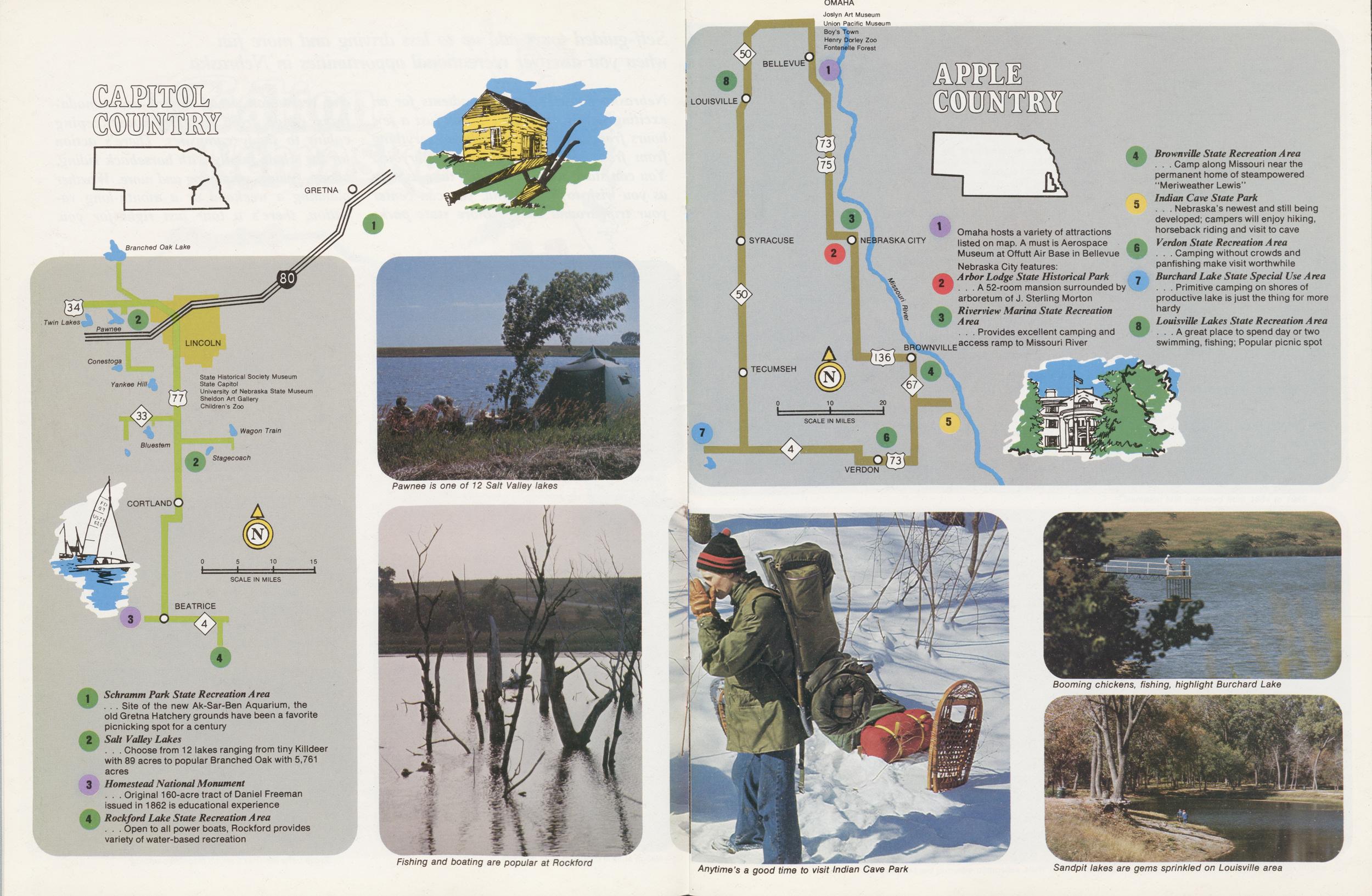 Capitol
Country
Capitol
Country
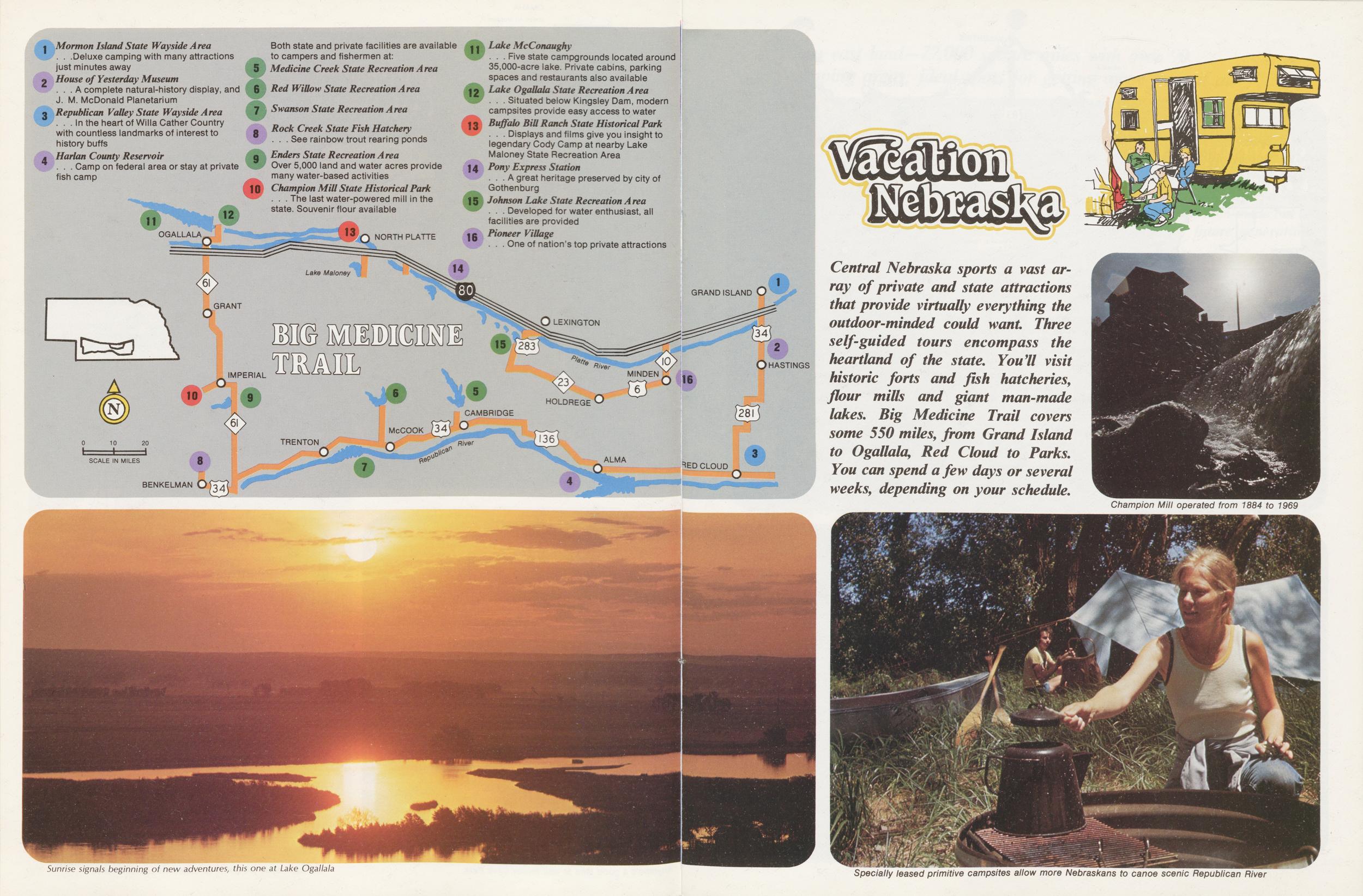 BIG MEDICINE TRAIL
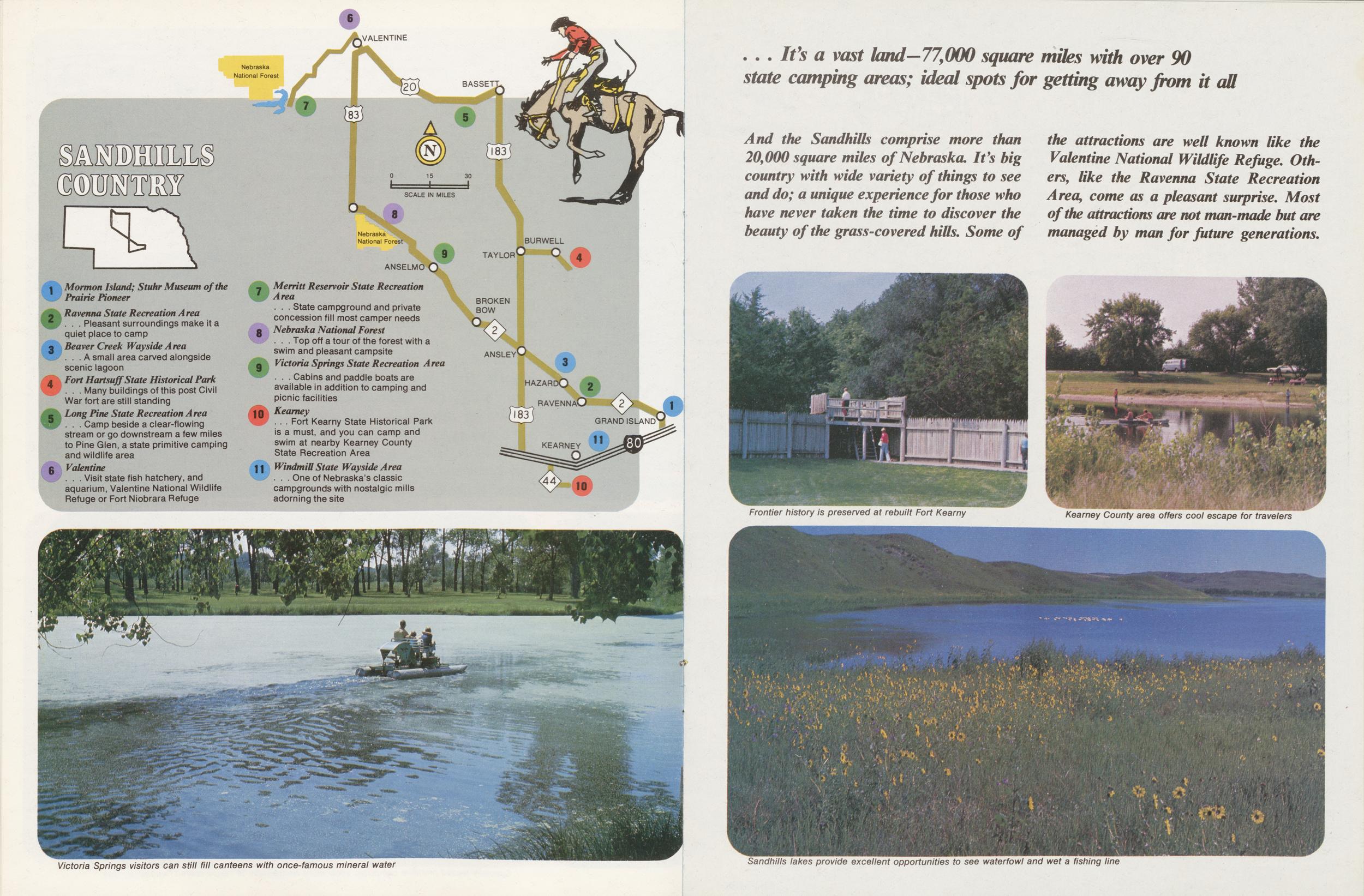 SANDHILLS
COUNTRY
SANDHILLS
COUNTRY
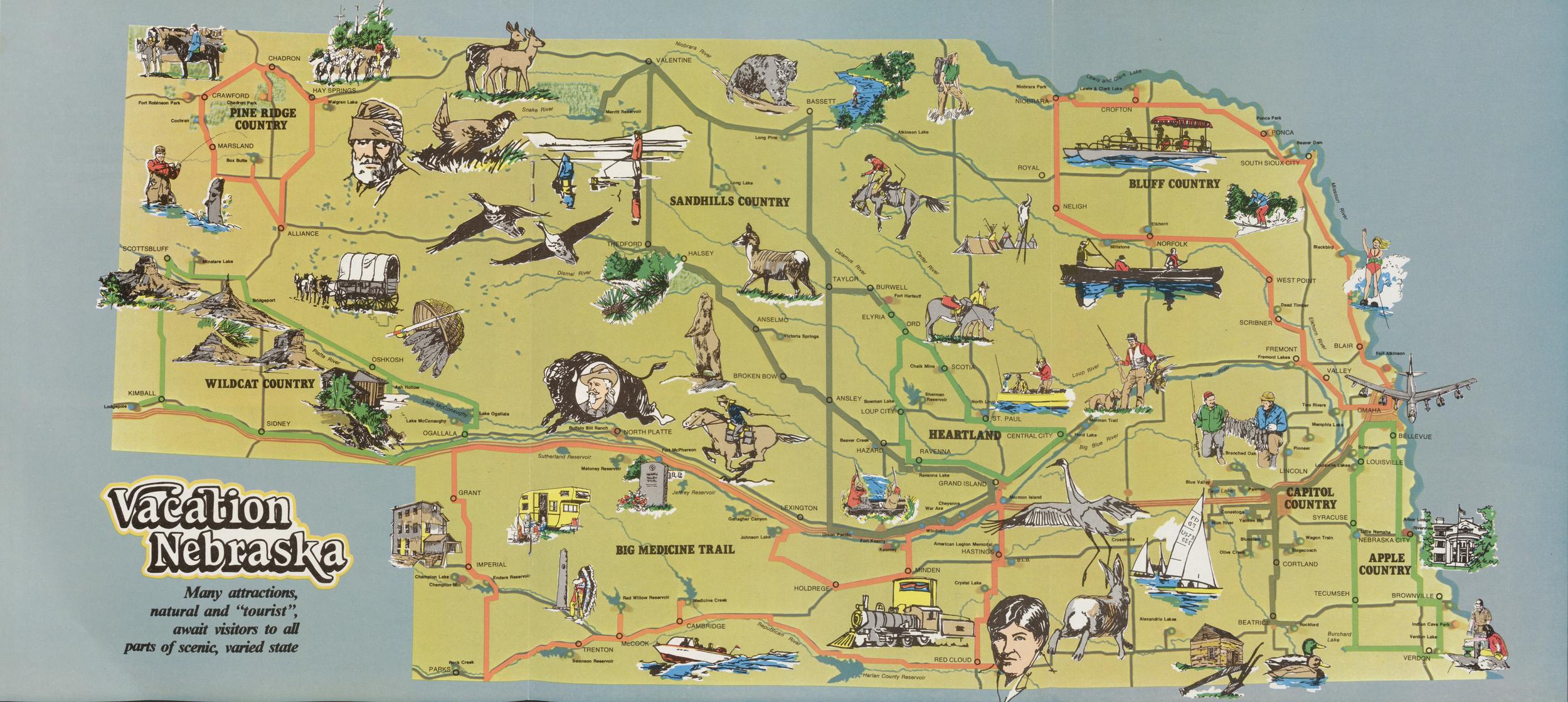
 Vacation Nebraska
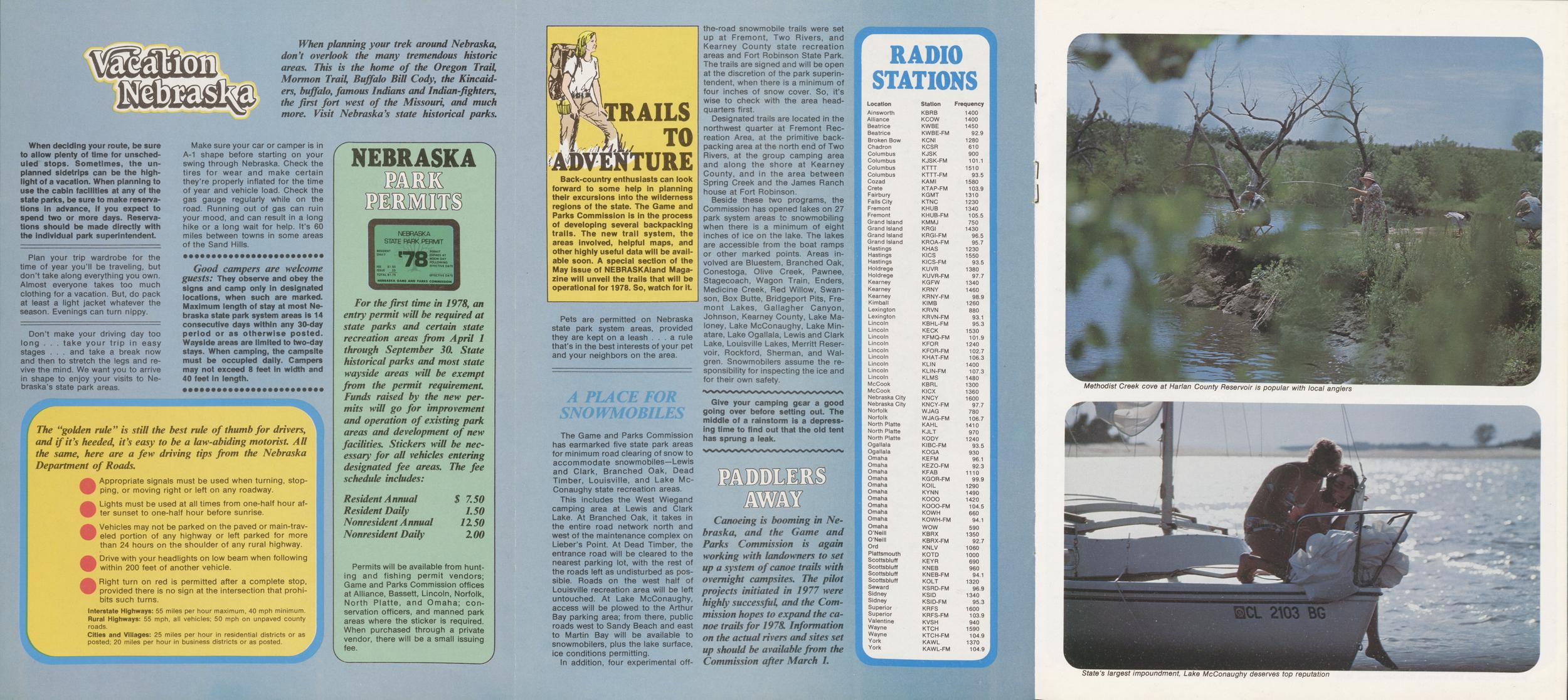
When planning your trek around Nebraska, don't overlook the many tremendous historic areas. This is the home of the Oregon Trail, Mormon Trail, Buffalo Bill Cody, the Kincaiders, buffalo, famous Indians and Indian-fighters, the first fort west of the Mnissouri, and much more. Visit Nebraska's state historical parks.
When deciding your route, be sure to allow plenty of time for unscheduled stops. Sometimes, the unplanned sidetrips can be the highlight of a vacation. When planning to use the cabin facilities at any of the state parks, be sure to make reservations in advance, if you expect to spend two or more days. Reservations should be made directly with the individual park superintendant.
Plan your trip wardrobe for the time of year you'll be travelling, but don't take along everthing you own. Almost everyone takes too much clothing for a vacation. But, do pack at least a light jacket whatever the season. Evenings can turn nippy.
Don't make your driving day too long... take your trip in easy stages... and take a break now and then to stretch the legs and revive the mind. We want you to arrive in shape to enjoy your visits to Nebraska's state park areas.
Make sure your car or camper is in A-1 shape before starting on your swing through Nebraska. Check the tires for wear and make certain they're properly inflated for the time of year and vehicle load. Check the gas gauge regularly while on the road. Running out of gas can ruin your mood, and can result in a long hike or a long wait for help. It's 60 miles between towns in some areas of the Sand Hills.
Goopd campers are welcome guests: They observe and obey the signs and camp only in designated locations, when such are marked. Maximum length of stay at most Nebraska state park system areas is 14 consecutive days within any 30-day period or as otherwise posted. Wayside ares are limited to two-day stays. When camping, the campsite must be occupied daily. Campers may not exceed 8 feet in width and 40 feet in length.
The "golden rule" is still the best rule of thumb for driverws, and if it's heeded, it's easy to be a law-abiding motorist. All the same, here are a few driving tips from the Nebraska Department of Roads. Appriopriate signals must be used when turning, stopping, or moving right or left on any roadway. Lights must be used at all times from one-half hour after sunset to one-half hour before sunrise. Vehicles may not be parked on the paved or main-traveled portion of any highway or left parked for more than 24 hours on the shoulder of any rural highway. Frive with your headlights on low beam when following within 200 feet of another vehicle. Right turn on red is permitted after a complete stop, provided there is no sign at the intersection that prohibits sucht turns. Insterstate Highways: 55 miles per hour maximum, 40 mph minimum. Rural Highways: 55 mph, all vehicles, 50 mph on unpaved county roads. Cities and VillagesL 25 miles per hour in residential districts or as posted, 20 miles per hour in business districts or as posted. NEBRASKA PARK PERMITS For the first time in 1978, an entry permit will be required at state parks and certain state recreation areas fro April 1 through September 30. State historical parks and most state wayside areas will be exempt from the permit requirement. Funds raised by the new permits will go for improvement and operation of existing park areas and development of new facilities. Stickers will be necessary for all vehicles enetering designated fee areas. The fee schedule includes: Resident Annual $7.50 Resident Daily 1.50 Nonresident Annual 12.50 Nonresident Daily 2.00 Permits will be available from hunting and fishing permit vendors; Game and Parks Commission offices at Alliance, Bassett, Lincoln Norfolk, North Platte, and Omaha; conservation officers, and manned park areas where the sticker is required. When purchased through a private vendor, there will be a small issuing fee. TRAILS TO ADVENTURE Back-country enthusiasts can look forward to some help in planning their excursions into the wilderness regions of the state. The Game and Parks Comission is in the process of developing several backpacking trails. The new trail system, the areas involved, helpful maps, nad other highly useful data will be available soon. A specual section of the May issue of NEBRASKAland Magazine will unveil the trails that will be operational for 19788. So, watch for it.Pets are permitted on Nebraska state park system areas, provided they are kept on a leash... a rule that's in the best interests of your pet and your neighbors on the are.
A PLACE FOR SNOWMOBILESThe Game and Parks Commission has earmarked five state park areas for minimum road clearing or snow to accommodate snowmobiles-Lewis and Clark, Branched Oak, Dead Timber, Louisville, and Lake McConaughy state recreation areas.
This includes the West Wiegand camping area at Lewis and Clark Lake. At Branched Oak, it takes in the entire road network north and west of the maintenance complex on Lieber's Point. At Dead Timber, the entrance road will be cleared to the nearest parking lot, with the rest of the roads left as undisturbed as possible. Roads on the west half of Louisville recreation area will be left untouched. At Lake McConaughy, access will be plowed to the Arthur Bay parking area; from there, public roads west to Sandy Beach and east to Martin Bay will be available to snowmobilers, plus the lake surface, ice condition permitting.
In addition, four experimental off-the-road snowmobile trails were set up at Fremont, Tow Rivers, and Kearney County state recreation areas and Fort Robinson State Park. Thre trails are signed and will be open at the discretion of the park superintendant, when there is a minimum of four inches of snow cover. So, it's wise to check with the area headquarters first.
Designated trails are located in the northwest quarter at Fremont Recreation Area, at the primitive backpacking area at the north end of Two Rivers, at the group camping area and along the shore at Kearney County, and in the area between Spring Creek and the James Ranch house at Fort Robinson
Beside these two programs, the Commission has opened lakes on 27 park system areas to snowmobiling when there is a minimu of eight inches of ice on the lake. The lakes are accessible from the boat ramps or other marked points. Areas involved are Luestem, Branched Oak, Conestoga, Olive Creek, Pawnee, Stagecoach, Wagon Train, Enders, Medicine Creek, Red Willow, Swanson, Box Butte, Bridgeport Pits, Fremont L;akes, Gallagher Canyon, Johnson, Kearney County, Lake Maloney, Lake MacConaughy, Lake Minatare, Lake Ogallal, Lewis and Clark Lake, Louisville Lakes, Merritt Reservoir, Rockford, Sherman, and Walgren. Snowmobilers assume the responsibility for inspecting the ice and fore their own safety.
Give your camping gear a good going over before setting out. The middle of a rainstorm is a depressing time to find out that the old tent has sprung a leak.
PADDLERS AWAY Canoeing is booming in Nebraska, and the Game and Parks Commission is again working with landowners to set up a system of canoe trails with overnight campsites. The pilot projects initiated in 1977 were highly successful, and the Commission hopes to expand the canoe trails for 1978. Information on the actual rivers and sites set up should be available from the Commission after MArch 1. RADIO STATIONS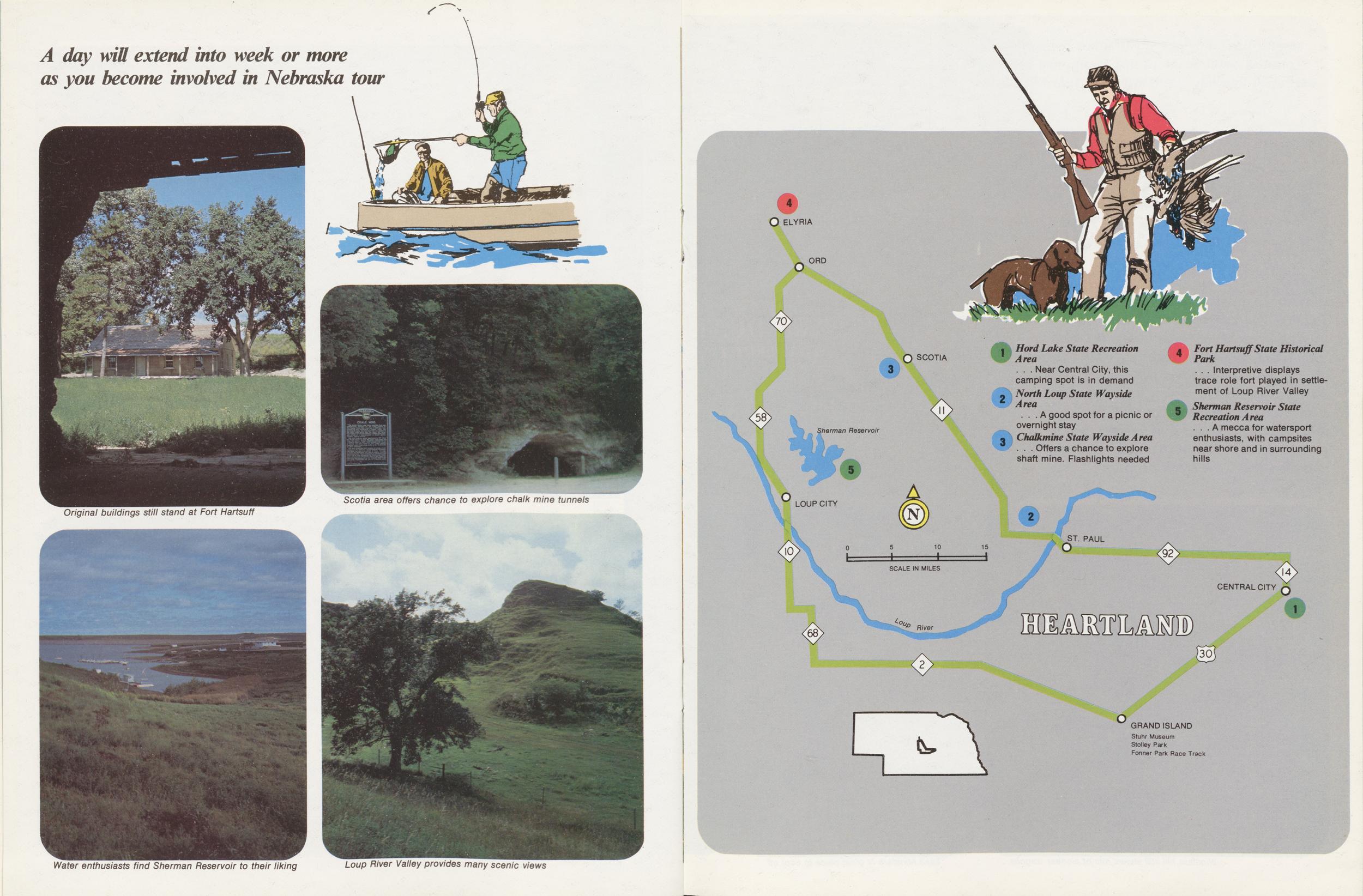 HEARTLAND
A day will extend into week or more
as you become involved in Nebraska tour
HEARTLAND
A day will extend into week or more
as you become involved in Nebraska tour
 WILDCAT COUNTRY
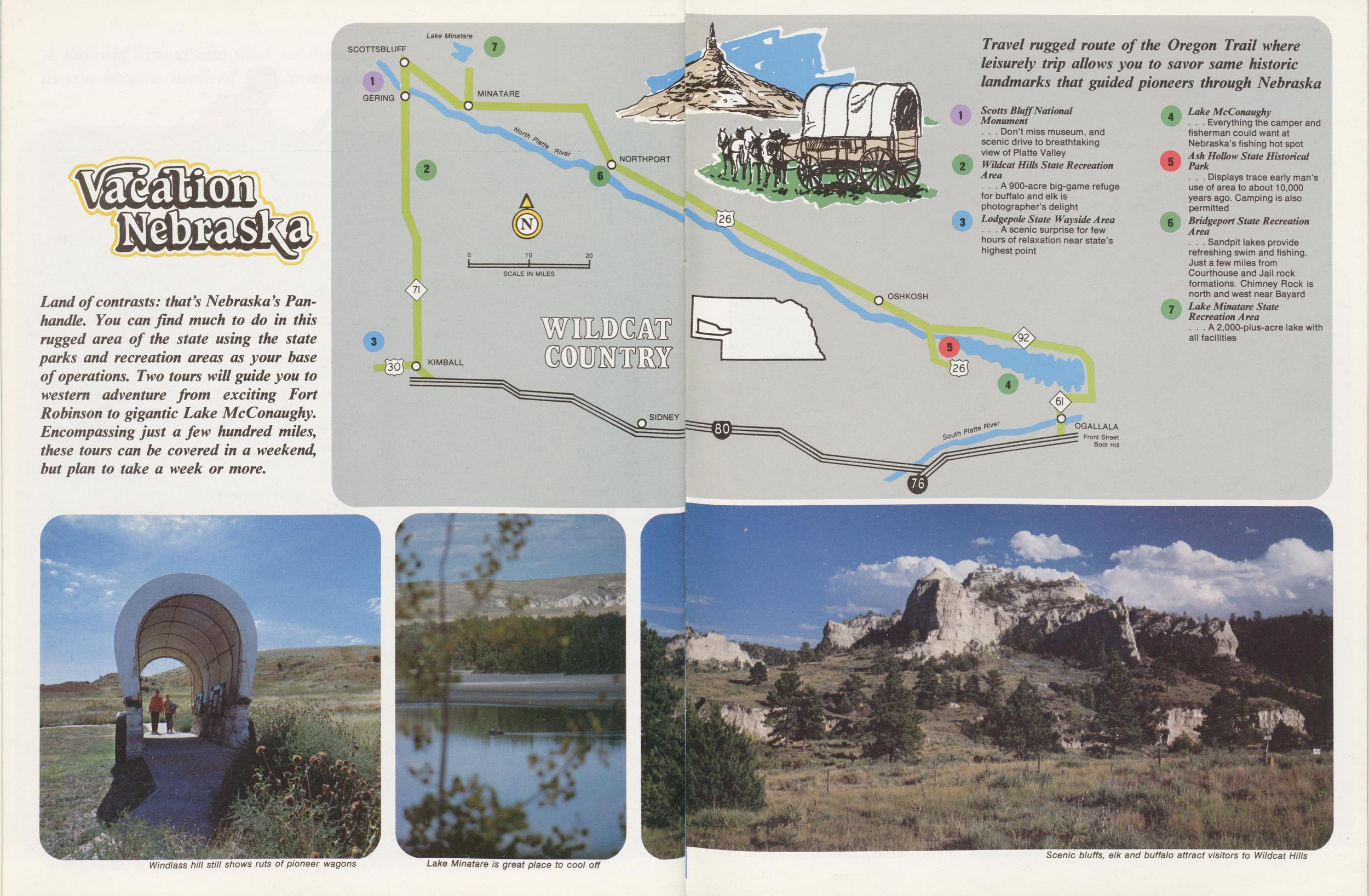
Land of contrasts: that's Nebraska's Panhandle.
You can find much to do in this
rugged area of the state using the state
parks and recreation areas as your base
of operations. Two tours will guide you to
western adventure from exciting Fort
Robinson to gigantic Lake McConaughy.
Encompassing just a few hundred miles,
these tours can be covered in a weekend,
but plan to take a week or more.
WILDCAT COUNTRY
Land of contrasts: that's Nebraska's Panhandle.
You can find much to do in this
rugged area of the state using the state
parks and recreation areas as your base
of operations. Two tours will guide you to
western adventure from exciting Fort
Robinson to gigantic Lake McConaughy.
Encompassing just a few hundred miles,
these tours can be covered in a weekend,
but plan to take a week or more.
 PINE RIDGE COUNTRY
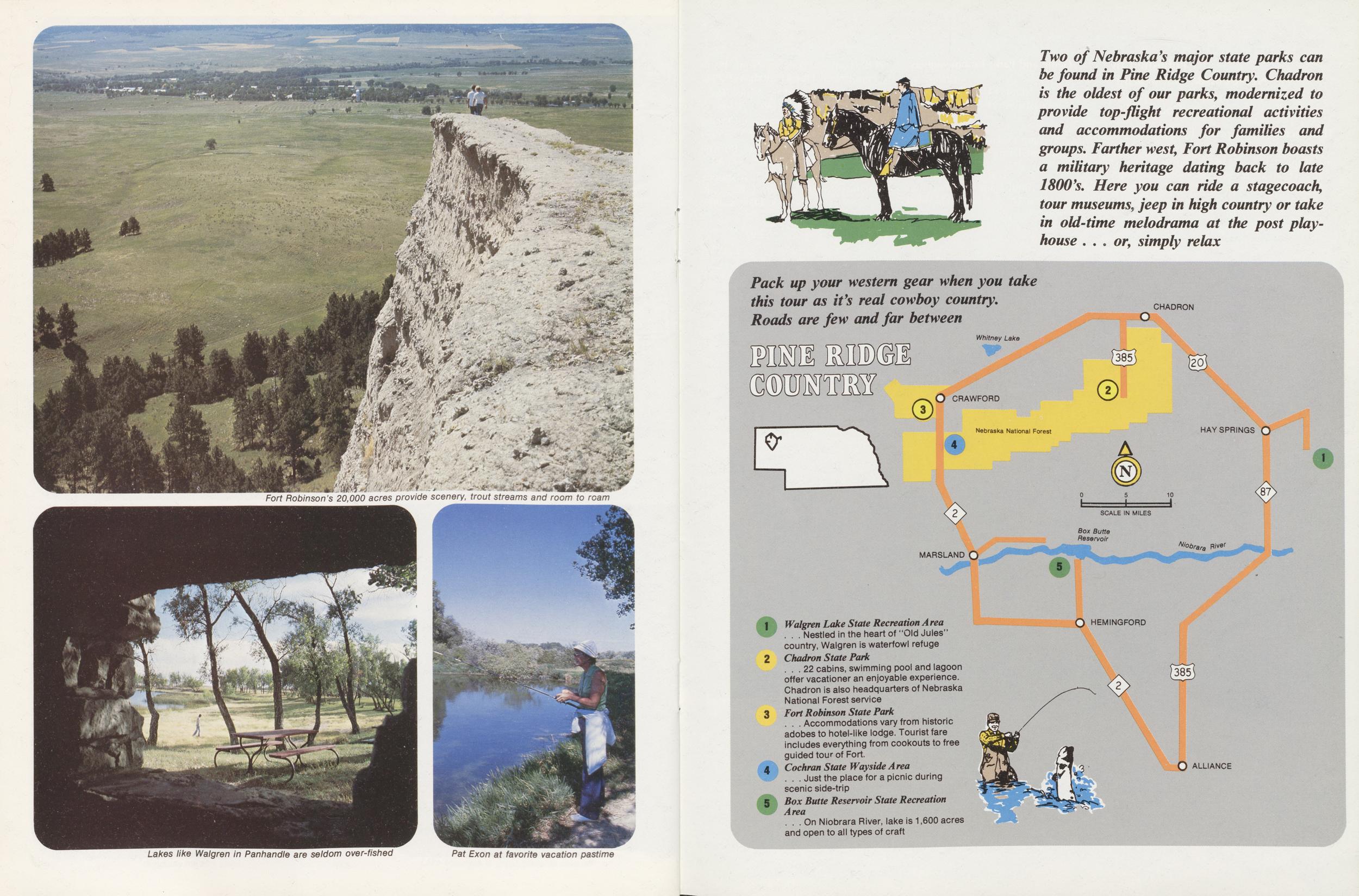
recreation and wayside areas that form the nucleus of the "good life" vacation picture that includes everything from excellent fishing to camping, hiking and picnicking.
Those who seek water-based recreational sites with picturesque camping area and easy access to a lake find many idyllic areas dotting the state. Historians particularly enjoy state parks such as Arbor Lodge, Ash Hollow and Fort Hartsuff. Their names alone create an excitement to relive the past.
For premier recreational experiences, five full-fledged state recreational parks provide everything from housekeeping cabins to horseback riding. What a way to spend a day or two, or a week or more—relaxing and enjoying whatever it is you like to do with your leisure time. As you travel from border to border, you'll discover that Nebraska is a land of contrasts, where the constantly changing mosaics of earth, sky and water exert a special magnetism. Rolling river bluffs in the east stretch into the undulating, fertile Sand Hills. These great grasslands, in turn, transform into the rugged buttes and hills of the Pine Ridge. They each portend things to come as the vast area we call Nebraska provides room to roam, to breathe, to see and to do. Federal and state wildlife management areas give you a chance to see former "residents" like buffalo, elk, and longhorn cattle. State park camping also puts you in position to take advantage of the many ethnic and community celebrations that occur all summer long. There are parades, rodeos, county fairs, and many other festivities. Or, just for the fun of it, visit a livestock auction or other such activity. These are the things that can make your next vacation even more memorable.
Back-packers and canoeists haven't been forgotten, either! Trails have been blazed and the new frontiers are just waiting to be explored by those wanting a thrilling, pleasurable experience. And, there's more to come as the Nebraska Game and Parks Commission offers new recreational opportunities and develops more parks and recreation areas to meet the increasing demands of the state's residents.
Take a few moments to read our "vacation Nebraska" special and you, too, will surely discover new horizons to your plans—a Nebraska State Park Vacation.
Fees... Nebraska State Parks System* Advance reservations may be made for two or more nights, and an advance deposit for two nights is required. Deposits cannot be refunded for cancellations or failure to appear. No one-night reservations are accepted, but units may be rented for one night on a first-come basis. Check-in time is 4 p.m., and check-out time is 11 a.m., unless other arrangements have been made with the park superintendent. All camping is on a first-come, first-served basis, and stays are limited to a maximum of 14 days, except state wayside areas where the limit is 2 days. FORT ROBINSON STATE PARK Box 392, Crawford, NE 69339 (308) 665-2660 Camping: $1.50; electrical hookup, 50c Group Camping: 25c per person Cabins1: Two-bedroom, $16; three-bed room, $20; four-bedroom, $24 Lodge: Double bed, $8; two twin beds, $10 Brick Houses2: Five-bedroom, $40; six-bedroom, $46; seven-bedroom, $52 Group Multi-Use Facilities3: Full facility, $50 per day Extra Beds: Rollaway, $2; crib, $2 Horse Trail Rides: $2 Horse Stall Rental: $2; $3 with hay Put-and-Take Trout Fishing: $2 CHADRON STATE PARK Chadron, NE 69337 (308) 432-2036 Camping: $1.50 Group Camping: 25c per person Cabins1: Two-bedroom, $14-$16 Group Multi-Use Facilities3: Full facility, $100 per day kitchen and dining only, $40 per day Extra Beds: Rollaway, $2; crib, $2 Horse Trail Rides: $2 Swimming Pool: Adult, 75ct; child, 35c Boat Rental: $1 per hour; $3 all day VICTORIA SPRINGS STATE RECREATION AREA Box 254, Anselmo, NE 68813 (308) 749-2235 Camping: $1.50; electrical hookup, 50c Cabins1: Two-bedroom, $16 Extra Beds: Rollaway, $2; crib, $2 Boat Rental: $1 per hour; $3 all day PONCA STATE PARK Box 164, Ponca, NE 68770 (402) 755-2284 Camping: $3; electrical hookup, 50c Group Camping: 25c per person Cabins1: Two-bedroom, $16 Extra Beds: Rollaway, $2; crib, $2 Horse Trail Rides: $2 Swimming Pool; Adult, 75c; child, 35c INDIAN CAVE STATE PARK Route 1, Shubert, NE 68437 (402) 883-2575 Horse Trail Rides: $2 Nebraska state park entry permit required 1. $2 discount per night on cabins occupied for two or more nights 2. $10 discount per night for bricks occupied for two or more nights 3. Check with superintendent for reservations and details on facilities JANUARY 1978 41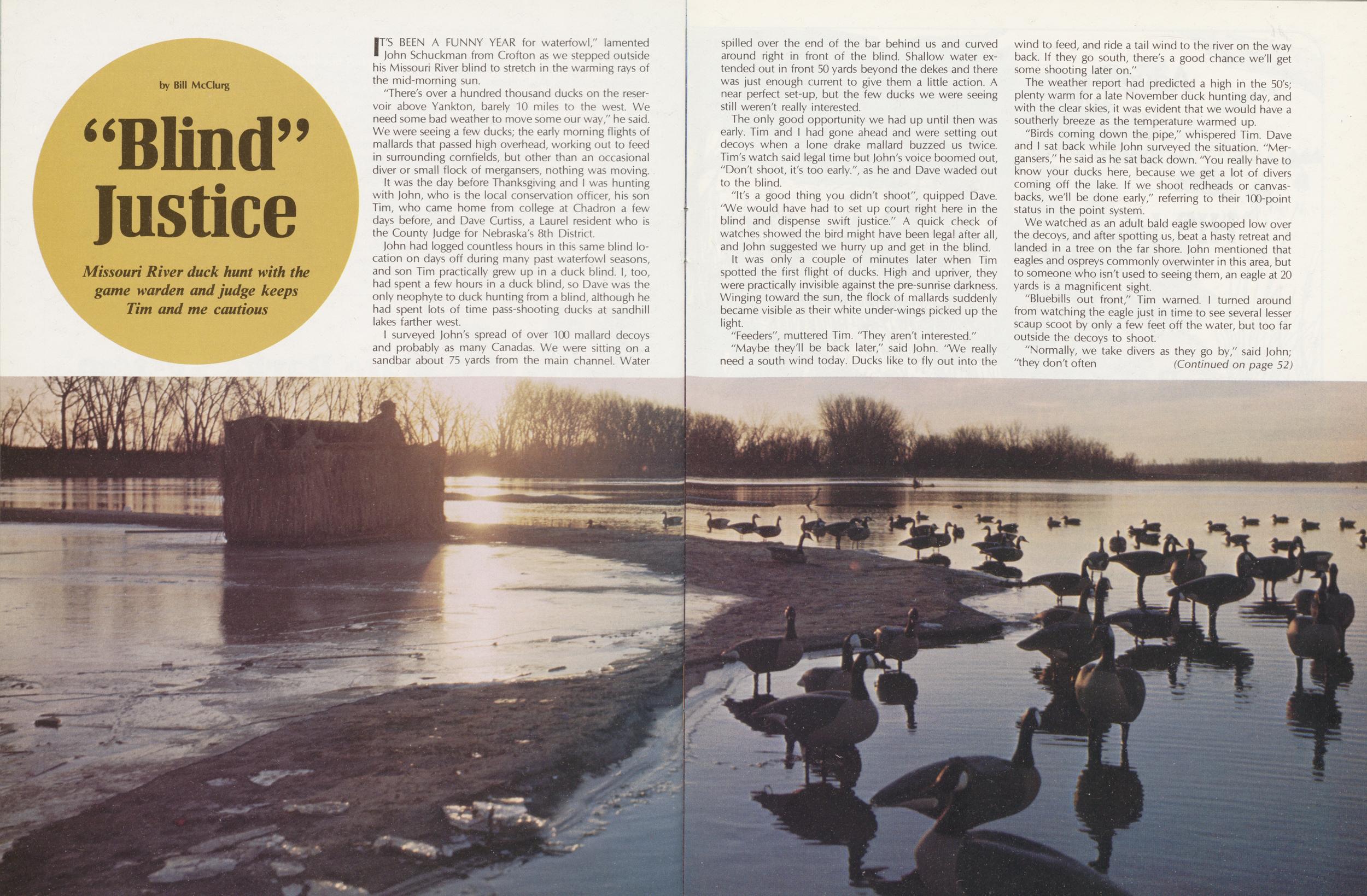
"Blind" Justice
by Bill McClurg Missouri River duck hunt with the game warden and judge keeps Tim and me cautiousIT'S BEEN A FUNNY YEAR for waterfowl," lamented John Schuckman from Crofton as we stepped outside his Missouri River blind to stretch in the warming rays of the mid-morning sun.
"There's over a hundred thousand ducks on the reservoir above Yankton, barely 10 miles to the west. We need some bad weather to move some our way," he said. We were seeing a few ducks; the early morning flights of mallards that passed high overhead, working out to feed in surrounding cornfields, but other than an occasional diver or small flock of mergansers, nothing was moving.
It was the day before Thanksgiving and I was hunting with John, who is the local conservation officer, his son Tim, who came home from college at Chadron a few days before, and Dave Curtiss, a Laurel resident who is the County Judge for Nebraska's 8th District.
John had logged countless hours in this same blind location on days off during many past waterfowl seasons, and son Tim practically grew up in a duck blind. I, too, had spent a few hours in a duck blind, so Dave was the only neophyte to duck hunting from a blind, although he had spent lots of time pass-shooting ducks at sandhill lakes farther west.
I surveyed John's spread of over 100 mallard decoys and probably as many Canadas. We were sitting on a sandbar about 75 yards from the main channel. Water
The only good opportunity we had up until then was early. Tim and I had gone ahead and were setting out decoys when a lone drake mallard buzzed us twice. Tim's watch said legal time but John's voice boomed out, "Don't shoot, it's too early.", as he and Dave waded out to the blind.
"It's a good thing you didn't shoot", quipped Dave. "We would have had to set up court right here in the blind and dispense swift justice." A quick check of watches showed the bird might have been legal after all, and John suggested we hurry up and get in the blind.
It was only a couple of minutes later when Tim spotted the first flight of ducks. High and upriver, they were practically invisible against the pre-sunrise darkness. Winging toward the sun, the flock of mallards suddenly became visible as their white under-wings picked up the light.
"Feeders", muttered Tim. "They aren't interested."
"Maybe they'll be back later," said John. "We really need a south wind today. Ducks like to fly out into the wind to feed, and ride a tail wind to the river on the way back. If they go south, there's a good chance we'll get some shooting later on."
The weather report had predicted a high in the 50's; plenty warm for a late November duck hunting day, and with the clear skies, it was evident that we would have a southerly breeze as the temperature warmed up.
"Birds coming down the pipe," whispered Tim. Dave and I sat back while John surveyed the situation. "Mergansers," he said as he sat back down. "You really have to know your ducks here, because we get a lot of divers coming off the lake. If we shoot redheads or canvasbacks, well be done early," referring to their 100-point status in the point system.
We watched as an adult bald eagle swooped low over the decoys, and after spotting us, beat a hasty retreat and landed in a tree on the far shore. John mentioned that eagles and ospreys commonly overwinter in this area, but to someone who isn't used to seeing them, an eagle at 20 yards is a magnificent sight.
"Bluebills out front," Tim warned. I turned around from watching the eagle just in time to see several lesser scaup scoot by only a few feet off the water, but too far outside the decoys to shoot.
"Normally, we take divers as they go by," said John; "they don't often (Continued on page 52)
Adventures Whiskers the prairie vole
HIS HONOR THE MAYOR OF BADGER MEADOW
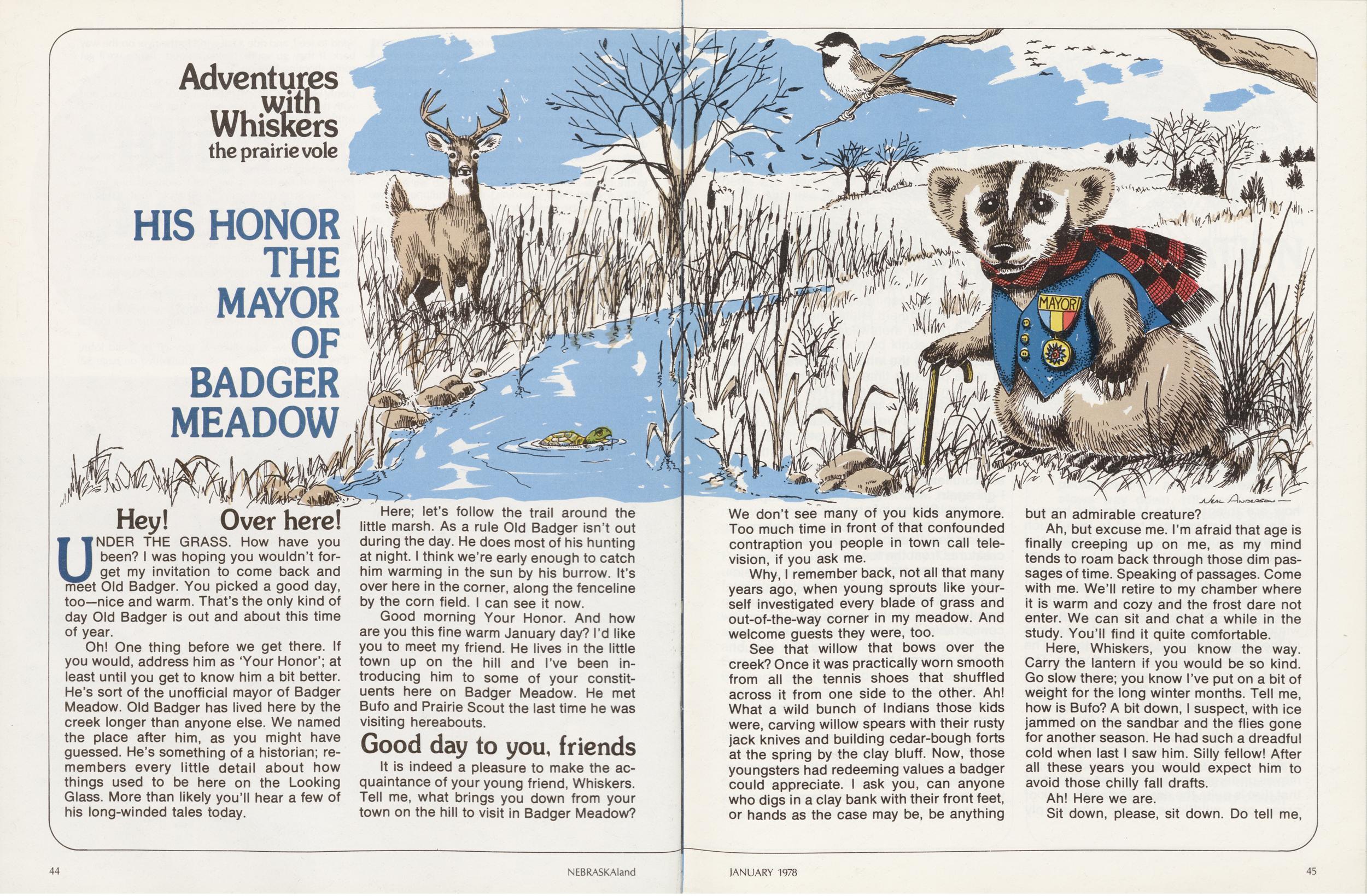
Hey! Over here!UNDER THE GRASS. How have you been? I was hoping you wouldn’t forget my invitation to come back and meet Old Badger. You picked a good day, too—nice and warm. That’s the only kind of day Old Badger is out and about this time of year.
Oh! One thing before we get there. If you would, address him as ‘Your Honor’; at least until you get to know him a bit better. He’s sort of the unofficial mayor of Badger Meadow. Old Badger has lived here by the creek longer than anyone else. We named the place after him, as you might have guessed. He’s something of a historian; remembers every little detail about how things used to be here on the Looking Glass. More than likely you’ll hear a few of his long-winded tales today.
Here; let’s follow the trail around the little marsh. As a rule Old Badger isn’t out during the day. He does most of his hunting at night. I think we’re early enough to catch him warming in the sun by his burrow. It’s over here in the corner, along the fenceline by the corn field. I can see it now.
Good morning Your Honor. And how are you this fine warm January day? I’d like you to meet my friend. He lives in the little town up on the hill and I’ve been introducing him to some of your constituents here on Badger Meadow. He met Bufo and Prairie Scout the last time he was visiting hereabouts.
Good day to you, friendsIt is indeed a pleasure to make the acquaintance of your young friend, Whiskers. Tell me, what brings you down from your town on the hill to visit in Badger Meadow? 44 NEBRASKAland We don’t see many of you kids anymore. Too much time in front of that confounded contraption you people in town call television, if you ask me.
Why, I remember back, not all that many years ago, when young sprouts like yourself investigated every blade of grass and out-of-the-way corner in my meadow. And welcome guests they were, too.
See that willow that bows over the creek? Once it was practically worn smooth from all the tennis shoes that shuffled across it from one side to the other. Ah! What a wild bunch of Indians those kids were, carving willow spears with their rusty jack knives and building cedar-bough forts at the spring by the clay bluff. Now, those youngsters had redeeming values a badger could appreciate. I ask you, can anyone who digs in a clay bank with their front feet, or hands as the case may be, be anything but an admirable creature?
Ah, but excuse me. I’m afraid that age is finally creeping up on me, as my mind tends to roam back through those dim passages of time. Speaking of passages. Come with me. We’ll retire to my chamber where it is warm and cozy and the frost dare not enter. We can sit and chat a while in the study. You’ll find it quite comfortable.
Here, Whiskers, you know the way. Carry the lantern if you would be so kind. Go slow there; you know I’ve put on a bit of weight for the long winter months. Tell me, how is Bufo? A bit down, I suspect, with ice jammed on the sandbar and the flies gone for another season. He had such a dreadful cold when last I saw him. Silly fellow! After all these years you would expect him to avoid those chilly fall drafts.
Ah! Here we are.
Sit down, please, sit down. Do tell me,
JANUARY 1978
45
 how are things in the Meadow? I haven’t
been about in weeks. I tend to lose touch
with my friends over the snowy months. Not
much for us badgers to do but idle away
our days until the ground starts to squeak
with the sounds of growing grass.
how are things in the Meadow? I haven’t
been about in weeks. I tend to lose touch
with my friends over the snowy months. Not
much for us badgers to do but idle away
our days until the ground starts to squeak
with the sounds of growing grass.
A most unfortunate state of affairs I must admit—that badgers doze away the winter. I must say, the more subdued colors of the winter prairie do suit my taste. The browns and yellows are so comforting. The bright spring flowers are quite nice, I’ll grant you, but a bit too flashy for a sedate, conservative creature such as myself. Better suited to the winsome butterflies, I suppose. Oh well, to each their own.
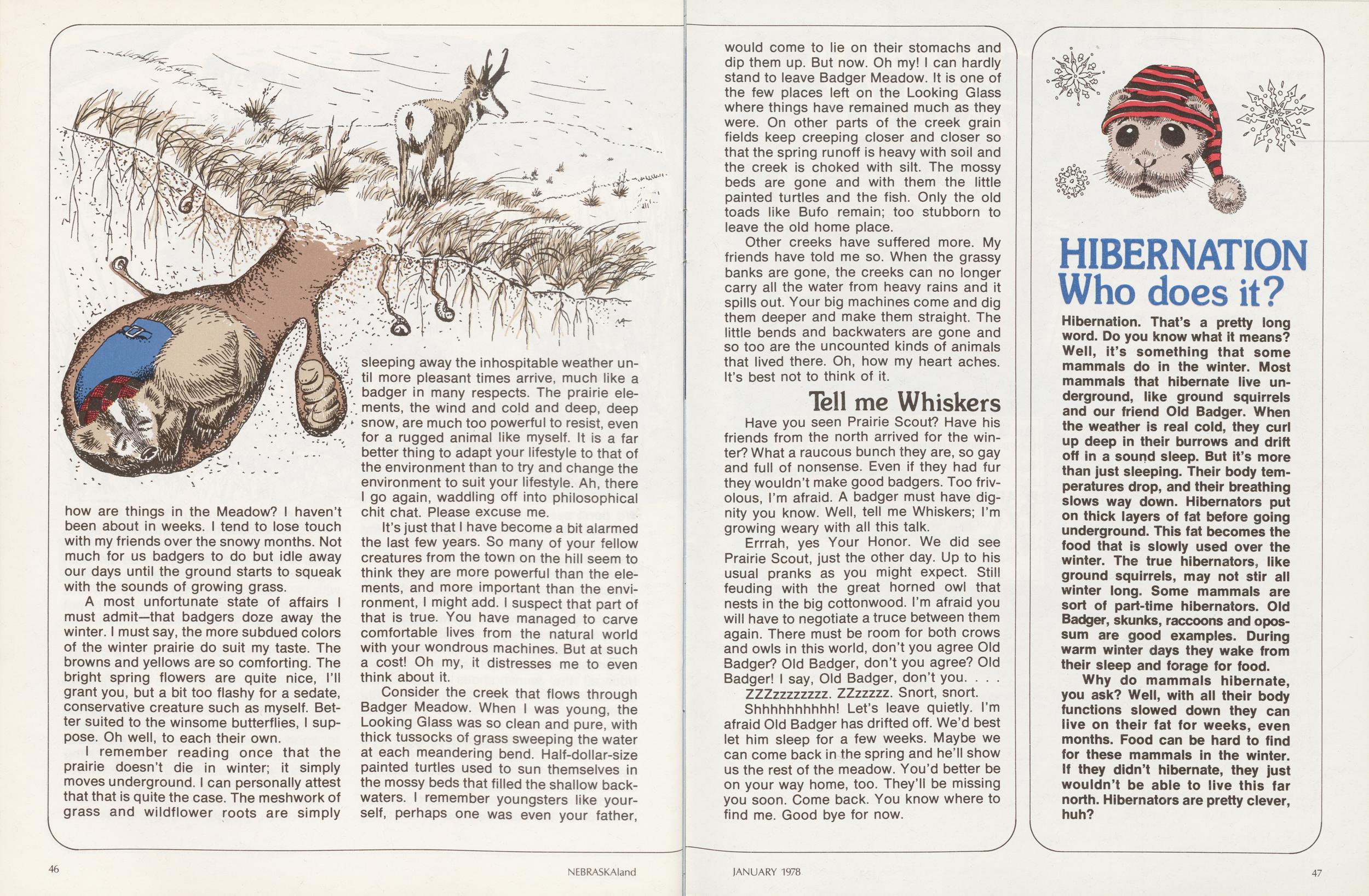
I remember reading once that the prairie doesn’t die in winter; it simply moves underground. I can personally attest that that is quite the case. The meshwork of grass and wildflower roots are simply sleeping away the inhospitable weather until more pleasant times arrive, much like a badger in many respects. The prairie elements, the wind and cold and deep, deep snow, are much too powerful to resist, even for a rugged animal like myself. It is a far better thing to adapt your lifestyle to that of the environment than to try and change the environment to suit your lifestyle. Ah, there I go again, waddling off into philosophical chit chat. Please excuse me.
It’s just that I have become a bit alarmed the last few years. So many of your fellow creatures from the town on the hill seem to think they are more powerful than the elements, and more important than the environment, I might add. I suspect that part of that is true. You have managed to carve comfortable lives from the natural world with your wondrous machines. But at such a cost! Oh my, it distresses me to even think about it.
Consider the creek that flows through Badger Meadow. When I was young, the Looking Glass was so clean and pure, with thick tussocks of grass sweeping the water at each meandering bend. Half-dollar-size painted turtles used to sun themselves in the mossy beds that filled the shallow backwaters. I remember youngsters like yourself, perhaps one was even your father, 46 NEBRASKAland would come to lie on their stomachs and dip them up. But now. Oh my! I can hardly stand to leave Badger Meadow. It is one of the few places left on the Looking Glass where things have remained much as they were. On other parts of the creek grain fields keep creeping closer and closer so that the spring runoff is heavy with soil and the creek is choked with silt. The mossy beds are gone and with them the little painted turtles and the fish. Only the old toads like Bufo remain; too stubborn to leave the old home place.
Other creeks have suffered more. My friends have told me so. When the grassy banks are gone, the creeks can no longer carry all the water from heavy rains and it spills out. Your big machines come and dig them deeper and make them straight. The little bends and backwaters are gone and so too are the uncounted kinds of animals that lived there. Oh, how my heart aches. It’s best not to think of it.
Tell me WhiskersHave you seen Prairie Scout? Have his friends from the north arrived for the winter? What a raucous bunch they are, so gay and full of nonsense. Even if they had fur they wouldn’t make good badgers. Too frivolous, I’m afraid. A badger must have dignity you know. Well, tell me Whiskers; I’m growing weary with all this talk.
Errrah, yes Your Honor. We did see Prairie Scout, just the other day. Up to his usual pranks as you might expect. Still feuding with the great horned owl that nests in the big cottonwood. I’m afraid you will have to negotiate a truce between them again. There must be room for both crows and owls in this world, don’t you agree Old Badger? Old Badger, don’t you agree? Old Badger! I say, Old Badger, don’t you. . . .
ZZZzzzzzzzz. ZZzzzzz. Snort, snort.
Shhhhhhhhhh! Let’s leave quietly. I’m afraid Old Badger has drifted off. We’d best let him sleep for a few weeks. Maybe we can come back in the spring and he’ll show us the rest of the meadow. You’d better be on your way home, too. They’ll be missing you soon. Come back. You know where to find me. Good bye for now.
HIBERNATION Who does it?Hibernation. That’s a pretty long word. Do you know what it means? Well, it’s something that some mammals do in the winter. Most mammals that hibernate live underground, like ground squirrels and our friend Old Badger. When the weather is real cold, they curl up deep in their burrows and drift off in a sound sleep. But it’s more than just sleeping. Their body temperatures drop, and their breathing slows way down. Hibernators put on thick layers of fat before going underground. This fat becomes the food that is slowly used over the winter. The true hibernators, like ground squirrels, may not stir all winter long. Some mammals are sort of part-time hibernators. Old Badger, skunks, raccoons and opossum are good examples. During warm winter days they wake from their sleep and forage for food.
Why do mammals hibernate, you ask? Well, with all their body functions slowed down they can live on their fat for weeks, even months. Food can be hard to find for these mammals in the winter. If they didn’t hibernate, they just wouldn’t be able to live this far north. Hibernators are pretty clever, huh?
JANUARY 1978 47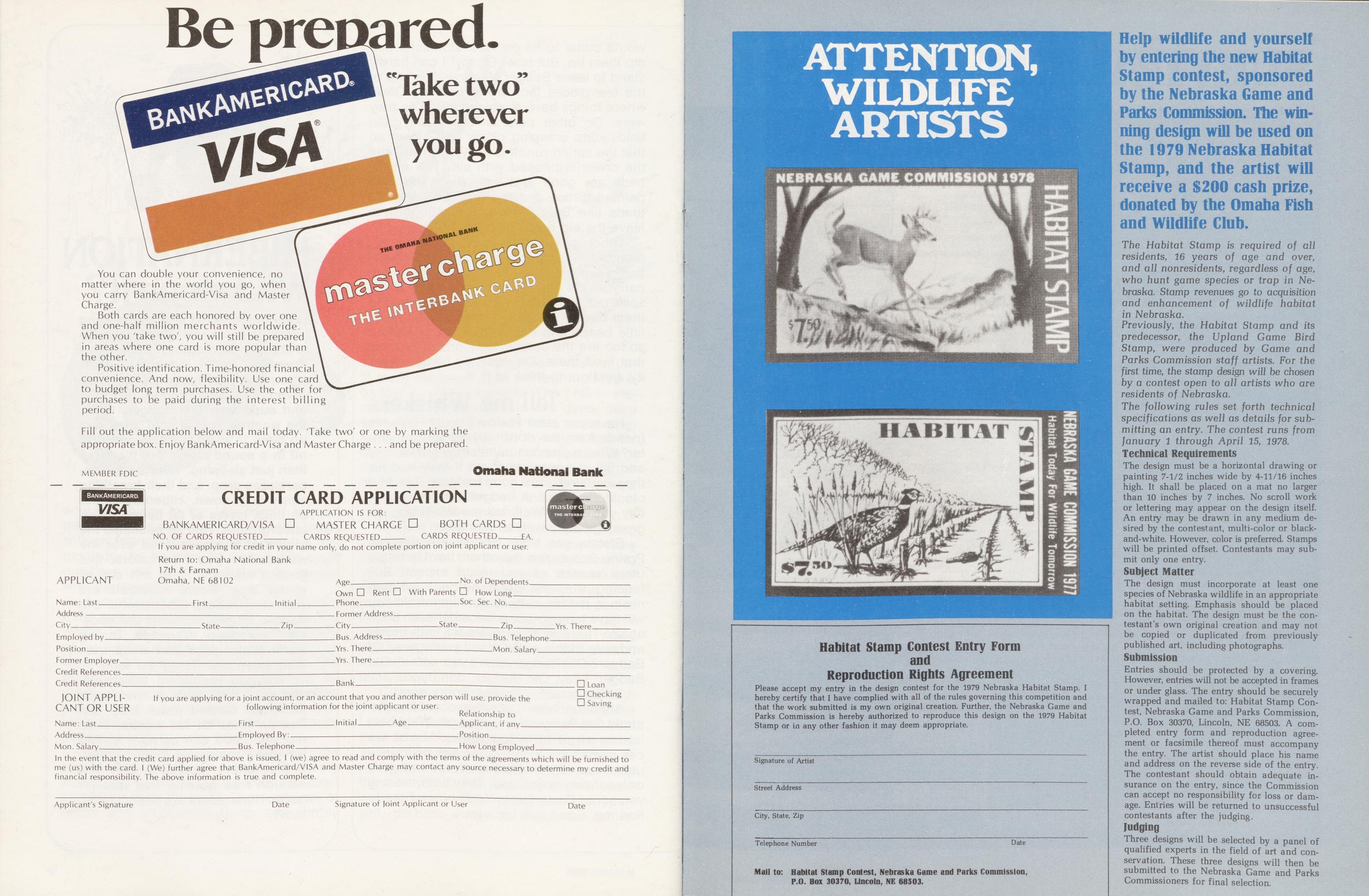
You can double your convenience, no matter where in the world you go, when you carry BankAmericard-Visa and Master Charge.
Both cards are each honored by over one and one-half million merchants worldwide. When you take two', you will still be prepared in areas where one card is more popular than the other.
Positive identification. Time-honored financial convenience. And now, flexibility. Use one card to budget long term purchases. Use the other for purchases to be paid during the interest billing period.
Fill out the application below and mail today. 'Take two' or one by marking the appropriate box. Enjoy BankAmericard-Visa and Master Charge . . . and be prepared. MEMBER FDIC Omaha National Bank CREDIT CARD APPLICATION Attention, Wildlife Artists Habitat Stamp Contest Entry Form and Reproduction Rights AgreementPlease accept my entry in the design contest for the 1979 Nebraska Habitat Stamp. I hereby certify that I have complied with all of the rules governing this competition and that the work submitted is my own original creation. Further, the Nebraska Game and Parks Commission is hereby authorized to reproduce this design on the 1979 Habitat Stamp or in any other fashion it may deem appropriate.
Mail to: Habitat Stamp Contest, Nebraska Game and Parks Commission, P.O. Box 30370, Lincoln, NE 68503. Help wildlife and yourself by entering the new Habitat Stamp contest, sponsored by the Nebraska Game and Parks Commission. The winning design will be used on the 1979 Nebraska Habitat Stamp, and the artist will receive a $200 cash prize, donated by the Omaha Fish and Wildlife Club.The Habitat Stamp is required of all residents, 16 years of age and over, and all nonresidents, regardless of age, who hunt game species or trap in Nebraska. Stamp revenues go to acquisition and enhancement of wildlife habitat in Nebraska.
Previously, the Habitat Stamp and its predecessor, the Upland Game Bird Stamp, were produced by Game and Parks Commission staff artists. For the first time, the stamp design will be chosen by a contest open to all artists who are residents of Nebraska.
The following rules set forth technical specifications as well as details for submitting an entry. The contest runs from January 1 through April 15, 1978.
Technical RequirementsThe design must be a horizontal drawing or painting 7-1/2 inches wide by 4-11/16 inches high. It shall be placed on a mat no larger than 10 inches by 7 inches. No scroll work or lettering may appear on the design itself. An entry may be drawn in any medium desired by the contestant, multi-color or black-and-white. However, color is preferred. Stamps will be printed offset. Contestants may submit only one entry.
Subject MatterThe design must incorporate at least one species of Nebraska wildlife in an appropriate habitat setting. Emphasis should be placed on the habitat. The design must be the contestant’s own original creation and may not be copied or duplicated from previously published art, including photographs.
SubmissionEntries should be protected by a covering. However, entries will not be accepted in frames or under glass. The entry should be securely wrapped and mailed to: Habitat Stamp Contest, Nebraska Game and Parks Commission, P.O. Box 30370, Lincoln, NE 68503. A completed entry form and reproduction agreement or facsimile thereof must accompany the entry. The artist should place his name and address on the reverse side of the entry. The contestant should obtain adequate insurance on the entry, since the Commission can accept no responsibility for loss or damage. Entries will be returned to unsuccessful contestants after the judging.
JudgingThree designs will be selected by a panel of qualified experts in the field of art and conservation. These three designs will then be submitted to the Nebraska Game and Parks Commissioners for final selection.
SURVIVAL KIT FOR FISH
by Bob Grier Winter often threatens Smith Lake, so new pump system is really aquatic life insuranceSMITH LAKE has long been one of Nebraska's most productive fisheries, providing both quantity and quality angling in northwest Nebraska. Located 23 miles north of Lakeside and 25 miles south of Rushville, the 222-acre lake produces large stringers of bluegill and bullhead, as well as good sized largemouth bass and northern pike. Test netting by biologists in the 1960's indicated a quality fishery matched by very few lakes in Nebraska.
Smith Lake was created when a small earthen dam was constructed on the upper end of Pine Creek in Sheridan County during the early 1950's. Anglers enjoyed top-notch fishing until the winter of 1967-1968 when heavy snow covered the frozen lake for a prolonged period, effectively closing off light needed to maintain photosynthesis. The resulting winter-kill eliminated all species of fish in the lake with the exception of a few northern pike and a great number of bullheads. After a subsequent renovation, fishing quality was re-established by 1971.
Winter-kill potential remained, however, and several close calls speeded biologists' attempts to find a feasible method of preventing a rerun of the 1967-1968 disaster.
Submerged aquatic plants are an important source of oxygen for fish, formed when photosynthetic activity occurs in the presence of light. Snow covering the ice prevents light penetration and photosynthetic activity thus stops. When this occurs, the supply of oxygen already in the water is quickly consumed by the existing fish population. When the plants die, organic decay further depletes the available oxygen in the water.
Jack Peterson, Panhandle district fisheries supervisor with the Nebraska Game and Parks Commission, met with researchers from the Colorado Department of Fish and Game, and continually reviewed every available piece of literature on the prevention of winter-kill situations.
"I was convinced that the best method thus far to prevent a winter-kill was to introduce air directly into the water," Peterson said. His research showed that liquid oxygen put into the water produced the greatest amount of dissolved oxygen in the lake; however, the cost made this method prohibitive.
Peterson also studied wind-powered air pumps, but while the most economical, windmill-powered devices were not capable of opening large areas of water which would be necessary at Smith Lake. Additionally, even a short period without wind could nullify a wind-powered aeration system.
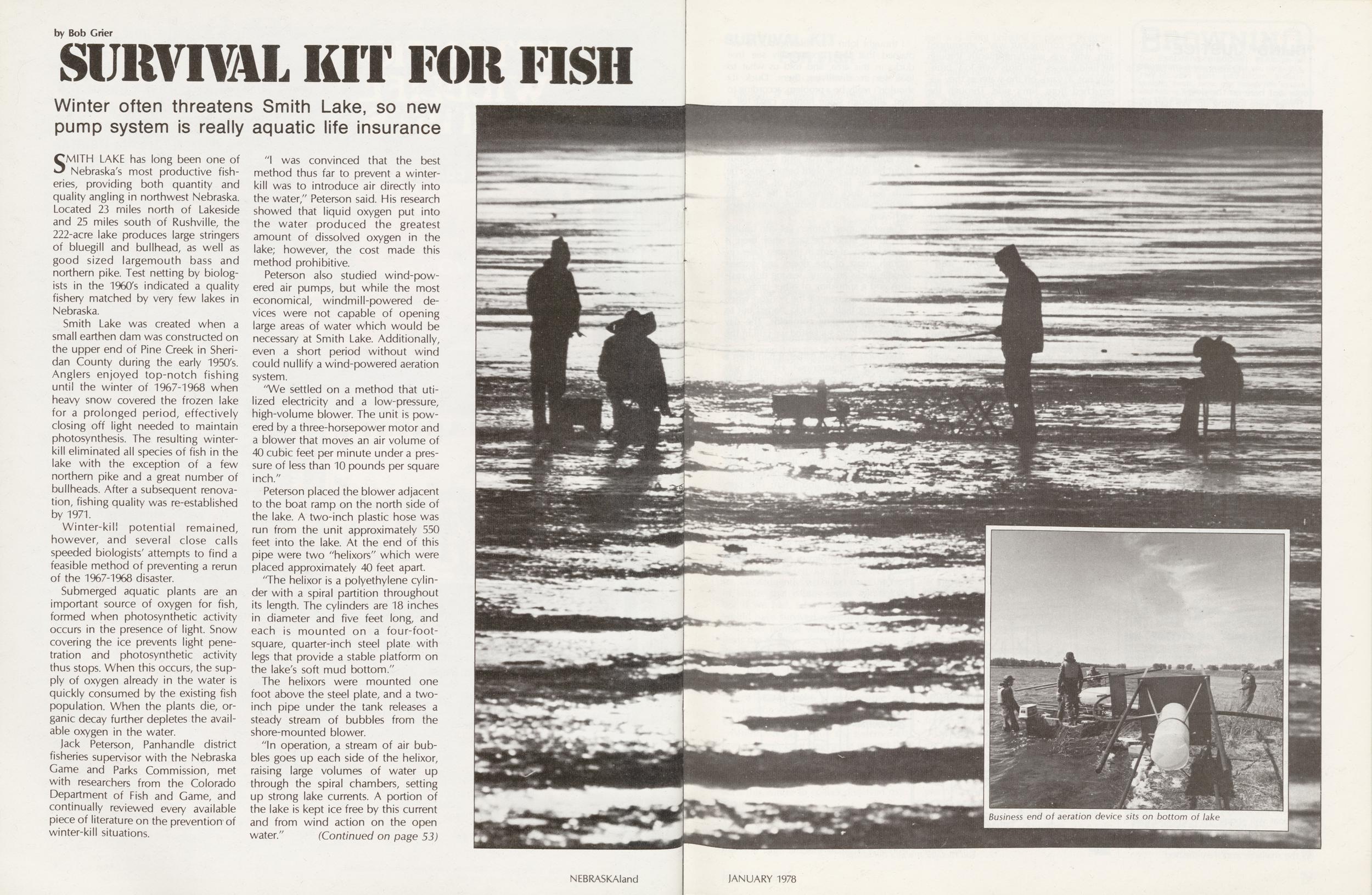
"We settled on a method that utilized electricity and a low-pressure, high-volume blower. The unit is powered by a three-horsepower motor and a blower that moves an air volume of 40 cubic feet per minute under a pressure of less than 10 pounds per square inch."
Peterson placed the blower adjacent to the boat ramp on the north side of the lake. A two-inch plastic hose was run from the unit approximately 550 feet into the lake. At the end of this pipe were two "helixors" which were placed approximately 40 feet apart.
"The helixor is a polyethylene cylinder with a spiral partition throughout its length. The cylinders are 18 inches in diameter and five feet long, and each is mounted on a four-foot-square, quarter-inch steel plate with legs that provide a stable platform on the lake's soft mud bottom."
The helixors were mounted one foot above the steel plate, and a two-inch pipe under the tank releases a steady stream of bubbles from the shore-mounted blower.
"In operation, a stream of air bubbles goes up each side of the helixor, raising large volumes of water up through the spiral chambers, setting up strong lake currents. A portion of the lake is kept ice free by this current and from wind action on the open water." (Continued on page 53)
NEBRASKAland
“BLIND” JUSTICE
(Continued from page 43)decoy out here on the river."
Things were looking up. We had spent only a few minutes in the blind, the sun was just clearing the horizon, and we had seen at least three different kinds of ducks, although we hadn't had any action yet. But, the flights soon slowed, and then stopped altogether as the temperature warmed. From then on the morning passed slowly as Tim and I listened to his father and the judge swap stories of good hunts past, and to some of John's more colorful experiences as a warden.
I was half-dozing in the comfortable rays of the noon sun when John whispered, "Don't move—flock of mallards coming right at us." We all froze in the blind as the birds passed by out front, just out of range.
"Give them a call, Tim," said John. 'They're moving on."
A short high-ball, followed by a feeder call, turned them.
'They're coming back," said John. "Keep your eye on them, Tim." Again they passed by out front, close enough this time, I thought, but John wanted them in closer. "One more time like that," he whispered, "and we'll take them."
Half way around, they swung wide, kind of hovered like they wanted to land, and then possibly sensing something wrong, winged their way upriver.
"Guess we should have taken them," said John, "but they were out just a little far. Those birds were looking for a place to land. Maybe another flock will come along shortly."
It was another hour before we saw more birds. A flock of close to 50 mallards circled downstream above another blind.
'They want to land," said John. "If those guys are there, they'll take them on the next pass." I watched the flock through field glasses and waited for shots, but several birds landed and then the rest of the flock wheeled and also put down.
"There's our birds," said John; "they just never made it this far. Keep your eye on them anyway. They might get up after a while."
Tim and I watched the birds through binoculars, but they seemed content to rest a half-mile downstream. Time passed slowly. A boat with two fishermen circled around us, then beached their boat on a bar a couple of hundred yards away.
"What are they up to?" inquired Dave. John said they were probably commercial fishermen checking their nets. Sure enough, they hauled in a net, reset it and then moved on downriver.
"Watch the birds," said John. "Maybe that boat will spook them up and they'll head our way." Sure enough, a couple of minutes later, the boat drifted too close to the mallards and they flushed.
'They're coming our way", announced Tim, who was watching intently through his field glasses. The birds were low, probably not 20 yards off the water as they approached from Tim's side. Through the reeds, I caught a glimpse of the birds as they checked out the decoys.
'They're swinging", John said from his end. "Watch them Tim; we'll take them on this pass if they're close enough. Four safeties clicked off, almost in unison. I caught a glimpse of some of the birds, wings set and feet outstretched, landing among the decoys.
"Now," said Tim, as he flipped back the blind cover. There were ducks everywhere, but most of them flared into the sun. I swung on a rapidly climbing drake and dumped him. My second shot knocked feathers loose from another, and I pumped my third shot home and watched him drop as someone beside me shot. I watched the flock regroup and head downstream.
"Get the cripples, Tim," said John. "If they swim out, we'll lose them." John's words were wasted as Tim was already out in the river, heading toward the single cripple. A quick shot dispatched the bird, and Tim and John returned with the four drake mallards that stayed behind.
We were hoping that flock would be the one to break the ice, but as the afternoon wore on, all we got was cold and stiff. Again we saw mergansers, and once more we were buzzed by scaup, but the speedy little demons zipped through out decoys before we could react.
Finally Tim spotted a loner coming from downstream about 30 yards high.
"Looks like a hen canvasback," said Tim, and I agreed. He proved his theory the next day when
"That's a tree duck," said John as it flew over. "Tim, why didn;t you tell me sooner, I could have used it in my duck ID class."
I thought John was kidding, but he explained that they occasionally see tree ducks in this area, and told us what to look for in identifying them. Duck ID shouldn't really be a problem, according to John, although some hunters can't tell a teal from a mallard. This he attributes to laziness on the part of the hunter, and says that with a little practice, anyone can learn ducks on the wing as well as in the bag. I had gotten the idea that John was serious about his ducks the night before, when he showed me his collection of mounted birds and duck wings that he uses in teaching several duck identification classes each year.
Generally, most hunters get into trouble early in the season, he says, when there is a large variety of birds in the area. Later on, though, most of the divers and smaller puddle ducks are gone, leaving only mallards and a sprinkling of other birds.
The sun was nearing the horizon when the evening flight of ducks started out to feed in surrounding cornfields. The day nearly over, John suggested we pull in the decoys.
Like John had said earlier, it had been a funny year for waterfowl. He had only bagged a small percentage of birds that they normally take, but low water conditions had somehow changed flight patterns enough to disrupt his hunting. Nobody was complaining, though; we had one greenhead apiece.
John perhaps summed it up best as we loaded up. "You know, its probably the bad days that keep you coming back, because every now and then, the percentages catch up and you'll have a good hunt."
He proved his theory the next day when he and his two sons limited out on greenheads before sitting down to Thanksgiving dinner.
52 NEBRASKAlandSURVIVAL KIT FOR FISH
(Continued from page 50)Oxygen is mixed with lake water by three different methods. The water and air rolling inside the helixor prolongs contact between the air bubbles and the water, thus increasing the oxygen exchange. Additionally, a large portion of the lake remains open throughout the winter, and the subsequent photosynthesis process can manufacture oxygen in the ice-free area. A mixing wave action also provides oxygen exchange.
"Placement of the two helixors is very important for the system to work properly. They had to be in the deepest part of Smith Lake (8 feet) and also had to be positioned where the prevailing winds (north and west) would have the best chance to enlarge the opening.
To prevent any movement of the air-filled plastic hose, sixty-five-pound concrete blocks were attached to the air line every 15 feet from the blowers to the helxors to keep it on the bottom of the lake.
After numerous delays, the unit was finally started on November 22, 1976. "Fortunately, we had mild fall weather and the lake only had an inch of ice when the unit was started," Peterson said.
'The unit was run continually until February 22, 1977 when it was shut down for the year. At that time the lake was over half open, and even a late spring storm posed no threat of a winter-kill."
"Marker buoys were placed at 100-yard intervals up to 400 yards east and west of the helixors. The biologists marked permanent sampling stations to help monitor the system's effectiveness."
"Last winter we had a very cold, snowless winter. Ice depth ranged all the way up to 24 inches in mid-January. However, very little snow fell during the entire winter. Consequently, we didn't have the type of winter that causes severe winter-kills, but if we had, I feel certain Smith Lake would have survived with flying colors."
"Under normal winter weather conditions the aeration system opens an area of approximately two acres. When the weather drops to extreme subfreezing temperatures, the size of the open water will shrink to about three-fourths of an acre. However, with a temperature rise, wind action would increase the area of the open water to about five acres."
Peterson hopes to run the system each year at Smith Lake beginning around the first week of November, continuing until the first week of March. Biologists will be sampling the permanent monitoring stations this winter to collect dissolved oxygen data.
'The cost, figuring everything used on the project other than manpower, was roughly five thousand dollars. Although this is a large amount of money, almost half was spent bringing in power from an existing power line on the east edge of the lake. Balanced against the tremendous loss of angling hours when a winter-kill occurs, and the subsequent re-stocking and possible renovation work, I believe the aeration system will easily repay its costs many times over."
CONTEST IN THE COLD
(Continued from page 9)Corky Thornton and George Kerr of Valentine; fishermen of quite some repute and the odds-on favorites to win the contest. They had a prodigious pile of perch, and Corky had also inserted a nice walleye amongst a big bucketful of panfish.
At day's end, the driveway and parking lot outside the Merritt Trading Post were crowded with anglers reporting for the weigh-in. Everyone was pretty sure that Thornton and Kerr had taken first place, but no one could be certain about the other four cash prizes or the other goodies until winners were announced at the banquet in Valentine that evening.
After polishing off a generous meal served up by the Mrs. Jaycees, everyone's attention turned to the stage for the awards. To no one's surprise, Thornton and Kerr skated off with the $500 first prize for their total of 96 pounds.of fish.
Second prize went to Marvin Rich and Russ Wax of Atkinson with 66 pounds. John Mlnarik and Duke Hobbs of Clearwater took third-place money with 60 pounds, Ron and Loren Elliott of Valentine captured the fourth place with 56 pounds, and Mark Johnson of Columbus collected fifth place with 55 pounds.
Al Klein of Valentine earned himself a shiny new gas-powered ice auger for the largest bass of the tournament, a 4-pound, 81/2 ounce smallmouth. Similar augers went to Steve Sanders of Gordon for the day's biggest crappie at 1 pound, IIV2 ounces, and Bill Garner of Valentine for the largest perch, a hefty two-pounder. Garner's perch fell just one ounce short of tying the state record.
Other prizes went to Don Lurz of Valentine for the largest bluegill (15 ounces); Jim Butler of Valentine for the biggest white bass (one pound); Dick Jeffers of Valentine for the biggest largemouth bass (4 pounds, 1 ounce), and Corky Thornton for the best walleye (3 pounds, 10 ounces).
Everyone agreed that the 1977 ice-fishing derby was a complete success. Winners were pleased with prizes, and those who didn't place had a good time and some great fishing. The event was well planned, and came off without a hitch.
The Valentine Jaycees are busily setting up another contest, scheduled for February 4. If the weather cooperates, it's a safe bet that they will have another winner on their hands.
 an outdoor tip from your Big I Agent
YOUR
Insurance
BEAVER
Nature's master builder, the beaver is valuable
for his engineering and his pelt. Equipped with
lips behind his incisors to permit gnawing
i underwater, webbed feet, built-in nose valves
and rudder tail, he even has special oil glands
to waterproof his pelt of dense underfur and
long guard hairs. The beaver is industrious and
usually helpful in his dam building. He eats
about V/2 pounds of wood and bark daily.
...this message brought to you by the
INDEPENDENT INSURANCE
AGENTS OF NEBRASKA ,
NEED A DISTANT NUMBER?
You can still dial direct and save.
Just dial your ODD access
number, the area code for the
location, plus the Universal
Directory Assistance Number,
555-1212.
THE LINCOLN TELEPHONE CO.
For a Pleasant, Comfortable stay
CEDAR LODGE
MOTEL
Cecil and Doris Axthelm
West Hiway 30 — Rodeo Road
North Platte, NE 69101
Reservations — (308) 532-9710
CLIMB THE SPIRAL STAIRCASE
and step into the 1880’s
Pioneer Life. Film, "Land of the Prairie Pioneer", narrated by Henry Fonda.
(Farm machinery exhibit and railroad town open Memorial Day through Labor Day)
WINTER HOURS: 9 a.m. to 5 p.m. Mon. through Sat.. 1 p.m. to 5 p.m. Sun.
GROUP RATES AVAILABLE • GUIDED TOURS
WRITE FOR FREE BROCHURES AND TOUR INFORMATION -
STUHR MUSEUM OF THE PRAIRIE PIONEER
4 Miles North of at Junction of and (34J
Route 2, Box 24 Grand Island, Nebraska 68801 Phone 308/384-1380
BUY DIRECT! Grow worms-For sale, bait, gardening, garbage
disposal. Beds, bedding, feed available. Hybrid red
stock by the dozen or million. Send stamp for price ifets,
details. M-J Baits & Boats, Box 365-A, Hartington, NE 68739
TAXIDERMY
NEW’78
BIG Bear Taxidermy, Rt. 2, Mitchell, Nebraska 69357. We
specialize in all big game from Alaska to Nebraska, also
birds and fish. Hair on and hair off tanning. 41/2 miles west
of Scottsbluff on Highway 26. Phone (308) 635-3013.
an outdoor tip from your Big I Agent
YOUR
Insurance
BEAVER
Nature's master builder, the beaver is valuable
for his engineering and his pelt. Equipped with
lips behind his incisors to permit gnawing
i underwater, webbed feet, built-in nose valves
and rudder tail, he even has special oil glands
to waterproof his pelt of dense underfur and
long guard hairs. The beaver is industrious and
usually helpful in his dam building. He eats
about V/2 pounds of wood and bark daily.
...this message brought to you by the
INDEPENDENT INSURANCE
AGENTS OF NEBRASKA ,
NEED A DISTANT NUMBER?
You can still dial direct and save.
Just dial your ODD access
number, the area code for the
location, plus the Universal
Directory Assistance Number,
555-1212.
THE LINCOLN TELEPHONE CO.
For a Pleasant, Comfortable stay
CEDAR LODGE
MOTEL
Cecil and Doris Axthelm
West Hiway 30 — Rodeo Road
North Platte, NE 69101
Reservations — (308) 532-9710
CLIMB THE SPIRAL STAIRCASE
and step into the 1880’s
Pioneer Life. Film, "Land of the Prairie Pioneer", narrated by Henry Fonda.
(Farm machinery exhibit and railroad town open Memorial Day through Labor Day)
WINTER HOURS: 9 a.m. to 5 p.m. Mon. through Sat.. 1 p.m. to 5 p.m. Sun.
GROUP RATES AVAILABLE • GUIDED TOURS
WRITE FOR FREE BROCHURES AND TOUR INFORMATION -
STUHR MUSEUM OF THE PRAIRIE PIONEER
4 Miles North of at Junction of and (34J
Route 2, Box 24 Grand Island, Nebraska 68801 Phone 308/384-1380
BUY DIRECT! Grow worms-For sale, bait, gardening, garbage
disposal. Beds, bedding, feed available. Hybrid red
stock by the dozen or million. Send stamp for price ifets,
details. M-J Baits & Boats, Box 365-A, Hartington, NE 68739
TAXIDERMY
NEW’78
BIG Bear Taxidermy, Rt. 2, Mitchell, Nebraska 69357. We
specialize in all big game from Alaska to Nebraska, also
birds and fish. Hair on and hair off tanning. 41/2 miles west
of Scottsbluff on Highway 26. Phone (308) 635-3013.
Bookshelf
International Association of Fish and Wildlife Agencies 1412 16th Street, N.W. Washington, D.C. 20036 $1 Management of Migratory Shore and Upland Game Birds in North AmericaMIGRATORY SHORE and upland game birds-those other than waterfowl- are given exhaustive treatment in a new book made available by the International Association of Fish and Wildlife Agencies with the cooperation of the U.S. Fish and Wildlife Service.
The outgrowth of a 10-year program of research by the International Association, the book brings together the latest information on habits, populations and distribution. Specific recommendations are made for the conservation of a group that includes such little-known species as the black rail to the widely popular mourning dove.
Chapters deal with the sandhill crane, rails and gallinules, coot, woodcock, snipe, pigeon, white-winged and mourning dove, and shore birds. A concluding chapter, "The Resources and Their Values", summarizes the benefits from expanded management of this important group of migratory birds.
Copies of the book are being given an initial distribution to professional workers in the field and are available to the interested public at a cost of $1 each to cover handling and postage. The book may be obtained from the International Association of Fish and Wildlife Agencies, 1412 16th Street, NW, Washington, DC 20036. Orders should be accompanied by a check or money order for $1.
54 NEBRASKAlandTrading Post
Acceptance of advertising implies no endorsement of products or services. Classified Ads: 20 cents a word, minimum order $4.00. February 1978 closing date, December 8. Send classified ads to: Trading Post, NEBRASKAland, P.O. Box 30370, Lincoln, Nebraska 68503. DogsBEAGLES GALORE. Puppy love for sale. Our kennel runs over and we have the perfect family companion or hunting partner for you. Champion dams and/or sire. Tux Beagles, Route 1, Box 152, Raymond, NE 68428 (402) 435-1407.
FOR SALE: A.K.C. liver-and-white English springer spaniel pups. Make excellent hunting companions. Phone after 6:00 p.m. (402) 664-3281, David Dalby, Scribner, NE 68057
MISCELLANEOUSDUCK HUNTERS: learn how, make quality, solid plastic, waterfowl decoys. We're originators of famous system. Send $.50, colorful catalog. Decoys Unlimited, Clinton, Iowa 52732.
GUNS—Browning, Winchester, Remington, others, Hi-powers, shotguns, new, used, antiques. Want Pre-1964 Winchesters. Buy-Sell-Trade. Ph. (402) 729-6112. Bed Ian's Sporting Goods, Fairbury, NE 68352.
WANTED FOR 1978. . . . additional locations for Wilson Outfitters Canoe Rental liveries. Prefer landowners with choice riverfront property 10 to 15 miles downstream from prime put-in points. Others considered. Wilson Outfitters provides canoes, paddles, jackets, canoe trailers, advertising, referrals, and know how. We have the track record! Opportunities for campground and car shuttle income, too! Locations wanted on Republican, Blues, Loups, Calamus, Dismal, Missouri, Platte, Elkhorn, Frenchman, and Snake rivers. Write Wilson Outfitters, 6211 Sunrise Road, Lincoln, Nebraska 68510.
WANTED—Older Winchester pump, double, and lever shotguns in working condition, any gauge. Write Winchester, Box 30004, Lincoln, NE 68503.
WAX WORMS, 500-58, 1000514, Postpaid, Add 31/2% sales tax. No. C.O.D. Harold Malicky, Burwell, Nebraska 68823.
BUY DIRECT! Grow worms-For sale, bait, gardening, garbage disposal. Beds, bedding, feed available. Hybrid red stock by the dozen or million. Send stamp for price ifets, details. M-J Baits & Boats, Box 365-A, Hartington, NE 68739
TAXIDERMYBIG Bear Taxidermy, Rt. 2, Mitchell, Nebraska 69357. We specialize in all big game from Alaska to Nebraska, also birds and fish. Hair on and hair off tanning. 41/2 miles west of Scottsbluff on Highway 26. Phone (308) 635-3013.
KARL SCHWARZ Master Taxidermists. Mounting of game heads—birds—fish—animals—fur rugs —robes—tanning buckskin. Since 1910. 424 South 13th Street, Dept. A, Omaha, Nebraska 68102.
THE HOUSE OF BIRDS—Licensed taxidermist, 10 years experience in the art of all taxidermy. Larry Nave, 1323 North 10th, Beatrice, NE 68310. Phone (402) 228-3959.
FISH MOUNTING Service. Specialize in all fresh-water fish. Visitors welcome. Wally Allison, 2709 Birchwood North Platte, NE 69101, (308) 534-2324.
GREAT PLAINS TAXIDERMY, Creative and realistic mounts of Fish, Birds, Game heads, full mounts, and novelty. Pat Garvey, 3015 NW 52nd, Lincoln, Nebraska 68524. Phone 470-2280, Lincoln; 571-5630, Omaha.
CREATIVE Texidermy. Modern methods and life-like workmanship on all fish and game since 1935, also tanning, rugs, and deerskin products. Joe Voges, Naturecrafts and Gift Shop, 925 4th Corso, Nebraska City, NE 68410. Phone (402) 873-5491
COMMERCIAL tanning, rugs, true-to-life mounting of all trophies. We are also in the business to help you go hunting and fishing; we book hunts world-wide. Send self-addressed envelope for price list and brochure. DINGES TAXIDERMY STUDIO, 2760 S. 12th Street, 1/2 block N. I-80, Omaha, Nebraska 68108 (402) 342-3718.
AUTHORS WANTED BY NEW YORK PUBLISHER Leading book publisher seeks manuscripts of all types: fiction, non-fiction, poetry, scholarly and juvenile works, etc. New authors welcomed. For complete information, send for free booklet kt- 70. Vantage Press, 516 W. 34 St., New York 10001 J’S OTTER CREEK MARINA NORTH SIDE LAKE McCONAUGHY HWY. 92 — OPEN YEAR AROUND ALL MODERN MOTEL • CAFE • BAIT • TACKLE • GAS • HUNTING & FISHING LICENSES • CHRYSLER BOATS MOTORS SALES • SERVICE ON L OFF SALE BEER • PHONE LEMOYNE 308-355-2341 P.O. LEWELLEN, NEBR. 69147 JAY & JULIE PETERSON NEBRASKAIand—Nebraska's magazine of Outdoor Recreation Subscription Rates one year $5 two years $9 three years $12.50 (Includes special bonus subscription to Afield & Afloat, the Game and Parks Commission's newspaper of outdoor activities) Send subscriptions to: NEBRASKAIand Magazine Nebraska Game and Parks Commission, P.O. Box 30370 Lincoln, Nebraska 68503 NEW '78 Mepps Fisherman's Guide ORDER GUIDE NOW Learn how to catch more fish. Get this complete fishing guide. Fascinating reading. A “must” if you enjoy catching fish or want to learn how. Packed with valuable fishin’ information, tips, photos, great new ideas and proven methods that work! Including the NEW size 0 Comet O/12 oz.) and Black Fury (Mo oz.), smallest Mepps yet. MEPPS AGLIA. #1 Selling Lure in the World Mepps, top producers in Field & stream’s Fishing Contest for 10 years straight. Learn more. Clip coupon and send 25C for this amazing Guide today. Sheldons’ Inc. Antigo, Wl 54409 Send me the ’78 Mepps Fisherman’s Guide. I enclose 25ck. Address City State Zip JANUARY 1978 55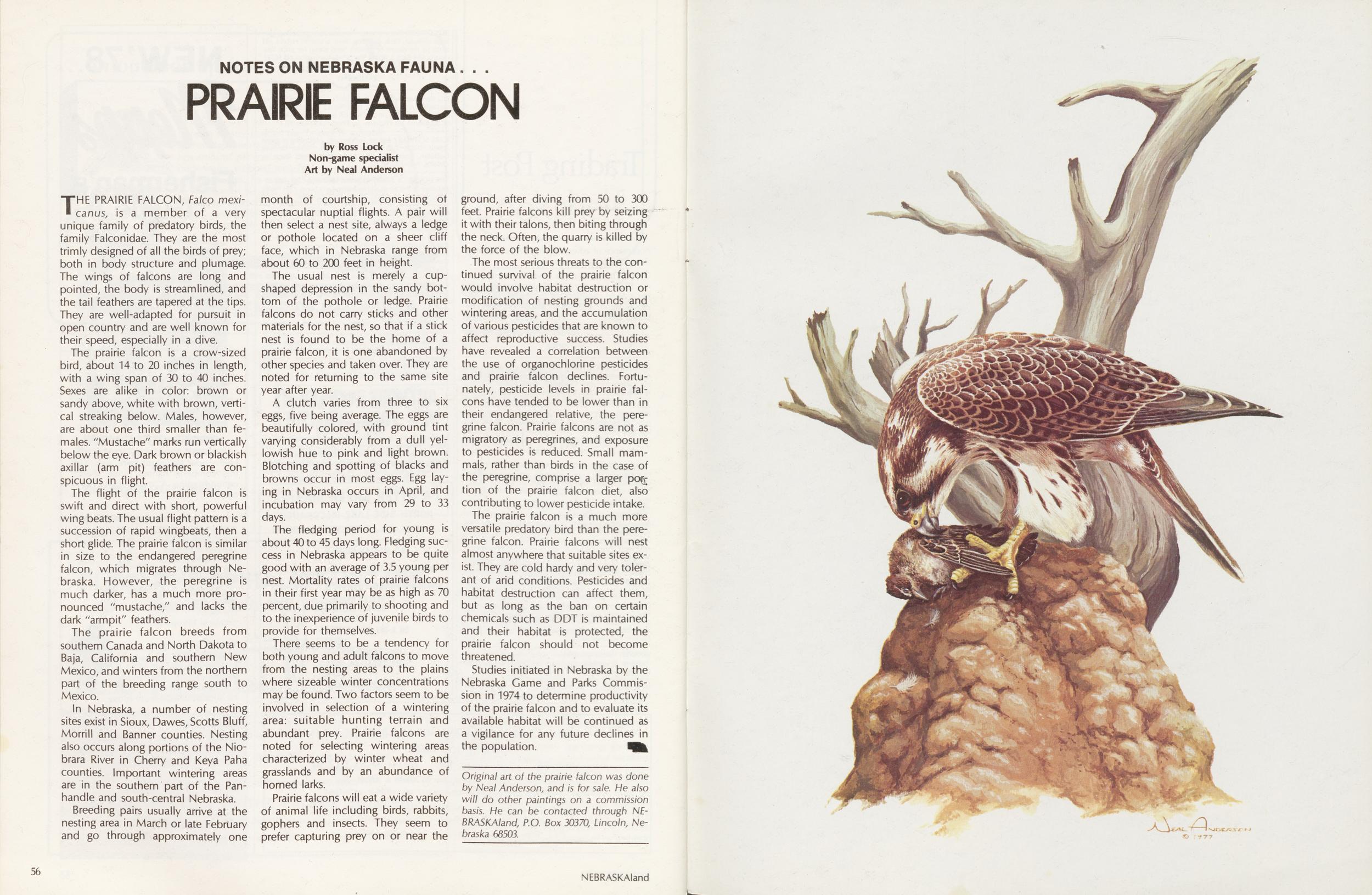
NOTES ON NEBRASKA FAUNA . . . PRAIRIE FALCON
by Ross Lock Non-game specialist Art by Neal AndersonTHE PRAIRIE FALCON, Falco mexicanus, is a member of a very unique family of predatory birds, the family Falconidae. They are the most trimly designed of all the birds of prey; both in body structure and plumage. The wings of falcons are long and pointed, the body is streamlined, and the tail feathers are tapered at the tips. They are well-adapted for pursuit in open country and are well known for their speed, especially in a dive.
The prairie falcon is a crow-sized bird, about 14 to 20 inches in length, with a wing span of 30 to 40 inches. Sexes are alike in color: brown or sandy above, white with brown, vertical streaking below. Males, however, are about one third smaller than females. "Mustache" marks run vertically below the eye. Dark brown or blackish axillar (arm pit) feathers are conspicuous in flight.
The flight of the prairie falcon is swift and direct with short, powerful wing beats. The usual flight pattern is a succession of rapid wingbeats, then a short glide. The prairie falcon is similar in size to the endangered peregrine falcon, which migrates through Nebraska. However, the peregrine is much darker, has a much more pronounced "mustache," and lacks the dark "armpit" feathers.
The prairie falcon breeds from southern Canada and North Dakota to Baja, California and southern New Mexico, and winters from the northern part of the breeding range south to Mexico.
In Nebraska, a number of nesting sites exist in Sioux, Dawes, Scotts Bluff, Morrill and Banner counties. Nesting also occurs along portions of the Niobrara River in Cherry and Keya Paha counties. Important wintering areas are in the southern part of the Panhandle and south-central Nebraska.
Breeding pairs usually arrive at the nesting area in March or late February and go through approximately one month of courtship, consisting of spectacular nuptial flights. A pair will then select a nest site, always a ledge or pothole located on a sheer cliff face, which in Nebraska range from about 60 to 200 feet in height.
The usual nest is merely a cup-shaped depression in the sandy bottom of the pothole or ledge. Prairie falcons do not carry sticks and other materials for the nest, so that if a stick nest is found to be the home of a prairie falcon, it is one abandoned by other species and taken over. They are noted for returning to the same site year after year.
A clutch varies from three to six eggs, five being average. The eggs are beautifully colored, with ground tint varying considerably from a dull yellowish hue to pink and light brown. Blotching and spotting of blacks and browns occur in most eggs. Egg laying in Nebraska occurs in April, and incubation may vary from 29 to 33 days.
The fledging period for young is about 40 to 45 days long. Fledging success in Nebraska appears to be quite good with an average of 3.5 young per nest. Mortality rates of prairie falcons in their first year may be as high as 70 percent, due primarily to shooting and to the inexperience of juvenile birds to provide for themselves.
There seems to be a tendency for both young and adult falcons to move from the nesting areas to the plains where sizeable winter concentrations may be found. Two factors seem to be involved in selection of a wintering area: suitable hunting terrain and abundant prey. Prairie falcons are noted for selecting wintering areas characterized by winter wheat and grasslands and by an abundance of horned larks.
Prairie falcons will eat a wide variety of animal life including birds, rabbits, gophers and insects. They seem to prefer capturing prey on or near the ground, after diving from 50 to 300 feet. Prairie falcons kill prey by seizing it with their talons, then biting through the neck. Often, the quarry is killed by the force of the blow.
The most serious threats to the continued survival of the prairie falcon would involve habitat destruction or modification of nesting grounds and wintering areas, and the accumulation of various pesticides that are known to affect reproductive success. Studies have revealed a correlation between the use of organochlorine pesticides and prairie falcon declines. Fortunately, pesticide levels in prairie falcons have tended to be lower than in their endangered relative, the peregrine falcon. Prairie falcons are not as migratory as peregrines, and exposure to pesticides is reduced. Small mammals, rather than birds in the case of the peregrine, comprise a larger potion of the prairie falcon diet, also contributing to lower pesticide intake.
The prairie falcon is a much more versatile predatory bird than the peregrine falcon. Prairie falcons will nest almost anywhere that suitable sites exist. They are cold hardy and very tolerant of arid conditions. Pesticides and habitat destruction can affect them, but as long as the ban on certain chemicals such as DDT is maintained and their habitat is protected, the prairie falcon should not become threatened.
Studies initiated in Nebraska by the Nebraska Game and Parks Commis- sion in 1974 to determine productivity of the prairie falcon and to evaluate its available habitat will be continued as a vigilance for any future declines in the population.
Original art of the prairie falcon was done by Neal Anderson, and is for sale. He also will do other paintings on a commission basis. He can be contacted through NEBRASKA land, P.O. Box 30370\ Lincoln, Nebraska 68503. 56 NEBRASKAland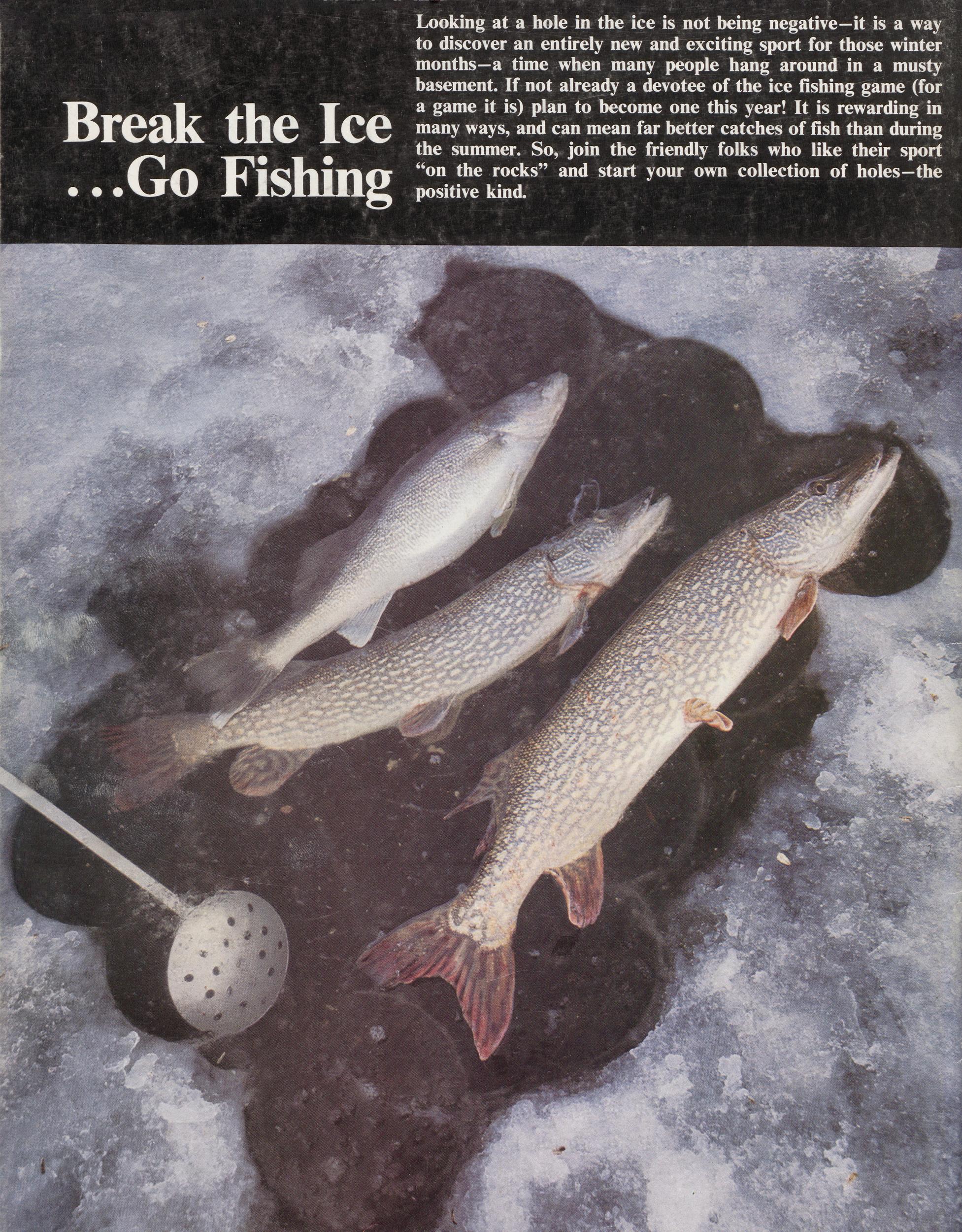
Break the Ice Go Fishing
Looking at a hole in the ice is not being negative—it is a way to discover an entirely new and exciting sport for those winter months—a time when many people hang around in a musty basement. If not already a devotee of the ice fishing game (for a game it is) plan to become one this year! It is rewarding in many ways, and can mean far better catches of fish than during the summer. So, join the friendly folks who like their sport “on the rocks” and start your own collection of holes—the positive kind.Position: 754 (14 views)